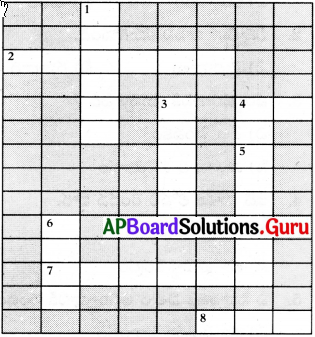
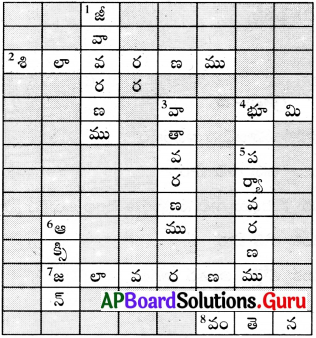
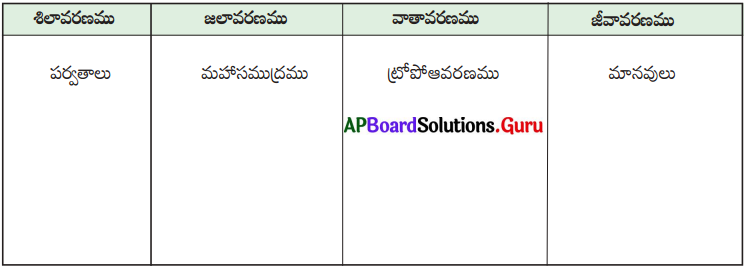
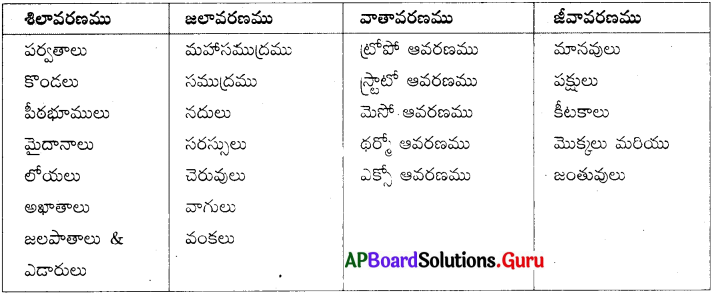
AP Board 10th Class Social Solutions Chapter 1 భారతదేశం: భౌగోళిక స్వరూపాలు

SCERT AP 10th Class Social Study Material Pdf 1st Lesson భారతదేశం: భౌగోళిక స్వరూపాలు Textbook Questions and Answers.

AP State Syllabus 10th Class Social Solutions 1st Lesson భారతదేశం: భౌగోళిక స్వరూపాలు

10th Class Social Studies 1st Lesson భారతదేశం: భౌగోళిక స్వరూపాలు Textbook Questions and Answers

Improve your learning (మీ అభ్యసనాన్ని మెరుగుపడుచుకోండి)

ప్రశ్న 1.
పశ్చిమాన ఉన్న గుజరాత్ లో కంటె అరుణాచల్ ప్రదేశ్ లో సూర్యోదయం రెండు గంటల ముందు అవుతుంది. కానీ, గడియారాలు ఒకే సమయం చూపిస్తాయి. ఎందుకని? (AS1)
జవాబు:
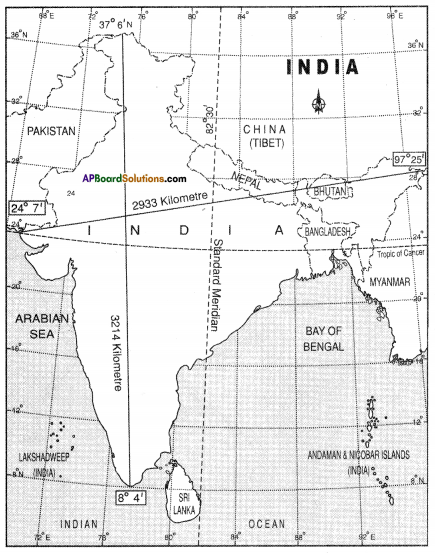
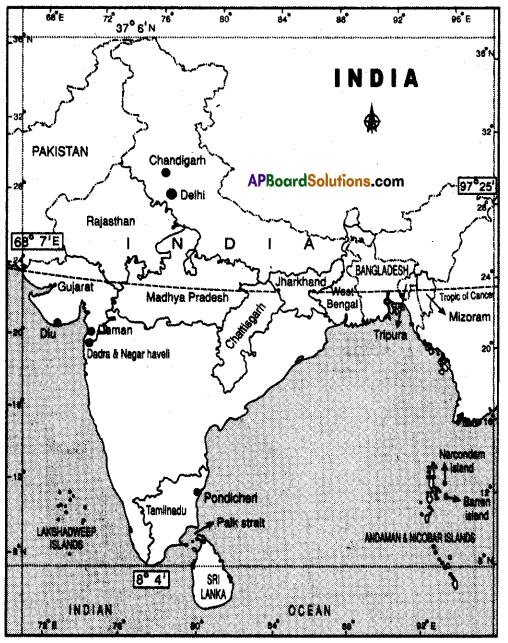
సూర్యుడు తూర్పున ఉదయించి, పడమరన అస్తమిస్తాడు. ఒక్కో రేఖాంశం పశ్చిమం నుండి తూర్పునకు తిరగటానికి ‘4’ నిమిషాలు పడుతుంది. గుజరాత్ లోని కచ్ 68°7′ తూర్పు రేఖాంశం వద్ద, అరుణాచల్ ప్రదేశ్ లోని తూర్పు ప్రాంతం 97°25′ తూర్పు రేఖాంశం వద్ద కలదు. అంటే దాదాపు 30 డిగ్రీల మేర విస్తరించి ఉంది. కావున, రెండు ప్రదేశాల మధ్య రెండు గంటలు (30 x 40 ని = 120 ని||) తేడా ఉంటుంది.

కానీ భారత స్థానిక కాలరేఖగా 82° 30′ తూర్పు రేఖాంశం తీసుకోవటం జరిగింది. దేశంలో వివిధ ప్రదేశాల స్థానిక కాలాల్లోని భేదాన్ని తొలగించడానికిగాను దీనివద్ద కాలాన్ని లెక్కించి, దానినే భారతదేశ ప్రామాణిక కాలం (IST- Indian Standard Time) గా వ్యవహరిస్తున్నారు. కావున సూర్యుడు తూర్పున, పశ్చిమం కన్నా రెండు గంటలు ముందుగా ఉదయించినా గడియారాలు ఒకే సమయం చూపిస్తాయి.

ప్రశ్న 2.
హిమాలయాలు ప్రస్తుతం ఉన్న స్థానంలో లేకపోతే భారత ఉపఖండ శీతోష్ణస్థితులు ఎలా ఉండేవి? (AS1)
(లేదా)
భౌగోళికంగా భారతీయ శీతోష్ణస్థితి హిమాలయ పర్వతాల వల్ల ఏ విధంగా ప్రభావితమౌతున్నది?
జవాబు:
హిమాలయాలు ప్రస్తుతం ఉన్న స్థానంలో లేనట్లయితే భారత ఉపఖండ శీతోష్ణస్థితులు ఇలా ఉండేవి –

  1. హిమాలయాల వల్ల శీతోష్ణస్థితి అనేక విధాలుగా ప్రభావితం అవుతుంది.
  2. భారతదేశ ఉత్తర సరిహద్దులో రక్షణ కవచాలుగా ఉండి తీవ్ర చలికాలంలో మధ్య ఆసియా నుండి వచ్చే చల్లటిగాలులను అడ్డుకుంటాయి. ఇవే లేనట్లయితే తీవ్ర చలిగాలులు వీస్తాయి.
  3. వేసవిలో వర్షాలకు, పశ్చిమ కనుమలు దాటిన తరువాత ప్రాంతంలో ఋతుపవన తరహా శీతోష్ణస్థితికి హిమాలయాలే కారణం. ఇవే లేకపోతే ఉత్తర ప్రాంతం పొడిగా ఉండేది. ఋతుపవన శీతోష్ణస్థితి లేనట్లయితే భారతదేశం ఉష్ణమండల ఎడారిగా మారి ఉండేది.
  4. హిమాలయాలలోని సతతహరిత అరణ్యాలు ఆవరణ సమతౌల్యతను కాపాడటానికి దోహదం చేస్తున్నాయి.

AP Board 10th Class Social Solutions Chapter 1 భారతదేశం: భౌగోళిక స్వరూపాలు

ప్రశ్న 3.
ఇక్కడ పేర్కొన్న వాటిల్లో ఏ ఏ రాష్ట్రాలలోనికి హిమాలయాలు విస్తరించి లేవు? (AS1)
మధ్యప్రదేశ్, ఉత్తరప్రదేశ్, సిక్కిం, హర్యానా, పంజాబ్, ఉత్తరాంచల్,
జవాబు:
మధ్యప్రదేశ్, ఉత్తరప్రదేశ్, హర్యానా రాష్ట్రాలలోనికి హిమాలయాలు విస్తరించి లేవు.

ప్రశ్న 4.
భారతదేశ ప్రధాన భౌగోళిక విభజనలు ఏవి? హిమాలయ ప్రాంత భౌగోళిక పరిస్థితులతో ద్వీపకల్ప పీఠభూమిని పోల్చండి. (AS1)
జవాబు:
A) భారతదేశ ప్రధాన భౌగోళిక విభజనలు :
i) హిమాలయాలు
ii) గంగా-సింధూనది మైదానం
iii) ద్వీపకల్ప పీఠభూమి
iv) తీరప్రాంత మైదానాలు
v) ఎడారి ప్రాంతం
vi) దీవులు

B) హిమాలయ ప్రాంత భౌగోళిక పరిస్థితులతో ద్వీపకల్ప పీఠభూమిని పోల్చుట :

హిమాలయ ప్రాంతం ద్వీపకల్ప పీఠభూమి
i) హిమాలయ పర్వతాలు ఒక చాపం వలె పడమర నుంచి తూర్పునకు విస్తరించి ఉన్నాయి. i) ద్వీపకల్ప పీఠభూమి మెట్టపల్లాలతో, విడివిడి భాగాలుగా విస్తరించి ఉంది.
ii) హిమాలయాలు నవీన ముడుత పర్వతాలు. ఇవి అవక్షేప శిలలతో ఏర్పడినవి. ii) ద్వీపకల్ప పీఠభూమి ‘గోండ్వానా భూమి’లో భాగం. ఇది పురాతన స్ఫటికాకార, కఠినమైన అగ్నిశిలలు, రూపాంతర శిలలతో కూడి ఉన్నది.
iii) హిమాలయాలు సమాంతరంగా ఏర్పడిన శ్రేణులు. వీని మధ్య లోయలు (డూన్లు) ఉన్నాయి. iii) ద్వీపకల్ప పీఠభూమి తూర్పువైపునకు కొద్దిగా వాలి ఉంది. నదులు, భ్రంశాలు మరియు నిట్ర వాలులు దీనిని వేరు చేస్తున్నాయి.
iv) ఇక్కడ జీవనదులు ప్రవహిస్తున్నాయి. నిత్యం మంచుతో కప్పబడి ఉంటాయి. iv) జీవనదులు లేవు. వర్షధార నదులే ఉన్నాయి. మంచుతో కప్పబడి అస్సలు ఉండవు.
v) ఖనిజ వనరులు చాలా తక్కువగా ఉన్నాయి. v) లోహ, అలోహ ఖనిజాల వనరులు పెద్ద మొత్తంలో ఉన్నాయి.
vi) ప్రపంచంలోనే అత్యంత ఎత్తైన పర్వత శిఖరాలకు హిమాలయాలు ప్రసిద్ధి. ఉదా : ఎవరెస్ట్, కాంచనజంగా, నందాదేవి, కైలాష్ మొదలగునవి. vi) సాధారణ పర్వతాలు, కొండలకు మాత్రమే ప్రసిద్ధి. ఉదా : అనె ముడి, దొడబెట్ట, అరోమకొండ మొ॥వి.
vii) ఎవరెస్ట్ (8848 మీ|| శిఖరం ప్రపంచంలో మరియు హిమాలయాల్లో ఎత్తైన శిఖరం vii) అనైముడి (2695 మీII) శిఖరం దక్షిణ భారతదేశంలో ఎత్తైన శిఖరం.
viii) గంగా, సింధు, బ్రహ్మపుత్ర నదులకు జన్మస్థలం. viii) నర్మదా, తపతి, గోదావరి, కృష్ణా, మహానదులు ప్రవహిస్తున్నాయి.

ప్రశ్న 5.
భారతీయ వ్యవసాయాన్ని హిమాలయాలు ఏ రకంగా ప్రభావితం చేస్తున్నాయి? (AS1)
జవాబు:
భారతీయ వ్యవసాయాన్ని హిమాలయాలు ఎంతో ప్రభావితం చేస్తున్నాయి :

  1. భారతదేశ ఉత్తర సరిహద్దులో సహజ రక్షణ కవచాలుగా ఉండి తీవ్ర చలికాలంలో మధ్య ఆసియా నుండి వచ్చే చల్లటి గాలులను గంగా-సింధూ మైదానాలకు తగలకుండా అడ్డుకుంటున్నాయి. ఆ ప్రాంతంలోని పంటలకు నష్టం వాటిల్లకుండా చేస్తున్నాయి.
  2. రుతుపవన తరహా శీతోష్ణస్థితికి హిమాలయాలే కారణం. రుతుపవనాలే లేకపోతే భారతదేశం ఉష్ణమండల ఎడారిగా మారిపోయేది. ఏ పంటలు పండే అవకాశం ఉండేది కాదు.
  3. హిమనీనదాల నుంచి నీళ్లు అందటంతో హిమాలయ నదులు సం||రం పొడవునా నీళ్లు కలిగి ఉండి సంవత్సరంలో అన్ని పంటకాలాల్లో కూడా నీరు సమృద్ధిగా అందిస్తున్నాయి.
  4. హిమాలయ నదులు కొండల నుంచి కిందికి తెచ్చే ఒండ్రు మట్టి వల్ల, మైదాన ప్రాంతాలు చాలా సారవంతంగా మారి అధిక దిగుబడికి కారణమవుతున్నాయి.

AP Board 10th Class Social Solutions Chapter 1 భారతదేశం: భౌగోళిక స్వరూపాలు

ప్రశ్న 6.
గంగా-సింధూ నది మైదానంలో జనసాంద్రత ఎక్కువ. కారణాలను తెలపండి. (AS1)
జవాబు:
గంగా-సింధూ నది మైదానంలో జనసాంద్రత ఎక్కువగా ఉండుటకు కారణాలు :

  1. భారతదేశంలో సుమారు 70%. మందికి వ్యవసాయమే ప్రధాన వృత్తి. కావున అధిక ఉత్పత్తులనిచ్చే సారవంతమైన ‘ఒండ్రు మృత్తికలు’ కలిగి ఈ ప్రాంతంలో జనసాంద్రత ఎక్కువ.
  2. మైదాన ప్రాంతాలు ‘ప్రాచీన కాలం నుండి’ (సింధూ నాగరికత) మానవ ఆవాసాలకు నిలయం.
  3. ఆ మైదాన ప్రాంతాలు బాగా అభివృద్ధి చెందిన ‘నగరాలకు’ ప్రసిద్ధి.
    ఉదా : చండీగఢ్, లక్నో, పాట్నా, 4) మైదాన ప్రాంతం బాగా అభివృద్ధి చెందిన ‘సాగునీరు, తాగునీరు’ వసతులు కలిగి ఉంది.

ప్రశ్న 7.
భారతదేశ సరిహద్దులను చూపించే పటంలో కింది వాటిని గుర్తించండి. (AS5)
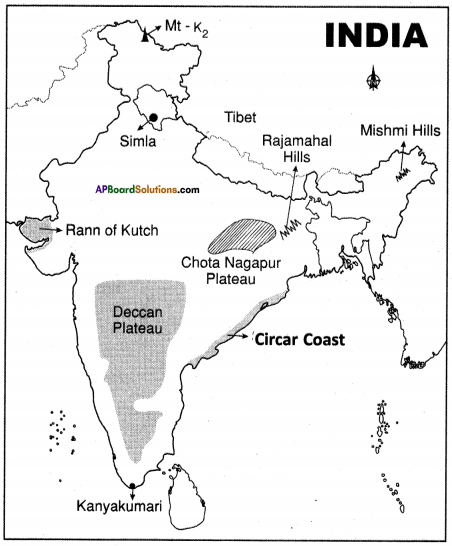
i) కొండలు, పర్వత శ్రేణులు – కారకోరం, జస్కార్, పాట్ కాయ్, జైంతియా, వింధ్య పర్వతాలు, ఆరావళి, కార్డమం కొండలు.
ii) శిఖరాలు – K2, కాంచనగంగ, నంగ పర్వతం, అనైముడి.
iii) పీఠభూములు – చోటానాగ్ పూర్, మాల్వా.
iv) భారత ఎడారి, పశ్చిమ కనుమలు, లక్షద్వీప దీవులు.
జవాబు:
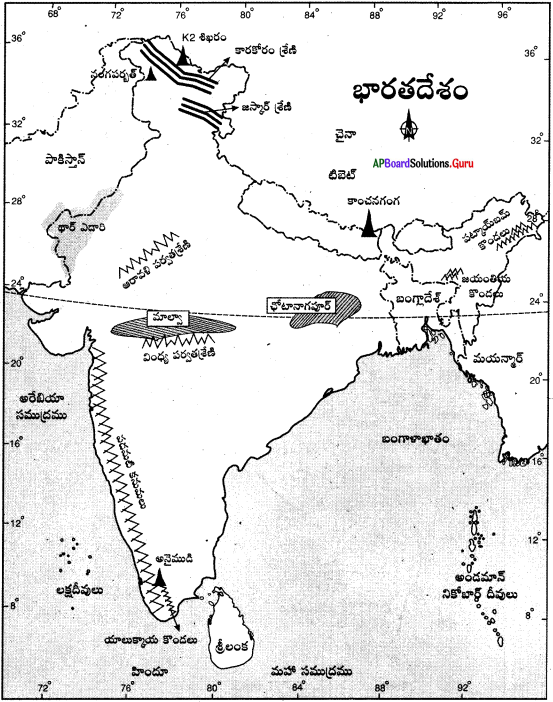
AP Board 10th Class Social Solutions Chapter 1 భారతదేశం భౌగోళిక స్వరూపాలు 1

ప్రశ్న 8.
అట్లాసు ఉపయోగించి కింది వాటిని గుర్తించండి. (AS5)
i) అగ్నిపర్వతాల విస్ఫోటనం వల్ల ఏర్పడిన దీవులు
ii) భారత ఉపఖండంలోని దేశాలు
iii) కర్కటరేఖ పోయే రాష్ట్రాలు
iv) భారత భూభాగంలో అన్నిటికంటే ఉత్తరాన ఉన్న అక్షాంశం, డిగ్రీలలో
v) భారత భూభాగంలో అన్నిటికంటే దక్షిణాన ఉన్న అక్షాంశం, డిగ్రీలలో
vi) అన్నిటికంటే తూర్పున, పడమరన ఉన్న రేఖాంశాలు, డిగ్రీలలో
vii) మూడు సముద్రాలు ఉన్న ప్రదేశం
viii) భారతదేశం నుండి శ్రీలంకను వేరుచేస్తున్న జలసంధి
ix) భారతదేశ కేంద్రపాలిత రాష్ట్రాలు
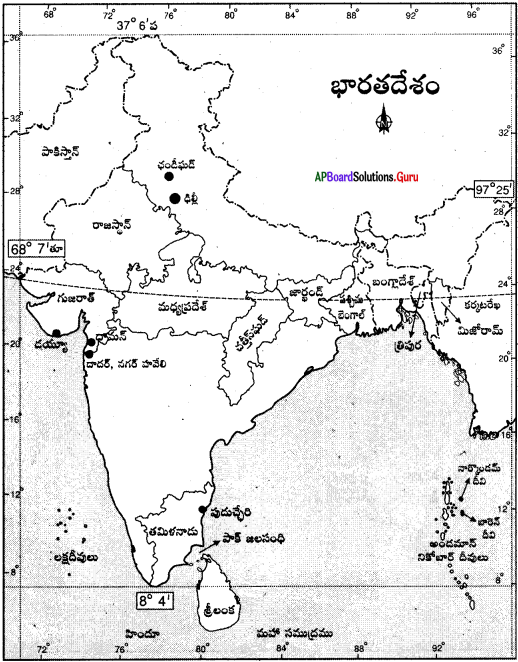
జవాబు:
i) అండమాన్, నికోబార్ దీవులు
ii) భారత్, పాకిస్థాన్, ఆఫ్ఘనిస్థాన్, నేపాల్, భూటాన్, బంగ్లాదేశ్, మయన్మార్, శ్రీలంక, మాల్దీవులు.
iii) గుజరాత్, మధ్యప్రదేశ్, ఛత్తీస్ గఢ్, జార్ఖండ్, పశ్చిమబెంగాల్, త్రిపుర, మిజోరం, రాజస్థాన్.
iv) 37°6
v) 8°4
vi) 97°25′ మరియు 68°7′
vii) కన్యాకుమారి
viii) పాక్ జలసంధి
ix) ఢిల్లీ, చండీగఢ్, పాండిచ్చేరి, అండమాన్ & నికోబార్, లక్షద్వీప్, డామన్ & డయ్యు, దాద్రానగర్ హవేలి.
AP Board 10th Class Social Solutions Chapter 1 భారతదేశం భౌగోళిక స్వరూపాలు 2

ప్రశ్న 9.
తూర్పు మైదాన ప్రాంతాలు, పడమటి మైదాన ప్రాంతాల మధ్య పోలికలు, తేడాలు ఏమిటి ? (AS1)
జవాబు:
తూర్పు మైదాన ప్రాంతాలు, పడమటి మైదాన ప్రాంతాల మధ్య పోలికలు, తేడాలు :

తూర్పు తీరమైదాన ప్రాంతాలు పడమటి తీరమైదాన ప్రాంతాలు
1) తూర్పు కనుమలకు, బంగాళాఖాతానికి మధ్య తీరం వెంబడి ఉన్నాయి. 1) పశ్చిమ కనుమలకు, అరేబియా సముద్రానికి మధ్య తీరం వెంబడి ఉన్నాయి.
2) మహానది డెల్టా నుండి కావేరి డెల్టా వరకు విస్తరించి ఉన్నాయి. 2) రాణ్ ఆఫ్ కచ్ నుండి కన్యాకుమారి వరకు విస్తరించి ఉన్నాయి.
3) ఇవి వెడల్పుగా, బల్ల పరుపుగా ఉన్నాయి. 3) ఇవి సన్నగా, అసమానంగా ఉన్నాయి.
4) ఇవి చాలా సారవంతమైనవి, డెల్టాలు ఉన్నాయి. 4) ఇవి అంత సారవంతమైనవి కావు, డెల్టాలు ఎక్కువ లేవు.
5) ఇక్కడ గోదావరి, కృష్ణ, మహానది మొ|| వదులు ప్రవహిస్తున్నాయి. 5) ఇక్కడ పెద్ద నదులు ప్రవహించడం లేదు.
6) చిల్కా కొల్లేరు, పులికాట్ లాంటి సరస్సులు ఉన్నాయి. 6) ఈ తీర మైదానంలో సరస్సులు లేవు. లాగూన్లు, వెనుక జలాలు కలిగి ఉన్నాయి.
7) ఉత్కళ్ తీరం, సర్కార్ తీరం, కోరమండల్ తీరం అని పిలుస్తారు. 7) కొంకణ్ తీరం, కెనరా తీరం, మలబార్ తీరాలుగా విభజించారు.

AP Board 10th Class Social Solutions Chapter 1 భారతదేశం: భౌగోళిక స్వరూపాలు

ప్రశ్న 10.
భారతదేశంలోని మైదాన ప్రాంతాలు వ్యవసాయానికి దోహదపడినంతగా పీఠభూమి ప్రాంతాలు తోడ్పడవు – దీనికి కారణాలు ఏమిటి ? (AS3)
జవాబు:
భారతదేశంలోని మైదాన ప్రాంతాలు వ్యవసాయానికి దోహదపడినంతగా పీఠభూమి ప్రాంతాలు తోడ్పడవు – దీనికి కారణాలు :

  1. పీఠభూమి ప్రాంతాలు మైదాన ప్రాంతాలంత సారవంతమైనవి కావు. మైదాన ప్రాంతాల్లోని ఒండ్రునేలలు అధిక దిగుబడికి, భూసారానికి పెట్టింది పేరు.
  2. పీఠభూమి ప్రాంతాలలోని నదులు జీవనదులు కావు. గంగా మైదాన ప్రాంతంలోని నదులు జీవనదులు కావటం వలన సంవత్సరమంతా సాగునీరు అందుతుంది. వ్యవసాయానికి అనుకూలం.
  3. మైదాన ప్రాంతాలు నదులు తీసుకువచ్చిన మెత్తని, సారవంతమైన మట్టితో ఏర్పడినవి. పీఠభూములు అగ్నిపర్వత శిలలతో ఏర్పడినవి.

10th Class Social Studies 1st Lesson భారతదేశం: భౌగోళిక స్వరూపాలు InText Questions and Answers

10th Class Social Textbook Page No.2

ప్రశ్న 1.
అట్లాసులో ‘ఇందిరా పాయింటీ’ ని గుర్తించండి. దీని ప్రత్యేకత ఏమిటి?
జవాబు:
అట్లాసులో, భారతదేశ పటంలో ఇందిరా పాయింట్ ని గుర్తించాము. దీని ప్రత్యేకత : ఇది భారతదేశపు దక్షిణ అంచు, -నికోబార్ దీవుల్లో ఉంది. 2004లో సంభవించిన సునామీలో ఇది ముంపునకు గురి అయ్యింది.

10th Class Social Textbook Page No.2

ప్రశ్న 2.
ఆంధ్రప్రదేశ్ ……. ఉత్తర అక్షాంశాల మధ్య, …….. తూర్పు రేఖాంశాల మధ్య ఉంది.
జవాబు:
12°41′ – 19°07′ ఉత్తర అక్షాంశాలు,
77° – 84°40′ తూర్పు రేఖాంశాలు

10th Class Social Textbook Page No.2

ప్రశ్న 3.
మీ అట్లాసులో ఇచ్చిన స్కేలు ఆధారంగా ఆంధ్రప్రదేశ్ తీర పొడవును కనుక్కోండి.
జవాబు:
దాదాపు 970 కి.మీ.

10th Class Social Textbook Page No.4

ప్రశ్న 4.
హిమాలయాలు ఎ) ……. కోట్ల సంవత్సరాల క్రితం ఏర్పడగా, వేట- సేకరణపై ఆధారపడిన తొలి మానవులు బి) ………. లక్షల సం||రాల క్రితం భూమి మీద ఆవిర్భవించారు.
జవాబు:
ఎ) 20
బి) 5

10th Class Social Textbook Page No.1 & 2

ప్రశ్న 5.
ఒక ప్రదేశాన్ని లేదా ప్రాంతాన్ని ఖచ్చితంగా సూచించటానికి అక్షాంశ, రేఖాంశాలను ఉపయోగిస్తారు. అట్లాసు ఉపయోగించి కింది వాక్యాన్ని సరిచేయండి.
“భారతదేశం చాలా విశాలమైన దేశం, ఇది పూర్తిగా దక్షిణార్ధ గోళంలో ఉంది. దేశం 8° – 50° ఉత్తర రేఖాంశాల మధ్య 68° – 9° తూర్పు అక్షాంశాల మధ్య ఉంది.”
జవాబు:
భారతదేశం చాలా విశాలమైన దేశం, ఇది పూర్తిగా ‘ఉత్తరార్ధ’ గోళంలో ఉంది. 8° – 4′ ‘ఉత్తర అక్షాంశాల’ మధ్య 68° -7′ తూర్పు రేఖాంశాల మధ్య ఉంది.

10th Class Social Textbook Page No.2

ప్రశ్న 6.
“భారతదేశ ద్వీపకల్పం” అన్న పదాన్ని తరచుగా ఎందుకు ఉపయోగిస్తాం?
జవాబు:
భారతదేశానికి తూర్పున బంగాళాఖాతం, పడమరన అరేబియా సముద్రం మరియు దక్షిణం వైపున హిందూ మహాసముద్రం ఉన్నాయి. మూడువైపులా నీరు ఉండి ఒకవైపు భూభాగం ఉన్న భూభాగాన్ని “ద్వీపకల్పం” అంటారు. భారతదేశానికి మూడువైపులా సముద్రాలు (నీరు) ఉన్నాయి కాబట్టి భారతదేశ ద్వీపకల్పం అన్న పదాన్ని తరచుగా (దక్షిణ భారతదేశాన్ని ఉద్దేశించి) ఉపయోగిస్తారు.

10th Class Social Textbook Page No.2

ప్రశ్న 7.
కింద ఇచ్చిన పరిశీలనలలో అహ్మదాబాద్, ఇంఫాల్ సూర్యోదయ, సూర్యాస్తమయాలను తెలిపేవి ఏవి ? కారణాలను వివరించండి.

AP Board 10th Class Social Solutions Chapter 1 భారతదేశం భౌగోళిక స్వరూపాలు 3
జవాబు:
ప్రదేశం : ఇంఫాల్ ప్రదేశం : అహ్మదాబాద్
కారణాలు :

  1. ఇంఫాల్ భారతదేశానికి తూర్పుగా, అహ్మదాబాద్ పశ్చిమంగా ఉన్నాయి.
  2. ఇంఫాల్ 93°54′ తూర్పు రేఖాంశంపై, అహ్మదాబాద్ 72° 36′ తూర్పు రేఖాంశంపై ఉన్నాయి. ముందుగా 93°54 తూ.రే. పై సూర్యోదయం జరుగుతుంది. తర్వాత 72° 36′ పై సూర్యోదయం అవుతుంది.

(లేదా)

  1. భూమి పడమర నుండి తూర్పుకు తిరుగుతుంది. కనుక సూర్యోదయం భూగోళానికి తూర్పున, సూర్యాస్తమయం పడమర అవుతుంది.
  2. భారతదేశానికి తూర్పున ఉన్న ఇంఫాల్ లో పడమర ఉన్న అహ్మదాబాద్ కంటే ముందుగా సూర్యోదయం అవుతుంది. అలాగే సూర్యాస్తమయం ఇంఫాల్ లో ముందుగాను, అహ్మదాబాయ్ తరువాత అవుతుంది.

AP Board 10th Class Social Solutions Chapter 1 భారతదేశం: భౌగోళిక స్వరూపాలు

10th Class Social Textbook Page No.4

ప్రశ్న 8.
భారతదేశ ఉత్తర మైదానాల ఏర్పాటుకు దోహదపడిన హిమాలయ, ద్వీపకల్ప నదులను పేర్కొనండి.
జవాబు:
భారతదేశ ఉత్తర మైదానాల ఏర్పాటుకు దోహదపడిన నదులు :
1) హిమాలయ నదులు : గంగా, సింధు, బ్రహ్మపుత్ర నదులు మరియు వాటి ఉపనదులు.

2) ద్వీపకల్ప నదులు : నర్మదా, మహానది మొ||వి.

10th Class Social Textbook Page No.1

ప్రశ్న 9.
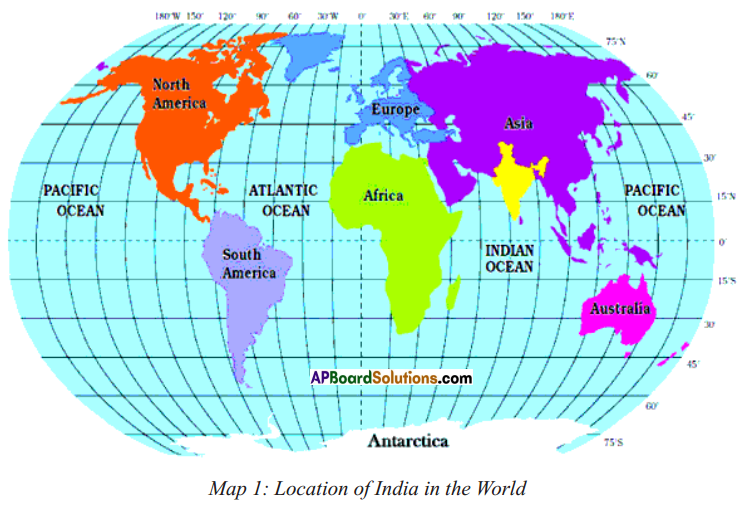
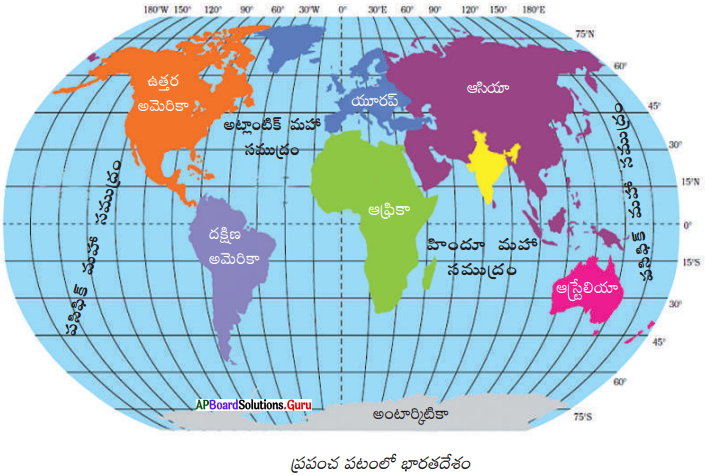
పైన ఇచ్చిన ప్రపంచ పటాన్ని పరిశీలించి భారతదేశ ఉనికిని గురించి కొన్ని వాక్యాలు రాయండి.
AP Board 10th Class Social Solutions Chapter 1 భారతదేశం భౌగోళిక స్వరూపాలు 4
జవాబు:
భారతదేశం ఆసియా ఖండంలో దక్షిణభాగాన ఉంది.

  1. భారతదేశం ఉత్తరార్ధ, పూర్వార్ధ గోళాలలో పాక్షికంగా విస్తరించి ఉంది.
  2. భౌగోళికంగా 8°4′ – 37°6′ ఉత్తర అక్షాంశాల మధ్య, 68°7′ – 97°25′ తూర్పు రేఖాంశాలకు మధ్యన ఉంది.
  3. అక్షాంశాల పరంగా ఉత్తర, దక్షిణాలుగా 30 డిగ్రీల పొడవున, రేఖాంశాల పరంగా కూడా తూర్పు, పడమరలుగా అన్నే డిగ్రీల వెడల్పున వ్యాపించి ఉంది.
  4. భూగోళంపై భారత ఉపఖండం హెచ్చు భూభాగ విస్తీర్ణంతో వ్యాపించి ఉంది.

10th Class Social Textbook Page No.2

ప్రశ్న 10.
పై పటం చూసి ఆర్కిటిక్ వృత్తంలో భారతదేశం ఉందని ఊహించుకోండి. అప్పుడు మీ జీవితంలో ఏ ఏ తేడాలు ఉంటాయి?
జవాబు:
భారతదేశం ఆర్కిటిక్ వృత్తంలో ఉందనుకుంటే మా జీవితంలో ఉండే తేడాలు :
1) ఆహారం : తీసుకునే ఆహారంలో తేడా ఉంటుంది. ధ్రువప్రాంత ప్రజలు ఎక్కువగా మాంసం, చేపలు తీసుకుంటారు. కనుక మేము కూడా అవే తీసుకోవాల్సి ఉంటుంది. (వరి, గోధుమ పంటలు పండవు కనుక)

2) ఆవాసం : ఆర్కిటిక్ ప్రాంతవాసులు మంచుతో నిర్మించిన ‘ఇగ్లూ’లలో, జంతుచర్మాలతో నిర్మించిన గుడారాలలో నివసిస్తారు. మేము ఇప్పటిలాగా డాబాల్లో ఉండలేము. కనుక ఆవాసంలో తేడా ఉంది.

3) దుస్తులు : ఆర్కిటిక్ ప్రాంతవాసులు చలి నుండి రక్షణకై జంతు చర్మాలతో తయారైన బట్టలను ధరిస్తారు. మనలాగా నూలు, సిల్కు దుస్తులు ధరించరు. కనుక వేసుకునే దుస్తులలో తేడా ఉంటుంది.

4) వృత్తి : ప్రస్తుతం మేము వ్యవసాయం, పరిశ్రమలు, వాణిజ్యం మొ||న వృత్తులలో ఉపాధి పొందుతున్నాం. కానీ ఆర్కిటిక్ ప్రాంతంలో వేట, చేపలు పట్టడమే ప్రధాన వృత్తులు. కాబట్టి ఎంచుకునే వృత్తిలో కూడా తేడా ఉంటుంది.

5) వినోదం : ఆర్కిటిక్ ప్రాంతంలో ఇక్కడిలా సినిమాలు, టీవీలూ, కంప్యూటర్లు, ఇంటర్నెట్లు లేవు. కావున వినోద సాధనాల్లో, వినోద కార్యక్రమాల్లో తేడా ఉంటుంది.

6) కాలాలు : ఇప్పటిలాగా వేసవి, వర్ష, చలికాలం వంటివి ఉండవు. ఆర్కిటిక్ ప్రాంతం 6 నెలలు వేసవి, 6 నెలలు శీతాకాలం. కావున కాలాల్లో కూడా తేడా ఉంటుంది.

7) రవాణా సాధనాలు : ఇప్పుడు మేము వాడుతున్న రవాణా సాధనాలు (కారు, బైక్, బస్సు, విమానం మొ||నవి) ఇవి అక్కడ అందుబాటులో ఉండవు. స్లెడ్జ్ బండ్లు లాంటివి తప్ప.

AP Board 10th Class Social Solutions Chapter 1 భారతదేశం: భౌగోళిక స్వరూపాలు

10th Class Social Textbook Page No.2

ప్రశ్న 11.
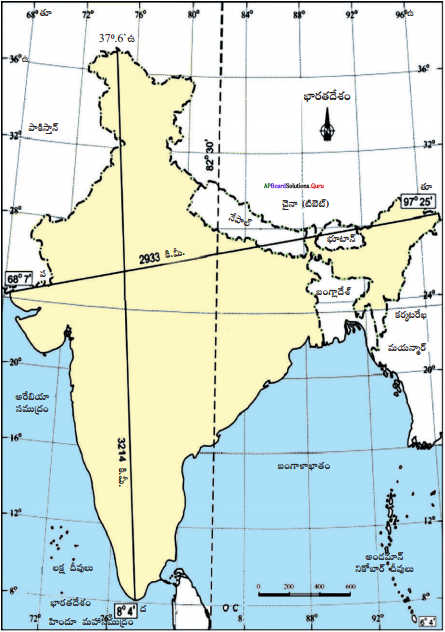
ఈ కింది పటాన్ని పరిశీలించండి. భారతదేశ సరిహద్దును గుర్తించండి. రంగులతో నింపండి.
AP Board 10th Class Social Solutions Chapter 1 భారతదేశం భౌగోళిక స్వరూపాలు 5
పటంలో ఉన్న స్కేలు ఆధారంగా బంగ్లాదేశ్ తో భారతదేశ సరిహద్దు పొడవును అంచనా వేయండి.
జవాబు:
బంగ్లాదేశ్ తో భారతదేశ సరిహద్దు పొడవు సుమారు 4,096.70 కి. మీ.లు

10th Class Social Textbook Page No.3

ప్రశ్న 12.
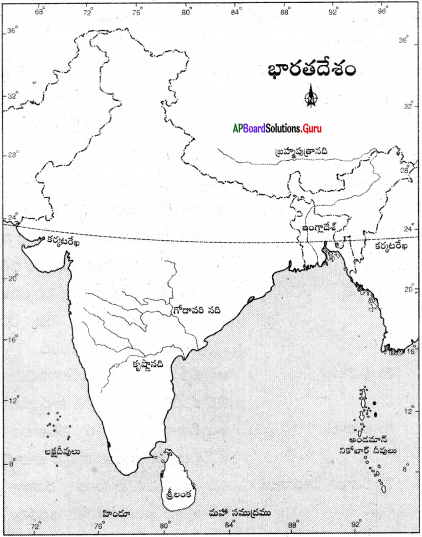
పటం 2 ను, మీ పాఠశాలలోని ఉబ్బెత్తు నిమ్నోన్నత పటాన్ని చూడండి. మీ వేలితో కింద పేర్కొన్న వాటిని గుర్తించండి :
AP Board 10th Class Social Solutions Chapter 1 భారతదేశం భౌగోళిక స్వరూపాలు 6
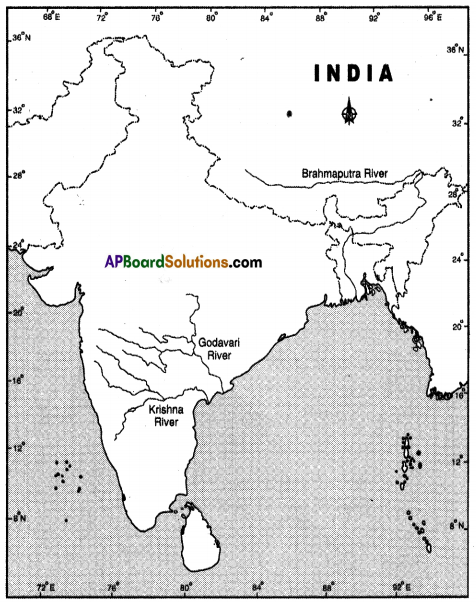
ఎ) దక్కను పీఠభూమి వాలు ఎటు ఉందో : తెలుసుకోటానికి గోదావరి, కృష్ణా నదుల ప్రవాహం వెంట మీ వేలు పోనివ్వండి.
బి) భూస్వరూపాలు, ఎత్తులు, దేశాలను పేర్కొంటూ బ్రహ్మపుత్ర నదీ మార్గం మొత్తాన్ని వర్ణించండి.
జవాబు:
ఎ) దక్కన్ పీఠభూమి కొద్దిగా తూర్పునకు వాలి ఉంది. గోదావరి, కృష్ణా నదులు పశ్చిమం నుండి తూర్పు వైపునకు ప్రవహించి బంగాళాఖాతంలో కలుస్తున్నాయి.

బి) బ్రహ్మపుత్రానది టిబెట్ పీఠభూమి లోని ‘మానస సరోవరం’ (సరస్సు) దగ్గర కైలాస్ పర్వతాలలో జన్మించింది. (సింధు, సట్లెజ్ నదులు కూడా ఇక్కడే జన్మించాయి).

  1. టిబెట్లో బ్రహ్మపుత్రానదిని ‘సాంగ్ పో’ (Tsangpo) అంటారు.
  2. హిమాలయాలకు సమాంతరంగా తూర్పు వైపునకు ప్రవహిస్తుంది.
  3. అరుణాచల్ ప్రదేశ్ లో నైరుతి దిశగా పెద్దమలుపు తిరుగుతుంది. ఇక్కడ దీనిని “సియాంగ్” అనీ, “దిహాంగ్” అనీ అంటారు.
  4. తరువాత అసోం లోయలోకి వచ్చినపుడు దిబంగ్, లోహిత్ అనే రెండు ఉపనదులు కలుస్తున్నాయి.
  5. అసోం లోయ నుండి బంగ్లాదేశ్ లోకి ప్రవేశించి, పద్మానదితో కలిసి బంగాళాఖాతంలో కలుస్తుంది.

10th Class Social Textbook Page No.5

ప్రశ్న 13.
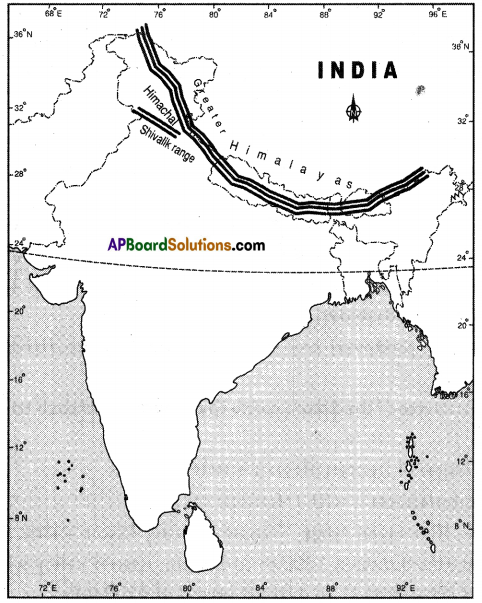
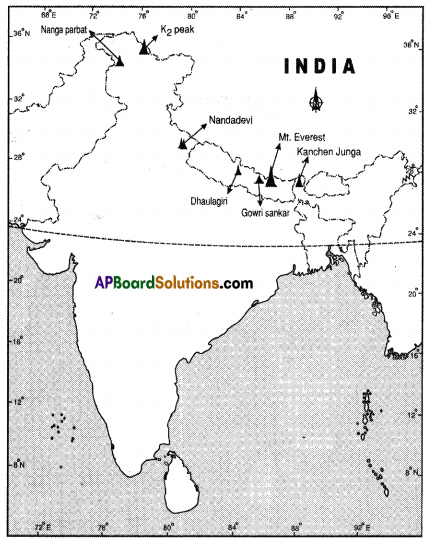
ఎ) మీ అట్లాసులో ఈ మూడు (హిమాద్రి, నిమ్న హిమాలయాలు, పిరే పంజాల్) పర్వతశ్రేణులను గుర్తించండి.
బి) ఉబ్బెత్తు పటంలో అత్యంత ఎత్తైన పర్వత శిఖరాలను కొన్నింటిని గుర్తించండి.
జవాబు:
ఎ) 1) ఉన్నత హిమాలయాలు ( హిమాద్రి)
2) నిమ్న హిమాలయాలు ( హిమాచల్)
3) శివాలిక్ శ్రేణి
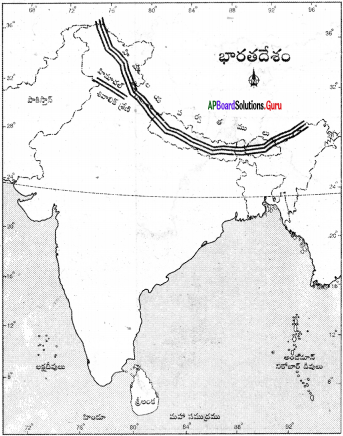
AP Board 10th Class Social Solutions Chapter 1 భారతదేశం భౌగోళిక స్వరూపాలు 7

బి) ఎవరెస్ట్ శిఖరం, K2 శిఖరం, కాంచనగంగ, గౌరీశంకర్, నంగపర్బత్, ధవళగిరి మరియు నందాదేవి
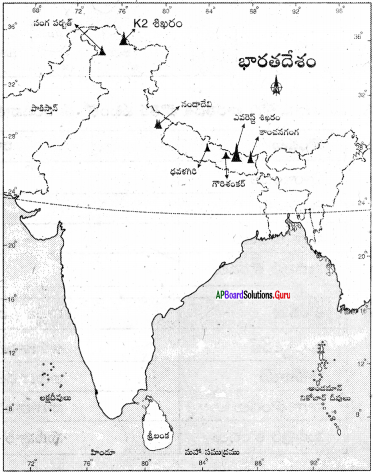
AP Board 10th Class Social Solutions Chapter 1 భారతదేశం భౌగోళిక స్వరూపాలు 8

10th Class Social Textbook Page No.5

ప్రశ్న 14.
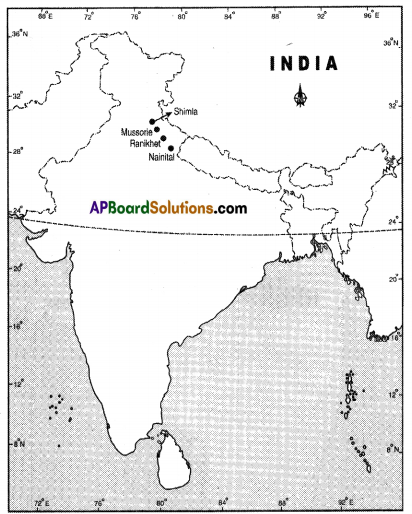
ఎ) కింద పేర్కొన్న ప్రాంతాలపైన గోడ పటంలోనూ, ఉబ్బెత్తు నిమ్నోన్నత పటంలోనూ మీ వేలిని పోనివ్వండి.
బి) మీ అట్లాసులోని భారతదేశ భౌతిక పటంలో కింద పేర్కొన్న ప్రాంతాలను గుర్తించండి. సిమ్లా, ముస్సోరి, నైనిటాల్, రాణిఖేత్.
జవాబు:
ఎ) విద్యార్థి కృత్యము.
బి)
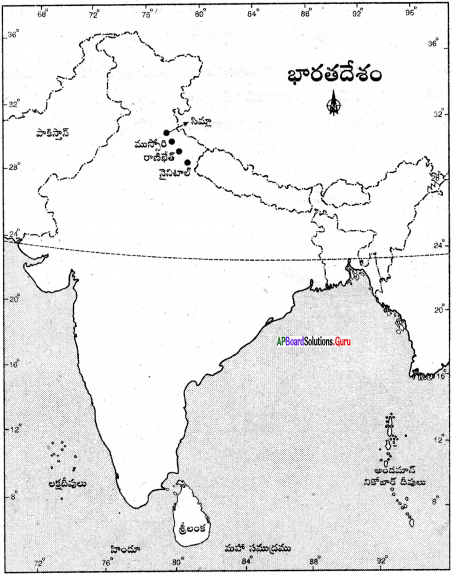
AP Board 10th Class Social Solutions Chapter 1 భారతదేశం భౌగోళిక స్వరూపాలు 9

10th Class Social Textbook Page No.7

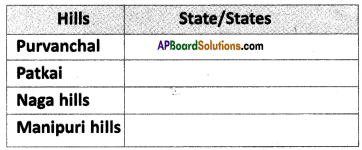
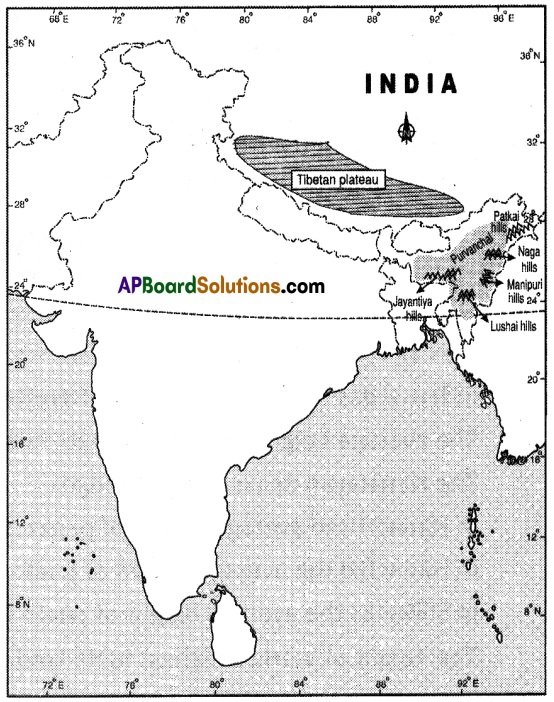
ప్రశ్న 15.
మీ అట్లాసులోని భారతదేశ భౌతిక పటంలో ఈ కింది వాటిని గుర్తించండి.

కొండలు రాష్ట్రం / రాష్ట్రాలు
పూర్వాంచల్
పాట్ కాయ్
నాగా కొండలు
మణిపురి కొండలు

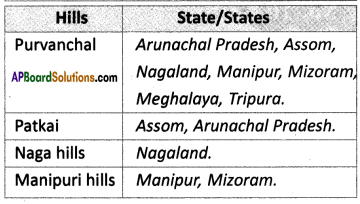
జవాబు:

కొండలు రాష్ట్రం / రాష్ట్రాలు
పూర్వాంచల్ అరుణాచల్ ప్రదేశ్, నాగాలాండ్, మణిపూర్, మేఘాలయ, మిజోరం
పాట్ కాయ్ అరుణాచల్ ప్రదేశ్
నాగా కొండలు నాగాలాండ్
మణిపురి కొండలు మణిపూర్

AP Board 10th Class Social Solutions Chapter 1 భారతదేశం: భౌగోళిక స్వరూపాలు

10th Class Social Textbook Page No.9

ప్రశ్న 16.
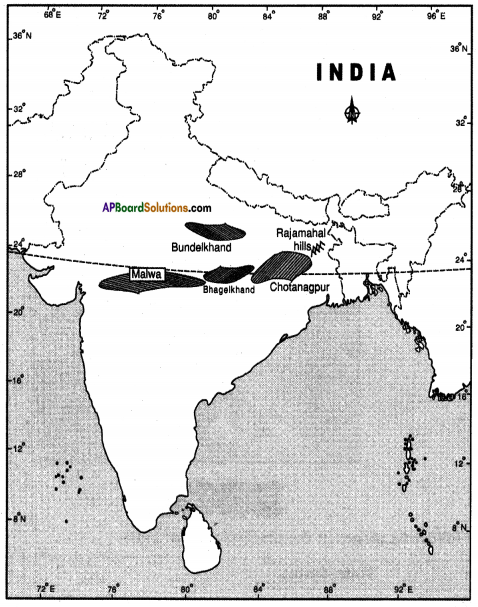
మీ అట్లాసులోని, భారతదేశ భౌతిక పటంలోనూ, ఉబ్బెత్తు నిమ్నోన్నత పటంలోనూ ఈ కిందివాటిని గుర్తించండి.
1. మాల్వా పీఠభూమి, 2. బుందేల్‌ఖండ్, 3. భాగేల్ ఖండ్, 4. రాజమహల్ కొండలు, 5. చోటానాగపూర్ పీఠభూమి.
జవాబు:
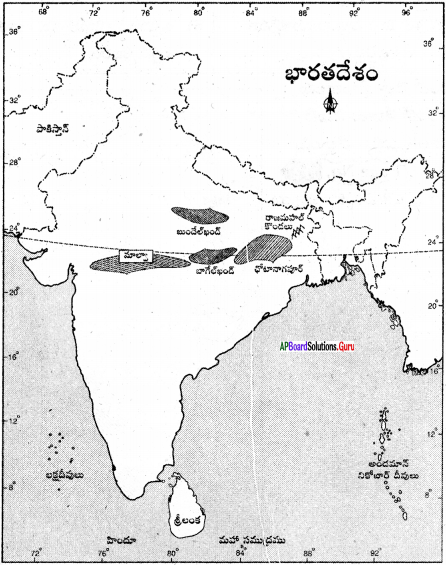
AP Board 10th Class Social Solutions Chapter 1 భారతదేశం భౌగోళిక స్వరూపాలు 10

10th Class Social Textbook Page No.9

ప్రశ్న 17.
అట్లాసు సహాయంతో టిబెట్ పీఠభూమితో పోలిస్తే పైన పేర్కొన్న పీఠభూములు ఎంత ఎత్తులో ఉన్నాయో పేర్కొనండి.
జవాబు:
టిబెట్ పీఠభూమి – 4950 మీటర్లు
మాల్వా పీఠభూమి – 300 – 600 మీ||
బుందేల్ ఖండ్ పీఠభూమి – 2 150 – 300 మీ||
భాగేఖండ్ పీఠభూమి – 300 – 600 మీ||
చోటానాగపూర్ – 600 – 900 మీ||
టిబెట్ పీఠభూమితో పోలిస్తే మిగతా పీఠభూములు అన్నీ తక్కువ ఎత్తులోనే ఉన్నాయి.

10th Class Social Textbook Page No.10

ప్రశ్న 18.
భారతదేశ ఉబ్బెత్తు నిమ్నోన్నత పటంలో తూర్పు, పశ్చిమ కనుమల ఎత్తులను టిబెటన్ పీఠభూమి, హిమాలయ శిఖరాలతో పోల్చండి.
జవాబు:

టిబెటన్, హిమాలయ శిఖరాలు తూర్పు, పశ్చిమ కనుమల శిఖరాలు
1) టిబెటన్, హిమాలయ శిఖరాలు హిమాలయ పర్వతాలకు ఉత్తరభాగంలో ఉన్నాయి. 1) తూర్పు, పశ్చిమ కనుమల శిఖరాలు ద్వీపకల్ప పీఠభూమిలో తూర్పు, పశ్చిమంగా ఉన్నాయి.
2) ఇవి సముద్రమట్టానికి 6000 మీ|| పైన ఎత్తు కలిగి ఉన్నాయి. 2) వీటి ఎత్తు 3000 మీ|| దాటిలేదు.
3) ఇవి ఎప్పుడూ మంచుతో కప్పబడి ఉంటాయి. 3) మంచుతో కప్పబడి (అస్సలు) ఉండవు.
4) ఎవరెస్ట్, కాంచనజంగ, K2, నంగప్రభాత్, నందాదేవి, నామ్చాబార్వ మొ||న వాటితోపాటు ప్రధాన శిఖరాలు ఉన్నాయి. 4) అనైముడి, (నీలగిరి) దొడబెట్ట, అరోమకొండ మొ||న ప్రధాన శిఖరాలు ఉన్నాయి.
5) ఎవరెస్ట్ శిఖరం (8848 మీ.) హిమాలయాల్లోనూ మరియు ప్రపంచంలోనూ ఎత్తైన శిఖరం. 5) అనైముడి (2695 మీ.) భారత ద్వీపకల్పంలో ఎత్తైన శిఖరం

AP Board 10th Class Social Solutions Chapter 1 భారతదేశం: భౌగోళిక స్వరూపాలు

10th Class Social Textbook Page No.12

ప్రశ్న 19.
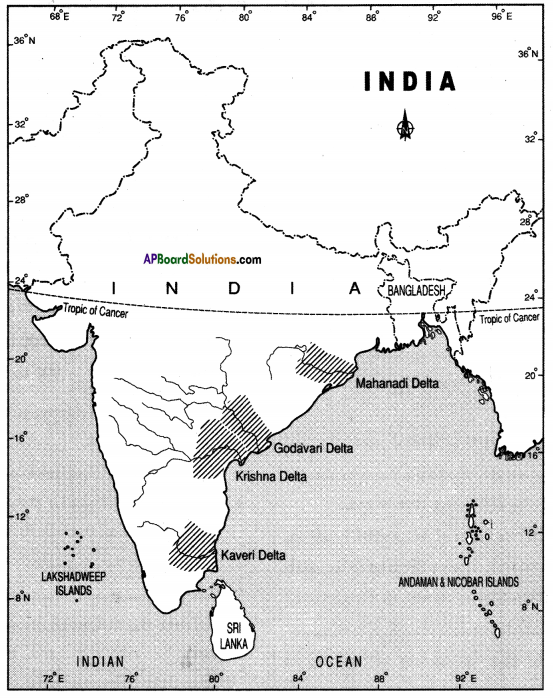
భారతదేశ భౌతిక పటంలో డెల్టా ప్రాంతాలను గుర్తించండి. వాటి ఎత్తులలో తేడాలు ఏమిటి ? గంగా-సింధూ మైదానాలతో వీటిని పోల్చండి.
జవాబు:
డెల్టా ప్రాంతాలన్నీ దాదాపు ఒకే ఎత్తులో ఉన్నాయి.
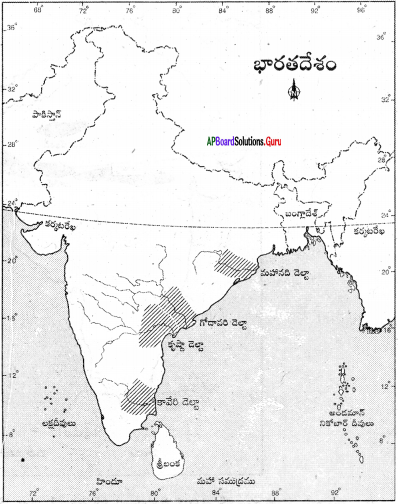
AP Board 10th Class Social Solutions Chapter 1 భారతదేశం భౌగోళిక స్వరూపాలు 11
గంగా-సింధు మైదానాలతో డెల్టా ప్రాంతాలను పోల్చడం :

గంగా – సింధూ మైదానాలు డెల్టా ప్రాంతాలు
1) భారతదేశ ఉత్తర ప్రాంతంలో ఉన్నాయి. ద్వీపకల్ప పీఠభూమికి, హిమాలయాలకు మధ్యన ఉన్నాయి. 1) ద్వీపకల్ప పీఠభూమికి తూర్పుగా ఉన్నాయి. బంగాళాఖాతానికి, తూర్పు కనుమలకు మధ్యన ఉన్నాయి.
2) గంగా, సింధూ, బ్రహ్మపుత్ర నదుల వల్ల ఏర్పడ్డాయి. 2) మహానది, గోదావరి, కృష్ణా, కావేరి నదుల వల్ల ఏర్పడ్డాయి.
3) ఇవి చాలా సారవంతమైనవి మరియు వ్యవసాయానికి చాలా అనుకూలం. 3) ఇవి కూడా చాలా సారవంతమైనవి. మరియు వ్యవసాయానికి అనుకూలం.
4) భాబర్, భంగర్, ఖాదర్, టెరాయి లాంటి భూస్వరూపాలు ఉన్నాయి. 4) చిల్కా, కొల్లేరు, పులికాట్ లాంటి సరస్సులు ఉన్నాయి.
5) ఇవి చాలా విస్తారమైనటువంటివి. దాదాపు 7 లక్షలు చ.కి.మీ. విస్తరించి ఉన్నాయి. 5) ఇవి అంత విశాలమైనవి కావు.
6) వీనిలో జీవనదులు ప్రవహిస్తున్నాయి. 6) వీనిలో జీవనదులు లేవు.

AP Board 7th Class Science Study Material Guide Solutions Pdf Download State Syllabus

Andhra Pradesh SCERT AP State Board Syllabus 7th Class Science Study Material Guide Pdf free download, AP Board 7th Class Science Textbook Solutions in English Medium and Telugu Medium are part of AP Board 7th Class Textbook Solutions.

Students can also go through AP Board 7th Class Science Notes to understand and remember the concepts easily. Students can also read AP 7th Class Science Important Questions for exam preparation.

AP State Syllabus 7th Class Science Guide Study Material Pdf Free Download

AP 7th Class Science Study Material Pdf | 7th Class Science Textbook State Syllabus Pdf Download

AP 7th Class Science Study Material Pdf English Medium New Syllabus

SCERT 7th Class Science Solutions Sem 1

7th Class Science Study Material Pdf Sem 2

AP 7th Class Science Guide Telugu Medium

SCERT Class 7 Science Solutions Sem 1

7th Class Science Guide Sem 2

AP 7th Class Science Study Material Pdf English Medium (Old Syllabus)

Telangana SCERT Class 7 Science Solutions | AP State 7th Class Science Textbook Pdf

AP SSC 10th Class Social Studies Important Questions Chapter 1 India: Relief Features

AP State Board Syllabus AP SSC 10th Class Social Studies Important Questions Chapter 1 India: Relief Features.

AP State Syllabus SSC 10th Class Social Studies Important Questions 1st Lesson India: Relief Features

10th Class Social 1st Lesson India: Relief Features 1 Mark Important Questions and Answers

AP Board Solutions
Question 1.
According to the given table below, which area is the eastern side?

Date Area: Imphal Area: Dwaraka
Sunrise Sunset Sunrise Sunset
Jan 3 05.53 16.34 07.19 18.07

Answer:
According to the given table, Imphal is the eastern side.

Question 2.
What is the time In India when it is 8 am in London?
Answer:
The time is 1.30 pm in India when It is 8 am in London.

Question 3.
Which Indian islands are of volcanic origin?
Answer:
Andaman and Nicobar islands are of volcanic origin.
(OR)
Narkondam and Barren islands are of volcanic origin.

Question 4.
Give examples for Himalayan hill stations.
Answer:
Examples for the Himalayan hill stations are

  1. Simla
  2. Mussoorie
  3. Raniket
  4. Nainital

AP Board Solutions

Question 5.
Read the map given and answer the questions.

AP SSC 10th Class Social Studies Important Questions Chapter 1 India Relief Features 1
Map : India – north – south,
east – west extent and standard meridian

a) Name the latitude that divides India into two parts.
Answer:
Tropic of Cancer / 23°30′ Northern latitude.
b) On which longitude, is Indian Standard Time based upon?
Answer:
82°30′ Eastern longitude.

Question 6.
Mention any one difference between the physical features of the Andaman and Nicobar islands and the Lakshadweep.
Answer:

Andaman and nicobar Islands Lakshadweep Islands
  • Stretched in Bay of Bengal
  • Some of these are of volcanic origin
  • Stretched in Arabian Sea
  • Coral origin

Question 7.
Mention any two differences between the Western and Eastern Ghats.
Answer:

Eastern ghats Western ghats
Less height More height
Not continuous ranges Continuous ranges
No origin of rivers Rivers originate
Highest peak is Aroma Konda Highest peak is Anaimudi

Question 8.
Write any two unique features of Eastern Coastal Plain?
Answer:
Unique features of East Coastal Plain

  1. East Coastal Plains are very wide.
  2. The rivers which are flowing in this area are formed deltas.
  3. These plains are agriculturally developed.
  4. These Plains has lakes.

AP Board Solutions

Question 9.
Name the landform from which the World originated.
Answer:
World originated from two giant lands namely Angara Land (Laurasia) and Gondwana Land.

Question 10.
What is the location of India?
Answer:
India is located between 8°4’ and 37°6′ north latitudes and 68°7′ and 97°25′ east longitudes.

Question 11.
What do you mean by “Doab”?
Answer:
The fertile land between two rivers is known as the Doab feature. ‘Do’ means two, ‘ab’ means water.

Question 12.
Name three parallel ranges of the Himalayas.
Answer:
Three parallel ranges are there in the Himalayas. They are

  1. the Himadri
  2. the Himachal
  3. the Shivalik.

Question 13.
Name the tributaries of Indus.
Answer:
The Jhelum, the Chenab, the Ravi, the Beas and the Sutlej are the tributaries of Indus.

Question 14.
Name the tributaries of the Ganga.
Answer:
The Ghaggar, the Teesta, the Sone, the Kosi and the Yamuna are the tributaries of the Ganga.

AP Board Solutions

Question 15.
Expand IST.
Answer:
Indian Standard Time.

Question 16
Expand GMT.
Answer:
Greenwich Mean Time.

Question 17.
What do you mean by “Dun”? Give one example.
Answer:
The valleys lying between the lesser Himalayas and Shivalik ranges are called “Duns’’, e.g. Dehra Dun.

Question 18.
Which continents of today were part of the Gondwana land?
Answer:
India, South Africa, Australia and South America were part of the Gondwana land.

Question 19.
Name three major divisions of the Himalayas from North to South.
Answer:

  1. The Greater Himalayas or Himadri.
  2. The Lesser Himalayas or Himachal.
  3. The Shivaliks or Outer Himalayas.

Question 20.
Name the island group of India having a coral origin.
Answer:
Lakshadweep.

Question 21.
What is the peninsular plateau composed of?
Answer:
The peninsular plateau is composed of igneous and metamorphic rocks

AP Board Solutions

Question 22.
Identify the regional division of the Northern plains.
Answer:

  1. Punjab plain
  2. Ganga plain
  3. Brahmaputra plain.

Question 23.
What are the relief features that are found in the Northern plains?
Answer:

  1. Bhabar
  2. Terai
  3. Bhangar
  4. Khadar

Question 24.
Which landform feature was a part of Gondwana land?
Answer:
Peninsular Plateau.

Question 25.
Which plateau lies between the Aravalis and the Vindhya range?
Answer:
Malwa Plateau.

Question 26.
Where are the Aravali hills located?
Answer:
The Aravali hills are located on the western and north-western margins of the peninsular plateau in Rajasthan.

Question 27.
What is Bhangar?
Answer:
Bhangar is the largest part of the northern plains and is formed by the oldest alluvium.

Question 28.
What is Khadar?
Answer:
The younger alluvium deposit is called Khadar.

AP Board Solutions

Question 29.
What is a reef?
Answer:
A ridge of jagged rock formed from coral secretions and skeletons.

Question 30.
Name some kinds of reefs.
Answer:
Barrier reef, coral reef and fringing reef.

Question 31.
What was called Angara land?
Answer:
The northern part of Pangaea was called Angara land.

Question 32.
What are known as Purvanchal?
Answer:
The Himalayas in the north-eastern states are known as the Purvanchal hills.

Question 33.
Where is the Kanchenjunga peak?
Answer:
The Kanchenjunga peak is in Sikkim.

AP Board Solutions

Question 34.
Which is the second highest peak in the Himalayas?
Answer:
K2, in the Karakoram range, is the second-highest peak after Mount Everest.

Question 35.
Name the valleys in the Himachal range.
Answer:
Kangra, Kulu and Kashmir valley.

Question 36.
What are Duns?
Answer:
The longitudinal valleys between the Lesser Himalayas and the Shivaliks are known as Duns,
e.g.: Dehradun, Patli dun and Kotli dun.

Question 37.
Where is Bhabar located?
Answer:
Bhabar is located at the foot of the Shivaliks.

Question 38.
What are the two divisions in the Peninsular Plateau?
Answer:
Central Highlands and Deccan Plateau.

Question 39.
Which is the easternmost part of the central highlands?
Answer:
The Chotanagapur Plateau is the eastern-most part of the central highlands.

Question 40.
What is the other name of Ooty?
Answer:
Udagamandalam.

AP Board Solutions

Question 41.
Which is a narrow coastal plain?
Answer:
The Western coastal plain is a narrow plain.

Question 42.
Name the Peninsular rivers.
Answer:
The Godavari, the Krishna and the Cauveri.

10th Class Social 1st Lesson India: Relief Features 2 Marks Important Questions and Answers

Question 1.
Mention the major relief divisions of Indian landmass.
Answer:
The relief divisions of Indian landmass can be divided into following groups :

  1. The Himalayas
  2. The Indo-Gangetic Plain
  3. The Peninsular Plateau
  4. The Coastal Plains
  5. The Desert
  6. The Islands

AP Board Solutions

Question 2.
Study the following map and answer the questions given below:
a) Name the two countries that share their land boundaries with India.
b) In between which latitudes, is India located?
Answer:
a) Pakistan, China, Nepal, Bangladesh, Bhutan, Myanmar.
b) 8°4′ – 37°6′ Northern latitudes.

Question 3.
Observe the map given below and answer the following questions.
a) What is the distance between the eastern and western most points of India?
b) Name any two countries that share their boundaries with India.
Answer:
a) The distance between the eastern and the western most points of India is 2933 kms.
b) Pakistan, Bangladesh, Myanmar, Nepal, China and Bhutan.

Question 4.
Discuss the significant differences between the Himalayan Rivers and the Peninsular Rivers.
Answer:

The Himalayan Rivers The Peninsular Rivers
1. The Himalayan Rivers are Perennial. 1. The Peninsular rivers are seasonal in nature.
2. They originated in Glaciers. 2. They originated in Western ghats and highlands.
3. Himalayan Rivers changes their way frequently. 3. These rivers has fixed course.
4. These rivers irrigate the northern plains. 4. These rivers irrigate the Deccan Plateau.
5. They made the northern plains fertile. 5. These rivers are straight.

Question 5.
Discuss the various islands in India.
Answer:

  1. There are 2 groups of islands – Andaman and Nicobar Islands stretched in Bay of Bengal and Lakshadweep Islands in the Arabian Sea.
  2. In Andaman and Nicobar Islands, Narkondam and Barren islands are volcanic origin.
  3. The southernmost tip of India found in Nicobarlsland is called Indira point which was submerged during the 2004 Tsunami.
  4. Lakshadweep Islands are of coral origin.
  5. It is famous for great variety of flora and fauna.

AP Board Solutions

Question 6.
Himalayas play a vital role in India’s development. How?
Answer:

  1. The Himalayas affect the climate of India by blocking cold air blowing from Siberia and Central Asia.
  2. They are reason for the monsoon type of climate in India.
  3. Without the Himalayas India would have remained drier.
  4. The rivers originating in the glaciers of the Himalaya are perennial and caused the economic growth of the northern plains.
  5. The Himalayan valleys are known for the cultivation of fruits.
  6. The rivers of the Himalayas for the formation of fertile.

Question 7.
How are the Himalayas divided regionally or on the basis of river valleys?
Answer:

  1. Punjab Himalayas between rivers Indus and Sutlej.
  2. Kumaon Himalayas between rivers Sutlejjind Kali.
  3. Nepal Himalayas between rivers Kali and Teesta.
  4. Assam Himalayas between rivers Teesta and Brahmaputra.

Question 8.
Look at the picture and comment on it.
Answer:
It is a sketch of different levels of vegetation in the Himalayas. There are 5 levels in that vegetation.
Level I: On the top of the mountains there is no vegetation.
Level II: On the hill slopes – there is only grass.
Level III: Next to the level II – this area is covered with conifers.
Level IV: Next to level III – this area is covered with broadleaf trees.
Level V: At the feet of the mountains. It is Terai with tree cover.

AP Board Solutions

Question 9.
Write a short note on the Great Indian Desert.
Answer:
The Great Indian desert lies towards the western margins of the Aravalli Hills.
The region gets scanty rainfall. Hence the climate is arid and vegetation is scanty. Luni is the only large river. Some streams appear during rainy season. Crescent-shaped duns are formed around in this area.

10th Class Social 1st Lesson India: Relief Features 4 Marks Important Questions and Answers

Question 1.
1. Describe any four of major relief divisions of Indian land mass.
Answer:
I. Himalayas:

  1. To the north of India, Himalayan mountains extend from west to east at a length around 2400 Kms.
  2. There are three parallel ranges viz. Himadri, Himachal and Shivaliks.

II. Indo-Gangetic Plains:

  1. Indo-Gangetic Plain is formed with the interaction of the rivers Ganga, Indus, Brahmaputra and their tributaries.
  2. These fertile alluvial plains are suitable for agriculture.

III. Peninsular Plateau:

  1. The Indian plateau is also known as the peninsular plateau as it is surrounding by the sea on the three sides.
  2. It is broadly divided into two parts : Malwa plateau and Deccan plateau.

IV. Coastal Plains:

  1. The Western coastal plain is extended between Western Ghats and Arabian Sea. The East coastal plain is extended between Eastern Ghats and Bay of Bengal.
  2. These coastal plains are known locally by different names.
    Eg: Coast of AP – Circar Coast
    Coast of Kerala – Malabar coast etc.

V. Thar Desert:

  1. Thar desert lies in the rain shadow region of Aravali mountains.
  2. Luni is the only river in this region.

VI. Islands:

  1. Andaman and Nicobar islands are in Bay of Bengal. They are of volcanic origin.
  2. Lakshadweep islands are in Arabian Sea. They are of coral origin.

AP Board Solutions

Question 2.
Explain the uses of Himalayas.
Answer:

  1. Himalayas act as natural barriers on the northern side of India.
  2. They protect India from the cold winds from Central Asia during severe winter
  3. The Himalayas are the reason for summer rains.
  4. The himalayas are responsible for monsoon type of climate.
  5. If there are no Himalayas, India will remain as a desert.
  6. They are the origin for many perennial rivers.
  7. They attract tourists from all over the world.
  8. Himalayan rivers bring a lot of silt, making the northern plains very fertile.

Question 3.
Describe the Indian Islands.
Answer:

  1. There are two groups of islands in India.
  2. They are Andaman and Nicobar Islands and Lakshadweep Islands.
  3. Andaman and Nicobar Islands are in Bay of Bengal.
  4. Lakshadweep islands are in Arabian Sea.
  5. In Andaman and Nicobar Islands, Narkondam and Barren islands are of volcanic origin.
  6. Lakshadweep islands are of coral origin.
  7. Indira point, the southernmost tip of India is found in Nicobar Island.
  8. Lakshadweep islands are famous for great variety of flora and fauna.

Question 4.
In what ways is the Indo-Gangetic plain different from the Peninsular plateau?
Answer:

Indo – Gangetic plain Peninsular plateau
1. This plain area was formed due to deposition of sediments brought by rivers. 1. Plateau region was formed due to volcanic eruption.
2. It consists of alluvial soil. 2. It is mainly composed of the old crystalline, hard igneous rocks and metamorphic rocks.
3. It has fertile alluvial soils and flat surface. 3. It has a rugged surface.
4. It provides much irrigation facilities. 4. It also provides much irrigation facilities.
5. Plain regions have perennial rivers. , 5. Plateau region does not have any perennial river.
6. Plains are rich in agriculture practice. 6. Plateau region is rich in mineral resources.

Question 5.
Read the following paragraph and comment on Indian climate and the Himalayas.
The formation of the Himalayas influences the climate in various ways. These act as barriers protecting the great plains of India from the cold winds of central Asia during severe winter. The Himalayas are the reason for summer rains and monsoon type of climate in regions that are beyond the Western Ghats of India. In its absence, this region would have remained drier.
Answer:

  1. The Himalayas affect the climate of India by blocking cold air blowing from the North that comes from Siberia.
  2. Without the Himalayas, India would get cold temperatures in the winter months.
  3. The Himalayas form a natural barrier that prevents monsoon winds from going further north.
  4. The Himalayas are reason for summer rains and monsoon type climate in the regions that are beyond the western ghats of India.
  5. In its absence this region would have remained drier.
  6. India would have been a tropical desert.
  7. The Himalayas are the birthplace of so many rivers.
  8. These rivers bring a lot of silt, making these plains very fertile.

AP Board Solutions

Question 6.
How the Himalayas are influencing the climate of India and agriculture?
Answer:

  1. The Himalayas are obstructing cold winds.
  2. The Himalayas are reason for rains in summer.
  3. They are cause for seasonal climate.
  4. If there is no Himalayas the northern region becomes dry.
  5. The flow of the Himalayan rivers, making the plains very fertile.

Question 7.
Write about the similarities and differences between East Coastal Plains and West Coastal Plains.
Answer:
Similarities :

  1. They are the physical features of India. 2) They both lie in the southern part of India.
  2. They both lie near to the coast.

Differences:

Eastern Coastal Plains Western Coastal Plains
1. Eastern coastal plains is a belt of plain region lying towards the east between Eastern Ghats and Bay of Bengal. 1. Western coastal plains is a belt of plain region lying towards the west between Western Ghats and Arabian Sea.
2. Eastern coastal plains are comparatively wider. 2. This belt of plains is narrow in width.
3. Eastern coastal plains are very fertile because rivers like Mahanadi, Godavari, Krishna, Cauvery deposit their sediments during delta formation. 3. Western coastal plains are less fertile because no major river is engaged in sediment deposition.
4. Eastern plains receive comparatively lesser rainfall. 4. Western plains receive more rainfall.
5. From north to south, Eastern coastal plains are divided into Utkal coast, Sircar coast and Coramandal coast. 5. From north to south, Western coastal plains are divided into Konkan coast, Canara coast and Malabar coast.

Question 8.
Explain the differences between the Eastern Ghats and the Western Ghats,
Answer:

Eastern Ghats Western Ghats
1. The Eastern Ghats start from Bhuvaneswar in Odisha. 1. The Western Ghats start from Khandesh in Maharashtra.
2. They end at Nilgiris in the south. 2. They end at Kanyakumari.
3. They run parallel to some extent in the east coast. 3. They run parallel to the west coast.
4. They are nearer to the Bay of Bengal keeping away some distance. 4. They are nearer to the Arabian sea.
5. They have more number of gaps. 5. They have gaps.
6. They are less strongly built. 6. These are strongly built.
7. The coastal plain of the Eastern Ghats is wider than that of the Western Ghats. 7. The coastal plain of the Western Ghats is not as broad as that of the Eastern Ghats.
8. There are no dense forests in the Eastern Ghats when compared to those of the Western Ghats. 8. There are dense forests in the Western Ghats.
9. There are no rivers originating in Eastern Ghats. 9. The rivers Godavari and Krishna take origin in the Western Ghats.
10. The Eastern Ghats are dissected by rivers. 10. The Western Ghats are not dissected by rivers.
11. They have structural level and uniformity. 11. They have more rugged topography.
12. In Nilgiris they join the Western Ghats. 12. In Nilgiris they join the Eastern Ghats.

AP Board Solutions

Question 9.
Which are the major physiographic divisions of India? Contrast the relief of The Indo-Gangetic Plain with that of The Peninsular Plateau.
Answer:
The major physiographic divisions of India are :

  1. The Great Himalayas,
  2. The Northern Plains
  3. The Great Indian Desert
  4. The Peninsular Plateau
  5. The Eastern and Western Coastal plains and
  6. The Island Group

Question 10.
Prepare a table showing the particulars of different mountain ranges of the Himalayas.
Answer:

Himalayan region Peninsular region
1. The Himalayas are located in the northern region of our country. 1. The Peninsular region is located in the southern region of our country.
2. The Himalayas are young fold mountains. 2. The central Highlands are formed of low hills and plateaus.
3. Many great perennial rivers like the Indus, the Ganges and the Brahmaputra originate from the Himalayas. 3. Some great rivers like the Godavari, the Krishna, the Mahanadi, the Tapati and the Narmada originate from these hills.
4. These are formed of the sedimentary rocks. 4. The central highlands are formed of igneous and metamorphic rocks.
5. They are formed at the edge of the Indo- Gangetic plain. 5. They are formed at the edge of the Deccan plateau.
6. Important hill stations like – Shimla, Mussorie, Darjeeling, Nainital are found on the Himalayas. 6. Udagamandalam, Araku – Harsley hills are hill stations found in the Peninsula plateau region.
7. There are three parallel ranges a) Himadri b) Himachal and c) Shivaliks. 7. They consist of two divisions – Central high lands, Deccan plateau.
8. They run in west – east direction in the form of an arch. 8. The plateau is tilted towards east.

Question 11.
What is the importance of the Himalayas?
Answer:

  1. The formation of the Himalayas influences the climate in various ways.
  2. These act as barriers protecting the great plains of India from the cold winds of central Asia during severe winter.
  3. The Himalayas are reason for summer rains and monsoon type climate in regions that are beyond the Western Ghats of India.
  4. The Himalayan rivers have a perennial flow since these are fed by the glaciers.
  5. These rivers bring a lot of silt, making these plains very fertile.
  6. There are famous hill stations like Simla, Mussorie, Nainital, Raniket, etc. covered by evergreen forests.
  7. The valleys are known for the cultivation of fruits.
  8. There are passes in the Himalayas which act as great exchange of culture and commerce.

Question 12.
Write about the coastal plains.
Answer:

  1. The southern part of the peninsular plateau is bordered by narrow coastal strips along the Arabian Sea on the west and the Bay of Bengal on the east.
  2. Western plain is uneven and broken by hilly terrain.
  3. It is divided into 3 parts.
    a) Konkan coast-northern part comprising Maharashtra and Goa coast.
    b) The second is Canara Coast – the middle part includes coastal plain of Karnataka.
    c) The last part is Malabar coast – the southern part, mostly in the state of Kerala.
  4. Bay of Bengal plains are wide and have large surface structure.
  5. It stretches from Mahanadi in Odisha to Cauvery deltas in Tamil Nadu.
  6. These coastal plains are known locally by different names as Utkal coast in Odisha, Circar coast in Andhra Pradesh and Coromandel coast in Tamil Nadu.

AP Board Solutions

Question 13.
Read the following paragraph and write your opinion on its content.
The formation of the Himalayas influences the climate in various ways. These act as hornets protecting the great plains of India from the cold winds of central Asia during severe winter. The Himalayas are the reason for summer rains and monsoon type climate in regions that are beyond the Western Ghats of India. In its absence, this region would have remained drier. The Himalayan Rivers have a perennial flow since these are fed by the glaciers and bring a fat of silt, making these plains very fertile.
Answer:

  1. According to the paragraph given, it is dearly understood that the Himalayas are useful to India in many ways.
  2. It means that because of the Himalayas only there are fertile soils, sufficient rainfall, and perennial rivers and so it is useful to agriculture which is the backbone of our economy.
  3. I agree with this paragraph because every point discussed here is correct.
  4. The Himalayas are extending in the north of our country from Jammu Kashmir to Arunachal Pradesh for about 2400 kilometers.
  5. Automatically they stop the cold winds blowing from central Asia because our cultivable lands are in the south.
  6. If the Himalayas were not there, India would become dry land or a desert.
  7. Though we have many benefits from the Himalayas, the passes of the Himalayas caused for foreigners to invade our country and these helped in exchanging business and culture.

Question 14.
Read the following paragraph and write your opinion on the condition of the area as well as people living there.
The Thar Desert is located on the leeward side afAravalis and receives very low amount of rainfall, ranging from 100 to 150 mm per year. The desert consists of an undulating sandy plain and rocky outcrops. It occupies much of western Rajasthan. It has an arid climate with very law vegetation cover. Streams appear during the rainy season and disappear soon after. ‘Luni’ is the only river in this area. These internal drainage rivers fill into the lakes and don’t reach the sea.
Answer:

  1. This paragraph says that much of western Rajasthan is sandy and without adequate rainfall.
  2. Without sufficient rainfall we can’t expect proper cultivation and production of crops.
  3. Though Rajasthan ranks first in the area it has maximum desert area.
  4. According to this paragraph, there are a few streams which can be seen during rainy season.
  5. The unfortunate thing of the people living there is that the area is in the leeward side of the Aravali Mountains.
  6. The southwest monsoons remain empty by reaching there.
  7. My opinion is that the people should make a few changes in their livelihoods.
  8. They should grow more crops during rainy season. It would be better for them to go for multiple cropping.
  9. They grow food crops with the help of Indira Gandhi canal water irrigation.
  10. Government should provide their commodities at subsidized prices.
  11. Along with the Indira Gandhi canal, there should be many more schemes like that till their needs are fulfilled.

AP Board Solutions

Question 15.
Read the following paragraph and write your opinion on the geographical location of India.
The geographical location of India provides its vast diversity in climatic conditions. This has led to a variety of vegetation and life forms along with advantages for growing many kinds of crops. Its long coastline and location in the Indian Ocean enabled trade routes as well as fishing.
Answer:

  1. According to this paragraph, the geographical location of India is very prosperous.
  2. India has ocean water on the three sides whereas the high Himalayan Mountains in the north.
  3. These Himalayas give birth to various perennial rivers because of glaciers so as to grow more crops and this led to a variety of vegetation.
  4. In my opinion, there are a few benefits as well as losses to the people living in coastal plains and hilly areas.
  5. The coastal people face some drastic situations when there is a tsunami or cyclones.
  6. The people living in hilly areas face the problem of landslides.
  7. Nowadays global warming is increasing. It may lead to submerge of coastal cultivable lands.
  8. People may face many problems.
  9. Along with these problems they have the opportunity of maintaining foreign trade with the help of sea routes.
  10. Visakhapatnam, Chennai, Mumbai and Cochin are some of the examples for the trade cen¬ters of sea routes.

Question 16.
Observe the table and answer the questions.

Ranges Direction Uaiaht Speciality
Himadri The Northernmost range Above 6100 mts
  • Covered with snow
  • Glacier are present
  • Birth place of many rivers
Himachal Situated to the South of Himadri Between 3700­4500 mts.
  • Number of hill stations are located.
  • Famous valleys like Kulu, Kangra are located.
Shivalik The Southernmost range of the Himalayas 900-1100 mts.
  • Known as Jammu hills in Jammu and Kashmir and Mishmi hills in Arunachal Pradesh.
Purvanchal The Easternmost range Act as the Eastern boundary of India
  • Patkai hills, Naga hills Manipuri hills, Khasi hills and Mizo hills are part of the Purvanchal range.

Answer the following questions.

  1. What are the names of the three Himalayan ranges?
    Answer:
    The three names of the Himalayan ranges are the Greater Himalayas, the Lesser Himalayas and the Shivaliks.
  2. Which of the ranges have hill stations?
    Answer:
    The hill stations are found in the Lesser Himalayan ranges.
  3. Where do we find Dehra Dun and Patli Dun?
    Answer:
    We find Dehra Dun and Patli Dun in the valleys in between the Lesser Himalayas and the Shivaliks.
  4. What is the difference in between the ranges of the Greater Himalayas and the Lesser Himalayas with regard to the composition?
    Answer:
    The Greater Himalayas are composed of ice and snow cover whereas the Lesser Himalayas are composed of highly compressed rocks.

AP Board Solutions

Question 17.
Describe the formation and divisions of Indo-Gangetic plains.
Answer:

  1. The interaction of three Himalayan rivers the Indus, the Ganga and the Brahmaputra and their tributaries resulted in the formation of great northern plain.
  2. In the beginning it was a shallow basin later gradually filled with alluvial soil from these rivers.
  3. The western part of Indo-Gangetic plains was formed by the Indus and its tributaries, the Jhelum, the Chenab, the Ravi, the Beas and the Sutlej flowing from the Himalayas.
  4. Doab features dominate the fertile land between the two rivers.
  5. The central part is known as Ganga plain extending from the rivers the Ghaggar to the Teesta. 6} The eastern part of the plain exists mostly in the Brahmaputra valley of Assom and the river
    Brahmaputra is mainly responsible for its formation.

Question 18.
Describe the vairous aspects of the peninsular plateau.
Answer:

  1. The Indian Plateau is also known as the peninsular plateau as it is surrounded by the sea on three sides.
  2. Large amounts of metallic and non-metallic mineral resources are found here.
  3. Its topography is slightly tilted towards east.
  4. Its two divisions are central high lands (Malwa plateau) and the Deccan Plateau.
  5. The rivers here are not perennial.
  6. The triangular landmass to the south of Narmada is called Deccan Plateau.
  7. The structure of Western Ghats is continuous with a few passes as the gateways to the coastal plains.
  8. The Eastern Ghats are not continuous.
  9. One of the remarkable features of the peninsular plateau is black soils formed due to volcanic activity.

Question 19.
Write about the Thar desert.
Answer:

  1. The Thar Desert is located on the leeward side of Aravalisand receives very low rainfall, ranging from 100 to 150 mm per year.
  2. The desert consists of an undulating sandy plain and rocky outcrops.
  3. It occupies much of western Rajasthan.
  4. It has an arid climate with very low vegetation cover.
  5. Streams appear during rainy season and disappear soon after.
  6. Luni is the only river in this area.
  7. The internal drainage rivers fall into the lakes and don’t reach the sea.
  8. Indira Gandhi canal is watering part of Thar desert.
  9. Several hectares of desert land have been brought under cultivation.

AP Board Solutions

Question 20.
Read the given map and answer the following questions.
AP SSC 10th Class Social Studies Important Questions Chapter 1 India Relief Features 5

  1. Which hills are spread continuously from North to South?
    Answer:
    Western Ghats spread continuously from North to South.
  2. Which Ghats are the birthplace of many rivers?
    Answer:
    Western Ghats are the birthplace of many rivers.
  3. Which river flows westwards?
    Answer:
    The river which flows westwards is Narmada. (Tapti also)
  4. Which plateau is there on the windward side of the Aravali?
    Answer:
    Malwa plateau is there on the windward side of the Aravali.
  5. Where do the eastern and western Ghats join?
    Answer:
    The eastern and western Ghats join Nilgiris near Gudalur.
  6. Which ocean is located in the south of India?
    Answer:
    The Indian Ocean is located in the south of India.
  7. Which plateau is there in between Ms s and Chotanagpur plateau?
    Answer:
    Central plateau is there in between Malwa and Chotanagpur plateau.

Question 21.
Read the given map and answer the following questions.
AP SSC 10th Class Social Studies Important Questions Chapter 1 India Relief Features 6

  1. Which is the standard meridian in India?
    Answer:
    82° 30′ Eastern Longitude is the standard meridian in India.
  2. Name the latitude that moves from the centre of India.
    Answer:
    23% northern latitude moves from the centre of India. This is called Tropic of Cancer.
  3. What is the distance between north and south tip of India?
    The distance between north and south tips is 3214 kms.
  4. Mention the location of India.
    Answer:
    India is located in between the latitudes of 8°4′ and 37°6′ N and longitudes of 68°7′ and 97°25′ E.
  5. Name any two frontier countries of India.
    Answer:
    Pakistan, China, Bhutan, Myanmar, Bangladesh and Nepal. ( any two can be written)
  6. Which islands are located in the southeast corner of India?
    Answer:
    Andaman Nicobar islands are located in the southeast corner of India.

AP Board Solutions

Question 22.
Locate the following in the given map of India.

  • Locate the Highest plateau in the world.
    Answer: Tibet
  • Capital of Himachal Pradesh.
    Answer: Simla
  • Highest peak in India.
    Answer: Mt-K2
  • Locate the Hills in Arunachal Pradesh.
    Answer: Mishmi Hills
  • This plateau has rich variety of mineral resources.
    Answer:
    Chotanagpur
  • Rajmahal hills
    Triangular plateau.
    Answer:
    Deccan Plateau Circar Coast
  • The southernmost tip of India.
    Answer:
    Kanya Kumari
  • Mashy Swampy region of Gujarath.
    Answer:
    Rann of Kutch

AP SSC 10th Class Social Studies Important Questions Chapter 1 India Relief Features 7

AP Board 7th Class Social Solutions 1st Lesson The Universe and The Earth

SCERT AP 7th Class Social Study Material Pdf 1st Lesson The Universe and The Earth Textbook Questions and Answers.

AP State Syllabus 7th Class Social 1st Lesson Questions and Answers The Universe and The Earth

7th Class Social 1st Lesson The Universe and The Earth Textbook Questions and Answers

AP Board 7th Class Social Solutions 1st Lesson The Universe and The Earth 1
Answer the following questions.

Question 1.
What things do you observe from the picture?
Answer:
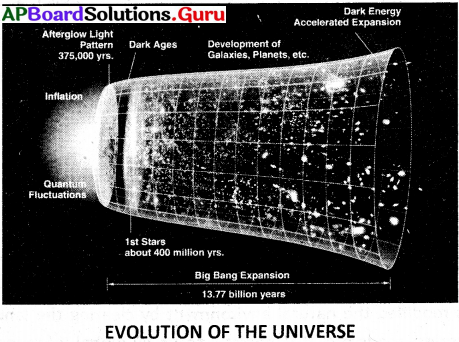
Things I observed in the above picture are, the Sun, Stars, the Moon, Planets, Galaxies, etc.

Question 2.
Which among them appear during the day, and which things appear during the night?
Answer:
The Sun is the only thing that appears during the day.
The Moon and stars appears during the night.

Question 3.
What do we call all these objects collectively?
Answer:
Collectively these objects are called Solar System.

Improve Your Learning

I. Answer the following questions.

Question 1.
What do you know about the Universe?
Answer:
The Universe is a vast space that contains many unimaginable elements.

It includes the Sun, Planets, the Milky way Galaxy and all the other Galaxies. Nobody knows how big the Universe is.

The range of the Universe is infinite. The Universe is everything we can touch, feel, sense measure or detect. It includes stars, clouds, light, time and living things etc.

Question 2.
What do you mean by natural environment?
Answer:
The Natural environment is comprising of (and, water, air, living organisms like plants and animals. It consists of both biotic (plants and animals) and abiotic (land) conditions that exist on the earth.

The biosphere is a narrow zone of the earth where land, water, and air interact with each other to support life.

AP Board 7th Class Social Solutions Chapter 3 పటాల ద్వారా అధ్యయనం

Question 3.
“Natural environment is different from the Man- made” Justify your answer.
Answer:
Yes, I agree with the above statement by the following.

Natural environment refers to the natural biotic and abiotic components of the environment. They are naturally occurring. For example : Pond, lake, grassland, etc.

Our surroundings ‘which are made by the human beings are called man-made environment. For example : Buildings, factories, parks, roads, bridges, projects, and monuments, etc.

Justify : The natural environment encompasses all living and non-living things occurring naturally on Earth. It is an environment that encompasses the interaction of all living species. ,

Human environment is developed from the natural environment with the adaptation of human beings to their surroundings.

Question 4.
Prepare any two slogans on the protection of environment.
Answer:
Go green and eliminate the global warming.
Save the nature to save the future.
Save environment, save life.
Natural environment is everything for healthy life, we should maintain it.

Question 5.
Write a list of different plants and animals that depend on each other.
Answer:

  1. Plants depend on bees and insects for pollination, while the pollinators need the nectar from the flowers.
  2. After the flowers have been pollinated, they can turn into berries, which are then eaten by animals like bears, ptarmigan, fox, and the people.
  3. Animals breathe in oxygen and exhale carbon dioxide. Plant use carbon dioxide in photosynthesis and exhale oxygen for animals to breathe.
  4. Forest and wetlands filter water and provide clean water for plants and animals.
  5. Some animals eat plants and animals when plants and animals die, they decompose and provide nutrients in the soil for plants.

Question 6.
Composition of atmosphere is getting changes now. Give reasons.
Answer:
Changes in atmosphere :

  1. Carbon dioxide released in the atmosphere creates a greenhouse effect by trapping the heat radiated from the earth.
  2. When greenhouse gas levels in the atmosphere increases due to factory smoke or car fumes, the heat retained increases the temperature of the earth. This is called global warming.
  3. Rise in temperature on the earth surface causes the snow in coldest parts of the world to melt.
  4. As a result the sea level rises, causing floods in the,coastal areas.

Reasons:

  1. Deforestation
  2. Excessive usage of natural resources.
  3. Burning of fossil fuels.
  4. Usage of inorganic fertilizers, chemicals, and pesticides.
  5. Usage of motor vehicles.
  6. Usage of refrigerators and air conditioners etc.

Question 7.
Prepare any two slogans on the protection of minerals that are available in the Lithosphere.
Answer:
R3 – Reduce, Reuse and Recycle.
Use the minerals in a planned way.
Technology should be improved to use the low grade ores profitably.
Substitute in order to save minerals should be encouraged.

Save minerals – live in better future.
Wastage in process of mining and processing has to be reduced to minimum.

AP Board 7th Class Social Solutions Chapter 3 పటాల ద్వారా అధ్యయనం

II. Choose the correct answers.

1. The following is not a component of human environment.
a) Factory
b) Religion
c) Community
d) None of these
Answer:
a) Factory

2. Find out the odd one.
a) Plains
b) Road
c) Valley
d) River
Answer:
b) Road

3. This is a threat to environment.
a) Growing plants
b) Growing crops
c) Increasing vehicles
d) All
Answer:
c) Increasing vehicles

4. Which is the second layer of the interior of the Earth?
a) Mantle
b) Inner Core
c) Outer Core
d) Crust
Answer:
a) Mantle

5. Which theory is related to Origin of the Universe?
a) Geocentric
b) Heliocentric
c) Big Bang
d) All the above
Answer:
c) Big Bang

III. Match the following.

Group-A Group-B
1. Lithosphere A) Natural domain of water
2. Biosphere B) Air which surrounds the Earth
3. Core C) Narrow zone where land water and air interact
4. Hydrosphere D) Rocky layer of the Earth.
5. Atmosphere E) Deep interior part of the Earth

Answer:

Group-A Group-B
1. Lithosphere D) Rocky layer of the Earth.
2. Biosphere C) Narrow zone where land water and air interact
3. Core E) Deep interior part of the Earth
4. Hydrosphere A) Natural domain of water
5. Atmosphere B) Air which surrounds the Earth

IV. Fill up the following table.

Word Origin (word) and meaning Origin (language)
Biosphere
Lithosphere
Hydrosphere
Atmosphere
Environment

Answer:

Word Origin (word) and meaning Origin (language)
Biosphere Bios – Life – Sphaira-ball Greek
Lithosphere Litho – Stone – Sphaira-ball Greek
Hydrosphere Hydor – Water – Sphaira-ball Greek
Atmosphere Atmos – Vapour – Sphaira-ball Greek
Environment Environer – Neighbourhood French

Puzzle

Solve the puzzle with the words related to given hints.
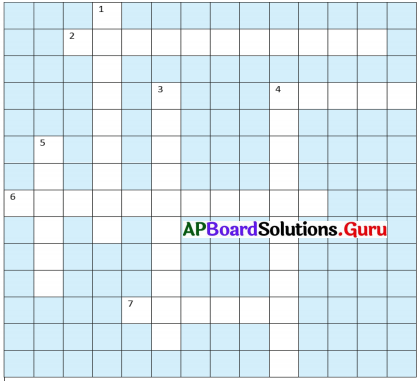
AP Board 7th Class Social Solutions 1st Lesson The Universe and The Earth 2

DOWN :
1. A system formed by the interaction of aii living organisms (9)
3. Blanket of air (10)
4. Our surroundings (11)
5. Life gas (6)

ACROSS:
2. Hard surface layer of the Earth (11)
4. Planet which has life (5)
6. Natural domain of water (11)
7. A Human-made environment (6)
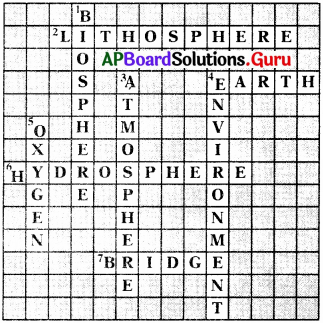
Answer:
AP Board 7th Class Social Solutions 1st Lesson The Universe and The Earth 3

7th Class Social 1st Lesson The Universe and The Earth InText Questions and Answers

7th Class Social Textbook Page No. 3

Question 1.
Collect some more information about the Universe.
Answer:

  1. The Universe includes living things, planets, stars, galaxies, dust clouds, light, and even time.
  2. Before the birth of the Universe, time, space and matter did not exist.
  3. The space between the stars and galaxies is largely empty. The Universe has not always been the same size.
  4. Since it’s birth-, the Universe has been expanding outward at very high speed. So the area of space we now see is billions of times bigger than it was when the Universe was very young.

Question 2.
Refer atlas or go through the internet and collect information about two more galaxies in the Universe. (Take the help of your teacher if you need.)
Answer:
Types of Galaxies :
Astronomers classify galaxies into three major categories :

Elliptical, spiral and irregular.

Elliptical:

  1. Elliptical galaxies are shaped like a spheriod, or elongated sphere.
  2. In the sky where we can only see two of their three dimensions, these galaxies look like elliptical or oval shaped disks.
  3. The light is smooth, with the surface brightness decreasing as you go farther out from the centre.

Spiral Galaxies:

  1. Spiral Galaxies have three main components : a bulge, disk and halo.
  2. The bulge is a spherical structure found in the center of the galaxy.
  3. The disk is made up of dust, gas and younger stars.
  4. The halo contains old clusters of stars, known as globular clusters.

Irregular Galaxies:

  1. Irregular galaxies have no regular or symmetrical structure.
  2. They are divided into two groups, I rr I and I rr II.
  3. These are mix up of hydrogen gas and dust.
  4. All this dust makes is almost impossible to see distinct stars in the galaxy.

7th Class Social Textbook Page No. 5

Question 3.
Collect the Information and fill the following Table.

Name of the Planet No. of Natural Satellites Features of the Planet

Answer:

Name of the Planet No. of Natural Satellites Features of the Planet
The Mercury Mariner 10 Messenger It has a solid surface that is covered with craters. It has no atmosphere.
The Venus No Satellites Venus has crushing air pressure at its surface more than 90 times that of Earth similar to the pressure you’d encounter a mile below the ocean on the Earth.
It is the second most planet from the Sun.
The EARTH One-Moon 1. Earth is the only planet in the Solar System that is capable of supporting life as we know it.
2. It has the right temperature because it is neither too close to the Sun nor too far from it.
3. So, the living things survive on the Earth.
The Mars Phobos and Deimos Mars is a terrestrial planet with a thin atmosphere with surface features reminiscent of the impact craters of the Moon and the Valleys, deserts and polar ice caps of Earth.
The Jupiter There are 79 known moons. Ex : Galilean moons,
Simon Marius
Jupiter is called a gas giant planet. Its atmosphere is made up of mostly hydrogen gas and helium gas like the Sun. The planet is covered in thick red, brown yellow and white clouds. The clouds make the planet look like it has stripes.
The Saturn It has 82 moons Saturn is a gas giant made up mostly of hydrogen and helium. Saturn’s volume is greater than 760 Earths.
The Uranus Miranda, Ariel, Umbriel, Titania and oberon Uranus is made of water, methane, and ammonia fluids above a small rocky center. Its atmosphere is made of hydrogen and helium like Jupiter and Saturn, but it also has methane.
The Neptune Naiad, Thalassa, Despina, Hippo- camp, Larissa, etc. It is dark, cold, and very windy. It is the last of the planets in our solar system. It is encircled by six rings.

AP Board 7th Class Social Solutions Chapter 3 పటాల ద్వారా అధ్యయనం

Question 4.
Observe the things in the Fig 1.6 and categorize them under the headings in the given table.
Answer:

Natural Environment Human Environment Man-made Environment

Answer:

Natural Environment Human Environment Man-made Environment
Abiotic-Land, Air, Water Biotic – Animals, Plants, insects, Birds Individual Family Community, Religion, Educational, Economic and Political etc. Bridge, Buildings. Parks, Industries, Monuments and Roads etc.

7th Class Social Textbook Page No. 7

Question 5.
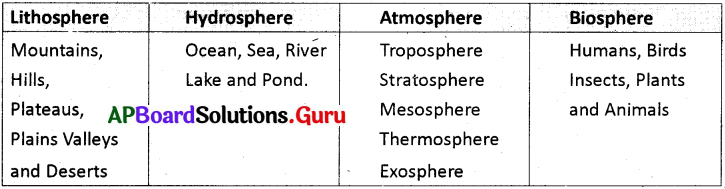
Observe the components of natural environment in fig. 1.8 and write those components under the right headings given in the table. You can add some more components if any.

Lithosphere Hydrosphere Atmosphere Biosphere
Mountains Ocean Troposphere Humans

Answer:
AP Board 7th Class Social Solutions 1st Lesson The Universe and The Earth 6

7th Class Social Textbook Page No. 8

Question 6.
With the help of your teacher, fill the following table related to land forms by getting information from different sources like internet, library, etc.
Answer:

First order land forms Second order land forms Third order land forms

Answrer:

First order land forms Second order land forms Third order land forms
Oceans and Continents Mountains, plains, and plateaus Landforms by wind and water.
Ex : Deltas, sand dunes etc.

Question 7.
List the things which are used in our daily life and write down the names of related minerals.
Answer:

Name of the things Related minerals

Answer:

Name of the things Related minerals
Toothpaste Calcium and Phosphorous
Ceiling Fan Copper
Piece of Chalk Limestone
Gas Cylinder Liquefied petroleum
Motor Bike Petrol
Iron box Coal

7th Class Social Textbook Page No. 10

Question 8.
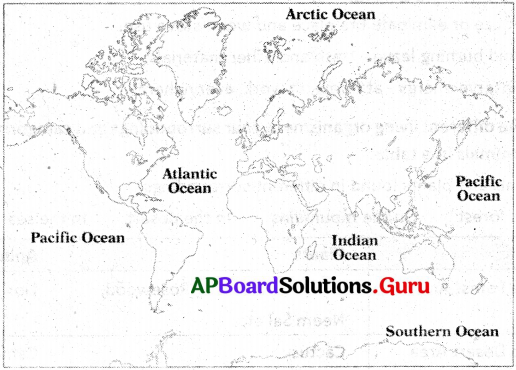
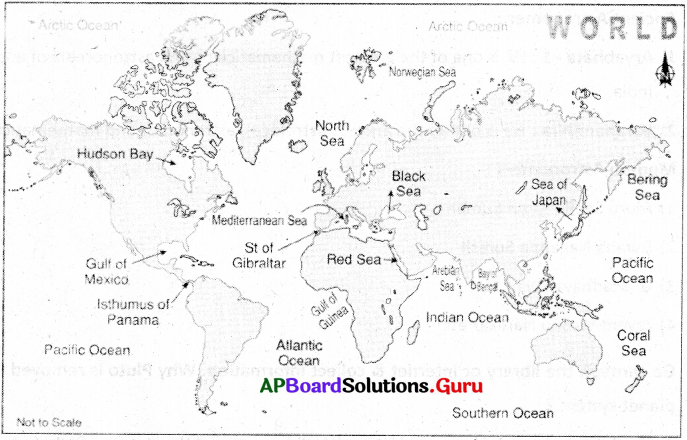
Locate all Oceans in the world map.
Answer:
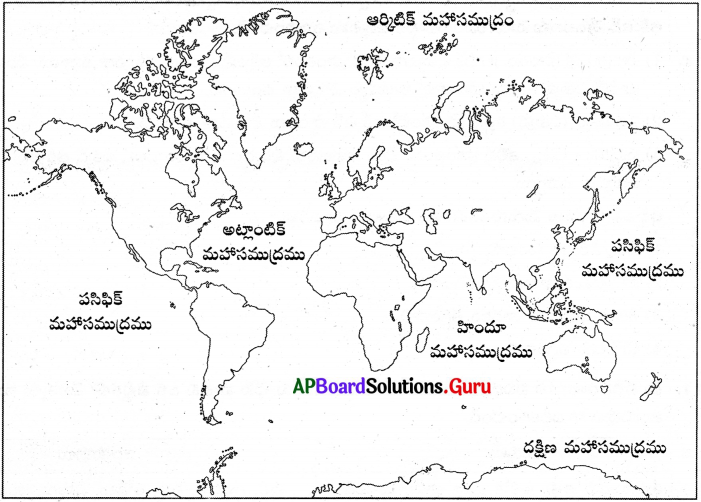
AP Board 7th Class Social Solutions 1st Lesson The Universe and The Earth 7

Question 9.
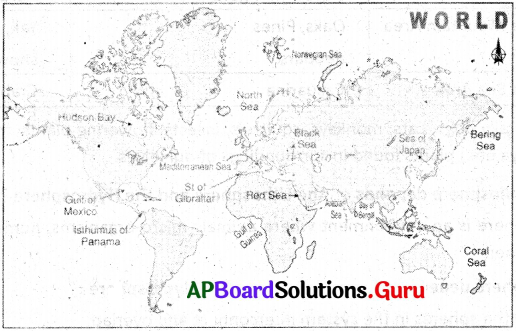
Locate Major Seas in the World Map.
Answer:
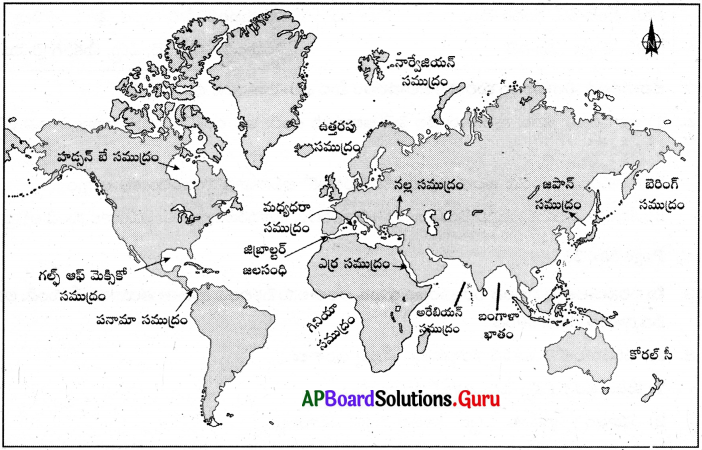
AP Board 7th Class Social Solutions 1st Lesson The Universe and The Earth 8

7th Class Social Textbook Page No. 11

Question 10.
Collect the information through internet about Oxygen levels in different areas i.e., the Industrial area, the Traffic area and the Greenery area. Write the reasons and suggest the measures to improve the Oxygen levels.
Answer:

  1. Oxygenleve! in industrial Area -19.5%
  2. Oxygen level in traffic area depends upon the traffic of the area.
  3. Oxygen Level in Greenery Area – 40 %

Reasons and suggestions:

  1. Carpool, use public transportation, bike, or walk whenever possible.
  2. Consider using gas logs instead of wood.
  3. Reduce or eliminate fire place and wood stove use.
  4. Avoid burning leaves, trash and other materials.
  5. Conserve energy – at home, at work, everywhere.

AP Board 7th Class Social Solutions Chapter 3 పటాల ద్వారా అధ్యయనం

Question 11.
List the different living organisms in your surroundings and categorize them into plants and animals in a table.
Answer:

Plants Animals
In the Forest Area Teak, Sandalwood, Rosewood, Lion, Deer, Tiger
Neem Sal etc.
In the Desert Area Cactus Camel
Saguaro Bat
Desert Marigold Aardwolf
In the Mountain Area Oaks, Pines Yak, mountain goals,
deodars snow leopards
In the Sea Area Casuarina Crabs, fish, prawn.

Question 12.
How Biosphere depends on the Lithosphere and the Hydrosphere?
Answer:
Biosphere is an environment where animals micro-organisms, humans and plants live together.Biosphere depends on Lithosphere and the Hydrosphere :

  1. All the spheres in the system interconnect and overlap.
  2. No sphere works on its own.
  3. All forms of life have an integral connection with the land, air, water and sunshine around them.

Examples:

  1. Plants themselves draw (Biosphere) their vital nutrients from the soil (Lithosphere), especially from organic compounds formed due to decay of other plants and animals. They get nitrogen from soil.
  2. Biosphere receives water from Hydrosphere and a living medium from the Lithosphere.

7th Class Social Textbook Page No. 12

Question 13.
Collect and list the elements of the human environment in your surroundings and find out how they are formed.
Answer:
List of elements of human environment in our surroundings.

Individual, family, community, religion, politics, education.How they are formed :

After the settled life was formed, human beings started depending on one another.

It resulted in the establishment of human environment.

After the invention of agriculture human beings starts to live together, next form community with the number of families, next with their beliefs and emotions, mystical feelings they from religion. Next for better and order living formed as rulers and after invention of letters education started.

Question 14.
Collect the information from your elders about how natural environment was when he/she was in your age.
Answer:
According to some of the elders, I encountered the natural environment during their childhood was much better compared to ours.

As per them, most of the land used to be covered by plants, trees and vegetation.

Ponds & lakes used to be pure during their time.

We are living in a concrete jungle, whereas they lived in a pollution free harmless environment.

Finally, in their words our environment is far worse compared to theirs.

Question 15.
Prepare a poster based on the collected information.
Answer:
AP Board 7th Class Social Solutions 1st Lesson The Universe and The Earth 9

7th Class Social Textbook Page No. 13

Question 16.
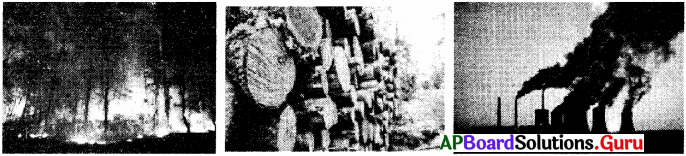
Make a list of different human activities that causes air pollution.
Answer:
The following list of activities are made by human beings causing air pollution :

  1. The burning of Fossil fuels.
  2. Industrial activities emit several pollutants in the air.
  3. Wild fires.
  4. Transportation.
  5. Open burning of Garbage waste.
  6. Use of pesticides and fertilizers in the agriculture lands.
  7. Use of chemical and synthetic products.
  8. Use of refrigerators and AC’s etc.

Question 17.
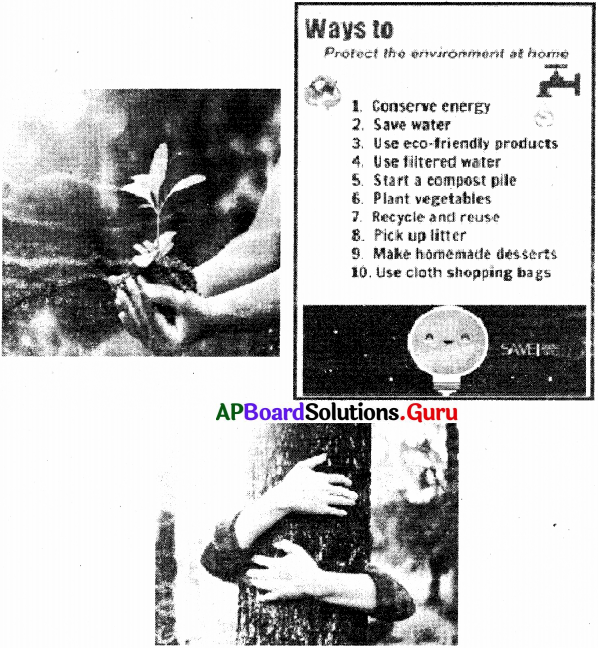
Suggest measures to reduce air pollution.
Answer:
Measures to reduce air pollution :

  1. Using of public transport.
  2. Using of echo friendly products.
  3. Use solar energy.
  4. Recycle and Reuse.
  5. No to plastic bags.
  6. Use filters for chimneys.
  7. Avoid usage of crackers.
  8. Afforestation etc.

Question 18.
With the help of your teacher, draw a diagram with the events that cause air pollution.
Answer:
AP Board 7th Class Social Solutions 1st Lesson The Universe and The Earth 10

Question 19.
Make a list of different human activities that cause water pollution.
Answer:
Humans are the main cause of water pollution, which is triggered in many ways.

  1. By the dumping of industrial waste.
  2. Sewage and waste water.
  3. Mining activities.
  4. Accidental oil leakage.
  5. Use of chemical fertilizers and pesticides.
  6. Leakage from sewer lines etc.

AP Board 7th Class Social Solutions Chapter 3 పటాల ద్వారా అధ్యయనం

Question 20.
Suggest measures to reduce water pollution.
Answer:
Six ways to prevent water pollution.

  1. Pick up litter and throw it away in a garbage can.
  2. Don’t put fertilizer on the grass right before it rains.
  3. Don’t pour your motor oil down the storm drain.
  4. Effluent sewage treatment.
  5. Reusing the water.
  6. Proper incineration, etc.

Question 21.
Collect the information (paper clips etc, regarding water pollution and display in your class.
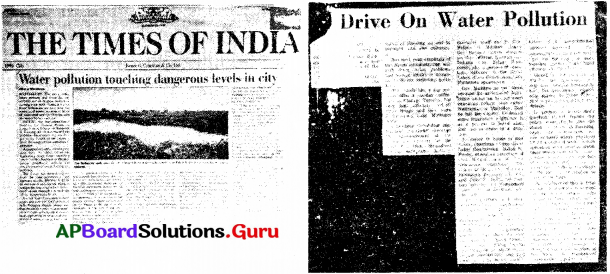
Answer:
AP Board 7th Class Social Solutions 1st Lesson The Universe and The Earth 11

Question 22.
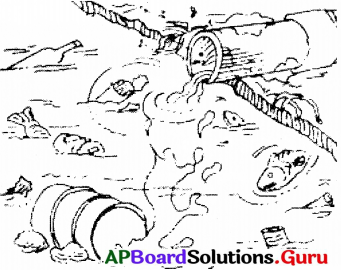
With the help of your teacher, draw a diagram with the events that cause water pollution.
Answer:
AP Board 7th Class Social Solutions 1st Lesson The Universe and The Earth 12

Question 23.
Prepare two slogans about conservation of natural resources.
Answer:
Slogans :

  1. R3 – Reduce, Reuse and Recycle.
  2. Clean air is vital for all to survive on the planet.
  3. Tree planting is the most reliable solution to pollution.
  4. Save the Earth, Save our environment.
  5. Don’t be cruel, preserve fuel,
  6. Unite to make planet Earth pollution – free.

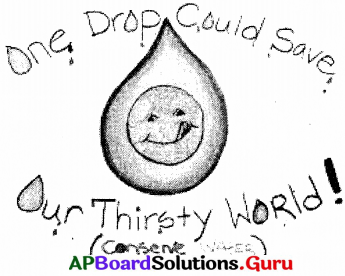
Question 24.
Prepare a poster on conservation of water.
Answer:
Poster on Conservation of water :
AP Board 7th Class Social Solutions 1st Lesson The Universe and The Earth 13

7th Class Social Textbook Page No. 14

Question 25.
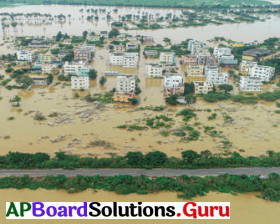
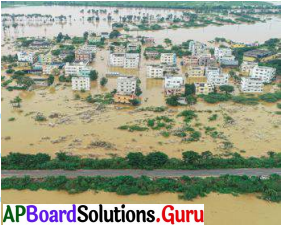
Observe the given picture and write your comment.
AP Board 7th Class Social Solutions 1st Lesson The Universe and The Earth 14
Answer:
The given picture shows the flooded area.Generally, a flood is a natural event. Flood is caused by a combination of heavy rainfall causing river/oceans to overflow their banks and can happen at any time of the year.The flash floods occur with little or no warning and cause the biggest loss of human life.

Reasons for cities are drowned in the water during floods.

  1. Many of our cities are made of mostly concrete and other impermeable material.
  2. There is no ground for water to sink into.
  3. Lack of vegetation is one of the cause.

For example :
We can take Wardha cyclone in Chennai.

The people without proper measures constructed buildings not only in the city area but also occupied ponds, lakes and tanks in the city to construct the buildings. They did not give any proper drainage passage area.

Whenever the cyclone comes there is no chance to rainwater neither to sink nor to flow outside from the city.

So the entire city was blocked by flood water.

Conclusion : Sometimes floods are occurred by human beings only.

Question 26.
Prepare two slogans about prevention of disasters.
Answer:

  1. A little bit of awareness can save hundreds of iives.
  2. Stay alert and move out of the vulnerable areas.
  3. Move fast and avoid wasting time.
  4. Your life is precious – Save it.

Question 27.
Prepare a list with the disasters that occurred recently in your area.
Answer:
In Andhra Pradesh Recently (2020) the following disasters are occurred.

  1. Niver cyclone.
  2. L-G-Polymers – company disaster.

Think & Respond

7th Class Social Textbook Page No. 3

Question 1.
What are the observations of Galileo?
Answer:

  1. Galileo was an Italian astronomer.
  2. He made a device called a telescope.
  3. When Galileo first looked at the sky through this instrument, he saw many wonders unknown to him.
  4. Galileo discovered that the Sun is in the centre of the Universe and planets revolve around it.
  5. The planets are revolving on their own axis.

7th Class Social Textbook Page No. 5

Question 2.
Why do we celebrate June 5th as World Environment Day? Find out the significance of the day with the help of your teacher.
Answer:
Since 1974, World Environmental day has been started celebrating as an annual event on every 5th June to raise the importance of the healthy and green environment in the human lives, to solve the issues of the environment by implementing some positive environmental actions by the government, organisation and individual.

Significance of June – 5th:
On June 5th 1942 America declared war on Bulgaria and Israel declared war on Egypt on this day.

According to my opinion 5th June 1972 was the first day of the first UN Conference on the human environment. This conference was about the interaction between humans and environment. So we celebrate on this day.

7th Class Social Textbook Page No. 7

Question 3.
How is Biosphere different from other natural elements of the Earth?
Answer:
Biosphere is different from other natural elements of the Earth due to the following reasons:

  1. All living organisms are present in the biosphere.
  2. Biosphere consists of land, water and air.
  3. Other elements are not having these conditions.

AP Board 7th Class Social Solutions Chapter 3 పటాల ద్వారా అధ్యయనం

Question 4.
The Biosphere would not have survived without the other three spheres. Why?
Answer:
Earth’s living things make up the biosphere.

The living portion of the Earth interacts with all the other sphere.

Living things need water (hydrosphere), chemicals from the atmosphere and nutrients gained by eating things in the biosphere.

Plants and animals grow in geosphere, they absorb water from hydrdsphere, we get other gases and carbon dioxide from atmosphere.

So, Biosphere depends on all these spheres.

7th Class Social Textbook Page No. 8

Question 5.
Why do we celebrate April 22nd as World Earth Day? Find out the significance of the day with the help of your teacher.
Answer:

  1. On April 22, 1970, the United States celebrated the first Earth day.
  2. More than 20 million people around the U.S. gathered together holding rallies, demonstration and participating in activities to promote a clean and safe living environment. Children and adult students also participated in this movement.

Significance :
On this first Earth day we saw unprecedented unity among the people of the World.

7th Class Social TextbookPage No. 9

Question 6.
Write a few more uses of the Lithosphere.
Answer:

  1. The lithosphere is the domain that provides us with land for agriculture and human settlements.
  2. The thin soil layer of lithosphere helps us for agricultural development and gives us food.
  3. The rockey layer of the lithosphere provides us with minerals, forIndustries and supports industrial development.
  4. It also provides us with forests and grasslands for grazing.

Question 7.
List the human activities that cause change in the Lithosphere.
Answer:
Human can affect the lithosphere by farming, building structures, mining and all manner of activities that change the Lithosphere.

Question 8.
Suggest measures to protect the Lithosphere.
Answer:
Measures to protect the Lithosphere :

  1. Planting more plants.
  2. Not to follow the over mining.
  3. Follow safety measures while getting oil from lithosphere.
  4. Don’t throw the waste into deeper soil.
  5. Follow the modern technology without disturbance to lithosphere while constructing buildings.

Question 9.
Why do we celebrate March 22nd as World Water Day? Find out the significance of the day with the help of your teacher.
Answer:
According to United Nations World Water Day celebrates since 1993. Water and raises awareness of the 2.2 billion people living without access to safe water.

It is taking action to tackle the global water crisis.

Significance :
To focus on the importance of fresh water.

AP Board 7th Class Social Solutions Chapter 3 పటాల ద్వారా అధ్యయనం

Question 10.
Why can’t we use total water on the Earth?
Answer:
The following factors are responsible for total water that we can’t use are,

  1. 97.25% of water belongs to ocean bodies means salt water.
  2. 2.5% of the earth’s fresh water is unavailable due to following reasons :
    1) Locked up in glaciers, polar ice caps, atmosphere and soil.
    2) Highly polluted or lies too far under the Earth’s surface to be extracted at an affordable cost.
    3) 0.5% of the Earth’s water is available as fresh water.So, the total water on the Earth can’t be used fully.

7th Class Social Textbook Page No. 10

Question 11.
How is water being used for different purposes in your school? Observe the places/ situations in which water is being wasted !
Answer:
In my school water is being used for

  1. Drinking purpose.
  2. Washrooms purpose.
  3. Watering plants in the school.
  4. Sometimes to clean our classrooms.

Near hand wash basins and toilets cleaning sections much of water is being wasted.

Question 12.
What measures do you follow to prevent the wastage of water?
Answer:
5 to 7 ways are there to reduce the wastage of water.

  1. Checks for leaks in the pipes.
  2. Stop wasting water in the sink.
  3. Reuse water.
  4. Turn off the tap while washing your face, brushing your teeth and shaving.
  5. Don’t use more dishes than you need.
  6. Avoid-mid-day plant and lawn watering.
  7. Shorten your showers.

Question 13.
Suggest measures to increase ground water. What will happen if all the ice melts?
Answer:
Some measures:

  1. Vegetation increase ground water table due to absorption of water coming from rainfall.
  2. Avoid planting those trees which need more water for their growth.
  3. Construction of check dams.
  4. Percolation tanks.
  5. Loose boulder structures etc.
    a) If all the ice around the World were to melt Ice level would rise about 70 meters.
    b) The ocean would cover all the coastal cities.
    c) And land are would shrink significantly.

Question 14.
Why do we celebrate September 16th as World Ozone day? Find out the importance of the day with the help of your teacher.
Answer:
In 1994, the United Nations General Assembly proclaimed 16th Sept, the International day for the preservation of the Ozone layer, commemorating the date of the signing in 1987, of the Montreal protocol on substances that deplete the ozone layer.

7th Class Social Textbook Page No. 11

Question 15.
What happens if the Carbon dioxide level increase in the atmosphere?
Answer:

  1. The increased percentage of carbon dioxide will cause greenhouse effect, i.e., It will not allow the hot rays of sun to escape from the atmosphere after reflection.
  2. Once they enter the earth’s atmosphere, there by increasing the temperature of earth, ice on mountains will melt and water level will rise.

Question 16
How can we increase Oxygen level in the atmosphere?
Answer:
We can increase oxygen level in the atmosphere by three ways.

  1. Afforestation – Trees are the absolute source of oxygen.
  2. Reducing the use of non-biodegradable things like plastics.
  3. Reducing the test of different bombs, missiles etc.

Question 17.
Why is Biosphere considered a separate natural domain of the Earth?
Answer:

  1. The biosphere is a narrow zone of the earth where land, water, air interact with each other to support life.
  2. There are several species of organisms that vary in size from microbes and bacteria to a large mammals.
  3. All living organisms including humans are linked to each other and to the biosphere for survival.
  4. In this zone that life that is unique to Earth exists and flourishes.
  5. Biosphere is the part of the earth’s surface and atmosphere in which plants and animals can live.

Question 18.
What measures do you suggest to protect Biosphere?
Answer:

  1. Restore damaged ecosystems by planting trees on land where forests have been cutdown.
  2. Encourage people to live jn a way that doesn’t hurt the environment.
  3. Establish parks to protect rain forests and wildlife.
  4. Support the activities that operate in ways that minimize damage to the environment.
  5. Conserve water.
  6. Use long-lasting light bulbs.
  7. Plant a tree etc.

7th Class Social Textbook Page No. 12

Question 19.
How did the establishment of man-made environment cause change in natural environment? How is it harmful to us?
Answer:
Human beings modified the natural environment by clearing the land for agriculture, buildings, factories, roads etc. It is harmful to us by global warming. Means due to deforestation, burning of fossil fuels, using more vehicles, release more waste from chemical factories etc. The above reasons cause global warming. Due to the global warming climate change occurred. Floods, cyclones, tsunamis, earthquakes, acid rains are common.

AP Board 7th Class Social Solutions Chapter 3 పటాల ద్వారా అధ్యయనం

Question 20.
Is there any need to protect natural environment? What can you do for this?
Answer:
Yes, there is a need to protect natural environment.Our environment gives us a lot of things to live mainly air, land and water.

Our life depends on so many non-living components. It is our duty to save our environment for making a happy life.

Ways to protect the environment :

  1. Choose reusable things.
  2. Recycle properly.
  3. Use few chemicals.
  4. Use less water.
  5. Use your purchasing power for good etc.

Explore

7th Class Social Textbook Page No. 3

Question 1.
Get through the internet and explore the Big Bang Theory and list the things you have observed.
Answer:
The Big Bang Theory is the leading explanation about how the Universe began. At its simplest, it says the Universe as we know it started with a small singularity, then inflated over the next 13.77 billion years to the cosmos that we know today.
AP Board 7th Class Social Solutions 1st Lesson The Universe and The Earth 15

7th Class Social Textbook Page No. 4

Question 2.
Go through the internet and collect information about two (ancient and modern) Indian astronomers and discuss in the classroom.
Answer:
Ancient Astronomer:
1) Aryabhata -1:
He is one of the greatest mathematicians and astronomers of ancient India.

2) Varahamihira :
He is one of the ancient astrologer, astronomer and mathematician.

Modern Astronomers :

  1. Aluru Seelin Kiran Kumar
  2. Byrana Nagappa Suresh
  3. G. Madhavan Nair
  4. Jayant Vishnu Narlikar etc.

Question 3.
Go through the library or internet & collect information. Why Pluto is removed from planet system?
Answer:

  1. The International Astronomical Union (IAU) downgraded the status of Pluto to that of a dwarf planet because it did not meet the three criteria the IAU uses to define a full sized planet.
  2. Essentially Pluto meets all the criteria one – it has not cleared its neighbouring region of other objects.

7th Class Social Textbook Page No. 8

Question 4.
Refer library books or go through the atlas and know more about different types of land forms. Now try to know the process of how land is formed in your locality. (You can discuss with your teacher about the above concept.)
Answer:
Different types of land forms :

  1. Mountains and hills, Plateaus, Plains, Valleys, Deserts and Dunes etc.
  2. I live in Visakhapatnam. This is formed on the shore of the Bay of Bengal. It is a part of the Eastern Coastal Plain. It can form by deposits of sediments carried by ocean current or rivers entering the sea.

7th Class Social Textbook Page No. 10

Question 5.
Browse internet or go through the atlas and know more about different water bodies across the world.
Answer:
AP Board 7th Class Social Solutions 1st Lesson The Universe and The Earth 16

7th Class Social Textbook Page No. 11

Question 6.
Go through the online educational sources to know more about different layers of the atmosphere, air pressure and various winds. (If necessary, take the help of your teacher).
Answer:

  1. The atmosphere is comprised of different layers based on temperature.
  2. These layers are the Troposphere, Stratosphere, Mesosphere, Thermosphere and the Exosphere.
  3. Air pressure – it is the force exerted on a surface by the air above it as gravity pulls it to Earth. This pressure is called atmospheric pressure, or air pressure.
  4. Wind is the horizontal movement of air, caused by the uneven heating of the Earth by the Sun and the Earth’s own rotation. The Earth contains five major wind zones: polar easterlies, westerlies, horse latitudes, trade winds, and the doldrums.

Project Work

Question 1.
Prepare a poster showing the activities that destroy natural environment and the activities that protect natural environment.
Answer:
1) A poster showing the activities that destroy natural environment.
AP Board 7th Class Social Solutions 1st Lesson The Universe and The Earth 4
2) The activities that protect natural environment.
AP Board 7th Class Social Solutions 1st Lesson The Universe and The Earth 5

Question 2.
Collect the information from your surroundings regarding water usage and its wastage. Suggest how you control the wastage of water.
Answer:
We live in the village Pachipenta in Vizianagaram District. Peddagedda Reservoir project is a Medium irrigation Project Proposed across Peddagedda (also called Vegavathi on its downstream), a tributary to River Suvarnamukhi, which itself is a tributary to River Nagavali to irrigate our Dachipenta village. We use this water for drinking, daily needs, and agricultural needs. But most of the water is wasted in household works. Government check is not possible in the issues like this. Every common man should have their own con RC over their behavior and usage. Invest in a Water Saving Equipment Reuse the polluted water Conserve the

AP SSC 10th Class Social Studies Solutions Chapter 1 India: Relief Features

SCERT AP Board 10th Class Social Solutions 1st Lesson India: Relief Features Textbook Questions and Answers.

AP State Syllabus SSC 10th Class Social Studies Solutions 1st Lesson India: Relief Features

10th Class Social Studies 1st Lesson India: Relief Features Textbook Questions and Answers

Improve your learning

Question 1.
The sun rises two hours earlier in Arunachal Pradesh as compared to Gujarat in the west. But the clocks show the same time. How does this happen?
Answer:

  1. The sun rises two hours earlier in Arunachal Pradesh as compared to Gujarat.
  2. It takes 4 minutes for the sun’s position to move one longitude.
  3. This means that the time is different for each degree of longitude.
  4. Based on the longitudes the time is calculated.
  5. Then two different places in our country will have different times, which cause a lot of confusion.
  6. To avoid this confusion of time from place to place 82°30’ E longitude is taken as the standard meridian of India and serves as Indian Standard Time.
  7. All people in India have to follow this time. Thus clocks show the same time.

AP SSC 10th Class Social Studies Solutions Chapter 1 India: Relief Features
Question 2.
If the Himalayas would not have been in its present position, how would be the climat conditions of the Indian sub continent?
(OR)
What is the geographical impact of the Himalayas in influencing the Indian climate?
Answer:

  1. The formation of the Himalayas influences the climate in various ways.
  2. These act as barriers protecting the great plains of India from the cold winds of central Asia during winter.
  3. The Himalayas are reason for summer rains and monsoon type climate in regions that are beyond the Western Ghats of India.
  4. In its absence, this region would have remained drier.
  5. India would have been a tropical desert.

Question 3.
The Himalayas do not extend into which of the following states :
Madhya Pradesh, Uttar Pradesh, Sikkim/Haryana, Punjab, Uttaranchal.
Answer:

  1. The Himalayas run in the west-east direction in the form of an arch with a distance about 2400 kms.
  2. These have extended into states like Jammu and Kashmir, Himachal Pradesh, Nagaland, Manipur and Meghalaya in India.
  3. These do not extend into Madhya Pradesh, Uttar Pradesh, Haryana and Punjab.

AP SSC 10th Class Social Studies Solutions Chapter 1 India: Relief Features

Question 4.
Which are the major physiographic divisions of India? Contrast the relief of the Himalayan region with that of the peninsular plateau.
Answer:

  1. There are six major physiographic regions of India.
  2. They are:
    1. The Himalayas,
    2. The Indo-Gangetic plain,
    3. The Peninsular Plateau,
    4. The Coastal Plains
    5. The Thar Desert and
    6. The Islands.
  3. The Himalayas have 3 ranges of mountains. Among them Himadri has the highest peaks with an average elevation of about 6100 mts above the mean sea level.
  4. In ‘Lesser Himalayas’ the height of the peaks ranges between 3700 to 4500 mts.
  5. Shivaliks have an altitude varying between 900 mts and 1100 mts.
  6. The Himalayas width differs from 500 kms, in the western regions to 200 kms in central and eastern regions.
  7. The peninsular plateau consists of two broad divisions namely, the central high lands (Malwa Plateau) and the Deccan Plateau.
  8. The place where the Western Ghats and Nilgiris meet has many peaks over a height about 2000 mts.
  9. The average height of the Eastern Ghats rarely exceeds 900 mts.
  10. The highest peak in the Eastern Ghats is Aroma Konda found at Chintapalli in Andhra Pradesh.

Question 5.
What is the influence of the Himalayas on Indian agriculture?
(OR)
How do the Himalayas influence agriculture in India?
Answer:

  1. The formation of the Himalayas influences the climate in various ways.
  2. They are the reason for summer rains and monsoon type of climate in regions that are beyond the Western Ghats of India.
  3. They cause the retreat of southwest monsoon winds as they are blocked by these ranges.
  4. Thus, northeast monsoon occurs only because of the Himalayas.
  5. The rivers originating in the glaciers of these ranges are perennial and caused the economic growth of the northern plains.
  6. These valleys are known for the cultivation of fruits.
  7.  India has irrigation facilities only for 40% cultivated land.
  8.  All the remaining land depends on monsoons which are caused by the Himalayas.

(OR)
Answer:
Influence of the Himalayas on Indian Agriculture:

  1. Fertile soil: The sediments carried by the Himalayan rivers are deposited in the northern plain in the form of fertile soil. It makes the plain one of the most fertile lands in the world, e.g.: Bhabar, Terai, Bhangar.
  2. Source of rivers :
    • The Himalayas act as a huge reservoir of water for the north Indian rivers.
    • All these perennial rivers are the lifeline of north India and are suitable for the construction of multipurpose projects which strengthens Indian agriculture.

AP SSC 10th Class Social Studies Solutions Chapter 1 India: Relief Features

Question 8.
Use an atlas and identify the following:
i) The Islands formed due to Volcanic eruption.
ii) The countries constituting Indian Subcontinent.
iii) The states through which the Tropic of Cancer passes.
iv) The northernmost latitude in degrees.
v) The southernmost latitude of the Indian mainland in degrees.
vi) The eastern and the westernmost longitudes in degrees.
vii) The place situated on the three seas.
viii) The strait separating Sri Lanka from India,
ix) The Union Territories of India.
Answer:
i) Narcondam and Barren Islands.
ii) India, Pakistan, and Bangladesh.
iii) Gujarat, Rajasthan, Madhya Pradesh, Chattisgarh, Jharkhand, West Bengal, Tripura and Mizoram.
iv) 37°6′
v) 8°4′
vi) 97°25′ Easternmost longitude; 68°7’Westernmost longitude
vii) Tamil Nadu
viii) Palk strait
ix) Delhi, Chandigarh, Diu Daman, Dadra, and Nagar Haveli, Pondicheri, Andaman and Nicobar Islands and Lakshadweep Islands.

AP SSC 10th Class Social Studies Solutions Chapter 1 India Relief Features Q8

Question 9.
How are the Eastern coastal plains and Western coastal plains similar or different?
Answer:

Eastern Coastal Plains Western Coastal Plains
1. These are wide and have large surface structure. 1. These are narrower than the east coast.
2. Stretch from Mahanadi to Cauvery delta. 2. These are uneven and broken by hilly terrain.
3. Known locally by different names : Utkal coast (Odisha), Circar coast (Andhra Pradesh), Coromandel coast (Tamil Nadu). 3. The southern part of peninsular plateau is bordered by narrow strip along the Arabian Sea.
4. These formed by rivers Mahanadi, Godavari, Krishna and Cauvery and are very fertile. 4. These start from Rann of Kutch and end at Kanyakumari.
5. These deltas are agriculturally developed. 5. It is divided into three parts.
6. Coastal zone also enables rich fishing resources. 6. Konkan coast – this is the northern part. It touches Maharashtra and Goa.
7. Lakes like Chilka in Odisha and Kolleru and Pulicot (Andhra Pradesh) are other important features of the coastal plain. 7. Canara coast – this is the middle part includes coastal plains of Karnataka.
8. Malabar coast – this is the southern part, mostly in the state of Kerala.

AP SSC 10th Class Social Studies Solutions Chapter 1 India: Relief Features

Question 10.
Plateau regions in India do not support agriculture as much as the plain regions -what are the reasons for this?
Answer:

  1. Plateau regions in India do not support agriculture as much as the plain regions.
  2. There are many reasons for this.
  3. The physical formation of plateau is not much supportive to agriculture.
  4. Plains are formed with alluvial soils which are very fertile, so support agriculture.
  5. The rugged surface of plateau makes irrigation difficult whereas plains provide much irrigation facilities.
  6. Plateau region does not have any perennial river, whereas plain regions have perennial rivers.
  7. Plateau region is rich in mineral resources whereas plains are rich in agriculture practice.

10th Class Social Studies 1st Lesson India: Relief Features InText Questions and Answers

10th Class Social Textbook Page No.1

Question 1.

AP SSC 10th Class Social Studies Solutions Chapter 1 India Relief Features Q1Look at the world map given above, and write a few lines about India’s location with reference to the places marked on this map.
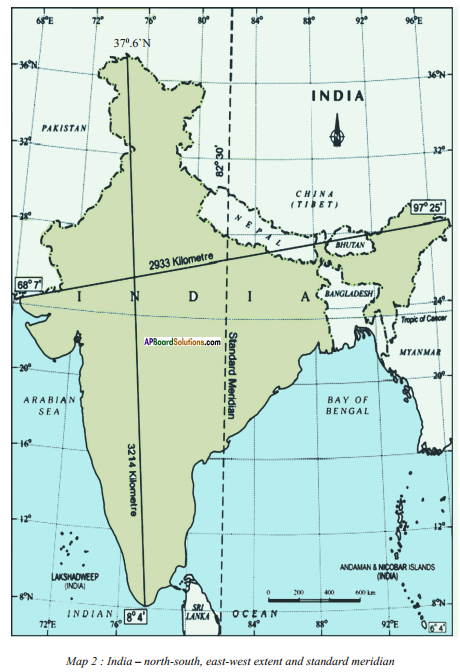
Answer:
India is located to the north of the equator between 8°4′ and 37°6′ north latitudes and 68°7′ and 97025′ east longitudes.

AP SSC 10th Class Social Studies Solutions Chapter 1 India: Relief Features

Question 2.
The lines of latitude and longitude are used for accurately specifying the location of any place or region. Use the atlas and correct the following statement:
“India is a very extensive country and lies totally in the southern Hemispheres of the globe. The country’s mainland lies between 8 degrees N and 50 degrees N longitude and 68 degree S and 9 degrees E latitude.”
Answer:
India is a very extensive country and lies totally in the Northern hemisphere and the Eastern hemisphere of the globe. The country’s mainland lies between 8°4′ and 37°6′ North latitude and 68°7 and 97°25′ East longitude.

10th Class Social Textbook Page No. 2

Question 3.
Why do we often use the term “Indian peninsula”?
Answer:

  1. Any country which is surrounded by sea on three sides and the fourth side is landlocked, is called a peninsula.
  2. India is surrounded by the Bay of Bengal, the Indian Ocean, and the Arabian Sea as its three borders and the fourth side is landlocked with the Himalayan mountains.
  3. So we often use that term Indian peninsula.

Question 4.
Examine the map (Text Page No. 1) and imagine that India is located in the Arctic Circle. How would your life be different?
Answer:
If India is located in the Arctic Circle, my life would be different as follows :

  1. I must cope with very low temperatures and constant darkness in the winter, and temperatures above freezing and constant daylight in the summer.
  2. While temperatures are below freezing, snow and snow everywhere.
  3. Transportation: Sledges during winter and boards during summer.
  4. Diet: Fish, seals, wheals, caribou, berrys, plants.
  5. Shelter: Igloos are camps.

Question 5.
Identify Indira Point on the atlas. What is special about this? (OR)
What is special about ‘Indira Point’ with reference to the location of India ?
Answer:

  1. In Andaman and Nicobar Islands, Narkondam and Barren Islands are volcanic origin.
  2. The southernmost tip of India found in Nicobar Island is called Indira Point.
  3. It is named in honour of Smt. Indira Gandhi.
  4. It was submerged during the 2004 Tsunami.

AP SSC 10th Class Social Studies Solutions Chapter 1 India: Relief Features

Question 6.
Andhra Pradesh lies between and N latitudes and …… and E longitudes.
Answer:
Andhra Pradesh lies between 12I4T and 22° North latitudes and IT and 84°40′ East longitudes.

Question 7.
Using the scale given in your atlas estimate the length of the coast line for Andhra Pradesh?
Answer:
The length of the coast line for Andhra Pradesh is 972 kms or 604 miles.

Question 8.
Look at the map 2 on text page 3 and trace the boundary for India and colour this.
With the help of the scale given on the map, find out the total land boundary that India shares with Bangladesh.

AP SSC 10th Class Social Studies Solutions Chapter 1 India Relief Features Q2Answer:
The total land boundary that India shares with Bangladesh is 4,096.70 km.

Question 9.
Which of these data are for rising and setting times for the Sun at Ahmedabad and Imphal ?
AP SSC 10th Class Social Studies Solutions Chapter 1 India Relief Features Q9
Answer:

AP SSC 10th Class Social Studies Solutions Chapter 1 India Relief Features Q10

  1. Imphal is in the eastern side of India.
  2. The sun rises early there thus the sunrise timing of 5 :59 and sunset timing of 16 : 37 belong to it.
  3. Whereas Ahmedabad is in the western side of India.
  4. The sun rises late comparative to Imphal here, thus the sunrise timing of 7 : 20 and sunset timing of 18 : 05 belong to it.

10th Class Social Textbook Page No. 4

AP SSC 10th Class Social Studies Solutions Chapter 1 India: Relief Features

Question 10.
List the Himalayan rivers and the Peninsular rivers that helped the formation of North Indian Plain.
Answer:
The Himalayan rivers that helped the formation of North Indian Plain are

  1. Indus and its tributaries, the Jhelum, the Chenab, the Ravi, the Beas and the Sutlej.
  2. The Ganga and its tributaries, the Ghaggar, the Teesta, the Sone, the Kosi and the Yamuna river.
  3. The Brahmaputra and its tributaries.
  4. A majority of the tributaries of the Ganga may originate in the Himalayan ranges but some of them have their sources in the peninsular plateau.
  5. The peninsular rivers that helped the formation of Northern plain are the Chambal, the Sind, the Betwa, the Ken and the Son originating in the northern part peninsula belong to the Ganga river system.

Question 11.
The formation of the Himalayas was ———- million years ago while early hunter-gathering human beings emerged on earth ———— million years ago.
Answer:
200; 1.8

10th Class Social Textbook Page No. 5

Question 12.
Look at the Map 2 (on test page 3)and the raised relief map in your school. Using your finger trace the regions mentioned below:
a) Follow the course of Godavari and Krishna to identify the direction of slope of Deccan plateau.
b) Describe the entire course of the Brahmaputra River, with reference to landforms, heights, and countries.
Answer:
a) The direction of slope of Deccan plateau is West to East.
b) The course of Brahmaputra is with reference to

  • Landforms: Lake, Himalayan range, Tibetan plateau, Assom Valley, Sunderban Delta.
  • Heights: Mishmi Hills between 1000 m to 3000m, Assom Valley with a height upto 300 m, Greater Himalayas at an average height of 6100 mts.
  • Countries: It flows through Tibet (China), India and Bangladesh.

AP SSC 10th Class Social Studies Solutions Chapter 1 India Relief Features Q12

AP SSC 10th Class Social Studies Solutions Chapter 1 India: Relief Features

Question 13.
Locate the three ranges in your atlas.
Answer:
1) Greater Himalayas or Himadri. 2) Lesser Himalayas or Himachal. 3) Shivaliks.
AP SSC 10th Class Social Studies Solutions Chapter 1 India Relief Features Q13

Question 14.
Locate some of the highest peaks in the raised relief map.
Answer:
Mt. Everest, K2 (Godwin Austin), Kanchenjunga, Gowrisankar, Nanga Parbat, Dhaulagiri and Nandadevi.
AP SSC 10th Class Social Studies Solutions Chapter 1 India Relief Features Q14

Question 15.
Trace with your fingers on the above regions (given in the text book matter) in the raised relief map and on the wall map with your fingers.
Answer:
Students’ Activity.

AP SSC 10th Class Social Studies Solutions Chapter 1 India: Relief Features

Question 16.
Locate the following places on Indian physical map in your atlas :
Shimla, Mussorie, Nainital and Raniket.
Answer:

AP SSC 10th Class Social Studies Solutions Chapter 1 India Relief Features Q18

10th Class Social Textbook Page No. 7

Question 17.
Locate the following ranges in the physical map of India.
AP SSC 10th Class Social Studies Solutions Chapter 1 India Relief Features Q15
Answer:
AP SSC 10th Class Social Studies Solutions Chapter 1 India Relief Features Q16

AP SSC 10th Class Social Studies Solutions Chapter 1 India Relief Features Q17

10th Class Social Textbook Page No. 9

AP SSC 10th Class Social Studies Solutions Chapter 1 India: Relief Features

Question 18.
Locate the following on the Indian physical map of your atlas and on the raised relief map: Malwa plateau, Bundelkhand, Bhagelkhand, Rajamahal Hills and Chotanagpur plateau.
Answer:
AP SSC 10th Class Social Studies Solutions Chapter 1 India Relief Features Q19

Question 19.
Using an atlas, compare the relative heights of above plateaus with that of Tibetan plateau.
Answer:
Tibetan plateau is higher than the peninsular plateau (Peninsular plateau 600 – 900 mts. height, Tibetan plateau – more than 5400 mts height).

10th Class Social Textbook Page No. 10

Question 20.
Look at the raised relief map and compare the relative heights of Western and Eastern Ghats as well as Tibetan plateau and Himalayan peaks.
Answer:
In few areas the average height of Western Ghats is more than 2000 mts.
The average height of Eastern Ghats rarely exceeds 900 mts.
The Himalayan peaks are of 3 ranges.
In Himadri the average height of peaks is 6100 mts.
In Himachal the average height of peaks is 4000 mts.
In Shivaliks the average height of peaks is around 1000 mts.
The height of world’s highest table land, the Tibetan plateau is above 5400 mts.

10th Class Social Textbook Page No. 12

Question 21.
On the physical map of India identify the delta regions. How is their height similar or different ?
How do they compare in relation to the Indo-Gangetic Plains ?
Answer:
The height of these deltas is similar between 0 and 300 metres. The northern plain and deltas both are agriculturally developed.

AP SSC 10th Class Social Studies Solutions Chapter 1 India Relief Features Q20

Project work

Question.
Using the raised relief map, and physical maps in your atlas make clay/ sand models of India on the ground. Use different types of sand or soil to mark different types of relief features. Ensure heights of the places are proportional and rivers are marked. Look at the vegetation map in your atlas and try to use leaves and grasses to decorate them. May be over the year you can also add other features of India into them.
Answer: Students’ Activity.

AP Board 7th Class Social Solutions Chapter 1 విశ్వం మరియు భూమి

SCERT AP 7th Class Social Study Material Pdf 1st Lesson విశ్వం మరియు భూమి Textbook Questions and Answers.

AP State Syllabus 7th Class Social Solutions 1st Lesson విశ్వం మరియు భూమి

7th Class Social 1st Lesson విశ్వం మరియు భూమి Textbook Questions and Answers

కింది తరగతులలోని విషయ పునశ్చరణ

పటాన్ని పరిశీలించి ఇవ్వబడిన ప్రశ్నలకు జవాబులు రాయండి.
AP Board 7th Class Social Solutions Chapter 1 విశ్వం మరియు భూమి 1

ప్రశ్న 1.
చిత్రంలో మీరు ఏమి గమనించారు?
జవాబు:
సూర్యుడు, నక్షత్రాలు, తోకచుక్కలు, పాలపుంత, సౌర కుటుంబాలు, గ్రహాలు.

ప్రశ్న 2.
వీటిలో పగటిపూట కనిపించేవి మరియు రాత్రి సమయంలో కనిపించేవి ఏవి?
జవాబు:
పగటిపూట కనిపించేవి – సూర్యుడు.
రాత్రిపూట కనిపించేవి – నక్షత్రాలు, చంద్రుడు, పాలపుంత, తోకచుక్కలు.

ప్రశ్న 3.
ఈ అంశాలన్నింటిని మనం సమష్టిగా ఏమని పిలుస్తాము?
జవాబు:
విశ్వం అని పిలుస్తాము.

Improve your learning (మీ అభ్యసనాన్ని మెరుగుపడుచుకోండి)

I. క్రింది ప్రశ్నలకు జవాబులివ్వండి.

ప్రశ్న 1.
విశ్వం గురించి మీకు ఏమి తెలుసు?
జవాబు:

  1. ఊహించలేని అనేక అంశాలు కలిగి ఉన్న విస్తారమైన అంతరిక్షమును విశ్వం అంటారు.
  2. ఇందులో సూర్యుడు, గ్రహాలు, పాలపుంత అనే నక్షత్రవీధి మరియు ఇతర అన్ని నక్షత్ర వీధులు ఉన్నాయి.
  3. విశ్వం ఎంత పెద్దదో ఎవరికీ తెలియదు. విశ్వం వ్యాప్తి అనంతమైనది.
  4. విశ్వం అనే పదం లాటిన్ పదమైన “యూనివర్సమ్” నుండి ఉద్భవించింది. దీని అర్థం “మొత్తం పదార్థం” మరియు “మొత్తం అంతరిక్షం” అని.

ప్రశ్న 2.
సహజ పర్యావరణం అంటే ఏమిటి?
జవాబు:
సహజ వాతావరణంలో భూమి, నీరు, గాలి, మొక్కలు, జంతువుల వంటి జీవులు ఉంటాయి. ఈ సహజ పర్యావరణంలో శిలావరణము, జలావరణము, వాతావరణము మరియు జీవావరణము ఉంటాయి. పర్యావరణంలో ఇవి సహజ అంశాలు. వీటిని భూమి యొక్క సహజ ఆవరణములు అని కూడా అంటారు.

AP Board 7th Class Social Solutions Chapter 1 విశ్వం మరియు భూమి

ప్రశ్న 3.
“సహజ పర్యావరణం, మానవ నిర్మిత పర్యావరణానికి భిన్నంగా ఉంటుంది.” మీ సమాధానాన్ని సమర్ధించుకోండి.
జవాబు:
సహజ పర్యావరణం మానవ నిర్మిత పర్యావరణానికి భిన్నంగా ఉంటుంది.

  1. ఆదిమ మానవులు సహజ పరిసరాలతో మనుగడ సాగించటంలో తమను తాము అలవాటు చేసుకున్నారు. వారు సాధారణమైన జీవితాన్ని గడిపారు.
  2. వారి చుట్టూ ఉన్న ప్రకృతిని ఉపయోగించుకుని వారి అవసరాలను తీర్చుకున్నారు.
  3. స్థిర నివాసం మరియు. పారిశ్రామిక విప్లవం ఫలితంగా, మానవులు, సహజ వాతావరణాన్ని తమకు అనుకూలంగా ఎలా ఉపయోగించుకోవాలో మరియు ఎలా మార్చుకోవాలో నేర్చుకున్నారు.
  4. ఇది మానవ నిర్మిత పర్యావరణానికి సంబంధించిన అనేక అంశాలు ఏర్పడటానికి మరియు సహజ వాతావరణంలో మార్పులకు దారితీసింది.
  5. సహజ పర్యావరణం మానవ నిర్మిత పర్యావరణానికి భిన్నంగా ఉంటుంది.
  6. మానవులు తయారు చేసిన పరిసరాలను మానవ నిర్మిత పర్యావరణం అంటారు.
  7. సహజంగా ప్రకృతి సిద్ధంగా ఏర్పడిన పరిసరాలను సహజ పర్యావరణం అనవచ్చు.
  8. మానవులు సహజ వాతావరణాన్ని తమకు అనుకూలంగా మార్చుకుని ఏర్పరచుకున్నదే మానవ నిర్మిత పర్యావరణం.
  9. సహజ పర్యావరణం భూమి మీద జీవుల మనుగడకు ఆధారం.
  10. మానవ నిర్మిత పర్యావరణం లేకపోయినా జీవనం సాగించవచ్చు కానీ, సహజ పర్యావరణం లేకపోతే జీవం లేదు, ఉండదు.

ప్రశ్న 4.
పర్యావరణ పరిరక్షణపై ఏవైనా రెండు నినాదాలు తయారు చేయండి.
జవాబు:

  1. పర్యావరణం పరిరక్షణ – సర్వజన సంరక్షణ.
  2. పర్యావరణాన్ని రక్షించండి – అది మిమ్మల్ని రక్షిస్తుంది.
  3. పచ్చని చెట్లు – ప్రగతికి మెట్లు.
  4. పర్యావరణ పరిరక్షణ – మన అందరి సంరక్షణ.
  5. మొక్క లేనిదే మెతుకే లేదు – మానవ జాతికి బ్రతుకే లేదు.

ప్రశ్న 5.
ఒకదానిపై ఒకటి ఆధారపడిన వివిధ మొక్కలు మరియు జంతువుల జాబితాను రాయండి.
జవాబు:

  1. జంతువులు మొక్కలపై ప్రాణవాయువు ఆక్సిజన్ (O2) మరియు ఇతర ఆహార పదార్థాల కోసం ఆధారపడతాయి. అలాగే చెట్లు ఆవాసాలుగా (షెల్టర్) ఉపయోగపడతాయి.
  2. మొక్కలు నేలలోని పోషకాల తయారీకి (హ్యూమస్), జంతువుల యొక్క విసర్జకాలపై, క్రుళ్ళిన జంతు కళేబరాలు మట్టిలో కలిసిపోయి అవి మొక్కలకు పోషకాలుగా ఉపయోగపడతాయి. జంతువులు వదిలిన కార్బన్ డయాక్సైడ్ ను మొక్కలు పీల్చుకుంటాయి.
  3. మేకలు, గొర్రెలు, గేదెలు, ఆవులు (పశువులన్నీ) – ‘గడ్డి’ని ఆహారంగా తీసుకుంటాయి.
  4. మానవుడు తన ఆహారం కోసం, ప్రాణవాయువు కోసం మొక్కలపై ఆధారపడతాడు.
  5. కోతులు, కుందేళ్ళు, చింపాంజీలు, కొండ ముచ్చులు మొ||నవి కాయలు, పండ్ల కోసం మొక్కలపై ఆధారపడతాయి.
  6. అలాగే మొక్కలు, జంతువులు వదలిన కార్బన్‌డయాక్సైడ్ (CO2)పై మరియు నేలలోని (జంతు విసర్జకాలతో ఏర్పడిన) పోషకాలపై ఆధారపడతాయి.

ప్రశ్న 6.
వాతావరణంలో మిళితమైన అంశాలలో ఇప్పుడు మార్పులు వస్తున్నాయి. కారణాలు చెప్పండి.
జవాబు:
వాతావరణం ఆక్సిజన్, నైట్రోజన్, కార్బన్ డై ఆక్సైడ్, ఆర్గాన్ మొ||న వాయువుల మిశ్రమం. భూమి ఏర్పడినప్పుడు ఇవి వాతావరణంలో ఉన్నాయి. వాతావరణంలో మిళితమైన అంశాలలో మార్పునకు కారణాలు :

  1. వాతావరణంలో క్రమక్రమంగా ఉష్ణోగ్రతలు పెరగటం వలన
  2. అగ్ని పర్వత ఉద్బోధన ప్రక్రియ కారణంగా, వెలువడిన వాయువుల కారణంగా
  3. కిరణజన్యసంయోగక్రియల కారణంగా, వ్యవసాయం చేయటం వలన
  4. మానవుల యొక్క కార్యకలాపాలైన శిలాజ ఇంధనాల వాడకం, పరిశ్రమల స్థాపన, అడవుల నిర్మూలనం గనుల త్రవ్వకం మొదలైన వాటి వలన
  5. రసాయన ఎరువుల వాడకం, పురుగు మందుల వాడకం వలన
  6. అణు విద్యుత్, థర్మల్ విద్యుత్ కర్మాగారాల స్థాపన వలన
  7. ముడి చమురు, సహజ వాయువు డ్రిల్లింగ్ వలన, వాడకం వలన
  8. ప్లాస్టిక్ మరియు ఇతర చెత్త, వ్యర్థ పదార్థాల వలన వాతావరణంలోని అంశాలలో మార్పులు వస్తున్నాయి.

ప్రశ్న 7.
శిలావరణంలో లభించే ఖనిజాల పరిరక్షణకై ఏవైనా రెండు నినాదాలు తయారు చేయండి.
జవాబు:

  1. మనవే కాదు సహజ వనరులు – ఉపయోగించుకోవాలి భావితరాలు
  2. ఖనిజాలు జాతికి నిధులు – సంరక్షించాలి సైనికులై ప్రజలు
  3. ఖనిజ సంపద దేశ సంపద – వాడాలి పొదుపుగా
  4. ఖనిజమే దేశానికి బలం – నడిపిస్తుంది దేశాన్ని అభివృద్ధి పథంలో

AP Board 7th Class Social Solutions Chapter 1 విశ్వం మరియు భూమి

II. సరియైన సమాధానాలను ఎంచుకోండి.

1. క్రింది వాటిలో మానవ పర్యావరణంలో భాగం కానిది ఏది?
ఎ) కర్మాగారం
బి) మతం
సి) సమాజం
డి) వీటిలో ఏదీ కాదు
జవాబు:
ఎ) కర్మాగారం

2. భిన్నమైన దానిని కనుగొనండి.
ఎ) మైదానాలు
బి) రహదారి
సి) లోయ
డి) నది
జవాబు:
బి) రహదారి

3. పర్యావరణానికి ముప్పు ఏది?
ఎ) చెట్ల పెంపకం
బి) పంటలు పండించడం
సి) వాహనాల వినియోగం
డి) అన్నీ
జవాబు:
సి) వాహనాల వినియోగం

4. ఇది భూమి లోపలి రెండవ పొర.
ఎ) భూ ప్రావారం
బి) భూ అంతర కేంద్రం
సి) భూ బాహ్య కేంద్రం
డి) భూ పటలం
జవాబు:
ఎ) భూ ప్రావారం

5. ఏ సిద్ధాంతం విశ్వం ఆవిర్భావానికి సంబంధించినది?
ఎ) భూ కేంద్రక సిద్ధాంతం
బి) సూర్య కేంద్రక సిద్ధాంతం
సి) మహా విస్ఫోటన సిద్ధాంతం
డి) పైవన్నీ
జవాబు:
సి) మహా విస్ఫోటన సిద్ధాంతం

II. జతపరుచుము.

గ్రూపు-ఎ గ్రూపు-బి
1. శిలావరణం అ) నీటితో కూడిన సహజమైన ఆవరణం
2. జీవావరణం ఆ) భూమి చుట్టూ ఉన్న గాలి పొర
3. భూకేంద్రం ఇ) భూమి, నీరు మరియు గాలి సంఘర్షణ చెందే ఇరుకైన ప్రాంతం
4. జలావరణం ఈ) భూమి యొక్క రాతి పొర
5. వాతావరణం ఉ) భూమి యొక్క లోతైన అంతర భాగం

జవాబు:

గ్రూపు-ఎ గ్రూపు-బి
1. శిలావరణం ఈ) భూమి యొక్క రాతి పొర
2. జీవావరణం ఇ) భూమి, నీరు మరియు గాలి సంఘర్షణ చెందే ఇరుకైన ప్రాంతం
3. భూకేంద్రం ఉ) భూమి యొక్క లోతైన అంతర భాగం
4. జలావరణం అ) నీటితో కూడిన సహజమైన ఆవరణం
5. వాతావరణం ఆ) భూమి చుట్టూ ఉన్న గాలి పొర

IV. కింది పట్టిక నింపండి.

పదం మాతృక (పదాలు) మరియు అర్థం గ్రహించబడిన భాష
జీవావరణం బయోస్ మరియు స్పెరా – జీవం & గోళం లేదా బంతి గ్రీకు
శిలావరణం లిథో మరియు స్పెరా – రాయి & గోళం లేదా బంతి గ్రీకు
జలావరణం హైదర్ మరియు స్పైరా – నీరు & గోళం లేదా బంతి గ్రీకు
వాతావరణం అట్మోస్ మరియు స్పెరా – ఆవిరి & గోళం లేదా బంతి గ్రీకు
పర్యావరణం ఎన్విరోనర్ మరియు స్పెరా – పొరుగు & గోళం లేదా బంతి ఫ్రెంచి

పదబంధము

ఇచ్చిన సూచనలకు సంబంధించిన పదాలతో పజిల్ పరిష్కరించండి.
AP Board 7th Class Social Solutions Chapter 1 విశ్వం మరియు భూమి 2

నిలువు :
1. అన్ని జీవుల పరస్పర చర్య ద్వారా ఏర్పడిన వ్యవస్థ (6)
3. గాలి దుప్పటి (6)
5. మన పరిసరాలు (6)
6. ప్రాణ వాయువు (4)

అడ్డం :
2. భూమి యొక్క కఠినమైన ఉపరితల పొర (6)
4. జీవాన్ని కలిగి ఉన్న గ్రహం (2)
7. నీటి సహజ ఆవరణం (6)
8. మానవ నిర్మిత పర్యావరణం (3)
జవాబు:
AP Board 7th Class Social Solutions Chapter 1 విశ్వం మరియు భూమి 3

7th Class Social Studies 1st Lesson విశ్వం మరియు భూమి InText Questions and Answers

7th Class Social Textbook Page No.7

ప్రశ్న 1.
విశ్వం గురించి మరికొంత సమాచారం సేకరించండి.
జవాబు:

  1. భూమి, అంతరిక్షాన్ని కలిపి విశ్వం అంటారు. లేదా
  2. అనేక మిలియన్ల గెలాక్సీలు, నీహారికలు మరియు శూన్య ప్రదేశాల సముదాయాన్ని విశ్వం అని పిలుస్తారు.
  3. విశ్వం ఆవిర్భావం గురించి మొట్టమొదటగా జార్జిస్ లెమైటర్ అనే బెల్జియం దేశస్థుడు తన బిగ్ బ్యాంగ్ సిద్ధాంతంలో పేర్కొన్నారు.
  4. లక్షలు, కోట్ల సంఖ్యలో ఉండే నక్షత్రాల గుంపులను గెలాక్సీ అంటారు. అనేక కోట్ల గెలాక్సీలు మన విశ్వంలో ఉన్నాయి.

AP Board 7th Class Social Solutions Chapter 1 విశ్వం మరియు భూమి

ప్రశ్న 2.
అట్లాస్ మరియు ఇంటర్నెట్ ద్వారా విశ్వంలోని మరో రెండు గెలాక్సీల గురించి సమాచారాన్ని సేకరించండి.
జవాబు:

  1. మన దగ్గరలో ఉన్న లేదా సూర్యుడు భాగంగా ఉన్న గెలాక్సీని ‘పాలపుంత’ (Milkyway) లేదా ఆకాశ గంగ అంటారు.
  2. పాలపుంతకు దగ్గరలో ఉన్న గెలాక్సీ “ఆండ్రోమెడా”.
  3. ఆండ్రోమెడా’ గెలాక్సీని M31, NGC 224 అని అంటారు. ఇది సర్పిలాకారంలో ఉంటుంది.
  4. విశ్వంలో అతి పెద్ద గెలాక్సీ ‘హైడ్రా’, ఇందులో సుమారు 78 నక్షత్ర మండలాలు కలవు.
  5. విర్ల్ పూల్, పివీల్, సెంటరస్, లియో, ఉర్సామేజర్ మొ||న గెలాక్సీలు విశ్వంలో కలవు,

7th Class Social Textbook Page No.11

ప్రశ్న 3.
సమాచారాన్ని సేకరించి క్రింది పట్టికను పూరించండి.

గ్రహం పేరు సహజ ఉపగ్రహాల సంఖ్య గ్రహ లక్షణాలు

జవాబు:

గ్రహం పేరు సహజ ఉపగ్రహాల సంఖ్య గ్రహ లక్షణాలు
1. బుధుడు • సూర్యుడికి అతి దగ్గరగా గల గ్రహం
• అతిచిన్న గ్రహం, వేగంగా తిరిగే గ్రహం
• అత్యంత వేడి గల 2వ గ్రహం
2. శుక్రుడు • భూమికి అతి దగ్గరగా గల గ్రహం
• అత్యంత ప్రకాశవంతమైన గ్రహం
• భూమి కవల గ్రహం
3. భూమి 1 • జీవం కలిగిన ఏకైక గ్రహం
• జలయుత గ్రహం (Blue Planet)
• సూర్యుని నుండి 3వ గ్రహం
4. అంగారకుడు 2 • రెడ్ ప్లానెట్ అంటారు. (అరుణ గ్రహం)

• అంగారక గ్రహం పైకి MAM ప్రయోగం చేసింది భారత్.

5. బృహస్పతి 79 • అతిపెద్ద గ్రహం
• అత్యల్ప భ్రమణ కాలం గల గ్రహం
• నక్షత్ర గ్రహం అంటారు
6. శని 82 • అందమైన వలయాలు గల గ్రహం
• అత్యల్ప సాంద్రత గల గ్రహం
7. ఇంద్రుడు 27 • పరిమాణంలో 3వ పెద్ద గ్రహం
• శుక్రుడు లాగే తూర్పు నుండి పడమర వరకు తిరుగుతుంది.
• మీథేన్ ఎక్కువగా ఉంటుంది.
8. వరుణుడు (నెప్యూన్) 14 • అతిశీతల గ్రహం
• సూర్యుని నుండి దూరంగా గల గ్రహం
• పరిభ్రమణ కాలం అత్యధికం

ప్రశ్న 4.
పటం 1.6లోని విషయాలను గమనించి వాటిని దిగువ పట్టికలోని శీర్షికల కింద వర్గీకరించి రాయండి.

సహజ పర్యావరణం మానవ పర్యావరణం మానవ నిర్మిత పర్యావరణం

జవాబు:

సహజ పర్యావరణం మానవ పర్యావరణం మానవ నిర్మిత పర్యావరణం
నిర్జీవులు : నీరు (జలావరణం) వంతెనలు
భవనాలు
భూమి (శిలావరణం) ఉద్యానవనాలు
గాలి (వాతావరణం) వ్యక్తిగత కుటుంబం పరిశ్రమలు
సజీవులు : జంతువులు సమాజం స్మారక నిర్మాణాలు
మొక్కలు మతం రహదారులు మొ||నవి
కీటకాలు విద్య
పక్షులు ఆర్థిక, రాజకీయ వ్యవస్థలు
మనుషులు మొ||నవి

7th Class Social Textbook Page No.15

ప్రశ్న 5.
చిత్రం 1.7 నుండి, సహజ పర్యావరణ అంశాలను గమనించి దిగువ పట్టికలో ఇచ్చిన శీర్షికల క్రింద ఆ అంశాలను రాయండి. మీరు కూడా మరికొన్ని అంశాలను జోడించవచ్చు.
AP Board 7th Class Social Solutions Chapter 1 విశ్వం మరియు భూమి 4
జవాబు:
AP Board 7th Class Social Solutions Chapter 1 విశ్వం మరియు భూమి 5

7th Class Social Textbook Page No.17

ప్రశ్న 6.
మీ ఉపాధ్యాయుడి సహాయంతో, అంతర్జాలం (ఇంటర్నెట్), గ్రంథాలయం (లైబ్రరీ) మొదలైన వివిధ వనరుల నుండి భూ స్వరూపాలకు సంబంధించిన సమాచారాన్ని సేకరించి ఈ క్రింది పట్టికను పూరించండి.

మొదటి శ్రేణి భూస్వరూపాలు రెండవ శ్రేణి భూస్వరూపాలు మూడవ శ్రేణి భూస్వరూపాలు

జవాబు:

మొదటి శ్రేణి భూస్వరూపాలు రెండవ శ్రేణి భూస్వరూపాలు మూడవ శ్రేణి భూస్వరూపాలు
1. మహాసముద్రాలు
2. ఖండాలు
1. మైదాన ప్రాంతాలు
2. పీఠభూములు
3. పర్వతాలు
1. ‘V’ ‘U’ ఆకారపు లోయలు
2. గార్జెస్ & అగాధధరులు
3. జలపాతాలు, వరద మైదానాలు
4. ఆక్స్ బౌ సరస్సులు, డెల్టాలు
5. మెరైన్లు, అఖాతాలు, అగ్రములు
6. బీచు, సముద్రపు తోరణాలు
7. భృగువు, పుట్టగొడుగు రాళ్ళు
8. ఇన్సెల్ బర్గ్, లోయస్ మైదానాలు
9. ఇసుక దిబ్బలు మొదలైనవి.

ప్రశ్న 7.
మన దైనందిన జీవితంలో ఉపయోగించే వస్తువుల జాబితాను తయారుచేసి వాటికి సంబంధించిన ఖనిజాల పేర్లను రాయండి.
వస్తువుల పేర్లు సంబంధిత ఖనిజాలు
AP Board 7th Class Social Solutions Chapter 1 విశ్వం మరియు భూమి 6
జవాబు:

వస్తువుల పేర్లు సంబంధిత ఖనిజాలు
సీలు పాత్రలు ఇనుము + కార్బన్
మోటార్ వాహనాలు, కేబుల్స్ ఇనుము + క్రోమియం + నికెల్
విద్యుత్ పరికరాలు, ఫ్యూజులు నిక్రోమ్
వంట పాత్రలు, గరిటెలు జర్మన్ సిల్వర్ (రాగి + జింక్ + నికెల్)
విగ్రహాలు, వంట పాత్రలు, నాణేలు కంచు (కాపర్ + తగరం)
యంత్ర భాగాలు, పాత్రలు ఇత్తడి (రాగి + జింక్)
నాణేలు, ఫ్రేములు, విమానాల తయారీ అల్యూమినియం (బాక్సైట్)
తుపాకులు, బేరింగులు గన్ మెటల్ (రాగి + తగరం + జింక్)
ఆభరణాలు, నగలు బంగారం, వెండి

7th Class Social Textbook Page No.21

ప్రశ్న 8.
ప్రపంచ పటంలో మహా సముద్రాలను గుర్తించండి.
జవాబు:
AP Board 7th Class Social Solutions Chapter 1 విశ్వం మరియు భూమి 7

ప్రశ్న 9.
ప్రపంచ పటంలో ప్రధాన సముద్రాలను గుర్తించండి.
జవాబు:
AP Board 7th Class Social Solutions Chapter 1 విశ్వం మరియు భూమి 8

7th Class Social Textbook Page No.23

ప్రశ్న 10.
పారిశ్రామిక ప్రాంతం, ట్రాఫిక్ ఎక్కువగా ఉండే ప్రాంతం మరియు పచ్చదనం కలిగిన ప్రాంతం వంటి వివిధ ప్రాంతాలలో ఆక్సిజన్ స్థాయిల గురించి ఇంటర్నెట్ ద్వారా సమాచారాన్ని సేకరించి, ఇందుకు కారణాలు మరియు ఆక్సిజన్ స్థాయిలను మెరుగుపరచడానికి చర్యలను సూచించండి.
జవాబు:

  1. పారిశ్రామిక ప్రాంతం, ట్రాఫిక్ ఎక్కువగా ఉండే ప్రాంతంలో ఆక్సిజన్ స్థాయిలు తక్కువగా ఉన్నాయి. పరిశ్రమలు, ట్రాఫిక్ ఎక్కువగా ఉన్న ప్రాంతాల్లో కాలుష్యం ఎక్కువగా ఉంటుంది.
  2. పచ్చదనం (ఎక్కువ) కల్గిన ప్రాంతంలో ఆక్సిజన్ స్థాయిలు ఎక్కువగా ఉన్నాయి.
  3. పచ్చదనం (చెట్లు) కల్గిన ప్రాంతంలో చెట్లు ఆక్సిజన్ ను విడుదల చేయటం వలన అక్కడ ఆక్సిజన్ స్థాయిలు ఎక్కువగా ఉన్నాయి.

ఆక్సిజన్ స్థాయిలు మెరుగుపరచడానికి చర్యలు / సూచనలు :

  1. చెట్లు విరివిగా పెంచాలి.
  2. పారిశ్రామిక కాలుష్యాన్ని తగ్గించాలి.
  3. శిలాజ ఇంధనాల వాడకం తగ్గించాలి.
  4. CFCలను తగ్గించాలి.

AP Board 7th Class Social Solutions Chapter 1 విశ్వం మరియు భూమి

ప్రశ్న 11.
మీ పరిసరాలలోని వివిధ జీవరాశుల జాబితా తయారు చేసి వాటిని ఒక పట్టికలో మొక్కలు మరియు జంతువులుగా వర్గీకరించండి.
జవాబు:

మొక్కలు జంతువులు
తులసి, వేప, రావి, అశోక చెట్టు, జామ, మామిడి, చింత, సీతాఫలం, మర్రి, తుమ్మ, వెదురు, గులాబీ, టేకు, మందారం, గంధం చెట్టు, గానుగ, బొప్పాయి, జిల్లేడు, కొబ్బరి మొ||నవి. పులి, సింహం, నక్క తోడేలు, ఏనుగు, జింక, కుక్క గుర్రం, కంగారు, జిరాఫీ, చిరుత, పాండా, ఎలుగుబంటి, నీటి గుర్రం, హైనా, గొరిల్లా, కోతి, చింపాంజి, ఆవు, గేదె, ఎద్దు, మేక, గొ ర్రె మొ||నవి.

ప్రశ్న 12.
జీవావరణం, శిలావరణం మరియు జలావరణం మీద ఎలా ఆధారపడి ఉంది?
జవాబు:

  1. జీవావరణం ‘జీవం’ గాలి, నీరు,నేల పైనే ఆధారపడి ఉంది. ఇవి ఉంటేనే ‘జీవం’ ఉంటుంది. ఇవి లేని చోట నిర్జీవమే.
  2. శిలావరణం మరియు జలావరణంలు జీవావరణంతో అవినాభావ సంబంధం కల్గి ఉన్నాయి.
  3. జీవులకు ప్రాథమిక అవసరాలైన నీరు, నేల, (శిలావరణం, జలావరణం) ఇవి ఈ ఆవరణాల నుండే లభిస్తున్నాయి.

7th Class Social Textbook Page No.25

ప్రశ్న 13.
మీ పరిసరాలలోని మానవ పర్యావరణం యొక్క అంశాలను సేకరించి జాబితా తయారు చేయండి. అవి ఎలా ఏర్పడ్డాయో తెలుసుకోండి.
జవాబు:
మా పరిసరాలలోని మానవ పర్యావరణం యొక్క అంశాలు :

  1. కుటుంబం : చిన్న, పెద్ద, ఉమ్మడి కుటుంబాలు.
  2. సమాజం : గ్రామీణ, పట్టణ, గిరిజన మొ||న సమాజాలు.
  3. మతము : హిందూ, ఇస్లాం, క్రైస్తవం, సిక్కు జైన, బౌద్ధ మతాలు (ఆలయాలు, చర్చిలు, మసీదులు, గురుద్వారాలు).
  4. విద్యా అంశాలు : పాఠశాలలు, కళాశాలలు, విశ్వవిద్యాలయాలు.
  5. ఆర్థిక అంశాలు : బ్యాంకులు, బీమా సంస్థలు మొ||నవి.
  6. రాజకీయ అంశాలు : రాజధానులు, వివిధ పార్టీలు, ప్రభుత్వాలు.
    ఇవన్నీ మానవ అవసరాల నుండి ఏర్పడినాయి.

ప్రశ్న 14.
మీ పెద్దల నుండి, వారు మీ వయస్సులో ఉన్నప్పుడు సహజ వాతావరణం ఎలా ఉందనే దాని గురించి సమాచారాన్ని సేకరించండి.
జవాబు:
నాడు సహజ వాతావరణం ఎలా ఉండేదంటే :

  1. కాలుష్యరహిత వాతావరణం.
  2. పచ్చని పల్లెలు, కాలుష్యం లేని జలాలు.
  3. మితిమీరిన అభివృద్ధి, విధ్వంసం లేదు.
  4. గాలి, నీరు, నేల స్వచ్ఛంగా ఉండేవి.
  5. ఇన్ని పరిశ్రమలు, ఇంత పారిశ్రామికాభివృద్ధి లేదు.
  6. ప్రకృతి ఒడిలో వ్యవసాయం చేసేవారు (రసాయనాల వాడకం తక్కువ).
  7. జంతువులు స్వేచ్ఛగా విహరించేవి.
  8. వృక్షాలు విరివిగా ఉండేవి.

ప్రశ్న 15.
సేకరించిన సమాచారం ఆధారంగా ఒక పోస్టర్‌ను తయారు చేయండి.
జవాబు:
విద్యార్థులు స్వయంగా చేయగలరు.
ఉదా :
AP Board 7th Class Social Solutions Chapter 1 విశ్వం మరియు భూమి 9

7th Class Social Textbook Page No.27

ప్రశ్న 16.
వాయు కాలుష్యానికి కారణమయ్యే వివిధ మానవ కార్యకలాపాల జాబితాను రూపొందించండి.
జవాబు:
వాయు కాలుష్యానికి కారణమయ్యే మానవ కార్యకలాపాలు :

  1. పరిశ్రమల నుండి వచ్చే ధూళి, పొగ.
  2. వాహనాల నుండి వెలువడే కార్బన్లు (పొగ).
  3. ఏసిలు, రిఫ్రిజిరేటర్లు వాడకం వలన వెలువడే క్లోరోఫ్లోరో కార్బన్లు,
  4. అణువిద్యుత్ ప్లాంట్లు.
  5. శిలాజ ఇంధనాల వాడకం.
  6. బహిరంగ చెత్త, వ్యర్థాలను తగలబెట్టడం.
  7. అడవుల నిర్మూలన, వ్యవసాయ ప్రక్రియలో వాడే రసాయనాలు.

AP Board 7th Class Social Solutions Chapter 1 విశ్వం మరియు భూమి

ప్రశ్న 17.
వాయు కాలుష్యాన్ని తగ్గించడానికి చర్యలు సూచించండి.
జవాబు:
వాయు కాలుష్యాన్ని తగ్గించడానికి తీసుకోవల్సిన చర్యలు :

  1. గృహాల నుండి, కర్మాగారాల నుండి కనీస స్థాయికి ఉద్గారాలను తగ్గించాలి.
  2. వాహనాల వినియోగం తగ్గించాలి. ప్రజా రవాణాను వినియోగించాలి.
  3. చెత్తను, వ్యర్థాలను శాస్త్రీయంగా రీసైకిల్/విద్యుత్ ఉత్పత్తి చేసే అవకాశాన్ని పరిశీలించాలి.
  4. రసాయన ఎరువులు, పురుగు మందుల వినియోగం తగ్గించి, ప్రకృతి సేద్యం వైపుకు మళ్ళాలి.
  5. అధికంగా చెట్లను నాటడం, పెంచడం చేయాలి.

ప్రశ్న 18.
మీ ఉపాధ్యాయుని సహాయంతో వాయు కాలుష్యానికి కారణమయ్యే సంఘటనలతో ఒక చిత్రాన్ని గీయండి.
జవాబు:
విద్యార్థులు స్వయంగా చేయగలరు.
ఉదా :
AP Board 7th Class Social Solutions Chapter 1 విశ్వం మరియు భూమి 10

ప్రశ్న 19.
నీటి కాలుష్యానికి కారణమయ్యే వివిధ మానవ కార్యకలాపాల జాబితాను రూపొందించండి.
జవాబు:
నీటి కాలుష్యానికి కారణమయ్యే మానవ కార్యకలాపాలు :

  1. పారిశ్రామిక కాలుష్యాలలో అనేక రకాల సేంద్రియ మరియు అకర్బన కాలుష్య కారకాలు ఉన్నాయి.
    ఉదా : కాగితం మరియు కాగితపు గుజ్జు, రంగులు వేసే వస్త్ర పరిశ్రమలు.
  2. ఎరువులు మరియు రసాయన పరిశ్రమలు కూడా నీటి కాలుష్యం సమస్యను తీవ్రమైన పర్యావరణ సమస్యగా మార్చాయి.
  3. చెత్త మరియు జీవ సంబంధ వ్యర్థాల కారణంగా, నీరు కలుషితం అవుతుంది.
  4. సముద్రాలలో ఓడల రవాణా కారణంగా చమురుతో సముద్రపు నీరు కలుషితం అవుతుంది.
  5. ఆమ్ల వర్షాల కారణంగా నీరు కలుషితం అవుతుంది. 6) ప్లాస్టిక్ వాడకం కారణంగా నీరు కలుషితం అవుతుంది.

ప్రశ్న 20.
నీటి కాలుష్యాన్ని తగ్గించటానికి చర్యలు సూచించండి.
జవాబు:
నీటి కాలుష్యాన్ని తగ్గించటానికి సూచనలు :

  1. పారిశ్రామిక ద్రవ వ్యర్థాలను రీసైకిల్ చేసి, బయటకు విడుదల చేయాలి.
  2. రసాయన ఎరువుల స్థానంలో సేంద్రియ ఎరువులను వాడాలి.
  3. చెత్త మరియు ఘన వ్యర్థాలను సురక్షిత పద్ధతుల్లో పారవేయాలి.
  4. సముద్ర జలాల్లోని ఓడల నిర్వహణ సమర్థవంతంగా చేయాలి.

ప్రశ్న 21.
నీటి కాలుష్యానికి సంబంధించిన సమాచారాన్ని, (వార్తాపత్రిక క్లిప్పింగులు మొదలైనవి) సేకరించి మీ తరగతి గదిలో ప్రదర్శించండి.
జవాబు:
విద్యార్థులు స్వయంగా తరగతి గదిలో చేయగలరు.

ప్రశ్న 22.
మీ ఉపాధ్యాయుల సహాయంతో, నీటి కాలుష్యానికి కారణమయ్యే సంఘటనలతో ఒక చిత్రాన్ని గీయండి.
జవాబు:
విద్యార్థులు స్వయంగా గీయగలరు.
ఉదా :
AP Board 7th Class Social Solutions Chapter 1 విశ్వం మరియు భూమి 11

ప్రశ్న 23.
సహజ వనరుల పరిరక్షణ గురించి రెండు నినాదాలు తయారు చేయండి.
జవాబు:

  1. సహజ వనరులు ప్రకృతి సంపద – దాని పరిరక్షణ మనందరి బాధ్యత.
  2. మనమే కాదు సహజ వనరులు – ఉపయోగించుకోవాలి భావితరాలు.
  3. సహజ వనరులు ప్రకృతి ప్రసాదించిన వరాలు – నిలుపుకోవాలి వాటిని తరతరాలు.
  4. వనరుల పరిరక్షణ – దేశాభివృద్ధికి సంరక్షణ.

ప్రశ్న 24.
నీటి సంరక్షణపై ఒక పోస్టర్ సిద్ధం చేయండి.
జవాబు:
విద్యార్థులు స్వయంగా గీయగలరు.
ఉదా :
AP Board 7th Class Social Solutions Chapter 1 విశ్వం మరియు భూమి 12

7th Class Social Textbook Page No.29

ప్రశ్న 25.
ప్రక్క చిత్రాన్ని గమనించి, మీ వ్యాఖ్య రాయండి.
AP Board 7th Class Social Solutions Chapter 1 విశ్వం మరియు భూమి 13
జవాబు:

  1. జలయమయమైన పట్టణం.
  2. నీట మునిగిన నగరం.
  3. వరద విలయ తాండవం.
  4. వరద కోరల్లో చిక్కిన నగరం.

ప్రశ్న 26.
విపత్తుల నివారణ గురించి రెండు నినాదాలు తయారు చేయండి.
జవాబు:

  1. మీ సంరక్షణే – దేశ సంరక్షణ.
  2. ఆపదలో, అవకాశం అంది పుచ్చుకో.
  3. ప్రతిక్షణం (జాగృతమై) చైతన్యం – మీ భవితకు భరోసా.
  4. ఊహించని విపత్తు – ముందుగానే ఊహించు.
  5. మీరు అప్రమత్తంగా ఉంటేనే – మీరు సజీవంగా ఉంటారు.

ప్రశ్న 27.
మీ ప్రాంతంలో ఈ మధ్య కాలంలో సంభవించిన విపత్తుల జాబితాను తయారు చేయండి.
జవాబు:
మా ప్రాంతంలో సంభవించిన విపత్తులు :

  1. భారీ వర్షాలు, తుఫానుల కారణంగా వరదలు సంభవించాయి (హుద్ హుద్, తిఖీ తుఫానులు).
  2. భూగర్భ జలాలు అడుగంటిపోవటం.
  3. కోల్డ్ స్టోరేజీలో అగ్నిప్రమాదం.
  4. కొండచరియలు విరిగిపడటం జరిగింది.
  5. రహదారి ప్రమాదాలు సంభవించటం.
  6. గతంలో సునామీ, భూకంపాలు వచ్చాయి.

ఆలోచించండి – ప్రతిస్పందించండి

7th Class Social Textbook Page No.7

ప్రశ్న 1.
గెలీలియో యొక్క పరిశీలనలు ఏమిటి?
జవాబు:

  1. ఇటలీ దేశానికి చెందిన గెలీలియో అన్న మేధావి దూరదర్శినికి మెరుగులు దిద్దాడు.
  2. దీనితో యాభై మైళ్ళ దూరంలో ఉన్న ఓడ అయిదు మైళ్ళు దూరాన ఉన్నంత స్పష్టంగా కనిపించేది. ఈ ఆ పరికరం ఖగోళశాస్త్ర అధ్యయనానికి సైతం తోడ్పడింది.
  3. గెలీలియో బాగా రాస్తాడు, చక్కగా ఉపన్యాసాలిస్తాడు. కాబట్టి విస్తృత ప్రజాదరణ పొందాడు.
  4. కోపర్నికస్ సిద్ధాంతాలు చర్చిస్తూ జ్యూపిటర్ ఉపగ్రహాలను, ఆ గ్రహ పరిభ్రమణాన్ని తాను స్వయంగా చూసిన విషయం శ్రోతలకు చెప్పేవాడు.
  5. లోలకంలోని సిద్ధాంతాలను గెలీలియో కనుగొనటంతో మరింత మెరుగైన గడియారాలు తయారు చేయగలిగారు.
  6. పీసాలో వాలి ఉన్న భవన శిఖరం నుంచి చేసిన ప్రయోగంలో బరువైన వస్తువులు, తేలికైన వస్తువులు ఒకే వేగంతో కిందకు పడతాయని అతడు నిరూపించాడు.

7th Class Social Textbook Page No.11

ప్రశ్న 2.
జూన్ 5న ప్రపంచ పర్యావరణ దినోత్సవంగా ఎందుకు జరుపుకుంటున్నాం?
జవాబు:

  1. జూన్ 5న విశ్వవ్యాప్తంగా పర్యావరణ దినోత్సవం జరుపుకుంటారు.
  2. ఐక్యరాజ్యసమితి అంతర్జాతీయ పర్యావరణ కార్యక్రమాలు (UNEP) నిర్వహిస్తూ పర్యావరణంపై ప్రజలను జాగృతపరిచే ప్రయత్నాలు చేస్తుంది.
  3. ప్రపంచ పర్యావరణ దినోత్సవాన్ని ఐ.రా.స 1972లో ప్రారంభించింది.
  4. ఈ సందర్భంగా ఐ.రా.స ప్రపంచ దేశాలను ఆహ్వానించి ఒక సమ్మేళనం నిర్వహించింది.
  5. స్వీడన్లో నిర్వహించిన ఈ సమ్మేళనంలో సుమారు 119 దేశాలు పాల్గొన్నాయి.
  6. ప్రతి సంవత్సరం జూన్ 5న ఈ సమ్మేళనం జరుగుతుంది.

7th Class Social Textbook Page No.15

ప్రశ్న 3.
భూమి యొక్క సహజ ఆవరణములలో జీవావరణము ఎలా భిన్నంగా ఉంటుంది?
జవాబు:
భూమి యొక్క సహజ ఆవరణములలో జీవావరణము భిన్నంగా ఉంటుంది, ఎలా అంటే

  1. జీవంతో కళకళలాడే ఏకైక గ్రహం భూమి. భూమి యొక్క ఇతర మూడు ఆవరణలు కలిసిన చోటైన జీవావరణంలో ‘జీవం’ వర్ధిల్లుతుంది.
  2. ఆ జీవావరణమే తిరిగి ఈ మూడు ఆవరణాలను ప్రభావితం చేస్తుంది.
  3. మూడు ఆవరణాలతోనే కాకుండా వివిధ జీవరూపాల మధ్య కూడా పరస్పర సంబంధాలు ఉంటాయి.
    ఉదా : మొక్కలు, జంతువులు పరస్పరం ఒకదానిపై ఒకటి ఆధారపడి ఉన్నాయి.

AP Board 7th Class Social Solutions Chapter 1 విశ్వం మరియు భూమి

ప్రశ్న 4.
ఇతర మూడు ఆవరణములు లేకుండా జీవావరణము మనుగడ సాగించలేదు. ఎందుకు?
జవాబు:

  1. సూర్యుడికి భూమి మరీ దగ్గరగా, మరీ దూరంగా లేనందున ‘జీవావరణములో అనువైన ఉష్ణోగ్రతలు – ఉండటం, నేల, నీరు, గాలి మూడు (ఆవరణాలు) కలిసి ఉండడం వల్ల ఒక భూమిపైన మాత్రమే జీవం సాధ్యమయింది.
  2. ఈ ఆవరణాలు ఒకదానితో ఒకటి ఆధారపడి ఉన్నాయి. అన్ని రూపాలలోని జీవులకు వాటి చుటూ ఉండే నేల, నీరు, గాలి, సూర్యరశ్నిలతో అవినాభావ సంబంధం ఉంది. వీటి నుండి ‘జీవం’ తనకు కావలసినవన్నీ పొందుతుంది.

7th Class Social Textbook Page No.17

ప్రశ్న 5.
ఏప్రిల్ ’22’ను ‘ప్రపంచ ధరిత్రీ దినోత్సవం’గా ఎందుకు జరుపుకుంటాము? మీ ఉపాధ్యాయుని సహాయంతో దాని ప్రాముఖ్యతను తెలుసుకోండి.
జవాబు:

  1. ప్రపంచ వ్యాప్తంగా ఏప్రిల్ 22న ‘ధరిత్రీ దినోత్సవం’ జరుపుకుంటున్నారు.
  2. పర్యావరణం – భూమి పరిరక్షణ గురించి ప్రజల్లో అవగాహన కల్గించటమే దీని ముఖ్యోద్దేశ్యం.
  3. మొదట ఐ.రా.స 1969 మార్చిలో జాన్ మెక్కాల్ లో ప్రారంభించింది.
  4. తర్వాత అమెరికాకు చెందిన గేలార్డ్ నెల్సన్ ప్రారంభించారు. సెనెటర్ నెల్సన్ కి వచ్చిన ఆలోచనల ప్రతిరూపమే ధరిత్రీ దినోత్సవం.
  5. మన వాతావరణంలో జరిగే మార్పులను వివరిస్తూ మనం ఎంత జాగ్రత్తగా ఉండాలో మన వంతు ఏమి చెయ్యాలో అందరికి తెలియజెప్పడానికి ఒక రోజంటూ ఉంటే బాగుంటుందని అనుకున్నారు.
  6. అలా 1970, ఏప్రిల్ 22న మొదటి ధరిత్రీ దినోత్సవం అమెరికాలో జరిగింది. ఇక అప్పటి నుండి ఆ తేది ఖరారైంది.

7th Class Social Textbook Page No.19

ప్రశ్న 6.
శిలావరణము యొక్క మరికొన్ని ఉపయోగాలు వ్రాయండి.
జవాబు:

  1. వ్యవసాయం మరియు మానవ నివాసాల కోసం మనం ఉపయోగించే ఆవరణం శిలావరణము.
  2. శిలావరణము యొక్క పలుచటి నేల పొర వ్యవసాయ అభివృద్ధికి సహాయపడుతుంది మరియు మనకు ఆహారాన్ని అందిస్తుంది.
  3. శిలావరణము యొక్క రాతి పొర పరిశ్రమలకు ఖనిజాలను అందిస్తూ, పారిశ్రామిక అభివృద్ధికి తోడ్పడుతుంది.
  4. ఇది అడవులు మరియు పశువుల మేత కోసం గడ్డి భూములను కూడ అందిస్తుంది.

ప్రశ్న 7.
శిలావరణములో మార్పుకు కారణమయ్యే మానవ కార్యకలాపాల జాబితాను తయారు చేయండి.
జవాబు:
శిలావరణములో మార్పుకు కారణమయ్యే మానవ కార్యకలాపాలు :

  1. వ్యవసాయం (ప్రధానంగా పోడు వ్యవసాయం), అడవుల నిర్మూలన.
  2. ఇటుకలు, సిమెంటుతో నగరాలు కట్టడం, గృహ నిర్మాణం.
  3. గనుల తవ్వకం.
  4. ఆనకట్టల (పాజిట్లు) నిర్మాణం.
  5. రోడ్ల నిర్మాణం, వాహనాల వినియోగం మొ||నవి.

ప్రశ్న 8.
శిలావరణమును రక్షించటానికి చర్యలను సూచించండి.
జవాబు:
శిలావరణమును రక్షించటానికి చర్యలు :

  1. ఖనిజాలను (లోహాలను) తిరిగి వినియోగించుకోవాలి. (RRR)
  2. సహజ (ప్రకృతి) శక్తిని వినియోగించుకోవటం.
  3. వాహనాల వినియోగం తగ్గించటం (ప్రజా రవాణాను ఉపయోగించటం).
  4. పోడు వ్యవసాయంను నిర్మూలించడం.
  5. సామాజిక అడవుల పెంపకం చేపట్టడం.

ప్రశ్న 9.
మార్చి 22ను “ప్రపంచ జల దినోత్సవం”గా ఎందుకు జరుపుకుంటాము? మీ ఉపాధ్యాయుడి సహాయంతో దాని ప్రాముఖ్యతను తెలుసుకోండి.
జవాబు:

  1. ప్రతి సం॥రం మార్చి 22ను ప్రపంచ జల దినోత్సవంగా జరుపుతున్నారు.
  2. మంచినీటి వనరుల సుస్థిరమైన నిర్వహణ గురించి చెప్పేందుకు ఈ రోజును నిర్వహిస్తున్నారు.
  3. 1992 బ్రెజిల్ లోని రియోడిజనీరోలో పర్యావరణం, అభివృద్ధిపై ఐక్యరాజ్యసమితి ఏర్పాటు చేసిన సమావేశం (UNCED) లో దీనిని ప్రతిపాదించారు.
  4. 1923, మార్చి 22న తొలి ప్రపంచ జలదినోత్సవం జరిగింది.

ప్రశ్న 10.
భూమిపై ఉన్న మొత్తం నీటిని ఎందుకు ఉపయోగించుకోలేకపోతున్నాము?
జవాబు:
భూమిపై ఉన్న మొత్తం నీటిని ఉపయోగించుకోలేకపోవటానికి కారణం.

  1. మొత్తం నీటిలో 97.25% ఉప్పునీరుగా మహాసముద్రాలలో ఉంది.
  2. కేవలం 2.75% మాత్రమే మంచినీరు. ఈ మంచి నీటిలో అధిక శాతం (68.7%) ధృవ ప్రాంతాల్లో మంచు పొరగా ఉంది.
  3. మంచినీటిలో 29, 9% భూగర్భ జలంగా ఉంది.
  4. పై కారణాల వల్ల భూమి మీద ఉన్న మొత్తం మంచి నీటిలో 0.26% మాత్రమే చెరువులు, ఆనకట్టలు, నదులలో ఉంది. మనకు అందుబాటులో ఉన్న నీళ్ళు ఇవే.

7th Class Social Textbook Page No.21

ప్రశ్న 11.
మీ పాఠశాలలో వివిధ ప్రయోజనాల కోసం నీటిని ఎలా ఉపయోగిస్తున్నారు ? నీరు వృథా అవుతున్న ప్రదేశాలు / సందర్భాలను గమనించండి.
జవాబు:
1) మా పాఠశాలలో త్రాగటానికి, వంట చేయడానికి, మొక్కలకు పోయటానికి, మరుగుదొడ్లను, పాఠశాల ఆవరణను శుభ్రపరచటానికి నీటిని ఉపయోగిస్తాం.

2) నీరు వృథా అవుతున్న ప్రదేశం / సందర్భం:
ఎ) మరుగుదొడ్ల వద్ద కాళ్ళు, చేతులు, మొఖం కడుగుతూ వృథా చేస్తున్నారు.
బి) భోజన ప్లేట్లు శుభ్రపరిచే దగ్గర వృథా చేస్తున్నారు.
సి) త్రాగునీరు పట్టుకునే దగ్గర, త్రాగేటప్పుడు (సగం త్రాగి సగం పారబోస్తున్నారు).
డి) కొన్ని సందర్భాలలో పైపు లీకవ్వటం మూలంగా కూడా నీరు వృథా అవుతుంది.

ప్రశ్న 12.
నీటి వినియోగంలో వృధాని అరికట్టడానికి ఏయే చర్యలు సూచిస్తారు?
జవాబు:
నీటి వృథాని అరికట్టడానికి తీసుకోవాల్సిన చర్యలు :

  1. పైపులలోని లీకేజులను నిర్మూలించాలి.
  2. మరుగుదొడ్లలో తక్కువ నీరు అవసరమయ్యే ఫ్లెష్ లను (కుళాయిలను) వాడాలి.
  3. సింకులలో నీటి వృథా తగ్గించాలి.
  4. మొక్కలకు కూడా నీటిని స్ప్రింక్లర్లు లాంటివి వినియోగించి వృథాను తగ్గించాలి.
  5. అవకాశమున్న చోట్ల నీటిని పునర్వినియోగించాలి.
  6. వర్షపు నీటిని సక్రమంగా నిల్వ ఉంచి, వినియోగించుకోవాలి.

AP Board 7th Class Social Solutions Chapter 1 విశ్వం మరియు భూమి

ప్రశ్న 13.
భూగర్భ జలాలను పెంచడానికి కొన్ని చర్యలు సూచించండి. ఐస్ మొత్తం కరిగిపోయినట్లయితే ఏమి జరుగుతుంది?
జవాబు:
భూగర్భ జలాలను పెంచడానికి సూచనలు :

  1. ఇంకుడు గుంతలు ఎక్కువగా తవ్వాలి.
  2. చెక్ డ్యాముల నిర్మాణం చేపట్టాలి.
  3. గడ్డి మొక్కలు, చెట్లను నాటడం, సంరక్షించడం చేయాలి.
  4. బోరు బావులపై నియంత్రణను ఉంచాలి. నీటిని వృథా చేయకూడదు.
  5. చెరువుల (పూడిక తీయటం) సమర్థ నిర్వహణ.
  6. కాంటూరు బండింగ్, కందకాలు తీయటం మొ||నవి.
  7. ధృవ ప్రాంతాలలో ఉన్న ఐస్ మొత్తం కరిగిపోయినట్లయితే కరిగిన మంచు నీరుగా మారి సముద్రాలలోకి చేరుతుంది. కావున ప్రపంచంలోని అన్ని సముద్ర మట్టాలు పెరుగుతాయి. సముద్ర మట్టం పెరిగినట్లయితే తీరప్రాంతాలతో సహా భూభాగం మొత్తం మునిగిపోయే ప్రమాదం కలదు.

ప్రశ్న 14.
సెప్టెంబరు 16ను “ప్రపంచ ఓజోన్ దినోత్సవం”గా ఎందుకు జరుపుకుంటాము?
జవాబు:

  1. ప్రతి సం||రం సెప్టెంబరు 16ను “ప్రపంచ ఓజోన్ దినోత్సవంగా ” జరుపుతున్నారు.
  2. భూమి మీద కాలుష్యం కారణంగా దెబ్బతింటున్న ఓజోన్ పొరను పరిరక్షించడం దీని ముఖ్య ఉద్దేశ్యం.
  3. ఓజోన్ పొరను దెబ్బతీస్తున్న పదార్థాల నియంత్రణకుగాను రూపొందించిన మాంట్రియల్ ప్రొటోకాల్ పై ప్రపంచ దేశాలు 1987, సెప్టెంబరు 16న సంతకాలు చేసాయి.
  4. అప్పటి నుండి ప్రతి సం|| సెప్టెంబరు 16ను ప్రపంచ ఓజోన్ దినోత్సవంగా జరుపుతున్నారు.

7th Class Social Textbook Page No.23

ప్రశ్న 15.
వాతావరణంలో కార్బన్ డై ఆక్సైడ్ స్థాయి పెరిగితే ఏమి జరుగుతుంది?
జవాబు:
వాతావరణంలో కార్బన్ డై ఆక్సెడ్ పెరిగినట్లయితే భూగోళం వేడెక్కటం జరుగుతుంది. కార్బన్ డై ఆక్సైడ్ హరిత గృహ వాయువు కాబట్టి భూతాపం పెరగటంలో కీలక పాత్ర పోషిస్తుంది. ఈ విధంగా భూగోళం వేడెక్కినట్లయితే ధృవాల దగ్గర ఉన్న మంచు కరిగి సముద్ర మట్టాలు పెరుగుతాయి. వాతావరణ సమతౌల్యం దెబ్బ తిని అతివృష్టి, అనావృష్టి ఏర్పడతాయి.

ప్రశ్న 16.
వాతావరణంలో ఆక్సిజన్ స్థాయిని ఎలా పెంచుకోవచ్చు?
జవాబు:
వాతావరణంలో ఆక్సిజన్ (ప్రాణ వాయువు) స్థాయిని ముఖ్యంగా

  1. విరివిగా చెట్లను పెంచటం (సంరక్షించడం) ద్వారా
  2. వాహనాల వినియోగం, శిలాజ ఇంధనాల వినియోగం తగ్గించడం ద్వారా
  3. పారిశ్రామిక కాలుష్యాన్ని తగ్గించడం ద్వారా
  4. ఇంధనంగా హైడ్రోజన్ ని వాడటం, సౌరశక్తిని వినియోగించడం ద్వారా
  5. CFCలను తగ్గించుటకై ACలు, రిఫ్రిజిరేటర్లు వాడకం తగ్గించటం ద్వారా ఆక్సిజన్ స్థాయి పెంచవచ్చు.

ప్రశ్న 17.
“జీవావరణం” భూమి యొక్క “ప్రత్యేక సహజ ఆవరణం” గా ఎందుకు పరిగణించబడుతుంది?
జవాబు:

  1. ‘జీవావరణం’ లో మాత్రమే ‘జీవం’ కల్గి ఉంది.
  2. ‘జీవం’ అనేది మానవుడు సృష్టించలేడు. ప్రకృతి సిద్ధమైనది, సహజమైనది.
  3. మిగతా ఆవరణముల కన్నా జీవావరణం జీవం కల్గి ఉండటంతో ప్రత్యేకంగా పరిగణించబడుతుంది. మిగతా ఆవరణముల మనుగడ కూడా దీనిపై ఆధారపడి ఉన్నాయి.

ప్రశ్న 18.
జీవావరణమును రక్షించడానికి మీరు ఏ చర్యలు సూచిస్తారు?
జవాబు:
జీవావరణమును రక్షించడానికి సూచనలు :

  1. ప్రకృతి / సహజ వనరులను పొదుపుగా వినియోగించుకోవాలి.
  2. వృక్ష, జంతు సంపదను సంరక్షించుకోవాలి.
  3. మొక్కలను నాటి సంరక్షించాలి, సామాజిక అడవుల పెంపకం చేపట్టాలి.
  4. వివిధ రకాల జంతువుల సంరక్షణకై రిజర్వ్ ఫారెస్టు , వన్యప్రాణి సంరక్షణా కేంద్రాలను ఏర్పాటు చేయాలి.
  5. గాలి, నీరు, నేల కాలుష్యాన్ని తగ్గించాలి. లేకపోతే దీని ప్రభావం జీవావరణంపైనే పడుతుంది.

7th Class Social Textbook Page No.25

ప్రశ్న 19.
మానవ నిర్మిత పర్యావరణ స్థాపన సహజ వాతావరణంలో మార్పుకు ఎలా కారణమైంది? ఇది మనకు ఎలా హానికరం?
జవాబు:

  1. మానవులు తయారు చేసిన పరిసరాలను మానవ నిర్మిత పర్యావరణం అంటారు.
  2. భవనాలు, కర్మాగారాలు, ఉద్యానవనాలు, రోడ్లు, వంతెనలు, ప్రాజెక్టులు మొ||నవి వీనికి ఉదాహరణలు.
  3. ఈ మానవ నిర్మిత పర్యావరణ స్థాపన (కర్మాగారాలు, ప్రాజెలు, రోడ్ల నిర్మాణం, వ్యవసాయం మొ||న వాటి వల్ల) సహజ వాతావరణాన్ని కాలుష్యపు కోరల్లోకి నెట్టివేసింది.
  4. ఈ పర్యావరణ కాలుష్యం వలన అనారోగ్య సమస్యలు ఏర్పడటం, శీతోష్ణస్థితిలో మార్పులు సంభవించి అతివృష్టి, అనావృష్టి సంభవించటం వంటి హాని జరుగుతుంది.

ప్రశ్న 20.
సహజ పర్యావరణాన్ని పరిరక్షించాల్సిన అవసరం ఉందా? దానికి నీవు ఏమి చేయగలవు?
జవాబు:
సహజ పర్యావరణాన్ని పరిరక్షించాల్సిన అవసరం ఎంతైనా ఉంది.

దీని కోసం నేనేమి చేయగలనంటే :

  1. మొక్కలు నాటడం, సంరక్షించడం (వన సంరక్షణ చేపట్టడం).
  2. వాహనాలను అత్యవసరమయితేనే వాడటం.
  3. శిలాజ ఇంధనాలను సాధ్యమయినంత తక్కువగా లేదా అస్సలు వాడకపోవటం.
  4. ఏసిలు, రిఫ్రిజిరేటర్ల వాడకం తగ్గించడం లేదా అస్సలు వాడకపోవడం.
  5. పారిశ్రామిక కాలుష్యాన్ని తగ్గించడానికి చర్యలు చేపట్టడం.

అన్వేషించండి

7th Class Social Textbook Page No.7

ప్రశ్న 1.
ఇంటర్నెట్ లో బిగ్ బ్యాంగ్ థియరీ గురించి అన్వేషించండి మరియు మీరు గమనించిన విషయాలతో జాబితా తయారు చేయండి.
జవాబు:

  1. విశ్వం యొక్క ఆవిర్భావం గురించి బిగ్ బ్యాంగ్ సిద్ధాంతం వివరిస్తుంది.
  2. ఈ సిద్ధాంతంను మొదట జార్జిస్ లెమైటర్ అనే బెల్జియం దేశానికి చెందిన ఖగోళ శాస్త్రవేత్త ప్రతిపాదించాడు.
  3. ఈ విశ్వం 13.7 బిలియన్ సంవత్సరాల క్రితం ఒక చిన్న అణువు నుండి ప్రారంభమై నేటికీ విస్తరిస్తోందని తను సిద్ధాంతీకరించాడు.
  4. ఆ చిన్న అణువు అనంతమైన ఉష్ణోగ్రత మరియు సాంద్రత కలిగిన చిన్న బంతిలా ఉండేది.
  5. అణువు యొక్క ఉష్ణోగ్రత మరియు సాంద్రత పెరిగిన కారణంగా అది పేలిపోయి విశ్వమంతా చిన్న ముక్కలుగా విసిరివేయబడింది. ఫలితంగా విశ్వంలో నక్షత్రాలు, గెలాక్సీలు, గ్రహాలు, ఉపగ్రహాలు, ఖగోళ వస్తువులు ఏర్పడ్డాయి.

7th Class Social Textbook Page No.9

ప్రశ్న 2.
అంతర్జాలం ద్వారా ఇద్దరు (ప్రాచీన మరియు ఆధునిక) భారతీయ ఖగోళ శాస్త్రవేత్తల గురించి సమాచారాన్ని సేకరించి తరగతి గదిలో చర్చించండి.
జవాబు:
1) ఆర్యభట్ట (476 – 650) :
గుప్తుల కాలం నాటి ప్రముఖ ఖగోళశాస్త్రవేత్త. గణితం, ఖగోళశాస్త్రంలో అనేక ఆవిష్కరణలు చేసాడు. ‘ఆర్యభట్టీయం’ అనే గ్రంథాన్ని రచించాడు. “సున్నా”ను ఆవిష్కరించి ప్రపంచ వ్యాప్తంగా భారతీయ గణిత ఖ్యాతిని తెలియజేసాడు. ‘పై’ విలువను లెక్క గట్టినాడు. గ్రహాల సంఖ్యను, సూర్య చంద్ర గ్రహణాలను గురించి నేటి పరికల్పనలకు దగ్గరగా వీరి ఆలోచనలున్నాయి. సూర్య చంద్ర గ్రహణాలకు కారణం ఛాయలేనని నాడే తెలియజేశాడు. భూమి ఆకారం, భూ చలనాలను గురించి కచ్చితంగా వివరించాడు. వీరి గొప్ప ప్రతిభకు గౌరవంగానే మన భారతదేశ మొట్టమొదటి ఉపగ్రహానికి ఆర్యభట్ట అని పేరు పెట్టారు.

2) సుబ్రహ్మణ్య చంద్రశేఖర్ (1910 – 1995) :
భారతదేశానికి నోబెల్ బహుమతి తీసుకువచ్చిన ప్రముఖ శాస్త్రవేత్త. వీరు 1910, అక్టోబర్ 10లో పంజాబులో జన్మించారు. 1922లో చెన్నైకు మారారు. సి.వి. రామన్ గారికి వీరు మనుమడు. అంతరిక్ష భౌతిక శాస్త్రంలో ఆసక్తి ఉండటం వలన దానిలో పరిశోధనలు చేపట్టారు. నక్షత్రాల పరిణామ దశల గురించి (పుట్టుక, పెరుగుట, రాలిపోవుట) వీరు చేసిన ఆవిష్కరణలకుగాను 1983 సంవత్సరంలో నోబెల్ బహుమతిని ప్రదానం చేసారు.

AP Board 7th Class Social Solutions Chapter 1 విశ్వం మరియు భూమి

ప్రశ్న 3.
గ్రంథాలయం ద్వారా లేదా అంతర్జాలం (ఇంటర్నెట్) ద్వారా ప్లూటో సౌర్యవ్యవస్థ నుండి ఎందుకు తొలగించబడింది అనే సమాచారాన్ని సేకరించండి.
జవాబు:
పూటో సౌరవ్యవస్థ నుండి ఎందుకు తొలగించబడిందంటే :

  1. తక్కువ ద్రవ్యరాశి కలిగి ఉండటం.
  2. ప్లూటో కన్నా ఎక్కువ ద్రవ్యరాశి గల (పెద్ద) మరో గ్రహం ఎరిసను కనుగొనటం.
  3. IAU (ఇంటర్నేషనల్ ఆస్ట్రోనామికల్ యూనియన్) గ్రహానికి ఉండవలసిన లక్షణాలను నిర్వచించారు (ఆగస్ట్ 2006లో). వీరి ప్రకారం గ్రహానికుండవలసిన లక్షణాలు
    ఎ) ఖగోళ వస్తువు సూర్యుని చుట్టూ తిరుగుతుండాలి.
    బి) గుండ్రంగా వుండాలి
    సి) తన కక్ష్యలో ఏ ఇతర వస్తువులుండరాదు అంటే గురుత్వాకర్షణ శక్తి ఉండాలి. దీని ప్రకారం
  4. ప్లూటోకి తక్కువ ద్రవ్యరాశి మరియు గురుత్వాకర్షణ శక్తి ఉండటం వలన గ్రహంగా తొలగించి డ్వార్ఫ్ గ్రహంగా పరిగణిస్తున్నారు.

7th Class Social Textbook Page No.17

ప్రశ్న 4.
గ్రంథాలయ పుస్తకాలు లేదా అట్లాస్ ద్వారా వివిధ రకాల భూస్వరూపాల గురించి మరింత తెలుసుకోండి. ఇప్పుడు మీ ప్రాంతంలో గల వివిధ భూస్వరూపాలు ఎలా ఏర్పడ్డాయో తెలుసుకోవటానికి ప్రయత్నించండి. (పై భావన అవగాహన కోసం మీరు మీ ఉపాధ్యాయునితో చర్చించవచ్చు).
జవాబు:
1) వివిధ భూస్వరూపాలు :
మొదటి శ్రేణి భూస్వరూపాలు : ఖండాలు, మహా సముద్రాలు
ద్వితీయ శ్రేణి భూస్వరూపాలు : మైదానాలు, పీఠభూములు, పర్వతాలు

మూడవ శ్రేణి భూస్వరూపాలు :
ఎ) V ఆకారపు లోయలు, గార్జెస్, అగాథధరి, జలపాతాలు, దుముకుడు మడుగులు, వరద మైదానాలు, ఆక్స్‌బౌ సరస్సులు, డెల్టాలు.
బి) ‘U’ ఆకారపు లోయలు, మెరైన్లు.
సి) సముద్రపు గుహలు, సముద్రపు తోరణాలు, పేర్పుడు స్తంభాలు, బృగువు, అగ్రం, అఖాతం, బీన్లు.
డి) పుట్టగొడుగురాళ్ళు, ఇన్సెల్ బర్గ్, ఇసుక దిబ్బలు, లోయస్ మైదానాలు.

2) మా ప్రాంతంలో డెల్టా కలదు. ఇది (కృష్ణా) నది సముద్రంలో కలిసే ముందు రెండు పాయలుగా విడిపోయి, తనతో తీసుకు వచ్చిన మెత్తని మట్టి, ఇసుకను మేట వేస్తుంది. (ఒండ్రు). ఇలా ఏర్పడిన మైదానాలే డెల్టాలు. ఇవి ఒండ్రు మట్టితో ఏర్పడి, సారవంతంగా ఉంటాయి.

7th Class Social Textbook Page No.21

ప్రశ్న 5.
అంతర్జాలం (ఇంటర్నెట్), అట్లాస్ ద్వారా ప్రపంచవ్యాప్తంగా ఉన్న వివిధ నీటి వనరుల గురించి మరింత తెలుసుకోండి. (అవసరమైతే, మీ ఉపాధ్యాయులు లేదా పెద్దల సహాయం తీసుకోండి).
జవాబు:
ప్రపంచ వ్యాప్తంగా ఉన్న నీటి వనరులు :
మహా సముద్రాలు : పసిఫిక్, అట్లాంటిక్, హిందూ, ఆర్కిటిక్, అంటార్కిటిక్ (దక్షిణ) మహా సముద్రాలు.

సముద్రాలు :
మధ్యధరా సముద్రం, నల్ల సముద్రం, ఎర్ర సముద్రం, బాల్టిక్ సముద్రం, కాస్పియన్ సముద్రం, పసుపు సముద్రం, ఏజియన్ సముద్రం, అరేబియా సముద్రం, దక్షిణ చైనా సముద్రం, కరేబియన్ సముద్రం, బంగాళాఖాతం, బేరింగ్ సముద్రం, అడ్రియాటిక్ సముద్రం, అరల్ సముద్రం మొదలైనవి.

నదులు :
నైలు, అమేజాన్, యాంధీ, మిస్సిస్సిపి, కాంగో, డాన్యూబ్, ఓల్గా, మెకాంగ్, నైజర్, బ్రహ్మపుత్ర, గంగా, సింధూ, ఇరావడి, జాంబేజీ, కొలెరాడో, కొలంబియా, ఆరెంజ్, టైగ్రిస్, లింపోపో, బ్లూనెలు, గోదావరి, మహా, కృష్ణా, యమునా, సట్లెజ్, నర్మదా, తపతి, రైన్, చీనాబ్ నదులు ముఖ్యమైనవి.

సరస్సులు :
బైకాల్, టాంగ్యానికా, సుపీరియర్, విక్టోరియా, మచిగాన్, బైకాల్, ఓంటారియో, టిటికాకా, న్యాసా, దాల్, ఉరల్ మొదలైనవి.

7th Class Social Textbook Page No.23

ప్రశ్న 6.
అంతర్జాల విద్యా వనరుల ద్వారా వాతావరణం యొక్క వివిధ పొరలు, వాయు పీడనం మరియు వివిధ పవనాల గురించి మరింత తెలుసుకోండి. (అవసరమైతే, మీ ఉపాధ్యాయుని సహాయం తీసుకోండి).
జవాబు:
వాతావరణం (యొక్క) పొరలు :

  1. టోపో ఆవరణం,
  2. స్ట్రాటో ఆవరణం,
  3. మెసో ఆవరణం,
  4. థర్మో ఆవరణం,
  5. ఎక్సో ఆవరణం.

పీడన మండలాలు :

  1. భూమధ్య రేఖా అల్ప పీడన ప్రాంతం,
  2. ఉప అయన రేఖా అధిక పీడన ప్రాంతం,
  3. ఉప ధృవ అల్ప పీడన ప్రాంతం,
  4. ధృవ అయన రేఖా అధిక పీడన ప్రాంతం.

పవనాలు: ప్రపంచ పవనాలు :

  1. వ్యాపార పవనాలు,
  2. పశ్చిమ పవనాలు,
  3. ధృవ పవనాలు.

ఋతు పవనాలు : కాలాన్ని బట్టి వీచే పవనాలు

స్థానిక పవనాలు : చినూక్, ఫోన్, లూ, సైమూన్, యెమో, నార్వేస్టర్ల్, మిస్ట్రాల్, ప్యూనా, పాంపెరొ.

ప్రాజెక్టు పని

ప్రశ్న 1.
నీటి వినియోగం మరియు దాని వృథా గురించి మీ పరిసరాల నుండి సమాచారాన్ని సేకరించండి. నీటి వృథాను నియంత్రించడానికి సూచనలివ్వండి.
జవాబు:
1) మా పాఠశాలలో త్రాగటానికి, వంట చేయడానికి, మొక్కలకు పోయటానికి, మరుగుదొడ్లను, పాఠశాల ఆవరణను శుభ్రపరచానికి నీటిని ఉపయోగిస్తాం.

2) నీరు వృథా అవుతున్న ప్రదేశం / సందర్భం :
ఎ) మరుగుదొడ్ల వద్ద కాళ్ళు, చేతులు, మొఖం కడుగుతూ వృథా చేస్తున్నారు.
బి) భోజన ప్లేట్లు శుభ్రపరిచే దగ్గర వృథా చేస్తున్నారు.
సి) త్రాగునీరు పట్టుకునే దగ్గర, త్రాగేటప్పుడు సగం త్రాగి సగం పారబోస్తున్నారు.
డి) కొన్ని సందర్భాలలో పైపు లీకవ్వటం మూలంగా కూడా నీరు వృథా అవుతుంది.

నీటి వృథాని అరికట్టడానికి తీసుకోవాల్సిన చర్యలు :

  1. పైపులలోని లీకేజులను నిర్మూలించాలి.
  2. మరుగుదొడ్లలో తక్కువ నీరు అవసరమయ్యే ఫ్లెష్ లను (కుళాయిలను) వాడాలి.
  3. సింకులలో నీటి వృథా తగ్గించాలి.
  4. మొక్కలకు కూడా నీటిని స్ప్రింక్లర్లు లాంటివి వినియోగించి వృథా తగ్గించాలి.
  5. అవకాశమున్న చోట్ల నీటిని పునర్వినియోగించాలి.

AP Board 9th Class Maths Study Material Textbook Solutions Guide State Syllabus

Andhra Pradesh SCERT AP State Board Syllabus 9th Class Maths Textbook Solutions Study Material Guide Pdf free download in English Medium and Telugu Medium are part of AP Board 9th Class Textbook Solutions.

Students can also go through AP Board 9th Class Maths Notes to understand and remember the concepts easily. Students can also read AP 9th Class Maths Important Questions for exam preparation.

AP State Syllabus 9th Class Maths Textbook Solutions Study Material Guide Pdf Free Download

AP State 9th Class Maths Study Material Chapter 1 Real Numbers

AP State 9th Class Maths Solutions Chapter 2 Polynomials and Factorisation

AP 9th Class Textbook Pdf Download Chapter 3 The Elements of Geometry

AP 9th Class Maths Solutions Chapter 4 Lines and Angles

9th Class Maths TS State Syllabus Guide Pdf Chapter 5 Co-Ordinate Geometry

AP 9th Class Maths Textbook State Syllabus Solutions Chapter 6 Linear Equation in Two Variables

AP Board 9th Class Maths Guide Chapter 7 Triangles

AP SCERT 9th Maths Solutions Chapter 8 Quadrilaterals

AP State 9th Class Maths Textbook Solutions Chapter 9 Statistics

9th Class Maths Textbook State Syllabus Pdf Chapter 10 Surface Areas and Volumes

AP State Board 9th Class Maths Syllabus Chapter 11 Areas

AP 9th Maths Solutions Chapter 12 Circles

AP State 9th Class Maths Textbook Pdf Chapter 13 Geometrical Constructions

9th Class Maths Solution Pdf Chapter 14 Probability

9th Class Maths Textbook Telugu Medium Chapter 15 Proofs in Mathematics

AP Board 9th Class Maths Textbook Solutions in Telugu Medium

AP State 9th Class Maths Study Material Chapter 1 వాస్తవ సంఖ్యలు

AP State 9th Class Maths Solutions Chapter 2 బహుపదులు మరియు కారణాంక విభజన

AP 9th Class Textbook Pdf Download Chapter 3 జ్యామితీయ మూలాలు

AP 9th Class Maths Solutions Chapter 4 సరళ రేఖలు మరియు కోణములు

9th Class Maths TS State Syllabus Guide Pdf Chapter 5 నిరూపక జ్యామితి

AP 9th Class Maths Textbook State Syllabus Solutions Chapter 6 రెండు చరరాశులలో రేఖీయ సమీకరణాలు

AP Board 9th Class Maths Guide Chapter 7 త్రిభుజాలు

AP SCERT 9th Maths Solutions Chapter 8 చతుర్భుజాలు

AP State 9th Class Maths Textbook Solutions Chapter 9 సాంఖ్యక శాస్త్రము

9th Class Maths Textbook State Syllabus Pdf Chapter 10 ఉపరితల వైశాల్యములు మరియు ఘనపరిమాణములు

AP State Board 9th Class Maths Syllabus Chapter 11 Areas

AP 9th Maths Solutions Chapter 12 Circles

AP State 9th Class Maths Textbook Pdf Chapter 13 జ్యామితీయ నిర్మాణాలు

9th Class Maths Solution Pdf Chapter 14 సంభావ్యత

9th Class Maths Textbook Telugu Medium Chapter 15 గణితములో నిరూపణలు

AP State Board Syllabus 9th Class Textbook Solutions & Study Material

AP Board 7th Class Maths Study Material Textbook Solutions Guide State Syllabus

Andhra Pradesh SCERT AP State Board Syllabus 7th Class Maths Textbook Solutions Study Material Guide Pdf free download in English Medium and Telugu Medium are part of AP Board 7th Class Textbook Solutions.

Students can also go through AP Board 7th Class Maths Notes to understand and remember the concepts easily. Students can also read AP 7th Class Maths Bits with Answers for exam preparation.

AP State Syllabus 7th Class Maths Textbook Solutions Study Material Guide Pdf Free Download

AP 7th Class Maths Guide in English Medium New Syllabus

AP Board 7th Class Maths Solutions Chapter 1 Integers

AP State 7th Class Maths Textbook Solutions Chapter 2 Fractions, Decimals and Rational Numbers

AP 7th Class Maths Study Material Pdf Chapter 3 Simple Equations

7th Class Maths Guide AP State Syllabus Pdf Chapter 4 Lines and Angles

7th Class Maths AP State Syllabus Chapter 5 Triangles

AP Board 7th Class Maths Solutions Chapter 6 Data Handling

7th Class Maths AP State Syllabus Chapter 7 Ratio and Proportion

AP Board 7th Class Maths Solutions Chapter 8 Exponents and Powers

7th Class Maths AP State Syllabus Chapter 9 Algebraic Expressions

7th Class Maths Guide AP State Syllabus Pdf Chapter 10 Construction of Triangles

AP 7th Class Maths Study Material Pdf Chapter 11 Area of Plane Figures

AP State 7th Class Maths Textbook Solutions Chapter 12 Symmetry

AP 7th Class Maths Guide in Telugu Medium New Syllabus

AP Board 7th Class Maths Solutions Chapter 1 పూర్ణ సంఖ్యలు

AP State 7th Class Maths Textbook Solutions Chapter 2 భిన్నాలు మరియు దశాంశాలు

AP 7th Class Maths Study Material Pdf Chapter 3 సామాన్య సమీకరణాలు

7th Class Maths Guide AP State Syllabus Pdf Chapter 4 రేఖలు మరియు కోణాలు

7th Class Maths AP State Syllabus Chapter 5 త్రిభుజాలు

AP Board 7th Class Maths Solutions Chapter 6 దత్తాంశ నిర్వహణ

7th Class Maths AP State Syllabus Chapter 7 నిష్పత్తి మరియు అనుపాతం

AP Board 7th Class Maths Solutions Chapter 8 ఘాతాంకాలు మరియు ఘాతాలు

7th Class Maths AP State Syllabus Chapter 9 బీజీయ సమాసాలు

7th Class Maths Guide AP State Syllabus Pdf Chapter 10 త్రిభుజాల నిర్మాణం

AP 7th Class Maths Study Material Pdf Chapter 11 సమతల పటాల వైశాల్యాలు

AP State 7th Class Maths Textbook Solutions Chapter 12 సౌష్ఠవము

AP 7th Class Maths Guide in English Medium (Old Syllabus)

AP State 7th Class Maths Study Material Chapter 1 Integers

AP State 7th Class Maths Solutions Chapter 2 Fractions, Decimals and Rational Numbers

AP 7th Class Textbook Pdf Download Chapter 3 Simple Equations

AP 7th Class Maths Solutions Chapter 4 Lines and Angles

7th Class Maths TS State Syllabus Guide Pdf Chapter 5 Triangle and Its Properties

AP 7th Class Maths Textbook State Syllabus Solutions Chapter 6 Ratio – Applications

AP Board 7th Class Maths Guide Chapter 7 Data Handling

AP SCERT 7th Maths Solutions Chapter 8 Congruency of Triangles

AP State 7th Class Maths Textbook Solutions Chapter 9 Construction of Triangles

7th Class Maths Textbook State Syllabus Pdf Chapter 10 Algebraic Expressions

AP State Board 7th Class Maths Syllabus Chapter 11 Exponents

AP 7th Maths Solutions Chapter 12 Quadrilaterals

AP State 7th Class Maths Textbook Pdf Chapter 13 Area and Perimeter

7th Class Maths Solution Pdf Chapter 14 Understanding 3D and 2D Shapes

7th Class Maths Textbook Telugu Medium Chapter 15 Symmetry

AP State Board Syllabus 7th Class Textbook Solutions & Study Material

AP Board 8th Class Maths Study Material Guide Solutions Pdf Download State Syllabus

Andhra Pradesh SCERT AP State Board Syllabus 8th Class Maths Study Material Guide Pdf free download, 8th Class Maths Textbook Solutions in English Medium and Telugu Medium are part of AP Board 8th Class Textbook Solutions.

Students can also go through AP Board 8th Class Maths Notes to understand and remember the concepts easily. Students can also read AP 8th Class Maths Bits with Answers for exam preparation.

AP State Syllabus 8th Class Maths Guide Study Material Pdf Free Download

AP 8th Class Maths Study Material Pdf Download Andhra Pradesh | AP 8th Class Maths Textbook Pdf Download

AP 8th Class Maths Study Material Pdf Download English Medium

AP State 8th Class Maths Study Material Chapter 1 Rational Numbers

AP State 8th Class Maths Solutions Chapter 2 Linear Equations in One Variable

AP 8th Class Textbook Pdf Download Chapter 3 Construction of Quadrilaterals

AP 8th Class Maths Solutions Chapter 4 Exponents and Powers

8th Class Maths TS State Syllabus Guide Pdf Chapter 5 Comparing Quantities Using Proportion

AP 8th Class Maths Textbook State Syllabus Solutions Chapter 6 Square Roots and Cube Roots

AP Board 8th Class Maths Guide Chapter 7 Frequency Distribution Tables and Graphs

AP SCERT 8th Maths Solutions Chapter 8 Exploring Geometrical Figures

AP State 8th Class Maths Textbook Solutions Chapter 9 Area of Plane Figures

8th Class Maths Textbook State Syllabus Pdf Chapter 10 Direct and Inverse Proportions

AP State Board 8th Class Maths Syllabus Chapter 11 Algebraic Expressions

AP 8th Maths Solutions Chapter 12 Factorisation

AP State 8th Class Maths Textbook Pdf Chapter 13 Visualizing 3-D in 2-D

8th Class Maths Solution Pdf Chapter 14 Surface Areas and Volume (Cube-Cuboid)

8th Class Maths Textbook Telugu Medium Chapter 15 Playing with Numbers

AP Board 8th Class Maths Textbook Solutions in Telugu Medium

AP State 8th Class Maths Study Material Chapter 1 అకరణీయ సంఖ్యలు

AP State 8th Class Maths Solutions Chapter 2 ఏకచరరాశిలో రేఖీయ సమీకరణాలు

AP 8th Class Textbook Pdf Download Chapter 3 చతుర్భుజాల నిర్మాణాలు

AP 8th Class Maths Solutions Chapter 4 ఘాతాంకాలు మరియు ఘాతాలు

8th Class Maths TS State Syllabus Guide Pdf Chapter 5 అనుపాతముతో రాశులను పోల్చుట

AP 8th Class Maths Textbook State Syllabus Solutions Chapter 6 వర్గమూలాలు, ఘనమూలాలు

AP Board 8th Class Maths Guide Chapter 7 పౌనఃపున్య విభాజన పట్టికలు, రేఖాచిత్రములు

AP SCERT 8th Maths Solutions Chapter 8 జ్యామితీయ పటాల అన్వేషణ

AP State 8th Class Maths Textbook Solutions Chapter 9 సమతల పటముల వైశాల్యములు

8th Class Maths Textbook State Syllabus Pdf Chapter 10 అనులోమ మరియు విలోమ అనుపాతములు

AP State Board 8th Class Maths Syllabus Chapter 11 బీజీయ సమాసాలు

AP 8th Maths Solutions Chapter 12 కారణాంక విభజన

AP State 8th Class Maths Textbook Pdf Chapter 13 త్రిమితీయ వస్తువులను ద్విమితీయంగా చూపుట

8th Class Maths Solution Pdf Chapter 14 ఉపరితల వైశాల్యము మరియు ఘనపరిమాణం (ఘనము-దీర్ఘఘనము)

8th Class Maths Textbook Telugu Medium Chapter 15 సంఖ్యలతో ఆడుకుందాం

AP State Board Syllabus 8th Class Textbook Solutions & Study Material

AP 9th Class Physical Science Bits with Answers in English and Telugu

Andhra Pradesh SCERT AP State Board Syllabus 9th Class Physical Science (Physics & Chemistry) Important Bits with Answers in English and Telugu Medium are part of AP Board 9th Class Textbook Solutions.

Students can also read AP Board 9th Class Physical Science Solutions (Physics & Chemistry) for board exams.

AP State Syllabus 9th Class Physical Science Important Bits with Answers in English and Telugu

9th Class Physical Science Bits in English

9th Class Physical Science Bits in Telugu

AP State Syllabus Bits with Answers

AP Board 9th Class Biology Study Material Guide Solutions Pdf Download State Syllabus

Telangana & Andhra Pradesh SCERT AP State Board Syllabus 9th Class Biology Study Material, 9th Class Biology Guide Pdf free download, TS AP 9th Class Biology Textbook Questions and Answers Solutions in English Medium and Telugu Medium are part of AP Board 9th Class Textbook Solutions.

Students can also go through AP Board 9th Class Biology Notes to understand and remember the concepts easily. Students can also read AP 9th Class Biology Important Questions for exam preparation.

AP State Syllabus 9th Class Biology Guide Study Material Pdf Free Download

AP 9th Class Biology Study Material Pdf | 9th Class Biology Guide Pdf | AP State 9th Class Biology Textbook Pdf Download

AP 9th Class Biology Study Material English Medium Pdf

AP 9th Class Biology Study Material Pdf in Telugu Medium

AP Board Solutions Class 9 Biology | 9th Class Biology Question Bank Pdf | 9th Class Biology Textbook Questions and Answers Solutions

AP Board 9th Class Biology Important Questions and Answers English & Telugu Medium

Andhra Pradesh SCERT AP State Board Syllabus 9th Class Biology Chapter Wise Important Questions and Answers in English Medium and Telugu Medium are part of AP Board 9th Class Textbook Solutions.

Students can also read AP Board 9th Class Biology Solutions for exam preparation.

AP State Syllabus 9th Class Biology Important Questions and Answers English & Telugu Medium

AP 9th Class Biology Important Questions and Answers in English Medium

AP 9th Class Biology Important Questions and Answers in Telugu Medium