AP Board 9th Class Maths Solutions Chapter 6 Linear Equation in Two Variables Ex 6.3

AP State Syllabus AP Board 9th Class Maths Solutions Chapter 6 Linear Equation in Two Variables Ex 6.3 Textbook Questions and Answers.

AP State Syllabus 9th Class Maths Solutions 6th Lesson Linear Equation in Two Variables Exercise 6.3

Question 1.
Draw the graph of each of the following linear equations.
i) 2y = – x + 1
ii) – x + y = 6
iii) 3x + 5y = 15
iv) \(\frac{x}{2}-\frac{y}{3}=3\)
Solution:
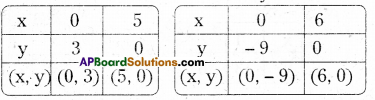
i) 2y = – x + 1
⇒ x + 2y = 1
ii) – x + y = 6
iii) 3x + 5y = 15
iv) \(\frac{x}{2}-\frac{y}{3}=3\)
⇒ \(\frac{3 x-2 y}{6}=3\)
⇒ 3x – 2y = 18

AP Board 9th Class Maths Solutions Chapter 6 Linear Equation in Two Variables Ex 6.3 1
AP Board 9th Class Maths Solutions Chapter 6 Linear Equation in Two Variables Ex 6.3 2
AP Board 9th Class Maths Solutions Chapter 6 Linear Equation in Two Variables Ex 6.3 3

AP Board 9th Class Maths Solutions Chapter 6 Linear Equation in Two Variables Ex 6.3

Question 2.
Draw the graph of each of the following linear equations and answer the following questions.
i) y – x
ii) y = 2x
iii) y = – 2x
iv) y = 3x
v) y = – 3x
Solution:
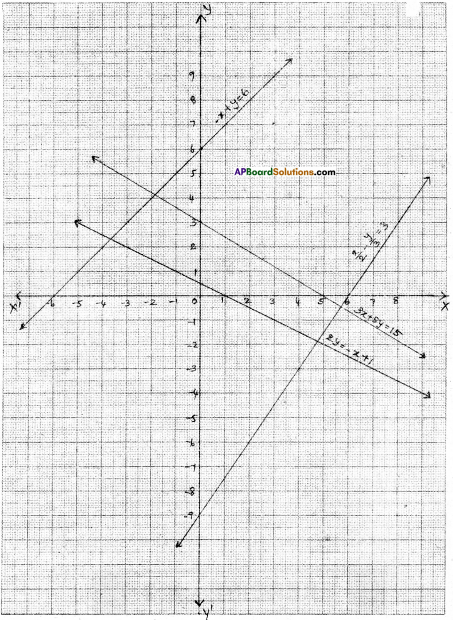
i) y = x

x12
y12
(x, y)(1, 1)(2, 2)

ii) y = 2x

x12
y24

iii) y = – 2x

x12
y-2-4

iv) y = 3x

x12
y36

v) y = – 3x

x12
y-3-6

AP Board 9th Class Maths Solutions Chapter 6 Linear Equation in Two Variables Ex 6.3 4

AP Board 9th Class Maths Solutions Chapter 6 Linear Equation in Two Variables Ex 6.3

i) Are all these equations of the form y = mx; where m is a real number ?
Solution:
Yes. All the equations are of the form y = mx where m e R.

ii) Are all these graphs passing through the origin ?
Solution:
Yes. All these lines pass through the origin.

iii) What can you conclude about these graphs ?
Solution:
All lines of the form y = mx, pass through the origin.

Question 3.
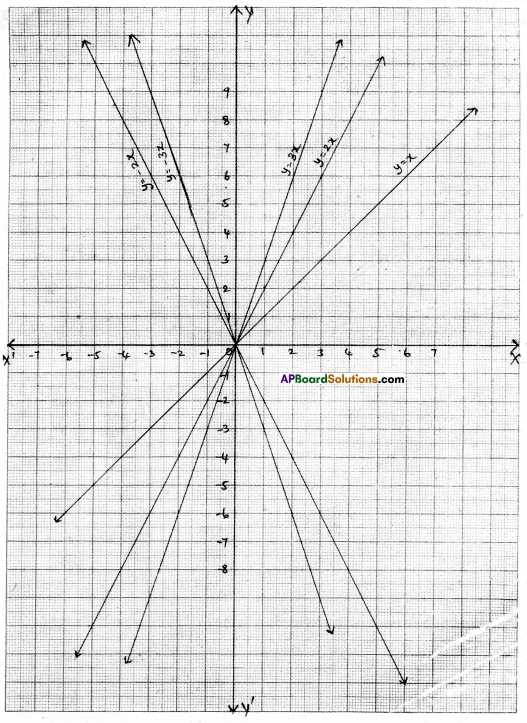
Draw the graph of the equation 2x + 3y = 11. Find from the graph value of y when x = 1.
Solution:

x14
y31

AP Board 9th Class Maths Solutions Chapter 6 Linear Equation in Two Variables Ex 6.3 5
From the graph; when x = 1 then y = 3.

AP Board 9th Class Maths Solutions Chapter 6 Linear Equation in Two Variables Ex 6.3

Question 4.
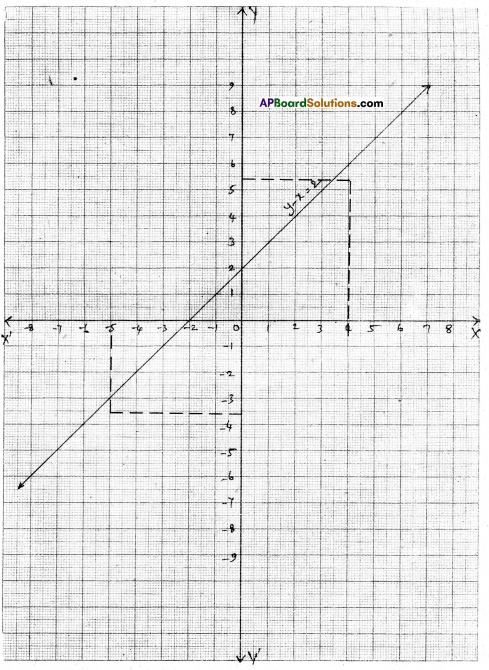
Draw the graph of the equation y – x = 2. Find from the graph
i) the value of y when x = 4
ii) the value of x when y = – 3
Solution:
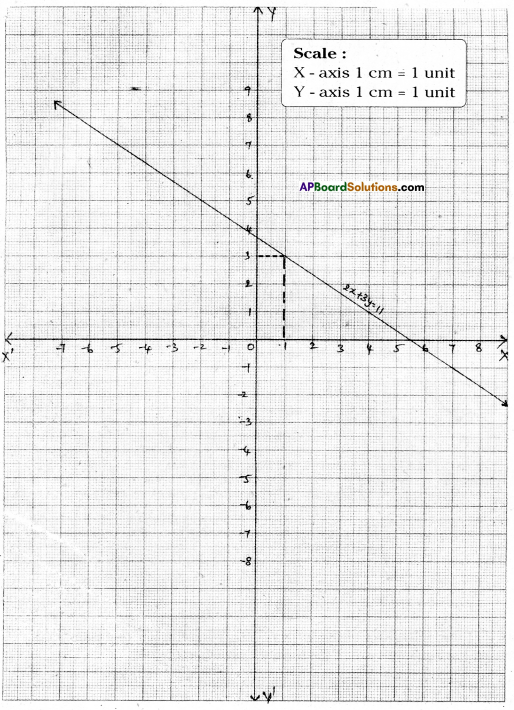
The given equation is y – x = 2 or – x + y = 2

x0-2
y20

AP Board 9th Class Maths Solutions Chapter 6 Linear Equation in Two Variables Ex 6.3 6
i) If x = 4 then y = 6 (∵ from the graph)
ii) When y = – 3 then x = – 5 (∵ from the graph)

Question 5.
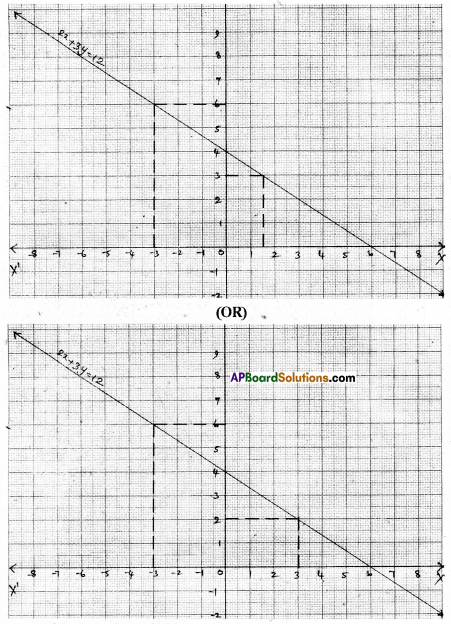
Draw the graph of the equation 2x + 3y = 12. Find the solutions from the graph,
(i) Whose y-coordinate is 3 (OR) Whose y-coordinate is 2
(ii) Whose x-coordinate is – 3
Solution:
The given equation is 2x + 3y = 12

x06
y40

AP Board 9th Class Maths Solutions Chapter 6 Linear Equation in Two Variables Ex 6.3 7
i) From the graph when y = 3 then 2x + 3(3) = 12 ⇒ 2x + 9 = 12 ⇒ 2x = 3 ⇒ x = \(\frac{3}{2}\) ; solution is (\(\frac{3}{2}\) , 3) (OR) When y = 2 then 2x + 3(2) = 12 ⇒ 2x + 6 = 12 ⇒ 2x = 6 ⇒ x = 3 solution is (3, 2),
ii) From the graph when x = – 3 then y = 6; solution is (- 3, 6)

AP Board 9th Class Maths Solutions Chapter 6 Linear Equation in Two Variables Ex 6.3

Question 6.
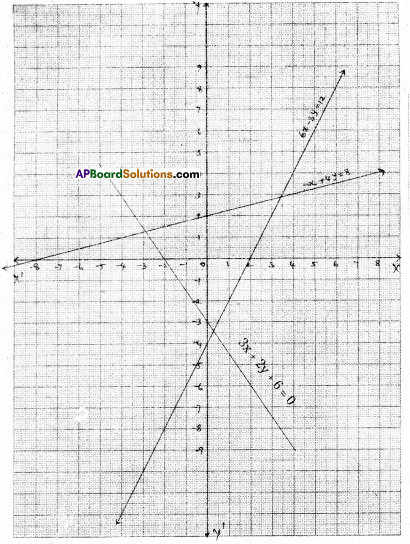
Draw the graph of each of the equations given below and also find the coordinates of the points where the graph cuts the coordinate axes.
i) 6x – 3y = 12
Solution:
6x – 3y = 12

x02
y-40

From the graph the line cuts the X-axis at (2, 0) and Y-axis at (0, – 4).

ii) -x + 4y = 8
Solution:

x0-8
y20

From the graph the line cuts the X-axis at (- 8, 0) and Y -axis at (0, 2).

iii) 3x + 2y + 6 = 0
Solution:
3x + 2y + 6 = 0

x0-2
y-30

From the graph the line cuts the X-axis at (- 2, 0) and Y -axis at (0, -3).
AP Board 9th Class Maths Solutions Chapter 6 Linear Equation in Two Variables Ex 6.3 8

Question 7.
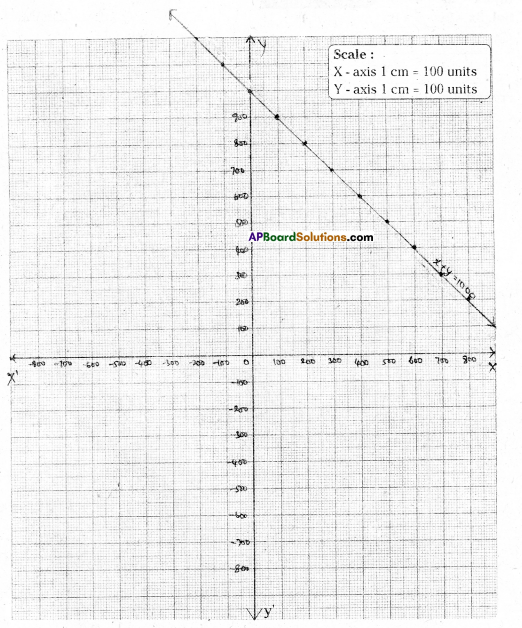
Rajiya and Preethi two students of class IX together collected ₹1000 for the Prime Minister Relief Fund for victims of natural calamities. Write a linear equation and
draw a graph to depict the statement. Clfp)
Solution:
Let Rajiya’s contribution to P.M.R.F be = ₹ x
Preethi’s contribution to P.M.R.F be = ₹ y
Then by problem x + y = 1000

x + y = 1000
x200300
y800700

AP Board 9th Class Maths Solutions Chapter 6 Linear Equation in Two Variables Ex 6.3 9

AP Board 9th Class Maths Solutions Chapter 6 Linear Equation in Two Variables Ex 6.3

Question 8.
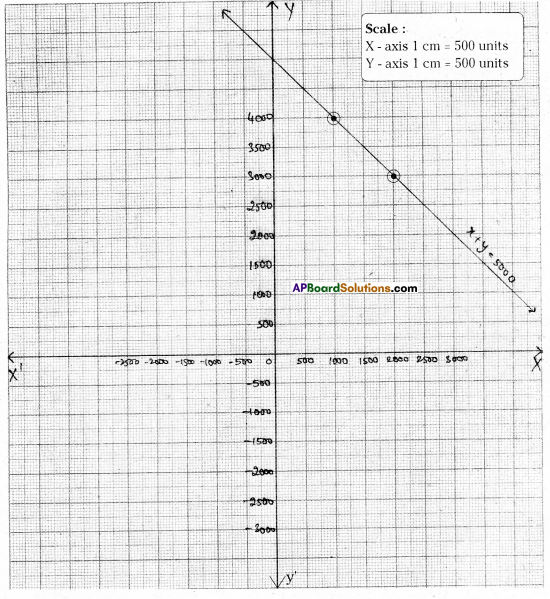
Gopaiah sowed w heat and paddy in two fields of total area 5000 sq. meters. Write a linear equation and draw a graph to represent the same.
Solution: Let the wheat be sowed in a land equal to x sq.m,
and the paddy be sowed in a land equal to y sq.m.
∴ By problem x + y = 5000

x + y = 5000
x10002000
y40003000

AP Board 9th Class Maths Solutions Chapter 6 Linear Equation in Two Variables Ex 6.3 10

Question 9.
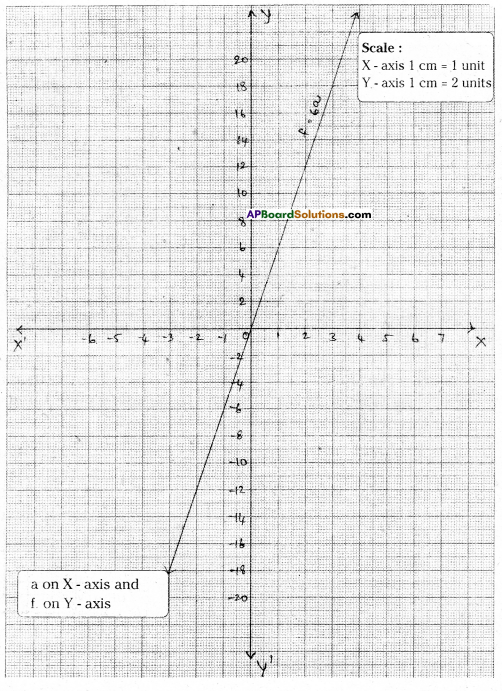
The force applied on a body of mass 6 kg. is directly proportional to the acceleration produced in the body. Write an equation to express this observation and draw the graph of the equation.
Solution:
Let the lorce = f; mass = 6 kg; acceleration = a
By problem f ∝ a or f = m . a ⇒ f = 6a

f = 6a
a23
f1218

AP Board 9th Class Maths Solutions Chapter 6 Linear Equation in Two Variables Ex 6.3 11

AP Board 9th Class Maths Solutions Chapter 6 Linear Equation in Two Variables Ex 6.3

Question 10.
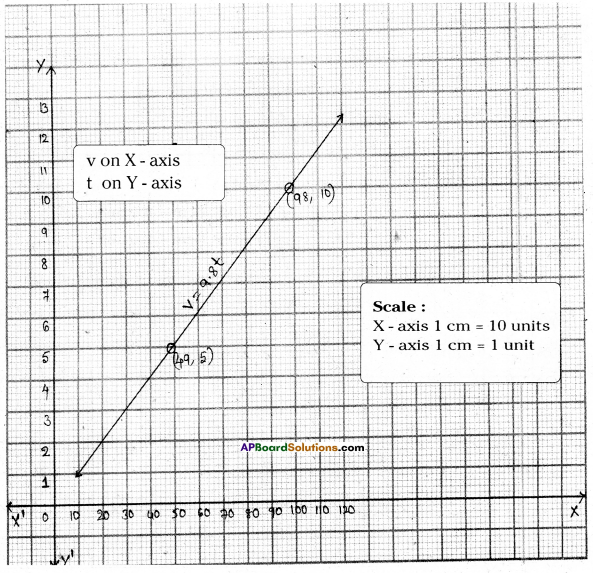
A stone is falling from a mountain. The velocity of the stone is given by v = 9.8t.
Draw its graph and find the velocity of the stone 4 seconds after start.
Solution:
Given that, the velocity of the stone v = 9.8 t

v = 9.8t
v4998
t510

AP Board 9th Class Maths Solutions Chapter 6 Linear Equation in Two Variables Ex 6.3 12
The velocity after 4 seconds = v = 9.8 × 4 = 39.2 m/sec2.

Question 11.
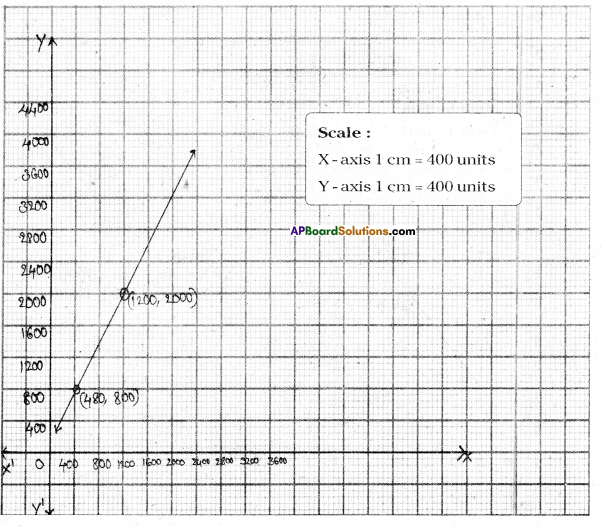
In an election 60 % of voters cast their votes. Form an equation and draw the graph for this data. Find the following from the graph.
i) The total number of voters, if 1200 voters cast their votes,
ii) The number of votes cast, if the total number of voters are 800.
[Hint: If the number of voters who cast their votes be ‘x’ and the total number of voters be ‘y’ then x = 60 % of y.]
Solution:
Let the total number of votes be = y
Then the number of voters who cast their votes = x
By problem x = 60 % of y

x1200480
y2000800

AP Board 9th Class Maths Solutions Chapter 6 Linear Equation in Two Variables Ex 6.3 13
i) From the graph when x = 1200, then y = 2000
ii) From the graph when y = 800 then x = 480

AP Board 9th Class Maths Solutions Chapter 6 Linear Equation in Two Variables Ex 6.3

Question 12.
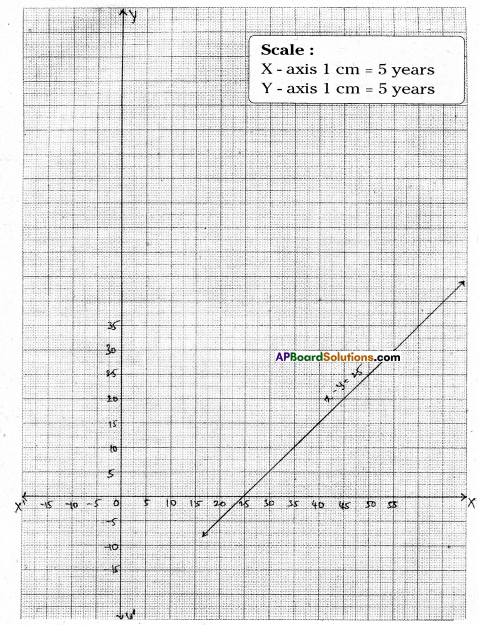
When Rupa was born, her father was 25 years old. Form an equation and draw a graph for this data. From the graph find
i) The age of the father when Rupa is 25 years old.
ii) Rupa’s age when her father is 40 years old.
Solution:
Let her father’s age be = x years.
and Rupa’s age be = y years
By problem x – y = 25 years

x4050
y1525

AP Board 9th Class Maths Solutions Chapter 6 Linear Equation in Two Variables Ex 6.3 14
i) From the graph age of the father when Rupa is 25 years is 50 years.
ii) Rupa’s age when her father is 40 years is 15 years.

Question 13.
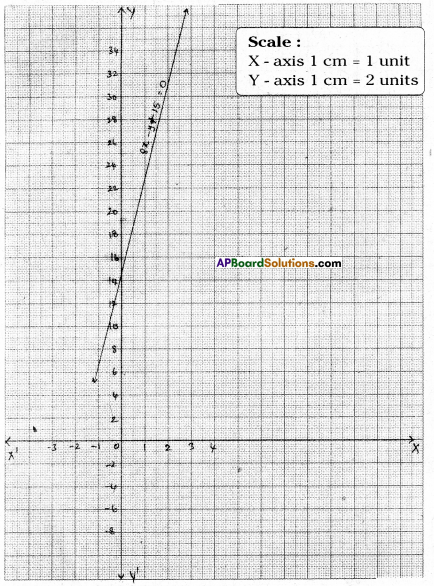
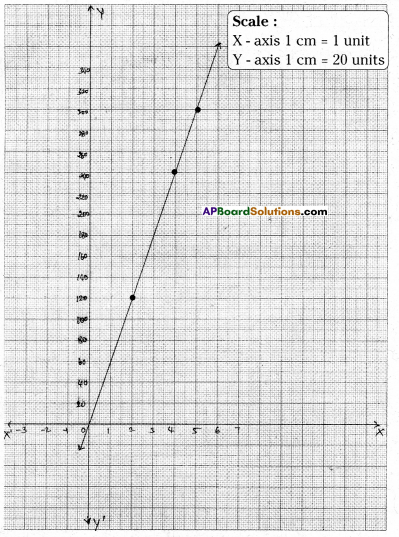
An auto charges ₹15 for first kilometre and ₹ 8 each for subsequent kilometre. For a distance of x km. an amount of ₹y is paid. Write the linear equation representing this information and draw the graph. With the help of graph find the distance travelled if the fare paid is ₹55. How much would have to be paid for 7 kilometres?
Solution:
Charge for the first kilometre = ₹15
Charge for the subsequent kilometres = ₹ 8 per km.
Amount paid = ₹ y when the distance travelled is x km
∴ By problem y = 15 + 8x
∴ 8x – y + 15 = 0

x21
y3123

AP Board 9th Class Maths Solutions Chapter 6 Linear Equation in Two Variables Ex 6.3 15
i) When y = 55 then x = 5
ii) From the graph when x = 7 then y = 71

AP Board 9th Class Maths Solutions Chapter 6 Linear Equation in Two Variables Ex 6.3

Question 14.
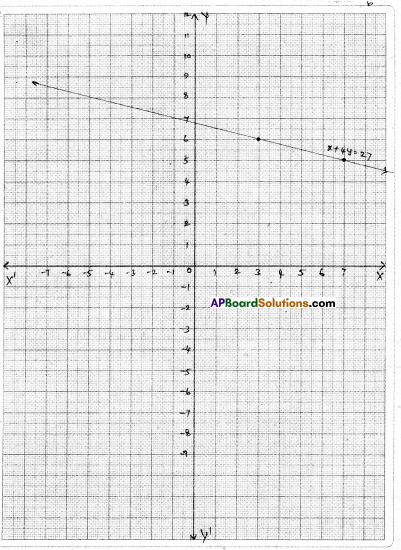
A lending library has fixed charge for the first three days and an additional charges for each day thereafter. John paid ₹ 27 for a book kept for seven days. If the fixed charges be ₹ x and subsequent per day charges be ₹ y; then write the linear equation representing the above information and draw the graph of the same. From the graph if the fixed charge is ₹ 7, find the subsequent per day charge. And if the per day charge is ₹ 4, find the fixed charge, (charge is ₹7)
Solution:
John kept a book for 7 days. He paid ₹ 27
For first three days = ₹ x (fixed)
For the last four days = ₹ 4y (? y for a day)
By problem x + 4y = 27

x3117
y645

AP Board 9th Class Maths Solutions Chapter 6 Linear Equation in Two Variables Ex 6.3 16
When x = 7 then y = 5
When y = 4 then x = 11

Question 15.
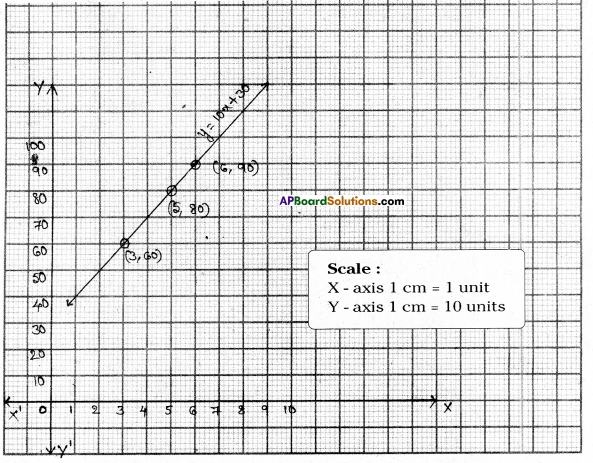
The parking charges of a car in Hyderabad Railway station for first two hours is ₹ 50 and ₹10 for each subsequent hour. Write down an equation and draw the graph. Find the following charges from the graph.
i) For three hours ii) For six hours iii) How many hours did Rekha park her car if she paid ₹ 80 as parking charges ?
Solution: Let the total money paid be = ₹ y
Parking charges for the first two hours = ₹ 50
Parking charges for total x hours @ ₹10 per hour = 50 + (x – 2) 10
= 50 + 10x – 20
= 10x + 30
∴ By problem y = 10x + 30

x356
y608090

AP Board 9th Class Maths Solutions Chapter 6 Linear Equation in Two Variables Ex 6.3 17
i) For three hours = 50 + 10 × 1 = ₹ 60
[ ∵ From the graph we see the same]
ii) For six hours = 50 + 10 × 4 = 50 + 40 = ₹ 90
iii) Rekha parked her car for 5 hours.

AP Board 9th Class Maths Solutions Chapter 6 Linear Equation in Two Variables Ex 6.3

Question 16.
Sameera was driving a car with uniform speed of 60 kmph. Draw distance – time graph. From the graph find the distance travelled by Sameera in
i) \(\frac { 1 }{ 2 }\) hours
ii) 2 hours
iii) 3\(\frac { 1 }{ 2 }\) hours
Solution:
Speed of the car = 60 kmph
Let the time taken be = x hours
Then the total distance travelled be = y hours
By problem 60x = y or 60x – y = 0

x245
y120240300

AP Board 9th Class Maths Solutions Chapter 6 Linear Equation in Two Variables Ex 6.3 18
ii) Distance travelled in 1\(\frac { 1 }{ 2 }\) hours = 120 km
ii) Distance travelled in 2 hours = 120 km
iii) Distance travelled in 3\(\frac { 1 }{ 2 }\) hours = 210 km

Question 17.
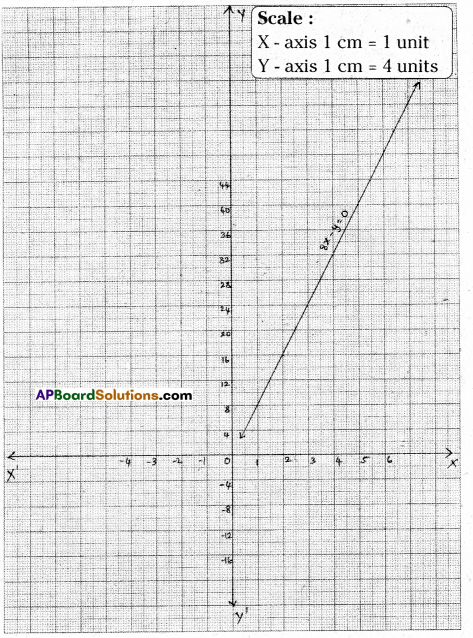
The ratio of molecular weight of Hydrogen and Oxygen in water is 1 : 8. Set up an equation between Hydrogen and Oxygen and draw its graph. From the graph find the quantity of Hydrogen if Oxygen is 12 grams. And quantity of Oxygen if
Hydrogen is \(\frac { 3 }{ 2 }\) grams.
[Hint : If the quantities of hydrogen and oxygen ‘x’ and ‘y’ respectively, then
x : y = 1 : 8 ⇒ 8x = y]
Solution:
Let the quantity of Hydrogen = x grams
And the quantity of Oxygen = y grams
By problem 8x = y ⇒ 8x – y = 0

x1245
y8163240

AP Board 9th Class Maths Solutions Chapter 6 Linear Equation in Two Variables Ex 6.3 19
From the graph, the quantity of Hydrogen if Oxygen is 12 gm = \(\frac { 3 }{ 2 }\) g.
From the graph, the quantity of Oxygen if Hydrogen is \(\frac { 3 }{ 2 }\) g = 12 g.

AP Board 9th Class Maths Solutions Chapter 6 Linear Equation in Two Variables Ex 6.3

Question 18.
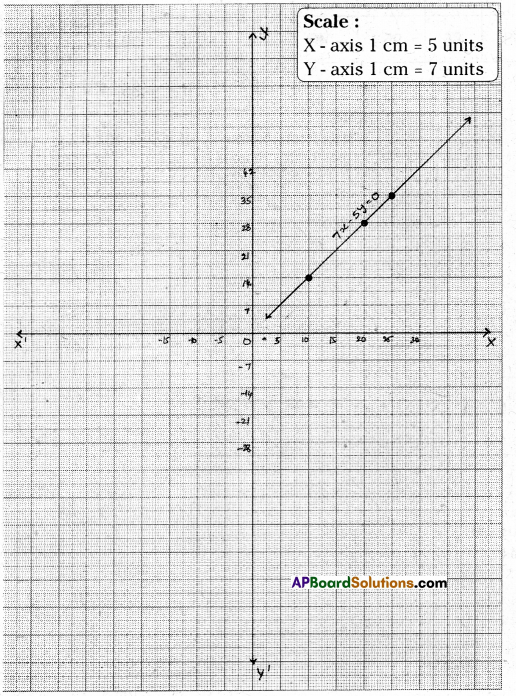
In a mixture of 28 litres, the ratio of milk and water is 5 : 2. Set up the equation between the mixture and milk. Draw its graph. By observing the graph find the quantity of milk in the mixture.
[Hint: Ratio between mixture and milk = 5 + 2:5 = 7:5]
Solution:
Let the quantity of milk in the mixture be = x lit.
quantity of the mixture = y lit.
Ratio of the milk and water = 5:2
Sum of the terms of the ratio = 5 + 2 = 7
Quantity of milk x = \(\frac { 5 }{ 7 }\) y lit.
7x = 5y ⇒ 7x – 5y = 0

x102025
y142835

AP Board 9th Class Maths Solutions Chapter 6 Linear Equation in Two Variables Ex 6.3 20
From the graph quantity of milk in the mixture = 20 lit.

AP Board 9th Class Maths Solutions Chapter 6 Linear Equation in Two Variables Ex 6.3

Question 19.
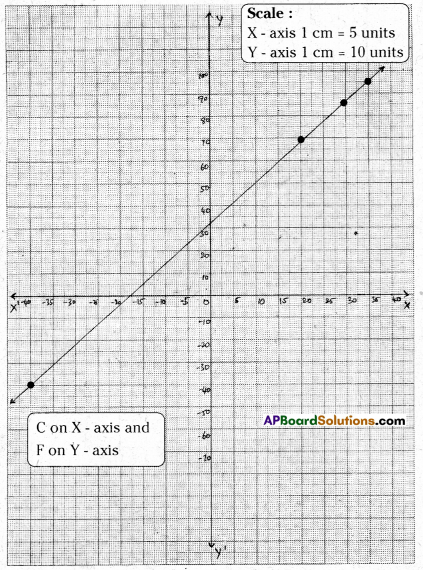
In countries like U.S.A. and Canada temperature is measured in Fahrenheit whereas in countries like India, it is measured in Celsius. Here is a linear equation that converts Fahrenheit to Celsius F = \(\frac { 9 }{ 5 }\) C + 32
i) Draw the graph of the above linear equation having Celsius on X-axis and Fahrenheit on Y-axis.
ii) If the temperature is 30°C, what is the temperature in Fahrenheit ?
iii) If the temperature is 95°F, what is the temperature in Celsius ?
iv) Is there a temperature that has numerically the same value in both Fahrenheit and Celsius ? If yes, find it.
Solution:
i) Given that F = \(\frac { 9 }{ 5 }\) C + 32

C203035-40
F688695-40

AP Board 9th Class Maths Solutions Chapter 6 Linear Equation in Two Variables Ex 6.3 21
If C = 20, F = \(\frac { 9 }{ 5 }\) × 20 + 32 = 68
If c = 30, F = \(\frac { 9 }{ 5 }\) × 30 + 32 = 86
If C = 35, F = \(\frac { 9 }{ 5 }\) × 35 + 32 = 95
If C = -40, F = \(\frac { 9 }{ 5 }\) × (-40) + 32 = -40

ii) From the graph 30°C = 86°F
iii) 95°F = 35°C
iv) When C = – 40 then F = – 40

AP Board 9th Class Maths Solutions Chapter 7 Triangles Ex 7.4

AP State Syllabus AP Board 9th Class Maths Solutions Chapter 7 Triangles Ex 7.4 Textbook Questions and Answers.

AP State Syllabus 9th Class Maths Solutions 7th Lesson Triangles Exercise 7.1

Question 1.
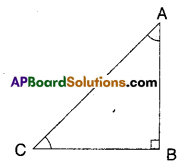
Show that in a right angled triangle, the hypotenuse is the longest side.
Solution:
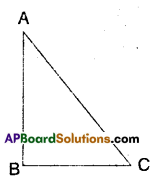
AP Board 9th Class Maths Solutions Chapter 7 Triangles Ex 7.4 1
Let a ΔABC be right angled at ∠B.
Then ∠A + ∠C = 90°
(i.e.,) ∠A and ∠C are both acute.
Now, ∠A < ∠B ⇒ BC < AC
Also ∠C < ∠B ⇒ AB < AC
∴ AC, the hypotenuse is the longest side.

AP Board 9th Class Maths Solutions Chapter 7 Triangles Ex 7.4

Question 2.
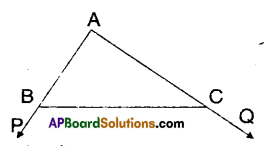
In the given figure, sides AB and AC of ΔABC are extended “to points P and Q respectively. Also ∠PBC < ∠QCB. Show that AC > AB.
AP Board 9th Class Maths Solutions Chapter 7 Triangles Ex 7.4 2
Solution:
From the figure,
∠PBC = ∠A + ∠ACB
∠QCB = ∠A + ∠ABC
Given that ∠PBC < ∠QCB
⇒∠A + ∠ACB < ∠A + ∠ABC
⇒ ∠ACB < ∠ABC
⇒ AB < AC
⇒ AC > AB
Hence proved.

AP Board 9th Class Maths Solutions Chapter 7 Triangles Ex 7.4

Question 3.
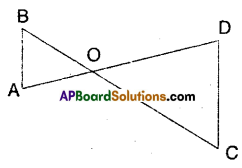
In the given figure, ∠B < ∠A and ∠C < ∠D. Show that AD < BC.
AP Board 9th Class Maths Solutions Chapter 7 Triangles Ex 7.4 3
Solution:
Given that ∠B < ∠A; ∠C < ∠D
∠B < ∠A ⇒ AO < OB [in ΔAOB] ……………… (1)
∠C < ∠D ⇒ OD < OC [in ΔCOD]…… (2)
Adding (1) & (2)
AO + OD < OB + OC
AD < BC
Hence proved.

AP Board 9th Class Maths Solutions Chapter 7 Triangles Ex 7.4

Question 4.
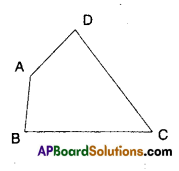
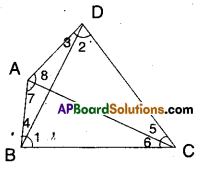
AB and CD are respectively the smallest and longest sides of a quadrilateral ABCD (see figure). Show that ∠A >∠C and ∠B > ∠D.
AP Board 9th Class Maths Solutions Chapter 7 Triangles Ex 7.4 4
Solution:
AP Board 9th Class Maths Solutions Chapter 7 Triangles Ex 7.4 5
Given that AB and CD are the smallest and longest sides of quadrilateral ABCD.
From the figure,
In ΔBCD
∠1 > ∠2 [∵ DC > BC] ………………(1)
In ΔBDA
∠4 > ∠3 [∵ AD > AB] ………….(2)
Adding (1) & (2)
∠1 + ∠4 > ∠2 + ∠3
∠B > ∠D
Similarly,
In ΔABC, ∠6 < ∠7 [ ∵AB < BC] ……………….(3)
In ΔACD
∠5 < ∠8 …………. (4)
Adding (3) & (4)
∠6 + ∠5 < ∠7 + ∠8
∠C < ∠A ⇒ ∠A > ∠C
Hence proved.

AP Board 9th Class Maths Solutions Chapter 7 Triangles Ex 7.4

Question 5.
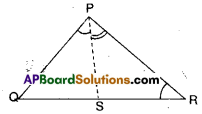
In the given figure, PR > PQ and PS bisects ∠QPR. Prove that
∠PSR > ∠PSQ.
AP Board 9th Class Maths Solutions Chapter 7 Triangles Ex 7.4 6
Solution:
Given that PR > PQ;
∠QPS =∠RPS
PR> PQ
∠Q > ∠R
Now ∠Q +∠QPS > ∠R + ∠RPS
⇒ 180° – (∠Q + ∠QPS) < 180° – (∠R + ∠RPS)
⇒ ∠PSQ < ∠PSR ⇒ ∠PSR > ∠PSQ
Hence proved.

Question 6.
If two sides of a triangle measure 4 cm and 6 cm find all possible measurements (positive integers) of the third side. How many distinct triangles can be obtained ?
Solution:
Given that two sides of a triangle are 4 cm and 6 cm.
∴ The measure of third side > Differ-ence between other two sides.
third side > 6 – 4
third side > 2
Also the measure of third side < sum of other two sides
third side <6 + 4 < 10
∴ 2 < third side <10
∴ The measure of third side may be 3 cm, 4 cm, 5 cm, 6 cm, 7 cm, 8 cm, 9 cm
∴ Seven distinct triangles can be obtained.

AP Board 9th Class Maths Solutions Chapter 7 Triangles Ex 7.4

Question 7.
Try to construct a triangle with 5 cm, 8 cm and 1 cm. Is it possible or not ? Why ? Give your justification.
Solution:
As the sum (6 cm) of two sides 5 cm and 1 cm is less than third side. It is not possible to construct a triangle with the given measures.

AP Board 9th Class Maths Solutions Chapter 7 Triangles Ex 7.3

AP State Syllabus AP Board 9th Class Maths Solutions Chapter 7 Triangles Ex 7.3 Textbook Questions and Answers.

AP State Syllabus 9th Class Maths Solutions 7th Lesson Triangles Exercise 7.3

AP Board 9th Class Maths Solutions Chapter 7 Triangles Ex 7.3

Question 1.
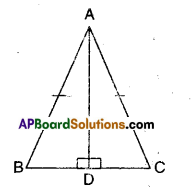
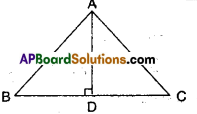
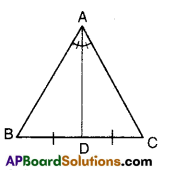
AD is an altitude of an isosceles triangle ABC in which AB = AC. Show that, (i) AD bisects BC (ii) AD bisects ∠A.
Solution:
AP Board 9th Class Maths Solutions Chapter 7 Triangles Ex 7.3 1
Given that in ΔABC, AB = AC
and AD ⊥ BC
i) Now in ΔABD and ΔACD
AB = AC (given)
∠ADB = ADC (given AD ⊥ BC)
AD = AD (common)
∴ ΔABD ≅ ΔACD (∵ RHS congruence)
⇒ BD = CD (CPCT)
⇒ AD, bisects BC.

ii) Also ∠BAD = ∠CAD
(CPCT of ΔABD ≅ ΔACD )
∴ AD bisects ∠A.

AP Board 9th Class Maths Solutions Chapter 7 Triangles Ex 7.3

Question 2.
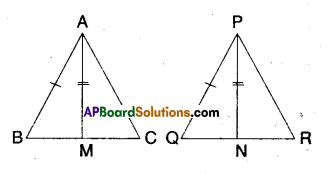
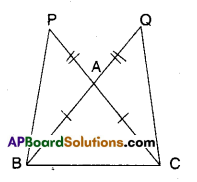
Two sides AB, BC and median AM of one triangle ABC are respectively equal to sides PQ and QR and median PN of ΔPQR (see figure). Show that:
(i) ΔABM ≅ ΔPQN
ii) ΔABC ≅ ΔPQR
AP Board 9th Class Maths Solutions Chapter 7 Triangles Ex 7.3 2
Solution:
Given that
AB = PQ
AM = PN
i) Now in ΔABM and ΔPQN
AB = PQ (given)
AM = PN (given)
BM = QN (∵ BC = QR ⇒ \(\frac { 1 }{ 2 }\)BC = \(\frac { 1 }{ 2 }\)QR ⇒ BM = QN)
∴ ΔABM ≅ ΔPQN
(∵ SSS congruence)

ii) In ΔABC and ΔPQR
AB = PQ (given)
BC = QR (given)
∠ABC = ∠PQN [∵ CPCT of ΔABM and ΔPQN from (i)]
∴ ΔABC ≅ ΔPQR
(∵ SAS congruence)

AP Board 9th Class Maths Solutions Chapter 7 Triangles Ex 7.3

Question 3.
BE and CF are two equal altitudes of a triangle ABC. Using RHS congruence rule, prove that the triangle ABC is isosceles.
Solution:
AP Board 9th Class Maths Solutions Chapter 7 Triangles Ex 7.3 3
In ΔABC altitude BE and CF are equal.
Now in ΔBCE and ΔCBF
∠BEC = ∠CFB (∵ given 90°)
BC = BC (common; hypotenuse)
CF = BE (given)
∴ ΔBEC ≅ ΔCBF
⇒ ∠EBC = ∠FCB (∵ CPCT)
But these are also the interior angles opposite to sides AC and AB of ΔABC.
⇒ AC = AB
Hence proved.

AP Board 9th Class Maths Solutions Chapter 7 Triangles Ex 7.3

Question 4.
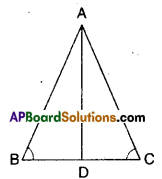
ΔABC is an isosceles triangle in which AB = AC. Show that ∠B = ∠C.
(Hint : Draw AP ⊥ BQ (Using RHS congruence rule)
Solution:
AP Board 9th Class Maths Solutions Chapter 7 Triangles Ex 7.3 4
Given the ΔABC is an isosceles triangle and AB = AC
Let D be the mid point of BC; Join A, D.
Now in ΔABD and ΔACD
AB = AC (given)
BD = DC (construction)
AD = AD (common)
∴ ΔABD ≅ ΔACD (∵ SSS congruence)
⇒ ∠B = ∠C [∵ CPCT]

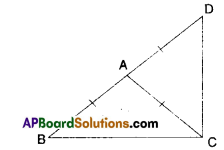
Question 5.
ΔABC is an isosceles triangle in which AB = AC. Side BA is produced to D such that AD = AB (see figure). Show that ∠BCD is a right angle.
AP Board 9th Class Maths Solutions Chapter 7 Triangles Ex 7.3 5
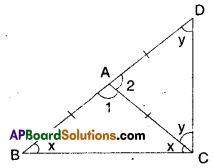
Solution:
AP Board 9th Class Maths Solutions Chapter 7 Triangles Ex 7.3 6
Given that in ΔDBC; AB = AC; AD = AB
In ΔABC
∠ABC + ∠ACB = ∠DAC …………… (1)
[∵ exterior angle]
In ΔACD
∠ADC + ∠ACD = ∠BAC ………………(2)
Adding (1) & (2)
∠DAC + ∠BAC = 2 ∠ACB + 2∠ACD
[∵ ∠ABC = ∠ACB
∠ADC = ∠ACD]
180° = 2 [∠ACB + ∠ACD]
180° = 2[∠BCD]
∴ ∠BCD = \(\frac{180^{\circ}}{2}\) = 90°
(or)
From the figure
∠2 = x + x = 2x
∠1 = y + y = 2y
∠1 + ∠2 = 2x + 2y
180° = 2 = (x + y)
∴ x + y  = \(\frac{180^{\circ}}{2}\) = 90°
Hence proved.

AP Board 9th Class Maths Solutions Chapter 7 Triangles Ex 7.3

Question 6.
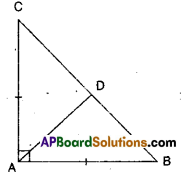
ABC is a right angled triangle in which ∠A = 90° and AB = AC, Show that ∠B = ∠C.
Solution:
AP Board 9th Class Maths Solutions Chapter 7 Triangles Ex 7.3 7
Given ΔABC; AB – AC
Join the mid point D of BC to A.
Now in ΔADC and ΔADB
AD = AD (common)
AC = AB (giyen)
DC = DB (construction)
⇒ ΔADC ≅ ΔADB
⇒ ∠C = ∠B (CPCT)

AP Board 9th Class Maths Solutions Chapter 7 Triangles Ex 7.3

Question 7.
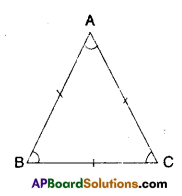
Show that the angles of an equilateral triangle are 60° each.
Solution:
AP Board 9th Class Maths Solutions Chapter 7 Triangles Ex 7.3 8
Given ΔABC is an equilateral triangle
AB = BC = CA
∠A = ∠B (∵ angles opposite to equal sides)
∠B = ∠C (∵ angles opposite to equal sides)
⇒ ∠A = ∠B = ∠C = x say
Also ∠A+∠B + ∠C =180°
⇒ x + x + x = 180°
3x = 180°
⇒ x = \(\frac{180}{3}\) = 60°
Hence proved.

AP Board 9th Class Maths Solutions Chapter 7 Triangles Ex 7.2

AP State Syllabus AP Board 9th Class Maths Solutions Chapter 7 Triangles Ex 7.2 Textbook Questions and Answers.

AP State Syllabus 9th Class Maths Solutions 7th Lesson Triangles Exercise 7.2

Question 1.
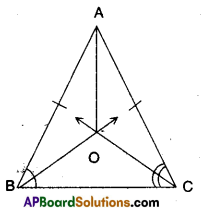
In an isosceles triangle ABC, with AB = AC, the bisectors of ∠B and ∠C intersect each other at ‘O’. Join A to O. Show that (i) OB = OC (ii) AO bisects ∠A.
AP Board 9th Class Maths Solutions Chapter 7 Triangles Ex 7.2 1
Solution:
Given that in ΔABC
AB = AC
Bisectors of ∠B and ∠C meet at ‘O’.
To prove
i) OB = OC
∠B = ∠C (Angles opposite to equal, sides)
\(\frac{1}{2} \angle \mathrm{B}=\frac{1}{2} \angle \mathrm{C}\) (Dividing both sides by 2)
∠OBC = ∠OCB
⇒ OB = OC (∵ Sides opposite to equal angles in ΔOBC)

ii) AO bisects ∠A.
In ΔAOB and ΔAOC
AB = AC (given)
BO = CO (already proved)
∠ABO = ∠ACO (∵ ∠B =∠C)
∴ ΔAOB ≅ ΔAOC
⇒ ∠BAO = ∠CAO [ ∵ CPCT of ΔAOB and ΔAOC]
∴ AO is bisector of ∠A.

AP Board 9th Class Maths Solutions Chapter 7 Triangles Ex 7.2

Question 2.
In ΔABC, AD is the perpendicular bisector of BC (see given figure). Show that ΔABC is an isosceles triangle in which AB = AC
AP Board 9th Class Maths Solutions Chapter 7 Triangles Ex 7.2 2
Solution:
Given that AD ⊥ BC; AD = DC
In ΔABD and ΔACD
AD = AD (common)
BD = DC (given)
∠ADB = ∠ADC (given)
∴ ΔABD ≅ ΔACD (∵ SAS congruence)
⇒ AB = AC (CPCT of ΔABD and ΔACD)

AP Board 9th Class Maths Solutions Chapter 7 Triangles Ex 7.2

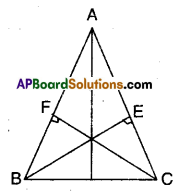
Question 3.
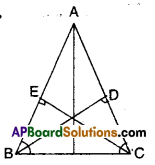
ABC is an isosceles triangle in which altitudes BD and CE are drawn to equal sides AC and AB respectively (see figure). Show that these altitudes are equal.
AP Board 9th Class Maths Solutions Chapter 7 Triangles Ex 7.2 3
Solution:
Given that AC = AB; BD ⊥ AC; CE ⊥ AB
In ΔBCD and ΔCBE
∠BDC = ∠CEB (90° each)
∠BCD = ∠CBE (∵ angles opp. to equal sides of a triangle)
BC = BC
∴ ΔBCD ≅ ΔCBE (∵ AAScongruence)
⇒ BD = CE (CPCT)

AP Board 9th Class Maths Solutions Chapter 7 Triangles Ex 7.2

Question 4.
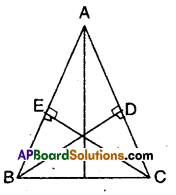
ABC is a triangle in which altitudes BD and CE to sides AC and AB are equal (see figure). Show that
i) ΔABD ≅ ΔACE
ii) AB = AC i.e., ABC is an isosceles triangle.
AP Board 9th Class Maths Solutions Chapter 7 Triangles Ex 7.2 4
Solution:
Given that BD ⊥ AC; CE ⊥ AC
BD = CE
Now in ΔABD and ΔACE
∠ADB = ∠AEC (∵ given 90°)
∠A = ∠A (commori angle)
BD = CE
∴ ΔABD = ΔACE (∵ AAS congruence)
⇒ AB = AC (∵ C.P.C.T)

AP Board 9th Class Maths Solutions Chapter 7 Triangles Ex 7.2

Question 5.
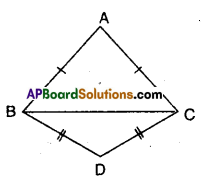
ΔABC and ΔDBC are two isosceles triangles on the same base BC (see figure). Show that ∠ABD = ∠ACD.
AP Board 9th Class Maths Solutions Chapter 7 Triangles Ex 7.2 5
Solution:
AP Board 9th Class Maths Solutions Chapter 7 Triangles Ex 7.2 6
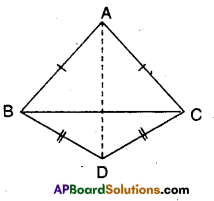
Given that ΔABC and ΔDBC are isosceles.
To prove ∠ABD = ∠ACD
Join A and D.
Now in ΔABD and ACD
AB = AC (∵ equal sides of isosceles triangles)
BD = CD (∵ equal sides of isosceles triangles)
AD = AD (∵ common side)
∴ ΔABD ≅ ΔACD (∵ SSS congruence)
⇒ ∠ABD = ∠ACD (CPCT)

AP Board 9th Class Maths Solutions Chapter 7 Triangles Ex 7.1

AP State Syllabus AP Board 9th Class Maths Solutions Chapter 7 Triangles Ex 7.1 Textbook Questions and Answers.

AP State Syllabus 9th Class Maths Solutions 7th Lesson Triangles Exercise 7.1

AP Board 9th Class Maths Solutions Chapter 7 Triangles Ex 7.1

Question 1.
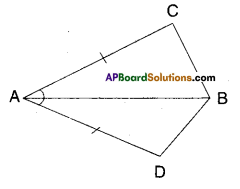
In quadrilateral ACBD, AC = AD and AB bisects ∠A. Show that ΔABC ≅ ΔABD What can you say about BC and BD ?
AP Board 9th Class Maths Solutions Chapter 7 Triangles Ex 7.1 1
Solution:
Given that AC = AD
∠BAC = ∠BAD (∵ AB bisects∠A)
Now in ΔABC and ΔABD
AC = AD (∵ given)
∠BAC = ∠BAD (Y given)
AB = AB (common side)
∴ ΔABC ≅ ΔABD
(∵ SAS congruence rule)

AP Board 9th Class Maths Solutions Chapter 7 Triangles Ex 7.1

Question 2.
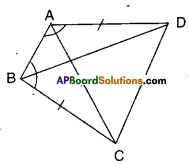
ABCD is a quadrilateral in which AD = BC and ∠DAB = ∠CBA, prove that i) ΔABD ≅ΔBAC ii) BD = AC
iii) ∠ABD = ∠BAC.
AP Board 9th Class Maths Solutions Chapter 7 Triangles Ex 7.1 2
Solution :
i) Given that AD = BC and
∠DAB = ∠CBA
Now in ΔABD and ΔBAC
AB = AB (∵ Common side)
AD = BC (∵ given)
∠DAB = ∠CBA (∵ given)
∴ ΔABD ≅ ΔBAC
(∵ SAS congruence)
ii) From (i) AC = BD (∵ CPCT)
iii) ∠ABD = ∠BAC [ ∵ CPCT from (i)]

Question 3.
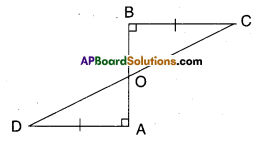
AD and BC are equal and perpendi-culars to a line segment AB. Show that CD bisects AB.
AP Board 9th Class Maths Solutions Chapter 7 Triangles Ex 7.1 3
Solution:
Given that AD = BC; AD ⊥ AB; BC ⊥ AB
In ΔBOC and ΔAOD
∠BOC = ∠AOD (∵ vertically opposite angles)
∴ ΔOBC = ΔOAD (∵ right angle)
BC = AD
ΔOBC ≅ ΔOAD (∵ AAS congruence)
∴ OB = OA (∵ CPCT)
∴ ‘O’ bisects AB
Also OD = OC
∴ ‘O’ bisects CD
⇒ AB bisects CD

AP Board 9th Class Maths Solutions Chapter 7 Triangles Ex 7.1

Question 4.
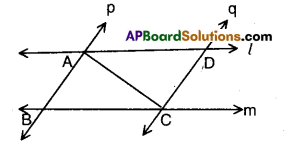
l and m are two parallel lines inter-sected by another pair of parallel lines p and q. Show that ΔABC ≅ ΔCDA.
AP Board 9th Class Maths Solutions Chapter 7 Triangles Ex 7.1 4
Solution:
Given that l // m; p // q.
In ΔABC and ΔCDA
∠BAC = ∠DCA (∵ alternate interior angles)
∠ACB = ∠CAD
AC = AC
∴ ΔABC ≅ ΔCDA (∵ ASA congruence)

Question 5.
In the figure given below AC = AE; AB = AD and ∠BAD = ∠EAC. Show that BC = DE.
AP Board 9th Class Maths Solutions Chapter 7 Triangles Ex 7.1 5
Solution:
Given that AC = AE, AB = AD and
∠BAD = ∠EAC
In ΔABC and ΔADE
AB = AD
AC = AE
∠BAD = ∠EAC
∴ ΔABC ≅ ΔADE (∵ SAS congruence)
⇒ BC = DE (CPCT)

AP Board 9th Class Maths Solutions Chapter 7 Triangles Ex 7.1

Question 6.
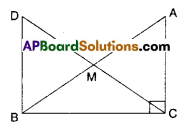
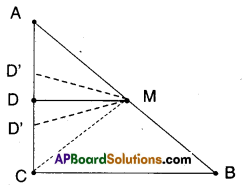
In right triangle ABC, right angle is at ‘C’ M is the mid-point of hypotenuse AB. C is joined to M and produced to a point D such that DM = CM. Point D is joined to point B (see fig.). Show that
AP Board 9th Class Maths Solutions Chapter 7 Triangles Ex 7.1 6
i) ΔAMC = ΔBMD
ii) ∠DBC is a right angle
iii) ΔDBC = ΔACB
iv) CM = \(\frac{1}{2}\) AB
Solution:
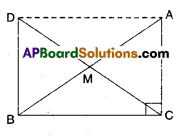
Given that ∠C = 90°
M is mid point of AB;
DM = CM (i.e., M is mid point of DC)
AP Board 9th Class Maths Solutions Chapter 7 Triangles Ex 7.1 7
i) In ΔAMC and ΔBMD
AM = BM (∵ M is mid point of AB)
CM = DM ( ∵ M is mid point of CD)
∠AMC = ∠BMD ( ∵ Vertically opposite angles)
∴ ΔAMC ≅ ΔBMD
(∵ SAS congruence)

AP Board 9th Class Maths Solutions Chapter 7 Triangles Ex 7.1

ii) ∠MDB = ∠MCA
(CPCT of ΔAMC and ΔBMD)
But these are alternate interior angles for the lines DB and AC and DC as transversal.
∴DB || AC
As AC ⊥ BC; DB is also perpendicular to BC.
∴ ∠DBC is a right angle.

iii) In ΔDBC and ΔACB
DB = AC (CPCT of ΔBMD and ΔAMC)
∠DBC = ∠ACB = 90°(already proved)
BC = BC (Common side)
∴ ΔDBC ≅ ΔACB (SAS congruence rule)

iv) DC = AB (CPCT of ΔDBC and ΔACB)
\(\frac { 1 }{ 2 }\) DC = \(\frac { 1 }{ 2 }\) AB (Dividing both sides by 2)
CM = \(\frac { 1 }{ 2 }\)AB

Question 7.
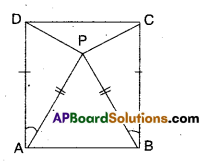
In the given figure ΔBCD is a square and ΔAPB is an equilateral triangle.
Prove that ΔAPD ≅ ΔBPC.
[Hint: In ΔAPD and ΔBPC; \(\overline{\mathbf{A D}}=\overline{\mathbf{B C}}\), \(\overline{\mathbf{AP}}=\overline{\mathbf{BP}}\) and ∠PAD = ∠PBC = 90° – 60° = 30°]
AP Board 9th Class Maths Solutions Chapter 7 Triangles Ex 7.1 8
Solution:
Given that □ABCD is a square.
ΔAPB is an equilateral triangle.
Now in ΔAPD and ΔBPC
AP = BP ( ∵ sides of an equilateral triangle)
AD = BC (∵ sides of a square)
∠PAD = ∠PBC [ ∵ 90° – 60°]
∴ ΔAPD ≅ ΔBPC (by SAS congruence)

AP Board 9th Class Maths Solutions Chapter 7 Triangles Ex 7.1

Question 8.
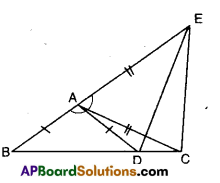
In the figure given below ΔABC is isosceles as \(\overline{\mathbf{A B}}=\overline{\mathbf{A C}} ; \overline{\mathbf{B A}}\) and \(\overline{\mathbf{CA}}\) are produced to Q and P such that \(\overline{\mathbf{A Q}}=\overline{\mathbf{AP}}\). Show that \(\overline{\mathbf{PB}}=\overline{\mathbf{QC}}\) .
(Hint: Compare ΔAPB and ΔACQ)
AP Board 9th Class Maths Solutions Chapter 7 Triangles Ex 7.1 9
Solution:
Given that ΔABC is isosceles and
AP = AQ
Now in ΔAPB and ΔAQC
AP = AQ (given)
AB = AC (given)
∠PAB = ∠QAC (∵ Vertically opposite angles)
∴ ΔAPB ≅ ΔAQC (SAS congruence)
∴ \(\overline{\mathbf{PB}}=\overline{\mathbf{QC}}\) (CPCT of ΔAPB and ΔAQC)

AP Board 9th Class Maths Solutions Chapter 7 Triangles Ex 7.1

Question 9.
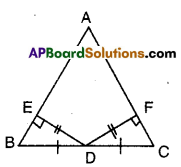
In the figure given below AABC, D is the midpoint of BC. DE ⊥ AB, DF ⊥ AC and DE = DF. Show that ΔBED ≅ AΔCFD.
AP Board 9th Class Maths Solutions Chapter 7 Triangles Ex 7.1 10
Solution:
Given that D is the mid point of BC of ΔABC.
DF ⊥ AC; DE = DF
DE ⊥ AB
In ΔBED and ΔCFD
∠BED = ∠CFD (given as 90°)
BD = CD (∵D is mid point of BC)
ED = FD (given)
∴ ΔBED ≅ ΔCFD (RHS congruence)

Question 10.
If the bisector of an angle of a triangle also bisects the opposite side, prove that the triangle is isosceles.
Solution:
AP Board 9th Class Maths Solutions Chapter 7 Triangles Ex 7.1 11
Let ΔABC be a triangle.
The bisector of ∠A bisects BC
To prove: ΔABC is isosceles
(i.e., AB = AC)
We know that bisector of vertical angle divides the base of the triangle in the ratio of other two sides.
∴ \(\frac{\mathrm{AB}}{\mathrm{AC}}=\frac{\mathrm{BD}}{\mathrm{BC}}\)
Thus \(\frac{\mathrm{AB}}{\mathrm{AC}}\) = 1( ∵ given)
⇒ AB = AC
Hence the Triangle is isosceless.

AP Board 9th Class Maths Solutions Chapter 7 Triangles Ex 7.1

Question 11.
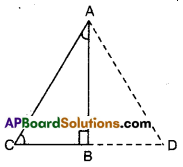
In the given figure ΔABC is a right triangle and right angled at B such that ∠BCA = 2 ∠BAC. Show that the hypotenuse AC = 2BC.
AP Board 9th Class Maths Solutions Chapter 7 Triangles Ex 7.1 12
[Hint : Produce CB to a point D that BC = BD]
Solution:
AP Board 9th Class Maths Solutions Chapter 7 Triangles Ex 7.1 13
Given that ∠B = 90°; ∠BCA = 2∠BAC
To prove : AC = 2BC
Produce CB to a point D such that
BC = BD
Now in ΔABC and ΔABD
AB = AB (common)
BC = BD (construction)
∠ABC =∠ABD (∵ each 90°)
∴ ΔABC ≅ ΔABD
Thus AC = AD and ∠BAC = ∠BAD = 30° [CPCT]
[ ∵ If ∠BAC = x then
∠BCA = 2x
x + 2x = 90°
3x = 90°
⇒ x = 30°
∴ ∠ACB = 60°]
Now in ΔACD,
∠ACD = ∠ADC = ∠CAD = 60°
∴∠ACD is equilateral ⇒ AC = CD = AD
⇒ AC = 2BC (∵ C is mid point)

AP Board 9th Class Maths Solutions Chapter 6 Linear Equation in Two Variables Ex 6.4

AP State Syllabus AP Board 9th Class Maths Solutions Chapter 6 Linear Equation in Two Variables Ex 6.4 Textbook Questions and Answers.

AP State Syllabus 9th Class Maths Solutions 6th Lesson Linear Equation in Two Variables Exercise 6.4

Question 1.
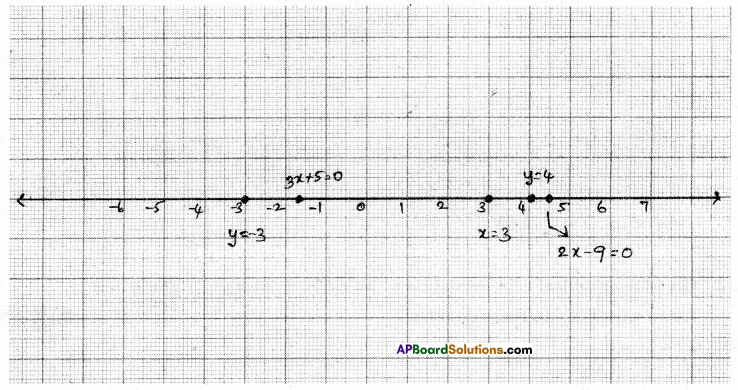
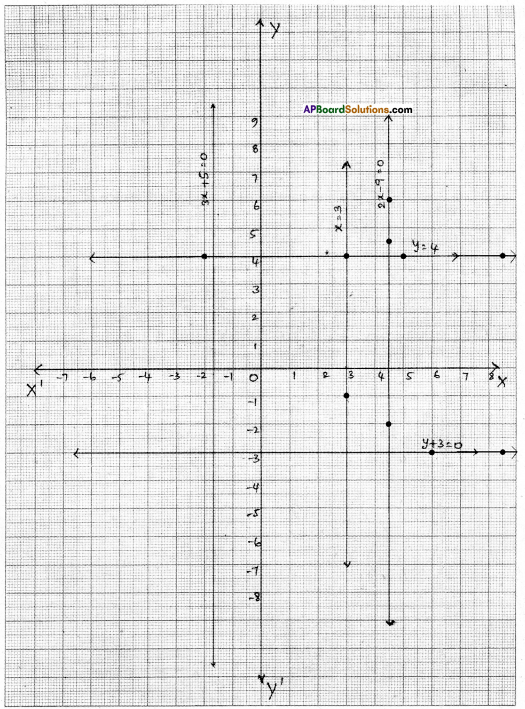
Give the graphical representation of the following equation
a) on the number line and b) on the Cartesian plane.
l) x = 3
ii) y + 3 = 0
iii) y = 4
iv) 2x – 9 = 0
v) 3x + 5 = 0
Solution:
i) x = 3 is a line parallel to Y-axis at a distance of 3 units on the right side of the origin.
ii) y + 3 = 0 y = – 3 is a line parallel to X-axis, below the origin.
iii) y = 4 is a line parallel to X-axis at a distance of 4 units above the origin.
iv) 2x – 9 = 0
⇒ x = \(\frac{9}{2}\) = 4.5 is a line parallel to Y-axis at a distance of 4.5 units, right side of the zero.
v) 3x + 5 = 0
⇒ 3x = -5 x = \(\frac{-5}{3}\) is a line parallel to Y – axis at a distance of \(\frac{5}{3}\)units on the left side of the origin.

x = 3

x333
y-124

y + 3 = 0

X-468
y-3-3-3

y = 4

x-2358
y4444

2x – 9 = 0

X4.54.54.5
y-246

3x + 5 = 0

x\(\frac{-5}{3}\)\(\frac{-5}{3}\)\(\frac{-5}{3}\)
y-124

AP Board 9th Class Maths Solutions Chapter 6 Linear Equation in Two Variables Ex 6.4 1 AP Board 9th Class Maths Solutions Chapter 6 Linear Equation in Two Variables Ex 6.4 2

AP Board 9th Class Maths Solutions Chapter 6 Linear Equation in Two Variables Ex 6.4

Question 2.
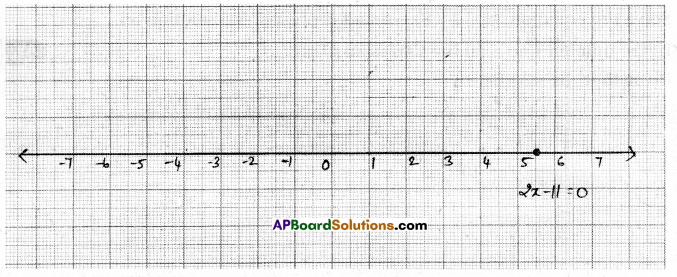
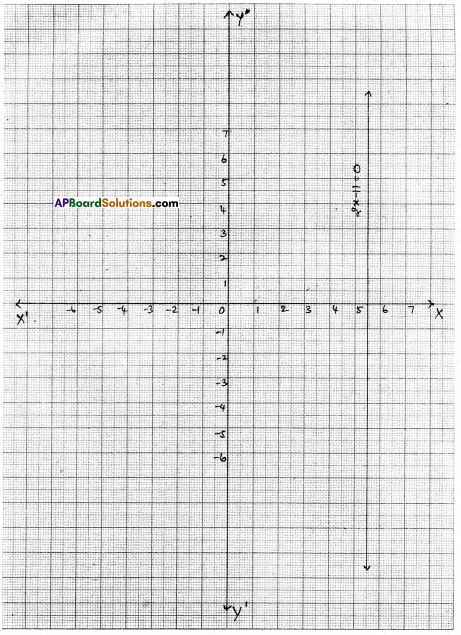
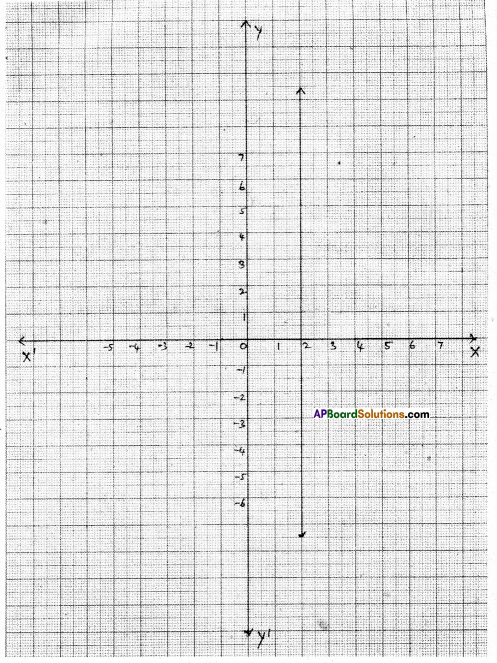
Give the graphical representation of 2x – 11 = 0 as an equation in i) one variable ii) two variables
Solution:
2x – 11 = 0

x5.55.55.5
y-315

AP Board 9th Class Maths Solutions Chapter 6 Linear Equation in Two Variables Ex 6.4 3 AP Board 9th Class Maths Solutions Chapter 6 Linear Equation in Two Variables Ex 6.4 4

Question 3.
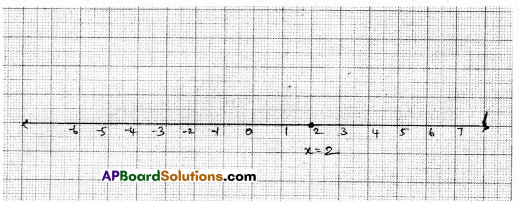
Solve the equation 3x + 2 = 8x – 8 and represent the solution on
i) the number line ii) the Cartesian plane.
Solution:
Given that 3x + 2 = 8x – 8
3x – 8x = – 8 – 2
– 5x = -10
x = \(\frac{-10}{-5}\) = 2

X222
y564

AP Board 9th Class Maths Solutions Chapter 6 Linear Equation in Two Variables Ex 6.4 5
AP Board 9th Class Maths Solutions Chapter 6 Linear Equation in Two Variables Ex 6.4 6

AP Board 9th Class Maths Solutions Chapter 6 Linear Equation in Two Variables Ex 6.4

Question 4.
Write the equation of the line parallel to X-axis and passing through the point i) (0, – 3) ii) (0,4) iii) (2, – 5) iv) (3,4)
Solution:
i) The given point is (0, – 3)
Equation of a line parallel to X-axis is y = k
∴ Required equation is y = – 3 or y + 3 = 0

ii) The given point is (0, 4)
Equation of a line parallel to X-axis is y = k
∴ Required equation isy = 4ory-4 = 0

iii) The given point is (2, – 5)
Equation of a line parallel to X-axis is y = k
∴ Required equation isy = -5 or y + 5 = 0

iv) The given point is (3, 4)
Equation of a line parallel to X-axis is y = k
∴ Required equation isy = 4 or y – 4 = 0

Question 5.
Write the equation of the line parallel to Y-axis passing through the point
i) (- 4, 0)
ii) (2,0)
iii) (3, 5)
(iv) (- 4, – 3)
Solution:
Equation of a line parallel to Y-axis is x = k
∴ The required equations are
i) Through the point (- 4, 0) ⇒ the equation is x = – 4 or x + 4 = 0
ii) Through the point (2, 0) ⇒ the equation isx = 2orx-2 = 0
iii) Through the point (3, 5) ⇒ the equation isx = 3orx-3 = 0
iv) Through the point (- 4,-3) ⇒ the equation is x = – 4 or x + 4 = 0

AP Board 9th Class Maths Solutions Chapter 6 Linear Equation in Two Variables Ex 6.4

Question 6.
Write the equation of three lines that are
1) Parallel to the X-axis
Solution:
y = 3
y = -4
y = 6

ii) Parallel to the Y-axis
Solution:
x = – 2
x = 3
x = 4

AP Board 9th Class Maths Solutions Chapter 8 Quadrilaterals Ex 8.1

AP State Syllabus AP Board 9th Class Maths Solutions Chapter 8 Quadrilaterals Ex 8.1 Textbook Questions and Answers.

AP State Syllabus 9th Class Maths Solutions 8th Lesson Quadrilaterals Exercise 8.1

Question 1.
State whether the statements are true or false.
i) Every parallelogram is a trapezium.
ii) All parallelograms are quadrilaterals.
iii) All trapeziums are parallelograms.
iv) A square is a rhombus.
v) Every rhombus is a square.

vi) All parallelograms are rectangles.
Solution:
i) True
ii) True
iii) False
iv) True
v) False
vi) False

AP Board 9th Class Maths Solutions Chapter 8 Quadrilaterals Ex 8.1

Question 2.
Complete the following table by writing YES if the property holds for the particular quadrilateral and NO if property does not holds.
AP Board 9th Class Maths Solutions Chapter 8 Quadrilaterals Ex 8.1 1 AP Board 9th Class Maths Solutions Chapter 8 Quadrilaterals Ex 8.1 2
Solution:
AP Board 9th Class Maths Solutions Chapter 8 Quadrilaterals Ex 8.1 3

Question 3.
ABCD is a trapezium in which AB || CD. If AD = BC, show that ∠A = ∠B and ∠C = ∠D.
Solution:
Given that in □ABCD AB || CD; AD = BC
Mark a point ‘E’ on AB such DC = AE.
AP Board 9th Class Maths Solutions Chapter 8 Quadrilaterals Ex 8.1 4
Join E, C.
Now in AECD quadrilateral
AE // DC and AE = DC
∴ □AECD is a parallelogram.
∴ AD//EC
∠DAE = ∠CEB (corresponding angles) ……………..(1)
In ΔCEB; CE = CB (∵ CE = AD)
∴ ∠CEB = ∠CBE (angles opp. to equal sides) …………….. (2)
From (1) & (2)
∠DAE = ∠CBE
⇒ ∠A = ∠B
Also ∠D = ∠AEC (∵ Opp. angles of a parallelogram)
= ∠ECB + ∠CBE [ ∵ ∠AEC is ext. angle of ΔBCE] |
= ∠ECB + ∠CEB [ ∵∠CBE = ∠CEB]
= ∠ECB + ∠ECD [∵ ∠ECD = ∠CEB alt. int. angles]
= ∠BCD = ∠C
∴ ∠C = ∠D

AP Board 9th Class Maths Solutions Chapter 8 Quadrilaterals Ex 8.1

Question 4.
The four angles of a quadrilateral are in the ratio of 1 : 2 : 3 : 4. Find the measure of each angle of the quadri-lateral.
Solution:
Given that, the ratio of angles of a quad-rilateral = 1 : 2 : 3 : 4
Sum of the terms of the ratio
= 1 +2 + 3 + 4= 10
Sum of the four interior angles of a quadrilateral = 360°
∴ The measure of first angle
= \(\frac{1}{10}\) × 360° = 36°
The measure of second angle
= \(\frac{2}{10}\) × 360° = 72°
The measure of third angle
= \(\frac{3}{10}\) × 360° = 108°
The measure of fourth angle
= \(\frac{4}{10}\) × 360° = 144°

AP Board 9th Class Maths Solutions Chapter 8 Quadrilaterals Ex 8.1

Question 5.
ABCD is a rectangle, AC is diagonal. Find the angles of ΔACD. Give reasons.
Solution:
AP Board 9th Class Maths Solutions Chapter 8 Quadrilaterals Ex 8.1 5
Given that □ABCD is a rectangle;
AC is its diagonal.
In ΔACD; ∠D = 90° [ ∵ ∠D is also angle of the rectangle]
∠A + ∠C = 90° [ ∵ ∠D = 90° ⇒ ∠A + ∠C = 180°-90° = 90°]
(i.e,,) ∠D right angle and
∠A, ∠C are complementary angles.

AP Board 9th Class Maths Solutions Chapter 2 Polynomials and Factorisation Ex 2.3

AP State Syllabus AP Board 9th Class Maths Solutions Chapter 2 Polynomials and Factorisation Ex 2.3 Textbook Questions and Answers.

AP State Syllabus 9th Class Maths Solutions 2nd Lesson Polynomials and Factorisation Exercise 2.3

Question 1.
Find the remainder when
x3 + 3x2 + 3x + 1 is divided by the following Linear polynomials i) x + 1 Each
Solution:
Let f(x) = x3 + 3x2 + 3x + 1
By remainder theorem, the remainder is f (- 1)
f (- 1) = (- 1)3 + 3(- 1)2 + 3(- 1) + 1
= – 1 + 3 – 3 + 1 = 0

AP Board 9th Class Maths Solutions Chapter 2 Polynomials and Factorisation Ex 2.3

ii) \(x-\frac{1}{2}\)
f(x) = x3 + 3x2 + 3x + 1
By remainder theorem, the remainder is \(\mathrm{f}\left(\frac{1}{2}\right)\)
AP Board 9th Class Maths Solutions Chapter 2 Polynomials and Factorisation Ex 2.3 1

iii) x
Solution:
f(x) = x3 + 3x2 + 3x + 1
The remainder is f(0)
∴ f(0) = 03 + 3(0)2 + 3(0) + 1 = 1

iv) x + π
Solution:
f(x) = x3 + 3x2 + 3x + 1
By remainder theorem, the remainder is f(- π)
f(- π) = (- π)3 + 3(-π)2 + 3 (-π) + 1 .
= – π3 + 3π2 – 3π + 1

v) 5 + 2x
f(x) = x3 + 3x2 + 3x + 1
The remainder is \(\mathrm{f}\left(\frac{-5}{2}\right)\)
AP Board 9th Class Maths Solutions Chapter 2 Polynomials and Factorisation Ex 2.3 2

AP Board 9th Class Maths Solutions Chapter 2 Polynomials and Factorisation Ex 2.3

Question 2.
Find the remainder when x3 – px2 + 6x – p is divided by x – p.
Solution:
Let f(x) = x3 – px2 + 6x – p
(x – a) = x – p)
By Remainder theorem, the remainder is f(p)
∴ f(P) = P3 – P(P)2 + 6p – p
= p3 – p3 + 5p = 5p

Question 3.
Find the remainder when 2x2 – 3x + 5 is divided by 2x – 3. Does it exactly divide the polynomial ? State reason.
Solution:
Let f(x) = 2x2 – 3x + 5 and
x – a = 2x – 3 = x – \(\frac{3}{2}\)
By Remainder theorem f(x) when divided by (x – \(\frac{3}{2}\) ) leaves a remainder \(\mathrm{f}\left(\frac{3}{2}\right)\)
AP Board 9th Class Maths Solutions Chapter 2 Polynomials and Factorisation Ex 2.3 3
As the remainder is 5 we say that (2x – 3) is not a factor of f(x).

Question 4.
Find the remainder when 9x3 – 3x2 + x – 5 is divided by x – \(\frac{2}{3}\)
Solution:
Let f(x) = 9x3 – 3x2 + x – 5
x-a = x – \(\frac{2}{3}\)
Remainder theorem the remainder is \(\mathrm{f}\left(\frac{2}{3}\right)\)
AP Board 9th Class Maths Solutions Chapter 2 Polynomials and Factorisation Ex 2.3 4

AP Board 9th Class Maths Solutions Chapter 2 Polynomials and Factorisation Ex 2.3

Question 5.
If the polynomials 2x3 + ax2 + 3x – 5 and x3 + x2 – 4x + a leave the same remainder, when divided by x – 2, find the value of a.
Solution:
Let f(x) = 2x3 + ax2 + 3x – 5
g(x) = x3 + x2 – 4x + a
Given that f(x) and g(x) divided x – 2
give same remainder.
i e., f(2) = g(2)
By Remainder theorem.
But f(2) = 2(2)3 + a(2)2 + 3(2) – 5
= 2 x 8 + 4a + 6 – 5
= 17 +4a
g(2) = 23 + 22 – 4(2) + a .
= 8 + 4 – 8 + a = 4 + a
i.e., 4 + a = 17 + 4a
∴ a – 4a = 17 – 4
– 3a = 13
a = -13/3

Question 6.
If the polynomials x3 + ax2 + 5 and x3 – 2x2 + a are divided by (x + 2) leave the same remainder, find the value of a.
Solution:
Let f(x) = x3 + ax2 + 5
g(x) = x3 – 2x2 + a
Given that when f(x) and g(x) divided by (x + 2) leaves the same remainder.
i.e.,f(-2) = g(-2)
By Remainder theorem
f(- 2) = (- 2)3 + a(- 2)2 + 5
= -8 + 4a + 5 = 4a – 3
g(- 2) = (- 2)3 – 2(- 2)2 + a
= -8 – 8 + a = a – 16
By problem,
4a – 3 = a – 16
4a – a = – 16 + 3
⇒ 3a = – 13 ⇒ a = -13/3

AP Board 9th Class Maths Solutions Chapter 2 Polynomials and Factorisation Ex 2.3

Question 7.
Find the remainder when f(x) = x4 – 3x2 + 4 is divided by g(x) = x – 2 and verify the result by actual division.
Solution:
Given f(x) = x4 – 3x2 + 4
g(x) = x – 2
The remainder when f(x) is divided by g(x) is f(2).
f(2) = 24 – 3(2)2 + 4
= 16 – 12 + 4
= 8
Actual division
AP Board 9th Class Maths Solutions Chapter 2 Polynomials and Factorisation Ex 2.3 5
∴ The remainder either by Remainder theorem or by actual division is the same.

Question 8.
Find the remainder when p(x) = x3 – 6x2 + 14x – 3 is divided by g(x) = 1 – 2x and verify the result by long division method.
Solution:
Given p(x) = x3 – 6x2 + 14x – 3
g(x) = 1 – 2x
By Remainder theorem when p(x) is divided by g(x) is p(1/2).
AP Board 9th Class Maths Solutions Chapter 2 Polynomials and Factorisation Ex 2.3 6

AP Board 9th Class Maths Solutions Chapter 2 Polynomials and Factorisation Ex 2.3

Question 9.
When a polynomial 2x3 + 3x2 + ax + b is divided by (x – 2) leaves remainder 2, and (x + 2) leaves remainder – 2. Find a and b.
Solution:Let f(x) = 2x3 + 3x2 + ax + b
The remainder when f(x) is divided by (x – 2) is 2.
i.e., f(2) = 2
⇒ 2(2)3 + 3(2)2+ a(2) + b = 2
⇒ 16 + 12 + 2a +b = 2
⇒ 2a + b = – 26 …………………..(1)

Also the remainder when f(x) is divided by (x + 2) is – 2.
i.e., f(- 2) = – 2
⇒ 2(- 2)3 + 3(- 2)2 + a (- 2) + b = – 2
⇒ -16 + 12 – 2a + b = – 2
– 2a + b = 2 ………………..(2)
Solving (1) and (2),
AP Board 9th Class Maths Solutions Chapter 2 Polynomials and Factorisation Ex 2.3 7
b = – 12
and 2a – 12 = – 26
2a = -26+ 12
a = -14/2 = -7,
a = -7, b = – 12

AP Board 9th Class Maths Solutions Chapter 4 Lines and Angles Ex 4.3

AP State Syllabus AP Board 9th Class Maths Solutions Chapter 4 Lines and Angles Ex 4.3 Textbook Questions and Answers.

AP State Syllabus 9th Class Maths Solutions 4th Lesson Lines and Angles Exercise 4.3

Question 1.
It is given that l // m; to prove ∠1 is supplement to ∠8. Write reasons for the Statements.
AP Board 9th Class Maths Solutions Chapter 4 Lines and Angles Ex 4.3 1

Solution:

StatementReasons
i) l //m∠1 + ∠8 = 180° (exterior angles on the same side of the transversal)
ii) ∠1 = ∠5corresponding angles
iii) ∠5 + ∠8 = 180°linear pair of angles
iv) ∠1 + ∠8 = 180°exterior angles on the same side of the transversal.
v) ∠1 is supplement is ∠8exterior angles on the same side of the transversal.

AP Board 9th Class Maths Solutions Chapter 4 Lines and Angles Ex 4.3

Question 2.
In the given figure AB || CD; CD || EF and y: z = 3:7 find x.
AP Board 9th Class Maths Solutions Chapter 4 Lines and Angles Ex 4.3 2
Solution:
Given that AB//CD; CD//EF.
⇒ AB // EF
Also y : z = 3 : 7
From the figure x + y = 180 …………. (1)
[∵ interior angles on the same side of the transversal]
Also y + z = 180 ………….. (2)
Sum of the terms of the ratio y : z
= 3 + 7 = 10
∴ y = \(\frac{3}{10}\) x 180° = 54°
y = \(\frac{7}{10}\) x 180° = 126°
From (1) and (2)
x + y = y + z
⇒ x = z = 126°

Question 3.
In the given figure AB//CD; EF ⊥ CD and ∠GED = 126°, find ∠AGE, ∠GEF and ∠FGE.
AP Board 9th Class Maths Solutions Chapter 4 Lines and Angles Ex 4.3 3
Solution:
Given that EF ⊥ CD; ∠GED = 126°
i. e., ∠FED = 90° and
∠GEF = ∠GED – ∠FED
∠GEF = 126° – 90° = 36°
In ∆GFE
∠GEF + ∠FGE + ∠EFG = 180°
36 + ∠FGE + 90° = 180°
∠FGE = 180° – 126° = 54°
∠AGE = ∠GFE + ∠GEF
(exterior angle in ∆GFE)
= 90°+ 36°= 126°

AP Board 9th Class Maths Solutions Chapter 4 Lines and Angles Ex 4.3

Question 4.
In the given figure PQ//ST, ∠PQR = 110° and ∠RST = 130°, find ∠QRS. [Hint : Draw a line parallel to ST through point R.]
AP Board 9th Class Maths Solutions Chapter 4 Lines and Angles Ex 4.3 4
Solution:
AP Board 9th Class Maths Solutions Chapter 4 Lines and Angles Ex 4.3 5
Given PQ // ST
Draw a lipe ‘l’ parallel to ST through R.
From the figure
a + 110° = 180° and c + 130 = 180°
[ ∵ Interior angles on the same side of the transversal]
∴ a = 180° -110° = 70°
c = 180° – 130° = 50°
Also a + b + c = 180° (angles at a point on a line)
70° + b + 50° = 180°
b = 180° – 120° = 60°
∴ ∠QRS = 60°

AP Board 9th Class Maths Solutions Chapter 4 Lines and Angles Ex 4.3

Question 5.
In the given figure m // n. A, B are any two points on in and n respectively. Let C be an interior point between the lines m and n. Find ∠ACB.
AP Board 9th Class Maths Solutions Chapter 4 Lines and Angles Ex 4.3 6
Solution:
AP Board 9th Class Maths Solutions Chapter 4 Lines and Angles Ex 4.3 7
Draw a line ‘l’ parallel to m and n through C.
From the figure
x = a [ ∵ alternate interior angles for l, m]
y = b [ ∵ alternate interior angles for l, n]
∴ z = a + b = x + y

Question 6.
Find the values of a and b, given that p // q and r // s.
AP Board 9th Class Maths Solutions Chapter 4 Lines and Angles Ex 4.3 8
Solution:
Given that p // q and r // s.
∴ From the figure
2a = 80° (∵ corresponding angles)
a = \(\frac { 80° }{ 2 }\) = 40°
Also 80° + b = 180° ( ∵ interior angles on the same side of the transversal)
∴ b = 180° – 80° = 100°

AP Board 9th Class Maths Solutions Chapter 4 Lines and Angles Ex 4.3

Question 7.
If in the figure a // b and c // d, then name the angles that are congruent to (i) ∠1 and (ii) ∠2.
AP Board 9th Class Maths Solutions Chapter 4 Lines and Angles Ex 4.3 9
Solution:
Given that a // b and c // d.
∠1 = ∠3 (∵ vertically opposite angles)
∠1 = ∠5 (∵ corresponding angles)
∠1 = ∠9 (∵ corresponding angles)
Also ∠1 = ∠3 = ∠5 = ∠7 ;
∠1 = ∠11 = ∠9 = ∠13 = ∠15
Similarly ∠2 = ∠4 = ∠6 = ∠8
Also ∠2 = ∠10 = ∠12 = ∠14 = ∠16

Question 8.
In the figure the arrow head segments are parallel, find the values of x and y.
AP Board 9th Class Maths Solutions Chapter 4 Lines and Angles Ex 4.3 10
Solution:
From the figure
y = 59° ( ∵ alternate interior angles)
x = 60° ( ∵ corresponding angles)

AP Board 9th Class Maths Solutions Chapter 4 Lines and Angles Ex 4.3

Question 9.
In the figure the arrow head segments are parallel then find the values of x and y.
AP Board 9th Class Maths Solutions Chapter 4 Lines and Angles Ex 4.3 11
Solution:
From the figure 35° + 105° + y = 180°
∴ y = 180° – 140°
= 40°
∴ x = 40° (∵ x, y are corresponding angles)

Question 10.
Find the values of x and y from the figure.
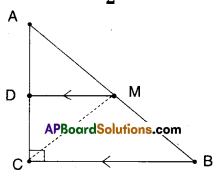
AP Board 9th Class Maths Solutions Chapter 4 Lines and Angles Ex 4.3 12
Solution:
From the figure 120° + x = 180°
(∵ exterior angles on the same side of the transversal)
∴ x = 180° – 120°
x = 60°
Also x = (3y + 6)
(∵ corresponding angles)
3y + 6 = 60°
3y = 60° – 6° = 54°
y = \(\frac { 54 }{ 3 }\) = 18°
∴ x = 60°; y = 18°

Question 11.
From the figure find x and y.
AP Board 9th Class Maths Solutions Chapter 4 Lines and Angles Ex 4.3 13
Solution:
From the figure
52° + 90° + (3y + 5)° = 180°
(∵ interior angles of a triangle)
∴ 3y + 147 = 180°
⇒ 3y = 33°
⇒ y = \(\frac { 33 }{ 3 }\) = 11°
Also x + 65° + 52° = 180°
(∵ interior angles on the same side of the transversal)
∴ x = 180° -117° = 63°

AP Board 9th Class Maths Solutions Chapter 4 Lines and Angles Ex 4.3

Question 12.
Draw figures for the following statement.
“If the two arms of one angle are respectively perpendicular to the two arms of another angle then the two angles are either equal or supplementary
Solution:
AP Board 9th Class Maths Solutions Chapter 4 Lines and Angles Ex 4.3 14
AO ⊥ PQ, OB ⊥ QR
Angles are supplementary.
AP Board 9th Class Maths Solutions Chapter 4 Lines and Angles Ex 4.3 15
AO ⊥ PQ, OB ⊥ QR
Angles are equal.

Question 13.
In the given figure, if AB // CD; ∠APQ = 50° and ∠PRD = 127°, find x and y.
AP Board 9th Class Maths Solutions Chapter 4 Lines and Angles Ex 4.3 16
Solution:
Given that AB // CD.
∠PRD = 127°
From the figure x = 50°
(∵ alternate interior angles)
Also y + 50 = 127°
(∵ alternate interior angles)
∴ y = 127-50 = 77°

AP Board 9th Class Maths Solutions Chapter 4 Lines and Angles Ex 4.3

Question 14.
In the given figure PQ and RS are two mirrors placed parallel to each other.
An incident ray \(\overline{\mathrm{AB}}\) strikes the mirror PQ at B, the reflected ray moves along the path \(\overline{\mathrm{BC}}\) and strikes the mirror RS at C and again reflected back along CD. Prove that AB // CD. [Hint : Perpendiculars drawn to parallel lines are also parallel]
AP Board 9th Class Maths Solutions Chapter 4 Lines and Angles Ex 4.3 17
Solution:
AP Board 9th Class Maths Solutions Chapter 4 Lines and Angles Ex 4.3 18
Draw the normals at B and C.
then ∠x = ∠y (angle of incidence angle of reflection are equal)
∠y = ∠w (alternate interior angles)
∠w = ∠z (angles of reflection and incidence)
∴ x + y = y + z (these are alternate interior angles to \(\overline{\mathrm{AB}}\), \(\overline{\mathrm{CD}}\))
Hence AB // CD.

AP Board 9th Class Maths Solutions Chapter 4 Lines and Angles Ex 4.3

Question 15.
In the figures given below AB // CD. EF is the transversal intersecting AB and CD at G and H respectively. Find the values of x and y. Give reasons.
AP Board 9th Class Maths Solutions Chapter 4 Lines and Angles Ex 4.3 19
Solution:
For fig(i)
3x = y (∵ alternate interior angles)
2x + y = 180° (∵ linear pair of angles)
∴ 2x + 3x = 180°
5x= 180°
x = \(\frac { 180 }{ 5 }\) = 36°
and y = 3x = 3 x 36 = 108°

For fig (ii)
2x + 15 = 3x- 20°
(∵ corresponding angles)
2x-3x = -20-15
– x = – 35
x = 35°

AP Board 9th Class Maths Solutions Chapter 4 Lines and Angles Ex 4.3

For fig (iii)
(4x – 23) + 3x = 180° ,
( ∵ interior angles on the same side of the transversal)
7x- 23 = 180°
7x = 203
x = \(\frac { 203 }{ 7 }\) = 29°

Question 16.
In the given figure AB // CD, ‘t’ is a transversal intersecting E and F re-spectively. If ∠2 : ∠1 = 5 : 4, find the measure of each marked angles.
AP Board 9th Class Maths Solutions Chapter 4 Lines and Angles Ex 4.3 20
Solution:
Given that AB // CD and ∠2 : ∠1 = 5 : 4 ∠1 + ∠2 = 180° (-. linear pair of angles) Sum of the terms of the ratio ∠2 :∠1 = 5 + 4 = 9
∴ ∠1 = \(\frac { 4 }{ 9 }\) x 180° = 80°
∠2= \(\frac { 5 }{9 }\) x 180° = 100°
Also ∠1, ∠3, ∠5, ∠7 are all equal to 80°. Similarly ∠2, ∠4, ∠6, ∠8 are all equal to 100°.

Question 17.
In the given figure AB//CD. Find the values of x, y and z.
AP Board 9th Class Maths Solutions Chapter 4 Lines and Angles Ex 4.3 21
Solution:
Given that AB // CD.
From the figure (2x + 3x) + 80° = 180°
(∵ interior angles on the same side of the transversal)
∴ 5x = 180° – 80°
x = \(\frac{100}{5}\) = 20°
Now 3x = y (∵ alternate interior angles)
y = 3 x 20° = 60° .
And y + z = 180°
(∵ linear pair of angles)
∴ z = 180°-60° = lg0°

AP Board 9th Class Maths Solutions Chapter 4 Lines and Angles Ex 4.3

Question 18.
In the given figure AB // CD. Find the values of x, y and z.
AP Board 9th Class Maths Solutions Chapter 4 Lines and Angles Ex 4.3 22
Solution:
Given that AB // CD.
From the figure x° + 70° + x° = 180°
(∵ The angles at a point on the line)
∴ 2x = 180° – 70°
x = \(\frac { 110° }{ 2 }\) = 55-
Also 90° + x° + y° = 180°
[∵ interior angles of a triangle]
90° + 55° + y = 180°
y = 180° – 145° = 35°
And x° + z° = 180°
[∵ interior angles on the same side of a transversal]
55° + z = 180°
z = 180°-55° = 125°

Question 19.
In each of the following figures AB // CD. Find the values of x in each case.
AP Board 9th Class Maths Solutions Chapter 4 Lines and Angles Ex 4.3 23
Solution:
AP Board 9th Class Maths Solutions Chapter 4 Lines and Angles Ex 4.3 24
In each case draw a line ‘l’ parallel to AB and CD through F.
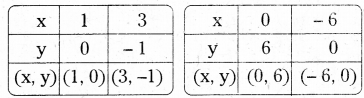
fig (i)
a + 104° = 180° ⇒ a = 180° – 104° = 76°
b+ 116° = 180° ⇒ -b = 180°- 116° = 64°
[∵ interior angles on the same side]
∴ a + b = x = 76° + 64° = 140°

fig-(ii)
a = 35°, b = 65° [∵ alt. int. angles]
x = a + b = 35° + 65° = 100°

fig- (iii)
a + 35° = 180° ⇒ a = 145°
b + 75° = 180° ⇒ b = 105°
[ ∵ interior angles on the same side]
∴ x = a + b = 145° + 105° = 250°

AP Board 9th Class Maths Solutions Chapter 4 Lines and Angles Ex 4.3

AP Board 9th Class Maths Solutions Chapter 2 Polynomials and Factorisation Ex 2.2

AP State Syllabus AP Board 9th Class Maths Solutions Chapter 2 Polynomials and Factorisation Ex 2.2 Textbook Questions and Answers.

AP State Syllabus 9th Class Maths Solutions 2nd Lesson Polynomials and Factorisation Exercise 2.2

Question 1.
Find the value of the polynomial 4x2 – 5x + 3, when
(i) x = 0
Solution:
The value at x = 0 is
4(0)2 – 5(0) + 3
= 3

AP Board 9th Class Maths Solutions Chapter 2 Polynomials and Factorisation Ex 2.2

(ii) x = – 1
Solution:
The value at x = – 1 is
4 (- 1)2 – 5 (- 1) + 3
= 4 + 5 + 3
= 12

iii) x = 2
Solution:
The value at x = 2 is
4(2)2 – 5(2) + 3
= 16 -10 + 3
= 9

iv) x = \(\frac{1}{2}\)
Solution:
AP Board 9th Class Maths Solutions Chapter 2 Polynomials and Factorisation Ex 2.2 1

Question 2.
Find p(0), p(1) and p(2) for each of the following polynomials.
i) p(x) = x2 – x + 1
Solution:
p(0) = 02 – 0 + 1 = 1
p(1) = 12 – 1 + 1 = 1
p(2) = 22 – 2 + 1 = 3

ii) P(y) = 2 + y + 2y2 – y3
Solution:
p(0) = 2 + 0 + 2(0)2 – 03 = 2
p(1) = 2+ 1 + 2(1)2 – 13 = 4
p(2) = 2 + 2 + 2(2)2 -23 = 4 + 8- 8 = 4

AP Board 9th Class Maths Solutions Chapter 2 Polynomials and Factorisation Ex 2.2

iii) P(z) = z3
Solution:
p(0) = 03 = 0
p(1) = 13 = 1
p(2) = 23 = 8

iv) p(t) = (t – 1)(t + 1) = t2 – 1
Solution:
p(0) = (0 – 1) (0 + 1) = – 1
p(1) = t2 – 1 = 12 – 1 = 0
p(2) = 22 – 1 = 4 – 1 = 3

v) p(x) = x2 – 3x + 2
Solution:
p(0) = 02 – 3(0) + 2 = 2
p(1) = 12 – 3(1) + 2 = 1 – 3 + 2 = 0
p(2) = 22 – 3(2) + 2 = 4- 6 + 2 = 0

Question 3.
Verify whether the values of x given in each case are the zeroes of the polynomial or not ?
i) p(x) = 2x + 1; x = \(\frac{-1}{2}\)
Solution:
The value of p(x) at x = \(\frac{-1}{2}\) is
\(\mathrm{p}\left(\frac{-1}{2}\right)=2\left(\frac{-1}{2}\right)+1\)
= -1 + 1 = 0
∴ x = \(\frac{-1}{2}\) is a zero of p(x).

AP Board 9th Class Maths Solutions Chapter 2 Polynomials and Factorisation Ex 2.2

(ii) p(x) = 5x – π ; x = \(\frac{-3}{2}\)
Solution:
The value of p(x) at x = \(\frac{-3}{2}\) is
\(\mathrm{p}\left(\frac{-3}{2}\right)=5\left(\frac{-3}{2}\right)-\pi=\frac{-15}{2}-\pi \neq 0\)
∴ x = \(\frac{-3}{2}\) is not a zero of p(x).

iii) p(x) = x2 – 1; x = ±1
Solution:
The value of p(x) at x = 1 and – 1 is
p(1) = 12 – 1 = 0
p(-1) = (-1)2 -1 = 0
∴ x = ±1 is a zero of p(x).

iv) p(x) = (x – 1) (x + 2); x = – 1, – 2
Solution:
The value of p(x) at x = – 1 is
p(-1) = (-1 – 1) (-1 + 2)
=-2 x 1 =-2 ≠ 0
Hence x = – 1 is not a zero of p(x).
And the value of p(x) at x = – 2 is
p (- 2) = (- 2 – 1) (- 2 + 2) = – 3 x 0 = 0
Hence, x = – 2 is a zero of p(x).

v) p(y) = y2; y = o
Solution:
The value of p(y) at y = 0 is p(0) = 02 = 0
Hence y = 0 is a zero of p(y).

AP Board 9th Class Maths Solutions Chapter 2 Polynomials and Factorisation Ex 2.2

vi) p(x) = ax + b ; x = \(\frac{-\mathbf{b}}{\mathbf{a}}\)
Solution:
The value of p(x) at x = \(\frac{-\mathbf{b}}{\mathbf{a}}\) is
\(\mathrm{p}\left(\frac{-\mathrm{b}}{\mathrm{a}}\right)=\mathrm{a}\left(\frac{-\mathrm{b}}{\mathrm{a}}\right)+\mathrm{b}\)
= -b + b = 0
∴ x = \(\frac{-\mathbf{b}}{\mathbf{a}}\) is a zero of p(x).

vii) f(x) = 3x2 – 1; x = \(\frac{-1}{\sqrt{3}}, \frac{2}{\sqrt{3}}\)
Solution:
AP Board 9th Class Maths Solutions Chapter 2 Polynomials and Factorisation Ex 2.2 2

AP Board 9th Class Maths Solutions Chapter 2 Polynomials and Factorisation Ex 2.2

viii) f(x) = 2x – 1; x = \(\frac{1}{2} ;-\frac{1}{2}\)
Solution:
AP Board 9th Class Maths Solutions Chapter 2 Polynomials and Factorisation Ex 2.2 3

Question 4.
Find the zero of the polynomial in each of the following cases.
i) f(x) = x + 2
Solution:
x + 2 = 0
x = – 2

ii) f(x) = x – 2
Solution:
x – 2 = 0
x = 2

iii) f(x) = 2x + 3
Solution:
2x + 3 = 0
2x = – 3
x = \(\frac{-3}{2}\)

AP Board 9th Class Maths Solutions Chapter 2 Polynomials and Factorisation Ex 2.2

iv) f(x) = 2x – 3
Solution:
2x – 3 = 0
2x = 3
x = \(\frac{3}{2}\)

v) f(x) = x2
Solution:
x2 = 0
x = 0

vi) f(x) = px, p ≠ 0
Solutin:
px = 0
x = 0

vii) f(x) = px + q; p ≠ 0; p, q are real numbers.
Solution:
px + q = 0
px = -q
x = \(\frac{-\mathrm{q}}{\mathrm{p}}\)

AP Board 9th Class Maths Solutions Chapter 2 Polynomials and Factorisation Ex 2.2

Question 5.
If 2 is a zero of the polynomial p(x) = 2x2 – 3x + 7a, find the value of
a.
Solution:
Given that 2 is a zero of p(x) = 2x2 – 3x + 7a
(i.e.) p(2) = 0
⇒ 2(2)2 – 3(2) + 7a = 0
⇒ 8 – 6 + 7a = 0
⇒ 2 + 7a = 0
⇒ 7a = – 2
⇒ a = \(\frac{-2}{7}\)

AP Board 9th Class Maths Solutions Chapter 2 Polynomials and Factorisation Ex 2.2

Question 6.
If 0 and 1 are the zeroes of the polynomial f(x) = 2x3 – 3x2 + ax + b, find the values of a and b.
Solution:
Given that f(0) = 0; f(1) = 0 and
f(x) = 2x3 – 3x2 + ax + b
∴ f(0) = 2(0)3 – 3(0)2 + a(0) + b
⇒ 0 = b
Also f(1) = 0
⇒ 2(1)3 – 3(1)2 + a(1) + 0 = 0
⇒ 2 – 3 + a = 0 .
⇒ a = 1
Hence a = 1; b = 0

AP Board 9th Class Maths Solutions Chapter 4 Lines and Angles Ex 4.2

AP State Syllabus AP Board 9th Class Maths Solutions Chapter 4 Lines and Angles Ex 4.2 Textbook Questions and Answers.

AP State Syllabus 9th Class Maths Solutions 4th Lesson Lines and Angles Exercise 4.2

AP Board 9th Class Maths Solutions Chapter 4 Lines and Angles Ex 4.2

Question 1.
In the given figure three lines \(\overline{\mathrm{AB}}\) , \(\overline{\mathrm{CD}}\) and \(\overline{\mathrm{EF}}\) intersecting at ‘O’. Find the values of x, y and z, it is being given that x : y : z = 2 : 3 : 5
AP Board 9th Class Maths Solutions Chapter 4 Lines and Angles Ex 4.2 1
Solution:
From the figure
2x + 2y + 2z = 360°
⇒ x + y + z = 180°
x : y : z = 2 : 3 : 5
Sum of the terms of the ratio
= 2 + 3 + 5 = 10
AP Board 9th Class Maths Solutions Chapter 4 Lines and Angles Ex 4.2 2

AP Board 9th Class Maths Solutions Chapter 4 Lines and Angles Ex 4.2

Question 2.
Find the value of x in the following figures.
i)
AP Board 9th Class Maths Solutions Chapter 4 Lines and Angles Ex 4.2 3
Solution:
From the figure
3x + 18= 180° – 93° (∵ linear pair )
3x + 18 = 87
3x = 87- 18 = 69
∴ x = \(\frac{69}{3}\) = 23

ii)
AP Board 9th Class Maths Solutions Chapter 4 Lines and Angles Ex 4.2 4
Solution:
From the figure
(x – 24)° + 29° + 296° = 360“
(∵ complete angle)
x + 301° = 360°
∴ x = 360° – 301° = 59°

iii)
AP Board 9th Class Maths Solutions Chapter 4 Lines and Angles Ex 4.2 5
Solution:
From the figure
2 + 3x = 62
(∵ vertically opposite angles)
3x = 62 – 2
∴ 3x = 60° ⇒ x = \(\frac{60}{3}\)
∴ x = 20°

AP Board 9th Class Maths Solutions Chapter 4 Lines and Angles Ex 4.2

iv)
AP Board 9th Class Maths Solutions Chapter 4 Lines and Angles Ex 4.2 6
Solution:
From the figure
40 + (6x + 2) = 90°
(∵ complementary angles)
6x = 90° – 42°
6x = 48
x = \(\frac{48}{6}\) = 8°

Question 3.
In the given figure lines \(\overline{\mathrm{AB}}\) and \(\overline{\mathrm{CD}}\) intersect at ’O’. If ∠AOC + ∠BOE = 70° and ∠BOD = 40°, find ∠BOE and reflex ∠COE.
AP Board 9th Class Maths Solutions Chapter 4 Lines and Angles Ex 4.2 7
Solution:
Given that ∠AOC +∠BOE = 70°
∠BOD = 40°
∠AOC = 40°
(∵ ∠AOC, ∠BOD are vertically opposite angles)
∴ 40° + ∠BOE = 70°
⇒ ∠BOE = 70° – 40° = 30°
Also ∠AOC + ∠COE +∠BOE = 180°
( ∵ AB is a line)
⇒ 40° + ∠COE + 30° = 180°
⇒ ∠COE = 180° -70° = 110°
∴ Reflex ∠COE = 110°

AP Board 9th Class Maths Solutions Chapter 4 Lines and Angles Ex 4.2

Question 4.
In the given figure lines \(\overline{\mathrm{XY}}\) and \(\overline{\mathrm{MN}}\) . intersect at O. If ∠POY = 90° and a : b = 2:3, find c.
AP Board 9th Class Maths Solutions Chapter 4 Lines and Angles Ex 4.2 8
Solution:
Given that XY and MN are lines.
∠POY = 90°
a : b = 2 : 3
From the figure a + b = 90°
Sum of the terms of the ratio a : b
= 2 + 3 = 5
∴ b = \(\frac{3}{5}\) x 90° = 54°
From the figure b + c = 180°
(∵ linear pair of angles)
54° + c = 180°
c = 180°-54° = 126°

AP Board 9th Class Maths Solutions Chapter 4 Lines and Angles Ex 4.2

Question 5.
In the given figure ∠PQR = ∠PRQ, then prove that ∠PQS = ∠PRT.
AP Board 9th Class Maths Solutions Chapter 4 Lines and Angles Ex 4.2 9
Solution:
Given that ∠PQR = ∠PRQ
From the figure
∠PQR + ∠PQS = 180° ………….. (1)
∠PRQ + ∠PRT = 180° …………..(2)
From (1) and (2)
∠PQR + ∠PQS = ∠PRQ + ∠PRT
But ∠PQR = ∠PRQ
So ∠PQS = ∠PRT
Hence proved.

Question 6.
In the given figure, if x + y = w + z, then prove that AOB is a line.
AP Board 9th Class Maths Solutions Chapter 4 Lines and Angles Ex 4.2 10
Solution:
Given that x + y = w + z = k say
From the figure
x + y + z + w = 360°
(∵ Angle around a point)
Also x + y = z + w
∴ x + y = z + w = \(\frac{360^{\circ}}{2}\)
∴ x + y = z + w = 180°

OR

k + k = 360°
2k = 360°
k = \(\frac{360^{\circ}}{2}\)

(i.e.) (x,y) and (z, w) are pairs of adjacent angles whose sum is 180°.
In other words (x, y) and (z, w) are linear pair of angles ⇒ AOB is a line.

AP Board 9th Class Maths Solutions Chapter 4 Lines and Angles Ex 4.2

Question 7.
In the given figure \(\overline{\mathrm{PQ}}\) is a line. Ray \(\overline{\mathrm{OR}}\) is perpendicular to line \(\overline{\mathrm{PQ}}\).\(\overline{\mathrm{OS}}\) os is another ray lying between rays \(\overline{\mathrm{OP}}\) and \(\overline{\mathrm{OR}}\) Prove that
AP Board 9th Class Maths Solutions Chapter 4 Lines and Angles Ex 4.2 11
Solution:
Given : OR ⊥ PQ ⇒ ∠ROQ = 90°
To prove: ∠ROS = \(\frac{1}{2}\) (∠QOS – ∠POS)
Solution:
Proof: From the figure
∠ROS = ∠QOS – ∠QOR ……………(1)
∠ROS = ∠ROP – ∠POS ……………..(2)
Adding (1) and (2)
∠ROS + ∠ROS = ∠QOS – ∠QOR +∠ROP – ∠POS [ ∵ ∠QOR = ∠ROP = 90° given]
⇒ 2∠ROS = ∠QOS – ∠POS
⇒ ∠ROS = \(\frac{1}{2}\) [∠QOS – ∠POS]
Hence proved.

AP Board 9th Class Maths Solutions Chapter 4 Lines and Angles Ex 4.2

Question 8.
It is given that ∠XYZ = 64° and XY is produced to point P. A ray \(\overline{\mathrm{YQ}}\) bisects ∠ZYP. Dräw a figure from the given Information. Find ∠XYQ and reflex ∠QYP.
Solution:
AP Board 9th Class Maths Solutions Chapter 4 Lines and Angles Ex 4.2 12
∠XYQ = 32°
∠QYP = 32°

AP Board 9th Class Maths Solutions Chapter 2 Polynomials and Factorisation Ex 2.1

AP State Syllabus AP Board 9th Class Maths Solutions Chapter 2 Polynomials and Factorisation Ex 2.1 Textbook Questions and Answers.

AP State Syllabus 9th Class Maths Solutions 2nd Lesson Polynomials and Factorisation Exercise 2.1

Question 1.
Find the degree of each of the polynomials given below,
i) x5 – x4 + 3
Solution:
Degree is 5.

ii) x2 + x – 5
Solution:
Degree is 2.

iii) 5
Solution:
Degree is 0.

iv) 3x6 + 6y3 – 7
Solution:
Degree is 6.

v) 4 – y2
Solution:
Degree is 2.

vi) 5t – √3
Solution:
Degree is 1.

AP Board 9th Class Maths Solutions Chapter 2 Polynomials and Factorisation Ex 2.1

Question 2.
Which of the following expressions are polynomials in one variable and which are not ? Give reasons for your answer.
i) 3x2 – 2x + 5
Solution:
Given expression is a polynomial in one variable.

ii) x2 + √2
Solution:
Given expression is a polynomial in one variable.

iii) p2 – 3p + q
Solution:
Given expression is not a polynomial in one variable. It involves two variables p and q.

iv) y + \(\frac{2}{\mathbf{y}}\)
Solution:
Given expression is not a polynomial. Since the second term contains the variable in its denominator.

v) \(5 \sqrt{x}+x \sqrt{5}\)
Solution:
Given expression is not a polynomial. Since the first term’s exponent is not an integer.

vi) x100 + y100
Solution:
Given expression has two variables. So it is not a polynomial in one variable.

AP Board 9th Class Maths Solutions Chapter 2 Polynomials and Factorisation Ex 2.1

Question 3.
Write the coefficient of x3 in each of the following.
i) x3 + x + 1
ii) 2 – x3+ x2
iii) \(\sqrt{2} x^{3}+5\)
iv) 2x3 + 5
v) \(\frac{\pi}{2} x^{3}+x\)
vi) \(-\frac{2}{3} x^{3}\)
vii) 2x2 + 5
viii) 4
Solution:
i) x3 + x + 1 : co-efficient of x3 is 1.
ii) 2 – x3+ x2 : co-efficient of x3 is – 1.
iii) \(\sqrt{2} x^{3}+5\) co-efficient of x3 is √2
iv) 2x3 + 5 : co-efficient of x3 is 2.
v) \(\frac{\pi}{2} x^{3}+x\) co-efficient of x3 is \(\frac{\pi}{2}\)
vi) \(-\frac{2}{3} x^{3}\) co-efficient of x3 is \(-\frac{2}{3}\)
vii) 2x2 + 5 : co-efficient of x3 is ‘0’.
viii) 4 : co-efficient of x3 is ‘0’.

AP Board 9th Class Maths Solutions Chapter 2 Polynomials and Factorisation Ex 2.1

Question 4.
Classify the following as linear, quadratic and cubic polynomials.
i) 5x2+ x – 7 : degree 2 hence quadratic polynomial.
ii) x – x3 , : degree 3 hence cubic polynomial.
iii) x2 + x + 4 : degree 2 hence quadratic polynomial.
iv) x – 1 : degree 1 hence linear polynomial.
v) 3p : degree 1 hence linear polynomial.
vi) πr2 : degree 2 hence quadratic polynomial.

Question 5.
Write whether the following statements are True or False. Justify your answer.
i) A binomial can have at the most two terms
ii) Every polynomial is a binomial
iii) A binomial may have degree 3
iv) Degree of zero polynomial is zero
v) The degree of x2 + 2xy + y2 is 2
vi) πr2 is monomial
Solution :
i) A binomial can have at the most two terms -True
ii) Every polynomial is a binomial – False
[∵ A polynomial can have more than two terms]
iii) A binomial may have degree 3 – True
iv) Degree of zero polynomial is zero – False
v) The degree of x2 + 2xy + y2 is 2 – True
vi) πr2 is monomial – True

AP Board 9th Class Maths Solutions Chapter 2 Polynomials and Factorisation Ex 2.1

Question 6.
Give one example each of a monomial and trinomial of degree 10.
Solution :
– 7x10 is a monomial of degree 10.
3x2y8 + 7xy – 8 is a trinomial of degree 10.