AP SSC 10th Class Biology Solutions Chapter 6 Reproduction – The Generating System

AP State Board Syllabus AP SSC 10th Class Biology Solutions Chapter 6 Reproduction – The Generating System Textbook Questions and Answers.

AP State Syllabus SSC 10th Class Biology Solutions 6th Lesson Reproduction – The Generating System

10th Class Biology 6th Lesson Reproduction – The Generating System Textbook Questions and Answers

Improve your learning

AP SSC 10th Class Biology Solutions Chapter 6 Reproduction - The Generating System

Question 1.
Why do fish and frog produce a huge number of eggs each year?
Answer:

  1. External fertilisation occurs in fish and frog.
  2. The female lays a vast number of eggs in water and male releases some millions of sperms on to them in water.
  3. Eggs may be carried to a long-distance by water currents or they may be eaten by predators.
  4. So fertilisation is a chance factor and controlled by nature.
  5. Fertilisation occurs externally hence it is inevitable to give rise to vast number of eggs by fish and frog.

Question 2.
Give examples and explain what is meant by external fertilisation?
Answer:

  1. Fusion of the male and female gametes is called fertilisation.
  2. The fertilized egg (ovum) is called zygote.
  3. If the fertilisation occurs outside the body of the female organism then it is called external fertilisation.
  4. External fertilisation is seen in fish, frog and earthworm, etc.

Question 3.
Write the differences between
a) Grafting – Layering b) Stamen – Carpel.
Answer:
a) Differences between Grafting and Layering.

Grafting Layering
1. Grafting is a technique of inserting a part of one plant into another plant in such a way that the two will unite and continue their growth. 1. Stems that form roots while still attached to the parent plants are called layers. Propagating the plants in this method is known as layering.
2. Two plants of the same species are required for grafting. 2. Only one plant is required for layering.
3. Grafting helps to pressure and perpetuate varieties that cannot reproduce by vegetative method. 3. In layering we can propagate the plant varieties which are required by us.
4. Grafting is used to obtain a plant with desirable characters. 4. In layering the plant already has desirable characters is propagated.
5. The two plants stock and scion and joined together in such a way that two stems join and grow as a single plant. 5. The common practice in layering is to injure the portion to be layered by notching, cutting, girdling.
6. Ex: Mango, apple, guava, etc. 6. Ex: Jasmine, rose, grapevine, etc.

b) Differences between Stamen and Carpel.

Stamen Carpel
1. Male reproductive organ of the flowering plant. 1. Female reproductive organ of the flowering plant.
2. It has two parts – anther and filament. 2. It has three parts – style, stigma and ovary.
3. Stamen produces pollen grains. 3. Carpel produces ovule.
4. Pollen grain contains the male gamete. 4. Ovule contains the female gamete ovum or egg.

AP SSC 10th Class Biology Solutions Chapter 6 Reproduction - The Generating System

Question 4.
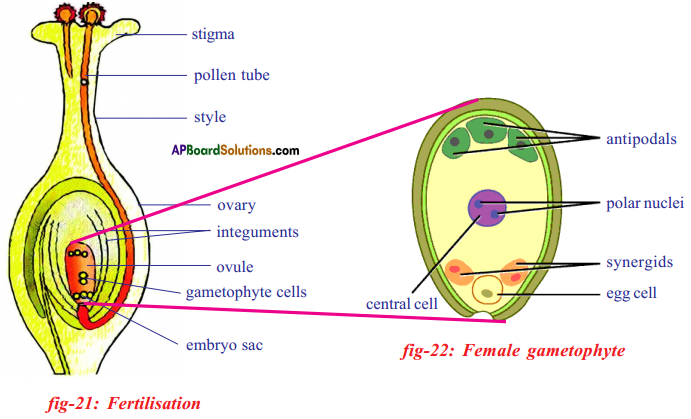
Describe the mode of fertilization in plants with a diagram.
Answer:

  1. Fertilisation is the process of fusion of male and female gametes.
  2. For the fusion of male and female gametes pollen grains have to reach the surface of the stigma. This is called pollination.
  3. Pollen grains received by the stigma germinate and give rise to pollen tubes. Only one pollen tube finally reaches the embryo-sac.
  4. This tube will have two male nuclei, which migrate to the tip of the pollen tube at the time of fertilization.
    AP SSC 10th Class Biology Solutions Chapter 6 Reproduction - The Generating System 1a
  5. Usually the pollen tube enters the ovule through micropyle and discharges the two male gametes into its embryo-sac.
  6. One male nucleus (n) or (gamete) approaches the egg and fuses with it to form a diploid (2n) zygote. This is first fertilisation.
  7. The other male nucleus (n) or (gamete) reaches the secondary nucleus (2n) and fuses with it to form the endosperm nucleus which will be triploid. This is second fertilization in the embryo-sac.
  8. Thus double fertilisation occurs in embryo-sac which is unique in flowering plants.

Question 5.
What are the different modes of asexual reproduction? Cite them with examples.
Answer:
Asexual reproduction takes place by six different methods. They are:

  1. Fission
  2. Budding
  3. Spore formation
  4. Regeneration
  5. Fragmentation and
  6. Vegetative propagation.

1. Fission: Single-celled organisms split into two equal offsprings or more offsprings. Ex: Paramoecium, bacteria.

2. Budding: A growth on the body as a bud grows to form identical copy of parent. Ex: Yeast.

3. Spore formation : Spores are produced in the sporangium.
Ex : Rhizopus, mucor, bacteria, ferns and mosses.

4. Regeneration :
a) Ability of organisms to give rise to new individual organisms from their body parts.
b) That is if the individual is some how cut or broken up into many pieces, many of these pieces grow into separate individuals.
Ex: Hydra and Planaria.

5. Fragmentation:
a) In multicellular organisms with relatively simple body organisation breaks up into smaller pieces upon maturation.
b) These pieces of fragments grow into new individuals.
Ex: Flatworms, Spirogyra, moulds, lichens.

6. Parthenogenesis: In the process generally the female gametes or ova develop into zygote without fertilization.
Ex : Bees, ants and wasps.

7. Vegetative propagation: When a vegetative part like stem, root and leaf can produce a new organism it is called vegetative propagation. It is of two types.
a) Natural propagation:
Bryophyllum Dahlia, Carrot, Radish
b) Artificial propagation:
i) Layering: Eg: Nerium, Guava, Orange, Rose
ii) Cutting: Eg: Rose, Hibiscus, Sugarcane
iii) Grafting: Eg: Sapota, Guava, Mango, etc.

Question 6.
In what ways does sexual reproduction differ from asexual one? State at least three reasons.
(OR)
What are the differences between sexual and asexual reproduction?
Answer:

Sexual reproduction Asexual reproduction
1. Two parents are required. 1. One parent is needed.
2. Gametes are formed. 2. Gametes are not formed.
3. Fertilization takes place. 3. Fertilization does not take place.
4. Zygote is formed. 4. Zygote is not formed.
5. New characters are formed. 5. New characters are not formed but only through mutation.
6. Meiosis takes place. 6. Meiosis does not take place.
7. Found in higher animals. 7. Found in lower animals.
8. Support to evolution process. 8. Supports evolution but not frequently.
9. Takes several months to complete. 9. Takes very short period to complete.

Apart from the above differences Sexual and Asexual reproduction differs in the following ways:

  1. The unit of reproduction in sexual reproduction is gamete whereas in asexual repro-duction it may be whole parent body or bud or a fragment or a single somatic cell.
  2. Sexual reproduction need more time to complete and it is less time in asexual reproduction.

AP SSC 10th Class Biology Solutions Chapter 6 Reproduction - The Generating System

Question 7.
How are sperm cells adapted for their function?
Answer:

  1. Sperm cell is adapted to its function by carrying genetic information to an egg.
  2. Its body consists of four parts :
    1. Head
    2. Neck
    3. Middle piece and
    4. Tail.
  3. Sperm has a streamlined body that allows it to move quickly.
  4. Nucleus is present in the head.
  5. Special structure on the head called acrosome helps in penetrating the ovum during fertilisation.
  6. The head of sperms also contain enzymes to breakdown and digest the zone on the egg through which it penetrates and fertilise it.
  7. Large number of mitochondria are present in the mid-region, so it is able to produce a lot of energy in order to operate tail.
  8. Its tail allows it to swim towards the egg for fertilisation.

AP SSC 10th Class Biology Solutions Chapter 6 Reproduction - The Generating System

Question 8.
The menstrual cycle prepares the uterus for a fertilised egg. How long is an average menstrual cycle from start to finish?
Answer:

  1. The cycle of changes that occur in the female reproductive system is called menstrual cycle.
  2. The average menstrual cycle from start to finish is 28 days long.

Question 9.
When the foetus is growing inside the uterus it needs nutrients? What provides these nutrients?
Answer:

  1. When the foetus is growing inside the uterus it needs nutrients for its growth and development.
  2. These nutrients are provided by the mother’s blood through a special structure called placenta.
  3. Placenta is a tissue formed by the cells from the embryo and the mother.
  4. It is formed around 12 weeks of pregnancy and becomes an important structure for nourishment of the embryo.
  5. The foetus is connected to placenta in mother’s body through umbilical cord.

Question 10.
Which type of substances are absorbed by foetus from the mother?
Answer:

  1. The digested food from the mother travel through the mother’s blood stream and exchange to the blood stream of the foetus through the placenta.
  2. In addition to ingested food the mother’s body continuously breakes down muscles, fat and bones.
  3. Releasing proteins, fat and calcium to the mother’s blood that can be absorbed through the placenta to provide nutrients to the foetus.
  4. Some hormones also transfer to baby.

Question 11.
What is the job of Amniotic sac?
Answer:

  1. The amniotic sac is a bag of fluid inside a women’s womb (uterus) where the embryo and foetus develops and grows.
  2. The cavity within the amnion becomes filled with fluid called amniotic fluid.
  3. The embryo or unborn baby floats and moves in the amniotic fluid.
  4. Amniotic sac and amniotic fluid give protection against minor mechanical injury.
  5. This fluid also provides a stable temperature and assists in maintaining a consistent body temperature for the unborn child.

AP SSC 10th Class Biology Solutions Chapter 6 Reproduction - The Generating System

Question 12.
What are the advantages of sexual reproduction?
(OR)
What are uses of sexual reproduction?
Answer:
Advantages of sexual reproduction:

  1. Sexual reproduction promotes diversity of characters in the offsprings by providing genetic variation.
  2. It plays an important role in the origin of new species have different characters.
  3. This genetic variation leads to the continuous evolution of various species to form better and still better organisms.
  4. Sexual reproduction influences in diversity of characters in offsprings.
  5. It helps to maintain the continuty of organisms.
  6. It leads to new generation to tolerate adverse or diseased conditions.
  7. It helps the spreading of population to new areas.

Question 13.
How does reproduction help in providing stability to population of species?
Answer:

  1. The reproduction is directly linked to the stability of the population of species because it helps in replacing the lost or aging population with the new population and thus ensures the survival of the species.
  2. The process of reproduction ensure continuity of life on earth.
  3. In the absence of reproduction one particular species will disappear with time.
  4. Reproduction induces variations in the population which help the population to tide over adverse environmental conditions and adapt to changing environment.
  5. Reproduction also helps to generate copies of individuals which are suited to a particular environment.

Question 14.
Write the differences between mitosis and meiosis.
Answer:

Mitosis Meiosis
1. It occurs in somatic cells. 1. It occurs in germ cells.
2. Nucleus divides only once. 2. Nucleus divides twice.
3. Two daughter cells are formed. 3. Four daughter cells are formed.
4. Daughter cells are diploid. 4. Daughter cells are haploid.
5. It occurs more frequently. 5. It occurs less frequently.
6. Daughter cells form somatic organs. 6. Daughter cells form gametes.
7. There is only one prophase, one metaphase one anaphase and one telophase. 7. There are two of each phase and five sub-phases in prophase -1.
8. Number of chromosomes are not changed in the daughter cells. 8. Number of chromosomes are reduced to half.
9. Chromosome number doubles at the beginning of each cell division. 9. Chromosome number is not doubled. It doubles after the end of first meiotic division.
10. No crossing over in chromosomes. 10. Crossing over occurs chromosomes.
11. Equation division. 11. Reduction division.

AP SSC 10th Class Biology Solutions Chapter 6 Reproduction - The Generating System

Question 15.
What happens to the wall of the uterus during menstruation? (OR)
What changes occur in the wall of the uterus during menstruation?
Answer:

  1. During the early stage of menstruation the cells in the wall of uterus increase in number by repeated mitotic divisions.
  2. The inner lining of uterus becomes thick and soft with lot of blood capillaries in it.
  3. These changes in the uterus are necessary because in case the ovum released by the ovary gets fertilised by the sperm, then the uterus has to keep this fertilised ovum for further development and supply it with food and oxygen etc.
  4. If fertilisation does not occur the additional growth of the uterus is detached and expelled along with some amount of blood.

Question 16.
“All unicellular organisms undergo only mitotic cell division during favourable conditions” – Do you support this statement? Why?
Answer:

  1. Unicellular organisms undergo mitotic cell division not only during favourable conditions but also in unfavourable conditions.
    So I don’t support the given statement.
  2. When the organism finds favourable conditions it deserves to perform division called Fission. Ex: Amoeba.
  3. Sometimes scarcity of food or to save it life, some organisms undergo mitotic cell division.
  4. Organisms like paramoecium undergo a type of sexual reproduction called conjugation during unfavourable conditions.

Question 17.
What would be the consequences if there is no meiosis in organisms that reproduce sexually?
(OR)
What happens if Meiosis does not take place in reproductive cells?
Answer:

  1. If meiosis did not occur, a fusion of gametes would result in a doubling of the chromosomes for each successive reproduced generation.
  2. For example, in case of man egg cells and sperm cells like other cells must contain 46 chromosomes.

    AP SSC 10th Class Biology Solutions Chapter 6 Reproduction - The Generating System 2
  3. This results in the formation of abnormalities in each generation.
  4. If meiosis did not occur, there is no genetic variation in the offsprings produced by random fusion of the gametes.
  5. New characters will not appear in the offsprings.
  6. The process of evolution will be stopped.

Question 18.
Vicky’s father wants to grow a single plant having two desirable characters colourful flowers and big fruits. What method will you suggest to him and why?
Answer:

  1. I will suggest the method of grafting to him.
  2. Grafting enables us to combine the most desirable characteristics of two plants into a single plant with colourful flowers and big fruits.
  3. By grafting method, a very young scion can be made to flower and produce fruits fast when it is grafted to the stock.
  4. Vicky’s father can grow one of the two plants as stock and second plant can be graft to some of its branches as scions.
  5. Then he can get the plant with both the desirable characters.

AP SSC 10th Class Biology Solutions Chapter 6 Reproduction - The Generating System

Question 19.
Uproot an onion plant and take a thin section of its root tip. Stain it and observe under the microscope. Draw as you see and identify the stages of the cell division.
Answer:
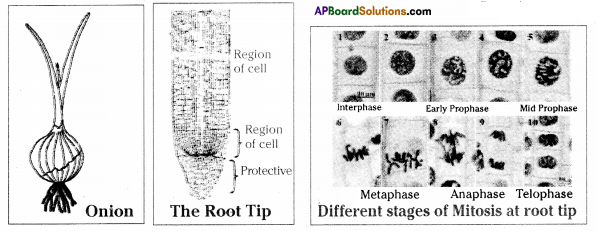
AP SSC 10th Class Biology Solutions Chapter 6 Reproduction - The Generating System 3

Question 20.
Visit a nearby village and collect information on how farmers grow sugarcane, flowering plants like chrysanthemum, primerose and vegetables like stem tubers, plump gourd (dondakaya), etc. Make a report and present in class.
Answer:
Report on growing methods of various plants :

Plant name Growing method
Sugarcane Stem bits with nodes called seed pieces or sets can be planted horizontally in the farrows.
Chrysanthemum It propagates often by means of suckers (the basal shoot). But some farmers grow these using seeds or the transplanted nursery plants.
Primerose These are generally grown using cuttings. Its root ball should be cut vertically making sure that each half has at least 2 plant stems.
Potatoes These are the stem tubers. The nodes on the potato are called eyes which sprout out and grow into a new plant.
Plumpgourd These have tubers just below the ground which on cutting and planting in soil can give rise to new plants.

Question 21.
Collect the information from school library or using internet what vegetative methods are followed in your district as well as in your state to propagate various plants of economic importance. Represent it with a graph.
Answer:
Vegetative methods followed in our district as well as in our state to propagate various plants of economic importance.
I) Natural vegetative propagation: In this method of vegetative propagation, a part of the plant which may be stem, root-leaf or flower gets detached from the body of the mother plant.

  1. Vegetative propagation: Roots of radish, carrot, dahlia develop adventious buds which grow into leafy shoots.
  2. Vegetative propagation by stems: Stolons – Vallisneria, offsets – Eichhornia, Rhizome – Banana, Ginger Bulbs – Alliumcepa (Onion); Corn – Colacasia; Tuber – Potato.
  3. Vegetative propagation by leaves: Bryophyllum.
  4. Vegetative propagation by modified flowers (Bulbils): Agave.

II) Artificial vegetative propagation: Certain flowering plants have the capacity to develop a part of their somatic body into a new independent plant. In artificial vegetative propagation such plants are identified and special techniques are applied to obtain new independent plant.

  1. Cutting (Stems): Sugarcane, Roses, Hibiscus, Citrus plants.
  2. Cutting (Root): Lemon, Tamarind.
  3. Layering: Jasmine, Strawberry, Gooseberry.
  4. Grafting: Rubber, Apple, Pear, Citrus, Mango, Guava.
  5. Propagation by tissue culture technique: Lily, Rose, Magnolia, Fern, Banana for micropropagation, a small amount of tissue from a suitable part of the parent plant is excised and grown on a nutrient medium under aseptic conditions.
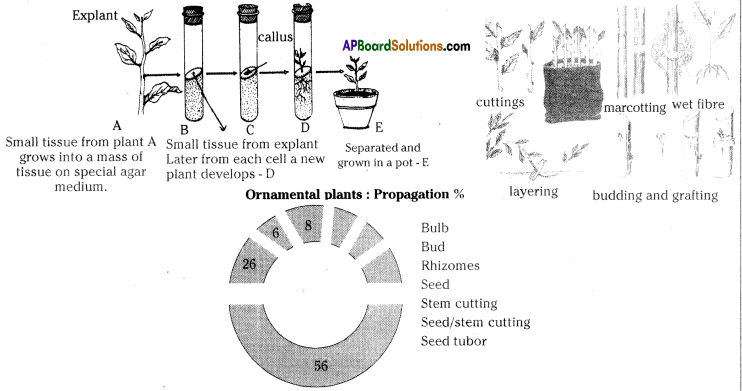
AP SSC 10th Class Biology Solutions Chapter 6 Reproduction - The Generating System 4

AP SSC 10th Class Biology Solutions Chapter 6 Reproduction - The Generating System

Question 22.
Make a flow chart to show the cell cycle and explain cell division describing different stages of mitosis.
Answer:
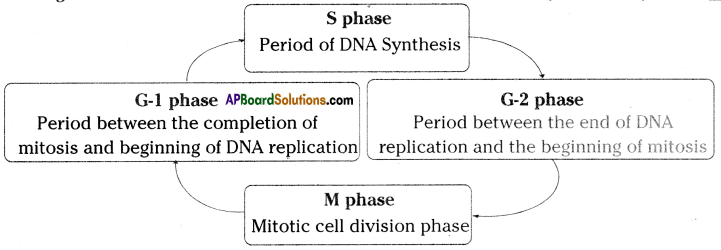
AP SSC 10th Class Biology Solutions Chapter 6 Reproduction - The Generating System 5

Different stages of mitotic cell division:

Stage Description
1) Prophase Chromatin condenses to form chromosomes. Chrormisomes split length ways to form chromatids, connected by centromeres. Nuclear membrane breaks down.
2) Metaphase Chromosomes move to spindle equator, centromeres attached to spindle fibres. Centromeres split, separating the chromatids.
3) Anaphase Spindle fibres attached to centromeres contract, pulling chromatids towards poles.
4) Telophase Chromatids elongate, become invisible. Nuclear membranes form round daughter nuclei. Nucleus divides into two and division of cytoplasm starts.
5) Cytokinesis Cytoplasm divides to form two daughter cells.

Question 23.
Draw neat labelled diagrams of male and female reproductive systems of plant.
Answer:
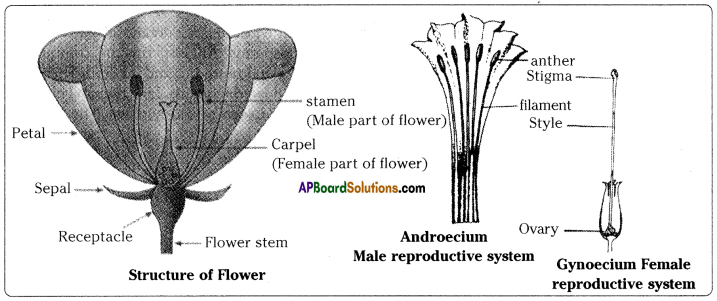
AP SSC 10th Class Biology Solutions Chapter 6 Reproduction - The Generating System 6

Question 24.
Observe the following part of flowering plant and prepare a note.
Answer:
The given diagram is the structure of ovule which is present in the ovary (carpel) of plant.

  1. An ovule is an egg shaped structure attached by a stalk (Funicle) to the inner side of the ovary.
  2. Depending upon the species of plant involved, an ovary may have one, two, several or even hundreds of ovules.
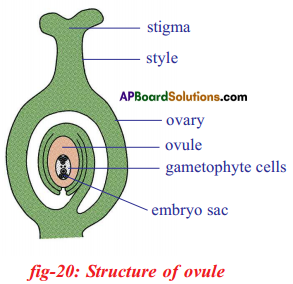
    AP SSC 10th Class Biology Solutions Chapter 6 Reproduction - The Generating System 7
  3. At the centre of each ovule is a microscopic embryo sac filled with food and water.
  4. The embryo-sac is composed of gametophyte cells.
  5. The majority of flowering plants have an embryo sac consisting of seven cells and eight nuclei.
  6. They are one egg (female gamete), two synergids, one central cell (secondary nucleus) and three antipodals.
  7. Central cell contains two nuclei, they are called polar nuclei.

AP SSC 10th Class Biology Solutions Chapter 6 Reproduction - The Generating System

Question 25.
Prepare a flow chart to explain the process of sexual reproduction in plants
Answer:
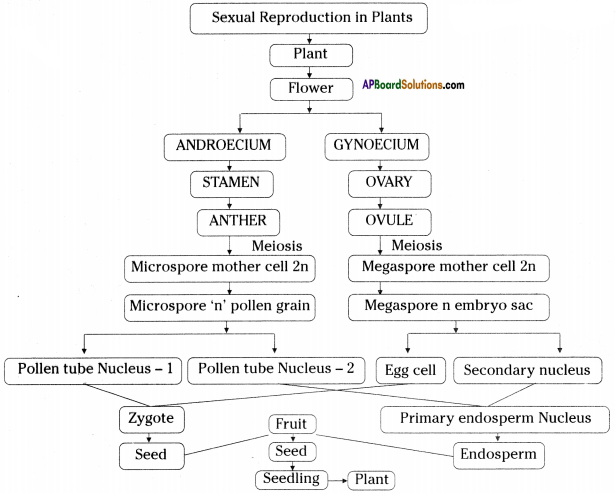
AP SSC 10th Class Biology Solutions Chapter 6 Reproduction - The Generating System 8

Question 26.
Draw a neat labelled diagram to explain plant fertilisation. Write few points on Pollen grain.
Answer:
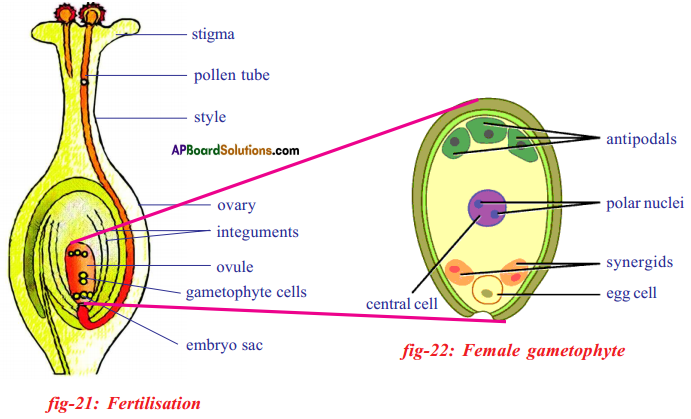
AP SSC 10th Class Biology Solutions Chapter 6 Reproduction - The Generating System 1a
Pollen grains:

  1. Pollen grains develop in anther.
  2. Anther consists of spore-forming tissue. Some of the cells in the spore-forming tissue develop as pollen mother cells.
  3. Each pollen mother cell undergoes meiosis to form four daughter cells which develop into pollen grains
  4. Pollen grains are haploid (‘n’) and are otherwise known as microspores or male gametes.
  5. They contain only one set of chromosomes (‘n’).
  6. The study of pollen grain is called palynology.
  7. During pollination pollen grains are dispersed by wind and insects.
  8. Pollen grains are formed in large numbers. They are light in weight and are easily carried by wind currents.

Question 27.
How will you appreciate cell division that helps in perpetuation of life?
Answer:

  1. Perpetuation means continuation of life.
  2. The perpetuation of life is based on the cell division.
  3. Both mitotic and meiotic divisions are very essential for perpetuation of life.
  4. In unicellular organisms, the mitotic cell divisions form the entire organisms.
  5. Mitotic division is essential for all types of asexual reproductions.
  6. In sexually reproducing organisms meiotic cell division helps in formation of gametes with haploid number of chromosomes which fuses to form diploid zygote during fertilization.
  7. Zygote further divides by mitosis again and grows into an embryo and then to offspring.
  8. Thus both mitotic and meiotic cell divisions play a key role in perpetuation of life. Without cell division, there is no perpetuation of life.

Question 28.
What precautions will you take to keep away from various sexually transmitted?
Answer:
Precautions to be taken to keep away from various sexually transmitted diseases:

  1. Avoid sex with any one who has genital sores, a rash, discharge or other symptoms.
  2. The only time unprotected sex is a safe if the partners have sex only with each other.
  3. I use latex condoms every time 1 participate in sex. I use it for the entire sex act.
  4. I avoid sharing towels or under clothing.
  5. I wash genital organ before and after intercourse.
  6. I will get a vaccination for hepatitis B. This is a series of three shots.
  7. I will get tested for HIV for every six months.
  8. I will not drunk or take drugs. Under these conditions, I may fail to have safe sex.
  9. I consider that not having sex is the only way, sure way to prevent sexually transmitted diseases.
  10. Sexual act is supposed to be an act between husband and wife. Hence I will not participate in sex before marriage.
  11. When I grow up and get married, I will be upright and faithful to the life partner and will not behave immorally.
  12. Hence as a student I will concentrate on studies and create activities to achieve success in life.

AP SSC 10th Class Biology Solutions Chapter 6 Reproduction - The Generating System

Question 29.
Conduct a seminar on child marriages and foeticide.
Answer:
child marriages can also be defined as “any marriage carried out under the age of 18 years and involves the girl who is physically, psychologically, mentally and physiologically immature”.

Causes of Child marriages :

  1. Poverty in the families due to unemployment.
  2. Illiteracy among people.
  3. Ignorance of consequences of child marriages.
  4. Strong superstitions among people about child marriages.
  5. Religious and traditions are also responsible for occurance of child marriages.

Steps to prevent Child marriages:

  1. By creating awareness among the people about the ill effects of child marriages.
  2. By educating the people especially in rural areas of backward districts.
  3. By providing employment opportunities to all the people.
  4. Performing live plays, skits and stage shows to create enlightenment among the rural illiterate women about the pathetic future of kids who are forced to get married.

Foeticide:

  1. Foeticide is the illegal practice of killing a foetus. Female foeticide is prevalent in our country as a major social evil.
  2. Some kinds of complications in pregnancy can also demand surgical termination of pregnancy after 8 weeks of conception.
  3. This is where the abortion is legal and doctors may have to suggest for discontinuous of pregnancy for the sake of health of the mother. However the technique of surgical termination is misused by some people by getting rid of the unborn child.
  4. Abortion of foetus is an act of murder. God is the author of life and nobody should have right to take it.

Choose the correct answer.

1. The part of the female reproductive system produces the eggs [ ]
A) Ovary
B) Epididymis
C) Cervix
D) Fallopian tube
Answer: A

AP SSC 10th Class Biology Solutions Chapter 6 Reproduction - The Generating System

2. The term that we use to describe a sperm cell fusing with an egg cell [ ]
A) Fragmentation
B) Fermentation
C) Fertilisation
D) Fusion
Answer: C

3. Which part of the male reproductive system produces (human) the sperm cells ? [ ]
A) Vas deference
B) Epididymis
C) Seminiferous tubules
D) Scrotum
Answer: C

4. How does the sperm break through the egg cell membrane? Choose the option you think is right.   [ ]
A) Tears a hole in the membrane
B) Dissolves the membrane with chemicals
C) Bites through the membrane with teeth
D) Squeezes through gaps in the membrane
Answer: B

5. Why are egg cells larger than sperm cells? Choose the option you think is right. [ ]
A) Egg cells have more cells in them
B) Have food store to help growth after fertilisation
C) Have thicker cell membranes
D) Have larger nuclei
Answer: B

6. Which of these things will affect the way a foetus grows? Choose the option you think is right. [ ]
A) Chemicals in cigarette smoke
B) Alcohol
C) Drugs
D) All of the above
Answer: D

7. Which of the following is the correct sequence of steps in the human life cycle? Choose the right option. [ ]
A) Babyhood, childhood, adolescence, adulthood
B) Childhood, babyhood, adulthood, adolescence
C) Adolescence, babyhood, adulthood, childhood
D) None of the above
Answer: A

10th Class Biology 6th Lesson Reproduction – The Generating System InText Questions and Answers

10th Class Biology Textbook Page No. 117

AP SSC 10th Class Biology Solutions Chapter 6 Reproduction - The Generating System

Question 1.
How do you think bacteria were dividing to form curd?
Answer:
Curdling indicates that the increase in number of bacteria by fission.

10th Class Biology Textbook Page No. 118

Question 2.
How do you think this process (parthenogenesis) happens?
Answer:
This process occurs by the development of female gamete or ovum directly develops into zygote without fertilisation.

Question 3.
What about animals?
Answer:

  1. Normally the fertilized ovum (zygote) develops into a young one. But the unfertilized ovum also develops into a young one generally the male.
  2. The process of development of young ones from unfertilized ovum is called parthenogenesis.
  3. In this process sperms develop by mitotic division whereas ova develop by meiotic division.
  4. This strange kind of reproduction occurs in animals like bees and wasps.

Question 4.
Is regeneration can also be known as a type of fragmentation? Do you agree? Why? Why not?
Answer:

  1. Yes. I agree that regeneration could be also called as a type of fragmentation. Because in both cases pieces or parts from the body of the organism can develop into a new individual.
  2. Fragmentation and regeneration occur in multicellular animals.
  3. Fragmentation occurs in organisms with relatively simple body organisation.
  4. Whereas regeneration occurs in organisms with fully differentiated body organisation.

Question 5.
Which type of fission would produce larger colonies in less period of time. Why?
Answer:
Multiple fission would produce larger colonies in less period of time because more number of daughter cells are formed by multiple fission.

AP SSC 10th Class Biology Solutions Chapter 6 Reproduction - The Generating System

Question 6.
Which mode of asexual reproduction provides maximum scope of choice of desirable characters?
Answer:
Parthenogenesis provides maximum scope of choice of desirable characters.

10th Class Biology Textbook Page No. 120

Question 7.
What are the characters that would you like to select?
Answer:
The characters that I would like to select are plant with large number of fruits which are big in size and taste sweet with less or no seeds.

Question 8.
What mode of propagation would help you to produce the plants with selected characters?
Answer:
Mode of propagation that would help me to produce the plants with selected characters is grafting.

Question 9.
Whether they reproduce by budding or fission or fragmentation, organisms are copies of their parents. Is it true? Why ?
Answer:

  1. Yes, it is true that organisms reproduced by budding or fission or fragmentation are copies of their parents.
  2. Because budding or fission or fragments are not the methods of sexual reproduction.
  3. No gametes were formed or fused in these methods.
  4. Exchange of chromosomes or crossing over do not take place. Hence the offsprings produced are similar to their parents.

10th Class Biology Textbook Page No. 122

Question 10.
Do you find any similarities between rhizopus and fern spores and sporangia?
Answer:

  1. Both rhizopus and fern reproduce asexually through spores.
  2. In both the spores are microscopic, unicellular bodies produced in the sporangia.

Question 11.
What about mushrooms, how do they grow? Discuss in your class.
Answer:
Fungi grow from the fragmentation of hypae. They also form buds which are bulged from out side of cells which detaches after division of the nucleus. A special reproduc¬tive sac called sporangium produces asexual spores which are released outside. Fun¬gal sexual reproduction includes plasmogamy, Karyogamy and gametangia.

10th Class Biology Textbook Page No. 123

Question 12.
Think why testis are located outside the abdominal cavity?
Answer:
The testis are located outside the abdominal cavity because the temperature required for proper functioning of spermatogenesis is generally 2 to 3 degrees less than the body temperature,

10th Class Biology Textbook Page No. 127

AP SSC 10th Class Biology Solutions Chapter 6 Reproduction - The Generating System

Question 13.
What function do you think is served by petals and sepals?
Answer:

  1. Calyx consists of sepals give protection to the flower particularly in bud condition.
  2. Corolla consists of bright coloured petals and are useful in attracting insects for pollination.

Question 14.
Draw the diagram of the flower that you collect and label the parts shown and write their functions.
Answer:
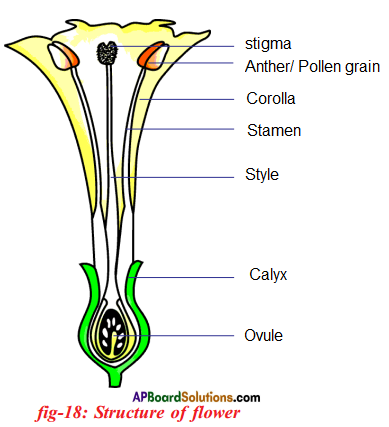
AP SSC 10th Class Biology Solutions Chapter 6 Reproduction - The Generating System 13Functions of flower parts:

  1. Calyx: Consists of sepals – protects flower in bud conditions.
  2. Corolla: Consists of coloured petals – helps in pollination.
  3. Androecium: Consists of stamens – produce male gametes pollen grains,
  4. Gynoecium: Female reproductive part – produce ovules inside the ovary. Stigma receives pollen grain.

10th Class Biology Textbook Page No. 128

AP SSC 10th Class Biology Solutions Chapter 6 Reproduction - The Generating System

Question 15.
How does the male reproductive cell fertilise the female reproductive cell in flowers of such plants (pea plants)?
Answer:

  1. In self pollinated plants anthers are usually present above the stigma.
  2. Pollen from the anthers drop on the stigma.
  3. A process that takes place as the flowers close for the night,
  4. And sometimes occurs before they are completely developed and ready to open.
  5. At the time of pollination slightest movement of the flower’s petals stimulate the stamen to dislodge its pollen and transfer it to the near by stigma in pea plant.
  6. Pollination usually occurs before the flower is fully open, .

10th Class Biology Textbook Page No. 129

Question 16.
How many nuclei are present in the pollen grain?
Answer:
Pollen grain has two nuclei. One is called a tube cell and the another is generative cell.

10th Class Biology Textbook Page No. 131

AP SSC 10th Class Biology Solutions Chapter 6 Reproduction - The Generating System

Question 17.
Which floral part may be seen in a fruit?
Answer:
Sometimes calyx may remain with fruit.

Question 18.
How cotyledons are useful for the plant?
Answer:

  1. The cotyledons digest and absorb the endosperm.
  2. They make the stored food available for the growth of the epicotyl and hypocotyl.
  3. The cotyledons of some flowering plants, digest, absorb, and store the foods from the endosperm as the ovule is maturing into a seed. Eg: beans
  4. As a consequence, the cotyledons become greatly enlarged because of stored food and the endosperm disappears more or less completely.

10th Class Biology Textbook Page No. 137

Question 19.
What differences do you find in mitosis and meiosis? Write in a tabular form.
Answer:

Mitosis Meiosis
1. It occurs in somatic cells. 1. It occurs in germ cells.
2. Nucleus divides only once. 2. Nucleus divides twice.
3. Two daughter cells are formed. 3. Four daughter cells are formed.
4. Daughter cells are diploid. 4. Daughter cells are haploid.
5. It occurs more frequently. 5. It occurs less frequently.
6. Daughter cells form somatic organs. 6. Daughter cells form gametes.
7. There is only one prophase, one metaphase one anaphase and one telophase. 7. There are two of each phase and five sub-phases in prophase -1.
8. Number of chromosomes are not changed in the daughter cells. 8. Number of chromosomes are reduced to half.
9. Chromosome number doubles at the beginning of each cell division. 9. Chromosome number is not doubled. It doubles after the end of first meiotic division.
10. No crossing over in chromosomes. 10. Crossing over occurs chromosomes.
11. Equation division. 11. Reduction division.

Question 20.
What would happen if the gametes do not have half the chromosome number as the skin parent?
Answer:

  1. Daughter cells formed in meiosis are gametes.
  2. These gametes have half of the chromosomes in number as the parent,
  3. If the gametes do not have half of the chromosomes in number as the parent, when they fuse, they form zygote with double the number of chromosomes when compared to parent cell.
  4. If it continues, cells in the offspring will have thousands of chromosomes within few generations.
  5. If the chromosome number increases in a species it leads to the formation of abnormalities.

AP SSC 10th Class Biology Solutions Chapter 6 Reproduction - The Generating System

Question 21.
How would it affect the progeny formed by sexual reproduction?
Answer:
If the progeny have thousands of chromosomes in them, it results in formation of abnormalities in each generation.

Question 22.
Why did the government of India fixed the legal marriage age of boys (21 years) and girls (18 years)?
Answer:

  1. Government of India fixed legal marriage age of boys as 21 years, and girls as 18 years.
  2. This is because teenage mothers are not prepared mentally or physically for motherhood.
  3. Early marriage and motherhood cause health problems for the mother and child.
  4. It may also cause mental agony, as teenage mother is not ready for responsibilities of motherhood.

Question 23.
Do you feel that it is a social responsibility to control birth after having one or two children?
Answer:

  1. Yes, it is a social responsibility of every individual to control birth after having one or two children.
  2. If we don’t control birth after having one or two children, population will grow rapidly.
  3. If the population increases we will not be able to provide all the facilities such as education, medicine, employment etc., to all the people.
  4. It shows impact on the economic conditions of the family and the society.
  5. The quality of life will decrease.

AP SSC 10th Class Biology Solutions Chapter 6 Reproduction - The Generating System

Question 24.
What do you understand by the term ‘Healthy Society’?
Answer:

  1. If all the people in a society are in the state of complete physical, mental and social well being, then the society is said to be healthy society.
  2. To be in a healthy society, every one in the society should take care of their own personal hygiene and cleanliness of the surroundings.
  3. Avoiding child marriages, unprotected sex and creating awareness among the people regarding adverse effects of these are very essential to form a healthy society.

Question 25.
Will you encourage child marriage? Why?
Answer:

  1. No. I will never encourage child marriage.
  2. This is because, the sexual act always has potential to lead to pregnancy.
  3. In case of child marriage, the age of girls is less than 18 years and so they are not prepared mentally or physically for motherhood.
  4. If they got pregnancy the health of them and their child will be affected.

Question 26.
How does HIV is transmitted?
Answer:
Hiv is transmitted by unsafe sexual contacts, using infected devices,infected blood
transfusion, from an infected mother to child, etc.

10th Class Biology Textbook Page No. 138

Question 27.
Social discrimination against AIDS patients is also a social evil. Can you support this? Why?
Answer:

  1. Yes, I will support this statement.
  2. The persons suffering from HIV/AIDS are shown lot of social discrimination in the society.
  3. This happens even with their own family members.
  4. This is due to lack of awarness among public about spreading of disease, illiteracy misconception about AIDS.
  5. If everyone knows how it will not spread they will treat HIV + ves with love and effection.
  6. HIV +ves are patients. It will spread through sexual contact, blood transfusion, mother to child and not with other modes.
  7. Hence they can live with us without any discrimination they need our love and family support.
  8. If anybody shows discrimination, it is definitely a social evil.

10th Class Biology Textbook Page No. 140

AP SSC 10th Class Biology Solutions Chapter 6 Reproduction - The Generating System

Question 28.
Do you think you have moral right to kill a foetus?
Answer:
No, I don’t think that we have moral right to kill a foetus. It is our social responsibility to protect the foetus.

Question 29.
Why doctors are prohibited to do sex determination through ultrasound scanping for pregnant women?
Answer:
Knowing the sex of foetus inside mother’s womb is a severe crime as per the acfmade by government. Ultrasound tests are mend to know the growing condition of the foetus and also to see whether it is suffering with severe ailments. By knowing the sex of the foetus, if it is female, people are ready for aborting it. This leads to reduction in male female ratio in the country. That’s why doctors are prohibited to do sex determination through ultrasound scanning for pregnant women.

10th Class Biology 5th Lesson Reproduction – The Generating System Activities

Activity – 1

Formation of bacterial colony in milk.
Answer:

  1. Take a tea spoon full of curd and mix it thoroughly with around tea spoon full of (half of the glass) luke warm milk in a bowl.
  2. Take another tea spoon full of curd and mix it with 30 tea spoon full of cold milk in another bowl,
  3. Cover both the bowls and note the initial time.
  4. Keep observing every hour to see whether curd has formed.
  5. Curdling indicates that the increase in number of bacteria.
  6. Note the time taken for formation of curd in both the bowls.
  • Does it take the same time to form curd in both the bowls?
    Answer: No. Formation of curd in the bowl containing luke warm milk takes nearly 5 – 6 hours. In the second bowl in which cold milk is present no curdling took place.
  • What does the time taken to form nearly 30 times the size of the bacterial colony indicate?
    Answer: Time taken to form nearly 30 times the size of the bacterial colony indicates how fast bacteria are growing.

Activity – 2

AP SSC 10th Class Biology Solutions Chapter 6 Reproduction - The Generating System

Examine Rhizopus or common mould under Microscope.
(OR)
Write the materials required and the procedure followed by you to observe Rhizopus in the lab.
(OR)
Write the procedure which you follow to observe bread-mould Sporangium m your laboratory. What precautions do you take during the activity?
(OR)
Suneetha wanted to observe Rhizopus on the piece of bread,
(i) Suggest the apparatus needed. (ii) Write the procedure to be followed.
Answer:
Aim: To grow and examine rhizopus or common mould.
Materials required: Bread, plastic bag, plain glass slide, cover slip, water, eye dropper, disposable gloves, compound microscope.
Procedure to grow mould:

  1. Take a soft bread and leave it in the open for about an hour so it is exposed to contaminants in the air.
  2. Place the bread in a plastic bag, sprinkle water over it, so it is damp and seal the bag living some air inside.
  3. Check on the piece of bread every few days and add more water if it is becoming dried out.
  4. We can find whitish thread like growth with masses of black, gray and green fine dotted structures, the black dotted structure is that of bread mould.
  5. A good sample of mould may take up to two weeks to form.
  6. Using this mould make a slide and observe under the microscope.

Procedure to make a slide:

  1. Place a drop of water in the centre of the slide, using an eye dropper if you have one, or the tip of a clean finger.
  2. Using a tooth pick, scrape some of the mould off, and place it on the drop of water.
  3. Take the coverslip and set it at an angle to the slide so that one edge of it touches the water drop.
  4. Then carefully lower it over the drop, so that the coverslip covers the specimen without trapping air bubbles underneath.
  5. Use the corner of a tissue paper or blotting paper to blot up any excess water at the edges of the coverslip.
  6. View the slide with a compound microscope, starting with a low objective.

Observations:
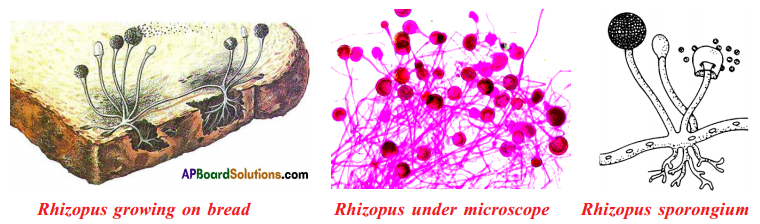
AP SSC 10th Class Biology Solutions Chapter 6 Reproduction - The Generating System 9

  1. The common bread mould plant consists of fine thread like projections called hyphae and thin stems having knob like structures called sporangia.
  2. Each sporangium contains hundreds of minute spores.

Precautions:

  1. This should not be done by those with allergies to mould or with severe asthma.
  2. Avoid opening the plastic bag as much as you can.
  3. If you touch the bread, be sure to thoroughly wash your hands afterwards.

Activity – 3

AP SSC 10th Class Biology Solutions Chapter 6 Reproduction - The Generating System

Observation of pollen grain.

  1. Take a slide and put a few drops of water on it.
  2. Take any flower like hibiscus, tridax, marigold, etc. Tap the anther over the drop of water.
  3. We will see small dot like structures in water. These are pollen grains.
  4. Take permanent slide of pollen grain from your lab.
  5. Also see a permanent slide of pollen grain from our lab.
  6. Observe under a microscope. We will make a drawing of what we observe and compare with the given diagram.

Observation: Pollen grain germinates only on stigma. Pollen grain consists of two to three cel Is surrounded by a protective wall in Angiosperms. In gymnosperms the pollen grain consists of several living cells.
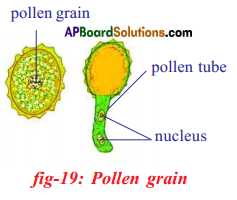
AP SSC 10th Class Biology Solutions Chapter 6 Reproduction - The Generating System 10

Activity – 4

Seed germination.
Answer:

  1. Soak a few groundnut or bengal gram (chana) seeds overnight.
  2. Drain the excess water and cover the seeds with wet cloth. Leave them for a day.
  3. Keep sprinkling water at regular intervals so that they do not dry up.
  4. Open the seeds carefully and observe the parts.

Observation: The seed is germinated i.e., the seed embryo is developed into seedling plumule which grows into plant.
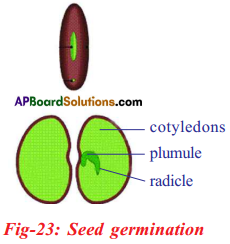
AP SSC 10th Class Biology Solutions Chapter 6 Reproduction - The Generating System 11

Activity – 5

Observe different stages of mitotic cell division. (OR)
Describe various stages of mitosis with the help of neat diagrams.
Answer:
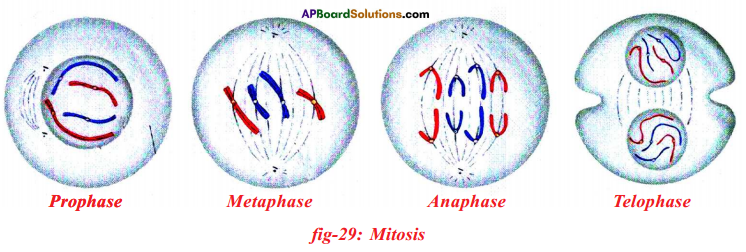
AP SSC 10th Class Biology Solutions Chapter 6 Reproduction - The Generating System 12

  1. Take permanent slides which shows different stages of mitotic cell division from your lab kit.
  2. Observe carefully under microscope.
  3. Draw diagrams what you observe, and compare your observations with the following chart.
Stage Description
1. Prophase
  1. Chromosomes contract, spiral and become visible even in light microscope and nucleoli become smaller (material to chromosomes).
  2. Chromosomes split lengthwise to form chromatids, connected by centromeres.
  3. Nuclear membrane disappears.
  4. Centrosome, containing rod-like centrioles, divides and forms ends of spindle (probably animal cells only).
    (Note : No pairing of chromosomes as in meiosis).
2. Metaphase
  1. Chromosomes move to spindle equator, spindle fibres attached to centromeres.
3. Anaphase
  1. Centromeres split, separating the chromatids.
  2. Spindle fibres attached to centromeres contract, pulling chromatids towards poles.
4. Telophase
  1. Chromatids elongate, become invisible, (replication at this stage to become chromosomes).
  2. Nuclear membranes form round daughter nuclei.
  3. Cell membrane pinches in to form daughter cells (animals) or new cell wall material becomes laid down across spindle equator (plants).
  4. Nucleus divides into two and division of cytoplasm starts.


AP SSC 10th Class Biology Solutions Chapter 9 Our Environment

AP State Board Syllabus AP SSC 10th Class Biology Solutions Chapter 9 Our Environment Textbook Questions and Answers.

AP State Syllabus SSC 10th Class Biology Solutions 9th Lesson Our Environment

10th Class Biology 9th Lesson Our Environment Textbook Questions and Answers

Improve your learning

Question 1.
What happens to the amount of energy transferred from one step to the next in a food chain?
Answer:

  1. Energy is transferred along food chains from one trophic level to the next.
  2. The amount of available energy decreases from one stage to the next.
  3. This is because not all the food can be fully digested and assimilate.
  4. Hair, feathers, insect exoskeletons, cartilage and bone in animal foods, cellulose and lignin in plant foods cannot be digested by most animals.
  5. These materials are excreted or made into pellets of indigested remains.
  6. Assimilated energy is available for the synthesis of new biomass through growth and reproduction.
  7. Organisms also lose some biomass by death disease or annual leaf-drop.
  8. Moreover at each tropic level, organisms use the most of the assimilated energy to fulfill their metabolic requirements – performance of work, growth and reproduction.
  9. Most of the energy is lost in the form of heat during biological processes.
  10. Only a small fraction goes to the consumer at next tropic level.

AP SSC 10th Class Biology Solutions Chapter 9 Our Environment

Question 2.
What do pyramids and food chain indicate in an ecosystem?
Answer:

  1. The ecologists used the idea of pyramid to show relationship among organisms in an existing food chain.
  2. Ecological pyramids are of three types. They are pyramid of biomass, pyramid of number, pyramid of energy.
  3. Pyramid of biomass indicates the available biomass in an ecosystem; pyramid of number indicates the organisms present and pyramid of energy indicates the available energy in an ecosystem.
  4. The food chain in an ecosystem indicates how energy is transferred from one organism to another.
  5. The starting point of a food chain are producers and it ends with top carnivores.
  6. A food chain represents a single directional transfer of energy.

Question 3.
Write a short note on pyramid of number for any food chain. What can we conclude from this pyramid of numbers?
i) tree ii) insect iii) woodpecker
(OR)
What is a pyramid of numbers? Write a brief note on the pyramid of numbers with the help of a block diagram.
Answer:
a.

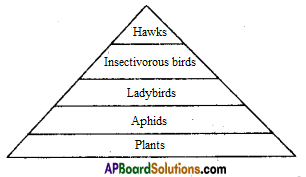
AP SSC 10th Class Biology Solutions Chapter 9 Our Environment 1AP SSC 10th Class Biology Solutions Chapter 9 Our Environment 2

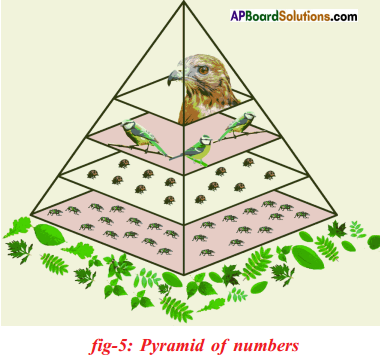
  1. The number of organisms in a food chain can be represented graphically in a pyramid of number.
  2. Each bar represents the number of individuals at each tropic level in a food chain.
  3. In the pyramid of numbers, from the first – order consumers to the large carnivores, there is normally an increase in size, but decrease in number.
  4. For example, in a wood, the aphids are very small and occur in astronomical numbers.
  5. The ladybirds which feed on them are distinctly larger and not so numerous.
  6. The insectivorous birds which feed on the ladybirds are larger still and are only present in a small numbers, and there may only be a single pair of hawks of much larger size than the insectivorous birds on which they prey.

b.

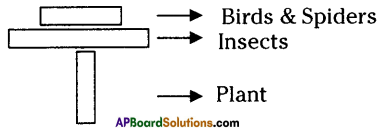
  1. In the given pyramid, the producer is a large tree, primary consumers are small
    insects which are numerous in number and secondary consumers are woodpeckers which are comparatively less in number than insects.
  2. From this pyramid of number, we can conclude that sometimes the pyramid of numbers does not look like a pyramid at all.
  3. This could happen if the producer is a large plant or if one of the organisms at any tropic level is very small.
  4. Whatever the situation, the producer still goes at the bottom of the pyramid.

AP SSC 10th Class Biology Solutions Chapter 9 Our Environment

Question 4.
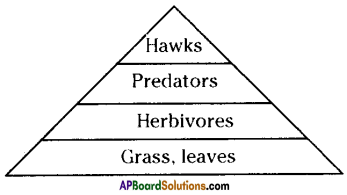
What is biomass? Draw a pyramid of biomass for the given food chain.
i) grass leaves ii) herbivores iii) predators iv) hawk
Answer:

  1. Biomass is organic material of biological origin that has ultimately derived from the fixation of carbon dioxide and the trapping of solar energy.
  2. This includes trees, shrubs, crops, grasses, algae, aquatic plants* agricultural and forest residues and all forms of human, animal and plant waste.
  3. Any type of plant or animal material that can be converted into energy is called “Biomass”.
  4. AP SSC 10th Class Biology Solutions Chapter 9 Our Environment 3

Question 5.
How is using of toxic material affecting the ecosystem? Write a short note on bioaccumulation and biomagnifications.
Answer:

  1. Use of toxic materials such as pesticides, herbicides and fungicides creates new problems in the ecosystem.
  2. As these toxic materials are often indiscriminate in their action and vast numbers of other animals may be destroyed.
  3. Some of them may be predators which naturally feed on these pests, others may be the food for other animals.
  4. Thus causing unpredictable changes in food chains and upsetting the balance within the ecosystem.
  5. Some toxic substances have a cumulative effect.
  6. Some of them are degradable, can be broken down into harmless substances in a comparatively short time usually a year.
  7. Others are non-degradable which are potentially dangerous as they accumulate in the bodies of animals and pass right through food web.
  8. This process of entering of pollutants in a food chain is known as “Bioaccumulation”.
  9. The tendency of pollutants to concentrate as they move from one tropic level to the next is known as “Biomagnifications”.

AP SSC 10th Class Biology Solutions Chapter 9 Our Environment

Question 6.
Should we use pesticides as they prevent our crop and food from pests or we should think of alternatives? Write your view about this issue and give sound reason for your answer.
(OR)
Why should we think of alternatives to pesticides? Give reasons.
Answer:

  1. We should think of alternatives. This is because these pesticides are toxic chemical whose usage leads to Bioaccumulation and Biomagnifications.
  2. When we use pesticides, they prevent our crop and food from pests effectively but indiscriminately destroys a vast number of other animals.
  3. This is causing unpredictable changes in food chains and upsetting the balance within the ecosystem.
  4. Most of the chemical pesticides that contain mercury, arsenic or lead are non -degradable.
  5. They enter into food chain, accumulate in the bodies of animals and pass right through food web.
  6. Being further concentrated at each step until animals at the top of the pyramid may receive enough to do considerable harm.
  7. This is one of the reasons for ever decreasing number of butterflies, bees, small and large birds.
  8. Some of the pesticides are nerve poisons and might bring about changes in behaviour.
  9. As the human beings are at the end of the food chain, these pesticides may get accumulated in our bodies also. This shows some adverse effects on us, when their concentration becomes sufficiently high.

Question 7.
What is a tropic level? What does it represent in an ecological pyramid?
Answer:

  1. The various steps in a food chain at which the transfer of food takes place is called tropic level.
  2. Tropic level means the feeding level of the organism.
  3. In an ecological pyramid, the first tropic level represents the primary producers, and their number, biomass or energy.
  4. Second tropic level represents the herbivores or primary consumers and their number, biomass or energy.
  5. The tropic level represents the lower carnivores or secondary consumers and their number, biomass or energy.
  6. The fourth tropic level represents the higher carnivores or tertiary consumers and their number, biomass or energy.

AP SSC 10th Class Biology Solutions Chapter 9 Our Environment

Question 8.
If you want to know more about the flow of energy in an ecosystem, what questions do you ask?
Answer:
I will ask the following questions to know more about flow of energy in an ecosystem.

  1. How does the energy flow in an ecosystem from one organism to other?
  2. Is the energy transformation from one level to other 100% efficient?
  3. What per cent of energy transfers from one level to other?
  4. What happens to the remaining energy?
  5. How does the ecosystem lose its energy during energy transformation?
  6. Which tropic level in an ecosystem has more energy and which has less?
  7. What is the ultimate source of energy in an ecosystem?

Question 9.
What will happen if we remove predators from food web?
Answer:

  1. Removal of organisms from any tropic level of a food chain or food web disturbs the ecosystem and leads to ecological imbalance.
  2. If we remove predators from food web, the prey population will increase enormously as there is no natural control over them.
  3. The producers population will decrease rapidly as the organisms feeding on them increase.
  4. After few generations the prey population also begins to decrease as some of the preys begin to die due to starvation.
  5. Some adaptations may also be developed by the organisms to bring the ecological balance.
  6. But it may take some generations, till that the ecosystem will be disturbed and imbalanced.
  7. For example, if we remove all the predators (carnivorous) from a forest ecosystem, the herbivorous animal population will increase as there are no carnivores to hunt them.
  8. As a result plant population will decrease as the ever increasing herbivores feed more and more on plants.
  9. After some generations the herbivore population begins to decrease as the decreasing number of plants are not sufficient to feed.
  10. Then some herbivorous animals may adapt to feed on other herbivores to increase their survival.
  11. Then scope for survival will increase for plants again which leads to ecological balance.
  12. But this may take lot of time to evolve new predators and to form ecological balance.

AP SSC 10th Class Biology Solutions Chapter 9 Our Environment

Question 10.
Observe a plant in your kitchen garden, and write a note on producer-consumer relationship.
Answer:
When I observe a plant in kitchen garden, I came to know the following things.

  1. Though it may be relatively small, a garden is a complete ecosystem.
  2. It has the same components as any other large and elaborate ecosystems had.
  3. The plant in a kitchen garden is a producer as it produces their own food from sunlight.
  4. There are two types of consumers in this ecosystem, a) Primary consumers and b) Secondary consumers.
  5. Primary consumers feed on plants. This tropic level consists of caterpillars, bees and butterflies.
  6. Secondary consumers feed on primary consumers. This tropic level consists of birds, garden lizards and spiders.
  7. Fungi, bacteria, insects and worms make up decomposers.
  8. The producer and consumer relationship can be shown in the following food chain.
    Plant → Plant eaters such as caterpillars, bees, butterflies → Meat-eaters such as birds, garden lizards, spiders
    Producers → Primary consumers → Secondary consumers
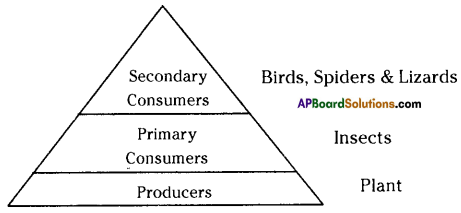
  9. The pyramid of number appears like this.
    AP SSC 10th Class Biology Solutions Chapter 9 Our Environment 4
  10. The pyramid of Biomass appears like this
    AP SSC 10th Class Biology Solutions Chapter 9 Our Environment 5
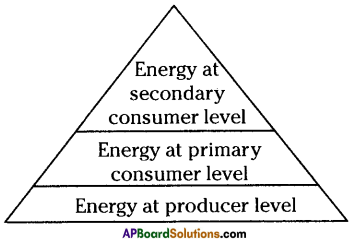
  11. The pyramid of energy appears like this
    AP SSC 10th Class Biology Solutions Chapter 9 Our Environment 6

AP SSC 10th Class Biology Solutions Chapter 9 Our Environment

Question 11.
What type of information do you require to explain the pyramid of biomass?
Answer:
To explain the pyramid of biomass, we require the following information.

  1. The type of ecosystem.
  2. Producers in the ecosystem.
  3. Primary consumers in the ecosystem.
  4. Secondary consumers in the ecosystem.
  5. Tertiary consumers in the ecosystem.
  6. Number of organisms at each tropic level.
  7. Size of organisms at each tropic level.
  8. Weight of organisms at each tropic level.
  9. All forms of waste produced at each tropic level and
  10. In total, total amount of biomass produced at each tropic level.

Question 12.
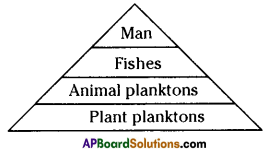
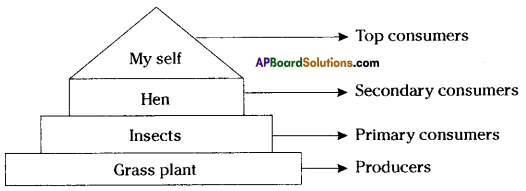
Draw a pyramid of numbers considering yourself sis top level consumer. Pyramid of numbers
Answer:
Pyramid of numbers
Ex: 1
AP SSC 10th Class Biology Solutions Chapter 9 Our Environment 7

Ex: 2
AP SSC 10th Class Biology Solutions Chapter 9 Our Environment 8

AP SSC 10th Class Biology Solutions Chapter 9 Our Environment

Question 13.
Prepare slogans to promote awareness in your classmates about eco-friendly activities.
All the living things have the right to live on this earth along with us. Prepare slogans to promote awareness in public about the conservation of biodiversity.
(OR)
Which slogans do you prefer to promote awareness in your locality about eco-friendly activities?
Answer:

  1. Live and let live.
  2. If we protect the environment, it protects us.
  3. Conserve nature – Conserve life.
  4. Save mother earth.
  5. Earth needs you.
  6. Go ecofriendly.
  7. Clean the environment, live happily.
  8. Heal our planet! Turn it into a better planet.
  9. Plant a tree for your environment.
  10. Think ecofriendly and live ecofriendly.
  11. Earth enables you to definitely stand. Allow it to stand the actual way it is.
  12. You’ve only got one planet. Don’t trash it.

Question 14.
Suggest any three programmes on the prevention of soil pollution in view of avoiding pesticides.
(OR)
Suggest any four eco-friendly methods for prevention of soil pollution in view of avoiding pesticides. (OR)
In your area, soil is polluted by the enormous usage of pesticides. Suggest any two programmes for the prevention of soil pollution.
Answer:
To prevent the soil pollution caused by pesticides following programmes should be implemented.

  1. Rotation of crops :
    1. Same crop should not be grown in the same field in successive seasons.
    2. Rotation of crops reduce occurance of pests and damage due to pests will be decreased.
  2. Biological control: Introducing natural predator or parasite of the pest.
  3. Sterility: Sterilising the males of a pest species reduces the population of pests.
  4. Genetic strains: The development of genetic strains which are resistant to certain pest.
  5. Studying the life histories of the pests: When this is done it is sometimes possible to sow the crops at a time when least damage will be caused.

AP SSC 10th Class Biology Solutions Chapter 9 Our Environment

Choose the correct answer.

  1. What does a food chain always start with?
    A) The herbivore
    B) The carnivore
    C) The producer
    D) None of these
    Answer: C
  2. Which of the following do plants not compete for?
    A) Water
    B) Food
    C) Space
    D) All the above
    Answer: B
  3. Ban all pesticides, this means that
    A) Control on the usage of pesticides
    B) Prevention of pesticides
    C) Promote eco-friendly agricultural practices
    D) Stop biochemical factories
    Answer: C
  4. According to Charles Elton
    A) Carnivores at the top of the pyramid herbivore
    B) Energy trapping is high at the top of the pyramid
    C) No producers at the top of the pyramid
    D) A and C
    Answer: D

10th Class Biology 9th Lesson Our Environment InText Questions and Answers

Question 1.
Are all terrestrial ecosystems similar?
Answer:

  1. No. All the terrestrial ecosystems are not similar.
  2. Basing on variations in climatic conditions such as rainfall, temperature and the availability of light, there are various kinds of ecosystems.
  3. The major types of terrestrial ecosystem are
    1. Tundra,
    2. Coniferous forest,
    3. Deciduous forest,
    4. Savannah,
    5. Tropical forest and
    6. Deserts.

AP SSC 10th Class Biology Solutions Chapter 9 Our Environment

Question 2.
If we want to show a food chain consisting of grass, rabbit, snake and hawk then connect the given picture of organisms by putting arrows and make a food chain.
A) Name the producers and consumers in the above food chain.
B) Try to guess what does the arrows marked by you are indicate?
C) Identify at least four other food chains from your surroundings. Name the producers and different levels of consumers in those food chains.
Answer:
Grass → Rabbit → Snake → Hawk
A) In the above food chain grass is the primary producer. Rabbit is the primary consumer, snake is the secondary consumer and hawk is the tertiary consumer.
B) The arrows indicate the flow of energy from one organism to another. So these are always pointed from the food to the feeder.
C)

  1. Plant → insect → frog → bird
  2. Plant → insect →  frog → snake
  3. Aquatic plants → insects → fish → crane
  4. Plant → mice → snake → vulture
  5. Plant → aphids → spiders → birds

Question 3.
Why do most of the food chains consists of four steps?
Answer:

  1. Most of the food chains are quite short and mostly consists of four steps.
  2. This is because only 10% of the energy present in a tropic level transfers to the other tropic level.
  3. Remaining energy is dissipated as heat produced during the process of respiration and other ways.
  4. Thus about three steps in a food chain very little energy is still available for use by living organisms.

Question 4.
Why do the number of organisms get decreased as we move from producer to different level of consumers?
Answer:

  1. As we move from producers to different levels of consumers the energy available will decrease gradually.
  2. Only ten per cent of the energy present in one tropic level transfer to another tropic level.
  3. Biomass also decreases gradually as only 10 – 20% of the biomass is transferred from one tropic level to the next in a food chain.
  4. As there is less energy & less biomass available at top levels, number of organisms also less, generally.
  5. So, the number of organisms get decreased as we move from producer to different level of consumers.

AP SSC 10th Class Biology Solutions Chapter 9 Our Environment

Question 5.
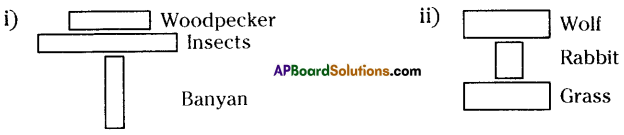
Draw the pyramid of number for the following food chains.
i) Banyan → insects → woodpecker
ii) Grass → rabbit → wolf
A) Are the pyramid of number having same structure in both of the above two cases as compare to the example given in the earlier paragraph?
B) If there is a difference, then what it is?
Answer:
AP SSC 10th Class Biology Solutions Chapter 9 Our Environment 9
A) No. The pyramid of number in the above two cases doesn’t have the same structure as compared to the example given in the textbook.
B)

  1. In the example (given in the textbook), number of organisms at producers level is more. This number gradually decreased in consumers level step by step. So the pyramid of number formed has typical pyramid shape with broad base and the narrow apex.
  2. But in the first case given here, on a single Banyan tree, a large number of insects live and feed. These insects become food for few Woodpeckers. So producers number is less than primary and secondary consumers, and secondary consumers are less than primary consumers. So the pyramid of number does not look like a pyramid. It consists of narrow base, broad middle part and medium apex.
  3. In the second case, grass which are large in number become food for few rabbits. Rabbit provides food for several wolves which are comparatively less in number than grass. So primary consumers are less in number than secondary consumers and producers. So the pyramid of number for this food chain also does not look like a pyramid. It consists of broad base, narrow middle part and medium apex. Thus it differs from case (i) also.

Question 6.
Think why the pyramids are always upright?
Answer:

  1. In ecology not all the pyramids are always upright.
  2. Pyramid of number may be upright, inverted or partly upright.
  3. Pyramid of biomass may be upright or inverted.
  4. But the pyramid of energy is always upright.
  5. This is because energy will decrease when we move from producers to the high level consumers.
  6. Only 10% of the energy from one tropic level transfers to the other through food chain.
  7. So the energy at base is more, gradually decreases, and very less at the top.
  8. As a result the energy pyramid is always upright.

AP SSC 10th Class Biology Solutions Chapter 9 Our Environment

Question 7.
Observe the data given in the following table.

Classes Area in 1967(Km2) Area in 2004 (Km2)
Lake – water spread area 70.70 62.65
Lake with sparse weed 0 47.45
Lake with dense weed 0 15.20
Lake-liable to flood in rainy season 100.97 0
Aquaculture ponds 0 99.74
Rice fields 8.40 16.62
Enchrochment 0.31 1.37
Total 180.38 180.38

i) In which year lake-water spread area is more? Why?
Answer:
In the year 1967. Because lake was not brought under cultivation.

ii) How do you think weeds are more in the lake?
Answer:
Excessive nutrient addition, especially from anthropogenic sources, led to explosive weed growth. Ex: Eichornia, pistia.

iii) What are the reasons for decrease in lake area?
Answer:

  1. In 1996, almost entire lake was brought under cultivation.
  2. Industries came along in ever growing intensity in the catchment area of the lake.

iv) How do the above reasons lead to pollution?
Answer:

  1. Consequently, the drains and rivulets carry substantial quantity of various types of pollutants into the lake.
  2. The major sources of pollution are agricultural runoff containing residues of several agrochemicals, fertilizers, fish tank discharges, industrial effluents containing chemical residues.

v) How was the threat to the lake due to pollution discovered?
Answer:

  1. The water of the lake turned alkaline in nature, turbid, nutrient rich, low in dissolved oxygen and high in biochemical oxygen demand.
  2. Water borne diseases like diarrhoea, typhoid, amoebiasis and others are said to be common among the local inhabitants who are unaware of the state of pollution in the lake water.
  3. Vector borne diseases were also increased.

vi) What could be the reasons for the migration of birds to this lake?
Answer:
To avoid extreme cold weather conditions in Northern Asia and Eastern Europe birds migrate to Kolleru lake.

AP SSC 10th Class Biology Solutions Chapter 9 Our Environment

Question 8.
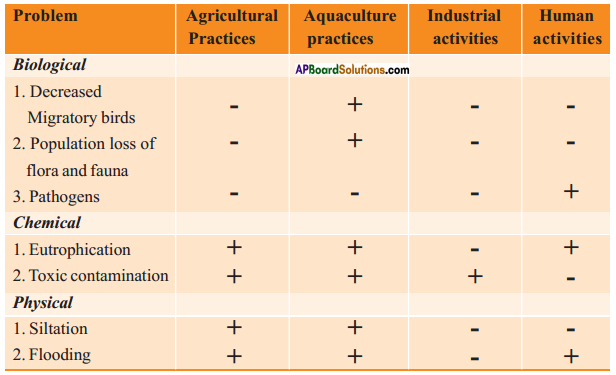
Observe the following table showing different activities in the lake and their influence.
AP SSC 10th Class Biology Solutions Chapter 9 Our Environment 10Legend:
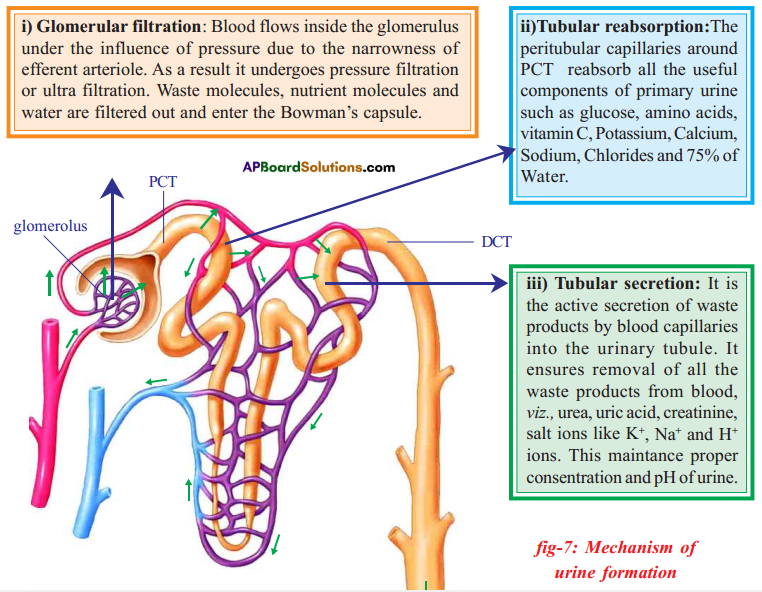
(+) means has influence on the mentioned problem
(-) means has no influence on the mentioned problem
i) What are the factors that affected the number of migratory birds to decrease?
Answer:
Aquaculture practices.

ii) Do you find any relationship between biological and physical problems?
Answer:
Yes. Aquaculture practices have influence on these problems.

iii) What are the reasons for chemical problems ?
Answer:
Agricultural practices, aquaculture practices, industrial activities and human activities are the reasons for chemical problems.

iv) What happens if the dissolved oxygen reduce in lake water ?
Answer:
If the dissolved oxygen reduces in lake water, sufficient amount of oxygen will not be available to organisms that live in the lake.
This leads to the death of organisms in the lake.

v) Is BOD of turbid and nutrient rich water high or low? What are its consequences?
Answer:
High. Its consequences are water borne diseases and death of organisms.

vi) People living in catchment area of Kolleru faced so many problems. Why?
Answer:
Vector borne disease increased. The lands adandoned are useless for agriculture.

AP SSC 10th Class Biology Solutions Chapter 9 Our Environment

Question 9.
Name any two pesticides / insecticides you have heard about.
Answer:
DDT, Aldrin, Malathian, Altrazine, Monocrotophos, Endosulphan etc.

Question 10.
How are the food grains and cereals being stored in your house and how dojyou protected them from pests and fungus?
Answer:
To protect food grains and cereals from pests and fungus, we will follow the following rules in our house.

  1. First of all we will dry and clean our grain before storing.
  2. We will avoid moisture in bagged grains by storing them on wooden structures, bamboo mats or polythene covers.
  3. We use domestic bins or improvised storage structures such as Gaade, Kotlu, Paatara, RCC bins and flat bottom metal bins etc.
  4. We fumigate the storage room with Ethylene Di-bromide (EDB) ampoules to avoid insect damage.
  5. We use anticoagulant for rat control in houses.

Question 11.
Where from pollutants enter to the water sources?
Answer:
The used water from industries and run off water containing agricultural effluents bring pollutants into water sources. Municipal and domestic sewage also pollute water sources.

Question 12.
How can you say fishes living in water having heavy metals in their bodies?
Answer:
The bioaccumulation of heavy metals in tissues of fish particularly in liver, kidney and gills were analysed and found their presence.

AP SSC 10th Class Biology Solutions Chapter 9 Our Environment

Question 13.
Researchers found that pollution levels increase during monsoon season. Why they found so?
Answer:

  1. Pollution levels increase during monsoon season in water bodies.
  2. During monsoon season heavy rainfall occurs.
  3. The rain water brings residues of agrochemicals, fertilizers and different types of organic substances, municipal and domestic sewage.
  4. Hence pollution levels increase in monsoon season.

Question 14.
Why did people also suffer from various diseases after consuming fishes living in local water reservoir?
Answer:

  1. The heavy metals could find their way into human beings through food chain.
  2. This bioaccumulation cause various physiological disorders such as hypertension, sporadic fever, renal damage, nausea etc.

Question 15.
What is the food chain that has been discussed in the above case?
Answer:
The food chain discussed in the above occurrence is Crops → Locust → Sparrow → Hawk.

Question 16.
How did the campaign disturb the food chain in the fields?
Answer:

  1. Crop yields after the campaign were substantially decreased.
  2. Though the campaign against sparrows ended it was too late.
  3. With no sparrows to eat the locust populations, the country was soon swarmed.
  4. Locust coupled with bad weather led to the great Chinese famine.

Question 17.
How did these disturbances affect the environment?
Answer:

  1. The number of locust increased.
  2. Use of pesticides against locust population further degraded the land.

Question 18.
Is it right to eradicate a living organism in an ecosystem? How is it harmful?
Answer:

  1. No, it is not right to eradicate a living organism in an ecosystem.
  2. It disturbs the existing food chain.

AP SSC 10th Class Biology Solutions Chapter 9 Our Environment

Question 19.
Were the sparrows really responsible? What was the reason for the fall in crop production?
Answer:

  1. No, the sparrows were not really responsible for the loss of food grain.
  2. With no sparrows to eat the locust population crops were damaged and this led to fall in crop production.

Question 20.
What was the impact of human activities on the environment?
Answer:

  1. The human activities badly affected the environment.
  2. Use of pesticides against the pest degraded the land.

Question 21.
What do you suggest for such incidents not to occur?
Answer:

  1. I suggest to use organic manures and organic insecticides to kill the insects.
  2. Rotation of crops is the best method to protect the crops from pests.
  3. We should not kill any organism on this earth because every organism has a role to play.
  4. Think before you start action.

10th Class Biology 9th Lesson Our Environment Activities

Activity – 1

Observe any water ecosystem in your surroundings and identify the different food chains and food web operating in this ecosystem. Write the following details in your notebook.

WORKSHEET

1. Names of the students in a group: ——————— Date: ———–
2. Name of the ecosystem: ———————
3. Topography: ———————
4. Names / Number of plants (producers) identified: ———————
5 Names / Number of animals identified: ———————
6. Identify the different types consumers and name them & mention their number below :
Herbivores (Primary consumers): ———————
Carnivores (Secondary consumers): ———————
Top carnivores (Tertiary): ———————
7 Food relationships among them: food habits/preferences: ———————
8 Show / draw the different food chains: ———————
9. Showcase the food web: ———————
10. List out all abiotic factors existing in the ecosystem: ———————
( A check list can be given, and asked to tick)
11. Is there any threat to the ecosystem ? Yes / No ———————
If yes, what ? and how ? ———————
Suggest few remedial measures ———————
Answer:
Student’s Activity.

AP SSC 10th Class Physics Solutions Chapter 5 Refraction of Light at Plane Surfaces

AP State Board Syllabus AP SSC 10th Class Physics Solutions Chapter 5 Refraction of Light at Plane Surfaces Textbook Questions and Answers.

AP State Syllabus SSC 10th Class Physics Solutions 5th Lesson Refraction of Light at Plane Surfaces

10th Class Physics 5th Lesson Refraction of Light at Plane Surfaces Textbook Questions and Answers

Improve Your Learning

Question 1.
Why is it difficult to shoot a fish swimming in water? (AS1)
(OR)
If the fish is swimming in water, why it is difficult to shoot?
(OR)
A shooter finds it difficult to shoot a fish swimming in water. Why?
Answer:
Due to refraction of light, it is difficult to shoot a fish swimming in water.

Reason :
The light rays coming from the fish towards shooter, bend at water-air interface. So, shooter sees only image of the fish, but not actual fish.

AP SSC 10th Class Physics Solutions Chapter 5 Refraction of Light at Plane Surfaces

Question 2.
The speed of light in a diamond is 1,24,000 km/s. Find the refractive index of diamond if the speed of light in air is 3,00,000 km/s. (AS1)
Answer:
Speed of light in diamond = 1,24,000 km/s
Speed of light in vacuum = 3,00,000 km/s
AP SSC 10th Class Physics Solutions Chapter 5 Refraction of Light at Plane Surfaces 1

Question 3.
Refractive index of glass relative to water is 9/8. What is the refractive index of water relative to glass? (AS1)
Answer:
Refractive index of glass relative to water = [latex]\frac{n_{g}}{n_{w}}=\frac{9}{8}[/latex]
∴ Refractive index of water relative to glass = [latex]\frac{\mathrm{n}_{\mathrm{w}}}{\mathrm{n}_{\mathrm{g}}}=\frac{8}{9} \cdot\left[\because \mathrm{n}_{12}=\frac{1}{\mathrm{n}_{21}}\right][/latex]

Question 4.
The absolute refractive index of water is 4/3. What is the critical angle ? (AS1)
Answer:
Absolute refractive index of water = 4/3
AP SSC 10th Class Physics Solutions Chapter 5 Refraction of Light at Plane Surfaces 2
Critical angle of water = C = 48°5′ = 48.5°.

Question 5.
Determine the refractive index of benzene if the critical angle is 42°. (AS1)
Answer:
Critical angle of benzene = 42°.
AP SSC 10th Class Physics Solutions Chapter 5 Refraction of Light at Plane Surfaces 3

Question 6.
Explain the formation of mirage. (AS1)
(OR)
How is the mirage formed? Explain.
(OR)
A person walking on a road observed some water being present on the road but when he went there actually he did not find water. What is that actually formed called? Explain that process.
(OR)
Sometimes during the hot summer at noon time on tar roads, it appears that there is water on the road, but there would really be no water. What do you call this phenomenon? Explain why it happens.
(OR)
Why do you see a mirage the road on a hot summer day?
Answer:

  • During hot summer day, air just above the road surface is very hot and the air at higher altitudes is cool.
  • We know that refractive index of air increases with density.
  • So, the cooler air at the top has greater refractive index than hotter air just above the road.

AP SSC 10th Class Physics Solutions Chapter 5 Refraction of Light at Plane Surfaces 4

  • Light travels faster through the thinner hot air than the denser cool air above it.
  • On hot days, the temperature decreases with height.
  • Thus the refractive index of air increases with height.
  • When the light from a tall object such as tree or from the sky passes, through a medium just above the road whose refractive index decreases towards ground, suffers refraction and takes a curved path because of total internal reflection.
  • This refracted light reaches the observer in a direction shown as in second figure.
  • This appears to the observer that the ray is reflected from ground.
  • Hence we will see water on road, which is the virtual image of sky and an inverted image of tree on the road.
  • Such virtual images of distant high objects cause the optical illusion called ‘mirage’.

AP SSC 10th Class Physics Solutions Chapter 5 Refraction of Light at Plane Surfaces

Question 7.
How do you verify experimentally that [latex]\frac{\sin i}{\sin r}[/latex] is a constant? (AS1)
(OR)
Explain the experiment that shows the relation between angle of incidence and angle of refraction through figure.
(OR)
Write an experiment to obtain the relation between angle of incidence and angle of refraction.
Answer:
Aim:
Identifying relation between angle of incidence and angle of refraction.

Materials required :
A plank, white chart, protractor, scale, small black painted plank, a semi-circular glass disc of thickness nearly 2 cm pencil and laser light.

Procedure :
AP SSC 10th Class Physics Solutions Chapter 5 Refraction of Light at Plane Surfaces 5 AP SSC 10th Class Physics Solutions Chapter 5 Refraction of Light at Plane Surfaces 6

  1. Take a wooden plank which is covered with white chart.
  2. Draw two perpendicular lines, passing through the middle of the paper as shown in the figure (a).
  3. Let the intersecting point be O.
  4. Mark one line as NN which is normal to the another line marked as MM.
  5. Here MM represents the line drawn along the interface of two media and NN represents the normal drawn to this line at ‘O’.
  6. Take a protractor and place it along NN in such a way that its centre coincides with ‘O’ as shown in figure (b).
  7. Then mark the angles from 0° to 90° on both sides of the line NN.
  8. Repeat the same on the other side of the line NN.
  9. The angles should be represented on circular line.
  10. Now place semi circular glass disc so that its diameter coincides with the interface line (MM) and its centre coincides with the point O.
  11. Take the laser light and send it along NN in such a way that the laser propagates from air to glass through the interface at point O and observe the way of laser light coming from other side of disc.
  12. There is no deviation.
  13. Send Laser light along a line which makes 15° (angle of incidence) with NN and see that it must pass through point O.
  14. Measure its corresponding angle of refraction.
  15. Repeat the experiment with angle of incidences of 20°, 30°, 40°, 50° and 60° and note the corresponding angles of refraction.

Observation :

  • Find sin i, sin r for every i and r note down the values in table.

AP SSC 10th Class Physics Solutions Chapter 5 Refraction of Light at Plane Surfaces 7

  • Evaluate [latex]\frac{\sin i}{\sin r}[/latex] for every incident angle i.
  • We get [latex]\frac{\sin i}{\sin r}[/latex] as constant.
  • That is the relationship between angle of incidence and angle of refraction.
  • The ratio of sin i and sin r is called refractive index.

Question 8.
Explain the phenomenon of total internal reflection with one or two activities. (AS1)
Answer:
Procedure :

  1. Place the semi-circular glass disc in such a way that its diameter coincides with interlace line MM and its center coincides with point O’.
  2. Now send light from the curved side of the semicircular glass disc.
  3. The light travels from denser medium to rarer medium.
  4. Start with angle of incidence (i), equals to 0° and observe for refracted on other side of the disc.
  5. It does not deviate into its path when entering rarer medium.
  6. Send laser light along angles of incidence 5°, 10°, 15°, etc. and measure the angle of refraction.
  7. And tabulate the results in the given table.

Observation :

  • Make a table shown below and note the values ‘i’ and ‘r’.

AP SSC 10th Class Physics Solutions Chapter 5 Refraction of Light at Plane Surfaces 8

  • At particular angle of incidence, the refracted ray does not come out but grazes the interface separating the air and glass. This angle is called critical angle.
  • When the angle of incidence is greater than critical angle, the light ray gets reflected into denser medium at the interface, i.e. light never enters rarer medium. This phenomenon is called total internal reflection.

AP SSC 10th Class Physics Solutions Chapter 5 Refraction of Light at Plane Surfaces

Question 9.
How do you verify experimentally that the angle of refraction is more than angle of incidence when light rays travel from denser to rarer medium? (AS1)
(OR)
When the light rays travel from denser to rarer medium, how can you explain, the angle of refraction is more than angle of incidence experimentally?
Answer:
Procedure :
AP SSC 10th Class Physics Solutions Chapter 5 Refraction of Light at Plane Surfaces 9
AP SSC 10th Class Physics Solutions Chapter 5 Refraction of Light at Plane Surfaces 10

  • Take a metal disc. Use a protractor and mark angles along its edge as shown in the figure.
  • Arrange two straws at the centre of the disc, in such a way that they can be rotated freely about the centre of the disc.
  • Adjust one of the straws to make an angle 10°.
  • Immerse half of the disc vertically into the water, filled in a transparent vessel. While dipping, verify that the straw at 10° must be inside the water.
  • From the top of the vessel, try to view the straw which is inside the water as shown in the figure.
  • Then adjust the other straw which is outside of the water until both straws look like they are in a single straight line.
  • Then take the disc out of the water and observe the two straws on it. You will find that they are not in a single straight line.
  • Measure the angle between the normal and second straw. Note the values in the following table.

AP SSC 10th Class Physics Solutions Chapter 5 Refraction of Light at Plane Surfaces 11

  • Do the same for various angles and find the corresponding angles of refraction and note them in the table.

Observation :
We will find the angle of refraction is more than angle of incidence.
i. e., r > i.

Conclusion :
When light travels from denser (water) to rarer (air) it bends away from the normal.

Question 10.
Take a bright metal ball and make it black with soot in a candle flame. Immerse it in water. How does it appear and why? (Make hypothesis and do the above experiment) (AS2)
Answer:
AP SSC 10th Class Physics Solutions Chapter 5 Refraction of Light at Plane Surfaces 12

  • The black metallic .ball appears to be raised up in the water because the path of the ray changes its direction at the interface, separating the two media, i.e., water and air.
  • This path is chosen by light ray so as to minimize time of travel between ball and eye.
  • This can be possible only when the speed of light changes at interface of two media.
  • In another way the speed of light is different in different media.

Hypothesis :
Speed of light changes when it travels from one medium to another medium.

Question 11.
Take a glass vessel and pour some glycerine into it and then pour water up to the brim. Take a quartz glass rod. Keep it in the vessel. Observe the glass rod from the sides of the glass vessel.
1) What changes do you notice?
2) What could be the reasons for these changes? (AS2)
Answer:

  1. We cannot see the glass rod in glycerine but we can see the rod in water.
  2. We can also observe an apparent image of glass rod in water.
  3. Reasons:
    i) Glycerine has essentially same refractive index as glass.
    ii) So, any light passing through these is bent equally.
    iii) Since both are transparent, it is not possible for our eye to distinguish the boundary by a change in the angle of reflection, and the glass seems to vanish.
    iv) But, the refractive index of glass and water are different.
    v) So the glass rod is visible to our eye in water. .

Question 12.
Do Activity-7 again. How can you find critical angle of water? Explain your steps briefly. (AS3)
Answer:
AP SSC 10th Class Physics Solutions Chapter 5 Refraction of Light at Plane Surfaces 13
Procedure:

  1. Take a cylindrical transparent vessel.
  2. Place a coin at the bottom of the vessel.
  3. Now pour water until you get the image of the coin on the water surface.
  4. This is due to total internal reflection.

Critical angle of water :

  1. Refractive index of water = 1.33
  2. The sine of critical angle of water = [latex]\frac{1}{\text { Refractive index }}[/latex]
  3. Sin C = [latex]\frac{1}{\text { 1.33 }}[/latex] ⇒ sin C = 0.7518.
    ∴ C = 8.7°
  4. ∴ The critical angle of water = 48.7°.

AP SSC 10th Class Physics Solutions Chapter 5 Refraction of Light at Plane Surfaces

Question 13.
Collect the values of refractive index of the following media. (AS4)

Water, coconut oil, flint glass, crown glass, diamond, benzene and hydrogen gas.

Answer:

Medium Refractive Index
1. Water 1.33
2. Coconut oil 1.445
3. Flint glass 1.65
4. Crown glass 1.52
5. Diamond 2.42
6. Benzene 1.50
7. Hydrogen gas 1.000132

Question 14.
Collect information on working of optical fibres. Prepare a report about various uses of optical fibres in our daily life. (AS4)
(OR)
What do you know about the working of optical fibres and make a report of various uses of optical fibres in our daily life?
(OR)
How are the optical fibres working? What are the various uses of optical fibres in our daily life?
Answer:
1) An optical fibre is very thin fibre made of glass or plastic having radius about a micrometer (10-6 m).
2) A bunch of such thin fibres form a light pipe.
AP SSC 10th Class Physics Solutions Chapter 5 Refraction of Light at Plane Surfaces 14

Working :
1. Optical fibre having three parts-namely core (n = 1, 7), clading (n = 1, 6) and shielding.
2. The ray of light AB gets refracted at point ‘B’ into core and incident at ‘C’ with angle of incidence i (i > c).

AP SSC 10th Class Physics Solutions Chapter 5 Refraction of Light at Plane Surfaces 15
3. The angle of incidence is greater than the critical angle and hence total internal reflection takes place.
4. The light is thus transmitted along the fibre.
5. The optical fibre is also based on ‘Fermat’s principle.

Uses :

  1. Optical fibres are used in ‘endoscopy’ to see the internal organs like throat, stomach, intestines, etc.
  2. Optical fibres are used in transmitting communication signals through light pipes.
  3. Optical fibres are used in international telephone cables laid under the sea, in large computer networks, etc.
  4. In optical fibre about 2000 telephone signals appropriately mixed with light waves may be simultaneously transmitted through a typical optical fibre.

Question 15.
Take a thin thermocol sheet. Cut it in circular discs of different radii like 2 cm, 3 cm, 4 cm, 4.5 cm, 5 cm etc. and mark centers with sketch pen. Now take needles of length nearly 6 cm. Pin a needle to each disc at its centre vertically. Take water in a large opaque tray and place the disc with 2 cm radius in such a way that the needle is inside the water as shown in figure. Now try to view the free end (head) of the needle from surface of the water.
AP SSC 10th Class Physics Solutions Chapter 5 Refraction of Light at Plane Surfaces 17
1) Are you able to see the head of the needle?
Now do the same with other discs of different radii. Try to see the head of the needle, each time.
Note : The position of your eye and the position of the disc on water surface should not be changed while repeating the Activity with’other discs.
2) At what maximum radius of disc, were you not able to see the free end of the needle ?
3) Why were you not able to view the head of the nail for certain radii of the discs ?
4) Does this Activity help you to find the critical angle of the medium (water) ?
5) Draw a diagram to show the passage of light ray from the head of the nail in different situations. (AS4)
Answer:
AP SSC 10th Class Physics Solutions Chapter 5 Refraction of Light at Plane Surfaces 29
1. Yes, we can see head of the needle.

2. Height of the pin = 6 cm
Radius of the disc = x cm
Critical angle of water = C = 48.7°
Tan C = 48.7°
[latex]\frac{x}{6}[/latex] = 1.138 ⇒ x = 6.828 cm
So, at radius of 6.8 cm we cannot see the free end of the needle.

3. Because the light rays coming from object undergoing total internal reflection by touching the surface of disc.

4. Yes, we can find critical angle.
Refractive index of air (n2) = 1.003 ; Refractive index of water (n1) = 1.33
Sin C = [latex]\frac{n_{2}}{n_{1}}=\frac{1.003}{1.33}[/latex] = 0.7541 ⇒ C = 48.7°

5.
AP SSC 10th Class Physics Solutions Chapter 5 Refraction of Light at Plane Surfaces 18

Question 16.
Explain the refraction of light through the glass slab with a neat ray diagram. (AS5)
(OR)
Draw a glass slab diagram and explain the refraction of light through glass slab.
(OR)
Write the procedure of a lab Activity to understand lateral shift of light rays through a glass slab.
(OR)
How can you find lateral shift using glass slab?
Answer:
Aim :
A) Determination of position and nature of image formed by a glass slab.
B) Understanding lateral and vertical shift.
C) Determination of refractive index of given glass slab.

Materials required :
Plank, chart paper, clamps, scale, pencil, thin glass slab and pins.

AP SSC 10th Class Physics Solutions Chapter 5 Refraction of Light at Plane Surfaces 16

Procedure :

  1. Place a piece of chart on a plank. Clamp it. Place a glass slab in the middle of the paper.
  2. Draw border line along the edges of the slab by using a pencil. Remove it. You will get a figure of a rectangle.
  3. Name the vertices of the rectangle as A, B, C and D.
  4. Draw a perpendicular at a point on the longer sides (AB) of the rectangle.
  5. Now draw a line, from the point of intersection where side AB of rectangle and perpendicular meet, in such a way that it makes 30° angle with the normal.
  6. This line represents the incident ray falling on the slab and the angle it makes with normal represents angle of incidence.
  7. Now place the slab on the paper in such a way that it fits in the rectangle drawn. Fix two identical pins on the line making 30° angle with normal, such that they stand vertically with same height.
  8. By looking at the two pins from the other side of the slab, fix two pins in such a way that all pins appear to be along a straight line.
  9. Remove the slab and take out pins. Draw a straight line by joining the dots formed by the pins up to the edge CD of the rectangle.
  10. This line represents emergent ray of the light.
  11. Draw a perpendicular to the line CD where our last line drawn meets the line CD.
  12. Measure the angle between emergent ray and normal.
  13. This is called angle of emergence.
  14. The angle of incidence and angle of emergence are equal.
  15. Incident emergent rays are parallel.
  16. The distance between the parallel rays is called shift.

Question 17.
Place an object on the table. Look at the object through the transparent glass slab. You will observe that it will appear closer to you. Draw a ray diagram to show the passage of light ray in this situation. (AS5)
Answer:
AP SSC 10th Class Physics Solutions Chapter 5 Refraction of Light at Plane Surfaces 19

Question 18.
What is the reason behind the shining of diamond and how do you appreciate it? (AS6)
(OR)
For which reason is the diamond shining and how is it appreciable?
Answer:

  • The critical angle of diamonds is very low, i.e., 24.4°.
  • So if a light ray enters diamond, it undergoes total internal reflection.
  • It makes the diamond shine brilliant.
  • So total internal reflection is main cause of brilliance of diamonds.
  • Majority of people are attracted towards diamonds due to this property.
  • So we have to thoroughly appreciate total internal reflection for brilliance of diamonds.

AP SSC 10th Class Physics Solutions Chapter 5 Refraction of Light at Plane Surfaces

Question 19.
How do you appreciate the role of Fermat’s principle in drawing ray diagrams? (AS6)
(OR)
How do you admire the role of Fermat’s principle in drawing ray diagrams? Fermat’s principle: The light ray always travels in a path which needs shortest possible time to cover distance between two points.
This principle has lot of importance on optics. This is used in

  1. Laws of reflection (i.e., angle of incidence = angle of reflection)
  2. Laws of refraction (Snell’s law)
  3. To derive refractive index of a medium.
  4. To derive refractive index of glass slab.
    So, I appreciate the Fermat’s principle.

Question 20.
A light ray is incident on air-liquid interface at 45° and is refracted at 30°. What is the refractive index of the liquid? For what angle of incidence will the angle between reflected ray and refracted ray be 90°? (AS7)
Answer:
i) Given that angle of incidence (i) = 4S°
angle of refraction (r) = 30°
AP SSC 10th Class Physics Solutions Chapter 5 Refraction of Light at Plane Surfaces 20

ii) Given that angle between reflected and refracted ray is 90°.
We know angle of incidence = angle of reflection
∴ Angle of refraction (r) = 90 – angle of incidence
= 90 – i
AP SSC 10th Class Physics Solutions Chapter 5 Refraction of Light at Plane Surfaces 21
Critical angle = 54.7°. This angle is also known as polarising angle.

Question 21.
Explain why a test tube immersed at a certain angle in a tumbler of water appears to have a mirror surface from a certain viewing position. (AS7)
Answer:
When a test tube is immersed at a certain angle in a tumbler of water appears to have
a mirror surface from a certain viewing positions due to total internal reflection.
AP SSC 10th Class Physics Solutions Chapter 5 Refraction of Light at Plane Surfaces 22
Explanation :

  • The critical angle for glass is 42°.
  • The glass and air in test tube works as denser and rarer mediums.
  • The rays of light while travelling through water strike glass – air interface of test tube at an angle of more than 42° (i > c) they get totally internal reflected as shown figure.
  • When these reflected rays reach the eye, they appear to come from the surface of test tube itself.
  • Now the test tube appears like silvary.

AP SSC 10th Class Physics Solutions Chapter 5 Refraction of Light at Plane Surfaces

Question 23.
In what cases does a light ray not deviate at the interface of two media? (AS7)
Answer:

  1. When a light ray incident is perpendicular to the interface of surface, it does not undergo deviation.
  2. When a light ray incident is more than critical angle, it does not undergo deviation (refraction) but it undergoes reflection to come back into the original medium.

Question 25.
When we sit at camp fire, objects beyond the fire seen swaying. Give the reason for it. (AS7)
(OR)
What are the reasons for the objects beyond the fire seen swaying, when we sit at camp fire?
Answer:

  • The temperature of the surrounding air changes due to convection of heat by the camp fire.
  • This leads to chang in density and refractive index of air, continuously.
  • The continuous change in refractive index of air changes the refracted path of the light ray.
  • This is the cause for swaying of an object.

Question 26.
Why do stars appear twinkling? (AS7)
(OR)
What is the reason for the appearance of stars like twinkling?
Answer:

  • The twinkling of a star is due to atmospheric refraction of star light.
  • The atmosphere consists of a number of layers of varying densities.
  • When light rays coming from a star pass through this layers and undergo refraction for several times.
  • Thats why stars appear twinkling.

AP SSC 10th Class Physics Solutions Chapter 5 Refraction of Light at Plane Surfaces

Question 27.
Why does a diamond shine more than a glass piece cut to the same shape? (AS7)
(OR)
What is the reason for shining of diamond brightly as compared to glass piece cut?
Answer:

  • The critical angle of a diamond is very low (i.e., 24.4°).
  • So if a light ray enters a diamond it definitely undergoes total internal reflection.
  • Whereas it is not possible with glass piece cut to the same shape.
  • So diamond shines more than a glass piece.

Fill In The Blanks

1. At critical angle of incidence, the angle of refraction is ……………… .
2. n1 sin i = n2 sin r, is called ……………… .
3. Speed of light in vacuum is ……………… .
4. Total internal reflection takes place when a light ray propagates from …………. to …………… medium.
5. The refractive index of a transparent material is 3/2. The speed of the light in that medium is …………… .
6. Mirage is an example of ……………… .
Answer:

  1. 90°
  2. Snell’s law
  3. 3 × 10⁸ m/s
  4. denser, rarer
  5. 2 × 10⁸ m/s
  6. optical illusion / total internal reflection

Multiple Choice Questions

1. Which of the following is Snell’s law?
AP SSC 10th Class Physics Solutions Chapter 5 Refraction of Light at Plane Surfaces 30
Answer:
B)

2. The refractive index of glass with respect to air is 2. Then the critical angle of glass air interface is ………………….
A) 0°
B) 45°
C) 30°
D) 60°
Answer:
C) 30°

3. Total internal reflection takes place when the light ray travels from …………….. .
A) rarer to denser medium
B) rarer to rarer medium
C) denser to rarer medium
D) denser to denser medium
Answer:
C) denser to rarer medium

AP SSC 10th Class Physics Solutions Chapter 5 Refraction of Light at Plane Surfaces

4. The angle of deviation produced by the glass slab is …………… .
A) 0°
B) 20°
C) 90°
D) depends on the angle formed by the light ray and normal to the slab
Answer:
D) depends on the angle formed by the light ray and normal to the slab

10th Class Physics 5th Lesson Refraction of Light at Plane Surfaces Additional Questions and Answers

Question 1.
Derive Snell’s law.
(OR)
Prove n1 sin i = n2 sin r.
(OR)
Derive the Snell’s formula from Fermat’s principle.
(OR)
Derive the formula in realtion with and of incidence and angle of refraction.
Answer:
Let X be the path and A be the point above X and B be the point below X.
Now, we have to find the way from A to B.

  1. Let us try to calculate how long it would take to go from A to B by the two paths through point D and another through point C.
  2. If we draw a perpendicular DE, between two paths at D, we see that the path on line is shortened by the amount EC.
  3. On the other hand, in the water, by drawing corresponding perpendicular CF we find that we have to go to the extra distance DF in water. These times must be equal since we assumed there was no change in time between two paths.
  4. Let the time taken by the man to travel from E to C and D to F be ∆t and v1 and v2 be the speeds of the running and swimming. From figure we get,
    EC = v1 ∆t and DF = v2 ∆t
    ⇒ [latex]\frac{\mathrm{EC}}{\mathrm{DF}}=\frac{\mathrm{v}_{1}}{\mathrm{v}_{2}}[/latex] ………….. (1)
  5. Let i and r be the angles measured between the path ACB and normal NN, perpendicular to shore line X.

AP SSC 10th Class Physics Solutions Chapter 5 Refraction of Light at Plane Surfaces 23 AP SSC 10th Class Physics Solutions Chapter 5 Refraction of Light at Plane Surfaces 24

10th Class Physics 5th Lesson Refraction of Light at Plane Surfaces InText Questions and Answers

10th Class Physics Textbook Page No. 56

Question 1.
Why should you see a mirage as a flowing water?
Answer:

  • A mirage is a naturally occuring optical phenomenon, in which light rays are bent to produce a displaced image of distant objects or the sky.
  • As light passes from colder air (higher place) to warmer air (lower place), the light ray bends away from the direction of the temperature gradient.
  • Once the rays reach the viewer’s eye, the visual cortex interprets it as if it traces back along a perfectly straight “line of sight”. However this line is at a tangent to the path the ray takes at the point it reaches the eye.
  • The result is that an “inferior image ” of the sky above appears on the ground.
  • The viewer may incorrectly interprets this sight as water that is reflecting the sky, which is to the brain, a more reasonable and common occurrence.

Question 2.
Can you take a photo of a mirage?
Answer:

  • Yes, I can take a photo of a mirage.
  • Our eye can catches the total internal reflected rays.
  • So, camera lens also catches the same.

10th Class Physics Textbook Page No. 46

Question 3.
What difference do you notice in fig 2(a) and Fig 2(b) with the respect to refracted rays?
(OR)
Draw the ray diagram of refraction in between denser and rarer medium.
AP SSC 10th Class Physics Solutions Chapter 5 Refraction of Light at Plane Surfaces 27
Answer:
In figure 2(a) the light ray bends towards normal whereas in 2(b) the light ray bends away from the normal.

Question 4.
Is there any relation between behaviour of refracted rays and speed of the light?
Answer:
Yes. The speed of light changes when it travels from one medium to another medium. So the light may bend towards normal or away from normal.

10th Class Physics Textbook Page No. 47

Question 5.
Why db different material media possess different values of refractive indices?
Answer:
Refractive index depends on nature of material. So different media have different values of refractive indices.

10th Class Physics Textbook Page No. 48

Question 6.
On what factors does the refractive index of a medium depend?
Answer:
Refractive index depends on (1) Nature of material and (2) Wavelength of light used.

10th Class Physics Textbook Page No. 49

Question 7.
Can we derive the relation between the angle of incidence and the angles of refraction theoretically?
Answer:
Yes, we can derive the relation between angle of incidence and angles of refraction theoretically. We can get nt sin i = n2 sin r.

10th Class Physics Textbook Page No. 53

Question 8.
Is there any chance that angle of refraction is equal to 90° ? When does this happen?
Answer:
Yes, when angle of incidence is equal to critical angle then angle of refraction is equal to 90°.

10th Class Physics Textbook Page No. 54

Question 9.
What happens to light when the angle of incidence is greater than critical angle?
Answer:
When the angle of incidence is greater than critical angle, the light ray gets reflected into denser medium at the interface, i.e., light never enters rarer medium. This phenomenon is called total internal reflection.

10th Class Physics Textbook Page No. 57

Question 10.
How does light behave when a glass slab is introduced in its path?
Answer:
The light ray undergoes refraction two times.

10th Class Physics 5th Lesson Refraction of Light at Plane Surfaces Activities

Activity – 1

Question 1.
Procedure :
Take some water in a glass tumbler. Keep a pencil in it. See the pencil from one side of glass and also from the top of the glass.
Observation:

1. How does it look?
Answer:
From the side it appears to be bent. From the top it appears as it is raising.

AP SSC 10th Class Physics Solutions Chapter 5 Refraction of Light at Plane Surfaces

2. Do you find any difference between two views?
Answer:
Yes, the position of pencil is different.

Activity – 2

Question 2.
Procedure :

  1. Go to a long wall (of length of 30 feet) facing the Sun. Go to the one end of a wall and ask someone to bring a bright metal object near the other end of the wall.
  2. When the object is few inches from the wall, it will distort and we will see a reflected image on the wall as though the wall were a mirror.

Observation:

Why is there an image of the object on the wall?
Answer:
The image is due to refraction of light.

Activity-3 Refraction

Question 3.
Procedure: –

  1. Take a shallow vessel with opaque walls such as a mug, a tin or a pan.
  2. Place a coin at the bottom of the vessel.
  3. Move away from the vessel until we cannot see the coin (fig. 2). Ask someone to fill the vessel with water. When the vessel is filled with water the coin comes back into view (fig. 3).

AP SSC 10th Class Physics Solutions Chapter 5 Refraction of Light at Plane Surfaces 25

1. Why are you able to see the coin when the vessel is filled with water?
Answer:
The ray of light originated from the coin does not reach your eye when the vessel is empty. Hence you are not able to see the coin. But the coin becomes visible after the vessel is filled with water.

2. How is it possible? Do you think that the ray reaches your eye when the vessel is filled with water?
Answer:
Yes, it reaches the second instance.

3. What happens to the light ray at interface between water and air?
Answer:
It bends towards the normal.

AP SSC 10th Class Physics Solutions Chapter 5 Refraction of Light at Plane Surfaces

4. What could be the reason for this bending of the light ray in the second instance?
Answer:
It is based on Fermat’s principle, which states that the light ray always travels in a path which needs shortest possible time to cover the distance between the two points.

Activity – 4

Question 4.
Prove that when light ray travels from denser to rarer medium it bends away from the normal.
Answer:
AP SSC 10th Class Physics Solutions Chapter 5 Refraction of Light at Plane Surfaces 9
AP SSC 10th Class Physics Solutions Chapter 5 Refraction of Light at Plane Surfaces 10
Procedure :

  1. Take a metal disc. Use protractor and mark angles along its edge as shown in the figure.
  2. Arrange two straws from the centre of the disk.
  3. Adjust one of the straws to the angle 10°.
  4. Immerse half of the disc vertically into the water, filled in a transparent vessel.
  5. Inside the water the angle of straw should be at 10°.
  6. From the top of the vessel try to view the straw which is inside the water.
  7. Then adjust the other straw which is outside the water until both straws are in a single straight line.
  8. Then take the disc out of the water and observe the two straws on it.
  9. We will find that they are not in a single straight line.
  10. It could be seen from the side view while half of the disc is inside the water.
  11. Measure the angle between the normal and second straw. Draw table for various angles and corresponding angles of refraction.

Observation :
We observe that ‘r’ is greater than ‘i’ in all cases and when light travels from
denser to rarer medium it bends away from the normal.

Activity – 6

Question 5.
Why can we not see a coin placed in water from the side of glass?
Answer:
Procedure :

  1. Take a transparent glass tumbler and coin.
  2. Place a coin on a table and place glass on the coin.
  3. Observe the coin from the side of the glass. We can see the coin.
  4. Now fill the glass with water and observe the coin from the side of the glass tumber.
  5. Now we cannot see the coin because the coin rises up due to refraction.

Activity – 7

Question 7.
Why can we see the coin in water from top? What is the phenomenon behind that?
Answer:
AP SSC 10th Class Physics Solutions Chapter 5 Refraction of Light at Plane Surfaces 13
Procedure :

  1. Take a cylindrical transparent vessel. Place a coin at the bottom of the vessel.
  2. Now pour water until we will get the image of the coin on the water surface.
  3. This is due to total internal reflection.

Activity – 8

Question 8.
Write an Activity to find refractive index of glass slab by calculating vertical shift.
(OR)
Explain the experiment with glass slab in determination of refraction through vertical shift.
Answer:
AP SSC 10th Class Physics Solutions Chapter 5 Refraction of Light at Plane Surfaces 26
Procedure :

  1. Take a glass slab and measure the thickness of the slab.
  2. Take a white chart and fix it on the table.
  3. Place the slab in the middle of the chart.
  4. Draw line around it.
  5. Remove the slab from its place.
  6. The lines form a rectangle. Name the vertices of it as A. B, C and D. ‘
  7. Draw a perpendicular to the longer line AB of the rectangle at any point on it.
  8. Place slab again in the rectangle ABCD.
  9. Take a needle. Place at a point P in such a way that its length is parallel to the AB on the perpendicular line at a distance of 20 cm from the slab.
  10. Now take another needle and by seeing at the first needle from the other side of the slab, try to keep the needle so that it forms a straight line with the first needle. 1 1)
  11. Remove the slab and observe the positions of the needles.
  12. They are not in same line.
  13. Draw a perpendicular line from the second needle to the line on which the first needle is placed.
  14. Take the intersection point as Q.
  15. The distance between P and Q is vertical shift.
  16. We will get the same vertical shift placing needle at different distances.
  17. AP SSC 10th Class Physics Solutions Chapter 5 Refraction of Light at Plane Surfaces 28

AP SSC 10th Class Biology Solutions Chapter 4 Excretion – The Wastage Disposing System

AP State Board Syllabus AP SSC 10th Class Biology Solutions Chapter 4 Excretion – The Wastage Disposing System Textbook Questions and Answers.

AP State Syllabus SSC 10th Class Biology Solutions 4th Lesson Excretion – The Wastage Disposing System

10th Class Biology 4th Lesson Excretion – The Wastage Disposing System Textbook Questions and Answers

Improve your learning

Question 1.
What is meant by excretion? Explain the process of formation of urine.
(OR)
What are the different stages in urine formation? Explain what happens in those stages.
(OR)
Explain various steps in the mechanism of urine formation.
Answer:
Excretion: Excretion is a biological process involved in separation and removal of toxic wastes from the body.
Formation of urine involves four stages:

  1. Glomerular filtration
  2. Tubular reabsorption
  3. Tubular secretion and
  4. Concentration of urine.

1. Glomerular filtration:

  1. Blood flows from renal artery to glomerulus through afferent arteriole.
  2. Filtration of blood occurs in the glomerulus.
  3. Glomerular filtrate is also known as primary urine which almost equal to blood in chemical composition except the presence of blood cells.

2. Tubular reabsorption:

  1. The primary urine passes into proximal convoluted tubule.
  2. Useful substances like glucose, amino acids, sodium chloride, potassium ion, bicarbonate ion, water are reabsorbed into peritubular network.

3. Tubular secretion:

  1. After reabsorption in proximal convoluted tubule (PCT) the urine travels through the loop of Henle into distal convoluted tubule.
  2. Here some other wastes like extra salts ions of K+, Na+, Cl and H+ secrete from peritubular capillaries into distal convoluted tubule which are surrounded by peritubular network.

4. Concentration of urine:

  1. 75% of water content of the nephric filtrate is reabsorbed in the region of proximal convoluted tubule and 10% of water passes out of filtrate through osmosis in the area of loop of Henle.
  2. The concentration of urine takes place in the area of collecting tubes in the presence of hormone called vasopressin. The hormone is secreted only when concentrated urine is to be passed out.

AP SSC 10th Class Biology Solutions Chapter 4 Excretion - The Wastage Disposing System

Question 2.
How are waste products excreted in Amoeba?
(OR)
Write the process of excretion in amoeba.
Answer:

  1. Specific excretory organs are absent in unicellular organisms like amoeba.
  2. Amoeba possess osmoregulatory organell called contractile vacuole.
  3. It collects water and wastes from the body, swells up, reaches the surface and bursts to release its content to outside.
  4. The main excretion takes place through body surface by simple diffusion.
  5. The waste material carbon dioxide is removed by diffusion through the cell membrane.

Question 3.
Name different excretory organs in human body and excretory material generated by them.
Answer:
Different excretory organs in human body and excretory material generated by them are as follows.

Excretory organ Excretory material generated
Kidney Filters blood and eliminates nitrogenous wastes and other harmful things. Filters urea from the blood.
Lungs They remove carbon dioxide and water in respiration.
Skin Sweat and metabolic wastes. Sebaceous glands in skin eliminates sebum which contains waxes, sterols, hydrocarbons and fatty acids.
Liver Bile pigments bilirubin, biliverdin are metabolic wastes of haemoglobin of dead red blood cells.
Urochrome is eliminated through urine. Liver also eliminates cholesterol and derivatives of steroid hormones, extra drug, vitamins and alkaline salts. Urea is also formed in liver.
Intestine Excess salts of calcium, magnesium and iron are excreted by epithelial cells of colon for elimination along with faeces.
Eccrine glands These allow excess water to leave the body. They are present mainly on the forehead, the bottoms of the feet and the palms.
Salivary glands and Lacrimal glands Small amount of nitrogenous wastes are also eliminated through saliva & tears.

Question 4.
Deepak said that ‘Nephrons are functional and structural units of kidneys’. How will you support him?
(OR)
How can you say that kidney is suitable for the filtration of biological waste from blood in man?
Answer:
I support Deepak’s statement that nephrons are functional units of kidneys because

  1. Nephron’s chief function is to regulate the concentration of water and soluble substances like sodium salts by filtering the blood, reabsorbing what is needed and excreting the rest as urine.
  2. Nephron eliminates wastes from the body, regulates blood volume and blood pressure, controls levels of electrolytes and metabolites and regulates blood pH.
  3. Its functions are vital to life and are regulated by the endocrine system.
  4. Hence, nephrons are the functional units of kidneys.

AP SSC 10th Class Biology Solutions Chapter 4 Excretion - The Wastage Disposing System

Question 5.
How do plants manage the waste materials?
Answer:

  1. Plants can get rid of excess water by a process like transpiration and guttation.
  2. Waste products may be stored in leaves, bark and fruits.
  3. When these dead leaves, bark, and ripe fruits fall off from the tree, the waste products in them are got rid of.
  4. Some of the plant waste gets stored in the fruits in the form of solid bodies called Raphides. e.g: Yam.
  5. Several plants prepare chemicals and store them in roots, leaves, seeds to protect against herbivores.
  6. The plants excrete carbon dioxide produced as a waste during respiration only at night time.
  7. The plants excrete oxygen as a waste only during the daytime.
  8. The plants get rid of wastes by secreting them in the form of gums and resins.
  9. Plants also excrete some waste substances into the soil around them.

Question 6.
Why do some people need to use a dialysis machine? Explain the principle involved in it.
Answer:

  1. Kidneys are vital organs for filtration of nitrogenous waste material from blood and for survival of a person.
  2. Factors like infections, injury, very high blood pressure, very high blood sugar restrict blood flow to kidneys.
  3. This leads to accumulation of poisonous wastes in the body and leads to death.
  4. When both kidneys are damaged DIALYSIS machine is used to filter the blood of a person.
  5. This process is called HAEMODIALYSIS.
  6. In this process blood is taken out from the main artery, mixed with an anticoagulant such as HEPARIN and then pumped into the apparatus called DIALYZER.
  7. In this apparatus, blood flow through channels or tubes and are embedded in the dialyzing fluid.
  8. The membrane separates the blood flowing inside the tube and dialyzing fluid by osmosis.
  9. The dialyzing fluid has the same composition as that of plasma, except nitrogenous wastes.
  10. Therefore, nitrogenous waste materials move out from the blood freely, there by cleaning the blood of it’s wastes.
  11. This process is called DIALYSIS. Cleaned blood is pumped back to the body through a vein after adding HEPARIN.

AP SSC 10th Class Biology Solutions Chapter 4 Excretion - The Wastage Disposing System

Question 7.
What is meant by osmoregulation? How is it maintained in human body?
Answer:

  1. The process of constant maintaining of the water and salt contents in the body is called osmoregulation.
  2. The kidneys are the main osmoregulatory organs in human body.
  3. The function of kidney is to filter blood and maintain the dissolved ion concentrations of body fluids.
  4. The nephron is the functional unit of the kidney, which actively filters blood and generates urine.
  5. The hormone VASOPRESSIN maintains osmotic concentration of body fluids.
  6. 75% of water content of nephric filtrate is reabsorbed in the PCT (proximal convoluted tubule) and only 10% of water passes out of filtrate through osmosis in the area of loop of Henle.
  7. Thus osmoregulation is maintained in human body.

Question 8.
Do you find any relationship between circulatory system and excretory system? What are they?
Answer:

  1. Circulatory system delivers oxygen, nutrients, water, hormones and other essential to each cell of the body.
  2. And it also transports all the carbon dioxide and other waste products of the cells to the lungs to be expired (exhaled) or to the kidneys to be excreted.
  3. The excretory system is closely related to the circulatory system by virtue of the process of cleansing the blood of waste, removing excess fluids and generally keeping other fluids in balance.
  4. Excretory system releases hormones to elevate blood pressure and accelerate red blood cell production.
  5. Kidney stimulates the red blood cell production by erythropoetin and regulates blood pressure with the secretion of renin.

AP SSC 10th Class Biology Solutions Chapter 4 Excretion - The Wastage Disposing System

Question 9.
Give reasons.
A) Always vasopressin is not secreted.
Answer:

  1. Vasopressin is secreted only when concentrated urine is to be passed out.
  2. If vasopressin is not produced in sufficient quantities, very large amount of urine (more than 15 litres per day, normal persons excrete about one litre in a day) is excreted by the person which produces dilute urine.
  3. Deficiency of vasopressin causes DIABETES INSIPIDUS.
  4. Therefore vasopressin is always not secreted but only to concentrate urine.

B) When urine is discharged, in beginning it is acidic in nature later it becomes alkaline.
Answer:

  1. Urine contains 96% of water, 2.5% of organic substances and 1.5% of inorganic solutes.
  2. Urine is acidic in the beginning of it’s formation.
  3. Gradually it becomes alkaline due to the decomposition of urea to form AMMONIA.

C) Diameter of afferent arteriole is bigger than efferent arteriole.
Answer:

  1. Glomerulus develops from an afferent arteriole. It gives rise to an efferent arteriole.
  2. The diameter of afferent arteriole is bigger than the efferent arteriole.
  3. The narrower out let of efferent arteriole exerts pressure in the glomerulus and enables the blood to remain more time, thus helps in proper filtration of blood by ultrafiltration.

D) Urine is slightly thicker in summer than in winter.
Answer:

  1. In summer, a large quantity of water is lost in the form of sweat.
  2. To save the body from sun’s heat and to maintain water balance sweat glands secrete more sweat.
  3. The remaining waste materials get concentrated.
  4. Due to the high concentration of the remaining waste materials urine is slightly thicker in summer than in winter.

AP SSC 10th Class Biology Solutions Chapter 4 Excretion - The Wastage Disposing System

Question 10.
Write differences between
A) Functions of PCT and DCT
B) Kidney and Artificial kidney
C) Excretion and Secretion
D) Primary metabolites and Secondary metabolites
Answer:
A) Functions of PCT and DCT:
Functions of PCT:

  1. Reabsorbs glucose, amino acids, phosphate, potassium, urea and other organic solutes from the filtrate into the peritubular network.
  2. The PCT regulates pH of the filtrates by exchanging hydrogen ions in the interstitium for bicarbonate ions in the filtrate.
  3. It is also responsible to secreting organic acids such as creatinine and other bases into the filtrate.
  4. Proximal convoluted tubule regulates the pH of the filtrate in the kidneys.

Functions of DCT:

  1. It maintains a proper concentration and pH of the urine.
  2. Extra salts, ions of K+, Na+, Cl and H+ secrete from peritubular capillaries into DCT.
  3. It secretes ammonium ions and hydrogen ions.
  4. It is relatively impermeable to water but in the pressure of Antidiuretic hormone

B) Kidney and Artificial kidney:

Kidney Artificial kidney
1. It is a natural excretory organ in human beings to filter blood and forms urine. 1. It is a device to remove nitrogenous waste products from the blood through dialysis.
2. Kidney is used to filter blood in healthy persons. 2. It is used in persons when both kidneys are damaged.
3. Blood that passes through kidney contains nitrogenous wastes. 3. Dialysing fluid used in dialysis machine do not contain nitrogenous wastes.
4. Person’s blood passes through Malphigian body and renal tubule during filtration. 4. Patient’s blood is passed through number of tubes with semipermeable lining suspended in a tank filled with dialysing fluid.
5. Reabsorption of materials takes place in proximal convoluted tubule and distal convoluted tubule. 5. No reabsorption of material takes place in artificial kidney.
6. The filtration in the glomerulus is called pressure filtration or ultra filtration. 6. The filtration in artificial kidney is known as haemodialysis.
7. Anticoagulant heparin is present in the blood vessels. 7. Heparin is added to the blood before pumping into the apparatus.

(ADH) its permeability to water increases making urine concentrated.

AP SSC 10th Class Biology Solutions Chapter 4 Excretion - The Wastage Disposing System

C) Excretion and Secretion:

Excretion Secretion
1. It is the removal of materials from a living being. 1. It is movement of material from one point to other point.
2. Excretion is passive in nature. 2. Secretion is active in nature.
3. Humans excrete materials such as tears, urine, carbon dioxide and sweat. 3. Humans secretions includes enzymes, hormones and saliva.
4. Excretion is mostly body waste. 4. Secretion is important materials that can be metabolized and used by our bodies.
5. Plants excrete through roots into its surroundings and falling off leaves and bark. 5. Secretions occur in the plant body in the form of latex, resins, gums etc.

D) Primary metabolites and Secondary metabolites:
(OR)
What are primary and secondary metabolites in plants? Give examples.
Answer:

Primary metabolites Secondary metabolites
1. These are involved in normal growth, development and reproduction. 1. These are not directly involved in the normal growth, development and reproduction.
2. Examples for primary metabolites are carbohydrates, fats and proteins. 2. Examples for secondary metabolites are alkaloids, tannins, resins, gums and latex etc.

Question 11.
There is a pair of bean-shaped organs ‘P’ in the human body towards the back, just above the waist. A waste product ‘Q’ formed by the decomposition of unused proteins in liver is brought into organ ‘P’ through blood by an artery ‘R’. The numerous tiny filters ‘S’ present in organ ‘P’ clean the dirty blood goes into circulation through a vein ‘T’. The waste substance ‘Q’ other waste salts and excess water form a yellowish liquid ‘U’ which goes from organ ‘P’ into a bag like structure ‘V’ through two tubes ‘W’. This liquid is then thrown out of the body through a tube ‘X’.

(a) What is (i) organ P and (ii) waste substance Q?
(i) Organ P is kidney and
(ii) Waste substance Q is urea.

(b) Name (i) artery R and (ii) vein T.
Answer:
(i) Artery R is Renal artery and
(ii) Vein T is Renal vein.

(c) What are tiny filters ‘S’ known as?
Answer:
The tiny filters S are Nephrons.

(d) Name (i) Liquid (ii) Structure V (iii) Tubes W (iv) Tube X.
Answer:
(i) Liquid U is urine.
(ii) Structure V is urinary bladder.
(iii) Tube W is ureters.
(iv) Tube X is urethra.

AP SSC 10th Class Biology Solutions Chapter 4 Excretion - The Wastage Disposing System

Question 12.
The organ ‘A’ of a person has been damaged completely due to a poisonous waste material ‘B’ has started accumulation in his blood, making it dirty. In order to save this person’s life, the blood from an artery in the person’s arm is made to flow into long tubes made of substance ‘E’ which are kept in coiled form in a tank containing solution ‘F’vThis solution contains three materials ‘G’, ‘H’ and ‘I’ and similar proportions to those in normal blood. As the person’s blood passes through long tubes of substance ‘E’, most of the wastes present in it go into solution ‘F’ The clean blood is then put back into a vein in the person for circulation.
(a) What is organ A?
Answer:
Kidney.

(b) Name the waste substance B.
Answer:
Urea.

(c) What are (i) E and (ii) F?
Answer:
(i) Long tubes ‘E’ are made of cellulose.
(ii) Solution ‘F’ is dialysing fluid contains three materials like: water, glucose and salts.

(d) What are G, H and I?
Answer:
Waste molecules, nutrient molecules and water.

(e) What is the process described above known as?
Answer:
Dialysis.

AP SSC 10th Class Biology Solutions Chapter 4 Excretion - The Wastage Disposing System

Question 13.
Imagine what happens if waste materials are not sent out of the body from time to time.
(OR)
What happens when the waste products are not sent out from the body?
Answer:

  1. If waste materials are not sent out of the body from time to time, our body is filled with extra water and waste products.
  2. ThIs condition ¡s called UREMIA. 1f kidneys stop working completely it leads to UREMIA.
  3. Our hands and feet may swell.
  4. We feel tired and weak because our body needs clean blood to function properly.
  5. These waste materials turn into toxic and it leads to death.

Question 14.
To keep your kidneys healthy for long period what questions will you ask a nephrologist/urologist?
Answer:

  1. How can I prevent the formation of stones in kidney?
  2. Does renal failure hereditary?
  3. What are the dietary measures to be taken for normal functioning of kidney?
  4. How diabetes harm kidneys?
  5. What shall I do to keep my kidneys healthy for a long time?
  6. What are the factors responsible for kidney failure?
  7. How can we know that there is a problem In the kidneys?
  8. Is there any relationship between blood pressure and kidney function?
  9. What are ‘the signs of kidney failure?
  10. Why is smoking bad for kidneys?

Question 15.
What are the gum yielding trees in your surroundings? What procedure you should follow to collect gum from trees?
Answer:
In our surroundings neem, acacia, eucalyptus, sapota are some of the gum yielding plants.
Process of collecting gum from trees:

  1. Gum will flow naturally from cracks in the bark of acacia and neem trees.
  2. Gum is collected about four weeks after stripping and can be repeated every few weeks thereafter for several months.
  3. Mature plants are selected for taking gum.
  4. Suitable stem parts are selected.
  5. Grooves are made by break the bark away about three foot from the ground and 10 inches wide with a sharp sickle or knife.
  6. We can fit a container at the lower end tightly, so that when gum begins to seep out, it will drip into it.
  7. The plants are to be kept undisturbed for at least two or three weeks.
  8. When the container is seen filled with gum they are removed.
  9. It is collected and stored for supply and used as adhesives, binding agents, in the preparation of medicines etc.
  10. Break some shallow notches in a ‘V’ shape, with the point of the ‘V’ diectly above the centre of the bucket.
  11. Leave the bucket attached to the tree until the gun begins to seep out and drains into it.
  12. Remove any nails or other metal things from the tree and after taking down the gum collection bucket.

AP SSC 10th Class Biology Solutions Chapter 4 Excretion - The Wastage Disposing System

Question 16.
Collect the information about uses of different kinds of alkaloids, take help of Library or Internet.
Answer:
Common alkaloids in plants and their uses are

Alkaloid Plant Part Uses
Quinine Cinchona officinalis (Cinchona) Bark Antimalarial drug
Nicotine Nicotiana tobacum (Tobacco) Leaves Insecticide
Morphine, Cocaine Papaver somniferum (Opium) Fruit Pain killer
Reserpine Rauwolfia serpentiana (Snake root) Root Medicine for snake bite
Caffeine Coffea Arabica (Coffee plant) Seed Central nervous system stimulant
Nimbine Azadirachta indica (neem) Seeds, Barks, Leaves Antiseptic
Scopolamine Datura stramonium Fruit, Flower Sedative
Pyrethroids Tridax Flower Insecticides
Ephedrine Ephedra species Leaves, Stems Relieves the discomfort of common cold, sinusitis, hay fever, bronchial asthma.
Caffeine Erythroxylon coca Leaves Anesthetic
Tubocuranine Chondrodendron tomentosum Bark Muscle relaxent in surgery
Vincristine and Vinblastine Vinca rosea Leaves, flowers Chemotherapy agent in treatment of many types of cancer.
Mescaline Anhalonium species Dried parts of the plant Hallucinogenic
Psilocybine Psilocybe mexicana Dried pulve -rised fruit bodies Hallucinogenic (usually arising from a disorder of the nervous system)
Coniine Conium maculatum All plant parts Active ingredient in poison hemlock.
Strychnine Strychnos species Dried ripe seeds Powerful poison

Question 17.
Draw a neat labelled diagram of L.S of kidney.
(OR)
Draw a neat labelled diagram of internal structure of Kidney. Write the function of Renal artery and Renal vein.
Answer:
AP SSC 10th Class Biology Solutions Chapter 4 Excretion - The Wastage Disposing System 1

  1. Renal artery supplies oxygenated blood with nitrogenous waste – products to kidneys.
  2. Renal vein collects nitrogenous waste free and deoxygenated blood from kidneys.

AP SSC 10th Class Biology Solutions Chapter 4 Excretion - The Wastage Disposing System

Question 18.
Draw a diagram of a Nephron, and explain its structure.

Describe the structure of nephron with the help of diagram.
(OR)
Answer:
Structure of the Nephron :

AP SSC 10th Class Biology Solutions Chapter 4 Excretion - The Wastage Disposing System 2

Each Nephron has basically two parts:

    1. Malpighian body
    2. Renal tubule

1. Malpighian Body:

  1. It consists of Bowman’s capsule and bunch of fine blood capillaries called the glomerulus.
  2. Glomerulus develops from afferent arteriole. It gives rise to an efferent arteriole.

Renal Tubule :

  1. It has three parts.
    1. Proximal Convoluted Tubule (PCT),
    2. Loop of Henle
    3. ‘U’ shaped second or Distal Convoluted Tubule (DCT)
  2. Distal convoluted tubule open into a COLLECTING TUBE. Collecting tubes form PYRAMIDS and CALYCES which open into PELVIS.
  3. Pelvis leads into the URETER.
  4. All the parts of the renal tubule are covered by a network of PERITUBULAR CAPILLARIES fromed from EFFERENT ARTERIOLE
  5. The peritubular capillaries join to form RENAL VENULE, which joins the other venules to form RENAL VEIN.

AP SSC 10th Class Biology Solutions Chapter 4 Excretion - The Wastage Disposing System

Question 19.
Draw a block diagram showing the path way of excretory system in human being.
Answer:
Block diagram showing the path way of excretory system in human beings.
AP SSC 10th Class Biology Solutions Chapter 4 Excretion - The Wastage Disposing System 3

AP SSC 10th Class Biology Solutions Chapter 4 Excretion - The Wastage Disposing System

Question 20.
If you want to explain the process of filtration in kidney, what diagram you need to draw ?
Answer:
AP SSC 10th Class Biology Solutions Chapter 4 Excretion - The Wastage Disposing System 4

Question 21.
List out the things that makes you amazing in excretory system of human being.
(OR)
How do you appreciate the functioning of excretory system of human being?
Answer:

  1. In human beings during metabolic activities many waste products like water, nitrogenous compounds like ammonia, urea, uric acid, bile pigments, excess salts, etc. the toxic wastes are produced.
  2. To excrete all these waste materials in human beings there is an excretory system consisting of a pair of kidneys, a pair of ureters, urinary bladder and urethra.
  3. Each kidney is made up of more than one million nephron. These are the structural and functional units of excretory system.
  4. Per day 170 litres of water is filtered by kidneys. Out of this 168.2 litres is reabsorbed. This is a wonderful mechanism.
  5. Total amount of urine excreted per day is about 1.6 to 1.8 litres.
  6. The kidneys have a great reserve power. If one kidney is removed due to disease or damage, the other kidney can take up the function of both the kidneys.
  7. It is so amazing that the 10 cm in length, 5-6 cm in breadth and 4 cm thickness size of the kidney can do filtration of blood and can remove all the poisonous substances from the human body and keeping the organism healthy.
  8. Skin is also an excretory organ responsible for elimination of wastes in the form of sweat along with various toxins.

AP SSC 10th Class Biology Solutions Chapter 4 Excretion - The Wastage Disposing System

Question 22.
You read about ‘Brain dead’ in this chapter. What discussions would you like to have? Why do you think so?
Answer:

  1. When some one is brain dead, there is no blood flow or oxygen to their brain.
  2. The brain stops functioning in any capacity.
  3. Because the ventilator is breathing for the person organs such as the heart and liver continue to receive oxygen and one able to function for a few days after the brain has dead.
  4. Unless damaged by injury we can transplant organs like kidney liver, heart, lungs, pancreas, skin, bone, intestine and eyes (Retina) from brain dead patients.
  5. The process of transplantation of organs from brain dead patients to another is called cadaver transplantation.
  6. There is very less awareness among people about organ donation.
  7. Society needs much awareness in organ donation so that we can save many lives who are in need of different organs for their survival.
  8. Those who are willing to donate their organs have to sign in an application form at the transplantation facility hospital.
  9. Some voluntary organisations like jeevandan.org working on this aspect.

Question 23.
We the people have very less awareness about organ donation, to motivate people to write slogans about organ donation.
Answer:
Slogans about organ donation :

  1. Organ donation saves lives.
  2. Give a life, gift of life.
  3. Donate organs today for better tomorrow.
  4. The measure of a life, after all is not its duration but its donation.
  5. Change your thoughts and you change your world.
  6. Organ donation is icky (disagreeable) but recycle yourself is sticky.

What you have seen?

  1. Have a heart, save a life.
  2. The gift of life pass it on.
  3. Organ donation is a gift for life.

AP SSC 10th Class Biology Solutions Chapter 4 Excretion - The Wastage Disposing System

Question 24.
After learning this chapter what habits you would like to change or follow for proper functioning of kidneys?
(OR)
What habits you would like to follow for the proper functioning of kidneys?
Answer:

  1. I always eat the home cooked meals.
  2. I should adapt to take low salt diet.
  3. I eat the food that are lower in protein which can help to decrease the levels of protein, avoid eating cakes, pies, cookies, candies and pastries (junk foods), take fruits containing simple carbohydrates.
  4. I would like to drink sufficient water nearly 5-6 litres per day.
  5. I never forget drinking more water after meals.
  6. I avoid taking high phosphorus foods like cheese, cola, soft drinks, butter but I replace them with butter milk, sharbat etc.
  7. I eat low potassium levels fruits like apples, watermelon, cucumber, grapes, cherries, carrots, etc. because high potassium levels cause irregular heart beats.
  8. I avoid high sodium contents like potato chips, bacon (cured meat from pig) cheese, meat, canned vegetables, caned soups frozen dinners and table salt, which damage kidneys.

Fill in the blanks.

  1. Earthworm excretes its waste material through ———–.
  2. The dark coloured outer zone of kidney is called ———–.
  3. The process of control of water balance and ion concentration within organism is called ———–.
  4. Reabsorption of useful product takes place in ———– part of nephron.
  5. Gums and resins are the ———– products of the plants.
  6. Bowman’s capsule and tubule taken together make a ———–.
  7. The alkaloid used for malaria treatment is ———–.
  8. The principle involved in dialysis is ———–.
  9. Rubber is produced from ———– of Heavea braziliensis.
  10. ———– performed first Kidney Transplantation.

Answer:

  1. nephridia
  2. cortex
  3. osmoregulation
  4. tubular
  5. secondary metabolic
  6. malphigian tubule
  7. quinine
  8. Osmosis and filtration
  9. latex
  10. Dr. Charles Hufnagel

AP SSC 10th Class Biology Solutions Chapter 4 Excretion - The Wastage Disposing System

Choose the correct answer.

  1. The structural and functional unit of human kidney is called [ ]
    A) Neuron
    B) Nephron
    C) Nephridia
    D) Flame cell
    Answer: B
  2. The excretory organ in cockroach  [ ]
    A) Malpighian tubules
    B) Raphids
    C) Ureters
    D) Nephridia
    Answer: A
  3. Which of the following is the correct path taken by urine in our body? [ ]
    A) Kidney, urethra, ureters, bladder
    B) Kidney, ureters, bladder, urethra
    C) Kidney, bladder, ureters, urethra
    D) Kidney, urethra, bladder, ureters
    Answer: C
  4. Malpighian tubes are excretory organs in [ ]
    A) Earthworm
    B) Housefly
    C) Flatworm
    D) Hen
    Answer: B
  5. Major component of urine is [ ]
    A) Urea
    B) Sodium
    C) Water
    D) Creatine
    Answer: C
  6. Special excretory organs are absent in [ ]
    A) Birds
    B) Amoeba
    C) Sponges
    D) A and B
    Answer: B
  7. Which of the following hormones has direct impact on urination? [ ]
    A) Adrenal
    B) Vasopressin
    C) Testosterone
    D) Estrogen
    Answer: B
  8. Amber colour to urine due to [ ]
    A) Urochrome
    B) Bilirubin
    C) Biliverdin
    D) Chlorides
    Answer: A
  9. Sequence of urine formation in the nephron is [ ]
    A) Glomerular filtration → Tubular reabsorption → Tubular secretion
    B) Tubular reabsorption → Tubular secretion → Glomerular filtration
    C) Tubular secretion → Glomerular filtration → Tubular reabsorption
    D) Tubular reabsorption → Concentration of urine → Tubular secretion
    Answer: A
  10. Part of the nephron that exists in outer zone of kidney [ ]
    A) Loop of the Henle
    B) PCT
    C) DCT
    D) Bowman’s capsule
    Answer: D
  11. After having lunch or dinner one can feel to pass urine, because of [ ]
    A) Stomach pressures on bladder
    B) Solids become liquids
    C) Water content in food material
    D) Sphincter relaxation
    Answer: D

10th Class Biology 4th Lesson Excretion – The Wastage Disposing System InText Questions and Answers.

10th Class Biology Textbook Page No. 75

AP SSC 10th Class Biology Solutions Chapter 4 Excretion - The Wastage Disposing System

Question 1.
What products would the organism be able to take up for other activities?
Answer:
Oxygen produced in the photosynthesis process is used by all the living organisms on the earth for breathing. Without oxygen life would not be possible on the earth. No organism can survive.
Carbon dioxide produced in respiration will be taken up by plants to prepare food materials, in the process of photosynthesis. Plants are called autotrophs because they produce food for ail the animals and human beings directly or indirectly.

Question 2.
What are the products would cause harm to the body, if they are not removed?
Answer:
Nitrogenous compounds like ammonia, urea, uric acid, bile pigments, excess salts are toxic to the body. So they should be removed.

Question 3.
What happens if harmful products are not removed from our body every day?
Answer:
If harmful products are not removed from our body they get accumulated in the body and becomes toxic. This leads to the death of the person.

Question 4.
What are the substances present in blood?
Answer:
The substances present in blood are Glucose, Sodium, Potassium, Chlorides, Urea, Creatinine, Uric acid, Cholesterol, Triglycerides, Calcium Phosphorous, Bilirubin, Proteins, Albumin.

Question 5.
What are the substances present in urine?
Answer:
Protein, Creatinine, Calcium, Phosphorous, Uric acid, Sodium, Potassium are the sub-stances present in urine.

AP SSC 10th Class Biology Solutions Chapter 4 Excretion - The Wastage Disposing System

Question 6.
What are the substances present both in blood and urine?
Answer:
Sodium, Potassium, Chlorides, Urea, Uric acid, Calcium, Phosphorous are the sub¬stances present in blood and urine in common.

Question 7.
Which substances are present above the normal limits both in the blood and urine?
Answer:
Urea, Uric acid, Cholesterol, Calcium, Creatinine are present above the normal limits both in the blood and urine.

Question 8.
What do you think reading above normal limits indicates?
Answer:
If any material is above the normal limits, it causes health problem which leads to a disease and damage of the organs.

10th Class Biology Textbook Page No. 77

Question 9.
What are the materials needed to be removed from our body?
Answer:
Carbon dioxide, water and nitrogenous compounds such as ammonia, urea and uric acid are the waste materials needed to be removed from our body.

Question 10.
From where are these materials removed?
Answer:
Carbon dioxide is eliminated through lungs while small amounts of water is eliminated through body surface (sweating) and through lungs during respiration. An excretory organ system is present for excreting the nitrogenous wastes along with salts, excess water.

AP SSC 10th Class Biology Solutions Chapter 4 Excretion - The Wastage Disposing System

Question 11.
What are the organs that separate excretory materials?
Answer:
Flame cells in flat worms, Nephridia in Annelids, Malphigian tubules in Arthropods, kidneys in all vertebrates are the excretory organs that separate excretory materials and eliminate them.

Question 12.
Why do you think the body must remove waste substances?
Answer:
For the smooth functioning of the body the body should be healthy. Waste materials are the toxic substances, which are harmful to the body. So they should be eliminated.
If they remain in the body, it leads to the unhealthy conditions to the organisms.

10th Class Biology Textbook Page No. 79

Question 13.
Think why the diameter of the efferent arteriole is less than that of afferent arteriole?
Answer:
The diameter of the efferent arteriole is less than afferent arteriole so as to create pressure in the glomerulus to filter the waste materials. Due to this, blood remains in glomerulus more time.

Question 14.
Why the nephron is considered to be the structural and functional unit of the kidney?
Answer:

  1. The kidney is made up of more than one million nephrons.
  2. Hence it is called as the structural unit of the kidney.
  3. Filtration of blood to remove nitrogenous substances occur in nephron.
  4. So it is called as functional unit of the kidney.

10th Class Biology Textbook Page No. 80

AP SSC 10th Class Biology Solutions Chapter 4 Excretion - The Wastage Disposing System

Question 15.
Which arteriole has more diameter, afferent or efferent?
Answer:
Afferent arteriole has more diameter than efferent arteriole.

Question 16.
What are the substances that are filtered into the glomerular capsule?
Answer:
The substances that are filtered into the glomerular capsule are waste molecules, nutrient molecules and water.

Question 17.
If you drink more water, will you pass more urine?
Answer:
Yes. If we drink more water, we will pass more urine.

Question 18.
What are the substances reabsorbed into peritubular network from Proximal Convoluted Tubule (PCT)?
Answer:
Glucose, Amino acids, Vitamin – C, Potassium, Calcium, Sodium chlorides and 75% of water are the substances reabsorbed into peritubular network from proximal convoluted tubule.

AP SSC 10th Class Biology Solutions Chapter 4 Excretion - The Wastage Disposing System

Question 19.
What are the substances that secretes into Distal Convoluted Tubule (DCT)?
Answer:
The substances that secretes into Distal Convoluted Tubule are extra salts, ions of K\ Na+, C/“ and H+ ions.

10th Class Biology Textbook Page No. 81

Question 20.
Why more urine is produced in winter?
Answer:

  1. Due to the cold condition, our body does not lose the water in the form of sweat.
  2. In the same condition, blood flow to our internal organs is increased, to keep our organs warm.
  3. The increase in the blood flow to the kidneys causes more blood to be filtered.
  4. These two causes more urine is produced in winter.

Question 21.
What happens if reabsorption of water does not take place?
Answer:
If reabsorption of water does not take place :

  1. water levels decreases in the body and leads to malfunctioning of metabolism.
  2. osmoregulation of body fluids will be disturbed.
  3. circulation of blood does not take place due to increase in its concentration.
  4. the useful substances like nutrients, salts, hormones, vitamins are not absorbed they excrete out.

10th Class Biology Textbook Page No. 83

AP SSC 10th Class Biology Solutions Chapter 4 Excretion - The Wastage Disposing System

Question 22.
What happens if both kidneys fail completely?
Answer:

  1. Complete and irreversible kidney failure is called End Stage Renal Disease (ESRD).
  2. If kidneys stops working completely, our body is filled with extra water and waste products.
  3. This condition is called UREMIA.
  4. Our hands or feet may swell. We may feel tired and weak because our body needs clean blood to function properly.
  5. The solution to this problem is either dialysis or kidney transplantation.

10th Class Biology Textbook Page No. 84

Question 23.
Is there any long term solution for kidney failure patients?
Answer:
The best long term solution for kidney failure is kidney transplantation. A functioning kidney which is a good match to the body is used in transplantation from a donor preferably a closed relative.

Question 24.
Where is the transplanted kidney fixed in the body of a kidney failure patient?
Answer:
Kidney transplantation involves placing a healthy kidney into the body where it can perform all of the functions that a failing kidney cannot. The new kidney is placed on the lower right or left side of the abdomen where it is surgically connected to nearby blood vessels.
Placing the kidney in this position allows it to be easily connected to blood vessels and the bladder. The vein and the artery of the new kidney are attached to the body’s vein and artery. The new kidney’s ureter is attached to the body’s bladder to allow urine to pass out of the body.

AP SSC 10th Class Biology Solutions Chapter 4 Excretion - The Wastage Disposing System

Question 25.
What about the failed kidneys?
Answer:

  1. In most cases the old kidneys will not be removed.
  2. This is because even failed kidneys release chemicals that help the body work.
  3. However if those kidneys have a disease that cause on going problems such as persistent kidney infections or intestinal blockage, then the transplantion would be considered removing the old kidney.
  4. The two most common medical conditions requiring “native nephrectomy” or “congenital reflux” disease and polycystic disease.

Question 26.
Can donor survive his / her life with single kidney without any complications?
Answer:

  1. There are some risks.
  2. There is a chance of affecting his/her life span or life style is extremely low with surgery and anaesthesia.
  3. The risk of minor complications like wound infection because the kidney donar operation is a major surgical procedure.
  4. Donar feels less energy and need about 4 to 6 weeks to return to their activities.

Question 27.
What are the other excretory organs of human body?
Answer:
Lungs, Skin, Liver are the other excretory organs of human body.

AP SSC 10th Class Biology Solutions Chapter 4 Excretion - The Wastage Disposing System

10th Class Biology Textbook Page No. 85

Question 28.
Collect information on sebum and prepare a news bulletin, display it on bulletin
Answer:

  1. Sebum is a complex mixture of naturally produced fats, oils, waxes, cholesterol etc.
  2. It is secreted by SEBACEOUS glands present in the DERMIS of skin.
  3. The fat and OMS present in the sebum do not originate directly from the fats and oils consumed in the diet.
  4. SEBUM is manufactured and stored by the sebaceous glands under the direction of biological process.
  5. Sebaceous glands are found in great number on the face, scalp and on all parts of the skin.
  6. The function of sebum : it prevent the skin from becoming dry.

Question 29.
People in cold countries get very less/no sweat. What changes occur in their skin and in other excretory organs?
Answer:

  1. Regulation of body temperature is one of the functions of skin.
  2. To maintain the body temperature, skin produces sweat.
  3. In cold countries environment is very cool. So there is no production of sweat.
  4. In these conditions there will be more pressure on other excretory organs.

10th Class Biology Textbook Page No. 86

AP SSC 10th Class Biology Solutions Chapter 4 Excretion - The Wastage Disposing System

Question 30.
Do plants excrete like animals?
Answer:

  1. Plants do not have specific organs to excrete the waste materials which are formed during metabolism.
  2. As in animals carbon dioxide, water, ammonia and other nitrogenous wastes are also formed in plants.
  3. In plants, carbon dioxide released during respiration is sent out through stomata of leaves.
  4. Plants discharge the excess water in the form of water vapour during transpiration by leaves. Due to this, the heat in the plants is reduced.
  5. In germinating seeds carbon dioxide formed during respiration is released into atmosphere.
  6. Plants have the capacity to utilise the by- products of one metabolic activity as the raw materials for another metabolic activity.
  7. For example, oxygen released during photosynthesis is utilised for respiration; carbon dioxide released during respiration is utilised for photosynthesis. Plants convert nitrogen and ammonia into nitrates.

Question 31.
How do plants manage or send out waste products from its body?
Answer:

  1. Plants can get rid of excess water by a process like transpiration and guttation. Waste products may be stored in leaves, bark and fruits.
  2. When these dead leaves, bark, and ripen fruits fall off from the trees, then waste products in them are got rid off.
  3. In some plants, waste gets stored in the fruits in the form of solid bodies called Raphides. Example : Yam (pendalam).
  4. Several compounds are synthesized by the plants for their own use specially for defense.
  5. Several plants prepare chemicals and store them in shoots, leaves, seeds for protection against herbivores.
  6. Most of the chemicals are unpleasant to taste and hence herbivores do not prefer to eat such plants. Some of the chemicals are toxic and may even kill the animal that eats them.
  7. Some of the plants release attractants for other organisms which will help the plants for pollination. For example, plants having root nodules secrete chemicals to attract rhizobia into the surroundings of the roots and form a symbiotic relationship with the rhizobium.

10th Class Biology Textbook Page No. 87

AP SSC 10th Class Biology Solutions Chapter 4 Excretion - The Wastage Disposing System

Question 32.
Why do plants shed their leaves and bark periodically?
Answer:

  1. In summer season, transpiration rate is very high in plants.
  2. To reduce the transpiration rate plants shed their leaves.
  3. And some waste materials are also stored in leaves and removed by shedding of leaves.
  4. Bark is the outer zone of plants, which contain phloem to transport food materials.
  5. In the growing period cambium produces bark tissue. When new bark tissue is produced, the old bark is removed.
  6. In this process the old and dead cells filled with waste materials are also removed.

Question 33.
Name the alkaloids which are harmful to us.
Answer:
The harmful alkaloids are :

  1. Nicotine is harmful. It causes cancer to lung, throat, tongue and affects the nervous system.
  2. Morphine which is used as a pain killer, may effect kidneys if they are used more.
  3. Cocaine, scopolamine (Datura) etc are the alkaloids which are harmful to us.
  4. Nitrogenous substances are also found in the walls of pollen grain, if they enter our body. Ex : they cause allergy.

10th Class Biology Textbook Page No. 89

AP SSC 10th Class Biology Solutions Chapter 4 Excretion - The Wastage Disposing System

Question 34.
Do roots secrete?
Answer:
Yes, roots also can secrete a portion of their peculiar secretions back into the soil.

Question 35.
Do you think is there any relation between reduction in yielding and root secretions?
Answer:

  1. Yes, there is a relation between reduction in yielding and root secretions.
  2. For example plants like apple where a single apple crop is yielded for 4 or 5 years continuously in the same soil, it fails to produce fruits.
  3. It will not give proper yield even if you use lot of fertilizers.

Question 36.
Why do we get peculiar smell when you shift the potted plants?
Answer:

  1. Some peculiar secretions are secreted and sent out from roots into soil.
  2. When we shift the potted plant we get peculiar smell due to the chemical reaction of the secretion in the soil to make it fertile.

Think and Discuss

10th Class Biology Textbook Page No. 82

AP SSC 10th Class Biology Solutions Chapter 4 Excretion - The Wastage Disposing System

Question 1.
Do cells need excretion?
Answer:
Yes, the cells need excretion to keep all the body organs healthy.

Question 2.
Why are we advised to take sufficient water ?
Answer:
We are advised to take sufficient water because filtration of waste products becomes easy and there is a free flow of urine including salts, And also body temperature will be maintained.

Question 3.
Why do some children pass urine during sleep at night until 15 or 16 years of age?
Answer:
Children pass urine during sleep at night because one or more of the following reasons.

  1. The child’s urinary bladder is maturing more slowly than usual. The capacity of the bladder may be reduced.
  2. The risk of child passing urine in night time is due to the hereditory factor that one or both parents wet the bed as children.
  3. Some children wet the bed because they do not make enough levels of vasopressin which reduces the urine production.
  4. Physical or emotional problems may cause bed wetting.
  5. A stressful situation can trigger bed wetting include moving to a new house, changing schools, the death of a loved one or being sexually given bad effect.

10th Class Biology Textbook Page No. 84

AP SSC 10th Class Biology Solutions Chapter 4 Excretion - The Wastage Disposing System

Question 4.
Why are weeds and wild plants not affected by insects and pests? (OR)
Ravi went to his cotton field. There he observed some of the cotton leaves were affected by insects. He also observed that weeds in between are not affected. Give reasons.
Answer:
Some plants like weeds and wild plants prepare chemicals which are unpleasant to taste and some chemicals are toxic and may even kill. So insects and pests do not touch them.

10th Class Biology 4th Lesson Excretion – The Wastage Disposing System Activities

Activity – 1

How do you study the external and internal features of kidney ? (OR)
Explain the procedure and observations of the experiment conducted to observe internal structure of the kidney.
Answer:
Aim: Studying the external and internal features of a kidney.
Materials required: Freshly collected specimen of sheep/goat’s kidney from the butcher or 3D model of a kidney sharp blade/ scalpel, tray and a jug of water.
Procedure for observation:

    1. Wash the kidney so that blood is completely drained from it.
      AP SSC 10th Class Biology Solutions Chapter 4 Excretion - The Wastage Disposing System 5AP SSC 10th Class Biology Solutions Chapter 4 Excretion - The Wastage Disposing System 5
    2. Put the kidney in the tray and observe it carefully.
    3. Note down the observation in the notebook.
  1. With the help of sharp blade take the longitudinal section of the kidney and observe internal structure.
  2. Draw what you have observed and compare it with the figure given.
  3. After observing the L.S. of kidney answer the following questions given under.

What is the shape of kidneys?
Answer:
The shape of kidneys is bean shape.

What is the colour of kidney ?
Answer:
Colour of kidney is reddish brown.

Do you find any attachments on upper portion of kidney?
Answer:
Yes. Adrenal glands are attached to kidneys on upper portion.

AP SSC 10th Class Biology Solutions Chapter 4 Excretion - The Wastage Disposing System

Is the internal structures similar to fig – 2?
Answer:
Yes. It is similar to internal structure of fig – 2.

What is the colour of the outer part in L.S. of kidney?
Answer:
The colour of the outer part of the kidney is Dark.

In L.S. of kidney where do you find dark brown colour portion?
Answer:
Dark colour portion is found on the outer zone of kidney.

How many tubes are coming out from kidney fissure ?
Answer:
Two tubes are coming from kidney.

AP 10th Class Maths Textbook Solutions Guide Study Material

Andhra Pradesh SCERT AP State Board Syllabus SSC 10th Class Maths Textbook Solutions Study Material Guide Pdf free download 2024-2025 in English Medium and Telugu Medium are part of AP Board Solutions Class 10.

Students can also go through AP 10th Class Maths Notes to understand and remember the concepts easily. Students can also read AP 10th Class Maths Chapter Wise Important Questions for board exams.

AP Board Solutions Class 10 Maths – AP 10th Class Maths Textbook Solutions

AP Board 10th Class Maths Textbook Solutions Study Material Guide Pdf download

AP Board Solutions Class 10 Maths Chapter 1 Real Numbers

AP 10th Class Maths Textbook Solutions Chapter 2 Polynomials

AP 10th Maths Solutions Chapter 3 Pair of Linear Equations in Two Variables

AP 10th Class Maths Solutions Pdf Chapter 4 Quadratic Equations

AP Maths Solutions Class 10 Chapter 5 Arithmetic Progressions

AP State Board 10th Class Maths Solutions Chapter 6 Triangles

AP SCERT 10th Maths Textbook Solutions Chapter 7 Coordinate Geometry

AP 10th Class Maths Textbook Solutions

AP Class 10 Maths Solutions Chapter 8 Introduction to Trigonometry

AP Solutions Class 10 Maths Chapter 9 Some Applications of Trigonometry

Maths Textbook Class 10 Solutions Chapter 10 Circles

AP Board Solutions 10th Class Maths Chapter 11 Areas Related to Circles

SCERT Class 10 Maths Solutions Chapter 12 Surface Areas and Volumes

AP 10th Class Maths Study Material Chapter 13 Statistics

Maths 10th Class Solutions AP Chapter 14 Probability

AP 10th Class Maths Guide Solutions

AP 10th Class Maths Textbook Solutions (Old Syllabus)

10th Class Maths Textbook Solutions Chapter 1 Real Numbers

10th Class Maths Guide Chapter 2 Sets

Maths 10th Class Guide Chapter 3 Polynomials

AP 10th Class Maths Textbook Solutions Chapter 4 Pair of Linear Equations in Two Variables

AP 10th Class Maths Guide Pdf Free Download Chapter 5 Quadratic Equations

AP State 10th Class Maths Textbook Solutions Pdf Chapter 6 Progressions

SSC 10th Class Maths Guide Pdf Free Download Chapter 7 Coordinate Geometry

AP 10th Class Maths Solutions Pdf Chapter 8 Similar Triangles

Maths Solutions Class 10 State Board Chapter 9 Tangents and Secants to a Circle

AP 10th Class Maths Study Material Pdf 2022 Chapter 10 Mensuration

Maths Material 10th Class Chapter 11 Trigonometry

AP State Board Class 10 Maths Solutions Chapter 12 Applications of Trigonometry

10th Class Maths Study Material 2021-2022 Chapter 13 Probability

10th Class Maths Textbook Pdf English Medium Chapter 14 Statistics

Old Syllabus

10th Class Maths Material 2022 Chapter 1 వాస్తవ సంఖ్యలు

AP SSC 10th Maths Solutions Chapter 2 సమితులు

AP State Maths Textbook Solutions Chapter 3 బహుపదులు

AP 10th Maths Solutions Chapter 4 రెండు చరరాశులలో రేఖీయ సమీకరణాల జత

10th Class Maths Guide Telugu Medium Pdf Chapter 5 వర్గ సమీకరణాలు

SCERT Maths Textbook Class 10 Solutions Chapter 6 శ్రేఢులు

AP 10th Class Maths Guide Pdf Download Chapter 7 నిరూపక రేఖాగణితం

10th Class Maths Textbook SSC Solutions 2021 Chapter 8 సరూప త్రిభుజాలు

AP SSC 10th Class Maths Guide Pdf Chapter 9 వృత్తాలకు స్పర్శరేఖలు మరియు ఛేదనరేఖలు

10th Class Maths Textbook SSC Solutions Telangana 2021 Chapter 10 క్షేత్రమితి

AP SCERT 10 Class Maths Solutions Chapter 11 త్రికోణమితి

SSC 10th Class Maths Textbook Pdf Free Download Chapter 12 త్రికోణమితి అనువర్తనాలు

AP 10th Class Maths Textbook Pdf 2021-2022 Chapter 13 సంభావ్యత

10th Class Maths Textbook Chapter 14 సాంఖ్యకశాస్త్రం

AP State Board Syllabus 10th Class Textbook Solutions & Study Material

AP Board Solutions Class 10 Hindi – AP 10th Class Hindi Study Material Guide Pdf Download

Andhra Pradesh SCERT AP State Board Syllabus 10th Class Hindi Textbook Solutions and Study Material Pdf Sparsh Bhag 2 स्पर्श भाग 2 & Sanchayan Bhag 2 संचयन भाग 2 are part of AP Board Solutions Class 10 Hindi.

Students can also read AP 10th Class Hindi Important Questions for exam preparation.

AP Board Solutions Class 10 Hindi Sparsh & Sanchayan – AP 10th Class Hindi Study Material Guide Pdf Download

AP Board Solutions Class 10 Hindi Sparsh स्पर्श

AP 10th Class Hindi Guide Textbook Solutions

AP Board 10th Class Hindi Textbook Solutions पद्य खंड

AP 10th Class Hindi Study Material गद्य खंड

AP Board Solutions Class 10 Hindi Sanchayan संचयन

AP 10th Class Hindi Study Material

AP 10th Class Hindi Guide Sanchayan

AP 10th Class Hindi Study Material Guide Textbook Solutions Pdf Download

AP 10th Class Hindi Study Material Pdf (Old Syllabus)


AP 10th Class English Study Material Guide Textbook Answers Solutions

Andhra Pradesh SCERT AP State Board Syllabus 10th Class English Textbook Solutions and Study Material Pdf are part of AP Board Solutions Class 10.

AP 10th Class English Guide Study Material Questions and Answers – AP Board Solutions Class 10 English

AP 10th Class English Guide First Flight (Prose)

AP 10th Class English Textbook Answers Pdf – AP 10th Class English Study Material Pdf

  • 1st Lesson A Letter to God
  • 2nd Lesson Nelson Mandela: Long Walk to Freedom
  • 3rd Lesson Two Stories about (I) Flying His First Flight (II) Black Aeroplane
  • 4th Lesson From the Diary of Anne Frank
  • 5th Lesson Glimpses of India (I) A Baker from Goa (II) Coorg (III) Tea from Assam
  • 6th Lesson Mijbil the Otter
  • 7th Lesson Madam Rides the Bus
  • 8th Lesson The Sermon at Benares
  • 9th Lesson The Proposal

AP 10th Class English Study Material First Flight (Poetry)

AP Board Solutions 10th Class English – AP 10th Class English Textbook Solutions

AP 10th Class English Textbook Answers Solutions Study Material Guide

AP 10th Class English Textbook Answers Footprints without Feet

AP 10th Class English Study Material Questions And Answers Supplementary Reader Footprints without Feet

  • 1st Lesson A Triumph of Surgery
  • 2nd Lesson The Thief’s Story
  • 3rd Lesson The Midnight Visitor
  • 4th Lesson A Question of Trust
  • 5th Lesson Footprints without Feet
  • 6th Lesson The Making of a Scientist
  • 7th Lesson The Necklace
  • 8th Lesson Bholi
  • 9th Lesson The Book that Saved the Earth

AP 10th Class English Textbook Answers Footprints without Feet

AP 10th Class English Workbook Answers Words and Expressions

Words and Expressions Class 10 Solutions – AP 10th Class English Workbook Words and Expressions Solutions

  • Unit 1 A Letter to God
  • Unit 2 Nelson Mandela: Long Walk to Freedom
  • Unit 3 Two Stories about Flying
  • Unit 4 From the Diary of Anne Frank
  • Unit 5 Glimpses of India
  • Unit 6 Mijbil the Otter
  • Unit 7 Madam Rides the Bus
  • Unit 8 The Sermon at Benaras
  • Unit 9 The Proposal

AP 10th Class English Workbook Answers Words and Expressions

AP 10th Class English Textbook Answers Solutions (Old Syllabus)

Unit 1 Personality Development

Unit 2 Wit and Humour

Struggling to learn an English language right from basics to advanced through online? Worry not, here is the perfect guide ie., English Grammar Notes to solve all your English grammar mistakes and queries.

Unit 3 Human Relations

Unit 4 Films and Theatre

Unit 5 Bio-Diversity

Unit 6 Nation and Diversity


AP SSC 10th Class Telugu Important Questions and Answers

Andhra Pradesh SCERT AP State Board Syllabus 10th Class Telugu Important Questions and Answers are part of AP Board Solutions Class 10.

Students can also read AP Board Solutions Class 10 Telugu for board exams.

AP 10th Class Telugu Important Questions and Answers

Old Syllabus

AP 10th Class Social Study Material Guide Textbook Solutions Pdf Download

Andhra Pradesh SCERT AP State Board Syllabus SSC 10th Class Social Studies Textbook Solutions Study Material Guide Pdf free download in English Medium and Telugu Medium are part of AP Board Solutions Class 10.

Students can also go through AP 10th Class Social Notes to understand and remember the concepts easily. Students can also read AP 10th Class Social Important Questions for board exams.

AP Board Solutions Class 10 Social – AP 10th Class Social Study Material Pdf Download

AP 10th Class Social Study Material English Medium

AP Board Solutions Class 10 Social: History (India and the Contemporary World – II)

AP 10th Class Social Textbook Solutions History (India and the Contemporary World - II)

10th Class Social Study Material Pdf: Geography (Contemporary India – II)

AP 10th Class Social Study Material Geography (Contemporary India - II)

10th Class Social Guide: Political Science (Democratic Politics – II)

AP 10th Class Social Guide Politics (Democratic Politics - II)

Social Guide 10th Class: Economics (Understanding Economic Development)

AP Board 10th Class Social Study Material Economics (Understanding Economic Development)

AP 10th Class Social Study Material Pdf Download English Medium (Old Syllabus)

AP 10th Class Social Study Material Pdf Download Telugu Medium (Old Syllabus)

AP Board Solutions 10th Class Telugu – AP 10th Class Telugu Study Material Pdf Download

Andhra Pradesh SCERT AP State Board Syllabus 10th Class Telugu Textbook Solutions and Study Material Pdf are part of AP Board Solutions Class 10.

Students can also read AP 10th Class Telugu Important Questions for board exams.

AP 10th Class Telugu Guide Pdf Download – AP Board Solutions Class 10 Telugu

AP SSC 10th Class Telugu Grammar Question Answers

AP Board 10th Class Telugu Textbook Solutions Study Material Guide

Old Syllabus

AP SSC 10th Class English Solutions Chapter 4A Rendezvous with Ray

AP State Board Syllabus AP SSC 10th Class English Textbook Solutions Chapter 4A Rendezvous with Ray Textbook Questions and Answers.

AP State Syllabus SSC 10th Class English Solutions Chapter 4A Rendezvous with Ray

10th Class English Chapter 4A Rendezvous with Ray Textbook Questions and Answers

Look at the picture and answer the questions that follow.

AP SSC 10th Class English Solutions Chapter 4A Rendezvous with Ray 1
Question 1.
Is this picture (a) a poster, (b) an advertisement, or (c) a painting? Justify your option.
Answer:
It is a poster. The word/expression “RAJKAPOORS” tells us that it is directed by Raj Kapoor, a well-known Hindi actor. “SHREE 420” is the title of the movie. The persons in the picture are the actors of this film. Hence, it is evident that it is the poster of a movie.

Question 2.
Who do you think are the persons shown in this picture? Name them.
Answer:
The persons in this picture are cine actors. They are Raj Kapoor and Nargis.

AP SSC 10th Class English Solutions Chapter 4A Rendezvous with Ray

Question 3.
What do you think is ‘SHREE 420?
Answer:
I think ’SHREE 420’ is a North Indian movie. It was directed and produced by Raj Kapoor. Raj Kapoor, Nargis, and Nadira were the main characters in this movie. It hit the screen on 6th September 1955.

Comprehension

Answer the following questions.

Question 1.
What did Ray’s detractors accuse him of? Did Roberge agree to their accusation? If not, why?
Answer:
Ray’s detractors accused him that he made his reputation selling India’s poverty to the West. Roberge didn’t agree to their accusation. He was not attracted by the material poverty depicted in Ray’s films. The thing struck him most was that the enormous spiritual poverty of some rich people is much more deplorable than material poverty.

Question 2.
‘I didn’t come here to convert. In fact, I am the one who got converted.’ Who said these words? What different shades of meanings do you find in the words of the speaker?
Answer:
Roberge, the French-Canadian priest said these words. Although he came from the West, he didn’t speak with the arrogance of the West. He told that he came to India on a quest to know the world and in the process know himself. He also told that he didn’t come to India to convert and in fact he was the one who got converted.

The word ‘convert’ means ‘change’. Usually, the West come to India to convert the Indian people. They are known for their arrogance and look down upon Indians. They think that they are superiors in terms of knowledge, culture, civilization, etc. In one sense they want to convert the Indians and make them refined. In the other sense, the Westerners want to convert the Indians to Christianity. As far as Roberge is concerned, he was the one who got converted with the newly acquired knowledge about the world and got a chance to know about himself.

AP SSC 10th Class English Solutions Chapter 4A Rendezvous with Ray

Question 3.
Roberge took nine years to meet Ray in person after joining St. Xavier’s college. Why did he take so long time? What would you do if you were in his place?
Answer:
Roberge wanted to meet Ray in person but it took him nine years after reaching Kolkata and joining St. Xavier’s college, to meet him. Although he wanted to meet Ray right way, he didn’t want to just go and see him as he was a living museum piece. Roberge wanted to prepare himself, get to know his works more, so that when they met, there could be a worthwhile dialogue between them. If I were in Roberge’s place, I would do the same as he did.

Question 4.
How was Ray perceived by the outsiders? Was this perception true of Ray’s real character?
Answer:
The outsiders perceived Ray that Ray’s massive physical and intellectual stature might have made him come across as cold, aloof and even intimidating. This perception was not true of Ray’s real character. In reality Ray was a very simple and unassuming man with a subtle sense of humour.

Question 5.
What is meant by the line, ‘Ray took off where Tagore signed out.’ What was Ray searching for?
Answer:
Roberge feels that there is a striking comparison between Tagore and Ray. He also feels that philosophically too, Ray took off where Tagore signed out. This means that Ray began his work where Tagore ended. In a way Ray continued to walk on the path shown by Tagore. We find the analogy in Ray’s last three films ‘Ganashatru’, ‘Shakha Prashakha’ and ‘Agantuk’ with Tagore’s ‘Shabhyatar Sankat’. Both their works contain the message that it would be a sin to lose faith in man. Ray was an agnostic throughout his life. Even in the face of death, Ray was searching for answer about the existence of God. This was suggested by some of the music that he used in Shakha Prashaka.

Question 6.
How did Roberge try to take ‘Chitrabani’ forward? How did ‘Chitrabani’ help filmmaking in Bengali?
Answer:
Roberge founded ‘Chitrabani’, a communication and film institute in 1970. It is the first of its kind in West Bengal. He lent Ray’s name as cofounder as a token of their friendship. Ray was made the member of the first governing body and later, he became its adviser. Roberge arranged most of the initial funding from Canadian agencies. Thus, Roberge tried to take ‘Chitrabani’ forward. He acted as the director of Chitrabani for a period of 26 years. Chitrabani not only produced important documentary features, but also became breeding ground for local talent for film-making. Thus, the institute helped film-making in Bengali.

AP SSC 10th Class English Solutions Chapter 4A Rendezvous with Ray

Question 7.
The theme of ‘Rendezvous with Ray’ is… (Tick any two options.)
a) To explain the efforts of Chitrabani.
b) To picturize the illustrious life of Ray.
c) To explain the experiences of Roberge with Ray.
Answer:
(b)To picturize the illustrious life of Ray. (✓)
(c) To explain the experiences of Roberge with Ray. (✓)

Vocabulary

1. Read the following passage and notice the underlined words.
It was a Sunday evening. It was already dark. We wanted to watch the film ‘Gajani’.We had a square meal and came out. There were no lights. There was a power cut. It was pitch dark. It was bitterly cold. We looked here and there …….

The word pairs ‘square meal’, ‘pitch dark’ and ‘bitterly cold’ are found together. That means they co-occur. Such co-occurring words or word combinations are called collocations(co + locate = collocate). These expressions are natural.

Let us look at another example.

We say We don’t say
Ride a motor cycle Drive a motor cycle

Read the following report and fill in the blanks with the word from the box below that collocates with the underlined words or phrases.
AP SSC 10th Class English Solutions Chapter 4A Rendezvous with Ray 2

The venue of the celebration was ‘Ravindra Bharathi’, Hyderabad. It was the 100 days’ celebration of the film ‘Animals Forever’. Avinash, the hero, was full of life with his ……..(1)……… performance in the film. He was admired by everyone. In fact, he was considered to be the main reason for the success of the film. The hall resonated with ……..(2)……… clapping when he came onto the dais. The auditorium with packed audience honoured him with a ……..(3)……… ovation. The producer felicitated every one in the unit in a ……..(4)……… manner. The event was momentous and unforgettable.
Answer:

  1. outstanding (outstanding performance)
  2. thunderous (thunderous clapping)
  3. standing (standing ovation)
  4. fitting (fitting manner)

II. One-word substitutes

‘Rendezvous’ is a one-word substitute for ‘a meeting place’.
You can work in groups and pick out similar one-word substitutes from the text equivalent to the meanings given below:

  1. A short stay between two places in one’s journey → stopover
  2. A person who brings out new books → compiler
  3. A group of three films that has the same characters or subject → trilogy
  4. An impressive entrance to a building → portal
  5. A person who tries to make something less good by criticising it → detractor
  6. A person who is extremely important or large in size → colossus
  7. A person who is responsible for a problem or a crime → culprit
  8. A handwritten document → manuscript
  9. A statement that expresses something people believe is true and is to be followed → dictum
  10. Using more words than needed → verbose
  11. Something designed to teach people some moral → didactic
  12. A person who is not sure about the existence of God → agnostic
  13. A branch of philosophy that studies the principles of beauty in art → aesthetics
  14. A result of a situation or of an action → fallout
  15. A film that gives facts about something → documentary

III. In the lesson ‘Rendezvous with Ray’ we come across certain words /expressions that are not from English, e.g.: en route. This means ‘on the way’. These expressions are taken from languages like Latin, Greek, and Portuguese and so on. There are certain instances where these expressions are used in English perhaps because of their precision in meaning. Some of them along with their meanings are given below…

  1. en masse = all together, in large numbers.
  2. viva voce = a spoken exam
  3. in toto = totally
  4. alma mater = mother of the soul (school or university) included
  5. ex officio = because of the rank or job/by virtue of office
  6. in absentia = in the absence
  7. detour = a longer route we take to avoid a danger
  8. verbatim = word for word, exactly as spoken or written
  9. status quo = situation as it is now
  10. ad hoc = not planned in advance
  11. bona fide = genuine, real or legal
  12. lingua franca = link language
  13. magnum opus = the greatest work
  14. sine die = indefinitely

AP SSC 10th Class English Solutions Chapter 4A Rendezvous with Ray

Read the following paragraph and All in the blanks with appropriate expressions given in the list above.

Children for Films

On the 14th november, on the occasion of Children’s Day, the children across the state requested the officials to conduct Children’s Film Festivals more often. They submitted a memorandum to the Secretary to the Government in Hyderabad in this regard.

The Government conceded to the request and came out with a proposal to set up an ___(1)___ committee to serve the purpose before a permanent body is in place. It was proposed by the Government that the committee would be led by a de-partment official as an ___(2)___ president. The committee should conduct a written exam along with a ___(3)___ to identify student representatives at mandal, district and state level to strengthen the culture of film festivals among the children. The ___(4)___ of the students should be verified for such identification. The proposal made the screening of at least a ___(5)___ of a director mandatory every year. The children were thrilled to bits on this.
Answer:

  1. ad hoc
  2. ex officio
  3. viva voce
  4. en masse
  5. magnum opus

IV. In the previous classes we learnt how the words form with the help of prefixes and suffixes. Now, we will learn another aspect of word formation i.e. through roots. In the lesson we have a word ‘agnostic’ which is formed out of the root ‘gnos’ that means ‘to know’. When the prefix ‘a-‘ is added to the root ‘gnos’, we have the word ‘agnostic’.

A. Given below are some prefixes, roots and suffixes. Form words using them and write their meanings.
AP SSC 10th Class English Solutions Chapter 4A Rendezvous with Ray 3

B. Analyse the following words in terms of the prefixes, roots and suffixes and their meanings.
AP SSC 10th Class English Solutions Chapter 4A Rendezvous with Ray 4

C. Think of some words that begin and end with the following prefixes and suffixes.
Prefixes: dis-, bi-, pro-, pre-

i) Words that begin with prefix a “dis-” :
AP SSC 10th Class English Solutions Chapter 4A Rendezvous with Ray 5

ii) Words that begin with prefix “bi-“:
AP SSC 10th Class English Solutions Chapter 4A Rendezvous with Ray 6

iii) Words that begin with prefix “pro-“:
AP SSC 10th Class English Solutions Chapter 4A Rendezvous with Ray 7

iv) Words that begin with prefix “pre-” :
AP SSC 10th Class English Solutions Chapter 4A Rendezvous with Ray 8

Suffixes:
i) Words that end with suffix “-cide” :
AP SSC 10th Class English Solutions Chapter 4A Rendezvous with Ray 9

ii) Words that end with suffix “-tion” :
AP SSC 10th Class English Solutions Chapter 4A Rendezvous with Ray 10

iii) Words that end with suffix “-ist” :
AP SSC 10th Class English Solutions Chapter 4A Rendezvous with Ray 11

iv) Words that end with suffix “-logy”:
AP SSC 10th Class English Solutions Chapter 4A Rendezvous with Ray 12

Grammar

I. Arrange the following sentences in proper order and write a paragraph.You may insert appropriate linkers wherever necessary.

Stream of Comedy

In every Indian language, a comedian is an essential character of films. In Telugu,Relangi and Ramanareddy provided comedy which made the audiences laugh heartily. Their appearance appealed to the film lovers.

Relangi was fat and short.
Ramana Reddy was lean and tall.
Their accent amused the film lovers.
Padmanabham and Allu Ramalingaiah followed their footsteps.
Rao Gopal Rao’s stint as villain-cum-comedian has been admired by all.
Mr. 101 Districts, Nutan Prasad left an indelible mark in the hearts of the audience.
Ali and Sunil are comedians.
They are also considered heroes.
Rajababu came later.
Brahmanandam has had a long career.
He has a world record.
His name found place in the Guinness Book of World Records.
He amused the people for long.
People have been laughing.
Sorrows of people are taking a back seat.
Answer:
Stream of Comedy :
In every Indian language, a comedian is an essential character of films. In Telugu, Relangi and Ramanareddy provided comedy which made the audiences laugh heartily. Their appearance appealed to the film lovers. Relangi was fat and short whereas Ramana Reddy was lean and tall. Their accent amused the film lovers. Then Padmanabham and Allu Ramalingaiah followed their foot steps. Raja Babu came later and amused the people for long. Rao Gopal Rao’s stint as villain-cum-comedian has been admired by all. Mr. 101 Districts, Nutan Prasad left an indelible mark in the hearts of the audience. Another familiar comedian, Brahmanandam has had a long career. He has a world record and his name found place in the Guinness Book of World Records. Ali and Sunil are comedians and they are also considered heroes. People have been laughing with the efforts of comedians and sorrows of people are taking a back seat.

AP SSC 10th Class English Solutions Chapter 4A Rendezvous with Ray

II. Prepositions following ‘adjectives’ and ‘verbs’:

In ‘Rendezvous with Ray’ we come across certain verbs and adjectives followed by prepositions. For example, acquainted with, brought out, prevented from, explained to

Read the following sentences and observe the underlined words.

1. I am amazed at you, Victoria.
2. Victoria, a precocious girl of ten, was dressed in colours.
3. He is trying to adapt himself to the regrettable occasion.
4. He was very fond of Jimmy.
5. I am sure I am sorry for it.
6. You’ve been waiting for me to begin tea.
7. I see the little trifles that belonged to father lying around.
8. This always appealed to me.

In the above sentences, the underlined adjectives and verbs are usually followed by certain prepositions.

A. Here is a list of adjectives and verbs. Tick( ✓ ) the prepositions that follow the adjectives and the verbs. Later, use them in sentences of your own.
AP SSC 10th Class English Solutions Chapter 4A Rendezvous with Ray 13 AP SSC 10th Class English Solutions Chapter 4A Rendezvous with Ray 14 AP SSC 10th Class English Solutions Chapter 4A Rendezvous with Ray 15

1. a) Mr. Bhargav is proud of his son’s achieving the title.
b) Miss Lalitha is the proud owner of her new flat.

2. a) Raju is married to Brahmam’s sister.
b) She got married to Sujan.

3. a) Mr. Williams is good at English.
b) She is very good with her neighbours.
c) It is good weather for going on a picnic.

4. a) Both the brothers are different from each other
b) His car is different to mine.

5. a) The district collector is keen to help them.
b) He is not keen on playing with them.
c) Our boss is keen for the work to resume.

6. a) Guntur is famous for tobacco and mirchi.
b) France is famous for its wine.

7. a) She is capable of looking after my child.
b) He is not capable of doing this job.

8. a) My brother is responsible for all this mess.
b) The police caught the man who was responsible for the theft.

9. a) An atheist is a person who doesn’t believe in God.
b) Believe in yourself; or you can’t achieve the success.

10. a) The HM is shouting at Gopal for his misdeed.
b) The boy is shouting for somebody’s help.

11. a) Mr. Teja is thinking of his new college.
b) Why don’t you think of your job seriously ?

12. a) I don’t agree with him in any case.
b) They don’t agree on everything.
c) She agreed to meet him at the airport.
13. a) She has to depend on her grandparents as she lost her parents.
b) They depend entirely on the funds given by the government.

14. a) He is recovering from his severe illness.
b) The gold has been recovered from the culprit.

15. a) This site belongs to Rama Rao.
b) These assets belong to Raju.

16. a) I have applied for a job of typist.
b) She applied to two foreign universities and was accepted by them.

B. Fill in the blanks with suitable prepositions.

1. All last winter Sharath suffered ________ conghs and colds.
2. Anand is unaccustomed _________ the heat.
3. Kumar was afraid _________ his enemies.
4. Sriram was always arguing ________ his brother.
5. Sindhu was dedicated _______ her job.
6. Priyanka was shocked _______ the hatred they had shown.
7. I said _______ you, “I am thinking going ___________ to America. I have actually dreamt ________ it.”
8. I want to talk ________ the group about their exams.
9. I was terrified ________ her.
10. I’ve always been terribly fond _______ you.
11. If you continue to support someone who is in trouble you are loyal _______ them.
12. If you don’t understand any of these words, you could refer ________ a dictionary.
13. It wasn’t his car, in fact I don’t know who it belongs ________ .
14. My problems are very similar _______ yours.
15. People started to shout ________ the driver.
16. She had always been bad ________ languages.
17. She listened me and then told me _______ her problems.
18. The accident sadly resulted ________ the death of a man.
19. The buses are often late, so you can’t depend _______ them.
20. They may feel jealous ________ your success.
Answer:

  1. from
  2. to
  3. of
  4. with
  5. to
  6. at
  7. to; about/of; of
  8. to
  9. of
  10. of
  11. to
  12. to
  13. to
  14. to
  15. at
  16. at
  17. to ; about
  18. in
  19. on/upon
  20. of

III. Read the following paragraph and notice the use of the past perfect and simple past.

A. As all the actors had taken their positions, the curtain rose. They started acting as thedirector had asked them to. The audience enjoyed the play very much. The hero kicked the comedian since the comedian had done mischievous things. The musician fell off his chair after the comedian had fallen on him. The power went off after the musician had landed on the cables. There was darkness and silence everywhere. After a while two persons in the audience started a conversation.

B. Read the following conversation and fill in the blanks with appropriate verb forms,
i. e. past perfect/simple past.

1. Sarath : Oh ! What ________ (happen)? Everything ________ (be) disturbed before the play ________ (come) to an end.
2. Bharath : Damn it! The play ________ (be) very interesting. Someone on the stage ________ (do) something when the hero ________ (throw) him off.
3. Sarath : I too ________ (see) it. It was the comedian. The hero ________ (hurl) him since he ________ (do) a mischievous thing.
4. Bharath : How disgusting! I (pay) one hundred rupees before I ________ (enter) this theatre. Everything has become a chaos.
5. Sarath : Where ________ (be) the director? Had he ________ (try) to set things right before the audience ________ (start) leaving, it would have been nice.
6. Bharath : The electrician ________ (restore) the power before the audience ________ (leave). Thank God! At last the play resumed.
Answer:

  1. happened, had been, came
  2. was, had done, threw
  3. saw, hurled, had done
  4. had paid, entered
  5. was, tried, started
  6. had restrored, left

IV. Given below is a paragraph with ten errors in the areas of ‘concord,tense, prepositions, punctuation and articles’. Edit the paragraph.

The Indian film industry has witnessed sweeping changes in the past hundred years. It started of with mute (mooki) films. Even then, people liked this new form of entertainment.There was several intervals in a film show because of a single projector. Later, the technology changes made a talkie films possible. A theatre of those days is like a rice mill. This type of theatre were called Touring Talkies’. But these didn’t tour. There were bamboo screens to served the purpose of walls of the modern theatre. ‘Cut Shows’ were a luxury of those days. Have you ever watch them Now, the modern theatres is completely different. Multiplexes with dts, 3D and 4D are a present reality.
Answer:
The Indian film industry has witnessed sweeping changes for the past hundered years. It started off with mute (mooki) films. Even then, people liked this new form of entertainment. There were several intervals in a film show because of a single projector. Later, the technological changes made the talkie films possible. A theatre of those days was like a rice mill. This type of theatres were called ‘Touring Talkies”. But these didn’t tour. There were bamboo screens to serve the purpose of walls of the modern theatre. ‘Cut Shows’ were a luxury of those days. Have you ever watched them? Now, the modern theatres are completely different. Multiplexes with dts, 3D, and 4D are a present reality.

Study Skills

Read the following passage and rewrite it replacing all idioms, without changing the meaning of the passage.

Tragedy in Comedy

“Cut!…. Shot OK”, shouted the director. The funny face of the comedian suddenly wore a worried look. He said to the director, “sir,….” The director did not allow him to
say anything. He said, “Yes, you can go ” Where should he go? The comedian really did not understand what the director had meant. He could not make out what he said. As per the original plans, the comedian had to attend the schedule for 15 more days continuously. This put the comedian in soup as his wife was seriously ill. He was referring to the break he needed to visit his wife and maybe the director was referring to the sets. Perhaps both of them were talking to cross purposes. He had always been loyal to the firm that brought him into the limelight. But he could not help his wife. He was in a tight corner then. Yes! He had to face difficulties, yet he had to make people laugh. This was the paradox of his life. Wasn’t it a ‘tragedy in comedy’?
Answer:
“Cut! Shot OK”, shouted the director. The funny face of the comedian suddenly wore a worried look. He said to the director, “Sir. ” The director did not allow him to say anything. He said, “Yes, you can go ” Where should he go ? The comedian really did not understand what the director had meant. He could not understand what he said. As per the original plans, the comedian had to attend the schedule for 15 more days continuously.

This put him in a difficult situation as his wife was seriously ill. He was referring to the break he needed to visit his wife and maybe the director was referring to the sets. Perhaps both of them understood the other’s words incorrectly- He had always been loyal to the firm that made him catch the public attention. But he could not help his wife. He was in a trouble then. Yes ! He had to face difficulties, yet he had to make people laugh. This was the peculiar situation of his life. Wasn’t it a ‘tragedy in comedy’?

Listening

Listen to the radio programme and tick (✓) the right answer to the following questions.

Jewels of India

This is All India Radio, Hyderabad.
Welcome to ‘Jewels of India Programme’ presented by Meenakshi.
In our programme today, we will know about the most famous Indian filmmaker.

We know that Bengal is a beehive of cultural activities. It has witnessed cultural reforms. It is the birthplace of many writers and intellectuals.

To continue this tradition, another great son of India took birth in Calcutta on 2nd May 1921. Who ioiiicl that be? It is none other than Satyajit Ray, the son of a writer… a grandson ol an amateur astronomer. His home provided him with an ambiance to think and feel

Graduating from Presidency College, Calcutta, Ray moved to the open air university, ’Shantiniketan1. A keen observer that he was, Ray imbibed the spirit of Shantiniketan. There he read extensively and developed interest in painting.

Back in Calcutta, Ray started working for a London-based advertising firm. Wasn’t it a right place for a creative man like Ray? He worked there for some time and moved to London to work there.

There he watched films. Film after film. He liked the film ‘Bicycle Thieves’.That kindled interest in Young Ray in film-making. Slowly his interest led him to a world of creativity. That was the birth of a great film maker. And Ray became a film maker.

His films ‘Pather Panchali’, ’Aparajito’, ’Agantuk’ were some of his master pieces. His vision for Bengali films was matchless.

Along with the Oscar Award, he received the Bharata Ratna. The legendary film maker passed away in 1992. But the film world cherishes his memories forever.

Next week we will know about another great personality.
Till then, good bye.

1. What was the programme about?
a) Ray
b) Jewels of India
c) Film-making
Answer:
b) Jewels of India

AP SSC 10th Class English Solutions Chapter 4A Rendezvous with Ray

2. Which film inspired Ray?
a) Agantuk
b) Bicycle Thieves
c) Shantiniketan
Answer:
b) Bicycle Thieves

3. The highest civilian award Ray received was
a) Oscar Award
b) Bharath Ratna
c) Padma Vibhushan
Answer:
b) Bharath Ratna

Oral Activity

Make a short speech of 2-3 minutes about the film you have seen recently. You
should include the following points in your speech.
– What the film was.
– Why you liked it so much (You can talk about the direction, actors, costumes, music, songs, etc.)
Answer:
Dear Sir and my dear friends,
I am very glad to take this chance of speaking on the film (movie) ‘Satamanam Bhavathi”, which I have seen recently along with my family members. I like it so much as it is a family sentiment movie. All the family members can sit and watch it pleasantly.

The director of this film, Satish Vegesna presented it in a nice manner. We don’t find the scenes of violence, more fights, horror, sex, etc. in this movie. The famous music director Mickey J Meyer composed beautiful songs for this movie. Audience can easily be mesmerised by the melodious songs written by lyricists Sri Mani and Ramajogaiah Sastry. In the characters of Raju and Nitya, Sarvanand and Anupama Parameswaran acted su-perbly. Prakash Raj and Jayasudha’s action is wonderful. Sameer Reddy’s cinematography is one of the attractions of this film. I conclude that it is a super hit movie which attracts the attention of the spectators.

Thank you one and all for giving me this opportunity.

Rendezvous with Ray Summary in English

Rendezvous with Ray’ is the news report published by Frontline on July 29 and on August 11, 2006. This is all about Satyajit Ray, the distinguished cine director from Calcutta (Kolkata). Gaston Roberge, a French-Candian priest presents his experiences with Ray in this lesson.

In 1961, when Fr. Gaston Roberge was 26 years old, he was acquainted with the works of Satyajit Ray through the Apu Trilogy. He saw all the three films in one sitting -the incident which made him love the people of India and Bengali cinema and culture. Roberge gives a scholarly, original analysis of Ray’s works in his latest book, “Satyajit Ray, Essays : 1970-2005”. In his youth, Roberge knew of Bengal through Mircea Eliade’s La Nuit Bengalie, some of Tagore’s poems and a Reader’s Digest article on Mother Teresa. He was haunted by the harsh image of poverty shown in “Saint of the Slums” and Apu’s world came as a reassurance. Ray’s critics accused him that he made his reputation selling India’s poverty to the West. But Roberge was struck by the enormous spiritual poverty of some rich people which is worse than material poverty.

He wanted to meet Ray and make friends with him but it took him nine years after reaching Kolkata. He wanted to get to know Ray’s works more so that there could be a worthwhile dialogue between them when they met. Their friendship lasted about 22 years until Ray’s death in 1992. Their quiet friendship developed over the years. Ray’s friends called him Manikda. He was shy and discreet about showing his emotions. He was very simple and modest with a subtle sense of humour. Both the friends used to meet on Sundays at 9 a.m. at Ray’s residence on Bishop Lefroy Road, Kolkata. Ray used to show Roberge the private screenings and welcome his comments. Ray often addressed Roberge as the French- speaking priest in Bengali and Roberge felt it was Ray’s appreciation for him. Ray wrote his manuscripts in Bengali, with notes in English for his set-designer, with sketches and staff notation of music. Once, he missed the Charulatha screenplay. Though he knew who the culprit was, he didn’t want to take any action with humane concern.

We find striking comparison between Tagore and Ray in their works. There is a philosophical analogy too between them. We find all the characters – the rich, the poor, the powerful, the humble, the peasants, the city persons, children, teenagers, adults, old people, men, women, etc. in Ray’s movies.

Rendezvous with Ray Glossary

rendezvous : a meeting place

unique (adj) : usually good and special

en route (adv) : on the way

stopover (n) : a halt in a long journey

acquainted (v) : deliberately found out about something

trilogy (n) : a set of three films with the same artists or characters [The Apu Trilogy comprises three Begali fims directed by Satyajit Ray: Pather Panchali (1955), Aparajito (1956), and Apur Sansar (1959)]

fascinating (v) : being attracted

path-breaking (adj) : totally new

compilation (n) : book, list, record, etc., which consists of different pieces of information, songs, etc.

insight (n) : a sudden clear understanding of something especially a complicated situation or idea

portal (n) : an entrance

haunted (v) : obsessed

reassurance (n) : something that is said or done which makes someone feel calmer and less worried or frightened about a problem

accusation (n) : the act of charging somebody

detractors (n) : people who criticise

deplorable (adj) : very bad, unpleasant and shocking

arrogance (n) : showing pride

quest (n) : a long search for something that is difficult to find

muster up confidence (idiom) : gain confidence

right away (idiom) : immediately

worthwhile (adj) : important or useful

discreet (adj) : careful about what you say or do, so that you do not offend, upset, embarrass people or tell secrets

stature (n) : the degree to which someone is admired or regarded as important

aloof (adj) : unfriendly and deliberately not talking to other people

intimidating (adj) : making you feel worried and not confident

unassuming (adj) : showing no desire to be noticed or given special treatment, modest

subtle (adj) : not easy to notice or understand

screening (n) : the showing of a film or television programme

cemented (v) : made a relationship between people, countries or organizations firm and strong

elegance (n) : the state of being beautiful, attractive or graceful

manuscript (n) : a book or piece of writing before it is printed

notation (n) : a system of written marks or signs used to represent something such as music, mathematics or scientific ideas

culprit (n) : the person who is guilty of a crime or doing something wrong

reputation (n) : the opinion that people have about someone or something because of what has happened in the past

humane (adj) : treating people or animals in a way that is not cruel and causes them as little suffering as possible

colossus (n) : someone or something that is extremely big or extremely important

sign out (phr.v.) : to write one’s name in a book when one leaves a place such as a hotel, an office or a club

dictum (n) : a statement that is believed to be true and followed

analogy (n) : a feature that is similar

didactic (adj) : intended to teach people a moral lesson

verbose (adj) : using or containing too many words

impulse (n) : a sudden strong desire to do something without thinking about whether it is a sensible thing to do

aesthetics (n) : the art of judging beauty

denying (v) : saying that something is not true

agnostic (n) : a person who does not know whether God exists

frail (adj) : weak and thin

fallout (n) : result

AP SSC 10th Class English Solutions Chapter 4B Maya Bazaar

AP State Board Syllabus AP SSC 10th Class English Textbook Solutions Chapter 4B Maya Bazaar Textbook Questions and Answers.

AP State Syllabus SSC 10th Class English Solutions Chapter 4B Maya Bazaar

10th Class English Chapter 4B Maya Bazaar Textbook Questions and Answers

Comprehension

Answer the following questions.

Question 1.
You have read the review of the film ‘Maya Bazaar’. List the things that the review focuses on.
Answer:
The things that the review focuses on are :
a) its director and producers
b) the actors acted in the film
c) other artists who made it a great success
d) its contribution to Telugu culture, language, and customs
e) its dialogues and songs
f) its contribution to the Telugu dictionary
g) its theme
h) the director’s greatness in making it the “Greatest Indian Film”
i) how it is helpful to an NRI.

AP SSC 10th Class English Solutions Chapter 4B Maya Bazaar

Question 2.
Do you think this review of the film is positive or negative? Substantiate your view.
Answer:
I think this review of the film is a positive one. In the beginning lines itself, it is told that the film ’Maya Bazaar’ has been voted as the Greatest Indian Film’. The expressions such as unleashing’, ‘landmark movie’, sterling performances’, ‘tribute to Telugu culture, language, and customs’, immortalized dialogues’, ‘reverberation of songs’, ‘repertoire added to Telugu dictionary’, audience laughed heartily’, ‘womenfolk recalling their tribulations’, ‘feast for the eyes and soul’, introducing Telugu culture to an NRI’, etc., show us that this review is positive. Each and every part of this review clearly tells us it is positive.

Question 3.
What made ‘Maya Bazaar’ a landmark film?
Answer:
The film ‘Maya Bazaar’ is considered one of the enduring classics of Indian cinema and was christened as a landmark achievement in Indian film’s cinematography, art direction, and VFX with the available technology during that time. The great director K.V. Reddy, producers Nagireddy and Chakrapani, sterling performances of the star-ensemble, all time great artists, the dialogues of Pingali Nagendra Rao, the songs and its contribution to Telugu culture, language, and customs made ‘Maya Bazaar’ a landmark film. With all these great qualities, Maya Bazaar’ hit the screen in 1957 to become a landmark movie.

Question 4.
Why is ‘Maya Bazaar’ watched repeatedly?
Answer:
The viewers identify every character of the film with someone they knew in their immediate vicinity. Hence, ‘Maya Bazar’ is watched repeatedly. The audience still do the same now.

Question 5.
What is the central theme of ‘Maya Bazaar’? How have the Telugu speakers settled abroad looked upon ‘Maya Bazaar’?
Answer:
The central theme of ‘Maya Bazaar’ is to make the audience aware of their culture, language and customs by showing the striking similarities. The story itself is woven around the love of Sasirekha-Abhimanyu. With Krishna and Balarama having difference of opinion over it, their wives too take sides. Telugu speakers settled abroad have looked upon ‘Maya Bazaar’ as a masterpiece of their language. They try to introduce the learners (or the children) to ‘Maya Bazaar’ to learn Telugu culture, language and customs.

AP SSC 10th Class English Solutions Chapter 4B Maya Bazaar

Question 6.
The purpose of the review is …
a) …to give an account of the stars of the film.
b) …to establish the element of Telugu culture in the film.
c) …to help NRIs understand Telugu culture.
d) …to praise the producer of the film.
e) …to advertise the film.
(Put a tick (✓) on the options that indicate the purpose of the review.)
Answer:
a) …….to give an account of the stars of the film. (✓)
b) …….to establish the element of Telugu culture in the film. (✓)
c) …….to help NRIs understand Telugu culture. (✓)

Vocabulary

I. In the review of ‘Maya Bazaar’ the expression, ‘language and custom’, has two words linked with the conjunction ‘and’. We also use expressions like ‘cup and saucer’, ‘near and dear’ etc.

These pairs of words joined by a conjunction ‘and’ are called ‘binomials’. In these expressions, the word order never changes. For example, we say ‘near and dear’ and not ‘dear and near’.

Here are some sentences with ‘binomials’ underlined.

  1. Sports is a part and parcel of education.
  2. The new theatre is rough and ready.
  3. Music is not only Rahman’s bread and butter but also his passion.
  4. The film industry is expanding in leaps and bounds.
  5. The customer can pick and choose anything he likes. It is the customer to decide.
  6. ‘Give and take’ policy is always helpful.
  7. Ray gave his heart and soul to reading books.
  8. He stood by me through thick and thin.
  9. The main goods were shifted first. Then the odds and ends were taken later.

AP SSC 10th Class English Solutions Chapter 4B Maya Bazaar

Match the following binomials with their meanings and use them in your own sentences.

Column – A Column – B
1. part and parcel a) unimportant things
2. rough and ready b) livelihood
3. leaps and bounds c) in difficult times
4. bread and butter d) dedicated
5. pick and choose e) help one another
6. give and take f) a large choice
7. heart and soul g) big leaps
8. thick and thin h) an integral part
9. odds and ends i) almost finished

Answer:

Column – A Column – B
1. part and parcel h) an integral part
2. rough and ready i) almost finished
3. leaps and bounds c) in difficult times
4. bread and butter b) livelihood
5. pick and choose f) a large choice
6. give and take e) help one another
7. heart and soul d) dedicated
8. thick and thin g) big leaps
9. odds and ends a) unimportant things

Own Sentences:

  • Teaching students how to behave and how to deal with others is part and parcel of education.
  • The corporate hospital is rough and ready.
  • Mr. Rao’s career is progressing in leaps and bounds.
  • Teaching is my bread and butter. I don’t want to go away from it.
  • The parent can pick and choose any school he/she likes.
  • They always follow give and take policy.
  • Narayana Murthy gave his heart and soul to studying engineering course at IIT.
  • Both Ramu and Somu have been together through thick and thin: they don’t want to desert each other.
  • He is carrying a suitcase which is full of odds and ends.

Some other binomials with their meanings :

1) neat and tidy : clean
2) sick and tired : annoyed/frustrated
3) wine and dine : entertain someone with a good quality meal
4) up and down : moving between the same two points repeatedly
5) skin and bone : to be very thin
6) loud and clear : very clear and very easy to understand
7) by and large : on the whole
8) back and forth : moving first in one direction then in another
9) alive and kicking : well and healthy
10) bits and pieces : small things of different types
11) by and by : after a while
12) body and soul : believe something completely
13) far and wide : across a large area
14) fair and square : honest
15) hard and fast : inevitable, fixed
16) free and easy : unconventional
17) hustle and bustle : confusion; busy activity
18) day and night : all the time
19) pros and cons : advantages and disadvantages
20) spick and span : neat, trim, impeccable
21) tooth and nail : with all one’s resources or energy
22) wear and tear : loss, damage
23) far and wide : a large number of places, across a large graphical area
24) high and mighty : behaving as though one is more important than others
25) short and sweet : when something is very quick and to the point; of minimum length and no longer than it needs.

AP SSC 10th Class English Solutions Chapter 4B Maya Bazaar

II. Read the following conversation that took place in the classroom of a film institute.
Professor Paul : As a part of our ‘Diploma in film-making’ we have discussed certain aspects of film technology, right? I hope by now all of you are familiar with those concepts. If you have some more queries, we can discuss them. Now the class is open for questions.

Rishi : I think what is included and excluded in an individual shot is called ‘Frame’. Am I right?

P P : Yes, you are. What is brought to the viewer is called a frame.

Prudhvi : Which shot is used to show a happy reunion, Sir?

P P : It is called Arc’. The camera moves in an arc around the subject (artistes). Any more questions…?

P P : Here is a list of camera shots that helps you to have a clear idea about different shots in film-making.

Shots and Angles :

1. Establishing shot : It is usually from a greater distance to establish setting, (familiarises the scene or setting)
2. Close-up : It refers to the image occupying at least 80 percent of the frame.
3. Two shot : Two people in the frame are showed equally.
4. Dutch angle : It is neither vertical nor horizontal. It‘s oblique.
5. Bird’s eye shot : It is shot directly and vertically down at the subject.
6. High angle : Camera is above the subject. It creates an impression that the subject is weak or powerless.
7. Low angle : The camera is placed below the subject. The subject appears larger than normal.
8. Rack focus : Here the focus is shifted from one subject to the other where the subject that is not in focus is blurred.
9. Footage : It is the total exposed film.
10. Montage : Different images are assembled to build an impression.

Here are some visuals. Identify their features and label them. You may choose the labels given above.
AP SSC 10th Class English Solutions Chapter 4B Maya Bazaar 1
AP SSC 10th Class English Solutions Chapter 4B Maya Bazaar 2

Answer:

  1. Low angle shot
  2. Dutch angle shot
  3. Establishing shot
  4. Bird’s eye view shot

Grammar

I. Modals

The following is a conversation between two artists.

Shankar : Shanti, yesterday the ABC Movies called me up seeking my opinion.
Shanti : What is that?
Shankar : They’ve a role for a heroine in their film that is going to sets very soon. They wanted to offer that role to you. Will you accept it?
Shanti : Did they really mean it? I’ve two doubts about it. First, can I do it? The second, should I do it?
Shankar : Yes, you can certainly do it. Regarding your second doubt -I think it’s not that you should do it, you must do it.
Shanti : Why?
Shankar : We may like some roles and others we may not. But we accept them for the sake of our career.
Shanti :Mmm… .
Shankar : Certain roles we should accept for the sake of satisfaction. That’s why, I said you must do it.
Shanti : Then 1 take your word as final to me. I shall do it. Tell the ABC Movies that I have accepted the offer.

The words given in bold letters in the above conversation perform different functions.They are called modal auxiliaries or modals. Their functions are given below.

Modal Function
shall obligation, offer, order, suggestion,
should obligation, advice
can ability, possibility, permission
could request, suggestion, permission, possibility, ability
will certainty, intention, futurity, purpose
would offer, preference, past habit, future of the past
may permission, possibility, wish
might possibility
must compulsion, inference

AP SSC 10th Class English Solutions Chapter 4B Maya Bazaar

Some important points about modals :

1. Modals take any subject before them. There is no Subject-Verb agreement problem.

2. No two modals co-occur in a sentence.
e.g.: The film will be released next week.

3. The main verb will always be the V1 form after the modals.
e.g.: He cannot move the big stone.

4. Past form of some modals stands for ‘politeness’.
e.g.: i) Would you like to have some tea?
ii) Could you lend me your book?

Read the following sentences and identify the functions performed by the modals.

a) He can sing for eight hours at a stretch.
b) You could take an umbrella, it’s raining outside.
c) We should complete the shooting by tomorrow evening.
d) Shall I wait till you come?
e) The time was up but the makeup person would not turn up.
f) The car hasn’t arrived yet. It must’ve got a flat tyre.
g) There may be heavy rains tomorrow. So, why couldn’t we go for indoor shooting?
h) Will you join us for tea?
i) The agreement between the two parties shall be in force for two years.
j) It might be an idea to postpone the release of the film.
Answer:
a) ability
b) suggestion
c) obligation
d) offer
e) future of the past
f) inference
g) suggestion
h) request/invitation
i) obligation
j) possibility

Writing

I. Now read the review once again. Write a review of a film/a TV Programme/an episode of a TV serial you have seen.

I have recently seen the Telugu film ‘Swathimuthyam’ which is directed by K.Viswanath. ‘Swathimuthyam’ is a wonderfully crafted masterpiece. K.Viswanath has shown all his artistic brilliance in weaving the story. Each frame of the film has roused curiosity to know what would be the next scene. Kamal Hassan’s action is simply superb. He gets into the skin of the character very much and brings the liveliness not only to his character but also to the film itself. His heroine, Radhika too acted brilliantly. The music of Ilayaraja and the prowess of K.Viswanath are completely overshadowed by the excellence of Kamal.

The music composed by Ilayaraja is unforgettable. He tries to give his best in this film. The songs such as “Suwi Suwi”, “Vatapatra Sai ki…” reverberate in each and every viewer’s mind. The theme of the movie is based on how a naive, child-like person, emerges unscathed in this selfish world, managing to uplift the lives of some troubled souls (Radhika, who is a widow and her son). There is an underlying reflection of goodwill still left in the society – it is skilfully depicted through the characters of the dhobi, Nirmalamma, Radhika and so on. One last thing about the music which is composed to “Rama Kanavemira” takes the potential of Ilayaraja to mix various traditions of music. This movie is produced by Edida Nageswara Rao.

II. Read the following letter.

Kondamudusu Palem,
Kandukuru.
Nov. 27, 2013.

To
The Editor,
The Hindu,
Vijayawada.
Sir/Madam,
I am a regular reader of your esteemed newspaper. I am very much interested in reading the news in ‘Friday Review’ in your newspaper every week.

I am writing to bring to your notice certain feelings I had when I watched the colour version of the movie ‘Maya Bazaar’.

Recently ‘Mayabazaar’ was released again but this time it was a different ‘Maya Bazaar’, Maya Bazaar-in colour!

Thanks to the Goldstone Technologies, I was carried away to a different world of colourful visuals. Of course the audio part remained the same. But here and there the effects of digital track sound have made some difference. Such an experiment began in Hindi with ‘Mughal-E-Azam’ and received applause from the audience. I hope many such experiments are welcome to the film lovers.
Thanking you,

Yours faithfully,
N. Sarathchandra,
Z.P.HIGH SCHOOL,
KANDUKURU,
PRAKASAM (Dist.)


III. Write a reply to the letter that appeared in the Hindu in response to the review of ‘Maya Bazaar’. In your letter write whether the opinion expressed in above letter is a sufficient appreciation of ‘Maya Bazaar’.

Uppalapadu,
Guntur.
Dec. 2, 2013.

To
The Editor,
The Hindu,
Vijayawada.
Sir/Madam,

This is a rejoinder to the letter in the Hindu in response to the review of ‘Maya Bazaar’. First of all I would like to thank Mr. N. Sarathchandra for his appreciation of the movie ‘Maya Bazaar’ that was released in colour. I totally agree with his view when he wrote to say that experiments are welcome to the film lovers. In this fast developing world, experimentation is necessary in each and every field to get better results. But I am not happy as the film’s naturality has been destroyed by touching some colours to it. The characteristics such as picturization, dialogues, direction, audio-effects, etc., are all the important components of a film’s success. If we try to experiment with any one of them, it will lose its originality. Hence, I opine that we should welcome the technological development but at the same time we shouldn’t try to make a difference which takes away over Telugu culture, language and customs.
I hope all will agree with me.
Thanking you,

Yours faithfully,
XXXX
Z.P. High School,
Uppalapadu,
Pedakakani Mandal,
Guntur District.

IV. Let’s read the following skit.

Suhas : Amma, Amma……. .
Mother : What, Suhas?
Suhas : My friends are planning to watch a movie. I too want to join them.
Mother : Movies, movies, movies. No, I can’t let you go to movies too often.
Suhas : My friends are making fun of me. They call me ‘a bird in a cage’. (Goes out disgusted taking his school bag.)
Mother : Money, money, money. He always needs money. This is not a kid. It’s an apparition.
Father : (coming) Why are you shouting, Sarala? What did you say?
Mother : Didn’t you hear? An apparition.
Father : Who is the apparition?
Mother : Who else could I mean? It’s your son.
Father : Not your son? He needs money?
Mother : Yes, he needs money. He watches movies. His life is movies. He doesn’t care to study. All the children in the street are doing very well. But this devil (Starts banging her head against the wall. No wounds.No blood)
Father : No, Sarala. No, don’t do it.(Mother falls down and father brings a glass of water.)

AP SSC 10th Class English Solutions Chapter 4B Maya Bazaar

Father : Sarala…, Sarala…., have some water. (A pause)
Father : Sarala, we have to understand certain things.
Mother : (Having drunk water) As if you have understood You don’t worry about anything. He doesn’t study at all. He is after movies.
Father : Wait! I’ll find out.
Father : Suhas, you didn’t take your bicycle today. You didn’t take your lunch box. You look tired ……… .
Suhas : Amma doesn’t understand me. She always makes fuss of me. She always wants me to do one thing; study…. study….. study. I want to go to a film. That too once a week. All my friends are going. I too want to go. Is it wrong on my part?
Father : Why don’t you try to understand your mother’s concern? She is worried a lot about your future.
Suhas : But I am all right in my studies. I think, watching a film once a week, that too, watching a good film is not a sin.
Father : Which film did you want to watch?
Suhas : “Life of Pi”. It’s an interesting movie with high technical values.
Father : All right, my boy.

AP SSC 10th Class English Solutions Chapter 4B Maya Bazaar

Father : Sarala, the boy didn’t want to do anything bad.
Mother : But I have my own fears.
Father : I do understand. Your fears may have reasons. But what Suhas wanted was just 100 rupees. And that too for watching an interesting film.
Mother : Maybe I was wrong. We’ll ask Suhas to go to the film. He is such a nice boy. He never troubles us.
Father : Come on. Let’s have supper. Come, Suhas. Now let’s ponder over these points :

Keeping in mind the features of a skit given below, prepare a skit on any subject you like most.
A skit has all the characteristics of a play. Usually, it does have a message to convey. It has a plot (a beginning, a crisis and a resolution). However, there are certain differences with respect to time, number of characters, setting, etc. The skit is more of an informal nature. The number of characters is less. The setting does not have much importance.
Answer:
(Rakesh, Prabhas and Suhas are the students of tenth class, studying at ZPH School, Uppalapadu.)
Rakesh : (with sorrowful face) Oh, no! What can I do now?
Prabhas : What happened, Rakesh? Why are you so sad?
Rakesh : (searching his pockets) I have lost my money. How can I get home ?
Suhas : Hi friends ! Don’t you come home? It’s already late.
Prabhas : Rakesh has lost his money.
Suhas : What? When did it happen?
Rakesh : I have just known about it.
Prabhas : Calm down. It will be OK How much money have you lost?
Rakesh : I have lost my fifty-rupee note !
Prabhas : Don’t worry; I found a fifty-rupee note in the conference hall in the lunch break. I wanted to hand over the money to our H.M. I think that it is yours only! Here it is your note.
Rakesh : Yes, it is the note I have lost. I even wrote my name on it. See my name!
Suhas : Yes, your name is on the note. Certainly it is yours only.
Rakesh : Thank you very much, Prabhas. You are really a good boy. You could have bought something about the money you got but you didn’t do that.
Prabhas : But, I wouldn’t have felt good about it. I think that it is not a good thing to do. Wanting others’ money is nothing but stealing. 1 know very well that it is someone else’s and he/she would be upset. I don’t want to make sorrowful anyone. I too had the same bitter experience. I wouldn’t forget how I was disappointed when I lost my money.
Rakesh : I won’t forget your honesty. I am very glad and proud to have a friend like you.
Prabhas : OK, friends. Come, our bus is ready to depart.

Maya Bazaar Summary in English

“Maya Bazaar” is a review published in “The Hindu” on 21st April, 2006 on the^ occasion of its Golden Jubilee. K.V.Reddy’s Maya Bazaar’ has been voted as the ‘Greatest Indian Film” in an online poll conducted by a television news channel. Its director K.V.Reddy and producers Nagireddy and Chakrapani made it both in Telugu and Tamil.

The film became a super hit because of the performances of the star-actors S.V.Ranga Rao, Savitri, NTR, ANR and Gummadi and the efforts of K.V. Reddy. The great persons like Marcus Batley, Ghantasala, M.L. Vasantha Kumari, Leela, Suseela, Madhavapeddi, Gokhale, Pasumarthy and Pitambaram played their roles together in making up of such a landmark movie in Telugu film industry. It shows us Telugu culture, language and customs in every frame. When people saw it, they identified every character of the film with someone they knew in their area. The dialogues written by Pingali Nagendra Rao became immortalized. The songs such as ‘Aha naa pelli anta,” “Vivaha bhojanambu”, etc., have a strong effect on people for a long time. This film made people familiarize with the words such as “Talpam”, “Gilpam”, “Asamadiyulu”, “Tasamadiyulu”, etc. We can’t forget the expressions such as “veyandira veediko veeratadu”, “hai hai sodara” and “hai hai naayaka”.

Its story deals with the love of Sasirekha-Abhimanyu. The director uses a magic box to introduce the theme. It creates a wonderful effect on viewers. The scenes shown on its screen made the audience laugh heartily. The dialogues of Balarama made the women viewers recall their own problems in the hands of such brothers. The director greatly displays all the follies of human beings through all the characters except Ghatothkacha and Krishna. This film is a feast to us with its simile, imagery, adage, sarcasm and wit. Though it is the story of Pandavas and Kauravas, Pandavas are never seen throughout the movie. Even an NRI will know about Telugu culture if he/she happens to watch this Imovie.

Maya Bazaar Glossary

enduring (adj) : continuing for a very long time

christened (v) : gave something or someone a name

cinematography (n) : the skill or study of making films

VFX : visual Effects shortened to Visual FX and then to VFX

unleashing (v) : suddenly letting a strong force, feeling, etc. have its full effect

sterling (adj) : very good

ensemble (n) : a small group of musicians, actors or dancers who perform together regularly

facet (n) : one of several parts of someone’s character, a situation, etc.

the vicinity (n) : the area around a particular place

reverberate (v) : have a strong effect on people for a long time

repertoire (n) : all that a performer can do

advent (n) : arrival

array (n) : an impressive collection of things

indignation (n) : a feeling of anger

sarcasm (n) : a way of using words that are the opposite of what one means to make fun of somebody

laps up (phr. v.) : to enjoy something without worrying about whether it is good, true, etc.

curtly (adv) : abruptly

confronted (v) : dealt with something very difficult or unpleasant in a brave and determined way

tribulation (n) : formal serious trouble or a serious problem

folly (n) : a very stupid thing to do, especially one that is likely to have serious results

simile (n) : an expression that describes something by comparing it with something else

imagery (n) : the use of words or pictures to describe ideas or actions in poems, books, films, etc.

adage (n) : a well-known phrase that says something wise about human experience

wit (n) : the ability to say things that are clever and amusing