AP Board 8th Class English Solutions Chapter 3B The Selfish Giant Part 2

AP State Syllabus AP Board 8th Class English Textbook Solutions Chapter 3B The Selfish Giant Part 2 Textbook Questions and Answers.

AP State Syllabus 8th Class English Solutions Chapter 3B The Selfish Giant Part 2

8th Class English Chapter 3B The Selfish Giant Part 2 Textbook Questions and Answers

Comprehension

Answer the following questions.

Question 1.
How is the ‘child’ different from other children?
Answer:
The child is not an ordinary child. He is an angel who came from the heaven. He changed the attitude of the Giant. He took him to the heaven.

AP Board 8th Class English Solutions Chapter 3B The Selfish Giant Part 2

Question 2.
How does the narrator explain the idea of spring time? Pick out some expressions.
Answer:
Spring is season of new life and liveliness. When there was the spring in the garden, it was all beautiful with the singing of birds and flowers. When the spring didn’t come there, it was all cold and lifeless.
The expressions which explain the idea of spring time :

  1. ‘The birds did not come to sing, and the trees forgot to blossom.” (when the spring did not come)
  2. “I heard some lovely music.”
  3. ‘The Hail has stopped dancing.”
  4. ‘The North Wind has ceased roaring.” (ii to v expressions suggest the coming of the spring.)
  5. “A delicious smell is coming from the window.”

Question 3.
What are the figurative expressions used in the play? List them and mention their significance.
Answer:
The figurative expressions used in the play are:
i) Simile: a) Here and there over the grass stood beautiful flowers like stars – flowers are compared to ‘stars’ using ‘like’.
ii) Personification :
a) The people who were pleased best were the Snow and the Frost.
b) Spring has forgotten this garden.
c) The snow covered up the grass with her great white cloak, and the Frost painted all the trees silver.
d) He roared all day about the garden and rejoiced in blowing the chimney-pots over.
e) The North Wind, and the Hail, and the Frost, and the snow danced about through the trees.
f) The Hail has stopped dancing. g) The North wind has ceased his roaring.
h) The flowers were looking up through the green grass and laughing.
i) It is merely the spring asleep.
j) The flowers are resting.
‘Snow’, ‘Frost’, ‘Spring’, ‘Hail’, ‘North Wind’ and Flowers are represented as human beings.
iii) Metaphor :
My garden shall be the children’s playground for ever and ever.
The word ‘garden’ is used to describe the word ‘playground.’

AP Board 8th Class English Solutions Chapter 3B The Selfish Giant Part 2

Question 4.
What is the central theme of the play?
Answer:
The two main themes of the play are ‘selfishness’ and ‘love’. People who are selfish don’t want to share their things with others. They want to keep everything for themselves. But when they do that, they find themselves all alone. The giant was selfish. He didn’t want to share his garden with the children. He sent them away. But when he sent them away, he was left with nothing but cold and frost. When he didn’t have selfishness, he was taken to the Paradise. Our lives are empty and lonely without love. Love brightens our world and brings us happiness. When the Giant loved others, his garden became beautiful and full of life.

II. Complete the following sentences choosing the correct answers from the choices given below.

1. Both ‘over the grass stood beautiful flowers like stars’ and ‘the peach-trees broke into blossoms’ refer to ———–.
a) autumn
b) spring
c) winter

2. The Giant observed the children ———–.
a) hiding in the garden
b) playing in the garden
c) dancing in the garden

3. The Giant knew the spring had arrived from ———–.
a) song of a linnet bird
b) sounds made by the children
c) blossoms in the garden

4. The little boy ———–.
a) called the Giant by gesturing
b) flung hands around the neck
c) ran towards the Giant

5. ‘What a marvellous sight that is !’ is said by ———–.
a) the children
b) the little boy
c) the Giant
Answer:
1 – b
2 – b
3 – a
4 – b
5 – c

AP Board 8th Class English Solutions Chapter 3B The Selfish Giant Part 2

Vocabulary

Look at the following underlined phrase taken from the text and know the meanings.
1. Peach-trees that in the spring time broke out into delicate blossom.
In the above sentence, the phrase ‘broke out’ means ‘came out’.
A) Refer to a dictionary and find out phrasal verbs beginning with ‘break’.
Use them in your own sentences.
Answer:
1. breakaway 2. breakdown 3. break into 4. breakout
1) break away:
The prisoner broke away from jail last night.
2) break down:
Our jeep has broken down on the outskirts of the city.
3) break into:
The burglars broke into the house when the owners away.
4) break out:
The war broke out in the middle east.
B) Pick out some more phrasal verbs from the play ‘The Selfish Giant’.
1) put up
2) cover up
3) blow over
4) look out
5) look up
6) knock down

II. Read the underlined part of the sentence taken from the text.
This is a delightful spot.
In the above sentence ‘delightful’ means ‘pleasant’, the opposite (antonym) of it is ‘gloomy’. Pick out antonyms of the underlined words from the play and use them in your own sentences.
1. Nobody likes to be in hell.
Answer:
Everybody likes to be in paradise.

2. You should be beware of your foe.
Answer:
I met my friend yesterday.

AP Board 8th Class English Solutions Chapter 3B The Selfish Giant Part 2

3. It started raining cats and dogs.
Answer:
The police stopped me.

4. She uncovered her head after she came out of the temple.
Answer:
He covered his face with a kerchief.

5. This is the nearest shop to my house.
Answer:
There is a medical shop in the farthest corner.

III. Look at the following sentence taken from the text.
Ex: I heard the children whispering outside the wall on their way to school.
In the above sentence the underlined word indicates ’speaking quietly’ outside the wall so that nobody else could hear.
Now match the words in Column A with those in Column B with similar meaning.

Column – A Column – B
1. screaming A. continuous loud noise
2. whisper B. many people squeaking at the time
3. yell C. give a loud cry
4. roaring D. a long deep sound
5. groan E. speak quietly
6. weep E a loud high shout
7. shriek G. shout loudly
8. babble H. continuous short sounds
9. mumble I. soft quiet voice difficult to hear
10. twitter J. cry

Answer:
1) C
2) E
3) G
4) A
5) D
6) J
7) F
8) B
9) I
10) H

AP Board 8th Class English Solutions Chapter 3B The Selfish Giant Part 2

IV. Choose the correct meaning for the underlined word.
1. The Giant put a notice board, trespassers will be prosecuted.       ( )
a) persons who enter the premises without permission
b) persons who forcibly enter the premises
c) persons who officially enter the premises

2. The Giant was wrapped in furs and roared all day about the garden.     ( )
a) made loud noise with anger
b) felt frustrated
c) looked pleased

3. There are twelve peach-trees that in spring-time broke out into delicate blossoms.     ( )
a) leaves
b) flowers
c) fruits

4. He rattled on the roof the whole day.      ( )
a) made a series of sounds
b) shouted
c) tapped
Answer:
1 – a
2 – a
3 – b
4 – a

Grammar

Read the following sentences.
1. He is swimming in a pool.
2. Swimming is good for health.
The ‘-ing’ form in the first sentence is called a present participle. It is most commonly used as part of continuous tenses and after verbs of perception such as ‘see, hear, notice and watch’.
Examples: 1. I saw him crossing the road.
2. Didn’t you hear the cat meowing?
On the other hand, the ‘-ing’ form in the second sentence is called a gerund. It acts as a noun. It is used as the subject, or object of a sentence and after prepositions.
Examples: 1. He likes swimming. 2. He is fond of swimming.
In both cases, the form is the same. The difference is in their functions in a sentence.

AP Board 8th Class English Solutions Chapter 3B The Selfish Giant Part 2

I. Identify the gerunds and present participles in the following sentences.
1. The North Wind ceased roaring.
2. The Child did not see the giant coming.
3. I heard the children whispering outside the wall on their way to school.
4. Why is the Spring so late in coming?
5. Walking makes healthy and wealthy.
Answer:
1. roaring
2. coming
3. whispering
4. coming
5. Walking

Writing

Read the following notice taken from the play.
TRESPASSERS WILL BE PROSECUTED

Write a similar one-line notice each that you may find in the following places.
1. Hospitals: ———–
2. Banks: ———–
3. Public places: ———–
4. Schools: ———–
5. At home: ———–
Answer:
Hospitals: Keep absolute silence.
Banks: Switch off vour cell-phones.
Public places: Don’t Dark vour vehicles here.
Schools: Don’t throw waste material in school premises.
At home: Beware of dogs.

AP Board 8th Class English Solutions Chapter 3B The Selfish Giant Part 2

Listening

Listen to a description and answer the following questions.
Lal Bagh
Dear Students, now we are in Lal Bagh Garden, Bengaluru. It means “The Red Garden” in English. It is one of the famous gardens in India. It is located to the South of the city centre and Bengaluru’s main attraction.

Hyder Ali, the ruler of Mysore commissioned the building of the garden in 1760. His son Tippu Sultan completed it by importing trees and plants from several countries. The garden has over 1,000 species of flora. The garden is spread over 240 acres. The Glass House is the main attraction in this garden, modeled on London’s Crystal Palace.

Look there, you can see a 300 year old “Christmas Tree”. There are many such old trees we can find in the garden. Children, look there, you can find the scientific name tag to each tree.

Now we are moving towards the Rose Garden, which is another highlight of Lai Bagh. It has almost all the species of roses available worldwide.

Now we are at the giant Electronic Quartz Flower clock built by HMT. In this garden flower shows are conducted every year to educate people about different flora and help cultivate the habit of growing plants among the public.

1. Where is the garden located?
Answer:
The garden is located to South of Bengaluru.

2. What is so special about it?
Answer:
The Glass House, the 300 year old ‘Christmas Tree,’ the Rose Garden and the giant electronic Quartz Flower clock are the specialities of the garden.

AP Board 8th Class English Solutions Chapter 3B The Selfish Giant Part 2

Oral Activity

Talk about any garden you have visited.
Answer:
In the last summer when I went to my uncle’s city, Mysore, I visited Brindavan Gardens. These gardens are the most famous gardens of Mysore. These gardens are located about 19 kms. from the heart of Mysore. These gardens are laid out below the Krishnaraja Sagar dam built across the river Cauvery. These gardens are famous for the ilium :nated dancing fountains that come to life after sunset. Brindavan gardens are noted for their beauty. These gardens are full of life both in the morning and evening. These gardens are a boon for Mysore people. We entered the garden after sunset as it is the best time to visit the gardens. At that time all the bright colourful fountains usually come alive and seem to dance with joy to the accompanying music. At that time the entire gardens are transformed into a fairy land. There are beautiful lawns and shrubs with colouful lamps around them. There are so many tall, green trees. The flower-beds are a store house of beauty. They add a splash of colour to the fresh green of the lawns. We find a great peace there. The sweet and merry notes of the birds are very pleasant to the ears. We enjoyed ourselves visiting such a beautiful garden. We played for about two hours in the evening. Really it is a memorable thing in my life. I am very much thankful to my uncle as he gave me an opportunity to visit such a wonderful garden.

Study Skills

Read the play ‘The Selfish Giant’ once again and summarize it. Remember to follow the points given below.

  1. Identify the main and subordinate ideas, section wise/part wise.
  2. Separate the main idea from the subordinate ideas.
  3. Identify the words/phrases which carry ideas.
  4. Link your ideas properly with appropriate linkers.
  5. Use the words/phrases that express the essence of the text.
  6. Present the ideas briefly.

Answer:
A Giant who lived in a big house had a beautiful garden. Whenever he was away, chil-dren used to come there to play. One day the Giant went to visit his friend the Cornish ogre and came after seven years. When he arrived, he saw the children palying in his garden. He angrily chased them away and built a high wall around his garden. After the children stopped coming to the garden, the trees and flowers were so sad that they lost their beauty and were covered with snow and frost. There was no singing of birds. The spring was there all over the country but in the Giant’s garden it was still winter.

AP Board 8th Class English Solutions Chapter 3B The Selfish Giant Part 2

One morning, the Giant heard the lovely singing of a linnet bird and thought that the spring had come at last. He saw children playing in the garden. The children had crept in through a little hole in the garden. He understood that he had been selfish and was very sorry for what he had done. He saw a little boy who was too small to get into a tree and that tree was still covered with frost and snow. The Giant put the little child into the tree gently. He knocked down the wall and the children were allowed to play there in his garden whenever they pleased. But the little boy whom he helped was never seen again in his garden. The Giant grew old and feeble. He sat there watching the children at their games. One morning he saw the little boy under a tree and ran to him. When he went near to the little child, he saw wounds on the child’s hands and feet. He got angered and asked the little child who had hurt him. He wanted to kill the person who had wounded the little child. But the little child told him that he should not do that and those were the wounds of love. The little child took the Giant to Paradise.

The Selfish Giant Part 2 Summary in English

One morning, when the Giant was lying awake in bed, he heard some lovely music. It sounded very sweet to the Giant’s ears. A little linnet was singing outside his window. The Giant thought that the spring had come at last. The children had crept in through a little hole in the wall. They sat in the branches of the trees and the trees were so glad to have the children back again. In the farthest corner of the garden it was still winter. In that corner, a little boy was trying to reach up to the branches but he couldn’t as he was so small. The Giant’s heart melted. He understood that he had been selfish. He was really sorry for what he had done. He went into the garden and the frightened children ran away and the garden became winter again. Only the little boy was there and the Giant put him gently up into the tree. The tree broke at once into blossom, the birds sang and the boy kissed him. The other children saw that and came running back. With them the spring came. The Giant was no longer wicked. He took an axe and broke the wall. He started playing with them. In the evening, the Giant came to know that the little boy whom he put into the tree had gone away. Every afternoon, the children came and played with the Giant. But he never saw again the little boy who he loved. The Giant had grown old and feeble. So, he sat there watching the children at their games. One winter morning, the Giant filled with wonder to see the little boy standing under a tree in the farthest comer of the garden. In great joy, the Giant ran downstairs out into the garden and went near to the child. His face grew red with anger when he saw the wounds on the boy’s hands and feet. The Giant cried that he would kill the person who had wounded the little boy. The child asked the Giant not to do that as those were the wounds of love. The little boy asked the Giant to come with him to his garden. The child climbed into the old Giant’s arms and they both walked into the garden of Paradise.

AP Board 8th Class English Solutions Chapter 3B The Selfish Giant Part 2

About the author

Oscar Wilde (16 October 1854-30 November 1900) was an Irish writer and poet. After writing in different forms throughout the 1880s, he became one of London’s most popular playwrights in the early 1890s. Today he is remembered for his epigrams and plays. Oscar Wilde is best known for the novel The Picture of Dorian Gray and the play The Importance of Being Earnest. The Happy Prince and Other Tales is a collection of children’s stories.

The Selfish Giant Part 2 Glossary

linnet bird (n): a small brown and grey bird

hail (n): small balls of ice that fall like rain

cease (v): stop happening

twittering (v): making a series of short high sounds

sneeze (v): suddenly expel air from the nose and mouth due to irritation in

one’s nostrils

feeble (adj): lacking strength

hath (v): has (old usage)

thee (pro): you (old usage)

slay (v): kill

AP Board 8th Class English Solutions Chapter 3B The Selfish Giant Part 2

thou (pro): you (as the singular subject of a verb)

blossoms (n): flowers

farthest (adj): at the greatest distance

admire (v): to respect somebody for what they are

marvellous (adj): wonderful, extremely good

draw (v): to move in the direction mentioned

art (v) (old use): are

melt (v): to become liquid
 

AP Board 8th Class English Solutions Chapter 3A The Selfish Giant Part 1

AP State Syllabus AP Board 8th Class English Textbook Solutions Chapter 3A The Selfish Giant Part 1 Textbook Questions and Answers.

AP State Syllabus 8th Class English Solutions Chapter 3A The Selfish Giant Part 1

8th Class English Chapter 3A The Selfish Giant Part 1 Textbook Questions and Answers

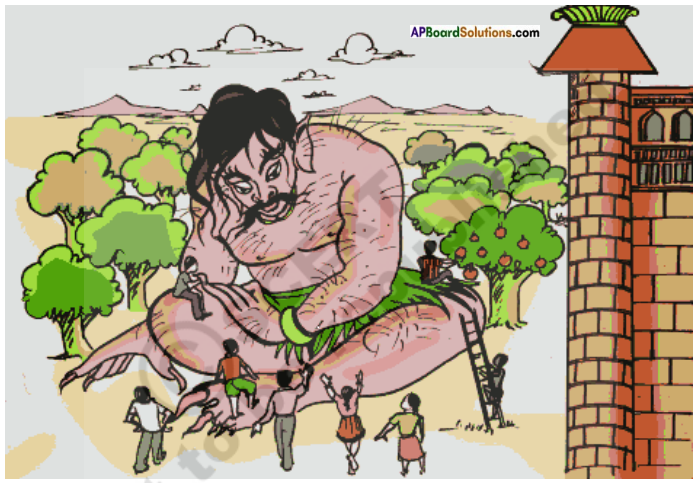
Look at the picture given below and answer the questions that follow.

AP Board 8th Class English Solutions Chapter 3A The Selfish Giant Part I 1

Question 1.
What do you notice in the picture?
Answer:
I noticed some children playing in the garden. A giant was watching them at their games. A boy was sitting on his knee. Another one sat on his thigh picking the fruits. Someone was climbing up the ladder to reach the giant. Another boy who sat on his foot, was trying to walk on his body. They were all playing with him.

AP Board 8th Class English Solutions Chapter 3A The Selfish Giant Part 1

Question 2.
What do you think of the size and sitting posture of the figure which is looking at the children?
Answer:
The children are little ones whereas the giant is a huge one. He is watching the children at their games. He seems to be sad
for some unknown reason.

Question 3.
What is the mood of the children?
Answer:
The children are in playful mood. They are all joyful. The way they play shows us this.

Comprehension

Answer the following questions.

Question 1.
What are the major characters in the play?
Answer:
The major characters in the play are the giant and the children. The other characters are the Snow and the Frost, the North Wind and the Autumn.

Question 2.
Why do you think children have been named as ‘tali girl,’ ’round boy,’ ‘square girl’, etc.?
Answer:
I think children have been named as ‘tall girl,’ ’round boy,’ ‘square girl’, etc. to make the story funny and to beautify it. The children are easily attracted to the words such as ’tali’, ’round’, ‘square’, etc. when they are used to describe a girl or a boy.

AP Board 8th Class English Solutions Chapter 3A The Selfish Giant Part 1

Question 3.
Who are the two giants in the play?
Answer:
The two giants, old Giant and the Giant are one and the same. The ‘old Giant’ is a selfish character whereas ‘the Giant’ is a kind character.

Question 4.
How can you say that The Giant is selfish?
Answer:
The Giant didn’t allow the children to play in his garden. He didn’t want to share his happiness with the children. He wanted to enjoy his garden all alone. Hence I can say that the Giant is selfish.

The Selfish Giant Part 1 Summary in English

Once there was an old Giant. He was very selfish. He had a large lovely garden, with soft green grass. The grass stood beautiful flowers like stars and there were twelve peach trees in the garden. Every afternoon, as they were coming from school, the children used to go and play in the Giant’s garden. The Giant had been to visit his friend the Cornish og and came back after seven years. When the Giant came back, he saw the children playing in the garden. The selfish Giant told the children that they couldn’t play in his garden. He built a high wall all round and put up a notice-board: “TRESPASSERS WILL BE PROSECUTED.” Now, the children couldn’t play anywhere. They tried to play on the road, but it was very dirty and lots of hard stones were there on the road. When a boy told that the Giant was selfish, the Giant opened a door in the wall and told again that he would not allow anybody to play in his garden. When the children heard his voice, they scattered. Then the spring came, and there were little blossoms and little birds all over the country. But it was still winter in the Giant’s garden. In his garden the birds did not come to sing, and the trees forgot to blossom. The North Wind, the Hail, the Frost and the Snow were dancing about through the trees in the garden.

The Selfish Giant Part 1 Glossary

peach trees (n): trees bearing round fruit with soft red and yellow skin.

spring time (n): the season between winter and summer when plants begin to grow

delicate blossoms (n.phr): tender flowers

castle (n): large, strong building with strong and thick walls

trespassers (n): persons who go into land without permission

whispering (v): speaking quietly

scatter (v): disperse, spread over

cloak (n): a type of coat that has no sleeves

wrapped (v): covered or dressed

rejoiced (v): expressed great happiness

AP Board 8th Class English Solutions Chapter 3A The Selfish Giant Part 1

chimney-pot (n): a short, wide pipe placed on top of a chimney

delightful (adj): very pleasant, charming

bore (v): produced (fruits)

autumn (n): the season of the year between summer and winter when leaves change colour

pleased (v): felt happy about something

hail (n): small balls of ice that fall like rain

rattled (v): made a series of short loud sounds when hitting against some thing hard.

frost (n): the thin white layer of ice

snow (n): small soft white pieces of frozen water that fall from the sky in cold weather


AP Board 8th Class Physical Science Important Questions and Answers English & Telugu Medium

Andhra Pradesh SCERT AP State Board Syllabus 8th Class Physical Science Physics Chapter Wise Important Questions and Answers in English Medium and Telugu Medium are part of AP Board 8th Class Textbook Solutions.

Students can also read AP Board 8th Class Physical Science Solutions (Physics & Chemistry) for exam preparation.

AP State Syllabus 8th Class Physical Science Important Questions and Answers English & Telugu Medium

AP 8th Class Physical Science Important Questions and Answers in English Medium

AP 8th Class Physics Important Questions and Answers in Telugu Medium

AP Board 8th Class English Solutions Chapter 2C Reaching the Unreached

AP State Syllabus AP Board 8th Class English Textbook Solutions Chapter 2C Reaching the Unreached Textbook Questions and Answers.

AP State Syllabus 8th Class English Solutions Chapter 2C Reaching the Unreached

8th Class English Chapter 2C Reaching the Unreached Textbook Questions and Answers

Comprehension

Answer the following questions.

Question 1.
Complete the following table based on the above article.
Answer:

Name of the child Age Nature of work for which engaged
Romesh 14 years Rag picking
Shanti 9 years Cooking, moping, cleaning and washing clothes

AP Board 8th Class English Solutions Chapter 2C Reaching the Unreached

Question 2.
Who rescued the two children ? Where did they take them to ?
Answer:
Some rescuer called 1098 helpline and Romesh got a helping hand from “The Child Line”. He is now one of the beneficiaries of Andhra Pradesh State based project for the Elimination of Child Labour. In the case of Shanti, the neighbours informed the “Child Labour Enforcement Team”. She was rescued and is now placed in a girls’ transit home.

Question 3.
Many households in your neighbourhood employ children to do the menial jobs. What will you do to save those children?
Answer:
At first I will talk with the owners who employ children to do the menial jobs and make them realize that they are doing wrong. I will make them know that those children are like their own children. I will ask them to educate those unlucky children and feed them well if they can. Next, I will inform the “Child Labour Enforcement Team” about those children. Thus, I will try to save them.

Question 4.
What is the role of CRY?
Answer:
CRY is an organization that partners some basic level organizations working for children, their parents and communities. CRY’s role is that of a bridge between child developmental organizations and people working for marginalized children. They gather the support, money and time of the Indians around the world and thousands of field workers across India who struggle to enrich the lives of children.

Question 5.
Two organisations are working to save the destitutes. What are they?
Answer:
The organisations that are working to save the destitutes are:

  1. Child Rights and You (CRY) and
  2. Save our Soul (SOS)

AP Board 8th Class English Solutions Chapter 2C Reaching the Unreached

Question 6.
How does SOS work?
Answer:
SOS provides family-based care for children. It advocates the concerns, rights and needs of children. SOS focuses on strengthening families, helping them to stay together during difficult times and provide the best care possible to their children. SOS children’s village experts work with families to help them develop a wide range of skills, from household budget planning, how to get a job and earning a living, to bonding with a child or young person and learning to create a stable family life at home.

Study Skills

Read the following passage extracted from the story ‘Oliver Asks for More’ and the notes made on it.
The members of this board were very wise and philosophical men. As they turned their attention to the workhouse, they discovered that it was a regular place of public entertainment for the poorer classes. It was the place where they had breakfast, dinner, tea, and supper all the year round and free; where it was all play and no work. This was really shocking state of affairs, they were of the opinion that the poor should be given only two alternatives: Either to starve quickly outside the workhouse, or gradually inside the house, view, they decided that the inmates of the workhouse would be issued three meals of thin gruel a day, with an onion twice a week.
For the first six months after Oliver Twist was moved in, the system was in full operation. As a result, during this period, the number of workhouse inmates got smaller, and the inmates themselves shrank in size and became thinner.
Observe the notes made from the above passage.
1. The board
a. very wise and philosophical men
b. their attention to the workhouse
c. was a regular place of public entertainment
i. had breakfast, dinner, tea and supper
ii. all play and no work

2. The decision
a. to starve quickly outside the workhouse
b. gradually inside the house
i. issued three meals of thin gruel
ii. an onion twice a week

3. Result of the decision
a. the inmates of the work house got smaller
b. shrank in size
c. became thinner
Now, read the passage Child Rights and You (CRY) once again and make notes with another suitable title.
Answer:
1. CRY
a) an organisation
b) believes that children are citizens and they have their own rights
c) doesn’t believe in charity

2. Nature of work
a) doesn’t run schools or orphanages
b) partners some basic level organizations working for children, their parents and communities.

3. The role of CRY
a) bridges child developmental organizations and people working for marginalized children
b) gathers the support, money and time
(i) of the Indians around the world – who struggle to enrich the lives of children.
(ii) of the thousands of field workers across India – who struggle to enrich the lives of children.

AP Board 8th Class English Solutions Chapter 2C Reaching the Unreached

4. CRY’s achievements:
a) Freed more than 1 lakh children from (i) hunger (ii) exploitation (iii) illiteracy
b) prevented child labour in 648 villages
c) liberated 1152 villages from child marriages
d) made 21,676 out of school children join schools

Listening

Homeless Child

No mother no father neither shoes nor a bed
He lives in a street
on pavements of a road
He is just ten
looks pale and thin.
He has so small a dinner
sometimes, he dines on the smell.
And even if he is starving to death
nobody comes to feed him.
As the sun rises and rays shoot him,
he is exposed to child labour.
Tears start rolling down his cheeks
there is nobody to comfort him.
And even if he is dead
There is nobody to worry about him.

Answer the following questions.

Question 1.
What is the song about?
Answer:
The song is about an orphan who is a child labourer.

Question 2.
Where does the child live?
Answer:
The child lives in a street and on pavements of a road.

Question 3.
How old is the child in the poem?
Answer:
The child in the poem is 10 years old.

Project work

AP Board 8th Class English Solutions Chapter 2C Reaching the Unreached

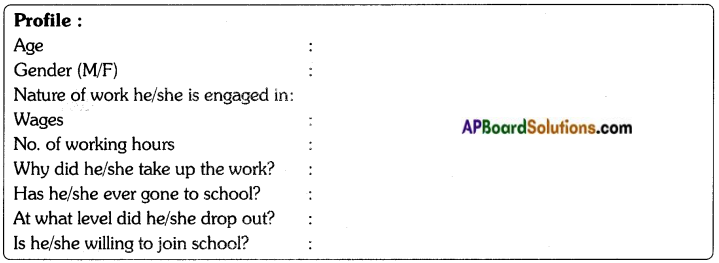
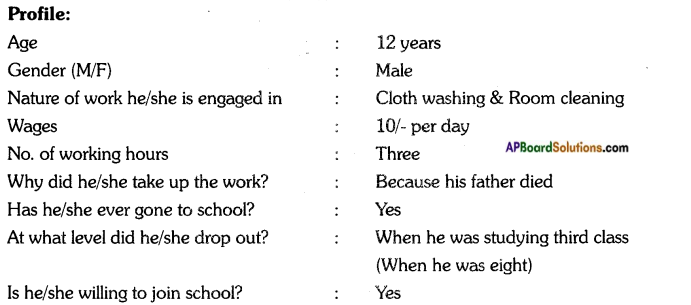
In your village/city you may come across children who are working in some house¬holds, factories, shops, hotels and construction sites for daily wages. Collect the following information about one child. Make a brief profile of the child you have met and present it in the class.
AP Board 8th Class English Solutions Chapter 2C Reaching the Unreached 1
Answer:
AP Board 8th Class English Solutions Chapter 2C Reaching the Unreached 2

Work in groups and analyze the data by using the following questions and present it before your class.
1. Why do children take up jobs?
2. How poorly are they paid?
3. How many are willing to leave the work and join school?
Answer:
Children take up jobs due to various reasons. In some cases, the unlucky children take up jobs losing both their parents or any one of them. Most children work because their families are poor and their labour is necessary for their survival. Some parents feel that what is learnt by their children is irrelevant to fulfil their family needs. They think that there will be no use of education. For many children, school is not an option. A number of children do extremely hazardous work in harmful conditions putting their health, education, personal and social development and even their lives at risk. Many working children don’t have the opportunity to go to school. Usually, they work in the fields, households, factories, shops, hotels, restaurants on the streets as beggars and so on. Children are often employed and exploited because, compared to adults, they are more vulnerable, cheaper to hire and they don’t demand for higher wages or better working conditions. The children are paid very low wages. Compared to adults, the children usually do better but the owners give them very low wages. I think most of the working children will join the school if they are given a chance. The government should do something about it. The government has already started some projects for the elimination of child labour. Some voluntary organizations are making their efforts to eliminate child labour. They should meet the parents who are sending their children to work. They should make them realize that the child should be educated. If it is possible, they should help those families financially and change their attitude towards the children education. Thus, we can eliminate child labour completely.

Reaching the Unreached Summary in English

Romesh, a fourteen year old boy, left his family back in Bihar and reached Hyderabad to find a new future. Finding a job was not an easy job for him. Cursed by hunger, he joined a group of rag pickers. Some rescuer called 1098 help line and he got a helping hand from ‘The Child Line”. He is now one of the beneficiaries of Andhra Pradesh State based project for the Elimination of Child Labour.

AP Board 8th Class English Solutions Chapter 2C Reaching the Unreached

Many such children fall to similar fate due to domestic violence and abject poverty. Shanti, a nine year old girl, was sent to Hyderabad by her parents to work in a middle class home. There she did the menial tasks like cooking, moping, cleaning and washing clothes. Her owners used to lock her up in a tiny room when they went out. The neighbours informed the “Child Labour Enforcement Team” and she was rescued and is now placed in a girls’ transit home.

CRY (Child Rights and You) is an organization that believes that children are citizens and they have their own rights. At CRY, they partner some basic level organizations working for children, their parents and communities. It acts as a bridge between child developmental organizations and people working for marginalized children. They gather the support, money and time of the Indians around the world and thousands of field workers across India who struggle to enrich the lives of children. CRY has freed more than 1 lakh children from hunger, exploitation and illiteracy in more than 13000 villages and slums.

Save Our Soul (SOS)

SOS Children’s Villages is an independent, non-governmental, social development organisation that provides family-based care for children in India since 1964. It advocates the concerns, rights and needs of children. More than 6000 children and young people live in 33 SOS Children’s Villages and 27 SOS Youth Facilities in India.

At SOS Children’s Villages, the organisers believe that every child should grow up in a strong family environment, and so their work helps families to create a loving, caring home. Their work focuses on strengthening families, helping them to stay together during difficult times and provide the best care possible to their children. The needs of a family can be varied. SOS Children’s Village experts work with families to help them develop a wide range of skills, from house-hold b udget planning, how to get a job and earning a living, to bonding with a child or young person and learning to create a stable family life at home.

Sometimes, however, it is not possible for a child to stay in the family. In these cases, the organisation works to find tailor-made solutions that respond to each situation, keeping the best interest of each child or young person’s in mind. SOS Children’s Villages is the only organisation of global impact that provides direct care to children who can no longer stay with their families.

AP Board 8th Class English Solutions Chapter 2C Reaching the Unreached

Finally, through advocacy, SOS Children’s Villages aims to improve the overall framework conditions for children whose parents cannot take care of them, or who are at risk of losing the care of their families. Successful advocacy, based on their experience as a practitioner, brings about changes in policies and practices that weaken children’s rights leads to sustainable changes to improve the situation for children and families everywhere.

Reaching the Unreached Glossary

toiled (v): worked very hard for a long time

beneficiary (n): a person who gains as a result of something

elimination (n): removing something

abject (adj): terrible and without hope

rescue (v): to save somebody from a dangerous or harmful situation

marginalized (adj): made somebody feel as if they were not important and could not influence desicions or events

exploitation (n): a situation in which somebody treats somebody else in an unfair way

AP Board 8th Class English Solutions Chapter 2C Reaching the Unreached

advocate (v): to support something publicly

concern (n): worry

vary (v): to make different; change

sustainable (adj): that can continue or be continued for a long time


AP Board 8th Class English Solutions Chapter 2B The Cry of Children

AP State Syllabus AP Board 8th Class English Textbook Solutions Chapter 2B The Cry of Children Textbook Questions and Answers.

AP State Syllabus 8th Class English Solutions Chapter 2B The Cry of Children

8th Class English Chapter 2B The Cry of Children Textbook Questions and Answers

Comprehension

Answer the following questions.

Question 1.
What kind of places are the children working in?
Answer:
The children are working in the places such as coal factories, iron factories, jinning mills, shops, hotels, tea-stalls, automobile shops, fields, etc.

Question 2.
‘The reddest flower would look as pale as snow.’ What does the phrase ‘reddest flower’ refer to ? Why does it become pale?
Answer:
The phrase ‘reddest flower’ refers to the blood coloured eye of the child. It becomes pale as the child is very tired. (In the other sense, the reddest flower becomes pale before the red eyes of the children. The eyes of the children are very red in colour because of their restlessness and sleeplessness.)

AP Board 8th Class English Solutions Chapter 2B The Cry of Children

Question 3.
How does the work affect the children?
Answer:
The children become very tired. They can’t run or leap as a normal child can. They want to sleep. They are not playful. They are very unhappy with their life.

Question 4.
Do children enjoy their lives when engaged in work?
Answer:
No, children don’t enjoy their lives when engaged in work. They don’t find any time to enjoy.

Question 5.
If the poem were written from the point of view of a factory owner, what kind of things would he say about children?
Answer:
If the poem were written from the point of view of a factory owner, he would say that the children were not doing their work properly. He would say that the children had to work hard. He would say that they were sitting leisurely.

Question 6.
What is the poet’s attitude towards child labour? Pick out the words/expressions that reveal her attitude.
Answer:
The poet’s sympathies are with the child labourers. She feels that the child labourer’s lives are very miserable. The expressions, “we are weary and we can’t run or leap”, “Our knees upon our faces”, “we drag our burden tiring”, “we drive the wheels of iron”, etc. reveal her attitude.

The Cry of Children Summary in English

AP Board 8th Class English Solutions Chapter 2B The Cry of Children

In this poem E. Browning shows and criticises the sorrow of the children in those years how the exploitation was managed in coal mines and factories. In those days, children were working endlessly under deplorable conditions.
The children are tired and weary. They are fed up with the continuous work in the coal mines and iron factories. They have no joy of living. Their routine is always the same. They start their work early in the morning and finish it late in the evening. They don’t experience the sunlight in the dark undergrounds of the coal mines. They don’t have play time. They don’t have any happiness. They can’t run or jump. They want to sleep in the meadows. Their knees are trembling with their heavy work. Their eyelids are drooping with tiredness.

About the Poet

Elizabeth Barrett Browning (1806-1861) was a great poet of English language. She published a Collection of Poems, Sonnets from the Portuguese, Aurora Leigh, The Seraphim and Other Poems. She married Robert Browning, a famous English poet and moved to Italy. Most of her poems deal with human emotions.

The Cry of Children Glossary

weary (adj): tired and lost all the strength

meadows (n): land that is covered with grass

merely (adv): only

sorely (adv): in a painful manner

AP Board 8th Class English Solutions Chapter 2B The Cry of Children

drooping (adj): hanging downward

pale (adj): not bright/light in colour

stooping (n): bending ones body forwards and downwards

drag (v): to pull something along with effort and difficulty


AP Board 8th Class English Solutions Chapter 2A Oliver Asks for More

AP State Syllabus AP Board 8th Class English Textbook Solutions Chapter 2A Oliver Asks for More Textbook Questions and Answers.

AP State Syllabus 8th Class English Solutions Chapter 2A Oliver Asks for More

8th Class English Chapter 2A Oliver Asks for More Textbook Questions and Answers

Read the saying given below and answer the questions that follow.

Question 1.
What does the sentence mean?
Answer:
Home is the happiest place in the world for all of us. No other place gives us comfort and protection as the home gives us. No other place makes us happy as the home does.

AP Board 8th Class English Solutions Chapter 2A Oliver Asks for More

Question 2.
Do you agree/disagree with the view expressed in it? Why?
Answer:
Yes, I agree with the view expressed in it. To me, the home is the best place to live in. In our home, we find happiness and comfort as we get the company of our parents and siblings. We must be grateful to god for giving us a chance to live with our parents and siblings in our home. Our parents care for us. They can do all they can to make us happy. We get love and warmth of our family members in our home. The other places may make us happy temporarily but the home is the place where we experience all sorts of happiness.

Comprehension

I. Answer the following questions.

Question 1.
How did Oliver feel when he was told to appear before the live board?
Answer:
Oliver Twist did not have any clearly defined notion of what a live board was. So, he was rather astonished by this information and was not quite certain whether he ought to laugh or cry. He had no time to think about the matter.

Question 2.
Why did Oliver tremble and cry in the white-washed room?
Answer:
Mr. Bumble led Oliver into a large white-washed room where eight or ten fat gentlemen were sitting around a table. Oliver was frightened at the sight of so many gentlemen. This made him tremble. The beadle gave him a tap on his back with his cane when he didn’t answer the gentleman’s question and it made him cry.

Question 3.
“What is that, sir?” inquired poor Oliver. What does ‘that’ refer to 111
Answer:
‘That’ refers to ‘orphan’.

AP Board 8th Class English Solutions Chapter 2A Oliver Asks for More

Question 4.
What kind of people were the members of the board? Justify your opinion.
Answer:
The members of the board were very wise and philosophical men. They were unhappy when they came to know that the workhouse was the regular place of public entertainment for the poorer classes. They didn’t have any mercy or sympathy towards the poor. They were shocked when they came to know that it was all play and no work in works house. They were of the opinion that the poor should starve quickly outside the workhouse or gradually inside the house. So, they ordered to restrict the food given to the poor. If anyone demanded (or requested) for more, he would be thrown out.

Question 5.
What main differences do you notice between the children and the master? (Observe the physical appearances, dress, behaviour, etc.) What can you infer from these differences?
Answer:
The children were very thin. They dressed in rags. They were all very frightened of the board, the beadle and the master. They even didn’t have enough food to eat. They had to do some work. The master wore cook’s uniform. He was fat and healthy. He didn’t have any mercy on the children. He was authoritative.

Question 6.
How do you look at Oliver’s request, ‘Please, sir, / want some more!’? What compelled him to say this?
Answer:
Oliver Twist and his companions suffered the tortures of slow starvation. They became wild with hunger. A tall boy of them announced that he would eat the boy who slept next to him unless he had enough food to eat. A council was held and it was decided that Oliver should ask the master for more. That evening after they had eaten the served gruel, Oliver went to the master and requested him for more. Thus, the hunger of the tall boy compelled him to say this. His hunger and misery too compelled him to say this.

AP Board 8th Class English Solutions Chapter 2A Oliver Asks for More

Question 7.
What happened to Oliver at the end of the story?
Answer:
At the end of the story Oliver was ordered into instant confinement. A bill was next morning pasted on the outside of the gate, offering a reward of five pounds to anybody who would take Oliver off the hands of the parish. In other words, five pounds and Oliver Twist were offered to any man or woman who wanted an apprentice to any trade, business or profession.

Question 8.
Do you find children like Oliver around you? How would you help them to live better?
Answer:
Yes. I find one or two boys like Oliver around us. I would help them by giving the clothes, the food, the money as much as I can. I would inform the organisations who take care of orphan children.

Vocabulary

I. Look at the underlined part in the following sentence.

“You have come here to be educated…” said the red-faced gentleman.
The word ‘red-faced’ is called a Compound Adjective.
The phrase ‘red-faced gentleman’ is a short form of ‘a gentleman with a red face’.

Question 1.
Pick out the phrases with Compound Adjectives from the story or elsewhere and write how they can be rewritten to express the same meaning.
a. ———————————
b. ———————————
c. ———————————
Answer:
Phrases with Compound Adjectives and their rewritten form with the same meaning.
(a) gold-laced cuff : a cuff with gold lace
(b) white-washed room: a room that was white-washed
(c) one-eyed man: a man with one eye
(d) long-legged insect: an insect with long legs
(e) fat-bodied woman: a woman with fat body

AP Board 8th Class English Solutions Chapter 2A Oliver Asks for More

Question 2.
Change the underlined parts in the following paragraph into compound adjectives. Rewrite the paragraph in your notebook.
Sachin Tendulkar is a cricketer who is famous all over the world. He is a batsman playing with right hand. He has many world records to his credit which are mind blowing. Besides all these, he is a person with a kind heart. He works with an NGO (Non-Governmental Organization) based in Mumbai to help more than 200 orphans every year.
Answer:
Sachin Tendulkar is a world-famous cricketer. He is a right-handed batsman. He has many mind-blowing world records to his credit. Besides all these, he is a kind-hearted person. He works with a Mumbai-based NGO (Non-Governmental Organization! to help more than 200 orphans every year.

Question 3.
Fill in the blanks with appropriate compound adjectives from the box given below.
AP Board 8th Class English Solutions Chapter 2A Oliver Asks for More 2
Latha is a —-(1)—- girl. She speaks kindly with her classmates. Look at her, she is wearing an —-(2)—- dress. She does not like to wear —-(3)—- dresses. Don’t you think Latha is a —-(4)—- girl?
Answer:
1) soft-spoken
2) old-fashioned
3) brand-new
4) well-mannered

Grammar

I. Look at the following sentence taken from the story.
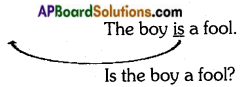
‘The boy is a fool,’ said the gentleman in the white waistcoat.
As you know, the above underlined expression, can be changed in to a question.
How do we change the above statement into a question? By putting the auxiliary verb before the subject ‘the boy’.
AP Board 8th Class English Solutions Chapter 2A Oliver Asks for More 3

Look at some more sentences.
1. ‘I understand that he asked for more.’
‘Do I understand that he asked for more ?’
2. ‘Oliver asks for more.’
Does Oliver ask for more ?
3. ‘The boys took their places.’
Did the boys take their places?
These sentences are changed into a question by placing ‘do/does/did at the beginning, such questions are called Yes / No questions.
Change the following statements into Yes/No questions.
1. Oliver was frightened at the sight of so many gentlemen.
———————————
2. You are an orphan.
———————————
3. You say your prayers every night.
———————————
4. You will pick oakum tomorrow morning.
———————————
5. Mr. Bumble rushed into the room.
———————————
6. They can devour the big bowl.
———————————
7. Boys have generally excellent appetite.
———————————
Answer:
1. Was Oliver frightened at the sight of so many gentlemen?
2. Are you an orphan?
3. Do you say your prayers every night?
4. Will you pick oakum tomorrow morning?
5. Did Mr. Bumble rush into the room?
6. Can they devour the big bowl?
7. Do boys generally have excellent appetite?

AP Board 8th Class English Solutions Chapter 2A Oliver Asks for More

II. Read the following sentence taken from the story.
“You were brought up by the parish, weren’t you?”
In this sentence ‘weren’t you?’ at the end is called a question tag. Question tags are used to get information or confirmation. The question tags are positive if the statements are negative. And if the statements are positive, questions tags are negative. These tags are short/contracted form of questions. If the statement has an auxiliary, the tag begins with an auxiliary. In case it does not have an auxiliary, it will begin with do/does/did.

Read the following dialogue to understand the usage of question tags.

Ramu: The weather is good today, isn’t it?
Vijay: Indeed, Ramu.
Ramu: How about going out now? Hope you’ll join me, won’t you?
Vijay: I’ve got some important work now, I am afraid.

Read the following dialogue that took place at a party. Add suitable question tags to complete it.

Rohit: Hi, I’ve met you before, —-(1)—-
Suma: No, I don’t think so.
Rohit: But your name is Vani, —-(2)—-
Suma: No, it’s Suma! Anyway, glad to meet you.
Rohit: Me too. This is Rohit. The party seems to be really lively, —-(3)—-
Suma: Yes, definitely. We enjoy ourselves a lot on such occasions, —-(4)—-
Rohit: Yeah, we do.
Answer:
1) haven’t I?
2) isn’t it?
3) doesn’t it?
4) don’t we?

Writing

I. Anne Frank was a Uttle girl of thirteen. She was as lonely as Oliver Twist. When the German army invaded her country, she had to hide in a small building with her family. She suffered a lot. She recorded her feelings and thoughts in her diary.
Friday, 1st October, 1942.
Just for fun, I am going to tell you each person’s first wish, when we are allowed to go out again. Mrs. Van says, ‘If I go out, I’ll eat cream cakes.’ Dussel says, ‘If I am let free, I’ll run to see my wife Lotje.’ Mummy says, ‘I will have a cup of coffee.’ Peter says, ‘I will go to the cinema.’ I long for so many things. But I long for a home of our own.

AP Board 8th Class English Solutions Chapter 2A Oliver Asks for More

1. What did Anne write in her diary?

  • personal feelings/thoughts/reflections
  • events other than routine
  • future plans

2. Did you notice any variety in the sentences?
3. Are all the sentences connected with each other properly?
After facing the live board, Oliver returned to his bed crying. He sat up to write his diary. Now, imagine you are Oliver Twist. Attempt a diary entry with the above
features in mind.
Answer:
Monday, 12th August, 20xx
What a miserable day in my life! Just now I have appeared before the live board. Actually I don’t have any idea about a live board. Mr. Bumble informed me, ‘Today, you have to appear before the live board forthwith”. I was rather surprised. I was not quite certain whether I ought to laugh or cry. I had no time to think about the matter then. Mr. Bumble told me, “Follow me”. So, I followed him into a large white-washed room. There were eight or ten gentlemen sitting round a table. A fat gentleman with a very round, red face sat in an arm chair rather higher than the rest. Bumble said, “Bow to the board”. I brushed away two or three years that were lingering in my eyes. I didn’t find any board. I only saw a table. So I bowed to that. ’Whats your name, boy?’ said the gentleman in the high chair. I was frightened at the sight of so many gentlemen, which made me tremble. As I didn’t answer the question, the beadle gave me a tap on my back with his cane and immediately I started crying, the gentleman in the high chair. I was frightened at the sight of so many gentlemen, which made me tremble. As I didn’t answer the question, the beadle gave me a tap on my back with his cane and immediately I started crying. The gentleman in the high chair asked me “Do you know you’re an orphan?” I didn’t understand his question. So, I asked him ‘What’s that, sir”? The gentleman in the white waistcoat remarked, “The boy is a fool”.
The red-faced gentleman in the high chair said, ‘You have come here to be educated and taught a useful trade”. The gentleman in the white waistcoat added You’ll begin to pick oakum tomorrow morning at six o’clock”. I bowed low and rushed into my room. I sobbed myself to sleep on a rough, hard bed. How disgusting all it is! I don’t want to stay here any more. I certainly will leave it. We don’t have any independence here. They don’t allow us to play, run or jump. Here we are living like slaves. We don’t have enough food either. They don’t show any mercy on us. No, I won’t stay here even a minute more. Now itself I shall start.

AP Board 8th Class English Solutions Chapter 2A Oliver Asks for More

Oliver Asks for More Summary in English

Oliver, an orphan boy, was brought to a children’s home. Mr. Bumble, the beadle, informed Oliver that he had to appear before the board at once. As he did not have any idea of a live board, he was astonished and was not quite certain whether he ought to laugh or cry. Mr. Bumble took him into a large white-washed room where eight or ten fat gentlemen were sitting round a table. Mr. Bumble ordered Oliver to bow to the board. Seeing no board but the table, Oliver bowed to the table. He was frightened at the sight of them and trembled. The beadle tapped on his back with his cane and he cried. The gentleman in the high chair asked Oliver if he knew that he was an orphan. Oliver couldn’t understand his question as he had no idea of an orphan. The gentlemen reminded Oliver that he was brought up by the parish and asked him to pray for them and take care of him like a Christian. The gentleman in the white waistcoat ordered Oliver to begin to pick oakum the following day morning at six o’clock. Oliver made a low bow and hurried away to a large ward sobbing himself to sleep on a rough, hard bed. The members of the board were very wise and philosophical men. They discovered that the workhouse was the regular place of public entertainment for the poorer classes. They opined that the poor should starve quickly outside the workhouse or gradually inside it. They decided the inmates of the workhouse would be issued three meals of thin gruel a day, with an onion twice a week. As a result, the number of workhouse inmates got smaller and they shrank in size. Oliver and his companions suffered the tortures of slow starvation for three months. They became wild with hunger. One day a tall boy announced that he would eat the boy who slept next to him unless he was given extra gruel. A council was held and it was decided that Oliver should ask the master for more. That evening the gruel was served and they ate it up. The boys winked at Oliver and nudged him. Oliver advanced to the master and requested him for more gruel. The master got a rage and aimed a blow at Oliver’s head with the ladle. He reported it to the beadle. Mr. Bumble, the beadle rushed into the gentlemen’s room and reported the same. The gentleman in the white waistcoat opined that the boy would be hung. Nobody contradicted his opinion and Oliver was ordered into instant confinement. The following morning a bill was pasted offering five pounds to those who would take Oliver as an apprentice to any trade, business or profession.

About the author

Charles Dickens (1812-1870) is a well known English novelist. Due to his father’s imprisonment Charles left school and worked in a shoe factory. While he was working as a office boy he launched his writing career. His novels Oliver Twist, Great Expectations, Pickwick Papers, Bleak House, A Tale of Two Cities and David Copperfield brought him name all over the world. He went on lecture tours to America and got literary reputation. He focussed on social issues and human ailments in his works.

Oliver Asks for More Glossary

beadle (n): an official of a church

parish (n): a church committee

oakum (n): loose fibre obtained by untwisting and picking apart old ropes

surly (adj): serious or angry

AP Board 8th Class English Solutions Chapter 2A Oliver Asks for More

gruel (n): a thin liquid food of oats, rice, etc.

devoured (v): ate hungrily or quickly

appetite (n): the desire to eat, hunger

voracious (adj): wanting great quantities of food

stupefied (adj): shocked

paralyzed (v): became motionless

ladle (n): a long handled spoon used to serve liquids

countenance (n): a person’s face or facial expression

confinement (n): putting in a prison or a closed room

apprentice (n): one who works under a skilled person

stride (n): one long step

grasped (v): took a firm hold of something

cuff (n): the bottom of the leg of a pair of trousers/pants that has been folded over on the outside

forthwith (adv): immediately, at once

trotted (v): moved forward at a speed that is faster than a walk

lingering (v): continuing to exist

gruff (adj): deep and rough, and often sounding unfriendly

stammered (v): spoke with difficulty

sobbed (v): cried noisily taking sudden, sharp breaths

starve (v): to suffer or die, because one doesn’t have enough food to eat

winked (v): closed one eye and opened it again quickly, especially as a private signal to somebody

nudged (v): pushed somebody gently with one’s elbow

paralyzed (v): made somebody unable to feel or move all or part of their body

faint (adj): that can’t be clearly seen, heard or smelt

AP Board 8th Class English Solutions Chapter 2A Oliver Asks for More

depicted (v): gave an impression of something

contradicted (v): said that something that somebody else had said was wrong

calling (n): a profession or career

AP Board 8th Class English Solutions Chapter 1C A Letter to a Friend

AP State Syllabus AP Board 8th Class English Textbook Solutions Chapter 1C A Letter to a Friend Textbook Questions and Answers.

AP State Syllabus 8th Class English Solutions Chapter 1C A Letter to a Friend

8th Class English Chapter 1C A Letter to a Friend Textbook Questions and Answers

Comprehension

Answer the following questions.

Question 1.
How did Suresh and Ramesh spend their time?
Answer:
Suresh and Ramesh enjoyed their childhood days in Manikonda village. Every day they played gilli-danda, hide and seek and kabaddi in their garden. They played in the moonlight. They enjoyed listening to the tales told by their grandpa. Thus they spent their time joyfully.

AP Board 8th Class English Solutions Chapter 1C A Letter to a Friend

Question 2.
Why did Ramesh’s family move to the city?
Answer:
Ramesh’s family moved to the city as both Ramesh and his wife got jobs in the city (Hyderabad). They got jobs in software companies.

Question 3.
What change did you observe in Ramesh?
Answer:
Ramesh enjoyed his childhood days along with his friend Suresh in Manikonda village. There were so many unforgettable, joyous occasions in their childhood. They leisurely spent their time enjoying the beauty of the nature. But now he is not happy in city. He is annoyed at his busy city life. He is the man of disgust. Ramesh’s family members hardly find time to sit together. They have forgotten their family. They work like machines. They have missed the joy of the family, their company and many things in the busy life.

Question 4.
Do you think Ramesh is happy in the city? Why?
Answer:
No. I don’t think Ramesh is happy in the city. He thinks that his city life is very disgusting. Both Ramesh and his wife work at software companies. They don’t find any time to sit together. They are always busy. They work with computers, think like computers and live like computers. They have forgotten their family. Ramesh recalls all the joyous occasions he had during his childhood. He thinks that he has missed his relatives, the joy of the family, their company and many things in his busy life. He thinks that their flat is their world, just like a well for a frog.

AP Board 8th Class English Solutions Chapter 1C A Letter to a Friend

Question 5.
What made Ramesh write to Suresh?
Answer:
As Ramesh had a meeting in his office, he didn’t meet his friend Suresh during his visit to Hyderabad the previous week. So, he wrote a letter apologizing for his not meeting Suresh.

Proect work

Observe any five families in your neighbourhood and draw your conclusions, ad¬vantages and disadvantages of living in a joint/nuclear family.
Answer:
I observed five families living in our neighbourhood. All the families are nuclear ones that consist of a man, his wife and their children.
In the present society the concept of the joint family system has been gradually breaking up. In its place a new system of nuclear family has aroused. I think both types of families have their own merits and demerits. The joint family system is a feature of agricultural societies. Collective living, collective planning and collective share in family wealth are the traditional features of the joint family. We can see the division of labour in a joint family. The joint family preserves the traditions, customs and values and passes them down to the next generations. With the passage of time, the joint family system has disintegrated, giving rise to the nuclear family system.
The nuclear family consists of a man, his wife and their children. Job opportunities available in the cities become the main cause of the disintegration of the joint family system. For a number of reasons, a joint family system doesn’t exist in the cities. There is a lack of living space in the cities. It is difficult to accommodate all the members of a joint family in a single house in the city. The cost of living is very high in the cities. The increasing individualistic and independent attitudes of grown up children give rise to the nuclear family system. Now, we see advantages and disadvantages of living in both the families.

Advantages of living in a ‘joint family’

  1. Joint family helps the younger ones to develop social virtues like co-operation, sympathy, sacrifice, affection, selfless service, obedience and broad minded nature.
  2. Each member of a joint family is given work according to his or her capacity. Hence, we find division of labour in a joint family.
  3. There is more affection and love among family members.
  4. Joint family affords ample leisure to its members.
  5. Joint family acts as an agency of social control.
  6. In the joint family the children the employed, the sick, the aged and the handicapped are well taken care of.
  7. We find sharing of sorrowness in a joint family.

Disadvantages of living in a ‘joint family’

  1. There is no privacy.
  2. There is no financial independence.
  3. There is a chance for disharmony due to generation gap.
  4. There may be chances for conflict between males and females and the young and the old due to diverse temperaments.

AP Board 8th Class English Solutions Chapter 1C A Letter to a Friend

Advantages of living in a ‘nuclear family’

  1. Nuclear family provides more privacy.
  2. The members of a nuclear family have financial independence and stability.
  3. The members of a nuclear family have more freedom.
  4. The members of a nuclear family find no stress and discomfort.

Disadvantages of living in a ‘nuclear family’

  1. If both the parents are employees, they find no time to care for the children.
  2. The members of a nuclear family feel insecure.
  3. There may be extra expenses in a nuclear family.
  4. The members of a nuclear family lose the support and experience of the elders.
  5. There is no sharing of sorrows.

A Letter to a Friend Summary in English

Ramesh wrote this letter to his friend Suresh apologizing for his not meeting him during his visit to Hyderabad the previous week. Ramesh is a computer programmer at Microsoft, Hyderabad and his wife is a System Analyst at Dell, Hyderabad. He is annoyed at his busy city life. Both Ramesh and his wife work with computers, think like computers and live like computers. Their child always plays computer games never caring for anyone. Ramesh is very unhappy in the city. He recalled the memorable days of his childhood in his letter. Ramesh and Suresh enjoyed their childhood days in Manikonda village. They played together in their garden in the moonlight. Theirs was a big family. Their grandpa used to tell them tales. They played gill-danda, hide and seek and kabaddi. They went for swimming every Sunday. Ramesh remembered how their Padmanabhaiah Sir appreciated them when they got the first prize in District Science Fair. Their picnic to Koil Sagar and their tour of Srisailam were memorable. Ramesh couldn’t forget the roaring of the Krishna River at the dam. They enjoyed the festivals such as Dasara, Deepavali, etc. along with their uncle and aunt. Ramesh thought of his grandparents, uncles, aunts, brothers, sisters …. sometimes. He thought that they missed them all. They missed the joy of the family, their company and many things in their busy life. At present they are living in this unreal world. They have lost their real life.

AP Board 8th Class English Solutions Chapter 1C A Letter to a Friend

A Letter to a Friend Glossary

faded (adj): pale

hardly (adv): almost never

disgusting (adj): extremely unpleasant

appreciated: understand the worth of

company (n): the fact of being with somebody else and not alone

affection (n): a feeling of liking for a person

AP Board 8th Class Social Studies Study Material Guide Solutions Pdf Download State Syllabus

Andhra Pradesh SCERT AP State Board Syllabus 8th Class Social Studies Study Material Guide Pdf free download, 8th Class Social Textbook Solutions in English Medium and Telugu Medium are part of AP Board 8th Class Textbook Solutions.

Students can also go through AP Board 8th Class Social Notes to understand and remember the concepts easily. Students can also read AP 8th Class Social Important Questions for exam preparation.

AP State Syllabus 8th Class Social Studies Guide Study Material Pdf Free Download

AP 8th Class Social Study Material Pdf Download English Medium

8th Class Social Study Material Pdf Theme I Diversity on the Earth

8th Class Social Studies Study Material Theme II Production, Exchange and Livelihoods

AP 8th Class Social Study Material Pdf English Medium Theme III Political Systems and Governance

AP Board Solutions Class 8 Social Theme IV Social Organisation and Inequities

AP Board 8th Class Social Solutions Theme V Religion and Society

Social Study Material for 8th Class Theme VI Culture and Communication

AP 8th Class Social Textbook Solutions Telugu Medium Pdf

8th Class Social Guide Pdf Download Theme 1 భూమి – వైవిధ్యం

Social Guide 8th Class Theme 2 ఉత్పత్తి, వినిమయం – జీవనాధారం

8th Class Social Studies Lessons Theme 3 రాజకీయ వ్యవస్థలు – పరిపాలన

AP 8th Class Social Textbook Pdf Theme 4 సామాజిక వ్యవస్థీకరణ – అసమానతలు

8th Class Social Textbook State Syllabus Theme 5 మతం – సమాజం

8th Class Social Textbook Pdf Andhra Pradesh Theme 6 సంస్కృతి – సమాచారం

AP Board 8th Class Social Solutions Chapter 17 పేదరికం – అవగాహన

SCERT AP 8th Class Social Study Material Pdf 17th Lesson పేదరికం – అవగాహన Textbook Questions and Answers.

AP State Syllabus 8th Class Social Solutions 17th Lesson పేదరికం – అవగాహన

8th Class Social Studies 17th Lesson పేదరికం – అవగాహన Textbook Questions and Answers

Improve your learning (మీ అభ్యసనాన్ని మెరుగుపడుచుకోండి)

ప్రశ్న 1.
తీవ్రమైన ఆకలిగా పేదరికం అన్న నేపథ్యంలో కింద వాక్యాలలో సరైనవి ఏవి? (AS1)
అ) రోజుకి ఒకసారే ఆహారం తీసుకోవటం
ఆ) అవసరమైనన్ని కాలరీల కంటే తక్కువ ఉన్న ఆహారం తీసుకోవటం
ఇ) నాగలితో దున్నే వ్యక్తికీ, వరికోత యంత్రం నడిపే వ్యక్తికీ ఒకే మోతాదులో కాలరీలు ఉన్న ఆహారం అవసరం.
ఈ) దుకాణదారుడు కంటే పొలం దున్నే వ్యక్తికి ఎక్కువ కాలరీలు కావాలి.
ఉ) ఆకలితో ఉన్న కారణంగా వ్యక్తి రోగనిరోధక శక్తి తగ్గుతుంది.
జవాబు:
సరియైనవి
అ) రోజుకి ఒకసారే ఆహారం తీసుకోవటం
ఆ) అవసరమైన కాలరీల కంటే తక్కువ ఉన్న ఆహారం తీసుకోవటం
ఈ)దుకాణదారుడి కంటే పొలం దున్నే వ్యక్తికి ఎక్కువ కాలరీలు కావాలి.
ఉ) ఆకలితో ఉన్న కారణంగా వ్యక్తి రోగనిరోధక శక్తి తగ్గుతుంది.

ప్రశ్న 2.
ఈ అధ్యాయంలో పేదరికానికి పేర్కొన్న ప్రధాన కారణాలను గుర్తించండి. (AS1)
జవాబు:
‘పేదరికానికి ప్రధాన కారణం క్రమం తప్పకుండా పని దొరకపోవటంగా ఈ అధ్యాయంలో పేర్కొనబడింది.

AP Board 8th Class Social Solutions Chapter 17 పేదరికం – అవగాహన

ప్రశ్న 3.
జాతీయ గ్రామీణ ఉపాధి హామీ చట్టం, ప్రజా పంపిణీ వ్యవస్థ వంటి పథకాలలోని ప్రధానమైన అంశాలు ఏమిటి? పేదరికంలోని ఏ అంశాలను అవి పరిష్కరించటానికి పూనుకుంటున్నాయి? చౌకధరల దుకాణాలు ఎందుకు అవసరం? (AS4)
(లేదా)
మహాత్మాగాంధీ జాతీయ గ్రామీణ ఉపాధిహామీ చట్టం ప్రజలకు ఏ విధంగా ఉపయోగపడుతున్నది? వివరించండి.
జవాబు:
ప్రధానమైన అంశాలు :
1) జాతీయ గ్రామీణ ఉపాధి హామీ చట్టం :
ఈ ఉపాధి హామీ చట్టం ప్రకారం నైపుణ్యం అవసరంలేని శారీరక శ్రమ చేయటానికి సిద్ధంగా ఉండి, పని అడిగిన పెద్దవాళ్ల (18 సం||లు నిండిన)కు ప్రభుత్వం పని కల్పించాలి. ఈ విధంగా ప్రతి గ్రామీణ కుటుంబం ఒక సంవత్సర కాలంలో కనీసం వంద రోజులపాటు ఉపాధి పొందవచ్చు. ఈ పనికి కనీస కూలీకి తక్కువ కాకుండా కూలీ చెల్లించాలి.

  • నీటి నిల్వ, సంరక్షణ
  • కరవుకు తట్టుకునే పనులు (అడవుల వృద్ధి, చెట్ల పెంపకం)
  • షెడ్యూల్డు కులాలు, తెగలకు చెందిన భూములకు సాగునీటి సౌకర్యాలు కల్పించటం
  • చెరువుల పూడికతీతతో సహా సంప్రదాయ నీటి మడుగుల పునరుద్ధరణ

ii) ప్రజా పంపిణీ వ్యవస్థ :
చౌక ధరల దుకాణాల ద్వారా ఆహారధాన్యాలు, ఇతర నిత్యావసర వస్తువులు సరఫరా చేయటాన్ని ప్రజా పంపిణీ వ్యవస్థ (Public Distribution System (PDS)) అంటారు. భారతదేశానికి స్వాతంత్ర్యం వచ్చిన తరువాత ఈ పంపిణీ వ్యవస్థను ఏర్పాటు చేశారు. పట్టణ, పల్లె ప్రజలందరికీ ఆహార ధాన్యాలను చేర్చటంలో ఇది కీలకపాత్ర వహించింది. దీని పనితీరులో కొన్ని సమస్యలు ఉన్నాయి. కొన్ని ప్రాంతాలలో ఈ దుకాణాలను సమయానికి, లేదా క్రమం తప్పకుండా తెరవరు. ఎవరూ కొనగూడదన్న ఉద్దేశంతో ఆహార ధాన్యాలను కలీ చేసే సందర్భాలు ఉన్నాయి. ప్రజలకి కాకుండా ఇతర దుకాణాలకు సరుకులు అమ్మే చౌకధరల దుకాణాదారులు ఉన్నారు. దీంతో పేద ప్రజలతో సహా చాలామందికి ఆహారధాన్యాలు అందవు. భారతదేశంలోని పేదరాష్ట్రాలు, పేద ప్రాంతాలలో సాధారణంగా వీటి పనితీరు ఆశించిన మేరకు లేదు.

  • ఉపాధిని కల్పించడం, ప్రభుత్వం ప్రతి ఒక్కరికి సరసమైన ధరలలో ఆహారం అందుబాటులో ఉండేలా చూడటం అనే అంశాలను పరిష్కరించడానికి పూనుకున్నాయి.
  • నిత్యావసర సరుకుల ధరలు ఎక్కువగా ఉంటే ఉపాధి, ఆదాయాల వల్ల పెద్దగా ప్రయోజనం ఉండదు. కాబట్టి మౌలిక అవసరాలను ప్రభుత్వం చౌకగా అందిస్తుంది. వీటికోసం చౌకధరల దుకాణాలు అవసరం.

ప్రశ్న 4.
ఉపాధి లేని ప్రజలకే భూమి, పశువులు, దుకాణాలు వంటి ఆస్తులు సాధారణంగా ఉండవు. ఎందుకు? (AS1)
జవాబు:
ఉపాధిలేని వారికి సంపాదన ఉండదు. వారి నిత్యావసర ఖర్చులకే డబ్బులు సరిపోవు. యింక మిగులు సొమ్ములకు అవకాశం ఉండదు. పొదుపు చేయలేనివారు ఆస్తులను సమకూర్చుకోలేరు. కాబట్టి వీరికి సాధారణంగా ఆస్తులు ఉండవు.

ప్రశ్న 5.
పేజి నెం. 202 లో “జీవించే హక్కు కోసం పోరాటం” శీర్షికలోని మొదటి రెండు పేరాలు చదివి వ్యాఖ్యానించండి. (AS2)

ప్రజా పంపిణీ వ్యవస్థ (PDS) కొత్త విధానంపై ఎంతో చర్చ జరుగుతోంది. గ్రామీణ ప్రాంతాల్లో ప్రతి అయిదు మందిలో నలుగురు అవసరమైన కనీస కాలరీల కంటే తక్కువ ఇచ్చే ఆహారం తీసుకుంటున్నారని మనకు తెలుసు. 2004 జాతీయ నమూనా సర్వే ప్రకారం గ్రామీణ ప్రాంతాల్లోని ప్రతి పది కుటుంబాలలో మూడు కుటుంబాలకు కూడా అంత్యోదయ, BPL కార్డులు లేవు. అంటే అంతకుముందు ప్రజా పంపిణీ వ్యవస్థ వల్ల ప్రయోజనం పొందిన వాళ్లు ఇప్పుడు పొందటం లేదు. భూమిలేని కూలీల కుటుంబాలలో చాలా వాటికి BPL కార్డులు లేవు. ఇందుకు విరుద్ధంగా కొన్ని సంపన్న కుటుంబాలకు BPL కార్డులు ఉన్నాయన్న వార్తలొచ్చాయి.

ఈ కొత్త ప్రజా పంపిణీ వ్యవస్థ విధానంలో ఇతర వైరుధ్యాలు కూడా ఉన్నాయి. భారత ప్రభుత్వం వద్ద రైతుల దగ్గర నుంచి కొన్న) ఆహారధాన్యాలు గుట్టలుగా పడి ఉన్నాయి. ఈ ఆహారధాన్యాలను ఎలుకలు తినేసిన, కుళ్ళిపోయిన సందర్భాలు ఉన్నాయి. చౌకధరల దుకాణాలు సరసమైన ధరలకు ఆహారధాన్యాలను BPL, అంత్యోదయ, అన్నపూర్ణ కార్డులు ఉన్న వాళ్ళకే అమ్ముతారు. కాబట్టి అక్కడ కూడా ఆహారధాన్యాలు నిల్వ ఉండిపోతాయి. ఇంకోవైపున అందరి ఆకలి తీర్చలేకపోతున్నామనే భావన కూడా ఉంది.
జవాబు:
జీవించే హక్కు అనేది ప్రజలు ఇంకా ఓ హక్కుగా భావించటంలేదు. అయితే ఇటీవల కేంద్ర ప్రభుత్వం “ఆహార భద్రత బిల్లు”ను పార్లమెంటులో ఆమోదించడం, ఇవి చట్టం కావడంతో ప్రజలు ఈ దిశగా ఇప్పుడిప్పుడే ఆలోచించడం ప్రారంభించారు.

AP Board 8th Class Social Solutions Chapter 17 పేదరికం – అవగాహన

ప్రశ్న 6.
మీ గ్రామంలో PDS పథకం నిర్వహణపై జిల్లా కలెక్టర్ కు ఒక లేఖ రాయండి. (AS6)
జవాబు:

జిల్లా కలెక్టర్
కరీంనగర్ వారికి
కరీంనగర్ జిల్లా, కొత్తపల్లికి
చెందిన 8వ తరగతి విద్యార్థి నమస్కరించి వ్రాయులేఖ.అయ్యా!
మా ప్రాంతంలోని ప్రజా పంపిణీ వ్యవస్థ ద్వారా పంపిణీ చేయుచున్న నిత్యావసరాలు కొలతలలో తేడాలు వస్తున్నాయి. నెలలో రెండు, మూడు రోజులు మాత్రం దీనిని తెరిచి ఉంచుతున్నారు. దీనితో బీదవారు సరకులను తీసుకోలేకపోతున్నారు. కావున, మీరు ఈ అంశాలను దర్యాప్తు చేసి న్యాయం చేయగలరు.

మీ
విధేయురాలు,
పి. కామాక్షమ్మ,
D/O సుందరరావు,
కొత్తపల్లి,
కరీంనగర్.

8th Class Social Studies 17th Lesson పేదరికం – అవగాహన InText Questions and Answers

8th Class Social Textbook Page No.193

ప్రశ్న 1.
చంద్రయ్య, రామాచారి జీవితాలలో పోలికలను చర్చించండి.
జవాబు:

  1. చంద్రయ్య, రామాచారి ఇరువురూ పేదవారు.
  2. ఇరువురూ ఆకలితో అలమటించేవారే.
  3. ఇరువురి భార్యలు పనిరీత్యా వేరే వేరే ఊళ్ళల్లో ఉంటున్నారు.
  4. ఇరువురికీ ఒంట్లో ఆరోగ్యం తగ్గిపోయింది.
  5. ఇద్దరూ వయస్సుకి మించి ముసలివారుగా కనిపించేవారు.

ప్రశ్న 2.
రామాచారి జీవనోపాధి గ్రామంలోని వ్యవసాయంతో ఏ విధంగా ముడిపడి ఉంది?
జవాబు:
కొన్ని సంవత్సరాల క్రితం వరకు రామాచారి వద్ద పని చేయించుకోటానికి 40 మంది దాకా వచ్చేవాళ్లు. వాళ్ళల్లో ఎక్కువమంది రైతులు. అతడు చేసిన పనులకు రైతులు ధాన్యం రూపంలో చెల్లించేవాళ్లు. ఒక్కొక్కళ్లు సంవత్సరానికి 70 కిలోల ధాన్యం ఇచ్చేవాళ్లు. అలా వచ్చిన 2800 కిలోల ధాన్యంలో కుటుంబానికి కావలసినంత ఉంచుకుని, మిగిలినది. మార్కెట్టులో అమ్మేవాడు. 70 కిలోల ధాన్యం 375 రూపాయలకు అమ్మేవాడు. కొన్ని సంవత్సరాల క్రితం వరకు ఈ విధంగా కుటుంబానికి సరిపడా బియ్యంతోపాటు సంవత్సరానికి 8000 రూపాయలు పొందేవాడు. దీనితోనే కుటుంబాన్ని గుట్టుగా నడుపుకొచ్చేవాడు.

ఈ విధంగా రామాచారి జీవనోపాధి గ్రామంలోని వ్యవసాయంతో ముడిపడి ఉంది.

ప్రశ్న 3.
రామాచారి కుటుంబం కష్టాలు ఎదుర్కోటానికి కారణం :
అ) రామాచారి సరైన ప్రయత్నాలు చేయకపోవటం, తగిన అవగాహన లేకపోవటం, లేక
ఆ) గ్రామంలో జీవనోపాధుల పరిస్థితి.
జవాబు:
గ్రామంలో జీవనోపాధుల పరిస్థితి.

AP Board 8th Class Social Solutions Chapter 17 పేదరికం – అవగాహన

ప్రశ్న 4.
రామాచారి కుటుంబానికి రోజూ రెండు పూటలా భోజనం లభించాలంటే ఏం చేయాలి? ఆలోచించండి.
జవాబు:
రామాచారి కూడా భార్యతో పాటు పట్టణానికి వలస వెళ్ళి కూలీనాలీ చేయాలి. అపుడే అతని కుటుంబానికి రెండు పూటలా భోజనం లభిస్తుంది.

ప్రశ్న 5.
రామాచారి గ్రామంలోని రైతులకు మధ్య మార్పిడి/లావాదేవీని ఎలా వర్ణిస్తావు?
జవాబు:
రామాచారి పనికీ, గ్రామంలోని రైతులకు మధ్య మార్పిడి/లావాదేవీని నేను ఈ విధంగా వర్ణిస్తాను. “ఒక్కరి కోసం అందరూ, అందరి కోసం ఒక్కరు”.

ప్రశ్న 6.
సాధారణంగా సంవత్సరానికి రామాచారి తన కుటుంబ అవసరాలకు ఎన్ని కిలోల ధాన్యం ఉంచుకునేవాడు?
జవాబు:
రామాచారి సాధారణంగా, సంవత్సరానికి దాదాపు 1300 కిలోల ధాన్యాన్ని ఉంచుకొనేవాడు.

ప్రశ్న 7.
(ఆహార ధాన్యాలు కాకుండా) కుటుంబ ఖర్చులకు సంవత్సరానికి 8000 రూపాయలు సరిపోతాయా?
జవాబు:
సం||రానికి రూ॥ 8000/-లు అంటే సుమారు నెలకు 667/-లు ఇవి కచ్చితంగా వారికి సరిపోవు.

ప్రశ్న 8.
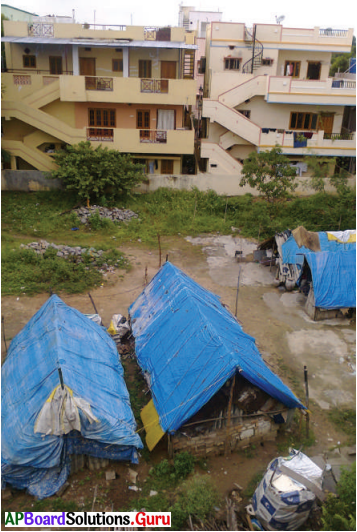
ప్రక్క పట్టణ దృశ్యంలో జీవన విధానాలలో తేడా గురించి చర్చించండి.
జవాబు:
AP Board 8th Class Social Solutions Chapter 17 పేదరికం – అవగాహన 1
తేడాలు

భవంతులలోని వారు డేరాలలోని వారు
1. వీరు విలాసవంతమైన జీవితాన్ని గడుపుతారు. 1. వీరు దుర్భరమైన జీవితాన్ని గడుపుతారు.
2. వారు ధనికులు. 2. వీరు కటిక పేదవారు.
3. వీరికి చక్కటి సౌకర్యాలు ఉంటాయి. 3. వీరికి కనీస సౌకర్యాలు కూడా ఉండవు.

8th Class Social Textbook Page No.194

ప్రశ్న 9.
దేశంలో అత్యంత సంపన్నులైన 25% ప్రజలు సగటున రోజుకి ఎన్ని కాలరీలను తీసుకుంటున్నారు?
జవాబు:
దేశంలో అత్యంత సంపన్నులైన 25% ప్రజలు సగటున రోజుకు 2521 కి॥ కాలరీలను తీసుకుంటున్నారు.

ప్రశ్న 10.
దేశంలో అత్యంత పేదలైన 25% ప్రజలు రోజూ తీసుకోవాల్సిన కాలరీల కంటే సగటున వాళ్లు తీసుకుంటున్న కాలరీలు ఎంత శాతం తక్కువ?
జవాబు:
దేశంలో అత్యంత పేదలైన 25% ప్రజలు రోజూ తీసుకోవలసిన కాలరీల కంటే సగటున 23% కాలరీలు తక్కువ తీసుకుంటున్నారు.

AP Board 8th Class Social Solutions Chapter 17 పేదరికం – అవగాహన

ప్రశ్న 11.
పేద ప్రజలు చాలా తక్కువ కాలరీలు తీసుకోవానికి గల కారణాలు ఏవి?
జవాబు:
పేద ప్రజల కొనుగోలు శక్తి తక్కువ. ఎక్కువ కాలరీలు ఉన్న ఖరీదైన పదార్థాలు కొనలేరు, తినలేరు, తిని పని చేయలేరు. కాబట్టి కడుపు నిండే ఆహార పదార్థాలు మాత్రమే తినగలుగుతారు.
ఉదా :
అన్నం, పచ్చడి లేదా అన్నం, కూర లేదా అన్నం, సాంబారు. కాబట్టి వారు చాలా తక్కువ కాలరీలు తీసుకుంటున్నారు.

8th Class Social Textbook Page No.196

ప్రశ్న 12.
వ్యక్తి ఆర్ధిక స్థాయికీ, వాళ్ళ పోషకాహార స్థాయికీ మధ్య ఏమైనా సంబంధం కనబడుతోందా?
జవాబు:
కనబడుతోంది. వ్యక్తి ఆర్ధిక స్థాయి బాగుంటే పోషకాహార స్థాయి బాగుంటుంది. వ్యక్తి ఆర్థిక స్థాయి తక్కువగా ఉంటే పోషకాహార స్థాయి తక్కువగా ఉంటుంది.

8th Class Social Textbook Page No.197

ప్రశ్న 13.
కృత్యం :

పెద్దవాళ్లు పోషకాహారలోపానికి గురైనదీ, లేనిదీ తెలుసుకోవాలంటే పోషకాహార శాస్త్రజ్ఞులు చెప్పే శరీర పదార్థ సూచిక (Body Mass Index) లెక్కకట్టాలి. దీనిని లెక్కకట్టడం తేలిక. వ్యక్తి బరువు ఎంతో కిలోల్లో తీసుకోండి. ఆ వ్యక్తి ఎత్తును మీటర్లలో తీసుకోండి. బరువును ఎత్తు వర్గంతో భాగించాలి. ఫలితంగా వచ్చిన సంఖ్య 18.5 కంటే తక్కువ ఉంటే ఆ వ్యక్తి పోషకాహార లోపానికి గురైనట్టు. శరీర పదార్థ సూచిక 25 కంటే ఎక్కువ ఉంటే ఆ వ్యక్తిది ఊబకాయం అన్నట్లు. ఈ నియమం ఎదుగుతున్న పిల్లలకు వర్తించదని గుర్తుంచుకోండి. భిన్న ఆర్థిక నేపథ్యాలకు చెందిన (ఉదాహరణకు శ్రామికులు, పనివాళ్లు, వ్యాపారస్తులు) ముగ్గురు పెద్దవాళ్ల బరువు, ఎత్తు ప్రతి ఒక్క విద్యార్థి సేకరించండి. అందరు విద్యార్థులు తెచ్చిన వివరాలను ఒకరు పట్టికలో పొందుపరచండి. శరీర పదార్థ సూచిక (BMI) లెక్కకట్టండి.
జవాబు:
AP Board 8th Class Social Solutions Chapter 17 పేదరికం – అవగాహన 3

8th Class Social Textbook Page No.199

ప్రశ్న 14.
‘నగదు బదిలీ పథకం’ ప్రజా పంపిణీ పథకానికి సరైన ప్రత్యామ్నాయమని మీరు భావిస్తున్నారా?
జవాబు:
‘నగదు బదిలీ పథకం’ ప్రజాపంపిణీ పథకానికి సరైన ప్రత్యామ్నాయం కాదు అని నా భావన.

కారణం :
PDSల ద్వారా ప్రభుత్వం పేదలకు కిలో రూ|| 1/- కి బియ్యం అందిస్తోంది. దానిపై ప్రభుత్వం యిచ్చే సబ్సిడీ రూ|| 19/- లు. ఈ మొత్తం రూ|| 20/- లు ప్రభుత్వం నగదు బదిలీ పథకం క్రింద లదారులకు పంపిణీ చేస్తోంది. వీటితో వారు బయట దుకాణాలలో బియ్యం కొనుక్కుని తినాలి. కానీ బియ్యం రేట్లు పెరిగి రూ|| 40/- లు, రూ॥ 50/- లు అయినపుడు వారికి ఈ ధరకి బియ్యం దొరకవు. అప్పుడు వారికి ఆహార భద్రత కొరవడుతుంది.

కాబట్టి ఇది సరైన ప్రత్యామ్నాయం కాదు.

8th Class Social Textbook Page No.201

ప్రశ్న 15.
కొత్త విధానం వల్ల పేదవాళ్లకు మేలు జరుగుతుందా? మీ సమాధానానికి కారణాలు యివ్వండి.
జవాబు:
ఈ కొత్త విధానం వల్ల పేదవాళ్ళకు మేలు జరుగుతుంది. ఎందుకంటే ప్రభుత్వాన్ని మోసం చేసి తెల్లకార్డులు సంపాదించిన వారందరి నుండి అవి వెనుకకు తీసుకోబడతాయి. కేవలం పేదవారికి, అట్టడుగువారికి మాత్రమే ఈ దుకాణాల ద్వారా సరుకులు అందుతాయి.

ప్రశ్న 16.
ప్రజా పంపిణీ వ్యవస్థను మెరుగుపరచడానికి మరికొన్ని సూచనలు చేయండి.
జవాబు:
కొన్ని సూచనలు:

  1. నిజమైన లబ్ధిదారుల ఎంపిక సక్రమంగా జరగాలి.
  2. BPL వారితోపాటు మధ్యతరగతి వర్గాన్ని కూడా పరిగణనలోనికి తీసుకోవాలి.
  3. ఈ దుకాణాలలో దొరికే సరుకులను సరియైన తూకంతో యివ్వాలి.
  4. ఈ దుకాణాలకు నాణ్యమైన సరుకును సరఫరా చేయాలి.
  5. డీలర్ల ఎంపిక సక్రమమైన పద్ధతులలో జరగాలి.

8th Class Social Textbook Page No.202

ప్రశ్న 17.
రేషను దుకాణాలను చౌకధరల దుకాణాలని కూడా అంటారు. ఎందుకో తెలుసా?
జవాబు:
రేషను దుకాణాలలో దొరికే సరుకులన్నీ బయట మార్కెట్టు ధరకన్నా తక్కువ ధరకే దొరుకుతాయి. కాబట్టి వీటిని చౌకధరల దుకాణాలని కూడా అంటారు.

ప్రాజెక్టు

మీ ప్రాంతంలోని చౌకధరల దుకాణాన్ని సందర్శించి ఈ దిగువ విషయాలు తెలుసుకోండి.

ప్రశ్న 1.
చౌకధరల దుకాణం ఎప్పుడు తెరిచి ఉంటుంది?
జవాబు:
చౌకధరల దుకాణం రోజూ ఉదయం 8 నుండి 12 వరకు, సాయంత్రం 4 నుండి 8 వరకు తెరచి ఉంటుంది.

ప్రశ్న 2.
చౌక ధరల దుకాణంలో ఏ సరుకులు అమ్ముతున్నారు?
జవాబు:
చౌక ధరల దుకాణంలో బియ్యం, గోధుమలు, పంచదార, చింతపండు, కందిపప్పు, పామాయిల్ మొ||నవి అమ్ముతున్నారు.

ప్రశ్న 3.
రకరకాల కార్డులు ఉన్న విధానం మీకు కనపడిందా?
జవాబు:
అవును. తెలుపు, గులాబి రంగుల కార్డులు నాకు కనబడ్డాయి.

ప్రశ్న 4.
(పేదరికంలోని కుటుంబాలకు) చౌక ధరల దుకాణాలలో బియ్యం, పంచదారల ధరలను కిరాణా దుకాణాలలో ధరలతో పోల్చండి. (కిరాణా దుకాణంలో సాధారణ రకం బియ్యం ధర అడగండి.)
జవాబు:
చౌకధరల దుకాణంలో ధరలు కిరాణా దుకాణంలో ధరలు
AP Board 8th Class Social Solutions Chapter 17 పేదరికం – అవగాహన 4

ప్రశ్న 5.
AP Board 8th Class Social Solutions Chapter 17 పేదరికం – అవగాహన 5
చిత్రం చూశారు కదా! మీ పాఠశాలలో మధ్యాహ్న భోజన పథకం అమలు గురించి మీ అభిప్రాయం రాయండి.
జవాబు:
మా పాఠశాలలో మధ్యాహ్న భోజన పథకం అమలుపై అభిప్రాయం.

మా పాఠశాలలో మధ్యాహ్న భోజన పథకం చక్కగా నిర్వహిస్తున్నారు. పరిశుభ్రమైన వాతావరణంలో తయారైన వేడి వేడి వంటకాలను వడ్డిస్తున్నారు. మా ప్రధానోపాధ్యాయులు, ఉపాధ్యాయులు ప్రత్యేక శ్రద్ధతో రుచికరమైన ఆహారాన్ని తయారుచేయిస్తారు. భోజనానికి ముందు, తరువాత మేం చేతులు, నోటిని శుభ్రంగా కడుగుకుంటాం. ప్రభుత్వం నిర్దేశించిన ‘మెనూ’ ప్రకారం రోజుకోరకమైన వంటకాలు తయారు చేస్తారు. అయితే భోజనశాల ప్రత్యేకంగా లేకపోవడంతో ఆరుబయట తినవలసి వస్తోంది.

AP Board 8th Class Social Solutions Chapter 21 ఆధునిక కాలంలో కళలు – కళాకారులు

SCERT AP 8th Class Social Study Material Pdf 21st Lesson ఆధునిక కాలంలో కళలు – కళాకారులు Textbook Questions and Answers.

AP State Syllabus 8th Class Social Solutions 21st Lesson ఆధునిక కాలంలో కళలు – కళాకారులు

8th Class Social Studies 21st Lesson ఆధునిక కాలంలో కళలు – కళాకారులు Textbook Questions and Answers

Improve your learning (మీ అభ్యసనాన్ని మెరుగుపడుచుకోండి)

ప్రశ్న 1.
తప్పు వాక్యాలను సరిచేయండి. (AS1)
అ) అన్ని నృత్య రూపాలు భక్తిలో భాగంగా రూపుదిద్దుకున్నాయి.
ఆ) చారిత్రాత్మకంగా కళాకారులను పెద్ద పెద్ద జమిందారులు పోషించారు.
ఇ) ప్రజలను చైతన్యపరచటానికి బుర్రకథను ఉపయోగించుకున్నారు.
ఈ) ప్రస్తుతం భరతనాట్యాన్ని ప్రధానంగా నట్టువనార్లు నేర్పుతున్నారు.
జవాబు:
సరియైనవి
అ) అన్ని వృత్య రూపాలు భక్తిలో భాగంగా రూపుదిద్దుకున్నాయి.
ఆ) చారిత్రాత్మకంగా కళాకారులను పెద్ద పెద్ద జమిందారులు పోషించారు.
ఇ) ప్రజలను చైతన్యపరచటానికి బుర్రకథను ఉపయోగించుకున్నారు.
ఈ) ప్రస్తుతం భరతనాట్యాన్ని ప్రధానంగా నట్టువనార్లు నేర్పుతున్నారు.

ప్రశ్న 2.
గత 50 సం||రాలలో జానపద కళాకారుల జీవితాల్లో వచ్చిన మార్పులను చర్చించండి. (AS1)
జవాబు:
సినిమాలు, టెలివిజన్ వంటి ఆధునిక సమాచార, వినోద రూపాలు అందుబాటులోకి రావటంతో సంప్రదాయ ప్రదర్శన కళలకు ప్రజల ఆదరణ తగ్గిపోతూ ఉంది. అంతేకాకుండా గతంలోమాదిరి గ్రామ పెద్దలు, భూస్వాములు ఈ కళాకారులకు పోషకులుగా ఉండటం లేదు. ఈ కారణంగా జానపద కళలు క్షీణించిపోతున్నాయి. కళాకారులు జీవనోపాధి సమస్యను ఎదుర్కొంటున్నారు. వీళ్లు సంచార కళాకారులు కావటం వల్ల వాళ్ళ పిల్లలు ఆధునిక పాఠశాలల్లో చదువుకునే అవకాశం లేదు. ఇక వాళ్ళకు మిగిలింది నైపుణ్యంలేని కూలిపని చేయటమే.

ప్రభుత్వ కార్యక్రమాలను ప్రచారం చేయటానికి ఈ కళారూపాలను ఎంచుకోవటం ద్వారా ప్రభుత్వం కొంతమేరకు సహాయపడుతోంది. పారిశుద్ధ్యం, ఆరోగ్య సేవలు, ఆడపిల్లల చదువులు, కుటుంబ నియంత్రణ, పర్యావరణం వంటి అంశాలపై అనేక సంప్రదాయ బృందాలు ప్రదర్శనలు ఇస్తున్నారు. ఇటువంటి ప్రదర్శనలలో చెప్పాల్సిన అంశాన్ని ఈ ప్రదర్శనలకు ప్రాయోజకులైన ప్రభుత్వమే అందచేస్తుంది.

AP Board 8th Class Social Solutions Chapter 21 ఆధునిక కాలంలో కళలు – కళాకారులు

ప్రశ్న 3.
జానపద కళలు క్షీణతకు గురి అవుతున్నాయా? దీనివల్ల మన సంస్కృతికి ఎటువంటి నష్టం జరుగుతుంది? (AS4)
జవాబు:
జానపద కళలు క్షీణతకు గురి అవుతున్నాయి. దీనివల్ల మన సంస్కృతి, సాంప్రదాయాలు, వారసత్వాన్ని కోల్పోతాయి. తరువాత తరాల వారికి వీటి గురించి తెలియకుండా పోతుంది. సాంస్కృతిక వారసత్వం ఒక దేశం యొక్క ఉనికిని నిలబెడుతుంది. అది లేకపోతే దాని ఉనికే ఉండదు.

ప్రశ్న 4.
ఆధునిక జీవితంలోని కొత్త అవసరాలకు అనుగుణంగా జానపద కళలను మలిచి వాటిని పునరుద్ధరించటం సాధ్యమవుతుందా? (AS4)
జవాబు:
సాధ్యమవదనే చెప్పాల్సి వస్తుంది. నేటి జీవనం చాలా వేగంగా ఉన్నది. టీవీలు, కంప్యూటర్లు మొదలైన వాటికి ఇంట్లో కూర్చుని చూడటానికి అలవాటు పడ్డవారు ఈ జానపద కళలను ఖర్చు పెట్టి చూస్తారా అన్నది అనుమానస్పదమే. విద్యుత్తు, ఫ్యానులు వచ్చాక విసనకర్ర అవసరం తగ్గిపోయింది. పవర్ కట్ వచ్చాక మళ్ళీ విసనకర్రలు అందరిళ్ళల్లో కనబడుతున్నాయి. అటువంటి పరిస్థితులు ఏమన్నా ఏర్పడితే తప్ప వీటికి మళ్ళీ పూర్వపు వైభవాన్ని తేలేము.

ప్రశ్న 5.
సదిర్ నాటినుంచి భరతనాట్యంలో చోటుచేసుకున్న ముఖ్యమైన మార్పులు ఏమిటి? (AS1)
జవాబు:

  1. సదిర్ నాటి తమిళనాట ఉన్న నృత్య సాంప్రదాయం.
  2. దీనిని ఆరాధనలలో భాగంగా దేవదాసీలు దేవాలయాలలో ప్రదర్శించేవారు.
  3. నట్టువనార్లు వీరికి నాట్యం నేర్పి, ప్రక్కవాయిద్యకారులుగా ఉండి అనేక రకాలుగా సహకరించేవారు.
  4. బ్రిటిషు వారి ప్రభావంతో చదువుకున్న భారతీయులు దీనిని చిన్న చూపు చూడసాగారు.
  5. తరువాత దేవదాసీ విధానం సామాజిక దురాచారంగా మారి నిషేధించబడి, అంతమైపోయింది.
  6. ఆ విధంగా 20వ శతాబ్దం ప్రారంభంనాటికి ఈ సాంప్రదాయ నృత్య రూపం అంతరించి పోయింది.
  7. లాయరు, స్వాతంత్ర్య పోరాట యోధుడు అయిన ఇ కృష్ణ అయ్యర్, రుక్మిణీదేవి ఈ నాట్యానికి పూర్వవైభవం తీసుకుని వచ్చారు.
  8. దేవదాసీల కుటుంబాలవారైన, తంజావూరుకు చెందిన సుబ్బరామన్ నలుగురు కుమారులు ముత్తుస్వామి దీక్షితార్ గారి సంగీతంతో కలిపి దీనిని సదిర్ నుండి భరత నాట్యంగా మార్చారు.

ప్రశ్న 6.
కింద పేర్కొన్న వాళ్ళలో దేవదానీ వ్యవస్థను సమర్థించినవాళ్లు, వ్యతిరేకించినవాళ్లు, అందులో సంస్కరణలు చేయాలన్న వాళ్లు ఎవరు? (AS1)
బాల సరస్వతి, రుక్మిణీ దేవి, వీరేశలింగం, భాగ్యరెడ్డి వర్మ, కృష్ణ అయ్యర్, బెంగుళూర్ నాగరత్నమ్మ.
జవాబు:
సమర్థించినవాళ్లు : బాల సరస్వతి , బెంగుళూరు నాగరత్నమ్మ.
వ్యతిరేకించినవాళ్లు. : వీరేశలింగం, భాగ్యరెడ్డి వర్మ
సంస్కరణలు చేయాలన్న వాళ్లు : రుక్మిణీదేవి, కృష్ణ అయ్యర్

ప్రశ్న 7.
తమ కళ ద్వారా జీవనోపాధి పొందటం కళాకారులకు ఎప్పుడూ కట్టుగా ఉండేది. దీనిపై మీ అభిప్రాయం ఏమిటి? (AS1)
జవాబు:

  1. ప్రస్తుతం కళాకారులు జీవనోపాధి సమస్యను ఎదుర్కొంటున్నారు.
  2. వీళ్ళు సంచార కళాకారులు కావటం వల్ల వాళ్ళ పిల్లలు ఆధునిక పాఠశాలల్లో చదువుకునే అవకాశం లేదు.
  3. చివరకు వారు వారికి అలవాటులేని పనిమీద ఆధారపడి బ్రతుకుతున్నారు.

వారికి ప్రభుత్వం మద్దతును కల్పించాలి.

  1. ప్రభుత్వ కార్యక్రమాలను ప్రచారం చేయడానికి ఈ కళారూపాలను ఎంచుకోవడం ద్వారా కొంత సహాయం చేయవచ్చు.
  2. ప్రస్తుతం టెక్నాలజీకి అలవాటు పడిన ప్రజలు ఈ కళల గురించి తెలియని వారు చాలామంది ఉన్నారు. అందుకోసం పారిశుద్ధ్యం, ఆరోగ్యం, ఆడపిల్లల చదువులు, కుటుంబ నియంత్రణ, పర్యావరణం వంటి అనేక అంశాలపై ప్రభుత్వం ప్రకటనలను ఇవ్వడం జరుగుతుంది. ఆ ప్రకటనలను ప్రభుత్వం ఈ కళారూపాల ద్వారా టెలివిజన్లలో ఇప్పించడం ద్వారా ప్రభుత్వం వారికి ఉపాధిని కల్పించవచ్చు. అంతేకాకుండా ప్రభుత్వం ఏవైనా మీటింగులు, బహిరంగ సభల సమయంలో ఈ కళాకారుల ద్వారా స్టేజిషోలు ఇప్పించడం వలన వారికి కొంతమేలు జరుగుతుంది. వారికి నిరుద్యోగ భృతిని కల్పించవచ్చు. అంతరించిపోతున్న కళలను కాపాడవచ్చు. తోలుబొమ్మలాట, బుర్రకథ ఒగ్గునృత్యం ఇలాంటి వాటి ప్రభుత్వ మరియు ప్రయివేటు పాఠశాలల్లో నెలకు ఒకసారి ఈ కళా ప్రదర్శనలను నిర్వహించడం వలన వారికి ఉపాధిని కల్పించడం జరుగుతుంది.

ప్రశ్న 8.
జానపద కళలను పునరుద్ధరించడానికి కళాక్షేత్ర వంటి సంస్థలు దోహదం చేయగలవా? (AS6)
జవాబు:
చేయగలవు. కాని యివి డబ్బున్నవారికి, ఆసక్తి ఉన్నవారికి మాత్రమే ఈ కళను అందివ్వగలవు. కాని యదార్థ వారసులకు మాత్రం అందివ్వలేవు. ఈ విధంగా కళాక్షేత్రం వంటి సంస్థలు మిశ్రమ ఫలితాలు యివ్వగలవు.

AP Board 8th Class Social Solutions Chapter 21 ఆధునిక కాలంలో కళలు – కళాకారులు

ప్రశ్న 9.
మీ ప్రాంతంలోని కళాకారులను కలిసి, వారు ప్రదర్శించే నాటకాలు, కళారూపాలతో పట్టిక తయారుచేయండి. (AS3)
జవాబు:

నాటకాలు, కళారూపాలు అంశం
పక్షి వలస పక్షుల జీవనం
అంతం – అంతం – అంతం (నాటిక) ఎయిడ్స్ పై అవగాహన
ఫోర్త్ మంకీ (నాటిక) ఉగ్రవాదంపై అవగాహన
తోలు బొమ్మలాట ప్రాచీన కళారూపం
బుర్రకథ ప్రాచీన కళారూపం
చికాగో అడ్రస్ (నాటిక) స్వామి వివేకానంద పరిచయం

8th Class Social Studies 21st Lesson ఆధునిక కాలంలో కళలు – కళాకారులు InText Questions and Answers

8th Class Social Textbook Page No.227

ప్రశ్న 1.
ప్రదర్శన కళల ఫోటోలు ఇక్కడ కొన్ని ఉన్నాయి. వాటిలో ఎన్నింటిని మీరు గుర్తించగలుగుతారు? ఫోటోల కింద వాటి పేర్లు రాయండి.
జవాబు:
AP Board 8th Class Social Solutions Chapter 21 ఆధునిక కాలంలో కళలు – కళాకారులు 2

ప్రశ్న 2.
వీటిలో ఏదైనా మీ ఊళ్లో ప్రదర్శింపబడటం చూశారా? మీ అనుభవాన్ని తరగతిలో పంచుకోండి.
జవాబు:
ఒకసారి శ్రీరామనవమికి మా ఊరి పందిట్లో భారతి అనే ఒక స్త్రీ భారత నాట్యాన్ని ప్రదర్శించారు. అది చూడటానికి ఎంతో అద్భుతంగా ఉన్నది. ఆమె ముఖకవళికలు, అలంకరణ నాకు ఎంతో నచ్చాయి.

ప్రశ్న 3.
ప్రత్యేక సందర్భాలలో కుటుంబ సభ్యులు పాడేపాటలు, చేసే నాట్యాల గురించి మీ తల్లిదండ్రులతో, తాత, అవ్వలతో మాట్లాడి తెలుసుకోండి. సందర్భం, నమూనా పాటలతో ఒక జాబితా తయారు చేయండి. ఇటీవల కాలంలో ఈ ప్రదర్శనల్లో ఎటువంటి మార్పులు వచ్చాయి? మీరు తెలుసుకున్న విషయాలు తరగతిలో మిగిలిన విద్యార్థులతో పంచుకోండి?
జవాబు:

సందర్భం నమూనా పాట
1. సంక్రాంతి, గొబ్బిళ్ళు 1. కొలను దోపరికి గొబ్బియల్లో యదుకుల సామికి గొబ్బియల్లో
2. బతుకమ్మ పండుగకు 1. బతుకమ్మ ఉయ్యాలో బంగారు గౌరమ్మ ఉయ్యాలు ఆనటి కాలన ఉయ్యాలు
2. కలవారి కోడలు కలికి సుందరి కడుగు చుంది పప్పు – కడవలో పోసి వచ్చిరి వారన్నలు – వనములుదాటి
3. అట్లతద్దె, ఉండ్రాళ్ళ తద్దె ఒప్పులగుప్ప, ఒయ్యారిభామ సన్నబియ్యం – చాయపప్పు అట్లతద్దె ఆరట్లోయ్ ముద్దుపప్పు మూడట్లోయ్
4. హారతి పాటలు గైకొనవే హారతీ – గౌరీ పాహి అమ్మనాదుమనవి ఆలకించవమ్మా ఆ అర్ధనారీశ్వరి, అభయము నీయవే
5. దీపావళి 1. అమ్మా ! సౌభాగ్యలక్ష్మీ రావమ్మా
2. దుబ్బు, దుబ్బు, దీపావళి, మళ్ళీ వచ్చే నాగులచవితి
6. దసరా దాండియా నృత్యం
7. భోగిమంటలు మంటచుట్టూ చప్పట్లు కొడుతూ నాట్యం , పాట ‘గోగులపూచే, గోగులుకాచే ఓ లచ్చా గుమ్మాడి పుత్తడి వెలుగులు చక్కగా విరిసే ఓ లచ్చా గుమ్మాడి.”

ఇటీవల కాలంలో చాలామంది వీటిని మోటుగా భావించి ఆచరించటం లేదు. కాని యింకా యివి మన రాష్ట్రంలో సజీవంగానే ఉన్నాయని చెప్పవచ్చును.

8th Class Social Textbook Page No.229

ప్రశ్న 4.
ఊరూరూ తిరిగే కళాకారులు ప్రదర్శించేవాటిని మీరు ఏమైనా చూశారా? వాళ్లు ఎవరు, ఏం చేశారు, ప్రేక్షకులు వాళ్లపట్ల ఎలా వ్యవహరించారు వంటి వివరాలను తోటి విద్యార్థులతో పంచుకోండి.
జవాబు:
మా ఊరిలో శివరాత్రికి కళ్యాణం చేసి తొమ్మిది రోజులు ఉత్సవాలు జరుపుతారు. అందులో భాగంగా రామాయణంలో ‘లంకా దహనం’ ను తోలుబొమ్మలాటలో ప్రదర్శించారు. హనుమంతుడు ఎగురు తున్నట్లు, లంకను తగులబెట్టినట్లు, రావణుడి పదితలకాయలు, చెట్టుకింద సీతమ్మ తల్లి, ఎంత బాగా చూపించారో?

ప్రేక్షకులు అంతా నవ్వుతూ చప్పట్లు కొడుతూ ఆనందించారు. తోలు బొమ్మలను ఆడించినవారు ఒక గుంపుగా మా ఊరికొచ్చారు. 2 రోజులున్నారు. 7 గురు పెద్దవాళ్ళు 3 గురు పిల్లలు వచ్చారు. మా ఊరి వాళ్ళు వాళ్ళని ఆదరంగా చూశారు. కొందరు బియ్యం, పప్పులు, కూరగాయలు, కొందరు పాత బట్టలు, కొందరు డబ్బులు ఇచ్చారు. తరువాత వాళ్ళు మా పొరుగురుకు వెళ్ళారని మా అమ్మ చెప్పింది.

AP Board 8th Class Social Solutions Chapter 21 ఆధునిక కాలంలో కళలు – కళాకారులు

ప్రశ్న 5.
అటువంటి కళాకారులు దగ్గరలో నివసిస్తూ ఉంటే వాళ్ళని కలుసుకొని వాళ్ల కళలు, జీవితాల గురించి తెలుసుకోండి.
జవాబు:
మా యింటి దగ్గర గంగాధరం గారి కుటుంబం నివసిస్తోంది. వాళ్ళయింట్లో గంగాధరం గారు, ఆయన కొడుకు బావమరిది ముగ్గురు బుర్రకథలు చెపుతారు. చుట్టుపక్కల ఊర్లలో ఏవైనా కార్యక్రమాలు జరిగినప్పుడు ప్రభుత్వం వారు వీరిని పిలిపిస్తారు. దీని మీద వీరికొచ్చే ఆదాయం వీరికి సరిపోదు. అందుకని సంవత్సరం పొడుగునా వ్యవసాయ కూలీలుగా పని చేస్తారు. మధ్యలో కార్యక్రమాలున్నప్పుడు వాటికి వెళతారు. వీరు వీరగాథలు, అక్షరాస్యతమీద, కుటుంబ నియంత్రణ మీద బుర్రకథలు చెబుతారు.

8th Class Social Textbook Page No.233

ప్రశ్న 6.
జాతీయ ఉద్యమకాలంలో కళాకారుల పరిస్థితులలో, వాళ్ళు ఇచ్చే ప్రదర్శనలలోని అంశాల్లో ఎటువంటి మార్పులు చోటు చేసుకున్నాయి?
జవాబు:
జాతీయ ఉద్యమం తరువాత స్వాతంత్ర్య భారతంలో వీరి పరిస్థితి దయనీయంగా మారింది. ఈ కళలను ఆదరించేవారు కరువయ్యారు. రాజులు, జమీందారులు లేకపోవటం మూలనా వీరు అనాథలయ్యారు. ప్రజలకు అనేక రకాలైన వినోదాలు అందుబాటులోకి రావడం మూలంగా వీరి ప్రదర్శనలకి గిరాకీ తగ్గింది.

బుర్రకథ :
వీరు జాతీయోద్యమ కాలంలో అనేక వీరగాథలు, బ్రిటిషువారి అకృత్యాలు కంటికి కనబడేలా తెలియ చేసేవారు. కాని నేడు యివి ప్రభుత్వ ఆదరణలో అక్షరాస్యత, ఎయిడ్స్ వంటి అంశాలపై ప్రజలకు అవగాహన కల్పిస్తున్నారు.

తోలు బొమ్మలాట :
వీరు పురాణ గాథలను ఎంచుకుని ప్రదర్శించేవారు. ప్రస్తుతం ప్రభుత్వ కార్యక్రమాలను ప్రచారం చేస్తున్నారు. ఈ విధంగా కళాకారులలోను, కళా ప్రదర్శనలలోను అనేక మార్పులు చోటు చేసుకున్నాయి.
AP Board 8th Class Social Solutions Chapter 21 ఆధునిక కాలంలో కళలు – కళాకారులు 1

ప్రశ్న 7.
టీ.వీ, సినిమాలు ప్రధాన వినోద సాధనాలుగా మారుతున్న పరిస్థితుల్లో సంప్రదాయ జానపద కళలను కాపాడుకోవాల్సిన అవసరం ఉందా? కారణాలు పేర్కొనండి.
జవాబు:
అవసరం ఉంది. మన పూర్వీకుల నుండి సంస్కృత, సంప్రదాయాలు మనకు వారసత్వంగా వచ్చాయి. ముఖ్యంగా జానపద కళల రూపంలో, అనేక వినోద సాధనాలు మన జీవితాల్లోకి వచ్చిన నేపథ్యంలో మనం వాటిని కాపాడుకోవాల్సిన అవసరం ఉంది. జానపద కళలు, మన జాతికి గర్వకారణాలు కాబట్టి వానిని కూడా కాపాడుకోవాలి.

ప్రశ్న 8.
జాతీయవాదులు, కమ్యూనిస్టులు జానపద కళలను పునరుద్ధరించడానికి ఎందుకు ప్రయత్నించారు?
జవాబు:
జాతీయవాదం, సామ్యవాదం వంటి కథలను ఇతివృత్తాలను వారు చేపట్టడం వల్ల వారిని బ్రిటిషు వారు, నిజాం ప్రభువులు వేధించారు. పరదేశ కళలను వ్యతిరేకించి స్వదేశీ కళలను పునరుద్ధరించే ఉద్దేశ్యంతో జాతీయవాదులు కమ్యూనిస్టులు వీటిని ప్రోత్సహించారు.

8th Class Social Textbook Page No.234

ప్రశ్న 9.
దేవదాసీ వ్యవస్థను వ్యతిరేకించేవాళ్లు, సమర్థించేవాళ్ల మధ్య చర్చ జరుగుతోందని ఊహించుకోండి. ఇరువర్గాలు చేసే . వాదనలను పేర్కొనంది. ఈ చర్యతో ఒక చిన్న రూపకం తయారు చేయండి.
జవాబు:
రామప్ప పంతులు :
అయ్యో ! యిదేం వింత? తగుదునమ్మా అని ఈ వీరేశలింగం పంతులు గారు అన్ని విషయాల్లో చేసుకుంటున్నారు? ఏమండోయ్ గిరీశంగారు ! ఇది మహాచెడ్డ కాలం సుమండీ! లేకపోతే శుభప్రదంగా భగవంతునికి దాస్యం చేయడానికి జీవితాన్ని అంకితం చేస్తుంటే దాన్ని అమానుషం అంటారేంటండి? మీరైనా చెప్పండి ! యిలా ఈ దేవదాసీ విధానాన్ని ఆపడం పాపం కదండీ!

గిరీశం : ఏమండోయ్ రామప్ప పంతులుగారు ! నేను కూడా యాంటి-నాచ్చిలో ఉన్నానండోయ్ అది సరేగాని అదే పుణ్యమైతే మరి అందరి ఆడపిల్లల్ని పంపరేంటంట. యిది ఒక కులం వాళ్ళని, వాళ్ళ బలహీనతని భగవంతుడి పేరు చెప్పి ఉపయోగించుకోవడం అని మా అభిప్రాయం.

రామప్ప పంతులు :
అయితే మధురవాణి సంగతేంటంట? ఆమెనయితే నీవు …..

మధురవాణి : హ్పప్పు………. ఏం పంతులు బావగారు ! మధ్యలో నా పేరెత్తు తున్నారు. ఏంటి సంగతి. గిరీశం గారితో మళ్ళీ ఏవైనా గొడవలాంటిది.

రామప్ప పంతులు :
అబ్బెబ్బై … అహహ…. లేదు, లేదు మధురవాణి గిరీశం గారు యాంటి- నాచ్చి అంటుంటేనూ.

మధురవాణి : అవునండి ! గిరీశం బావగారు ఈ మధ్య మారిపోయారు. దేవదాసి విధానం మంచిది కాదని, దాని రద్దు చేయాలని, ప్రభుత్వానికి అర్టీలు కూడా పంపించారు. నిజంగానే దాని మూలంగా చాలామంది ఆడవాళ్ళు అజ్ఞాతంగా ఏడుస్తున్నారు. కాబట్టి నేను కూడా దీనిని వ్యతిరేకిస్తున్నాను. మీ సంగతేమిటి?

రామప్ప పంతులు : అది నిజమే అనుకో. కానీ ……..

గిరీశం : డామిట్ ! కథ మళ్ళీ మొదటికే వచ్చింది. కానీ లేదు గీనీ లేదు. మళ్ళీ కనిష్టీబు గారిని పిలవమందురా?

రామప్ప పంతులు : హాహా బలే వాడివోయ్ గిరీశం నేనేదో ఆలోచిస్తూ కానీ అన్నాను. ఇంతమంది స్త్రీలు బాధపడితే నేను మాత్రం ఎలా సహిస్తాను. రేపటి నుంచి నేను కూడా మీతోపాటు యాంటి-నాచ్చి లోనే….

మధురవాణి : మంచిది బావగారు ఇకనుంచైనా ఇతరుల మేలుకోరి బతకండి.

రామప్ప పంతులు : అదే మరి … ఇక నుంచి నన్ను బావగారు అనకు మధురవాణి.

మధురవాణి : సరే సరే …
జై కందుకూరి – జైజై కందుకూరి

8th Class Social Textbook Page No.235

ప్రశ్న 10.
దేవదాసీ జీవితం గడపటం ఇష్టం లేని ఆ కుటుంబంలో పుట్టిన అమ్మాయి కష్టాలు ఊహించుకోండి. ఆమె తన మిత్రురాలికి తన వ్యధను వ్యక్తపరుస్తూ ఉత్తరం రాసినట్టు ఊహించుకుని ఆ ఉత్తరం మీరు రాయండి.
జవాబు:
ప్రియమైన మీనాక్షి,

ఎలా ఉన్నావు? ఇక్కడ నేను పూర్తిగా అయోమయంలో ఉన్నాను. ఇంతవరకు నువ్వు నాకు తోడున్నావు. యిపుడేమో ఈ కష్ట సమయంలో వేరే ఊరు వెళ్ళిపోయావు. అందుకే ఉత్తరం ద్వారా నా బాధ నీకు తెలియపరుస్తాను.

నీకు తెలుసుగా చిన్నప్పటి నుండి నాకు చదువంటే ఎంతో యిష్టమని. ఈ మధ్య నేను చదువుకో కూడదని అమ్మా, నాన్న చాలాసార్లు అంటుండడం విన్నాను. కానీ కారణం యిపుడు తెలిసింది. నన్ను దేవదాసిని చేస్తారట. మా యిలవేల్పు అయిన ఎల్లమ్మ తల్లి ! కి నన్ను యిచ్చేస్తారుట. మా సాంప్రదాయాన్ని అనుసరించి నేను నృత్యం నేర్చుకుని దేవాలయంలో గజ్జ కట్టాలిట. నేను పెళ్ళి చేసుకోకూడదట. నన్ను ఎవరు కోరుకుంటే వారితోనే ఆ రోజు జీవితం గడపాలిట. నాకు బిడ్డలు పుడితే వారు కూడా యిలా గడపాల్సిందేట. ఇదంతా ఎందుకు చేస్తున్నారో తెలుసా మీనా ! నీకు తెలుసుగా నాకు ఇద్దరు చెల్లెళ్లు. అన్నలు, తమ్ములు లేరు. మేం అందరం పెళ్ళి చేసుకుని వెళ్ళిపోతే మా అమ్మా, నాన్నలను ఎవరు చూస్తారు. అందుకని పెళ్ళి చేయకుండా ఇలాచేస్తే వారి ముసలితనంలో వాళ్ళని నేను ఆదుకుంటానని వారి ఆశ.

నేను చదువుకుని ఉద్యోగం చేసి సంపాదించి చూస్తానని చెప్పినా వాళ్ళు వినటం లేదు. వచ్చే నెల మొదటి గురువారం ఉదయం ముహూర్తం పెట్టారు.

మీనా నాకు యిది యిష్టం లేదు. మీ మావయ్య పోలీసుగా పనిచేస్తున్నారుగా ! నాకు సాయం చేయవూ ! ప్లీజ్ ! ఆయన్ని తీసుకుని వచ్చి మా వాళ్లకి చెప్పి భయపెట్టవూ ! లేకుంటే నువ్వు సరేనని ఉత్తరం రాయి. బస్సెక్కి నీ దగ్గరకు వచ్చేస్తా, ఏదైనా హాస్టలులో ఉండి చదువుకుంటాను. ప్లీజ్ నాకు సహాయం చేయవూ !
ఇట్లు కన్నీళ్ళతో,
నీ నేస్తం,
అరుంధతి.

8th Class Social Textbook Page No.236

ప్రశ్న 11.
ఈ నాట్యాన్ని గౌరవ ప్రదమైనదిగా చేయటానికి అందులో ఎటువంటి మార్పులు చేసి ఉంటారు?
జవాబు:
ఈ నాట్యాన్ని గౌరవ ప్రదమైనదిగా చేయటానికి చేసిన మార్పులు :

  1. ఈ నాట్యాన్ని మొదటిగా మార్చినవారు తంజావూరుకు చెందిన నట్టువనార్ సుబ్బరామన్ కుమారులు నలుగురు. వీరు ముత్తుస్వామి దీక్షితర్ వారి సహకారంతో సాదిరను భరతనాట్యంగా మార్చారు.
  2. ఇది విద్యాధికులు, బ్రాహ్మణులచే కూడా నేర్వబడింది.
  3. దీని ప్రదర్శనలో ఉన్న అసభ్యకరమైన అంశాలన్నింటినీ మార్పు చేసి ఉంటారు.
  4. దీనిని ముఖ్యంగా భక్తి పూరితంగా ప్రదర్శించి ఉంటారు.
  5. దేవదాసీలు పూర్వం వలే వ్యభిచారంతో సంబంధం లేకుండా కళాకారులుగా నాట్యాన్ని ప్రదర్శించి ఉంటారు.
  6. మహిళలకు బదులు పురుషులు ఎక్కువ దీనిని నేర్చుకుంటారు.
  7. మ్యూజిక్ అకాడమీ వేదిక మీద చోటు దొరకటం దీనికి మరింత గౌరవాన్ని ఆపాదించింది.

AP Board 8th Class Social Solutions Chapter 21 ఆధునిక కాలంలో కళలు – కళాకారులు

ప్రశ్న 12.
ఈ నాట్యాన్ని పునరుద్ధరించడానికి ఇతర కులాలవాళ్లు దాన్ని హస్తగతం చేసుకోవటం ఎందుకు ముఖ్యమయ్యింది?
జవాబు:

  1. ఈ నాట్యం దేవదాసీలది.
  2. ఇది కొంత అసభ్యతతో కూడుకున్నది.
  3. తరువాత కాలంలో దేవదాసీ వ్యవస్థతోపాటు నాట్యం కూడా దురాచారంగా చూడబడింది.
  4. అందువల్ల దేవదాసీ నిషేధంతో ఈ కళ కూడా తుడిచిపెట్టుకుపోయింది.

ఈ వ్యతిరేక పరిణామాలన్నీ పక్కన పెట్టి నాట్యాన్ని కళగా చూడటానికి, ప్రదర్శించడానికి, అందరి ఒప్పుకోలు పొందడానికి ఇతర కులాలవాళ్ళు దాన్ని హస్తగతం చేసుకోవటం ముఖ్యమైంది.

ప్రశ్న 13.
ఒక వైపున సంప్రదాయంగా ఈ నాట్యం చేస్తున్న వాళ్లని దాంట్లో కొనసాగనివ్వలేదు. ఇంకోవైపున దానిని గౌరవప్రదంగా మార్చటానికి ఇతర కులాల వాళ్లు దానిని చేజిక్కించుకున్నారు. ఈ మార్పులలో ఏదైనా అన్యాయం జరిగిందా?
జవాబు:
నిజం చెప్పాలంటే భారతదేశంలో దేవదాసీ వ్యవస్థను నిర్మూలించినా అది ఇంకా అనధికారికంగా కొనసాగుతూనే ఉంది.

ప్రభుత్వం ఈ సంప్రదాయంలోని చెడుని నిషేధించి కళను కొనసాగించేలా వారిని ప్రోత్సహిస్తే బాగుండేది. కాని యిపుడు వ్యవస్థ మారలేదు, వారికున్న కళావారసత్వం మాత్రం దూరమయ్యింది. మరి ఈ మార్పులలో అన్యాయమే జరిగిందని చెప్పవచ్చు.

8th Class Social Textbook Page No.237

ప్రశ్న 14.
నట్టువనార్ల ప్రత్యేక పాత్ర ఏమిటి? వాళ్ల పాత్రను నాట్యం చేసే వాళ్లే చేపడితే భరతనాట్యం మీద ఎటువంటి ప్రభావం ఉంటుంది?
జవాబు:
నట్టువనార్లు దేవదాసీలకు పుట్టిన మగ సంతానంవారే తరవాతి తరం దేవదాసీలకు గురువులయ్యే వారు. వీరు తరతరాలుగా తమ సాంప్రదాయాలను కాపాడుకుంటే వచ్చారు. పునరుద్ధరణ సమయంలో ఇతర కులాల నుండి వచ్చిన వాళ్ళకు కూడా దేవదాసీలు, నట్టువనార్లే శిక్షణ నిచ్చారు. నట్టువనార్లు తమ శిక్షణ కార్యకలాపాలను మళ్ళీ ప్రారంభించగలిగారు. వీరి గ్రామాల పేర్లతో ప్రఖ్యాతి గాంచిన వైవిధ్య భరిత నాట్యరీతులు గుర్తింపు పొందాయి.

కాని ప్రస్తుత కాలంలో ఈ కళారూపానికి నట్టువనార్లు కాక నాట్యం చేసే వాళ్ళే సంరక్షకులుగా మారారు. దీనివలన నాట్య నాణ్యత బోధన దెబ్బ తింటోంది. నట్టువనార్ల వారసత్వం దెబ్బ తింటోంది. అంతేకాక నాట్యంలో అనేక కొత్త మార్పులు చోటు చేసుకున్నాయి. చేసుకుంటున్నాయి. ఇది నాణ్యతను ప్రాచీనతను దెబ్బ తీస్తోంది.

ప్రశ్న 15.
కళాక్షేత్ర వంటి ఆధునిక సంస్థలను ఏర్పాటు చేయటం వల్ల కళపైన, కళాకారులపైన ఎటువంటి ప్రభావం పడింది?
జవాబు:
కళాక్షేత్ర వంటి ఆధునిక సంస్థలను ఏర్పాటు చేయడం వలన కళకున్న అభ్యంతరాలన్నీ తొలగిపోయి అది జనాధారణ పొందింది. ఇది కళాకారులను, వాద్యకారులను ఆకర్షించింది. నాట్యం వినోదం స్థాయినుండి విద్య స్థాయికి ఎదిగింది.

కళాకారులు దీనికి ఆకర్షితులయ్యారు. కులంతో సంబంధం లేకుండా కళాభిరుచి ఉన్నవారందరూ అనేక ప్రదర్శనలు యిచ్చి కళకు ప్రాచుర్యం కల్పిస్తున్నారు. అంతేకాక తిరిగి వీరు శిక్షకులుగా మారి దీనిని, ముందుతరాలకు తీసుకుని వెళ్ళుచున్నారు.

ప్రశ్న 16.
భరతనాట్యానికి వచ్చిన విపరీత ప్రజాదరణ దానికి ఎలా తోడ్పడింది? ఏ కొత్త సమస్యలకు కారణమయ్యింది?
జవాబు:
తోడ్పాటు :
ఈ కళా రూపానికి నట్టువనార్లు కాకుండా నాట్యం చేసేవాళ్లు సంరక్షకులుగా మారారు. పునరుద్ధరణ కాలంలో నాట్యంలో శిక్షణనిచ్చిన నట్టువనార్లే ఆ వారసత్వానికి చెందిన ఆఖరి తరం. నాట్యం నేర్చుకోవాలని చాలామంది కోరుకుంటూ ఉండటం వల్ల శిక్షణ కేవలం నట్టువనార్లకు పరిమితం కాలేదు. కళాక్షేత్ర వంటి సంస్థలలో శిక్షకులుగా శిక్షణ పొందిన అనుభవజ్ఞులైన నాట్యకారులు ముందుతరాలకు దీనిని నేర్పిస్తున్నారు. అంతేకాదు చాలామంది విద్యార్థులు నాట్యకారుల నుంచి వ్యక్తిగతంగా కూడా దీనిని నేర్చుకుంటున్నారు. ప్రదర్శనలలో నట్టువనార్లు పోషించిన పాత్రను ప్రత్యేక శిక్షణ పొందిన సంగీత వాయిద్యకారులు. నాట్యకారులు తీసుకున్నారు.

సమస్యలు :
భరతనాట్య ప్రదర్శనలో ఖర్చులు తగ్గించడానికి చాలామంది రికార్డు చేసిన సంగీతాన్ని ఉపయోగించాల్సి వస్తోంది. ప్రదర్శనల ద్వారా నేడు నాట్యకారులు జీవనోపాధిని సాధారణంగా పొందలేరు. కొన్ని మినహాయింపులు తప్పించి భరతనాట్యం ఈనాడు కుటుంబ మద్దతు ఉన్నవారికి రెండవ ఉపాధిగానే ఉంది. కొంతమంది మాత్రమే ఈ నాట్యం నేర్చుకోటానికి, నాట్యకారులుగా ఎదగటానికి తమ జీవితమంతా అంకితం చేయగలుగుతున్నారు. డబ్బులు సంపాదించటానికి నాట్యకారులు తమ వృత్తి జీవిత తొలి సంవత్సరాలలోనే దీనిని ఇతరులకు నేర్పటం మొదలు పెడుతున్నారు. ఇది వారి నాట్య నాణ్యతనే కాకుండా వారి బోధనను కూడా ప్రభావితం చేస్తుంది.

నట్టువనార్లు లేకుండా మరింతమంది నాట్యకారులు బోధకులుగా మారటంతో తరతరాలుగా సంప్రదాయంగా నాట్యరూపాన్ని కాపాడుతూ వచ్చిన వారసత్వానికి తెరపడింది. కొంతమంది శిక్షకుల చేతిలో కాకుండా అనేకమంది నాట్యకారులు భరతనాట్యాన్ని బోధించటం వల్ల దీంట్లో కొత్త కొత్త మార్పులు వచ్చే అవకాశాలు పెరిగాయి.

AP Board 8th Class Social Solutions Chapter 16 జమీందారీ వ్యవస్థ రద్దు

SCERT AP 8th Class Social Study Material Pdf 16th Lesson జమీందారీ వ్యవస్థ రద్దు Textbook Questions and Answers.

AP State Syllabus 8th Class Social Solutions 16th Lesson జమీందారీ వ్యవస్థ రద్దు

8th Class Social Studies 16th Lesson జమీందారీ వ్యవస్థ రద్దు Textbook Questions and Answers

Improve your learning (మీ అభ్యసనాన్ని మెరుగుపడుచుకోండి)

ప్రశ్న 1.
శాసనసభలో చట్టాలు చేసేటప్పుడు దానిపై వివిధ దృష్టి కోణాల నుంచి ఎంతో చర్చ జరుగుతుంది. 1950లలో భూసంస్కరణల చట్టంపై వివిధ అభిప్రాయాలు ఏమై ఉంటాయి ? ఏ దృష్టి కోణం బలంగా ఉండి ఉంటుంది? (AS1)
జవాబు:
వివిధ అభిప్రాయాలు :

  1. జమీందారీ వ్యవస్థను రద్దు చేయాలి.
  2. నష్టపరిహారంగా వీరికి ఎంతో కొంత మొత్తాన్ని చెల్లించాలి.
  3. పేదలకు భూమిని పంచాలి.
  4. కౌలుదార్లను స్వంతదారులుగా మార్చాలి.
  5. వెట్టి / బేగారను రూపుమాపాలి.
  6. అటవీ, బంజరు భూములపై నియంత్రణ సాధించి పేదలకు పంచాలి.
  7. శిస్తు వసూలు అధికారం ప్రభుత్వానికి ఉండాలి.
  8. భూస్వామ్య దోపిడీ నుండి సామాన్య రైతులను రక్షించాలి.

బలమైన దృష్టికోణం :
గ్రామీణ పేదరిక నిర్మూలన అనే దృష్టి కోణం బలీయంగా ఉండి ఉంటుంది.

ప్రశ్న 2.
1970లలో భూ పరిమితి చట్టాలు చేసినప్పుడు ఎటువంటి అభిప్రాయాలు ఉండి ఉంటాయి? (AS1)
జవాబు:

  1. దేశంలోని సంపద ఒక చోటే కేంద్రీకృతమై ఉంది.
  2. చాలామంది రైతులు చిన్నచిన్న కమతాలను కలిగియున్నారు.
  3. దళితులు భూమిలేని వారై ఉన్నారు.
  4. పశువుల కొట్టాలు, భవనాలు మొదలైనవన్నీ భూస్వాముల చేతుల్లోనే ఉన్నాయి.
  5. జమీందారులు భూస్వాములుగానూ, భూస్వాములు పారిశ్రామికవేత్తలుగానూ మారారు.
  6. ఈ అవకతవకలన్నింటినీ సరిచేయాలనే భావన ఉండి ఉంటుంది.

AP Board 8th Class Social Solutions Chapter 16 జమీందారీ వ్యవస్థ రద్దు

ప్రశ్న 3.
ఈ సంస్కరణల వల్ల రైతాంగ మహిళలు ఏమైనా లబ్ది పొందారా ? కారణాలు పేర్కొనండి. (AS1)
జవాబు:
రైతాంగ మహిళలు కొంతవరకు లబ్ధి పొందారని చెప్పవచ్చు.

కారణాలు:

  1. కొంతమంది మిగులు భూములను భార్యల, కూతుళ్ళ, కోడళ్ళ పేరు మీదకు బదిలీ చేసి వారిని ఆస్తిదారులను చేశారు.
  2. ఉత్తుత్తి విడాకులు ఇచ్చుకుని భార్యాభర్తలు రెండు కుటుంబాలుగా మారిపోయారు. ఈ రకంగా కూడా మహిళలు ఆస్తి పరులయ్యారు.
  3. మహిళలు కూడా తమ భర్తలతో పాటు యజమానుల పొలాలలో పనిచేసేవారు. ఈ చట్టాల వలన స్వంత పొలాలలో పని, వాటిపై అజమాయిషీ చేయగలుగుతున్నారు.

ప్రశ్న 4.
అన్ని వర్గాల రైతాంగానికి పెట్టి ఎందుకు సమస్యగా ఉంది? భూస్వాములు తమ భూములను సాగుచేయడానికి ప్రస్తుతం ఏం చేస్తూ ఉండి ఉంటారు? (AS6)
జవాబు:
‘వెట్టి’ మానవత్వానికి మాయని మచ్చ వంటిది. దీనికి వ్యతిరేకంగా చాలా ఉద్యమాలు జరిగాయి. కాబట్టి ఇది అన్ని రకాల రైతాంగానికి ఇబ్బందిగా ఉంది. ప్రస్తుతం పూర్వకాలం నాటి భూస్వాములు లేరు. ఉన్నవారు పాలేర్లను, కూలీలను నియమించుకుని భూములను సాగు చేస్తున్నారు.

ప్రశ్న 5.
మీరు ఒక కౌలుదారు. భూ సంస్కరణ చట్టాల వల్ల మీకు భూమి లభించింది. అప్పుడు మీ అనుభవాలను గురించి వ్రాయండి. (AS4)
జవాబు:
“నాకు ఈ చట్టం వలన 4 ఎకరాలు భూమి లభించింది. దీనికోసం నేను కొద్ది మొత్తం చెల్లించాను. ఇప్పటి వరకు నేను, నా భార్యా, పిల్లలు అందరూ మా దొరగారి పొలంలో పని చేయాల్సి వచ్చేది. కానీ నేటి నుండి ఈ పొలానికి నేనే యజమానిని. నా కుటుంబం అంతా ఈ పొలంలోనే చెమటోడ్చి, శ్రమించి పండిస్తాము. మేమంతా ఎంతో ఆనందంగా ఉన్నాము. స్వేచ్ఛా వాయువులు మమ్మల్ని పరవశింపచేస్తున్నాయి.”

ప్రశ్న 6.
భూసంస్కరణల చట్టం సమయంలో మీరు ఒక భూస్వామి అని ఊహించుకోండి. అప్పుడు మీ భావాలు, చర్యలు ఎలా ఉంటాయో రాయండి. (AS4)
జవాబు:
“అయ్యో ! ఈనాడు ఎంత దుర్దినం. నా 4000 ఎకరాల భూమిని కోల్పోవలసివచ్చింది. నేటి వరకు నా యిల్లు ధాన్యం తోటి నౌకర్లు, చాకర్లు, వెట్టివారితోటి కళకళలాడుతూ ఉండేది. ఇవ్వాళ ఎన్నో అబద్దాలాడి కేవలం 150 ఎకరాలు . మిగుల్చుకోగలిగాను. నా దేశానికి స్వాతంత్ర్యం రావడం ఆనందమే అయినా, నేను మాత్రం చాలా నష్టపోయాను. అధికారమూ, ఆస్తులు లేకుండా మేమెలా జీవించాలి?”

ప్రశ్న 7.
రైతులు ఇష్టం వచ్చినప్పుడు తొలగించగల కౌలుదార్లకు భూసంస్కరణల వల్ల వాస్తవానికి నష్టం జరిగిందని చాలామంది అభిప్రాయపడతారు. దీనితో మీరు ఏకీభవిస్తారా? మీ కారణాలు తెల్పండి. (AS1)
జవాబు:
ఇది కొంతవరకు ఏకీభవించదగ్గ విషయమే. కారణాలు:

  1. ప్రభుత్వం చెల్లించమని నిర్ణయించిన వెలను చెల్లించి కొంతమంది కౌలుదారులు భూయజమానులయ్యారు.
  2. చట్టబద్ద గుర్తింపు లేని వారు ఎటువంటి ప్రయోజనం పొందలేదు.
  3. జమీందారులు ‘ఖుదా కాస్తే’ను అడ్డం పెట్టుకుని, చాలావరకు భూమిని సొంత సాగులోనే చూపించారు.
  4. కౌలుదార్లను పెద్ద ఎత్తున తొలగించి భూమిని జమీందారులు తమ సొంత సాగులోనికి తెచ్చుకున్నారు.

ప్రశ్న 8.
ప్రభుత్వం సమర్థవంతమైన చట్టాలు చేసినా భూ పరిమితి చట్టాన్ని సమర్థంగా ఎందుకు అమలు చేయలేకపోతుంది? (AS1)
జవాబు:
ప్రభుత్వం సమర్ధవంతమైన చట్టాలు చేసినా, భూస్వాముల పన్నాగాల వల్ల, ప్రభుత్వానికి అంతగా రాజకీయ నిబద్ధత లేనందువల్ల ఈ చట్టం సరిగా అమలు కాలేదు.

AP Board 8th Class Social Solutions Chapter 16 జమీందారీ వ్యవస్థ రద్దు

ప్రశ్న 9.
భూదాన ఉద్యమస్ఫూర్తి “భూస్వామ్యాన్ని అంతం చేయడం”లో, “దున్నేవానికే భూమి ఇవ్వటం”లో ఎందుకు విఫలమైంది? (AS1)
జవాబు:
ఈ ఉద్యమంలో భూస్వాములు తమంతట తామే భూములను దానంగా ఇవ్వాలి. అంతటి ఔదార్యం అందరికీ ఉండదు. ఇచ్చినవారు కూడా బంజరు, బీడు భూముల్నే ఇచ్చారు కానీ, సారవంతమైన వాటిని ఇవ్వలేదు. సారవంతమైనవి ఎక్కువ భూస్వాముల దగ్గరే ఉండటం మూలాన ఇది భూస్వామ్యాన్ని అంతం చేయలేకపోయింది. దున్నేవానికి భూమి ఇవ్వలేక పోయింది.

ప్రశ్న 10.
ఆంధ్రప్రదేశ్ ఉమ్మడి పటంలో (నల్గొండ) యాదాద్రి భువనగిరి జిల్లాలోని పోచంపల్లి గ్రామాన్ని గుర్తించండి. (AS5)
జవాబు:
AP Board 8th Class Social Solutions Chapter 16 జమీందారీ వ్యవస్థ రద్దు 1

ప్రశ్న 11.
“స్వాతంత్ర్యం వచ్చే నాటికి గ్రామీణ పేదరికం” అనే శీర్షిక కింద మొదటి పేరా చదివి ఈ కింది ప్రశ్నకు సమాధానం రాయండి. (AS2)

స్వాతంత్ర్యం వచ్చేనాటికి భారతదేశం ఎదుర్కొంటున్న ముఖ్యమైన సవాళ్ళలో కడు పేదరికం ఒకటి. ప్రత్యేకించి గ్రామీణ ప్రాంతాల్లో ఇది మరీ ఎక్కువ. గ్రామీణ జనాభాలో సగానికంటే ఎక్కువ మంది (65 శాతం), అంటే 18:6 కోట్ల జనాభా తీవ్ర పేదరికంలో ఉందని అంచనా. వాళ్లకు భూమి వంటి వనరులు ఏవీ అందుబాటులో లేవు, కనీస ఉపాధి పొందటానికి ఉపయోగపడే చదువు లేదు. వాస్తవానికి ఉపాధి అవకాశాలు చాలా తక్కువగా ఉండేవి. చాలా తక్కువ కూలీ దొరికే వ్యవసాయ పని మాత్రమే వాళ్లకు దొరికేది. వ్యవసాయదారుల్లో అధిక శాతానికి ఎటువంటి సొంత భూమిలేదు. వాళ్లలో కొంతమంది భూస్వాములకు చెందిన భూమిని కౌలుకు తీసుకుని సాగు చేసేవారు. భూస్వాముల పొలాల్లో వీళ్లు కూలీ లేకుండా పని చేయాల్సి వచ్చేది. కరవు కాటకాలు, రోగాలు తరచు సంభవిస్తూ వినాశనాన్ని సృష్టించేవి. ఆకలి ఎప్పుడూ వాళ్లని వెంటాడుతూనే ఉండేది.
ప్రస్తుత పరిస్థితులు మెరుగుపడ్డాయా? ఎలా?
జవాబు:
ప్రస్తుత పరిస్థితులు మెరుగుపడ్డాయని చెప్పవచ్చు. వీరు వ్యవసాయ పనులకే కాక ఇతర పనులకు కూడా వెళుతున్నారు.
ఉదా :
పారిశ్రామిక పనులు, రోడ్డు పనులు, అనేక రకాలైన చేతివృత్తులు మొదలైనవి. వీరు ప్రస్తుతం విద్యను కూడా అభ్యసిస్తున్నారు. నేడు వ్యవసాయ కూలీలకు మంచి డిమాండు ఉన్నది. కాబట్టి వీరి పరిస్థితులు మెరుగుపడ్డాయని చెప్పవచ్చును.

8th Class Social Studies 16th Lesson జమీందారీ వ్యవస్థ రద్దు InText Questions and Answers

8th Class Social Textbook Page No.185

ప్రశ్న 1.
“దున్నేవానికి భూమి” అన్న నినాదంతో కౌలుదారులకు భూమి లభిస్తుంది. మరి కూలికి పనిచేసే వ్యవసాయ కూలీల . పరిస్థితి ఏమిటి?
జవాబు:
కౌలుదార్ల పరిస్థితి కొంత బాగవుతుంది. కాని వ్యవసాయ కూలీల పరిస్థితి ‘ఎక్కడ వేసిన గొంగళి అక్కడే’ అన్నట్లు ఉంటుంది. వారి పరిస్థితి నేటికీ అలాగే ఉందని మనం భావించవచ్చు.

ప్రశ్న 2.
గ్రామీణ పేదలకు ఆదాయం వచ్చే ఉపాధి కల్పించడానికి ఇంకా ఏమైనా మార్గాలు ఉన్నాయని నీవు భావిస్తున్నారా?
జవాబు:
నేటికాలంలో అయితే అనేక మార్గాలున్నాయి. కానీ నాటి కాలంలో ఉపాధి మార్గాలు తక్కువగానే ఉన్నాయి. బ్రిటిషు వారు మనదేశంలో వృత్తి, ఉపాధుల మీద దెబ్బకొట్టారు. ఉన్న కొన్ని అవకాశాలు కూడా చేయిజారి పోయాయి. కాబట్టి ఇంక వేరే ఏ మార్గాలు లేవని నేను భావిస్తున్నాను.

AP Board 8th Class Social Solutions Chapter 16 జమీందారీ వ్యవస్థ రద్దు

ప్రశ్న 3.
మీ ప్రాంతంలో నలుగురు వ్యక్తులున్న ఒక కుటుంబం గౌరవప్రదమైన జీవితం గడపటానికి ఎన్ని ఎకరాల భూమి ఉంటే సరిపోతుంది?
జవాబు:
మా ప్రాంతంలో నలుగురు వ్యక్తులున్న ఒక కుటుంబం గౌరవప్రదమైన జీవితం గడపడానికి 8 ఎకరాలు నీటి వసతి ఉన్న భూమి, 30 ఎకరాలు నీటి వసతి లేని భూమి ఉంటే సరిపోతుంది.

8th Class Social Textbook Page No.186

ప్రశ్న 4.
భూ సంస్కరణ చట్టాలు భూస్వాములకు సహాయం చేయటానికి ప్రయత్నించాయని కొంతమంది అంటారు. మీరు వాళ్లతో ఏకీభవిస్తారా?
జవాబు:
నేను వారితో ఏకీభవిస్తాను. జమీందారులకు నష్టపరిహారం చెల్లించడం, ఖుద్ కాస్త లకు వారినే యజమానులుగా కొనసాగించడం మొదలైనవి ఈ వాదనను బలపరుస్తున్నాయి.

ప్రశ్న 5.
భూ సంస్కరణ చట్టాలు భూమినీ, అధికారాన్ని సంపన్న కౌలు రైతులకు మాత్రమే బదిలీ చేయటానికి ప్రయత్నించాయని కొంతమంది అంటారు. మీరు వాళ్లతో ఏకీభవిస్తారా?
జవాబు:
అవును. నేను వారితో ఏకీభవిస్తాను.

ప్రభుత్వం కౌలుదారులకు భూమిని ఇవ్వడానికి కొంత మొత్తాన్ని వెలగా నిర్ణయించింది. ఇది చెల్లించిన వారు మాత్రమే వీరు తాము సాగుచేసే భూమిని పొందగలిగారు. చెల్లించలేని పేదవారు కూలీలుగానే మిగిలిపోయారు.

ప్రశ్న 6.
వివిధ గ్రామీణ వర్గాల ప్రయోజనాల మధ్య సమతౌల్యం సాధించటానికి అంతర్గత ఘర్షణలు తగ్గించే ఉద్దేశంతో ఈ చట్టాలు ప్రయత్నించాయని మరికొంతమంది అభిప్రాయం. మీరు వాళ్లతో ఏకీభవిస్తారా?
జవాబు:
అవును. ఏకీభవిస్తాను.

ఈ చట్టాల వల్ల జమీందారులు భూస్వాములు గానూ, కొంతమంది కౌలుదారులు స్వంతదారులుగాను కొంతమంది పేదలు బంజరు భూముల యజమానులుగాను మారారు. దీనివల్ల ఘర్షణలు కొంతవరకు తగ్గాయని చెప్పవచ్చు.

ప్రశ్న 7.
ఈ చట్టాల వల్ల ఎవరు ఎక్కువ లాభపడ్డారు? ఎవరు అస్సలు లాభపడలేదు ? భూస్వాములు చాలా నష్టపోయారని మీరు అనుకుంటున్నారా?
జవాబు:
ఈ చట్టాల వలన జమీందారులు ఎక్కువ లాభపడ్డారు. కారణం

  1. వీరికి ఆదాయం పోయినా, అంతకు 20, 30 రెట్లు నష్టపరిహార రూపంలో లభించింది.
  2. ఖుదా కాలు కూడా వీరి ఆధీనంలోనే ఉన్నాయి.
  3. చట్టంలోని లొసుగులను ఉపయోగించి ఎక్కువ భూములను నియంత్రణలోనికి తెచ్చుకున్నారు.
    ఈ చట్టాల వల్ల అస్సలు లాభపడని వారు పేద వ్యవసాయ కూలీలు.

కారణం :
వీరు గుర్తింపు లేక వ్యవసాయ కూలీలుగానే మిగిలిపోయారు.

8th Class Social Textbook Page No.189

ప్రశ్న 8.
వివిధ సంస్కరణల వల్ల తెలంగాణలో ఏ వర్గాల రైతాంగం లబ్ధి పొందింది? ఏ రకంగా లబ్ధి పొందింది?
జవాబు:
వివిధ సంస్కరణల వల్ల తెలంగాణలో భూస్వామ్య, ఆధిపత్య కులాల రైతాంగం లబ్ది పొందింది.

  1. జాగీర్దారీ రద్దు వల్ల ఈ జాగీర్లలో భూమిని సాగు చేస్తున్న ఆధిపత్య కులాలకు ఈ భూముల మీద పట్టాలు లభించాయి.
  2. జాగీర్దార్లు నష్టపరిహారంగా కొట్లు సంపాదించారు.
  3. పెద్ద పెద్ద భవనాలు, పశువుల కొట్టాలు, వ్యవసాయ పరికరాలు భూస్వాముల ఆధీనంలోనే ఉన్నాయి.
  4. వేలాది ఎకరాలు ఖుద్ కాఫ్ కింద ఉండిపోయాయి.
    ఈ రకంగా భూస్వామ్య వ్యవస్థ లబ్ధి పొందిందని చెప్పవచ్చు.

AP Board 8th Class Social Solutions Chapter 16 జమీందారీ వ్యవస్థ రద్దు

ప్రశ్న 9.
భూమిలేని వృత్తి కులాలవారికి ఈ సంస్కరణల వల్ల ఏ మేరకు ప్రయోజనం కలిగింది?
జవాబు:
ఈ సంస్కరణల వలన వీరికి ఎటువంటి ప్రయోజనం కలగలేదు.

ప్రశ్న 10.
భూస్వాములు ఎంత నష్టపోయారు? తమ ప్రయోజనాలను ఎంతవరకు కాపాడుకోగలిగారు?
జవాబు:
భూస్వాములు ఏమీ నష్టపోలేదని చెప్పవచ్చును. అనేక చట్టాలను సరిగా అమలుచేయలేదు. వీటి అమలులో జాప్యం వల్ల భూస్వాములు వీటిని తమ ప్రయోజనానికి వాడుకున్నారు. కౌలుదారీ చట్టాలలోని లొసుగులను ఆధారంగా చేసుకుని జమీందారులు కౌలుదారుల నుంచి భూములను తిరిగి తమ ఆధీనంలోకి తెచ్చుకున్నారు. జమీందారీల రద్దు తరువాత వాళ్లు ఆ భూములన్నీ తమవేనంటూ పెద్ద పెద్ద భూస్వాములుగా మిగిలారు. ఈ భూములను పరిశ్రమలు నెలకొల్పటానికి మళ్లించారు. ఉదాహరణకు చల్లపల్లి జమీందారు పంచదార కర్మాగారం కింద 2650 ఎకరాలు చూపించాడు. కాలక్రమంలో వీళ్లు ఆంధ్రలో పారిశ్రామికవేత్తలుగా మారారు. తెలంగాణలో వీళ్లు 21వ శతాబ్దంలో సైతం తమ పెత్తనాన్ని కొనసాగించారు.

ప్రశ్న 11.
కింది పట్టికను గమనించి ఖాళీలను పూరింపుము.
AP Board 8th Class Social Solutions Chapter 16 జమీందారీ వ్యవస్థ రద్దు 2

పట్టికను చదవటం :
1955-56కు సంబంధించిన గణాంకాలను జాగ్రత్తగా చదవండి. భూ సంస్కరణల తరవాత 5 ఎకరాల కంటే తక్కువ ఉన్న సన్నకారు రైతులు 58 శాతంగా ఉన్నారు. రైతుల సంఖ్యలో సగం కంటే ఎక్కువగా ఉన్నప్పటికీ వాళ్ల కింద 20 శాతం కంటే తక్కువ సాగుభూమి ఉంది. ఇంకొకవైపున 10 శాతంగా ఉన్న పెద్ద రైతులు, భూస్వాముల కింద మొత్తం సాగుభూమిలో 38 శాతం ఉంది.

భూ సంస్కరణలు అమలు జరిపిన తరువాత 1970 దశకంలో చాలా మార్పులు వచ్చాయి. సన్నకారు రైతులు 58% నుండి 83% వరకు పెరిగారు. చిన్న రైతులు 32% నుండి 16% కు తగ్గారు. కాని వారు గతం కంటే కొంచెం ఎక్కువ భూమిని కలిగి ఉన్నారు. పెద్ద రైతులు 10% నుండి 1% కు తగ్గారు. వారి ఆధీనంలోని భూమి కూడా 38% నుండి 6% కి తగ్గింది.

8th Class Social Textbook Page No.190

ప్రశ్న 12.
ఈ చట్టాన్ని 1950లలోనే అమలు చేసి ఉండాల్సిందని చాలామంది భావిస్తారు. అయితే దీనివల్ల చాలా వ్యతిరేకత వచ్చి ఉండేదని కొంతమంది అభిప్రాయం. ఈ రెండు అభిప్రాయాల గురించి తరగతిలో చర్చించండి. మీరు దేనితో ఏకీభవిస్తారు?
జవాబు:
1950లో అమలుచేయటం నిజంగానే కష్ట సాధ్యం అయ్యేది. ఒకేసారిగా అందరి నుండి అంతంత భూమిని తీసుకున్నట్లయితే స్వాతంత్ర్యం వచ్చిన తొలినాళ్ళలోనే దేశ అంతర్గత పరిస్థితి అస్తవ్యస్తమయ్యేది. దీనివల్ల వ్యతిరేకత కూడా వచ్చి ఉండేది. కాని నాడు ‘ఉక్కు మనిషి’ అని పేరొందిన సర్దార్ వల్లభభాయ్ పటేల్ వంటి నాయకులున్నారు. కాబట్టి ప్రభుత్వం ఈ సమస్యలను త్వరలోనే అధిగమించగలిగేది. కాబట్టి అప్పుడు అమలుచేసి ఉండాల్సిందని నేను భావిస్తున్నాను.

ప్రశ్న 13.
భూ పరిమితి చట్టం ఆంధ్రప్రదేశ్ లోనూ, పశ్చిమ బెంగాల్ లోనూ అమలు అయిన విధానాన్ని పోల్చండి. చట్టాన్ని సమర్ధవంతంగా ఎలా అమలు చేయాలో చర్చించండి.
జవాబు:
భూ పరిమితి చట్టం ఆంధ్రప్రదేశ్ లో చాలా అధ్వాన్నంగా అమలు అయిందని చెప్పవచ్చు. అనేకమంది భూస్వాములు అధికారుల ముందు తప్పుడు ప్రకటనలు చేసి, అదనపు భూమిని వెల్లడి చేయలేదు. చట్టం వస్తుందని ముందుగానే తెలిసిన అనేకమంది భూస్వాములు తమ భూములను దగ్గర బంధువులు, స్నేహితులు, జీతగాళ్ళ పేరు మీద కూడా బదిలీ చేశారు. భార్యాభర్తలను వేరువేరు కుటుంబాలుగా చూపించటానికి కోర్టుల ద్వారా ఉత్తుత్తి విడాకులు పొందిన సందర్భాలు కూడా ఉన్నాయి. ఈ విధంగా చట్టం ప్రకారం అదనపు భూమి ఉన్న రైతులు కూడా తమ భూములను కాపాడుకుని మిగులు భూమిని చూపించలేదు. ప్రభుత్వం స్వాధీనం చేసుకున్న మిగులు భూమిలో చాలా వరకు సాగుకు పనికిరానిదిగా ఉంది. భూపరిమితి చట్టాలను సమర్థంగా అమలు చేసిన రాష్ట్రాలలో పశ్చిమబెంగాల్ ఒకటి. పశ్చిమబెంగాల్ ప్రభుత్వం కృతనిశ్చయంతో వ్యవహరించి సన్నకారు రైతులు, భూమిలేని పేదలను సమీకరించి భూ పరిమితి చట్టాలు అమలు అయ్యేలా చూసింది. ఇది సరిగా అమలు కావాలంటే రాజకీయ నాయకులకు, అధికారులకు, ప్రజానీకానికీ కూడా నిబద్ధత ఉండాలి.

ప్రశ్న 14.
భూ పరిమితి చట్ట అవసరం ఎందుకు ఏర్పడింది?
జవాబు:
1950 నుండి ఎన్ని రకాల చట్టాలు చేసినా అవి భారతదేశంలోని భూమి యాజమాన్య పరిస్థితులను మార్చలేకపోయాయి. జమీందారులను భూస్వాములు గాను, భూస్వాములు పెద్ద రైతులు గాను మారారు తప్ప సామాన్య ప్రజానీకానికి, పేదవారికి ఒరిగినదేమీ లేదు. భూమి అంతా కొద్దిమంది చేతుల్లోనే ఉండిపోయింది. అందువలన భూ పరిమితి చట్టం అవసరం ఏర్పడింది.

ప్రాజెక్టు

అయిదుగురు విద్యార్ధుల చొప్పున బృందాలుగా ఏర్పడి, మీ ప్రాంతంలోని కొంతమంది పెద్దలతో భూ సంస్కరణల అమలులో వాళ్ల అనుభవాల గురించి అడగండి. ఈ పాఠంలో పేర్కొన్న అంశాలు మీ ఊల్లో కూడా జరిగాయేమో తెలుసుకోండి. దీనిపై ఒక నివేదిక తయారుచేసి తరగతిలో చర్చించండి.
జవాబు:

నివేదిక

మా ప్రాంతంలో దాదాపు 15 మంది పెద్దలను మేము అనుభవాలు అడిగి తెలుసుకున్నాము. ఈ భూ సంస్కరణల అమలులో కొద్దిమంది. బికారులు అయిపోయారట. కొద్దిమంది తప్పించుకున్నారట. రాత్రికి రాత్రి చట్టం గురించి తెలిసిన వారు ఆస్తిని బంధువులు, పాలేర్లు అందరి పేర్ల మీద మార్చి తమ భూములను కాపాడుకున్నారు. విషయం తెలియని వారు వారి భూమిని, ఆస్తిని పోగొట్టుకున్నారని వాపోయారు. మొత్తం మీద ఇది కొంతమందికి ఉపశమనాన్ని, కొంతమందికి దుఃఖాన్ని మిగిల్చింది.

AP Board 8th Class Social Solutions Chapter 20 లౌకికత్వం – అవగాహన

SCERT AP 8th Class Social Study Material Pdf 20th Lesson లౌకికత్వం – అవగాహన Textbook Questions and Answers.

AP State Syllabus 8th Class Social Solutions 20th Lesson లౌకికత్వం – అవగాహన

8th Class Social Studies 20th Lesson లౌకికత్వం – అవగాహన Textbook Questions and Answers

Improve your learning (మీ అభ్యసనాన్ని మెరుగుపడుచుకోండి)

ప్రశ్న 1.
మీ పరిసర ప్రాంతాలలో వివిధ మత ఆచారాల జాబితా తయారుచేయండి – రకరకాల ప్రార్థనలు, దేవుడిని కొలిచే విధానాలు, పవిత్ర స్థలాలు, భక్తి పాటలు, సంగీతం మొదలైనవి. మత ఆచరణ స్వేచ్ఛను ఇది సూచిస్తోందా? (AS3)
జవాబు:
AP Board 8th Class Social Solutions Chapter 20 లౌకికత్వం – అవగాహన 1

ప్రశ్న 2.
మా మతం శిశుహత్యలను అనుమతిస్తుంది అని ఒక మత ప్రజలు అంటే ప్రభుత్వం అందులో జోక్యం చేసుకుంటుందా? మీ సమాధానానికి కారణాలు పేర్కొనండి. (AS1)
జవాబు:
చేసుకుంటుంది అని కచ్చితంగా చెప్పవచ్చు.
కారణాలు :

  1. భారతదేశ లౌకికవిధానం మతాలలో జోక్యం చేసుకుంటుంది.
  2. ఈ జోక్యం రాజ్యాంగంలోని ఆదర్శాలకు అనుగుణంగా ఉంటుంది.

ప్రశ్న 3.
ఒకే మతంలో భిన్న దృక్పథాలకు సంబంధించి కొన్ని ఉదాహరణలను సేకరించండి. (AS1)
జవాబు:
మనం దీనికి ఉదాహరణగా బౌద్ధమతంను తీసుకుందాము.

బుద్ధుని బోధనలను అనుసరించేవారిని బౌద్ధులు అని అంటాము. వీరు ఆచరించే విధానాలను బౌద్ధమతం అని చెప్పుకుంటాము. అయితే దీనిలో 3 రకాల దృక్పథాలు ఉన్నాయి.

  1. తేరవాదం
  2. మహాయానం
  3. వజ్రయానం

1) తేరవాదం :
తేరవాదులు ఎవరికి వారే ఆత్మసాక్షాత్కారాన్ని పొందాలని నమ్ముతారు.

2) మహాయానం :
వీరు ఆత్మ సాక్షాత్కారానికి ప్రయత్నిస్తూనే ఇతరులకు కూడా ఆ స్థాయి రావడానికి సహాయం చేయాలని భావిస్తారు.

3) వజ్రయానం :
ఇతరులకు సహాయం చేయటమేకాక వారిని ఆ స్థాయికి తేవడానికి తగిన శక్తిని కలిగి ఉండాలని భావిస్తారు.

ఈ విధంగా ఒకే మతంలో విభిన్న దృక్పథాలు ఉంటాయి.

AP Board 8th Class Social Solutions Chapter 20 లౌకికత్వం – అవగాహన

ప్రశ్న 4.
భారత రాజ్యం మతానికి దూరంగా ఉంటుంది. మతంలో జోక్యం చేసుకుంటుంది. ఈ భావన గందరగోళం సృష్టించవచ్చు. ఈ అధ్యాయంలో ఇచ్చిన ఉదాహరణలతో పాటు మీకు అనుభవంలోకి వచ్చిన / తెలిసిన ఇతర ఉదాహరణలతో దీనిని మరోసారి చర్చించండి. (AS1)
జవాబు:
భారత రాజ్యాంగం లౌకిక విధానాన్ని అవలంబిస్తూనే మత విధానాలలో జోక్యం చేసుకుంటుంది. ఈ జోక్యం రాజ్యాంగంలోని ఆదర్శాలకు అనుగుణంగా ఉంటుంది.
ఉదా :

  1. హిందూమతంలోని ‘అంటరానితనాన్ని’ నిషేధించింది.
  2. భారతదేశ ముస్లిం మహిళలు వారి మతధర్మం ప్రకారం విడాకులు పొందినా, భారతదేశంలో కోర్టుకు వెళ్ళినట్లయితే వారికి భరణం ఇవ్వాల్సిందిగా నిర్దేశించినది. (షాబానోకేసు)
  3. శిశు విద్యా మందిరం, ఆర్.సి.యం పాఠశాలలు, ఉర్దూ పాఠశాలలు మొదలగునవి మతపరమైన విద్యాలయాలు అయినా వాటికి ప్రభుత్వం ఆర్ధిక మద్దతు అందిస్తుంది.
  4. అదే విధంగా వారసత్వంలో సమాన ఆస్తిహక్కును కాపాడటానికి ప్రజల మత ఆధారిత పౌర చట్టాలలో రాజ్యం జోక్యం చేసుకోవలసిరావచ్చు.
  5. మన ప్రభుత్వం తరఫున ఒంటిమిట్ట రాములవారి కళ్యాణానికి ప్రభుత్వ లాంఛనాలతో ముత్యాలు, పట్టువస్త్రాలు మొదలైనవి పంపుతారు. వీటిని ముఖ్యమంత్రి లేదా ఒక మంత్రిస్థాయిలోని వారు తీసుకుని వెళతారు.
  6. రంజాన్ మాసంలో ప్రభుత్వ శాఖలలో పనిచేసే ముస్లింలకు నమాజుకు ప్రభుత్వం సమయం కేటాయిస్తూ పనివేళలు మారుస్తుంది.

ఈ విధంగా మన రాజ్యాంగం లౌకికంగానే ఉంటూ మతపరమైన విషయాలలో జోక్యం చేసుకుంటుంది.

ప్రశ్న 5.
లౌకికవాదం అంటే ఏమిటి ? అన్న భాగం చదివి దానిపై వ్యాఖ్యానించండి. (AS2)
జవాబు:

  1. ప్రభుత్వంలో మతవరమైన జోక్యం లేకపోవడాన్ని లౌకికవాదం అంటారు.
  2. భారతదేశం లౌకికంగా ఉండాలని రాజ్యాంగం నిర్దేశిస్తోంది.
  3. అందుచే అది మతానికి దూరంగా ఉంటుంది.
  4. ఆధిపత్య నివారణకు, జోక్యం చేసుకోకుండా ఉండటం అన్న విధానాన్ని అనుసరిస్తుంది.
  5. అవసరమైతే భారత రాజ్యం మతంలో జోక్యం చేసుకుంటుంది.

8th Class Social Studies 20th Lesson లౌకికత్వం – అవగాహన InText Questions and Answers

8th Class Social Textbook Page No.223

ప్రశ్న 1.
ఈ అధ్యాయానికి పైన ఉన్న పరిచయాన్ని మరొకసారి చదవండి. ఈ సమస్యకు ప్రతీకార చర్య సరైనది ఎందుకు కాదు? వివిధ బృందాలు ఈ పద్ధతిని అనుసరిస్తే ఏమవుతుంది?
జవాబు:
పై పేరాను చదివిన తర్వాత ప్రతీకార చర్య సరైనది కాదు. ఎందుకంటే భారతదేశం ప్రజాస్వామిక, లౌకికవాద దేశం. సంస్కృతి, సాంప్రదాయాలకు, మత సామరస్యానికి ప్రతీక. అలా చేయడం వలన మత విద్వేషాలు పెరుగుతాయి. అధికులు ఎక్కువగా ఉన్న మతవాదులు, అల్పజన మతంపై దాడులు చేస్తే మత స్వేచ్ఛకు భంగం కలిగి, భారతదేశం లాంటి శాంతి కాముక దేశ ఆదర్శవాదం దెబ్బతింటుంది.

8th Class Social Textbook Page No.224

ప్రశ్న 2.
ఒకే మతంలో భిన్న దృక్పథాలు ఉండవచ్చా ? తరగతిలో చర్చించండి.
జవాబు:
ఒకే మతంలో భిన్న దృక్పథాలు ఉండవచ్చు. ప్రపంచంలో చాలా మతాలలో భిన్న దృక్పథాలు ఉన్నవే ఉన్నాయి.
ఉదా :
వీటినన్నింటిని పరిశీలించినట్లయితే అన్ని ముఖ్యమైన మతాలలో భిన్న దృక్పథాలు ఉన్నాయని తెలుస్తోంది.

8th Class Social Textbook Page No.225

ప్రశ్న 3.
ఇతర ప్రజాస్వామిక దేశాలతో పోలిస్తే భారత లౌకికవాదం ఏ విధంగా భిన్నమైనది?
జవాబు:
ఇతర ప్రజాస్వామిక దేశాలతో పోలిస్తే ప్రభుత్వాలు మతంతో ఏమాత్రం జోక్యం చేసుకోవు. కానీ భారత లౌకిక విధానం మతాలతో జోక్యం చేసుకుంటుంది. ఈ విధంగా ఇది ఇతర ప్రజాస్వామిక దేశాలతో భిన్నమైనది.

AP Board 8th Class Social Solutions Chapter 20 లౌకికత్వం – అవగాహన

8th Class Social Textbook Page No.226

ప్రశ్న 4.
ఇటీవల కాలంలో భారతదేశంలో ఏ ప్రాంతంలోనైనా, రాజ్యాంగంలోని లౌకిక ఆదర్శాలు ఉల్లంఘింపబడిన ఘటనలు విన్నారా? మతం కారణంగా వ్యక్తులు వేధింపబడి, చంపబడిన ఘటనలు విన్నారా?
జవాబు:
ఇటీవల కాలంలో అంటే 11 సంవత్సరాల క్రితం 2002 లో ఇటువంటి ఘటనలు జరిగాయని మా పెద్దలు చెప్పుకోగా విన్నాము.

ఫిబ్రవరి 22వ తేదీ, 2002 ….

కొంతమంది రామభక్తులు అయోధ్య వెళ్ళి తిరిగి వస్తున్నారు. గుజరాత్ లో ‘గోద్రా’ రైల్వే స్టేషన్‌కు సమీపంలోనే వీరి భోగీలపై ఒక ముస్లింల గుంపు దాడిచేసి కంపార్టుమెంటును తగులబెట్టారు.

ఇందులో 58 మంది హిందువులు ఉన్నారు. వీరిలో 25 మంది స్త్రీలు, 15 మంది పిల్లలు ఉన్నారు. వీరందరూ మరణించారు. ఇది ముందే ప్లాన్ చేయబడినదని తరువాత జరిగిన విచారణలు తెలియచేశాయి.

దీని కారణంగా హిందూ – ముస్లింల మధ్య అనేక మతపరమైన అల్లర్లు జరిగాయి. వీటి మూలంగా 790 మంది ముస్లింలు, 254 మంది హిందువులు చనిపోగా ఎంతోమంది ఇళ్ళనూ, ఆస్తులనూ కోల్పోయారు.

అయితే ఈ సంఘటనలో చెప్పుకోదగిన విశేషమేమిటంటే రాజ్యాంగంలోని ఆదర్శాలను గౌరవించాల్సిన మునిసిపల్ కౌన్సిలర్, మునిసిపల్ ప్రెసిడెంట్ ఇరువురూ కూడా ఈ గుంపు మధ్యలో ఉండి ఈ మారణకాండను నడిపించారని ప్రత్యక్ష సాక్షులు చెప్పారు.

ఈ సంగతి విని మేము చాలా బాధపడ్డాము. ఇది మనదేశ లౌకికత్వానికి మాయని మచ్చ.