AP SSC 10th Class English Solutions Chapter 1C I Will Do It

AP State Board Syllabus AP SSC 10th Class English Textbook Solutions Chapter 1C I Will Do It Textbook Questions and Answers.

AP State Syllabus SSC 10th Class English Solutions Chapter 1C I Will Do It

10th Class English Chapter 1C I Will Do It Textbook Questions and Answers

Comprehension

I. Answer the following questions briefly.

Question 1.
What is the ultimate aim of a bright student? And why?
Answer:
The ultimate aim of a bright student is to continue his/her studies at a world-class educational institute. He/She wants to join it as there are high standards. One will do great things when one studies at a top-class institute. So, a bright student wants to join a top-ranked institute.
(Or)
The ultimate aim of a bright student is to study at IIT. It is because, these institutions maintain high standards. One can do big things if one studies at IIT. Hence, a bright student’s ultimate aim is to study at IIT.

AP SSC 10th Class English Solutions Chapter 1C I Will Do It

Question 2.
‘His heart sank in sorrow.’ Whose heart sank in sorrow? Why?
Answer:
Narayana Murthy’s heart sank in sorrow. Because of the poor financial position, Murthy’s father refused to send him to IIT. Though he had passed with a high rank, there was no chance for him to study at IIT which was his dream. So, he was very sorrowful.

Question 3.
How did Murthy react when his father expressed his helplessness to send him to IIT?
Answer:
When his father expressed his helplessness to send him to IIT, Murthy was disappointed. It seemed his dreams had burnt to ashes. His heart sank in sorrow. He didn’t share his feelings with anybody. His heart was bleeding but he didn’t get angry with anybody.

Question 4.
The author calls Murthy an introvert. Which action of Murthy substantiates this claim of the author about Murthy?
Answer:
‘Introvert’ means someone who is quiet and shy, and does not enjoy being with other people. When Murthy’s father refused to send him to IIT, he became sorrowful. Though he was sorrowful, he never shared his unhappiness or helplessness with anybody. He did not reply. He remained silent. So, we can say that Murthy was an introvert by nature.

AP SSC 10th Class English Solutions Chapter 1C I Will Do It

Question 5.
What, according to Narayana Murthy, can change the life of a person?
Answer:
According to Narayana Murthy, a person himself can change his life by hard work. It is not the institution or any other thing that can change the life of a person.

Question 6.
How does the motto ‘Powered by intellect and driven by values’ describe Murthy’s life?
Answer:
Murthy really believes in the motto, ‘Powered by intellect and driven by values’. He worked very hard. He didn’t bother about his personal life or comforts. He was a genius right from the beginning. He shared his wealth with others. He never used the help of any caste, community or political connections to go up in life. He proved that it was possible to earn wealth legally and ethically. He built a team of people who were equally good. The above words reveal that he was powered by intellect and driven by values.

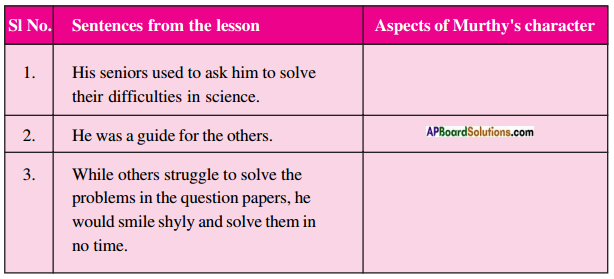
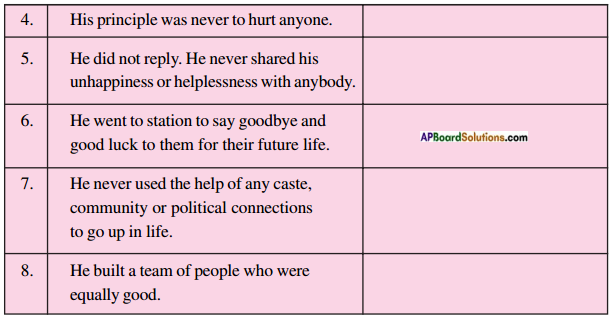
II. Given below are some sentences from the lesson. What do they tell us about Narayana Murthy’s qualities? Use the adjectives given in the box to describe Murthy’s character. You may also use some more adjectives you like.

AP SSC 10th Class English Solutions Chapter 1C I Will Do It 1
AP SSC 10th Class English Solutions Chapter 1C I Will Do It 2AP SSC 10th Class English Solutions Chapter 1C I Will Do It 3
Answer:

Sentences from the lesson Aspects of Murthy’s character
1. His seniors used to ask him to solve their difficulties in science. bright
2. He was a guide for the others. intelligent
3. While others struggle to solve the problems in the question papers, he would smile shyly and solve them in no time. brilliant
4. His principle was never to hurt anyone. gentle
5. He did not reply. He never shared his unhappiness or helplessness with anybody. introverted
6. He went to station to say goodbye and good luck to them for their future life. encouraging
7. He never used the help of any caste, community or political connections to go up in life. uncompromising
8. He built a team of people who were equally good. hard-working

AP SSC 10th Class English Solutions Chapter 1C I Will Do It

Vocabulary

Let’s look at some more one-word substitutes.

Word Meaning
fatalist a person who believes in fate
centenarian a person who is above hundred years
omnipresent one who is present everywhere
mercenary a person who can do anything for money
misogynist one who hates women
monogamy a practice of having one wife or husband
autobiography a life history written by oneself
biography a life history written by somebody else
honorary a position for which no salary is paid
ambiguous a sentence whose meaning is unclear
inimitable that which cannot be imitated
theist one who believes in God
spendthrift one who spends too much
teetotaler one who abstains from taking alcohol

Tick (✓) the most appropriate one-word substitutes for the following.
1. A person or thing that cannot be corrected
a) unintelligible
b) Indelible
c) illegible
d) incorrigible
Answer: d

2. A persoiì of good understanding. knowledge and reasoning power
a) expert
b) intellectual
c) snob
d) literate
Answer: b

3. A person who knows many languages
a) linguist
b) grammarian
c) polyglot
d) bilingual
Answer: c

4. One who possesses many talents
a) versatile
b) prodigy
c) exceptional
d) gifted
Answer: a

5. Words inscribed on a tomb
a) epitome
b) epistle
c) epilogue
d) epitaph
Answer: d

AP SSC 10th Class English Solutions Chapter 1C I Will Do It

Project Work

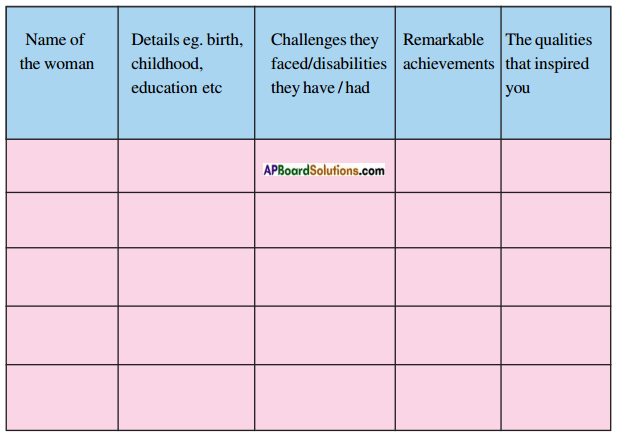
You have read about Nick Vujicic, who has accomplished every seemingly impossible thing in life despite having the most difficult form of disability. You have read about Narayana Murthy, who is one of the most remarkable examples to win over the unbeatable difficulties. You may also have heard or read about some remarkable Indian women such as Sudha Murthy, Sudha Chandran, Kiran Bedi and many other women who have crossed all the hurdles to become successful.

Now, work in pairs and collect information about the women who you think have excelled in their lives though they may not have come into limelight.

You may read articles in newspapers, magazines, books (autobiographies, biogra¬phies etc.), browse internet and watch TV reports on women.
AP SSC 10th Class English Solutions Chapter 1C I Will Do It 4
Answer:

Name of the woman Details eg. birth, childhood, education, etc. Challenges they faced/disabilities they have / had Remarkable achievements The qualities that inspired you
Mary Griffith A 13 year old girl. She is studying at Mundelein Middle School She has cerebral palsy Set records at the National Junior Disabi­lity Champion­ship. Hard work and will power
Karin Korb A 38-year-old woman. She spent her childhood with her grandparents. She had studied well till she broke her back. Later she joined a law school. She broke her back at age 17 while competing in gymnastics. Wheelchair tennis competitor Courage and determination
Emily Anne Schaefer A 44 year old woman. A French town resident. She spent her childhood in a foster s care. When she was a child, she suffe­red from trauma­tic brain injuries. She is develop­mentally disabled. The facilitator for the project’s network in Hunterdon County. Despite the trauma, she earned a college degree in fine arts. She is a printmaker and painter, and has self- published two books on art and poetry, Grit and perseverance
Rama Lakshmi She is the resident of T. Nagar, Tamil Nadu. She was born on 20th May, 1995. Spent her childhood very joyously till she lost her sight in a ghastly incident. Now she is a stu­dent of engineering. She became blind when she was 12 years old in an accident. She is a play­wright and poet. She has written more than twenty poems and eight plays, Courage and determination
Srivalli She is the resident of Kothapet, Kurnool. She was born in a poor family on 15th August, 1992.
She took her degree in arts with distinc­tion marks.
She lost both her legs in an accident. She is a wonder­ful singer. She composes songs. Will power, determination perseverance

AP SSC 10th Class English Solutions Chapter 1C I Will Do It

I. Based on the information you gather about the persons, prepare a short biographical account of the person you like the most, emphasizing the exemplary work done by him/her and present it to the group/ whole class.
Answer:
Ms. Srivalli was born on 15th August, 1992. She came from a poor family. Her father was a musician and her mother was a teacher. She was a bright student. Unfortunately, she met with an accident when she was eleven and the doctors amputated both her legs. After two years of relentless struggle, she could go back to her school. She could walk with the help of artificial limbs and slowly run. Now, she can do anything like a normal woman. She learnt music from guru Rama Sastry and now she is a good singer and composer of songs. In spite of her disability, she has worked hard with great determination, discipline and dedication and achieved her target.

After she had met with the accident, her heart sank in sorrow. Sometimes she wanted to die. She hated God for doing this to her. She was terrified of her losing both the limbs. Her doctor Mr. Rao always encouraged her by telling her that she could walk and run normally. She tried and tried until she could walk. She didn’t give up at any stage. Srivalli always says, “The challenges in our lives are there to strengthen our convictions. They are not there to run us over.” With the help of her parents, friends . and guru, Srivalli has managed to reach such a position in her life. She has proved that anything can be done, if one tries hard. From her life, we can understand that one need not lose hope. Her life shows us that one s disability can’t prevent one from reaching one’s target. I feel that her life is a source of inspiration to every woman. She is able to do all these only because of her strong will power. Hence, I believe in will power with which one can achieve wonders in one’s life. I would like to wish all the best for her in the future.

II. You may also present this write up on the occasion of “Women’s Day” in your school.
Answer:
Our beloved headmaster, dear teachers and my fellow students!
I wish you a very good morning and welcome you all to the programme. At the outset, I would like to greet all the women a very happy ‘Women’s Day.’

As we all know that 8th March is celebrated as International Women’s Day to commemorate women’s achievements and the contributions made by them to the society This day is also known as the United Nations Day for women’s rights and international peace.

I have a great pleasure to say a few words about a great girl Mary Griffith on this occasion. Mary Griffith, a thirteen year old girl, has set national records in track and swimming. She has been studying at the Mundelein Middle School and has cerebral palsy. In spite of her disability she set her records in 2004 and 2005 at the National Junior Disability Championships. She always say that sports have given her a lot more confidence and taught her to balance her life. Though she has been suffering from cerebral palsy, she hasn’t lost her hope. With great faith and determination she has done so well and set her own records. Her efforts are inspirational to all the women.

We all wish her a great future and with this I will end my speech. I thank one and all for giving me this chance to share my views with you.

AP SSC 10th Class English Solutions Chapter 1C I Will Do It

I Will Do It Summary in English

Nagavara Ramarao Narayana Murthy is the founder of Infosys, a leading IT company in the world. He is an icon of simplicity, uncompromising quality and fairness, apart from being a philanthropist. He believes in the motto, ‘Powered by intellect and driven by values.’

As a school going lad, Narayana Murthy was the brightest boy in his class. He could solve the most difficult problems which were very hard for his seniors. He came from a poor but educated family. His father was a high-school teacher. As all other students, Narayana Murthy wanted to get admission in the IIT. He appeared for the entrance test and did well. He always dreamt of studying at IIT. He was thrilled to know that he had passed the test with a high rank.

When Narayana Murthy told his father that he wanted to join IIT, his father reminded him of their poverty. Murthy’s father advised him to stay in Mysore and study as much as he wanted. His father was very sad to say this. Murthy was disappointed and his heart sank in sorrow. He was an introvert so he never shared his sorrowfulness or helplessness with anybody. When his classmates were leaving for Madras, Murthy went to the station to say goodbye to them. Though they were all excited and talking loudly, Murthy remained silent. He wished them and they waved at him as the train slowly left the platform. Even after the train had left, he stood there motionless. He believed that he only could change his life by hard work. He unknowingly followed “Your best friend is yourself and your worst enemy is yourself, the philosophy of the Bhagavath Gita. With great determination, Narayana Murthy reached great heights in his life. He proved that it was possible to earn wealth legally and ethically.

I Will Do It about the Author

Sudha Murthy, wife of N.R. Narayana Murthy, is an Indian social worker and author. Murthy began her professional career as a computer scientist and engineer. She is the chairperson of the Infosys Foundation. She has founded several orphanages, participated in rural development efforts, supported the movement to provide all Karnataka government schools with computer and library facilities, and established the ‘The Murthy Classical Library of India’ at Harvard University.

Murthy also teaches Computer Science. She composed a fiction, Dollar Sose. The present story is an extract from one of her most successful stories ‘How I Taught my Grandmother to Read & Other Stories.’

AP SSC 10th Class English Solutions Chapter 1C I Will Do It

I Will Do It Glossary

sharp (adj): quick to notice something/able to grasp quickly

bright (adj): clever / intelligent / sharp / brilliant

unnoticed (adj): ignored / overlooked

spark (n): a small amount of particular quality or feeling

grasp (v): understand something completely

avid (adj): doing something as much as possible

literature (n): written works like novels, plays, poems, technical works, newspapers and magazines

admission (n): the right to join an institution

aspirant (n): someone who hopes to get a position of importance or honour

sleepy (adj): quiet and peaceful

guide (n): a person who can advise others

mandap (n): a raised platform

uitlmate (adj): main and most important / vital / final

D-Day (n): a date on which something important is expected to happen.(From the name given to June 6, 1944. the day on which the US., British, and other armies landed on the beaches of northern France in the Second World War.)

Implied (v): gave the meaning / meant

Anna (n): a word used to address a respectable elder 1 older male

afford (v): pay for / have funds for

expenses (n): expenditure / money that one spends on something

bitter (adj): making somebody feel unhappy

burnt to ashes: lost hopes

fondest (adj): most liking

introvert(n): a quite person who is interested in his / her own thoughts and feelings.

chirping (v): making short high sounds

monsoon (n): rainy season

set in (phr.v.): begin / start

drizzle (v): light rain / sprinkle

motionless (adj): without movement

jealously (adv): being unhappy over something

philosophy (n): attitude / way of life

ethically (adv): morally

pioneer (n): a person who is the first to do something

wave (n): raise or increase

icon (n): a famous person or thing that people admire and see as a symbol of a particular idea, way of life, etc.

uncompromising (adj): unwilling to change opinions or behaviour

philanthropist (n): one who devotes his service or wealth for the love of mankind

powered by intellect and driven by values: According to Narayana Murthy Intellect (mind power) should be the power of every man. He should be driven (influenced) by values.

AP Board 8th Class Physical Science Important Questions Chapter 4 Synthetic Fibres and Plastics

AP State Syllabus AP Board 8th Class Physical Science Important Questions Chapter 4 Synthetic Fibres and Plastics

AP State Syllabus 8th Class Physical Science Important Questions 4th Lesson Synthetic Fibres and Plastics

8th Class Physical Science 4th Lesson Synthetic Fibres and Plastics 1 Mark Important Questions and Answers

Question 1.
What is polymer?
Answer:
Many small identical units combine to form a large unit is called polymer. The small units are called monomers.

Question 2.
What are synthetic fibres?
Answer:
The fibres obtained from petrochemicals when they are subjected to chemical processes are called synthetic fibres.
Have you ever heard a cracking sound when you take off certain type of clothes? or did you see sparks in them when it is dark?

AP Board 8th Class Physical Science Important Questions Chapter 4 Synthetic Fibres and Plastics

Question 3.
What is the reason?
Answer:
This is static electricity developed by artificial fibres due to friction.

Question 4.
Why does wearing nylon clothes are not preferable while cooking or working near a fire?
Answer:
Nylon fibre easily catches fire. So it is not preferable to wear it while cooking, welding, working near a fire.

Question 5.
What is blending and what is the advantage of blending?
Answer:
Any synthetic fibre can be combined with two or more other fibres is called blending.
When two fibres are blended the resultant blended fibre possess the best qualities of both.

Question 6.
What are the uses of plastics?
Answer:
Plastics are used in milk and oil pouches, containers to store pickles and rice, buckets to store water, chairs, water pipes, electrical appliances, television, radio and comput¬ers and mobile phones.

Question 7.
What material is used to make handles of utensils?
Answer:
Bakelite is used for making handles of various utensils due to its poor conductivity of heat and electricity.

AP Board 8th Class Physical Science Important Questions Chapter 4 Synthetic Fibres and Plastics

Question 8.
How do you appreciate 4R principle?
Answer:
4R principle is useful in developing ecofriendly environment and bright future for next generation of people.

8th Class Physical Science 4th Lesson Synthetic Fibres and Plastics 2 Marks Important Questions and Answers

Question 1.
How is nylon made? What are the advantages of nylon as fibre?
Answer:
Nylon is a polymer made of chemical units called polyamides.
Advantages of nylon as fibre:

  1. Nylon fibre is strong, elastic and light weight.
  2. Cloth made of nylon are lustrous and easy to wash.
  3. Nylon does not absorb water.

Question 2.
Where does we use nylon?
Answer:
Nylon can be used in tooth brush bristles, ropes, fishing nets, tents, sarees, stockings and socks, car seat belts, sleeping bags, curtains, carpets and also used in making parachutes.
Rock climbers use nylon ropes to climb mountains. It is also used in making of swim suits, sheer hosiery, sails, umbrella cloth, dress materials, car tyres, etc.

Question 3.
How would you prepare rayon?
Answer:
The cellulose that was collected from wood or bamboo pulp is treated with sodium hydroxide and then carbon disulphide. It forms a syrup called viscose. Viscose is forced through a spinneret into a solution of dilute sulphuric acid. This gives us silk like threads. This new fibre is called rayon which is an artificial silk.

AP Board 8th Class Physical Science Important Questions Chapter 4 Synthetic Fibres and Plastics

Question 4.
What are the uses of rayon?
Answer:

  1. Rayon is cheaper than silk and can be woven like silk fibre.
  2. Rayon is mixed with cotton to make bed sheets.
  3. Rayon is mixed with wool in making of carpets.
  4. Rayon is often used in fashion and home furnishings.
  5. Rayon is also found in sanitary products, diapers and bandages and lints for dressing wounds.

Question 5.
What is acrylic ? Where do we use acrylic?
Answer:
Acrylic is a synthetic fibre made from the combination of coal, air, water and lime¬stone. It looks like natural wool. If can be considered as artificial wool.
It is used in knitted apparels such as fleece, socks, sportswear and sweaters. It is also used in craft yarns, upholstery fabric, carpets, luggage yawning and vehicle covers.

Question 6.
What are the advantages of natural fibre over artificial fibres?
Answer:
When natural fibres, contribute to a fabric it allows the skin to breathe easily. Also natural fibres are generally free from irritating chemicals. Whenever fire accidents takes place they does not stick to the body.

Question 7.
How do you prepare polyester? What are the advantages of polyester as fabric?
Answer: Polyester is made by reacting dicarboxylic acid with dihydric alcohol.
Advantages :

  1. Polyester can be melted and spun. This property allows the fibre to convert into different sizes and shapes.
  2. They are altra thin, microfiber which gives them a smoothen and soft feel.
  3. They does not get wrinkled easily.
  4. It remains crisp and easily washable.

Question 8.
Give example for popular polyester and what are its advantages?
Answer:
The popular polyester is terylene.

  1. It can be drawn into very fire fabric fibres.
  2. Terylene is after mixed with cotton to form terricot with wool to give terriwool. Which has best qualities of both blunded fibres.

Question 9.
What are plastics? How many types of plastics are there? Explain them with examples.
Answer:
Organic polymers are called plastics. Plastics are two types :

  1. Thermoplastics: The plastics which get deformed easily on heating and can be bent are called thermoplastics, e.g.: Polyethene, PVC.
  2. Thermosetting plastics: The plastics which molded once cannot be softened on heating are called thermosetting plastics, e.g.: Bakelite, melamine.

AP Board 8th Class Physical Science Important Questions Chapter 4 Synthetic Fibres and Plastics

Question 10.
Where do we use bakelite?
Answer:

  1. Bakelite is used for making handles of various utensils.
  2. It is used for making electrical appliances including switch boards.
  3. It is an alternative for pearl and jade.
  4. In manufacture of telephone.

Question 11.
Where do we use melamine?
Answer:

  1. Melamine is used in making of utensils and other grocery of kitchen.
  2. It is used for making of floor and dress material (firemen dress) for their nature of fire resistance.
  3. Computer and T.V. cabinets are made by melamine.

Question 12.
Ramu observing his grandmother keeping pickles in plastic bottles. What are the questions raised in his mind by seeing this?
Answer:
The questions raised in Ramu’s mind

  1. Whether plastic is cheap when compare with metal?
  2. Why does she not put the pickles in metal containers?
  3. Whether metal containers react with pickles? If so they form harmful substances?

Question 13.
What do you know about creator of first man made plastic? How he prepare the plastic?
Answer:
The creator of first man made plastic is Alexander Parkes the name of the plastic is parkesine.
To prepare this material Parkes heated nitrated cotton which previously soaked in sulphuric acid and made fabric soft and elastic with oil and camphor. The end product was an ivory – coloured material that became distorted when subjected to heat. This is named as Parkesine.

Question 14.
What do you know about father of plastic industry? What are his major inventions and discoveries?
Answer:
Dr. Baekeland is considered as the father of present plastic industry. He was respon¬sible for the invention of bakelite. He accidently discovered the compound of carbolic acid and formaldehyde. When he tried to reheat the solidified compound he discovered it would not melt, no matter how high the temperature would be.

AP Board 8th Class Physical Science Important Questions Chapter 4 Synthetic Fibres and Plastics

Question 15.
List out the objects made up of Acrylic.
Answer:

  1. It is used in knitted apparels such as fleece, socks, sports wear and sweaters.
  2. It is also used in craft yarns, upholstery fabric, carpets, lugguage awnings and vehicle covers.

Question 16.
Draw and explain the diagram of Universal recycling symbol.
Answer:
When the number is omitted from recycling icon then it is known as Universal recycling symbol.
AP Board 8th Class Physical Science Important Questions Chapter 4 Synthetic Fibres and Plastics 1

Question 17.
What are thermosetting plastics? Give two examples.
Answer:
Thermosetting plastics are synthetic materials which gain strength during moulding by heating, but cannot be remoulded or reheated after their initial heat, moulding.
Ex : Bakelite and melamine.

Question 18.
What made the human beings to search for the alternative for natural fibres?
Answer:
Human being is always going in search of new things which can make his life more comfortable and durable. As the natural fibres are not durable, elastic or light weight or lustrous or easy to wash, he needed an alternative to fulfill his expectations. The solution to his expectations is synthetic fibre.

Question 19.
Imagine what would happen if we do not discover plastics.
Answer:
Nowadays every object used in our day to day life is made of plastic. For example milk and oil pouches, containers to store pickles and rice, buckets to store water, chains, water pipes, electrical appliances, television, radio and computers, mobile phones.
So plastics has taken over the place occupied by metal wood and glass items due to its special properties. So we cannot imagine our life without plastics because it is part of each and every aspect of life.

Question 20.
What is the most common material used in making the household articles ? Give some examples.
Answer:
Mostly household articles are made up of plastics.
Milk and oil pouches, containers to store pickles and rice, buckets to store water, chairs, water pipes, electric appliances, television, radio and computers, mobile phones, etc. are made of plastic.

Question 21.
What are the properties of thermoplastics and thermosetting plastics ?
Answer:
Thermoplastic will soften when heated and harden when cooled. It is a polymer that turns into a liquid when heated and freezes to a very glassy state when cooled sufficiently. Thermosetting plastics are not remouldable or reheatable. They are poor conductors of heat and electricity. They are fire resistants.

AP Board 8th Class Physical Science Important Questions Chapter 4 Synthetic Fibres and Plastics

Question 22.
Why polyster is quite suitable for making dress materials ? Name any two types of polyesters and their uses.
Answer:
a) Fabric made from polyester does not wrinkled easily.
b) If remains crisp and it is easy to wash.
c) Terylene is a type of popular polyester.
d) It can be drawn into very fine fibres that can be woven like any other yarn.
e) PET is very familiar form of polyester. It is used for making bottles, utensils, films, wires and many other useful products.

Question 23.
Write some disadvantages of synthetic fibres.
Answer:
a) Synthetic fibres cannot absorb moisture, thus they cannot be used as dress materials during summer.
b) They are dangerous to be worn near fire or heat as they catch fire easily.
c) They cannot be easily ironed.

Question 24.
Explain why plastic containers are favoured for storing food.
Answer:
Three main advantages of using plastic containers for storing food are :
a) They do not react with food items
b) They do not get rusted
c) They are light, strong and durable

AP Board 8th Class Physical Science Important Questions Chapter 4 Synthetic Fibres and Plastics

Question 25.
Explain why the following are made of thermosetting plastics,
a) saucepan handles
b) electric plugs/switches.
Answer:
Above things are made up of bakelite (thermosetting plastic) because it is
a) bad conductor of heat
b) poor conductor of electricity.

8th Class Physical Science 4th Lesson Synthetic Fibres and Plastics 4 Marks Important Questions and Answers

Question 1.
Explain 4R principle for creating ecofriendly environment.
Answer:
The 4R principle involves 1) Reduce 2) Reuse 3) Recycle 4) Recover.

  1. Reduce: Reduce the usage of plastic to avoid its negative consequence on environment. Land filling or plastics and burning of plastics in incinerators in the way of disposal of plastics. These have negative consequence on environment. So reduce the usage of plastic whenever it is possible.
  2. Reuse: Articles made of plastic is used again and again for its optimum utilization. There by we can decrease the usage of plastics.
  3. Recycle: We can recycle the plastic material from broken plastic material that will decrease the production of excess of plastic.
  4. Recover: The principle of recover plays major role in plastic waste management. The solid waste should be converted into resources such as electricity, heat, compost and fuel through thermal and biological means.

(OR)

  1. Reduce: Try to use less plastic material in our daily life.
  2. Reuse: Whenever we need to use plastic material, use the same material again and again don’t go for new one every time.
  3. Recycle: Instead of throw away the waste plastic material try to give it the vendor.
  4. Recover: Aware the people about establishing “garbage to energy” plant in your area.

Question 2.
Is there any such effort for solid waste management taking place in your village/ town ? How do you appreciate 4R principle?
Answer:
4R Principle is for creating an eco friendly environment.
4R = Reduce, Reuse, Recycle and Recover.
Reduce: Reducing the usage of plastics by reusing them helps the negative conse-quences on environment.
Reuse: When some things made of plastics are not in use to us, we can give them to others who need them. This helps the negative consequence or environment. This is eco friendly.
Recycle: In this process, we can obtain a new substance from the old plastics. Recycling can be used to obtain materials from which the original products were made.
Recover: The solid wastes in which plastics are major should be converted into resources such as electricity, heat, compost and fuel through thermal and biological means.
In these ways 4R principle is eco-friendly.

AP Board 8th Class Physical Science Important Questions Chapter 4 Synthetic Fibres and Plastics

Question 3.
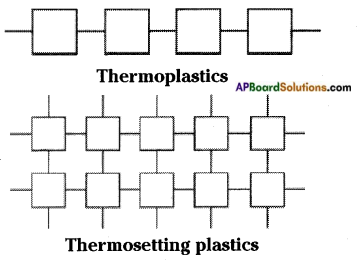
Explain the differences between the thermoplastics and thermosetting plastics with help of a diagram explaining in terms of arrangements of monomers.
Answer:
AP Board 8th Class Physical Science Important Questions Chapter 4 Synthetic Fibres and Plastics 2

Thermoplastics Thermosetting plastics
Plastics which get deformed easily on heating and can be bent are known as thermoplastics.
Ex: PVC, polythene bags, toys, combs, etc.
Plastics which moulded once can’t be softened by heating are called thermo­setting plastics.
Ex : Bakelite and melamine.

Explanation:

  1. Thermoplastics have linear arrangement of monomers.
  2. But thermosetting plastics have cross linked arrangement.
  3. The difference in the arrangement of monomers bring the difference in their properties.

Question 4.
Do you know how various synthetic fibres are obtained ?
Answer:
Nylon:
Nylon is a polymer made of chemical units called polyamides which contain carbon, oxygen and nitrogen. Polyamides are melted and forced through a heated spinneret which has very, very tiny holes. The size and shape of the holes changes, the characteristics of the resulting fibre. The fibre solidifies as it cool and can be spun or woven.

Rayon:
The cellulose that was collected from wood or bamboo pulp, is treated with several chemicals.
First sodium hydroxide is added and then carbon disulphide to the cellulose.
The cellulose dissolves in chemicals add to it and gives a syrup called viscose. Viscose is forced through a spinneret, into a solution of dilute sulphuric acid. This gives us silk like threads. The threads are cleaned with soap and dried. This new fibre is called rayon.

Acrylic:
It is made from the combination of coal, air, water, oil and limestone. It is spun by either dry spinning or wet spinning.
In dry spinning the dissolved polymers are extruded into warm air. The fibres solidify by evaporation. In wet spinning the polymers are dissolved and extruded into a bath and then dried.

AP Board 8th Class Physical Science Important Questions Chapter 4 Synthetic Fibres and Plastics

Question 5.
Can you name the few things made up of i) nylon ii) rayon (iii) acrylic and (iv) polyesters ?
Answer:
The things made from nylon:
Tooth brush bristles, ropes, fishing nets, tents, sarees, stockings and socks, car seat belts, sleeping bags, curtains, etc. are made up of nylon. The things made from rayon: Bed sheets, carpets, home furnishings, sanitary products, diapers and bandages and lints for dressing wounds.
The things made from acrylic: Socks, sportswear and sweaters, craft yarns, upholstery fabrics, carpets, luggage, awnings and vehicle covers.
The things made from Polyester: PET bottles, utensils, films, wires, etc.

Question 6.
Why it is advised not to wear synthetic clothes while working in a laboratory or working with fire in the kitchen ?
Answer:

  1. The synthetic fibres melt on heating.
  2. This is actually a disadvantage with synthetic fibres.
  3. If the cloth catches fire it can be very disastrous.
  4. The fabric melts and sticks to the body of the person wearing it.
  5. It is therefore advised not to wear synthetic clothes while working in a laboratory or working with fire in the kitchen.

Question 7.
Classify the material as biodegradable and non-biodegradable.

  1. paper
  2. wood
  3. metals
  4. cotton cloth
  5. plastic container
  6. woolen sweater
  7. peels of vegetable and fruit

Answer:

Material Biodegradable/non-biodegradable
1. paper Biodegradable
2. wood Biodegradable
3. metals Non-biodegradable
4. cotton cloth Biodegradable
5. plastic container Non-biodegradable
6. woolen sweater Biodegradable
7. peels of vegetable and fruit Biodegradable

AP Board 8th Class Physical Science Important Questions Chapter 4 Synthetic Fibres and Plastics

Question 8.
Write short notes on the following.
a) Plastic and health care industry b) Plastic cookware c) Teflon d) Fire proof plastic.
Answer:
a) Plastic and health care industry : Plastics find extensive use in the health care industry. Some examples of their use in health care are the packing of tablets, threads used for stitching wounds, syringes, doctor’s gloves, a number of medical instruments, etc.
b) Plastic cookware: Plastic cookware is used in microwave ovens for cooking food. The heating process is different in microwave ovens. The heat cooks the food but does not affect the plastic vessel.
c) Teflon: Teflon is a non-stick plastic used as non-stick coating in cookwares. It is also used as tape for sealing purpose.
d) Fire proof plastics: Although synthetic fibres catches fire easily, it is interesting to know that the fire proof material is made from synthetic plastics.

8th Class Physical Science 4th Lesson Synthetic Fibres and Plastics Important Questions and Answers

Question 1.
State government decided to avoid Flexi Banners. Predict the effect of Flexi banners
on environment.
Answer:

  1. PVC flexi banners can take several years to decompose in land fills.
  2. These flexi banners contain dangerous chemical additives like lead, cadmium which can be toxic to our health as well as animals health.

Question 2.
Write two slogans on solid waste management.
Answer:

  1. Convert waste to wealth
    Don’t convert wealth to waste.
  2. Recycle waste solid today
    for a better solid future.
  3. Reuse, Reduce, Recycle
    The good, The bettel, the best

Question 3.
Draw and explain the diagram of Universal redyeing symbol.
(OR)
Draw “Universal Recycling Symbol”.
Answer:
When the number is omitted from recycling icon then it is known as Universal recycling symbol.
AP Board 8th Class Physical Science Important Questions Chapter 4 Synthetic Fibres and Plastics 1

AP Board 8th Class Physical Science Important Questions Chapter 4 Synthetic Fibres and Plastics

Question 4.
Nylon is a synthetic fibre. Write the advantages and disadvantages of it.
Answer:
Advantages of nylon as fibre:

  1. Nylon fibre is strong, elastic and light weight.
  2. Cloth made of nylon are lustrous and easy to wash.
  3. Nylon does not absorb water.

Disadvantages of nylon as fibre:

  1. Synthetic fibres cannot absorb moisture, thus they cannot be used as dress materials during summer.
  2. They are dangerous to be worn near fire or heat as they catch fire easily.
  3. They cannot be easily ironed.

Question 5.
Though there are so many harmful effects of plastic, we still prefer to use it. What could be its major advantages?
Answer:
Plastics are used in milk and oil pouches, containers to store pickles and rice, buckets to store water, chairs, water pipes, electrical, appliances, television, radio and computers and mobile phones.
Bakelite is used for making handles of various utensils due to its poor conductivity of heat and electricity.

Question 6.
Using an experiment explain how synthetic fibres are stronger than cotton fibres.
Answer:

  1. Take an iron stand with a clamp.
  2. Take cotton thread and synthetic threads like nylon about 50 cm in length.
  3. Tie the cotton thread to the stand, so that it hangs freely from it.
  4. At the free and attach a pan, so that a weight can be placed on it.
  5. Add weight starting from 10 grams one by one, till the thread breaks down.
  6. Note the total weight required to break the thread.
  7. Repeat the same activity with synthetic thread also.
  8. We can observe that more weights are required to break the synthetic thread than cotton thread.
  9. Conclusion: Synthetic threads are stronger than cotton threads.

Question 7.
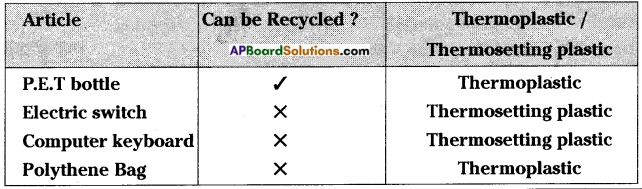
AP Board 8th Class Physical Science Important Questions Chapter 4 Synthetic Fibres and Plastics 3
Answer the following questions.
i) Name the recyclabel material / materials.
ii) Name the thermosetting plastic articles.
iii) Which are thermoplastics but not to be recycled?
iv) Which are recycled but not thermosetting plastics?
Answer:
i) P.E.T bottles
ii) Electric switch, computer keyboard
iii) Polythene bag
iv) P.E.T bottle

AP Board 8th Class Physical Science Important Questions Chapter 4 Synthetic Fibres and Plastics

Question 8.
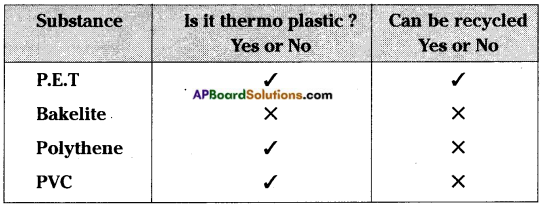
Observe the following table.
AP Board 8th Class Physical Science Important Questions Chapter 4 Synthetic Fibres and Plastics 4
Answer the following questions.
i. P.E.T is not used in the manufacture of cooker handles. Why?
ii. Which substance is used to manufacture electric switches? Why?
iii. Which is thermo plastic that can not be recycled?
iv. Why we have to ban the polythene covers?
Answer:
i) P.E.T is not used in the manufacture of cooker handles, because it is not a thermosetting plastic.
ii) Bakelite is used to manufacture electric switches, because it is thermosetting plastic.
iii) Polythene and PVC are thermoplastics that cannot be recycled.
iv) Polythene covers cannot be recycled. So, we have to ban the polythene covers.

Question 9.
Based on the smell given in the table identify the fibre and complete the table.

Smell on burning Name of the fibre
If it smells like burning hair
If it smells like burning paper
If the yarn melts

Answer:

Smell on burning Name of the fibre
If it smells like burning hair Wool (or) Silk
If it smells like burning paper Cotton
If the yarn melts Polyester (or) nylon

AP Board 8th Class Physical Science Important Questions Chapter 4 Synthetic Fibres and Plastics

Question 10.
Explain biodegradable and non-biodegradable materials with examples. Include their impact on environment.
Answer:

  1. A material which is easily decomposed by natural process is called bio degradable, eg : Peels of fruits, papers, wood, cotton bags, etc.
  2. A material which is not decomposed by natural process is called non-bio degradable, eg: Plastic
  3. Impact on environment: Slow decomposition causes environmental pollution. The burning process of synthetic materials is also pollute the environment. This pollution causes health problems to the living things.


AP Board 8th Class Physical Science Important Questions Chapter 6 Sound

AP State Syllabus AP Board 8th Class Physical Science Important Questions Chapter 6 Sound

AP State Syllabus 8th Class Physical Science Important Questions 6th Lesson Sound

8th Class Physical Science 6th Lesson Sound 1 Mark Important Questions and Answers

Question 1.
What is sound? How does sound produces?
Answer:
Sound is a form of energy. A vibrating body produces sound.

Question 2.
Honeybee produce peculiar sound through their mouth or some other organ used for that purpose?
Answer:
A honeybee can’t make a sound using vocal cords. The buzzing sound that you b*ear from any flying insect is caused by vibration of their wings when flying.

AP Board 8th Class Physical Science Important Questions Chapter 6 Sound

Question 3.
Length of vocal cords in men is nearly 20 mm, in women it is about 5 cir1 less. Whereas in children it is shorter. Can we say that the length of vocal cords plays any role in deciding the quality of sound produced by men, women and children?
Answer:
Yes, we can say that the length of vocal cords decreases then the shrillness °f sound increases.

Question 4.
Pitch of the voices of the following is in ascending order. Lion < adult man < adult woman < child < infant < insect. Can you guess the reason why?
Answer:
The pitch of the voices depend on frequency. As the number of vibrations per second increases the pitch or shrillness increases. So insect produce shrillness due to more frequency of vibration.

Question 5.
Do you find any difference in blowing the whistle and striking the drum?
Answer:
Whistle has more shrillness due to its higher frequency than drum which has less frequency.

Question 6.
Why are some sounds loud?
Answer:
The sounds which have greater amplitude are louder.

Question 7.
Why are some sounds feeble?
Answer:
The sounds which have low amplitude are feeble.

Question 8.
Is there any relation between the intensity of sound and vibrations of the body which produces sound?
Answer:
As amplitude of vibration increases the intensity of sound increases.

AP Board 8th Class Physical Science Important Questions Chapter 6 Sound

Question 9.
How many times is a car horn more powerful than near total silence?
Answer:
It is 1011 times more powerful than a near total silence.

Question 10.
How many times is a jet engine more powerful than a smallest audible sound?
Answer:
It is 1012 times more powerful than a smallest audible sound.

Question 11.
What is a vibration?
Answer:
The to and fro motion of a body from its mean position is known as vibration.

Question 12.
What is amplitude?
Answer:
The maximum displacement of vibrating body from its mean position is called amplitude.

Question 13.
What are the parts of the speech organ which involved in producing sounds?
Answer:

  1. Vocal cords
  2. Lips
  3. Teeth and tongue
  4. Nose and throat

AP Board 8th Class Physical Science Important Questions Chapter 6 Sound

Question 14.
What is a music?
Answer:
Music is a combination of sounds that are produced in an order and pleasant to hear.

Question 15.
What is a noise?
Answer:
The sounds which are not pleasant to hear is called a noise.

Question 16.
What is pitch?
Answer:
The shrillness of a sound is known as pitch.

Question 17.
What is frequency?
Answer:
The number of vibrations per second is called frequency.

Question 18.
What is audible sounds? What is audible range?
Answer:
The sounds that a normal human being can hear is called audible sounds. Frequency of audible sound ranges from 20 cycles / second to 20000 cycles / second.

Question 19.
Do we hear the sounds produced by bats?
Answer:
We cannot hear sounds produced by bats because the sounds produced by bats have frequency more than 20,000 cycles / seconds that is more than audible range.

Question 20.
Does the sound travel if there is no medium?
Answer:
Sound required medium for its propagation. So sound does not travel if there is no medium i.e vacuum.

AP Board 8th Class Physical Science Important Questions Chapter 6 Sound

Question 21.
A bird makes high pitch sound and a lion makes a low pitch roar. Which one produce sound of more frequency?
Answer:
The bird produces sound of more frequency because it has high frequnecy as we already know pitch depends upon frequency.

Question 22.
Why do we produce sounds with different pitches or amplitudes while speaking?
Answer:
The vibration in pitch and amplitude of sound during our speech helps us to communicate with others in form of language.

Question 23.
Lightning and thunder take place in the sky at the same time at the same distance from us. Lightning is seen earlier and thunder is heard later. Can you explain why?
Answer:
The speed of light is more than speed of sound so light travels faster. So we can see lightning first then we can hear thunder.

Question 24.
How intensity of sound related to its unit?
Answer:
The smallest audible sound (nearer to total silence) is 0 dB. A sound 10 times more powerful is 10 dB. A sound 100 times more powerful that of total silence is 20 dB. A sound 1000 times more powerful than sound nearer to silence is 30 dB.

Question 25.
How many times is a jet engine more powerful than the whispering sound?
Answer:
The decibel rating of jet engine = 120 dB
The decibel rating of whisper = 20 dB (for practical purpose)
The number of times a jet engine more powerful than a whisper = 1010 times
{120 – 20 = 100 that is taken as 1010}

Question 26.
How do you feel when you hear sounds in busy traffic?
Answer:
It is very unpleasant to hear.

AP Board 8th Class Physical Science Important Questions Chapter 6 Sound

Question 27.
How do you feel while listening to songs from a radio?
Answer:
It is very pleasant to hear.

Question 28.
Which of the above sounds are more pleasant to hear?
Answer:
Songs from radio are more pleasant to hear.

Question 29.
What is the unit to measure the sound intensity?
Answer:
Decibel is the unit for measuring the intensity of sound. It is denoted as dB.

8th Class Physical Science 6th Lesson Sound 2 Marks Important Questions and Answers

Question 1.
What is sound pollution? What are the causes of sound pollution?
Answer:
The unwanted sound in our surroundings is called sound pollution.
Causes of sound pollution:

  1. Sounds of traffic
  2. Sounds by motor bikes and their horns
  3. Sounds in construction sites
  4. Sounds at industries
  5. Sounds at mines
  6. Sounds during explosions and bursting of crackers
  7. Sounds from mixer/grinder, washing machines and motors, etc.

AP Board 8th Class Physical Science Important Questions Chapter 6 Sound

Question 2.
Write some common sounds and their decibel ratings.
Answer:
Near total silence – 0 dB
A whisper – 15 dB
Normal conversation – 60 dB
A lawn mower – 90 dB
A car horn – 110 dB
A jet engine – 120 dB
A gun shot or fire cracker – 140 dB

Question 3.
How many times is a car horn more powerful than normal conversation?
Answer:
The decibel rating of car horn = 110 dB
The decibel rating of normal conversation = 60 dB
The number of times a car horn more powerful than normal conversation = 105 times
{110 – 60 = 50 which is taken as 105} (The explanation beyond our syllabus. It is based on logarithms)

Question 4.
How can you explain the sound has energy?
Answer:
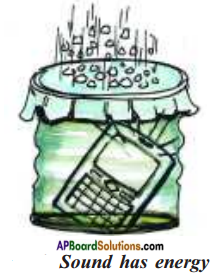
Sound has energy: Take a plastic bottle and a cell phone.
AP Board 8th Class Physical Science Important Questions Chapter 6 Sound 1
Cut the top of the bottle so that it looks like a glass. Play songs on the mobile phone in high volume and place it in the bottle. Close the mouth of bottle with a balloon using rubber band so that it covers the bottle as shown in the figure and stretch it tightly so as to behave like a diaphragm. Place some sugar crystals or small sand particles on the balloon diaphragm and observe the movement of particles. Do the same activity after removing the phone from the bottle. Sound has energy

AP Board 8th Class Physical Science Important Questions Chapter 6 Sound

Question 5.
What are the differences between the noise and music? Explain.
Answer:

Noise Music
1. Sounds which are not pleasant to hear are called Noise. 1. Sounds which are pleasant to hear are called Music.
2. Noise is an irregular combination of sounds. 2. Music is a combination of sounds. Which are produced in order.
3. It is unpleasant to hear. 3. It is pleasant to hear.

Question 6.
Explain the sources which produce sound pollution in your surroundings.
Answer:
Sources of sounds that are produce to sound pollution:

  1. Sounds in traffic
  2. Sounds by motor vehicles
  3. Sounds in construction sites
  4. Sounds in industries
  5. Sounds in mines
  6. Sources of sound pollution like mixer, grinder, washing machines and motors, etc.

Question 7.
What is the effect of humidity on quality of sound propagation? Is there any difference in propagation of sound in air during the summer and winter seasons? Discuss.
Answer:
With increase in humidity, density of air decreases. So with rise in humidity velocity of sound increases.
This is why sound travels in humid air (rainy season or winter) than in dry air (summer) at the same temperature.

Question 8.
Why the voice of men, women and children are different?
Answer:
The vocal cords of men about 20 mm long. In women these cords are about 5 mm shorter in respect to men. Children have very short vocal cords. That is the reason that voice of men, women and children are different.

Question 9.
On which property of vibrations does the loudness of sound depend?
Answer:
The loudness of sound is determined by its amplitude. When the amplitude of a vibration is large, the sound produced is loud. When the amplitude is small, the sound produced is feeble.

AP Board 8th Class Physical Science Important Questions Chapter 6 Sound

Question 10.
What are the harmful effects of noise pollution?
Answer:

  1. Presence of excessive noise in the surroundings may cause many health related problems.
  2. Lack of sleep, hypertension (high blood pressure), anxiety and many more health disorder may be caused by noise pollution. A person who is exposed to a loud sound continuously may get temperory or even permanent deafness.

Question 11.
What is the effect of humidity on quality of sound propagation? Is there any difference in propagation of sound in air during the summer and winter seasons? Discuss.
Answer:
In the winter season the air has fogs and behaves as liquid medium. So, the air moves little faster in it. Whereas in the summer the air is dried and no possibility of droplets. Hence the sound moves slower.
The propagation of sound is Solids > liquids > gases

Question 12.
Define audible sounds and inaudible sounds.
Answer:
Audible sounds:
The sounds that a normal human being can listen are called audible sounds. Frequency range is 20 cycles/sec – 20000 cycles/sec.
Inaudible sounds:
The sounds that a normal human being can’t listen are called inaudible sounds. Frequency range is less than 20 cycles/sec. or greater than 20000 cycles/sec.

8th Class Physical Science 6th Lesson Sound 4 Marks Important Questions and Answers

Question 1.
Describe structure of larynx or voice box.
Answer:
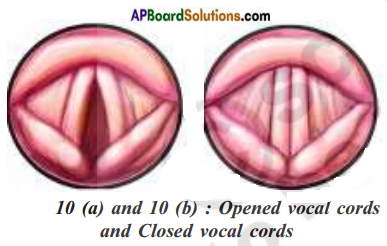
Larynx is the important organ in human body to produce sound. It has two muscular ligaments at the end of wind pipe called vocal cords. They are stretched across voice box, it leads to a narrow slit between them, to allow passage of air.
AP Board 8th Class Physical Science Important Questions Chapter 6 Sound 2
Vocal cords open during breathing to allow air into lungs. Vocal cords close when we speak.
The air from the lungs presses between them to use vibration and produce sound.

AP Board 8th Class Physical Science Important Questions Chapter 6 Sound

Question 2.
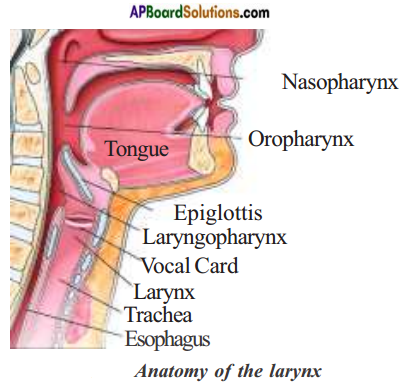
Draw anatomy of the larynx and label its parts.
Answer:
AP Board 8th Class Physical Science Important Questions Chapter 6 Sound 3

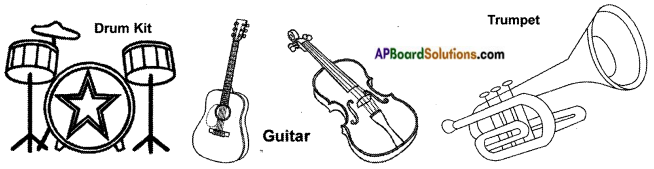
Question 3.
Draw the figures of using three musical instruments in your surroundings.
Answer:
AP Board 8th Class Physical Science Important Questions Chapter 6 Sound 4

Question 4.
a) Can sound travel in vacuum? Explain.
b) In which medium sound travels much faster and slower? Give some examples.
Answer:
a) Sound can’t travel in vacuum as it needs particles for propagation. As vacuum is empty, it is not possible.
b) Sound travels much faster in solids as the particles in solids are very closely packed, e.g.: Sound travels in train tracks (Railway tracks).
Sound travels much slower in gases as the particles in gases (air) are very loosely packed.
e.g.: Thunder or sound produced from amplifier at a long distance is feeble to hear.

Question 5.
Which object is vibrating when the following sounds are produced?
i) The sound of sitar or veena
ii) The sound of tabla
iii) The buzzing of bee or a mosquito
iv) The sound of a school bell
v) The sound of bursting balloon
vi) The radio
Answer:
i) Strings of sitar or veena vibrate to produce sound.
ii) The skin of the tabla vibrate to produce sound.
iii) Wings of mosquito or a bee vibrate to produce sound.
iv) The disc of the bell when beated with hammer vibrate to produce sound.
v) Air vibrates to produce sound.
vi) In the radio speakers vibrate to produce sound.

AP Board 8th Class Physical Science Important Questions Chapter 6 Sound

Question 6.
On which property of vibrations determines the pitch of the sound? Explain with examples.
Answer:

  1. The frequency determines the shrillness or pitch of sound.
  2. If the frequency of vibration is higher we say that the sound has a higher pitch.
  3. If the frequency of vibration is lower, we say that the sound has a lower pitch. For example, the drum vibrates with a low frequency. Therefore, it produces a low pitched sound:
  4. On the other hand, a wristle has a higher frequency, and therefore produces a sound of higher pitch.
  5. A bird makes a high pitched sound whereas a lion makes a low pitch roar.

Question 7.
How can the noise pollution be controlled in a residential area?
Answer:

  1. The noisy operations must be conducted away from any residential area.
  2. Noise producing industries should be set up away from such areas.
  3. Use of automobile horns are minimized.
  4. T.V and music systems should be run at lower volumes.
  5. Plants must be planted along the roads and around buildings to minimize the harmful effects of noise pollution.

Question 8.
What is the audiable range of frequencies for human beings? Explain.
Answer:

  1. Sound of frequencies less than about 20 vibrations per second (20 Hz) cannot be detected by the human ear.
  2. Such sounds are called inaudible.
  3. On the other side, sound of frequencies more than about 20,000 vibrations per second (20,000 Hz) are also not audible to the human ears.
  4. Thus for human ears, the range of audible frequencies is roughly between 20 to 20,000 Hz.

Question 9.
What is eardrum? How does it play an important role in hearings?
Answer:

  1. We hear sound through our ears.
  2. The shape of the outer part of ear is like a funnel.
  3. When sound enters in it, it travels down a canal at the end of which a thin membrane is stritched tightly.
  4. It is called the eardrum.
  5. It performs an important function.

8th Class Physical Science 6th Lesson Sound Important Questions and Answers

Question 1.
Majority of communication in human beings is through speech. Name the organs which give human beings the ability to talk.
Answer:

  1. Vocal cords
  2. Lips
  3. Teeth and tongue
  4. Nose and throat

AP Board 8th Class Physical Science Important Questions Chapter 6 Sound

Question 2.
Why our steps do not produce sound if we walk on a carpet floor?
Answer:
Carpets are soft and as we know soft materials are bad conductors of sound. Thus the
carpet tends to absorb the sound produced. Also when we walk on the carpet the amplitude and vibrations of the floor is reduced leading to a lesser sound.

Question 3.
Sound does NOT travel in vacuum. Explain why.
Answer:

  1. Sound energy travels in the form of wave.
  2. To produce waves medium is required.
  3. Hence, if there is no medium, sound waves cannot form.

Question 4.
Complete the following table.

Vibrating part of instrument Name of the instrument
Stretched membrane
Stretched string

Answer:

Vibrating part of instrument Name of the instrument
Stretched membrane Tabala, Dappu, Mrudangam
Stretched string Veena, Guitar, Violin

Question 5.
Mention the sounds which are responsible for sound pollution. Suggest four controlling measures of sound pollution.
Answer:
Causes of sound pollution:

  1. Sounds of traffic
  2. Sounds by motor bikes and their horns
  3. Sounds in construction sites
  4. Sounds at industries
  5. Sounds at mines
  6. Sounds during explosions and bursting of crackers
  7. Sounds from mixer / grinder, washing machines and motors etc.

The steps to reduce sound pollution :

  1. Attach silencers to the bikes and other machines to reduce sound.
  2. Manufacture machines that work with lesser noise.
  3. During the use of TVs and taperecorders tune down volume of sound.
  4. Plant trees to reduce sound pollution.

AP Board 8th Class Physical Science Important Questions Chapter 6 Sound

Question 6.
What is sound pollution? Write effects of sound pollution. Suggest some measures to control sould pollution.
Answer:
The unwanted sound in our surroundings is called sound pollution.
Effects of sound pollution on bio-diversity:

  1. The first harmful effect is loss of hearing.
  2. It also leads to several health related problems, e.g : Sleeplessness, hypertension, increase in blood pressure, etc.
  3. It effects the mental health of people.
  4. In animals, noise can increase the risk of death by altering predator or prey detection and avoidance, interfere with reproduction and navigation and contribute to permanent hearing loss.
  5. Noise pollution causes poor quality of crops.
  6. Under water animals such as whales and dolphins too experience discomfort due to noise pollution caused by submarines, shipping companies and sonars. Cuttle fish and octopus suffer serious damage from noise pollution.

The steps to reduce sound pollution :

  1. Attach silencers to the bikes and other machines to reduce sound.
  2. Manufacture machines that work with lesser noise.
  3. During the use of TVs and taperecorders tune down volume of sound.
  4. Plant trees to reduce sound pollution.

Question 7.
Kushwanth said “Vibrating objects produce sound.” Establish that the given statement is true with relevant example from your surroundings.
Answer:
The statement given by Kushwanth is correct.
That is “vibrating objects produce sound”.
1. Eg: 1) If we ring the bell in the school, sound will produce.
2) If we touch the bell while ringing, vibrations will experience.

2. Eg: 1) We can observe sound coming from the engine of a vehicle.
2) This is due to vibration of the engine.

3. Eg: 1) Musical instruments vibrates and produce sound.
2) If we pull the string of a veena or guitar.
3) It will produce sound.

AP Board 8th Class Physical Science Important Questions Chapter 6 Sound

Question 8.
Based on the below information answer the following questions.

Musical Instrument Vibrating part producing sounds
Veena Stretchings string
Tabla Stretched membrane
Flute Air Column
Dholak Stretched membrane
Sitar Stretching string
Drum Stretched membrane

a) Name the instruments which have vibrating part like a thin elastic rubber band.
Answer:
Tabla, Dholak, Drum.

b) What are the vibrating particles in the air column?
Answer:
Air particles.

c) What is the difference between Tabla and Sitar in terms of how they produce sound?
Answer:
In Tabla, stretched membrane vibrates and produce sound. Whereas in Sitar stretching string vibrates and produce sound.

d) How to produce different frequencies using a flute?
Answer:
By closing holes of the flute with fingers (or) By changing length of the air column.

Question 9.
Write about the propagation of sound in different media.
Answer:

  1. Sound produced by source travels in a medium in the form of waves.
  2. Vibrations produced by source of sound travel by particles of medium.
  3. In the case of solids, particles of solid substance vibrates and travel along the substance.
  4. In the case liquids, molecules of liquids carry the vibrations for sound propagation.
  5. In the case of gas, gaseous molecules act as carries of vibrations and allow the sound propagation.

AP Board 8th Class Physical Science Important Questions Chapter 6 Sound

Question 10.
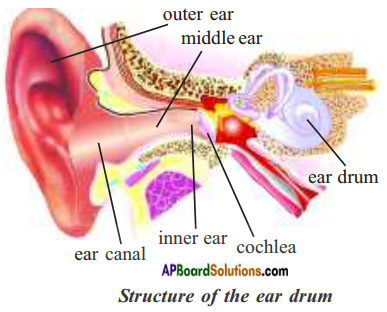
Explain the structure and functions of the ear using a diagram.
(OR)
Describe briefly about structure and functioning of the eardrum.
Answer:
Our ear consists of three sections, the outer ear, the middle ear and the inner ear, Pinna of external ear collects the sound vibrations. They enter into the ear canal. We have learnt that sound travels in the form of vibrations: These vibrations strike the tympanum (eardrum) and make it to vibrate.
AP Board 8th Class Physical Science Important Questions Chapter 6 Sound 5
The vibrations from the tympanic membrane reach the middle ear (ear ossicles), contains three small bones malleus (hammer shaped), incus (anvil shaped) and stapes (stirrup shaped). They magnify the sound vibrations.
The stapes transmits the vibrations to the membrane of oval window. The oval window has the surface area 1/20th of the ear-drum. By this the vibrations increase 30 to 60 times. The vibrations from the oval window transmit to the cochlea which is the inner part of the ear. The cochlea is filled with fluid which transmits the vibrations. The motion of the vibrations in the cochlea is detected by tiny hairs connected to nerves at this point. The vibrations are transformed into electrical signals and carried by the nerves to the brain where the sensation of the sound is realized.

AP Board 6th Class Social Studies Study Material Guide Solutions Pdf Download State Syllabus

Andhra Pradesh SCERT AP State Board Syllabus 6th Class Social Studies Study Material Guide Pdf free download, AP Board 6th Class Social Studies Textbook Solutions in English Medium and Telugu Medium are part of AP Board 6th Class Textbook Solutions.

Students can also go through AP Board 6th Class Social Notes to understand and remember the concepts easily. Students can also read AP 6th Class Social Important Questions for exam preparation.

AP State Syllabus 6th Class Social Studies Guide Study Material Pdf Free Download

6th Class Social Guide | AP State 6th Class Social Textbook Solutions

AP 6th Class Social Study Material Pdf English Medium

AP Board 6th Class Social Studies Solutions Telugu Medium

AP Board 6th Class Social Studies Solutions Chapter 7 Emergence of Kingdoms and Republics

SCERT AP Board 6th Class Social Solutions 7th Lesson Emergence of Kingdoms and Republics Textbook Questions and Answers.

AP State Syllabus 6th Class Social Studies Solutions 7th Lesson Emergence of Kingdoms and Republics

6th Class Social Studies 7th Lesson Emergence of Kingdoms and Republics Textbook Questions and Answers

Improve Your Learning

Question 1.
What do you mean by Gana? How were they different from the kingdoms ruled by the kings?
Answer:
The term ‘gana’ means people of equal status. Sangha means ‘assembly’. Gana Sangha means an assembly of equal-status people. They cover a small area that was ruled by a superior group among them. These gana sanghas practiced “all are equal” traditions.
A kingdom means a territory and was ruled by a king or queen. In a kingdom, a family which rules for a long, period becomes a dynasty.

Question 2.
Why did the Rajas of Mahajanapadas build forts?
Answer:

  1. The rajas of Mahajanapadas built forts to protect their capital city.
  2. Huge walls of wood, brick or stone were built around the cities.
  3. Forts were probably built because people were afraid of attacks from other kings and needed protection.
  4. Some rulers wanted to show their wealth and strength by building large, tall, and impressive walls around their cities.
  5. The land and the people living inside the forts could be controlled more easily by the king.

AP Board 6th Class Social Studies Solutions Chapter 7 Emergence of Kingdoms and Republics

Question 3.
Can you point out the difference between the way villages are managed today and in the time of Mahajanapadas?
Answer:
Nowadays, regular elections are taking place in villages which promotes democracy in our country. But in earlier times there was a ruler who controlled the village which did not help the democracy, but it helped in the monarch system which went for a long time in our country.

Question 4.
Find out how the craftspersons are; taxed by the government today? Was it the same in the times of Mahajanapadas?
Answer:
Craft persons have to pay taxes at the time of Mahajanapadas. Sometimes they have to work free of charge for the king for one day of every month.
But today if a craft person earns money more than the specified amount by the government they have to pay the tax for the excess amount they earned. There is no chance to work instead of paying tax.

Question 5.
Through what sources do you know about Mahajanapadas?
Answer:
We can know much about those villages and towns from two kinds of sources from archaeological excavations in different places and from the books composed during that period:

Question 6.
Write the agricultural practices that led to an increase in agricultural production in the time of Mahajanapadas.
Answer:
Two major changes were practiced during the Mahajanapadas period.

  1. Iron ploughshares were used. Heavy, clayey soil could be turned over better than with a wooden ploughshare, so that more grain could be produced.
  2. People of Mahajanapadas began transplanting paddy. Instead of scattering seeds on the ground, from which plants would sprout, saplings were grown and then planted in the fields. Production developed due to this since many plants survived.

AP Board 6th Class Social Studies Solutions Chapter 7 Emergence of Kingdoms and Republics

Question 7.
“ The Mahajanapadas developed on the river banks.” Do you agree or not? Justify your answer.
Answer:
All the Mahajanapadas developed on the river banks. I agree with this statement. Archeologists found hundreds of sites in the Ganges valley. As this plain receives very high rainfall, it is very fertile. These rivers bring silt from the Himalayas and flow throughout the year. Transportation is also easy from these places. So Mahajanapadas developed on the river banks. If we observe all the Mahajanapadas, all the janapadas emerged around the river banks of Ganga, Yamuna, Narmada and Godavari.

Question 8.
How do you appreciate the works of craftsmen in the times of Mahajanapadas?
Answer:
During the period of Mahajanapadas, craftsmen played a key role in the development of Mahajanapadas. Availability of iron facilitated craft production also. Blacksmiths made necessary tools for agriculture like ploughshares, sickles, axes, arrows etc., With the use of iron ploughshare productivity improved. Potters made pots for cooking and storing grains. Carpenters made carts and with the help of these carts transportation was made easy. Weavers weaved cloth which was exported to other places and it helped the economy of Mahajanapadas. Potters made special type of pottery known as painted grey ware, which became famous in those days.
In this way craftsmen participated in the development of Mahajanapadas.

Question 9.
What were the taxes collected by the rulers of the Mahajanapadas?
Answer:
The taxes collected by the Mahajanapadas were :

  1. 1/6th of the total agricultural produce as a tax on crops.
  2. Craftsmen had to pay taxes in the form of labor.
  3. Taxes on the sale and purchase of goods and services for trade.
  4. Taxes on herders in the form of animals or animal products and taxes on hunters and gatherers in the nature of their collection from forests.

AP Board 6th Class Social Studies Solutions Chapter 7 Emergence of Kingdoms and Republics

Question 10.
How are present-day elections different from the way in which rulers were chosen in Janapadas?
Answer:
Choosing of rulers in ‘janapadas’ – Men were chosen ‘rajas’ by performing big sacrifices. The ‘Ashwamedha was one such ritual that was used to identify a ‘raja’. The ‘raja’ chosen by this sacrifice was considered very powerful.
Electing rulers today – Today, we have a democratic system of government. Each citizen has a right to cast his vote and to form the government through his elected representative.

Question 11.
What is similar in the way crops were grown in the Mahajanapadas and how they are grown today?
Answer:
The crops that were grown in the Mahajanapadas were wheat, barley, peas, and lentils. These crops are grown in the same way as those were grown in the ancient days.
In the time of Mahajanapads, they planted paddy saplings instead of grains.
Even today the same system was followed by the farmers.

Question 12.
How can you appreciate the role of natural resources in the emergence of Magadha as a powerful kingdom?
Answer:
The rivers made the land very fertile and the Grihapatis could irrigate their lands easily. The rivers were also used for transporting goods and armies. Parts of the Magadha were forested. Elephants were captured from there and trained for fighting in the armies. Wood from the forests was used for building fortresses and palaces and chariots. In the southern parts of Magadha, there were iron ore deposits that could be used for making weapons, etc.
All this enabled Magadha to emerge as a very powerful kingdom. The kingdom extended from the northwest part of India to Odisha.
Thus Magadha used the natural wealth of the region to build a powerful kingdom.

Question 13.
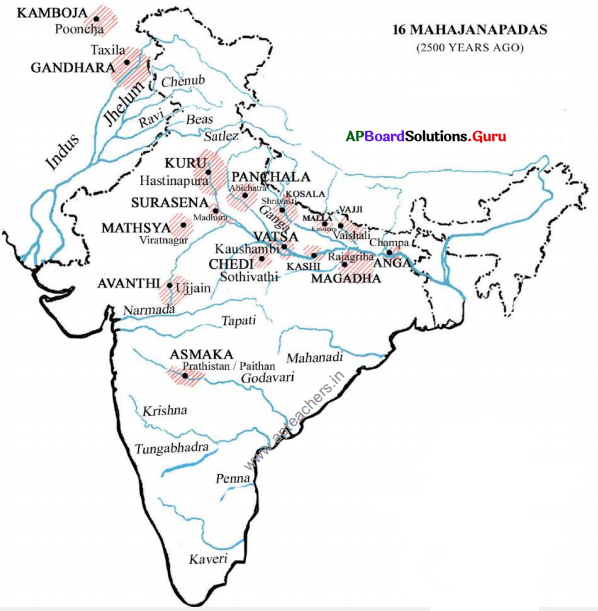
Locate the 16 Mahajanapadas and their capitals in the following India outline map.
Answer:
AP Board 6th Class Social Studies Solutions Chapter 7 Emergence of Kingdoms and Republics 1

AP Board 6th Class Social Studies Solutions Chapter 7 Emergence of Kingdoms and Republics

Question 14.
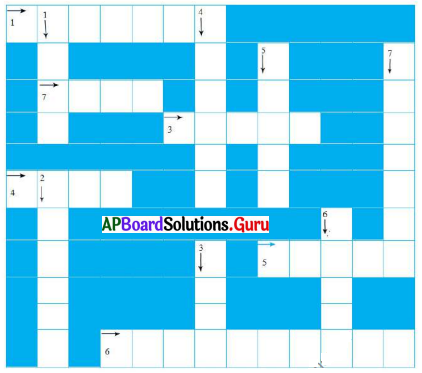
Solve the puzzle with new terms you have learned in this lesson. Take the support of your teacher.
AP Board 6th Class Social Studies Solutions Chapter 7 Emergence of Kingdoms and Republics 2
Down ↓

  1. The mahajanapada located on the extreme eastern side
  2. This is the capital city of Avanti
  3. Farmers used this metal to make plough shares.
  4. The Mahajanapada located on the banks of river Godavari
  5. The slaves employed at Gahapatis
  6. Kusinara is the capital of this kingdom
  7. The capital city of Surasena Cross

Cross →

  1. The powerful kingdom of Mahajanapadas
  2. another name for Varanasi
  3. Kaushambi is the capital of this Mahajanapada
  4. Mahabharata tells us about the battle among the kings of this mahajanapada
  5. 1 /6th of farm produce collected as tax from farmers
  6. These condemned caste systems and the use of yagnas
  7. Vajji has this type of government.

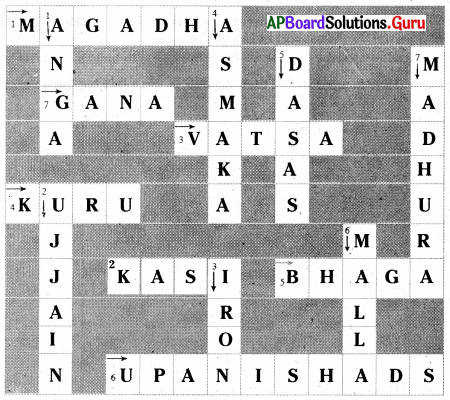
Answer:
AP Board 6th Class Social Studies Solutions Chapter 7 Emergence of Kingdoms and Republics 4

AP Board 6th Class Social Studies Solutions Chapter 7 Emergence of Kingdoms and Republics

Project Work

Collect the information about 16 Mahajanapadas, and the state, in which they were located. Prepare a table as given below. Refer to India Political map given.
AP Board 6th Class Social Studies Solutions Chapter 7 Emergence of Kingdoms and Republics 3
Answer:

S.No. Mahajanapada Capital Modern Location / State
1. Anga Champa West Bengal
2. Magadha Girivraja/Rajagriha Gaya & Patna / Bihar
3. Kasi Banaras/Varanasi Uttar Pradesh
4. Vatsa Kausambi Around Allahabad / UP
5. Kosala Shravasti Modern Avadh region / Eastern UP
6. Surasena Mathura Western UP region
7. Kuru Indraprasta Meerut & Southeastern Haryana
8. Matsya Viratnagar Around Jaipur
9. Chedi Sothirati Bundelkhand region
10. Avanti Ujjaini/Mahismati Around Malwa MP
11. Gandhara Taxila Rawalpindi/Pakistan
12. Kamboja Pooncha Kashmir & Hindukush
13. Asmaka Pratisthan / Pothan Telangana & Maharashtra
14. Vajji Vaishali Bihar
15. Malla Kusihara Deoria & UP
16. Panchala Ahichatra/Kampliya Western UP

6th Class Social Studies 7th Lesson Emergence of Kingdoms and Republics InText Questions and Answers

Let’s Do

(Textbook Page No. 75)

Question 1.
Look at the physical map of India and identify the plains through which the rivers Ganga and Yamuna flow
Answer:
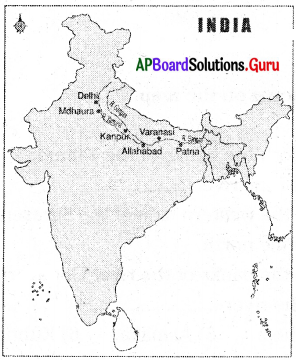
AP Board 6th Class Social Studies Solutions Chapter 7 Emergence of Kingdoms and Republics 5

AP Board 6th Class Social Studies Solutions Chapter 7 Emergence of Kingdoms and Republics

Question 2.
Identify the modern cities of India like Delhi, Allahabad, Varanasi, Lucknow and Patna.
Answer:
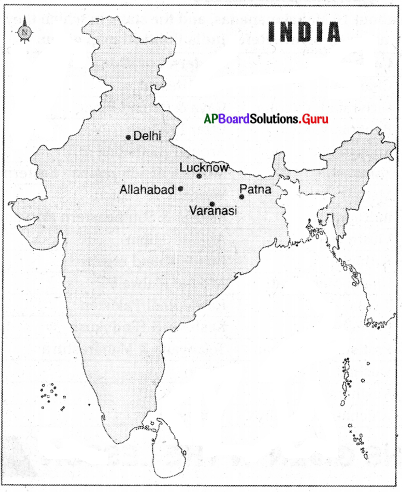
AP Board 6th Class Social Studies Solutions Chapter 7 Emergence of Kingdoms and Republics 6

Question 3.
Do you think this area will be similar to your villages? Give your reasons.
Answer:
I don’t think that our villages are similar to that of Delhi, Allahabad, Varanasi, Lucknow, and Patna. They are well developed from the time of Mahajanapadas itself. Because of high fertility lands and transportation facilities these areas developed from that time. Now they became big cities and Delhi being our national capital. So, we can’t compare our villages to the cities mentioned above.

(Textbook Page No. 77)

Question 4.
The important Janapadas of those times are shown on the map.
Look at the map and fill in the blanks.
1. The …………. Janapada was settled on both the banks of the Yamuna.
2. The Panchala was settled on both the banks of the river …………..
3. The ………….. Janapada was situated on the western side of the Surasena.
4. The ………….. Janapada was on the extreme north.
5. The ………….. Janapada was situated on the banks of the river Godavari.
6. The Gandhara was situated on the banks of the river …………..
Answer:
1) Kuru
2) Ganga
3) Matsya
4) Kambhoja
5) Asmaka
6) Kubha

AP Board 6th Class Social Studies Solutions Chapter 7 Emergence of Kingdoms and Republics

Think and Respond

(Textbook Page No. 75)

Question 1.
Find out the names of a few Janas (tribes) who initially settled down in the Indo – Gangetic plain,
Answer:

  1. Magadha dynasty
  2. Imperial Kanauj
  3. Mughal Empire
  4. Maratha Empire are some of the janapadas who initially settled down in the Indo – Gangetic plains.

Question 2.
What do you mean by Janapada? How is it different from Mahajanapadas?
Answer:
People of different tribes settled down to practice agriculture in many parts of the valley. These tribes were called Jana and the place they settled was called Janapada. Many groups of such villages and towns are called Mahajanapadas.

Question 3.
How is paddy grown today? (Textbook Page No. 78)
Answer:

  1. Land is to be prepared and levelled.
  2. Planting on time to be done.
  3. Fertilization to be done.
  4. Field is to be watered.
  5. Pests is to be controlled.
  6. Harvest on time.
  7. Storing safely.
  8. Milling efficiently.

AP Board 6th Class Social Studies Solutions Chapter 7 Emergence of Kingdoms and Republics

Question 4.
Describe the relationship between Grihapatis and Craftsmen of the village. (Textbook Page No. 79)
Answer:
In most villages, there Were craft persons like blacksmiths who made tools necessary for agriculture (like ploughshares, sickles, axes, arrows, etc), potters who made pots for cooking and storing grains, carpenters who made carts, ploughs, furniture etc., and weavers who wove cloth for the villagers.
Probably the Grihapatis gave them grains in return for their products. These craft products were necessary for agriculture, but the Grihapatis may not have had the time or skill to make them.

(Textbook Page No. 80)

Question 5.
The people of the towns would haMe needed grain, milk, meat etc. How do you think they got them if most townspeople were not doing any farming?
Answer:
Even though the townspeople were riot doing, any farming they get milk and meat by purchasing them from nearby villages and shops situated in the town.

Question 6.
Have you ever seen a fort on TV or have you ever been there? Why were there big walls around the fort?
Answer:
I have seen Red fort. I had been to Delhi and I have seen the Red Fort there. There are big walls around the fort. To protect the enemy kings by not entering them into the fort big walls were constructed around the fort.

AP Board 6th Class Social Studies Solutions Chapter 7 Emergence of Kingdoms and Republics

Question 7.
What were they made of? How do you think the kings managed to get the wealth needed for all this?
Answer:
The Red fort got its name from the stone used to construct it. The entire fort is made up of red sandstone. Maybe it was constructed with the tax amount collected and conquering other kingdoms.

Question 8.
Why did the king of Mahajanapadas need armies?
Answer:
The kings of Mahajanapadas were afraid of attacks from other kings and enemies. They needed protection. So the king of Mahajanapada needed armies.

(Textbook Page No. 81)

Question 9.
In which form the hunter-gatherers paid taxes to their kings?
Answer:
Hunters and gatherers paid taxes to the Raja from what they got from the forest like hides, woods, and honey etc.

Question 10.

  1. If everyone was forced to give away a part of their earnings as tax, how did it affect their lives?
    Answer:
    If everyone was forced to give away a part of their earnings, they will lose the earning for that part which was given as tax.
  2. Why do you think they agreed to pay the taxes? Do you think they benefited in any way from the new arrangements?
    Answer:
    They will get encouragement, and support from the king – besides protection.
  3. What is bhaga? Does the government of our times take the produce of farmers in , a similar way?
    Answer:
    The Grihapatis had to divide their crops into six parts and one part of them is to be given to king as tax. This was called bhaga.
    The government of our times does not collect produce from the farmers. The government collects tax from the farmers as per the quantity sold.

AP Board 6th Class Social Studies Solutions Chapter 7 Emergence of Kingdoms and Republics

(Textbook Page No. 82)

Question 11.

  1. Why were the kings of Mahajanapadas keen to increase craft production and trade?
    Answer:
    The kings of Mahajanapadas were k^en to increase craft production and trade because they would get more taxes. The wealth of the kingdom will increase.
  2. How did the headmen of the villages benefit from the imposition of taxes by the kings?
    Answer:
    The kings of Mahajanapadas wanted the village headmen to collect the taxes on their behalf. This might have helped the headmen to increase their power in the villages.

(Textbook Page No. 83)

Question 12.
Write a couple of lines on each of the natural resources of Magadha and how it could have been used by the kings.
Answer:

  1. Magadha kingdom was spread on both sides of the river Ganga. The river made the land fertile and the Grihapatis could irrigate the land easily and produce was high.
  2. The river was also used for transporting goods and armies.
  3. Elephants were captured from the forests that spread over in the kingdom and trained for fighting in the wars.
  4. In southern parts of Magadha, there were iron ore deposits that were used for making weapons etc.

Question 13.
Compare the gana form of government in Vajji with the present-day republic. Who was not allowed to participate in the assembly of Vajji Mahajanapada?
Answer:
Vajji had gana form of government which was nearly equal to the present-day form of government. Gana was ruled by a group of leaders instead of a single ruler. In the present republic type of government, we will elect local loaders and they will discuss our problems in the assemblies through discussion and debate.
Women, slaves and wage earners are not allowed to participate in the assembly of vajji mahajanapadas.

AP Board 6th Class Social Studies Solutions Chapter 7 Emergence of Kingdoms and Republics

Explore

Question 1.
A famous religious epic tells us about many of these Janapadas. Find out about it. (Textbook Page No. 77)
Answer:
The Mahabharat.

Do you know

Question 1.
Make a list of the Mahajanapadas and the cities which were situated on the Ganges valley. (Textbook Page No. 76)
Answer:

  1. Kasi – Banaras
  2. Kosala – Shravasti
  3. Anga – Champa
  4. Magadha – Girivraja or Rajagriha
  5. Vajji or Vriji – Vaishali
  6. Malya – Kushinagar
  7. Vatsa – Kausambi
  8. Kuru – Indraprasta/Hastinapur
  9. Pachala – Ahichhtra
  10. Surasena – Mathura

AP Board 8th Class Physical Science Important Questions Chapter 7 Coal and Petroleum

AP State Syllabus AP Board 8th Class Physical Science Important Questions Chapter 7 Coal and Petroleum

AP State Syllabus 8th Class Physical Science Important Questions 7th Lesson Coal and Petroleum

8th Class Physical Science 7th Lesson Coal and Petroleum 1 Mark Important Questions and Answers

Question 1.
What are exhaustible resources? Give examples.
Answer:
The resources which are limited in nature and can be exhausted by human activities are called exhaustible resources, e.g. Coal, petroleum and natural gas.

Question 2.
What are inexhaustible resources? Give examples.
Answer:
The resources which are unlimited in nature and not likely to be exhausted by human activities are called inexhaustible resources, e.g. Solar energy, wind energy, tidal energy.

AP Board 8th Class Physical Science Important Questions Chapter 7 Coal and Petroleum

Question 3.
When and where does petroleum first used?
Answer:
More than 4000 years ago, asphalt (petroleum product) was used in the construction of walls and towers of Babylon. There are also records from ancient China about shallow wells being dug to get petroleum.

Question 4.
What did our ancestors do with petroleum?
Answer:
They mainly used petroleum for their wooden boats and waterproof, as a fuel for lamps and in some traditional remedies.

Question 5.
What is the basic difference between coal and charcoal?
Answer:
Coal used in factories is mined from the earth’s crust. The charcoal is obtained from firewood.

Question 6.
What is meant by fractional distillation?
Answer:
The separation technique used to separate various components of petroleum is called fractional distillation.

Question 7.
What is carbonisation?
Answer:
The slow process of conversion of dead vegetation into coal is called carbonisation.

AP Board 8th Class Physical Science Important Questions Chapter 7 Coal and Petroleum

Question 8.
Why coal, petroleum and natural gas are called fossil fuels?
Answer:
They were formed from the dead remains of living organisms (fossils). So these are called fossil fuels.

Question 9.
What is coke and what are its uses?
Answer:
Coke is a tough, porous and black substance. It is an almost pure form of carbon. Uses:

  1. Coke is used in the manufacture of steel.
  2. In the extraction of many metals.

Question 10.
Why petroleum is called black gold?
Answer:
Due to its great commercial importance petroleum Is called black gold.

Question 11.
What are alternatives to natural gas? Why do not we are using them?
Answer:
The alternatives for natural gas are coal bed methane and gas hydrates. These are not in commercial production phase due to lack in proper technology.

Question 12.
Can coal, petroleum and natural gas be prepared in the laboratory from dead organisms?
Answer:
No, their formation is very slow process and conditions for their formation cannot be created in the laboratory.

8th Class Physical Science 7th Lesson Coal and Petroleum 2 Marks Important Questions and Answers

Question 1.
How do you obtain various materials we are using in our daily life?
Answer:

Material Method of obtaining it
Glass By melting salt with other materials and then, cooling it rapidly
Clay By mixing the mineral kaolinite with water
Wood From dried up trees
Plastic From petrochemicals
Metals From their respective ores

Question 2.
What is biodiesel? How would you prepare biodiesel? What is its use?
Answer:
Biodiesel is one of the biofuel. Which is not toxic and renewable. It is made from the biological ingredients instead of petroleum or crude oil. Biodiesel usually made from the plant oils or animal fat through a series of chemical reactions.
It is used in diesel engines.

AP Board 8th Class Physical Science Important Questions Chapter 7 Coal and Petroleum

Question 3.
What is coal? Explain the process of formation of coal.
Answer:
Coal is hard and black coloured substance obtained from mines.

The plants in large and dense forests in low lying wet lands got buried under the soil due to natural processes like floods and earthquakes. As more soil deposited over them, the organic matter was compressed. The temperature also rose. As the organic matter sank deeper and deeper, under high temperature and high pressure, the dead plants slowly converted to coal.

Question 4.
What is coal tar and what are its uses?
Answer:
Coal tar: It is a black coloured thick liquid with an unpleasant smell. It is a mixture of about 200 substances.
Uses:
Products obtained from the coal tar are used as starting material for various substances like synthetic dyes, drugs, explosives, perfumes, plastics, paints and roofing material. Naphthaleine balls obtained from coal tar used to repel moths and other insects.

Question 5.
What is coal gas and what are its uses?
Answer:
Coal gas is a gas obtained during the processing of coal to get coke.
Uses:

  1. It is used in lighting.
  2. It is used as fuel in many industries.

Question 6.
What are petrochemicals? What are the uses of petrochemicals?
Answer: The useful substances which are obtained from petroleum and natural gas are called petrochemicals.
Uses:
They are used in the manufacture of detergents, synthetic fibres (polyester, nylon, acrylic) polythene, etc.

Question 7.
Draw a table showing uses of petrochemicals in various sectors.
Answer:

Agricultural sector Industrial sector Domestic and other sectors
Plastic tubes, case, baskets, storing box, cultivation implements, fertilizers. Cars, motor boats, commu­nication devices, construction materials, paper industry, belt and straps, tyres. Medical equipments, apparels like clothes, bedding, socks, furniture, paints, washing liquids, road, fibre, cosmetics, medicines, polishing liquids, etc.

Question 8.
Why are coal and petroleum so versatile?
Answer:
Coal consists of mainly carbon while petroleum consists of mixture of compounds called hydrocarbons. These compounds make good starting materials for other compounds based on carbon. Carbon is very versatile and is basis for most of the materials.

AP Board 8th Class Physical Science Important Questions Chapter 7 Coal and Petroleum

Question 9.
Why does the price of petrol go up all the time?
Answer:
The price of anything depends on how much of it is available and how essential it is. Both coal and petroleum are exhaustible resources but we need them, both as fuel and as starting material for synthesising new compounds. Since supply is limited and becoming more expensive as the demand for petrol increase.

Question 10.
What is natural gas ? What are the advantages of CNG as fuel?
Answer: Natural gas is a very important fossil fuel.
CNG: Natural gas is stored under high pressure as compressed natural gas. Advantages of CNG as fuel:

  1. CNG is less polluting and it is a cleaner fuel.
  2. The great advantage of CNG is that it can be used directly for burning in homes and factories where it can be supplied through pipes because CNG travels large distances.

Question 11.
Ramu told Rahim that solar energy is inexhaustible resource then what are the questions raised in the mind of Rahim about solar energy?
Answer:

  1. If it is inexhaustible resource of energy why don’t we are using it?
  2. Whether utilization of solar energy is difficult?
  3. Whether sophasticated techniques not available for proper use of solar energy at present?
  4. It is costly to use solar energy for producing electric power?

Question 12.
Explain why petroleum is also called as liquid gold.
Answer:

  1. They are many useful substances are obtained from petroleum which are called petrochemicals.
  2. These are used in the manufacture of detergents, synthetic fibres such as polyester, nylon, acrylic, polythene, etc.
  3. Due to great commercial importance petroleum is also called liquid gold.

Question 13.
What will happen if fossil fuels like coal and petroleum are completely exhausted?
Answer:

  1. Coal and petroleum are the natural resources which are important resources of energy for us.
  2. Coal is used as a fuel as such in homes and in industry, or it is used to generate electricity at thermal power plants.
  3. Petroleum products such as petrol and diesel are used as fuels in transport to run scooters, motorcycles, cars, buses, trucks, trains and aeroplanes.
  4. Kerosene and LPG obtained from petroleum are used as domestic fuels for cooking food.
  5. Since the industrial revolution, we have been using increasing amount of energy. So we need more energy resource.
    So without coal and petroleum products life on the earth is impossible.

AP Board 8th Class Physical Science Important Questions Chapter 7 Coal and Petroleum

Question 14.
Suggest some alternative ways to save the fuel resources. (Or)
What actions are required to meet the future energy needs?
Answer:

  1. Do not waste fuel for unnecessary activities.
  2. The energy should be properly utilized and the wastage should be minimized.
  3. Usage of bicycle in place of motor vehicles for small distances.
  4. Using road transport vehicles for travelling larger distances which will minimize fuel consumption.
  5. The engine of a vehicle thoroughly serviced in order to minimize fuel consumption.
  6. Alternative sources like solar energy, wind energy, tidal energy are more utilized.

Question 15.
Burning fuels releases carbon dioxide , a green house gas, which causes climate changes and leads to global warming. Collect information about this through newspapers, magazines, etc. and prepare report.
Answer:
i) Drastic increase in the emission of CO2 within last 30 years caused by burning of fossil fuels has been identified as the major reason for the change of temperature in atmosphere.
ii) Carbon dioxide in the atmosphere traps the reflect sunlight and re-emitt towards earth which is causing increase of earth temperature what we call as global warming.

Question 16.
Describe characteristics and uses of coke.
Answer:

  1. It is tough, porous and black substance.
  2. It is almost pure form of carbon.
  3. Coke is obtained by heating soft coal in the absence or little supply of air.
  4. It is used in the manufacture of steel and extraction of many metals.

8th Class Physical Science 7th Lesson Coal and Petroleum 4 Marks Important Questions and Answers

AP Board 8th Class Physical Science Important Questions Chapter 7 Coal and Petroleum

Question 1.
Is petroleum exhaustible? Explain.
Answer:

  1. If we see the history of petroleum production, from 1859 to 1969, the total production of oil was 227 billion barrels.
  2. 50% of this total was produced during the first 100 years, while the next 50% was extracted in just ten years.
  3. Today our consumption rate of oil is far excess that of the rate of its formation.
  4. Earth take more than one thousand years to form the oil that we consume in one day.
  5. By about 2015, we would have consumed half of the total reserves of the oil.
  6. It would become more and more difficult to extract oil in future.
    So petroleum is exhaustible.

Question 2.
Draw a diagram showing existence of various fuels like natural gas, petroleum in earth crust.
Answer:
AP Board 8th Class Physical Science Important Questions Chapter 7 Coal and Petroleum 1

Question 3.
Collect information about places where we get coal, petroleum and natural gas in India and mark the places on outline map of India.
Answer:
Coal: Jharia, Chandrapura, Bokaro, Giridih (Jarkhand), Ranigunj and Asansol (West Bengal), Singrauli (M.P.), Korba (Chhattisgarh), Singareni (A.P.) : Talcher and Rampur Himgir (Odisa) and Chand coal field (Maharashtra).
Petroleum : Digboi, Hugrijan, Moran, Naharkatiya, Sibsagar, Rudrasagar and Badarpur (Asom), Bombay High (Maharashtra), Ankleshwar, Kosamba, Kalol, Mehsana, Navagam and Dholka (Gujarat), Krishna and Godavari river basins (A.P.)
Natural gas: Cambay and Ankleshwar fields (Gujarat) and Bombay High (Maharashtra), Coastal Andhra Pradesh.
AP Board 8th Class Physical Science Important Questions Chapter 7 Coal and Petroleum 2

8th Class Physical Science 7th Lesson Coal and Petroleum Important Questions and Answers

Question 1.
Write any two uses of petrochemicals in our daily life.
Answer:
Uses: They are used in the manufacture of detergents, synthetic fibres (polyester, nylon, acrylic) polythene, etc.

AP Board 8th Class Physical Science Important Questions Chapter 7 Coal and Petroleum

Question 2.
It is necessary to save the energy resources like petroleum and natural gas. Write a slogan about this to create awareness among people.
Answer:

  1. ‘Save petrol and save future’.
  2. ‘Save fuel and save earth’.

Question 3.
Petroleum is a complex mixture. Write the technique to separate its components.
Answer:
The technique to separate petroleum components is ‘fractional distillation’.

Question 4.
Write any two uses of Activated Carbon in our daily life.
Answer:
Uses of Activated Carbon:

  1. Activated Carbon is used to purify liquids.
  2. It is used to treat many types of oral poisonings.

Question 5.
Assume that you are a driver, what measures do you take to save petrol?
Answer:
Engine must be stopped in the traffic signals or in heavy traffic.

AP Board 8th Class Physical Science Important Questions Chapter 7 Coal and Petroleum

Question 6.
The following table shows the total power shortage percentage in India from 1994-1997. Observe the data and give the answers to the following questions.
i. In which year the shortage percentage of power is least?
ii. Between which two years the shortage percentage difference is more?
iii. In which year the shortage percentage of power is maximum?
iv. Make a comment on shortage percentage of power between 1994-95.
Answer:
i. 1995
ii. Between 1996 and 1997
iii. 1997
iv. Shortage percentage is decreased by 0.3 in between 1994 – 95.

AP Board 6th Class Social Studies Solutions Chapter 12 Towards Equality

SCERT AP Board 6th Class Social Solutions 12th Lesson Towards Equality Textbook Questions and Answers.

AP State Syllabus 6th Class Social Studies Solutions 12th Lesson Towards Equality

6th Class Social Studies 12th Lesson Towards Equality Textbook Questions and Answers

Improve Your Learning

Question 1.
Observe the given sentences and write True/False in the given brackets.
Answer:
i. One of the more common forms of inequality in India is the caste system. (True)
ii. Every person should not be treated with dignity. (False)
iii. Establishing equality in a democratic society is a continuous struggle. (True)

AP Board 6th Class Social Studies Solutions Chapter 12 Towards Equality

Question 2.
How you will use these numbers when you or others are in trouble?
AP Board 6th Class Social Studies Solutions Chapter 12 Towards Equality 1
Answer:
Eve teasing -1091: Whenever I find boys teasing the girls I will call 1091. Police will arrive immediately and arrest the teasers. With this service, girls will be protected.
Children abuse – 1098: When I find any child getting abused I will call 1098 and the child will get protected.
100,112 and 181 are meant for special protection for women.

Question 3.
Why does the caste system remain such a controversial issue today?
Answer:
The caste system is the most dominant reason for inequality and discrimination in India. Dr. B.R. Ambedkar fought actively for equality among the citizens of India. The government policy of reservation has helped in enhancing the education and economic status of the Schedule caste and Schedule Tribe. “But despite, the above efforts, still there is a long way to go as in rural areas caste-based identities are still prevalent.

Question 4.
What were the different reasons people had for not sending girls to school before freedom?
Answer:
Before freedom, the status of women within the country was in a deprived state. There was male dominance. Due to this the position of women was undermined. Child marriage was in practice at that time. The parents might be in opinion that getting married is better than sending them to school. The girls have to perform all the household activities. So the elder people are of the opinion that it is better than girls were not sent to the school.

AP Board 6th Class Social Studies Solutions Chapter 12 Towards Equality

Question 5.
What are the common forms of inequality that exist in India?
Answer:

  1. Social inequality,
  2. Political inequality,
  3. Economic inequality and
  4. Gender inequality are the common forms of inequality that exist in India.

Question 6.
Write a short note on equality in Indian democracy.
Answer:
Equality means “the state of being equal”. All the people in the society have the same status in all respects, including civil rights, freedom of speech, property rights, and equal access to certain social goods and social services. All are equal before Law Importance has been given to achieve equality in the Indian Constitution. Untouchability was abolished by Law. People are free to choose the kind of work they wish to do. Government jobs are open to all people. All people got equal importance.

Question 7.
Give suggestions to remove inequality and discrimination in Indian society.
Answer:
The remedial measures to be taken to remove inequality and discrimination are:

  1. Quality basic services like healthcare and education are to be provided.
  2. Reservations for women are to be provided.
  3. Children have to know about other religions also.
  4. Importance has to be given to moral values. We have a great culture.
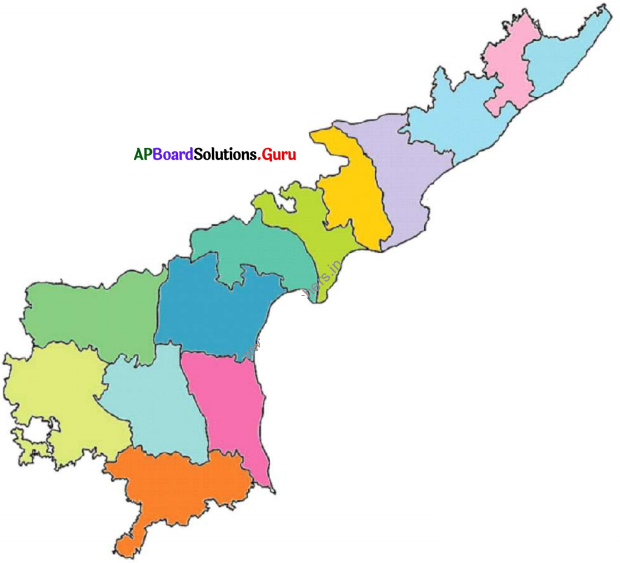
AP Board 6th Class Social Studies Solutions Chapter 12 Towards Equality

Question 8.
Differentiate between inequality and discrimination.
Answer:
Inequality means differences in treatment. The different forms of inequalities are social inequality, political inequality, and economic inequalities.
Discrimination is being negative towards other people. Discrimination can happen on the basis of color, class, religion, and gender.

Project Work

Question 1.
Split the class into small groups, discuss with your peer group on discrimination and write a report on it.
Answer:

  • What is discrimination?
    A Group: Discrimination is the demonstration of negative actions towards people.
  • What can be considered discrimination?
    B Group: When someone is treated unfairly or differently based on color, class, religion and gender, it will be considered as discrimination.
  • What are the kinds of discrimination, we observe?
    C Group: Discrimination of Gender, disability, race, religion, region, caste are some kinds of discrimination we usually observe.
  • How this discrimination can be checked?
  • By educating people and children in the school level and children educating the uneducated parents we can resolve the discrimination to some extent.

Question 2.
Collect information about any two famous personalities who faced prejudice and discrimination.
Answer:

  • Nelson Mandela: He brought peace to a racially divided country. He was successful in resolving discrimination on grounds of race. He led the fight for human rights around the world.
  • Though he spent 27 years in prison he did not stop the fight against discrimination.
  • Sindhutai: Sindhutai was born in 1948. She faced gender discrimination in her family itself. Though her father was keen to educate her, she was sent to school under the pretext of cattle grazing. She was married at the age of nine. She was beaten badly and left to die by her Husband. She came back to her mother’s house, but her mother refused to shelter her. Though she was alone, she realized that there were so many children abandoned by their parents. She adopted and gave shelter to 1200 orphans. and won 750 awards. The President of India honored her with Nari Shakti Puraskar. In spite of poverty, child marriage, gender discrimination, and being abandoned by her family, yet nothing stopped her. It shows that for a committed individual nothing is impossible.

AP Board 6th Class Social Studies Solutions Chapter 12 Towards Equality

Question 3.
How can you fight against inequality and discrimination in your village?
Answer:

  • With the help of my friends, I will arrange meetings regularly and educate the villagers.
  • I will convince them that all are equal.
  • I will quote the words from our books that all are equal before God.

6th Class Social Studies 12th Lesson Towards Equality InText Questions and Answers

Let’s Do

Question 1.
What have you observed here? Discuss with the help of your teacher. (Textbook Page No. 141)
AP Board 6th Class Social Studies Solutions Chapter 12 Towards Equality 2AP Board 6th Class Social Studies Solutions Chapter 12 Towards Equality 3
Answer:
We observe gender discrimination, racial discrimination, and regional discrimination in the above picture.

AP Board 6th Class Social Studies Solutions Chapter 12 Towards Equality

Question 2.
Prepare a poster that illustrates discrimination. Hang your posters around the school to encourage schoolmates to take action against discrimination. We have a preamble in our textbook. Find where it is? Read it carefully. What you observed and understood about equality, discuss in your classroom. (Textbook Page No. 144)
Answer:
AP Board 6th Class Social Studies Solutions Chapter 12 Towards Equality 4

  • All are equal. All people should get equal importance.
  • Our constitution provided provisions to achieve equality.
  • Our preamble provided equality of status and opportunity to all the people of the country.

Think and Respond

(Textbook Page No. 137)

Question 1.
In what ways are the women experiencing discrimination in the present society?
Answer:
Even today in some rural areas a girl is not allowed to go to college after finishing her schooling. Most of the girls are not allowed to select a career of their choice. They are forced to choose marriage instead of taking up a job. After marriage, she has to give up the job to raise children and to look after the family.

Question 2.
Have you ever attended any other religious place? What good things have you observed there? What similarities did you notice?
Answer:
I had been to church and mosque also. In both these places, they pray together like in temples. On festival days they all meet together and participate in prayer together.

AP Board 6th Class Social Studies Solutions Chapter 12 Towards Equality

(Textbook Page No. 139)

Question 3.
Do you support gender discrimination? Discuss in the classroom.
Answer:
I don’t support gender discrimination. In school, we play together, discuss in the classrooms together, and eat lunch together. We will compete with each other in our studies. We support them to compete with us in all aspects. As mentioned in the pledge we move like brothers and sisters.

(Textbook Page No. 140)

Question 4.
Write your opinion on this (Racial discrimination faced by Gandhi in South Africa) incident.
Answer:
The discrimination which Gandhiji faced is racial discrimination. In South Africa, only white people are allowed to travel in first-class compartments in those days. Gandhiji also purchased a first-class ticket. Yet he was not allowed to travel in that class. On the complaint of a white man, he was thrown out of the train. Nowadays we don’t find this type of incident.

Question 5.
What type of discrimination is it? Discuss in the classroom.
Answer:
The discrimination mentioned here is racial discrimination. In the olden days there existed racial discrimination mostly in America and South Africa. But now there is no racial discrimination. All are being treated equally. In India also all the races people are treated equally.

Question 6.
Have you ever faced any kind of discrimination? How did it make you feel?
Answer:
I haven’t faced any kind of discrimination. If I face any discrimination it will make me sad.

AP Board 6th Class Social Studies Solutions Chapter 12 Towards Equality

Question 7.
Have you observed any changes from past to present? How did the changes come about? (Textbook Page No. 141)
Answer:
We can observe a lot of changes in society when compared to the past.

  1. Girls are coming to schools in large numbers. They are competing with the boys equally. In some examinations we find girls dominating boys. Women are participating in games. Women are doing jobs. .
  2. We don’t find untouchability.
  3. People can attend religious functions according to their wishes.
  4. Government jobs are open to all. Anyone can achieve a government job. All the people are enjoying equal status.

Question 8.
The government introduced many programs like mid-day meals, Free textbooks. Free distribution of school uniforms, shoes, etc. Discuss how these are helpful in achieving equality? (Textbook Page No. 144)
Answer:
The mid-day meals program is very much useful because all the children will meet at one place and they have their meeds in the group by having discussions. Oneness feeling will develop with these types of programs.
With other programs like free textbooks, uniforms, and shoes all the students look alike and the feeling “all are equal”, is seen and felt. So all these programs are helpful to achieve equality.

AP Board 6th Class Social Studies Solutions Chapter 6 Early Civilisations

SCERT AP Board 6th Class Social Solutions 6th Lesson Early Civilisations Textbook Questions and Answers.

AP State Syllabus 6th Class Social Studies Solutions 6th Lesson Early Civilisations

6th Class Social Studies 6th Lesson Early Civilisations Textbook Questions and Answers

Improve Your Learning

Question 1.
Write the similarities between Indus and Vedic civilisation.
Answer:
Religious features: Both Harappan people and Vedic people worshipped nature and Hindu gods such as Shiva and Sakti.
Baked bricks, pottery, and wheeled carts were used both by Harappan and Vedic people.

Question 2.
Who participated in the excavations of the Indus valley civilisation?
Answer:
In 1850, the British engineers while laying a railway line between Karachi and Lahore excavated the Indus valley civilization. In 1920 the archeologists realised that it was a very did civilisation.

AP Board 6th Class Social Studies Solutions Chapter 6 Early Civilisations

Question 3.
Describe the economic life of the Indus people.
Answer:

  1. The economy of the Indus valley civilization was based upon agriculture and trade.
  2. Weaving cotton and woolen clothes were their main occupation. Indus people were the earliest to produce cotton.
  3. Production of baked bricks was another occupation of Indus people.
  4. Crops such as wheat, barley, peas were raised by the Indus people.
  5. They carried trade with other countries like Egypt, Mesopotamia, Afghanistan, and Iran also.
  6. They carried their international trade through Lothal port in the Arabian Sea.

Question 4.
How did the Indus people build their houses?
Answer:
The buildings of Indus people were well planned. It is clear that they possessed a flourishing urban culture. There were wide roads, public wells. Houses were made of bricks which were found in so many other areas across this civilization also. There were two storied buildings also. Every house was connected directly to an excellent main drainage system. A great tank was built for a public bath which now was called as “the Great Bath”. Large granaries and quarters for labor were specially built in the Indus civilization.

Question 5.
The drainage system of Indus was exemplary. How?
Answer:

  1. The Indus civilization had an elaborate sanitary and drainage system. They maintained a highly efficient drainage system.
  2. Importance was given to the cleanliness and public health.
  3. They maintained an underground drainage system for the streets. They were connected to the main drainage system.

Question 6.
“Devotion of God is belief”. Comment on Indus people’s deities.
Answer:

  1. Indus people believed in God. They believed in image worshipping.
  2. They worshipped Pasupathi (Shiva) and the mother of the Goddess.
  3. They accepted the pipal trees as sacred.
  4. They worshipped neem trees, sun, fire, earth, water, and snakes also.
  5. Fire pits and yagna vatikas are also found.
  6. Swastik symbols were found in the archeological remains of the Indus valley civilization.

AP Board 6th Class Social Studies Solutions Chapter 6 Early Civilisations

Question 7.
How many Vedas are there? What are they?
Answer:
There are four Vedas in the Vedic culture. They are:

  1. Rig Veda,
  2. Yajur Veda,
  3. Sama Veda and
  4. Atharvana Veda.

Question 8.
“Veda means superior knowledge”. Comment on it.
Answer:

  1. The term ‘Veda’ means “Superior Knowledge” in Sanskrit.
  2. They are the most ancient religious texts which define truth for Hindus.
  3. They are the most important sources of knowledge about the Aryans and the Vedic Period.
    They are called shrutis which means hearing.
  4. Vedas are the universal truths that were discovered or realized by learned people.
  5. They formed the bedrock for Indian philosophy and Yoga.
  6. Vedas contain deeper spiritual and scientific knowledge.
  7. The Vedic traditions are continued till today and are still unbroken.
  8. Research on vedas is carried out in many Indian and foreign Universities also. Swami Dayananda Saraswati gave a call “Go back to the Vedas”.

Thus we can say the Vedas mean superior knowledge.

Question 9.
Write about the social life of the early Vedic period.
Answer:
The Vedic literature is the major source to understand the Vedic period. The period of Rig Veda is called the early Vedic period.
The social life of early Vedic period:

  1. The family was regarded as the basic unit of society.
  2. The father was the head of the family.
  3. The joint family system was in practice at that time.
  4. The prisoners of war were called dasas and they were like slaves.
  5. Monogamy was the usual practice of the Vedic period.

AP Board 6th Class Social Studies Solutions Chapter 6 Early Civilisations

Question 10.
What do you know about the political life of the early Vedic period?
Answer:

  1. The polity of the Early Vedic period was basically a tribal polity with the tribal chief in the center. The tribe was called ‘Jana’, and the chief of that Jana was called ‘Rajan’.
  2. Rajan looked after the affairs of the tribe with the help of other tribal members. There are two tribal assemblies 1) Sabha and 2) Samiti.
  3. Rajan was not a dictator, Kingship was not hereditary.

Question 11.
What is the importance of epics?
Answer:

  1. The epics tell us the right way to life.
  2. They tell us what the importance of speaking the truth is.
  3. They tell us that why we should have the basic manners in our lives in an interesting manner.
  4. They tell us the importance of becoming a good human being.
  5. We should read these epics because they fill our minds with knowledge and wisdom.
  6. Epics tell us that how should we behave in society.

In Ramayana Rama is an ideal ruler, ideal brother, ideal son. Sita is ideal for Indian womanhood.
Mahabharata is a victory of Dharma over Adharma.

Question 12.
Locate the following rivers on the outline map of India
a) River Indus b) River Ganges c) River Yamuna
Answer:
AP Board 6th Class Social Studies Solutions Chapter 6 Early Civilisations 1

AP Board 6th Class Social Studies Solutions Chapter 6 Early Civilisations

Question 13.
What were the reasons for the decline of the Indus valley civilization?
Answer:

  1. Some are of the opinion that the invasion of the Aryans was the cause for the decline of Indus valley civilization.
  2. Change of course of the river Indus changed the area into the sand and affected the fertility and this led to the decline of the Indus valley civilization.
  3. Due to changes in climatic conditions, the area lost fertility and people were compelled to move to another area.
  4. Constant use of firewood for brick manufacture caused deforestation and low rainfall.

Project Work

Make a project on the similarities of Indus civilization and Vedic civilization.
Answer:
The Indus Valley civilization and the Vedic civilization had the following similarities.

  • Both worshipped Hindu Gods such as Sakthi and Siva.
  • Both believed in some sort of life after death.

They also played pre-Indian games such as gambling, dicing, and horse cart riding. The remains of a stone sculpture of a priest say that their society of most similar to that of Vedic culture.

6th Class Social Studies 6th Lesson Early Civilisations InText Questions and Answers

Let’s Do

Question 1.
Compare the economic activity of Indus people with the present. (Textbook Page No. 66)
AP Board 6th Class Social Studies Solutions Chapter 6 Early Civilisations 2
Answer:

Economic activity Indus times Present
Exports Cotton goods, pottery agricultural products. Gems, jewellary, ready-made garments metals, cotton, yarn, and fabrics.
Imports Jade, agate gold, silver, copper, tin. Petrol, paper, precious stones, plastic wool, medicines, machinery, edible oil.
Crops Wheat, barley, dates cotton, mustard. Foodgrains, cotton, jute, sugarcane tobacco, oilseeds, coffee, tea, coconut fruits, vegetables.
Domestication of animals Sheep, goat, buffalo, dog, cat, pig, elephant. Cow, buffalo, oxen, sheep, goat, horse, camel, elephant, pig etc.
Crafts Jewellery, Art, necklaces, bangles, combs, idol-making. Shawls, woodwork, pottery, leather, jute, shell, brass handicrafts, bamboo handicrafts.

Question 2.
Compare the metals used in the Indus civilization with the present day. (Textbook Page No. 67)
AP Board 6th Class Social Studies Solutions Chapter 6 Early Civilisations 3
Answer:

Metals used in the Indus civilization Metals used now
Gold, copper, silver, bronze metals were the metals known to Indus Valley Civilization people. At present we are using gold, copper, silver, bronze, platinum, brass and Iron metals.

AP Board 6th Class Social Studies Solutions Chapter 6 Early Civilisations

Question 3.
List out the names of famous books and its writers from your school library. (Textbook Page No. 72)
Answer:

  1. The Story of My Experiments with Truth – Mahatma Gandhi
  2. The Discovery of India. – Jawaharlal Nehru
  3. ………………………………………………………………….
  4. ………………………………………………………………….(Student Activity)

Think and Respond

(Textbook Page No. 65)

Question 1.
Do you find any difference between the planning of Indus cities and the present cities? How?
Answer:

  1. The Indus valley cities were established on a good plan. The modern Indian cities are not based on any such plans.
  2. Both the Indus valley and the modern Indian cities have a drainage system but the modern drainage system does not work properly when compared to the Indus valley cities.
  3. There were citadels in the Indus valley civilization while there is no citadels in the modern Indian cities, (maybe because of population increase)

Question 2.
Was the Indus drainage system more advanced? Why?
Answer:
The Indus drainage system is well planned underground drainage system. The drainage system which was followed by the Indus people was a great achievement. Every house is connected with pipes which carry waste into the main drains.

AP Board 6th Class Social Studies Solutions Chapter 6 Early Civilisations

(Textbook Page No. 69)

Question 3.
Do you find any similarities among these ancient (Mesopotamia, Egypt, Indus valley, and China) civilizations?
Answer:
Yes, we can find similarities among these ancient civilizations.

  1. All the civilisations grew along mighty rivers.
  2. All the civilisations have similarities in their settlements.
  3. All the civilisation developed religions to explain the forces of nature and their roles in the world.
  4. All the civilizations made efforts in the fields of science and technology.

Question 4.
In what ways is the Indus valley civilisation more advanced among them?
Answer:
In the Indus valley civilisation a strong and centralized government was established. The people in the Indus valley civilisation built their houses with dried or baked bricks. They built two-storeyed buildings also. Every house had a well for water and bathrooms with pipes that carried waste into the main drains. The cities of the Indus valley civilisation were well planned. They were protected by forts. They had wide roads, public wells. They had a well-planned underground drainage system which shows the importance given to the cleanliness and public health. We don’t find this type of development in other civilizations of that time.

Question 5.
Write the names of religions in our country. (Textbook Page No. 71)
Answer:
Hinduism, Buddhism, Jainism, Sikhism, Islam, Christianity, Zoroastrianism, Judaism, Animism, Dony polo, and Nirankari.

AP Board 6th Class Social Studies Solutions Chapter 6 Early Civilisations

Question 6.
How are our public representatives elected? (Textbook Page No. 72)
Answer:
Our public representatives are elected in both direct and indirect elections.

AP Board 6th Class Social Studies Solutions Chapter 11 Indian Culture, Languages and Religions

SCERT AP Board 6th Class Social Solutions 11th Lesson Indian Culture, Languages and Religions Textbook Questions and Answers.

AP State Syllabus 6th Class Social Studies Solutions 11th Lesson Indian Culture, Languages and Religions

6th Class Social Studies 11th Lesson Indian Culture, Languages and Religions Textbook Questions and Answers

Improve Your Learning

Question 1.
Name the holy book of the Muslims?
Answer:
The Quran is the holy book of Muslims.

Question 2.
What is the eightfold path?
Answer:
According to Buddha, the final goal is attaining Nirvana. It could be achieved by following the Eightfold Path. These eight aspects are to be practiced to attain Nirvana. The eightfold path is also known as Ashtanga Marga.

AP Board 6th Class Social Studies Solutions Chapter 11 Indian Culture, Languages and Religions

Question 3.
Write two slogans to encourage religious unity.
Answer:
“We may have different religions, different languages, different colored skin, but we all belong to one human race – Kofi Annan “ Where there is Unity, there is Victory”.

Question 4.
What is the main philosophy of Christianity?
Answer:
Philosophy of Christianity are:

  1. We are the children of God.
  2. Lead a pure life without committing sins.
  3. Love your neighbor as yourself.
  4. When slapped on one cheek, show the other.
  5. Service to mankind is service to God.

Question 5.
What are the main teachings of Islam?
Answer:
Teachings of Islam are:

  1. All human beings are His creation.
  2. All human beings are equal before God.
  3. God has no shape and therefore it is wrong to worship idols.
  4. Every Muslim should become a servant of God and be honest.

Question 6.
What is Arya Sathyas?
Answer:
The teachings of Gautama Buddha are called four noble truths or Arya Sathyas They are:

  1. The world is full of suffering.
  2. Suffering is caused by human desires.
  3. The renunciation of desires is the path of salvation.
  4. Salvation can be attained easily by following the Eightfold Path.

Question 7.
“Unity in Diversity is the dominant cultural trait of India.” – Do you agree or not? Comment.
Answer:
I agree with the statement “Unity in Diversity is the dominant cultural trait of India.” Indians respect the great saints and philosophers who were born in all parts of the country like Mahavira, Buddha, Nanak, Kabir, etc.
Indians celebrate their festivals like Holi, Diwali, Eid, Christmas, Good Friday, Mahavir Jayanti, Buddha Jayanti, etc. very peacefully without disturbing other religious people. We find people of different cultures and different religions moving together, ft is the dominant cultural trait of India.

Question 8.
There are many problems that affect the Indian National Integration at present.
What are the reasons for this? How could these be addressed?
Answer:
Problems that are affecting the National integration are :

  1. Casteism: Caste is a significant part of our social framework of Indian society and the difference based on casteism affects National Integration.
  2. Communalism: Religious hostility has professed severe challenges to National Integration in India.
  3. Linguistic violence: Multi linguism is one of the primary characters in India due to which many residents faced violence.
  4. Social and Economic inequalities
  5. Regional disparities
  6. Extremism

All the parts of India have to develop equally in all fields. Oneness feeling is to be created and developed in all the people of India. Then this problem can be solved.

Question 9.
Locate the given places on the outline map of India.

  1. River Indus
  2. Tamilnadu
  3. Andhra Pradesh
  4. Bihar
  5. Bhattiprolu
  6. River Krishna
  7. River Ganga
  8. River Yamuna
  9. Vindhya ranges
  10. Uttar Pradesh

Answer:
AP Board 6th Class Social Studies Solutions Chapter 11 Indian Culture, Languages and Religions 1

AP Board 6th Class Social Studies Solutions Chapter 11 Indian Culture, Languages and Religions

Question 10.
Prepare a picture of religious unity.
Answer:
AP Board 6th Class Social Studies Solutions Chapter 11 Indian Culture, Languages and Religions 2

Question 11.
Prepare four slogans to promote religious unity.
Answer:

  1. No one can win alone, but Unity can.
  2. Unity is for you and you for Unity.
  3. Let’s run for Unity, let’s run for India.
  4. We can change the world through Unity.

Question 12.
Fill the following blank boxes with the suitable words given below.
I. Religion: Hindu Religion, Sikhism, Christianity, Islam, Jainism, Buddhism
II. God/Messenger: Siddhartha, Jesus Christ, Mahavira, Prophet Muhammad, Lord Krishna, Guru Nanak
III. Holy Book: Tripitaka, Bible, Bhagawad Gita, Quran, Grandh Sahib, Angas
IV. Worshipping place: Mosque, Temple, Gurudwara, Church, Monastery, Jain
AP Board 6th Class Social Studies Solutions Chapter 11 Indian Culture, Languages and Religions 3
Answer:
AP Board 6th Class Social Studies Solutions Chapter 11 Indian Culture, Languages and Religions 4

AP Board 6th Class Social Studies Solutions Chapter 11 Indian Culture, Languages and Religions

Project Work

Question 1.
Celebrate Sankranthi, Ramzan, and Christmas in your school.
Answer:
Student Activity.

Question 2.
Read the holy books of all religions, know about the biography, teaching and theme of the religious gurus.
Answer:
Hinduism: Hinduism is based on the principles of Universal truth.
According to Hinduism – God can be realized in many paths. Hinduism says that God exists in all living and Non-living things.

  • Service to man is service to God.
  • The whole world is one family.
  • Let all people be happy.

Pursuit of moksha through penance.
Jainism: Jainism is an ancient religion that is rooted in the philosophy that teaches the way to liberation and a path to spiritual purity and enlightenment through disciplined non-violence to all living creatures.
Tenets of Jainism:

  • Belief in God.
  • It did not condemn the varna system but attempted to mitigate the evils of the Varna order.

Quran: Holy book of Muslims. Muslims believe that Quran was verbally revealed by Allah to Muhammed through the angel Gabriel.
In Quran God warns human beings to find a proper way to reach happiness and perfection.
Teachings:

  • All human beings are His Creation.
  • All human beings are equal before the law.
  • God has no shape.

Every Muslim should become a servant of God.
Buddhism: Buddha asked his followers to avoid indulgence in worldly pleasure and practice strict abstinence and asceticism. According to Buddha, everyone was responsible for their own happiness in life. The main teachings of Buddhism are encapsulated in the basic concept of Four noble truths.
Christianity: Jesus Christ was the eternal word of God who assumed human form to serve humanity and to rescue human beings. Jesus Christ suffered and died to redeem mankind from sin. Christians believe that Jesus Christ now sits at the right hand of God as the final judge of the dead and the He will return again as prophesized.

AP Board 6th Class Social Studies Solutions Chapter 11 Indian Culture, Languages and Religions

Question 3.
Field visit:
Visit a nearby place of worship, and observe the activities and discuss with your class.
Answer:
Student Activity.

6th Class Social Studies 11th Lesson Indian Culture, Languages and Religions InText Questions and Answers

Let’s Do

Question 1.
Invite a Mend of other language and interact with him/her. (Textbook Page No. 123)
Answer:
(This question is answered keeping in view the question given in the 2nd lesson)
Venu met some children from different cities at a youth festival. Venu wants to talk to them. He wants to know about their culture.
Venu: Hello Nihal. I am Venu. I am from Guntur, Andhra Pradesh.
Nihal: Hello Venu, I am from Delhi.
Venu: What is your father. My father is a bank officer.
Nihal: My father is working in railways.
Venu: What is your mother tongue? How many letters are there in your mother tongue?
Nihal: My mother tongue is Hindi. I will tell you some interesting facts. Hindi is an Indo-Aryan language. Hindi is mainly spoken in India. Hindi is the official language of India. Hindi script is Devanagari Script. No of the letters in Hindi is 44. But some authors say there are 52 letters. Tell me about your mother tongue also venu.
Venu: My mother tongue is Telugu. It is spoken mainly in Andhra Pradesh and Telangana. Telugu has 56 letters. Telugu has more letters in its alphabet than any other Indian language.
Nihal: Oh, great. OK. Bye Venu. My friends are calling me. We will meet again. Bye.

AP Board 6th Class Social Studies Solutions Chapter 11 Indian Culture, Languages and Religions

Question 2.
Meet the heads of different religions. Collect the theme and practices of the particular religion. Discuss in the classroom. (Textbook Page No. 126)
Answer:
Hinduism: According to Hinduism the proper goals or main aims of human life is Dharma, Artha, Kama, Moksha.
Islam: Belief in Allah, belief in the prophets, belief in the last day, that there is judgment.
Christianity: The central tenet of Christianity is the belief in Jesus as the son of God and Messiah.
Buddhism: Buddhism encourages its people to avoid self-indulgence but also self-denial.
Jainism: The central theme of Jainism considers religion as a science of ethical practice.
Sikhism: The emphasis is on moral actions, noble living, and working for the welfare of all the people.

Think and Respond

Question 1.
There are many languages in India. What is the need for a language? How did the languages evolve? (Textbook Page No. 124)
Answer:
Language is a medium of communication. With the help of language, we can communicate. Man is the only living being on the earth who uses language. Learning became easier with the evolution of language. In the olden days, people drawn pictures to communicate. They wrote on clothes, leaves, etc. After that, they developed a script. Like this languages evolved.

Question 2.
Try to read the inscription of Krishnadevaraya 1516. Take the help of your teacher to understand this inscription. (Textbook Page No. 125)
AP Board 6th Class Social Studies Solutions Chapter 11 Indian Culture, Languages and Religions 5
Answer:
Student Activity.

AP Board 6th Class Social Studies Solutions Chapter 11 Indian Culture, Languages and Religions

Question 3.
Discuss some customs and traditions of our ancestors which help to protect our health and hygiene. (Textbook Page No. 127)
Answer:

  1. Saying Namaste instead of shaking hands.
  2. Washing hands before eating.
  3. Taking off shoes before entering the house.
  4. Maintaining regular eating habits.
  5. Practicing yoga and meditation are some of the customs and traditions our ancestors followed.

These customs and traditions of our ancestors help, us to protect our health and hygiene in these days also.

Question 4.
Prepare and enact a role play on communal harmony in your school function. (Textbook Page No. 132)
Answer:

  • A girl stands as God having a placard with the word Temple.
  • A boy comes and prays to god and moves.
  • The girl now carries the placard with the word Mosque.
  • Another boy comes and performs prayer as a Muslim.
  • The girl now carries the placard with the word Church.
  • A boy comes with Bible in his hand and performs prayer.
  • Now the girl carries the placard Gurudwara.
  • Another boy comes and performs prayer.
  • Now the girl carries the placard with the word Monastery.
  • Another boy comes and prays.
  • The girl now carries a placard with the word Mahavira.
  • Another boy comes and Prays.
  • Now all the boys come together with the placard
    AP Board 6th Class Social Studies Solutions Chapter 11 Indian Culture, Languages and Religions 6
  • They say loudly though we are of different religions we are all Indians.

AP Board 6th Class Social Studies Solutions Chapter 11 Indian Culture, Languages and Religions

Do You Know

Question 1.
How was the script developed? (Textbook Page No. 124)
Answer:
People wrote on clothes, leaves, barks, etc. in the olden days. The used pins to write on the dried leaves. Initially, they drew pictures and symbols. Gradually the script developed.

Question 2.
There are 26 letters in English and 56 in Telugu. How many letters are there in Tamil, Kannada, Malayalam, and Odiya? (Textbook Page No. 125)
Answer:
Tamil: 247; Kannada: 49; Malayalam: 56; Odiya: 52

Question 3.
India is called a secular country. Why? (Textbook Page No. 125)
Answer:
India is called a secular state because there is no discrimination of religions. The government will not support any religion. The government cannot interfere in religious matters except if these matters can damage the public. So India is called a secular country.

AP Board 6th Class Social Studies Solutions Chapter 10 Local Self-Government

SCERT AP Board 6th Class Social Solutions 10th Lesson Local Self-Government Textbook Questions and Answers.

AP State Syllabus 6th Class Social Studies Solutions 10th Lesson Local Self-Government

6th Class Social Studies 10th Lesson Local Self-Government Textbook Questions and Answers

Improve Your Learning

Question 1.
What are the differences between Grama Sabha and Grama Panchayat?
Answer:

Question 2.
Suppose you are a representative in your local government body, what issues would you raise?
Answer:
If I am a representative in our locality or village, I shall keep in view the following issues.
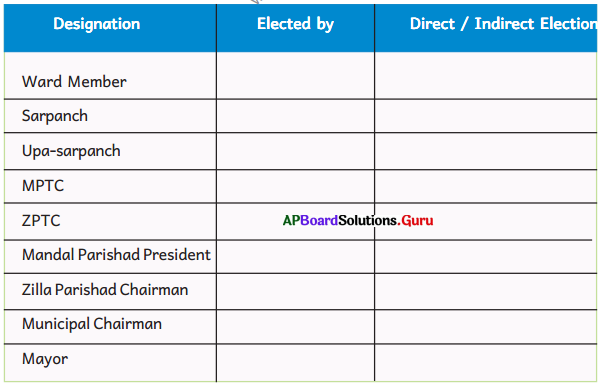
  1. Schools, hospitals, sanitation, and library facilities.
  2. Cleaning and lighting of streets.
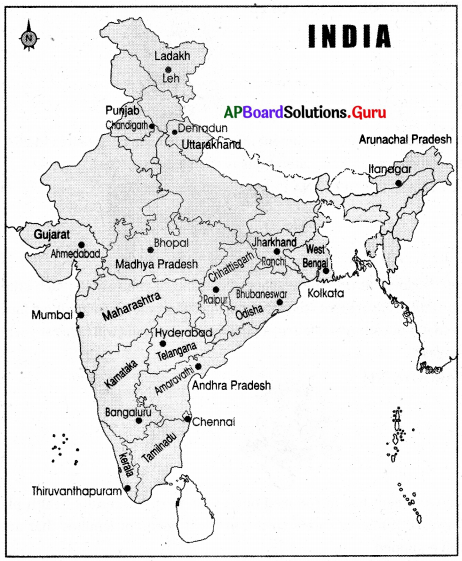
  3. Supply of drinking water.
  4. Supply of electricity.
  5. Garbage collection and disposal.
  6. Making and maintenance of gardens and parks.
  7. Eradication of malaria, dengue and taking care in preventing the outbreak of diseases.
  8. I can raise the above issues in Grama Sabha in making the Gram Panchayat work responsibly.

AP Board 6th Class Social Studies Solutions Chapter 10 Local Self-Government

Question 3.
Do you think common people are able to participate in the process of decision-making in your panchayat or municipality? Give some examples to illustrate your answer.
Answer:
I think common people are not able to participate in the process of decision-making in Panchayat or Municipality.

  1. The people may not be informed about the meeting. It will result in less attendance in Panchayat or Municipality meetings.
  2. Even people attend the meeting a few people only can express their opinions. Such situations occur because people find themselves in fear.

Question 4.
Do you think panchayats should rise more tax from the village to carry out development works or depend upon government funds?
Answer:
Panchayats should get government funds to carry out the development of Panchayat. Panchayat receives 95% of its revenue either from State or Central Governments. Only 5% of the revenue is from taxes. Though they increase Taxes the amount received may not increase abnormally. So it is better to get more funds from the government besides rising the tax from the village nominally

Question 5.
What challenges do the Sarpanch face in carrying out their work?
Answer:
In carrying works sometimes the Sarpanch has to face some challenges. Because he is known to all people in the village he may not express some issues freely. In the collection of house tax, he may not demand to pay the tax. If any encroachment is noticed he may not ask them effectively. If sufficient funds are not provided he cannot implement development activities. He cannot ask the government also to release funds to meet – all the requirements of the Panchayat.

AP Board 6th Class Social Studies Solutions Chapter 10 Local Self-Government

Question 6.
What are the public amenities provided by a Municipality but not a Panchayat?
Answer:
Amenities provided by Municipality: Roads, drainage and garbage disposal running schools, ration shops, hospitals, etc., besides taking up new developmental works.
Of these amenities running schools, ration shops, and hospitals are provided by a municipality only.

Question 7.
Geetika says that her street tap gives water only for half an hour and several people queue up to fill their buckets. What would you advise her to do to solve this problem?
Answer:
I will ask Geetika to take an individual tap connection so that she will get water for more time and she can get more water. For this individual connection, she has to pay tax and this will be useful for the municipality also. She can save time by not standing in the queue and can help the neighbors also.
She can write a letter to the municipal/panchayat officers to provide another tap in that area. She can consult that ward councilor or ward member and explain the problem to them. With the help of them, another tap can be provided there and it can ‘ reduce the problem of Geetika and many others also.

Question 8.
Frame a few questions to ask the local Corporator/Councillor to know the details of work done by the Municipality?
Answer:

  1. What are the works sanctioned for our area?
  2. What is the progress of that works?
  3. Is there any problem arising?
  4. What are the measures taking to kill mosquitoes which are causing diseases like dengue, malaria, chikungunya, etc?
  5. What are the steps following to improve drainage and garbage disposal which do not allow the mosquitoes to grow?

AP Board 6th Class Social Studies Solutions Chapter 10 Local Self-Government

Question 9.
Locate the following municipalities and municipal corporations in Andhra Pradesh.
AP Board 6th Class Social Studies Solutions Chapter 10 Local Self-Government 1

  1. Visakhapatnam
  2. Vijayawada
  3. Bheemunipatnam
  4. Kadapa
  5. Anantapuram
  6. Tirupati

Answer:
AP Board 6th Class Social Studies Solutions Chapter 10 Local Self-Government 2

AP Board 6th Class Social Studies Solutions Chapter 10 Local Self-Government

Project Work

Visit your nearby Grama Sachivalayam/Ward Sachivalayam and interview the functionaries of Sachivalayam and make a report.
Answer:
Model Interview of one of the functionaries in Grama Sachivalayam: (Model was given.)

  1. I will ask the name of the functionary.
  2. His / Her designation.
  3. Enquire about the superiors.
  4. Duties he has to perform.
  5. Problems he identified in his ward.
  6. No of the problems he solved in his ward.
  7. How his superiors helped in solving the problems.
  8. Whether he is satisfied with the job or not.

I will tell him the story of Ashoka. Ashoka asked his officers to explain the inscriptions to the illiterate people. Like the officers, the volunteers also have to deliver government services at the doorsteps.
Make posters on different public amenities which are provided by Local self-Governments.
Answer:
Student Activity.

AP Board 6th Class Social Studies Solutions Chapter 10 Local Self-Government

6th Class Social Studies 10th Lesson Local Self-Government InText Questions and Answers

Let’s Do

Question 1.
Prepare a poster on public amenities in your locality as a group activity. (Textbook Page No. 111)
Answer:
AP Board 6th Class Social Studies Solutions Chapter 10 Local Self-Government 3

Question 2.
If you live in a village, visit your grama sabha and make a report. (Textbook Page No. 112)
Answer:
In April I had been to my grandparent’s house. My grandfather told me that he is going to attend the Grama Sabha meeting. He told me that on April 14th and October 3rd the Grama Sabha meetings will be held every year. There I observed all the villagers gathered and the Sarpanch of the Grama Sabha convened the meeting. They discussed the problems in that Panchayat and solutions for the same. The Sarpanch explained about various welfare programs that the government is implementing. He asked all the villagers whether all the amenities are coming to them or not. Later he concluded the meeting.

AP Board 6th Class Social Studies Solutions Chapter 10 Local Self-Government

Question 3.
With the help of your teacher/parents, try to know the services provided by the Grama Volunteers. (Textbook Page No. 115)
Answer:
Services provided by the Grama Volunteers:

  1. Government services are to be delivered at the doorstep of all eligible households irrespective of Caste/ Religion/Creed/Gender/Political affiliation.
  2. If any person in the ward request any service volunteer should transfer the data to the village secretariat.
  3. The services/schemes of the government should be explained in detail and also have to assist them to apply which is under him/her.
  4. The grama volunteer should attend the meeting held in the grama secretariat and have to maintain the record of the issues and requests which he collected to the authority.
  5. The volunteer should guide the people under him regarding security, education, health, and employment.
  6. The volunteer should resolve the issues such as roads, street lights, drains, and drinking water.

Question 4.
How many Nagara Panchayats, Municipalities, and Municipal Corporations are there in your district? (Textbook Page No. 117)
Answer:
Student Activity (One example is given for you. Students have to collect information about their own district and write the answer).
Ex: Our district is Guntur District.
There are 14 municipalities in our Guntur district. Municipal Corporation is there in our Guntur district.
There is no Nagar Panchayat in our district.

AP Board 6th Class Social Studies Solutions Chapter 10 Local Self-Government

Question 5.
Visit nearby Municipal council / Municipal corporation and observe the functions. And make a poster or storyboard as Individual activity. (Textbook Page No. 118)
Answer:
AP Board 6th Class Social Studies Solutions Chapter 10 Local Self-Government 4

Question 6.
Fill the following table with the help of your teacher. (Textbook Page No. 118)
AP Board 6th Class Social Studies Solutions Chapter 10 Local Self-Government 5
Answer:

Designation Elected by Direct/Indirect Election
Ward Member Villagers Direct
Sarpanch Villagers Direct
Upa-sarpanch Ward members Indirect
MPTC Voters of mandal Direct
ZPTC Voters of the district Direct
Mandal Parishad President Members of Mandal Parishad Indirect
Zilla Parishat Chairman Members of Zilla Parishad Indirect
Municipal Chairman Councilors of Municipal Council Indirect
Mayor Corporators of Municipal Corporation Indirect

AP Board 6th Class Social Studies Solutions Chapter 10 Local Self-Government

Think and Respond

Question 1.
Name the public amenities which are provided in your locality. (Textbook Page No. 111)
Answer:
The public amenities which were provided in my locality are:

  1. Drinking water.
  2. Best drainage system.
  3. Street lights.
  4. Library.
  5. Park.
  6. Benches on one side of the road.

Question 2.
Write the similarities and differences between Grama Sabha and Grama Panchayat. (Textbook Page No. 112)
Answer:
Similarities:

Grama Sabha Grama Panchayat
1) Grama Sabha works for the welfare of the village. Grama Panchayat works for the welfare of the people.
2) Grama Sabha will be presided by the President/Sarpanch of the village. Grama Panchayat will also be presided by the President/Sarpanch of the village.

Differences:

Grama Sabha Grama Panchayat
1) It consists of all the adults of the village. Gram Panchayat is the executive body of the village consisting of the Sarpanch and the Panchs
2) It is a permanent body of the village. It is elected for a term of 5 years.
3) The area covered by a Gram Sabha is an entire village or sometimes a few villages. Gram Panchayat is divided into wards, where Sarpanch and Panch make it.

AP Board 6th Class Social Studies Solutions Chapter 10 Local Self-Government

Question 3.
Give some reasons, why additions or deletions to the voters list become necessary? (Textbook Page No. 113)
Answer:
If a person attains the age of 18 his name is to be included in the voter’s list. Similarly, if any person dies whose name is in the voter’s list, his name is to be deleted. With all these types of additions and deletions, a new voters list is to be prepared. So, additions or deletions are necessary to the voter’s list.

(Textbook Page No. 115)

Question 4.
Who are your MPTC and ZPTC?
Answer:
(Student Activity)

Question 5.
How many mandals are there in your district?
Answer:
(Student Activity)

Question 6.
List out the public amenities provided by the local body in your area. (Textbook Page No. 116)
Answer:
Public amenities in our area:

  1. Water supply.
  2. Drainage system.
  3. Sanitation.
  4. Street lights.
  5. Recording births and deaths.
  6. Necessary action to be taken to check contagious diseases.
  7. Building libraries, schools, gardens, and parks.
  8. Keeping the city clean.

AP Board 6th Class Social Studies Solutions Chapter 10 Local Self-Government

Question 7.
How is grama panchayat differ from the municipality in its functioning? (Textbook Page No. 118)
Answer:

Panchayat Municipality
1) Panchayat is a rural local government body. A municipality is an urban local government body.
2) Panchayat is responsible for the local administration of a village-like maintaining roads and the village pond. The municipality is responsible to provide civic amenities like roads and drainage to the urban population.

AP Board 8th Class Physical Science Important Questions Chapter 12 Stars and the Solar System

AP State Syllabus AP Board 8th Class Physical Science Important Questions Chapter 12 Stars and the Solar System

AP State Syllabus 8th Class Physical Science Important Questions 12th Lesson Stars and the Solar System

8th Class Physical Science 12th Lesson Stars and the Solar System 1 Mark Important Questions and Answers

Question 1.
What is Dakshinayanam and Uttarayanam?
Answer:
When the sun looks like travelling towards south of the sky, it is called Dakshinayanam. When the sun looks like travelling towards north of the sky it is called the Uttarayanam.

Question 2.
What is a sundial?
Answer:
A clock based on shadows of an object due to sunlight is called sundial.

AP Board 8th Class Physical Science Important Questions Chapter 12 Stars and the Solar System

Question 3.
What are phases of the moon?
Answer:
The changes in appearance of moon are called phases of the moon.

Question 4.
Why does solar eclipse occurs only on a new moon day?
Answer:
A solar eclipse happens when moon passes between the earth and sun, causing people on earth to be completely or partially unable to see the sun, because the moon is in the way that is possible only on new moon day.

Question 5.
What are the spots on the moon?
Answer:
The black spots on moon are creators of different size which on seeing from earth appear as black spots during full moon day.

Question 6.
What are stars?
Answer:
The self luminous bodies which emit light and heat in the sky are called stars.

Question 7.
What are constellations?
Answer:
The group of stars which appear in the shape of animals or human beings are called constellations.

Question 8.
What is a galaxy? Our sun belongs to which galaxy?
Answer:
A group of stars which contains millions of stars are called galaxy. Our sun belongs to Milky way galaxy.

Question 9.
Which makes our universe?
Answer:
Millions of galaxies together makes our universe.

Question 10.
What is the solar system?
Answer:
The sun and the celestial bodies which revolve around it form the solar system. It consists of large number of bodies such as planets, comets, asteroids and meteors.

AP Board 8th Class Physical Science Important Questions Chapter 12 Stars and the Solar System

Question 11.
Why planets are revolves around the sun?
Answer:
The planets are revolving around sun because of gravitational attraction between the sun and planets.

Question 12.
What is period of revolution? How does it vary?
Answer:
The time taken by a planet to complete one revolution around sun is called period of revolution. As the distance of the planet from the sun increases period of revolution increases.

Question 13.
What is period of rotation?
Answer:
The time taken by a planet to complete one rotation is called period of rotation.

Question 14.
What is satellite? What is natural satellite of earth?
Answer:
Any celestial body revolving around another celestial body is called its satellite.
The natural satellite of earth is moon.

Question 15.
The earth is revolves around the sun. Does it make earth a satellite of the sun?
Answer:
The earth can be said to be a satellite of the sun, though generally we call it a planet of sun. We use the term satellite for the bodies revolving around planets.

Question 16.
What are artificial satellites?
Answer:
There are many man made satellites revolving round the earth. These are called artificial satellites.

Question 17.
Does the sun rise in the east on Venus? If the answer is no what is the reason?
Answer:
No, the reason is Venus rotates from east to west. So, on Venus the sun rises on west.

AP Board 8th Class Physical Science Important Questions Chapter 12 Stars and the Solar System

Question 18.
Why Mars is called red planet?
Answer:
Mars is called red planet because the breakdown of iron rich rocks creates a rusty dust on the planet.

Question 19.
How earth appears from space?
Answer:
The earth appears blue green due to the reflection of light from water and Iandmass on its surface.

Question 20.
What are the planets which revolve from east to west?
Answer:
Venus and Uranus are two planets which revolve from east to west.

Question 21.
What are asteroids? Where does they present?
Answer:
Small objects revolve around the sun are called asteroids. They are present between Mars and Jupiter.

Question 22.
What is Halley? When does it last appear? Can you tell when Halley visible again?
Answer:
Halley is a comet, which is periodically appear for every 76 years. I was last seen in 1986. It will visible once again in the year 2062.

Question 23.
What are the artificial satellites launched by India?
Answer:
Aryabhatta, INSAT, IRS, Kalpana-I, EDUSAT, etc. are some satellites launched by India.

Question 24.
Why Pluto is not consider as a planet?
Answer:
International Astronomical Union (IAU) decided that Pluto was no more a planet because it does not follow the rule of “cleared the neighbourhood.” That means sometimes it is entering into orbit of Neptune.

AP Board 8th Class Physical Science Important Questions Chapter 12 Stars and the Solar System

Question 25.
What is an orbit?
Answer:
A planet has a definite path in which it revolve around the sun. This path is called an orbit.

8th Class Physical Science 12th Lesson Stars and the Solar System 2 Marks Important Questions and Answers

Question 1.
Write briefly about sun.
Answer:

  1. The sun is the nearest star to us.
  2. It is continuously emitting huge amounts of heat and light and other electromagnetic radiations.
  3. The sun is the source of almost all energy on the earth.
  4. In fact, the sun is the main source of heat and light for all planets of our solar system.

Question 2.
What are planets? Why they appear brightly than stars?
Answer:

  1. The big steady bodies shining more brightly than stars in the clear sky are called planets.
  2. They are not self luminous like stars. They appear brightly because they just act like mirrors and reflecting the sun light and heat falling on them.

Question 3.
What are the motions of planets?
Answer:
Every planet has two types of motion.

  1. Revolution motion: Moving around the sun.
  2. Rotation motion: Moving around an axis passing through it.

Question 4.
Why earth is only planet on which life known to exist?
Answer:

  1. Earth is only planet on which life exists in the solar system the reason is some environmental conditions are responsible for the existence and continuation of life on the earth.
  2. These include just the right distance from the sun so that it has right temperature range, the presence of water and suitable atmosphere and a blanket of ozone.

AP Board 8th Class Physical Science Important Questions Chapter 12 Stars and the Solar System

Question 5.
What are comets? Write briefly about comets.
Answer:

  1. Comets are members of our solar system.
  2. They revolve around the sun in highly elliptical orbits.
  3. A comet appears generally as a bright head with a long tail.
  4. The length of the tail grows in size as it approches the sun.
  5. The tail of comet always directed away from the sun.
  6. Their period of revolution round the sun is usually very long. Many comets are known to appear periodically.

Question 6.
Why does pole star seem to be stationary?
Answer:
The Pole Star is situated in the direction of the earth’s axis and that is why it does not appear to move even though all stars appear that they are moving because of the rotation of earth. So the pole star seems to be stationary.

Question 7.
What factors to be taken into consideration to view the pole star at your place?
Answer:
The position of pole star is fixed and does not change.
a) We can locate the pole star with the help of two constellations Great bear and Cassiopeia.
b) If you are able to spot only the Great bear look at the two stars that form the outer side of rectangular head.
c) Extend the imaginary line from these two stars.
d) Pole star will be located on that extended line with a distance about 5 times the distance between the two stars.
e) If only Cassiopeia is visible, the pole star will be located on the line extended from the middle star.

Question 8.
Name the periodic comet. Why is it so called?
Answer:

  1. Halley’s comet is periodic comet. It is called periodic comet because it appears after regular interval of time.
  2. A comet is visible only when it approches the sun because the sun’s rays makes the gas glow.
  3. Halley’s comet has a period of 76 years i.e., it is seen after every 76 years.

Question 9.
What do you mean by remote sensing satellite?
Answer:

  1. It is the acquisition of information about an object or phenomenon without making physical contact with the object.
  2. It is generally the use of aerial sensor technologies to detect and classify objects on the earth by means of propagated signals.

Question 10.
Why are meteors commonly called shooting stars?
Answer:

  1. When meteor enters the atmosphere of the earth at high speeds, these are heated up.
  2. The heat produced is so high and the meteors start glowing and eventually evaporated within a short period of time.
  3. The growing meteor bursts leaving behind a streaks of light. Therefore they are called shooting stars.

AP Board 8th Class Physical Science Important Questions Chapter 12 Stars and the Solar System

Question 11.
How does the motions of a satellite differ from a planet?
Answer:
A satellite revolve around same planet in a fixed orbit while a planet revolves around the sun in a fixed orbit. Planets revolve faster than satellites.

8th Class Physical Science 12th Lesson Stars and the Solar System 4 Marks Important Questions and Answers

Question 1.
When does a solar eclipse occurs? Explain different types of solar eclipse.
Answer:
A solar eclipse occurs when the shadow of the moon falls on the earth. It occurs only on new moon day.
Types of solar eclipse:

  1. Total solar eclipse: It occurs when the moon completely covers the sun, as seen from earth.
  2. Partial solar eclipse: It can be observed when only the partially shaded out region of the shadow cast by moon (Lunar penumbra) touches the earth.
  3. Annular eclipse: It occurs when the moon appears smaller than the sun as it passes centrally across the solar disk and a bright ring, or annulus, of sunlight remains visible during eclipse.
  4. Hybrid eclipses: These are a rare form of solar eclipse, which changes from an annular to a total solar eclipse along its path.

Question 2.
When does a lunar eclipse occurs? Explain different types of lunar eclipses.
Answer: A Lunar eclipse occurs when the shadow of the earth falls on the moon. It occurs only on full moon day.
Types of Lunar Eclipse:

  1. Total lunar eclipse: It occurs when the earth’s shadow (umbra) obscures all of the moon’s visible surface.
  2. Partial lunar eclipse: It can be observed only when part of the moon’s visible surface is obscured by the earth’s shadow.
  3. Penumbral lunar eclipse: It happens when the moon travels through the partially shaded outer region of the shadow cast by the earth (earth’s penumbra).

AP Board 8th Class Physical Science Important Questions Chapter 12 Stars and the Solar System

Question 3.
Write an activity to show how path of sun and moon changes during solar eclipse.
Answer:
Make two discs one white and one black of the size of sun and moon in figure.
AP Board 8th Class Physical Science Important Questions Chapter 11 Some Natural Phenomena 3
We shall now find the centres of the sun and moon at each stage. To do this take the white disc we have made and place it exactly on the white portion of any of the stages of diagram.
Pierce a hole through the centre of white with a pin to mark the spot at the centre of the sun’s position at that stage in the diagram. Remove the white disc and mark the spot with the pencil.
In this way, mark the sun’s centre at every stage of the eclipse in diagram. Join the spots with a line. This line depicts the path of the sun.
To find the moon path, repeat the exercise, but this time use the black disk and mark the centres of the black portions at each stage of the eclipse. Join these spots with a line and we will get the path of moon during the eclipse.

Question 4.
Write briefly about meteors.
Answer:

  1. At night, when the sky is clear and the moon is not visible we may sometimes see bright streaks of the light in the sky.
  2. These are commonly known as shooting stars.
  3. They are not stars, they are meteors.
  4. A meteor is a small object that occasionally enters the earth’s atmosphere.
  5. It has a very high speed.
  6. The friction due to atmosphere heats it up.
  7. It glows and evaporates quickly.
  8. That is why the bright streak lasts for a very short time.
  9. Some meteors are large and so they can reach the earth before they evaporate completely.

AP Board 8th Class Physical Science Important Questions Chapter 12 Stars and the Solar System

Question 5.
How people came to an understanding that earth is spherical?
Answer:
In olden days people felt that earth is flat because it looks flat. However they had a doubt, if it is flat how does the water in ocean remain there, Why does it not spell out of the earth ? To get clarity they assumed fencing around flat earth. After that,

  1. they assumed shape of earth is round by observing the shadow of earth in lunar eclipse. In every eclipse they found the shape of the earth is in round even though there is a chance of getting linear, elliptical shadows by a circular object.
  2. some sailors who started their journey in ocean, reached the same place after travelling large distance in one direction only.
  3. observing ships approaching the port also helped to change their opinion about the shape of the earth, that is, usually they see smoke of the ship first and then top of the ship after that the whole ship.
  4. observations about the movement of stars. Different stars visible from different places on the earth also helped to think about the shape of the earth.
  5. in 1969 when man landed on the moon and observed the earth’s shape from the moon and it is spherical.

Question 6.
How does people came to an understanding that earth rotates on its own axis?
Answer: People from olden days thought that earth is located in the centre of the universe with sun, moon and stars moving around it. They also thought that sun, moon and stars are located on transparent concentric spheres surrounding the earth, because they are not falling down.
The three spheres are rotating on their axis from east to west that is why sun, moon and stars appear to revolve from east to west around the earth. They also assumed that the shpere on which sun is located rotates east to west and oscillate from south to north that is why Uttarayanam and Dakshinayanam are happening.
Because of the uneven movement of some stars (actually they are planets) which they observed, it is very difficult to explain model of universe which required so many transparent spheres around earth. Nicholas Copernicus suggested that sun is at the centre of universe and all other celestial objects are revolving around the sun from west to east. It was assumed that earth rotates on its axis. This model explain the occurence of day and night.
In this way people came to an understanding that earth rotates on its axis.

AP Board 8th Class Physical Science Important Questions Chapter 12 Stars and the Solar System

Question 7.
Conduct an experiment to find out the local noon time of your village/town.
Answer:

  1. Take a stick which is a little over a meter long and fix vertically in the ground.
  2. Make your first observation at nine in the morning. Make a mark with a nail or peg at the point where the tip of the shadow falls on the ground. Measure the length of the shadow.
  3. Then make similar observations for every half an hour throughout the day till four in the evening.
  4. Use a clock to fix the time for making your observations.
  5. Enter the measurements of the length of the shadow and the time of measurement in a table making two columns, one for time and other for length of shadow.
  6. Find the time when the shortest show occurs.
  7. That gives the local noon time at that place.

Question 8.
Collect the information what the Chandrayaan-I brought the information from the Moon through news papers, magazines.
Answer:
Our country launched Chandrayan -1 (Satellite to moon) on 22nd October 2008 to know about the moon.
The objectives of Chandrayan -1 are:

  1. To check the possibility of finding water on the moon.
  2. Finding out the elements of matter on moon.
  3. To search for Helium – 3.
  4. To make 3 – dimensional atlas of the moon.
  5. To study about the evolution of the solar system.

Now India is one of the six countries which have sent satellites to the moon.

Question 9.
What are Asteroids? Name the largest sun asteroid.
Answer:
Asteroids:

  1. There are small lumps of rocks orbiting round the Sun between Jupiter and Mars. They are considered to be remains of a much larger planet which broken up due to gravitational effect of jupiter.
  2. They are small in size.
  3. The size of an asteroid may vary from a kilometer to a few hundred kilometers.
  4. Ceres is the largest known asteroid.
  5. Its diameter is 633 km and it was discovered in 1801.
  6. There are about 1,00,000 asteriods.

AP Board 8th Class Physical Science Important Questions Chapter 12 Stars and the Solar System

Question 10.
What is the difference between meteor and meteorite?
Answer:
a) Meteor: Meteors are stony or metallic bodies of very small size, travelling in interplanetary space and become visible when they travel through the earth’s surface. The meteors are also called shooting stars.
b) Meteorite: While travelling through the earth’s atmosphere, these fast moving bodies (meteors) get heated up to a very high temperature by air friction. The heat produced is so high that the meteor starts glowing and then burnt last. The very large meteors are able to survive from such heat destruction and actually reach the earth’s surface. These meteors are called meteorites.

AP Board 6th Class Social Studies Solutions Chapter 9 Government

SCERT AP Board 6th Class Social Solutions 9th Lesson Government Textbook Questions and Answers.

AP State Syllabus 6th Class Social Studies Solutions 9th Lesson Government

6th Class Social Studies 9th Lesson Government Textbook Questions and Answers

Improve Your Learning

Question 1.
Write the differences between Parliamentary and Presidential democracy.
Answer:
In the Parliamentary system, the executive body is formed from the legislature. The executive body is responsible to the legislature. (Ex: India & Britain).
In the Presidential system, the executive body is not formed from the legislature. The executive body is not responsible to the legislature. (Ex: America & Brazil)

Question 2.
What is a government? What are the different types of governments?
Answer:
A Group of people that controls and makes decisions for a country or a state is called the government. Monarchy and democracy are the different types of government.

AP Board 6th Class Social Studies Solutions Chapter 9 Government

Question 3.
Write any four activities organized by the government in our times.
Answer:

  1. The government ensures food, shelter for the citizens.
  2. Government helps the people during cyclones and floods.
  3. Government has the duty of protecting the boundaries.
  4. Government builds schools, hospitals, and roads.
  5. Government implements various schemes for the welfare of the people.

Question 4.
Is it possible to include the opinions of all the participants in taking a decision? Discuss with some more examples.
Answer:
No. It is not possible to include the opinions of all the participants in taking a decision. Only one decision can be implemented in a concept. If there are 20 members in a meeting and one proposal is supported by 11 members and 9 members oppose it. Even 9 members opposed the proposal, it will be implemented because the majority of the members supported the proposal. But some amendments can be done to the proposal.

Question 5.
How would your school function if it was run by all the students and teachers together? Would you want everyone to participate in taking decisions? or would you like to elect representatives? Give reasons?
Answer:
If a school is run by all the students and teachers so many good decisions can be taken for the prosperity of the school. Teachers can express the problems faced by the students and students can also express their problems.
This will lead to a friendly atmosphere in the school. Because a school is a small unit both ways can be implemented. Teachers’ and students’ interactions will help the students in the future also. They can express their views freely in the future also. Nowadays in so many job interviews and group discussions are followed. There are opinions are to be expressed. If we follow this method from the school level it will be beneficial for the students.

AP Board 6th Class Social Studies Solutions Chapter 9 Government

Question 6.
Do you think the decision-making in your school is democratic? Does everyone has a say in it?
Answer:
The decision-making in our school is democratic. We discuss the issues with our class leader and they can be discussed with our class teacher later and a solution can be found.

Question 7.
Satwik’s father consulted all the members of his family on setting up a shop but everyone had a different opinion. Finally, he decided to set up the shop. Do you think he was democratic?
Answer:
In my opinion, Satwik’s father was democratic. Because

  1. he consulted all the members and asked their opinion in setting the shop.
  2. I think the majority of the family members supported the idea of setting up a shop.

So, Satwik’s father might have decided to set up the shop.

Question 8.
Padma’s mother asked all children where they would like to go on Sunday. Two children wanted to go and watch a film and three wanted to go to the park. If you were in Padma’s place what decision would you take? Give reasons.
Answer:
If I am Padma’s mother I will take them to the park on that Sunday because three of them are interested to go to the park.
I will convince them that I will take them to the cinema another Sunday.

Question 9.
The place of origin of democracy is …………….
a) China
b) India,
c) Greece
d) Rome
Answer:
c) Greece

AP Board 6th Class Social Studies Solutions Chapter 9 Government

Question 10.
Who has the right to make decisions in direct democracy?
a) Men
b) Women
c) Representative
d) All eligible voters
Answer:
d) All eligible voters

Question 11.
In India, all the people above …………….. years of age enjoy Universal Adult Franchise.
a) 18 years
b) 21 years
c) 20 years
d) 19 years
Answer:
a) 18 years

Question 12.
Every state and union territory in India has a Capital city. This is the headquarters of the state government. Point put the following state capitals which are the headquarters of the state governments concerned in the next page given India Map.
1. Maharashtra
2. Tamilnadu
3. Andhra Pradesh
4. Karnataka
5. West Bengal
6. Telangana
7. Ladakh
8. Punjab
9. Kerala
10. Arunachal Pradesh
11. Madhya Pradesh
12. Jharkhand
13. Chattisgarh
14. Uttarakhand
15. Gujarat
16. Odisha
Answer:
AP Board 6th Class Social Studies Solutions Chapter 9 Government 1

AP Board 6th Class Social Studies Solutions Chapter 9 Government

Project Work

1. Collect some logos and information about different welfare schemes of our government.
Answer:

  1. AMMA VODI:
    AP Board 6th Class Social Studies Solutions Chapter 9 Government 2
    The Hon’ble Chief Minister, Government of Andhra Pradesh has announced a flagship programme “AMMA VODI” as a part of “NAVARATNALU” for providing financial assistance to each mother or recognized guardian in the absence of the mother, who is below the poverty line household, irrespective of caste, creed, religion, and region.
  2. HOUSING SCHEME FOR POOR PEOPLE:
    AP Board 6th Class Social Studies Solutions Chapter 9 Government 3
    Under the program, the government intends to provide house-sites to 26.6 lakh people below the poverty line. Later, houses will be constructed.
  3. JAGANNANA VASATHI DEEVANA:
    AP Board 6th Class Social Studies Solutions Chapter 9 Government 4
    The scheme is aimed at providing financial assistance to nearly 14 lakh students across the state and to ensure that students from lower-income households get financial assistance for their education “while Jagannana Vasathi Deevana will take care of hostel and mess charges.”
  4. Dr. YSR AAROGYASRI:
    AP Board 6th Class Social Studies Solutions Chapter 9 Government 5
    The state government has introduced one of the most successful health plans – Dr. YSR Aarogyasri. It mainly caters to the medical needs of families that are not financially well equipped.
  5. JALA YAGNAM:
    AP Board 6th Class Social Studies Solutions Chapter 9 Government 6
    This project accords the highest priority for the development of irrigation infrastructure, particularly in backward and drought-prone areas by taking up this program in a big way. Jala Yagnam includes a number of irrigation projects by the construction of reservoirs and lifts irrigation systems for lifting water from major rivers, particularly from the Godavari, to provide immediate irrigation benefits.

2. Collect the pictures of the President of India, Prime Minister, Governor and Chief Minister, your local M.P (Lok Sabha), and M.L.A from newspapers and prepare a scrapbook.
Answer:
Student Activity.

AP Board 6th Class Social Studies Solutions Chapter 9 Government

6th Class Social Studies 9th Lesson Government InText Questions and Answers

Let’s Do

Question 1.
Look at the newspaper headlines below and list the different activities of the government. (Textbook Page No. 101)
AP Board 6th Class Social Studies Solutions Chapter 9 Government 7
Answer:

  1. Educational facilities like online classes to students.
  2. Government has a plan to tackle floods soon.
  3. Government fixes the price of onions. Onions will be put into the market and see that there will be no shortage.
  4. AP government has conducted maximum Coronavirus tests.
  5. Modern facilities will be provided in the hospitals to serve the poor.
  6. Accelerating the impact of digital learning in India.

Question 2.
With the help of your teacher, try to know the above Logos and pictures of government schemes (Refer Text page 102 for the figure). Fill the following Mind map. (Textbook Page No. 102)
AP Board 6th Class Social Studies Solutions Chapter 9 Government 8
Answer:
AP Board 6th Class Social Studies Solutions Chapter 9 Government 9

AP Board 6th Class Social Studies Solutions Chapter 9 Government

Question 3.
Observe the following pictures. Write the name of the government in respective boxes. (Textbook Page No. 103)
AP Board 6th Class Social Studies Solutions Chapter 9 Government 10
Answer:
AP Board 6th Class Social Studies Solutions Chapter 9 Government 11

Question 4.
Conduct a model election with the help of your teacher. Observe the process of the election. (Textbook Page No. 105)
Answer:
Students: Good morning teacher.
Teacher: Good morning my dear children. Today let us conduct a model election in the class. You all select a student among you as your class leader.
Students: OK teacher.
Teacher: Two of you can contest for the class leader post. Take a piece of paper of the same size.
Students: OK teacher.
Teacher: OK. Now write the name of the student whom you want to be the class leader on the piece of paper you have taken. Fold the paper and put that paper in the box kept in the corner of the room.
Teacher: Now open the box and count who got more votes. According to the majority who get more votes will be declared as the class leader. Like this in a democracy elections will be held. A candidate who gets more votes will be declared elected.

Question 5.
Ask your parents and, find out the problems they observed in the electoral system and prepare a report. Discuss it in your class and find solutions for these problems. (Textbook Page No. 105)
Answer:

  1. Majority System: Present majority system leads to many problems. Sometimes a candidate who gets 25% of the votes also gets elected.
    • Instead of this, a candidate should get more than 50% votes.
  2. Money Power: Nowadays elections are a costly affair. Votes are being as a market good through buying and selling.
    • A candidate should spend the amount told by the election commission. If it increases the candidate should be punished and suspended from the election.
  3. Muscle Power: Muscle power and domination are another major setbacks.
    • Election Commission should take measures to control this problem by giving more security at polling booths.
  4. Caste and Religion: These two play a major role in elections.
    • They should be given less importance.

AP Board 6th Class Social Studies Solutions Chapter 9 Government

Think and Respond

(Textbook Page No. 100)

Question 1.
How is the legislature is different from the executive?
Answer:
The legislature: Legislature is the law and policy-making body either in the Parliament or State assembly.
The Executive: Executive is responsible for the effective implementation of the laws/ policies passed in the legislature.

Question 2.
What is the prime duty of the judiciary?
Answer:
Interpreting the laws is the prime duty of the judiciary.

(Textbook Page No. 102)

Question 3.
Name some more works of the government.
Answer:

  • Amma Vodi
  • YSR Asara
  • Ban on Alcohol
  • Jalayagnam
  • Fee Reimbursement
  • Arogyasri
  • YSR Rythu Bharosa

Pedalandariki illu and Pensionla Pempu are some other welfare schemes of Andhra Pradesh.

AP Board 6th Class Social Studies Solutions Chapter 9 Government

Question 4.
What kind of facilities do you expect from the government?
Answer:
Important facilities we expect from the government are sanitation, public transport, health care, and water, etc.

(Textbook Page No. 103)

Question 5.
What kind of government do you like? Why?
Answer:
I like the democratic type of government. Because we can express our ideas freely without any hesitation and fear. If they are better, sometimes they can be followed also.

Question 6.
Which government respects the opinion of the people?
Answer:
The democratic type of government respects the opinion of the people.

(Textbook Page No. 104)

Question 7.
What are the differences between monarchy and democracy?
Answer:

Monarchy Democracy
1) Ruling will be done by a king or queen. 1) Ruling will be done by the representatives elected by the people.
2) A monarch comes into power by inheritance. 2) Power can’t be inherited.
3) Powers will be with King only. 3) People have rights.

AP Board 6th Class Social Studies Solutions Chapter 9 Government

Question 8.
Is it possible to implement direct democracy in India? Give reasons.
Answer:
It is not possible to implement direct democracy in India. In India, it may be difficult because of the huge population and vast area.

Question 9.
How is direct democracy different from indirect democracy?
Answer:
In direct democracy people directly participate in decision-making. It is possible in small countries.
In an indirect democracy, people participate in decision-making indirectly through their representatives. It is best to follow indirect democracy in large countries like India.

(Textbook Page No. 105)

Question 10.
How do you understand the rule of majority? Give another example.
Answer:
If the majority of the representatives do not support it, a good proposal may also be objected to. The shop setting of Satwik’s father may not be profitable. But the majority of the family members agreed to set the shop. So Satwik’s father decided to set the shop following the idea of the majority of family members.

Question 11.
Why do we have a government at different levels?
Answer:
Different levels of the government make it easy to distribute power among them. Administration can be easily managed with different levels of the government.

AP Board 6th Class Social Studies Solutions Chapter 9 Government

Explore

Question 1.
With the help of your teacher, try to know if any monarchies are there in the world at present? (Textbook Page No. 102)
Answer:
There are monarchies in some countries in the world at present. Some of them are:

  1. The kingdom of Saudi Arabia
  2. The United Arab Emirates
  3. The Sultanate of Oman.

Question 2.
Observe the world map given below and list out the countries that are following the parliamentary system and the presidential system separately. (With the help of your teacher). Refer to the world map given at the end of the book. (Textbook Page No. 106)
AP Board 6th Class Social Studies Solutions Chapter 9 Government 12
Answer:
Parliamentary System

  • India (Asia)
  • Montenegro (Europe)
  • Pakistan (Asia)

Presidential System

  • Nigeria (Africa)
  • Philippines (Asia)
  • Paraguay (South America)

Parliamentary System

  • Singapore (Asia)
  • Somalia (Africa)
  • Slovenia (Europe)
  • Serbia (Europe)
  • Slovakia (Europe)
  • Turkey (Asia & Europe)
  • Trinidad and Tobago (South America)

Presidential System

  • Peru (South America)
  • USA (North America)
  • Uruguay (South America)
  • Uzbekistan (Asia)
  • Uganda (Africa)
  • Ukraine (Europe)
  • Tanzania (Africa)

AP Board 6th Class Social Studies Solutions Chapter 9 Government

Question 3.
With the help of your teacher try to know who is part of the central government and state government. (Textbook Page No. 107)
Answer:

  • Central Government: President, Vice-President, Prime Minister, Council of Central ministers, and Members of Parliament.
  • State Government: Governor, Chief Minister, Council of State ministers, and members of Legislative Assemblies.