AP SSC 10th Class Biology Solutions Chapter 7 Coordination in Life Processes

AP State Board Syllabus AP SSC 10th Class Biology Solutions Chapter 7 Coordination in Life Processes Textbook Questions and Answers.

AP State Syllabus SSC 10th Class Biology Solutions 7th Lesson Coordination in Life Processes

10th Class Biology 7th Lesson Coordination in Life Processes Textbook Questions and Answers

Improve your learning

Question 1.
What do you mean by hunger pangs?
Answer:

  1. When glucose levels in the blood fall, hunger pangs occur in the stomach.
  2. Ghrelin hormone is secreted in the stomach when it goes empty.
  3. Ghrelin is secreted from certain cell walls of the stomach.
  4. Hunger contractions (hunger pangs) start to occur in the stomach due to secretion of ghrelin hormone.
  5. Hunger pangs continue up to 30 – 45 minutes.
  6. An increase in Ghrelin levels results in sensation of hunger and motivation to consume food.

AP SSC 10th Class Biology Solutions Chapter 7 Coordination in Life Processes

Question 2.
What are the organ systems involved in the digestion of food which we eat?
Answer:
The organ systems involved in the digestion of food are:

  1. endocrine system,
  2. nervous system,
  3. muscular system,
  4. circulatory system and
  5. excretory system.

Question 3.
Rafi said smell also increases our appetite. Can you support this statement ? How?
Answer:

  1. Yes. I support the statement made by Rafi that smell also increases our appetite.
  2. When we smell, the air borne substances get dissolved in the watery film of nasal mucus.
  3. The chemoreceptors which are otherwise called olfactory receptors present in the nose trigger signals in the form of nerve impulses to the brain where the smell is detected.
  4. However interactions between the senses of taste and smell enhance our appetite.

Question 4.
Write a note on peristalsis and sphincter function in the stomach.
Answer:
A) Peristalsis functions in stomach:

  1. Contraction and relaxation of the muscles present in the stomach bring in a wave-like motion called peristalsis.
  2. The contraction of the stomach muscles squeeze and mix the food with the acids and juices of the stomach.
  3. Mechanical mixing of food in stomach occurs by peristalsis. This allows the mass of food to further mix with the digestive enzymes.
  4. Peristalsis in stomach is involuntary and under the control of the autonomous nervous system.

B) Sphincter functions in the stomach:

  1. Pyloric sphincter is present at the opening of the stomach into the duodenum (small intestine).
  2. The pyloric sphincter allows only small quantities of food into duodenum at a time.

AP SSC 10th Class Biology Solutions Chapter 7 Coordination in Life Processes

Question 5.
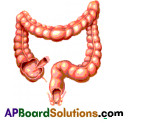
Observe the given part of the digestive system. What is it ? What is it’s role during digestion ?
Answer:

  1. The given part is the LARGE INTESTINE in the human digestive system:
    AP SSC 10th Class Biology Solutions Chapter 7 Coordination in Life Processes 1
  2. If creates peristaltic waves to send waste material called stool or faeces into the rectum.
  3. In the large intestine water and mineral salts are absorbed from the waste material.
  4. The faecal matter containing indigested food material, bile pigments and dead bacteria is formed in the large intestine.
  5. It is stored in the rectum and expelled out of the body through the Anus.

Question 6.
Give reasons.
a) If we press the tongue against the palate, we can recognize taste easily.
Answer:
Reason :

  1. When the tongue is pressed against the palate, the food substance is pressed against the opening of the taste bud letting it to reach the taste cells and triggering taste signals.
  2. Finally, the taste is recognized in the brain.

b) We can’t identify taste when food is very hot.
Answer:
Reason:

  1. Most of the taste buds on the tongue are killed when the food is hot.
  2. This prevents the person from identifying the taste.
  3. The perception of taste decreases when the temperature of the food rises beyond 35°C.
  4. But we don’t pay attention to it because we become worried about the burning feeling.

c) If glucose level falls in blood, we feel hungry. (OR) €EI June 2015
We feel hungry if the blood glucose level falls down. 03 June 2019
Answer:
Reason :

  1. When glucose levels in the blood fall, we get hunger pangs in stomach.
  2. Hungry feeling start to occur in the stomach due to hunger generating signals that the brain from the stomach due to the secretion of the hormone ‘Ghrelin’.

d) Small intestine is similar to a coiled pipe. (OR)
Why is the small intestine long and coiled?
Answer:
Reason :

  1. The length of small intestine is 7 meters long.
  2. It is coiled so as to fit in the human body.
  3. It is coiled to increase surface area and maximum nutrient absorption when food passes through it.

e) Urination increases when we take lot of fluids.
Answer:
Reason:

  1. When we take lot of fluids, the kidneys will efficiently throw the water out by forming more urine than usual.
  2. When there is excess water in the body, the brain usually produces less of a hormone called vasopressin.
  3. This in turn causes the kidneys to produce a lot of dilute urine, until excess water is removed.

f) The process of digestion goes on in a person whose central nervous system has been largerly affected.
Answer:
Reason :

  1. The enteric nervous system embedded in the walls of the long tube of our gut or alimentary canal control gut functions often independently of the brain.
  2. The mass of neural tissue of enteric nervous system filled with important neurotransmitters reveals that it does much more than merely handle digestion.

AP SSC 10th Class Biology Solutions Chapter 7 Coordination in Life Processes

Question 7.
Write differences between the following:
a) Bolus – Chyme
b) Small intestine – Large intestine
c) Mastication – Rumination
d) Propulsion – Retropulsion
Answer:
a) Bolus – Chyme:

Bolus Chyme
1. Food that is masticated in the mouth. 1. It is the partially digested food in the stomach.
2. Alkaline in nature. 2. Acidic in nature.
3. Teeth and saliva turn food into bolus. 3. Stomach turn food by peristalsis into chyme.
4. Soft round ball of food that has been chewed. 4. It is the liquified part of food.
5. Food goes from mouth to stomach. 5. Food goes from stomach to small intestine.

b) Small intestine – Large intestine:

Small intestine Large intestine
1. It is longer and has small width. 1. It is shorter and has broad width.
2. It is in between the stomach and large intestine. 2. It is the last part of the digestive system.
3. Digestive juices release from liver, pancreas. 3. Digestive juices are not released into large intestine.
4. Food is completely digested in it. 4. Absorption of water from the undigested food takes place in it.
5. It has three parts – duodenum, jejunum and ileum. 5. It has four parts – caecum, colon, rectum and anal canal.
6. Villi helps in absorption of digested food. 6. Villi are absent in large intestine.

c) Mastication – Rumination:

Mastication Rumination
1. Grinding, chewing and shredding of food in the mouth by teeth is called mastication. 1. It is the chewing of cud that come from a part near the stomach of the animal to its mouth.
2. Mastication occurs only one time in the oral cavity. 2. Rumination allows food to undergo mastication more than once.
3. This is also known as chewing the food. 3. This is also known as chewing the cud.
4. It makes the food particles to tiny particles. Does not involve nutrient absorption. 4. It allows greater nutrients to be extracted and absorbed from the food particles.
5. It occurs in most of the animals (mammals), eg: Human being 5. It occurs only in ruminate animals.
eg: Cow

d) Propulsion – Retropulsion:

Propulsion Retropulsion
1. It is a means of creating force leading to movement of food. 1. It is a situation in which something (food) is pushed or forced backwards.
2. Peristaltic waves move food from one part to the other. 2. Small amount of chyme is pushed into duodenum, simultaneously forcing most of it back into the stomach.

AP SSC 10th Class Biology Solutions Chapter 7 Coordination in Life Processes

Question 8.
How can you say that mouth is a munching machine?
Answer:

  1. Mouth plays a major role in changing the texture of food.
  2. The circular muscles of the mouth enable the food to be pushed into the oral cavity and to be moved around.
  3. The teeth grind, chew and shred the food.
  4. The surface muscles of the jaw help in biting and chewing actions, while the deep muscles of the jaw move up, down, forward and backward during food mastication.
  5. The teeth help in cutting and grinding while tongue movements evenly spread out the food and help in mixing it with saliva.
  6. The muscles of the mouth enable the food to be pushed in the oral cavity and to be moved around.
  7. By all this we can say that mouth is a munching machine.

Question 9.
What is mastication? Explain the role of different sets of teeth in this process.
Answer:
Mastication: Food can not be swallowed directly. So it must be grinded, chewed and shred. This process of grinding, chewing and shredding is called ’MASTICATION’.
AP SSC 10th Class Biology Solutions Chapter 7 Coordination in Life Processes 2Role of different sets of teeth in mastication:

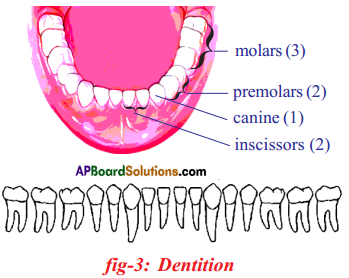
  1. In the oral cavity of human beings, 32 teeth and they are 4 different types to perform different functions.
  2. They are a) Inscisors b) Canines c) Premolars d) Molars
    a) Inscisors: These are eight in number and have chisel shape. They have sharp edges and are specialized for cutting and biting the food.
    b) Canines: These are four in number and are with pointed edges- These are designed for piercing and tearing food.
    c) Premolars: These are eight in number and are also called cheek teeth. These are designed for crushing and grinding food.
    d) Molars: These are 12 in number. They are designed for crushing and grinding food.

AP SSC 10th Class Biology Solutions Chapter 7 Coordination in Life Processes

Question 10.
During the journey of food from the mouth to stomach through oesophagus, how does muscular system coordinate in this process?
Answer:
Movement of food (bolus) from mouth to stomach through oesophagus is influenced by the coordination between muscular system and nervous system.
Muscular movement in mouth:

  1. The circular muscles of the mouth enable the food to be pushed into the oral cavity and to be moved around.
  2. The surface muscles of the jaw help in biting and chewing actions while the deep muscles move the jaw up and down, forward and backward during mastication.

Muscular movement in oesophagus:

  1. The wall of the oesophagus is made up of two kinds of smooth muscles.
  2. The inner layer consists of circular muscles and the outer layer is of longitudinal muscles.
  3. Contraction of circular muscles lead to narrowing of the oesophagus behind the bolus. So the food is squeezed downwards.
  4. Contraction of the longitudinal muscles in front of the bolus widens the tube, results in shortening of particular part of oesophagus.
  5. In this way food moves easily and enters the stomach. ,
  6. Contraction and relaxation of oesophagus muscles bring peristaltic movements.

Question 11.
Is there any reason for the intestine to be coiled with many folds ? In what way it is helpful during the process of digestion? (OR)
Small intestine is similar to a coiled pipe. Give reason.
Answer:

  1. Yes, there is a reason for the intestine to be coiled with many folds.
  2. The coiled and folded nature of intestine slows down the passage of food along the intestine and afford an increased surface area for absorption.
  3. It also increases the surface area for the intestine to increase the absorption of nutrients through finger-like projections villi.
  4. The folded and coiled intestine absorbs nutrients and water more than they breakdown.

Question 12.
What is the function of peristalsis in these parts?
a) Oesophagus b) Stomach c) Small intestine d) Large intestine
Answer:
a) Oesophagus:
Peristalsis helps in pushing the food, down the oesophagus into the stomach.

b) Stomach:

  1. Peristalsis helps in storing food, breaking down food down and mixing it with juices secreted by stomach lining.
  2. Peristalsis in stomach helps in partial digestion of food.

c) Small intestine:

  1. Peristalsis pushes the digesting food through small intestine.
  2. It helps to mix the chyme to help in the digestive process.
  3. Peristalsis also helps in absorbing nutrients from the digesting food into the blood.

d) Large intestine:
Peristaltic movements help to propel feces along the large intestine through colon, to the rectum for expulsion from the body.

AP SSC 10th Class Biology Solutions Chapter 7 Coordination in Life Processes

Question 13.
How can you justify the enteric nervous system as the second brain of the gut?
(OR)
Write about the nervous system present beneath the digestive system.
Answer:

  1. The enteric nervous system, the second brain consists of sheaths of neurons embedded in the walls of the long tube of our gut, or alimentary canal.
  2. The second brain measures about nine meters to end from the oesophagus to the anus.
  3. The second brain contains some 100 million neurons, more than in either the spinal cord or the peripheral nervous system.
  4. This multitude of neurons in the enteric nervous system enables us to “feel” the inner world of our gut and its contents.
  5. Enteric nervous system contains mass of neural tissue filled with important neurotransmitters.
  6. This reveals that it does much more than merely handling digestion or inflict the occasional nervous pang of hunger.
  7. Enteric nervous system stimulates and coordinates the breaking down of food, absorbing nutrients and expelling of waste.
    Thus equipped with its own reflexes and senses, the second brain can control several gut functions often independently of the brain.
  8. Several scientists also believe that the enteric nervous system is a way too complicated to have evolved only to make sure things move through and out of our gut smoothly.
  9. Hence we can justify that the enteric nervous system as the second brain of the gut.

Question 14.
Rajesh feels hungry upon seeing food. Sheela says no more food as she is not hungry. What makes Rajesh hungry and what suppresses Sheela’s hunger?
Answer:

  1. When glucose levels in the blood fall, we get hunger pangs in the stomach. Feeling hungry lies in the physiology of blood circulation.
  2. The secretion of the hormone GHRELIN starts in the stomach when it goes empty.
  3. Hunger contractions start to occur in the stomach due to hunger generating signals that reach the brain from the stomach due to ghrelin.
  4. So Rajesh effected with secretion of ghrelin in his stomach and he felt hungry when he saw food.
  5. Sheela was not affected with secretion of ghrelin in her stomach. She felt that her stomach is full.
  6. When we feel the stomach is full and there is no need of food any more, another hormone LEPTIN is secreted that supresses hunger.

Question 15.
How are taste and smell related?
(OR)
What is the relationship between taste and smell?
Answer:

  1. Taste and smell are closely related.
  2. This close relationship is most readily seen in how we perceive the flavours of food.
  3. Anyone with severe cough and cold cannot make out the difference in the taste of certain food items.
  4. Actually, what is really being affected is the flavour of the food , or the combination of taste and smell.
  5. That is because not only the taste but also the food odours are being defected.
  6. However, interactions between the senses of taste and smell enhance our perceptions of the foods we eat.
  7. Smell of the food flavour gives a similar taste to food.

Question 16.
List out the sphincter muscles of the food canal you have observed and give a brief description.
(OR)
What are the different types of sphincter muscles present in the digestive canal?
Answer:
There are different sphincter “muscles in the food canal. They are :

  1. Esophageal sphincter
  2. Cardiac sphincter
  3. Pyloric sphincter
  4. Anal sphincter and
  5. Ileocecal value or sphincter.

1. Esophageal sphincter:

  1. This allows entry of bolus into the oesophagus,
  2. It also reduces back flow from the oesophagus to pharynx.

2. Cardiac sphincter:

  1. It is present where oesophagus meets the stomach,
  2. It’s location is almost directly in front of the heart,
  3. It allows food from oesophagus into the stomach.

3. Pyloric sphincter:

  1. It is present at the opening called pylorus, located at the end of the stomach,
  2. Pyloric sphincter allows only small quantities of food into duodenum at a time.

4) Anal sphincter:

  1. It is located at the anus, the end of the digestive system,
  2. The release of waste is controlled partly, voluntarily by anal sphincter.

5) Ileocecal value:

  1. It is situated at the junction of the small intestine (ileum) and the large intestine (colon),
  2. It’s function is to limit the colonic contents into the ileum.

AP SSC 10th Class Biology Solutions Chapter 7 Coordination in Life Processes

Question 17.
What happens if salivary ducts are closed?
(OR)
What happens if saliva is not produced by salivary glands?
Answer:
If salivary ducts are closed the following consequences may occur:

  1. If salivary ducts are closed saliva will not release into the mouth, the mouth becomes dry.
  2. We can’t taste the food.
  3. Saliva secretes an enzyme called salivary amylase which breaks down the carbohydrates in food into dextrose and maltose sugar.
  4. If saliva is not secreted in the mouth carbohydrates remains unchanged digestion will not completed.
  5. Due to absence of saliva food will not get moistened, chewing and swallowing becomes difficult.
  6. If salivary ducts are closed, the salivary glands become swollen and it leads to pain.

Question 18.
If size and shape of small intestine is like oesophagus what will happen?
Answer:

  1. If size and shape of small intestine is like oesophagus the height of the person should be more than 22 feet as the length of the small intestine is about 22 feet. So it will not fit in the human body.
  2. For the complete digestion of the food to occur, it has to stay in small intestine for 3 to 4 hours.
  3. Otherwise digestion will not be completed and nutrients are not absorbed into blood . in the small intestine.
  4. The tube like nature of small intestine as that of oesophagus will not provide increased surface area for complete absorption of nutrients.

Question 19.
Prepare a questionnaire to understand nervous coordination in the digestion process.
(OR)
What are the questions you are going to ask your teacher about nervous coordination in the digestion process?
(OR)
Prepare a questionnaire for an interview with a doctor to understand the nervous coordination in the digestion process.
Answer:

  1. What is enteric nervous system?
  2. Why the enteric nervous system is known as second brain?
  3. How nervous system plays an important role in digestion of food?
  4. Which nervous system controls the release of saliva from salivary glands?
  5. Which cranial nerve controls the movement of muscles in the jaw?
  6. The mechanism for swallowing is under the control of?

AP SSC 10th Class Biology Solutions Chapter 7 Coordination in Life Processes

Question 20.
What experiment do you perform to understand action of saliva on flour? Explain it’s procedure and apparatus that you followed.
(Activity – 7)
(OR)
i) Explain the procedure followed in the experiment conducted to understand the action of saliva on starch.
ii) What apparatus and chemicals are used to do this experiment?
(OR)
Write the experiment you have performed in your school laboratory to know the action of Saliva on flour. How did you test the pH of Saliva?
(OR)
Explain the experiment conducted by your teacher in your class to show the action of saliva on the starch.
Answer:
Aim: To understand the action of saliva on flour.
Apparatus:

  1. Two test tubes
  2. Water
  3. Ata flour
  4. Water glass and
  5. Iodine solution.

Procedure:

  1. A test tube is taken and half of the test tube is filled with water.
  2. A pinch of flour is added.
  3. To mix flour with water, test tube as shaken.
  4. Few drops of flour mixture is taken in a watch glass and test for the presence of starch by putting a drop of diluted tincture Iodine in it.
  5. A blue black colour confirms the presence of starch.
  6. Divide the mixture into two equal halves by transferring it to another test tube.
  7. Both the test tubes have the same amount of solution.
  8. Add a teaspoon of saliva to one of the test tube and mark it.
  9. Do not add anything in the other test tube.
  10. After 45 minutes add a drop of dilute Tincture Iodine solution to test tubes containing the solutions.

Observation:

  1. Saliva containing flour mixture becomes slurry. It doesn’t show any change.
  2. But in the second test tube with only flour mixture turns blue colour.

Conclusion:

  1. Saliva in the test tube converts flour into sugar. So no change is observe here.
  2. In the second test tube containing only flour mixture turns blue black.

(OR)
i) Answer:

  1. Add a spoon of starch to the water taken in a test tube to make starch solution. Starch solution is divided into two equal parts in two test tubes.
  2. Add a little saliva to one of the above test tube and the other without adding saliva and keep them a side for some time.
  3. Add a drop of dilute iodine to both the test tubes. The test tube added with saliva doesn’t turns to blue black because the starch is broken down into smaller units called sugar by the saliva.
  4. The other part which is not added with saliva turns into blue black, as it has starch without any change.
    So this experiment proves saliva converts complex carbohydrates into simple sugars.

ii) Answer:
Test tubes, water glass, flour, iodine, saliva.

AP SSC 10th Class Biology Solutions Chapter 7 Coordination in Life Processes

Question 21.
Suggest a simple experiment to prove the role of palate in recognizing taste.
(OR)
How do you prove that palate has a role in recognizing taste?
(OR)
“Taste is connected to the tongue and palate”. Write an activity to prove it and write your observations.
Answer:
Experiment to prove the role of palate in recognizing taste
Aim: To prove the role of palate in recognizing taste.
Apparatus: Sugar crystals, Stop watch.
Procedure:

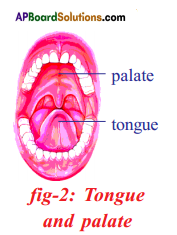
  1. Place some sugar crystals on the tongue.
  2. Keep mouth opened and see that tongue does not touch the palate.
    AP SSC 10th Class Biology Solutions Chapter 7 Coordination in Life Processes 3
  3. Record the time from the moment we placed the crystals on the tongue till we get the taste by using stop watch.
  4. Now repeat the test by placing the sugar crystals on the tongue pressing it against the palate.
  5. Record the time from placing sugar crystals to getting the taste.

Observation: From the above activity we know that taste can be identified easily when the tongue is pressed against the palate.
Result: We can easily identify the taste of the substance we can identify the taste of it in lesser time.

Question 22.
Collect information related to feeling hunger from your school library and prepare a note on it.
Answer:

  1. Generally we feel hunger when our stomach goes empty.
  2. When our stomach goes empty Ghrelin hormone is released and it causes the feeling of hunger.
  3. As well leptin hormone also released, but it causes the feeling of suppression of hunger.
  4. Not only these, when we saw a colourful and good smelling food, automatically we feel hunger. So, the sight of seeing a good food also causes feeling of hunger.
  5. If the food doesn’t have good colour, texture, good smell we can’t eat, even though it is a good food.
  6. All the feelings towards food are recieved by our eyes, nose, tongue.
  7. From these, information is sent to brain, from there signals are sent to stomach and causes feelings either positive or negative.
  8. Hormones are also responsible for most of the feelings of hunger.

AP SSC 10th Class Biology Solutions Chapter 7 Coordination in Life Processes

Question 23.
Draw the block diagram of showing sensation of taste from food material to brain.
Answer:
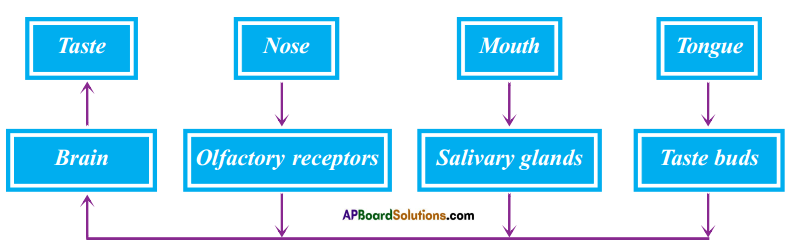
AP SSC 10th Class Biology Solutions Chapter 7 Coordination in Life Processes 4

Question 24.
Draw a neatly labelled diagram showing a peristaltic movement in oesophagus Explain the importance of mucus on the walls of food pipe.
(OR)
In the food pipe, the food bolus is propelled into the stomach by peristaltic movement Represent this action with a diagram.
Answer:
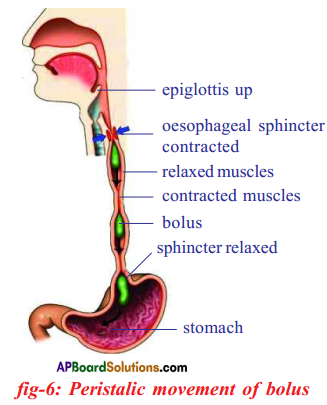
AP SSC 10th Class Biology Solutions Chapter 7 Coordination in Life Processes 5Importance of mucus on the walls of food pipe :

  1. The walls of the food pipe secrete a slippery substance called mucus.
  2. Mucus lubricates and protects the oesophgeal walls from damage.
  3. This helps the food bolus to slide down easily.
  4. Besides this the saliva in the bolus also helps in easy movement.

AP SSC 10th Class Biology Solutions Chapter 7 Coordination in Life Processes

Question 25.
Draw a schematic diagram of villus in small intestinp. Explain how digestive system coordinates with circulatory system.
(OR)
Draw the diagram of villi in small intestine and lable its parts.
Answer:
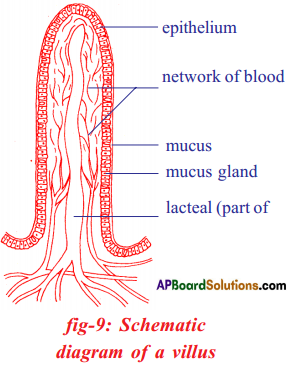
AP SSC 10th Class Biology Solutions Chapter 7 Coordination in Life Processes 6Coordination of digestive system with circulatory system :

  1. After the completion of digestion in small intestine, it enters into the blood through villi.
  2. In blood the digested food gets oxidised after that energy is released.
  3. Releasing of energy from fot^d occur only when it enter into the blood.
  4. So, there is a great coordination between digestive and

Question 26.
The mere smell or sight of food stimulates hunger . Describe the process through a neat diagram.
Answer:
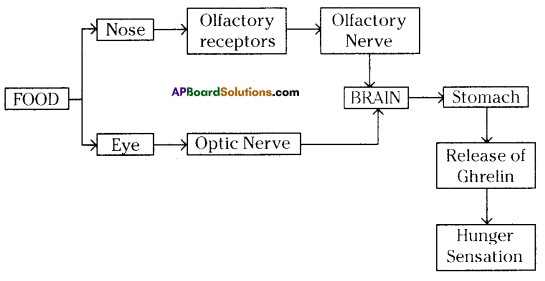
AP SSC 10th Class Biology Solutions Chapter 7 Coordination in Life Processes 7

  1. The mere smell even the mere sight of delicious food stimulates the hunger.
  2. When we smell, the air borne substances get dissolved in the watery film of nasal mucus.
  3. The chemoreceptors in nose are otherwise called olfactory receptors which trigger signals in the form of nerve impulses to the brain where smell is defected.
  4. The amount of the neurosecretory protein hormone ghrelin in the blood increases as a result of visual stimulation images of food.
  5. Hunger contractions start to occur in the stomach due to hunger generating signals that reach the brain.
  6. It is believed that the diencephalon in fore brain and vagus nerve (10th cranial nerve) plays an important role in carrying these signals to brain.
  7. Hunger pangs continue up to 30-45 minutes.
  8. Increase ¡n ghrelin levels results in sensation of hunger and motivation to consume food.

Question 27.
With the help of a diagram show the movement of food from mouth to the stomach. What muscles and nerves are involved in the movement of food and what is this action called as ? (OR)
Draw a diagram of peristaltic movement of food in oesophagus of elementary canal. Write how it performs.
Answer:
AP SSC 10th Class Biology Solutions Chapter 7 Coordination in Life Processes 5The muscles involved in movement of food from mouth to stomach :

  1. The circular muscles of the mouth enable the food to be pushed into the oral cavity and to be moved around.
  2. The surface muscles of the jaw help in biting and chewing actions and move the jaw up, down, forward and backward.
  3. Contraction and relaxation of circular and longitudinal muscles in the oesophagus bring in a wave like motion that propels the bolus into stomach by the action called peristalsis.
  4. As the food approaches the closed ring of pyloric sphincter the surrounding muscles relax and allow the food to pass.
  5. The muscles of the upper part of the stomach have to relax and accept large volumes of swallowed material.

Nerves involved in the movement of food:

  1. The fifth cranial nerve has been found to control the movement of muscles in the jaw.
  2. Peristalsis in oesophagus is under the control of autonomous nervous system.

AP SSC 10th Class Biology Solutions Chapter 7 Coordination in Life Processes

Question 28.
Prepare a cartoon on Pavlov’s experiment with a suitable caption.
Answer:
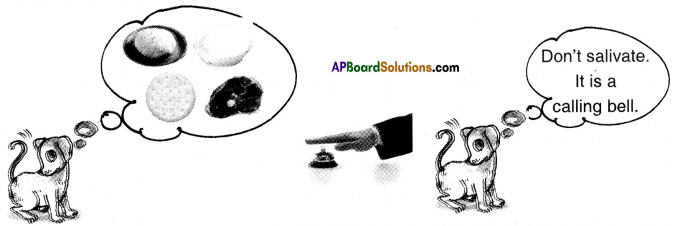
AP SSC 10th Class Biology Solutions Chapter 7 Coordination in Life Processes 8

Question 29.
How do you appreciate stomach as a churning machine? How does this coordination
Answer:

  1. The stomach acts like a churning machine, churning the food around to break it into even smaller pieces.
  2. Mechanical mixing of food in stomach occurs by peristalsis, which is waves of muscular contractions that move along the stomach wall.
  3. This allows the mass of food to further mix with the digestive enzymes.
  4. Due to churning of food in stomach, a mixture that resembles thick cream called chyme is formed.
  5. All the muscles in the stomach works with such a great coordination.
  6. Hence we can call stomach as a churning machine.

Question 30.
There is a great variety in diversified life processes, express your feelings in the form of a poem.
Answer:

POEM
Life is a process of discomfort and pain.
Learn to handle it all with courage and sane
Remember the bliss waiting for you
Nutrition, excretion, respiration all are essential in our life.
Reproduction makes our species go on and on forever.
Autotrophs and heterophs are brothers.
Depend on each other In a systematic way.
So have courage to learn more tricks.
Search for happiness.
In life that survive.

AP SSC 10th Class Biology Solutions Chapter 7 Coordination in Life Processes

Question 31.
Suggest any two important habitual actions to your friend while eating food, keeping in view of this chapter.
Answer:

  1. Masticate the food thoroughly in the mouth.
  2. Do not swallow food without chewing properly or do not eat in hurry.
  3. Eat small quantities of food at regular intervals for efficient digestion and absorption of nutrients.
  4. Eat the food that emit good smell and has good taste to eat.
  5. Do not eat too hot and too cold items.

Fill in the blanks.

  1. 3:2:1:2 is the ratio of our dentition. Here 1 represents ———–.
  2. Large protein molecules are broken down in ———– of digestive tract.
  3. ———– is the strong acid which is secreted during digestion.
  4. Olfactory receptors present in ———– triggering signals to brain.
  5. pH of saliva is ———– in nature.

Answer:

  1. Canine
  2. Stomach
  3. HCl
  4. Nose
  5. Alkaline nature

Fill in the blanks with suitable words given below.

Fluctuations of hormone —–(i)—– levels results in sensation of hunger and motivation of consuming food. When you feel your stomach is full and there is no need of food any more. Another hormone —–(ii)—– that gets secreted suppresses hunger. When we take food into the mouth it has to be chewed thoroughly. For this purpose the —–(iii)—– muscles help in chewing actions, while the —–(iv)—– muscles of the jaw moves the jaw up,down, forward and backward during food mastication. The —–(v)—– nerve controls the muscles of the jaw. Under the action of —–(vi)—– nervous system Saliva is released by the salivary glands moistens the food to make chewing and swallowing easier. The salivary —–(vii)—– in the saliva breaks down the starch into sugars. As a result of chewing the food is transported into the oesophagus by the action of swallowing which is coordinated by the swallowing centre in the —–(viii)—– and the —–(ix)—–. The tongue which is gustatory recognizes the taste and —–(x)—– nerve plays an important role in sensation of taste.

Choose the right ones.
i) leptin, ghrelin, gastrin, secretin.
ii) ghrelin, leptin, secretin, gastrin.
iii) deep muscles, surface muscles, circu lar muscles, striated muscles.
iv) surface muscles, deep muscles, neck muscles, long muscles.
v) fifth cranial nerve, second cranial nerve, fifth facial nerve, spinal nerve.
vi) central nervous system, peripheral nervous system, autonomous nervous system.
vii) lipase, sucrase, galactase, amylase.
viii) medulla oblongata, cerebrum, 8th spinal nerve, cranial nerve, 7th cranial nerve.
ix) Pons varoli, brain stem, medulla oblongata, mid brain.
x) 6th cranial nerve, 5th cranial nerve, 10th cranial nerve, optic nerve.

Answer:
i) ghrelin
ii) leptin
iii) surface
iv) deep
v) fifth cranial
vi) autonomous
vii) amylase
viii) medulla oblongata
ix) brain stem
x) fifth cranial nerve

AP SSC 10th Class Biology Solutions Chapter 7 Coordination in Life Processes

Choose the correct answer.

  1. In which of the following situations you can taste quickly? [ ]
    A) Put sugar cristals on tongue
    B) Put sugar solution on tongue
    C) Press the tongue slowly against the palate
    D) Swallow directly without grinding and shredding
    Answer: C
  2. Peristalsis is because of [ ]
    A) Contraction of longitudinal muscles
    B) Contraction of circular muscles
    C) Under control of autonomous nervous system
    D) Digestive secretions
    Answer: C
  3. Sphincter that helps in opening of stomach into duodenum [ ]
    A) Cardiac
    B) Pyloric
    C) Anal
    D) Gastric
    Answer: B
  4. Glucose and amino acids are absorbed through the following part of villus [ ]
    A) epithelial cells
    B) blood capillary
    C) lymphatic vessel
    D) all
    Answer: A
  5. The region in brain portion that controls hunger signals [ ]
    A) medulla
    B) diencephalon
    C) cerebrum
    D) mid brain
    Answer: B
  6. Human organism is an internal combustion machine because of …. [ ]
    (OR)
    Human being is an “Internal combustion machine” because he/she
    A) assimilation of energy from food
    B) liberate CO2 during respiration
    C) expel waste food at the end state of digestion
    D) secrete powerful digestive juices
    Answer: A

10th Class Biology 7th Lesson Coordination in Life Processes InText Questions and Answers

10th Class Biology Textbook Page No. 145

Question 1.
How do we know that we need food?
Answer:
When we feel hungry then we know that we need food.

10th Class Biology Textbook Page No. 146

AP SSC 10th Class Biology Solutions Chapter 7 Coordination in Life Processes

Question 2.
What plays a major role to identify stale food?
Answer:
Smell or odour plays a major role to identify stale food.

Question 3.
If you are having a tasty dish do you think the smell of it increases your appetite?
(OR)
Do the smell of tasty dish increases our appetite?
Answer:
Yes, the smell of tasty dish increases our appetite.

Question 4.
What are your observations after chewing cumin, sounf, potato and apple?
Answer:
If we chew cumin, sounf, potato and apple we observe in order to taste the food material the food should dissolve in saliva.

10th Class Biology Textbook Page No. 148

Question 5.
Are there any other sensation that affect taste?
Answer:
Temperature (hotness), coldness are the sensations that affect taste.

Question 6.
What happens to your taste sensation while sipping hot milk or tea?
Answer:
We find something more tasty while we sipping hot milk or tea.

Question 7.
What do you think could be the range of temperature for us to relish food items?
Answer:
30°C to 35°C could be the range of temperature for us to relish food items.

10th Class Biology Textbook Page No. 149

Question 8.
What do you think that would happen if the salivary glands did not function in our mouth?
Answer:

  1. If the salivary glands do not function in our mouth, saliva will not release and the food do not get moistened and chewing it is difficult.
  2. The taste of the food cannot be identified.
  3. Carbohydrates in the food cannot be broken down and changed to dextrose and maltose molecules.

Question 9.
Suppose your taste buds were affected what would happen to your interest in haying food?
Answer:
If my taste buds were affected I cannot identify the taste of food and also loose interest in having food.

10th Class Biology Textbook Page No. 151

Question 10.
Does the level of saliva secretion change due to presence of food in the mouth?
Answer:
Yes, the level of saliva increases due to the presence of food in the mouth.

Question 11.
Can the process of chewing go on in the absence of saliva?
Answer:
Yes, the process of chewing go on in the absence of saliva. But it is very difficult to chew food and swallow it.

AP SSC 10th Class Biology Solutions Chapter 7 Coordination in Life Processes

Question 12.
Does the saliva have any other roles to play?
Answer:
The enzyme present in saliva that is salivary amylase converts large molecules of carbohydrates into small molecules of sugar like maltose and dextrose.

Question 13.
What is the use of such an increase in surface area of food?
Answer:
It helps in more surface area for the enzyme to act.

Question 14.
What about the nature of medium for salivary amylase to act on food component?
Answer:
The nature of medium for salivary amylase to act on food component is alkaline.

Question 15.
If we swallow food material directly without mastication what will happen?
Answer:
If we swallow food material directly without mastication, the food will not get digest easily and completely.

Question 16.
Do you think the pH of our mouth changes?
Answer:
Yes, the pH of our mouth changes from acidic to alkaline by the release of saliva from salivary glands.

10th Class Biology Textbook Page No. 152

AP SSC 10th Class Biology Solutions Chapter 7 Coordination in Life Processes

Question 17.
What are the different systems that contribute to the proper functioning of digestion in the mouth?
Answer:
Endocrine, muscular, nervous systems contribute to the proper functioning of digestion in the mouth.

Question 18.
After the digestive process in the mouth where does the food move to?
Answer:
After the digestion in the mouth the food move to oesophagus.

10th Class Biology Textbook Page No. 153

Question 19.
What are the systems that come into play for swallowing food?
Answer:
Skeletal system, nervous system and digestive systems come into play for swallowing food.

Question 20.
What does the schematic diagram tell us about the oesophagus?
Answer:
The schematic diagram of the oesophagus tells about its structure, secretion and function.

Question 21.
What kind of the tube is oesophagus?
Answer:
Oesophagus is a muscular and an elastic tube.

Question 22.
How does mucus help in passage of food?
Answer:
Mucus helps in lubricating and protecting the oesophageal wall and helps the bolus to slide down easily in the oesophagus.

10th Class Biology Textbook Page No. 154

AP SSC 10th Class Biology Solutions Chapter 7 Coordination in Life Processes

Question 23.
What makes the movement of the food bolus in the oesophagus easy?
Answer:

  1. Mucus helps the food bolus to slide down easily.
  2. Peristaltic movements of the walls of oesophagus also make the movement food bolus in the oesophagus easy.

Question 24.
Why do you think the stomach is structured like a bag rather than a tube like an oesophagus?
(OR)
Why stomach is structured like a bag rather than like a tube?
Answer:

  1. The food taken has to remain in the stomach for a long time for proper digestion with digestive juices and enzymes.
  2. Different kinds of muscles churns the food by contraction and relaxation to form chyme.
  3. If it was like a tube the food would just pass down without under going much changes and cannot remain in the stomach for long time.

Question 25.
What sets such processes into action?
Answer:

  1. When the food is in the oral cavity, the nerves in the cheek and tongue are stimulated.
  2. These carry messages in the form of nerve impulses to the brain.
  3. They messages are transmitted from the brain, to the wall of the stomach, and stimulate the gastric glands to produce gastric juice.

10th Class Biology Textbook Page No. 155

Question 26.
What stimulates stomach muscle into action?
Answer:
The nervous system stimulates stomach muscle into action.

Question 27.
What causes the stomach to churn and mix the food?
Answer:
The contractions of the stomach muscles squeeze and mix the food with the acids and juices of the stomach.

AP SSC 10th Class Biology Solutions Chapter 7 Coordination in Life Processes

Question 28.
Why should only a small quantity of food be passed from stomach to duodenum?
Answer:
For the complete digestion of chyme, only a small quantity of it be passed from stomach to duodenum.

Question 29.
What is involved in bringing about peristalsis?
Answer:
Contraction and relaxation of the muscles present in various parts of gut bring about peristalsis.

Question 30.
What is the direction of peristalsis? Which end of the gut does it begin?
Answer:
The direction of peristalsis is forward direction that is from mouth to anus.

Question 31.
What happens if the direction of peristalsis is reversed?
Answer:
If the direction of peristalsis is reversed the food present in the gut moves backwards.

10th Class Biology Textbook Page No. 157

Question 32.
Why do you think small intestine is long and coiled?
Answer:
The small intestine is long and coiled because the food has to stay for more time for complete digestion and absorption.

Question 33.
What process is involved in this process of absorption?
Answer:
Selective absorption of nutrients by the villi of small intestine is involved in absorption.

Question 34.
What is the relation between finger-like structures and paper folds?
Answer:

  1. Finger-like structures increase the surface area.
  2. The space inside the paper folds is very much high. So area is increased.
  3. So increase in surface area is the relation between finger-like structures and paper folds.

Question 35.
What systems do you think are working together?
Answer:
The digestive system and circulatory system are working together.

AP SSC 10th Class Biology Solutions Chapter 7 Coordination in Life Processes

Question 36.
Do you think those systems work together in the whole length of the digestive canal? Why / Why not?
Answer:
No, these systems are not working together in the whole length of the digestive canal. The digested food material is absorbed only in the small intestine but not elsewhere in the gut.

10th Class Biology Textbook Page No. 158

Question 37.
Often you may have experienced that if you have tension for some reason you start having loose motions. What does this show us?
Answer:
If we are tensed for some reason, the enteric nervous system or second brain loses control over the gut. Hence without our intervention, loose motions occur.

10th Class Biology Textbook Page No. 159

Question 38.
What moves out of the gut?
Answer:
The indigested food material moves out of the gut.

Question 39.
Two major pathways of waste expulsion are shown above. Which of the two do you think happens exclusively through the gut?
Answer:
Indigested food matter is expelled in the form of stool from the gut.

Question 40.
What controls the exit of stools from the body?
Answer:
The two muscular layers present In the anal sphincter control the exit of stools from the body.

Question 41.
Do you think the control is voluntary? Why / Why not?
Answer:
Yes, the control is voluntary in adults and it is involuntary in infants.

AP SSC 10th Class Biology Solutions Chapter 7 Coordination in Life Processes

Question 42.
Did we have a sphincter in any other part of the digestive canal? Where was it?
Answer:
Yes. We have a sphincter at the opening where stomach opens into duodenum (small intestine).

10th Class Biology Textbook Page No. 160

Question 43.
What is the fate of the digested substances that move into blood from the intestine?
Answer:
The digested substances reach each cell of the body through circulatory system. There it gets oxidised and release energy.

Question 44.
Where is the energy stored?
Answer:
The energy is stored in the cells as ATP.

Question 45.
Which system do you think will remove the excess salts from our body?
Answer:
The excretory system remove the excess salts from our body.

Question 46.
What would be the path of salt removed from gut to the outside of our body?
Answer:

  1. The digested food containing salts will be absorbed into the blood stream in small intestine.
  2. The circulatory system supplies this to kidney through renal artery.
  3. In the kidney salts are filtered and sent out of the body along with urine.
  4. Some of the salts also supplied to the skin. They will be sent out of the body in the form of sweat.

10th Class Biology 7th Lesson Coordination in Life Processes Activities

Activity – 1
Observe the following table, identify and tick those options that you think makes you feel hungry.
Table

Smell of food Taste of food Sight of food Being tired and exhausted Need of food Thought of food

i) What stimulates hunger?
Answer:
Smell of food, sight of food and need of food stimulates hunger.

ii) What would be the result of stimulation of hunger?
Answer:
Hunger pangs occur in the stomach.

iii) Which system do you think would send the signals to make us realize that we are hungry?
Answer:
Nervous system.

iv) What kinds of controls are exercised during sensation of hunger? Are they hormonal or nervous or both?
Answer:
They are both hormonal and nervous.

v) Can you suggest any four systems involved in the process of generating hunger sensation?
Answer:
Digestive system, Endocrine system, Circulatory system and Nervous system.

AP SSC 10th Class Biology Solutions Chapter 7 Coordination in Life Processes

Activity – 2
Observation of how our taste is affected by the sense of smell. (OK) How our taste is affected by the sense of smell?

  1. First, close your nose with your fingers.
  2. Pop in some zeera in your mouth and chew it for some time.
  3. After that chew some sounf.
  4. Could you recognise the taste?
  5. How long it taken to know the taste?
  6. After sometime wash your mouth and repeat the activity by chewing a piece of an apple followed by a potato (remember to close your nose)

Could you know the taste of both or did it taste the same? Why?
Answer:
No, because taste buds couldn’t send the taste signals to brain.

Observation :

  1. We can taste the food that is in the form of liquid only.
  2. Only after the dissolved food enters into the cup like taste buds, the sense of taste is carried to the brain for analysis. Then only we will know the taste of food material.
  3. Similarly olfactory receptors which trigger signals in the form of nerve impulses to the brain where smell is detected.

i) What happens when we put a food material in our mouth?
Answer:
Our mouth salivates.

ii) Name the parts in the mouth that help us to taste food.
Answer:
Papillae (taste buds), palate.

Activity – 3

  1. Take a pinch of asafoetida powder/garlic and rub it on hand kerchief/tissue paper.
  2. Close your eyes and smell it.
  3. Then try to identify taste of different types of food materials with the help of your friend.

i) Does garlic have a stronger scent than apple? How do you think the stronger scent affect your sensation of taste?
Answer:
Yes, garlic have a stronger scent than apple. The stronger scent motivate us to eat different types of foods.

ii) How many food materials you have identified correctly?
Answer:
Seven.

iii) Write a few lines on the relation between smell and taste.
Answer:

  1. Taste and smell are intimately entwined. This close relationship is most apparent in how we perceive the flavour of food.
  2. Taste itself is focussed on distinguishing chemicals that have sweet, salty, sour, bitter or umami taste.
  3. However interactions between the senses of taste and smell enhance our perceptions of the foods, we eat.

iv) Have you ever felt that a particular food is tasty just by looking at it?
Answer:
I felt so many times. In general, we prefer the food material, which is attractive to our eyes and flavour to nose, then we taste it.

AP SSC 10th Class Biology Solutions Chapter 7 Coordination in Life Processes

Activity – 4
What is the role of different parts of the mouth in helping us to taste keeping sugar crystals over the tongue?

  1. Place some sugar crystals on the tongue and keep mouth opened and see that your tongue dosen’t touch the palate.
  2. Record the time from the moment you placed the crystals on your tongue till you got the taste by using stop watch.
  3. Now repeat the test by placing the sugar crystals on the tongue and pressing it against the palate.
  4. Record the time from placing sugar crystals to getting the taste. Or put a drop of sugar solution on your tongue using a dropper.

Observation :
Based on the above activity we know that taste can be identified easily when the tongue is pressed against the palate.
i) Can we taste on dry tongue?
Answer:
No. We can’t taste on dry tongue.

ii) Which way helped you taste faster? Why?
Answer:
Taste can be identified faster when the tongue is pressed against the palate.
When the tongue is pressed against the palate the food substance is pressed against the opening of the taste bud letting it reach taste celjs triggering taste signals. Finally the taste is recognised in the brain.

Activity – 5
How do you show that the breakdown of food by using the model of chalk piece kept in vinegar?

  1. Break a piece of chalk into two halves.
  2. Crush one half to tiny pieces leaving the other as it is.
  3. Take two small mineral wafer bottles QA ltr bottle) cut them into two equal halves and discard the upper portion.
  4. Now we have two beakers from the lower cut portion.
  5. Fill them half with vinegar and add the crushed chalk to one beaker and the other uncrushed half chalk to the other.
  6. Observe them after half-an-hour or so.

i) Which one dissolved faster the crushed chalk or the whole one?
Answer:
Beaker with crushed chalk dissolved faster than the whole one.
This experiment tells us the need of mechanical crushing of food the mouth to increase surface area for action of substances that aid in digestion.

ii) How does this process of mechanical crushing go on in the mouth?
Answer:
Mechanical crushing of food goes in the mouth by chewing.

iii) Which parts in the mouth are involved in this?
Answer:
Teeth and tongue.

iv) What are the systems involved in this process?
Answer:
Digestive system, Nervous system, Muscular system.

AP SSC 10th Class Biology Solutions Chapter 7 Coordination in Life Processes

Activity – 6
Observe the diagram and answer the questions and fill the table.
AP SSC 10th Class Biology Solutions Chapter 7 Coordination in Life Processes 2i) Observe the model or chart of jaw, on the basis of the figure try to guess what are the functions molars could be?
Answer:
Chewing and grinding.

ii) What do you think could be the function of inscisors?
Answer:
The function of inscisors is biting the food.

iii) Which set of teeth helps in grinding food?
Answer:
Premolars and molars.

iv) Which set helps in tearing food?
Answer:
Canines help in tearing food.

v) What is your dental formula?
Answer:
AP SSC 10th Class Biology Solutions Chapter 7 Coordination in Life Processes 9 is the dental formula.

Table

Name of teeth Number Shape Function
Incisors 8 Chisel, sharp edges Biting
Canines 4 Sharp, pointed edges Tearing
Premolars 8 Diamond shape blunt and flat Chewing and grinding
Molars 12 Rectangular, blunt and flat Chewing and grinding

AP SSC 10th Class Biology Solutions Chapter 7 Coordination in Life Processes

Activity – 7
Testing pH of mouth at intervals of one hour.

  1. Collect a strip of pH paper with a colour chart from a chemistry teacher.
  2. Take a small piece of the pH paper and touch it to your tongue.
  3. Match the colour with the colour chart and note the pH.
  4. Take some readings after having your food at lunch break.
  5. Compare your readings with that of your friend.
  6. Take at least 4 readings.

Table

S.No. Name of the Student pH value before lunch pH value after lunch pH value after an hour pH value after 2 hrs
1. Sagar 7.4 6.8 7.0 7.4
2. San jay 7.4 6.8 7.0 7.4
3. Raju 7.1 6.9 7.0 7.1
4. Krishna 7.3 6.8 7.0 7.3
5. Kiran 7.4 6.8 7.0 7.4
6. Yadav 7.2 6.7 7.0 7.2

i) What is the usual range of pH of your mouth Acidic (or) Basic
Answer:
The usual range of pH of our mouth is more or less 6.5. At low level the saliva is acidic and at high level it is basic.

ii) Did you observe any change in pH after eating? What may have caused the change?
Answer:
Yes, 1 observed the change in pH. Bicarbonates in saliva changed that into basic.

iii) In what kind of pH do you think salivary amylase acts well?
Answer:
In the pH range 7.2 to 7.4 it acts well in alkaline medium.

iv) Does this type of food have any role to play on the pH of our mouth?
Answer:
If the food that enters is acidic it will be converted into basic stuff and then it is swallowed.
Based on the above tests we know that salival secreted causes the medium to change to alkaline as it aids in action salivary amylase.

Activity – 8
Making a model of oesophagus to observe how bolus moves forward.

  1. Take a piece of waste cycle tube and insert one or two potatoes into it.
  2. Lubricate the inner side of the tube with oil.
  3. In the same way smear oil over potatoes.
  4. Insert oil coated potatoes in the tube.
  5. Now try to push the potatoes by squeezing the tube.

i) How do you squeeze the tube to make the potatoes pass through?
Answer:
By pushing the potato from behind.

ii) Do you think that the muscles in the wall of the oesophagus have to do something like this?
Answer:
Yes.

iii) How did oil help you in pushing the potatoes through the pipe?
Answer:
Oil acted as a lubricant to push the potato easily in the forward direction.

AP SSC 10th Class Biology Solutions Chapter 7 Coordination in Life Processes

Activity – 9
How is the stomach protected from the secretions of its own acids?

  1. Take two similar green leaves.
  2. Grease one leaf with petroleum jelly, leave the other free.
  3. Add 1 or 2 drops of some weak acids on both the leaves.
  4. Observe them after half-an-hour or so and write your observations.

i) Which leaf was effected by the acid?
Answer:
The leaf to which petroleum jelly was not applied.

ii) What kind of change did you observe in the leaves?
Answer:
The colour of the leaf changes.

iii) What saved the other leaf from the effect of acid?
Answer:
Petroleum jelly.
From the above activity we can conclude that mucus secreted by the walls of stomach protects stomach from the harmful effects of hydrochloric acid.

Activity – 10
Paper tube and folded papers.

  1. Provide students with a piece of paper.
  2. Let them calculate the area of one side of the paper and make a roll of it.
  3. Try to fill the tube by inserting few folded papers as much as possible in it.
  4. Pull out the papers from the tube, unfold them and find out the whole area of the papers.

i) Compare the area of the folded papers with that of the roll. Do you find any increase in the area ? If so try to find out the reasons?
Answer:
Area is increased. The space inside the folded papers is very much high. So we can insert as many folded papers as we could.
From the above activity we can infer that the inner surface of the small intestine contains thousands of finger-like projections called villi which increase the surface area of absorption of nutrients in small intestine.

AP SSC 10th Class Biology Solutions Chapter 6 Reproduction – The Generating System

AP State Board Syllabus AP SSC 10th Class Biology Solutions Chapter 6 Reproduction – The Generating System Textbook Questions and Answers.

AP State Syllabus SSC 10th Class Biology Solutions 6th Lesson Reproduction – The Generating System

10th Class Biology 6th Lesson Reproduction – The Generating System Textbook Questions and Answers

Improve your learning

AP SSC 10th Class Biology Solutions Chapter 6 Reproduction - The Generating System

Question 1.
Why do fish and frog produce a huge number of eggs each year?
Answer:

  1. External fertilisation occurs in fish and frog.
  2. The female lays a vast number of eggs in water and male releases some millions of sperms on to them in water.
  3. Eggs may be carried to a long-distance by water currents or they may be eaten by predators.
  4. So fertilisation is a chance factor and controlled by nature.
  5. Fertilisation occurs externally hence it is inevitable to give rise to vast number of eggs by fish and frog.

Question 2.
Give examples and explain what is meant by external fertilisation?
Answer:

  1. Fusion of the male and female gametes is called fertilisation.
  2. The fertilized egg (ovum) is called zygote.
  3. If the fertilisation occurs outside the body of the female organism then it is called external fertilisation.
  4. External fertilisation is seen in fish, frog and earthworm, etc.

Question 3.
Write the differences between
a) Grafting – Layering b) Stamen – Carpel.
Answer:
a) Differences between Grafting and Layering.

Grafting Layering
1. Grafting is a technique of inserting a part of one plant into another plant in such a way that the two will unite and continue their growth. 1. Stems that form roots while still attached to the parent plants are called layers. Propagating the plants in this method is known as layering.
2. Two plants of the same species are required for grafting. 2. Only one plant is required for layering.
3. Grafting helps to pressure and perpetuate varieties that cannot reproduce by vegetative method. 3. In layering we can propagate the plant varieties which are required by us.
4. Grafting is used to obtain a plant with desirable characters. 4. In layering the plant already has desirable characters is propagated.
5. The two plants stock and scion and joined together in such a way that two stems join and grow as a single plant. 5. The common practice in layering is to injure the portion to be layered by notching, cutting, girdling.
6. Ex: Mango, apple, guava, etc. 6. Ex: Jasmine, rose, grapevine, etc.

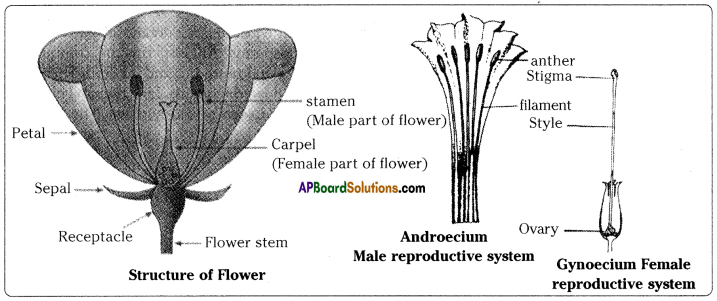
b) Differences between Stamen and Carpel.

Stamen Carpel
1. Male reproductive organ of the flowering plant. 1. Female reproductive organ of the flowering plant.
2. It has two parts – anther and filament. 2. It has three parts – style, stigma and ovary.
3. Stamen produces pollen grains. 3. Carpel produces ovule.
4. Pollen grain contains the male gamete. 4. Ovule contains the female gamete ovum or egg.

AP SSC 10th Class Biology Solutions Chapter 6 Reproduction - The Generating System

Question 4.
Describe the mode of fertilization in plants with a diagram.
Answer:

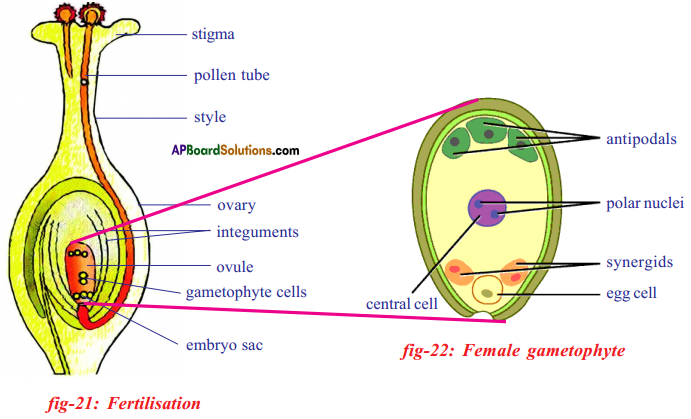
  1. Fertilisation is the process of fusion of male and female gametes.
  2. For the fusion of male and female gametes pollen grains have to reach the surface of the stigma. This is called pollination.
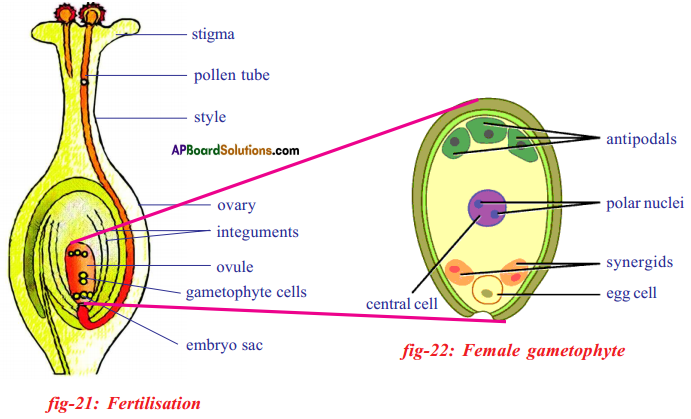
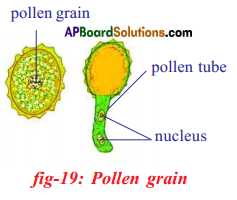
  3. Pollen grains received by the stigma germinate and give rise to pollen tubes. Only one pollen tube finally reaches the embryo-sac.
  4. This tube will have two male nuclei, which migrate to the tip of the pollen tube at the time of fertilization.
    AP SSC 10th Class Biology Solutions Chapter 6 Reproduction - The Generating System 1a
  5. Usually the pollen tube enters the ovule through micropyle and discharges the two male gametes into its embryo-sac.
  6. One male nucleus (n) or (gamete) approaches the egg and fuses with it to form a diploid (2n) zygote. This is first fertilisation.
  7. The other male nucleus (n) or (gamete) reaches the secondary nucleus (2n) and fuses with it to form the endosperm nucleus which will be triploid. This is second fertilization in the embryo-sac.
  8. Thus double fertilisation occurs in embryo-sac which is unique in flowering plants.

Question 5.
What are the different modes of asexual reproduction? Cite them with examples.
Answer:
Asexual reproduction takes place by six different methods. They are:

  1. Fission
  2. Budding
  3. Spore formation
  4. Regeneration
  5. Fragmentation and
  6. Vegetative propagation.

1. Fission: Single-celled organisms split into two equal offsprings or more offsprings. Ex: Paramoecium, bacteria.

2. Budding: A growth on the body as a bud grows to form identical copy of parent. Ex: Yeast.

3. Spore formation : Spores are produced in the sporangium.
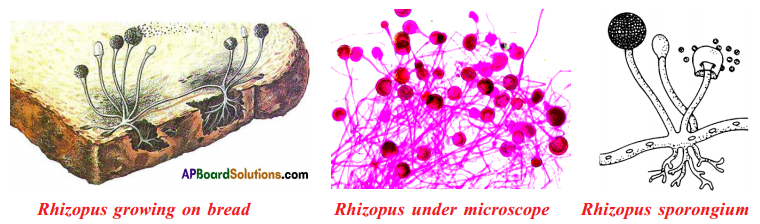
Ex : Rhizopus, mucor, bacteria, ferns and mosses.

4. Regeneration :
a) Ability of organisms to give rise to new individual organisms from their body parts.
b) That is if the individual is some how cut or broken up into many pieces, many of these pieces grow into separate individuals.
Ex: Hydra and Planaria.

5. Fragmentation:
a) In multicellular organisms with relatively simple body organisation breaks up into smaller pieces upon maturation.
b) These pieces of fragments grow into new individuals.
Ex: Flatworms, Spirogyra, moulds, lichens.

6. Parthenogenesis: In the process generally the female gametes or ova develop into zygote without fertilization.
Ex : Bees, ants and wasps.

7. Vegetative propagation: When a vegetative part like stem, root and leaf can produce a new organism it is called vegetative propagation. It is of two types.
a) Natural propagation:
Bryophyllum Dahlia, Carrot, Radish
b) Artificial propagation:
i) Layering: Eg: Nerium, Guava, Orange, Rose
ii) Cutting: Eg: Rose, Hibiscus, Sugarcane
iii) Grafting: Eg: Sapota, Guava, Mango, etc.

Question 6.
In what ways does sexual reproduction differ from asexual one? State at least three reasons.
(OR)
What are the differences between sexual and asexual reproduction?
Answer:

Sexual reproduction Asexual reproduction
1. Two parents are required. 1. One parent is needed.
2. Gametes are formed. 2. Gametes are not formed.
3. Fertilization takes place. 3. Fertilization does not take place.
4. Zygote is formed. 4. Zygote is not formed.
5. New characters are formed. 5. New characters are not formed but only through mutation.
6. Meiosis takes place. 6. Meiosis does not take place.
7. Found in higher animals. 7. Found in lower animals.
8. Support to evolution process. 8. Supports evolution but not frequently.
9. Takes several months to complete. 9. Takes very short period to complete.

Apart from the above differences Sexual and Asexual reproduction differs in the following ways:

  1. The unit of reproduction in sexual reproduction is gamete whereas in asexual repro-duction it may be whole parent body or bud or a fragment or a single somatic cell.
  2. Sexual reproduction need more time to complete and it is less time in asexual reproduction.

AP SSC 10th Class Biology Solutions Chapter 6 Reproduction - The Generating System

Question 7.
How are sperm cells adapted for their function?
Answer:

  1. Sperm cell is adapted to its function by carrying genetic information to an egg.
  2. Its body consists of four parts :
    1. Head
    2. Neck
    3. Middle piece and
    4. Tail.
  3. Sperm has a streamlined body that allows it to move quickly.
  4. Nucleus is present in the head.
  5. Special structure on the head called acrosome helps in penetrating the ovum during fertilisation.
  6. The head of sperms also contain enzymes to breakdown and digest the zone on the egg through which it penetrates and fertilise it.
  7. Large number of mitochondria are present in the mid-region, so it is able to produce a lot of energy in order to operate tail.
  8. Its tail allows it to swim towards the egg for fertilisation.

AP SSC 10th Class Biology Solutions Chapter 6 Reproduction - The Generating System

Question 8.
The menstrual cycle prepares the uterus for a fertilised egg. How long is an average menstrual cycle from start to finish?
Answer:

  1. The cycle of changes that occur in the female reproductive system is called menstrual cycle.
  2. The average menstrual cycle from start to finish is 28 days long.

Question 9.
When the foetus is growing inside the uterus it needs nutrients? What provides these nutrients?
Answer:

  1. When the foetus is growing inside the uterus it needs nutrients for its growth and development.
  2. These nutrients are provided by the mother’s blood through a special structure called placenta.
  3. Placenta is a tissue formed by the cells from the embryo and the mother.
  4. It is formed around 12 weeks of pregnancy and becomes an important structure for nourishment of the embryo.
  5. The foetus is connected to placenta in mother’s body through umbilical cord.

Question 10.
Which type of substances are absorbed by foetus from the mother?
Answer:

  1. The digested food from the mother travel through the mother’s blood stream and exchange to the blood stream of the foetus through the placenta.
  2. In addition to ingested food the mother’s body continuously breakes down muscles, fat and bones.
  3. Releasing proteins, fat and calcium to the mother’s blood that can be absorbed through the placenta to provide nutrients to the foetus.
  4. Some hormones also transfer to baby.

Question 11.
What is the job of Amniotic sac?
Answer:

  1. The amniotic sac is a bag of fluid inside a women’s womb (uterus) where the embryo and foetus develops and grows.
  2. The cavity within the amnion becomes filled with fluid called amniotic fluid.
  3. The embryo or unborn baby floats and moves in the amniotic fluid.
  4. Amniotic sac and amniotic fluid give protection against minor mechanical injury.
  5. This fluid also provides a stable temperature and assists in maintaining a consistent body temperature for the unborn child.

AP SSC 10th Class Biology Solutions Chapter 6 Reproduction - The Generating System

Question 12.
What are the advantages of sexual reproduction?
(OR)
What are uses of sexual reproduction?
Answer:
Advantages of sexual reproduction:

  1. Sexual reproduction promotes diversity of characters in the offsprings by providing genetic variation.
  2. It plays an important role in the origin of new species have different characters.
  3. This genetic variation leads to the continuous evolution of various species to form better and still better organisms.
  4. Sexual reproduction influences in diversity of characters in offsprings.
  5. It helps to maintain the continuty of organisms.
  6. It leads to new generation to tolerate adverse or diseased conditions.
  7. It helps the spreading of population to new areas.

Question 13.
How does reproduction help in providing stability to population of species?
Answer:

  1. The reproduction is directly linked to the stability of the population of species because it helps in replacing the lost or aging population with the new population and thus ensures the survival of the species.
  2. The process of reproduction ensure continuity of life on earth.
  3. In the absence of reproduction one particular species will disappear with time.
  4. Reproduction induces variations in the population which help the population to tide over adverse environmental conditions and adapt to changing environment.
  5. Reproduction also helps to generate copies of individuals which are suited to a particular environment.

Question 14.
Write the differences between mitosis and meiosis.
Answer:

Mitosis Meiosis
1. It occurs in somatic cells. 1. It occurs in germ cells.
2. Nucleus divides only once. 2. Nucleus divides twice.
3. Two daughter cells are formed. 3. Four daughter cells are formed.
4. Daughter cells are diploid. 4. Daughter cells are haploid.
5. It occurs more frequently. 5. It occurs less frequently.
6. Daughter cells form somatic organs. 6. Daughter cells form gametes.
7. There is only one prophase, one metaphase one anaphase and one telophase. 7. There are two of each phase and five sub-phases in prophase -1.
8. Number of chromosomes are not changed in the daughter cells. 8. Number of chromosomes are reduced to half.
9. Chromosome number doubles at the beginning of each cell division. 9. Chromosome number is not doubled. It doubles after the end of first meiotic division.
10. No crossing over in chromosomes. 10. Crossing over occurs chromosomes.
11. Equation division. 11. Reduction division.

AP SSC 10th Class Biology Solutions Chapter 6 Reproduction - The Generating System

Question 15.
What happens to the wall of the uterus during menstruation? (OR)
What changes occur in the wall of the uterus during menstruation?
Answer:

  1. During the early stage of menstruation the cells in the wall of uterus increase in number by repeated mitotic divisions.
  2. The inner lining of uterus becomes thick and soft with lot of blood capillaries in it.
  3. These changes in the uterus are necessary because in case the ovum released by the ovary gets fertilised by the sperm, then the uterus has to keep this fertilised ovum for further development and supply it with food and oxygen etc.
  4. If fertilisation does not occur the additional growth of the uterus is detached and expelled along with some amount of blood.

Question 16.
“All unicellular organisms undergo only mitotic cell division during favourable conditions” – Do you support this statement? Why?
Answer:

  1. Unicellular organisms undergo mitotic cell division not only during favourable conditions but also in unfavourable conditions.
    So I don’t support the given statement.
  2. When the organism finds favourable conditions it deserves to perform division called Fission. Ex: Amoeba.
  3. Sometimes scarcity of food or to save it life, some organisms undergo mitotic cell division.
  4. Organisms like paramoecium undergo a type of sexual reproduction called conjugation during unfavourable conditions.

Question 17.
What would be the consequences if there is no meiosis in organisms that reproduce sexually?
(OR)
What happens if Meiosis does not take place in reproductive cells?
Answer:

  1. If meiosis did not occur, a fusion of gametes would result in a doubling of the chromosomes for each successive reproduced generation.
  2. For example, in case of man egg cells and sperm cells like other cells must contain 46 chromosomes.
    AP SSC 10th Class Biology Solutions Chapter 6 Reproduction - The Generating System 2
  3. This results in the formation of abnormalities in each generation.
  4. If meiosis did not occur, there is no genetic variation in the offsprings produced by random fusion of the gametes.
  5. New characters will not appear in the offsprings.
  6. The process of evolution will be stopped.

Question 18.
Vicky’s father wants to grow a single plant having two desirable characters colourful flowers and big fruits. What method will you suggest to him and why?
Answer:

  1. I will suggest the method of grafting to him.
  2. Grafting enables us to combine the most desirable characteristics of two plants into a single plant with colourful flowers and big fruits.
  3. By grafting method, a very young scion can be made to flower and produce fruits fast when it is grafted to the stock.
  4. Vicky’s father can grow one of the two plants as stock and second plant can be graft to some of its branches as scions.
  5. Then he can get the plant with both the desirable characters.

AP SSC 10th Class Biology Solutions Chapter 6 Reproduction - The Generating System

Question 19.
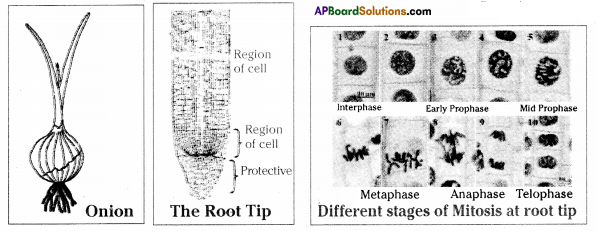
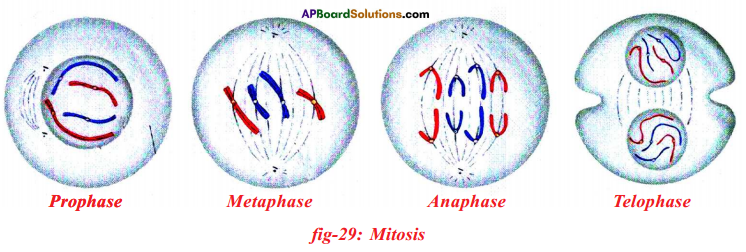
Uproot an onion plant and take a thin section of its root tip. Stain it and observe under the microscope. Draw as you see and identify the stages of the cell division.
Answer:
AP SSC 10th Class Biology Solutions Chapter 6 Reproduction - The Generating System 3

Question 20.
Visit a nearby village and collect information on how farmers grow sugarcane, flowering plants like chrysanthemum, primerose and vegetables like stem tubers, plump gourd (dondakaya), etc. Make a report and present in class.
Answer:
Report on growing methods of various plants :

Plant name Growing method
Sugarcane Stem bits with nodes called seed pieces or sets can be planted horizontally in the farrows.
Chrysanthemum It propagates often by means of suckers (the basal shoot). But some farmers grow these using seeds or the transplanted nursery plants.
Primerose These are generally grown using cuttings. Its root ball should be cut vertically making sure that each half has at least 2 plant stems.
Potatoes These are the stem tubers. The nodes on the potato are called eyes which sprout out and grow into a new plant.
Plumpgourd These have tubers just below the ground which on cutting and planting in soil can give rise to new plants.

Question 21.
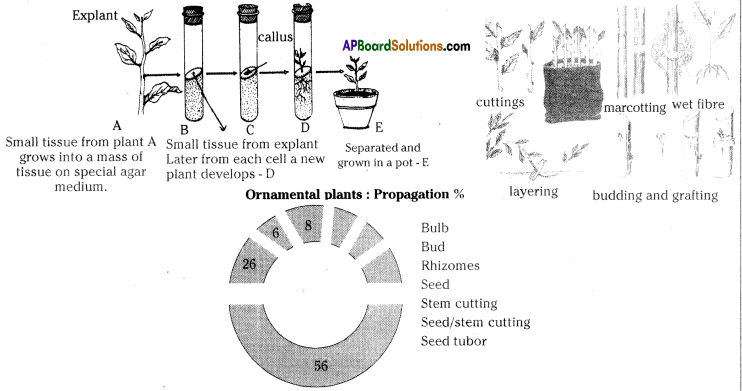
Collect the information from school library or using internet what vegetative methods are followed in your district as well as in your state to propagate various plants of economic importance. Represent it with a graph.
Answer:
Vegetative methods followed in our district as well as in our state to propagate various plants of economic importance.
I) Natural vegetative propagation: In this method of vegetative propagation, a part of the plant which may be stem, root-leaf or flower gets detached from the body of the mother plant.

  1. Vegetative propagation: Roots of radish, carrot, dahlia develop adventious buds which grow into leafy shoots.
  2. Vegetative propagation by stems: Stolons – Vallisneria, offsets – Eichhornia, Rhizome – Banana, Ginger Bulbs – Alliumcepa (Onion); Corn – Colacasia; Tuber – Potato.
  3. Vegetative propagation by leaves: Bryophyllum.
  4. Vegetative propagation by modified flowers (Bulbils): Agave.

II) Artificial vegetative propagation: Certain flowering plants have the capacity to develop a part of their somatic body into a new independent plant. In artificial vegetative propagation such plants are identified and special techniques are applied to obtain new independent plant.

  1. Cutting (Stems): Sugarcane, Roses, Hibiscus, Citrus plants.
  2. Cutting (Root): Lemon, Tamarind.
  3. Layering: Jasmine, Strawberry, Gooseberry.
  4. Grafting: Rubber, Apple, Pear, Citrus, Mango, Guava.
  5. Propagation by tissue culture technique: Lily, Rose, Magnolia, Fern, Banana for micropropagation, a small amount of tissue from a suitable part of the parent plant is excised and grown on a nutrient medium under aseptic conditions.

AP SSC 10th Class Biology Solutions Chapter 6 Reproduction - The Generating System 4

AP SSC 10th Class Biology Solutions Chapter 6 Reproduction - The Generating System

Question 22.
Make a flow chart to show the cell cycle and explain cell division describing different stages of mitosis.
Answer:
AP SSC 10th Class Biology Solutions Chapter 6 Reproduction - The Generating System 5

Different stages of mitotic cell division:

Stage Description
1) Prophase Chromatin condenses to form chromosomes. Chrormisomes split length ways to form chromatids, connected by centromeres. Nuclear membrane breaks down.
2) Metaphase Chromosomes move to spindle equator, centromeres attached to spindle fibres. Centromeres split, separating the chromatids.
3) Anaphase Spindle fibres attached to centromeres contract, pulling chromatids towards poles.
4) Telophase Chromatids elongate, become invisible. Nuclear membranes form round daughter nuclei. Nucleus divides into two and division of cytoplasm starts.
5) Cytokinesis Cytoplasm divides to form two daughter cells.

Question 23.
Draw neat labelled diagrams of male and female reproductive systems of plant.
Answer:
AP SSC 10th Class Biology Solutions Chapter 6 Reproduction - The Generating System 6

Question 24.
Observe the following part of flowering plant and prepare a note.
Answer:
The given diagram is the structure of ovule which is present in the ovary (carpel) of plant.

  1. An ovule is an egg shaped structure attached by a stalk (Funicle) to the inner side of the ovary.
  2. Depending upon the species of plant involved, an ovary may have one, two, several or even hundreds of ovules.
    AP SSC 10th Class Biology Solutions Chapter 6 Reproduction - The Generating System 7
  3. At the centre of each ovule is a microscopic embryo sac filled with food and water.
  4. The embryo-sac is composed of gametophyte cells.
  5. The majority of flowering plants have an embryo sac consisting of seven cells and eight nuclei.
  6. They are one egg (female gamete), two synergids, one central cell (secondary nucleus) and three antipodals.
  7. Central cell contains two nuclei, they are called polar nuclei.

AP SSC 10th Class Biology Solutions Chapter 6 Reproduction - The Generating System

Question 25.
Prepare a flow chart to explain the process of sexual reproduction in plants
Answer:
AP SSC 10th Class Biology Solutions Chapter 6 Reproduction - The Generating System 8

Question 26.
Draw a neat labelled diagram to explain plant fertilisation. Write few points on Pollen grain.
Answer:
AP SSC 10th Class Biology Solutions Chapter 6 Reproduction - The Generating System 1a
Pollen grains:

  1. Pollen grains develop in anther.
  2. Anther consists of spore-forming tissue. Some of the cells in the spore-forming tissue develop as pollen mother cells.
  3. Each pollen mother cell undergoes meiosis to form four daughter cells which develop into pollen grains
  4. Pollen grains are haploid (‘n’) and are otherwise known as microspores or male gametes.
  5. They contain only one set of chromosomes (‘n’).
  6. The study of pollen grain is called palynology.
  7. During pollination pollen grains are dispersed by wind and insects.
  8. Pollen grains are formed in large numbers. They are light in weight and are easily carried by wind currents.

Question 27.
How will you appreciate cell division that helps in perpetuation of life?
Answer:

  1. Perpetuation means continuation of life.
  2. The perpetuation of life is based on the cell division.
  3. Both mitotic and meiotic divisions are very essential for perpetuation of life.
  4. In unicellular organisms, the mitotic cell divisions form the entire organisms.
  5. Mitotic division is essential for all types of asexual reproductions.
  6. In sexually reproducing organisms meiotic cell division helps in formation of gametes with haploid number of chromosomes which fuses to form diploid zygote during fertilization.
  7. Zygote further divides by mitosis again and grows into an embryo and then to offspring.
  8. Thus both mitotic and meiotic cell divisions play a key role in perpetuation of life. Without cell division, there is no perpetuation of life.

Question 28.
What precautions will you take to keep away from various sexually transmitted?
Answer:
Precautions to be taken to keep away from various sexually transmitted diseases:

  1. Avoid sex with any one who has genital sores, a rash, discharge or other symptoms.
  2. The only time unprotected sex is a safe if the partners have sex only with each other.
  3. I use latex condoms every time 1 participate in sex. I use it for the entire sex act.
  4. I avoid sharing towels or under clothing.
  5. I wash genital organ before and after intercourse.
  6. I will get a vaccination for hepatitis B. This is a series of three shots.
  7. I will get tested for HIV for every six months.
  8. I will not drunk or take drugs. Under these conditions, I may fail to have safe sex.
  9. I consider that not having sex is the only way, sure way to prevent sexually transmitted diseases.
  10. Sexual act is supposed to be an act between husband and wife. Hence I will not participate in sex before marriage.
  11. When I grow up and get married, I will be upright and faithful to the life partner and will not behave immorally.
  12. Hence as a student I will concentrate on studies and create activities to achieve success in life.

AP SSC 10th Class Biology Solutions Chapter 6 Reproduction - The Generating System

Question 29.
Conduct a seminar on child marriages and foeticide.
Answer:
child marriages can also be defined as “any marriage carried out under the age of 18 years and involves the girl who is physically, psychologically, mentally and physiologically immature”.

Causes of Child marriages :

  1. Poverty in the families due to unemployment.
  2. Illiteracy among people.
  3. Ignorance of consequences of child marriages.
  4. Strong superstitions among people about child marriages.
  5. Religious and traditions are also responsible for occurance of child marriages.

Steps to prevent Child marriages:

  1. By creating awareness among the people about the ill effects of child marriages.
  2. By educating the people especially in rural areas of backward districts.
  3. By providing employment opportunities to all the people.
  4. Performing live plays, skits and stage shows to create enlightenment among the rural illiterate women about the pathetic future of kids who are forced to get married.

Foeticide:

  1. Foeticide is the illegal practice of killing a foetus. Female foeticide is prevalent in our country as a major social evil.
  2. Some kinds of complications in pregnancy can also demand surgical termination of pregnancy after 8 weeks of conception.
  3. This is where the abortion is legal and doctors may have to suggest for discontinuous of pregnancy for the sake of health of the mother. However the technique of surgical termination is misused by some people by getting rid of the unborn child.
  4. Abortion of foetus is an act of murder. God is the author of life and nobody should have right to take it.

Choose the correct answer.

1. The part of the female reproductive system produces the eggs [ ]
A) Ovary
B) Epididymis
C) Cervix
D) Fallopian tube
Answer: A

AP SSC 10th Class Biology Solutions Chapter 6 Reproduction - The Generating System

2. The term that we use to describe a sperm cell fusing with an egg cell [ ]
A) Fragmentation
B) Fermentation
C) Fertilisation
D) Fusion
Answer: C

3. Which part of the male reproductive system produces (human) the sperm cells ? [ ]
A) Vas deference
B) Epididymis
C) Seminiferous tubules
D) Scrotum
Answer: C

4. How does the sperm break through the egg cell membrane? Choose the option you think is right.   [ ]
A) Tears a hole in the membrane
B) Dissolves the membrane with chemicals
C) Bites through the membrane with teeth
D) Squeezes through gaps in the membrane
Answer: B

5. Why are egg cells larger than sperm cells? Choose the option you think is right. [ ]
A) Egg cells have more cells in them
B) Have food store to help growth after fertilisation
C) Have thicker cell membranes
D) Have larger nuclei
Answer: B

6. Which of these things will affect the way a foetus grows? Choose the option you think is right. [ ]
A) Chemicals in cigarette smoke
B) Alcohol
C) Drugs
D) All of the above
Answer: D

7. Which of the following is the correct sequence of steps in the human life cycle? Choose the right option. [ ]
A) Babyhood, childhood, adolescence, adulthood
B) Childhood, babyhood, adulthood, adolescence
C) Adolescence, babyhood, adulthood, childhood
D) None of the above
Answer: A

10th Class Biology 6th Lesson Reproduction – The Generating System InText Questions and Answers

10th Class Biology Textbook Page No. 117

AP SSC 10th Class Biology Solutions Chapter 6 Reproduction - The Generating System

Question 1.
How do you think bacteria were dividing to form curd?
Answer:
Curdling indicates that the increase in number of bacteria by fission.

10th Class Biology Textbook Page No. 118

Question 2.
How do you think this process (parthenogenesis) happens?
Answer:
This process occurs by the development of female gamete or ovum directly develops into zygote without fertilisation.

Question 3.
What about animals?
Answer:

  1. Normally the fertilized ovum (zygote) develops into a young one. But the unfertilized ovum also develops into a young one generally the male.
  2. The process of development of young ones from unfertilized ovum is called parthenogenesis.
  3. In this process sperms develop by mitotic division whereas ova develop by meiotic division.
  4. This strange kind of reproduction occurs in animals like bees and wasps.

Question 4.
Is regeneration can also be known as a type of fragmentation? Do you agree? Why? Why not?
Answer:

  1. Yes. I agree that regeneration could be also called as a type of fragmentation. Because in both cases pieces or parts from the body of the organism can develop into a new individual.
  2. Fragmentation and regeneration occur in multicellular animals.
  3. Fragmentation occurs in organisms with relatively simple body organisation.
  4. Whereas regeneration occurs in organisms with fully differentiated body organisation.

Question 5.
Which type of fission would produce larger colonies in less period of time. Why?
Answer:
Multiple fission would produce larger colonies in less period of time because more number of daughter cells are formed by multiple fission.

AP SSC 10th Class Biology Solutions Chapter 6 Reproduction - The Generating System

Question 6.
Which mode of asexual reproduction provides maximum scope of choice of desirable characters?
Answer:
Parthenogenesis provides maximum scope of choice of desirable characters.

10th Class Biology Textbook Page No. 120

Question 7.
What are the characters that would you like to select?
Answer:
The characters that I would like to select are plant with large number of fruits which are big in size and taste sweet with less or no seeds.

Question 8.
What mode of propagation would help you to produce the plants with selected characters?
Answer:
Mode of propagation that would help me to produce the plants with selected characters is grafting.

Question 9.
Whether they reproduce by budding or fission or fragmentation, organisms are copies of their parents. Is it true? Why ?
Answer:

  1. Yes, it is true that organisms reproduced by budding or fission or fragmentation are copies of their parents.
  2. Because budding or fission or fragments are not the methods of sexual reproduction.
  3. No gametes were formed or fused in these methods.
  4. Exchange of chromosomes or crossing over do not take place. Hence the offsprings produced are similar to their parents.

10th Class Biology Textbook Page No. 122

Question 10.
Do you find any similarities between rhizopus and fern spores and sporangia?
Answer:

  1. Both rhizopus and fern reproduce asexually through spores.
  2. In both the spores are microscopic, unicellular bodies produced in the sporangia.

Question 11.
What about mushrooms, how do they grow? Discuss in your class.
Answer:
Fungi grow from the fragmentation of hypae. They also form buds which are bulged from out side of cells which detaches after division of the nucleus. A special reproduc¬tive sac called sporangium produces asexual spores which are released outside. Fun¬gal sexual reproduction includes plasmogamy, Karyogamy and gametangia.

10th Class Biology Textbook Page No. 123

Question 12.
Think why testis are located outside the abdominal cavity?
Answer:
The testis are located outside the abdominal cavity because the temperature required for proper functioning of spermatogenesis is generally 2 to 3 degrees less than the body temperature,

10th Class Biology Textbook Page No. 127

AP SSC 10th Class Biology Solutions Chapter 6 Reproduction - The Generating System

Question 13.
What function do you think is served by petals and sepals?
Answer:

  1. Calyx consists of sepals give protection to the flower particularly in bud condition.
  2. Corolla consists of bright coloured petals and are useful in attracting insects for pollination.

Question 14.
Draw the diagram of the flower that you collect and label the parts shown and write their functions.
Answer:
AP SSC 10th Class Biology Solutions Chapter 6 Reproduction - The Generating System 13Functions of flower parts:

  1. Calyx: Consists of sepals – protects flower in bud conditions.
  2. Corolla: Consists of coloured petals – helps in pollination.
  3. Androecium: Consists of stamens – produce male gametes pollen grains,
  4. Gynoecium: Female reproductive part – produce ovules inside the ovary. Stigma receives pollen grain.

10th Class Biology Textbook Page No. 128

AP SSC 10th Class Biology Solutions Chapter 6 Reproduction - The Generating System

Question 15.
How does the male reproductive cell fertilise the female reproductive cell in flowers of such plants (pea plants)?
Answer:

  1. In self pollinated plants anthers are usually present above the stigma.
  2. Pollen from the anthers drop on the stigma.
  3. A process that takes place as the flowers close for the night,
  4. And sometimes occurs before they are completely developed and ready to open.
  5. At the time of pollination slightest movement of the flower’s petals stimulate the stamen to dislodge its pollen and transfer it to the near by stigma in pea plant.
  6. Pollination usually occurs before the flower is fully open, .

10th Class Biology Textbook Page No. 129

Question 16.
How many nuclei are present in the pollen grain?
Answer:
Pollen grain has two nuclei. One is called a tube cell and the another is generative cell.

10th Class Biology Textbook Page No. 131

AP SSC 10th Class Biology Solutions Chapter 6 Reproduction - The Generating System

Question 17.
Which floral part may be seen in a fruit?
Answer:
Sometimes calyx may remain with fruit.

Question 18.
How cotyledons are useful for the plant?
Answer:

  1. The cotyledons digest and absorb the endosperm.
  2. They make the stored food available for the growth of the epicotyl and hypocotyl.
  3. The cotyledons of some flowering plants, digest, absorb, and store the foods from the endosperm as the ovule is maturing into a seed. Eg: beans
  4. As a consequence, the cotyledons become greatly enlarged because of stored food and the endosperm disappears more or less completely.

10th Class Biology Textbook Page No. 137

Question 19.
What differences do you find in mitosis and meiosis? Write in a tabular form.
Answer:

Mitosis Meiosis
1. It occurs in somatic cells. 1. It occurs in germ cells.
2. Nucleus divides only once. 2. Nucleus divides twice.
3. Two daughter cells are formed. 3. Four daughter cells are formed.
4. Daughter cells are diploid. 4. Daughter cells are haploid.
5. It occurs more frequently. 5. It occurs less frequently.
6. Daughter cells form somatic organs. 6. Daughter cells form gametes.
7. There is only one prophase, one metaphase one anaphase and one telophase. 7. There are two of each phase and five sub-phases in prophase -1.
8. Number of chromosomes are not changed in the daughter cells. 8. Number of chromosomes are reduced to half.
9. Chromosome number doubles at the beginning of each cell division. 9. Chromosome number is not doubled. It doubles after the end of first meiotic division.
10. No crossing over in chromosomes. 10. Crossing over occurs chromosomes.
11. Equation division. 11. Reduction division.

Question 20.
What would happen if the gametes do not have half the chromosome number as the skin parent?
Answer:

  1. Daughter cells formed in meiosis are gametes.
  2. These gametes have half of the chromosomes in number as the parent,
  3. If the gametes do not have half of the chromosomes in number as the parent, when they fuse, they form zygote with double the number of chromosomes when compared to parent cell.
  4. If it continues, cells in the offspring will have thousands of chromosomes within few generations.
  5. If the chromosome number increases in a species it leads to the formation of abnormalities.

AP SSC 10th Class Biology Solutions Chapter 6 Reproduction - The Generating System

Question 21.
How would it affect the progeny formed by sexual reproduction?
Answer:
If the progeny have thousands of chromosomes in them, it results in formation of abnormalities in each generation.

Question 22.
Why did the government of India fixed the legal marriage age of boys (21 years) and girls (18 years)?
Answer:

  1. Government of India fixed legal marriage age of boys as 21 years, and girls as 18 years.
  2. This is because teenage mothers are not prepared mentally or physically for motherhood.
  3. Early marriage and motherhood cause health problems for the mother and child.
  4. It may also cause mental agony, as teenage mother is not ready for responsibilities of motherhood.

Question 23.
Do you feel that it is a social responsibility to control birth after having one or two children?
Answer:

  1. Yes, it is a social responsibility of every individual to control birth after having one or two children.
  2. If we don’t control birth after having one or two children, population will grow rapidly.
  3. If the population increases we will not be able to provide all the facilities such as education, medicine, employment etc., to all the people.
  4. It shows impact on the economic conditions of the family and the society.
  5. The quality of life will decrease.

AP SSC 10th Class Biology Solutions Chapter 6 Reproduction - The Generating System

Question 24.
What do you understand by the term ‘Healthy Society’?
Answer:

  1. If all the people in a society are in the state of complete physical, mental and social well being, then the society is said to be healthy society.
  2. To be in a healthy society, every one in the society should take care of their own personal hygiene and cleanliness of the surroundings.
  3. Avoiding child marriages, unprotected sex and creating awareness among the people regarding adverse effects of these are very essential to form a healthy society.

Question 25.
Will you encourage child marriage? Why?
Answer:

  1. No. I will never encourage child marriage.
  2. This is because, the sexual act always has potential to lead to pregnancy.
  3. In case of child marriage, the age of girls is less than 18 years and so they are not prepared mentally or physically for motherhood.
  4. If they got pregnancy the health of them and their child will be affected.

Question 26.
How does HIV is transmitted?
Answer:
Hiv is transmitted by unsafe sexual contacts, using infected devices,infected blood
transfusion, from an infected mother to child, etc.

10th Class Biology Textbook Page No. 138

Question 27.
Social discrimination against AIDS patients is also a social evil. Can you support this? Why?
Answer:

  1. Yes, I will support this statement.
  2. The persons suffering from HIV/AIDS are shown lot of social discrimination in the society.
  3. This happens even with their own family members.
  4. This is due to lack of awarness among public about spreading of disease, illiteracy misconception about AIDS.
  5. If everyone knows how it will not spread they will treat HIV + ves with love and effection.
  6. HIV +ves are patients. It will spread through sexual contact, blood transfusion, mother to child and not with other modes.
  7. Hence they can live with us without any discrimination they need our love and family support.
  8. If anybody shows discrimination, it is definitely a social evil.

10th Class Biology Textbook Page No. 140

AP SSC 10th Class Biology Solutions Chapter 6 Reproduction - The Generating System

Question 28.
Do you think you have moral right to kill a foetus?
Answer:
No, I don’t think that we have moral right to kill a foetus. It is our social responsibility to protect the foetus.

Question 29.
Why doctors are prohibited to do sex determination through ultrasound scanping for pregnant women?
Answer:
Knowing the sex of foetus inside mother’s womb is a severe crime as per the acfmade by government. Ultrasound tests are mend to know the growing condition of the foetus and also to see whether it is suffering with severe ailments. By knowing the sex of the foetus, if it is female, people are ready for aborting it. This leads to reduction in male female ratio in the country. That’s why doctors are prohibited to do sex determination through ultrasound scanning for pregnant women.

10th Class Biology 5th Lesson Reproduction – The Generating System Activities

Activity – 1

Formation of bacterial colony in milk.
Answer:

  1. Take a tea spoon full of curd and mix it thoroughly with around tea spoon full of (half of the glass) luke warm milk in a bowl.
  2. Take another tea spoon full of curd and mix it with 30 tea spoon full of cold milk in another bowl,
  3. Cover both the bowls and note the initial time.
  4. Keep observing every hour to see whether curd has formed.
  5. Curdling indicates that the increase in number of bacteria.
  6. Note the time taken for formation of curd in both the bowls.
  • Does it take the same time to form curd in both the bowls?
    Answer: No. Formation of curd in the bowl containing luke warm milk takes nearly 5 – 6 hours. In the second bowl in which cold milk is present no curdling took place.
  • What does the time taken to form nearly 30 times the size of the bacterial colony indicate?
    Answer: Time taken to form nearly 30 times the size of the bacterial colony indicates how fast bacteria are growing.

Activity – 2

AP SSC 10th Class Biology Solutions Chapter 6 Reproduction - The Generating System

Examine Rhizopus or common mould under Microscope.
(OR)
Write the materials required and the procedure followed by you to observe Rhizopus in the lab.
(OR)
Write the procedure which you follow to observe bread-mould Sporangium m your laboratory. What precautions do you take during the activity?
(OR)
Suneetha wanted to observe Rhizopus on the piece of bread,
(i) Suggest the apparatus needed. (ii) Write the procedure to be followed.
Answer:
Aim: To grow and examine rhizopus or common mould.
Materials required: Bread, plastic bag, plain glass slide, cover slip, water, eye dropper, disposable gloves, compound microscope.
Procedure to grow mould:

  1. Take a soft bread and leave it in the open for about an hour so it is exposed to contaminants in the air.
  2. Place the bread in a plastic bag, sprinkle water over it, so it is damp and seal the bag living some air inside.
  3. Check on the piece of bread every few days and add more water if it is becoming dried out.
  4. We can find whitish thread like growth with masses of black, gray and green fine dotted structures, the black dotted structure is that of bread mould.
  5. A good sample of mould may take up to two weeks to form.
  6. Using this mould make a slide and observe under the microscope.

Procedure to make a slide:

  1. Place a drop of water in the centre of the slide, using an eye dropper if you have one, or the tip of a clean finger.
  2. Using a tooth pick, scrape some of the mould off, and place it on the drop of water.
  3. Take the coverslip and set it at an angle to the slide so that one edge of it touches the water drop.
  4. Then carefully lower it over the drop, so that the coverslip covers the specimen without trapping air bubbles underneath.
  5. Use the corner of a tissue paper or blotting paper to blot up any excess water at the edges of the coverslip.
  6. View the slide with a compound microscope, starting with a low objective.

Observations:

AP SSC 10th Class Biology Solutions Chapter 6 Reproduction - The Generating System 9

  1. The common bread mould plant consists of fine thread like projections called hyphae and thin stems having knob like structures called sporangia.
  2. Each sporangium contains hundreds of minute spores.

Precautions:

  1. This should not be done by those with allergies to mould or with severe asthma.
  2. Avoid opening the plastic bag as much as you can.
  3. If you touch the bread, be sure to thoroughly wash your hands afterwards.

Activity – 3

AP SSC 10th Class Biology Solutions Chapter 6 Reproduction - The Generating System

Observation of pollen grain.

  1. Take a slide and put a few drops of water on it.
  2. Take any flower like hibiscus, tridax, marigold, etc. Tap the anther over the drop of water.
  3. We will see small dot like structures in water. These are pollen grains.
  4. Take permanent slide of pollen grain from your lab.
  5. Also see a permanent slide of pollen grain from our lab.
  6. Observe under a microscope. We will make a drawing of what we observe and compare with the given diagram.

Observation: Pollen grain germinates only on stigma. Pollen grain consists of two to three cel Is surrounded by a protective wall in Angiosperms. In gymnosperms the pollen grain consists of several living cells.
AP SSC 10th Class Biology Solutions Chapter 6 Reproduction - The Generating System 10

Activity – 4

Seed germination.
Answer:

  1. Soak a few groundnut or bengal gram (chana) seeds overnight.
  2. Drain the excess water and cover the seeds with wet cloth. Leave them for a day.
  3. Keep sprinkling water at regular intervals so that they do not dry up.
  4. Open the seeds carefully and observe the parts.

Observation: The seed is germinated i.e., the seed embryo is developed into seedling plumule which grows into plant.
AP SSC 10th Class Biology Solutions Chapter 6 Reproduction - The Generating System 11

Activity – 5

Observe different stages of mitotic cell division. (OR)
Describe various stages of mitosis with the help of neat diagrams.
Answer:
AP SSC 10th Class Biology Solutions Chapter 6 Reproduction - The Generating System 12

  1. Take permanent slides which shows different stages of mitotic cell division from your lab kit.
  2. Observe carefully under microscope.
  3. Draw diagrams what you observe, and compare your observations with the following chart.
Stage Description
1. Prophase
  1. Chromosomes contract, spiral and become visible even in light microscope and nucleoli become smaller (material to chromosomes).
  2. Chromosomes split lengthwise to form chromatids, connected by centromeres.
  3. Nuclear membrane disappears.
  4. Centrosome, containing rod-like centrioles, divides and forms ends of spindle (probably animal cells only).
    (Note : No pairing of chromosomes as in meiosis).
2. Metaphase
  1. Chromosomes move to spindle equator, spindle fibres attached to centromeres.
3. Anaphase
  1. Centromeres split, separating the chromatids.
  2. Spindle fibres attached to centromeres contract, pulling chromatids towards poles.
4. Telophase
  1. Chromatids elongate, become invisible, (replication at this stage to become chromosomes).
  2. Nuclear membranes form round daughter nuclei.
  3. Cell membrane pinches in to form daughter cells (animals) or new cell wall material becomes laid down across spindle equator (plants).
  4. Nucleus divides into two and division of cytoplasm starts.


AP SSC 10th Class Biology Solutions Chapter 9 Our Environment

AP State Board Syllabus AP SSC 10th Class Biology Solutions Chapter 9 Our Environment Textbook Questions and Answers.

AP State Syllabus SSC 10th Class Biology Solutions 9th Lesson Our Environment

10th Class Biology 9th Lesson Our Environment Textbook Questions and Answers

Improve your learning

Question 1.
What happens to the amount of energy transferred from one step to the next in a food chain?
Answer:

  1. Energy is transferred along food chains from one trophic level to the next.
  2. The amount of available energy decreases from one stage to the next.
  3. This is because not all the food can be fully digested and assimilate.
  4. Hair, feathers, insect exoskeletons, cartilage and bone in animal foods, cellulose and lignin in plant foods cannot be digested by most animals.
  5. These materials are excreted or made into pellets of indigested remains.
  6. Assimilated energy is available for the synthesis of new biomass through growth and reproduction.
  7. Organisms also lose some biomass by death disease or annual leaf-drop.
  8. Moreover at each tropic level, organisms use the most of the assimilated energy to fulfill their metabolic requirements – performance of work, growth and reproduction.
  9. Most of the energy is lost in the form of heat during biological processes.
  10. Only a small fraction goes to the consumer at next tropic level.

AP SSC 10th Class Biology Solutions Chapter 9 Our Environment

Question 2.
What do pyramids and food chain indicate in an ecosystem?
Answer:

  1. The ecologists used the idea of pyramid to show relationship among organisms in an existing food chain.
  2. Ecological pyramids are of three types. They are pyramid of biomass, pyramid of number, pyramid of energy.
  3. Pyramid of biomass indicates the available biomass in an ecosystem; pyramid of number indicates the organisms present and pyramid of energy indicates the available energy in an ecosystem.
  4. The food chain in an ecosystem indicates how energy is transferred from one organism to another.
  5. The starting point of a food chain are producers and it ends with top carnivores.
  6. A food chain represents a single directional transfer of energy.

Question 3.
Write a short note on pyramid of number for any food chain. What can we conclude from this pyramid of numbers?
i) tree ii) insect iii) woodpecker
(OR)
What is a pyramid of numbers? Write a brief note on the pyramid of numbers with the help of a block diagram.
Answer:
a.

AP SSC 10th Class Biology Solutions Chapter 9 Our Environment 1AP SSC 10th Class Biology Solutions Chapter 9 Our Environment 2

  1. The number of organisms in a food chain can be represented graphically in a pyramid of number.
  2. Each bar represents the number of individuals at each tropic level in a food chain.
  3. In the pyramid of numbers, from the first – order consumers to the large carnivores, there is normally an increase in size, but decrease in number.
  4. For example, in a wood, the aphids are very small and occur in astronomical numbers.
  5. The ladybirds which feed on them are distinctly larger and not so numerous.
  6. The insectivorous birds which feed on the ladybirds are larger still and are only present in a small numbers, and there may only be a single pair of hawks of much larger size than the insectivorous birds on which they prey.

b.

  1. In the given pyramid, the producer is a large tree, primary consumers are small
    insects which are numerous in number and secondary consumers are woodpeckers which are comparatively less in number than insects.
  2. From this pyramid of number, we can conclude that sometimes the pyramid of numbers does not look like a pyramid at all.
  3. This could happen if the producer is a large plant or if one of the organisms at any tropic level is very small.
  4. Whatever the situation, the producer still goes at the bottom of the pyramid.

AP SSC 10th Class Biology Solutions Chapter 9 Our Environment

Question 4.
What is biomass? Draw a pyramid of biomass for the given food chain.
i) grass leaves ii) herbivores iii) predators iv) hawk
Answer:

  1. Biomass is organic material of biological origin that has ultimately derived from the fixation of carbon dioxide and the trapping of solar energy.
  2. This includes trees, shrubs, crops, grasses, algae, aquatic plants* agricultural and forest residues and all forms of human, animal and plant waste.
  3. Any type of plant or animal material that can be converted into energy is called “Biomass”.
  4. AP SSC 10th Class Biology Solutions Chapter 9 Our Environment 3

Question 5.
How is using of toxic material affecting the ecosystem? Write a short note on bioaccumulation and biomagnifications.
Answer:

  1. Use of toxic materials such as pesticides, herbicides and fungicides creates new problems in the ecosystem.
  2. As these toxic materials are often indiscriminate in their action and vast numbers of other animals may be destroyed.
  3. Some of them may be predators which naturally feed on these pests, others may be the food for other animals.
  4. Thus causing unpredictable changes in food chains and upsetting the balance within the ecosystem.
  5. Some toxic substances have a cumulative effect.
  6. Some of them are degradable, can be broken down into harmless substances in a comparatively short time usually a year.
  7. Others are non-degradable which are potentially dangerous as they accumulate in the bodies of animals and pass right through food web.
  8. This process of entering of pollutants in a food chain is known as “Bioaccumulation”.
  9. The tendency of pollutants to concentrate as they move from one tropic level to the next is known as “Biomagnifications”.

AP SSC 10th Class Biology Solutions Chapter 9 Our Environment

Question 6.
Should we use pesticides as they prevent our crop and food from pests or we should think of alternatives? Write your view about this issue and give sound reason for your answer.
(OR)
Why should we think of alternatives to pesticides? Give reasons.
Answer:

  1. We should think of alternatives. This is because these pesticides are toxic chemical whose usage leads to Bioaccumulation and Biomagnifications.
  2. When we use pesticides, they prevent our crop and food from pests effectively but indiscriminately destroys a vast number of other animals.
  3. This is causing unpredictable changes in food chains and upsetting the balance within the ecosystem.
  4. Most of the chemical pesticides that contain mercury, arsenic or lead are non -degradable.
  5. They enter into food chain, accumulate in the bodies of animals and pass right through food web.
  6. Being further concentrated at each step until animals at the top of the pyramid may receive enough to do considerable harm.
  7. This is one of the reasons for ever decreasing number of butterflies, bees, small and large birds.
  8. Some of the pesticides are nerve poisons and might bring about changes in behaviour.
  9. As the human beings are at the end of the food chain, these pesticides may get accumulated in our bodies also. This shows some adverse effects on us, when their concentration becomes sufficiently high.

Question 7.
What is a tropic level? What does it represent in an ecological pyramid?
Answer:

  1. The various steps in a food chain at which the transfer of food takes place is called tropic level.
  2. Tropic level means the feeding level of the organism.
  3. In an ecological pyramid, the first tropic level represents the primary producers, and their number, biomass or energy.
  4. Second tropic level represents the herbivores or primary consumers and their number, biomass or energy.
  5. The tropic level represents the lower carnivores or secondary consumers and their number, biomass or energy.
  6. The fourth tropic level represents the higher carnivores or tertiary consumers and their number, biomass or energy.

AP SSC 10th Class Biology Solutions Chapter 9 Our Environment

Question 8.
If you want to know more about the flow of energy in an ecosystem, what questions do you ask?
Answer:
I will ask the following questions to know more about flow of energy in an ecosystem.

  1. How does the energy flow in an ecosystem from one organism to other?
  2. Is the energy transformation from one level to other 100% efficient?
  3. What per cent of energy transfers from one level to other?
  4. What happens to the remaining energy?
  5. How does the ecosystem lose its energy during energy transformation?
  6. Which tropic level in an ecosystem has more energy and which has less?
  7. What is the ultimate source of energy in an ecosystem?

Question 9.
What will happen if we remove predators from food web?
Answer:

  1. Removal of organisms from any tropic level of a food chain or food web disturbs the ecosystem and leads to ecological imbalance.
  2. If we remove predators from food web, the prey population will increase enormously as there is no natural control over them.
  3. The producers population will decrease rapidly as the organisms feeding on them increase.
  4. After few generations the prey population also begins to decrease as some of the preys begin to die due to starvation.
  5. Some adaptations may also be developed by the organisms to bring the ecological balance.
  6. But it may take some generations, till that the ecosystem will be disturbed and imbalanced.
  7. For example, if we remove all the predators (carnivorous) from a forest ecosystem, the herbivorous animal population will increase as there are no carnivores to hunt them.
  8. As a result plant population will decrease as the ever increasing herbivores feed more and more on plants.
  9. After some generations the herbivore population begins to decrease as the decreasing number of plants are not sufficient to feed.
  10. Then some herbivorous animals may adapt to feed on other herbivores to increase their survival.
  11. Then scope for survival will increase for plants again which leads to ecological balance.
  12. But this may take lot of time to evolve new predators and to form ecological balance.

AP SSC 10th Class Biology Solutions Chapter 9 Our Environment

Question 10.
Observe a plant in your kitchen garden, and write a note on producer-consumer relationship.
Answer:
When I observe a plant in kitchen garden, I came to know the following things.

  1. Though it may be relatively small, a garden is a complete ecosystem.
  2. It has the same components as any other large and elaborate ecosystems had.
  3. The plant in a kitchen garden is a producer as it produces their own food from sunlight.
  4. There are two types of consumers in this ecosystem, a) Primary consumers and b) Secondary consumers.
  5. Primary consumers feed on plants. This tropic level consists of caterpillars, bees and butterflies.
  6. Secondary consumers feed on primary consumers. This tropic level consists of birds, garden lizards and spiders.
  7. Fungi, bacteria, insects and worms make up decomposers.
  8. The producer and consumer relationship can be shown in the following food chain.
    Plant → Plant eaters such as caterpillars, bees, butterflies → Meat-eaters such as birds, garden lizards, spiders
    Producers → Primary consumers → Secondary consumers
  9. The pyramid of number appears like this.
    AP SSC 10th Class Biology Solutions Chapter 9 Our Environment 4
  10. The pyramid of Biomass appears like this
    AP SSC 10th Class Biology Solutions Chapter 9 Our Environment 5
  11. The pyramid of energy appears like this
    AP SSC 10th Class Biology Solutions Chapter 9 Our Environment 6

AP SSC 10th Class Biology Solutions Chapter 9 Our Environment

Question 11.
What type of information do you require to explain the pyramid of biomass?
Answer:
To explain the pyramid of biomass, we require the following information.

  1. The type of ecosystem.
  2. Producers in the ecosystem.
  3. Primary consumers in the ecosystem.
  4. Secondary consumers in the ecosystem.
  5. Tertiary consumers in the ecosystem.
  6. Number of organisms at each tropic level.
  7. Size of organisms at each tropic level.
  8. Weight of organisms at each tropic level.
  9. All forms of waste produced at each tropic level and
  10. In total, total amount of biomass produced at each tropic level.

Question 12.
Draw a pyramid of numbers considering yourself sis top level consumer. Pyramid of numbers
Answer:
Pyramid of numbers
Ex: 1
AP SSC 10th Class Biology Solutions Chapter 9 Our Environment 7

Ex: 2
AP SSC 10th Class Biology Solutions Chapter 9 Our Environment 8

AP SSC 10th Class Biology Solutions Chapter 9 Our Environment

Question 13.
Prepare slogans to promote awareness in your classmates about eco-friendly activities.
All the living things have the right to live on this earth along with us. Prepare slogans to promote awareness in public about the conservation of biodiversity.
(OR)
Which slogans do you prefer to promote awareness in your locality about eco-friendly activities?
Answer:

  1. Live and let live.
  2. If we protect the environment, it protects us.
  3. Conserve nature – Conserve life.
  4. Save mother earth.
  5. Earth needs you.
  6. Go ecofriendly.
  7. Clean the environment, live happily.
  8. Heal our planet! Turn it into a better planet.
  9. Plant a tree for your environment.
  10. Think ecofriendly and live ecofriendly.
  11. Earth enables you to definitely stand. Allow it to stand the actual way it is.
  12. You’ve only got one planet. Don’t trash it.

Question 14.
Suggest any three programmes on the prevention of soil pollution in view of avoiding pesticides.
(OR)
Suggest any four eco-friendly methods for prevention of soil pollution in view of avoiding pesticides. (OR)
In your area, soil is polluted by the enormous usage of pesticides. Suggest any two programmes for the prevention of soil pollution.
Answer:
To prevent the soil pollution caused by pesticides following programmes should be implemented.

  1. Rotation of crops :
    1. Same crop should not be grown in the same field in successive seasons.
    2. Rotation of crops reduce occurance of pests and damage due to pests will be decreased.
  2. Biological control: Introducing natural predator or parasite of the pest.
  3. Sterility: Sterilising the males of a pest species reduces the population of pests.
  4. Genetic strains: The development of genetic strains which are resistant to certain pest.
  5. Studying the life histories of the pests: When this is done it is sometimes possible to sow the crops at a time when least damage will be caused.

AP SSC 10th Class Biology Solutions Chapter 9 Our Environment

Choose the correct answer.

  1. What does a food chain always start with?
    A) The herbivore
    B) The carnivore
    C) The producer
    D) None of these
    Answer: C
  2. Which of the following do plants not compete for?
    A) Water
    B) Food
    C) Space
    D) All the above
    Answer: B
  3. Ban all pesticides, this means that
    A) Control on the usage of pesticides
    B) Prevention of pesticides
    C) Promote eco-friendly agricultural practices
    D) Stop biochemical factories
    Answer: C
  4. According to Charles Elton
    A) Carnivores at the top of the pyramid herbivore
    B) Energy trapping is high at the top of the pyramid
    C) No producers at the top of the pyramid
    D) A and C
    Answer: D

10th Class Biology 9th Lesson Our Environment InText Questions and Answers

Question 1.
Are all terrestrial ecosystems similar?
Answer:

  1. No. All the terrestrial ecosystems are not similar.
  2. Basing on variations in climatic conditions such as rainfall, temperature and the availability of light, there are various kinds of ecosystems.
  3. The major types of terrestrial ecosystem are
    1. Tundra,
    2. Coniferous forest,
    3. Deciduous forest,
    4. Savannah,
    5. Tropical forest and
    6. Deserts.

AP SSC 10th Class Biology Solutions Chapter 9 Our Environment

Question 2.
If we want to show a food chain consisting of grass, rabbit, snake and hawk then connect the given picture of organisms by putting arrows and make a food chain.
A) Name the producers and consumers in the above food chain.
B) Try to guess what does the arrows marked by you are indicate?
C) Identify at least four other food chains from your surroundings. Name the producers and different levels of consumers in those food chains.
Answer:
Grass → Rabbit → Snake → Hawk
A) In the above food chain grass is the primary producer. Rabbit is the primary consumer, snake is the secondary consumer and hawk is the tertiary consumer.
B) The arrows indicate the flow of energy from one organism to another. So these are always pointed from the food to the feeder.
C)

  1. Plant → insect → frog → bird
  2. Plant → insect →  frog → snake
  3. Aquatic plants → insects → fish → crane
  4. Plant → mice → snake → vulture
  5. Plant → aphids → spiders → birds

Question 3.
Why do most of the food chains consists of four steps?
Answer:

  1. Most of the food chains are quite short and mostly consists of four steps.
  2. This is because only 10% of the energy present in a tropic level transfers to the other tropic level.
  3. Remaining energy is dissipated as heat produced during the process of respiration and other ways.
  4. Thus about three steps in a food chain very little energy is still available for use by living organisms.

Question 4.
Why do the number of organisms get decreased as we move from producer to different level of consumers?
Answer:

  1. As we move from producers to different levels of consumers the energy available will decrease gradually.
  2. Only ten per cent of the energy present in one tropic level transfer to another tropic level.
  3. Biomass also decreases gradually as only 10 – 20% of the biomass is transferred from one tropic level to the next in a food chain.
  4. As there is less energy & less biomass available at top levels, number of organisms also less, generally.
  5. So, the number of organisms get decreased as we move from producer to different level of consumers.

AP SSC 10th Class Biology Solutions Chapter 9 Our Environment

Question 5.
Draw the pyramid of number for the following food chains.
i) Banyan → insects → woodpecker
ii) Grass → rabbit → wolf
A) Are the pyramid of number having same structure in both of the above two cases as compare to the example given in the earlier paragraph?
B) If there is a difference, then what it is?
Answer:
AP SSC 10th Class Biology Solutions Chapter 9 Our Environment 9
A) No. The pyramid of number in the above two cases doesn’t have the same structure as compared to the example given in the textbook.
B)

  1. In the example (given in the textbook), number of organisms at producers level is more. This number gradually decreased in consumers level step by step. So the pyramid of number formed has typical pyramid shape with broad base and the narrow apex.
  2. But in the first case given here, on a single Banyan tree, a large number of insects live and feed. These insects become food for few Woodpeckers. So producers number is less than primary and secondary consumers, and secondary consumers are less than primary consumers. So the pyramid of number does not look like a pyramid. It consists of narrow base, broad middle part and medium apex.
  3. In the second case, grass which are large in number become food for few rabbits. Rabbit provides food for several wolves which are comparatively less in number than grass. So primary consumers are less in number than secondary consumers and producers. So the pyramid of number for this food chain also does not look like a pyramid. It consists of broad base, narrow middle part and medium apex. Thus it differs from case (i) also.

Question 6.
Think why the pyramids are always upright?
Answer:

  1. In ecology not all the pyramids are always upright.
  2. Pyramid of number may be upright, inverted or partly upright.
  3. Pyramid of biomass may be upright or inverted.
  4. But the pyramid of energy is always upright.
  5. This is because energy will decrease when we move from producers to the high level consumers.
  6. Only 10% of the energy from one tropic level transfers to the other through food chain.
  7. So the energy at base is more, gradually decreases, and very less at the top.
  8. As a result the energy pyramid is always upright.

AP SSC 10th Class Biology Solutions Chapter 9 Our Environment

Question 7.
Observe the data given in the following table.

Classes Area in 1967(Km2) Area in 2004 (Km2)
Lake – water spread area 70.70 62.65
Lake with sparse weed 0 47.45
Lake with dense weed 0 15.20
Lake-liable to flood in rainy season 100.97 0
Aquaculture ponds 0 99.74
Rice fields 8.40 16.62
Enchrochment 0.31 1.37
Total 180.38 180.38

i) In which year lake-water spread area is more? Why?
Answer:
In the year 1967. Because lake was not brought under cultivation.

ii) How do you think weeds are more in the lake?
Answer:
Excessive nutrient addition, especially from anthropogenic sources, led to explosive weed growth. Ex: Eichornia, pistia.

iii) What are the reasons for decrease in lake area?
Answer:

  1. In 1996, almost entire lake was brought under cultivation.
  2. Industries came along in ever growing intensity in the catchment area of the lake.

iv) How do the above reasons lead to pollution?
Answer:

  1. Consequently, the drains and rivulets carry substantial quantity of various types of pollutants into the lake.
  2. The major sources of pollution are agricultural runoff containing residues of several agrochemicals, fertilizers, fish tank discharges, industrial effluents containing chemical residues.

v) How was the threat to the lake due to pollution discovered?
Answer:

  1. The water of the lake turned alkaline in nature, turbid, nutrient rich, low in dissolved oxygen and high in biochemical oxygen demand.
  2. Water borne diseases like diarrhoea, typhoid, amoebiasis and others are said to be common among the local inhabitants who are unaware of the state of pollution in the lake water.
  3. Vector borne diseases were also increased.

vi) What could be the reasons for the migration of birds to this lake?
Answer:
To avoid extreme cold weather conditions in Northern Asia and Eastern Europe birds migrate to Kolleru lake.

AP SSC 10th Class Biology Solutions Chapter 9 Our Environment

Question 8.
Observe the following table showing different activities in the lake and their influence.
AP SSC 10th Class Biology Solutions Chapter 9 Our Environment 10Legend:
(+) means has influence on the mentioned problem
(-) means has no influence on the mentioned problem
i) What are the factors that affected the number of migratory birds to decrease?
Answer:
Aquaculture practices.

ii) Do you find any relationship between biological and physical problems?
Answer:
Yes. Aquaculture practices have influence on these problems.

iii) What are the reasons for chemical problems ?
Answer:
Agricultural practices, aquaculture practices, industrial activities and human activities are the reasons for chemical problems.

iv) What happens if the dissolved oxygen reduce in lake water ?
Answer:
If the dissolved oxygen reduces in lake water, sufficient amount of oxygen will not be available to organisms that live in the lake.
This leads to the death of organisms in the lake.

v) Is BOD of turbid and nutrient rich water high or low? What are its consequences?
Answer:
High. Its consequences are water borne diseases and death of organisms.

vi) People living in catchment area of Kolleru faced so many problems. Why?
Answer:
Vector borne disease increased. The lands adandoned are useless for agriculture.

AP SSC 10th Class Biology Solutions Chapter 9 Our Environment

Question 9.
Name any two pesticides / insecticides you have heard about.
Answer:
DDT, Aldrin, Malathian, Altrazine, Monocrotophos, Endosulphan etc.

Question 10.
How are the food grains and cereals being stored in your house and how dojyou protected them from pests and fungus?
Answer:
To protect food grains and cereals from pests and fungus, we will follow the following rules in our house.

  1. First of all we will dry and clean our grain before storing.
  2. We will avoid moisture in bagged grains by storing them on wooden structures, bamboo mats or polythene covers.
  3. We use domestic bins or improvised storage structures such as Gaade, Kotlu, Paatara, RCC bins and flat bottom metal bins etc.
  4. We fumigate the storage room with Ethylene Di-bromide (EDB) ampoules to avoid insect damage.
  5. We use anticoagulant for rat control in houses.

Question 11.
Where from pollutants enter to the water sources?
Answer:
The used water from industries and run off water containing agricultural effluents bring pollutants into water sources. Municipal and domestic sewage also pollute water sources.

Question 12.
How can you say fishes living in water having heavy metals in their bodies?
Answer:
The bioaccumulation of heavy metals in tissues of fish particularly in liver, kidney and gills were analysed and found their presence.

AP SSC 10th Class Biology Solutions Chapter 9 Our Environment

Question 13.
Researchers found that pollution levels increase during monsoon season. Why they found so?
Answer:

  1. Pollution levels increase during monsoon season in water bodies.
  2. During monsoon season heavy rainfall occurs.
  3. The rain water brings residues of agrochemicals, fertilizers and different types of organic substances, municipal and domestic sewage.
  4. Hence pollution levels increase in monsoon season.

Question 14.
Why did people also suffer from various diseases after consuming fishes living in local water reservoir?
Answer:

  1. The heavy metals could find their way into human beings through food chain.
  2. This bioaccumulation cause various physiological disorders such as hypertension, sporadic fever, renal damage, nausea etc.

Question 15.
What is the food chain that has been discussed in the above case?
Answer:
The food chain discussed in the above occurrence is Crops → Locust → Sparrow → Hawk.

Question 16.
How did the campaign disturb the food chain in the fields?
Answer:

  1. Crop yields after the campaign were substantially decreased.
  2. Though the campaign against sparrows ended it was too late.
  3. With no sparrows to eat the locust populations, the country was soon swarmed.
  4. Locust coupled with bad weather led to the great Chinese famine.

Question 17.
How did these disturbances affect the environment?
Answer:

  1. The number of locust increased.
  2. Use of pesticides against locust population further degraded the land.

Question 18.
Is it right to eradicate a living organism in an ecosystem? How is it harmful?
Answer:

  1. No, it is not right to eradicate a living organism in an ecosystem.
  2. It disturbs the existing food chain.

AP SSC 10th Class Biology Solutions Chapter 9 Our Environment

Question 19.
Were the sparrows really responsible? What was the reason for the fall in crop production?
Answer:

  1. No, the sparrows were not really responsible for the loss of food grain.
  2. With no sparrows to eat the locust population crops were damaged and this led to fall in crop production.

Question 20.
What was the impact of human activities on the environment?
Answer:

  1. The human activities badly affected the environment.
  2. Use of pesticides against the pest degraded the land.

Question 21.
What do you suggest for such incidents not to occur?
Answer:

  1. I suggest to use organic manures and organic insecticides to kill the insects.
  2. Rotation of crops is the best method to protect the crops from pests.
  3. We should not kill any organism on this earth because every organism has a role to play.
  4. Think before you start action.

10th Class Biology 9th Lesson Our Environment Activities

Activity – 1

Observe any water ecosystem in your surroundings and identify the different food chains and food web operating in this ecosystem. Write the following details in your notebook.

WORKSHEET

1. Names of the students in a group: ——————— Date: ———–
2. Name of the ecosystem: ———————
3. Topography: ———————
4. Names / Number of plants (producers) identified: ———————
5 Names / Number of animals identified: ———————
6. Identify the different types consumers and name them & mention their number below :
Herbivores (Primary consumers): ———————
Carnivores (Secondary consumers): ———————
Top carnivores (Tertiary): ———————
7 Food relationships among them: food habits/preferences: ———————
8 Show / draw the different food chains: ———————
9. Showcase the food web: ———————
10. List out all abiotic factors existing in the ecosystem: ———————
( A check list can be given, and asked to tick)
11. Is there any threat to the ecosystem ? Yes / No ———————
If yes, what ? and how ? ———————
Suggest few remedial measures ———————
Answer:
Student’s Activity.

AP SSC 10th Class Biology Solutions Chapter 4 Excretion – The Wastage Disposing System

AP State Board Syllabus AP SSC 10th Class Biology Solutions Chapter 4 Excretion – The Wastage Disposing System Textbook Questions and Answers.

AP State Syllabus SSC 10th Class Biology Solutions 4th Lesson Excretion – The Wastage Disposing System

10th Class Biology 4th Lesson Excretion – The Wastage Disposing System Textbook Questions and Answers

Improve your learning

Question 1.
What is meant by excretion? Explain the process of formation of urine.
(OR)
What are the different stages in urine formation? Explain what happens in those stages.
(OR)
Explain various steps in the mechanism of urine formation.
Answer:
Excretion: Excretion is a biological process involved in separation and removal of toxic wastes from the body.
Formation of urine involves four stages:

  1. Glomerular filtration
  2. Tubular reabsorption
  3. Tubular secretion and
  4. Concentration of urine.

1. Glomerular filtration:

  1. Blood flows from renal artery to glomerulus through afferent arteriole.
  2. Filtration of blood occurs in the glomerulus.
  3. Glomerular filtrate is also known as primary urine which almost equal to blood in chemical composition except the presence of blood cells.

2. Tubular reabsorption:

  1. The primary urine passes into proximal convoluted tubule.
  2. Useful substances like glucose, amino acids, sodium chloride, potassium ion, bicarbonate ion, water are reabsorbed into peritubular network.

3. Tubular secretion:

  1. After reabsorption in proximal convoluted tubule (PCT) the urine travels through the loop of Henle into distal convoluted tubule.
  2. Here some other wastes like extra salts ions of K+, Na+, Cl and H+ secrete from peritubular capillaries into distal convoluted tubule which are surrounded by peritubular network.

4. Concentration of urine:

  1. 75% of water content of the nephric filtrate is reabsorbed in the region of proximal convoluted tubule and 10% of water passes out of filtrate through osmosis in the area of loop of Henle.
  2. The concentration of urine takes place in the area of collecting tubes in the presence of hormone called vasopressin. The hormone is secreted only when concentrated urine is to be passed out.

AP SSC 10th Class Biology Solutions Chapter 4 Excretion - The Wastage Disposing System

Question 2.
How are waste products excreted in Amoeba?
(OR)
Write the process of excretion in amoeba.
Answer:

  1. Specific excretory organs are absent in unicellular organisms like amoeba.
  2. Amoeba possess osmoregulatory organell called contractile vacuole.
  3. It collects water and wastes from the body, swells up, reaches the surface and bursts to release its content to outside.
  4. The main excretion takes place through body surface by simple diffusion.
  5. The waste material carbon dioxide is removed by diffusion through the cell membrane.

Question 3.
Name different excretory organs in human body and excretory material generated by them.
Answer:
Different excretory organs in human body and excretory material generated by them are as follows.

Excretory organ Excretory material generated
Kidney Filters blood and eliminates nitrogenous wastes and other harmful things. Filters urea from the blood.
Lungs They remove carbon dioxide and water in respiration.
Skin Sweat and metabolic wastes. Sebaceous glands in skin eliminates sebum which contains waxes, sterols, hydrocarbons and fatty acids.
Liver Bile pigments bilirubin, biliverdin are metabolic wastes of haemoglobin of dead red blood cells.
Urochrome is eliminated through urine. Liver also eliminates cholesterol and derivatives of steroid hormones, extra drug, vitamins and alkaline salts. Urea is also formed in liver.
Intestine Excess salts of calcium, magnesium and iron are excreted by epithelial cells of colon for elimination along with faeces.
Eccrine glands These allow excess water to leave the body. They are present mainly on the forehead, the bottoms of the feet and the palms.
Salivary glands and Lacrimal glands Small amount of nitrogenous wastes are also eliminated through saliva & tears.

Question 4.
Deepak said that ‘Nephrons are functional and structural units of kidneys’. How will you support him?
(OR)
How can you say that kidney is suitable for the filtration of biological waste from blood in man?
Answer:
I support Deepak’s statement that nephrons are functional units of kidneys because

  1. Nephron’s chief function is to regulate the concentration of water and soluble substances like sodium salts by filtering the blood, reabsorbing what is needed and excreting the rest as urine.
  2. Nephron eliminates wastes from the body, regulates blood volume and blood pressure, controls levels of electrolytes and metabolites and regulates blood pH.
  3. Its functions are vital to life and are regulated by the endocrine system.
  4. Hence, nephrons are the functional units of kidneys.

AP SSC 10th Class Biology Solutions Chapter 4 Excretion - The Wastage Disposing System

Question 5.
How do plants manage the waste materials?
Answer:

  1. Plants can get rid of excess water by a process like transpiration and guttation.
  2. Waste products may be stored in leaves, bark and fruits.
  3. When these dead leaves, bark, and ripe fruits fall off from the tree, the waste products in them are got rid of.
  4. Some of the plant waste gets stored in the fruits in the form of solid bodies called Raphides. e.g: Yam.
  5. Several plants prepare chemicals and store them in roots, leaves, seeds to protect against herbivores.
  6. The plants excrete carbon dioxide produced as a waste during respiration only at night time.
  7. The plants excrete oxygen as a waste only during the daytime.
  8. The plants get rid of wastes by secreting them in the form of gums and resins.
  9. Plants also excrete some waste substances into the soil around them.

Question 6.
Why do some people need to use a dialysis machine? Explain the principle involved in it.
Answer:

  1. Kidneys are vital organs for filtration of nitrogenous waste material from blood and for survival of a person.
  2. Factors like infections, injury, very high blood pressure, very high blood sugar restrict blood flow to kidneys.
  3. This leads to accumulation of poisonous wastes in the body and leads to death.
  4. When both kidneys are damaged DIALYSIS machine is used to filter the blood of a person.
  5. This process is called HAEMODIALYSIS.
  6. In this process blood is taken out from the main artery, mixed with an anticoagulant such as HEPARIN and then pumped into the apparatus called DIALYZER.
  7. In this apparatus, blood flow through channels or tubes and are embedded in the dialyzing fluid.
  8. The membrane separates the blood flowing inside the tube and dialyzing fluid by osmosis.
  9. The dialyzing fluid has the same composition as that of plasma, except nitrogenous wastes.
  10. Therefore, nitrogenous waste materials move out from the blood freely, there by cleaning the blood of it’s wastes.
  11. This process is called DIALYSIS. Cleaned blood is pumped back to the body through a vein after adding HEPARIN.

AP SSC 10th Class Biology Solutions Chapter 4 Excretion - The Wastage Disposing System

Question 7.
What is meant by osmoregulation? How is it maintained in human body?
Answer:

  1. The process of constant maintaining of the water and salt contents in the body is called osmoregulation.
  2. The kidneys are the main osmoregulatory organs in human body.
  3. The function of kidney is to filter blood and maintain the dissolved ion concentrations of body fluids.
  4. The nephron is the functional unit of the kidney, which actively filters blood and generates urine.
  5. The hormone VASOPRESSIN maintains osmotic concentration of body fluids.
  6. 75% of water content of nephric filtrate is reabsorbed in the PCT (proximal convoluted tubule) and only 10% of water passes out of filtrate through osmosis in the area of loop of Henle.
  7. Thus osmoregulation is maintained in human body.

Question 8.
Do you find any relationship between circulatory system and excretory system? What are they?
Answer:

  1. Circulatory system delivers oxygen, nutrients, water, hormones and other essential to each cell of the body.
  2. And it also transports all the carbon dioxide and other waste products of the cells to the lungs to be expired (exhaled) or to the kidneys to be excreted.
  3. The excretory system is closely related to the circulatory system by virtue of the process of cleansing the blood of waste, removing excess fluids and generally keeping other fluids in balance.
  4. Excretory system releases hormones to elevate blood pressure and accelerate red blood cell production.
  5. Kidney stimulates the red blood cell production by erythropoetin and regulates blood pressure with the secretion of renin.

AP SSC 10th Class Biology Solutions Chapter 4 Excretion - The Wastage Disposing System

Question 9.
Give reasons.
A) Always vasopressin is not secreted.
Answer:

  1. Vasopressin is secreted only when concentrated urine is to be passed out.
  2. If vasopressin is not produced in sufficient quantities, very large amount of urine (more than 15 litres per day, normal persons excrete about one litre in a day) is excreted by the person which produces dilute urine.
  3. Deficiency of vasopressin causes DIABETES INSIPIDUS.
  4. Therefore vasopressin is always not secreted but only to concentrate urine.

B) When urine is discharged, in beginning it is acidic in nature later it becomes alkaline.
Answer:

  1. Urine contains 96% of water, 2.5% of organic substances and 1.5% of inorganic solutes.
  2. Urine is acidic in the beginning of it’s formation.
  3. Gradually it becomes alkaline due to the decomposition of urea to form AMMONIA.

C) Diameter of afferent arteriole is bigger than efferent arteriole.
Answer:

  1. Glomerulus develops from an afferent arteriole. It gives rise to an efferent arteriole.
  2. The diameter of afferent arteriole is bigger than the efferent arteriole.
  3. The narrower out let of efferent arteriole exerts pressure in the glomerulus and enables the blood to remain more time, thus helps in proper filtration of blood by ultrafiltration.

D) Urine is slightly thicker in summer than in winter.
Answer:

  1. In summer, a large quantity of water is lost in the form of sweat.
  2. To save the body from sun’s heat and to maintain water balance sweat glands secrete more sweat.
  3. The remaining waste materials get concentrated.
  4. Due to the high concentration of the remaining waste materials urine is slightly thicker in summer than in winter.

AP SSC 10th Class Biology Solutions Chapter 4 Excretion - The Wastage Disposing System

Question 10.
Write differences between
A) Functions of PCT and DCT
B) Kidney and Artificial kidney
C) Excretion and Secretion
D) Primary metabolites and Secondary metabolites
Answer:
A) Functions of PCT and DCT:
Functions of PCT:

  1. Reabsorbs glucose, amino acids, phosphate, potassium, urea and other organic solutes from the filtrate into the peritubular network.
  2. The PCT regulates pH of the filtrates by exchanging hydrogen ions in the interstitium for bicarbonate ions in the filtrate.
  3. It is also responsible to secreting organic acids such as creatinine and other bases into the filtrate.
  4. Proximal convoluted tubule regulates the pH of the filtrate in the kidneys.

Functions of DCT:

  1. It maintains a proper concentration and pH of the urine.
  2. Extra salts, ions of K+, Na+, Cl and H+ secrete from peritubular capillaries into DCT.
  3. It secretes ammonium ions and hydrogen ions.
  4. It is relatively impermeable to water but in the pressure of Antidiuretic hormone

B) Kidney and Artificial kidney:

Kidney Artificial kidney
1. It is a natural excretory organ in human beings to filter blood and forms urine. 1. It is a device to remove nitrogenous waste products from the blood through dialysis.
2. Kidney is used to filter blood in healthy persons. 2. It is used in persons when both kidneys are damaged.
3. Blood that passes through kidney contains nitrogenous wastes. 3. Dialysing fluid used in dialysis machine do not contain nitrogenous wastes.
4. Person’s blood passes through Malphigian body and renal tubule during filtration. 4. Patient’s blood is passed through number of tubes with semipermeable lining suspended in a tank filled with dialysing fluid.
5. Reabsorption of materials takes place in proximal convoluted tubule and distal convoluted tubule. 5. No reabsorption of material takes place in artificial kidney.
6. The filtration in the glomerulus is called pressure filtration or ultra filtration. 6. The filtration in artificial kidney is known as haemodialysis.
7. Anticoagulant heparin is present in the blood vessels. 7. Heparin is added to the blood before pumping into the apparatus.

(ADH) its permeability to water increases making urine concentrated.

AP SSC 10th Class Biology Solutions Chapter 4 Excretion - The Wastage Disposing System

C) Excretion and Secretion:

Excretion Secretion
1. It is the removal of materials from a living being. 1. It is movement of material from one point to other point.
2. Excretion is passive in nature. 2. Secretion is active in nature.
3. Humans excrete materials such as tears, urine, carbon dioxide and sweat. 3. Humans secretions includes enzymes, hormones and saliva.
4. Excretion is mostly body waste. 4. Secretion is important materials that can be metabolized and used by our bodies.
5. Plants excrete through roots into its surroundings and falling off leaves and bark. 5. Secretions occur in the plant body in the form of latex, resins, gums etc.

D) Primary metabolites and Secondary metabolites:
(OR)
What are primary and secondary metabolites in plants? Give examples.
Answer:

Primary metabolites Secondary metabolites
1. These are involved in normal growth, development and reproduction. 1. These are not directly involved in the normal growth, development and reproduction.
2. Examples for primary metabolites are carbohydrates, fats and proteins. 2. Examples for secondary metabolites are alkaloids, tannins, resins, gums and latex etc.

Question 11.
There is a pair of bean-shaped organs ‘P’ in the human body towards the back, just above the waist. A waste product ‘Q’ formed by the decomposition of unused proteins in liver is brought into organ ‘P’ through blood by an artery ‘R’. The numerous tiny filters ‘S’ present in organ ‘P’ clean the dirty blood goes into circulation through a vein ‘T’. The waste substance ‘Q’ other waste salts and excess water form a yellowish liquid ‘U’ which goes from organ ‘P’ into a bag like structure ‘V’ through two tubes ‘W’. This liquid is then thrown out of the body through a tube ‘X’.

(a) What is (i) organ P and (ii) waste substance Q?
(i) Organ P is kidney and
(ii) Waste substance Q is urea.

(b) Name (i) artery R and (ii) vein T.
Answer:
(i) Artery R is Renal artery and
(ii) Vein T is Renal vein.

(c) What are tiny filters ‘S’ known as?
Answer:
The tiny filters S are Nephrons.

(d) Name (i) Liquid (ii) Structure V (iii) Tubes W (iv) Tube X.
Answer:
(i) Liquid U is urine.
(ii) Structure V is urinary bladder.
(iii) Tube W is ureters.
(iv) Tube X is urethra.

AP SSC 10th Class Biology Solutions Chapter 4 Excretion - The Wastage Disposing System

Question 12.
The organ ‘A’ of a person has been damaged completely due to a poisonous waste material ‘B’ has started accumulation in his blood, making it dirty. In order to save this person’s life, the blood from an artery in the person’s arm is made to flow into long tubes made of substance ‘E’ which are kept in coiled form in a tank containing solution ‘F’vThis solution contains three materials ‘G’, ‘H’ and ‘I’ and similar proportions to those in normal blood. As the person’s blood passes through long tubes of substance ‘E’, most of the wastes present in it go into solution ‘F’ The clean blood is then put back into a vein in the person for circulation.
(a) What is organ A?
Answer:
Kidney.

(b) Name the waste substance B.
Answer:
Urea.

(c) What are (i) E and (ii) F?
Answer:
(i) Long tubes ‘E’ are made of cellulose.
(ii) Solution ‘F’ is dialysing fluid contains three materials like: water, glucose and salts.

(d) What are G, H and I?
Answer:
Waste molecules, nutrient molecules and water.

(e) What is the process described above known as?
Answer:
Dialysis.

AP SSC 10th Class Biology Solutions Chapter 4 Excretion - The Wastage Disposing System

Question 13.
Imagine what happens if waste materials are not sent out of the body from time to time.
(OR)
What happens when the waste products are not sent out from the body?
Answer:

  1. If waste materials are not sent out of the body from time to time, our body is filled with extra water and waste products.
  2. ThIs condition ¡s called UREMIA. 1f kidneys stop working completely it leads to UREMIA.
  3. Our hands and feet may swell.
  4. We feel tired and weak because our body needs clean blood to function properly.
  5. These waste materials turn into toxic and it leads to death.

Question 14.
To keep your kidneys healthy for long period what questions will you ask a nephrologist/urologist?
Answer:

  1. How can I prevent the formation of stones in kidney?
  2. Does renal failure hereditary?
  3. What are the dietary measures to be taken for normal functioning of kidney?
  4. How diabetes harm kidneys?
  5. What shall I do to keep my kidneys healthy for a long time?
  6. What are the factors responsible for kidney failure?
  7. How can we know that there is a problem In the kidneys?
  8. Is there any relationship between blood pressure and kidney function?
  9. What are ‘the signs of kidney failure?
  10. Why is smoking bad for kidneys?

Question 15.
What are the gum yielding trees in your surroundings? What procedure you should follow to collect gum from trees?
Answer:
In our surroundings neem, acacia, eucalyptus, sapota are some of the gum yielding plants.
Process of collecting gum from trees:

  1. Gum will flow naturally from cracks in the bark of acacia and neem trees.
  2. Gum is collected about four weeks after stripping and can be repeated every few weeks thereafter for several months.
  3. Mature plants are selected for taking gum.
  4. Suitable stem parts are selected.
  5. Grooves are made by break the bark away about three foot from the ground and 10 inches wide with a sharp sickle or knife.
  6. We can fit a container at the lower end tightly, so that when gum begins to seep out, it will drip into it.
  7. The plants are to be kept undisturbed for at least two or three weeks.
  8. When the container is seen filled with gum they are removed.
  9. It is collected and stored for supply and used as adhesives, binding agents, in the preparation of medicines etc.
  10. Break some shallow notches in a ‘V’ shape, with the point of the ‘V’ diectly above the centre of the bucket.
  11. Leave the bucket attached to the tree until the gun begins to seep out and drains into it.
  12. Remove any nails or other metal things from the tree and after taking down the gum collection bucket.

AP SSC 10th Class Biology Solutions Chapter 4 Excretion - The Wastage Disposing System

Question 16.
Collect the information about uses of different kinds of alkaloids, take help of Library or Internet.
Answer:
Common alkaloids in plants and their uses are

Alkaloid Plant Part Uses
Quinine Cinchona officinalis (Cinchona) Bark Antimalarial drug
Nicotine Nicotiana tobacum (Tobacco) Leaves Insecticide
Morphine, Cocaine Papaver somniferum (Opium) Fruit Pain killer
Reserpine Rauwolfia serpentiana (Snake root) Root Medicine for snake bite
Caffeine Coffea Arabica (Coffee plant) Seed Central nervous system stimulant
Nimbine Azadirachta indica (neem) Seeds, Barks, Leaves Antiseptic
Scopolamine Datura stramonium Fruit, Flower Sedative
Pyrethroids Tridax Flower Insecticides
Ephedrine Ephedra species Leaves, Stems Relieves the discomfort of common cold, sinusitis, hay fever, bronchial asthma.
Caffeine Erythroxylon coca Leaves Anesthetic
Tubocuranine Chondrodendron tomentosum Bark Muscle relaxent in surgery
Vincristine and Vinblastine Vinca rosea Leaves, flowers Chemotherapy agent in treatment of many types of cancer.
Mescaline Anhalonium species Dried parts of the plant Hallucinogenic
Psilocybine Psilocybe mexicana Dried pulve -rised fruit bodies Hallucinogenic (usually arising from a disorder of the nervous system)
Coniine Conium maculatum All plant parts Active ingredient in poison hemlock.
Strychnine Strychnos species Dried ripe seeds Powerful poison

Question 17.
Draw a neat labelled diagram of L.S of kidney.
(OR)
Draw a neat labelled diagram of internal structure of Kidney. Write the function of Renal artery and Renal vein.
Answer:
AP SSC 10th Class Biology Solutions Chapter 4 Excretion - The Wastage Disposing System 1

  1. Renal artery supplies oxygenated blood with nitrogenous waste – products to kidneys.
  2. Renal vein collects nitrogenous waste free and deoxygenated blood from kidneys.

AP SSC 10th Class Biology Solutions Chapter 4 Excretion - The Wastage Disposing System

Question 18.
Draw a diagram of a Nephron, and explain its structure.

Describe the structure of nephron with the help of diagram.
(OR)
Answer:
Structure of the Nephron :

AP SSC 10th Class Biology Solutions Chapter 4 Excretion - The Wastage Disposing System 2

Each Nephron has basically two parts:

    1. Malpighian body
    2. Renal tubule

1. Malpighian Body:

  1. It consists of Bowman’s capsule and bunch of fine blood capillaries called the glomerulus.
  2. Glomerulus develops from afferent arteriole. It gives rise to an efferent arteriole.

Renal Tubule :

  1. It has three parts.
    1. Proximal Convoluted Tubule (PCT),
    2. Loop of Henle
    3. ‘U’ shaped second or Distal Convoluted Tubule (DCT)
  2. Distal convoluted tubule open into a COLLECTING TUBE. Collecting tubes form PYRAMIDS and CALYCES which open into PELVIS.
  3. Pelvis leads into the URETER.
  4. All the parts of the renal tubule are covered by a network of PERITUBULAR CAPILLARIES fromed from EFFERENT ARTERIOLE
  5. The peritubular capillaries join to form RENAL VENULE, which joins the other venules to form RENAL VEIN.

AP SSC 10th Class Biology Solutions Chapter 4 Excretion - The Wastage Disposing System

Question 19.
Draw a block diagram showing the path way of excretory system in human being.
Answer:
Block diagram showing the path way of excretory system in human beings.
AP SSC 10th Class Biology Solutions Chapter 4 Excretion - The Wastage Disposing System 3

AP SSC 10th Class Biology Solutions Chapter 4 Excretion - The Wastage Disposing System

Question 20.
If you want to explain the process of filtration in kidney, what diagram you need to draw ?
Answer:
AP SSC 10th Class Biology Solutions Chapter 4 Excretion - The Wastage Disposing System 4

Question 21.
List out the things that makes you amazing in excretory system of human being.
(OR)
How do you appreciate the functioning of excretory system of human being?
Answer:

  1. In human beings during metabolic activities many waste products like water, nitrogenous compounds like ammonia, urea, uric acid, bile pigments, excess salts, etc. the toxic wastes are produced.
  2. To excrete all these waste materials in human beings there is an excretory system consisting of a pair of kidneys, a pair of ureters, urinary bladder and urethra.
  3. Each kidney is made up of more than one million nephron. These are the structural and functional units of excretory system.
  4. Per day 170 litres of water is filtered by kidneys. Out of this 168.2 litres is reabsorbed. This is a wonderful mechanism.
  5. Total amount of urine excreted per day is about 1.6 to 1.8 litres.
  6. The kidneys have a great reserve power. If one kidney is removed due to disease or damage, the other kidney can take up the function of both the kidneys.
  7. It is so amazing that the 10 cm in length, 5-6 cm in breadth and 4 cm thickness size of the kidney can do filtration of blood and can remove all the poisonous substances from the human body and keeping the organism healthy.
  8. Skin is also an excretory organ responsible for elimination of wastes in the form of sweat along with various toxins.

AP SSC 10th Class Biology Solutions Chapter 4 Excretion - The Wastage Disposing System

Question 22.
You read about ‘Brain dead’ in this chapter. What discussions would you like to have? Why do you think so?
Answer:

  1. When some one is brain dead, there is no blood flow or oxygen to their brain.
  2. The brain stops functioning in any capacity.
  3. Because the ventilator is breathing for the person organs such as the heart and liver continue to receive oxygen and one able to function for a few days after the brain has dead.
  4. Unless damaged by injury we can transplant organs like kidney liver, heart, lungs, pancreas, skin, bone, intestine and eyes (Retina) from brain dead patients.
  5. The process of transplantation of organs from brain dead patients to another is called cadaver transplantation.
  6. There is very less awareness among people about organ donation.
  7. Society needs much awareness in organ donation so that we can save many lives who are in need of different organs for their survival.
  8. Those who are willing to donate their organs have to sign in an application form at the transplantation facility hospital.
  9. Some voluntary organisations like jeevandan.org working on this aspect.

Question 23.
We the people have very less awareness about organ donation, to motivate people to write slogans about organ donation.
Answer:
Slogans about organ donation :

  1. Organ donation saves lives.
  2. Give a life, gift of life.
  3. Donate organs today for better tomorrow.
  4. The measure of a life, after all is not its duration but its donation.
  5. Change your thoughts and you change your world.
  6. Organ donation is icky (disagreeable) but recycle yourself is sticky.

What you have seen?

  1. Have a heart, save a life.
  2. The gift of life pass it on.
  3. Organ donation is a gift for life.

AP SSC 10th Class Biology Solutions Chapter 4 Excretion - The Wastage Disposing System

Question 24.
After learning this chapter what habits you would like to change or follow for proper functioning of kidneys?
(OR)
What habits you would like to follow for the proper functioning of kidneys?
Answer:

  1. I always eat the home cooked meals.
  2. I should adapt to take low salt diet.
  3. I eat the food that are lower in protein which can help to decrease the levels of protein, avoid eating cakes, pies, cookies, candies and pastries (junk foods), take fruits containing simple carbohydrates.
  4. I would like to drink sufficient water nearly 5-6 litres per day.
  5. I never forget drinking more water after meals.
  6. I avoid taking high phosphorus foods like cheese, cola, soft drinks, butter but I replace them with butter milk, sharbat etc.
  7. I eat low potassium levels fruits like apples, watermelon, cucumber, grapes, cherries, carrots, etc. because high potassium levels cause irregular heart beats.
  8. I avoid high sodium contents like potato chips, bacon (cured meat from pig) cheese, meat, canned vegetables, caned soups frozen dinners and table salt, which damage kidneys.

Fill in the blanks.

  1. Earthworm excretes its waste material through ———–.
  2. The dark coloured outer zone of kidney is called ———–.
  3. The process of control of water balance and ion concentration within organism is called ———–.
  4. Reabsorption of useful product takes place in ———– part of nephron.
  5. Gums and resins are the ———– products of the plants.
  6. Bowman’s capsule and tubule taken together make a ———–.
  7. The alkaloid used for malaria treatment is ———–.
  8. The principle involved in dialysis is ———–.
  9. Rubber is produced from ———– of Heavea braziliensis.
  10. ———– performed first Kidney Transplantation.

Answer:

  1. nephridia
  2. cortex
  3. osmoregulation
  4. tubular
  5. secondary metabolic
  6. malphigian tubule
  7. quinine
  8. Osmosis and filtration
  9. latex
  10. Dr. Charles Hufnagel

AP SSC 10th Class Biology Solutions Chapter 4 Excretion - The Wastage Disposing System

Choose the correct answer.

  1. The structural and functional unit of human kidney is called [ ]
    A) Neuron
    B) Nephron
    C) Nephridia
    D) Flame cell
    Answer: B
  2. The excretory organ in cockroach  [ ]
    A) Malpighian tubules
    B) Raphids
    C) Ureters
    D) Nephridia
    Answer: A
  3. Which of the following is the correct path taken by urine in our body? [ ]
    A) Kidney, urethra, ureters, bladder
    B) Kidney, ureters, bladder, urethra
    C) Kidney, bladder, ureters, urethra
    D) Kidney, urethra, bladder, ureters
    Answer: C
  4. Malpighian tubes are excretory organs in [ ]
    A) Earthworm
    B) Housefly
    C) Flatworm
    D) Hen
    Answer: B
  5. Major component of urine is [ ]
    A) Urea
    B) Sodium
    C) Water
    D) Creatine
    Answer: C
  6. Special excretory organs are absent in [ ]
    A) Birds
    B) Amoeba
    C) Sponges
    D) A and B
    Answer: B
  7. Which of the following hormones has direct impact on urination? [ ]
    A) Adrenal
    B) Vasopressin
    C) Testosterone
    D) Estrogen
    Answer: B
  8. Amber colour to urine due to [ ]
    A) Urochrome
    B) Bilirubin
    C) Biliverdin
    D) Chlorides
    Answer: A
  9. Sequence of urine formation in the nephron is [ ]
    A) Glomerular filtration → Tubular reabsorption → Tubular secretion
    B) Tubular reabsorption → Tubular secretion → Glomerular filtration
    C) Tubular secretion → Glomerular filtration → Tubular reabsorption
    D) Tubular reabsorption → Concentration of urine → Tubular secretion
    Answer: A
  10. Part of the nephron that exists in outer zone of kidney [ ]
    A) Loop of the Henle
    B) PCT
    C) DCT
    D) Bowman’s capsule
    Answer: D
  11. After having lunch or dinner one can feel to pass urine, because of [ ]
    A) Stomach pressures on bladder
    B) Solids become liquids
    C) Water content in food material
    D) Sphincter relaxation
    Answer: D

10th Class Biology 4th Lesson Excretion – The Wastage Disposing System InText Questions and Answers.

10th Class Biology Textbook Page No. 75

AP SSC 10th Class Biology Solutions Chapter 4 Excretion - The Wastage Disposing System

Question 1.
What products would the organism be able to take up for other activities?
Answer:
Oxygen produced in the photosynthesis process is used by all the living organisms on the earth for breathing. Without oxygen life would not be possible on the earth. No organism can survive.
Carbon dioxide produced in respiration will be taken up by plants to prepare food materials, in the process of photosynthesis. Plants are called autotrophs because they produce food for ail the animals and human beings directly or indirectly.

Question 2.
What are the products would cause harm to the body, if they are not removed?
Answer:
Nitrogenous compounds like ammonia, urea, uric acid, bile pigments, excess salts are toxic to the body. So they should be removed.

Question 3.
What happens if harmful products are not removed from our body every day?
Answer:
If harmful products are not removed from our body they get accumulated in the body and becomes toxic. This leads to the death of the person.

Question 4.
What are the substances present in blood?
Answer:
The substances present in blood are Glucose, Sodium, Potassium, Chlorides, Urea, Creatinine, Uric acid, Cholesterol, Triglycerides, Calcium Phosphorous, Bilirubin, Proteins, Albumin.

Question 5.
What are the substances present in urine?
Answer:
Protein, Creatinine, Calcium, Phosphorous, Uric acid, Sodium, Potassium are the sub-stances present in urine.

AP SSC 10th Class Biology Solutions Chapter 4 Excretion - The Wastage Disposing System

Question 6.
What are the substances present both in blood and urine?
Answer:
Sodium, Potassium, Chlorides, Urea, Uric acid, Calcium, Phosphorous are the sub¬stances present in blood and urine in common.

Question 7.
Which substances are present above the normal limits both in the blood and urine?
Answer:
Urea, Uric acid, Cholesterol, Calcium, Creatinine are present above the normal limits both in the blood and urine.

Question 8.
What do you think reading above normal limits indicates?
Answer:
If any material is above the normal limits, it causes health problem which leads to a disease and damage of the organs.

10th Class Biology Textbook Page No. 77

Question 9.
What are the materials needed to be removed from our body?
Answer:
Carbon dioxide, water and nitrogenous compounds such as ammonia, urea and uric acid are the waste materials needed to be removed from our body.

Question 10.
From where are these materials removed?
Answer:
Carbon dioxide is eliminated through lungs while small amounts of water is eliminated through body surface (sweating) and through lungs during respiration. An excretory organ system is present for excreting the nitrogenous wastes along with salts, excess water.

AP SSC 10th Class Biology Solutions Chapter 4 Excretion - The Wastage Disposing System

Question 11.
What are the organs that separate excretory materials?
Answer:
Flame cells in flat worms, Nephridia in Annelids, Malphigian tubules in Arthropods, kidneys in all vertebrates are the excretory organs that separate excretory materials and eliminate them.

Question 12.
Why do you think the body must remove waste substances?
Answer:
For the smooth functioning of the body the body should be healthy. Waste materials are the toxic substances, which are harmful to the body. So they should be eliminated.
If they remain in the body, it leads to the unhealthy conditions to the organisms.

10th Class Biology Textbook Page No. 79

Question 13.
Think why the diameter of the efferent arteriole is less than that of afferent arteriole?
Answer:
The diameter of the efferent arteriole is less than afferent arteriole so as to create pressure in the glomerulus to filter the waste materials. Due to this, blood remains in glomerulus more time.

Question 14.
Why the nephron is considered to be the structural and functional unit of the kidney?
Answer:

  1. The kidney is made up of more than one million nephrons.
  2. Hence it is called as the structural unit of the kidney.
  3. Filtration of blood to remove nitrogenous substances occur in nephron.
  4. So it is called as functional unit of the kidney.

10th Class Biology Textbook Page No. 80

AP SSC 10th Class Biology Solutions Chapter 4 Excretion - The Wastage Disposing System

Question 15.
Which arteriole has more diameter, afferent or efferent?
Answer:
Afferent arteriole has more diameter than efferent arteriole.

Question 16.
What are the substances that are filtered into the glomerular capsule?
Answer:
The substances that are filtered into the glomerular capsule are waste molecules, nutrient molecules and water.

Question 17.
If you drink more water, will you pass more urine?
Answer:
Yes. If we drink more water, we will pass more urine.

Question 18.
What are the substances reabsorbed into peritubular network from Proximal Convoluted Tubule (PCT)?
Answer:
Glucose, Amino acids, Vitamin – C, Potassium, Calcium, Sodium chlorides and 75% of water are the substances reabsorbed into peritubular network from proximal convoluted tubule.

AP SSC 10th Class Biology Solutions Chapter 4 Excretion - The Wastage Disposing System

Question 19.
What are the substances that secretes into Distal Convoluted Tubule (DCT)?
Answer:
The substances that secretes into Distal Convoluted Tubule are extra salts, ions of K\ Na+, C/“ and H+ ions.

10th Class Biology Textbook Page No. 81

Question 20.
Why more urine is produced in winter?
Answer:

  1. Due to the cold condition, our body does not lose the water in the form of sweat.
  2. In the same condition, blood flow to our internal organs is increased, to keep our organs warm.
  3. The increase in the blood flow to the kidneys causes more blood to be filtered.
  4. These two causes more urine is produced in winter.

Question 21.
What happens if reabsorption of water does not take place?
Answer:
If reabsorption of water does not take place :

  1. water levels decreases in the body and leads to malfunctioning of metabolism.
  2. osmoregulation of body fluids will be disturbed.
  3. circulation of blood does not take place due to increase in its concentration.
  4. the useful substances like nutrients, salts, hormones, vitamins are not absorbed they excrete out.

10th Class Biology Textbook Page No. 83

AP SSC 10th Class Biology Solutions Chapter 4 Excretion - The Wastage Disposing System

Question 22.
What happens if both kidneys fail completely?
Answer:

  1. Complete and irreversible kidney failure is called End Stage Renal Disease (ESRD).
  2. If kidneys stops working completely, our body is filled with extra water and waste products.
  3. This condition is called UREMIA.
  4. Our hands or feet may swell. We may feel tired and weak because our body needs clean blood to function properly.
  5. The solution to this problem is either dialysis or kidney transplantation.

10th Class Biology Textbook Page No. 84

Question 23.
Is there any long term solution for kidney failure patients?
Answer:
The best long term solution for kidney failure is kidney transplantation. A functioning kidney which is a good match to the body is used in transplantation from a donor preferably a closed relative.

Question 24.
Where is the transplanted kidney fixed in the body of a kidney failure patient?
Answer:
Kidney transplantation involves placing a healthy kidney into the body where it can perform all of the functions that a failing kidney cannot. The new kidney is placed on the lower right or left side of the abdomen where it is surgically connected to nearby blood vessels.
Placing the kidney in this position allows it to be easily connected to blood vessels and the bladder. The vein and the artery of the new kidney are attached to the body’s vein and artery. The new kidney’s ureter is attached to the body’s bladder to allow urine to pass out of the body.

AP SSC 10th Class Biology Solutions Chapter 4 Excretion - The Wastage Disposing System

Question 25.
What about the failed kidneys?
Answer:

  1. In most cases the old kidneys will not be removed.
  2. This is because even failed kidneys release chemicals that help the body work.
  3. However if those kidneys have a disease that cause on going problems such as persistent kidney infections or intestinal blockage, then the transplantion would be considered removing the old kidney.
  4. The two most common medical conditions requiring “native nephrectomy” or “congenital reflux” disease and polycystic disease.

Question 26.
Can donor survive his / her life with single kidney without any complications?
Answer:

  1. There are some risks.
  2. There is a chance of affecting his/her life span or life style is extremely low with surgery and anaesthesia.
  3. The risk of minor complications like wound infection because the kidney donar operation is a major surgical procedure.
  4. Donar feels less energy and need about 4 to 6 weeks to return to their activities.

Question 27.
What are the other excretory organs of human body?
Answer:
Lungs, Skin, Liver are the other excretory organs of human body.

AP SSC 10th Class Biology Solutions Chapter 4 Excretion - The Wastage Disposing System

10th Class Biology Textbook Page No. 85

Question 28.
Collect information on sebum and prepare a news bulletin, display it on bulletin
Answer:

  1. Sebum is a complex mixture of naturally produced fats, oils, waxes, cholesterol etc.
  2. It is secreted by SEBACEOUS glands present in the DERMIS of skin.
  3. The fat and OMS present in the sebum do not originate directly from the fats and oils consumed in the diet.
  4. SEBUM is manufactured and stored by the sebaceous glands under the direction of biological process.
  5. Sebaceous glands are found in great number on the face, scalp and on all parts of the skin.
  6. The function of sebum : it prevent the skin from becoming dry.

Question 29.
People in cold countries get very less/no sweat. What changes occur in their skin and in other excretory organs?
Answer:

  1. Regulation of body temperature is one of the functions of skin.
  2. To maintain the body temperature, skin produces sweat.
  3. In cold countries environment is very cool. So there is no production of sweat.
  4. In these conditions there will be more pressure on other excretory organs.

10th Class Biology Textbook Page No. 86

AP SSC 10th Class Biology Solutions Chapter 4 Excretion - The Wastage Disposing System

Question 30.
Do plants excrete like animals?
Answer:

  1. Plants do not have specific organs to excrete the waste materials which are formed during metabolism.
  2. As in animals carbon dioxide, water, ammonia and other nitrogenous wastes are also formed in plants.
  3. In plants, carbon dioxide released during respiration is sent out through stomata of leaves.
  4. Plants discharge the excess water in the form of water vapour during transpiration by leaves. Due to this, the heat in the plants is reduced.
  5. In germinating seeds carbon dioxide formed during respiration is released into atmosphere.
  6. Plants have the capacity to utilise the by- products of one metabolic activity as the raw materials for another metabolic activity.
  7. For example, oxygen released during photosynthesis is utilised for respiration; carbon dioxide released during respiration is utilised for photosynthesis. Plants convert nitrogen and ammonia into nitrates.

Question 31.
How do plants manage or send out waste products from its body?
Answer:

  1. Plants can get rid of excess water by a process like transpiration and guttation. Waste products may be stored in leaves, bark and fruits.
  2. When these dead leaves, bark, and ripen fruits fall off from the trees, then waste products in them are got rid off.
  3. In some plants, waste gets stored in the fruits in the form of solid bodies called Raphides. Example : Yam (pendalam).
  4. Several compounds are synthesized by the plants for their own use specially for defense.
  5. Several plants prepare chemicals and store them in shoots, leaves, seeds for protection against herbivores.
  6. Most of the chemicals are unpleasant to taste and hence herbivores do not prefer to eat such plants. Some of the chemicals are toxic and may even kill the animal that eats them.
  7. Some of the plants release attractants for other organisms which will help the plants for pollination. For example, plants having root nodules secrete chemicals to attract rhizobia into the surroundings of the roots and form a symbiotic relationship with the rhizobium.

10th Class Biology Textbook Page No. 87

AP SSC 10th Class Biology Solutions Chapter 4 Excretion - The Wastage Disposing System

Question 32.
Why do plants shed their leaves and bark periodically?
Answer:

  1. In summer season, transpiration rate is very high in plants.
  2. To reduce the transpiration rate plants shed their leaves.
  3. And some waste materials are also stored in leaves and removed by shedding of leaves.
  4. Bark is the outer zone of plants, which contain phloem to transport food materials.
  5. In the growing period cambium produces bark tissue. When new bark tissue is produced, the old bark is removed.
  6. In this process the old and dead cells filled with waste materials are also removed.

Question 33.
Name the alkaloids which are harmful to us.
Answer:
The harmful alkaloids are :

  1. Nicotine is harmful. It causes cancer to lung, throat, tongue and affects the nervous system.
  2. Morphine which is used as a pain killer, may effect kidneys if they are used more.
  3. Cocaine, scopolamine (Datura) etc are the alkaloids which are harmful to us.
  4. Nitrogenous substances are also found in the walls of pollen grain, if they enter our body. Ex : they cause allergy.

10th Class Biology Textbook Page No. 89

AP SSC 10th Class Biology Solutions Chapter 4 Excretion - The Wastage Disposing System

Question 34.
Do roots secrete?
Answer:
Yes, roots also can secrete a portion of their peculiar secretions back into the soil.

Question 35.
Do you think is there any relation between reduction in yielding and root secretions?
Answer:

  1. Yes, there is a relation between reduction in yielding and root secretions.
  2. For example plants like apple where a single apple crop is yielded for 4 or 5 years continuously in the same soil, it fails to produce fruits.
  3. It will not give proper yield even if you use lot of fertilizers.

Question 36.
Why do we get peculiar smell when you shift the potted plants?
Answer:

  1. Some peculiar secretions are secreted and sent out from roots into soil.
  2. When we shift the potted plant we get peculiar smell due to the chemical reaction of the secretion in the soil to make it fertile.

Think and Discuss

10th Class Biology Textbook Page No. 82

AP SSC 10th Class Biology Solutions Chapter 4 Excretion - The Wastage Disposing System

Question 1.
Do cells need excretion?
Answer:
Yes, the cells need excretion to keep all the body organs healthy.

Question 2.
Why are we advised to take sufficient water ?
Answer:
We are advised to take sufficient water because filtration of waste products becomes easy and there is a free flow of urine including salts, And also body temperature will be maintained.

Question 3.
Why do some children pass urine during sleep at night until 15 or 16 years of age?
Answer:
Children pass urine during sleep at night because one or more of the following reasons.

  1. The child’s urinary bladder is maturing more slowly than usual. The capacity of the bladder may be reduced.
  2. The risk of child passing urine in night time is due to the hereditory factor that one or both parents wet the bed as children.
  3. Some children wet the bed because they do not make enough levels of vasopressin which reduces the urine production.
  4. Physical or emotional problems may cause bed wetting.
  5. A stressful situation can trigger bed wetting include moving to a new house, changing schools, the death of a loved one or being sexually given bad effect.

10th Class Biology Textbook Page No. 84

AP SSC 10th Class Biology Solutions Chapter 4 Excretion - The Wastage Disposing System

Question 4.
Why are weeds and wild plants not affected by insects and pests? (OR)
Ravi went to his cotton field. There he observed some of the cotton leaves were affected by insects. He also observed that weeds in between are not affected. Give reasons.
Answer:
Some plants like weeds and wild plants prepare chemicals which are unpleasant to taste and some chemicals are toxic and may even kill. So insects and pests do not touch them.

10th Class Biology 4th Lesson Excretion – The Wastage Disposing System Activities

Activity – 1

How do you study the external and internal features of kidney ? (OR)
Explain the procedure and observations of the experiment conducted to observe internal structure of the kidney.
Answer:
Aim: Studying the external and internal features of a kidney.
Materials required: Freshly collected specimen of sheep/goat’s kidney from the butcher or 3D model of a kidney sharp blade/ scalpel, tray and a jug of water.
Procedure for observation:

    1. Wash the kidney so that blood is completely drained from it.
      AP SSC 10th Class Biology Solutions Chapter 4 Excretion - The Wastage Disposing System 5AP SSC 10th Class Biology Solutions Chapter 4 Excretion - The Wastage Disposing System 5
    2. Put the kidney in the tray and observe it carefully.
    3. Note down the observation in the notebook.
  1. With the help of sharp blade take the longitudinal section of the kidney and observe internal structure.
  2. Draw what you have observed and compare it with the figure given.
  3. After observing the L.S. of kidney answer the following questions given under.

What is the shape of kidneys?
Answer:
The shape of kidneys is bean shape.

What is the colour of kidney ?
Answer:
Colour of kidney is reddish brown.

Do you find any attachments on upper portion of kidney?
Answer:
Yes. Adrenal glands are attached to kidneys on upper portion.

AP SSC 10th Class Biology Solutions Chapter 4 Excretion - The Wastage Disposing System

Is the internal structures similar to fig – 2?
Answer:
Yes. It is similar to internal structure of fig – 2.

What is the colour of the outer part in L.S. of kidney?
Answer:
The colour of the outer part of the kidney is Dark.

In L.S. of kidney where do you find dark brown colour portion?
Answer:
Dark colour portion is found on the outer zone of kidney.

How many tubes are coming out from kidney fissure ?
Answer:
Two tubes are coming from kidney.

AP Board 7th Class Social Studies Solutions Chapter 10 Importance of Transport System

SCERT AP Board 7th Class Social Solutions 10th Lesson Importance of Transport System Textbook Questions and Answers.

AP State Syllabus 7th Class Social Studies Solutions 10th Lesson Importance of Transport System

7th Class Social Studies 10th Lesson Importance of Transport System Textbook Questions and Answers

Improve Your Learning

Question 1.
How is the transport system essential for producing agricultural goods? Illustrate with an example.
Answer:

  1. Most of the agricultural goods are perishables. They should reach markets or Rythu Bazar within a short period of time. Otherwise, they will get spoiled.
  2. It is very expensive to carry the goods individually. The farmers of our state are not in such a position.
    So the transport system is essential for producing agricultural goods.
    Ex: In our village Nandamuru, the farmers send the sugar cane to Vuyyuru Sugar factory. With the permission of factory authorities, they cut the sugar cane to send it to the factory. Suddenly the lorry owners called on a strike. The farmers waited for many days but in vain. Some farmers sent their loads on bullock carts. That year they met heavy losses.

AP Board 7th Class Social Studies Solutions Chapter 10 Importance of Transport System

Question 2.
How is the use of buses different from trains?
Answer:

  1. Buses take us to small villages also.
  2. They are frequent in number.
  3. We can select a convenient time for the journey.
  4. They are offering many benefits for travellers.
  5. This is the only source in the mountainous regions.

Question 3.
Why is it important to provide transport facilities to villages?
Answer:
Andhra Pradesh is mainly dependent on Agriculture. 70% of our population on Agriculture. They are all villagers. The farmers have to take their produce to Agriculture Market yards, Rythu Bazars and Santhas, etc.
Fisher-folk has to make the catch reach the buyer before it gets spoiled. The students, employees of villages have to go to nearby towns or cities. So it is important to provide transport facilities to villages.

Question 4.
Why do you think waterways are important for a country?
Answer:
Almost all goods by traders are transported to other countries through seaports. It is the cheapest means of transport for goods. All the countries have inland waterways and many have inland coastal lines. So, I think waterways are important for any country.

AP Board 7th Class Social Studies Solutions Chapter 10 Importance of Transport System

Question 5.
How does the transport system become a means for livelihood?
Answer:
Many people are working in the transport system as drivers, conductors, accountants and mechanics etc. Their families also depend on this system. So the transport system becomes a means for livelihood.

Question 6.
What will happen if there is a rise in transport costs for goods made in factories? Illustrate with an example.
Answer:
If there is a rise in transport cost for goods made in factories, there would be a rise in the manufacturing cost of these goods. So the producer has to raise the price of the goods with the increase in price the consumer may not opt for the good. So the demand falls. The producer may incur heavy losses.
Ex: Mrs Bharathi is a businesswoman. She prints the cotton sarees with the help of some workers. She gets the cloth bales from ‘Dharmavaram’ on transport. Two months back she ordered 10 bales. Suddenly there is a rise in petrol charges Rs. 10 per litre. So the transport cost rose. Then she is supposed to raise the price of sarees. At present, nobody is purchasing the sarees. In a few days, she has to close her business.

Question 7.
Write a few slogans ‘Prevention of accidents’.
Answer:

  1. Normal speed meets every need.
  2. Alert today – Alive tomorrow.
  3. Leave sooner – Drive slower – Live longer.
  4. Feel the curves – but- don’t hug them.
  5. Slow Down – your family will be waiting for you.

AP Board 7th Class Social Studies Solutions Chapter 10 Importance of Transport System

Question 8.
Congestion and traffic blocks are occurring due to the use of vehicles in a big way.
What measures do you suggest to prevent this? (Or)
Nowadays congestion and traffic blacks are occurring due to the use of vehicles in a big way. What measures do you suggest to prevent this?
Answer:
Measures to control the use of vehicles in a big way:

  1. Government should take steps to reduce vehicle production.
  2. Government should provide better transport facilities to reduce the usage of personal vehicles. .
  3. Individuals should try to walk or cycling to shorter distances.
  4. Parents should join their children in the nearest schools.
  5. Workers/employes should reside near- their working places.
  6. One day in a week should be ‘no vehicle day’.

Discussion:
Organise a demonstration/discussion with the police inspector/constable to the students on the topic “Road accidents-preventive measures”.
Answer:
Students: Good Morning Sir.
Constable: Good morning students.
Students: Sir Nowadays the majority of people lost their lives due to road accidents. Is there any programmes implemented by the government to control the accidents?
Constable: Yes children. In that part, only government conduct Road Safety Week every year.
Students: Sir, why do we celebrate Road Safety Week.
Constable: To control road accidents.
Students: Sir, which activities are included in the road safety week.
Constable: On this occasion, they give guidelines to the people to follow traffic rules.
Students: Is there any other programmes run by the A.P government about safety?
Constable: Yes, children. The government-run companies such as the A.P.S.R.T.C conduct awareness campaigns among drivers and give them the training to drive safely.
Students: Is there any special programmes for school and college students about road safety.
Constable: They also go to schools and colleges to organise essay writing, debate and other competitions for students and encourage them to travel safely following traffic rules.
Students: Thank you sir, you give valuable information about road safety week and we also take responsibility to follow the road rules and make others also follow the rules and try to reduce road accidents.

AP Board 7th Class Social Studies Solutions Chapter 10 Importance of Transport System

Project Work

Question 1.
Interact with a driver working in transport and obtain information on the dangers
and other aspects in his job.
Answer:
Self Activity

AP Board 7th Class Social Studies Solutions Chapter 17 Implementation of Laws in the District

SCERT AP Board 7th Class Social Solutions 17th Lesson Implementation of Laws in the District Textbook Questions and Answers.

AP State Syllabus 7th Class Social Studies Solutions 17th Lesson Implementation of Laws in the District

7th Class Social Studies 17th Lesson Implementation of Laws in the District Textbook Questions and Answers

Improve Your Learning

Question 1.
Make a list of activities done by the District Collector.
Answer:
The District collector is also called a District Magistrate. The activities done by the District Collector are as follows.

  1. He controls and coordinates the work of all departments.
  2. He conducts the meetings with the heads of all departments and asks the head of each department about the progress of the work they have been allotted.
  3. He attends to the problems of the people who approached him from different mandals and helped them to solve their problems.
  4. He would instruct the heads of different departments to attend to the problems of the people.
    In case of emergency, he will act briskly, personally monitors the situation and announce the compensation to the affected people.
  5. He would safeguard the public places. It is his responsibility to evict the persons who encroached the public places, sidewalks and roads so that there is a free flow of traffic and free movement of the public on the roads.

AP Board 7th Class Social Studies Solutions Chapter 17 Implementation of Laws in the District

Question 2.
Correct the following statements.

  1. Law is implemented by the elected representatives.
  2. The Collector is in charge of a Mandal.
  3. People approach the Mandal Development Officer to solve the problems of the entire district.
  4. Tahsildar (MRO) keeps the record of land revenue.

Answer:

  1. Law is implemented by the ministers and officials.
  2. The collector is in charge of a district.
  3. People approach Collector to solve the problems of the entire district.
  4. Tahsildar (MRO) keeps the record of land revenue.

Question 3.
Read the first two paragraphs of page 155 and answer the question given below.
Why do you think land records are kept at village and Mandal levels?
Among others, the Revenue Officer keeps the land records. If you live in a village or own land, you may know that your parents have some record for the land that is owned by them. All the land all over the country is measured and this information is kept in these offices. They also have maps of the land showing land owned by different people, showing crops, tanks, drainages, wells, neighbouring plots, roads, hillocks and so on. These documents become extremely useful. If there is a dispute between the boundaries of land owned by two individuals, maps and written documents can be used for settling it. Or, if someone buys or sells the .land, this information needs to be written in this office as well. These maps also have records of the forest or uncultivated grazing lands. So if someone encroaches into these lands; they can be evicted.
It is the responsibility of the Village Revenue Officer and Mandal Revenue Officer to keep track of these records of the land. They also have the responsibility for updating and issuing ration cards.
Answer:
Since the district is a vast area, the records of lands of all the districts cannot be kept in the district level. For ages, as a tradition, these land records are kept by village revenue officials such as munsifs and karanams. So the records of land are kept at the mandal and village level. More than that if there is a dispute between the boundaries of land owned by two individuals, maps and written documents can be used for settling it. Or, if someone buys or sells the land information needs to be written in these offices as well. These maps also have records of the forest or open uncultivated grazing lands. So if someone encroaches into these lands, they can be evicted.

AP Board 7th Class Social Studies Solutions Chapter 17 Implementation of Laws in the District

Question 4.
Compare the roles of people who make laws with those who implement them in the following aspects:
a) has to contest elections;
b) are part of different departments of government;
c) responsible for making laws;
d) responsible for implementing laws;
e) usually elected for 5 years;
f) are appointed into jobs;
AP Board 7th Class Social Studies Solutions Chapter 17 Implementation of Laws in the District 1
Answer:

Member of Legislative Assembly Persons in Administration
has to contest elections are part of different departments of government.
responsible for making laws responsible for implementing laws.
usually elected for 5 years. are appointed into jobs.

Question 5.
Here is another brief description of Manisha Nagle. Read this carefully and compare with the text given under the head “Mansabdar’s and Jagirdars” in chapter 14 and “Captains of the troops – The Amaranayakas” in Chapter 13 and fill the following table.
Manisha Nagle has been the Collector of Nallavaram for the last 5 months. Earlier, she worked as the Deputy Secretary in the Ministry of Public Health Department in the state capital. It is possible that she may be transferred as a Collector of another district or taken back to the State Secretariat. She is an employee of the Indian Government. Often, some of them also have to go to Delhi and work for the central govern¬ment. They are all selected through an examination conducted by the government.

Item Government employees Amaranayakas Mansabdars
Process of selection
Paid through

Answer:

Item Government employees Amaranayakas Mansabdars
Process of selection through an exami­nation conducted by the government. appointed by the king recruited by Mughal rulers
Paid through banks or treasuries land assignments revenue assignments.

AP Board 7th Class Social Studies Solutions Chapter 17 Implementation of Laws in the District

Question 6.
Colour the mandals surrounding your mandal in your district map.
Answer:
(Student Activity)
AP Board 7th Class Social Studies Solutions Chapter 17 Implementation of Laws in the District 2

DISCUSSION
Organise a programme of “students interaction with revenue officials” (Tahsildar/ Mandal Revenue Inspector/Village Revenue Officer) about – “The implementation of Laws”.
Answer:
Tahsildar: Good morning children.
Students: Good morning sir.
Tahsildar: What is your problem?
Students: We would like to know how are laws implement in the assembly.
Tahsildar: Usually laws are drafted by the ruling party as it is a majority in the assembly.
Students: How do they solve the issues?
Tahsildar: On some issues, a member can also propose a law and it can be adopted if the majority supports it.
Students: Sir, we would like to know the procedure.
Tahsildar: Before the bill is passed the proposed law is called a bill. After being passed by both the chambers and after the approval of the Governor it becomes a law and it is called an act.
Students: Sir, what are the two chambers?
Tahsildar: They are elected MLA’s and MLC’s of that state.
Students: Sir, I would like to know what is the meaning of voting?
Tahsildar: There will be a lot of discussion between ruling and opposition MLA’s.
Students: After discussion what happens?
Tahsildar: The bill will be first approved by the cabinet and then it is placed before the assembly for voting. If more than half of the MLA’s and MLC’s accepts, then the bill is sent to the Governor.
Students: Sir, what is the next process?
Tahsildar: After the Governor’s approval the bill will be called an act and published in gazette.
Students: Thank you, sir, we got a lot of information on how the implementation laws are made at the state level.

AP Board 7th Class Social Studies Solutions Chapter 17 Implementation of Laws in the District

Project Work

Question 1.
Interview your teacher, or any government school teacher to get the following details:
When was she or he appointed?
To which department of the government does she/he report?
Has the teacher been transferred?
How are they promoted or punished?
Who is responsible for their salaries?
If they have any complaints about working conditions, whom do they report to?
Answer:
Student Activity.

Question 2.
What has been their experience in implementing the new rules/programmes like ensuring enrolment of children, mid-day meals; or any other programme? Make a presentation of your finding in the classroom.
Answer:
Student Activity.

AP Board 7th Class Social Studies Solutions Chapter 19 Livelihood and Struggles of Urban Workers

SCERT AP Board 7th Class Social Solutions 19th Lesson Livelihood and Struggles of Urban Workers Textbook Questions and Answers.

AP State Syllabus 7th Class Social Studies Solutions 19th Lesson Livelihood and Struggles of Urban Workers

7th Class Social Studies 19th Lesson Livelihood and Struggles of Urban Workers Textbook Questions and Answers

Improve Your Learning

Question 1.
Compare the condition of a worker in a brick kiln, a permanent worker, and a contract worker in a factory.
Answer:
AP Board 7th Class Social Studies Solutions Chapter 19 Livelihood and Struggles of Urban Workers 1

AP Board 7th Class Social Studies Solutions Chapter 19 Livelihood and Struggles of Urban Workers

Question 2.
Can you make a list of jobs done by casual and self-employed workers in your area?
Answer:
Since their employment is irregular and very low paying, casual workers are in a vulnerable situation. To handle this situation these casual workers do several jobs such as distributing newspapers in the morning, working in a tea shop, in day time, and cook in some houses at the right.

Question 3.
Make a list of different types of unions discussed in this chapter. Fill in the table.
AP Board 7th Class Social Studies Solutions Chapter 19 Livelihood and Struggles of Urban Workers 2
Answer:
AP Board 7th Class Social Studies Solutions Chapter 19 Livelihood and Struggles of Urban Workers 3

AP Board 7th Class Social Studies Solutions Chapter 19 Livelihood and Struggles of Urban Workers

Question 4.
Talk to a Trade Union member (leader) and find out why did he/she join the union, what their rights and duties are as a union member.
Answer:
We invited Abdul Razak, a member of Paper Mill, Bhimavaram, West Godavari district. He was born in 1970 in Bhimavaram. He completed a ‘fitter’ course in ITI. He joined the paper mill as daily wage labor. Slowly, appreciating his hard work, the paper mill management appointed him as a permanent worker.
In the beginning, he didn’t join any Union. Once he got a high fever and could not go to the factory for more than thirty days. The management sent notices to remove him from the job. He brought the matter to the notice of the Union. The Union President Rajasekhar and other members met the management and requested not to remove Abdul telling about his sickness.
The management responded positively. Abdul understood the strength of the Union and took membership by paying Rs. 50 as membership fees.
Abdul has some rights as a member of the Union :

  1. He can participate in the meetings of the Union and discuss the problems with the management.
  2. He can give some suggestions to strengthen the Union.
  3. He can contest in the elections of the Union and hold a post.

Abdul’s duties as a Union member:

  1. He has to obey the rules of the Union.
  2. He shall not act damaging the interests of other members.
  3. He has to take to the notice of the Union the problems he faces with the management.

AP Board 7th Class Social Studies Solutions Chapter 19 Livelihood and Struggles of Urban Workers

Question 5.
Observe the figures 19.1 and 19.3 and comment on them.
AP Board 7th Class Social Studies Solutions Chapter 19 Livelihood and Struggles of Urban Workers 4AP Board 7th Class Social Studies Solutions Chapter 19 Livelihood and Struggles of Urban Workers 5
Answer:
Fig 19.1: It is very dangerous work. All three workers are between 18 to 22 years. They stood on simple wooden poles. They stood at the height of a building. If anything happens they may be lost their lives.
Fig 19.3: Knife Sharpeners’ is not the picture of a laborer. Because the ‘Knife sharpener’ is not laborer. He does not work under anyone. He is self-employed personnel. He works on this own sharpening cycle and is paid for this work directly by the people.

AP Board 7th Class Social Studies Solutions Chapter 16 Making of Laws in the State Assembly

SCERT AP Board 7th Class Social Solutions 16th Lesson Making of Laws in the State Assembly Textbook Questions and Answers.

AP State Syllabus 7th Class Social Studies Solutions 16th Lesson Making of Laws in the State Assembly

7th Class Social Studies 16th Lesson Making of Laws in the State Assembly Textbook Questions and Answers

Improve Your Learning

Question 1.
Name the few areas related to the life of people on which laws should be made.
Answer:
Now the governments are welfare governments. The governments are making acts on every aspect of human life. Still, there are a few areas related to the life of people on which laws should be made. They are

  1. Acts should be made to curb large-scale corruption that affects public life. An institution called Lokpal at the centre and Lokayukta in each state will be set up.
  2. Acts should be made to resist those political leaders who are involved in scams and large-scale corruption from contesting in elections and to lead political parties and from becoming the heads of governments.
  3. Acts should be made to check child labor.
  4. Acts should be made to bring out the black money from the foreign banks.
  5. Acts should be made to ensure 33% reservation to women in parliament and state legislative bodies.

AP Board 7th Class Social Studies Solutions Chapter 16 Making of Laws in the State Assembly

Question 2.
Your school belongs to the department of school education. Find out some laws which are applicable to your school (Students, teachers, headmasters/principal/ PTA).
Answer:

  1. For all children in the 6 to 14 age group free and compulsory education should be given.
  2. School teachers will need an adequate professional degree within five years or else will lose the job.
  3. School infrastructure to be improved in three years, else the recognition of schools will be canceled.
  4. A study on teachers found out that ‘only about half were teaching, during unannounced visits of the sample survey. So a law should be made to punish those teachers who shirk work.
  5. A study reveals that 59% of schools had no drinking water and 89% had no toilets. So a law should be made for providing drinking water and toilets to all schools.
  6. A law should be made to punish those who prevent the girls from going to schools so that the women’s literacy rate may be increased.

Question 3.
There is a law that no child in the age group of 6-14 should remain out of school.
What steps should be taken to implement this law? Discuss among yourselves with the help of your teacher.
Answer:

  1. To open new schools in areas with no formal school within a one-kilometer radius.
  2. To launch and execute with perfection the mid-day meal programs to attract children to schools.
  3. Major social reformation efforts are required to bring about a change in the rural scenario, where social and economic barriers play an important role in keeping the society illiterate.
  4. The Government and non-governmental organizations should highlight the plight of the girl child and stress the need for the universalization of elementary education.
  5. We should spread the message that the education of women is a pre-condition for fighting against their oppression.
  6. We should make laws to eradicate the child labor system in our country.
  7. Poverty is the main cause of illiteracy and child labor in our country. Poverty has an obvious relationship with illiteracy. So the Government should introduce and implement rural and urban poverty alleviation programs.

AP Board 7th Class Social Studies Solutions Chapter 16 Making of Laws in the State Assembly

Question 4.
Read the para the making of laws and answer the question given below.
Suppose you are a member of the AP Legislative Assembly, which issue will you raise for the making of law and why? Explain with an example.
Answer:
If I am a member of the A.P legislative assembly, I will raise the following issue for the making of law.
That is Article 371 D.
Reason:
It forms a part of the Constitution of India. It safeguards the rights of local people in employment and education and was created after agitation in the state of A.P. But it is ignored in the present government.

Question 5.
Suppose there is a state under the name of Purabgarh with MLA seats of 368. After an election, different political parties got seats as shown below:
AP Board 7th Class Social Studies Solutions Chapter 16 Making of Laws in the State Assembly 1
Read the above table and answer the following questions:
a) Of the 368 seats, how many seats are needed for getting a majority to form the government in the state?
b) Which is the single largest party?
c) Can the single largest party form the government? If not, what can be the alternatives to form the government?
d) How would a coalition government be different from done party government?
Answer:
a) At least 185 seats are needed for getting a majority to form a government in the state.
b) Party B is the single largest party after this election.
c) No. the single largest party cannot form the government. To form a government at least 185 seats are needed. So any two parties together can not form the govern¬ment. The possible alternatives to form the government are :
1) Party A + Party B + Others = 89 + 91 +34 = 214
2) Party A + Party B + Party C = 89 + 91 + 70 = 250
3) Party B + Party C + Party D = 91 + 70 + 84 = 245
4) Party C + Party D + Others = 70 + 84 + 34 = 188
5) Party A + Party B + Party D = 89 + 91 + 84 = 264
6) Party A + Party C + Party D = 89 + 70 + 84 = 243
7) Party B + Party D + Others = 91 + 84 + 34 = 209
d) A coalition government is a cabinet of a parliamentary government in which sev¬eral political parties cooperate, reducing the dominance of any one party within that coalition. It is unstable. It cannot take decisions independently.
A one-party government is a government in which a single party has the right to form the government. It is stable. It can take decisions independently.

AP Board 7th Class Social Studies Solutions Chapter 16 Making of Laws in the State Assembly

Question 6.
At present, very few states in our country have a bicameral legislature. Can you name them?
Answer:
The following is a list of the Indian States that have a bicameral legislature:

S.No. States Legislature
1. Bihar Bicameral
2. Karnataka Bicameral
3. Maharashtra Bicameral
4. Uttar Pradesh Bicameral
5. Andhra Pradesh Bicameral
6. Telangana Bicameral

Question 7.
Write an imaginary dialogue for the following picture in the context of the chapter.
AP Board 7th Class Social Studies Solutions Chapter 16 Making of Laws in the State Assembly 2
Answer:
AP Board 7th Class Social Studies Solutions Chapter 16 Making of Laws in the State Assembly 3

AP Board 7th Class Social Studies Solutions Chapter 16 Making of Laws in the State Assembly

Question 8.
Locate the Assembly constituencies of your district in your district map ( Take the help of a map. 1).
AP Board 7th Class Social Studies Solutions Chapter 16 Making of Laws in the State Assembly 4
Answer:
The following are the assembly constituencies in the Krishna district.

  1. Tiruvuru
  2. Nuziveedu
  3. Gannavaram
  4. Gudivada
  5. Kaikaluru
  6. Pedana
  7. Machilipatnam
  8. Avanigadda
  9. Pamarru
  10. Penamaluru
  11. Vijayawada – West
  12. Vijayawada – Central
  13. Vijayawada – East
  14. Mailavaram
  15. Nandigama
  16. Jaggayyapeta

AP Board 7th Class Social Studies Solutions Chapter 15 Establishment of the British Empire in India

SCERT AP Board 7th Class Social Solutions 15th Lesson Establishment of the British Empire in India Textbook Questions and Answers.

AP State Syllabus 7th Class Social Studies Solutions 15th Lesson Establishment of the British Empire in India

7th Class Social Studies 15th Lesson Establishment of the British Empire in India Textbook Questions and Answers

Improve Your Learning

Question 1.
Why did the European trading companies maintain armies in India? What role did these armies play in the business of the companies?
Answer:
The European trading companies maintained armies in India for the following reasons :

  1. for attaining a monopoly over trade in India.
  2. to protect their trading centers and forts from the local rulers and the other European companies.
  3. to drive the other European companies away from India to attain a monopoly over trade in India.
  4. to increase their profits by using their military advantage.
  5. to force the local craftsmen to sell their goods at low prices.
  6. to squeeze revenue from the peasants beyond reasonable limits.
  7. for fighting against the local rulers when they resisted the trading companies to squeeze revenue.
  8. to dethrone the kings and to remove any obstacles in the way of their trade.
    The armies of the companies played the roles:
    a) guards to protect their ports, forts, and their trading centers.
    b) a force to threaten the craftsmen to sell their goods at lower prices.
    c) an army to fight against their trade rivals and the local rulers.

AP Board 7th Class Social Studies Solutions Chapter 15 Establishment of the British Empire in India

Question 2.
How could the European armies defeat the Indian armies in the 1700s and 1800’s?
Answer:

  1. The armies of European armies were different from the armies of Indian rulers in the 1700’s and 1800’s.
  2. The soldiers of European armies were better trained and received higher and more regular salaries.
  3. They also had better cannons and guns.
  4. The European armies held parades and drills every day.
  5. With such regular exercise, Indian soldiers enrolled in these armies also became quite skilled in battle. So the European armies were able to defeat the Indian armies in 1700s and 1800s.

Question 3.
Collect the information of the 1857 revolt and fill in the table with the particulars.
AP Board 7th Class Social Studies Solutions Chapter 15 Establishment of the British Empire in India 1
Answer:

S.No. People participated in the revolt People stayed away from the revolt
1. Many Royal families Money Lenders
2. Farmers and land owners Some Zamindars
3. Tribal people Some Local rulers
4. Many Hindus and Muslims Some Marathas
5. The Indian sepoys Sikhs and Gurkhas

Question 4.
In 1857, which soldiers felt their religious faith was being violated, and why?
Answer:
Almost people of all the sections of society revolted against the English, in 1857.

  1. Many royal families, whose kingdoms had been taken away by the English, joined the revolt. Among them were the former Nawab of Avadh and the Maratha Peshwa Nana Sahib, Lakshmi Bai of Jhansi and Tantia Tope, and the rulers of different cor¬ners of the country.
  2. Farmers and landowners revolted against the English because the English imposed very high taxes on them and collected the taxes very strictly.
  3. Because of the new rules and laws of the English, the tribal people lost their right over jungles and land. So they revolted against the English.
  4. Many Hindus and Muslims feared that the English would destroy their religions and convert them to Christianity. So they also joined the revolt.
  5. The Indian Sipahis in the British army, who were not treated with respect, and who were not paid their salaries on time started the revolt.
    On top of that, the Hindu and the Muslim Sipahis felt that their religious faith was being Violated, when they were asked to use the cartridges which were being coated with cow and pig fat.
    But the money lenders, who had become very powerful in the villages with the help of English laws, did not join the revolt.
    Some Zamindars who received the promises of gifts from the British did not join the revolt.
    But the local rulers such as the Nawab of Hyderabad did not join the revolt. The Marathas, Sikhs, and Gurkhas were friendly with the British. They all helped the Brit¬ish to suppress the revolt.

AP Board 7th Class Social Studies Solutions Chapter 15 Establishment of the British Empire in India

Question 5.
In what ways did people revolt against the British in 1857?
Answer:
A wave of people began attacking the bungalows of the English. Offices of the English were set on fire. Many English people were killed. The flames of revolt spread from Kasba to Kasba and village to village in Uttar Pradesh and Bihar. The peasants and Zamindars took up arms together and had the English and their officers on the run. They stopped paying taxes to the British government. They tore up railway lines, burnt down police stations, courts, post and telegraph offices, and uprooted the telegraph wires. The rebels looted the houses and burnt the documents of many money lenders. Thus the rebels fought bravely.

Question 6.
What did the people who revolted in 1857 want to achieve?
Answer:
By May 11, 1857, the Sipahis of Meerut reached Delhi. They entered the Lai Quila and declared the imprisoned Mughal emperor Bahadur Shah Zafar their Badshah. They persuaded him to reject the sovereignty of the British. The rebels wanted to drive out the English and brought back Mughal rule. The rebels made it a clarion call. Armies of the rebel Sipahis and rulers from different corners of the country marched towards Delhi. They hoped that the English would be driven away and Mughal rule and the earlier political order would be restored.

Question 7.
What complaints of the rebels did Queen Victoria try to address in her 1858 declaration. Try to address?
Answer:
In the declaration of 1858, Queen Victoria tried to address the complaints of the native kings who were dethroned and anointed successors. Addressing them the Queen declared that Indian kings should rule their own kingdoms without anxiety because the English would not try to dethrone them. Zamindars, who were treated brutally for the collection of revenue, were given many concessions and were assured that their property would be protected. The Queen addressed the pundits and Maulvis who feared that the British government was interfering in matters relating to Indian religions the Queen assured that the British government would not interfere in their reli¬gious matters and the old traditions would be allowed to continue. The queen ad¬dressed the Indian people, who were treated as inferiors and were not taken into their service, were promised that they would be taken into British government service.

Question 8.
What are the similarities and differences between the ways the Mughals and the English came to power in India?
Answer:
Both were the foreigners to establish their power in India. The Mughals came from Magnolia, captured Delhi, and established their rule in India. But the English came to India as a trading company, got permission from Jahangir to construct an English factory at Surat, drove away all the European countries from the competition, accumu¬lated wealth, maintained an army, built forts, fought battles, and used military force and cooked policies to establish their political power in India. Though the Mughals were foreigners, they never treated Indians as slaves; after establishing their kingdom they consider India as their own country. But the English considered Indians as slaves and India as their colony. Unlike the Mughals, the English plundered all drained all the wealth from India.

Question 9.
Locate the sea route of Vasco da Gama from Portugal to India on the map.
Answer:
AP Board 7th Class Social Studies Solutions Chapter 15 Establishment of the British Empire in India 2

AP Board 7th Class Social Studies Solutions Chapter 15 Establishment of the British Empire in India

Question 10.
Write a short note on the need for unity to avert foreign invasion.
Answer:
There is one saying that ‘unity is strength’. If all the people of a nation are united they can avert foreign invasion. Otherwise, we have to lose our country.
Ex: During Alexander’s invasion if Porus and Ambi were united, he would not enter our country But ‘Ambi’ made an alliance with Alexander. So he defeated ‘Por us’ and oc¬cupied some parts of our country.

Question 11.
Express your dissatisfaction towards the rule of Britishers.
(OR)
Describe the reasons for the dissatisfaction among Indians against British rule?
The Britishers ruled the country for their welfare. They treated Indians as slaves. They tried to propagate their religion with force. They had stolen our natural resources. They made us ignore our languages like Sanskrit etc. They changed our lives in all aspects.
Perform monoactions of Indian freedom fighters in your school functions.
Answer:
Students Activity

AP Board 7th Class Social Studies Solutions Chapter 14 Mughal Empire

SCERT AP Board 7th Class Social Solutions 14th Lesson Mughal Empire Textbook Questions and Answers.

AP State Syllabus 7th Class Social Studies Solutions 14th Lesson Mughal Empire

7th Class Social Studies 14th Lesson Mughal Empire Textbook Questions and Answers

Improve Your Learning

Question 1.
Match the following.
Group – A                                     Group – B
1) Mansab               ( )             A) Marwar
2) Zamindar            ( )             B) Revenue assignment
3) Sisodiya Rajput   ( )             C) Hereditary chiefs
4) Rathor Rajput     ( )              D) Sulh-i-kul
5) Akbar                  ( )             E) Mewar
6) Jagirdar               ( )             F) Rank
Answer:
1) F
2) C
3) E
4) A
5) D
6) B

AP Board 7th Class Social Studies Solutions Chapter 14 Mughal Empire

Question 2.
What was the relationship between the mansabdar and his jagir?
Answer:
Mansabdars were revenue, military, and administrative officers of the Mughal kingdom. They were directly under the control of the emperor who could allocate any work for them to do – like guarding his palace, governing a province, conquering a new kingdom, or suppressing a rebellion. Mansabdars received their salaries as revenue assignments called jagirs. The revenue was collected for them by their servants while the mansabdars-themselves served in some other part of the country. The jagir was administered by other officials directly under the emperor. These officials tried to ensure that the jagirdars’ agents did not collect more from the farmers than permitted. The jagirs too were constantly transferred every two or three years.

Question 3.
What was the role of the Zamindar in the Mughal administration?
Answer:
Zamindars were intermediaries who were local headmen of villages or powerful chieftains. The Zamindars were not appointed by the Mughal emperors but existed on a hereditary basis.
They too had contingents of armed followers. They received revenue collected from the area by jagirdars and also received dues from the farmers.
In some areas, the zamindars exercised a great deal of power. The exploitation by Mughal administrators could drive them to rebellion.

Question 4.
How were the debates with religious scholars important in the formation of Akbar’s ideas on governance?
Answer:
Abul – Fazl helped Akbar in framing a vision of governance i.e., the emperor would work for the welfare of all subjects irrespective of their religion or social status. This idea of tolerance did not discriminate among people of different religions in his realm. Instead, it focused on a system of ethics – honesty, justice, the peace that was universally applicable. This eventually led Akbar to the idea of “Sulh-i-kul” or “universal peace”. So Akbar wanted to bring together the people of diverse faiths. So the debates with religious scholars were important in the formation of Akbar’s ideas on governance.

AP Board 7th Class Social Studies Solutions Chapter 14 Mughal Empire

Question 5.
“The decision of Emperor is final” – Is this procedure formulated by Mughals? What do you think?
Answer:
Yes, the procedure of “the decision of emperor is final” is implemented by Mughals only. They followed the suggestions of Mansabdars, Jagirdars, and other officials and discuss with them and the final decision is taken by the taken emperor only and why because during the time emperor means he has enormous powers and they followed divine right theory also. And Mughals did not believe other persons also. During that time the power is a centralized manner. Emperor means supreme, every person thinks the king has supernatural powers and they will give chance to the king to take the final decision and he gave importance to the welfare of the people. If the people disobeyed the rule of the emperor they, are sentenced to death. The emperor won’t accept any opposition in his empire. During the time of the Mughals they occupied vast areas and established large kingdoms, for this administration, they divided the decision is mandatory for all the people of the empire to follow the kingdom into different parts and appointed different officials also. But the final decision is in the hands of the emperor why because always they protect themselves from internal revolts, rebellions, and enemies also. Alway they tried to protect their kingdom and face the different invasions. That’s why the decision-making is in the hands of the emperor.

Question 6.
Why did the Mughals allow the earlier rulers to continue in their old kingdoms as before?
Answer:
The Mughals allowed earlier rulers to continue in their old kingdoms provided they accepted the Mughal’s authority. The native rulers could collect revenue from their kingdom. But they had to keep an army ready for use by the emperor. Moreover, it would relieve the emperor from the burden of administration, controlling law and order. The native ruler would be responsible for the administration, peace, and safety of the people.
So the Mughals allowed the earlier rulers to continue in their, old kingdoms.

Question 7.
Why was the policy of Sulh-i-kul important for the Mughals to control their vast empire?
Answer:
The Mughal empire was a vast one. It included almost all parts of the northern India and half of south India. It consists of the people of all regions and faiths. Mughals believed that by having friendly relations with the native kings of all faiths and with the co-operation of the people of all religions they could rule their vast country for a long period. The idea of Sulh-i-kul or universal peace did not discriminate among people of different religions in their kingdom. So the policy of Sulh-i-kul (universal peace) would make the people of all religions and faiths co-operate with the emperor, and thus they could rule their kingdom with ease and comfort.

AP Board 7th Class Social Studies Solutions Chapter 14 Mughal Empire

Question 8.
Read the first para under the title ‘Zabt and Zamindars’ of page 126 and comment on it.
Answer:

Zabt and Zamindars

The main source of income available to Mughal rulers was a tax on the produce of the peasantry. Akbar’s revenue minister, Todar Mai, carried out a careful survey of crop yields, prices, and areas cultivated for a ten-year period, 1570-1580 AD. On the basis of this data, the tax was fixed in cash for each crop. Each province was divided into v revenue circles with its own schedule of revenue rates for individual crops. This revenue system was known as zabt. It was prevalent in those areas where Mughal administrators could survey the land and keep very careful accounts. This was not possible in provinces such as Gujarat and Bengal.
Answer:
The Mughal appointed people to act as tax clerks, sending them around the country to oversee the collection of revenue and remit it to the capital city of Delhi. These people were known as Zamindari and they collected revenue primarily from the peasants. This Zamindari system was more prevalent in the north of India because Mughal influence in the South was less apparent. Zamindars under the Mughals were, in fact, more public functionaries than revenue collecting agents. The territorial zamindars had judicial powers also.

Question 9.
Collect and fill in the table with the particulars of Mughal emperors.

S.no Name of the emperor Ruling period Important features
1.
2.
3.
4.

Answer:

S.No. Name of the emperor Ruling period Important features
1. Babur 1526 – 1530 A.D. 1.    Defeated Ibrahim Lodi and established control over Agra and Delhi.
2.    Introduced cannons and guns in Indian warfare.
2. Humayun 1530-1556 A.D. 1.   Sher Khan defeated Humayun.
2.    Humayun fled to Iran, and with the help of Safavid Shah of Iran, he recaptured Delhi in 1555 A.D.
3. Akbar 1556 – 1605 A.D. 1.    He conquered Bengal, Central India, Rajasthan and Gujarat.
2.    He also conquered Afghanistan, Kashmir and portions of the Deccan.
3.    He followed the principle of universal peace or sulh-i-kul.
4. Jahangir 1605-1627 AD. He continued the military campaigns started by Akbar. No major conquests.
5. Shah Jahan 1627-1658 A.D. He continued campaigns in Deccan. He faced many revolts by chiefs and nobles of his empire. There was conflict over succession amongst Shah Jahan’s sons. Aurangzeb was victorious. Shah Jahan was imprisoned by Aurangazeb.
6. Aurangazeb 1658- 1707 A.D. 1.   A large number of revolts all over his kingdom.
2. Shivaji succeeded in establishing an independent Maratha kingdom. Aurangazeb conquered Bijapur and Golconda. He deviated himself from sulh-i-kul and favored only Sunni Muslims.

AP Board 7th Class Social Studies Solutions Chapter 13 The Kings of Vijayanagara

SCERT AP Board 7th Class Social Solutions 13th Lesson The Kings of Vijayanagara Textbook Questions and Answers.

AP State Syllabus 7th Class Social Studies Solutions 13th Lesson The Kings of Vijayanagara

7th Class Social Studies 13th Lesson The Kings of Vijayanagara Textbook Questions and Answers

Improve Your Learning

Question 1.
Why were the Portuguese travellers interested in the forts and armies of Vijayanagara kings?
Answer:
The Portuguese were the first European country to have a trade relationship with India.
By the time of Krishnadeva Raya, the Portuguese had established their power over some parts of the west coast such as Goa. They wanted to colonise India to get raw materials and spices at cheaper rates and markets for their manufactured goods. For this, they wanted to attain political dominance Over the local kingdoms. In this pro¬cess the travellers were sent to study their military strength and about their forts. So the Portuguese travellers were interested in knowing about the forts and armies of Vijayanagara kings.

Question 2.
Why did the kings of Vijayanagara live in a separate quarter and not in the middle of the city as in Orugallu?
Answer:
Orugallu city was constructed around the temple of Lord Siva. So for the sake of protection the kings lived in the centre of the city.
Many secular structures bearing Islamic features were present in the Vijayanagara apine architecture. There are many arches domes and vaults in those constructions. The Royal centre zone is subdivided into irregular interlocking compounds by high slender walls built of tightly fitted granite blocks that face a rubble cone. So because of these safety measures the kings of Vijayanagara lived in a separate quarter.

AP Board 7th Class Social Studies Solutions Chapter 13 The Kings of Vijayanagara

Question 3.
Historians feel that the Vijayanagara state was highly militarized. In what way do you think it would have affected the common people?
Answer:
Since the kingdom of Vijayanagara was a highly militarized one, it was free from inva¬sions. Thus there was peace and security in the Vijayanagara kingdom. But they spent a lot of money on acquiring guns and cannons, and for purchasing horses. They employed Muslims and the Portuguese to get their soldiers trained in the modern war¬fare. They must have levied heavy taxes on the common people to pay for the military expenditure. Thus the common people must have affected by the heavy taxation.

Question 4.
Why were the Amaranayakas very powerful?
Answer:
Most of the Amaranayakas were Telugu warriors. They recruited their soldiers. These armies were loyal to the Nayakas rather than to the king. They were the revenue, military and judicial heads of their own land assignments. They have the responsibilities of maintaining a certain number of troops, collecting revenue from his land assignments, administering his land holdings and having judicial powers.
So with lots of power and authority over his assignments, there is no wonder for them to become so powerful that when a king died they took power in their own hands and themselves became kings.

Question 5.
Compare the Amaranayakas with the old chiefs of Kakatiyas. Were they different or similar – in what way?
Answer:
The chiefs under Kakatiyas like nayakas under Vijayanagara kings, usually collected several taxes and dues from farmers, herders and craftspersons. The Kakatiya chiefs enjoyed the ownership of the land and got it cultivated for them by tenants. But nayakas of Vijayanagara were given land assignments by the king.
The Kakatiya chiefs spent more of their income on their own comfort than to maintain armies. Whereas the nayakas spent more of their income to maintain armies. Like the Nayakas of Vijayanagara, the Kakatiya chiefs also built tanks and provided other facilities to enable farmers to bring more land under cultivation. Both the officers had to maintain the stipulated number of armies. Unlike the chiefs, the nayakas of Vijayanagara had the other obligations of the judiciary.
But the nayankara system of Kakatiya is very much similar to amaranayaka system of the Vijayanagara kingdom.

AP Board 7th Class Social Studies Solutions Chapter 13 The Kings of Vijayanagara

Question 6.
Why was the Vijayanagara army dependent on imports from the western coast?
Answer:
Through the western ports war horses from Arabia and Portugal could be im¬ported. Guns were another strategic good Jhat was obtained through the ports. The Portuguese had established their power over some parts of the west coast such as Goa. Krishnadevaraya maintained friendly relationships with the Portuguese in order to get a supply of horses and firearms from them.
So the Vijayanagara army was dependent upon imports from the western coasts.

Question 7.
Krishnadeva Raya fought against several enemies in order to consolidate his kingdom. Make a list of all of them.
Answer:
Krishnadeva Raya led the armies successfully against
a) The Bahmani Sultans
b) The Gajapatis of Odisha and
c) he subdued several chiefs who had revolted in Karnataka, Andhra and Tamil regions. These victories gave him control over the entire region south of river Krishna and especially control over the ports of the eastern coast.

Question 8.
What services were rendered to Telugu literature by the Vijayanagara Kings?
(OR)
Explain the role played by the kings of Vijayanagara in developing Telugu literature.
(OR)
Mention services rendered’ by Vijayanagara kingdom ruler Sri Krishna Devaraya to Telugu literature.
Answer:
At the peak of Telugu literature by the Vijayanagara Kings, the most famous writing Was Manucharitramu. King Krishnadeva Raya was an accomplished Telugu scholar and wrote Amuktamalyada. In his court were the eight famous scholars regarded as the pillars of the literary assembly (Ashta diggajas). This was the age of Srinatha. The Vijayanagara period was the golden age of Telugu literature.

AP Board 7th Class Social Studies Solutions Chapter 13 The Kings of Vijayanagara

Question 9.
Locate the following on the India map.
a) Hampi
b) Bijapur
c) Tirupati
d) Srisailam
e) Kanchipuram
f) River Tungabhadra
Answer:
AP Board 7th Class Social Studies Solutions Chapter 13 The Kings of Vijayanagara 1

Question 10.
Discuss the support of various kingdoms to Telugu literature.
Answer:
The support of various kingdoms to Telugu literature:

  1. The kings of various kingdoms encouraged and gave shelter to many great poets and patronised Telugu literature.
  2. During this period great literature was written by these poets.
  3. Krishnadeva Raya was also a patron of Telugu literature and he himself composed the poetic work Amuktamalyada on the life of Andal, the Tamil Bhakta poetess. His court was adorned with eight poets popularly known as “Ashtadiggajas”. They are Allasani Peddana, Mukku Thimmana, Dhurjati, Ramaraja Bhushan, Teriali Ramakrishna, Pingali Surana, Ayyalaraju Ramabadhrudu and Madayagari Mallana.
  4. Sultan Ibrahim Qutub Shah (1550-1580) patronized Telugu literature. Famous Telugu poets of Ibrahim Qutub Shah’s period were Singanacharyudu, Addanki Gangadharudu, Kandukuru Rudrakavi and Ponnaganti Telaganarya.

AP Board 7th Class Social Studies Solutions Chapter 18 Caste Discrimination and the Struggle for Equality

SCERT AP Board 7th Class Social Solutions 18th Lesson Caste Discrimination and the Struggle for Equality Textbook Questions and Answers.

AP State Syllabus 7th Class Social Studies Solutions 18th Lesson Caste Discrimination and the Struggle for Equality

7th Class Social Studies 18th Lesson Caste Discrimination and the Struggle for Equality Textbook Questions and Answers

Improve Your Learning

Question 1.
What is the difference between being punished for a mistake and being discriminated against? Was the child Ambedkar being punished or discriminated against?
Answer:
There is a lot of difference between being punished for a mistake and being discriminated against. Punishment is given to those who commit a mistake or a wrong without showing any discrimination. More than that punishment is corporal but discrimination has an effect on one’s psyche, dignity, and character. But the discrimination is shown based on one’s birth and social status. Punishing those who commit wrongs defends the rights of other people. But discrimination denies the people their freedom, equality, respect, and dignity of the victims.
The child Ambedkar did no wrong, so he was not supposed to be punished. But he was discriminated against because of his caste and thus he was denied social equality, self-respect, and dignity.

AP Board 7th Class Social Studies Solutions Chapter 18 Caste Discrimination and the Struggle for Equality

Question 2.
Do you think it is possible to make friends across castes – what kind of problems will you have to overcome this?
Answer:
It is possible to make friends across states. I have no problems.

Question 3.
Our Constitution abolished the practice of untouchability and declared it a crime.
Do you think it has been fully abolished in practice?
Answer:
Article No: 17 abolished the practice of untouchability and declared it to be a crime. But in practice, it has not been fully abolished from society.
One of the main reasons for this is that attitudes change very slowly. Even though persons are aware that discrimination is against the law, they continue to treat people unequally on the basis of their caste, religion, disability, economic status, and gender. It is only when people begin to believe that no one is inferior and that every person deserved to be treated with the dignity that present attitudes can change.

Question 4.
Why do you think people want to marry within their caste? Will this help to preserve caste inequality?
Answer:
A group of people, who follow some common rules and customs, worship the common deities, follow the same profession or work, and are bonded together said to be one caste Every caste has its own identity its own rules and customs, its own deities. Each case wants to keep its own identity by keeping themselves into an undivided element. They don’t want to mix with others. They feel it as contamination of caste if their young ones marry other caste people.
If people go on negating inter-caste marriages the caste system keeps on strengthening itself. As it goes on strengthening all the social evils that remain alive, Thus it will help to preserve caste inequality.

AP Board 7th Class Social Studies Solutions Chapter 18 Caste Discrimination and the Struggle for Equality

Question 5.
Savitri Bai Phule was the first headmistress of the country’s first school for girls in Pune. She devoted her life to educating Dalits. She started a night school for agriculturists and laborers. She died while serving plague patients.
Answer:
She was a social reformer along with her husband Jyothi Rao Phule, who played an important role in women’s rights in India during British, rule. She pioneered the campaign for women’s education, staging the first school for girls at Pune in 1848. Savitribai was the first female teacher of the first women’s school in India. In 1852, she opened a school for untouchable girls. Even though she faced many problems, she continued her teaching for the welfare of Dalits.