AP Board 9th Class English Solutions Chapter 2C V.V.S. Laxman, Very Very Special

AP State Syllabus AP Board 9th Class English Textbook Solutions Chapter 2C V.V.S. Laxman, Very Very Special Textbook Questions and Answers.

AP State Syllabus 9th Class English Solutions Chapter 2C V.V.S. Laxman, Very Very Special

9th Class English Chapter 2C V.V.S. Laxman, Very Very Special Textbook Questions and Answers

I. Answer the following questions.

Question 1.
What is Laxman’s philosophy of life as per the interview you have read?
Answer:
Laxman’s philosophy of life is to work hard continuously and treat success and failure equally.

Question 2.
What role did Laxman play in making India, No. 1 test cricket team?
Answer:
Laxman says that India hadn’t become No.l all of a sudden. It was a slow and long drawn process. He was frank in saying that he did not play in the World Cup that saw India as the No. 1 team. But he was proud to be the member of the world No.l team.

AP Board 9th Class English Solutions Chapter 2C V.V.S. Laxman, Very Very Special

On the basis of your reading of V.V.S. Laxman’s interview with Sportstar magazine complete the following table.

Events/Incidents in his life Your responses
1. Home ground
2. Teams he represented
3. Levels he played at
4. People who influenced him
5. Things he likes /hobbies
6. Memorable events
7. His message

Answer:

Events/Incidents in his life Your responses
1. Home ground Hyderabad Cricket Association – Uppal Stadium
2. Teams he represented Under 16; Under 19; Ranji Trophy – Hyderabad team; National team, One Day Internationals; T20s – IPL
3. Levels he played at Under 16; Under 19; Senior Level
4. People who influenced him Parents; Specially father Dr. V. Shantaram
5. Things he likes /hobbies Spending with members of family; reading biographies of successful individuals; listening to music.
6. Memorable events 281 against Australia in Kolkata in 2001
7. His message Work hard continuously; treat success and failure equally

Writing

Write persona! views and reflections on V.V.S. Laxman in a paragraph of about 75-100 words.
Discuss the following questions in groups before writing the paragraph individually.
1) What is the main idea that you wish to project?
2) What are the supporting ideas that you think of?
3) How do you organize your ideas?
4) How do you link your thoughts?
5) How do you conclude?
Answer:
V.V.S. Laxman is both an excellent cricketer and a wonderful individual. As a cricketer, he reached dizzy heights and won for him a special title ‘Very Very Special.’ But as a human being, he exhibits very noble qualities. He loves his parents, wife, and children intensely. He is thankful to all those who helped him. He is frank in admitting his weak points. He is honest in declaring his sources of inspiration. He is free to announce his hobbies, food habits, and future plans. His philosophy to treat success and failure equally is highly admirable. On the whole, V.V.S. Laxman is a very, very special model to everyone.

Project Work

Collect the information from newspapers, magazines, periodicals, and books about two famous Indian sportswomen and prepare their profiles.

Fill the details of the following information and you may use them as tips for profile writing and speaking.
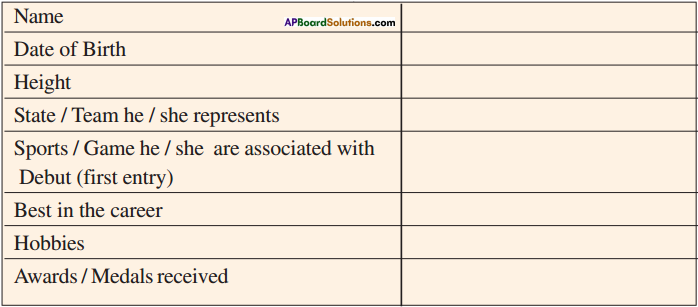
AP Board 9th Class English Solutions Chapter 2C V.V.S. Laxman, Very Very Special 1

Talk about one profile in the class.

Profile – 1: (P.T.Usha)
Name Pilavullakandi Thekkeparambil Usha
Date of Birth June 27, 1964
Height 5.7″ (170 cm)
State/Team she represented National Team – India
Sports/Game she is associated with Running (Track & Field)
Debut (first entry) At the age of 16, in 1980 in the Moscow Olympics
Best in the Career At the Asian Meet in Jakarta in 1985, Usha established herself as the Asian sprint queen with five gold medals (in the 100 meters, 200m, 400m, 400m hurdles, and the 4 x 400 m relay) besides a bronze in the 100m relay,
Hobbies Reading books and listening to music

Answer:
Awards/Medals Received

  1. Recipient of Arjuna Award, 1984.
  2. Adjudged as the greatest women athlete, in 1985 Jakarta Asian Athletic Meet.
  3. Padma Sree in 1984.
  4. Best Athlete of the year Award from India Government in 1984,/85,/B6,/B7, and 89.
  5. In 1986 Seoul Asian Games, won the Adidas Golden Shoe Award for the best athlete by the Asian Amateur Athletics Association, Seoul Asian Games, 1986.
  6. Asian Amateur Athletics Association, Seoul Asian Games, 1986.
  7. 33 medals including 13 gold medals in Asian Games and Asian Championships.
  8. Won a total of 102 medals at National and International meets during her career.
  9. Won 1 gold and 2 silver at the 1999 SAF Games held at Kathmandu.
  10. Thirty International Awards, for her excellence in Athletics.
  11. Kerala Sports Journalists Award for the year 1999.

AP Board 9th Class English Solutions Chapter 2C V.V.S. Laxman, Very Very Special

Profile with more details

P.T. Usha was born, as the daughter of Paithal and Lakshmi, at Payyoli, a small village in Kozhikode, on June 27, 1964. Her full name is Pilavullakandi Thekkeparambil Usha. She was the queen of Indian track and field for two decades. P.T. Usha has been associated with Indian athletics since 1979. Usha made her international debut at the Moscow Olympics in 1980 but she shone into the limelight in the 1982 Asian Games in New Delhi, winning the silver in the 100 m and 200 m event. At the Asian Meet in Jakarta in 1985, Usha established herself as the Asian sprint queen with five gold medals (in the 100meters, 200m, 400m, 400m hurdles, and the 4 x 400m relay) besides a bronze in the 100m relay.

This magnificent performance was followed by an equally brilliant spell a year later at the Asian Games at Seoul where Usha notched up four golds and a silver medal.

The finest moment in Usha’s career and also perhaps the saddest however came in a single race at the 1984 Olympics in Los Angeles. In the 400m hurdles, Usha missed winning the bronze by just 1/100th of a second. She recorded her best time of 55.42secs in that race — still an Indian national record — but lost the medal in a photo-finish. Usha said that she cried after the event because “It was difficult to believe that I had missed an Olympic medal by a whisker.”

In 1976 the Kerala State Government started a Sports School for women, and Usha was chosen to represent her district, at a cost of Rs. 250 per month paid by the state. In 1979 she participated in the National School Games, where she was noticed by O. M. Nambiar, who coached her through most of the rest of her career. India Today describes the athletic situation in 1979 as a time when ‘athletics was very much a male sport and track-suited women a rarity’.

P.T Usha started a School of Athletics to impart training to girl children from all over the country. The School, located at Koyilandi near Kozhikode in Kerala, recruits children in the 10-12 age group for its training. She likes reading books and listening to music.

Awards and Medals Received

  1. Recipient of Arjuna Award, 1984.
  2. Adjudged as the greatest women athlete, in 1985 Jakarta Asian Athletic Meet Padma Sree in 1984.
  3. Best Athlete of the year Award from India Government in 1984,/85,/86,/87, and 89.
  4. In 1986 Seoul Asian Games, won the Adidas Golden Shoe Award for the best athlete by the Asian Amateur Athletics Association, Seoul Asian Games, 1986.
  5. 33 medals including 13 golds in Asian Games and Asian Championships.
  6. Won a total of 102 medals at National and International meets during her career.
  7. Won 1 gold and 2 silver at the 1999 SAF Games held at Kathmandu.
  8. Thirty International Awards, for her .excellence in Athletics.
  9. In recognition of her achievements, a road at Payyoli, her home town, is named after her.
  10. The Kerala Government has also set up a “PT Usha Sports Council” at Central Stadium, Thiruvananthapuram.
  11. Kerala Sports Journalists Award for the year 1999.

AP Board 9th Class English Solutions Chapter 2C V.V.S. Laxman, Very Very Special

Profile – 2

Profile – 2: (Koneru Humpy)
Name Koneru Humpy
Date of Birth 31 March, 1987
Height 5.6″ (165 cm)
State/Team she represented National – India
Sports/Game she is associated with Chess
Debut (first entry) At the age of 8, in 1995 in Indian Under 8 Championship
Best in the Career The second woman in the world with 2606 points in FIDE rating in July 2009
Hobbies Reading books and spending with family

Awards and Medals Received

  1. Asia’s youngest International Woman Master, 1999.
  2. World under-14 championship, 2001, Castellan, Spain.
  3. India’s youngest Woman Grand Master, 2001.
  4. World Junior Championship, 2001, Athens.
  5. World’s youngest Women Grandmaster to achieve full Grand Master status.
  6. Arjuna Award in the year 2003.
  7. In 2007, she was awarded with the prestigious Padma Shri award.
  8. Humpy was also conferred upon the Raja Lakshmi Award in the year 2008 by Raja Lakshmi Foundation of Chennai.
  9. become the second-highest ranked female player in history with more than 2600 points in FIDE rating in July 2009.

Profile with more details

Koneru Humpy is a popular femaie Indian chess player, and feasibly the best woman at the chess board. She is the world second ranking among the Female Chess PIaryers,’stayed behind only by Judit Polgar, who is world number one Female Chess Player.

She was born on 31st March, 1987 at Gudivada, Andhra Pradesh. Her father is Ashok Koneru worked as a lecturer in Chemistry and he was a quite well chess player. In 1985 he won the South India Open Championship. Humpy fell in love with the game of chess when she was just 5 years of old. In fact, in orderto guide her properly and to make sure she gets the best attention for improving her skills as a chess player her father introduced her to the game at quite an early age. The little Humpy showed her outstanding performance in chess and she won the Under 8 National Chess Championship in 1995.

After proved her brilliant performance at the National level, Humpy entered the international chess circle. She clinched the World Chess titles in the Under 10, Under 12 and Under 14 age groups, later, in 1990 Humpy holds an International Master title when she was 12 years. After, she gained her 3rd Grand Master norm in the Elekes Memorial Grand Master Tournament held at Budapest, Hungary. Koneru has set up a world record by getting the International Grand Master title at the age of 15 years old. She broke Judit Polgar record to achieve the feat, and she became the youngest woman ever to have got the coveted title. Further Hou Yifan broke Humpy’s record by taking the title, when she was 14 years. Humpy has been the First Indian Woman to have achieved an International Grand Master title in the chess game.

She likes reading books and spending with her family

For showing advanced talent as a chess player and making the nation proud at many times at the International level, Humpy has been honoured with a number of awards and recognitions.

AP Board 9th Class English Solutions Chapter 2C V.V.S. Laxman, Very Very Special

Awards & Honours

  1. Asia’s youngest International Woman Master, 1999.
  2. World under-14 championship, 2001, Castellan, Spain.
  3. India’s youngest Woman Grand Master, 2001.
  4. World Junior Championship, 2001, Athens.
  5. World’s youngest Women Grandmaster to achieve full Grand Master status.
  6. Arjuna Award in the year 2003.
  7. In 2007, she was awarded with the prestigious Padma Shri award.
  8. Humpy was also conferred upon the Raja Lakshmi Award in the year 2008 by Raja Lakshmi Foundation of Chennai.
  9. At Doha Asian Games 2006, Koneru Humpy bagged two Gold Medals in the Individual as well as Team event of Chess.
  10. In 2007, she won the International Open Chess Tournament 2007 held at Kaupthing, Luxembourg.
  11. Humpy scored a FIDE Elo rating of 2606 points
  12. Humpy has broken the world record set by Susan Polgar who had a rating of 2577 points while she was at the World No. 2 spot,

V.V.S. Laxman, Very Very Special Summary in English

Vangipurapu Venkata Sai Laxman recently retired from cricket. Sportstar interviewed this sports star on that occasion. Laxman gives us lots of details. He says his parents Dr. V Shantaram and Dr. V. Satyabhama were his inspiration and influence. He adds that the Hyderabad Cricket Association encouraged him even as a boy. He acknowledges his uncle Baba Mohan’s help and his coaches’ guidance.

He cherishes his 281 against Australia in Kolkata in 2001. He remembers his embarrassment when he collided against Sourav in an Oval ODI. He fondly recollects his association with his captains Sourav, Sachin and Dhoni. He admires John Wright’s role as a coach. He repeatedly appreciates his wonderful wife and lovely kids. He is proud of his role in making India No. 1 in cricket. He is happy to put an end to his 16 year long loving cricket career. His message to the young is to work hard and to treat success and failure with equal ease. He gratefully declares that cricket has taught him character. He plans to start a school and an academy. He is confident of his success in his future ventures too.

V.V.S. Laxman, Very Very Special Glossary

fabulous (adj) : fantastic, excellent

leap (n) (here) : progress

on the verge of : very close to

culminated (v-past tense) : resulted in; ended

integral (adj) : essential, main

crucial (adj) : valuable, important

reckoning (n) : consideration

transformation (n) : change; new form

traits (n) (plural) : qualities

amazingly (adv) : surprisingly impressive

collided (v-past tense) : dashed against

disgusted (v-past tense) : disappointed

cuisine (n) : dish

AP Board 9th Class Social Studies Solutions Chapter 1 Our Earth

SCERT AP Board 9th Class Social Solutions 1st Lesson Our Earth Textbook Questions and Answers.

AP State Syllabus 9th Class Social Studies Solutions 1st Lesson Our Earth

9th Class Social Studies 1st Lesson Our Earth Textbook Questions and Answers

Improve Your Learning

Question 1.
Look at the map of India in an Atlas and identify latitude and longitude for the following places.
a) Kanyakumari ………………. and ………………. .
b) Imohal ………………. and ………………. .
c) Jaisalmer ………………. and ………………. .
d) Pune ………………. and ………………. .
e) Patna ………………. and ………………. .
Answer:
a) Kanyakumari : 77°36′ E longitude and 8°35′ N latitude
b) Imphal : 93°58′ E longitude and 24°44′ N latitude
c) Jaisalmer : 26°55′ N latitude and 70°54′ E longitude
d) Pune : 18°32′ N latitude and 73°52’E longitude
e) Patna : 27°34′ N latitude and 81°46′ E longitude

Question 2.
Identify the words that match with Latitude and Longitude (parallel lines, vertical lines, horizontal lines)
Answer:
Latitudes are horizontal and parallel lines. Longitudes are vertical lines.

Question 3.
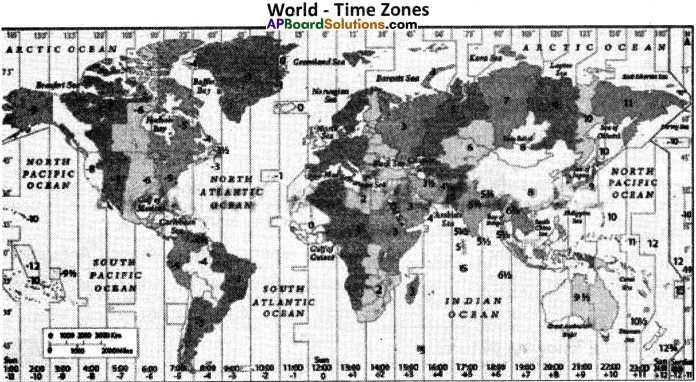
Look at the world map of time zones in the Text page 13.
a) If you travel from Vijayawada to Paris to which time zone are you moving?
b) If you are travelling from Hyderabad to Tokyo which time zone are you moving? ……………………… .
Answer:
a) – 5.30 hrs time zone
b) – 3.30 hrs time zone.

AP Board Solutions

Question 4.
Why is it difficult to study the formation of the earth and its structure?
Answer:
Earth formed around 4.54 billion years ago by accretion from the solar nebula. Nearly all branches of natural science have contributed to the understanding of the main events of the earth’s past. The age of the earth is approximately one-third of the age of the universe. Biological and geographical change has been constantly occurring on our planet since the time of its formation. The process of plate tectonics has played a major role in the shaping of earth’s oceans and continents as well as the life on it.

It took us years of scientific investigation and analysis of data to form an understanding of the interiors of the earth. The main reason for this is that even the deepest mines we have dug do not go beyond a few kilometers under the surface while the radius or the distance to the centre of the earth is over 6000 kilometers.

Thus it is very difficult to study the formation of the earth and its structure.

Question 5.
Read the paragraph under the heading of “Internal structure of the earth” and answer the question.

Internal Structure of the Earth : Let us look at the internal structure of the Earth we live on. We can see the continuity from the early days of the formation of the earth as we try to look deep inside the Earth! It took us years of scientific investigation and analysis of data to form an understanding of the interior of the Earth. The main reason for this is that even the deepest mines we have dug do not go beyond a few kilometres under the surface while the radius or the distance to the centre of the earth is over 6000 kilometres!

How can you say the earth is still very active?
Answer:

  • The matter deep inside the mantle shoots up through volcanoes and fissures on ocean floors.
  • In many regions on the earth part of the earth’s crust enters into the mantle and once again becomes molten.
  • The crust is still being changed by earthquakes, volcanoes, subduction of land and rise of mountains due to the processes happening deep down the earth.
  • This constant process of formation and destruction of the earth’s crust explains the fact that the earth is still very active.

AP Board Solutions

Question 6.
What is a grid and how does it help us?
(OR)
Write any two uses of the ‘Grid system’ located on the globe.
Answer:
Grid : A grid is a sqaure or a rectangle that is formed between when two latitudes and longitudes out across each other. In other words the network of latitudes and longitudes drawn on the globe is called a ‘grid’.

Uses of grid:
1. Network of latitudes and longitudes is called a Grid.

2. Uses of a grid :
a) To locate a place
b) How hot or cold it would be there,
c) To know the time.

Question 7.
Differentiate between
a) Local and Standard time
b) Equator and Prime meridian.
Answer:
a) Difference between Local and Standard time :

Local Time Standard Time
1) The time of a place when the mid day sun is over head is called local time. 1) The local time of the standard meridian of a country is called a standard time.
2) It changes from place to place. 2) It remains same for that particular country.
3) The place on the same longitude has the same local time. 3) The place on the same longitude has the different standard time.

Example: If the 1ST is 12.00 noon, the local of Mumbai is 39 minutes – 1ST = 11.21 minutes a.m.
Since Mumbai is on 72°82′ east longitudes, it is 9°45′ behind the 82°30′. Thus the local time of Mumbai is 9.45 x 4 = 38 minutes.

b) Differences between Equator and Prime meridian :

Equator Prime meridian
1) Equator is 0° latitude. 1) Prime meridian is 0° longitude.
2) Equator divides the earth into parts, i.e. Northern hemisphere and Southern hemisphere. 2) The Prime meridian divides the earth into two equal parts i.e., Eastern hemisphere and the Western hemisphere.
3) Equator is a circle. 3) Prime meridian is a semi-circle.
4) It is an imaginary line that runs east and west around the exact middle of the globe. (A horizontal line) 4) It is an imaginary line running from pole to pole and passing through Greenwich, England. (A vertical line)

Question 8.
If every state follows its local time then what problems will rise?
Answer:
If every state follows4ts local time, a lot of serious problems would rise. Some of them are being discussed hereunder.

  1. At the time of national calamities and disasters, it is very difficult for the national government to make necessary emergency announcement.
  2. At the time of wars and national emergency, it is very difficult for the national government to alert all the defensive forces stationed in all the state capitals and the naval forces of all the coastal states.
  3. It is very difficult for Televisions and Radios to follow a single schedule to broadcast their programmes.
  4. Railways faces a difficult problem in preparing a timetable for its trains that travel through many states.

AP Board Solutions

Question 9.
With the help of your teachers find out the standard meridian of given countries.
1. Nepal
2. Pakistan
3. Bangladesh
4. England
5. Malasiya
6. Japan
Answer:
1. Nepal : 88°45’East is the Standard Time Meridian of Nepal
2. Pakistan : 74°22′ East .
3. Bangladesh : 90°24′ East
4. England : 0°07′ West
5. Malaysia : 100° East
6. Japan : 90° East

Question 10.
Make a thought provoking poster on the earth’s protection.
Answer:
AP SSC 9th Class Social Studies Solutions Chapter 1 Our Earth 1

9th Class Social Studies 1st Lesson Our Earth InText Questions and Answers

Question 1.
Tick the factors which cause the formation of seasons on the earth : (Text Book Page No. 3)
a) Daily rotation of the earth on its axis.
b) Monthly movement of the Moon around the Earth.
c) Rotation of the Sun on its axis.
d) Revolution of the Earth around the Sun.
e) Tilt of Earth’s axis of rotation to its orbital plane.
f) Spherical shape of the Earth.
g) Earth’s distance from Sun during the annual revolution.
Answer:
d) (✓)
e) (✓)
g) (✓)

Question 2.
We cannot hope to travel to the mantle to study it. But we can study substances from the mantle. Can you tell what these substances would be and how we can get them? (Text Book Page No. 5)
Answer:
1) The thickness of the mantle is 100 – 2900 kms. So we cannot hope to travel to the mantle to study it.
2) Interestingly the matter from the deep inside the mantle shoots up through volcanoes and fissures on ocean floors and cools down to form the earth’s crust.
3) Thus by studying the lava or magma or the substances brought up through the fissures, we can study the substances from the mantle.

Question 3.
When it is 12 noon in Greenwich (0°), what is the local time at: (Text Book Page No. 12)
a) Mumbai (73° E)
b) Chicago (87°30′ W)
c) Sydney (151° E)
Answer:
a) Mumbai (73° E) :
Local time at Mumbai is : 73 × 4 = 292 minutes, i.e. 4 hours 52 minutes. That means the local time at Mumbai is 4 hours 52 minutes after 12 noon i.e., 12.00 + 4.52 = 4.52 p.m.

b) Chicago (87°30′ W):
Local time at Chicago is : 87°30′ × 4 = 350 minutes, i.e. 6 hours 50 minutes. That means the local time at Chicago is 6 hours 50 minutes less than 12.00 noon at Greenwich. i.e. 12.00 – 6.50 = 5.10 a.m.

c) Sydney (151° E): Local time at Sydney is 151° × 4 = 604 minutes, i.e. 10 hours 4 minutes before Greenwich time.
That means the local time at Sydney is 12.00 + 10.04 = 10.04 p.m

AP Board Solutions

Question 4.
Why do you think people today are curious to know about the secrets of distant stars and galaxies and the beginning of the universe? (Text Book Page No. 2)
Answer:
Today people are curious to know about the secrets of the distant stars and galaxies and the beginning of the universe
a) to understand the stars that shine there.
b) to understand the sun, the moon and the planets which keep moving across the sky.
c) to understand what are these and in what way they are related to us and how they affect us.
d) to know how they move and work.
e) to know whether there is any life on any other planet.

Question 5.
Swathi works for a call centre in Hyderabad. Her clients are in the U.S.A. She answers clients’ questions about the computer problems. She always works during the night. Why is this? Use geography to find out! (Text Book Page No. 12)
Answer:
Indian Standard Time is the time observed in India. Its time offset is UTC + 5.30.
United Standard Time is the Central Standard Time. Its time is GMT – 6.00. Thus there is a difference of 11½ hours between Indian Standard Time and American Standard Time. Thus if it is day time in America, in India it is night time. If an American client asks Swathi a question at 11 am in America, Swathi has to answer the same at 10.30 p.m the same day. Thus Swathi should always work at night to answer his clients from the U.S.A.

Question 6.
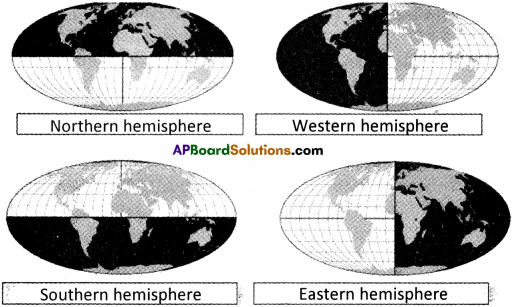
In earlier classes we have studied about hemisphere. Let us revise it in the image below. (Text Book Page No. 8)
AP SSC 9th Class Social Studies Solutions Chapter 1 Our Earth 2
With the help of the above maps complete the following table.

Hemisphere Continents
Northern hemisphere
Western hemisphere
Southern hemisphere
Eastern hemisphere

Answer:

Hemisphere Continents
Northern hemisphere Asia, Europe, North America
Western hemisphere North America, South America, Antarctica
Southern hemisphere South America, Africa, Antarctica, Australia
Eastern hemisphere Asia, Africa, Australia, Antarctica, Europe

Question 7.
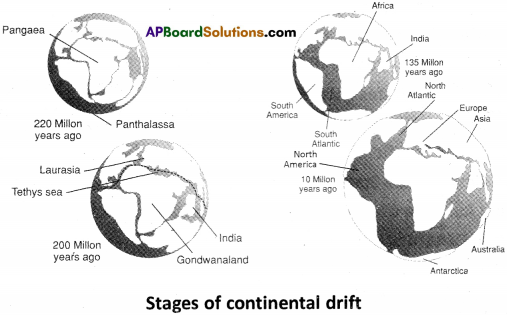
Look at the following pictures. (Text Book Page No. 6)
AP SSC 9th Class Social Studies Solutions Chapter 1 Our Earth 3
Now answer the following questions.
1. Look carefully at the map of the world, do you find some continents looking as if they are two pieces of a jigsaw puzzle? Name those continents. (Text Book Page No. 7)
Answer:
By observing the maps of the world from 220 million years ago up to the present world, we can find the following continents look as if they are two pieces of jigsaw puzzle. They are :
1) North America and North West Africa.
2) South America and Western Africa.
3) Nothern Africa and Eurasia.
4) Eastern Africa and India.
5) South Eastern Africa and Antarctica.
6) Antarctica and Australia.

2. In which direction Australia is moving?
Answer:
Australia is moving in eastern direction.

3. In which direction India is moving?
Answer:
India is moving in northern direction.

Question 8.
Look at the following map. (Text Book Page No. 12)
AP SSC 9th Class Social Studies Solutions Chapter 1 Our Earth 4
Using your Atlas, find out how many standard time zones these countries have :
a) U.S.A
b) Australia
c) Russia
d) Japan
e) Zimbabwe and
f) Chile.
Answer:
a) U.S.A :
The United States uses nine standard time zones. From east to west they are Atlantic Standard Time, Eastern Standard Time, Central Standard Time, Mountain Standard Time, Pacific Standard Time, Alaskan Standard Time, Hawai – Aleutian Standard time, Samoa Standard Time and Chamorro Standard Time.

b) Australia :
Australia uses three standard time zones.
a) Australia Eastern Standard Time (GMT + 10)
b) Australia Central Standard Time (GMT + 9½)
a) Australia Western Standard Time (GMT + 8)

c) Russia :
There are 9 time zones in Russia.
a) Kaliningrad Time – UTC + 3
b) Moscow Time – UTC + 4
c) Yaketerinburg Time – UTC + 6
d) Omsk Time – UTC + 7
e) Krasnoyarsk Time – UTC + 8
f) Irkutsk Time – UTC + 9
g) Yakutsk Time – UTC + 10
h) Vladivostok Time – UTC + 11
i) Magadan Time – UTC + 12

d) Japan :
Japan Standard Time – UTC + 9

e) Zimbabwe :
Zimbabwe uses Central Africa Time zone : UTC + 2h standard time

f) Chile :
Since Chile uses daylight saving time, in total 4 time zones are used.

Question 9.
Initially people thought that the earth was in the centre of the universe and human beings the most important creation. What difference does it make to us to know that we are a small insignificant speck in this vast universe? (Text Book Page No. 2)
Answer:
The earth we live on seems big and very important to us. But in the universe as a whole, it is tiny and very insignificant speck of rock. To put things into perspective earth is just a small planet in the solar system, part of a family of bodies that circle round the sun. The sun is just one of billions of stars that makes up our galaxy, and this galaxy is just one of billions that make up a universe bigger than most of us can imagine.

Question 10.
Do you think the Earth was created suddenly or do you think it was formed by long drawn and complex processes? (Text Book Page No. 4)
Answer:
The Earth began to form around four and a half billion years ago. The earth has reached its present form through several phases but not created suddenly.

  • It began as a ball of swirling dust and clouds and passed through a molten stage.
  • The molten Earth was very hot and was constantly bombarded by massive rocks and other materials from the space. In this way the size of the earth grew.
  • When the earth was so hot and in liquid form the heavier particles went to the bottom and formed core and the mantle.
  • The lighter particles cooled at the top and formed the crust.
  • While the earth’s interior was cooling, it contracted and outer crust wrinkled forming ridges (i.e., mountains) and basins (i.e., oceans)
  • It took a long time for the air we breathe to develop.
    Thus we can say that the earth was not created suddenly but formed through several phases.

AP Board Solutions

Question 11.
Some people believe that our being on this earth is the result of a series of fortuitous accidents – it is quite possible that there may not have been any life on the earth. Do you agree? Give your reasons. (Text Book Page No 4)
Answer:
Yes, the earth’s creatures have evolved through a series of contingent and fortuitous events.
1. Our earth is just the right distance from the sun to have a stable orbit. Our orbit keeps us from getting too hot or too cold to survive. Any closer we’d burn up, any farther away we’d freeze to death.

2. Our earth is perfect in both size and mass. Mass is critically important to the formation of an atmosphere. If the earth’s mass were less dense, an atmosphere could not have formed and remained. If it were more dense, the atmosphere would have been uninhabitable.

3. Our earth has just the right mix of the 27 elements needed for life, including carbon, oxygen, nitrogen, phosphorous, potassium, iron, sodium, and copper.

4. Our earth has just right amount of water in the proper ratios of liquid, solid, and gas.

A little more and the continents would probably be totally overrun with water and literally, drown. Any less and the temperature of the earth would probably be too hot making life unbearable here.

Thus we can say that our being on this earth is the result of fortuitous accidents.

AP Board 9th Class Social Studies Important Questions Chapter 20 Democracy: An Evolving Idea

AP State Syllabus AP Board 9th Class Social Studies Important Questions Chapter 20 Democracy: An Evolving Idea.

AP State Syllabus 9th Class Social Studies Important Questions 20th Lesson Democracy: An Evolving Idea

9th Class Social 20th Lesson Democracy: An Evolving Idea 2 Marks Important Questions and Answers

Question 1.
What is the most important reason to vote for and elect leaders in a democracy? (SA-II : 2018-19)
Answer:
Democracy is completely based on voting system.

  • Right to vote create a chance to voters to select good government.
  • People select the leader who is capable and solve their problems.
  • Right to vote is most important, because people should express their opinion.

9th Class Social 20th Lesson Democracy: An Evolving Idea 4 Marks Important Questions and Answers

Question 1.
“Democracy which respects the freedom and rights of all people may be the best way to solve some of the complex problems the countries in the present day world.’
Do you agree which this statement? Justify your answer. (SA-II : 2018-19)
(OR)
Today a new kind of democracy is been forged across the world in which even the poorest and most vulnerable people will have a voice and will be able to influence policies and ensure justice and peace for all.
“Democracy is the best form of Government”. Comment on it. (SA-II : 2017-18)
Answer:
Democracy is the best form of government by following ways.

  1. Democracy provide freedom.
  2. Democracy represents the people.
  3. It is better governance due to transparency.
  4. Democracy gives respect to human rights.
  5. It promotes the human rights.
  6. It gives more freedom of speech and expression.

9th Class Social 20th Lesson Democracy: An Evolving Idea Important Questions and Answers

Question 1.
Observe the following table and answer the given questions.

Inequality of Incomes in Selected Countries
Country Share of National Income (%)
Top 20 Bottom 20
South Africa 64.8 2.9
Brazil 63.0 2.6
USA 50.0 4.0
United Kingdom 34.5 9.6
Dennsik 34.5 9.6
Hungary 34.5 10.0

1) Which country has more inequality?
Answer:
South Africa

2) What is the difference in USA?
Answer:
46

3) Among the given countries, which is the South American country?
Answer:
Brazil

4) Which country has least difference?
Answer:
Hungary

AP Board 9th Class Social Studies Important Questions Chapter 20 Democracy: An Evolving Idea

Question 2.
Read the following passage and answer the given questions.
Belgium : Belgium is a small country in Europe. Of the country’s total population, 59 per cent lives in the Flemish region and speaks Dutch language. Another 40 percent people live in the Wallonia region and speak French. Remaining one per cent of the Belgians speak German. In the capital city Brussels, 80 per cent people speak French while 20 per cent are Dutch- speaking.
1) Where is Belgium?
Answer:
Belgium is a small country in Europe.

2) Who speaks Dutch language?
Answer:
59% of population of Belgium lives in the Flemish region and speaks Dutch language.

3) Who speaks French?
Answer:’
40% lives in the Wallonia region and speaks French.

4) What per cent of people speak German?
Answer:
One per cent of people speak German.

5) What is the capital city of Germany?
Answer:
Brussels.

AP Board 9th Class Social Studies Important Questions Chapter 20 Democracy: An Evolving Idea

Question 3.
Read the following passages and answer the given questions.
In Sri Lanka, post its independence in 1948, the leaders of the Sinhala community sought to secure dominance over government by virtue of their majority. As a result, the democratically elected government adopted a series of majoritarian measures to establish Sinhala supremacy.

Sinhala was made the only official language, disregarding Tamil. The governments followed preferential policies that favoured Sinhala applicants for jobs. A new constitution stipulated that the state shall protect and foster Buddhism. All these government measures, coming one after the other, gradually increased the feeling of alienation among the Sri Lankan Tamils.

1) When did Sri Lanka get its independence?
Answer:
In 1948.

2) What community is mentioned here?
Answer:
Sinhala community.

3) What did the democratically elected government adopt?
Answer:
The democratically elected government adopted a series of majoritarian measures to establish Sinhala supremacy.

4) Sinhala was made the only official language, disregarding ___________
Answer:
Tamil.

5) A new constitution stipulated that the state shall protect and foster ___________
Answer:
Buddhism.

AP Board 9th Class Social Studies Important Questions Chapter 15 Industrialisation and Social Change

AP State Syllabus AP Board 9th Class Social Studies Important Questions Chapter 15 Industrialisation and Social Change.

AP State Syllabus 9th Class Social Studies Important Questions 15th Lesson Industrialisation and Social Change

9th Class Social 15th Lesson Industrialisation and Social Change 1 Mark Important Questions and Answers

Question 1.
In what way did Canal Transportation aid Industrial Revolution? (SA-I : 2019-20)
Answer:
Canals were the answer to moving heavy objects to large distances

9th Class Social 15th Lesson Industrialisation and Social Change 2 Marks Important Questions and Answers

Question 2.
Why did modem industrialisatfon first occured in Britain only? (SA-III : 2016-17)
(OR)
Why do you think Britain was the first country to Industrialize?
Answer:

  • Britain was blessed with modest climate to suit cotton industry.
  • There was no scarcity of power.
  • There was availability of sufficient raw material.
  • Coal and Iron were available in abundance side by side.
  • It was convenient to transport the raw material by water.
  • There was no dearth of capital and Bank of England was also helpful in raising capital.
  • Workers were available in large numbers.
  • It was ready to sea trade with a large number of ports.

AP Board SolutionsAP Board 9th Class Social Studies Important Questions Chapter 15 Industrialisation and Social Change

Question 2.
20th century inventions were hugely influenced by major developments in technology and resources, enabling the inventions of key items and devices which changed the way we live today.
Mention any two inventions one each in transportation and medicine and mention briefly how they changed the way we live today. (SA-II : 2018-19)
Answer:
Transportation :
Aeroplanes, Motor vehicles, Railways, etc.

Medicine:
Anti-biotics, vaccines, chloroforms, Anti-virus, etc. Now-a-days world become a big village by a fastest means of transport. Even long distance also reached in a short time. Due to medicines, the life expectancy of human being is increased.

9th Class Social 15th Lesson Industrialisation and Social Change 4 Marks Important Questions and Answers

Question 1.
The road-builder John Metacalf, who personally surveyed surfaces for roads and planned them, was blind. The canal builder James Brindley was almost illiterate, with such poor spelling that he could never spell the word ‘navigation’, but he had tremendous powers of memory, imagination and concentration.
Read the paragraph given above and comment on that. (SA-III : 2016-17)
Answer:
According to the above para, if we want to invent a new thing we need more determination, interest, curiosity, even luck, than the application of scientific knowledge. Along with the above, memory, imagination, and concentration also need.

AP Board SolutionsAP Board 9th Class Social Studies Important Questions Chapter 15 Industrialisation and Social Change

Question 2.
“Good transportation facilities leads to rapid industrialization” – Justify the statement. (SA-I : 2018-19)
Answer:

  • Transport system really helps the industry.
  • Without transportation, the products made by the industry cannot be sold in distant places.
  • The industry has a particular transport system to send their products to places and sell them for profit.
  • Without proper transport system, there is risk of damage of products.
  • The invention of steam engine reduced the cost of transportation.
  • Development of aircraft was useful for fastest means of transport.
  • Good transport system leads to rapid industrialization.

Question 3.
Mobile phone – Internet – Computers – Airways
Choose any TWO of the inventions listed above Explain how they changed people’s lives. (SA-I : 2019-20)
Answer:
Mobile Phone:

  • Mobile phones have completely changed the way people interact.
  • Today, the mobile phone has become part and parcel of many people’s lives.
  • You can call, send text messages, read emails, play games as well as read and edit documents.
  • Through mobile phone, we can send money quickly to others who are in need.
  • It create new market places.
  • It help people find jobs.
  • It help the farmers to get weather information.

Internet:

  • The Internet creates new ways for us to communicate, work and share information.
  • The main advantage of the internet is it ability to connect billions of computers and devices to each other.
  • By it, we get more information.
  • Enjoy virtual field trips.
  • It creates assignment convenience and flexibility.

Computer:

  • It act as highly reliable scientific equipment.
  • They receive and store data and carries out logical and mathematical calculations too to provide fast and accurate results.
  • It can store more data.

Airways :

  • Through air ways we can reach our destination quickly.
  • It transports people, goods, the military equipment around the world.
  • It is the fastest means of transport.
  • During the time of floods and calamities we can use more airways only to reach the place.
  • It is supported to go to remote areas.
  • It creates convenience to passengers.

AP Board SolutionsAP Board 9th Class Social Studies Important Questions Chapter 15 Industrialisation and Social Change

Question 4.
Explain how the condition of the workers steadily declined in the early twentieth century Europe. (SA-I : 2019-20)
Answer:
Conditions of the worker.
1. The aboudance of labour in the market affected.

2. Seasonality of work :
It meant prolonged periods without work.

3. Low Real wages :
Wages are very low.

4. Poverty and Unemployment:
At the mid of 19th century, about 10 percent of Urban population was extremely poor.

The Unemployment rate was very high.

9th Class Social 15th Lesson Industrialisation and Social Change Important Questions and Answers

Question 1.
What is called ‘First Industrial Revolution?
Answer:
The transformation of industry and the economy in Britain between the 1780s and the 1850s is called the “First Industrial Revolution.”

Question 2.
Who used the term ‘Industrial Revolution’?
Answer:
The term ‘Industrial Revolution’ was used by European scholars – Georges Michelet in France and Friedrich Engels in Germany. It was used for the first time in English by the philosopher and economist Arnold Toynbee (1852-83), to describe the changes that occurred in British industrial development between 1760 and 1820.

AP Board SolutionsAP Board 9th Class Social Studies Important Questions Chapter 15 Industrialisation and Social Change

Question 3.
What were the two main features of cotton industry?
Answer:
From the 1780s, the cotton industry symbolised British industrialisation in many ways. This industry had two features which were also seen in other industries. Raw cotton had to be entirely imported and a large part of the finished cloth was exported to other countries. Britain had its control over the sources of raw cotton as well as the markets. Where they sold cloth. This helped to increase its control over the colonies.

Question 4.
What was the new power source in England?
Answer:
Steam

Question 5.
Which country experienced modern industrialisation for the first time?
Answer:
Britain experienced modern industrialisation for the first time.

Question 6.
Name any bank in England.
Answer:
The Bank of England.

Question 7.
Who were used in coal mines to reach deep coal faces?
Answer:
Children were used in coal mines to reach deep coal faces.

AP Board SolutionsAP Board 9th Class Social Studies Important Questions Chapter 15 Industrialisation and Social Change

Question 8.
Which countries lacked colonial resources?
Answer:
Germany and France lacked colonial resources.

Question 9.
What is Industrial revolution? Who coined this name?
Answer:

  • The economy and industries in Britain changed completely between 1780s and 1850s.
  • This phase is known as ‘First Industrial Revolution’.
  • The term ‘Industrial Revolution’ was used by European Scholars George Michelet in France and Fredrich Engels in Germany.
  • It was used for the first time in English by the Philosopher and economist Arnold Tonybee.

Question 10.
What do you know about the picture?
AP Board 9th Class Social Studies Important Questions Chapter 15 Industrialisation and Social Change 1
Answer:
This was the Cast Iron Bridge. It was near Coalbrookdale. It was designed by the third Darby.

Question 11.
What was it? How did it look like?
AP Board 9th Class Social Studies Important Questions Chapter 15 Industrialisation and Social Change 2
Answer:
This was James Watt’s steam engine. It was just looking like our present day tractor.

Question 12.
Compare the effects of the coming of the railways in different countries in the world.
Answer:

  • The first steam locomotive, Stephenson’s Rocket, appeared in 1814. Railways emerged as a new means of transportation that was available throughout the year, both cheap and fast, to carry passengers and goods.
  • They combined two inventions, the iron track which replaced the wooden track in the 1760s, and haulage along it by steam engine.
  • The invention of the railways took the entire process of industrialisation to a second stage.
  • The first railway line connected the cities of Stockton and Darlington in 1825, a distance of 9 miles that was completed in two hours at speeds of up to 24 kph (15 mph).
  • The next railway line connected Liverpool and Manchester in 1830. Within 20 years, speeds of 30 to 50 miles an hour were usual.

Britain :
The railways changed British Society in numerous ways. It is nonetheless clear that the railways had a sizeable impact in many spheres of economic activity and daily life of the people.

Canada :
In Canada, the national government strongly supported railway construction for political goals.

India :
India provides an example of the British empire pouring its money into a very well built system designed for military reasons and with the hope that it would stimulate industry. The system was over built and much too elaborate and expensive for the small amount of freight traffic it carried.

Belgium :
Belgium took the lead in Industrial revolution on the continent starting in the 1820s. It provided an ideal model for showing the value of the railways for speeding the industrial revolution.

France:
In France, railways became a national medium for the modernisation of backward regions. Although starting the whole system at once was politically expedient, it delayed completion and forced even more reliance and temporary experts brought in from Britain.

Germany:
The take-off stage of economic development came with the railroad revolution in the 1840s. As a means of national defence, it facilitates the concentration, distributional direction of the army. It is a means to the improvement of the culture of the nation.

Russians:
It was Americans who brought the technology of railway construction to Russia in 1842. Russia was in need of big transportation system and geographically suited to railroads.

Thus the railways in different countries helped the industrial revolution in transportation.

AP Board SolutionsAP Board 9th Class Social Studies Important Questions Chapter 15 Industrialisation and Social Change

Question 13.
Read the following passages and answer the given questions.

The Krupp Family

The Krupp family established what was going to become the world’s largest arms factory. This first factory specialised in field gun manufacture and, by 1887, it supplied arms to forty six different countries.

During World War I the Krupp factories made guns for the German artillery.

The Krupps supported Hitler in the German general election of 1933. As Nazi Germany occupied neighbouring countries, Alfred Krupp seized new land to make more factories. Many of these factories used slave-labour from the Nazi concentration camps.

1) What was the name of the family?
Answer:
The ’Krupp’ family.

2) What was the first factory?
Answer:
Gun manufacturing factory.

3) Which World War was mentioned here?
Answer:
First World War.

4) Whom did the Krupps support?
Answer:
The Krupps supported Hitler in the German general election of 1933.

5) Who were the workers in the factories?
Answer:
The slave – labour from the Nazi concentration camps.

Question 14.
Read the following passages and answer the given questions.
Steam power was first used in mining industries. As the demand for coal and metals expanded, efforts to obtain them from ever-deeper mines intensified. Flooding in mines was a serious problem and steam engines were used to drain the mines. But the technology was still very imperfect to be used on a large scale.

James Watt’s (1736-1819) invention converted the steam engine from being a mere pump into a ‘prime mover’ capable of providing energy to power machines in factories. Backed by the wealthy manufacturer Matthew Boulton (1728-1809), Watt created the Soho Foundry in Birmingham in 1775. From this foundry James Watt’s steam engines were produced in steadily growing numbers. By the end of the eighteenth century, Watt’s steam engine was beginning to replace hydraulic power. In 1840, British steam engines were generating more than 70 per cent of all European power.
1) Which power was first used in mining industries?
Answer:
Steam power

2) What was a serious problem?
Answer:
Flooding in mines was a serious problem.

3) Who was the wealthy manufacturer?
Answer:
Matthew Boulton.

4) In which foundry were the Watt’s engines produced?
Answer:
In Soho Foundry in Birmingham.

5) Appreciate the British steam engines.
Answer:
In 1840, British steam engines were generating more than 70% of all European power.

AP Board SolutionsAP Board 9th Class Social Studies Important Questions Chapter 15 Industrialisation and Social Change

Question 15.
Read the following passages and answer the given questions.
Transportation
The need to transport raw materials and manufactured products led to the improvement of roads and the digging of canals in England. Me Adam devised the method of making ‘pakka’ or ‘macadamamised’ roads.

Canals were initially built to transport coal to cities. This was because the bulk and v/eight of coal made its transport by road much slower and more expensive than by barges on canals. The demand for coal, as industrial energy and for heating and lighting homes in cities, grew constantly. The making of the first English canal, the Worsley Canal (1761) by James Brindley (1716-72), had no other purpose than to carry coal from the coal deposits at Worsley (near Manchester) to that city. After the canal was completed the price of coal fell by half. Thousands of kilometres of canals were built by 1830 and were used to transport commodities cheaply. They were mostly built by landowners to enhance the value of their properties.
1) Which led to the improvement of roads and the digging of canals in England?
Answer:
The need to transport raw materials and manufactured products led to the improvement of roads and the digging of canals in England.

2) Which were initially built?
Answer:
Canals were initially built to transport.

3) Which grew constantly?
Answer:
The demand for coal, as industrial energy and for heating and lighting homes in cities, grew constantly.

4) What is the name of first English canal?
Answer:
Worsley Canal.

5) What was the interest of land owners in building the first canal?
Answer:
They were interested in enhancing the values of their properties.

6) Who built this canal?
Answer:
James Brindley.

Question 16.
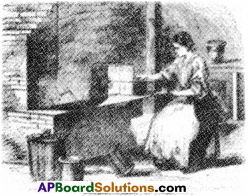
Observe the following picture and answer the given questions.
AP Board 9th Class Social Studies Important Questions Chapter 15 Industrialisation and Social Change 3
Woman in gilt-button factory, Birmingham. In the 1850s, two thirds of the workforce in the button trade was women and children. Men received 25 shillings a week, women 7 shillings and children one shilling each, for the same hours of work.
1) Who was she?
Answer:
She was a woman in gilt-button factory.

2) Where was the factory?
Answer:
It was in Birmingham.

3) Which year did the picture belonged to?
Answer:
It belonged to the 1850s.

4) What were the earnings of the workers?
Answer:
Men – 25 shillings a week
Women – 07 shillings a week
Children – 01 shilling a week

5) Is there any difference in the working time?
A. No, it was equal to all.

AP Board SolutionsAP Board 9th Class Social Studies Important Questions Chapter 15 Industrialisation and Social Change

Question 17.
Read the following passages and answer the questions given below.

The Workers

A survey in 1842 revealed that the average lifespan of workers was lower than that of any other social group in cities: it was 15 years in Birmingham, 17 in Manchester, 21 in Derby. More people died, and died at a younger age, in the new industrial cities, than in the villages they had come from. Half the children failed to survive beyond the age of five. The increase in the population of cities was because of immigrants, rather than by an increase in the number of children born to families who already lived there.

Deaths were primarily caused by epidemics of disease that sprang from the pollution of water, like cholera and typhoid, or of the air, like tuberculosis. More than 31,000 people died from an outbreak of cholera in 1832. Until late in the nineteenth century, municipal authorities were negligent in attending to these dangerous conditions of life. The medical knowledge to understand and cure these diseases was unknown.
1) When was the survey conducted?
Answer:
In 1842.

2) What was the average lifespan?
Answer:
It was 15 years in Birhingham, 17 in Manchester, and 21 in Derby.

3) What was the cause of the increase in population?
Answer:
The increase in the population of cities was because of immigrants, rather than by an increase in the number of children born to families who already lived there.

4) What are the diseases mentioned here?
Answer:
Cholera, Typhoid, and Tuberculosis.

5) Why were the municipal authorities negligent in attending to these diseases?
Answer:
The medical knowledge to understand and cure these diseases was unknown.

AP Board SolutionsAP Board 9th Class Social Studies Important Questions Chapter 15 Industrialisation and Social Change

Question 18.
Read the lesson and prepare any four questions relating to it.
Answer:

  • How can we say that England was fortunate?
  • What was the serious problem in mines?
  • Whom was the first locomotive connected to?
  • Why did the Krupp family establish the world’s largest arms factory?

Question 19.
What were the relative advantages of canal and railway transportation?
Answer:

  • Both were used to transport commodities cheaply.
  • Both enhanced the values of the properties.
  • The invention and usage took the entire process of industrialisation to a second stage.
  • Both reduced the time taken to travel between two places.

Question 20.
Why was Britain the first country to experience modern industrialisation?
Answer:
Reasons:

  1. Political stability
  2. Modest climate
  3. Availability of continuous water power
  4. Transportation facilities
  5. Abundant wealth
  6. Availability of labour
  7. Invention of machinery.

Question 21.
Write the favourable conditions which helped the inventions.
Answer:
It is interesting to read about the individuals who brought about these changes during industralisation. Few of them were trained scientists. Education in basic sciences like physics or chemistry was extremely limited until the late nineteenth century, even after the technological inventions described above. Since these inventions did not require a full knowledge of the laws of physics or chemistry on which they were based, advances in science could be and were made by brilliant, intuitive thinkers and persistent experimenters.

They were helped by the fact that England had certain features which other European countries did not. Dozens of scientific journals and published papers of scientific societies appeared in England between 1760 and 1800. There was a widespread thirst for knowledge even in the smaller towns. This was met by the activities of the Society of Arts (founded in 1754), by travelling lecturers, or in ‘coffee houses’ that multiplied through the eighteenth century.

AP Board SolutionsAP Board 9th Class Social Studies Important Questions Chapter 15 Industrialisation and Social Change

Question 22.
Appreciate the efforts of German to become an Industrialised state.
Answer:

  • Germany (erstwhile Prussia) exploited its rich coal fields (Silesia and Rhineland – the Rhur) and iron deposits (Bohemia) to flourish in steel industry.
  • With the invention of electric dynamo, they lead electric industry in the world.
  • Unification in 1871 made access to iron from Lorraine fields of iron from France.
  • Government encouraged industry by providing road/rail transports and markets also.
  • It also focused on arnament industry.
  • Large banks provided the capital needed.
  • By the beginning of 20th century, Germany had developed a powerful industrial base.

AP Board 9th Class English Solutions Chapter 2B What is a Player?

AP State Syllabus AP Board 9th Class English Textbook Solutions Chapter 2B What is a Player? Textbook Questions and Answers.

AP State Syllabus 9th Class English Solutions Chapter 2B What is a Player?

9th Class English Chapter 2B What is a Player? Textbook Questions and Answers

I. Answer the following questions.

Question 1.
What are the qualities that a true player should have?
Answer:
A true player accepts defeat with ease. He learns from his failures. He loves to share and enjoys the rival’s victory too. He knows his abilities. He continuously works for progress. He practises in all seasons and at all times. He never complains. He is not worried about past failures. He thinks of the present and plans for the future.

Question 2.
What, according to the poet, is an unacceptable crime of a player?
Answer:
Complaining about play time is an unacceptable crime.

AP Board 9th Class English Solutions Chapter 2B What is a Player?

Question 3.
Which game do you like the most? What are the qualities of a player stated in the poem? Which of them do you have?
Answer:
I like volleyball the most. The poem lists the qualities of a player. They are accepting defeat, learningfrom failures, continuous practice, knowing one’s own limitations, sharing, not complaining, not worrying about past defeats, focussing on the present, and contributing to the game. I have some of them. They are : accepting defeat, regular practice, learningfrom failures, not complaining.

Question 4.
The poet talks about certain Do’s and Don’ts for a true player. List them out in the following table. One is done for you.

Do’s Don ts
regular practice give up at the sight of defeat

Answer:

Do’s Don ts
1. regular practice give up at the sight of defeat
2. learn from mistakes give up at the sound of the buzzer
3. have sensible mind whine/complain
4. contribute to the game settle for less
5. admit to be fine even when hurt chicken out

What is a Player? Summary in English

Jessica Taylor’s poem, “What is a Player” lists the qualities a good player possesses. An ideal player continues despite defeat and learns from failures. A good player finds pleasure in sharing and enjoys the rival’s victory too. A true sportsman never complains about his chances, for he knows it is a crime. A model player practises regularly and keeps in mind that success is not always guaranteed. The real player always aims high, works for continuous advancement, and practises day and night; in rain and shine and when healthy or not. A player is always sensible and never worries about past defeats and thinks of the present and plans for the future. A true player doesn’t do something in fear and wants to contribute to the game as long as he is there.

What is a Player? Glossary

give up (phr.v) : quit, leave

buzzer(n) : bell

whine (v) : complain

hurt (adj) : injured

sensible (adj) : reasonable, logical, sane

pondering (v + ing) : thinking

contemplating (v) : thinking; planning

chicken out (phr. v) : to decide not to do something because of fear

counts (v) : be important

AP Board 9th Class Social Studies Important Questions Chapter 19 Expansion of Democracy

AP State Syllabus AP Board 9th Class Social Studies Important Questions Chapter 19 Expansion of Democracy.

AP State Syllabus 9th Class Social Studies Important Questions 19th Lesson Expansion of Democracy

9th Class Social 19th Lesson Expansion of Democracy 1 Mark Important Questions and Answers

Question 1.
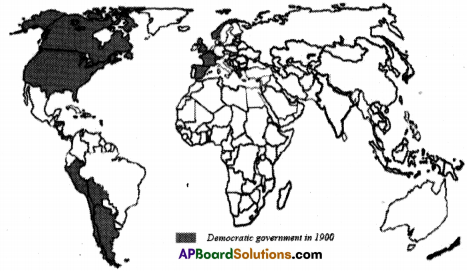
The map below shows the democratic countries that existed between 1900 and 1950. (SA-II : 2018-19)
AP Board 9th Class Social Studies Important Questions Chapter 19 Expansion of Democracy 1
Answer:
Canada, Great Britain, U.S.A., Alaska, Peru, Chile, etc

Question 2.
Name the country which is marked by “A”. (SA-II : 2016-17)
AP Board 9th Class Social Studies Important Questions Chapter 19 Expansion of Democracy 2
Answer:
Russia.

9th Class Social 19th Lesson Expansion of Democracy 2 Marks Important Questions and Answers

Question 1.
Do you think our country has a liberal democratic political system? Give your reasons? (SA-II : 2016-17)
Answer:
Yes, our country has a liberal democratic political system by following methods.

  1. Free and fair regular elections.
  2. Written constitution.
  3. Equality before law.
  4. Universal Adult Franchise etc.

9th Class Social 19th Lesson Expansion of Democracy Important Questions and Answers

Question 1.
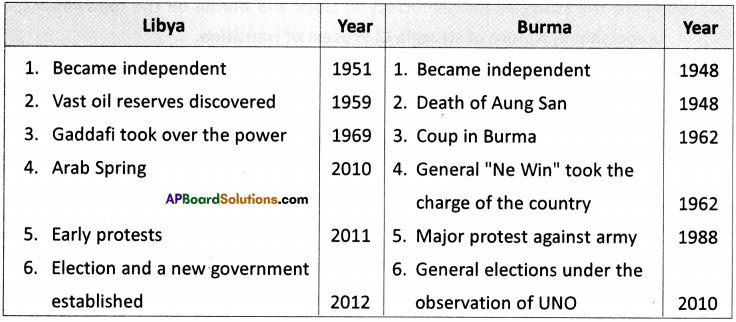
Compare the struggles for democracy in Libya and Burma on the following aspects
A) Leadership
B) Nature of struggle
C) Process of transition.
Answer:

Libya Burma
A. Leadership A. Leadership
1. Monarchy was established in 1951 under the leadership of king Idris. 1. Democracy was established. Three elec­tions were held in 1951, 56 and 1960.
2. Monarchy was overthrown by “Revolutionary Command Council” under the leadership of Muammar Gaddafi in 1969. 2. In 1962, the elected government was overthrown by a coup and army. General “Ne Win” took charge of the country.
B. Nature of Struggle B. Nature of Struggle
1. People took the help of mobiles and internet. 1. People took the lead and thousands were brutally killed.
2. They protested against the military regime. 2. Suu Kyi was a central figure in the for establishing democracy in Burma.
3. Soon there broke out a civil war. 3. In 1990 Suu Kyi’s ‘NLD’ won the majority but was not allowed to form government and was kept under house arrest.
4. Gaddafi’s army crushed the protests and thousands were killed.
C. Process of transfer C. Process of transfer
1. “UNO” intervened and declared Libya as “No fly zone” 1. Economic sanctions were imposed on Burma.
2. France, US, Britain etc., jointly used their force to bombard Libyan government. 2. There were a world wide pressure on the military government to extent civil liberty.
3. Libyans succeeded in overthrowing Gaddafi regime. 3. Elections were held in 2010 but due to the allegations of malpractices, the military junta was dissolved.
4. A new government was sworn in on14th Nov 2012. 4. Thein Sein became the president of Burma.
5. The story is still incomplete. 5. The struggle is still incomplete.

Question 2.
Read the following information and answer the questions given below.
Events and year of occurrence
AP Board 9th Class Social Studies Important Questions Chapter 19 Expansion of Democracy 3

1) Which of the above two countries first became independent? And when did it happen?
Answer:
Burma was the first country to get independence. And she got it in 1948.

2) Who was the dictator that ruled over Libya?
Answer:
“Gaddafi” ruled over Libya.

3) Who was Aung San?
Answer:
Aung San was the leader of Nationalist movement in Burma.

4) Which of the two countries became democratic first?
Answer:
Burma in 2010.

5) Where are the two countries located?
Answer:
Libya is in Africa and Burma is in Asia.

Question 3.
What are “economic sanctions” ? How do they work on any country’s economy?
Answer:

  • Economic sanctions are restrictions imposed on any country regarding imports and exports.
  • Import of goods from that country will be banned.
  • Export of goods to that country will be stopped.
  • Due to that the country’s economy will generally be effected.

AP Board 9th Class Social Studies Important Questions Chapter 19 Expansion of Democracy

Question 4.
What are the steps taken by “the UNO” with regard to Libya or Burma?
Answer:

  • The UNO intervened and supported rebels by declaring Libya to be a “No fly zone”.
  • Later with the help of US, Britain and France it bombarded the government positions in Libya.
  • As a result a new government was formed in on 14th Nov. 2012,
  • “Economic Sanctions” were imposed to put pressure on rulers.
  • An election was held under the observation of the UNO in 2010.

AP Board 9th Class English Solutions Chapter 2A True Height

AP State Syllabus AP Board 9th Class English Textbook Solutions Chapter 2A True Height Textbook Questions and Answers.

AP State Syllabus 9th Class English Solutions Chapter 2A True Height

9th Class English Chapter 2A True Height Textbook Questions and Answers

Read the following quotation and answer the questions that follow.

AP Board 9th Class English Solutions Chapter 2A True Height 1
Question 1.
What, according to you, does this quotation express?
Answer:
The quotation tells us to dream first, think about it next and work on it finally.

Question 2.
Is it essential to dream high? How can anyone make one’s dream come true?
Answer:
Yes, it is good to dream high. Our dear Teacher Dr. APJ Abdul Kalam rightly says, “small aim is a big crime”.

One can make one’s dream come true with careful planning and continuous, consistent work with confidence, competence and with dedication, and discipline.

AP Board 9th Class English Solutions Chapter 2A True Height

Question 3.
What is your dream in life?
Answer:
My dream in life is to become a man-making teacher and work for quality human resource development.

Question 4.
Have you ever heard of a child with special needs becoming a champion?
Answer:
Yes, I have heard of a child with special needs becoming a champion. A sixteen year old child with multiple complaints completed the cycling race much ahead of hundreds of healthy and older participants

Comprehension

I. Answer the following questions.

Question 1.
What was Michael Stone’s dream?
Answer:
Michael Stone’s dream was to become a champion in pole-vaulting.

Question 2.
What impact did the mother’s stories have on Michael?
Answer:
Michael’s mother, Mildred Stone was a good story teller. When Michael was growing up, she told him a number of stories about flying. They were full of details and colour. They inspired Michael to dream high. In his dreams, he would outrun motorcars and fly like an eagle.

Question 3.
How did Michal prepare himself to become an Olympic champion?
Answer:
Even as a young boy of 14, Michael started working hard. He began a careful, disciplined weightlifting programme. On alternate days, he practised running. His father supervised his preparation. Michael always strived for perfection. Thus his preparation to become an Olympic champion was planned, complete and perfect.

AP Board 9th Class English Solutions Chapter 2A True Height

Question 4.
Michael’s mother and father had different ideas about training. How did these two approaches help Michael fulfil his dream?
Answer:
Michael’s parents had different ideas about training. Mother encouraged the much needed dreaming. And father demanded the essential hard work. Mother provided inspiration. Father brought out perspiration (hard work). Thus Michael derived help from his parents.

Question 5.
What was so special about Michael’s achievement?
Answer:
Michael’s achievement was really so special. Michael was blind. And yet he became an Olympic champion.

Vocabulary

I. Synonyms :

Use a thesaurus/dictionary to find out synonyms of these words from the biographical account you have read.

Word Synonyms
quench
glamour
passion
persistence
arrogant
pounding

Answer:

Word Synonyms
quench satisfy, fulfil, appease, fill, gratify
glamour attraction, appeal, charm, grace, radiance
passion eagerness, enthusiasm, emotion, fervour, fire, intensity, desire, zeal
persistence perseverance, dedication, diligence, tenacity
arrogant proud, conceited, vain, haughty, insolent
pounding racing, running, beating, battering

Note: Synonyms are words with similar not the same – meaning. Synonyms should belong to the same part of speech.

II. Suffixes :

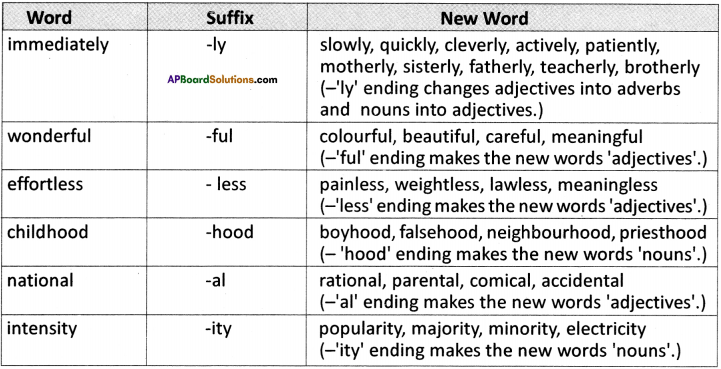
Suffixes are groups of letters that are attached to words at their ends. (Groups of letters attached to words at their beginnings are called prefixes.) Suffixes generally change the parts of speech of the words to which they are attached.

Look at the following words taken from the passage.
AP Board 9th Class English Solutions Chapter 2A True Height 2

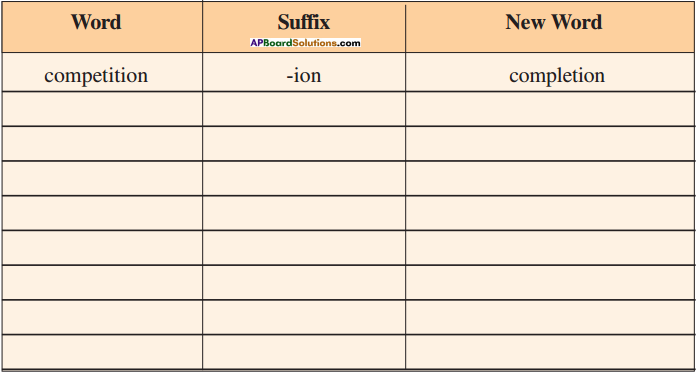
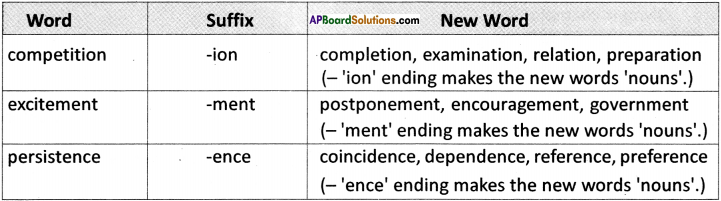
Now, pick out the suffix from each word and form new words of your own in the table given below. One is done for you.
AP Board 9th Class English Solutions Chapter 2A True Height 3
Answer:
AP Board 9th Class English Solutions Chapter 2A True Height 4
AP Board 9th Class English Solutions Chapter 2A True Height 5

III. Collocations :

A collocation is an arrangement of words or other elements, especially those that commonly cooccur.
e.g.: heart-felt congratulation.
There are certain word combinations.

  • Adjective + Noun : e.g. bright/harsh/intense/strong light
  • Verb + Noun : e.g. cast/ emit/give/provide/shed light
  • Noun + Verb : e.g. light gleams/glows/shines
  • Noun +Noun : e.g. a light source
  • Preposition+ Noun : e.g. by the light of the moon
  • Noun+ Preposition : e.g. the light from the window
  • Quantifier+ Noun : e.g. (of) a beam / ray of light

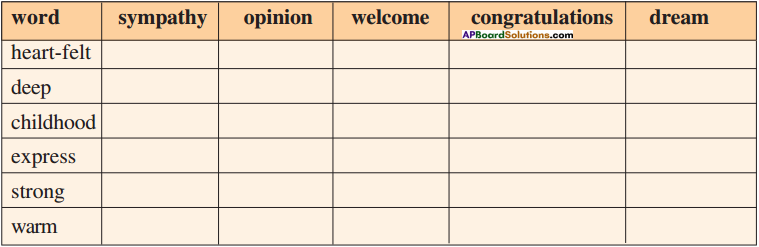
Use a dictionary and write which word in column 1 can collocate with those in the next five columns. Put a tick (✓) mark in the relevant column. Use the apt collocations in your own sentences.
AP Board 9th Class English Solutions Chapter 2A True Height 6
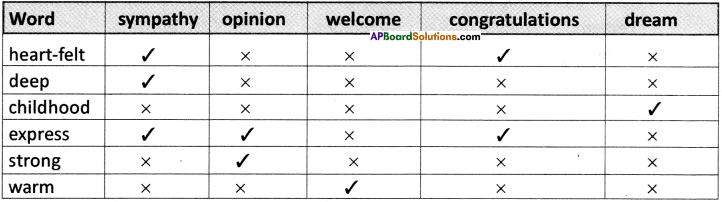
Answer:
AP Board 9th Class English Solutions Chapter 2A True Height 7

Sentences using collocations :

  1. The mother has heartfelt sympathy on her children.
  2. I received heartfelt congratulations from my friends when I obtained good marks.
  3. You have our deep sympathy on the loss of your father.
  4. Becoming a police officer was my childhood dream.
  5. He expresses his opinion on his marriage with Latha.
  6. Expressing strong opinion on you is very difficult to me.
  7. She received a warm welcome from her friends in America.

Grammar

Look at the following sentences taken from the reading passage:

1. As he raced down the golden-lined wheat fields, he would always outrun the locomotives passing by.
2. When he heard the singing of some distant robins in flight, he knew it was his time to fly.
3. Since the other vaulter had fewer misses, Michael needed to clear this vault to win.

In the above sentences the clauses with as and when denote time whereas since denotes reason. As and when refer to time and the other parts state what happened at that time. In the third sentence, the clause beginning with since states the reason and the other states the consequence.

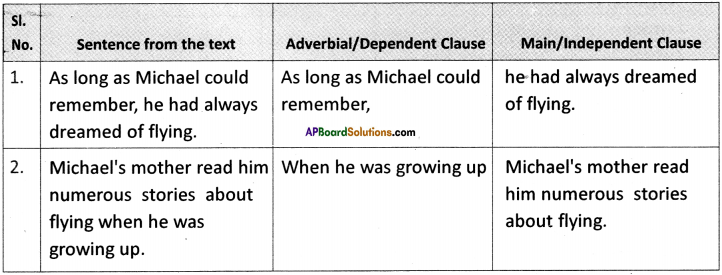
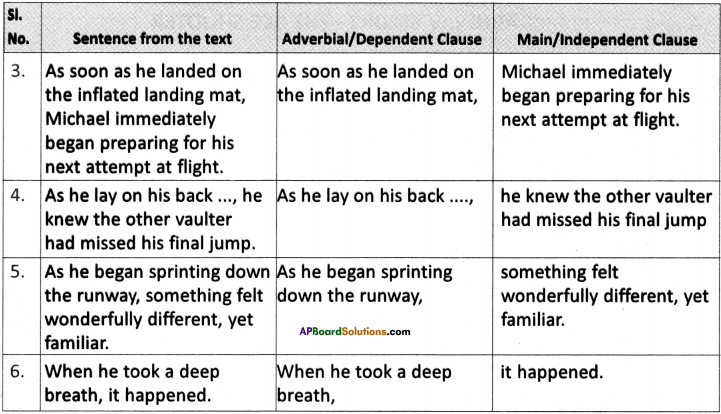
The words as, when, since are conjunctions, which connect two sentences (clauses). The clauses containing these words are called Adverbial clauses. These adverbial clauses cannot stand independently, so they are called Dependent clauses orSubordinate clauses. The clause that stands on its own is an Independent clause or Main clause.

The linkersas, when and since (Adverbs) are placed before the clauses to make them Subordinate clauses.

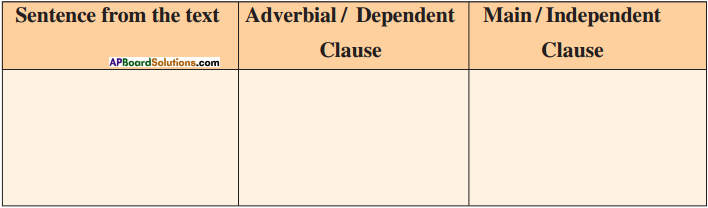
Now, read the biographical account once again and pick out the Adverbial clauses and Main clauses and write them in the table or in your notebook.
AP Board 9th Class English Solutions Chapter 2A True Height 8
Answer:
AP Board 9th Class English Solutions Chapter 2A True Height 9
AP Board 9th Class English Solutions Chapter 2A True Height 10

Complete the following sentences with appropriate Adverbial clauses. Use the adverbs wherever they are given in brackets.

1. The teacher entered the class ___________ .
2. The dog ran into a speeding car ___________ .
3.1 was in deep sleep ___________ .
4. Someone knocked at the door ___________ .
5. The crowd cheered Michael Stone ___________ . (as soon as)
6. It is high time the cricket board thought of different alternatives ___________ . (as)
Answer:

  1. The teacher entered the class when the bell had rung.
  2. The dog ran into a speeding car as it did not notice the car.
  3. I was in deep sleep when father came home and tried to wake me up.
  4. Someone knocked at the door as I was doing my homework.
  5. The crowd cheered Michael Stone as soon as he cleared the 17 feet 6½ inches height.
  6. It is high time the cricket board thought of different alternatives as there have been a series of failures on the part of the Indian cricket team.

AP Board 9th Class English Solutions Chapter 2A True Height

Writing

You have read the biography of Michael Stone. Think of some world-famous sporting personalities from India. Collect information about any one of them and write a biographical sketch.
You may include the following:
1. Date and place of birth
2. Information about the family
3. Achievements of the person : awards, prizes, honors, etc.
4. Important events in the life of the person – education, marriage, profession, etc.
5. Inspiration to others/message to the society
6. Contribution to his/her field and society
Answer:
Abhinav Bindre – The Ace Shooter

India’s thirst for a gold in Olympics individual events remained unquenched for over a hundred years. India had a taste of the individual gold only in 2008 Beijing Olympics when Abhinav Bindre achieved the land mark in 10M Air Rifle Shooting.

Abhinav Singh Bindre was born on 28 September 1982 in Dehradun in Uttarakhand (then Uttar Pradesh). Born into a very wealthy family of Sikhs, he had his early education in the world famous Doon School. Later, he moved to St. Stephen’s School from where he graduated in 2000. He did his B.B.A. in Colorado University of the U.S.A. He did a Diploma course in Mental Management too. He was pursuing his Doctorate in Business Management.

His skill as an expert shooter was identified quite early. His very supportive and affluent parents had got built exclusively for Bindre an indoor shooting range at home in Patiala! Services of a Mental coach Surabh Bhattacharjee, Lt. Col. Dhillon, and five time Olympic shooter Gabriele Buhlmans were made available to young Bhindre.

With his innate skills and excellent support from family, Bhindre started to shine from a very young age. At 15, he was the youngest participant in 1998 Commonwealth Games. His successes since then have been continuous and remarkable. He won a Bronze medal in the 2001 Munich World Cup. But in the same year, he won six Gold medals in various international events. 2002 Manchester Commonwealth Games crowned him with another Gold. 2004 Olympics saw him break the previous records, though he failed to win a medal. And in 2006, he became the first Indian to win the World Championship. 2006 Melbourne Commonwealth Games added one more Gold to his tally. Severe backache didn’t deter him from winning an Olympic Gold in 2008.

Various State Governments and Central Government honoured him amply and rewarded him with cash prizes. Arjuna Award in 2000 and Rajiv Gandhi Khel Ratna in 2001 are remarkable honours for him. Most memorable for him must be his flag bearing role in the opening ceremony of 2010 Commonwealth Games and taking the Athlete’s oath on behalf of 6,700 participants from 71 countries.

A Shot at History – My Obsessive journey to Gold is his version of his achievements. Abhinav Bindre’s life and achievements remain a source of inspiration to young aspirants.

Study Skills

You have finished reading the text “True Height”. Write the summary of the story in your own words. Use the following ideas to complete your summary effectively.

  • Make a note of the important points in the text and the supporting details.
  • Sequence of the events.
  • Identify the words/ phrases which carry ideas.
  • Use appropriate linkers.
  • Focus on the words/phrases that express the essence of the text.
  • Present the ideas briefly in your own words.
  • Do not include examples in the summary.

Summary of The Reading Text

“True Height’ is a truly touching story of Michael Stone, written by David Naster. Michael was the son of Bert and Mildred Stones. Mildred always told Michael stories of flying high. That made Michael dream and dream high. Father Bert was a practical man. He always wanted Michael to work hard to win. He was also a coach and trainer to his son. With inspiration from mother, guidance from father, and his own determination, dedication, and discipline, Michael grew into an excellent pole-vault expert with the flexibility of an athlete and the strength of a body builder. Michael was also a good student and helped parents in their farm work. With his regular practice, devoted work he went on reaching unbeatable heights in pole-vault. By clearing 17 feet 6½ inches Michael created National and International Junior Olympics record. Congratulations overwhelmed Michael. Father was crying the greatest tears of pride. Michael Stone’s success was very significant. The reason … Michael Stone was blind.

Listening

Practise listening carefully. Then you will be able to speak.
Listen to the commentary on a cricket match and answer the questions.

Cricket Commentary

Hello, good morning, viewers. This is Sunil Gavaskar with Ravi Sastry. Welcome to Uppal Cricket Stadium, Hyderabad. It is a sunny morning. Electrifying atmosphere in this jam-packed Stadium. The crowd is expecting an exciting match-a war of nerves between the arch rivals, India and Pakistan. The local boy V.V.S. Laxman is the centre of attraction as it is his home ground.

Having won the toss, India elected to bat first. The inform openers Gambhir and Sehwag are at the crease.

The first ball of the day, an in-swinging yorker into the pads of Sehwag from Umar Gul. He is all hands up. There is a loud appeal for Ibw. Luckily, for Sehwag and for India it is a noball. There is absolute silence in the stadium.

Here comes Gul again! Sehwag is ready. Gul pitches the ball at the good length area. Sehwag goes backfoot, plays it gently to the square leg area. The batsmen cross for a quick single. Sehwag opens his account with that single. India is 2 for no loss of a wicket.

This brings Gambhir on to strike. The third ball of the over. This time a slightly misdirected ball on the leg stump and Gambhir comes forward and hits straight over the head of the bowler for a four.

Gul changes the guard. This time a very well-directed short-pitch delivery. Oh! What a delivery. But Gambhir connects the ball. What a sweet timing! In a flash the ball disappears into the stands. The umpire Steve Buckner declared it a six. The crowd jump on to their feet. With that Gambhir quickly moves on to 10 and India 12 without loss. There is a conversation between Gul and Shahid Afridi. It seems the captain has a piece of advice. And there is some field adjustment for Gambhir, Now let’s see how it works.

Umar Gul comes in and bowls to Gambhir. What a cracking delivery! It breaks the defense of Gambhir, Oh! The middle stump goes cart-wheeling. He’s out. Pakistan celebrates. The jubilant Gul runs to hug his captain. The crowd is dumbstruck. But the umpire Buckner signalled it a noball. Gambhir survives. A great sigh of relief on his face. How lucky this man is! The crowd comes alive again and cheers up. What an excitement in the very first over itself!

The final ball of the over. This time it is a slow ball from Gul. Gambhir elegantly pushes the ball to the onside and completes the run but there is a fumble by the fielder. The batsmen try for the second. Will they complete it? Yes. Now the score moves on to 15. Gambhir is on 12.

I. Tick (✓) only the correct ones from the statements given below.

1. Sachin and Gambhir opened the Indian innings. (✗)
2. Umar Gul opened the Pakistan’s attack. (✓)
3. Laxman is one among the Indian squad. (✓)
4. Gul bowled out Gambhir. (✗)
5. India is 15 without loss after the first over, (✓)

II. Answer the following questions.

1. Which two world teams of cricket do you like? Why?
Answer:
I like Indian team and Australian team, I love their art of playing, team spirit, sporting spirit and human approach.

2. Who are the openers?
Answer:
Sehwag and Gambhir are the openers.

3. Who are the commentators?
Answer:
Sunil Gavaskar and Ravi Sastri are the commentators.

AP Board 9th Class English Solutions Chapter 2A True Height

III. Complete the Score Board given below.
India Vs Pakistan
AP Board 9th Class English Solutions Chapter 2A True Height 11
Answer:
AP Board 9th Class English Solutions Chapter 2A True Height 12

Oral Activity

Imagine, you were listening to the commentary, your father came there and reminded you of the ensuing examinations. He said, “Listening to cricket commentary is a waste of time.” Now develop a conversation between you and your father.
Answer:
Father : Hey Avinash ! What are you doing ? Examinations are just a week ahead, and you are listening to cricket commentary ! Isn’t it a sheer waste of time ?

Avinash : Sorry father! I just started to listen to commentary. I have been studying lessons for long. As I felt like relaxing for a few moments, I switched on the radio.

Father : But you can listen to music to ralax.

Avinash : True, father. But cricket commentary can also be useful in many ways. First, it gives us a chance to improve listening skills. Then it gives us quite interesting information. Analytical and presentation skills can also be improved. Sometimes we feel inspired to achieve great goals too I

Father : Sounds you are right. But I have my own doubts.

Avinash : Your doubts have base father. If we become an addict to commentary, we will waste all our time. As long as we are within our limits, listening to cricket commentary can be a productive and enjoyable activity.

Father : Seems we elders can pick up a point or two from you brilliant boys I

Avinash : Oh father, thanks a lot. But I will be in my limits.

Father : Good, son ! Continue to progress and prosper!

Avinash : I will try my level best father!

True Height Summary in English

“True Height’ is a truly touching story of Michael Stone, written by David Naster. Michael was the son of Bert and Mildred Stones. Mildred always told Michael stories of flying high. That made Michael dream and dream high. Father Bert was a practical man. He always wanted Michael to work hard to win. He was also a coach and trainer to his son. With inspiration from mother, guidance from father and his own determination, dedication and discipline, Michael grew into an excellent pole-vault expert with the flexibility of an athlete and the strength of a body builder. Michael was also a good student and helped parents in their farm work. With his regular practice, devoted work he went on reaching unbeatable heights in pole-vault. By clearing 17 feet 6^ inches Michael created National and International junior Olympics record. Congratulations overwhelmed Michael. Father was crying the greatest tears of pride. Michael Stone’s success was very significant. The reason … Michael Stone was blind.

True Height Glossary

height (n) : an extreme example of a particular quality
Note : Be careful about the spelling. It is h-e-i-g-h-t; not ‘high (adj) +1.’ And the letters ‘gh’ are silent.

athlete (n) : a person competing in sports

pursue (v-pre tense) : try to achieve

nerve-wracking (adj) : exciting; making one tense

ultimate (adj) : final, last, best

career(n) : job or work in a particular area

awe-inspiring (adj) : impressive; admiring

breathless (adj) : making one react emotionally

quenched (v-past tense) : satisfied

intensity (n) : a great extent; depth

astroturf (n) : artificial grass surface used in sports

confronted (v-past tense) : faced

pole vault (n) : a game in which a person jumps high with the help of a pole (a long stick)

gymnast (n) : a person participating in activities/sports that need strength and flexibility

fantasy (n) : a pleasant situation only in imagination

quest (n) : a long search

bird’s eye view (idiom) : a view from a high position

recurring (v-ing) : happening again and again

soaring (v-ing) : going up and up

coincide (v) : happen to be the same

hard-core (adj) : unchanging, firm in belief, strong

regimented (adj) : strictly disciplined

coach (n) : a person who guides, teaches techniques of a game

chores (n-plural) : works done regularly

persistence (n) : continuing to do something despite difficulties

obsession (n) : a state in which a person’s mind is completely filled with a thought of one particular thing/person.

arrogant (adj) : proud

inflated (adj) : filled with air

oblivious (adj) : not aware of; forgotten

surpassed (v – past tense) : exceeded; crossed

ritual (n) : a customary practice; formality

startled (v-past tense) : surprised; confused; threatened

bale of hay (n. phrase) : a bundle of dry grass

accurate (adj) : exact

envisioned (v-past) : saw in imagination

scared (adj) : afraid

a trickle (n) : drops in a series

pounding (v-ing) : beating quickly and noisily

The silence was deafening : The silence was unbearable
(Note the speciality of the expression – a paradox)

sprinting (v-ing) : running fast

eruption (n) : sudden, strong expression of powerful feelings by shouting

swarmed with (phrase) : surrounded by

accomplishment (n) : achievement

AP Board 9th Class Social Studies Important Questions Chapter 14 Democratic and Nationalist Revolutions 19th Century

AP State Syllabus AP Board 9th Class Social Studies Important Questions Chapter 14 Democratic and Nationalist Revolutions 19th Century.

AP State Syllabus 9th Class Social Studies Important Questions 14th Lesson Democratic and Nationalist Revolutions 17th and 18th Centuries

9th Class Social 14th Lesson Democratic and Nationalist Revolutions 19th Century 1 Mark Important Questions and Answers

Question 1.
How do you appreciate the Cavours role in unification of Italy? (SA-II : 2017-18)
Answer:
Cavour’s work in the Unification of Italy is appreciable.
He unify the regions of Italy through a tactful diplomatic alliance with France and he worked neither a revolutionary nor a democrat.

AP Board 9th Class Social Studies Important Questions Chapter 14 Democratic and Nationalist Revolutions 19th Century

Question 2.
Who formed ‘Young Italy’? Why? (SA-I : 2019-20)
Answer:
Young Italy was formed by Joseph Mazzini.
The main reason is to unified Italy and would touch off a European wide revolutionary movement.

9th Class Social 14th Lesson Democratic and Nationalist Revolutions 19th Century 2 Marks Important Questions and Answers

Question 1.
AP Board 9th Class Social Studies Important Questions Chapter 14 Democratic and Nationalist Revolutions 19th Century 1
Read the map given above and answer the following questions. (SA-III : 2016-17)
1. Mention the names of any two islands that are shown in the map?
2. The states which are shown above, are parts of which country now?
Answer:
1. Corsica, Sardinia, and Sicily.
2. At present the states which are shown in map are related to the country Italy.

Question 2.
What were the political, social, and economic ideas supported by the liberals in France in the beginning of 19th century? (SA-I : 2018-19)
Answer:
Political, social, and economic ideas supported by liberals.
→ Freedom for the individual.
→ Equality of all before the law.
→ Concept of government by consent.
→ End of autocracy and privileges of the church.
→ Constitution and representative government through parliament.
→ Inviolability of private property.

AP Board 9th Class Social Studies Important Questions Chapter 14 Democratic and Nationalist Revolutions 19th Century

Question 3.
With reference to the Unification of Germany, answer the following questions. (SA-I : 2019-20)
i) Which country took leadership for Unification of Germany?
Answer:
Prussia.

ii) With what 3 countries did Bismarck go to war to achieve German unification?
Answer:
Denmark, Austria, and France.

9th Class Social 14th Lesson Democratic and Nationalist Revolutions 19th Century 4 Marks Important Questions and Answers

Question 1.
The French women fought for which rights ? in the context of India, were the women given all these rights? Write your analysis. (SA-I : 2018-19)
Answer:
French women fought for Right to vote, Right ot contest to Legislature, and Right to capture political power.
Then in the context of India all Indian women who are eligible, get all the above rights. Even though in the issue of gaining above the rights some negligence is there in India.

  1. Representation of women in legislature is very less.
  2. Women Reservation bill is still not approved in Lok Sabha.
  3. Very less women are in political posts.

AP Board 9th Class Social Studies Important Questions Chapter 14 Democratic and Nationalist Revolutions 19th Century

Question 2.
Describe the process of Italian Unification in 19th Century. (SA-II : 2018-19)
Answer:
Unification of Italy :
I Stage :
In 1830s Guiseppe Mazzini had sought to put together a coherent programme for a Unitary Italian Republic.
He had also formed a secret society called Young Italy for the dissemination of his goals.

II Stage :

  • Prime Minister Cavour who led the movement to unify the regions of Italy, was neither a revolutionary nor a democrat.
  • Through a tactful diplomatic alliance with France, he defeated Austria.

III Stage :

  • Under the leadership of Garibaldi, a large number of Red Shirts army joined the fray.
  • In 1860 they marched into South Italy and the kingdom of the Two Sicilies and succeeded in winning the support of the local peasants in order to drive out the Spanish rulers.

IV Stage :
Finally, Victor Emmanel II occupied Rome, and Unification of Italy completed. In 1871 Victor Emmanuel II was proclaimed king of unified Italy.

9th Class Social 14th Lesson Democratic and Nationalist Revolutions 19th Century Important Questions and Answers

Question 1.
Write about Jacobins constitution.
Answer:

  • Under the Jacobian constitution, all people were given the right to vote and the right to insurrection.
  • The constitution stated that the Government must provide the people with work or livelihood.
  • The happiness of all was proclaimed as the aim of government.
  • The government abolished slavery.
  • Hence the Jacobians was the first genuinely democratic constitution in history.

AP Board 9th Class Social Studies Important Questions Chapter 14 Democratic and Nationalist Revolutions 19th Century

Question 2.
How did nationalism and the idea of the nation-state emerge?
Answer:

  • A nation state was one in which the majority of its citizens came to develop a sense of common identity and shared common history.
  • This commonness did not exist from time immemorial, it was forged through struggles, through the actions of leaders and the common man.
  • The French revolution gave the term “nation” its modern meaning.
  • A nation is not the territory but the people who make it.
  • The French revolution gave the meaning of sovereignty that the people constituting the nation are the source of all power and authority.
  • Government is answerable to its people.

All these ideals led to the formation of the nation-states.

Question 3.
Discuss the importance of language and popular traditions in the creation of national identity.
Answer:

  • Language and popular traditions are important in the creation of national identity.
  • National identity means people feeling that they belong to a nation irrespective of their caste, religion, colour, etc.
  • The language makes people identify themselves as a one race or a nation.
  • Also, the popular traditions such as Roman culture and tradition etc. easily attracted the people and strengthened the national integrity.

Question 4.
In what ways do you think could the French revolutionaries help the other people of Europe to become nations?
Answer:

  • I think the French revolutionaries could help the other people of Europe to become nations.
  • The French revolutionaries fought for the principles of liberty, equality, and fraternity.
  • They proved that France was not just a territory but the French people.
  • The revolutionaries further declared that it was the mission and the destiny of the French nation to liberate the peoples of Europe from despotism, in other words, to help other people of Europe to become nations.

AP Board 9th Class Social Studies Important Questions Chapter 14 Democratic and Nationalist Revolutions 19th Century

Question 5.
Do you think the anti-Nizam movement was a nationalist movement like French revolution? Compare the similarities and differences between the two movements.
Answer:

  • Anti-Nizam movement was a nationalist movement like French Revolution.
  • Both these were against the rulers at that time.
  • The revolutionaries in French revolution became violent at times, whereas the activists in anti-Nizam movements suffered a lot in the hands of Nizam army.

Question 6.
Why do you think liberal democracy was reluctant to give right to vote to women and propertyless men?
Answer:

  • Liberals did not ensure universal right to vote for all the people.
  • Right to vote and get elected was given only to property – owing men.
  • Men without property and all the women were not given any political rights.

Question 7.
In what ways were the liberals different from the conservative monarchists and how were they different from the radical poor?
Answer:

  • Liberals believe that government should work by consent of people.
  • Liberals believe people should have equal freedom and all are equal before law.
  • Constitutional Monarchists believe in privilege of rich landlords and powers of monarch.
  • They want to use modernization as a tool to increase control over the state.
  • Radical poor wanted to bring change in the order with a reign of terror.

AP Board 9th Class Social Studies Important Questions Chapter 14 Democratic and Nationalist Revolutions 19th Century

Question 8.
Why do you think were defeated by the conservatives?
Answer:

  • Liberals talked of political democracy only and no equality was propogated.
  • They did not even supported universal franchise and equality before law.
  • But conservatives used modernization to have greater control overstate.
  • They wanted to abolish serfdom and federalism and installation of modern army, dynamic economy, etc.

Question 9.
Read the following passage and answer the questions given below.

Linder the Jacobin constitution, all people were given the right to vote and the right of insurrection. The constitution stated that the government must provide the people with work or livelihood. The happiness of all was proclaimed as the aim of government. Though it was never really put into effect, it was the first genuinely democratic constitution in history. The government abolished slavery in the French colonies. Napoleon’s rise to power was a step backward. However, though he destroyed the Republic and established an empire, the idea of the republic couldn’t be destroyed. After the defeat of Napoleon, the old ruling dynasty of France was restored to power. However, within a few years, in 1830, there was another outbreak of revolution. In 1848, the monarchy was again overthrown though it soon reappeared. Finally, in 1871, the Republicwasagain proclaimed.

1) What was the first genuinely framed constitution in the world?
Answer:
Jacobin’s constitution was the first genuinely framed constitution in the world.

2) Why was the Jaccobians constituion called the first genuinely framed constitution?
Answer:
1) The Jacobin’s constitution gave the right to vote to all citizens.
2) The constitution stated that the government must provide the people with work. Hence it was called the first genuinely framed constitution in the world.

3) Who was the dictator that ruled over France during early 19th century?
Answer:
Napoleon.

4) When were the revolutions occurred in France in the early 19th century?
Answer:
In 1830 and 1848, the France experienced revolutions.

5) When was the Republic proclaimed in france?
Answer:
The Republic was proclaimed in France in 1871 A.D.

AP Board 9th Class Social Studies Important Questions Chapter 14 Democratic and Nationalist Revolutions 19th Century

Question 10.
Read the following passage and answer the questions given below.

The Habsburg Empire that ruled over Austria-Hungary, for example, was a patchwork of many different regions and peoples. It included the Alpine regions -the Tyrol, Austria, and the Sudetenland – and Bohemia, where the aristocracy was predominantly German-speaking. It also included the Italian-speaking provinces of Lombardy and Venetia. In Hungary, half of the population spoke Magyar while the other half spoke a variety of dialects. In Galicia, the aristocracy spoke Polish. Besides these three dominant groups, there also lived within the boundaries of the empire, a mass of subject, peasant peoples -Bohemians and Slovaks to the north, Slovenes in Carniola, Croats to the south, and Roumans to the east in Transylvania. Such differences did not easily promote a sense of political unity. The only tie binding these diverse groups together was a common allegiance to the emperor.

1) Name the Alpine regions is the Habsburg Empire.
Answer:
The Tyrol, Austria and the Sudetenland, and Bohemia were the Alpine region.

2) In which language did the aristocracy speak in the Alphine region?
Answer:
The Aristocracy in the Alphine spoke in German.

3) What were the Italian speaking provinces of the Habsburg Empire?
Answer:
Lombardy and Venetia were Italian provinces.

4) A mass of subject peasant people lived in the empire. Name them.
Answer:
Bohemians, Slovaks, Slovens, Croats, and Roumans were peasant people that lived in the empire.

Question 11.
Why do you think conservatism needs to curb freedom to express one’s opinion and criticise?
Answer:

  • Conservatism is the dominance of society by an aristocracy. It is incompatible with democracy, prosperity, and civilization in general.
  • The conservatives did not tolerate criticism and dissent and sought to curb activities that questioned the legitimacy of autocratic governments.
  • They imposed censorship laws to control the ideas of liberty and freedom associated with the French Revolution.

AP Board 9th Class Social Studies Important Questions Chapter 14 Democratic and Nationalist Revolutions 19th Century

Question 12.
Read the following information and answer the questions given below.

Some important years
1797 Napoleon invades Italy; Napoleonic wars begin.
1814-1815 Fall of Napoleon; the Vienna Peace Settlement.
1821 Greek struggle for independence begins.
1848 Revolutions in Europe; artisans, industrial workers, and peasants revolt against economic hardships; middle classes demand constitution and representative governments; Italians, Germans, Magyars, Poles, Czechs, etc., demand nation-states.
1859-1870 Unification of Italy.
1866-1871 Unification of Germany.
1905 Slav nationalism gathers force in the Habsburg and Ottoman Empires.

a) What are the demand of middle classes? (SA-III : 2016-17)
Answer:
The demands of middle classes were

  1. Constitution and
  2. Representative government.

b) With the invasion on which country, did Napoleanic wars begin? (SA-III : 2016-17)
Answer:
Nepoleonic wars begin with invasion of Italy.

c) In which year was the Vienna peace conference held? (SA-I : 2018-19)
Answer:
Vienna Peace Conference was held in 1815 A.D.

d) Who was ruling France during the 1848 revolution? (SA-I : 2018-19)
Answer:
Louis Phillippe.

e) Who completed the unification of Italy? (SA-I : 2018-19)
Answer:
Victor Immanuel-ll, completed the Unification of Italy.

f) The Greek struggle for independence started in which year? (SA-I : 2018-19)
Answer:
1821 A.D.

g) When did Napoleon invade Italy?
Answer:
Napoleon invaded Italy in 1797 AD.

h) When was the Vienna Peace Settlement signed?
Answer:
The Vienna Peace Settlement was signed in 1815 A.D.

i) What were the two nations that united in the mid 19th centuries?
Answer:
Italy and Germany were the two nations that united in the mid 19th century.

j) Who revolted against economic hardship?
Answer:
Industrial workers and peasants revolted against economic hardship.

k) What were the demands of the middle class in 1848 revolt?
Answer:
The middle class demanded constitutions and representative governments.

Question 13.
Do you think our country has a liberal democratic political system? Give your reasons.
Answer:

  • In India supreme power rests with the people.
  • India is a republic country.
  • Everyone is equal before law.
  • Every citizen of 18 years and above has the right to vote.
  • Any citizen is eligible to contest for any political office.

Hence we can say India has liberal democratic political system.

AP Board 9th Class Social Studies Important Questions Chapter 14 Democratic and Nationalist Revolutions 19th Century

Question 14.
Point out the following on the Europe map.

  1. Corsica
  2. Sardinia
  3. Poland
  4. Germany
  5. France

AP Board 9th Class Social Studies Important Questions Chapter 14 Democratic and Nationalist Revolutions 19th Century 2

Question 15.
Locate the following on the Europe map.

  1. Hungary
  2. Serbia
  3. London

AP Board 9th Class Social Studies Important Questions Chapter 14 Democratic and Nationalist Revolutions 19th Century 3

Question 16.
What is the caricature? What does it represent?
Answer:

  • A funny drawing of someone that makes them look silly or sometimes criticizes someone.
  • It usually tells us about an incident or a person of that age.
  • It symbolizes the wrong practices or criticizes that person on that grounds or informs us about the other side of that person.

AP Board 8th Class Physical Science Study Material Guide Solutions | 8th Class Physics Study Material Pdf

Telangana & Andhra Pradesh SCERT AP State Board Syllabus 8th Class Physical Science Physics Study Material Guide Pdf free download, TS AP 8th Class Physical Science Physics Textbook Questions and Answers Solutions in English Medium and Telugu Medium are part of AP Board 8th Class Textbook Solutions.

Students can also go through AP Board 8th Class Physical Science Notes to understand and remember the concepts easily. Students can also read AP 8th Class Physical Science Important Questions (Physics & Chemistry) for exam preparation.

AP State Syllabus 8th Class Physics Study Material Pdf Download | 8th Class PS Guide

AP 8th Class Physics Study Material Pdf Download | 8th Class Physical Science Textbook Guide Question and Answer

AP 8th Class Physical Science Study Material Pdf Download English Medium

AP 8th Class Physics Textbook Questions and Answers Telugu Medium

Telangana SCERT Class 8 Physics Solutions | 8th Class PS Guide | 8th Class Physics Textbook Lessons

AP Board 9th Class English Solutions Chapter 1C Little Bobby

AP State Syllabus AP Board 9th Class English Textbook Solutions Chapter 1C Little Bobby Textbook Questions and Answers.

AP State Syllabus 9th Class English Solutions Chapter 1C Little Bobby

9th Class English Chapter 1C Little Bobby Textbook Questions and Answers

I. Answer the following questions.

Question 1.
Which is the most humorous action? Give reasons in support of your answer.
Answer:
Stealing Mother Mary’s statue and writing to God as kidnapping is the most humorous action. The reasons are many.

  1. Persons are kidnapped; not statues.
  2. Mother Mary’s statues are aplenty in so many other churches.
  3. God can get back that statue even without giving Bobby a bike.
  4. Bobby’s creativity – though used for a wrong cause – is both admirable and humorous.

Question 2.
If you wanted a bike, what would you write to God?
Answer:
If I wanted a bike, I wouldn’t think of writing a letter to God. If I were to write one, would very humbly request God for a bike. I would also explain the need in a detailed way.

AP Board 9th Class English Solutions Chapter 1C Little Bobby

Question 3.
Would you like the behaviour of Little Bobby? Why or why not? Give a reason.
Answer:
No, I would not like Little Bobby’s trouble making behaviour. I do not like stealing Mother Mary’s statue. I do not like the action of kidnapping God’s mother and demanding a bike. But I do like Bobby’s honesty in admitting his misbehaviour. I do admire his creativity.

Project Work

Collect data from 30 families (including men, women and children) on the following programmes they watch on TV.
Family Information Sheet
AP Board 9th Class English Solutions Chapter 1C Little Bobby 1

Follow the process given below.
Before conducting survey: Form into three groups.
During the survey: Collect the information to know how frequently people watch different programmes on TV depending on their gender and age.

Each group should collect data from ten families by using the above format.

After the survey:
On the basis of the 10 individual sheets, prepare one consolidated sheet giving the profile of the families visited.
Analyse the results in groups and write a brief report on the result of your survey.

You may use the following phrases:
Very large number of men/women/children (above 75%) ……………………..
Very few number of men/women/children (below 15%) ……………………..
A good number of men/women/children (15%-75%) ……………………..

Consolidated Sheet of Group ONE
Giving the Profile of the 10 Families Visited.
AP Board 9th Class English Solutions Chapter 1C Little Bobby 2

Report of Group ONE :

This report is prepared on the basis of the data collected from ten families on the above mentioned programmes they watch on TV. It reflects how frequently people watch different programmes on TV depending on their gender and age. According to the analysis very large number of women watch movies and cookery programmes. A good number of women, men and children watch movies. Very large number of men watch movies, discussions and film reviews. Only a few number of children and women watch discussions. A large number of children watch games and sports. People of ail age groups and genders spend their time to watch TV.

AP Board 9th Class English Solutions Chapter 1C Little Bobby

Consolidated Sheet of Group TWO
Giving the Profile of the 10 Families Visited.
AP Board 9th Class English Solutions Chapter 1C Little Bobby 3

Report of Group TWO :

This report is prepared on the basis of the data collected from ten families on the above mentioned programmes they watch on TV. It reflects how frequently people watch different programmes on TV depending on their gender and age. Very few number of women watch news, games and sports and cartoon programmes. Very few number of children spend their time to watch discussions and cookery programmes. Most of the children watch games and sports. Children watch movies more than women and men. Daily serials and film reviews are great attractions for all. All most all people sit before their TV sets every day.

AP Board 9th Class English Solutions Chapter 1C Little Bobby

Consolidated Sheet of Group THREE
Giving the Profile of the 10 Families Visited.
AP Board 9th Class English Solutions Chapter 1C Little Bobby 4

Report of Group THREE :

This report is prepared on the basis of the data collected from ten families on the above mentioned programmes they watch on TV. It reflects how frequently people watch different programmes on TV depending on their gender and age. Games and sports are major attractions for children. Reality shows, cartoon programmes and movies are other important attractions for them. Most of women spend their time to watch daily serials, cookery programmes and movies. Very few women watch news, discussions and games and sports. Men are interested in watching movies, news, games and sports and reality shows. A good number of men like to watch daily serials. All the members of every family spend their time before their TV sets daily.

Little Bobby Summary in English

“Little Bobby” is the story of a naughty boy by Ritcha Rao. He was a troublemaker both at home and school. He one day asked his mother a bike for his coming birthday. Mother wanted Bobby to know how he had been behaving. So she asked Bobby to write a letter to God. She wanted him to write the reasons that made him eligible for a bike. Bobby started writing a letter. But he was not good to deserve a bike. So, he wrote four letters and tore them up as they were not true or helpful. Then he went to the nearby church. He stole the statue of Mother Mary. He came back and wrote to God “I’VE KIDNAPPED YOUR MOM. IF YOU WANT TO SEE HER AGAIN, SEND THE BIKE!”

Little Bobby Glossary

troublemaker (n) : one who causes troubles

deserved (v-past tense) : was eligible to have something

reflect (v) : think about seriously

stumped (v-past tense) : walked angrily and noisily

altar (n) : (The word ‘alter’ (v) is a different word.) place in a prayer hall where statues are placed

kidnapped (v-past tense) : took someone by force with demand for money or things

AP Board 9th Class English Solutions Chapter 1B The Duck and the Kangaroo

AP State Syllabus AP Board 9th Class English Textbook Solutions Chapter 1B The Duck and the Kangaroo Textbook Questions and Answers.

AP State Syllabus 9th Class English Solutions Chapter 1B The Duck and the Kangaroo

9th Class English Chapter 1B The Duck and the Kangaroo Textbook Questions and Answers

I. Answer the following questions.

Question 1.
Why did the Duck get bored in life? What did it want to do?
Answer:
The Duck lived in a pond. It cannot hop like a Kangaroo and go round the world. When the Duck saw the Kangaroo going round the places, it felt bored. It wanted to tour places. Limiting to the pond made the Duck unhappy.

Question 2.
What problem did the Kangaroo find with the Duck? How was it solved?
Answer:
The Kangaroo was willing to take the Duck to new places. But it objected to the wet cold feet of the Duck. The Kangaroo said that would make him ill. But the Duck had a solution. It got socks, a coat, and cigars ready to save them from cold.

AP Board 9th Class English Solutions Chapter 1B The Duck and the Kangaroo

Question 3.
Who was happy in the end? Why?
Answer:
Both the Kangaroo and the Duck were happy in the end. The Duck was happier as its desire to see places was fulfilled. The Kangaroo too was happy as it could help his friend.

Question 4.
What is the underlying message in the poem?
Answer:
The poem is basically humorous. But it has valuable messages too ! Desire to see new places is a natural way to better oneself. Seeking others’ help promotes cooperative living. Foreseeing the problems and providing solutions is a good lesson.

II. Read the above poem once again and choreograph it as described here under.

Choreography

Choreography is the art of designing sequences of movements or actions for a script or a poem with a voice or a song in background.
Do you know how to process choreography?
Here is the process.
Think of the following.

1. How do we begin the poem?
(Sing the poem three or four times to register the tune and rhythm.)

2. What are the characters in the poem?
(The Duck and the Kangaroo)

3. What is the theme of the poem?
(Wish of the Duck to go round the world)

4. What is the theme of each stanza? (sub themes)

Stanza Theme
1. First Wish of the Duck to hop and go round the world
2. Second Requesting the Kangaroo to take her for a ride
3. Third Conditional acceptance of the Kangaroo
4. Fourth Assurance of comfort from the Duck’s side
5. Fifth Fulfilment of desire

5. Convert the themes into incidents and performable actions.

6. What are the actions involved in the poem?

  • Boredom with present life (feelings of boredom, pain)
  • Desire to go round the world (miming)
  • Wearing socks and smoking cigarettes (joy)
  • Displeasure due to wet and cold feet (gestures)
  • Sitting on Kangaroo at the end of the tail (miming)
  • Joy (facial expression and gestures)

AP Board 9th Class English Solutions Chapter 1B The Duck and the Kangaroo

7. Who are the characters involved?
(The Duck, the Kangaroo and other creatures in the pond like frogs, fish, etc.)

8. Where does the incident take place (location)?
(By the side of the pond)

9. Presentation of the choreography on the stage:

  • The chorus team sings the poem
  • The characters perform their actions
  • The action of the Duck and the Kangaroo- expressing boredom, wish, discomfort, joy, etc.
  • The actions related to miming, facial expressions and gestures
  • Actions related to hopping, sitting, walking, jumping, etc.

The Duck and the Kangaroo Summary in English

‘The Duck and the Kangaroo’ is a poem with a touch of humour. It was the creation of a British poet called Edward Lear. The Duck says that it is bored with its life in the pond.
It wants the Kangaroo to carry it around the world. The Kangaroo says that the Duck’s cold and wet feet will make him ill. The Duck says it has a solution to that problem. It will wear socks. It will also have a coat and smoke. Then the Kangaroo asks the Duck to sit on his tail. The Kangaroo hops around the world thrice with the Duck sitting on his tail. The
poet leaves the question – as to who is so happy? – to the reader!

The Duck and the Kangaroo Glossary

Good gracious! (phr) : an exclamation expressing surprise and emphasis

nasty (adj) : unpleasant

long (v) : have a strong desire

the Dee and the Jelly Bo Lee (n) : wonderful places imagined by the poet

reflection (n) : thinking, consideration

roo-matiz (n) : rheumatism (n) – a disease that makes joints and muscles painful; arthritis

worsted socks : woollen socks

cloak (n) : coat

pale (adj) : low, dull

steady (adj) : remaining in the same position

AP Board 9th Class Physical Science Solutions Chapter 5 What is inside the Atom?

AP State Syllabus AP Board 9th Class Physical Science Solutions Chapter 5 What is inside the Atom? Textbook Questions and Answers.

AP State Syllabus 9th Class Physical Science Solutions 5th Lesson What is inside the Atom?

9th Class Physical Science 5th Lesson What is inside the Atom? Textbook Questions and Answers

Improve Your Learning

Question 1.
What are the three subatomic particles? (AS 1)
Answer:
The three sub-atomic particles are electrons, protons, and neutrons.

Question 2.
Compare the subatomic particles electron, proton, and neutron. (AS 1)
Answer:
AP Board 9th Class Physical Science Solutions Chapter 5 What is inside the Atom 1

Question 3.
What are the limitations of J.J. Thomson’s model of the atom? (AS 1)
Answer:
The main limitation of J.J. Thomson’s model of atom was that he is unable to explain, how the positively charged particles are shielded from negatively charged particles without getting neutralized.

AP Board 9th Class Physical Science Solutions Chapter 5 What is inside the Atom?

Question 4.
What were the three major observations Rutherford made in the gold foil experiment? (AS 1)
Answer:
The three major observations Rutherford made in the gold foil experiment were

  1. Most of the space inside the atom is empty.
  2. All the positive charge must be concentrated in a very small space within the atom called nucleus.
  3. The size of the nucleus is very small as compared to the size of the atom.

Question 5.
Sketch Rutherford’s atomic model. Why is Rutherford’s model of the atom called the planetary model? (AS 5)
Answer:
AP Board 9th Class Physical Science Solutions Chapter 5 What is inside the Atom 5
Rutherford’s model is called planetary model because the motion of the electrons around the nucleus resembles the motion of the planets around the sun.

Question 6.
Put tick (✓) against correct choice and cross (✗) against wrong choice: (AS 1)
i) In Rutherford’s gold foil experiment, majority of alpha particles passed directly through the gold foil. This observation leads to which conclusions?
a) The positively charged region of the atom is very small. (✗)
b) The atom must consist of empty space. (✓)
c) The alpha particles makes a direct hit on the positively charged region of the atom. (✗)
d) The positively charged region of the atom is very dense. (✗)

ii) In Rutherford’s gold foil experiment, occasionally the alpha particles veered from a straight line path. This observation leads to which conclusion?
a) The positively charged region of the atom is very small. (✗)
b) The majority of the space in the atom is empty. (✗)
c) The alpha particle makes a direct hit on the positively charged region of the atom. (✗)
d) The positively charged region of the atom is very dense. (✓)

AP Board 9th Class Physical Science Solutions Chapter 5 What is inside the Atom?

Question 7.
Which one of the following is the correct electronic configuration of sodium? (AS 1)
a) 2, 8
b) 8, 2, 1
c) 2, 1, 8
d) 2, 8, 1
Answer:
d) 2, 8, 1

Question 8.
Give the main postulates of Bohr’s model of an atom. (AS 1)
Answer:
The main postulates of Bohr’s model of atom are
AP Board 9th Class Physical Science Solutions Chapter 5 What is inside the Atom 2

  1. Only certain special, discrete orbits of electrons are allowed inside the atom. These orbits or shells are called energy levels.
  2. While revolving in these discrete orbits the electrons do not radiate energy and this helps that the electrons do not crash into the nucleus.
  3. These orbits or shells are represented by the letters K, L, M, N, ……… or the numbers n = 1, 2, 3, …………

AP Board 9th Class Physical Science Solutions Chapter 5 What is inside the Atom?

Question 9.
Compare all the proposed models of an atom given in this chapter. (AS 1)
Answer:
In this chapter, four atomic models were discussed. The main postulates of those models are

1. Dalton’s proposal :
a) Atoms are indivisible.
b) Atoms of an element are all identical to each other and different from the atoms of other elements.

2. Thomson’s proposal:
a) An atom is considered to be a sphere of uniform positive charge and electrons are embedded into it.
b) The total mass of the atom is considered to be uniformly distributed throughout the atom.

3. Rutherford’s proposal:
a) All the positively charged material in an atom formed a small dense centre, called the nucleus of the atom.
b) Negatively charged electrons revolve around the nucleus in well defined orbits.
c) Size of the nucleus is very small as compared to the size of the atom.

4. Neils Bohr’s proposal :
a) Electrons are revolving around the nucleus in special, discrete orbits called en¬ergy levels or shells.
b) While revolving in these discrete orbits the electron do not radiate energy and this helps that the electrons do not crash into the nucleus.
c) These orbits or shells are represented by the letters K, L, M, N,…. or the numbers n = 1, 2, 3,

AP Board 9th Class Physical Science Solutions Chapter 5 What is inside the Atom?

Question 1o.
Define valency by taking examples of nitrogen and boron. (AS 1)
Answer:
Valency: The number of electrons present in outer most orbit of an atom is called its valency. Valency of Nitrogen :
a) Atomic number of nitrogen is 7.
b) The distribution of electrons is 2, 5.
c) The outer most orbit has 5 electrons.
d) Hence its valency should be 5. But it is easier to nitrogen to gain 3 electrons than to loose 5 electrons for becoming octet.
e) Hence the valency of nitrogen is ‘3’.

Valency of Boron :
a) Atomic number of boron is 5.
b) The distribution of electrons is 2, 3.
c) The outer most orbit has 3 electrons.
d) Hence the valency of boron is 3.

Question 11.
State the valencies of the following elements : magnesium and sodium. (AS 1)
Answer:
Magnesium :
a) Atomic number of magnesium is 12.
b) Distribution of electrons is 2, 8, 2.
c) Hence the valency is 2.

Sodium :
a) Atomic number of sodium is 11.
b) Distribution of electrons is 2, 8, 1.
c) Hence the valency is 1.

Question 12.
If Z = 5, what would be the valency of the element? (AS 2)
Answer:
1) If Z = 5, the distribution of electrons is 2, 3.
2) Hence the valency is ‘3’.

Question 13.
Write the atomic number and the symbol of an element which has mass number 32 and the number of neutrons 16 in the nucleus. (AS 1)
Answer:
Mass number (A) = 32 ; Number of neutrons (N) = 16
Number of protons (Z) = A- N = 32-16 = 16
∴ Atomic number =16
The element is sulphur.
The symbol of sulphur is S’.

Question 14.
Cl- has completely filled K and L shells. Explain. (AS 1)
Answer:
Atomic number of Cl is 17, but Cl has one more electron when compared with Cl atom. Distribution of electrons in Cl is

K L M
2 8 8

K shell can accommodate 2 electrons and L shell cab accommodate 8 electrons accord¬ing to the formula 2n2.
Hence the K and L shells are completely filled.

Question 15.
What is the main difference among the isotopes of the same element? (AS 1)
Answer:
The main difference between isotopes of the same element is
a) The number of neutrons is different.
b) Their physical properties are different but the chemical properties are similar.

Question 16.
For the following statements, write T for True and F for False. (AS 1)
a) J.J. Thomson proposed that the nucleus of an atom contains only nucleons.
b) A neutron is formed by an electron and a proton combining together. Therefore, it is neutral.
c) The mass of an electron is 1836 times that of proton.
Answer:
a) False
b) False
c) True

Question 17.
Fill in the missing information in the following table. (AS 4)
AP Board 9th Class Physical Science Solutions Chapter 5 What is inside the Atom 3
Answer:
AP Board 9th Class Physical Science Solutions Chapter 5 What is inside the Atom 4

Question 18.
How do you appreciate the efforts made by scientists to explain the structure of atom by developing various atomic models? (AS 6)
Answer:

  • Structure of atom, till today it is mysterious and challenging the scientists.
  • We have to appreciate the scientists right from Lavoisier, who proposed law of conservation of mass, Proust who proposed law of constant proportions, John Dalton for his first model of atom, Rutherford for giving planetary model of atom and Neils Bohr for his model of atom.
  • Till today scientists are trying to know the existence of more and sub-atomic particles besides electrons, protons and neutrons.
  • Hence the efforts of scientists are highly appreciable, for making our lives comfortable and leaving many challenges before us to unveil or discover them.

Question 19.
Geeta got a doubt, “Why does atomic nucleus contain proton and neutrons? Why can’t electrons and neutrons be in it”. Can you help to clarify her doubt? Explain. (AS 1)
Answer:
Nucleus contains protons and neutrons inside it but not electrons and neutrons. If it would have happen, then

  1. the alpha particles in the Rutherford’s alpha particle scattering experiment would have not been deflected or scattered.
  2. the idea of nucleus would have not been evolved because the mass of electron is negligible, it is most unstable.

AP Board 9th Class Physical Science Solutions Chapter 5 What is inside the Atom?

Question 20.
Collect information about various experiments conducted and theories proposed by scientists starting from John Dalton to Neils Bohr. Prepare a story with a title “History of atom”. (AS 4)
Answer:
History of atom
John Dalton proposed atomic theory based on law of conservation of mass and law of constant proportion as :

  1. Atoms were indivisible.
  2. Atoms of an element are all identical to each other and different from the atoms of other elements.

Later on various experiments conducted by Thomson, Goldstein, etc. proved that atom is divisible and consists sub-atomic particles like electrons, protons and neutrons. Based on this J.J. Thomson proposed a model of atom in 1898.

According to Thomson,

  1. An atom is considered to be a sphere of uniform positive charge and electrons are embedded into it.
  2. The total mass of the atom is considered to be uniformly distributed throughout the atom.
  3. The negative and the positive charges are supposed to be balance out and the atom as a whole is electrically neutral.

This model is also called as plum pudding model or watermelon model.

Thomson’s student Ernest Rutherford conducted alpha particle scattering experiment and got the results which were not in favour of Thomson’s model. Based on his experiment, Rutherford proposed a model of atom. According to him,

  1. All the positively charged material in an atom formed a small dense centre, called the nucleus of the atom. The electrons were not a part of nucleus.
  2. Negatively charged electrons revolve around the nucleus in well – defined orbits like planets revolve around the sun.
  3. The size of nucleus is very small as compared to the size of the atom.

This model could not account for stability of atom, as revolving electron must lose energy and eventually crash into the nucleus, as a result matter would not exist in the form that we see it now.

In 1913, Neils Bohr proposed another model to overcome Rutherford’s defect. According to Bohr,

  1. Only certain special, discrete orbits of electrons are allowed in side the atom. These orbits or shells are called energy levels.
  2. While revolving in these discrete orbits the electrons do not radiate energy and this helps that the electrons do not crash into the nucleus.
  3. These orbits or shells are represented by K, L, M, N ………… or the numbers 1, 2, 3,

This model could not predict the spectra of atoms.

Hence this journey continues

9th Class Physical Science 5th Lesson What is inside the Atom? InText Questions and Answers

9th Class Physical Science Textbook Page No. 75

Question 1.
Why are the atoms of different elements different?
Answer:
Nature and properties of elements depends on the arrangement of atoms. We know that different elements behave differently. This is due to the difference in their atoms.

Question 2.
Is there anything inside atom that make them to be same or different?
Answer:
The arrangement of sub atomic particles inside the atom is responsible to make them to be same or different.

AP Board 9th Class Physical Science Solutions Chapter 5 What is inside the Atom?

Question 3.
Are atoms indivisible?
Answer:
No, atom is divisible. There are many sub-atomic particles inside the atom according to the recent experiments.

9th Class Physical Science Textbook Page No. 77

Question 4.
If an atom consists of sub-atomic particles like protons, neutrons and electrons, how are they arranged in the atom ?
Answer:
The arrangement of sub-atomic particles like protons, neutrons and electrons has been explained by many scientists like Rutherford, Neils Bohr, etc. According to them, atom consists a central mass called nucleus. Nucleus consists protons and neutrons. Electrons revolve around the nucleus in fixed shells.

9th Class Physical Science Textbook Page No. 80

Question 5.
Why is atom stable?
Answer:
In an atom, the number of protons in the nucleus is equal to the number of electrons out side the nucleus. Hence the positive and negative charges in an atom are equal. So, atom is electrically neutral. So, atom is stable. But the stability of atom was explained by Neils Bohr in a different way.

Question 6.
Can you suggest any other arrangement of subatomic particles in the atom which prevents the revolving electron to fall into the nucleus?
Answer:
Electrons have to revolve around the nucleus in definite orbits such that the centripetal and centrifugal forces acting on the electron must be equal in magnitude and opposite direction. Then the revolving electron do not fall into the nucleus.

9th Class Physical Science Textbook Page No. 82

Question 7.
How many electrons can be accommodated in each shell of an atom?
Answer:
The number of electrons that can be accommodated in each shell of an atom depends on the shell number. First shell (K) consists 2 electrons, second (L) shell consists 8 electrons, third (M) shell consists 18 electrons, fourth shell (N) consists 32 electrons, and so on.

Question 8.
Can a particular shell have just one electron?
Answer:
No, shell has just one electron.

AP Board 9th Class Physical Science Solutions Chapter 5 What is inside the Atom?

Question 9.
What is the criteria to decide number of electrons in a shell?
Answer:
The number of electrons in a shell can be decided by using a formula 2n². (Where n is shell number).

9th Class Physical Science Textbook Page No. 83

Question 10.
What is the valency of oxygen that you can calculate by the method discussed above?
Answer:

  • Oxygen has 8 electrons in its atom. The distribution of electrons is 2, 6.
  • The outer most shell consists 6 electrons, this number is hear to 8.
  • Hence the valency of oxygen is 8 – 6 = 2.

9th Class Physical Science Textbook Page No. 85

Question 11.
Should we consider the number of neutrons as a characteristic of an atom?
Answer:
The mass of an atom which is a characteristic of an atom depends on the number of neutrons and protons that its nucleus contains. Hence the number of neutrons can be considered as a characteristic of an atom.

9th Class Physical Science Textbook Page No. 76

Question 12.
An atom is electrically neutral. But the electrons present in it are negatively charged particles. If only negative charges were present, the atom would not be neutral. Then, why are atoms considered to be neutral?
Answer:

  • This is the idea before Rutherford’s model.
  • According to Rutherford’s model, number of protons inside the nucleus and number of electrons outside the nucleus are equal.
  • Hence the net negative charge is equal to net positive charge. So, the atom is electrically neutral.

9th Class Physical Science Textbook Page No. 80

Question 13.
Compare Rutherford and Thomson’s models of the atom on the following basis :
1) Where is the positive charge placed?
2) How are the electrons placed?
3) Are they stationary inside the atom or moving?
Answer:

  1. According to Thomson, the positive charge is uniformly distributed throughout the atom. Whereas according to Rutherford, the positively charged protons are inside the nucleus.
  2. According to Thomson, electrons are embedded in the positively charged atom, but according to Rutherford, electrons are revolving around the nucleus in welldefined orbits.
  3. According to Thomson, electrons are stable inside the atom but according to Rutherford, electrons are moving inside the atom.

9th Class Physical Science Textbook Page No. 83

Question 14.
Phosphorus and sulphur show multiple valency. See table 2. Why do some elements show multiple valency? Discuss with your Mends and teachers.
Answer:

  • For sulphur, the number of electrons in outer most orbit is 6.
  • Hence the valency should be (8 – 6 =) 2.
  • But sulphur exists in so many forms.
  • In the excited state, these 6 electrons also tend to participate in the bond formation.
  • Hence sometimes it shows the valency 6. Ex : SO2, SO3, etc.
  • Same situation happens for phosphorus. Ex . PCl3, PCl5, etc.

9th Class Physical Science 5th Lesson What is inside the Atom? Activities

Activity – 1

Question 1.
Sketch the structure of atom as you imagine.
AP Board 9th Class Physical Science Solutions Chapter 5 What is inside the Atom 6
We learnt about electron, proton and neutron.
a) Suppose you had to arrange them in an atom, how do you do it?
Answer:
Many arrangements are possible. Think that atom looks like a room, we can arrange the particles in alternating rows.

b) In how many ways can you arrange these sub-atomic particles in a spherical shape?
Answer:
Protons are positively charged, electrons are negatively charged and neutrons are
neutral. Hence neutrons and protons can be kept nearer and electrons can be kept farther or near the edge of the sphere. This is only an assumption. We can arrange in so many ways like this.