AP Board 7th Class Social Studies Solutions Chapter 3 Tanks and Ground Water

SCERT AP Board 7th Class Social Solutions 3rd Lesson Tanks and Ground Water Textbook Questions and Answers.

AP State Syllabus 7th Class Social Studies Solutions 3rd Lesson Tanks and Ground Water

7th Class Social Studies 3rd Lesson Tanks and Ground Water Textbook Questions and Answers

Improve Your Learning

Question 1.
Correct the incorrect sentences:
a) Water flows from the plains to the plateau. (✕)
Answer:
Water flows from the plateau to the plains.

b) There is a thick deposit of sand and gravel in the plains. (✕)
Answer:
There is a thick deposit of alluvium in the plains.

c) Groundwater will never dry. (✕)
Answer:
Groundwater will dry sometime.

d) It is easy to dig wells in Rajahmundry. (✓)
Answer:
Correct

AP Board 7th Class Social Studies Solutions Chapter 3 Tanks and Ground Water

Question 2.
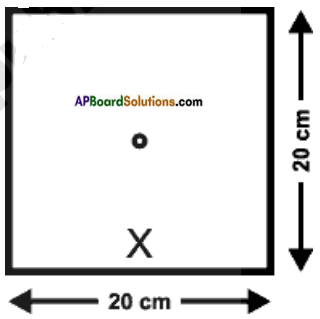
The wells shown in this figure are situated on the plains of the Godavari. But there seems to be a mistake in the figure. Can you correct it?
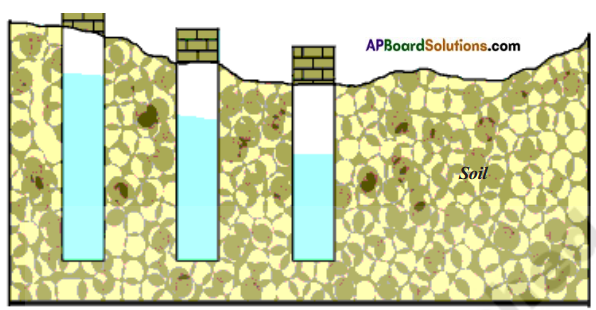
AP Board 7th Class Social Studies Solutions Chapter 3 Tanks and Ground Water 1
Answer:
The water level should be the same.

Question 3.
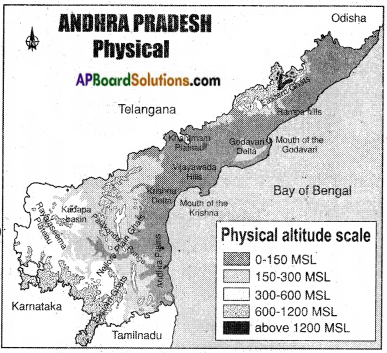
In which of these places do you expect maximum percolation to take place?
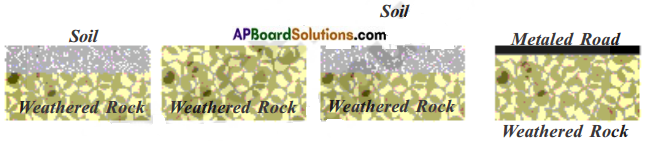
AP Board 7th Class Social Studies Solutions Chapter 3 Tanks and Ground Water 2
Answer:
B

Question 4.
When the owners of some wells in Pallerla started using high-powered motors to draw water from the wells, the owners of other wells noticed that their wells were drying up. Discuss the possible solution to the problem.
Answer:
The owners of other wells should resist that owner from using high-power motors. And the owner also should take necessary preventive steps to store rainwater/ underground water.

AP Board 7th Class Social Studies Solutions Chapter 3 Tanks and Ground Water

Question 5.
In areas where there is a shortage of groundwater, should there be any restrictions on digging tube wells? Why?
Answer:
The areas which have a shortage of groundwater are stated as notified areas by Central Ground Water Authority. In these areas, there is permission for only one tube well to meet the drinking and domestic purpose of water, its diameter should be 100 mm, and the capacity of the pump should not exceed 1 HP. It should have a rainwater harvesting system on the premises. Otherwise, the ‘holding capacity in the matter inside the earth will be lessened.

Question 6.
Think about the ways to restore the groundwater in your area?
Answer:
In our area also people draw more water from the ground, so the groundwater is decreasing over time. I think the following steps are useful to enhance groundwater

  1. Vegetation like trees and grasses and bunds are used to enhance groundwater.
  2. We follow watershed development projects.
  3. Under these projects trees and grasses are planted on the hill slopes from where a stream starts and small bunds are built across streams to stop the flow of water.
  4. I suggest the people store rainwater in tanks and not dig wells too deep in the ground.
  5. I think tanks should be developed in our village which helps the people not only in giving them and their animals drinking water, but also irrigating their fields in such a way that even in drought years people could raise at least some crops.

AP Board 7th Class Social Studies Solutions Chapter 3 Tanks and Ground Water

Question 7.
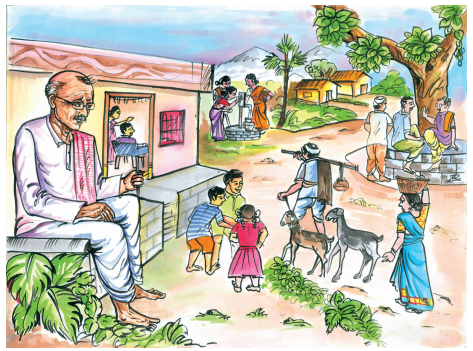
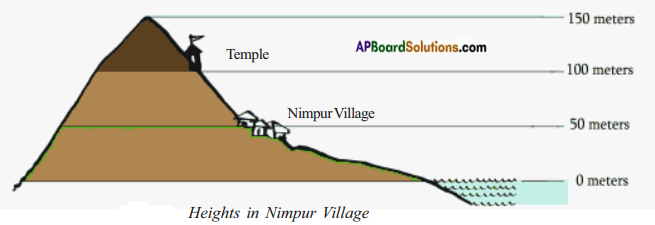
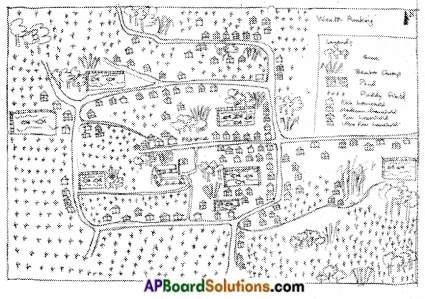
Observe the following picture and compare it with your locality.

AP Board 7th Class Social Studies Solutions Chapter 3 Tanks and Ground Water 3
Answer:
Our village is ‘Kalisipudi’ village in West Godavari District. There are no hills around our village like here. We have two water tanks – one is for drinking water and the another is for cultivation. Rainwater is saved in one tank. Water from* the canal, which was dug from the river Godavari, will be turned to another tank. Our farmers use tractors for ploughing. Our residences are far away from our fields. Draw the map of your village and locate the water resources of your village in it.

Question 8.
Draw the map of your village and locate the water resources of your village in it.
Answer:
A village picture – (with well, water tank)
AP Board 7th Class Social Studies Solutions Chapter 3 Tanks and Ground Water 4

Question 9.
Read the third para of page 27 and write a comment on it.
Water quickly flows into streams and into rivers. However, if the flow of the j rainwater were to be checked by vegetation or bunds, then there would be a greater possibility of the water percolating into the soil to join the groundwater.
Answer:
After runoff comes the last step of the water cycle, percolation.
Percolation occurs when the water on the earth’s surface in the run-off stage seeps underground. That is why in the old days they used wells to retrieve water.

AP Board 7th Class Social Studies Solutions Chapter 3 Tanks and Ground Water

Project

Collect the following information about the tanks/kuntas.
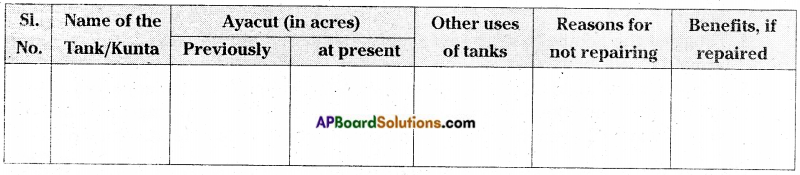
AP Board 7th Class Social Studies Solutions Chapter 3 Tanks and Ground Water 5
Answer:
Students’ Activity.
AP Board 8th Class Physical Science Important Questions Chapter 1 Force

AP State Syllabus AP Board 8th Class Physical Science Important Questions Chapter 1 Force

AP State Syllabus 8th Class Physical Science Important Questions 1st Lesson Force

8th Class Physical Science 1st Lesson Force 1 Mark Important Questions and Answers

Question 1.
What is force ? What is its S.I. unit?
Answer:
The push or pull of an object is called force. Its S.I. unit is Newton.

Question 2.
What is a contacting force?
Answer:
The force results when there is a direct physical contact between two interacting objects is called contacting force.

AP Board 8th Class Physical Science Important Questions Chapter 1 Force

Question 3.
Define a force at a distance or field force.
Answer:
The force which occurs without any physical contact between two objects is known as force at a distance or field force.

Question 4.
What is muscular force?
Answer:
The force which we exert by using our body muscles is known as muscular force.

Question 5.
What is friction?
Answer:
The resistance to the movement of a body over the surface of another body is called friction.

Question 6.
Define normal force.
Answer:
The force that a solid surface exerts on any object in the normal direction is called normal force.

Question 7.
What is a magnetic force?
Answer:
The force exerted by a magnet on another magnet.

Question 8.
What is a gravitational force?
Answer:
The attractive forces between any two massive objects is called gravitational force.

AP Board 8th Class Physical Science Important Questions Chapter 1 Force

Question 9.
What is electrostatic force?
Answer:
The force exerted by a charged body on other charged or uncharged body is called electrostatic force.

Question 10.
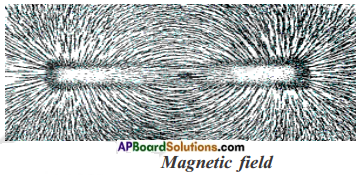
What is magnetic field?
Answer:
The space around the magnet where its influence can be detected is called magnetic field.

Question 11.
What is a net force?
Answer:
The algebraic sum of the forces acting on a body is known as net force.

Question 12.
What is free body diagram?
Answer:
The diagram showing all the forces acting on an object at a particular instant is called free body diagram.

Question 13.
A blacksmith hammers a hot piece of iron while making a tool. How does the force due to hammering affect the piece of iron?
Answer:
It changes the shape of iron.

Question 14.
A rocket has been fired upwards to launch a satellite in its orbit. Name the two forces acting on the rocket immediately after leaving the launching pad?
Answer:

  1. The weight of the rocket downwards.
  2. The upward force due to firing of rocket.

Question 15.
Why do not you experience gravitational force exists between you and your teacher because gravitational force depends on masses of object
Answer:
The reason is everything on earth experienced by a large gravitational force of earth so remaining gravitational forces are negligible.

AP Board 8th Class Physical Science Important Questions Chapter 1 Force

Question 16.
What is tension?
Answer:
When we stretch a rope or a string the tightness of rope or string is called tension. Tension is a contact force.

8th Class Physical Science 1st Lesson Force 2 Marks Important Questions and Answers

Question 1.
Explain Gravitational Force by giving a suitable example.
Answer:
Gravitational Force: The force of attraction that exists between any two bodies (or masses) everywhere in the universe.
Examples:

  1. The stone thrown up into the sky fall back on to the earth due to gravitational force.
  2. Earth holding atmosphere due to gravitational force.
  3. All the objects are pulling towards earth due to gravitational force.
  4. Rivers flow down to the sea because of gravitational force.

Question 2.
The surface area of an object is 20 m2 and a force of 10 N is applied on it, then what is the pressure?
Answer:
Force (F) = 10 N; Area (A) = 20 m × 2m = 40m2;
Pressure = [latex]\frac{F}{A}[/latex] = [latex]\frac{10}{40}[/latex] = 0.25 Pascal

Question 3.
Observe the situations of electrostatic forces in your daily life and prepare a report.
Answer:

  1. If you comb your dry hair and bring small pieces of paper then these paper pieces are attracted by comb because it is charged.
  2. If a glass rod is rubbed with a silk cloth then if we bring small pieces of paper near glass rod or silk cloth then these paper pieces are attracted by glass rod or silk cloth due to elctrostatic force.

AP Board 8th Class Physical Science Important Questions Chapter 1 Force

Question 4.
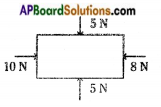
Find the net force acting on a body shown in the figure. And draw the direction of net force. (Length of the arrow shows the magnitude of the force and direction also.)
Answer:
AP Board 8th Class Physical Science Important Questions Chapter 1 Force 1

Question 5.
Give two daily life examples each of situations in which you push or pull to change the state of motion of object.
Answer:
Push:

  1. Hitting a foot ball with your leg.
  2. Moving a loaded cart.

Pull:

  1. Opening a door
  2. Moving a table towards you.

Question 6.
Give two examples of situations in which applied force causes a change in the shape of an object.
Answer:

  1. Pressing a sponge.
  2. Stretching of rubber band.

Question 7.
Name the forces acting on a plastic bucket containing water held above ground level in your hand. Why do the forces acting on the bucket do not bring a change in its state of motion?
Answer:
The gravitational force acts as plastic bucket containing water held above ground level in your hand. Gravitational force does not bring change in state of bucket be¬cause equal amount of force is applied vertically upward.

Question 8.
Name the two forces acting on a rocket immediately after leaving the launching pad.
Answer:
The two forces acting on rocket are:

  1. Force due to gravity vertically downward.
  2. Frictional force of atmosphere.

Question 9.
What changes can be observed when we apply force on an object?
Answer:
a) Change in the shape of the object.
b) Change in direction of motion of an object.
c) Change in speed of an object if the object is moving.
d) Movement of an object from rest.

AP Board 8th Class Physical Science Important Questions Chapter 1 Force

Question 10.
Have you ever seen a game of tug of war ? In this game two teams pull a rope in opposite direction. But sometimes the rope does not move explain why.
Answer:
a) When two forces acts on an object in opposite direction then the net force is difference of two forces.
b) If two teams pull the rope with equal force, the forces will be in opposite direction and will cancel with each other and the rope will not move.

Question 11.
How does an applied force change the speed of an object ?
Answer:

  1. When force is applied in the direction of motion of object then the speed of object increases.
  2. If the force is applied in the direction opposition to the motion of object then the speed decreases.

Question 12.
Give three examples of force exerted by muscles in our body.
Answer:

  1. Blood circulation in our body.
  2. Inhalation and exhalation of air by lungs.
  3. Running by muscles of legs.

Question 13.
Why does the pointed end of the nail gets into wooden plank easily ?
Answer:
The area of pointed end of nail is much smaller than that of its head. The same force produces a sufficient pressure to push the printed end of the nail into the wooden plank.

Question 14.
Why do porters place a round piece of cloth on their heads?
Answer:
Porter place a round piece of cloth on their heads to increase the area of contact of the load with the head. So the pressure on their head is reduced and they can carry heavy load easily. .

Question 15.
On what factors does the effect of force depend?
Answer:
The effect of force depends on two things

  1. The amount of force applied the more the force applied the greater the effect will be.
  2. The area on which the force is applied. The smaller the area, the force is applied on the greater the effect will be.

AP Board 8th Class Physical Science Important Questions Chapter 1 Force

Question 16.
How many types of forces are there and what are they? Give examples for each.
Answer:
Forces are two types:

  1. Contact force e.g.: Muscular force, frictional force.
  2. Force at a distance e.g.: Gravitational force, magnetic force.

Question 17.
What is pressure ? What is its unit?
Answer:
The force acting perpendicularly on a unit area of surface is called pressure.
Pressure = Force/Area
Its unit in S.I. system is Newton / metre or N/m .

Question 18.
What is the influence of Sir Isaac Newton on students?
Answer:

  1. Everything we are discussing about motion and his contribution to mechanics and light one of the all time greatest scientist.
  2. His experiments and laws, hypothesis influence the students to take up research and inspire them to become a future scientists of our nation.

8th Class Physical Science 1st Lesson Force 4 Marks Important Questions and Answers

Question 1.
Design and conduct experiment to test few ways how friction may be reduced.
Answer:
Friction is due to the roughness of surfaces. It can be reduced by the following methods.

  1. By polishing the rough surface.
  2. By applying lubricants like oil and grease to the surfaces.
  3. By spreading powder on the rough surface like carromboard.
  4. By using soap and detergent solutions, etc.

Experiment: The rusted pulley makes a rattling noise. Apply some oil in between the wheel and axle. The sound is reduced and now it works smoothly.

AP Board 8th Class Physical Science Important Questions Chapter 1 Force

Question 2.
Collect pictures to illustrate contact forces, forces at a distance and prepare a report.
Answer:
I. Contact forces :
1) Muscular force:
AP Board 8th Class Physical Science Important Questions Chapter 1 Force 2
2) Frictional force:
AP Board 8th Class Physical Science Important Questions Chapter 1 Force 3
3) Normal force:
AP Board 8th Class Physical Science Important Questions Chapter 1 Force 4
4) Tension:
AP Board 8th Class Physical Science Important Questions Chapter 1 Force 5

II. Forces at distance (Field Forces)
1) Magnetic force:
AP Board 8th Class Physical Science Important Questions Chapter 1 Force 6
2) Electrostatic force:
AP Board 8th Class Physical Science Important Questions Chapter 1 Force 7
3) Gravitational force:
AP Board 8th Class Physical Science Important Questions Chapter 1 Force 8
Report: Forces are two types based on contact or non-contact between objects.

AP Board 8th Class Physical Science Important Questions Chapter 1 Force

I. Contact Forces : Force which results when there is a direct physical contact between two interacting objects is known as contact force. Contact forces are four types. They are :

  1. Muscular Force: The force which we exert by using our body muscles is known as muscular force.
  2. Frictional Force: Friction is the resistance to the movement of a body over the surface of another body.
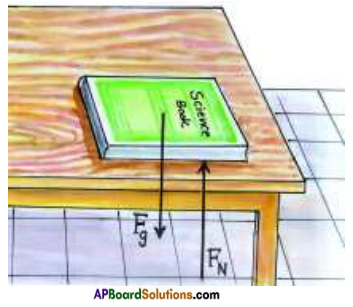
  3. Normal Force: The force that a solid surface exerts on any object in the normal direction is called normal force.
  4. Tension: The lightness of slope or string when we try to stretch a rope or string is called tension.

II. Forces at distance (Field forces): The force which occurs without any physical con¬tact between two objects is known as a force at distance or field force.
Forces at distance are three types. They are:

  1. Magnetic Force : The force existing between two magnetic poles of two different magnets is called magnetic force. The force is also exists between magnet and magnetic material.
  2. Electrostatic Force : The force exerted by a charged body on another charged body is known as electrostatic force.
  3. Gravitational Force : The force of attraction exists between any two bodies (or masses) everywhere in the universe is known as gravitational force.

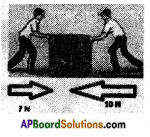
Question 3.
When you push a heavy object, it doesn’t move. Explain the reason in terms of net force.
Answer:
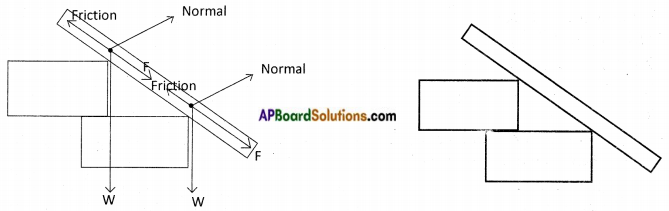
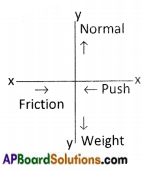
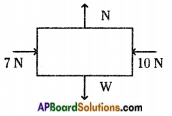
There are four forces acting on the heavy table. They are normal force (upwards), gravitational force (downwards), push and friction (opposite to push).
AP Board 8th Class Physical Science Important Questions Chapter 1 Force 9
Let’s take
Normal force = N (- ve); Gravitational Force = W (downwards); Push = F1
Friction = F2 (- ve) [more]
∴ Net force in X – direction = Push – Friction = F1 – F2 = – ve
Net force in Y – direction = N – W = – ve
As the net force in Y – axis is more you are unable to move the heavy object.

Question 4.
Some forces are acting without any contact of surfaces. Explain.
Answer:
Some forces like magnetic force, electrostatic force and gravitational force act on other bodies without any contact of surfaces. This property is called the field force.
As far as magnetic force concern, the magnets are surrounded by the magnetic lines of force which provide the magnets attractive and repelling forces. The same poles repel and the different poles attract.
The electrostatic forces are exerted by a charged body on another charged or uncharged body. The charged body induces an opposite charge on the uncharged body and it gets attracted by the body. Here, the two bodies are at distance before the electrostatic forces are exerted.
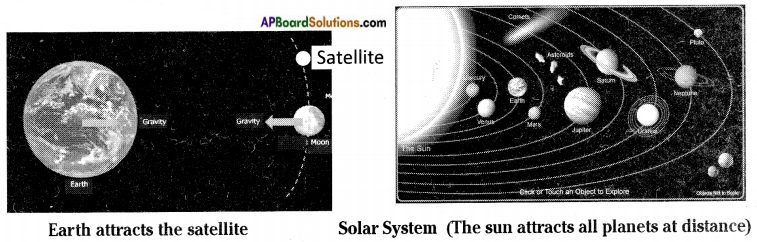
The earth attracts everybody even though they are at some distance. This force is called gravitational force or weight of the body. It varies at different places.

AP Board 8th Class Physical Science Important Questions Chapter 1 Force

Question 5.
In the following situations identify the agent exerting the force and the object on which its acts. State the effect of force in each case.
a) A batsman hitting a cricket ball
b) Pressing a lump of dough
c) Taking out paste from a tooth paste
d) A horse pulling a cart
Answer:

Agent exerting force Object on which it acts Form of effect
Muscles Cricket ball Change in speed and direction
Fingers Dough Change in shape
Fingers Tooth paste Change in shape
Horse Cart Change in speed

8th Class Physical Science 1st Lesson Force Important Questions and Answers

Question 1.
A fruit is falling from a tree. Which force acts on the fruit?
Answer:
Gravitational force acts on the fruit, which is from a tree.

Question 2.
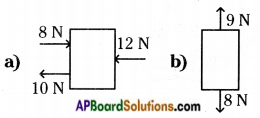
Find the net force from the following diagrams.
AP Board 8th Class Physical Science Important Questions Chapter 1 Force 10
Answer:
a) Net force = + 12N + 10N – 8N = + 22N – 8N = 14 N
b) Net force = +9N – 8N = 1N

Question 3.
If you bring a rubbed balloon near the pieces of paper, what do you observe ?
Answer:
Rubber balloon attracts pieces of paper. It is electrostatic force.

Question 4.
From the above diagram, calculate the net force acting on a body.
AP Board 8th Class Physical Science Important Questions Chapter 1 Force 11
Answer:
Net force in vertical direction = 5N – 5N = 0
Net force in horizontal direction = 10N – 8N = 2N

AP Board 8th Class Physical Science Important Questions Chapter 1 Force

Question 5.
Find the net forces from the following free body diagram (FED).
AP Board 8th Class Physical Science Important Questions Chapter 1 Force 12
Answer:
i) Net force in the vertical direction = + 6N – 6N = 0N
ii) Net force in the horizontal direction = + 20N – 3N = 17N.

Question 6.
What will happen if gravitational force disappears from the Earth? Explain.
Answer:
If gravitational force disappears from the earth,
i) No atmospheric gases are found around the earth.
ii) Objects does not fall down on the earth.
iii) Human beings, animals can fly easily in the sky.
iv) We cannot find the weight of the objects.

Question 7.
Define contact force and force at a distance, give two examples for each type of force.
Answer:
Contact force: The force results when there is a direct physical contact between two interacting objects is called contacting force.
Example: Muscular force, Frictional force, Normal force, Tension.
Field force or Force at a distance : The force which occurs without any physical contact between two objects is known as force at a distance or field force.
Example : Magnetic force, Electrostatic force, Gravitational force.

AP Board 8th Class Physical Science Important Questions Chapter 1 Force

Question 8.
Using adjacent diagram, draw a free body diagram (FBD) to show the forces acting on the box.
AP Board 8th Class Physical Science Important Questions Chapter 1 Force 13
Answer:
AP Board 8th Class Physical Science Important Questions Chapter 1 Force 14

AP Board 8th Class Physical Science Solutions Chapter 11 Some Natural Phenomena

AP State Syllabus AP Board 8th Class Physical Science Solutions Chapter 11 Some Natural Phenomena Textbook Questions and Answers.

AP State Syllabus 8th Class Physical Science Solutions 11th Lesson Some Natural Phenomena

8th Class Physical Science 11th Lesson Some Natural Phenomena Textbook Questions and Answers

Improve Your Learning

Question 1.
Which of the following cannot be charged easily by friction?
A) A Plastic scale
B) A copper rod
C) An inflated balloon
D) A Woollen cloth
E) Piece of wood
Answer:
(B) A copper rod

AP Board 8th Class Physical Science Solutions Chapter 11 Some Natural Phenomena

Question 2.
When a glass rod is rubbed with a piece of silk cloth the rod
A) and the cloth both acquire positive charge.
B) becomes positively charged while cloth has a negative charge.
C) and the cloth both acquire negative charge.
D) becomes negatively charged while cloth has a positive charge.
Answer:
(B) becomes positively charged while cloth has a negative charge.

Question 3.
Identify ‘True’ or ‘False’ sentences among the following:
A) Like charges attract each other. (T/F)
B) A charged glass rod attract a charged plastic straw. (T/F)
C) Lightning conductor cannot protect a building from lightning. (T/F)
D) Earthquakes can be predicted in advance. (T/F)
Answer:
A) False
B) True
C) False
D) False

Question 4.
Sometimes, a crackling sound is heard while taking off sweater during winter. Explain.
Answer:
Charge is developed on the sweater because of friction. We can observe discharge of the charge while taking off the sweater which produce the crackling sound.

AP Board 8th Class Physical Science Solutions Chapter 11 Some Natural Phenomena

Question 5.
Explain why a charged body loses its charge if we touch it with our hand.
Answer:
The reason is that the charged object lose charge to the earth through our body that means it is transferred its charge to earth. The process of transferring of charge from a charged object to the earth is called earthing.

Question 6.
Name the scale on which the destructive energy of an earthquake is measured. An earthquake measures 3 on this scale. Would it be recorded by a seismograph? Is it likely to cause much damage?
Answer:
The destructive energy of earthquake is measured in richter scale. Yes, it would be recorded by seismograph when earthquake measures 3 on the richter scale. It does not cause any damage to human life, generally we unable to felt its effect.

Question 7.
Suggest three measures to protect ourselves from lightning.
Answer:
Precautions to be taken to protect ourselves from lightning.

  1. Staying in a house or building of low height.
  2. If we are travelling in a bus or car, then we are safe inside the car or bus provided doors and windows are closed.
  3. If we are in a forest taking shelter under shorter trees than taller trees is a good idea during the thunder storm.

Question 8.
Explain why a charged balloon is repelled by another charged balloon whereas an uncharged balloon is attracted by a charged balloon?
Answer:
A charged balloon is repelled by another charged balloon having same type of charge because both are having same kind of charges and like charges repel each other. Whereas an uncharged balloon attracted by a charged balloon because charged balloon induces opposite charge on uncharged balloon. We already know unlike charges attract each other. So the uncharged balloon is attracted by a charged balloon.

AP Board 8th Class Physical Science Solutions Chapter 11 Some Natural Phenomena

Question 9.
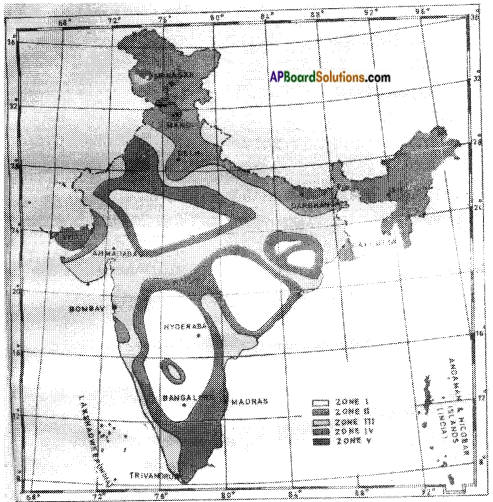
List three states in India where earthquakes are more likely to occur?
Answer:
The three states are

  1. Jammu & Kashmir State (Mainly Kashmir)
  2. Whole north east states like Tripura, Manipur, etc.
  3. Rajasthan.

Question 10.
Does your habitation lie in earthquake prone area? Explain.
Answer:
Yes, my habitation lie in earthquake prone area because 1 am living in delta region of Krishna which is placed in seismic zone III. So it has chances of possibility of earthquake. (If the answering person is not living in Chittoor, YSR Kadapa, Nellore districts and Krishna and Godavari delta region then the answer is No.)

Question 11.
Which place in Andhra Pradesh experiences earthquakes most of the time?
Answer:
Badrachalam and Kothagudem are the places where there is a possibility of earthquake most of the time. Chittoor, Kadapa, Nellore and Krishna and Godavari delta region also have greater possibility of earthquake because they lie in zone-111.

Question 12.
When does a piece of matter have a “charge?”
Answer:
When a piece of matter rubbed with another piece of matter, the piece of matter acquire charge due to friction.
E.g.: Rub the refill vigorously with a piece of polythene and if we bring piece of paper that can be attracted by refill due to development of charge.

Question 13.
What happens if two objects having same charge brought close to each other? What happens if two objects having different charges are brought close? Can you give an example for this.
Answer:
Two objects having same charge repel each other and two objects having different charge attract each other.
E.g. A balloon rubbed with woollen cloth repelled by another balloon rubbed with woollen cloth because both will acquire same type of charge.
A balloon rubbed with a woollen cloth attracted by a refill rubbed with a polythene sheet because both will acquire different type of charge.

AP Board 8th Class Physical Science Solutions Chapter 11 Some Natural Phenomena

Question 14.
Give two examples of effects in your daily life caused by transfer of charges.
Answer:
Two examples in daily life:

  1. Earthing
  2. Lightning

Question 15.
Inflate two balloons and rub both of them with a cloth first and then with different material. Will they attract each other in both cases?
Answer:
No, they will not attract each other. Both will repel each other. The reason is both ballons rubbed with same material acquired same charge in the both the cases.

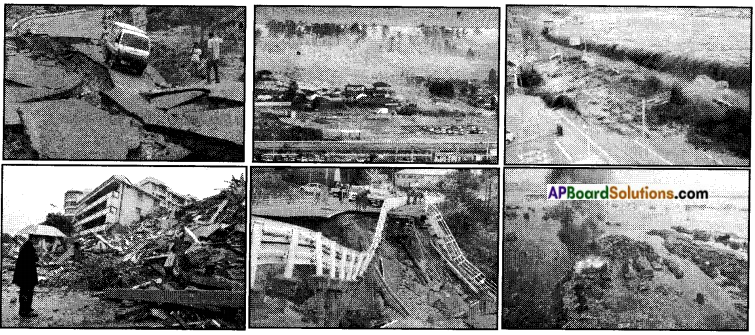
Question 16.
Which country in the world is frequently affected by earthquakes? Collect the information and photographs on the recent earthquake in Japan.
Answer:
The country in the world which frequently affected by earthquakes is Japan. Pictures of earthquake affected areas in Japan in 2012.
Photographs of earthquake:
AP Board 8th Class Physical Science Solutions Chapter 11 Some Natural Phenomena 1
Information about earthquake:

  1. Lot of people killed due to earthquake.
  2. Lot of people killed not only due to earthquake but tsunami caused by earthquake.
  3. Lot of property loss took place.
  4. Most of the people in Japan lost their jobs and livinghood.
  5. They suffered emotionally also by losing their relatives, parents and children.
  6. Lot of effect felt on their economy.
  7. It effected the tourism of Japan.

AP Board 8th Class Physical Science Solutions Chapter 11 Some Natural Phenomena

Question 17.
Find out if there is an organization in your area which provides relief to those suffering from natural disaster. Enquire about the type of help they render to the victims of earthquake. Prepare a brief report on the problems of the earthquake victims.
Answer:
In India National Disaster Force provides relief for disaster victims.
Problems of earthquake victims:

  1. Death: Many times, the people who support a family socially and economically dies. This causes most of the other members of the family to either fight their way through, or restart their lives from the bottom of the food chain.
  2. Destroyed Structures: If the members of the family survive, then they could still be short of a home. The earthquake would have caused the destruction of their house and because of that, they would be left homeless.
  3. No food or water: In the aftermath of an earthquake, people see whether all the pipelines, roads, etc. are in good shape or order. If the pipes are broken, then water scarcity begins. If the roads are broken, then food supplies cannot be transported, later causing problems in food scarcity.
  4. Electricity : With inadequate supply of electricity, the debris and rubble will take a lot of time and if people are under it then they may die before the rubble is removed.
  5. Illnesses: After the destruction of many buildings, the sewer pipes will also break and open, causing spread of disease everywhere.

Help render by relief organisation:

  1. They minimize the death of people.
  2. They provide drinking water and food for victims.
  3. They provide shelter for earthquake victims.
  4. They provide medical facility for earthquake victims.

Question 18.
How do you relate the energy release during the collision of fault lines during earthquake to the atmospheric variation on the surface of the earth?
Answer:
An earthquake effects the atmosphere by creating amounts of debris and dust which will add to the air that we breathe. Earthquakes can also trigger volcanoes which will release tonnes of ashes and other debris into the atmosphere. This can sometime cause the blocking out of the sun, air pollution and are increased amount of carbon in the air.

Question 19.
Describe with the help of a diagram an instrument which can be used to detect a charged body.
Answer:
The instrument used to detect a charged body is electroscope.
Description of Electroscope:
Take an empty jam bottle. Take a piece of cardboard slightly bigger in size than the mouth of the bottle. Pierce a hole in it, so that a metal paper clip could be inserted. Open out paper clip as shown in the figure. Cut two strips of aluminium foil about 4 x 1 cm each and hang them on the paper clip.
AP Board 8th Class Physical Science Solutions Chapter 11 Some Natural Phenomena 2
Insert the paper clip having the strips of aluminium foil into the cardboard lid so that it is perpendicular to it. This entire device works as a electroscope.
Procedure to detect a charged body ,by using a electroscope:
Charge a refill and make it touch the end of the paper clip. The aluminium foils move away from each other the reason that the strips of aluminium foil receive the same charge from the charged body through the paper clip and strips carrying similar charges repel each other and hence they move apart. This proves electroscope is useful in detecting a charged body.

AP Board 8th Class Physical Science Solutions Chapter 11 Some Natural Phenomena

Question 20.
Colour seismic zones in India out line map.
Answer:
AP Board 8th Class Physical Science Solutions Chapter 11 Some Natural Phenomena 3

Question 21.
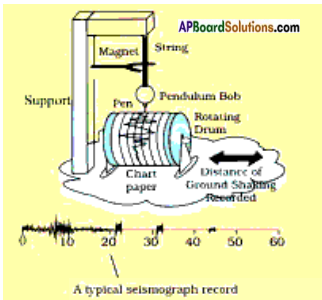
Prepare a model of seismograph.
Answer:
Preparation of model:
AP Board 8th Class Physical Science Solutions Chapter 11 Some Natural Phenomena 4
Take a pendulum and which is attached to support. This acts as vibrating system. A pen is attached to this vibrating system. Place a rotating drum covered with a paper just below the pen. When earthquake occurs the pen records the seismic waves on a paper which move under it.

Question 22.
How do you appreciate the efforts of scientists to develop an instrument to assess the intensity and source of earthquake?
Answer:
The efforts of scientists to develop an instrument to assess the intensity and source of earthquake is thoroughly appreciated because they provide assessment of earthquake and what are the rescue measurements to be taken by government and private organizations and also provide preventive measurements that would be taken when earthquake occurs. So these scientists providing life for people and their services are thoroughly appreciated.

Question 23.
Suppose you are outside your home and an earthquake occurs. What precautions would you take to protect yourself?
Answer:

  1. I find a clear spot, away from buildings, trees and over head powerlines and I drop to the ground.
  2. If I am in a car or bus, I do not come out and I ask the driver to drive slowly to a clear spot. I do not come out of the car or bus till the tremors stop.

AP Board 8th Class Physical Science Solutions Chapter 11 Some Natural Phenomena

Question 24.
The weather department has predicted that a thunder storm is likely to occur at on a certain day. Suppose you have to go out on that day. Would you carry an umbrella? Explain.
Answer:
No, I would not carry umbrella during thunderstorm because the metallic rod attached to the umbrella attracts the charge developed in thunderstorm and charge may carry through umbrella and possibility of electric shock. So it is not a good idea to carry umbrella during lightning.

Question 25.
If earthquake occurs in your area what will you do?
Answer:

  1. I will protect myself by covering head with helmet or cushion and hide in a safe place, such as under table.
  2. I will not run outside because roof tiles and glass may fall on me.
  3. Major after shocks can come after smallest earthquake so I calmly extinguish any nearby flames.
  4. Earthquake can wrap buildings, especially apartment buildings making it impossible to open doors and escape. So I open doors and windows to secure an escape route.
  5. I will be careful with broken glass.
  6. Once I come outside I will not return to house.
  7. I will avoid phone calls.

Question 26.
What are the measures you would take in your house when an earthquake occurs?
Answer:

  1. I would take shelter under a table and stay there till the shaking stops.
  2. I would stay away from tall and heavy objects that may fall on me.
  3. If I would be in the bed then I would not get up and I protect my head with a pillow.

8th Class Physical Science 11th Lesson Some Natural Phenomena Activities

Activity – 1

Question 1.
Effect of rubbing:
AP Board 8th Class Physical Science Solutions Chapter 11 Some Natural Phenomena 5
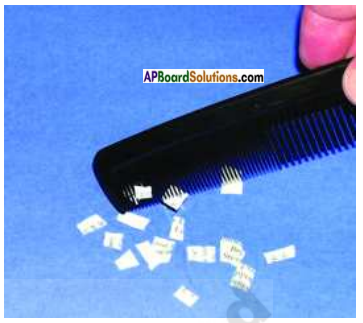
Take a used ball-pen refill and bring it near small pieces of paper.
The refill should be close enough but not touch the pieces of paper.
a) Check what happens to the paper pieces?
Answer:
They remain in the same position.
Now, rub the refill vigorously with a piece of polythene. Bring it close to small pieces of paper.

b) What is your observation. Take care that the rubbed end is not touched by your hand or with a metallic object.
Answer:
My observation is paper piece is attracted towards refill.
Now, take a comb and move it through dry hair a few times. Take the comb near small pieces of paper and check what happen.
The papers are attracted by comb.
Take an inflated balloon and rub it against your clothes. Bring the balloon close to small pieces of paper.
The paper pieces are attracted by balloon.
Take a drinking straw and rub it against a smooth wall or against your cloths, then bring it near pieces of paper.

AP Board 8th Class Physical Science Solutions Chapter 11 Some Natural Phenomena

c) What do you observe?
Answer:
The papers are not attracted by drinking straw.

d) Are they able to attract bits of paper after being rubbed?
Answer:
No, they are not attract bits of paper.
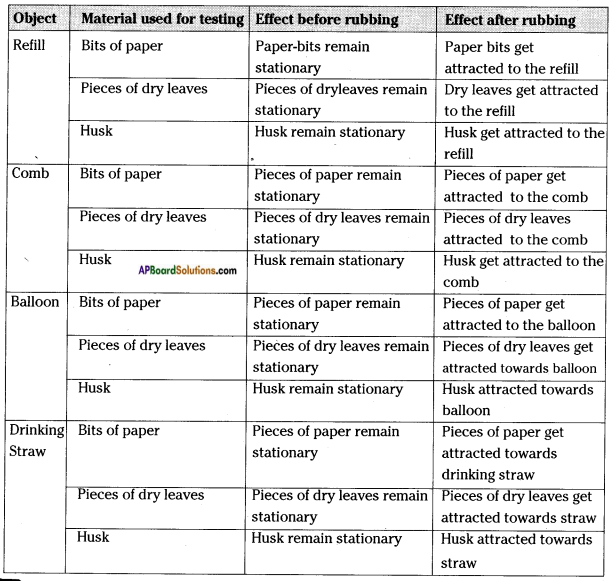
Repeat the activity by rubbing each one of the above mentioned objects (refill, comb, drinking straw, balloon) and use small pieces of dry leaf, husk, etc. as testing materials. Record your observation in table.

e) What can we infer from the above activity?
Answer:
When you rub material some material tend to attract pieces of paper.

f) Do objects like refill or comb attract pieces or paper only after rubbing?
Answer:
Yes, they attract pieces of paper only after rubbing.

g) Do all objects show this property?
Answer:
No, all the objects does not show this property.

h) Can we rub a comb against our palm and make it attract the paper bits?
Answer:
Yes, the paper bits are attracted to the palm due to friction charge is developed on the hand.
AP Board 8th Class Physical Science Solutions Chapter 11 Some Natural Phenomena 6

AP Board 8th Class Physical Science Solutions Chapter 11 Some Natural Phenomena

Lab Activity

Conduct an experiment of find the effects of charged bodies which have been rubbed by different materials.
Aim: To find effects of charged bodies which have been rubbed by different materials.
Materials required: A ball pen refill, a balloon, a comb, an eraser, a steel spoon, polythene sheet, plain paper, woollen cloth, etc.
Procedure:
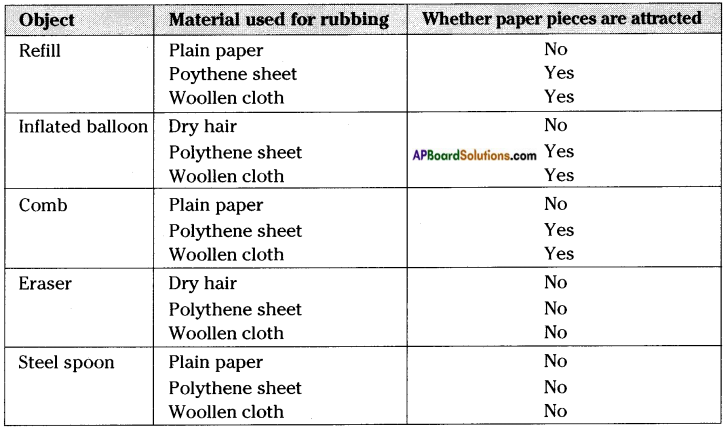
Rub the above objects against materials listed in table. In each case, bring the rubbed object near small pieces of paper and note whether they attract pieces of paper or not. Record your observations in table by writing ‘yes’ or ‘no’.
AP Board 8th Class Physical Science Solutions Chapter 11 Some Natural Phenomena 11
a) What do you conclude from above table?
Answer:
Some objects like refill, comb when rubbed with specific materials able to attract light objects like bits of paper. But some objects like steel spoon do not attract pieces of paper even after rubbing.

b) Why don’t some materials attract pieces of paper even after rubbing ?
Answer:
The reason is some material acquire charge when we rub them and some may not acquire charge so they do not attract pieces of paper.

Activity – 2

Question 2.
Understanding types of charges:
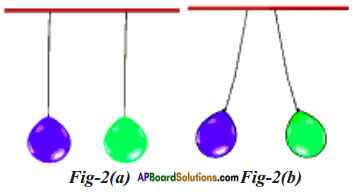
Inflate two balloons and hang them in such a way that they do not touch each other. Rub both the balloons with woollen cloth and release them.
AP Board 8th Class Physical Science Solutions Chapter 11 Some Natural Phenomena 7
a) What do you observe?
Answer:
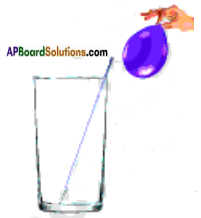
They repel each other. Take a refill and rub it with a polythene sheet. Keep it gently in a plastic tumbler. Take another refill and also rub it with the same polythene sheet.
Bring the second refill near the first one in the tumbler. Take care that you do not touch either of the rubbed portions on the refill with your hand.

b) Is there any effect on the first refill in the tumbler? Do they attract each other or repel each other?
Answer:
Yes, there is effect on the refill in the tumbler. They repel each other.

AP Board 8th Class Physical Science Solutions Chapter 11 Some Natural Phenomena

c) Now take a rubbed balloon near the rubbed refill in the tumbler and check the action. Do they attract each other or repel each other.
Answer:
They attract each other.
In the first two parts of the above activity, two objects that were made of the same material have brought near to each other after being rubbed with some appropriate material.
AP Board 8th Class Physical Science Solutions Chapter 11 Some Natural Phenomena 8
In the third part, objects made of different materials were brought near to each other after being rubbed with some material.
Let us summarise our observations carefully.

  1. A balloon rubbed with woollen cloth repelled another balloon of the same type.
  2. A refill rubbed with polythene repelled another refill rubbed with similar material.
  3. A ballon rubbed with woollen cloth attracted by a refill rubbed with polythene sheet.

d) What can we conclude from these observations?
Answer:
Some charged objects are attracted and some charged objects are repelled with each other.

e) Does the repulsion between charged balloons indicate that they possess similar charge?
Answer:
Yes, they possess similar charge.

f) Does the attraction between charged balloon and a charged refill indicate that they possess different charges?
Answer:
Yes, they possess different charges.

g) Does this activity remind you some of experiments that you have done in “Playing with Magnets” Chapter of class VI?
Answer:
Yes, we know that magnets attract objects made up of magnetic materials like iron, nickel, cobalt, etc.
We also know that unlike poles magnet attract each other and like poles repel each other.

h) Can we say that something similar is happening in above activities?
Answer:
Yes.

i) Does it indicate that the charge on the balloon is of a different kind from the charge on the refill?
Answer:
Yes, it indicate they are different charges.

j) Can we say that there exist two kinds of charges?
Answer:
Yes, there exists two kinds of charges.

k) Can we also say that the charges of same kind repel each other, while charges of different kinds attract each other?
Answer:
Yes, it is convention to call the charge acquired by a glass rod when it is rubbed with silk cloth positive and charge acquired by a silk cloth is negative.
It is observed that when a charged glass rod is brought near a charged plastic straw which is rubbed with polythene sheet, there is attraction between the two.

AP Board 8th Class Physical Science Solutions Chapter 11 Some Natural Phenomena

l) What do you think about the kind of charge on the plastic straw?
Answer:
The plastic straw would carry negative charge.

m) Is your guess correct or wrong? Discuss with your teacher.
Answer:
My guess is correct because opposite charges attract each other which I confirmed by discussing with my teacher.

Activity – 3

Question 3.
Conduct an experiment to find out the presence of charge on a body.
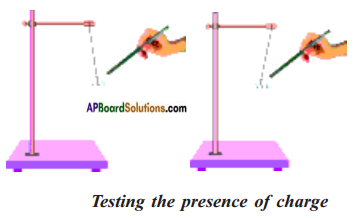
Make a small ball of thermocol. Collect thin silver foil used to decorate sweets.
Wrap this thin silver foil to cover the thermocol ball and suspend it from a stand with the help of thread as shown in figure.
AP Board 8th Class Physical Science Solutions Chapter 11 Some Natural Phenomena 9
Bring a glass rod which is rubbed with a silk cloth near the suspended ball.
a) What happens ? Does it get attracted towards the glass rod or move away from it?
Answer:
It will attracts towards glass rod.
Now touch the silver foil on the thermocol ball with charged glass rod. Remove the glass rod from the ball and against rub it with silk cloth and bring it close to the suspended ball.

b) What do you observe?
Answer:
The suspended ball moves away from the glass rod.

c) What could be the reason for this change in movement of the ball?
Answer:
In the above activity when a charged body brought near an uncharged body it induces an opposite charge in it and hence it get attracted by the glass rod.
In the second case we have charged the thermocol by touching it with a charged glass rod. Hence when we brought the glass rod near the ball, as both of them have similar charge the ball gets repelled by the glass rod.
From the above activity we can conclude that attraction is not a sure test to know the presence of charge on a body.

Activity – 4

Question 4.
Describe with the help of a diagram an instrument which can be used to detect a charged body.
Take an empty jam bottle. Take a piece of cardboard slightly bigger in size than the mouth of the bottle.
Pierce a hole in it so that a metal paper clip could be inserted.
AP Board 8th Class Physical Science Solutions Chapter 11 Some Natural Phenomena 2
Open out paper clip as shown in the figure.
Cut two strips of aluminium foil about 4 cm x 1 cm each and hang them on the paper clip.
Insert the paper clip having the strips of aluminium foil in to the cardboard lid so that it is perpendicular to it as shown in the figure.
Change a refill and make it touch the end of the paper clip. Observe what happens.
a) Is there any effect on the strips of aluminium foil?
Answer:
Yes.

AP Board 8th Class Physical Science Solutions Chapter 11 Some Natural Phenomena

b) Do they repel each other or attract each other?
Answer:
They repel each other.

c) Now bring other charged bodies and make them touch the end of the paper. Do the foil strips behave in the same way in all cases?
Answer:
Yes, it behave in the same way in all cases.

d) Can this apparatus be used to detect the presence of charge on a body or not?
Answer:
Yes, it is used to detect the presence of charge on a body.

e) Can you explain why the strips repel each other?
Answer:
The strips of aluminium foil receive the same charge from the charged refill through the paper clip. The strips carrying similar charges repel each other and hence they move apart.
This device can be used to test whether an object is carrying charge or not. This device is known as electroscope. In the above activity you can observe that electric charge can be transferred from a charged object to another through a metal conductor.
Touch the end of the paper clip gently with hand and you will find a change in the foil strips they move closer and come back to their original state.

f) Why does it happen?
Answer:
The reason is that the foil strip lose charge to the earth through your body. We say that the foil strips are discharged.
The process of transferring of charge from a charged object to the earth is called earthing.

Activity – 5

Question 5.
Collecting information about the damages caused by earthquakes:
Ask your parents about the huge damages to life and property caused by these earthquakes. Collect a few pictures showing the damage caused by these earthquakes from newspapers and magazines of those days.
Prepare a short report on the suffering of the people during the earthquakes.
Answer:
Report: It caused damage to human life and property on a hugescale. Due to tsunami thousands of people died in the coastal areas of Andhra Pradesh and Tamilnadu. People lost their shelter.
a) What is an earthquake?
Answer:
An earthquake is a sudden shaking or trembling of earth lasting for a very short period of time. It is caused by a disturbance deep inside the earth’s crust.

AP Board 8th Class Physical Science Solutions Chapter 11 Some Natural Phenomena

b) What happens when it occurs?
Answer:
When it occurs it can cause damage to human life and property on a huge scale.

c) What can we do to minimize its (earthquake) effects?
Answer:
People living in seismic zones, where the earthquakes are more likely to occur, have to be specially prepared. The buildings in these zones should be designed so that they can with stand major tremors.
Steps to be taken in building construction:

  1. In highly seismic areas, the use of mud or timber is better than heavy construction material.
  2. Keep roofs as hieght as possible. In case the structure falls, the damage will not be heavy.
  3. It is better if the cupboards and shelves are fixed to the walls so that they do not fall easily.
  4. Be careful where you hang wall clocks, photoframes, water heaters, etc. so that in the event of earthquake, they do not fall on the people.
  5. Since some buildings may catch fire due to an earthquake, it is necessary that all buildings, especially tall buildings have fire fighting equipment in working order.

Measures to be taken in a house when earthquake occurs.

  1. Take shelter under a table and stay there till shaking stops.
  2. Stay away from tall and heavy objects that may fall on you.
  3. If you are on bed, do not get up. Protect your head with a pillow.

Measures to be taken outdoors when earthquake occurs.

  1. Find a clear spot, away from buildings, trees and overhead power lines. Drop to the ground.
  2. If you are in a car or a bus, do not come out. Ask the driver to drive slowly to a clear spot. Do not come out till the tremors stop.

Activity – 6

Question 6.
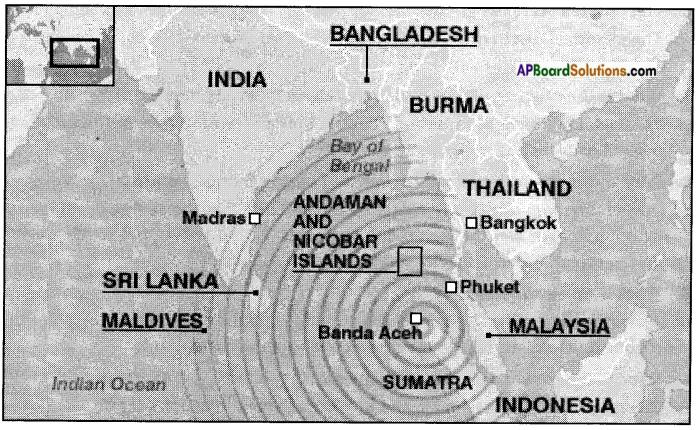
Locating the tsunami affected areas in the map:
Take an outline map of the world. Locate the eastern coast and Andaman and Nicobar Islands in India. Mark other countries around the Indian Ocean which could have suffered damage.
Collect accounts of the devastation caused by the tsunami in India from your parents, or other elders in the family or in the neighbourhood.
Answer:
AP Board 8th Class Physical Science Solutions Chapter 11 Some Natural Phenomena 10
Devastation due to tsunami:

  1. Loss of lives, families and friends.
  2. Loss of properties.
  3. Loss of jobs and living.
  4. Emotional challenge.
  5. Loss of livestock.
  6. Dramatic or drastic changes to a whole community’s routine living.
  7. Negative impact on the affected regions, economy.
  8. Negative impact to the affected region’s tourism.

AP Board 8th Class Physical Science Solutions Chapter 11 Some Natural Phenomena

To the environment:

  1. Alternation to seaside terrain.
  2. Minor deforestation in the area effected by the tsunami.
  3. Wild life casualities.
  4. The sea will be temporarily littered with debris after the tsunami.

AP Board 7th Class Social Studies Solutions Chapter 2 Rain and Rivers

SCERT AP Board 7th Class Social Solutions 2nd Lesson Rain and Rivers Textbook Questions and Answers.

AP State Syllabus 7th Class Social Studies Solutions 2nd Lesson Rain and Rivers

7th Class Social Studies 2nd Lesson Rain and Rivers Textbook Questions and Answers

Improve Your Learning

Question 1.
Explain how water changes into water vapour and how clouds are formed from it.
Answer:

  1. The story of rain begins with water vapour. When we dry our wet clothes in the open, we see that the water disappears after a while and the clothes dry.
  2. Similarly, if we keep some water on a plate, it dries up in a couple of days.
  3. Actually, water in the cloth or in the plate becomes water vapour and mixes with the air through a process called ‘evaporation’.
  4. So even when water is not boiling there is evaporation.
  5. There are several water bodies on the earth’s surface – oceans, rivers, lakes, etc.
  6. There is constant evaporation of water from these water bodies.
  7. In fact, wherever there is moisture, like on a wet cloth, there is evaporation.
  8. There is evaporation from our bodies, from trees, plants and soil.
  9. When water vapour rises with hot air and reaches high up in the sky, it gets cooled.
  10. With the cooling, water vapour is transformed into tiny water droplets.
  11. These droplets gather around minute dust or smoke particles in the air and v gradually increase in size.
  12. These small drops of water gather to form the clouds.

AP Board 7th Class Social Studies Solutions Chapter 2 Rain and Rivers

Question 2.
Where do evaporation and cloud formation take place on a large scale?
Answer:

  1. There are several water bodies on the earth’s surface – oceans, rivers lakes, etc.
  2. There is constant evaporation of water from these water bodies.
  3. Since evaporation takes place all over the earth’s surface, clouds are also being formed all over.
  4. However, it is on the surface of the oceans that maximum evaporation and cloud formation take place.
  5. After all, oceans are vast water bodies extending up to thousands of kilometres.
  6. As a result, it also rains very heavily on the oceans.
  7. Clouds travel inland for thousands of kilometres to bring rain to us.

Question 3.
How do the clouds reach deep inland?
Answer:
Clouds travel inland for thousands of kilometres to bring rain to us. These winds come all the way from the Arabian sea and the Bay of Bengal and they transport the rainy clouds. They are called “Monsoon winds’. They are also called ‘South West Monsoon winds, as they blow from that direction. Their winds blow only in the summer.
There are two arms of the monsoon winds: One blows from the Arabian sea and the other from the Bay of Bengal.
When the South-West monsoon sets around the beginning of June the winds carrying the clouds also reach Andhra Pradesh. These winds reach the Rayalaseema districts of Chittoor and Kurnool first. However they bring very little rain as most of the moisture in the clouds falls down in rain in the Western Ghats and only dry clouds and winds, reach Rayalaseema. The mountain ranges like the Western Ghats in the path of a rain-bearing wind cause them to rise. Rising air cools down and water vapour condenses faster. Further ascent leads to rainfall.

Question 4.
Where does it rain maximum? Choose the right option.
A) sea coasts that are in the direction of the winds.
B) Mountains that are in the direction of the winds.
C) Lands far away from the seas.
Answer:
Sea coasts that are in the direction of the winds.

Question 5.
Fill in the blanks choosing the correct options (bank, tributaries, flood-plain river valley)
a) A river flows through the …………… .
b) Streams or rivers joining a larger river are called the …………… of the main river.
c) The entire valley of a river which is filled with water during the floods is called the …………… of the river.
Answer:
a) river valley
b) tributaries
c) flood – plain.

AP Board 7th Class Social Studies Solutions Chapter 2 Rain and Rivers

Question 6.
The Godavari flows from the west to the east. Why?
Answer:
The plain through which the rivers in Andhra Pradesh flow is high in the North – West. It slopes towards the South-East. The rivers originate in the West. Hence they naturally flow towards the South-East and finally join the Bay of Bengal.
Rivers like the Krishna and the Godavari start from the Western Ghats which receive heavy rains. The rainwater slowly percolates into the ground and flows into the river all through the year.

Question 7.
Describe the main stages of the water cycle. (or)
Describe the different stages of the water cycle.
Answer:
Main stages of the water cycle:
Humidity: The amount of invisible water vapour present in the atmosphere is known as humidity.
Evaporation: The transformation of water from liquid to gas phases as it moves from the ground or bodies of water into the overlying atmosphere due to solar radiation.
Condensation: The transformation of Water vapour to liquid water droplets in the air, creating clouds and fog.
Precipitation: Condensed water vapour that falls to the earth’s surface.

Question 8.
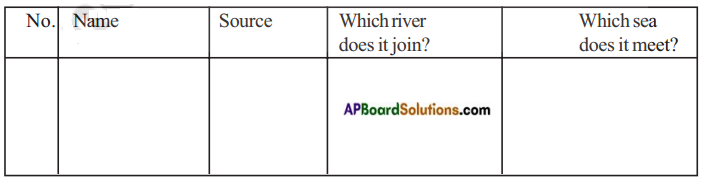
There may be streams and rivers flowing near your village or town. Find out about them and fill in the table below.
AP Board 7th Class Social Studies Solutions Chapter 2 Rain and Rivers 1
Answer:

No. Name Source Which river does it join? Which sea does it meet?
1. Krishna Rainwater/ Western Ghats Itself it is a river. Bay of Bengal
2. Godavari Rainwater / W. Ghats Itself it is a river. Bay of Bengal

AP Board 7th Class Social Studies Solutions Chapter 2 Rain and Rivers

Question 9.
Do the rivers in your area contain water throughout the year? Find out from elders if they had more water in earlier times.
Answer:
No, the rivers in our area do not contain water throughout the year; Our elders also expressed the same.

Question 10.
How can people be prepared to face the disasters? (or)
What can the Government do to help the people meet the challenges of disasters like cyclones and floods?
Answer:

  1. Cyclones and floods are seasonal phenomena. During the cyclone listen to radio or TV weather reports and in case of a cyclone/flood warning, ensure that everyone is alerted. This is usually done through loudspeakers or by going from door to door.
  2. Keep an emergency kit ready at home. These kits should contain important papers, some food, some money and emergency telephone numbers.
  3. The nearest available place where refuge could be sought in case of a cyclone
    should be identified in advance.
  4. Wherever necessary, the walls of the house, roofing, doors and windows should be strengthened.
  5. When you get a cyclone warning, store adequate drinking water and food grains in waterproof bags.
  6. Do not venture outside, especially into the sea during and after the warning has been sounded.
  7. Close doors and windows and stay indoors.
  8. Move to a pucca building if you feel your house is not strong enough.
  9. If the cyclone strikes while you are in a vehicle, stop but keep away from the seashore, trees, electric poles and other objects that may be uprooted during the gale.
  10. If the cyclone wind suddenly drops, do not go out, as it could be the eye of the cyclone. Wait till the official all-clear declaration is made officially.
  11. Listen to Radio / TV for updates on the situation.
  12. Even after all-clear has been sounded take necessary precautions while moving to or out of your house. There may be partially uprooted trees or poles.
  13. Look out for snakes that may have come out of their holes. Do not enter floodwaters. They may be too deep.
  14. As a student group, you can play a very significant role in spreading awareness about the above precautions.

Question 11.
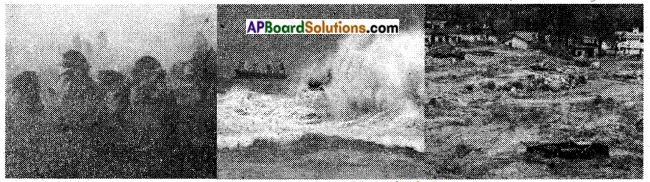
Collect the pictures showing cyclones and floods and prepare an album.
Answer:
AP Board 7th Class Social Studies Solutions Chapter 2 Rain and Rivers 2

Question 12.
Make a poster on the devastation of the flood.
Answer:

Floods Devastation

Climate change has contributed to a rise in extreme weather events. Climate change v/ill increase the frequency of heavy rainstorms/ puffing many communities at risk for devastation from floods.
As rains become heavier, streams, rivers and lakes can overflow, increasing the risk of waterborne pathogens flowing into drinking water sources. Downpours can also damage critical infrastructure.
Flooding can cause a range of health impacts and risks, including death and injury, contaminated drinking water, hazardous material spills increased populations of disease-carrying insects and rodents, mouldy houses and community disruption and displacement.
Local communities across the country can prevent floods and heavy rains from devasting their homes, buildings and agricultural land by updating the safety methods.

AP Board 7th Class Social Studies Solutions Chapter 2 Rain and Rivers

Project

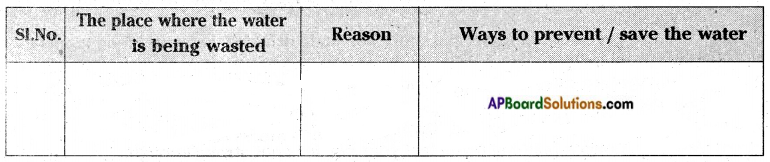
Observe in your village/locality where the water is being wasted, furnish the details in a table, discuss the reasons, suggest the ways how water can be saved.
AP Board 7th Class Social Studies Solutions Chapter 2 Rain and Rivers 3
Answer:

Sl. No The place where the water is being wasted Reason Ways to prevent/save the water
1. Near washing clothes Negligency Use small buckets instead of large tubes.
2. While washing animals Negligency Use small mugs.
3. While carrying water from the tank to the house. Weight Use small utensils instead of large ones.

AP Board 8th Class Physical Science Important Questions Chapter 5 Metals and Non-Metals

AP State Syllabus AP Board 8th Class Physical Science Important Questions Chapter 5 Metals and Non-Metals

AP State Syllabus 8th Class Physical Science Important Questions 5th Lesson Metals and Non-Metals

8th Class Physical Science 5th Lesson Metals and Non-Metals 1 Mark Important Questions and Answers

Question 1.
What is meant by lustrous material?
Answer:
The material which show brightness on surface and reflect the light are called lustrous material.

Question 2.
What is malleability? Which materials have malleability?
Answer:
The property of material by which they can beaten into thin sheets is called malleability. Generally metals exhibit malleability property, e.g.: Iron, copper, etc.

AP Board 8th Class Physical Science Important Questions Chapter 5 Metals and Non-Metals

Question 3.
What is ductility? Which materials show ductility?
Answer:
The property of drawing materials to make fine wires is called ductility. Generally metals show ductility, e.g.: Gold, copper, etc.

Question 4.
Have you observed materials used to make school bell or bells in temple ?
Answer:
Generally they are made up of metals.

Question 5.
Why do wooden bells not used in temple?
Answer:
Wood does not give a ringing sound when it is hit with a hammer. That means it does not show sonorous property. So wooden bells are not used in temple.

Question 6.
What is meant by sonorous?
Answer:
The ability to material to produce a particular sound when it is dropped on the hard surface is called sonorous.

Question 7.
Is ductility is the only property to use them as connecting wires in electric circuits?
Answer:
No, it is one of the cause. The other thing is metals are very good conductors of electricity. So they easily allows the passage of current. So they are used as connecting wires.

AP Board 8th Class Physical Science Important Questions Chapter 5 Metals and Non-Metals

Question 8.
What does cooking appliances conduct?
Answer:
Cooking appliances conduct heat from heating device like gas stove or electric stove.

Question 9.
What is the nature of metallic and non-metallic oxides?
Answer:
Generally metallic oxides are basic in nature and non-metallic oxides are acidic in nature.

Question 10.
What happen when keep an iron rod in open place for one or two days?
Answer:
Rusting takes place on iron. The reason is iron react with air that contains oxygen and moisture forms a reddish brown coating (rust) due to formation of iron oxide.

Question 11.
Why do some metals do not get rust?
Answer:
Metal with very low reactivity do not react with air. So they do not get rust. They also called as noble metals, e.g.: Gold, platinum.

Question 12.
What happens when magnesium ribbon is exposed to air?
Answer:
It becomes dull when it is exposed to air due to formation of magnesium carbonate. That’s why magnesium ribbon should be cleaned with sand paper before any chemical reaction.

Question 13.
Why does silver objects and jewellery become black after sometime?
Answer:
Silver articles are black after sometime because they react with oxygen in air and form silver oxide.

Question 14.
Why statues and vessels made up of copper become dull green after certain time?
Answer:
The statues and vessels made up of copper became dull because they react with air and form copper hydroxide and copper carbonate which appears as dull green coating.

AP Board 8th Class Physical Science Important Questions Chapter 5 Metals and Non-Metals

Question 15.
What happens when non-metals are added to water?
Answer:
They do not react with water.

Question 16.
How do you test hydrogen gas?
Answer:
If we place a burning match stick near a test tube containing hydrogen gas it puts out the match stick with pop sound and the gas burns with blue flame.

Question 17.
What happens when acids are added to non-metals?
Answer:
Non-metals do not react with acids.

Question 18.
What is a displacement reaction?
Answer: A more reactive metal displace a less reactive metal from its compound in aqueous solution is called displacement reaction.

Question 19.
Which metal has highest ductility?
Answer:
Gold. One gram of gold can be drawn into a wire of length one kilometre.

Question 20.
Why sodium and potassium are stored in kerosene?
Answer:
Sodium and potassium are highly reactive. They react vigorously with oxygen and water. A lot of heat is generated in the reaction. Therefore these metals are stored in kerosene.

Question 21.
Is all metals are hard?
Answer:
No. Sodium and potassium are soft. So they can be cut with a knife.

Question 22.
Which non-metal has lustrous surface?
Answer:
Iodine has lustrous surface.

Question 23.
Which non-metal is extremely hard?
Answer:
Diamond (allotrope of carbon) is extremely hard.

AP Board 8th Class Physical Science Important Questions Chapter 5 Metals and Non-Metals

Question 24.
Why immersion rods for heating liquids are made up of metallic substances?
Answer:
Metals are good conductors of heat. So immersion rods for heating liquids are made
up of metals.

Question 25.
Why does copper cannot displace zinc from its salt solution?
Answer:
Copper is less reactive than zinc. So it cannot displace zinc from its salt solution.

Question 26.
Why does aluminium foils are used to wrap food items?
Answer:
It does not readily react with food items. So aluminium foils are used for wraping food items.

Question 27.
The doctor reported iron deficiency in my body. Where is iron in my body?
Answer:
Iron is present in haemoglobin. Which gives red colour to blood.

Question 28.
I heard that magnesium is found in plants. In what form is it found in them?
Answer:
Magnesium is present in chlorophill. It is in Mg(II) state.

AP Board 8th Class Physical Science Important Questions Chapter 5 Metals and Non-Metals

Question 29.
Gold jewellery does not become dull. Why?
Answer:
Gold and platinum does not react with components of air. So, gold and platinum does not rust. So gold jewellery does not become dull.

8th Class Physical Science 5th Lesson Metals and Non-Metals 2 Marks Important Questions and Answers

Question 1.
What are physical properties of non-metals?
Answer:
Physical properties of non-metals:

  1. They are non lustrous.
  2. They are non sonorous.
  3. They are soft.
  4. They does not show malleability and ductility.
  5. They are bad conductors of heat and electricity.

Question 2.
Is our body is a metal or a non-metal?
Answer:
Most of the human body is made of water (H2O). It is not surprising that majority of a human body’s mass is oxygen. Carbon, the basic unit of organic molecules is the second. 99% of human body is made up of just six elements. Oxygen (65%), carbon (18%), hydrogen (10%), nitrogen (3%), calcium (1.5%), phosphorous (1%). Which shows our body has almost 97% of non-metals. So we may consider our body as non-metal.

Question 3.
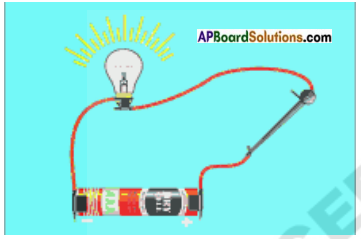
Draw a diagram which shows metals are good conductors of electricity.
Answer:
AP Board 8th Class Physical Science Important Questions Chapter 5 Metals and Non-Metals 1

AP Board 8th Class Physical Science Important Questions Chapter 5 Metals and Non-Metals

Question 4.
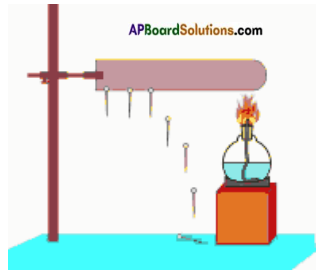
Draw a diagram which show metals are good conductors of heat.
Answer:
AP Board 8th Class Physical Science Important Questions Chapter 5 Metals and Non-Metals 2

Question 5.
Explain about ductility.
Answer:

  1. Some materials cannot be drawn into wires.
  2. Property of drawing a material to make fine wires is called ductility.
  3. Most metals are ductile.

Question 6.
How do you appreciate the efforts of man to use the Metals in making tools?
Answer:

  1. Early human beings made their tools from stone and wood.
  2. Later they used the bones of animals.
  3. Then they discovered metals like copper and iron.
  4. Tools made of copper and iron are much stronger than tools made of stone and wood.
  5. Metals had the advantage of not just being harder but they can be heated in a fire and moulder or cast into different shapes. So it became possible to make a wider range of tools with such metals.
  6. Hence the efforts of man to use the metals in making tools appreciated.

AP Board 8th Class Physical Science Important Questions Chapter 5 Metals and Non-Metals

Question 7.
You came to know that the Diamond is a hardest material and it is a non-metal and similarly Mercury is a soft material and it is a metal.Write down the questions raised in your mind.
Answer:

  1. Are all metals hard?
  2. Are there any non-metals hard like diamond?
  3. Are there any metals soft like mercury?
  4. What makes mercury so soft and diamond so hard?
  5. Can we distinguish those metals and non-metals depending on their opposite properties like these examples?

Question 8.
Taking the example of magnesium and sulphur explain how metals and non-metals produce with different characteristics.
Answer:

  1. Magnesium in the presence of oxygen burns to produce basic magnesium oxide. When it its added to water, it produces magnesium hydroxide, which turns the red litmus solution into blue.
  2. Sulphur combines with oxygen, it forms acidic oxide. It get changed into sulphurous acid when react with water. This turns the blue litmus solutions into red.

Question 9.
What happens when
a) Dilute sulphuric acid is poured on a copper plate?
b) Iron nails are placed in copper sulphate solution?
Answer:
a) Copper sulphate is formed and hydrogen gas is released.
copper + dilute sulphuric acid → copper sulphate + hydrogen gas
b) Brown coating is deposited on the Iron nails. This is because of displacement of copper from copper sulphate solution by Iron.
Iron + Copper sulphate(solution) → Iron sulphate(solution) + Copper

8th Class Physical Science 5th Lesson Metals and Non-Metals 4 Marks Important Questions and Answers

Question 1.
What happens when magnesium, sulphur burnt in the presence of oxygen ? Write the word equation.
Answer:
When magnesium is burnt in the presence of oxygen it burns brilliantly and forms white ashes of magnesium oxide.
AP Board 8th Class Physical Science Important Questions Chapter 5 Metals and Non-Metals 3
When sulphur is burnt in the presence of oxygen, it forms a yellowish gas called sulphur dioxide.
AP Board 8th Class Physical Science Important Questions Chapter 5 Metals and Non-Metals 4

AP Board 8th Class Physical Science Important Questions Chapter 5 Metals and Non-Metals

Question 2.
What are uses of various non-metals?
Answer:
Uses of non-metals:

  1. Oxygen is essential for all living beings.
  2. Nitrogen as fertilizer enhance the growth of plants.
  3. Chlorine is used to purify the water.
  4. Sulphur is used in making fire works, crackers, gun powder, match sticks and anticeptic ointments.
  5. Activated carbon is used as decolourising agent and also in water purification systems.
  6. Tincture iodine is used in medical purpose.

Question 3.
What are the uses of metals?
Answer:
Uses of metals:

  1. Gold, silver, copper are used in making jewellery.
  2. Silver foil is used in decoration of sweets.
  3. Aluminium foil is used in inner packing of food materials and toffees.
  4. Aluminium and copper mixture is used in currency coins, medals and statues.
  5. Zinc and iron mixture is used in making of iron sheet.
  6. Most of agricultural instruments are made by iron.
  7. Electrical appliances, automobiles, satellites, aeroplanes, cooking utensils, machinery decorative materials are made by metals.

Question 4.
Prepare a table of various metals and non-metals used in our daily life and their usage.
Answer:

Metals/non-metals Their usage
1) Gold Jewellery
2) Silver Jewellery
3) Copper Jewellery, utensils, electrical appliances
4) Aluminium Utensils, packing of food, aeroplanes, satellites
5) Iron Utensils, electric appliances, agricultural tools
6) Iodine Medical purpose
7) Chlorine Purification of water
8) Nitrogen Fertilizers
9) Sulphur Gun powder, matchsticks, fire works, crackers, antiseptic ointments
10) Oxygen Essential for all living things to live

AP Board 8th Class Physical Science Important Questions Chapter 5 Metals and Non-Metals

Question 5.
The nature of oxides helps to identify the metals and non-metals conduct an experi-ment to prove this and record the observations.
Answer:
I) Aim: The nature of oxides helps to identify the metals.
Material required : Magnesium sample, spirit lamp, red litmus paper.
Procedure:

  1. Take a small strip of magnesium and burn it and note the appearance after the reaction.
    Reaction: When we burn the sample of magnesium, it reacts with oxygen in air and form magnesium oxide.
    AP Board 8th Class Physical Science Important Questions Chapter 5 Metals and Non-Metals 5
  2. Take magnesium oxide solution and place red litmus in it. Red litmus turns to blue indicates the solution is basic in nature.

Result: Metallic oxides solutions are basic in nature. So if the oxide solution is basic then the oxide is formed by a metal.

II) Aim: The nature of oxides help to identify the non-metals.
Material required: Sulphur sample, spirit lamp, blue litmus paper, deflagrating spoon. Procedure:

  1. Take a small amount of sulphur powder in a deflagrating spoon and heat it.
  2. As soon as sulphur starts burning, introduce the spoon into glass jar or tumbler.
  3. Add small quantity of water into the tumbler and quickly replace the lid. Shake the tumbler well.
    Reaction: Sulphur burns and reacts with oxygen in air to give sulphur dioxide.
    AP Board 8th Class Physical Science Important Questions Chapter 5 Metals and Non-Metals 6
  4. Place blue litmus paper in the prepared solution it turns to red indicates the solution is acidic nature.

Result: Non-metallic oxides solution are acidic in nature. So if oxide solution turns blue litmus into red then the oxide is formed by a non-metal.

AP Board 8th Class Physical Science Important Questions Chapter 5 Metals and Non-Metals

Question 6.
Collect the information about metals which we Use in our daily life, and their uses. Write a report on it.
Answer:

  1. The special properties of metals help us in many ways.
  2. Metals are lustrous (shining). So, we make ornaments of gold and silver.
  3. Metals are sonorous. So, we make school bells, temple bells, gongs, etc.
  4. The malleability of metals help us to make sheets of iron, etc.
  5. Ductility is the special character of metals which help us in making wires.
  6. Metals conduct heat and electricity. Hence we make utensils for cooking and electrical wires etc.
  7. Metals react with oxygen and produce oxides of basic nature.
  8. Metals react with acids (dilute) and liberate hydrogen gas. So, in the preparation of hydrogen gas, metals come in use.
  9. Non-metal like sulphur is used in making fire works, crackers, gun powder, matchsticks and antiseptic ointments.

Question 7.
Give reasons for the following.
a) Aluminium foils are used to wrap food items.
b) Immersion rods for heating liquids are made up of metallic substances.
c) Copper cannot displace Iron from its salt solution.
d) Sodium and potassium are stored in Kerosene.
Answer:
a) Aluminium has high malleability. So it is very easy to make aluminium foil compared other metals.
b) Because metals are good conductors of electricity.
c) Iron has more reactivity than copper. So copper cannot displace Iron from its salt solution.
d) Sodium and potassium have high reactivity with water and an even they burn in the presence of air and water. So these metals are stored in Kerosene.

Question 8.
Give reasons for the following.
i) Silver is used in making mirrors.
ii) Aluminium is used to make electrical wires.
iii) Sour food substances should not be stored in aluminium utensils.
iv) Iron is used in constructing bridges and houses.
Answer:
i) Silver has high reflecting power.
ii) Aluminimum is good conductor of electricity.
iii) Sour substances contain acids which react with aluminimum utensils to form toxic substances.
iv) Iron is hard, strong and rigid material.

AP Board 8th Class Physical Science Important Questions Chapter 5 Metals and Non-Metals

Question 9.
Give some differences with examples between metals and non-metals with reference to their properties. Give one exception in each case.
Answer:
a) Lustrous: Metals have shining surfaces. So they are called Lustrous. Whereas non-metals have dull surface so they are non Lustrous.
One of the form of carbon is diamond has most shining look.
Iodine a non-metal also has lustrous surface.
b) Malleability: Metals can be beaten into sheets and non-metals cannot be beaten into sheets. But mercury is a metal which breaks into pieces when hammered.
c) Ductility: Metals are drawn into wires. Non-metals cannot be drawn into wires. Mercury does not show ductility.
d) Conductivity: Metals are good conductors of heat and electricity and non-metals are bad conductors of electricity and heat. Graphite is a non-metal which is good conductor of heat and electricity.
e) Hardness: Metals are usually hard and non-metals are soft. But sodium and potassium are quite soft, they can be cut by using a knife. Diamond is a non-metal which is the hardest substance.

8th Class Physical Science 5th Lesson Metals and Non-Metals Important Questions and Answers

Question 1.
Predict the reason behind gold and platinum jewellery does not become dull.
Answer:
Gold and platinum does not react with components of air. So, gold and platinum does not rust. So gold jewellery does not become dull.

AP Board 8th Class Physical Science Important Questions Chapter 5 Metals and Non-Metals

Question 2.
Write any two differences between electric conductors and insulators.
Answer:

Electric conductors Electric insulators
1) Those substances through which electricity can flow are called conductors. 1) Those substances through which electricity
cannot flow are called insulators.
2) Generally metals are conductors.
Eg: Silver, copper
2) Generally non-metals are insulators.
Eg: Rubber, plastic, glass

Question 3.
Write any four uses of metals in different situations.
Answer:
Uses of metals:

  1. Gold, silver, copper are used in making jewellery.
  2. Silver foil is used in decoration of sweets.
  3. Aluminium foil is used in inner packing of food materials and toffees.
  4. Aluminium and copper mixture is used in currency coins, medals and statues.
  5. Zinc and iron mixture is used in making of iron sheet.
  6. Most of agricultural instruments are made by iron.
  7. Electrical appliances, automobiles, satellites, aeroplanes, cooking utensils, machinery decorative materials are made by metals.

Question 4.
Explain the reaction of metals with acids.
Answer:
Aim: To find the reactivity of metals with acids.
Apparatus: Test tube, dilute hydrochloric acid, magnesium ribbon, spirit lamp. Procedure:

  1. Take a magnesium ribbon and rub with a sand paper.
  2. Put this ribbon into a test tube containing dilute hydrochloric acid.
  3. A gas is evolved from the test tube.
  4. Now bring a burning match stick near the mouth of the test tube.
  5. The gas puts off the match stick and produces a pop sound and gas burns with blue flame.
  6. Which indicates hydrogen gas is released.
  7. We will get same results with zinc, iron, copper also.
  8. Conclusion: Metal reacts with acid and produce hydrogen gas.

AP Board 8th Class Physical Science Important Questions Chapter 5 Metals and Non-Metals

Question 5.
Explain a procedure to do the experiment that magnesium ribbon allows the flow of current.
Answer:
Procedure:
AP Board 8th Class Physical Science Important Questions Chapter 5 Metals and Non-Metals 1

  1. Arrange ah electric circuit with a battery and bulb.
  2. Close the circuit using a magnesium ribbon.
  3. Observe whether the bulb is glow or not.

Observation: Bulb glows.
Conclusion: Magnesium ribbon allows the flow of current.

Question 6.
Suggest an activity to show that the magnesium ribbon reacts with Oxygen to form Magnesium Oxide, which is basic in nature.
Answer:
Aim: To know reaction of oxygen with metals.
Material required: Magnesium strip, spirit lamp or Bunsen burner and litmus papers, distilled water.
Procedure:

  1. Take a small strip of magnesium.
  2. Burn it with spirit lamp.
  3. It burns brilliantly and produce white ashes of magnesium oxide due to reaction between magnesium and oxygen.
  4. Collect the ash of magnesium in a watch glass and add some distilled water.
  5. Test the solution with red litmus paper and blue litmus paper.

Observation: Red litmus paper turns into blue in colour.
Conclusion: Metallic oxide solutions are basic in nature.

AP Board 8th Class Physical Science Important Questions Chapter 5 Metals and Non-Metals

Question 7.
Zinc, Copper, Sulphur, Carbon, Categories into these into metals and non-metals and write their uses.

S.No. Name Metal/Non-metal Use
1.

2.

3.

4.

Answer:

S.No. Name Metal/Non-metal Use
1. Zinc metal sheets, batteries
2. Copper metal electrical wires, jewellary, Utensils
3. Sulphur non-metal Gun powder, fireworks, ointments
4. Carbon non-metal Water purifiers, fuel

Question 8.
You are given copper sulphate, Iron sulphate, an iron nail and copper wire. How do you test the reactivity of metals iron and copper Explain through an activity.

Answer:
Activity:

  1. Take two beakers ‘a’ and ‘b’.
  2. Take 50 ml of water in each.
    AP Board 8th Class Physical Science Important Questions Chapter 5 Metals and Non-Metals 7
  3. Dissolve some amount of copper sulphate in beaker ‘a’ and iron sulphate in beaker ‘b’.
  4. Drop iron nails in beaker ‘a’ and copper wire in beaker ‘b’.
  5. Leave the beakers for some hours.

Observations:
i) In beaker ‘a’ copper layer forms on the iron nails and blue colour of copper sulphate turns pale blue or white.
ii) No change in beaker ‘b’.
Conclusion:
i) Copper is displaced by iron in beaker ‘a’.
Copper Sulphate + Iron → Iron sulphate + Copper
ii) Iron is not displaced by copper in beaker ‘b’.
Hence iron reactivity is more than copper.

AP Board 8th Class Physical Science Important Questions Chapter 5 Metals and Non-Metals

Question 9.
Draw a diagram of an activity of heat conduction by metals. Why iron, copper and aluminium are used to prepare in the manufacturing of cooking vessels?
Answer:
AP Board 8th Class Physical Science Important Questions Chapter 5 Metals and Non-Metals 2
Iron, Copper and aluminium cooking vessels are preferred due to their high heat conductivity.

AP SSC 10th Class English Solutions Chapter 1A Attitude is Altitude

AP State Board Syllabus AP SSC 10th Class English Textbook Solutions Chapter 1A Attitude is Altitude Textbook Questions and Answers.

AP State Syllabus SSC 10th Class English Solutions Chapter 1A Attitude is Altitude

10th Class English Chapter 1A Attitude is Altitude Textbook Questions and Answers

Look at the pictures and answer the questions.
AP SSC 10th Class English Solutions Chapter 1A Attitude is Altitude 1

AP SSC 10th Class English Solutions Chapter 1A Attitude is Altitude

Question 1.
What qualities have made these persons great?
Answer:
The persons in the above pictures are Sudha Chandran, Stephen Hawking and Helen Keller.
Sudha Chandran is an accomplished Bharatanatyam dancer, Indian film and television actress, who showed great courage even though she had lost her leg in an accident.

Stephen Hawking is one of the famous scientists. Despite his debilitating illness, he has done ground-breaking work in physics.

Helen Keller overcame the adversity of being blind and deaf to become one of the 20th century’s leading humanitarians.
These three great persons showed that anything can be done, if one tries hard enough. From their lives, it is understood that one need not lose hope. Their lives show us that disability need not prevent one from reaching great heights. The qualities such as grit, determination, confidence, will power, dedication, discipline, etc. have made these persons great.

Question 2.
What qualities do you think a person requires to become successful ?
Answer:
The qualities a person requires to become successful are determination, dedication, discipline, grit, courage, faith, positive thinking, responsibility, hard work, commitment, desire, persistence, good character, etc. These qualities make a person highly successful.

AP SSC 10th Class English Solutions Chapter 1A Attitude is Altitude

Comprehension

I. Answer the following questions.

Question 1.
‘I call it my chicken drumstick,’ joked Nick. What does ‘it’ refer to? How does it help him ?
Answer:
‘It’ refers to the small foot that Nick has on his left hip. It helps him balance and enables him to kick. Nick uses his one foot to type, write with a pen and pick things up between his toes.

Question 2.
‘His parents decided not to send him to a special school.’ Was Nick happy about his parents’ decision? Why or why not? What do you think about this decision?
Answer:
Nick’s was not happy with his parents’ decision because there might be the risk of bullying. His companions at mainstream school might tease him.
But later, he realised that his parents’ decision was the best one. I think that this decision was the best one his parents could have made for him as he was able to achieve a degree in Financial Planning and Real Estate. The decision made him independent.

Question 3.
How did Nick’s parents help him to become independent?
Answer:
Right from the start Nick’s parents did their best to make him independent. His father put Nick in the water at 18 months and gave him the courage to learn how to swim. He encouraged Nick to get into football and skating. He taught Nick how to type with his toe at just six years old. Nick’s mother invented a special plastic device that meant Nick could hold a pen and pencil. Despite the risk of bullying, Nick’s parents insisted on his attending mainstream school.

AP SSC 10th Class English Solutions Chapter 1A Attitude is Altitude

Question 4.
Pick out the symptoms of Nick’s depression. Do you think his depression was normal or something unique about him? Give reasons for your opinion.
Answer:
Nick was deeply depressed when he was eight years old. When he was in depression, he went to his mother crying and told her that he wanted to kill himself. He felt cold and bitter. He hated God for doing this to him. He was terrified about his future without his parents. At age ten Nick tried to drown himself in the bath. These were the symptoms of Nick’s depression. I think his depression was normal. Any human being born like Nick might have the same depression.

Question 5.
Which incident in this text is funny? What makes it funny?
Answer:
Once Nick was in a car and a girl at traffic lights was looking at him interestingly. She could only see Nick’s head so he decided to do a 360 in the car seat to freak her out. When she saw the torso, she sped off really quickly. This is the funny incident in the text. The idea of Nick showing the girl his torso makes the scene funny.

Question 6.
What made Nick choose Bethany Hamilton as his teacher to learn surfing?
Answer:
Nick went to Hawaii in 2008 and met surfing master Bethany Hamilton. She had her arm bitten off by a shark when she was 12. Nick chose Bethany Hamilton as she too was a disabled person and still she performed surfing very well. Though she had no arm she did well. As a disabled person, she could know how a disabled person could learn how to surf. She could know the psychological condition of a disabled person.

Question 7.
Which aspect of Nick’s physical condition helps him to do a 360 degree spin?
Answer:
Nick has a very low centre of gravity so he has got pretty good balance. This condition helps Nick to do 360 degree spin.

AP SSC 10th Class English Solutions Chapter 1A Attitude is Altitude

Question 8.
What are the distinct features of this text? List them.
Answer:

  1. It is an autobiography.
  2. Varied sentences are used.
  3. Ideas are arranged in a logical sequence.
  4. Emotive and persuasive language is used.
  5. Ideas are exemplified very well.
  6. Cohesion is found in the text. The sentences are connected with proper linkers.
  7. Unity of ideas is maintained for coherence. The sentences are connected in a clear and reasonable way.
  8. Certain quotations and examples are given.
  9. Proper introduction, development and conclusion are ensured.
  10. The ideas are given formally and precisely.
  11. As far as the content is concerned, it touches the emotions of a reader.
  12. The content is message-oriented.
  13. Physical description of the main character is given properly.
  14. The main character’s attitudes, likes, dislikes, strengths and weaknesses are given effectively.

Question 9.
What do you learn from the life of Nick Vujicic?
Answer:
Nick Vujicic uses his life story to inspire people of all around the world. From the life of Nick, we learn that if we fail, we should try again and again until we succeed. Nick shows us that anything can be done, if we try hard enough. Undoubtedly, I feel that his life is a source of inspiration to everyone of us. He has been able to do all these because of his faith, hope, perseverance and strong will power. Nick proves that disability need not prevent one from reaching great heights. Hence I learn that we shouldn’t lose our faith and hope under any circumstances.

AP SSC 10th Class English Solutions Chapter 1A Attitude is Altitude

II. Given below are some of the statements made by Nick Vujicic. Which of these are substantiated by Nick’s life ?

  • I realised why God had made us like this – to give hope to others.
  • I wanted to concentrate on something good that / had.
  • I tell people to keep on getting up when they fall and to always love themselves.
  • If I can encourage just one person, then my job in this life is done.

Answer:
I think all the above statements are substantiated by Nick’s life.
i) I realised why God had made us like this – to give hope to others:
When Nick was 13, he read a newspaper article about a disabled man who had managed to achieve great things and help others. Nick was inspired very much by the disabled man mentioned in the article. He got a hope from him. Then he decided to use his life to encourage others and give them hope.

ii) I wanted to concentrate on something good that I had:
Nick was not discouraged with his disability. He knew that he had no arms and legs but he thought that they would never take away the beauty of his eyes. With his positive approach, he thought that his eyes were very good ones for him. He wanted to love his positive qualities such as faith, will power and perseverance. Further, he was quite satisfied with what he had, i.e. a small foot on his left hip. He said he would be lost with it.

iii) I tell people to keep on getting up when they fall and to always love themselves: If Nick fails, he tries again and again until he succeeds. When Nick was learning how to surf, he was terrified at first but later he did very well. Though he has no limbs, he always loves himself. I know this by his statement, “I decided to be thankful for what I do have, not get angry about what I don’t.”

iv) If I can encourage just one person, then my job in this life is done:
This statement was substantiated by Nick aptly. He encouraged many people in the world. He used his life story to inspire others. He made many people realise their inner beauty and personality. He was able to rise many people from the state of despair to the state of great hope.

AP SSC 10th Class English Solutions Chapter 1A Attitude is Altitude

Vocabulary

I. Look at the list of adjectives in the box. Which of them describe Nick Vujicic. Tick (✓) them.
AP SSC 10th Class English Solutions Chapter 1A Attitude is Altitude 2
Answer:
AP SSC 10th Class English Solutions Chapter 1A Attitude is Altitude 3

Explanation:

  1. positive: hopeful and confident
  2. negative: harmful, unpleasant or not wanted
  3. optimistic: believing that good things will happen In the future
  4. pessimistic: expecting that bad things will happen in the future
  5. generous: willing to give money, spend time, etc. in order to help people or give them pleasure
  6. nervous: worried or frightened about something
  7. confident: sure that something will happen in the way that you want or expect
  8. smart: fashionable, clever
  9. sociable: friendly and enjoys being with other people
  10. cowardly: not at all brave
  11. courageous: brave
  12. reliable: dependable
  13. Independent: confident and able to do things by oneself in ones own way
  14. dependent: needing someone or something in order to exist, be successful, be healthy, etc.
  15. obedient: always doing what one is told to do
  16.  trusting: willing to believe that other people are good and honest
  17. valiant: very brave in difficult situation
  18. self-centred: paying so much attention to oneself that one doesn’t notice what is happening
  19. arrogant: behaving in an unpleasant or rude way
  20. sarcastic: saying things that are the opposite of what one means, in order to make an unkind joke
  21. quarrelsome: one who quarrels a lot with people
  22. rude: not polite and annoys others
  23. creative: good at using imagination to make things
  24. stubborn: determined not to change one’s mind when people think one is being unreasonable
  25. lazy: not making any effort to do anything
  26. pompous: trying to seem magnificent or very important; fond of display, acting too proudly, self-important.
  27. level-headed: sensible in making judgements

AP SSC 10th Class English Solutions Chapter 1A Attitude is Altitude

Pick out from the text the examples that support these attributes.

Attribute Example from the text
1. Positive In spite of his disability he has become great.
2. Optimistic He always thinks, “If I fail, I try again, and again, and again. If I can encourage just one person, then my job is done.”
3. Generous He spends most of his time delivering motivational speeches all over the world.
4. Confident Though he has no limbs, he gains faith and hope and tries to give them to others.
5. Smart He appears to be smart and shows his cleverness in learning things.
6. Sociable He enjoys being with others by delivering speeches, playing football, golf, surfing, etc.
7. Courageous Despite the absence of his limbs, he didn’t get discouraged. With great courage, he tries again and again and becomes a football player, a swimmer and a surfer.
8. Reliable He is the most reliable person. As an Evangelical Christian he has faith and gives the same to others with his motivational speeches. The people believe his reliability and are attracted towards him.
9. Independent He independently has done the things what he has wanted to do. e.g.: Playing football and golf, swimming, surfing, delivering speeches, etc.
10. Obedient He seems to be obedient in accepting the unlucky birth.
11. Valiant With great determination, he has reached a great position in his life. He becomes an international symbol of triumph over adversity.
12. Creative He also plays golf with a club tucked under his chin.
13. Level-headed He judges well when he says, “The challenges in our lives are there to strengthen our convictions. They are not there to run us over.”

AP SSC 10th Class English Solutions Chapter 1A Attitude is Altitude

II. Given below are words that describe the positive or negative attitude of a person. Discuss them with your partner and put a tick (✓) against the positive qualities and a cross (✕) against the negative qualities.

AP SSC 10th Class English Solutions Chapter 1A Attitude is Altitude 4AP SSC 10th Class English Solutions Chapter 1A Attitude is Altitude 5
Answer:
AP SSC 10th Class English Solutions Chapter 1A Attitude is Altitude 6

Explanation:

  1. sullen: angry and silent (negative quality)
  2. sneaky: doing things in a secret and dishonest way (negative quality)
  3. exuberant: happy and full of energy and excitement (positive quality)
  4. bossy: always telling other people what to do in a way that is annoying (negative quality)
  5. cautious: careful to avoid danger or risk (positive quality)
  6. aggressive: behaving in an angry threatening way (negative quality)
  7. competitive: determined or trying very hard to he more successful than other people (positive quality)
  8. finicky: too concerned with unimportant details and small things that you like or dislike (negative quality)
  9. imaginative: good at thinking of new and interesting ideas (positive quality)
  10. observant: good or quick at noticing things (positive quality)
  11. enthusiastic: showing a lot of interest and excitement about something (positive quality)
  12. outgoing: someone who Is outgoing likes to meet and talk to new people (positive quality)
  13. haughty: behaving in a proud. unfriendly way (negative quality)
  14. intrepid: willing to do dangerous things; fearless, brave (positive quality)
  15. malicious: very unkind and cruel and is trying to do harm to others (negative quality)
  16. meticulous: very careful about small details and always makes sure that everything is done correctly (positive quality)
  17. slovenly: lazy untidy and careless (negative quality)
  18. obnoxious: very offensive, unpleasant or rude (negative quality)
  19. stingy: not generous. especially with money (negative quality)
  20. Idealistic: believing that one should live according to high standards and principles, even when they are very difficult to achieve (positive quality)
  21. affable: friendly and easy to talk to (positive quality)
  22. logical: reasonable and sensible (positive quality)
  23. mean: cruel (negative quality)
  24. cultured: intelligent, polite and interested in art, literature, music etc. (positive quality)

AP SSC 10th Class English Solutions Chapter 1A Attitude is Altitude

III. Tick (✓) the word/expression which is nearest in meaning to the word underlined in each sentence given below.

1. Water sports aren’t Nick’s only thing – he also plays golf with a dub tucked under his chin.
a) kept
b) pulled
c) covered
d) tied
Answer: a

2. His distraught mother couldn’t bring herself to hold him until he was four months old.
a) angry
b) careless
c) shy
d) anxious
Answer: d

3. Despite the risk of bullying, his parents insisted on Nick’s attending mainstream school.
a) discrimination
b) humiliation
c) negligence
d) failure
Answer: b

4. Nick, who was teased and bullied, had an electric wheelchair for mobility, and a team of carers to help him.
a) socialising
b) movement
c) travel
d) safety
Answer: b

5. Nick managed to pull through to become an international symbol of triumph over adversity.
a) disability
b) poverty
c) difficulties
d) opposition
Answer: c

6. The challenges in our lives are there to strengthen our convictions.
a) feelings
b) practices
c) beliefs
d) characters
Answer: c

AP SSC 10th Class English Solutions Chapter 1A Attitude is Altitude

IV. Read the following descriptions about persons and fill in the blanks with the words that match with these descriptions.

AP SSC 10th Class English Solutions Chapter 1A Attitude is Altitude 8

1. Ashok is a very unpleasant and rude fellow. I don’t talk to him. He is ———–.
2. Srinu is very confident, elegant and polite. But sometimes he does not appear to be sincere. He is ———–.
3. Sujatha is quiet and calm. She doesn’t like to spend time with others. She is interested in her thoughts and feelings. So she is an ———–.
4. Ramesh is very sensitive. He always shows sympathy for people who are suffering. He is ———–.
5. My neighbour is such a person that he has a feeling of hatred for others. He desires to hurt others’ feelings. He is ———–.
6. My father pays careful attention to every detail. He makes thorough planning for everything in our home. He is ———–.
7. Prem is an extremely unpleasant person. He always tries to offend people. He is ———–.
8. My mother is very calm and peaceful. She doesn’t get excited or irritated easily. She is ———–.
9. Rahul is a very lively and confident person. He enjoys being with his friends. He is an ———–.
10. Sridhar is always afraid of speaking in the class. He is ———–.
Answers:
1. boorish
2. suave
3. introvert
4. compassionate
5. malicious
6. meticulous
7. obnoxious
8. placid
9. extrovert
10. timid

AP SSC 10th Class English Solutions Chapter 1A Attitude is Altitude

GRAMMAR

I. Read the text again and identify some more Defining and Non-defining Relative Clauses.

1. —————————————————————
2. —————————————————————
3. —————————————————————
4. —————————————————————
5. —————————————————————
Answer:
1. Nick has a small foot, which helps him balance. (Non-defining Relative Clause)
2. Nick, who was born in Melbourne, now lives in Los Angeles. (Non-defining Relative Clause)
3. I read about a disabled man who had managed to achieve great things and help others. (Defining Relative Clause)
4. I decided to give people the courage that the article had given me. (Defining Relative Clause)
5. Nick, who later achieved a degree, says this. (Non-defining Relative Clause)

II. Read the following sentences and circle the Non-defining Relative Clauses and put a comma/a hyphen wherever necessary.

1. The meeting which was held in the town hall was a great success.
2. The people who live in glass houses must not throw stones.
3. The teachers who have taught Abhiram say that he is an exceptionally creative student.
4. Napoleon who won the French honour died at St. Helena.
5. The silk sarees which are made in Banares are popular all over the world.
Answer:
1. The meeting which was held in the town hall was a great success. (Defining Relative Clause)
2. The people who live in glass houses must not throw stones. (Defining Relative Clause)
3. The teachers who have taught Abhiram say that he is an exceptionally creative student. (Defining Relative Clause)
4. Napoleon, who won the French honour, died at St. Helena. (Non-defining Relative Clause)
5. The silk sarees which are made in Benares are popular all over the world. (Defining Relative Clause)

AP SSC 10th Class English Solutions Chapter 1A Attitude is Altitude

III. Complete the sentences with Defining or Non-defining Relative Clauses.

1. This is the peaceful place __________________________ .
2. The Mahaprasthanam’ is a popular book __________________________ .
3. Suresh ____________________________ has left the school just now.
4. Is this the street _______________________________________________ ?
5. The express __________________________________ has just arrived.
6. The place ___________________________ has been closed to traffic.
7. This is a famous engineering college _____________________________ .
8. My sister_______________ has secured ajob as an engineer in BHEL.
9. The theatre _____________________________ was designed by Mr Rao.
10. Viswanath is one of the outstanding directors in Telugu film industry______________________ .
Answer:
1. This is the peaceful place that is liked by every naturalist.
2. The Mahaprasthanam’ is a popular book which I have bought in Hyderabad.
3. Suresh, who is mv cousin, has left the school just now.
4. Is this the street where meat is sold?
5. The express which runs between Delhi and Chennai has just arrived.
6. The place which is behind our house has been closed to traffic.
7. This is a famous engineering college that is founded by Mr. Yashwanth.
8. My sister, who has completed her education in Bengaluru, has secured a job as an engineer in BHEL.
9. The theatre which was built in 2012 was designed by Mr. Rao.
10. Viswanath is one of the outstanding directors in Telugu film industry which produces a number of creative directors.

AP SSC 10th Class English Solutions Chapter 1A Attitude is Altitude

WRITING

I. Writing a biographical sketch

A biographical sketch is an account of the life and activities of an individual. It includes information about the person’s name, place of residence, education, occupation, life and activities and other important details. It is written by another person. If a person writes an account of his/her own life, it is called an autobiography.

Given below in the table is the biographical information about Stephen Hawking. Based on this information write a biographical sketch.

Points to be covered Details of the person
Date and place of birth January 8,1942, Oxford, England
Information about the family
  • Eldest one of four sons
  • Mother: Isobel Hawking
  • Father: Frank Hawking, a medical researcher with a speciality in tropical diseases
Important events in life
  • Early academic life: recognized as a bright student
  • High school years: third from the bottom of his class
  • Pursuits outside of school: loved board games, constructed a computer out of recycled parts at the age of 16, solved rudimentary mathematical equations
  • Marriage: married Jane Wilde
  • Health: Suffered from Amyotrophic Lateral Sclerosis
  • Research: on black holes
  • Discovery: Hawking Radiation
Awards, prizes, honours
  • Fellow of the Royal Society at the age of 32
  • Albert Einstein Award.
  • The Pius XI- Gold Medal for Science from Pope Paul VI in 1975
Contribution to his field and society Contributed to the advancement of science and research

Answer:

Biographical Sketch of Stephen Hawking

Stephen William Hawking is one of the greatest scientists of the world. He was born at Oxford in England on 8 January, 1942 to Isobel Hawking and Frank Hawking. He was the eldest of four sons. His father, Frank Hawking, was a medical researcher with a speciality in tropical diseases.

Hawking was recognised as a bright student. But he was not initially successful academically. During his high school years, Stephen stood the third from the bottom of his class.

Hawking used to remain with a close group of friends with whom he enjoyed board games, the manufacture of fireworks, model aeroplanes and boats. With the help of the mathematics teacher, Dickran Tahta, Hawking and his companions built a computer from clock parts, an old telephone switchboard and other recycled components when he was 16. Hawking solved rudimentary mathematical equations.

He married Jane Wilde on 14 July, 1965. The first years after their marriage were hectic. Hawking has achieved many things in the field of science in spite of his prolonged illness. He has been suffering from an incurable disease, Amyotrophic Lateral Sclerosis (ALS) which has weakened his muscles since he was 17 years old.

Stephen Hawking is known for his work regarding black holes and for authoring several popular science books. In 1974, Hawking’s research turned him into a celebrity within the scientific world when he showed that black holes are not the information vacuums that scientists had thought they were. In simple terms, Hawking demonstrated that matter, in the form of radiation, can escape the gravitational force of a collapsed star. Thus Hawking Radiation was invented.

As a mark of his eminence, Professor Hawking obtained twelve honorary degrees which he deserved. He was named a Fellow of the Royal Society at the age of 32, and later earned the prestigious Albert Einstein Award. In 1975, Hawking journeyed to Rome, where he was honoured with the Pius XI – Gold Medal for science from Pope Paul VI in 1975.

Attitude is Altitude Summary in English

This is the story of a great person, Nicholas James Nick Vujicic, who stands as an inspiration to other people with his great qualities-faith, will power and perseverance- even though he is a disabled person. His disability has not stopped him from doing what he has wanted to do. Nick Vujicic was born on 4 December 1982 in Melbourne, Australia with a rare disability called Phocomelia characterised by the absence of all four limbs. Despite the absence of his limbs, he plays football and golf, swims and surfs. He is an Australian Christian evangelist and motivational speaker. As a child, he struggled mentally and emotionally as well as physically. It was a shock to Nick’s parents that he was born without limbs. His mother was a nurse and his father was a computer programmer and accountant. His parents did their very best when they decided to send him to mainstream school despite the risk of humiliation.

Nick has a small foot on his left hip. It gives him balance and enables him to kick. With his foot, he writes with a pen and picks things up between his toes. He also plays golf with a heavy stick tucked under his chin. He is a huge fan of the English Premier League. His parents did their best to make him independent from the start. His father gave him the courage to learn how to swim by putting him in water at 18 months. His mother invented a special plastic device to enable him to hold a pen and pencil.

At age eight, Nick was deeply depressed and went to his mother crying. He told her that he wanted to kill himself. When he was ten years old, he decided to end his life by drowning himself in a bathtub but luckily he was unsuccessful in his attempt. When Nick was 13, he was inspired when he read about a disabled man who had managed to achieve great things and helped others. He understood that God had given him the life to give hope to others and so he decided to use his life to encourage other people and give them the courage. He believes that challenges strengthen our opinions. With the help of his religion, friends and family, Nick becomes an international symbol of triumph over adversity. Nick won the Australian Young Citizen of the Year award in 1990 for his bravery and perseverance. His persistence made him achieve a degree in Financial Planning and Real Estate. He went to Hawaii in 2008 and was trained in surfing by Bethany Hamilton. Nick was on the cover of Surfer magazine with his feat of doing the 360 degree spins. He is able to do this feat because of his low centre of gravity.
Nick and Kanae Miyahara, whose mother was a Mexican and father was a Japanese, got married on February 12, 2012 and on February 13, 2013 they were blessed with the birth of a healthy baby boy with full body.

Nick has travelled to over 24 countries speaking to groups of up to 110,000 people. He keeps telling the people to keep on getting up when they fall and to always love themselves. He spreads his messages of faith and hope around the world.

Nick uses his story to inspire and inform people all around the world. Nick presents values, principles, attitudes and perspectives that challenge and equip people from all walks of life to overcome their adversities.

Attitude is Altitude Glossary

stretch (v): to straighten one’s arms, legs or body

wrap (v): put ones arms around something

skateboard (n): a short narrow board with small wheels at each end, which you stand on and ride as a sport

torso (n): the main part of the body, not including the head, arms or legs

surf: to take part in the sport of riding on waves on a surfboard

despite (pre): In spite of

limb (n): an arm or leg

hip (n): one of the two parts on each side of one’s body between the top of one’s leg and one’s waist

chicken drumstick (n): the lower part of the leg of a chicken or other bird that is cooked and eaten as food

faith (n): belief or trust in God

virgin (n): someone who has never had sex

modest (adj): shy about attracting sexual interest

publicist (n): someone whose job is to make sure that people know about a new product, film, book, etc.

club (n): a heavy stick with one end thicker than the other

tuck (v): to put something into a space

distraught (adj): so upset and worried

bully (v): to threaten to hurt someone or frighten them

bullying (n): humiliation

carer (n): someone who looks alter an old or ill person at home

wall-mounted (adj): attached to a wall

pump-action (adj): a pump-action piece of equipment is operated by pulling or pressing a part in or out. so that the contents come out in short bursts

drown (v): to die from being under water for too long time

lack: to not have something that one needs

triumph (n): an important success or victory

adversity (n): a difficulty or unpleasant situation

Inspirational (adj): providing encouragement or new ideas for what one should do

conviction (n): a very strong belief or opinion

run over (phr.v.): to hit someone or something with something (a vehicle, challenge, etc.) and drive over them

perseverance (n): the quality of continuing to try to achieve a particular aim despite difficulties

give somebody the eye (n.phrase): to look at someone in a way that shows one thinks they are sexually attractive

freak out (phr.v.): make someone very anxious. upset or afraid

amazing (adj): (here) very good

spin (n): an act of turning around quickly

centre of gravity (n.phrase): the point in any object on which it can balance

AP SSC 10th Class English Solutions Chapter 2A The Dear Departed Part 1

AP State Board Syllabus AP SSC 10th Class English Textbook Solutions Chapter 2A The Dear Departed Part 1 Textbook Questions and Answers.

AP State Syllabus SSC 10th Class English Solutions Chapter 2A The Dear Departed Part 1

10th Class English Chapter 2A The Dear Departed Part 1 Textbook Questions and Answers

Look at the pictures and answer the questions.

AP SSC 10th Class English Solutions Chapter 2A The Dear Departed Part 1

Question 1.
What do you understand from the picture?
Answer:
The rat is pointing a pistol at the cat and intimidating him. I understand that it is a funny picture. One can easily open one’s lips without knowing to smile on seeing this unusual picture.

AP SSC 10th Class English Solutions Chapter 2A The Dear Departed Part 1

Question 2.
Can you recall anything comic associated with these animals?
Answer:
The most popular comic Tom and Jerry’ is associated with them.
‘Tom and Jerry’ is a series of animated cartoon films. We find humour with the rivalry between a cat (Tom) and a mouse (Jerry), Tom’s chasing Jerry and slapstick scenes. “Tom’s making numerous attempts to capture Jerry which leads to destruction” – it creates fun. The scenes such as slicing Tom in half, shutting his head in a window or a door, stuffing Tom’s tail in a mangle, kicking him into a refrigerator, plugging his tail into an electric socket, sticking matches into his feet and lighting them, etc. amuse all the viewers.

(Or)
Yes. I can recall an incident which happened a long time ago in my old house. We used to see many mice in our old house because we stored paddy bags in the house. One day our pet cat jumped on a little mouse which was eating the paddy grains. The little mouse began running. Our cat ran after it. The funny thing was that the mouse did not run away from the place. It began running around the paddy bags. After some time both the cat and the mouse stopped running as they were tired much. At that stage 1 interfered and drove the cat away to save the life of the rat.

Question 3.
Can you imagine, what may be the conversation between the rat and the cat?
Answer:
Conversation between the rat and the cat:
Rat : Hands up!
Cat : Don’t shoot me. I will not eat you.
Rat : No, I don’t believe you. You are cruel.
Cat : Believe me. I decided not to eat rats.
Rat : I don’t believe you. You ran after me yesterday, didn’t you?
Cat : Yes. But not to kill you.
Rat : Then, why?
Cat : I just wanted to tell that I would not kill you thereafter.
Well, how did you get the pistol?
Rat : I stole it from the owner of the house last night.
Cat : Ok. Do you know how to shoot with it?
Rat : I will not tell you.
Cat : Ok. Bye.
Rat : Bye.

AP SSC 10th Class English Solutions Chapter 2A The Dear Departed Part 1

Comprehension

Answer the following questions.

Question 1.
What qualities of Mrs. Slater have you noticed?
Answer:
Mrs. Slater is unscrupulous, greedy, deceitful, dishonest, selfish, impolite and insensitive. She unfairly claims her father s things. This shows her unscrupulous and dishonest manner. She has shifted her father’s bureau and clock from his room before her sister’s arrival. Hence 1 can say Mrs. Slater is greedy. She wants to deceive her sister by pinching their father’s things. 1 can say that she is impolite and insensitive as she doesn’t even wait for her father s funeral and has started dividing things between them (the two sisters).

Question 2.
Why does Mrs. Slater decide to shift the bureau from her father’s room before the arrival of the Jordans? How does Henry react to the suggestion?
Answer:
Mrs. Slater wants to own her father’s bureau as he likes it very much. After her father’s death, she decides to shift the bureau to sitting room before the arrival of the Jordans. She thinks that her sister will lay a claim to it. At first, Henry is shocked at her decision. He feels that the two sisters should amicably divide their father’s things. Henry suggests her that it is not a good thing pinching her father’s things in an unfair way. Moreover, Henry is worried about the arrival of the Jordans while they are shifting the bureau.

Question 3.
Why do the Jordans take a long time to get to the house of the Slaters? What does it show about the two sisters’ attitude towards each other?
Answer:
I think the Jordans are late as they have bought mourning dresses to wear before they come to Slater’s house. They are not sorrowful at their father’s death but they are worried about their appearances and how they can come out to each other. In their relationship, we don’t find any kind of emotions and sisterly love.

Question 4.
Ben appreciates his father-in-law saying, ‘It’s a good thing he did’. Later, he calls him a ‘drunken old beggar’. Why does he change his opinion about his father-in-law?
Answer:
Ben appreciates his father-in-law saying it’s a good thing he did’ when he comes to know from Mrs. Slater that the old man has gone out to pay his insurance premium on the day of his death. Later, he comes to know that he has not paid the premium and therefore calls him a drunken old beggar’. Ben has changed his opinion about his father-in-law when be realises that he hasn’t paid premium because, now after his death, they can t claim the insurance company.

Question 5.
What made Mr.Henry feel shocked to hear Victoria say ‘Are you planning to pinch it ?’?
Answer:
When Victoria asked Slaters “Are you planning to pinch it ?”, Mr. Henry felt shocked. He thought that Victoria was innocent. But when she asked him the above question, Mr. Henry came to know that Victoria had wisdom beyond her age. He actually didn’t expect that question from his little daughter.He came to know that she was a precocious girl and had the ability to distinguish between good and bad.

AP SSC 10th Class English Solutions Chapter 2A The Dear Departed Part 1

The Dear Departed Part 1 Summary in English

The one-act play “The Dear Departed” by William Stanley Houghton is a satirical play that explores family relationships and the falsehood and hypocrisy and greed that often lie beneath it. The story exposes the sad fact that human beings often become dehumanized in the face of greed and minor material gains. This play satirizes the degradation of moral values in respect and care within the members of the family itself. This story clearly reveals how elderly people are mistreated. Stanley Houghton uses various literary devices to criticize basic human characteristics in his play. He uses irony, sarcasm, humour and a twist in the plot to criticize human traits. He tries to bring out the qualities of the two daughters called Mrs. Slater and Mrs. Jordan towards their father. He tries to show how the sisters are interested in the property of their father rather than to show true care and affection towards their father.

The story begins with Mrs. Slater telling her daughter, Victoria to change her dress before the arrival of her sister (Slater’s sister) Elizabeth and Elizabeth’s husband, Ben. Mrs. Slater’s husband, Henry has sent them a telegram with the message of the death of his father-in-law and Elizabeth and Ben are coming to talk over the old man’s affairs. Henry wonders if they would come at all because Elizabeth has said that she would never set foot in their house again. But Mrs. Slater says that her sister will come fast enough after her share of what their father has left. Mrs. Slater asks her husband to wear the new slippers of her father. She also suggests that they should replace their shabby old chest of drawers with the valuable bureau of her father which is in his bedroom. He agrees to do it after some hesitation. Mrs. Slater wants to do it before their arrival.

Mrs. Slater fastens the door and she and her husband carry the old chest of drawers upstairs. Henry is shocked when Victoria asks him if they are pinching grandpa’s bureau. He replies that grandpa has given it to her mother before his death. Mrs. Slater carries a handsome clock and puts it on the mantelpiece. Mrs. Slater and her husband carry the pretty old-fashioned bureau downstairs and put it in the place of the chest of drawers. At the same time Victoria ushers in Mrs. Jordan and Ben. Mrs. Jordan goes straight to Mrs. Slater and kisses her and the men shake hands. Mrs. Jordan remarks that their father has gone at last. Mrs. Slater replies that he is seventy-two a fortnight the previous Sunday. She tells them that the old man has been merry that morning and has gone out to pay his insurance. Ben and Mrs. Jordan remark that it is a good thing on his part.

According to Mrs. Slater, their father is found dead when she takes up a bit of something for him on tray.
Ben and Mrs. Jordan don’t want to look at the old man ; they prefer to have tea and so Mrs. Slater gets tea ready. They think of publishing the announcement of the death of the old man in the papers. Then they decide to look through the old man’s things and make a list of them. Mrs. Jordan tells that the old man has promised his gold watch to their Jimmy. Then Victoria tells them that grandpa hasn’t paid his insurance. Ben calls him “the drunken old beggar”. Both the sisters complain that they have to put up with their father for all those years. Then Mrs. Slater asks Victoria to go and bring the bunch of keys from grandpa’s room. Victoria is afraid to go but she does. After some time, she gets back very scared and tells them that grandpa is getting up. They are transfixed with amazement. The vigorous and well coloured old man Abel Merry weather comes in.

AP SSC 10th Class English Solutions Chapter 2A The Dear Departed Part 1

The Dear Departed Part 1 Glossary

lay (v): (here) to put the cloth, plates, knives, forks etc. on a table, ready for a meal

vigorous (adj): using a lot of energy and strength or determination

plump (adj): slightly fat in a fairly pleasant way

vulgar adj): rude and offensive

get her own way (idiom): persuade other people to allow you to do what you want

D’ye: Do you (used in awkward situations)

amazed (adj): very surprised

ages (n): long time

stooping (adj): bent towards and down

drooping (adj): hanging or bending down

come after (phr.v.): to look for someone to get something from them

worn out (adj): too old or damaged to be used

break down (phr.v.): stop working in a successful way

trifle (n): something unimportant or not valuable

precocious (adj): Intelligent/gifted/talented

bureau (n): a writing desk with drawers

drive a liard bargain (idiom): work hard to negotiate agreements in on&s own favour

startled (v): made someone suddenly surprised or slightly shocked

stupefied (adj): so surprised, tired or bored thai one cant think clearly

daft (adj): stupid/silly

shabby (adj): untidy and bad

fasten (v): to firmly close a window, door etc. so that it will not open

pinch (w): steal

mantelpiece (n): a shelf projecting from the wail over the fireplace

usher (v): lead/show the way/welcome

appeal: be attractive

stagger (v): to walk or move unsteadily, almost falling over

complacent (adj): sell-satisfied/unconcerned

mourning (n): feeling of sadness to miss someone after they have died

fortnight (n): two weeks

chirpily (adv): cheerfully and actively

snug (adj): warm and comfortable

wipe (v): to rub a surface with something in order to remove liquid, dirt, etc.

look through (phr.v.): look for something

overdue (adj): not paid by the expected time

annoy (v): to make someone feel slightly angry and unhappy about something

put up with (phr.v.): to accept an unpleasant situation or person without complaining

swindling (v): cheating somebody for property or money

reluctantly (adv): unwillingly

AP Board 8th Class Physical Science Solutions Chapter 12 Stars and the Solar System

AP State Syllabus AP Board 8th Class Physical Science Solutions Chapter 12 Stars and the Solar System Textbook Questions and Answers.

AP State Syllabus 8th Class Physical Science Solutions 12th Lesson Stars and the Solar System

8th Class Physical Science 12th Lesson Stars and the Solar System Textbook Questions and Answers

Improve Your Learning

Question 1.
What is your local noon time?
Answer:
The time when the shortest shadow of a vertical object occurs in a particular place is called local noon time at that place.

Question 2.
Where do you find moon at night?
a) 2 days before Poumami
b) 2 days after Amavasya
Answer:
a) Couple of days (2 days) before full moon day (Pournami), a crescent is seen in the west just after sunset.
b) Couple of days (2 days) after the new moon day (Amavasya), a crescent is seen in the west just after sunset.

AP Board 8th Class Physical Science Solutions Chapter 12 Stars and the Solar System

Question 3.
Why doesn’t eclipse occur on every full moon day or on every new moon day?
Answer:
Lunar eclipse can happen during a full moon and only when the moon and earth and sun are directly in line and the moon passes through the earth shadow. Most of the time the moon is slightly out of line and that is why we don’t have a Lunar eclipse every full moon.

Question 4.
Where do you find the pole star?
Answer:
The pole star lies on the line joining the two outer stars of the constellation great bear. Pole star directly above the north pole of earth.

Question 5.
What Is the difference that you find between pole star and other stars?
Answer:
If we observe the position of various stars constantly. We will notice that they are not in a fixed position because as the earth rotates about a fixed axis, the position of stars with respect to earth changes. But the position of pole star does not change with respect to earth.

Question 6.
Why does polestar seem to be stationary?
Answer:
The polestar is situated in the direction of the earth’s axis and that is why it does not appear to move even though all stars appear that they are moving because of ie rotation of earth. So pole star seems to be stationary.

Question 7.
Name some constellations.
Answer:
Names of some constellations:

  1. Great bear (Saptarishi)
  2. Cassiopeia (Sharmistha)
  3. Orion
  4. Leo (Simha)
  5. Corona
  6. Borealis

AP Board 8th Class Physical Science Solutions Chapter 12 Stars and the Solar System

Question 8.
How many planets are there in our solar system? What are they?
Answer:
There are 8 planets in our solar system. They are:

  1. Mercury
  2. Venus
  3. Earth
  4. Mars
  5. Jupiter
  6. Saturn
  7. Uranus and
  8. Neptune.

Question 9.
Look at the below table and name the smallest and the biggest planets in our solar system.
AP Board 8th Class Physical Science Solutions Chapter 12 Stars and the Solar System 1
Answer:
From the table the biggest planet is Jupiter and the smallest planet is Mercury.

Question 10.
Among all 8 planets what is the special thing about earth?
Answer:
The special thing about earth is it is the only planet in the solar system on which life is exist.

AP Board 8th Class Physical Science Solutions Chapter 12 Stars and the Solar System

Question 11.
How do day and night occur?
Answer:
The day and night occur due to rotatory motion of earth.

Question 12.
Do the stars appear moving? How can you say?
Answer:
Yes, stars are appear moving. Our galaxy like all other spiral galaxies is rotating. The stars move on orbits around the centre of the galaxy. It was the motions of stars in external galaxies that lead to the idea of dark matter in the universe. Stars also have some random motions. They do not orbit galaxy in exact circles. As observers we see this motion of the stars as what is called proper motion, the projection of their velocity on to the plane of the sky is radial motion.
Normal Answer : Alternate answer is No. All the stars appears that they are moving because of rotation of earth.

Question 13.
Is it possible to see the polestar for the people who live in the southern hemisphere of the earth? Why?
Answer:
A pole star is a visible, preferably a prominent one, that is approximately aligned with the earth’s axis of rotation. The term polestar refers to polaris which is the current northern pole star also known as the north star. So the people in southern hemisphere unable to see this pole star.

Question 14.
What is the use of artificial satellites in our daily life?
Answer:
Artificial satellites have many uses in daily life.

  1. They are used for forecasting weather.
  2. They are used for transmitting television and. radio signals.
  3. They are also used for telecommunication.
  4. They are used in aviation and military (these satellites are called remote sensing which will collect information from a distance).

Question 15.
Why is Venus the brightest planet?
Answer:
Venus is very bright that’s partly because sunlight easily reflected by acidic clouds that blanket the planet atmosphere and also it is closest planet to earth.

AP Board 8th Class Physical Science Solutions Chapter 12 Stars and the Solar System

Question 16.
Are you curious about going to the moon? Why?
Answer:
Yes, I am curious about going to moon. Because I want to find answers raised in my mind.

  1. Is it true there is no life on moon?
  2. If it does not have atmosphere, how it look like?
  3. How earth look like from moon?
  4. Whether there are any mountains on moon or not?
  5. There may be any creators on moon or not?
  6. Whether there is any form of water exists on moon?
  7. Whether we able to walk on moon as freely as on earth surface?

Question 17.
While observing the shadow of a stick from morning to evening, some questions arose in Ramya’s mind. What may be those questions?
Answer:

  1. Why sun is changing its position from morning to evening?
  2. How does the length of the shadow change with time?
  3. Why we are getting longest shadows in the morning and evening?
  4. Why the shadow in the noon is shortest?
  5. Do all the days at noon have same size of shadow?

Question 18.
What are the questions that engage your mind when you look at night sky?
Answer:

  1. Is stars collide with each other?
  2. Where does the stars go in the morning?
  3. Whether stars daily travel in the same path?
  4. Why night sky is black and early morning sky is blue?
  5. Whether we can count stars in the sky?
  6. Why stars grouped to form constellations?

AP Board 8th Class Physical Science Solutions Chapter 12 Stars and the Solar System

Question 19.
Even though we do not have clock, we can know the time by observing some shadows in daytime. Think and discuss with your friends how we can know the time at night?
Answer:
We can know the time by position of moon and stars or with reference to pole star. Estimation of time by using position of moon:

  1. If the moon is full do the experiment stop if it is new moon.
  2. Imagine the moon is divided into 12 vertical strips. First hour at right edge and last hour at left edge. It can vary by season or location.
  3. Read the moon from left to right following an imaginary horizontal half line.
    Look for where the line intersects the boarder between light and dark. Make a note of which strip that intersection is in.

For example:
The instruction is at 8 pm and transition from right to left is from light to dark. This tells us the moon will set in the west at 8 pm.
This moon will set at about 7-8 hours after sunset. If sunset is at 8 pm. You can expect moon time is at 3-4 am.

Question 20.
How can you find north – south direction at your place?
Answer:
This experiment should be performed on a day when the sky is clear, preferably between nine in the morning and four in the evening.
AP Board 8th Class Physical Science Solutions Chapter 12 Stars and the Solar System 2
Pick a spot in open ground away from buildings and trees. The spot should be as flat as possible.
Take a stick which is a little over a meter long and fix it vertically in the ground. Ensure that exactly one meter of stick remains above the surface of ground. Build a fence around your stick as shown in figure.
Make your first observation at nine in the morning, Make a mark with a nail or peg at the point where the tip of the shadow falls on ground. Measure the length of the shadow.
Then, make similar observations for every half an hour throughout the day till four in the evening.
Find the direction of shortest shadow cast by vertical object on the ground. That gives the north-south direction.

AP Board 8th Class Physical Science Solutions Chapter 12 Stars and the Solar System

Question 21.
In which direction (towards north or south) is the sun moving day by day when you read this lesson?
Answer:
From December 21 to till June 21 the sun appears to shift northward. From June 21 to December 21 the sun appears to shift southward.
(Basing on this information we have to give the answer suppose you have read the lesson in the month of February the sun is moving towards north direction).

Question 22.
What are the planets you have seen in the sky? When do you observe those planets?
Answer:
The two planets observe in the sky are

  1. Venus: Sometimes Venus appears in the eastern sky before sunrise. Sometimes it appears in the western sky just after sunset. Therefore it is often called a morning or an evening star.
  2. Mars: It appears slightly reddish and therefore, it is also called red planet. It appears in the east.

Question 23.
What is the duration of a day and night today? Collect the information about duration of day and night for the past 7 days from the newspapers, analyze it and say whether summer or winter is going to come.
Answer:
Students have to collect the information from newspaper and other resources.
(Hint: If sun is shifting towards south the upcoming season is winter if it is shifting towards north the upcoming season is summer).

Question 24.
What are the other districts on the same latitude as your district ?
Answer:
I am residing at Krishna district. The latitudes of Krishna district are 16. The other districts which have same latitude are West Godavari, Mahaboobnagar.
(You should write the latitude of your district and you have to find out the districts which lie in that latitude from table -1 on page 163 of textbook.)

AP Board 8th Class Physical Science Solutions Chapter 12 Stars and the Solar System

Question 25.
Collect the information about cosmic dust (wastage) from newspapers, internet and make a poster on your school panel board about the consequences of cosmic dust.
Answer:
Cosmic dust: Cosmic dust is a type of dust composed of particles in space which are a few molecules to 0.1 mm in size.
Consequence of cosmic dust:
The orbit of space junk could deteriate resulting in the junk falling to earth. If it survives and reaches the earth’s surface it would cause the same damage as equally sized meteorite, including damaging or destroying structures in the area killing people, etc.
The earth receives hundreds of tonnes of space dust, rocks, etc every week. If you were to get whole load of it in one place and try and breathe it in it probably would be harmful. However natural concentrations are so low that it possess no risk.

Question 26.
Make a sundial. Explain how you made it.
Answer:
Making of sundial:
Cut a right angled triangle ABC from a sheet of cardboard. Angle C of the triangle should equal to the latitude of your city or town and angle A should be 90° as shown in figure.
AP Board 8th Class Physical Science Solutions Chapter 12 Stars and the Solar System 3
Fix cardboard triangle vertically in the middle of a rectangular wooden board. Glue strips of paper along both edges of BC and the wooden board to make the triangle stand erect.
Place your board with the triangle on level ground in an open space which gets sunlight throughout the day. Base BC of the triangle should be placed in the north- south direction, with B pointing to the north.
At nine in the morning, draw a line along the shadow of side AC on the wooden board. Write the time along side of the line. Draw lines of the shadow of side AC at one hour intervals through the day till sunset and mark the time for each line. The sundial is now ready.

AP Board 8th Class Physical Science Solutions Chapter 12 Stars and the Solar System

Question 27.
Draw the different phases of moon. Arrange them in an order from poumami to amavasya.
Answer:
AP Board 8th Class Physical Science Solutions Chapter 12 Stars and the Solar System 4a

Question 28.
Draw the location of polestar showing the direction from Great Bear.
Answer:
AP Board 8th Class Physical Science Solutions Chapter 12 Stars and the Solar System 5

AP Board 8th Class Physical Science Solutions Chapter 12 Stars and the Solar System

Question 29.
Draw the diagram of the solar system.
Answer:
AP Board 8th Class Physical Science Solutions Chapter 12 Stars and the Solar System 7

Question 30.
How do you appreciate the construction of knowledge about the universe by our ancestors?
Answer:
They study of our universe changed from time to time from earth is flat to higgs bosan particles. All these secrets about our universe are revealed due to constant afforts of our ancestors. That is due to construction of knowledge about the universe by our ancestors. So the afforts of our ancestors should be thoroughly appreciated.

Question 31.
We launched so many artificial satellites around our earth for different purposes. What do you think about the impact of artificial satellites and their radiation on bio-diversity?
Answer:
Effect of radiation released from artificial satellites on biodiversity:
I. Animals and humans:

  1. Killing certain enzymes in the body can simply make sick.
  2. If radiation damages DNA, the body may not repair it. It increases the chances of both animals and humans developing cancer.

II. Marine animals: High level of radiation cause a reduction and reproduction capabilities of marine animals.
III. Plants: Weaking of seeds and frequent mutations. Excess of radiation killing plants.

AP Board 8th Class Physical Science Solutions Chapter 12 Stars and the Solar System

Question 32.
Among eight planets of our solar system, earth is the only planet supporting life. Explain how we should protect our earth and its environment.
Answer:
Steps to be taken to protect earth and environment:

  1. Reduce pollution by reducing air, water and land pollution.
  2. Recycle resources by sending the degradable like paper and non degradable like plastic and glass objects to recycling factory.
  3. Save resources by using them carefully. E.g.: Water, trees, wood, paper.
  4. Stop burning fossil fuels (Coal, oil and natural gas) for that do not waste electricity.
  5. Plant lot of trees.

8th Class Physical Science 12th Lesson Stars and the Solar System InText Questions and Answers

8th Class Physical Science Textbook Page No. 160

Question 1.
What are the celestial objects that we can see in the sky?
Answer:
Stars, Planets, Moon (Satellite), Comets, Meteors and Meteorites are the celestial objects that we can see in the sky.

Question 2.
Are the stars moving?
Answer:
Yes, the stars are moving.

Question 3.
Do you see the same stars at night and early in the morning?
Answer:
No, we do not see the same stars at night and early in the morning.

Question 4.
Do you see the same stars during summer and winter nights?
Answer:
Yes, it is due to the change of axis of rotation of the earth.

Question 5.
What is the shape of the moon? Why does it change? Why doesn’t the sun change its shape daily like the moon?
Answer:
The actual shape of the moon is approximately spherical.
But it changes everyday.
The sun does not change its shape like the moon due to its size and the distance it is away from the earth. Moreover the shadow of the earth falls on one side of the moon partially or fully. This makes the changes in its shape. Also the moon does not have its own light to make the shadow of the earth to fall on the huge sun.

Question 6.
Where exactly is the sun situated in the sky at noon?
Answer:
Above our head (vertically above) (Really the sun does not revolve around the earth but due to the rotation and revolution of the earth we feel / imagine that the sun moves around the earth.)

AP Board 8th Class Physical Science Solutions Chapter 12 Stars and the Solar System

Question 7.
Why does the shadow of a tree change from morning to evening?
Answer:
Due to the rotation of the earth we find the sun at different positions in the sky which brings the tree the different shadows from morning to evening.

8th Class Physical Science Textbook Page No. 168

Question 8.
Will we be able to hear any sound if we were on the moon? Why?
Answer:
Sound required a medium for its propagation. There is no atmosphere (medium) on moon. We know sound cannot travel in vacuum. So we unable to hear any sound if we were on the moon.

Question 9.
Can any life exists on the moon? Why?
Answer:
Moon does not have air (oxygen) and water which are essential for existence of life. So there is no life exists on moon.

8th Class Physical Science Textbook Page No. 169

Question 10.
Why does lunar eclipse occur only on a full moon day?
Answer:
Lunar eclipse occur only on a full moon day because lunar eclipse happen when the earth’s shadow falls on the moon, hiding it from the sun’s light. For this to happen, the moon must be on the opposite side of the earth from the sun. So the full half of the moon that is lit by the sun is visible from earth that is full moon day.

Think and Discuss

8th Class Physical Science Textbook Page No. 161

Question 1.
Look at the nails or pegs you have fixed on the ground to keep track of the shadow of the stick throughout the day. From their positions, can you tell how the position of the sun changes in the sky from sunrise to sunset?
Answer:
The position of sun changes from slanting to vertical and then vertical to slanting.

8th Class Physical Science Textbook Page No. 163

Question 2.
Why does the sun appears to travel towards north or south? Try to find the answer by reading your social studies chapter “Earth movements anti seasons” along with this lesson.
Answer:
The earth’s tilt is constant 23.5 degree perpendicular. The earth position relative to sun changes, not the tilt itself during orbit. The sun is moving towards north throughout summer because the north pole is tilted 23.5 degree towards sun and we are in northern hemisphere. During the winter the south pole is tilted 23.5 degree so the sun appear to travel towards south.

8th Class Physical Science Textbook Page No. 168

AP Board 8th Class Physical Science Solutions Chapter 12 Stars and the Solar System

Question 3.
Scientists are planning to build settlements on moon and are trying to make arrangements to live there. You know that there is no air on moon. How will it be possible to live on the moon then?
Answer:
Oxygen is essential for humans. Unless we built special structures and buildings on the moon and put oxygen into them, we would not able to live on the moon without wearing oxygen tanks all the time.

8th Class Physical Science Textbook Page No. 178

Question 4.
The diameter of the sun is 13,92,000 Km. The diameter of the earth is 12,756 Km. The diameter of the moon is 3,474 Km. The distance from the sun to earth is 15,00,00,000 Km. The distance from the earth to moon is 3,84,399 Km.
Take the scale as 1 lakh km = 1 cm, and imagine how the arrangement of sun, earth and moon is in our universe. Can you make this arrangement on your school ground?
Answer:
Yes, we can do it in our play ground. Placing sun at the middle. Rotating earth around sun and rotating moon around earth by measuring diameters in cm.

8th Class Physical Science 12th Lesson Stars and the Solar System Activities

Activity – 1

Question 1.
Observing the changes in the length of shadow.
This experiment should be performed on a day when the sky is clear, preferably between nine in the morning and four in the evening.
AP Board 8th Class Physical Science Solutions Chapter 12 Stars and the Solar System 2
Pick a spot in the open ground away from trees and buildings.
The spot should be as flat as possible. Take a stick which is a little over a meter long and fix it vertically in the ground. Ensure that exactly one meter of stick remains above the surface of ground.
Make your first observation at nine in the morning. Make a mark with a nail or peg at the point where the tip of the shadow falls on ground. Measure the length of the shadow.
Then, make similar observations for every half an hour throughout the day till four in the evening.
Use a clock to fix the time for making your observations. Enter the measurements of the length of the shadow and the time of measurement in a table making two columns, one for time and another for length of shadow.

Time Length of the shadow
9.00 am 1.75 m
9.30 am 1.7 m
10.00 am 1.6 m
10.30 am 1.5 m
11.00 am 1.1 m
11.30 am 0.8 m
12.00 noon 0.7 m
12.30 pm 0.81 m
1 pm 1.12 m
1.30 pm 1.3 m
2.00 pm 1.5 m
2.30 pm 1.75 m
3.00 pm 1.84 m
3.30 pm 2.2 m
4.00 pm 2.5 m

(These values are changes from place to place and with seasons)
a) Look at your table and figure out the time of the day of shortest shadow.
Answer:
I observed at 12 noon.

b) When did you observe the longest shadow in your activity?
Answer:
At 4 pm.

c) How does the length of the shadow change with time? Illustrate your answer with the help of some diagrams. Draw the diagrams of the stick and its shadow for 5 different times, that is, at 9am, 1 lam, 12noon, 2pm and 4pm.
Answer:
The size of the shadow decreases and reach a minimum and then increases (It has minimum value at 12 noon)
(Students have to draw the diagrams of the stick and its shadow at 9 am, 11 am, 12 noon, 2 pm and 4 pm by doing this activity)

AP Board 8th Class Physical Science Solutions Chapter 12 Stars and the Solar System

d) If you continue your activity from sunrise to sunset, at what times do you think the shadow would be the longest?
Answer:
At sunrise and at sunset.

e) Where is the sun situated in the sky at noon? Where does the shadow of stick is fall at that time? Think about how your own shadow will be at that time.
Answer:
Almost in line with the stick. It will falls in north-south direction. My own shadow is also in north-south direction.

f) Do you think that your shadow length will be the same on all the days at noon?
Answer:
Yes, the shadow will be same on all the days (with in two weeks).

g) In which direction does the shortest shadow of the stick fall in your activity?
Answer:
The shortest shadow falls in the north-south direction.
Continue your observations.

h) Observe on the next day whether the shadow of the stick falls at the same spots at the same times throughout the day.
Answer:
Yes, it falls on the same spot.

i) Can you use your stick as a clock (sundial) to tell the time? If your answer is ‘yes’, explain how this is possible.
Answer:
Yes, due to movement of sun from east to west.

j) Two weeks later, once again check to see whether the stick’s shadow falls at the same spots at the same times during the day.
Answer:
It fall on the same spot. But length of shadow change.

k) If the shadow does not fall on the same spot, what could be the possible reason?
Answer:
The position of the sun in the sky changes during the day.

l) If you continue the experiment the position of shadow changes or not ?
Answer:
No, it does not change. The position of sun changes from day to day as well.
That is, the position of the sun at 10.00 am today will be different from its position two weeks later at the same time. If you choose a particular time every week and mark the position of the sun with a peg at that time, you can build a calendar for the full year.

m) During a period of two weeks you had made an observation that the length of the shadow at a particular time is changing day by day. Did it become longer or shorter?
Answer:
Yes, it is changing day by day. During summer it is shorter day by day and during winter it is larger day by day.

n) By observing the direction of shadows, can you guess the arrival of summer or winter?
Answer:
Yes.

AP Board 8th Class Physical Science Solutions Chapter 12 Stars and the Solar System

Activity – 2

Question 2.
Understanding the north-south movement of the sun.
Fix a spot near your home from where you can observe the sunrise. You may have to go to the terrace of a RCC building or go to an open field for the purpose. Choose a tree or an electric pole or some other stationary object as a reference point.
AP Board 8th Class Physical Science Solutions Chapter 12 Stars and the Solar System 8
Over the next 10 to 15 days, note the spot at which the sun rises daily, keeping in mind your reference point. Make a daily sketch of the rising sun as well as your reference point in your notebook during this period.
a) Does the spot of sunrise change? If it does, in which direction does it seem to move?
Answer:
It may moves towards south of the sky if it is Dakshinayanam or it may moves towards north of the sky if it is Uttarayanam.
(So answer based upon Uttarayanam or Dakshinayanam)

b) Was the sun appear travelling towards south or north during the time you made your observations?
Answer:
It is travelling towards north.

c) Do you think that is the reason for the change in the length of the shadow of the stick day by day in activity 1 ?
Answer:
Yes, that is the reason.

d) Assuming that you did not have any calendar and knowledge of months and seasons, can you use movement of the sun to predict the arrival of winter or summer?
Answer:
Yes, if it is moving towards north, the coming season is summer (in the above case it is summer) and if it is moving towards south, the coming season is winter.

Activity – 3

Question 3.
Make your own sundial.
Answer:
First of all, you will need to cut a right angled triangle ABC from a sheet of cardboard. Angle C of the triangle should equal to the latitude of your city or town and angle A should be 90° as shown in figure.
AP Board 8th Class Physical Science Solutions Chapter 12 Stars and the Solar System 3
A list of latitudes of districts of Andhra Pradesh is given below in table.
AP Board 8th Class Physical Science Solutions Chapter 12 Stars and the Solar System 9
Fix your cardboard triangle vertically in the middle of a rectangular wooden board. Glue strips of paper along both edges of BC and the wooden board to make the triangle stand erect.
Place your board with the triangle on level ground in an open space which gets sunlight throughout the day. Base BC of the triangle should be placed in the north- south direction, with B pointing to the north.
At nine in the morning, draw a line along the shadow of side AC on the wooden board. Write the time along side the line. Draw lines of the shadow of side AC at one hour intervals (use a clock to check the time) through the day till sunset and mark the time for each line. Your sun-dial is ready.

AP Board 8th Class Physical Science Solutions Chapter 12 Stars and the Solar System

Activity – 4

Question 4.
Observing phases of the moon.
a) Have you ever observed the movement of moon in the sky?
Answer:
Yes.

b) Does the moon appear at same point at a particular time everyday?
Answer:
Yes.

c) s the shape of the moon same on everyday?
Answer:
No, it changes.
AP Board 8th Class Physical Science Solutions Chapter 12 Stars and the Solar System 10

Now note the date of the day after new moon day (amavasya), when the moon first appears in the sky.
Also note the time at night when the moon sets (goes down in the western sky). In the same way everyday locate the moon in the sky at the time of sunset or immediately after sunset.
Record the date and time of the moon set and draw a picture of the moon as you see it on that day in your notebook as shown in figure.
Continue making observations for as many nights as possible.
Observe the moon a few days before full moon day (Pournami) to a few days after it. Locate the position of moon in the sky at the time of sunset before Pournami and note the time and position of moon in the sky at that time.
After Pournami, note the time at which the moon rises (comes in the eastern sky) and also note the date. Draw pictures of the shape of the moon each of these days.
AP Board 8th Class Physical Science Solutions Chapter 12 Stars and the Solar System 11

d) Can you calculate the number of hours between one moon rise and the next moon rise or the number of hours between one moon setting and the next moon setting, with help of these observations?
Answer:
It is about 24 hours and 50 minutes.

AP Board 8th Class Physical Science Solutions Chapter 12 Stars and the Solar System

e) How many hours lapse between one sunrise to the next, or one sunset to the next?
Answer:
It is about 24 hours.

f) Is the time period same for sun and moon to appear at selected position after completing a cycle in the sky every day?
Answer:
No, they are different.

g) Does the moon appear at the same point every day during the time of the sunset?
Answer:
No.

h) What is the shape of the moon? Is it same every day?
Answer:
It is changing day by day.

i) You might have observed that the shape of the moon changes night after night. What is the name given to these changes in appearance ?
Answer:
These changes in its appearance are called the phases of the moon.

j) Can you guess why the shape of the moon changes?
Answer:
The time period taken by sun to complete a cycle in the sky and come to the selected position is almost same everyday and it is about 24 hours i.e., 1 day. Whereas moon takes about 50 minutes more than a day to complete the cycle and which results in the phases of moon.

Activity – 5

Question 5.
A Moon-shaped lemon.
Answer:
Choose a day one week after the new moon day when the moon is visible in the sky during the day time.
Take a yellow lemon or a whitewashed clay ball and pivot it on a long needle or on a spoke of bicycle. Hold it up towards the moon as shown in figure.
AP Board 8th Class Physical Science Solutions Chapter 12 Stars and the Solar System 12
Ensure that you are standing in the sun¬shine when you do this activity.

Observe the shape formed by the sunlight on the surface of the lemon. Is there some similarity between the shape formed and the shape of the moon?
It forms one of the phase of moon.

AP Board 8th Class Physical Science Solutions Chapter 12 Stars and the Solar System

Activity – 6

Question 6.
Why does the shape of the moon change ?
(Do this activity around 4p.m.)
Wrap a ball tightly with a white hand-kerchief or with a piece of white cloth.
Assume this is the moon. Hold this ball in front of your eyes in bright sunshine as shown in figure and turn around yourself slowly. Observe how the shape of the illuminated part of the ball changes.
AP Board 8th Class Physical Science Solutions Chapter 12 Stars and the Solar System 13
a) Does sunlight fall on half the ball at all times while you turn around?
Answer:
Yes.

b) Is the shape of the illuminated part on the ball viewed by you same in all positions during your rotation?
Answer:
No, they are different.

c) Why does this happen?
Answer:
To understand this look at figure.

c) Why does this happen?
Answer:
To understand this look at figure.
AP Board 8th Class Physical Science Solutions Chapter 12 Stars and the Solar System 16
The large circle in the middle of figure is the earth and the smaller circles around it represent the moon in different positions. We can see the phases of the moon on different days in the figure. The sunrays falling on the moon illuminate half its surface in all the positions. However, we cannot see the entire illuminated surface in all the positions. In some cases we see the entire illuminated surface while in others we see only part of it. In one particular position, we cannot see the illuminated surface at all.
The shape of the moon we see is the shape of the illuminated portion visible to us.
In figure, the day of the new moon is called day 0 or day 28 (position 1). In this position, the illuminated surface is not visible from earth, so the moon cannot be seen from earth.
Four days later, when the moon is in position 2, a small part of its illuminated surface is not visible from earth. On day-7, the moon is in position 3, so more of its illuminated part is visible from earth.
After fourteen days (at position 5) the entire illuminated surface of the moon is visible from earth. This is the day of the full moon.
Subsequently, the moon appears smaller with each day as it passes through positions 6 (day-18), 7(day-21) and 8(day- 25). After 28 days, the moon is once again in position 1.
Try to duplicate position 1 with the ball. For this, you will have to hold the ball towards the sun (between your eyesight and the sun).

AP Board 8th Class Physical Science Solutions Chapter 12 Stars and the Solar System

d) In this position, which half of the ball is illuminated?
Answer: Although half the surface of the moon is illuminated everyday, we cannot see the moon on new moon day since the illuminated surface is on the side opposite to the point of observation on the earth. On a full moon day, the situation is reversed. The illuminated half of the moon faces the point of observation, so we see a full moon.

e) Where is the position of sun and moon on new moon day and full moon day?
Answer:
The sun and moon must be on the same side of the earth on a new moon day and they are on opposite sides of the earth on a full moon day.

f) Can you now state as to in which direction the moon will rise on a full moon day?
Answer:
The moon will rise from west on full moon day.
While we observe moon in clear sky on a full moon day, we think about the spots those are visible on the moon. In olden days people are curious about the spots. This led to creation of a lot of stories.

e) Do you know any such story?
Answer:
One popular story to account for the dark spot on the moon is that Ganesha, once filled with food, fell from his mouse and broke his stomache. Chandra laughed at this, at which Ganesha injured him by breaking off and throughing one of his tusks and cursed him.

Activity – 7

Question 7.
Observing the movement of constellations (stars).
Take a 20cm x 20cm square sheet of paper and make a 1cm diameter hole in its center. Mark a cross ( X ) on one side of the sheet of paper as shown in figure.
AP Board 8th Class Physical Science Solutions Chapter 12 Stars and the Solar System 14
Hold the sheet in front of your eyes with the ‘X’ mark at the bottom and look for the pole star through the hole. Once you have located the pole star, check in which direction the Great Bear and Cassiopeia lie.
Write ‘G’ for Great Bear and ‘C’ for Cassiopeia on the paper in the directions in which you see each of the constellations. Mark the timing at which you made your observation in both cases.
Choose a nearby tree or house as a reference point. Draw a picture of your reference point on the paper sheet taken, clearly indicating its location. Repeat your observations at one hour intervals. Ensure that you are standing on the same spot each time you look at the stars.
Write G, C in the direction of the position of the great bear and Cassiopeia during each observation and note the time of the observation next to the letters G and C.
Using the tree or house you have chosen as your reference point, check whether the position of the pole star has changed or not. If it has changed, note the changed position.
Repeat this activity as many times as possible, the minimum being four times. But ensure that the ‘X! mark on your sheet of paper remains at the bottom during all your observations.

AP Board 8th Class Physical Science Solutions Chapter 12 Stars and the Solar System

a) Do the positions of the stars change with time?
Answer:
Yes, they will change.

b) Does the position of the pole star also change with time?
Answer:
No, it will not change with time.

c) Does the shape of the great bear and Cassiopeia change with time or does the position of the entire constellations in the sky change?
Answer:
The position of entire constellation changes.

d) What kind of path do these constellations trace in the sky?
Answer:
They traced in northern sky.

Activity – 8

Question 8.
Why does the pole star appears fixed at one point?
Take an umbrella and open it. Make about 10-15 stars out of white paper. Paste one star at the position of the central rod of the umbrella and others at different places on the cloth near the end of each spoke.
AP Board 8th Class Physical Science Solutions Chapter 12 Stars and the Solar System 15
Now rotate the umbrella by holding its central rod in your hand. Observe the stars on the umbrella.
a) Is there any star which does not appear moving? Where is this star located? Is it located where the rod of the umbrella holds the cloth of the umbrella?
Answer:
Yes, it is located where the rod of the umbrella holds the cloth of the umbrella.

AP Board 8th Class Physical Science Solutions Chapter 12 Stars and the Solar System

b) On similar lines, if there were a star located where the axis of rotation of the earth meets the sky, could this star is also be stationary?
Answer:
Yes, that is the reason pole star does not move even though all stars appear that they are moving because of rotation of earth.

AP SSC 10th Class English Solutions Chapter 3A The Journey

AP State Board Syllabus AP SSC 10th Class English Textbook Solutions Chapter 3A The Journey Textbook Questions and Answers.

AP State Syllabus SSC 10th Class English Solutions Chapter 3A The Journey

10th Class English Chapter 3A The Journey Textbook Questions and Answers

Look at the picture and read the following excerpt from the diary of a 72-year-old man. Answer the questions that follow.

AP SSC 10th Class English Solutions Chapter 3A The Journey 1

As I sit here alone and waiting
I gaze at people passing me by.
I try to smile and reach out to them
But no one notices; no one waits.
They look to me like I am nothing
Are they afraid to be seen saying “Hi”
to an old man like me?

Question 1.
What is the excerpt about?
Answer:
The excerpt is about an old man’s inner feelings. He feels sorry for himself. Through this excerpt, he tries to tell the readers about his pathetic condition. He feels that he is totally neglected.

AP SSC 10th Class English Solutions Chapter 3A The Journey

Question 2.
How do people respond to the old man’s smile?
Answer:
When the old man tries to smile and reach out to others, no one notices and no one waits. They look to him like he is nothing. The old man feels that they are afraid to be seen saying “Hi” to an old man like him.

Question 3.
How should old people be treated so that they do not feel neglected?
Answer:
The old people should be treated equally. They should be respected and treated with honour. They should not be bullied or laughed at. We should share our feelings with them. We should give value to their feelings. We should obey them and try to follow their pieces of advice. If we treat the old people as mentioned above, they don’t feel neglected.

I. Answer the following questions.

Question 1.
‘After spending a leisurely Sunday at home, the very thought of returning to work on Monday is tiring.’ Do you agree? Have you ever felt so?
Answer:
Yes, 1 agree to the above statement. After spending a leisurely holiday at home, the very thought of returning to work on the next day is tiring to anyone. I have felt so many a time. I felt so after Dussehra holidays, Pongal holidays and summer vacation previously. It would be a difficult day for me going to school on the very first day after the holidays are over.

Question 2.
The last sentence of the first paragraph and the first sentence of the second paragraph appear to contradict each other. What could be the reason for the change in the decision?
Answer:
The last sentence of the first paragraph says that the author didn’t want to go but the first sentence of the second paragraph says that the author decided to go finally. Both the sentences contradict each other. At first he didn’t want to go as he had got married. He didn’t want to leave behind his newly-wed wife. But, when he remembered his increased responsibilities because of his marriage and his debts, he decided to return to work.

Question 3.
‘Why did the author get into debt? Think of some possible reasons.
Answer:
The author felt that he had got into debt after his marriage.
The possible reasons are :
i) The author might have met his marriage expenses.
ii) He spent leisurely at home for about six months without going to work.
iii) The increased expenses for the new couple.
iv) The author might have bought new furniture.
v) He might have bought a new flat.
vi) He might have bought a number of sarees for his newly-wed wife.
vii) He might have spent money carelessly.
viii) He might have given money to his old parents.

Question 4.
Why was the author reluctant to carry his own luggage? What would you do if you were in the author’s place?
Answer:
The author was reluctant to carry his own luggage as he had the feeling that if he carried the luggage, the whole world would laugh at him. He thought that his education had made him shun physical labour. In fact, the author looked for someone’s help. He felt that his guilt, shame, self-consciousness and pride might have stopped him from carrying the luggage. If I were in the author’s place, I would not do like he did. I would myself carry the luggage without looking for others’ help.

AP SSC 10th Class English Solutions Chapter 3A The Journey

Question 5.
The author feared that the whole world would laugh at him if he carried the trunk. Was the fear imaginary or real? Give reasons for your answer.
Answer:
The author feared that the whole world would laugh at him if he carried the trunk. I think his fear was imaginary. No one laughs at us when we do our work. In fact, carrying the trunk should not have been such a worry for him. For a young man like the author it should not have been an issue to carry his luggage on his back. Actually the others will praise his modesty, if he carries his luggage himself.

Question 6.
Choose one sentence from the story that best expresses the author’s false prestige. Support your answer with details from the story.
Answer:
“Somehow, I had the feeling that if 1 carried the luggage, my father and my people, in fact the whole world would laugh at me and I would be belittled,” – this sentence expresses the author’s false prestige. He thought that his education had made him avoid physical labour. As a government officer, he didn’t accept the idea of people seeing him carry his own luggage. He was of the opinion that it was through him that his parents had earned a greater degree of admiration and respect from the villagers. He felt that his father would not like to see him carrying a trunk on his back and would be very hurt if he did so. These are all the facts which show the author’s false prestige.

Question 7.
What does the phrase ‘opposite directions’ in the last sentence suggest?
Answer:
When the bus started moving, the author saw his father gradually receding into the distance. The author felt that their journeys started in two opposite directions, with him seated in the luxurious seat of a bus and father walking back with tired legs on the pebble-strewn road. The phrase ‘opposite directions’ suggests that both their directions were different. Actually, the son and the father had to travel in opposite directions to reach their destinations. In the other sense, the writer’s way was a luxurious one as he was an educated one and a government officer. He didn’t need to lead such a hard and laborious life like his father used to lead. When compared with his life, his father’s life was much harder one.

Question 8.
How was the story told? Were the events narrated in the order in which they had happened? Spot the sentences where the course of narration changed its direc¬tions. How effective was it?
Answer:
‘The Journey’ is a beautiful narrative by Yeshe Dorjee Thongchi. Most of the events were narrated in the order in which they had happened. Here and there we find that the narration changed its directions.
The sentences where the course of narration changed its directions:
a) “I did not have much to carry byway of luggage – just a trunk. Ours is a hilly terrain
Here the author tried to give the reason. Then he explained the purpose of his coming to his place. Thus, the course of narration was changed.
b) “Nobody had time to spare for me. In fact, carrying the trunk should not have been such a worry”
The course of narration was changed after the first sentence when the author tried to tell us about his inner feelings.
c) “We were walking up a narrow hilly road and neither of us uttered a word as if we were strangers who spoke different languages. I did not know what was going on in his mind.”
When we observe the two sentences given above, the first one changed its direc¬tion when the author tried to present his thoughts.
d) “Father wanted to say something but the bus started moving.” Later the narrative was changed its course when the author tried to think about his way in comparison with his father’s.
A reader could understand very well about the author’s inner thoughts by this way of narration. He too would try to think in his own way imagining that if he were in the author’s place. Thus it was effective in provoking the thoughts.

II. Write the number of the paragraph that gives the stated information in each of the following sentences.

1. The author enjoyed his married life.
Answer:
Paragraph 1 (The first paragraph)

2. The author tried to convince himself that he had not done anything wrong.
Answer:
Paragraph 11.

3. The author was ashamed of making his father carry his trunk.
Answer:
Paragraph 10.

4. The author looks at himself and his father as two travellers taking two different roads.
Answer:
Paragraph 16 (The last paragraph).

III. The following statements are false. Correct them.

1. The author offered to carry the trunk for some time.
2. The author could decide on whether to allow his father to carry the trunk or not.
3. The author took unpaid leave.
4. The father was not happy with the old shoes his son gave him.
Answer:
Corrections:

  1. The author didn’t carry the trunk at all throughout the story. His father carried it all the way.
  2. The author decided that it would be better to let his father carry the trunk.
  3. The author initially thought of taking unpaid leave but later he decided against it.
  4. The father was happy with the old shoes his son gave him. His face lit up with content-ment when he noticed the author taking out his pair of shoes from the trunk.

Vocabulary

I. Look at these words from the story :

1. newly-wed wife
2. bus stop
3. forehead

They are all compound words. A compound word is a union of two or more words to convey a unit idea or special meaning that is not as clearly or quickly conveyed by separated words. As shown above, compound words may be hyphenated, written open (as separate words), or written solid (closed). The use of compounding in English is an evolving process. As expressions become more popular or adopt special meanings, they follow a gradual evolution from two or more separate or hyphenated words to single words.

audio visual audio-visual audiovisual
copy editor copy-editor copyeditor
wild life wild-life wildlife

The words in the first, second and third columns are called ‘open compounds’, ‘hyphenated compounds’ and ‘closed compounds’ respectively. In this unit we focus on hyphenated compounds.

A hyphenated compound is a combination of words joined by a hyphen or hyphens. Here, the hyphen aids understanding and readability and ensures correct pronunciation. Words are hyphenated mainly to express the idea of a unit and to avoid ambiguity.

AP SSC 10th Class English Solutions Chapter 3A The Journey

A. Pick out all the compound words from the story and group them under the head-ings as explained above.

Open compounds Hyphenated compounds Closed compounds
1. bus stop 1. newly-wed 1. anyone
2. government officer 2. far-off 2. someone
3. tea shop 3. 20-kilo 3. forehead
4. each other 4. home-made 4. moreover
5. bare feet 5. matter-of-fact 5. myself
6. self-consciousness 6. anyway
7. white-collar 7. childhood
8. pebble-strewn 8. useless
9. anything
10. somehow

B. Fill in the blanks to make hyphenated compound words. Refer to a dictionary and get the meaning. Write a few sentences using them appropriately.
AP SSC 10th Class English Solutions Chapter 3A The Journey 2

1. 20 kilo chest
rupee note
inch cake tin
2. newly wedded wife
formed association
constructed building
discovered particle
3. flood hit area
home made wine
flood hit villages
pebble strewn road
kind hearted people
well mannered man
4. white collar job
pink card holder
new tradp union

Own Sentences:
1. a) He can easily lift a 20-kilo chest.
b) My father gave me a 20-rupee note.
c) We ordered a 20-inch cake tin and it has just been delivered.

2. a) Mr. Prakash came to his native place along with his newly-wedded wife.
b) The newly-formed association held an important meeting yesterday.
c) Theirs is a newly-constructed building.
d) The scientists declared that it was a newly-discovered particle-
e) The CM has visited the flood-hit area.

3. a) They served the home-made wine in the party.
b) The officials listed out the flood-hit villages.
c) I have to walk over pebble-strewn road to reach the temple.
d) They are kind-hearted people; they have made their contribution in building this hospital.
e) Mr. Rajan is a well-mannered man; he always tries to be friendly with others.

4. a) Mr. Ravi Teja was offered a white-collar job.
b) Mr. Bharat is a pink-card holder, who is eligible to take all the fair-price goods.
c) Yesterday, they formed a new-trade union.

AP SSC 10th Class English Solutions Chapter 3A The Journey

C. Fill in the blanks with the missing parts of compound words.

Kedarnath lived in Uttarakhand. Due to heavy rains, his village was hit by floods. His newly ____(1) ____ house fell down and he became ______(2)_____ less. The Chief Minister visited all the _____ (3) ____ hit villages and announced immediate help. However, Kedarnath lost his self ____(4) ____ and tried to commit suicide by jumping into the flooded river. Some brave and ____(5) ____ hearted people rescued him risking their lives. They told their stories too. Someone had lost his ____(6) ____ wedded wife, and someone else had lost all his family members. One of them offered him a ____(7) ____ collar job. It required him to carry rice bags. But he could not carry even a 20 ____(8) ____ bag, so he asked for a ____(9) ____ job. But no such jobs were available. One of them suggested ____(10) ____ employment scheme. But Kedarnath had no money. One day as he was walking on the pebble ____(11) ____ road, he found some ____(12) ____ plated idols and jewellery in a box.
Answer:

  1. built (newly-built)
  2. home (homeless)
  3. flood (flood-hit)
  4. confidence (self-confidence)
  5. kind (kind-hearted)
  6. newly (newly-wedded)
  7. blue (blue-collar)
  8. kilo (20-kilo)
  9. white-collar
  10. self (self-employment)
  11. strewn (pebble-strewn)
  12. gold (gold-plated)

II. Look at the word ‘dilly-dally from the text. This is a reduplicative word. The words super-duper and bye bye are also reduplicative words. But they belong to different categories shown below:
1. Duplicative type :
Here, the first part of the word is repeated without any change.
e.g.: bye bye

2. Alliterative type :
Here, the two parts have the same consonants but different vowels.
e.g. : dilly-dally, chit-chat

3. Rhyming type :
Here, the second word starts with a different consonant but rhymes with the first part.
e.g. : super-duper

A. Look at the following reduplicatives carefully and put them under proper headings in the table given below.
AP SSC 10th Class English Solutions Chapter 3A The Journey 3 AP SSC 10th Class English Solutions Chapter 3A The Journey 4
Answer:

Duplicative Alliterative Rhyming
aye-aye ding-dong bow-wow
chuk-chuk ping-pong easy-peasy
bang-bang zig-zag okey-dokey
chop-chop see-saw hodge-podge
tata hip-hop helter-skelter
papa chit-chat itsy-bitsy
ha ha pitter-patter nitty-gritty
boo-boo tip-top hanky-panky
hush-hush tick-tock teeny-weeny
night-night mish-mash hurly-burly

Reduplicatives are used in a variety of ways. Some simply imitate sounds: ding- dong, bow-wow. Some suggest alternative movements: flip-flop, ping-pong. And some intensify meaning: teeny-weeny(very small), tip-top(very good).

Find the meanings of the words you like and use them in your own sentences. You will find similar words in your language too. For example, in Telugu, we have words like chi-chi, pho-pho, kaadu-kaadu, tara-tama, taado-pedo, pilla-jella, auto-ito. Give some examples from your language. Don’t they sound musical?

Reduplicative Words in Telugu

B. Answer each of the following questions using a reduplicative word.

1. What does the clock say? ____________________
2. What does the school bell say? ____________________
3. How does the rain drop? ____________________
4. What does the dog say? ____________________
5. How do you laugh? ____________________
Answer:

  1. tick-tock
  2. ding-dong
  3. pitter-patter
  4. bow-wow
  5. ha ha

Grammar

I. In this story the author used past perfect tense (had + past participle) in many sentences. If you observe the following sentences from the story and the rules given under them, you will understand why and how the past perfect tense is used.’

1. It was 10.20 My father had already left, (para 6)
Answer:
When an action takes place before a point of time in the past, the action is expressed in the past perfect tense. (Sometimes the point of time can be understood from the earlier sentences and other contextual clues.)

2. Finally we reached Dirang. The bus from Tawang had not yet reached Dirang. (para 11)
Answer:
When two actions in the past are clearly separated by time, the earlier action is expressed in the past perfect tense.

AP SSC 10th Class English Solutions Chapter 3A The Journey

3. I quickly sat down on a rock. My father laughed at my plight, (para 7)
Answer:
When two actions in the past happen simultaneously, both of them are expressed in the past tense.

4. a) Sunitha never saw a bear before she was transferred to Maredumilli. (not from the story)
b) Shindh closed the doors because she heard loud noises from outside.
c) I never met him after I left India.
Answer:
Normally, when the time relation is unambiguous, (by the use of before, after, because, etc.), the simple past (past perfect is optional) is used to refer to both past actions.

Comment on the use of the simple past tense/past perfect tense (as illustrated above) in the following sentences. Identify the tense and give reasons for the use of the tense used.

1. I had come home this time round for a special purpose: to get married. My parents had arranged my marriage according to the customs of our tribal society.
Answer:
In both the sentences, the part perfect tense is used as those two actions had already completed before his narration, (had come, had arranged)

2. Time flew, and five months into my marriage I realized it.
Answer:
In the above sentence both the verbs are in the simple past tense as the time relation is unambiguous and those two occur in the past simultaneously.

3. But after some dilly-dallying I finally decided against it because marriage had increased my responsibilities and I had got into debt.
Answer:
“Marriage had increased my responsibilities and 1 had got into debt.” – These two actions occurred before “I finally decided against it.” Hence, in the earlier two actions the past perfect tense is used while the simple past tense is used in the latter.

4. On my way home from the bus stop my trunk had been carried by a porter, (para 3)
Answer:
The above action occurred before his narrating the story. Hence, the past perfect tense (had been carried) is used.

5. A large crowd gathered at our place the day I was to leave. People had come to wish me luck, (para 6)
Answer:
A large crowd gathered at our place the day I was to leave. → In this sentence the simple past tense is used as it occurred later.

People had come to wish me luck. → In this sentence the past perfect tense is used as it occurred earlier.

People had come and then the large crowd gathered. Hence, the two tenses are used.

6. Father was quiet for some time. He thoughtfully looked at the sun for a moment, and then his eyes fell on the can of home-made wine that I was carrying, (para 9)
Answer:
The actions in the above sentences occurred in the past simultaneously. Hence, the simple past tense is used in all the actions except the last part of the second sentence. ” ……….. that I was carrying.” Here the past continuous tense is used as it was going on at the time of narrating.

AP SSC 10th Class English Solutions Chapter 3A The Journey

7. I gave him the can of wine. He poured himself a mug and handed me the can. He drank all of it at one go. He then arranged the belt that was attached to the trunk carefully on his forehead. (para 10)
Answer:
All the actions are in the simple past tense as they all occurred in the past simultaneously and also the time relation is unambiguous.

8. I had never got used to physical labour having stayed in hostels right from my childhood. (para 11)
Answer:
“I had never get used to …………”
Here the past perfect tense is used as the author while narrating, went intq the past and told. Hence, the past perfect tense is used.

9. His feet had developed cracks and somehow resembled those of an elephant. (para 14)
Answer:
When two actions in the past are clearly separated by time, the earlier action is expressed in the past perfect tense. “His feet had developed cracks” …. This action took place before “his feet resembled those of an elephant.” Hence, the earlier action is expressed in the past perfect tense and the latter is expressed in the simple past, (had developed, resembled)

10. I noticed this for the first time. 1 hadn’t noticed that the road was uneven, (para 14)
Answer:
“I noticed this for the first time.”
Here the simple past tense is used as it is the author’s narration.
“I hadn’t noticed that …….. ”
This action might have occurred if the author did it but this action didn’t take place. Hence, the past perfect tense (+ not) is used.
” the road was uneven.” The condition of the road was mentioned here. It was
the condition of the road when he narrated. Hence, the simple past tense is used.

11. I checked my wallet and saw I still had around Rs.40 with me. (para 14)
Answer:
Both the actions in the above sentences occurred in the past simultaneously. Hence, the simple past tense is used in both the contexts.

AP SSC 10th Class English Solutions Chapter 3A The Journey

12. I then took out my pair of leather shoes from the trunk, and noticed my father’s face lighting up with contentment, (para 15)
Answer:
The above two actions occurred in the past simultaneously and the time relation is unambiguous. Hence, the simple past tense is used, (took, noticed)

13. I saw that the road we had come by looked like a giant motionless rope, (para 16)
Answer:
“I saw that ” — Here the past tense is used to refer to the past action as it is the writer’s narration.
” ………… we had come by looked …………”
— Here the past perfect tense is used as this action had completed before his narration.
” …………… looked like a giant motion rope.” — Here the simple past tense is used to refer to the action as it is the writer’s narration.

14. He stopped his business after he became old.
Answer:
In this sentence both the verbs ‘stopped’ and ‘became’ are in the past tense as the time is unambiguous.

15. I never ate ‘haleem’ before I visited Hyderabad.
Answer:
In this sentence the verbs ’ate’ and ‘visited’ are in the past tense as the time is unambiguous.

II. Adverbial Clauses

Study the following examples from the story.
1. As I had to do a bit of catching up, I walked fast.
2. As I was going to take my first sip. 1 heard father’s voice.
3. He decided to go to his work place because he got into debts.

In all the above sentences there are two clauses. The underlined part is the adverbial clause.
There are several types of adverbial clauses.
AP SSC 10th Class English Solutions Chapter 3A The Journey 5

Combine the pairs of sentences by using the words given in brackets.
1. There was nobody in the village to carry the author’s luggage. Everbody was engaged in some important work, (because)
2. The roads were not good. He preferred less luggage, (as)
3. He wanted to stay at home for some more days. He wanted to apply for leave, (since)
4. You may not attend the class. You don’t want to come again, (if)
5. The boy was about to come down the stairs. Then it crumbled down, (when)
Answer:

  1. There was nobody in the village to carry the author’s luggage because everybody was engaged in some important work.
  2. As the roads were not good, he preferred less luggage.
  3. Since he wanted to stay at home for some more days, he wanted to apply for leave.
  4. If you want to come again, you have to attend the class.
  5. Whan the boy was about to come down the stairs, it crumbled down.

More about Adverbial Clauses :

1. Adverbial Clauses of Time :
Adverbial Clauses of Time are introduced by the subordinating conjunctions when-ever, since, after, before, while, as, etc.
e.d.:
1) As Bayaji came home, his children returned.
2) As soon as the bell rang, the children came out crying.
3) While Sachin was batting, there was a heavy noise all over the stadium.

2. Adverbial Clauses of Place :
Adverbial Clauses of Place are introduced by the subordinating conjunctions where and whereas.
e.g.:
1) You can go wherever you like.
2) I want to live where you live.

3. Adverbial Clauses of Reason :
Adverbial Clauses of Reason are introduced by the subordinating conjunctions because, that, as, since.
e.g.:
1) Because he was ill, he didn’t come.
2) He was very happy that his son had passed.
3) As she was absent from school, the teacher punished her.

4. Adverbial Clauses of Manner :
Adverbial Clauses of Manner are introduced by the subordinating conjunctions like, as, as if.
e.g.:
1) He finished the work as she requested.
2) He is acting like he doesn’t like her.
3) They talked as if they had read.

5. Adverbial Clauses of Purpose :
Adverbial Clauses of Purpose are introduced by the subordinating conjunctions so that, in order that and lest
e.g.:
1) Work hard lest you should fail.
2) We eat so that we may live.
3) Sunlight is needed in order that the process of photosynthesis takes place.

6. Adverbial Clauses of Condition :
Adverbial Clauses of Condition are introduced by the subordinating conjunctions if, whether, unless.
e.g.:
1) Unless you work harder, you will fail.
2) If I go to Hyderabad, I will meet your brother.
3) She was uncertain whether to stay or leave.

7. Adverbial Clauses of Consequence :
Adverbial Clauses of Consequence are introduced by the subordinating conjunction that.
e.g.:
1) She is such a kind man that all love him.
2) She speaks in such a low voice that nobody can hear her.

8. Adverbial Clauses of Comparison :
Adverbial Clauses of Comparison of Degree are introduced by the subordinating conjunction than, or by the Relative Adverb as …. as.
e.g.:
1) She is younger than he.
2) He is as stupid as he is lazy.

9. Adverbial Clauses of Concession :
Adverbial Clauses of Concession are introduced by the subordinating conjunctions though, although, even if.
e.g.:
1) Though he is poor he is honest.
2) Even if it rains 1 shall come.
3) He passed in first division although he didn’t work hard.

Writing

I. In the story ‘The Journey’ the author says “…. my education had made me shun physical labour”. This is an adverse effect of education. Now write an essay on ‘The Adverse Effects of Education’. Here are some points:
Effect on
• doing some work that involves physical labour
• dress/fashion
• family relationships
• giving respect to elders
• the treatment of illiterate people
Answer:

The Adverse Effects of Education

It is a well-known fact that education plays a vital role in bringing up both economically and socially. It is thought that education helps people in so many ways. Highly educated people are enjoying the status in the present day society. People with high education attain a good job, more money and many other benefits. A literate person can show the right path to others. We usually think of the benefits of education only but we should not ignore the adverse effects of education.

When the pupils spend all their time in reading and writing, there is no scope for them to do any other work. They don’t find time even to play games. Their education makes them physically weak. They are unable to do any work that involves physical labour. “A sound mind in a sound body” is a proverb. Both the sound mind and the sound body are needed if one desires to be successful. When we are helathy, we can perform our functions regularly and properly. Today, most of the pupils stay in hostels right from their childhood. Hence, they never get the chance to do physical labour. One’s physical labour will make oneself both physically and mentally strong. But today’s education system doesn’t allow the pupils to do physical labour. And the other thing is that the educated people think that others will laugh at them if they do any kind of physical labour. They think that theirs is an important position in the society. Doing their own things is the point of prestige for them. Their false prestige makes them think in a wrong way.

The second point is their dress sense. The persons with high education try to wear fashionable dresses which are different from other ones. As far as the educated Indians are concerned, they give more value to the western culture. They try to adapt the foreigners’ culture. They never think of our culture and traditions. They think that only illiterate people wear such kind of dresses which reflect our culture. In their view, they will be degraded if they don’t wear modern dresses. This thought only leads to other social problems. The young women’s dress sense will cause them a threat. They think that they are superior to the uneducated ones and behave arrogantly.

Another important point is how education affects the family relations. When a person completes his education, he starts thinking that he is greater than the other uneducated members of his family. He wants to show his dominance. If he gets employment, he doesn’t find time to spend with them. He always thinks about earning money. He gives importance to money only. He doesn’t show any love and affection even for his parents. Thus, one’s education leads to the absence of human relationships.

Most of the literates don’t give any respect to elders. As Indians, we generally have faith in our values, traditions and culture. What we have learnt from our ancestors is that we should give utmost respect to our elders. At present, we witness a different scenario. Some educated persons think that there is no use of elders. They forget the sacrifices made by them. They ill-treat their family members who are illiterates. This will lead to the destruction of family relationships.

No doubt, there are so many advantages with the education one gets. But one’s education makes one senseless. The educated persons must not move away from physical labour. They must do some work that involves physical labour. They should take care about their dress. They should not deviate from our traditional way of dressing. They should maintain good family relationships. They should respect elders. They should treat the illiterate people with courtesy. Then only their education is meaningful.

II. Summarising

A few guidelines and tips to summarize a text are given below. Read them carefully. Then read the essay ‘On Umbrella Morals’ and summarize it.

Guidelines and tips to summarize a text

To summarize is to condense a text to its main points and to do so in your own words. To include every detail is neither necessary nor desirable. In order to write a good summary, you may have to gather minor points or components of an argument from different places in the text in order to summarize the text in an organized way. A point made in the beginning of an essay and then one made toward the end may need to be grouped together in your summary to concisely convey the argument that the author is making.

Here are a few key points:

  1. Read the article carefully – as many times as you require!
  2. Begin your summary by mentioning the author and title. The publication and date may also be mentioned.
  3. Summarize in your own words in third person using simple present tense.
  4. Use transition words (however, moreover, then, also, etc.).
  5. Avoid unnecessary details and direct quotes.
  6. Do not give your own opinion.
  7. Keep it within the word limit given or one third of the original text.
  8. Prefer short and simple sentences.
  9. Be consistent with the tense.
  10. Check for grammar and punctuation errors.

Read the following essay.

On Umbrella Morals

-Alfred George Gardiner

A sharp shower came on as I walked along the street, but 1 did not put up my umbrella. The truth is I couldn’t put up my umbrella. The frame would not work for one thing, and even if it had worked, I would not have put the thing up, because it was falling to pieces and I would be the laughing stock. The fact is, the umbrella is not my umbrella at all. It is the umbrella of some person who I hope will read these lines: He has got my silk umbrella. I have got the cotton one he left in exchange. I imagine him walking along the street under my umbrella, and throwing a scornful glance at the fellow who was carrying his ugly thing. I dare say the rascal laughed silently as he eyed the fool with his cotton umbrella. He is one of those people who have what I may call an umbrella conscience.

I hope you know the sort of person I mean. He would never put his hand in another’s pocket, or forge a cheque or rob a cashbox —not even if he had the chance. But he will swap umbrellas, or forget to return a book, or take a rise out of the railway company. In fact he is a thoroughly honest man who allows his honesty the benefit of the doubt. Perhaps he takes your umbrella at random from the barber’s stand. He knows he can’t get a worse one than his own. He may get a better one. He doesn’t look at it very closely until he is well on his way. Then, “Dear me! I’ve taken the wrong umbrella,” he says, with an air of surprise, for he likes really to feel that he has made a mistake. “Ah, well, it’s no use going back now. He’d be gone. And I’ve left him mine! “It is thus that we play hide-and-seek with our own conscience. It is not enough not to be found out by others; we refuse to be found out by ourselves. Quite impeccable people, people who ordinarily seem unspotted from the world, are afflicted with umbrella morals.

It was a well-known preacher who was found dead in a first-class railway carriage with a third-class ticket in his pocket. And as for books, who has any morals where they are concerned? I remember some years ago the library of a famous divine and literary critic, who had died, being old. It was a splendid library of rare books, chiefly concerned with seventeenth-century writers, about whom he was a distinguished authority. Multitudes of the books had the marks of libraries all over the country. He had borrowed them and never found a convenient opportunity of returning them. They clung to him like pre-cedents to law. Yet he was a holy man and preached admirable sermons, as I can bear witness. And, if you press me on the point, I shall have to own that it is hard to part with a book you have come to love.

It is possible, of course, that the gentleman who took my silk umbrella did really make a mistake. Perhaps if he knew the owner, he would return it with his compliments. After my experience to-day, I think I will engrave my name on my umbrella. But not on that baggy thing standing in the corner. I do not care who relieves me of that. It is anybody’s for the taking.

Study Skills

Use the following graphic organizers to represent your understanding of the story ‘The Journey’. Modify the layout to suit your needs.
AP SSC 10th Class English Solutions Chapter 3A The Journey 6 AP SSC 10th Class English Solutions Chapter 3A The Journey 7

i) 1. How could I allow my old father to carry my trunk?
2. What would people think?
3. What would they say?
4. It was improper for me to let father carry the luggage.
5. It was through me that they (my parents) had earned a greater degree of admiration and respect from the villagers.
6. He was stronger and more skilled than I in these matters.

ii) 1. His education had made him shun physical labour.
2. His father, his people, and the whole world would laugh at him and he would be belittled.
3. His father would not like him to see him carrying a trunk on his back.

AP SSC 10th Class English Solutions Chapter 3A The Journey

iii) I would myself carry my luggage. I wouldn’t make my father carry it.
iv) The author’s action is inhuman. He is thankless and selfish.
v) The author is ungrateful. He doesn’t show any respect, love, and affection for his father.

Listening

Listen to the story and answer the questions that follow.

Once there was a very rich man. His name was Dhanaraju. He had two sons, Ganiraju and Pothuraju. Ganiraju was hard working and obedient. He always helped his father in the fields. But Pothuraju was lazy. He never went to fields. He was disobedient to his father. He always wanted to lead a free, lavish life, so one day he said to his father, “Father, give me my share of property.” The father was heart-broken. He divided the property between his two sons. Pothuraju left home with his share. He went to a distant land, made a lot of friends and soon spent all his property lavishly on friends, food and drinks. All his friends left him.

At that time, there was a famine and Pothuraju had no work and food. None of his friends gave him food or money. He took up the job of feeding pigs. Sometimes, he had to eat the food kept for the pigs. He was very sad about his condition. He soon began to think of his father and his brother. He said to himself, “In my father’s house, even the servants have enough food. They get good shelter too. But here, I am struggling for food and shelter. I will go back to my father. 1 will beg him to take me as his servant.”
So decided, the dishonest son set out for his father’s house. In the meantime, his father was always thinking of his second son. He would sit near the windows. He would look out at the road, expecting his son to return home.

One day Dhanaraju saw his son coming at a distance. He rah out of the house in great joy and hugged his son. His son knelt down. He said, “Father, 1 am not fit to be your son. Take me as your servant.”

I. Read the statements given below and mark True or False against each of them.

1. Pothuraju went to far-off lands to enjoy free life.
2. Ganiraju asked his father to give his share of property.
3. Pothuraju had a lavish life from the beginning.
4. Dhanaraju did not care about Pothuraju.
Answer:
1. True
2. False
3. False
4. False

II. Which of the following is the most appropriate title for the story you have just listened to?
a) A Rich Son
b) Repentance
c) Two Sons
Answer:
(b) Repentance

The Journey Summary in English

The Journey’ is an excellent piece of work written by Yeshe Dorjee Thongchi, a prominent Assamese writer and it is translated into English by D.P. Nath. The author was a government officer. He came to his village to get married. His parents had arranged his marriage, according to the customs of their tribal society. After spending six months at home, he was preparing to return to his place of work. But he didn’t want to leave behind his newly-wed wife. He thought of extending his leave too. But his responsibilities made him decide to go.

As theirs is a hilly terrain, without any motorable roads, the author always prefers to carry less luggage. Now, his problem was that he needed someone to carry his luggage as his education had made him avoid physical labour. Since most of the villagers were busy in the fields, he couldn’t find even one who could help him carry the trunk to the bus stop. Finally, the writer’s father told him that he would see him off at Dirang. He didn’t want to allow his old father to carry his trunk and so he protested. But his father decided to carry the chest to the bus stop. On the day of his departure, a large crowd gathered to wish him luck and the author left for Dirang at 10 : 20. His father had already left and he had to walk fast to catch up his father. He was very tired when he caught up with his father. He sat on a rock to rest for a while. His father drank all the wine given by him and resumed carrying the luggage on his back. The author followed his father. Neither of them spoke a word as if they were strangers. The author thought that it was improper for him to let his father carry the luggage. Although he wanted to tell his father that he would like to carry the trunk himself, he couldn’t do so because of his guilt, shame and pride. He felt that the whole world would laugh at him if he did so.

The author knew that his father had provided for his education. He thought that it was through him that his parents had earned admiration and respect from the villagers. He knew that he was physically useless in spite of his youth and strength. He concluded that it would be better to let his father carry the luggage and followed him silently After resting at two places for tiffin, they reached Dirang finally. They entered a tea shop and started sipping tea. His father asked him if he had a pair of old shoes. Then the author looked at his father’s bare feet and noticed that they were full of cracks. He noticed this for the first time. He offered his father money but he refused to take. Instead, he wanted the author’s old pair. So, the author gave him the hunting boots he was wearing. His father filled with satisfaction when he saw the author taking out his pair of leather shoes from the trunk. His father wanted to say something to him but the bus started moving. Finally the author realized that both their ways were different – his way was a luxurious one while his father’s was a difficult one.

The Journey Glossary

lethargy (n) : the state of not having any energy or enthusiasm for doing things
creeps (v) : develops very slowly
terrain (n) : a particular type of land
extend (v) : to continue for a longer period of time
dilly-dallying (v) : taking a long time to do something, go somewhere or make a decision
debt (n) : a sum of money that a person or organization owes
shun (v) : to avoid something or somebody
chest (n) : a large strong box
see off (phr.v.) : to go to an airport, station, etc. to say goodbye to someone
protest (v) : to say that one strongly disagrees with
dissuade (v) : to convince somebody not to do something
catch up (phr.v.) : to come from behind and reach someone in front of you by going faster
plight (n) : a difficult and sad situation
utter (v) : to say something
guilt (n) : the unhappy feelings caused by knowing that you have done something wrong
self-consciousness (n) : feelings of nervousness about what other people think of you
belittle (v) : to make someone or something seem small or unimportant
hardly (adv) : almost not
sip (n) : a very small amount of a drink
pebbles (n) : small smooth stones
bare feet (n.phrase) : the feet without chappals or shoes
contentment (n) : a feeling of happiness or satisfaction
recede (v) : move back from a previous position further and further until it disappears
weary (adj) : very tired
pebble-strewn road (n.phrase) : the road over which pebbles are scattered

AP Board 8th Class Physical Science Solutions Chapter 10 Reflection of Light at Plane Surfaces

AP State Syllabus AP Board 8th Class Physical Science Solutions Chapter 10 Reflection of Light at Plane Surfaces Textbook Questions and Answers.

AP State Syllabus 8th Class Physical Science Solutions 10th Lesson Reflection of Light at Plane Surfaces

8th Class Physical Science 10th Lesson Reflection of Light at Plane Surfaces Textbook Questions and Answers

Improve Your Learning

Question 1.
State the laws of reflection of light (OR)
Name the laws of reflection of light
Answer:
Laws of reflection:

  1. When light gets reflected from a surface, the angle of reflection is equal to the angle of incidence, i.e., ∠i = ∠r.
    AP Board 8th Class Physical Science Solutions Chapter 10 Reflection of Light at Plane Surfaces 1
  2. The incident ray, the normal at the point of incidence and the reflected ray lie in the same plane, i.e., AO, ON, OB are in same plane.

AP Board 8th Class Physical Science Solutions Chapter 10 Reflection of Light at Plane Surfaces

Question 2.
How do you verify the 1st law of reflection of light with an experiment?
(OR)
Raghu found that for a plane mirror angle of incidence is equal to the angle of reflection. Write the experiment to prove this fact. (OR)
Prove: ∠i = ∠r (LAB ACTIVITY – 1)
Answer:
Aim: Verification of first law of reflection.
Required materials: Mirror strip, drawing board, white paper, pins, clamps, scale and pencil.
Procedure:

  1. Take a drawing board and fix a white paper on it with the help of clamps.
  2. Draw a straight line AB at the centre of the paper and also a normal (ON) to AB at the point ‘O’.
  3. Draw a straight line PQ making certain angle (angle i) with ON.
  4. Fix two pins at P and Q on the paper vertically.
    AP Board 8th Class Physical Science Solutions Chapter 10 Reflection of Light at Plane Surfaces 2
  5. Observe the images of pins – P’ of the pin P and Q’ of the pin Q, in the mirror kept along the line segment AB.
  6. Fix two more pins R and S such that they are in the same line as that of P’ and Q’.
  7. Join R, S and 0 as shown in figure.
  8. Measure the angle between RS and ON (angle of reflection).
  9. We will find that ∠i = ∠r. (angle of incidence = angle of reflection)
  10. Repeat the experiment with different angles of incidence and measure the corresponding angles of reflection.
  11. We can find angle of incidence = angle of reflection in all these cases.
    Thus first law of reflection is proved.

Question 3.
How do you verify the 2nd law of reflection of light with an experiment?
(OR)
John found that incident ray, reflected ray and normal drawn to surface lie on the
same plane. What are the apparatus required for this experiment? How are you able to prove this fact experimentally?
Answer:
2nd Law of reflection: The incident ray, the reflected ray and normal all lie in the same plane.

  1. As shown in the figure, a light ray incident on a plane mirror and touches at a point ‘O’. Here AO is called incident ray.
  2. When a ray of light falls on a mirror, the mirror sends it back in another direction OB. Here OB is called reflected ray.
  3. Normal is a line which is perpendicular to the mirror at the point of incidence. So the line ON’ is the normal to the mirror surface at point ‘O’.
    AP Board 8th Class Physical Science Solutions Chapter 10 Reflection of Light at Plane Surfaces 3
  4. Here the incident ray (AO), the reflected ray (OB) and the normal (ON) all lie in the same plane of the paper.
    Hence 2nd law of reflection is proved.

AP Board 8th Class Physical Science Solutions Chapter 10 Reflection of Light at Plane Surfaces

Question 4.
Explain the image formation by pin hole camera with the help of the diagram.
(ACTIVITY – 1)
Answer:

  1. Draw a ray diagram of the formation of an image in a pinhole camera.
  2. Observe the flame of a candle with a pinhole camera making a big hole to it.
    AP Board 8th Class Physical Science Solutions Chapter 10 Reflection of Light at Plane Surfaces 4
  3. We can understand that the light rays coming from the top of the candle flame fall at different points on the screen.
  4. Similarly, the rays coming from bottom of the candle points on the screen.
  5. Thus, we get blurred image on the screen due to the big hole of the camera.

Question 5.
Find the plane of the reflection experimentally for the incident ray which passes through the heads of the pins pierced in front of the mirror.
(OR)
Sudheer wants to verify the laws of reflection. What apparatus he requires to prove them? State the laws of reflection and write the experimentation process he follows.
Answer:
Aim: Verification of laws of reflection.
Required material: Mirror strip, drawing board, white paper, pins, clamps, scale and pencil.
Procedure:

  1. Take a drawing board and fix a white paper on it with the help of clamps.
  2. Draw a straight line AB at the centre of the paper and also a normal (ON) to AB at the point ‘O’.
  3. Draw a straight line PQ making certain angle (∠i) with ON.
  4. Fix two pins at P and Q on the paper vertically.
    AP Board 8th Class Physical Science Solutions Chapter 10 Reflection of Light at Plane Surfaces 5
  5. Observe the image P’ of the pin P and Q’ of the pin Q, in the mirror kept along line segment AB.
  6. Fix two more pins R and S such that they are in the same line as that of P’ and Q’.
  7. Join R, S and O.
  8. Measure the angle between RS and ON (∠r) .We will find ∠i = ∠r.
  9. Repeat the experiment with different angles of incidence and measure the corresponding angles of reflection.
  10. We find that each case angle of incidence is equal to angle of reflection. That is first law.
  11. We can find that the incident ray is the ray which is passing through points P and Q touching the paper.
  12. The reflected ray is the ray which is passing through the points R and S touching the same paper and ON is the normal to the mirror at O. All lie in same plane. That is second law which states incident ray, reflected ray and normal drawn to plane lie in the same plane.

AP Board 8th Class Physical Science Solutions Chapter 10 Reflection of Light at Plane Surfaces

Question 6.
Have you ever observed the image of the sky in rain water pools on earth? Explain the reflection of light in this context.
Answer:
Surface of the rain water pool acts as a plane mirror, because of its smooth surface. The light rays from the sky and clouds incident at this surface and reflect. Hence, the images of the sky and clouds appear in the rain water pools.

Question 7.
Discuss the merits and demerits of using mirrors in building elevation.
(OR)
What are the advantages and disadvantages of using mirrors in building elevation?
Answer:
Merits:

  1. The mirrors used in elevating building are tough, reinforced and laminated glasses so they provide safety to the building.
  2. They make the building attractive.
  3. They absorb heat energy, so they cool inside the building.
  4. If we use plane mirrors in building elevation it is easy to wash with water and no need of regular painting.

Demerits:

  1. Elevation of buildings with mirrors is not suggestable.
  2. These mirrors reflect sun rays at day time and reflects lighting from near by electrical bulbs at night time, which causes confusion and disturbance for the vehicles and people who are running on the nearby roads lead to accidents.
  3. Birds like sparrows, crows will get confusion while flying on roads.
  4. They are also not safe enough to the buildings, which causes easy access to thieves.
  5. This glass elevation is not environmental friendly, because natural air does not enter into the building.
  6. They are easy to break and cause cuts and wounds.

Question 8.
If a ray incidence normally on a plane mirror, what will be the angle of reflection.
Answer:
If a ray incidence normally on a plane mirror, the angle of reflection will be zero.

AP Board 8th Class Physical Science Solutions Chapter 10 Reflection of Light at Plane Surfaces

Question 9.
Why does the image in plane mirror suffers lateral inversion?
Answer:
The light rays which come from our right side get reflected from the plane mirror reach our eye. Our brain feels that the rays is coming from the inside of the mirror. That is why our right side looks like left side in the image. This is called right-left inversion or lateral inversion.

Question 10.
Draw a ray diagram to understand the formation of image for a pointed object by a plane mirror explain it.
Answer:
Observe the figure. ‘O’ is a point object.
AP Board 8th Class Physical Science Solutions Chapter 10 Reflection of Light at Plane Surfaces 6
Some rays from ‘O’ reach the mirror and get reflected. When we look into the mirror, the reflected rays seem to be coming from the point T. So, point I is the image of point object ‘O’.

Question 11.
In the adjacent figure, AO and OB are incident and reflected rays respectively angle ∠AOB = 90°. Find the values of angle of incidence and angle of reflection.
AP Board 8th Class Physical Science Solutions Chapter 10 Reflection of Light at Plane Surfaces 7
Answer:
We know that angle of incidence is equal to angle of reflection.
i = r …….. (1)
From the figure, ∠AOB indicates i + r = 90°
From (1)
⇒ i + i = 90°
2i = 90°
⇒ i = 90/2 = 45°
⇒ i = r = 45°
Angle of incidence i = 45°; Angle of reflection r = 45°.

AP Board 8th Class Physical Science Solutions Chapter 10 Reflection of Light at Plane Surfaces

Question 12.
Hinduja stands in front of a plane mirror at a distance of 5 m. from the mirror and observes her image in the mirror. If she moves 2 m. towards the plane mirror, then what will be the distance between Hinduja and his image?
Answer:
The distance between plane mirror and Hinduja = 5 m
The distance between plane mirror and Hinduja after moving 2 m towards mirror
= 5 – 2 = 3 m …….. (1)
The distance between plane mirror and Hinduja’s image after moving = 3 m …….. (2)
The distance between Hinduja and her image after moving = (1) + (2) = 3m + 3m = 6m.

Question 13.
Explain diagramatically the Image of letter ‘B’ in a plane mirror.
Answer:
AP Board 8th Class Physical Science Solutions Chapter 10 Reflection of Light at Plane Surfaces 8

Question 14.
Why can’t we see our image in a white sheet of paper though it reflects light?
Answer:
By microscopic observation, we can find up and downs over surface of a paper. Hence paper is not a smooth fine surface. Even though sheet of white paper reflects the light rays, they do not form an image of an object.

Question 15.
Observe the below figure. AB and BC are two plane mirrors arranged at 120°. A ray incidents at and angle 55° on AB. Find the value of ‘x’
AP Board 8th Class Physical Science Solutions Chapter 10 Reflection of Light at Plane Surfaces 9
Answer:
Let us say, angles a, b, c, d as shown in the figure. From the figure, a = 55° [∵ i = r]
a + b = 90° [. Normal to the plane]
55° + b = 90°
⇒ b = 90° – 55° = 35°
120° + b + c = 180° [∵ Total of angles in a triangle]
120° + 35° + c = 180°
AP Board 8th Class Physical Science Solutions Chapter 10 Reflection of Light at Plane Surfaces 10
⇒ c = 180° – 155° = 25° c + d = 90° [∵ Normal to the plane]
25° + d = 90°
⇒ d = 90° – 25° = 65°
d = x [∵ i = r]
∴ x = 65°

AP Board 8th Class Physical Science Solutions Chapter 10 Reflection of Light at Plane Surfaces

Question 16.
The size of the image in the mirror seem to be decreased when you move the object towards your eye from the mirror. Draw the diagram showing angles depicting the situation.
Answer:
AP Board 8th Class Physical Science Solutions Chapter 10 Reflection of Light at Plane Surfaces 11

Question 17.
Collect the information about “Situations using the plane mirrors and prepare the report.
Answer:
Plane mirrors have many uses.

  1. Periscopes: They are used in periscopes to see bends and corners. It is used for observing enemy movements from trenches without any danger of being seen. Sailors on submarines use periscopes to see things above the water level.
  2. Kaleidoscopes: Kaleidoscope is a toy that uses light and mirrors to reflect objects and create beautiful, fascinating repeating patterns.
  3. Security: Mirrors are used while looking for explosives underneath a vehicle. Even these mirrors are used in shops to keep an eye on the customers. Mirrors are also used in blind turns of busy roads to see the vehicles coming from the other side.
  4. Telescopes and Microscopes: Plane mirrors are used in many scientific applications like telescopes and microscopes.
  5. Dressing mirrors: Plane mirrors are used in dressing tables to see ourselves, while dressing, shaving, etc.
  6. Ophthalmic doctors: They use plane mirrors to increase the distance of the eye test chart while examine the eye of a patient.
  7. Docorating mirrors: Plane mirrors are used to decorate the building for elivations. Some shops also used plane mirrors to get multiple images of the items in their shops.

MULTIPLE CHOICE QUESTIONS
1. Angle of incidence = Angle of reflection. This rule is explained by …………… principle        ( )
A) Fermat
B) Newton
C) Archemedes
D) Pascal
Answer: A

2. Which of the following letters doesn’t suffer lateral inversion?         ( )
A) C
B) O
C) B
D) N
Answer: B

3. A ray of light incidents on a plane mirror at an angle of 90° to its surface. What will be the angle of relfection?   ( )
A) 0°
B) 90°
C) 450°
D) 180°
Answer: A

AP Board 8th Class Physical Science Solutions Chapter 10 Reflection of Light at Plane Surfaces

4. If we move an object away from the plane mirror the size of images seems to be     ( )
A) increases
B) decreases
C) of the same size
D) image can’t be seen
Answer: B

5. Which of the following is incorrect with respect to the image in a plane mirror?     ( )
A) Image is erect
B) size of the image is same as the size of object
C) laterally inverted
D) image is real.
Answer: D

6. An object is placed 7cm distance from the plane mirror then distance of image is      ( )
A) 3.5 cm
B) 14 cm
C) 7 cm
D) 21 cm
Answer: C

8th Class Physical Science 10th Lesson Reflection of Light at Plane Surfaces InText Questions and Answers

8th Class Physical Science Textbook Page No. 134

Question 1.
How can we get the image of a big building in a small mirror?
Answer:
Light rays travel in all directions from one object. Light rays coming from a building incident on the small area of a plane mirror and reflect. These reflected rays reach our eye. We see the image of the building in the mirror.

Question 2.
Can we get the image formed by a plane mirror on a screen?
Answer:
Cannot.

Question 3.
Why is there lateral inversion, when we look into a mirror?
Answer:
Our brain feels that the rays is coming from the inside of the mirror.

Question 4.
Why is the angle of reflection equal to the angle of incidence when a light ray gets reflected from a surface?
Answer:
Light always choose the path of least time to travel.

AP Board 8th Class Physical Science Solutions Chapter 10 Reflection of Light at Plane Surfaces

8th Class Physical Science Textbook Page No. 138

Question 5.
Is the angle of reflection equal to the angle of incidence in all cases?
Answer:
Yes.

Question 6.
Do the two rays and the normal lie in the same plane? If yes, which is that plane?
Answer:
Yes, plane of paper.

Question 7.
In which plane will the incident ray, reflected ray and the normal lie?
Answer:
Plane touching the heads of pins and parallel to the plane of paper.

Question 8.
How will the incident ray be?
Answer:
Incident ray touching heads of the pins (P and Q) and make some angle with plane of the paper.

Question 9.
How will the reflected ray be?
Answer:
Reflected ray will make some angle with plane of the paper.

Question 10.
How will the normal be?
Answer:
The normal will also make same angle as incident and reflected rays.

Question 11.
How will the plane of reflection be?
Answer:
Plane of reflection make some angle (which is equal to plane of the paper and incident ray) with plane of the paper.

Question 12.
How does a mirror form the image of a pin or any object? Let us discuss.
Answer:
The rays coming from the pin get reflected from the mirror and seem to be coming from the image in the mirror.

8th Class Physical Science Textbook Page No. 139

Question 13.
What is the size of the image compared to the size of the object?
Answer:
Size of the image is equal to size of the object.

Question 14.
What do you say about the size of the image compared to the size of the object? Move the object towards your eye. What do you observe?
Answer:
Size of the image is same as size of the object. If we move the object towards our eye, size of the image of the object seems to be decreased.

Question 15.
Is the size of the image decreasing or increasing?
Answer:
Decreasing.

AP Board 8th Class Physical Science Solutions Chapter 10 Reflection of Light at Plane Surfaces

8th Class Physical Science Textbook Page No. 140

Question 16.
Why does an image suffer lateral (right-left) inversion? See the figure.
AP Board 8th Class Physical Science Solutions Chapter 10 Reflection of Light at Plane Surfaces 12
Answer:
Our brain feels that the rays are coming from the inside of the mirror and image is opposite to us. In this way image suffer lateral inversion.

Question 17.
What do you understand from the figure?
Answer:
The light rays which come from our right ear get reflected from the plane mirror and reach our eye. Our brain feels that the ray is coming from the inside of the mirror. That is why our right ear looks like left ear in the image.

Think, Discuss and Write

8th Class Physical Science Textbook Page No. 135

Question 1.
Does the explanation on pinhole match with your observation?
Answer:
Yes, it matches with my observation.

Question 2.
What happens if the hole Is much bigger, i.e., equal to the size of the flame?
Answer:
The image is extremely blurred.

Question 3.
If so, can we get the image of flame on the screen of pinhole camera? Why?
Answer:
No. Because the light rays coming from the top of the flame and bottom of the flame fall at different points on the screen. So it is blurred and is not formed on screen.

Question 4.
What happens if we observe the same flame with the same pinhole camera from a long distance?
Answer:
We may observe not only the flame, but the blurred image of entire candle.

Question 5.
What happens if we made two holes to pin hole camera?
Answer:
Two images will be formed.

AP Board 8th Class Physical Science Solutions Chapter 10 Reflection of Light at Plane Surfaces

8th Class Physical Science 10th Lesson Reflection of Light at Plane Surfaces Activities

Activity – 2

Question 1.
Which grain on the ground that a smart crow on tree A pick to reach B in short time (Shortest path)? Explain. (OR)
How do you support your answer to “When light gets reflected from a surface, it selects the path that takes the least time”? (OR)
Explain Fermat’s principle by using an activity.
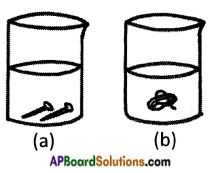
Answer:
AP Board 8th Class Physical Science Solutions Chapter 10 Reflection of Light at Plane Surfaces 13

  1. The crow can pick the grain from any point on the ground, but the condition is selecting the shortest path.
  2. Let the speed of the crow is constants –
  3. Observe some of the paths in figure.
  4. To compare the lengths of these paths ACB, ADB, AEB and AFB, make the duplicates of them at point G as shown in figure.
  5. In the figure CB = CG,
    ∴ The length of path ACB = AC + CB = AC + CG = ACG
  6. Similarly length of the path ADB = length of the path ADG Similarlylength of the path AEB = length of the path AEG Similarly length of the path AFB = length of the path AFG
  7. By observing the above paths, we will notice that AEG is the shortest path among all the paths, because it is the straight line distance between points A and G.
  8. So the smart crow will pick the grain from point E.

AP Board 8th Class Physical Science Solutions Chapter 10 Reflection of Light at Plane Surfaces

Activity – 3

Question 2.
Look at the following figure.
Suppose if you have been given a plane mirror strip, what will you do to obtain figures as shown below figure (b) using mirror strip and the above figure (a)?
AP Board 8th Class Physical Science Solutions Chapter 10 Reflection of Light at Plane Surfaces 14
Answer:
The place of mirror that should be place on the figure vertically has been shown here under by a line.
AP Board 8th Class Physical Science Solutions Chapter 10 Reflection of Light at Plane Surfaces 14
In the above diagrams, line indicates the position of mirror to be kept to get the required shapes.

AP Board 8th Class Physical Science Solutions Chapter 9 Electrical Conductivity of Liquids

AP State Syllabus AP Board 8th Class Physical Science Solutions Chapter 9 Electrical Conductivity of Liquids Textbook Questions and Answers.

AP State Syllabus 8th Class Physical Science Solutions 9th Lesson Electrical Conductivity of Liquids

8th Class Physical Science 9th Lesson Electrical Conductivity of Liquids Textbook Questions and Answers

Improve Your Learning

Question 1.
Give examples for good solid conductors and liquid conductors.
Answer:
Examples for good conductors in solids:
Silver, copper, iron, graphite, etc.
Examples for good conductors in liquids:
Mercury, acid solutions (HCl, H2SO4), base solutions (NaOH, KOH), salt solutions (NaCl, KCl), etc.

AP Board 8th Class Physical Science Solutions Chapter 9 Electrical Conductivity of Liquids

Question 2.
Give examples for bad solid conductors and liquid conductors.
Answer:
Examples for poor conductors in solids:
Gold, platinum, etc.
Examples for bad conductors in liquids:
Distilled water, coconut oil, petrol, vegetable oil, kerosene, alcohol, etc.

Question 3.
What do you add to distilled water for making it to conduct electricity?
Answer:
Distilled water is poor conductor of electricity. In order to increase conductivity we should have to add either acid, base or salt. That will increase the conductivity of distilled water due to decomposition of these substances into constitute ions.
Question 4.
What is an electrolyte ?
Answer:
Electrolyte is a solution of substance through which current can pass.

Question 5.
Which energy is cause for glowing of bulb in electrolytic cell?
Answer:
Electrolytic cell is a device which converts chemical energy into electrical energy. So chemical energy stored in the cell is cause for glowing of bulb.

AP Board 8th Class Physical Science Solutions Chapter 9 Electrical Conductivity of Liquids

Question 6.
Write the uses of electroplating.
Answer:
Uses of electroplating:

  1. Metals like iron are coated with deposits of nickel or chromium to prevent rusting.
  2. Machinery parts are often chromium plated to protect them from corrosion and at the same time to give them good polish.
  3. Electroplating is also used in repairing worn out parts of machinery.
  4. Electroplating is also done for ornamentation and decoration purposes.
  5. Processed food items are preserved in tin coated iron cans by electroplating method.
  6. Zinc coated iron by electroplating method is used for bridges and in automobiles.

Question 7.
In case of a fire, before the fire men use the water, they shut off the main electrical supply for the area. Explain why they do this.
Answer:
Fire men use water to put out fire. Water containing dissolved salts is a good conductor of electricity. If fire men pour water on fire the electrical appliances near the fire may be wet if anybody touches those appliances they may have electric shock. In order to avoid people to get electric shock due to wet electrical appliances the fire men shut off electrical supply before they use water.
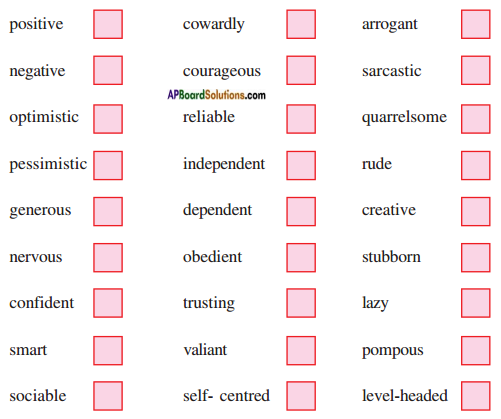
Question 8.
We get some items made from iron wire in which iron wire is coated with plastic. Is plastic coated by the process of electroplating? Why plastic cannot be coated on a metal by the process of electroplating?
Answer:
No. Plastic cannot be coated on a metal by using electroplating. The reason is plastic being a carbon polymer does not dissociate into ions. So it does not allow passage of current. So it does not act as an electrolyte. So electrolysis process is not possible with plastic which is main criteria for electroplating. So plastic cannot be coated on a metal by the process of electroplating.

Question 9.
Kavya observed that a discharged dry cell which kept in sunlight by her father for few hours got ability to glow LED. She got many doubts and questions to raise. Can you guess those questions or doubts? (OR)
Rohan observed that a discharged dry cell which kept in sunlight by his brother for few hours got ability to glow LED. He got many doubts and questions to raise. Guess the doubts or questions.
Answer:

  1. Why does the bulb glow?
  2. How does the dry cell charged?
  3. Which energy is useful in charging the discharged dry cell?
  4. Shall we use that energy to get rid from electrical power cut?

AP Board 8th Class Physical Science Solutions Chapter 9 Electrical Conductivity of Liquids

Question 10.
Explain the process of coating copper on iron key. Draw the circuit diagram.
(OR)
Conduct an experiment for coating on iron key with copper by electroplating method and prepare a note.
Lab Activity
Answer:
Aim: Coating an iron key with copper by electroplating method.
Required material: Copper plate of size 2 cm x 5 cm, crystals of copper sulphate, a key made by iron, glass beaker, water, sulphuric acid, battery cell and some connecting copper wires.
Procedure: Dissolve crystals of copper sulphate in pure water to prepare concentrated solution. Pour the solution in a beaker and add a few drops of dilute sulphuric acid to it.
AP Board 8th Class Physical Science Solutions Chapter 9 Electrical Conductivity of Liquids 1
Tie one end of connecting copper wire to iron object to be coated with copper. Connect other end to the negative terminal of battery. Suspend the tied iron object into the copper sulphate solution. Suspend the copper plate into copper sulphate from positive end of the battery through a switch as shown in the above figure. Key and plate are a little away from each other. Put the switch on for about 10 minutes. Switch the circuit off and take the iron key out.
We can observe a red coating on iron key. The reason is when electric current is pass through copper solution, in which copper sulphate is present in the form of copper and sulphate ions. The copper ion gets drawn to the electrode connected to the negative terminal of the battery and deposited on it.

Question 11.
How do you appreciate the efforts of Luigi Galvani and Alessandro Volta in discovering a cell and making a stored electric energy available to human beings?
Answer:
We should have to thoroughly appreciate the efforts of Luigi Galvani and Alessandro for their discoveries for the development of mankind. Galvani and Volta completely change the life of human beings. Before that people generated electricity in different ways and conduct various experiments. However they faced one major problem which prevented them from understanding electricity in depth. They did not have a stable and permanent source of electricity. Galvani experimental conclusion was a revolution in science saying that all living beings contained electricity and it was the main source of life.
Volta proved it is possible to generate electricity if two different metals are placed in some liquids. Volta made first cell using zinc and copper dipped in sulphuric acid. This cell called Volta cell. Later dry cell was prepared. Now various appliances works with dry cells. So the efforts of Galvani and Volta should be appreciated by every generation for their contribution to electricity.

AP Board 8th Class Physical Science Solutions Chapter 9 Electrical Conductivity of Liquids

Question 12.
Collect the information and make a list of good conductors and bad conductors. Mow do you use this information in your daily life works?
Answer:

 Good conductors Bad conductors
1) Metals 1) Wood
2) Acid solutions 2) Plastic
3) Base solutions 3) Diamond
4) Salt solutions 4) Distilled Water

Applications in daily life: This information is very useful to us. Generally metal or good conductors of electricity are used in electrical appliances, electrical wires, fuse wires, etc. Whereas plastic is a bad conductor is used for electric insulators like gloves, handles of electrical appliances etc. to avoid electric shocks.

Question 13.
Make a battery from four lemons and test it with a LED in the circuit.
(OR)
Write how do you make a battery from four lemons and test it with a LED in the circuit in your laboratory.
Answer:
Take four lemons cut them into two pieces. Take one piece from each lemon and insert two copper wires and connect them in series and connect a LED and complete the circuit. The circuit is shown below.
AP Board 8th Class Physical Science Solutions Chapter 9 Electrical Conductivity of Liquids 2
The bulb glows due to presence of current in the circuit. Here lemon juice acts as electrolyte and copper wires acts as electrolyte. So each lemon piece dipped with a copper wire acts as cell. These cells connected in series forms a battery.

Question 14.
Refer to the activity 3 in this chapter. Start with distilled water. The LED would not glow. Add two drops of some acid to distilled water and check the glow of LED. Add two more drops and check the intensity of the glow. Repeat the activity 5 to 6 times by adding 2 drops of the same acid each time. Do you see any difference in the intensity of glow with increasing acid content of water? What can be inferred from the above observations? Repeat the entire activity by taking a solution of baking soda and adding drops of it to distilled water instead of acid. Write differences and similarities.
Answer:
When we add two drops of acid (namely hydrochloric acid) to distilled water the LED will glow. If we further add the acid another two drops the intensity of glow increases. By repeating same activity 5 or 6 times we observe every time the glow of LED increases. The reason is acid dissociate into ions in aqueous solution. Which allows the passage of current. As the quantity of acid increases there will be more ions available for passage of electricity. So the intensity of glow increases.
We will observe the same result by adding baking soda but the intensity of glow is some what less when compared with addition of acid. The reason is baking soda is a weak base. So the dissociation is less when compared with acid. So less ions are available for passage of electricity. So the intensity of glow of LED is less when compared with acid.

AP Board 8th Class Physical Science Solutions Chapter 9 Electrical Conductivity of Liquids

Question 15.
In many of the activities in this chapter, we have used a tester made up of LED. Can we avoid LED and use something else as a tester Magnetic compass needle could be an alternative tester. We know that when we take a current carrying wire near magnetic compass needle, it shows deflection. Use this property to make a tester of magnetic compass needle. You may refer to the following figure.
Answer:
A magnetic compass wound with a copper wire is connected to one end of dry cell. The other end is connected to one of the two metal pins separated by a small gap in a rubber cap. The second pen is connected to the other end of dry cell to completed the circuit.
AP Board 8th Class Physical Science Solutions Chapter 9 Electrical Conductivity of Liquids 3
The magnetic needle deflects because whenever current pass through a wire it acts as a magnet is called magnetic effect of current.

8th Class Physical Science 9th Lesson Electrical Conductivity of Liquids InText Questions and Answers

Think and Discuss

8th Class Physical Science Textbook Page No. 123

Question 1.
Why some material allows electric current to pass through them and why some do not?
Answer:
Flow of charged particles constitutes current. So for the passage of current the material should have charged particles. All the materials do not have charged particles, e.g. Plastic, wood, diamond, etc. So only those material which have charged particles allow passage of current.

8th Class Physical Science Textbook Page No. 127

Question 2.
If a battery is packed in a box and if only two wires from two terminals are given out, how can we decide the positive and negative terminal of the battery?
Answer:
Insert the wires into a potato. A greenish spot is seen on potato at one of the wires. That wire behave like positive terminal and the other is negative terminal.

8th Class Physical Science Textbook Page No. 129

AP Board 8th Class Physical Science Solutions Chapter 9 Electrical Conductivity of Liquids

Question 3.
What is electrolysis?
Answer:
The dissociation of a solution of compound into constitute ions or elements by passing current is called electrolysis.
e.g. Electrolysis of water, which produce oxygen and hydrogen gases.

8th Class Physical Science 9th Lesson Electrical Conductivity of Liquids Activities

Activity – 1

Question 1.
Testing the material to know which allows electric current to pass through it.
Answer:
Take a torch bulb or LED (Light Emitting Diode), a dry cell, wooden sheet, two drawing pins, a key (safety pin) and pieces of connecting wires. Set up the electric circuit as shown in the figure.
AP Board 8th Class Physical Science Solutions Chapter 9 Electrical Conductivity of Liquids 4
Place the key on drawing pin. The bulb begins to glow as soon as the key touches the drawing pin. Now replace the key by a nail.
Does the bulb glow ?
Yes, the bulb glows.
Repeat the activity using different types of materials instead of the nail, say a strip of paper, a piece of chalk, a drinking straw, a piece of plastic, a paper clip, a rubber eraser, etc.
Note in each case whether the bulb glows or not and enter your observations in table.

Object Material Bulb glows
Yes/No
Good conductor/ bad or poor conductor
Nail Iron Yes Good conductor
Eraser Rubber No Bad or poor conductor
Paper Cellulose No Bad or poor conductor
Chalk Calcium carbonate No Bad or poor conductor
Straw Plastic No Bad or poor conductor
Plastic Plastic No Bad or poor conductor
Matchstick Wood No Bad or poor conductor

From the above activity, we conclude that some material allow electric current to pass through them. What we call them?
They are called good conductors of electricity.
The material that do not allow current to pass through them, what is the name given to those material?
They are named as bad or poor conductors of electricity.

AP Board 8th Class Physical Science Solutions Chapter 9 Electrical Conductivity of Liquids

Activity – 2

Question 2.
Testing the electric conductivity of liquids.
(OR)
Conduct an experiment for testing the electric conductivity of liquids.
Answer:
Take a LED, dry cell, metal pins, rubber cap of injection bottle and wires for making connections. Set up an electric
circuit shown in the figure.
AP Board 8th Class Physical Science Solutions Chapter 9 Electrical Conductivity of Liquids 5
See that the two metal pins, pass through the cap and should have a very small gap (around 2 mm) between them so that the pins are fairly closer but not touching each other. The LED should not glow when pins are separated by small distance.
Now, join the free ends of pins together by pressing them for a moment and make sure that the LED glows. Release the pins they get separated and LED should not glow. This acts as a tester.
Fill the rubber cap with different liquids like distilled water that we drink, coconut oil, kerosene, lime juice, mustard oil, sugar solution, etc one after another and in each case check whether the LED glows or not. Note down your observations in table.

Liquid LED glows Good conductor/ poor or bad conductor
Distilled water No Bad conductor
Drinking water Yes Good conductor
Coconut oil No Bad conductor
Lemon juice Yes Good conductor
Vinegar Yes Good conductor
Kerosene No Bad conductor
Vegetable oil No Bad conductor
Sugar solution No Bad conductor
Common salt solution Yes Good conductor
Milk No Bad conductor

a) Why doesn’t the LED glow in all the cases? Or why doesn’t the LED remain off in all the cases?
Answer:
The LED doesn’t glow all the cases because when the liquid the two pins of tester allows electric current to pass through, the circuit is completed (closed) and the LED glows. On the other hand when the liquid does not allow the current to pass through, the circuit is incomplete (open) and the LED does not glow.

AP Board 8th Class Physical Science Solutions Chapter 9 Electrical Conductivity of Liquids

b) In the above activity, you may have observed that in all those cases where the LED glows, its brightness (intensity) is not the same. Sometimes it may be brighter and sometimes it may be relatively dimmer. Why is that so?
Answer:
The intensity of the glow of the LED depends on the flow of electric current through the circuit. Although a liquid may be a conductor, it may not allow current through it as easily as a metal does.
As a result although the circuit is completed and the LED glows, due to weak current in case of some of the liquids, the intensity of glow would be lower compared to other liquids.

Activity – 3

Question 3.
Transforming a poor electric conductor into a good conductor.
(OR)
Conduct an experiment for testing the electric conductivity of electrolyte.
Answer:
Take some amount of distilled water in three different containers. Dissolve small quantity of common salt in the water of first container. Dissolve the copper sulphate, lemon juice in second and third container respectively.
Use the tester that we used in activity 2, and repeat the activity 2. Note the observations in table.

Material ‘ Does the LED glow? Yes/No Good conductor/bad conductor
Distilled water No Bad conductor
Distilled water + salt Yes Good conductor
Distilled water + CuSO4 Yes Good conductor
Distilled water + lemon juice Yes Good conductor

a) From table what can we infer?
Answer:
Distilled water does not allow the electric current to pass. Water in its pure form is a bad conductor of electricity. But when water contains salts or acids, it allows a passage of electric current and turns into a good conductor of electricity.

b) Do you understand why you are advised not to touch electric appliances with wet hands?
Answer:
Water with salts is a good conductor of electricity and the current flowing through househt d electric appliances is very high. Therefore we should never touch the electrical appliances with wet hands.

Activity – 4

Question 4.
Testing the effect of electric current on potato.
Take a potato. Cut into two halves and take one half of it. Construct tester with LED bulb. Insert two copper wires of the tester into the potato. Leaving some distance (around 1 cm) between them.
AP Board 8th Class Physical Science Solutions Chapter 9 Electrical Conductivity of Liquids 6
a) Dose the LED glow?
Answer:
Yes, the LED glows.
Leave the inserted wires for 20-30 minutes.

b) What do you observe the surface of the potato?
Answer:
A greenish blue spot is seen on the potato around the wire connected to the positive terminal of the battery.
But no such spot is seen around the other wire connected to the negative terminal. This greenish spot is due to chemical change in the potato.

AP Board 8th Class Physical Science Solutions Chapter 9 Electrical Conductivity of Liquids

c) What could be the cause behind this change?
Answer:
There is chemical change occurred in the potato.

d) Will other vegetables also show such an effect?
Answer:
Vegetable like carrot, beetroot, cucumber, radish, sweet potato show the chemical change there by the LED glows.

Activity – 5

Question 5.
Make your own cell.
(OR)
Draw the diagram of electrolytic cell and explain.
Collect two injection bottles. Cut two 5 cm long bits of thick copper wire. Use sandpaper to scrap about 1 cm of the coating off both ends of the wires.
Break open a exhausted dry cell and remove its outer metal covering (made of zinc). Cut two 2 mm wide and 5 cm long strips from this zinc plate. Insert the copper wires and zinc strips into the rubber caps of the injection bottles as shown in figure. Ensure that the copper wire and zinc strips do not touch each other.
AP Board 8th Class Physical Science Solutions Chapter 9 Electrical Conductivity of Liquids 7
Now take a wire and connect the copper wire of one bottle with the zinc plate of the other bottle. Fill both bottles with dilute sulphuric acid. Carefully close the bottles with the caps in which copper wires and zinc strips are inserted. Your cell is ready.
How will you test it?
Take an LED. Attach two wires to its two terminals. Touch the wire from one terminal to the zinc plate and the wire from other terminal to the copper wire. Did the LED light up ? If not, change the connections vice-versa. Did the LED glow ?
Repeat the above activity using lemon juice, tamarind juice and tomato juice one by one instead of sulphuric acid to make cells.

a) What other liquids can be used to make the cell?
Answer:
Acid solutions.

b) Will detergent solution be useful?
Answer:
Yes, it is useful.

c) How does above cell function?
Answer:
After a few seconds of immersion of zinc and copper into dilute sulphuric acid, zinc slowly begins to dissolve in the sulphuric acid. We can see bubbles getting formed on the copper rod.
The current is passed from copper rod to zinc rod. Here chemical energy is converted into electric energy by electrolysis method.

AP Board 8th Class Physical Science Solutions Chapter 9 Electrical Conductivity of Liquids

d) Can you compare this cell with dry cell?
Answer:
In the above cell electrolyte is dilute sulphuric acid whereas in dry cell ammonium chloride paste is electrolyte. The electrodes in above cell is copper and zinc, whereas in dry cell it is graphite (carbon) and zinc.

e) Which is good one? Why?
Answer:
Dry cell is better than ordinary Volta cell. The reason dry cell does not have any fluids. So it is easy to carry dry cell compared with volta cell. So dry cell is better than volta cell.

AP Board 7th Class Social Studies Solutions Chapter 1 Reading Maps of Different Kinds

SCERT AP Board 7th Class Social Solutions 1st Lesson Reading Maps of Different Kinds Textbook Questions and Answers.

AP State Syllabus 7th Class Social Studies Solutions 1st Lesson Reading Maps of Different Kinds

7th Class Social Studies 1st Lesson Reading Maps of Different Kinds Textbook Questions and Answers

Improve Your Learning

Question 1.
Why are the levels of all the seas equal in the world?
Answer:
All heights on the land are calculated from the sea level. Since all seas in the world are connected to each other, more or less the sea level (the top surface) all over the world is taken to be roughly the same.
We can easily observe this in the picture given below.
AP Board 7th Class Social Studies Solutions Chapter 1 Reading Maps of Different Kinds 1
The temple is 100 meters high above sea level. The top of the hill is 150 meters high from sea level.
Thus we can say the levels of all the seas are equal in the world.

AP Board 7th Class Social Studies Solutions Chapter 1 Reading Maps of Different Kinds

Question 2.
How is the sea level measured?
Answer:
The level of the sea keeps changing. So the level of the sea is carefully measured at frequent intervals and the mean level of the sea is calculated. A tidal gauge is used to measure the rising and falling of the sea.

Question 3.
What are the uses of maps showing heights?
Answer:

  1. These maps help us to understand the nature of the terrain, where the mountains are, where the valleys are, etc.
  2. If we look at the physical map of Andhra Pradesh, we can identify the coastal plains that run along the coast of the Bay of Bengal.
  3. If we travel westwards from the coast, we will reach hills that form the “escarpments” to the plateau region.
  4. The plateau region itself is cut by many rivers like the Krishna and the Godavari which form deep and broad valleys in them.
  5. Maps showing heights are very essential when roads or dams have to be constructed.
  6. If we have to lay roads in an undulating region between two places, such maps help us in deciding the route to be taken by the road.
  7. Similarly, when dams are planned it is necessary to know how much land will be submerged by the water of the dam.

Question 4.
What differences do you find between the lifestyle of people living on high altitudes and low altitudes?
Answer:
Difference between the people living on the high and low altitudes:

People of High Altitudes People of Low Altitudes
1) They live in mountainous regions. 1) They live in plains.
2) They are economically backward. 2) They are economically well developed.
3) They wear woolen clothes. 3) They wear cotton and silk clothes.
4) They enjoy insecure life. 4) They enjoy secure life.

AP Board 7th Class Social Studies Solutions Chapter 1 Reading Maps of Different Kinds

Question 5.
How are maps helpful to people?
Answer:

  1. The map is a representation or a drawing of the total or a part of the earth’s surface drawn on a flat surface according to a scale.
  2. Maps help us to study a part of the earth.
  3. Maps provide more information than a globe.
  4. Maps are easy to carry and take the measurement too.
  5. Some maps tell us about how high or low the places are, some tell us about how much it rains there or how hot or cold it gets there.
  6. Some maps tell us about crops that grow there or the kinds of forests there are.
  7. By studying them we can know much about a place.

Question 6.
Read the para ‘Contour Lines’ and comment on it.
Contour Lines
A contour is a line joining the places with equal heights. On the map of Nimpur you would have seen that there is a line passing through the village, this is the 50-meter contour line. All places on this line will have the same height of 50 meters. Contour lines will be in irregular shape depending upon the landform. These cannot cut with each other. The distance between two contour lines will depend upon the landscape. If the land has a steep climb then the contour lines will be near to each other. If the slope of the land is gentle, then the contour lines will be quite far from each other.
Answer:
A contour line of a function of two variables is a curve along which the function has a constant value. In cartography, a contour line joins points of equal elevation above a given level, such as mean sea level.
Contour lines are curved, straight or a mixture of both lines on a map describing the intersection of a real surface with one or more horizontal plains.

AP Board 7th Class Social Studies Solutions Chapter 1 Reading Maps of Different Kinds

Question 7.
Observe the physical map of Andhra Pradesh and list out the districts which are above 150 M.S.L.?
AP Board 7th Class Social Studies Solutions Chapter 1 Reading Maps of Different Kinds 2
Answer:
The following districts are above 150 mts Mean Sea level.

  1. Chittoor
  2. Visakhapatnam
  3. Kurnool
  4. Anantapur.