AP Board 7th Class English Important Questions Unit 6

AP State Syllabus 7th Class English Important Questions Unit 6

7th Class English Important Questions Unit 6

Section – A: Reading Comprehension

A. Reading

1. Read the following passage carefully.
Father was sitting under the hall lamp and reading the newspaper. He looked over the newspaper and said, “Swami, listen to this: News has been received about the bravery of a village lad who was returning home by the jungle path. While he was in the middle of the jungle, he came face to face with a tiger.” The newspaper gave a detailed account of the boy’s fight with the tiger. It also described how the boy flew up a tree where he stayed half a day. At last some people came that way and killed the tiger.
Now answer the following questions.
1) What was father doing?
2) What did father read in the newspaper?
3) Who was father speaking to?
4) What happened to the boy?
5) How did the boy escape from the tiger?
Answer:
1) Father was reading a newspaper.
2) Father read about a young boy who had fought bravely with a tiger.
3) Father was speaking to Sawmi, his son.
4) One day when he was travelling through a jungle he came face to face with a tiger. He bravely fought with a tiger.
5) The boy flew up a tree and he stayed half a day. At last some people came that way and killed the tiger. Thus the boy escaped from the tiger.

AP Board 7th Class English Important Questions Unit 6

2. Read the following passage carefully.
“You think you know better than the newspaper?” Father said crossly. “A man may have the strength of an elephant and yet be a coward. “Another may be a mere skeleton; but if he has real courage, he can do anything. Courage is everything; strength and age don’t matter much.” “How can that be?” said Swami. “Suppose I had a lot of courage, but what could do if a tiger attacked me?”
Now answer the following questions.
1) Who does ‘you’ here refer to?
2) What does father say about courage?
3) Have strength and age anything to do with courage?
4) What is Swami’s belief about courage?
5) Do you think Swami is brave? How can you say?
Answer:
1) ‘You’ here refers to Swami.
2) Father says strength has nothing to do with courage weak people may be courageous and
strong people may not be courageous.
3) Strength and age have nothing to do with courage.
4) Swami believes that though people are courageous they can not face risks and dangers.
5) No. Swami is not courageous. He feels that he is courageous but he Says he can not face and fight with a tiger.

3. Read the following passage.
“Can you prove you have courage?” said Father with a scowl. “Let me see if you can sleep alone tonight in my office room.”
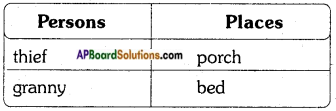
Swami had always slept beside his granny in the porch. The two always had their beds side by side. Any change in this arrangement kept him trembling and awake all night.
He hoped at first that Father was only joking. He tried to change the topic by saying, “Father, our captain says we shall have some elders also in our cricket club. He has asked me to tell you.” “We’ll see about that later,” Father cut in. “Hereafter you must sleep alone.” “From the first of next month, I’ll sleep alone,” Swami said very humbly, trying to please Father.“No, you must do it right from today,” Father said sternly. “Sleeping beside Granny or Mother like a baby is disgraceful. You are now in the Fifth Standard and I don’t like the way you are being brought up.”
Now answer the following questions.
1) What should Swami do to prove his courage?
2) Where does Swami always sleep?
3) “Any change in this arrangement kept him-trembling and awake all night.” – What does this tell us about Swami?
4) Why did father insist Swami to sleep alone?
5) What is disgraceful?
Answer:
1) Swami should sleep lonely in his father’s office room to prove his courage.
2) Swami always sleeps beside his grandmother in the Verandah.
3) This tells us that Swami is timid.
4) Swami’s wanted to make his to son courageous by making him sleep alone at night.
5) Sleeping beside his mother or grandmo’ther is disgraceful for a boy like Swami.

AP Board 7th Class English Important Questions Unit 6

4. Read the following passage.
“Get up, Swami,” Father commanded. He looked like a ghost in the semi-darkness of the porch. Swami stirred and groaned as if in sleep.“Get up, Swami,” said Father a second time. “Why do you disturb him?” Granny pleaded.
“Get up, Swami,” said Father for the third time and Swami got up.
Father rolled up his bed, took it under his arm and said, “Come with me.”
Swami looked at Granny, hesitated for a moment, and then followed his father into the office room. “Let me sleep in the hall, Father,” Swami pleaded. “Your office room is very dusty and there may be scorpions behind your law books.”
“There are no scorpions, boy. You can sleep on the bench if you like.”
“Can I have a lamp burning in the room?”
“No. You must learn to be brave. You must not be afraid of darkness; it is only a question of habit.” It Will you at least leave the door open?” Swami said very humbly.
Now answer the following questions.
1) “Swami stirred and groaned as if in sleep” – What does this tell us? Was Swami really in sleep?
2) What do you understand about father after reading this passage?
3) “Swamy looked at Granny” – Why did Swami look at Granny?
4) What complaints did Swami make against sleep in his father’s room?
5) Why did father insist Swami to sleep in his office room?
Answer:
1) Swami was pretending that he was sleeping. Actually he was not sleeping.
2) Father is obstinate and commanding. He does not listen to any suggestions from anyone, if he decides to do anything.
3) Supposing that his grandmother would at least persuade his father not to make him sleep alone, Swami looked at his grandmother.
4) Swami complained that his father’s office room was dusty and there might be some scorpions behind his law books.
5) Father wishes that Swami should not be afraid of darkness. So he insisted Swami to sleep lonely in his office room.

5. Read the following passage.
Swami was pained and angry. He did not like the cruelty his father was showing. He cursed the newspaper that had printed the tiger’s story. He wished that the tiger had not spared the boy.
The night advanced and the silence in the house deepened. Swami’s heart began to beat faster. He remembered all the stones of devils and ghosts he had heard. He was almost faint with fear.

Now answer the following questions.
1) Why was Swami pained and angry?
2) What did he not like?
3) Why did he curse the newspaper?
4) Why did the boy wish that the tiger had not spared the boy?
5) What made Swami almost faint?
Answer:
1) Usually he used to sleep beside his grandmother in the verandah. But now he was forced to sleep alone in his father’s office room. This made Swami pained and angry.
2) Swami did not like the cruelty his father shown in making him sleep alone.
3) If the newspaper had not published the story of a brave boy, there would not have been a discussion about his courage and his father would not have asked him to sleep alone. So Swami cursed the newspaper for publishing the story of the brave boy.
4) If the tiger had not spared the boy and killed him, then the story would have been different, there would not have been a discussion, about courage and bravery between Swami and his father. So Swami wished that the tiger had not spared the boy.
5) 1) Swami was alone in the room.
2) The darkness and silence of the room made him frightened.
3) He remembered the stories of devils.
4) All these things made him almost faint with fear.

6. Read the following passage.
He heard a little rustling noise in the room.
“What can this be?” thought Swami and slowly opened his eyes.
Something was moving in the darkness. Swami lay gazing at it in horror. He was certain – that his end had come. The devil would soon pull him out and tear him to pieces!
“So what is the use of waiting?” Swami thought.
As it came nearer, Swami crawled out from under the bench. At once he clutched its leg and dug his teeth in.
There was a painful cry: “Aiyo! Something has bitten me.” Then there was heavy tumbling and falling amidst furniture. Everyone in the house was awakened by the loud noise. In a moment, Father and a servant came running with a light.
Now answer the following questions.
1) What was the rustling noise he heard?
2) Who does ‘he1 here refer to?
3) ‘What can this be?’ – What did Swami think it could be?
4) “So what is the use of waiting?” – What did Swami do? Why did he do so though he was timid?
5) “Aiyo! Something has bitten me.” – Who made this cry? What had bitten him?
Answer:
1) The burglar must have stepped on some papers, So it must have made a rustling stone.
2) ‘He’ here refers to Swami.
3) Swami thought that it could be a devil.
4) 1) Swami thought it was a devil. He thought it would drag him from under the bench and tear him into pieces the devil.
2) But he did not want to give a chance to harm him.
3) Whenever you are in a danger or risk, you should not let it to consume you. With your spontaneity and right-thinking at right time, you’ve to attack and try to overcome it. So Swami also did the right thing by biting the burglar hard.
5) The burglar made that cry. Swami had bitten him.

AP Board 7th Class English Important Questions Unit 6

7. Read the following passage.
The next day was a day of congratulations for Swami. His classmates looked at him with respect. His teacher patted his back for his courage and bravery. The headmaster said that he was a true scout. Swami had bitten into the knee of a notorious house-breaker and the police were grateful to him.
Now answer the following questions.
1) Why was Swami congratulated?
2) How was he treated at school?
3) What was Swami patted for by the teachers?
4) How did the headmaster praise Swami?
5) Why were the police grateful to him?
Answer:
1) Swami was congratulated for catching a notorious criminal.
2) At school his classmates looked at him with respect and his teachers patted his back for his courage and bravery.
3) His teachers patted Swami for his courage and bravery.
4) The headmaster praised Swami as a true scout.
5) Swami caught a notorious house-breaker by biting his knee. So the police were grateful to him.

B. Reading

1. Read the following lines.

My plane was just about to crash.
So, I grabbed my bag and
Took out my big blue parachute
to glide me down and land.
At last, I found a spot to land.
But there was a big breeze.
And so, I had to painfully
land on these sharp pine trees.
I was then filled with bruises as a pine fell on my ear.
I sat down on the ground to rest.
Now answer the following questions.
1) What was going to happen?
2) How did the poet want to save himself?
3) What was the problem in landing?
4) What happened when the poet landed on the pine tree?
5) What did the poet do finally?
Answer:
1) The poet’s plane was going to crash.
2) with the help of a parachute
3) There was a big breeze and so the poet had to land painfully on the sharp pine trees.
4) When he landed on the pine trees he was wounded and there were bruises on hip body.
5) Finally he sat down on the ground to rest.

Additional Questions (i):
1) What happened to the plane?
2) How did the speaker use the parachute?
3) Where did the poet land?
4) Why Wouldn’t he land on the selected spot?
5) What is the colour of the parachute?
Answer:
1) The plane was about to crash.
2) for gliding down
3) He landed on the sharp pine trees.
4) because there was a big breeze
5) The parachute is in blue colour.

Additiional Questions (ii):
1) Who does T here refer to?
2) What did the speaker do when his plane was about to crash?
3) Why did he take out his parachute?
4) Why had he to land painfully?
5) What did he find at last?
6) What was the adventure He did?
7) Pick out the rhyming words.
Answer:
1) ‘I’ here refers to an imaginative boy.
2) He took his parachute out of his bag and jumped out of the crashing plane.
3) He took out his parachute thinking that it would help him glide down to ground.
4) There was a big breeze. Parachute was unable to land on a safe place so he had to land painfully.
5) At last he found a spot on the land.
6) He jumped out of the crashing plane and reached to the ground safely with the help of a parachute.
7) and – land; breeze – trees;

AP Board 7th Class English Important Questions Unit 6

2. Read the following stanza.
I was then filled with bruises as
a pine fell on my ear.
I sat down on the ground to rest.
A thorn then poked me.
I slept on the ground frantically.
Mosquitoes bit my nose.
Bugs crept all over me
and tickled my body.

Now answer the follpwing questions.
1) Why was he filled with bruises?
2) Why did he sit down on the ground?
3) What poked him?
4) Which line in the stanza suggests that the speaker was dreaming?
5) What do you think that thorn could be?
6) How did he sleep?
7) What does the word ’frantically’ mean?
8) What crept all over his body?
9) What tickled his body?
10) Which word in the stanza gives the meaning of “an injury.”
Answer:
1) He landed on the sharp pine trees. So he was filled with bruises.
2) He sat on the ground to take rest.
3) A thorn poked him.
4) The line “I had to painfully land on these sharp pine trees.” Suggests us that he was dream¬ing.
5) Actually he was in a deep sleep. The thorn that poked him could be a sting of a mosquito.
6) He slept anxiously.
7) The word ‘frantically’ means ‘very anxiously’.
8) Some bugs crept all over his body.
9) The bugs which crept all over his body tickled his body.
10) bruises

3. Read the following stanza.

I scratched myself when I woke up,
appearing like a fool.
And after the whole thing I thought
I’d rather go to school.

Now answer the following questions.
1) Why did he scratch himself?
2) Why did the speaker feel like a fool?
3) What did the speaker finally want to do?
4) ‘And after the whole thing’ – What does’ the whole thing’ here mean?
5) List out the rhyming words in the stanza.
Answer:
1) He scratched himself to know whether it was real or he was in dream.
2) The speaker felt like a fool because he had dreamed a nasty adventure, which he actually could not attempt.
3) The speaker finally wanted to go to school.
4) The ‘whole thing,’ here means ‘the whole dream of his nasty adventure.’
5) ‘fool – school’ are the rhyming words in the stanza.

C. Reading

1. Read the following passage.
Kunwar Singh was the first to visit me the day I was given my first gun. I was eight then. He came early, and I put the old double-barrelled gun into his hands with great pride. He laid ‘the gun aside and said to me, “You are no longer a boy, but a man: and with this good gun you can go anywhere you like in the jungles and never be afraid provided you learn how to climb trees. I’ll now tell you a story to show how necessary it is for us, who shoot in the jungles, to know how to climb trees.
Now answer the following questions.
1) Who does ‘I’ here refer to?
2) Who was the first to’visit him when he was given the gun?
3) How old was the speaker when he was given the gun?
4) What should one learn to be courageous besides having a gun according to Kunwar Singh?
5) What is necessary for the hunters according to Kunwar Singh?
6) What do you think was the speaker?
Answer:
1) ‘I’ here refers to Jim Corbett.
2) Kunwar Singh was the first to visit him the day he was given the gun.
3) Jim Corbett was eight years old when he was given a gun.
4) Every hunter should leam to climb a tree besides having a gun to protect himself.
5) According to Kunwar Singh learning to climb trees is necessary for a hunter.
6) I think, the speaker was a hunter.

AP Board 7th Class English Important Questions Unit 6

2. Read the following passage.
Har Singh and I went to shoot one day last April. We started when the stars were paling. Since we found nothing to shoot, we started for home towards evening. While we were taking a sandy nullah that ran through dense scrub and thorn-bamboo jungle, a tiger was looking at us. It stared at us for some time but went back.

Now answer the following questions.
1) Who does ‘I’ here refer to?
2) When did they start for shooting?
3) Why did they start towards home?
4) Where did they come across a tiger?
5) What did the tiger do?
Answer:
1) ‘I’ here refers to Kunwar Singh.
2) They started for shooting at the break of the dawn.
3) When they found nothing to shoot, they started towards home in the evening.
4) They came across a tiger in a dense scrub.
5) The tiger stared at them for some time and went back.

3. Read the following passage.
The tiger sprang at him and he was screaming. Now 1 fired the gun off into the air. The tiger went away and Har Singh collapsed at the foot of the tree. I climbed down very silently and went to Har Singh. I found that one of the tiger’s claws had entered his stomach and tom the lining from his navel to within a few fingers’ breadth of the back-bone. All his inside had fallen out. I could not know what to do. Har Singh told me to put his intestines back into his stomach. I stuffed them all back along with the dry leaves, grass and twigs that stuck to them.
Now answer the following questions.
1) “….. he was screaming” – Who does ‘he’ here refer to?
2) Who does ‘I’ here refer to?
3) What did the speaker do to frighten away the tiger?
4) Why was Har Singh collapsed?
5) “All his inside had fallen out.” – Why?
6) “All his inside had fallen out.” – What had fallen out?
7) What did Har Singh ask the speaker to do?
8) “I stuffed them all back” – What do ‘them’ here refer to?
9) How did Kunwar Singh stuff them in?
10) What did the speaker find when he climbed down the tree?
Answer:
1) ‘He’ here refers to Har Singh.
2) ‘I’ here refers to Kunwar Singh.
3) The speaker fired his gun off into the air to frighten away the tiger.
4) The tiger had torn his stomach off and his inner organs had fallen out. So he was collapsed.
5) The tiger had tom his stomach off and all his inner organs had fallen out of his stomach.
6) All his inner organs such as the intestines had fallen out of his stomach.
7) Har Singh asked the speaker to put his intestines back into his stomach.
8) ‘Them’ here refers to his intestines.
9) Kunwar Singh stuffed the intestines in along with dry leaves, grass and twigs that stuck to them.
10) When he climbed down the tree the speaker found that the tiger had tom Har Singh’s stomach.

4. Read the following passage.
Later I wound my pugree (turban) round his stomach and knitted it tight to keep everything from falling out again. We started for home walking for seven miles. I led the way and Har Singh followed me. Holding the pugree in position Har Singh told me that he wanted to . meet the doctor. We walked for the extra three miles to the hospital. It was night and the hospital was closed. But the doctor-babu who lived nearby was awake. He asked me to call Aladia, the tobacco-seller. When I returned, the doctor had laid Har Singh on a string bed. Aladia held the lantern and I held the two pieces of flesh together. The doctor was very kind. He sewed up the hole in Har Singh’s stomach. I offered him two rupees but he refused to take it. When we went home, the women folk were crying.

Now answer the following questions.
1) Who is the speaker of these lines?
2) Who does ‘he’ here refer to?
3) Who do ‘we’ here refer to?
4) What did he wind up with his pugree?
5) Why did they walk extra three miles?
6) What was Aladia?
7) Why was Aladia sent for?
8) How can you say that the doctor was very kind?;
9) “…… to keep everything from falling out again.” – What does everything here refer to?
10) Why were the womenfolk crying?
Answer:
1) The speaker of these lines is Kunwar Singh.
2) ‘He’ here refers to Har Singh.
3) ‘We’ here refer to Kunwar Singh and Har Singh.
4) He wound up Har Singh’s torn stomach with his pugree.
5) Har Singh said that he wanted to meet the doctor. So they had to walk for three miles.
6) Aladia was a tobacco-seller.
7) Supposing that he would hold the lantern when Har Singh was operated on.
8) 1) The doctor agreed to operate on Har Singh though it was late at night:
2) He did not accept money that was offered to him by Kunwar Singh.
3) Thus we can say that the doctor was a very kind man.
9) ‘Everything’ here means everything that had fallen out from Har Singh’s stomach.
10) Women feared that something terrible must have happened to Kunwar Singh and Har Singh. When the two had not reached home even at late night the womenfolk at home were crying.

AP Board 7th Class English Important Questions Unit 6

Unseen Comprehension

1. Read the following passage carefully.

The Sun has set, and the pond is still.
John, Ned, Ben, Tom and Nell stand on the bank and look at the duck.
The dog with a black spot on his back is with Tom. See ! Tom has his hat in his hand. He has left his toy car on the box.
Kitty’s doll is on the rock. Nell has put her pet in the cage. It will sing a sweet song. The duck has her nest under the rock.
It is not hot now. Let us run and skip on the bank. Do you not think it is fun.
Now answer the following questions.
1) Do you think it is fun? How?
Answer:
Yes, it is funny. The sun is net. It is not hot now. Weather is plant. There are a lot of friends to play. They have some play things and pets’too. So it is funny.

2) How many friends are there in total? Who are they?
Answer:
There are 6 friends in total. They are John, Ned, Ben, Tom, Nell, and Kitty.

Choose the correct answer from the choices given.
3) What do John, Ned, Ben, Tom and Nell look at from the hank?
a) A frog
b) A cat
c) A duck
Answer:
c) A duck

4) Where is Kitty’s doll?
a) In her arms
b) On the rock
c) By her side
Answer:
b) On the rock

5) Where is the duck’s nest?
a) In a tree
b) Under the rock
c) On the grass
Answer:
b) Under the rock

2. Read the following passage carefully.

Penguins are birds that can not fly. Their wings are flippers which they use to help them travel upto thirty miles per hour in water. They also use their flippers for – balancing as they walk.
Penguins eat fish. They spend most of their time in the water. Penguins lay their and raise their young on land.
There are many kinds of penguins. Emperor penguins are the largest species of penguin and can grow to be about four feet tall, and weigh about one hundred pounds. Some other well known penguins are the King, the Macaroni and the Adelie.

Now answer the following questions.
1) What do penguins do with their wings?
Answer:
Penguin wings are flippers which are used to swim.

2) Name some kind of penguins.
Answer:
The king, the Macaroni and the Adelie are some kinds of Penguins.

Choose the correct answer:
3) A penguin is a/an ( )
a) bird
b) reptile
c) animal
Answer:
a) bird

4) Which of the following is the largest penguin ? ( )
a) Emperor
b) Marconi
c) King
Answer:
a) Emperor

5) Penguins eat ( )
a) insects.
b) fish.
c) birds.
Answer:
b) fish.

AP Board 7th Class English Important Questions Unit 6

3. Read the following passage carefully.

Annie and Rosa were walking home. It was just getting dark. They got to the big, gray house. They always hated walking by that house. It was old and empty. It had many broken windows. Everyone said it was haunted.
As they went by, they heard a strange noise. It – sounded like a baby cry. They stopped and looked around but could not see anyone. The noise was coming from the house.
Rosa was very brave. She walked all the way up to the house. Suddenly Rosa began to laugh. She pointed to the roof and said, “Look, Annie, there’s our ghost.”
Annie looked. The noise was coming from a sacred little kitten. The kitten was stuck on the roof. “Sometimes things are not what they seem,” Annie said.

Now answer the following questions.
1) What is the story about?
Answer:
The story is about a strange noise in a big, gray house.

2) What caused the strange noise?
Answer:
A sacred little kitten struck on the roof causing the strange noise.

Choose the correct answer :
3) When did the story take place? ( )
a) early morning
b) noon time
c) late afternoon
Answer:
c) late afternoon

4) What kind of person is Rosa? ( )
a) sad
b) tired
c) brave
Answer:
c) brave

5) They always hated the house because ( )
a) it was old and empty.
b) a ghost was living in it.
c) everyone said it was haunted.
Answer:
a) it was old and empty

4. Read the following passage carefully.

My mother took my sister and me to see a play at the arts center. The play was about an Indian chef who liked to make pies. It was an exciting play to watch because a thief took a pie from the chef’s house. This made the chef sad. The chef was filled with grief over the pie being taken and he told his friends he was very sad.
Then the chef and thief decided to have a cooking contest to see who could make the best pie. The thief made a pie. The thief wanted to ‘tie’ for first place with the chef. But the chef made the best pie and won the prize.
The thief did not win, but he went home with his pie and told his wife a lie that he had won the pie-cooking contest. The thief’s wife did not see a prize. There was no prize money or ribbon for a prize. This was a clue that her husband did not ‘tie’ with the chief in the pie contest and that his story was just not true.
The wife asked her husband (the thief) for the money that was due as he had borrowed her money to buy to ingredients needed for the pie. ‘Yes!” she smiled, you need to pay me back the money that is due !”
And when he did that, the thief and his wife had a piece of pie!

Now answer the following questions.
1) What lie did the thief tell his wife and why did he lie?
Answer:
The thief said that he had won the pie contest. He wanted to win.

2) How did the wife know the thief was not telling the truth?
Answer:
He did not have a ribbon or money to show that he had won the contest.

Choose the correct answer:
3) In the text, what did the chief like to do? ( )
a) He liked to bake cakes.
b) He liked to make cakes.
c) He liked to ride horses.
Answer:
b) He liked to make cakes.

4) What did the thief steal? ( )
a) a bag of gold
b) money
c) a pie from the chef’s house
Answer:
c) a pie from the chef’s house

5) Who among the following to won the ‘cooking pie’ contest? ( )
a) the thief
b) the chef
c) wife of the thief
Answer:
b) the chef

5. Read the following passage carefully.
The Gseat Sphinx is a lion with the head of person cut out of rock. It is a statue located in Egypt. Legends have been told about the Great Sphinx. Many of these stories talk about the sphinx being strong and wise. The statue is very large. The whole statue is 150 feet long with 50 feet long paws. The head is 30 feet long and 14 feet wide. Wind and sand have worn parts of the statue’s nose and some other parts of the statue away completely. These parts will be restoring.

Now answer the following questions.
1) Why is the sphinx getting fixed?
Answer:
Wind and sand have worn out parts of the statue’s nose and some other parts of the statue away completely.

2) What is called restoring?
Answer:
The process of the fixation of the worn out parts of the statue of sphinx is called restoring.

Choose the correct answer from the choices given.
3) Sphinx is located in ( )
a) France
b) Egypt
c) America
Answer:
b) Egypt

4) How long are the paws of the sphinx? ( )
a) 150 feet
b) 50 feet
c) 30 feet
Answer:
b) 50 feet

5) Sphinx is a statue with ( )
a) the head of a lion and the body of a man.
b) the head of a tiger and the body of a lion.
c) the head of a man and the body of a lion.
Answer:
c) the head of a man and the body of a lion.

AP Board 7th Class English Important Questions Unit 6

Unseen (Data Interpretation)

1. Read the following table. The table gives the sales details for textbooks and reference books at Primary / Secondary / Higher Secondary / Graduate levels.

Year Primary Secondary Higher Secondary Graduate Level
1975 42137 8820 65303 25343
1976 53568 10285 71602 27930
1977 58770 16437 73667′ 28687
1978 56872 15475 71668 30057
1979 66213 17500 78607 33682
1980 68718 20177 82175 36697

Now answer the following questions
1) What does the table show?
Answer:
The table shows the sales details for textbooks and reference books at primary/seconday/ higher secondary/ graduate levels.

2) The sales of which category of books had recorded consistent growth?
Answer:
The sales of Graduate level of books have recorded the consistent during the period of 1975 – 1980.

Choose the correct answer from the choices given.
3) The sale of which level books is maximum in the total period, i.e. from 1975-1980? ( )
a) Primary level
b) Secondary
c) Higher secondary
Answer:
c) Higher secondary

4) Which level books were sold maximum in the year 1975? ( )
a) Primary
b) Secondary
c) Higher Secondary
Answer:
c) Higher Secondary

5) The books of which level are sold least during 1975 – 1980? ( )
a) Primary level
b) Secondary level
c) Graduate level
Answer:
b) Secondary level

2. Read the following table.
Number of Engineering students at Institutes of different kind.

College 1988 – 1989 1989-1990 1990 – 1991
Private Engineering college 12000 18000 25000
Government Engineering colleges 8000 12000 13000
Regional Engeering college 4000 7500 10000
IIT 3000 4000 8000

Now answer the following questions.
1) What does the table show?
Answer:
The table shows the number of engineering students studying at different institutes during the period 1989-89 to 1990-91.

2) What is the general trend of Engineering education?
Answer:
The general trend of engineering education has shown consistent growth during the given period.

Choose the correct answer from the choices given.
3) What was the total number of engineering students in 1989 – 90? ( )
a) 38500
b) 41500
c) 42500
Answer:
b) 41500

4) In which category of Engineering colleges highest number of students are studying Engineering? ( )
a) IITs
b) Govt. Engineering colleges
c) Private Engineering college
Answer:
c) Private Engineering college

5) In which category of colleges lowest number of students are studying Engineering? ( )
a) IITs
b) Govt. Engineering colleges
c) Regional Engineering colleges
Answer:
a) IITs

AP Board 7th Class English Important Questions Unit 6

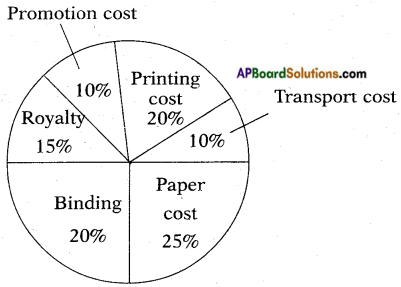
3. Read the following pie diagram.
Distribution of students at Graduate level in Seven Institutes named P, Q, R, S, T, M & N :
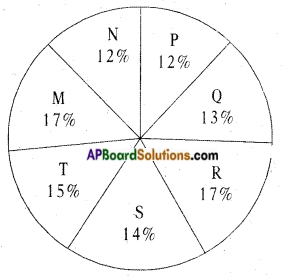
AP Board 7th Class English Important Questions Unit 6 1
Now answer the following questions.
1) What does the above pie diagram show?
Answer:
The pie-chart shows the distribution of students at the Graduate level in seven institutes named P Q, R, S, T, M, N.

2) How many institutes are there in total?
Answer:
There are seven institutes in total.

Choose the correct answer from the choices given.
3) In which two institutes maximum number of students studied? ( )
a) N & P
b) R & M
c) Q & S
Answer:
b) R & M

4) In which two institutes least number of,students studied? ( )
a) Q & P
b) M & R
c) N & P
Answer:
c) N & P

5) The number of students of which college are exactly half of the sum of stu¬dents from Q & R ( )
a) P
b) Q
c) T
Answer:
c) T

Section – B: Creative Writing

1. Write about an act of bravery that you or your family member or any one of your friends may have shown at some stage in your life.
Answer:
An act of my bravery
My father runs a jewellery shop. The shop is open on all days. But it is closed on Sundays.
One Sunday evening, I was returning home after playing cricket with my friends. I was coming on my bicycle. On my way home, when I came to my father’s shop, I found my father’s shop was kept open. I was surprised to see it open as it was a Sunday. I got down my bicycle and put it behind a tree and stood there silently to see what was going to happen. A few minutes later, I saw two thieves coming from the shop with a bag of jewellery and keeping it in their car, kept outside the shop. They later, went again into the shop to bring some more.
At once, without any hesitation, I ran towards the car and took out the air from all the tyres. Then I rode on my bicycle to the nearby police station and informed the police about the theft.
The police took me in their jeep and came to the spot. Seeing the police, the thieves began to run. But the police chased them and caught hold of them. All our jewellery was kept back in the shop and then it was locked.
The police congratulated me on my act of bravery. All my friends and neighbours praised me for my bravery. I felt happy as I had saved our property.

2. Change the story of ‘A Hero’ into a drama.
Answer:
Scene-I
Swami’s house with father sitting in a chair and reading a newspaper and his son Swami standing behind him.
Characters: Swami, his father and his granny.
Father: Listen, Swami! I’ll read out an interesting news for you.
Swami: What’s it, Dad?
Father: It’s about the bravery of a village lad who was returning home by the jungle path.
Swami: What’s there in it about his bravery?
Father: He came face to face with a tiger and fought with it. Later he climbed on to the top branch of a tree and stayed there for half-a-day. Later some village people came that way and killed the tiger.
Swami: That couldn’t be. I think he must be a grown-up person.
Father: Don’t think so. Age and strength don’t matter with regard to courage/bravery.
Swami: Suppose I am very brave. Can I fight with a tiger?
Father: O.K. I will test your courage. Tonight, sleep alone in the dark in my office room and prove your bravery.
Swami: L will do it next month. Please put it off.
Father: No, come on with me.
(Father puts Swami alone in his office room. He leaves him in the dark but keeps the doors open)

Scene – II
Place: Father’s office room. Swami is sleeping under a bench.
Characters: Swami, a burglar, Father.

Swami to himself: I don’t know why father is cruel to me in this manner. I wish the tiger had not spared the village lad.
A burglar to himself: The door is open. I will enter the room and steal the valuable things. (The burglar walks in and steals something. He comes near the boy.
(Swami hears the sound of his walking close to him.)
Swami to himself: What is this sound? I think a devil is coming to kill me now. I will dig my teeth into its leg.
(When the burglar comes nearer, Swami digs his teeth into the knee of the burglar.) ‘
The burglar: Oh! I was bitten.
(Hearing the sound, Father and a servant come into the room and catch the thief.)

Scene – III
Place: School
Characters: Swami, his friends, a teacher and the Headmaster.
Teacher: Oh! You have acted bravely. I appreciate you.
Swami: Thank you, teacher.
Friends: Swami, you have done a marvellous thing. Congrats.
Swami: It’s O.K.
H.M.: Swami, you are a true scout. You have proved your bravery. We are proud of you.
Swami: Thank you, Sir.
(But the next day on wards, Swami sleeps in his usual place.)

3. Have a discussion in the whole class on how the performance could be im¬proved in terms of delivery of dialogues, costumes, action, settings, etc.
A Skit on ‘A Hero
The performance could be improved and made humorous if it was as follows.
When father exits the office-room
Swami (to himself): I am afraid I can’t be alone. What should I do? Idea! I shall go unnoticed into my father’s bed room, pick up his cell-phone and call my close friend, Guruvardhan.
(The boy tiptoes into his father’s bed room, picks up his mobile, comes out and makes a phone call to his friend, Guruvardhan.)
Swami: Hello Guru! I’m Swami.
Guruvardhan: Hello Swami! Whats the matter? Why are you calling me at this time? Any problem?
Swami: Yes. Guru. Can you come to my house now and spare an hour with me?
Guruvardhan: Why?
Swami: I’ll tell you here. Please do come soon.
(Swami deletes the number of his friend from his father’s mobile from dialed numbers, keeps it there and comes back into his fathers office room. Half an hour later, his friend enters the room)
Swami: Hai! Come in. I feel bored being alone.
Guruvardhan: Why alone here?
Swami: My father does this as a test for my bravery. Give me some idea.
(Guruvardhan thinks over it for a while)
Guruvardhan: I’ll take some valuable things from this office room and throw them scattered at the gate of your house and go back home. Half an hour later, you cry out Thief, thief, I cant chase .him. Please help’ and walk hurriedly to the gate. Your father comes. Tell him you are trying to catch the thief who entered and stole the things. Also tell him he has left them there and escaped. Your father then appreciates your bravery. How is it?
Swami: It’s a good idea. Let’s do it at once.
(They implement their plan. His friend has gone home, leaving the things at the gate)
Swami: Thief, thief! catch him. (Shouts loudly)
(His father and a servant come there with a torchlight in hañds.)
Father: Where is the thief? What has happened?
Swami: Dad! A thief has entered the office room and stole some valuable things. I heard the sound and cried. He began to run. I tried to catch him. But he escaped. leaving these things here.
Father: (looking at them) Oh! these are very valuable. Had I lost them, I would have been in great trouble. Really you have done a very good job.
I appreciate your bravery.
(All the members of his family praise him.)

AP Board 7th Class English Important Questions Unit 6

4. In the lesson ‘A Hero’ you have read a conversation based on the news from a newspaper. Swami’s family discussed the bravery of a village boy who fought with a tiger. Imagine that you were Swamy and describe your feelings when you came face to face with a tiger.
You may use the following hints to describe your feelings :
Big tiger – staring at me – very ferocious – what to do – run away – hide in the bushes – search for stones – no weapons – nobody nearby – can’t shout for help – gets idea – fight with all energy – kick the tiger on its face – run and climb the tall tree – call the villagers – rescue – kill the tiger.
Answer:
Once I was walking through a thicket. It was a sunny afternoon. I was walking alone. No one was there. At once I saw a big tiger behind a bush. It was staring at me. It was ferocious. I was frightened. I did not know what to do. I was unable to decide whether to run away from there or hide in the bushes. Since I had no weapons I searched for stones. There was nobody nearby. I could riot shout for help. Then I got an idea. I decided to fight with all energy. I kicked the tiger on its face. I ran and climbed a tall tree. I called the villagers. They came running and rescued me by killing the tiger.

5. Summarize the story using the following hints.
Swami – the news report – about a boy’s fight – father’s advice – sleeps in his grandmother’s room – father insists on sleeping alone – a terrible dream – catches a thief – becomes a hero.
Answer:
One day Swami’s father read out some news in some newspaper for his son, Swami. The news was about the bravery of a village lad who was returning home by the jungle path. The newspaper gave a detailed account of the boy’s fight with the tiger.
After listening to the news, Swami said that a boy could not be brave enough to fight with a tiger. Then Swami’s father asked him to prove his courage. For that, his father advised him to sleep for some nights alone in his office room. He wanted his son to do it that night itself. But Swami went into the porch and slept beside his granny. Swami never slept alone. He always slept beside his granny.
Then his father came to Swami and woke him up. He insisted Swami on his sleeping alone in the office room that night. Swami tried to escape but in vain. So he had to sleep alone in darkness in his father’s room that night. Then Swami had a terrible dream. He could not sleep. Suddenly he heard that someone was coming towards him. He thought he was a ghost. So, at once, to protect himself, Swami bit into the knee of a thief. The thief cried out. Father and a servant came and caught the thief. Swami became a hero.

Vocabulary

1. Read the following paragraph and write the synonyms of the underlined words choosing the words from the words given in the box.

1.

AP Board 7th Class English Important Questions Unit 6 2
“Swami, listen to this: News has been received about the bravery (a) of a village lad (b) who was returning home by the jungle (c) path (d). While he was in the middle of the jungle, he came face to face with a tiger.”

2.

AP Board 7th Class English Important Questions Unit 6 3
“Can you prove you have courage (a)” said Father with a scowl (b). “Let me see if you can sleep, alone tonight in my office room.”
Swami had always slept beside his granny in the porch (c). The two always had their beds side by side. Any change in this arrangement kept him trembling (d) and awake all night.

3.

AP Board 7th Class English Important Questions Unit 6 4
“From the first of next month, I’ll sleep alone,” Swami said very humbly (a), trying to please (b) Father.“No, you must do it right from today,” Father said sternly (c). “Sleeping beside Granny or Mother like a baby is disgraceful (d). You are now in the Fifth Standard and I don’t like the way you are being brought up. ”

4.

AP Board 7th Class English Important Questions Unit 6 5
“Get up, Swami,” Father commanded (a). He looked (b) like a ghost in the semi-darkness of the porch. Swami stirred (c) and groaned as if in sleep.“Get up, Swami,” said Father a second time. “Why do you disturb him?” Granny pleaded (d).

5.

AP Board 7th Class English Important Questions Unit 6 6
Swami was pained and angry. He did not like the cruelty (a) his father was showing. He cursed (b) the newspaper that had printed the tiger’s story. He wished (c) that the tiger had not spared (d) the boy.

6.

AP Board 7th Class English Important Questions Unit 6 7
The night advanced (a) and the silence in the house deepened (b). Swami’s heart began to beat faster. He remembered all the stories of devils and ghosts he had heard. He was almost faint (c) with fear. Swarmi hurriedly (d) got up.

7.

AP Board 7th Class English Important Questions Unit 6 8
Swami hurriedly got up (a) and spread his bed under the bench and crouched (b) there. It seemed to be a much safer place. He shut his eyes tight and encased (c) himself in his blanket. Unknown to himself, Swami fell asleep. In his sleep he had a terrible dream. He groaned in despair, (d).

8.

AP Board 7th Class English Important Questions Unit 6 9
Something was moving in the darkness. Swami lay gazing (a) at it in horror (b). He was certain (c) that his end had come. The devil would soon pull him out and tear him to pieces!
“So what is the use of waiting?” Swami thought.
As it came nearer, Swami crawled out from under the bench. At once he clutched, (d) its leg and dug his teeth in.

9.

AP Board 7th Class English Important Questions Unit 6 10
Both of them fell on the burglar (a) who lay amidst the furniture with a bleeding knee.
The next day was a day of congratulations for Swami. His classmates looked at him with respect. His teacher patted his back for his courage and bravery. The headmaster said that he was a true scout (b). Swami had bitten into the knee of notorious (c) house – breaker and ‘ the police were grateful (d) to him.

Answer:
1. a) courage b) a young boy c) forest d) way
2. a) bravery b) anger c) verandah d) shaking
3. a) meekly b) satisfy c) determinedly d) shameful
4. a) ordered b) appeared c) moved d) appealéd
5. a) harshness b) damned c) hoped d) allowed to go free
6. a) progressed b) extended c) become unconscious d) speedily
7. a) raised b) stooped low c) covered d) anguish
8. a) staring b) fear c) sure d) caught
9. a) thief b) adventurer c) bad d) thankful

AP Board 7th Class English Important Questions Unit 6

2. Read the following paragraph and write the antonyms of the underlined words.

1. “You think you know better than the newspaper?” Father said crossly. “A man may have the strength (a) of an elephant and yet be a coward (b). “Another may be a mere skeleton; but if he has real (c) courage (d), he can do anything.

2. He hoped (a) at first that Father was only joking. He tried to change the topic by saying, “Father, our captain says we shall have some elders (b) also in our cricket club. He has asked me to tell you.’’“We’ll see about that later (c),” Father cut in (d). “Hereafter you must sleep alone.”

3. “From the first of next month, I’ll sleep alone,” Swami said very humbly (a), trying to please (b) Father.“No, you must do it right from today,” Father said sternly (c). “Sleeping beside Granny or Mother like a baby is disgraceful (d). You are now in the Fifth Standard and I don’t like the way you are being brought up.”

4. “Get up (a), Swami,” said Father for the third time and Swami got up. Father rolled up his bed, took it under his arm and said, “Come with me.”
Swami looked at Granny, hesitated (b) for a moment, and then followed (c) his father into the office room. “Let me sleep in the hall, Father,” Swami pleaded. “Your office room is very dusty (d) and there may be scorpions behind your law books.”

5. Swami was pained and angry (a). He did not like (b) the cruelty (c) his father was showing. He cursed (d) the newspaper that had printed the tiger’s story.

6. The night advanced (a) and the silence (b) in the house deepened. Swami’s heart began to beat faster, (c) He remembered (d) all the stories of devils and ghosts he had heard. He was almost faint with fear.

7. A tiger was chasing him. Swami tried hard (a) to escape (b) but his feet would not move. He tried to open his eyes but his eyelids would not open (c). He groaned in despair (d).

8. At last (a), using utmost effort he opened (b) his eyes. He put his hand out to feel his granny’s presence (c), as was his habit. But he only touched the wooden leg of the bench! At once his lonely state came back to him. He shook in fear and closed his eyes. He heard a little rustling noise (d) in the room.

9. The next day was a day of congratulations (a) for Swami. His classmates looked at him with respect (b). His teacher patted his back for his courage and bravery. The headmaster said that he was a true (c) scout. Swami had bitten into the knee of a notorious (d) house-breaker and the police were grateful to him.
Answer:
1. a) weakness b) hero; brave c) unreal d) cowardice/timidity
2. a) despaired b) youth c) earlier d) continued
3. a) proudly b) displease c) lightly d) respectable
4. a) Lie down b) continued c) led d) clean
5. a) calm b) dislike c) kindness d) blessed
6. a) declined b) noise c) slower d) forgot
7. a) easy b) remain c) shut d)hope
8. a) Initially b) closed c) absence d) silence
9. a) criticism b) humiliation c) false d) famous

3. Fill in the blanks with the right form of the words given in brackets.

1. After _________ (a) (read/reading) it through, Father looked at Swami _________ (b) (fixedly/fixed) and asked, “V.hat do you say to that?” I think he must have been a very strong and _______ (c) (grow/grown)-up person, not a boy at all,” said Swami. ‘Show
could a boy fight a tiger?”
“You think you know better than the newspaper?” Father said , _______ (d) (cross/crossly).

2. Swami said very humbly, _______ (a) (try/trying) to – (b) (please/pleasing) Father.”No, you must do it right from today,” Father said sternly. “ __________ (c) (Sleep/Sleeping) beside Granny or Mother like a baby is __________ (d) (disgraceful/disgrace).

3. Father lifted the newspaper to his face and started __________ (a) (reading/read) it again. Swami rose __________ (b) (quiet/quietly) from his place and __________ (c) (tiptoed/tiptoe) to his bed in the porch. Granny was sitting up in her bed, and she said, “Boy are you already feeling ________ (d) (sleepy/sleep) today? Don’t you want to hear a story?”

4. Swami looked at Granny, _________ (a) (hesitate/hesitated) for a moment, and then followed his father into the office room. “Let me __________ (b) (sleep/sleeping) in the hail, Fàther,” Swami pleaded. “Your office room is very _________ (c) (dust/dusty) and there may be scorpions behind your law books.”
“There are no scorpions, boy. You cn sleep on the bench if you like.”
“Can I have a lamp (d) (burning/bum) in the room?”

5. “No. You must learn to be _________ (a) (bravely/brave). You must not be afraid of__________ (b) (dark/darkness); it is only a question of habit.” “Will you at least leave the door (c) (opening/open)?” Swami said vely_______ (d) (humble/humbly).

6. Swami was pained and _________ (a) (angrily/angry). He did not like the_________ (b) (cruelty/cruel) his father was showing. He cursed the newspaper that had printed the tiger’s story. He wished that the tiger had not spared the boy. The night advanced and the (c) (silent/silence) in the house__________ (d) (deepen/deepened).

7. At last, using utmost effort he opened his eyes. He put his hand out to _________ (a) (feeling/feel) his grannys __________ (b) (present/presence), as was his habit. But he only touched the wooden leg of the bench! At once his __________ (c) (lone/lonely) state came back to him. He shook in fear and closed his eyes. l-le heard a little _______ (d) (rustle/rustling) noise in the room.

8. Something was moving in the darkness. Swami lay _________ (a) (gaze/gazing) at it in horror. He was __________ (b) (certain/certainly) that his end had come. The devil would soon pull him out and _____ (c) (tom/tear) him to pieces! “So what is the use of _____ (d) (waiting/wait)?” Swami thought.

9. There was a _________ (a) (pain/painful) cry: “Aiyo! Something has bittet me.” Then there was heavy _________ (b) (tumbling/tumble) and falling amidst furniture. Everyone in the house was __________ c) (awaken/awakened) by the loud noise. In a moment, Father and a servant came _____ (d) (run/running) with a light.

10. Both of them fell on the burglar who lay amidst the furniture with a (a) (bleeding/bleed) knee.
The next day was a day of _________ (b) (congrtulate/congratulations) for Swami.
His classmates looked at him with respect. His teacher patted his back for his courage and _________ (c) (bravery/brave). The headmaster said that he was a _______ (d) (truth/true) scout.
Answer:
1. a) reading b) fixedly c) grown d) crossly
2. a) trying b) please c) sleeping d) disgraceful
3. a) reading b) quietly c) tiptoed d) slèepy
4. a) hesitated b) sleep c) dusty d) burning
5. a) brave b) darkness c) open d) humbly
6. a) angry b) cruelty c) silence d) deepened
7. a) feel b) presence c) lonely d) rustling
8. a) gazing b) certain c) fear d) waiting
9. a) painful b) tumbling c) awakened d) running
10. a) bleeding b) congratulations c) bravery d) true

а) Complete the following words using ai, au, ea, ee, ei, ie, io, oa, oe, oi, oo, ou, ue, ui.

1) The newspaper gave a (a) det _ _ led (b) acc _ _ nt of the boy’s fight wfth the tiger.
2) If he has (a) r _ _ l (b) c _ _ rage, he can do anything.
3) I don’t like the way you are (a) b _ _ ng (b) br _ _ ght up.
4) Swami rose (a) q _ _ etly from his place and (b) tipt _ _ d to his bed in the porch.
5) You must not be (a) afr _ _ d of darkness; it is only a (b) q _ _ stion of habit.
6) If you do it, I’ll tell your (a) t _ _ cher and make you the (b) l _ _ ghing stock of the whole school.
7) The night advanced and the silence in the (a) h _ _ se (b) d _ _ pened.
8) Swami’s (a) h _ _ rt began to(b) b _ _ t faster.
9) Swami (a) sp _ _ d his bed under the bench and (b) cr _ _ ched there.
10) He (a) gr _ _ ned in (b) desp _ _ r.
11) He (a) sh _ _ k in (b) f _ _ r and closed his eyes.
12) He heard a little rustling (a) n _ _ se in the (b) r _ _ m.
13) The devil would (a) s _ _ n pull him out and tear him to (b) p _ _ ces!
14) Swami bit into the (a) kn _ _ of a (b) notor _ _ us house breaker.
15) The headmaster said that he was a (a) tr _ _ (b) sc _ _ t.
16) He felt a (a) gr _ _ t (b) re _ _ f.
Answer:
1. a) detailed b) account
2. a) real b) courage
3. a) being b) brought
4. a) quietly b) tiptoed
5. a) afraid b) question
6. a) teacher b) laughing
7. a) house b) deepened
8. a) heart b) beat
9. a) spread b) crouched
10. a) groaned b) despair
11. a) shook b) fear
12. a) noise b) room
13. a) soon b) pieces
14. a) knee b) notorious
15. a) true b) scout
16. a) great b) relief

b) Complete the words with the correct suffixes given in brackets.

1) News has been received about the (a) bray _____ (ary/ery) of a village lad who was (b) return _____ (ing/ning) home by the jungle path.
2) Any change in this (a) arrange _____ (mant/ment) kept him (b) tremb _____ (leing/ling) and awake all night.
3) ‘No,” Father said (a) stern _____ (ly/lly). “Sleeping beside Granny or Mother like a baby is (b) disgrace _____ (ful/ful).
4) ‘You must not be afraid of (a) dailc _________ (nes/ness) .“ ‘Will you at least leave the door open ?“ Swami said very (b) hum _____ (blely/bly).
5) The night advanced and the (a) siten _____ (se/ce) in the house (b) deep _____ (end/ened).
6) Swami had bitten into the knee of a (a) notori _____ (aus/ous) house-breaker and the police were (b) grate _____ (ful/full) to him.
7) Swami was (a) follo _____ (wing/ing) the whole (b) conversa _____ (ssion/tion) from under the blanket.
8) a) There was a pain _____ (full/ful) cry.
b) “Let him sleep where he likes,” Mother said angr _____ (yly/ily).
Answer:
1. a) bravi b) returning
2. a) arrangement b) trembling
3. a) sternly b) disgraceful
4. a) darkness b) humbly
5. a) silence b) deepened
6. a)notorious b) grateful
7. a) following b) conversation
8. a) painful b) angrily

AP Board 7th Class English Important Questions Unit 6

c) Find the wrongly spelt word and write the correct spelling.
1. a) biting; fighting; hating; siting
b) believe; relieve; achieve; recieve
2. a) detail; account; describe; captan
b) coward; courage; strength; skeleten
3. a) courage; passage; luggage; marrage
b) tinful; mouthful; houseful; disgracefull
4. a) comand; demand; remand; reprimand
b) croch; approach; coach ; touch
5. a) dependent; confident; present; servent
b) rubber; scrubber; burgler; joker
Answer:
1) a) sitting b) receive
2) a) captain b) skeleton
3) a) marriage b) disgraceful
4) a) command b) crouch
5) a) servant b) burglar

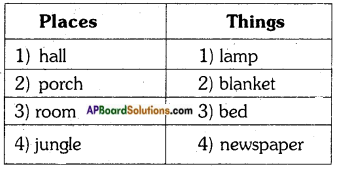
Put the following under the correct headings.

A.
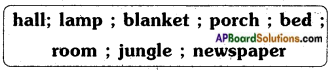
AP Board 7th Class English Important Questions Unit 6 11
Answer:
AP Board 7th Class English Important Questions Unit 6 12

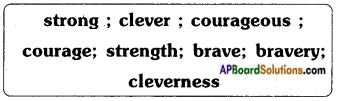
B.
AP Board 7th Class English Important Questions Unit 6 13
Answer:
AP Board 7th Class English Important Questions Unit 6 14

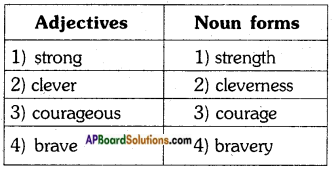
C.
AP Board 7th Class English Important Questions Unit 6 15
Answer:
AP Board 7th Class English Important Questions Unit 6 16

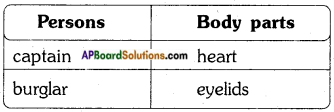
D.
AP Board 7th Class English Important Questions Unit 6 17
Answer:
AP Board 7th Class English Important Questions Unit 6 18

Match the parts under A and B to make some proverbs. You can use the clues given within the brackets.
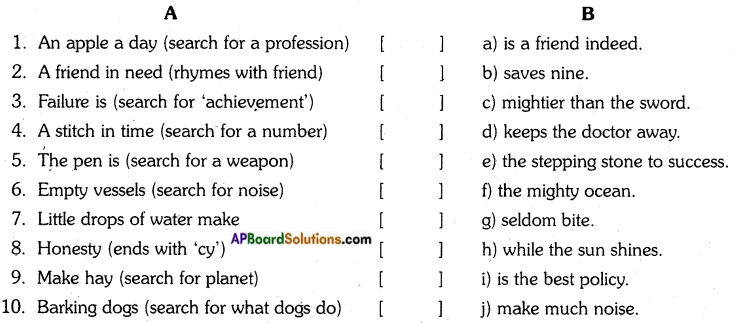
AP Board 7th Class English Important Questions Unit 6 19
Answer:
1) d
2) a
3) e
4) b
5) c
6) j
7) f
8) i
9) h
10) g

A) Write meaningful sentences using the words given below.
i) while:
ii) beside:
iii) later:
iv) even if:
v) almost:
vi) hurriedly:
vii) seem:
viii) utmost:
ix) at once:
x) certain:
Answer:
i) While he was crossing the bridge, his hat blew off.
ii) Come and sit beside me.
iii) We’ll meet later and discuss about it.
iv) I like her, even if she can be annoying at times.
v) The story is almost certainly false.
vi) I hurriedly got up and dressed.
vii) You seem happy.
viii) You should study this document with utmost care,
ix) At once she lost her temper.
x) If is certain he will succeed.

AP Board 7th Class English Important Questions Unit 6

B) Pick out the synonyms from the story for each of the following words.
1) clear
2) bravery
3) shameful
4) hide
5) upset
6) argued
7) swore
8) unpleasant
9) tapped
10) damage
Answer:
1) clear: detailed
2) bravery: courage
3) shameful: disgraceful
4) hide: cover
5) upset: pained
6) argued: mumbled/exclaimed/opined
7) swore: cursed
8) unpleasant: bitter
9) tapped: patted
10) damage: risk

C) Read the conversation given below and fill in the blanks with appropriate words from the box.

AP Board 7th Class English Important Questions Unit 6 20
Ruchira : I don’t know why the teacher ….(1)…. to give his mobile number?
Suhas : He might be worried that you would ….(2)…. him with your phone calls.
Ruchira : I have great ….(3)…. for him. I will never behave in a ….(4)…. manner.
Su has : I am ….(5)…. that our teacher will not give his number. Anyhow, I like your ….(6)…. We are all ….(7)…. him.
Ruchira : I don’t think our teacher is ….(8)…. but he says everything ….(9)…. Once he gave me a wonderful gift so I am always ….(10)…. to him.
Answer:
1) hesitated
2) disturb
3) respect
4) disgraceful
5) certain
6) courage
7) afraid of
8) terrible
9) sternly
10) grateful

D) Match the following idioms by writing the letter from column B in the blanks.
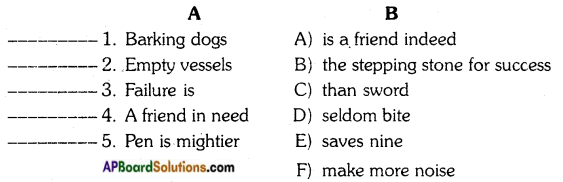
AP Board 7th Class English Important Questions Unit 6 21
Answer:
1-D
2-F
3-B
4-A
5-C

Grammar
1. Edit the following passage correcting the underlined parts.

1. Plants have many uses to (a) map. They supplies (b) us with food and shelter, with fuel and chemicals. People or (c) animals need to breathe oxygen to live. Plants take in the carbon dioxide what (d) people and animals breathe out.
2. Eskimos live in houses called Igloos. A (a) igloo is made with (b) large square pieces of Ice. And (c) the igloo itself is not square. It look (d) like half of a big white ball standing on a white filed of Ice.
3. A (a) famous Indian mathematician, Srinivasa Ramanujan, was born in 1987 in a poor family in (b) Erode in Tamil Nadu. At a very young age, Ramanujan showed a (c) unusual grasp of mathematics. It was (d) strange but true that he did not see his first mathematics book till he was sixteen.
4. Mount Everest is a (a) highest peak in the world. It was (b) 8848 metres high. It is named on (c) Everest. Edmand Hillary and Sherpa Tenzing sets (d) foot on the top of the peak on 29th May 1953.
5. Everyone are (a) afraid of earthquakes. They are quite common in eastern countries like China, Indonesia, Malaysia and Japan. They are the most deadly in (b) all natural calamities. Two of the greatest earthquakes occur (c) in China or (d) Alaska.
Answer:
1. a) for b) supply c) and d) that
2. a) An b) of c) But d) looks
3. a) The b) at c) an d) is
4. a) the b) is c) after d) set
5. a) is b) of c) occurred a) and

2. Complete the passage choosing the right words from those given below.
Each blank is numbered and for each blank four choices (A), (B), (C) and (D) in the blanks.

1. life in a big oasis _________ (1) extremely busy. There is _______ (2) busy market in the oasis _________ (3) the people from the neighbouring desert bring (4) animals to exchange for the goods of the oasis.
1) A) is B) was C) are D) were
2) A) the B) a C) an D) some
3) A) but B) and C) or D) yet
4) A) her B) his C) our D) their

AP Board 7th Class English Important Questions Unit 6

2. (1) Earth rotates around itself and also revolves round the Sun. To ________ (2) Itself. It _________ (3) Oneday and to revolve round the Sun. It takes 365.25 days. The earth revolves round the Sun _________ (4) an elliptic orbit.
1) A) an B) a C) the D) that
2) A) rotating B) rotate C) rotates D) rotated
3) A) take B) took C) takes D) taking
4) A) on B) of C) in D) by

3. The Banyan trees _________ (1) aerial roots ________ (2) is its branches ________ (3) to the ground, take root again and send more branches _________ (4) their own.
1) A) has B) had C) have D) h ing
2) A) which B) that C) who D) whom
3) A) drops B) dropped C) drop D) dropping
4) A) of B) on C) in D) at

4. Lizards are closely related _________ (1) snakes. Like snakes, _________ (2) are cold blooded reptiles _________ (3) scaly skins. Unlike snakes their long bodies are usually divided into the three distinct parts : head. trunk _________ (4) tail.
1) A) with B) for C) to D) from
2) A) we B) they C) she D) he
3) A) of B) with C) for D) in
4) A) and B) or C) but D) yet

5. The Dinosaurs ________ (1) cold-blood creatures. They could not heat ________ (2) own bodies. They needed the heat _________ (3) the Sun to stay alive and _________ (4) about.
1) A) are B) were C) is D) was
2) A) his B) its C) their D) our
3) A) of B) from C) for D) with
4.) A) moves B) moved C) moving D) move
Answer:
1. 1-A; 2-B; 3-A; 4-D
2. 1-C; 2-B; 3-C; 4-C
3. 1-C; 2-B; 3-C; 4-B
4. 1-C; 2-B; 3-B; 4-A
5. 1-A; 2-C; 3-B; 4-D

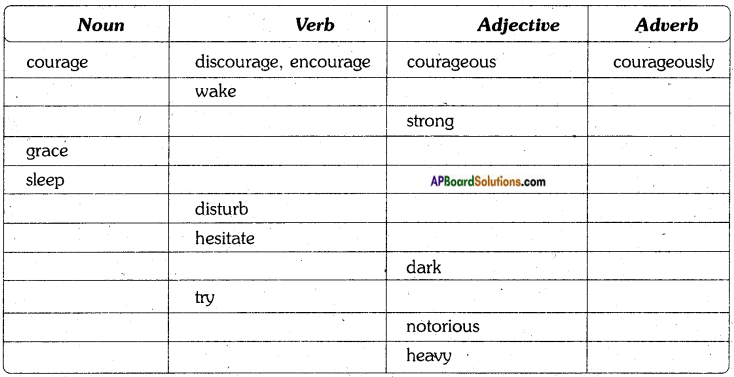
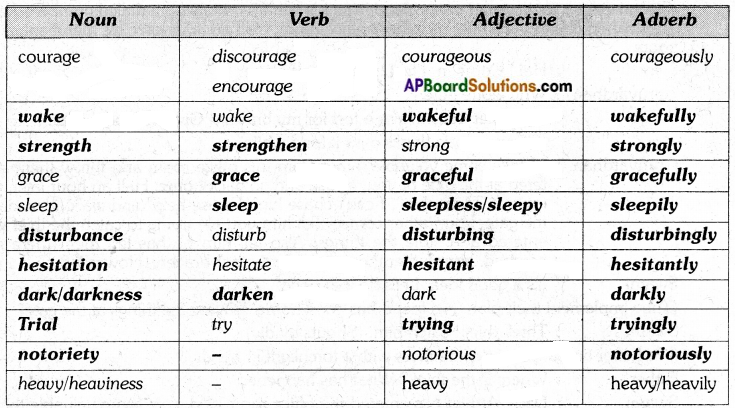
3. Change the words given in the box into different parts of speech. Some words may not have all the forms given in the table. You may use a dictionary if you like.
A)

AP Board 7th Class English Important Questions Unit 6 22
AP Board 7th Class English Important Questions Unit 6 23
Answer:

Noun Verb Adjective Adverb
courage discourage
encourage
courageous courageously
wake wake wakeful wakefully
strength strengthen strong strongly
grace grace graceful gracefully
sleep sleep sleepless/sleepy sleepily
disturbance disturb disturbing disturbingly
hesitation hesitate hesitant hesitantly
dark/darkness darken dark darkly
trial try trying tryingly
notoriety notorious notoriously
heavy/heaviness heavy heavy/heavily

B) Choose the right answer.
1) What a nice dress! ( )
a) congratulating
b) complaining
c) complimenting
Answer:
c) complimenting

2) I’m afraid it is not possible. ( )
a) expressing fear
b) giving an advice
c) refusing request
Note : ‘I’m afraid means ‘I’m sorry’.
Answer:
a) expressing fear

3) “Let’s go for a walk, shall we ?” ( )
a) seeking information
b) making suggestion
c) making a request
Answer:
b) making suggestion

4) I’m sorry, I thought it was my room. ( )
a) apologizing
b) making a statement
c) complaining
Answer:
a) apologizing

5) Shall I give you a cup of coffee? ( )
a) a request
b) offer
c) suggestion
Answer:
b) offer

6) Where can I get a car for hire? ( )
a) seeking information
b) making a request
c) making a suggestion
Answer:
a) seeking information

7) You had better do yoga every day. ( )
a) suggestion
b) request
c) order
Answer:
a) suggestion

8) It may rain in a few minutes. ( )
a) making a request
b) expressing purpose
c) expressing possibility
Answer:
c) expressing possibility

9) Would you mind closing the door? ( )
a) a request
b) an order
c) a suggestion
Answer:
a) a request

10) How careless of you to drop my pen! ( )
a) scolding
b) complaining
c) request
Answer:
a) scolding

AP Board 7th Class English Important Questions Unit 6

C) Fill in the blanks with ‘a’, ‘an’ or ‘the’.

1. It is _______ _____ useful book.
2. _________ apple ________________ day keeps the doctor away.
3. He is _______________ M.L.A but his wife is ________________ M.P
4. He is ________________ B.A. but his wife is ________________ M.A.
5. He came from ________________ orthodox family.
6. There is ________________ eucalyptus tree in our garden.
7. ________________ girl, who has worn the blue frock, is my sister.
8. He is ________________ man of manners.
9. He is ________________ European but his wife is ________________ Indian.
10. I met ________________ one-eyed beggar in the street.
Answer:
1) a
2) An, a
3) an, an
4) a, an
5) an
6) a
7) The
9) a,an
10) a

D) Fill in the blanks with simple past tense or past continuous tense of verbs.

1. While he ______________ (cross) a road, he ___________ (meet) with an accident.
2. While she ______________ (sing) her sister ______________ (dance)
3. He ______________ (fall) asleep while he ______________ (watch) TV.
4. When I ______________ (enter) the room he (write) a letter.
5. When he _____________ (have) dinner someone _____________ (knock) on the door.
6. While Swami’s father ….(1)…. (read) the newspaper, Swami ….(2)…. (listen) to it. His father ….(3)…. (ask) him to sleep alone. But he ….(4)…. (be) afraid of ghosts. He ….(5)…. (want) to sleep in his grandmother’s room. While he ….(6)…. (sleep), he ….(7)…. (have) a terrible dream. A tiger ….(8)…. (chase) himand he ….(9)…. (try) to escape.
7. While Rani ______________ (sing) a song, Raghu ______________ (switch) off the fan.
Answer:
1) was crossing, met
2) was singing, was dancing
3) fell, was watching
4) entered, was writing
5) was having, knocked
6) 1. was reading
2. was listening
3. asked
4. was
5. wanted
6. was sleeping
7. had
8. was chasing
9. was trying
7) was singing, switched off .

AP Board 7th Class English Important Questions Unit 6

E) Read the conversation given below and fill in the blanks with appropriate words from the box.
grateful, respect, certain , courage, sternly, afraid of, terrible, hesitated, disturb, disgraceful

Ruchira: I don’t know why the teacher ….(1)…. to give his mobile number?
Suhas: He might be worried that you would ….(2)…. him with your phone calls.
Ruchira: I have great ….(3)…. for him. I will never behave in a ….(4)…. manner.
Suhas: I am ….(5)…. that our teacher will not give his number. Anyhow, I like your ….(6)…. We are all ….(7)…. him.
Ruchira: I don’t think our teacher is ….(8)…. but he says everything ….(9)…. Once he gave me a wonderful gift so I am always ….(10)…. to him.
Answer:
1) hesitated
2) disturb
3) respect
4) disgraceful
5) certain
6) courage
7) afraid of
8) terrible
9) sternly
10) grateful

AP Board 7th Class English Study Material Guide Solutions Pdf Download State Syllabus

Andhra Pradesh Telangana (TS) SCERT AP State Board Syllabus 7th Class English Study Material Guide Pdf free download, AP Board 7th Class English Government Textbook Answers Pdf are part of AP Board 7th Class Textbook Solutions.

Students can also go through AP 7th Class English Important Questions for exam preparation.

AP State Syllabus 7th Class English Guide Study Material Pdf Free Download

7th Class English Textbook Answers | 7th Class English Guide Pdf State Syllabus Telangana

7th Class English Government Textbook Answers Pdf New Syllabus

AP 7th Class English Study Material Pdf Download Sem 1

SCERT 7th Class English Textbook Answers Sem 2

7th Class English Guide Important Questions and Answers

7th Class English Important Questions Sem 1

AP 7th Class English Important Questions Sem 2

AP 7th Class English Textbook Answers (Old Syllabus)

Telangana SCERT Class 7 English Solutions | 7th Class English Textbook Pdf Andhra Pradesh State Syllabus

Unit 1

Unit 2

Unit 3

Unit 4

Unit 5

Unit 6

7th Class English Guide Pdf Telangana Important Questions and Answers

AP Board 6th Class Science Important Questions Chapter 3 Animals and their Food

AP State Syllabus AP Board 6th Class Science Important Questions Chapter 3 Animals and their Food

AP State Syllabus 6th Class Science Important Questions 3rd Lesson Animals and their Food

6th Class Science 3rd Lesson Animals and their Food 2 Mark Important Questions and Answers

Question 1.
Define herbivores.
Answer:
The animals which feed on only plants and plant products is called herbivores.

Question 2.
Define carnivores.
Answer:
The animals that feed on only animals are called carnivores.

Question 3.
Define omnivores.
Answer:
The animals that feed on both plants and animals are known as omnivores.

Question 4.
What are frugivorous animals?
Answer:
The animals feed mostly on raw fruits, succulent fruits like vegetables, roots,, shoots, nuts and seeds are called frugivorous animals.

AP Board 6th Class Science Important Questions Chapter 3 Animals and their Food

Question 5.
In which animals are common in frugivorous animals?
Answer:
Mammalian herbivores are frugivorous animals commonly.

Question 6.
What are the senses used by animals to track food?
Answer:
Animals use a wide range of senses to track food such as – smell, sight, hearing, taste and touch.

Question 7.
Which parts in the animal’s body are used to collect the food?
Answer:
Many animals use the parts in their body such as mouth,- hands, or feet-, teeth, claws, and tongue to collect the food.

Question 8.
Give examples of animals that use the visionary sense to find its food.
Answer:
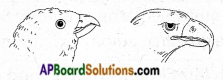
Vulture and eagle use their visionary sense to find their food.

Question 9.
Give examples of animals use the sense of touch to find their food.
Answer:
Spiders and pond skaters use the sense of touch to find their food.

Question 10.
What are pond skaters?
Answer:
Pond skaters are the insects that lives on the surface of the pond and feed op other insects at the pond.

Question 11.
Name some animals which use the tongue as a tool for taking food.
Answer:
Frog, lizard, dog, chameleon, echidna etc.

Question 12.
Which part helps the leech to lake food in?
Answer:
Suckers in the mouth help the leech to take food in.

AP Board 6th Class Science Important Questions Chapter 3 Animals and their Food

Question 13.
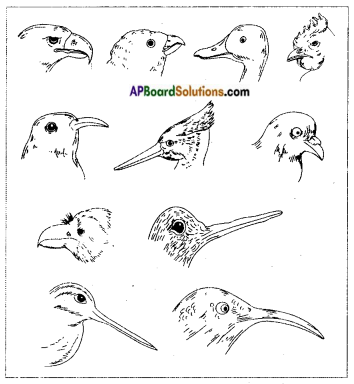
Name the birds which have strongly hooked beak, and long beak?
Answer:
Strongly hooked beak – Vulture.
Long beek- Crane.

Question 14.
How the hummingbird takes its food?
Answer:
Hummingbird sucks nectar from the flowers with its long thin beak.

Question 15.
What is the similarity do you find in the duck teeth and fish teeth?
Answer:
Duck teeth and fish teeth act as filters to get food from the water.

Question 16.
Which parts of a cow’s mouth involved in eating its food?
Answer:
Jaws, teeth, and tongue are involved in eating its food.

Question 17.
Give examples for natural scavengers.
Answer:
Crows, Vultures are examples for natural scavengers.

Question 18.
Which parts help the wild animals for hunting?
Answer:
Wild animals like tiger and lion has strong legs to run, sharp claws to catch and sharp teeth to tear flesh.

Question 19.
Which animals have a similar mechanism as frogs to get in food?
Answer:
Lizard and chameleon have a similar mechanism to get their food.
These animals use their tongue as a tool to pick its food.

Question 20.
What is a food chain?
Answer:
The feeding relationship between different organisms in a particular habitat is called food chain.

AP Board 6th Class Science Important Questions Chapter 3 Animals and their Food

Question 21.
Define food web.
Answer:
A food web is the natural interconnection of food Chains in a particular habitat.

Question 22.
How can you say that ants are good farmers also?
Answer:

  • The ants cut leaves into pieces and create a bed to grow a type of fungus which they eat.
  • As they cultivate a fungus, they are said be good farmers also.

Question 23.
What are producers? Give examples.
Answer:
Producers are organisms that make their own food. Ex: All plants.

Question 24.
What is a primary consumer? Give examples.
Answer:
A primary consumer is an organism that feeds on producers for their energy. Ex: Deer, Cow, Goat.

Question 25.
What is a secondary consumer? Give examples.
Answer:
A secondary consumer is an organism that feeds on the primary consumer for energy. Ex: Hen, Wolf, Fox, Fish

Question 26.
What is a tertiary consumer? Give examples.
Answer:
A tertiary consumer is an organism that feeds on a secondary consumer. Ex: Tiger, Lion.

Question 27.
What are decomposers? Give examples.
Answer:
Decomposers are an organism that breakdown dead or decaying organisms. Ex: Bacteria, Fungi.

AP Board 6th Class Science Important Questions Chapter 3 Animals and their Food

6th Class Science 3rd Lesson Animals and their Food 4 Mark Important Questions and Answers

Question 1.
How can you say that animals use some senses more strongly than the others?
Answer:

  • Animals use different senses to find out their food.
  • They are – smell, touch, hearing, sight and taste.
  • For example, dogs use the sense of smell, while vulture use vision.
  • Bats depends on hearing, while some reptiles on taste.

Question 2.
How the pond skaters found their food?
Answer:

  • Pond skaters are insectivorous as they eat insects.
  • Pond skaters detect ripples produced in water by other insects.
  • They compare the ripples on the opposite sides of the pond caused by the legs of the insect struggling to move out.
  • Pond skater calculate the distance and set out to grab it.

Question 3.
“The same part may be used in different ways by different animals. How can you support this?
Answer:

  • The same part of animals used by different ways by different animals.
  • Ex: Tongue used by dog in a different manner as compared to frog.
  • The dog licks with its tongue while the frog captures and swallows it.

Question 4.
“Different parts may be used to take in the same type of food. ” How can you agree with this statement?
Answer:

  • The same type of food is taken by different animals by using their different body parts.
  • Ex: Insects are the food for hen and frog, but the body parts are different to take in.
    Hens use their beak to pick insects, while frogs use their tongue to grab the insect into the mouth.

AP Board 6th Class Science Important Questions Chapter 3 Animals and their Food

Question 5.
How leeches get their food?
Answer:

  • We will find leeches near water.
  • Leeches stick on to the skin and suck the blood of cattle as well as humans.
  • They have special structures called suckers in their mouth.
  • With the help of sucker, the suck the blood from the animal.

Question 6.
How is the shape of bird’s beak related to what it eats?
Answer:

  • The beaks are different because the birds eat different kind of food.
  • The shape of bird’s beak is designed for eating a particular type of food such as seeds, fruits, insects, nectar, fishes and other small animals.

Question 7.
What is the speciality duck beak than other birds?
Answer:

  • Ducks are mostly aquatic birds.
  • Ducks have teeth, but they are not like the teeth of a cow or lion.
  • They are not useful in grinding food.
  • They act as filters: to get food from water.

Question 8.
How do animals eat?
Answer:

  • Plants and animals are the main sources of food in our surroundings.
  • Every animal has its own style of getting food.
  • They track down, collect, grab or hunt to get their food.
  • They use the various parts of the body to take food into the mouth finally.

Question 9.
How does a frog get its food?
Answer:

  • Frog eat bugs, spiders, larvae and small fish etc.
  • The frog throws out its sticky tongue towards the art insect.
  • The insect gets stuck on the frog’s tongue.
  • Then the frog swallows it.

Question 10.
How does a cow get its food?
Answer:

  • Cow depend on plants for food, so it is an herbivore.
  • Cows chew the food quickly and swallows and store it in a part of their stomach.
  • After sometime, they take food material back from the stomach to the mouth and chew it again.
  • This process is called rumination. In this process jaws, tongue, teeth are involved.

AP Board 6th Class Science Important Questions Chapter 3 Animals and their Food

Question 11.
Write about rumination?
Answer:

  • Rumination is a process in which the animals bring the previously consumed food into the mouth once again and chew it.
  • It is also defined as the action of chewing.
  • This process is commonly seen in the animals such as cattle, sheep, goat, deer, camel, buffalo, giraffes.
  • Jaws, tongue, teeth are involved in this process.

Question 12.
How a dog gets its food?
Answer:

  • Dog is an omnivorous animal.
  • It senses the food with smell.
  • Mouth, teeth, tongue, legs, nails are involved in taking the food.
  • The dog licks water with its tongue and drink it.

Question 13.
Distinguish the difference between food chain and food web.
Answer:

Food chain Food web
1. It is a single path of energy flow in an ecosystem. 1. It is a multiple paths of energy flow in an ecosystem.
2. It is a feeding relationship between  different organisms in a particular habitat. 2. It is an inter connection of food chains in a particular habitat.
3. It can be represented in a straight line. 3. It is branched structure with several food chains.

Question 14.
What is the importance of decomposers in a food chain?
Answer:

  • Bacteria and fungi are decomposers.
  • Decomposers break down dead plants and animals.
  • They return the nutrients into the soil for other organisms to use.
  • They help in the cycling of materials between producers, consumers, and soil.

Question 15.
What are the similarities and differences found in the birds’ duck and crane?
Answer:

  • Duck and crane both are aquatic birds.
  • Duck and crane use their beaks to catch the fish.
  • The crane has a long beak to catch the fish in the water.
  • The duck beak is broad and flat and has teeth. The teeth act as filters to get food from the water.

AP Board 6th Class Science Important Questions Chapter 3 Animals and their Food

Question 16.
How the beak of a crow differs from the beak of a parrot?
Answer:

  • Parrot and crow both are omnivorous animals that eat both plants and animals.
  • The parrot has a hooked bill to eat fruits and crack the nuts.
  • It is also used for climbing as well as manipulating and crushing objects.
  • The crow has a large strong beak to eat fruits, seeds, insects, fishes, and other small animals.

Question 17.
What are natural scavengers? What it’s importance in nature?
Answer:

  • Scavengers are the organisms that feed on the dead and decaying matter.
  • these help the environment to be clean by eating out all the waste matter.
  • They keep our surroundings clean in this manner.
  • Ex: Crows, vultures, and some insects.

Question 18.
What is the difference between producers and consumers?
Answer:

Producers Consumers
1. Producers make their own food. 1. Consumers depends on plants and animals for their food.
2. Producers get energy from sunlight to prepare the food. 2. Consumers get energy from producers or from other consumers.
3. Plants are producers. 3. Animals are consumers.

Question 19.
Draw a neat diagram of the beaks of a parrot and eagle.
Answer:
AP Board 6th Class Science Important Questions Chapter 3 Animals and their Food 1

Question 20.
Draw a neat diagram of the beaks of duck and sparrow.
Answer:
AP Board 6th Class Science Important Questions Chapter 3 Animals and their Food 2

Question 21.
Draw a schematic diagram showing the energy flow in a food chain.
Answer:
AP Board 6th Class Science Important Questions Chapter 3 Animals and their Food 3

AP Board 6th Class Science Important Questions Chapter 3 Animals and their Food

6th Class Science 3rd Lesson Animals and their Food 8 Mark Important Questions and Answers

Question 1.
Write any four birds and their food habits and their beak types in a tabular form.
Answer:

Bird name Beak Feed on
Woodpecker Long and strong beak Ants and pest
Crane Long beak Fish
Vulture Strong hooked beak Flesh of animals
Parrot Hooked beak Fruits and nuts

Question 2.
Collect the information from the library or internet about the examples of animals and what their colonies are called?
Answer:
Group of birds – Folk
Honey bees colony – Beehive
Group of grasshopper – Locust
Group of camels – Caravan
Elephant colony – A parade
Leopard colony – A leap
Tiger colony – Ambush
Kangaroo colony – Mob
Lions colony – A pride
Owls colony – A parliament

AP Board 6th Class Science Important Questions Chapter 3 Animals and their Food

Question 3.
Write a note on the wonderful world of ants.
Answer:

  • Ants are social insects, which means they lice in a group or colony by sharing works.
  • Ant colonies are highly organized, usually ruled by a single queen ant.
  • In a colony the ants are categorized as workers, soldiers, female and male ants.
  • The workers collect and maintain food stock for others in the colony along with several other duties.
  • Ants kept a type of insect called aphid for honeydew.
  • Ants are good farmers as well.
  • They cut leaves into pieces and create a bed to grow a type of fungus that they eat.

Question 4.
What are the levels of the food chain? Describe.
Answer:
There are four levels in a food chain. They are:

  1. Producers: The first level of the food chain. They make their own food and provide food to all other organisms.
  2. Primary consumers: This is the second level of the food chain. They depend on producers for food. They include herbivores such as insects, rabbits, cows etc.
  3. Secondary consumers: This is the third level of the food chain. They depend on primary consumers for their food. They include carnivores such as birds, frogs, fox, etc.
  4. Tertiary consumers: The fourth or top level of the food chain. They depend on secondary consumers for their food. They include carnivores that feed on other carnivores. Ex: Lion, Eagle, Tiger, etc.

AP Board 6th Class Science Important Questions Chapter 3 Animals and their Food

Question 5.
Draw the diagrams of different beaks of birds.
Answer:
AP Board 6th Class Science Important Questions Chapter 3 Animals and their Food 4

AP Board 7th Class English Solutions Chapter 6C Learn How to Climb Trees

AP State Syllabus AP Board 7th Class English Textbook Solutions Chapter 6C Learn How to Climb Trees Textbook Questions and Answers.

AP State Syllabus 7th Class English Solutions Chapter 6C Learn How to Climb Trees

7th Class English Chapter 6C Learn How to Climb Trees Textbook Questions and Answers

I. Answer the following questions.

Question 1.
What do you think is the main reason for the tiger’s attack on Har Singh?
Answer:
When Kunwar Singh and Har Singh faced the tiger, they stood in still. The tiger looked at them but did not spring upon them. Later Har Singh fired at one of the jungle fowls which had alighted on a branch. Because of the firing, the tiger was afraid, and so it roared. Har Singh did not learn climbing up a tree and so stood there in fear. Then the tiger attacked him.

Question 2.
What kind of person was the doctor? Justify your answer.
Answer:
The doctor was very kind. That’s why he gave treatment to Har Singh, even though they came to him late in the night. He laid Har Singh on a string-bed and sewed up the hole in his stomach, and saved him. Though Kunwar Singh offered him two rupees, he refused to take that.

AP Board 7th Class English Solutions Chapter 6C Learn How to Climb Trees

Question 3.
What would you have done if you were in the narrator’s place when the tiger attacked Har Singh?
Answer:
If I were in the narrator’s place, I would do all that the narrator had done to Har Singh. Besides, I made Har Singh learn climbing up a tree later.

Question 4.
What do you think the narrator wants to convey through this story?
Answer:
Through this story, the narrator wants to convey that everyone, particularly forest dwellers, should leam how to climb up trees, in childhood.

Learn How to Climb Trees Summary in English

Jim Corbett was brought up in the Kumaon and Garhwal hills. He was an excellent shooter and killed many tigers and saved many poeple.

When he was eight, he was given his first gun. Then Kunwar Singh visited him. He told him that he could go with no fear in the jungles taking that gun. But he advised him to learn how to climb trees. He told Corbett a story to know the importance of climbing a tree.

One day last April Har Singh and Kunwar Singh went into the jungle to shoot. They found nothing to shoot. So they were returning home. Suddenly they faced a tigher. Then both of them stood still. The tiger hit a nullah. Then a large number of jungle fowl rose cackling out of the dense scrub. One of them alighted on a branch and Har Singh fired at it. Then the tiger roared at them.

At once, Kunwar Singh climbed up a runi tree. But Har Singh stayed there as he had not learnt climbing up a tree when he was a boy. The tiger sprang upon him. Har Singh was screaming. Then Kunwar Singh fired his gun off into the air. The tiger went away. Har Singh collapsed at the foot of the tree. Kunwar Singh got down the tree and found that the tiger’s claw had entered the stomach of Har Singh and torn the lining from his navel to within a few fingers’ breadth of the back-bone. All his inside had fallen out. Har Singh told Kunwar Singh to put his intestines back into his stomach. Kunwar Singh managed to do that.

AP Board 7th Class English Solutions Chapter 6C Learn How to Climb Trees

Later Kunwar Singh wound his turban round his stomach and knitted it tight to keep everything from falling out again. He took Har Singh to the nearby hospital. But as it was night, the hospital was closed. They went to the doctor-babu who told them to bring Aladia, the tobacco-seller. Har Singh was laid on a string-bed. Aladia came and held the lantern. Kunwar Singh held the two pieces of flesh together.

The doctor was very kind. He sewed up the hole in Har Singh’s stomach. Har Singh was safe. Kunwar Singh offered the doctor two rupees but he refused to take that. Later Kunwar Singh and Har Singh went home. Seeing the condition of Har Singh, there the womenfolk were crying.

This story explains the importance of learning to climb up a tree in childhood.

Learn How to Climb Trees Glossary

paling (v): appearing less bright

scrub (n): an area of dry land covered with small bushes and trees

cackling (v): making a loud unpleasant noise

frighten (v): to cause a feeling of fear

grasp (v): to catch hold of something

AP Board 7th Class English Solutions Chapter 6C Learn How to Climb Trees

collapse (v): to fall down suddenly because of loss of strength/support

sew (v): to join or attach something using a needle and thread

nullah (n): a water course, especially a dry one

AP Board 6th Class Science Important Questions Chapter 2 Knowing About Plants

AP State Syllabus AP Board 6th Class Science Important Questions Chapter 2 Knowing About Plants

AP State Syllabus 6th Class Science Important Questions 2nd Lesson Knowing About Plants

6th Class Science 2nd Lesson Knowing About Plants 2 Mark Important Questions and Answers

Question 1.
What are the types of venation?
Answer:
There are two types of venation 1. Reticulate venation 2. Parallel venation.

Question 2.
What are the functions of stomata?
Answer:
Stomata regulate the gaseous exchange between the plant and environment and transpiration.

Question 3.
What are the main parts of the plant?
Answer:
Roots, stem, leaves, flowers are the main parts of the plant.

Question 4.
How many types of root system? What are they?
Answer:
There are two types of root system. 1. Tap root system 2. Fibrous root system.

AP Board 6th Class Science Important Questions Chapter 2 Knowing About Plants

Question 5.
Give examples for the fibrous root system.
Answer:
Monocot plants have the fibrous root system. Ex. Grass, rice, wheat etc.

Question 6.
What is cotyledon?
Answer:
The seed leaf present within the seed is called cotyledon.

Question 7.
Give examples for monocots and dicots.
Answer:
Monocots: Grass, rice, wheat, maize etc.
Dicots: Mango, pulses, fruits

Question 8.
In a bean how many cotyledons are present?
Answer:
In a bean seed two cotyledons are present.

Question 9.
Which type of root system the dicot plants have?
Answer:
The dicot plants have tap root system.

Question 10.
Give examples of tuberous roots.
Answer:
Radish, carrot, beetroot, sweet potato are examples for tuberous roots.

Question 11.
What is stem?
Answer:
The main axis of the shoot system is called the stem.

Question 12.
What is a node ?
Answer:
Node is the part of stem where the leaf arises.

Question 13.
What is internode?
Answer:
The part of the stem between two successive nodes is called the internode.

Question 14.
In which plant do you observe the parallel venation ?
Answer:
In monocot plants such as grass, cereals, millet plants we will observe the parallel venation.

Question 15.
What is transpiration?
Answer:
Plants release excess of water in their body through stomata in the form of vapour is called transpiration.

Question 16.
What do you know about the flower?
Answer:
The flower is colourful and attractive part in a plant.

Question 17.
What are petals?
Answer:
The colourful and fragrant parts of a flower is petals.

AP Board 6th Class Science Important Questions Chapter 2 Knowing About Plants

Question 18.
How do you say the millet plant is a monocot?
Answer:
Millet has only one cotyledon in a seed. So, millet is a monocot.

Question 19.
Name the traditional food of Konaseema, prepared with the help of jackfruit leaves.
Answer:
Pottikkalu.

Question 20.
What type of venation is found in the leaves of plants with fibrous roots?
Answer:
Parallel venation is found in the leaves of plants with fibrous roots.

Question 21.
If the leaves have the reticulate venation what would be the type of root?
Answer:
The plants having the reticulate venation have the tap root system.

Question 22.
Give examples for modified stems.
Answer:
Potato, turmeric, garlic, ginger and sugarcane are examples for modified stems.

Question 23.
Define fibrous root system.
Answer:
A cluster of thin and uniform roots arising from the base of the stem is called fibrous root system.

Question 24.
Why Pottikkalu have jack fruit flavour?
Answer:
The leaves of jack fruit are used in the preparation of Pottikkalu. So, Pottikkalu have jack fruit flavour.

Question 25.
Give examples of plants having supporting roots.
Answer:
Banyan tree, Sugarcane and Maize plants have supporting roots which grown above the ground level.

AP Board 6th Class Science Important Questions Chapter 2 Knowing About Plants

6th Class Science 2nd Lesson Knowing About Plants 4 Mark Important Questions and Answers

Question 1.
Write the differences between potato and sweet potato?
Answer:

Potato Sweet potato
1. It is a modification of stem. 1. It is a modification of root.
2. As it stores the food in the stem it is known as tuber. 2. As it stores the food in the root, it is known as a tuberous root.

Question 2.
Write the differences between tap root system and fibrous root system?
Answer:

Tap root system Fibrous root system .
1. A tap root differentiated primary root of the plant. 1. The fibrous root is different from the primary root of the plant.
2. Tap root system consists of tap root and lateral roots. 2. A cluster of thin and uniform roots round here.
3. Tap root penetrates deep into the soil. 3. Fibrous root is shallow and does not penetrate as deeply.
4. It helps the pLant to survive in drought conditions. 4. It helps the plant to prevent the soil erosion.
5. Tap root system found in dicot plants. 5. Fibrous root system found in monocot plants.

Question 3.
In drought conditions which root system is help the plant to survive?
Answer:

  • When there is no rainfall for several years it leads to drought.
  • When a drought hits, soil dries out, the crops with deep roots have access to deep stored moisture.
  • The taproot system has the access to get the moisture from deep levels of the soil.
  • So, tap root system help the plant to survive in drought conditions.

Question 4.
What are the differences between terminal bud and auxiliary bud?
Answer:

Terminal bud Auxiliary bud
1. It occurs at the end or top of the stem. 1. It occurs at a leaf node.
2. It helps the plant to grow taller so that the plant gains more height. 2. It helps to provide support to the plant holding leaves, buds and flowers.
3. Due to this the plant grow in a straight forward. 3. Due to this the plant have more branches like a bush.

Question 5.
What are the stem modifications?
Answer:

  • In some plants, the stems are modified to perform the function of storage of food, support, protection and vegetative propagation.
  • Potato, turmeric, garlic, ginger, sugarcane store food materials in the stem so that the stem bulges in size. These are known as modified stems or tubers.

AP Board 6th Class Science Important Questions Chapter 2 Knowing About Plants

Question 6.
What is venation? What are the types in it?
Answer:

  • The arrangement of veins in a leaf is called venation.
  • There are two types of venation. 1. Reticulate venation 2. Parallel venation
  • The veins are arranged in either web-like or network all over the lamina it is called reticulate venation.
  • The veins are arranged parallel to one another all over the lamina is called parallel venation.

Question 7.
How do you distinguish the differences between reticulate and parallel venation?
Answer:

Reticulate venation Parallel venation
1. The veins are arranged in the form of a network or a web like arrangement all over the lamina. 1. The veins are parallelly arranged with one another ail over the lamina.
2. It is seen in the dicot plants. 2. It is seen in the monocot plants.
3. Ex. Mango, Hibiscus, Ficus etc. 3. Banana, bamboo, wheat, maize etc

Question 8.
How do you find the root system without pulling it out?
Answer:

  • It is possible to find the root system without pulling it out.
  • By observing the leaf venation, we will identify whether that plant has tap root or fibrous roots.
  • If the leaf is having a parallel venation, that root of the plant will be fibrous root system.
  • If the leaf is having reticulate venation, that root of the plant will be a tap root system.

Question 9.
Write the differences between monocots and dicots?
Answer:

Dicots Monocots
1. Dicots have two cotyledons in the seed. 1. Monocots have only one cotyledon in the seed.
2. Dicots have taproot system. 2. Monocots have fibrous root system.
3. Leaves in dicots have reticulate venation. 3. Leaves in monocots have parallel venation.
4. Ex. Apple, mango, brinjal, beans. 4. Ex. Wheat, corn, rice.

Question 10.
What are stomata? What is it importance?
Answer:

  • The small pores present on the leaf surface is called stomata.
  • The stomata act like our nose in the plant.
  • These are helpful in the exchange of gases between the plant and the atmosphere.
  • Plants release excess water in their body through stomata by the process of transpiration.

AP Board 6th Class Science Important Questions Chapter 2 Knowing About Plants

Question 11.
What are the functions of root?
Answer:

  • Fixes the plant to the soil.
  • Absorbs water and minerals from the soil.
  • It stores the food in some plants like carrot and beet root.

Question 12.
What is transpiration and what its importance?
Answer:

  • The process of releasing water in the form of vapour through stomata is called transpiration.
  • It helps to keep the leaves healthy.
  • It helps to provide water to leaf cells for photosynthesis.
  • The temperature of the plant body maintained constant.

Question 13.
Write the functions of the stem?
Answer:
The stem,

  • supports the branches, leaves, flowers and fruits.
  • transports water and minerals from root to other parts.
  • transports food from leaves to other parts through stem.
  • stored food in the plant’s potato, ginger, turmeric, garlic, etc.

Question 14.
Which questions do you pose to know about the plants and its parts?
Answer:

  • Which part of the plant absorbs water?
  • What are the important parts in a plant?
  • What is the function of stem?
  • Why some of the roots are modified?

Question 15.
Write the functions of leaf.
Answer:
Leaves play an important role in the life of plant, they are

  • help in respiration
  • to carry out transpiration
  • to prepare food by the process of photosynthesis

Question 16.
What are the root modifications?
Answer:

  • In some plants, the roots change their shape and modified to store the food materials.
  • The roots of radish, carrot, beet root modified to store the starch.
  • Aerial roots grow above the ground, typically providing support to the plant.
    Ex: Banyan tree, sugarcane, Maize etc.
  • In mangroves the aerial roots helpful in respiration.

Question 17.
Write about Pottikkalu?
Answer:

  • Pottikkalu is a traditional food of Konaseema of Godavari districts.
  • Leaves of jack fruit are used in its preparation.
  • They make cups with these leaves and fill them batter made of black gram and rice rawa.
  • These cups are steamed to get Pottikkalu. These are healthy and delicious with jack fruit flavour.

Question 18.
How do you appreciate the beauty of a flower?
Answer:

  • Flowers are the colourful parts of the plants.
  • They attract insects for pollination and produce fruits.
  • Colourful flowers give beauty to nature.
  • By seeing the colourful flowers, we get happiness and they give us a positive effect on mood.

Question 19.
What is a root? Write about its function?
Answer:

  • The underground part of the main axis of a plant is known as the root.
  • It fixes the plant to the soil.
  • It absorbs water and minerals from the soil.
  • It stores food in some plants like carrot and beet root.

AP Board 6th Class Science Important Questions Chapter 2 Knowing About Plants

Question 20.
Which roots are known as tuberous roots? Why?
Answer:

  • Radish, carrot, beetroot, sweet potato is known as tuberous roots.
  • These plants store food materials in their roots so that they were known as tuberous roots.

Question 21.
How will you tell which part of a plant is the stem and which is the root?
Answer:

  • The part of the plant that presents above the surface of soil is the stem.
  • The part of the plant that presents below the soil surface is the stem.
  • Stem possess nodes, inter nodes and leaves etc. whereas root cannot have these.

Question 22.
What would happen if flowers do not have different colourful petals?
Answer:

  • The flower has colourful parts called petals.
  • The beautiful petals attract insects for pollination and produce fruits.
  • If flowers do not have different colourful petals, they can’t have a fragrance to attract the insects.
  • If the plant does not have colourful petals and fragrance, they cannot attract the insects so that fruits are not formed.

Question 23.
What questions do you ask to know more about the aerial roots of Mangroves?
Answer:

  • What are mangroves?
  • Where do we find these mangroves?
  • What is the importance of mangroves?
  • What is the special character of mangroves?

Question 24.
Fill the following table by observing the plant leaves?

Sl.No Name of the plant Type of venation
1. Hibiscus (Mandara)
2. Paddy
3. Peeple (Raavi)
4. Jo war

Answer:

Sl.No Name of the plant Type of venation
1. Hibiscus (Mandara) Reticulate venation
2. Paddy Parallel venation
3. Peeple (Raavi) Reticulate venation
4. Jowar Parallel venation

Question 25.
Draw the diagram of the tap root system and fibrous root system of a plant?
Answer:
AP Board 6th Class Science Important Questions Chapter 2 Knowing About Plants 1

AP Board 6th Class Science Important Questions Chapter 2 Knowing About Plants

6th Class Science 2nd Lesson Knowing About Plants 8 Mark Important Questions and Answers

Question 1.
What will happen if plants cannot store their food?
Answer:

  • Plants can store their food by the process of photosynthesis.
  • Some of the food is used by the plants for various metabolic processes.
  • The remaining food is stored in the various parts of the body such as roots, stem, leaves, seeds, fruits etc.
  • This stored food helps the plants to survive in unfavourable conditions.
  • Other animals also depend on plants for their food.
  • If the plants cannot store the food, the animals that depend on plants get hungry and gradually die.
  • When unfavourable conditions like drought appear, the plants will also ultimately die.

Question 2.
How do you prove that stem conducts water?
Answer:
Aim: To observe the conduction of water by a stem.
What you need: A small twig of balsam plant, a glass of water, red ink.
What to do:

  • Take a glass of water and add a few drops of ink to it.
  • Now place the small twig in the water.

What do you see: The stem turns reddish.
What do you learn: The red ink is taken and transported by the stem upwards.

AP Board 7th Class English Important Questions Unit 1

AP State Syllabus 7th Class English Important Questions Unit 1

7th Class English Important Questions Unit 1

Section – A: Reading Comprehension

A. Reading

1. Read the following text.

The town mouse and the country mouse were cousins. They often wrote to each other. One day, the country mouse got this letter from his cousin.

Kitchen Cupboard,
Mouse Town.
11 March 2012.

Dear Cousin,

I have been ill with a cough and my doctor feels I need a holiday. He has asked me to spend a week in the countryside. May I stay with you? Please give me an early reply.

With warm regards,

Yours affectionately,
Town Mouse

To
Country Mouse, The Mouse Hole,
Mouse Country.

Now answer the following questions:
a) Who sent the letter to whom?
b) Where does the country mouse live?
c) Where does the town mouse live ?
d) What relation does the country mouse and town mouse have ?
e) How long does the town mouse want to stay in the country ?
f) Why does the town mouse want to visit the country mouse ?
Answers:
a) The town mouse sent the letter to the country mouse.
b) The country mouse lives in the mouse hole in Mouse Country.
c) The town mouse lives in kitchen cupboard in Mouse Town.
d) The country mouse and the town mouse are cousins.
e) The town mouse wants to stay for a week in the country.
f) The town mouse had been suffering from cough and cold and his doctor advised him to spend a week in the countryside.

AP Board 7th Class English Important Questions Unit 1

2. Read the following passage.

Receiving the invitation from the country mouse, the town mouse packed his bags and caught the next train to the countryside. The day was bright and sunny and soon the town mouse began to feel hot in the train.
“I wish there was an air-conditioned coach,” he said to himself. “I feel very uncomfortable here.”
However, there was nothing he could do about it. So, he grumbled to himself while the train chugged’slowly into the country. The country mouse was waiting at the station.
“Oh, cousin,” the town mouse said as soon as he got off the train. “The train was dreadful, I feel terribly hot and thirsty. I hope you have something ice-cold for me to drink at home.”
“Well, I have some water,” said the country mouse. “But I can look around for some coconut water if you like.”
“Coconut water?” asked the town mouse in horror. “Don’t you have any orange juice or lemonade ?”
“I am afraid not,” replied his cousin. “But I found a very nice piece of root today and a tender bit of sugar-cane. I’m sure you will enjoy that.”

Now answer the following questions:
a) How was the day weather when the town mouse travelled to the country?
b) “I wish there was an air-conditioned coach,” he said to himself. “I feel very uncomfortable here” – What does this tell us about the town mouse?
c) How did the town mouse feel in the train?
d) What did the country mouse offer the town mouse as soon as he got off the train?
e) What did the town mouse ask the country mouse for ?
Answers:
a) The day was very bright and sunny when the town mouse travelled to the country.
b) It tells us that the town mouse was leading a luxurious, comfortable and civilised life in the town with all modern amenities and comforts.
c) The town mouse felt that the train was dreadful. He felt very hot and thirsty in the train.
d) The country mouse offered some water or coconut water to the town mouse as soon as he got off the train.
e) The town mouse asked the country mouse for orange juice or lemonade.

3. Read the following passage.

“I am afraid not, “ replied his cousin. “But I found a very nice piece of root today and a tender bit of sugar-cane. I’m sure you will enjoy that.”
“Root? Sugar-cane?” the town mouse exclaimed. “But I don’t eat raw food like that.”
The country mouse said, “This is what we eat in the country. So, I’m afraid you too have to eat this. Try it. It’s not bad.”
The town mouse did not enjoy his dinner at all. He nibbled at the root and the sugar-cane and then said he wanted to sleep. The country mouse showed a corner in the mouse hole and said, “There you are; you can sleep there.”
“On the ground?” asked the town mouse. “Do I have to sleep on the ground?”
“Yes, this is how we sleep in the country,” his cousin answered.
As the town mouse lay down on the hard, cold ground, he suddenly thought of something. “Cousin,” he called out.
“Yes, what is it?” the country mouse asked. .
“Why is it so quiet here? Where are all the cars and lorries? Where are the radios and the televisions? Where are all the lights ?”
“This is how it is in the country,” his cousin replied. “It’s always quiet in the country. Sometimes it is quieter than today. My grandfather says that our village is the quietest among all the villages in our district.” “Oh! Is it? The country is a strange place,” said the town mouse. But he said to himself, “I don’t think I like this place.”

Now answer the following questions:
a) What did the country mouse eat in the country?
b) What does the clause ‘I am afraid’ here mean?
c) Where did the country mouse sleep?
d) What did the town mouse worry about?
e) Why did the town mouse not like the country?
Answers:
a) The country mouse used to eat raw food like roots and sugar-cane.
b) ‘I am afraid’ here means ‘sorry’. It is used to express apology;
c) The country mouse used to sleep on the ground.
d) The town mouse worried why it was so quiet in the country, why there were no radios and televisions, why there were no cars and lorries, in the country.
e) There was no delicious food such as bread, jam, fruits and chocolates in the country. There was no comfortable bed to sleep There were no buses and lorries and there was no busy life in the country. Hence the town mouse did not like the country.

AP Board 7th Class English Important Questions Unit 1

4. Read the following passage.

Next morning, the town mouse found that there was no breakfast ready. His cousin told him that they had to go to the nearby farm to search for food.
“We are sure to find something there,” he said. “A nice piece of root or a tender bit of sugar-cane.”
But the town mouse had enough. “Thank you, cousin,” he said. “But I think I’ll catch the next train home. I have suddenly remembered that I have forgotten something.”
A few days later, the country mouse wrote to his cousin, the town mouse. Here is the letter.

Mouse Hole,
Mouse Country.
22 March 2012.

My dear Cousin,

I hope you are well. I am worried about you. I would like to visit you and make sure you are alright.

With love,

Your cousin,
Country Mouse

To
Town Mouse,
Kitchen Cupboard,
Mouse Town.

The town mouse received the letter and read it. Since he was in a hurry, he sent a telegram to the country mouse. Here is his telegram.

OVERJOYED (.) COME SOON (.)
TOWN MOUSE

Now answer the following questions:
a) Where had the mice to go for collecting breakfast?
b) What might they get for their breakfast?
c) Why do you think the town mouse said that he would catch the next train?
d) What did the country mouse write in his letter to his cousin?
e) “Since he was in hurry, he sent a telegram to the countryside” – What does this line suggest us about the life of the town mouse?
Answers :
a) The mice had to go to the nearby farm to search for food.
b) They might get a nice piece of root or a tender bit of sugar-cane for their breakfast.
c) The town mouse did not like the style of living.in the countryside. He was unable to adjust to the ways of the village. So he wanted to go back to the town.
d) The country mouse wrote that he was very much worried about his sick cousin. He said that he would like to visit his cousin to see whether he was alright.
e) It suggests us that in town the life of people is very busy.

5. Read the following passage.
A few days later, the.country mouse arrived in the town. He was surprised by the noise and the lights.
“Why are there lights even in the middle of the night?” he asked.
“This is the town,” his cousin replied. “Here there are lights even in the middle of the day.” “And what is this dreadful noise that never stops?” asked the country mouse.
“That is the traffic,” the town mouse replied. “That is the noise made by buses, lorries, cars and aeroplanes.”
But the country mouse did not like it at all. “All this noise has made my head ache,” he said. “Could I have some water to drink?”
“Why only water?” said the town mouse. “Look at what there is for you – ice cold lemonade, orange juice … which one do you want?”
“Just some water,” answered the country mouse. “Some water and a little bit of food.”
“I have plenty of food, cousin,” said the town mouse proudly. “You can eat as much as you like.”
Sure enough, the house of the town mouse at the back of a kitchen cupboard was full of most delicious food.

AP Board 7th Class English Important Questions Unit 1

Now answer the following questions:
a) What surprised the country mouse in the town?
b) Where did the noise come from?
c) Why did the country mouse not like the noise in the town?
d) What did the town mouse offer his cousin when he asked for water?
e) Why did the town mouse say proudly that he had a plenty of food?
Answers :
a) The country mouse was surprised by the noise and lights in the town.
b) The noise came from the traffic. This noise was made by buses, lorries, cars and aeroplanes.
c) His village was very peaceful. There was no traffic in the country. There were no buses, lorries, cars and aeroplanes in the village.
d) The town mouse offered his cousin ice-cold lemonade, orange juice.
e) In the town a lot of delicious food was available, but in the village every time they were
hungry they had to search for food here and there.

6. Read the following passage.

There was bread and jam, different kinds of fruits, slabs of chocolate and a huge piece of lovely cheese.
“Eat, cousin, eat,” said the town mouse. But just then, there was a sound like a thunder and the town mouse shouted. “Run, cousin, run, run.”
The town mouse pushed the country mouse out through a hole in the back of the cupboard. The country mouse felt his heart beating very fast, “But what is it?” he asked.
“Sssh. ..” whispered the town mouse. “Wait.”
When everything was silent again, the town mouse crept out of the hole. He was quite cheerful again.
“Come out now, cousin,” he said. “That was only somebody opening the cupboard door. We are safe now.”
But they were not safe for very long. Twice more, they had to run for safety when somebody opened the cupboard door.
The country mouse got quite tired of running and hiding. “I want to go back to the country, ” he said. “We may not get much food there, but at least we can eat in peace.”
So, the next day, the country mouse went back to his house in the country and the town mouse stayed on in his cupboard in the town. And as far as I know, they did not visit each other again.

Now answer the following questions.
a) “There was bread and jam, different kinds of fruits” What difference do you find between the food available in the country and that of the town?
b) Where did the town mouse live?
c) “But just then, there was a sound like a thunder” – Where did the sound come from?
d) “We are safe now” – Were they really safe now? Why / Why not?
e) The country mouse wanted to go back to the country. Why?
Answers:
a) In the country the mice had to search for food which was raw and traditional but in the town variety of food was readily available, cooked and delicious.
b) The town mouse lived at the back of the cupboard.
c) The sound came from the opening of the cupboard door.
d) No. They were not really safe. They had to run for safety every time the door of the cupboard was opened.
e) The country mouse got quite tired of running and hiding. Though he did not get much food in the country he could live peacefully and safely there.

AP Board 7th Class English Important Questions Unit 1

7. Read the following passage.

The town mouse and the country mouse were cousins. They often wrote to each other. Receiving the invitation from the country mouse, the town mouse packed his bags and caught the next train to the countryside. The day was bright and sunny and soon the town mouse began to feel hot in the train.
“I wish there was an air-conditioned coach,” he said to himself. “I feel very uncomfortable here”. However, there was nothing he could do about it. So, he grumbled to himself while the train chugged slowly into the country. The country mouse was waiting at the station. “Oh, cousin,” the town mouse said as soon as he got off the train. “The train was dreadful, I feel terribly hot and thirsty. I hope you have something ice-cold for me to drink at home.”
“Well,’I have some water,” said the country mouse. “But I can look around for .some coconut water if you like.” “Coconut water?” asked the town mouse in’horror. “Don’t you have any orange juice or lemonade?”

Now, answer the following questions.
a) Describe how the town mouse felt in the train.
b) Why is the town mouse travelling to the countryside?
c) “Coconut water?” asked the town mouse in horror. “Don’t you have any orange juice or lemonade?”
Based on the above lines from the passage, what can we say about the town mouse?
d) What food was arranged by the country mouse for the town mouse?
e) Why was the town mouse feeling thirsty?
Answers:
a) The town mouse felt hot and uncomfortable in the train. He wished that there was an air- conditioned coach in the train. But he couldn’t do anything about it.
b) The country mouse invited the town mouse to visit the countryside. So, the town mouse was travelling to the countryside.
c) The town mouse was enjoying the varieties of food and luxuries available in the town. It felt strange as the countryside did not have those facilities. The town mouse was not happy and could not adjust with the simple and natural things of country life. He wanted to have all the luxurious items.
d) A nice piece of root and a tender bit of sugarcane was arranged for dinner.
e) The town mouse felt thirsty because he had travelled in a train on a sunny day and was feeling hot.

8. Read the following passage.

Receiving the invitation from the country mouse, the town mouse packed his bags and caught the next train to the countryside. The day was bright and sunny and soon the town mouse began to feel hot in the train.
“I wish there was an air-conditioned coach,” he said to himself. “I feel very uncomfortable here.”

Now, answer the following questions.
a) Who sent the invitation to the town mouse?
b) How was the town mouse going to the countryside?
c) How was the weather?
d) What did the town mouse wish to have?
e) Why did the town mouse wish to have it?
Answers :
a) The country mouse sent the invitation to the town mouse.
b) The town mouse was going to the countryside by a train,
c) The weather was very hot.
d) The town mouse wished to have an air conditioned coach.
e) In the town the town mouse used to live with all comforts such as air condition. He was unable to withstand the heat of the sun. So he wished to have an air-conditioned coach.

AP Board 7th Class English Important Questions Unit 1

9. Read the following passage.

Next morning, the town mouse found that there was no breakfast ready. His cousin told him that they had to go to the nearby farm to search for food. ‘We are sure to find something there,” he said. “A nice piece of root or a tender bit of sugar-cane.” But the town mouse had enough. ‘Thank you, cousin,” he said. “But I think I’ll catch the next train home. I have suddenly remembered that I have forgotten something.”

Now, answer the following questions.
a) What did the town mouse find?
b) Where will they find the food?
c) Why did the town mouse want to go home?
d) What reason did the town mouse give for going home?
e) Identify two food items mentioned in the passage.
Answers:
a) that there was no breakfast ready
b) in a nearyby farm
c) The town mouse used to have varieties of ready made and delicious food in the town. But now here in the countryside it has to go the fields in search of raw food. So the town mouse wanted to go home.
d) The town mouse told that he suddenly remembered that he had forgotten something.
e) root and sugarcane

B. Reading

1. Read the following stanza.

I live in the town
In a street;
It is crowded with traffic
And feet;
There are buses and motors
And trams;
I wish there were meadows
And lambs.

Now answer the following questions:
a) Who does ‘I’ in the above stanza refer to?
b) Where does the speaker live?
c) How is the street where he lives?
d) Why is there a lot of traffic?
e) Does the speaker like the town?
f) What does he wish?
g) How does the speaker like his place to be?
h) Where does the speaker want to live?
i) Why does the speaker not like the town?
j) Where do you expect the meadows and lambs-in towns or in the country ?
k) Pick out the rhyming words from the stanza.
Answers :
a) ‘I’ in the above stanza refers to the town child.
b) The speaker lives in the town.
c) The street is full of traffic and pedestrians.
d) Because there are a lot of buses, motors and trams.
e) No. The speaker (the town child) does not like the town.
f) He wishes that there were meadows and lambs.
g) The speaker likes his place to be beautiful with meadows and animals.
h) The speaker wants to live in a village which is full of meadows and animals.
i) The town is completely congested with full of buildings and traffic. There are no meadows and animals which make the nature beautiful in the town. So he does not like to live in a town.
j) We can expect the meadows and lambs in the villages but not in the town.
k) 1) street…. feet; 2) trams – lambs.

AP Board 7th Class English Important Questions Unit 1

2. Read the following stanza.

The houses all wait
In a row,
There is smoke everywhere
That I go.
I don’t like the noises
I hear.
I wish there were woods
Very near.

Now answer the following questions:
a) Who is speaking in this stanza?
b) How are the houses built?
c) ‘There is a smoke everywhere” – What does ‘there I here refer to? (Or) Where is the smoke?
d) Why is there a lot of smoke everywhere?
e) What does he not like?
f) Where do these noises come from?
g) What does the speaker wish?
h) Why does the speaker want to have ‘woods’ near his place?
i) What do you understand from the wish of the speaker?
j) Pick out the rhyming words from the stanza.
Answers :
a) The town child is speaking in this stanza.
b) The houses are built in a row.
c) ‘There’ here refers to the town. (Or) The smoke is everywhere in the town.
d) Because in town there are a lot of factories, hotels, industries and a lot of cars, buses, trams and lorries. They emit a lot of smoke.
e) He does not like the noises and smoke from the factories, industries and vehicles.
f) These noises come from the vehicles, industries and factories.
g) The speaker wishes to have forests or woods near his town.
h) The speaker wishes to have forests near his town because the trees of the forests help to control pollution by absorbing the carbon dioxide.
i) We understand that the speaker wants to live peacefully away from the noise and pollution of the town.
j) row – go; hear – near.

3. Read the following stanza.

There is only one thing
That I love,
And that is the sky
Far above,
There is plenty of room
In the blue
For castles of clouds
And me, too!

Now answer the following questions :
a) Who does ‘I’ here refer to?
b) What is the only thing the speaker loves?
c) Why does he like sky?
d) “In the blue” – What does the word ‘blue’ here mean?
e) What castles are there in the sky?
f) “And me too’ – Where does the speaker want to be?
g) Why does the speaker want himself to be in castles of clouds?
h) What is the plenty of room there in the sky for?
i) Which word in the above stanza means “large strong buildings”?
j) Pick out the rhyming words from the stanza.
Answers:
a) ‘I’ here refers to the town child.
b) The only thing the speaker (the town child) loves in the town is the sky.
c) Because in the sky there is a lot of room and there are no buildings and vehicles, noise and smoke in the sky.
d) The word ‘blue’ here means the ‘sky’.
e) In the sky there are castles of clouds.
f) The speaker wants to be in the sky.
g) Because in the castles of clouds there is no smoke and noise and there is a lot of open place in the sky. In the sky he can be away from pollution and helter- skelter of the town.
h) In the sky there is a lot of room for the castles of clouds.
i) Castles
j) love … above; blue – too.

AP Board 7th Class English Important Questions Unit 1

4. Read the following stanza.

My home is a house
Near a wood
(I’d live in a street
If I could!)
The lanes are so quiet,
Oh, dear!
I do wish that someone Lived near.

Now answer the following questions:
a) Who is speaking in this stanza?
b) Where is the speaker’s house?
c) Where does he want to live?
d) How are the lanes?
e) Why are the lanes so quiet?
f) What does the speaker wish?
g) Which word in the stanza means “an area of trees smaller than a forest”?
h) Who does the speaker address as ‘dear’?
i) “I wish that someone lived near” – What do you understand from this sentence?
j) Pick out the rhyming words from the stanza.
Answers:
a) The country child is speaking in the stanza.
b) The speaker’s house is near a wood.
c) The speaker (The country child) wants to live in a street in the town.
d) The lanes in his village are so quiet.
e) Because there are a few people in the village.
f) The speaker wishes that someone lives near his house.
g) ‘wood’
h) The speaker addresses the readers as ‘dear’.
i) In the country very few people live and there are no one to play with him. So he wishes someone to live in his neighbourhood.
j) wood …. could ; dear …. near.

5. Read the following stanza.

There is no one to play with
At all,
The trees are so high
And so tall;
And I should be lonely
For hours,
Were it not for the birds
And the flowers.

Now answer the following questions:
a) Why is there no one to play with?
b) How are the trees?
c) Why are the trees so high and tall?
d) How is he in the country?
e) Were it not for the birds and the flowers’ – What does this clause mean?
f) Who are the friends for him in the country?
g) When should he be lonely?
h) What does the poet want to describe in the stanza?
i) Why does the speaker not want to live in the village?
j) Pick out the rhyming words from the stanza.
Answers:
a) Because it is the country and very few people live there.
b) The trees are high and tall.
c) Because in the country there is a lot of place. In the town all the trees are cut down for want of site for construction of houses, factories and roads.
d) He is lonely in the country.
e) It means that if the birds and flowers were not there, he should be lonely in the country.
f) The birds and flowers are his friends in the country.
g) If the birds and animals were not there, he should be lonely.
h) The poet wants to describe why the country child does not like to live in the „ country.
i) The speaker does not like to live in the country because there are no one to give company to him in the country.
j) all – tall; hours – flowers.

AP Board 7th Class English Important Questions Unit 1

6. Read the following stanza.

I wish that I lived
In a town
To see all the trams
Going down
A twinkling street
That is bright
With wonderful colours
At night!

Now answer the following questions:
a) Who does ‘I’ here refer to?
b) Where does the speaker live?
c) What does the speaker wish?
d) Why does he want to live in a town?
e) What attracts him to the town life?
f) How are the streets in the town at night?
g) What does the poet want to describe in the stanza?
h) Pick out the rhyming words in the stanza.
i) Why are the nights colourful in towns?
j) If you were given an option to live in a town or a country, where would you prefer to live?
Answers:
a) ‘I’ here refers to the country child.
b) The speaker lives in a country.
c) The speaker wishes to live in a town.
d) In a town he can see the trams, the bright lights, colourful nights. They make him wish to live in a town.
e) The trams, the colourful nights and the bright lights attract him to the town life.
f) The streets are bright and colourful in the town at night.
g) The poet wants to describe why people are attracted to the city life in the stanza.
h) town – down; bright – night.
i) The town wakes up all the night and some activity or other goes on all the night in the town. So the nights are bright and colourful in the town.
j) If I were given an option to live in a town or in a country, I would prefer to live in a country.

7. Read the following stanza.

The Town Child

I live in the town
In a street;
It is crowded with traffic
And feet;
There are buses and motors
And trams;
I wish there were meadows
And lambs.
The houses all wait
In a row,
There is smoke everywhere
That I go.
I don’t like the noises
I hear –
I wish there were woods
Very near.

AP Board 7th Class English Important Questions Unit 1

Now, answer the following questions:
a) Where does the ‘speaker’ live?
b) Pick out any two vehicles from the poem.
c) What does the speaker find everywhere?
d) Pick out the word that rhymes with ‘trams’.
e) What does the speaker want to be very near?
Answers:
a) The speaker lives in a town.
b) Buses and trams
c) The speaker finds smoke everywhere.
d) ‘lambs’
e) The speaker wants to have woods very near.

C. Reading

1. Read the following passage.

When spring came to the city of Cleveland in 1909, it did not change Gates Avenue.
People who lived on the pretty streets near Gates Avenue were making gardens and painting their houses. But Gates Avenue continued to ‘look dirty and ugly.
Gates Avenue was a short street, but it seemed longer because it was so ugly. Most of the families who lived there had very little money. They never expected to have any more. Their houses had not been painted in many years, and they did not even have n.inning water.
The street itself was ugly too. There was no pavement, there was no streetlight; and the railroad’ at the end of Gates Avenue added noise and dirt.

Now answer the following questions:
a) Why did Gates Avenue seem longer though it was short?
b) Why were the houses not painted in Gates Avenue?
c) What facilities did they not have in Gates Avenue street?
d) What added noise and dirt to Gates Avenue?
e) Who were making gardens and painting their houses?
Answers:
a) Gates Avenue seemed very long because it was very much ugly and dirty.
b) because the people in Gates Avenue were very poor.
c) Gates Avenue did not have pavement and streetlight.
d) The rail road at the end of the street added noise and dirt to Gates Avenue.
e) People who lived on the pretty streets near Gates Avenue were making gardens and painting their houses.

Additional Questions
a) What is the name of the street mentioned in the passage?
b) En what way was Gates Avenue different from other streets?
c) Why was Gates Avenue ugly and dirty?
d) What made Gates Avenue look very ugly?
e) Where is Gates Avenue?
f) Why did the other streets in Cleveland look pretty?
g) “….. they did not even have running water’ – What does the phrase ‘running water’ here mean?
Answers:
a) Gates Avenue was the name of the street.
b) While all the other streets were made-beautiful by growing gardens and painting houses Gates Avenue looked dirty and ugly.
c) 1. The people living in Gates Avenue were very poor.
2. They could not afford to paint their houses.
3. There was no proper drainage system in the Avenue.
4. The street itself was ugly.
5. Lack of pavements and drainage system and the existence of the rail gate at the end of the street made the street even more ugly.
d) The rail road at the end of the street made the street even more ugly.
e) Gates Avenue is in Cleveland.
f) The people in other streets made their streets look beautiful by growing gardens and painting their houses.
g) Water supply system through pipes and taps

AP Board 7th Class English Important Questions Unit 1

2. Read the following passage.

The other girls in the school near Gates Avenue wore new and pretty clothes that spring. But the little girl from Gates Avenue still wore the dirty dress that she had worn all winter. Probably that was the only dress she owned.
Her teacher was very unhappy. The little girl was so nice! She always worked hard in school; she was always friendly and polite. Her face was dirty and her hair was untidy, but anyone could see that she was pretty under the dirt.
One day the teacher said, “Won’t you wash your face before you come to school tomorrow morning? Please do that, just for me.
The next morning the child’s pretty face was clean, and her hair tidy. Before the little girl went home that afternoon, the teacher said, “Now, dear, please ask your mother to wash your dress.”
But the girl continued to wear the same dirty dress, “Her mother is probably not interested in her,” the teacher thought. So she bought a bright blue dress and gave it to the little girl. The child took the gift eagerly and rushed home.

Now answer the following questions:
a) Why did the girl wear the dirty dress?
b) “Probably that was the only dress she owned” – How can you say?
c) Why was the teacher unhappy?
d) Why would all the people say, “She was pretty under the dirt”?
e) What kind of girl was she?
f) “Please do that just for me.” – What does the word ‘that’ here mean?
g) Why did the girl look pretty the next day?
h) What did the teacher request the girl the next day?
i) Why did the girl continue to wear the same dirty dress?
j) What did the teacher do on the third day to make her look beautiful?
Answers:
a) Because the girl was poor and she owned only one dress.
b) 1. She was very poor.
2. She used to wear the same dress every day.
c) Because though the girl was so nice her face was dirty and her hair was untidy.
d) Naturally she was very pretty and beautiful but her face was dirty and her hair was untidy. So everyone would say she was pretty under the dirt.
e) She was a nice girl. She always worked hard in school. She was always friendly and polite.
f) ‘That’ here means washing her face before coming to school.
g) Because the next morning the girl washed her face and had her hair combed.
h) The next morning the teacher requested the girl to get her dress washed.
i) Because she had only one dress and she would not have had another dress if she had got it washed.
j) On the third day the teacher bought a new blue dress and gave it to the girl to make her look beautiful.

3. Read the following passage.

The next morning she came to school in the new blue dress, and she was very clean and tidy. She told her teacher, “My mother couldn’t believe her eyes when she saw me this morning in my new dress. My father wasn’t at home, but he’ll see me at supper tonight.” She was full of excitement.
When her father saw her in her new blue dress, he was amazed to find that he had a very pretty little girl. When the family ate supper, he was even more amazed to see a cloth on the kitchen table-, The family had never used a table cloth before. “We’re going to begin to be tidier here,” his wife said. “I’m ashamed to be dirty when our daughter is so clean.”
After supper, the mother began to wash the kitchen floor. Her husband watched silently for several moments. Then he went outside and began to repair the fence. The next evening, with the family’s help, he began to make a garden.

Now answer the following questions:
a) How did the girl look the next morning when she came to school?
b) Why was she very clean and tidy the next morning?
c) Why could her mother not believe her eyes?
d) Why was the girl full of excitement?
e) What made her father amazed?
f) What made her father even more amazed?
g) What did her father decide?
h) Why was her mother ashamed?
i) What did her mother do to be tidier?
j) What did her father do to keep the surroundings clean?
Answers:
a) The girl was very clean and tidy the next day.
b) Because she washed her face, combed her hair and wore a new blue dress.
c) Because the girl looked beautiful in her blue dress.
d) Because she looked beautiful in her blue dress and her parents were happy to see her beautiful face.
e) Her father was amazed to know that his daughter was very beautiful.
f) When he saw a cloth on the kitchen table he was even more amazed.
g) Her father decided to begin to be tidier thereafter.
h) Her mother was ashamed to be dirty when their daughter was so clean.
i) She began to wash the kitchen floor after supper.
j) Her father repaired the fence and he began to grow a garden to make the surroundings clean.

AP Board 7th Class English Important Questions Unit 1

4. Read the following passage.

During the following week, the man in the next house watched what his neighbour was doing. And by the end of the week, the man began to paint his house — for the first time in ten years. A few days later, the young minister of a church near Gates Avenue passed these two houses and saw two men working. For the first time he noticed that there was no pavement on Gates Avenue, and no streetlight, and no running water. “People who are trying so hard to make decent homes here deserve help,” the minister thought. He asked some important citizens in the city to help them.

Now answer the following questions:
a) How did girl’s father inspire his neighbour?
b) Who came to Gates Avenue?
c) What did the young minister notice?
d) What inspired the young minister to build a pavement?
e) Why did the minister feel that the people deserved help?
f) “He asked some important citizens to help them” – Who does ‘they’ here refer to?
g) What did the minister ask the important citizens to do?
h) What were the problems the minister noticed in Gates Avenue?
i) What did the minister see at first?
j) How long had the house not been painted?
Answers:
a) When the neighbour of the girl watched her father growing a garden he was inspired and began to paint his house.
b) The young minister of a church came to Gates Avenue.
c) The young minister noticed that the pavement, streetlights and running water were not there at Gates Avenue.
d) When he came to Gates Avenue he saw two men working in front of their houses to make their surroundings clean. It inspired the minister to build a pavement.
e) When he came to Gates Avenue he saw the people working to clean their surroundings; so he felt they deserved the help.
f) ‘They’ here refers to the people of Gates Avenue.
g) The minister asked the important citizens to help the people of Gates Avenue.
h) Lack of pavements, streetlights and proper running water system were the problems in Gates Avenue.
i) At first the minister saw the men working to clean their surroundings.
j) The house had not been painted for years.

5. Read the following passage.

A few months later, because of the young minister, there was a pavement on Gates Avenue.
There was a streetlight on the corner, and the houses had running water. Six months after the little girl got her new blue dress, Gates Avenue had become a tidy street where respectable citizens lived.
When people in other places heard the story of Gates Avenue, they began to organise their own ‘clean up’ campaigns. Since 1913, more than seven thousand towns and cities have organised campaigns for painting and repairing homes and making better lives for the people who live in them.
Who knows what will happen when a teacher gives a little girl a new blue dress?

Now answer the following questions:
a) Who was responsible for building a pavement?
b) What were the other services provided by the minister?
c) How long did it take to get a tidy street for Gates Avenue?
d) Now what type of citizens live in Gates Avenue?
e) How did the experience of Gates Avenue inspire the other places in the city?
f) When did the ‘clean up’ campaign begin in Cleveland?
g) Who do you think initiated the’clean up’campaign in Gates Avenue?
h) What type of activities were taken up as a part of ‘cleaning up campaign’?
i) Do you know any such campaign is going on in our country now? Name that campaign.
j) According the passage, how many towns and cities have organized ‘clean up’ campaigns since 1913?
Answers:
a) The young minister of the church was responsible for building a pavement.
b) The minister provided streetlight, and running water system in addition to the pavement in Gates Avenue.
c) Gates Avenue took six months after the girl had got a new dress to get a tidy street.
d) Now respectable citizens live ip Gates Avenue.
e) Having been inspired by the people of Gates Avenue the people of other places began to organise their own ‘clean up’ campaigns.
f) The ‘clean up’ campaign began in 1913 in Cleveland.
g) The ‘clean up’ campaign was actually initiated by the teacher who bought a new dress for the poor girl.
h) As a part of cleaning up campaign people took up painting, and repairing homes and making better lives for the people who live in it.
i) Yes. One such ‘clean up’ campaign is going on in our country now. The massive ‘clean up’ programme is called ‘Swatchch Bharath’ (Clean India). It was started by our Prime Minister Narendra Modi on 2nd October 2014.
j) More than seven thousand towns and cities.

AP Board 7th Class English Important Questions Unit 1

6. Read the following passage.

The little girl from Gates Avenue wore the dirty dress that she had worn all winter. Probably that was the only dress she owned. Her teacher was very unhappy. The little girl was so nice! She always worked hard in school; she was always friendly and polite. Her face was dirty and her hair was untidy, but anyone could see that she was pretty under the dirt. One day the teacher said, “Won’t you wash your face before you come to school tomorrow morning? Please do that, just for me.”
The next morning the child’s pretty face was clean, and her hair tidy. Before the little girl went home that afternoon, the teacher said, “Now, dear, please ask your mother to wash your dress. “But the girl continued to wear the same dirty dress, “Her mother is probably not interested in her” the teacher thought. So she bought a bright blue dress and gave it to the little girl. The child took the gift eagerly and rushed home. The next morning she came to school in the new blue dress, and she was very clean and tidy. She told her teacher, “My mother couldn’t believe her eyes when she saw me this morning in my new dress. My father wasn’t at home, but he’ll see me at supper tonight.” She was full of excitement. When her father saw her in her new-blue dress, he was amazed to find that he had a very pretty little girl.

Now, answer the following questions.
a) What was the teacher’s opinion about the girl’s mother?
b) Why was the teacher unhappy?
c) What kind of girl was the little girl in the. above passage?
d) Why would all people say “She was pretty under the dirt”?
e) Describe the nature of the teacher based on the story.
Answers:
a) The teacher’s opinion was that that the girl’s mother was probably not interested in the tidy appearance of her daughter.
b) Because the girl wore the same dirty dress every day and had an untidy appearance.
c) She was a nice girl. She always worked hard in school. She was always friendly and polite.
d) Naturally she was very pretty and beautiful but her face was dirty and her hair was untidy.
So everyone would say she was pretty under the dirt.
e) The teacher was kind, caring and helpful in nature. She gave good advice to the girl and also brought Tier a new dress. She was really interested in her well-being. She wanted to help her to maintain a tidy appearance.

Unseen Comprehension

1. Read the following passage carefully.

An elephant does not work mechanically, like many other animals. He never stops learn¬ing because he is always thinking. Not even really a good sheep – dog can compare with an elephant in intelligence. An elephant never forgets. His little actions reveal an intelligence which finds in prompt solutions for new difficulties. If he cannot reach with his trunk some part of his body that itches, he does not rub it against a tree; he may pick up a long stick and give Himself a good stretch with that instead. If he pulls up some grass, and it comes up by the roots with a lump of earth, he will smack it against his foot until all the earth is shaken off or, if the water is handy, he will wash it clean, before putting it into his mouth.

Now answer the following questions.
a) Why does the elephant never stop learning?
Answer:
The elephant never stops learning because he is always thinking.

b) Write at least two actions which prove that the elephant is an intelligent.
Answer:
i) If he cannot reach with his trunk some part of his body that itches, he picks up a long stick and gives himself a good stretch with that instead.
ii) If he pulls up some grass, and it comes up by .the roots with a lump of earth, he will smack it against his foot, until the earth is shaken off.

AP Board 7th Class English Important Questions Unit 1

Choose the correct answer from the choices given.
c) Why does an elephant want a long stick? ( )
i) To dig out a lump of earth
ii) To smack it against his foot
iii) To rub that part of his body that itches
iv) To defend himself from the enemy
Answer:
iii) To rub that part of his body that itches

d) Why does the elephant smack some grass against his foot? ( )
i) To grind it
ii) To shake off the grass
iii) To rub his body with it
iv) To chew the roots
Answer:
ii) To shake off the grass

e) What does the elephant do before putting the grass roots with a lump of earth into his mouth ? ( )
i) He smacks it against his foot.
ii) He washes it clean.
iii) He either smacks it against the foot or washes it clean.
iv) He lifts it with his trunk and grinds it under his feet.
Answer:
iii) He either smacks it against the foot or washes it clean.

2. Read the following passage carefully.

Newton had a little dog. He called it Diamond. One day it was lying in his reading room. In the room there were heaps of papers and writings and a lighted candle on a table. Newton left the room for a few minutes and suddenly Diamond jumped upon the table. This caused the lighted candle to fall on the papers. All the papers caught fire and were burnt to ashes. On coming back, Newton saw to his surprise, what Diamond had done. But he did not strike the dog. He rather patted his head and said, ‘Diamond, you do not know-what mischief you have done.”

Now answer the following questions.
a) What were the things lying on the table?
Answer:
There were heaps of papers and writings and a burning candle on the table.

b) How did the papers catch fire?
Answer:
Newton was away for a short time. Then his pet dog suddenly jumped upon the table. This caused the lighted candle to fall on the papers and they caught fire.

Choose the correct answer from the choices given.
c) Newton called his dog ( )
i) Prince
ii) Pearl
iii) Diamond
iv) Ruby
Answer:
iii) Diamond

d) From the passage we can understand that Newton was ( )
i) kind and cool tempered
ii) cruel and short-tempered
iii) angry and ferocious
iv) Mad and vicious
Answer:
i) kind and cool tempered

e) What did Newton do when he found that his dog burnt his papers to ashes? ( )
i) He beat the dog.
ii) He killed the dog.
iii) He patted the dog.
iv) He shouted at the dog.
Answer:
iii) He patted the dog.

AP Board 7th Class English Important Questions Unit 1

3. Read the following passage carefully.

Every day I walk a half-mile from my home to the tramcar lines in the morning, and from the lines to my home in the evening. The walk is pleasant. The road on either side is flanked by red and green-roofed bungalows, green lawns and gardens. The exercise is good for me and now and then I learn something from a little incident One morning, about half-way between my front gate and the tram track, I noticed two little boys one was four years old perhaps, the other five. Playing in the garden of one of the more modest cottages. The bigger of the two was a sturdy youngster, very dark, with a mat of coarse hair on his head and coal black eyes. He was definitely a little Jamaican – a strong little Jamaican. The other little fellow was smaller but also sturdy – he was white with hazel eyes and light-brown hair. Both were dressed in blue shirts and kaki pants: they wore no shoes and their feet were muddy. They were not conscious of my standing there.

Now answer the following questions.
a) He was definitely a Jamaican. How could the writer guess it?
Answer:
His dark colour and the mat of coarse hair on his head made the writer guess that he was a little Jamaican.

b) What is the exercise for the writer?
Answer:
A half a mile walk from home to the tramcar lines in the morning and from tramcar lines to the home in the evening was an exercise for the writer.

Choose the correct answer from the choices given.
c) How was the cottage where the boys were playing? ( )
i) beautiful
ii) modest
iii) modern
iv) ugly
Answer:
ii) modest

d) What are there on either side of the road? ( )
i) green lawns and gardens
ii) red and green-roofed bungalows
iii) small cottages with tild roofs
iv) big cottages with tiled roofs
Answer:
ii) red and green-roofed bungalows

e) How old was the black boy? ( )
i) six years
ii) four years
iii) five years
iv) eight years
Answer:
iii) five years

4. Read the following passage carefully.

Of all the weapons of destruction invented by science till today, the most destructive one is the Atom bomb. Scientists have succeeded in making this after years of research. These researches first started in Germany about the beginning of the Second World War. The German scientists were afterwards engaged by America, and a big laboratory covering several square miles was set up in that country. Constant researches were carried on in America very secretly and in 1944, the scientists succeeded in making the Atom bomb. During that time the Second World War was almost coming to an end. Germany was defeated. But the small country, Japan, was still waging the war against the mighty forces of England, France and Russia and America was forced to enter the war. An Atom bomb was flown from America to Japan, and was dropped on a city, in 1945, called Hiroshima, where a Japanese army was stationed. It was a great populous city. The bomb not only killed the whole army but also levelled all the houses to the ground and nothing was left but heaps of debris. Even many people living for away received severe burns by the rays that came out of the bursting bomb.

Now answer the following questions.
a) Why was the Atom bomb dropped on Hiroshima?
Answer:
to defeat Japan.

b) What was the achievement of the scientists in 1944?
Answer:
The Atom bomb was invented.

Choose the correct answer from the choices given.
c) Who invented the Atom bomb?
i) The American scientists
ii) The German scientists
iii) The Russian scientists
iv) The French scientists
Answer:
i) The American scientists

d) Where was a big laboratory set up?
i) In America
ii) In Germany
iii) In France
iv) In Japan
Answer:
i) In America

e) When was the Atom bomb dropped on Hiroshima?
i) in 1944
ii) in 1945
iii) At the beginning of the Second World War
iv) in 1946
Answer:
ii) in 1945

AP Board 7th Class English Important Questions Unit 1

5. Read the following passage carefully.

Sharks have lived on earth for more than 180 million years. Although they live in all the oceans of the world, they are found mostly in sub-tropical and tropical waters. There are about 350 kinds of sharks. The largest sharks are the whale shark and the basking shark, which feed on plankton and small fish. The adult whale shark grows to about 13 metres long, while the basking shark extends a little over 8 metres. Most of the sharks are not ferocious. On the other hand, there are a number of sharks which have killed swimmers. These killer sharks include mako, the great hammerhead, lemon, blue and of course the great white shark. The great white shark is the largest and the most dangerous of all animals known to attack hu¬mans. It weighs more than 1,300 kilograms. It can swim through rough water also at a speed of 32 kilometres per hour. However, the fastest swimmer in the shark family is the blue shark, which can swim at a speed of nearly 72 kilometres per hour.

Now answer the following questions.
a) Name some killer sharks.
Answer:
Mako, the great hammerhead, lemon, blue and the great white shark are killer sharks.

b) Where are the sharks mostly found ?
Answer:
The sharks are mostly found in sub-tropical and tropical ocean waters.

Choose the correct answer from the choices given.
c) Which shark is the most ferocious shark? ( )
i) The lemon shark
ii) The great white shark
iii) The mako shark
iv) The great hammerhead shark
Answer:
ii) The great white shark

d) What is the average speed of a white shark? ( )
i) 40 kilometres per hour
ii) 32 kilometres per hour
iii) 65 kilometres per hour
iv) 72 kilometres per hour
Answer:
ii) 32 kilometres per hour

e) What is the fastest swimmer in the shark family? ( )
i) The lemon shark
ii) The blue shark
iii) The white shark
iv) The mako shark
Answer:
ii) The blue shark

AP Board 7th Class English Important Questions Unit 1

Unseen (Data Interpretation)

1. Read the following table showing fat soluble vitamins, their sources and deficiency diseases.
AP Board 7th Class English Important Questions Unit 1

Now answer the following questions.
a) Name some sources of carotene.
Answer:
Carrots, sweet potato and spinach

b) What is the scientific name of vitamin D?
Answer:
Calciferol

c) Which vitamin deficiency causes infertility in men?
Answer:
Vitamin E

d) The deficiency of which vitamin causes defective coagulation of blood?
Answer:
Vitamin K

e) Write the names of fat soluble vitamins.
Answer:
Vitamins A, D, E & K are fat soluble vitamins.

2. Study the following table.

List of Doctors in NRI Hospital, Guntur

Sl. No. Name Age Specialisation Native Place
1. Ramesh 50 Cardiologist Vijayawada
2. Govind 52 Surgeon Chittoor
3. Latha 38 Gynaecologist Guntur
4. Mohan 44 Physician Nellore
5. Sindhu 28 Dentist Ongole

Now answer the following questions.
a) Who is the youngest doctor of all?
Answer:
Sindhu is the youngest doctor of all.

b) Which doctor performs operations?
Answer:
Govind performs operations

Choose the correct answer from the choices given.
c) Sindhu treats the problems of ………….. ( )
i) heart
ii) teeth
iii) eyes
Answer:
ii) teeth

d) Who treats the problems of women? ( )
i) Latha
ii) Sindhu
iii) Ramesh
Answer:
i) Latha

e) Which of the following statements is true according to the data given in the table? ( )
i) Two doctors come from Guntur.
ii) Govind comes from Ongole.
iii) There is only one physician in the hospital.
Answer:
iii) There is only one physician in the hospital.

AP Board 7th Class English Important Questions Unit 1

3. Read the following information of Murthy’s family.
AP Board 7th Class English Important Questions Unit 2

Now answer the following questions.
a) Who is Latha?
Answer:
Latha is the wife of Murthy.

b) How many grandchildren does Murthy have?
Answer:
Murthy has five grandchildren.

Choose the correct answer from the choices given.
c) Akhil is the son of ( )
i) Veena
ii) Swapna
iii) Bhagya
Answer:
iii) Bhagya

d) Aneesh and Ananya are: ( )
i) cousins
ii) brother and sister
iii) wife and husband
Answer:
ii) brother and sister

e) Which of the following is true with reference to the information given above? ( )
i) Surya has one daughter.
ii) Swapna and Veena are sisters.
iii) There are 13 members in the family.
Answer:
iii) There are 13 members in the family.

AP Board 7th Class English Important Questions Unit 1

4. Study the following table given below. The table shows the average life span of some animals and birds.

Sl. No. Name of the animal / bird Average life span in years
1. Asian Elephant 80
2. African Elephant 70
3. Dog 20
4. Eagle 60
5. Turtle 125
6. Human beings 78
7. Humming Bird 8
8. Queen been 5

Now answer the following questions.
a) Which animal has the highest life span?
Answer:
Turtle has the highest life span.

b) What is the average life span of human beings?
Choose the correct answer from the choices given.
Answer:
78 years

c) The creatures which have less than 10 years of life span are ( )
i) Dog and eagle
ii) Asian elephant and African elephant
iii) Humming bird and queen bee
Answer:
iii) Humming bird and queen bee

d) The life span of an eagle is …… years. ( )
i) 70
ii) 80
iii) 60
Answer:
iii) 60

e) Which of the following statement is true as per the data? ( )
i) Human beings have less than that of the African elephant.
ii) The life span of the eagle is higher than that of the Asian elephant.
iii) The only animal which has more than a hundred years of life span is the turtle.
Answer:
iii) The only animal which has more than a hundred years of life span is the turtle.

5. Read the following pie chart showing the percentage distribution of the expenditure incurred in publishing a book.
AP Board 7th Class English Important Questions Unit 3

Now answer the following questions.
a) What does the above pie-chart show?
Answer:
The pie chart shows the percentage of distribution of the expenditure incurred in publishing a book.

b) Of all the expenditures of publishing a book which costs maximum?
Answer:
Of all the expenditures of publishing a book the cost of the paper is maximum.

Choose the correct answer from the choices given.
c) Which two expenditures cost the same? ( )
i) Paper cost and royalty
ii) Royalty and Binding
iii) Printing cost and Binding
Answer:
iii) Printing cost and Binding

d) The printing cost is equal to the sum of the following two expenditures ( )
i) Binding and Royalty
ii) Transport and Royalty
iii) Transport and promotion costs
Answer:
iii) Transport and promotion costs

e) Which of the following statements is true according to the pie-chart? ( )
i) Paper cost is more than the sum of printing and transport costs.
ii) Printing cost is more than the paper cost.
iii) Expenditure on transport is equal to the expenditure of promotion.
Answer:
iii) Expenditure on transport is equal to the expenditure of promotion.

AP Board 7th Class English Important Questions Unit 1

6. Study the table carefully.

Percentage of sales of fruits in India in 2015

S.No. Fruits Percentage
1. Apples 20%
2. Mangoes 10%
3. Bananas 50%
4. Cherries 12%
5. Guavas 8%

Now, answer Hie following questions.
a) What does the table represent?
Answer:
Percentage of sales of fruits in India in 2015

b) Which fruit do Indians eat the most?
Answer:
Bananas

Choose the correct answer from the choices given.
c) Which fruit has the least demand? ( )
i) Apples
ii) Guavas
iii) Bananas
Answer:
ii) Guavas

d) What is the % of difference between the sales of guavas and bananas? ( )
i) 8%
ii) 20%
iii) 42%
Answer:
iii) 42%

e) Choose the correct statement from the following. ( )
i) Indians do not eat guavas.
ii) Apples are not available in India.
iii) The banana is the best selling fruit.
Answer:
iii) The banana is the best selling fruit.

Section – B: Creative Writing

1. In the lesson “The Town Mouse and The Country Mouse”
You have read the country mouse visited the town mouse. The country mouse could not spend his time happily in the town. He liked nothing in the town. He thought that there was ho peace in town life. He wanted to take leave of the town mouse.
Write the possible conversation between the village mouse and the town mouse. The conversation should have at least 5 exchanges.
Answer:
The Country Mouse: I’m very much thankful for your hospitality, my dear cousin. I want to take leave of you,
The Town Mouse: Why are you in hasty ? You’ve stayed here for only two days. I wont let you leave now. Stay here for a week.
The Country Mouse: My dear cousin. Thank you for your affection. But I have to go today itself.
The Town Mouse: What will you do by going there? Stay here some more time. Many worth seeing places are there in this town. I’ll show you them all if you stay some more days.
The Country Mouse: No. I can’t stay here for a minute at least.
The Town Mouse: Why can’t you stay here? Here you can have delicious, fruit juice, lemonade, air condition and so many comforts you can enjoy.
The Country Mouse: We are habituated to live with minimum needs. We can live with out all these comforts but we can not live without peace.
The Town Mouse: Only twice or thrice we have to run and hide for a day. The rest of time we can enjoy here.
The Country Mouse: Not only that, here you have a lot of noise and pollution. But in our village it is very calm. The environment is pure and fresh. We can be healthy here.
The Town Mouse: If it is so how can all the people live in the cities and towns? I have been living here since my birth. What happened to me?
The Country Mouse: It is because of this polluted atmosphere your health has been spoiled and you are advised to stay for some time in village. I cant stay here I’m going. Take care of you. Take care of your health.
The Town Mouse: Take care. Write a letter as soon as you reach village.

AP Board 7th Class English Important Questions Unit 1

2. Imagine you were the town mouse.
Write a paragraph describing your feelings about your journey in the train.
Answer:
I had a lot of inconvenience in the train journey to Mouse Country. The train moved slowly. The day was bright and sunny and soon I began to feel hot in the train. The train was dreadful. It was an ordinary train. I felt terribly hot and thirsty. I wished there’was an air-conditioned coach. I felt very uncomfortable in the train.

3. You’ve read the lesson “The Country Mouse and The Town Mouse” and you have understood the sense of the lesson. People run after the city life. The glittering lights of the city, comforts of and opportunities of city life attract all the people to the city life. But there are so many things that make the city life impossible.
So write a letter to your friend describing him how the cities have become uninhabitable.
Answer:

Tenali.
22.4.20xx.

Dear Suneeth,

I’m doing very well here. I expect you are all fine and that you are also doing very well. What lesson is going for you in English. For us the first lesson ‘The Town Mouse and The Country Mouse’ has just been completed. There is a lot of message in that lesson. The lesson teachers us how the cities and cities have become uninhabitable (un-livable) these days. From the lesson we can understand that there is a lot of noisy and pollution in cities. Lakhs of vehicles and hundreds of factories emit out a lot of poisonous gases in towns and cities. Not only that the city life is not that much peaceful because of terroristic activities and other vulner-able conditions.

But unlike these uninhabitable conditions in the cities, villages are peaceful and calm. Though there are no comforts and luxuries in villages, there is a lot of peace and serenity in villages. In villages we can enjoy fresh and clean environment. People in villages are amiable, innocent and helpful. They are sympathetic with others. Hence I too feel that the villages are habitable in all respects.

I think the lesson has been completed for you. Write your feelings about the lesson. Please convey my regards to your parents and best wishes to your sister.

Yours lovingly,
xxxxxx

Address on the Envelope:
E. Vineeth.
H.No.: 1-27-30/1,
Kothapet,
Tenali,
Guntur (dt).

4. You are the Town Mouse. On your doctor’s advise you have gone to the village to spend some days there. But you have felt the life in village is very difficult. There are no comforts and conveniences in village what you enjoy in city life. You have to go out searching for food.
Write a diary entry about your feelings of your stay in the village.
Answer:
The village life – a horrible experience

22.4.20xx (Friday),
Dear Diary,

Last week the doctor advised me to spend a week in the country because I had been suffering from cough. So I went to my cousin’s village. My cousin is an innocent man with a genuine love. 1 boarded a train. There began my difficulties. There was no an air-conditioned coach in the train. 1 felt terribly hot and thirsty. My cousin received me at the station. I asked for some cool drink either lemonade or an orange juice. But he offered me some water or coconut water. I eat delicious food such as bread and jam; different kinds of fruits, chocolate and cheese. But in the village I was offered roots and sugarcane. We had to go into the fields in search of food. There are no vehicles in the village. Village is very quiet. There are no glittering lights in the village. The life there is very slow. People are .uncivilised. At night I was asked to lie on the hard cold ground. There was no any kind of entertainment in the village – no TVs and radios. In the country the life is horrible. I was unable to adjust with it. So I returned to the town. And I have decided not to visit the village again in my life.

AP Board 7th Class English Important Questions Unit 1

5. In the poem The Town Child, you have read about the feelings of a boy who lives in a town. Imagine that you were a town child. Describe your feelings as expressed in the poem.
Use the following hints to describe your feelings:
Live in a town – crowded roads – heavy traffic – buses, motors and trams – wish to have meadows – houses in a row in town – smoke is seen everywhere – do not like noise – wish to have woods very near – love the sky and the castles of clouds.
Answer:
I live in a town. The roads of our town are very much crowded. There is a heavy traffic on the roads of our town. The roads are always busy with buses, motors and trams. I wish our town had beautiful meadows and lambs.
The houses in our town are in a row. In our town smoke is seen everywhere. 1 don’t like the noise. I wish we had woods very near to our town. Sky is the only place in our town which has plenty of room. I love the sky and the castles of clouds.

6. In the poem The Country Child’ you have read about the feelings of a boy who lives in a village. Imagine that you were a country child. Describe your feelings as expressed in the poem.
Use the following hints to describe your feelings:
Live in a country – quiet streets -few children to play with – feels lonely for hours – tall trees – useful only for birds and flowers – no trams or vehicles – no twinkling streets – wishes to have streets full of wonderful colours and bright lights.
Answer:
I live in a country. The streets in our countryside are very quiet. We have only very few children to play with. I feel lonely for being alone for hours. There are tall trees in our country. They are useful only for birds and flowers. There are no trams and vehicles in our village. There are no twinkling streets in our village. 1 wish my village had full of wonderful colours and bright lights.

7. In the lesson The Town Mouse and the Country Mouse’ there is a description of town life and country life. Your school is celebrating ‘World Environment Day’. You wish to give a speech about the greatness of village life.
You can use the following hints and write a script for the speech:
Village life – peaceful – pure air – water – green trees -fruits – crops – songs of birds – innocent people – no pollution – no disturbing sounds from factories – vehicles – loud speakers – well connected to outside world – low cost of living – good for health.
Answer:
Respected teachers and my dear friends,
Good morning to everyone. Today on the occasion of ‘World Environment Day’ I would like to speak about the greatness of village life.
Village life, is very peaceful. Air is pure. Water is pure and plenty in villages. There is no water scarcity. There are green trees everywhere. We can have different types of fruits. Differ¬ent types of crops are grown in villages. People are innocent. There is no pollution in villages. There are no disturbing sounds from factories, vehicles and loudspeakers. Villages are well connected to outside world. Cost of living in villages is very low. Village life is good for health. Thank you one and all for giving me this opportunity.

AP Board 7th Class English Important Questions Unit 1

8. In the lesson The Town Mouse and Country Mouse’, you have read about the feelings of the country mouse when it visited the town. There were different food . items in the cupboard.
Write a description of the Country Mouse when it saw the food items in kitchen. Include the details of kitchen cupboard.
Use the following hints to describe the feelings.
Bread and jam, fruits, chocolate, piece of lovely cheese and others.
Answer:
The house of the town mouse at the back of a kitchen cupboard was full of most delicious food. Different kinds of food items in large amounts are there in his house. There was bread and jam; different kinds of fruits : slabs of chocolate and a huge piece of lovely cheese. The town mouse proudly offered all these items to the country mouse and asked him to eat as much as he wanted. The country mouse was surprised when he saw the food items in the kitchen. Someone opened the cupboard door. The town mouse and the country mouse had to run for safety. The country mouse got tired of running and hiding. He could eat nothing.

9. In the lesson The Town Mouse and the Country Mouse’, you have read about the feelings of the Town Mouse who lives in a town. He does not get his favourite food. It is very hot outside. He does not get even drinks like lemonade. Imagine that you were a town mouse. Describe your feelings as expressed in the context.
Use the following hints to describe your feelings: very hot – no lemonade- no orange juice – only coconut water – sugar cane and roots – wish to go back to town.
Answer:
My visit to Mouse Country is a horrible experience. It was very hot outside in the village. I could not get even drinks like lemonade or orange juice. My cousin offered me some water or coconut water. I eat delicious food such as bread and jam, different kinds of fruits, chocolate and cheese. But in the village I was offered roots and sugarcane. We had to go into the fields in search of food. Village life was very quiet. There were no vehicles in the village. There were no glittering lights. There was no any kind of entertainment in the village. So I returned to the town.

10. You must have read the lesson “The New Blue Dress” It is about how one can fascinate the people about the cleanliness and hygiene. Initiated by a school teacher the people of Gates Avenue got influenced and tried to improve hygiene in their locality. On seeing them ‘clean up’ campaigns were organised in whole city to make it clean.
In our country also our Prime Minister initiated the clean India (Swatchch Bharat) programme. You must have read about it. You must have also partici¬pated in Swatchch Bharat programmes organised by your school. Write a report on Swatchch Bharat that is organised in your school.
Answer:
Swatchch Bharat in Municipal Boy’s High School, Tenali
Tenali.
21.4.20xx.
Responding to the call of the our honourable Prime Minister Swatchch Bharat is organised . by the Municipal Boys High School, Tenali. The programme was started with a small meeting. The M.R.O of Tenali presided over the meeting. The local M.L.A and the R.D.O were the chief guests. The chief guests stressed the need of cleanliness in their speeches. They taught about the need to maintain basic hygiene and sanitation in schools, in their surroundings and in all over the city. Later all the students cleaned their classrooms, whole campus and cleaned their ‘ toilets and removed the filth from the school compound. Teachers, leaders and even the M.L.A, M.R.O, and R.D.O participated in cleaning programme. M.L.A made all the students and teachers swear to keep their surroundings of school always clean. A march was organised and it was led by the M.L.A. All the children gave slogans “Cleanliness is next to godliness”, “Health is wealth” and “Cleanliness brings dignity to people, and the country”’ The programme ended with all the children forming a human chain at Sivaji Chowk. The programme ended with the singing of the national anthem Jana Gana Mana”.

AP Board 7th Class English Important Questions Unit 1

11. You are going to celebrate your birthday next Saturday You want to celebrate it in grandscale at your house. 1-7-2/A; Malladivari Street; Nazer pet, Tenali.
Write a letter to your friend inviting him to the celebration.
Answer:

Tenali.
25. 4. 20xx.

Hello Prasanna,
I think this letter finds all of you in best of health and spirits. Ail of us are doing fine here. It has been a very long time since we met or write to each other. So I thought of penning down a few lines to check things with you. In addition to that I would like to invite you for my birthday celebrations.
I am going to celebrate my 12th birthday on the Friday next. I want to celebrate it in grandscale inviting all the friends and relatives. My parents planned to celebrate it at my home itself. I shall be very pleased if you attend my birthday party along with your parents and your little brother, Chintu. On the pretext of my birthday we can meet each other and enjoy ourselves of the functions.
Convey my regards to your parents and my wishes to your brother.

Yours lovingly,
xxxxxx

Address on the Envelope :
To
M. Kiran,
S/O. RS.R. Anjaneyulu,
1-27-30/1,
Near Balaji Temple,
Kothapet,
Vijayawada.

3. ‘Ammaku Vandanam’ programme was recently celebrated in your school. All the mothers of the school students were invited to the school. Your village Sarpanch also attended the programme. Mothers were felicitated by the students. The students honoured their mothers with flowers, garlands and shawls. They took selfies and group photos with their mothers and friends. All the teachers participated in the programme. The whole programme was very colourful.
Now, write a letter to your friend describing the programme ‘Ammaku Vandanam’ programme celebrated in your school.
Answer:

Tenali.
12-3-xx.

Dear friend,
We are all fine here. 1 hope the same with yop. I am doing very well here. I hope you are , also doing well there. In this letter I would like to describe you about ‘Ammaku Vandanam” programme celebreated in our school.
Last Friday ‘Ammaku Vandanam’ programme was celebrated in our school. All the mothers of the school students were invited to the school. Our village Sarpanch also attended the programme. Mothers were felicitated by the students. The students honoured their mothers by offering flowers, garlands and shawls. We took selfies and group photos with our mothers and friends. All the teachers participated in the programme. The whole programme was very colourful. We were all very happy for participating in the programme. With this programme we were able to thank our mothers by worshipping them.
Convey my regards to your parents and my wishes to your little sister. In your next letter describe how Ammaku Vandanam was celebrated in your school.

Yours lovingly,
xxxx

Addres on the Envelope:
To
xxxxxxx
S/o Rama Rao, K.
H.No: 7-95/A,
Church Street,
Ambedkar Nagar,
Vemuru.
Guntur (Dist).

AP Board 7th Class English Important Questions Unit 1

Write a story using the following hints.
a) A crow – lives on a tree – felt like drinking water – found a pot – went to the pot – level of water low – crow not able to reach – crow picked small stones – dropped one by one – slowly – the level came up – the crow drank water.
Answer:
It was a very hot day. The sun was shining hot. A crow who lived on a tree was thirsty. It searched for water here and there. But it could not find water anywhere. She found a pot under a tree. There was very little water in it. Its beak could not reach the water. It found some small stones nearby. The crow brought them and dropped them into the pot one by one. The water level raised slowly. It drank water to its full and flew away.

b) A Farmer – lives in a village – happy – with wife and a little child – domesticates a mangoose – faithful – boy – plays with it – farmer’s wife – goes to fetch water – asks mangoose to take care – boy falls asleep – a snake enters – creeps towards the boy – mangoose – springs on the snake – kills it – mother – comes back – understands – what has happened – very happy – pats the mangoose thankfully.
Answer:
Once there lived a farmer in a village. He lived happily with his wife and a little child. He domesticated a mangoose. It was a very faithful animal. The little boy used to play with the mangoose.
One day the farmer’s wife went away to fetch water. The boy was playing with the mangoose. Mother asked the mangoose to take care of the boy. After a while the boy fell asleep. The mangoose was watching the boy. Then a snake entered the house. It was creeping towards the little boy. At once the mangoose sprang on the snake and killed it. Mother came back after a while. She understood what had happened. She was very happy because the mangoose , saved the boy from the danger. She patted the mangoose thankfully.

c) Two boys – go to the zoo – watch the animals – enjoy themselves – delighted – the playing monkeys – frighten – the tiger roar – huge elephant – feel thirsty – drink water – steps forward
– boys – mischievous – tease elephant – drink to its full – zoo keeper – brings water – elephant drinks – blows water – teasing boys – become wet and cry – not to tease or harm.
Answer:
Two boys went to the zc|p on a Sunday. They enjoyed themselves by watching all the animals at a place. They were very much delighted to see the playing monkeys. They were a little frightened when the tiger roared in the cage. Then they saw the huge elephant. They felt thirsty and began to drink water. The elephant stepped forward as if it too wanted to drink water. They turned to be mischievous and teased the elephant. The zoo keeper brought some water in a. bucket. The elephant drank to its full. At once the elephant blew out water on the teasing boys. They became wet and they began to cry.
So we should not tease or harm the animals for fun.

d) Once – a hunter – good at hunting – places net – catch birds – doves caught in the net – every dove – tries to free – in vain – crow sees – crow – a symbol of unity – crow – flies down – advises – to make a united effort – fly away – carry the net with them.
Answer:
Once there was a hunter. He was good at hunting birds. One day as usual, he placed a net for catching birds. After some time a group of doves were caught in the net. Every dove tried to free himself but in vain. A crow saw this. Crow was a symbol of unity. Unlike the dogs, the crows are always united. The crow then flew-down to the doves and advised them to make a united effort and fly away. They flew away carrying the net with him.
Moral: Unity is strength.

AP Board 7th Class English Important Questions Unit 1

5. Look at the following details and write a biographical sketch of M.S. Dhoni.
Name: Mahendra Sìngh Dhoni.
Birth on: 7th July 1981, Ranchi, Bihar.
Education: DAV, Jawthar Vìdya Mandir.
Other Interests: Football and badminton.
Achievements: ICC, ODI Player of the Year award in 2008 and 2009; Rajiv Gandhi Khel Rama Award: Padma Sri -2009; Padma Bhushan -2018.
Answer:
Mahendra Singh Dhoni is the famous Indian cricketer. He was born on 7th July 1981 at Ranchi, Bihar. He had his education in DAV, Jawahar Vidya Mandir. His other interests are football and badminton. There are so many achievements on his name. He was declared ODI Player of the Year award in 2008 and 2009 by ICC. He was given Rajiv Gandhi Khel Ratna award. He was honoured with Padma Sri in 2009 and Padma Bhushan in 2018.

Vocabulary

Read the following paragraph and write the synonyms of the underlined words choosing the words from the words given in the box.

1. celebration, village, lovingly, sick, a day of rest, friendly

Dear cousin,
I have been ill (a) with a cough and my doctor feels I need a holiday (b). He has asked me to spend a week in the countryside (c). May I stay with you? Please give me an early reply.
With warm regards,

Yours affectionately (d)
Town Mouse

Answer:
a) sick
b) a day of rest
c) village
d) lovingly

2. very badly, terrible, protested, moved, moaned, drank

However there was something he could do about it. So, he grumbled (a) to himself while the train chugged (b) slowly into the country. The country mouse was waiting at the station. “Oh, cousin”, the town mouse said as soon as he got off the train.” The train was dreadful (c), I feel terribly (d) hot and thirsty. I hope you have something ice-cold for me to drink at home”
Answer:
a) protested
b) moved
c) terrible
d) very badly

3. uncooked, soft, fear, surprised, young, worried

“Coconut water ?” asked the town mouse in horror, (a) “Don’t you have any orange juice or lemonade ?”
“I’m afraid not”, replied his cousin. “But I found a very nice piece of root today and a tender (b) bit of sugar-cane. I’m sure you will enjoy that.”
“Root ? Sugar-cane ? ” the town mouse exclaimed (c).
“But I don’t eat raw (d) food like that.”
Answer:
a) fear
b) soft
c) surprised
d) uncooked

AP Board 7th Class English Important Questions Unit 1

4. almirah, fresh, tasty, safe, a lot of, pain

But the country mouse did not like it at all. “That the noise has made my head ache. (a)”he said. “Could I have some water to drink?” “Why only water?” said the town mouse. “Look at what there is for you – ice cold lemonade, orange juice … which one do you want?”
“Just some water,” answered the country mouse. “Some water and a little bit of food.”
“I have plenty (b) of food, cousin,” said the town mouse proudly. “You can eat as much as you like.”
Sure enough, the house of the town mouse at the back of a kitchen cupboard (c) was full of most delicious (d) food.
Answer:
a) pain
b) a lot of
c) almirah
d) tasty

5. beautiful, quiet, completely, enjoyable, very big, happy

There was bread and jam, different kinds of fruits, slabs of chocolate and a huge (a) piece of lovely (b) cheese.
“Eat, cousin, eat,” said the town mouse. But just then, there was a sound like a thunder and the town mouse shouted. “Run, cousin, run, run.”
The town mouse pushed the country mouse out through a hole in the back of the cupboard. The country mouse felt his heart beating very fast, “But what is it?” he asked.
“Sssh….” whispered the town mouse. “Wait”.
When everything was silent (c) again, the town mouse crept out of the hole. He was quite (d) cheerful (e) again.
Answer:
a) very big
b) enjoyable
c) quiet
d) completely
e) happy

6. a twisted piece of metal; unattractive ; a street; beautiful, impure ; the season between winter and summer

When spring (a) came to the city of Cleveland in 1909, it did not change Gates Avenue (b). People who lived on the pretty (c) streets near Gates Avenue were making gardens and painting their houses. But Gates Avenue continued to look dirty and ugly (d).
Answer:
a) the season between winter and summer
b) street
c) beautiful
d) unattractive

7. worried ; dirty ; clean ; bad; sad; mannerly

Her teacher was very unhappy, (a) The little girl was so nice! (b) She always worked hard in school; she was always friendly and polite (c). Her face was dirty and her hair was untidy (d), but anyone could see that she was pretty under the dirt.
Answer:
a) sad
b)good
c) mannerly
d) dirty

8. surprised, worried; thrill, neat and clean, shy, sad

The next morning she came to school in the new blue dress, and she was very clean and tidy (a). She told her teacher, “My mother couldn’t believe her eyes when she saw me this morning in my new dress. My father wasn’t at home, but he’ll see me at supper tonight.” She was full of excitement (b).
When her father saw her in her new blue dress, he was amazed (c) to find that he had a very pretty little girl. When the family ate supper, he was even more amazed to see a cloth on the kitchen table, The family had never used a table cloth before. “We’re going to begin to be tidier here,” his wife said. “I’m ashamed (d) to be dirty when our daughter is so clean.”
Answer:
a) neat and clean
b) thrill
c) surprised
d)shy

AP Board 7th Class English Important Questions Unit 1

9. have the right to ; drive ; respectable ; establish ; movement; needed

“People who are trying so hard to make decent (a) homes here deserve (b) help,” the minister thought. He asked some important citizens in the city to help them.
When people in other citizens heard the story of Gates Avenue, they began to organise (c) their own clean up campaigns (d).
Answer:
a) respectable
b) have the right to
c) established
d) drive

Read the following paragraph and write the antonyms of the underlined words.

1. I have been ill (a) with a cough and my doctor feels I need a holiday, (b) He has asked me to spend a week in the countryside (c). May I stay with you ? Please give me an early (d) reply.
Answer:
a) well
b) working day
c) city
d) late

2. Receiving the invitation from the country mouse, the town mouse packed his bags and caught the next train to the countryside. The day was bright (a) and sunny and soon the town mouse began (b) to feel hot (c) in the train.
“I wish there was an air-conditioned coach,” he said to himself. “I feel very uncomfortable (d) here”.
Answer:
a) dull
b) finished
c) cold
d) comfortable

3. “Coconut water?” asked the town mouse in horror, (a) “Don’t you have any orange juice or lemonade?”
“I am afraid not,” replied his cousin. “But I found a very nice (b) piece of root today and a tender (c) bit of sugar-cane. I’m sure you will enjoy (d) that.”
Answer:
a) pleasure
b) bad
c) tough
d) hate

4. “As the town mouse lay down on the hard (a), cold (b) ground, he suddenly (c) thought of something. “Cousin,” he called out.
“Yes, what is it?” the country mouse asked.
“Why is it so quiet (d) here? Where are all the cars and lorries? Where are the radios and the televisions? Where are all the lights?”
Answer:
a) soft
b) hot
c) gradually
d) noisy

AP Board 7th Class English Important Questions Unit 1

5. “Oh! Is it? The country is a strange (a) place,” said the town mouse. But he said to himself, “I don’t think I like (b) this place.”
Next (c) morning, the town mouse found that there was no breakfast ready. His cousin told him that they had to go to the nearby (d) farm to search for food.
Answer:
a) familiar
b) dislike
c) previous
d) far away

6. I hope (a) you are well. I am worried about you. I would like to visit you and make sure (b) you are alright (c) with love (d).
Answer:
a) despair
b) doubtful
c) sick
d) hatred

7. A few days later, the country mouse arrived (a) in the town. He was surprised (b) by the noise (c) and the lights.
“Why are there lights even in the middle of the night?” he asked.
“This is the town,” his cousin replied. “Here, there are lights even in the middle of the day.”
“And what is this dreadful (d) noise that never stops?” asked the country mouse.
Answer:
a) departed
b) unsurprised
c) silence
d) pleasant

8. “I have plenty (a) of food, cousin,” said the town mouse proudly, (b) “You can eat as much as you like.”
Sure enough, the house of the town mouse at the back of a kitchen cupboard was full of most delicious (c) food.
There was bread and jam, different kinds of fruits, slabs of chocolate and a huge (d) piece of lovely cheese.
Answer:
a) scarcity
b) modestly
c) distasteful
d) tiny

9. When everything was silent (a) again, the town mouse crept out of the hole. He was quite cheerful (b) again.
“Come out now, cousin,” he said. “That was only somebody opening (c) the cupboard door. We are safe (d) now.”
Answer:
a) noisy
b) gloomy
c) closing
d) unsafe

Fill in the blanks with the right form of the words given in brackets.

1. ——– (Receive/Receiving) (a) the invitation from the country mouse, the town mouse packed his bags and caught the next train to the ——– (countryside/country) (b). The day was bright and ——– (sun/sunny) (c) and soon the town mouse began to feel ——– (hot/ heat) (d) in the train.
Answer:
a) Receiving
b) countryside
c) sunny
d) hot

2. However, there was nothing he could do about it so, he grumbled to himself while the train chugged ——– (slowly/slow) (a) into the country. The country mouse was waiting at the station.
“Oh, cousin”, the town mouse said as soon as he got off the train. ‘The train was ——– (dread/dreadful) (b), I feel ——– (terrible/terribly) (c) hot and thirsty. I hope you have something ice-cold for me to ——– (drinking/drink) (d) at home.
Answer:
a) slowly
b) dreadful
c) terribly
d) drink

AP Board 7th Class English Important Questions Unit 1

3. The town mouse pushed the country mouse out through a hole in the back of the cupboard. The country mouse felt his heart ——– (beat/beating) (a) very fast. “But what is it?” he asked.
“Sssh ” whispered the town mouse, “wait”.
When everything was ——– (silently/silent) (b) again, the twon mouse crept out of the hole. He was quite ——– (cheerful/cheer) (c) again.
“Come out now, cousin” he said,” That was only some body ——– (open/opening) (d) the cup board door. We are safe now.
Answer:
a) beating
b) silent
c) cheerful
d) opening

4. But they were not safe for very long. Twice more, they had to ——– (running/run) (a) for ——– (safety/safe) (b) when somebody opened the cupboard door.
The country mouse was ——– (tire/tired) (c) of running and ——– (hide/hiding) (d).
Answer:
a) run
b) safety
c) tired
d) hiding

5. When people in other places heard the story of Gates Avenue, they began to ——– (organization/organize) (a) their own ——– (cleanly/clean) (b) up campaigns. Since 1913, more than seven thousand towns and cities have organised campaigns for ——– (paint/painting) (c) and repairing homes and making better lives for the people who ——– (live/lived) (d) in them.
Answer:
a) organise
b) clean
c) painting
d) live

6. The town mouse pushed the country mouse out through a ——– (whole / hole) (a) in the back of the cupboard. The country mouse felt his heart beating very fast. “But what is it?” he asked “Sssh ….” whispered the town mouse.” ——– (Weight/Wait) (b).
Answer:
a) hole
b) Wait

Complete the following words using ai, ae, ea, ee, ei, ie,io, oi, oo, ou, ui.

1. The town (a) m _ _ se and the country mouse were (b) c _ _ sins.
2. (a) Pl _ _ se give me an (b) _ _ rly reply.
3. The day was bright and sunny and (a) s _ _ n the town mouse began to feel hot in the (b) tr _ _ n.
4. “I wish there was an (a) air-condit _ _ ned (b) c _ _ ch.” I (c) f _ _ l very uncomfortable here.
5. “I (a) f _ _ nd a very nice piece of (b) r _ _ t today.”
6. “(a) R _ _ t ? Sugarcane ?” the town mouse (b) excl _ _ med.
7. The country mouse was (a) w _ _ ting at the (b) stat _ _ n.
8. “I don’t (a) _ _ t raw (b) f _ _ d like that.”
9. “Do I have to (a) sl _ _ p on the gr _ _ nd ?”
10. “Why is it so (a) q _ _ et here ? Where are all the cars and (b) lorr _ _ s ?”
11. “Where are the (a) rad _ _ s and the (b) televis _ _ ns ?”
12. His cousin told him that they had to go to the (a) n _ _ rby farm to (b) s _ _ rch for food.
13. “And what is this (a) dr _ _ dful (b) n _ _ se that never stops ?”
14. The town mouse (a) rec _ _ ved the letter and (b) r _ _ d it.
15. He was (a) q _ _ te (b) ch _ _ rful again.
16. They had to run for safety when somebody opened the (a) cupb_ _ rd (b) d _ _ r.
Answer:
1. a) mouse b) cousins
2. a) please b) early
3. a) soon b) train
4. a) air-conditioned b)coach c) feel
5. a) found b) root
6. a) Root b) exclaimed
7. a) waiting b) station
8. a) eat b) food
9. a) sleep b) ground
10. a) quiet b) lorries
11. a) radios b) televisions
12. a) nearby b) search
13. a) dread ful b) noise
14. a) received b) read
15. a) quite b) cheerful
16. a) cupboard b) door

AP Board 7th Class English Important Questions Unit 1

b) Complete the words with the correct suffixes given in brackets.

1. (a) Receiv ——–(eing/ing) the (b) invita ——– (tion/ssion) from the country mouse, the town mouse left for the countryside.
2. (a) I feel very uncomfort ——– (ible/able) here.
(b) Sometimes it is quiet ——– (er/or) than today.
3. “The train was (a) dread ——– (full/ful), I feel terribly hot and (b) thirst ——– (y/ty).”
4. “I have (a) sudden ——– (ly/lly) remembered that I have (b) forgo ——– (ten/tten) something.
5. (a) He sent a tele ——– (grame/gram) to the country mouse.
(b) “I have plenty of food, cousin,” said the town mouse proud ——– (ley/ly).”
6. (a) There was bread and jam, differ ——– (ent/ant) kinds of fruits, etc.
(b) The country mouse felt his heart beat ——– (ting/ing) very fast.
7. (a) He was quite cheer ——– (full/ful) again.
(b)They had to run for safe ——– (ty/ly).
Answer:
1. a) Receiving b) invitation
2. a) uncomfortable b) quieter
3. a) dreadful b) thirsty
4. a) suddenly b) forgotten
5. a) telegram b) proudly
6. a) different b) beating
7. a) cheerful b) safety

c) Find the wrongly spelt word and write the correct spelling.

a) i) countriside; cousin; cupboard; affectionate
ii) recieve; believe; invitation; peace
b) i) condition; permition; invitation; passion
ii) dreadfull; houseful; full; goodwill
c) i) surpraise; suddenly; aeroplane; whispered,
ii) lemonade ; thunder; answer; delicous
d) i) traffic; country; cusin; mouse
ii) cheerfull; mouthful; plateful; beautiful
e) i) noice; voice ; piece ; peace
ii) vigit; vigil; rigid ; begin
iii) lemonade; gremble; traffic; receive
Answer:
a) i) countryside
ii) receive
b) i) permission
ii) dreadful
c) i) surprise
ii) delicious
d) i) cousin
ii) cheerful
e) i) noise
ii) visit
iii) grumble

AP Board 7th Class English Important Questions Unit 1

I. Put the following words under correct headings.

A.
AP Board 7th Class English Important Questions Unit 4
Answer:

Places Things
1)   town

2)   village

3)   station

4)    mouse hole

1)  bag

2)  cupboard

3)  radio

4)  television

B.
AP Board 7th Class English Important Questions Unit 5
Answer:

Drinks Food
1)   water

2)   coconut water

3)    lemonade

4)   juice

1)  bread

2)  fruits

3)  chocolate

4)  cheese

C.
AP Board 7th Class English Important Questions Unit 6
Answer:

Country food Town food
1)   root

2)   sugarcane

3)    coconut water

4)   nuts

1)  cheese

2)  bread

3)  chocolate

4)  jam

D.
AP Board 7th Class English Important Questions Unit 7
Answer:

Things related Thing related
to country life to city life
1) peace 1) radios
2) quiet 2) noise
3) silent 3) traffic
4) safety 4) lights

AP Board 7th Class English Important Questions Unit 1

E.
AP Board 7th Class English Important Questions Unit 8
Answer:

Things related to transmit information Things related to travel
1) radio 1) cars
2) letter 2) buses
3) telegram 3) lorries
,4) television 4) trains

F.
AP Board 7th Class English Important Questions Unit 9
Answer:

Adjectives Adverbs
1)   lovely

2)   huge

3)   dreadful

4)   bright

1) proudly

2)  suddenly

3)  terribly

4)  affectionately

II. Choose one word from each set, in any order, to make any two compound nouns.
One is done for you.

Set – A                                         Set – B
(birth, sea, dragon, worm) (fly, day, earth, gull) Ex: birthday
Choose one word from each set to make compound noun.
Answer:
1. birthday 2. seagull 3. dragonfly 4. earthworm

I. Write meaningful sentences using the words given below.

a) i) often:
ii) need:
b) i) early:
ii) soon:
c) i) wish:
ii) however:
d) i) terribly:
ii) nearby:
e) i) later:
ii) plenty:
f) i) lovely:
ii) quite:
g) i) much:
ii) each other:
h) i) probably:
ii) still:
Answer:
a) i) He often goes to pictures.
ii) You need not come to school tomorrow.
b) i) He is in his early twenties.
ii) We’ll be home very soon.
c) i) I wish I had a car.
ii) However you look at it it’s going to cost a lot.
d) i) I was terribly upset when I heard that news.
ii) My uncle works in a nearby town.
e) i) See you later.
ii) I have a plenty of cheese. Do you want to have some?
f) i) She has a lovely voice.
ii) He plays quite well.
g) i) I don’t have much money with me.
ii) They looked each other and laughed.
h) i) Probably you are right.
ii) Do you still live at the same address?

AP Board 7th Class English Important Questions Unit 1

II. Write the other forms of the following adjectives.

1.

Positive Comparative Superlative
i) small smaller smallest
ii) bright brighter brightest

2.

Positive Comparative Superlative
i) rich richer richest
ii) clever cleverer cleverest

3.

Positive Comparative Superlative
i) useful more useful most useful
ii) tall taller tallest

4.

Positive Comparative Superlative
i) beautiful more beautiful most beautiful
ii) interested more interested most interested

5.

Positive Comparative Superlative
 i) doubtful more doubtful most doubtful
ii) precious more precious most precious

6.

Positive Comparative Superlative
i) delicious more delicious most delicious
ii) dreadful more dreadful most dreadful

7.

Positive Comparative Superlative
i) cheerful more cheerful most cheerful
ii) much more most

8.

Positive Comparative Superlative
i) good better best
ii) bad worse worst

9.

Positive Comparative Superlative
i) far farther farthest
ii) little less least

AP Board 7th Class English Important Questions Unit 1

III. Fill in the blanks with appropriate phrases.

(crushed to death, nest of, homes of, swarm of, herd of)
Long time ago there lived a ——– (i) mice under a tree peacefully. One day a ——– (ii) of elephants in search of water came that way and destroyed the ——– (iii) of the rats and many of them were ——– (iv).
Answer:
i) nest of
ii) herd
iii) homes
iv) crushed to death

Grammar

Edit the following passage correcting the underlined parts.

1. Speech is a great blessing, and (a) it can also be an (b) great – curse, for it helped (c) us to make our intentions and desires knowing (d) to our friends.
2. Once upon a time there lived a king in central India. He is (a) handsome and (b) very vain. He looked after (c) himself constantly in mirrors, in pools of water even in other people’s eyes when they spoke to him.
“I am the handsomest (d) king on earth” he said to his courtiers.
3. The green cells of leaves are wonderful little laboratories, there (a) all the starch in the world is produced. Since starch forms a (b) important part of the food of men and animals, their life depend (c) on the work done by the green cells of plants. Thus trees are such great friends to (d) man.
4. Deforestation in a (a) Himalayas have become (b) major ecological problem. Its results are felt not only in the hill regions and (c) hundreds of miles downstream in the Ganges plain, who (d) feeds and waters about one – third of India’s 840 million people.
5. Fourteen hundred years ago, a great traveller of (a) China has come (b) to India in search of wisdom or (c) knowledge. He spent many years in India. Huen Tsang was given the title “Master of Law” of a (d) Buddha.
6. Sardar Vallabhai Patel know (a) as “An (b) Iron Man of India”. He was, no doubt, the (c) iron man in the sense that one could rely for (d) him for strict and efficient administration.
Answer:
1. a) but
b) a
c) helps
d) known

2. a) was
b) but
c) at
d) most handsome

3. a) where
b) an
c) depends
d) of

4. a) the
b) has become
c) but
d) which

5. a) from
b) came
c) and
d) the

6. a) is known
b) The
c) an
d) on

AP Board 7th Class English Important Questions Unit 1

Grammar

Complete the passage choosing the right words from those given below. Each blank in numbered and for each blank four choices (A), (B), (C) and (D) in the blanks.

1. A.P.J. Abdul Kalam ——– (1) born in ——– (2) middle-class Tamil family in the island town ——– (3) Rameswaram. He was a short boy with rather ordinary looks ——– (4) his parents were tall and handsome. His father was neither highly educated nor very rich.
1. A) is         B) was             C) being           D) were
2. A) one     B) the              C) a                  D) an
3. A) of        B) near            C) by                D) off
4. A) and     B) if                 C) though        D) but
Answer:
1 – B
2 – C
3 – A
4 – D

2. Ramesh ——– (1) Mohan went ——– (2) the cinema on Saturday ——– (3) was a long queue. It was a cold evening and they ——– (4) to stand in the queue for nearly an hour.
1. A) or         B) and         C) but        D) so
2. A) to         B) for           C) by         D) into
3. A) Their    B) There       C) They     D) The
4. A) have     B) had         C) has        D) will Nave
Answer:
1 – B
2 – A
3 – B
4 – B

3. Lai Bahadur Shastri ——– (1) born on 2nd October, 1904 ——– (2) Mogul Sarai ——– (3) Varanasi. His father was ——– (4) ordinary teacher and died when he was below two years of age.
1. A) is         B) was           C) are       D) were
2. A) at        B) in              C) from     D) on
3. A) of        B) from         C) in          D) at
4. A) the      B) an             C) a           D) one
Answer:
1 – B
2 – A
3 – C
4 – B

4. One day a Brahmin was walking ——– (1) a forest ——– (2) suddenly he ——– (3) someone crying out for help. He ——– (4) in the direction of the sound and came upon a well that was dried up.
1. A) by          B) through          C) in           D) from
2. A) or           B) through          C) when     D) but
3. A) heard     B) hear                C) hears     D) hearing
4. A) go          B) went               C) goes      D) going
Answer:
1 – B
2 – C
3 – A
4 – B

5. There ——– (1) two very long rivers in the United States of America. They are the Missouri ——– (2) is roughly 3,000 kms. long, and the Mississippi, which is ——– (3) 2,500 kms long. Along the way the Missouri ——–(4) the Mississippi and the two then flow together as one river.
1. A) is             B) are        C) was        D) were
2. A) which      B) who      C) that        D) what
3. A) nearly      B) about   C) above     D) over
4. A) joined      B) join      C) joins       D) joining
Answer:
1 – B
2 – A
3 – B
4 – C

AP Board 7th Class English Important Questions Unit 1

A. Write the other forms of the following verbs.

1.

Present tense Past tense
i) catch i) caught
ii) begin ii) began

2.

Present tense Past tense
i) feel i) felt
ii) is ii) was

3.

Present tense Past tense
i) have i) had
ii) at ii) ate

4.

Present tense Past tense
i) enjoy i) enjoyed
ii) do ii) did

5.

Present tense Past tense
i) show i) showed
ii) know ii) knew

6.

Present tense  Past tense
i) sleep i) slept
ii) think ii) thought

7.

Present tense Past tense
i) find i) found
ii) forget ii) forgot

8.

Present tense Pest tense
i) write i) wrote
ii) send i) sent

9.

Present tense
i) say i) said
ii) make ii) made

10.

Present tense Past tense
i) creep i) crept
ii) go ii) went

AP Board 7th Class English Important Questions Unit 1

B. Choose the right answers.

Read the following sentences and say what they mean. Choose the right answer from the choices given.

1. May I come in, Sir? ( )
(a) giving permission
(b) taking permission
(c) expressing possibility
Answer:
(b) taking permission

2. It may rain today. ( )
a) Expressing possibility
b) Making an offer
c) Giving permission
Answer:
a) Expressing possibility

3. Sindhu may come to India next month. ( )
(a) giving permission
(b) taking permission
(c) expressing possibility
Answer:
(c) expressing possibility

4. You may use my cell phone if you need. ( )
(a) giving permission
(b) taking permission
(c) expressing possibility
Answer:
(a) giving permission

5. Can I take leave of you? ( )
(a) taking permission in a formal way
(b) taking permission in an informal way
(c) expressing possibility
Answer:
(b) taking permission in an informal way

6. The dog may attack you if you run. ( )
(a) giving permission
(b) taking permission
(c) expressing possibility
Answer:
(c) expressing possibility

7. You may use my camera if you need, ( )
a) taking permission
b) giving permission
c) expressing possibility
Answer:
b) giving permission

8. It may rain this evening. ( )
a) asking for help
b) expressing inability
c) expressing possibility
Answer:
c) expressing possibility

9. May I leave the class now? ( )
a) taking permission in a formal way
b) taking permission in an informal way
c) expressing ability
Answer:
a) taking permission in a formal way

AP Board 7th Class English Important Questions Unit 1

10. Tomorrow may be a holiday on account of heavy rains. ( )
a) giving permission
b) taking permission
c) expressing possibility
Answer:
c) expressing possibility

11. Sheela can speak Tamil. ( )
a) taking permission in a formal way
b) taking permission in an informal way
c) expressing ability
Answer:
c) expressing ability

2) i) Rewrite the following sentences as directed.

1. The boy seems to cry if you do not buy an ice-cream for him. (Express this using ‘may’.)
2. You can use my camera if you need. (Give permission using ‘may’.)
3. He seems to be a nice man. (Express this possibility using‘may’.)
4. You want to leave the class now. (Take permission using ‘may’.)
5. Raju wants to use your water bottle. (Give permission using‘may’.)
Answer:
1. The boy may cry if you do not buy an ice cream.
2. You may use my camera.
3. He may be a nice man.
4. May I leave the class now ?
5. Raju may use your water bottle.

ii) Read the following sentences. Rewrite them in a sentence using ‘may’.
6. You can use my pen if needed.
7. Somu will come to India next month.
Answer:
6. You may use my pen.
7. Somu may come to India next month.

C. Fill in the blanks with a, an or the.

Exercise – 1

1. Do you take ——– sugar in ——–, coffee?
1) a, none
2) an, the
3) the, a
4) none

2. He had ——– alibi.
1) a
2) an
3) the
4) none

3. You will get ——– shock if you touch the wire.
1) a
2) an
3) the
4) none

4. He is ——– vegetarian. You won’t get ——– meat at his house.
1) a, an
2) an, the
3) a, none
4) the, none

5. I have ——– hour and ——– half for lunch.
1) a, an
2) an, the
3) the, none
4) an, a

6. ——– Nile is a long river.
1) A
2) An
3) The
4) None

7. He has been suffering for ——– last two days.
1) a
2) an
3) the
4) none

8. We must attend up on ——– sick.
1) a
2) an
3) the
4) none

9. ——– knowledge of Macaulay is good.
1) A
2) An
3) The
4) None

10. ——– writing of that man is good.
1) A
2) An
3) The
4) None
Answers:
1) 1
2) 2
3) 1
4) 3
5) 4
6) 3
7) 3
8) 3
9) 3
10) 3

AP Board 7th Class English Important Questions Unit 1

Exercise – 2

1. ——– man is ——– reasoning animal.
1) A, an
2) An, the
3) The, none
4) None, a

2. I have ——– little money left.
1) a
2) an
3) the
4) none

3. I will pay you ——– hundred in ——– week.
1) a, a
2) an, the
3) the, the
4) the, a

4. I had ——– amazing experience last night.
l)a
2) an
3) the
4) none

5. You mean you had ——– nightmare.
1) a
2) an
3) the
4) none

6. This is ——– only medicine available.
1) a
2) an
3) the
4) none

7. He called me from ——– distance.
1) a
2) an
3) the
4) none

8. I am in ——– hurry.
l) a
2) an
3) the
4) none

9. He goes for ——– walk.
1) a
2) an
3) the
4) none

10. They went to ——– church to see its architecture
1) a
2) an
3) the
4) none
Answers:
1) 4
2) 1
3) 1
4) 2
5) 1
6) 3
7) 1
8) 1
9) 1
10) 3

AP Board 7th Class English Important Questions Unit 1

Exercise – 3

1. I see your house is built of ——– wood.
1) a
2) an
3) the
4) none

2. I want ——– assistant with ——–knowledge of French.
1) a, an
2) an, the
3) a, the
4) an, none

3. It is time you had ——– holiday. You haven’t had ——– day off for ——– month.
1) a, a, a
2) an, an, an
3) the, a, an
4) the, the, the

4. He broke ——– leg in skying accident.
1) a, the
2) an, the
3) the,a
4) none

5. I am having ——– few friends.
1) a
2) an
3) the
4) none

6. Many ——– fool thinks he is wise.
1) a
2) an
3) the
4) none

7. My brother is ——– engineer.
1) a
2) an
3) the
4) none

8. He came by ——– train which was derailed.
1) a
2) an
3) the
4) none

9. ——– gold chain is mine.
1) A
2) An
3) The
4) None

10. Like many women she loves ——– tea parties and ——–.
1) a, an
2) an, the
3) the, a
4) none, none
Answers:
1) 4
2) 2
3) 1
4) 1
5) 1
6) 1
7) 2
8) 3
9) 3
10) 4

AP Board 7th Class English Important Questions Unit 1

Exercise – 4

1. Few people know that there is ——– secret.
1) A, an
2) An, the
3) A, a
4) The, the

2. ——– Mr. John called while you were out.
1) a
2) an
3) the
4) none

3. I have ——– headache and ——– sore throat.
1) a, a
2) an, a
3) the, a
4) none, a

4. I hope you have ——– lovely time.
1) a
2) an
3) the
4) none

5. I only have ——– half ——– hour barley.
1) a, an
2) an, none
3) a, none
4) none, an

6. There was ——– knock on ——– door.
1) a, a
2) an, the
3) a, the
4) the, a

7. He was ——– employee of ——– gas company.
1) a, an
2) an, the
3) the, an
4) none

8. I had ——– suspicion that he wasn’t speaking.
1) a
2) an
3) the
4) none

9. There was ——– leak in ——– gas pipe.
1) a, the
2) an, the
3) the, a
4) none

10. I said in ——– surprise.
1) a
2) an
3) the
4) none
Answers:
1) 3
2) 1
3) 1
4) 1
5) 1
6) 3
7) 2
8) 1
9) 1
10) 1

AP Board 7th Class English Important Questions Unit 1

Exercise – 5

1. Then you are not ——– worker, you are ——– capitalist.
1) a, a
2) an, a
3) the, a
4) a, the

2. Let us ask him for ——– advice.
1) a
2) an
3) the
4) none

3. ——– travel agent would give you ——– Information.
1) A, none
2) An, none
3) The, none
4) None, a

4. I can write ——– cheque for fifty five ——– and ——– half pence.
1) a, none, a
2) an, none, an
3) a, none, the
4) none, a, a

5. Her eldest bro is at ——– college.
1) a
2) an
3) the
4) none

6. I can’t remember ——– date of ——– storm.
1) a, a
2) an, an
3) the, the
4) a, the

7. ——– apples are sold by ——– pound.
1) A, none
2) An, a
3) A, an
4) None, a

8. It is quite ——– nice house.
1) a
2) an
3) the
4) none

9. We are going to tea with ——– Smiths today.
1) a, none
2) none, the
3) the, none
4) an, none

10. He got ——– job in ——– south.
1) a, the
2) an, the
3) the, a
4)none
Answers:
1) 1
2) 4
3) 3
4) 1
5) 1
6) 3
7) 4
8) 1
9) 2
10) 1

AP Board 7th Class English Important Questions Unit 1

Exercise – 6

1. ——– book you want is out of print.
1) A
2) An
3) The
4) None

2. At last ——– warrior in him was aroused.
1) a
2) an
3) the
4) none

3. This is ——– best book.
1) a
2) an
3) the
4) none

4. He was ——– first man to arrive.
1) a
2) an
3) the
4) none

5. He can play ——– flute.
1) a
2) an
3) the
4) none

6. I first met him ——– year ago.
1) a
2) an
3) the
4) none

7. Yesterday ——– European called at my office.
1) a
2) an
3) the
4) none

8. The guide knows ——– way.
1) a
2) an
3) the
4) none

9. Ceylon is ——– island.
1) a
2) an
3) the
4) none

10. Let us discuss ——– matter.
1) a
2) an
3) the
4) none
Answers:
1) 3
2) 3
3) 3
4) 3
5) 3
6) 1
7) 1
8) 3
9) 2
10) 3

AP Board 7th Class English Important Questions Unit 1

Exercise – 7

1. ——– poor are always with us.
1) A
2) An
3) The
4) None

2. ——– more merrier.
1) The, a
2) A, the
3) The, the
4) None, the

3. Twelve inches make ——– foot.
1) a
2) an
3) the
4) none

4. Not ——– word was said.
1) a
2) an
3) the
4) none

5 ——– word to wise is sufficient.
1) A, the
2) The, a
3) A, a
4) The, the

6. Sanskrit is ——– difficult language.
1) a
2) an
3) the
4) none

7. You are ——– fool to say that.
1) a
2) an
3) the
4) none

8. ——– French defeated ——– Germans .
1) A, a
2) An, a
3) The, the
4) None, none

9. Which is ——– longest river in India?
1) a
2) an
3) the
4) none

10. He has come without ——– umbrella.
1) a
2) an
3) the
4) none
Answers:
1) 3
2) 3
3) 1
4) 1
5) 1
6) 1
7) 1
8) 3
9) 3
10) 2

Exercise – 8

1. ——– more they get more they want.
1) A, a
2) The, the
3) A, the
4) The, a

2. ——– bird in hand is worth two in ——– bush.
1) A, the
2) The, a
3) A, a
4) The, the

3. ——– pupil should obey his teacher.
1) A
2) An
3) The
4) None

4. ——– gold is precious ——– metal.
1) None, none
2) None, the
3) None, a
4) A, none

5. ——– wisdom is the gift of Heaven.
1) A
2) An
3) The
4) None

6. Mumbai is ——– very dear place.
1) a
2) an
3) the
4) none

7. She is ——– untidy girl.
1) a
2) an
3) the
4) none

8. The children found ——– egg.
1) a
2) an
3) the
4) none

9. I bought ——– horse, ——– ox and ——– buffalo.
1) a, an, a
2) the, the, the
3) a, the, a
4) the, a, the

10. If you see him, give him ——– message.
1) a
2) an
3) the
4) none
Answers:
1) 2
2) 1
3) 1
4) 3
5) 4
6) 1
7) 2
8) 3
9) 1
10) 1

AP Board 7th Class English Important Questions Unit 1

Exercise – 9

1. My uncle is still in ——– hospital.
1) a
2) an
3) the
4) none

2. I met him at ——– church.
1) a
2) an
3) the
4) none

3. ——– copper is ——– useful metal.
1) A, the
2) An, a
3) The, a
4) None, a

4. He is not ——– honourable man.
1) a
2) an
3) the
4) none

5. Honest men speak ——– truth.
1) a
2) an
3) the
4) none

6. Man, thou art ——– wonderful animal.
1) a
2) an
3) the
4) none

7. He looks as stupid as ——– owl.
1) a
2) an
3) the
4) none

8. He is ——– honour to his profession.
1) a
2) an
3) the
4) none

9. I like to live in ——– open air.
1) a
2) an
3) the
4) none

10. Have you ever seen ——– elephant?
1) a
2) an
3) the
4) none
Answers:
1) 3
2) 1
3) 4
4) 2
5) 4
6) 1
7) 2
8) 2
9) 3
10) 2

AP Board 7th Class English Important Questions Unit 1

Exercise – 10

1. Benares is ——– holy city.
1) a
2) an
3) the
4) none

2. Aladdin had ——– wonderful lamp.
1) a
2) an
3) the
4) none

3. The world is ——– happy place.
1) a
2) an
3) the
4) none

4. He returned after ——– hour.
1) a
2) an
3) the
4) none

5. Rustum is ——– young Parsee.
1) a
2) an
3) the
4) none

6. Draw ——– map of India.
1) a
2) an
3) the
4) none

7. How blue ——– sky looks?
1) a
2) an
3) the
4) none

8. Who wishes to take ——– walk with me?
1) a
2) an
3) the
4) none

9. They never fall who die in ——– great cause.
1) a
2) an
3) the
4) none

10. I have not seen him since he was ——– child.
1) a
2) an
3) the
4) none
Answers:
1) 1
2) 1
3) 1
4) 2
5) 1
6) 3
7) 3
8) 1
9) 1
10) 1

AP Board 7th Class English Important Questions Unit 1

D. Fill in the blanks with appropriate forms of the verbs given in the brackets.

1) The manager ——– (ask) the employee, why he ——– (be) late.
2) When she ——– (cook) she ——– (hear) someone knock on the door.
3) Many ——– (decide) that she ——–(go) to the shop the next day.
4) If it ——– (rain) you ——– (got) wet.
5) Rohan ——– (meet) with an accident when he ——– (walk) back home.
6) While we ——– (walk) in the fields we ——– (see) a snake.
7) When Prabhu ——– (reach) the airport the plane ——– (leave) already.
8) When I ——– (see) her, she ——– (play) chess.
9) The train ——– (leave) the station before I ——– (reach) there.
10) If you ——– (go) now, you ——– (catch) the train.
11) We ——– (go) as soon as you ——– (be) ready.
12) Don’t ——– (get) off the train till it ——– (stop).
13) I ——– (find) this letter while I ——– (search) for a book.
14) He ——– (jump) off the train when it ——– (move).
15) The thief ——– (escape) before I ——– (open) the door.
Answer:
1) asked; was
2) was cooking; heard
3) decided; would go
4) rains; will get
5) met; was walking
6) were walking; saw
7) reached; had already left
8) saw; was playing
9) had left; reached
10) go; can catch
11) shall go; are
12) get; stops
13) found; was searching
14) jumped; was moving
15) had escaped; opened

E. Fill in the blanks using until, till, as long as, as soon as, from – to, since, for, between – and.

1) I have been waiting here ——– an hour.
2) It has been raining ——– morning.
3) The school works ——– 9 a.m. ——– 5 p.m.
4) The office works ——– 10 a.m. ——– 5 p.m.
5) We shall go ——– you are ready.
6) Can’t you wait ——– we get home?
7) The shop is open ——– 6 o’ clock.
8) Let’s wait ——– the rain stops.
9) You are not going out ——– you’ve finished this.
10) We shall go ——– the weather is good.
11) I’ll call you ——– we get the information.
12) She has been working in this office ——– 2000.
Answer:
1) for
2) since
3) from; to
4) between – and
5) as soon as
6) till
7) till
8) until
9) until
10) as long as
11) as soon as
12) since

AP Board 7th Class English Important Questions Unit 1

F. Now express the wishes of the people mentioned below using unreal past (wish + subject + past tense). The first one is done for you.

1. Sindhu has missed her school bus. She has to go to school urgently. She wishes to have a car.
How would Sindhu express her wish?
2. Sneha did not visit Ooty. She wishes to visit that place. How would Sneha express her wish ?
3. Ramesh wants to watch a film. But, he did not have money. How would Ramesh express his wish of having money?
4. Anita wants to abolish the system of exams. She wishes to be the Prime Minister. How would Anita express her wish ?
5. Srinu’s father has a car. He wishes to drive that car. But he doesn’t know how to drive a car. How would Srinu express his wish?
6. Sharmila wants to play tennis. But she doesn’t have a tennis racket. How would Sharmila
express her wish?
7. Mahendra wants to get first rank in the class. But he can’t. How would Mahendra express his wish?
Answer:
1. I wish I had a car.
2. I wish I visited Ooty.
3. I wish I had money.
4. I wish I were the Prime Minister.
5. I wish I drove a car.
6. I wish I had a racket.
7. I wish I got a first rank.

G. Rewrite the following sentences using the contracted forms of the underlined parts.

1) I am not a fool.
2) You are not a student.
3) The story is not interesting.
4) He can not speak English.
5) He did not write homework.
6) She does not eat meat.
7) We do not play cricket.
8) She has not finished the work.
9) I have not seen the film.
10) She would pay the fees.
11) He had done it.
12) I am a good boy.
13) I have two brothers.
14) I shall go.
15) He will come.
16) It is nice.
17) You are beautiful.
18) Let us go.
19) We shall not do this.
20) You should not leave your slippers here.
Answer:

AP Board 7th Class English Important Questions Unit 1
1. I’m not a fool.
2. You aren’t a student.
3. The story isn’t interesting.
4. He can’t speak English.
5. He didn’t write homework.
6. She doesn’t eat meat.
7. We don’t play cricket.
8. She hasn’t finished the work.
9. I haven’t seen the film.
10. She’d pay the fees.
11. He’d done it.
12. I’m a good boy.
13. I’ve two brothers.
14. I’ll go.
15. He’ll come.
16. It’s nice.
17. You’re beautiful.
18. Let’s go.
19. We shan’t do this.
20. You shouldn’t leave your slippers here.

AP Board 7th Class English Solutions Chapter 6B My Nasty Adventure

AP State Syllabus AP Board 7th Class English Textbook Solutions Chapter 6B My Nasty Adventure Textbook Questions and Answers.

AP State Syllabus 7th Class English Solutions Chapter 6B My Nasty Adventure

7th Class English Chapter 6B My Nasty Adventure Textbook Questions and Answers

I. Answer the following questions.

Question 1.
Who do you think is the speaker in the poem?
Answer:
A school boy is the speaker in the poem.

Question 2.
Which line in the poem suggests that the speaker was only dreaming?
Answer:
The line, “I scratched myself when I woke up’ suggests that the speaker was only dreaming.

AP Board 7th Class English Solutions Chapter 6B My Nasty Adventure

Question 3.
Why did the speaker feel like a fool?
Answer:
The speaker felt like a fool because he realized that he hadn’t done any adventure but only dreamt of a nasty adventure.

Question 4.
What did the speaker finally want to do?
Answer:
The speaker finally wanted to go to school rather than dreaming of nasty adventures.

Question 5.
Have you ever experienced any adventure in your life? If yes, share it with your classmates?
Answer:
Yes. One day while I was studying silently for my exam, a thief entered my house and was trying to break the iron safe open. I heard the sound and peered into the room silently through the opening of the door. I saw him. At once I shut the door tightly and cried out loudly! My parents and my neighbours came up and informed the police. The police came and caught hold of him.

Question 6.
Do you think the title ‘My Nasty Adventure’ is suitable for the poem ? Give reasons. Give your own title and tell the class why you have chosen it.
Answer:
I think, it is suitable because a 12 year old boy slept dreaming of an adventure of getting down on to the land from an aeroplane with a parachute. In real life if could not be possible for him.
My own title for it is ‘A Child’s Daydream’ because what the boy dreamed could not be possible for him to do. Daydreams say that dreams would not come true in rear life.

AP Board 7th Class English Solutions Chapter 6B My Nasty Adventure

Question 7.
Why is the poem titled ‘My Nasty Adventure’?
Answer:
The poem is titled, ‘My Nasty Adventure’ because a schoolboy who wanted to do adventures, slept dreaming of an adventure of getting down on to the land from an aeroplane with a parachute. In real life, it couldn’t be possible for that young child. So, he dreamed of a nasty adventure. Hence the title is apt.

Question 8.
List all the rhyming words in the poem.
Answer:
The rhyming words in the poem are:
1) breeze – trees
2) fool – school
3) painfully – frantically

II. Add lines to the following poem, write it on a sheet of paper and display it in the poetry corner.

My boat was about to sink
I had a lot to think
………………………….
………………………….
Answer:
My boat was about to sink
I had a lot to think
First, save I must myself
rescued be the rest by an elf
A lot I am yet to learn
power to make all happy I may earn
Father and mother be full of cheer
That is my desire utmost sheer
I must help at least one friend
That for me is a fine day end.

AP Board 7th Class English Solutions Chapter 6B My Nasty Adventure

Project

Go to a nearby library and Collect stories of adventure from the newspapers, magazines, story books. Narrate one of them to the members of your group. Paste a good story with pictures on the wall magazine.

The story of adventure:
Gerard and Denys were good friends. Once they were travelling on foot in Germany. Gerard was armed with an axe and Denys with a crossbow. On their way, Gerard bought a weapon with a short spike at the head and a long handle. He practised with it. He was able to hit any object precisely.

As they were going through a forest, they heard some sound from behind a bush. A young bear burst out of the Wood and dashed towards Gerard. He delivered a tremendous blow on its nose with his axe. He hit another blow. The bear fell down dead. They wished to keep it for their supper and also as the reward to the Mayor of the next town.

Their pleasure did not last long. The mother bear came suddenly. She was huge in size. Gerard and Denys were afraid. They climbed two different trees. The mother bear smelt the dead young bear. She confirmed that the young one was dead. She grew furious. She followed Denys. She too, started climbing the tree. Denys thought that his death was sure to come. He asked his friend to keep off. Gerard saw the danger to his friend. He got down the tree. He stood on the ground and shot a bolt into the bear. The bear’s attention was diverted. She got down and chased Gerard.

Gerard, at once, climbed a tree. The bear mounted the tree on the other side. She was fast approaching Gerard. Now it was the turn of Denys to shoot at the bear. He shot at the bear with his crossbow. She was badly hit and wounded. She slipped and fell down dead on the ‘ ground. Luckily Gerard was saved.

AP Board 7th Class English Solutions Chapter 6B My Nasty Adventure

My Nasty Adventure Summary in English

The speaker of the poem was a schoolboy. He wished he did some adventurous thing. One day he dreamed of doing some nasty adventure. He dreamed that he was travelling by plane to somewhere. After travelling some distance, his plane was about to crash. So, at once, he grabbed his bag and took out his big blue parachute to glide him down and land.

The child was gliding down with the parachute. At last h& found a spot to land. But there was a big gentle wind. Because of the wind, he had to land painfully on some sharp pine trees. When he landed on them, he was filled with bruises as a pine fell on his ear. He sat down on the ground to rest. Then a thorn poked him. He slept on the ground very anxiously. Mosquitoes bit his nose: Bugs crept all over him and tickled his body.

The boy scratched himself when he woke up. Then he appeared like a fool. After analysing his dream of the nasty adventure, the boy thought he would rather go to school than wasting time, dreaming.

My Nasty Adventure Glossary

crash (v): fall or come down violently

bruises(n): dark marks left on the skin when one has been hit

breeze(n): a gentle wind

poked(v): pushed a pointed object into something or someone

frantically(adv): very anxiously

bugs(n): small insects

tickled(v): touched lightly in a sensitive part of the body causing laughter

AP Board 7th Class English Solutions Chapter 6B My Nasty Adventure

scratch(v): to cut or damage a surface with something sharp or rough

grab (v): take/hold somebody/something with your hand, firmly

glide (v): move slowly and quietly as if it takes no effort

land (v): come down through the air on to the ground.

crept (v): moved slowly, quietly and carefully

AP Board 7th Class English Solutions Chapter 6A A Hero

AP State Syllabus AP Board 7th Class English Textbook Solutions Chapter 6A A Hero Textbook Questions and Answers.

AP State Syllabus 7th Class English Solutions Chapter 6A A Hero

7th Class English Chapter 6A A Hero Textbook Questions and Answers

I. Read the following proverb and answer the questions that follow.

AP Board 7th Class English Solutions Chapter 6A A Hero 1

Question 1.
You may have heard of this proverb.before. Do you know what it means?
Answer:
This proverb says that timid or coward people cannot achieve anything. Only the brave or
the courageous can get on what they want. Here ‘Fortune’ means good result or benefit and this goes to the brave people.

Question 2.
Tell the class why the government rewards the brave and adventurous children.
Answer:
The government rewards the brave and adventurous children so as to inspire the younger ones to be brave like them and do adventurous things and to tell that the country needs the brave but not the timid.

AP Board 7th Class English Solutions Chapter 6A A Hero

Question 3.
Are you aware of any brave boy or girl who may have shown an act of bravery? Talk about his/her bravery to the class.
Answer:
Yes, my friend Chennakesava Sarma has shown an act of bravery. He saw a drowning child in the river Krishna through he was not a good swimmer, he at once jumped into the river and caught hold of the child by his hair. Later he shouted loudly. Some people nearby came and rescued both of them.

I. Answer the following questions.

Question 1.
According to the newspaper’s report, who fought with the tiger?
Answer:
According to the newspaper’s report, a village lad fought with the tiger.

Question 2.
Can you say why Swamis father read the hews to his son?
Answer:
His father read the news for Swami so that it would inspire his son and that his son would also do courageous things.

Question 3.
Did Swami believe the story? Give reasons for your answer.
Answer:
No, Swami did not believe the story. He told his father that the person fought with the tiger must be a grown-up person but not a boy. He felt that a boy could not fight with a tiger.

Question 4.
What did Swami’s father ask him to prove?
Answer:
Swami’s father asked him to prove his bravery by sleeping alone that night and thereafter too in his office room.

Question 5.
Why did Swami try to change the topic when his father asked him to sleep alone?
Answer:
Swami tried to change the topic because he was afraid to sleep alone as he had always slept beside his granny. So, he wanted to divert his father’s attention to cricket.

AP Board 7th Class English Solutions Chapter 6A A Hero

II. Read the following sentences and say whether they are true or false.

Write T for true and F for false statements in the brackets. Correct the false statements.
1. Swami said that he would sleep alone from the next week. ( )
2. Swami’s father looked like a ghost in darkness. ( )
3. When Swami was snoring, his grandmother pulled the blanket away. ( )
4. Swami was really afraid of darkness. ( )
5. Swami wished that the tiger had killed the boy. ( )
Answer:
1. F
2. T
3. F
4. T
5. T
Correction of false statements:
1. Swami said that he would sleep alone from the first of next month.
3. When Swami was snoring, his father pulled the blanket away.

III. Tick the correct option to make the sentence true.

1. Swami was almost faint with fear because
a) his father would beat him.
b) he was afraid of ghosts.
c) a ghost entered his room.
d) he had a terrible dream.

2. Swami clutched the leg of ………………………….
a) his father.
b) his grandmother.
c) a chair.
d) the thief.
Answer:
1. b (✓)
2. d (✓)

AP Board 7th Class English Solutions Chapter 6A A Hero

Vocabulary

I. Pick out the synonyms from the story for each of the following words.

1. clear
2. bravery
3. shameful
4. hide
5. upset
6. argued
7. swore
8. unpleasant
9. tapped
10. damage
Answer:
1) clear: detailed
2) bravery: courage
3) shameful: disgraceful
4) hide: cover
5) upset: pained
6) argued: mumbled/exclaimed/opined
7) swore: cursed
8) unpleasant: bitter
9) tapped: patted
10) damage: risk

II. Read the conversation given below and fill in the blanks with appropriate words from the box.

AP Board 7th Class English Solutions Chapter 6A A Hero 2
Ruchira: I don’t know why the teacher ……(1)…… to give his mobile number?
Suhas: He might be worried that you would ……(2)…… him with your phone calls.
Ruchira: I have great ……(3)..… for him. I will never behave in a ……(4)…… manner.
Suhas: I am ……(5)…… that our teacher will not give his number. Anyhow, I like your ……(6)…… We are all ……(7)…… him.
Ruchira: I don’t think our teacher is ……(8)…… but he says everything ……(9)…….
Once he gave me a wonderful gift so I am always ……(10)…… to him.
Answer:
1) hesitated
2) disturb
3) respect
4) disgraceful
5) certain
6) courage
7) afraid of
8) terrible
9) sternly
10) grateful
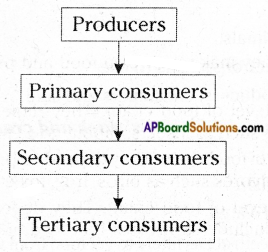
AP Board 7th Class English Solutions Chapter 6A A Hero

III. Read the following clues given below to complete the word ladder.

AP Board 7th Class English Solutions Chapter 6A A Hero 3

Clues

1. Sandhya said _____________ that she hated him.
2. Sridhar is a ____________ boy of 10 years old.
3. Jyothi used to sleep beside her _______________.
4. The garden is full of ________________ coloured flowers.
5. I met my friend Kumar on my _________________ home.
Answer:
1) crossly
2) young
3) granny
4) yellow
5) way

IV. Proverbs

A proverb is a short sentence, usually known to many people, stating something commonly experienced or giving advice. Here are some English proverbs:

  • Tit for tat.
  • Where there is a will there is a way.
  • A bad workman always blames his tools.

Every language has proverbs. In Telugu we call them ‘saamethalu’. Here is one example from Telugu:
‘kukka kaatuki cheppu debba’. It is important to know the meaning of a proverb before you use it.

AP Board 7th Class English Solutions Chapter 6A A Hero

Match the parts under A and B to make some proverbs. You can use the clues given within the brackets.
A                                                                                                                     B
1. An apple a day(search for a profession)           [ ]                       a. is a friend indeed.
2. A friend in need (rhymes with friend)               [ ]                       b. saves nine.
3. Failure is (search for ‘achievement’)                  [ ]                       c. mightier than the sword.
4. A stitch in time (search for a number)               [ ]                      d. keeps the doctor away.
5. The pen is (search for a weapon)                       [ ]                      e. the stepping stone to success.
6. Empty vessels (search for noise)                        [ ]                       f. the mighty ocean.
7. Little drops of water make                                 [ ]                       g. seldom bite.
8. Honesty (ends with ‘cy’)                                     [ ]                       h. while the sun shines.
9. Make hay (search for planet)                              [ ]                       i. is the best policy.
10. Barking dogs (search for what dogs do)          [ ]                       j. make much noise
Answer:
l) d
2) a
3) e
4) b
5) c
6) j
7) f
8) i
9) h
10) g

Grammar

Simple Past Tense:

The second form of the verb (V2 form) is used as simple past tense. It is used to express that some action was completed or not completed in the past.
In Affirmaive sentences, only the V2 form, ‘did + V1 form’ pattern is used for the simple past tense.
Example :
1. I went to Vikarabad yesterday.
2. He came to see me last night.
3. I did not go to school last Monday.
4. Sita did dance (Emphasizing the action) on this stage last month.

In interrogative sentences (Questions) and negative sentences, ‘did + V1‘ pattern is used for the simple past tense.
Examples :
1. When did you see this film?
2. Did you give him the book yesterday?
3. I did not write the exam last Sunday.
4. Guruvardhan did not come here last Friday.

AP Board 7th Class English Solutions Chapter 6A A Hero

Past Continuous Tense:

Structure of this tense is as follows, was/were + Verb with ‘ing’ form.
Ex: was going, were doing, was singing, were writing, was teaching etc.
Use: We use the past continuous tense to express that certain action was going on at a certain time in the past.
Examples: Affirmative sentences
1. At 11 a.m. yesterday, I was writing the exam.
2. My mother was cooking when the postman came.
3. We were chatting when our English teacher entered the classroom.

Negative sentences
1. They were not studying at this time last night.
2. We were not playing when he arrived here.

Questions (Interrogative sentences)
1. What were you doing then?
2. Were they playing at this time yesterday?
3. Was he sleeping in your period this morning?

Look at the following sentences from the text.
1. Father was sitting under the lamp and reading the newspaper.
2. He looked over the newspaper.
Sentence 1 is in the past continuous form. It coveys that the action was in progress at a particular point of time in the past.
In sentence 2, the verb ‘looked’ is in the simple past tense. It shows that the action was completed in the past.

I. Pick out 5 sentences from the story that use the Simple Past Tense and 5 sentences that use the Past Continuous Tense. Write them down in your notebook.

5 sentences that use the Simple Past Tense:
1) The newspaper gave a detailed account of the boy’s fight with the tiger.
2) At last, some people came that way and killed the tiger.
3) Swami rose quietly from his place.
4) He cursed the newspaper that had printed the tiger’s story.
5) Swami hurriedly got up and spread his bed under the bench and crouched there.

5 sentences that use the Past Continuous Tense:
1) Father was standing over him.
2) Father was only joking.
3) A tiger was chasing him.
4) Something was moving in the darkness.
5) Swami was following the whole conversation from under the blanket.

AP Board 7th Class English Solutions Chapter 6A A Hero

II. Read the following paragraph and fill in the blanks with the simple past or the past continuous forms.

While Swami’s father ………………… (read) the newspaper, Swami …………………(listen) to it. His father ………………… (ask) him to sleep alone. But he ………………… (be) afraid of ghosts. He ………………… (want) to sleep in his grandmother’s room. While he ………………… (sleep), he …………………(have) a terrible dream. A tiger ………………… (chase) him and he …………………(try) to escape.
Answer:
1) was reading
2) was listening
3) asked
4) was
5) wanted
6) was sleeping
7) had
8) was chasing
9) was trying

Writing

I. Summarize the story using the following hints.

Swami ___ the news report ___ about a boy’s fight ___ father’s advice ___ sleeps in his grandmother’s room ___ father insists on sleeping alone ___ a terrible dream ___ catches a thief ___ becomes a hero.
Answer:
One day Swami’s father read out some news in some newspaper for his son, Swami. The news was about the bravery of a village lad who was returning home by the jungle path. The newspaper gave a detailed account of the boy’s fight with the tiger.

After listening to the news, Swami said that a boy could not be brave enough to fight with a tiger. Then Swami’s father asked him to prove his courage. For that, his father advised him . to sleep for some nights alone in his office room. He wanted his son to do it that night itself. But Swami went into the porch and slept beside his granny. Swami never slept alone. He always slept beside his granny.

Then his father came to Swami and woke him up. He insisted Swami on his sleeping alone in the office room that night. Swami tried to escape but in vain. So he had to sleep alone in darkness in his.father’s room that night. Then Swami had a terrible dream. He could not sleep. Suddenly he heard that someone was coming towards him. He thought he was a ghost. So, at once, to protect himself, Swami bit into the knee of a thief. The thief cried out. Father and a servant came and caught the thief. Swami became a hero.

AP Board 7th Class English Solutions Chapter 6A A Hero

II. Write about an act of bravery that you or your family member or any one of your friends may have shown at some stage in your life.

An act of my bravery

My father runs a jewellery shop. The shop is open on all days. But it is closed on Sundays.

One Sunday evening, I was returning home. after playing cricket with my friends. I was coming on my bicycle. On my way home, when I came to my father’s shop, I found my father’s shop was kept open. I was surprised to see it open as it was a Sunday. I got down my bicycle and put it behind a tree and stood there silently to see what was going to happen. A few minutes later, I saw two thieves coming from the shop with a bag of jewellery and keeping it in their car, kept outside the shop. They later, went again into the shop to bring some more.

At once, without any hesitation, I ran towards the car and took out the air from all the tyres. Then I rode on my bicycle to the nearby police station and informed the police about the theft.

The police took me in their jeep and came to the spot. Seeing the police, the thieves began to run. But the police chased them and caught hold of them. All our jewellery was kept back in the shop and then it was locked.
The police congratulated me on my act of bravery. All my friends and neighbours praised me for my bravery. I felt happy as I had saved our property.

III. Change the story of ‘A Hero’ into a drama and enact it.

  • Read Swami’s story once again.
  • Identify the characters.
  • Pick out the dialogues of the characters.
  • Identify the locations of the events.
  • Decide scenes and setting accordingly.
  • Assign roles to the members of the groups.
  • Enact the drama before the whole class.

AP Board 7th Class English Solutions Chapter 6A A Hero

Answer:
Scene – I
Swami’s house with father sitting in a chair and reading a newspaper and his son Swami standing behind him.
Characters: Swami, his father and his granny.
Father: listen, Swami! I’ll read out an interesting news for you.
Swami: What’s it, Dad?
Father: it’s about the bravery of a village lad who was returning home by the jungle path.
Swami: What’s there in it about his bravery?
Father: He came face to face with a tiger and fought with it. Later he climbed on tâ thetop branch of a tree and stayed there for half-a-day. Later some village people came that way and killed the tiger.
Swami: That couldn’t be. I think he must be a grown-up person.
Father: Don’t think so. Age and strength don’t matter with regard to courage/bravery.
Swami: Suppose I am very brave. Can I fight with a tiger?
Father: O.K. I will test your courage. Tonight, sleep alone in the dark in my office room and prove your bravery.
Swami: I will do it next month. Please put it off.
Father: No, come on with me.
(Father puts Swami alone in his office room. He leaves him in the dark but keeps the doors open)

Scene – II
Place: Father’s office room. Swami is sleeping under a bench.
Characters: Swami, a burglar, Father.
Swami to himself: I don’t know why father is cruel to me in this manner. I wish the tiger had not spared the village lad.
A burglar to himself: The door is open. I will enter the room and steal the valuable things. (The burglar walks ¡n and steals something. He comes near the boy.
(Swami hears the sound of his walkin close to him.)
Swami to himself: What is this sound? I think a devil is coming to kill me. I must do something now. I will dig my teeth into its leg.
(When the burglar comes nearer, Swami digs his teeth into the knee of the burglar.)
The burglar: Oh! I was bitten.
(Hearing the sound, Father and a servant come into the room and catch the thief.)

Scene – III
Place: School
Characters: Swami, his friends, a teacher and the Headmaster.
Teacher: Oh! You have acted bravely. I appreciate you.
Swami: Thank you, teacher.
Friends: Swami, you have done a marvellous thing. Congrats.
Swami: It’s O.K.
H.M.: Swami, you are a true scout. You have proved y.our bravery. We are proud of you.
Swami: Thank you, Sir.
(But the next day on wards, Swami sleeps in his usual place.)

AP Board 7th Class English Solutions Chapter 6A A Hero

IV. Have a discussion in the whole class on how the performance could be improved in terms of delivery of dialogues, costumes, action, settings, etc.
A Skit on ‘A Hero’.
The performance could be improved and made humorous if it was as follows.
When father exits the office room –

Swami: I am afraid I can’t be alone. What should I do? idea! I shall go unnoticed to himself into my father’s bed room, pick up his cell-phone and call my close friend, Guruvardhan.
(The boy tiptoes into his father’s bed room, picks up his mobile, comes out and makes phone call to his friend, Guruvardhan.)
Swami: HelIo Guru! I’m Swami.
Guruvardhan: Hello Swami ! What’s the matter? Why are you calling me at this time? Any problem?
Swami: Yes, Guru. Can you come to my house now and spare an hour with me?
Guruvardhan: Why?
Swami: I’ll tell you here. Please do come soon.
(Swami deletes the number of his friend from his father’s mobile from dialed numbers, keeps it there and comes back into his father’s office room. Half an hour later, his friend enters the room)

Swami : Hai! Come in. I feel bored being alone.
Guruvardhan: Why alone here?
Swami: My father does this as a test for my bravery. Give me some idea.
(Guruvardhan think over it for a while)
Guruvardhan: I’ll take some valuable things from this office room and throw them scattered at the gate of your house and go back home. Half an hour later, you cry out Thief, thief, I can’t chase him. Please help” and walk hurriedly to the gate. Your father comes. Tell him you are trying to catch the thief who entered and stole the things. Also tell him he has left them there and escaped. Your father then appreciates your bravery. How is it?
Swami: It’s a good idea. Let’s do it at once.
(They implement their plan. His friend has gone home, leaving the things at the gate)
Swami: Thief, thief! catch him. (Shouts loudly)
(His father and a servant come there with a torchlight in hands.)
Father: Where is the thief? What has happened?
Swami: Dad! A thief has entered the office room and stole some valuable things.
I heard the sound and cried. He began to run. I tried to catch him. But he escaped, leaving these things here.
Father: (looking at them) Oh! these are very valuable. Had I lost them, I would have been in great trouble. Really you have done a very good job. I appreciate your bravery.
(All the members of his family praise him.)

AP Board 7th Class English Solutions Chapter 6A A Hero

Can you solve these letter riddles?
1. What letter of the alphabet is an insect?
2. What letter is a part of the head?
3. What letter is a drink?
4. What letter is a body of water?
5. What letter is a pronoun like “you”?
6. What letter is an exclamation?
7. What letter is looking for causes?
8. Why is the letter “T” like an island?
Answer:
1. the letter is’B’.
2. the letter is ‘I’.
3. the letter is ‘T’.
4. the letter is ‘C’.
5. the letter is ‘U’
6. the letter is’O’
7. the letter is ‘Y’
8. ‘T’ is like an island because it is in the middle of water.

Study Skills

Change the words given in the box into different parts of speech. Some words may not have all the forms given in the table. You may use a dictionary if you like.

AP Board 7th Class English Solutions Chapter 6A A Hero 4

AP Board 7th Class English Solutions Chapter 6A A Hero 5

AP Board 7th Class English Solutions Chapter 6A A Hero

Try these tongue twisters

Three grey geese in a green field grazing.
Double bubble gum bubbles double.
Selfish Sal sells shell-fish.
How much wood would a woodchuck chuck if a woodchuck could chuck wood?

Listening and Speaking

I. Your teacher will read the story ‘Carried away by an Eagle’. Listen carefully and answer the questions that follow.

AP Board 7th Class English Solutions Chapter 6A A Hero 6

We often speak in fun about a bird carrying away a child. A mother might say to her little one, “Don’t be naughty, or a crow will carry you away.” But do such things really happen?

The following story however, is from real life. The place was a farmhouse near Trondheim in Norway. It was June 1932. A four-year-old child, Svenhild Hansen, was playing in the yard in front of the farmhouse. Suddenly a large eagle came down. It caught hold of the child in its claws and flew up. Luckily, only the child’s dress was held in his claws, so the child was not hurt.

The big bird carried the child for more than a kilometre. It was flying towards its nest. Eagles build their nests on high rocks. This one’s nest was on the side of a mountain.Growing tired, the bird put the child down on a flat rock. This rock was eight hundred feet high on the side of the mountain. The bird’s nest was just fifty feet away.

But by this time, the child’s mother and father, and a large party of men had set out to look for the child. They noticed the eagle flying round and round over a rock in the mountain. They thought that the child might be there, and climbed quickly to the place. But they did not have much hope that they would find her alive.

When they finally reached there, the little Svenhild was fast asleep. She was not even hurt except for a few scratches.

People say that usually, an eagle kills the animal it catches, before taking it to its nest. Why didn’t the eagle kill the child? We do not know. We can only say that the child was very, very lucky.
Svenhild is now a grown-up woman. She is married. But she still keeps the tom dress she wore during this amazing adventure.

AP Board 7th Class English Solutions Chapter 6A A Hero

1. How old was the child when she was picked up by the eagle?
Answer:
She was four years old.

2. In which country did the child live when she was picked up by the eagle?
Answer:
Norway.

3. Why did the eagle leave the child on a rock?
Answer:
Because the eagle grew very tired then.

4. Why did the eagle fly round and round over the rock?
Answer:
Because the girl was put down on that rock.

5. Why do you think that the girl was lucky?
Answer:
Because she was neither killed nor hurt.

6. Why do you think Svenhild still keeps the tom dress?
Answer:
To remember that amazing adventure.

II. Work in groups and retell the story ‘Carried away by an Eagle’ in your own words.

A four-year old girl named Svenhild Hansen, was in the yard in front of the farm house near Trondheium in Norway, in June 1932. Suddenly, she was picked up by the a large eagle in its claws. The bird was carrying the child away towards its nest on the side of a mountain. The girl’s dress was held in the claws of the eagle and so she was not hurt.

Being tired, the eagle put the girl on a flat rock on the side of a mountain. The bird’s nest was just 50 feet away.

Then the child’s parents came there with a large party of men who had noticed the eagle flying round and round over a rock in the mountain. They thought that the eagle might have killed the girl there. They climbed quickly to the place.

To their surprise and happiness, they found the girl fast asleep. She was not hurt except for a few scratches. Really she was lucky. The girl grew up and got married. But she kept the tom dress with her to recollect that amazing adventure.

AP Board 7th Class English Solutions Chapter 6A A Hero

A Hero Summary in English

One day Swami’s father was sitting under the hall lamp and reading the newspaper. When Swami came to him, he read out the news of the bravery of a village lad who was returning home by the jungle path. The lad, then, came face to face with a tiger. But he was not frightened. Instead, he flew up to a tree and stayed on it for half a day. At last some people came that way and killed the tiger. Then Swami told his father that a boy could not fight a tiger. His father said that courage is everything; strength and age don’t matter much. Swami’s father told Swami to prove his courage by sleeping alone in his office room that r night. Swami could not sleep alone. He always slept beside his granny in the porch. He would be trembling and awake all night if he did not sleep beside his granny. So he requested his father to let him do it from the first of next month. But his father did not agree. When Swami was sleeping by his granny as usual, his father came and woke him up. He then took him into his office room and order him to sleep on one of the benches in the room, alone. He put out the lights, but left the door open and went out. Swami was alone. He was afraid.

Swami spread his bed under the bench and crouched there. Soon he fell asleep. He had a dream that a tiger was chasing him. Swami tried to open his eyes but failed. So he groaned in despair.

Suddenly Swami heard a little rustling noise in the darkness. Swami was afraid that a devil was coming. But it was nothing but a thief that entered the office room as the door was kept open. The thief came very close to him. At once Swami clutched his leg and dug his teeth in.        .

The thief, then,, cried out that something had bitten his leg. Everyone in the house was awakened by the loud noise. Father and a servant came running with a light. Both of them caught hold of the thief. The thief was later taken a way by the police.

The next day, Swami’s classmates praised him. His teacher patted him for his courage and bravery. The headmaster said that Swami had bitten into the knee of a notorious house ­breaker and the police were grateful to him. ,
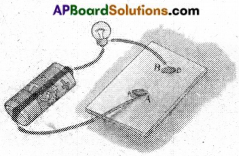
When father returned home that night, Swami, instead of sleeping alone in the office room, was seen sleeping beside his granny. His mother stopped his father from wakening him up.

AP Board 7th Class English Solutions Chapter 6A A Hero

A Hero Glossary

crossly (adv): a little angrily

scowl (n): an angry look or expression.

porch (n): a covered entrance to a building; a verandah.

sternly (adv): seriously and strictly.

disgraceful (adj): very bad; shameful.

tiptoed (v): walked quietly on the tips of his toes

curled (v): drew up his legs close to the body and curved his back

snoring (v): breathing roughly and noisily while sleeping

stirred (v): moved slightly

groaned (v): made a deep sad sound.

pleaded (v): requested

scorpions (n): small creatures with a poisonous sting in the long tail

laughing-stock: someone or something which seems stupid

tumbling (v): falling helplessly

scout (n): one who is trained in doing acts of public service

notorious (adj): well-known for some bad quality or act

faint (v): likely to lose consciousness

crouched (v): bent the knees close to the body in fear

encased (v): covered himself completely

crawled (v): moved slowly, keeping the body close to the ground

bravery (n): courage

lad (n): boy

AP Board 7th Class English Solutions Chapter 6A A Hero

path (n): way

jungle (n): forest

account (n): a written or spoken description of something that has happened,

coward (n): timid

beside (prep): by the side of

tremble (v): shake in a way that you cannot control

humbly (adv): politely

quietly (adv): silently (without making a noise)

whispered (v): spoke in a very low voice so that others could not hear it well

commanded (v): strongly ordered

AP Board 6th Class Science Important Questions Chapter 1 The Food we Need

AP State Syllabus AP Board 6th Class Science Important Questions Chapter 1 The Food we Need

AP State Syllabus 6th Class Science Important Questions 1st Lesson The Food we Need

6th Class Science 1st Lesson The Food we Need 2 Mark Important Questions and Answers

Question 1.
What is the theme of World Food day 2019?
Answer:
The World Food day theme was “Zero Hunger”.

Question 2.
What are ingredients?
Answer:
The materials which are required to prepare food are known as Ingredients.

Question 3.
What are the different food sources for human beings?
Answer:
Plants, animals and seawater are the food sources for human beings.

Question 4.
Write the ingredients to prepare chicken curry.
Answer:
Chicken, tomato, chilli powder, turmeric powder, garam masala, cinnamon, ginger and garlic paste, oil, onion, salt and coriander leaves.

Question 5.
Which food item do you like? Why?
Answer:
I like payasam because I like the food items which are sweety in taste.

AP Board 6th Class Science Important Questions Chapter 1 The Food we Need

Question 6.
Give some examples of cereals.
Answer:
Rice, Wheat, Maize, etc.

Question 7.
What are the food items that are taken in breakfast?
Answer:
Idli, dosa and chutney, bread, milk, egg are the food items that are commonly taken in breakfast by different people.

Question 8.
What are the different methods used in the preparation of food?
Answer:
Boiling, Steaming, Fermentation, Roasting, Deep frying are the different methods used in the preparation of food.

Question 9.
Why rice items are very common in our area?
Answer:
In our state, geographical and climatic conditions are more suitable for growing rice. So we prefer rice items more in our area.

Question 10.
What is FAO?
Answer:
Food and Agriculture Organisation.

Question 11.
Expand UNDP.
Answer:
United Nations Development Programme.

Question 12.
What is boiling?
Answer:
It is a food preparation method used to make the food items Rice, dal, eggs and potato etc.

Question 13.
Give examples of food items prepared by the fermentation process.
Answer:
Bread, Jilebi, Cake, Dosa, Idli are the food items prepared by the fermentation process.

Question 14.
List out the junk foods that are commonly eaten by us.
Answer:
Pizza, Burger, Chips, Fried fast food, Noodles, Samosa, French fries, etc. are junk foods.

Question 15.
What is vegetable carving?
Answer:
Making of different types of designs and decorations with vegetables is called vegetable carving.

Question 16.
What are natural preservatives?
Answer:
Salt, oil, turmeric powder, sugar and honey are natural preservatives.

Question 17.
Give examples of artificial preservatives.
Answer:
Benzoates, Nitrates, Sulphates are artificial preservatives.

AP Board 6th Class Science Important Questions Chapter 1 The Food we Need

Question 18.
How does food get its taste?
Answer:
The taste of food depends on its ingredients, method of preparation and cultural habits.

Question 19.
What do we get from animals?
Answer:
We get milk, meat, egg and honey from animals.

Question 20.
Give examples of the stem that stores food.
Answer:
Sugarcane, onion, garlic, turmeric, ginger plants store food in the stem.

Question 21.
Why do we keep certain fruits in sugar syrup or honey?
Answer:
Sugar syrup or honey is used in the canning and freezing of fruits to improve its flavour and to preserve its natural colour and taste.

Question 22.
Name the vegetables/fruits that are used in the preparation of pickles.
Answer:
Mango, lemon, tamarind”, amla, tomato, chillies etc.

Question 23.
Why fishes are dried or smoked?
Answer:
Drying and smoking is help to reduce the moisture content in fish. So that it can be preserved properly without getting spoiled.

Question 24.
Is there ‘any a relationship’ of food habits and growing crop for that particular
area?
Answer:
Yes. People living in one region thy have some food habits. So that farmers cultivate that type of food crops which are suitable for that geographical and climatic conditions.

Question 25.
What are the common ingredients that used in making pickles?
Answer:
Salt, oil, turmeric powder, chilli powder, garlic, fenugreek powder and asafoetida are commonly used ingredients in the preparation of pickles.

AP Board 6th Class Science Important Questions Chapter 1 The Food we Need

Question 26.
What are the different food items that are prepared by using rice?
Answer:
Idli, dosa, dal rice, vegetable rice, biryani, Pongal, kichadi are the food items prepared by using rice.

6th Class Science 1st Lesson The Food we Need 4 Mark Important Questions and Answers

Question 1.
We take some of the food in large quantities whereas the others in small quantity. Why is it so?
Answer:
Body needs calories to perform the metabolisms.

  • Our body needs calories so that we take carbohydrate rich food in large quantities.
  • Proteins are the body building nutrients which are necessary for growth and development.
  • • Vitamins and minerals are present in vegetables and fruits. These nutrients required to our body in small quantities.

Question 2.
What are the Indian spices? What is its role in the preparation of food?
Answer:

  • Indian spices are aromatic parts of a plant which are added in a variety of dishes.
  • We get spices from the bark and roots of certain plants, leaves, flowers or stems of the plant.
  • These are used for the flavouring, colouring or preserving food.
  • Ex. Cardamom, black pepper, curry leaves, fenugreek, fennel, ajwain, bay leaves, cumin, coriander leaves, turmeric, cloves, ginger, nutmeg and cinnamon.

Question 3.
Ramu said that all food items are sources of plants and animals. Do you support this statement? Why? Why not?
Answer:

  • Vegetables, fruits, cereals and pulses etc. are the ingredients obtaining from the plants.
  • Egg, milk, meat etc are the food ingredients obtaining from the animals.
  • So, I support this statement as all these food ingredients are derived from the plant and animal sources.
    (OR)
  • We get food from plants and animal sources.
  • At the same time salt is derived from the other sources.
  • Salt is an important ingredient for preparing the all food items.
  • So that I can’t support the statement that all food items are sources of plants and animals.

AP Board 6th Class Science Important Questions Chapter 1 The Food we Need

Question 4.
What questions do you pose to know about the food sources of human being?
Answer:

  • Where do we get ingredients?
  • Where does the food ingredients of food come from?
  • What are the main food sources?
  • Is there any source other than plants and animals?

Question 5.
How will you appreciate plants and animals in the view of food sources?
Answer:

  • Plants and animals are the main food sources for us.
  • We get vegetables, fruits, cereals and pulses etc. from the plants.
  • We get milk, meat, egg and honey from the animals.
  • If we have not these food sources on earth the existence of life become impossible.

Question 6.
What are the effects of the junk foods on human health?
Answer:
Eating of junk food causes,

  • increased obesity,
  • loss of memory and learning problems,
  • worsens appetite and digestion,
  • inadequate growth and development,
  • heart diseases and stroke.

Question 7.
Prepare some slogans to avoid the junk food.
Answer:

  1. Know your health -Say no to junk food
  2. Fast food – Fast death
  3. Put junk food into dustbin not into the stomach
  4. Eating pizzas and burgers daily, gives you a round belly
  5. Junk food is an injurious to health

Question 8.
Write about the steaming process.
Answer:

  • Steaming process is a method of preparation of food.
  • In this process boiling of water causes it to vaporize into steam.
  • The steam carries heat to the food, thus cooking the food.
  • Idli, cake, egg is cooked by steaming process.

AP Board 6th Class Science Important Questions Chapter 1 The Food we Need

Question 9.
Why do you follow different methods for preparing the food?
Answer:

  • Preparation of food is an art. It is prepared in different ways.
  • There should be no loss of nutrients while cooking.
  • Some food items are delicious in certain food preparing methods.
  • The taste of the food depends on its ingredients and the method of preparation also. So that we use different methods for preparing the food.

Question 10.
Why do we preserve the food?
Answer:

  • Food preservation is the process of treating and handling food to stop or slow down spoilage.
  • It provides food availability throughout the year.
  • Food preservation stop the food wastage.
  • If food is not preserved properly, it can attack by microorganisms that lead to spoilage of food.

Question 11.
What are preservatives? What is it need?
Answer:

  • The materials or substances that use in preserving food are called preservatives.
  • The preservatives may be natural such as salt, oil, turmeric powder, sugar, honey and artificial such as Benzoates, Nitrates, Sulphates.
  • Preservatives are essential to preserving food properly.
  • Preservatives keep food fresher for longer periods of time and prevent spoilage of food.

Question 12.
Natural preservatives are more preferable than artificial preservatives? Why?
Answer:

  • Natural preservatives include salt, oil, turmeric powder, sugar and honey.
  • The artificial preservatives are prepared by using some chemicals.
  • The natural preservatives retain the nutritional value of the food items, whereas
    artificial preservatives reduce the moisture level in the food and they slow down the nutritional value of the food.
  • Artificial preservatives are also harmful to our health.
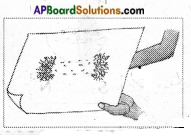
    So that natural preservatives are more preferable than artificial preservatives.

Question 13.
What are the Indian traditional preservative methods?
Answer:

  • Generally, some food items are salted and dried for preservation Ex: Mango; tomato, fish, appeal, vadiyalu.
  • Salt, turmeric powder, chilli powder and oil are added while making pickles.
  • Fish, meat, vegetables are freeze in refrigerators.
  • Certain fruits are preserved in sugar syrup or honey.

AP Board 6th Class Science Important Questions Chapter 1 The Food we Need

Question 14.
What are the preservative techniques used in the preparation of pickles?
Answer:

  • To prepare a pickle, we need some preservative ingredients such as salt, edible oil, red chilli powder, fenu greek powder, mustard powder, turmeric powder, garlic and asafoetida.
  • Salt and turmeric powder control the growth of micro-organisms.
  • Garlic and asafoetida add flavour and taste to the pickle.
  • And other preservatives are used to taste and preserve the pickle for few months.

Question 15.
List out the healthy food habits.
Answer:

  • Eat a variety of vegetables and fruits every day.
  • Drink fat-free and low-fat milk for every day.
  • Don’t take junk foods.
  • Drink plenty of water instead of sweetened drinks and cool drinks.

Question 16.
Write about millets.
Answer:

  • Millets are stapled food and important sources Of nutrients.
  • They contain energy source, proteins and fibres.
  • Ex. Finger millets (raagulu), Pearl millets (sajjalu), Great millets (Jonnalu), Foxtail millets (Korralu), Proso millets (samalu) etc.
  • Millets are good for health.

Question 17.
Which day is celebrated as World Food Day? What is the aim of the celebration of world food day?
Answer:

  • World Food Day is celebrated every year across the world on 16 th October.
  • To promote worldwide awareness on the problem of hunger, malnutrition, and poverty as well as focus attention on agriculture and food production.

Question 18.
Plant roots are also food sources for human beings. How do you support this statement?
Answer:

  • Carrot, beetroot, sweet potato, radish store food materials in their roots.
  • These tuberous roots are used as food sources for human beings.
    Thus, plant roots are also a food sources for human beings.

Question 19.
How do you prevent the wastage of food?
Answer:

  • By using of proper storage methods.
  • Avoid the optimum temperature.
  • Decrease the water percentage up to 5%.
  • Adding the preservatives.

Question 20.
How will you appreciate people who offer food to the needy?
Answer:

  • It is a very great attitude to offer food for the needy.
  • It avoids the hunger for the world.
  • It increases empathy in society.
  • It is an opportunity to show their humanity towards the needy.

AP Board 6th Class Science Important Questions Chapter 1 The Food we Need

6th Class Science 1st Lesson The Food we Need 8 Mark Important Questions and Answers

Question 1.
To present a symposium in your school, prepare a note about junk food.
Answer:

  • Junk food containing high levels of calories with less vitamins and minerals.
  • Most of the fast-food is junk food.
  • Pizza, burger, chips, fried fast food, samosa, French fries etc. are junk foods.
  • Junk foods do not contain nutritional value.
  • Junk food is not easy to digest.
  • Eating Junk food causes obesity, digestion issues and loss of appetite.
  • It causes drowsiness and harmful to health.
  • It causes diabetes, cholesterol and heart diseases.
AP Board 6th Class Science Solutions Chapter 10 Basic Electric Circuits

AP State Syllabus AP Board 6th Class Science Solutions Chapter 10 Basic Electric Circuits Textbook Questions and Answers.

AP State Syllabus 6th Class Science Solutions 10th Lesson Basic Electric Circuits

6th Class Science 10th Lesson Basic Electric Circuits Textbook Questions and Answers

Improve Your Learning

Fill in the Blanks.

1. The flow of electricity in a circuit is called ——–.
Answer:
current
2. A ——– helps us to allow or break the flow of electricity in a circuit.
Answer:
switch
3. Substances that allow electricity to pass through them are known as ——–.
Answer:
conductors
4. The electric bulb was invented by ——–.
Answer:
Thomas Alva Edison

AP Board 6th Class Science Solutions Chapter 10 Basic Electric Circuits

Choose the correct answer.

1. In a bulb the part which gives us light is
A) Metal Base
B) Glass Chamber
C) Filament
D) Terminals
Answer:
C) Filament

2. Which of the following is an insulator?
A) Hairpin
B) Iron Nail
C) Plastic Scale
D) Pencil Lead
Answer:
C) Plastic Scale

3. The metal used in making filaments of present-day bulbs is
A) Iron
B) Copper
C) Tungsten
D) Cotton
Answer:
C) Tungsten

Answer the Following Questions.

Question 1.
What is an electric circuit? Explain with a diagram.
Answer:

  1. An arrangement in which a cell and a bulb are connected by using wires is called a simple electric circuit.
    AP Board 6th Class Science Solutions Chapter 10 Basic Electric Circuits 1
  2. A simple electric circuit is a path for the flow of electric current between cell and the bulb.

Question 2.
What are the parts of a torchlight?
Answer:
The parts of a torchlight are

  1. Hollow cylindrical barrel
  2. Torch cells
  3. Bulb
  4. Glass cover
  5. Reflector
  6. Switch
  7. Metal spring

AP Board 6th Class Science Solutions Chapter 10 Basic Electric Circuits

Question 3.
Classify the following into conductors and insulators:
Water, Plastic pen, Pencil lead, Dry cotton cloth, Wet cotton cloth, Dry wood, Wet wood.
Answer:

S.No. Conductors S.No. Insulators
1 Pencil lead 4 Water
2 Wet cotton cloth 5 Plastic pen
3 Wet wood 6 Dry cotton cloth
7       – Dry wood

Question 4.
What will happen if the cells in a torch are arranged as shown in the following figure? Why?
AP Board 6th Class Science Solutions Chapter 10 Basic Electric Circuits 2
Answer:

  1. The bulb does not glow.
  2. Because two positive terminals of the cells are connected to each other which does not provide a closed path.

Question 5.
Niharika observed an electrician repairing a street light wearing gloves on his hand. She asked him some questions. What would be those questions?
Answer:

  1. Why do you wear gloves?
  2. With what the gloves are made up of?
  3. How do these gloves help in your work?
  4. What will happen if the glows are made up of cloth instead of rubber?

Question 6.
A circuit is connected with a cell, bulb, and a switch, but the bulb is not glowing. Write all possible reasons for this.
Answer:

  1. The cell used might have been totally discharged.
  2. The bulb taken might have been fused.
  3. The switch arranged may not be in touch with the wires as expected.
  4. Any breakages in the circuit cause failure.

Question 7.
How do you test the materials given to you, to know whether they are conductors or insulators?
Answer:
Aim: To test the given materials to know whether they are conductors or insulators What you need? (Materials required): a cell (power source), a bulb, connecting wires, wooden plank or thermocol sheet, two drawing pins, and the materials provided to test.
How to do? (Procedure):

  1. Connect a circuit on a wooden plank or on a thermocol sheet as shown in Fig.
    AP Board 6th Class Science Solutions Chapter 10 Basic Electric Circuits 3
  2. Insert two drawing pins at A and B.
  3. insert the given materials in the gap between A and B one after another.
  4. With each insertion, check whether the bulb glows or not.

What do you see? (Observation): The bulb glows only when some materials like a safety pin, iron nail were inserted. It does not glow when the materials like paper, eraser were inserted.
What do you learn? (Result): Bulb glows only when an electric current passes through the materials. So all the materials which made the bulb glow are conductors and the remaining are insulators.

AP Board 6th Class Science Solutions Chapter 10 Basic Electric Circuits

Question 8.
Draw a circuit diagram showing a cell, switch, and bulb.
Answer:
AP Board 6th Class Science Solutions Chapter 10 Basic Electric Circuits 4

Question 9.
If you put the switch on, a light will glow, a fan will rotate, an iron box heats up etc. All these different functions will be performed by electricity. How do you feel about the comforts given by this great invention to human beings?
Answer:

  1. Electricity plays a key role in modern technology.
  2. Without electricity, most of the things could never work. (i.e. TV, Computer, bulb, etc…)
  3. We can’t imagine our life without electricity.
  4. Electricity is a gift given by scientists to human beings.
  5. Electricity is a basis for new inventions.

Question 10.
List the daily activities in which we use electricity.
Answer:
Following are our daily activities in which we use electricity.

  1. Electric bulb and fluorescent lights etc.
  2. Washing machine and Grinder
  3. Electric fan and Electric iron
  4. Television and Tape recorders
  5. Computers and Motors to lift water etc.

Activities and Projects

6th Class Science Textbook Page No. 115

Question 1.
In activity 4, we observed some situations where the torch bulb glows. Niharika challenged her friends that she could make the bulb not glow even with the cells kept in the proper position. What would she have done?
Answer:

  1. Niharika might have put an insulator in between the two cells.
  2. Or she might have used the powerless batteries.

AP Board 6th Class Science Solutions Chapter 10 Basic Electric Circuits

Question 2.
Connect a circuit as shown in the given diagram.
AP Board 6th Class Science Solutions Chapter 10 Basic Electric Circuits 5
a) Does the bulb glow? Why?
b) Draw the circuit so that the bulb glows.
c) Verify it by connecting cells and bulbs as per the circuit drawn.
Answer:
a) The bulb does not glow. As the positive terminals of the two cells are connected. So current does not flow and bulb does not glow.
b)
AP Board 6th Class Science Solutions Chapter 10 Basic Electric Circuits 6
c) I have connected the circuit as shown in (b) and found the bulb glowing.

Question 3.
You have studied the story of Thomas Alva Edison. Write a note appreciating his efforts in inventing the bulb.
Answer:

  1. Thomas Alva Edison was a famous scientist who invented the bulb.
  2. He experimented with a number of different filaments.
  3. His goal was to find materials that would light well and last for a long time.
  4. Though he failed a number of times he worked hard continuously to get success.
  5. Without an electric bulb, we can’t imagine our life.

Question 4.
Connect circuits as shown in the following figure. Write your observation in each case.
AP Board 6th Class Science Solutions Chapter 10 Basic Electric Circuits 7
Answer:
a) The bulb does not glow as the +ve terminals of the two cells are directly connected.
b) The bulb glows as the cells are connected correctly.
c) The bulb glows and gives dim light as only one cell is connected.
d) The bulb glows brilliantly as the three cells are connected in series and more current flows in the bulb.

6th Class Science 10th Lesson Basic Electric Circuits Activities

Activity – 1

1. Let us take a torch cell and observe it. Can you describe it? (Page No. 108)
Answer:

  1. The cell consists of a cylindrical metal can.
  2. Its heaviness suggests that it is filled with some chemicals.
  3. The protrusion on one end is due to a carbon rod in the centre.
  4. At the top of the cell, a metal cap is fixed.
  5. This metal cap act as the positive (+) terminal of the cell.
  6. Opposite to this, the bottom of the cell (metal can) act as a negative (-) terminal of the cell.
  7. The entire can is sealed.
  8. Positive and negative terminals of the cell are labelled on it as + and – respectively.

AP Board 6th Class Science Solutions Chapter 10 Basic Electric Circuits

Activity – 2

Simple electric circuits (Page No. 108)

2. Take four wires of different colours, say blue, green, red and yellow, each about 15 cm long. Electric wires are often covered with plastic. First, remove about two centimetres of the plastic covering, from both ends of each wire. Now attach two wires (Blue and Green) to a bulb and two wires (Red and Yellow) to a cell with a cello-tape or cell-holder as shown in Fig. 4(a). We can use a cell holder to hold the cells and wires together tightly.
Now connect the wires in different forms as shown in Fig. 4(b) to 4(g). In each case, check whether the bulb glows or not. Record your observations in Table 1.
AP Board 6th Class Science Solutions Chapter 10 Basic Electric Circuits 9a
Answer:

Connection Does the bulb glow (Yes / No)
Fig (b) No
Fig (c) No
Fig (d) Yes
Fig (e) Yes
Fig (f) No
Fig (g) No
  • In which case does the bulb glow? Why?
    Answer:
    The bulb glows in connections shown in Fig. 4(d) and Fig. 4(e). This is because in these connections form a closed path.
  • In which case the bulb does not glow? Why?
    Answer:
    In the remaining cases means like in Figs. 4(b), 4(C), 4KO, and 4(g), bulb does not glow.
    This is because there is some gap in the path. (circuit is open)

Activity – 3

Electric Switch (Page No. 110)

3. Connect a circuit on a wooden plank or on a thermocol sheet as shown in Figure. Insert two drawing pins at A and B. Insert a safety pin in between A and B. such that one end of the pin is completely in contact with B and the other end is left free. Now observe the bulb.
AP Board 6th Class Science Solutions Chapter 10 Basic Electric Circuits 10

  • What do you notice?
    Answer:
    The bulb does not glow.
    Now touch the safety pin to pin A and observe the bulb again.
  • What happens?
    Answer:
    The bulb glows.
  • Why doesn’t the bulb glow when the safety pin is left free at one end?
    Answer:
    In this activity, the safety pin is used to close /open the circuit. When the safety pin is left free at one end, the circuit is open. So the bulb doesn’t glow.

AP Board 6th Class Science Solutions Chapter 10 Basic Electric Circuits

Activity – 4

4. Take a torch that has two cells. Arrange the cells in the torch in as many ways as you can. In which cases does the bulb glow and in which cases it doesn’t? Draw pictures showing different positions of cells and glowing of bulb. Can you find out why the bulb glows only when cells are placed in a particular position? (Page No. 111)
AP Board 6th Class Science Solutions Chapter 10 Basic Electric Circuits 11
Answer:
The bulb glows only in the first position. This is because in the remaining positions the circuit is being open as the cell’s terminals are not in a proper sequence. In the first position they are in proper sequence, so the circuit is closed. As a result the bulb glows.

Activity – 5

Identifying conductors and insulators (Page No. 111)

5. Take the circuit which we used in activity-3, as shown in Figure. Remove the safety pin from the drawing pins so that you have two open terminals A and B.
AP Board 6th Class Science Solutions Chapter 10 Basic Electric Circuits 12
Insert different objects like a hair pin, safety pin, eraser, plastic scale, match stick, piece of a metal bangle, piece of a glass bangle, paper clip etc. in the gap between A and B. With each insertion, check whether the bulb glows or not. Record your observations in table 2 for each case.
Answer:

S.No. Object Name of the Material Does the bulb glow (Yes/No) Conductor/Insulator
1. Hair pin Metal Yes Conductor
2. Pencil lead Lead Yes Conductor
3. Eraser Rubber No Insulator
4. Plastic scale Plastic No Insulator
5. Match stick Wood No Insulator
6. Divider from geometry box Metal Yes Conductor
7. Piece of paper Paper No Insulator
8. Iron nail Iron Yes Conductor
9. Piece of Metal bangle Metal Yes Conductor
10. Piece of Glass bangle Glass No Insulator
11. Paper clip Metal Yes Conductor
12. Piece of chalk Chalk No Insulator
13. Safety pin Metal Yes Conductor
  • If you look at table 2, after recording your observations you will find that the bulb glows in some cases and does not glow in other cases. Can you guess the reason?
    Answer:
    Bulb glows in some cases as they allow an electric current to pass through them. They are conductors.
    Bulb does not glow in other cases as they do not allow the electric current to pass through them. They are insulators.
  • Can you group the objects you observed in your daily life as conductors and insulators? Make a list of objects and group them as conductors and insulators and write in table-3
    Answer:

    S.No. Conductors Insulators
    1 Metals Water
    2 Iron Air
    3 Silver Plastic
    4 Salt water Wood
    5 Copper Rubber
    6 Aluminium Paper

AP Board 6th Class Science Important Questions Chapter 6 Fun with Magnets

AP State Syllabus AP Board 6th Class Science Important Questions Chapter 6 Fun with Magnets

AP State Syllabus 6th Class Science Important Questions 5th Lesson Fun with Magnets

6th Class Science 6th Lesson Fun with Magnets 2 Mark Important Questions and Answers

Question 1.
Explain why do pins get attached to the cap of the pin holder.
Answer:
Pins get attached to the cap of the pin holder because it contains a magnet.

Question 2.
Why the natural magnets are called leading stones?
Answer:
Natural magnets are used for finding direction, So they are also called ‘leading stones’ or ‘lode stones’.

Question 3.
From which part of the magnet do you feel more difficulty in removing iron filings?
Answer:
I felt more difficulty in removing iron filings from the poles of the magnet.

Question 4.
What property of the magnet is used to make the magnetic compass?
Answer:
The directional property of the magnet is used to make the magnetic compass.

Question 5.
What is the important precaution you have to take with the magnetic compass?
Answer:
The magnetic compass and magnets should not be put together.

AP Board 6th Class Science Important Questions Chapter 6 Fun with Magnets

Question 6.
What will happen to the magnet when we cut it into two pieces?
Answer:
When we cut a bar magnet into two pieces, both these pieces act as magnets and we get two magnets.

Question 7.
How can you separate metal scrap from a heap of waste materials in a scrap yard?
Answer:
We can separate metal scrap from a heap of waste materials in a scrap yard with the help of magnets.

Question 8.
You are given a bar magnet How will you find out the west direction?
Answer:
The two poles of a bar magnet point towards the north and south direction, so the west direction can be easily located.

Question 9.
A carpenter by chance mixes iron nails and screws with wood shavings while working. How can you help him in getting back the nails and screws from the wood shavings?
Answer:
We can’ help him in getting back the nails and screw from wood shavings with the help of a magnet.

Question 10.
What is magnetic induction?
Answer:
The magnetic property possessed by a magnetic substance due to the presence of a magnet near it is called ‘magnetic, induction’.

Question 11.
What is the sure test for magnetism?
Answer:
Repulsion and not attraction is the sure test for magnetism.

Question 12.
What is meant by the directional property of magnets?
Answer:
A freely suspended magnet always come to rest in north and south directions. This property of magnets is called a directional property.

AP Board 6th Class Science Important Questions Chapter 6 Fun with Magnets

Question 13.
On what principle electromagnetic trains work?
Answer:
Electromagnetic trains work on the principle that – Magnetic objects can levitate by using repulsion.

Question 14.
Draw the diagram of the horseshoe magnets.
Answer:
AP Board 6th Class Science Important Questions Chapter 6 Fun with Magnets 1

6th Class Science 6th Lesson Fun with Magnets 4 Mark Important Questions and Answers

Question 1.
What are magnetic and non magnetic materials? Give examples.
Answer:

  1. The materials that are attracted by magnets are called magnetic materials.
  2. Examples: Iron, Steel, Cobalt, etc.
  3. The materials that are not attracted by magnets are called non-magnetic substances.
  4. Examples: Brass, Plastic, Wood, Paper, etc.

Question 2.
Which part of the bar magnet attracts more iron filings? What do you conclude from this?
Answer:

  1. The ends of the bar magnet attract more iron filings than the middle part of the magnet.
  2. We conclude that every bar magnet always has two ends whose attracting capacity is more than its other parts.
  3. These ends are called ‘Poles’ of the magnet.

Question 3.
When do magnets attract each other?
Answer:

  1. When two bar magnets with their opposite poles are placed side by side at a small distance the magnets attract each other.
  2. Opposite poles of the magnets attract.

Question 4.
When do the magnets repel each other?
Answer:

  1. When two magnets with their like poles are placed side by side at a small distance the magnets repel each other.
  2. Like poles of the magnets repel.

AP Board 6th Class Science Important Questions Chapter 6 Fun with Magnets

Question 5.
Fill up the following table.

Poles They are called We observe
North – ………..  ………….. Attraction
North – North Similar poles ……………..
………………. Similar poles Repulsion
South – North Opposite poles ……………..

Answer:

Poles They are called We observe
North – South Opposite poles Attraction
North – North Similar poles Repulsion
South – South Similar poles Repulsion
South – North Opposite poles Attraction

AP Board 6th Class Science Important Questions Chapter 6 Fun with Magnets

Question 6.
How is a compass used to find directions?
Answer:

  1. A compass has a magnetic needle attached to it which can rotates freely.
  2. The magnet always points to N – S direction which is marked on compass and thus help in finding direction.

Question 7.
Why is compass needle kept in a closed glass vessel?
Answer:

  1. The compass needle is a small and thin magnet used to find the direction.
  2. If it is kept in open, it may deflect in any direction.
  3. So to know right direction, it is kept covered by glass covering.

Question 8.
What is the use of a magnetic compass?
Answer:

  1. A magnetic compass is used to find directions.
  2. It is mostly used in ships and airplanes.
  3. Mountaineers and army people also carry a compass with them so that they do not lose their way in an unknown place.

Question 9.
Rajani needs some iron filings to conduct experiments with magnets. She don’t know how to collect them. Help her by explaining the process of collecting iron filings?
Answer:

  1. In the experiments with magnets, we need to use iron filings again and again.
  2. We can collect these by placing a magnet in a pile of sand and turning it around in the sand.
  3. The small pieces of iron present in the sand will stick to the magnet.
  4. If we cannot find sand we can look for iron pieces in clay soil as well.

Question 10.
‘Like poles repel each other and unlike poles attract each other” – How can you prove this statement?
Answer:

  1. Take two similar bar magnets.
  2. Bring the south pole of a bar magnet close to the south pole of another bar magnet. They repel each other.
  3. Now bring the north pole of a bar magnet close to the north pole of another bar magnet. They also repel each other. This confirms like poles repel each other.
  4. Now bring the south pole of a bar magnet to the north pole of another bar magnet, vice versa. They attract each other confirming that unlike poles attract each other.

AP Board 6th Class Science Important Questions Chapter 6 Fun with Magnets

Question 11.
How do the properties of magnets get destroyed?
Answer:

  1. Magnets lose their properties if they are heated or dropped from a height or hit with a hammer.
  2. Magnets lose their properties when they are placed near Cell phone, Computer, DVDs.
  3. Improper storage can also cause magnets to lose their properties.

Question 12.
Write the cations for the proper storage of magnets.
Answer:

  1. Improper storage can cause magnets to lose their properties.
  2. To keep them safe, bar magnets should be kept in pairs with their unlike poles on the same side.
  3. They must be separated by a piece of wood and two pieces of soft iron should be placed across their ends.
  4. For a horse-shoe magnet a single piece of soft iron can be used as a magnetic keeper across the poles.

Question 13.
What is a suspension train? On what principle it works?
Answer:

  1. An Electromagnetic train is called a suspension train or a flying train.
  2. It does not require either diesel or petrol.
  3. This technology uses the property of magnetic attraction and repulsion to run these super fast electromagnetic trains.
  4. Electromagnetic train work on the principle of magnetic levitation. That is – A magnetic object can levitate by using repulsion.

Question 14.
Write the differences between natural magnets and artificial magnets.
Answer:

Natural Magnets Artificial magnets
1. They occur naturally in nature. 1. They are man made magnets..
2. These are obtained from their ore. 2. They are obtained by magnetization of magnetic materials such as iron.
3. They do not have definite shape 3. They are prepared in different shapes such as round, ring, disc, horse shoe etc.
4. They are called lead stones or leading stones. 4. They are named after their shapes.

AP Board 6th Class Science Important Questions Chapter 6 Fun with Magnets

6th Class Science 6th Lesson Fun with Magnets 8 Mark Important Questions and Answers

Question 1.
Describe the story of the discovery of magnets?
Answer:

  1. About 2500 years back in a place named magnesia in Greek, there lived a shepherd named Magnus.
  2. One day while his goats were grassing he took a hap on a rock by keeping his iron caped stick and iron nailed boots on that rock.
  3. When he woke up, he found that his iron-capped stick stuck on the rock and stood erect. His iron-nailed boots also stuck on the fock.
  4. The entire village assembled there to see this magic.
  5. People wondered about this incident, each and everyone expressed their views in different ways.
  6. People found it attractive not only the stick of Magnus but also all other materials made of iron.
  7. more rocks of these kinds were found worldwide.
  8. These magnetic rocks were named ‘Magnets’ and the ore is called ‘Magnetite’ after the name of the boy Magnus.

Question 2.
Describe the construction of a magnetic compass. How is it used? What are its uses? (Imp.)
Answer:
Magnetic Compass:
Description:

  1. A compass is usually a small box with glass covering it.
  2. A magnetized needle is pivoted inside the box in such a way that it can rotate freely.
  3. The compass also has a dial with directions marked on it.

Working with Compass:

  1. The compass is kept at the place where we wish to know the direction.
  2. Its needle indicates the North-South direction when it comes to rest.
  3. The compass is then rotated until the north and south marked on the dial are exactly below the two ends of the needle.
  4. To identify the North pole of the magnetic needle, it is usually painted in a different color (see Fig.).
    AP Board 6th Class Science Important Questions Chapter 6 Fun with Magnets 2
  5. Then we identify north and south at that place.
  6. After that we can also identify the East and West between them.

Uses:

  1. A compass is used to find directions and in ships & airplanes.
  2. Mountaineers and army people also carry a compass with them so that they do not lose their way in an unknown place.

AP Board 6th Class Science Important Questions Chapter 6 Fun with Magnets

Question 3.
Observe the picture and answer the following questions.
AP Board 6th Class Science Important Questions Chapter 6 Fun with Magnets 3
a) What are the materials required to do this experiment?
b) What precautions you would take while doing this experiment?
c) In which direction the magnet show when it stands rest?
d) What is the instrument made based on this experiment/property?
Answer:
a) Required material:

  1. Bar magnet
  2. Thread
  3. Stand

b) Suspend the bar magnet freely with help of a strong thread tied to the center of the bar magnet.
c) North-South direction.
d) Magnetic compass.

Question 4.
i) According to the pictures write whether rat attracts or repels to the food in the bowl.
ii) Give reasons.
AP Board 6th Class Science Important Questions Chapter 6 Fun with Magnets 4
Answer:
A) Rat attracts to the food in the bowl.  Reason: Unlike poles attract each other.
B) Rat repels to the food in the bowl. Reason: Like poles repel each other.
C) Rat attracts to the food in the bowl. Reason: Unlike poles attract each other.
D) Rat repels to the food in the bowl. Reason: Like poles repel each other.

Question 5.
Observe the picture.
AP Board 6th Class Science Important Questions Chapter 6 Fun with Magnets 5
i) Identify the name of the picture.
ii) In which direction the magnet needle show when it comes to rest?
iii) What property of the magnet is used to make the instrument?
iv) What is the use of that Instrument?
Answer:
i) Magnetic, compass.
ii) North-South direction.
iii) The directional property of the magnet is used to make the magnet compass.
iv) We use it to find out the direction.

Question 6.
How do you find whether the given object is a magnet or not? You are given three objects of the same size, shape, and color and a bar magnet. Describe your activity.
Answer:
The procedure of the activity:
I bring three objects one after the other close to one pole of the bar magnet and observe whether they get attracted, repelled, or not attracted.
Conclusions:

  1. If an object is attracted by one pole of the bar magnet and repelled by its other pole, then I can say that it is a magnet.
  2. If an object is attracted by both the poles of a bar magnet and not repelled by any
    pole, then I can say that it is not a magnet but a magnetic substance.
  3. If an object is neither attracted by a magnet nor repelled by it, then I can say that it is neither a magnet nor a magnetic substance.

AP Board 6th Class Science Important Questions Chapter 6 Fun with Magnets

Question 7.
Write a short note on the properties of magnets.
Answer:

  1. Magnets attract magnetic materials.
  2. A magnet always has two ends whose attracting capacity is more than the parts of it. The poles of the magnet lie at these birds.
  3. Each magnet has two magnetic poles: North and South.
  4. Like Poles (N-N, S-S) repel each other and unlike poles (N-S, S-N) attract each other.
  5. A freely suspended magnet always aligns in the North-South direction.
  6. Magnets lose their properties if they are heated or dropped from a height hit with a hammer.

Question 8.
How can you prove that a bar magnet possesses two poles?
Answer:
Aim: To prove that a bar magnet possesses two poles.
AP Board 6th Class Science Important Questions Chapter 6 Fun with Magnets 6
What do you need? (Materials required): Iron filings, a sheet of paper, bar magnet.
What to do? (Procedure):

  1. Spread some iron fillings uniformly on a sheet of paper.
  2. Place a bar magnet below this sheet.

What do you see? (Observation):

  1. We will notice that the uniformly spread iron filings come close and get concentrate at two points of the paper sheet.
  2. At some distance, we will find some scattered iron filings between these two points.

What do you learn? (Result): Thus the ends of the bar magnet attract more iron filings than the middle part of the magnet. By this activity we can conclude that every bar magnet always has two ends whose attracting capacity is more than its other parts. These ends are called poles of the magnet.

Question 9.
How can you demonstrate the directional property of a bar magnet?
Answer:
Aim: To demonstrate the directional property of a bar magnet.
What do you need? (Materials required): Bar magnet, thread, stand and colour.
What to do? (Procedure):

  1. Suspend the bar magnet freely with the help of a thread tied around its center.
    AP Board 6th Class Science Important Questions Chapter 6 Fun with Magnets 7
  2. The magnet finally takes a position in the North-South direction.
  3. Mark the end points towards the North with some color.
  4. Now disturb the magnet and again wait for some time.

What do you see? (Observation):
Magnets always come to rest in the North-South direction. In each case the marked endpoints towards North.
What do you learn? (Result): The marked end is known as the North pole of the magnet. The other end, which points towards the South is known as the South pole of the magnet. This property of magnets is called directional property.

AP Board 6th Class Science Important Questions Chapter 6 Fun with Magnets

Question 10.
Draw different shapes of magnets available in your area.
Answer:
AP Board 6th Class Science Important Questions Chapter 6 Fun with Magnets 8

AP Board 6th Class Science Solutions Chapter 12 Movement and Locomotion

AP State Syllabus AP Board 6th Class Science Solutions Chapter 12 Movement and Locomotion Textbook Questions and Answers.

AP State Syllabus 6th Class Science Solutions 12th Lesson Movement and Locomotion

6th Class Science 12th Lesson Movement and Locomotion Textbook Questions and Answers

Improve Your Learning

Fill in the Blanks.

1. Joints of the bone helps in the ——–.
Answer:
movements.
2. The contraction of the ——– pulls the bones during movement.
Answer:
muscle.
3. The bones at the elbow are joined by a ——– joint.
Answer:
hinge.

AP Board 6th Class Science Solutions Chapter 12 Movement and Locomotion

Choose the correct answer.

1. The immovable joints are present in
A) Knee
B) Shoulder
C) Neck
D) Skull
Answer:

2. The hollow bones are present in
A) Cow
B) Sparrow
C) Buffalo
D) Snake
Answer:

3. The fibers join the muscles to the bones.
A) Tendon
B) Ligament
C) Cartilage
D) None
Answer:
A) Tendon

The joint response to move our head up and down and side to side is
A) Sliding joint
B) Hinge joint
C) Ball and socket joint
D) Pivot joint
Answer:
D) Pivot joint

AP Board 6th Class Science Solutions Chapter 12 Movement and Locomotion

Answer the Following Questions.

Question 1.
Write short notes on different types of joints in our body.
Answer:
1. The point where two bones meet is called a joint.
2. Joints are of two types. They are movable and immovable (fixed).
3. Movable joints are four types namely 1. Ball and socket 2. Hinge 3. Sliding 4. Pivot
joints.

  1. Ball and socket: The rounded end of one bone fits into the hollow end of the other bone. Such a joint allows movement in all directions. This joint is known as the ball and socket joint. It is present at the shoulder and at the hip region.
    AP Board 6th Class Science Solutions Chapter 12 Movement and Locomotion 1
  2. Hinge joint: Like the hinge of a door, the joint which helps the bones to move in one direction is called a hinge joint. These are present at the elbow and knee.
    AP Board 6th Class Science Solutions Chapter 12 Movement and Locomotion 2
  3. Sliding joint: The joint where the bones slide over each other is called the sliding joint. It is present in the vertebral column, wrist, and ankle.
    AP Board 6th Class Science Solutions Chapter 12 Movement and Locomotion 3
  4. Pivot joint: The joint that joins the skull to the backbone is called the pivot or neck joint, pivot or neck joint.
    AP Board 6th Class Science Solutions Chapter 12 Movement and Locomotion 4

Question 2.
What are the uses of muscles and bones?
Answer:

  1. Muscles helps in the locomotion and movements of the body, they also provide shape and structure to the body.
  2. Bones provide a base to muscles. They have a key role in body movements and the shape of the body.

AP Board 6th Class Science Solutions Chapter 12 Movement and Locomotion

Question 3.
Differentiate the ball and socket joint from the hinge joint.
Answer:
AP Board 6th Class Science Solutions Chapter 12 Movement and Locomotion 6

Question 4.
How is the body of a fish suitable for swimming?
Answer:

  1. The skeleton of the fish is covered with strong muscles.
  2. While swimming,-muscles make the front part of the body swing towards one side while the tail swings its body towards the opposite.
  3. This creates a jerk and pushes the body forward.
  4. A series of such jerks help the fish swim forward.
  5. The tail fins also aid in this movement.

Question 5.
Guess who I am?
i) I am a joint that works like a joint of doors and windows.
Answer:
Hinge joint.

ii) I help to join two bones.
Answer:
Ligament.

iii) I am a joint between the upper jaw and skull.
Answer:
Fixed joint.

iv) I am a chain of small-small bones.
Answer:
Vertebral column or backbone.

v) I join the bone and muscle.
Answer:
Tendon.

AP Board 6th Class Science Solutions Chapter 12 Movement and Locomotion

Question 6.
What would happen if there are no bones and joints in our body?
Answer:
If there are no bones and joints in our body

  1. we do not have a particular body shape,
  2. movements and locomotions are not possible.
  3. Simply we become round as mass body.

Question 7.
What would happen if there is a single bone in your fingers?
Answer:
If we have a single bone in our fingers.

  1. we can’t fold the fingers.
  2. we can’t catch or hold anything.
  3. it becomes hard to get food.
  4. we cant manage any apparatus.
  5. in the evaluation, we become so backward.

Question 8.
Draw a neat and labeled diagram of the Ball and socket joint and write its location and uses.
Answer:
AP Board 6th Class Science Solutions Chapter 12 Movement and Locomotion 5
These joints are located in the shoulders and hip region. It is used in swinging and rotating movements.

Question 9.
How do you appreciate locomotion in birds?
Answer:
I feel wonder about flying of birds.
They have wonderful wings and attractive feathers. Birds are only creatures that fly easy to escape.
This feature also help them in long journey to migrate. I feel its beautiful if I have wings to fly.

Activities and Projects

6th Class Science Textbook Page No. 139

Question 1.
Collect information regarding joint pains from an orthopedic.
Answer:
Joint pain can be discomfort, pain or inflammation arising from any part of a joint — including cartilage, bone, ligaments, tendons or muscles. Most commonly, however, joint pain refers to arthritis or arthralgia, which is inflammation or pain from within the joint itself.

  • Inflammatory foods. “Arthritis” is a general term encompassing conditions that share joint pain and inflammation ….
  • Fried and processed foods …
  • Lower your Ages ….
  • Sugars and refined carbs ….
  • Dairy products ….
  • Alcohol and tobacco ….
  • Salt and preservatives ….
  • Corn oil
  • Non-steroidal anti-inflammatory drugs called NSAIDs help relieve joint swelling, stiffness, arid pain — and are among the most commonly used pain killers for people with any type of arthritis.

Natural relief from Arthritis pain

  • Weight.
  • Exercise.
  • Heat and cold.
  • Acupuncture.
  • Meditation.
  • Fatty acids.
  • Turmeric.
  • Massage.

AP Board 6th Class Science Solutions Chapter 12 Movement and Locomotion

Question 2.
List out the activities that you performed at your home and which joints were involved in each activity.
Answer:
We cannot perform any movement without the involvement of joints. They have key role in our daily activities.
ACTIVITIES                     INVOLVED JOINTS
1. Walking                     Hinge and gliding joints
2. Running                     Hinge and gliding joints
3. Bowling                      Ball and socket joint
4. Playing                       Ball and socket, hinge, gliding, and pivot joints
5. Dancing                      Ball and socket, hinge, gliding, and pivot joints
6. Painting                      Gliding joint
7. Driving                        Hinge, gliding joints

Question 3.
Observe the whole body of a hen from the internet and make a list of different joints, bones, muscles, tendons and ligaments present in it.
Answer:
AP Board 6th Class Science Solutions Chapter 12 Movement and Locomotion 7

Question 4.
Try to identify the joints in the body of a goat through the internet and make a list of those joints.
Answer:
AP Board 6th Class Science Solutions Chapter 12 Movement and Locomotion 8

AP Board 6th Class Science Solutions Chapter 12 Movement and Locomotion

Question 5.
Collect X-ray films and identify which body part they represent and write a note on them.
Answer:

  • Gliding joint: A gliding joint is a joint which allows only gliding movement.
    AP Board 6th Class Science Solutions Chapter 12 Movement and Locomotion 9
    The gliding joint allows one bone to slide over the other. The gliding joint in your wrist allows you to flex your wrist. It also allows you to make very small side-to-side motions. There are also gliding joints in your ankles and backbone.
  • Pivot joint: Only allows rotating movement. The joint that joins the skull to the backbone is called the pivot or neck joint.
    AP Board 6th Class Science Solutions Chapter 12 Movement and Locomotion 10
  • Ball-and-socket joint: The ball-shaped surface of one bone fits into the cup-like shape of another. Examples of a ball-and-socket joint include the hip and the shoulder.
    AP Board 6th Class Science Solutions Chapter 12 Movement and Locomotion 11
  • Hinge joint: The ends of the bones are shaped in a way that allows motion in two directions, forward and backward. Examples of hinge joints are the knees and elbows.
    AP Board 6th Class Science Solutions Chapter 12 Movement and Locomotion 12
  • Rib cage: Ribs are bent which joins the chest bone and the backbone together to form a box. This is called the rib cage.
    AP Board 6th Class Science Solutions Chapter 12 Movement and Locomotion 13

6th Class Science 12th Lesson Movement and Locomotion Activities

Activity – 1

1. Human body and its movement (Page No. 128)
Do the following actions:

  • Bowl an imaginary ball at an imaginary wicket.
  • Lie down and try to rotate your leg at the hip.
  • Bend your arm at the elbow and your leg at the knee.
  • Stretch your arms sideways, chew some food, bend your arm to touch your shoulder with your finger and try to move other body parts as well.

AP Board 6th Class Science Solutions Chapter 12 Movement and Locomotion

Record your observations in table
Table

S.No. Body Part Rotates Partially/Completely Bends (Yes/No) Lifts (Yes/No) Moves (Yes/No)
1. Neck
2. Wrist
3. Finger
4. Knee
5. Ankle
6. Toes
7. Back
8. Head
9. Elbow
10. Arm
11. Upper Jaw

Answer:

S.No. Body Part Rotates Partially/Completely Bends (Yes/No) Lifts (Yes/No) Moves (Yes/No)’
1. Neck Partially Yes Yes Yes
2. Wrist r Partially Yes Yes Yes
3. Finger Partially Yes Yes Yes
4. Knee Partially Yes Yes Yes
5. Ankle Partially Yes Yes Yes
6. Toes Partially Yes Yes Yes
7. Back Partially Yes Yes Yes
8. Head Partially Yes Yes Yes
9. Elbow Partially Yes Yes Yes
10. Arm Partially Yes Yes Yes
11. Upper Jaw No No No No

AP Board 6th Class Science Solutions Chapter 12 Movement and Locomotion

Activity – 2

2. Let us see how animals move from one place to another. Fill in your observations in the table. (Page No. 136)

Animal Body parts used for moving How does the animal move
Cow Legs
Human Walks, Jumps,…..
Snake
Bird Hope flies……
Insect
Fish

Answer:

Animal Body parts used for moving How does the animal move
Cow Legs Walks, runs
Human Legs Walks, Jumps,…..
Snake Scales Crawls
Bird Legs, Wings Hope flies……
Insect Legs, wings Walk, jump, fly
Fish Fins Swimming