AP Board 7th Class English Solutions Chapter 5A A Trip to Andaman

AP State Syllabus AP Board 7th Class English Textbook Solutions Chapter 5A A Trip to Andaman Textbook Questions and Answers.

AP State Syllabus 7th Class English Solutions Chapter 5A A Trip to Andaman

7th Class English Chapter 5A A Trip to Andaman Textbook Questions and Answers

Look at the picture and answer the following questions:
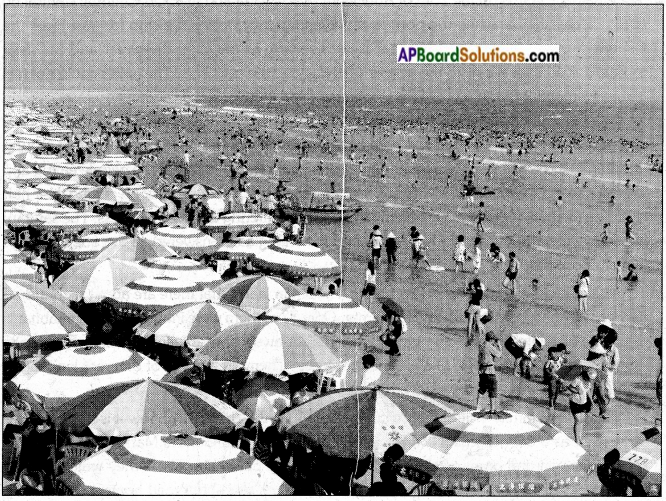
AP Board 7th Class English Solutions Chapter 5A A Trip to Andaman 1

Question 1.
What do you see in the picture?
Answer:
We see several people enjoying themselves at the beach.

Question 2.
Have you ever been to a sea beach ? If yes, which beach did you go to?
Answer:
Yes, I have. It is Marina beach in Chennai.

AP Board 7th Class English Solutions Chapter 5A A Trip to Andaman

Question 3.
What do you guess this lesson is going to talk about?
Answer:
I guess, it is going to talk about some islands.

Question 4.
What does the word Andaman bring to your mind ? Share your thoughts with your classmates.
Answer:
It brings to my mind curiosity of knowing about Andaman. Andaman and Nicobar Islands lie between India’s coast and Myanmar. They belong to India.

I. Answer the following questions.

Question 1.
Based on your reading of the passage, list the tourist attractions of Andaman Island. Which one of them has fascinated you the most? Why?
Answer:
List of some tourist attractions of Andaman Island:

  1. The Cellular Jail built by the British at Port Blair.
  2. The Mahatma Gandhi Marine National Park.
  3. The Havelock Island
  4. The majestic lighthouse at Havelock Island.
  5. Elephant beach.
  6. Scuba diving at Elephant beach.
  7. Radhanagar beach.

The most fascinating is the Elephant beach where swimmers take up Scuba diving into the sea.

Question 2.
Would you like to go to Andaman during holidays ? Give reasons for your answer.
Answer:
Yes, I would like to go to Andaman during holidays because after going through the passage on ’A Trip to Andaman’ and being fascinated by the places visited by the writer, 1 feel like visiting the tourist attractions of Andaman Island.

Question 3.
Which means of transport is, in your opinion, more enjoyable for visiting a place like Andaman? Give reasons for your answer.
Answer:
Mostly by ship and sometimes by ferry. Because in a big ship, we will be safe and happy and can get what we want. Besides, we can watch dolphins moving along the ship. We can also see coral reefs, beautiful fishes of different colours and sea turtles through glass-bottomed boats.

Question 4.
The Andaman and Nicobar Islands have been called a miniature India. Do you agree with this view? Give reasons for your answer.
Answer:
I agree with this view. It’s because each of the islands is very small. Only 37 islands of the total 600 islands are inhabited. Like in India, these islands have people of different languages, cultures and faiths. Yet they live happily together. They are the very small copies of India. So they are called miniature India.

AP Board 7th Class English Solutions Chapter 5A A Trip to Andaman

Question 5.
Who does T refer to in the passage?
Answer:
T refers to the writer.

Question 6.
The writer saw many interesting things on the ship. But which one surprised him the most? Why?
Answer:
The writer saw many interesting things on the ship. But, the most interesting thing that surprised him was that some people were sitting in a saloon getting their hair cut. It was interesting because he felt it strange to observe such thing on the ship.

Question 7.
How did the tourists enjoy on the beach?
Answer:
Some foreign tourists on the beach were basking in the sun and enjoying themselves. The tourists enjoyed swimming in the sea and riding on elephants. At the Elephant beach, some swimmers have undertaken ‘Scuba diving’.

Question 8.
Who guided the family on the Islands?
Answer:
No special guide was hired. Since the writer’s father had a little knowledge of the islands he managed to guide his family during their tour to the islands.

Question 9.
Why do you think the Scuba divers need air cylinders?
Answer:
The Scuba divers need air cylinders because they go to the bottom of the sea to watch the coral reefs, beautiful fishes and sea turtles. Besides, they stay for a long time beneath the sea and swim along with them.

Question 10.
Have you ever visited any tourist place? Share your experience.
Answer:
Yes, I have. I have visited Nagarjuna sagar and Ethipothala (waterfall). Nagarjuna sagar dam is very huge and it’s really thrilling to watch the water-fall when the dam was full and the gates are opened to release the water. Visiting Nagarjuna Konda by boat is also amusing. Later I have visited Ethipothala where water falls down from a very high-level place. It has filled my heart with joy and happiness.

AP Board 7th Class English Solutions Chapter 5A A Trip to Andaman

II. Tick the correct answer.

1. How did the author feel, when the windows and doors of their cabin were closed?
A) The author felt the ship sinking. ( )
B) The author felt uncomfortable. ( )
C) The author did not feel the movement of the ship. ( )
D) The author felt the fast movement of the ship. ( )

2. The most favourable time to visit Andaman is the
A) winter. ( )
B) spring. ( )
C) summer. ( )
D) monsoon. ( )

3. Why did the family go to Andaman?
A) to learn about the aboriginals ( )
B) to watch how foreigners enjoy themselves ( )
C) to explore a tourist spot ( )
D) to view only the sea beaches ( )

Answer:
1. C ( ✓ )
2. C ( ✓ )
3. C ( ✓ )

Vocabulary

I. Find the antonyms of the following words from the text and write them in your notebooks. Also, write one sentence each for the word and its antonym.

AP Board 7th Class English Solutions Chapter 5A A Trip to Andaman 2

1. impossible × possible
2. suddenly × gradually
3. ugly × beautiful
4. bright × dim
5. tasteless × tasty
6. dim × bright
7. above × below
8. hostile × friendly
9. cloudy × clear
10. notorious × famous

AP Board 7th Class English Solutions Chapter 5A A Trip to Andaman

Writing own sentences using the above antonyms:

1. You think it is possible to change his mind. But I feel it impossible as he is like a rock.
2. Changes come suddenly by revolution but gradually by evolution.
3. This painting is ugly but that is beautiful.
4. This light is too dim to read by.
It’s a bright morning.
5. I have already tasted it. It is not tasty but tasteless. So, please don’t taste it.
6. This light is too dim to read by.
Marriage hall is decorated with full of bright and colourful lights.
7. There’s a mirror above the washbasin. The author’s name was printed below the title,
8. She was openly hostile towards her parents. I don’t know why she was not friendly towards them.
9. The sky is cloudy. It is not clear.
10. The bar has become notorious as a meeting place for drug dealers.
One day I’ll be rich and famous.

II. Read the following sentences and notice how the word ‘wave’ has been used differently:

1. My sister Amala and I too waved our hands while Mom and Dad smiled at us.
2. Silky sands, foaming waves and cool breeze of the sea attracted us very much.
In Sentence I ‘wave’ is used as a verb in the past tense and in Sentence 2, it is used as a noun in its plural form. As a verb, it means ‘to move hand or arm from side to side’ and as a noun, it refers to ‘raised lines of water that move across the surface of the sea or ocean.’

Fill in the blanks with the appropriate forms of the words given in the brackets.
They can be used both as nouns and verbs.
1. Our volleyball team of our school ——– four matches. The fourth day ——– was excellent. (play)
2. Latha is ——– a lot of problems. I am sorry to see tears on her lovely ——–. {face)
3. My grand-daughter said, “Grandpa, you look very sweet when I see a on your face.” On hearing this Grandpa ——– at once.(smile)
4. Suresh ——– that he would pass the examination. But his disappeared when he saw the question paper. (hope)
5. When I answered a question correctly, the English teacher ——– me on my back arid said, “Well done, smarty.” Her ——– made me feel happy and proud. (pat)
Answer:
1. played (v), play (n)
2. facing (v), face (n)
3. smile (n), smiled (v)
4. hoped (v), hope (n)
5. patted (v), pat (n)

AP Board 7th Class English Solutions Chapter 5A A Trip to Andaman

III. Read the following sentences from the passage.

1. The ship set out after sounding a loud horn.
2. People who came to see off their friends and relatives cheered them up by waving their hands.
The sets of words underlined are‘phrasal verbs’.

Pick out from a dictionary more phrasal verbs beginning with the word ‘set’, find out their meanings, and use them in sentences of your own.
Answer:
Phrasal verbs with the word ‘Set’:
1. set about (something) = start doing something
Ex: She set about the business of cleaning the house.
2. set (somebody) against = make somebody oppose a friend or relative or someone else
Ex: She accused her husband of setting the children against her.
3. set out = start
Ex: Tomorrow he will set out for Mumbai.
4. set (somebody/something) apart from (somebody / something) = make (somebody/ something) different.
Ex: Her elegant style sets her apart from other journalists.

Grammar

Simple Past Tense

Read the following lines taken from the lesson:
Soon after the examinations were over, Mom made preparations for the trip. On the 25th of April, we took the Pinakini Express from Vijayawada and reached Chennai at 1 p.m.

The underlined words are verbs in the simple past tense and refer to actions that took place in the past. The Simple Past Tense is used here to talk of completed actions in the past.

Given below is the action plan prepared by the Headmaster of Mahatma Gandhi Zilla Parishad High School, Dosakayalapalli for a tour to Nagarjuna Sagar Project. They finished the tour on 15-10-2011. Describe the tour in the past tense by making appropriate changes in the verbs given in the action plan.

6.00 a.m.                       board the bus at the school
8.30 a.m.                       stop at Eluru for breakfast
12.00 noon                   reach the spot
1.00 p.m.                       take lunch
1.30 to 3.30 p.m.           visit the Nagarjuna Sagar project
3.30 to 4.30 p.m.           visit the museum
4.40 p.m.                       visit Ettipothala falls
5.00 p.m.                       board the bus
8.30 p.m.                       take supper at Eluru
10.30 p.m.                     reach the school

You can start like this:
On 15-10-2011, the students of MGZPH school, Dosakayalapalli started their tour to Nagarjuna Sagar Project. They boarded the bus at the school at 6.00 a.m…

AP Board 7th Class English Solutions Chapter 5A A Trip to Andaman

II. Past Continuous Tense

Read the following lines taken from the lesson:
Some foreign tourists on the beaches were basking in the sun and enjoying themselves. The underlined verbs ‘were basking’ and ‘(were) enjoying’ are in the Past Continuous Tense. The Past Continuous Tense is used to talk about or describe an action which someone was doing or an event which was happening at a particular time in the past.

I. Fill in the blanks with appropriate forms of the verbs given in the brackets.

1. They ________ with each other when the police______. ( fight, arrive)
2. When Rajesh _______, he _______down and______ his leg. ( run, fall, injure)
3. While he ______ it_______ to rain. ( play, begin)
4. The children_________a film when the lights ________ off. (watch, go off)
5. My mother was _______ when the guests __________. (still cook, arrive)
6. The teacher _________ when the principal ________ the room. ( teach, enter)
7. Father was _________ the T.V. when the telephone bell ______. (watch, ring)
8. We ________ready for our journey when the power _____________ off. (get, go)
Answer:
1. were fighting; arrived
2. was running, fell, injured
3. was playing; began
4. were watching; went
5. still cooking; arrived
6. was teaching; entered
7. watching; rang
8. were getting; went

Work in pairs

II. Narrate what your family members were doing yesterday when you reached home after school.
Answer:
When I reached home after school yesterday, mother was preparing snacks for us, father was talking to his colleague over phone, sister was practising music lessons and brother was getting ready to go to the playground. Grandparents were chatting with some villagers in the front yard.

AP Board 7th Class English Solutions Chapter 5A A Trip to Andaman

Writing

I. Arrange the following sentences in proper sequence using appropriate connectors and replacing ‘we’ with ‘they’. You can add some more information you may have liked in the passage.

1. We visited a beach called Elephant beach.
2. We reached Port Blair.
3. We travelled by a ferry from Port Blair to a place called Havelock island.
4. In the evening we boarded’a ship for Port Blair.
5. We visited Radha nagar beach.
6. After a while, we reached an exciting place, the Mahatma Gandhi Marine National Park.
7. We had been longing to make a trip to Andaman.
8. We visited a famous national monument, the Cellular jail.
Answer:
The writer and the members of his family had been longing for long to make a trip to Andaman. At last, they visited the place last summer. They travelled from. Vijayawada to Chennai by train, and in the evening they boarded a ship for Port Blair. From there, they sailed in the ship ‘ for five days and reached Port Blair. At Port Blair, they visited a famous national monument, the Cellular Jail (now converted into a hospital). After a while they reached an exciting place, the Mahatma Gandhi Marine National Park. Then they travelled by a ferry from Port Blair to a place called Havelock Island. On the ferry they enjoyed snacks like panipuri, samosa. There they visited a beach called Elephant beach. They were also thrilled to watch Scuba diving. Finally, they visited Radha nagar beach. There they had jolly elephant rides and relished delicious sea food. It was a memorable trip for them.

II. Describing a place

You have read about a famous tourist place, Andaman. After reading the description don’t you feel that you have actually visited the place? This is because the author has given a vivid picture of the place through the description of the place and the activities. When you want to describe a place you need to find answers for the following questions:

1. Where is the place located? What is it famous for?
2. How can one reach there? How is the weather during the time of the visit? What is the best time to visit? What things are to be carried? What sort of accommodations available?
3. What places and things can be seen on the way to the place?
4. What are the major tourist attractions?

AP Board 7th Class English Solutions Chapter 5A A Trip to Andaman

One of your friends wishes to visit the place you have visited recently. Write a letter to your friend describing the details mentioned above to help him make his/ her trip successful.
Answer:

5-23-13/B,
6/18 Brodipet, GUNTUR.
6th June, 20xx.

My dear Guruvardhan,

I am fine and pink in health. I hope the same with you there.

I would like to describe the place, Hyderabad which I have visited recently. Hyderabad is the capital of Telangana. It is a big cosmopolitan city. People of different languages, cultures and traditions live harmoniously together. There are many places worth-seeing in Hyderabad. Some of them are – 1) the Charminar 2) the Salaijung Museum 3) the Legislative Assembly 4) the Birla Mandir 5) Nehru Zoological Park 6) Planetarium 7) The Tank Bund 8) Rajiv International Airport 8) Ramoji Film City 9) Hussain Sagar and the Buddha Statue.

It is a lovely city. The climate is fine. The Hussain Sagar joins the twin cities namely Hyderabad and Secunderabad. You should visit it soon.

Please convey my regards to your parents.

Yours lovingly,
Hanuman.

Study Skills

This table shows the climate of Port Blair.
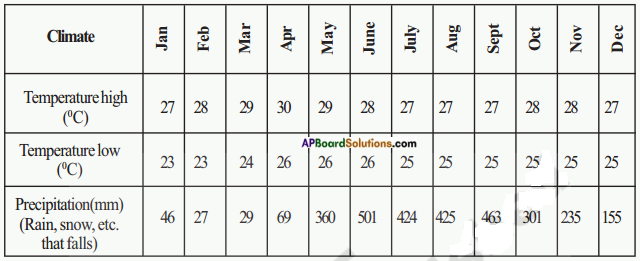
AP Board 7th Class English Solutions Chapter 5A A Trip to Andaman 3
Write briefly in your own words the best and the most uncomfortable time to visit Port Blair. Give reasons.
Answer:
The best comfortable time to visit Port Blair, the capital of Andaman and Nicobar Islands is the month of April. In April, the maximum temperature is 30°C and the minimum temperature is 26°C. It is neither hot nor cold there in that month. The precipitation is 69.

The most uncomfortable time is the month of September because it is somewhat cold then. The sun is not so bright then. Above all, the precipitation is rather high. It is 463. The maximum temperature is 27°C and the minimum temperature is 25°C We feel uncomfortable then.

AP Board 7th Class English Solutions Chapter 5A A Trip to Andaman

Listening and Speaking

I. Your teacher will read the story ‘Gulliver in Lilliput’. Listen carefully and answer the following questions:

GULLIVER IN LILLIPUT

Gulliver was a doctor on a ship. He was an Englishman. There was a bad storm and the ship hit a rock and broke into two pieces. It was night time. However, Gulliver swam forward and at last reached an island called Lilliput. The people were called Lilliputians. Gulliver was too tired. He could not open his eyes. He soon went to sleep. Next morning when he woke up he could not move. He was held down by some ropes. His long hair was also pinned to the ground. Then something climbed on to his leg and came up to his chin. It was a little mar. about fifteen centimetres high. He carried a bow and an arrow in his hand.

Then forty more little people climbed onto Gulliver’s body. He was very surprised and gave a loud shout. Immediately all the little men ran away. But they came back soon.

At first the ropes were too strong for him to break. But somehow, after a long struggle Gulliver broke some of them. He could move one of his arms. When they saw this, the little people shouted and shot their little arrows into him. But the arrows did not hurt Gulliver very much. They were like little pins.

Gulliver lay still. He did not move. After some time the little people stopped shooting arrows at him. Gulliver asked for some food. Over a hundred people brought baskets full of meat and loaves of bread. Gulliver ate them and fell asleep.

The little men took Gulliver to their king. The king liked Gulliver very much. He told his officers to take Gulliver to the biggest building in the land. No house was big enough for Gulliver to live in, but he was able to creep inside the building and lie down. The beds were too small for Gulliver, so they took hundreds of beds and joined them together!

Gulliver lived among the little people for some time. He wanted to go home. Fortunately, one day Gulliver found a boat floating near the seashore. He sailed out to sea in that boat. Later a big ship found him and took him back to England.

AP Board 7th Class English Solutions Chapter 5A A Trip to Andaman

1. Why did Gulliver go to Lilliput?
Answer:
There was a bad storm and the ship in which Gulliver was sailing hit a rock and broke into two pieces. It was night time. So, Gulliver swam forward and reached Lilliput.

2. Why did the little people shoot arrows at Gulliver?
Answer:
He appeared like a huge living structure. They feared he had come to harm them. So they shot arrows at him.

3. What do you think is the size of the Lilliputian’s house?
Answer:
The house was too small for Gulliver to live in.

4. How many Lilliputians can you carry in your bag?
Answer:
I can carry at least a hundred Lilliputians, in my bag.

5. Would you like to live among such strange people?
Answer:
No, I would not.

6. Pigmies are also very small people. Find out who is smaller ? A pygmy or a Lilliputian?
Answer:
A Liliputian.

7. Why did the King like Gulliver?
Answer:
Because Gulliver had not hurt any of his men.

II. Work in pairs.

Ask and answer the following questions:

1. If you were the King, how would you use Gulliver?
Answer:
I would use him as the protector of my kingdom.

2. If you lived in Lilliput, what problems would you face?
Answer:
I couldn’t walk in the streets well. I couldn’t live in a house. I couldn’t get enough food.

3. In stories, we often come across very small people like elves and dwarfs.
How are they different from Lilliputians?
Answer:
Lilliputians are much smaller than elves and dwarfs.

AP Board 7th Class English Solutions Chapter 5A A Trip to Andaman

III. Here is a list of places of South India Tourism. Tell your group about the city you would like to visit and why. What is special about the city? What should visitors do there?

AP Board 7th Class English Solutions Chapter 5A A Trip to Andaman 4

Answer:
Amaravathi is a historical place. It is the Mandal headquarters. It fs in Guntur district of the state Andhra Pradesh. It is on the bank of the river Krishna. From the other side of the river, you can reach Kanchikacharla in Krishna district. There is a direct and clear way from Guntur to Amaravathi (a distance of 34 kms) from Sattenapalli to Amaravathi (a distance of 34 kms) from Vijayawada (a distance of 47 kms) and from Mangalagiri (a distance of 34 kms). There is also a clear way from Krosuru and Atchampet to Amaravcithi. There is a great temple of Lord Siva. The Sivalingam here is very high. You can also see the huge statue of Lord Buddha. You can visit the Amaravathi Museum. Pilgrims round the state pay a visit to Amaravathi.

A Trip to Andaman Summary in English

The writer had been longing to make ci trip to Andaman. His father fulfilled his desire during the last summer holidays. After the examinations were over, the writer’s family took the Pinakini Express on the 25th of April from Vijayawada and reached Chennai Central by 1 p.m. Later they reached the port. In the evening, they boarded a ship for Port Blair, the capital of the Andaman and Nicobar Islands. Sitting in the ship, the writer and his sister Amalai waved their hands to the people who cheered the travellers. The writer could not feel. the movement of the ship when the doors and the windows of the cabin were closed. When the ship was going, they saw dolphins swimming along the ship to know. Dolphins sprang and dived again and again. If was very amusing to the writer. Later, the writer went around the ship to know what other people were d oing in the ship. He saw some people eating and drinking in the restaurant. He was surprised to see some people in a saloon getting their hair cut. The medical staff was busy treating the patients suffering from sea-sickness. The sanitary workers were doing their work. The crew of the ship gladly answered all the queries of the writer about the ship.

After two days, they reached Port Blair. The writer learnt that there are about six hundred islands between India’s coast and Myanmar. Only 37 of them were inhabited. The inhabitants were the aboriginal tribes. Some of them lived far away from the civilized society. Despite this, the islands look today like a miniature India. There are people of different languages, cultures and faiths. Yet they all live happily together.

The writer’s family visited the Cellular jail, built by the British. But now it is not a jail. It is now used as a big hospital. Next, they visited the Mahatma Gandhi Marine National Park. There one can find open creeks running through the park area. There they watched coral reefs, fishes of different colours and sea turtles through glass-bottomed boats.

AP Board 7th Class English Solutions Chapter 5A A Trip to Andaman

Later they travelled by a ferry from Port Blair to Havelock island where they saw a majestic lighthouse. They saw tourists enjoying swimming in the sea and riding on elephants. They took lots of pictures of the beautiful scenery.

Next, they visited Elephant beach. They watched Scuba’diving in which the swimmers dive into the sea from the motor boats and I stay for a long time beneath the sea. They swim along with beautiful fishes and sea turtles. Scuba diving filled the writer’s heart with a spirit of adventure.

Lastly, they visited Radhanagar beach. There the writer and his sister Amala enjoyed a jolly ride on the elephant. There they tasted Tandoori fish and other sea foods. The writer felt he could never forget his trip to Andaman.

A Trip to Andaman Glossary

1. longing (n): strong feeling or desire

2. vanish (v): disappear

3. treating (v): curing an illness or injury

4. inhabited (v): lived

5. aboriginal (adj): original people belonging to a place .

6. creek (n): a narrow area of water where the sea flows into the land.

7. ferry (n): a boat or a ship that carries people, goods, vehicles across a river.

8. coral reefs (n): a hard substance that is red, pink or white in colour and that forms on the bottom of the sea.

9. miniature (n): very small copy/model of something or very small detailed painting.

10. cherish (v): love sb/sth very much and want to. protect them or it

11. majestic (adj): impressive because of size or beauty

AP Board 7th Class English Solutions Chapter 5A A Trip to Andaman

12. basking (v): enjoying sitting/lying in the heat/light of the sun

13. breeze (n): a light wind

14. amazement: great surprise or wonder

15. monument (n): a building built to remind people of a famous person or event

16. spectacle (n): a performance/an event that is impressive to look at

17. bade (v): (V2 form of bid) said farewell/good-bye

18. boarded (v): got on a ship/train/plane/bus
AP SSC 10th Class Biology Important Questions Chapter 8 Heredity

AP State Board Syllabus AP SSC 10th Class Biology Important Questions Chapter 8 Heredity.

AP State Syllabus SSC 10th Class Biology Important Questions 8th Lesson Heredity

10th Class Biology 8th Lesson Heredity 1 Mark Important Questions and Answers

Question 1.
How did you get the characters from your parents and grandparents?
Answer:
By Genes

AP SSC 10th Class Biology Important Questions Chapter 8 Heredity

Question 2.
Why man is called a moving museum of vestigial organs?
Answer:

  1. The organs which are not useful in animals are called ‘vestigial organs’. There are nearly 180 vestigial organs in human beings,
  2. Hence, human being is said to be a moving museum of vestigial organs.

Question 3.
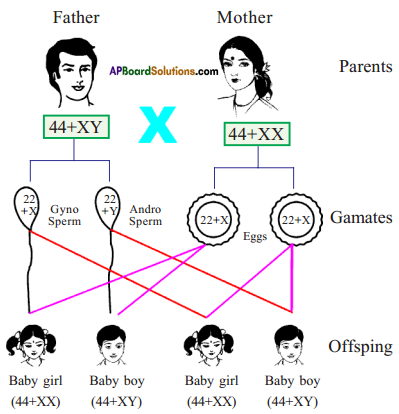
Observe the given Flow-chart and answer the question.
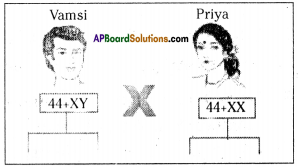
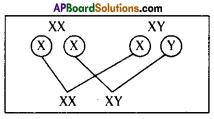
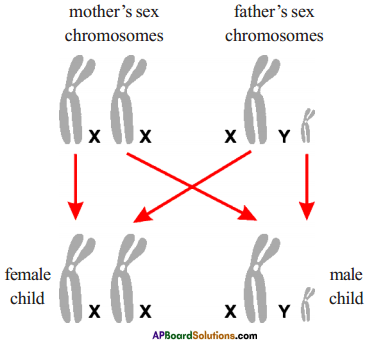
AP SSC 10th Class Biology Important Questions Chapter 8 Heredity 1Who decides the sex of the baby – mother or father? How?
Answer:
Father decides the sex of the baby.
Mother has XX chromosomes. Father has ‘XY’ chromosomes. Y chromosome is determining factor. So father is responsible.

Question 4.
What examples you will give to prove that Lamarckism is not correct?
Answer:
August Weismann, tested the theory proposed by Lamarck by experiments on rats. He removed tails of parental rats. He observed for twenty two generations but still off springs are normal with tails.

Question 5.
Which chromosomes determine the sex in human beings?
Answer:
Allosomes or Sex chromosomes. They are xx (girls) and xy (boys).

AP SSC 10th Class Biology Important Questions Chapter 8 Heredity

Question 6.
Why do we call appendix as a vestigial organ?
Answer:

  1. Vestigial organ is the organ of our body which is smaller and simpler than those in related species they have lost their original function.
  2. Appendix is highly developed in ruminants which helps in the digestion of cellulose. But, in human beings the cellulose is eliminated as undigested food. Hence in human beings appendix has no role in cellulose digestion. So, we call it as a vestigial organ.

Question 7.
What are variations?
Answer:
Differences in characters within very closely related groups of organisms are referred to as variations.

Question 8.
Who is known as father of genetics?
Answer:
Gregor Johann Mendel is known as father of genetics.

Question 9.
Why Mendel has chosen garden pea plant as material for his experiments?
Answer:
Pea plant has following advantages.

  1. Well defined characters
  2. Bisexual flowers
  3. Predominently self fertilization
  4. Early hybridization
  5. Annual plant.

Question 10.
What are the vitamins present in pea plant?
Answer:
The vitamins present in pea plant are ‘A, C, E, K and B’.

Question 11.
What is F3 generation?
Answer:
F3 generation represents the offsprings produced from the individuals of F2 generation.

Question 12.
What is a factor?
Answer:
The determining agent responsible for each trait is called a factor.

Question 13.
WTiat is law of dominance?
Answer:
According to Mendel, among a pair of alleles for a character, only one expresses itself in the first generation as one of the allele is dominant over the other. This is known as law of dominance.

AP SSC 10th Class Biology Important Questions Chapter 8 Heredity

Question 14.
What is phenotype ratio?
Answer:
The characters which can be seen is known as phenotype and their ratio is called phenotype ratio.

Question 15.
What is the phenotype ratio in F1 generation of monohybrid cross?
Answer:
The phenotype ratio in F1 generation of monohybrid cross is 3 : 1.

Question 16.
What is genotype ratio?
Answer:
The genetic makeup of an individual with reference to a specific character under consideration is called genotype and their ratio is called genotype ratio.

Question 17.
What is the genotype ratio in F2 generation of monohybrid cross?
Answer:
The genotype ratio in F2 generation of monohybrid cross is 1 : 2 : 1.

Question 18.
What are genes?
Answer:
Genes are the factors which are responsible for characters or traits of an organism. These are the units of heredity that are transferred from a parent to offspring. These are small segments of DNA on a chromosome.

Question 19.
What is an allele?
Answer:
The pair of genes which are responsible for character is called allele.

Question 20.
What are homozygous alleles?
Answer:
If an organism has two copies of the same allele for example TT or tt it is homozygous for that trait.

Question 21.
What are heterozygous allele?
Answer:
If an organism has one copy of two different alleles for example Tt, then it is heterozygous.

AP SSC 10th Class Biology Important Questions Chapter 8 Heredity

Question 22.
What is law of independent assortment?
Answer:
In the inheritance of more than one pair of characters (traits), the factors for each pair of characters assorted independently of the other pair. This is known as “Law of independent assortment”.

Question 23.
Wliat is the law of segregation?
Answer:
The law of segregation states that every individual possesses a pair of alleles for any particular trait and that each parent passes a randomly selected copy of only one of these to its offspring.

Question 24.
What are heritable traits?
Answer:
Traits that may be passed on from one generation to the next are called as heritable traits.

Question 25.
What is heredity?
Answer:
The process of acquiring characters or traits from parents is called heredity.

Question 26.
What is inheritance?
Answer:
The process in which traits are passed from one generation to another generation is called inheritance.

Question 27.
What is genetic drift?
Answer:
Change in the frequency of genes in small populations is called genetic drift.

Question 28.
Who was the first person to propose the theory of evolution?
Answer:
Jean Baptist Lamarck was the first person to propose the theory of evolution.

Question 29.
What are acquired characters?
Answer:
The characters developed during the lifetime of an organism are called acquired characters.

AP SSC 10th Class Biology Important Questions Chapter 8 Heredity

Question 30.
What is inheritance of acquired characters?
Answer:
Lamarck proposed that the acquired characters are passed to its offsprings i.e., to next generation. This is known as inheritance of acquired characters.

Question 31.
Who wrote the book “principles of geology” of evolution?
Answer:
The book “principles of geology” of evolution was written by Charles Lyell.

Question 32.
What is micro evolution?
Answer:
Small changes within the species is known as micro evolution.

Question 33.
What is macro evolution or speciation?
Answer:
The process of evolution through which new species are going to be formed is known as speciation or macro evolution.

Question 34.
The double helix structure of DNA was discovered by?
Answer:
James Watson and Francis Crick discovered the double helix structure of DNA.

Question 35.
What are autosomes?
Answer:
Chromosomes whose number and morophology do not differ between males and females of a species are called autosomes.

Question 36.
What are allosomes?
Answer:
The chromosomes that determine sex of the organism are called allosomes.

Question 37.
What is meant by survival of the fittest?
Answer:
According to Darwin’s theory of natural selection, nature only selects or decides which organism should survive or perish in nature. This is the meaning of survival of the fittest.

Question 38.
Write the expanded form of DNA.
Answer:
The expanded form of DNA is Deoxyribo Nucleic Acid.

AP SSC 10th Class Biology Important Questions Chapter 8 Heredity

Question 39.
What is the basis of evolution?
Answer:
Selection of variants by environmental factors forms the basis of evolution.

Question 40.
What are analogous organs?
Answer:
The organs which have similar appearance and functions but have different structure and origin. Ex : Wings of a butterfly, bat and a bird.

Question 41.
What is embryology?
Answer:
Embryology is the study of the development of an organism from egg to adult stage.

Question 42.
What is Palaeontology?
Answer:
The study of fossil is called Palaeontology.

Question 43.
How palaeontologists determine the age of fossil?
Answer:
Palaeontologists determine the age of fossil by using carbon dating method.

Question 44.
Where do scientists collected fossil of dinosaurs?
Answer:
Scientists collected fossils of dinosaurs from Yamanapalli in Adilabad district in Telangana State.

Question 45.
What are connecting links?
A. The organisms which bear the characters of two different groups are called connecting links.

Question 46.
Which organism is recognised as the connecting link between aves and reptiles?
Answer:
Archeopteryx is recognised as the connecting link between aves and reptiles.

Question 47.
What is human evolution?
Answer:
Human evolution is the evolutionary process leading upto the appearance of modern human beings.

AP SSC 10th Class Biology Important Questions Chapter 8 Heredity

Question 48.
How do variations occur?
Answer:
Variations develop during reproduction in organisms. Sexual reproduction and errors in DNA copying lead to variations in offspring in a population.

Question 49.
What is divergent evolution?
Answer:
The evolutionary process through which homologous organs develop is called divergent evolution.

Question 50.
What is convergent evolution?
Answer:
The evolutionary process through which analogous organs develop is called convergent evolution.

Question 51.
What are vestigial organs?
Answer:
Organs which are not useful in animal are called vestigial organs.

Question 52.
Who proposed the theory of inheritance of acquired characters?
Answer:
Jean Baptist Lamarck proposed the theory of inheritance of acquired characters.

Question 53.
Who proved that the bodily changes which may occur due to environment won’t be passed to its offsprings?
Answer:
Augustus Weisemann proved that the bodily changes which may occur due to environment won’t be passed to its offsprings.

Question 54.
How the study of fossil is considered significant?
Answer:
The study of fossil is considered significant because

  1. Fossils provide direct evidence of past life and
  2. Fossils provide convincing proof of organic evolution.

Question 55.
What are the nitrogen bases present in DNA?
Answer:
The nitrogen bases present in DNA are adenine, guanine, thymine and cytosine.

AP SSC 10th Class Biology Important Questions Chapter 8 Heredity

Question 56.
How do embryological studies provide evidence for evolution?
Answer:
The similarities in embryonic development reinforce the idea of evolution from common ancestors. The sequence of embryonic development in different vertebrates shows similarities.

Question 57.
Why Mendel selected garden pea plant for his experiments? Give a reason.
Answer:
Mendel selected garden pea plant for his experiments as these can be self pollinated.

Question 58.
What is the evolutionary significance of the fossil archaeopteryx?
Answer:
Archaeopteryx serves as a connecting link between birds and reptiles. It is the fossil evidence to show that birds have evolved from reptiles.

Question 59.
How does the creation of variation in a species ensure survival?
Answer:
The creation of variations in a species enable them to adapt according to the changes and the new needs thus they will enable the survival of the species.

Question 60.
Define evolution.
Answer:
Evolution is the sequence of gradual changes which takes place in the primitive organisms over millions of years in which new species are produced.

10th Class Biology 8th Lesson Heredity 2 Marks Important Questions and Answers

Question 1.
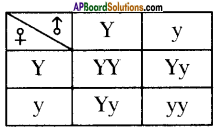
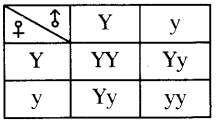
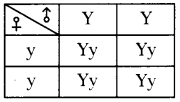
Write Phenotypic and Genotypic ratio of table given at side.
AP SSC 10th Class Biology Important Questions Chapter 8 Heredity 2(OR)
Write the Phenotypic and Genotypic ratio when heterogygous (Yy) pea plant is hybridised with the same kind of plant.
(OR)
Write the phenotypic and genotypic ratios of Mendel’s cross-pollination experiments in pea plants with heterozygous yellow seeds (Yy) with that of the same type, i.e., Yy.
Answer:
Phenotypic ratio -3:1
Genotypic ratio -1:2:1

AP SSC 10th Class Biology Important Questions Chapter 8 Heredity

Question 2.
Define and explain Variations with examples.
Answer:
Variations: Differences in characters within very closely related groups of organisms are referred to as variations.
(OR)
Differences among living beings are called variations.
Ex:

  1. Earlobes in some humans are free and in others attached.
  2. Colour of eyes (cornea) in some people are blue and in others black.
  3. Colour of skin is black or white.

Question 3.
“Human being is said to be a moving museum of vestigial organs”. How can you support this statement?
Answer:

  1. During the course of evolution, some organs remain in organisms. For example, appendix in the digestive system.
  2. In human beings it has no role to play in the process of digestion.
  3. But in herbivores like rabbit appendix play important role.
  4. Such type of organs which are not useful in animal are called vestigial organs.
  5. There are nearly 18 vestigial organs in human beings.
  6. For example pinna, hair on skin, mammary glands in man, etc.
  7. That’s why human being is said to be a moving museum of vestigial organs.

Question 4.
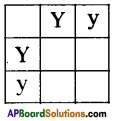
Fill the given table and write the genotypic ratio basing on table.
AP SSC 10th Class Biology Important Questions Chapter 8 Heredity 3
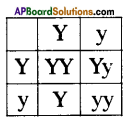
Answer:
AP SSC 10th Class Biology Important Questions Chapter 8 Heredity 4
The genotypic ratio is 1: 2: 1

AP SSC 10th Class Biology Important Questions Chapter 8 Heredity

Question 5.
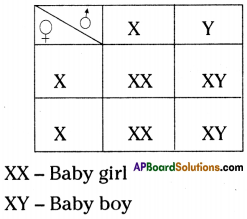
Who decides the sex of the baby, mother or father? Explain with a flow chart.
(OR)
Draw a flow-chart showing the sex determination in human beings.
Answer:
Father decides the sex of the baby.
AP SSC 10th Class Biology Important Questions Chapter 8 Heredity 5

Question 6.
Define the terms phenotype and genotype.
Answer:
Phenotype: The observable properties of an organism that are produced by the interaction of the genotype and the environment. These characters can be seen.
Genotype: The genotype is the genetic make-up an individual usually with reference to a specific characteristic consideration.

Question 7.
What questions you will ask a palaeontologist about fossils?
Answer:

  1. What are fossils?
  2. How do they preserve?
  3. What can be the actual remains?
  4. How do they form?
  5. What do we call the study of fossil?
  6. Can you tell some examples of fossils?
  7. How do the palaeontologists determine the age of fossils?
  8. What are dinosaurs and ketosaurs? In which years they belong?
  9. Where did they collect the fossil of dinosaurs? What is the length of this fossil?
  10. Where did they preserve the fossil of dinosaurs?

AP SSC 10th Class Biology Important Questions Chapter 8 Heredity

Question 8.
How does the embryological evidences support that Evolution has taken place?
Answer:
Evidences:

  1. Remarkable similarities in the Embryos of different animals from fish to man.
  2. Tadpole of frog resembles the fish more than the frog.
  3. Life history of every individual exhibits the structural features of their ancestors.
  4. The resemblance is so close at an early stage, it is difficulty to distinguish one embryo from other.

Question 9.
Observe the checker board and answer the following questions.
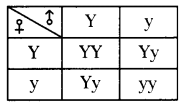
AP SSC 10th Class Biology Important Questions Chapter 8 Heredity 6i) Write phenotypic ratio of monohybrid cross.
ii) How many heterozygous plants are present in the checker board?
Answer:
i) Phenotypic ratio 3 : 1
ii) Two heterozygous plants – (Yy, yY)

Question 10.
What happens if there is no evolution?
Answer:

  1. Evolution is a continuous and comprehensive process.
  2. If it does not take place, there is no formation of new species.
  3. Variations do not take place and hence desirable traits are not developed.
  4. All the Earth would be with the primitive species without any changes.

Question 11.
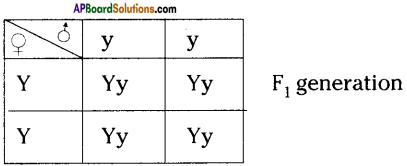
If you cross a plant with pure yellow seeds (YY) with a plant with pure green seeds (yy), what would be the colour of the seeds in F2 generation? Show in a checker board.
Answer:
AP SSC 10th Class Biology Important Questions Chapter 8 Heredity 7All pea plants are yellow in F1 generation on self pollination in F1 generation.
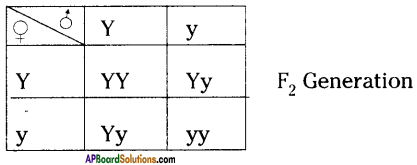
AP SSC 10th Class Biology Important Questions Chapter 8 Heredity 8In F2 generation, we can observe that 75% are yellow seed producing pea plants and 25% are green ones.
Hence the phenotypic ratio is 3 : 1 the genotypic ratio is 1 : 2 : 1

AP SSC 10th Class Biology Important Questions Chapter 8 Heredity

Question 12.
If you meet a historian to clarify your doubt on ‘Man has first born in African conti¬nent’, what type of questions will you ask him / her?
Answer:

  1. What is human evolution?
  2. When were early man like forms appeared on land?
  3. When did the fossil of the homosapiens appeared on earth?
  4. Where did the early man lived?
  5. Where can we trace the earliest members of the human race homosapiens?
  6. When do some of our ancestors left Africa?
  7. How the residents of Africa migrated to other places?
  8. Why did the residents of Africa migrated to other places?
  9. Are all humans evolved from single ancestor?

Question 13.
What is the difference between Phenotype and Genotype?
Answer:

Phenotype Genotype
1. The characters which can be seen is known as phenotype. 1. The genetic make up of an individual is known as genotype.
2. We can’t determine the internal factors by phenotype. 2. Genotype itself is the indication of internal factors.
3. It tells about only the dominating characters which express externally. 3. It tells about both dominant and recessive characters present within.
4. The phenotype ratio in monohybrid cross is 3 : 1. 4. The genotype ratio in mono-hybrid cross is 1 :2 : 1.

Question 14.
What are the differences between homozygous and heterozygous ?
Answer:

Homozygous Heterozygous
1. It refers to having two identical alleles for a single trait. 1. It refers to having two different alleles for a single trait.
2. For example, for long pea plant homozygous combination is ‘TT’ 2. For example, for long pea plant heterozygous combination is ‘Tt’
3. On self pollination homozygous plants produce homozygous plants only. 3. On self pollination heterozygous plants produce homozygous dominant, heterozygous dominant and homozygous recessive plants in 1: 2 :1 ratio respectively.

AP SSC 10th Class Biology Important Questions Chapter 8 Heredity

Question 15.
How do traits get expressed according to Mendel?
Answer:

  1. Mendel hypothesised that each character or trait is expressed due to a pair of factors or alleles.
  2. Now these alleles are known as genes.
  3. Gene is made up of a segment of DNA which provide information of protein.
  4. Protein is needed for biochemical process.
  5. If the proteins work efficiently, the traits get expressed in better way.
  6. Thus genes control the traits or characters.

Question 16.
What is speciation? How it occurs?
Answer:

  1. Origin of new species from existing one is called speciation.
  2. It may occur due to a) mutations and b) natural selection.

Question 17.
What is sex chromosome? Name the two types of sex chromosomes. Mention the chromosomes present in male and female?
Answer:

  1. The chromosome which determine the sex of a person is called sex chromosome.
  2. The two types of sex chromosomes are X chromosome and Y chromosome.
  3. Sex chromosomes in male is XY.
  4. Sex chromosomes in female is XX.

Question 18.
Write a short notes on the law of “inheritance of acquired characters”.
Answer:

  1. Law of inheritance of acquired characters was proposed by Jean Baptist Lamarck.
  2. He thought that the characters acquired by an organism in its life time are passed to its offsprings.
  3. He thought that at same point of time in the history, the size of giraffe was equal to that of deer.
  4. Due to shortage of food material on the ground and lower branches of trees giraffes started stretching their necks.
  5. Because of continuous usage of neck, after several generations giraffes obtained longer necks.
  6. Such characters that are developed during the lifetime of an organism are called acquired characters.

AP SSC 10th Class Biology Important Questions Chapter 8 Heredity

Question 19.
Write a short notes on the theory of “Natural selection”.
Answer:

  1. The theory of natural selection was proposed by Charles Darwin.
  2. This theory states that nature only selects or decides which organism should survive or perish in nature.
  3. The organisms with useful traits will survive.
  4. The organisms having harmful traits are going to be perished or eliminated from its environment.

Question 20.
Write briefly about “Survival of the fittest”.
Answer:

  1. Variations which are useful are retained, while those which are harmful are removed.
  2. In a population where there is a struggle, the “fittest” will be survived.
  3. Nature favours only useful variations.
  4. Each species tends to produce large number of offspring.
  5. They compete with each other for food, space, mating and other species.
  6. In this struggle for existence, only the fittest can survive. This is called survival of the fittest.
  7. Over long period of time this leads to formation of new species.

Question 21.
How are new species evolved?
Answer:

  1. Sexual reproduction and errors in DNA copying leads to variations in offspring in a population.
  2. Organisms contain variations that help to adapt to its environment going to be survived more efficiently.
  3. But in the same population, the organisms which contain the trait which may not help to adapt in its environment may be perished or eliminated slowly.
  4. These small changes within the population due to variations is called micro evolution.
  5. When organisms of the same species with variations are separated by some cause for long years, lot of variations may take place in these species.
  6. These accumulated variations make them unable to mate and produce new offsprings.
  7. Thus new species form and this is known as speciation or macro evolution.

AP SSC 10th Class Biology Important Questions Chapter 8 Heredity

Question 22.
Write a brief note on homologous organs.
Answer:

  1. Homologous organs are the organs which perform different functions but have similar structure and origin.
  2. For example forelimb of a whale (swimmer), bat (flyer), horse (runner), mole (digger) and man (grasping).
  3. If we carefully observe the anatomy of all these animals, they have a common pattern in the arrangement of bones.
  4. Even though their external form and functions are different, they are similar internally.
  5. Thus it indicates that all the vertebrates have evolved from a common ancestor.

Question 23.
What are fossils? Write a short note on their formation.
Answer:

  1. Fossils are evidence of ancient life forms or ancient habitats which have been preserved by natural processes.
  2. Fossil evidence is typically preserved within sediments deposited beneath water and land.
  3. They can be actual remains of once lived such as bones or seeds or even traces of past event such as dinosaurs foot print or ripple marks on a pre-historic shore.
  4. Usually when organisms die, their bodies will be decomposed and lost.
  5. But sometimes the body or at least some parts may be in an environment that does not let it decompose completely.
  6. For example if a dead insect get caught in mud, it will not decompose quickly and the mud will eventually harden and retain the impression of the body parts of insect.
  7. All such preserved traces of living organisms are called fossils.

Question 24.
How would you appreciate Jean Baptist Lamarck for his contribution to the biology?
Answer:

  1. Jean Baptist Lamarck was the first person to propose the theory of evolution.
  2. He proposed that the acquired characters are passed to its offspring i.e., to next generation.
  3. This is known as inheritance of acquired characters.
  4. For example elongation of neck and forelimbs in giraffe.
  5. Even though this theory was disproved, his contribution to biology was appreciable because it changed the belief of the people of olden days that the organisms on the earth have not undergone any change.

AP SSC 10th Class Biology Important Questions Chapter 8 Heredity

Question 25.
How did August Weisemann disprove the theory of “Inheritance of acquired characters” proposed by Lamarck? (OR)
What example will you give to prove that Lamarckism is not correct?
Answer:

  1. August Weisemann, tested the theory of “Inheritance of acquired characters” proposed by Lamarck by an experiment on rats.
  2. He removed tails of parental rats.
  3. He observed its offsprings which have normal tails.
  4. He has done it again for twenty two generations but still offsprings are normal with tails.
  5. He proved that the bodily changes are not inherited. So they won’t be passed to its offspring.
  6. Thus he disproved the theory of “Inheritance of acquired characters”.

Question 26.
Some organisms or species adapt better and survive in a community of organisms. Why do you think this may happen?
Answer:

  1. This may happen due to the variations posessed by the organisms which are suitable to that habitat.
  2. The variations that help the organism to collect food to escape from their enemies, increase the chance of survival for the organism than the other organisms.
  3. In general, variations come during sexual reproduction or mutation.
  4. If the variations are useful, that organisms can adapt better and survive.
  5. These organisms can be selected by the nature.

AP SSC 10th Class Biology Important Questions Chapter 8 Heredity

Question 27.
What do you understand about pure breeds?
Answer:

  1. Pure breed is that expresses the selected character over several generations.
  2. A pure breed will have both the factors of the same type.
  3. It means all the pure breeds are homozygous.
  4. All the gamates produced by them will have same type of factor.
  5. Pure breed on self pollination will give pure breed again.

Question 28.
What do you understand about F1 generation?
Answer:

  1. F1 generation or first filial is the offspring of first generation parents.
  2. Cross pollination of pure breeds will give F1 generation.
  3. All the individuals produced in F1 generation are heterozygous.
  4. Only the dominant characters are expressed in this generation.

Question 29.
What are the differences between F1 generation and F2 generation of mono hybrid cross?
Answer:

F1 generation F2 generation
1)   F1 generation or first filial is the offspring of first generation parents.

2)    Cross pollination of pure breeds will give F1 generation.

3)    All the individuals produced in F1 generation are heterozygous.

4)    Only the dominant characters are expressed in this generation.

5)    All the individuals produced in F1 generation are same, both phenotypically or genotypically.

1)     F2 generation is the offspring of second generation parents.

2)     Self or cross-pollination of F1 generation will give F2 generation.

3)     Individuals produced in F2 generation may be homozygous or heterozygous.

4)     Homozygous recessive plants express recessive characters.

5)     In F2 generation individuals, the phenotype ratio is 3:1 and the genotype ratio is 1 : 2 : 1.

AP SSC 10th Class Biology Important Questions Chapter 8 Heredity

Question 30.
What are the differences between monohybrid cross and dihybrid cross ?
Answer:

Monohybrid cross Dihybrid cross
1) In monohybrid cross only one pair of contrasting characters are taken into consideration.

2) In monohybrid cross, the phenotype ratio of F2 generation individuals is 3:1.

3) In monohybrid cross, the genotype ratio of F2 generation individuals is 1:2:1.

1) In dihybrid cross two pairs of contrasting characters are taken into consideration.

2) In dihybrid cross, the phenotype ratio of F2 generation individual is 1:2: 1.

3) In dihybrid cross, the genotype ratio of F2 generation individuals is 9 : 3 : 3 : 1.

Question 31.
Write a short note on fossils of dinosaurs, ketosaurs collected in Telangana state.
Answer:

  1. A rare and magnificient fossil of the dinosaurs, ketosaurs were collected in Yamanapalli in Adilabad district of Telangana district.
  2. They belong to the lower jurassic age going back to about 160 million years.
  3. This fossil has 14 meters length and 5 meters height.
  4. This fossil is preserved in BM Birla Science Centre. Hyderabad.

Question 32.
Write a short notes on vestigial organs.
Answer:

  1. During the course of evolution some organs remain in organisms, even though they don’t have any work to do.
  2. For example appendix in the digestive system of human beings has no role to play in the process of digestion.
  3. But in herbivores like rabbit appendix plays important role.
  4. Such type of organs which are not useful in animal are called “vestigial organs”.
  5. There are nearly 180 vestigial organs in human beings such as pinna, hair on skin, mammary glands in human, etc.
  6. That’s why human being is said to be a moving museum of vestigial organs.

AP SSC 10th Class Biology Important Questions Chapter 8 Heredity

10th Class Biology 8th Lesson Heredity 4 Marks Important Questions and Answers

Question 1.
Fossils are the precious evidences preserved by the nature to help us knowing about ancient life forms. Write the information you collected about fossils.
Answer:

  1. Fossils are the evidences of ancient life forms or ancient habitates which have been preserved by natural processes.
  2. Fossils provide information about what lived in the past.
  3. Palentologists determine the age of fossils by using carbon-dating method.
  4. They convey us about genetic condition, heredity characters through inactive chromosomes which are present in them.
  5. They give a detailed information about their diet, life styles, shape of body, etc.
  6. Fossils provide the information about how species have changed across long periods of the earth history.

AP SSC 10th Class Biology Important Questions Chapter 8 Heredity

Question 2.
a) If a sperm with ‘X’ chromosome fertilizes with an ovum with ‘X’ chromosome, what will be the gender of the baby?
b) Who determines the sex/gender of the baby, mother or father?
c) Is it correct to blame the mother for giving birth to a baby girl?
d) Are all our characters resembles our parents?
AP SSC 10th Class Biology Important Questions Chapter 8 Heredity 9Answer:
a) Female
b) Father
c) Not correct
d) No, some variations occur.

Question 3.
Observe the diagram and answer the following questions. Vamsi and Priya are newly married couple. They want to give birth to a male child.

AP SSC 10th Class Biology Important Questions Chapter 8 Heredity 10a) Draw a probable diagram showing transfer of chromosomes from parents to give birth to male child.
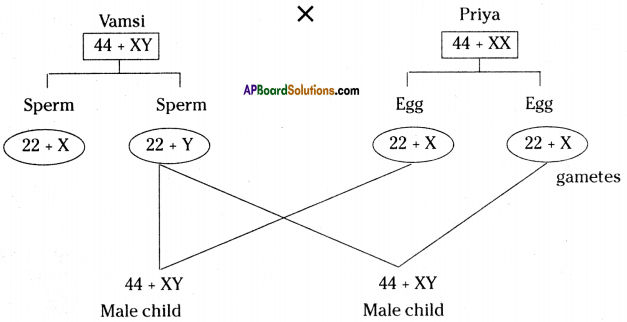
Answer:
AP SSC 10th Class Biology Important Questions Chapter 8 Heredity 11b) Who determines the sex of the baby? How can you say ?
Answer:
Father (Vamsi) determines the sex of the baby. Because the chromosome ‘Y’ that determines male sex is present in males.

AP SSC 10th Class Biology Important Questions Chapter 8 Heredity

Question 4.
AP SSC 10th Class Biology Important Questions Chapter 8 Heredity 9AP SSC 10th Class Biology Important Questions Chapter 8 Heredity 5
i) What does the given flow chart indicate?
Answer:
Sex determination in human beings

ii) What will happen if the sperm containing ‘X’ chromosomes fertilises the ovum?
Answer:
Baby will be a girl

iii) Who decides the sex of the baby – Mother or Father?
Answer:
Father

iv) How many pairs of chromosomes are present in off-spring?
Answer:
23 pairs

AP SSC 10th Class Biology Important Questions Chapter 8 Heredity

Question 5.
Write a brief note on Homologous and Analogous organs.
Answer:
Homologous organs: Organs which are structurally similar but functionally different are known as “Homologous organs”.
Forelimbs of a whale – swimming
Wings of a bat – flying
Forelegs of cheetah – running

Analogous: Organs which are structurally different but functionally similar are known as “Analogous organs”.
Eg : Wings of a bird – flying
Wings of a bat – flying

Question 6.
Observe the flow – chart and answer the following.
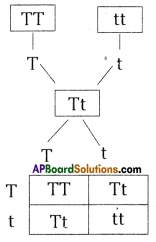
AP SSC 10th Class Biology Important Questions Chapter 8 Heredity 12i) What does the flow – chart represent?
Answer:
The flow – chart represents a monohybrid hybridisation between a pure breed Tall (T) and a pure breed dwarf (t) plants resulting first filial generation. On self pollinating with F1 generation the new breed have any combinations of T, t came in F2 generation.

ii) What is the phenotype characters in F1 generation?
Answer:
In the phenotypic characters in F1 generation all are dominant that is (T) Tall,

iii) What is the Genotype, Phenotype ratio of F2 generation?
Answer:
Genotype ratio in F2 generation is 1 : 2 : 1
Phenotype ratio in F2 generation is 3 : 1

iv) What laws of inheritance did you understand by this flow – chart?
Answer:
understand that i) the law of dominance ii) law of segregation proposed by Mendel.

AP SSC 10th Class Biology Important Questions Chapter 8 Heredity

Question 7.
Write the Darwin’s theory of evolution in a nutshell.
Answer:

  1. Any group of population of an organism has variations and all members of group are not identical.
  2. Variations maybe passed from parent to offspring through heredity.
  3. The natural selection over abundance of offspring leads to a constant struggle for their survival in any population.
  4. Individuals with variations that help them to survive and reproduce tend to live longer and have more offsprings than organisms with less useful features.
  5. The offsprings of survivors inherit the useful variations, and the same process happens with every new generation until the variation becomes a common feature.
  6. As the environment changes, the organism within the environment adapt and changes to the new living conditions.
  7. Over a long period of time, each species of organism can accumulate so many changes that it becomes a new species, similar to but distinctly different from the original species. All species on the earth arise in this way.
  8. Evolution is a slow and continuous process that involves several thousands of generations.

Question 8.
What are Mendel’s laws of inheritance? What are the reasons to choose pea plant for his experiment?
Answer:
Mendel’s Laws of inheritance:

  1. Law of Dominance : Among a pair of closely related ‘alleles’ or factors, only one expresses itself. In the first generation as one of the allele is dominant over the other. This is called as Mendel’s Law of dominance.
  2. Law of Segregation : The law of segregation states that every individual possesses a pair of alleles for any particular trait that each parent posses a randomly selected copy only one of these to its off-spring.
  3. Law of Independent assortment : In the inheritance of more than one pair of characters (traits), the factors for each pair of characters assort independently of the other pairs. This is known as ‘Law of Independent assortment’.

Mendel has chosen garden pea as material for his experiment because:

  1. It has well developed characters.
  2. It is a bisexual flower.
  3. Predominently self pollinating.
  4. Suitable for cross pollination.
  5. It is an annual plant.

AP SSC 10th Class Biology Important Questions Chapter 8 Heredity

Question 9.
What is Phenotype and Genotype? Explain them with the help of Mendel’s Monohybrid cross.
Answer:
Phenotype: Expression of visible character of an individual is called phenotype.
Genotype: Genetic constitution of an individual for any character is called Genotype or Probable nature of factors is known as genotype.
Cross Pollinating a pure breed of yellow coloured pea seeds (YY) and green coloured pea seeds (yy) give F1 generation. All pea seeds were yellow in F1 generation. So, yellow colour is phenotype. ‘Yy’ is genotype of all pea seeds in F1 generation.
AP SSC 10th Class Biology Important Questions Chapter 8 Heredity 13
F2 Generation : Self pollination of F1 pea plants (Yy)
AP SSC 10th Class Biology Important Questions Chapter 8 Heredity 14
Phenotype Ratio is 3:1 Genotype Ratio is 1:2:1.

Question 10.
Explain in brief any two evidences of Evolution.
Answer:
Some of the evidences of evolution are

  1. Homologous and analogous organs
  2. Evidences from embryology and
  3. Evidences from fossils.

I. Homologous and analogous organs :

  1. Organs which have common fundamental anatomical plan and similar embryonic origin, whatever varied functions they may perform are regarded as homologous organs.
  2. For example forelimb of a whale, wing of bat, leg of leopord, claw of mole and hand of man.
  3. They indicate that all the vertebrates are evolved from common ancestor.
  4. Organs which are structurally different but functionally similar are known as “Analogous organs”.
  5. For example wings of bats and wings of birds.
  6. The designs of the two wings, their structure and components are different but they look similar because they have a common use for flying but their origin is not common.

II. Evidences from embryology:

  1. There are remarkable similarities in the embryos of different animals from fish to man.
  2. The resemblance is so close that at an early stage even an experienced embryologist would find difficulty to distinguish one embryo from the other.
  3. This strengthens the view of the existence of a common ancestor from which all these have evolved.

III. Evidences from fossils:

  1. Fossils are evidences of ancient life forms or ancient habitats which have been preserved by natural processes.
  2. Palaeontologists determine the age of fossils by using carbon dating method.
  3. These fossils provide evidences of presence of extinct animals like dinosaurs and how the evolution occurred on the earth, etc.

AP SSC 10th Class Biology Important Questions Chapter 8 Heredity

Question 11.
Observe the given flow-chart and answer the following questions:
AP SSC 10th Class Biology Important Questions Chapter 8 Heredity 9AP SSC 10th Class Biology Important Questions Chapter 8 Heredity 5
i) Name the chromosomes that determine the sex of an individual.
Answer:
Y Chromosome of father.

ii) Show given information in the form of Checker Board.
Answer:
AP SSC 10th Class Biology Important Questions Chapter 8 Heredity 15

iii) In this situation, which principle of Mendel is applicable?
Answer:
Law of dominance

iv) “Mother determines the sex of the baby”. Is this statement correct or not? Why?
Answer:
The statement is not correct. Because the sperm of father that carries Y chromosome fertilize with ovum of mother that contains X chromosome the resultant will be XY – Male baby.

AP SSC 10th Class Biology Important Questions Chapter 8 Heredity

Question 12.
Keep in mind Mendel’s experiments and write what you know about the following concepts?
a) Pure breed b) Phenotype c) Genotype d) Alleles
Answer:
a) Pure breed: These are the plants that expresses a selected character over several generations. Such plants according to Mendel were pure breed for that character.

b) Phenotype: The characters which can be seen is known as phenotype. We cannot determine the internal factors by phenotype. It tells about only the dominating char-acters which express externally. The phenotype ratio in monohybrid cross is 3 : 1.

c) Genotype: The genetic make up of an individual is known as genotype. Genotype itself is the indication of internal factors. It tells about both dominant and recessive characters present within. The genotype ratio in monohybrid cross is 1 : 2: 1.

d) Alleles: Alleles are corresponding pairs of genes located at specific positions in chromosomes. Together they determine the genotype of their host organism. Every individual possesses a pair of alleles for any particular trait and that each parent passes a rondomly selected copy of only one of these to an offspring. The offspring then receives its own pair of alleles for that trait one each from both parents.

Question 13.
Competition among organisms, variations, natural selection survival of the fittest.
Which theory explains all these aspects? Describe them in a orderly manner.
Answer:

  1. Competition: Every living organism in this world reproduces itself. The rate of multiplication and existence of organisms are more or less common for all living things. But the food supply and space remain unchanged, in other words they are limited. Under these conditions, there is a competition among the organisms to fulfil their needs of food and space. This is known as struggle for existence. It may be interspecific, intraspecific and the environment factors.
  2. Variations: Every organism has its own specific characteristic and relationship with its environment. The variability caused by variations may be large or small. Large variations are known as macro variation and small variations called micro variations. Variations may be favourable or harmful. Those with useful variations survive while the others perish.
  3. Natural selection: The organism with favourable variations are best adapted to the environment in which they live. They have a better chance of survival and perpetuation of race. This principle is called natural selections.
  4. Survival of the fittest: Variations which are useful are retained, while those are harmful are lost. In a population where there is a struggle, the fittest will be survived and the less adjusted will be perished. This is known as the elimination of the unfit.

AP SSC 10th Class Biology Important Questions Chapter 8 Heredity

Question 14.
What is genetic drift? Explain how it provides diversity in the population.
Answer:

  1. Changes in the frequency of genes in small populations, due to accidents is known as “Genetic drift”.’
  2. Let us consider a colour variation occurred in red colour beetles which are living on green coloured leaves of bushes.
  3. It results in “blue” colour beetles instead of ‘red’ colour beetles and passed its colour to its progeny.
  4. Initially in the population, there are few blue beetles, but most are red.
  5. Imagine at this point, an elephant comes by and stamps on the bushes where the beetles live.
  6. This kills most of the beetles but by chance a few beetles survived are mostly blue.
  7. Again the beetle population slowly increases, but in the beetle population most of them are in blue colour.
  8. Thus genetic drift provides diversity in the population.

Question 15.
Have the apparent groups of human beings (races) evolved differently?
Answer:

  1. No, there is no biological basis to the notion of human races. All humans are a single species.
  2. Regardless of where we have lived for the past few thousand years, we all came from Africa.
  3. The earliest members of human species, Homosapiens, can be traced there.
  4. Our genetic footprints can be traced back to our African roots.
  5. A couple of hundred thousand years ago, some of our ancestors left Africa while others stayed on.
  6. While the residents spread across Africa, the migrants slowly spread across the planet.
  7. They did not go in a single line. They went forwards and backwards, with groups, sometimes separating from each other, even moving in and out of Africa.
  8. Like all other species on planet, they had come into being as an accident of evolution, and were trying to live their lives the best they could.

Question 16.
How would you appreciate Gregor Johann Mendel’s contribution to the genetics?
(OR)
Why Gregor Johann Mendel is considered as the father of genetics?
Answer:

  1. Gregor Johann Mendel worked on the problem of how variations were passed from one generation to the other.
  2. As he was a monk, he did his experiments with interest in the garden of the monastery.
  3. He worked for over seven years after which he presented conclusions from his experimental data in a form of a detailed research paper.
  4. Mendel made many careful observations of pea plants and asked himself questions about what he observed and then planned and designed experiments to find the answers.
  5. He had worked on nearly 10,000 pea plants of 34 different varieties choosing 7 distinguishing forms of characters.
  6. His experimental outcomes gave the idea how the variations were passed on from one generation to another.
  7. He was an exemplary person for his observation, planning, patience and experimental skills.
  8. His efforts to know the secrets of nature was really appreciable.

AP SSC 10th Class Biology Important Questions Chapter 8 Heredity

Question 17.
What are the hypothesis assumptions and outcomes of Mendel’s experiments with pea plants?
Answer:
Regarding his experiments with pea plants, Mendel hypothesised that

  1. Characters were carried as traits and an organism always carried a pair of factors for a character.
  2. The distinguishing traits of the same character were present in the population of an organism.
  3. The traits shown by the pea plants must be in the seeds that produced them.
  4. The seeds must have obtained by the traits from the parent plants.

His assumptions made to explain his observations are:
Assumption 1: Every pea plant has two ‘factors’ which are responsible for producing a particular property or trait.
Assumption 2: During reproduction one ‘factor’ from each parent is taken to form a new pair in the progeny.
Assumption 3: One of these will always dominate the other if mixed together.

Laws made from his experiments:

  1. Law of Dominance: Among a pair of alleles for a character, only one expresses itself in the first generation as one of the allele is dominant over the other.
  2. Law of Segregation: Every individual possesses a pair of alleles for any particular trait and that each parent passes a randomly selected copy of only one of these to its offspring.
  3. Law of Independent Assortment: In the inheritance of more than one pair of characters the factors for each pair of characters assorts independently of the other pairs.

AP SSC 10th Class Biology Important Questions Chapter 8 Heredity

AP SSC 10th Class Biology Important Questions Chapter 4 Excretion

AP State Board Syllabus AP SSC 10th Class Biology Important Questions Chapter 4 Excretion.

AP State Syllabus SSC 10th Class Biology Important Questions 4th Lesson Excretion

10th Class Biology 4th Lesson Excretion 1 Mark Important Questions and Answers

Question 1.
What is meant by excretion?
Answer:
Excretion is a biological process involved in separation and removal of wastes from body.

Question 2.
When you are on a field trip, your friend collected a sticky substance oozed out by a plant called gum. What are the plants you observe which give gum ?
Answer:
Acacia, Neem, Drumstick, Eukalyptus and Sapota are the gum yielding plants present in our surroundings.

AP SSC 10th Class Biology Important Questions Chapter 4 Excretion

Question 3.
What are primary metabolites?
Answer:
The substances that are directly involved in normal growth and development and reproduction of a plant are called primary metabolites, e.g.: Carbohydrates, fats and proteins.

Question 4.
What are secondary metabolites?
Answer:
The inorganic substances that are not directly involved in the normal growth, development and reproduction of an organism are called secondary metabolites, e.g.: Alkaloids, tannins, resins, gums and latex, etc.

Question 5.
Write any two substances present both in blood and urine.
Answer:
Glucose, Sodium, Potassium, Chlorides, Urea, Creatinine, Uric Acid, Calcium, Phosphorous.

Question 6.
When you are on a field trip, you might have collected some plants which contain alkaloids. Name the alkaloids which are harmful to us.
Answer:
Nicotine, Morphine, Cocaine.

Question 7.
Write the names of any two excretory organs in human beings.
Answer:
Kidney, Skin, Lungs, Liver, Large Intestine.

Question 8.
Which plants in your surroundings are useful for the production of medicines?
Answer:
Neem, Datura, Tulasi, Calotropis.

Question 9.
The body of a person is filled with extra water and waste products. His hands and feet were swollen. What do we call this condition? Failure of which system causes this condition?
Answer:
This condition is called Uremia. This condition is caused due to failure of excretory system (Kidneys).

AP SSC 10th Class Biology Important Questions Chapter 4 Excretion

Question 10.
How do plants get rid of their waste materials?
Answer:

  1. Plants can get rid of excess water by transpiration and guttation.
  2. The other nitrogenous waste products are stored in leaves, bark and fruits when these dead leaves, bark and ripe fruits fall off from the tree then the waste products in them are removed.

Question 11.
Give an example of a case where organ donation can save one’s life.
Answer:

  1. Kidney of a brain dead person can be donated to save the life of renal failure persons.
  2. Cornea of a dead person can be donated to the blind.
  3. Bone marrow can be donated to save life of persons suffering from blood related genetic disorders.

Question 12.
Why is urine yellow in color?
Answer:
Because of urochrome, urine is yellow in colour. It forms in the liver from dead RBC.

Question 13.
Write two slogans to popularize the awareness on “Organ Donation”.
Answer:
Slogans:

  1. Organ donation saves lives.
  2. Donate organs today for better tomorrow.
  3. Donate organs – Live after death.

Question 14.
Write two healthy habits which you practice to protect your kidneys from diseases.
Answer:

  1. Drink plenty of water.
  2. Eat low salt diet that saves kidney life.
  3. Drink more fruit juices.

Question 15.
What precautions you have to take in the observation of internal structure of mammalian kidney?
Answer:

  1. Wash the kidney thorougly with water.
  2. Ensure that blood is completely drained from it.
  3. Wash your hands with antibacterial lotion after completing the dissection.

AP SSC 10th Class Biology Important Questions Chapter 4 Excretion

Question 16.
Write two secondary metabolites, which you use in your daily life.
Answer:
Gum, Rubber, Coffee are the examples for secondary metabolites which we use in our daily life.

Question 17.
Why is vasopressin not secreted when a person drinks a lot of water?
Answer:
Vasopressin is secreted only when concentrated urine is to be passed out. When a person drinks a lot of water, there will be no need to secrete concentrated urine. The excess water taken by the person will be sent out in the form of dilute urine. Hence, vasopressin is not secreted.

Question 18.
In urine excretory system much water is reabsorbed. What happens if it doesn’t occur?
Answer:
If water is not reabsorbed it leads to excessive repeated dilute urination called diabetes insipidus. If water does not reabsorbed we would dry up in few hours.

Question 19.
A substance given below consists of other three substances. What is that substance? Where is it produced? Uric Acid, Sodium, Oxalate, Urine.
Answer:
Urine contains all the other three substances. It is produced in kidney.

Question 20.
Name the hospitals where the organ transplantation facility is available in Hyderabad.
Answer:
Organ transplantation facility is available only in two government hospitals. They are NIMS (Nizam Institute of Medical Sciences) and Osmania hospital. This facility is also available in some corporate hospitals.

Question 21.
What is anabolism?
Answer:
The synthesis of complex molecules in living organisms from simpler ones together with the storage of energy.

AP SSC 10th Class Biology Important Questions Chapter 4 Excretion

Question 22.
What is catabolism?
Answer:
The breakdown of complex molecules in living organisms to form simpler ones, together with the release of energy.

Question 23.
What is the meaning of the word excretion in Latin?
Answer:
In Latin ex means out, crenere means shift.

Question 24.
What are the wastes produced during metabolic activities?
Answer:
Carbon dioxide, water, nitrogenous compounds like ammonia, urea, uric acid, bile pigments, excess salts, etc., are the wastes produced during metabolic activities.

Question 25.
What is the most poisonous of all waste products?
Answer:
Ammonia is the most poisonous of all waste products.

Question 26.
What are the substances present in blood?
Answer:
Substances present in blood are glucose, sodium, potassium chloride, urea, creatinine, uric acid, cholesterol, triglycerides, calcium, phosphorous, bilirubin, proteins, etc.

Question 27.
What are the substances present in urine?
Answer:
The substances present in urine are protein, creatinine, calcium, phosphorous, uric acid, etc.

AP SSC 10th Class Biology Important Questions Chapter 4 Excretion

Question 28.
What are the substances present in both blood and urine in common?
Answer:
The substances present in the blood and urine in common are sodium, potassium, glucose, chlorides, urea, proteins, creatinine, calcium, phosphorous and uric acid.

Question 29.
What are the substances that need to be removed from body?
Answer:
Creatinine, uric acid, urea, cholesterol and calcium.

Question 30.
In human beings excretory system consists of?
Answer:
The excretory system in human beings consists of a pair of kidneys, a pair of ureters, urinary bladder and urethra.

Question 31.
Where are the kidneys present in human body?
Answer:
In human body kidneys are present in the abdominal cavity attached to dorsal body wall one on either side of backbone.

Question 32.
What is the shape and colour of the kidney?
Answer:
The kidney is bean shaped and reddish brown in colour.

AP SSC 10th Class Biology Important Questions Chapter 4 Excretion

Question 33.
What is the size of the kidney?
Answer:
The size of the kidney is 10 cm in length, 5 – 6 cm in breadth and 4 cm in thickness.

Question 34.
Why is the position of right kidney lower than the left kidney?
Answer:
The position of right kidney is lower than left kidney due to the presence of liver above it.

Question 35.
Which artery brings oxygenated blood to kidney?
Answer:
Renal artery brings oxygenated blood to kidney.

Question 36.
What are the two distinct regions present inside the kidney?
Answer:
The two distinct regions present inside the kidney are

  1. dark coloured outer zone called the cortex and
  2. pale coloured inner zone called medulla.

Question 37.
Each kidney is made up of how many nephrons?
Answer:
Each kidney is made up of about 1.3 to 1.8 million nephrons.

Question 38.
What is the other name of Nephron?
Answer:
The other name of nephron is uriniferous tubule.

AP SSC 10th Class Biology Important Questions Chapter 4 Excretion

Question 39.
What are the two basic parts of nephron?
Answer:
The two basic parts of nephron are malphigian body and renal tubule.

Question 40.
What is meant by Glomerulus?
Answer:
Malphigian body consists of a blind cupshaped broader end of nephron called Bowman’s capsule and bunch of blood capillaries called Glomerulus.

Question 41.
Which blood vessel forms glomerulus in Bowman’s capsule?
Answer:
Afferent arteriole forms glomerulus in Bowman’s capsule.

Question 42.
Renal tubule consists of how many parts?
Answer:
Renal tubule consists three parts. They are Proximal convoluted tubule (PCT), Loop of Henle, and Distal Convoluted Tubule (DCT).

Question 43.
What is the major function of proximal convoluted tubule?
Answer:
Proximal convoluted tubule reabsorbs useful substances like glucose, amino acids, phosphate, potassium, urea and other organic solutes from the filtrate.

Question 44.
What are podocyte cells?
Answer:
Glomerulus is lined by a single layer of squamous epithelial cells called podocyte cells.

AP SSC 10th Class Biology Important Questions Chapter 4 Excretion

Question 45.
What is the function of loop of Henle?
Answer:

  1. In the descending loop of Henle reabsorption of water from the filtrate takes place.
  2. Ascending loop of Henle is impermeable to water and only ions diffuse out into the surrounding cells.

Question 46.
What is the function of Distal convoluted tubule?
Answer:
Distal convoluted tubule maintains proper concentration and pH of the urine.

Question 47.
How many stages are involved in formation of urine? What are they?
Answer:
Formation of urine involves four stages. They are

  1. Glomerular filtration,
  2. Tubular reabsorption,
  3. Tubular secretion and
  4. Concentration of urine.

Question 48.
The amount of water reabsorption in the tubule depends on?
Answer:
The amount of water reabsorption in the tubule depends on amount of excess water present in the body and the amount of dissolved wastes to be excreted.

Question 49.
In which region seventy five percent of water content of the nephric filtrate is reabsorbed?
Answer:
Seventy five percent of water content of the nephric filtrate is reabsorbed in the region of proximal convoluted tubule.

AP SSC 10th Class Biology Important Questions Chapter 4 Excretion

Question 50.
Which hormone is responsible to pass concentrated urine?
Answer:
Vasopressin is responsible to pass concentrated urine.

Question 51.
What is micturition?
Answer:
Micturition is the process of discharge of urine from the urinary bladder.

Question 52.
What are the composition of various substances in urine?
Answer:
The composition of various substances in urine are 96% of water, 2.5% of organic substances and 1.5% of inorganic solutes.

Question 53.
How much amount of urine is excreted per day?
Answer:
Total amount of urine excreted per day is about 1.6 -1.8 litres.

Question 54.
What is the storage capacity of urinary bladder?
Answer:
The storage capacity of urinary bladder is 300 – 800 ml.

Question 55.
What is uremia?
Answer:
If kidneys stop working completely, our body is filled with extra water and waste products. This condition is called uremia.

Question 56.
What is haemodialysis?
Answer:
Artificial filtering of blood to remove wastes by using dialysis machine is known as haemodialysis.

AP SSC 10th Class Biology Important Questions Chapter 4 Excretion

Question 57.
What is the time required for each dialysis session?
Answer:
The time required for each dialysis session is 3 to 6 hours.

Question 58.
What are the organs that can be transplanted from brain dead patients?
Answer:
The organs that can be transplanted from brain dead patients are kidney, liver, heart, lungs, pancreas, skin, bone, intestines and eyes (cornea).

Question 59.
Where is the transplanted kidney fixed in the body of kidney failure patient?
Answer:
The transplanted kidney is fixed in the body of patient inside the lower abdomen.

Question 60.
What is cadaver transplantation?
Answer:
The process of transplantation of organs from brain dead patients to another is called cadaver transplantation.

Question 61.
What are the other excretory organs present in human body in addition to kidney?
Answer:
The other excretory organs present in human body in addition to kidney are lungs, skin, liver, large intestine, salivary glands and lacrimal glands.

Question 62.
What are the waste products excreted by lungs?
Answer:
The waste products excreted by lungs are carbon dioxide and water.

Question 63.
Sebum of sebaceous glands in skin contains wastes like?
Answer:
Sebum of sebaceous glands in skin contains wastes like waxes, sterols, hydro carbons and fatty acids.

Question 64.
What are the metabolic wastes of haemoglobin of red blood cells in liver?
Answer:
The metabolic wastes of haemoglobin of red blood cells in liver are bile pigments like bilirubin, biliverdin and urochrome.

AP SSC 10th Class Biology Important Questions Chapter 4 Excretion

Question 65.
How is urea produced in liver?
Answer:
Urea is produced in liver by the deamination of proteins.

Question 66.
What are the wastes excreted by intestine?
Answer:
The wastes excreted by intestine are excess salts of calcium, magnesium and iron.

Question 67.
How do unicellular organisms remove waste products?
Answer:
Unicellular organisms remove waste products by diffusion from the body surface to the surrounding water.

Question 68.
What is the osmoregulatory organelle in amoeba and paramoecium?
Answer:
The osmoregulatory organelle in amoeba and paramoecium is contractile vacuole.

Question 69.
In which animal phyla water bathes almost all their cells in body of organisms?
Answer:
In porifera and coelenterates water bathes almost all their cells in body of organisms.

Question 70.
Through which processes plants get rid of excess water?
Answer:
Through transpiration and guttation plants get rid of excess water.

Question 71.
What are Raphides?
Answer:
Waste gets stored in the fruits in the form of solid bodies called Raphides.

Question 72.
What are alkaloids?
Answer:
The poisonous nitrogenous by products produced by plants are alkaloids.

AP SSC 10th Class Biology Important Questions Chapter 4 Excretion

Question 73.
Which alkaloid is used as antimalarial drug?
Answer:
Quinine is the alkaloid used as antimalarial drug.

Question 74.
Which flowers and fruits are used to extract sedative scopalamine?
Answer:
The sedative scopalamine is extracted from the flowers and fruits of Datura stramonium.

Question 75.
What are the alkaloids produced by plants?
Answer:
The alkaloids produced by plants are nimbin, nicotine, morphine, codeine quinine, reserpine, caffeine/scopolamine, etc.

Question 76.
What are tannins?
Answer:
Tannins are alkaloids which are carbon compounds.

Question 77.
Which group of plants secretes resin?
Answer:
Resin secretes by a group of plants Gymnosperms.

Question 78.
What is latex?
Answer:
Latex is a sticky, milky white substance secreted by plants.

Question 79.
Which plant of latex is used to prepare rubber?
Answer:
Rubber is prepared from the latex of Hevea braziliensis.

AP SSC 10th Class Biology Important Questions Chapter 4 Excretion

Question 80.
Bio-diesel is obtained from the seeds of?
Answer:
Bio-diesel is obtained from the seeds of Jatropa.

Question 81.
Which person’s kidney is used for a successful kidney transplantation?
Answer:
From a close relative kidney can be used for successful transplantation.

Question 82.
What may be the feeling of the patients who are waiting for suitable organ donations due to failure of vital organs?
Answer:
The patients who are waiting may think that any donor with a kind heart can give them life by donating their organs.

Question 83.
What may be the feeling of a doctor while transplanting the organs?
Answer:
Doctor is also a human being, he predicts that the transplantation becomes a success.

Question 84.
How can you appreciate the father of Yaswanth Kumar for donating the organs of his brain dead son? (From annexure)
Answer:
We can appreciate the father of Yaswanth Kumar for his humanity where no one can accept to take or think such a delicate decision of donating the organs of his brain dead son.

Question 85.
What might be the feeling of the father H.V. Shiva Kumar father of Yaswanth Kumar for donating the organs of his son? (From annexure)
Answer:
The father might have thought that his son can live even after his death in some other people who are in need for the suitable organs. We can appreciate father’s humanity.

Question 86.
What does the society need about organ donation?
Answer:
The society needs much awareness in organ donation so that we can jsave many lives who are in need of different organs from donors for their survival.

AP SSC 10th Class Biology Important Questions Chapter 4 Excretion

Question 87.
Which substances are present above the normal limits both in the blood and urine in the sample given?
Answer:
Substances present above the normal limits in the blood are: creatinine, uric acid and cholesterol. Substances present above the normal limits in the urine are creatinine, calcium, uric acid and urea.

Question 88.
When is more urine excreted?
Answer:
A large intake of liquids or water rich food increases the volume of water in the blood, hence more urine is excreted.

Question 89.
What are the uses of Tannins?
Answer:
Tannins are used in tanning of leather and in medicines.

Question 90.
What are the economic importance of gums?
Answer:
Gums are valuable being used as adhesives and binding agents in the preparation of the medicines, food, etc.

Question 91.
Why do we get peculiar smell when you shift the potted plant?
Answer:
Plants release some peculiar chemical substances into their surroundings into soil through roots. These substances attract useful microorganisms to the plant. Hence we get peculiar smell when we shift the potted plant.

Question 92.
What is chewing gum ? How is it made of?
Answer:
Chewing gum is a type of gum for chewing made dates back 5000 years. Modern chewing gum originally made of chicle, natural latex from plant.

Question 93.
How do pollen grains affect our health?
Answer:
Whenever pollen grains enter in our body they cause allergy due to the presence of nitrogenous substances. These allergens cause skin allergy and asthma. Ex: Parthenium.

AP SSC 10th Class Biology Important Questions Chapter 4 Excretion

Question 94.
What are the defensive mechanism developed by plants of your village to protect themselves from the herbivores ? Give two examples.
Answer:
Plants produce nitrogenous compounds to protect themselves from the herbivores. These compounds are called as alkaloids. For example,
Datura – It produces alkaloid known as scopolamine.
Cactus – Develop spines on the body.

10th Class Biology 4th Lesson Excretion 2 Marks Important Questions and Answers

Question 1.
Fill in the table on the basis of your obervations in field trip.

S.No Name of the plant Secondary metabolites Uses
A. Neem
B. Datura

Answer:

S.No Name of the plant Secondary metabolites Uses
A. Neem Nimbin Antiseptic
B. Datura Scopola mine Sedative

Question 2.
Two kidneys are present in human beings as excretory organs. Haritha, whose age is 23 years, donated one kidney to her father. Now she has one kidney only. She gave birth to a female child.
a) How many kidneys are there in Haritha’s daughter?
Answer:
Harita’s daughter has 2 kidneys,

b) Support your answer.
Answer:
Bodily changes are not inherited, so Harita’s daughter has 2 kidneys.

AP SSC 10th Class Biology Important Questions Chapter 4 Excretion

Question 3.
What questions do you ask a nephrologist to know more about kidney related diseases?
Answer:

  1. How are stones formed in the kidney?
  2. What is dialysis?
  3. What is the effect of smoking and alcoholism on kidneys?
  4. What is ESRD?

Question 4.
Read the following lines and answer the questions.

Liver: It produces bile pigments (bilirubin, biliverdin and urochrome) which are metabolic wastes of haemoglobin of dead R.B.Cs. Urochrome, which is responsible for the amber colour of the urine, is eliminated through urine. Biliverdin and bilirubin are stored in gall bladder and later excreted through bile along with cholesterol and derivatives of steroid hormones, extra drug, vitamins and alkaline salts. Liver is also involved in urea formation.

i) Which substance adds colour to urine?
ii) The site of synthesis of urea in the body is …………..
Answer:
i) Urochrome
ii) Liver

Question 5.
Look at the picture and answer the questions, (label bottle on left as X and bottle on right as Y)
AP SSC 10th Class Biology Important Questions Chapter 4 Excretion 1The above is a procedure of haemodialysis in a hospital.
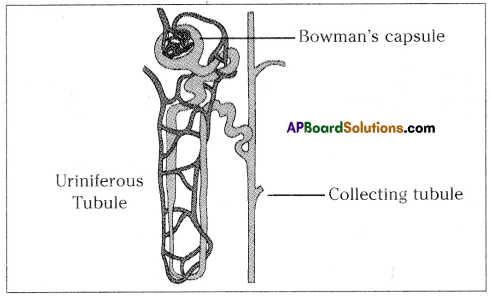
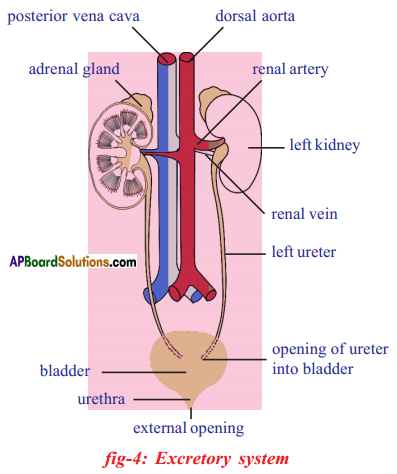
i) What are the liquids X and Y, in the picture?
ii) What is the purpose of this procedure and for whom is it needed?
Answer:
i) X – Dialyzing fluid; Y – Urine
ii) It is a process of removal of poisonous nitrogenous wastes from blood. This process is needed by uremic or kidney failure patients.

AP SSC 10th Class Biology Important Questions Chapter 4 Excretion

Question 6.
Prepare four questions to find the reasons for obstructions in excretory system.
Answer:

  1. What do we call the complete and irreversible kidney failure?
  2. What happen if kidney stops working completely?
  3. What is uremia?
  4. Is there any solution to this problem?

Question 7.
Name the secondary metabolites which are useful in leather and rubber industry. From which plants we obtain them?
Answer:

  1. Latex used in rubber and Tannins used in Leather Industry.
  2. Latex – Hevea brasiliensis (Rubber Plant) Tannins – Cassia, Acacia.

Question 8.
Prepare four questions you will ask a nephrologist about Kidney failure.
Answer:

  1. When does kidney fail?
  2. What are the symptoms of kidney failure?
  3. What precautions can we take to prevent failure of kidney?
  4. Which alternative method can we adopt if kidney fails?

Question 9.
Observe the following table.

Name of the phylum / organism Excretory system / organ
Protozoa Diffusion
Porifera Water bathes all their cells
Platyhelmirthes Flame cells
Annelida Nephridia
Arthropoda Green glands
Reptiles, Aves and Mammals Kidney

On the basis of above table, write answers to the following questions.

i) In above table, which living organisms contains kidneys as excretory organs like human beings?
Answer:
Reptiles and Aves.

ii) Write the excretory organs present in Earthworm and Cockroach.
Answer:
Earthworm – Nephridia Cockroach – Green glands

AP SSC 10th Class Biology Important Questions Chapter 4 Excretion

Question 10.
Observe the following table and answer the questions given below.

Alkaloid Name of the plant Uses
Quinine Cinchona Anti malarial drug
Nicotine Tobacco Pesticides
Morphine Opium Pain killer
Pyrethroids Chrysanthemum species Insecticides

i) Which alkaloid we get from the fruit, is used as pain killer?
Answer:
Morphine

ii) From which part of the plant do we get Quinine?
Answer:
Bark of Cinchona

Question 11.
What is called structural and functional unit of kidney? Why?
Answer:

  1. Each kidney is made up of more than one million microscopic and thin tubular units called nephrons or uriniferous tubules. Hence nephron is known as structural and functional unit of kidney.
  2. Nephron’s chief function is to regulate the concentration of water and soluble substances, reabsorbing what is needed and excreting the rest as urine. Hence it is known as functional unit of kidney.

Question 12.
Blood is filtered in Bowman’s capsule of nephron. For the filtration of blood some pressure is needed. How does the pressure arises in Bowman’s capsule?
Answer:

  1. Blood flows inside the glomerulus of Bowman’s capsule under the influence of pressure due to the large diameter of afferent arteriole.
  2. This increases or rise the blood pressure in the glomerulus capillaries leading to ultrafiltration of the blood in the Bowman’s capsule.

Question 13.
Classify the substances given below.
Ptyaline, Leptin, Morphine, Riboflavin, Testosterone, Thyamin, Niacine, Sucrase, Nicotine, Amylase, Retinol, Quinine, Calciferol, Adrenaline, Tripsin.
Answer:
The above substances can be classified into Enzymes, Hormones, Alkaloids and Vitamins.
Enzymes: Ptyaline, Sucrase, Amylase, Tripsin
Hormones: Testosterone, Adrenaline, Leptin
Alkaloids: Morphine, Nicotine, Quinine
Vitamins: Riboflavin, Thyamin, Niacine, Retinol, Calciferol

AP SSC 10th Class Biology Important Questions Chapter 4 Excretion

Question 14.
How does excretion take place in phylum protozoa?
Answer:

  1. Specific excretory organs are absent in unicellular organisms. These organisms remove waste products by simple diffusion from the body surface into the surrounding water.
  2. Excess water is sent out through contractile vacuoles in fresh water protozoans. Ex: Amoeba surface.
  3. The major portion of excess water is eliminated by diffusion through body surface.

Question 15.
What are the functions of excretory system?
Answer:

  1. Excretory system in animals performs more than one function.
  2. The primary function of excretory system is to maintain ionic and osmotic balance in the animal body.
  3. Excretory system helps to maintain appropriate concentration of salts and correct amount of water in the body.
  4. It also helps in maintaining the body volume.
  5. The secondary function of excretory system is excretion of nitrogenous wastes and foreign substances such as drugs.

Question 16.
Mention the groups of animals where excretion fakes place through diffusion from body surface.
Answer:

  1. In protozoans wastes are excreted by diffusion through body surface.
  2. Contractile vacuoles present in some protozoans are mainly concerned with the maintenance of osmotic and ionic balance. Excretion is mainly by diffusion.
  3. In sponges, coelenterates like Hydra, excretion takes place by diffusion.

AP SSC 10th Class Biology Important Questions Chapter 4 Excretion

Question 17.
People in cold countries get very less / no sweat. What changes occur in their skin and in other excretory organs?
Answer:

  1. Usually human skin has a unique system keep in equilibrium state with the surrounding temperature.
  2. During winter season the temperature is low and the body temperature should be heated to balance the tolerance.
  3. So the water content in our body is sent out in the form of urine.
  4. Hence, people in cold countries get less sweat or no sweat.

10th Class Biology 4th Lesson Excretion 4 Marks Important Questions and Answers

Question 1.
Analyse the following information and answer the questions.

Alkaloid Part of the plant Uses
Quinine Bark Anti-malarial drug
Pyrethroids Leaves Insecticide
Reserpine Roots Medicine for snake bite
Caffeine Seeds Central nervous system stimulant
Nimbin Seeds, Barks, Leaves Antiseptic

i) Name the alkaloid which is used to cure malaria.
Answer:
Quininie

ii) Name the alkaloids used as insecticides.
Answer:
Pyrethroids

iii) Which system is stimulated by the alkaloid caffeine?
Answer:
Central nervous system

iv) Which parts of which plant is used as medicine for snake bite?
Answer:
The roots of Rauwolfia Serpentina (Snake root)

AP SSC 10th Class Biology Important Questions Chapter 4 Excretion

Question 2.
Which diagram do you draw to label these parts?
Answer:

  1. Bowman’s capsule
  2. Uriniferous tubule.
  3. Collecting tubule.

Draw the diagram and label the parts.
Answer:
AP SSC 10th Class Biology Important Questions Chapter 4 Excretion 2

Question 3.
Fill the following table related to Secondary Metabolites in plants.

S.No. Metabolite Name of the plant Use
1. Pinus
2. Gums
3. Rubber preparation
4. Nimbin

Answer:

S.No. Metabolite Name of the plant Use
1. Resin Pinus Used in varnishes
2. Gums Neem, Acacia Used as adhesives and binding agents
3. Latex Hevea braziliensis (Rubber plant) Rubber preparation
4. Nimbin Azadirachta indica (Neem) Antiseptic

AP SSC 10th Class Biology Important Questions Chapter 4 Excretion

Question 4.
The given parts belong to which system? Draw a neat labelled diagram of the system.
a) Kidneys b) Ureters c) Urinary bladder
Answer:
The given parts belong to human excretory system.
AP SSC 10th Class Biology Important Questions Chapter 4 Excretion 3

Question 5.
Read the following passage and answer the questions.

Plants can get rid of excess water by a process like transpiration and guttation. Waste products may be stored in leaves, bark, and fruits. When these dead leaves, bark, and ripe fruits fall off from the tree then waste products in them are removed. Waste gets stored in the fruits in the form of solid bodies called ‘raphides’. However several compounds are synthesized by the plants for their own use especially for defence. Many plants synthesize chemicals and store them in roots, leaves, seeds, etc. for protection against herbivores. Most of the chemicals are unpleasant to taste. Hence herbivores usually do not prefer to eat such plants. Some of the chemicals are toxic and may even kill the animals that eat them.

i) What are raphides?
ii) How do plants protect themselves against herbivores?
iii) How do plants get rid of wastes?
iv) Name the processes by which plants lose excess of water.
Answer:
i) The wastes stored in some fruits in the form of solid bodies are called “raphides”.
ii) Many plants synthesize chemicals and store them in roots, leaves, seeds, etc. for protection against herbivores.
iii) Waste products may be stored in leaves, bark and fruits. When these dead leaves, bark and ripe fruits fall off from the tree. Then waste products in them are removed.
iv) Plants lose excess of water by transpiration and guttation.

AP SSC 10th Class Biology Important Questions Chapter 4 Excretion

Question 6.

S.No. Test Present level Normal range
A. Blood Test
1. Blood Pressure (BP) 160/90 mm/Hg 120/80 mm/Hg
2. Glucose (Before food) 120- mg/dl 60-100 mg/dl
3. Glucose (After food) 220 mg/dl 160-180 mg/dl
4. Bilirubin 1.0 mg/dl 0.1-0.8 mg/dl
B. Urine Test
1. 24 hrs protein 150 mg/d ay 100 mg/day
2. Sodium 140 mmol/L 125-250 mmol/L.

A) Which test is required to know bilirubin?
Answer:
Blood test is required to know bilirubin.

B) How is the sugar disease confirmed?
Answer:
In blood test if the glucose levels in blood before and after food are more than the normal, the sugar disease is confirmed.

C) By observing the above report, what would be the other problems faced by that patient?
Answer:
The blood pressure of the patient 160/90 as the normal is 120/80 mm/Hg.
The Glucose levels in the blood of the patient shows more than the normal before and after food.
So he is suffering from Hypertension and diabetes.

D) What are the organs affected by these problems?
The organsaffected by these problems are heart and kidneys.

AP SSC 10th Class Biology Important Questions Chapter 4 Excretion

Question 7.
Explain the temporary and permanent methods to be adopted for Kidney failure (ESRD) persons.
Answer:
Temporary method for ESRD persons is Dialysis (Artificial kidney). Permanent method is transplantation of kidney.

Dialysis:

  1. Blood is taken out from the main artery, mixed with an anticoagulant, such as heparin and then pumped in to dialyzer.
  2. In dialyzer blood flows through cellophane tubes and these tubes are embeded in the dialysing fluid.
  3. The membrane separates the blood flowing inside the tube and dialysing fluid (same as plasma without nitrogenous waste).

Kidney transplantation:

  1. A functioning kidney is used in transplantation from a donor preferably a close relative.
  2. The kidney that is received by a recipient must be a good match to his body, to minimise the chances of rejection by the immune system of the recipient.
  3. Nowadays the process of organ donation helps a lot for kidney failure patients.

Question 8.
What are the accessory excretory organs in human body? How does the liver carry out excretion as a secondary function? (OR)
Write about the accessory excretory organs and their excretory substances in human beings.
Answer:

Accessory Excretory Organs Excretory Materials
Lungs CO2 and Water
Skin Sweat and Metabolic Waste (Sebum)
Liver Bilirubin, Biliverdin, Urochrome
Large Intestine (Colon) Excess of salts of calcium, magnesium and iron are excreted along with faecal matter.

Excretory functions of Liver:

  1. Liver acts as detoxification centre of our body. Liver produces bile juice which contain bile pigments which are metabolic wastes of dead R.B.C.
  2. Bilirubin, Biliverdin and urochrome are the pigments of bile juice.
  3. Bilirubin, Biliverdin, cholesterol and derivatives of steroids, extra drugs, vitamins and alkaline salts are the wastes produced by liver.
  4. Urochrome is eliminated through urine.
  5. Liver also plays a role in the formation of concentrated urine.

AP SSC 10th Class Biology Important Questions Chapter 4 Excretion

Question 9.
Explain the formation of urine in a flow chart.
Answer:
Dissolved substances of blood like urea, glucose, amino acids, minerals, salts etc., are filtered out in Bowman’s capsule under high filtration pressure.
Glomerular filtrate is called primary urine.
AP SSC 10th Class Biology Important Questions Chapter 4 Excretion 4

Question 10.
Excreting wastes from the human body not only by kidneys but also by other organs helps you. How do you support it?
Answer:

  1. In human body wastes are excreted not only by kidneys but also by other organs.
  2. Kidney filters blood and eliminates nitrogenous wastes and other harmful things. Filters urea from blood.
  3. Apart from kidney lungs, skin, liver, intestine, salivary glands and lacrymal glands.
  4. Lungs remove carbon dioxide and water in respiration.
  5. Skin excrete wastes in the form of sweat which contains water and certain salts.
  6. Liver eliminates bile pigments bilirubin and biliverdin through urine.
  7. Excess salts of calcium, magnesium and iron are excreted by epithellial cells of colon for elimination along with faeces by intestine.
  8. Eccrine glands present on the forehead, the bottoms of the feet and the palms allow excess water to leave the body.
  9. Salivary glands and lacrimal glands excrete small amounts of nitrogenous waste through saliva and tears.

AP SSC 10th Class Biology Important Questions Chapter 4 Excretion

Question 11.
Which plants can you get in your village? Among these by-products of which plants do you use in your real life?
Answer:

  1. The plants grow or available in our village are Sapota, Coconut, Cassia, Mango, Guava, Borassus plantain, Tobacco, Rauwolfia, Coffee, Neem, Datura, Chrysanthe¬mum, Acacia, Pinus, Vallisneria, Teak, etc.,
  2. Out of these plants alkaloids are available from the plants like Tobacco, Rauwolfia, Coffee, Neem, Datura and Chrysanthemum. The by-products from these plants are utilised in my real life.
    Plant – Use
    Tobacco – Insecticide
    Rauwolfia serpentina – Medicine for snake bite
    Coffee – Central nervous system stimulant
    Neem – Antiseptic
    Datura – Sedative
    Chrysanthemum – Insecticides
  3. Tannins are the by-products of cassia, acacia. These are used in tanning of leather and in medicines.
  4. Resin the by-product of Pinus is used in varnishes.
  5. Gums are extracted from neem and acacia.
    They are used as adhesives and binding agents in the preparation of food, medicines.

Question 12.
Write an essay stating the advantages of by-products of plants in our real life.
(OR)
What are secondary metabolites? Briefly explain their uses.
(OR)
Not only the food of plants but also their wastes are useful to us. What evidences do you give for it?
Answer:

  1. The materials which do not require for normal growth and development are called secondary metabolites. These are the by – products of plants, eg: Alkaloids, Tannins, Resins, Gums and Latex, etc. Though plants produce these chemicals for their own use man found the usage of these chemicals for own benefits. They are generally coloured and fragrant.
  2. Alkaloids: These are nitrogenous by-products and poisonous. These are stored in different parts of the plants. Common alkaloids in plants and their uses are given in the table.
    Alkaloid Plant Part Uses
    Quinine Cinchona officinalis (Cinchona) Bark Antimalarial drug
    Nicotine Nicotiana tobacum (Tobacco) Leaves Insecticide
    Morphine, Cocaine Papaver somniferum (Opium) Fruit Pain killer
    Reserpine Rauwolfia serpentiana (Snake bite) Root Medicine for snake bite
    Caffeine Coffea Arabica (Coffee plant) Seed Central nervous system stimulant
    Nimbin Azadirachta indica (Neem) Seeds, Barks, Leaves Antiseptic
    Scopolamine Datura stramonium Fruit, flower Sedative
    Pyrethroids Chrysanthemum sps Flower Insecticides
  3. Tannins: Tannins are carbon compounds. These are stored in different parts of the plant and are deep brown in colour. Tannins are used in tanning of leather and in medicines, e.g. Cassia, Acacia.
  4. Resin: Occur mostly in Gymnosperms in specialized passages called resin passages. These are used in varnishes, e.g. Pinus.
  5. Gums: Plants like Neem, Acacia oozes out a sticky substance called gum. When branches are cut. The gum swells by absorbing water and helps in the healing of damaged parts of a plant. Gums are economically valuable and used as adhesives and binding agents in the preparation of the medicines, food, etc.
  6. Latex: Latex is a sticky, milky white substance secreted by plants. Latex is stored in latex cells or latex vessels. From the latex of Hevea braziliensis (Rubber plant) rubber is prepared. Latex from Jatropa is the source of bio-diesel.
  7. Modern chewing gum originally made of chick natural latex from plant.

AP SSC 10th Class Biology Important Questions Chapter 4 Excretion

Question 13.
Blood is purified in kidneys. So many wastes are removed from the blood in nephron of the kidney. Which issue make you surprise in excretory system?
Answer:

  1. Kidneys remove nitrogenous waste from our body. They also work towards balancing the amount of vitamins , minerals, fat and protein that are found in the blood. They do this so that our body can easily perform day to day activities.
  2. Our intestine makes solid waste materials and is excreted through digestive tract.
  3. Each day our body eliminates around 1.6 to 1.8 liters of urine which contains liquids, minerals and vitamins that are of no use to the body.
  4. The bladder of a human body is nearly the same size as the average of human brain.
  5. In one individuals life span the liver can produce around 184.275 kgs of bile (6500 ounces).
  6. In our lifetime an individual could urinate close to 7,850,000,000 gallons of fluid.
  7. A really extraordinary fact regarding the excretory system is that upto 400 ml of urine can be held in human bladder.
  8. Urine contains a high amount of urea which can be used by plants as a source of nitrogen. Because of this diluted urine can be used in gardens and potted plants.
  9. It is amazing to see that each kidney is made up of approximately more than one million microscopic tubular functional units called nephrons or uriniferous tubules.

Question 14.
What is the structural and functional unit of the excretory system? Draw a neat labelled diagram of that unit.
Answer:
Nephron is the structural and functional unit of the kidney.
AP SSC 10th Class Biology Important Questions Chapter 4 Excretion 5

AP SSC 10th Class Biology Important Questions Chapter 4 Excretion

Question 15.
Give an account of excretory system found In different phyla of animal kingdom.
Answer:

  1. Different organisms have various excretory systems and organs.
  2. Following are the excretory system found in various organisms.
    Name of the phylum / organism Excretory system / organ
    Protozoa Simple diffusion from the body surface into the surrounding water.
    Porifera and coelenterates Water bathes almost all their cells
    Platyhelminthes Flame cells
    Nematoda Renette cells
    Annelids Nephridia
    Arthropoda Green glands, Maiphigian tubules
    Mollusca Meta nephridia
    Echinodermata Water vascular system
    Reptiles, Birds and Mammals Kidneys

Question 16.
How do plants manage/send out waste products from their body?
Answer:

  1. Plants can get rid of excess water by a process like transpiration and guttation.
  2. Waste products may be stored in leaves, bark and fruits.
  3. When these dead leaves, bark and ripe fruits fall off from the tree then waste products in them are got rid of.
  4. Plants get rid of carbon dioxide and oxygen through diffusion.
  5. Plants release some waste products through roots also.
  6. Some waste products are deposited near bark as resins or gums.
  7. In many plants waste products are stored in vacuoles of the cells. Plant cells have comparatively large vacuoles.

Question 17.
In recent days many people are coming forward to donate organs of brain dead people, who met with accidents. How will you appreciate the family members of organ donor?
Answer:

  1. In recent days many families are willing to donate organs of brain dead person’s. This is truely significant change in attitude of people.
  2. Most of the people are burning or burying body after death. Very a few people are would like to see their very dear one’s in other people by donating organs like heart, liver, kidneys, cornea, spleen and bone marrow etc.
  3. The family members of brain dead are already in great sorrow. They need great courage and so much kindness toward needy patients.
  4. With nobel decision of that family giving new life to 5 – 7 persons, who has no alternate treatment, other than organ transplantation. In society every one must appreciate their courage, kindness and sympathy. They stood role model to others.

AP SSC 10th Class Biology Important Questions Chapter 4 Excretion

Question 18.
How is the amount of urine produced regulated?
Answer:

  1. The amount of urine produced largely depends on the amount of water reabsorbed in the renal tubule.
  2. The amount of water reabsorbed by the renal tubule largely depends on
    the amount of water present in excess in the body need to be removed. If water is abundantly present in the body tissues large quantities of dilute urine is send out of the body. When water is less in quantities in the body tissues a small quantity of concentrated urine is excreted.
  3. When there is more quantity of dissolved wastes in the body more quantity of water is required to excrete them. So the amount of urine produced increases.
  4. Deficiency of vasopressin causes excessive, repeated, dilute urination called diabetes insipidus.

Question 19.
Observe the below flow chart. Fill the boxes. Explain to which system this belongs to.
AP SSC 10th Class Biology Important Questions Chapter 4 Excretion 6
Answer:

  1. Kidney
  2. Loop of Henle
  3. Pelvis
  4. Urethra

This flow chart belongs to excretory system in human beings. It shows the way how the blood in the kidney moves filtered and urine is excreted.

AP SSC 10th Class Biology Important Questions Chapter 4 Excretion

Question 20.
Explain the external features of kidney in human beings.
Answer:

  1. In human beings, there are a pair of bean-shaped, reddish-brown structures in the abdominal cavity attached to dorsal body wall one on either side of the backbone.
  2. The size of the kidney is 10cm in length, 5 – 6 cm in breadth, and 4cm in thickness.
  3. Each kidney is convex on the outer side and concave on the inner side.
    AP SSC 10th Class Biology Important Questions Chapter 4 Excretion 7
  4. The inner side of each kidney has a fissure or hilus for the entry of a renal artery, exit of a renal vein and an ureter.
  5. Renal artery brings oxygenated blood loaded with waste products and renal vein carries deoxygenated blood.

Question 21.
Describe the excretory system of man.
Answer:

  1. The excretory system of man consists of
    a) a pair of kidneys
    b) ureters and
    c) urinary bladder and d) urethra.
  2. Kidneys are bean shaped and are located in the abdominal region on either side of vertebral column.
    AP SSC 10th Class Biology Important Questions Chapter 4 Excretion 8
  3. From hilus of each kidney there are a pair of whitish, narrow tubular structures arise. They are known as ureters.
  4. The ureter travels downwards and open, in the sac like structure called the urinary bladder, which stores urine.
  5. Urethra is a tube that takes urine from urinary bladder to outside.
  6. The opening of urinary bladder into urethra is guarded by a ring of muscles or sphincter.

AP SSC 10th Class Biology Important Questions Chapter 4 Excretion

Question 22.
Describe the internal structure of kidney with the help of diagrams. (OR) Describe the structure of nephron with the help of a diagram.
Answer:

  1. L.S. of kidney show two distinct regions. Dark coloured outer zone called cortex and pale coloured inner zone called medulla.
  2. Each kidney is made up of approximately more than one million microscopic and thin tubular functional units called nephrons or uniferous tubules.
    AP SSC 10th Class Biology Important Questions Chapter 4 Excretion 9
  3. Each nephron has basically two parts. One is malphigian body and other is renal tubule.
  4. Malphigian body consists of a blind cup shaped broader end of nephron called Bowman s capsule and bunch of fine blood capillaries called glomerulus.
  5. Glomerulus develops from afferent arteriole and it gives to rise to an efferent arteriole.
  6. Glomerulus functions as a filtration unit.
  7. Renal tubule has three parts. They are
    1. Proximal Convoluted Tubule (PCT)
    2. Loop of Henle which is ‘U’ shaped and
    3. Distal Convoluted Tubule (DCT).
  8. In tubule part reabsorption and secretion takes place. Urine is formed in the renal tubule part of nephron.
  9. Distal convoluted tubules open into a collecting tube.
  10. Collecting tube forms pyramids and calyces which open into the pelvis.
  11. Pelvis leads into the ureter.

AP SSC 10th Class Biology Important Questions Chapter 4 Excretion

Question 23.
Describe the structure of renal tubule with neatly labelled diagram.
Answer:

  1. Renal tubule is a specialised tubular structure made up of proximal convoluted tubule, a ‘U’ shaped tube called loop of Henle, and distal convoluted tubule.
    AP SSC 10th Class Biology Important Questions Chapter 4 Excretion 10
  2. The three tubular components are selectively permeable and only allow specific molecules to pass through them.
  3. The renal tubule is surrounded by capillaries called peritubular capillaries that arise from the efferent arterioles.
  4. The substances essential for the body are reabsorbed from the tubules into the peritubular capillaries and the unwanted or toxic molecules are secreted into the lumen of the renal tubule.

AP SSC 10th Class Biology Important Questions Chapter 4 Excretion

AP Board 7th Class English Solutions Chapter 2C Susruta, an Ancient Plastic Surgeon

AP State Syllabus AP Board 7th Class English Textbook Solutions Chapter 2C Susruta, an Ancient Plastic Surgeon Textbook Questions and Answers.

AP State Syllabus 7th Class English Solutions Chapter 2C Susruta, an Ancient Plastic Surgeon

7th Class English Chapter 2C Susruta, an Ancient Plastic Surgeon Textbook Questions and Answers

I. Answer the following questions.

Question 1.
Why did Susruta offer the traveller a mug of wine?
Answer:
Susruta offered the traveller a mug of wine because the wine would numb his senses.

Question 2.
Why was Susruta recognized as the father of plastic surgery, today?
Answer:
Susruta was recognized as the father of plastic surgery today because he was the first physician to advocate the caesarean operation. Besides, what he did is not greatly different from what a plastic surgeon would do today.

AP Board 7th Class English Solutions Chapter 2C Susruta, an Ancient Plastic Surgeon

Question 3.
What made him the father of anaesthesia?
Answer:
His suggestion to give wine to patients about to be operated upon made him the father of anaesthesia.

Question 4.
Who could become a good physician according to Susruta?
Answer:
The person who knew both theory and practice could become a good physician, according to Susruta.

Question 5.
What was his advice to his pupils?
Answer:
Susruta advised his pupils to know both theory and practice so as to become good physicians.
He also advised them to use carcasses and models for practice before surgery.

Susruta, an Ancient Plastic Surgeon Summary in English

Susruta was an ancient plastic surgeon. He learnt surgery and medicine at the feet of Divodasa Dhanvantari in his hermitage at Varanasi. Later he became an authority in both surgery and the other branches of medicine.

Once a stranger came to him. He was bleeding from his disfigured nose. Susruta took him into his room. He washed his face with water and the juice of a medicinal plast. He offered him a mug of wine. Later he started his operation. He cut a strip of flesh from the stranger’s cheek. Later he bandaged the cut in the cheek. Later he inserted two pipes into his nostrils and transplanted the flesh to the disfigured nose. Next, he dusted the nose with powdered liquorice, red sandalwood and an extract of Indian barberry. He enveloped the nose in cotton, sprinkled some refined oil on it and finally put a bandage. Thus he completed the operation.

AP Board 7th Class English Solutions Chapter 2C Susruta, an Ancient Plastic Surgeon

What Susruta did is not greatly different from what a plastic surgeon would do today So, today Susruta is recognised as the father of plastic surgery, all over the world. Susrata was born in the sixth century B.C. He was a descendant of sage, Viswamitra. He was the first physician to advocate the caesarian operation. He told his pupils that one could become a good physician only if one knew both theory and practice.

Susruta, an Ancient Plastic Surgeon Glossary

surgeon (n): the doctor who does operations

physician (n): the doctor who prescribes medicines for some illness, or a particular disease

tears (n): drops of water from eyes

stranger (n): unknown person

instruments (n): tools or things to do something

approaching (v): coming close to something / someone

advice (n): suggestion

AP Board 7th Class English Solutions Chapter 2B It’s Change….

AP State Syllabus AP Board 7th Class English Textbook Solutions Chapter 2B It’s Change…. Textbook Questions and Answers.

AP State Syllabus 7th Class English Solutions Chapter 2B It’s Change….

7th Class English Chapter 2B It’s Change…. Textbook Questions and Answers

I. Answer the following questions.

Question 1.
Who is the speaker of the poem? Guess her age? Support your answer.
Answer:
As shown in the picture in the book, the speaker is a girl. She is supposed to be 11+ years old – might be studying in VII Standard. It’s because she has a school bag on her shoulders.

Question 2.
What is the speaker’s complaint?
Answer:
She complains that though they are tiny kids, they are forced to study / learn too much and so she does not want to go to school.

Question 3.
How would you feel if a scientist cloned you?
Answer:
I would feel greatly annoyed if a scientist cloned me.

AP Board 7th Class English Solutions Chapter 2B It's Change....

Question 4.
What is the speaker’s concern? Which line in the poem shows it?
Answer:
The speaker’s concern is learning too much for their age and strength as scientists are making rapid changes. The last line of the poem shows it.

Question 5.
Yes, scientists are causing me great concern’. How is this statement true in view of the speaker’s view ? What is your view?
Answer:
Scientists are cloning pigs and sheep. Biologists are making stem cells grow. Geologists are finding cracks in our earth. Archaeologists are digging up fossils and bones. They are all doing these activities saying that it’s change. So the speaker views that my view is the same as that of the speaker.

Question 6.
Pick out the word that describes the person who studies the life of plants and animals.
Answer:
The word is ‘Biologists’.

Question 7.
What does an archaeologist do?
Answer:
An archaeologist is the scientist who studies the cultures of the past. The archaeologist digs up fossils and bones.

AP Board 7th Class English Solutions Chapter 2B It's Change....

II. Read the following lines from your poem and notice that the underlined words end with the same sound. Such words are called rhyming words.

Mum, I don’t want to go to school today.
‘Cause I fear our world is in decay.

Match the following words that rhyme. One is done for you. Add two more words to each pair that rhyme with them.
AP Board 7th Class English Solutions Chapter 2B It's Change.... 1

AP Board 7th Class English Solutions Chapter 2B It's Change.... 2

AP Board 7th Class English Solutions Chapter 2B It's Change....

Project

I. Collect information about ten world famous Indian scientists and write it in your notebooks in the format given below :
AP Board 7th Class English Solutions Chapter 2B It's Change.... 3
Answer:
AP Board 7th Class English Solutions Chapter 2B It's Change.... 4

AP Board 7th Class English Solutions Chapter 2B It's Change....

II. Now talk to other members of your group about one scientist whose discovery / invention has changed our life.

Dear friends, we must be proud of our own scientist Dr. Yellapragad Subba Rao. His discoveries in the field of science have greatly improved treatment of patients. His contribution proved to be very helpful to both doctors and patients. We must learn to follow the examples set by such great personalities.

It’s Change…. Summary in English

A little girl is afraid to go to school. She is worried that the teachers and scientists are all out to destroy this earth. They say cloning pigs and sheep is a big change. Biologists make stem cells grow. Geologists find cracks in rocks. Archaeologists discover bones of creatures who lived thousands of years ago. All these persons add to things we must learn. That is a big problem.

It’s Change…. Glossary

plot (n): a secret plan made to do something wrong

see through (phrasal v): understand

the rot (n): (here) the situation is getting worse

cloning (v): producing an exact copy of an animal

quantum leap (n): a sudden, great and important change.

stem cell (n): a basic type of cell from which all other cells develop

fossil (n): the remains of an animal or a plant which have become hard and turned into rock

concern (n): worry

AP Board 7th Class English Solutions Chapter 2B It's Change....

feel (v): think / guess

cause (conj): because

change (n): fluctuation

great (adj): very much

kids (n): very young children

learn (v): (here) study

AP Board 7th Class English Solutions Chapter 2A C.V. Raman, the Pride of India

AP State Syllabus AP Board 7th Class English Textbook Solutions Chapter 2A C.V. Raman, the Pride of India Textbook Questions and Answers.

AP State Syllabus 7th Class English Solutions Chapter 2A C.V. Raman, the Pride of India

7th Class English Chapter 2A C.V. Raman, the Pride of India Textbook Questions and Answers

Look at the pictures and answer the questions that follow.

Question 1.
Can you name these scientists?
AP Board 7th Class English Solutions Chapter 2A C.V. Raman, the Pride of India 1
Answer:

  1. A.P.J. Abdul Kalam
  2. C.V. Raman
  3. Srinivasa Ramanujan
  4. Albert Einstein
  5. Isaac Newton
  6. Sir Alexander Fleming.

AP Board 7th Class English Solutions Chapter 2A C.V. Raman, the Pride of India

Question 2.
Tell your class what you know about them.
Answer:

  1. A.P.J. Abdul Kalam: He was the former President of India. He played a pivotal role in the development of Missile and Nuclear Weapons. He got Hoover medal. He is the recipient of Bharat Ratna award.
  2. C.V. Raman: He was the first Indian to receive the Nobel Prize in Physics for his ‘Raman Effect’. He was also the first Asian and the first non-white to receive the Nobel Prize. He discovered the Raman Effect with equipment worth only Rs. 200/- and limited facilities in his laboratory. He was the first Indian scholar who studied wholly in India.
  3. Srinivasa Ramanujan: He was a great Indian mathematician. He made extraordinary contributions to mathematical analysis, number theory and infinite series.
  4. Albert Einstein: He was a great German physicist. His Theory of Relativity showed that mass and energy are different forms of each other.
  5. Isaac Newton: He discovered that sunlight is a mixture of the colours of a rainbow. He built a telescope through which he saw the moons of Jupiter. He discovered the law of gravitational force.
  6. Sir Alexander Fleming: Sir Alexander Fleming was a Scottish biologist, pharmacologist and botanist. His best-known discoveries are the enzyme, lysozyme in 1923 and the antibiotic substance penicillin in 1928, for which he shared the Nobel Prize in Physiology or Medicine in 1999. It was a discovery that changed the course of history. The active ingredient in penicillin turned out to be an infection-fighting agent of enormous potency. When it was finally recognized for what it was, the most efficacious life-saving drug in the world, penicillin would alter forever the treatment of bacterial infections.

Question 3.
Are scientists special people? How?
Answer:
Yes, they are special in their attire, appearance and their thoughts. They neither know well of politics nor play them. They spend most of their time in scientific research.

Question 4.
Do you want to be a scientist? Why?
Answer:
Yes, I want to be a scientist. I am very fond of the science subject. I want to do research in physics and discover something new.

Question 5.
How many of them received the Nobel Prize?
Answer:
Of the six scientists shown in the pictures, C.V. Raman, Albert Einstein and Har Gobind Khorana received the Nobel Prize.

AP Board 7th Class English Solutions Chapter 2A C.V. Raman, the Pride of India

Question 6.
Who was the first Indian scientist that received the Nobel Prize?
Talk about him/her and his/her field of science.
Answer:
The first Indian scientist who received the Nobel Prize was C.V.Raman. His full name was Chandrasekhar Venkata Raman. He was born at Tiruchirapalli in Tamil Nadu on November 7,1888. He had only limited facilities and an equipment worth Rs. 200. Yet he worked hard, thought independently and discovered the Raman Effect which says that light changes its nature when passes through transparent medium. He was the first Indian scholar who studied wholly in India. He was the first Asian and also the first non-white to get the Nobel Prize. He was the pride of India.
He passed away in 1970 on November 21.

I. Answer the following questions.

Question 1.
Why was Raman happy when he learnt that Professor Compton had won the Nobel Prize?
Answer:
When Raman learnt that Professor Compton had won the Nobel Prize, he felt very happy because what Prof. Compton wanted to prove, was proved and Raman felt that he would also succeed in his effort.

Question 2.
What does the ‘Compton Effect’ tell us?
Answer:
The ‘Compton Effect’ tells us that the nature of X-rays changes when passed through the matter. The change was dependent on the kind of matter.

Question 3.
What was Raman’s advice to young scientists?
Answer:
C.V. Raman’s advice to young scientists was to look at the world around them and not to confine themselves to their laboratories. He said that the essence of science is independent thinking and hard work but not equipment.

Question 4.
Which paragraph tells about the ill-health of C.V.Raman?
Answer:
Paragraph No-7 in the lesson tells about the ill-health of C.V. Raman.

Question 5.
What was the challenging situation when Raman started his experiment on light?
Answer:
When Raman started his experiment on light, no sophisticate equipment was available in his laboratory. But he was confident he could do the discovery by making some modifications in his experiment. With equipment worth hardly Rs. 200 and limited facilities, Raman made the discovery.

AP Board 7th Class English Solutions Chapter 2A C.V. Raman, the Pride of India

Question 6.
What was the unseen force working behind Raman for reaching great heights?
Answer:
The unseen force working behind Raman for reaching great heights was his confidence, dedication and hard-work in what he tried to discover. His confidence was that he could discover with some modifications in his equipment and using the limited facilities made him very great.

Question 7.
What was ‘Raman Effect’?
Answer:
‘Raman Effect’ was that light changes its nature when passed through a transparent medium. It was his discovery of new radiation (describing the behaviour a beam of light passing through a liquid chemical).

Question 8.
If A.H. Compton had not discovered the ‘Compton Effect’, do you think Raman would have discovered the ‘Raman Effect’? Give your reasons.
Answer:
Yes, even if A.H. Compton had not the ‘Compton Effect’, Raman would have the Raman Effect because Raman was a very optimistic, well-confident and dedicated scientist. He was not a dependent on equipment. He was not confined himself to his laboratory. ,He had independent thinking and was hard-working.

Question 9.
In what way was Raman different from the other Indian scientists? List them and justify your answer.
Answer:
Other Indians want good and sophisticated equipment to carry out their experiment. They confine themselves to their laboratories. But C.V. Raman was not dependent on equipment. He had no sophisticated equipment. He did not confine himself to his laboratory. Unlike others, he was hard-working and confident and had independent thinking and looked at the world around him.

AP Board 7th Class English Solutions Chapter 2A C.V. Raman, the Pride of India

Question 10.
If you were a scientist, what would you like to invent/discover?
Answer:
If I were a scientist, I would like to invent a car that could run with the energy of sunlight but not with diesel or petrol.

II. Say whether the following statements are true or false. Correct the false statements.

1. C.V. Raman was born in Calcutta. ( )
2. The Compton Effect was a discovery made by C.V.Raman. ( )
3. Raman’s mother was a college physics teacher. ( )
4. Raman was an average student at school. ( )
5. Raman studied how the drum could produce music. ( )
6. Raman spent only two hundred rupees to win the Nobel Prize. ( )
7. Raman was only 42 when he won the Nobel Prize. ( )
Answer:
1. False
2. False
3. False
4. False
5. False
6. True
7. True
Correct Statements:
1. C.V. Raman was born in Tiruchirapalli.
2. The Compton Effect was a discovery made by Professor Compton.
3. Raman’s father was a college physics teacher.
4. Raman was a brilliant student at school.
5. Raman studied how the violin, etc. could produce music.

AP Board 7th Class English Solutions Chapter 2A C.V. Raman, the Pride of India

Vocabulary

I. The following sentences are from your lesson. Read them carefully and tick (✓) the correct meaning of the underlined word in each sentence.

1. His parents were keen to send him abroad for higher studies.
(a) particular
(b) eager
(c) worried

2. The world hailed the discovery as the ‘Raman Effect’.
(a) admired
(b) called
(c) thought

3. In his youth Raman was mainly interested in acoustics.
(a) primarily
(b) simply
(c) certainly

4. The British made Raman a knight of the British Empire.
(a) appointed
(b) managed
(c) placed

5. Raman passed awav on November 21, 1970.
(a) was killed
(b) died
(c) left
Answer:
1) b
2) a
3) a
4) a
5) b

II. Read the following sentence.

Raman was equally delighted.
The underlined word ‘delighted’ is a verb and has been used to express a feeling of joy or happiness. Its noun form is ‘delight. ’ Now look at the following verbs and write their corresponding noun forms.
AP Board 7th Class English Solutions Chapter 2A C.V. Raman, the Pride of India 2a
Answer:
2) surprise
3) disappointment
4) worry
5) satisfaction

AP Board 7th Class English Solutions Chapter 2A C.V. Raman, the Pride of India

Now fill in the blanks with the suitable noun forms of the underlined words in each sentence. .
1. He was shocked to see a snake in his room but he recovered from his ——– in no time.
2. He pretended to look relieved but, in fact, he did not have any ——–.
3. I can understand your ——–. But do not be so excited that you have health problems.
4. Raju, an auto driver, was very honest. His ——– was known to everybody when he returned the bag of jewellery a passenger had left in his auto.
Answer:
1) shock
2) relief
3) excitement
4) honesty

III. (1) Read the following sentence and notice the underlined part.

Raman staged in the country to do the M.A. course.
The underlined letters in capitals denote an abbreviation. The full form of this abbreviation is ‘Master of Arts’.
Here is a list of some common abbreviation’s. Write their full forms.
AP Board 7th Class English Solutions Chapter 2A C.V. Raman, the Pride of India 3
AP Board 7th Class English Solutions Chapter 2A C.V. Raman, the Pride of India 4
Answer:

Abbreviation Full form
B.A. Bachelor of Arts
A.D. Anno Domini
B.C. Before Christ
C.M. Chief Minister
C.D. Compact Disc
D.V.D. Digital Versatile Disc/ Digital Video Disc
a.m. ante meridiem
p.m. post meridiem

AP Board 7th Class English Solutions Chapter 2A C.V. Raman, the Pride of India

(2) Read the following sentence and notice the underlined word.

He used to spend his hours after office in the lab.
The underlined word “lab is the short form of laboratory,”
Look at the following list of short forms and write their full forms. The first one is done for you. (Use a dictionary)
AP Board 7th Class English Solutions Chapter 2A C.V. Raman, the Pride of India 5
Answer:

Short form of the word Full form of the word
plane aeroplane
kilo kilogram
para paragraph
specs spectacles
photo photograph
bike bicycle, motor bike
mike microphone

IV. In the paragraph 4 you have learnt that ‘optics’ is the study of light. Do you know ‘ the word for the study of living beings? It is ‘biology’. It comes from ‘bio’ (means ‘life’) + ‘logus’ / ‘logy’ (means ‘study of science’). So the suffix ‘-logy’ adds the meaning ‘the study of’.

Guess the meaning of the words under Column A and match them with the phrases under Column B.
AP Board 7th Class English Solutions Chapter 2A C.V. Raman, the Pride of India 6
Answer:
1) d
2) e
3) a
4) c
5) b

AP Board 7th Class English Solutions Chapter 2A C.V. Raman, the Pride of India

Grammar

I. Read the following sentences from your lesson and observe how the underlined words are used before dates, years and the names of places.

1. Raman was born on November 7,1888. (Para 6)
2. Raman passed away in 1970 on November 21. (Paral 11)
3. Raman did his M.A. course at Presidency College in Madras. (Para 6)
4. In December, on a fine evening in 1927, there was much excitement. (Para 1)
Note: ‘on’, ‘in’ and ‘at’ are prepositions of time and place. In sentence 1 & 2 ‘on’ is used before a date. In sentence 2, 3 & 4 ‘in’ is used before a year (in 1970), before the name of a big city (in Madras) and before the name of a month (In December). In sentence 3 ‘at’ is used before the name of a small place / area.
Now fill in the blanks with ‘in, ‘on’ and ‘at’.
Sarath Chandra and Keerthana are brother and sister. Sarath Chandra was born –1– 25th April –2– 2000. Keerthana was born –3– December 2, 2001. They are with their parents. They live –4– Kondamudusu Palem, a small village –5– Prakasam District. They play games –6– school. It is usually very hot –7– May –8– their village. So they spend their summer –9– Hyderabad –10– their uncle’s house. Mr. Srisailam is their uncle. He resides –11– High Court Colony –12– Hyderabad with his wife, Jagadeeswari and his daughter, Vishnu Priya.
Answer:
1) on
2) in
3) on
4) at
5) in
6) at
7) in
8) in
9) in
10) at
11) at
12) in

II. Revision of ‘Articles’.

1. ’a’ is used before singular common nouns /in nouns phrases beginning with consonant sounds.
2. ‘an’ is used before singular common nouns / in noun phrases beginning with vowel sounds.
3. ‘the’ is used
(a) before words/phrases that indicate unique things (“It was the headquarters of the Indian Association ‘)
(b) in situations where the sentence itself contains a clue to identify of the thing or the person referred to (e.g. His advice to young scientists was also to .look at the world around them)
(c) in social situations where the identity, of the person / object is understood (“But look here, Krishnan,” he said turning to the young man ..”).
d) before the names of musical instruments (“He studied how stringed instruments like the violin “)

III. List 20 phrases from the text that begin with ‘a’/ ‘an’ or ‘the’. Then put 1,2,3(a), 3(b), 3(c), or 3(d) against them depending on how ‘a’ / ‘an’ or ‘the’ is used. One is done for you.

1. an old building                                                                                  2
2. It was the headquarters of the Indian Association.                           3(a), 3(a)
3. Raman said turning to the young man.                                            3(c)
4. His advice to them was to look at the world.                                   3(b)
5. He studied how the violin                                                                3(d)
6. He was the firsts Indian                                                                    3(a)
7. The British Govt.                                                                               3(a)
8. The day on which he discovered.                                                     3(b)
9. Raman had already made an impression.                                        2
10. a British surgeon                                                                            1
11. a college physics teacher                                                               1
12. Raman was able to make a discovery.                                           1
13. On the busy Bowbazaar Street                                                      3(b)
14. Raman stayed in the country.                                                        3(b)
15. passing through a liquid                                                                1
16. the nature of X-rays .                                                                     3(a)
17. passed through a transparent medium                                         1
18. That was the question that Raman asked                                      3(c)
19. Optics, the science of light                                                            3(a)
20. It was a high honour                                                                     1

AP Board 7th Class English Solutions Chapter 2A C.V. Raman, the Pride of India

Now fill in the blanks with ‘a’ ‘an’ or ‘the’.
1. In 1987 M.S. Swaminathan was awarded ——– Ramon Magsaysay Award.
2. We dined yesterday at ——– Maurya Sherton hotel.
3. Tejaswini lent me ——– interesting book.
4. My father is ——– school teacher.
5. M.S.Swaminathan worked at ——– Indian Agricultural Research Institute.
6. Rekha bought ——– long notebook yesterday.
7. Sravani is eating ——– mango now.
8. Ganesh always carries ——– umbrella with him.
9. Rambabu is ——– English teacher in a high school.
10. Manjula and Sruthi play ——– guitar well.
Answer:
1) the
2) the
3) an
4) a
5) the
6) a
7) a
8) an
9) an
10) the

Writing

I. Write a paragraph on J.C. Bose using the hints given below. You must use the right linkers to join the sentences.

J.C. Bose – Indian scientist – born 30-09-1858 – St. Xavier’s School, Calcutta – abroad for higher studies – returned in 1885 – published a monograph, Response in the Living and Non-living – became famous – Fellow of the Royal Society in 1920 – wireless telegraphy in 1895 – the Crescograph – plants have life – the Bose Institute in Calcutta – devoted to the study of plants – died 23-11-1937.
Share your draft with your partner and refine your draft in the light of the suggestions offered by him.
Answer:
Jagadish Chandra Bose (J.C. Bose) was a famous Indian scientist. He was born on 30th September, 1858.
J.C. Bose studied at St. Xavier’s School in Calcutta. Later he went abroad for higher studies. He returned to India in 1885. He published a monograph which was about the response in the living and the non-living. He became famous by being a Fellow of the Royal Society in 1920.
J.C. Bose invented wireless telegraphy in 1895. He proved that plants have life. J.C. Bose invented Crescograph, an instrument with which the growth in plants can be known.
J.C. Bose founded the Bose Institute in Calcutta. He devoted most of his life to the study of plants. J.C. Bose passed away on 23rd November, 1937.

AP Board 7th Class English Solutions Chapter 2A C.V. Raman, the Pride of India

II. The passage given below has some errors in the use of capital letters, verbs, prepositions and articles. Edit the passage by underlining the incorrect parts and writing them correctly over the space available. The first one is done for you.

Raman was borne (born) on November 7, 1888, in tiruchirapalli at tamil nadu. He finishes his m.a. course at Presidency college in chennai. He became member of the indian association for cultivation of science. He took up a administrative job in the finance ministry in Calcutta. He was elected the royal society of London in 1924 and the british government made him a knight of the british empire in 1929. He was first indian scholar who studied wholly in india and received the nobel prize.
Answer:
The incorrect parts in the given passage have been underlined. Given below is the passage with no incorrect parts.

Raman was born on November 7, 1888 at Tiruchirapalli in Tamil Nadu. He finished his M.A. course at Presidency College in Chennai. He became a member of the Indian Association for Cultivation of Science. He took up an administrative job in the Finance Ministry in Calcutta. He was elected to the Royal Society of London in 1924 and the British Government made him a knight of the British Empire in 1929. He was the first Indian scholar who studied wholly in India and received the Nobel Prize.

Study Skills

I. Study the pie charts and answer the questions given below them.

Distribution of Weight in Human Body.
AP Board 7th Class English Solutions Chapter 2A C.V. Raman, the Pride of India 7
1. Which of the following constitute most of the weight in the human body?
(a) water (b) proteins (c) dry elements (d) bones
Answer:
(a) water

2. Which of the following statements is correct?
(a) Proteins constitute 11 per cent of the human body.
(b) Dry elements constitute 15 per cent of the human body.
(c) Hormones, enzymes and other proteins constitute 2/5 of the human body.
Answer:
(c) Hormones, enzymes and other proteins constitute 2/5 of the human body.

3. If a person’s weight is 100 kilograms, how much do his bones weigh?
Answer:
20 Kgs

4. If the proteins in a person weigh 12 kilograms, what will be his weight?
Answer:
50 Kgs

5. Are the bones in our body heavier than the water in our body? Support your answer.
Answer:
No, they are not. Water constitutes 65 per cent of our weight.

AP Board 7th Class English Solutions Chapter 2A C.V. Raman, the Pride of India

Listening and Speaking

Your teacher will read the passage “The Inventor of Inventors’. Listen carefully and answer the questions given below.

AP Board 7th Class English Solutions Chapter 2A C.V. Raman, the Pride of India 8

Genius is one percent inspiration and ninety-nine percent perspiration.’ -Thomas Alva Edison

Thomas Alva Edison, the greatest inventor of all times, is the most suitable example of his own saying. This great, outstanding US inventor had the credit of making 1001 inventions. Can you imagine a world without electric light, recorded music, cinema, etc. which are the contributions of this great genius?

Edison was born on February 11, 1847 at Milan, Ohio. His father was in-charge of a light house at Lake Huron. Although he could not continue his studies in his school, he was very inquisitive from his boyhood to learn by understanding. When he was only ten years old, he set up a laboratory in the basement of his father’s work place. He loved to mix liquids and powders to observe the reactions.

At the age of 12, he began selling newspapers and candy in trains. As a very keen observer, he learnt some preliminary techniques of telegraphy from the station master, which led him later to work as a roving telegrapher. During his stint as a supervisor in a Telegraph company, he created a stock printer. With the money received from it, he set up a laboratory for carrying out his experiments and research work. In subsequent years he invented phonograph — the machine for recording and reproducing sound. Edison thus made man’s voice immortal. In 1878. he demonstrated the light bulb — a carbon filament electric bulb.
While experimenting on electric lamp, he discovered an important scientific principle known as ‘Edison Effect’. This discovery led to the invention of electron valves and the modern electronics industry rests on this principle. In 1882, he set up a power generating station which supplied power to a few residents of New York City. Later, he developed the kinetograph which was the first step towards motion picture camera. Cinema houses are here today because of the inventive genius of Edison. His other inventions include the spheres of X-rays, telephone and other electronic items. His inventions made him one of the richest men in America.
This great genius passed away on 18 October, 1931.

AP Board 7th Class English Solutions Chapter 2A C.V. Raman, the Pride of India

I. Say whether the following statements are true or false.

1. When Edison was twelve, he established a school. ( )
2. Edison discovered an important scientific principle known as the Edison Effect. ( )
3. Edison was a poor observer. ( )
4. Edison’s father was a school teacher. ( )
5. Edison loved to mix liquids and powders to observe the reaction. ( )
Answer:
1. False
2. True
3. False
4. False
5. True

Here is a list of inventions. Put a ( ✓)against them if it was invented by Edison.

AP Board 7th Class English Solutions Chapter 2A C.V. Raman, the Pride of India 9

III. GROUP WORK

1. Thomas Alva Edison invented electric bulb. If there were no electric bulbs, how would be our life?

Mother: What are you doing Ramu?
Ramu: Nothing mom!
Mother: Why aren’t you doing anything my boy? Tomorrow you’ve a terminal exam.
Ramu: How can I read mom? The power has gone.
Mother: Why? You can read under a kerosene lamp or under a candle.
Ramu: Kerosene lamp gives out a lot of smoke. It smells bad. More than that, the smoke may cause irritation to my eyes.
Grandmother: So! You can’t use the oil lamp for at least an hour. That too in emergency! But we’ve struggled all our lives with them.
Ramu: That is your fate ! But today we are all comfortable with electric bulbs.
Mother: If there were no electric bulbs, what would be our lives ?
Ramu: I can’t imagine ! Damn the dark world ! We are not supposed to live in darkness. At night we would be blind and were to grope for everything in darkness. There will be no progress in human life. Life comes to a standstill. We have to go back to the middle ages. Thank God ! Thomas Alwa Edison was born hundred and seventy five years ago and invented the electric bulb.
[Just then power comes and brighten the whole city with its splendid and gorgeous lights.] Thank you Edison ! We are always very much grateful to you. Now mom, I am going to read my lessons.

AP Board 7th Class English Solutions Chapter 2A C.V. Raman, the Pride of India

2. Debate the following proposition :

‘Science has proved to be more a curse than a blessing.’ Divide the groups into two sets. One set of students speak in favour of the motion and the other against it. They may use the words / expressions listed in the box.
AP Board 7th Class English Solutions Chapter 2A C.V. Raman, the Pride of India 10

Conversation
Answer:
‘A’ – At the outset, I would like to emphasise that it is not science that has proved to be more a curse than a blessing but its use by selfish man that has proved to be a real curse.
‘B’ – May I begin by saying that unless there is something wrong in science itself, it cannot be abused. Hence science is a curse.
‘C’ – I must take strong exception to what ‘B’ has said. Even a very useful product may be abused because of either lack of proper knowledge or malintention.
‘D’ – Whatever may be one’s views, I must add that science is definitely a blessing. But no blessing comes to us with 100% positive uses. We must learn to use the positive side of it and ignore the negative side. That’s how wise people use science.
‘E’ – We may conclude with supporting “D’. We must all work hard to minimize the evil results of science and maximise its good effects. Then there wouldn’t be any scope for sayings like ‘Science is a more a bane than a boon’.

IV. Listen to the conversation between Sindhu and Mary.

Sindhu: Mary, where have you been all the week?
Mary: Um…I had been to Hyderabad.
Sindhu: Hyderabad? Why? Why did you go there?
Mary: You know, my uncle lives there. I went there to visit him.
Sindhu: That’s nice. But did you visit any place?
Mary: Oh!Yes, I visited a museum . It’s wonderful.
Sindhu: Really! What kind of museum is it?
Mary: It’s a science museum.
Sindhu: Science museum? But it should be boring.
Mary: Not a bit. I learnt a lot about many interesting things. You must see it.
Sindhu: Is it that much interesting? Could you tell me something more about it?
Mary: Oh! It takes a long time. Now I am in a hurry. I will talk about it later.

AP Board 7th Class English Solutions Chapter 2A C.V. Raman, the Pride of India

Now work with your partner and ask and answer questions about the science fair that might have been organised in your school or district. Use the following questions too.
1. When did you go to the science fair?
2. What things did you see there?
3. Which was the most interesting thing you noticed there?
Answer:
Vlnod: Hi, Santosh. You haven’t been seen these days;
Santosh: Hi, Vinod. Ya I had been to Khammam.
Vlnod: Why? What is the purpose?
Santosh: Don’t you know that a science fair has been going on there?
Vlnod: A science fair? No, I don’t know about it. When did you go there?
Santosh: Vinod, our science teacher told us about It last Saturday. I went there on Sunday.
Vlnod: Oh! I didn’t come to school on Saturday. Any way, what did you see there?
Santosh: I saw a lot many exhibits. It took two full days for me to just go round the stalls.
Vinod: OK. Then just tell me about the most interesting thing you saw there.
Santosh: The exhibit on conservation of water impressed me a lot. May be because
I am interested in the subject.
Vinod: How long will the science fair be open, Santosh? I too feel like visiting it.
Santosh: It will be open, till the day after tomorrow.
Vinoid: Then I will start for Khammam today itself. Bye Santosh!

C.V. Raman, the Pride of India Summary in English

Chandrasekhar Venkata Raman was an eminent Indian Scientist. He was the first scholar who studied wholly in India. He was the first Indian Scientist to receive the Nobel Prize in Physics. He was also the first Asian as well as the first non-white to receive the Nobel Prize.

C. V. Raman was born at Tiruchirapalli in Tamil Nadu on November 7, 1888. His father was a college physics teacher. Right from the start, Raman was a brilliant student. So, when Raman passed his matriculation, his parents wanted to send him abroad for higher studies. But a British surgeon told them not to send him abroad as he was not healthy enough. Raman did his M.A. course at Presidency College in Madras (now called Chennai).

Raman was fond of the Science subject. When he was 19, he became a member of the Indian Association for Cultivation of Science. The headquarters of it was an old building on the busy Bowbazaar Street in Calcutta. Meanwhile Raman took up an administrative job in the Finance Ministry in Calcutta so as to respect the wishes of his parents.

In his youth, Raman was mainly interested in acoustics, the science of sound. He studied how stringed instruments like the sitar and the violin could produce harmonious music. He became a knight of the British Empire in 1929.

With equipment worth only Rs. 200 and limited facilities available in his laboratory, Raman was able to make a discovery known as the Raman Effect, which won him the Nobel Prize in physics in 1930. Earlier, in 1927, Professor A.H. Compton had won the Nobel Prize for the Compton Effect. Compton Effect says that the nature of X-rays changes when passes through the matter. Raman Effect says that the nature of light changes when passes through transparent medium. Raman’s advice to the young scientists was to look at the world around them and not to confine themselves to their laboratories. Raman passed away in 1970 on November 21.

C.V. Raman, the Pride of India Glossary

lost in thought: giving all your attention to something so that you do not notice what is happening around you

transparent (adj): allowing you to see through it

sophisticated (adj): advanced and capable

equipment (n): the things that are needed for a particular activity

modification(n): change

discovery (n): the process of finding something that was not known about before

red-letter day (Idiom): an important day

surgeon (n): a doctor who is trained to perform surgery

AP Board 7th Class English Solutions Chapter 2A C.V. Raman, the Pride of India

abroad (adv): in or to a foreign country

flag (v): decline, become less

stringed Instrument (n): any musical instrument with strings (eg. the violin, the sitar etc.)

harmonious (adj): very pleasant

knight (n): a man of high social rank a person with the title

confine (v): to restrict

received (v): got

passed away (v): died

remarkable (ad)): memorable

mainly (adv): primarily

keen (adj): eager

hailed (v): admired

made (v): placed

AP Board 7th Class English Solutions Chapter 4C The Emperor’s New Clothes

AP State Syllabus AP Board 7th Class English Textbook Solutions Chapter 4C The Emperor’s New Clothes Textbook Questions and Answers.

AP State Syllabus 7th Class English Solutions Chapter 4C The Emperor’s New Clothes

7th Class English Chapter 4C The Emperor’s New Clothes Textbook Questions and Answers

I. Answer the following questions.

Question 1.
Was the king wise?
Answer:
No, the king was not wise.

Question 2.
What would have happened if the old minister had told the king the truth?
Answer:
If the old minister had told the king the truth, he would have called that the minister a fool. And he would not have punished the weavers.

AP Board 7th Class English Solutions Chapter 4C The Emperor's New Clothes

Question 3.
Why did everyone pretend that they could see the cloth?
Answer:
Everyone pretended that they could see the cloth because the weavers had said that fools could not see their cloth and so they did not want to be considered fools.

Question 4.
There are people who cheat as the weavers did. Share with your classmates what you know about such cheats.
Answer:
What I know about them is that they appear to be correct and our helpers. They pass nice and. sweet words which make us spell-bound. Later they cheat us. We lose something. So we should think well about what some boys say. We should analyse their words and find out the fact. We may, then, do what they say.

If everything you touched became gold, would you be happy?

King Midas was a very greedy king. Even though he was very rich, he always craved for more and more. Every day he prayed God for more and more. One day, God appeared before him and granted him a wish. Midas asked, “Give me golden touch – everything I touch should become gold.” God smiled and granted him the golden touch saying, “Anything that you touch will turn into gold.” The King was delighted with his good fortune. Everything he touched turned into gold. He turned trees, grass, tables, chairs, flowers, and vases into gold. He thought that he must be the richest man in the world.

But in the evening, when he sat down for supper, King Midas was not so happy. His food turned into gold the moment he touched it and’ he had to go to bed without any food! However, King Midas was too greedy to be sad about it.

The next morning, the King’s daughter ran to hug her father. But alas! The minute she kissed him, she turned into a gold statue! King Midas, who loved his daughter very much, was very sad and he ran to the temple for help. He cried, “God, please help me, I don’t want to be rich anymore. I only want my beloved daughter back.” God changed everything back to normal. King Midas had learnt his lesson and was never greedy again.

AP Board 7th Class English Solutions Chapter 4C The Emperor's New Clothes

The Emperor’s New Clothes Summary in English

Once there lived an Emperor. He was very fond of new clothes. He spent his money on getting new clothes for himself.

One day two men came to his court. They said they could make the most beautiful cloth in the world for the Emperor. The Emperor was very much pleased with their words. They also told the Emperor that their cloth was so special that only wise people could see it, but fools could not. The Emperor thought by wearing clothes made with that cloth, he could see who were wise and who were fools in his kingdom. So the Emperor gave them a lot of money and told them to begin their work at once.

The two men were given a special room for their work. In that room, they set up two looms. They acted to be working. But there was nothing on the looms. They asked the king to give them the finest silk and the purest gold thread. The king did so. But they put those in their bags and acted working at the empty looms until late at night.

One day the king sent his old minister to the weavers to know how they were getting on with his cloth. The minister entered their room. He felt surprised to see nothing on the looms and the men doing nothing. The weavers asked the minister how the cloth they made was. The minister thought that if he said the truth, he would be treated as a fool. So, though he could see nothing there, he said that the cloth was very splendid.
Next time, the king went into the room along with his officers. Both the king and the officers could see nothing there. But they all said that the cloth was very beautiful.

At last the weavers said that the cloth was ready. They cut it with a huge pair of scissors in the air. They stitched the clothes with needles without any thread in them.

They told the Emperor that the clothes were ready. The weavers said that they made the trousers and the coat for the king. The officers said that they were beautiful though they could see nothing there. Even the king could see nothing but he could not admit it.

AP Board 7th Class English Solutions Chapter 4C The Emperor's New Clothes

The two young men asked the king to put on the new clothes that they had made. The Emperor took off all his clothes and pretended to be putting on the new clothes. He knew he wore nothing but did not complain because he would thought to be a fool if he said the truth.

The Emperor walked along in the procession. People in the street cried that the Emperor’s new clothes were beautiful. But a little child said that the king had got nothing on, at all. Then all the people there cried that the king had got nothing on. The king felt greatly ashamed and unhappy. He knew that the people were right. But the procession had to go on.

The Emperor’s New Clothes Glossary

be fond of: like very much

weavers (n): people who weave cloth with thread

pretended (v): acted

foolish (n): person having no knowledge / wisdom

empty (adj): nothing

take off (v): remove

AP Board 7th Class English Solutions Chapter 4B Dear Mum

AP State Syllabus AP Board 7th Class English Textbook Solutions Chapter 4B Dear Mum Textbook Questions and Answers.

AP State Syllabus 7th Class English Solutions Chapter 4B Dear Mum

7th Class English Chapter 4B Dear Mum Textbook Questions and Answers

I. Answer the following questions.

Question 1.
Who do you think is responsible for all the mischievous deeds?
Answer:
I think it is none but the’ naughty boy who is responsible for all the mischievous deeds.

Question 2.
Why was there a strange jam stain on the kitchen wall? How do you think did it happen?
Answer:
There was a strange jam stain on the kitchen wall because the boy must have taken out the jam in the kitchen in his mother’s absence and he might have touched the wall with the jam- stained fingers.

AP Board 7th Class English Solutions Chapter 4B Dear Mum

Question 3.
Did the boy play only indoors? Support your answer.
Answer:
Yes, I think the boy played only indoors. The things happened in the house during the absence of his mother clearly indicate that he had done all those while playing indoors.

Question 4.
What do the muddy foot prints on the carpet suggest?
Answer:
It suggests that the boy might have invited some of his friends into his house to play indoors and they all walked with muddy foot on the carpet.

II. Work in pairs and discuss.

Question 1.
Have you ever been mischievous? Share with your partner some mischievous deeds that you have done in the past.
Answer:
Yes. I have been mischievous quite often. I used to turn off the burning stove in the middle of cooking. Turning on lights during day time, allowing cat to drink milk, giving away new chappals of father to beggar, etc. are other activities of mischief. They are too many to list out.

Question 2.
If you were mischievous like the boy in the poem, how would your mother react?
Answer:
My mother would react with a smile and gentle warning most of the times. She would be very angry and beat me sometimes.

AP Board 7th Class English Solutions Chapter 4B Dear Mum

Project

I. Read one or two stories about Tenali Raman and share them in your groups.

A Story about Tenali Raman’s Wit

Tenali Ramalinga was a jester and courtier in the court of king Krishnadevaraya. He was known for his wit and humour.

Tenali Ramalinga’s wife had a lot of jewels. She wore them in the day. At night, she put them away, in a box. She kept the box in her bedroom.

Tenali Ramalinga had two servants. They were rogues.

One day the two servants decided to steal the jewels. One servant said to the other, “We will steal the jewels in the night.” Then the other servant said. ‘Yes, it’s a good idea because in the night, they will be asleep. Then we will easily take away the box of jewels.” At that time, Ramalinga was standing behind the two servants and overheard what they had said. It was dark and so they did not see Ramalinga.

At night, they stood behind the door of the bedroom. Ramalinga knew that they were behind the door. So he said loudly, to his wife, “My dear! We hear that these days thefts are increasing. So our bedroom is not the safe place to keep the box of your jewels, in. I shall drop this box of jewels into the well which is in our garden.” The servants thought that the box of jewels would be dropped into the well. But Ramalinga cleverly took out all the jewels from the box and filled the box with small stone-pieces. Later he came out with box, went to the well and dropped the box into the well. He then returned to his bedroom.

After sometime, the two servants went to the well. They began the work of drawing out the water from the well. They poured the water into the garden. They did this work all the night, yet they couldn’t draw out all the water from the well. At day break, one servant said, “Friend, we’ll stop the work now and do it again tonight.” When they were about to go out, Ramalinga called them to his side. They turned, saw him and were surprised and speechless. Ramalinga told them, “You dirty rogues ! You wanted to steal my wife’s jewels. That’s why 1 filled the box with stones and threw it into the well. Nevertheless, you did one good thing. You watered the garden completely by drawing out the water from the well, all the night. Because of your bad conduct, I dismiss you both. Get lost now itself.” The two servants lost their job and went away.

AP Board 7th Class English Solutions Chapter 4B Dear Mum

II. Make a fun cap.

Kings have gone. Jesters have gone. Now, we have only jokers in circuses or comedy shows. They wear fancy dresses and a round cap on their heads. Work in pair, one student should give the following instruction and other has to follow it and do accordingly.

  1. Take a round colour drawing sheet and cut it along the dotted lines.
    AP Board 7th Class English Solutions Chapter 4B Dear Mum 1
  2. Hold both the corners of the sheet and overlap the cut parts to fit like a cap. Use two paper clips to hold the shape or apply gum along the edge to fix.
    AP Board 7th Class English Solutions Chapter 4B Dear Mum 2
  3. Decorate your cap by pasting shapes of different colours, (e.g. triangles, flowers, squares, circles, etc.)
    AP Board 7th Class English Solutions Chapter 4B Dear Mum 3
  4. Cut long strips of different colours.
  5. Make a small cut on the top of your cap and push the ends of the long strips inside through the hole and paste them inside.
    AP Board 7th Class English Solutions Chapter 4B Dear Mum 4

AP Board 7th Class English Solutions Chapter 4B Dear Mum

Dear Mum Summary in English

The poet says that some naughty children do naughty things both at home and at school. They cover their mistakes pr faults cleverly and nicely.

In this poem, a naughty boy made mischief when her mother was not at home. When she returned, before her mother’s asking him why he had done those things, the boy began to tell his mother the reasbns for various happenings in the house during her absence. He said that while she was out, a cup went and broke itself. A crack appeared in the blue vase. He did not turn on the tap but mysteriously the sink overflowed. He also expressed his surprise on how the cat managed to turn on the washing machine (especially from inside) or how the self-raising flour’ managed to self-raise. He said he was terribly afraid when a series of muddy footprints appeared on the new white carpet. He said he was not the cause of all these happenings and that he was good and honest. He said that he thought that the house was haunted, by ghosts, when he had gone over to his grandmother.

Dear Mum Glossary

mysteriously (adv): strangely

scared (v): frightened of something

haunted (adj): (of a building) believed to be visited by ghosts

have a fit (phr. v): to be shocked, upset or angry

self-raising flour (n): flour that contains a substance which makes cakes swell when they are cooked

gran (n): grandmother

AP Board 7th Class English Solutions Chapter 4B Dear Mum

for a bit: for a while

turn on (phr. v): switch on

AP Board 7th Class English Solutions Chapter 4A Tenali Paints a Horse

AP State Syllabus AP Board 7th Class English Textbook Solutions Chapter 4A Tenali Paints a Horse Textbook Questions and Answers.

AP State Syllabus 7th Class English Solutions Chapter 4A Tenali Paints a Horse

7th Class English Chapter 4A Tenali Paints a Horse Textbook Questions and Answers

Look at the following picture and answer the questions that follow.

AP Board 7th Class English Solutions Chapter 4A Tenali Paints a Horse 1

Question 1.
Look at the title and guess what you are going to read about?
Answer:
I am going to learn about the painting of a horse, painted by Tenali Raman.

Question 2.
Who do you think is the person with the turban?
Answer:
He is Krishnadevaraya, the King of Vijayanagara.

Question 3.
Can you name the person sitting on the throne?
Answer:
He is King Krishnadevaraya.

AP Board 7th Class English Solutions Chapter 4A Tenali Paints a Horse

Question 4.
What do you think Tenali Raman will do its the story?
Answer:
As per the title, I think Tenali Raman will make painting of a horse, show it to the king and say something about it.

Question 5.
Can you share a story about Tenali Raman?
Answer:
Yes, I can’ tell a story.

I. Answer the following questions.

Question 1.
Why did Tenali Raman look displeased?
Answer:
Tenali Raman looked displeased because there was no completeness in the artist’s painting. The other side of the men in the painting and the face of the cow in the painting were not seen. He thought that it was not a good painting.

Question 2.
How did the king reward the artist? What would you have done if you had been in the king’s place?
Answer:
The king gave a bag of gold for his paintings saying that they were impressive. I would have given money or some valuable things to the artist.

Question 3.
Why did the king call Tenali Raman an ignorant fool?
Answer:
The king called Tenali Raman an ignorant fool because Raman said that only one side of the two men in the painting was seen. He also said that the face of the cow in the painting was not seen.

Question 4.
What do you think is the reason for the courtiers sniggering?
Answer:
The reason was that they strongly believed that Tenali Raman could not present a painting better than that of the artist and that Raman would lose the bet.

Question 5.
What was the bet between the king and Tenali Raman?
Answer:
The bet between the king and Tenali Raman was that if Raman could bring the king a painting that was at least half as good as the paintings of the artist, the king would give Raman a bag of gold and the title, ‘King of Artists’.

AP Board 7th Class English Solutions Chapter 4A Tenali Paints a Horse

Question 6.
If you were Tenali Raman, would you accept the bet?
Answer:
If I were Raman, I would accept the bet because in my view, I would certainly win the bet.

Question 7.
How did Tenali Raman win the bet?
Answer:
Tenali Raman painted only the tail of a horse and showed it to the king. He said he had painted a beautiful horse. When the king said that he couldn’t see a horse in his painting, Raman said that the missing parts were to be imagined as the king had earlier said. Thus he won the bet.

Question 8.
Could you predict that Tenali Raman would win the bag of gold?
Answer:
Yes, I could predict it because Tenali Raman was very clever and witty.

Question 9.
If you were Tenali Raman, what would you do?
Answer:
If I were Tenali Raman, I would also have painted an incomplete picture so as to say that the missing parts were to be imagined.

Question 10.
Can you suggest a different ending to the play? Discuss it in your group.
Answer:
The different ending is bringing the painting that could display completeness in it and showing it to the king to please him and get the reward from him.

Vocabulary

I. Fill in the blanks with suitable words given below.

AP Board 7th Class English Solutions Chapter 4A Tenali Paints a Horse 2

1. Birbal was a ——– in the court of Akbar.
2. The teacher was ——– with the nice work done by his pupils.
3. Sarada paid a ——– for not paying the fees on time.
4. When I visited Kashmir, the mountains were ——– with snow.
5. You should use your ——– when you look at a painting.
Answer:
1. jester
2. pleased
3. penalty
4. covered
5. imagination

AP Board 7th Class English Solutions Chapter 4A Tenali Paints a Horse

II. Phrasal Verbs:

A phrasal verb is a phrase which consists of a verb and a preposition or an adverb or both, the meaning of which is different from the meaning of its separate parts.
You have really caught him out, Sir.
Perhaps his painting is so good that he can’t bear to part with it.
The words in bold are Phrasal verbs. The phrase ‘caught out’ means ‘showed that somebody does not know much. The phrase ‘part with’ means ‘to give something to somebody else, especially something that you would prefer to keep.

1. Consult a dictionary and list other phrasal verbs beginning with ‘catch’ and‘part’ Write some sentences of your own for each phrasal verb.
Answer:
Some phrasal verbs with ‘catch’:
1. catch on: become popular or fashionable.
Example: Guravaiah invented a new game but it never really caught on.
2. catch out: surprise somebody and put them in a difficult position.
Example: Many investors were caught out by the fall in share prices.
3. catch up: reach somebody who is ahead by going faster.
Example: Go on ahead. I will catch up with you.
4. catch upon: spend extra time doing something because you haven’t done it earlier.
Example: I have a lot of work to catch upon.
Phrasal verb with ‘part’: part with: give up, give away
He won’t part with his money, no matter what.

AP Board 7th Class English Solutions Chapter 4A Tenali Paints a Horse

2. Read the following passages, circle the phrasal verbs, and guess their meanings. You may choose the meanings from the list given in the box. Write the phrasal verbs and their meanings in your notebook. Write one sentence of your own for each phrasal verb.
AP Board 7th Class English Solutions Chapter 4A Tenali Paints a Horse 3
1. Ramana Rao’s house was robbed of. Venkateswara Rao, the inspector of police who was looking into the case released the picture of the suspect and asked the people to look out for him. In a press release, he said that he had some clues and that the robber could not get out of the case.
2. Bhanu joined a new company. In the beginning, she had problems with her manager. But now she is getting on with her new boss very well. Initially, she had problems with her paying-guest accommodation too. But the superb food her host served made up for the uncomfortable room. Now the problem is with looking after the host’s children. They are like little devils. God only knows how she would get through this.
Answer:
1. Ramana Rao’s house was robbed of. Venkateswara Rao, the inspector of police who was looking into the case released the picture of the suspect and asked the people to look out for him. In a press release, he said that he had some clues and that the robber could not get out of the case.
2. Bhanu joined a new company. In the beginning, she had problems with her manager. But now she is getting on with her new boss very well. Initially, she had problems with her paying-guest accommodation too. But the superb food her host served made up for the uncomfortable room. Now the problem is with looking after the host’s children. They are like little devils. God only knows how she would get through this.
a) looking into: investigating
b) look out for: notice someone
c) get out of: avoid or escape
d) getting on: managing
f) looking after: take care of
e) made up for: compensated for
g) get through: succeed

Sentences using the above phrasal verbs:
a) The police are looking into Nitya’s murder case.
b) Look out for Pandu while you’re there.
c) I reckon her backache was just a way of getting out of the housework.
d) Of late, Prakash is getting on quite well with his superiors.
e) This year’s good harvest will make up for last year’s bad one.
f) We look after the neighbour’s pigeons while they’re away.
g) We can’t get through to the government just how serious the problem is!

AP Board 7th Class English Solutions Chapter 4A Tenali Paints a Horse

III. Idioms:
Read the following sentence from the play:
It’s only fair that if he doesn’t make good his boast…
The underlined phrase is an idiom. What is an idiom? An idiom is a phrase similar to the phrasal verbs you have just learnt. It is difficult to guess the meaning of an idiom by looking at the individual words. Here ‘make good’ means ‘to carry out a promise’.
Some other idioms that begin with make are: make merry, make do, make it, make the most of something, make something of yourself, and make like.
1) make merry: enjoy oneself by singing etc.
It is free time and all the students are making merry in the playground.
2) make do: manage
It is really my bad luck that I have always to make do.
3) make it: be successful
He has a strategy to make it in any area of activity.
4) make something of yourself: to be successful in life.
He made something of himself very quickly.
5) make like: act or behave in a specified way.
He was forced to make like the officer.

Look up these idioms in a dictionary and find out what they mean.
Here are some more idioms. Guess their meanings and use them in your own sentences:
1. once in a blue moon
2. bury the hatchet
3. to make both ends meet
4. to burn the midnight oil
Answer:
1. Once in a blue moon: Very rarely
Ex: My sister Padmaja lives in Australia, so I only see her once in a blue moon.
2. Bury the hatchet: forget the enmity.
Ex: They decided to bury the hatchet and try to be friends again.
3. To make both ends meet: earn money for one’s living
Ex: Jesse, to make both ends meet, had to run against horses.
4. To burn the midnight oil : work or study until late at night.
Ex: Just before examinations, she burns the midnight fail.

Grammar

I. Short forms

You have already learnt that an apostrophe shows that something belongs to someone or something before it. It has another use. When one or more letters are omitted in a phrase, an apostrophe is put where they have been left out; thus making it a short form of the original word. Short forms are used when we write a conversation, as it was done in the play you read. However, when these elements are used as main verbs, (Kamala is a lawyer) or used for emphasis (I will do it.), they are not contracted.
AP Board 7th Class English Solutions Chapter 4A Tenali Paints a Horse 4
AP Board 7th Class English Solutions Chapter 4A Tenali Paints a Horse 5

AP Board 7th Class English Solutions Chapter 4A Tenali Paints a Horse

1. Pick out some short forms( contracted forms) used in the play and write their full forms in your notebook as shown above.
Answer:
AP Board 7th Class English Solutions Chapter 4A Tenali Paints a Horse 6

2. Read the following conversation between Sarada and Usha and rewrite it in your notebook using the short forms.
Sarada: What are you going to do after school?
Usha: I will go home and take rest for an hour.
Sarada: Then, when will you cook supper for your children?
Usha: I need not cook today. I have made some Pulihora in the morning. We will eat it for supper too.
Sarada: Forgot to tell you this. I planned a quiz for 6th class children. Are you coming tomorrow?
Usha: I will not. I am taking leave for two days.
Sarada: Why? Are you going somewhere?
Usha: I would love to do that. But my mother-in-law is visiting us tomorrow.
Sarada: Then you will have a hard time, I suppose.
Usha: I do not think so.
Answer:
Sarada: What are you going to do after school?
Usha: I’ll go home and take rest for an hour.
Sarada: Then, when’ll you cook supper for your children?
Usha: I needn’t cook today. I’ve made some Pulihora in the morning. We’ll eat it for supper too.
Sarada: Forgot to tell you this. I planned a quiz for 6th class children. Are you coming tomorrow?
Usha: I’ll not. I’m taking leave for two days.
Sarada: Why? Are you going somewhere?
Usha: I’d love to do that. But my mother-in-law is visiting us tomorrow.
Sarada: Then you’ll have a hard time, I suppose.
Usha: I don’t think so.

AP Board 7th Class English Solutions Chapter 4A Tenali Paints a Horse

II. Adverbs of manner
Revision:
AP Board 7th Class English Solutions Chapter 4A Tenali Paints a Horse 7
We can make adverbs from adjectives by adding –ly as shown below:
Adjective + ly = adverb
safe + ly = safely
eager + ly = eagerly
However, you should remember that all adverbs are not formed in the same way.
For example you can’t add –ly to the following adjectives to make adverbs: good, fast.

Adverbs of manner tell us the manner in which something happens. They are usually placed after the main verb or after the object.
Look at the following sentences from the play you have read.
1. The courtiers are waiting eagerly for Tenali to bring in his painting.
2. Tenali looks at the giggling courtiers angrily and walks out.
In the first sentence the adverb ‘eagerly’ comes after the main verb Awaiting’.
In the second sentence the adverb ‘angrily’ comes after the object ‘courtiers’.

Difference between an adjective and an adverb:
An adjective qualifies or describes a noun or a pronoun.
Ex : She is beautiful. He is sad.
An adverb qualifies or describes a verb or an adjective or an adverb itself.
Ex : 1. He paints beautifully. (adv)
2. He paints very beautifully. (adv)
Generally, by adding ‘ly’ to adjectives, adverbs can be formed.

Adjective + ly = Adverb
Ex : 1. soft + ly = softly
2. safe + ly = safely
3. eager + ly = eagerly
4. sad + ly = sadly
5. slow + ly = slowly
6. slight + ly = slightly
7. sweet + ly = sweetly
8. nice + ly = nicely

AP Board 7th Class English Solutions Chapter 4A Tenali Paints a Horse

However, it is to be noted that all adverbs are not formed merely by adding – ‘ly’.
Example: The adverb of good is well but not goodly.
The adverb of fast is fast but not fastly.
Adverbs come after the main verbs.
Ex: They are waiting eagerly for my brother.
Adverbs can come after the objects.
Ex: She looks at them angrily.
Adverbs of manner indicate the manner or the way some action is done. Ex: He goes silently.
It says how he goes.
Adverbs of manner can be identified by getting the answer for the word ‘how’.

Complete the following sentences with the correct form of the words in brackets.
Tick (✓) the sentences where the adverb of manner is put after the object and put a cross(✕) against the sentences where the adverb of manner is put immediately after the main verb.
Answer:
1. Sriram speaks ______ English. He speaks English ______. (correct)
2. Saleem is a ______ tailor. He makes dresses __________. (careless)
3. You always speak _________ . Please speak _______. (loud, quiet)
4. Be _______ and do your homework __________. (careful, correct)
5. Nandu is a _______ reader. He reads books very _________. (slow)
6. Please be _______ or do your work ________. I want to sleep. (quiet)
7. My mother shouted _________ when I showed my progress card.(loud)
8. Please listen ________ .(careful)
9. P.T.Usha is a ________ runner. She runs very _______. (fast)
10. Raghavathi is a _________ teacher. She teaches very ______. (good, well)
Answer:
1) correct: correctly (✓)
2) careless; carelessly (✓)
3) loudly ; quietly (✕)
4) careful; carefully (✓)
5) slow, slowly (✓)
6) quiet; quietly (✓)
7) loudly (✕)
8) carefully (✕)
9) fast; fast (✕)
10) good; well (✕)

Writing

Imagine that you were the King Krishnadevaraya. Now narrate an account of what had happened in your court. You can start like this:

One day, an artist came to my court and showed me some paintings. They were very beautiful. I liked them very much. Everyone in the court liked them except Tenali Raman ….
Answer:
One day, an artist came to my court and showed me some paintings. They were very beautiful. I liked them very much. Everyone in the court except Tenali Raman liked them. Tenali Raman said that the other side of the two men and the face of the cow were not seen in the picture. So they were not such good paintings. I thought that he was an ignorant fool. I told him everything could not be painted and he should imagine the missing bits of the painting. Then he bet that hb could paint better than that picture. I also bet him if he could paint a picture that was half as good as the picture drawn by the artist. I said I would give him a bag of gold and the title “King of Artists”. All the courtiers thought how scornful he was. They were certain he would lose the bet. But I knew he was clever and somehow he would get out of it. Eventually the day on which Tenali Raman was to show his paintings came. Everyone was eagerly waiting for him. It was lunch time. Raman not yet came. The courtiers took advantage of the situation and made ridiculous remarks against him. I was hungry and impatient. Then there came Raman followed by two men carrying a painting covered with a sheet of cloth. When Tenali gestured, the men lifted the cloth to display the painting. The painting had only a few curved strokes of black on the right hand edge and a few lines of green at the bottom below it. Raman said that he had drawn a black magnificent black stallion with a white star on its forehead. But I did not see anything on it. I was very much angry. I thought he was insulting me. There was nothing on this canvas. When I expressed my wrath he said that we should use our imagination when we looked at the paintings. He said that the horse was just outside the canvas grazing at grass. I thought he paid me in my own coin. The old rascal, he was clever, a hard nut to crack, defeated all the courtiers as usual. I gave him a bag of gold, as I had promised earlier.

AP Board 7th Class English Solutions Chapter 4A Tenali Paints a Horse

Study Skills

Jesters used to entertain people with their wit and humour. Now we have comedians in films doing that job. Here is an interesting passage about one such comedian Mr. Rajababu.

Read on:
Sri Rajababu was a famous comedian in Tollywood. He was born in Rajahmundry, East Godavari District in Andhra Pradesh on 20 October 1937. He entered Tollywood in 1960 and acted until 1981. In his 21 year film career, he acted in more than 550 movies.
Can you imagine what he was doing before entering the Telugu Film Industry? Believe it or not, he was working as a Telugu teacher! Imagine how much fun his students might have had. Between 1955 and 60 he acted in many dramas. 1960 was a milestone in his life because that was the year in which he had his first chance to act in a film called ‘Samajam’. From that time onwards he never looked back. He married Lakshmi Ammalu in 1965. In 70’s he had become a very popular comedian and won many Filmfare Awards. His combination with Ramaprabha was a super hit and they were considered the best comedy pair.
In 1972 he acted as a hero for the first time in the movie Tata Manavadu.’ He acted as a hero in four more films. He produced films too. In 1974 he produced the film ‘Evariki Vare Yamuna Theere’. His film career came to an end in 1981 with the film ‘Gadasari Atta Sogasari Kodalu’. He could not act because of his ill health. This wonderful comedian, who was fondly called ‘Haasya Nata Chakravarthi’ passed away on 7 February, 1983.
Now, write the important events in the life of Mr. Rajababu on the timeline given below:
AP Board 7th Class English Solutions Chapter 4A Tenali Paints a Horse 8
Answer:
AP Board 7th Class English Solutions Chapter 4A Tenali Paints a Horse 9

AP Board 7th Class English Solutions Chapter 4A Tenali Paints a Horse

Listening and Speaking

Your teacher will read the story ‘The Miser’ Listen carefully and answer the following questions :

The Miser
Once there was a very rich man. He was a miser. He ate cheap food and spent very little money. He lent money to small shopkeepers at a high rate of interest. In this way, he earned a lot of money.

Every morning he went out to see the shopkeepers and came home at midday. The miser had a watchman to look after his house. The watchman lived in a hut near the gate. He liked fish, and his wife cooked it for him every day. The watchman told his wife, “Cook the fish before midday. Our master will be out then. He doesn’t eat meat or fish, and he will not like the smell of fish.”

One day the master came home early. He walked past the watchman’s hut and caught the smell of fish. It was a nice smell and he liked it very much.

That afternoon, he called the watchman and asked him, “What were you cooking today?”
The watchman said quickly, “I won’t do it again, sir. Please forgive me.”
The miser said, “Don’t be afraid. I am not angry. What was your wife cooking? Please tell me.”
The watchman said, “We were cooking fish.”
The miser said, “Please cook it every day. I like the smell very much.”
The watchman and his wife thought, “Our master is mad.” But they cooked fish everyday.
After a month, one evening, the watchman and his wife came to see their master.

“Sir, you like the smell of fish,” the watchman said to his master, “so we cook it everyday. But fish is not cheap. It is very expensive. It costs us a lot of money. I earn only thirty rupees a month. You ordered us to cook fish even though we cannot afford it. So please give us money for the fish.”

The miser thought for a while. Then he said, “Oh, all right. Wait here.” He went into his room and shut the door behind him. He took out some silver coins from a bag. He dropped them one by one on the floor. The watchman and his wife heard the tinkle of the coins and were very happy. They said, “He is going to give us all that money!”
After sometime their master came out and sat down on a chair. He then asked the watchman and his wife, “Did you hear the tinkle of the coins?”

“Yes, sir, we did,” said the watchman.
“Did you enjoy it?” asked the miser.
“Yes, sir,” said’the watchman and his wife. –

The miser then said, “All right. I enjoyed the smell of your fish and you enjoyed the sound of my coins. I didn’t ask for your fish, so don’t ask me for my money. Now go away.”

AP Board 7th Class English Solutions Chapter 4A Tenali Paints a Horse

1. Why did the rich man eat cheap food ?
2. Did the rich man like the smell of fish? Do you think he likes eating fish too?
3. If you had a lot of money, would you be a miser? Give reasons.
4. “please cook it everyday. I like the smell very much.” Who said this?
5. Do you think the watchman is honest? Support your answer.
Answer:
1. The rich man ate cheap food because he was a miser and so did not want to spend more money.
2. Yes, the rich man liked the smell of fish very much. Yes, he liked eating fish too.
3. If I had a lot of money, I would not be a miser. I would spend money on having a comfortable living and eating rich and healthy food.
4. The rich man (miser) said those words.
5. Yes, he was. Because he cooked fish for his master with his money instead of demanding for money.

I. Work in groups. Some groups can work on scene 1 and the others on scene 2.Rehearse and then present it before the class.
Answer:
Practise reading and enacting the ‘Tenali Raman Paints a Horse’.

II. Put yourself in the shoes of Tenali Raman and narrate what had happened in the court.
Answer:
One day when I was in the court of King Krishnadevaraya along with the other courtiers, an artist came to the king.

He showed his beautiful paintings to the king. We all looked at his paintings. The king was very much impressed with his paintings. He praised the artist saying that his painting was so beautiful and natural that he could almost feel the peace of the village scene. The king said that he was a very talented artist: The king gave him a bag of gold and asked the artist to stay in his court for some days for presenting him some more beautiful paintings. The artist was well-pleased and accepted his proposal. All the other courtiers also praised the artist for his beautiful paintings. But I was not happy as I did not like them. I told the king that the paintings were not very good as they had no completeness. Some parts of the painting were not seen. They were missing. The king, then, said that everything could not be painted. He also said that the missing parts must be imagined. Then I told the king: I could paint a better painting. Then the king bet that if I could bring him a better painting in a month’s time, he would give me a bag of gold and the title ‘King of Artists’. I accepted his bet. He gave me the paints and the paper.

After a month, I showed the king my, painting. I said that I had drawn the beautiful picture of a horse. The king got angry, saying that he could not see any horse in my painting. Then I said the tail of that the horse was seen and the rest of the horse was outside the canvas. It was to be imagined as everything could not be painted, as had earlier been stated by the king. Then the king understood my words and said that I had got the better, of him. He gave me a bag of gold praising that I was the cleverest man in his kingdom.

AP Board 7th Class English Solutions Chapter 4A Tenali Paints a Horse

Tenali Paints a Horse Summary in English

Krishnadevaraya was the king of Vijayanagara. Tenali Raman was a poet and jester at his court: Tenali Raman was famous for his wit and intelligence. On many occasions, he made the king laugh at his jokes and witty answers.
The present drama ‘Tenali Paints a Horse’ is a proof of his wit.

One day, a great artist from another kingdom came to the court of the King. Krishnadevaraya. He showed the king his paintings. The king and all the courtiers except one were impressed with his paintings. It was only Tenali Raman who was not pleased with his paintings. The king said that the painting showed by the artist was indeed very beautiful and he could almost feel the peace of the village scene. He praised the artist and gave him a bag of gold. He asked the artist to stay in his court and paint some more beautiful paintings. Then Tenali Raman said that the paintings were not good. He said that the other side of the ‘ two men in the painting was not seen. Besides, the face of the cow, in the painting was missing. Then King Krishnadevaraya said that it was not possible for any painter to paint everything and that the missing bits in the paintings had to be imagined.

Then Tenali Raman told the king that he could paint better than the artist’s painting. King Krishnadevaraya told Tenali Raman that if he could paint a better painting, he would give him a bag of gold and the title ‘King of Artists’. He also told Raman to bring his painting in a month’s time. He said he would give Raman the paints and the paper. Tenali Raman replied he would return there after a month with his painting and show it to the king. Saying that, Raman left the court. All the other courtiers said that Raman could not paint a better painting nor would he complete and bring into the court in a month’s time.

A month’s time passed. The king was eagerly waiting with his courtiers for Tenali Raman’s return with his painting. As promised, Raman came into the court and showed the king his painting. Raman said that he had drawn the picture of a beautiful horse. Looking at the painting, the king got astonished and angrily said that he could see nothing on the canvas. Raman replied humbly that the edge of-the horse’s tail in the corner was clearly seen and that the rest of the horse was just outside the canvas grazing at some lush green grass. The rest of the horse was to be imagined because according to the king, the missing bits were to be imagined. The king understood his wit, felt happy and kept his promise to Raman.

Tenali Paints a Horse Glossary

1. wit (n): the ability to say clever and amusing things

2. jester (n): a man who tells jokes and funny stories

3. gestures (n): signals with hand

4. stallion (n): an adult male horse

5. imagination (n): guessing or expectation

6. paintings (n): pictures that have been painted

7. magnificent (adj): extremely attractive and impressive

AP Board 7th Class English Solutions Chapter 4A Tenali Paints a Horse

8. whisper (v): speak very quietly to somebody so that other people cannot hear

9. display (v): show something to people

10. graze (v): eat grass that is growing in a field

11. canvas (n): a strong heavy rough material used by artist for painting

12. bet (v): risk money on race/event by trying to predict the result

AP Board 6th Class Science Important Questions Chapter 9 Organisms and Habitat

AP State Syllabus AP Board 6th Class Science Important Questions Chapter 9 Organisms and Habitat

AP State Syllabus 6th Class Science Important Questions 9th Lesson Organisms and Habitat

6th Class Science 9th Lesson Organisms and Habitat 2 Mark Important Questions and Answers

Question 1.
What are living things and non-living things?
Answer:

  • The things which possess the characters like growth movement, food, breathing, get rid of wastes, and giving birth to young ones are called living things.
  • The things which do not possess these characters are called non-living things.

Question 2.
What are oviparous organisms? Give examples,
Answer:
The organisms which lay eggs are called oviparous organisms. Ex Hen, Crow. Lizard, Snake.

Question 3.
What are viviparous organisms? Give examples.
Answer:
The organisms which give birth to 3’oung ones are called viviparous organisms. Ex: – Man, Cat, Dog, Elephant.

Question 4.
What is a microscope?
Answer:
The microscope is an instrument using for observing minute organisms that we cannot see with our naked eye.

AP Board 6th Class Science Important Questions Chapter 9 Organisms and Habitat

Question 5.
How do you feel when you touch the “Touch me not “plant?
Answer:

  • When I touched the leaves of the ‘touch me not’ plant (mimose pudica), The leaves drooped.
  • Here, touch is a stimulus to the plant, and folding of leaves are the response of the plant.

Question 6.
Do all the living things grow through out the life?
Answer:

  • No all living things do not grow throughout life.
  • The plants grow through out life, but the animals grow upto some age only.

Question 7.
Is a dead plant or an animal non-living things?
Answer:

  • No, the dead plant, ainimals or any other living beings decompose to form non¬living constituents.
  • So we can’t say dead things are non-living things.
  • These are intermediate things between living and non-living things.

Question 8.
What are microorganisms?
Answer:
The living things that we can see only under the microscope are called microorganisms.

Question 9.
What is Stimulus?
Answer:
A change in the surrounding that makes an organism to respond is called stimulus.

Question 10.
In which months Pelicans are seen in Kolleru lake?
Answer:
October to March

Question 11.
What is Terrestrial habitat? Name some plants and animals of terrestrial habitat?
Answer:
The plants and animals that live in different places on the land is called Terrestrial habitat. Ex: – Mango, Guava, Sapota, Birds, Man, Snakes, Ants etc.

AP Board 6th Class Science Important Questions Chapter 9 Organisms and Habitat

Question 12.
How can you say “Animals skin is a habitat for some organisms?
Answer:
We often find some insects like a leech on the skin of a buffalo. So buffalo skin is the habitat for that insect.

Question 13.
Where do usually the living organisms stay?
Answer:

  • Living organisms have different needs.
  • They usually stay in the places where most of their needs are met, that is they get sufficient food, shelter and other conditions necessary for life.

Question 14.
Which animals and plants do you think would like on the surface of the pond?
Answer:
The organisms like a snail, whirling beetle and pond skaters live on the surface of water.

Question 15.
Can different places in the pond also be called habitat? Why? or why not?
Answer:
Yes, different places in the pond can also be called habitat. Why because. Ex : Plant. The plant in a pond habitat provide food oxygen and shelter for the animals. There are different places where plants and animals live. A pond is a habitat too.

Question 16.
Name the different organisms that you find on the tree?
Answer:
Birds, Monkeys, Squirrels, Snakes, Ants, Spiders, Caterpillars, Moths, Bees, Wasps, Small plants (mosses), mosquitoes are some organisms that I find on a tree.

Question 17.
Why do only certain types of animals and plants live along with us?
Answer:

  • Because these plants and animals serve us.
  • These plants and animals are sure of their shelter, and food.
  • We domesticate some types of animals and plants for our needs such as food.

Question 18.
Are all plants that grow in an orchard the same as the plants in a forest? Why is it so?
Answer:

  • In an orchard, only fruit plants are grown.
  • Tamarind, mango, amla are examples of plants that grow in forests.

AP Board 6th Class Science Important Questions Chapter 9 Organisms and Habitat

Question 19.
Give examples for desert plants?
Answer:
Cactus, Optunia, Aloevera.

Question 20.
Which animals and plants do you think would live in midwater?
Answer:
Great water boatman, Leech, Mosquito larvae, Fish and Crabs.

6th Class Science 9th Lesson Organisms and Habitat 4 Mark Important Questions and Answers

Question 1.
Which characteristics are same in the both living and non-living things?
Answer:

  • All living and non-living things are made up of matter.
  • All living and non-living things have mass and occupy space.
  • Both are made up of structural units.
  • Molecule is the structural unit of living and non-living things of the cell.

Question 2.
Do you think both living and non-living things are necessary for our environment, why?
Answer:

  • Yes, both living and non-living things are necessary for our environment.
  • For example, a plant is a living thing. It takes water and minerals from the soil for its survival.
  • It means living things depend upon non-living things. This keeps our environment, well.

Question 3.
Vamsi argues with his friend Ramu about seed is living one. Think what questions does Ramu ask?
Answer:

  • Is seed growing?
  • Is there movement in a seed?
  • Does the seed take food?
  • Can the seed breathe?
  • How can the seed get rid of wastes in it?

Question 4.
Write down the steps of the experiment that you did in the lab to observe micro-organisms in pond water, well and borewell?
Answer:

  • Collect water samples from a pond, well, and bore well.
  • Keep them separately.
  • Put a water drop on a slide keep a coverslip on it.
  • Observe under a microscope.
  • We can see different types of micro-organisms in the above three.

Question 5.
What are the different habitats around us?
Answer:

  • We find animals living on trees, in our houses, in different areas in the pond, in a small pool of water after rains and in several other places.
  • As the area increases, the type and number of organisms living there usually increase.
  • You would find more type of organisms living in your house than your hair, and more in the pond than your house, more in the lake than your pond and so on.
  • These larger areas are suitable for supporting the life of more organisms.

AP Board 6th Class Science Important Questions Chapter 9 Organisms and Habitat

Question 6.
What are aquatic plants, aquatic animals and aquatic habitat?
Answer:

  • In all ponds we can see both plants and animals.
  • The plants that we see in water are called aquatic plants.
  • Animals are called aquatic animals.

Question 7.
Our house is also a habitat comment on this?
Answer:

  • We can say that our house is also a habitat.
  • Several animals like dogs, cats, goats, cows, birds, spiders, ants and cockroaches live with us.
  • Plants like the money plant and some crotons are also kept inside our houses.

Question 8.
Write a note on desert plants?
Answer:

  • Cactus, acacia, aloe vera, plants do not need water.
  • They are called desert plants. We can see camels frequently in the desert.
  • Desert plants and animals are suited to dry conditions and vast temperature differences.

Question 9.
Rajesh does not want to disturb squirrels that eat fruits on the guava tree at his house. Why does he do so?
Answer:

  • The animals take food whenever they get it.
  • If they are disturbed during their eating, they get annoyed and may behave with perversion.
  • Rajesh does not like to interfere with the nature as its adverse effects reflects on our quality of life.

Question 10.
Why should we take responsibility towards our pet animals?
Answer:

  • We should take care of our pet animals. Ex : Dog, Parrots, Cow, etc.
  • Keeping their sheds clean, supplying fodder and water to them is our responsibility.
  • If we show concern for animals they become affectionate to us.
  • You notice your pet dog licks your feet, wags its tail, sits near you and walks with you.

6th Class Science 9th Lesson Organisms and Habitat 8 Mark Important Questions and Answers

Question 1.
Describe the structure of the microscope.
Answer:

  • The microscope is an instrument with the help of which we are able to see minute things that we cannot see with our eyes.
  • It works like a hand or magnifying lens but it is much more powerful.
  • Basically, there are two components in a microscope the structural component and a visual component.
  • The structural component are the head/body base and arm.
  • Visual components are eyepiece, objective, nose piece coarse and fine adjustment knobs, stage, aperture etc.

AP Board 6th Class Science Important Questions Chapter 9 Organisms and Habitat

Question 2.
What happens if a habitat is disturbed or destroyed?
Answer:
Habitat is a place where many kinds of species that are diversified in nature stays together. When a habitat is being destroyed or destructed due to the less availability of food and other resources they either die or shift to some place else. This results in the instability of the balance in ecosystem.

Question 3.
Why birds are migrating from one place to other place?
Answer:

  • Different kinds of birds come from long distances to Kolleru and Pulicat lakes of our state.
  • During the months of October to March, Pelican birds appear on those lakes.
  • Generally we can see birds flying over long distances to find suitable conditions for reproduction.
  • Animals like turtles move away from coasts of West Bengal and Odisha to the coasts of Vishakhapatnam.
  • Some fishes like Pulasa migrate from sea water to river water.

Question 4.
Write a note on organisms in water?
Answer:

  • Collect water samples from a pond well, bore well and keep them separately.
  • Put a drop of water in a slide. Keep another slide on it.
    AP Board 6th Class Science Important Questions Chapter 9 Organisms and Habitat 1
  • Observe under microscope.
  • All water samples do not have the same type of microorganisms.
  • There is no water without microorganisms.
  • We find difference in the appearance of microorganisms in pond water and bore well water.

Question 5.
Observe the figure and answer the following questions.
AP Board 6th Class Science Important Questions Chapter 9 Organisms and Habitat 2
a) Does the seed take in food?
b) Is it possible to store the seed for long time?
c) What happens when a seed is shown in soil?
d) How can say that seed is a living thing?
Answer:
a) No. The seed doesn’t take in food. Seed itself carry the food that helps the new plant begin to grow.
b) Yes if we preserve it carefully we can store the food for a long time.
c) It starts to germinate.
d) Seeds germinate and turn into a whole plant. So we can say that seed is a living thing.

AP Board 6th Class Science Important Questions Chapter 9 Organisms and Habitat

Question 6.
What happens if we encroach the habitat of animals?
Answer:
If we encroach the habitat of animals, they may fall in danger.

  • Animals are partners of our Habitat.
  • They also have a right to live.
  • We people are encroaching their habitats.
  • If we cut a tree, birds that live on it lose their nests and fall in danger.
  • We often see dogs, cows, monkeys suffering from lack of food and shelter.
  • There are some voluntary organizations that work for animal rights and protection.
  • We have to provide food and protect them, it is our responsibility.

Question 7.
Name some organisms in the pond that can stay in different regions in the same pound. What makes them stay in different regions in pond?
Answer:
The surface of pond:

  • Dragonfly, mayfly, snail, kingfisher whirling beetle and pond skater, etc. are found on the surface of the pond.
  • However there is plenty of food and air and this is why fish usually come to the surface for feed.

Mid water:

  • In mid-water great water boatman, leech and mosquito, larvae fish, and crab are found.

Pond margins:

  • In the pond margins animals like frogs, cranes, crabs are found.
  • Fish usually lay eggs here.

Bottom of the pond:

  • At the bottom plants like hydrilla, and animals like mussels and flatworms live here. Because of their habitat and adaptation, the organisms’ make them to stay at different regions in the pond.
  • Light is minimum here but food in the form of dead and decaying matter is in plenty.

AP Board 8th Class Social Studies Important Questions Chapter 24 Disaster Management

AP State Syllabus AP Board 8th Class Social Studies Important Questions Chapter 24 Disaster Management.

AP State Syllabus 8th Class Social Studies Important Questions 24th Lesson Disaster Management

Question 1.
What do you know about Tsunami?
Answer:

  1. A tsunami consists of a series of waves and the first wave may not be the largest. The danger from subsequent tsunami waves can last for several hours after the arrival of the first wave.
  2. Tsunami can move at 50 km per hour on coastal plain, faster than a person can run.

Question 2.
What is IWMP?
Answer:
The government is implementing Integrated Watershed Management Programme (IWMP) in drought prone areas to reduce the impact of droughts.

AP Board 8th Class Social Studies Important Questions Chapter 24 Disaster Management

Question 3.
How was the disaster of ‘Budameru’ floods managed?
Answer:
The local government officials shifted the people to the schools and community halls in the area. They supplied food packets and drinking water. Some people donated bedsheets, old clothes to the needy. Thus the disaster was managed.

Question 4.
Have you ever observed any disaster in your locality? Explain.
Answer:
There is one ‘sponge dusters company’ in our area. There was a fire accident on some day evening. All the stock was burned within minutes. The workers also had small burns.

Question 5.
Write about the work of coastal tidal gauges.
Answer:
Coastal tidal gauges can stop tsunamis close to the shore, but they are useless in deep oceans.

AP Board 8th Class Social Studies Important Questions Chapter 24 Disaster Management

Question 6.
What is the work of Tsunameters?
Answer:
They transmit warnings of buoys on the sea surface, which relay it to satellites.

Question 7.
Write about ‘Drought’.
Answer:
Drought is basically a disaster situation caused by lack of rainfall. The deficiency in rainfall is defined as meteorological drought.

Question 8.
Explain the types of disasters.
Answer:
Disasters can be categorised into various types based on the speed and origin/ cause.
A. Based on speed, a disaster can be termed as slow or rapid.

  1. Slow onset disaster: A disaster that prevails for many days, months or even years like drought, environmental degradation, pest infection, famine are some examples of a slow onset disaster.
  2. Rapid onset disaster: A disaster that is triggered by an instance causes shock. The impact of this disaster may be short lived or long-term. Earthquake, cyclone, flash floods, volcanic eruptions are some examples of rapid onset disasters.

B. Based on the cause, disaster can be natural or human induced.

  1. Natural disaster: A natural disaster is an event that is caused by nature and leads to human, material, economic and environmental losses. The types of natural disasters:
    1. Earthquakes
    2. Cyclones
    3. Floods
    4. Droughts
    5. Tsunamis
    6. Land slides
    7. Volcanoes etc.
  2. Human induced disasters: A serious disruption of normal life triggered by human- induced hazard causing human, material, economic and environmental losses, which exceed the ability of those affected to cope. Some examples are the 1984 Bhopal Gas tragedy, the 1997 Uphaar Cinema fire in Delhi, Rajdhani Express train derailment in 2002, Kumbakonam school fire tragedy in 2003, Jaipur serial blasts in 2008 etc.

AP Board 8th Class Social Studies Important Questions Chapter 24 Disaster Management

Question 9.
What is disaster management?
Answer:
Disaster management covers the range of activities designed to maintain control over disasters/ emergency situations and to provide a framework for helping people to avoid, reduce the effects of, or recover from the impact of a disaster. These activities may be related to preparedness, mitigation, emergency response, relief and recovery (reconstruction and rehabilitation) and may be conducted before, during or after a disaster.

Question 10.
What measures should be taken before Tsunami?
Answer:

  1. Find out if your home, school, work place, or other frequently visited locations are in tsunami hazard prone areas.
  2. Plan evacuation routes from your home, school, work place or any other place you could be in where tsunamis present a risk.
  3. Practice your evacuation routes
  4. Have disaster supplies ready at hand.
  5. Discuss tsunamis with your family.

Question 11.
What do you know about Tsunami?
Answer:

  1. A tsunami consists of a series of waves and the first wave may not be the largest. The danger from subsequent tsunami waves can last for several hours after the arrival of the first wave.
  2. Tsunami can move at 50 km per hour on coastal plain, faster than a person can run.
  3. Tsunamis can occur at any time of day or night.

AP Board 8th Class Social Studies Important Questions Chapter 24 Disaster Management

Question 12.
Write about ‘Drought’.
Answer:
Drought is basically a disaster situation caused by lack of rainfall. The deficiency in rainfall is defined as meteorological drought. While in a year, there may be normal rainfall, there might be a wide gap separating two consecutive spells of rain, resulting in crop failure which is termed as agricultural drought. Thus, the quantum as well as the distribution of rainfall are important.
Excess or deficient rainfall is determined by the percent variation from the average rainfall (of 70-100 years) as follows:
Excess + 20 percent or more of the average rainfall Normal + 19 percent to -19 percent of the average rainfall Deficient – 20 percent to -59 percent of the average rainfall Scanty – 60 percent or less of the average rainfall
Certain regions due to their geographical location are more likely to receive less rainfall. These are called ‘drought prone areas’.

Question 13.
What is the impact of drought?
Answer:
There is a sequential impact of drought:

  1. Scarcity of drinking water; fall in water-table.
  2. Decline in crop acreage.
  3. Fall in employment in the agricultural sector due to slowing down of agricultural activity.
  4. Fall in purchasing power of those engaged in agriculture.
  5. Scarcity of food grains.
  6. Scarcity of fodder.
  7. Loss of cattle life.
  8. Malnutrition, especially among children.
  9.  ill health and spread of diseases like diarrhoea, dysentery or cholera and opthalmia caused by starvation.
  10. Distress sale and mortgage of land, jewellery and personal property.
  11. Migration of people in search of employment.

AP Board 8th Class Social Studies Important Questions Chapter 24 Disaster Management

Question 14.
What is IWMP? What is its main objective?
Answer:
The government is implementing Integrated Watershed Management Programme (IWMP) in drought prone areas to reduce the impact of droughts. The main objective is to strengthen the community and enable them to plan for proper utilisation of natural resources. Land use based on its capability helps in optimum use of land and water and can prevent misuse. The main activities include harvesting rain water in the fields, afforestation, promotion of crops/ trees that require less water and alternative livelihoods.

Question 15.
How can we cope with drought?
Answer:
Unlike sudden disasters drought being a slow onset disaster, gives us ample time for preparedness, response and mitigation. Monitoring and early warning enables timely action by decision makers at all levels. In areas that are normally affected by drought Government, Non-Governmental Organizations (NGOs), local officials and other key players have taken the initiative to bring in awareness on water conservation strategies etc.

AP Board 8th Class Social Studies Important Questions Chapter 24 Disaster Management

Question 16.
How should we harvest rainwater in urban areas?
Answer:
Rainwater harvesting: In urban areas all rainwater as it falls over roofs of houses should be harvested. The easiest thing is to divert it into soak pits for recharging of groundwater. The rainwater may also be stored in sumps/ tanks which are built for this purpose. In certain places, with simple filtering, rain water can be the best source of drinking water.

Question 17.
Do you suggest any precautions to the people?
Answer:
Precautions:

  1. We should plan easy escape earlier.
  2. Our daily necessaries should be maintained in a bag.
  3. If the disaster is related to water, we should reach the highest and safest place in time.
  4. Dry food should be stored.
  5. Common and emergency medicines should be packed.
  6. We should help the needy people.

Question 18.
Have you ever observed any disaster in your locality? Explain.
Answer:
There is one ‘sponge dusters company’ in our area. There was a fire accident on one evening. All the stock was burned within minutes. The workers also had small burns. They met a loss of Rs. 3,50,000/- due to this accident.

AP Board 8th Class Social Studies Important Questions Chapter 24 Disaster Management

Question 19.
Find whether you are a water saver or spender with the help of the following questionnaire. Check how much water you can save and whether you are a water hero or villain!

Activity User 1 (Litres) User 2 (Litres) Your Use (Litres)
Brushing Teeth Running tap water (19) Wet brush, Turn water off, rinse (2) 2
Cleaning vegetables Running tap water (11) Fill pan to clean vegetables (2) 2
Dish washing Running tap water (114) Wash and rinse in dishpan or sink (19) 20
Flushing Depends on tank size (20) Displacement bottles in the tank (15) 15
Shaving

Showering

Running tap water (18) Water running (95) Shaving mug (0.5)
Wet down,
soap down (15)

15

Washing car/ bike/ cycle
Washing clothes
Running hose (400/50/20)
Full cycle,
Bucket (40/20/10)
Short cycle, minimal

85

(with machine) Washing Floor top water level (227) Running hose for 5 min (200) water level (102) Buckets (40) 4
Washing hands and face Running tap water (8) Plug and fill basin (4) 5
Total 148

Total the water you use and check your ranking:

  • Eco Hero: <200 It.
  • Water saver: 201 – 400 It.
  • Water spender: 400 – 600 It.
  • Water villain: >601 It.

Answer:
I am in the rank of an Eco Hero.

AP Board 8th Class Social Studies Important Questions Chapter 24 Disaster Management

Question 19.
Read the following passage and answer the given questions.

Detecting Tsunamis:

With the use of satellite technology, it is possible to provide nearly immediate warning of potentially tsuna-migenic earthquakes. Warning time depends upon the distance of the epicenter from the coast line. The warning includes predicted times at selected coastal communities where the tsunami could travel in a few hours.
Coastal tidal gauges can stop tsunamis close to the shore, but they are useless in deep oceans. Tsunami detectors, linked to land by submarine cables, are deployed 50 odd kms out at sea. ‘Tsunameters’ transmit warnings of buoys on the sea surface, which relay it to satellites.

1. What is the technology mentioned here?
Answer:
Satellite technology.

2. On what does the warning time depend?
Answer:
Warning time depends upon the distance of the epicenter from the coast line.

3. What does the warning include?
Answer:
The warning includes predicted times at selected coastal communities where the tsunami could travel in a few hours.

4. Write about the work of coastal tidal gauges.
Answer:
Coastal tidal gauges can stop tsunamis close to the shore, but they are useless in deep oceans.

5. What is the work of Tsunameters?
Answer:
They transmit warnings of buoys on the sea surface, which relay it to satellites.

AP Board 8th Class Social Studies Important Questions Chapter 24 Disaster Management

Question 20.
Read the following para and answer the questions.
The Teachers and students are an integral part of the community and have an important role to play in being prepared for disasters. Students are effective carrier of messages to educate their parents and the community. Teachers have an important responsibility to guide the students in this regard.

1. What is the importance of teachers and students?
Answer:
The teachers and students are an integral part of the community and have an important role to play in being prepared for disasters.

2. How are the students called effective carriers?
Answer:
Students are effective carriers of messages to educate their parents and the community.

3. What is the responsibility of teachers?
Answer:
Teachers have an important responsibility to guide the students in this regard.

Question 21.
Read the paragraph ‘Watershed development’ (in text page no : 259) and then prepare two questions.
Answer:

  1. Who implements IWMP?
  2. Write any two alternative livelihoods.

AP Board 8th Class Social Studies Important Questions Chapter 24 Disaster Management

Question 22.
Observe the following map and answer the given questions.
AP Board 8th Class Social Studies Important Questions Chapter 24 Disaster Management 1

1. Write the names of Tsunami affected areas.
Answer:
Alappuzha, Kollam, Kanyakurnari, Cuddlore, Nagapatnam, Chennai, Prakasam, Guntur, Krishna, West and East Godavari, Visakhapatnam, Vizianagaram, West Bengal, Coastal re-gion and Andaman Nicobar islands.

2. On which coast are these areas located?
Answer:
Many areas are in the east coast and some are on the south coast.

AP Board 8th Class Social Studies Important Questions Chapter 24 Disaster Management

AP Board 8th Class Social Studies Important Questions Chapter 23 Sports: Nationalism and Commerce

AP State Syllabus AP Board 8th Class Social Studies Important Questions Chapter 23 Sports: Nationalism and Commerce.

AP State Syllabus 8th Class Social Studies Important Questions 23rd Lesson Sports: Nationalism and Commerce

Question 1.
What has been the relationship between the cricket and the idea of developing western culture?
Answer:
Cricket was invented in western country England. It was made popular in its colonial countries. Most of the changes were made by them only. So encouraging the cricket means the idea of developing western culture. This has been the relation.

Question 2.
What games do you play?
Answer:
Kho-kho, Volleyball and Badminton.

AP Board 8th Class Social Studies Important Questions Chapter 23 Sports: Nationalism and Commerce

Question 3.
Think of some sports which only girls or only boys participate.
Answer:

  1. Sport of only girls: Thokkudu billa
  2. Sport of only boys: Marbles.

Question 4.
Appreciate the games and their supporters.
Answer:
Sports develop us mentally and physically. The government initiates various programmes for encouraging the children by recognizing their talent and interests at the school level. The government organises coaching classes to develop sports. For this, under the Ministry of Human Resources Development, the Department of Sports and Games trains the children to show their performance up to international levels. The skilled children are chosen and provided special training through sports councils. The government conducts Mandal, Division, District, State, Zonal and National level competitions. The winners are awarded with prizes and special coaches are appointed for their empowerment. These competitions are not organized for commercial purposes. They develop the cult towards sports and games aS well as international understanding, cultural development and universal brotherhood. Sports promote national integration in India, a multi cultural country.

AP Board 8th Class Social Studies Important Questions Chapter 23 Sports: Nationalism and Commerce

Question 5.
Does a Nation’s prestige increase only by sports? Conduct a debate.
Answer:
Debate:
Ramya: Divya, do you know sports increases the prestige of the Nation!
Divya: May be, but other issues also should be considered for the increase of prestige of the Nation.
Ramya: What are those issues and why so ?
Divya: Because, the growth and development of the Nation not only depends on sports but on other issues like Education, IT, Business Management etc.
Ramya: Really!
Divya: Yes. Education is also important along with the sports.
Ramya: Ok. I agree with you.
Conclusion: A Nation’s prestige does not increase only by sports. It depends on so many issues.

Question 6.
Read the following passage and answer the questions that follow.

Cricket in India:

Cricket fans know that watching a match involves taking sides. In a Ranji Trophy match, when Delhi plays against Mumbai, the loyalty of spectators depends on which city they come from or support. When India plays against Australia, the spectators watching the match on television in Hyderabad or Chennai feel involved as Indians – they are moved by nationalist loyalties. But through the early history of Indian first class cricket, teams were not organised on geographical principles. It was not till 1932 that a national team was given the right to represent India in a Test match. So how were teams organised and, in the absence of regional or national teams, how did cricket fans choose sides?

1. What do the fans know?
Answer:
Cricket fans know that watching a match involves taking sides.

2. What is the Ranji Trophy connected to?
Answer:
It is connected to the cricket.

3. When did India get a chance in Test matches?
Answer:
In 1932.

4. Whom do the fans support?
Answer:
The fans support their regional players.

AP Board 8th Class Social Studies Important Questions Chapter 23 Sports: Nationalism and Commerce

Question 7.
2. Read the following passages and answer the questions that follow.
7 should, however, be exceedingly surprised and even painfully surprised, if I were told your boys were devoid of all game. If you have national games, I would urge upon you that yours is an institution that should lead in reviving old games. I know that we have in India many indigenous games just as interesting and exciting as they are inexpensive, because the cost is practically next to nothing.

Speech at Mahindra College, 24 November 1927, The Collected Works of Mahatma Gandhi.

A sound body means one which bends itself to the spirit and is always a ready instrument at its service. Such bodies are not made, in my opinion, on the football field. They are made on cornfield and farms. I would urge you to think this over and you will find innumerable illustrations to prove my statements. Our colonial-born Indians are carried away with this football and cricket mania. These games may have their place under certain circum¬stances… Why do we not take the simple fact into consideration that the vast majority of mankind who are vigorous in body and mind are simple agriculturists and that they are strangers to these games…?
Letter to Lazarus, 17 April 1915. The Collected Works of Mahatma Gandhi, Vol.14.

1. Who gave the speech and where?
Answer:
It was given by Gandhiji at Mahindra College.

2. What games are there in our country?
Answer:
There are many traditional games in our country.

3. What is a sound body?
Answer:
A sound body means one which bends itself to the spirit and is always a ready instrument at its service.

4. Where are such bodies made?
Answer:
In cornfields and farms.

5. To whom was the letter written?
Answer:
To Lazarus.

AP Board 8th Class Social Studies Important Questions Chapter 23 Sports: Nationalism and Commerce