AP Board 8th Class Physical Science Solutions Chapter 10 Reflection of Light at Plane Surfaces

AP State Syllabus AP Board 8th Class Physical Science Solutions Chapter 10 Reflection of Light at Plane Surfaces Textbook Questions and Answers.

AP State Syllabus 8th Class Physical Science Solutions 10th Lesson Reflection of Light at Plane Surfaces

8th Class Physical Science 10th Lesson Reflection of Light at Plane Surfaces Textbook Questions and Answers

Improve Your Learning

Question 1.
State the laws of reflection of light (OR)
Name the laws of reflection of light
Answer:
Laws of reflection:

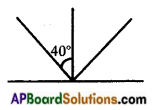
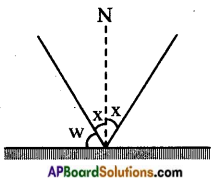
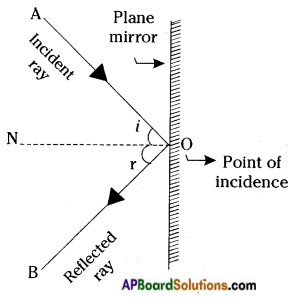
  1. When light gets reflected from a surface, the angle of reflection is equal to the angle of incidence, i.e., ∠i = ∠r.
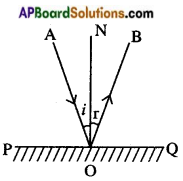
    AP Board 8th Class Physical Science Solutions Chapter 10 Reflection of Light at Plane Surfaces 1
  2. The incident ray, the normal at the point of incidence and the reflected ray lie in the same plane, i.e., AO, ON, OB are in same plane.

AP Board 8th Class Physical Science Solutions Chapter 10 Reflection of Light at Plane Surfaces

Question 2.
How do you verify the 1st law of reflection of light with an experiment?
(OR)
Raghu found that for a plane mirror angle of incidence is equal to the angle of reflection. Write the experiment to prove this fact. (OR)
Prove: ∠i = ∠r (LAB ACTIVITY – 1)
Answer:
Aim: Verification of first law of reflection.
Required materials: Mirror strip, drawing board, white paper, pins, clamps, scale and pencil.
Procedure:

  1. Take a drawing board and fix a white paper on it with the help of clamps.
  2. Draw a straight line AB at the centre of the paper and also a normal (ON) to AB at the point ‘O’.
  3. Draw a straight line PQ making certain angle (angle i) with ON.
  4. Fix two pins at P and Q on the paper vertically.
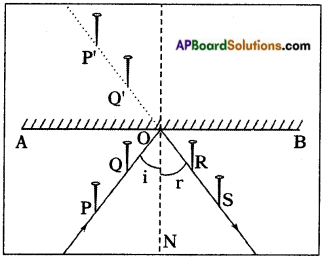
    AP Board 8th Class Physical Science Solutions Chapter 10 Reflection of Light at Plane Surfaces 2
  5. Observe the images of pins – P’ of the pin P and Q’ of the pin Q, in the mirror kept along the line segment AB.
  6. Fix two more pins R and S such that they are in the same line as that of P’ and Q’.
  7. Join R, S and 0 as shown in figure.
  8. Measure the angle between RS and ON (angle of reflection).
  9. We will find that ∠i = ∠r. (angle of incidence = angle of reflection)
  10. Repeat the experiment with different angles of incidence and measure the corresponding angles of reflection.
  11. We can find angle of incidence = angle of reflection in all these cases.
    Thus first law of reflection is proved.

Question 3.
How do you verify the 2nd law of reflection of light with an experiment?
(OR)
John found that incident ray, reflected ray and normal drawn to surface lie on the
same plane. What are the apparatus required for this experiment? How are you able to prove this fact experimentally?
Answer:
2nd Law of reflection: The incident ray, the reflected ray and normal all lie in the same plane.

  1. As shown in the figure, a light ray incident on a plane mirror and touches at a point ‘O’. Here AO is called incident ray.
  2. When a ray of light falls on a mirror, the mirror sends it back in another direction OB. Here OB is called reflected ray.
  3. Normal is a line which is perpendicular to the mirror at the point of incidence. So the line ON’ is the normal to the mirror surface at point ‘O’.
    AP Board 8th Class Physical Science Solutions Chapter 10 Reflection of Light at Plane Surfaces 3
  4. Here the incident ray (AO), the reflected ray (OB) and the normal (ON) all lie in the same plane of the paper.
    Hence 2nd law of reflection is proved.

AP Board 8th Class Physical Science Solutions Chapter 10 Reflection of Light at Plane Surfaces

Question 4.
Explain the image formation by pin hole camera with the help of the diagram.
(ACTIVITY – 1)
Answer:

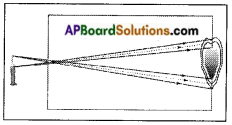
  1. Draw a ray diagram of the formation of an image in a pinhole camera.
  2. Observe the flame of a candle with a pinhole camera making a big hole to it.
    AP Board 8th Class Physical Science Solutions Chapter 10 Reflection of Light at Plane Surfaces 4
  3. We can understand that the light rays coming from the top of the candle flame fall at different points on the screen.
  4. Similarly, the rays coming from bottom of the candle points on the screen.
  5. Thus, we get blurred image on the screen due to the big hole of the camera.

Question 5.
Find the plane of the reflection experimentally for the incident ray which passes through the heads of the pins pierced in front of the mirror.
(OR)
Sudheer wants to verify the laws of reflection. What apparatus he requires to prove them? State the laws of reflection and write the experimentation process he follows.
Answer:
Aim: Verification of laws of reflection.
Required material: Mirror strip, drawing board, white paper, pins, clamps, scale and pencil.
Procedure:

  1. Take a drawing board and fix a white paper on it with the help of clamps.
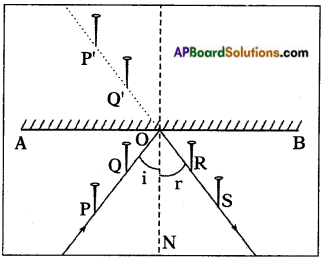
  2. Draw a straight line AB at the centre of the paper and also a normal (ON) to AB at the point ‘O’.
  3. Draw a straight line PQ making certain angle (∠i) with ON.
  4. Fix two pins at P and Q on the paper vertically.
    AP Board 8th Class Physical Science Solutions Chapter 10 Reflection of Light at Plane Surfaces 5
  5. Observe the image P’ of the pin P and Q’ of the pin Q, in the mirror kept along line segment AB.
  6. Fix two more pins R and S such that they are in the same line as that of P’ and Q’.
  7. Join R, S and O.
  8. Measure the angle between RS and ON (∠r) .We will find ∠i = ∠r.
  9. Repeat the experiment with different angles of incidence and measure the corresponding angles of reflection.
  10. We find that each case angle of incidence is equal to angle of reflection. That is first law.
  11. We can find that the incident ray is the ray which is passing through points P and Q touching the paper.
  12. The reflected ray is the ray which is passing through the points R and S touching the same paper and ON is the normal to the mirror at O. All lie in same plane. That is second law which states incident ray, reflected ray and normal drawn to plane lie in the same plane.

AP Board 8th Class Physical Science Solutions Chapter 10 Reflection of Light at Plane Surfaces

Question 6.
Have you ever observed the image of the sky in rain water pools on earth? Explain the reflection of light in this context.
Answer:
Surface of the rain water pool acts as a plane mirror, because of its smooth surface. The light rays from the sky and clouds incident at this surface and reflect. Hence, the images of the sky and clouds appear in the rain water pools.

Question 7.
Discuss the merits and demerits of using mirrors in building elevation.
(OR)
What are the advantages and disadvantages of using mirrors in building elevation?
Answer:
Merits:

  1. The mirrors used in elevating building are tough, reinforced and laminated glasses so they provide safety to the building.
  2. They make the building attractive.
  3. They absorb heat energy, so they cool inside the building.
  4. If we use plane mirrors in building elevation it is easy to wash with water and no need of regular painting.

Demerits:

  1. Elevation of buildings with mirrors is not suggestable.
  2. These mirrors reflect sun rays at day time and reflects lighting from near by electrical bulbs at night time, which causes confusion and disturbance for the vehicles and people who are running on the nearby roads lead to accidents.
  3. Birds like sparrows, crows will get confusion while flying on roads.
  4. They are also not safe enough to the buildings, which causes easy access to thieves.
  5. This glass elevation is not environmental friendly, because natural air does not enter into the building.
  6. They are easy to break and cause cuts and wounds.

Question 8.
If a ray incidence normally on a plane mirror, what will be the angle of reflection.
Answer:
If a ray incidence normally on a plane mirror, the angle of reflection will be zero.

AP Board 8th Class Physical Science Solutions Chapter 10 Reflection of Light at Plane Surfaces

Question 9.
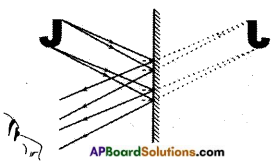
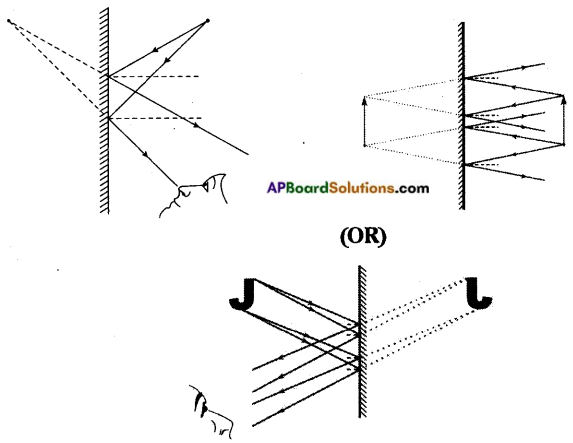
Why does the image in plane mirror suffers lateral inversion?
Answer:
The light rays which come from our right side get reflected from the plane mirror reach our eye. Our brain feels that the rays is coming from the inside of the mirror. That is why our right side looks like left side in the image. This is called right-left inversion or lateral inversion.

Question 10.
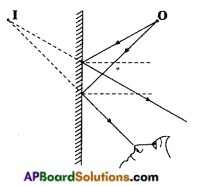
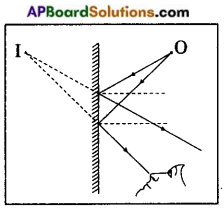
Draw a ray diagram to understand the formation of image for a pointed object by a plane mirror explain it.
Answer:
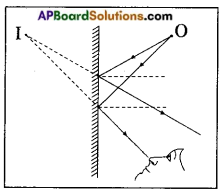
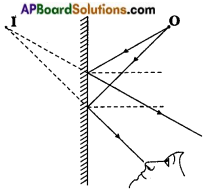
Observe the figure. ‘O’ is a point object.
AP Board 8th Class Physical Science Solutions Chapter 10 Reflection of Light at Plane Surfaces 6
Some rays from ‘O’ reach the mirror and get reflected. When we look into the mirror, the reflected rays seem to be coming from the point T. So, point I is the image of point object ‘O’.

Question 11.
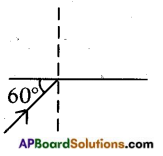
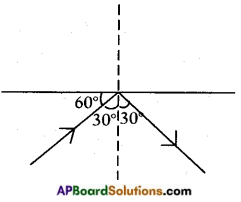
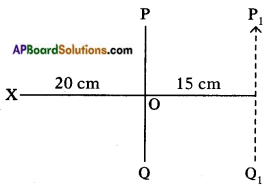
In the adjacent figure, AO and OB are incident and reflected rays respectively angle ∠AOB = 90°. Find the values of angle of incidence and angle of reflection.
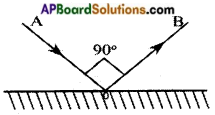
AP Board 8th Class Physical Science Solutions Chapter 10 Reflection of Light at Plane Surfaces 7
Answer:
We know that angle of incidence is equal to angle of reflection.
i = r …….. (1)
From the figure, ∠AOB indicates i + r = 90°
From (1)
⇒ i + i = 90°
2i = 90°
⇒ i = 90/2 = 45°
⇒ i = r = 45°
Angle of incidence i = 45°; Angle of reflection r = 45°.

AP Board 8th Class Physical Science Solutions Chapter 10 Reflection of Light at Plane Surfaces

Question 12.
Hinduja stands in front of a plane mirror at a distance of 5 m. from the mirror and observes her image in the mirror. If she moves 2 m. towards the plane mirror, then what will be the distance between Hinduja and his image?
Answer:
The distance between plane mirror and Hinduja = 5 m
The distance between plane mirror and Hinduja after moving 2 m towards mirror
= 5 – 2 = 3 m …….. (1)
The distance between plane mirror and Hinduja’s image after moving = 3 m …….. (2)
The distance between Hinduja and her image after moving = (1) + (2) = 3m + 3m = 6m.

Question 13.
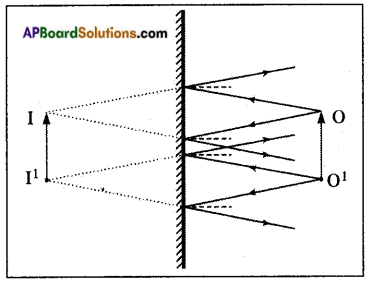
Explain diagramatically the Image of letter ‘B’ in a plane mirror.
Answer:
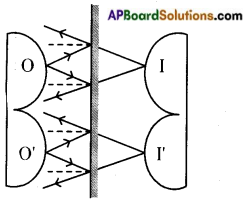
AP Board 8th Class Physical Science Solutions Chapter 10 Reflection of Light at Plane Surfaces 8

Question 14.
Why can’t we see our image in a white sheet of paper though it reflects light?
Answer:
By microscopic observation, we can find up and downs over surface of a paper. Hence paper is not a smooth fine surface. Even though sheet of white paper reflects the light rays, they do not form an image of an object.

Question 15.
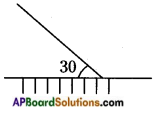
Observe the below figure. AB and BC are two plane mirrors arranged at 120°. A ray incidents at and angle 55° on AB. Find the value of ‘x’
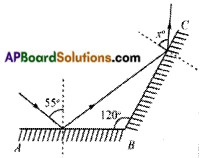
AP Board 8th Class Physical Science Solutions Chapter 10 Reflection of Light at Plane Surfaces 9
Answer:
Let us say, angles a, b, c, d as shown in the figure. From the figure, a = 55° [∵ i = r]
a + b = 90° [. Normal to the plane]
55° + b = 90°
⇒ b = 90° – 55° = 35°
120° + b + c = 180° [∵ Total of angles in a triangle]
120° + 35° + c = 180°
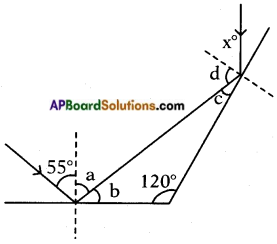
AP Board 8th Class Physical Science Solutions Chapter 10 Reflection of Light at Plane Surfaces 10
⇒ c = 180° – 155° = 25° c + d = 90° [∵ Normal to the plane]
25° + d = 90°
⇒ d = 90° – 25° = 65°
d = x [∵ i = r]
∴ x = 65°

AP Board 8th Class Physical Science Solutions Chapter 10 Reflection of Light at Plane Surfaces

Question 16.
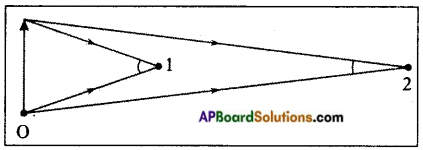
The size of the image in the mirror seem to be decreased when you move the object towards your eye from the mirror. Draw the diagram showing angles depicting the situation.
Answer:
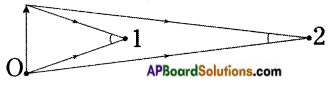
AP Board 8th Class Physical Science Solutions Chapter 10 Reflection of Light at Plane Surfaces 11

Question 17.
Collect the information about “Situations using the plane mirrors and prepare the report.
Answer:
Plane mirrors have many uses.

  1. Periscopes: They are used in periscopes to see bends and corners. It is used for observing enemy movements from trenches without any danger of being seen. Sailors on submarines use periscopes to see things above the water level.
  2. Kaleidoscopes: Kaleidoscope is a toy that uses light and mirrors to reflect objects and create beautiful, fascinating repeating patterns.
  3. Security: Mirrors are used while looking for explosives underneath a vehicle. Even these mirrors are used in shops to keep an eye on the customers. Mirrors are also used in blind turns of busy roads to see the vehicles coming from the other side.
  4. Telescopes and Microscopes: Plane mirrors are used in many scientific applications like telescopes and microscopes.
  5. Dressing mirrors: Plane mirrors are used in dressing tables to see ourselves, while dressing, shaving, etc.
  6. Ophthalmic doctors: They use plane mirrors to increase the distance of the eye test chart while examine the eye of a patient.
  7. Docorating mirrors: Plane mirrors are used to decorate the building for elivations. Some shops also used plane mirrors to get multiple images of the items in their shops.

MULTIPLE CHOICE QUESTIONS
1. Angle of incidence = Angle of reflection. This rule is explained by …………… principle        ( )
A) Fermat
B) Newton
C) Archemedes
D) Pascal
Answer: A

2. Which of the following letters doesn’t suffer lateral inversion?         ( )
A) C
B) O
C) B
D) N
Answer: B

3. A ray of light incidents on a plane mirror at an angle of 90° to its surface. What will be the angle of relfection?   ( )
A) 0°
B) 90°
C) 450°
D) 180°
Answer: A

AP Board 8th Class Physical Science Solutions Chapter 10 Reflection of Light at Plane Surfaces

4. If we move an object away from the plane mirror the size of images seems to be     ( )
A) increases
B) decreases
C) of the same size
D) image can’t be seen
Answer: B

5. Which of the following is incorrect with respect to the image in a plane mirror?     ( )
A) Image is erect
B) size of the image is same as the size of object
C) laterally inverted
D) image is real.
Answer: D

6. An object is placed 7cm distance from the plane mirror then distance of image is      ( )
A) 3.5 cm
B) 14 cm
C) 7 cm
D) 21 cm
Answer: C

8th Class Physical Science 10th Lesson Reflection of Light at Plane Surfaces InText Questions and Answers

8th Class Physical Science Textbook Page No. 134

Question 1.
How can we get the image of a big building in a small mirror?
Answer:
Light rays travel in all directions from one object. Light rays coming from a building incident on the small area of a plane mirror and reflect. These reflected rays reach our eye. We see the image of the building in the mirror.

Question 2.
Can we get the image formed by a plane mirror on a screen?
Answer:
Cannot.

Question 3.
Why is there lateral inversion, when we look into a mirror?
Answer:
Our brain feels that the rays is coming from the inside of the mirror.

Question 4.
Why is the angle of reflection equal to the angle of incidence when a light ray gets reflected from a surface?
Answer:
Light always choose the path of least time to travel.

AP Board 8th Class Physical Science Solutions Chapter 10 Reflection of Light at Plane Surfaces

8th Class Physical Science Textbook Page No. 138

Question 5.
Is the angle of reflection equal to the angle of incidence in all cases?
Answer:
Yes.

Question 6.
Do the two rays and the normal lie in the same plane? If yes, which is that plane?
Answer:
Yes, plane of paper.

Question 7.
In which plane will the incident ray, reflected ray and the normal lie?
Answer:
Plane touching the heads of pins and parallel to the plane of paper.

Question 8.
How will the incident ray be?
Answer:
Incident ray touching heads of the pins (P and Q) and make some angle with plane of the paper.

Question 9.
How will the reflected ray be?
Answer:
Reflected ray will make some angle with plane of the paper.

Question 10.
How will the normal be?
Answer:
The normal will also make same angle as incident and reflected rays.

Question 11.
How will the plane of reflection be?
Answer:
Plane of reflection make some angle (which is equal to plane of the paper and incident ray) with plane of the paper.

Question 12.
How does a mirror form the image of a pin or any object? Let us discuss.
Answer:
The rays coming from the pin get reflected from the mirror and seem to be coming from the image in the mirror.

8th Class Physical Science Textbook Page No. 139

Question 13.
What is the size of the image compared to the size of the object?
Answer:
Size of the image is equal to size of the object.

Question 14.
What do you say about the size of the image compared to the size of the object? Move the object towards your eye. What do you observe?
Answer:
Size of the image is same as size of the object. If we move the object towards our eye, size of the image of the object seems to be decreased.

Question 15.
Is the size of the image decreasing or increasing?
Answer:
Decreasing.

AP Board 8th Class Physical Science Solutions Chapter 10 Reflection of Light at Plane Surfaces

8th Class Physical Science Textbook Page No. 140

Question 16.
Why does an image suffer lateral (right-left) inversion? See the figure.
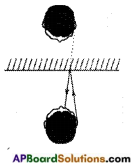
AP Board 8th Class Physical Science Solutions Chapter 10 Reflection of Light at Plane Surfaces 12
Answer:
Our brain feels that the rays are coming from the inside of the mirror and image is opposite to us. In this way image suffer lateral inversion.

Question 17.
What do you understand from the figure?
Answer:
The light rays which come from our right ear get reflected from the plane mirror and reach our eye. Our brain feels that the ray is coming from the inside of the mirror. That is why our right ear looks like left ear in the image.

Think, Discuss and Write

8th Class Physical Science Textbook Page No. 135

Question 1.
Does the explanation on pinhole match with your observation?
Answer:
Yes, it matches with my observation.

Question 2.
What happens if the hole Is much bigger, i.e., equal to the size of the flame?
Answer:
The image is extremely blurred.

Question 3.
If so, can we get the image of flame on the screen of pinhole camera? Why?
Answer:
No. Because the light rays coming from the top of the flame and bottom of the flame fall at different points on the screen. So it is blurred and is not formed on screen.

Question 4.
What happens if we observe the same flame with the same pinhole camera from a long distance?
Answer:
We may observe not only the flame, but the blurred image of entire candle.

Question 5.
What happens if we made two holes to pin hole camera?
Answer:
Two images will be formed.

AP Board 8th Class Physical Science Solutions Chapter 10 Reflection of Light at Plane Surfaces

8th Class Physical Science 10th Lesson Reflection of Light at Plane Surfaces Activities

Activity – 2

Question 1.
Which grain on the ground that a smart crow on tree A pick to reach B in short time (Shortest path)? Explain. (OR)
How do you support your answer to “When light gets reflected from a surface, it selects the path that takes the least time”? (OR)
Explain Fermat’s principle by using an activity.
Answer:
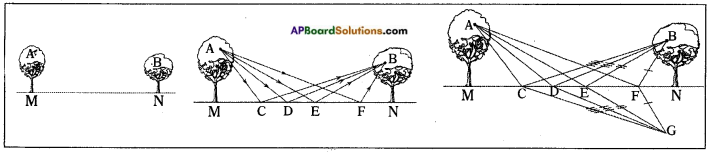
AP Board 8th Class Physical Science Solutions Chapter 10 Reflection of Light at Plane Surfaces 13

  1. The crow can pick the grain from any point on the ground, but the condition is selecting the shortest path.
  2. Let the speed of the crow is constants –
  3. Observe some of the paths in figure.
  4. To compare the lengths of these paths ACB, ADB, AEB and AFB, make the duplicates of them at point G as shown in figure.
  5. In the figure CB = CG,
    ∴ The length of path ACB = AC + CB = AC + CG = ACG
  6. Similarly length of the path ADB = length of the path ADG Similarlylength of the path AEB = length of the path AEG Similarly length of the path AFB = length of the path AFG
  7. By observing the above paths, we will notice that AEG is the shortest path among all the paths, because it is the straight line distance between points A and G.
  8. So the smart crow will pick the grain from point E.

AP Board 8th Class Physical Science Solutions Chapter 10 Reflection of Light at Plane Surfaces

Activity – 3

Question 2.
Look at the following figure.
Suppose if you have been given a plane mirror strip, what will you do to obtain figures as shown below figure (b) using mirror strip and the above figure (a)?
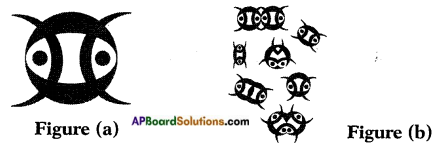
AP Board 8th Class Physical Science Solutions Chapter 10 Reflection of Light at Plane Surfaces 14
Answer:
The place of mirror that should be place on the figure vertically has been shown here under by a line.
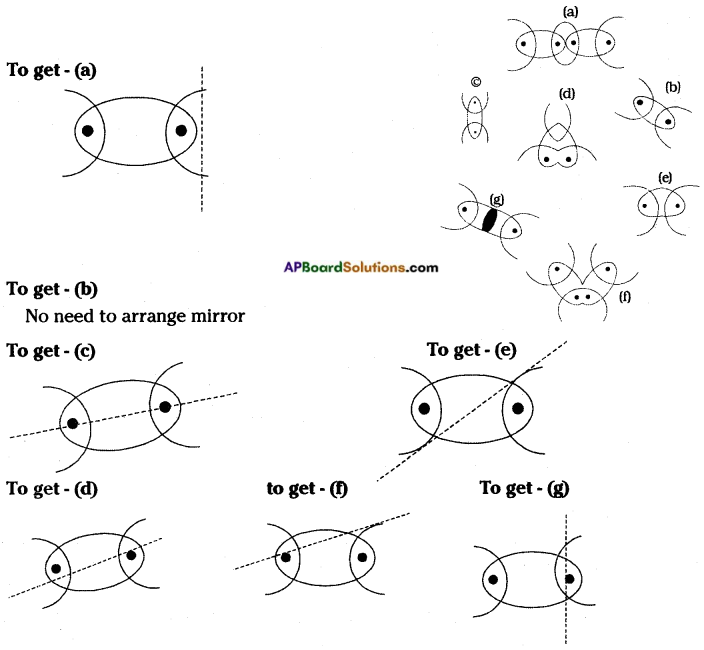
AP Board 8th Class Physical Science Solutions Chapter 10 Reflection of Light at Plane Surfaces 14
In the above diagrams, line indicates the position of mirror to be kept to get the required shapes.
AP Board 8th Class Physical Science Solutions Chapter 9 Electrical Conductivity of Liquids

AP State Syllabus AP Board 8th Class Physical Science Solutions Chapter 9 Electrical Conductivity of Liquids Textbook Questions and Answers.

AP State Syllabus 8th Class Physical Science Solutions 9th Lesson Electrical Conductivity of Liquids

8th Class Physical Science 9th Lesson Electrical Conductivity of Liquids Textbook Questions and Answers

Improve Your Learning

Question 1.
Give examples for good solid conductors and liquid conductors.
Answer:
Examples for good conductors in solids:
Silver, copper, iron, graphite, etc.
Examples for good conductors in liquids:
Mercury, acid solutions (HCl, H2SO4), base solutions (NaOH, KOH), salt solutions (NaCl, KCl), etc.

AP Board 8th Class Physical Science Solutions Chapter 9 Electrical Conductivity of Liquids

Question 2.
Give examples for bad solid conductors and liquid conductors.
Answer:
Examples for poor conductors in solids:
Gold, platinum, etc.
Examples for bad conductors in liquids:
Distilled water, coconut oil, petrol, vegetable oil, kerosene, alcohol, etc.

Question 3.
What do you add to distilled water for making it to conduct electricity?
Answer:
Distilled water is poor conductor of electricity. In order to increase conductivity we should have to add either acid, base or salt. That will increase the conductivity of distilled water due to decomposition of these substances into constitute ions.

Question 4.
What is an electrolyte ?
Answer:
Electrolyte is a solution of substance through which current can pass.

Question 5.
Which energy is cause for glowing of bulb in electrolytic cell?
Answer:
Electrolytic cell is a device which converts chemical energy into electrical energy. So chemical energy stored in the cell is cause for glowing of bulb.

AP Board 8th Class Physical Science Solutions Chapter 9 Electrical Conductivity of Liquids

Question 6.
Write the uses of electroplating.
Answer:
Uses of electroplating:

  1. Metals like iron are coated with deposits of nickel or chromium to prevent rusting.
  2. Machinery parts are often chromium plated to protect them from corrosion and at the same time to give them good polish.
  3. Electroplating is also used in repairing worn out parts of machinery.
  4. Electroplating is also done for ornamentation and decoration purposes.
  5. Processed food items are preserved in tin coated iron cans by electroplating method.
  6. Zinc coated iron by electroplating method is used for bridges and in automobiles.

Question 7.
In case of a fire, before the fire men use the water, they shut off the main electrical supply for the area. Explain why they do this.
Answer:
Fire men use water to put out fire. Water containing dissolved salts is a good conductor of electricity. If fire men pour water on fire the electrical appliances near the fire may be wet if anybody touches those appliances they may have electric shock. In order to avoid people to get electric shock due to wet electrical appliances the fire men shut off electrical supply before they use water.

Question 8.
We get some items made from iron wire in which iron wire is coated with plastic. Is plastic coated by the process of electroplating? Why plastic cannot be coated on a metal by the process of electroplating?
Answer:
No. Plastic cannot be coated on a metal by using electroplating. The reason is plastic being a carbon polymer does not dissociate into ions. So it does not allow passage of current. So it does not act as an electrolyte. So electrolysis process is not possible with plastic which is main criteria for electroplating. So plastic cannot be coated on a metal by the process of electroplating.

Question 9.
Kavya observed that a discharged dry cell which kept in sunlight by her father for few hours got ability to glow LED. She got many doubts and questions to raise. Can you guess those questions or doubts? (OR)
Rohan observed that a discharged dry cell which kept in sunlight by his brother for few hours got ability to glow LED. He got many doubts and questions to raise. Guess the doubts or questions.
Answer:

  1. Why does the bulb glow?
  2. How does the dry cell charged?
  3. Which energy is useful in charging the discharged dry cell?
  4. Shall we use that energy to get rid from electrical power cut?

AP Board 8th Class Physical Science Solutions Chapter 9 Electrical Conductivity of Liquids

Question 10.
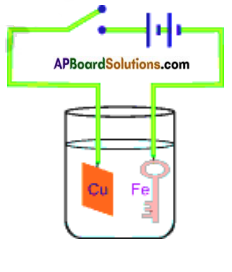
Explain the process of coating copper on iron key. Draw the circuit diagram.
(OR)
Conduct an experiment for coating on iron key with copper by electroplating method and prepare a note.
Lab Activity
Answer:
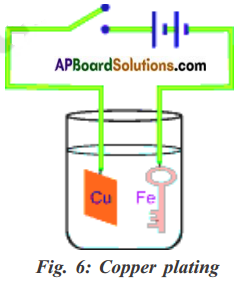
Aim: Coating an iron key with copper by electroplating method.
Required material: Copper plate of size 2 cm x 5 cm, crystals of copper sulphate, a key made by iron, glass beaker, water, sulphuric acid, battery cell and some connecting copper wires.
Procedure: Dissolve crystals of copper sulphate in pure water to prepare concentrated solution. Pour the solution in a beaker and add a few drops of dilute sulphuric acid to it.
AP Board 8th Class Physical Science Solutions Chapter 9 Electrical Conductivity of Liquids 1
Tie one end of connecting copper wire to iron object to be coated with copper. Connect other end to the negative terminal of battery. Suspend the tied iron object into the copper sulphate solution. Suspend the copper plate into copper sulphate from positive end of the battery through a switch as shown in the above figure. Key and plate are a little away from each other. Put the switch on for about 10 minutes. Switch the circuit off and take the iron key out.
We can observe a red coating on iron key. The reason is when electric current is pass through copper solution, in which copper sulphate is present in the form of copper and sulphate ions. The copper ion gets drawn to the electrode connected to the negative terminal of the battery and deposited on it.

Question 11.
How do you appreciate the efforts of Luigi Galvani and Alessandro Volta in discovering a cell and making a stored electric energy available to human beings?
Answer:
We should have to thoroughly appreciate the efforts of Luigi Galvani and Alessandro for their discoveries for the development of mankind. Galvani and Volta completely change the life of human beings. Before that people generated electricity in different ways and conduct various experiments. However they faced one major problem which prevented them from understanding electricity in depth. They did not have a stable and permanent source of electricity. Galvani experimental conclusion was a revolution in science saying that all living beings contained electricity and it was the main source of life.
Volta proved it is possible to generate electricity if two different metals are placed in some liquids. Volta made first cell using zinc and copper dipped in sulphuric acid. This cell called Volta cell. Later dry cell was prepared. Now various appliances works with dry cells. So the efforts of Galvani and Volta should be appreciated by every generation for their contribution to electricity.

AP Board 8th Class Physical Science Solutions Chapter 9 Electrical Conductivity of Liquids

Question 12.
Collect the information and make a list of good conductors and bad conductors. Mow do you use this information in your daily life works?
Answer:

 Good conductors Bad conductors
1) Metals 1) Wood
2) Acid solutions 2) Plastic
3) Base solutions 3) Diamond
4) Salt solutions 4) Distilled Water

Applications in daily life: This information is very useful to us. Generally metal or good conductors of electricity are used in electrical appliances, electrical wires, fuse wires, etc. Whereas plastic is a bad conductor is used for electric insulators like gloves, handles of electrical appliances etc. to avoid electric shocks.

Question 13.
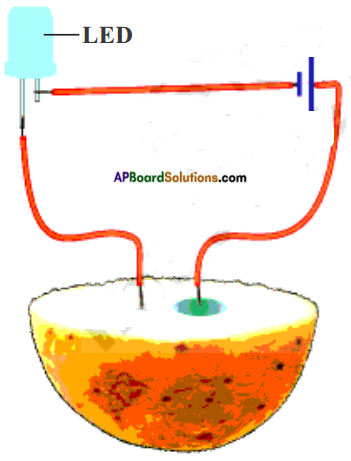
Make a battery from four lemons and test it with a LED in the circuit.
(OR)
Write how do you make a battery from four lemons and test it with a LED in the circuit in your laboratory.
Answer:
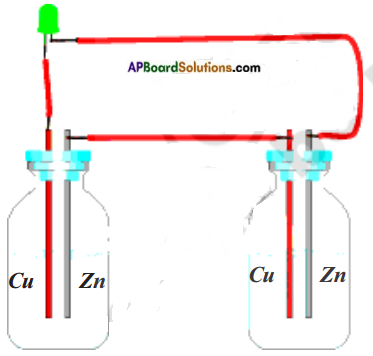
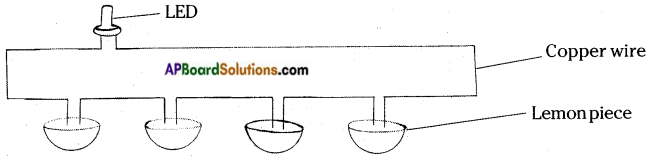
Take four lemons cut them into two pieces. Take one piece from each lemon and insert two copper wires and connect them in series and connect a LED and complete the circuit. The circuit is shown below.
AP Board 8th Class Physical Science Solutions Chapter 9 Electrical Conductivity of Liquids 2
The bulb glows due to presence of current in the circuit. Here lemon juice acts as electrolyte and copper wires acts as electrolyte. So each lemon piece dipped with a copper wire acts as cell. These cells connected in series forms a battery.

Question 14.
Refer to the activity 3 in this chapter. Start with distilled water. The LED would not glow. Add two drops of some acid to distilled water and check the glow of LED. Add two more drops and check the intensity of the glow. Repeat the activity 5 to 6 times by adding 2 drops of the same acid each time. Do you see any difference in the intensity of glow with increasing acid content of water? What can be inferred from the above observations? Repeat the entire activity by taking a solution of baking soda and adding drops of it to distilled water instead of acid. Write differences and similarities.
Answer:
When we add two drops of acid (namely hydrochloric acid) to distilled water the LED will glow. If we further add the acid another two drops the intensity of glow increases. By repeating same activity 5 or 6 times we observe every time the glow of LED increases. The reason is acid dissociate into ions in aqueous solution. Which allows the passage of current. As the quantity of acid increases there will be more ions available for passage of electricity. So the intensity of glow increases.
We will observe the same result by adding baking soda but the intensity of glow is some what less when compared with addition of acid. The reason is baking soda is a weak base. So the dissociation is less when compared with acid. So less ions are available for passage of electricity. So the intensity of glow of LED is less when compared with acid.

AP Board 8th Class Physical Science Solutions Chapter 9 Electrical Conductivity of Liquids

Question 15.
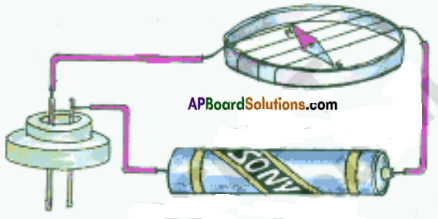
In many of the activities in this chapter, we have used a tester made up of LED. Can we avoid LED and use something else as a tester Magnetic compass needle could be an alternative tester. We know that when we take a current carrying wire near magnetic compass needle, it shows deflection. Use this property to make a tester of magnetic compass needle. You may refer to the following figure.
Answer:
A magnetic compass wound with a copper wire is connected to one end of dry cell. The other end is connected to one of the two metal pins separated by a small gap in a rubber cap. The second pen is connected to the other end of dry cell to completed the circuit.
AP Board 8th Class Physical Science Solutions Chapter 9 Electrical Conductivity of Liquids 3
The magnetic needle deflects because whenever current pass through a wire it acts as a magnet is called magnetic effect of current.

8th Class Physical Science 9th Lesson Electrical Conductivity of Liquids InText Questions and Answers

Think and Discuss

8th Class Physical Science Textbook Page No. 123

Question 1.
Why some material allows electric current to pass through them and why some do not?
Answer:
Flow of charged particles constitutes current. So for the passage of current the material should have charged particles. All the materials do not have charged particles, e.g. Plastic, wood, diamond, etc. So only those material which have charged particles allow passage of current.

8th Class Physical Science Textbook Page No. 127

Question 2.
If a battery is packed in a box and if only two wires from two terminals are given out, how can we decide the positive and negative terminal of the battery?
Answer:
Insert the wires into a potato. A greenish spot is seen on potato at one of the wires. That wire behave like positive terminal and the other is negative terminal.

8th Class Physical Science Textbook Page No. 129

AP Board 8th Class Physical Science Solutions Chapter 9 Electrical Conductivity of Liquids

Question 3.
What is electrolysis?
Answer:
The dissociation of a solution of compound into constitute ions or elements by passing current is called electrolysis.
e.g. Electrolysis of water, which produce oxygen and hydrogen gases.

8th Class Physical Science 9th Lesson Electrical Conductivity of Liquids Activities

Activity – 1

Question 1.
Testing the material to know which allows electric current to pass through it.
Answer:
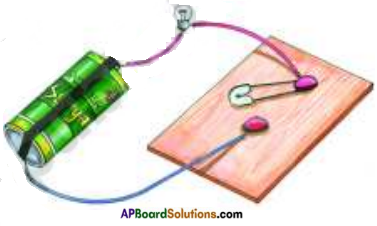
Take a torch bulb or LED (Light Emitting Diode), a dry cell, wooden sheet, two drawing pins, a key (safety pin) and pieces of connecting wires. Set up the electric circuit as shown in the figure.
AP Board 8th Class Physical Science Solutions Chapter 9 Electrical Conductivity of Liquids 4
Place the key on drawing pin. The bulb begins to glow as soon as the key touches the drawing pin. Now replace the key by a nail.
Does the bulb glow ?
Yes, the bulb glows.
Repeat the activity using different types of materials instead of the nail, say a strip of paper, a piece of chalk, a drinking straw, a piece of plastic, a paper clip, a rubber eraser, etc.
Note in each case whether the bulb glows or not and enter your observations in table.

Object Material Bulb glows
Yes/No
Good conductor/ bad or poor conductor
Nail Iron Yes Good conductor
Eraser Rubber No Bad or poor conductor
Paper Cellulose No Bad or poor conductor
Chalk Calcium carbonate No Bad or poor conductor
Straw Plastic No Bad or poor conductor
Plastic Plastic No Bad or poor conductor
Matchstick Wood No Bad or poor conductor

From the above activity, we conclude that some material allow electric current to pass through them. What we call them?
They are called good conductors of electricity.
The material that do not allow current to pass through them, what is the name given to those material?
They are named as bad or poor conductors of electricity.

AP Board 8th Class Physical Science Solutions Chapter 9 Electrical Conductivity of Liquids

Activity – 2

Question 2.
Testing the electric conductivity of liquids.
(OR)
Conduct an experiment for testing the electric conductivity of liquids.
Answer:
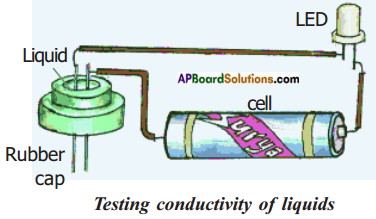
Take a LED, dry cell, metal pins, rubber cap of injection bottle and wires for making connections. Set up an electric
circuit shown in the figure.
AP Board 8th Class Physical Science Solutions Chapter 9 Electrical Conductivity of Liquids 5
See that the two metal pins, pass through the cap and should have a very small gap (around 2 mm) between them so that the pins are fairly closer but not touching each other. The LED should not glow when pins are separated by small distance.
Now, join the free ends of pins together by pressing them for a moment and make sure that the LED glows. Release the pins they get separated and LED should not glow. This acts as a tester.
Fill the rubber cap with different liquids like distilled water that we drink, coconut oil, kerosene, lime juice, mustard oil, sugar solution, etc one after another and in each case check whether the LED glows or not. Note down your observations in table.

Liquid LED glows Good conductor/ poor or bad conductor
Distilled water No Bad conductor
Drinking water Yes Good conductor
Coconut oil No Bad conductor
Lemon juice Yes Good conductor
Vinegar Yes Good conductor
Kerosene No Bad conductor
Vegetable oil No Bad conductor
Sugar solution No Bad conductor
Common salt solution Yes Good conductor
Milk No Bad conductor

a) Why doesn’t the LED glow in all the cases? Or why doesn’t the LED remain off in all the cases?
Answer:
The LED doesn’t glow all the cases because when the liquid the two pins of tester allows electric current to pass through, the circuit is completed (closed) and the LED glows. On the other hand when the liquid does not allow the current to pass through, the circuit is incomplete (open) and the LED does not glow.

AP Board 8th Class Physical Science Solutions Chapter 9 Electrical Conductivity of Liquids

b) In the above activity, you may have observed that in all those cases where the LED glows, its brightness (intensity) is not the same. Sometimes it may be brighter and sometimes it may be relatively dimmer. Why is that so?
Answer:
The intensity of the glow of the LED depends on the flow of electric current through the circuit. Although a liquid may be a conductor, it may not allow current through it as easily as a metal does.
As a result although the circuit is completed and the LED glows, due to weak current in case of some of the liquids, the intensity of glow would be lower compared to other liquids.

Activity – 3

Question 3.
Transforming a poor electric conductor into a good conductor.
(OR)
Conduct an experiment for testing the electric conductivity of electrolyte.
Answer:
Take some amount of distilled water in three different containers. Dissolve small quantity of common salt in the water of first container. Dissolve the copper sulphate, lemon juice in second and third container respectively.
Use the tester that we used in activity 2, and repeat the activity 2. Note the observations in table.

Material ‘ Does the LED glow? Yes/No Good conductor/bad conductor
Distilled water No Bad conductor
Distilled water + salt Yes Good conductor
Distilled water + CuSO4 Yes Good conductor
Distilled water + lemon juice Yes Good conductor

a) From table what can we infer?
Answer:
Distilled water does not allow the electric current to pass. Water in its pure form is a bad conductor of electricity. But when water contains salts or acids, it allows a passage of electric current and turns into a good conductor of electricity.

b) Do you understand why you are advised not to touch electric appliances with wet hands?
Answer:
Water with salts is a good conductor of electricity and the current flowing through househt d electric appliances is very high. Therefore we should never touch the electrical appliances with wet hands.

Activity – 4

Question 4.
Testing the effect of electric current on potato.
Take a potato. Cut into two halves and take one half of it. Construct tester with LED bulb. Insert two copper wires of the tester into the potato. Leaving some distance (around 1 cm) between them.
AP Board 8th Class Physical Science Solutions Chapter 9 Electrical Conductivity of Liquids 6
a) Dose the LED glow?
Answer:
Yes, the LED glows.
Leave the inserted wires for 20-30 minutes.

b) What do you observe the surface of the potato?
Answer:
A greenish blue spot is seen on the potato around the wire connected to the positive terminal of the battery.
But no such spot is seen around the other wire connected to the negative terminal. This greenish spot is due to chemical change in the potato.

AP Board 8th Class Physical Science Solutions Chapter 9 Electrical Conductivity of Liquids

c) What could be the cause behind this change?
Answer:
There is chemical change occurred in the potato.

d) Will other vegetables also show such an effect?
Answer:
Vegetable like carrot, beetroot, cucumber, radish, sweet potato show the chemical change there by the LED glows.

Activity – 5

Question 5.
Make your own cell.
(OR)
Draw the diagram of electrolytic cell and explain.
Collect two injection bottles. Cut two 5 cm long bits of thick copper wire. Use sandpaper to scrap about 1 cm of the coating off both ends of the wires.
Break open a exhausted dry cell and remove its outer metal covering (made of zinc). Cut two 2 mm wide and 5 cm long strips from this zinc plate. Insert the copper wires and zinc strips into the rubber caps of the injection bottles as shown in figure. Ensure that the copper wire and zinc strips do not touch each other.
AP Board 8th Class Physical Science Solutions Chapter 9 Electrical Conductivity of Liquids 7
Now take a wire and connect the copper wire of one bottle with the zinc plate of the other bottle. Fill both bottles with dilute sulphuric acid. Carefully close the bottles with the caps in which copper wires and zinc strips are inserted. Your cell is ready.
How will you test it?
Take an LED. Attach two wires to its two terminals. Touch the wire from one terminal to the zinc plate and the wire from other terminal to the copper wire. Did the LED light up ? If not, change the connections vice-versa. Did the LED glow ?
Repeat the above activity using lemon juice, tamarind juice and tomato juice one by one instead of sulphuric acid to make cells.

a) What other liquids can be used to make the cell?
Answer:
Acid solutions.

b) Will detergent solution be useful?
Answer:
Yes, it is useful.

c) How does above cell function?
Answer:
After a few seconds of immersion of zinc and copper into dilute sulphuric acid, zinc slowly begins to dissolve in the sulphuric acid. We can see bubbles getting formed on the copper rod.
The current is passed from copper rod to zinc rod. Here chemical energy is converted into electric energy by electrolysis method.

AP Board 8th Class Physical Science Solutions Chapter 9 Electrical Conductivity of Liquids

d) Can you compare this cell with dry cell?
Answer:
In the above cell electrolyte is dilute sulphuric acid whereas in dry cell ammonium chloride paste is electrolyte. The electrodes in above cell is copper and zinc, whereas in dry cell it is graphite (carbon) and zinc.

e) Which is good one? Why?
Answer:
Dry cell is better than ordinary Volta cell. The reason dry cell does not have any fluids. So it is easy to carry dry cell compared with volta cell. So dry cell is better than volta cell.

AP Board 8th Class Physical Science Important Questions Chapter 4 Synthetic Fibres and Plastics

AP State Syllabus AP Board 8th Class Physical Science Important Questions Chapter 4 Synthetic Fibres and Plastics

AP State Syllabus 8th Class Physical Science Important Questions 4th Lesson Synthetic Fibres and Plastics

8th Class Physical Science 4th Lesson Synthetic Fibres and Plastics 1 Mark Important Questions and Answers

Question 1.
What is polymer?
Answer:
Many small identical units combine to form a large unit is called polymer. The small units are called monomers.

Question 2.
What are synthetic fibres?
Answer:
The fibres obtained from petrochemicals when they are subjected to chemical processes are called synthetic fibres.
Have you ever heard a cracking sound when you take off certain type of clothes? or did you see sparks in them when it is dark?

AP Board 8th Class Physical Science Important Questions Chapter 4 Synthetic Fibres and Plastics

Question 3.
What is the reason?
Answer:
This is static electricity developed by artificial fibres due to friction.

Question 4.
Why does wearing nylon clothes are not preferable while cooking or working near a fire?
Answer:
Nylon fibre easily catches fire. So it is not preferable to wear it while cooking, welding, working near a fire.

Question 5.
What is blending and what is the advantage of blending?
Answer:
Any synthetic fibre can be combined with two or more other fibres is called blending.
When two fibres are blended the resultant blended fibre possess the best qualities of both.

Question 6.
What are the uses of plastics?
Answer:
Plastics are used in milk and oil pouches, containers to store pickles and rice, buckets to store water, chairs, water pipes, electrical appliances, television, radio and comput¬ers and mobile phones.

Question 7.
What material is used to make handles of utensils?
Answer:
Bakelite is used for making handles of various utensils due to its poor conductivity of heat and electricity.

AP Board 8th Class Physical Science Important Questions Chapter 4 Synthetic Fibres and Plastics

Question 8.
How do you appreciate 4R principle?
Answer:
4R principle is useful in developing ecofriendly environment and bright future for next generation of people.

8th Class Physical Science 4th Lesson Synthetic Fibres and Plastics 2 Marks Important Questions and Answers

Question 1.
How is nylon made? What are the advantages of nylon as fibre?
Answer:
Nylon is a polymer made of chemical units called polyamides.
Advantages of nylon as fibre:

  1. Nylon fibre is strong, elastic and light weight.
  2. Cloth made of nylon are lustrous and easy to wash.
  3. Nylon does not absorb water.

Question 2.
Where does we use nylon?
Answer:
Nylon can be used in tooth brush bristles, ropes, fishing nets, tents, sarees, stockings and socks, car seat belts, sleeping bags, curtains, carpets and also used in making parachutes.
Rock climbers use nylon ropes to climb mountains. It is also used in making of swim suits, sheer hosiery, sails, umbrella cloth, dress materials, car tyres, etc.

Question 3.
How would you prepare rayon?
Answer:
The cellulose that was collected from wood or bamboo pulp is treated with sodium hydroxide and then carbon disulphide. It forms a syrup called viscose. Viscose is forced through a spinneret into a solution of dilute sulphuric acid. This gives us silk like threads. This new fibre is called rayon which is an artificial silk.

AP Board 8th Class Physical Science Important Questions Chapter 4 Synthetic Fibres and Plastics

Question 4.
What are the uses of rayon?
Answer:

  1. Rayon is cheaper than silk and can be woven like silk fibre.
  2. Rayon is mixed with cotton to make bed sheets.
  3. Rayon is mixed with wool in making of carpets.
  4. Rayon is often used in fashion and home furnishings.
  5. Rayon is also found in sanitary products, diapers and bandages and lints for dressing wounds.

Question 5.
What is acrylic ? Where do we use acrylic?
Answer:
Acrylic is a synthetic fibre made from the combination of coal, air, water and lime¬stone. It looks like natural wool. If can be considered as artificial wool.
It is used in knitted apparels such as fleece, socks, sportswear and sweaters. It is also used in craft yarns, upholstery fabric, carpets, luggage yawning and vehicle covers.

Question 6.
What are the advantages of natural fibre over artificial fibres?
Answer:
When natural fibres, contribute to a fabric it allows the skin to breathe easily. Also natural fibres are generally free from irritating chemicals. Whenever fire accidents takes place they does not stick to the body.

Question 7.
How do you prepare polyester? What are the advantages of polyester as fabric?
Answer: Polyester is made by reacting dicarboxylic acid with dihydric alcohol.
Advantages :

  1. Polyester can be melted and spun. This property allows the fibre to convert into different sizes and shapes.
  2. They are altra thin, microfiber which gives them a smoothen and soft feel.
  3. They does not get wrinkled easily.
  4. It remains crisp and easily washable.

Question 8.
Give example for popular polyester and what are its advantages?
Answer:
The popular polyester is terylene.

  1. It can be drawn into very fire fabric fibres.
  2. Terylene is after mixed with cotton to form terricot with wool to give terriwool. Which has best qualities of both blunded fibres.

Question 9.
What are plastics? How many types of plastics are there? Explain them with examples.
Answer:
Organic polymers are called plastics. Plastics are two types :

  1. Thermoplastics: The plastics which get deformed easily on heating and can be bent are called thermoplastics, e.g.: Polyethene, PVC.
  2. Thermosetting plastics: The plastics which molded once cannot be softened on heating are called thermosetting plastics, e.g.: Bakelite, melamine.

AP Board 8th Class Physical Science Important Questions Chapter 4 Synthetic Fibres and Plastics

Question 10.
Where do we use bakelite?
Answer:

  1. Bakelite is used for making handles of various utensils.
  2. It is used for making electrical appliances including switch boards.
  3. It is an alternative for pearl and jade.
  4. In manufacture of telephone.

Question 11.
Where do we use melamine?
Answer:

  1. Melamine is used in making of utensils and other grocery of kitchen.
  2. It is used for making of floor and dress material (firemen dress) for their nature of fire resistance.
  3. Computer and T.V. cabinets are made by melamine.

Question 12.
Ramu observing his grandmother keeping pickles in plastic bottles. What are the questions raised in his mind by seeing this?
Answer:
The questions raised in Ramu’s mind

  1. Whether plastic is cheap when compare with metal?
  2. Why does she not put the pickles in metal containers?
  3. Whether metal containers react with pickles? If so they form harmful substances?

Question 13.
What do you know about creator of first man made plastic? How he prepare the plastic?
Answer:
The creator of first man made plastic is Alexander Parkes the name of the plastic is parkesine.
To prepare this material Parkes heated nitrated cotton which previously soaked in sulphuric acid and made fabric soft and elastic with oil and camphor. The end product was an ivory – coloured material that became distorted when subjected to heat. This is named as Parkesine.

Question 14.
What do you know about father of plastic industry? What are his major inventions and discoveries?
Answer:
Dr. Baekeland is considered as the father of present plastic industry. He was respon¬sible for the invention of bakelite. He accidently discovered the compound of carbolic acid and formaldehyde. When he tried to reheat the solidified compound he discovered it would not melt, no matter how high the temperature would be.

AP Board 8th Class Physical Science Important Questions Chapter 4 Synthetic Fibres and Plastics

Question 15.
List out the objects made up of Acrylic.
Answer:

  1. It is used in knitted apparels such as fleece, socks, sports wear and sweaters.
  2. It is also used in craft yarns, upholstery fabric, carpets, lugguage awnings and vehicle covers.

Question 16.
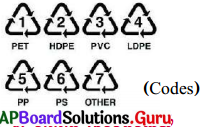
Draw and explain the diagram of Universal recycling symbol.
Answer:
When the number is omitted from recycling icon then it is known as Universal recycling symbol.
AP Board 8th Class Physical Science Important Questions Chapter 4 Synthetic Fibres and Plastics 1

Question 17.
What are thermosetting plastics? Give two examples.
Answer:
Thermosetting plastics are synthetic materials which gain strength during moulding by heating, but cannot be remoulded or reheated after their initial heat, moulding.
Ex : Bakelite and melamine.

Question 18.
What made the human beings to search for the alternative for natural fibres?
Answer:
Human being is always going in search of new things which can make his life more comfortable and durable. As the natural fibres are not durable, elastic or light weight or lustrous or easy to wash, he needed an alternative to fulfill his expectations. The solution to his expectations is synthetic fibre.

Question 19.
Imagine what would happen if we do not discover plastics.
Answer:
Nowadays every object used in our day to day life is made of plastic. For example milk and oil pouches, containers to store pickles and rice, buckets to store water, chains, water pipes, electrical appliances, television, radio and computers, mobile phones.
So plastics has taken over the place occupied by metal wood and glass items due to its special properties. So we cannot imagine our life without plastics because it is part of each and every aspect of life.

Question 20.
What is the most common material used in making the household articles ? Give some examples.
Answer:
Mostly household articles are made up of plastics.
Milk and oil pouches, containers to store pickles and rice, buckets to store water, chairs, water pipes, electric appliances, television, radio and computers, mobile phones, etc. are made of plastic.

Question 21.
What are the properties of thermoplastics and thermosetting plastics ?
Answer:
Thermoplastic will soften when heated and harden when cooled. It is a polymer that turns into a liquid when heated and freezes to a very glassy state when cooled sufficiently. Thermosetting plastics are not remouldable or reheatable. They are poor conductors of heat and electricity. They are fire resistants.

AP Board 8th Class Physical Science Important Questions Chapter 4 Synthetic Fibres and Plastics

Question 22.
Why polyster is quite suitable for making dress materials ? Name any two types of polyesters and their uses.
Answer:
a) Fabric made from polyester does not wrinkled easily.
b) If remains crisp and it is easy to wash.
c) Terylene is a type of popular polyester.
d) It can be drawn into very fine fibres that can be woven like any other yarn.
e) PET is very familiar form of polyester. It is used for making bottles, utensils, films, wires and many other useful products.

Question 23.
Write some disadvantages of synthetic fibres.
Answer:
a) Synthetic fibres cannot absorb moisture, thus they cannot be used as dress materials during summer.
b) They are dangerous to be worn near fire or heat as they catch fire easily.
c) They cannot be easily ironed.

Question 24.
Explain why plastic containers are favoured for storing food.
Answer:
Three main advantages of using plastic containers for storing food are :
a) They do not react with food items
b) They do not get rusted
c) They are light, strong and durable

AP Board 8th Class Physical Science Important Questions Chapter 4 Synthetic Fibres and Plastics

Question 25.
Explain why the following are made of thermosetting plastics,
a) saucepan handles
b) electric plugs/switches.
Answer:
Above things are made up of bakelite (thermosetting plastic) because it is
a) bad conductor of heat
b) poor conductor of electricity.

8th Class Physical Science 4th Lesson Synthetic Fibres and Plastics 4 Marks Important Questions and Answers

Question 1.
Explain 4R principle for creating ecofriendly environment.
Answer:
The 4R principle involves 1) Reduce 2) Reuse 3) Recycle 4) Recover.

  1. Reduce: Reduce the usage of plastic to avoid its negative consequence on environment. Land filling or plastics and burning of plastics in incinerators in the way of disposal of plastics. These have negative consequence on environment. So reduce the usage of plastic whenever it is possible.
  2. Reuse: Articles made of plastic is used again and again for its optimum utilization. There by we can decrease the usage of plastics.
  3. Recycle: We can recycle the plastic material from broken plastic material that will decrease the production of excess of plastic.
  4. Recover: The principle of recover plays major role in plastic waste management. The solid waste should be converted into resources such as electricity, heat, compost and fuel through thermal and biological means.

(OR)

  1. Reduce: Try to use less plastic material in our daily life.
  2. Reuse: Whenever we need to use plastic material, use the same material again and again don’t go for new one every time.
  3. Recycle: Instead of throw away the waste plastic material try to give it the vendor.
  4. Recover: Aware the people about establishing “garbage to energy” plant in your area.

Question 2.
Is there any such effort for solid waste management taking place in your village/ town ? How do you appreciate 4R principle?
Answer:
4R Principle is for creating an eco friendly environment.
4R = Reduce, Reuse, Recycle and Recover.
Reduce: Reducing the usage of plastics by reusing them helps the negative conse-quences on environment.
Reuse: When some things made of plastics are not in use to us, we can give them to others who need them. This helps the negative consequence or environment. This is eco friendly.
Recycle: In this process, we can obtain a new substance from the old plastics. Recycling can be used to obtain materials from which the original products were made.
Recover: The solid wastes in which plastics are major should be converted into resources such as electricity, heat, compost and fuel through thermal and biological means.
In these ways 4R principle is eco-friendly.

AP Board 8th Class Physical Science Important Questions Chapter 4 Synthetic Fibres and Plastics

Question 3.
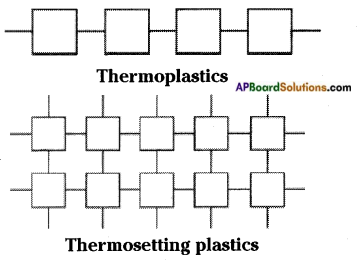
Explain the differences between the thermoplastics and thermosetting plastics with help of a diagram explaining in terms of arrangements of monomers.
Answer:
AP Board 8th Class Physical Science Important Questions Chapter 4 Synthetic Fibres and Plastics 2

Thermoplastics Thermosetting plastics
Plastics which get deformed easily on heating and can be bent are known as thermoplastics.
Ex: PVC, polythene bags, toys, combs, etc.
Plastics which moulded once can’t be softened by heating are called thermo­setting plastics.
Ex : Bakelite and melamine.

Explanation:

  1. Thermoplastics have linear arrangement of monomers.
  2. But thermosetting plastics have cross linked arrangement.
  3. The difference in the arrangement of monomers bring the difference in their properties.

Question 4.
Do you know how various synthetic fibres are obtained ?
Answer:
Nylon:
Nylon is a polymer made of chemical units called polyamides which contain carbon, oxygen and nitrogen. Polyamides are melted and forced through a heated spinneret which has very, very tiny holes. The size and shape of the holes changes, the characteristics of the resulting fibre. The fibre solidifies as it cool and can be spun or woven.

Rayon:
The cellulose that was collected from wood or bamboo pulp, is treated with several chemicals.
First sodium hydroxide is added and then carbon disulphide to the cellulose.
The cellulose dissolves in chemicals add to it and gives a syrup called viscose. Viscose is forced through a spinneret, into a solution of dilute sulphuric acid. This gives us silk like threads. The threads are cleaned with soap and dried. This new fibre is called rayon.

Acrylic:
It is made from the combination of coal, air, water, oil and limestone. It is spun by either dry spinning or wet spinning.
In dry spinning the dissolved polymers are extruded into warm air. The fibres solidify by evaporation. In wet spinning the polymers are dissolved and extruded into a bath and then dried.

AP Board 8th Class Physical Science Important Questions Chapter 4 Synthetic Fibres and Plastics

Question 5.
Can you name the few things made up of i) nylon ii) rayon (iii) acrylic and (iv) polyesters ?
Answer:
The things made from nylon:
Tooth brush bristles, ropes, fishing nets, tents, sarees, stockings and socks, car seat belts, sleeping bags, curtains, etc. are made up of nylon. The things made from rayon: Bed sheets, carpets, home furnishings, sanitary products, diapers and bandages and lints for dressing wounds.
The things made from acrylic: Socks, sportswear and sweaters, craft yarns, upholstery fabrics, carpets, luggage, awnings and vehicle covers.
The things made from Polyester: PET bottles, utensils, films, wires, etc.

Question 6.
Why it is advised not to wear synthetic clothes while working in a laboratory or working with fire in the kitchen ?
Answer:

  1. The synthetic fibres melt on heating.
  2. This is actually a disadvantage with synthetic fibres.
  3. If the cloth catches fire it can be very disastrous.
  4. The fabric melts and sticks to the body of the person wearing it.
  5. It is therefore advised not to wear synthetic clothes while working in a laboratory or working with fire in the kitchen.

Question 7.
Classify the material as biodegradable and non-biodegradable.

  1. paper
  2. wood
  3. metals
  4. cotton cloth
  5. plastic container
  6. woolen sweater
  7. peels of vegetable and fruit

Answer:

Material Biodegradable/non-biodegradable
1. paper Biodegradable
2. wood Biodegradable
3. metals Non-biodegradable
4. cotton cloth Biodegradable
5. plastic container Non-biodegradable
6. woolen sweater Biodegradable
7. peels of vegetable and fruit Biodegradable

AP Board 8th Class Physical Science Important Questions Chapter 4 Synthetic Fibres and Plastics

Question 8.
Write short notes on the following.
a) Plastic and health care industry b) Plastic cookware c) Teflon d) Fire proof plastic.
Answer:
a) Plastic and health care industry : Plastics find extensive use in the health care industry. Some examples of their use in health care are the packing of tablets, threads used for stitching wounds, syringes, doctor’s gloves, a number of medical instruments, etc.
b) Plastic cookware: Plastic cookware is used in microwave ovens for cooking food. The heating process is different in microwave ovens. The heat cooks the food but does not affect the plastic vessel.
c) Teflon: Teflon is a non-stick plastic used as non-stick coating in cookwares. It is also used as tape for sealing purpose.
d) Fire proof plastics: Although synthetic fibres catches fire easily, it is interesting to know that the fire proof material is made from synthetic plastics.

8th Class Physical Science 4th Lesson Synthetic Fibres and Plastics Important Questions and Answers

Question 1.
State government decided to avoid Flexi Banners. Predict the effect of Flexi banners
on environment.
Answer:

  1. PVC flexi banners can take several years to decompose in land fills.
  2. These flexi banners contain dangerous chemical additives like lead, cadmium which can be toxic to our health as well as animals health.

Question 2.
Write two slogans on solid waste management.
Answer:

  1. Convert waste to wealth
    Don’t convert wealth to waste.
  2. Recycle waste solid today
    for a better solid future.
  3. Reuse, Reduce, Recycle
    The good, The bettel, the best

Question 3.
Draw and explain the diagram of Universal redyeing symbol.
(OR)
Draw “Universal Recycling Symbol”.
Answer:
When the number is omitted from recycling icon then it is known as Universal recycling symbol.
AP Board 8th Class Physical Science Important Questions Chapter 4 Synthetic Fibres and Plastics 1

AP Board 8th Class Physical Science Important Questions Chapter 4 Synthetic Fibres and Plastics

Question 4.
Nylon is a synthetic fibre. Write the advantages and disadvantages of it.
Answer:
Advantages of nylon as fibre:

  1. Nylon fibre is strong, elastic and light weight.
  2. Cloth made of nylon are lustrous and easy to wash.
  3. Nylon does not absorb water.

Disadvantages of nylon as fibre:

  1. Synthetic fibres cannot absorb moisture, thus they cannot be used as dress materials during summer.
  2. They are dangerous to be worn near fire or heat as they catch fire easily.
  3. They cannot be easily ironed.

Question 5.
Though there are so many harmful effects of plastic, we still prefer to use it. What could be its major advantages?
Answer:
Plastics are used in milk and oil pouches, containers to store pickles and rice, buckets to store water, chairs, water pipes, electrical, appliances, television, radio and computers and mobile phones.
Bakelite is used for making handles of various utensils due to its poor conductivity of heat and electricity.

Question 6.
Using an experiment explain how synthetic fibres are stronger than cotton fibres.
Answer:

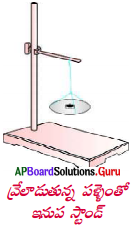
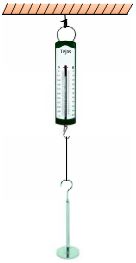
  1. Take an iron stand with a clamp.
  2. Take cotton thread and synthetic threads like nylon about 50 cm in length.
  3. Tie the cotton thread to the stand, so that it hangs freely from it.
  4. At the free and attach a pan, so that a weight can be placed on it.
  5. Add weight starting from 10 grams one by one, till the thread breaks down.
  6. Note the total weight required to break the thread.
  7. Repeat the same activity with synthetic thread also.
  8. We can observe that more weights are required to break the synthetic thread than cotton thread.
  9. Conclusion: Synthetic threads are stronger than cotton threads.

Question 7.
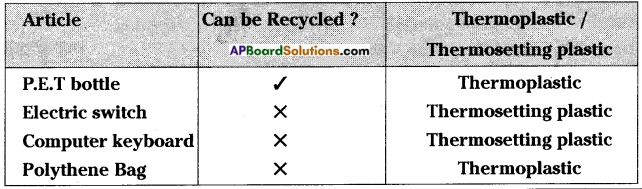
AP Board 8th Class Physical Science Important Questions Chapter 4 Synthetic Fibres and Plastics 3
Answer the following questions.
i) Name the recyclabel material / materials.
ii) Name the thermosetting plastic articles.
iii) Which are thermoplastics but not to be recycled?
iv) Which are recycled but not thermosetting plastics?
Answer:
i) P.E.T bottles
ii) Electric switch, computer keyboard
iii) Polythene bag
iv) P.E.T bottle

AP Board 8th Class Physical Science Important Questions Chapter 4 Synthetic Fibres and Plastics

Question 8.
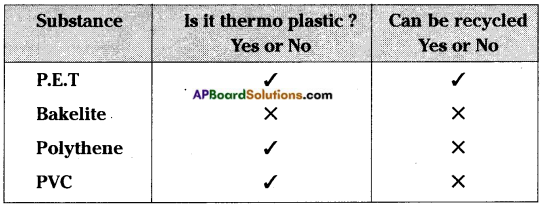
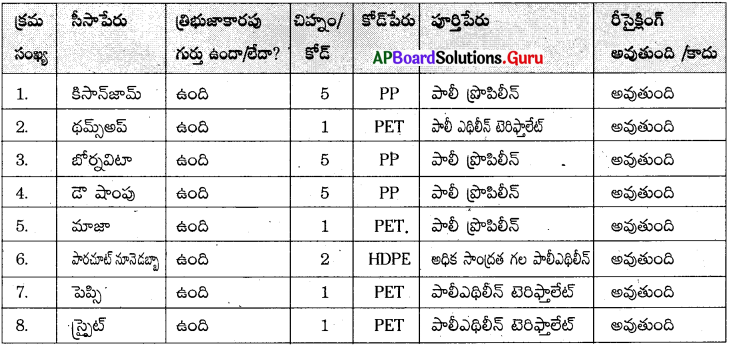
Observe the following table.
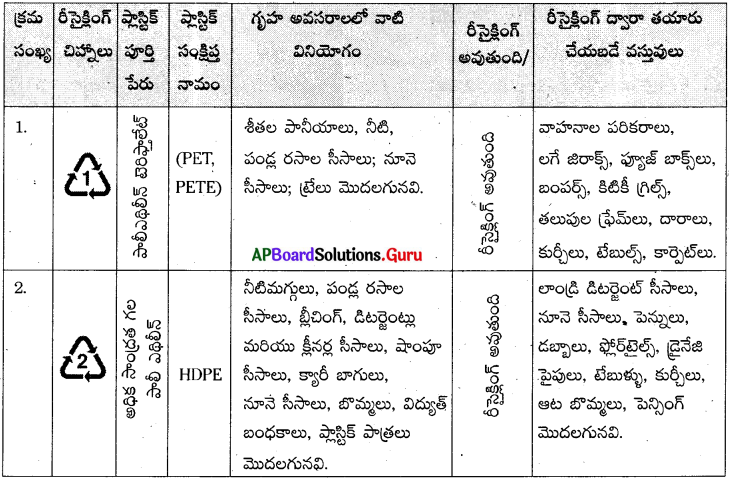
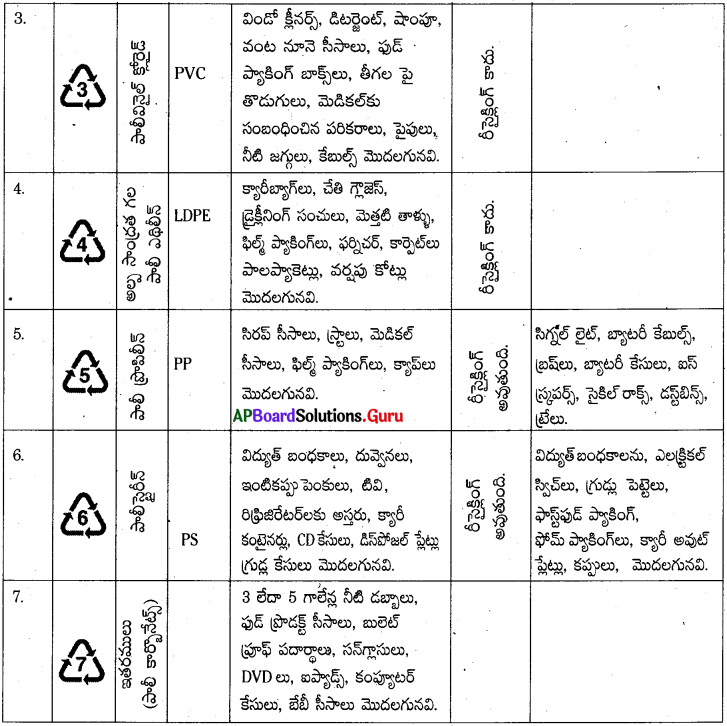
AP Board 8th Class Physical Science Important Questions Chapter 4 Synthetic Fibres and Plastics 4
Answer the following questions.
i. P.E.T is not used in the manufacture of cooker handles. Why?
ii. Which substance is used to manufacture electric switches? Why?
iii. Which is thermo plastic that can not be recycled?
iv. Why we have to ban the polythene covers?
Answer:
i) P.E.T is not used in the manufacture of cooker handles, because it is not a thermosetting plastic.
ii) Bakelite is used to manufacture electric switches, because it is thermosetting plastic.
iii) Polythene and PVC are thermoplastics that cannot be recycled.
iv) Polythene covers cannot be recycled. So, we have to ban the polythene covers.

Question 9.
Based on the smell given in the table identify the fibre and complete the table.

Smell on burning Name of the fibre
If it smells like burning hair
If it smells like burning paper
If the yarn melts

Answer:

Smell on burning Name of the fibre
If it smells like burning hair Wool (or) Silk
If it smells like burning paper Cotton
If the yarn melts Polyester (or) nylon

AP Board 8th Class Physical Science Important Questions Chapter 4 Synthetic Fibres and Plastics

Question 10.
Explain biodegradable and non-biodegradable materials with examples. Include their impact on environment.
Answer:

  1. A material which is easily decomposed by natural process is called bio degradable, eg : Peels of fruits, papers, wood, cotton bags, etc.
  2. A material which is not decomposed by natural process is called non-bio degradable, eg: Plastic
  3. Impact on environment: Slow decomposition causes environmental pollution. The burning process of synthetic materials is also pollute the environment. This pollution causes health problems to the living things.


AP Board 8th Class Physical Science Important Questions Chapter 6 Sound

AP State Syllabus AP Board 8th Class Physical Science Important Questions Chapter 6 Sound

AP State Syllabus 8th Class Physical Science Important Questions 6th Lesson Sound

8th Class Physical Science 6th Lesson Sound 1 Mark Important Questions and Answers

Question 1.
What is sound? How does sound produces?
Answer:
Sound is a form of energy. A vibrating body produces sound.

Question 2.
Honeybee produce peculiar sound through their mouth or some other organ used for that purpose?
Answer:
A honeybee can’t make a sound using vocal cords. The buzzing sound that you b*ear from any flying insect is caused by vibration of their wings when flying.

AP Board 8th Class Physical Science Important Questions Chapter 6 Sound

Question 3.
Length of vocal cords in men is nearly 20 mm, in women it is about 5 cir1 less. Whereas in children it is shorter. Can we say that the length of vocal cords plays any role in deciding the quality of sound produced by men, women and children?
Answer:
Yes, we can say that the length of vocal cords decreases then the shrillness °f sound increases.

Question 4.
Pitch of the voices of the following is in ascending order. Lion < adult man < adult woman < child < infant < insect. Can you guess the reason why?
Answer:
The pitch of the voices depend on frequency. As the number of vibrations per second increases the pitch or shrillness increases. So insect produce shrillness due to more frequency of vibration.

Question 5.
Do you find any difference in blowing the whistle and striking the drum?
Answer:
Whistle has more shrillness due to its higher frequency than drum which has less frequency.

Question 6.
Why are some sounds loud?
Answer:
The sounds which have greater amplitude are louder.

Question 7.
Why are some sounds feeble?
Answer:
The sounds which have low amplitude are feeble.

Question 8.
Is there any relation between the intensity of sound and vibrations of the body which produces sound?
Answer:
As amplitude of vibration increases the intensity of sound increases.

AP Board 8th Class Physical Science Important Questions Chapter 6 Sound

Question 9.
How many times is a car horn more powerful than near total silence?
Answer:
It is 1011 times more powerful than a near total silence.

Question 10.
How many times is a jet engine more powerful than a smallest audible sound?
Answer:
It is 1012 times more powerful than a smallest audible sound.

Question 11.
What is a vibration?
Answer:
The to and fro motion of a body from its mean position is known as vibration.

Question 12.
What is amplitude?
Answer:
The maximum displacement of vibrating body from its mean position is called amplitude.

Question 13.
What are the parts of the speech organ which involved in producing sounds?
Answer:

  1. Vocal cords
  2. Lips
  3. Teeth and tongue
  4. Nose and throat

AP Board 8th Class Physical Science Important Questions Chapter 6 Sound

Question 14.
What is a music?
Answer:
Music is a combination of sounds that are produced in an order and pleasant to hear.

Question 15.
What is a noise?
Answer:
The sounds which are not pleasant to hear is called a noise.

Question 16.
What is pitch?
Answer:
The shrillness of a sound is known as pitch.

Question 17.
What is frequency?
Answer:
The number of vibrations per second is called frequency.

Question 18.
What is audible sounds? What is audible range?
Answer:
The sounds that a normal human being can hear is called audible sounds. Frequency of audible sound ranges from 20 cycles / second to 20000 cycles / second.

Question 19.
Do we hear the sounds produced by bats?
Answer:
We cannot hear sounds produced by bats because the sounds produced by bats have frequency more than 20,000 cycles / seconds that is more than audible range.

Question 20.
Does the sound travel if there is no medium?
Answer:
Sound required medium for its propagation. So sound does not travel if there is no medium i.e vacuum.

AP Board 8th Class Physical Science Important Questions Chapter 6 Sound

Question 21.
A bird makes high pitch sound and a lion makes a low pitch roar. Which one produce sound of more frequency?
Answer:
The bird produces sound of more frequency because it has high frequnecy as we already know pitch depends upon frequency.

Question 22.
Why do we produce sounds with different pitches or amplitudes while speaking?
Answer:
The vibration in pitch and amplitude of sound during our speech helps us to communicate with others in form of language.

Question 23.
Lightning and thunder take place in the sky at the same time at the same distance from us. Lightning is seen earlier and thunder is heard later. Can you explain why?
Answer:
The speed of light is more than speed of sound so light travels faster. So we can see lightning first then we can hear thunder.

Question 24.
How intensity of sound related to its unit?
Answer:
The smallest audible sound (nearer to total silence) is 0 dB. A sound 10 times more powerful is 10 dB. A sound 100 times more powerful that of total silence is 20 dB. A sound 1000 times more powerful than sound nearer to silence is 30 dB.

Question 25.
How many times is a jet engine more powerful than the whispering sound?
Answer:
The decibel rating of jet engine = 120 dB
The decibel rating of whisper = 20 dB (for practical purpose)
The number of times a jet engine more powerful than a whisper = 1010 times
{120 – 20 = 100 that is taken as 1010}

Question 26.
How do you feel when you hear sounds in busy traffic?
Answer:
It is very unpleasant to hear.

AP Board 8th Class Physical Science Important Questions Chapter 6 Sound

Question 27.
How do you feel while listening to songs from a radio?
Answer:
It is very pleasant to hear.

Question 28.
Which of the above sounds are more pleasant to hear?
Answer:
Songs from radio are more pleasant to hear.

Question 29.
What is the unit to measure the sound intensity?
Answer:
Decibel is the unit for measuring the intensity of sound. It is denoted as dB.

8th Class Physical Science 6th Lesson Sound 2 Marks Important Questions and Answers

Question 1.
What is sound pollution? What are the causes of sound pollution?
Answer:
The unwanted sound in our surroundings is called sound pollution.
Causes of sound pollution:

  1. Sounds of traffic
  2. Sounds by motor bikes and their horns
  3. Sounds in construction sites
  4. Sounds at industries
  5. Sounds at mines
  6. Sounds during explosions and bursting of crackers
  7. Sounds from mixer/grinder, washing machines and motors, etc.

AP Board 8th Class Physical Science Important Questions Chapter 6 Sound

Question 2.
Write some common sounds and their decibel ratings.
Answer:
Near total silence – 0 dB
A whisper – 15 dB
Normal conversation – 60 dB
A lawn mower – 90 dB
A car horn – 110 dB
A jet engine – 120 dB
A gun shot or fire cracker – 140 dB

Question 3.
How many times is a car horn more powerful than normal conversation?
Answer:
The decibel rating of car horn = 110 dB
The decibel rating of normal conversation = 60 dB
The number of times a car horn more powerful than normal conversation = 105 times
{110 – 60 = 50 which is taken as 105} (The explanation beyond our syllabus. It is based on logarithms)

Question 4.
How can you explain the sound has energy?
Answer:
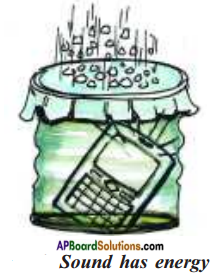
Sound has energy: Take a plastic bottle and a cell phone.
AP Board 8th Class Physical Science Important Questions Chapter 6 Sound 1
Cut the top of the bottle so that it looks like a glass. Play songs on the mobile phone in high volume and place it in the bottle. Close the mouth of bottle with a balloon using rubber band so that it covers the bottle as shown in the figure and stretch it tightly so as to behave like a diaphragm. Place some sugar crystals or small sand particles on the balloon diaphragm and observe the movement of particles. Do the same activity after removing the phone from the bottle. Sound has energy

AP Board 8th Class Physical Science Important Questions Chapter 6 Sound

Question 5.
What are the differences between the noise and music? Explain.
Answer:

Noise Music
1. Sounds which are not pleasant to hear are called Noise. 1. Sounds which are pleasant to hear are called Music.
2. Noise is an irregular combination of sounds. 2. Music is a combination of sounds. Which are produced in order.
3. It is unpleasant to hear. 3. It is pleasant to hear.

Question 6.
Explain the sources which produce sound pollution in your surroundings.
Answer:
Sources of sounds that are produce to sound pollution:

  1. Sounds in traffic
  2. Sounds by motor vehicles
  3. Sounds in construction sites
  4. Sounds in industries
  5. Sounds in mines
  6. Sources of sound pollution like mixer, grinder, washing machines and motors, etc.

Question 7.
What is the effect of humidity on quality of sound propagation? Is there any difference in propagation of sound in air during the summer and winter seasons? Discuss.
Answer:
With increase in humidity, density of air decreases. So with rise in humidity velocity of sound increases.
This is why sound travels in humid air (rainy season or winter) than in dry air (summer) at the same temperature.

Question 8.
Why the voice of men, women and children are different?
Answer:
The vocal cords of men about 20 mm long. In women these cords are about 5 mm shorter in respect to men. Children have very short vocal cords. That is the reason that voice of men, women and children are different.

Question 9.
On which property of vibrations does the loudness of sound depend?
Answer:
The loudness of sound is determined by its amplitude. When the amplitude of a vibration is large, the sound produced is loud. When the amplitude is small, the sound produced is feeble.

AP Board 8th Class Physical Science Important Questions Chapter 6 Sound

Question 10.
What are the harmful effects of noise pollution?
Answer:

  1. Presence of excessive noise in the surroundings may cause many health related problems.
  2. Lack of sleep, hypertension (high blood pressure), anxiety and many more health disorder may be caused by noise pollution. A person who is exposed to a loud sound continuously may get temperory or even permanent deafness.

Question 11.
What is the effect of humidity on quality of sound propagation? Is there any difference in propagation of sound in air during the summer and winter seasons? Discuss.
Answer:
In the winter season the air has fogs and behaves as liquid medium. So, the air moves little faster in it. Whereas in the summer the air is dried and no possibility of droplets. Hence the sound moves slower.
The propagation of sound is Solids > liquids > gases

Question 12.
Define audible sounds and inaudible sounds.
Answer:
Audible sounds:
The sounds that a normal human being can listen are called audible sounds. Frequency range is 20 cycles/sec – 20000 cycles/sec.
Inaudible sounds:
The sounds that a normal human being can’t listen are called inaudible sounds. Frequency range is less than 20 cycles/sec. or greater than 20000 cycles/sec.

8th Class Physical Science 6th Lesson Sound 4 Marks Important Questions and Answers

Question 1.
Describe structure of larynx or voice box.
Answer:
Larynx is the important organ in human body to produce sound. It has two muscular ligaments at the end of wind pipe called vocal cords. They are stretched across voice box, it leads to a narrow slit between them, to allow passage of air.
AP Board 8th Class Physical Science Important Questions Chapter 6 Sound 2
Vocal cords open during breathing to allow air into lungs. Vocal cords close when we speak.
The air from the lungs presses between them to use vibration and produce sound.

AP Board 8th Class Physical Science Important Questions Chapter 6 Sound

Question 2.
Draw anatomy of the larynx and label its parts.
Answer:
AP Board 8th Class Physical Science Important Questions Chapter 6 Sound 3

Question 3.
Draw the figures of using three musical instruments in your surroundings.
Answer:
AP Board 8th Class Physical Science Important Questions Chapter 6 Sound 4

Question 4.
a) Can sound travel in vacuum? Explain.
b) In which medium sound travels much faster and slower? Give some examples.
Answer:
a) Sound can’t travel in vacuum as it needs particles for propagation. As vacuum is empty, it is not possible.
b) Sound travels much faster in solids as the particles in solids are very closely packed, e.g.: Sound travels in train tracks (Railway tracks).
Sound travels much slower in gases as the particles in gases (air) are very loosely packed.
e.g.: Thunder or sound produced from amplifier at a long distance is feeble to hear.

Question 5.
Which object is vibrating when the following sounds are produced?
i) The sound of sitar or veena
ii) The sound of tabla
iii) The buzzing of bee or a mosquito
iv) The sound of a school bell
v) The sound of bursting balloon
vi) The radio
Answer:
i) Strings of sitar or veena vibrate to produce sound.
ii) The skin of the tabla vibrate to produce sound.
iii) Wings of mosquito or a bee vibrate to produce sound.
iv) The disc of the bell when beated with hammer vibrate to produce sound.
v) Air vibrates to produce sound.
vi) In the radio speakers vibrate to produce sound.

AP Board 8th Class Physical Science Important Questions Chapter 6 Sound

Question 6.
On which property of vibrations determines the pitch of the sound? Explain with examples.
Answer:

  1. The frequency determines the shrillness or pitch of sound.
  2. If the frequency of vibration is higher we say that the sound has a higher pitch.
  3. If the frequency of vibration is lower, we say that the sound has a lower pitch. For example, the drum vibrates with a low frequency. Therefore, it produces a low pitched sound:
  4. On the other hand, a wristle has a higher frequency, and therefore produces a sound of higher pitch.
  5. A bird makes a high pitched sound whereas a lion makes a low pitch roar.

Question 7.
How can the noise pollution be controlled in a residential area?
Answer:

  1. The noisy operations must be conducted away from any residential area.
  2. Noise producing industries should be set up away from such areas.
  3. Use of automobile horns are minimized.
  4. T.V and music systems should be run at lower volumes.
  5. Plants must be planted along the roads and around buildings to minimize the harmful effects of noise pollution.

Question 8.
What is the audiable range of frequencies for human beings? Explain.
Answer:

  1. Sound of frequencies less than about 20 vibrations per second (20 Hz) cannot be detected by the human ear.
  2. Such sounds are called inaudible.
  3. On the other side, sound of frequencies more than about 20,000 vibrations per second (20,000 Hz) are also not audible to the human ears.
  4. Thus for human ears, the range of audible frequencies is roughly between 20 to 20,000 Hz.

Question 9.
What is eardrum? How does it play an important role in hearings?
Answer:

  1. We hear sound through our ears.
  2. The shape of the outer part of ear is like a funnel.
  3. When sound enters in it, it travels down a canal at the end of which a thin membrane is stritched tightly.
  4. It is called the eardrum.
  5. It performs an important function.

8th Class Physical Science 6th Lesson Sound Important Questions and Answers

Question 1.
Majority of communication in human beings is through speech. Name the organs which give human beings the ability to talk.
Answer:

  1. Vocal cords
  2. Lips
  3. Teeth and tongue
  4. Nose and throat

AP Board 8th Class Physical Science Important Questions Chapter 6 Sound

Question 2.
Why our steps do not produce sound if we walk on a carpet floor?
Answer:
Carpets are soft and as we know soft materials are bad conductors of sound. Thus the
carpet tends to absorb the sound produced. Also when we walk on the carpet the amplitude and vibrations of the floor is reduced leading to a lesser sound.

Question 3.
Sound does NOT travel in vacuum. Explain why.
Answer:

  1. Sound energy travels in the form of wave.
  2. To produce waves medium is required.
  3. Hence, if there is no medium, sound waves cannot form.

Question 4.
Complete the following table.

Vibrating part of instrument Name of the instrument
Stretched membrane
Stretched string

Answer:

Vibrating part of instrument Name of the instrument
Stretched membrane Tabala, Dappu, Mrudangam
Stretched string Veena, Guitar, Violin

Question 5.
Mention the sounds which are responsible for sound pollution. Suggest four controlling measures of sound pollution.
Answer:
Causes of sound pollution:

  1. Sounds of traffic
  2. Sounds by motor bikes and their horns
  3. Sounds in construction sites
  4. Sounds at industries
  5. Sounds at mines
  6. Sounds during explosions and bursting of crackers
  7. Sounds from mixer / grinder, washing machines and motors etc.

The steps to reduce sound pollution :

  1. Attach silencers to the bikes and other machines to reduce sound.
  2. Manufacture machines that work with lesser noise.
  3. During the use of TVs and taperecorders tune down volume of sound.
  4. Plant trees to reduce sound pollution.

AP Board 8th Class Physical Science Important Questions Chapter 6 Sound

Question 6.
What is sound pollution? Write effects of sound pollution. Suggest some measures to control sould pollution.
Answer:
The unwanted sound in our surroundings is called sound pollution.
Effects of sound pollution on bio-diversity:

  1. The first harmful effect is loss of hearing.
  2. It also leads to several health related problems, e.g : Sleeplessness, hypertension, increase in blood pressure, etc.
  3. It effects the mental health of people.
  4. In animals, noise can increase the risk of death by altering predator or prey detection and avoidance, interfere with reproduction and navigation and contribute to permanent hearing loss.
  5. Noise pollution causes poor quality of crops.
  6. Under water animals such as whales and dolphins too experience discomfort due to noise pollution caused by submarines, shipping companies and sonars. Cuttle fish and octopus suffer serious damage from noise pollution.

The steps to reduce sound pollution :

  1. Attach silencers to the bikes and other machines to reduce sound.
  2. Manufacture machines that work with lesser noise.
  3. During the use of TVs and taperecorders tune down volume of sound.
  4. Plant trees to reduce sound pollution.

Question 7.
Kushwanth said “Vibrating objects produce sound.” Establish that the given statement is true with relevant example from your surroundings.
Answer:
The statement given by Kushwanth is correct.
That is “vibrating objects produce sound”.
1. Eg: 1) If we ring the bell in the school, sound will produce.
2) If we touch the bell while ringing, vibrations will experience.

2. Eg: 1) We can observe sound coming from the engine of a vehicle.
2) This is due to vibration of the engine.

3. Eg: 1) Musical instruments vibrates and produce sound.
2) If we pull the string of a veena or guitar.
3) It will produce sound.

AP Board 8th Class Physical Science Important Questions Chapter 6 Sound

Question 8.
Based on the below information answer the following questions.

Musical Instrument Vibrating part producing sounds
Veena Stretchings string
Tabla Stretched membrane
Flute Air Column
Dholak Stretched membrane
Sitar Stretching string
Drum Stretched membrane

a) Name the instruments which have vibrating part like a thin elastic rubber band.
Answer:
Tabla, Dholak, Drum.

b) What are the vibrating particles in the air column?
Answer:
Air particles.

c) What is the difference between Tabla and Sitar in terms of how they produce sound?
Answer:
In Tabla, stretched membrane vibrates and produce sound. Whereas in Sitar stretching string vibrates and produce sound.

d) How to produce different frequencies using a flute?
Answer:
By closing holes of the flute with fingers (or) By changing length of the air column.

Question 9.
Write about the propagation of sound in different media.
Answer:

  1. Sound produced by source travels in a medium in the form of waves.
  2. Vibrations produced by source of sound travel by particles of medium.
  3. In the case of solids, particles of solid substance vibrates and travel along the substance.
  4. In the case liquids, molecules of liquids carry the vibrations for sound propagation.
  5. In the case of gas, gaseous molecules act as carries of vibrations and allow the sound propagation.

AP Board 8th Class Physical Science Important Questions Chapter 6 Sound

Question 10.
Explain the structure and functions of the ear using a diagram.
(OR)
Describe briefly about structure and functioning of the eardrum.
Answer:
Our ear consists of three sections, the outer ear, the middle ear and the inner ear, Pinna of external ear collects the sound vibrations. They enter into the ear canal. We have learnt that sound travels in the form of vibrations: These vibrations strike the tympanum (eardrum) and make it to vibrate.
AP Board 8th Class Physical Science Important Questions Chapter 6 Sound 5
The vibrations from the tympanic membrane reach the middle ear (ear ossicles), contains three small bones malleus (hammer shaped), incus (anvil shaped) and stapes (stirrup shaped). They magnify the sound vibrations.
The stapes transmits the vibrations to the membrane of oval window. The oval window has the surface area 1/20th of the ear-drum. By this the vibrations increase 30 to 60 times. The vibrations from the oval window transmit to the cochlea which is the inner part of the ear. The cochlea is filled with fluid which transmits the vibrations. The motion of the vibrations in the cochlea is detected by tiny hairs connected to nerves at this point. The vibrations are transformed into electrical signals and carried by the nerves to the brain where the sensation of the sound is realized.

AP Board 8th Class Physical Science Solutions 4th Lesson కృత్రిమ దారాలు మరియు ప్లాస్టిక్లు

SCERT AP Board 8th Class Physical Science Solutions 4th Lesson కృత్రిమ దారాలు మరియు ప్లాస్టిక్లు Textbook Questions and Answers.

AP State Syllabus 8th Class Physical Science 4th Lesson Questions and Answers కృత్రిమ దారాలు మరియు ప్లాస్టిక్లు

8th Class Physical Science 4th Lesson కృత్రిమ దారాలు మరియు ప్లాస్టిక్లు Textbook Questions and Answers

అభ్యసనాన్ని మెరుగుపరుచుకోండి

ప్రశ్న 1.
కొన్ని దారాలను మాత్రమే మనము కృత్రిమ దారాలు అని ఎందుకంటాం? వివరించండి. (AS1)
జవాబు:

  1. నైలాన్, రేయాన్, అక్టోలిక్ మరియు పాలిస్టర్ వంటి కొన్ని దారాలను కృత్రిమ దారాలు అంటారు.
  2. పెట్రో రసాయనాలను ఎన్నో రసాయనిక ప్రక్రియలకు గురిచేయడం ద్వారా ఏర్పడే దారాలను కృత్రిమ దారాలు లేదా మానవ నిర్మిత దారాలు అంటారు. కృత్రిమ దారాలు అన్నీ పాలిమర్లు.
  3. నైలాన్ అనేది బొగ్గు, నీరు మరియు గాలి నుండి తయారు చేయబడిన కృత్రిమ దారం.
  4. రేయాన్ సెల్యులోజ్ తయారుచేయబడ్డ ఒక కృత్రిమ పట్టుదారం.
  5. అక్టోలిక్ అనేది నేలబొగ్గు, గాలి, నీరు, నూనె మరియు సున్నపురాయి నుండి తయారయ్యే కృత్రిమ ఉన్ని.

ప్రశ్న 2.
వివిధ పదార్థాలను నిలువ చేయడానికి ప్లాస్టిక్ పాత్రలను వాడడానికి గల కారణాలు చెప్పండి. (AS1)
(లేదా)
ప్లాస్టిక్ లను వాడటం వల్ల అనేక హానికర ప్రభావాలు ఉన్నప్పటికీ మనం ప్లాస్టిక్ లను వినియోగిస్తున్నాము. ఆ ప్లాస్టిక్స్ వలన లాభాలేమిటి ?
జవాబు:

  1. ప్లాస్టిక్ నీరు మరియు ఇతర రసాయనాలతో చర్య జరుపదు.
  2. పదార్థాలను క్షయం చేయదు.
  3. ప్లాస్టిక్ చాలా తేలికైనది, దృఢమైనది, మన్నికైనది.
  4. ప్లాస్టిక్ పరిమాణంలోను, విభిన్న రూపాలలోకి మలచగలిగేదిగా ఉంటుంది.
  5. ప్లాస్టిక్ వస్తువులు లోహాల కంటే తక్కువ ధరకు లభిస్తాయి.
  6. ప్లాస్టికు ఉష్ణబంధక మరియు విద్యుత్ బంధక పదార్థాలు.
  7. ప్లాస్టిక్ లను వివిధ రంగులలో తయారుచేసుకోవచ్చును.
    పై కారణాల వలన ప్లాస్టిక్ పాత్రలను వస్తువులను భద్రపరచుకొనేందుకు వాడుతారు.

AP Board 8th Class Physical Science Solutions 4th Lesson కృత్రిమ దారాలు మరియు ప్లాస్టిక్లు

ప్రశ్న 3.
ఈ క్రింది వానిలో ఏ ఏ పదార్థాలను రీసైక్లింగ్ చేయగలమో, వేటిని చేయలేమో వీడదీయండి. (AS1)
ప్లాస్టిక్ బొమ్మలు, విద్యుత్ స్విచ్లు, ప్లాస్టిక్ కుర్చీలు, బాల్‌ పాయింట్ పెన్నులు, టెలిఫోన్ వస్తువులు, ప్లాస్టిక్ పాత్రలు, కుక్కర్ పిడులు, ప్లాస్టిక్ సీసాలు, పాలిథీన్ సంచులు, పాత్రలు, పళ్ళుతోముకునే బ్రష్ లు, ప్లాస్టిక్ చెప్పులు, ప్లాస్టిక్ ప్లేట్లు, ప్లాస్టిక్ బకెట్లు మొదలగునవి.
జవాబు:

రీసైక్లింగ్ చేయగల పదార్థాలు రీసైక్లింగ్ చేయలేని పదార్థాలు
ప్లాస్టిక్ బొమ్మలు, ప్లాస్టిక్ కుర్చీలు, ప్లాస్టిక్ పాత్రలు, ప్లాస్టిక్ సీసాలు, ప్లాస్టిక్ చెప్పులు, ప్లాస్టిక్ బకెట్లు విద్యుత్ స్విచ్ లు, బాల్ పాయింట్ పెన్నులు, టెలిఫోన్ వస్తువులు, కుక్కర్ పిడులు, పళ్ళుతోముకునే  బ్రష్ లు, ప్లాస్టిక్ ప్లేట్లు, పాలిథీన్ సంచులు.

ప్రశ్న 4.
ఎలక్ట్రిక్ స్విచ్ లు థర్మోప్లాస్టిక్ తో తయారుచేస్తే ఏమి జరుగుతుంది? (AS1)
జవాబు:
విద్యుత్ ప్రవాహంలో హెచ్చుతగ్గుల వలన ఎలక్ట్రిక్ స్వి లో ఉష్ణం ఏర్పడుతుంది. థర్మోప్లాస్టిక్ తో తయారుచేసిన ఎలక్ట్రిక్ స్వి లు అయితే ఈ ఉష్ణానికి కరిగిపోతాయి.

ప్రశ్న 5.
థర్మోసెట్టింగ్ ప్లాస్టిక్ కన్నా “ధర్మోప్లాస్టిక్ కు ప్రకృతి నేస్తాలు”. నీవేమి చెబుతావు? ఎందుకు? (AS1)
జవాబు:
థర్మో సెట్టింగ్ ప్లాస్టిక్ ల కన్నా “థర్మోప్లాస్టికు ప్రకృతి నేస్తాలు” ఈ వాక్యాన్ని నేను సమర్థిస్తాను. ఎందుకంటే

  1. విరిగిపోయిన, వాడలేని, పాతబడిన థర్మోప్లాస్టిక్ ను వివిధ పద్ధతుల్లో శుభ్రపరచి, రీసైకిల్ చేసి తిరిగి కొత్త వస్తువులను తయారుచేయవచ్చును.
  2. థర్మోప్లాస్టిక్ వస్తువులను ప్రతి ఒక్కరూ మళ్లీ మళ్లీ (Reuse) వాడటం ద్వారా పర్యావరణాన్ని కాపాడిన వారమవుతాం.
  3. పట్టణాలలోని ఘన వ్యర్థాలలో ఎక్కువ భాగం థర్మోప్లాస్టిక్ వస్తువులే ఉంటాయి. వాటినుండి సేకరించిన వ్యర్థాలను వివిధ పద్ధతుల ద్వారా విద్యుత్, ఉష్ణం, కంపోస్ట్, ఇంధనాల వంటి వివిధ రూపాలలోనికి మార్చి, ఈ వ్యర్థాలను తిరిగి వనరులుగా ఉపయోగిస్తాం.

ప్రశ్న 6.
కింది వాటిని వివరించండి. (AS1)
ఎ) మిశ్రణం
బి) జీవ విచ్ఛిన్నం చెందడం
సి) రీసైక్లింగ్
డి) వియోగం చెందడం
జవాబు:
ఎ) మిశ్రణం :

  1. ఏదైనా కృత్రిమ దారాన్ని రెండు లేదా ఎక్కువ ఇతర దారాలతో కలిపే ప్రక్రియను మిశ్రణం అంటారు.
  2. టెర్లిన్ ను, నూలుతో మిశ్రణం చేస్తే టెరికాట్ ఏర్పడుతుంది. ఇది సౌకర్యవంతంగా, నలిగిపోనిదిగా ఉంటుంది.
  3. టెర్లిన్, ఊన్నితో మిశ్రణం చెందితే టెరిడోల్ ఏర్పడుతుంది.
  4. టెర్లిన్, సిల్క్ తో మిశ్రణం చెందితే టెరిసిల్క్ ఏర్పడుతుంది.

బి) జీవ విచ్చిన్నం చెందడం :

  1. సహజ ప్రక్రియ ద్వారా పదార్థం సులువుగా వియోగం చెందితే ఆ పదార్థాన్ని జీవ విచ్ఛిన్నం చెందడం అంటారు.
  2. పండ్లు, కూరగాయలు, చనిపోయిన జీవులు జీవ విచ్ఛిన్నం చెందుతాయి.

సి) రీసైక్లింగ్ :

  1. విరిగిపోయి వాడలేని, పాతబడిన ప్లాస్టిక్ లను వివిధ పద్ధతుల్లో శుభ్రపరచి, తిరిగి ఉపయోగించడానికి అనుకూలంగా కొత్త వస్తువులను తయారుచేయుటను రీసైక్లింగ్ అంటారు.
  2. PET (కోడ్-1), PS (కోడ్-6) మరియు HDPE (కోడ్-B) లను రీసైకిల్ చేస్తారు.

డి) వియోగం చెందడం :

  1. కొన్ని పదార్థాలు నీరు, సూర్య కాంతి, ఆక్సిజన్ సమక్షంలో ఉంచినపుడు సూక్ష్మభాగాలుగా విడగొట్టబడతాయి. ఈ సూక్ష్మభాగాలు బ్యాక్టీరియా చేత మరల విభజింపబడే ప్రక్రియనే వియోగం చెందడం అంటారు.
  2. వియోగం చెందడానికి కావలసిన సమయాన్ని బట్టి ఆ పదార్థం జీవ విచ్ఛినం చెందిందా, చెందలేదా నిర్ణయించవచ్చును.

AP Board 8th Class Physical Science Solutions 4th Lesson కృత్రిమ దారాలు మరియు ప్లాస్టిక్లు

7. జతపరచండి. (AS1)

1) పాలిస్టర్ ఎ) వంటసామాగ్రి
2) PET బి) కృత్రిమ పట్టు
3) రేయాన్ సి) ఎక్కువ సంఖ్యలో మోనోమర్లు
4) నైలాన్ డి) ఎలక్ట్రిక్ స్వి చు
5) మెలమిన్ ఇ) చిహ్నం
6) పాలిథీన్ ఎఫ్) ప్రసిద్ధిగాంచిన దుస్తుల సామాగ్రి
7) బేకలైట్ జి) అన్ని దారాలకన్నా దృఢమైనది

జవాబు:

1) పాలిస్టర్ ఎఫ్) ప్రసిద్ధిగాంచిన దుస్తుల సామాగ్రి
2) PET ఇ) చిహ్నం
3) రేయాన్ బి) కృత్రిమ పట్టు
4) నైలాన్ జి) అన్ని దారాలకన్నా దృఢమైనది
5) మెలమిన్ ఎ) వంటసామాగ్రి
6) పాలిథీన్ సి) ఎక్కువ సంఖ్యలో మోనోమర్లు
7) బేకలైట్ డి) ఎలక్ట్రిక్ స్వి చు

8. ఖాళీలను పూరించండి. (AS1)

i) కృత్రిమ దారాలను …………………….. అని కూడా పిలుస్తాం.
జవాబు:
మానవ నిర్మిత దారాలు

ii) కృత్రిమ దారాలను ………………… పదార్థాల నుండి సంశ్లేషిస్తారు.
జవాబు:
పెట్రోలియం ముడి

iii) కృత్రిమ దారం లాగే ప్లాస్టిక్ కూడా ………
జవాబు:
పాలిమర్

iv) బట్టలపై లేబిళ్లు ……….
ఎ) చట్ట ప్రకారం అవసరం
బి) దారము రకాన్ని గుర్తించడానికి
సి) ఎ, బి లు రెండూ
డి) పైవేవీ కావు
జవాబు:
సి) ఎ, బి లు రెండూ

v) రేయావ్ దీనితో తయారవుతుంది.
ఎ) నేలబొగ్గు
బి) ఆక్సిజన్
సి) నార
డి) సెల్యులోజ్
జవాబు:
డి) సెల్యులోజ్

vi) పట్టుదారము యొక్క నునుపైన తలము కాంతిని శోషిస్తుంది.
ఎ) అవును
బి) కాదు
సి) చెప్పలేము
జవాబు:
ఎ) అవును

ప్రశ్న 9.
రీసైక్లింగ్ ప్రక్రియను మనం ఎక్కడ ఉపయోగిస్తాం? ఇది ఎలా ఉపయోగకరమైనదో ఉదాహరణతో తెల్పండి. (AS1)
జవాబు:
రీసైక్లింగ్ ప్రక్రియను ప్లాస్టిక్ లో మరియు లోహాలలో ఉపయోగిస్తారు.

ఉదాహరణలు :

  1. (PET చిహ్నం-1 గలవి) వాడిన లేదా పాడయిన శీతలపానీయాలు, నీటి మరియు పండ్ల రసాల సీసాలు మరియు ట్రేలను రీసైక్లింగ్ చేసి వాహనాల పరికరాలను, ఫ్యూజ్ బాక్స్ లను, బంపరను, తలుపుల ఫ్రేములను, కుర్చీలను మరియు టేబులను తయారు చేస్తారు.
  2. HDPE చిహ్నం -2 గలవి) వాడిన లేదా పాడయిన బొమ్మలు, విద్యుత్ బంధక పరికరాలు, పాత్రలు, కుర్చీలు, సీసాలు మొదలగునవి రీసైక్లింగ్ చేసి పెన్నులు, పాటైల్స్, డ్రైనేజి పైపులు మొదలగునవి తయారు చేస్తారు.
  3. (PP చిహ్నం-6 గలవి) వాడినవి లేదా పాడయిపోయిన దువ్వెనలు, ఇంటికప్పులు, TV క్యారి కంటైనర్లు, CD కేసులు, డిస్పోజబుల్ ప్లేట్స్, కప్పులు, కోడిగ్రుడ్డు కేసులు మొదలగునవి రీసైక్లింగ్ చేసి విద్యుత్ బంధకాలు, ఎలక్ట్రికల్ స్విలు, గ్రుడ్ల పెట్టెలు, ఫాస్ట్ ఫుడ్ ప్యాకింగ్లు, ఫోమ్ ప్యాకింగ్ న్లు, క్యారి అవుట్ కంటైనర్లు మొదలగునవి తయారు చేస్తారు.

AP Board 8th Class Physical Science Solutions 4th Lesson కృత్రిమ దారాలు మరియు ప్లాస్టిక్లు

ప్రశ్న 10.
రకరకాల కృత్రిమ దారాలతో తయారుచేసే గృహోపకరణాలు వివరించేటట్లు ఒక పట్టిక తయారు చేయండి. (AS4)
జవాబు:

కృత్రిమ దారం కృత్రిమ దారాలతో తయారుచేసే గృహోపకరణాలు
1. నైలాన్ బ్రష్ యొక్క కుంచె, తాళ్ళు, చేపలవేటకు వాడే వలలు, గుడారాలు, చీరలు, స్త్రీల మేజోళ్ళు మరియు కాళ్ళకు వేసుకునే చిన్న మేజోళ్ళు (Socks), బెల్టులు, దిండ్లు (Sleeping bags), డోర్ కర్టన్స్, పారాచూట్లు, ఈతదుస్తులు, లో దుస్తులు (Sheer hosiery), తెరచాపలు, గొడుగులకు వాడే గుడ్డ, బట్టలు, కారు టైర్లు మొదలగునవి.
2. రేయాన్ దుస్తులు, దుప్పట్లు, తివాచీలు, లంగోటాలు (Diapers), బ్యాండేజీలు మొదలగునవి.
3. అక్రలిక్ స్వెటర్లు, శాలువాలు, దుప్పట్లు, రగ్గులు, కాళ్ళకు వేసుకొనే మేజోళ్ళు (Socks), క్రీడా దుస్తులు, ప్రయాణ సామగ్రి మరియు వాహనాల కవర్లు మొదలగునవి.
4. పాలిస్టర్ దుస్తులు, చీరలు, బెడ్ షీట్స్, కార్పెట్స్, జాడీలు, సీసాలు, ఫిల్మ్ లు, తీగలు, ప్లాస్టిక్ వస్తువులు, పరికరాలు మొదలగునవి.

ప్రశ్న 11.
థర్మోప్లాస్టిక్ లకు, థర్మోసెట్టింగ్ ప్లాస్టిక్ లకు మోనోమర్ అమరిక విషయంలో ఉండే భేదాలను పట సహాయంతో వివరించండి. (AS5)
జవాబు:

థర్మో ప్లాస్టిక్లు థర్మోసెట్టింగ్ ప్లాస్టికు
1. వేడి చేసినప్పుడు మృదువుగాను, చల్లబరచినప్పుడు కఠినంగాను మారే ధర్మం గల ప్లాస్టికన్ను థర్మోప్లాస్టిక్ అంటారు. 1. ఒకసారి ఒక రూపంలోనికి మలచి, చల్లబరచిన తర్వాత దాని రూపాన్ని మరలా వేడిచేసినా సరే మార్చలేని ప్లాస్టిక్ ను థర్మోసెట్టింగ్ ప్లాస్టిక్ అంటారు.
2. థర్మోప్లాస్టిక్ లోని మోనోమర్లు రేఖీయ అమరికను కలిగి ఉంటాయి.
AP Board 8th Class Physical Science Solutions 4th Lesson కృత్రిమ దారాలు మరియు ప్లాస్టిక్లు 1
మోనోమర్ల రేఖీయ అమరిక
2. థర్మోసెట్టింగ్ ప్లాస్టిక్ లోని మోనోమర్లు అడ్డంగా అనుసంధా నించబడిన అమరిక కలిగి ఉంటాయి.
AP Board 8th Class Physical Science Solutions 4th Lesson కృత్రిమ దారాలు మరియు ప్లాస్టిక్లు 2
మోనోమర్లు అడ్డంగా అనుసంధానించబడిన అమరిక
3. వీటిని వేడి చేసినపుడు ద్రవస్థితిలోనికి, తగినంత చల్లబరిస్తే గాజు స్థితిలోకి ఘనీభవిస్తుంది. 3. వీటిని వేడి చేసినపుడు నల్ల బొగ్గుగా మారుతుంది లేదా మండుతుంది.
4. వీటిని రీసైక్లింగ్ చేయవచ్చును. 4. వీటిని రీసైక్లింగ్ చేయలేము.

ప్రశ్న 12.
“వస్త్ర పరిశ్రమలో కృత్రిమ దారాల పరిచయం వస్త్రధారణ విషయంలో ప్రపంచమంతటా సంస్కృతి, సాంప్రదాయాలకు అతీతంగా విప్లవాత్మక మార్పును తీసుకొచ్చింది”. దీనిని మీరు ఎలా ప్రశంసిస్తారు? (AS6)
జవాబు:
వస్త్ర పరిశ్రమలో సహజ దారాలు సంస్కృతిని, సంప్రదాయాలను తెలియజేసే విధంగా ఉండేవి. సహజ దారాల స్థానంలో వచ్చిన కృత్రిమ దారాలు సహజ దారాలకంటే మెరుగైన లక్షణాలు కలిగి ఉన్నాయి. పాలిస్టర్ అనే కృత్రిమ దారాన్ని కనుగొన్న తరువాత, పాలిస్టర్ దారాలు వస్త్ర పరిశ్రమలో మరియు దుస్తుల సంస్కృతిలో విప్లవాత్మక మార్పులను తెచ్చాయి. ఎందుకంటే ప్లాస్టిక్ వస్త్రము సులభంగా ముడుచుకుపోదు. ఇది ఎక్కువ మన్నికగాను, సులువుగా ఉతుక్కోవడానికి వీలుగాను మరియు తక్కువ ధరలో ఉంటుంది. అందుకే దుస్తులు తయారుచేయడానికి ఈ దారాలు సరిగ్గా సరిపోతాయి. పాలిస్టర్ మిగిలిన దారాల వలె నేయడానికి కూడా వాడవచ్చును. పాలిస్టర్ దారాన్ని సహజదారాలతో కలిపి మిశ్రణం చెందించడం వల్ల సహజ దారాల మరియు కృత్రిమ దారాల లక్షణాలు గల వస్త్రం తయారగును.

వివిధ వృత్తుల వారికి కావలసిన లక్షణాలు గల వస్త్రాలను కృత్రిమ మరియు మిశ్రణం చెందించగా ఏర్పడే వస్త్రాల నుండి పొందవచ్చును. ఈ వస్త్రాలు ప్రపంచమంతటా సంస్కృతి, సంప్రదాయాలకు అతీతంగా విప్లవాత్మక మార్పు తీసుకొచ్చాయని చెప్పవచ్చును.

ప్రశ్న 13.
కృత్రిమ దారాలు మన రోజువారీ జీవితాన్ని ఏ విధంగా మార్చివేసినవి? (AS7)
జవాబు:

  1. కృత్రిమ దారాలతో తయారైన గృహోపకరణాల జాబితా చాలా పెద్దది. ఇవన్నీ మన రోజువారీ కృత్యాలతో ముడిపడి ఉంటాయి.
  2. కృత్రిమ దారాలు పట్టు వస్త్రాల కంటే ఎక్కువ మెరుపుగల దుస్తులు తయారు చేయడానికి సహాయపడతాయి.
  3. నైలాన్ దారం బలంగా ఉండి సాగే గుణాన్ని కలిగి ఉండటం వలన ఈ దుస్తులు త్వరగా చిరిగిపోవు.
  4. తక్కువ నీటిని ఉపయోగించి తేలికగా ఉతకవచ్చు.
  5. తివాచీలు తయారుచేయడానికి ప్రస్తుతం ఉన్నికి బదులు నైలాన్ వాడుతున్నారు.
  6. ఈత కొట్టేటప్పుడు ధరించే దుస్తులు, లోదుస్తులు, గొడుగులు, తెరచాపలు, చేపలు పట్టే వలలు, కార్ల టైర్లు వంటి ఉపయోగకరమైన వస్తువులెన్నో తయారుచేస్తున్నారు.
  7. కనుక మన జీవిత విధానం ఈ కృత్రిమ దారాల వినియోగం వలన పూర్తిగా మారిపోయింది.

ప్రశ్న 14.
సుజాత తన తల్లిదండ్రులకు శీతాకాలంలో వేసుకొనే దుస్తులు కొనాలని అనుకొంది. నీవు ఏ రకమైన బట్టలను కొనమని సలహా ఇస్తావు? కారణాలు చెప్పండి. (AS7, AS1))
జవాబు:

  1. సుజాత, తన తల్లిదండ్రులకు శీతాకాలంలో వేసుకొనే దుస్తులను కొనాలని అనుకుంది.
  2. నేనైతే నిభాకు ఈ క్రింది దుస్తులను కొనమని సలహా ఇస్తాను.
  3. సహజమైన ఉన్నితో తయారైన స్వెట్టర్లూ, శాలువాలూ, దుప్పట్లూ మొదలైనవి. కాని ఇవి చాలా ఖరీదైనవి.
  4. శీతాకాలంలో వేసుకొనే దుస్తులలో చాలా వాటిని ప్రస్తుతం అక్రలిక్ అనే కృత్రిమ దారంతో తయారుచేస్తున్నారు.
  5. ఈ అక్రలిక్ చూడటానికి సహజ ఉన్ని మాదిరిగానే ఉంటుంది.
  6. దీనిని కృత్రిమ ఉన్ని అనవచ్చు లేదా నకిలీ ఉన్ని అని కూడా అనవచ్చు.
  7. అక్టోలిక ను తడి లేదా పొడి స్పిన్నింగ్ పద్ధతిలో మెలి పెట్టి పురి పెడతారు.
  8. దారాలు బాష్పీభవనం ద్వారా ఘనస్థితిని పొందుతాయి.
  9. అజోలిక్ తో తయారైన బట్టలు సహజ ఉన్ని బట్టల కన్నా చౌకగా లభిస్తాయి.
  10. కనుక నిభా తన తల్లిదండ్రులకు అక్రలిక్ తో చేసిన దుస్తులను కొనడం మంచిది.

AP Board 8th Class Physical Science Solutions 4th Lesson కృత్రిమ దారాలు మరియు ప్లాస్టిక్లు

ప్రశ్న 15.
వాడిన ప్లాస్టిక్ ను తగిన రీతిలో త్యజించకపోతే (Dispose) వచ్చే అనర్థాలేమిటి? (AS7)
జవాబు:
ప్లాస్టిక్ ను తగిన రీతిలో త్యజించకపోతే వచ్చే అనర్థాలు :

  1. ప్లాస్టిక్ కు జీవ విచ్ఛిన్నం చెందనివి కావున ప్లాస్టిక్ వలన భూమి కలుషితం అవుతుంది.
  2. వాడి విసిరేసిన పాలిథీన్ సంచులు డ్రైనేజీ వ్యవస్థకు అడ్డుపడి, డ్రైనేజి నీరు రోడ్లపై ప్రవహించుట మరియు కాల్వలో డ్రైనేజి నీరు నిల్వ ఉండడం వల్ల దోమలు పెరిగి వివిధ రోగాలకు కారణమౌతాయి.
  3. ఆవులు, మేకలు మొదలగు జంతువులు పాలిథీన్ సంచుల్లోని ఆహార పదార్థాలను తినడం వల్ల జీర్ణవ్యవస్థ, శ్వాసక్రియలు చెడిపోవడం ద్వారా జంతువులు చనిపోతున్నాయి.
  4. ప్లాస్టిక్ వ్యర్థాలు చెరువులు, సరస్సులు, నదులు మరియు సముద్రాలలో చేరడం వలన జలచరాలు చనిపోవడం జరుగుతుంది.
  5. ప్లాస్టిక్ వ్యర్థాలు భూమిలో చేరడం వలన వర్షం నీరు భూమిలోకి చేరక భూ జలవనరులు క్రమంగా తగ్గిపోతాయి.
  6. ప్లాస్టిక్ వ్యర్థాలను మండిస్తే, వాతావరణంలో విషవాయువులు విడుదలవడం వలన వాతావరణ కాలుష్యం ఏర్పడుతుంది.

ప్రశ్న 16.
“ప్లాస్టిక్ విచక్షణారహిత వాడకం జీవ వైవిధ్యానికి ప్రమాదకర హెచ్చరిక” దీనికి సంబంధించి ప్రభుత్వ, ప్రభుత్వేతర సంస్థలు తీసుకొంటున్న చర్యలేమిటి? (AS7)
జవాబు:

  1. ప్లాస్టిక్ విచక్షణారహిత వాడకం వలన ప్రకృతిలో కాలుష్యం ఎక్కువైపోతుంది.
  2. ఈ వస్తువులు త్వరగా జీవ విచ్ఛిన్నం చెందవు.
  3. అందుచేత ప్లాస్టిక్ వాడకాన్ని తగ్గించడానికి “4R” సూత్రాన్ని ప్రభుత్వ, ప్రభుత్వేతర సంస్థలు సుప్రీంకోర్టు ఆదేశాల
    మేరకు విధిగా పాటిస్తున్నాయి.
  4. ఈ “4R” లు ఏమంటే
    i) తగ్గించడం (Reduce) : మన నిత్య జీవితంలో ప్లాస్టిక్ ను వీలైనంత తక్కువగా ఉపయోగించాలి.
    ii) మరల ఉపయోగించడం (Reuse) : ప్రతి సారి కొత్త క్యారీ బ్యాగులాంటి వాటిని కొనకుండా వీలైనన్ని ఎక్కువసార్లు మరల మరల తిరిగి వాడాలి.
    iii) తిరిగి ఉపయోగించడానికి అనుకూలంగా తయారు చేయడం (Recycle) : పనికిరాని ప్లాస్టిక్ వస్తువులను వదలివేయకుండ. పాత సామానులు కొనేవాడికి ఇవ్వాలి.
    iv) తిరిగి పొందడం (Recover) : సేకరించిన ప్లాస్టిక్ లాంటి వ్యర్థాలను విద్యుత్, ఉష్ణం వంటి రూపాలలోకి మార్చే పరిశ్రమలు ఏర్పాటు చేసే విధంగా అవగాహన కల్పించాలి.
  5. ప్రభుత్వ సంస్థలు, స్థానిక స్వపరిపాలనా సంస్థలు, “మేజిమెంట్ ఆఫ్ వేస్ట్ మెటీరియల్స్” కొరకు ఏర్పడిన స్వచ్ఛంద సంస్థలు ఈ విషయంలో తగిన చర్యలు తీసుకుంటున్నాయి.

పరికరాల జాబితా

పట్టుచీర, నూలు చీర, స్వెటర్, కార్పెట్, బ్రష్, నైలాన్ తాడు, పూసల దండ, పేపర్ క్లిట్ల దండ, వివిధ దారాలు, దారాల ‘మిశ్రణానికి సంబంధించిన లేబుల్స్, రీసైక్లింగ్ చిహ్నాలు గల వస్తువులు, ప్లాస్టిక్ వస్తువుల నమూనాలు, థర్మో ప్లాస్టిక్ వస్తువులు (పివిసి పైపు ముక్క పాలిథీన్ కవర్, బొమ్మలు, దువ్వెన) థర్మోసెట్టింగ్ ప్లాస్టిక్ వస్తువులు (బేకలైట్ స్విచ్, వంటపాత్ర పిడి, మెలమిన్ (కీబోర్డు, ఫైబర్ ప్లేటు) టూత్ బ్రష్, ప్లాస్టిక్ బకెట్, ప్లాస్టిక్ కప్పు, కూరగాయలు, పండ్ల తొక్కలు, తినగా మిగిలిన పదార్థాలు, కాగితం, నూలు బట్ట, ప్లాస్టిక్ సంచి, ఇనుప స్టాండ్, బరువులు వేయడానికి అనువైన పళ్లెములు, బరువులు, లాండ్రీ లేబుల్ కోడ్స్ చార్టు, పట్టుకారు, సారాయి దీపం, రీసైక్లింగ్ చిహ్నాలు చార్టు.

ప్రయత్నించండి

ప్రశ్న 17.
జుట్టు, ఉన్ని, పట్టు, నూలుదారం, ప్లాస్టిక్ ముక్క, స్వెటర్ దారం, తాడుముక్క మొదలగునవి తీసుకొని జాగ్రత్తగా జ్వాల పరీక్ష (Flame test) ను నిర్వహించండి. వాసన, కరిగే విధానాన్ని బట్టి వాటిని సహజ, కృత్రిమ దారాలుగా వర్గీకరించండి. (AS1)
జవాబు:
జ్వా ల పరీక్ష:
ఉద్దేశ్యము :
జ్వాల పరీక్ష ద్వారా నమూనాలను సహజ, కృత్రిమ దారాలుగా వర్గీకరించుట.

కావలసిన పరికరాలు :
పట్టుకారు, సారాయిదీపం, నమూనాలు (జుట్టు, ఉన్ని, పట్టు, కాగితం, నూలుదారం, ప్లాస్టిక్ ముక్క, స్వెటర్ దారం, తాడుముక్క)

పద్ధతి :

  1. సారాయి దీపమును తీసుకొని వెలిగించండి.
  2. పట్టుకారు సహాయంతో నమూనాలను పట్టుకోండి.
  3. సారాయి దీపపు మంటపై నమూనాను పెట్టండి. మండుతున్నప్పుడు వాసన, కరిగే మార్పులను గమనించండి.
  4. మిగిలిన నమూనాలతో ఇదే విధంగా మరలా చేయండి. ఫలితాలను పట్టికలో నమోదు చేయండి.

AP Board 8th Class Physical Science Solutions 4th Lesson కృత్రిమ దారాలు మరియు ప్లాస్టిక్లు 3

ప్రశ్న 18.
ప్లాస్టిక్ రీసైక్లింగ్ చిహ్నాలు, వాటి పూర్తి పేరు, మరియు దాని సంక్షిప్త నామం, గృహ అవసరాలలో వాటి వినియోగం, రీసైక్లింగ్ అవుతుందా లేదా ఒకవేళ రీసైక్లింగ్ అయితే వాటి నుండి ఏమి తయారు అవుతాయో వీటన్నింటినీ వివరించే ఒక చార్టను తయారుచేయండి. (AS5)
జవాబు:
AP Board 8th Class Physical Science Solutions 4th Lesson కృత్రిమ దారాలు మరియు ప్లాస్టిక్లు 4
AP Board 8th Class Physical Science Solutions 4th Lesson కృత్రిమ దారాలు మరియు ప్లాస్టిక్లు 5

8th Class Physical Science 4th Lesson కృత్రిమ దారాలు మరియు ప్లాస్టిక్లు Textbook InText Questions and Answers

ఆలోచించండి – చర్చించండి

8th Class Physical Science Textbook Page No. 46

ప్రశ్న 1.
సహజ దారాలకు ప్రత్యామ్నాయాలను గూర్చి మానవులు అన్వేషించడానికి కారణమేమిటి?
జవాబు:

  1. సహజ దారాల ఉత్పత్తి ప్రస్తుతం సరిపోవకపోవడం.
  2. వీటికి మన్నిక తక్కువ.
  3. ఇవి అధిక ఉష్ణం మరియు పీడనాలకు తట్టుకోలేవు.
  4. ఇవి ఎక్కువ నీటిని పీల్చుకుంటాయి.
  5. వీటితో తయారుచేయబడిన వస్త్రాలు త్వరగా ఆరవు.
  6. వీటిని ఎక్కువగా వాష్ చేస్తే పాడవుతాయి. కారణం సంపీడనాలను ఇవి తట్టుకోలేవు.
  7. ఇవి ఎక్కువ ధరను కలిగి ఉంటాయి.
  8. ఇవి ముడులుగా ఉంటాయి కాబట్టి తప్పకుండా ఇస్త్రీ చేయాలి.
  9. ఇవి మెరుపును కలిగి ఉండవు.
  10. వీటికి గట్టితనం తక్కువ.
    పై కారణాల వల్ల మానవులు సహజదారాలకు ప్రత్యామ్నాయాలను అన్వేషిస్తున్నారు.

AP Board 8th Class Physical Science Solutions 4th Lesson కృత్రిమ దారాలు మరియు ప్లాస్టిక్లు

ప్రశ్న 2.
ఏ దారపు వనరులు తరిగిపోకుండా ఉంటాయి? ఎందుకు?
జవాబు:
సహజ దారపు వనరులు తరిగిపోకుండా ఉంటాయి. ఎందుకంటే సహజ దారములు వృక్ష మరియు జంతువుల నుండి తయారవుతాయి.

8th Class Physical Science Textbook Page No. 47

ప్రశ్న 3.
ప్రస్తుత స్థానానికి కృత్రిమ దారాల పరిణామం ఎలా జరిగింది?
జవాబు:
సహజ దారాలు మానవ అవసరాల కన్నా తక్కువ పరిమాణంలో ఉత్పత్తి అవుతున్నాయి. సహజ దారాలకు ప్రత్యామ్నాయంగా కృత్రిమ దారాల కొరకు అన్వేషించవలసిన అవసరం ఏర్పడింది. రెండవ ప్రపంచ యుద్ధ కాలంలో మొట్టమొదట నైలాన్ అనే కృత్రిమ దారాన్ని కనుగొనడం జరిగింది. నైలాన్ దారం బలంగా ఉండి సాగే గుణమున్న తేలికైన పదార్థం. నైలాన్ తో తయారైన బట్టలు మంచి మెరుపును కలిగి ఉంటూ, తేలికగా ఉతుక్కోవడానికి వీలుగా ఉండడం మరియు త్వరగా ఆరే గుణం ఉండడం వల్ల కృత్రిమ దారాల వాడకం పెరిగింది.

8th Class Physical Science Textbook Page No. 49

ప్రశ్న 4.
పారాచూట్ తయారుచేయడానికి నూలుగుడ్డ, నూలు తాడులను వాడితే ఏం జరుగుతుంది?
జవాబు:
నూలుగుడ్డ, నూలు తాడులను పారాచూట్లో వాడితే కింద పడిపోవడం జరుగుతుంది.

కారణాలు :

  1. నూలు గుడ్డ, నూలు తాడులు అధిక పీడన, సంపీడనాలను తట్టుకోలేవు.
  2. నూలు గుడ్డలో సన్నని రంధ్రాలు ఉండడం వలన గాలి సన్నని రంధ్రాల గుండా సులభంగా ప్రయాణిస్తుంది.
  3. నూలు తాడు అధిక బరువులకు తెగిపోతుంది.

ప్రశ్న 5.
పూర్వకాలంలో చేపలు పట్టేవారు నూలు వలలను వాడేవారు. ప్రస్తుతం వారు నైలాన్ వలలను వాడుతున్నారు. నైలాన్ వలల వాడకం వలన లాభాలు ఏమిటి?
జవాబు:

  1. నైలాన్ దారాలు అధిక బరువులను తట్టుకోగలవు. కావున వలలు తెగిపోవు.
  2. ఇవి గట్టిగా, దృఢంగా ఉండడం వలన చేపలు కొరికినా తెగిపోవు.
  3. ఈ దారాలు తడిసినా పాడుకావు.
  4. ఇవి అధిక పీడనాన్ని తట్టుకోగలవు.
  5. ఇవి నీటిని ఎక్కువగా పీల్చుకోవు. నీటిలో వీటి బరువు ఎక్కువగా ఉండదు.

ప్రశ్న 6.
నైలాన్ చీరలు నూలు చీరల కంటే మెరుగైనవి. మీరు అంగీకరిస్తారా? ఎందుకు?
జవాబు:
నైలాన్ చీరలు నూలు చీరల కంటే మెరుగైనవి. ఎందుకంటే

  1. తేలికగా ఉంటాయి.
  2. మెరుపును కలిగి ఉంటాయి.
  3. ఎక్కువ కాలం మన్నికగా, ఉంటాయి.
  4. సులభంగా ఉతకవచ్చును.
  5. నీటిని ఎక్కువగా పీల్చవు.
  6. త్వరగా ఆరతాయి.
  7. ముడుతలు పడవు. ఇస్త్రీ చేయవలసిన అవసరం ఉండదు.
  8. కీటకాలు తినవు.
  9. పీడన, సంపీడనాలను తట్టుకుంటాయి.
  10. తక్కువ ఖరీదుకు లభిస్తాయి.

8th Class Physical Science Textbook Page No. 50

ప్రశ్న 7.
సహజ పట్టుకంటే కృత్రిమ రేయాన్ మెరుగైనదిగా తయారు కావడానికి ఏ లక్షణాలు తోడ్పడతాయి?
జవాబు:

  1. రేయాన్ సహజ పట్టు కన్నా చవకైనది.
    చెమటను పీల్చుకొనే స్వభావం ఉండడం.
    స్పర్శకు మృదువుగా మరియు సిల్కీగా ఉండడం.
    కాంతి మరియు మెరుపును కలిగి ఉండడం.
    పై లక్షణాలు సహజ పట్టుకంటే కృత్రిమ రేయాన్ మెరుగైనది అనడానికి తోడ్పడుతున్నాయి.

ప్రశ్న 8.
కృత్రిమ దారముతో తయారైన ఇంటి గడప ముందు కాళ్లు తుడుచుకునే గుడ్డ (Door mat) ను కొనాలని భావిస్తే ఎలాంటి దానితో తయారైన కృత్రిమ దారంను ఎన్నుకుంటావు? ఎందుకు?
జవాబు:
రేయాన్ దారముతో తయారైన కాళ్లు తుడుచుకొను (Door mat) గుడ్డను ఎన్నుకుంటాను. ఎందుకంటే రేయాన్ కి నీరు, తేమను పీల్చుకునే స్వభావం ఉన్నది కనుక.

ప్రశ్న 9.
ఆరోగ్య రక్షణకై వాడే లంగోటీలు (Diapers) మరియు బ్యాండేజ్ లను నైలాన్ తో తయారుచేస్తే ఏమి జరుగుతుంది?
జవాబు:
ఆరోగ్య రక్షణకై వాడే లంగోటీలు మరియు బ్యాండేజ్ లను నైలాన్ తో తయారుచేస్తే నీటిని, చెమటను పీల్చుకొనదు.

8th Class Physical Science Textbook Page No. 51

ప్రశ్న 10.
శీతాకాలంలో ఏ రకపు మిశ్రణం దుస్తులు ఎక్కువ అనుకూలంగా ఉంటాయి? ఎందుకు?
జవాబు:
శీతాకాలంలో టెర్లిన్, ఉన్నితో మిశ్రణం చేసిన టెరిడోల్ దుస్తులు ఎక్కువ అనుకూలంగా ఉంటాయి. ఎందుకంటే ఇది సహజదారాలు మరియు కృత్రిమ దారాల ధర్మాలను కలిగి ఉంటుంది.

AP Board 8th Class Physical Science Solutions 4th Lesson కృత్రిమ దారాలు మరియు ప్లాస్టిక్లు

ప్రశ్న 11.
సహజ, కృత్రిమ, మిశ్రణం దుస్తులు మనకు లభ్యమవుతున్నాయి కదా! శుభకార్యాలు, పండుగల సమయంలో ఏ దుస్తులు ధరించడానికి ఇష్టపడతారు? ఎందుకు?
జవాబు:
శుభకార్యాలు, పండుగల సమయంలో సహజ దారాలతో తయారైన పట్టు దుస్తులను ధరించడానికి ఇష్టపడతాను. ఎందుకంటే

  1. శరీరానికి ఎక్కువ గాలిని తగిలేటట్లు చేస్తాయి.
  2. చెమటను పీల్చుకుంటాయి.
  3. శరీరానికి చిరాకును కలిగించే రసాయనాలు ఉండవు.
  4. వేడికి కరగవు కావున శరీరానికి అంటుకుపోవు.
  5. సహజ దారాలు శరీరానికి సౌకర్యంగా ఉంటాయి.

8th Class Physical Science Textbook Page No. 52

ప్రశ్న 12.
సహజ లేదా కృత్రిమ దుస్తులలో వేటిని మీరు ఇష్టపడతారు? ఎందుకు? ఈ రెండింటి మధ్య భేదాలను వ్రాయండి.
జవాబు:
కృత్రిమ దుస్తులు ఇష్టపడతాను. ఎందుకంటే కృత్రిమ దుస్తులు మన్నికైనవి, కాంతిని, మెరుపును కలిగి ఉంటాయి. అన్ని కాలాలకు అణుగుణమైన కృత్రిమ దుస్తులు లభిస్తాయి.

సహజ దుస్తులు కృత్రిమ దుస్తులు
1) సహజ దారాలు ఎక్కువ ఖరీదైనవి. 1) కృత్రిమ దారాలు చౌకైనవి.
2) సహజ దుస్తులు ముడతలు పడతాయి. 2) కృత్రిమ దుస్తులు ముడతలు పడవు.
3) ఇవి ఎక్కువ నీటిని పీల్చుకుంటాయి. 3) ఇవి తక్కువ నీటిని పీల్చుకుంటాయి.
4) ఇవి త్వరగా ఆరవు. 4) ఇవి త్వరగా ఆరుతాయి.
5) ఇవి మన్నికైనవి కావు. 5) ఇవి మన్నికైనవి.
6) ఇవి కాంతిని, మెరుపును కలిగి ఉండవు. 6) ఇవి కాంతిని, మెరుపును కలిగి ఉంటాయి.

ప్రశ్న 13.
మన దుస్తులను ఇంట్లో ఉతకడానికి, లాండీల్లో డ్రైక్లీనింగ్ చేయడానికి తేడా ఏమిటి?
జవాబు:

ఇంట్లో ఉతకడం డ్రైక్లీనింగ్
1. దుస్తులను ఉతకడానికి డిటర్జెంట్లు, వాషింగ్ పౌడర్లను ఉపయోగిస్తారు. డ్రైక్లీనింగ్ లో కర్బన ద్రావణులను ఉపయోగిస్తారు.
2. దుస్తులు అధిక ఉష్ణోగ్రత మరియు ఒత్తిడికి లోనౌతాయి. 2. దుస్తులు అధిక ఒత్తిడికి లోను కావు.
3. రక్తం, గ్రీజు, నూనె, , పెయింట్ల వంటి మరకలు పోవు. 3. రక్తం, గ్రీజు, నూనె, పెయింట్ల వంటి మరకలు పోతాయి.

8th Class Physical Science Textbook Page No. 57

ప్రశ్న 14.
కొన్ని వేపుడు పెనాలకు (Fry Pans) ఆహార పదార్థాలు అంటుకోవు ఎందుకు?
జవాబు:
కొన్ని వేపుడు పెనాలకు ఆహార పదార్థాలు అంటుకోవు. ఎందుకంటే టెఫ్లాతో వేపుడు పెనాలపై పూత పూయబడి ఉంటుంది.

ప్రశ్న 15.
అగ్నిమాపకదళ సిబ్బంది ధరించే దుస్తులు మంటలకు అంటుకోవు. ఎందుకు?
జవాబు:
అగ్నిమాపక దళ సిబ్బంది ధరించే దుస్తులు మంటలకు అంటుకోవు, ఎందుకంటే అవి థర్మోసెట్టింగ్ ప్లాస్టిక్ తో తయారు చేసిన దుస్తులు కాబట్టి.

8th Class Physical Science 4th Lesson కృత్రిమ దారాలు మరియు ప్లాస్టిక్లు Textbook Activities

కృత్యములు

కృత్యం – 1

ప్రశ్న 1.
మీ ఇంటిలో సహజ మరియు కృత్రిమ దారాలతో తయారైన వస్తువులను గుర్తించండి. మీ పాఠశాల, ఇల్లు మరియు మీ పరిసరాలలో ఉన్న వివిధ వస్తువులను, గృహోపకరణాలను గుర్తించి ఆ జాబితాను పట్టికలోని సరియైన గడిలో పొందుపరచండి.
జవాబు:

వనరు గృహోపకరణాలు
మొక్కల నుండి వచ్చే సహజ దారాలతో తయారయ్యేవి. నూలు చీర, ఖాదీ బట్టలు, దుప్పట్లు, డోర్ కర్టన్లు, బ్యాండేజీలు మొదలగునవి.
జంతువుల నుండి వచ్చే సహజ దారాలతో తయారయ్యేవి. పట్టు చీర, స్వెటర్లు, శాలువాలు, డోర్ కర్టన్లు, రగ్గులు మొదలగునవి.
కృత్రిమ దారాలతో తయారయ్యేవి. బ్రష్ యొక్క కుంచె, తాళ్లు, చేపల వలలు, గుడారాలు, మేజోళ్లు, బెల్ట్ లు, దిండ్లు, తివాచీలు, ఈత దుస్తులు, గొడుగుకు వాడే గుడ్డ, బ్యాండేజీలు, లంగోటీలు మొదలగునవి.

కృత్యం – 2 పూసలు మరియు పేపర్ క్లిక్స్ అమరిక :

ప్రశ్న 2.
కొన్ని పేపర్ క్లిప్ ను తీసుకొని వాటిని పటంలో చూపినట్లు ఒకదానితో ఒకటి కలపండి. క్లిక్స్ అమరిక పద్ధతిని గమనించండి. పూసల దండకు, పేపర్ క్లిక్స్ గొలుసుకు మధ్య ఏమైనా పోలికలు గుర్తు పట్టగలరా?
AP Board 8th Class Physical Science Solutions 4th Lesson కృత్రిమ దారాలు మరియు ప్లాస్టిక్లు 6
జవాబు:
పూసల దండలోనూ, పేపర్ క్లిప్ ల గొలుసులోనూ ఒక్కొక్క పేపర్ క్లిప్ పేపర్ క్లి గొలుసు పూస లేక ఒక్కొక్క పేపర్ క్లిప్ రెండవ దానితో కలిసి ఒక పెద్ద గొలుసులాగా ఏర్పడినాయి.

కృత్యం – 3 దారాలను గుర్తించడం – మండించే పరీక్ష :

ప్రశ్న 3.
వివిధ సహజ, కృత్రిమ దారాలను మండించి వాటి లక్షణాలను ఒక పట్టికలో నమోదు చేయండి.
(లేదా)
వివిధ రకాల దారాలను కాల్చినపుడు జరిగే మార్పుల ఆధారంగా దారాలను గుర్తించి పట్టికలో నింపుము.
జవాబు:
పరీక్షించవలసిన వివిధ సహజ, కృత్రిమ దారాలను ఒక్కొక్కటిగా తీసుకొని దాని పురిని, ముడులను విప్పి సారాయి దీపముపై మండించితిని. మండినపుడు పరిశీలించి వాటి లక్షణాలను పట్టికలో వ్రాసితిని.

దారం లక్షణాలు (మండించినపుడు)
1. నూలు (పత్తి) వేగంగా మండింది. కాగితం కాలిన వాసన వచ్చింది.
2. ఉన్ని నెమ్మదిగా మండింది. వెంట్రుకలు కాలిన వాసన వచ్చింది.
3. పట్టు నెమ్మదిగా మండింది. వెంట్రుకలు కాలిన వాసన వచ్చింది.
4. రేయాన్ వేగంగా మండింది. కాగితం కాలిన వాసన వచ్చింది.
5. నైలాన్ నెమ్మదిగా మండింది. దారము జ్వాలలో కరిగింది.
6. అక్రలిక్ నెమ్మదిగా మండింది. దారము జ్వాలలో కరిగింది.

AP Board 8th Class Physical Science Solutions 4th Lesson కృత్రిమ దారాలు మరియు ప్లాస్టిక్లు

కృత్యం – 4

ప్రశ్న 4.
నైలాన్ ఎంత బలమైనది ? వివిధ దారాల బలాలను తెలుసుకొను కృత్యమును వివరించండి.
జవాబు:
క్లాంపుతో ఉన్న ఒక ఇనుపస్టాండును తీసుకోండి. 50 సెం. మీ. పొడవున్న నూలు, ఉన్ని, నైలాన్ మరియు పట్టుదారాలను తీసుకోండి. కింది పటంలో చూపిన విధంగా నూలు దారాన్ని కట్టండి. దారం మరొక చివర బరువులు వేయడానికి వీలుగా ఉండే పళ్లెమును వేలాడదీయండి. ఆ పళ్లెములో మొదట 10గ్రా.ల బరువుతో ప్రారంభించి బరువును దారం తెగేంత వరకు పెంచండి. దారం తెగగానే దాని బరువును పట్టికలో నమోదు చేయండి. ఈ విధంగా వివిధ దారాలతో చేసి బరువులను పట్టికలో నమోదు చేయండి. తీసుకున్న అన్ని దారాలు ఒకే పొడవు, దాదాపు ఒకే మందము ఉండేటట్లు చూడండి.

దారపు రకం దారం తెగిపోవడానికి అవసరమైన భారం సంఖ్య  (గ్రాములలో)
1. నూలు 250
2. ఉన్ని 500
3. పట్టు 550
4. నైలాన్ 1200

AP Board 8th Class Physical Science Solutions 4th Lesson కృత్రిమ దారాలు మరియు ప్లాస్టిక్లు 7

పై కృత్యంలో దారాల బలాలు పెరిగే క్రమం : నూలు < ఉన్ని < పట్టు < నైలాన్

కృత్యం – 6

ప్రశ్న 5.
ఇచ్చిన సీసా (Bottle) PET సీసా అని ఎలా చెప్పగలవు?

మీ తరగతి స్నేహితుల నుండి వేర్వేరు నీటి సీసాలను సేకరించి వాటిని జాగ్రత్తగా పరిశీలించండి. సీసాల అడుగున త్రిభుజాకారములో ఏదైనా గుర్తు ఉన్నదా? లేదా బ్రాండ్ లేబుల్ స్టిక్కర్ (brand label sticker) పైన ఆ గుర్తు ఉందా? ఆ త్రిభుజంలో ఏ అంకె ఉన్నది? కింది పటంను పరిశీలించండి. చాలా బాటిళ్లకు త్రిభుజాకోరం మధ్యలో 1 అనే అంకె ఉండడం గమనిస్తావు. ఇలా ‘1’ ఉన్నట్లైతే అది PET బాటిల్ అవుతుంది.
రెసినను గుర్తించేందుకు చిహ్నములు :
AP Board 8th Class Physical Science Solutions 4th Lesson కృత్రిమ దారాలు మరియు ప్లాస్టిక్లు 8

చిహ్నముల సంఖ్యలు (Code Numbers)

  1. పాలీఎథిలీన్ టెరిఫాల్ట్ (PET, PETE)
  2. అధిక సాంద్రత గల పాలీ ఎథిలీన్ (HDPE)
  3. పాలీవినైల్ క్లోరైడ్ (PVC)
  4. అల్ప సాంద్రత గల పాలీ ఎథిలీన్ (LDPE)
  5. పాలీ ప్రొపిలీన్ (PP)
  6. పాలీ స్టెరీన్ (PS)
  7. ఇతరము (1, 2, 3, 4, 5 లేక 6 అని స్పష్టంగా లేని వాటిని లేదా ఒకటి కంటే ఎక్కువ రెసిన్ కలయిక ద్వారా ఏర్పడిన వాటిని ఈ కోడ్తో సూచిస్తారు.)

కృత్యం – 7

ప్రశ్న 6.
వివిధ రకాల వస్తువులను వాటికి గల రీసైక్లింగ్ చిహ్నం ద్వారా గుర్తించండి.
జవాబు:
AP Board 8th Class Physical Science Solutions 4th Lesson కృత్రిమ దారాలు మరియు ప్లాస్టిక్లు 9

కృత్యం – 8

ప్రశ్న 7.
ప్లాస్టిక్ రకాలు :
ప్లాస్టిక్ తో తయారైన ఒక PP బాటిల్, మరొక సాధారణమైన బాటిల్ (PET)ను తీసుకొని వేడి నీటిని రెండింటిలో పోయండి.
AP Board 8th Class Physical Science Solutions 4th Lesson కృత్రిమ దారాలు మరియు ప్లాస్టిక్లు 10

a) ఏమి మార్పులను గమనించారు?
జవాబు:
సాధారణమైన బాటిల్ ముడుచుకొనిపోయింది. తద్వారా దాని ఆకృతి మారినది.

b) రూపం మారిన సీసా యొక్క చిహ్నము (Code) ను చూడండి.
జవాబు:
AP Board 8th Class Physical Science Solutions 4th Lesson కృత్రిమ దారాలు మరియు ప్లాస్టిక్లు 11

c) టప్పర్ వేర్ ప్లాస్టిక్ ఏ రకమైనదో నీవు చెప్పగలవా?
జవాబు:
థర్మోసెట్టింగ్ ప్లాస్టిక్

AP Board 8th Class Physical Science Solutions 4th Lesson కృత్రిమ దారాలు మరియు ప్లాస్టిక్లు

ప్రయోగశాల కృత్యం

ప్రశ్న 8.
మీకు ఇచ్చిన ప్లాస్టిక్ థర్మో ప్లాస్టిక్లు మరియు థర్మోసెట్టింగ్ ప్లాస్టిక్ లను గుర్తించండి.
(లేదా)
ప్లాస్టిక్ దువ్వెన, పళ్ళుతోముకునే బ్రష్, ప్లాస్టిక్ బకెట్, కుక్కర్ పిడిలు, ఎలక్ట్రిక్ స్విచ్, ప్లాస్టిక్ ప్లేటు, కాఫీ మగ్లను నీకు ఇచ్చినపుడు ఏ కృత్యం చేయడం ద్వారా ఏది థర్మోప్లాస్టిక్, ఏది థర్మో సెట్టింగ్ ప్లాస్టిక్ అని గుర్తించగలవో ఆ కృత్యమును వివరింపుము.
ఉద్దేశము :
జ్వాల పరీక్షను ఉపయోగించి థర్మోప్లాస్టికు మరియు థర్మోసెట్టింగ్ ప్లాస్టిక్ లను గుర్తించుట.

కావలసిన పరికరాలు :
పట్టుకారు, సారాయి దీపం, ఇచ్చిన ప్లాస్టిక్ నమూనాలు.
AP Board 8th Class Physical Science Solutions 4th Lesson కృత్రిమ దారాలు మరియు ప్లాస్టిక్లు 12

పద్ధతి :

  1. సారాయి దీపమును తీసుకొని దానిని వెలిగించండి.
  2. పట్టుకారు సహాయంతో ప్లాస్టిక్ నమూనాను పట్టుకోండి.
  3. సారాయి దీపపు మంటపై ఈ నమూనాను పెట్టండి. మండుతున్నప్పుడు జరుగుతున్న మార్పులను గమనించండి.
  4. ఈ విధంగా అన్ని నమూనాలను పరీక్షించండి. మీ పరిశీలనలను పట్టికలో నమోదు చేయండి.
  5. వేడిచేసినప్పుడు ముడుచుకుపోయే, వంచడానికి వీలయ్యే వాటిని థర్మోప్లాస్టిక్ అంటారు.
  6. ఒకసారి మలచిన తర్వాత వేడిచేయుట ద్వారా మృదువుగా మార్చలేకపోతే అటువంటి థర్మోసెట్టింగ్ ప్లాస్టిక్ అని అంటారు.
ప్లాస్టిక్ నమూనా మెత్తబడడం/కాలిన వాసనతో మండడం/తర్వాత గట్టిపడడం థర్మోప్లాస్టిక్ థర్మోసెట్టింగ్ ప్లాస్టిక్
1. టూత్ బ్రష్ కుంచె నెమ్మదిగా మండి మెత్తబడడం, కాలిన వాసనతో మండడం థర్మోప్లాస్టిక్
2. దువ్వెన మెత్తబడడం, కాలినవాసనతో మండడం థర్మోప్లాస్టిక్
3. బకెట్ చిన్నముక్క మెత్తబడడం, కాలిన వాసనతో మండడం థర్మోప్లాస్టిక్
4. వంటపాత్ర పిడి తర్వాత గట్టిపడడం థర్మోసెట్టింగ్ ప్లాస్టిక్
5. విద్యుత్ స్విచ్ తర్వాత గట్టిపడడం థర్మోసెట్టింగ్ ప్లాస్టిక్
6. పళ్లెం తర్వాత గట్టిపడడం థర్మోసెట్టింగ్ ప్లాస్టిక్
7. కాఫీకప్పు తర్వాత గట్టిపడడం థర్మోసెట్టింగ్ ప్లాస్టిక్

AP Board 8th Class Physical Science Solutions 4th Lesson కృత్రిమ దారాలు మరియు ప్లాస్టిక్లు

కృత్యం – 9 జీవ విచ్ఛిన్నం చెందేవి, జీవ విచ్ఛిన్నం చెందనివి :

ప్రశ్న 9.
ఇచ్చిన పదార్థాలలో జీవ విచ్ఛిన్నం చెందేవి, జీవ విచ్ఛిన్నం చెందనివి గుర్తించి, జీవ విచ్ఛిన్నం చెందుటకు పట్టేకాలాన్ని కనుగొనండి.
జవాబు:
ఒక గుంతను తవ్వి, ఇచ్చిన పదార్థాలను గుంతలో వేయండి. కొన్ని రోజుల తర్వాత గుంతను మరల తవ్వి ఏ పదార్థాలు భూమిలో కలిసిపోయాయో, ఏవి మిగిలిపోయాయో పరిశీలించండి. వివరాలను పట్టికలో వ్రాయండి.

వ్యర్థం పేరు భూమిలో కలిసిపోవడానికి పట్టేకాలం మార్పు
1. కూరగాయలు, పండ్ల తొక్కలు 10 – 20 రోజులు జీవ విచ్ఛిన్నం చెందును.
2. తినగా మిగిలిన పదార్థాలు 10-20 రోజులు జీవ విచ్ఛిన్నం చెందును.
3. కాగితం 10-30 రోజులు జీవ విచ్ఛిన్నం చెందును.
4. నూలు బట్ట 2-6 నెలలు జీవ విచ్ఛిన్నం చెందును.
5. ప్లాస్టిక్ సంచి 100 సం||ల కన్నా ఎక్కువ జీవ విచ్ఛిన్నం చెందదు.

AP Board 8th Class Physical Science Important Questions Chapter 7 Coal and Petroleum

AP State Syllabus AP Board 8th Class Physical Science Important Questions Chapter 7 Coal and Petroleum

AP State Syllabus 8th Class Physical Science Important Questions 7th Lesson Coal and Petroleum

8th Class Physical Science 7th Lesson Coal and Petroleum 1 Mark Important Questions and Answers

Question 1.
What are exhaustible resources? Give examples.
Answer:
The resources which are limited in nature and can be exhausted by human activities are called exhaustible resources, e.g. Coal, petroleum and natural gas.

Question 2.
What are inexhaustible resources? Give examples.
Answer:
The resources which are unlimited in nature and not likely to be exhausted by human activities are called inexhaustible resources, e.g. Solar energy, wind energy, tidal energy.

AP Board 8th Class Physical Science Important Questions Chapter 7 Coal and Petroleum

Question 3.
When and where does petroleum first used?
Answer:
More than 4000 years ago, asphalt (petroleum product) was used in the construction of walls and towers of Babylon. There are also records from ancient China about shallow wells being dug to get petroleum.

Question 4.
What did our ancestors do with petroleum?
Answer:
They mainly used petroleum for their wooden boats and waterproof, as a fuel for lamps and in some traditional remedies.

Question 5.
What is the basic difference between coal and charcoal?
Answer:
Coal used in factories is mined from the earth’s crust. The charcoal is obtained from firewood.

Question 6.
What is meant by fractional distillation?
Answer:
The separation technique used to separate various components of petroleum is called fractional distillation.

Question 7.
What is carbonisation?
Answer:
The slow process of conversion of dead vegetation into coal is called carbonisation.

AP Board 8th Class Physical Science Important Questions Chapter 7 Coal and Petroleum

Question 8.
Why coal, petroleum and natural gas are called fossil fuels?
Answer:
They were formed from the dead remains of living organisms (fossils). So these are called fossil fuels.

Question 9.
What is coke and what are its uses?
Answer:
Coke is a tough, porous and black substance. It is an almost pure form of carbon. Uses:

  1. Coke is used in the manufacture of steel.
  2. In the extraction of many metals.

Question 10.
Why petroleum is called black gold?
Answer:
Due to its great commercial importance petroleum Is called black gold.

Question 11.
What are alternatives to natural gas? Why do not we are using them?
Answer:
The alternatives for natural gas are coal bed methane and gas hydrates. These are not in commercial production phase due to lack in proper technology.

Question 12.
Can coal, petroleum and natural gas be prepared in the laboratory from dead organisms?
Answer:
No, their formation is very slow process and conditions for their formation cannot be created in the laboratory.

8th Class Physical Science 7th Lesson Coal and Petroleum 2 Marks Important Questions and Answers

Question 1.
How do you obtain various materials we are using in our daily life?
Answer:

Material Method of obtaining it
Glass By melting salt with other materials and then, cooling it rapidly
Clay By mixing the mineral kaolinite with water
Wood From dried up trees
Plastic From petrochemicals
Metals From their respective ores

Question 2.
What is biodiesel? How would you prepare biodiesel? What is its use?
Answer:
Biodiesel is one of the biofuel. Which is not toxic and renewable. It is made from the biological ingredients instead of petroleum or crude oil. Biodiesel usually made from the plant oils or animal fat through a series of chemical reactions.
It is used in diesel engines.

AP Board 8th Class Physical Science Important Questions Chapter 7 Coal and Petroleum

Question 3.
What is coal? Explain the process of formation of coal.
Answer:
Coal is hard and black coloured substance obtained from mines.

The plants in large and dense forests in low lying wet lands got buried under the soil due to natural processes like floods and earthquakes. As more soil deposited over them, the organic matter was compressed. The temperature also rose. As the organic matter sank deeper and deeper, under high temperature and high pressure, the dead plants slowly converted to coal.

Question 4.
What is coal tar and what are its uses?
Answer:
Coal tar: It is a black coloured thick liquid with an unpleasant smell. It is a mixture of about 200 substances.
Uses:
Products obtained from the coal tar are used as starting material for various substances like synthetic dyes, drugs, explosives, perfumes, plastics, paints and roofing material. Naphthaleine balls obtained from coal tar used to repel moths and other insects.

Question 5.
What is coal gas and what are its uses?
Answer:
Coal gas is a gas obtained during the processing of coal to get coke.
Uses:

  1. It is used in lighting.
  2. It is used as fuel in many industries.

Question 6.
What are petrochemicals? What are the uses of petrochemicals?
Answer: The useful substances which are obtained from petroleum and natural gas are called petrochemicals.
Uses:
They are used in the manufacture of detergents, synthetic fibres (polyester, nylon, acrylic) polythene, etc.

Question 7.
Draw a table showing uses of petrochemicals in various sectors.
Answer:

Agricultural sector Industrial sector Domestic and other sectors
Plastic tubes, case, baskets, storing box, cultivation implements, fertilizers. Cars, motor boats, commu­nication devices, construction materials, paper industry, belt and straps, tyres. Medical equipments, apparels like clothes, bedding, socks, furniture, paints, washing liquids, road, fibre, cosmetics, medicines, polishing liquids, etc.

Question 8.
Why are coal and petroleum so versatile?
Answer:
Coal consists of mainly carbon while petroleum consists of mixture of compounds called hydrocarbons. These compounds make good starting materials for other compounds based on carbon. Carbon is very versatile and is basis for most of the materials.

AP Board 8th Class Physical Science Important Questions Chapter 7 Coal and Petroleum

Question 9.
Why does the price of petrol go up all the time?
Answer:
The price of anything depends on how much of it is available and how essential it is. Both coal and petroleum are exhaustible resources but we need them, both as fuel and as starting material for synthesising new compounds. Since supply is limited and becoming more expensive as the demand for petrol increase.

Question 10.
What is natural gas ? What are the advantages of CNG as fuel?
Answer: Natural gas is a very important fossil fuel.
CNG: Natural gas is stored under high pressure as compressed natural gas. Advantages of CNG as fuel:

  1. CNG is less polluting and it is a cleaner fuel.
  2. The great advantage of CNG is that it can be used directly for burning in homes and factories where it can be supplied through pipes because CNG travels large distances.

Question 11.
Ramu told Rahim that solar energy is inexhaustible resource then what are the questions raised in the mind of Rahim about solar energy?
Answer:

  1. If it is inexhaustible resource of energy why don’t we are using it?
  2. Whether utilization of solar energy is difficult?
  3. Whether sophasticated techniques not available for proper use of solar energy at present?
  4. It is costly to use solar energy for producing electric power?

Question 12.
Explain why petroleum is also called as liquid gold.
Answer:

  1. They are many useful substances are obtained from petroleum which are called petrochemicals.
  2. These are used in the manufacture of detergents, synthetic fibres such as polyester, nylon, acrylic, polythene, etc.
  3. Due to great commercial importance petroleum is also called liquid gold.

Question 13.
What will happen if fossil fuels like coal and petroleum are completely exhausted?
Answer:

  1. Coal and petroleum are the natural resources which are important resources of energy for us.
  2. Coal is used as a fuel as such in homes and in industry, or it is used to generate electricity at thermal power plants.
  3. Petroleum products such as petrol and diesel are used as fuels in transport to run scooters, motorcycles, cars, buses, trucks, trains and aeroplanes.
  4. Kerosene and LPG obtained from petroleum are used as domestic fuels for cooking food.
  5. Since the industrial revolution, we have been using increasing amount of energy. So we need more energy resource.
    So without coal and petroleum products life on the earth is impossible.

AP Board 8th Class Physical Science Important Questions Chapter 7 Coal and Petroleum

Question 14.
Suggest some alternative ways to save the fuel resources. (Or)
What actions are required to meet the future energy needs?
Answer:

  1. Do not waste fuel for unnecessary activities.
  2. The energy should be properly utilized and the wastage should be minimized.
  3. Usage of bicycle in place of motor vehicles for small distances.
  4. Using road transport vehicles for travelling larger distances which will minimize fuel consumption.
  5. The engine of a vehicle thoroughly serviced in order to minimize fuel consumption.
  6. Alternative sources like solar energy, wind energy, tidal energy are more utilized.

Question 15.
Burning fuels releases carbon dioxide , a green house gas, which causes climate changes and leads to global warming. Collect information about this through newspapers, magazines, etc. and prepare report.
Answer:
i) Drastic increase in the emission of CO2 within last 30 years caused by burning of fossil fuels has been identified as the major reason for the change of temperature in atmosphere.
ii) Carbon dioxide in the atmosphere traps the reflect sunlight and re-emitt towards earth which is causing increase of earth temperature what we call as global warming.

Question 16.
Describe characteristics and uses of coke.
Answer:

  1. It is tough, porous and black substance.
  2. It is almost pure form of carbon.
  3. Coke is obtained by heating soft coal in the absence or little supply of air.
  4. It is used in the manufacture of steel and extraction of many metals.

8th Class Physical Science 7th Lesson Coal and Petroleum 4 Marks Important Questions and Answers

AP Board 8th Class Physical Science Important Questions Chapter 7 Coal and Petroleum

Question 1.
Is petroleum exhaustible? Explain.
Answer:

  1. If we see the history of petroleum production, from 1859 to 1969, the total production of oil was 227 billion barrels.
  2. 50% of this total was produced during the first 100 years, while the next 50% was extracted in just ten years.
  3. Today our consumption rate of oil is far excess that of the rate of its formation.
  4. Earth take more than one thousand years to form the oil that we consume in one day.
  5. By about 2015, we would have consumed half of the total reserves of the oil.
  6. It would become more and more difficult to extract oil in future.
    So petroleum is exhaustible.

Question 2.
Draw a diagram showing existence of various fuels like natural gas, petroleum in earth crust.
Answer:
AP Board 8th Class Physical Science Important Questions Chapter 7 Coal and Petroleum 1

Question 3.
Collect information about places where we get coal, petroleum and natural gas in India and mark the places on outline map of India.
Answer:
Coal: Jharia, Chandrapura, Bokaro, Giridih (Jarkhand), Ranigunj and Asansol (West Bengal), Singrauli (M.P.), Korba (Chhattisgarh), Singareni (A.P.) : Talcher and Rampur Himgir (Odisa) and Chand coal field (Maharashtra).
Petroleum : Digboi, Hugrijan, Moran, Naharkatiya, Sibsagar, Rudrasagar and Badarpur (Asom), Bombay High (Maharashtra), Ankleshwar, Kosamba, Kalol, Mehsana, Navagam and Dholka (Gujarat), Krishna and Godavari river basins (A.P.)
Natural gas: Cambay and Ankleshwar fields (Gujarat) and Bombay High (Maharashtra), Coastal Andhra Pradesh.
AP Board 8th Class Physical Science Important Questions Chapter 7 Coal and Petroleum 2

8th Class Physical Science 7th Lesson Coal and Petroleum Important Questions and Answers

Question 1.
Write any two uses of petrochemicals in our daily life.
Answer:
Uses: They are used in the manufacture of detergents, synthetic fibres (polyester, nylon, acrylic) polythene, etc.

AP Board 8th Class Physical Science Important Questions Chapter 7 Coal and Petroleum

Question 2.
It is necessary to save the energy resources like petroleum and natural gas. Write a slogan about this to create awareness among people.
Answer:

  1. ‘Save petrol and save future’.
  2. ‘Save fuel and save earth’.

Question 3.
Petroleum is a complex mixture. Write the technique to separate its components.
Answer:
The technique to separate petroleum components is ‘fractional distillation’.

Question 4.
Write any two uses of Activated Carbon in our daily life.
Answer:
Uses of Activated Carbon:

  1. Activated Carbon is used to purify liquids.
  2. It is used to treat many types of oral poisonings.

Question 5.
Assume that you are a driver, what measures do you take to save petrol?
Answer:
Engine must be stopped in the traffic signals or in heavy traffic.

AP Board 8th Class Physical Science Important Questions Chapter 7 Coal and Petroleum

Question 6.
The following table shows the total power shortage percentage in India from 1994-1997. Observe the data and give the answers to the following questions.
i. In which year the shortage percentage of power is least?
ii. Between which two years the shortage percentage difference is more?
iii. In which year the shortage percentage of power is maximum?
iv. Make a comment on shortage percentage of power between 1994-95.
Answer:
i. 1995
ii. Between 1996 and 1997
iii. 1997
iv. Shortage percentage is decreased by 0.3 in between 1994 – 95.

AP Board 8th Class Physical Science Solutions 1st Lesson బలం

SCERT AP Board 8th Class Physical Science Solutions 1st Lesson బలం Textbook Questions and Answers.

AP State Syllabus 8th Class Physical Science 1st Lesson Questions and Answers బలం

8th Class Physical Science 1st Lesson బలం Textbook Questions and Answers

అభ్యసనాన్ని మెరుగుపరుచుకోండి

ప్రశ్న 1.
బలం అంటే ఏమిటి? బలం వల్ల తీసుకురాగలిగే మార్పులేమిటి?
జవాబు:
వస్తువుల నిశ్చల స్థితినిగాని, సమవేగంతో ఋజుమార్గంలో పోయే స్థితినిగాని మార్చేదీ లేక మార్చడానికి ప్రయత్నించే దానిని బలం అంటారు. బలం సదిశరాశి. బలానికి ప్రమాణాలు MKS పద్ధతిలో న్యూటన్లు, CGS పద్ధతిలో డైన్లు.

బలం వల్ల తీసుకురాగలిగే మార్పులు :

  1. నిశ్చల స్థితిలో గల వస్తువును బల ప్రయోగం వలన గమనంలోనికి మార్చవచ్చును.
  2. గమనంలో ఉన్న వస్తువును బల ప్రయోగం వలన వడిని మార్చవచ్చును.
  3. గమనంలో ఉన్న వస్తువును బలప్రయోగం వలన నిశ్చల స్థితిలోకి మార్చవచ్చును.
  4. గమనంలో ఉన్న వస్తువును బలప్రయోగం వలన గమన దిశను మార్చవచ్చును.
  5. బల ప్రయోగం వలన వస్తువు యొక్క ఆకృతిని మార్చవచ్చును.
  6. బల ప్రయోగం వలన వస్తువు యొక్క పరిమాణాన్ని మార్చవచ్చును.

ప్రశ్న 2.
బలాన్ని ప్రయోగించడం ద్వారా జరిగే కింది సందర్భాలకు ఉదాహరణలు ఇవ్వండి. (AS1)
ఎ) వస్తువు వడిలో మార్పు బి) వస్తువు ఆకృతిలో మార్పు సి) వస్తువు కదిలే దిశలో మార్పు
జవాబు:
ఎ) వస్తువు వడిలో మార్పు :

  1. ఒక పిల్లవాడు రబ్బరు టైరును కర్రతో కొడుతూ ముందుకు పరిగెడుతున్నాడు.
  2. ఆ టైరు ఎక్కువ వడిగా వెళ్ళడానికి దానిని కర్రతో మళ్ళీ మళ్ళీ కొడుతూ (బలాన్ని ఇస్తూ) ఉన్నాడు. అనగా బలాన్ని పెంచితే వస్తువు వడి పెరుగుతుంది.

బి) వస్తువు ఆకృతిలో మార్పు :

  1. ఒక స్పాంజ్ డస్టర్‌ను బలం ప్రయోగించి పిండడం వలన ఆ స్పాంజ్ డస్టర్ యొక్క ఆకృతి మారును.
  2. రొట్టెలు తయారు చేయునప్పుడు పిండి ముద్దను రొట్టెలు తయారు చేయు కర్రతో బలం ప్రయోగించి పలుచని వృత్తాకార ఆకృతిలోకి మార్చినపుడు లేదా సాగదీసినపుడు పిండి ముద్దను కొద్దిగా మార్చవచ్చును.

సి) వస్తువు కదిలే దిశలో మార్పు :

  1. కేరమ్ కాయిన్ ను స్ట్రైకర్ తో కొట్టినప్పుడు కాయితో పాటు స్ట్రైకర్ కూడ దిశని మార్చుకుంటుంది.
  2. క్రికెట్ ఆటలో బౌలర్ వేసే బంతి యొక్క దిశను బ్యా ట్స్ మేన్ తన బ్యాట్ తో మార్చుతాడు.

AP Board 8th Class Physical Science Solutions 1st Lesson బలం

ప్రశ్న 3.
స్పర్శాబలం, క్షేత్రబలం మధ్యగల భేదాలను వివరించండి. (AS1)
(లేదా)
స్పర్శాబలం, క్షేత్రబలంతో ఏ విధంగా విభేదిస్తుంది?
జవాబు:

స్పర్శాబలం క్షేత్రబలం
1) రెండు వస్తువుల మధ్య ప్రత్యక్ష స్పర్శా సంబంధం ద్వారా పనిచేసే బలాలను స్పర్శా బలాలు అంటారు. 1) రెండు వస్తువులు ఒక దానితో ఒకటి ప్రత్యక్ష స్పర్శలో లేకుండా వాటి మధ్య బలం ఉన్నట్లయితే అటువంటి బలాన్ని క్షేత్రబలం అంటారు.
2) కండర బలం, ఘర్షణ బలం, అభిలంబ బలం మరియు తన్యతా బలాలు స్పర్శా బలానికి ఉదాహరణలు. 2) అయస్కాంత బలం, విద్యుత్ బలం మరియు గురుత్వాకర్షణ బలాలు క్షేత్ర బలానికి ఉదాహరణలు.
3) రెండు వస్తువుల మధ్య తాడనం వలన ఏర్పడుతుంది. 3) రెండు వస్తువులు క్షేత్రంలో ఉన్నపుడు ఏర్పడును.
4) దీనిలో క్షేత్ర ప్రాంతం ఉండదు. 4) దీనిలో క్షేత్రప్రాంతం ఉంటుంది.
5) స్పర్శాబలం చాలా వేగంగా పనిచేస్తుంది. 5) క్షేత్రబలం కొద్ది నెమ్మదిగా పనిచేస్తుంది.
6) ఇది సదిశ రాశి. 6) ఇది సదిశ క్షేత్రం.

ప్రశ్న 4.
స్పర్శాబలానికి, క్షేత్రబలానికి రెండేసి ఉదాహరణలు ఇవ్వండి. (AS1)
జవాబు:
స్పర్శాబలానికి ఉదాహరణలు :

  1. టూత్ పేస్ట్ ట్యూబ్ ను చేతి వేళ్ళతో నొక్కినపుడు టూత్ పేస్ట్ ట్యూబ్ నుండి టూత్ పేస్ట్ బయటకు రావడం.
  2. ఒక బంతిని నేలపై విసిరినపుడు కొంతదూరం వెళ్ళి ఆగిపోతుంది. నీరు, బంతి ఉపరితలాల మధ్య ఘర్షణ బలం స్పర్శాబలంగా పనిచేసింది.
  3. సైకిల్ తొక్కడం ఆపేస్తే క్రమంగా సైకిల్ వడి తగ్గిపోయి ఆగిపోతుంది. సైకిల్ టైర్లకు, నేలకు మధ్య ఘర్షణ బలం స్పర్శాబలంగా పనిచేసింది.

క్షేతబలానికి ఉదాహరణలు :

  1. రెండు అయస్కాంతాల మధ్య ఆకర్షణ లేదా వికర్షణ బలాలు.
  2. ఒక బెలూనను ఒక కాగితంతో బాగా రుద్ది కాగితం ముక్కల వద్దకు తీసుకువస్తే ఆ కాగితం ముక్కలను బెలూను ఆకర్షిస్తుంది.
  3. పైకి విసిరిన రాయి తిరిగి భూమి మీద పడడం.

ప్రశ్న 5.
కింద ఇవ్వబడ్డ వాక్యంలో తప్పును సరిదిద్ది రాయండి. (AS1)
“కారు నిశ్చల స్థితిలో ఉంది కాబట్టి దానిమీద ఎటువంటి బలాలు లేవు”
జవాబు:
“కారు నిశ్చల స్థితిలో ఉంది కాబట్టి దాని మీద పనిచేసే బలాల ఫలిత బలం శూన్యం”.

ప్రశ్న 6.
కోయడానికి ఉపయోగించే పరికరాల అంచులు పదునుగా ఉంటాయి. ఎందుకు? (AS1)
జవాబు:

  1. కోయడానికి ఉపయోగించే పరికరాల అంచులు పదునుగా ఉంటాయి.
  2. ఎందుకంటే పదును ఉన్నవైపు స్పర్శా వైశాల్యం తక్కువగా ఉంటుంది.
  3. బలాన్ని ప్రయోగించినపుడు పదునైన భాగం వైపు ఉపరితల వైశాల్యం తక్కువ కాబట్టి అధిక పీడనాన్ని కలుగచేస్తుంది. కాబట్టి సులభంగా కోయవచ్చును.

AP Board 8th Class Physical Science Solutions 1st Lesson బలం

ప్రశ్న 7.
“ఫలిత బలం వల్ల వస్తువుల గమన స్థితిలో మార్పు వస్తుంది” ఈ వాక్యం ద్వారా మీరు ఏం అర్థం చేసుకున్నారో వివరించండి. (AS1)
(లేదా)
ఫలిత బలం వస్తువులపై ప్రయోగించబడడం వల్ల వాటి యొక్క చలనస్థితి మారుతుంది. సరైన ఉదాహరణలతో వివరించండి.
జవాబు:

  1. ఒక వస్తువు పై పనిచేసే అన్ని బలాల బీజీయ మొత్తాన్ని ఫలిత బలం అంటారు.
  2. ఫలిత బలం శూన్యమైతే ఆ వస్తువు నిశ్చలస్థితిలో ఉంటుంది.
  3. ఫలిత బలం శూన్యం కాకుండా ఉంటే ఆ వస్తువు గమనంలో ఉంటుంది.
  4. ఫలిత బలం విలువ మారుతూ ఉంటే వస్తువు గమన స్థితిలో మార్పు వస్తుంది.

ప్రశ్న 8.
“ఒక బరువైన వస్తువుని, నీవు ఎంత బలంగా నెట్టినా అది కదలదు” దీనికి గల కారణాన్ని “ఫలిత బలం” అనే భావనతో వివరించండి. (AS1)
జవాబు:

  1. ఒక బరువైన వస్తువుని నీవు ఎంత బలంగా నెట్టినా అది కదలదు దీనికి గల కారణం దాని ఫలిత బలం శూన్యం అగుట.
  2. ఒక వస్తువులో కదలిక దాని ఫలిత బలంపై ఆధారపడి ఉంటుంది.
  3. ఫలిత బలం శూన్యం అయితే ఆ వస్తువు కదలదు.
  4. ఫలిత బలం శూన్యం కానట్లైతే ఆ వస్తువు కదులుతుంది.

ప్రశ్న 9.
కింది పటాలలో ఫలిత బలాన్ని కనుక్కోండి. (AS5) (AS1)
AP Board 8th Class Physical Science Solutions 1st Lesson బలం 1
జవాబు:
AP Board 8th Class Physical Science Solutions 1st Lesson బలం 2
AP Board 8th Class Physical Science Solutions 1st Lesson బలం 3

ప్రశ్న 10.
భూమి మీద ఘర్షణ లేదని ఊహించండి. ఏం జరుగుతుందో వివరించండి. (AS2)
జవాబు:

  1. ఘర్షణ బలం లేకపోతే మనం నడవలేము.
  2. వాహనాలు జారిపడి పోయే ప్రమాదం గలదు.
  3. పెన్నుతో పేపరుపై వ్రాయలేము.
  4. అగ్గిపుల్లతో అగ్గి పెట్టె పై రుద్ది మంటను పుట్టించలేము.
  5. నల్లబల్లపై చాక్ పీతో వ్రాయలేము.
  6. బల్లపై ఉంచిన వస్తువులు జారిపడతాయి.
  7. రాక్స్ లేదా అల్మారాలో ఉంచిన వస్తువులు జారిపడిపోతాయి.
  8. గుర్రపు మరియు ఎద్దుల బండ్లను నడుపలేము.
  9. మేకులను గోడలో మరియు చెక్కలో దింపలేము.
  10. ఆహారాన్ని నమలలేము.
  11. ఏ వస్తువుకు నిశ్చలస్థితి ఉండదు.
  12. భవనాలు నిర్మించలేము.

ప్రశ్న 11.
కార్తీక్ టి.వి.లో “వన్డే క్రికెట్ మ్యాచ్” చూస్తున్నాడు. ఆట భోజన విరామంలో క్రికెట్ పిచ్ పై రోలర్‌ను దొర్లించడం గమనించాడు. ఆ రోలర్ దొర్లేటప్పుడు దానిపై పనిచేసే వివిధ బలాలు, ఫలిత బలం గురించి అతను ఆలోచించాడు. ఫలితబలం పనిచేసే దిశ గురించి అతని మదిలో అనేక ప్రశ్నలు ఉత్పన్నమయ్యాయి. ఆ ప్రశ్నలేవో మీరు ఊహించగలరా? (AS2)
జవాబు:
AP Board 8th Class Physical Science Solutions 1st Lesson బలం 4

  1. బలం ప్రయోగించిన దిశలో రోలర్ ఎందుకు కదలలేదు?
  2. బలం ప్రయోగించిన దిశలో ఫలిత బలం ఎందుకు లేదు?
  3. బలం ప్రయోగించిన దిశకు కొంత కోణంలో ఫలిత బలం దిశ ఎందుకు ఉన్నది?
  4. ఫలిత బలం దిశలో రోలర్ కదిలితే పిచ్ ఎందుకు చదును అయినది?
  5. పిచ్ చదును అగుటకు ఏ బలం ఉపయోగపడినది?
  6. ఘర్షణ బలం ఏ దిశలో పని చేస్తుంది?

AP Board 8th Class Physical Science Solutions 1st Lesson బలం

ప్రశ్న 12.
ఎ. ఒకే విధమైన స్త్రాలు రెండు తీసుకుని, అందులో ఒక దానిని స్వేచ్ఛగా వేలాడదీయండి. రెండవ దానిని కాగితంతో రుద్ది వేలాడదీసిన స్ట్రా వద్దకు తీసుకురండి. ఈ కృత్యం ద్వారా మీరు ఏం గమనించారు? ఇవి ఏ రకమైన బలం? (AS3)
జవాబు:

  1. కాగితంతో రుద్దిన స్ట్రాను స్వేచ్ఛగా వేలాడదీసిన స్ట్రా వద్దకు తీసుకొని వచ్చినపుడు మొదట ఆకర్షించుకున్నది. ఆ తర్వాత వికర్షించుకున్నది.
  2. కాగితంతో రుద్దిన స్ట్రా మరియు స్వేచ్ఛగా వేలాడదీసిన స్ట్రాల మధ్య వికర్షణ బలం, స్థావర విద్యుత్ బలం ఏర్పడ్డాయి.

బి. పొడి జుట్టుని దువ్వెనతో దువ్వి ఆ దువ్వెనను చిన్న చిన్న కాగితపు ముక్కల దగ్గరకు తీసుకురండి. ఏం గమనించారు? వివరించండి. (AS3)
జవాబు:

  1. పొడిజుట్టుని దువ్వెనతో దువ్వి ఆ దువ్వెనను చిన్న చిన్న కాగితపు ముక్కల దగ్గరకు తీసుకువస్తే అది కాగితం ముక్కలను ఆకర్షిస్తుంది.
  2. పొడి జుట్టు దువ్వెనతో దువ్వడం వలన ఘర్షణ బలం వల్ల స్థావర విద్యుత్ ఆవేశాలు ఏర్పడ్డాయి.
  3. దువ్వెనకు గల స్థావర విద్యుత్ ఆవేశాలు కాగితం ముక్కలను ఆకర్షిస్తుంది.

ప్రశ్న 13.
స్పర్శాబలాలను, క్షేత్రబలాలను వివరించే చిత్రాలను వార్తాపత్రికలు, అంతర్జాలం మొదలైన వాటి నుండి సేకరించి నోట్ బుక్ లో – అంటించి ప్రదర్శించండి. (AS4)
జవాబు:
AP Board 8th Class Physical Science Solutions 1st Lesson బలం 5

ప్రశ్న 14.
పటంలో చూపిన విధంగా మెట్ల మీద ఒక కర్రని పెట్టారు . ఆ కర్ర మీద పనిచేసే అభిలంబ బలాలను గీయండి. (AS5)
AP Board 8th Class Physical Science Solutions 1st Lesson బలం 6
జవాబు:
AP Board 8th Class Physical Science Solutions 1st Lesson బలం 7

ప్రశ్న 15.
చెట్టు ఊడని పట్టుకొని ఒక కోతి నిశ్చలంగా వేలాడుతూ ఉందనుకోండి. ఆ కోతిపై పనిచేసే బలాలు ఏవి? (AS7)
జవాబు:
కోతిపై పనిచేసే బలాలు :

  1. కోతిపై గురుత్వ బలం భూమి వైపు పనిచేస్తుంది.
  2. కోతి నుండి పైవైపు ఊడ తన్యతాబలం పనిచేస్తుంది.

ప్రశ్న 16.
నిశ్చలంగా ఉన్న ఒక బరువైన వస్తువును కదల్చాలంటే నువ్వు దానిపై కొంత బలాన్ని ప్రయోగించాలి. అయితే ఒకసారి కదిలిన తరువాత, దానిని అదే గమనస్థితిలో ఉంచడానికి కొద్ది బలం ప్రయోగిస్తున్నా సరిపోతుంది. ఎందుకు? (AS1)
జవాబు:

  1. నిశ్చలస్థితి గల ఒక బరువైన వస్తువును గమన స్థితిలోకి మార్చుతూ ఉంటే సైతిక ఘర్షణబలం వ్యతిరేకిస్తుంది.
  2. గమనంలో ఉన్న వస్తువును జారుడు ఘర్షణ బలం నిశ్చలస్థితిలోకి మారుస్తుంది.
  3. సైతిక ఘర్షణ బలం కంటే జారుడు ఘర్షణ బలం చాలా తక్కువగా ఉంటుంది.
  4. కాబట్టి వస్తువు ఒకసారి కదిలిన తరువాత, దానిని అదే గమన స్థితిలో ఉంచడానికి కొద్దిగా బలం (జారుడు ఘర్షణ బలానికి సరిపడు) ప్రయోగిస్తే సరిపోతుంది.

ప్రశ్న 17.
కింది రెండు సందర్భాలలో పీడనాన్ని ఎలా పెంచగలవు? (AS1)
ఎ) వైశ్యాలంలో మార్పు లేనపుడు బి) బలంలో మార్పు లేనపుడు
జవాబు:
ఎ) వైశాల్యంలో మార్పు లేనపుడు :

  1. వైశాల్యం మార్పు లేనపుడు పీడనాన్ని పెంచాలంటే దానిపై బలాన్ని పెంచాలి.
  2. పీడనం బలానికి అనులోమానుపాతంలో ఉంటుంది.

బి) బలంలో మార్పు లేనపుడు :

  1. బలం మార్పు లేనపుడు పీడనాన్ని పెంచాలంటే స్పర్శావైశాల్యాన్ని తగ్గించాలి.
  2. పీడనము, స్పర్శా వైశాల్యానికి విలోమానుపాతంలో ఉంటుంది.

AP Board 8th Class Physical Science Solutions 1st Lesson బలం

ప్రశ్న 18.
ఘర్షణని తగ్గించడానికి కొన్ని మార్గాలను సూచించి, వాటిని పరీక్షించడానికి ప్రయోగాన్ని రూపకల్పన చేసి నిర్వహించండి.
జవాబు:
ఘర్షణని తగ్గించడానికి కొన్ని మార్గాలు :

  1. ఘర్షణను తగ్గించడానికి స్పర్శించుకొనే తలాలను నునుపుగా ఉంచాలి.
  2. ఘర్షణను తగ్గించడానికి స్పర్శించుకొనే తలాలకు కందెనలను, నూనెలను పూయాలి.
  3. యంత్రాలలో, చక్రాలలో ఘర్షణను తగ్గించడానికి బాల్ బేరింగ్ ను ఉపయోగించాలి.

నునుపైన తలాలు ఘర్షణ బలాలు తగ్గిస్తాయి అని ప్రయోగపూర్వకంగా నిరూపించుట :
1) ఉద్దేశ్యము : నునుపైన తలంపై ఘర్షణ తక్కువగా ఉంటుంది.

2) పరికరాలు : 1) నునుపుగా ఉండే పొడవైన చెక్క, 2) గరుకుగా ఉండే పొడవైన చెక్క, 3) రెండు గోళీలు.

3) ప్రయోగము :

  1. నునుపైన మరియు గరుకుగా ఉండే చెక్కలను ఒకదాని ప్రక్కన ఒకటి క్షితిజ సమాంతరంగా అమర్చాలి.
  2. ఒక్కొక్క చెక్కపై ఒక్కొక్క గోళీని ఉంచి ఒకే బలంతో రెండింటిని కదల్చండి.
  3. ఏ గోళీ ఎక్కువ దూరం కదిలినదో కనుగొనండి.
  4. నునుపైన చెక్క తలంపై గోళీ ఎక్కువ దూరం కదిలినది. కావున నునుపైన తలంపై ఘర్షణ బలం తక్కువగా ఉండుట వలన గోళీ ఎక్కువ దూరం కదిలినది అని తెలుస్తుంది.
  5. గరుకైన చెక్క తలంపై గోళీ తక్కువ దూరం కదిలినది. కావున గరుకు తలంపై ఘర్షణ బలం ఎక్కువగా ఉన్నట్లు తెలుస్తుంది.

పై ప్రయోగము వలన నునుపైన తలాలు తక్కువ ఘర్షణ బలాన్ని కల్గిస్తాయి అని తెలుస్తుంది.

ప్రశ్న 19.
క్రింది పటం పరిశీలించండి. అందులో ఘర్షణ బలం, అభిలంబ బలం ఏ దిశలో పనిచేస్తాయో తెలపండి. (AS5)
AP Board 8th Class Physical Science Solutions 1st Lesson బలం 8
జవాబు:
AP Board 8th Class Physical Science Solutions 1st Lesson బలం 9

ప్రశ్న 20.
సమతలంపై స్థిరంగా నిలబడ్డ వ్యక్తిపై ఏయే బలాలు పని చేస్తుంటాయి? అతనిపై పనిచేసే బలాలన్నింటిని సూచించే స్వేచ్ఛావస్తుపటాన్ని (FBD) గీయండి. (AS5)
జవాబు:
AP Board 8th Class Physical Science Solutions 1st Lesson బలం 10

ప్రశ్న 21.
నిత్య జీవితంలో మనం వివిధ కృత్యాలు చేయడానికి ఉపయోగపడే ఘర్షణ యొక్క పాత్రని నీవు ఏ విధంగా అభినందిస్తావు?
జవాబు:

  1. నడవడం, పరుగెత్తడం అనే కృత్యాలలో ఘర్షణ బలం ఉపయోగపడుతుంది.
  2. వాహనాలు నడపడానికి ఘర్షణ బలం ఉపయోగపడుతుంది.
  3. మేకులను చెక్కలోకి మరియు గోడలోనికి దించడానికి ఘర్షణ బలం ఉపయోగపడుతుంది.
  4. గుర్రపు బండ్లు మరియు ఎడ్ల బండ్లు నడపడానికి ఘర్షణబలం ఉపయోగపడుతుంది.
  5. కాగితంపై పెన్నుతో వ్రాయడానికి ఘర్షణ బలం ఉపయోగపడుతుంది.
  6. బోర్డ్ పై చాపీ తో వ్రాయడానికి ఘర్షణ బలం ఉపయోగపడుతుంది.
  7. భవన నిర్మాణములో ఘర్షణ బలం ఉపయోగపడుతుంది.
  8. వస్తువులను చేతితో పట్టుకోవడంలో ఘర్షణ బలం ఉపయోగపడుతుంది.
  9. వడ్రంగి చెక్క తలాలను నునుపు చేయుటకు ఘర్షణ బలం ఉపయోగపడుతుంది.

నిత్య జీవితంలో మనం వివిధ పనులు చేయడానికి ఉపయోగపడే ఘర్షణ యొక్క పాత్రను ఎంతగానో అభినందించ వలసిన అవసరం ఉన్నది.

8th Class Physical Science 1st Lesson బలం Textbook InText Questions and Answers

ఆలోచించండి – చర్చించండి

8th Class Physical Science Textbook Page No. 5

ప్రశ్న 1.
m ద్రవ్యరాశి గల క్రికెట్ బంతిని కొంత వేగంతో పైకి విసిరారనుకోండి. గాలి నిరోధాన్ని విస్మరిస్తే (ఎ) అది చేరుకునే గరిష్ఠ ఎత్తులో సగం ఎత్తు వద్ద (బి) గరిష్ఠ ఎత్తు వద్ద ఆ బంతిపై ఏ ఏ బలాలు పనిచేస్తుంటాయి?
జవాబు:
AP Board 8th Class Physical Science Solutions 1st Lesson బలం 11
(ఎ) గరిష్ఠ ఎత్తులో సగం ఎత్తు (h/2) వద్ద పనిచేసే బలాలు:

  1. గురుత్వ బలం (mg)
    విసిరిన బలంలో కొంత బలము.

(బి) గరిష్ఠ ఎత్తు (h) వద్ద పనిచేసే బలాలు:

  1. గురుత్వ బలం (mg)

8th Class Physical Science Textbook Page No. 6

ప్రశ్న 2.
ఒకే రంగు పూసిన రెండు లోహపు కడ్డీలు మీ వద్ద ఉన్నాయనుకోండి. అందులో ఒకటి ఉక్కుది, రెండవది అయస్కాంతం. అందులో ఏది అయస్కాంతమో, ఏది ఉక్కు కడ్డీయో మీరు ఏ విధంగా నిర్ణయిస్తారు? (నిబంధన : కడ్డీలను విరచరాదు)
జవాబు:
ఇనుప రజనును ఏ కడ్డీ ఆకర్షిస్తుందో ఆ కడ్డీ అయస్కాంతంగాను, ఇనుప రజనును ఆకర్షించని కడ్డీని ఉక్కు కడ్డీగా గుర్తించవచ్చును.

8th Class Physical Science Textbook Page No. 8

ప్రశ్న 3.
ఒక పుస్తకం బల్లపై నిశ్చలస్థితిలో ఉంది. ఆ పుస్తకంపై ఘర్షణ బలం పనిచేస్తున్నదా? లేదా? వివరించండి.
జవాబు:

  1. బల్లపై గల పుస్తకంపై ఘర్షణ బలం పనిచేస్తుంది.
  2. నిశ్చలస్థితిలో గల వస్తువులపై పనిచేసే ఘర్షణ బలాన్ని సైతిక ఘర్షణ బలం అంటారు.
  3. నిశ్చల స్థితిలో గల పుస్తకాన్ని చలన స్థితి పొందుటకు కావలసిన బలం కంటే తక్కువ బలం ప్రయోగించినపుడు పుస్తకం చలనంలో ఉండదు. కారణం ప్రయోగించిన బలాన్ని సైతిక ఘర్షణ బలం నిరోధిస్తుంది.

8th Class Physical Science Textbook Page No. 10

ప్రశ్న 4.
A మరియు B అనే వస్తువులతో కూడిన ఒక వ్యవస్థ ప్రక్క పటంలో చూపబడింది. A మరియు B వస్తువుల మీద ఏ ఏ బలాలు పనిచేస్తున్నాయో చెప్పండి.
AP Board 8th Class Physical Science Solutions 1st Lesson బలం 12
జవాబు:
A వస్తువుపై పనిచేసే బలాలు :

  1. గురుత్వ బలం
  2. అభిలంబ బలం
  3. B యొక్క భారం (B యొక్క గురుత్వబలం)

B వస్తువుపై పనిచేసే బలాలు :

  1. 1గురుత్వ బలం
  2. అభిలంబ బలం

AP Board 8th Class Physical Science Solutions 1st Lesson బలం

ప్రశ్న 5.
స్పర్శా బలాలను ఘర్షణ బలం, అభిలంబ బలం అని వేరుపరచి చూడాల్సిన అవసరం ఏమిటో రెండు కారణాలతో వివరించండి.
జవాబు:

  1. ఘర్షణ బలం, అభిలంబ బలాలు వేరువేరు దిశలలో పని చేయడం.
  2. ఘర్షణ బలం చలన దిశకు వ్యతిరేక దిశలో ఉండి, వస్తువు చలనాన్ని నిరోధిస్తుంది. కాని అభిలంబ బలాన్ని గురుత్వ బలం సమతుల్యం చేస్తుంది.

8th Class Physical Science Textbook Page No. 13

ప్రశ్న 6.
మీ స్నేహితునితో మోచేతి కుస్తీ (arm wrestling) ఆట ఆడండి. ఆటలో గెలుపుని ‘ఫలితబలం’ భావనతో వివరించండి. ఈ ఆట ఆడేటపుడు మీ మోచేతిపై పనిచేసే బలాల పేర్లు, వాటి దిశలను తెల్పండి. ఈ సన్నివేశానికి స్వేచ్ఛా వస్తుపటం (FBD) ను గీయడానికి ప్రయత్నించండి.
జవాబు:
AP Board 8th Class Physical Science Solutions 1st Lesson బలం 13
పటం – 1 లో స్వేచ్చా వస్తుపటం FBD :

F1, F2 లు → అభిలంబ బలాలు
Fg → గురుత్వబలం
Fm1 → మొదటి వ్యక్తి కండర బలం
Fm2 → రెండవ వ్యక్తి కండర బలం
X – అక్షం వెంట ఫలితబలం Fnet = Fm2 – Fm1
X – అక్షం వెంట ఫలిత బలం = Fg – (F1+ F2)

AP Board 8th Class Physical Science Solutions 1st Lesson బలం 14
పటం – 2 లో ఆటలో గెలుపును పొందిన భావనతో స్వేచ్ఛా వస్తుపటం

F1, F2 లు → అభిలంబ బలాలు
Fg → గురుత్వబలం
Fm1 → మొదటి వ్యక్తి కండర బలం
Fm2 → రెండవ వ్యక్తి కండర ,బలం
X – అక్షం వెంట ఫలిత బలం = (Fm1 + F1 + F2) – (Fg+ Fm1)

ప్రశ్న 7.
బలాలు ఏమి చేయగలవు?
జవాబు:

  1. నిశ్చలస్థితిలో గల వస్తువును గమన స్థితిలోకి మార్చగలవు.
  2. గమన స్థితిలో గల వస్తువుల వడిని పెంచగలవు.
  3. గమన స్థితిలో గల వస్తువుల వడిని తగ్గించగలవు.
  4. గమన స్థితిలో గల వస్తువులను నిశ్చలస్థితిలోకి మార్చగలవు.
  5. వస్తువుల ఆకృతిని మరియు ఆకారాన్ని మార్చగలవు.

8th Class Physical Science Textbook Page No. 16

ప్రశ్న 8.
పీడనానికి దిశ ఉంటుందా? వివరించండి.
జవాబు:

  1. పీడనం అదిశ రాశి. పీడనానికి పరిమాణం మాత్రమే ఉంటుంది. దిశ ఉండదు.
  2. మృదువైన పదార్థాలు మాత్రమే బలాన్ని ప్రయోగిస్తే పీడనాన్ని కలుగజేస్తాయి.
  3. దృఢమైన వస్తువులపై బలాన్ని ప్రయోగిస్తే బలం ప్రయోగించిన దిశలో వస్తువు కదులుతుంది.
  4. మృదువైన పదార్థాలపై బలాన్ని కలుగజేస్తే, ఆ పదార్థాలు అన్ని దిశలలో పీడనాన్ని కలుగజేస్తాయి.
    ఉదా : నీరు గల పాత్ర ; వాయువు గల వాయుపాత్ర మరియు గాలి గల బెలూను.

8th Class Physical Science Textbook Page No. 15

ప్రశ్న 9.
స్కూలు బ్యాగులు, షాపింగ్ బ్యాగులకు వెడల్పైన బెల్ట్ లు ఉండడానికి కారణమేమిటి?
జవాబు:
స్కూలు బ్యాగులు, షాపింగ్ బ్యాగులకు వెడల్పైన బెల్ట్ లు ఉండడానికి కారణము స్పర్శా బలం పెరిగి బల ప్రభావమును, పీడనమును తగ్గించుటకు.

ప్రశ్న 10.
అధిక బరువులు తీసుకువెళ్ళే లారీలకు ఎక్కువ సంఖ్యలో వెడల్పైన టైర్లు ఎందుకు ఉంటాయో తెల్పండి.
జవాబు:
అధిక బరువులు తీసుకువెళ్ళే లారీలకు ఎక్కువ సంఖ్యలో వెడల్పైన టైర్లు ఉంటాయి. ఎందుకంటే భూమిపైన పీడనమును తగ్గించుటకు.

పరికరాల జాబితా

స్ట్రా, డస్టరు, అయస్కాంతము, తాడు, టూత్ పేస్టు, మూతగల సీసా, కార్పెట్, గరుకు రోడ్డు, నున్నని గచ్చు, వివిధ దారాలు, సూది, థర్మోకోల్ బాల్స్, బెలూన్, కాగితపు ముక్కలు, డ్రాయింగ్ షీట్, టేబుల్, రబ్బరు బ్యాండ్, క్యారమ్ బోర్డు, స్పాంజ్, ప్లాస్టిక్ బాటిల్, అద్దము, పెన్సిల్, వాలుతలము, రూపాయి నాణెం, స్ప్రింగ్ త్రాసు, భారాలను తగిలించే కొక్కెం, భారాలు, దండాయస్కాంతం, ఇనుపరజను, పుట్ బాల్ (పెద్దబంతి), ప్లాస్టిక్ ట్రేలు, ఇటుకలు.

8th Class Physical Science 1st Lesson బలం Textbook Activities

కృత్యములు

కృత్యం -1

1. వివిధ పనులలో నెట్టడాన్ని, లాగడాన్ని గుర్తించడం :
ఈ క్రింది పట్టికలో వివిధ పనులు చేస్తున్న పటాలను పరిశీలించి నెట్టడాన్ని, లాగడాన్ని గుర్తించి పట్టికలో నమోదు చేయండి.
AP Board 8th Class Physical Science Solutions 1st Lesson బలం 15
జవాబు:
AP Board 8th Class Physical Science Solutions 1st Lesson బలం 16

కృత్యం – 2

2. అయస్కాంత బలాన్ని పరిశీలించుట :
ఒక సూదిని తీసుకోండి. ఒక దండయస్కాంతాన్ని తీసుకుని దానిపై ఒకే దిశలో అనేకసార్లు రుద్దండి. ఆ సూది అయస్కాంతంగా మారడం మీరు గమనించవచ్చు. దిక్సూచి సహాయంతో ఆ సూది యొక్క ఉత్తర, దక్షిణ ధృవాలను గుర్తించవచ్చు. దక్షిణ ధృవం ఉన్న వైపు ఒక చిన్న ఎరుపు బెండు బంతిని గుచ్చండి. ఉత్తర ధృవం వైపు ఒక తెల్ల బెండు బంతిని గుచ్చండి. ఇదే విధంగా ఇంకొక సూదిని తీసుకొని తయారుచేయండి. ఈ క్రింది విధంగా చేయండి.
AP Board 8th Class Physical Science Solutions 1st Lesson బలం 17

ఎ) ఒకే రంగు బంతులు కలిగిన సూదుల చివరలు ఎదురెదురుగా ఉండేలా ఆ సూదులను నీటిలో ఉంచండి. ఏం జరుగుతుంది?
జవాబు:
ఒకే రంగు బంతులు కలిగిన సూదుల చివరలు వికర్షించుకోవటం గమనించవచ్చును.

బి) వేర్వేరు రంగు బంతులు కలిగిన సూదుల చివరలు ఎదురెదురుగా ఉండేలా నీటిలో వదలండి. ఏం జరిగింది?
జవాబు:
వేరువేరు రంగు బంతులు కలిగిన సూదుల చివరలు ఆకర్షించుకోవడం గమనించవచ్చును.

సి) ఆ సూదులు ఒకదానికొకటి ఆకర్షించుకొంటే లేదా వికర్షించుకొంటే ఆ బలాన్ని ఏమంటారు?
జవాబు:
రెండు అయస్కాంతాల మధ్య కంటికి కనిపించకుండా పనిచేసే ఆకర్షణ లేదా వికర్షణ బలాన్ని అయస్కాంత బలం అంటారు.

AP Board 8th Class Physical Science Solutions 1st Lesson బలం

కృత్యం – 3

3. స్థావర విద్యుత్ బలాలను పరిశీలించుట :

ఒక బెలూనను ఊది దాని చివర ముడి వేయండి. ఒక కాగితాన్ని చిన్న చిన్న ముక్కలుగా చేసి గచ్చుపై వేయండి. ఇప్పుడు బెలూనను ఒక కాగితంతో బాగా రుద్ది కాగితం ముక్కల వద్దకు తీసుకురండి.
AP Board 8th Class Physical Science Solutions 1st Lesson బలం 18

ఎ) ఏం జరిగింది? చిన్న చిన్న కాగితపు ముక్కలు బెలూన్ వైపుకి లాగబడ్డాయా?
జవాబు:
చిన్న చిన్న కాగితపు ముక్కలు బెలూన్ వైపుకి లాగబడ్డాయి.

బి) కాగితపు ముక్కలను బెలూన్ ఎందుకు ఆకర్షించింది?
జవాబు:
బెలూనను రుద్దడం వల్ల దానిపై విద్యుత్ బలం ఏర్పడడం వలన కాగితం ముక్కలు ఆకర్షింపబడినవి.

సి) కాగితపు ముక్కలకు బదులు ఉప్పు, మిరియాల పొడిని ఉపయోగించి చూడండి. ఏం జరుగుతుందో గమనించండి.
జవాబు:
ఉప్పు, మిరియాల పొడి బెలూన్ చే ఆకర్షింపబడవు.

కృత్యం – 4

4. అయస్కాంత క్షేత్రాన్ని పరిశీలించుట :

ఒక దండయస్కాంతాన్ని టేబుల్ పై పెట్టి దానిపై మందంగా ఉండే ఒక తెల్లకాగితాన్ని ఉంచండి. ప్రక్క పటంలో చూపిన విధంగా కాగితంపై ఇనుప రజను వెదజల్లండి. ఇపుడు టేబుల్ ని గానీ, కాగితాన్ని గానీ మెల్లగా పెన్ / పెన్సిల్ తో తట్టండి.
AP Board 8th Class Physical Science Solutions 1st Lesson బలం 19

ఎ) ఏం గమనించారు? ఇనుప రజను ఏదైనా ఒక ప్రత్యేక ఆకృతిలో అమరిందా?
జవాబు:

  1. దండయస్కాంతం యొక్క అయస్కాంత బలం ప్రభావం వల్ల ఇనుపరజను ఆ అయస్కాంతం చుట్టూ కొంత ప్రాంతంలో వక్రరేఖలుగా తమకు తాము సర్దుకోవడం గమనించాను.
  2. ఇనుపరజను దండయస్కాంతం యొక్క ఉత్తర ధృవం నుండి దక్షిణ , ధృవం వరకు వరుసగా వక్రరేఖ వలె అనేక రేఖలు ఏర్పడ్డాయి. ఈ వక్రరేఖలు దండయస్కాంతంకు ఇరువైపుల ఏర్పడ్డాయి. ఈ రేఖలు అయస్కాంత క్షేత్రం ఏర్పడిన ప్రాంతాన్ని అయస్కాంత క్షేత్రం అంటారు.

కృత్యం – 5

5. కండర బలాన్ని ఉపయోగించే సందర్భాల జాబితా తయారు చేయడం :

కండర బలాన్ని ఉపయోగించి పనిచేసే సందర్భాలను వ్రాయండి.

  1. సైకిల్ తొక్కడం
  2. ఈత కొట్టడం
  3. పరుగెత్తడం
  4. బరువులు మోయడం
  5. త్రవ్వడం
  6. స్ట్రాతో పానీయాన్ని తాగడం
  7. డస్టరుతో నల్లబల్లపై అక్షరాలను చెరపడం
  8. ఇల్లు ఊడ్చటం
  9. కొండరాళ్ళు కొట్టడం
  10. స్నానం చేయడం
  11. ఆటలు ఆడడం

కృత్యం – 6

6. పనిచేసేటప్పుడు ఏదేని కండరంలోని మార్పును పరిశీలించుట :
బంతిని విసిరినపుడు కండరంలోని మార్పును పరిశీలించి వ్రాయండి.
జవాబు:
బంతిని విసురుతున్నపుడు ఛాతి, భుజం ముందు భాగంలోని కండరాలు వ్యాకోచించి మన చేతిని ముందుకు లాగితే, భుజం వెనుక భాగంలోని కండరాలు సంకోచించి మన కదలికని నియంత్రిస్తాయి.

AP Board 8th Class Physical Science Solutions 1st Lesson బలం

కృత్యం – 7

7. వివిధ తలాలపై బంతి గమనాన్ని పరిశీలించుట :

కార్పెట్, గరుకుతలం, నున్నటి తలాలపై బంతి గమనాన్ని పరిశీలించి, బంతి గమనాన్ని ఏ తలం ఎక్కువగా నిరోధించునో, ఏ తలం తక్కువగా నిరోధించునో పరిశీలించి తెల్పండి.
జవాబు:

  1. కార్పెట్, గరుకు తలం మరియు నున్నటి తలాలపై ఒకే బలం ఉపయోగించి ఒక బంతిని కదిలేటట్లు చేసినాను.
  2. కార్పెట్ తలంపై బంతి తక్కువ దూరం ప్రయాణించినది.
  3. కార్పెట్ కంటె గరుకు తలంపై బంతి ఎక్కువ దూరం ప్రయాణించినది.
  4. కార్పెట్, గరుకు తలాల కంటె నున్నటి తలంపై బంతి ఎక్కువ దూరం ప్రయాణించింది.
  5. బంతి చలనాన్ని నిరోధించే క్రమము : కార్పెట్ తలం > గరుకుతలం > నున్నటి తలం
  6. బంతి కదిలిన దూరాల క్రమం : కార్పెట్ తలం – గరుకు తలం < నున్నటి తలం.

కృత్యం – 8

8. వాలుతలంపై వస్తువుల చలనాన్ని పరిశీలించుట :

ఒక ట్రేని తీసుకోండి. దానిమీద ఒక చివర అంచు దగ్గర చిన్న మంచు ముక్కను, ఎరేజర్ (రబ్బరు)ను మరియు ఒక రూపాయి బిళ్ళను ఒకే వరుసలో పెట్టండి. ఇపుడు ప్రక్క పటంలో చూపిన విధంగా ట్రేను అదే చివర పట్టుకొని నెమ్మదిగా పైకి ఎత్తి పరిశీలించండి.

ఈ క్రింది ప్రశ్నలకు జవాబులు వ్రాయండి.
AP Board 8th Class Physical Science Solutions 1st Lesson బలం 20

ఎ) ఈ మూడు వస్తువులలో ఏది మొదట కిందికి జారడం ప్రారంభించింది?
జవాబు:
ఈ మూడు వస్తువులలో మొదట జారిన వస్తువు మంచు ముక్క.

బి) అన్ని వస్తువులకు ఒకే పరిమాణంలో ఘర్షణ పనిచేస్తుందా?
జవాబు:
అన్ని వస్తువులకు ఘర్షణ, పరిమాణం వేరువేరుగా ఉన్నాయి.

సి) ఏ వస్తువుపై ఘర్షణ బలం ఎక్కువ? ఏ వస్తువుపై ఘర్షణ బలం తక్కువ?
జవాబు:
ఎరేజరు ఘర్షణ బలం ఎక్కువ. మంచు ముక్కకు ఘర్షణ బలం తక్కువ.

డి) ఈ మూడు వస్తువుల ఘర్షణ బలాల క్రమాన్ని వ్రాయండి.
జవాబు:
ఈ మూడు వస్తువుల ఘర్షణ బలాల క్రమం : ఎరేజర్ > రూపాయి బిళ్ళ > మంచు ముక్క

ప్రయోగశాల కృత్యం

AP Board 8th Class Physical Science Solutions 1st Lesson బలం 21
9. ఉద్దేశ్యం : దారం భరించగలిగే గరిష్ఠ బలాన్ని కనుగొనుట.
కావలసిన పరికరాలు : స్ప్రింగ్ త్రాసు, భారాలు, తేలిక దారాలు, భారాలు తగిలించే కొక్కెం (వెయిట్ హేంగర్)

నిర్వహణ పద్ధతి :
i) పరికరాలని పటంలో చూపిన విధంగా అమర్చండి.
ii) 50గ్రా.ల భారాన్ని వెయిట్ హేంగర్ కి వేలాడదీసి, స్ప్రింగ్ త్రాసులో రీడింగ్ గమనించండి.
iii) అలా దారం తెగిపోయేంత వరకు కొద్ది కొద్దిగా భారాలు పెంచుతూ స్ప్రింగ్ త్రాసులో రీడింగులు గమనిస్తూ ఉండండి.
iv) దారం తెగే దగ్గర రీడింగును గుర్తించండి.
v) వివిధ రకాల దారాలను ఉపయోగించి, అవి భరించగలిగే గరిష్టబలము యొక్క విలువలను క్రింది పట్టికలో నమోదు చేయండి.
AP Board 8th Class Physical Science Solutions 1st Lesson బలం 22
vi) ఈ మొత్తం వ్యవస్థని (అమరికని) సీలింగ్ నుంచి వేరుపరచి, మరల దారానికి భారాన్ని తగిలించే కొక్కెంను అమర్చి హేంగర్ పై తక్కువ భారం ఉండేలా చూసుకుని, చేతితో నెమ్మదిగా పైకి లేపండి.
vii) అలా పైకి ఎత్తుతున్నప్పుడు స్ప్రింగ్ త్రాసు రీడింగును గమనించండి.

అలాగే మెల్లగా కిందికి దించుతూ స్ప్రింగ్ త్రాసు రీడింగును గమనించండి.

ఎ) పైకి ఎత్తేటప్పుడు, కిందికి దించేటప్పుడు మీరు గమనించిన స్ప్రింగ్ త్రాసు రీడింగులను బట్టి మీరు ఏం చెప్పగలరు?
జవాబు:
స్ప్రింగ్ త్రాసులోని రీడింగులను బట్టి వేరొక బల ప్రభావం ఈ వ్యవస్థపై ఉందని తెలుస్తోంది.

బి) ఒక్కసారిగా మొత్తం అమరికని వేగంగా పైకి లేపితే దారం తెగిపోయిందా?
జవాబు:
ఒక్కసారిగా మొత్తం అమరికని వేగంగా, పైకిలేపితే దారం ఒక్కొక్కసారి తెగవచ్చు లేదా తెగకపోవచ్చు.

కృత్యం – 9

10. టేబుల్ పై ఫలితబలం ప్రభావం :

ఒక టేబుల్ ను ఇద్దరు విద్యార్థులు కింద పటంలో చూపిన విధంగా నెట్టుచున్నారు. ఆ పటాలను పరిశీలించి పటాల కింద గల ప్రశ్నలకు జవాబులు వ్రాయండి.
AP Board 8th Class Physical Science Solutions 1st Lesson బలం 23 AP Board 8th Class Physical Science Solutions 1st Lesson బలం 24 AP Board 8th Class Physical Science Solutions 1st Lesson బలం 25

ఎ) పటం -1 లో చూపిన విధంగా బరువైన టేబుల్ ను నెట్టడానికి ప్రయత్నించండి. కష్టంగా ఉంటుందా? సులభంగా ఉంటుందా?
జవాబు:
కష్టంగా ఉంటుంది.

బి) పటం – 3 లో టేబుల్ ఏ దిశలో కదిలింది?
జవాబు:
ఇద్దరు విద్యార్థుల బలం ప్రయోగించిన దిశలో కదిలింది.

సి) పటంలో – 3లో చూపిన విధంగా టేబుల్ ని ఇద్దరు విద్యార్థులు ఒకే వైపు నుండి నెట్టినారు. ఇపుడు సులభంగా ఉందా? ఉంటే ఏమిటి?
జవాబు:
సులభంగా కదిలింది. ఎందుకంటే ఇద్దరి బలాలు ఒకే దిశలో పనిచేయడం వల్ల, ఫలిత బలం పెరిగి ఆ టేబుల్ సులభంగా కదిలింది.

డి) పటం – 2లో చూపిన విధంగా విద్యార్థులు బలాన్ని ప్రయోగించినపుడు ఒకవేళ టేబులు కదలలేదు. ఎందుకు కదలలేదో వివరించండి.
జవాబు:
ఇద్దరు విద్యార్థులు రెండు వైపుల నుండి (వ్యతిరేక దిశలో) నెడుతున్నప్పుడు ఇద్దరి బలపరిమాణం సమానంగా ఉంటే ఫలితబలం శూన్యం అగును కాబట్టి,టేబులు కదలదు.

ఇ) పటం – 2 లో చూపిన విధంగా విద్యార్థులు బలాన్ని ప్రయోగించినపుడు ఒకవేళ టేబులు కదిలినది. ఎందుకు కదిలినదో వివరించండి. ఏ దిశలో కదులనో తెల్పుము.
జవాబు:
ఇద్దరు విద్యార్థులు రెండు వైపుల నుండి (వ్యతిరేక దిశలో) నెడుతున్నప్పుడు ఇద్దరి బలపరిమాణాలు సమానంగా లేకుంటే ఫలిత బలం శూన్యం కాదు కాబట్టి టేబులు కదులును. ఏ విద్యార్థి బలం పరిమాణం ఎక్కువ ఉన్నదో ఆ విద్యార్థి ప్రయోగించిన బలదిశలో టేబులు కదులుతుంది.

AP Board 8th Class Physical Science Solutions 1st Lesson బలం

కృత్యం – 10

11. చేతివేళ్ళపై సాగదీసిన రబ్బరుబ్యాండు ప్రభావం :

ఒక రబ్బరు బ్యాండుని తీసుకొని మీ చేతివేళ్ళతో సాగదీయండి. ఇలా సాగదీస్తున్నప్పుడు రబ్బరు బ్యాండు మీ వేళ్ళపై కలుగజేసే బలాన్ని మీరు అనుభవ పూర్వకంగా తెలుసుకుంటారు. ఇప్పుడు అలాంటిదే ఇంకొక రబ్బరు బ్యాండుని తీసుకుని, రెండింటిని కలిపి ఒకే పొడవుకి సాగదీయండి.
AP Board 8th Class Physical Science Solutions 1st Lesson బలం 26

ఎ) ఏం గమనించారు? ముందుకన్నా ఇప్పుడు మీ వేళ్ళపై కలుగజేయబడిన బలం అధికంగా ఉందా?
జవాబు:
ముందుకన్నా ఇప్పుడు వేళ్లపై కలుగజేయబడిన బలం అధికంగా ఉంది.

బి) ఇలాగే రబ్బరు బ్యాండ్ల సంఖ్య పెంచుతూ, అవి మీ వేళ్ళపై కలుగజేసే బలాన్ని పరిశీలించండి.
జవాబు:
రబ్బరు బ్యాండ్ల సంఖ్య పెరిగేకొలదీ అవి వేళ్ళపై కలుగజేసే బలం పెరుగుతుంది.

కృత్యం – 11

12. వస్తువు చలనదిశపై, స్థితిపై బల ప్రభావం : –
మీ పాఠశాలలో ఆటల పీరియడ్ నందు మైదానంలో ఫుట్ బాల్ ఆడినపుడు ఫుట్ బాల్ ను వివిధ రకాలుగా తన్నే ఉంటారు. ఫుట్ బాల్ ను తన్నినపుడు బాల్ గమనంలో జరిగే మార్పులను మీరు పరిశీలించిన వాటిని వ్రాయండి.
జవాబు:
AP Board 8th Class Physical Science Solutions 1st Lesson బలం 27
నేను ఫుట్ బాల్ ఆట ఆడినపుడు బాల్ లో కనిపించిన మార్పులు

  1. ఫుట్ బాల్ ను తన్నినపుడు బలప్రయోగం వల్ల నిశ్చల స్థితిలోని బాల్ గమన స్థితిలోకి మారినది.
  2. గమనస్థితి గల బాల్ పై బలప్రయోగం వల్ల వడిని పెంచవచ్చును.
  3. గమనస్థితిలో గల బాల్ పై బల ప్రయోగం వల్ల వడిని తగ్గించవచ్చును.
  4. గమన స్థితిలో గల బాల్ పై బల ప్రయోగం వల్ల గమన దిశను మార్చవచ్చును.
  5. గమన స్థితిలో గల బాల్ ను బల ప్రయోగం వల్ల నిశ్చల స్థితికి తీసుకు రావచ్చును.

కృత్యం – 12

13. వస్తువు దిశని మార్చడంలో ఫలితబల ప్రభావం :

ఒక కేరమ్ బోర్డు కాయిన్ ను స్టైకర్ తో కొట్టండి. మీ స్నేహితులని కూడా అలాగే కొట్టమని చెప్పండి. మీరు కొట్టిన ప్రతీసారీ కాయిన్ ఒకే దిశలో కదులుతుందా? లేదా? ఎందుకు? ఈ ఆటలో మీరు పరిశీలించిన పరిశీలనలను వ్రాయండి.
AP Board 8th Class Physical Science Solutions 1st Lesson బలం 28
జవాబు:

  1. ప్రతి సందర్భంలో కాయిన్ కదిలే దిశ మారుతుంది.
  2. కేరమ్ కాయినను స్టెతో కొట్టినప్పుడు కాయితో పాటు స్ట్రైకర్ కూడా దిశని మార్చుకుంటుంది.
  3. కాయిన్ లేదా స్ట్రైకర్ దిశ మారుతుంది. ఎందుకంటే ఫలిత బలం దిశలో కాయిన్ లేదా స్ట్రైకర్ కదులుట వలన.

కేరమ్ బోర్డ్ ఆటలో పరిశీలించిన పరిశీలనలు :

  1. ఫలిత బలం నిశ్చల స్థితిలో ఉండే కాయిన్లను గమనస్థితిలోకి మారుస్తుంది.
  2. ఫలిత బలం గమనస్థితిలో ఉండే స్ట్రైకర్ ను నిశ్చల స్థితిలోకి మారుస్తుంది.
  3. ఫలిత బలం స్ట్రైకర్ వడిని, దిశను మారుస్తుంది.

AP Board 8th Class Physical Science Solutions 1st Lesson బలం

కృత్యం – 13

14. వస్తువు ఆకారంపై బలం ప్రభావం :

ఈ క్రింది పట్టిక మొదటి వరుసలో ఇచ్చిన వివిధ సందర్భాలు వస్తువుపై బలం ప్రయోగించడానికి ముందు, బలం ప్రయోగించిన తర్వాత వస్తువు యొక్క ఆకారంలో మార్పు గమనించండి. ఆయా వస్తువు ఆకృతి తాత్కాలికంగా మారిందో, శాశ్వతంగా మారిందో గుర్తించి పట్టికలో నింపండి. తాత్కాలిక మార్పును “T’ తో, శాశ్వత మార్పును ‘P’తో సూచించండి.
జవాబు:

బలం ప్రయోగించు సందర్భం ఆకారంలో మార్పు (తాత్కాలికం (1), శాశ్వతం(P))
రబ్బరు బ్యాండును సాగదీయడం T
స్పాంజ్ ని పిండటం T
కాగితాన్ని చింపడం P
ప్లాస్టిక్ బాటిల్ ని / గ్లాసును నలిపివేయడం P
రొట్టె చేయడం P
అద్దాన్ని పగలగొట్టడం P

కృత్యం -14

15. స్పర్శాతల వైశాల్యాన్ని బట్టి బల ప్రభావంలో మార్పు :

ఒక పెన్సిల్ ను తీసుకుని, పెన్సిల్ యొక్క వెనుకవైపు గుండ్రని చివరతో మీ అరచేతిపై నొక్కండి. తరవాత పెన్సిల్ యొక్క ముందువైపు అంటే మొనదేలి ఉన్న వైపు నుంచి మీ అరచేతిపై గుచ్చండి.
AP Board 8th Class Physical Science Solutions 1st Lesson బలం 29

ఈ రెండు సందర్భాలలో మీరు పొందిన అనుభూతిలో తేడా ఏమైనా ఉందా? ఎందుకు?
జవాబు:

  1. ఈ రెండు సందర్భాలలో మనము పొందే అనుభూతి తేడాగా ఉంటుంది. మొనదేలి ఉన్నవైపున గుచ్చుకొన్నట్లుగా ఉంటుంది. ఎందుకనగా పెన్సిల్ వెనకవైపు వైశాల్యము ఎక్కువ కనుక చేతిపై పీడనము తక్కువగా ఉంటుంది.
  2. పెన్సిల్ మొనదేలి ఉన్నవైపు వైశాల్యము తక్కువగా ఉంటుంది కనుక పీడనము ఎక్కువగా ఉంటుంది.

కృత్యం – 15

16. బలం ప్రభావాన్ని గుర్తించుట :

రెండు ట్రేలు తీసుకుని వాటిని పొడి సున్నంతో లేదా మెత్తని ఇసుకతో నింపండి. ఒకే ఆకారం, ఒకే ద్రవ్యరాశి గల రెండు ఇటుకలు తీసుకోండి. ప్రక్కపటంలో చూపిన విధంగా ఒక ఇటుకని మొదటి ట్రేలో నిలువుగా, రెండవ దానిని వేరొక ట్రేలో అడ్డంగా పెట్టండి. రెండు ఇటుకలు సున్నంలోకి ఒకే లోతుకి దిగాయా పరిశీలించి ఈ క్రింది ప్రశ్నలకు జవాబులు వ్రాయండి.
AP Board 8th Class Physical Science Solutions 1st Lesson బలం 30

ఎ) ఏ ట్రేలోని ఇటుక ఎక్కువ లోతు సున్నంలోకి దిగినది? కారణం ఏమిటి?
జవాబు:
మొదటి ట్రే (ఎ) లోని ఇటుక ఎక్కువ లోతు సున్నంలోకి దిగినది. కారణం, మొదటి ట్రేలో సున్నంపై తాకే నిలువుగా పెట్టిన ఇటుక యొక్క స్పర్శా వైశాల్యం తక్కువగా ఉండుట.

బి) ఏ ట్రేలోని ఇటుక తక్కువ లోతు సున్నంలోకి దిగినది? కారణం ఏమిటి?
జవాబు:
రెండవ ట్రే (బి) లోని ఇటుక తక్కువ లోతు సున్నంలోకి దిగినది. కారణం, రెండవ ట్రేలో సున్నంపై తాకే అడ్డంగా పెట్టిన ఇటుక యొక్క స్పర్శా వైశాల్యం ఎక్కువగా ఉండుట.

సి) ఈ కృత్యం వల్ల నీవు పరిశీలించినది ఏమిటి?
జవాబు:
ప్రయోగించిన బలం ఒకటే అయినప్పుడు తక్కువ స్పర్శా వైశాల్యం గల వస్తువు ఎక్కువ పీడనాన్ని కలుగజేస్తుంది.

AP Board 8th Class Physical Science Important Questions Chapter 12 Stars and the Solar System

AP State Syllabus AP Board 8th Class Physical Science Important Questions Chapter 12 Stars and the Solar System

AP State Syllabus 8th Class Physical Science Important Questions 12th Lesson Stars and the Solar System

8th Class Physical Science 12th Lesson Stars and the Solar System 1 Mark Important Questions and Answers

Question 1.
What is Dakshinayanam and Uttarayanam?
Answer:
When the sun looks like travelling towards south of the sky, it is called Dakshinayanam. When the sun looks like travelling towards north of the sky it is called the Uttarayanam.

Question 2.
What is a sundial?
Answer:
A clock based on shadows of an object due to sunlight is called sundial.

AP Board 8th Class Physical Science Important Questions Chapter 12 Stars and the Solar System

Question 3.
What are phases of the moon?
Answer:
The changes in appearance of moon are called phases of the moon.

Question 4.
Why does solar eclipse occurs only on a new moon day?
Answer:
A solar eclipse happens when moon passes between the earth and sun, causing people on earth to be completely or partially unable to see the sun, because the moon is in the way that is possible only on new moon day.

Question 5.
What are the spots on the moon?
Answer:
The black spots on moon are creators of different size which on seeing from earth appear as black spots during full moon day.

Question 6.
What are stars?
Answer:
The self luminous bodies which emit light and heat in the sky are called stars.

Question 7.
What are constellations?
Answer:
The group of stars which appear in the shape of animals or human beings are called constellations.

Question 8.
What is a galaxy? Our sun belongs to which galaxy?
Answer:
A group of stars which contains millions of stars are called galaxy. Our sun belongs to Milky way galaxy.

Question 9.
Which makes our universe?
Answer:
Millions of galaxies together makes our universe.

Question 10.
What is the solar system?
Answer:
The sun and the celestial bodies which revolve around it form the solar system. It consists of large number of bodies such as planets, comets, asteroids and meteors.

AP Board 8th Class Physical Science Important Questions Chapter 12 Stars and the Solar System

Question 11.
Why planets are revolves around the sun?
Answer:
The planets are revolving around sun because of gravitational attraction between the sun and planets.

Question 12.
What is period of revolution? How does it vary?
Answer:
The time taken by a planet to complete one revolution around sun is called period of revolution. As the distance of the planet from the sun increases period of revolution increases.

Question 13.
What is period of rotation?
Answer:
The time taken by a planet to complete one rotation is called period of rotation.

Question 14.
What is satellite? What is natural satellite of earth?
Answer:
Any celestial body revolving around another celestial body is called its satellite.
The natural satellite of earth is moon.

Question 15.
The earth is revolves around the sun. Does it make earth a satellite of the sun?
Answer:
The earth can be said to be a satellite of the sun, though generally we call it a planet of sun. We use the term satellite for the bodies revolving around planets.

Question 16.
What are artificial satellites?
Answer:
There are many man made satellites revolving round the earth. These are called artificial satellites.

Question 17.
Does the sun rise in the east on Venus? If the answer is no what is the reason?
Answer:
No, the reason is Venus rotates from east to west. So, on Venus the sun rises on west.

AP Board 8th Class Physical Science Important Questions Chapter 12 Stars and the Solar System

Question 18.
Why Mars is called red planet?
Answer:
Mars is called red planet because the breakdown of iron rich rocks creates a rusty dust on the planet.

Question 19.
How earth appears from space?
Answer:
The earth appears blue green due to the reflection of light from water and Iandmass on its surface.

Question 20.
What are the planets which revolve from east to west?
Answer:
Venus and Uranus are two planets which revolve from east to west.

Question 21.
What are asteroids? Where does they present?
Answer:
Small objects revolve around the sun are called asteroids. They are present between Mars and Jupiter.

Question 22.
What is Halley? When does it last appear? Can you tell when Halley visible again?
Answer:
Halley is a comet, which is periodically appear for every 76 years. I was last seen in 1986. It will visible once again in the year 2062.

Question 23.
What are the artificial satellites launched by India?
Answer:
Aryabhatta, INSAT, IRS, Kalpana-I, EDUSAT, etc. are some satellites launched by India.

Question 24.
Why Pluto is not consider as a planet?
Answer:
International Astronomical Union (IAU) decided that Pluto was no more a planet because it does not follow the rule of “cleared the neighbourhood.” That means sometimes it is entering into orbit of Neptune.

AP Board 8th Class Physical Science Important Questions Chapter 12 Stars and the Solar System

Question 25.
What is an orbit?
Answer:
A planet has a definite path in which it revolve around the sun. This path is called an orbit.

8th Class Physical Science 12th Lesson Stars and the Solar System 2 Marks Important Questions and Answers

Question 1.
Write briefly about sun.
Answer:

  1. The sun is the nearest star to us.
  2. It is continuously emitting huge amounts of heat and light and other electromagnetic radiations.
  3. The sun is the source of almost all energy on the earth.
  4. In fact, the sun is the main source of heat and light for all planets of our solar system.

Question 2.
What are planets? Why they appear brightly than stars?
Answer:

  1. The big steady bodies shining more brightly than stars in the clear sky are called planets.
  2. They are not self luminous like stars. They appear brightly because they just act like mirrors and reflecting the sun light and heat falling on them.

Question 3.
What are the motions of planets?
Answer:
Every planet has two types of motion.

  1. Revolution motion: Moving around the sun.
  2. Rotation motion: Moving around an axis passing through it.

Question 4.
Why earth is only planet on which life known to exist?
Answer:

  1. Earth is only planet on which life exists in the solar system the reason is some environmental conditions are responsible for the existence and continuation of life on the earth.
  2. These include just the right distance from the sun so that it has right temperature range, the presence of water and suitable atmosphere and a blanket of ozone.

AP Board 8th Class Physical Science Important Questions Chapter 12 Stars and the Solar System

Question 5.
What are comets? Write briefly about comets.
Answer:

  1. Comets are members of our solar system.
  2. They revolve around the sun in highly elliptical orbits.
  3. A comet appears generally as a bright head with a long tail.
  4. The length of the tail grows in size as it approches the sun.
  5. The tail of comet always directed away from the sun.
  6. Their period of revolution round the sun is usually very long. Many comets are known to appear periodically.

Question 6.
Why does pole star seem to be stationary?
Answer:
The Pole Star is situated in the direction of the earth’s axis and that is why it does not appear to move even though all stars appear that they are moving because of the rotation of earth. So the pole star seems to be stationary.

Question 7.
What factors to be taken into consideration to view the pole star at your place?
Answer:
The position of pole star is fixed and does not change.
a) We can locate the pole star with the help of two constellations Great bear and Cassiopeia.
b) If you are able to spot only the Great bear look at the two stars that form the outer side of rectangular head.
c) Extend the imaginary line from these two stars.
d) Pole star will be located on that extended line with a distance about 5 times the distance between the two stars.
e) If only Cassiopeia is visible, the pole star will be located on the line extended from the middle star.

Question 8.
Name the periodic comet. Why is it so called?
Answer:

  1. Halley’s comet is periodic comet. It is called periodic comet because it appears after regular interval of time.
  2. A comet is visible only when it approches the sun because the sun’s rays makes the gas glow.
  3. Halley’s comet has a period of 76 years i.e., it is seen after every 76 years.

Question 9.
What do you mean by remote sensing satellite?
Answer:

  1. It is the acquisition of information about an object or phenomenon without making physical contact with the object.
  2. It is generally the use of aerial sensor technologies to detect and classify objects on the earth by means of propagated signals.

Question 10.
Why are meteors commonly called shooting stars?
Answer:

  1. When meteor enters the atmosphere of the earth at high speeds, these are heated up.
  2. The heat produced is so high and the meteors start glowing and eventually evaporated within a short period of time.
  3. The growing meteor bursts leaving behind a streaks of light. Therefore they are called shooting stars.

AP Board 8th Class Physical Science Important Questions Chapter 12 Stars and the Solar System

Question 11.
How does the motions of a satellite differ from a planet?
Answer:
A satellite revolve around same planet in a fixed orbit while a planet revolves around the sun in a fixed orbit. Planets revolve faster than satellites.

8th Class Physical Science 12th Lesson Stars and the Solar System 4 Marks Important Questions and Answers

Question 1.
When does a solar eclipse occurs? Explain different types of solar eclipse.
Answer:
A solar eclipse occurs when the shadow of the moon falls on the earth. It occurs only on new moon day.
Types of solar eclipse:

  1. Total solar eclipse: It occurs when the moon completely covers the sun, as seen from earth.
  2. Partial solar eclipse: It can be observed when only the partially shaded out region of the shadow cast by moon (Lunar penumbra) touches the earth.
  3. Annular eclipse: It occurs when the moon appears smaller than the sun as it passes centrally across the solar disk and a bright ring, or annulus, of sunlight remains visible during eclipse.
  4. Hybrid eclipses: These are a rare form of solar eclipse, which changes from an annular to a total solar eclipse along its path.

Question 2.
When does a lunar eclipse occurs? Explain different types of lunar eclipses.
Answer: A Lunar eclipse occurs when the shadow of the earth falls on the moon. It occurs only on full moon day.
Types of Lunar Eclipse:

  1. Total lunar eclipse: It occurs when the earth’s shadow (umbra) obscures all of the moon’s visible surface.
  2. Partial lunar eclipse: It can be observed only when part of the moon’s visible surface is obscured by the earth’s shadow.
  3. Penumbral lunar eclipse: It happens when the moon travels through the partially shaded outer region of the shadow cast by the earth (earth’s penumbra).

AP Board 8th Class Physical Science Important Questions Chapter 12 Stars and the Solar System

Question 3.
Write an activity to show how path of sun and moon changes during solar eclipse.
Answer:
Make two discs one white and one black of the size of sun and moon in figure.
AP Board 8th Class Physical Science Important Questions Chapter 11 Some Natural Phenomena 3
We shall now find the centres of the sun and moon at each stage. To do this take the white disc we have made and place it exactly on the white portion of any of the stages of diagram.
Pierce a hole through the centre of white with a pin to mark the spot at the centre of the sun’s position at that stage in the diagram. Remove the white disc and mark the spot with the pencil.
In this way, mark the sun’s centre at every stage of the eclipse in diagram. Join the spots with a line. This line depicts the path of the sun.
To find the moon path, repeat the exercise, but this time use the black disk and mark the centres of the black portions at each stage of the eclipse. Join these spots with a line and we will get the path of moon during the eclipse.

Question 4.
Write briefly about meteors.
Answer:

  1. At night, when the sky is clear and the moon is not visible we may sometimes see bright streaks of the light in the sky.
  2. These are commonly known as shooting stars.
  3. They are not stars, they are meteors.
  4. A meteor is a small object that occasionally enters the earth’s atmosphere.
  5. It has a very high speed.
  6. The friction due to atmosphere heats it up.
  7. It glows and evaporates quickly.
  8. That is why the bright streak lasts for a very short time.
  9. Some meteors are large and so they can reach the earth before they evaporate completely.

AP Board 8th Class Physical Science Important Questions Chapter 12 Stars and the Solar System

Question 5.
How people came to an understanding that earth is spherical?
Answer:
In olden days people felt that earth is flat because it looks flat. However they had a doubt, if it is flat how does the water in ocean remain there, Why does it not spell out of the earth ? To get clarity they assumed fencing around flat earth. After that,

  1. they assumed shape of earth is round by observing the shadow of earth in lunar eclipse. In every eclipse they found the shape of the earth is in round even though there is a chance of getting linear, elliptical shadows by a circular object.
  2. some sailors who started their journey in ocean, reached the same place after travelling large distance in one direction only.
  3. observing ships approaching the port also helped to change their opinion about the shape of the earth, that is, usually they see smoke of the ship first and then top of the ship after that the whole ship.
  4. observations about the movement of stars. Different stars visible from different places on the earth also helped to think about the shape of the earth.
  5. in 1969 when man landed on the moon and observed the earth’s shape from the moon and it is spherical.

Question 6.
How does people came to an understanding that earth rotates on its own axis?
Answer: People from olden days thought that earth is located in the centre of the universe with sun, moon and stars moving around it. They also thought that sun, moon and stars are located on transparent concentric spheres surrounding the earth, because they are not falling down.
The three spheres are rotating on their axis from east to west that is why sun, moon and stars appear to revolve from east to west around the earth. They also assumed that the shpere on which sun is located rotates east to west and oscillate from south to north that is why Uttarayanam and Dakshinayanam are happening.
Because of the uneven movement of some stars (actually they are planets) which they observed, it is very difficult to explain model of universe which required so many transparent spheres around earth. Nicholas Copernicus suggested that sun is at the centre of universe and all other celestial objects are revolving around the sun from west to east. It was assumed that earth rotates on its axis. This model explain the occurence of day and night.
In this way people came to an understanding that earth rotates on its axis.

AP Board 8th Class Physical Science Important Questions Chapter 12 Stars and the Solar System

Question 7.
Conduct an experiment to find out the local noon time of your village/town.
Answer:

  1. Take a stick which is a little over a meter long and fix vertically in the ground.
  2. Make your first observation at nine in the morning. Make a mark with a nail or peg at the point where the tip of the shadow falls on the ground. Measure the length of the shadow.
  3. Then make similar observations for every half an hour throughout the day till four in the evening.
  4. Use a clock to fix the time for making your observations.
  5. Enter the measurements of the length of the shadow and the time of measurement in a table making two columns, one for time and other for length of shadow.
  6. Find the time when the shortest show occurs.
  7. That gives the local noon time at that place.

Question 8.
Collect the information what the Chandrayaan-I brought the information from the Moon through news papers, magazines.
Answer:
Our country launched Chandrayan -1 (Satellite to moon) on 22nd October 2008 to know about the moon.
The objectives of Chandrayan -1 are:

  1. To check the possibility of finding water on the moon.
  2. Finding out the elements of matter on moon.
  3. To search for Helium – 3.
  4. To make 3 – dimensional atlas of the moon.
  5. To study about the evolution of the solar system.

Now India is one of the six countries which have sent satellites to the moon.

Question 9.
What are Asteroids? Name the largest sun asteroid.
Answer:
Asteroids:

  1. There are small lumps of rocks orbiting round the Sun between Jupiter and Mars. They are considered to be remains of a much larger planet which broken up due to gravitational effect of jupiter.
  2. They are small in size.
  3. The size of an asteroid may vary from a kilometer to a few hundred kilometers.
  4. Ceres is the largest known asteroid.
  5. Its diameter is 633 km and it was discovered in 1801.
  6. There are about 1,00,000 asteriods.

AP Board 8th Class Physical Science Important Questions Chapter 12 Stars and the Solar System

Question 10.
What is the difference between meteor and meteorite?
Answer:
a) Meteor: Meteors are stony or metallic bodies of very small size, travelling in interplanetary space and become visible when they travel through the earth’s surface. The meteors are also called shooting stars.
b) Meteorite: While travelling through the earth’s atmosphere, these fast moving bodies (meteors) get heated up to a very high temperature by air friction. The heat produced is so high that the meteor starts glowing and then burnt last. The very large meteors are able to survive from such heat destruction and actually reach the earth’s surface. These meteors are called meteorites.

AP Board 8th Class Physical Science Solutions 3rd Lesson మన చుట్టూ ఉన్న పదార్థం

SCERT AP Board 8th Class Physical Science Solutions 3rd Lesson మన చుట్టూ ఉన్న పదార్థం Textbook Questions and Answers.

AP State Syllabus 8th Class Physical Science 3rd Lesson Questions and Answers మన చుట్టూ ఉన్న పదార్థం

8th Class Physical Science 3rd Lesson మన చుట్టూ ఉన్న పదార్థం Textbook Questions and Answers

అభ్యసనాన్ని మెరుగుపరుచుకోండి

ప్రశ్న 1.
కింది వాటిని వివరించే కృత్యాలను తెలపండి. (AS1)
(అ) కణాల చలనం (ఆ) కణాల మధ్య ఆకర్షణ , (ఇ) కణాల మధ్య స్థలం
జవాబు:
(అ) కణాల చలనాన్ని వివరించే కృత్యం :

  1. రెండు ‘250 మి.లీ. బీకర్లు తీసుకొని వాటిలో కొద్దిగా నీరు నింపండి.
  2. ఒక డ్రాపర్ సహాయముతో ఎరుపు / నీలం ఇంకును ఒక బీకరు గోడల వెంబడి నీటిలో కలపండి.
  3. రెండవ బీకరులోని నీటికి పొటాషియం పర్మాంగనేటు (KMNO4) ద్రావణాన్ని కలపండి.
  4. మొదటి బేకరులో ఇంకు కణాలు నెమ్మదిగా నీటిలో వ్యాపనం చెందడాన్ని గమనిస్తాము.
  5. రెండవ బీకరులో పొటాషియం పర్మాంగనేటు కణాలు నీటిలో త్వరగా వ్యాపనం చెందడాన్ని గమనిస్తాము.
  6. ఈ కృత్యం ద్వారా పదార్థంలోని కణాలు చలిస్తాయని తెలుస్తుంది.

(ఆ) కణాల మధ్య ఆకర్షణను వివరించే కృత్యం : (కృత్యం – 9 )
AP Board 8th Class Physical Science Solutions 3rd Lesson మన చుట్టూ ఉన్న పదార్థం 1

  1. ఒక కుళాయి (నల్లా)ను విడిచి నీరు ధారగా వచ్చునట్లు చేయండి.
  2. నీటి ధారను మధ్యగా మీ చేతి వేలితో విడగొట్టే ప్రయత్నం చేయండి.
  3. నీటి ధారను పాక్షికంగా విడగొట్టగలిగాముగాని, శాశ్వతంగా విడగొట్టలేము.
  4. నీటి అణువుల మధ్య గల ఆకర్షణ బలమే నీటి ధార విడిపోకుండా నిరంతరంగా కలిసి ఉండడానికి కారణము.
  5. ఇప్పుడు ఒక మేకును మీ చేతితో విరగగొట్టడానికి ప్రయత్నం చేయండి.
  6. మేకులోని కణాల మధ్యగల ఆకర్షణ బలం చాలా ఎక్కువగా ఉండడం వల్ల మేకును విరగగొట్టలేము.
  7. ఇదే విధంగా సుద్దముక్కను విరవడానికి ప్రయత్నించినపుడు సులభంగా విరవగలము.
  8. దీనికి కారణం, సుద్దముక్కలోని కణాల మధ్య గల బలహీన ఆకర్షణ బలాలే.
  9. పై పరిశీలనల ద్వారా పదార్థపు కణాల మధ్య ఆకర్షణ బలం ఉంటుందని, ఆ బలం పదార్థ కణాలను కలిపి ఉండేలా చేస్తుందని చెప్పవచ్చు.
  10. కణాల మధ్య ఉండే ఈ ఆకర్షణ బలం పదార్థం యొక్క అన్ని స్థితులలో ఒకేలా ఉండదు.

(ఇ) కణాల మధ్య స్థలాన్ని వివరించే కృత్యం : (కృత్యం – 8)
AP Board 8th Class Physical Science Solutions 3rd Lesson మన చుట్టూ ఉన్న పదార్థం 2

  1. ఒక బీకరులో కొంత నీటిని తీసుకొని దాని మట్టాన్ని గుర్తించండి.
  2. దానికి కొద్దిగా ఉప్పును కలిపి, అది కరిగే వరకు గాజు కడ్డీతో తిప్పండి.
  3. నీటి మట్టంలో ఏమైనా తేడా ఉందేమో గమనించండి. ఎటువంటి ఆ తేడాను గమనించము.
  4. మరికొంత ఉప్పును కలిపి చూడండి.
  5. మరల నీటి మట్టాన్ని గుర్తించండి. ఇప్పుడు కూడా ఎటువంటి తేడాను గమనించము.
  6. బీకరులోని నీటిలో కొంత ఉప్పు కరగకుండా ఉండే వరకు ఈ ప్రక్రియను కొనసాగించండి.
  7. ఈ కృత్యము నుండి ఘన, ద్రవ పదార్థాలలోని కణాల మధ్య కొంత ఖాళీస్థలం ఉంటుందని తెలుస్తుంది.
  8. ఘన పదార్థాలను ద్రవ పదార్థాలలో కరిగించినపుడు ఘన పదార్థాలలోని కణాలు ద్రవాల మధ్య గల ఈ ఖాళీ స్థలంలోకి చేరతాయి.
  9. ఈ విధంగా కణాలు ఖాళీ స్థలాన్ని ఆక్రమించిన తరువాత ఘన పదార్థంలోని కణాలను, ఆక్రమించుకోవడానికి ఖాళీ స్థలం లేకపోవడం వల్ల కరగకుండా ఉండిపోతాయి.

AP Board 8th Class Physical Science Solutions 3rd Lesson మన చుట్టూ ఉన్న పదార్థం

ప్రశ్న 2.
వ్యాపన ధర్మం ఆధారంగా పదార్థ లక్షణాలను వివరించండి. (AS1)
జవాబు:
వ్యాపన ధర్మం ఆధారంగా పదార్థ లక్షణాలు కింది విధంగా ఉన్నాయి. అవి :

  1. పదార్థం అతి సూక్ష్మమైన కణాలచే నిర్మింపబడి ఉంటుంది.
  2. పదార్థంలోని కణాల మధ్య ఖాళీ స్థలం ఉంటుంది.
  3. ఘన మరియు ద్రవ పదార్థ కణాలు ద్రవాలలోకి వ్యాపనం చెందుతాయి.
  4. వాయు కణాలు వాయు పదార్థంలోకి వ్యాపనం చెందుతాయి.
  5. వ్యాపన రేటు వాయు పదార్థాలకు అధికంగాను, ఘన పదార్థాలకు అత్యల్పంగాను, ద్రవ పదార్థాలకు మధ్యస్థంగాను ఉంటుంది.
  6. ఘన పదార్థాలను ద్రవ పదార్థాలలో కరిగించినపుడు, ఘన పదార్థాలలోని కణాలు ద్రవకణాల మధ్య గల ఖాళీ స్థలంలోకి చేరతాయి.
  7. పదార్థం యొక్క కణాలు ద్రవ మరియు వాయు పదార్థాలలో నిరంతరం చలిస్తుంటాయి.

ప్రశ్న 3.
“నీటిలో చక్కెర కలిపినపుడు ద్రావణం ఘనపరిమాణం పెరగదు.” ఈ వాక్యం సరైనదా? కాదా? కారణాన్ని తెలపండి. చక్కెర, నీటి పరిమాణాలను దృష్టిలో పెట్టుకుని పై వాక్యాన్ని గురించి వ్యాఖ్యానించండి. (AS1)
ఈ వాక్యం సరైనదే.
కారణం :
చక్కెరను నీటిలో కలిపినపుడు చక్కెర కణాలు నీటి అణువుల మధ్యనున్న ఖాళీ స్థలాన్ని ఆక్రమిస్తాయి. కావున నీటి ఘనపరిమాణములో ఎటువంటి మార్పూ ఉండదు.

ప్రశ్న 4.
పదార్థ స్థితిలో మార్పు జరిగినపుడు దాని ద్రవ్యరాశిలో మార్పు ఉంటుందా? ఉదాహరణతో వివరించండి. (AS1)
జవాబు:

  1. ఒక బీకరును తీసుకొని దానిని మంచు ముక్కలతో నింపండి.
  2. స్ప్రింగు బాలెన్స్ ద్వారా మంచు ముక్కలతో సహా బీకరు ద్రవ్యరాశిని (m1) కనుగొనండి.
  3. బీకరును కొంత సేపు నిలకడగా ఉంచి మంచు ముక్కలు కరగనివ్వండి.
  4. ఇప్పుడు మరల స్ప్రింగు బాలెన్స్ సహాయంతో బీకరు ద్రవ్యరాశిని (m2) కనుగొనండి.
  5. m1 = m2 అని మనము గమనిస్తాము.
  6. దీని ద్వారా పదార్థ స్థితిలో మార్పు జరిగినపుడు దాని ద్రవ్యరాశిలో మార్పు ఉండదని తెలుస్తుంది.

ప్రశ్న 5.
అన్ని పదార్థాలు వేడిచేసినపుడు ఘనస్థితి నుండి ద్రవస్థితికి, ద్రవస్థితి నుండి వాయుస్థితికి మారుతాయా? వివరించండి. (AS1)
జవాబు:
అన్ని పదార్థాలు వేడిచేసినపుడు ఘనస్థితి నుండి ద్రవస్థితికి, ద్రవస్థితి నుండి వాయుస్థితికి మారవు.
ఉదా :

  1. చెక్కను వేడిచేసినపుడు అది ఘనస్థితి నుండి ద్రవస్థితికి మారదు. కానీ దాని రూపంలో మార్పు వస్తుంది.
  2. రక్తాన్ని వేడిచేసినపుడు ద్రవస్థితి నుండి ‘ఘనస్థితికి మారును.

AP Board 8th Class Physical Science Solutions 3rd Lesson మన చుట్టూ ఉన్న పదార్థం

ప్రశ్న 6.
కింది వానిని నిర్వచించండి. (AS1)
అ) ద్రవీభవన స్థానం – ఆ) మరుగుస్థానం ఇ) ఇగురుట
జవాబు:
అ) ద్రవీభవన స్థానం :
ఏ ఉష్ణోగ్రత వద్ద ఘనపదార్థం కరిగి ద్రవ పదార్థంగా మారుతుందో, ఆ ఉష్ణోగ్రతను ద్రవీభవన స్థానం అంటారు.

ఆ) మరుగుస్థానం :
వాతావరణ పీడనం వద్ద ద్రవాలు బాష్పంగా మారే ఉష్ణోగ్రతను ‘మరుగుస్థానం’ అంటారు.

ఇ) ఇగురుట :
మరుగు స్థానం కన్నా దిగువున ఏ ఉష్ణోగ్రత వద్దనైనా ద్రవాలు బాష్పంగా మారగలిగే దృగ్విషయాన్ని ‘ఇగురుట’ అంటారు.

ప్రశ్న 7.
కింద ఇవ్వబడిన వాక్యాలను సరిచేయండి. (AS1)
అ) వాతావరణ పీడనంలో 100°C.వద్ద నీరు మరుగును.
జవాబు:
ఈ వాక్యము సరియైనది.

ఆ) ద్రవం ఉష్ణోగ్రత మరుగుస్థానం దాటిన తరువాత మాత్రమే ద్రవం ఇగురుతుంది.
జవాబు:
ఈ వాక్యము సరియైనది కాదు.
కారణం :
మరుగు స్థానం దిగువన ఏ ఉష్ణోగ్రత వద్దనైనా ద్రవం ఇగురుతుంది.

ఇ) ఘన పదార్థాలలో కణాల మధ్య ఎక్కువ స్థలం ఉంటుంది.
జవాబు:
ఈ వాక్యం సరియైనది కాదు.

కారణం :

  1. ఘన పదార్థాలలో కణాల మధ్య ఖాళీ స్థలం చాలా తక్కువ.
  2. దీనివల్ల కణాల మధ్య ఆకర్షణ బలం అధికంగా ఉంటుంది.
  3. అందువల్లనే ఘనపదార్థాలు నిర్దిష్ట ఆకారాన్ని, స్థిరమైన ఘనపరిమాణాన్ని కలిగి ఉంటాయి.

ఈ) వాయు పదార్థాలలో కణాల మధ్య బలమైన ఆకర్షణ బలం ఉంటుంది.
జవాబు:
ఈ వాక్యము సరియైనది కాదు.

సరైన వాక్యం :
వాయు పదార్థాల కణాల మధ్య బలహీనమైన ఆకర్షణ బలం ఉంటుంది.

వివరణ :

  1. వాయువులలో కణాల మధ్య ఖాళీ స్థలం చాలా ఎక్కువగా ఉంటుంది. అందువల్ల కణాల మధ్య ఆకర్షణ బలాలు చాలా బలహీనంగా ఉంటాయి.
  2. దీనివల్ల వాయు పదార్థాలు స్థిరమైన ఆకారాన్ని గాని, నిర్దిష్టమైన ఘనపరిమాణాన్ని గాని కలిగి ఉండవు.
  3. వాయు పదార్థాలను మూయబడిన సిలిండర్లలో మాత్రమే నిలువ చేస్తారు.

ప్రశ్న 8.
వేడిగా ఉన్న ‘టీ’ ని కప్పుతో పోల్చినపుడు సాసర్ తో త్వరగా త్రాగవచ్చు. ఎందుకు? (AS1)
జవాబు:

  1. సాసర్ యొక్క ఉపరితల వైశాల్యము కప్పు యొక్క ఉపరితల వైశాల్యము కన్న ఎక్కువ.
  2. ఉపరితల వైశాల్యం పెరిగినపుడు వేగంగా ఇగరడం మనకు తెలుసు.
  3. దీనివల్ల వేడి ‘టీ’ లోని కణాలు కప్పుకన్నా సాసర్ నుండి త్వరగా తప్పించుకొనిపోగలవు.
  4. అందువల్ల కప్పుకన్నా సాసరులో టీ త్వరగా చల్లారును.

ప్రశ్న 9.
నీరు ఘనీభవించి మంచుగా మారుతుంది. ఈ ప్రక్రియలో ఉష్ణోగ్రత ………. (AS1)
అ) కోల్పోతుంది ఆ) గ్రహిస్తుంది ఇ) మార్పు ఉండదు
ఈ) ఆయా పరిస్థితులననుసరించి గ్రహించడం కాని, కోల్పోవడం కాని జరుగుతుంది.
జవాబు:
అ) కోల్పోతుంది.

ప్రశ్న 10.
కింద ఇవ్వబడిన ఉష్ణోగ్రతలను సెల్సియస్ డిగ్రీలలోకి మార్చండి. (AS1)
అ) 283K
ఆ) 570K
జవాబు:
అ) 283K
283K = 283 – 273 = 10
∴ 283K = 10°C

ఆ) 570K
570K = 570 – 273 = 297
∴ 570K = 297°C

AP Board 8th Class Physical Science Solutions 3rd Lesson మన చుట్టూ ఉన్న పదార్థం

ప్రశ్న 11.
కింద ఇవ్వబడిన ఉష్ణోగ్రతలను కెల్విన్ డిగ్రీలలోనికి మార్చండి. (AS1)
అ) 27°C
ఆ) 367°C
జవాబు:
అ) 27°C
0°C = 273K
27°C = 273 + 27 = 300
∴ 27°C = 300K

ఆ) 367°C
0°C = 273K
367° = 273 + 367 = 640
∴ 367°C = 640K

ప్రశ్న 12.
ఖాళీలను పూర్తి చేయండి. (AS1)
అ) పదార్థాన్ని ఒక స్థితి నుండి మరొక స్థితిలోకి మార్చడానికి ………. ను తగ్గించాలి, లేదా ……. ను పెంచాలి.
జవాబు:
ఉష్ణోగ్రత, పీడనము

ఆ) ఘన పదార్థం ద్రవస్థితిలోకి మారకుండానే నేరుగా వాయు స్థితిలోకి మారడాన్ని ……… అంటారు.
జవాబు:
ఉత్పతనం

ప్రశ్న 13.
కింది వాటిని జతపరచండి. (AS1)

1. ద్రవస్థితి నుండి వాయు స్థితికి మార్పు A. వాయువు
2. సంపీడ్యము కాకపోవటం B. ఘనస్థితి
3. వీలైనంత విస్తరించటం C. కణం
4. పదార్థంలో భాగం D. ఇగురుట

జవాబు:

1. ద్రవస్థితి నుండి వాయు స్థితికి మార్పు D. ఇగురుట
2. సంపీడ్యము కాకపోవటం B. ఘనస్థితి
3. వీలైనంత విస్తరించటం A. వాయువు
4. పదార్థంలో భాగం C. కణం

ప్రశ్న 14.
అత్తరు ఉంచిన స్థానం నుండి కొన్ని మీటర్ల దూరం వరకు వాసనను గుర్తించగలం. ఎందుకు? (AS2, AS1)
జవాబు:

  1. వాయు కణాలు, గాలిలో వేగంగా చలిస్తాయని మనకు తెలుసు.
  2. అదే విధంగా అత్తరు కణాలు కూడా గాలిలో కొన్ని .మీటర్ల దూరం వరకు చలిస్తాయి.
  3. అందువల్ల అత్తరు ఉంచిన స్థానం నుండి కొన్ని మీటర్ల దూరం వరకు వాసనను గుర్తించగలం.

ప్రశ్న 15.
శరీరంపై వేడి నీరు కన్నా నీటి ఆవిరి (steam) ఎక్కువ గాయం కలుగజేస్తుంది. ఎందుకు? (AS2, AS1)
జవాబు:

  1. వేడి నీటి కణాలకన్నా నీటి ఆవిరి కణాలకు ఎక్కువ శక్తి ఉంటుంది.
  2. బాష్పీభవన గుప్తోష్ణం రూపంలో నీటి ఆవిరి కణాలు అధిక శక్తిని గ్రహించడం వల్ల వీటి శక్తి అధికంగా ఉంటుంది.
  3. అందువల్ల శరీరంపై వేడి నీరు కన్నా నీటి ఆవిరి ఎక్కువ గాయం కలుగజేస్తుంది.

ప్రశ్న 16.
ఘన, ద్రవ, వాయుస్థితులలో కణాల అమరికను చూపే నమూనాను రూపొందించండి. (AS5)
జవాబు:
విద్యార్థులు జాగ్రత్తగా ఆలోచించి తమ సొంత నమూనాలు ఉపాధ్యాయుని సహకారంతో తయారు చేసుకోవాలి.

AP Board 8th Class Physical Science Solutions 3rd Lesson మన చుట్టూ ఉన్న పదార్థం

ప్రశ్న 17.
శరీరంలోని చెమట ద్వారా మన శరీర ఉష్ణోగ్రతను నియంత్రించే ప్రక్రియను నీవు ఎలా ప్రశంసిస్తావు? (AS6)
జవాబు:

  1. మనం ఏదైనా భౌతిక వ్యాయామం చేసినపుడు కానీ, ఎండలో కష్టపడి పనిచేసినప్పుడు గాని మన శరీరంపై చెమట ఏర్పడుటను గమనిస్తాము.
  2. మన శరీరంలోని వేడిని సంగ్రహించిన చెమట శరీర ఉపరితలం నుండి ఇగురును.
  3. అనగా ద్రవరూపంలోని చెమట బిందువులు, మన శరీరం నుండి వేడిని సంగ్రహించి పరిసరాలలోనికి ఇగిరిపోవును.
  4. దీనివల్ల మనము చల్లదనాన్ని అనుభవిస్తాము.

8th Class Physical Science 3rd Lesson మన చుట్టూ ఉన్న పదార్థం Textbook InText Questions and Answers

ఆలోచించండి – చర్చించండి

8th Class Physical Science Textbook Page No. 34

ప్రశ్న 1.
రబ్బర్ బాండ్ లాగండి, దాని ఆకారం మారిందా?
రబ్బర్ బాండ్ ఘన పదార్థమా లేక ద్రవ పదార్థమా? ,ఎందుకు? అలాగడం ఆపినపుడు ఏం జరుగుతుంది? అలాగే ఎక్కువగా లాగినపుడు ఏం జరుగుతుంది? ఆలోచించండి.)
జవాబు:

  1. రబ్బరు బ్యాండును లాగినపుడు దాని ఆకారం మారుతుంది.
  2. ఇది ఒక ఘనపదార్థం.
  3. లాగడం ఆపినపుడు తిరిగి పూర్వపు ఆకారాన్ని పొందుతుంది.
  4. అలాగే ఎక్కువగా లాగినపుడు అది తన ఆకారాన్ని శాశ్వతంగా కోల్పోతుంది. (తెగిపోతుంది)

కారణం :
రబ్బరు బాండ్ ఘనపదార్థమే అయినప్పటికీ, దానిని తయారుచేసిన పదార్థ కణాల స్వభావం వల్ల పై ఫలితాలు కనబడుతాయి.

ప్రశ్న 2.
సన్నని పొడిగా ఉన్న ఉప్పును కొంత పరిమాణంలో తీసుకుని రెండు వేర్వేరు గాజు గ్లాసులలో వేసినపుడు ఆ ఉప్పు ఏ ఆకారాన్ని పొందింది? ఆకారంలో వచ్చిన మార్పు కారణంగా ఉప్పు ద్రవస్థితిలో ఉందని చెప్పగలమా? సమర్థించండి.
జవాబు:

  1. పొడిగా ఉన్న ఉప్పు అది పోసిన పాత్ర యొక్క ఆకారాన్ని పొందుతుంది.
  2. ఇది ఒక ఘనపదార్థము.

సమర్థన :

  1. స్థితి లేదా ఆకారంలోని మార్పు అనగా కణాల అమరికలో పూర్తి మార్పు.
  2. కానీ పొడిగానున్న ఉప్పు అతి సూక్ష్మ కణాల కలయిక. ఇవి తమ ఆకారాన్ని కోల్పోవు.

ప్రశ్న 3.
ఒక స్పాంజ్ ముక్కను తీసుకొని దాని ఆకారాన్ని పరిశీలించండి. స్పాంజ్ ను మీరు అదమగలరా? ఇది ఘన పదార్ధమేనా? ఎందుకు? (స్పాంజ్ ను అదిమినపుడు దాని నుండి ఏదైనా పదార్థం బయటకు వస్తుందా? ఆలోచించండి) మనం కర్రముక్కను ఎందుకు అదమలేం?
జవాబు:
స్పాంజ్ ని అదమగలము. ఇది ఒక ఘనపదార్థము.
సమర్థన:

  1. సాధారణ దృఢ వస్తువు కన్నా, స్పాంజ్ లోని కణాల మధ్య ఖాళీ స్థలం కొంచెం ఎక్కువగా ఉంటుంది.
  2. కావున దీనిని అదిమి, దాని ఆకారాన్ని మార్చగలము.
  3. చెక్కముక్కలో కణాల మధ్య ఖాళీ స్థలం చాలా తక్కువగా వుంటుంది.
  4. కావున కర్ర/ చెక్కను సాధారణ పరిస్థితులలో అదిమి, దాని ఆకారాన్ని మార్చలేము.

8th Class Physical Science Textbook Page No. 42

ప్రశ్న 4.
వేసవి కాలంలో నూలు దుస్తులు ఎందుకు ధరిస్తాము?
జవాబు:

  1. వేసవిలో బాహ్య వాతావరణంలో అధిక ఉష్ణోగ్రత వల్ల మన శరీరం నుండి చెమట అధికంగా వెలువడుతుంది.
  2. చెమట బాష్పంగా మారినపుడు మన శరీరం చల్లగా ఉందనే అనుభూతి కలుగుతుంది.
  3. నూలు దుస్తులు చెమటను త్వరగా పీల్చుకుంటాయి. అందువల్ల చల్లదనం అనే అనుభూతి కలుగుతుంది.
  4. సిల్కు పాలిస్టర్ లాంటి సింథటిక్ వస్త్రాలు చెమటను పీల్చుకోవు.
  5. అందువల్ల వేసవిలో నూలు దుస్తులను మాత్రమే ధరిస్తాము.

AP Board 8th Class Physical Science Solutions 3rd Lesson మన చుట్టూ ఉన్న పదార్థం

ప్రశ్న 5.
మంచుముక్కలు గల గాజుపాత్ర వెలుపలి గోడలపై నీటి బిందువులు ఎందుకు ఏర్పడతాయి?
జవాబు:

  1. గ్లాసులోని మంచుముక్కలు గ్లాసు యొక్క ఉపరితలాన్ని చల్లబరుస్తాయి.
  2. గ్లాసు ఉపరితలం చుట్టుపక్కల గల గాలిలో నీటి బాష్పం ఉంటుంది. ఈ నీటి బాష్పం , గ్లాసు ఉపరితలం కన్నా ఎక్కువ వేడిగా ఉంటుంది.
  3. చల్లని గ్లాసు ఉపరితలం, తన చుట్టుపక్కలనున్న నీటి బాష్పాన్ని చల్లబరుస్తుంది.
  4. ఈ నీటి బాష్పం మరల నీరుగా మారుతుంది.
  5. ఈ నీరు గ్లాసు ఉపరితలంపై నీటి బిందువులుగా ఏర్పడుతుంది.

ప్రశ్న 6.
వేడి ఎక్కువగా ఉన్న రోజులలో పందులు నీటి గుంటలలో ఎక్కువ సమయం గడుపుతాయి. ఎందుకు?
జవాబు:

  1. పందుల చర్మం పైనున్న స్వేదరంధ్రాలు మామూలు జంతువులు/ మనుషుల కన్నా కొంచెం పెద్దవిగా వుంటాయి.
  2. పెద్ద స్వేదరంధ్రాల ద్వారా శరీరంలోని నీరు అధికంగా చెమట రూపంలో బయటకు రావడంతో శరీరంలో నీటి శాతం తగ్గిపోతుంది.
  3. దీనిని అరికట్టడానికై పందులు బురదలో పొర్లి తమ చర్మం పైనున్న పెద్ద స్వేద రంధ్రాలను బురదతో కప్పి ఉంచుతాయి.
  4. అందువల్ల చెమట ఇగురుట అనేది త్వరగా జరుగదు.

8th Class Physical Science Textbook Page No. 31

ప్రశ్న 7.
నీటి వలె మూడు స్థితులలో లభించే పదార్థాలేమైనా ఉన్నాయా?
జవాబు:
‘మైనం’ కూడా నీటి .వలె మూడు స్థితులలో లభిస్తుంది.

ప్రశ్న 8.
పెట్రోల్, పాలను ఏ ధర్మాల ఆధారంగా ద్రవాలుగా పరిగణిస్తాము?
జవాబు:
పెట్రోల్, పాలు వంటి వాటికి నిర్దిష్ట ఆకారం లేదు. ఇవి, వాటిని పోసిన పాత్రల ఆకారాన్ని పొందుతాయి. అందువల్ల వీటిని ద్రవాలుగా పరిగణించవచ్చు.

8th Class Physical Science Textbook Page No. 32

ప్రశ్న 9.
ఘన పదార్థాలకు నిర్దిష్టమైన ఆకారం, ఘనపరిమాణం ఉంటుందా?
జవాబు:
ఘన పదార్థాలు నిర్దిష్ట ఆకారాన్ని, స్థిరమైన ఘనపరిమాణాన్ని కలిగి ఉంటాయి.

AP Board 8th Class Physical Science Solutions 3rd Lesson మన చుట్టూ ఉన్న పదార్థం

ప్రశ్న 10.
నీటిని నేలపై పోస్తే ఏ ఆకారంలోకి మారుతుంది?
జవాబు:
నీటిని నేల పై జారవిడిస్తే అది నేలపై ప్రవహిస్తుంది.

ప్రశ్న 11.
ప్రవాహి అంటే ఏమిటో చెప్పగలరా?
జవాబు:
ప్రవహించే పదార్థాన్ని ‘ప్రవాహి’ అంటారు.

8th Class Physical Science Textbook Page No. 33

ప్రశ్న 12.
CNG కి నిర్దిష్టమైన ఘనపరిమాణం ఉంటుందా?
జవాబు:
CNG కి నిర్దిష్టమైన ఘనపరిమాణం ఉండదు.

ప్రశ్న 13.
CNG కి నిర్దిష్టమైన ఆకారం ఉంటుందా?
జవాబు:
CNG కి నిర్దిష్టమైన ఆకారం లేదు. అది దానిని నిల్వ ఉంచిన సిలిండర్ ఆకారాన్ని పొందుతుంది.

8th Class Physical Science Textbook Page No. 34

ప్రశ్న 14.
అగరబత్తి, అత్తరు వాసనలు ఒకే సమయంలో ఒక మూల నుండి మరొక మూలకు చేరతాయా?
జవాబు:
అత్తరు వాసన, అగరబత్తి వాసన కన్నా త్వరగా ఒక మూల నుండి మరొక మూలకు చేరుతుంది. వాయువుల వ్యాపన వేగంలో మార్పే దీనికి కారణము.

8th Class Physical Science Textbook Page No. 36

ప్రశ్న 15.
ఘన, ద్రవ పదార్థాల కన్నా వాయువులు ఎందుకు వేగంగా వ్యాపనం చెందుతాయి?
జవాబు:
వాయుకణాల మధ్య ఖాళీ స్థలం చాలా ఎక్కువగా ఉంటుంది. ఈ ఖాళీ స్థలం ఘనపదార్థ కణాలు, ద్రవపదార్థ కణాల కన్నా అధికం. అందువల్ల వాయుకణాల మధ్య ఆకర్షణ బలం చాలా బలహీనంగా ఉంటుంది. కావున వాయువులు త్వరగా వ్యాపనం చెందుతాయి.

ప్రశ్న 16.
నీరు ఎప్పుడు మంచుగా మారుతుంది? ఎప్పుడు బాష్పంగా మారుతుంది?
జవాబు:

  1. నీటిని రిఫ్రిజిరేటరులో ఉంచి చల్లబరచినపుడు (ఉష్ణోగ్రతను తగ్గించినపుడు) మంచుగా మారును.
  2. నీటిని వేడిచేసినపుడు (ఉష్ణోగ్రతను పెంచినపుడు) భాష్పంగా మారును.

8th Class Physical Science Textbook Page No. 38

ప్రశ్న 17.
పదార్థం ఒక స్థితి నుండి మరొక స్థితికి మారేటప్పుడు ఆ పదార్థంలో అంతర్గతంగా ఏ ఏ మార్పులు సంభవిస్తాయి?
జవాబు:
పదార్థం ఒక స్థితి నుండి మరొక స్థితికి మారేటప్పుడు ఆ పదార్థంలో అంతర్గతంగా ఘనపరిమాణం పెరుగుట/ తగ్గుటను గమనిస్తాము.

8th Class Physical Science Textbook Page No. 39

ప్రశ్న 18.
పదార్థంలో స్థితి మార్పు ఎలా జరుగుతుంది?
జవాబు:
పదార్థ ఉష్ణోగ్రతలో మార్పు వల్ల స్థితి మార్పు జరుగుతుంది.

AP Board 8th Class Physical Science Solutions 3rd Lesson మన చుట్టూ ఉన్న పదార్థం

ప్రశ్న 19.
పదార్థ స్థితిలో మార్పు జరిగేటప్పుడు కణాలు ఎలాంటి మార్పుకు లోనవుతాయి?
జవాబు:
పదార్థ స్థితిలో మార్పు జరిగేటప్పుడు కణాల గతిశక్తిలో (పెరుగుదల/తగ్గుదల) మార్పు జరుగుతుంది. దీనివల్ల కణాల మధ్య ఆకర్షణ బలం (పెరుగుట / తగ్గుట)లో మార్పు జరుగుతుంది.

8th Class Physical Science Textbook Page No. 41

ప్రశ్న 20.
ఒక సిలిండర్ లో ఉన్న వాయువుపై పీడనాన్ని పెంచి సంపీడ్యం చెందిస్తే ఏం జరుగుతుంది?
జవాబు:
ఒక సిలిండర్ లో ఉన్న వాయువుపై పీడనాన్ని పెంచి సంపీడ్యం చెందిస్తే దాని ఘనపరిమాణం తగ్గుతుంది (బాయిల్ నియమం).

ప్రశ్న 21.
సిలిండర్ లోని వాయు కణాలు దగ్గరగా వస్తాయా?
జవాబు:
వాయు కణాల మధ్య ఖాళీస్థలం బాగా తగ్గి, సిలిండర్ లోని వాయుకణాలన్నీ దగ్గరగా వస్తాయి.

ప్రశ్న 22.
పదార్థ పీడనంలో మార్పు కలిగిస్తే పదార్థపు స్థితిలో మార్పు వస్తుందని మీరు భావిస్తున్నారా?
జవాబు:
పదార్థ పీడనంలో మార్పు కలిగిస్తే పదార్ధపు స్థితిలో మార్పు వస్తుంది.

ప్రశ్న 23.
పీడనాన్ని పెంచటం ద్వారా లేదా ఉష్ణోగ్రత తగ్గించడం ద్వారా వాయువును ద్రవస్థితిలోకి మార్చగలమా?
జవాబు:
వాయువును వాటి సంక్లిష్ట ఉష్ణోగ్రత కన్నా తక్కువ ఉష్ణోగ్రత వద్ద చల్లబరచినపుడు ద్రవస్థితిలోకి మార్చవచ్చు. కావున – పీడనం, ఉష్ణోగ్రతలలో మార్పు ద్వారా వాయువును ద్రవస్థితిలోకి మార్చవచ్చు.

ప్రశ్న 24.
పదార్థ స్థితిని మార్చడానికి మనం ప్రతిసారి దానికి ఉష్ణాన్ని అందించడం లేక పీడనంలో మార్పు కలిగించడం చేయవలసిందేనా?
జవాబు:
సహజంగా నీరు ఇగిరే ప్రక్రియ వంటి కొన్ని సహజ దృగ్విషయాలకు మినహా మిగిలిన సందర్భాలలో స్థితిని మార్చడానికి దానికి ఉష్ణాన్ని అందించడం లేక పీడనంలో మార్పు కలిగించడం అవసరమే.

ప్రశ్న 25.
ద్రవాలు వాటి ఉష్ణోగ్రత బాష్పీభవన స్థానాన్ని చేరకుండానే ద్రవస్థితి నుండి బాష్పంగా మారడం సాధ్యమేనా?
జవాబు:
తడి బట్టలు పొడిగా మారే ప్రక్రియలో, నీరు దాని బాష్పీభవన స్థానాన్ని చేరకుండానే ద్రవస్థితి నుండి బాష్పంగా మారుతుంది. కావున ఇది సాధ్యమే.

ప్రశ్న 26.
స్థితి మార్పులకు మరికొన్ని ఉదాహరణలివ్వండి.
జవాబు:
అయొడిన్ ఉత్పతనము, తడిగావున్న శరీరం ఆరుట మొదలైనవి.

AP Board 8th Class Physical Science Solutions 3rd Lesson మన చుట్టూ ఉన్న పదార్థం

ప్రశ్న 27.
ఈ రకమైన స్థితిమార్పులకు కారణం ఏమై ఉంటుంది?
జవాబు:

  1. పదార్ధంలోని ప్రతికణం దాని స్థితులతో సంబంధం లేకుండా నిర్దిష్ట ఉష్ణోగ్రతల వద్ద ఎంతో కొంత శక్తిని కలిగి ఉంటుంది.
  2. ఉదాహరణకు ద్రవాల ఉపరితలంపై ఉండే కణాలు ద్రవం లోపలి భాగంలో ఉండే మిగతా కణాల కన్నా అధిక శక్తిని కలిగి ఉంటాయి.
  3. అందువల్ల ఈ కణాలు వాటి మధ్యగల ఆకర్షణ బలాన్ని సులువుగా అధిగమించి బాష్పంగా మారతాయి.

పరికరాల జాబితా

వివిధ ఆకారములలో ఉన్న పాత్రలు, బీకరు, కొలజాడీ, శాంకువకు ప్పె, గోళాకారపు గాజుకుప్పె, పరీక్ష నాళిక, పెద్ద సిరంజి, అగరుబత్తి, సెంటు సీసా, పొటాషియం పర్మాంగనేట్, కాపర్ సల్ఫేట్, గుర్తించబడిన స్కేలు గల గాజు గొట్టం, రెండు రబ్బరు కార్కులు, దూది, అమ్మోనియా, హైడ్రోక్లోరికామ్ల ద్రావణాలు, డ్రాపర్, నీరు, ఉప్పు, ధర్మామీటరు, సారాయి దీపం, పింగాణి పాత్ర.

8th Class Physical Science 3rd Lesson మన చుట్టూ ఉన్న పదార్థం Textbook Activities

కృత్యములు

కృత్యం – 1

ప్రశ్న 1.
ద్రవాల ఆకార, పరిమాణాలను గుర్తించటం :
AP Board 8th Class Physical Science Solutions 3rd Lesson మన చుట్టూ ఉన్న పదార్థం 3
a) ద్రవ పదార్థాలకు నిర్దిష్ట ఆకారం లేదని నిరూపించుము.
జవాబు:

  1. ఒక స్థూపాకార కొలజాడిని, వేరు వేరు ఆకారాలలో ఉన్న పారదర్శకమైన పాత్రలను కొన్నింటిని తీసుకోండి.
  2. కొలజాడిలో కొంత పరిమాణంలో నీటిని తీసుకోండి.
  3. ఈ నీటిని ఒక పాత్రలో పోసి ఆ నీటి ఆకారాన్ని గమనించండి.
  4. ఇదే నీటిని వేరు వేరు పాత్రలలో పోసి, నీరు పొందిన ఆకారాన్ని ఒకే ఘనపరిమాణం, వివిధ ఆకారం గల ద్రవం గమనించండి.
  5. నీరు (ద్రవపదార్థం) అది పోసిన పాత్ర యొక్క ఆకారాన్ని పొందుతుందని గమనిస్తాము.
  6. ఈ కృత్యం ద్వారా ద్రవ పదార్థాలకు నిర్దిష్టమైన ఆకారం లేదని, అవి వాటిని పోసిన పాత్ర యొక్క ఆకారాన్ని పొందుతాయని తెలుస్తుంది.

b) ద్రవ పదార్థాలు నిర్దిష్ట ఘనపరిమాణాన్ని కలిగి ఉంటాయని నిరూపించండి.
జవాబు:

  1. ఒక కొలజాడి సహాయంతో 50 మి.లీ. నీటిని తీసుకోండి.
  2. ఈ నీటిని ఒక గాజు బీకరులో పోయండి.
  3. ఈ బీకరులో నీటి మట్టాన్ని గుర్తించి, నీటిని పారపోయండి.
  4. ఇప్పుడు కొలజాడితో 50 మి.లీ. పాలను కొలిచి అదే బీకరులో పోయండి.
  5. పాల మట్టాన్ని గ్లాసుపై గుర్తించండి. ఫాలను బీకరు నుండి తొలగించండి.
  6. పాలు మరియు నీరు ఒకే మట్టంలో ఉన్నట్లు గుర్తిస్తాము.
  7. ఇప్పుడు కొంత నూనెను తీసుకొని, దానిని గాజు బీకరులో నీటి మట్టం గుర్తించినంత వరకు పోయండి.
  8. ఈ నూనె ఘనపరిమాణాన్ని కొలజాడి సహాయంతో కొలవండి. అది 50 మి.లీ. ఉండడం గమనిస్తాము.
  9. ఈ కృత్యం ద్వారా ద్రవాలను వివిధ ఆకారాలు గల పాత్రలలోనికి మార్చినపుడు అవి వేర్వేరు ఆకారాలు పొందినప్పటికి వాటి ఘనపరిమాణంలో ఎలాంటి మార్పూ ఉండదు అని తెలుస్తుంది.

కృత్యం – 2 వాయువులకు నిర్దిష్ట ఆకారం, ఘనపరిమాణాలను పరిశీలించడం :

ప్రశ్న 2.
వాయువులకు నిర్దిష్టమైన ఘనపరిమాణంకాని, ఆకారంగాని ఉండదని ఒక కృత్యం ద్వారా నిరూపించండి.
జవాబు:
AP Board 8th Class Physical Science Solutions 3rd Lesson మన చుట్టూ ఉన్న పదార్థం 4 AP Board 8th Class Physical Science Solutions 3rd Lesson మన చుట్టూ ఉన్న పదార్థం 5

  1. CNG అనగా సంపీడత సహజ వాయువు (Compressed Natural Gas).
  2. ఈ వాయువును ఫిల్లింగ్ స్టేషన్లలో ఎక్కువ పరిమాణంలో ఉన్న వాయువును తక్కువ పరిమాణంలో నిల్వ చేస్తారు.
  3. అదే విధంగా ఫిల్లింగ్ స్టేషన్ నుండి వాహనాలలోనికి ఎక్కువ పరిమాణ వాయువును తక్కువ పరిమాణంలో ఎక్కిస్తారు.
  4. కనుక CNG కి నిర్దిష్టమైన ఘనపరిమాణం, నిర్దిష్టమైన ఆకారం ఉండదు.
  5. పై పరిశీలనల ఆధారంగా CNG మరియు ఇతర అన్ని వాయువులు నిర్దిష్టమైన ఘనపరిమాణాన్ని కాని, ఆకారాన్ని కాని కలిగి ఉండవని నిర్ధారించవచ్చు.

AP Board 8th Class Physical Science Solutions 3rd Lesson మన చుట్టూ ఉన్న పదార్థం

కృత్యం – 3 వివిధ పదార్థాల సంపీడ్యతా ధర్మాన్ని పరిశీలించడం :

ప్రశ్న 3.
ఘన, ద్రవ పదార్థాలతో పోల్చినపుడు వాయు పదార్థాలు అధిక సంపీడ్యతను కలిగి ఉంటాయని చూపండి.
జవాబు:
AP Board 8th Class Physical Science Solutions 3rd Lesson మన చుట్టూ ఉన్న పదార్థం 6

  1. 50 మి.లీ.ల సిరంజిని తీసుకోండి.
  2. సిరంజిలోకి గాలి వెళ్ళేలా పిస్టన్ ను వెనుకకు లాగండి.
  3. నాజిల్ నుండి గాలి బయటకు రాకుండా మీ వేలును అడ్డంగా ఉంచి పిస్టనన్ను ముందుకు వత్తండి.
  4. సిరంజిలోనికి పిస్టన్ ఎంత దూరం నెట్టబడిందో గమనించి, గాలి స్తంభం ఎత్తును గుర్తించండి.
  5. గాలి స్తంభం కొంత ఎత్తును చేరుకున్న తరువాత పిస్టనను నెట్టడం కష్టమవడాన్ని గమనిస్తాము.
  6. ఇక్కడ సిరంజిలోని గాలి సంపీడ్యం చెందబడింది.
  7. ఇప్పుడు సిరంజిని నీటితో నింపి ఇదే ప్రయోగాన్ని చేయండి.
  8. సిరంజిలోని పిస్టనను నొక్కడం కష్టమనిపించినపుడు నీటి స్తంభం ఎత్తును కొలవండి.
  9. నీటి, స్తంభం ఎత్తు, గాలిస్తంభం ఎత్తుకన్న ఎక్కువగా ఉండడాన్ని గమనిస్తాము.
  10. ఇప్పుడు ఒక చెక్కముక్కను తీసుకొని నీ బొటనవేలితో నొక్కి చూడండి.
  11. చెక్క ఘనపరిమాణంలో ఎటువంటి గమనించదగ్గ మార్పూ కనబడదు.
  12. పై పరిశీలనల నుండి వాయు పదార్థాలు, ఘన, ద్రవపదార్థాల కంటే అధికంగా సంపీడ్యత చెందుతాయని తెలుస్తుంది.

కృత్యం – 4 వాయువుల వ్యాపనంను పరిశీలించుట :

ప్రశ్న 4.
వాయువుల వ్యాపనాన్ని పరిశీలించడానికి ఒక కృత్యాన్ని వివరింపుము.
జవాబు:

  1. మీ స్నేహితుడిని ఒక అగర్ బత్తి పట్టుకొని గదిలోని ఒక మూల నిలుచోమని చెప్పండి.
  2. మీరు గదిలో ఇంకో మూలలో నిలబడండి.
  3. గదిలో వాసనలో ఎటువంటి మార్పును గమనించము. (కొన్ని రకాల అగర్బత్తిలకు ఇది వర్తించదు)
  4. ఇప్పుడు అగర్బత్తిని వెలిగించమని మీ స్నేహితుడికి చెప్పండి.
  5. కొన్ని సెకనుల తరువాత గదిలో అగరబత్తి వాసనను గమనిస్తాము.
  6. అగర్ బత్తి వెలిగించగానే దానిలోని సుగంద ద్రవ్యం ఆవిరిగా మారి అగరబత్తి పొగతో బాటు గాలిలో కలిసి, గది అన్ని వైపులా వ్యాపించి మన ముక్కును చేరుతుంది.
  7. ఈ కృత్యం ద్వారా వాయువులు వ్యాపనం చెందుతాయని తెలుస్తుంది.

కృత్యం – 5 ద్రవాలలో వ్యాపనాన్ని పరిశీలించుట :

ప్రశ్న 5.
ద్రవాలలో వ్యాపనాన్ని పరిశీలించుట :
జవాబు:
250 మి.లీ. గోళాకార గాజుకుప్పెను తీసుకొని దానిలో కొద్దిగా నీరు నింపండి. డ్రాపర్ సహాయంతో రెండు లేదా మూడు చుక్కల నీలం లేదా ఎరుపు సిరాను లేదా పొటాషియం పర్మాంగనేట్ (KMnO4) ద్రావణాన్ని బీకరు గోడల వెంట నెమ్మదిగా నీటిలో వేయండి.

పరిశీలన :
వాయువులలో వ్యాపనం జరిగినట్లుగానే ద్రావాలలోనూ వ్యాపనం జరుగుతుందని మీరు గుర్తించవచ్చు.

AP Board 8th Class Physical Science Solutions 3rd Lesson మన చుట్టూ ఉన్న పదార్థం

కృత్యం – 6 ద్రవాలలో ఘనపదార్థ కణాల వ్యాపనం పరిశీలించుట :

ప్రశ్న 6.
ద్రవాలలో ఘనపదార్థాల కణాలు వ్యాపనం చెందుతాయని ఒక కృత్యం ద్వారా చూపండి.
జవాబు:

  1. ఒక బీకరును తీసుకొని దానిని పూర్తిగా నీటితో నింపండి.
  2. అందులో కొద్దిగా పొటాషియం పర్మాంగనేట్ స్ఫటికాలను కలిపి మార్పులను గమనించండి.
  3. పొటాషియం పర్మాంగనేట్ స్ఫటికాలు నీటిలో వ్యాపనం చెంది నీటి రంగును మార్చుటను గమనిస్తాము.
  4. ఇదే ప్రయోగాన్ని కాపర్ సల్ఫేట్ స్ఫటికంతో చేయండి.
  5. ఇక్కడ కూడా కాపర్ సల్ఫేట్ స్ఫటికం నీటిలో వ్యాపనం చెంది నీటి రంగును మార్చుటను గమనిస్తాము.
  6. పై ప్రయోగాల నుండి, ఘనపదార్థ కణాలు ద్రవాలలో వ్యాపనం చెందుతాయని తెలుస్తుంది.

ప్రయోగశాల కృత్యం రెండు వాయువుల మధ్య వ్యాపనం :

ప్రశ్న 7.
రెండు వాయువుల మధ్య వ్యాపన వేగం కనుగొనుటకు ఒక ప్రయోగాన్ని వివరించండి.
జవాబు:
లక్ష్యం : రెండు వాయువుల వ్యాపన వేగం పరిశీలించుట.

కావలసిన పదార్థాలు :
గుర్తించబడిన స్కేలు గల గాజు గొట్టం, అమ్మోనియం ద్రావణం(NH3), హైడ్రోక్లోరిక్ ఆమ్లం (HCl), దూది, రెండు రబ్బరు బిరడాలు, టాంగ్స్.
AP Board 8th Class Physical Science Solutions 3rd Lesson మన చుట్టూ ఉన్న పదార్థం 7

విధానం :

  1. 1 మీటరు పొడవైన, గుర్తించబడిన స్కేలు గల సన్నని గాజు గొట్టం తీసుకోండి.
  2. రెండు దూది ఉండలు తీసుకొని టాంగ్స్ సహాయంతో ఒకదానిని అమ్మోనియం ద్రావణంలో, రెండవ దానిని హైడ్రోక్లోరిక్ ఆమ్లంలో ముంచండి.
  3. వాటిని గాజు గొట్టం రెండు చివర్లలో ఉంచి బిరడాలతో రెండు చివరలను మూయండి. ఇప్పుడు గొట్టాన్ని పరిశీలించండి.
  4. హైడ్రోక్లోరిక్ ఆమ్లం హైడ్రోజన్ క్లోరైడ్ వాయువును, అమ్మోనియా ద్రావణం అమ్మోనియా వాయువును వెలువరిస్తాయి.
  5. రెండు వాయువులు పరస్పరం చర్య జరుపుకొని అమ్మోనియం క్లోరైడ్ అనే తెల్లని పదార్థాన్ని ఏర్పరుస్తాయి.
  6. గొట్టం రెండు చివరల నుండి, తెల్లని అవక్షేపం ఎంత దూరంలో ఉందో కొలవండి.
  7. అమ్మోనియా ద్రావణం ఉన్న చివరి నుండి ఎక్కువ దూరంలో అవక్షేపం ఏర్పడినది.
  8. ఈ ప్రయోగం ద్వారా అమ్మోనియా వాయువు ఎక్కువ వేగంతోనూ, హైడ్రోజన్ క్లోరైడ్ వాయువు తక్కువ వేగంతోనూ వ్యాపనం చెందాయని తెలుస్తుంది.

కృత్యం – 7 పదార్థంలో ఉండే కణాలు ఎంత చిన్నవి?

ప్రశ్న 8.
పదార్థంలోని కణాలు ఎంతో చిన్నవని ఒక ప్రయోగం ద్వారా చూపుము.
AP Board 8th Class Physical Science Solutions 3rd Lesson మన చుట్టూ ఉన్న పదార్థం 8
జవాబు:

  1. ఒక బీకరులో నీరు తీసుకొని, దానిపై నీటి మట్టాన్ని గుర్తించండి.
  2. దానికి 1 లేదా 2 పొటాషియం పర్మాంగనేట్ స్ఫటికాలను కలపండి.
  3. నీరు, ఊదారంగులోకి మారడాన్ని గమనిస్తాము.
  4. ఇప్పుడు ఆ ద్రావణాన్ని సుమారు 10 మి.లీ. తీసుకొని, వేరొక బీకరులోని 90 మి.లీ. నీటికి కలపండి.
  5. ఇప్పుడు నీటి యొక్క ఊదారంగు ఇంతకు మునుపు కంటే కొంచెం తక్కువగా ఉండడాన్ని గమనిస్తాము.
  6. మరల దీని నుండి 10 మి.లీ. ద్రావణాన్ని తీసుకొని మరొక బీకరులోని 90 మి.లీ. నీటికి కలపండి.
  7. ఈ ప్రక్రియను 4, 5 సార్లు చేసి ద్రావణం యొక్క రంగులోని మార్పును గమనించండి.
  8. చివరి బీకరులోని నీరు కూడా కొంచెం ఊదారంగు కలిగి ఉండుటను గమనిస్తాము.
  9. ఈ కృత్యం ద్వారా ఘన, ద్రవ పదార్థాలు అతి సూక్ష్మ కణాలను కలిగి ఉంటాయని తెలుస్తుంది.

కృత్యం – 10 పదార్థ స్థితి మార్పుపై ఉష్ణోగ్రత ప్రభావం :

ప్రశ్న 9.
ఒక పదార్థం యొక్క స్థితిలో జరుగు మార్పుపై ఉష్ణోగ్రత ప్రభావంను తెల్పు కృత్యంను వ్రాయుము.
జవాబు:
AP Board 8th Class Physical Science Solutions 3rd Lesson మన చుట్టూ ఉన్న పదార్థం 9

  1. పటంలో చూపిన విధముగా ఒక బీకరులో సుమారు 100 గ్రా||ల మంచు ముక్కలను తీసుకొనుము.
  2. ప్రయోగశాలలో ఉపయోగించు థర్మామీటరును తీసుకొనుము.
  3. దాని బల్బ్ ను మంచు ముక్కలకు తాకు విధముగా అమర్చుము. ఉష్ణోగ్రతను గుర్తించుము.
  4. బీకరును నెమ్మదిగా సారాయి) దీపంతో వేడి చేయుము.
  5. గాజు కడ్డీతో మంచు ముక్కలను కలుపుతూ ప్రతి 30 సెకన్లకు ఉష్ణోగ్రతలో వచ్చు’ మార్పులను పరిశీలించుము.
  6. పదార్థం ఘనస్థితి నుండి ద్రవస్థితికి మారుటకు ఉష్ణోగ్రతలో పెరుగుదల కారణమైనది.
  7. ఒక గాజు కడ్డీని బీకరులో ఉంచి వేడి చేయుము.
  8. నీరు క్రమముగా మరగడం ప్రారంభమై కొంత సమయం తర్వాత బాష్పంగా మారును.
  9. ఇక్కడ పదార్థం ద్రవస్థితి నుండి వాయుస్థితికి మారుటకు ఉష్ణోగ్రతలో పెరుగుదల కారణమైనది.
  10. దీనిని బట్టి పదార్థ స్థితిలో మార్పునకు ఉష్ణోగ్రత ప్రభావం కారణమని అవగాహన చేసుకొనవచ్చును.

AP Board 8th Class Physical Science Solutions 3rd Lesson మన చుట్టూ ఉన్న పదార్థం

కృత్యం – 11

ప్రశ్న 10.
బాష్పీభవనంపై పదార్థ ఉపరితల వైశాల్యం, గాలి వేగం, ఆర్థతల ప్రభావం :
ఎ) బాష్పీభవనంపై ఉపరితల వైశాల్యం యొక్క ప్రభావమును వివరింపుము.
జవాబు:
ఉపరితల వైశాల్యం పెరిగినపుడు ఇగిరే వేగం పెరుగుతుంది.

వివరణ :

  1. ఇగిరే ప్రక్రియలో, ద్రవ ఉపరితల కణాలు బాష్పంగా మారతాయి.
  2. ఉపరితల వైశాల్యం పెరగడం వల్ల ఉపరితలంలోని ఎక్కువ కణాలు బాష్పంగా మారడానికి అవకాశం ఏర్పడుతుంది.
  3. అందువల్ల ఇగిరే వేగం పెరుగుతుంది.
    ఉదా : పింగాణి పాత్రలోని నీరు, పరీక్షనాళికలోని నీటి కన్నా వేగంగా ఇగురుతుంది.

బి) బాష్పీభవనంపై ఆర్థత యొక్క ప్రభావాన్ని వివరింపుము.
జవాబు:
గాలిలో ఆర్ధత అధికంగా ఉంటే ఇగిరే వేగం తగ్గుతుంది.

వివరణ :

  1. గాలిలో గల తేమ శాతాన్ని ఆర్ధత అంటారు.
  2. మన పరిసరాలలో ఉన్న గాలి ఒక నిర్దిష్ట పరిమాణం వరకు మాత్రమే నీటి బాష్పంను నిలిపి ఉంచగలుగుతుంది.
  3. గాలిలో నీటి బాష్పం అధికంగా ఉంటే ఇగిరే వేగం తగ్గుతుంది.
    ఉదా : సాధారణ రోజు కన్నా వర్షమున్న రోజున బట్టలు నెమ్మదిగా ఆరతాయి.

సి) బాష్పీభవనంపై గాలి వేగం యొక్క ప్రభావాన్ని వివరింపుము.
జవాబు:
గాలి వేగం పెరిగినపుడు ఇగిరే వేగం పెరుగుతుంది.

వివరణ :

  1. గాలి వేగంగా వీయడం వల్ల అందులోని నీటి బాష్పం గాలితో పాటు దూరంగా వెళుతుంది.
  2. తద్వారా పరిసరాలలోని గాలిలో నీటి బాష్పం కూడా తగ్గుతుంది.
  3. ఇది ఇగిరే వేగాన్ని పెంచుతుంది.
    ఉదా : గాలి బలంగా వీచే రోజున కాని, ఫ్యాను కింద కాని బట్టలు సాధారణంగా కన్నా త్వరగా ఆరతాయి.

AP Board 8th Class Physical Science Important Questions Chapter 11 Some Natural Phenomena

AP State Syllabus AP Board 8th Class Physical Science Important Questions Chapter 11 Some Natural Phenomena

AP State Syllabus 8th Class Physical Science Important Questions 11th Lesson Some Natural Phenomena

8th Class Physical Science 11th Lesson Some Natural Phenomena 1 Mark Important Questions and Answers

Question 1.
What is an electroscope?
Answer:
The device which can be used to test whether an object is carrying charge or not is called electroscope.

Question 2.
What is electrical discharge? Where does electrical discharge takes place?
Answer:
The process of transfer of negative or positive charges is called electrical discharge.
The electrical discharge can occur between two or more clouds, or between clouds and the earth.

AP Board 8th Class Physical Science Important Questions Chapter 11 Some Natural Phenomena

Question 3.
What is the other device at buildings acts as lightning conductor?
Answer:
The metal columns used during construction and water pipes in the buildings also protect us by acting as lightning conductors.

Question 4.
Why water pipes should not be touched during thunder storm?
Answer: During thunder storm there would be a possibility that the charge developed due to lightning may travel through the water pipes. So we should not touch water pipes during thunder storm in order to avoid electric shocks.
Question 5.
What is an earthquake?
Answer:
An earthquake is a sudden shaking or trembling of the earth lasting for a short period of time due to disturbance deep inside the earth’s crust.

Question 6.
What is the cause of most earthquakes?
Answer:
The most earthquakes are caused by the movement of earth’s plates.
AP Board 8th Class Physical Science Important Questions Chapter 11 Some Natural Phenomena

Question 7.
What is a earth’s plate?
Answer:
The outer most layer of the earth is not in one piece. It is fragmented. Each frament is called a earth’s plate.

Question 8.
How do we measure the intensity of the earthquake?
Answer:
The power of an earthquake is expressed in terms of a magnitude on ricter scale.

Question 9.
What is the range of destructive earthquake?
Answer:
The destructive earthquake have magnitude heigher than 7 on the ricter scale.

Question 10.
Whether it is possible to predict when and where the next earthquake might occur?
Answer:
It is not possible to predict when and where the next earthquake might occur. But we can predict that there is a possibility of the earthquake when a volcano erupts, or a meteor hits the earth, or an underground nuclear explosion takes place.

Question 11.
What are seismic waves?
Answer:
The tremors produce waves on the surface of the earth. These are called seismic waves.
AP Board 8th Class Physical Science Important Questions Chapter 11 Some Natural Phenomena

Question 12.
What are the places in Andhra Pradesh which lie in seismic zone?
Answer:
According to seismic hazard map Andhra Pradesh lies in zones II and III. The south eastern districts of Chittoor, YSR Kadapa, Nellore and Krishna and Godavari delta region have been placed in zone III and the city of Hyderabd lies in zone II.

8th Class Physical Science 11th Lesson Some Natural Phenomena 2 Marks Important Questions and Answers

Question 1.
What is earthing? Why does earthing is provided in buildings?
Answer:

  1. The process of transferring of charge from a charged object to the earth is called earthing.
  2. Earthing is provided in building to protect us from electrical shock due to any leakage of electric charge.

Question 2.
Which is safe place during thunder storm?
Answer:

  1. A house or building of low height.
  2. If you are travelling in a bus or in a car, you are safe inside provided that doors and windows are closed.
  3. If you are in a forest taking shelter under shorter trees than a taller tree is a good idea during the thunder storm.

Question 3.
What are different layers of earth? Draw a neat diagram of different layers of earth and label its parts?
Answer:
AP Board 8th Class Physical Science Important Questions Chapter 11 Some Natural Phenomena 1
The different layers of earth are:

  1. Crust: This is upper most layer of the earth.
  2. Mantle: This is middle layer.
  3. Core: This is inner layer of the earth.

Again core is divided into two parts.

  1. Inner core
  2. Outer core

AP Board 8th Class Physical Science Important Questions Chapter 11 Some Natural Phenomena

Question 4.
How does earthquake is formed?
Answer:
The outermost layer of the earth is not in one piece, it is fragmented. Each fragment is called a plate. These plates are in continuous motion.
When they brush past on one another, or a plate goes under another plate due to collision, they cause disturbance in the earth’s crust. It is this disturbance that shows up an earthquake on the surface of the earth.

Question 5.
What are the main instruments used by seismologists ? What are the uses of those instruments?
Answer:
Seismologists use two main devices to measure an earthquake.

  1. Seismograph: The seismograph is an instrument that measures the seismic waves caused by an earthquake.
  2. Seismoscope: The seismoscope is an instrument that measures the occurrence or the time of occurrence of an earthquake. The seismoscope is a simple device which can be used without any technological background.

Question 6.
How does destructive energy related to ricter scale?
Answer:
Ricter scale is not linear. This means that an earthquake of magnitude 6 does not have one and half time of the destructive energy of an earthquake of magnitude 4.
In fact, an increase of 2 in magnitude means 1000 times more destructive energy. For example, an earthquake of magnitude 6 has thousand times more destructive energy than an earthquake of magnitude 4.

Question 7.
Which scale measures the destructive energy released by earth more accurately?
Answer:
The moment magnitude scale which is based on the amount of displacement that occurred along a fault zone rather than the measurement of ground motion at a given point measures more accurately the energy released by earthquake than the ricter scale.
It is the only magnitude scale that adequately measures the size of large earthquake.

Question 8.
Raju watched pictures of earthquake victims on T.V. What are the questions raised in his mind about earthquake ?
Answer:

  1. What is the cause of earthquake?
  2. Why some areas are frequently affected by earthquakes?
  3. What are the indications before a major earthquake takes place?
  4. What are the precautionary method to be followed to avoid excess of loss of human life?
  5. What are the measures we have to take when earthquake occur?

AP Board 8th Class Physical Science Important Questions Chapter 11 Some Natural Phenomena

Question 9.
Which places are not safe during a thunderstorm?
Answer:

  1. Travelling in an open place.
  2. Standing under tall trees in open fields or in a garden/park.
  3. Staying in multi storied building which do not have lightning conductors.
  4. Standing near electric poles or telephone poles.
  5. Speaking on landline telephones.
  6. Using electrical appliances like TV and computer.

Question 10.
Explain how do you determine the intensity of Earthquake.
Answer:

  1. The intensity of Earthquake can be measured on richter scale. Like many other scales, richter scale is not linear. That means increase of 2 in magnitude mean 1000 times more destructive energy.
  2. There is another method of measuring the intensity of earthquake using the moment magnitude scale which is based on the amount of displacement that occurred along a faulty zone.
  3. The moment magnitude measures energy released by the earthquake more accurately than the richter scale. It is the only magnitude scale that adequately measures the size of large earthquakes.

Question 11.
Is there any alternative methods to find the intensity of earthquake ?
Answer:
The main method to find the intensity of earthquake is richter scale.
The alternative methods are:

  1. The moment magnitude scale: Which is based on amount of displacement that occured along a faulty zone.
  2. Mercalli scale: This scale uses the observations of the people who experienced the earthquake to estimate intensity.

Question 12.
We know that the clouds have charges. Can we produce current through these charges?
Answer:
Cloud to ground lightning discharges 30,000 amperes and up to 100 million volts and emits light, X rays, radio waves and even gamma rays.
Plasma temperature in lightning can approach 28000 K and electron densities may exceed 1024/m3.
So it not easy to use this charge as electricity.

AP Board 8th Class Physical Science Important Questions Chapter 11 Some Natural Phenomena

Question 13.
What happens if two objects having same charge brought close to each other?
What happens if two objects having different charges are brought close? Can you give an example for this?
Answer:
Two objects having same charge repel each other and two objects having different charge attract each other.
e.g.: A balloon rubbed with woollen cloth is repelled by another balloon rubbed with woollen cloth because both will acquire same type of charge.
A balloon rubbed with a woollen cloth is attracted by a refill rubbed with a polythene sheet because both will acquire different type of charge.

Question 14.
How do you relate the energy release during the collusion of fault lines during earthquake to the atmospheric variation on the surface of the earth?
Answer:
An earthquake affects the atmosphere by creating amounts of debris and dust which will add to the air that we breathe. Earthquakes can also trigger volcanoes which will release tonnes of ashes and other debris into the atmosphere. This can sometimes cause the blocking out of the sun, air pollution and are increased amount of carbon in the air.

Question 15.
Explain why a charged ballon is repelled by another charged balloon whereas an uncharged balloon is attracted by another charged balloon?
Answer:

  1. We have seen that two balloons with similar charges on them, whether positive or negative, repel each other. Similarly two balloons with dissimilar charge on them attract each other.
  2. So, similar charges repel each other while dissimilar charges attract each other.

8th Class Physical Science 11th Lesson Some Natural Phenomena 4 Marks Important Questions and Answers

Question 1.
Explain how lightning would be formed?
Answer:
The clouds moving in air acquire a charge on their surface due to the friction with particles of air. As the surface area of a cloud is very large, the amount of charge accumulated on its surface is very high.
When a charged cloud comes close to another cloud is induces an opposite charge on the later and the accumulated charge tries to move from one cloud to another cloud.
But the air present between them bring a poor conductors of electricity resists the flow of charge between them.
When the magnitude of the accumulated charges become very large, the air which is normally a poor conductor of electricity, is no longer to able to resist their flow.
Hence discharge takes place between negative and positive charges which produce streaks of bright light and sound. We see streaks as lightning.

AP Board 8th Class Physical Science Important Questions Chapter 11 Some Natural Phenomena

Question 2.
Which is not safe during a thunder storm?
Answer:

  1. Travelling in an open place.
  2. Standing under tall trees in open fields or in a garden/park.
  3. Staying in multi storied building which do not have lightning conductors.
  4. Standing near electric poles or telephone poles.
  5. Speaking on landline telephones.
  6. Using electrical appliances like T.V. and Computer.

Question 3.
What is a lightning conductor ? How does it works during lightning ?
Answer:
Lightning conductor is a device used to protect buildings from the effect of lightning. A metallic rod, taller than the building is installed in the walls of the building during its construction.
One end of the rod is kept out in the air and other is buried deep in the ground. The rod provides an easy route for the transfer of electric charge to the ground.
The projected end of the metal rod is at a height more than the height of the building. Hence it receives the charge first during lightning because it is closer to the cloud than the building.
As it is good conductor of electricity, it allows all the charge to flow through it there by causing no damage to the buildings.

Question 4.
What are seismic zones? Name main seismic zones in India.
Answer:
Earthquakes are caused by the movement of plates, the places at boundaries of the plates are considered as weak zones where earthquakes are more likely to occur. These weak zones are also called as seismic or fault zones.
The main seismic zones in India are Kashmir, Western and Central Himalayas, the whole of North east, Rann of Kutch, Rajasthan, Indogangetic plane and some areas of South India.

Question 5.
Draw a table showing magnitude ricter scale reading and effect of earthquake for that reading?
Answer:

Ricter Magnitude Earthquake effects
less than 3.5 Generally not felt, but recorded
3.5 to 5.4 Often felt, but rarely cause damage
5.5 to 6.0 At most slight damage to well designed buildings can cause major damage to poorly constructed buildings over small regions.
6.1 to 6.9 Can be destructive in areas upto 100 kilometres across where people live.
7.0 to 7.9 Major earthquake. Can cause serious damage over larger areas.
8 or greater Great earthquake can cause serious damage in areas several hundred kilometers across.

AP Board 8th Class Physical Science Important Questions Chapter 11 Some Natural Phenomena

Question 6.
How do you appreciate the efforts of the scientists to develop a Lightning conductor to protect buildings from the effect of lightning?
Answer:
Lightning conductor is a device used to protect buildings from the effect of lightning.
A metallic rod, taller than the building is installed in the walls of the building during its construction.
One end of the rod is kept out in the air and other is buried deep in the ground. The rod provides an easy route for the transfer of electric charge to the ground.
The projected end pf the metal rod is at a height more than the height of the building. Hence it receives the charge first during lightning because it is closer to the cloud than the building.
As it is good conductor of electricity, it allows all the charge to flow through it there by causing no damage to the buildings. Hence sole of scientists is appreciated.

Question 7.
Find out if there is an organisation in your area which provides relief to those suffering from natural disaster. Enquire about the type of help they render to the victims of earthquakes. Prepare a brief report on the problems of the earthquake victims.
Answer:
In India National Disaster Force provides relief for disaster victims.
Problems of earthquake victims:

  1. Death: Many times, the people who support a family socially and economically dies. This causes most of the other members of the family to either fight their way through, or restart their lives from the bottom of the food chain.
  2. Destroyed Structures: If the members of the family survive, then they could still be short of a home. The earthquake would have caused the destruction of their house and because of that, they would be left homeless.
  3. No food or water: In the aftermath of an earthquake, people see weather all the pipelines, roads, etc. are in good shape or order. If the pipes are broken, then water scarcity begins. If the roads are broken, then food supplies cannot be transported, later causing problems in food scarcity.
  4. Electricity: With inadequate supply of electricity, the debris and rubble will take a lot of time and if people are under it then they may die before the rubble is removed.
  5. Spread of diseases: After the destruction of many buildings, the sewer pipes will also break and open, causing spread of diseases everywhere.

Help rendered by relief organisation:

  1. They minimize the death of people.
  2. They provide drinking water and food for victims.
  3. They provide shelter for earthquake victims.
  4. They provide medical facility for earthquake victims.

AP Board 8th Class Physical Science Important Questions Chapter 11 Some Natural Phenomena

Question 8.
Explain how lightning would be formed.
Answer:
The clouds moving in air acquire a charge on their surface due to the friction with particles of air. As the surface area of a cloud is very large, the amount of charge accumulated on its surface is very high.
When a charged cloud comes close to another cloud is induces an opposite charge on the later and the accumulated charge tries to move from one cloud to another cloud.
But the air present between them bring a poor conductors of electricity resists the flow of charge between them.
When the magnitude of the accumulated charges become very large, the air which is normally a poor conductor of electricity, is no longer to able to resist their flow.
Hence discharge takes place between negative and positive charges which produce streaks of bright light and sound. We see streaks as lightning.

Question 9.
How the power of earthquake estimated? At what strength it becomes destructive?
Answer:

  1. The power of earthquake is expressed in terms of magnitude on scale called Richter scale.
  2. The destructive earthquakes have magnitudes higher than about 7 on richter scale.
  3. Like many other scales, richter scale is not linear. It means that earthquake of magnitude 6 does not have the twice the destructive energy of an earthquake magnitude 3.
  4. Infact, an increase of 2 in magnitude means 1000 times more destructive energy.
  5. For example, an earthquake of magnitude 6 has thousand times more energy than earthquake of magnitude 4.

Question 10.
What suggestions will you give to people living in seismic areas so that the destruction due to earthquake may be minimized?
Answer:

  1. We know that earthquakes cannot be predicted and that they can be highly destructive.
  2. It is therefore important that we have to take necessary precautions to protect ourselves all the time.
  3. Consult qualified architect and structural engineer to build the buildings.
  4. It is better to fix the cup boards and shelves to the walls, so that they do not fall easily.
  5. Be careful where you hang wall clocks, photoframes, water heaters, etc. so that in the event of an earthquake they do not fall on the people.
  6. Some buildings may catch fire due to an earthquake, it is necessary that all buildings have fire fighting equipment installed.

8th Class Physical Science 11th Lesson Some Natural Phenomena Important Questions and Answers

AP Board 8th Class Physical Science Important Questions Chapter 11 Some Natural Phenomena

Question 1.
Draw a neat diagram of the instrument used to measure the intensity of earthquake. Name the scale used in this instrument.
Answer:
AP Board 8th Class Physical Science Important Questions Chapter 11 Some Natural Phenomena 2
Richter scale is used in this instrument.

Question 2.
“Earthquakes can cause floods, landslides and tsunamis. A major tsunami occurred in the Indian ocean on 26th December 2004. All the coastal areas around the ocean, suffered huge losses.”
Based on the above information answer the following questions:
i) What is the cause for tsunami?
Answer:
Tsunami is caused by sudden movement of the earth that happens under the sea.

ii) What happens when a major tsunami occurs?
Answer:
When tsunami waves become extremely large in height, they .savagely attack coast lines, causing devastating property damage and loss of life.

iii) Name the instrument which is used to detect an earthquake and what are its major parts.
Answer:
The instrument which is used to detect on earthquake is Seismograph.
Major parts of Seismograph are,
i) rotating drum
ii) chart paper
iii) pen
iv) pendulum bob
v) magnet
vi) string

iv) What is the effect of earthquake, if the scale of magnitude is recorded more than eight?
Answer:
If the scale of magnitude is recorded more than 8, the effect of earthquake is property and life damage in areas several hundred kilometers across and it may be causes tsunami also.

AP Board 8th Class Physical Science Important Questions Chapter 10 Reflection of Light at Plane Surfaces

AP State Syllabus AP Board 8th Class Physical Science Important Questions Chapter 10 Reflection of Light at Plane Surfaces

AP State Syllabus 8th Class Physical Science Important Questions 10th Lesson Reflection of Light at Plane Surfaces

8th Class Physical Science 10th Lesson Reflection of Light at Plane Surfaces 1 Mark Important Questions and Answers

Question 1.
What is reflection?
Answer:
The light rays falling on a surface are returned into the original medium. This phenomenon is called reflection.

AP Board 8th Class Physical Science Important Questions Chapter 10 Reflection of Light at Plane Surfaces

Question 2.
How Is image appeared with a big hole of pinhole camera?
Answer:
We get blurred image on the screen due to big hole of the camera.

Question 3.
Which path light tends to prefer?
Answer:
Light selects the path which takes least time to travel.

Question 4.
What is meant by lateral inversion?
Answer:
The right appears as left in the image is called lateral inversion.

Question 5.
If an object placed in front of a plane mirror has size 6 cm, then what is size of the image?
Answer:
Size of the object = Size of image.
∴ Size of the image = 6 cm.

Question 6.
What is a real image? What is a virtual image?
Answer:
Real image: The image formed due to convergence of light rays. The real image can be caught on the screen.
Virtual image: The image that we get by extending the rays backwards is called a virtual image. A virtual image cannot be caught on the screen.

Question 7.
What is a reflecting surface?
Answer:
The surface used for reflection is called reflecting surface.

AP Board 8th Class Physical Science Important Questions Chapter 10 Reflection of Light at Plane Surfaces

Question 8.
What is principal axis?
Answer:
The horizontal line which passes through the centre of curvature is called principal axis.

Question 9.
What is meant by converging of light rays?
Answer:
If light rays after reflection meet at a point, then we say the light rays are converging.

Question 10.
Why does our image appear thin or bulged?
Answer:
Due to converging or diverging of light rays from the mirror.

Question 11.
Why is angle of incidence equal to angle of reflection when a light ray reflects from a surface?
Answer:
Because light selects the path that takes least time to cover a distance.

Question 12.
Are angle of reflection and angle of incidence also equal for curved surface?
Answer:
Yes, it is equal for curved surfaces like spherical mirrors.

Question 13.
Why is there right-left inversion (lateral inversion) when we look into mirror?
(OR)
Explain the lateral (righ-left) inversion of the image in plane mirrors through an example.
Answer:

  1. The light rays which come from object get reflected from the plane mirror and reach our eye.
  2. Our brain feels that the ray is coming from the inside of mirror.
  3. So there is right-left inversion.

AP Board 8th Class Physical Science Important Questions Chapter 10 Reflection of Light at Plane Surfaces

Question 14.
What are the minimum conditions to get shadows?
Answer:
The minimum conditions required are a source of light to produce light, an opaque object to obstruct the light and a screen to collect the shadow.

Question 15.
What happens if we increase the size of the hole of the pinhole camera?
Answer:
If the size of the pinhole camera is increased, the image seems to be blurred.

Question 16.
Name some apparatus which can work on the principle of reflection of light.
Answer:
Plane mirror, spherical mirrors, periscope, kaleidoscope.

Question 17.
What is your opinion on elevating buddings with mirrors?
Answer:
The mirrors used in elevating buildings are reinforced, tough and laminated glasses. These mirrors provide safety and make the buildings attractive.

Question 18.
What happens when light falls on an opaque object?
Answer:
Some part of light is reflected back and remaining part is absorbed.

Question 19.
What happens when light is reflected from transparent object?
Answer:
Some part of light is reflected and remaining part is partly transmitted or partly absorbed.

Question 20.
If angle of incidence of light ray on a plane mirror is 40°, then what is the angle between incident ray and reflected ray?
Answer:
The angle between incident ray and reflected ray is 80°.

AP Board 8th Class Physical Science Important Questions Chapter 10 Reflection of Light at Plane Surfaces

Question 21.
From the figure, find angle of reflection.
AP Board 8th Class Physical Science Important Questions Chapter 10 Reflection of Light at Plane Surfaces 1
Answer:
The angle of reflection is 40°.

Question 22.
If distance of plane mirror and object is 10 cm, then what is the distance between object and its image ?
Answer:
Object distance = image distance
∴ Distance between object and image = 10 + 10 = 20 cms.

Question 23.
If the angle between the mirror and incident ray is 40°, then find the angle of reflection.
Answer:
Given that angle between incident ray and mirror = 40°.
AP Board 8th Class Physical Science Important Questions Chapter 10 Reflection of Light at Plane Surfaces 2
Suppose angle of incidence = x.
∴ 40 + x = 90
x = 90 – 40 = 50°.
But we know angle of incidence = angle of reflection
Angle of reflection = 50°.

Question 24.
State Fermat’s principle.
Answer:
Light chooses the path which takes the least time to travel.

AP Board 8th Class Physical Science Important Questions Chapter 10 Reflection of Light at Plane Surfaces

Question 25.
Can a virtual image be photographed by a camera?
Answer:
Yes, virtual image can be photographed by a camera.

8th Class Physical Science 10th Lesson Reflection of Light at Plane Surfaces 2 Marks Important Questions and Answers

Question 1.
What are the characteristics of image formed by a plane mirror?
Answer:
Characteristics of image formed by a plane mirror.

  1. It is a virtual image.
  2. The image is straight.
  3. The image is laterally inverted.
  4. Size of the image is equal to size of the object.
  5. Image distance is equal to object distance.

Question 2.
Can a plane mirror ever form a real image?
Answer:

  1. Real image can only be formed when the reflected rays converge.
  2. For plane mirrors it is not possible.
  3. However if the reflected rays are converged it can form a reed image.
  4. Consider a source of light at infinity (say sun) and plane mirror is very small in size, its reflected image will show a circular bright spot (image of sun) on the screen.

AP Board 8th Class Physical Science Important Questions Chapter 10 Reflection of Light at Plane Surfaces

Question 3.
Frame some questions on the importance of ‘perpendicular’ in the reflection of light.
Answer:

  1. Why do we require perpendicular (normal) to a plane mirror?
  2. If light falls normal to the surface of a plane mirror, what happens?
  3. What is the importance of normal?
  4. In this figure what is angle of reflection?
    AP Board 8th Class Physical Science Important Questions Chapter 10 Reflection of Light at Plane Surfaces 3

Question 4.
How is an image formed by a plane mirror?
Answer:

  1. ‘O’ is a point object. Some rays from O reach the mirror and get reflected.
    AP Board 8th Class Physical Science Important Questions Chapter 10 Reflection of Light at Plane Surfaces 4
  2. When we look into the mirror, the reflected rays seem to be coming from the point I. So point I is the image of point object ‘O’.

Question 5.
Draw the ray diagram of lateral inversion of a letter.
Answer:
AP Board 8th Class Physical Science Important Questions Chapter 10 Reflection of Light at Plane Surfaces 5

Question 6.
Draw the ray diagram showing point object (O). (OR)
Draw the ray diagram showing an object (OO’) by a plane mirror.
Answer:
AP Board 8th Class Physical Science Important Questions Chapter 10 Reflection of Light at Plane Surfaces 6

Question 7.
Observe the given figure. Write the values of angle of incidence and angle of reflection. Complete the figure using these values.
AP Board 8th Class Physical Science Important Questions Chapter 10 Reflection of Light at Plane Surfaces 7
Answer:
The angle of incidence (i) = 90 – 60 = 30°
The angle of reflection (r) = 30°
(∵ angle of incidence = angle of reflection)
AP Board 8th Class Physical Science Important Questions Chapter 10 Reflection of Light at Plane Surfaces 8

AP Board 8th Class Physical Science Important Questions Chapter 10 Reflection of Light at Plane Surfaces

Question 8.
Draw the diagram that explains the formation of an Image by a plane mirror.
Answer:
AP Board 8th Class Physical Science Important Questions Chapter 10 Reflection of Light at Plane Surfaces 9

8th Class Physical Science 10th Lesson Reflection of Light at Plane Surfaces 4 Marks Important Questions and Answers

Question 1.
Write briefly about formation of image by a plane mirror. Write characteristics of image. (OR)
A teacher asked a student which mirror is used by him to see his image at home. Then name that mirror and also give formation of image due to that mirror and characteristic of image formed by that mirror.
Answer:
Image formation for a point sized object:

  1. ‘O’ is a point object. Some rays from ‘O’ reach mirror and get reflected.
  2. When we look into the mirror, the reflected rays seem to be coming from the point I.
  3. So T is the image of point ‘O’.
    AP Board 8th Class Physical Science Important Questions Chapter 10 Reflection of Light at Plane Surfaces 10
    Image formation of an object:
  4. Now place an erect object in front of plane mirror.
  5. Draw some incident rays from the object to the mirror and reflected rays from the mirror using laws of reflection.
  6. The rays coming from the point ‘O’ and reflected from the mirror seem to be coming from point ‘I’.
  7. So I is the image of ‘O’.
  8. The rays coming from the point O1 get reflected from the mirror and seems to be coming from point I1. So I1 is the image of O1.
    AP Board 8th Class Physical Science Important Questions Chapter 10 Reflection of Light at Plane Surfaces 11
  9. The rays coming from the middle part of the O and O1 will form their images between I and I1.
  10. Thus I – I1 is the image of the object O – O1.

Characteristics of image:

  1. The image has same size as object.
  2. The image distance and object distance are same.
  3. The image undergoes right-left inversion (lateral inversion).
  4. The image is virtual and erect.

AP Board 8th Class Physical Science Important Questions Chapter 10 Reflection of Light at Plane Surfaces

Question 2.
Why does the size of the image decrease when you move the object towards your eye?
Answer:

  1. The given figure shows how our eye judges the distance of an object.
  2. The object which is at point ‘O’ looks smaller to the observer 2 than to the observer 1 because the light rays coming from the object 1 makes a smaller angle at the eye of the observer 2 compared to observer 1.
    AP Board 8th Class Physical Science Important Questions Chapter 10 Reflection of Light at Plane Surfaces 12
  3. The angle plays the role in sensing the size of the object.
  4. Similarly, when we move the object from the mirror to our eye, the image in the mirror seems to move back in the mirror.
  5. Then the distance from the image to our eye increases.
  6. The angle formed by image at our eye is smaller than that of angle formed by the object.
  7. That is why the image looks smaller than the object.

Question 3.
Why does a plane mirror act as better reflecting surface when compared with other reflecting surfaces? Why?
Answer:

  1. When light falls on any surface some part of light is reflected by the surface, some other part is transmitted by the surface and remaining part is absorbed by the surface.
  2. However, a reflecting surface like mirror reflects most of the light (nearly 90%) fallen on it.
  3. A plane mirror is made by polishing or silvering one side of plane glass.
  4. The side which is silvered called silvered surface while the other side is called reflecting surface.
  5. The light always reflects from reflecting surface.
  6. To protect the silver polish or silvered surface often it is painted with red or black colours.
  7. This type of arrangement actually increases the reflection up to 90%. So it acts as better reflecting surface.

AP Board 8th Class Physical Science Important Questions Chapter 10 Reflection of Light at Plane Surfaces

Question 4.
The figure shows a plane mirror PQ at distance 20 cm from an object. The mirror is moved 15 cm away from object O to next position. What is the shift in the image of O?
AP Board 8th Class Physical Science Important Questions Chapter 10 Reflection of Light at Plane Surfaces 13
Answer:
Given that at first the object 20 cm from the mirror. So the image is also at a distance of 20 cm from mirror (Since object distance = image distance).
Now the mirror is moved 15 cm away from the object. So the image also moves 15 cm away from actual image distance before. So now the image distance is 35 cm. Therefore the image is 70 cm from the object.

AP Board 8th Class Physical Science Important Questions Chapter 9 Electrical Conductivity of Liquids

AP State Syllabus AP Board 8th Class Physical Science Important Questions Chapter 9 Electrical Conductivity of Liquids

AP State Syllabus 8th Class Physical Science Important Questions 9th Lesson Electrical Conductivity of Liquids

8th Class Physical Science 9th Lesson Electrical Conductivity of Liquids 1 Mark Important Questions and Answers

Question 1.
Why do we use LED in the tester instead of a bulb?
Answer:
LED glows even when a very weak current is passing through the circuit. Thus, it helps in testing flow of electricity in conductors when meager current is passing through the circuit.

AP Board 8th Class Physical Science Important Questions Chapter 9 Electrical Conductivity of Liquids

Question 2.
Why do we use LEDs as indicators in electrical appliances?
Answer:
LEDs glow even with a very small current passing through them. So they are used as indicators in electrical appliances like mobile phones, televisions, transformers, etc. to indicate whether the device is working or not.

Question 3.
What is meant by good conductors of electricity?
Answer:
Some materials allow electric current pass through them easily. They are called good conductors of electricity.

Question 4.
What is meant by bad conductors of electricity?
Answer:
The materials that do not allow current to pass through them are called bad conductors of electricity.

Question 5.
Why distilled water is poor conductor of electricity?
Answer:
Distilled water does not dissociate easily to form ions. So there is no availability of charged particles for passage of electricity. So it behaves like a bad conductor of electricity.

Question 6.
Why water used at our homes is a good conductor of electricity?
Answer:
The water that we get from sources such as taps, hand pumps, wells and ponds is not pure like distilled water. It contains some salts and minerals dissolved in it. This makes the water used at our homes a good conductor of electricity.

AP Board 8th Class Physical Science Important Questions Chapter 9 Electrical Conductivity of Liquids

Question 7.
What is electrolytic cell?
Answer:
The cell which convert chemical energy into electric energy is called electrolytic cell.

Question 8.
A child staying in a coastal region tests the drinking water and also the sea water with his tester. He finds that compass needle deflects more in the case of sea water. Can you explain the reason?
Answer:
The reason is sea water is very good conductor of electricity when compared with drinking water due to more dissolved salts.

Question 9.
Is it safe for electrician to carry out electrical repairs outdoor during heavy down pour?
Answer:
No, because it makes electrical appliance which he repairs become wet and also rainy water is good conductor of electricity due to dissolved minerals and salts. So to avoid electric shock it is advised to carry out electric repairs indoor during heavy downpour.

Question 10.
A tester is used to check conduction of electricity through two liquids labelled A and B. It is found that the bulb of the tester glows brightly for liquid A while it glows very dimly for liquid B. What is your conclusion?
Answer:
Liquid A is better conductor than liquid B.

AP Board 8th Class Physical Science Important Questions Chapter 9 Electrical Conductivity of Liquids

Question 11.
When the free ends of a tester are dipped into a solution, the magnetic needle shows deflection. Can you explain the reason?
Answer:
The solution is a good conductor of electricity and also when we dipped the tester into the solution due to chemical effect it produces electricity and it behaves like an electrolytic cell and also current carrying tester behaves like a magnet and shows deflection.

Question 12.
What is the main threat to environment from electroplating factories?
Answer:
In the electroplating factories the disposal of the used conducting solution is a major concern. It is a polluting waste. So it is the main threat to environment from electroplating factories.

Question 13.
Why should we have to deposit nickel or chromium on iron?
Answer:
Iron which is easily corroded by atmospheric air, moisture and carbon dioxide are coated with deposits of nickel or chromium which are most resistant to such corrosion.

8th Class Physical Science 9th Lesson Electrical Conductivity of Liquids 2 Marks Important Questions and Answers

Question 1.
What is the name given to wires attached to LED. How these wires are connected to a battery?
Answer:
There are two wires called leads attached to an LED. One lead is slightly longer than other.
AP Board 8th Class Physical Science Important Questions Chapter 9 Electrical Conductivity of Liquids 1
While connecting to the LED to the circuit, the longer lead is always connected to the positive terminal of the battery and the short lead connected to the negative terminal of the battery.

AP Board 8th Class Physical Science Important Questions Chapter 9 Electrical Conductivity of Liquids

Question 2.
What are the requirements for fine coating in electroplating process?
Answer:

  1. The object to be electroplated should be free from greasy matter.
  2. The surface of the article should be rough so that the metal deposited sticks permanently.
  3. The concentration of the electrolyte should be so adjusted as to get smooth coating.
  4. Current must be the same throughout.

Question 3.
Answer the following questions.
a) When we pass current through a copper sulphate solution having copper plate and iron key connected to a battery and tap key in series by closing tap key. What is deposit on iron key?
b) If the key is to be coated with zinc or aluminium instead of copper, what changes do we need to make the above experiments?
Answer:
a) There is red mass of copper deposited on iron key.
b) If we want to coat aluminium or zinc or iron then, we have to take electrolyte is like aluminium sulphate or zinc sulphate and the positive electrode is aluminium or zinc.

Question 4.
Name three liquids which when tested in the manner shown in figure may cause the magnetic needle to deflect.
Answer:
In order to deflect the needle the liquid must be a good conductor of electricity. So we have to take liquids like lemon juice, vinegar solution, salt solution.

Question 5.
The bulb does not glow in the set up shown in figure. List the possible reasons. Explain your answer.
Answer:

  1. The wires are not properly connected so the circuit may be open.
  2. The liquid taken in the vessel may be a bad conductor of electricity which does not allowing the passage of current.

Question 6.
Give two examples for electrolyte.
Answer:
Electrolyte is a solution of substance through which current can pass. The examples of electrolyte solutions are NaC/ solution, CaCl2 solution.

AP Board 8th Class Physical Science Important Questions Chapter 9 Electrical Conductivity of Liquids

Question 7.
If the key is to be coated with aluminium instead of copper,what changes do we need to make in the experiment of coating on iron key with copper?
Answer:
Changes we need to make are:

  1. Anode should be aluminium.
  2. The electrolyte solution must be salt solution of aluminium that is aluminium chloride or aluminium sulphate solutions.

Question 8.
Is plastic coated by the process of electroplating? Why?
Answer:
No. Plastic cannot be coated on a metal by using electroplating. Plastic does not act as an electrolyte. So electrolysis process is not possible with plastic which is main criteria for electroplating. So plastic cannot be coated on a metal by the process of electroplating.

Question 9
What are the requirements for fine coating in electroplating process?
Answer:

  1. The object to be electroplated should be free from greasy matter.
  2. The surface of the article should be rough so that the metal deposited sticks permanently.
  3. The concentration of the electrolyte should be so adjusted as to get smooth coating.
  4. Current must be the same throughout.

Question 10.
In case of a fire, before the fire men use the water, they shut off the main electrical supply for the area. Explain why they do this.
Answer:
Fire men use water to put out fire. Water containing dissolved salts is a good conduc¬tor of electricity. If fire men pour water on fire the electrical appliances near the fire may be wet if anybody touches those appliances they may have electric shock. In order to avoid people to get electric shock due to wet electrical appliances the fire men shut off electrical supply before they use water.

AP Board 8th Class Physical Science Important Questions Chapter 9 Electrical Conductivity of Liquids

Question 11.
We get some items made from iron wire in which iron wire is coated with plastic. Is plastic coated by the process of electroplating? Why can plastic not be coated on a metal by the process of electroplating?
Answer:
No. Plastic cannot be coated on a metal by using electroplating. The reason is plastic being a carbon polymer does not dissociate into ions. So it does not allow passage of current. So it does not act as an electrolyte. So electrolysis process is not possible with plastic which is main criteria for electroplating. So plastic cannot be coated on a metal by the process of electroplating.

8th Class Physical Science 9th Lesson Electrical Conductivity of Liquids 4 Marks Important Questions and Answers

Question 1.
Prepare a table having various material used at home classifying as good conductors or poor conductors and their use.
Answer:

Material used at home Good conductor/ poor conductor Use
1) Copper Good conductor Wires, electrical appliances
2) Iron Good conductor Electrical wires, electrical appliances
3) Aluminium Good conductor Wires, electrical appliances
4) Plastic Poor conductor Handles of electrical appliances, electrical insulating material
5) Wood Poor conductor Handles of electrical appliances

Question 2.
What are the uses of electrolysis in daily life?
Answer:
The uses of electrolysis:

  1. Electroplating: To avoid rusting of iron it is coated with nickel or chromium by electrolysis.
  2. Gold covering works: Ornaments made of cheap metal like copper can be coated with gold using electrolysis.
  3. Metallurgy: Pure metals can be extracted from minerals and ores using electrolysis.
  4. Electrolysis: It is used in electrical printing and to produce gramphone records.

AP Board 8th Class Physical Science Important Questions Chapter 9 Electrical Conductivity of Liquids

Question 3.
Collect the information from various sources on the applications of electroplating in daily life and prepare a note on that.
Answer:
Uses of electroplating:

  1. Metals like iron are coated with deposits of nickel or chromium to prevent rusting.
  2. Machinery parts are often chromium plated to protect them from corrosion and at the same time to give them good polish.
  3. Electroplating is also used in repairing worn out parts of machinery.
  4. Electroplating is also done for ornamentation and decoration purposes.
  5. Processed food items are preserved in tin coated iron cans by electroplating method.
  6. Zinc coated iron by electroplating method is used for bridges and in automobiles.

Question 4.
Test the conductivity of liquids given below and fill the table.

Material Compass needle show deflection Yes / No Conductor / Insulator
Lemon juice
Honey
Milk
Vinegar
Tap water
Vegetable oil

Answer:

Material Compass needle show deflection Yes / No Conductor / Insulator
Lemon juice Yes Conductor
Honey No Insulator
Milk No Insulator
Vinegar Yes Conductor
Tap water Yes Conductor
Vegetable oil No Insulator

AP Board 8th Class Physical Science Important Questions Chapter 9 Electrical Conductivity of Liquids

Question 5.
Why does chromium is used for electroplating? Why the objects which have chromium plated are not made of chromium itself?
Answer:

  1. Chromium has a shiny appearance does not corrode and resist scratches.
  2. However chromium is expensive and may not be possible to make the whole object out of chromium.
  3. So the object is made from a cheaper metal and only a coating of chromium is done over it.

8th Class Physical Science 9th Lesson Electrical Conductivity of Liquids Important Questions and Answers

Question 1.
Name the process of coating a metal on another metal. Draw a neat diagram related to this process. Label the parts.
Answer:
The process which is used to coating a metal on another metal is called “electroplating”.
AP Board 8th Class Physical Science Important Questions Chapter 9 Electrical Conductivity of Liquids 2

AP Board 8th Class Physical Science Important Questions Chapter 9 Electrical Conductivity of Liquids

Question 2.
Draw a diagram shows electroplating process. Write any one of the requirements for the fine coating.
Answer:

  1. The object to be electroplated should be free from greasy matter.
    AP Board 8th Class Physical Science Important Questions Chapter 9 Electrical Conductivity of Liquids 2
  2. The surface of the article should be rough so that the metal deposited sticks permanently.
  3. The concentration of the electrolyte should be so adjusted as to get smooth coating.
  4. Current must be the same throughout.