AP SSC 10th Class Biology Important Questions Chapter 5 Coordination

AP State Board Syllabus AP SSC 10th Class Biology Important Questions Chapter 5 Coordination.

AP State Syllabus SSC 10th Class Biology Important Questions 5th Lesson Coordination

10th Class Biology 5th Lesson Coordination 1 Mark Important Questions and Answers

Question 1.
“Plants respond to stimuli.” During a project work on it, from which plants do you collect information and record it?
Answer:
a) Mimosa Pudica (Touch me not plant) b) Sunflower c) Cucumber d) Bittergourd

Question 2.
Write two points about insulin from the information you collected from internet. (OR)
Write two sentences about insulin hormone using the data collected from your school library.
Answer:

  1. Insulin is secreted by islets of longerhans of pancreas gland.
  2. Deficiency of insulin results in diabetis mellitus.

AP SSC 10th Class Biology Important Questions Chapter 5 Coordination

Question 3.
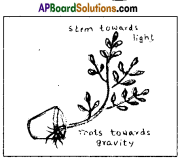
You have performed the activity of Seed Germination in a glass jar in your school lab. You might have observed the growth of shoot and root. What information did you record regarding the shoot growth after a week if the glass jar is tilted and plant kept horizontally.
Answer:

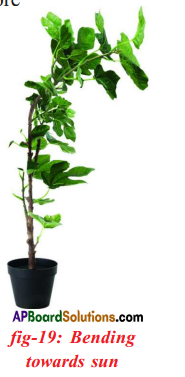
  1. More auxins collects on light falling side of the stem.
  2. Cells on that side grow faster and make the stem bends towards light due to phototropism.

Question 4.
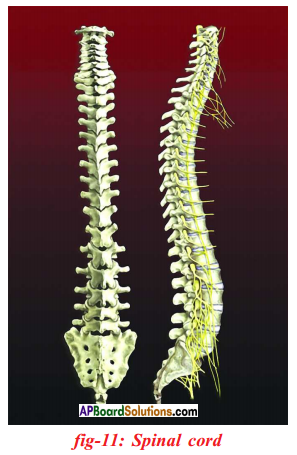
Write the functions of Spinal-cord from the information collected from your school library and from internet.
Answer:

  1. Carries the information to the brain from the lower parts of the body.
  2. It carries the information from brain to body parts.
  3. It plays a key role in the reflex actions.
  4. It acts as relay centre.

Question 5.
Where do we find Cerebro-spinal fluid? Mention one of its functions.
Answer:
The space between the inner layers of brain is filled with fluid called cerebrospinal fluid (CSF). It serves as a shock-absorbing medium and protects the brain against shocks, jerks along with the meninges and cranium.

Question 6.
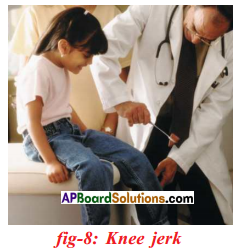
Mention at least one activity done at school to show involuntary reflexes.
Answer:
Knee-jerk.

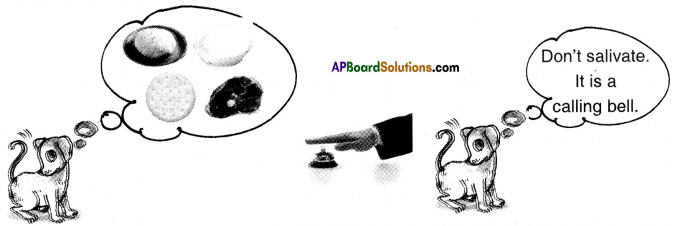
Question 7.
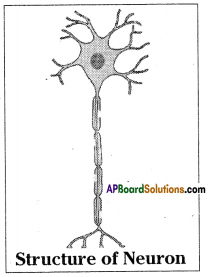
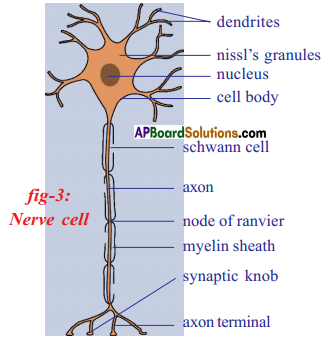
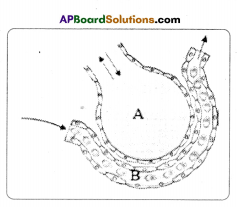
Write the name of the nerve given in the following diagram and write its function.
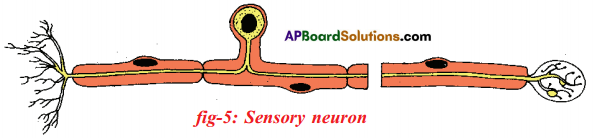
AP SSC 10th Class Biology Important Questions Chapter 5 Coordination 1Answer:
The given diagram is the sensory Neuron. They are also called Afferent nerves.
Function: They carry messages towards central nervous system (Brain or spinal cord) from nerve endings on the muscles of different sense organs, that sense the change in surroundings.

AP SSC 10th Class Biology Important Questions Chapter 5 Coordination

Question 8.
Identify the given part in the diagram and write its use.
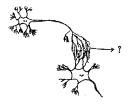
AP SSC 10th Class Biology Important Questions Chapter 5 Coordination 2Answer:
i) Synapse.
ii) It is a functional region of contact between two neurons where infromation from one neuron is transmitted to another neuron.

Question 9.
Name the part of the brain that maintains the equilibrium.
Answer:
The part of the brain that maintains the equilibrium is cerebellum.

Question 10.
Who discovered the first plant hormone auxin?
Answer:
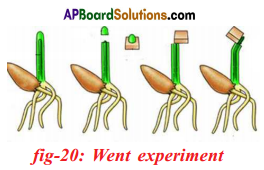
The first plant hormone auxin was discovered by F.W. Went.

Question 11.
What was the belief of Greeks?
Answer:
The Greeks believed that all functions of the body were controlled by the brain, since damage to that organ produced remarkable changes in behaviour.

Question 12.
How many types of nerves are present in human body? What are they?
Answer:
Nerves are classified mainly into three types.

  1. Afferent neurons
  2. Efferent neurons
  3. Association neurons.

Question 13.
What are Afferent neurons?
Answer:
Afferent neurons: Nerves which carry messages towards the central nervous system (Spinal cord or brain) from sense organs are called afferent neurons. These are also called sensory nerves.

AP SSC 10th Class Biology Important Questions Chapter 5 Coordination

Question 14.
What are efferent neurons or nerves?
Answer:
Efferent neurons: Nerves which carry messages from the central nervous system to parts that shall carry out the response are called efferent neurons. They are also called as motor nerves.

Question 15.
What are association nerves?
Answer:
The nerves, which link together the afferent and efferent nerves are called association nerves.

Question 16.
What is stimulus?
Answer:
Stimulus is a thing or event that causes a specific functional reaction in an organ or tissue.

Question 17.
What is response?
Answer:
Response is a effect of a change in the environment of the organism or signals of change or stimuli.

Question 18.
What does rapidity of response indicate?
Answer:
Rapidity of response indicates an efficient communication system linking those parts that pick up stimuli to those that trigger a response.

Question 19.
How are responses bring about?
Answer:
Responses are brought about by rapid changes in some muscle.

Question 20.
According to Galen a Greek physiologist how many kinds of nerves are present in body?
Answer:
According to Galen, nerves are of two kinds. They are 1) for sensation and 2) for action.

Question 21.
What are the major parts of neuron?
Answer:
The major parts of neuron are cell body or cyton, dendrites and axon.

AP SSC 10th Class Biology Important Questions Chapter 5 Coordination

Question 22.
What are the two types of projections that extend from cell body?
Answer:
The two types of projections that extend from cell body are dendrites and axon.

Question 23.
What is synapse?
Answer:
Synapse is the functional region of contact between two neurons.

Question 24.
Synapses are mainly found in?
Answer:
Synapses are mainly found in the brain, spinal cord and around the spinal cord.

Question 25.
What are reflexes?
Answer:
The responses to a stimulus on which we do not have control are called reflexes or reflex action.

Question 26.
What is the importance of reflex action?
Answer:
Reflex action save us from painful or dangerous stimuli.

Question 27.
How many types does the nervous system is divided?
Answer:
Nervous system is divided into two types. They are central nervous system and peripheral nervous system.

Question 28.
What are the parts of central nervous system?
Answer:
The parts of the central nervous system are brain and spinal cord.

AP SSC 10th Class Biology Important Questions Chapter 5 Coordination

Question 29.
What are the three major divisions in brain?
Answer:

  1. Forebrain
  2. Mid brain and
  3. Hind brain.

Question 30.
What are the parts present in fore brain?
Answer:
The parts present in fore brain are cerebrum and diencephalon.

Question 31.
What are cranial nerves? How many cranial nerves are present?
Answer:
Nerves originate from brain are called cranial nerves. 12 pairs of cranial nerves arise from brain.

Question 32.
How many pairs of spinal nerves are present?
Answer:
31 pairs of spinal nerves are present.

Question 33.
Which is called peripheral nervous system?
Answer:
Peripheral nervous system consists of nerves arising from the brain and spinal cord. 12 pairs of cranial nerves from brain and 31 pairs of spiral nerves from spinal card together called peripheral nervous system.

Question 34.
What is autonomous nervous system?
Answer:
The peripheral nervous system that controls the involuntary actions of the body is called autonomous nervous system.

AP SSC 10th Class Biology Important Questions Chapter 5 Coordination

Question 35.
What are the systems involved in control and coordination in animals?
Answer:
The systems involved in control and coordination in animals are nervous system and endocrine system.

Question 36.
The hormone insulin is secreted by?
Answer:
The hormone insulin is secreted by Islets of Langerhans of pancreas gland.

Question 37.
Give examples for endocrine glands.
Answer:
The examples for endocrine glands are pituitary gland, thyroid gland, parathyroid, adrenal, hypothalamus, pancreas, thymus, testes and ovaries.

Question 38.
The nervous system that regulates heart beat, breathing, etc., is?
Answer:
The nervous system that regulates heart beat, breathing etc., is autonomous nervous system.

Question 39.
What is thigmotropism?
Answer:
The directional growth movement of a plant part in response to the touch of an object is called thigmotropism.

Question 40.
Name the receptors of taste and smell.
Answer:
The receptor of taste is gustatory receptor and that of smell is olfactory receptor.

Question 41.
What is reflex action? Give examples.
Answer:
Reflex action is a quick involuntary response to a stimulus by an effector.
e.g: Withdrawing our hand from hot object, blinking of eyelids when a moving object approaches eye.

AP SSC 10th Class Biology Important Questions Chapter 5 Coordination

Question 42.
What is the difference between a reflex action and walking?
Answer:
Reflex action is an involuntary action whereas walking is a voluntary action.

Question 43.
Which part of the brain maintains posture and equilibrium of the body?
Answer:
The part of the brain that maintains posture and equilibrium of the body is cerebellum.

Question 44.
How do we detect the smell of agarbathi or incense stick?
Answer:
We detect the smell of agarbathi or incense stick when the olfactory receptors in the nose detect smell by sending nerve impulses to the olfactory centre of the brain.

Question 45.
What is target tissue?
Answer:
Tissues or organs on which hormones act are called target tissues or organs.

Question 46.
What are the main cells of the nervous system?
Answer:
The main cells of the nervous system are the neurons. Besides the neurons the nervous system also consists of glial cells.

Question 47.
What is phototropism?
Answer:
The movement of a plant part in response to light is called phototropism.

Question 48.
What is geotropism?
Answer:
The movement of a plant part in response to gravity is called geotropism.

Question 49.
What is chemotropism?
Answer:
The movement of a plant part in response to chemical stimulus is called chemotropism.

Question 50.
What is hydrotropism?
Answer:
The movement of a plant part in response to water is called hydrotropism.

AP SSC 10th Class Biology Important Questions Chapter 5 Coordination

Question 51.
How many nerve cells does human nervous system consist of?
Answer:
Human nervous system consists of about 100 billion cells.

Question 52.
What is reflex arc?
Answer:
The structural and functional unit that carries reflex action is called reflex arc.

Question 53.
The three layers covering the brain are called?
Answer:
The three layers covering the brain are meninges.

Question 54.
What are the functions carried out by cerebrum?
Answer:
Cerebrum is a seat of mental abilities, controls thinking, memory, reasoning, perception, emotions and speech.

Question 55.
What are the functions of cerebellum?
Answer:
Cerebellum maintains posture, equilibrium and muscle tone.

Question 56.
Which parts are present in hind brain?
Answer:
Cerebellum and medulla oblongata are the parts present in hind brain.

Question 57.
What is the function of feedback mechanism?
Answer:
The function of feed back mechanism is to regulate the production and release of hormones in the body.

Question 58.
Thyroxine hormone controls the body’s function like?
Answer:
Thyroxine hormone controls body’s function like general growth rate and a metabolic activity.

Question 59.
What are voluntary actions? Give examples.
Answer:
The movements under the control of the conscious mind are called voluntary actions. Example : Kicking foot ball, lifting bucket of water, reading book, running, walking, playing, eating, etc.

AP SSC 10th Class Biology Important Questions Chapter 5 Coordination

Question 60.
What are involuntary actions? Give examples.
Answer:
The movements which are not under the control of the conscious mind are called involuntary actions. Example : Respiration, circulation, digestion.

Question 61.
What is nerve impulse?
Answer:
The information passing through a neuron in the form of electrical and chemical signals is called nerve impulse.

Question 62.
What are phytohormones?
Answer:
The hormones present in the plants are called phytohormones.

Question 63.
The phytohormone Abscisic acid is responsible for?
Answer:
Closing of stomata and seed dormancy are caused by the phytohormone Abscisicacid.

Question 64.
What are the functions of auxins?
Answer:
Auxins are responsible for cell elongation and differentiation of shoots and roots.

Question 65.
What is the speed of nerve transmission?
Answer:
Nerve transmission from stimulus to a response can occur at a maximum speed of about 100 meters per second.

Question 66.
What is vasomotor?
Answer:
Vasomotor refers to actions upon a blood vessel which alter its diameter.

Question 67.
What are dorsal and ventral root ganglion?
Answer:
The dorsal root and ventral root ganglions are the regions very close to the spinal cord in which the nerve cell bodies lie. Dorsal root ganglion is present on the dorsal side of spinal cord and ventral root ganglion is present on the ventral side of the spinalcord.

Question 68.
What is the function of dorsal root ganglion?
Answer:
The dorsal root ganglion carries messages of sensation toward brain or spinal cord.

AP SSC 10th Class Biology Important Questions Chapter 5 Coordination

Question 69.
What is the function of ventral root ganglion?
Answer:
The ventral root ganglion carry the instructions from the brain or spinal card to muscles.

10th Class Biology 5th Lesson Coordination 2 Marks Important Questions and Answers

Question 1.
What questions will you ask a doctor to know about endocrine glands?
Answer:

  1. Which glands are known as endocrine glands?
  2. Where can we find endocrine glands in our body?
  3. What do you call chemical substances secreted by Endocrine glands?
  4. Which endocrine gland is attached to the brain?
  5. What are the functions of endrocrine glands?
  6. What will happen if endocrine glands are absent?

Question 2.
How do you feel when you realize that plants respond to the stimuli of their surroundings?
Answer:

  1. It is very interesting and amazing to observe trophic and nastic movements of plants in our surroundings.
  2. For example, the bending of shoots of creepers towards light kept near the window.
  3. The plant roots always grow downwards.
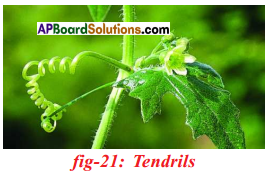
  4. The creepers like cucumber and bittergourds develops tendrils in response to contact or touch.
  5. Butterflies fluttering around the flowers for nectar.

Question 3.
What will happen if a plant is placed near the window of your classroom? What is this process called?
Answer:

  1. The plant bends towards the sun light and grow.
  2. This process is called phototropism.

AP SSC 10th Class Biology Important Questions Chapter 5 Coordination

Question 4.
How do you appreciate the role of Spinal-cord in reflex actions?
Answer:

  1. Spinal cord responds very fast and immediate.
  2. The nerve impulses are transmitted very fast at the speed of 100 m/min.
  3. So that we are protected from many dangerous situations.
  4. So I really appreciate and amazing reflex actions of the spinal cord.

Question 5.
Read the following table:

Name of the Gland Location Hormone secreted Function
Thyroid Neck Thyroxine General growth rate and Metabolic activity
Ovary Abdomen Estrogen Growth of uterus and Control of menstrual cycle
Testis Scrotal sac Testosterone Growth of beard, mustache and development of male sex organs.
Adrenal Kidney Adrenalin Increase in heart beat, rise in blood sugar.

Answer the following questions:
i) Which hormone is released at the time of emotions?
Answer:
Adrenaline

ii) Name the hormone responsible for the development of Secondary sexual characters.
Answer:
Estrogen, Testosteron.

Question 6.
Ram met with an accident. After that he lost the capacity to walk in straight manner and cannot smell anything. Which part of the brain got damaged in the above cases?
Answer:

  1. The forebrain and hind brain of Ram might have been damaged.
  2. The olfactory lobes of the forebrain are concerned with sense of smell. Here, Ram lost the sense of smell anything. Hence the olfactory lobes of forebrain got damaged.
  3. The cerebellum of hind brain maintains posture, equilibrium and muscle tone.
  4. After accident, Ram lost the capacity to walk in a straight manner and hence, I predict that cerebellum of Ram also got damaged.

Question 7.
What questions will you ask a doctor to know about pancreatic gland?
Answer:

  1. Where is pancreas located?
  2. Why is it called a mixed gland?
  3. What is the role of pancreas as an endocrine gland?
  4. Name the disorders occur to pancreas.

AP SSC 10th Class Biology Important Questions Chapter 5 Coordination

Question 8.
What is the role of Adrenalin in controlling emotions?
Answer:
Adrenalin increases rate of heart beat, causes rise in blood sugar, dilation of coronary artery and dilation of pupil of the eye.

Question 9.
What is the significance of the adrenal gland in the human body?
Answer:
Adrenal gland secrets adrenaline. It helps in

  1. Increase heart beat rate
  2. Rise in blood sugar
  3. Dilation of the coronary artery
  4. Dilation of pupil of the eye.

Question 10.
Write the difference between hormone and enzyme.
Answer:

Hormone Enzyme
1. These are secreted by ductless glands. 1. These are secreted by duct glands.
2. These are travel through blood. 2. These are travel through the ducts.
3. Less in quantity. 3. More in quantity.
4. Reaction is slow. 4. Reaction is fast.
5. Involved in metabolic activities 5. Involve in digestion.
6. Ex: Insulin 6. Ex: Lipase

Question 11.
Observe the following table and answer the questions.

Hormones Uses
Thyroxine Normal growth rate, effect on metabolism
Auxins Cell elongation and differentiation of shoots and roots

i) Name the phytohormone in the table.
ii) Name the hormone which influences growth rate in humans.
Answer:
i) Auxin
ii) Thyroxine.

AP SSC 10th Class Biology Important Questions Chapter 5 Coordination

Question 12.
What questions you will ask a neurologist on function of brain?
Answer:

  1. How does alcohol cosumption affect the brain?
  2. Which part of brain is responsible for creativity?
  3. How do we get fits ? 4) How do we get paralysis?
  4. What kind of food should we take to increase?

Question 13.
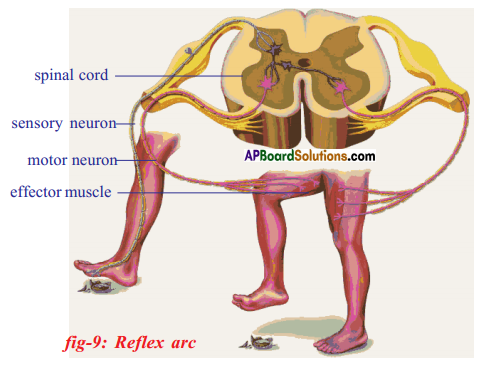
Label a, b, c, d in the diagram given below and write their functions.
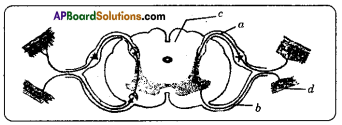
AP SSC 10th Class Biology Important Questions Chapter 5 Coordination 3Answer:
a) Sensory Neuron/-Afferent Neuron: These carry messages towards the central nervous system.
b) Motor Neuron /- Efferent Neuron: These carry messages from central nervous system to body parts
c) White Matter
d) Effector Muscles: Respond to stimuli.

Question 14.
Prepare a table showing tropic movements in plants in response to stimuli.
Answer:

SI. No. Tropic movement Response to stimuli
1. Phototropism Movement towards light.
2. Geotropism Respond positively for gravitational force.
3. Hydrotropism Roots grow towards presence of water in the soil.
4. Thigmotropism Tendrils and climbing plants grow towards support.

Question 15.
Explain two tropic movements with suitable examples.
Answer:

  1. Phototropism: Response of plant to light cite example is called phototropism.
    Ex: sunflower
  2. Geotropism: Response of a plant to gravitational force Ex: root growth of plant
  3. Hydrotropism: Response of root to water availability in the soil.
    Ex : Plants which are growing very close to rocks and walls.
  4. Thigmotropism: Response to make contact or touch is called Thigmotropism.
  5. Chemotropism: Response to chemical is called chemotropism (Stigma secretes sugary substances)

Question 16.
Write two voluntary functions and two involuntary functions you have observed in your body.
Answer:
a) Examples for voluntary functions:

  1. Cleaning the table
  2. Playing on the keyboard.

b) Examples for involuntary functions :

  1. Salivating when food is kept in the mouth
  2. Closing of eyes when bright light is focussed.

Question 17.
Plants show tropic movements in different situations. Give examples.
Answer:

  1. Movement of individual parts of plants is possible when they are subjected to external stimuli. This type of response is called tropism or tropic movement.
  2. The response of a plant to light is called phototropism. Respond of plants for gravity is called geotropism. Movement of plant towards water is called hydrotropism. The type of response by plants to make contact or touch is called thigmotropism. The response of plants to chemicals is called chemotropism.
  3. Pollen grains respond to this stimulus as pollen tubes grow to reach the ovule for fertilization.

Question 18.
Divide the following into groups. Walking, blinking of eye lids, heart beat, laughing, digestion of food and reading. How do you divide them into groups?
Answer:
These can be divided into voluntary actions, involuntary actions and reflex actions.
Voluntary actions: Walking, laughing, reading
Involuntary actions: Digestion of food, heart beat
Reflex actions: Blinking of eye lids

AP SSC 10th Class Biology Important Questions Chapter 5 Coordination

Question 19.
What are ganglia?
Answer:

  1. Ganglia or neural ganglia are the structures located in the peripheral nervous system (for example beside the spinal column or near viscera) made of concentration of neuron bodies.
  2. Examples of neural ganglia are the ganglia that concentrate cell bodies of sensory neurons in the dorsal roots of the spinal cord and the ganglia of the myenteric plexus responsible for the peristaltic movements of the digestive tube.

Question 20.
Write a brief note on the functioning of sympathetic nervous system.
Answer:

  1. This part of the autonomous nervous system increase the activity of an organ as per the need.
  2. For example, during running there is an increased demand for oxygen by the body.
  3. This is fulfilled by an increased breathing rate and increased heart rate.
  4. The sympathetic nervous system works to increase the breathing rate and the heart rate.

Question 21.
Explain briefly about the action of parasympathetic nervous system.
Answer:

  1. This part of the autonomous nervous system decrease the activity of an organ and it has calming effect.
  2. During sleep, the breathing rate and also the heart rate slows down.
  3. This is facilitated by the parasympathetic nervous system.
  4. It can be said that the parasympathetic nervous system helps in conservation of energy.

Question 22.
Why are some patients of diabetes treated by giving injections of insulin?
Answer:

  1. Insulin is produced by Islets of Langerhans of pancreas.
  2. Insulin regulates the level of glucose in the blood.
  3. Deficiency of insulin results in disease called ‘diabetes’.
  4. Such diabetic patients are given injections of insulin so that the sugar or glucose level in the blood can be controlled.
  5. Insulin is now produced in large quantities for the treatment of human sufferers from ‘sugar diabetes’.

Question 23.
What is chemotropism? Explain it with suitable example.
Answer:

  1. Response of a plant towards chemicals is known as chemotropism.
  2. If we taste the carpel of a flower, it is sweet.
  3. Butterflies flutter on flowers for nectar.
  4. Ripen stigma secretes sugary substance.
  5. This chemical substance stimulates the pollen grain which falls on the stigma.
  6. Pollen grains respond to this stimulus as pollen tubes grow to reach the ovule for fertilization.

AP SSC 10th Class Biology Important Questions Chapter 5 Coordination

Question 24.
What are plant growth substances? Give examples.
Answer:

  1. Plant growth substances are the chemical (organic) substances which are produced in plants and act at minute concentration on growth and other phisiological functions of plants.
  2. There are five major types of plant growth substances. They are auxins, Gibberellins, cytokinins, Ethylene and Abscisic Acid.

Question 25.
What is ethylene? Explain its action.
Answer:

  1. Ethylene is a gaseous growth inhibiting substance.
  2. Ethylene causes ripening of the fruits.
  3. It modifies the growth of the plant by inhibiting stem elongation.
  4. It accelerates abscission of leaves, flowers and fruits.

Question 26.
What is Apical dominance?
Answer:

  1. In some plants main stem grows by the activity of terminal bud without giving any branches.
  2. It means the activity of lateral buds is suppressed and this phenomenon of suppression of the growth of lateral buds by terminal bud is called Apical dominance.

AP SSC 10th Class Biology Important Questions Chapter 5 Coordination

Question 27.
What happens at the synapse between two neurons?
Answer:
At synapse, in between the end of one axon and end of another dendrite electrical impulse sets off the release of some chemicals (neurotransmitter). These chemicals cross the gap or synapse and reach to dendrites of the next neuron and start electrical impulse there.

10th Class Biology 5th Lesson Coordination 4 Marks Important Questions and Answers

Question 1.
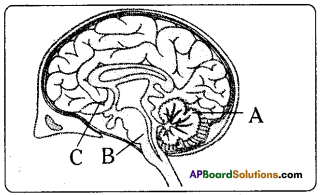
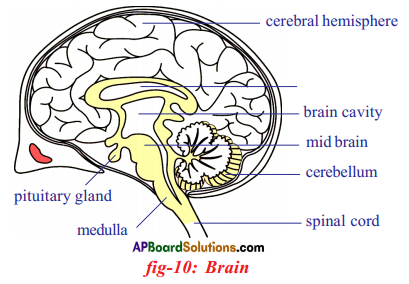
AP SSC 10th Class Biology Important Questions Chapter 5 Coordination 4i) This diagram belongs to which system of the body?
Answer:
Human nervous system

ii) Name the parts A and B.
Answer:
A. Cerebellum
B. Medulla oblongata

iii) The part ‘C is endocrinal gland. This is called master gland. What is the name of this gland?
Answer:
Pituitary gland

iv) Which part in this diagram is useful to solve problems and puzzles?
Answer:
Cerebrum

AP SSC 10th Class Biology Important Questions Chapter 5 Coordination

Question 2.
Name the important parts of the brain and write the functions of fore-brain.
(OR)
Write in a tabular form the different parts of human brain and their functions.
Answer:

  1. Brain has the following divisions.
    1. Fore brain – Cerebrum, diencephalon
    2. Mid brain – Optic lobes.
    3. Hind brain – Cerebellum, medulla.
  2. Functions of the various parts of the brain.
    Parts of the brain Functions
    Cerebrum i)    Seat of mental abilities, controls thinking memory, reasoning, perception, emotions and speech.
    ii)    Interprets sensations and responds to cold, heat, pain and pressure.
    Diencephalon i)     Relay centre for sensory impulses, such as pain, temperature and light.
    ii)    Reflex centre for muscular activities.
    iii)     Centre for certain emotions such as anger.
    iv)     Centre for water balance, blood pressure, body temperature, sleep and hunger.
    v)    The hypothalamus controls the pituitary gland, which functions as the master gland.
    Mid brain i) It relays motor impulses from the cerebral cortex to the spinal cord and relays sensory impulses from the spinal cord to thalamus, reflexes for light and hearing.
    Cerebellum i)     Maintains posture, equilibrium and muscle tone.
    ii)    Coordinates voluntary movements initiated by cerebrum.
    Medulla oblongata i)     Contains centre for cardiac, respiratory and vasomotor activities.
    ii)    Coordinate reflexes like swallowing, coughing, sneezing and vomiting.

Question 3.
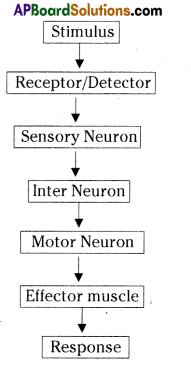
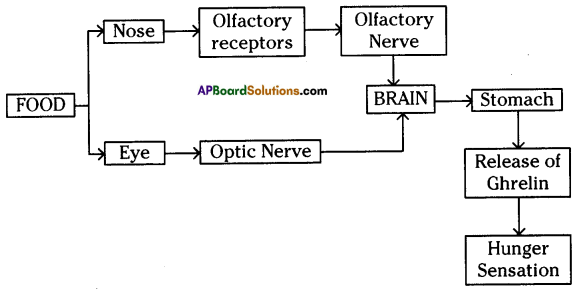
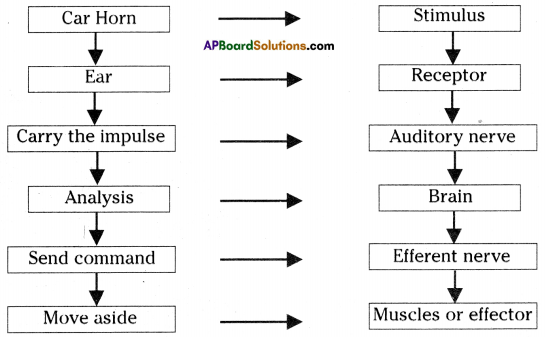
Observe the following diagram. What does it represent? Explain the process in a flow-chart.
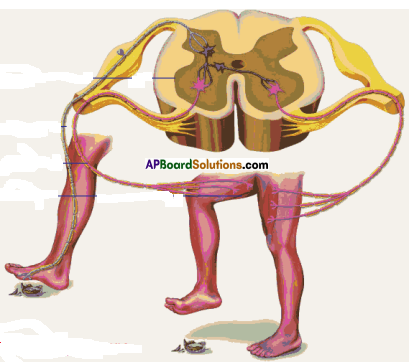
AP SSC 10th Class Biology Important Questions Chapter 5 Coordination 6Answer:
AP SSC 10th Class Biology Important Questions Chapter 5 Coordination 5

AP SSC 10th Class Biology Important Questions Chapter 5 Coordination

Question 4.
Read the following table:

Part of the Brain Functions
a) Olfactory lobes Sense of smell
b) Cerebrum Mental abilities, memory, reasoning, perception, emotion and speech, respond to cold, heat, pain and pressure
c) Diencephalon Controlling emotions, center for water balance, blood pressure, sensory impulses such as pain, temperature and light, sleep and hunger.
d) Cerebellum Maintains posture, equilibrium and muscle tone, co­ordinates voluntary movements initiated by cerebrum.

Now, identify the part of the brain which participate in the below situations.

a) Ravi is an intelligent boy. He can remember the things for a long time.
Answer:
Cerebrum

b) The drunken man does not walk properly.
Answer:
Cerebellum

c) Identifies the food items without seeing which are being prepared in the kitchen
Answer:
Olfactory Lobes

d) Naveen lost his money purse while coming to the school. But he is not crying.
Answer:
Diencephalon

e) It is time for lunch.
Answer:
Cerebrum

f) I cannot tolerate this type of heat in the summer.
Answer:
Cerebrum

g) Catching the ball perfectly.
Answer:
Cerebellum

h) There may be a drainage behind the house.
Answer:
Olfactory Lobes

AP SSC 10th Class Biology Important Questions Chapter 5 Coordination

Question 5.
Look at the picture and answer the questions:
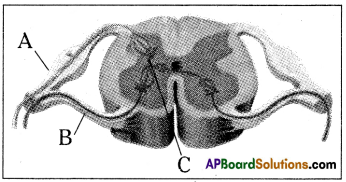
AP SSC 10th Class Biology Important Questions Chapter 5 Coordination 7a) To which system does the diagram belong ?
Answer:
The diagram belongs to T.S. of Spinal cord (peripheral).

b) What is the name of A, B parts ?
Answer:
A – Dorsal Root,
B – Ventral Root

c) What is ‘C’ ? What is its function ?
Answer:
C – Association neuron
It analyse the information – and send the order (function) through motor neuron to muscle.

d) Through which horn the sensory nerve enters ?
Answer:
Sensory nerve enters through dorsal horn.

Question 6.
Fill the following table related to Endocrine glands.

1. Name of the endocrine gland Location Hormone secreted Response of body to that hormone
2.
3.
4.

Answer:

S.No. Name of endocrine the gland Location Hormone secreted Response of body to that hormone
1. Pituitary Floor of brain Somatotropin Growth of bone.
Gonadotropin Activity of ovary and testis.
2. Thyroid Neck Thyroxine General growth rate and metabolic activity.
3. Ovary Lower abdomen Estrogen Growth of the uterus and skeleton of the pelvis.
4. Testis Scrotal sac Testosterone Growth of male secondary sexual characters.

AP SSC 10th Class Biology Important Questions Chapter 5 Coordination

Question 7.
Observe the following table and answer the questions.

Division -1 Division – II
Auxins Adrenalin
Gibberellins Testosterone
Ethylene Estrogen
Abscisic Acid Thyroxin
Cytokinins Growth Hormone

a) On what basis the above classification done?
Answer:
Hormones in animals and hormones in plants.

b) From which gland is Adrenalin released?
Answer:
Adrenal gland.

c) Which hormone is responsible for closing of stomata?
Answer:
Abscisic Acid (ABA)

d) What are the functions of Auxins?
Answer:
Cell elongation and differentiation of shoots and roots.

Question 8.
AP SSC 10th Class Biology Important Questions Chapter 5 Coordination 7
A) What does the given picture represent?
B) Name the parts A, B and C.
C) What carries the nerve impulse to the spinal cord?
D) Wrhat is the function of association neuron?
Answer:
A) The given picture represents
T.S. of Spinal cord (peripheral).
B) A – Dorsal root B – Ventral root C – Association neuron
C) Through dorsal root the nerve impulse reaches the spinal cord.
D) Association neuron analyses the information and sends the order through motor neuron to muscle.

Question 9.
The following table is about parts of brain and their functions. Read it and fill the blanks.

Part of the brain Functions
Cerebrum
Centre for certain emotions such as anger
Midbrain It relays motor impulses from the cerebral cortex to the spinal cord and relays sensory impulses from the spinal cord to the thalamus, reflexes for sight and hearing.
Maintains posture, equilibrium and muscle tone.
Medulla oblongata

Answer:

Cerebrum i) Site of mental abilities, controls thinking, memory, reasoning, perception, emotions and speech.

ii) Interprets sensations and responds to cold, heat, pain and pressure.

Diencephalon Centre for certain emotions such as anger.
Midbrain It relays motor impulses from the cerebral cortex to the spinal cord and relays sensory impulses from the spinal cord to the thalamus, reflexes for sight and hearing.
Cerebellum Maintains posture, equilibrium and muscle tone.
Medulla oblongata i) Contains centre for cardiac, respiratory and vasomotor activities.
ii) Coordinates reflexes like swallowing, coughing, sneezing and vomiting.

AP SSC 10th Class Biology Important Questions Chapter 5 Coordination

Question 10.
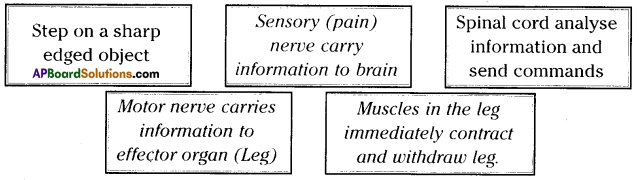
Ramya ran away shouting loudly after seeing a snake on the way to school. Arrange the events involved in this situation in the correct order and rewrite it.

AP SSC 10th Class Biology Important Questions Chapter 5 Coordination 8i) Brain receives the information, analyses and produces the reponse.
ii) Sensory nerves carry the information from sense organs to brain,
iii) Effector muscles exhibit the response.
iv) Sense organs receive the information from the environment.
v) Motor nerves carry the response from the brain to effector muscles.
Answer:
1-d, 2-b, 3 -a, 4-e, 5-c
d) Sense organs receive the information from the environment.
b) Sensory nerves carry the information from sense organs to brain,
a) brain receives the information analyse and produces the response.
e) Motor nerves carry the response from the brain to effector muscles.
c) Effector muscles exhibit the response.

Question 11.
Observe the following information and answer the following questions.

S.No. Hormones Uses
1. Auxins Cell elongation and differentiation of shoots and roots.
2. Abscisic acid Closing of stomata, seed dormancy
3. Ethylene Ripening of fruit
4. Cytokinins Promote cell division, promote sprouting of lateral buds, delay ageing of fruits.

i) What do we call the hormones that are present in plants?
Answer:
We call phyto hormones which are present in plants.

ii) Name the hormones which are helpful in the growth of the plants.
Answer:
Auxins, gibberellins, cytokinins are helpful in the growth of the plants.

iii) Farmers keep carbide powder in between raw mangoes. What might be the reason? What will be the end result after 3 to 4 days?
Answer:
Carbide release Ethylene, which promotes the fruit ripening. After 3 or 4 days fruits will ripen.

iv) Plants also respond like animals. Do you agree with this statement? Support your answer.
Answer:
Yes, plants also respond like animals. They shut off leaves in summer, germinate in rainy season, blooms according to seasons.

Question 12.
Read the following table and answer the questions given below.

S.No. Name of the gland Location Hormone secreted Response of the body to hormone
1. Pituitary Floor of brain Somatotropin Growth of bone.
Gonadotropin Activity of ovary and testis.
2. Thyroid Neck Thyroxine General growth rate and metabolic activity.
3. Ovary Lower abdomen Estrogen Growth of the uterus and skeleton of the pelvis.
4. Testis Scrotal sac Testosterone Growth of male secondary sexual characters.

i) Write the importance of glands and hormones.
Answer:
Glands and hormones controls and coordinates various functions of the body with nervous system.

ii) Which hormone is responsible for growth of bone?
Somatotropin is responsible for growth of bone.

iii) What happens if testosterone is not secreted?
Secondary sexual characters in male are not developed if testosterone is absent.

iv) Where does the gland that secretes thyroxine is located?
Thyroid gland which secretes thyroxine is located near the neck.

v) Which glands are common in male and female?
Pituitary, thyroid, adrenal glands, parathyroid and pancreas are common in male and female.

AP SSC 10th Class Biology Important Questions Chapter 5 Coordination

Question 13.
Explain the different types of adaptations in plants with suitable examples.
Answer:

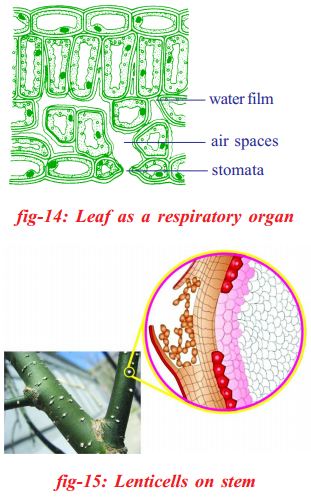
  1. Most plants can aerate their roots bj’ taking in the oxygen through the lenticels or through the surface of their root hairs.
  2. But plants which have their roots in very wet places, such as ponds or marshes, are unable to obtain oxygen.
  3. They are adapted to these water-logged conditions by having much larger air spaces which connect the stems with the roots, making diffusion from the upper parts much more efficient.
  4. The most usual adaptation is to have a hollow stem.
  5. The problem of air transport is more difficult for trees.
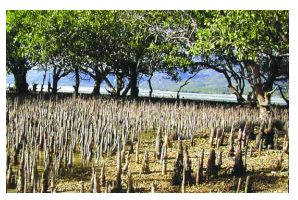
  6. An exception is the mangrove tree of the tropics which have aerial roots above the soil surface and takes in oxygen through these roots.

Question 14.
Karthik is suffering from excess sugar in urine and Varun is suffering from repeated dilute urination. What are the reasons for these diseases ? Explain.
Answer:

  1. Excess sugar in urine condition is known as diabetes milletus. (sugar diabetes)
  2. Repeated dilute urination is known as diabetes insipidus, (diuretic condition)
  3. Deficiency of insulin causes high level sugar in the blood and urine. It leads to diabetes milletus (Sugar diabetes).
  4. Vasopressin maintains osmotic concentration of body fluids. Deficiency of vasopressin causes excessive repeated dilute urination it is called as diabetes insipidus.

Question 15.
Analyse the following information and answer the questions.

S.No Organ List-1
Effect of Nervous system
List-2
Effect of Nervous system
1. Eye Dialates pupil Constricts pupil.
2. Mouth Inhibits salivation Stimulates salivation
3. Lungs Relaxes bronchi Constrict bronchi.
4. Heart Accelerates heart beat Heart beat to normally.
5. Blood vessels Increase blood pressure Decrease blood pressure.
6. Pancreas Inhibits Pancreas activity Stimulates Pancreas activity.

i) Write two functions of Sympathetic Nervous System.
ii) Name two organs that are influenced by Parasympathetic Nervous System.
iii) Name the Nervous system mentioned in the table that increases the blood pressure.
iv) What systems constitute Autonomous Nervous System?
Answer:
i) Dilates pupil, inhibits salivation, relaxes branchi, accelerates heart beat, etc.
ii) Eye, heart, pancreas, etc.
iii) Sympathetic nervous system
iv) Sympathetic and para sympathetic nervous system.

AP SSC 10th Class Biology Important Questions Chapter 5 Coordination

Question 16.
Explain the Phytohormones which control growth in plants.
Answer:
Major plant hormones and their action:

Hormones Uses
Auxins Cell elongation and differentiation of shoots and roots.
Cytokinins Promote cell division, promotion of sprouting of lateral buds, delaying the ageing in leaves, opening of stomata.
Gibberellins Germination of seeds and sprouting of buds; elongation of stems; stimulation of flowering; development of seedless fruits, breaking the dormancy in seeds and buds.
Abscisic acid Closing of stomata; seed dormancy, promoting aging of leaves.
Ethylene Ripening of fruit.

Question 17.
Analyse the table and answer the following questions.

Sl.No. Part of Brain Functions
1. Cerebrum Mental abilities, memory, speech.
2. Diencephalon Sensory impulses, emotional impulses, muscular activities.
3. Midbrain Reflexes of sight and hearing.
4. Cerebellum Equilibrium.
5. Medulla oblongata Respiratory, cardiac centres, blood pressure.

i) Which part of the brain recollects the childhood incidents?
Answer:
Cerebrum.

ii) Write two parts of hind brain.
Answer:
Cerebellum, medulla oblongata.

iii) Name the part of the brain that will not function in drunken person.
Answer:
Cerebellum.

iv) Name the part of the brain that controls involuntary actions.
Answer:
Medulla oblongata.

Question 18.
Write contrasts and comparisons of the style of response in plants and animals to the stimuli.
Answer:

  1. Both plants and animals react to various stimuli around them. But the method of responding to stimuli is not similar in plants and animals. .
  2. Higher animals respond to stimuli because they have a nervous system and an endocrine system.
  3. Plant do not have a well defined nervous or endocrine system. They do have some mechanism of control by means of some chemicals or hormones.
  4. Plants can sense the presence of stimuli like light, heat, water, touch, pressure, chemicals, gravity, etc.
  5. The hormones present in the plants called phytohormones control response towards the stimuli. Phytohormones coordinate the activities of the plant usually by controlling one or the other aspect of the growth of the plant.

Question 19.
Read the below paragraph and write answers.

There is systematic method in showing response to stimuli. There is different stages in it. First stage starts with the response recognising the changes in outside or inside of the body atmosphere with recognising the stimuli. Transmitting the received information is second stage, analysing that information is third stage and showing correct response to that stimuli is the last stage.

a) What does this information shows?
b) Convert the above information into flow chart.
c) Write about the mechanism that conducts this action.
Answer:
a) It shows the systematic method in showing response to stimuli.

b)
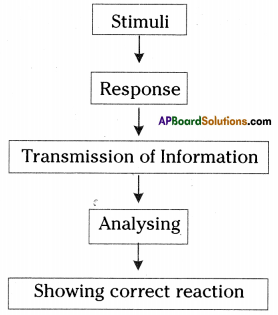
AP SSC 10th Class Biology Important Questions Chapter 5 Coordination 9

c) Nervous system can sense the changes inside and outside the body through specialised cells called Receptors. This information in the form of small electrical currents is sent to brain and analysed and responses are generated in the nervous system. These responses once again in the form of small electrical currents are conveyed to the appropriate organs such as muscles and glands at a greater speed. Nervous system may store this information for future use.

AP SSC 10th Class Biology Important Questions Chapter 5 Coordination

Question 20.
See the below action. What does it indicate? Explain with an example.
AP SSC 10th Class Biology Important Questions Chapter 5 Coordination 9Answer:

  1. It indicates the stimulus – response action. This stimulus response can be explained with an example.
  2. Suppose a mosquito is biting you on your arm. Mosquito bite is stimulus.
  3. The receptor in the skin responds and send the information in the form of electrical impulses through sensory nerve to spinal cord or brain.
  4. Brain or spinal cord analyses the information that the mosquito bite is causing pains.
  5. The brain or spinal cord sends the message through motor nerve to the effector organ i.e., hand to kill the mosquito.
  6. As per the message our hand immediately hits the mosquito and kills it.

Question 21.
Rangaiah is not feeling well. The following table is the results of tests. Analyse the table.

Tests Present Status Normal Range
Blood Test
1. Blood Pressure 160/90 120/80
2. Glucose (Fasting) 120 60-100
3. Glucose (Post Lunch) 220 160-180
4. Bilirubin 1.0 0.1 – 0.8
Urine Test
1. 24 hours protein 150 mg 100 mg
2. Sodium 140 125-250

Write answers for the following questions.
i) How can you state that Rangaiah is diabetic?
Answer:
After blood test it was found that level of glucose (Fasting) is 120 whereas the normal range is 60 -100. After lunch the level of glucose in blood of Rangaiah further raised to 220, the normal being between 160 – 180. This shows that Rangaiah is diabetic.

ii) What are the tests to know about Bilirubin?
Answer:
We can know about bilirubin by blood test.

iii) What do you understand from the above report?
Answer:
It shows that Rangaiah is diabetic and his systolic pressure is slightly high. The levels of bilirubin in blood also slightly high, almost normal range. Urine test shows sodium levels are at normal range but 24 hours protein is much higher than normal levels.

iv) What questions do you ask the doctor on the above report?
Answer:

  1. What are symptoms shown by Rangaiah as diabetic patient?
  2. What are the ways to control sugar in the blood?
  3. Which hormone is responsible for raise of glucose in the blood?
  4. How sodium maintains blood pressure at normal levels?
  5. What is the role of bilirubin in digestion?

Question 22.
What is reflex arc? Write the components of reflex arc and their functions.
Answer:

  1. The structural and functional unit that carries out reflex action is called a reflex arc.
  2. It consists of five components.
  3. They are receptor, a sensory nerve, a association neuron, a motor nerve and an effector organ.
    SI. No. Component of reflex arc Functions
    1. Receptor Receives information and generates impulses.
    2. Sensory neuron (Afferent) Carries information from the receptor to the interneurons in the spinal cord.
    3. Interneuron (Association neuron) Processes the information and generates responses
    4. Motor neuron (Efferent) Carries the information from the spinal cord to the effector organ.
    5. Effector organ Receives the information from the efferent neuron and shows the appropriate responses.

Question 23.
What are endocrine glands ? What are their functions?
Answer:
Endocrine glands:

  1. Endocrine glands are the ductless glands.
  2. They secret complex organic substances called hormones directly into the blood.
  3. Hormones are transported through blood to different tissues.
  4. Their secretions act as biochemical messengers in the body.

Functions:

  1. The hormones secreted by these glands play an important role in co-ordinating various organ systems.
  2. Hormones can increase or decrease the metabolism and synthesis of substances like proteins, carbohydrates and lipids.
  3. Irregular functioning of these glands may lead to serious diseases.
  4. The quantity of hormone required is very minimum (1/10,00,000 gram).
  5. A slight increase or decrease may brings out large changes in the target tissue.

Question 24.
How does a nerve impulse travel through the body?
Answer:

  1. The information acquired at the dendritic tip of a nerve cell sets off a chemical reaction that creates an electrical impulse.
  2. This impulse travels from the dendrite to the cell body and then along the axon to its end.
  3. At the end of the axon the electrical impulse sets off the release of some chemicals.
  4. These chemicals cross the gap or synapse and start a similar electrical impulse in a dendrite of the next neuron.
  5. A similar synapse finally allows the delivery of such impulse from neurons to other cells such as muscles or glands.

AP SSC 10th Class Biology Important Questions Chapter 5 Coordination

Question 25.
How is the brain anatomically divided?
Answer:

  1. The cerebrum is divided into two cerebral hemispheres, the right and left.
  2. Each hemisphere is made of four cerebral lobes. Frontal lobe, parietal lobe, temporal lobe and occipetal lobe.
  3. Each cerebral lobe contains the gray matter and the white matter.
  4. The gray matter is the outer portion and is made of neuron bodies, the gray matter is also known as the cerebral cortex.
  5. The white matter is the inner portion and it is white because it is in the region where axons of the cortical neuron pass.

Question 26.
What are the divisions of the autonomous nervous system?
Answer:

  1. Ganglia near the vertebral column are connected to the spinal cord by nerves.
  2. The two divisions of autonomic nervous system are sympathetic nervous system and parasympathetic nervous system.
  3. The sympathetic nervous system is formed by the chain of ganglia on either sides of the vertebral column and the associated nerves.
  4. The parasympathetic nervous system is formed by the nerves arising from the ganglia of the brain and the posterior part of the spinal cord.
  5. These together constitute the autonomous nervous system which is the part of the peripheral nervous system consisting of twelve pairs of cranial nerves and thirty one pairs of spinal nerves.

Question 27.
What is autonomous nervous system? Explain how it controls voluntary functions with an example.
Answer:

  1. The peripheral nervous system that controls involuntary functions of the body is known as Autonomous nervous system.
  2. It has voluntary control of muscles of some areas of skin and the skeletal muscle.
  3. For example when we enter a dark room we can not see anything immediately. Slowly we are able to see the things around us in the room.
  4. This is because of increase in diameter of pupil, which allows more light in.
  5. When we come out of the dark room into broad day light the diameter of the pupil decreases allowing less light to enter into the eyes.
  6. Both these functions occur under the influence of the autonomous nervous system.

Question 28.
What is the master gland in the human body? What are the functions of the hormones it secretes? (OR)
Why is pituitary gland known as master gland? How does it control all the other glands in the body?
Answer:

  1. Pituitary gland is known as the master gland of the body as it controls the functions of all the other endocrine glands.
  2. It serves as a link between nervous system and endocrine system.
  3. The hormones secreted by pituitary gland and their functions are as follows.
Hormone Response of the body to hormone
a) Somatotrophin Growth of bones
b) Thyrotrophin Activity of thyroid gland
c) Gonadotrophin Activity of ovary and testis
d) Andrenocortico trophic Stimulates secretion from adrenal cortex
e) Luteinising hormone In males – secretion of testosterone; In females – Ovulation, development of Corpus Luteum and secretion of progesterone.

AP SSC 10th Class Biology Important Questions Chapter 5 Coordination

Question 29.
What are the differences between the manner in which movement takes place in a sensitive plant and the movement of our legs?
Answer:

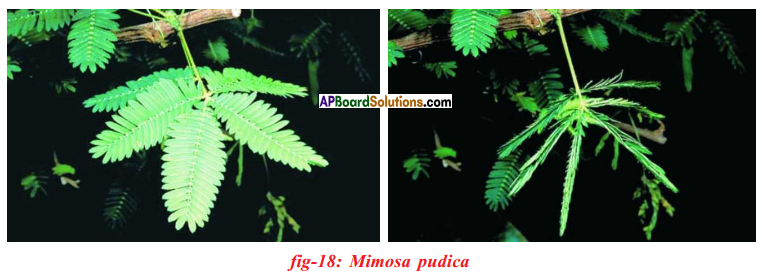
  1. The stimulus of touch causes the response in a sensitive plant Mimosa pudica.
  2. Droping of the leaves takes place due to change in osmotic pressure at the base of the leaf.
  3. When the stimulus is over, the osmotic pressure increases causing the leaf to become normal.
  4. This is not a growth related movement.
  5. It is not connected with the direction of the stimulus.
  6. Nerve messages in the form of electrical impulse reaches the leg muscles from the brain.
  7. On reaching the leg muscles, the muscles contract causing the movement of the leg.

Question 30.
What is the need for a system of control and coordination of organisms? (OR)
How is control and coordination brought in organisms?
Answer:

  1. The various physiological processes in an organism are closely linked and depen¬dent on each other.
  2. The linking together of body activities in time and space is called coordination.
  3. Without coordination, the activities of the body would be disturbed a lot.
  4. For example when eating food at meal, the position of food is recorded by the eyes and as a result of this information the arms are moved to the right place to pick it up with precision and accuracy.
  5. As the food is raised to the mouth, the latter opens to receive it. Chewing movements commence and saliva is secreted.
  6. At the moment of swallowing, epiglottis closes trachea.

Question 31.
What is the experiment conducted by Charles Darwin and Francis Darwin? What is their conclusion?
Answer:

  1. Charles Darwin and his son Francis Darwin performed some experiments on phototropism.
  2. They covered the terminal portion of the tip of stem (coleoptile) with a cylinder of metal foil.
  3. Exposed the plant to light coming from the side.
  4. The characteristic bending of the seedling did not occur.
  5. If light was permitted to penetrate the cylinder, bending occurred normally.
  6. They concluded that when seedlings are freely exposed to a lateral light some influence is transmitted from upper to the lower part causing the material to bend.

AP SSC 10th Class Biology Important Questions Chapter 5 Coordination

Question 32.
What are the different types of tropisms found in plants?
Answer:

  1. The different types of tropisms found in plants are phototropism, geotropism, chemotropism, hydrotropism and thigmotropism.
  2. Different stimulus and type of tropism.
    Stimulus Type of tropism
    Light – Phototropism
    Gravity – Geotropism
    Chemical substance – Chemotropism
    Water – Hydrotropism
    Touch – Thigmotropism

Question 33.
Describe the story of invention of insulin. (OR)
Collect the information about insulin from internet and other sources and report on it.
Answer:

  1. In Latin “insula” means an Island.
  2. In 1868 Paul Langerhans of Germany working on the structure of Pancreas found Islets of Langerhans specialised cells richly supplied with blood vessel.
  3. But the function of pancreas remained unknown.
  4. Many others interested in the function of pancreas found that its removal from the body of an experimental animal would lead to the development of disease called ‘sugar diabetes’ (or) diabetes mellitus.
  5. Diabetes is a condition in which the amount of free sugar in the blood and in the urine is abnormally high.
  6. Later scientists found that when they tied the pancreatic duct that emerge from the duodenum caused the degeneration of pancreas but not Islets of Langerhans.
  7. Moreover the animal would not develop diabetes. This was really a strong evidence that the level of blood sugar is linked with the Islet cells.
  8. By 1912 workers were convinced that the Islets produced a secretion which directly liberated into the blood.
  9. Ten years later in Toronto, Banting, Best and Macleod finally succeeded in extracting insulin from degenerate animal pancreas whose ducts to the intestine had been tied.
  10. Insulin is now produced in large quantities for the treatment of human sufferers diabetes, to whom it is administered by injection into the skin.

AP SSC 10th Class Biology Important Questions Chapter 5 Coordination

Question 34.
Compare and contrast the nervous and hormonal mechanism for control and coor-dination in animals.
Answer:

Nervous system Hormonal system
1) Nervous system has a network of nerves. 1) Hormone system does not have such a network in the body.
2) Nervous impulses pass from the receptors to the central nervous system and then to the effectors, through nerve fibers. 2) Hormone system does not have such a network in the body. Hormones pass from the endocrine glands through blood.
3) Nerve impulses reach only the cells required to respond. 3) Hormones reach all the cells but special cells on the target organs using special molecules on their surfaces recognize the information and act.
4) There is no feedback mechanism in generating electrical impulses. 4) The timing and amount of hormones released are dependent on feedback mechanism.

Question 35.
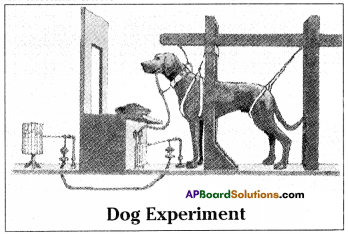
Write brief notes on Ivan Pavlov’s experiment on dog to demonstrate conditioned reflexes.
Answer:

  1. Conditioned reflexes are not inherited.
  2. Ivan Pavlov, a Russian scientist did experiments on conditioned reflexes. His experiments on dogs have become very famous.
  3. When the dog sees food, it secretes salvia. He rang a bell whenever the dog was given food.
  4. After doing this for few days he noticed that the dog secretes salvia when it hears the bell even if the food is not given.
  5. In otherwords dog associated the sound of the bell with the food and assumes that whenever the bell rings food is given.
  6. In expectation of food, saliva start flowing from its mouth. Human beings are no exception to this.
  7. For example, standing in attention when you hear National Anthem.

Question 36.
Collect information about the major plant hormones from library or internet?
Answer:
Some major plant hormones and their action are given in the following table.
Major plant hormones and their action.

Hormones Uses
Abscisic acid Closing of stomata; seed dormancy.
Auxins Cell elongation and differentiation of shoots and roots.
Cytokinins Promote cell division, promotion of sprouting of lateral buds, delaying the ageing in leaves, opening of stomata.
Ethylene Ripening of fruit.
Gibberellins Germination of seeds and sprouting of buds; elongation of stems; stimulation of flowering; development of fruit, breaking the dormancy in seeds and buds.

AP SSC 10th Class Biology Important Questions Chapter 5 Coordination

Question 37.
What are auxins? How do they affect plant growth?
Answer:

  1. Auxins are phytohormones which promote longitudinal growth in plants.
  2. The term auxin usually refers to a chemical compound called Jndole Acetic Acid (IAA) which is the principal nature auxine.
  3. IAA promotes growth and elongation of stems, roots and enlargement of many fruits.
  4. Auxins are known to loosen the cellulose frame work of cell wall which helps in cell enlargement.
  5. Auxins promotes cell division in vascular cambium and also root initiation.
  6. Auxins are also responsible for bending of plants in response to light (phototropism) and also to the gravity stimulus (Geotropism).
  7. Auxin is responsible for Apical dominance.
  8. A large number of auxins are synthesized by artificial methods in chemical laboratories.
  9. Substances like Naphthalene Acetic Acid (NAA) and Indole Butyric Acid (IBA) are used for inducing roots in cuttings.
  10. Auxin spray can prevent premature fruit drop .
  11. Auxin is also known to inhibit the abscission of leaves and fruits.

Question 38.
What is the role of Gibberellins in plant growth and development?
Answer:

  1. Gibberellins has a significant effect on stem elongation.
  2. It also increases the leaf lamina area. This is due to stimulation of cell division and cell elongation to both leaves and stem.
  3. It leads to the formation of seedless fruits.
  4. Gibberellins along with auxins promote cell elongation and leaf expansion.
  5. Parthenocarpy is induced in fruits like apple and pear with spray of Gibberellins.
  6. These substances are also known to induce enzymes like amylase, protease, lipase, etc. at the on set of seed germination and break the seed dormancy.
  7. These substances are used for fruit setting and also for growing seed less fruits.
  8. In beverages industry gibberellin is used to stimulate amylase activity in barley seeds. This is known to enhance the malting of barley grains.

Question 39.
What are the functions of cytokinins?
Answer:

  1. Cytokinins are capable of stimulating cell division along with auxins.
  2. They promote cell elongation.
  3. They have ability to delay the pocess of ageing in leaves.
  4. Cytokinins can prolong the life of fresh leaf crops like cabbage, spinach.
  5. They are also used for keeping the flowers fresh.
  6. Cytokinins are most effective in breaking dormancy of buds and seeds.
  7. The levels of cytokinins decrease in senescing leaves.

Question 40.
What is ABA? Explain its function in the plant.
Answer:

  1. ABA means Abscisic acid. It is the plant growth inhibiting substance.
  2. It induces dormancy in buds, tubers and many seeds.
  3. ABA is responsible for the formation of separation layer or abscission layer between main plant and the leaf or between plant and flower or fruit. It results in the falling of leaves, fruits and flowers.
  4. It prevents the water loss during drought conditions by closing the stomata.

Question 41.
Draw a diagram of Reflex area and describe the functions of different parts of Reflex arc.
Answer:
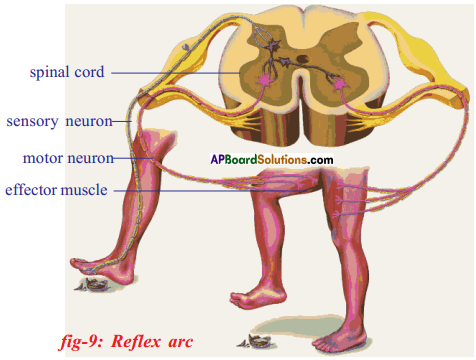
AP SSC 10th Class Biology Important Questions Chapter 5 CoordinationAP SSC 10th Class Biology Important Questions Chapter 5 Coordination 10Functions of different parts of Reflex arc : Reflex arc consists of a receptor, a sensory nerve (afferent) an association neuron or inter neuron, motor nerve (effferent) and a effector organ.

S.No. Component of the Reflex arc Function
1. Receptor Receives information and generates impulses.
2. Sensory (Afferent) nerve Carries information from the receptor to the inter neurons in the spinal cord.
3. Inter neurons Processes the information and generates responses
4. Motor (efferent) nerve Carries the information from the spinal cord to the effector organ.
5. Effector organ Receives the information from the efferent neuron and shows the appropriate response.

Question 42.
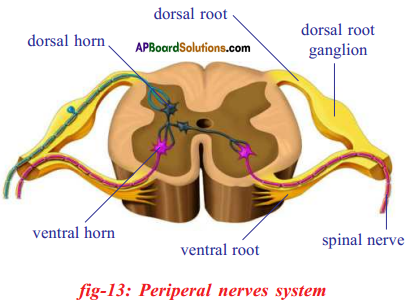
Write a brief account on peripheral nervous system.
Answer:

  1. The peripheral nervous system consists of nerves that arise from the brain and
    spinal cord; and a vast system of dorsat and ventral root nerve cell heads.
  2. The peripheral nervous system has 43 pairs of nerves.
    AP SSC 10th Class Biology Important Questions Chapter 5 Coordination 11
  3. Of these 12 pairs are called cranial nerves and the rest of 31 pairs are called spinal nerves.
  4. Nerves attached to the spinal cord have two types of connections or roots – One to the back or the dorsal side and other to front or the ventral side of cord.
  5. The peripheral nervous system can either involuntarily control several functions of regions like our internal organs, blood vessels, smooth and cardiac muscles. So it is called autonomous nervous system.

AP SSC 10th Class Biology Important Questions Chapter 5 Coordination

Question 43.
Write briefly about the spinal cord. (OR)
Describe the transverse section of spinal cord with the help of a diagram.
Answer:

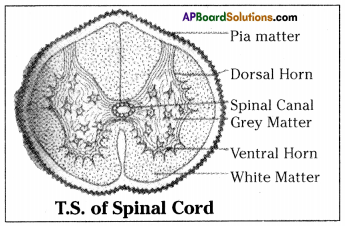
  1. Spinal cord is a long and cylindrical structure.
  2. It passess through vertebral column extending all along the dorsal surface of trunk.
    AP SSC 10th Class Biology Important Questions Chapter 5 Coordination 12
  3. In other words, vertebrae of the vertebral column protect the spinal cord from injuries.
  4. In a cross section of the spinal cord, the grey matter appears like butterfly or in the shape of letter ‘H’.
  5. Each segment of the ‘H’ shaped grey matter is called a horn.
  6. The upper horns are called dorsal horns, and the lower horns are called ventral horns.
  7. In the middle of the grey matter is a canal called spinal canal.
  8. It runs all along the length of spinal cord and is filled with cerebrospinal fluid.
  9. From the sides of spinal cord, 31 pairs of nerves take their origin and supply branches to various parts of the body.

Question 44.
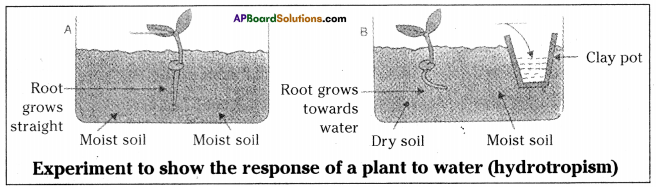
Describe an experiment to demonstrate hydrotropism. (OR)
The roots of a plant move or grow towards water in the soil. How do you prove this with the help of an experiment ?
Answer:
Aim: To prove that roots grow towards water.
Apparatus or materials: Two glass troughs, soil, two similar plants, clay pot, water.

Procedure:

  1. Take two glass troughs A and B,
  2. Fill each one of them with two thirds of soil,
  3. Plant a tiny seedling in trough A.
    AP SSC 10th Class Biology Important Questions Chapter 5 Coordination 13
  4. In trough B, plant a similar seedling and place a small clay pot inside the soil.
  5. Water the soil in the trough A daily and uniformly.
  6. Do not water the soil in trough B, but put some water in the clay placed in the soil.
  7. Leave both the troughs for a few days.

Observation: On examining the roots later, it will be found that the root in the trough B has bent towards the source of water. Roots in trough A grew normally straight. Result: The growth of roots towards water is known as hydrotropism. In this experiment roots bent towards water. By this experiment it was proved that roots always grow towards water.

AP SSC 10th Class Biology Important Questions Chapter 5 Coordination

Question 45.
Observe the diagram and answer the following questions.
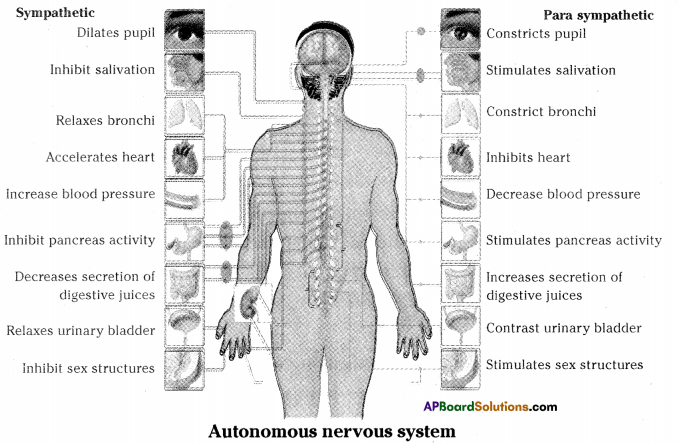
AP SSC 10th Class Biology Important Questions Chapter 5 Coordination 14i) To which organs of the body do the nerves go from the ganglions near the vertebral column ?
Answer:
Eyes, salivary glands, heart, lungs, liver, stomach, gall bladder, intestine, adrenal gland, sex organs are the body parts, the nerves go from the ganglions near the vertebral column.

ii) Which are the organs that receives nerves starting from the brain ?
Answer:
Nose, eye, tongue, ear, head, neck and shoulder receive nerves from the brain.

iii) Which are the organs whose activities are influenced by the sympathetic nervous system?
Answer:
Eyes, lungs, kidneys, gastro intestinal tract, heart, stomach, sweat glands, sex organs, adrenal gland, salivary glands.

iv) Which tire the organs whose activities are influenced by the parasympathetic nervous system ?
Answer:
Eye, lungs, kidneys, gastro intestinal tract, heart, stomach, sweat glands, sex organs, adrenal gland, salivary glands.

v) What do you understand about the functions of parasympathetic nervous system ?
Answer:

  1. The major functions of parasympathetic nervous system is to keep the body in its normal state and it is called as rest and digestive system or feed or breed system.
  2. The function of parasympathetic nervous system is to restore the body to its nor¬mal functioning after all the stress is gone.
  3. The parasympathetic nervous system helps the body to do simple things such as breathing regularly, excreting hormones, eating and digesting food.
  4. It also keeps a person alive when sleeping.

vi) What do you understand about the functions of sympathetic nervous system ?
Answer:

  1. The major functions of the sympathetic nervous system is to activate the response of the body during stressful situation including the fight or flight mechanism of the body.
  2. Sympathetic nervous system is essentially responsible for helping the body to get ready for action or feeling.
  3. It dilates the pupil so one can see better especially in the dark, it increases heart rate so that to increase supply of oxygen to the muscles, decreases digestion so that the energy be better utilized for fighting and so on.

AP SSC 10th Class Biology Important Questions Chapter 5 Coordination

Question 46.
Describe the structure of brain with the help of a neat diagram.
Answer:

  1. Proportionate to the body size, the human brain is the largest of all animals.
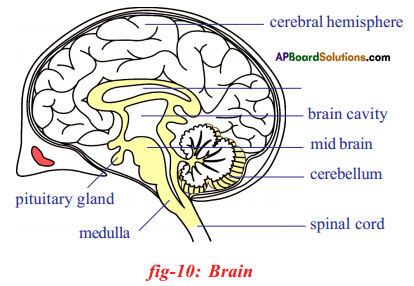
  2. The brain is present in the hard bony box like structure called cranium.
    AP SSC 10th Class Biology Important Questions Chapter 5 Coordination 15
  3. It is covered by three layers called the meninges. The meninges are continued and cover the spinal cord as well.
  4. The space between the inner layers is filled with fluid called cerebro – spinal fluid.
  5. It serves as a shock – absorbing medium and protects the brain against shocks / jerks along with meninges and cranium.
  6. The nerve cell bodies together with capillaries form a mass called grey matter while the myelinated axons form white matter.
  7. The grey matter is in the outer layers while the white matter is present towards inner layers.

Question 47.
Describe the structure of cerebrum.
Answer:

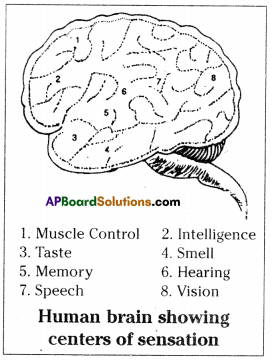
  1. Fore brain is the largest part of the brain. It is also called CEREBRUM.
  2. A deep groove in the middle of the cerebrum divides into two equal halves.
  3. Each calf is called as a cerebral hemisphere.
    AP SSC 10th Class Biology Important Questions Chapter 5 Coordination 16
  4. Right and left cerebral hemispheres are connected each other by a bundle of axon.
  5. The outer portion of the cerebral hemisphere is gray in colour and is called CEREBRAL CORTEX.
  6. There are several ridges called GYRI and the grooves are called SULCI.
  7. They increase the surface area of the cortex in order to accumulate more number of neurons.
  8. In the cerebral cortex, there are centres to receive and analyse various informations like visual (sight), auditory (hearing), olfactory (smell), etc.
  9. Three very deep grooves present across each cerebral hemisphere divides it into four lobes. FRONTAL, PARIETAL, TEMPORAL, and OCCIPITAL LOBES.

AP SSC 10th Class Biology Important Questions Chapter 5 Coordination

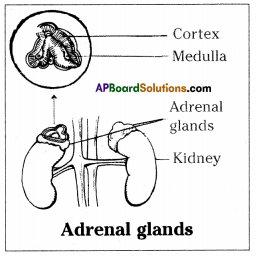
Question 48.
Write a brief account of Adrenal glands.
Answer:
There are two adrenal glands one on the top of each kidney. Adrenal gland has 2 parts.

  1. Cortex – outer part
  2. Medulla – Inner part

AP SSC 10th Class Biology Important Questions Chapter 5 Coordination 17

i) Adrenal cortex: Adrenal cortex secretes two hormones i) cortisol and ii) Aldosterone
a) Cortisol regulates the protein, fat and carbohydrate metabolism.
b) Aldosterone increases the re-absorption of water and sodium in the kidney. It regulates the sodium levels in the body.

ii) Adrenal medulla: It secretes a hormone called Adrenaline at times of physical and mental stress. It is secreted in conditions like:

  1. fall in blood sugar levels
  2. When the person is injured.
  3. When exposed to cold conditions
  4. Suffering from pain

The hormone helps in facing such as situation. Therefore it is called the hormone of FIGHT or FLIGHT.

Question 49.
What is feedback mechanism? Illustrate with an example.
Answer:

  1. It is necessary that the hormones are secreted by the endocrine glands in our body in precise quantities which are required for the normal functioning of the body.
    AP SSC 10th Class Biology Important Questions Chapter 5 Coordination 18
  2. This means there should be some mechanism to regulate the production and release of hormones in the body.
  3. For example, anger is always short lived factor and adrenalin is the hormone responsible for anger.
  4. When the levels of adrenalin in the blood came down slowly, we come to normal state.
  5. When we are afraid the rate of heart-beat increases, the breathe rate will be faster, blood pressure increases.
  6. After sometime we come to normal state only when we reach a safe spot.
  7. The timings and amount of hormones released by endocrine gland is controlled by the feed back mechanism, which is in build in our body.

AP SSC 10th Class Biology Important Questions Chapter 5 Coordination

Question 50.
Write short note on simple goitre. (OR)
What happens if we do not take sufficient amounts of iodine in food? (OR)
Why are people advised to take iodised salt in the food they eat?
Answer:

  1. Iodine is required for the synthesis of thyroxine in the body.
  2. If there is a reduced intake of iodine in food, it hinders the formation of thyroxine and results in increase the size of the thyroid gland.
  3. This results in the enlargement of neck. This condition is called simple goitre.
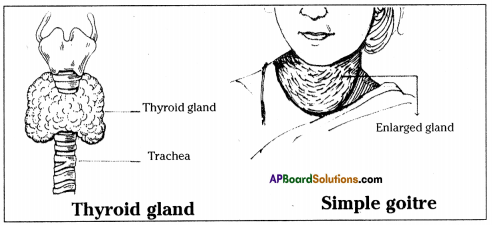
    AP SSC 10th Class Biology Important Questions Chapter 5 Coordination 19

AP SSC 10th Class Biology Important Questions Chapter 5 Coordination

AP SSC 10th Class Chemistry Solutions Chapter 8 Structure of Atom

AP State Board Syllabus AP SSC 10th Class Chemistry Solutions Chapter 8 Structure of Atom Textbook Questions and Answers.

AP State Syllabus SSC 10th Class Chemistry Solutions 8th Lesson Structure of Atom

10th Class Chemistry 8th Lesson Structure of Atom Textbook Questions and Answers

Improve Your Learning

Question 1.
What information does the electronic configuration of an atom provide? (AS1)
Answer:

  • The distribution of electrons in shells, sub-shells and orbital in an atom is known as electronic configuration.
  • It provides the information of position of an electron in the space of atom.
  • The distribution of electrons in various atomic orbitals provides an understanding of the electronic behaviour of the atom and in turn its reactivity.
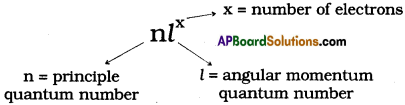
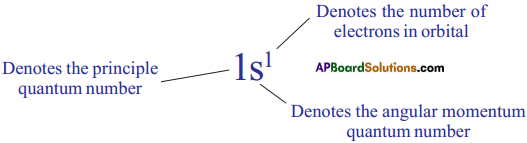
  • The short hand notation is as shown below.

AP SSC 10th Class Chemistry Solutions Chapter 8 Structure of Atom 1

Question 2.
a) How many maximum number of electrons that can be accommodated in a principal energy shell?
Answer:
The maximum number of electrons that can be accommodated in a principal energy shell is 2n². Here n is principal quantum number.

b) How many maximum number of electrons that can be accommodated in a sub-shell?
Answer:
The maximum number of electrons that can be accommodated in a sub-shell is 2(2l +1) (where l is orbital quantum number).

c) How many maximum number of electrons can that be accommodated in an orbital?
Answer:
The maximum number of electrons that can be accommodated in an orbital is 2.

d) How many sub-shells are present in a principal energy shell?
Answer:
The number of sub-shells in a principal energy shell is n (n is principal quantum number).

e) How many spin orientations are possible for an electron in an orbital?
Answeer:
The spin orientations possible for an electron in an orbital are 2.

AP SSC 10th Class Chemistry Solutions Chapter 8 Structure of Atom

Question 3.
In an atom the number of electrons in M-shell is equal to the number of electrons in the K and L-shell. Answer the following questions. (AS1)
a) Which is the outermost shell?
Answer:
The outermost shell is N shell.

b) How many electrons are there in its outermost shell?
Answer:
Two electrons are there in outermost shell.

c) What is the atomic number of element?
Answer:
The atomic number of element is 22.

d) Write the electronic configuration of the element.
Answer:
The element is Ti (Titanium). Its electronic configuration is 1s²2s²2p63s²3p64s²3d².

Reason :

  • Electrons enter M shell after completion of K and L.
  • So the number of electrons in M shell is 10.
  • But after completion of 3p orbital electron enters 4s before entering to 3d.
  • So outermost orbit or shell is N shell.
  • So the atomic number of element is 22.
  • Its electron configuration is 1s² 2s² 2p6 3s² 3p6 4s² 3d².

Question 4.
Rainbow is an example for continuous spectrum – explain. (AS1)
(OR)
Which is naturally occurring continuous spectrum ? Explain.
Answer:

  • Rainbow is a spectrum of different colours (VIBGYOR) with different wavelengths.
  • These colours are continuously distributed.
  • There is no fixed boundary for each colour.
  • Hence, rainbow is a continuous spectrum.

AP SSC 10th Class Chemistry Solutions Chapter 8 Structure of Atom

Question 5.
How many elliptical orbits are added by Sommerfeld in third Bohr’s orbit ? What was the purpose of adding these elliptical orbits? (AS1)
Answer:
Sommerfeld added two elliptical orbits to Bohr’s third orbit.

Purpose of adding elliptical orbits :

  • Bohr’s model failed to account for splitting of line spectra and line spectrum.
  • In an attempt to account for the structure of line spectrum, Sommerfeld modified Bohr’s atomic model by adding elliptical orbits.

Question 6.
What is absorption spectrum?
Answer:
Absorption spectrum: The spectrum formed by the absorption of energy when electron jumps from lower energy level to higher energy level is called absorption spectrum. It contains dark lines on bright background.

Question 7.
What is an orbital? How it is different from Bohr’s orbit? (AS1)
(OR)
Comparison between orbit and orbital.
Answer:
The region of space around the nucleus where the probability of finding electron is maximum is called orbital. Whereas orbit is the path of the electron around the nucleus.

These two are differentiated like this.

Orbit Orbital
1. Path of electron around nucleus. 1) Probability of finding electron around nucleus.
2. Orbits are represented by letters K, L, M, N, 0, …….etc. 2. Orbitals are represented by letters s, p, d, f, g, …….etc.
3) Its information is given by principal 3) Its information is given by orbital quantum number.
4) It is two dimensional. 4) It is three dimensional.
5) It does not satisfy Heisenberg’s uncertainty principle. 5) It satisfies the Heisenberg’s principle of uncertainty.

Question 8.
Explain the significance of three quantum numbers in predicting the positions of an electron in an orbit. (AS1)
(OR)
How are quantum numbers helpful to understand the atomic structure?
Answer:
Significance of three quantum numbers in predicting the positions of an electron in an orbit.

1) Principal quantum number (n) :
The principal quantum number explains about the size and energy of shells (or) orbitals. It is denoted by n.

As ‘n’ increases, the orbitals become larger and the electrons in those orbitals are farther from the nucleus.

It takes values 1, 2, 3, 4, ……………. for that the shells are represented by letters K, L, M, N, ……….

The number of electrons in a shell is limited to 2n².

2) The Angular – momentum quantum number (l) :
The angular momentum quantum number defines the shape of the orbital occupied by the electron and the orbital angular momentum of the electron, is in motion.

l takes values from 0 to n – 1 for these values the orbitals are designated by letters s, p, d, f, ………….. etc.

l also governs the degree with which the electron is attached to nucleus. The larger the value of l, the smaller is the bond with which it is maintained with the nucleus.

3) Magnetic orbital quantum number (ml) :
The orientation of orbital with external magnetic field determines magnetic orbital quantum number.

ml has integer values between – l and l including zero.

The number of values for m, are 2l + l, which give the number of orbitals per sub-shell. The maximum number of electrons in orbitals in the sub-shell is 2 (2l + l).

AP SSC 10th Class Chemistry Solutions Chapter 8 Structure of Atom

Question 9.
What is nlx method? How is it useful? (AS1)
(OR)
What is nlx method? How is it useful in electronic configuration?
Answer:
The shorthand notation consists of the principal energy level (n value) the letter representing sub – level (l value), and the number of electrons (x) in the sub-shell is written as superscript nlx.

It is useful in writing electron configuration of elements. For example, in Hydrogen (H), the set of quantum numbers is n = 1, l = 0, ml = 0, ms = ½ or – ½. The electronic configuration is
AP SSC 10th Class Chemistry Solutions Chapter 8 Structure of Atom 2

Question 10.
Following orbital diagram shows the electronic configuration of nitrogen atom. Which rule does not support this? (AS1)
AP SSC 10th Class Chemistry Solutions Chapter 8 Structure of Atom 3
(OR)
Write the correct electronic configuration of the given nitrogen atom with the help of Hund’s rule.
Answer:
AP SSC 10th Class Chemistry Solutions Chapter 8 Structure of Atom 3

  • This electron configuration does not support Hund’s rule.
  • According to Hund’s rule, the orbitals of equal energy are occupied with one elec-tron each before pairing of electrons starts.
  • Here, pairing of electrons in 2px orbital was taken place without filling of an elec-tron in 2pz orbital.
  • Hence the correct electron configuration is as follows.

AP SSC 10th Class Chemistry Solutions Chapter 8 Structure of Atom 4

Question 11.
Which rule is violated in the electronic configuration 1s0 2s² 2p4?
Answer:

  • Aufbau principle is violated in this electronic configuration because according to Aufbau principle, electron enters orbital of lowest energy.
  • Among 1s, 2s and 2p, Is has least energy.
  • So Is orbital must be filled before the electron should enter 2s.

AP SSC 10th Class Chemistry Solutions Chapter 8 Structure of Atom

Question 12.
Write the four quantum numbers for the differentiating electron of sodium (Na) atom. (AS1)
Answer:
The electronic configuration of sodium (Na) is 1s² 2s² 2p6 3s¹. So the differentiating electron enters 3s. Therefore the four quantum numbers are
AP SSC 10th Class Chemistry Solutions Chapter 8 Structure of Atom 5

Question 13.
What is emission spectrum?
(OR)
When radiation is emitted what is the name given to such spectrum? Explain such spectrum.
Answer:

  • The spectrum produced by the emitted radiation is known as emission spectrum.
  • This spectrum corresponds to liberation of energy when an excited electron returns back to ground state.

Emission spectrum is of two types :

1) Continuous spectrum :
When white light passes through a prism it dissociates into seven colours. This spectrum is called continuous spectrum.

2) Discontinuous spectrum :
Discontinuous spectrum is of two types.

a) Line spectrum :
The spectrum with sharp and distinct lines. It is given by gaseous atoms.

b) Band spectrum :
The spectrum very closely spaced lines is known as band spectrum. It is given by molecule.

Question 14.
i) An electron in an atom has the following set of four quantum numbers to which orbital it belong to : (AS2)
Answer:
AP SSC 10th Class Chemistry Solutions Chapter 8 Structure of Atom 7
This electron belongs to 2s orbital.
Spin is in clockwise direction. ⇒ 2s¹

ii) Write the fojur quantum numbers for Is1 electron. (AS1)
Answer:
The four quantum numbers for Is1 electron are
AP SSC 10th Class Chemistry Solutions Chapter 8 Structure of Atom 8

Question 15.
Which electronic shell is at a higher energy level K or L? (AS2)
Answer:
L – shell is at higher energy level, because it is far from nucleus than K shell.

Question 16.
Collect the information regarding wavelengths and corresponding frequencies of three primary colours red, blue and green. (AS4)
Answer:
The wavelengths and corresponding frequencies of three primary colours red, blue and green are given below.

Primary colours Wavelength in nm
(1 nm = 10-9m)
Frequency in Hz
(Hertz)
Red 700 4.29 × 10¹⁴
Green 530 5.66 × 10¹⁴
Blue 470 6.38 × 10¹⁴

Question 17.
The wavelength of a radio wave is 1.0 m. Find its frequency. (AS7)
Answer:
c = 3 × 10⁸ m/s ; λ = 1m ; c = vλ ⇒ v = [latex]\frac{\mathrm{c}}{\lambda}=\frac{3 \times 10^{8}}{1}[/latex] = 3 × 10⁸ Hz.

AP SSC 10th Class Chemistry Solutions Chapter 8 Structure of Atom

Question 18.
Why are there exemptions in writing the electronic configurations of Chromium and Copper?
Answer:
1. Elements which have half-filled or completely filled orbitals have greater stability.

2. So in chromium and copper the electrons in 4s and 3d redistributes their energies to attain stability by acquiring half-filled and completely filled d-orbitals.

3. Hence the actual electronic configuration of chromium and copper are as follows.
AP SSC 10th Class Chemistry Solutions Chapter 8 Structure of Atom 6

Fill In The Blanks

1. If n = 1, then angular momention quantum number (l) = …………………
2. If a sub-shell is denoted as 2p, then its magnetic quantum number values are …………………, …………………, …………………
3. Maximum number of electrons that an M-shell contain is / are …………………
4. For ‘n’, the minimum value is ………………… and the maximum value is …………………
5. For?, the minimum value is ………………… and the maximum value is …………………
6. For’m/ the minimum value is ………………… and the maximum value is …………………
7. The value of ‘ms’ for an electron spinning in clockwise direction is ………………… and for anti-clockwise direction is …………………
Answer:

  1. 0
  2. – 1, 0, + 1
  3. 18
  4. 1, – ∞
  5. 0, (n – 1)
  6. – l, + l
  7. + ½, – ½

Multiple Choice Questions

1. An emission spectrum consists of bright spectral lines on a dark back ground. Which one of the following does not correspond to the bright spectral lines?
A) Frequency of emitted radiation
B) Wavelength of emitted radiation
C) Energy of emitted radiations
D) Velocity of light
Answer:
D) Velocity of light

2. The maximum number of electrons that can be accommodated in the L-shell of an atom is
A) 2
B) 4
C) 8
D) 16
Answer:
C) 8

AP SSC 10th Class Chemistry Solutions Chapter 8 Structure of Atom

3. If l = 1 for an atom, then the number of orbitals in its sub-shell is
A) 1
B) 2
C) 3
D) 0
Answer:
C) 3

4. The quantum number which explains about size and energy of the orbit or shell is
A) n
B) l
C) ml
D) ms
Answer:
A) n

10th Class Chemistry 8th Lesson Structure of Atom InText Questions and Answers

10th Class Chemistry Textbook Page No. 112

Question 1.
How many colours are there in a rainbow? What are they?
Answer:
There are seven colours in a rainbow. They are Violet, Indigo, Blue, Green, Yellow,Orange and Red.

Question 2.
What are the characteristics of electromagnetic waves?
A.nswer:
Electromagnetic energy is characterised by wavelength (l) and frequency (u).

10th Class Chemistry Textbook Page No. 113

Question 3.
Can we apply this equation c = uA, to a sound wave?
Answer:
Yes. It is a universal relationship and applies to all waves.

10th Class Chemistry Textbook Page No. 114

Question 4.
What happens when you heat an iron rod on a flame? Do you find any change in colour while heating an iron rod?
Answer:

  • When we heat an iron rod, some amount of heat energy that was absorbed by iron rod is emitted as light.
  • First iron turns into red (lower energy corresponding to higher wavelength) and as the temperature rises it glows and turns into orange, yellow, blue or even white respectively (higher energy and lower wavelength).
  • If we go on heating the rod, it turns into white light which includes all visible wavelengths.
  • So we find some changes in colour while heating an iron rod.

Question 5.
Do you observe any other colour at the same time when one colour is emitted?
Answer:
While heating the rod if the temperature is high enough, other colours will also be emitted, but due to higher intensity of one particular emitted colour (eg.: red), others cannot be observed.

AP SSC 10th Class Chemistry Solutions Chapter 8 Structure of Atom

Question 6.
How do various colours come from fire works?
(OR)
Do you enjoy Deepavali fire works? Variety of colours is seen from fire works. How do these colours come from fire works?
Answer:
Yes. The electrons present in atoms of elements absorb energy and move to excited states and they return to ground state with emission of energy in visible spectrum. So the colours observed during fire works are the emitted energy by various elements in different fire works.

10th Class Chemistry Textbook Page No. 115

Question 7.
Do you observe yellow light in street lamps? Which will produce yellow light?
Answer:
Yes, sodium vapours produce yellow light in street lamps.

Question 8.
Why do different elements emit different flame colours when heated by the same non-luminous flame?
Answer:

  • All the materials are made up of atoms and molecules. These atoms and molecules possess certain fixed energy.
  • An atom or molecule having lowest possible energy is said to be in ground state.
  • When we heat the materials the electrons of these atoms gain energy and move to excited states (higher energy state).
  • An atom of molecule in excited state can emit light to lower its energy in order to get stability and come back to ground state.
  • Light emitted in such process has certain fixed wavelength for one kind of atoms.
  • The light emitted by different kinds of atoms is different because the excited states electrons will go are different. So different elements produce different flame colours.

Question 9.
What happens when an electron gains energy?
Answer:
The electron moves to higher energy level called the excited state.

10th Class Chemistry Textbook Page No. 116

Question 10.
Does the electron retain the energy forever?
Answer:
The electron loses the energy and comes back to its ground state. The energy emitted by the electron is seen in the form of electromagnetic energy.

AP SSC 10th Class Chemistry Solutions Chapter 8 Structure of Atom

Question 11.
Did Bohr’s model account for the splitting of line spectra of a hydrogen atom into finer lines?
Answer:
No, Bohr’s model failed to account for splitting of line spectra.

Question 12.
Why is the electron in an atom restricted to revolve around the nucleus at certain fixed distances?
Answer:
In order to explain the atomic spectra, Bohr-Sommerfeld model proposed that the electrons are restricted to revolve around the nucleus at certain fixed distances.

10th Class Chemistry Textbook Page No. 117

Question 13.
Do the electrons follow defined paths around the nucleus?
Answer:
No, they revolve around the nucleus in a region called orbital.

Question 14.
What is the velocity of the electron?
Answer:
It is very close to light.

AP SSC 10th Class Chemistry Solutions Chapter 8 Structure of Atom

Question 15.
Is it possible to find exact position of electron? How do you find the position and velocity of an electron?
Answer:
No, as the electrons are very small, light of very short wavelength is required for this task.

This short wavelength light interacts with the electron and disturbs the motion of electron. So it is not possible to find exact position and velocity of electron simultaneously. Whereas we can find the region where the probability of finding electron is more.

Question 16.
Do atoms have a definite boundary, as suggested by Bohr’s model?
Answer:
Yes, atoms have definite boundary.

Question 17.
What do we call the region of space where the electron might be, at a given time?
Answer:
The region of space around the nucleus where the probability of finding an electron is maximum, called an orbital.

10th Class Chemistry Textbook Page No. 118

Question 18.
What information do the quantum numbers provide?
Answer:
The quantum numbers describe the space around the nucleus where the electrons are found and also their energies.

Question 19.
What does each quantum number signify?
Answer:
The quantum numbers signify the probability of finding electron in the space around nucleus.

10th Class Chemistry Textbook Page No. 119

Question 20.
What is the maximum value of/for n = 4?
Answer:
The maximum value of / for n = 4 is 3.

AP SSC 10th Class Chemistry Solutions Chapter 8 Structure of Atom

Question 21.
How many values can l have for n = 4?
Answer:
l takes values from 0 to n – 1. So l has 4 values for n = 4. Those values are 0, 1,2, 3.

Question 22.
Do all the p-orbitals have the same energy? A. Orbitals in the sub-shell belonging to same shell possess same energy but they differ in their orientations.

10th Class Chemistry Textbook Page No. 121

Question 23.
How are two electrons in the Helium atom arranged?
Answer:
They are arranged in pair in Is orbital and the electronic configuration is 1s².

10th Class Chemistry Textbook Page No. 122

Question 24.
What are the spins of two electrons in an orbital?
Answer:
The two electrons in an orbital have opposite spins. If one is clockwise spin, then other electron has anti-clockwise spin.

AP SSC 10th Class Chemistry Solutions Chapter 8 Structure of Atom

Question 25.
How many electrons can occupy an orbital?
Answer:
An orbital can hold only two electrons.

10th Class Chemistry 8th Lesson Structure of Atom Activities

Activity – 1

Question 1.
Explain the wave nature of light.
(OR)
How does light behave? Explain.
Answer:

  • Light is an electromagnetic wave.
  • Electromagnetic waves are produced when an electric charge vibrates.
  • This vibrating electric charge creates a change in the electric field. The changing electric field creates a changing magnetic field.
  • This process continues with both the created fields being perpendicular to each other and at right angles to the direction of propagation of the wave.
  • This electromagnetic wave is produced.

Activity – 2

Question 2.
Write an activity which shows metal produces colour in flame.
(OR)
‘Metal produces colour in a flame.’ Prove the statement by giving examples.
Answer:
A)

  • Take a pinch of cupric chloride in a watch glass and make a paste with concentrated hydrochloric acid.
  • Take this paste on a platinum loop and introduce it into a non-luminous flame.
  • Cupric chloride produces a green colour flame.

B)

  • Take a pinch of strontium chloride in a watch glass and make a paste with concentrated hydrochloric acid.
  • Take this paste on a platinum loop and introduce it into a non-luminous flame.
  • Strontium chloride produces a crimson red flame.

Activity – 3

Question 3.
Complete the electronic configuration of the following elements.
AP SSC 10th Class Chemistry Solutions Chapter 8 Structure of Atom 9
Answer:
AP SSC 10th Class Chemistry Solutions Chapter 8 Structure of Atom 10

AP SSC 10th Class Biology Important Questions Chapter 7 Coordination in Life Processes

AP State Board Syllabus AP SSC 10th Class Biology Important Questions Chapter 7 Coordination in Life Processes.

AP State Syllabus SSC 10th Class Biology Important Questions 7th Lesson Coordination in Life Processes

10th Class Biology 7th Lesson Coordination in Life Processes 1 Mark Important Questions and Answers

Question 1.
Complete the following table.
Answer:

Question 2.
What is the apparatus used in your class, while performing the demonstration of peristaltic movement in Oesophagus?
Answer:
a) A piece of waste cycle tube.
b) Oil for lubrication.
c) Potatoes.

AP SSC 10th Class Biology Important Questions Chapter 7 Coordination in Life Processes

Question 3.
You have conducted an experiment to prove that HC1 secreted in our stomach, does not harm walls of the stomach. Write the apparatus used in that experiment.
Answer:
Apparatus: Green leaves, petroleum jelly, weak acid.

Question 4.
What will happen, if there is no diaphragm in the human body?
Answer:

  1. Diaphragm flattens during inhalation, thus increasing the volume of the thoracic cavity.
  2. If the diaphragm is absent the inhalation and exhalation become very difficult in human beings.

Question 5.
What happens if the direction of peristalsis is not reversed in animal like cow?
Answer:
If the direction of peristalsis is not reversed (rumination is not done) in animal like cow, the food will not be masticated in the mouth and fermentation of the food with the micro-organisms in the stomach will not be taken place.

AP SSC 10th Class Biology Important Questions Chapter 7 Coordination in Life Processes

Question 6.
What happens if there is no mucus in the Oesophagus?
Answer:

  1. The walls of the food pipe secrete a slippery substance called mucus.
  2. Mucus lubricates and protects the oesophageal walls from damage.
  3. This helps the food bolus to slide down easily in the tube.
  4. If there is no mucus, lubrication will not occur for the food bolus to slide and walls get damage.

Question 7.
Which part of small intestine absorbs digested food?
Answer:
Microvilli/villi.

Question 8.
Name the chemical which is used to test the action of saliva on flour (ata).
Answer:
Iodine Solution.

Question 9.
What happens, if there is no peristaltic movement in Oesophagus?
Answer:

  1. The food won’t slidedown in the oesophagus.
  2. The digestion of food won’t takes place in the stomach and small intestine.

Question 10.
Number of Neurons present in enteric Nervous System?
Answer:
Number of neurons present in enteric nervous system are 100 millions.

Question 11.
Why do every life process is dependent on other life process?
Answer:
Every life process is dependent on other life process to keep the body in good condition.

AP SSC 10th Class Biology Important Questions Chapter 7 Coordination in Life Processes

Question 12.
Which life process generally maintain the level of different substances in the blood?
Answer:
The life process that maintain the level of different substances in the blood is digestive system.

Question 13.
When do we feel hunger pangs in stomach?
Answer:
When the level of glucose in the blood falls we feel hunger pangs in stomach.

Question 14.
Which hormone is responsible for hunger pangs in stomach?
Answer:
Ghrelin hormone is responsible for hunger pangs in stomach.

Question 15.
The hormone ghrelin is secreted by?
Answer:
The hormone ghrelin is secreted by certain cells in the wall of the stomach.

Question 16.
Which one plays an important role in carrying hunger signals to brain?
Answer:
The diencephalon in fore brain and vagus nerve which is 10th cranial nerve plays an important role in carrying hunger pangs.

Question 17.
How much time does the hunger pangs continue?
Answer:
The hunger pangs continue up to 30 to 45 minutes.

Question 18.
Increase in ghrelin levels results in?
Answer:
Increase in ghrelin levels results in sensation of hunger and motivation to consume food.

AP SSC 10th Class Biology Important Questions Chapter 7 Coordination in Life Processes

Question 19.
Which hormone suppresses hunger?
Answer:
Hormone leptin suppresses hunger.

Question 20.
Which senses enhance our perceptions of the food we eat?
Answer:
Interactions between the senses of taste and smell enhance our perceptions of the food we eat.

Question 21.
What are the different types of papillae present on the tongue?
Answer:
The different types of papillae present on the tongue are filiform papillae, fungiform papillae, foliate papillae and circumvallate papillae.

Question 22.
When do you identify the taste easily?
Answer:
Taste can be identified easily by me when the tongue is pressed against the pallate.

Question 23.
Who conducted experiments on conditioned reflexes?
Answer:
Russian scientist Ivan Pavlov has conducted experiments on conditioned reflexes and found that even the thought of food will water our mouth.

Question 24.
Name the different sets of teeth present in your mouth.
Answer:
The different sets of teeth present in human beings is incisors, canines, premolars and molars.

Question 25.
Write the number of different sets of teeth in human Beings.
Answer:
The number of different sets of teeth in human beings are incisors – 8, canines – 4, premolars – 8, molars -12.

AP SSC 10th Class Biology Important Questions Chapter 7 Coordination in Life Processes

Question 26.
What is mastication?
Answer:
Grinding, chewing and shredding of food in the mouth by teeth is called mastication.

Question 27.
Which cranial nerve controls the movement of a muscle in the jaw?
Answer:
The fifth cranial nerve (Trigeminal nerve) controls the movement of muscles in the jaw.

Question 28.
What is bolus?
Answer:
Food that is formed due to the mastication in the mouth is called bolus.

Question 29.
What is the function of salivary amylase?
Answer:
The enzyme salivary amylase in the saliva breaks down the large starch molecules into smaller subunits usually into sugars.

Question 30.
The controlling center for swallowing food is present in?
Answer:
The controlling center for swallowing food is present somewhere in the brain stem „ (medulla oblongata and others).

Question 31.
Which medium aids in action of enzyme, salivary amylase?
Answer:
Alkaline medium aids in action of enzyme, salivary amylase.

Question 32.
The pH value of alkaline medium is?
Answer:
The pH value of alkaline medium is above 7.

AP SSC 10th Class Biology Important Questions Chapter 7 Coordination in Life Processes

Question 33.
The pH value of acidic medium is?
Answer:
The pH value of acidic medium is below 7.

Question 34.
What are nocturnal animals? Give some examples.
Answer:
The animals which are active during nights are called Nocturnal animals.
Ex: Cockroach, rodents, bats etc.

Question 35.
The amount of saliva secreted by human beings per day is?
Answer:
The amount of saliva secreted by human beings per day is 1 to 1.5 liters.

Question 36.
What kind of tube is oesophagus?
Answer:
Oesophagus is muscular and elastic tube.

Question 37.
How does mucus help in passage of food?
Answer:
Mucus lubricates, protects the walls from damage and helps bolus slide down easily to stomach.

Question 38.
What are the two kinds of smooth muscles present in oesophagus?
Answer:
The two kinds of smooth muscles present in oesophagus are the inner layer consists of circular muscles and the outer layer of longitudinal muscles.

Question 39.
What is peristalsis?
Answer:
The involuntary contraction and relaxation of the muscles of oesophagus, stomach and intestine bring in a wave like motion called peristalsis.

AP SSC 10th Class Biology Important Questions Chapter 7 Coordination in Life Processes

Question 40.
APiich nervous system controls the peristalsis?
Answer:
The involuntary movements peristalsis is under the control of autonomous nervous system.

Question 41.
Which juice is secreted by the wall of stomach?
Answer:
The juice secreted by the wall of stomach is gastric juice which contains hydrochloric acid, mucus and enzyme pepsin.

Question 42.
What is chyme?
Answer:
The digestive juices turns the food into a smooth substance known as chyme. It is the partially digested food in the stomach.

Question 43.
Rumination in cow is the result of?
Answer:
Rumination in cow is the result of reverse peristalsis.

Question 44.
What is the use of reverse peristalsis in human beings?
Answer:
The use of reverse peristalsis in human beings helps in vomiting, (expelling unwanted substances from the food canal.)

AP SSC 10th Class Biology Important Questions Chapter 7 Coordination in Life Processes

Question 45.
How much time does it takes to emptying the food from stomach?
Answer:
Emptying of food from stomach takes nearly 4 to 5 hours.

Question 46.
What causes the stomach to churn and mix the food?
Answer:
Peristalsis causes the stomach to churn and mix the food.

Question 47.
What issthe location of pyloric sphincter? What is its function?
Answer:
Pyloric sphincter present at the opening of stomach and the first part of the small intestine. It releases small quantity of food into the duodenum.

Question 48.
Why should only a small quantity of food be passed from stomach to duodenum?
Answer:
For the complete digestion of the food only a small quantity of food be passed from stomach to duodenum.

Question 49.
What is the nature of the chyme?
Answer:
The nature of the chyme is acidic.

Question 50.
Which hormones in small intestine produced due to the Acidic nature of chyme?
Answer:
Acidic nature of chyme initiates the production of hormones like secretin and cholecystokinin in small intestine.

AP SSC 10th Class Biology Important Questions Chapter 7 Coordination in Life Processes

Question 51.
Secretin and cholecystokinin stimulates the production of?
Answer:
Secretin and cholecystokinin stimulates the production of pancreatic juice, bile juice and succus entericus from pancreas, liver and walls of intestine respectively.

Question 52.
Which process is involved in absorption of nutrients from food?
Answer:
Selective absorption is involved in absorbing nutrients from food.

Question 53.
Which absorb nutrients from the food in small intestine?
Answer:
Finger-like projections called villi absorb nutrients from the food in small intestine.

Question 54.
Anyone with severe cough and cold cannot make out the difference in tastes of certain food items, when the sense of smell is impaired. Why?
Answer:

  1. The flavour of food is produced with the combination of taste and smell.
  2. The taste or food odour is not individually detected.
  3. The interactions between the senses of taste and smell enhance our perceptions of the food.

Question 55.
Seventy percent of our immune system is aimed at?
Answer:
Seventy percent of our immune system is aimed at the gut (elementary canal) to expel and kill foreign invaders.

AP SSC 10th Class Biology Important Questions Chapter 7 Coordination in Life Processes

Question 56.
What is the second brain?
Answer:
The entric nervous system present below the gut or alimentary canal which controls digestion is called second brain.

Question 57.
What is the other name for second brain?
Answer:
The other name for second brain is enteric nervous system.

Question 58.
What is the length of gut or alimentary canal?
Answer:
The length of gut or alimentary canal in man measures about nine meters.

Question 59.
Which part or muscle controls the exit of stool from the body?
Answer:
Anal sphincter controls the exit of stool from the body.

Question 60.
What happens during inhalation?
Answer:
During inhalation oxygen moves across the walls of the alveoli and enters the blood.

AP SSC 10th Class Biology Important Questions Chapter 7 Coordination in Life Processes

Question 61.
What happens during exhalation?
Answer:
During exhalation, carbon dioxide from the blood moves into the alveoli of the lungs and breathed out.

Question 62.
What would be the path of salt removal from gut to the outside of our body?
Answer:
Salt is removed via blood through the kidneys, skin from our body.

Question 63.
Respiration in human beings is controlled by?
Answer:
Respiration in human beings is controlled by medulla oblongata of the autonomous nervous system.

AP SSC 10th Class Biology Important Questions Chapter 7 Coordination in Life Processes

Question 64.
For oxidation of food and transport of substance which processes are to be coordinated?
Answer:
Respiration and blood circulations are to be coordinated for oxidation of food and transport of substances.

10th Class Biology 7th Lesson Coordination in Life Processes 2 Marks Important Questions and Answers

Question 1.
The mere smell or sight of food stimulates hunger. Describe the process in a flow chart.
Answer:
AP SSC 10th Class Biology Important Questions Chapter 7 Coordination in Life Processes 1

Question 2.
What happens if salivary ducts are closed?
Answer:

  1. Salivary glands secrete saliva. Saliva contains mucin and ptyalin or salivary amylase.
  2. Mucin gives lubrication to the bolus so that we can easily swallow the food.
  3. Ptyalin or salivary amylase digest the complex carbohydrates into simple sugars.
  4. If salivary ducts are closed the above processess don’t occur. So that food is not digested properly.

AP SSC 10th Class Biology Important Questions Chapter 7 Coordination in Life Processes

Question 3.
“It is believed that the Diencephalon in fore-brain and vagus nerve (10th cranial nerve) plays an important role in carrying hunger signals to the brain. Hunger pangs continue upto 30-45 minutes. Increase in ghrelin levels results in sensation of hunger and motivation to consume minutes. Increase in ghrelin levels results in sensation of hunger and motivation to consume food.
Read above content and prepare any two questions.
Answer:

  1. What are the nerves involved in carrying hunger signals?
  2. How long hunger pangs continue?
  3. Which part of the brain is the centre for hunger pangs?
  4. Which chemical substance is responsible for motivating to consume food?
  5. What are the hormones related to hunger?

Question 4.
What will happen, if the small intestine is not like a long coiled tube?
Answer:

  1. If size and shape of small intestine is like oesophagus the height of the person should be more than 22 feet as the length of the small intestine is about 22 feet. So it will not fit in the human body.
  2. Food will not be digested completely.
  3. Digested food will not be absorbed effectively.
  4. The food taken into the body is expelled out only after completing partial digestion in stomach.
  5. The body suffers from starvation of nutrients.

Question 5.
What did you observe in acid and leaf experiment ? What did you have understand regarding human digestive system from this? (OR)
Take two similar green leaves. Apply grease on one leaf and leave the other free. Add 1 or 2 drops of acid on each leaf. What kind of change do you observe from this?
Answer:

  1. The leaf to which grease is applied is not effected with the acid.
  2. The leaf to which grease is not applied is effected.
  3. From the above activity we can conclude that mucus secreted by the walls of stomach protect it from the harmful effects of hydrochloric acid in the stomach.

AP SSC 10th Class Biology Important Questions Chapter 7 Coordination in Life Processes

Question 6.
Identify the diagram and write two functions of it.
AP SSC 10th Class Biology Important Questions Chapter 7 Coordination in Life Processes 2Answer:
This diagram is Liver.
Liver – Functions:

  1. Breakdown of larger fats into small globules/emulsification of fats.
  2. It excretes Bile salts, cholesterol steroid, hormones, extra drugs, vitamins and alkaline salts through urine.

Question 7.
What will happen if Islets of langerhans fail to function?
Answer:

  1. Insulin may not be produced.
  2. Human may suffer from sugar/diabetes.
  3. Sugar level increases in blood.

AP SSC 10th Class Biology Important Questions Chapter 7 Coordination in Life Processes

Question 8.
What may happen if villi are absent in small intestine?
Answer:

  1. Villi increase the surface area of the small intestine for absorption when food passes through it. If villi are absent, food will not be digested completely.
  2. Digested food will not be absorbed effectively.
  3. The food taken into the body is expelled out only after completing partial absorption in the small intestine.
  4. The body will suffer from starvation of nutrients.

Question 9.
Draw the diagram showing peristaltic movement. Write the names of the parts responsible for it.
Answer:
a) Mucus lubricates and protects the walls of oesophagus.
AP SSC 10th Class Biology Important Questions Chapter 7 Coordination in Life Processes 3b) Circular muscles and longitudinal muscles of oesophagus help in the movement of food ‘bolus’.
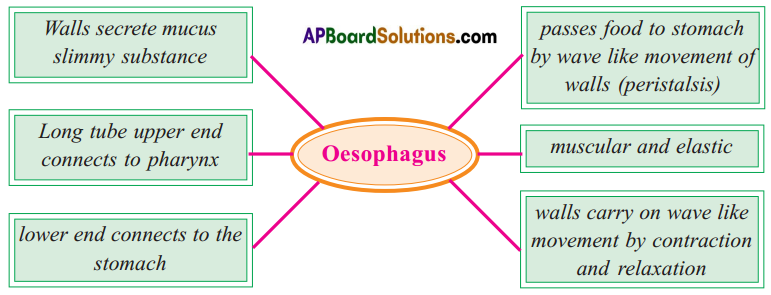
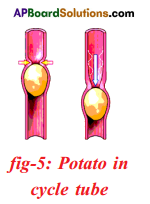
c) Peristalsis is under the control of Autonomous nervous system.

AP SSC 10th Class Biology Important Questions Chapter 7 Coordination in Life Processes

Question 10.
How do we know the taste of the food material? (OR)
What helps us in tasting food material?
Answer:

  1. On the tongue different types of papillae are present to sense different tastes.
  2. If we want to taste the food material, the food should be dissolved in saliva.
  3. We can taste the food that is in the form of liquid only.
  4. Only after the dissolved food enters into the cup like taste buds (papillae), the sense of taste is carried to the brain for analysis.
  5. Then only we will know the taste of the food material.

Question 11.
Write a short note on digestion of food in mouth.
(OR)
How food is digested in the mouth?
Answer:

  1. Saliva is secreted by the action of autonomous nervous system in the mouth.
  2. Saliva moistens the food to make chewing and swallowing easier.
  3. Due to the mastication of food in the mouth it forms a slurry mass called bolus.
  4. The enzyme salivary amylase in the saliva breaks down the large starch molecules into smaller subunits usually into sugars of maltose and dextrose.
  5. It is easier and convenient to swallow food after mastication in the mouth.

Question 12.
Why do we salivate during a nap of daytime?
Answer:

  1. We are diurnal animals, we are active during daytime and take rest at night.
  2. Ail the systems of our body are active in function during the daytime of our activity. Hence, man is a diurnal animal.
  3. Our digestive system is also active and ready to receive the food for digestion.
  4. If we sleep during daytime saliva oozes out of our mouth and wets the pillows.
  5. This will not happen during night time.

AP SSC 10th Class Biology Important Questions Chapter 7 Coordination in Life Processes

Question 13.
Write a brief account on travel of food through oesophagus.
(OR)
How food travels in the oesophagus?
Answer:

  1. Oesophagus is a tube like structure.
  2. the wall of the oesophagus is made up of two kinds of smooth muscles.
  3. The inner layer consisting of circular muscles and the outer layer with longitudinal muscles.
  4. Contraction of the circular muscles results in narrowing of the oesophagus just behind the bolus. So the food is squeezed downwards.
  5. Contraction of the longitudinal muscles in front of the bolus widen the tube, this results in shortening of that particular part of the oesophagus.
  6. Contraction and relaxation of these muscles bring in a wave like motion that propels the food bolus into the stomach by ‘peristalsis’.

Question 14.
The digestive tract is unique among internal organs. Write few lines by supporting this statement.
Answer:

  1. The digestive tract is unique among internal organs because it is exposed to a large variety of physio chemical stimuli from the external world in the form of ingested food.
  2. As a consequence, the intestine has developed a rich store of coordinated movements of its muscular apparatus along with neural apparatus to ensure the appropriate mixing and propulsion of contents during digestion, absorption and excretion.
  3. The neural apparatus of our digestive tract comprises of such a vast and complicated network of neurons that it has been nicknamed by scientists as the second brain.

AP SSC 10th Class Biology Important Questions Chapter 7 Coordination in Life Processes

Question 15.
How taste is identified by us? (OR) How can we identify taste?
Answer:

  1. Any food substance when placed on the tongue gets dissolved in the saliva secreted by salivary glands in the mouth.
  2. When the tongue is pressed against the palate the food substance is pressed against the opening of the taste bud letting it to reach the taste cells and triggering taste signals.
  3. Finally the taste is recognized in the brain.

10th Class Biology 7th Lesson Coordination in Life Processes 4 Marks Important Questions and Answers

Question 1.
Give reasons:
A) Hunger generating signals reach the brain when stomach gets empty.
Answer:
Ghrelin is secreted from walls of the stomach.
B) When your stomach is filled with full of food, you feel you don’t need food any more.
Answer:
Leptin Hormone is secreted which suppresses hunger.
C) In severe cold and cough, one cannot feel the taste of the food.
Answer:
During cold olfactory receptors are blocked.
D) We cannot identify the taste of a grape fruit, when it is placed on the tongue.
Answer:
We cannot taste the grapes because it is not in the liquid state.

AP SSC 10th Class Biology Important Questions Chapter 7 Coordination in Life Processes

Question 2.
A) What is the function of peristalsis in these parts of Human digestive system?
a) Oesophagus
b) Stomach
c) Small intestine
d) Large intestine
Answer:
a) Oesophagus: Bolus moves towards the stomach.
b) Stomach : Peristalsis helps in storing food, breaking down food, mixing the food with gastric juice.
c) Small intestine : Peristalsis helps in mixing the chyme with digestive juices.
d) Large intestine: Peristalsis helps to propel undigested material into rectum.

Question 3.
Observe the following schematic diagram and answer the following questions:
AP SSC 10th Class Biology Important Questions Chapter 7 Coordination in Life Processes 6
i) What do you call the wave like movements shown by the muscles of Oesophagus?
Answer:
Peristalsis.

ii) What is the structure of Oesophagus?
Answer:
Long tube like structure.

iii) How does mucus help in passage of food?
Answer:
Mucus helps the food to slide down easily.

iv) Which parts of alimentary canal are connected by the Oesophagus?
Answer:
Pharynx and stomach.

AP SSC 10th Class Biology Important Questions Chapter 7 Coordination in Life Processes

Question 4.
What is peristaltic movement? Compare the similarity of bolus movement in oesophagus with cycle tube and potato experiment which you have conducted in school.
Answer:
Peristalsis: Contraction and relaxation of circular and longitudinal muscles bring in a wave – like motion that propels the food bolus into the stomach from oesophagus by the action called as peristalsis.
Experiment:
Aim: Making a model of oesophagus to observe how bolus moves forward.
Material required: Potatoes, cycle tube lubricate oil.
AP SSC 10th Class Biology Important Questions Chapter 7 Coordination in Life Processes 5Procedure:

  1. Take a piece of waste cycle tube and insert one or two potatoes into it.
  2. Lubricate the inner side of the tube with oil.
  3. In the same way smear oil over potatoes.
  4. Insert oil coated potatoes in the tube. Potatoes in cycle tube
  5. Now try to push the potatoes by squeezing the tube from behind the potato.

Observation: Oil acted as lubricant to push the potato easily in the forward direction. Conclusion: The muscles in the wall of the oesophagus have bring in a wave like movement due to contraction and relaxation, that propels the food bolus into the stomach.
This action is called as peristalsis.

AP SSC 10th Class Biology Important Questions Chapter 7 Coordination in Life Processes

Question 5.
Write the procedure involved in the acid and leaf experiment to understand the concept “how the stomach gets protected from its own acid secretions”. Compare the observations with the changes that takes place in human digestive system.
Answer:

  1. Take two similar green leaves.
  2. Grease one leaf with petroleum jelly, leave the other free.
  3. Add 1 or 2 drops of some weak acids on both the leaves.
  4. Observe them after half-an-hour or so and write your observations.
  5. The leaf to which petroleum jelly was not applied effected by the acid.
  6. We observe the colour of the leaf changes.
  7. The other leaf was not affected by the acid because of petroleum jelly.
    From the above activity we can conclude that mucus secreted by the walls of stomach protects the stomach it from the harmful effects of hydrochloric acid.

Question 6.
Vasu is doing experiment, lab activities in his classroom. He is tired due to hungry. How hungry feeling occurs? How will one know?
Answer:

  1. Levels of different substances are generally maintained in the blood mainly by our digestive system.
  2. One of the major substance is glucose.
  3. When its levels in the blood fall, we get hunger pangs in stomach.
  4. Ghrelin is secreted from the certain cells in the wall of the stomach.
  5. Hunger contractions (hunger pangs) start to occur in the stomach due to the secretion of Ghrelin hormone.
  6. Increase in ghrelin levels results in sensation of hunger and motivation to consume

Question 7.
What is peristaltic movement? Explain the food movement in alimentary canal comparing with the experiment of moving potatoes in cycle tube.
Answer:
Peristaltic movement is the contraction and relaxation of the muscles of the digestive system. The movement of food through food pipe is known as peristaltic movement.
Food movement in alimentary canal:

  1. The walls of the food pipe secrete a slippery substance called mucus. Mucus lubricates and protects the oesophageal walls from damage.
  2. This helps the food bolus to slide down easily just as the oiled potatoes that move in the tube. Oil acts as lubricant and push the potatoes easily in the forward direction.
  3. The wall of the oesophagus is made up of two kinds of smooth muscles. The inner layer consists of circular muscles and the outer layer of longitudinal muscles.
  4. Contraction of the circular muscles results in narrowing of the oesophagus just behind the bolus.
  5. So the food is squeezed downwards.
  6. Contraction of the longitudinal muscles in front of the bolus widen the tube, this results in shortening of that particular part of the oesophagus.
  7. Contraction and relaxation of these muscles bring in wave like motion that propels the food bolus into the stomach by the action called as peristalsis.
  8. This is involuntary and under the control of autonomous nervous system.

AP SSC 10th Class Biology Important Questions Chapter 7 Coordination in Life Processes

Question 8.
Write briefly about the functional and structural aspects of oesophagus in human beings.
Answer:

  1. Oesophagus is a long muscular and elastic tube-like part of the digestive system which lies between pharynx and stomach.
    AP SSC 10th Class Biology Important Questions Chapter 7 Coordination in Life Processes 6
  2. The wall of the oesophagus is made up of two kinds of smooth muscles.
  3. The inner layer consists of circular muscles and the outer layer of longitudinal muscles.
  4. The walls of the oesophagus secrete mucus, a slimy substance which helps in the easy movement of food into the stomach.
  5. Walls of oesophagus carry on wave-like movement by contraction and relaxation. These movements are known as peristalsis.
  6. Due to the peristalsis movements food passes from oesophagus into stomach.

AP SSC 10th Class Biology Important Questions Chapter 7 Coordination in Life Processes

Question 9.
Explain briefly about the structure of stomach. (OR)
What is the role of stomach in digestion of food ?
Answer:

  1. Our stomach is not a bag with specific volume. It is a like a pouch which is elastic in nature.
  2. The size of the stomach increases based on the food we intake.
  3. Digestive juices are produced depending on the quantity of food material.
  4. The walls of the stomach secrete juice containing hydrochloric acid.
  5. Mucus secreted by some cells in the walls of the stomach form a thin lining on the walls of the stomach. This counters the action of acid.
  6. The food is thoroughly mixed with the digestive juices by peristaltic movements of muscles in stomach.
  7. The digestive juices of the stomach turns food into a smooth liquid mass called chyme.

Question 10.
Draw peristaltic movement of food in stomach. Describe movement of food in stomach.
Answer:

  1. The stomach acts like a washing machine, churning the food around to break it into even smaller pieces.
    AP SSC 10th Class Biology Important Questions Chapter 7 Coordination in Life Processes 7
  2. Mechanical mixing of food in stomach occurs by peristalsis, which is waves of muscular contractions that move along the stomach wall.
  3. The contractions of the stomach muscles squeeze and mix the food with the acids and juices of the stomach.
  4. The digestive juices turns the food into smooth paste like substance called chyme.
  5. As the process of digestion in the stomach nears completion, the contractions of the stomach decrease.

AP SSC 10th Class Biology Important Questions Chapter 7 Coordination in Life Processes

Question 11.
Describe with diagram how villi are helpful in absorption of digested food in small intestine.
(OR)
How digested food is absorbed in small intestine?
Answer:

  1. The small intestine is the main region for the absorption of digested food.
  2. The inner surface of the small intestine contains thousands of finger like projections called Villi.
    AP SSC 10th Class Biology Important Questions Chapter 7 Coordination in Life Processes 8
  3. These villi increase the surface area;so that the food retained in the folds can remain longer thereby enhancing absorption.
  4. Blood vessels and lymph vessels are present in the form of a network in the villi.
  5. Products of digestion are absorbed first into the villi and from there into the blood vessels and lymph vessels.

Question 12.
Write about the experiment conducted by Ivan Pavlov on conditioned reflex.
Answer:

  1. Ivan Pavlov was a Russian scientist conducted experiments on conditioned reflexes.
  2. He discovered that dogs produced extra saliva when they were offered food.
    AP SSC 10th Class Biology Important Questions Chapter 7 Coordination in Life Processes 9
  3. Pavlov noticed, that they also did the same when the person who fed them came into the room, even if the person had not brought any food.
  4. Pavlov went on to ring a bell at the start of feeding time, and eventually the dogs produced extra saliva when they heard the bell, before any food was brought.
  5. A dog salivating when it hears a bell is not a natural response.
  6. They would not do this without being conditioned to do so.
  7. The behaviour has been learned. It is called a conditioned response.

AP SSC 10th Class Biology Important Questions Chapter 7 Coordination in Life Processes

Question 13.
Explain the process of exit of waste materials from large intestine.
Answer:

  1. When the unwanted waste material reach the large intestine, the peristaltic waves move the stool into the rectum.
  2. Water gets reabsorbed and the remaining waste usually hard mass that gets stored in the last part of the large intestine i.e., rectum.
    AP SSC 10th Class Biology Important Questions Chapter 7 Coordination in Life Processes 10
  3. There are two muscular layers helping the exit of stools.
  4. One that is under involuntary control and the other is under voluntary control.
  5. The muscular structures helps in opening and closing of the aperture of a canal is called sphincter.
  6. Anal sphincter controls the process of exit of waste materials from large intestine.

AP SSC 10th Class Biology Important Questions Chapter 7 Coordination in Life Processes

AP SSC 10th Class Biology Solutions Chapter 10 Natural Resources

AP State Board Syllabus AP SSC 10th Class Biology Solutions Chapter 10 Natural Resources Textbook Questions and Answers.

AP State Syllabus SSC 10th Class Biology Solutions 10th Lesson Natural Resources

10th Class Biology 10th Lesson Natural Resources Textbook Questions and Answers

Improve your learning

Question 1.
The BP Statistical Review of World Energy in June measured total global oil at 188.8 million tonnes, from proved oil resources at the end of 2010. This is only enough for oil to last for the next 46.2 years. What measures should be taken to conserve oil? What will happen if we do not conserve it?
Answer:
Measures to be taken to conserve oil are:

  1. Walk, ride a bike, carpool and use public transportation whenever possible.
  2. Prefer public transport system like bus or train instead of travelling in personal vehicles.
  3. Choose materials other than plastic which uses crude oil for household items.
  4. Use cloth or paper bags instead of plastic bags when shopping.
  5. Use organic fertilizers for agriculture and gardening because fossil fuels are used in making chemical fertilizers.
  6. Produce renewable biofuels to power cars and trucks.
  7. Vehicle owners should keep their vehicles serviced i.e., correct amount of air in fires, oil change, spark plug/fuel injector checks, often-at least quarterly.
  8. Drive in the correct gear. Incorrect gear shifting can lead to as much as 20% increase in fuel consumption.
  9. Consider a hybrid vehicle or an electric vehicle.

If we do not conserve oil, we never get oil after 46-47 years. So all the industries that depend on the oil for energy will break down. Facilities linked with oil will be hampered. So the future generations will suffer.

AP SSC 10th Class Biology Solutions Chapter 10 Natural Resources

Question 2.
Here is a news strip, read it carefully and answer the following questions.

Villagers oppose sand mining project Santhabommali (Srikakulam):

People of more than 20 villages in two mandals of Srikakulam have raised a banner of revolt against the proposed beach sand mining project by o private company and threatened to intensify their agitation if the government does not cancel the project. The sand mining is being taken up to extract rich minerals from the area. The villages are located around the forest belt were mining was initiated.

i) Do you think the villagers are doing the right thing to agitate? Why?
Answer:
Yes, the villagers are doing a right thing to agitate. Because beach sand mining leads to certain problems such as –

  1. Destruction of natural beaches and ecosystems.
  2. Habitat loss for globally important species such as turtles, shore birds, etc.
  3. Destruction of nearshore marine ecosystems.
  4. Increased shoreline erosion rates.
  5. Reduced protection from storms, tsunamis and wave events.
  6. Economic losses through tourist abandonment.
  7. Loss of coastal aesthetics and
  8. Increased saline water intrusion.

The threats posed by sand mining are made even more critical given the prospect of a significant rise in global sea level over the coming decades,

ii) What resources are the villagers trying to save by their agitation?
Answer:

  1. Villagers can save the biodiversity of the area by agitating.
  2. They can save flora like mangroves and fauna like turtles, gharials (a species of crocodiles) etc.

iii) Will the villagers be benefited by the rich minerals extracted from sand?
Answer:

  1. No, the villagers will not be benefitted by the rich minerals extracted from sand.
  2. Extraction of minerals may provide employment for few people in that area but most of the local people who are depending on fishing for their livelihood may lose their livelihood as the sand mining brings some disturbances in the ecosystem.

iv) Why does the private company want to carry out mining in the area?
Answer:
Private company wants to carry out mining in that area, for the rich minerals like Titanium and Zirconium. That can be extracted from the sand in the beaches.

v) Does the government have any role to play?
Answer:

  1. The government’s role is very important in this regard.
  2. It has to make some laws to protect the beaches and their biodiversity.
  3. These laws should be implemented very carefully.
  4. Indiscriminate and unlawful mining should be prohibited strictly.

vi) How will mining in that piece of land affect people of the area?
Answer:
Mining in that piece of land affects people of the area in many ways.

  1. People who depend on tourism may lose their livelihood.
  2. People who depend on fishing and other natural products may also lose their livelihood.
  3. They may not get proper drinking water due to increased saline water intrusion
  4. They may get severe loss whenever natural calamities like tsunamis and storms occur due to reduced protection.
  5. In severe cases they have to leave that place due to increased soil erosion and deepening of seashore.

Question 3.
What is sustainable development? How is it useful in natural resource management?
Answer:
Sustainable development: When we use the environment in ways that ensure we have resources for the future, it is called sustainable development.
Useful in natural resources management:

  1. Sustainable development ensures the judicial management of natural resources.
  2. It helps in optimum utilization of alternative resources and renewable resources.
  3. Thus it helps in decreasing the ever increasing demand for fossil fuels and non-renewable resources.
  4. Sustainable development practices will give more scope for planning new methods of natural resource management.

AP SSC 10th Class Biology Solutions Chapter 10 Natural Resources

Question 4.
Write a detailed note on management of a natural resource.
Answer:

  1. Natural resource management refers to the management of natural resources such as land, water, soil, plants and animals, with a particular focus on how management affects the quality of life for both present and future generations.
  2. The main goal of natural resource management is sustainability – balancing social, economic and environmental factors to make sure that our children and grandchildren can equally benefit from our natural resources.
  3. Our social, economic and environmental well-being depends on the sustainable management of natural resources.
  4. Natural resource management deals with managing the way in which people and natural landscapes interact.
  5. It brings together land use planning, water management, biodiversity conservation and the future sustainability of industries like agriculture, mining, tourism, fisheries and forestry.
  6. Natural resource management specifically focuses on a scientific and technical understanding of resources and ecology and the life-supporting capacity of those resources.
  7. The various approaches applied to natural resource management include
    a) Command and control
    b) Community-based natural resource management
    c) Adaptive management
    d) Precautionary approach and
    e) Integrated natural resource management
  8. Reduce, Reuse and Recycle are the key concepts for Natural resource management.

Question 5.
Suggest some ways of reusing a resource in your locality.
Answer:
Reusing of a resource (water) in our locality :

  1. Washing hands in the garden.
  2. Washing machine rinse water can be used for toilet flushing and floor cleaning.
  3. Water from washing of fruits and vegetables can be used to water plants.
  4. Laundry water can be reused to clean the cars.
  5. Even the drain water can also be recycled.
  6. After purification recycled water can be used for agriculture.
  7. Recycled water can be used to cool down the machinery in the industries.
  8. Once used water can be used to recharge the ground water.
    Once used water can be used again like this to conserve the water resource.

AP SSC 10th Class Biology Solutions Chapter 10 Natural Resources

Question 6.
Why should we conserve forests and wildlife?
Answer:
We should conserve forests and wildlife for the following reasons.

  1. These are the rich habitat for plants and animals (wildlife).
  2. Forests are needed for the smooth functioning of biogeochemical cycles.
  3. Forests are necessary for the formation of humus and for maintaining soil fertility.
  4. Forests serve as lung for the world. They purify air and protect the earth from greenhouse effect and global warming.
  5. Many industries such as sport equipment, paper, lac manufacturing, timber and furniture etc., depend on forests.
  6. Forests and wildlife provide many fruits, medicines, dyes, sandal wood, bamboo, etc.
  7. Forests provide employment to a large number of people and also help in generating revenue.
  8. Wildlife act as ‘gene bank’.
  9. Conservation of wildlife ensuring that all diverse species in an area survive, breed and flourish.
  10. Conservation of forests and wildlife is vital for the ecological stability of a particular area.

Question 7.
Suggest some approaches towards the conservation of forests.
Answer:
The approaches towards the conservation of forests.

  1. Sustainable forestry methods should be adapted.
  2. Avoiding certain logging techniques such as removing all the high-value trees or all the largest trees from a forest should be avoided.
  3. There should be proper laws for the exploitation of forest resources.
  4. People should be made more aware about the importance of forests.
  5. All possible forest should be announced as the reserve forests.
  6. Participation of local people and villagers must be taken in the conservation of forests and they should be given proper employment.
  7. Over exploitation by industrial groups and due to the activities of tourist depart¬ment should be checked.
  8. There should be incentives and rewards for the efforts made by the people towards the conservation of forests.
  9. Overgrazing of forest vegetation by the cattle of local people should be prevented.
  10. Measures should be taken to prevent and control forest fires.

Question 8.
Natural resources are decreased more rapidly. Guess what will be the consequences.
What are the consequences of depletion of natural resources?
Answer:
The consequences of rapid decrease of Natural resources.

  1. The resources scarcity will arise shortly and demand for them will increase.
  2. Future generations may not get these resources.
  3. Vehicles running with fossil fuels become useless.
  4. All the industries that depend on these sources will shutdown.
  5. Electricity production through these sources will be stopped. So we have to stay in dark during night.
  6. All the utensils and other articles should be made out of recycled materials.
  7. Balance in the nature will be disturbed due to decrease in these sources like forest and biodiversity.
  8. We have to search for other sources as the alternative for these resources.

AP SSC 10th Class Biology Solutions Chapter 10 Natural Resources

Question 9.
Prepare a questionnaire to conduct interview with petrol filling station personnel about consumption of fossil fuels. (OR)
What questions are you going to ask petrol-filling personnel about consumption of fossil fuels?
Answer:
Questionnaire to conduct interview with petrol filling station personnel about the consumption of fossil fuels:

  1. What is the name of the filling station?
  2. Where is it located (landmark)?
  3. How many litres of petrol is being imported everyday or week or month?
  4. How many litres of diesel is being imported?
  5. How many two wheelers are being filled everyday here?
  6. How many autos are being filled everyday here?
  7. How many lour wheelers are being filled everyday here?
  8. How many litres of petrol is being sold per day in this filling station?
  9. How many litres of diesel is being sold per day in this filling station?
  10. What is the total amount of fossil fuel consumed by the people through this filling station per month?
  11. Why the rates of petrol and diesel changing everyday?

Question 10.
Prepare model for rain water harvesting or energy saving or soil management. That reflect your innovative thoughts.
Answer:
Rain Water Harvesting:
Procedure to prepare a model for rain water harvesting:

  1. Make a model of a house with roof little slanting towards one side.
  2. Connect a tube/pipe to the down end such that the rain water that falls on roof can be collected.
    AP SSC 10th Class Biology Solutions Chapter 10 Natural Resources 1
  3. Connect the other end of this tube to a barrel like structure which can be used as storage tank.
  4. From the tank arrange a tube towards the garden along with a valve that can be closed and opened.
  5. Arrange one more tube with valve into a recharge pit or percolation pit arranged at one corner.
  6. Arrange a tap to the tank that can be opened to collect the water for cleaning floor, vehicles etc.
  7. During rain, water from roof can be collected into tank and we can utilize it later for gardening or cleaning purposes.
  8. When water is in excess it can be used to recharge underground water.

AP SSC 10th Class Biology Solutions Chapter 10 Natural Resources

Question 11.
List out names of villages, farmers and procedure followed to the restoration of any natural resource in your area.
(OR)
How villagers and farmers of your village restore natural resources in your area?
Answer:

S.No. Village name Farmer’s name Procedure followed to restoration of natural resources
1. Kandlagunta Ch. Ramaiah Constructed recharge pits to restore under – ground water.
2. Kotappakonda B.Bangar Raju Constructed check dams to restore under – ground water.
3. Reddy Palem T. Ranganadh Recharged the well by building dykes in the nalla.
4. Uppalapadu R. Sundaram Motivated the villagers to construct percola­tion pits.
5. Nagaram Palem D. Raja Reddy Removed silt from the tank.

Question 12.
You might have heard the Natural Gas drillings near Kakinada by ONGC (Oil and Natural Gas Corporation). Collect information and prepare a note on the status of Gas production at the basin.
Answer:

  1. Presently ONGC producing gas at the rate of 3.05 MMM3 / day to 4.0 MMM3 / day.
  2. ONGC, GSPC, Reliance Industries are companies exploring oil and natural gas in this region.
  3. GAIL is marketing and distributing the natural gas through gas collection station.
  4. ONGC is associated with GAIL, in planning the additional facilities and technical inputs needed for the future enhanced gas supplies.
  5. ONGC has established mini oil refinery at Tatipaka.
  6. Total allocation of natural gas from K.G. area is 8.5 MMM3 / day.
  7. ONGC has already projected a production potential of 6.5 MMM3 / day of availability of which entire quantity has been allocated to the industrial consume of the area.
  8. 16 Industries are actively using Natural gas investing Rs. 5500 crores are working well for power generation, steel re-rolling, producing fertilizers, etc. and some power projections are almost invested Rs. 4000 crores and waiting for a supply of Natural gas.

Question 13.
Does your village or nearest city have a mechanism in place for recycling these waste materials? Find out how it is done and write in detail.
Answer:
Near to our village, there is a center that recycles paper waste. Here the waste paper is recycled in the following way.

  1. Waste paper is collected from various sources.
  2. This paper is taken to the recycling plant where it is separated into types and grades.
  3. The separated paper is then washed with soapy water to remove inks, plastic film, staples and glue.
  4. The paper is put into a large holder where it is mixed with water to create slurry.
  5. By adding different materials to the slurry different paper products can be created, such as cardboard, newsprints or office paper.
  6. The slurry is spread using large rollers into large thin sheets.
  7. The paper is left to dry.
  8. Then it is rolled up, ready to be cut and sent to the shops.

(OR)

Plastic Recycling process:
Stage – 1: Plastic needs to collected by the recycling company. Once plastic arise recycling plant, the first stage is to sort the plastic into specific types because plastic recycling is more complex than of other metals like glass or paper. Due to many different types of plastic, mixed plastic cannot be used in manufacturing without delivering poor quality products.

Stage – 2: Once the waste plastic is identified and separated, the cleaning process will begin. This starts with washing to remove paper labels, adhesives and other impurities to be completely removed as this lowers the quality of recyclic plastic.

Stage – 3: The shredding stage is when the plastic is taken and loaded on to conveyor belts or directly into huge hoppers, that funnel the clean scrap towards rotating metal teeth that rip the plastic into small pellets which are bagged up and ready for testing.

Stage – 4: Identify and classify the plastic: Once the shredded plastic has been bagged, it is then chemically tested and labelled as to it’s exact specification. This grade plastic can be used as it is by adding to a mix of vergin plastic in a manufacturing run alternatively the grade plastic can be further recycled.

Stage – 5: Extruding: This is the final stage in recyclic plastic. This involves cleaning and melting, shredded plastic and extruding the form of pellets which then go on to manufacture the next lot of plastic products.

Reasons to recyclic plastic:
Millions of tons of waste plastic end up in land fill. When the vast majority of it can be recycled, it is too easy to throw away rubbish without second thought.

But we need to take care of our planet and not just reducing the amount of rubbish we bury but also given that plastic is derived from oil, a natural product with ever depleting resource, it makes sense to recycling as much as possible.

AP SSC 10th Class Biology Solutions Chapter 10 Natural Resources

Question 14.
Collect any graph that shows oil (petroleum) consumption in India.
i) Does the production meet consumption in India?
ii) During which period of time shows highest increase in consumption rate?
iii) What will you say happened to production from past ten years, for example, 2004 to 2014?
iv) Suggest some ways to bring down the consumption of petroleum.
Answer:
AP SSC 10th Class Biology Solutions Chapter 10 Natural Resources 2i) No, the production of oil doesn’t meet the consumption in India.

ii) During 2009 to 2011, there is highest increase in consumption rate.
iii) There was a gradual increase in production from 2001 to 2011. 139.94 million bbl more petroleum was produced in 2011 than 2001. But it does not meet the increased consumption. 1242.27 million bbl more petroleum was consumed in 2011 than 2001. This is nearly nine times more than growth in production.
iv)

  1. Using public transport.
  2. Walking, using car pool whenever possible.
  3. Using hybrid vehicles/electric bikes.
  4. Planning alternate source of energy like biofuel.
  5. Using products free from petrochemicals like organic fertilizers instead of chemical fertilizer, cloth or paper bags instead of plastic bags etc., can bring down consumption of petroleum.

Question 15.
Proper utilization of natural resources is the way to show gratitude to our nation. Can you support this statement? Give your argument.
Answer:
Yes, I support this statement for the following reasons.

  1. Natural resources are our natural wealth which is very essential for our well-being and economic growth.
  2. The growth and development of any nation depend on its natural resources and their proper utilisation.
  3. We are enjoying the fruits of these resources which is provided by our nation to us.
  4. In return, it is our responsibility to safeguard our nation’s wealth.
  5. For this it is very essential to utilise these natural resources in such a way that they will remain in our nation and available for the future generations.
  6. If we don’t utilize them in proper way there will be crisis for these resources and we have to depend on other nations for it.
  7. Such a situation will damage our economy and life standard, for which we are the responsible persons.
  8. So, proper utilisation of natural resources is surely the way to show gratitude to
    our nation.

AP SSC 10th Class Biology Solutions Chapter 10 Natural Resources

Question 16.
Crop selection and cultivation should be based on the availability of water. Prepare a slogan to make aware of farmers about this.
Answer:

  1. See the water availability – Choose the crop.
  2. Use micro irrigation – Save water for future.
  3. Use less water – Get more productivity.
  4. Need based irrigation – Best production.
  5. Less water availability – Use dry land crops.
  6. Drop by Drop – Grow and grow.
  7. Sprinkle water on crop – Crop feels happy.
  8. See the water – Grow the crop.
  9. Today’s rain water to tomorrow’s life saver.
  10. No matter your occupation – Water conservation is your obligation.

Fill in the blanks.

  1. ———– plants are used for production of biofuels.
  2. Biodiversity is important for more than just food and for ———– also.
  3. Example for non-renewable resource is ———–
  4. ———– is the alternative method to prevent groundwater depletion.
  5. Cultivation of paddy is suitable for ———– areas.

Answer:

  1. Jatropha curcas
  2. medicines
  3. coal, petroleum
  4. Water storage structure
  5. water rich

Choose the correct answer.

  1. Percolation tanks helps to  [ ]
    A) Supply water for agriculture
    B) Increase ground water level
    C) Preserve rain water
    D) Prevent overflow water from tanks during rainy season
    Answer: B/C
  2. Which of the following practices is suitable to farmer at less water resources?  [ ]
    i) select short term crops
    ii) cultivate commercial crops
    iii) adapt drip system
    iv) crop holiday
    A) i, iii
    B) i, ii, iii
    C) i, iv
    D) iii, iv
    Answer: B
  3. Which of the fossil fuel reserves decrease more rapidly in India?  [ ]
    A) natural gas
    B) coal
    C) petroleum
    D) all
    Answer: C
  4. Huge amount of toxic chemicals leak into the surrounding ecosystem because of  [ ]
    A) industries
    B) mining
    C) pesticides
    D) modern technology
    Answer: B
  5. Sustainable development means  [ ]
    A) prevention of wastage
    B) stable growth
    C) development without damaging
    D) high yielding in less time
    Answer: C

AP SSC 10th Class Biology Solutions Chapter 10 Natural Resources

10th Class Biology 10th Lesson Natural Resources InText Questions and Answers

Table-1: Area under irrigation

Village Total Area (acres) Percentage Area Irrigated Number of Wells Sample Size
Village -1 3791 25% 155 25
Village – 2 2970 15% 175 25

Question 1.
a) What is the total irrigated area in acres, in Village – 1?
Answer:
The total irrigated area in Village -1 is 947.75 acres.

b) If one needs to irrigate all the land in Village -1 how many wells would be required?
Answer:
Number of wells required to irrigate all the land in Village -1 are 620.

c) Though the number of wells is less in Village -1, the area under irrigation is more as compared to Village – 2. How is this possible?
Answer:
The area under irrigation is more in Village -1 when compared to Village – 2 because the farmers in Village – 1 use water resource jointly and follow micro irrigation techniques.

d) Do you think the area under irrigation will change due to rise in population?
Answer:
No, the area under irrigation will not change due to rise in population.

Table 2: Status after five years

Village Percentage Change in area under irrigation Percentage decline in number of wells Percentage change in area under crops
Paddy Cotton Gingelly All crops
K R K R
Village -1 -14 -39 -17 -17 163 86 11 -17
Village – 2 -30 -68 -22 -50 27 138 -05 -50

K stands for Kharif while R stands for Rabi. Negative values indicate loss/ decline, while positive ones show gain/rise.
Question 2.
a) If the number of wells is 155 now, what was it 5 years back ?
Answer:
5 years back nearly 215 wells were there.

b) What do you think ‘decline in number of wells’ represents?
Answer:
Decline in number of wells represents fall of ground water levels due to less rainfall.

c) How would crops be affected due to decline in the number of wells?
Answer:
The crops do not grow well and the yield is less due to decline in the number of wells.

d) Compare table 1 and 2 and state what they tell us about the area under irrigation in both the villages?
Answer:
When compared table 1 and 2 the area under irrigation in Table – 2 is decreased.

e) Which village do you think is more affected?
Answer:
Village – 2 is more affected.
f) What is the change in types of crops grown in the villages?
The crops which need less water and has less duration are grown.

AP SSC 10th Class Biology Solutions Chapter 10 Natural Resources

Question 3.
If 45 per cent of wells have dried up in Village -1 and there is 39 per cent decline in number of wells, what percentage of wells do you think have been converted to bore wells?
Answer:
84% of wells have been.converted to bore wells.

Question 4.
By comparing the two villages, find out where greater number of wells dried up? What methods would have saved the wells in other village?
Answer:
By comparing the two villages Village – 2 has greater number of wells dried up. Percolation tank in Village -1 saved the wells drying up.

Question 5.
Which type of farmers, those having small land holdings or those with large land holdings are most affected when wells dry up?
Answer:
The farmers having large land holdings are most affected.

Question 6.
If water resource becomes scarce, will it affect the nature of soil in an area?
Answer:
Yes, it will also affect the nature of the soil in an area.

Question 7.
As wells dry up, how are people in the area dependent on the well affected?
Answer:
Open wells have dried up, water tables have gone down.

Question 8.
Why do you think water became scarce mainly in Village – 2?
Answer:
Water is pumped out of wells and bore wells using electricity leads to water scarcity.

Question 9.
Table 3 : Annual expenditure on well irrigation for small and large farmers(2002)

a) Is the availability of water resource same for a small and a large farmer?
Answer:
Yes the availability of water resource is same for a small and a large farmer.

b) Do you think the availability should be same for everyone in an area?
Answer:
Availability should be the same as the ground water level is same in all places.

c) A well irrigates more area in Kharif season as compared to Rabi, how is it possible?
Answer:
A well irrigates more area in Kharif season as compared to Rabi because Kharif occurs in rainy season and Rabi in winter season. So well irrigation is more in Kharif season.

d) How should a farmer utilize such a condition?
Answer:
Farmer wants to irrigate more land in Kharif season to grow more crop to get more yield.

e) If a well can irrigate 2.5 per cent of cultivable land, how many wells would irrigate whole of the land?
Answer:
The number of wells required to irrigate whole land in Village -1 are around 1516 wells.

f) Which factor has a greater effect on expenditure, number of wells or depth of a well?
Answer:
Depth of a well has greater effect on expenditure.

g) What is the total expenditure on a whole cultivable land owned by a small farmer in Village – 2? How do you think a small farmer meets this expenditure?
Answer:
The total expenditure on a whole cultivable land owned by a small farmer in Village – 2 is around 20,000 – 45,000 rupees per acre per year. The small farmer meets this expenditure through agricultural loans from banks.

h) What could help the small farmer reduce expenditure?
(Hint: Think of crops that require less water)
Answer:
Cultivating the crops which require less amount of water.

i) Do you think increasing the depth of bore well is a good solution for increasing total land area under irrigation? Why/Why not?
Answer:
Increasing the depth of bore well is not a good solution for increasing total land area under irrigation. This is because with increasing depth, expenditure also will increase so net profit will decrease. Moreover, groundwater level decreases much more and has to dig more depth.

AP SSC 10th Class Biology Solutions Chapter 10 Natural Resources

Question 10.
Table 4: Income on crops

Village Type of Farmer Net income per acre in Rupees Total income per acre year in rupees
Paddy
Kharif
Paddy
Rabi
Cotton Gingelly
Village -1 Large 8200 8700 4900 3300 25100
Small 7046 8490 10889 3110 29535
Village – 2 Large 10698 5970 4000 3595 24263
Small 9128 7380 3031 2650 22189

a) Which crop is most profitable for a small farmer in Village – 2?
Answer:
For a small farmer in Village – 2 paddy in Kharif Is more profitable.

b) What is the difference between a small farmer in Village – 1 and Village – 2?
Answer:
Small farmer in village -1 is getting more income than farmer in Village – 2.

c) Which crop could replace paddy and the profitable as well for a small farmer in Village – 1?
Answer:
Cotton crop could replaces paddy, it is more profitable than others.

d) Though we know that paddy consumes maximum water, why do you think farmere still like to grow paddy?
Answer:
Though paddy consumes maximum water, farmers believe that it is profitable and less risky. It Is a staple food for people. So they still like to grow paddy.

e) What is the impact of a depleting resource upon the farmers?
Depleting resource increases the cost of production. So the farmers are becoming poor and poor as cost increases and profit or income decreases.

f) Do you think the income of a small farmer in Village – 2 is sufficient enough to meet his expenditure?
Answer:
No, the income of a small farmer in Village – 2 is not sufficient enough to meet his expenditure.

g) What are the major causes of pitiable condition of small farmers at Village – 2?
Answer:
The major causes of pitiable condition of small farmers at Village – 2 are

  1. Lack of awareness regarding sustainable use of natural resources like water.
  2. Not adopting crops suitable to their conditions.

h) Do you think farming as an occupation is profitable for the small farmer in Village – 2?
Answer:
No. Farming as an occupation is not profitable for the small farmer in Village – 2.

i) Would the farmer have to look for other kind of occupations to meet his needs?
Answer:
No need to look for other kind of occupations to meet their ends, but has to select proper crops that requires less water, proper methods that increase ground water, proper devices to use water discriminately.

j) How did the availability of water affect a small farmer at Village – 2?
Answer:
The availability of water affected the average household income at Village – 2 For them farming is not profitable. As their income is less than the life standards of these people will also be less.

AP SSC 10th Class Biology Solutions Chapter 10 Natural Resources

Question 11.
How can wells be recharged ?
Answer:
Percolation pits helped in reacharging dried up bore wells. Dykes or barriers are constructed to build underground streams.

Question 12.
How would recharging dried up wells help farmers of Village – 2?
Answer:
In Village – 2 the recharged dried up wells build up under ground streams to tap underground water optimally.

Question 13.
What does the case tell us about a water resource and its effect on farmers?
Answer:
The case tells us that water should not be used indiscriminatly. Every water drop in the ground is important.

Question 14.
How do you think we can use water judiciously?
Answer:
The amount of fresh water is in small amounts only 2.5 – 2.75%. So we should use water carefully.

Question 15.
Why were farmers at Village – 1 at a better state than those at Village – 2?
Answer:
Farmers were at Village -1 at a better state than those at Village – 2 because the farmers of Village -1 have plenty of water to grow their crops.

Question 16.
How did farmers of Village – 2 and Village -1 recharge their ground water resources?
Answer:

  1. The farmers of Village – 2 and Village -1 recharge their ground water resources by construction of soak pits.
  2. The soak pits to tap rain water and by construction of dykes, they increased the ground water levels.

Question 17.
What other ways of restoration of a resource does the Kothapally case tell us about?
Answer:
Broad bed furrows land form and contour planting are the other ways of restoration of a resource.

Question 18.
What are some common means of restoration and conservation of water resource that we came across in the cases studied so far?
Answer:
Planting Gliricidia on field bunds to restrengthen and make soil nitrogen rich. Farmers were encouraged to use water resource jointly and irrigate land using micro irrigation techniques.

Question 19.
What do you think will happen if we do not take care of the sources of water?
Answer:
If we do not take care of water resources, they get replenished.

Question 20.
How do you think we will meet our requirements in future?
Answer:
We have to meet our requirements in future by

  1. Desalenating the sea water
  2. Restoring of ground water by recharging with rain water.
  3. Getting cooperation from the neighbouring states and
  4. Conserve water now for future.

AP SSC 10th Class Biology Solutions Chapter 10 Natural Resources

Question 21.
Do you think we would have to depend upon other states or perhaps other countries as well?
Answer:
Yes, we would have to depend upon other states for water.

Question 22.
Could the amount of water used for irrigation in our state be reduced? How?
Answer:
The amount of water used for irrigation in our state could be reduced by following micro irrigation techniques like drip irrigation, sprinkles, etc., and by growing crops that require less amount of water.

Question 23.
Does cropping pattern have any role to play in reduction of water utilisation?
(Hint: Think of the case of Village – 2 and Village -1).
Answer:
Yes, cropping pattern have role to play in reduction of water utilisation. Broad bed furrow, land form and contour planting helps in reduction of water utilisation.

Question 24.
Do you think one needs laws for distribution of water and its use? Why/Why not?
Answer:

  1. Yes, laws are needed for distribution of water and its uses.
  2. Otherwise all the people may not have self discipline to conserve water.
  3. As water is a key resource for life competition may arise between people or states or countries.
  4. Laws help to control this kind of disputes and use it judiciously.

Question 25.
How much per cent of area do you think is irrigated by other sources of water?
Answer:
Five per cent of area in our state is irrigated by other sources of water.

AP SSC 10th Class Biology Solutions Chapter 10 Natural Resources

Question 26.
Why is it important to recharge the ground water sources?
Answer:

  1. Recharge of the ground water sources is very important.
  2. This is because nearly 43% of irrigating land is getting water from ground.
  3. Due to over drilling of bore wells and pulling out the water by using electric motors, the ground water level is decreasing day by day.
  4. If it goes on without recharging, ground water becomes scarce.
  5. It shows a vast impact on agriculture and the productivity will decrease.
  6. Flourine level in ground water will increase.
  7. Saline water may intrude in to the interior places of land and water becomes unfit for both drinking and agriculture.
  8. Farmers have to drill the bore wells to the more depths which increase the losses for them.

Question 27.
Why do the rivers fail to benefit the state to an extent they should have?
Answer:
Rivers fail to benefit the state to an extent they should have. Because

  1. There are no sufficient structures (dams) to store river water.
  2. Over usage of water by the other states.
  3. Geographically our rivers are flowing through the rocky and hill areas in most of the places in our state where it is difficult to make canals.
  4. The government should plan for proper utilization of river water after scientific study with the help of expert engineers.

Question 28.
Since ground water resources are getting depleted at a fast pace what are the alternatives?
Answer:
Since ground water resources are getting depleted at a fast pace we have to construct percolation tanks to collect run off water. Water shed management projects should be adopted to renew the ground water levels.

Question 29.
River Godavari fails to provide water for the projects like Sri Rama Sagar in Telangana due to over usage of water by some other state. How should states and countries work to provide enough for all?
Answer:
States and countries should work to provide enough water for all by allotting water to other states or countries in an emicable atmosphere.

Question 30.
What would you do to motivate others to manage an important resource in your locality?
Answer:
To motivate others manage an important resource in my locality I will do the following activities:

  1. I will explain the importance of resource and need for its proper management.
  2. I will conduct the seminars on this issue.
  3. With the help of my friends and teachers I will conduct some competitions like debate, essay writing, etc., on this issue.
  4. I will plan some cultural activities such as songs, skits that explain the importance of managing the resource and exhibit them in the school and the village to motivate the village.

AP SSC 10th Class Biology Solutions Chapter 10 Natural Resources

Question 31.
How did the villagers in Kothapally resort to sustainable management
Answer:

  1. The villagers in Kothapally resort to sustainable management with the help of ICRISAT.
  2. ICRISAT educated villagers by large and provided technical support for cost-efficient water storage and soil conservation structures.
  3. The measures were community as well as individual farmer-based.
  4. Fourteen water storage structures with the storage capacity of 300 to 2000 m3, 60 mini percolation pits, field bunding on 38 hectares were completed.
  5. Twenty-eight dry open wells, near Nalla were recharged by building dykes in the Nalla and retaining the run off rain water in it.
  6. A user group was formed for each water storage structure and the water collected was exclusively used for recharging the ground water to the dried well.
  7. Broad bed furrow land form and contour planting was implemented to conserve soil and water.
  8. Gliricidia plants are planted on the field bunds to strengthen the land, make the soil nitrogen rich.
  9. Farmers were encouraged to use water resource jointly and irrigate land using micro-irrigation techniques.
  10. Saplings of useful species were planted along the roads, field bunds and Nallas.

Question 32.
Why do you think forests are important?
Answer:
Forests are important because,

  1. They are rich habitat for plants and animals.
  2. They serve as a lung for the world.
  3. They purify air, decrease carbon dioxide, global warming and green house effect.
  4. Thus provide various valuable things such as wood, medicines etc.
  5. They are providing raw materials for several industries.
  6. They maintain ecological balance in nature.
  7. They preserve the soil fertility.
  8. They cause rains.

Question 33.
Observe a lawn in your area (if you have one) and see how it is maintained. Find out from the gardener the different types of plants that he removes from time to time. Do you think a farmer does the same thing on his farm?
Answer:
The gardener removes all the species of plants that grow in the lawn from time to time.
Farmer does the same thing on his farm. But the variation is all the plants are removed from lawn just for pleasant look whereas farmer remove only weed plants that compete with the crop plants for space, nutrients, water and sunlight. This is to increase the productivity of crop plants.

AP SSC 10th Class Biology Solutions Chapter 10 Natural Resources

Question 34.
What do fossil fuels provide us?
Answer:

  1. Fossil fuels provide us energy.
  2. This energy can be used for various purposes such as running vehicles, machinery in industries, etc.
  3. They are also useful in the production of electricity.
  4. They also provide petrochemicals which are helpful in the manufacturing of several products that include plastics, synthetic rubber, fabrics like nylon, medicines, cosmetics, waxes, cleaning products, medical devices, etc.
  5. They also provide energy for cooking, lighting, etc.

Question 35.
Why do we need to conserve the fossil fuels?
Answer:

  1. Fossil fuels are non-renewable resources.
  2. If once they are used up, they never replenish again or take several thousands of years to replenish.
  3. They become integral part of our life, that we cannot live without these.
  4. So, we need to conserve fossil fuels so that we don’t run out of them.

Question 36.
Collect information about solar, wind, tidal and water power and prepare a scrap book.
(OR)
Collect information about conventional energy sources from internet and prepare a note on it.
Answer:
Solar energy: To use solar energy is to generate electricity from sun light. For this purpose special chemical substances which are sensitive to light have been developed.
When light falls on these substances small chemical current is generated in large amounts. This can be stored and used when needed.
Watches, calculators, street lamps have been invented which use the current produced by light falling on light sensitive material.
Wind Energy: Wind mills are in use for centuries especially for pumping water from wells.
In wind mills, wind rotates the blades of windmill and is used to move the piston and lift the water from the well.
Wind energy is being used to pump water and to run turbines for the production of electricity.
Tidal energy (Kinetic energy) : Large amount of energy (Kinetic energy) la stored In the waves especially In seas.
Special devices have been made to rotate as the water passes through them by the wave action.
This Is used to generate electricity.
Water power: Dams are constructed across the rivers water from the reservoir falls from a height on the turbines.
This water falls Is used to drive turbines to generate electricity. These are called hydro electric projects.

Question 37.
Ask your teacher about nuclear energy and its impacts on ecosystem.
Answer:
Nuclear energy is produced by splitting the nucleus of an atom of elements like uranium or plutonium. This process Is called fission.
Another process for production of nuclear energy Is by fusion. In this process two nuclei of the same elements are fused with one another. In this process more energy is produced than by fission.
The energy Is produced as heat. This Is used to produce steam which runs generators to produce electricity.

AP SSC 10th Class Biology Solutions Chapter 10 Natural Resources

Question 38.
Think why disasters like Uttarakhand happened?
Answer:

  1. Uttarakhand and Himachal Pradesh are two hill states that were stuck by extreme rains in 2013.
  2. Heavy rainfall has wrecked havoc on the region because of fragile nature of Himalayan range and poor soil stability in its deep steps. But it is the man made factor that has compounded the scale of the disaster.
  3. Unabated expansion of hydro power project and construction of roads to accommodate ever-increasing tourism especially religious tourism are also major causes for the unprecendented scale of devastation.
  4. The valleys of Yamuna, Ganga and Alakananda attract heavy traffic of tourists. For them, government has to construct new roads and widen the existing ones.
  5. A new mountain range like Himalayas will remain study if not tampered much. But the huge expansion of trade and transport is bringing the mountains in Uttarakhand down.
  6. Study should be conducted to assess the carrying capacity of the Himalayas and development should be planned accordingly.

Threat from dams: The Ganga in upper reaches has been engineers’ play ground. The central electrical authority and Uttarakhand power department have estimated the rivers hydrolytic potential at some 9000 muc and planned 70 odd projects on its tributaries. In building these, key tributaries have been modified through diversions through tunnels or reservoirs.

Question 39.
Do you think it is necessary to have a lot of lighting for decoration during celebrations?
Answer:
No, it is not necessary to have a lot of lighting to decorate an occassion of celebration. It is mere waste of electricity and money. We should conserve electricity for proper use.

AP SSC 10th Class Biology Solutions Chapter 10 Natural Resources

Question 40.
What other things could you reuse to save our resources?
Answer:

  1. Glass, paper, wax, plastic, etc., can be reused to save our resources.
  2. Recycle: By recycling the waste materials we can reduce pollution.
    Ex : Plastic recycling is a tricky process and can cause havoc.
  3. Plastic needs to be carefully stored before it can be processed.

Question 41.
Why should one sort wastes carefully before discarding them from home?
Answer:

  1. Before discarding the waste materials we should sort out the reusable things and recycling things.
  2. If it is undecayable waste like glass or plastic we can discard them or if they are the decayable waste we can prepare a compost pit to enrich the soil.

Question 42.
Often we keep a plastic bag in our dustbins to discard waste, is it a good practise?
Answer:

  1. No, it is not a good practise to discard waste in a plastic bag.
  2. When we threw the waste along with the plastic bag it takes hundreds of years for the plastic to get destroyed in the soil and the soil gets polluted.

Question 43.
Can international, national or state organisations alone manage a resource? Who are all involved in the whole process of management?
Answer:
Along with international, national or state organisations there is private organisation named International Union for the Conservation of Nature founded by private groups.

AP SSC 10th Class Biology Solutions Chapter 10 Natural Resources

Question 44.
Suggest some ways in which you and your Mends would like to manage a resource.
Answer:
By practising four R’s-reduce, reuse, recycle and recover the things, preparation of recharging structures for water, protecting the wild life and habitats we can manage the resources.

Question 45.
Are we also an important resources of nature? How?
Answer:

  1. Yes, we are also an important resources of nature.
  2. Human beings, through the labour they provide and the organizations their staff are also considered to be resources.
  3. The term human resources can also be defined as the skills, energy, talent, abilities, and knowledge that are used for the production of goods or the rendering of service.
  4. In a project management context, human resources are those employees responsible for undertaking the activities defined in the project plan.

Question 46.
Find out the usage of water in litres per day in your home? Do you actually require that much water and how much water is enough in accordance with National standards?
Answer:

  1. In my house 900 litres of water is being used per day at the average of 225 litres for a person per day (4 members family).
  2. Actually this much water is not required.
  3. We can conserve at least 400 – 500 litres of water at the average of 100 to 125 litres per head.
  4. In India, the design of water supply system has been done using certain standards.
  5. Currently the standard being used is BIS 1179 : 1993, reaffirmed in 1998.
  6. According to this, for communities with a population between 20,000 to 1,00,000 – 100 to 150 litres per head per day can be considered.
  7. For communities with population over 1,00,000 – 150 to 200 litres per head per day can be considered.
  8. On the whole, at an average of 150 litres per head per day is enough in accordance with National standards.

10th Class Biology 10th Lesson Natural Resources Activities

Activity – 1

AP SSC 10th Class Biology Solutions Chapter 10 Natural Resources

Study the different ways in which water is used, misused and recycled in the area where you stay. Prepare a questionnaire with the help of your friends and teacher and study at least five households in your locality for the same. Also explore and discuss ways to provide water for all.
Answer:
Ways in which water is used:

  1. Drinking
  2. Bathing
  3. Washing clothes
  4. Cleaning utensils
  5. For plants in garden and agriculture, etc.

Ways in which water is misused:

  1. Not closing the taps after using.
  2. Contaminating the water.
  3. Brushing near open taps.
  4. Getting bath under shower.
  5. Playing with water.

Ways in which water is recycled:

  1. Allowing the water used in kitchen for garden.
  2. Using the once used water to wash vehicles.
  3. Using the water from bathing for toilet flush.
  4. Washing hands in plant pots.

Questionnaire:

  1. For what purposes water is being used in your home?
  2. From where this water is being collected?
  3. Are you using water only for the needed things?
  4. Are you closing taps properly after using?
  5. Are you getting shower bath?
  6. Are you using more water than required for cleaning, bathing etc?
  7. Are there any leaks in your water pipelines?
  8. Are you recycling the once used water?
  9. In what way are you recycling the water?
  10. What measures do you suggest to conserve water and make it available for all?

Ways to provide water for all:

  1. Wastage of water should be strictly minimised.
  2. Washing hands in the plant pots.
  3. Rain water should be directed into recharge pits.
  4. Care should be taken to prevent leakage of water from pipes and taps.
  5. Wash clothes in running water canals if possible.
  6. Direct the kitchen water free from soap and detergents to the garden.
  7. Use the soap and detergent water for toilet flush or cleaning vehicles.
  8. Recycling of water can be done on large scale in towns and cities and can be utilised again.
  9. Cooperation between the states through which a river passing is very essential for providing water for all.
  10. People should be motivated in such a way that each drop of water is life and should conserve it.

Activity – 2
i) Find out how many different types of insects are present in and around your house.
Answer:
We find different types of insects present in and around our house.

ii) Do you find the same type of insects in all seasons ?
Answer:
No. We find different types of insects in different seasons.

iii) Make a chart of insects and note their occurrence for at least a week in each season.
Answer:
Ants – All seasons particularly in summer for collection of food.
Butterflies – Winter, summer – Collecting nectar
Honeybee – Winter, summer – Collection of honey.
Beetles – Winter, summer – Collection of food grains
Cockroaches – All seasons – Food and shelter

AP SSC 10th Class Biology Solutions Chapter 10 Natural Resources

Activity – 3
Nowadays people are revolt against mining. Collect any such’ incident of our state or neighbouring states from your school library or newspapers and conduct seminar on it’s impact.
Answer:

  1. People living in hill top hamlets in seven mandals of Visakhapatnam and East Godavari districts are up in arms against laterite mining in Nagulakonda hill range.
  2. Laterite is a raw material used by cement factories.
  3. Huge deposits of laterite worth hundreds of crore rupees are found in Nathavaram and Kowur mandals in Visakhapatnam and Pratthipadu, Yeleswaram, Sankhavaram, Routulapudi and Kotananduru in East Godavari.
  4. All these mandals are technically coming under scheduled areas.
  5. If the mining continues here, it will badly threaten the ecology of that area.
  6. The tribal people in that area will lose their livelihood.
  7. To reach the mining area road should be laid in the reserve forest area.
  8. This leads to depletion of forest resources also.
  9. Health of the local people will be badly affected due to the dust spread during mining.
  10. Keeping all these in mind the tribal people are opposing the mining in that area.


AP SSC 10th Class Biology Solutions Chapter 3 Transportation – The Circulatory System

AP State Board Syllabus AP SSC 10th Class Biology Solutions Chapter 3 Transportation – The Circulatory System Textbook Questions and Answers.

AP State Syllabus SSC 10th Class Biology Solutions 3rd Lesson Transportation – The Circulatory System

10th Class Biology 3rd Lesson Transportation – The Circulatory System Textbook Questions and Answers

Improve your learning

Question 1.
What is transport system? How does this help to the organism?
(OR)
What is the importance of transport system in the organisms?
Answer:
Transport system: The system which transports the material that is needed to organism is called transport system or circulatory system.
Importance :

  1. The system supplies O2 to parts of the body and also recollects the CO2 which is excretory product in life process.
  2. It supplies food materials to all parts of the body.
  3. Hormones can travel through circulatory system.
  4. It also helps in regulation of body temperature.
  5. It collects the waste materials from parts of the body.
  6. It has antibodies to protect our body from pathogens.
  7. It helps in maintaining osmatic pressure in the cells.
  8. In plant it transports the water through xylem and food materials through phloem.

AP SSC 10th Class Biology Solutions Chapter 3 Transportation – The Circulatory System

Question 2.
What is the relationship between blood and plasma?
(OR)
What are the differences between blood and plasma.
Answer:

Blood Plasma
1. Definition Blood is the main body fluid that is responsible for transporting materials. Plasma is the yellow liquid component of blood and constitutes 55% of the total blood volume.
2. Composition It has liquid portion called plasma and soiled substances called blood cells. It contains water (90%), proteins, nutrients, waste products, clotting factors, minerals and hormones.
3. Cells It has R.B.C, W.B.C and thrombocytes It does not have any cells.
4. Colour Red in colour It has straw – yellow colour.
5. Clotting factors It has clotting factors known as fibrinogen, prothrombin. After the clotting plasma turns into serum.

Question 3.
Which type of blood vessels carry blood away from the heart?
(OR)
Which blood vessels carry blood from heart to body parts?
Answer:

  1. The rigid vessels are called arteries which originate from the heart and supply blood to various organs in the body.
  2. The largest artery is the aorta which arises from the left ventricle supplies oxygenated blood to all parts of the body except lungs.
  3. The relatively smaller one is pulmonary artery supplies deoxygenated blood to lungs.
  4. A pair of coronary arteries carry oxygenated blood to the muscles of heart.

Question 4.
What are the three main types of blood vessels in the body?
Answer:
The three main types of blood vessels in the human body are:

  1. Arteries
  2. Veins and
  3. Capillaries.

Question 5.
Which is the largest artery in the body? Why is it big in size?
Answer:

  1. The Aorta is the largest artery in the body.
  2. It is big in size because it has to supply oxygenated blood from heart to various organs in the body from head to fingers and toes.

AP SSC 10th Class Biology Solutions Chapter 3 Transportation – The Circulatory System

Question 6.
Which blood vessel carries blood for oxygenation?
Answer:

  1. The PULMONARY ARTERY originates in the right ventricle. Outside the heart, it divides into two branches – RIGHT and LEFT PULMONARY ARTERIES.
  2. They carry deoxygenated blood to right and left lungs for oxygenation.

Question 7.
Name the structures which are present in veins and lymph ducts and absent in arteries.
Answer:

  1. The structures that are present in the veins and lymph ducts are VALVES.
  2. These are absent in arteries.
  3. They are one-way valves. If the blood moves in the opposite direction, the valves closed and avoid the backward flow of blood in veins and lymph ducts.

Question 8.
Answer:
What is the use of platelets?

  1. Platelets help in clotting of blood at the site of injury thus it controls the loss of blood from the wound.
  2. When blood flows out, the platelets release an enzyme called THROMBOK1NASE.
  3. This acts on another substance called PROTHROMBIN converting it into THROMBIN.
  4. Thrombin acts on FIBRINOGEN, converting it into FIBRIN.
  5. The blood cells entangle in the fibrin fibres forming the CLOT.
  6. AP SSC 10th Class Biology Solutions Chapter 3 Transportation – The Circulatory System 1

Question 9.
Write differences between
a) Systole – Diastole
b) Veins – Arteries
c) Xylem – Phloem
Answer:
a) Systole – Diastole:

Systole Diastole
1. Definition: It measures the amount of pressure that blood exerts on arteries when the heart is contracted. 1. It is the pressure that is exerted when the heart is relaxed.
2. Range: Its normal range is 60-80 mm Hg. 2. Its normal range is 90 – 120 mm Hg
3. Blood pressure: It represents the maximum pressure exerted on the arteries. 3. It represents minimum pressure in the arteries.
4. Blood vessels: They are contracted in this phase. 4. Blood vessels are relaxed in this phase.
5. Ventricles: Ventricles are contracted and they push the blood in this phase. 5. Ventricles are relaxed and filled with blood in this phase.

b) Veins – Arteries:

Viens Arteries
1. Moves towards the heart. 1. Moves away from the heart.
2. Collects blood from body organs. 2. Distributes blood to the body organs.
3. Blood pressure in veins is low. 3. Blood pressure is high in arteries.
4. Valves are present. 4. Valves are absent.
5. Carry deoxygenated blood, except pulmonary vein. 5. Carry oxygenated blood except pulmonary artery.
6. Veins start in blood capillaries. 6. Arteries end in capillaries.
7. They can be seen subcutaneously. 7. They are deep seated.
8. They collapse when there is no blood in it or cut across. 8. They do not collapse when there is no blood in it.
9. Veins are further divided into venules. 9. Arteries are further divided into arterioles.
10. Veins are usually flattened or collapsed with thin walls. 10. They are round and relatively thick walled.
11. Veins have large lumen. 11. Arteries have small lumen.
12. Veins are bluish in colour. 12. Arteries are reddish in colour.
13. Veins show sluggish movement of blood. 13. Arteries show spurty movement of blood giving pulse.
14. If venous wall is injured, blood comes out, collects in a pool in a small area around vein. 14. If arterial wall is injured, the blood comes out like a fountain in a large area all around the artery.

c) Xylem – Phloem:

Xylem Phloem
1. In plants water and mineral salts are transported by xylem tissue. 1. In plants food material is transported by phloem tissue.
2. Xylem consists of trachieds, vessels, xylem fibres and xylem parenchyma. 2. Phloem consists of sieve tubes, sieve cells, companion cells, phloem fibres and phloem parenchyma.
3. Only xylem parenchyma is living tissue. 3. Sieve tubes, sieve cells, companion cells and phloem parenchyma are living.
4. Trachieds, vessels, xylem fibres are dead tissues. 4. Phloem fibres are dead tissues.
5. Xylem gives mechanical strength to the plant. 5. Phloem does not give mechanical strength.
6. Conduction of water by xylem is unidirectional i.e., from roots to apical parts of the plant. 6. Food material conduction is bidi­rectional i.e., from leaves to storage organs or growing points and from storage organs to all growing parts of plants.
7. Xylem is star shaped. 7. Phloem is not star shaped.
8. Xylem occupies the center of the vascular bundle. 8. Phloem occurs on outer side of the vascular bundle.
9. Tubular with hard walled cells. 9. Tubular with soft walled cells.

AP SSC 10th Class Biology Solutions Chapter 3 Transportation – The Circulatory System

Question 10.
Explain the way how plants get water by osmosis through root hairs.
(OR)
Explain the mechanism of entry of water into root hair by osmosis with the help of a diagram.
(OR)
Explain the process of water entry into the root hair in plants with the help of diagram.
(OR)
In plants, what is the role of root hair in the absorbtion of water and minerals from the soil?
Answer:

  1. Root hair plays an important role in absorption of water by osmosis.
    AP SSC 10th Class Biology Solutions Chapter 3 Transportation – The Circulatory System 2
  2. Root hairs grow out into the spaces between the soil particles and that the hairs are surrounded by moisture.
  3. The Cytoplasm of the cells in root hairs is called cell sap. It has dissolved salts.
  4. The cell sap of the root hair is more concentrated than that of the concentration of salt solution present in the soil.
  5. The cell membrane of root hair acts as semi-permeable membrane.
  6. It separates the cell sap from the salt solution of the soil.
  7. Therefore water passes into the vacuole of the root hair by osmosis.
  8. The entry of water dilutes the contents of the root hairs vacuole. So it becomes more diluted than the neighboring cells.
  9. Water passes into the neighboring cell which becomes diluted, finally water enters the xylem vessels.
  10. As there are vast number of root hairs and root cells involved, pressure in the xylem vessels develops which forces the water upwards.
  11. This total pressure is known as root pressure.
  12. Root pressure is not the main cause of movement of water in xylem but it is certainly one factor.

AP SSC 10th Class Biology Solutions Chapter 3 Transportation – The Circulatory System

Question 11.
What is root pressure? How is it useful to the plant?
Answer:
The pressure exerted by the root hair while absorbing water from the soil is called root pressure.

  1. Soil water concentration is more dilute than that of the cell sap in the root hair, therefore water passes into vacuole of the root hair by osmosis.
  2. The entry of water dilutes the cell sap so it become more dilute than it’s neighbouring cells.
  3. So, water passed into the neighbouring cell which in turn becomes diluted, finally water enters the xylem vessels.
  4. As there are vast number of roots hairs and root cells involved, pressure in the xylem vessels develops which forces the water upwards.

Question 12.
Phloem is a food source for some animals. How can you justify the statement ?
Answer:

  1. Certain mammals scratching the bark of trees to get the food stored in the phloem, especially during hard winters when food is scarce.
  2. Voles do this to young saplings at ground level and rabbits can do much damage to older ones.
  3. Aphids absorb so much sugar from the phloem that they cannot assimilate all of it and it passes out of the anus as a sticky syrup called honeydew.
  4. Grey squirrels too do great damage particularly to beech and sycamore, and for this reason, in some parts it is impossible to grow these trees as a crop.

AP SSC 10th Class Biology Solutions Chapter 3 Transportation – The Circulatory System

Question 13.
Read the given para and name the parts of heart.

We have observed that the heart is divided into four chambers by muscular structure. Any structure that divides two chambers is known as septum. Now let us try to name the septa present in the heart.

A) The septum that divides the two atria can be named as ———-.
Answer: Interatrial septum.

B) The septum that divides the two ventricles can be named as ———-.
Answer: Interventricular septum.

C) The septum that divides the atrium and ventricle can be named as ———-.
Answer: Interatrioventricular septum.

The holes that connect two chambers are called apertures. Let us try to name the apertures which connect the atria and ventricles.

D) The aperture that is connecting the right atrium and right ventricle can be named as ———-.
Answer: Right atrioventricular aperture.

E) The aperture that is connecting the left atrium and left ventricle can be named as ———-.
Answer: Left atrioventricular aperture.

Any structure that closes an aperture, and allows one way movement of materials is called valve. Now let us name the valves that are present in the chambers of the heart.

F) The valve that is present between left atrium and left ventricle can be named as ———-.
Answer: Left atrioventricular valve (Bicuspid or Mitral valve).

G) The valve that is present between right atrium and right ventricle can be named as ———-.
Answer: Right atrioventricular valve (Tricuspid valve).

AP SSC 10th Class Biology Solutions Chapter 3 Transportation – The Circulatory System

Question 14.
If the valves in veins of the legs fail to stop the flow of blood, what could be the consequences of this failure?
Answer:

  1. If the valves in veins of the legs fail to stop flow of blood, the blood accumulates in the veins and causes swelling or inflammation and more clotting.
  2. Clotting can block or slow blood flow through the veins raising the blood pressure and possibly causing more damage.
  3. The swelling of the veins also results in varicose veins and spider veins.
  4. If varicose veins are untreated for long time, it leads to venous ulceration.

Question 15.
What will happen if cell sap of root hair cells contain high concentration of ions?
Answer:

  1. The cell membrane of root hair is a semipermeable membrane. It allows the movement of molecules from low concentration to high concentration.
  2. Cell sap of root hair cells contain high concentration of ions and salts than the water present around it in the soil.
  3. As a result, water flows from the soil into cell sap of root hairs.
  4. From the root hairs water pass from cell to cell by osmosis through the epidermis, root cortex, endodermis and reach the root xylem.

AP SSC 10th Class Biology Solutions Chapter 3 Transportation – The Circulatory System

Question 16.
John prepared stethoscope with paper cup and plastic tube. Write down the procedure of preparation.
Answer:
Aim : To prepare a paper cup stethoscope
Apparatus: Three paper cups, plastic tube, scissors, T – bend and thread.
Procedure:

  1. Take three paper cups and put a small hole in the bottom of the cups.
    AP SSC 10th Class Biology Solutions Chapter 3 Transportation – The Circulatory System 3
  2. Take a T – bend and arrange it in the back side of one cup as hanging.
  3. T – bend is connected to plastic pipe, by the two sides and arrange the paper cups.
  4. Put the two upper cups at your ears and bottom one is on the friend’s chest.
  5. Now you can hear the sound of heart beat.

Question 17.
How can you prove that the water is transport through the xylem?
Answer:
Aim: To observe the path of water through a plant.
Apparatus: Balsam plant, beaker, Eosine solution, stand.
Procedure:

  1. A leafy green shoot of Balsam plant with a transparent stem is placed in Eosine solution (It is red dye resulting from the action of bromine).
    AP SSC 10th Class Biology Solutions Chapter 3 Transportation – The Circulatory System 4
  2. After sometime red streaks appear in the stem and veins of leaves become red.
  3. If a transverse section is cut through the root stem and leaf, the tissue that has been stained is xylem tissue.
  4. This shows that water moves up the root into the stem and leaves in the xylem tracheids and vessels.
  5. The other tissues remain in the same colour.

Conclusion: The xylem tissue is responsible for the upward movement of water through the plant.

AP SSC 10th Class Biology Solutions Chapter 3 Transportation – The Circulatory System

Question 18.
What is your inference about experiments with aphids?
Answer:

  1. Biologists studied about food transportation in plants with the help of aphids.
    AP SSC 10th Class Biology Solutions Chapter 3 Transportation – The Circulatory System 5
  2. Aphids feed on the plant juices of young stems.
  3. Aphid uses its long needle like organ proboscis to extract plant juices from phloem tissue.
  4. The proboscis of the Aphid only penetrates up to a phloem sieve tube.
  5. It is found experimentally that the contents of the phloem sieve tubes are under slight pressure the fluid slowly comes out from the cut end of the proboscis in the form of drops.
  6. These drops were collected and analysed and it contain sugars and amino acids.
  7. Aphids absorb so much sugar from the phloem that they cannot assimilate all of it and it excretes out of the body as sticky syrup called honey dew.

Question 19.
Collect information about blood pressure of your school teachers or your neighbours and prepare a report on their health problems.
Answer:

Name of the person Blood pressure Health condition
1. Mr. Vijay 120/80 Normal
2. Mrs. Kamala 125/85 Irritation, worried
3. Mr. Raju 140/90 Fear, easily getting anger, high irritation, tiredness.
4. Mrs. Chandu 110/70 Weakness, dizziness, fainting
5. Mr. Rama Rao 140/100 Dizziness, fainting

AP SSC 10th Class Biology Solutions Chapter 3 Transportation – The Circulatory System

Question 20.
Draw a block diagram to explain single and double circulation. Write differences between them.
(OR)
What is single circulation and double circulation? Write differences between them with the help of diagrams.
Answer:

  1. Single circulation: In a blood circulation the blood passes through the heart only once. This type of circulation is called single circulation and the heart is called single circuit. Ex: Fish
    AP SSC 10th Class Biology Solutions Chapter 3 Transportation – The Circulatory System 6
  2. Double circulation: Blood passes twice through the heart. Once between heart and lungs and second time from heart to body parts. Such circulation is called double circulation and the heart is called double circuit heart.
    Ex: Frog and other higher animals.
    AP SSC 10th Class Biology Solutions Chapter 3 Transportation – The Circulatory System 7
  3. Single Circulation Double Circulation
    1. Found only in fishes. 1. Found in amphibians, reptiles, birds and mammals.
    2. Blood passes only once through the heart to supply once to the body. 2. Blood passes twice through the heart to supply once to the body.
    3. Only deoxygenated blood passes through the heart. 3. Mixed blood (Oxygenated and deoxygenated) pass through the heart.
    4. It is less efficient in function as the oxygenated blood flows at a low pressure which decreases the rate of oxygen supply. 4. It is most efficient in function as the blood flows at a higher pressure which increases the rate of oxygen supply.

AP SSC 10th Class Biology Solutions Chapter 3 Transportation – The Circulatory System

Question 21.
Prepare a block diagram showing from water absorption by roots to transpiration by leaf.
Answer:
AP SSC 10th Class Biology Solutions Chapter 3 Transportation – The Circulatory System 8

Question 22.
What do you want to compare with the transportation in blood vessels in man?
(OR)
What can circulatory system in man be compared with?
Answer:
I compare the circulatory system in man with motor water system in our houses, as below.
Heart – motor                                        Blood vessels – pipes
Blood – water                                         Tank – body parts

AP SSC 10th Class Biology Solutions Chapter 3 Transportation – The Circulatory System

Question 23.
How do you feel about transportation of water in huge trees?
(OR)
How do you appreciate the movement of water through xylem in tall trees?
Answer:

  1. It is a wonder to see the transportation of water in huge trees.
  2. It is surprising how the root pressure and the transportation pull are responsible for the water to reach such heights against the gravitation force.
  3. It is a great mechanism evolved in the beautiful plants which give us pleasure.
  4. We can really appreciate the creation done by God towards plants and their functions for mankind.

Question 24.
Prepare a cartoon on heart beating.
Answer:
AP SSC 10th Class Biology Solutions Chapter 3 Transportation – The Circulatory System 9

AP SSC 10th Class Biology Solutions Chapter 3 Transportation – The Circulatory System

Question 25.
After reading this lesson what precautions you would suggest to your elders about edema?
(OR)
What is edema? How it occurs? What are the precautions required not to be affected with edema?
Answer:
Precautions I would suggest to my elders about edema:

  1. Edema is abnormal accumulation of fluid in the interstitium which is located beneath the skin or one or more cavities of the body.
  2. Avoid sitting and standing for too long. It promotes fluid flow into the legs and feet.
  3. Hence I suggest elders getting up and stretching the legs once in a while travelling long in bus and trains.
  4. Leg exercise and feet moving and using leg muscles help pump excess fluids back to the heart.
  5. People suffer with edema can keep the legs elevated above the level of heart for 30 minutes a day or 3 or 4 times a day.
  6. Massage the edema effected area with firm pressure towards the heart which helps to move the excess fluid away from swelling.
  7. Reducing the amount of salt in the diet may prevent swelling problems from reoccuring.
  8. Avoid hot baths, hot showers when swelling occurs.

Choose the correct answer.

  1. The term cardiac refers to which organ in the body? [ ]
    A) Heart
    B) Vein
    C) Lymph
    D) Capillary
    Answer: A
  2. On which side of the human heart is low in oxygen? [ ]
    A) Left ventricle
    B) Right ventricle
    C) Left atrium
    D) Right atrium
    Answer: B & D
  3. Which structures of the heart control the flow of the blood? [ ]
    A) Arteries
    B) Veins
    C) Valves
    D) Capillaries
    Answer: C
  4. Which of the following opinions is correct? [ ]
    A) Ravi said xylem and phloem cells arranged one upon the other to form a tube like structure.
    B) John said xylem and phloem are not separate tube like structures.
    C) Salma said, xylem and phloem cells connect together to form tube like structure.
    D) Hari said because of its shape they said to be tube like structure.
    Answer: C
  5. An aphid pierces its proboscis into the ———- to get plant juices. [ ]
    A) Xylem
    B) Phloem
    C) Cambium
    D) Vascular bundle
    Answer: B

10th Class Biology 3rd Lesson Transportation – The Circulatory System InText Questions and Answers

10th Class Biology Textbook Page No. 57

AP SSC 10th Class Biology Solutions Chapter 3 Transportation – The Circulatory System

Question 1.
Answer the following after reading the experiment conducted by William Harvey.

  1. In which blood vessels valves are found? What do you think is the function of the valves in them?
    Answer:
    Valves are present in the veins. If the blood moves in one direction, the valves fold towards the walls of the vessel, so that the blood can pass without trouble. If the blood moves in the opposite direction, the valves close.
  2. Why do subcutaneous blood vessels bulge on the side away from the heart when the hand is tied?
    Answer:
    When the hand is tied the blood which is passing away from heart is stopped. So the subcutaneous blood vessels bulge.
  3. The deep seated blood vessels (the arteries) bulge on the side towards the heart when tied. What do you understand from it?
    Answer:
    The blood which is passing towards the heart is stopped so the blood accumulates in the blood vessels and they bulge.
  4. There are valves in the heart between atria and ventricles. Is the purpose of valves in the veins and arteries same ?
    Answer:
    The valves between each atrium and its ventricles are one way valves. They allow the blood to flow from the atrium to the ventricle without any hindrance.
    The purpose is same, back flow of blood is stopped.
  5. Arteries are deeply seated in the body? Whereas veins are superficial why?
    Answer:

    1. Arteries are deep seated to prevent them from any damage. As arteries carry oxygenated blood, a damage to them results in loss of the oxygenated blood.
    2. Arteries lie deeper in the body because it helps them to contain high pressure so that they can carry blood from the heart to all the body parts.
    3. Because the deeper the arteries are in the body, the warmer the blood is. The warmer the blood, the more oxygen the haemoglobin is able to carry.
    4. Veins are located superficially as the pressure inside them is very low and contain deoxygenated blood.
      Also their superficial location helps in efficient flow of blood in them by muscular contraction and relaxation in our body.

AP SSC 10th Class Biology Solutions Chapter 3 Transportation – The Circulatory System

Question 2.
After reading the experiments by Harvey fill in the following table. Use the clues/ options given in the first column.
AP SSC 10th Class Biology Solutions Chapter 3 Transportation – The Circulatory System 14Answer:

Structure / Function Artery Vein
1. Thickness of walls (thick / thin) Thick Thin
2. Valves (present / absent) Absent Present
3. Capacity to retain shape when blood is absent (can retain / collapse) Can retain Can not retain
4. Direction of blood flow
(heart to organs / body organs to heart)
Heart to organs Body organs to heart
5. Pressure in the vessel (low / high) High Low
6. Type of blood transported (oxygenated / de-oxygenated) Oxygenated (except pulmonary artery) De-oxygenated (except pulmonary veins)
7. Type of blood carried by pulmonary artery (de-oxygenated / oxygenated) Deoxygenated

AP SSC 10th Class Biology Solutions Chapter 3 Transportation – The Circulatory System 15

Question 3.
How many times did your pointer touch body parts in fig – 11(a) and (b)?
Answer:
One time.

AP SSC 10th Class Biology Solutions Chapter 3 Transportation – The Circulatory System

Question 4.
How many times did your pointer touch the heart in fig – 11(a) and (b)?
Answer:
a) One time
b) Two times

Question 5.
How many times did the pointer touch respiratory organs in fig – 11(a) and (b)?
Answer:
One time.

AP SSC 10th Class Biology Solutions Chapter 3 Transportation – The Circulatory System

Question 6.
Why do our legs swell?
Answer:
After overnight journey, in sitting position without moving, we feel that our feet (the lower part of the legs) swollen. This is called edema.
Because the blood circulation becomes slow in the lower portion and causes swelling.

10th Class Biology Textbook Page No. 64

Question 7.
Is there anything like that in plants which corresponds to circulatory system?
Answer:
Yes.
Vascular bundles are present in the plant parts which have xylem and phloem. These are responsible for the transportation of materials in plats.
Xylem transports water from roots to the leaves. Phloem transports food prepared by leaves to all the parts of the plant.

Question 8.
What is the mechanism behind this?
Answer:
Root absorb water due to Root Pressure and transpiration.

Question 9.
Are roots directly in contact with water?
Answer:
Yes. The root hairs are directly contact with water.

AP SSC 10th Class Biology Solutions Chapter 3 Transportation – The Circulatory System

Question 10.
How is water absorbed?
Answer:
Water is absorbed due to Osmosis.

10th Class Biology Textbook Page No. 66

Question 11.
Is there any increase in the water level?
Answer:
Yes. There is an increase in the water level.

Question 12.
What is the role of xylem?
Answer:
Water absorbed by roots is transported to all the parts of the plant by Xylem

Think and Discuss

10th Class Biology Textbook Page No. 58

Question 1.
Artery walls are very strong and elastic. Why?
Answer:

  1. When the blood enters with a pressure into arteries the walls will stretch.
  2. This enables the arteries to withstand the increase in the pressure, without bursting. So the walls of the arteries are very strong and elastic.

AP SSC 10th Class Biology Solutions Chapter 3 Transportation – The Circulatory System

Question 2.
Why do we compare arteries like tree which divides into smaller and smaller branches?
Answer:

  1. Arteries carry oxygenated blood to the tissues.
  2. The largest aorta after comes outside of the heart, it divides into small branches called arteries.
  3. These arteries still divide into small arterioles and supply oxygenated blood to the tissues which are present throughout the body.
  4. It looks like a tree with smaller and smaller branches. So we compare arteries like tree.

Question 3.
The lumen size is bigger in vein when compared with artery. Why?
Answer:

  1. Veins are generally large in diameter, carry more blood volume.
  2. Arteries are general small in diameter when compared with veins.
  3. The walls of veins are more thick when compared with the walls of arteries.
  4. So the lumen’s bigger in vein when compared with artery.

10th Class Biology 3rd Lesson Transportation – The Circulatory System Activities

AP SSC 10th Class Biology Solutions Chapter 3 Transportation – The Circulatory System

Activity – 1

How can you find your pulse rate?
Answer:
1) Keep your index and middle fingers on your wrist below the thumb as shown in the figure.
AP SSC 10th Class Biology Solutions Chapter 3 Transportation – The Circulatory System 102) You feel something pushing your fingers rhythmically up and down.
3) Count the rhythm also called pulse rate per minute.
4) Now stand up and jog for one minute standing at the same place. Note the pulse for a minute.

Name of the person Pulse rate per minute
at rest after jogging
Naganeeraj 72 80
Nagamani 70 81
Chandra Sekhar 71 79
Shabnum 74 84
Mani 72 83

a) What did you observe? Is the pulse rate same in both conditions?
Answer:
No the pulse rate is not same in both condition. There is increase in pulse rate after jogging for one minute.

AP SSC 10th Class Biology Solutions Chapter 3 Transportation – The Circulatory System

Activity – 2

Now observe the pulse rate of students of your class.
Try to observe your pulse rhythm in other ways such as climbing stairs, running etc. Take your shirt button and insert a matchstick and place it on your wrist.
AP SSC 10th Class Biology Solutions Chapter 3 Transportation – The Circulatory System 11

  1. What did you find?
    Answer:
    We find the button placed on the wrist moves up and down rhythmically
  2. When do you think that our pulse rate goes up?
    Answer:
    The pulse rate goes up, when we climb up stairs or run, etc.
  3. What does the pulse rate show?
    Answer:
    There is a relationship between the pulse rate and the heart beat. The pulse rate shows the heart beat.

Activity – 3

How do you measure the Heart beat and pulse rate at rest?
Answer:

  1. I will make a paper tube 10 inch long and one inch in diameter.
  2. Keep one end of it on the chest of a friend on a point in the centre around 6 inches below from his or her neck.
  3. I keep my ear at the other end.
  4. Listen carefully and count the beats for a minute.
  5. Also find my friend’s pulse rate. Then 1 will note down my observations at least 10 students of my class in the following.
    Name of the student Heart beat at rest/minute Pulse rate at rest/minute
    Eswar 72 72
    Venkateswar Rao 70 70
    Gopinath 69 69
    Yashwanth 71 71
    Srinivas 72 72
    Manasa 68 68
    Kamala 70 70
    Lakshmi 71 71
    Kavitha 69 69
    Latha 70 70
  6. Observation: It is found that the heart beat and the pulse rate are same in every movement.
    Prepare histogram between persons and heart beat and pulse rate at rest as shown in the sample graph. Here (a) bar indicates heart beat,
    (b) bar indicates pulse rate.
    X-axis: Name of the student Y-axis: Heart beat, pulse rate per minute.
    AP SSC 10th Class Biology Solutions Chapter 3 Transportation – The Circulatory System 12

Activity – 4

AP SSC 10th Class Biology Solutions Chapter 3 Transportation – The Circulatory System

Aim: Observation of the internal structure of the mammalian heart.
Material required: Since the structure of all the mammalian hearts is similar, we take the sheep’s or goat’s heart for our observation. For this, we need the following materials.
Material required: Freshly collected specimen of heart of sheep/goat from the butcher, soda straw, sharp and long blade/ scalpel, tray and a jug of water, dissection scissors and forceps.
Procedure: Before coming to the class wash the heart thoroughly so that, blood is completely drained from the chambers of heart.
Take the soda straws and insert them into the stumps of the blood vessels.
Note your observations as you proceed.

  1. How many layers are covering the heart?
    Answer:
    Two thin, transparent layers are covering the heart.
  2. What is the shape of the heart?
    Answer:
    Heart is a pear shaped structure, triangle in outline, wider at the anterior end and narrower at the posterior end.
  3. How many large blood vessel stumps are attached to the heart?
    Answer:
    There are five large blood vessels attached to the heart.
  4. Which end of the heart is broader and which end is narrow?
    Answer:
    The anterior end of the heart is broader and the posterior end is narrow.
    Observe the internal structure – observe the wall of the heart.
  5. Is the thickness of the wall of the heart uniform throughout?
    Answer:
    No, the thickness of the wall of the heart is not uniform throughout. Atria are thin and ventricles are thick.
  6. How many chambers are there in the heart?
    Answer:
    There are four chambers in the heart. They are right atrium, left atrium, left ventricle and right ventricle.
  7. Are all the chambers of the same size?
    Answer:
    All the chambers of the heart are not of the same size. Left atrium and ventricle are smaller when compared to that of right atrium and ventricle.
  8. What other differences could you observe between the chambers?
    Answer:
    Left auricle and ventricle are smaller than right auricle and right ventricle.
  9. Do you find any specific observation in between two chambers?
    Answer:
    Yes, I can find some specific observation in between two chambers.
  10. Are all the chambers connected to each other?
    Answer:
    No, only atria and ventricles are connected to each other.
  11. How are they connected to each other ? How are they separated?
    Answer:
    Auricles are connected to ventricles by valves and are separated by septae (septum).
  12. How many blood vessels are attached to the heart?
    Answer:
    Five blood vessels are attached to the heart.
    They are

    1. Aorta,
    2. Pulmonary artery,
    3. Pulmonary vein,
    4. Superior venacava,
    5. Inferior venacava.
  13. Are all the blood vessels rigid? How many of them are rigid?
    Answer:
    The rigid blood vessels are called arteries. They are

    1. The largest artery Aorta
    2. Pulmonary artery – which carries deoxygenated blood from heart to lungs.
  14. Do you think that the stiffness / rigidity of blood vessel is something to do with circulation?
    Answer:
    The walls of the arteries are stiff/rigid. They are made up of muscle fibre and are elastic. When heart pumps blood into the arteries, the blood enters with a pressure into the arteries. Their walls will stretch and this enables the arteries to withstand the increase in the pressure without bursting.

Activity – 5

AP SSC 10th Class Biology Solutions Chapter 3 Transportation – The Circulatory System

Write your observation of blood flow in arteries and veins.
Answer:
a) Aim: Observation of blood flow in arteries and veins.
Procedure:

  1. Sit on a table with one leg dangling and the other resting on it so that the back of one knee rests on the knee of the other.
  2. After some time we feel the leg which is on top give a series of small movements with each heart beat.
  3. Repeat it for a long time.

Observation: The blood flow reduces to the leg and so develop “pins and needles”.
Conclusion: The blood flow from arteries to legs slowed down results pins and needles.

b) Swing the arm round several times to fill the veins with blood, hold the arm vertically downwards and gently press your finger along a prominent vein – stroking it in the reverse direction to the blood flow.
Observation: We can see the swellings.
Conclusion: Veins have to carry blood from body parts to the heart. When the arm is hold tightly blood is stopped in the veins there forms swelling.

Activity – 6

How is water absorbed? Explain with an experiment.
Answer:
Aim: To show that water is absorbed by the root hairs.
Required material : Mustard seedlings, filter paper slide and cover slip, a drop of water, microscope, hand lens.
Procedure: We need to germinate some mustard seeds. Examine some mustard seeds which have been grown on wet filter paper. Observe the mass of fine threads coming from the root by using hand lens. These are root hairs through which water enters the plant.
Gently squash a portion of the root hair between the slide and cover slip in a drop of water and examine under a microscope.
Note the thinness of the walls of the root hairs. The water enters the root hairs and passes inwards from cell to cell until it gets into the xylem vessels. Osmosis plays an important role in this.
Observation: It is observed that water is present in the xylem vessels.
Conclusion: The root hairs absorbs water with mineral salts into the transport tissue called xylem vessels by the process of osmosis.

AP SSC 10th Class Biology Solutions Chapter 3 Transportation – The Circulatory System

Activity – 7

What is root pressure? Explain with an experiment.
Answer:
Aim: To demonstrate root pressure in plants.
Apparatus : Potted plant with stem cut, rubber tube, glass tube, clamp.
Procedure:

  1. Take a regularly watered potted plant and cut the stem portion 1 cm above the ground level.
    AP SSC 10th Class Biology Solutions Chapter 3 Transportation – The Circulatory System 13
  2. Then connect a glass tube by means of a strong rubber tubing as shown in the figure.
  3. The size of glass tube should be equal to the size of the stem.
  4. Take care while joining tube and stem being bound tightly, water cannot escape from the tube.
  5. Now pour some water in the glass tube until water level can be seen above the rubber tube.
  6. Mark the level of water (M1) in tube.
  7. Keep your arrangement aside for 2 to 3 hours.
  8. Then observe and mark the water level (M2) in the tube.

Observation: There is increase in the level.
Result: The raise in the water level is due to the root pressure created in the plant.

AP SSC 10th Class Biology Important Questions Chapter 1 Nutrition

AP State Board Syllabus AP SSC 10th Class Biology Important Questions Chapter 1 Nutrition.

AP State Syllabus SSC 10th Class Biology Important Questions 1st Lesson Nutrition

10th Class Biology 1st Lesson Nutrition 1 Mark Important Questions and Answers

Question 1.
Define photosynthesis. (OR) What is photosynthesis?
Answer:
Photosynthesis is the process by which plants containing the green pigment called chlorophyll which build up complex organic molecules from relatively simple inorganic ones using sun light as an energy source.

Question 2.
What is the balanced equation to show the process of photosynthesis?
Answer:
AP SSC 10th Class Biology Important Questions Chapter 1 Nutrition 1

AP SSC 10th Class Biology Important Questions Chapter 1 Nutrition

Question 3.
Bhumika told that “If there were no green plants, all life on the earth would come to an end” Comment.
Answer:
All the living organisms on the earth depends on the plants either directly or indirectly for the food and oxygen.

Question 4.
Which disease occurs in child when there is an immediate second pregnancy or repeated child births in a mother?
Answer:
Marasmus

Question 5.
Give two examples for nutritional deficiency diseases.
Answer:
Nutritional deficiency diseases: Kwashiorkor, Marasmus, Beri-Beri, Glossitis, Pellagra, Anemia, Scurvy, Rickets, etc.

Question 6.
Your neighbour’s children appear with swollen legs, hands and other body parts. They have dry skin and frequently suffering from Diarrhoea. What are the reasons for it ? What suggestions do you give to their parent ?
Answer:
The children appear with swollen legs, hands and other body parts. They have dry skin and suffering from diarrhoea.
The reason for it is malnutrition and they are suffering from Kwashiorkor and Marasmus diseases.
They are advised to take proteins and calorie rich foods like liver, meat, eggs, milk, fruits, cereals and leafy vegetables.

AP SSC 10th Class Biology Important Questions Chapter 1 Nutrition

Question 7.
What suggestions do you give to your friend suffering from constipation?
Answer:
Constipation can often be avoided by
a) having plenty of roughages in our daily diet. Ex : Leafy vegetables, beans, cabbage, etc.
b) drink plenty of water daily.
c) avoid junk food,
d) swallow the food only after its thorough mastication.

Question 8.
Which organelle of the leaf absorbs energy from the sunlight for photosynthesis ?
Answer:
Chloroplast.

Question 9.
Which gas is evolved in the diagram experiment? How can this gas be tested for confirmation?
AP SSC 10th Class Biology Important Questions Chapter 1 Nutrition 2
Answer:
i) Oxygen gas is evolved in this experiment.
ii) If the burning splinter is kept near the mouth of the test tube, it burns brightly.

Question 10.
Classify the following vitamins into water soluble and fat soluble
i) Riboflavin ii) Retinol iii) Tocoferol iv) Thiamin
Answer:
Water soluble vitamins : Riboflavin (B2), Thiamin (B1)
Fat soluble vitamins : Retinol (A), Tocoferol (E)

AP SSC 10th Class Biology Important Questions Chapter 1 Nutrition

Question 11.
Prepare your own tabular column to get information about food deficiency diseases from a doctor.
Answer:

S.No. Name of the disease Symptoms Deficiency due to which nutrient
1. Kwashiorkor Hands and legs swollen, fluffy face, loose motions. Protein deficiency
2. Marasmus Lean, weak, swollen joints, no development in muscles, loose motions. Both proteins and calories deficiency.

Question 12.
Why is KGH used in Mohl’s half leaf experiment? (OR)
Why do we use KOH solution in Mohl’s half-leaf experiment?
Answer:
1) We conducted Mohl’s half leaf experiment to prove CO2 is essential for photosynthesis.
2) So KOH is used in this experiment to absorb the CO2 present inside the bottle.

Question 13.
What questions will you ask a doctor to know about malnutrition ?
Answer:

  1. What is malnutrition?
  2. What are the causes for malnutrition?
  3. What are the different types in malnutrition?
  4. How can we overcome the malnutrition?
  5. What are the reasons for malnutrition in our country?

AP SSC 10th Class Biology Important Questions Chapter 1 Nutrition

Question 14.
Name the vitamin which is synthesized by the bacteria present in the human intestine.
Answer:
B12 (Cyanocobalamine) is the vitamin which is synthesized by the bacteria present in the human intestine.

Question 15.
Which digestive juice doesn’t contain enzymes ?
Answer:
Bile juice which is produced by liver doesn’t contain enzymes. But it converts fats into small globules. This process is called emulsification.

Question 16.
One student takes high calorie food. Another student takes less calorie food. But both are affected with diseases. Name the diseases by which they are affected.
Answer:
Student takes high calorie food affected by – Obesity.
Student takes less calorie food affected with – Marasmus.

Question 17.
Mention the two chemicals which you have used in an experiment to test the presence of starch in the leaf.
Answer:
The chemicals used in an experiment to test the presence of starch in the leaf are

  1. Methylated spirit
  2. Iodine solution.

Question 18.
18. Write two slogans for campaign on Mal-nutrition.
Answer:

  1. Be cool and say no to fast food.
  2. Be smart – Eat smart
  3. Eat healthy – Look healthy – Feel healthy

AP SSC 10th Class Biology Important Questions Chapter 1 Nutrition

Question 19.
Identify the two parts A and B indicated in the given figure.
AP SSC 10th Class Biology Important Questions Chapter 1 Nutrition 3
Answer:
A – Stomach
B – Large intestine

Question 20.
Doctors advise not to eat food items at the time of fever. What are the reasons for this ?
Answer:

  1. At the time of fever body temparature is high.
  2. At that time digestive enzymes do not properly work to digest food.
  3. That’s why doctors advise not to eat food items at the time of fever.

Question 21.
If we chew the grains like wheat, jowar, rice we feel sweet. Why?
Answer:

  1. The grains like wheat, jowar, rice contain carbohydrates.
  2. Ptyalin acts on them and coverts them into sugars. So we feel sweet.

Question 22.
What teeth you use when you eat peas and banana? Why?
Answer:

  1. Premolars and molars are used when we eat peas and banana.
  2. Their function is to chew and grind the seed and food material.

Question 23.
What is autotrophic nutrition?
Answer:
It is a type of nutrition in which an organism makes its own food from the simple inorganic materials like carbon dioxide and water using light as source of energy.

Question 24.
What is nutrition ?
Answer:
Nutrition: Nutrition is the process of intake or procurement of nutrients.

Question 25.
What are the main modes of nutrition ?
Answer:
Autotrophic nutrition and heterotrophic nutrition are the main modes of nutrition.

Question 26.
What are different types of heterotrophic nutrition ?
Answer:
Heterotrophic nutrition is of three types. They are:

  1. Saprophytic nutrition
  2. Parasitic nutrition and
  3. Holozoic nutrition.

Question 27.
What are the symptoms of disease pellagra?
Answer:
Dermatitis, diarrhoea, loss of memory and scaly skin are the symptoms of disease pellagra.

AP SSC 10th Class Biology Important Questions Chapter 1 Nutrition

Question 28.
Which vitamin deficiency causes Rickets ? What are its symptoms?
Answer:
Vitamin D Calciferol deficiency results in Rickets. The symptoms shown are improper formation of bones, knocknees, swollen wrists, delayed dentition, weak bones, etc.

Question 29.
For proper vision which vitamin is required? What is its chemical name?
Answer:
Vitamin A is required for proper vision. The chemical name of vitamin ‘A’ is Retinol.

Question 30.
What are the complex molecules produced by plants from simple Inorganic substances?
Answer:
Carbohydrates, proteins and lipids are produced from simple inorganic substances like water and CO2.

Question 31.
What are the essential factors required for photosynthesis?
Answer:
Carbon dioxide, water, chlorophyll and sunlight are the essential factors required for photosynthesis.

Question 32.
What is the equation for photosynthesis proposed by C.B.Van Neil in the year 1931?
Answer:
AP SSC 10th Class Biology Important Questions Chapter 1 Nutrition 4

Question 33.
In which form are carbohydrates stored in plants?
Answer:
Carbohydrates are stored in plants in the form of starch.

Question 34.
What is the reagent that is used to test the presence of starch in leaves?
Answer:
The reagent that is used to test the presence of starch in leaves is Iodine solution. The colour of the leaf will turn to blue-black in colour.

Question 35.
Who found that water was essential for the increase of plant mass?
Answer:
Von Helmont found that water was essential for increase of plant mass in the year 1648.

Question 36.
Who performed series of experiments in 1770 to reveal the role of air in growth of green plants?
Answer:
Joseph Priestly performed series of experiments in 1770 to reveal the role of air in growth of green plants.

AP SSC 10th Class Biology Important Questions Chapter 1 Nutrition

Question 37.
What is the role of potassium hydroxide solution kept inside the glass bottle in the Mohl’s half leaf experiment?
Answer:
Potassium hydroxide solution kept inside the glass bottle in the Mohl’s half leaf experiment absorbs the carbon dioxide present inside the bottle.

Question 38.
Who found that gas bubbles liberated from hydrilla plant contain the gas oxygen?
Answer:
Jan Ingenhousz in 1779 found that the gas bubbles liberated from hydrilla plant contain the gas oxygen.

Question 39.
Who coined the term chlorophyll for the extract of green coloured substance from the leaf?
Answer:
Pelletier and Caventou in the year 1817 coined the term chlorophyll for the extract of green coloured substance from the leaf.

Question 40.
Chloroplast is formed by how many membranes?
Answer:
Chloroplast is formed by 3 membranes.

Question 41.
What is grana?
Answer:
Grana : The stacked sac like structures formed by the third layer of chloroplasts is called grana.

Question 42.
What is the function of stroma?
Answer:
It is believed to be responsible for enzymatic reactions leading to the synthesis of glucose, which inturn join together to form starch.

Question 43.
What is stroma?
Answer:
Stroma : The fluid filled portion of chloroplast is called as stroma.

Question 44.
What are the two major phases found in photosynthesis?
Answer:
The two major phases found in photosynthesis are:

Question 45.
Why is light reaction phase called photochemical phase?
Answer:
A series of chemical reactions occur in a very quick succession initiated by light and therefore the phase is technically called the photochemical phase.

Question 46.
Where does the light reaction take place?
Answer:
The light reaction takes place in chlorophyll containing thylakoids called grana of Chloroplasts.

Question 47.
What are the end products of light reaction?
Answer:
The end products of light reaction are O2, ATP and NADPH.

Question 48.
What are called the assimilatory powers?
Answer:
ATP and NADPH formed at the end of the light reaction are called assimilatory powers.

AP SSC 10th Class Biology Important Questions Chapter 1 Nutrition

Question 49.
What are dark reactions?
Answer:
Dark reactions: The reactions that occur in both presence or absence of light are called dark reactions. The occurance of dark reaction is independent of light.

Question 50.
Who observed dark reactions?
Answer:

  1. The entire series of reactions involved in the conversion of CO2 to glucose were identified by Melvin Calvin.
  2. The dark reactions are also called as Calvin Cycle.

Question 51.
What is Calvin cycle?
Answer:
Calvin cycle: The cycle of reactions in fixation of carbon dioxide to glucose is called Calvin cycle.

Question 52.
How is glucose produced during dark reaction?
Answer:
In the dark reaction, the hydrogen of the NADPH is used to combine with CO2 by utilizing ATP energy and ultimately produce glucose.

Question 53.
Write some of the events that occur in the chloroplasts during photosynthesis.
Answer:

  1. Conversion of light energy to chemical energy.
  2. Splitting of water molecule.
  3. Reduction of carbon dioxide to carbohydrates.

Question 54.
What is photolysis of water? Which gas is released?
Answer:
Photolysis of water:

  1. Photolysis of water Splitting of water molecule by light activated chlorophyll molecule is known as photolysis of water.
  2. Oxygen is released during (photosynthesis) photolysis of water.

Question 55.
In which cells of the leaves photosynthesis takes place?
Answer:
The mesophyll cells of leaf containing palisade and spongy tissue photosynthesis takesplace.

Question 56.
What is the ultimate source of energy?
Answer:
The ultimate source of energy is the Sun.

AP SSC 10th Class Biology Important Questions Chapter 1 Nutrition

Question 57.
What are guard cells?
Answer:
Guard cells: The two kidney shaped cells which surrounds the stoma are called guard cells.

Question 58.
How does CO2 enter into leaf?
Answer:
CO2 present in the atmosphere enters through stomata into the cells of leaf by diffusion.

Question 59.
What is the first stable product formed in dark reaction or photosynthesis?
Answer:
Phosphoglyceric acid or PGA is the first stable product formed in dark reaction or photosynthesis.

Question 60.
Why ATP and NADPH are required in photosynthesis?
Answer:
ATP and NADPH are required for the utilization of carbon dioxide and formation of glucose during photosynthesis.

Question 61.
Why chloroplasts are green in colour?
Answer:
Chloroplasts are green in colour due to the presence of a green colouring pigment called chlorophyll.

Question 62.
What are the examples for parasitic organisms?
Answer:
The examples for parasitic organisms are cuscuta (plant), lice, leeches and tapeworms (animals).

Question 63.
How does amoeba take food into the body?
Answer:
Amoeba takes in food using temporary finger like extensions called pseudopia of the cell surface.

AP SSC 10th Class Biology Important Questions Chapter 1 Nutrition

Question 64.
How does paramoecium take food?
Answer:
Food is moved to the cytosome by the movement of cilia which covers the entire surface of the cell where the food is ingested.

Question 65.
What is ingestion?
Answer:
Ingestion : The process of taking food into the body is called ingestion.

Question 66.
Name the three pairs of salivary glands. What is the enzyme secreted by them?
Answer:

  1. The three pairs of salivary glands in mouth are :
    i) Parotid glands
    ii) Submandibular glands and
    iii) Sublingual glands.
  2. The enzyme secreted by salivary glands is amylase (ptyalin).

Question 67.
What is the role of amylase in digestion of food?
Answer:
Amylase helps in the breakdown of complex carbohydrates to simple ones.

Question 68.
What is digestion?
Answer:
Digestion : The process of breaking down of complex food substances into simple substances so that they can be used by the body with the help of enzyme is called digestion.

Question 69.
How does the food from oesophagus move into the stomach?
Answer:
Food passes through oesophagus by wave like movements called peristaltic movements and reaches the stomach.

AP SSC 10th Class Biology Important Questions Chapter 1 Nutrition

Question 70.
What is chyme?
Answer:
Chyme : Chyme is a soft slimy substance of food in which some proteins and carbohydrates have broken down.

Question 71.
What is the function of sphincter muscle present at the exit of stomach?
Answer:

  1. The sphincter muscle is responsible for regulating the openings of the stomach into small intestine.
  2. So that only small quantities of the food material may be passed into the small intestine from the stomach at a time.

Question 72.
What does the gastric juice contain?
Answer:
The gastric juice secreted by the walls of stomach contains Hydrochloric acid, protein digesting enzyme, pepsin and mucus.

Question 73.
What makes the internal condition of the intestine gradually to a basic or alkaline one?
Answer:
Liver and pancreatic juice make the internal condition of the intestine gradually to a basic or alkaline one.

Question 74.
What is emulsification?
Answer:
Emulsification : Fats are digested by converting them into small globule like forms by the help of bile juice secreted from liver. This process is known as emulsification.

Question 75.
For what intestinal juice secreted by small intestine is responsible?
Answer:
The enzymes present in intestinal juice finally convert the protein to amino acids, complex carbohydrates into glucose and fats into fatty acids and glycerol.

Question 76.
What are the enzymes that act on proteins?
Answer:
Pepsin and Trypsin are the enzymes that act on proteins. Both these enzymes convert proteins to peptones.

Question 77.
What is absorption?
Answer:
Absorption : Transport of the products of digestion from the walls of the intestine into blood is called absorption.

Question 78.
What is defecation?
Answer:
Defecation: The passage of undigested material from the body by the way of anus is called defecation.

Question 79.
What are roughages in the food?
Answer:
Roughages are the fibres of either carbohydrates or fats which help in constipation.

Question 80.
What are the parts of human digestive system?
Answer:
Mouth, buccal cavity, pharynx, oesophagus, stomach, small intestine, large intestine, rectum and anus.

AP SSC 10th Class Biology Important Questions Chapter 1 Nutrition

Question 81.
What is a balanced diet?
Answer:
Balanced diet: Diet containing nutrients in required amounts is known as balanced diet.

Question 82.
What are the nutrients present in balanced diet?
Answer:
Carbohydrates, proteins, fats, vitamins and mineral salts are the nutrients present in balanced diet.

Question 83.
What is malnutrition?
Answer:
Malnutrition : Eating of food that does not have one or more than one nutrients in required amount is known as malnutrition.

Question 84.
What are different types of malnutrition?
Answer:
Malnutrition is of three types. They are:

  1. Calorie malnutrition
  2. Protein malnutrition and
  3. Protein calorie malnutrition.

Question 85.
What are the two sources of vitamins to our body?
Answer:
The two sources of vitamins to our body are one is diet and the other is bacteria present in the intestine synthesise enzymes and supply them to the body.

Question 86.
Vitamins are classified into how many groups?
Answer:
Vitamins are classified into two groups. They are fat soluble (eg : A, D, E and K) and water soluble (eg : B complex, Vitamin C).

Question 87.
What is the chemical name of vitamin B12?
Answer:
The chemical name of vitamin B12 is Cyanocobalamine.

Question 88.
Which vitamin deficiency causes sterility in males?
Answer:
Vitamin E. i.e., tocopherol deficiency causes sterility in males.

Question 89.
What is the name of vitamin ‘C’? Deficiency of vitamin ‘C’ causes which disease?
Answer:
The chemical name of vitamin ‘C’ is Ascorbic acid. Its deficiency results in Scurvy disease.

Question 90.
What are saprophytes?
Answer:
Saprophytes: Saprophytes are the organisms which obtain their food from dead plants, dead and decaying animal bodies and other organic matter. Eg: Fungi, many bacteria.

AP SSC 10th Class Biology Important Questions Chapter 1 Nutrition

Question 91.
What is peristaltic movement?
Answer:
Peristaltic movement: The muscles present in the wall of oesophagus rhythmically contracts and relaxes. This produces an wave like movement known as a peristaltic movement.

Question 92.
Name the intestinal enzymes present in small intestine and what are their functions.
Answer:
Peptidases and sucrases are the enzymes present in the intestinal juice. Peptidases converts peptides to amino acids. Sucrase converts sucrose (cane sugar) into glucose.

Question 93.
Name the parts of small intestine.
Answer:
The anterior part of small intestine is called the duodenum, the middle part is the jejunum and the posterior part is called the ileum.

Question 94.
What is the enzyme present only in children?
Answer:
Renin is the enzyme present only in children. It helps in curdling of milk.

Question 95.
How many types of teeth are present in our mouth?
Answer:
Four types of teeth are present in our mouth. They are incisors, canine, premolars and molars.

Question 96.
What is the use of tongue?
Answer:
Tongue is useful for mixing and pushing the food in between teeth and helps to push into oesophagus.

Question 97.
What was the opinion of C.B. Van Neil on the equation for photosynthesis?
Answer:
For each molecule of carbohydrate formed, one molecule of water and one molecule of oxygen is also produced.

AP SSC 10th Class Biology Important Questions Chapter 1 Nutrition

Question 98.
“Plants are capable of surviving under a range of situations.” How do you support this statement?
Answer:

  1. Plants are capable of surviving under a range of situations.
  2. They survive from very hot, dry and brightly lighted conditions to wet, humid and dimly lighted ones.
  3. The requirement of light and other factors varies from one plant to other.

Question 99.
From where do we get energy to do work?
Answer:
We get energy to do work from the food we eat.

Question 100.
What did Priestly hypothesize on the experiment he conducted on the role of air in the growth of plants?
Answer:
Priestly hypothesized that plants restore to the air whatever breathing animals and burning candles remove.

Question 101.
How does gaseous exchange occur in plants?
Answer:
Gaseous exchange occurs in plants through the stomata present in leaves and also through the lenticels present on stems.

Question 102.
How do the aquatic plants acquire CO2 to manufacture food?
Answer:
Aquatic plants utilizes or absorbs the carbon dioxide dissolved in water in the form of bicarbonates to manufacture food.

Question 103.
In the experiment to prove that starch is produced during photosynthesis. Why do we boil the leaf in alcohol?
Answer:
We boil the leaf in alcohol to remove all the chlorophyll present in the leaf. The leaf turns to white in colour.

Question 104.
In the experiment to show that sunlight is necessary for photosynthesis, why do we immerse leaf in boiling water?
Answer:

  1. Immersing leaf in boiling water will breakdown the cell membranes of leaf cells.
  2. It makes the leaf more permeable to iodine solution, so that it can reach the starch present inside the leaf cells.

Question 105.
Why do we have to destarch the leaf before conducting experiment on photosynthesis?
Answer:
This is because if starch is present it will interfere with the result of the experiment.

Question 106.
Why is a water bath used for heating alcohol in which leaf is kept inside the beaker for testing the presence of starch?
Answer:
A water bath is used here for heating alcohol because alcohol is a highly inflammable liquid. So if alcohol is heated directly over a flame, then it will catch fire at once.

Question 107.
What are the reasons for vomiting?
Answer:
Causes for vomiting :

  1. Overeating especially when the food contain a high proportion of fat.
  2. When we eat something very indigestible or poisonous.

AP SSC 10th Class Biology Important Questions Chapter 1 Nutrition

Question 108.
Why do we feel bilious or liverish?
Answer:
We feel bilious or liverish because of having eaten rich meals for several days.

10th Class Biology 1st Lesson Nutrition 2 Marks Important Questions and Answers

Question 1.
Vitamin A, D, E and K are fat soluble vitamins. Write the deficiency diseases and resources of these vitamins in a tabular form.
Answer:

Vitamin – A Night blindness, myopia, dry eyes, scaly skin Leafy vegetables, Carrot, Tomato, Pumpkin, Fish, Egg, Liver, Cod liver oil, Shark liver oil, Milk.
Vitamin – D Rickets Liver, Egg, Butter, Morning sun rays.
Vitamin – E Fertility disorders Fruits, Vegetables, Sprouts, Meat, Egg, Sunflower oil.
Vitamin – K Blood clotting do not occur Green leafy vegetables, Milk

Question 2.
A doctor visited your school to check up the health of school children. What kind of questions do you ask to know about the pancreas?
Answer:

  1. Where is pancreas located?
  2. Why pancreas is called as mixed gland?
  3. What are the hormones released by the pancreas?
  4. What are the enzymes released by the pancreas?
  5. What are the disorders occur if pancreas does not work properly?
  6. What is the role of pancreas in digestion?

Question 3.
Look at the following equation and answer the questions:
Fats + Bile → Fat globules
a) What is the name of that reaction?
b) Which gland plays major role in this reaction?
Answer:
a) The name of the reaction is Emulsification.
b) The gland LIVER plays major role in this reaction.

Question 4.

We know that food is the main source to maintain biological processes in a perfect manner. Our diet should be a balanced one which contains proper amount of carbohydrates, proteins, vitamins, mineral salts and fats. Two third of world population is affected by food related diseases. Some of them are suffering by consuming high calorific food. Most of them are facing various diseases due to lack of balanced diet. Eating of food that does not have one or more than one nutrients in required amount is known as malnutrition. Poor health, will full starvation, lack of awareness of nutritional habits, socio-economic factors are all the reasons of malnutrition.

i) Define Balanced diet.
ii) What is malnutrition and what could be the possible reasons for it?
Answer:
i) The food containing proper amount of carbohydrates, proteins, vitamins, mineral salts and fats is known as “balanced diet”.

ii) Eating of food that does not have one or more than one nutrients in required amounts is known as “malnutrition”.
Poor health, starvation, lack of awareness of nutritional habits, socio-economic factors are all reasons for malnutrition.

AP SSC 10th Class Biology Important Questions Chapter 1 Nutrition

Question 5.
What questions do you ask your teacher to know about the obesity and its consequences?
Answer:

  1. What are the reasons for Obesity?
  2. How to reduce the body weight?
  3. What are the consequences of obesity?
  4. What type of food you suggest to people suffering from obesity?

Question 6.
Prepare four questions for the Gastro-enterologist to know the problems that occur in the digestive system.
Answer:

  1. Why do the people suffer from indigestion problems?
  2. Why do we get vomitings?
  3. Why do we get belching?
  4. Why do we get ulcers in stomach?
  5. What is acidity?

Question 7.
Balance the following equation. Write what you have received through this equation.
AP SSC 10th Class Biology Important Questions Chapter 1 Nutrition 4
Answer:
AP SSC 10th Class Biology Important Questions Chapter 1 Nutrition 1

  1. This equation represents the process of photosynthesis. For the photosynthesis to occur, four factors are required. They are carbon dioxide, water, light and chlorophyll.
  2. 6 molecules of carbon dioxide and 12 molecules of water in the presence of sun light and chlorophyll forms 1 molecule of glucose, 6 molecules of water and 6 molecules of oxygen.

Question 8.
Pregnant ladies are advised to eat leafy vegetables and take folic acid pills. Why?
Answer:

  1. Folic acid is the part of the B – a complex family of vitamins.
  2. Dark green leafy vegetables are a good source of folic acid.
  3. Folic acid is often prescribed for pregnant women because it is essential for the normal development of the brain and spinal cord of the foetus.
  4. It also help in protection against birth defects.
  5. It also required for the synthesis of nucleic acids DNA and RNA.
    Hence pregnant ladies are advised to eat leafy vegetables and take folic acid pills.

Question 9.
You want to know about intestinal juice from your nearby doctor. Which questions do you ask him?
Answer:

  1. Which part of the small intestine secrete intestinal juice?
  2. Intestinal juice contains which enzymes?
  3. Intestinal juice converts peptids into?
  4. Sucrose present in intestinal juice converts sucrose to?
  5. Digestion of which nutrient resumes in small intestine?
  6. Which digestive juice involved in the complete digestion of food?

Question 10.
Photosynthesis process provides food for all organisms. It mainly takes place by two phases. Light reaction is first phase.
H2O → H + OH
Above equation in light reaction shows what?
Answer:

  1. The first phase of photosynthesis is light reaction. It occurs in grana of the chloroplast.
  2. During this phase light-activated chlorophyll molecule splits water molecule into Hydrogen (H+) and Hydroxyl ions (OH)
  3. This reaction is known as photolysis of water which means splitting by light (photo means light, lysis means breaking). This was discovered by Hill. Hence it is also called Hill’s reaction.

AP SSC 10th Class Biology Important Questions Chapter 1 Nutrition

Question 11.
Write names of the given sentences.
i) Organelle in which photosynthesis occurs.
Answer:
Chloroplast

ii) Life process in which complex food is converted into simple substances.
Answer:
Digestive system

iii) The part after large intestine in digestive tract.
Answer:
Anus

iv) Deficiency of Vitamin “K” causing disease.
Answer:
Delay in blood clotting.

Question 12.
Write about the nutrition in Amoeba. (OR)
Observe the below given organism and write its name. How nutrition occurs in this organism ?
Answer:
AP SSC 10th Class Biology Important Questions Chapter 1 Nutrition 6

  1. The mode of nutrition in Amoeba is holozoic nutrition.
  2. Amoeba takes in food using temporary finger like extensions called pseudopodia.
  3. These pseudopodia fuse over the food particle forming food vacuole.
  4. Inside the food vacuole, complex substances are broken down into simple ones which then diffuse into the cytoplasm.
  5. The remaining undigested material is moved to the surface of the cell and thrown out.

Question 13.
Write a short note on heterotrophic nutrition.
Answer:

  1. Heterotrophic nutrition is that mode of nutrition in which an organism cannot make its own food from simple inorganic materials like CO2 and water and depends on other organisms for food.
  2. Examples are all animals, most bacteria and fungi.
  3. Heterotrophs depend on others for their food requirement.

AP SSC 10th Class Biology Important Questions Chapter 1 Nutrition

Question 14.
How is a more serious form of indigestion caused?
Answer:

  1. A more serious form of indigestion is caused by stomach and duodenal ulcers.
  2. These conditions occur more often in people who may be described as hurried or worried.
  3. The ulcers occur more often in busy people who get into the habit of hurrying over meals and rushing from one activity to another without sufficient rest.

Question 15.
What is parasitic nutrition? Write briefly about it.
Answer:

  1. Parasitic nutrition is that nutrition in which an organism derives its food from the body of another living organism without killing it.
  2. The organism which obtains the food is called a parasite and the organism from whose body food is obtained is called the host.
  3. A parasite usually harms the host.
  4. The host may be a plant or an animal.
  5. Parasitic mode of nutrition is seen in several fungi, bacteria, a few plants like cuscuta and animals like plasmodium.

Question 16.
Write about holozoic mode of nutrition.
(OR)
What is holozoic nutrition?
Answer:

  1. Holozoic nutrition means feeding on solid food.
  2. Holozoic nutrition is that nutrition in which an organism takes the complex organic food materials into its body by the process of ingestion.
  3. The ingested food is digested and then absorbed into the body cells of the organism.
  4. The undigested and unabsorbed part of the food is thrown out of the body of the
    organism by the process of ingestion.
  5. The human beings and most of the animals have a holozoic mode of nutritions.

Question 17.
Briefly explain about saprophytic nutrition.
(OR)
What are saprophytes? How does nutrition occur in them?
Answer:

  1. Saprophytic nutrition is that nutrition in which an organism obtain its food from dead and decaying plant and animal bodies.
  2. Organisms having saprophytic mode of nutrition are called saprophytes.
  3. Fungi and bacteria are saprophytes.
  4. The saprophytes breakdown the complex organic molecules present in dead and decaying matter and convert them into simple substances outside their body.
  5. These simple substances are then absorbed by saprophytes as their food.

Question 18.
What is malnutrition? What are the reasons for it? What are the different types of malnutrition?
Answer:

  1. Eating of food that does not have one or more than one nutrients in required amount is known as malnutrition.
  2. Reasons for malnutrition: Poor health, will-full starvation, lack of awareness of nutritional habits, socio economic factors are all the reasons for malnutrition.
  3. Different types of Malnutrition:
    1. Calorie malnutrition,
    2. Protein malnutrition and
    3. Protein calorie malnutrition.

Question 19.
Write a short note on obesity. (OR)
What are the ill effects of obesity?
Answer:

  1. Obesity is due to over eating and excess of energy intake.
  2. It is a big health hazard. Obese children when grow, they will be target of many diseases.
  3. Obesity children usually suffer from diabetes, cardiovascular, renal, gall bladder problems.
  4. Eating junk foods and other food habits lead to obesity.

10th Class Biology 1st Lesson Nutrition 4 Marks Important Questions and Answers

Question 1.
Answer the following questions by observing the diagram showing the experiment:
AP SSC 10th Class Biology Important Questions Chapter 1 Nutrition 7a) What will you prove by this experiment?
Answer:
By this experiment we will going to prove oxygen is released during photosynthesis.

b) What apparatus do you use in this experiment?
Answer:

  1. Beaker
  2. Test-tube
  3. Funnel
  4. Hydrilla Plant
  5. Burning splinter.

c) What would be the results if the experiment is done in shadow?
Answer:
If we conduct this experiment in shadow no change in the water level of the Test-tube. No photosynthesis occur. No air bubbles are form.

d) What will you do to obtain result from the experiment?
Answer:
If the burning splinter is kept near the mouth of test tube, burns brightly.

AP SSC 10th Class Biology Important Questions Chapter 1 Nutrition

Question 2.
Answer the following questions by observing the diagram showing the experiment.
AP SSC 10th Class Biology Important Questions Chapter 1 Nutrition 8a) What will you prove by this experiment?
Answer:
Carbon dioxide (CO2) is necessary for the photosynthesis.

b) What apparatus do you use in this experiment?
Answer:
Wide mouthed bottle, split cork, KOH solution, Iodine, Potted plant.

c) Why do we use KOH solution in this experiment?
Answer:
KOH is used for the absorption of CO2 in the bottle.

d) Why did we study two leaves in this experiment?
Answer:
We should test two leaves of which one must be having the availability of CO2 and other must not be having the availability of CO2 to prove that CO2 is essential for photosynthesis.

Question 3.
Describe an experiment conducted by Joseph Priestley which revealed the essential role of air in the growth of green plants.
(OR)
What is the role of air in the growth of green plants?
(OR)
Write the experiment of bell jar and pudina plant, performed by Priestley to prove that air plays key role in Photosynthesis.
Answer:
AP SSC 10th Class Biology Important Questions Chapter 1 Nutrition 9

  1. Joseph Priestley in 1770 performed a series of experiments that revealed the essential role of air in the growth of green plants.
  2. Priestley discovered oxygen in 1774.
  3. Priestley observed that a candle burning in a closed space, a bell jar, soon gets extinguished.
  4. Similarly, a mouse would soon suffocate in a closed space of the bell jar.
  5. He concluded that a burning candle or an animal, both somehow, damage air.
  6. But when he placed a mint plant in the same bell jars, he found that the mouse stayed alive and the candle when lighted from outside continued burning in the presence of the mint plant.
  7. Priestly hypothesized as plants restore to the air whatever breathing animals and burning candles remove.

AP SSC 10th Class Biology Important Questions Chapter 1 Nutrition

Question 4.
B1, B2, B3, A, C, D, E, K are the symbols of vitamins. Classify these vitamins based on solubility and diseases due to vitamins deficiency.

S.No. Water soluble Disease due to deficiency Fat soluble Disease due to deficiency

Answer:

S.No. Water soluble Disease due to deficiency Fat soluble Disease due to deficiency
1. B1 Beri – Beri A Eye, skin diseases
2. B2 Glossitis D Rickets
3. B3 Pellagra E Fertility disorders
4. C Scurvy K Delay in blood clotting

Question 5.
During Photosynthesis, several events occurs in the chloroplast. Explain the light dependent reactions.
(OR)
Write the mechanism of light dependent reactions in Photosynthesis.
Answer:
Light reaction takes place in grana thylakoids of chloroplast.
The following events occurs in the light dependent reaction.
1. Step -1: The chlorophyll on exposure to light energy becomes activated by absorbing photons of light energy.
2. Step – II: The activated energy is used in splitting the water molecule into hydrogen (H+) and hydroxyl ion (OH). This reaction is known as photolysis or Hill’s reaction.
H2O → H + OH
3. Step – III : Water (H2O) and oxygen (O2) are produced by the OH ions through a series of reaction.
4. Step – IV: H+ ions are involved in the synthesis of ATP and NADPH which are the end products of light reaction. These are called assimilatory powers.

Question 6.
You might have conducted and experiment in your school laboratory to prove that CO2 is essential for Photosynthesis. Raju, who is in 9th class, wanted to perform the same experiment. He had some doubts regarding this experiment. Clarify them.
i) Prior to the experiment, the potted plant was kept in a dark room for a week. Why?
Answer:
To destarch the plant.

ii) KOH pellets were kept in the glass jar. Why?
Answer:
To absorb CO2

iii) Write the apparatus used to perform this experiment.
Answer:
Potted plant, wide mouthed transparent bottle, splitted cork.

iv) What will be the result, if the same experiment is conducted in dark?
Answer:
Photosynthesis does not take place.

Question 7.
Write the differences between light and dark reactions of photosynthesis.
Answer:

Light reaction Dark reaction
1. It occurs in the grana of the chloroplast. 1. Occurs in the stroma of the chloroplast.
2. It occurs only in the presence of light. 2. It occurs in the presence or absence of light.
3. Light reaction absorbs oxygen and light energy. 3. Dark reaction absorbs only CO2.
4. End products are O2, ATP and NADPH. 4. End product is Glucose.
5. Photolysis of water occurs. 5. Carbon fixation occurs.
g. First stage of photosynthesis. 6. Second stage of photosynthesis.

Question 8.
Draw a neat labelled diagram of internal structure of leaf. Which mesophyll cells of the leaf consist of chloroplast?
Answer:
AP SSC 10th Class Biology Important Questions Chapter 1 Nutrition 10Palisade parenchyma and spongy parenchyma consist of chloroplast.
AP SSC 10th Class Biology Important Questions Chapter 1 Nutrition

Question 9.
Keep a plant for a week in the dark. Then insert one leaf of this plant into a transparent bottle containing potassium hydroxide solution. Keep the plant in sunlight. Test the leaf in the bottle and any other leaf of the plant with Iodine, after a few hours.
AP SSC 10th Class Biology Important Questions Chapter 1 Nutrition 11i) What is the aim of this experiment?
ii) What will be observed in the leaf kept in the bottle and a leaf from the plant?
iii) Why was the plant kept in the dark first and then in the sunlight?
Answer:
i) To prove that CO2 is necessary for photosynthesis.
ii) The leaf part kept in the bottle does not show colour change in iodine test, whereas the leaf exposed to air turns bluish-black in the iodine test.
iii) To remove starch from leaves (destarching).

Question 10.
Analyse the following information and answer the questions.

Vitamins Resources Deficiency symptoms
Thiamine Cereals, oil seeds, vegetables, milk, meat, fish, eggs Vomitings, fits, loss of appetite, difficulty in breathing, paralysis.
Ascorbic acid Green leafy vegetables, citrus fruits, sprouts, carrot Delay in healing of wounds, fractures of bones.
Retinol Leafy vegetables, carrot, tomato, pumpkin, papaya, mango, meat, fish, egg, liver, milk, cod liver oil, Shark liver oil. Night blindness, xeropthalmia, cornea failure, scaly skin.
Calciferol Liver, egg, cod liver oil, Shark liver oil Improper formation of bones, knock-knees, swollen wrists, delayed dentition, weak bones.
Tocoferol Fruits, vegetables, sprouts, sunflower oil Sterility in male, abortions in female.
Phylloquinone Green leafy vegetables, milk, meat, eggs Delay in blood clotting, over-bleeding.

i) Which vitamins deficiency causes diseases related to bones?
Answer:
Calciferol – Vitamin – D, deficiency causes diseases related to bones,

ii) Which vitamins we get by eating fruits?
Answer:
Retinol – Vitamin – A, and Tocoferol – Vitamin – E we get them by eating fruits,

iii) Which vitamin deficiency causes Paralysis? To prevent iii), what type of food we have to eat?
Answer:
Paralysis is caused by the Vitamin (B}) Thiamine deficiency.
To prevent this disease, we have to eat cereals, oil seeds, vegetables, milk, meat, fish and eggs.

iv) To avoid vitamin deficiency diseases, what type of food we have to eat?
Answer:
To avoid vitamin deficiency diseases, we have to take proper diet.
Our diet should be a balanced one which contains proper amount of carbohydrates, proteins, vitamins, mineral salts and fats.

AP SSC 10th Class Biology Important Questions Chapter 1 Nutrition

Question 11.
What are fat soluble vitamins? Explain the deficiency diseases due to deficiency of fat soluble vitamins and their symptoms.
Answer:
Fat soluble vitamins :

Name of the vitamin Name of the diseases Symptoms
Vitamin – A (Retinol) Night blindness, xerophthalmia Cornea failure, unable to see during night, scaly skin
Vitamin – D (Calciferol) Rickets Improper formation of bones, knock- knees, swollen wrists, delayed in dentition, weak bones
Vitamin – E (Tocoferol) Sterility Sterility in males, abortions in females
Vitamin – K (Phylloquinone) Over-bleeding Delay in blood clotting

Question 12.
Read the table and answer the following questions.

Sl. No. Vitamin Resources Deficiency disease Symptoms
1. Cyanoco- balamine Synthesised by bacteria present in the intestine. Pernicious anaemia Lean and weak, less appetite.
2. Ascorbic acid Green leafy vegetables, citrus fruits, sprouts Scurvy Delay in healing of wounds, fractures of bones.
3. Retinol Leafy vegetables, carrot, tomato, pumpkin, papaya, mango, meat, fish, egg, liver, milk, Cod and Shark liver oil Eye and skin diseases Night Blindness, Xeropthalmia, Cornea failure, Scaly skin.
4. Tocoferol Fruits, vegetables, sprouts, sunflower oil Fertility disorders Sterility in males, abortions in females.
5. Phylloquinone Green leafy vegetables, meat, egg and milk Problems related to blood clotting Delay in blood clotting, over bleeding.

i) Name the anti-sterility vitamin from the above table.
Answer:
Tocoferol (Vitamin E) is the anti – sterility vitamin.

ii) WTiich vitamin deficiency that causes the gums bleeding?
Answer:
Ascorbic acid (Vitamin C) deficiency causes the gums bleeding.

iii) Name the fat soluble vitamins from the above.
Answer:
Retinol (Vitamin A), Tocoferol (Vitamin E), Phylloquinone (Vitamin K) are fat soluble vitamins.

iv) Name the symptoms that appear due to deficiency of vitamin K.
Answer:
Delay in blood clotting, over bleeding are the symptoms appear due to deficiency of vitamin K.

Question 13.
Mention different modes of nutrition. Explain the mode of nutrition in Cuscuta.
Answer:
There are different modes of nutrition
AP SSC 10th Class Biology Important Questions Chapter 1 Nutrition 12Parasitic Nutrition in Cuscuta :

  1. Cuscuta plant is the best example for parasitic nutrition.
  2. It contains no chlorophyll and has root like structures called haustoria.
  3. With the help of haustoria, cuscuta absorbs nutrients from it’s host plant.
  4. As cuscuta grows on the host plants, its roots gradually degenerated and it establishes firmly on the host plant.
  5. Meanwhile, the root rots away after stem contact has been made with a host plant.
  6. As dodder grows, it sends out new haustoria and establishes itself very firmly on the host plant.
  7. After growing in a few spirals around one host shoot, the dodder finds its way to another.
  8. It continues to twine and branch until it resembles a fine densley tangled web of thin stems enveloping the host plant.

Question 14.
Is the malnutrition reason for diseases? Why? Write any of such disease and its characters.
Answer:

  1. Yes, malnutrition is the reason for occurrance of diseases.
  2. Malnutrition is eating of food that does not have one or more than one nutrients in required amount.
  3. This results in scarcity of nutrients for the proper growth and health of the individual.
  4. Kwashiorkor disease occurs in children due to the deficiency of proteins in the diet.
  5. Characteristic features of kwashiorkor disease :
    1. Body parts becomes swollen due to accumulation of water in the intercellular spaces.
    2. Very poor muscle development, swollen legs, fluffy face, difficult to eat, diarrhoea, dry skin are the symptoms of Kwashiorkor disease.
    3. The child becomes lethargic and shows little interest in its surroundings or in playing and learning.

AP SSC 10th Class Biology Important Questions Chapter 1 Nutrition

Question 15.
Which issues do you take into consideration to tell that plants play a key role in animals nutrition?
Answer:

  1. Plants play a very important role in nutrition of animals. Actually plants are the producers whereas animals are dependent on plants for their nutrition.
  2. Many plants or plants parts are eaten as food. There are around 2000 plant species which are cultivated for food. Nutrients like carbohydrates, proteins, fats, vitamins and minerals are available from these plants.
  3. Seeds of plants are good sources of food for animals including humans because they contain many healthful fats.
  4. Infact majority of the food consumed by human beings are seed based food. Edible seeds include cereals like wheat, rice, maize etc. and legumes like pea, groundnut and nuts.
  5. Oil seeds are often pressed to produce rich oils like sunflower, groundnut, sesame etc.
  6. Seeds are typically high in unsaturated fats and considered as a health food.
  7. Fruits are the ripened ovaries of plants including the seeds within. Many plants and animals have coevolved such that the fruits of the former are an attractive food source to the later.
  8. Vegetables are a second type of plant matter that is commonly eaten as food.
  9. Hence all the nutrients required by animals are available to the animals from plants. Hence plants are playing an important role in nutrition of animals including human beings.

Question 16.
Give examples for the vitamin deficiency diseases.
Answer:

S. No. Vitamin Deficiency diseases
1. Thiamine (B1) Beri beri
2. Riboflavin (B2) Glossitis
3. Niacin (B3) Pellagra
4. Pyridoxine (B6 Anaemia
5. Cyanocobalamine (B12) Pernicious anaemia
6. Folic acid (B9) Anaemia
7. Pantothenic acid Burning feet
8. Biotin Nerves disorders
9. Ascorbic acid (Vitamin C) Scurvy
10. Retinol (Vitamin A) Night blindness, Xerophthalmia, Rupture of cornea, Scaly skin
11. Calciferol (Vitamin D) Rickets, fragile bones
12. Tocoferol (Vitamin E) Fertility disorders, Sterility in males, Abortions in females
13. Phylloquinone (Vitamin K) Blood clotting

Question 17.
We know that by taking different types of food materials we will get vitamins. For this what changes shall we take in our food habits?
Answer:

  1. Eating of rice polished only for one time gives us vitamin thiamine in abundant amount.
  2. We should eat balanced food containing nutrients in equal quantities.
  3. Fresh leafy vegetables are rich source of vitamins Riboflavin, Folic acid and Vitamin ‘C’. So our diet should contain these leafy vegetables.
  4. Sufficient amount of non-vegetarian foods like meat, poultry, fish, kidney and liver should present in our food.
  5. Eating fresh fruits also add number of vitamins to our body.
  6. Whole cereals like wheat, rice provide number of vitamins to our body. So we shall eat required quantities of cereals in our food.

AP SSC 10th Class Biology Important Questions Chapter 1 Nutrition

Question 18.
Describe what disaster occurs on earth, if photosynthesis life process stops.
Answer:

  1. Plants are the universal food providers. If they stop photosynthesis all the animals would die due to starvation.
  2. Plants release oxygen during photosynthesis. It is essential for survival of all living beings. If photosynthesis does not take place, there would be no oxygen on the earth and no chance of survival of life on this planet.
  3. plants utilise CO2 for photosynthesis. If it does not occur, CO2 utilisation is stopped and hence increase in the levels of CO2 This leads to global warming.

Question 19.
Describe the experiment conducted by Jan Baptist Von Helmont and discuss his results in the growth of plant body mass.
(OR)
How is water required for the growth of plant body mass?
Answer:

  1. In the year 1648 a Belgian scientist Jan Baptist Von Helmont conducted an experiment that continued for five years.
  2. He took a small willow tree and planted it in a large pot of soil.
  3. Before he did the experiment he carefully measured the mass of the dry soil and mass of the tree.
  4. He covered the soil with a lid so that nothing could fall on to the surface of the soil and add to its mass.
  5. There were holes in the lid so that the tree could grow out of the soil and so that air and water could reach the roots.
  6. Von Helmont left the tree for five years giving it only rain water to drink.
  7. At the end of five years he measured the mass of the tree and the mass of the dry soil for a second time.
  8. The results of this experiment are shown below.
    Mass (Kg)
    At start After five years Change in mass (Kg)
    Tree 2.27 76.74 74.47
    Drv soil 90.72 90.66 0.06
  9. This experiment changed the belief of hundreds of years. This is because Von Helmont arrived at a result that
    a) The substances needed for the growth of a plant do not come from the soil only.
    b) The plant grow because of the water it gets.

Question 20.
Write an account on the mechanism of dark reaction.
(OR)
Write an account on carbon fixation.
(OR)
Briefly explain the Melvin Calvin cycle.
Answer:

  1. The reactions of photosynthesis which do not require light energy are called dark reactions. These reactions occur both in presence and absence of light.
  2. Dark reactions occur in the stroma of the chloroplast and these were discovered by American scientist Melvin Calvin.
  3. In the first reaction carbon dioxide is accepted by Ribulose 1 – 5 biphosphate, a five carbon sugar to form hexose sugar.
  4. It is an unstable compound so it breaks down into two molecules of three carbon compounds called phospho glyceric acid (PGA).
  5. AP SSC 10th Class Biology Important Questions Chapter 1 Nutrition 13
  6. Phospho glyceric acid undergoes a series of reactions and is converted to glyceral- dehyde – 3 phosphate. NADPH and ATP produced in light reactions are used up at this stage.
    AP SSC 10th Class Biology Important Questions Chapter 1 Nutrition 14
  7. Two molecules of glyceraldehyde – 3 phosphate combine together to form glucose molecule.
  8. In the end glucose is converted into starch.
    Summary reaction :
    AP SSC 10th Class Biology Important Questions Chapter 1 Nutrition 15

AP SSC 10th Class Biology Important Questions Chapter 1 Nutrition

Question 21.
Describe the buccal cavity of human beings.
(OR)
How is food masticated in buccal cavity?
Answer:
AP SSC 10th Class Biology Important Questions Chapter 1 Nutrition 16

  1. The cavity or space in the mouth is called oral cavity or buccal cavity.
  2. Teeth, tongue and openings of three salivary glands are present in buccal cavity
  3. Incisors, canines, premolars and molars are the different types of teeth present in the mouth.
  4. Tongue is muscular and pushes the food on to the teeth during mastication. It also helps in swallowing the food into oesophagus.
  5. Three pairs of salivary glands present in the buccal cavity are parotid, sub-lingual and sub-maxillary glands.
  6. Parotid glands are present near the ears. The other two pairs of glands open below the tongue through ducts.

Question 22.
What is indigestion? How can we avoid indigestion?
Answer:
Indigestion: Indigestion is a general term when there is difficulty in digesting food. Healthy people can usually avoid problems related to indigestion by:

  1. Having simple, well balanced meals.
  2. Eating them in a leisurely manner. ,
  3. Thoroughly masticating the food.
  4. Avoiding taking violent excercises soon after eating food.
  5. Drinking plenty of water and having regular bowel movements.

Question 23.
What are vitamins? Why they are called essential nutrients? What is their role in the human body?
Answer:

  1. Vitamins are organic substances.
  2. They are micro – nutrients required in small quantities.
  3. Actually vitamins are not synthesised in the body and therefore they are essential nutrients.
  4. Though our body cannot synthesis vitamins we do not generally suffer from vitamin deficiency disease.
  5. This is because of two sources of vitamins for our body. Diet is the primary source.
  6. In addition, bacteria present in the intestine synthesis vitamins and supply them to us
  7. By themselves vitamins cannot generate any energy or carryout any chemical reaction.
  8. In the body vitamins combine with some of the enzymes and make the enzymes active.
  9. In the absence of vitamins, enzymes become inactive and cannot catalyse the reactions.
  10. Vitamins are normally present in all types of natural foods – milk, meat, fruits and vegetables.
  11. Vitamins are of two types:
    1. Water soluble vitamins eg: B complex and Vitamin C and
    2. Fat soluble vitamins eg: A, D, E and K.

AP SSC 10th Class Biology Important Questions Chapter 1 Nutrition

Question 24.
Give an account of water soluble vitamins, their occurrence, deficiency diseases and symptoms.
Answer:
Vitamins, available sources and deficiency diseases:

Vitamin Resources Deficiency diseases Symptoms
B complex Vitamins:
1) Thiamine (B1)
Cereals, oil seeds, vegetables, milk, meat, fish, eggs. Beri Beri Vomitings, fits, loss of appetite, difficulty in breathing, paralvsis.
2) Riboflavin (B2) Milk, eggs, liver, kidney, green leafy vegetables. Glossitis Mouth cracks at corners, red and sore tongue, photophobia, scaly skin.
3) Niacin (B3) Kidney, liver, meat, egg, fish, oil seeds. Pellagra Dermatitis, diarrhoea, loss of memory scalv skin.
4) Pyridoxine (B6) Cereals, oil seeds, vegetables, milk, meat, fish, eggs, liver. Anaemia Hyper irritability, nausea, vomiting, fits.
5) Cyano cobalamine (B12) Synthesised by bacteria present in the intestine. Pernicious anaemia Lean and weak, less appetite.
6) Folic acid Liver, meat, eggs, milk, fruits, cereals, leafy vegetables. Anaemia Diarrhoea, loss of leucocytes, problems related to mucus in the intestines.
7) Pantothenic acid Sweet potatoes, ground nuts, vegetables, liver, kidney, egg. Burning feet Walking problems, sprain.
8) Biotin Pulses, nuts, vegetables, liver, milk, kidney. Nerves disorders Fatigue, mental depression, muscle pains.
9) Vitamin ‘C’ (Ascorbic acid) Green leafy vegetables, citrus fruits, sprouts. Scurvy Delay in healing of wounds, fractures of bones.

Question 25.
AP SSC 10th Class Biology Important Questions Chapter 1 Nutrition 17a) What apparatus do you use during the conduction of the experiment?
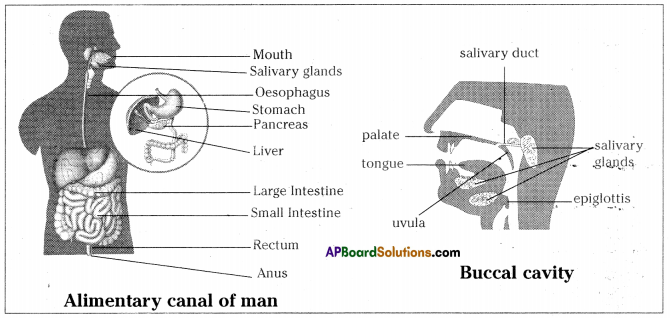
b) Before conducting the experiment, why do you keep the potted plant in dark place for a week?
c) What test do you conduct to know the formation of carbohydrates in leaves?
d) During the test, which part of the leaf turns into blue and which part doesn’t? Why?
Answer:
a) Potted plant, Light screen, Iodine solution, Petridish, Black paper.
b) To destarch the leaves.
c) Iodine Test
d) The part of the leaf exposed to light turn into blue. Unexposed part does not turn into blue.
Reason: Photosynthesis occurs only in the presence of sunlight. The unexposed part does not receive the sunlight.

AP SSC 10th Class Biology Important Questions Chapter 1 Nutrition

Question 26.
Draw the diagram of equipment arrangement in Hydrilla experiment. You did to prove that oxygen releases in photosynthesis. Write the reasons why test tube is placed upside down on funnel.
Answer:
AP SSC 10th Class Biology Important Questions Chapter 1 Nutrition 7Reasons for placing the test tube upside down on funnel:

  1. To count the number of bubbles coming out of the hydrilla twigs per minute during photosynthesis.
  2. To collect sufficient amount of oxygen at the end of the test tube so that it can be tested with glowing splinter.
  3. Amount of oxygen produced in the test tube can be measured by the displacement of water within the test tube.

Question 27.
Describe the internal structure of the leaf.
(OR)
How is the internal structure of leaf modified to prepare starch through the process of photosynthesis?
Answer:

  1. A transverse section of a typical leaf shows that it is covered on both sides by epidermis. Epidermal layers are covered on both sides by cuticle.
  2. Lower epidermis is interrupted by a large number of openings called stomata. The central opening is called stoma.
    AP SSC 10th Class Biology Important Questions Chapter 1 Nutrition 10
  3. Each stoma is surrounded by two kidney shaped cells called Guard cells.
  4. Stomata regulate the exchange of gases and loss of water vapour from the leaves.
  5. Mesophyll is the tissue present between two epidermal layers. Upper mesophyll tissue is called palisade parenchyma and lower tissue is known as spongy parenchyma.
  6. The cells in the palisade parenchyma are long elongated arranged in rows.
  7. The cells in the spongy parenchyma are irregularly arranged cells with large inter cellular spaces.
  8. More number of chloroplasts are present in palisade parenchyma than the spongy parenchyma.
  9. In the midrib and veins vascular bundles are present with phloem located towards the lower side and xylem towards the upper side.

Question 28.
Write about the parasitic nutrition in cuscuta plant.
Answer:

  1. Dodder (genus cuscuta) is a leafless, twining, parasitic plant belongs to family convolvulaceae.
  2. The dodder contains no chlorophyll and instead absorbs food through haustoria.
    AP SSC 10th Class Biology Important Questions Chapter 1 Nutrition 18
  3. The dodder’s seed germinates, forming an anchoring root, and then sends up a slender stem that grows in a spiral fashion until it reaches a host plant.
  4. It then twines around the stem of the host plant and throws out haustoria, which penetrate it.
  5. Water is drawn through the haustoria from the host plant’s stem and xylem, and nutrients are drawn from its phloem.
  6. Meanwhile, the root rots away after stem contact has been made with a host plant.
  7. As the dodder grows, it sends out new haustoria and establishes itself very firmly on the host plant.
  8. After growing in a few spirals around one host shoot, the dodder finds its way to another and it continues to twine and branch until it resembles a fine densley tangled web of thin stems enveloping the host plant.

AP SSC 10th Class Biology Important Questions Chapter 1 Nutrition

Question 29.
Describe the digestion of food materials in alimentary canal with the help of a diagram.
(OR)
How is the food digested in your body?
Answer:

  1. The alimentary canal is basically a long tube extending from the mouth to the anus.
  2. Food is masticated by our teeth in the mouth and mixed with saliva to make it slippery and wet.
  3. Saliva which contains amylase helps in the breakdown of carbohydrates into simple ones.
    AP SSC 10th Class Biology Important Questions Chapter 1 Nutrition 19
  4. The soft food mixed with saliva passes through oesophagus or food pipe by wave like movements called peristaltic movements to the stomach.
  5. The gastric glands in the stomach secrete gastric juice that contains hydrochloric acid, protein digesting enzyme pepsin and mucus.
  6. Partially digested food chyme is released in small amounts by sphincter muscles reach small intestine.
  7. Bile juice secreted by liver and pancreatic juice secreted by the pancreas release into the duodenum of small intestine.
  8. Emulsification of fats is done by bile juice. Pancreatic juice contains enzyme trypsin for carrying on the process of digestion of proteins and lipase for fats.
  9. Complete digestion of carbohydrates, fats and proteins takes place in the small intestine by intestinal juice.
  10. Finger-like projections present in the walls of small intestine are called villi. They absorb the digested food into the blood.
  11. Rest of the food is sent into the large intestine where most of the water present in it is absorbed from the food.
  12. This material is then expelled through the anus which is the last part of the alimentary canal.

Question 30.
Draw a flow chart of human digestive system.
Answer:
AP SSC 10th Class Biology Important Questions Chapter 1 Nutrition 21

AP SSC 10th Class Biology Important Questions Chapter 1 Nutrition

Question 31.
Write briefly about nutrition in paramoecium. (OR)
Explain the nutrition process in paramoecium with the help of diagrams.
Answer:
Paramoecium :

  1. Paramoecium is a unicellular aquatic organism.
  2. The paramoecium has thin, hair like cilia all over its body.
    AP SSC 10th Class Biology Important Questions Chapter 1 Nutrition 22
  3. The cilia move back and forth rapidly in water.
  4. When the cilia is present around, the mouth region of paramoecium move, back and forth. They sweep the food particles present in water into the mouth of paramoecium.
    AP SSC 10th Class Biology Important Questions Chapter 1 Nutrition 23
  5. This is the first step in the nutrition of paramoecium which is called ingestion and is followed by digestion, absorption, assimilation and egestion.

Question 32.
Describe the digestion of food in the stomach. (OR)
How is the food digested in your stomach ?
Answer:

  1. The stomach is a large organ which expands when food enters it.
  2. The muscular walls of the stomach help in mixing the food thoroughly with more digestive juices.
    AP SSC 10th Class Biology Important Questions Chapter 1 Nutrition 24
  3. The gastric glands present in the wall of the stomach secrete gastric juice which contains hydrochloric acid, pepsin and mucus.
  4. The hydrochloric acid facilitates the action of the enzyme pepsin and also kills the germs present in the food.
  5. The enzyme pepsin digests proteins and mucus protects the inner lining of the stomach from the action of the acid under normal conditions.

AP SSC 10th Class Biology Important Questions Chapter 1 Nutrition

Question 33.
Describe the digestion of food in the small intestine. (OR)
What are the changes that you see during the digestion of food in small intenstine?
(OR)
Small intestine is a long coiled tube. How the food is digested in small intestine of human being?
Answer:

  1. The small intestine is the longest part of the alimentary canal.
  2. It is the site of the complete digestion of carbohydrates, proteins and fats.
    AP SSC 10th Class Biology Important Questions Chapter 1 Nutrition 25
  3. It receives the secretion of liver and pancreas for this purpose.
  4. These juices make the internal condition of the intestine gradually to a basic or alkaline one.
  5. Bile juice secreted by liver breaks down fats into small globules like forms. This process is called emulsification.
  6. Pancreatic juice contains enzymes like trypsin for carrying on the process of digestion of proteins and lipase for fats.
  7. Walls of the small intestine secrete intestinal juice. This is also known as succus entericus.
  8. The intestinal juice consists of enzymes like enterokinase, peptidase, lipase, sucrase, nucleotidase, nucleosidase etc.
  9. Enzymes present in the intestine completely digest the partially digested food.
  10. Following digestive processes take place in the intestine.
    a) Peptidases convert peptides into amino adds.
    b) Intestinal lipase completely digest fats into fatty acids and glycerol.
    c) Enzymes sucrase, maltase, lactase hydrolyse sucrose, maltose and lactose respectively converting them into glucose.
    d) Nucleotidase and nucleosidase complete the digestion of nucleic acids.
  11. The end products of digestion are absorbed in the intestine.

Question 34.
What are the health aspects of the alimentary canal?
Answer:

  1. The human alimentary canal usually functions remarkably well considering how badly we treat it on occasions.
  2. Vomiting is the body’s method of ridding itself unwanted or harmful substances from the stomach.
  3. There are many causes of vomiting, but one of the most common is over eating, especially when the food contains a high proportion of fat.
    AP SSC 10th Class Biology Important Questions Chapter 1 Nutrition 26
  4. The liver is unable to cope with the excessive fat and we get a feeling of nausea and sometime headache.
  5. Indigestion is a general term used when there is difficulty in digesting food.
  6. A more serious form of indigestion is caused by stomach and duodenal ulcers. These conditions occur more often in people who may be described as hurried or worried.
  7. Those who are able to relax, who are not continually tensed up, and who live at a slower pace, seldom get ulcers.
  8. For good health it is necessary to empty the bowels regularly.
  9. If the food residues remain in the colon for too long, the bacteria present have more time to produce harmful substances which may be absorbed by the blood.
  10. Constipation can often be avoided by having plenty of roughage in the diet.AP SSC 10th Class Biology Important Questions Chapter 1 Nutrition


AP SSC 10th Class Physics Solutions Chapter 1 Heat

AP State Board Syllabus AP SSC 10th Class Physics Solutions Chapter 1 Heat Textbook Questions and Answers.

AP State Syllabus SSC 10th Class Physics Solutions 1st Lesson Heat

10th Class Physics 1st Lesson Heat Textbook Questions and Answers

Improve your learning

Question 1.
What would be the final temperature of a mixture of 50 g of water at 20° C temperature and 50 g of water at 40° C temperature? (AS1)
Answer:
In CGS system :
Mass m1 = 50 g
Higher temperature = T1 = 40° C
Mass m2 = 50 g
Lower temperature = T2 = 20° C
AP SSC 10th Class Physics Solutions Chapter 1 Heat 1

Question 2.
Explain, why dogs pant during hot summer days using the concept of evaporation. (AS1)
(OR)
How do dogs cool their body? Explain by using the process of evaporation.
Answer:

  • Dogs pant during hot summer days and get their body cooled. This cooling effect is due to evaporation.
  • Evaporation is a surface phenomenon. Temperature of a system falls during evaporation.
  • During summer the temperature in the human body increases.
  • The temperature of the skin becomes higher and the water in the sweat glands starts evaporating. Since evaporation is a cooling process human body becomes cool.
  • Dogs don’t have sweat glands. Their body is covered with hair. They have sweat glands only in their feet.
  • So by panting the water on the tongue undergoes evaporation resulting in the cooling of the dog’s body.

Question 3.
Why do we get dew on the surface of a cold soft drink bottle kept in open air? (AS1)
(OR)
Raju observed small droplets of water outside a cold soft drink bottle kept in open air. What is the reason for the formation of droplets?
Answer:

  • When cold soft drink bottle is kept in open air, the temperature of surrounding air is higher than the temperature of cold drink bottle.
  • Air contains molecules in the form of vapour.
  • During the motion of water molecules in air strike the surface of cold drink bottle.
  • Then the molecules of air lose their kinetic energy which leads to lower the temperature and they convert into droplets.
  • So dew is formed on the surface of cold soft drink bottle.

AP SSC 10th Class Physics Solutions Chapter 1 Heat

Question 4.
Write the differences between evaporation and boiling. (AS1)
(OR)
Sita observed decrease in quantity of spirit kept in a vessel placed in open air. Whereas Ramu observed formation of bubbles on a water surface when it is heated. What are those two processes? Distinguish between those two processes.
Answer:

Evaporation Boiling
1. The process of escaping of molecules from the surface of a liquid at any temperature is called evaporation. 1. The process in which the liquid phase changes to gaseous phase at constant temperature. This temperature is called boiling point of liquid.
2. Evaporation takes place at any temperature. 2. Boiling takes place at a definite temperature.
3. The temperature of liquid gets down. 3. The temperature of liquids increases up to a constant temperature.
4. The kinetic energy does not change. 4. The kinetic energy of the molecules increases with the increase of temperature.
5. The evaporation depends on surface area, wind, speed, humidity. 5. The boiling depends on atmospheric pressure.
6. It is surface phenomenon. 6. It is bulk phenomenon.
7. Eg : 1) Wet clothes dries.
2) Sea water evaporates to form clouds.
7. Eg : 1) Water boils at 100° C.

Question 5.
Does the surrounding air become warm or cool when vapour phase of H2O condenses? Explain. (AS1)
Answer:

  • Gases have more higher energy than liquids and solids.
  • When vapour condenses, it changes from gas to liquid.
  • Therefore there is a drop in energy.
  • This energy has to go (somewhere) to the surroundings.
  • So surrounding air becomes warm when vapour phase of H20 condenses.

Question 6.
Answer these. (AS1)
a) How much energy is transferred when 1 gm of boiling water at 100°C condenses to water at 100°C?
Answer:
CGS system :
Mass of water = m = 1 gm
Latent heat of vapourisation = 540 cal/gm.
The amount of heat energy released when 1 gm of boiling water at 100°C condenses to water at 100°C
Q = mLvapour = 1 × 540 = 540 cal.

(OR)

In SI system :
Mass of water = m = 1 gm = 1 × 10⁻³ kg
Latent heat of vapourisation = 540 cal/gm.
The amount of heat energy released when 1 gm of boiling water at 100°C condenses to water at 100°C
Q = mLvapour – 1 × 540 = 540 cal.
In SI, Q = 540 × 4.18 = 2257 J.

b) How much energy is transferred when 1 gm of boiling water at 100° C cools to water 0° C?
Answer:
CGS system :
Latent heat of vapourisation = 540 cal/gm
The amount of heat energy released when 1 gm of boiling water at 100°C condenses to water at 100 °C. m = 1 gm.
Q1 = mLvapour = 1 × 540 = 540 cal.
The specific heat of water = 1 cal/gm-°C
Difference in temperature = 100-0 = 100°C.
The heat released to cool water to 0°C is
Q2 = mS∆T = 1 × 1 × 100 = 100 cal.
∴ Total energy released = 540 + 100 = 640 cal.

c) How much energy is released or absorbed when 1 gm of water at 0° C freezes to ice at 0° C?
Answer:
In CGS system :
Mass of water = m = 1 gm
Latent heat of fusion of ice (L) = 80 cal/gm
The energy transferred or released when 1 gm of water at 0° C freezes to ice at 0° C.
Q = mLfreeze = 1 × 80 = 80 Cal.

(OR)

In SI system :
Mass of water = m = 1 gm = [latex]\frac{1}{1000} \mathrm{~kg}[/latex]
Latent heat of fusion = L = 3.36 × 10⁵ J/kg.
Amount of heat released or transferred when lgm of water at 0°C freezes to ice at 0°C.
Q = mLfusion = [latex]\frac{1}{1000} \mathrm{~kg}[/latex] × 3.36 × 105 = 3.36 × 102 = 336J.

(OR)

In CGS system :
Mass of water = m = 1 gm
Latent heat of fusion of ice (L) = 80 cal/gm
The energy transferred or released when 1 gm of water at 0° C freezes to ice at 0°C.
Q = mLfreeze = 1 × 80 – 80 cal.
(Or)
In SI system : In SI, Q = 80 × 4.2 [1 cal = 4.2 J]
Q = 1 x 10-3 × 3.36 × 105 = 3 36 J.

d) How much energy is released or absorbed when 1 gm of steam at 100°C turns to ice at 0°C?
Answer:
In CGS system :
Mass of water = m = 1 gm
Latent heat of vapourisation = Lvapour = 540 cal/gm
Latent heat of fusion of ice = Lfusion = 80 cal
Specific heat of water = S = 1 cal/gm-0°C
Difference in temperature
∆T = 100 – 0 = 100°C.
The energy transferred when 1 gram of steam at 100°C turns to ice at 0°C
Q = mLvapour + mS∆T + mLfusion
= 1 × 540 + 1 × 1 × 100 + 1 × 80 = 540 + 100 + 80 = 720 cal.

(OR)

Mass of water = m = 1 gm = [latex]\frac{1}{1000} \mathrm{~kg}[/latex]
Latent heat of vapourisation = Lvapour = 2.25 × 10⁶ J/kg
Latent heat of fusion = Lfusion = 3.36 × 10⁵ J/kg
Difference in temperature
∆T = 373 – 273 – 100 K.
Specific heat of water = 4180 J/kg-K
The energy transferred when 1 gram of steam at 100° C turns to ice at 0°C =
AP SSC 10th Class Physics Solutions Chapter 1 Heat 2

(OR)

In CGS system :
Conversion : Steam at 100°C → Water at 100°C → Water at 0°C → Ice at 0°C.
Mass of water = m = 1 gm
Latent heat of vapourisation = Lvapour = 540 cal/gm
Latent heat of fusion of ice = Lfusion = 80 cal
Specific heat of water = S = 1 cal/gm-0°C
Difference in temperature
∆T= 100-0 = 100°C.
The energy transferred when 1 gram of steam at 100°C turns to ice at 0°C
Q = mLvapour + mS∆T + mLfusion
= 1 × 540 + 1 × 1 × 100 + 1 × 80
= 540 + 100 + 80 = 720 cal. = 720 × 4.18 = 3009.6 J.

AP SSC 10th Class Physics Solutions Chapter 1 Heat

Question 7.
Explain the procedure of finding specific heat of solid experimentally. (AS1)
(OR)
Determination of specific heat of solid experimentally.
(OR)
Ravi wanted to prepare solid with high specific heat to use on cooking utensil. What fool does he need to find the specific heat of aluminium and copper? How should he conduct the experiment?
Answer:
Aim : To find the specific heat of given solid.
Apparatus : Calorimeter, thermometer, stirrer, water, steam heater, wooden box and lead shots.

Procedure:

  • Measure the mass of the calorimeter with stirrer = m1 gm
  • Fill water one third volume of calorimeter and measure the mass = m2 gm.
  • At this time initial temperature = T1.
  • Mass of the water = m2 – m1 gm.
  • Take a few lead shots and place them in steam heater and heat up to 100° C. Let this temperature be T2.
  • Transfer the lead shots into calorimeter and measure the final (or) resultant temperature T3.
  • Mass of calorimeter with contents = m3 gm and mass of lead shots = m3 – m2 gm.
  • If the specific heats of the calorimeter, lead shots and water are Sc, Sl and Sw respectively, by using method of mixtures we have
    Heat lost by the solid = Heat gained by the calorimeter + water
    AP SSC 10th Class Physics Solutions Chapter 1 Heat 3
  • Knowing the specific heats of calorimeter and water we can calculate specific heat of solid (lead shots).

Question 8.
Convert 20° C into Kelvin scale. (or) Change 20°C into absolute scale. (AS1)
Answer:
T = t°C + 273 = 20 + 273 = 293
⇒ T = 293 K.

Question 9.
Your friend is asked to differentiate between evaporation and boiling. What questions could you ask to make him to know the differences between evaporation and boiling? (AS2)
(OR)
Veena found that the water kept in a pot is cool and Siva observed when water is heated the temperature remains constant for some time until water turns into vapour. What are the processes involved in these two aspects? Ask some questions to understand these aspects.
Answer:
The questions asked by me are :

  • How do wet clothes get dried without heating?
  • Are boiling and evaporation one and same or different?
  • Is there any difference in kinetic energy if it boils?
  • Is the temperature the main cause for boiling and evaporation?
  • What are the factors which influence evaporation?
  • Is boiling temperature for water always 100° C?

AP SSC 10th Class Physics Solutions Chapter 1 Heat

Question 10.
What happens to the water when wet clothes dry? (AS3)
Answer:

  1. When wet clothes dry, the water present in the clothes is evaporated.
  2. So that the process of evaporation causes the wet clothes dry.

Question 11.
Equal amounts of water are kept in a cap and in a dish. Which will evaporate faster? Why? (AS3)
(OR)
Srinu kept. equal amounts of water in a cap and in a dish in open air. What is his observation? Explain the experiment.
Answer:
Aim : To show the evaporation of equal amounts of water in cap and dish.
Apparatus : Cap, dish, water.

Procedure :

  • Take equal amounts of water in cap and dish. Keep them in open air for two hours. Now weigh the water in the cap and the dish.
  • We can observe that the weight of water in dish is less than that of water in cap.
  • This shows that the water in dish has more evaporation than the water in cap.
  • It is due to more surface area of dish.
  • As the surface area increases rate of evaporation also increases.

Question 12.
Suggest an experiment to prove that rate of evaporation of a liquid depends on its surface area and vapour already present in surrounding air. (AS3)
Answer:
Aim: The rate of evaporation of liquid depends on its surface area and vapour already present in surrounding air.
Apparatus : Two dishes of different surface areas and water.

Procedure :

  • Take two dishes of different surface area.
  • Pour equal amounts of water in the both dishes.
  • Keep aside for two to three hours.
  • Observe them after some time.
    Dish with more surface area has less quantity of water than the dish having less surface area. ,
  • This shows evaporation increases with increasing of surface area.
  • Take two dishes of equal surface area containing water.
  • This experiment should be conducted on more humid day and less humid day.
  • We will find that evaporation is less on more humid day due to more vapour in the air.
  • So evaporation decreases with vapour in the air.

Question 13.
Place a Pyrex funnel with its mouth-down in a sauce pan full of water, in such a way that the stem tube of the funnel is above the water or pointing upward into air. Rest the edge of the bottom portion of the funnel on a nail or on a coin so that water can get under it. Place the pan on a stove and heat it till it begins to boil. Where do the bubbles form first? Why? Can you explain how a natural geyser works using this experience? (AS4)
Answer:

  • When Pyrex funnel with its mouth down in a sauce pan then the bubbles formed by the heat energy come from the top of the funnel.
  • That is from stem tube.
  • This is because of pressure inside mouth of funnel increases rapidly due to increasing of heat energy.
  • Pressure inside the funnel rs more than outside the funnel and very high at stem.
  • Hence, bubbles come from stem of the funnel and escapes through stem tube with force, like a geyser.

AP SSC 10th Class Physics Solutions Chapter 1 Heat 5
Working of natural geyser by using this experience :

  • Geysers are the fountains of hot water coming under the layers of the earth.
  • It is a hole with narrow and deep from the bottom of the earth layers.
  • It contains water.
  • Water heats up due to high temperatures of the inner layers of the earth.
  • As by the pressure of water at top layers of the hole, temperature rises, water boils.
  • This hot water comes with narrow vent with high pressure, like Lava from the Volcano.

Question 14.
Collect the information about working of natural geyser and prepare a report. (AS4)
Answer:
Natural Geysers :

  • Geysers are the fountains of hot water coming under the layers of the earth.
  • It is a hole with narrow and deep from the bottom of the earth layers.
    AP SSC 10th Class Physics Solutions Chapter 1 Heat 6
  • It contains water.
  • Water heats up due to high temperatures of the inner layers of the earth.
  • As by the pressure of water at top layers of the hole, temperature rises, water boils.
  • This hot water comes with narrow vent with high pressure, like Lava from the Volcano.
  • This looks like a water fountain at the surface of the earth.
    AP SSC 10th Class Physics Solutions Chapter 1 Heat 7

Question 15.
Assume that heat is being supplied continuously to 2 kg of ice at – 5°C. You know that ice melts at 0°C and boils at 100°C. Continue the heating till it starts boiling. Note the temperature for every minute. Draw a graph between temperature and time using the values you get. What do you understand from the graph ? Write the conclusions. (AS5)
Answer:
Graph between time and temperature from ice melting at 5° C to boils at 100° C.
AP SSC 10th Class Physics Solutions Chapter 1 Heat 8

Understanding from the graph :

  • [latex]\overline{\mathrm{AB}}[/latex] = Ice warms up from – 5°C to 0°C
  • [latex]\overline{\mathrm{BC}}[/latex] = Ice melts at 0°C for a certain time period. So [latex]\overline{\mathrm{BC}}[/latex] indicates no rising in temperature.
  • [latex]\overline{\mathrm{CD}}[/latex] = Water warms up from 0°C to 100° C, [latex]\overline{\mathrm{CD}}[/latex] indicates rising in temperature.
  • [latex]\overline{\mathrm{DE}}[/latex] = Water boils at 100° C for a certain time period. So [latex]\overline{\mathrm{DE}}[/latex] indicates no rising in temperature.

Conclusion :

  • The temperature remains same at 0° C until all the ice converted into water. So, 0° C is the melting point of water.
  • The temperature remains constant at 100° C until all the water converted into water vapour. So, 100° C is the boiling point of the water.

Question 16.
How do you appreciate the role of the higher specific heat of water in stabilising atmospheric temperature during winter and summer seasons? (AS6)
Answer:

  • Due to higher specific heat of water oceans absorb the solar energy for maintaining a relatively constant temperature.
  • Oceans absorb large amounts of heat at the equator.
  • The oceans moderate the surrounding temperature near the equator.
  • Ocean water transports the heat away from the equator to areas closer to the north and south pole.
  • This transported heat helps moderate the climate in parts of the Earth that are far from the equator.
  • So higher specific heat of water is stabilising atmospheric temperature.
  • So we have to extremely appreciate the role of higher specific heat of water to stabilise the atmospheric temperature.

Question 17.
Suppose that 1 / of water is heated for a certain time to rise and its temperature by 2°C. If 2 l of water is heated for the same time, by how much will its temperature. (AS7)
Answer:
Mass of 1 litre of water (m1) = 1 kg ; ∆T1 = 2°C
Mass of 2 litres of water (m2) = 2 kg ; ∆ T2 = ?
Time duration is same. So same heat is absorbed by water in both the cases
⇒ Q1 = Q2
m1S(∆T1) = m2S (∆T2)
AP SSC 10th Class Physics Solutions Chapter 1 Heat 9
So the rise in temperature for 2 kg of water = 1°C.

AP SSC 10th Class Physics Solutions Chapter 1 Heat

Question 18.
What role does specific heat play in keeping a watermelon cool for a long time after removing it from a fridge on a hot day? (AS7)
Answer:

  • Generally, watermelon contains large percentage of water.
  • Water has high specific heat value than other substances.
  • High specific heat substances oppose the increase of temperature. Hence they continuous of the coolingness.
  • So watermelon retains coolness after removing from fridge on a hot day due to the high specific cheat of water.

Question 19.
If you are chilly outside the shower stall, why do you feel warm after the bath if you stay in bathroom? (AS7)
Answer:

  • In the bathroom, the number of vapour molecules per unit volume is greater than the number of vapour molecules per unit volume outside the room.
  • When we try to dry ourselves with a towel, the vapour molecules surrounding you condense on your skin.
  • Condensation is a warming process.
  • Because of the condensation, you feel warm outside the shower stall when it is chilly.

Question 20.
Three objects A at 30°C, B at 303K and C at 420 K are in thermal contact. Then answer the follwing questions.
(i) Which are in “Thermal equibrium” among A, B and C?
(ii) From which object to another heat transferred? (2 Marks)
Answer:
i) 303K – 273K + 30K = 0°C + 30°C = 30°C.
∴ A and B objects are in ‘Thermal equibrium”.
ii) From object ‘C’ to objects ‘A’ and ‘B’ heat transferred.

Fill in the Blanks

1. The SI unit of specific heat is …………………. .
2. …………………. flows from a body at higher temperature to a body at lower temperature.
3. …………………. is a cooling process.
4. An object A at 10° C and another object B at 10 K are kept in contact, then heat will flow from …………………. to …………………. .
5. The latent heat of fusion of ice is …………………. .
6. Temperature of a body is directly proportional to …………………. .
7. According to the principle of method of mixtures, the net heat lost by the hot bodies is equal to …………………. by the cold bodies.
8. The sultryness in summer days is due to
9. …………………. is used as a coolant.
10. Ice floats on water because …………………. .
Answer:

  1. J/kg – K
  2. Heat
  3. Evaporation
  4. A, B
  5. 80 cal/gm
  6. Average kinetic energy of the molecules of the body.
  7. net heat gained
  8. high humidity
  9. Water
  10. the density of ice is less than that of water

Multiple Choice Questions

1. Which of the following is a warming process?
A) evaporation
B) condensation
C) boiling
D) all the above
Answer:
B) condensation

AP SSC 10th Class Physics Solutions Chapter 1 Heat

2. Melting is a process in which solid phase changes to ………………. .
A) liquid phase
B) liquid phase at constant temperature
C) gaseous phase
D) any phase
Answer:
B) liquid phase at constant temperature

3. Three bodies A, B and C are in thermal equilibrium. The temperature of B is 45° C. Then the temperature of C is ……………… .
A) 45° C
B) 50° C
C) 40° C
D) any temperature
Answer:
A) 45° C

4. The temperature of a steel rod is 330 K. Its temperature in ° C is ……………… .
A) 55° C
B) 57° C
C) 59° C
D) 53° C
Answer:
B) 57° C

5. Specific heat S =
AP SSC 10th Class Physics Solutions Chapter 1 Heat 4
Answer: C

6. Boiling point of water at normal atmospheric pressure is ……………… .
A) 0° C
B) 100° C
C) 110° C
D) -5° C
Answer:
B) 100° C

AP SSC 10th Class Physics Solutions Chapter 1 Heat

7. When ice melts, its temperature ……………… .
A) remains constant
B) increases
C) decreases
D) cannot say
Answer:
A) remains constant

10th Class Physics 1st Lesson Heat InText Questions and Answers

10th Class Physics Textbook Page No. 1

Question 1.
Take a piece of wood and a piece of metal and keep them in a fridge or ice box. After 15 minutes, take them out and ask your friend to touch them. Which is colder? Why?
Answer:
1) The metal piece is colder than the wooden piece.
2) Because more heat energy flows out of our body so metal piece gives coldness to our body, than wooden piece.

Question 2.
What could be the reason for difference in coldness of metal and wood?
Answer:

  • Due to more heat energy loss by our body when touches the metal piece compared to the wooden piece.
  • In other way we say degree of coldness of the metal piece is greater than that of. the wooden piece.

AP SSC 10th Class Physics Solutions Chapter 1 Heat

Question 3.
Does it have any relation to the transfer of heat energy from our body to the object?
Answer:

  • Yes, the principle of calorimetry, means heat loss by hot body is equal to heat gained by cold body.
  • This means that when heat energy flows out of our body we feel the coldness and when heat energy enters our body we feel hotness.

10th Class Physics Textbook Page No. 2

Question 4.
Why does transfer of heat energy take place between objects?
Answer:

  • Due to the temperature difference between the two bodies which are in thermal contact.
  • Now heat energy transfers from hot body to cold body until they attain same temperature.

Question 5.
Does transfer of heat take place in all situations?
Answer:
No, when the bodies are in thermal equilibrium there is no transfer of heat energy.

Question 6.
What are the conditions for transfer of heat energy?
Answer:

  • Two bodies should have difference in temperature.
  • They (two bodies) are in thermal contact with each other.
  • When the bodies have equal temperature there is no transfer of heat energy.

AP SSC 10th Class Physics Solutions Chapter 1 Heat

Question 7.
What is temperature?
(OR)
Define temperature.
Answer:
Temperature : The measure of hotness or coldness of a body is called temperature.

Question 8.
How can you differentiate temperature from heat?
Answer:

  • Heat is a thermal energy that flows from hot body to cold body. Temperature is measure of the hotness or coldness of a body.
  • Temperature decides direction of heat (energy) flow, whereas heat is energy itself that flows.

10th Class Physics Textbook Page No. 2 & 3

Question 9.
Place a laboratory thermometer in a glass tumbler containing hot water. Observe the change in mercury level. Wffet change did you notice in mercury level? Did mercury level increase or decrease?
Answer:
The mercury level rises up that means temperature of the mercury level increases.

10th Class Physics Textbook Page No. 3

Question 10.
Place a laboratory thermometer in a glass tumbler containing cold water. Observe the change in mercury level. Did mercury level decrease or increase?
Answer:
The mercury level falls down that shows temperature of the mercury level decreases.

AP SSC 10th Class Physics Solutions Chapter 1 Heat

Question 11.
If two different systems A and B in thermal contact, are in thermal equilibrium individually with another system C (thermal contact with A and B), will the systems A and B be in thermal equilibrium with each other?
Answer:
Yes, A and B will be in thermal equilibrium with each other that means A and B will have equal temperatures.

Question 12.
How would you convert degree Celsius to Kelvin?
Answer:
Temperature in Kelvin = 273 + Temperature in degree Celsius. [K = t°C + 273]

10th Class Physics Textbook Page No. 4

Question 13.
Take two bowls one with hot water and second with cold water. Gently sprinkle food colour on the surface of the water in both bowls. How do food grains move? Why do they move randomly?
Answer:
We will notice that the grains of food colour move randomly (jiggle). This happens because of the molecules of water on both bowls are in random motion.

AP SSC 10th Class Physics Solutions Chapter 1 Heat

Question 14.
Why do the grains in hot water move more rapidly than the grains in cold water?
Answer:

  • Temperature kinetic energy. So molecules in hot water have more KE than molecules in cold water.
  • As water molecules in hot water move rapidly, grains in hot water move more rapidly than the grains in cold water.

10th Class Physics Textbook Page No. 4 & 5

Question 15.
a) Take a cylindrical jar and pour hot water and then coconut oil in the vessel (do not mix them). Keep thermometers in hot water and coconut oil as shown in figure. The reading of thermometer in hot water decreases, at the same time reading of the thermometer, kept in oil increases. Why does this happen?
Answer:
AP SSC 10th Class Physics Solutions Chapter 1 Heat 10

  • Heat transfers from hot water to oil.
  • So, water loses heat and shows downfall in temperature.
  • Oil takes the heat and shows increasing in the temperature.

b) Can you say that water loses energy’?
Answer:

  • Yes. Due to the temperature difference between the water and oil, water loses energy and oil gains energy.
  • Thus some heat energy flows from water to oil.
  • This means, the kinetic energy of the molecules of water decreases while the kinetic energy of molecules of oil increases.

c) Can you differentiate between heat and temperature based on the heat transmit activity?
Answer:
Heat is the energy that flows from a hotter body to a colder body. Temperature denotes which body is hotter and which is colder. So, temperature determines direction of heat (energy) flow, whereas heat is the energy that flows.

10th Class Physics Textbook Page No. 5 & 6

Question 16.
Place two test tubes containing 50 gm of water, 50 gm of oil in boiling water for same time.
a) In which material does the temperature rise quickly? Are the amounts of heat given to the water and oil same? How can you assume this?
Answer:

  • Rise in temperature of oil is faster than the water.
  • Yes, same amount of heat energy given to both the oil and water through boiling water.

AP SSC 10th Class Physics Solutions Chapter 1 Heat

b) Why does this happen in specific heat?
Answer:
This happens because rise in temperature depends on the nature of substance.

10th Class Physics Textbook Page No. 7

Question 17.
How much heat energy is required to rise the temperature of unit mass of substance (material) by 1°C?
Answer:
Energy equal to its specific heat.

AP SSC 10th Class Physics Solutions Chapter 1 Heat

Question 18.
Why is the specific heat different for different substances?
(OR)
Explain why specific heat values are different for different materials.
Answer:

  • We know that the temperature of the body is directly proportional to the average kinetic energy of particle of the body.
  • The molecules of the system have different forms of energies such as linear, rotational kinetic energy, vibrational energy and potential energy.
  • When we supply heat energy, it will be shared in different forms and increase the energy in the system.
  • This sharing will vary from material to material.
  • If the maximum share of heat energy is spent to rise linear kinetic energy, then the system gets increasing in temperature.
  • Due to differences in sharing different materials have different specific heats.

10th Class Physics Textbook Page No. 8

Question 19.
Take 200 ml of water in two beakers and heat them to same temperature and pour the water of two beakers into a larger beaker.
What do you observe? What could be the reason for the fact you observed?
Answer:

  • The temperature of mixture remains the same.
  • The reason is that the masses rise in temperature and the materials are same.

Question 20.
Heat the water in one beaker to 90°C and the other to 60°C. Mix the water from these beakers in large beaker. What will be the temperature of the mixture? What did you notice? Can you give reason for the change in temperature?
Answer:

  • The temperature of mixture is 75°C.
  • The reason is for a given material the temperature of mixture,
    AP SSC 10th Class Physics Solutions Chapter 1 Heat 12
  • Hot water gives heat to the cold water until thermal equilibrium takes place.
  • So, the thermal equilibrium attains at 75°C.

Question 21.
ake 100 ml of water at 90°C and 200 ml of water at 60°C and mix the two. What is the temperature of the mixture? What difference do you notice in change of temperature?
Answer:

  • The temperature of mixture is 70°C.
  • The reason is here m1 = 100 gm ; m2 = 200 gm
    AP SSC 10th Class Physics Solutions Chapter 1 Heat 13
  • Final temperature of the mixture is less than the above case.
  • If the quantity increases, the quantity of heat to transfer is also rises to attain thermal equilibrium.
    Here hotter body quantity is less and colder body quantity is high. So, the temperature at thermal equilibrium decreases and stands at 70° C.

10th Class Physics Textbook Page No. 10

Question 22.
When floor of room is washed with water, the water on the floor disappears within minutes. Why does water on the floor disappear after some time?
Answer:
Due to evaporation water disappears from the floor.

Question 23.
Pour a few drops of spirit on your palm. Why does your skin become colder? (1 Mark)
Answer:
Spirit absorbs heat energy from our palm and evaporates. So our palm becomes colder.

10th Class Physics Textbook Page No. 10 & 11

Question 24.
Take a few drops of spirit in two petri dishes separately. Keep one of the dishes under a ceiling fan and switch on the fan. Keep another dish with its lid closed. What do you notice? What could be the reason for this change?
Answer:
1) The spirit in the dish which is kept under the ceiling fan disappears.
2) Whereas we will find some spirit left in the dish that is kept in the lidded dish.
3) The molecules which are escaping from the surface is high and they can’t reach back to liquid due to wind blow. So, evaporation is high under fan.
4) At the same time evaporation is less in the dish which is closed by lid.

10th Class Physics Textbook Page No. 12

Question 25.
Does the reverse process of evaporation take place? When and how does it take place?
Answer:
1) Yes, the reverse process of evaporation takes place.
2) When the vapour molecules lose their kinetic energy which leads to lower the temperature, they convert into droplets.
3) This process is called condensation.

10th Class Physics Textbook Page No. 13

Question 26.
In early morning, during winter, you might have noticed that water droplets form on window panes, flowers, grass, etc. How are these water droplets formed?
(OR)
Why do water drops (dew) form on flowers and grass during morning hours of winter season?
Answer:

  • During winter season, in the night times, atmospheric temperature goes down.
  • The surfaces of window panes, flowers, grass, etc. become colder.
  • The water vapour molecules touch the surfaces, gets cooled and lost its energy.
  • Then water vapour condenses on the surface and water drops formed.
  • The water droplets condensed on such surfaces are known as dew.

10th Class Physics Textbook Page No. 14

Question 27.
Are the process of evaporation and boiling the same? Explain.
Answer:

  • No, they are different.
  • Evaporation takes place at any temperature.
  • But boiling occurs at particular temperature called the boiling point.

10th Class Physics Textbook Page No. 16

Question 28.
You might have observed coconut oil and ghee getting converted from liquid state to solid state during winter season. What could be the reason for this change? What happens to water kept in a refrigerator? How does it get converted from liquid phase to solid phase?
Answer:
1) If temperature of a substance decreases kinetic energy also decreases.
2) Kinetic energy decreases from water to ice. That means solid state to liquid state.
3) In winter season coconut oil in the form of liquid get down its temperature, hence its kinetic energy also decreases. So, it-freezes.
4) Water, which is kept in refrigerator loses the kinetic energy along with decreasing temperature and freezes.
5) In this way water converted liquid phase to solid phase.

AP SSC 10th Class Physics Solutions Chapter 1 Heat

Question 29.
Are the volumes of water and ice formed with same amount of water equal? Why?
Answer:
1) No, the volume of ice is greater than volume of water.
2) Water expands on freezing.
3) That means density of ice is less than density of water.

10th Class Physics 1st Lesson Heat Activities

Activity – 1

1. Explain the term temperature with example.
(OR)
What is the name given to degree of hotness or coldness? Explain the quantity with an example.
Answer:
Procedure: Take a piece of wood and a piece of metal and keep them in fridge or ice box.
Observation : When we touch both of them we feel that metal piece is colder than the wooden piece.

Explanation :

  • This is due to more energy flow out of our body when we touch the metal piece as compared with wooden piece.
  • The degree of coldness of metal is greater than that of the wooden piece.
  • The degree of hotness or coldness is called temperature.
  • From this example, we say metal piece is at a lower temperature compared to wooden piece.

Activity – 2

2. What is the measure of thermal equilibrium? How do you prove?
(OR)
How do you prove temperature is the measure of thermal equilibrium?
(OR)
Explain thermal equilibrium with an activity.
Answer:
Procedure :
Take two glass tumblers and fill one of them with hot water and another with cold water.
Explanation & Observation :
1) When we place a thermometer inside the hot water the mercury level of thermometer rises from initial position due to heat transferred from hotter body (hot water) to colder body (mercury in thermometer).
2) When we place the thermometer inside the cold water the mercury level comes down from its initial position due to transfer of heat from mercury (hotter body) to water (colder body).

Conclusion :

  • Heat is a form of energy that flows from a body at higher temperature to a body at lower temperature until the temperature remains same for two bodies that is called thermal equilibrium.
  • In the above case, the steadiness of mercury column shows that thermal equilibrium is achieved. That reading of mercury column gives temperature.
  • Thus temperature is a measure of thermal equilibrium.

Activity – 3

3. Establish the relationship between temperature and average kinetic energy.
(OR)
Suggest an activity to prove that the average kinetic energy of the molecules is directly proportional to the absolute temperature of the substances.
(OR)
How do you prove that temperature of a body is an indicator of average kinetic energy?
Answer:
Procedure :

  • Take two bowls one with hot water and second with cold water.
  • Gently sprinkle food colour on the surface of the water in both bowls.

Observation :
We will observe the jiggling of grains of food colour in hot water is more when compared to jiggling in cold water.

Explanation :

  • We know kinetic energy depends on speed motion of particles.
  • So the kinetic energy of hotter body is greater than that of colder body.
  • Thus the temperature of a body is an indicator of average kinetic energy of molecules of that body.

Conclusion :
Therefore average kinetic energy of molecules is directly proportional to absolute temperature.

Activity – 4

4. Write an activity which tells how heat transmits.
(OR)
In which direction does heat tend to flow? Prove it with an activity.
Answer:
AP SSC 10th Class Physics Solutions Chapter 1 Heat 10
Procedure :

  • Take water in a container and heat it to 60° C.
  • Take a cylindrical transparent glass jar and fill half of it with the hot water.
  • Pour coconut oil over the surface of water.
  • Put a lid with two holes on the top of the glass jar.
  • Insert two thermometers through the lid in such a way that one inside coconut oil and other in water.

Observation & Explanation :

  • Now we can observe that the reading of thermometer kept in water decreases while the reading of thermometer kept in oil increases.
  • So temperature of water decreases whereas temperature of oil increases.

Conclusion :

  • Heat transmits from hotter body to colder body.
  • So temperature determines direction of heat flow.

Activity – 5 Specific Heat

5. Write an activity which gives the relation between rise in temperature and nature of material.
(OR)
“The rate of rise in temperature depends on the nature of substance.” Prove it with an activity.
(OR)
Draw a diagram and label the parts to prove that the rate of increase in temperature depends on the nature of substance.
(OR)
We can observe severe burns with hot oil when compared with hot water.
Which factor will decide this aspect? Explain this process with an example.
Answer:
Procedure :

  • Take a large jar with water and heat it up to 80°C.
  • Take two identical boiling test tubes with single-holed corks.
  • Fill them, one of the boiling tubes with 50 gm of water and other with 50 gm of oil.
  • Insert two thermometers in each of tubes and clamp them to retort stand and place them in a jar of hot water.

Observation :

  • Observe the readings of thermometers every three minutes.
  • We can observe that the rise in temperature of oil is higher than that of water.

AP SSC 10th Class Physics Solutions Chapter 1 Heat 11

Explanation :

  • Since both the boiling tubes kept in hot water for the same interval of time, the heat supplied to oil and water is same but rise in temperature of oil is more.
  • So we conclude that rise in temperature depends on the nature of substance (specific heat).

Activity – 6

6. Derive Q = mSAT.
(OR)
Establish relationship between heat energy, mass of the substance and rise in temperature.
(OR)
Derive an expression for heat energy.
(OR)
Derive an expression for factors affecting amount of heat energy absorbed.
Answer:
Procedure :

  • Take two beakers of equal volume and take 250 grams of water in one beaker and 1 kg of water in another beaker.
  • Note their initial temperatures.
  • Now heat the two beakers up to 60° C.
  • Note down the heating times.

Observation:

  • We observe that-the water in large beaker takes more time.
  • That means we need to supply more heat enepgy to water in larger beaker (greater quantity of water).

Conclusion :
From this we conclude that for some change in temperature the amount of heat (Q) absorbed by a substance is directly proportional to its mass (m).
Q ∝ m (when ∆T is constant) ………….. (1)

Procedure :
Now take 1 litre of water in a beaker and heat it and note the temperature changes (∆T) for every two minutes and observe the rise internals.

Conclusion:
We will notice that for the same mass (m) of water the change in temperature is proportional to amount of heat (Q) absorbed by it.
Q ∝ ∆T (when m is constant) ………….. (2)
From (1) and (2) Q m∆T (or) Q = mS∆T,
where ‘S’ is called specific heat of substance.

Activity – 7

7. a) How are you able to find the final temperature of the mixture of sample?
(OR)
What is the “Principle of method of mixtures”? Verify it with an activity.
Answer:
Situation – 1 :

  • Take two beakers of the same size and pour 200 ml of water in each of them.
  • Now heat the water in both beakers to same temperature.
  • Now pour water from these beakers into a larger beaker and measure the temperature of the mixture.

Observation :
We can observe that there is no change in temperature.

Situation – 2 :

  • Now heat the water in first beaker to 90° C and the other to 60° C.
  • Mix the water from these beakers in a large beaker.

Observation :
We can find that the temperature of mixture is 75° C.

Situation – 3 :
Now take 100 ml of water at 90° C and 200 ml of water at 60° C and mix the two. Observation :
We can find that the temperature of mixture is 75° C.

AP SSC 10th Class Physics Solutions Chapter 1 Heat

7. b) Derive, a formula for final temperature of mixture of samples.
(OR)
Maveen added hotter water of mass m1 kept at temperature T1 to cold water of mass m2 kept at temperature T2. Find the expression to find temperature of mixture of samples.
Answer:
Procedure:
1) Let the initial temperatures of the hotter and colder samples of masses m1 and m2 be T1 and T2.
2) Let T be the final temperature of mixture.

Observation :
The temperature of the mixture is lower than hotter sample and higher than colder sample. Explanation :
So hot sample has lost heat, and the cold sample has gained heat.
The heat lost by the hot sample Q1 = m1S (T1 – T)
The heat gained by the cold sample Q2 = m2S (T – T2)
We know that heat lost = heat gained
Q1 = Q2
m1 S(T1 – T) = m2 S(T – T2)
[latex]\mathrm{T}=\frac{\mathrm{m}_{1} \mathrm{~T}_{1}+\mathrm{m}_{2} \mathrm{~T}_{2}}{\mathrm{~m}_{1}+\mathrm{m}_{2}}[/latex]

Activity -8

8. Explain the process of evaporation phenomenon with an example.
(OR)
Srinu observed that spirit taken in a petri dish disappears after some time. Explain the process involved in it with an example.
Answer:
Procedure :

  • Take a few drops of spirit in two petri dishes separately.
  • Keep one of the dishes under a ceiling fan and keep another dish with its lid closed.
  • Observe the quantity of spirit in both dishes after 5 minutes.

Observation :
We will notice that spirit in the dish kept under the ceiling fan disappears whereas we will find some spirit left in the dish that is kept in the lidded dish.

Explanation :

  • The reason is that the molecules of spirit in dish continuously move with random speeds and collide with other molecules.
  • During the collision they transfer energy to other molecules.
  • Due to this collision the molecules at the surface acquire energy and fly off from the surface.
  • Some molecules come back to liquid.
  • If the number of escaping molecules is greater than returned number, then the number of molecules in the liquid decreases.

Conclusion :
When a liquid is exposed to air, the molecules at the surface keep on escaping from the surface till the entire liquid disappears into air. This process is called evaporation.

Activity – 9

9. Explain the process of condensation with example.
(OR)
Explain the process of condensation with an activity.
(OR)
Karan told his friend that he observed that there are some water droplets outside a cold soft drink bottle. Explain the phenomenon involved in the formation of these droplets.
Answer:
Procedure :
Place a glass tumbler on the table. Pour cold water up to half of its height.

Observation :
There are droplets formed outside of the glass.

Explanation :

  • The reason is that the surrounding air contains water molecules in the form of water vapour. When the water molecules strike the surface of the glass tumbler which is cool, they lose their kinetic energy.
  • This energy lowers the temperature of vapour and it turns into droplets.
  • The energy lost by water molecules in air is gained by the molecules of the glass tumbler.
  • Hence the average kinetic energy of glass molecules increases. In turn the energy is transferred to water molecules in die glass.

Conclusion :

  • So the average kinetic energy and temperature of water in glass increases. This is called condensation.
  • Condensation is the phase change from gas to liquid.

Activity – 10

10. Explain the process of boiling with an example.
(OR)
Why do we observe bubbles on the surface of water which has been heated ? What is the phenomenon involved in it? Explain.
Answer:
Procedure :
Take a beaker of water, keep it on the burner and note the readings of thermometer for every two minutes.

Observation :

  • We will notice that the temperature of the water rises continuously till it reaches 100° C.
  • Once it reaches 100° C the temperature remains same and a lot of bubbling on the surface takes place. This is called boiling of water.

Explanation :

  • It happens due to when water is heated the solubility of gases it contains reduces.
  • As a result, bubbles of gas are formed in the liquid.
  • Evaporation of water molecules from the surrounding liquid occurs into these bubbles and they become filled with saturated vapour.
  • At a certain temperature, the pressure of the saturated vapour inside the bubbles becomes equal to the pressure exerted on the bubbles from the outside.

Conclusion :

  • As a result, these bubbles rise rapidly to the surface and collapse at the surface releasing vapour present in bubbles into air at the surface. This process is called “boiling”.
  • This temperature is called ‘boiling temperature”.

Activity – 11

11. Explain the process of melting and latent heat of fusion.
(OR)
When ice is heated to 0°C it starts to turn into water. But temperature remains ‘ constant for some time. What is the process involved in this? Explain.
Answer:
Procedure :

  • Take small ice cubes in a beaker. Insert the thermometer in the beaker.
  • Now start heating the beaker and note down readings of thermometer every one minute till the ice completely melts and gets converted into water.
  • Before heating the temperature of ice is 0°C or less than 0°C.

Observation :

  • We will observe that the temperature of ice at the beginning is equal to or below 0°C.
  • If the temperature of ice is below 0°C, it goes on changing till it reaches 0°C.
  • When ice starts melting, we will observe no change in temperature though you are supplying heat continuously.

Explanation:

  • Given heat energy uses to break the bonds (H2O) in ice and melts.
  • So, temperature is constant while melting.

Conclusion:

  • This process is called melting. In this process, heat converts solid phase to liquid phase.
  • The temperature of the substance does not change until all the ice melts and converts into water.
  • The heat given to melting is called latent heat of fusion.
  • The heat required to convert 1 gm of solid completely into liquid at constant temperature is called “latent heat of fusion”.

Activity – 12

12. Why does a glass bottle tilled with water break when it is placed in deep freezer for some time?
(OR)
Prove that density of ice is less than that of water.
(OR)
How do you prove that volume of ice is more than that of water?
Answer:
Procedure :

  • Take a small glass bottle with a tight lid and fill it with water, without any gap and fix the lid tightly.
  • Put the bottle into the deep freezer of a refrigerator for a few hours.

Observation :
When we take it out from the deep freezer, we can observe that the glass bottle breaks.

Explanation :

  • These cracks on the bottle due to expansion of the substance in the bottle.
  • This means water expands on freezing.

Conclusion :

  • Water expands on freezing.
  • Ice has less density than water.


AP SSC 10th Class Biology Solutions Chapter 5 Coordination – The Linking System

AP State Board Syllabus AP SSC 10th Class Biology Solutions Chapter 5 Coordination – The Linking System Textbook Questions and Answers.

AP State Syllabus SSC 10th Class Biology Solutions 5th Lesson Coordination – The Linking System

10th Class Biology 5th Lesson Coordination – The Linking System Textbook Questions and Answers

Improve your learning

Question 1.
Fill In the missing sections In the following flow-chart.
AP SSC 10th Class Biology Solutions Chapter 5 Coordination – The Linking System 1
Answer:
AP SSC 10th Class Biology Solutions Chapter 5 Coordination – The Linking System 2

AP SSC 10th Class Biology Solutions Chapter 5 Coordination – The Linking System

Question 2.
Do you think body’s team work maintains functioning of our body? Justify your answer with an example.
Answer:

  1. Yes. Body’s team work maintains functioning of our body.
  2. All our functions are carried out by an effort of several systems working together.
  3. The human body has a set of systems which regulate the internal environment and strive to give our cells the necessary condition as they need to function.
  4. We cannot use only the skeletal system or muscular system.
  5. To do any function several other systems also have their own roles to play.
  6. The pathway involving the way that our organs tissues and cells pickup signals from their surroundings and respond to them that triggers different functions in our body as well as by our body.
  7. When all the organs and organ systems work as a unit then the organism will survive.
  8. For example our eyes, ears, legs should coordinate with each other when crossing the road. Otherwise we may met with an accident.

Question 3.
Give an example of coordination in your body where both hormonal and nervous controls function together.
Answer:

  1. Several functions in our body are controlled by nerves, while many others are controlled by hormones.
  2. When we are afraid, the rate of heart beat increases, the breath rate will be faster, blood pressure increases, the hair on the body becomes errect and we get goose bumps.
  3. We might not observe our pupil dilation, skin becomes more sensitive. We come to normally only after we reach a safe spot.
  4. The various actions of the body are controlled by hormones and coordinated by nervous system.
  5. In these type of conditions nervous system and endocrine system work together to bring about control and coordination.
  6. Another example for nervous and hormonal coordination. When the mother feeds the baby, the baby sucks the nipple for milk. This information is send to the brain by sensory nerve. Brain orders the pituitary gland to release the hormone oxytocin. Oxytocin helps in the ejection of milk from the mammary glands.

AP SSC 10th Class Biology Solutions Chapter 5 Coordination – The Linking System

Question 4.
Consider that you are passing by a garbage disposal area and you immediately
cover your nose. Arrange the events below in a logical order by marking them from 1 to 5 to trace the events that happen in the nervous system from detection of foul smell (stimulus generation) to covering your nose (response).
i) At the end of the axon, electrical impulse releases chemicals.
ii) Stimulus received by the dendrites of a neuron sets off chemical reaction that creates an electrical impulse.
iii) Electrical impulse transmitted through cell body and axon.
iv) The chemicals cross the synapse and reach the next neuron. Similarly, the electrical impulse crosses several neurons.
v) Finally, the impulse is delivered from neuron to the gland that helps in recognition of the foul smell and muscle cells that help in covering the nose.
Answer:
The following events occur in nervous system for detecting foul smell of garbage, ii, iii, i, iv, v

Question 5.
What is a Synapse? How is it useful in transfer information?
Answer:

  1. Definition: Synapse is a functional region between two neurons where information from one neuron is transmitted or relayed to another neuron.
  2. Through synaptic region is with minute gaps it does not have any protoplasmic connection between them.
  3. Information is passed from one nerve cell to the other through these gaps either in the form of chemical or electrical signals or both.

Question 6.
Distinguish between
a) Stimulus and Response
b) Afferent and Efferent nerves
c) Central nervous system and peripheral nervous system
d) Receptor and effector
Answer:
a) Stimulus and Response

Stimulus Response
1. It is the cause or change in organism’s surroundings that causes the organism to react 1. It is the act done by the organism.
2. Stimulus can not be always controlled especially external stimuli. 2. It could be controlled.
3. Stimulus could be of any magnitude. 3. The response could never go beyond the highest capability of an organism.
4. Response can not determines the stimulus. 4. Stimulus determines the response.

b) Afferent and Efferent nerves

Afferent nerves Efferent nerves
1. Nerves coming from receptors or sense organs are called afferent nerves. 1. Nerves that carry impulses from brain or spinal cord are called efferent nerves.
2. These are also called sensory nerves. 2. These are also called motor nerves.
3. Sensory nerves carry information from sensory organs like ears, eyes, from brain or spinal cord. 3. The motor nerves carry impulses to effector nose, tongue and skin to brain and organs (muscles) and are responsible for the movement of hands and legs.
4. These are incoming nerves. 4. These are outgoing nerves.

c) Central nervous system and peripheral nervous system :

Central nervous system Peripheral nervous system
1. It consists of Brain and spinal cord. 1. It consists of nerves that arise from brain and spinal nerves.
2. Both of them have nerve cells and glial cells. 2. It has 43 pairs of nerves. Among them 12 pairs are cranial nerves and 31 pairs are spinal nerves.
3. Brain and spinal cord are continuous with each other. 3. Cranial nerves take their origin from brain and spinal nerves take their origin from spinal cord.
4. Brain and spinal cord receive infor­mation. 4. The cranial nerves carry information to the sense organs and spinal nerves from organs to spinal cord.
5. Central nervous system coordinates all neural functions. 5. These supply information required for the movement of the muscles.

d) Receptor and effector:

Receptor Effector
1. The sense organs which are made up of cells called receptors. 1. Muscles or tissues which are linked with nerves are called an effector.
2. Receptors respond to stimulus. 2. Effectors are the organs that produce response.
3. These send information to central nervous system. 3. They follow the commands of central nervous system.
4. These are connected to sensory organs. 4. These follow the motor nerves.
5. Nervous system sense the changes inside and outside the body through receptors. 5. Effectors receive messages from brain or spinal cord through motor nerves.

Question 7.
How does phototropism occur in plants?
Answer:

  1. Bending of plants towards light is called phototropism. (Photo = light) (tropism = movement)
  2. For example a creeper which is growing near the window bend towards sunlight.
  3. Auxins are the phyto hormones which are present at the tip of the shoot respond the plant to bend towards sunlight.

AP SSC 10th Class Biology Solutions Chapter 5 Coordination – The Linking System

Question 8.
Give an example and explain how plants may immediately respond to a stimulus.
Answer:

  1. The plant responding to stimulus is mimosa pudica is the example.
  2. Mimosa pudica leaves have pad like sweelings at the base are called PULVINI.
  3. Here cells contain water and large intercellular spaces. Due to water pressure pulvini hold the leaf errect.
  4. When we touch the leaves, an electrical impulse is generated due to plant hormone.
  5. Because of this hormone water in the pulvini cells which are closer to the leaf vein migrate to other side’of the cells.
  6. Then pulvini loss its fitness hence leaves become fold. After 20 to 30 minutes water comes back leaves become errect.

Question 9.
Suggest an experiment to show how roots grow away from light in most plants.
Answer:
Aim: To prove that roots grow away from light in most plants.
Material required: Glass jar, Bean seed.
Procedure:

  1. A plant jar is taken and filled with mud.
    AP SSC 10th Class Biology Solutions Chapter 5 Coordination – The Linking System 3
  2. A bean seed is sown just adjacent in the inner wall of the jar.
  3. So that it is easy to observe the growth of root and shoot.
  4. After 4-5 days the germination of the seed is observed.
  5. Keep the jar in the sunlight. We observe the growth of roots and shoot.
  6. Finally the jar is tilted to keep the growing plant horizontally.
  7. After the growth of 4-5 days, tilt the glass jar and keep the plant horizontally.

Observation: It is observed that the roots extends downwards to the earth that is away from the sun light and the shoot grows towards sunlight.
Conclusion: By the above experiment it is proved that roots grow towards gravity (earth) away from sun light.

AP SSC 10th Class Biology Solutions Chapter 5 Coordination – The Linking System

Question 10.
Give an example to show how hormones can influence visible changes in your body.
(OR)
What are the effects of hormones on human beings?
Answer:

  1. Endocrine glands secrete chemical substances called Hormones directly into blood.
  2. Hormones act on the cells of other organs and increase or decrease the metabolism of carbohydrates, proteins and fats.
  3. The external features by which the males and females can be distinguished are called secondary sexual characters.
  4. Testosterone in males and estrogen in females promotes the development of secondary sexual characteristics.
  5. For example, if a dog chases us, our nervous system stimulate the adrenal glands to secrete more adrenaline hormone into our body.
  6. When we are afraid, the rate of heart beat increases, the breath rate will be faster, blood pressure increases, the hair on the body becomes errect.
  7. All these changes occur due to the production of Adrenaline hormone.

Question 11.
How does a neuron differ from an ordinary cell in structure? Write notes.
Answer:

Neuron (Nerve cell) Ordinary cell
1. It is the longest cell in our body. 1. Generally cells are round or oval shaped.
2. It belongs to only nervous system. 2. These are the structural units of body.
3. Nerve cell has three parts: 1. Cyton 2. Axon 3. Dendrites 3. Commonly divided as 1. Cytoplasm and 2. Nucleoplasm
4. These cells carry impulses to brain and spinal cord. 4. Involve in metabolic activities.
5. These are not regenerated. 5. The cells have cell division and replace the death cells.
6. Nerve cells end with dendrites. 6. These cells do not have end points.
7. Some nerve cells are covered with lipid coat. 7. Generally these are covered with plasma membrane.
8. Nissl granules are special character of nerve cells. 8. These cells do not have Nissl granules.

Question 12.
Is the structure of neuron suitable for transmission of impulses? Analyse.
Answer:

  1. Yes. The structure of neuron is suitable for transmission of impulses.
  2. Neurons are the functional units which receive and process information and generate responses.
  3. Cell body is the centre for all the synthetic activity of the neuron.
  4. Dendrites arise from the cell body receive information from other neurons and carry this information to the cell body.
  5. The axon or nerve fibre gives out several branches that end in nerve terminals. These make connect with the dendrites or the axons of another neuron.
  6. Myelinated sheath prevents the leakage of electrical currents from axon. Myelinated axons conduct impulses much faster than unmyelinated axons.

AP SSC 10th Class Biology Solutions Chapter 5 Coordination – The Linking System

Question 13.
Man is the most intelligent animal. What could be the fact that helped us to reach such a conclusion?
Answer:

  1. Man is the most intelligent animal in animal kingdom.
  2. This is possible by well development of brain and its marvellous function.
  3. Human brain has abilities to learn from concepts.
  4. It understands, applies logic and reason.
  5. The brain also recognizes patterns and comprehends ideas.
  6. The human brain has ability in making plans, solving problems, making decisions and retaining information.
  7. Man is the only animal who uses language to communicate.
  8. Intelligence enables humans to experience and think.
  9. It has also consciousness and self-awareness.

Question 14.
The axon of nerve cell in hand is shorter than the axon of nerve cell in leg. Do you support this statement? Why?
Answer:

  1. Yes, I support the above statement.
  2. The axon of nerve cell in hand is shorter than the axon of nerve cell in leg.
  3. The sciatic nerve is the large nerve in humans and animals. It begins in the lower back and runs through the buttock and lower limbs.
  4. Sciatic nerve present in the leg is the largest and widest single nerve in the human body. It measures about 1 mt in length.
  5. Usually the length of leg is more in size than hand. Hence the axon of nerve cell in hand is shorter than the axon of nerve cell in leg.

Question 15.
Organs respond to the external stimulus by a fraction of second. How do you feel about such controlling mechanism of human body?
Answer:

  1. Organs responding for the external stimuli by a fraction of second are due to reflex action.
  2. Reflex actions are very important as they save us from painful or dangerous stimuli.
  3. Reflex actions or reflexus are fast, immediate automatic and involuntary responses of the body.
  4. They help in the body as they save us from painful or dangerous stimuli.
  5. Reflexes occur without our thinking.
  6. Brain is not involved in the execution of several reflexes.
    Ex: Withdrawing our hand when we touch hot subject.

AP SSC 10th Class Biology Solutions Chapter 5 Coordination – The Linking System

Question 16.
State whether the following actions are voluntary action, reflex action or conditioned reflex.

  1. Blinking
  2. Cleaning the table
  3. Playing on the key board
  4. Salivating when food is put in the mouth
  5. We close our ears when we hear unbearable sound

Answer:

  1. Blinking: Involuntary action or reflex action.
  2. Cleaning the table: Voluntary action.
  3. Playing on the keyboard: Conditioned reflex.
  4. Salivating when food is put in the mouth: Involuntary or Reflex action.
  5. We close our ears when we hear unbearable sound: Involuntary or reflex action.

Question 17.
What will happen to the potted plant kept near window in the room?
(OR)
Draw a diagram of a plant showing phototropism. Explain why plants possess such type of response.
(OR)
A plant which grows near a window bends towards sun light. Write the reason for it.
Answer:

  1. The potted plant which is kept near the window in the room, grows towards light.
    AP SSC 10th Class Biology Solutions Chapter 5 Coordination – The Linking System 4
  2. Auxins acts on bending of stem of show a response to the sun light.
  3. More auxin collects on the light illuminated side of the stem. So cells on that side grow faster.
  4. On opposite side cells grow slow to make the stem bend.
  5. Auxins are the plant hormones responsible for the growing of the stem towards light.
  6. Auxins are synthesized at the tip of the stem (meristematic tissue).
  7. Bending of the plant towards light is called phototropism.

AP SSC 10th Class Biology Solutions Chapter 5 Coordination – The Linking System

Question 18.
What happens if all the functions of the human body are controlled only by brain?
Brain controls all the functions of the human body. Comment on it.
Answer:

  1. If all actions of the human body are controlled by brain, our body will get harm in dangerous situations.
  2. Some actions may be delayed and our brain could not conduct reflex actions, which require immediate action to a stimulus.
  3. For example, when we touch a hot object, we require an immediate response to save our hand. If the brain controls this action, the time taken will be more and our hand will burn.
  4. So, it is controlled by spinal cord, the response will be quick, and we may escape the danger.
  5. Nerves can not reach the every corner of the body, whereas hormones of endocrine glands can do that.
  6. So it’s not good that all functions are controlled by brain.

Question 19.
If you visit a doctor, what doubts you would like to clarify about pancreas?
Answer:

  1. What is pancreas?
  2. Where is pancreas located in our body?
  3. Why is it called mixed gland?
  4. What is the exocrine part of pancreas?
  5. What is the endocrine part of pancreas?
  6. What are the cells that secrete hormone insulin?
  7. What is the function of insulin?
  8. What happens if required amounts of insulin is not produced?
  9. What are the symptoms of diabetes?
  10. How can diabetes be controlled?

AP SSC 10th Class Biology Solutions Chapter 5 Coordination – The Linking System

Question 20.
Take a small potted plant. Cover base portion of the plant tightly and hang the part upside down. Observe the plant for a week. Based on your observation how can you support phototropism?
Answer:
Aim: To prove that phototropism is a character that is carried by stem.
AP SSC 10th Class Biology Solutions Chapter 5 Coordination – The Linking System 5
Apparatus: Potted plant, a strong small rope.
Procedure : Take a small potted plant. Cover the base portion of the plant tightly so that the plant along with soil do not fell down. Now take a rope and hang the potted plant upside down to a support firmly.
Observe the plant after a week.
Observation: We observe that the end of the stem which is upside down takes ‘U’ turn and grows towards light.
Conclusion: Phototropism is a response of plants towards light. That the stem grows towards light that is negatively to gravitation. Auxins are responsible for phototropism.

Question 21.
Take a cock feather touch smoothly at different parts of your body. Findout which portion of the body has high sensation. Is this similar during sleeping ? Prepare a report on it.
Answer:
Aim: To prove that our body shows high sensation in different parts.
Apparatus : Cock feather.
Procedure: Take a cock feather. Touch smoothly at different parts of our body with the cock feather.
Observation : It is observed that some of the body parts like palms of hands and soles of feet there is less sensation than the other body parts because the skin is thick. Some other parts where the skin is thin, the sensation is more.
Report: The nerve endings are situated in the skin. These nerve endings are responsible for the sensation of the body.

Question 22.
What procedure you follow to understand the effect of plant growth hormones (in agar medium) in the terminal portion of the tip of stem (coleoptile)?
Answer:
Aim: To show the growth of Avena coleoptile involves a chemical substance.
Apparatus: Oat seedlings (Avena sativa), coleoptile, a slice of agar, a sharp blade. Procedure:

  1. Take some oat seedlings.
  2. Their coleoptile tips are cut off.
  3. Place the tips on a slice of agar and leave them for about an hour.
  4. Cut the agar into small blocks and place a block on one side each stump of the decapitated plants.
  5. The plants were kept in the dark during the entire experiment.
  6. Observe the plants after one hour.

Observation :

  1. Within one hour a distinct bending away from the side on which the agar block was placed is observed.
  2. Agar block that had not been contact with coleoptile doesn’t show any bending.
    AP SSC 10th Class Biology Solutions Chapter 5 Coordination – The Linking System 6

Conclusion : The coleoptile tip exerted its effect by means of a chemical stimulus such as an electrical impulse. This chemical stimuls came to be known as auxin.

AP SSC 10th Class Biology Solutions Chapter 5 Coordination – The Linking System

Question 23.
Collect information on the actions controlled by spinal cord by using reference books from your school library.
Answer:
Spinal cord:

  1. Spinal cord is a long and cylindrical structure. It passes through vertibral column extending all along the dorsal surface of trunk.
    AP SSC 10th Class Biology Solutions Chapter 5 Coordination – The Linking System 7
  2. Vertebrae of the vertebral column protects the spinal cord.
  3. The spinal cord has two major functions, a) carrying information b) coordinating reflexes.
  4. It receives sensory information through the afferent nerves from the sensory receptors throughout the body and send them to the brain.
  5. It also carries information from the brain through efferent fibres to the muscles and glands.
  6. It coordinates reflexes without the involvement of the brain.

Thus the spinal cord has both communicative and integrative functions.

Reflex actions:

  1. Excepting the sensory and motor functions spinal cord controls some other important function also. These are called as reflex actions.
  2. The spinal cord does not take any assistance from the brain. Reflex actions are automatic, unlearned, involuntary and in born responses.
  3. Therefore these actions are suddenly in nature and have a purpose of protecting the individuals or his / her organs from sudden danger.

AP SSC 10th Class Biology Solutions Chapter 5 Coordination – The Linking System

Question 24.
Read the following sentences and compare with endocrine glands.

Pheromones are chemical substances secreted by organisms. These act as chemical signals secreted by exocrine glands. Pheromones are used as signals by the members of same species. Honey bee secretes pheromones that attract other bees to the location of food.
Answer:

Pheromones Secretions of Endocrine glands (or) Hormones
1. Pheromones are chemical substances secreted by organisms. 1. Hormones are chemical substances secreted by endocrine glands.
2. These act as chemical signals. 2. These are the chemical messengers.
3. Pheromones are used as signals by the members of same species. 3. Hormones change or control the metabolic activities in the organisms.
4. Honey bee secretes pheromones that attract other bees to the location of food. 4. Hormones help for growth, and stimulated organs’ function.

Question 25.
Collect the information about cranial nerves, spinal nerves from internet or from your school library.
Answer:
Spinal cord :

  1. Spinal cord is a long and cylindrical structure passing through the vertebral column.
  2. The vertebrae (back bones) of the vertebral column protect the spinal cord from injuries.
  3. From the sides of spinal cord, 31 pairs of nerves take their origin one from each side and supply branches to various parts of the body.
  4. Basic function of spinal cord is to act as a relay station – receiving information from various parts of the body parts below the head and send this information to the brain.
  5. Similarly, it receives information from brain and sends this information to other parts of the body.
  6. In addition to this, spinal cord also plays a major role in the RFELEX ACTIONS.
  7. The message received from the sensory nerve is passed into spinal cord. It is analyzed by the INTER NEURON present in the spinal cord and response is given. It is conveyed to the effector organ through motor nerve. The effector organ shows the response.
  8. Thus spinal cord saves us from dangerous stimuli through it’s REFLEX ACTIONS.

Question 26.
Draw a picture representing connection between dendrite – dendrite, axon – dendrite. Why do they connect like that?
Answer:

  1. The nerve cell is the structural and functional unit of nervous system.
    AP SSC 10th Class Biology Solutions Chapter 5 Coordination – The Linking System 8
  2. It consists of more than 100 billion of them, which communicate with each other in a specific manner.
  3. Dendrites of one nerve cell connects to the other or to the axons of another nerve cell through connect points called as a synapse.

AP SSC 10th Class Biology Solutions Chapter 5 Coordination – The Linking System

Question 27.
Draw a neatly labelled diagram of Brain and write few points how it is protected.
Answer:
Protection of Brain :

  1. Brain is present in the hard bony box called CRANIUM.
    AP SSC 10th Class Biology Solutions Chapter 5 Coordination – The Linking System 9
  2. It is covered by three layers called MENINGES.
  3. The space between the inner layer is filled with fluid called cerebrospinal fluid,
  4. It serves a shock-absorbing medium and protects brain against shocks/ jerks along with the meninges and cranium.

Question 28.
You are walking in the traffic suddenly you heard a loud sound. How does coordination take place in this situation among respected organs? Draw a block diagram to explain this situation.
Answer:
AP SSC 10th Class Biology Solutions Chapter 5 Coordination – The Linking System 10

Question 29.
Make a model of neuron using suitable materials.
Answer:
AP SSC 10th Class Biology Solutions Chapter 5 Coordination – The Linking System 15Required materials: A chart, twine thread, fevicol, sticker.

AP SSC 10th Class Biology Solutions Chapter 5 Coordination – The Linking System

Question 30.
Observe different actions performed by your classmate for a period of 45 minutes. Out of these actions which are controlled by voluntary and involuntary pathways?
Answer:
Voluntary actions:

  1. Standing
  2. sitting
  3. laughing
  4. drinking
  5. moving
  6. clapping
  7. carrying books
  8. reading
  9. writing
  10. talking

Involuntary actions:

  1. Blinking of eyes
  2. swallowing
  3. breathing
  4. listening etc.

Question 31.
Its very interesting to watch a creeper entwining its tendril to the support. Is not it? How do you express your feelings in this situation?
(OR)
Plants also respond to external stimuli. How do you feel about this?
Answer:

  1. A very interesting thing in plants is movement of tendrils.
    AP SSC 10th Class Biology Solutions Chapter 5 Coordination – The Linking System 12
  2. All plants show positive response to phototropism.
  3. But creepers like cucumber, bittergourd the stem is weak and thin. Hence plant cannot grow erect.
  4. Tendrils play a vital role to make the plant erect. Tendrils are thin thread-like growth on the leaves or stems of climbing plants.
  5. They grows towards support and wind around them.
  6. This type of response to make contact or touch is called thigmotropism.
  7. Nature only finds it’s way to grow and survive on the earth.

AP SSC 10th Class Biology Solutions Chapter 5 Coordination – The Linking System

Question 32.
Hormones are released at a specific place, specific time for a specific function. Prepare a cartoon on the hormones with a nice caption.
Answer:
AP SSC 10th Class Biology Solutions Chapter 5 Coordination – The Linking System 13

Fill in the blanks.

  1. The largest region of the brain is ———–.
  2. A point of contact between two neurons is ———–.
  3. ———– phytohormone is responsible for cell elongation and differentiation of shoots and roots.
  4. Thyroxine is responsible for ———–.
  5. Gibberellins and auxins promote growth in plants while absciscic acid arrests the same. Some situations are discussed here. State which hormones would be needed and why?
    a) A gardener wants large dahlias, he should use along with nutrients and other things ———– hormone.
    b) In a dwarf plant the branches have to be thickened one would use the ———– hormone.
    c) Seeds are to be stored a long time ———– hormone can help.
    d) Cutting the apex or tip of plants so that there are several lateral buds ———– hormone can be used.
    e) The part of the brain that helps you in solving puzzles is ———–.

Answer:

  1. cerebrum
  2. synapse
  3. Auxin
  4. General growth rate and metabolic rate
  5. a) Auxin b) Gibberellin c) Absciscic acid d) Cytokinins e) Cerebrum

AP SSC 10th Class Biology Solutions Chapter 5 Coordination – The Linking System

Choose the correct answer.

  1. A person has loss of control on emotions, which part of brain stops its function ? [ ]
    A) Cerebrum
    B) Diencephalon
    C) Mid brain
    D) Cerebellum
  2. Leaf movement in mimosa helps to [ ]
    A) Reduce photosynthesis
    B) Protect from grazers
    C) Releasing phytohormones
    D) Regulate its growth
  3. Diabetes is related to this gland. [ ]
    A) Thyroid
    B) Pancreas
    C) Adrenal
    D) Pituitary

10th Class Biology 5th Lesson Coordination – The Linking System InText Questions and Answers

10th Class Biology Textbook Page No. 95

AP SSC 10th Class Biology Solutions Chapter 5 Coordination – The Linking System

Question 1.
What helps us to respond to such signals?
Answer:
There is a sequence of events that bring about responses. They start from detecting changes in environment.

Question 2.
Why does the living body respond to such signals?
Answer:
The ability to react to particular stimulus in a particular situation must be of great importance in ensuring the survival of the organism.

10th Class Biology Textbook Page No. 96

Question 3.
What did Galen conclude after his observations?
Answer:
After the observations of his patient, Galen a Greek physiologist concluded that nerves were of two types – those of sensation and those of action.

Question 4.
Why do you think Galen drew such a conclusion?
Answer:
According to Galen the blow in the neck of his patient had damaged the nerves of sensation but had not affected its action. Then Galen concluded that nerves were of two types.

10th Class Biology Textbook Page No. 98

AP SSC 10th Class Biology Solutions Chapter 5 Coordination – The Linking System

Question 5.
Which organ of our body was the detector and which was the effector in Activity -1?
Answer:
In Activity -1, Eye was the detector and fingers were the effector.

Question 6.
What do you think that the information carried on the afferent and efferent nerves?
Answer:
The information carried by afferent nerve is “scale is falling”.
The information carried by the efferent nerve is “to hold the scale”.

10th Class Biology Textbook Page No. 99

Question 7.
What other effectors would act under these circumstances?
Answer:

  1. Withdraw our hands, when our fingers touch a hot object.
  2. Closing eyes when bright light is focussed on eyes.
  3. We sneeze when something enters the nose.
  4. We cough when inhaled dust or some other circumstances.

Question 8.
What does this tell us about the association nerves?
Answer:
The sensory nerves in the spinal cord makes connections with other neurons in the grey matter. These neurons are called association neurons or interneurons. The association neurons process the information and generate responses.

10th Class Biology Textbook Page No. 100

AP SSC 10th Class Biology Solutions Chapter 5 Coordination – The Linking System

Question 9.
Think of any action and try to make a sketch of reflex arc.
Answer:
AP SSC 10th Class Biology Solutions Chapter 5 Coordination – The Linking System 19

10th Class Biology Textbook Page No. 102

Question 10.
According to you what would be the function of the spinal cord?
Answer:
Functions of the spinal cord :

  1. Spinal cord sends information received from different parts of the body to brain.
  2. Also it sends the information to various parts received from brain.
  3. Spinal cord also play a major role in reflex actions.

Question 11.
Are all functions of our body under direct control of the brain and spinal cord? Why do you think so?
Answer:
Yes. All the functions of our body are under direct control of the brain and spinal cord. The 43 pairs of peripheral nervous system associated with brain and spinal cord plays an important role in disposing our body functions.

10th Class Biology Textbook Page No. 103

AP SSC 10th Class Biology Solutions Chapter 5 Coordination – The Linking System

Question 12.
Which root according to you gets signals from afferent nerves?
Answer:
The dorsal root of the spinal cord gets signals from afferent nerves.

Question 13.
What do you think the end of these nerves act at the muscular end?
Answer:
At the ends of these nerves can involuntarily control several functions of regions like internal organs, blood vessels, smooth and cardiac muscles and is called an autonomous nervous system. It has voluntary control of muscles of some areas of skin and the skeletal muscle.

10th Class Biology Textbook Page No. 104

Question 14.
To which organs of the body do the nerves go from the ganglions near the vertebral column?
Answer:
The organs like heart, lungs, stomach, intestines, urinary bladder, kidneys, hand fingers of the body, the nerves go from the ganglions near the vertebral column.

10th Class Biology Textbook Page No. 105

AP SSC 10th Class Biology Solutions Chapter 5 Coordination – The Linking System

Question 15.
What are the organs that receives nerves starting from the brain?
Answer:
Eye, mouth, tongue, salivary glands are the organs receives nerves starting from the brain.

Question 16.
Which are the organs whose activities are influenced by the sympathetic nervous system?
Answer:
Eye – pupil, heart, lungs, blood vessels, sweat glands, digestive tract, kidneys, penis are the organs influenced by the sympathetic nervous system.

Question 17.
Which are the organs whose activities are influenced by the parasympathetic system?
Answer:
Stomach, intestines, salivary glands, reproductive organs, etc., are influenced by para sympathetic system.

Question 18.
What do you understand about the functions of parasympathetic nervous system?
Answer:
Parasympathetic nervous system slows down the body functions such as feed & breed, rest & digest, sexual arose, lacrimation, urination, defecation and digestion.

AP SSC 10th Class Biology Solutions Chapter 5 Coordination – The Linking System

Question 19.
What do you understand about the functions of sympathetic nervous system?
Answer:
Sympathetic nervous system speeds up the body functions. Dilates pupil, heart – increases rate, force of contraction, lungs dilates, blood vessels contraction, etc. are the functions controlled by sympathetic nervous system.

10th Class Biology Textbook Page No. 107

Question 20.
Have you ever observed the duration of anger?
Answer:
The duration of anger will be sometimes ten minutes or fifteen minutes or according to the situation.

Question 21.
Why does anger come down?
Answer:
Anger is always short lived factor. Increased levels of adrenalin are responsible for anger. When the levels of adrenalin in the blood come down slowly. We came to normal state.

Question 22.
What may happen if anger persists for a longer period?
Answer:
If anger persists for longer time, regular metabolic activities are disturbed.

Question 23.
What will happen if it is continued for longer periods of time?
Answer:
The sugar levels in the blood rise than normal level. Blood pressure increases, burning sensation in the heart, stomach upsets are the some of the abnormal conditions may happen.

10th Class Biology 5th Lesson Coordination – The Linking System Activities

AP SSC 10th Class Biology Solutions Chapter 5 Coordination – The Linking System

Activity – 1

Holding a falling stick.
Answer:
Take a long scale or stick at least around V2 meter. Keep your fingers in holding position. Ask your friend to hold the stick / scale near the end and let the other end be suspended between your fingers.
Let there be a very small gap around a centimeter between your thumb and stick/scale and fore finger. Now let you friend allow it to fall. Try to hold it.
AP SSC 10th Class Biology Solutions Chapter 5 Coordination – The Linking System 14

  1. Could you hold it exactly at the point where it was suspended between your fingers?
    Answer:
    No. I cannot hold it exactly at the point.
  2. How far up was this point from the end suspended between your fingers?
    Answer:
    2 cm up (nearly at the end of the scale).
  3. Why did this happen?
    Answer:
    Because it is the sudden action. To hold it fastly. The exact point went up.
  4. How fast do you think the process was?
    Answer:
    The process was so fast in a fraction of a second.
  5. What makes this kind of communication possible?
    Answer:
    Rapidity of response indicates an efficient communication system linking those parts that pick up stimuli that trigger a response by the nervous system.

Activity – 2

Observe the permanent slide of nerve cell or neuron under microscope and try to find out its parts. Compare with the following diagram.
Answer:
AP SSC 10th Class Biology Solutions Chapter 5 Coordination – The Linking System 11Structural unit of the nervous system is the nerve cell or neuron. Neuron is highly specialised cell. Neurons carry impulses or messages. New nerve cells are not produced to replace the damaged or destroyed nerve cell. A neuron has three parts. They are

  1. cyton
  2. axon and
  3. dendrites

1. The cyton:

  1. It is also called the cell body.
  2. It has a large and round nucleus.
  3. In the cytoplasm of the cyton, nissl granules are present.

2. Axon:

  1. It is the long and cylindrical process that arises from the cyton.
  2. In some nerve cells, axon is surrounded by a layer of fatty material known as myelin sheath.
  3. The myelin sheath is not continuous throughout length of the axon.
  4. It is broken at regular intervals.
  5. These broken spots are called as nodes of Ranvier.

3. Dendrites: Arise from the cyton they are much branched, when compared to axon.

Activity – 3

What is knee jerk reflex?
Answer:
Cross the legs, in a seated position, so that the lower half of the uppermost leg hangs freely over the other. Strike the area below the knee cap sharply, while firmly grasping the front part of the thigh with the other hand. Note the changes in shape of the thigh muscles.
AP SSC 10th Class Biology Solutions Chapter 5 Coordination – The Linking System 16

  1. What changes do you observe in the thigh muscle?
    Answer:
    The thigh muscles get contracted and becomes short.
  2. What do we call this type of response?
    Answer:
    This type of responses are called involuntary actions. Such type of actions in the body are carried by without our involvement and our knowledge.
  3. What do we call the action of kicking a foot ball?
    Answer:
    Kicking of a foot ball is a voluntary action’ These actions are within our control.
  4. How is the knee jerk action takes place?
    Answer:
    In the knee jerk action a nerve pathway was involved.
    v) Do you think most of the functions in our body go about in an involuntary manner? Why ? Why not ?
    Answer:
    Most of our body functions are done without the involvement of our knowledge. For example, heart beating, respiration, digestion, etc., are the involuntary actions which are carried by our body.

AP SSC 10th Class Biology Solutions Chapter 5 Coordination – The Linking System

Activity – 4

Touch the leaves of Mimosa pudica (athipathi, touch me not) plant and observe the response of leaves.
AP SSC 10th Class Biology Solutions Chapter 5 Coordination – The Linking System 17

  1. Are they folding?
    Answer:
    When the leaves of Mimosa are touched the leaves get folding. Touching the leaves is the stimulus and folding is the response.
  2. In which direction the folding of the leaves take place?
    Answer:
    The folding of the leaves take place inward direction.
  3. Give some examples of situations in plants responding to a certain stimulus.
    Answer:
    Examples: The sun flower turning to the direction of sun, the bending response of the plant when it is kept in the dark. Some of leaves of the trees opens at the day time and closes after sun set.
    Phototropism of stem and geotropism of roots, hydrotropism of roots of plants growing towards water and thigmotropism where the creepers like cucumber, bitter – gourd takes the help of tendrils and wind around the support are some of the examples of response to stimulus in plants.

Activity – 5

AP SSC 10th Class Biology Solutions Chapter 5 Coordination – The Linking System

Take a glass jar and fill with soil. Sow a bean seed near the wall of the jar. After 4 – 5 days you will notice seed germination. Keep the jar under the sun. Observe how root and shoot grows. Then tilt the glass jar and keep the plant horizontally. Observe the direction of the root and shoot growth for more than a week.
AP SSC 10th Class Biology Solutions Chapter 5 Coordination – The Linking System 18

  1. Does the shoot take a horizontal tilt after a week?
    Answer:
    After a week the shoot takes a horizontal tilt.
  2. Which side of the shoot may have grown more and which side less to bring about this effect?
    Answer:
    The shoot grown more towards the light and less where light is not falling.
  3. Do you find any difference in the shape of epidermal cells?
    Answer:
    The straight portions of the epidermal cells shows no bending but the bending portions of epidermal cells shows bending.
  4. Who performed experiments on phototropism?
    Answer:
    Charles Darwin and his son Francis Darwin performed some experiments on phototropism.
  5. What did they do in their experiment?
    Answer:
    Charles Darwin and his son Francis Darwin performed experiments on phototropism. They covered the terminal portion of the tip of stem (coleoptile) with a cylinder of metal foil. Exposed the plant to light coming from the side.
  6. What did they observe by that experiment?
    Answer:
    They observed that the bending towards the light (characteristic) of the seedling did not occur. If light was permitted to penetrate the cylinder bending occurred normally.
  7. What did Charles Darwin and his son Francis Darwin state on their experiment?
    Answer:
    They stated that when seedlings are freely exposed to a lateral light some ‘influence’ is transmitted from upper to the lower part causing the material to bend.
  8. What are the experiments of F.W. Went and how did he succeeded in separating ‘influence’ from the plant?
    Answer:
    F.W. Went cut off coleoptile tips from oat seedlings. He placed the tips on a slice of agar and left them for about an hour.
    He then cut agar into small blocks and placed a block on one side each stump of the decapitated plants. They were kept in the dark during the entire experiment. Within one hour he observed a distinct bending away from the side on which agar block was placed.
  9. How did Went come to know about auxin?
    Answer:
    AP SSC 10th Class Biology Solutions Chapter 5 Coordination – The Linking System 6Went interpreted these experiments as showing that the coleoptile tip exerted it’s effect by means of chemical stimulus rather than a physical stimulus such as an electrical impulse.
    This chemical stimulus came to be known as auxin. In this way the first plant hormone auxin was discovered by F.W. Went.
  10. What is the meaning of auxin in Greek?
    Answer:
    The Greek word auxin means to increase.


AP SSC 10th Class Physics Solutions Chapter 7 Human Eye and Colourful World

AP State Board Syllabus AP SSC 10th Class Physics Solutions Chapter 7 Human Eye and Colourful World Textbook Questions and Answers.

AP State Syllabus SSC 10th Class Physics Solutions 7th Lesson Human Eye and Colourful World

10th Class Physics 7th Lesson Human Eye and Colourful World Textbook Questions and Answers

Review of Your Previous Knowledge

Question 1.
What is the function of lens in human eye?
Answer:
The eye lens forms a real image on retina then we can see the objects.

Question 2.
How does it help to see objects at long distances and short distances?
Answer:
Eye lens can adjust itself in shape, so that it helps to see the objects at long and short distances.

AP SSC 10th Class Physics Solutions Chapter 7 Human Eye and Colourful World

Question 3.
How is it possible to get the image at the same distance on the retina?
Answer:
When the eye is focussed at distant object, the ciliary muscles are relaxed. So the focal length of eye lens adjusted itself which is equal to the distance of object from the retina. Then we can see the object clearly.
When the eye is focussed on a closer object the ciliary muscles adjust the focal length in such a way that the image is formed on retina and we see the object clearly.

Question 4.
Are we able to see all objects in front of our eye clearly?
Answer:
Yes. By maintaining the 25 cm distance of the object from our eye, we can see the objects in front of our eye.

Question 5.
How do the lenses used in spectacles correct defects of vision?
Answer:
To form image on retina.
To correct
myopia- Concave lens
hypermetropia i- Convex lens

Improve Your Learning

Question 1.
How do you correct the eye defect Myopia? (AS1)
Answer:
AP SSC 10th Class Physics Solutions Chapter 7 Human Eye and Colourful World 1

  • Some people cannot see objects at long distances but can see nearby objects clearly. This type of defect in vision is called ‘Myopia’ or ‘Near sightedness’.
  • Myopia is corrected by using a con-cave lens of focal length equal to the distance of the far point F from the eye.
  • This lens diverges the parallel rays from distant object as if they are coming from the far point.
  • Finally the eye lens forms a clear im-age at the retina.

Question 2.
Explain the correction of the eye defect Hypermetropia. (AS1)
Answer:
AP SSC 10th Class Physics Solutions Chapter 7 Human Eye and Colourful World 2

  • A person with hypermetropia can see distant objects clearly but cannot see objects at near distances. This is also known as ‘far sightedness’.
  • Eye lens can form a clear image on the retina when any object is placed beyond near point.
  • To correct the defect of hypermetropia, we need to use a lens which forms an image of an object beyond near point at H, when the object is between H and L. This is possible only when a double con¬vex lens is used.
  • The image acts like an object for the eye lens. Hence final image due to eye is formed at retina.

Question 3.
How do you find experimentally the refractive index of material of a prism? (AS1)
(OR)
Write the experimental procedure in finding the refractive index of a prism.
(OR)
Which quantity will decide whether a given medium is denser or rarer? How do you find that quantity of prism experimentally?
Answer:
Refractive index decides whether a medium is denser or rarer.
Aim :
To find the refractive index of a prism.

Materials required :
Glass prism, white chart of size 20 x 20 cm, pencil, pins, scale and protractor.

AP SSC 10th Class Physics Solutions Chapter 7 Human Eye and Colourful World 3
Procedure :

  1. Keep a prism on white chart.
  2. Draw the triangular base of the prism with pencil.
  3. Remove the prism.
  4. The shape of the outline drawn prism is triangle and name its vertices as P, Q and R.
  5. PQ and PR be the refracting surfaces.
  6. Find the angle between PQ and PR. This is the angle of the prism (A) (or) Refracting angle.
  7. Mark M on PQ and draw a perpendicular line to PQ at M.
  8. Place the centre of the protractor at M, along the normal and mark an angle of 30° and then draw a line up to M. This line denotes incident ray. This angle is called angle of incidence.
  9. Place the prism in its position (triangle) again.
  10. Now fix two pins vertically on the line at points A and B .
  11. See the images of pins through the 2nd refracting side (PR).
  12. Fix another two pins at points C and D such that all the four pins appear to lie along the same line.
  13. Remove the pins and prism, join the pin-holes. Draw the incident and emergent rays.
  14. The angle between the normal and the emergent ray at N is the angle of emergence.
  15. The line passing through the points A, B, M, N, C and D represents the path of light when it suffers refraction through prism.

The angle of deviation :

  • Extend incident and emergent rays are intercept at a point ‘O’.
  • The angle between these two rays is the angle of deviation (d).
  • Note the emergent deviation angles for different values of i, in the given table.

AP SSC 10th Class Physics Solutions Chapter 7 Human Eye and Colourful World 4

  • Draw the graph between angle of incidence on X – axis and the angle of deviation on Y – axis.
  • We notice that the angle of deviation decreases first and then increases with increase of the angle of incidence.
  • Mark points on a graph paper and join the points to obtain a graph (smooth curve).
  • Draw a tangent line to the curve, which parallel to X-axis, at the lowest point of the graph.

AP SSC 10th Class Physics Solutions Chapter 7 Human Eye and Colourful World 5

  • The point where this line cuts the Y- axis gives the angle of minimum deviation. It is denoted by D.
  • From the graph, we notice that, at angle of minimum deviation, the angle of incidence is equal to the angle of emergence.
  • By finding A and D we can find refractive index of prism by using formula .

Question 4.
Explain the formation of rainbow. (AS1)
(OR)
What is the natural spectrum occuring in sky? Explain the formation of that spectrum.
Answer:
AP SSC 10th Class Physics Solutions Chapter 7 Human Eye and Colourful World 6

  • A rainbow is a natural spectrum of sunlight in the form of bows appearing in the sky when the sun shines on rain drops.
  • It is combined result of reflection, refraction and dispersion of sunlight from water droplets, in atmosphere.
  • It always forms in the direction opposite to the sun.
  • To see a rainbow, the sun be must behind us and the water droplets falls in front of us.
  • When a sunlight enters a spherical raindrop, it is refracted and dispersed. The different colours of light are bent in different angles.
  • When different colours of light falls on the back inner surface of drop, it (Water drop) reflects (different colours of light) interwnally (total internal reflection).
  • The water drops again refract the different colours, when it comes out from the raindrop.
  • After leaving this different colours from the raindrop as rainbow, reach our eye. Thus, we see a rainbow.

Question 5.
Explain briefly the reason for the blue of the sky. (AS1)
Answer:

  • The reason for blue sky is due to the molecules N2 and O2.
  • The size of these molecules are comparable to the wavelength of blue light.
  • These molecules act as scattering centres for scattering of blue light.
  • So scattering of blue light by molecules of N2 and O2 is responsible for blue of the sky.

AP SSC 10th Class Physics Solutions Chapter 7 Human Eye and Colourful World

Question 6.
Explain two activities for the formation of artificial rainbow. (AS1)
(OR)
Give two activities for the formation of the artificial rainbow? And explain it.
(OR)
Suggest an experiment to create a rainbow in your classroom and explain the procedure.
Answer:
Activity -1 :
AP SSC 10th Class Physics Solutions Chapter 7 Human Eye and Colourful World 6

  • Select a white coated wall on which the sun rays fdll.
  • Stand in front of a wall in such a way that the sun rays fall on your back.
  • Hold a tube through which water is flowing.
  • Place your finger in the tube to obstruct the flow of water.
  • Water comes out from small gaps between the tube and finger like a fountain.
  • Observe the changes on wall while showering the water.

Activity – II : (Activity – 4)
AP SSC 10th Class Physics Solutions Chapter 7 Human Eye and Colourful World 10

  • Take a metal tray and fill with water.
  • Place a mirror in water such that it makes an angle to the water surface.
  • Now focus white light on the mirror through the water.
  • Keep a white card board sheet above the water surface.
  • We may observe the colours VIBGYOR on the board.
  • The splitting of white light into different colours (VIBGYOR) is called dispersion.
  • So consider a white light is a collection of waves with different wavelengths.
  • Violet has shortest wavelength, and red has longest wavelength.

Question 7.
Derive an expression for the refractive index of the material of a prism. (AS1)
Answer:
Derivation of formula for refractive index of a prism :
PQ and PR are refracting surfaces of prism, i, is an angle of incidence, i2 is an angle of emergence, is an angle of refraction of first surface and r2 is an angle of incidence on second surface.
AP SSC 10th Class Physics Solutions Chapter 7 Human Eye and Colourful World 11
1. From triangle OMN, we get
d = i1 – r1 + i2 – r2
∴ d = (i1 + i2)-(r1+ r2) ……… (1)
2. From triangle PMN, we have
∠A + (90° – r1) + (90° – r2) = 180°
⇒ r1 + r2 = A ……… (2)
3. From (1) and (2),
⇒ d = (i1 + i2) – A
⇒ A + d = i1 + i2
4. This is the relation between angle of incidence, angle of emergence, angle of deviation and angle of prism.

5. From Snell’s law, we know that
n1 sin i = n2 sin r

6. Let ‘n’ be the refractive index of the prism.
7. Using Snell’s law at M, refractive index of air n1 = 1; i = i1; n2 = n; r = r1.
⇒ sin i1 = n sin r1 …………. (4)
8. Similarly, at N, n1 = n; i = r2; n2 = 1; i1 = i2
⇒ n sin r2 = n sin i2 ………… (5)
9. We know that at the angle of minimum deviation position (D), i.e. i1 = i2
10. We will notice that MN is parallel to the base of prism QR.
AP SSC 10th Class Physics Solutions Chapter 7 Human Eye and Colourful World 12
AP SSC 10th Class Physics Solutions Chapter 7 Human Eye and Colourful World 13

14. This is the formula for the refractive index of the prism.

Question 8.
Light of wavelength λ1 enters a medium with refractive index n2 from a medium with refractive index n1 What is the wavelength of light in second medium? (AS1)
Answer:
Wavelength of first medium =λ1
Refractive index of first medium = n1
Let the wavelength of second medium = λ2,
Refractive index of second medium = n2
Light enters from first medium to second medium = [latex]\Rightarrow \frac{\mathrm{n}_{2}}{\mathrm{n}_{1}}=\frac{\mathrm{c}_{1}}{\mathrm{c}_{2}}=\frac{\lambda_{1}}{\lambda_{2}}[/latex] (∵ υ = const)
[latex]\Rightarrow \lambda_{2}=\frac{\lambda_{1} \mathrm{n}_{1}}{\mathrm{n}_{2}}[/latex]

Note:
For the below questions the following options are given. Choose the correct option by making hypothesis based on given assertion and reason. Give an explanation.
a) Both A and R are true and R is the correct explanation of A.
b) Both A and R are true and R is not the correct explanation of A.
c) A is true but R is false.
d) Both A and R are false.
e) A is false but R is true.

AP SSC 10th Class Physics Solutions Chapter 7 Human Eye and Colourful World

Question 9.
Assertion (A) : The refractive index of a prism depends only on the kind of glass of which it is made of and the colour of light. (AS2)
Reason (R) : The refractive index of a prism depends on the refracting angle of the prism and the angle of minimum deviation.
Answer:
(b) Both A and R are true and R is not the correct explanation of A.

Question 10.
Assertion (A) : Blue colour of sky appears due to scattering of light.
Reason (R) : Blue colour has shortest wavelength among all colours of white light. (AS2)
Answer:
(C) A is true but R is false.

Question 11.
Suggest an experiment to produce a rainbow in your classroom and explain the procedure. (AS3)
Answer:
Activity to produce a rainbow in classroom :

  • Take a prism and place it on the table near a vertical white wall.
  • Take a thin wooden plank, make a small hole in it and fix it vertically on the table.
  • Place the prism between the wooden plank and wall.
  • Place a white light source behind the hole of the wooden plank. Switch on the light.
  • Adjust the height of the prism such that the light falls on one of the lateral surfaces.
  • Observe the changes in the emerged ray of the prism.
  • Adjust the prism by slightly rotating it till you get an image on the wall.
  • We observe a band of different colours on the wall.
  • These colours are nearly equal to the colours of the rainbow, i.e., VIBGYOR.

AP SSC 10th Class Physics Solutions Chapter 7 Human Eye and Colourful World

Question 12.
Prisms are used in binoculars. Collect information why prisms are used in binoculars. (AS4)
Answer:

  • Binoculars consists of a pair of identical or mirror symmetrical telescope mounted side by side and aligned to point accurately in the same direction, allowing the viewer to use both eyes, when viewing distant objects.
  • The size of binoculars is reduced by using prisms.
  • We get good image with more brightness.
  • Objective size and optical quality should be increased by using prisms in binoculars.

Question 13.
Incident ray on one of the face (AB) of prism and emergent ray from the face AC are given in figure. Complete the ray diagram. (AS5)
AP SSC 10th Class Physics Solutions Chapter 7 Human Eye and Colourful World 17
Answer:
AP SSC 10th Class Physics Solutions Chapter 7 Human Eye and Colourful World 7

Question 14.
How do you appreciate the role of molecules in the atmosphere for the blue colour of the sky? (AS6)
(OR)
How do you appreciate the nature of molecules, responsible for the blue of the sky?
Answer:

  • The sky appear blue due to atmospheric refraction and scattering of light through molecules.
  • Molecules are scattering centres.
  • The reason to blue sky is due to the molecules N2 and 02.
  • The sizes of these molecules are comparable to the wavelength of blue light.
  • In the absence of molecules there will be no scattering of sunlight and the sky will appear dark.
  • We should appreciate the molecules which are scattering centres.

Question 15.
Eye is the only organ to visualise the colourful world around us. This is possible due to accommodation of eye lens. Prepare a six line stanza expressing your wonderful feelings. (AS6)
Answer:
“Many people simply see
The world in black and white
But through my eyes the world’s alive
So colourful and bright
Don’t close your mind to the sights
That light up the night and day
There’s so much to see here on this earth
And not a rupee do you have to pay”
The most obvious things aren’t the ones
There is beauty in the unknown
with willing eyes and an open mind
The true wonders you will be shown

AP SSC 10th Class Physics Solutions Chapter 7 Human Eye and Colourful World

Question 16.
How do you appreciate the working of ciliary muscles in the eye? (AS6)
(OR)
Which muscles are helpful in changing the focal length of eye lens? How do you appreciate those muscles?
Answer:

  • Ciliary muscles are helpful in changing focal length of eye lens.
  • The ciliary muscles which attached with eye lens help to change the focal length of eye lens.
  • When the eye is focussed on a distant object, these are relaxed. So the focal length of eye lens increases to its maximum value.
  • The parallel rays coming into the eye are focussed on the retina then we can see the object clearly.
  • When the eye is focussed on a nearer object the muscles are strained so the focal length of eye-lens decreases. The ciliary muscles adjust the focal length and the image is formed on retina then we can see the object.
  • Their process of adjusting focal length of eve lens is called accomodation.
  • So ciliary muscles must be appreciated for its accomodation of eye lens.

Question 17.
Why does the sky sometimes appear white? (AS7)
(OR)
The sky sometimes appears white. What is the reason behind it?
Answer:

  • Our atmosphere contains atoms and molecules of different sizes.
  • According to their sizes, they are able to scatter different wavelengths of light.
  • For example, the size of the water molecule is greater than the size of the N2 or O2.
  • It acts as a scattering centre for light other frequencies which are lower than the frequency of blue light.
  • On a hot day due to rise in the temperature, water vapour enters atmosphere which leads to abundant presence of water molecules in atmosphere. These water molecules scatter the colours of other frequencies (other than blue).
  • All such colours of other frequencies reach our eye and white colour is appeared to us.

Question 18.
Glass is known to be transparent material. But ground glass is opaque and white in colour. Why? (AS7)
Answer:

  • Ground glass is glass whose surface has been ground that produces a flat but rough finish.
  • Ground glass has the effect of rendering the glass translucent by scattering of light during transmission thus blurring visibility while still transmitting light.
  • To get more permanent frost, the glass may be ground by rubbing with some gritty substance.

AP SSC 10th Class Physics Solutions Chapter 7 Human Eye and Colourful World

Question 19.
If a white sheet of paper is stained with oil, the paper turns transparent. Why? (AS7)
(OR)
What is the reason behind the paper turns transparent when it is immersed in oil?
Answer:

  • The paper fibres have higher index of refraction probably much greater than 1.5.
  • The oil or fat also has a high index of refraction so that it nearly matches the index of refraction of the paper fibres and it reduces the scattering significantly.
  • The fat adhering to the cellulose fibers lowers the index of refraction of the cellulose and also fills in air voids, so that visible light passes through the bag with significantly less scattering.
  • The oil connects the fibres in the paper with a liquid which can transmit by refraction (rather than scatter) light that falls upon it. As a result, the paper stained with oil is turned transparent.

Question 20.
A light ray falls on one of the faces of a prism at an angle 40° so that it suffers angle of minimum deviation of 30°. Find the angle of prism and angle of refraction at the given surface. (AS7)
Answer:
Given that, incident ray on one of the prisms (i1) = 40°
Angle of minimum deviation (D) = 30°
Angle of prism (A) = ?
A+D = 2i1
⇒ A = 2i1 – D
⇒ A = 2(40°) -30°
= 80° – 30°
= 50°
∴ Angle of prims (A) = 50°
Angle of refraction (r1) = ?
AP SSC 10th Class Physics Solutions Chapter 7 Human Eye and Colourful World 14

Question 21.
The focal length of a lens suggested to a person with Hypermetropia is 100 cm. Find the distance of near point and power of the lens. (AS7)
Answer:
i) The distance of near point :
If the distance of near point is ‘d’ and focal length is ‘f’ then the relation between
AP SSC 10th Class Physics Solutions Chapter 7 Human Eye and Colourful World 8

Question 22.
A person is viewing an extended object. If a converging lens is placed in front of his eye, will he feel that the size of object has increased? Why? (AS7)
Answer:

  • A simple magnifier allows us to put the object closer to the eye than we could normally focus and forms an enlarged virtual images.
  • The principle behind this is angular magnification.
  • The magnification is Ma = [latex]\frac{25}{f}[/latex] for the close focus point, but since that causes eye strain, it is usually desirable to put the images at infinity giving Ma = [latex]\frac{25}{f}[/latex]
  • So he fees the size of object is increased. The reason is mentioned.
  • Angular magnification: ‘The ratio of the angle substended at the eye by the image formed by an optical instrument to the angle substended at the eye by the object being viewed.”

Fill In The Blanks

1. The value of least distance of distinct vision is about ……………………… .
2. The distance between the eye lens and retina is about ……………………… .
3. The maximum focal length of the eye lens is about ……………………… .
4. The eye lens can change its focal length due to working of ……………………… muscles.
5. The power of lens is ID then focal length is ……………………… .
6. Myopia can be corrected by using ……………………… lens.
7. Hypermetropia can be corrected by using ……………………… lens.
8. In minimum deviation position of prism, the angle of incidence is equal to angle of ……………………… .
9. The splitting of white light into different colours (VIBGYOR) is called ……………………… .
10. During refraction of light, the character of light which does not change is ……………………… .
Answer:

  1. 25 cm
  2. 2.5 cm
  3. 2.5 cm
  4. ciliary
  5. 100 cm
  6. bi-concave
  7. bi-convex
  8. emergence
  9. dispersion of light
  10. frequency

Multiple Choice Questions

1. The size of an object as perceived by an eye depends primarily on
A) actual size of the object
B) distance of the object from the eye
C) aperture of the pupil
D) size if the image formed on the retina
Answer:
B) distance of the object from the eye

2. When objects at different distances are seen by the eye which of the following remains constant?
A) focal length of eye-lens
B) object distance from eye-lens
C) the radii of curvature of eye-lens
D) image distance from eye-lens
Answer:
D) image distance from eye-lens

AP SSC 10th Class Physics Solutions Chapter 7 Human Eye and Colourful World

3. During refraction, …………….. will not change.
A) wavelength
B) frequency
C) speed of light
D) all the above
Answer:
B) frequency

4. A ray of light falls on one of the lateral surfaces of an equilateral glass prism placed on the horizontal surface of a table as shown in figure. For minimum deviation of ray, which of the following is true?
AP SSC 10th Class Physics Solutions Chapter 7 Human Eye and Colourful World 9
A) PQ is horizontal
B) ‘QR’ is horizontal
C) ‘RS’ is horizontal
D) Either ‘PQ’ or ‘RS’ is horizontal
Answer:
B) ‘QR’ is horizontal

5. Far point of a person is 5 m. In order that he has normal vision what ki nd of spectacles should he use?
A) concave lens with focal length 5 m
B) concave lens with focal length 10 m
C) convex lens with focal length 5 m
D) convex lens with focal length 2.5 mm
Answer:
A) concave lens with focal length 5 m

6. The process of re-emission of absorbed light in all directions with different intensi¬ties by the atom or molecule is called ……………
A) scattering of light
B) dispersion of light
C) reflection of light
D) refraction of light
Answer:
A) scattering of light

10th Class Physics 7th Lesson Human Eye and Colourful World InText Questions and Answers

10th Class Physics Textbook Page No. 104

Question 1.
Can you imagine the shape of rainbow when observed during travel in an airplane?
Answer:
AP SSC 10th Class Physics Solutions Chapter 7 Human Eye and Colourful World 18
The shape of rainbow, when observed during travel in an airplane is circular as shown in the following figure.

10th Class Physics Textbook Page No. 88

Question 2.
Why do the values of least distance of distinct vision and angle of vision change with person and age?
Answer:

  • The ciliary muscle helps the eye lens to change its focal length by changing radii of curvature of eye lens.
  • When the eye is focussed on a distant object, the ciliary muscles are relaxed so that the focal length of eye lens has its maximum value which is equal to its distance from the retina.
  • The working of ciliary muscle in eye changes from person to person.
  • So, the values of least distance of distinct vision and angle of vision changes with person and age.

10th Class Physics Textbook Page No. 89

Question 3.
How can we get same image distance for various positions of objects?
Answer:
For different positions of object, the image distance remains constant only when focal length of lens changes.

AP SSC 10th Class Physics Solutions Chapter 7 Human Eye and Colourful World

Question 4.
Can you answer above question using concepts of refraction through lenses?
Answer:
The focal length of a lens depends on the material by which it has been made and radii of curvatures of lens. We need to change focal length of eye lens to get same image distance for various positions of object.

10th Class Physics Textbook Page No. 90

Question 5.
How does eye lens change its focal length?
(OR)
What is the role of ciliary muscles in the eye ? Write the answer in one or two sentences only.
Answer:
The ciliary muscles to which eye lens is attached help the eye lens to change its focal length by changing the radii of curvature of eye lens.

Question 6.
How does this change (eye lens changes its focal lengths) take place in eye ball?
Answer:
When the eye is focussed on a distant object the ciliary muscles are relaxed. So the focal length of eye lens has its maximum value which is equal to its distance from the retina. The parallel rays coming into the eye are then focussed on to the retina and we see the object clearly.

AP SSC 10th Class Physics Solutions Chapter 7 Human Eye and Colourful World

Question 7.
Does eye lens form a real image or virtual image?
Answer:
The eye lens forms a real and inverted image of an object on the retina.

Question 8.
How does the image formed on retina help us to perceive the object without change in its shape, size and colour?
Answer:

  • The eye lens forms a real and inverted image of an object on the retina.
  • This retina is a delicate membrane, which contains large number of receptors (125 million) called ‘rods’ and ‘cones’.
  • They receive the light signals and identify the colour, and the intensity of light.
  • These signals are transmitted to the brain through optic-nerve fibres.
  • The brain interprets these signals and finally processes the information so that we perceive the object in terms of its shape, size and colour.

Question 9.
Is there any limit to change of focal length of eye lens?
Answer:
Yes. When the object is at infinity, the parallel rays from the object falling on the eye lens are refracted. They form a point-sized image on retina. In this situation, eye lens has a maximum focal length.

Question 10.
What are the maximum and minimum focal lengths of the eye lens?
Answer:
Maximum focal length is 2.5 cm and minimum focal length is 2.27 cm.

AP SSC 10th Class Physics Solutions Chapter 7 Human Eye and Colourful World

Question 11.
How can we find the maximum and minimum focal lengths of the eye lens?
(OR)
Calculate the maximum and minimum focal lengths of the eye lens.
Answer:’
a) When the object is at infinity,
u = – ∞ ; v = 2.5 cm (image distance which is equal to distance between eye lens and retina)
AP SSC 10th Class Physics Solutions Chapter 7 Human Eye and Colourful World 19

b) Object at a distance of 25 cm from eye. In this case, eye has minimum focal length.
Here u = -25 cm ; v 2.5 cm
AP SSC 10th Class Physics Solutions Chapter 7 Human Eye and Colourful World 24

10th Class Physics Textbook Page No. 91

Question 12.
What happens if eye lens is not able to adjust its focal length?
Answer:
In this case the person cannot see the object clearly and comfortably.

AP SSC 10th Class Physics Solutions Chapter 7 Human Eye and Colourful World

Question 13.
What happens if the focal length of eye lens is beyond the range of 2.5 cm to 2.27 cm?
Answer:
The vision (image) becomes blurred due to defects of eye lens.

10th Class Physics Textbook Page No. 92

Question 14.
What can we do to correct myopia?
Answer:
To correct myopia, we use concave lens.

10th Class Physics Textbook Page No. 93

Question 15.
How can you decide the focal length of the lens to be used to correct myopia?
Answer:
Assume that the object distance (u) is infinity and image distance (v) is equal to distance of far point.
u = – ∞ ; v = distance of far point = – D
Let ‘f be the focal length of bi-concave lens.
AP SSC 10th Class Physics Solutions Chapter 7 Human Eye and Colourful World 25

Here ‘f is negative showing that it is a concave lens.

Question 16.
What happens when the eye has a minimum focal length greater than 2.27 cm?
Answer:
In this case, the rays coming from the nearby object after refraction at eye lens, forms image beyond the retina.

10th Class Physics Textbook Page No. 94

Question 17.
How can you decide the focal length of convex lens to be used?
Answer:
Here object distance (u) = -25 cm
Image distance (v) = – d (distance of near point)
Let ‘f be the focal length of bi-convex lens.
AP SSC 10th Class Physics Solutions Chapter 7 Human Eye and Colourful World 20

If d > 25 cm, then ‘f’ becomes positive then we need to use bi-convex lens to correct hypermetropia.

10th Class Physics Textbook Page No. 95

Question 18.
Have you ever observed details in the prescription?
Answer:
A prescription that contains some information regarding type of lens to be used to correct vision.

Question 19.
What does it (“my sight is increased or decreased”) mean?
Answer:
Usually doctors, after testing the defects of vision prescribe corrective lenses indicating
their power which determines the type of lens to be used and its focal length.

AP SSC 10th Class Physics Solutions Chapter 7 Human Eye and Colourful World

Question 20.
What do you mean by power of lens ? flftorH)
Answer:
The reciprocal of focal length is called power of lens.

Question 21.
Doctor advised to use 2D lens. What is its focal length?
Answer:
Given power of lens P = 2D
AP SSC 10th Class Physics Solutions Chapter 7 Human Eye and Colourful World 21
∴ Focal length of lens (f) = 50 cm.

10th Class Physics Textbook Page No. 96

Question 22.
How could the white light of the sun give us various colours of the rainbow?
Answer:
Due to reflection, refraction and dispersion of sunlight.

Question 23.
What happens to a light ray when it passes through a transparent medium bounded by plane surfaces which are inclined to each other?
Answer:
When light incident on one of the plane surfaces and emerges from the other.

AP SSC 10th Class Physics Solutions Chapter 7 Human Eye and Colourful World

Question 24.
What is a prism?
Answer:
A prism is a transparent medium separated from the surrounding medium by consisting two refracting plane surfaces which are inclined.

10th Class Physics Textbook Page No. 97

Question 25.
What is the shape of the outline drawn for a prism?
Answer:
The outline drawn for a prism is in a triangle shape.

10th Class Physics Textbook Page No. 98

Question 26.
How do you find the angle of deviation?
Answer:
The angle between the extended incident and emergent rays is called angle of deviation.
(OR)
Extend both incident and emergent rays till they meet at a point ‘O’. Measure the angle between these two rays. This is the angle of deviation.

Question 27.
What do you notice from the angle of deviation?
Answer:
The angle of deviation decreases first and then increases with increase in the angle of incidence.

Question 28.
Can you draw a graph between angle of incidence and angle of deviation?
Answer:
AP SSC 10th Class Physics Solutions Chapter 7 Human Eye and Colourful World 5
Yes, we can draw the graph between angle of incidence and angle of deviation.

Question 29.
From the graph, can you find the minimum of the angle of deviation?
Answer:
Yes, we can. Draw a tangent line to the curve, parallel to X – axis, at the lowest point of the graph. The point where this line cuts Y – axis gives the angle of minimum deviation.

Question 30.
Is there any relation between the angle of incidence (i) angle of emergence (r) and piangle of deviation (d)?
Answer:
(i1 + i2)= A + D
i + r = A + D

10th Class Physics Textbook Page No. 101

Question 31.
In activity-3,we noticed that light has chosen different paths. Does this mean that the refractive index of the prism varies from colour to colour?
Answer:
Yes, refractive index of the prism varies from colour to colour.

Question 32.
Is the speed of light of each colour different?
Answer:
In vacuum – No, the speed of each colour is constant.
In medium – Speed is different for different colours.

AP SSC 10th Class Physics Solutions Chapter 7 Human Eye and Colourful World

Question 33.
Can you guess now, why light splits into different colours when it passes through a prism?
Answer:
Due to dispersion of light and different wavelength of colours in medium.

10th Class Physics Textbook Page No. 102

Question 34.
Does it (light passing through a prism) split into more colours? Why?
Answer:
We know the frequency of light is the properly of the source and it is equal to number of waves leaving the source per second. This cannot be changed by any medium. Hence frequency doesn’t change due to refraction. The coloured light passing through any transparent medium retains its colour.

Question 35.
Can you give an example in nature, where you observe colours as seen in activity 3?
Answer:
Yes, in rainbow. It is a good example of dispersion of light.

AP SSC 10th Class Physics Solutions Chapter 7 Human Eye and Colourful World

Question 36.
When do you see a rainbow in the sky?
Answer:
Dut to the refraction, reflection and dispersion of sunlight, when the sunlight passes through the rain drops, we can see the rainbow in the sky.

Question 37.
Can we create a rainbow artificially?
Answer:
Yes, we can create a rainbow artificially.

10th Class Physics Textbook Page No. 104

Question 38.
Why does the light dispersed by the raindrops appear as a bow?
Answer:

  • A rainbow is not the flat two dimensional arc as it appears to us.
  • The rainbow we see is actually a three dimensional cone with the tip of our eye.
  • All the drops that disperse the light towards us lie in the shape of the cone – a cone of different layers.
  • The drops that disperse red colour to our eye are on the outermost layer of the cone, similarly, the drops that disperse orange colour to our eye are on the layer of the cone beneath the red colour cone.
  • In this way the cone responsible for yellow lies beneath orange and so on it till the violet colour cone becomes the innermost cone.

AP SSC 10th Class Physics Solutions Chapter 7 Human Eye and Colourful World 22 AP SSC 10th Class Physics Solutions Chapter 7 Human Eye and Colourful World 23

Question 39.
Why is the sky blue?
Answer:
A clear cloudless day – time sky is blue because molecules in the air scatter blue light from the sun more than thev scatter red liuht.

Question 40.
What is scattering?
A. Atoms or molecules which are exposed to absorb light energy and emit some part of the light energy in different directions is called scattering of light.

10th Class Physics Textbook Page No. 106

Question 41.
Why is that the sky appears white sometimes when you view it in certain direction on hot days?
Answer:

  • On a hot day, due to rise in the temperature, water vapour enters atmosphere which leads to abundant presence of water molecules in atmosphere.
  • These water molecules scatter the colours of other frequencies (other than blue).
  • All such colours of other frequencies reach our eye and the sky appears white.

Question 42.
Do you know the reasons for appearance the red colour of sun during sunrise and at sunset?
(OR)
Sun appears red in colour during sunrise and sunset. Give reason.
(OR)
Why does sky appear red at Sunshine and Sunset?
Answer:

  • The light rays from the sun travel more distance in atmosphere to reach our eye in morning and evening times.
  • During sunrise and sunset except red light all colours scatter more and vanish before they reach us.
  • Since scattering of red light is very less, it reaches us.
  • As a result sun appears red in colour during sunrise and sunset.

AP SSC 10th Class Physics Solutions Chapter 7 Human Eye and Colourful World

Question 43.
Can you guess the reason why sun does not appear red during noon hours?
Answer:
During noon hours, the distance to be travelled by the sun rays in atmosphere is less than when compared to morning and evening hours. Therefore all colours reach our eye without scattering. Hence the sunlight appears white in noon hours.

10th Class Physics 7th Lesson Human Eye and Colourful World Activities

Activity – 1

Question 1.
How do you find least distance of distinct vision?
(OR)
What is the least distance a person can see an object comfortably and distinctly known as ? Write an activity to find that (least, distance of distinct vision) distance.
Answer:

  • The least distance a person can see an object comfortably and distinctly is known as least distance of distinct vision.
  • Hold the textbook at certain distance with your hands.
  • Try to read the contents on the page.
  • Gradually move the book towards eye, till it reaches very close to your eyes.
  • You may see that printed letters on the page appear blurred or you feel strain to read.
  • Now move the book backwards to a position where you can see clear printed letters without strain.
  • Ask your friend to measure distance between your eye and textbook at this position.
  • Note down its value.
  • Repeat this activity with other friends and note down the distances for distinct vision in each case.
  • Find the average of all these distances of clear vision.
  • You will notice that to see an object comfortably and distinctly, you must hold it at a distance about 25 cm from your eyes.
  • This 25 cm distance is called least distance of distinct vision.
  • This value varies from person to person and with age.

Activity – 2

Question 2.
How can you find angle of vision?
(OR)
What is maximun angle a person is able to see whole object? Write an activity to find that angle.
Answer:
AP SSC 10th Class Physics Solutions Chapter 7 Human Eye and Colourful World 15

  • The maximum angle, at which we are able to see the whole object is called angle of vision.
  • Arrange a retort stand.
  • Collect a few wooden sticks (or) PVC pipes that are used for electric wiring.
  • Prepare sticks or pipes of 20 cm, 30 cm, 35 cm, 40 cm, 50 cm from them.
  • Keep the retort stand on a table and stand near the table such that vour head is beside the vertical stand.
  • Adjust the clamp on horizontal rod and fix at a distance of 25 cm from the eyes.
  • Ask one of your friends to fix a wooden stick of 30 cm height to the clamp in vertical position.
  • Now keeping your vision parallel to horizontal rod of the stand, try to see the top and bottom of wooden stick kept in vertical position.
  • If you are not able to see both ends of stick at this distance (25 cm), adjust the vertical stick on the horizontal rod till you are able to see both ends of the stick at nearest possible distance from your eye.
  • Fix the clamp to the vertical stick at this position.
  • Without changing the position of the clamp on horizontal rod, replace this stick of 30 cm length.
  • Try to see the top and bottom of the stick simultaneously without any change in the position of eye.
  • Try the same activity with various lengths of the sticks.
  • You can see the whole object AB which is at a distance of 25 cm (least distance of clear vision) because the rays coming from the ends A and B of the object will enter the eye.
  • Similarly we can also see complete object CD with eye as explained above.
  • Let us assume that AB is moving closer to eye to a position A B .
  • You notice that you will be able to see only the part (EF) of the object A B because the rays coming from E and F enter your eye.

AP SSC 10th Class Physics Solutions Chapter 7 Human Eye and Colourful World 16

  • The rays coming from A and B cannot enter your eye.
  • The rays coming from the extreme ends of an object forms an angle at the eye.
  • If this angle is below 60°, we can see whole object.
  • If this angle is above 60°, then we see only the part of the object.
  • This maximum angle, at which we are able to see the whole object is called angle of vision.
  • The angle of vision for a healthy human being is about 60°.
  • It varies from person to person and with age.

Activity – 3

Question 3.
Describe an activity for dispersion of light.
(OR)
What is the name given to process when white light passes through a prism it splits into different colours ? Explain the process with an activity.
Answer:

  • The splitting of white light into different colours is called despersion of light.
  • Do this experiment in the dark room.
  • Take a prism and place it on the table near a vertical white wall.
  • Take a thin wooden plank.
  • Make a small hole in it and fix it vertically on the table.
  • Place the prism between the wooden plank and wall.
  • Place a white light source behind the hole of wooden plank.
  • Switch on the light.
  • The rays coming out of the hole of plank become a narrow beam of light.
  • Adjust the height of the prism such that the light falls on one of the lateral surfaces.
  • Observe the changes in emerged rays of the prism.
  • Adjust the prism by slightly rotating it till you get an image on the wall.
  • You will observe that white light is splitting into certain different colours.

Activity – 6

Question 4.
Describe an experiment for scattering of light.
(OR)
What is the principle involved in blue of the sky ? Explain the principle with an experiment?
Answer:

  • Take the solution of sodium-thio-Sulphate (hypo) with sulphuric acid in a glass beaker.
  • Place the beaker in which reaction is taking place in an open place where abundant sunlight is available.
  • Watch the formation of grains of sulphur and observe changes in beaker.
  • You will notice that sulphur precipitates as the reaction is in progress.
  • At the beginning, the grains of sulphur are smaller in size as the reaction progresses, their size increases due to precipitation.
  • Sulphur grains appear blue in colour at beginning and slowly their colour becomes white as their size increases.
  • The reason for this is scattering of light.
  • At the beginning, the size of grains is small and almost comparable to the wavelength of blue light.
  • Hence they appear blue in the beginning.
  • As the size of grains increases, their size becomes comparable to the wavelengths of other colours.
  • As a result of this, they act as scattering centres for other colours.
  • The combination of all these colours appears as white.


AP SSC 10th Class Chemistry Solutions Chapter 9 Classification of Elements- The Periodic Table

AP State Board Syllabus AP SSC 10th Class Chemistry Solutions Chapter 9 Classification of Elements- The Periodic Table Textbook Questions and Answers.

AP State Syllabus SSC 10th Class Chemistry Solutions 9th Lesson Structure of Atom

10th Class Chemistry 9th Lesson Structure of Atom Textbook Questions and Answers

Improve Your Learning

Question 1.
Newlands proposed the law of octaves. Mendeleeff suggested eight groups for elements in his table. How do you explain these observations in terms of modem periodic classification? (AS1)
(OR)
Correlate various tables proposed on classification of elements.
Answer:

  • According to Newlands, every eighth element starting from a given element jsembles in its properties to that of the starting element, when elements are ranged in ascending order of their atomic weights.
  • According to Newlands, the properties of fluorine and chlorine are similar and sodium and potassium are similar. Same aspect is given by modern periodic table.
  • Mendeleeff divided it into horizontal rows and vertical columns. He called them peribds and groups respectively. Modem periodic table also gives the same.
  • According to Mendeleeff, the elements of same group have similar properties. Modern periodic table also proposed the same thing.
  • Mendeleeff gave the general formula for first group elements as R,0, and general formula for second group elements as RO. We can find the same thing in modern periodic table.
  • The elements of particular group possess same common valency. Same was proposed by modern periodic table.

AP SSC 10th Class Chemistry Solutions Chapter 9 Classification of Elements- The Periodic Table

Question 2.
What are the limitations of Mendeleeff’s periodic table? How could the modern periodic table overcome the limitations of Mendeleeff’s table? (AS1)
(OR)
How can the limitations of Mendeleeffs table be overcome with the help of modern periodic table?
Answer:
Limitations of Mendeleeffs periodic table :
1) Anomalous pair of elements :
Certain elements of highest atomic weights precede those with lower atomic weights.
Eg : Tellurium (atomic weight 127.6) precedes iodine (atomic weight 126.9).

2) Dissimilar elements placed together :
a) Elements with dissimilar properties were placed in same group as sub-group A and sub-group Bt
Eg : Alkali metals like Li, Na, K, etc. of IA group have little resemblance with coinage metals like Cu, Ag, Au of IB group.

b) Cl of VII A group is a non-metal and Mn of VII B group is a metal.

Method of overcoming the limitations of Mendeleeffs periodic table by modern periodic table :
1. In modern periodic table, elements are arranged in the ascending order of their atomic numbers. So this arrangement eliminated the problem of anomalous series.
Eg : Though Tellurium (Te) has more atomic weight than Iodine (I), its atomic number is one unit less compared to Iodine.

2. The elements with similar outer shell (valence shell) electronic configurations in their atoms are in the same column called group in modern periodic table. So the elements have similar properties overcoming the Mendeleeffs second limitation.

Question 3.
Define the modern periodic law. Discuss the construction of the long form of the periodic table. (AS1)
(OR)
What are the salient features of modern periodic table?
Answer:
Modern periodic law :
‘The physical and chemical properties of elements are the periodic function of the electronic configurations of their atoms”.

Construction of the long form periodic table :

  1. Based on the modern periodic law, the modern periodic table is proposed.
  2. This periodic table is known as long form of the periodic table.
  3. Long form periodic table is the graphical representation of Aufbau principle.
  4. The modern periodic table has 18 vertical columns called groups and 7 horizontal rows known as periods.
  5. There are 18 groups, represented by using Roman numerals I to VIII, with letters A and B in traditional notation, (or) 1 to 18 by Arabic numerals.
  6. There are 7 periods. These periods are represented by Arabic numerals 1 to 7.
  7. The number of main shells present in the atom of particular atom decides to which period it belongs.
  8. First period consists 2 elements, 2nd and 3rd periods contains 8 elements each, 4th and 5th periods contains 18 elements each, 6 period contains 32 elements and 7th period is incomplete.
  9. The elements are classified into s, p, d and f block elements.
  10. Inert gases are placed in 18th group.

AP SSC 10th Class Chemistry Solutions Chapter 9 Classification of Elements- The Periodic Table

Question 4.
Explain how the elements are classified into s, p, d and f-block elements in the periodic table and give the advantage of this kind of classification. (AS1)
(OR)
How is the periodic table classified based upon the entering of differenciating electron? Explain that classification. What is the advantage of such classification?
Answer:
1) Depending upon which sub-shell the differentiating electron enters, the elements are classified into s, p, d and f-block elements. They are

  1. s – block elements,
  2. p – block elements,
  3. d – block elements,
  4. f – block elements.

2) s – block elements :
i) If the differentiating electron enters in s-sub-shell, then the elements are called s-block elements.
ii) IA (1), IIA (2) group elements belong to this block.

3) p – block elements :
i) If the differentiating electron enters in p-sub-shell, then the elements are called p-block elements.
ii) IIIA(13), IV A (14), V A (15), VIA (16), VIIA (17) belong to p-block.

4) d – block elements :
i) If the differentiating electron enters in d-sub-shell, then the elements are called d – block elements.
ii) I B, II B, III B, IV B, V B, VI B, VII B, VIII B belong to d-block elements.
iii) They are also called transition elements.

5) f – block elements :
i) If the differentiating electrons enter in f-sub-shell, then the elements are called f-block elements.
ii) These are divided into two types
a) Lanthanides (41 elements),
b) Actinides (5f elements).
iii) These are also called as inner transition elements.

Advantage of this classification :
1) The systematic grouping of elements into groups made the study simple.
2) Each period begins with the electron entering a new shell and ends with the complete filling of s and p-sub-shells of that shell.

Question 5.
Given below is the electronic configuration of elements A, B, C, D. (AS1)

A) 1s² 2s² 1. Which are the elements coming within the same period?
B) 1s² 2s² 2p6 3s² 2. Which are the elements coming within the same group?
C) 1s² 2s² 2p6 3s² 3p³ 3. Which are the noble gas elements?
D) 1s² 2s² 2p6 4. To which group and period does the element ‘C’ belong?

Answer:
According to electronic configuration
A = Be B = Mg C = P D = Ne
1. Which are the elements coming within the same period?
Answer:
A and D i.e. Be and Ne coming within the same period. [They have same valence shell (n = 2)]

2. Which are the ones coming within the same group?
Answer:
A and B i.e., Be and Mg coming within the same group. [They have same valence subshell with same valency (2s² and 3s²)]

3. Which are the noble gas elements?
Answer:
D, i.e. Ne is the noble gas element. [It has valency as ‘O’ and it has ‘8’ electrons in valence shell].

4. To which group and period does the element ‘C’ belong?
Answer:
Element ‘C’ i.e. ‘P’ belongs to 3rd period and VA group.

AP SSC 10th Class Chemistry Solutions Chapter 9 Classification of Elements- The Periodic Table

Question 6.
Write down the characteristics of the elements having atomic number 17. (AS1)
1) Electronic configuration ___________
2) Period number _____________
3) Group number _____________
4) Element family ____________
5) No. of valence electrons ___________
6) Valency _____________
7) Metal or non-metal ____________
Answer:

  1. 1s² 2s² 2p6 3s² 3p5
  2. 3
  3. VII A or 17
  4. Halogen family
  5. 7
  6. 1
  7. Non-metal

Question 7.
a) State the number of valence electrons, the group number and the period number of each element given in the following table : (AS1)
AP SSC 10th Class Chemistry Solutions Chapter 9 Classification of Elements- The Periodic Table 1
Answer:
AP SSC 10th Class Chemistry Solutions Chapter 9 Classification of Elements- The Periodic Table 2

b) State whether the following elements belong to a Group (G), Period (P) or neither Group nor Period (N). (AS1)
AP SSC 10th Class Chemistry Solutions Chapter 9 Classification of Elements- The Periodic Table 3
Answer:
AP SSC 10th Class Chemistry Solutions Chapter 9 Classification of Elements- The Periodic Table 4

Question 8.
Elements in a group generally possess similar properties, but elements along a period have different properties. How do you explain this statement? (AS1)
(OR)
Elements in a group possess similar properties, but elements along a period have different properties. Explain the reason.
Answer:

  • Physical and chemical properties of elements are related to their electronic configurations, particularly the outer shell configurations.
  • Therefore, all the elements in a group should have similar chemical properties.
  • Similarly, across the table from left to right in any period, elements get an increase in the atomic number by one unit between any two successive elements.
  • Therefore, the electronic configuration of valence shell of any two elements in a period is not same. Due to this reason, elements along a period possess different chemical properties.

AP SSC 10th Class Chemistry Solutions Chapter 9 Classification of Elements- The Periodic Table

Question 9.
s – block and p – block elements except 18th group elements are sometimes called as ‘Representative elements’ based on their abundant availability in the nature. Is it justified? Why? (AS1)
(OR)
Which elements are called representative elements? Why?
Answer:

  • s, p – block elements are called representative elements because these are the elements which take part in chemical reactions because of incompletely filled outermost shell.
  • These elements undergo chemical reactions to acquire the nearest noble gas configuration by losing or gaining or sharing of electrons.
  • So they are called representative elements.

Question 10.
Complete the following table using periodic table. (AS1)

AP SSC 10th Class Chemistry Solutions Chapter 9 Classification of Elements- The Periodic Table 5
Answer:
AP SSC 10th Class Chemistry Solutions Chapter 9 Classification of Elements- The Periodic Table 6

Question 11.
Complete the following table using the periodic table. (AS1)
AP SSC 10th Class Chemistry Solutions Chapter 9 Classification of Elements- The Periodic Table 7
Answer:
AP SSC 10th Class Chemistry Solutions Chapter 9 Classification of Elements- The Periodic Table 8

Question 12.
The electronic configuration of the elements X, Y, and Z are given below.
a) X = 2
b) Y = 2, 6
c) Z = 2, 8, 2
i) Which element belongs to second period?
Answer:
Y belongs to second period.

ii) Which element belongs to second group?
Answer:
Z belongs to second group,

iii) Which element belongs to 18th group?
Answer:
X belongs to 18th group.

AP SSC 10th Class Chemistry Solutions Chapter 9 Classification of Elements- The Periodic Table

Question 13.
Identify the element that has the larger atomic radius in each pair of the following and mark it with a symbol (✓). (AS1)
(i) Mg or Ca
(ii) Li or Cs
(iii) N or P
(iv) B or Al
Answer:
AP SSC 10th Class Chemistry Solutions Chapter 9 Classification of Elements- The Periodic Table 9

Question 14.
Identify the element that has the lower ionization energy in each pair of the, following and mark it with a symbol (✓). (AS1)
(i) Mg or Na (ii) Li or O (iii) Br or F (iv) K or Br
Answer:
AP SSC 10th Class Chemistry Solutions Chapter 9 Classification of Elements- The Periodic Table 10

Question 15.
In period 2, element X is to the right of element Y. Then, find which ofitheydements have : (AS1)
i) Low nuclear charge
Answer:
Y has low nuclear charge.

ii) Low atomic size
Answer:
X has lower atomic size,

iii) High ionization energy
Answer:
X has higher ionization energy.

iv) High electronegativity
Answer:
Xhas high electronega^vity.

v) More metallic,character
Answer:
Y has more metallic character.

Question 16.
How does metallic character change when we move
i) Down a group?
ii) Across a period?
Answer:
i) Down a group :
When we move from top to bottom in a group, the metallic character increases.

ii) Across a period:
When we move left to right in a period, the metallic character decreases.

AP SSC 10th Class Chemistry Solutions Chapter 9 Classification of Elements- The Periodic Table

Question 17.
Why was the basis of classification of elements changed from the atomic mass to the atomic number? (AS1)
(OR)
Which atomic property is more suitable for classification of elements? Why?
Answer:

  • The first attempt to classify elements was made by Dobereiner.
  • Dobereiner’s attempt gave a clue that atomic masses could be correlated with properties of elements:
  • Newlands’ law of octaves also followed the same basis for classification but this law is not valid for the elements that had atomic masses higher than calcium.
  • Mendeleeff’s classification also based on the atomic masses of elements, but it lead to some limitations like Anomalous pair of elements and Dissimilar elements placed together.
  • Moseley by analyzing the X-ray patterns of different elements was able to calculate the number of positive charges in the atoms of respective elements.
  • With this analysis, Moseley realized that the atomic number is more fundamental
    characteristic of an element than its atomic weight. ,
  • So, he arranged the elements in the periodic table according to the increasing order of their atomic number.
  • This arrangement eliminated the problem of anomalous series and dissimilar elements placed together in Mendeleeff’s classification.

Question 18.
What is a periodic property? How do the following properties change in a group and period? Explain. (AS1)
I. a) Atomic radius
b) Ionization energy
c) Electron affinity
d) Electronegativity
II. Explain the ionization energy order in the following sets of elements: (AS1)
a) Na, Al, Cl
b) Li, Be, B
c) C, N, O
d) F, Ne, Na
e) Be, Mg, Ca
Answer:
Periodic property:
The property in which there shall be a regular gradation is called periodic property.

I. a) Atomic radius :
Period :
Atomic radius of elements decreases across a period from left to right because the nuclear charge increases due to increase in atomic number.

Group :
Atomic radius increases from top to bottom in a group due to addition of new shell.

b) Ionization energy:
Period :
When we move from left to right it does not follow a regular trend but generally increases due to increase in atomic number.

Group :
In a group from top to bottom, the ionization energy decreases due to increase in atomic size. –

c) Electron affinity:
Period :
Electron affinity values increase from left to right in a period.

Group :
Electron affinity values decrease from top to bottom in a group.

d) Electronegativity :
Period :
Electronegativity increases from left to right in a period.

Group :
Electronegativity decreases from top to bottom in a group.

II. Ionization energy order :
a) Na, Al, Cl
b) Li, Be, B
c) C, N, O
d) F, Ne, Na
e) Be, Mg, Ca
Answer:
a) In a period ionisation energy increases so the order is Na < kl < Cl.
b) Beryllium has stable configuration 1s² 2s². So it has more ionisation energy. So the order is Li < B < Be.
c) Nitrogen has half-filled p-orbitals. So it has greater ionisation energy. So the order is C < O < N.
d) Ne is inert gas right to F. Whereas Na is a metal ion in third period. So, the order is Na < F < Ne. e) In a group ionisation energy decreases. So the order is Be > Mg > Ca.

AP SSC 10th Class Chemistry Solutions Chapter 9 Classification of Elements- The Periodic Table

Question 19.
Name two elements that you would expect to have chemical properties similar to Mg. What is the basis for your choice? (AS2)
Answer:

  • The two elements which have chemical properties similar to Magnesium are Beryllium and Calcium.
  • The basis for my expectation is that they belong to same group as we know elements belonging to same group have similar properties.

Question 20.
On the basis of atomic numbers predict to which block the elements with atomic number 9, 37, 46 and 64 belong to? (AS2)
Answer:

  1. The element with atomic number 9 belongs to p-block.
  2. The element with atomic number 37 belongs to s-block.
  3. The element with atomic number 46 belongs to d-block.
  4. The element with atomic number 64 belongs to f-block.

Question 21.
Using the periodic table, predict the formula of compound formed between and element X of group 13 and another element Y of group 16. (AS2)
Answer:
The valency of 13th group elements is 3.
The valency of 16th group elements is 2.
The formula of compound is X2Y3.

Question 22.
An element X belongs to 3rd period and group 2 of the periodic table. State (AS2)
a) The no. of valence electrons
b) The valency.
c) Whether it is metal or a non-metal.
Answer:
a) The number of valence electrons are 2.
b) The valency of element is +2.
c) It is a metal.

AP SSC 10th Class Chemistry Solutions Chapter 9 Classification of Elements- The Periodic Table

Question 23.
An element has atomic number 19. Where would you expect this element in the periodic table and why? (AS2)
Answer:
The clement with atomic number 19 is in 4th period and first group of the periodic table.
Reason :

  1. Electronic configuration : 1s² 2s² 2p6 3s² 3p6 4s or [Ar]4s¹
  2. The differentiating electron enters into 4th shell. Hence it belongs to 4th period.
  3. The differentiating electron is in ‘s’ orbital. So it belongs to ‘s’ block.
  4. The outermost orbital has only one electron. Hence it belongs to first group.

Question 24.
Aluminium does not react with water at room temperature but reacts with both dil. HCl and NaOH solutions. Verify these statements experimentally. Write your observations with chemical equations. From these observations, can we conclude that Al is a metalloid? (AS3)
Answer:

  • Aluminium reacts with dil. HCl and releases hydrogen gas with formation of Aluminium chloride.
    AP SSC 10th Class Chemistry Solutions Chapter 9 Classification of Elements- The Periodic Table 11
  • Aluminium reacts with NaOH solution and releases hydrogen gas.
  • AP SSC 10th Class Chemistry Solutions Chapter 9 Classification of Elements- The Periodic Table 12
  • The above two reactions says that Aluminium is amphoteric.
  • Aluminium does not react with water at room temperature.
  • This concludes that the properties of Aluminium are in between a metal and non¬metal. So it behaves like a metalloid.

Question 25.
Collect the information about reactivity of VIIIA group elements (noble gases) from internet or from your school library and prepare a report on their special character when compared to other elements of periodic table. (AS4)
Answer:
Reactivity of Noble gases :

  • The noble gases show extremely low chemical reactivity.
  • He and Ne do not form chemical compounds.
  • Xenon, krypton and argon show only minor reactivity.
  • The reactivity order follows like this : Ne < He < Ar < Kr < Xe < Rn.
  • Xenon can form compounds like XeF2, XeF4 and XeF6, etc.

Reasons for low reactivity :

  • The extremely low reactivity of noble gases is due to stable electronic configuration.
  • But as we move from top to bottom the reactivity increases. So xenon can form some compounds with high electronegative elements.

AP SSC 10th Class Chemistry Solutions Chapter 9 Classification of Elements- The Periodic Table

Question 26.
Collect information regarding metallic character of elements of IA group and prepare report to support the idea of metallic character increases in a group as we move from top ro bottom. (AS4)
Answer:
Metallic character of IA group elements :

  1. Alkali metals exhibit many of the physical properties common to metals but their densities are lower than those of other metals.
  2. Alkali metals have one electron in their outer shell which is loosely bound.
  3. They have largest atomic radii of the elements in their respective periods.
  4. The lower ionization energies result in their metallic properties and high reactivities.
  5. An alkali metal can easily lose its valence electron to form positive ion.
  6. So they have greater metallic character.
  7. The metallic character increases as we move from top to bottom in group due to addition of another shell, it is easy to lose electron.

Question 27.
How do you appreciate the role of electronic configuration of the atoms of elements in periodic classification? (AS6)
(OR)
How does electronic configuration help in the classification of elements in modern periodic table?
Answer:
The quantity is electronic configuration.

  1. Modern periodic table is based on electronic configuration. So elements are arranged in ascending order of their atomic numbers.
  2. The chemical properties of elements depend on valence electrons. The elements in same group have same number of valence electrons. So the elements belonging to same group have similar properties.
  3. So the construction of modern periodic table mainly depends on electronic configuration.
  4. Thus electronic configuration plays a major role in the preparation of modern periodic table. So its role is thoroughly appreciated.

Question 28.
Without knowing the electronic configurations of the atoms of elements Mendeleeff still could arrange the elements nearly close to the arrangements in the Modern periodic table. How can you appreciate this? (AS6)
Answer:

  • Mendeleeff took consideration about chemical properties while arranging the elements. So the arrangement of elements is close to arrangement of elements in Modern periodic table.
  • For this, he violated his periodic law.
  • He left some gaps for elements, later those elements are discovered.
  • So the efforts of Mendeleeff should be thoroughly appreciated.

Question 29.
Comment on the position of hydrogen in periodic table. (AS7)
Answer:

  • Hydrogen is the element which has easier atomic structure than any other element.
  • Electron configuration of hydrogen is Is1. It has one proton in its is nucleus and one electron in its is orbital.
  • Hydrogen combines with halogens, oxygen and sulphur to form compounds having similar formulae just like alkali metals.
  • Similarly, just like halogens, hydrogen also exists as diatomic molecule and combine with metals and non-metals to form covalent compounds.
  • As alkali metals hydrogen can lose one electron and accept one electron as halogens.
  • So in periodic table, its place may be in IA or VIIA group.
  • But based on electronic configuration of hydrogen, it is placed in IA group.

AP SSC 10th Class Chemistry Solutions Chapter 9 Classification of Elements- The Periodic Table

Question 30.
How do the positions of elements in the periodic table help you to predict its chemical properties? Explain with an example. (As7)
Answer:
1) The physical and chemical properties of atoms of the elements depend on their electronic configuration, particularly the outer shell configurations.

2) Elements are placed in the periodic table according to the increasing order of their electronic configuration.

3) The elements in a group possess similar electronic configurations. Therefore all the elements in a group should have similar chemical properties.
Ex : Consider K

  • It is the element in 4th period 1st group.
  • Electron configuration : 1s² 2s² 2p6 3s² 3p6 4s¹.
  • Differentiating electron enters into s-orbital. Hence it belongs to s-block.
  • It is on the left side of the periodic table. Hence it is a metal.
  • It is ready to lose one electron to get octet configuration. Hence its reactivity is more.
  • It is Alkali metal.
  • All alkali metals react with both acids and bases and releases H2 gas.

Fill In The Blanks

1. Lithium, ……………… and potassium constitute a Dobereiner’s triad.
2. ……………… was the basis of the classifications proposed by Dobereiner, Newlands, and Mendeleeff.
3. Noble gases belong to ……………… group of periodic table.
4. The incomplete period of the modern periodic table is
5. The element at the bottom of a group would be expected to show …………….. metallic character than the element at the top

Answer:

  1. Sodium
  2. Atomic weight
  3. VIIIA or 18 group
  4. 7<sup>th</sup>
  5. higher

Multiple Choice Questions

1. Number of elements present in period – 2 of the long form of periodic table …………
A) 2
B) 8
C) 18
D) 32
Answer:
B) 8

2. Nitrogen (Z = 7) is the element of group V of the periodic table. Which of the following is the atomic number of the next element in the group?
A) 9
B) 14
C) 15
D) 17
Answer:
C) 15

AP SSC 10th Class Chemistry Solutions Chapter 9 Classification of Elements- The Periodic Table

3. Electronic configuration of an atom is 2, 8, 7. To which of the following elements would it be chemically similar?
A) Nitrogen (Z = 7)
B) Fluorine (Z = 9)
C) Phosphorous (Z – 15)
D) Argon (Z = 18)
Answer:
B) Fluorine (Z = 9)

4. Which of the following is the most active metal?
A) lithium
B) sodium
C) potassium
D) rubidium
Answer:
D) rubidium

10th Class Chemistry 9th Lesson Classification of Elements-The Periodic Table InText Questions and Answers

10th Class Chemistry Textbook Page No. 129

Question 1.
Can you establish the same relationship with the set of elements given in the remaining rows?
Answer:
Yes, we can establish the approximately same relationship between other elements given in the table.

Question 2.
Find average atomic weights of the first and third elements in each row and compare it with the atomic weight of the middle element. What do you observe?
Answer:
The atomic weight of middle element is arithmetic mean coverage of first and third elements.

10th Class Chemistry Textbook Page No. 135

Question 3.
What is atomic number?
Answer:
The number of positive charges (protons) in the atom of element is the atomic number of element.

10th Class Chemistry Textbook Page No. 142

Question 4.
How does the valency vary in a period on going from left to right?
Answer:
It does not follow a regular trend when we move from left to right in a period. First, it increases and then decreases and finally ‘O’ for inert gases.

AP SSC 10th Class Chemistry Solutions Chapter 9 Classification of Elements- The Periodic Table

Question 5.
How does the valency vary on going down a group?
Answer:
The valency is constant when we move from top to bottom in a group because the number of valence electrons are same for same group elements.

10th Class Chemistry Textbook Page No. 144

Question 6.
Do the atom of an element and its ion have same size?
Answer:
No, the positive ion has smaller size than neutral atom whereas negative ion has greater size than neutral atom.

Question 7.
Which one between Na and Na+ would have more size? Why?
Answer:

  • The atomic number of Sodium is 1 and it has 11 protons and 11 electrons with outer electron as 3s¹ whereas Na+ ion has 11 protons but only 10 electrons.
  • The 3s shell of Na+ has no electron in it.
  • So the outer shell configuration is 2s²2p6.
  • As proton number is more than electrons, the nucleus of Na+ ion attracts outer shell electrons with strong nuclear force.
  • As a result the Na+ ion shrinks in size.
  • Therefore, the size of Na+ ion is less than Na atom.

AP SSC 10th Class Chemistry Solutions Chapter 9 Classification of Elements- The Periodic Table

Question 8.
Which one between Cl and Cl would have more size? Why?
Answer:

  • The electronic configuration of chlorine (Cl) atom is 1s2 2s² 2p6 3s² 3p5 and the electronic configuration of chloride (Cl) ion is 1s² 2s² 2p6 3s² 3p6.
  • Both chlorine and chloride ions have 17 protons each but there are 17 electrons in chlorine atom, whereas 18 electrons in chloride ion.
  • Therefore, the nuclear attraction is less in Cl ion when compared with chlorine atom.
  • Therefore the size of the chlorine (Cl) atom is less size than chloride of Cl ion.

Question 9.
Which one in each of the following pairs is larger in size? Why?
a) Na, Al
b) Na, Mg+2
c) S2-, Cl
d) Fe2+, Fe3+
e) C4-, F.
Answer:
a) Na has larger size because Sodium and Aluminium are third period elements in which Na is left to Al. As we move from left to right in a period atomic size decreases.

b) Mg2+ has smaller size because Mg2+ has 10 electrons and 12 protons whereas Na has 11 electrons and 11 protons. So the distance between nucleus and outermost orbital is less in Mg2+ due to greater nuclear attraction.

c) S2- has, larger size because S2- has 18 electrons and 16 protons and Cl has 18 electrons and 17 protons. So nuclear attraction over outermost orbital is more in Cl when compared with S2-. So S2- has larger size.

d) In Fe2+ it has 26 protons and 24 electrons whereas for Fe3+ it has 26 protons and 23 electrons. So nuclear attraction over outermost orbital is more in Fe3+. So Fe3+ has smaller size (or) Fe2+ has larger size.

e) C4- has 6 protons and 10 electrons whereas F has 9 protons and 10 electrons. So nuclear attraction is less in C4-. So size of C4- is more than F.

10th Class Chemistry Textbook Page No. 129

Question 10.
What relation about elements did Dobereiner want to establish?
Answer:
Dobereiner wanted to give a relationship between the properties of elements and their atomic weights.

Question 11.
The densities of calcium (Ca) and barium (Ba) are 1.55 and 3.51 gem-3 respectively. Based on Dobereiner’s law of triads can you give the approximate density of strontium (Sr)?
Answer:
Molecular weight is directly proportional to density.

So density of strontium is mean of calcium and barium according to Dobereiner.
∴ Density of strontium = [latex]\frac{1.55+3.51}{2}[/latex] = 2.53.

10th Class Chemistry Textbook Page No. 130

Question 12.
Do you know why Newlands proposed the law of octaves? Explain your answer in terms of the modern structure of the atom.
Answer:

  • John Newlands found that when elements were arranged in the ascending order of their atomic weights, they appeared to fall into seven groups.
  • Each group contained elements with similar properties.
  • If we start with hydrogen and move down, the next eighth element is fluorine, and then next eighth element is chlorine and the properties of these elements are similar.
  • Similarly, if we start from Lithium their eighth element is Sodium and next eighth element is potassium. These show similar properties.

AP SSC 10th Class Chemistry Solutions Chapter 9 Classification of Elements- The Periodic Table

Question 13.
Do you think that Newlands’ law of octaves is correct? Justify.
Answer:
No, there are some limitations of Newlands’ model:

  • There are instances of two elements fitted into the same slot. Eg : Cobalt and Nickel.
  • Certain elements, totally dissimilar in their properties, were fitted into the same group.
  • Law of octaves holds good only for the elements up to Calcium.
  • Newlands’ periodic table was restricted to only 56 elements and did not leave any room for new elements.
  • Newlands had taken consideration about active pattern sometimes without caring the similarities.

10th Class Chemistry Textbook Page No. 134

Question 14.
Why did Mendeleeff have to leave certain blank spaces in his periodic table? What is your explanation for this?
Answer:
1) Mendeleeff predicted that some elements which have similar properties with the elements in a group are missing at that time.
2) So he kept some blanks in the periodic table by writing ’eka’ to the name of the element immediately above the empty space.
3) Later these elements are discovered and they are fitted into those empty spaces.

Question 15.
What is your understanding about Ea2O3, EsO2?
Answer:

  • Mendeleeff predicted that after aluminium there was another element namely eka- aluminium (Ea) and after silicon, there was another element namely eka-silicon (Es).
  • He also gave the formulae of those oxides as Ea203 and Es02.
  • Later those elements are discovered namely gallium and germanium and Ea2O3 and EsO2 as Ga2O3 and GeO2.

10th Class Chemistry Textbook Page No. 135

Question 16.
All alkali metals are solids but hydrogen is a gas with diatomic molecules. Do you justify the inclusion of hydrogen in first group with alkali metals?
Answer:
No, hydrogen shows the properties of both alkali metals and halogens. Still the position of hydrogen has some questions. So it was kept just above alkali metals in first group.

10th Class Chemistry Textbook Page No. 141

Question 17.
Why are lanthanoids and actinoids placed separately at the bottom of the periodic table?
Answer:
The properties of these elements do not coincide with other elements because the valence electron enters 4f and 5f orbitals respectively. So they are placed separately at the bottom of the periodic table.

Question 18.
If lanthanoids and actinoids are inserted within the table, imagine how the table would be?
Answer:
It looks very big in size, and it is difficult to identify, as these elements have similar properties.

10th Class Chemistry Textbook Page No. 145

Question 19.
Second ionization energy of an element is higher than its first ionization energy. Why?
Answer:

  • The energy required to remove an electron from unipositive ion is called second ionisation energy.
  • It is difficult to remove an electron from unipositive ion when compared with neutral atom due to an increase in nuclear attraction.
  • So always second ionisation energy is higher than first ionisation energy.

10th Class Chemistry Textbook Page No. 146

Question 20.
The calculated electron gain enthalpy values for alkaline earth metals and noble gases are positive. How can you explain this?
Answer:

  • Generally alkaline earth metals having one, two or three valence electrons prefer to lose electrons in order to get inert gas configuration. So it is difficult to add electron to alkaline earth metals. So they have positive electron gain enthalpy values.
  • Noble gases are stable. So they do not prefer to take electrons. So they have positive electron gain enthalpy.

AP SSC 10th Class Chemistry Solutions Chapter 9 Classification of Elements- The Periodic Table

Question 21.
The second period element, for example, ‘F’ has less electron gain enthalpy than the third period element of the same group for example ‘Cl’. Why?
Answer:

  • Electron gain enthalpy values decrease in a group as we go down and increase from left to right along a period.
  • But the size of Fluorine is small compared chlorine.
  • So it is difficult to add electron to fluorine.
  • So fluorine has less electron gain enthalpy.

10th Class Chemistry 9th Lesson Classification of Elements- The Periodic Table Activities

Activity – 1

Question 1.
Observe the following table. Establish the relationship of other elements given in the table.
AP SSC 10th Class Chemistry Solutions Chapter 9 Classification of Elements- The Periodic Table 13
Answer:
AP SSC 10th Class Chemistry Solutions Chapter 9 Classification of Elements- The Periodic Table 14

Activity – 2

Question 2.
Some main group elements of s-block and p-block have family names as given in the following table.
Observe the long form of a periodic table and complete the table with proper information.
AP SSC 10th Class Chemistry Solutions Chapter 9 Classification of Elements- The Periodic Table 15
Answer:
AP SSC 10th Class Chemistry Solutions Chapter 9 Classification of Elements- The Periodic Table 16

Activity – 3

Question 3.
Collect valencies of first 20 elements.
Answer:
AP SSC 10th Class Chemistry Solutions Chapter 9 Classification of Elements- The Periodic Table 17

AP SSC 10th Class Biology Important Questions Chapter 2 Respiration

AP State Board Syllabus AP SSC 10th Class Biology Important Questions Chapter 2 Respiration.

AP State Syllabus SSC 10th Class Biology Important Questions 2nd Lesson Respiration

10th Class Biology 2nd Lesson Respiration 1 Mark Important Questions and Answers

Question 1.
What are the end products of Aerobic and Anaerobic Respirations?
Answer:
End products of aerobic respiration: Carbon dioxide, Water, Energy
End products of anaerobic respiration: Ethanol / Lactic acid, Carbon dioxide, Energy

Question 2.
In which organisms, blood does not supply the Oxygen?
Answer:
Arthropoda organisms (or) Insects (OR) Tracheal respiratory Organisms.

AP SSC 10th Class Biology Important Questions Chapter 2 Respiration

Question 3.
Hari said that stem also respires along with leaves. How do you support him?
Answer:
Lenticels on stem also help in gaseous exchange in some woody plants along with stomata.
AP SSC 10th Class Biology Important Questions Chapter 2 Respiration 1

Question 4.
Arrange the apparatus as above and heat the glucose. What will happen to lime water when glucose burns?
Answer:
Lime water turns milky due to carbon dioxide (CO2).

Question 5.
What is the role of mitochondria in anaerobic respiration?
Answer:
The release of energy from glucose in the presence of oxygen occurs in mitochondria. In anaerobic respiration, as oxygen is absent, mitochondria have no role in respiration.

Question 6.
Fermented idli, dosa produce smell. Name the microorganism responsible for producing such smell.
Answer:
Yeast is responsible for producing such smell in fermented idli, dosa.

Question 7.
In what compound, the energy released during the breakdown of glucose is stored?
Answer:
“ATP” (Adenosine Triphosphate).

Question 8.
Label a and b in the given diagram.
AP SSC 10th Class Biology Important Questions Chapter 2 Respiration 2
Answer:
(a) Matrix, (b) Cristae.

Question 9.
Name chemical substance produced in human muscles during Anaerobic respiration.
Answer:
Lactic acid is produced in human muscles during Anaerobic respiration.

AP SSC 10th Class Biology Important Questions Chapter 2 Respiration

Question 10.
Why is Diazene Green solution added to the Glucose solution in anaerobic respiration experiment?
Answer:
Diazene Green solution is added to the Glucose solution in anaerobic respiration experiment to check the presence of oxygen in glucose solution.

Question 11.
Name the food material on which trypsin acts and name the end products.
Answer:
i) protein ii) end products – peptones.

Question 12.
“Respiration is the energy releasing process.” Write your opinion on this statement.
Answer:
The given statement is absolutely correct. We respire to use the oxygen to oxidise our food and release energy. This is similar like burning but a slower process. With the help of respiratory enzymes, energy released can be stored in the form of ATP for later use.

Question 13.
Identify the figure.
AP SSC 10th Class Biology Important Questions Chapter 2 Respiration 3
Answer:
Aerial roots in Mangrove plants.

Question 14.
Can we say that combustion and respiration are almost same actions? What evidences do you have for this?
Answer:

  1. In both these processes sugar is converted to carbon dioxide and water.
  2. Both these processes require oxygen.
  3. Both combustion and respiration releases energy.

Question 15.
What is the role of epiglottis in respiration and swallowing food?
Answer:
The epiglottis is a flexible flap at the superior end of the pharynx in the throat. Epiglot¬tis acts as a lid over glottis and prevents food from entering into larynx. Air from pharynx enters the larynx while food enters into oesophagus.

Question 16.
What is the function of haemoglobin?
Answer:
During respiration haemoglobin carries oxygen to the cells and CO, from cells to lungs.

Question 17.
What is respiration?
Answer:
Respiration is the process by which food is broken down to release energy.

Question 18.
What does the word respiration mean in Latin?
Answer:
In Latin the word respiration means “to breathe”.

Question 19.
Who did comprehensive work on properties of gases, their exchange and respiration?
Answer:
Lavoisier and Priestly.

Question 20.
What was the gas liberated on heating powdered charcoal in a bell jar?
Answer:
It was fixed air. In those days carbon dioxide was known as fixed air.

Question 21.
What is oxygen debt?
Answer:
It is the inadequate supply of oxygen when we undertake strenuous exercise.

Question 22.
What is vitiated air?
Answer:
It is the term used then to show air from which the component needed for burning had been removed.

Question 23.
What is the total lung capacity of human being?
Answer:
The total lung capacity of human being is nearly 5800 ml.

Question 24.
Who was the renowned chemist who wrote a textbook of Human Physiology?
Answer:
John Daper was the renowned chemist who wrote a textbook of Human Physiology.

Question 25.
What happens when air passes through nasal cavities?
Answer:

  1. Air is filtered in nasal cavity by mucus lining and the hairs growing from its sides, remove some of the tiny particles of dirt in the air.
  2. The temperature of the air is brought close to that of the body.

Question 26.
What is the function of epiglottis?
Answer:
Epiglottis controls the movement of air and food towards their respective passages.

Question 27.
What is breathing?
Answer:

  1. Breathing is the process of inhaling and exhaling.
  2. The mechanism by which organisms obtain oxygen from the environment and release CO2 is called breathing.

AP SSC 10th Class Biology Important Questions Chapter 2 Respiration

Question 28.
What are pleura?
Answer:
Pleura are the two membranes that protect lungs from injury.

Question 29.
What is the concentration of oxygen at a height of 13 km from the sea level?
Answer:
At a height of 13 km above sea level the concentration of oxygen is much lower about one-fifth as great as at sea level.

Question 30.
What is cellular respiration?
Answer:
Oxidation of glucose or fatty acids takes place in the cells releasing energy. Hence this process is known as cellular respiration.

Question 31.
Where does aerobic respiration occur in eukaryotic cells?
Answer:
Aerobic respiration occur in cytoplasm and mitochondria of eukaryotic cells.

Question 32.
What is Glycolysis?
Answer:
It is the first stage of respiration. In this breakdown of glucose molecule into two molecules of 3 carbon compound called pyruvic acid or pyruvate releasing energy.

Question 33.
What is the fate of pyruvate in the absence of oxygen in animals?
Answer:
In the absence of oxygen pyruvate will be converted to lactic acid and release small amount of energy in animals.

Question 34.
In which type of respiration pyruvate is converted into carbon dioxide and water?
Answer:
In aerobic respiration pyruvate is converted into carbon dioxide and water.

Question 35.
What is the main reason for feeling pain in muscles after strenuous exercise?
Answer:
Due to the anaerobic respiration in muscles large amounts of lactic acid is accumulated and this results in muscular pains.

Question 36.
What is fermentation?
Answer:
In the absence of oxygen, yeast cells convert pyruvic acid to ethanol. This process is called fermentation.

Question 37.
What is the method used to separate ethanol from the yeast glucose mixture in anaerobic respiration?
Answer:
The method used to separate ethanol from the yeast glucose mixture in anaerobic respiration is fractional distillation.

Question 38.
In which organisms does exchange of gases take place through diffusion?
Answer:
In Amoeba, hydra and planarians exchange of gases takes place through diffusion.

Question 39.
In tracheal respiratory system which carry air directly to the cells in the tissues?
Answer:
Trachioles, the fine branches of trachea carry air directly to the cells in the tissues.

AP SSC 10th Class Biology Important Questions Chapter 2 Respiration

Question 40.
What are the respiratory organs in fishes?
Answer:
Gills or bronchiae are the respiratory organs in fishes.

Question 41.
What is cutaneous respiration?
Answer:
If the respiration occurs through skin, it is known as cutaneous respiration, e.g : Leech, Earthworm and Frog.

Question 42.
What are the other areas on the plant body through which gaseous exchange take place?
Answer:
The areas on the plant body through which geseous exchange take place are the surface of roots, lenticels on the stem.

Question 43.
What is the full form of ATP? How is it formed?
Answer:
I) ATP stands for Adenosine triphosphate.
2) ATP is used to supply energy in the cells for the carrying all the metabolic processes.

Question 44.
What are the factors that control respiration?
Answer:
Oxygen and temperature are the two important factors that control the process of respiration.

Question 45.
What are the substances that are used for the production of energy in all living organisms?
Answer:
Glucose and fatty acids are used for the production of energy in all living organisms.

Question 46.
How many types of respiration are present? What are they?
Answer:
There are two types of respiration. They are :

  1. Aerobic respiration and
  2. Anaerobic respiration.

Question 47.
Where is energy stored in ATP?
Answer:
Energy is stored in the terminal phosphate bond in ATP which is having three phosphates attached to a molecule of Adenosine.

Question 48.
What are the power houses of the cell?
Answer:
Mitochondria are the power houses of the cell.

Question 49.
What is the main difference between respiration and combustion?
Answer:
In respiration several intermediates are produced and in combustion, there are no such intermediates are produced.

Question 50.
What is the equation that represents respiration?
Answer:
The equation that represents respiration is
AP SSC 10th Class Biology Important Questions Chapter 2 Respiration 4

Question 51.

.
What are the sites of cellular respiration?
Answer:
Mitochondria are the sites of cellular respiration.

Question 52.
What are cristae in mitochondria?
Answer:
The inner membrane of mitochondria is thrown into several folds called cristae.

Question 53.
What is the net gain of ATP molecules in Glycolysis?
Answer:

  1. Four ATP molecules are produced when one molecule of glucose is converted to two molecules of pyruvate but two are consumed.
  2. The remaining two ATP molecules are net gain in glycolysis.

AP SSC 10th Class Biology Important Questions Chapter 2 Respiration

Question 54.
How many ATP molecules are produced when one glucose molecule is completely oxidised?
Answer:
A net gain of 38 ATP molecules are formed from the total oxidation of one glucose molecule.

Question 55.
What are the three stages present in complete oxidation of glucose molecule?
Answer:
The three stages present in complete oxidation of glucose molecule are

  1. Glycolysis
  2. Kreb’s cycle and
  3. Electron transport.

Question 56.
Why does oxidation of fatty acids give more energy?
Answer:
Oxidation of fatty acids give more energy due to the presence of more carbon atoms in them.

Question 57.
What are aquatic and terrestrial animals?
Answer:
Animals that live in water are called aquatic animals and that live on land are known as terrestrial animals.

Question 58.
Why is the rate of breathing in aquatic organisms much faster than terrestrial organisms?
Answer:

  1. The amount of oxygen dissolved in water is low when compared to the amount of oxygen present in air.
  2. Therefore the rate of breathing in aquatic animals is much faster than in terrestrial animals.

Question 59.
Which part of the roots is involved in the exchange of respiratory gases?
Answer:
The part of roots that are involved in the exchange of respiratory gases are root hairs.

Question 60.
What is the average breathing rate in an adult mem at rest?
Answer:
The average breathing rate in an adult man at rest is about 15 to 18 times per minute.

Question 61.
Why is the trachea prevented from collapsing?
Answer:
The walls of the trachea are supported by several ‘C’ shaped cartillagenous rings. They prevent the trachea from collapsing and closing.

Question 62.
Why deos the percentage of carbon dioxide increase in exhaled air?
Answer:
During oxidation of glucose carbon dioxide is produced as waste product. Hence the concentration of carbon dioxide increases in exhaled air.

Question 63.
How does breathing take place in mangrove plants?
Answer:
In mangrove plants breathing takes place through specialised structures called breath¬ing roots or pneumatophores.

AP SSC 10th Class Biology Important Questions Chapter 2 Respiration

Question 64.
How does respiration take place in plants where roots are present in wet places?
Answer:
The plants which have their roots in very wet places have much larger air spaces, connect the stems with the roots, making diffusion from upper parts.

Question 65.
Which form a continuous network all over the plant?
Answer:
The stomatal openings lead to a series of spaces between the cells inside the plant which form a continuous network all over the plant.

Question 66.
What are the reasons for the animals to develop different types of respiratory organs?
Answer:
Body size, availability of water, habitat in which they live and the type of circulatory system are some of the reasons for the animals to develop different types of respiratory organs.

Question 67.
Why do fishes die when taken out of water?
Answer:
Fishes do not have lungs to utilise oxygen for breathing. They have gills which can utilize only dissolved oxygen from water.

Question 68.
What would be the consequences of deficiency of haemoglobin in our bodies?
Answer:
Deficiency of haemoglobin in blood can affect the oxygen supplying capacity of blood to body cells. It can also lead to a disease called Anaemia.

Question 69.
What are the stages of respiration in man?
Answer:
Respiration in man occurs in two stages 1) Inhalation (or) Inspiration 2) Exhalation (or) Expiration.

Question 70.
Which part plays major role in respiration of man?
Answer:
Diaphragm plays a major role in respiration in man.

Question 71.
Which part plays major role in respiration of woman?
Answer:
In woman ribs play a major role in respiration.

Question 72.
How are lungs protected?
Answer:
Lungs are protected by two membranes called pleura. A fluid between these membranes protects the lungs from injury.

Question 73.
What is the composition of exhaled air?
Answer:
Exhaled air contains 16% of oxygen, 4% of carbon dioxide and 79% of nitrogen.

Question 74.
Why are red blood cells red in colour?
Answer:
Red blood cells are red in colour due to the presence of haemoglobin in their cytoplasm.

AP SSC 10th Class Biology Important Questions Chapter 2 Respiration

Question 75.
How is haemoglobin made up of?
Answer:
Haemoglobin is made up of a protein called globin, Iron (Hearn) and organic molecule called porphyrin.

10th Class Biology 2nd Lesson Respiration 2 Marks Important Questions and Answers

Question 1.
AP SSC 10th Class Biology Important Questions Chapter 2 Respiration 5(a) Which gas turns lime water milky in this experiment?
Answer:
Carbondioxide (or) CO2

(b) Which gas do you think might be present in less quantities in the air we breath out as compared to air around us?
Answer:
Oxygen (or) O2

Question 2.
Balu said that, “Plants perform Photosynthesis during day time. They respire during night time”.
Do you agree with Bain? Why? Why not?
Answer:

  1. I do not agree with Balu’s statement.
  2. Photosynthesis depends on light for energy but respiration does not depend on light.
  3. Hence, photosynthesis takes place during day time only whereas respiration takes place both day and night.

Question 3.
The sportsman who participated in 100 mtr race get more muscle pains. But the sportsman who participates in 5 km’s race get less muscle pains. What is the reason?
Answer:

  1. Accumulation of lactic acid results in muscular pain.
  2. During 100 m race a well trained athlete can hold his breath and afterwards he pants.
  3. In this case, the muscles are using energy released during the anaerobic break down of glucose, lactic acid is produced.
  4. The presence of lactic acid in the blood is the main cause of muscle fatigue. Whether it is 100 mtr race or 5 km race.
  5. If the body is rested long enough the tiredness goes.

Question 4.
What happens if there is no epiglottis in human beings?
Answer:

  1. Food may enters into the larynx.
  2. Food may enters into the lungs leading to the death.
  3. May not speak properly.
  4. Entry of food and air may not be regulated properly.

AP SSC 10th Class Biology Important Questions Chapter 2 Respiration

Question 5.
Write two chemicals and two materials required to conduct the experiment “Heat and Carbon dioxide are evolved during anaerobic respiration”.
Materials required: Thermosflask, splitted corks, thermometer, wash bottle, glass tubes.
Chemicals required: Liquid paraffin, glucose solution, bicarbonate solution, Janus green B and Yeast cells.

Question 6.
Observe the below diagram.
AP SSC 10th Class Biology Important Questions Chapter 2 Respiration 6A) To which biosystem is this picture related?
Answer:
Respiratory system.

B) Write the names of the parts of A, B.
Answer:
A – alveolus; B – blood capillary network

C) To which system are they linked with?
Answer:
Respiratory system; circulatory system.

D) Which process is happening here? What happens as a result of it?
Answer:
Gaseous exchange between alveolus of lungs and blood capillaries. Due to this the CO2, present in blood capillaries enter alveolus and oxygen present in alveolus en¬ter blood capillaries.

Question 7.
A person reached a specific distance once on foot and once by running. In which situation his legs pain? Why?
Answer:

  1. When a person runs to reach a specific distance gets pain in his legs.
  2. This is due to the production of lactic acid in the muscles.
  3. Due to the Anaerobic respiration glucose in muscles converts into lactic Acid.
  4. Accumulation of lactic acid causes pain in leg muscles.

Question 8.
What is the advantage of the wet and warm passage of air from the nostrils to capillaries?
Answer:
When the air passes in nasal cavity and in the pharynx some changes take place.

  1. The mucus layer and hair in the nasal cavity removes the dust particles in the air.
  2. The temperature of the air brought to the body temperature.
  3. Moistening the air.

Question 9.
In the experiment of anaerobic respiration with yeast
i) Why was liquid paraffin poured on glucose?
ii) What did you understood about anaerobic respiration?
Answer:
i) The supply of oxygen from the air can be stopped by pouring liquid paraffin on glucose.
ii) Anaerobic respiration takes place in the absence of oxygen. In this glucose molecule is incompletely oxidised. The end products of anaerobic respiration are ethyl alcohol or lactic acid and CO2.
During anaerobic respiration small amount of energy is liberated (2ATP). Anaero¬bic respiration occurs in many anaerobic bacteria and human muscles cells. The anaero¬bic respiration can be represented as:
C6H12O6 → 2C2H5OH + 2CO2+ 56 K.Cal.

Question 10.
See the below table. Write what you know from it.

Gas % in inhaled air % of exhaled air
Oxygen 21 16
Carbon dioxide 0.04 4
Nitrogen 79 79

Answer:

  1. The inhaled air consists of 21% of oxygen whereas the exhaled air contains 16% of oxygen only. This is due to utlilisation of oxygen during cellular respiration in the body. Hence the difference occurs.
  2. Inhaled air contains 0.04% of carbondioxide whereas exhale air contains 4% of carbondioxide.
    The concentration of CO2 is increased a lot due to the release of CO2 during cellular respiration in the body.
  3. Both inhale and exhale air contains 79% of nitrogen because nitrogen has no role to play in cellular respiration.

AP SSC 10th Class Biology Important Questions Chapter 2 Respiration

Question 11.
What is the pathway of air from nostril to alveolus?
Answer:
Draw a flow chart of Respiratory passage of Humans.
AP SSC 10th Class Biology Important Questions Chapter 2 Respiration 7

Question 12.
What happens when a baker prepares a dough by mixing yeast in it?
Answer:

  1. The yeast is commonly used for fermenting bread is saccharomyces cerevisiae.
  2. Baker’s yeast has the advantage of producing uniform, quick, and reliable results because it is obtained from pure culture.
  3. Water is mixed with flour, salt and the fermenting agent.
  4. The mixed dough is then allowed to rise one or more times.
  5. Then loaves are formed and the bread is baked in air oven.

Question 13.
How does respiration in amoeba and hydra occur through diffusion? (OR)
What are the similarities in respiration of amoeba and hydra?
Answer:

  1. Amoeba and hydra are aquatic organisms.
  2. Respiration in them occurs through diffusion.
  3. As oxygen is used by these organisms in respiration, its concentration is reduced in cytoplasm. Hence oxygen diffuses into cytoplasm from surrounding water.
  4. During respiration CO2 is continuously produced, its concentration increases in the cytoplasm, hence it diffuses into surrounding water.

Question 14.
Write a short note on ATP. (OR) Expand ATP.
Answer:

  1. From the break down of glucose the energy is released and stored up in a special compound known as ATP (Adenosine Triphosphate).
  2. It is a small parcel of chemical energy. The energy currency of these cells is ATP an energy rich compound that is capable of supplying energy whenever needed within the cell.
  3. Each ATP molecule gives 7200 calories of energy. This energy is stored in the form of phosphate bonds.
  4. If the bond is broken, the stored energy is released.

Question 15.
How do Dolphin and Crocodile respire?
Answer:

  1. The aquatic animals like dolphin and crocodile respire with the help of lungs.
  2. They come out of the water for air.
  3. These two animals were lived on land initially.
  4. Later they lived in water and developed several adaptations to live in water.

Question 16.
Why are Mitochondria called “Power houses of cell”? (QR)
What is the energy producing organ in a cell? How does it produce energy?
Answer:

  1. Cellular respiration in prokaryotic cells like that of bacteria occurs within the cytoplasm.
  2. In eukaryotic cells cytoplasm and mitochondria are the sites of reaction.
  3. The produced energy is stored in mitochandria in the form of ATP.
  4. Hence, mitochondria are called “Power houses of cell”.

AP SSC 10th Class Biology Important Questions Chapter 2 Respiration

Question 17.
Write the rate of respiration in different age groups of human beings.
Answer:

  1. Newborn child: 32 times per minute
  2. Children of 5 years: 26 times per minute
  3. Man of 25 years: 15 times per minute
  4. Man of 50 years: 18 times per minute

10th Class Biology 2nd Lesson Respiration 4 Marks Important Questions and Answers

Question 1.
Write about respiration in mangroves that grow in marshy lands.
Answer:

  1. Mangroves grown near the marshy places respire through aerial roots or respiratory roots.
  2. The root hairs exchange the gases from their surface.
  3. They obtain oxygen from the airspaces present between the soil particles.
  4. The plants grown in marshy places are adapted to develop aerial roots above the soil surface which helps in gaseous exchange.

Question 2.
AP SSC 10th Class Biology Important Questions Chapter 2 Respiration 10a) What is the aim of this experiment?
Answer:
Heat is liberated during respiration.

b) What change do you observe in thermometer readings?
Answer:
Reading increases in the thermometer.

c) In your opinion, where did this heat come from?
Answer:
The heat comes from the germinating seeds which respire and releasing heat.

d) What precaution should we take, while doing this experiment?
Answer:
The bulb of the thermometer should be dip in the germinating seeds (or) sprouts.

Question 3.
You have conducted this experiment in your classroom. Now answer the following questions.
AP SSC 10th Class Biology Important Questions Chapter 2 Respiration 11a) What do you prove by conducting this experiment?
Answer:
To test the production of heat and carbon dioxide during anaerobic respiration.

b) Why do you heat glucose solution?
Answer:
To remove the dissolved oxygen in the glucose solution.

c) How do you confirm that glucose solution is free from oxygen after heating it?
Answer:
By adding diazine green (Janus green B) solution to glucose solution, it turns to pink.

d) What are the changes you notice in the lime water?
Answer:
Lime water turns milky white.

AP SSC 10th Class Biology Important Questions Chapter 2 Respiration

Question 4.
AP SSC 10th Class Biology Important Questions Chapter 2 Respiration 12
i) What change did you observe in the thermometer in the given experiment?
Answer:
Raise in the temperature

ii) Where does the heat come from?
Answer:
From the germinating seeds during respiration

iii) What result you will get, if you perform this experiment with dry seeds?
Answer:
No change of temperature in thermometre.

iv) What are the apparatus used in this experiment?
Answer:
Glass jar, germinating seeds, cork, thermometer.

AP SSC 10th Class Biology Important Questions Chapter 2 Respiration

Question 5.
Observe the set of apparatus and answer the following questions.
AP SSC 10th Class Biology Important Questions Chapter 2 Respiration 13i) Which process do we know with the help of this experiment?
Answer:
Combustion.

ii) How does this process differ with respiration?
Answer:
Respiration occurs in the presence of water.
Combustion occurs in the absence of water.

iii) What are the similarities between this process and respiration?
Answer:
In both processes energy is released.

iv) Which gas turns lime – water milky?
Answer:
Carbon-di-oxide (CO2)

Question 6.
Look at the following experiment. Answer the questions.
AP SSC 10th Class Biology Important Questions Chapter 2 Respiration 11
a) What is the aim of the experiment?

Answer:
The aim of the experiment is CO2 is released during anaerobic respiration.

b) Which agent is used to find the presence of oxygen?
What changes do you observe when oxygen is present in Glucose solution?
Answer:
To find the presence of oxygen diazine green (Janus Green B) solution is used. The blue diazine green solution turns pink when oxygen is present in the glucose solution.

c) Why is liquid paraffin poured on glucose solution?
Answer:
By pouring liquid paraffin on glucose solution, the supply of oxygen from the air can be cut off.

d) Which gas is released during the experiment? How can you prove it?
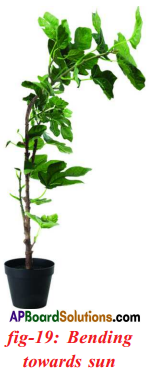
Answer:
Carbon dioxide is released.
The released CO2 passes into lime water it turns milky.

AP SSC 10th Class Biology Important Questions Chapter 2 Respiration

Question 7.
Observe the following diagram and answer the following questions.
AP SSC 10th Class Biology Important Questions Chapter 2 Respiration 14

  1. What do we call the membranes that cover the lungs?
  2. What is the functional unit of lungs ?
  3. Which part produces the sound ?
  4. What does ‘X’ denote ?

Answer:

  1. Pleura
  2. Alveoli
  3. Larynx
  4. Trachea

Question 8.
Observe the diagram and answer the following questions.
AP SSC 10th Class Biology Important Questions Chapter 2 Respiration 15
a) What does the given diagram indicate?
b) What is the part ‘X’ in the diagram?
c) What is the function of the given picture?
d) To which system the given picture belongs to?
Answer:
a) The given diagram indicates mitochondria.
b) Matrix
c) Performing cellular respiration and releasing energy in the form of ATP.
d) Respiratory system.

Question 9.
Observe the experimental setup and answer the given questions.
AP SSC 10th Class Biology Important Questions Chapter 2 Respiration 12A) What is the aim of this experiment?
B) What are the apparatus required for this experiment?
C) What changes do you observe in thermometer during this WKm experiment?
D) What will happen, if dry seeds are taken instead of germinating seeds in this experiment?
Answer:
A) Heat is liberated during respiration.
B) Glass jar, Germinating seeds, Cork and Thermometer.
C) We can notice the raise in temperature after observing the thermometer readings.
D) There will be no change of temperature in the thermometer. We can’t prove the aim of the experiment.

Question 10.
Observe the below diagram and answer the following questions:
AP SSC 10th Class Biology Important Questions Chapter 2 Respiration 11i) What does the above setting (diagram) indicate?
Answer:
The above setting (diagram) indicates to prove that carbon dioxide and heat are liberated during anaerobic respiration by yeast cells.

ii) Why is boiled and cooled glucose covered with paraffin?
Answer:
To prevent supply of air, boiled and cooled glucose is covered with paraffin.

iii) What is the use of adding diazine green to glucose solution? What change you notice in glucose solution?
Answer:
Diazine green is added to glucose solution to know whether oxygen is present or not in glucose solution. When the availability of oxygen is less the diazine green changes to pink colour.

iv) Why is lime water used in this experiment?
Answer:
To know whether carbon dioxide is released or not in this experiment lime water is used. Carbon dioxide changes lime water to milky white.

v) Why is bulb of thermometer dipped in the glucose water?
Answer:
To know the rise in temperature of glucose solution when heated, the bulb of thermometer is dipped in the glucose water.

AP SSC 10th Class Biology Important Questions Chapter 2 Respiration

Question 11.
Explain with the help of a flow chart, the path way of air in humans.
Answer:
AP SSC 10th Class Biology Important Questions Chapter 2 Respiration 8

Question 12.
Study the graph and answer the following questions :
AP SSC 10th Class Biology Important Questions Chapter 2 Respiration 16Graph showing effects of vigorous excercise on the concentration of lactic acid in blood.
i) What was the concentration of lactic acid in blood to start with?
ii) What was the greatest concentration of lactic acid reached during the experiment?
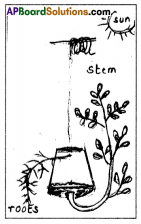
iii) What is the concentration of lactic acid after 25 minutes of exercise?
iv) What is the relationship between lactic acid and muscle pain?
Answer:
i) 20 mg/cm3
ii) 20 minutes (Or) at “B” point,
iii) 101 mg/cm3
iv) If concentration of lactic acid increases, muscle pains also increases.

Question 13.
Observe the following :
AP SSC 10th Class Biology Important Questions Chapter 2 Respiration 17
Write the answers to the following questions:
i) How many Pyruvic acid molecules form from one Glucose?
Answer:
2 Pyruvic acid molecules.

ii) What conditions influence Pyruvic acid to participate in Aerobic and Anaerobic respiration?
Answer:
Presence of oxygen

iii) In which we get more energy in both Aerobic and Anaerobic respirations?
Answer:
Aerobic respiration

iv) The chemical that is formed in human muscles during Anaerobic respiration.
Answer:
Lactic acid

Question 14.
Why does the exchange of gases happen only in alveoli, though arteries are present in pharynx, trachea and bronchus?
Answer:

  1. Alveoli are tiny air sacs in the lungs surrounded by capillaries
  2. They are numerous and only single cell thickness
  3. They increase the efficiency of gas exchange.
  4. Due to the difference in a gradient of O2 oxygen diffuse from alveoli to blood capillaries.

Question 15.
What are the events or steps in respiration?
Answer:
The following are the events or steps in respiration.

  1. Breathing: Air moves into lungs and out of lungs.
  2. Gaseous exchange in lungs: Exchange of gases between alveoli and blood.
  3. Gas transport by blood: Transport of oxygen from blood capillaries of alveoli to body cells and return of carbon dioxide.
  4. Gaseous exchange in cells: Exchanging oxygen from blood into the cells and carbon dioxide from cells into the blood.
  5. Cellular respiration: Using oxygen in cell processes to produce carbon dioxide and water, releasing energy to be used for life processes.

AP SSC 10th Class Biology Important Questions Chapter 2 Respiration

Question 16.
What will happen if the respiratory tract is not moist? (OR)
Why respiratory tract should be moist?
Answer:

  1. If the respiratory tract is not moist the dirt particles in the inhaled air will not be removed from air in the nasal cavities and reaches lungs and creates problems to lungs.
  2. The temperature of the inhaled air is brought close to that of the body for the smooth passage in the respiratory tract. If it is dry, it is not possible.
  3. If the surface dries out, gas exchange will happen at a very reduced rate since fast moving gaseous oxygen molecules do not efficiently cross the alveoli membrane.
  4. The reduced gas exchange is most likely not enough to support blood oxygenation for vital functions.
  5. Hence respiratory tract should be moist for smooth exchange of gases.

Question 17.
Explain the process of transportation of gases through the blood.
Answer:

  1. The relative amount of gases and their combining capacity with haemoglobin and other substances in blood determine their transport via blood in the body.
  2. When oxygen present in the air is within normal limits (around 21%) then almost all of it is carried in the blood by binding to haemoglobin, a protein present in the red blood cells.
  3. As oxygen is diffused in the blood, it rapidly combines with the haemoglobin to form oxyhaemoglobin.
  4. Not only can haemoglobin combine with oxygen, but it can easily broken into haemoglobin and oxygen.
  5. Carbon dioxide is usually transported as bicarbonate, while some amount of it combines with haemoglobin and rest is dissolved in blood plasma.
    AP SSC 10th Class Biology Important Questions Chapter 2 Respiration 18

Question 18.
Why is human life impossible at higher altitudes without a supplementary supply of oxygen? (OR)
The concentration of oxygen in air decreases as we go up from sea level. Explain briefly.
Answer:

  1. If haemoglobin is exposed to air at sea level, every molecule in air combines with oxygen to form oxyhaemoglobin.
  2. At a height of 13 km above sea level, the concentration of oxygen is much lower about l/5th of a sea level.
  3. Under these conditions about half as many molecules of oxygen combine with haemoglobin to form oxyhaemoglobin.
  4. Blood cannot carry enough oxygen to the tissues.
  5. Hence human life is impossible at such a high altitude without a supplementary supply of oxygen.
  6. Provision for such a supply is built into modern aircraft which have pressurized cabins that maintain an enriched air supply.

Question 19.
What are the different ways in which glucose is oxidised to provide energy in various organisms? Give one example of each.
How does oxidation of glucose occur in various organisms?
Answer:

  1. Glucose is the most commonly used sugar for deriving energy in plants, animals and in microorganisms.
  2. In all these organisms glucose is oxidized in two stages.
  3. The first stage is known as Glycolysis. It occurs in cytoplasm.
  4. During glycolysis glucose is converted to two molecules of pyruvic acid.
  5. In the second stage if oxygen is available pyruvic acid is converted to C02 and water, large amount of energy is released. This is known as aerobic respiration. It occurs in most of the plant and animal cells.
  6. If oxygen is inadequate or not available, pyruvic acid is converted into ethanol and carbon dioxide. This is anaerobic respiration taking place in yeast cells that is called fermentation.
  7. If oxygen is not available in muscle cells, the pyruvic acid is converted into lactic acid.
    AP SSC 10th Class Biology Important Questions Chapter 2 Respiration 19

AP SSC 10th Class Biology Important Questions Chapter 2 Respiration

Question 20.
Write the adaptations seen in plants living in water logged conditions.
(OR)
What are the adaptations seen in magrove plants?
Answer:

  1. Most plants can aerate their roots by taking in the oxygen through lenticels or through the surface of their root hairs.
  2. But plants which have their roots in very wet places, are unable to do this.
  3. They are adapted to these water logged conditions by having much larger air spaces which connect the stems with the roots, making diffusion from the upper parts much more efficiently.
  4. The problem of air transportion is more difficult for trees and may not survive with their roots permanently in water.
  5. To overcome this problem the mangrove tree of the tropics which raise up aerial roots above the surface and takes in oxygen.

Question 21.
Describe the mechanism of branchial or gill respiration in fishes.
(OR)
Briefly explain the process of exchange of gases in fishes during respiration.
Answer:

  1. Some aquatic animals like fishes have developed special organs for respiration which are known as gills or branchiae.
  2. Blood is supplied to gills through capillaries which have thin walls where gases are exchanged. Gills are present in the gill pouches or branchial pouches.
    AP SSC 10th Class Biology Important Questions Chapter 2 Respiration 20
  3. Gills are provided with leaf-like folds called gill lamellae.
  4. Fish keeps its mouth open and lowers the floor of the oral cavity. As a result water from outside will be drawn into the oral cavity.
  5. Now the mouth is closed and the floor of the oral cavity is raised.
  6. Water is pushed into the pharynx and is forced to gill pouches through internal branchia apertures.
  7. When water passes through gill lamellae exchange of gases takes place, that is oxygen diffuses from water to blood and CO2 from blood into water.
  8. Then water flows through external branchia aperture.

Question 22.
Explain briefly about Pranayama- the art of breathing. (OR)
How can the capacity of lungs be improved by yoga?
Answer:

  1. To improve breathing capacity the saint Patanjali developed Yogabyasa.
  2. The art of breathing in Yogabyasa is called Pranayama. Prana means gas, ayama means journey.
  3. In Pranayama practice air is allowed to enter three lobes of lungs in order to in¬crease the amount of oxygen to diffuse into blood.
  4. More amount of oxygen available to brain and tissues the body will be more active.
  5. It is very important to practise Pranayama regularly to make our life healthy and active.
  6. All people irrespective of age and sex should practise Pranayama under the guidance of well trained Yoga Teacher to improve the working capacity of lungs.

Question 23.
What are the experiments carried out by Lavoisier to understand the property of gases?
Answer:

  1. In his early experiments Lavoisier thought that the gas liberated on heating powdered charcoal in a bell jar kept over water in a trough was like fixed air i.e., carbon dioxide.
  2. The next series of experiments deals with the combustion of phosphorous in a bell jar. From this he showed that whatever it was in the atmospheric air which combined with the phosphorous was not water vapour.
  3. This was respirable air, a component of air that also helped in burning.
  4. The air that we breathe out precipitated lime water while that after heating metal did not.
  5. From this, he concluded that there were two processes involved in respiration.
  6. Lavoisier carried out another experiment by which he showed that about one sixth of the volume of ‘vitiated air’ consists of chalky acid gas (fixed air).
  7. Either eminently respirable air is changed in the lungs to chalky acid air; or an exchange takes place, the eminently respirable air being absorbed, and an almost equal volume of chalky acid air being given up to the air from the lungs.
  8. Lavoisier had to admit that there were strong grounds for believing that eminently respirable air did combine with the blood to produce the red colour.

AP SSC 10th Class Biology Important Questions Chapter 2 Respiration

Question 24.
Explain the evolutionary changes in energy-releasing system.
(OR)
What are the different respiratory systems in animal groups?
Answer:
Exchange of gases is a common life process in all living organisms, but it is not same in all.

  1. Diffusion:
    1. Single-celled organisms like amoeba or multicellular organisms like hydra and planarians obtain oxygen and expel carbon dioxide directly from the body by the process of diffusion.
    2. In multicellular animals special organs are evolved.
    3. Body size, availability of water and the type of circulatory system are some of the reasons for the animals to develop different types of respiratory organs.
  2. Tracheal respiratory system : In insects tracheal respiratory system is present in which small branches of trachea called trachioles carry air directly to the cells in the tissues.
  3. Bronchial respiration : In fishes gills are utilised for the exchanges of gases. Blood is supplied to gills through capillaries which have thin walls for exchange of gases. This is called bronchial respiration.
  4. Cutaneous respiration: 0 Respiration through skin is called cutaneous respiration.
    Eg: i) Earth worms and leeches.
    ii) Frog, an amphibian can respire through lungs and skin.
  5. Pulmonary respiration : Most of the higher animals respire with the help of lungs. This type of respiration is known as pulmonary respiration. Eg: Mammals.

Question 25.
Describe the structure of mitochondria with the help of a diagram. (OR)
Which cell organelle is called energy currency or power house of cell? What do you know about its construction?
Answer:
Mitochondria is known as energy currency or power house of cell.
Structure of mitochondria:
AP SSC 10th Class Biology Important Questions Chapter 2 Respiration 21

  1. Mitochondria are sac-like structures present in the cytoplasm of the cells.
  2. Mitochondria have two compartments-an inner compartment and an outer compartment. The substance in the inner compartment is called matrix.
  3. The matrix is surrounded by a membrane called inner membrane of mitochondria.
  4. The inner membrane is thrown into several folds called cristae. The cristae extended into the matrix.
  5. The space between the folds is continuous with the outer compartment.
  6. On the inner membrane, projecting into the matrix are a large number of particles called elementary particles.
  7. These particles have a spherical head and a stalk. They are attached to the inner membrane by their stalk and the head portion of the particle is in the matrix.
  8. The outer compartment is surrounded by another membrane – the outer membrane. The outer membrane is smooth and has no projections.
  9. The inner membrane, the matrix and the elementary particles in the mitochondria have large number of enzymes and other required proteins for the respiration and energy production.

AP SSC 10th Class Biology Important Questions Chapter 2 Respiration

Question 26.
Draw and label mitochondria. Why should we call it cell of power ?
Answer:

AP SSC 10th Class Biology Important Questions Chapter 2 Respiration 22Oxidation of glucose molecule occurs in the mitochondria, ot cell. This is known as cellular respiration. The energy produced during cellular respiration stored in the form of ATP molecule. Energy producing cellular respiration occurs in mitochondria hence we call it cell of power or power house of the ceil.

Question 27.
Describe how oxygen enters the blood in lungs with the help of block diagram.
(OR)
How does gaseous exchange occur in lungs?
Answer:

  1. Gaseous exchange takes place within the lungs by diffusion from the alveoli to blood capillaries and vice versa. Alveoli in lungs are numerous and only one cell thick.
    AP SSC 10th Class Biology Important Questions Chapter 2 Respiration 23
  2. Alveoli are surrounded by capillaries that are also one cell thick.
  3. Blood, dark red in colour flows from the heart through these capillaries and collects oxygen from the alveoli.
    At the same time, carbon dioxide passes out of the capillaries and into the alveoli.
  4. When we breathe out, we get rid of carbon dioxide.
  5. The bright red, oxygen rich blood is returned to the heart and pumped out to all parts of the body.

AP SSC 10th Class Biology Important Questions Chapter 2 Respiration

Question 28.
What is the role of diaphragm and ribs in respiration? Are both active in man and woman?
Answer:
Diaphragm:

  1. Diaphragm is a muscular dome shaped tissue present at the floor of the chest cavity separating abdomen from respiratory system.
  2. Diaphragm expands downwards into the abdomen thus increasing chest cavity. This allows the lungs to expand as we inhale.
  3. As the diaphragm contracts upwards thus decreasing the chest cavity, it allows the air to expel from the lungs.
    Ribs:
  4. The ribs protect the lungs and expand as we inhale to facilitate space for the lungs to expand. The ribs then contract expelling the air from the lungs.
  5. The intercostal muscles present between the ribs help in contraction and relaxation of ribs.
  6. In man, diaphragm plays a major role in the respiration, while in woman, the ribs play a major role.

Question 29.
Why are alveoli so small and uncountable in number? (OR)
How do alveoli increase the area for exchange of gases?
Answer:

  1. The pouch-like air sacs at the ends of the smallest branchioles are called alveoli.
  2. The walls of the alveolus are very thin and they are surrounded by very thin blood capillaries.
  3. It is in the alveoli that gaseous exchange takes place.
  4. There are millions of alveoli in the lungs. The presence of millions of alveoli in the lungs provides a very large area for the exchange of gases.
  5. And the availability of large surface area maximises the exchanges of gases.

Question 30.
Write a brief note on respiration in plants. (OR)
Does respiration occur in plants? Explain briefly about it.
Answer:

  1. In most plants exchange of gases takes place through stomata.
  2. There are other areas on the plant body like surface of roots, lenticels on stem, etc. the gaseous exchange takes place.
    AP SSC 10th Class Biology Important Questions Chapter 2 Respiration 24
  3. Some plants have specialized structures like breathing roots of mangrove plants as well as the tissue in orchids.
  4. Breathing roots and tissue in orchids help plants to take oxygen to produce energy and release carbon dioxide.
  5. Inside the plants openings lead to a series of spaces between the cells which form a continuous network all over the plant.
  6. The whole system works by diffusion.
  7. As the oxygen is used up by the cells a gradient develops between the cells and the air in the spaces.
  8. So oxygen passes in between the air spaces and the air outside stomata and lenticels.
  9. In the same way, as more carbon dioxide is given out by the cells, a gradient occurs in the reverse direction and it passes out.

AP SSC 10th Class Biology Important Questions Chapter 2 Respiration

Question 31.
Write a brief note on tracheal respiration in insects.
Answer:

  1. In insects blood do not contain haemoglobin, and blood is white in colour. Hence it cannot carry oxygen.
  2. For respiration insects adopt a special system called tracheal system.
    AP SSC 10th Class Biology Important Questions Chapter 2 Respiration 25
  3. This system consists of a series of tubes called trachea.
  4. These trachea open out through small apertures called spiracles on either side of the body.
  5. All tracheal tubes of each side join and form a longitudinal tracheal trunk.
  6. Trachea divide into a number of branches called tracheoles which carry air directly to the tissues.
  7. As the air moves in and out of the trachea, oxygen present in the air diffuses into the cells and CO2 diffuses into the air from the cells.

Question 32.
Write about the mechanism of respiration in human beings. (OR)
How does exchange of gases take place in human beings?
Answer:

  1. Respiration in man occurs in two stages. They are inspiration and expiration.
  2. During inspiration air from outside enters into the lungs by increasing the chest cavity.
    AP SSC 10th Class Biology Important Questions Chapter 2 Respiration 26
  3. Increase in the chest cavity is made by pulling the diaphragm down and pushing the ribs forward.
  4. As the air pressure in the lungs is reduced, air from outside enters the lungs through external nostrils, nasal cavities, internal nares, pharynx, epiglottis, larynx, trachea, bronchi and branchioles and finally reach the alveoli where exchange of gases takes place.
  5. During expiration the diaphragm and ribs come back to original positions.
    AP SSC 10th Class Biology Important Questions Chapter 2 Respiration 27
  6. This reduces the volume of chest cavity.
  7. So the volume of lungs is decreased and air under pressure comes out of the lungs.

AP SSC 10th Class Biology Important Questions Chapter 2 Respiration

Question 33.
Study the graph given below and analyse the reasons for accumulation of lactic acid in blood after strenuous exercise.
AP SSC 10th Class Biology Important Questions Chapter 2 Respiration 28AP SSC 10th Class Biology Important Questions Chapter 2 Respiration 29
Answer:

  1. This graph shows the relation between time accumulation of lactic acid in the muscles.
  2. At the beginning, the amount of lactic acid in the blood is very less.
  3. Gradually it is increased by vigorous exercise.
  4. Within 15 minutes it goes to maximum level which causes muscle pain.
  5. Then the lactic acid is removed from muscles in an hour.
  6. Muscles produce energy by anaerobic respiration.
    C6H12O6 → lactic acid + CO2 + energy
  7. In the vigorous exercise, muscle work rapidly and produce more lactic acid.
  8. That’s why lactic acid concentration is increased in muscle after strenuous exercise.

Question 34.
Observe the above graph of lactic acid accumulation in the muscles of an athlete and answer the following questions.
a) What was the concentration of lactic acid in the blood to start with?
Answer:
It is 20 mg/km3.

b) What was the greatest concentration reached during the experiment?
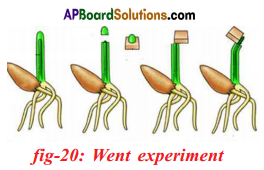
Answer:
101 mg/cm3.

c) If the trend between points C and D were to continue at the same rate, how long might it take for the original lactic acid level to be reached once again?
Answer:
55 minutes.

d) What does high level of lactic acid indicate about the condition of respiration?
Answer:
It indicates the accumulation of lactic acid in muscles through anaerobic respiration. The presence of lactic acid in the blood is the main cause of muscular pain and fatigue.

AP SSC 10th Class Biology Important Questions Chapter 2 Respiration

Question 35.
Describe the structure of human lungs with the help of a diagram.
AP SSC 10th Class Biology Important Questions Chapter 2 Respiration 30
Answer:

  1. A pair of lungs is present in the chest cavity one on either side of the heart.
  2. Lungs are spongy and elastic. They are enclosed by two membranes called pleura.
  3. Space between the two membranes of pleura is filled with fluid. Pleura protects the lungs from injury.
  4. Right lung is larger than the left lung.
  5. Right lung is made of three lobes while the left lung has only two lobes.
  6. Lung has several thousands of alveoli which are supplied with blood capillaries.
  7. Pulmonary artery brings deoxygenated blood from heart to lungs.
  8. After entering the lung, this artery divides into several arterioles and capillaries and supplies deoxygenated blood to alveoli.
  9. Gas exchange occurs in the alveoli.
  10. Oxygenated blood is carried from the lung to heart by the pulmonary vein.

Project work
Question 1.
Observe and analyse the questions in the table given below.

Newly borned (Children) (Children) Children Youth/Adults Athletics
(0-3 months) (3-6 months) (6-12 months) (1-10 years)
Heart beat 100 -150 90-120 80 -120 70-130 60-100 40-60

A) In which age group rate of heart beat is more?
B) In which age group rate of heart beat is less?
C) Why heart beat in Athletics is less?
D) What are reasons for more rate of heart beats differences between the newly born and children?
Answer:
A) In newly borned babies which are in 0 – 3 months of age group rate of heart beat is more i.e., 100 to 150 times.
B) In athletics the rate of heart beat is less i.e., 40 – 60 times / minute.
C) The heart of athlete pump more blood per beat due to increased cardio-vascular fitness in the structure of the heart. The muscles in the heart wall thicken and the heart pumps more blood with each beat.
D)

  1. Mothers who have special medical conditions such as thyroid diseases or diabetes may give birth to new borns who are temporarily tachscardic from altered hormone and glucose levels. Tachycardia is a medical term for a very rapid heart beat.
  2. Some infants are born with accessory electrical tissue in the heart causes epi¬sodes of rapid heart rate.
  3. In wolf – parkinson syndrome – white syndrome there are extra cells and an ac-cessory path way, causing additional heart beats.

AP SSC 10th Class Biology Important Questions Chapter 2 Respiration

Question 2.
Observe the table given below and analyse the questions.

Name of the animal Weight of the body Weight of the heart No. of beats/min
Blue whale 1,30,000 kg 750 kg 7
Elephant 3000 kg 12-21 kg 46
Man 60 – 70 kg 300 gm 76
Coaltit (Bird) 8 gm 0.15 gm 1200

A) Why heart beat is less in animals with more weight?
B) Why heart beat is more in animals with less weight?
C) What is the relationship between weight of the body and rate of heart beat?
D) Why the weight of heart is less than body weight?
Answer:
A) The animals with more weight usually have weighted hearts. In one heart beat the large-sized hearts sends high amounts of blood to circulatory system. It takes time for the fulfilment of heart. Hence heart beat is less in animals with more body weight.
B) Usually the heart is very small in less weight animals. When the animal shrinks or contracts , its heart actually decrease the volume of blood proportionately. It can compensate for the reduced volume by increasing the rate at which it can supply blood to all body parts.
C) As the weight of the body of the animal increases the rate of heart beat per minute decreases. And also as the weight of the body decrease the rate of heart beat increases.
D) Usually the body of an organism is made by number of organs which makes the body functional. As all the body parts constitute the whole organism, the heart one of the organ is usually has less weight than body weight of an animal.
AP SSC 10th Class Biology Important Questions Chapter 2 Respiration

AP SSC 10th Class Biology Solutions Chapter 7 Coordination in Life Processes

AP State Board Syllabus AP SSC 10th Class Biology Solutions Chapter 7 Coordination in Life Processes Textbook Questions and Answers.

AP State Syllabus SSC 10th Class Biology Solutions 7th Lesson Coordination in Life Processes

10th Class Biology 7th Lesson Coordination in Life Processes Textbook Questions and Answers

Improve your learning

Question 1.
What do you mean by hunger pangs?
Answer:

  1. When glucose levels in the blood fall, hunger pangs occur in the stomach.
  2. Ghrelin hormone is secreted in the stomach when it goes empty.
  3. Ghrelin is secreted from certain cell walls of the stomach.
  4. Hunger contractions (hunger pangs) start to occur in the stomach due to secretion of ghrelin hormone.
  5. Hunger pangs continue up to 30 – 45 minutes.
  6. An increase in Ghrelin levels results in sensation of hunger and motivation to consume food.

AP SSC 10th Class Biology Solutions Chapter 7 Coordination in Life Processes

Question 2.
What are the organ systems involved in the digestion of food which we eat?
Answer:
The organ systems involved in the digestion of food are:

  1. endocrine system,
  2. nervous system,
  3. muscular system,
  4. circulatory system and
  5. excretory system.

Question 3.
Rafi said smell also increases our appetite. Can you support this statement ? How?
Answer:

  1. Yes. I support the statement made by Rafi that smell also increases our appetite.
  2. When we smell, the air borne substances get dissolved in the watery film of nasal mucus.
  3. The chemoreceptors which are otherwise called olfactory receptors present in the nose trigger signals in the form of nerve impulses to the brain where the smell is detected.
  4. However interactions between the senses of taste and smell enhance our appetite.

Question 4.
Write a note on peristalsis and sphincter function in the stomach.
Answer:
A) Peristalsis functions in stomach:

  1. Contraction and relaxation of the muscles present in the stomach bring in a wave-like motion called peristalsis.
  2. The contraction of the stomach muscles squeeze and mix the food with the acids and juices of the stomach.
  3. Mechanical mixing of food in stomach occurs by peristalsis. This allows the mass of food to further mix with the digestive enzymes.
  4. Peristalsis in stomach is involuntary and under the control of the autonomous nervous system.

B) Sphincter functions in the stomach:

  1. Pyloric sphincter is present at the opening of the stomach into the duodenum (small intestine).
  2. The pyloric sphincter allows only small quantities of food into duodenum at a time.

AP SSC 10th Class Biology Solutions Chapter 7 Coordination in Life Processes

Question 5.
Observe the given part of the digestive system. What is it ? What is it’s role during digestion ?
Answer:

  1. The given part is the LARGE INTESTINE in the human digestive system:
    AP SSC 10th Class Biology Solutions Chapter 7 Coordination in Life Processes 1
  2. If creates peristaltic waves to send waste material called stool or faeces into the rectum.
  3. In the large intestine water and mineral salts are absorbed from the waste material.
  4. The faecal matter containing indigested food material, bile pigments and dead bacteria is formed in the large intestine.
  5. It is stored in the rectum and expelled out of the body through the Anus.

Question 6.
Give reasons.
a) If we press the tongue against the palate, we can recognize taste easily.
Answer:
Reason :

  1. When the tongue is pressed against the palate, the food substance is pressed against the opening of the taste bud letting it to reach the taste cells and triggering taste signals.
  2. Finally, the taste is recognized in the brain.

b) We can’t identify taste when food is very hot.
Answer:
Reason:

  1. Most of the taste buds on the tongue are killed when the food is hot.
  2. This prevents the person from identifying the taste.
  3. The perception of taste decreases when the temperature of the food rises beyond 35°C.
  4. But we don’t pay attention to it because we become worried about the burning feeling.

c) If glucose level falls in blood, we feel hungry. (OR) €EI June 2015
We feel hungry if the blood glucose level falls down. 03 June 2019
Answer:
Reason :

  1. When glucose levels in the blood fall, we get hunger pangs in stomach.
  2. Hungry feeling start to occur in the stomach due to hunger generating signals that the brain from the stomach due to the secretion of the hormone ‘Ghrelin’.

d) Small intestine is similar to a coiled pipe. (OR)
Why is the small intestine long and coiled?
Answer:
Reason :

  1. The length of small intestine is 7 meters long.
  2. It is coiled so as to fit in the human body.
  3. It is coiled to increase surface area and maximum nutrient absorption when food passes through it.

e) Urination increases when we take lot of fluids.
Answer:
Reason:

  1. When we take lot of fluids, the kidneys will efficiently throw the water out by forming more urine than usual.
  2. When there is excess water in the body, the brain usually produces less of a hormone called vasopressin.
  3. This in turn causes the kidneys to produce a lot of dilute urine, until excess water is removed.

f) The process of digestion goes on in a person whose central nervous system has been largerly affected.
Answer:
Reason :

  1. The enteric nervous system embedded in the walls of the long tube of our gut or alimentary canal control gut functions often independently of the brain.
  2. The mass of neural tissue of enteric nervous system filled with important neurotransmitters reveals that it does much more than merely handle digestion.

AP SSC 10th Class Biology Solutions Chapter 7 Coordination in Life Processes

Question 7.
Write differences between the following:
a) Bolus – Chyme
b) Small intestine – Large intestine
c) Mastication – Rumination
d) Propulsion – Retropulsion
Answer:
a) Bolus – Chyme:

Bolus Chyme
1. Food that is masticated in the mouth. 1. It is the partially digested food in the stomach.
2. Alkaline in nature. 2. Acidic in nature.
3. Teeth and saliva turn food into bolus. 3. Stomach turn food by peristalsis into chyme.
4. Soft round ball of food that has been chewed. 4. It is the liquified part of food.
5. Food goes from mouth to stomach. 5. Food goes from stomach to small intestine.

b) Small intestine – Large intestine:

Small intestine Large intestine
1. It is longer and has small width. 1. It is shorter and has broad width.
2. It is in between the stomach and large intestine. 2. It is the last part of the digestive system.
3. Digestive juices release from liver, pancreas. 3. Digestive juices are not released into large intestine.
4. Food is completely digested in it. 4. Absorption of water from the undigested food takes place in it.
5. It has three parts – duodenum, jejunum and ileum. 5. It has four parts – caecum, colon, rectum and anal canal.
6. Villi helps in absorption of digested food. 6. Villi are absent in large intestine.

c) Mastication – Rumination:

Mastication Rumination
1. Grinding, chewing and shredding of food in the mouth by teeth is called mastication. 1. It is the chewing of cud that come from a part near the stomach of the animal to its mouth.
2. Mastication occurs only one time in the oral cavity. 2. Rumination allows food to undergo mastication more than once.
3. This is also known as chewing the food. 3. This is also known as chewing the cud.
4. It makes the food particles to tiny particles. Does not involve nutrient absorption. 4. It allows greater nutrients to be extracted and absorbed from the food particles.
5. It occurs in most of the animals (mammals), eg: Human being 5. It occurs only in ruminate animals.
eg: Cow

d) Propulsion – Retropulsion:

Propulsion Retropulsion
1. It is a means of creating force leading to movement of food. 1. It is a situation in which something (food) is pushed or forced backwards.
2. Peristaltic waves move food from one part to the other. 2. Small amount of chyme is pushed into duodenum, simultaneously forcing most of it back into the stomach.

AP SSC 10th Class Biology Solutions Chapter 7 Coordination in Life Processes

Question 8.
How can you say that mouth is a munching machine?
Answer:

  1. Mouth plays a major role in changing the texture of food.
  2. The circular muscles of the mouth enable the food to be pushed into the oral cavity and to be moved around.
  3. The teeth grind, chew and shred the food.
  4. The surface muscles of the jaw help in biting and chewing actions, while the deep muscles of the jaw move up, down, forward and backward during food mastication.
  5. The teeth help in cutting and grinding while tongue movements evenly spread out the food and help in mixing it with saliva.
  6. The muscles of the mouth enable the food to be pushed in the oral cavity and to be moved around.
  7. By all this we can say that mouth is a munching machine.

Question 9.
What is mastication? Explain the role of different sets of teeth in this process.
Answer:
Mastication: Food can not be swallowed directly. So it must be grinded, chewed and shred. This process of grinding, chewing and shredding is called ’MASTICATION’.
AP SSC 10th Class Biology Solutions Chapter 7 Coordination in Life Processes 2Role of different sets of teeth in mastication:

  1. In the oral cavity of human beings, 32 teeth and they are 4 different types to perform different functions.
  2. They are a) Inscisors b) Canines c) Premolars d) Molars
    a) Inscisors: These are eight in number and have chisel shape. They have sharp edges and are specialized for cutting and biting the food.
    b) Canines: These are four in number and are with pointed edges- These are designed for piercing and tearing food.
    c) Premolars: These are eight in number and are also called cheek teeth. These are designed for crushing and grinding food.
    d) Molars: These are 12 in number. They are designed for crushing and grinding food.

AP SSC 10th Class Biology Solutions Chapter 7 Coordination in Life Processes

Question 10.
During the journey of food from the mouth to stomach through oesophagus, how does muscular system coordinate in this process?
Answer:
Movement of food (bolus) from mouth to stomach through oesophagus is influenced by the coordination between muscular system and nervous system.
Muscular movement in mouth:

  1. The circular muscles of the mouth enable the food to be pushed into the oral cavity and to be moved around.
  2. The surface muscles of the jaw help in biting and chewing actions while the deep muscles move the jaw up and down, forward and backward during mastication.

Muscular movement in oesophagus:

  1. The wall of the oesophagus is made up of two kinds of smooth muscles.
  2. The inner layer consists of circular muscles and the outer layer is of longitudinal muscles.
  3. Contraction of circular muscles lead to narrowing of the oesophagus behind the bolus. So the food is squeezed downwards.
  4. Contraction of the longitudinal muscles in front of the bolus widens the tube, results in shortening of particular part of oesophagus.
  5. In this way food moves easily and enters the stomach. ,
  6. Contraction and relaxation of oesophagus muscles bring peristaltic movements.

Question 11.
Is there any reason for the intestine to be coiled with many folds ? In what way it is helpful during the process of digestion? (OR)
Small intestine is similar to a coiled pipe. Give reason.
Answer:

  1. Yes, there is a reason for the intestine to be coiled with many folds.
  2. The coiled and folded nature of intestine slows down the passage of food along the intestine and afford an increased surface area for absorption.
  3. It also increases the surface area for the intestine to increase the absorption of nutrients through finger-like projections villi.
  4. The folded and coiled intestine absorbs nutrients and water more than they breakdown.

Question 12.
What is the function of peristalsis in these parts?
a) Oesophagus b) Stomach c) Small intestine d) Large intestine
Answer:
a) Oesophagus:
Peristalsis helps in pushing the food, down the oesophagus into the stomach.

b) Stomach:

  1. Peristalsis helps in storing food, breaking down food down and mixing it with juices secreted by stomach lining.
  2. Peristalsis in stomach helps in partial digestion of food.

c) Small intestine:

  1. Peristalsis pushes the digesting food through small intestine.
  2. It helps to mix the chyme to help in the digestive process.
  3. Peristalsis also helps in absorbing nutrients from the digesting food into the blood.

d) Large intestine:
Peristaltic movements help to propel feces along the large intestine through colon, to the rectum for expulsion from the body.

AP SSC 10th Class Biology Solutions Chapter 7 Coordination in Life Processes

Question 13.
How can you justify the enteric nervous system as the second brain of the gut?
(OR)
Write about the nervous system present beneath the digestive system.
Answer:

  1. The enteric nervous system, the second brain consists of sheaths of neurons embedded in the walls of the long tube of our gut, or alimentary canal.
  2. The second brain measures about nine meters to end from the oesophagus to the anus.
  3. The second brain contains some 100 million neurons, more than in either the spinal cord or the peripheral nervous system.
  4. This multitude of neurons in the enteric nervous system enables us to “feel” the inner world of our gut and its contents.
  5. Enteric nervous system contains mass of neural tissue filled with important neurotransmitters.
  6. This reveals that it does much more than merely handling digestion or inflict the occasional nervous pang of hunger.
  7. Enteric nervous system stimulates and coordinates the breaking down of food, absorbing nutrients and expelling of waste.
    Thus equipped with its own reflexes and senses, the second brain can control several gut functions often independently of the brain.
  8. Several scientists also believe that the enteric nervous system is a way too complicated to have evolved only to make sure things move through and out of our gut smoothly.
  9. Hence we can justify that the enteric nervous system as the second brain of the gut.

Question 14.
Rajesh feels hungry upon seeing food. Sheela says no more food as she is not hungry. What makes Rajesh hungry and what suppresses Sheela’s hunger?
Answer:

  1. When glucose levels in the blood fall, we get hunger pangs in the stomach. Feeling hungry lies in the physiology of blood circulation.
  2. The secretion of the hormone GHRELIN starts in the stomach when it goes empty.
  3. Hunger contractions start to occur in the stomach due to hunger generating signals that reach the brain from the stomach due to ghrelin.
  4. So Rajesh effected with secretion of ghrelin in his stomach and he felt hungry when he saw food.
  5. Sheela was not affected with secretion of ghrelin in her stomach. She felt that her stomach is full.
  6. When we feel the stomach is full and there is no need of food any more, another hormone LEPTIN is secreted that supresses hunger.

Question 15.
How are taste and smell related?
(OR)
What is the relationship between taste and smell?
Answer:

  1. Taste and smell are closely related.
  2. This close relationship is most readily seen in how we perceive the flavours of food.
  3. Anyone with severe cough and cold cannot make out the difference in the taste of certain food items.
  4. Actually, what is really being affected is the flavour of the food , or the combination of taste and smell.
  5. That is because not only the taste but also the food odours are being defected.
  6. However, interactions between the senses of taste and smell enhance our perceptions of the foods we eat.
  7. Smell of the food flavour gives a similar taste to food.

Question 16.
List out the sphincter muscles of the food canal you have observed and give a brief description.
(OR)
What are the different types of sphincter muscles present in the digestive canal?
Answer:
There are different sphincter “muscles in the food canal. They are :

  1. Esophageal sphincter
  2. Cardiac sphincter
  3. Pyloric sphincter
  4. Anal sphincter and
  5. Ileocecal value or sphincter.

1. Esophageal sphincter:

  1. This allows entry of bolus into the oesophagus,
  2. It also reduces back flow from the oesophagus to pharynx.

2. Cardiac sphincter:

  1. It is present where oesophagus meets the stomach,
  2. It’s location is almost directly in front of the heart,
  3. It allows food from oesophagus into the stomach.

3. Pyloric sphincter:

  1. It is present at the opening called pylorus, located at the end of the stomach,
  2. Pyloric sphincter allows only small quantities of food into duodenum at a time.

4) Anal sphincter:

  1. It is located at the anus, the end of the digestive system,
  2. The release of waste is controlled partly, voluntarily by anal sphincter.

5) Ileocecal value:

  1. It is situated at the junction of the small intestine (ileum) and the large intestine (colon),
  2. It’s function is to limit the colonic contents into the ileum.

AP SSC 10th Class Biology Solutions Chapter 7 Coordination in Life Processes

Question 17.
What happens if salivary ducts are closed?
(OR)
What happens if saliva is not produced by salivary glands?
Answer:
If salivary ducts are closed the following consequences may occur:

  1. If salivary ducts are closed saliva will not release into the mouth, the mouth becomes dry.
  2. We can’t taste the food.
  3. Saliva secretes an enzyme called salivary amylase which breaks down the carbohydrates in food into dextrose and maltose sugar.
  4. If saliva is not secreted in the mouth carbohydrates remains unchanged digestion will not completed.
  5. Due to absence of saliva food will not get moistened, chewing and swallowing becomes difficult.
  6. If salivary ducts are closed, the salivary glands become swollen and it leads to pain.

Question 18.
If size and shape of small intestine is like oesophagus what will happen?
Answer:

  1. If size and shape of small intestine is like oesophagus the height of the person should be more than 22 feet as the length of the small intestine is about 22 feet. So it will not fit in the human body.
  2. For the complete digestion of the food to occur, it has to stay in small intestine for 3 to 4 hours.
  3. Otherwise digestion will not be completed and nutrients are not absorbed into blood . in the small intestine.
  4. The tube like nature of small intestine as that of oesophagus will not provide increased surface area for complete absorption of nutrients.

Question 19.
Prepare a questionnaire to understand nervous coordination in the digestion process.
(OR)
What are the questions you are going to ask your teacher about nervous coordination in the digestion process?
(OR)
Prepare a questionnaire for an interview with a doctor to understand the nervous coordination in the digestion process.
Answer:

  1. What is enteric nervous system?
  2. Why the enteric nervous system is known as second brain?
  3. How nervous system plays an important role in digestion of food?
  4. Which nervous system controls the release of saliva from salivary glands?
  5. Which cranial nerve controls the movement of muscles in the jaw?
  6. The mechanism for swallowing is under the control of?

AP SSC 10th Class Biology Solutions Chapter 7 Coordination in Life Processes

Question 20.
What experiment do you perform to understand action of saliva on flour? Explain it’s procedure and apparatus that you followed.
(Activity – 7)
(OR)
i) Explain the procedure followed in the experiment conducted to understand the action of saliva on starch.
ii) What apparatus and chemicals are used to do this experiment?
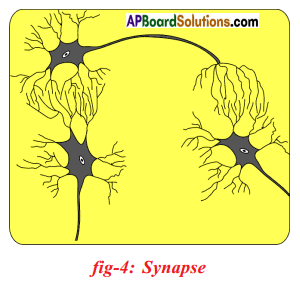
(OR)
Write the experiment you have performed in your school laboratory to know the action of Saliva on flour. How did you test the pH of Saliva?
(OR)
Explain the experiment conducted by your teacher in your class to show the action of saliva on the starch.
Answer:
Aim: To understand the action of saliva on flour.
Apparatus:

  1. Two test tubes
  2. Water
  3. Ata flour
  4. Water glass and
  5. Iodine solution.

Procedure:

  1. A test tube is taken and half of the test tube is filled with water.
  2. A pinch of flour is added.
  3. To mix flour with water, test tube as shaken.
  4. Few drops of flour mixture is taken in a watch glass and test for the presence of starch by putting a drop of diluted tincture Iodine in it.
  5. A blue black colour confirms the presence of starch.
  6. Divide the mixture into two equal halves by transferring it to another test tube.
  7. Both the test tubes have the same amount of solution.
  8. Add a teaspoon of saliva to one of the test tube and mark it.
  9. Do not add anything in the other test tube.
  10. After 45 minutes add a drop of dilute Tincture Iodine solution to test tubes containing the solutions.

Observation:

  1. Saliva containing flour mixture becomes slurry. It doesn’t show any change.
  2. But in the second test tube with only flour mixture turns blue colour.

Conclusion:

  1. Saliva in the test tube converts flour into sugar. So no change is observe here.
  2. In the second test tube containing only flour mixture turns blue black.

(OR)
i) Answer:

  1. Add a spoon of starch to the water taken in a test tube to make starch solution. Starch solution is divided into two equal parts in two test tubes.
  2. Add a little saliva to one of the above test tube and the other without adding saliva and keep them a side for some time.
  3. Add a drop of dilute iodine to both the test tubes. The test tube added with saliva doesn’t turns to blue black because the starch is broken down into smaller units called sugar by the saliva.
  4. The other part which is not added with saliva turns into blue black, as it has starch without any change.
    So this experiment proves saliva converts complex carbohydrates into simple sugars.

ii) Answer:
Test tubes, water glass, flour, iodine, saliva.

AP SSC 10th Class Biology Solutions Chapter 7 Coordination in Life Processes

Question 21.
Suggest a simple experiment to prove the role of palate in recognizing taste.
(OR)
How do you prove that palate has a role in recognizing taste?
(OR)
“Taste is connected to the tongue and palate”. Write an activity to prove it and write your observations.
Answer:
Experiment to prove the role of palate in recognizing taste
Aim: To prove the role of palate in recognizing taste.
Apparatus: Sugar crystals, Stop watch.
Procedure:

  1. Place some sugar crystals on the tongue.
  2. Keep mouth opened and see that tongue does not touch the palate.
    AP SSC 10th Class Biology Solutions Chapter 7 Coordination in Life Processes 3
  3. Record the time from the moment we placed the crystals on the tongue till we get the taste by using stop watch.
  4. Now repeat the test by placing the sugar crystals on the tongue pressing it against the palate.
  5. Record the time from placing sugar crystals to getting the taste.

Observation: From the above activity we know that taste can be identified easily when the tongue is pressed against the palate.
Result: We can easily identify the taste of the substance we can identify the taste of it in lesser time.

Question 22.
Collect information related to feeling hunger from your school library and prepare a note on it.
Answer:

  1. Generally we feel hunger when our stomach goes empty.
  2. When our stomach goes empty Ghrelin hormone is released and it causes the feeling of hunger.
  3. As well leptin hormone also released, but it causes the feeling of suppression of hunger.
  4. Not only these, when we saw a colourful and good smelling food, automatically we feel hunger. So, the sight of seeing a good food also causes feeling of hunger.
  5. If the food doesn’t have good colour, texture, good smell we can’t eat, even though it is a good food.
  6. All the feelings towards food are recieved by our eyes, nose, tongue.
  7. From these, information is sent to brain, from there signals are sent to stomach and causes feelings either positive or negative.
  8. Hormones are also responsible for most of the feelings of hunger.

AP SSC 10th Class Biology Solutions Chapter 7 Coordination in Life Processes

Question 23.
Draw the block diagram of showing sensation of taste from food material to brain.
Answer:
AP SSC 10th Class Biology Solutions Chapter 7 Coordination in Life Processes 4

Question 24.
Draw a neatly labelled diagram showing a peristaltic movement in oesophagus Explain the importance of mucus on the walls of food pipe.
(OR)
In the food pipe, the food bolus is propelled into the stomach by peristaltic movement Represent this action with a diagram.
Answer:
AP SSC 10th Class Biology Solutions Chapter 7 Coordination in Life Processes 5Importance of mucus on the walls of food pipe :

  1. The walls of the food pipe secrete a slippery substance called mucus.
  2. Mucus lubricates and protects the oesophgeal walls from damage.
  3. This helps the food bolus to slide down easily.
  4. Besides this the saliva in the bolus also helps in easy movement.

AP SSC 10th Class Biology Solutions Chapter 7 Coordination in Life Processes

Question 25.
Draw a schematic diagram of villus in small intestinp. Explain how digestive system coordinates with circulatory system.
(OR)
Draw the diagram of villi in small intestine and lable its parts.
Answer:
AP SSC 10th Class Biology Solutions Chapter 7 Coordination in Life Processes 6Coordination of digestive system with circulatory system :

  1. After the completion of digestion in small intestine, it enters into the blood through villi.
  2. In blood the digested food gets oxidised after that energy is released.
  3. Releasing of energy from fot^d occur only when it enter into the blood.
  4. So, there is a great coordination between digestive and

Question 26.
The mere smell or sight of food stimulates hunger . Describe the process through a neat diagram.
Answer:
AP SSC 10th Class Biology Solutions Chapter 7 Coordination in Life Processes 7

  1. The mere smell even the mere sight of delicious food stimulates the hunger.
  2. When we smell, the air borne substances get dissolved in the watery film of nasal mucus.
  3. The chemoreceptors in nose are otherwise called olfactory receptors which trigger signals in the form of nerve impulses to the brain where smell is defected.
  4. The amount of the neurosecretory protein hormone ghrelin in the blood increases as a result of visual stimulation images of food.
  5. Hunger contractions start to occur in the stomach due to hunger generating signals that reach the brain.
  6. It is believed that the diencephalon in fore brain and vagus nerve (10th cranial nerve) plays an important role in carrying these signals to brain.
  7. Hunger pangs continue up to 30-45 minutes.
  8. Increase ¡n ghrelin levels results in sensation of hunger and motivation to consume food.

Question 27.
With the help of a diagram show the movement of food from mouth to the stomach. What muscles and nerves are involved in the movement of food and what is this action called as ? (OR)
Draw a diagram of peristaltic movement of food in oesophagus of elementary canal. Write how it performs.
Answer:
AP SSC 10th Class Biology Solutions Chapter 7 Coordination in Life Processes 5The muscles involved in movement of food from mouth to stomach :

  1. The circular muscles of the mouth enable the food to be pushed into the oral cavity and to be moved around.
  2. The surface muscles of the jaw help in biting and chewing actions and move the jaw up, down, forward and backward.
  3. Contraction and relaxation of circular and longitudinal muscles in the oesophagus bring in a wave like motion that propels the bolus into stomach by the action called peristalsis.
  4. As the food approaches the closed ring of pyloric sphincter the surrounding muscles relax and allow the food to pass.
  5. The muscles of the upper part of the stomach have to relax and accept large volumes of swallowed material.

Nerves involved in the movement of food:

  1. The fifth cranial nerve has been found to control the movement of muscles in the jaw.
  2. Peristalsis in oesophagus is under the control of autonomous nervous system.

AP SSC 10th Class Biology Solutions Chapter 7 Coordination in Life Processes

Question 28.
Prepare a cartoon on Pavlov’s experiment with a suitable caption.
Answer:
AP SSC 10th Class Biology Solutions Chapter 7 Coordination in Life Processes 8

Question 29.
How do you appreciate stomach as a churning machine? How does this coordination
Answer:

  1. The stomach acts like a churning machine, churning the food around to break it into even smaller pieces.
  2. Mechanical mixing of food in stomach occurs by peristalsis, which is waves of muscular contractions that move along the stomach wall.
  3. This allows the mass of food to further mix with the digestive enzymes.
  4. Due to churning of food in stomach, a mixture that resembles thick cream called chyme is formed.
  5. All the muscles in the stomach works with such a great coordination.
  6. Hence we can call stomach as a churning machine.

Question 30.
There is a great variety in diversified life processes, express your feelings in the form of a poem.
Answer:

POEM
Life is a process of discomfort and pain.
Learn to handle it all with courage and sane
Remember the bliss waiting for you
Nutrition, excretion, respiration all are essential in our life.
Reproduction makes our species go on and on forever.
Autotrophs and heterophs are brothers.
Depend on each other In a systematic way.
So have courage to learn more tricks.
Search for happiness.
In life that survive.

AP SSC 10th Class Biology Solutions Chapter 7 Coordination in Life Processes

Question 31.
Suggest any two important habitual actions to your friend while eating food, keeping in view of this chapter.
Answer:

  1. Masticate the food thoroughly in the mouth.
  2. Do not swallow food without chewing properly or do not eat in hurry.
  3. Eat small quantities of food at regular intervals for efficient digestion and absorption of nutrients.
  4. Eat the food that emit good smell and has good taste to eat.
  5. Do not eat too hot and too cold items.

Fill in the blanks.

  1. 3:2:1:2 is the ratio of our dentition. Here 1 represents ———–.
  2. Large protein molecules are broken down in ———– of digestive tract.
  3. ———– is the strong acid which is secreted during digestion.
  4. Olfactory receptors present in ———– triggering signals to brain.
  5. pH of saliva is ———– in nature.

Answer:

  1. Canine
  2. Stomach
  3. HCl
  4. Nose
  5. Alkaline nature

Fill in the blanks with suitable words given below.

Fluctuations of hormone —–(i)—– levels results in sensation of hunger and motivation of consuming food. When you feel your stomach is full and there is no need of food any more. Another hormone —–(ii)—– that gets secreted suppresses hunger. When we take food into the mouth it has to be chewed thoroughly. For this purpose the —–(iii)—– muscles help in chewing actions, while the —–(iv)—– muscles of the jaw moves the jaw up,down, forward and backward during food mastication. The —–(v)—– nerve controls the muscles of the jaw. Under the action of —–(vi)—– nervous system Saliva is released by the salivary glands moistens the food to make chewing and swallowing easier. The salivary —–(vii)—– in the saliva breaks down the starch into sugars. As a result of chewing the food is transported into the oesophagus by the action of swallowing which is coordinated by the swallowing centre in the —–(viii)—– and the —–(ix)—–. The tongue which is gustatory recognizes the taste and —–(x)—– nerve plays an important role in sensation of taste.

Choose the right ones.
i) leptin, ghrelin, gastrin, secretin.
ii) ghrelin, leptin, secretin, gastrin.
iii) deep muscles, surface muscles, circu lar muscles, striated muscles.
iv) surface muscles, deep muscles, neck muscles, long muscles.
v) fifth cranial nerve, second cranial nerve, fifth facial nerve, spinal nerve.
vi) central nervous system, peripheral nervous system, autonomous nervous system.
vii) lipase, sucrase, galactase, amylase.
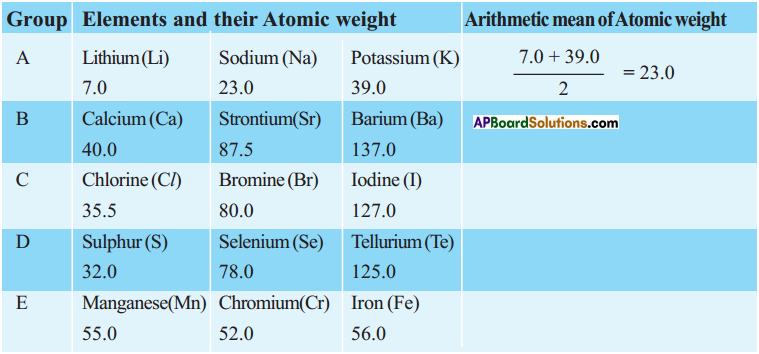
viii) medulla oblongata, cerebrum, 8th spinal nerve, cranial nerve, 7th cranial nerve.
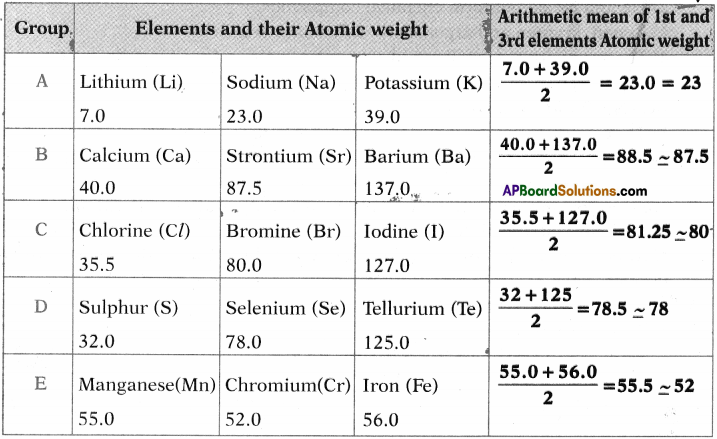
ix) Pons varoli, brain stem, medulla oblongata, mid brain.
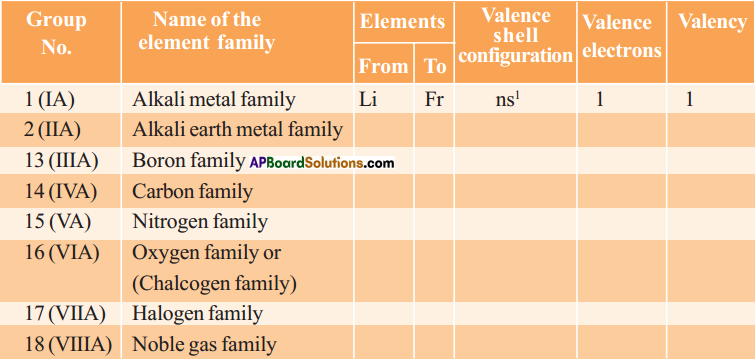
x) 6th cranial nerve, 5th cranial nerve, 10th cranial nerve, optic nerve.

Answer:
i) ghrelin
ii) leptin
iii) surface
iv) deep
v) fifth cranial
vi) autonomous
vii) amylase
viii) medulla oblongata
ix) brain stem
x) fifth cranial nerve

AP SSC 10th Class Biology Solutions Chapter 7 Coordination in Life Processes

Choose the correct answer.

  1. In which of the following situations you can taste quickly? [ ]
    A) Put sugar cristals on tongue
    B) Put sugar solution on tongue
    C) Press the tongue slowly against the palate
    D) Swallow directly without grinding and shredding
    Answer: C
  2. Peristalsis is because of [ ]
    A) Contraction of longitudinal muscles
    B) Contraction of circular muscles
    C) Under control of autonomous nervous system
    D) Digestive secretions
    Answer: C
  3. Sphincter that helps in opening of stomach into duodenum [ ]
    A) Cardiac
    B) Pyloric
    C) Anal
    D) Gastric
    Answer: B
  4. Glucose and amino acids are absorbed through the following part of villus [ ]
    A) epithelial cells
    B) blood capillary
    C) lymphatic vessel
    D) all
    Answer: A
  5. The region in brain portion that controls hunger signals [ ]
    A) medulla
    B) diencephalon
    C) cerebrum
    D) mid brain
    Answer: B
  6. Human organism is an internal combustion machine because of …. [ ]
    (OR)
    Human being is an “Internal combustion machine” because he/she
    A) assimilation of energy from food
    B) liberate CO2 during respiration
    C) expel waste food at the end state of digestion
    D) secrete powerful digestive juices
    Answer: A

10th Class Biology 7th Lesson Coordination in Life Processes InText Questions and Answers

10th Class Biology Textbook Page No. 145

Question 1.
How do we know that we need food?
Answer:
When we feel hungry then we know that we need food.

10th Class Biology Textbook Page No. 146

AP SSC 10th Class Biology Solutions Chapter 7 Coordination in Life Processes

Question 2.
What plays a major role to identify stale food?
Answer:
Smell or odour plays a major role to identify stale food.

Question 3.
If you are having a tasty dish do you think the smell of it increases your appetite?
(OR)
Do the smell of tasty dish increases our appetite?
Answer:
Yes, the smell of tasty dish increases our appetite.

Question 4.
What are your observations after chewing cumin, sounf, potato and apple?
Answer:
If we chew cumin, sounf, potato and apple we observe in order to taste the food material the food should dissolve in saliva.

10th Class Biology Textbook Page No. 148

Question 5.
Are there any other sensation that affect taste?
Answer:
Temperature (hotness), coldness are the sensations that affect taste.

Question 6.
What happens to your taste sensation while sipping hot milk or tea?
Answer:
We find something more tasty while we sipping hot milk or tea.

Question 7.
What do you think could be the range of temperature for us to relish food items?
Answer:
30°C to 35°C could be the range of temperature for us to relish food items.

10th Class Biology Textbook Page No. 149

Question 8.
What do you think that would happen if the salivary glands did not function in our mouth?
Answer:

  1. If the salivary glands do not function in our mouth, saliva will not release and the food do not get moistened and chewing it is difficult.
  2. The taste of the food cannot be identified.
  3. Carbohydrates in the food cannot be broken down and changed to dextrose and maltose molecules.

Question 9.
Suppose your taste buds were affected what would happen to your interest in haying food?
Answer:
If my taste buds were affected I cannot identify the taste of food and also loose interest in having food.

10th Class Biology Textbook Page No. 151

Question 10.
Does the level of saliva secretion change due to presence of food in the mouth?
Answer:
Yes, the level of saliva increases due to the presence of food in the mouth.

Question 11.
Can the process of chewing go on in the absence of saliva?
Answer:
Yes, the process of chewing go on in the absence of saliva. But it is very difficult to chew food and swallow it.

AP SSC 10th Class Biology Solutions Chapter 7 Coordination in Life Processes

Question 12.
Does the saliva have any other roles to play?
Answer:
The enzyme present in saliva that is salivary amylase converts large molecules of carbohydrates into small molecules of sugar like maltose and dextrose.

Question 13.
What is the use of such an increase in surface area of food?
Answer:
It helps in more surface area for the enzyme to act.

Question 14.
What about the nature of medium for salivary amylase to act on food component?
Answer:
The nature of medium for salivary amylase to act on food component is alkaline.

Question 15.
If we swallow food material directly without mastication what will happen?
Answer:
If we swallow food material directly without mastication, the food will not get digest easily and completely.

Question 16.
Do you think the pH of our mouth changes?
Answer:
Yes, the pH of our mouth changes from acidic to alkaline by the release of saliva from salivary glands.

10th Class Biology Textbook Page No. 152

AP SSC 10th Class Biology Solutions Chapter 7 Coordination in Life Processes

Question 17.
What are the different systems that contribute to the proper functioning of digestion in the mouth?
Answer:
Endocrine, muscular, nervous systems contribute to the proper functioning of digestion in the mouth.

Question 18.
After the digestive process in the mouth where does the food move to?
Answer:
After the digestion in the mouth the food move to oesophagus.

10th Class Biology Textbook Page No. 153

Question 19.
What are the systems that come into play for swallowing food?
Answer:
Skeletal system, nervous system and digestive systems come into play for swallowing food.

Question 20.
What does the schematic diagram tell us about the oesophagus?
Answer:
The schematic diagram of the oesophagus tells about its structure, secretion and function.

Question 21.
What kind of the tube is oesophagus?
Answer:
Oesophagus is a muscular and an elastic tube.

Question 22.
How does mucus help in passage of food?
Answer:
Mucus helps in lubricating and protecting the oesophageal wall and helps the bolus to slide down easily in the oesophagus.

10th Class Biology Textbook Page No. 154

AP SSC 10th Class Biology Solutions Chapter 7 Coordination in Life Processes

Question 23.
What makes the movement of the food bolus in the oesophagus easy?
Answer:

  1. Mucus helps the food bolus to slide down easily.
  2. Peristaltic movements of the walls of oesophagus also make the movement food bolus in the oesophagus easy.

Question 24.
Why do you think the stomach is structured like a bag rather than a tube like an oesophagus?
(OR)
Why stomach is structured like a bag rather than like a tube?
Answer:

  1. The food taken has to remain in the stomach for a long time for proper digestion with digestive juices and enzymes.
  2. Different kinds of muscles churns the food by contraction and relaxation to form chyme.
  3. If it was like a tube the food would just pass down without under going much changes and cannot remain in the stomach for long time.

Question 25.
What sets such processes into action?
Answer:

  1. When the food is in the oral cavity, the nerves in the cheek and tongue are stimulated.
  2. These carry messages in the form of nerve impulses to the brain.
  3. They messages are transmitted from the brain, to the wall of the stomach, and stimulate the gastric glands to produce gastric juice.

10th Class Biology Textbook Page No. 155

Question 26.
What stimulates stomach muscle into action?
Answer:
The nervous system stimulates stomach muscle into action.

Question 27.
What causes the stomach to churn and mix the food?
Answer:
The contractions of the stomach muscles squeeze and mix the food with the acids and juices of the stomach.

AP SSC 10th Class Biology Solutions Chapter 7 Coordination in Life Processes

Question 28.
Why should only a small quantity of food be passed from stomach to duodenum?
Answer:
For the complete digestion of chyme, only a small quantity of it be passed from stomach to duodenum.

Question 29.
What is involved in bringing about peristalsis?
Answer:
Contraction and relaxation of the muscles present in various parts of gut bring about peristalsis.

Question 30.
What is the direction of peristalsis? Which end of the gut does it begin?
Answer:
The direction of peristalsis is forward direction that is from mouth to anus.

Question 31.
What happens if the direction of peristalsis is reversed?
Answer:
If the direction of peristalsis is reversed the food present in the gut moves backwards.

10th Class Biology Textbook Page No. 157

Question 32.
Why do you think small intestine is long and coiled?
Answer:
The small intestine is long and coiled because the food has to stay for more time for complete digestion and absorption.

Question 33.
What process is involved in this process of absorption?
Answer:
Selective absorption of nutrients by the villi of small intestine is involved in absorption.

Question 34.
What is the relation between finger-like structures and paper folds?
Answer:

  1. Finger-like structures increase the surface area.
  2. The space inside the paper folds is very much high. So area is increased.
  3. So increase in surface area is the relation between finger-like structures and paper folds.

Question 35.
What systems do you think are working together?
Answer:
The digestive system and circulatory system are working together.

AP SSC 10th Class Biology Solutions Chapter 7 Coordination in Life Processes

Question 36.
Do you think those systems work together in the whole length of the digestive canal? Why / Why not?
Answer:
No, these systems are not working together in the whole length of the digestive canal. The digested food material is absorbed only in the small intestine but not elsewhere in the gut.

10th Class Biology Textbook Page No. 158

Question 37.
Often you may have experienced that if you have tension for some reason you start having loose motions. What does this show us?
Answer:
If we are tensed for some reason, the enteric nervous system or second brain loses control over the gut. Hence without our intervention, loose motions occur.

10th Class Biology Textbook Page No. 159

Question 38.
What moves out of the gut?
Answer:
The indigested food material moves out of the gut.

Question 39.
Two major pathways of waste expulsion are shown above. Which of the two do you think happens exclusively through the gut?
Answer:
Indigested food matter is expelled in the form of stool from the gut.

Question 40.
What controls the exit of stools from the body?
Answer:
The two muscular layers present In the anal sphincter control the exit of stools from the body.

Question 41.
Do you think the control is voluntary? Why / Why not?
Answer:
Yes, the control is voluntary in adults and it is involuntary in infants.

AP SSC 10th Class Biology Solutions Chapter 7 Coordination in Life Processes

Question 42.
Did we have a sphincter in any other part of the digestive canal? Where was it?
Answer:
Yes. We have a sphincter at the opening where stomach opens into duodenum (small intestine).

10th Class Biology Textbook Page No. 160

Question 43.
What is the fate of the digested substances that move into blood from the intestine?
Answer:
The digested substances reach each cell of the body through circulatory system. There it gets oxidised and release energy.

Question 44.
Where is the energy stored?
Answer:
The energy is stored in the cells as ATP.

Question 45.
Which system do you think will remove the excess salts from our body?
Answer:
The excretory system remove the excess salts from our body.

Question 46.
What would be the path of salt removed from gut to the outside of our body?
Answer:

  1. The digested food containing salts will be absorbed into the blood stream in small intestine.
  2. The circulatory system supplies this to kidney through renal artery.
  3. In the kidney salts are filtered and sent out of the body along with urine.
  4. Some of the salts also supplied to the skin. They will be sent out of the body in the form of sweat.

10th Class Biology 7th Lesson Coordination in Life Processes Activities

Activity – 1
Observe the following table, identify and tick those options that you think makes you feel hungry.
Table

Smell of food Taste of food Sight of food Being tired and exhausted Need of food Thought of food

i) What stimulates hunger?
Answer:
Smell of food, sight of food and need of food stimulates hunger.

ii) What would be the result of stimulation of hunger?
Answer:
Hunger pangs occur in the stomach.

iii) Which system do you think would send the signals to make us realize that we are hungry?
Answer:
Nervous system.

iv) What kinds of controls are exercised during sensation of hunger? Are they hormonal or nervous or both?
Answer:
They are both hormonal and nervous.

v) Can you suggest any four systems involved in the process of generating hunger sensation?
Answer:
Digestive system, Endocrine system, Circulatory system and Nervous system.

AP SSC 10th Class Biology Solutions Chapter 7 Coordination in Life Processes

Activity – 2
Observation of how our taste is affected by the sense of smell. (OK) How our taste is affected by the sense of smell?

  1. First, close your nose with your fingers.
  2. Pop in some zeera in your mouth and chew it for some time.
  3. After that chew some sounf.
  4. Could you recognise the taste?
  5. How long it taken to know the taste?
  6. After sometime wash your mouth and repeat the activity by chewing a piece of an apple followed by a potato (remember to close your nose)

Could you know the taste of both or did it taste the same? Why?
Answer:
No, because taste buds couldn’t send the taste signals to brain.

Observation :

  1. We can taste the food that is in the form of liquid only.
  2. Only after the dissolved food enters into the cup like taste buds, the sense of taste is carried to the brain for analysis. Then only we will know the taste of food material.
  3. Similarly olfactory receptors which trigger signals in the form of nerve impulses to the brain where smell is detected.

i) What happens when we put a food material in our mouth?
Answer:
Our mouth salivates.

ii) Name the parts in the mouth that help us to taste food.
Answer:
Papillae (taste buds), palate.

Activity – 3

  1. Take a pinch of asafoetida powder/garlic and rub it on hand kerchief/tissue paper.
  2. Close your eyes and smell it.
  3. Then try to identify taste of different types of food materials with the help of your friend.

i) Does garlic have a stronger scent than apple? How do you think the stronger scent affect your sensation of taste?
Answer:
Yes, garlic have a stronger scent than apple. The stronger scent motivate us to eat different types of foods.

ii) How many food materials you have identified correctly?
Answer:
Seven.

iii) Write a few lines on the relation between smell and taste.
Answer:

  1. Taste and smell are intimately entwined. This close relationship is most apparent in how we perceive the flavour of food.
  2. Taste itself is focussed on distinguishing chemicals that have sweet, salty, sour, bitter or umami taste.
  3. However interactions between the senses of taste and smell enhance our perceptions of the foods, we eat.

iv) Have you ever felt that a particular food is tasty just by looking at it?
Answer:
I felt so many times. In general, we prefer the food material, which is attractive to our eyes and flavour to nose, then we taste it.

AP SSC 10th Class Biology Solutions Chapter 7 Coordination in Life Processes

Activity – 4
What is the role of different parts of the mouth in helping us to taste keeping sugar crystals over the tongue?

  1. Place some sugar crystals on the tongue and keep mouth opened and see that your tongue dosen’t touch the palate.
  2. Record the time from the moment you placed the crystals on your tongue till you got the taste by using stop watch.
  3. Now repeat the test by placing the sugar crystals on the tongue and pressing it against the palate.
  4. Record the time from placing sugar crystals to getting the taste. Or put a drop of sugar solution on your tongue using a dropper.

Observation :
Based on the above activity we know that taste can be identified easily when the tongue is pressed against the palate.
i) Can we taste on dry tongue?
Answer:
No. We can’t taste on dry tongue.

ii) Which way helped you taste faster? Why?
Answer:
Taste can be identified faster when the tongue is pressed against the palate.
When the tongue is pressed against the palate the food substance is pressed against the opening of the taste bud letting it reach taste celjs triggering taste signals. Finally the taste is recognised in the brain.

Activity – 5
How do you show that the breakdown of food by using the model of chalk piece kept in vinegar?

  1. Break a piece of chalk into two halves.
  2. Crush one half to tiny pieces leaving the other as it is.
  3. Take two small mineral wafer bottles QA ltr bottle) cut them into two equal halves and discard the upper portion.
  4. Now we have two beakers from the lower cut portion.
  5. Fill them half with vinegar and add the crushed chalk to one beaker and the other uncrushed half chalk to the other.
  6. Observe them after half-an-hour or so.

i) Which one dissolved faster the crushed chalk or the whole one?
Answer:
Beaker with crushed chalk dissolved faster than the whole one.
This experiment tells us the need of mechanical crushing of food the mouth to increase surface area for action of substances that aid in digestion.

ii) How does this process of mechanical crushing go on in the mouth?
Answer:
Mechanical crushing of food goes in the mouth by chewing.

iii) Which parts in the mouth are involved in this?
Answer:
Teeth and tongue.

iv) What are the systems involved in this process?
Answer:
Digestive system, Nervous system, Muscular system.

AP SSC 10th Class Biology Solutions Chapter 7 Coordination in Life Processes

Activity – 6
Observe the diagram and answer the questions and fill the table.
AP SSC 10th Class Biology Solutions Chapter 7 Coordination in Life Processes 2i) Observe the model or chart of jaw, on the basis of the figure try to guess what are the functions molars could be?
Answer:
Chewing and grinding.

ii) What do you think could be the function of inscisors?
Answer:
The function of inscisors is biting the food.

iii) Which set of teeth helps in grinding food?
Answer:
Premolars and molars.

iv) Which set helps in tearing food?
Answer:
Canines help in tearing food.

v) What is your dental formula?
Answer:
AP SSC 10th Class Biology Solutions Chapter 7 Coordination in Life Processes 9 is the dental formula.

Table

Name of teeth Number Shape Function
Incisors 8 Chisel, sharp edges Biting
Canines 4 Sharp, pointed edges Tearing
Premolars 8 Diamond shape blunt and flat Chewing and grinding
Molars 12 Rectangular, blunt and flat Chewing and grinding

AP SSC 10th Class Biology Solutions Chapter 7 Coordination in Life Processes

Activity – 7
Testing pH of mouth at intervals of one hour.

  1. Collect a strip of pH paper with a colour chart from a chemistry teacher.
  2. Take a small piece of the pH paper and touch it to your tongue.
  3. Match the colour with the colour chart and note the pH.
  4. Take some readings after having your food at lunch break.
  5. Compare your readings with that of your friend.
  6. Take at least 4 readings.

Table

S.No. Name of the Student pH value before lunch pH value after lunch pH value after an hour pH value after 2 hrs
1. Sagar 7.4 6.8 7.0 7.4
2. San jay 7.4 6.8 7.0 7.4
3. Raju 7.1 6.9 7.0 7.1
4. Krishna 7.3 6.8 7.0 7.3
5. Kiran 7.4 6.8 7.0 7.4
6. Yadav 7.2 6.7 7.0 7.2

i) What is the usual range of pH of your mouth Acidic (or) Basic
Answer:
The usual range of pH of our mouth is more or less 6.5. At low level the saliva is acidic and at high level it is basic.

ii) Did you observe any change in pH after eating? What may have caused the change?
Answer:
Yes, 1 observed the change in pH. Bicarbonates in saliva changed that into basic.

iii) In what kind of pH do you think salivary amylase acts well?
Answer:
In the pH range 7.2 to 7.4 it acts well in alkaline medium.

iv) Does this type of food have any role to play on the pH of our mouth?
Answer:
If the food that enters is acidic it will be converted into basic stuff and then it is swallowed.
Based on the above tests we know that salival secreted causes the medium to change to alkaline as it aids in action salivary amylase.

Activity – 8
Making a model of oesophagus to observe how bolus moves forward.

  1. Take a piece of waste cycle tube and insert one or two potatoes into it.
  2. Lubricate the inner side of the tube with oil.
  3. In the same way smear oil over potatoes.
  4. Insert oil coated potatoes in the tube.
  5. Now try to push the potatoes by squeezing the tube.

i) How do you squeeze the tube to make the potatoes pass through?
Answer:
By pushing the potato from behind.

ii) Do you think that the muscles in the wall of the oesophagus have to do something like this?
Answer:
Yes.

iii) How did oil help you in pushing the potatoes through the pipe?
Answer:
Oil acted as a lubricant to push the potato easily in the forward direction.

AP SSC 10th Class Biology Solutions Chapter 7 Coordination in Life Processes

Activity – 9
How is the stomach protected from the secretions of its own acids?

  1. Take two similar green leaves.
  2. Grease one leaf with petroleum jelly, leave the other free.
  3. Add 1 or 2 drops of some weak acids on both the leaves.
  4. Observe them after half-an-hour or so and write your observations.

i) Which leaf was effected by the acid?
Answer:
The leaf to which petroleum jelly was not applied.

ii) What kind of change did you observe in the leaves?
Answer:
The colour of the leaf changes.

iii) What saved the other leaf from the effect of acid?
Answer:
Petroleum jelly.
From the above activity we can conclude that mucus secreted by the walls of stomach protects stomach from the harmful effects of hydrochloric acid.

Activity – 10
Paper tube and folded papers.

  1. Provide students with a piece of paper.
  2. Let them calculate the area of one side of the paper and make a roll of it.
  3. Try to fill the tube by inserting few folded papers as much as possible in it.
  4. Pull out the papers from the tube, unfold them and find out the whole area of the papers.

i) Compare the area of the folded papers with that of the roll. Do you find any increase in the area ? If so try to find out the reasons?
Answer:
Area is increased. The space inside the folded papers is very much high. So we can insert as many folded papers as we could.
From the above activity we can infer that the inner surface of the small intestine contains thousands of finger-like projections called villi which increase the surface area of absorption of nutrients in small intestine.