AP SSC 10th Class Maths Solutions Chapter 8 Similar Triangles Ex 8.1

AP State Board Syllabus AP SSC 10th Class Maths Textbook Solutions Chapter 8 Similar Triangles Ex 8.1 Textbook Questions and Answers.

AP State Syllabus SSC 10th Class Maths Solutions 8th Lesson Similar Triangles Exercise 8.1

10th Class Maths 8th Lesson Similar Triangles Ex 8.1 Textbook Questions and Answers

Question 1.
In △PQR, ST is a line such that [latex]\frac{PS}{SQ}[/latex] = [latex]\frac{PT}{TR}[/latex] and also ∠PST = ∠PRQ.
Prove that △PQR is an isosceles triangle.
Answer:
Given : In △PQR,
[latex]\frac{PS}{SQ}[/latex] = [latex]\frac{PT}{TR}[/latex] and ∠PST= ∠PRQ.
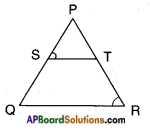
AP SSC 10th Class Maths Solutions Chapter 8 Similar Triangles Ex 8.1 1
R.T.P: △PQR is isosceles.
Proof: [latex]\frac{PS}{SQ}[/latex] = [latex]\frac{PT}{TR}[/latex]
Hence, ST || QR (Converse of Basic proportionality theorem)
∠PST = ∠PQR …….. (1)
(Corresponding angles for the lines ST || QR)
Also, ∠PST = ∠PRQ ……… (2) given
From (1) and (2),
∠PQR = ∠PRQ
i.e., PR = PQ
[∵ In a triangle sides opposite to equal angles are equal]
Hence, APQR is an isosceles triangle.

AP SSC 10th Class Maths Solutions Chapter 8 Similar Triangles Ex 8.1

Question 2.
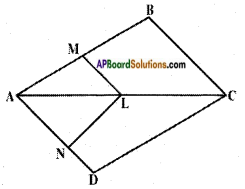
In the given figure, LM || CM and LN || CD. Prove that [latex]\frac{AM}{AB}[/latex] = [latex]\frac{AN}{AD}[/latex].
AP SSC 10th Class Maths Solutions Chapter 8 Similar Triangles Ex 8.1 2
Answer:
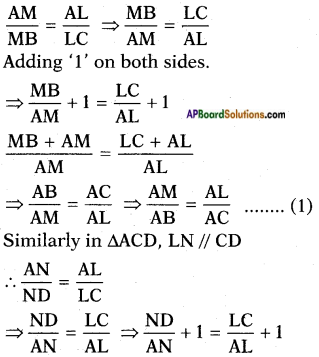
Given : LM || CB and LN || CD In △ABC, LM || BC (given) Hence,
AP SSC 10th Class Maths Solutions Chapter 8 Similar Triangles Ex 8.1 3
Adding ‘1’ on both sides.
AP SSC 10th Class Maths Solutions Chapter 8 Similar Triangles Ex 8.1 4
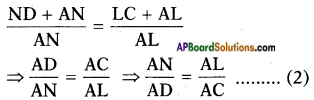
From (1) and (2)
∴ [latex]\frac{AM}{AB}[/latex] = [latex]\frac{AN}{AD}[/latex].

Question 3.
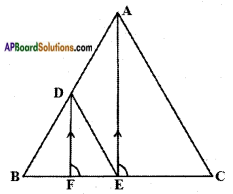
In the given figure, DE || AC and DF || AE. Prove that [latex]\frac{BF}{FE}[/latex] = [latex]\frac{BE}{AC}[/latex].
AP SSC 10th Class Maths Solutions Chapter 8 Similar Triangles Ex 8.1 5
Answer:
In △ABC, DE || AC
Hence [latex]\frac{BE}{EC}[/latex] = [latex]\frac{BD}{DA}[/latex] ………. (1)
[∵ A line drawn parallel to one side of a triangle divides the other two sides in the same ratio – Basic proportionality theorem]
Also in △ABE, DF || AE
Hence [latex]\frac{BF}{FE}[/latex] = [latex]\frac{BD}{DA}[/latex] ………. (2)
From (1) and (2), [latex]\frac{BF}{FE}[/latex] = [latex]\frac{BE}{AC}[/latex] Hence proved.

AP SSC 10th Class Maths Solutions Chapter 8 Similar Triangles Ex 8.1

Question 4.
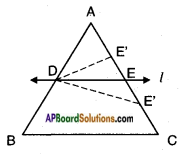
Prove that a line drawn through the mid-point of one side of a triangle parallel to another side bisects the third side (Using Basic proportionality theorem).
Answer:
AP SSC 10th Class Maths Solutions Chapter 8 Similar Triangles Ex 8.1 6
Given: In △ABC; D is the mid-point of AB.
A line ‘l’ through D, parallel to BC, meeting AC at E.
R.T.P: E is the midpoint of AC.
Proof:
DE || BC (Given)
then
[latex]\frac{AD}{DB}[/latex] = [latex]\frac{AE}{EC}[/latex](From Basic Proportional theorem)
Also given ‘D’ is mid point of AB.
Then AD = DB.
⇒ [latex]\frac{AD}{DB}[/latex] = [latex]\frac{DB}{DB}[/latex] = [latex]\frac{AE}{EC}[/latex] = 1
⇒ AE = EC
∴ ‘E’ is mid point of AC
∴ The line bisects the third side [latex]\overline{\mathrm{AC}}[/latex].
Hence proved.

Question 5.
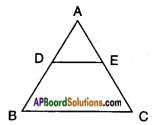
Prove that a line joining the mid points of any two sides of a triangle is parallel to the third side. (Using converse of Basic proportionality theorem)
Answer:
Given: △ABC, D is the midpoint of AB and E is the midpoint of AC.
R.T.P : DE || BC.
Proof:
AP SSC 10th Class Maths Solutions Chapter 8 Similar Triangles Ex 8.1 7
Since D is the midpoint of AB, we have AD = DB ⇒ [latex]\frac{AD}{DB}[/latex] = 1 ……. (1)
also ‘E’ is the midpoint of AC, we have AE = EC ⇒ [latex]\frac{AE}{EC}[/latex] = 1 ……. (2)
From (1) and (2)
[latex]\frac{AD}{DB}[/latex] = [latex]\frac{AE}{EC}[/latex]
If a line divides any two sides of a triangle in the same ratio then it is parallel to the third side.
∴ DE || BC by Basic proportionality theorem.
Hence proved.

AP SSC 10th Class Maths Solutions Chapter 8 Similar Triangles Ex 8.1

Question 6.
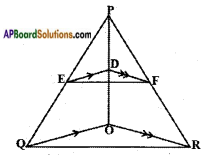
In the given figure, DE || OQ and DF || OR. Show that EF || QR.
AP SSC 10th Class Maths Solutions Chapter 8 Similar Triangles Ex 8.1 8
Answer:
Given: △PQR, DE || OQ; DF || OR
R.T.P: EF || QR
Proof:
In △POQ;
[latex]\frac{PE}{EQ}[/latex] = [latex]\frac{PD}{DO}[/latex] ……. (1)
[∵ ED || QO, Basic proportionality theorem]
In △POR; [latex]\frac{PF}{FR}[/latex] = [latex]\frac{PD}{DO}[/latex] ……. (2) [∵ DF || OR, Basic Proportionality Theorem]
From (1) and (2),
[latex]\frac{PE}{EQ}[/latex] = [latex]\frac{PF}{FR}[/latex]
Thus the line [latex]\overline{\mathrm{EF}}[/latex] divides the two sides PQ and PR of △PQR in the same ratio.
Hence, EF || QR. [∵ Converse of Basic proportionality theorem]

Question 7.
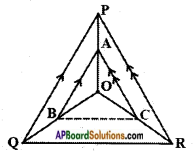
In the given figure A, B and C are points on OP, OQ and OR respec¬tively such that AB || PQ and AC || PR. Show that BC || QR.
AP SSC 10th Class Maths Solutions Chapter 8 Similar Triangles Ex 8.1 9
Answer:
Given:
In △PQR, AB || PQ; AC || PR
R.T.P : BC || QR
Proof: In △POQ; AB || PQ
[latex]\frac{OA}{AP}[/latex] = [latex]\frac{OB}{BQ}[/latex] ……… (1)
(∵ Basic Proportional theorem)
and in △OPR, Proof: In △POQ; AB || PQ
[latex]\frac{OA}{AP}[/latex] = [latex]\frac{OC}{CR}[/latex] ……… (2)
From (1) and (2), we can write
[latex]\frac{OB}{BQ}[/latex] = [latex]\frac{OC}{CR}[/latex]
Then consider above condition in △OQR then from (3) it is clear.
∴ BC || QR [∵ from converse of Basic Proportionality Theorem]
Hence proved.

AP SSC 10th Class Maths Solutions Chapter 8 Similar Triangles Ex 8.1

Question 8.
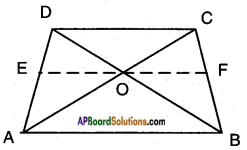
ABCD is a trapezium in which AB || DC and its diagonals intersect each other at point ‘O’. Show that[latex]\frac{AO}{BO}[/latex] = [latex]\frac{CO}{DO}[/latex].
Answer:
Given: In trapezium □ ABCD, AB || CD. Diagonals AC, BD intersect at O.
R.T.P: [latex]\frac{AO}{BO}[/latex] = [latex]\frac{CO}{DO}[/latex]
AP SSC 10th Class Maths Solutions Chapter 8 Similar Triangles Ex 8.1 10
Construction:
Draw a line EF passing through the point ‘O’ and parallel to CD and AB.
Proof: In △ACD, EO || CD
∴ [latex]\frac{AO}{CO}[/latex] = [latex]\frac{AE}{DE}[/latex] …….. (1)
[∵ line drawn parallel to one side of a triangle divides other two sides in the same ratio by Basic proportionality theorem]
In △ABD, EO || AB
Hence, [latex]\frac{DE}{AE}[/latex] = [latex]\frac{DO}{BO}[/latex]
[∵ Basic proportionality theorem]
[latex]\frac{BO}{DO}[/latex] = [latex]\frac{AE}{ED}[/latex] …….. (2) [∵ Invertendo]
From (1) and (2),
[latex]\frac{AO}{CO}[/latex] = [latex]\frac{BO}{DO}[/latex]
⇒ [latex]\frac{AO}{BO}[/latex] = [latex]\frac{CO}{DO}[/latex] [∵ Alternendo]

AP SSC 10th Class Maths Solutions Chapter 8 Similar Triangles Ex 8.1

Question 9.
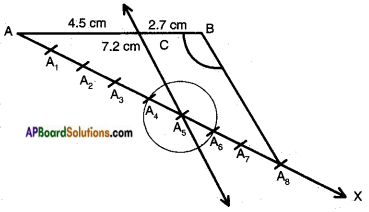
Draw a line segment of length 7.2 cm and divide it in the ratio 5 : 3. Measure the two parts.
Answer:
AP SSC 10th Class Maths Solutions Chapter 8 Similar Triangles Ex 8.1 11
Steps of construction:

  1. Draw a line segment [latex]\overline{\mathrm{AB}}[/latex] of length 7.2 cm.
  2. Construct an acute angle ∠BAX at A.
  3. Mark off 5 + 3 = 8 equal parts (A1, A2, …., A8) on [latex]\stackrel{\leftrightarrow}{\mathrm{AX}}[/latex] with same radius.
  4. Join A8 and B.
  5. Draw a line parallel to [latex]\stackrel{\leftrightarrow}{\mathrm{A}_{8} \mathrm{~B}}[/latex] at A5 meeting AB at C.
  6. Now the point C divides AB in the ratio 5:3.
  7. Measure AC and BC. AC = 4.5 cm and BC = 2.7 cm.
 

AP SSC 10th Class Maths Solutions Chapter 7 Coordinate Geometry Ex 7.2

AP State Board Syllabus AP SSC 10th Class Maths Textbook Solutions Chapter 7 Coordinate Geometry Ex 7.2 Textbook Questions and Answers.

AP State Syllabus SSC 10th Class Maths Solutions 7th Lesson Coordinate Geometry Exercise 7.2

10th Class Maths 7th Lesson Coordinate Geometry Ex 7.2 Textbook Questions and Answers

Question 1.
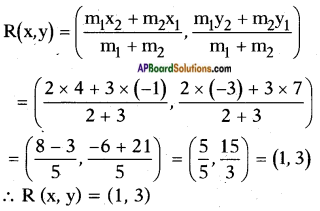
Find the coordinates of the point which divides the line segment joining the points (-1, 7) and (4, -3) in the ratio 2 :3.
Answer:
Given points P (-1, 7) and Q (4, – 3). Let ‘R’ be the required point which divides [latex]\overline{\mathrm{PQ}}[/latex] in the ratio 2:3. Then
AP SSC 10th Class Maths Solutions Chapter 7 Coordinate Geometry Ex 7.2 1

AP SSC 10th Class Maths Solutions Chapter 7 Coordinate Geometry Ex 7.2

Question 2.
Find the coordinates of the points of trisection of the line segment joining (4, -1) and (-2, -3).
Answer:
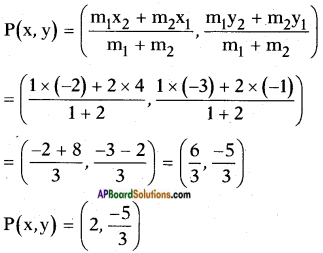
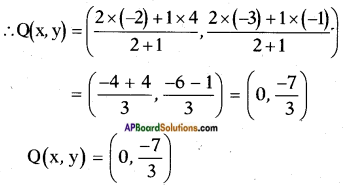
Given points A (4, – 1) and B (- 2, – 3) Let P and Q be the points of trisection
of [latex]\overline{\mathrm{AB}}[/latex], then AP = PQ = QB.
AP SSC 10th Class Maths Solutions Chapter 7 Coordinate Geometry Ex 7.2 2
∴ P divides [latex]\overline{\mathrm{AB}}[/latex] internally in the ratio 1 : 2.
AP SSC 10th Class Maths Solutions Chapter 7 Coordinate Geometry Ex 7.2 3
Also, Q divides [latex]\overline{\mathrm{AB}}[/latex] in the ratio 2 : 1 internally.
AP SSC 10th Class Maths Solutions Chapter 7 Coordinate Geometry Ex 7.2 4

Question 3.
Find the ratio in which the line segment joining the points (-3, 10) and (6, -8) is divided by (-1, 6).
Answer:
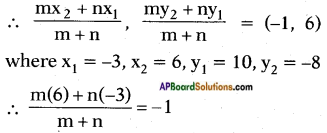
Let the point (-1, 6) divides the line segment joining the points (-3, 10) and (6, -8) in a ratio of m : n
AP SSC 10th Class Maths Solutions Chapter 7 Coordinate Geometry Ex 7.2 5
⇒ 6m – 3n = -(m + n) = -m – n
⇒ 6m + m = – n + 3n
⇒ 7m = 2n
⇒ [latex]\frac{m}{n}=\frac{2}{7}[/latex]
⇒ m : n = 2 : 7
∴ The point (-1, 6) divides the given line segment in a ratio of 2 : 7.

AP SSC 10th Class Maths Solutions Chapter 7 Coordinate Geometry Ex 7.2

Question 4.
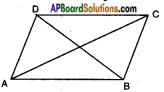
If (1, 2), (4, y), (x, 6) and (3, 5) are the vertices of a parallelogram taken in order, find x and y.
Answer:
AP SSC 10th Class Maths Solutions Chapter 7 Coordinate Geometry Ex 7.2 6
Given: ▱ ABCD is a parallelogram where A (1, 2), B (4, y), C (x, 6) and D (3, 5).
In a parallelogram, diagonals bisect each other.
i.e., the midpoints of the diagonals coincide with each other.
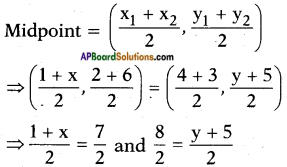
i.e.,midpoint of AC = midpoint of BD
AP SSC 10th Class Maths Solutions Chapter 7 Coordinate Geometry Ex 7.2 7
⇒ 1 + x = 7 and 8 = y + 5
⇒ x = 7 – 1 and y = 8 – 5
∴ x = 6 and y = 3.

Question 5.
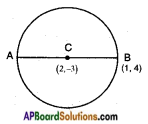
Find the coordinates of a point A, where AB is the diameter of a circle whose centre is (2, -3) and B is (1, 4).
Answer:
AP SSC 10th Class Maths Solutions Chapter 7 Coordinate Geometry Ex 7.2 8
Given:
A circle with centre ‘C’ (2, -3). [latex]\overline{\mathrm{AB}}[/latex] is a diameter where
B = (1, 4); A = (x, y).
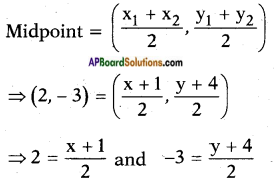
C is the midpoint of AB.
[∵ Centre of a circle is the midpoint of the diameter]
AP SSC 10th Class Maths Solutions Chapter 7 Coordinate Geometry Ex 7.2 9
4 = x + 1 and – 6 = y + 4
⇒ x = 4 – 1 = 3 and y = -6 – 4 = -10
A (x, y) = (3, -10)

AP SSC 10th Class Maths Solutions Chapter 7 Coordinate Geometry Ex 7.2

Question 6.
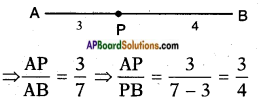
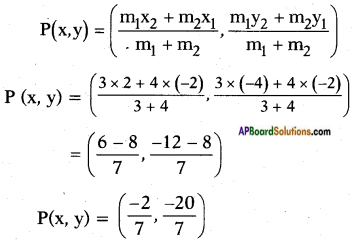
If A and B are (-2, -2) and (2, -4) respectively. Find the coordinates of P such that AP = [latex]\frac{3}{7}[/latex] AB and P lies on the segment AB.
Answer:
Given: A (- 2, – 2) and B (2, – 4)
P lies on AB such that AP = latex]\frac{3}{7}[/latex] AB
AP SSC 10th Class Maths Solutions Chapter 7 Coordinate Geometry Ex 7.2 10
i.e., P divides [latex]\overline{\mathrm{AB}}[/latex] in the ratio 3 : 4 By section formula,
AP SSC 10th Class Maths Solutions Chapter 7 Coordinate Geometry Ex 7.2 11

Question 7.
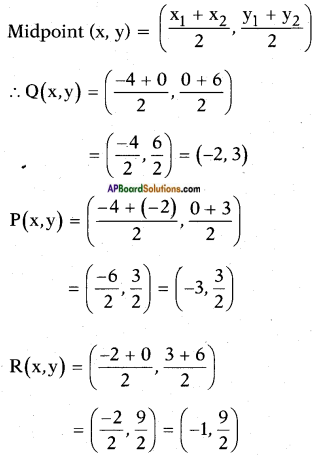
Find the coordinates of points which divide the line segment joining A (-4, 0) and B (0, 6) into four equal parts.
Answer:
Given, A (- 4, 0) and B (0, 6).
Let P, Q and R be the points which divide AB into four equal parts.
AP SSC 10th Class Maths Solutions Chapter 7 Coordinate Geometry Ex 7.2 12
P divides [latex]\overline{\mathrm{AB}}[/latex] in the ratio 1 : 3, Q → 1 : 1 and R → 3 : 1 Use section formula to find P, Q and R.
Then, Q is the midpoint of [latex]\overline{\mathrm{AB}}[/latex]
P is the midpoint of [latex]\overline{\mathrm{AQ}}[/latex]
R is the midpoint of [latex]\overline{\mathrm{QB}}[/latex]
AP SSC 10th Class Maths Solutions Chapter 7 Coordinate Geometry Ex 7.2 13

AP SSC 10th Class Maths Solutions Chapter 7 Coordinate Geometry Ex 7.2

Question 8.
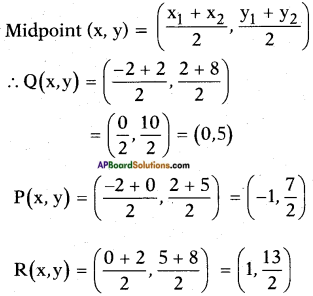
Find the coordinates of the points which divides the line segment joining A(-2, 2) and B(2, 8) into four equal parts.
Answer:
Given, A (- 2, 2) and B (2, 8).
Let P, Q and R be the points which divide AB into four equal parts.
AP SSC 10th Class Maths Solutions Chapter 7 Coordinate Geometry Ex 7.2 14
Then, Q is the midpoint of [latex]\overline{\mathrm{AB}}[/latex]
P is the midpoint of [latex]\overline{\mathrm{AQ}}[/latex]
R is the midpoint of [latex]\overline{\mathrm{QB}}[/latex]
AP SSC 10th Class Maths Solutions Chapter 7 Coordinate Geometry Ex 7.2 15

Question 9.
Find the coordinates of the point which divide the line segment joining the points (a + b, a-b) and (a-b, a + b) in the ratio 3 : 2 internally.
Answer:
Given : A (a + b, a – b) and B (a – b, a + b).
Let P (x, y) divides [latex]\overline{\mathrm{AB}}[/latex] in the ratio 3 : 2 internally.
Section formula
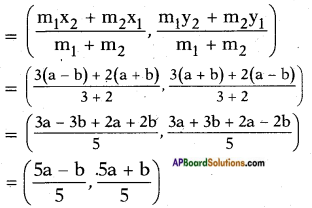
AP SSC 10th Class Maths Solutions Chapter 7 Coordinate Geometry Ex 7.2 16

Question 10.
Find the coordinates of centroid of the triangle with following vertices:
i) (-1, 3), (6, -3) and (-3, 6)
Answer:
Given: △ABC in which- A (- 1, 3), B (6, -3) and C (-3, 6)
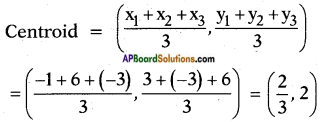
AP SSC 10th Class Maths Solutions Chapter 7 Coordinate Geometry Ex 7.2 17

ii) (6, 2), (0, 0) and (4, -7)
Answer:
Given: The three vertices of a triangle are A (6, 2), B (0, 0) and C (4, – 7).
Centroid (x, y)
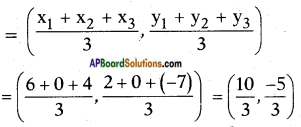
AP SSC 10th Class Maths Solutions Chapter 7 Coordinate Geometry Ex 7.2 18

AP SSC 10th Class Maths Solutions Chapter 7 Coordinate Geometry Ex 7.2

iii) (1,-1), (0, 6) and (-3, 0)
Answer:
Given: (1, -1), (0, 6) and (-3, 0) are the vertices of a triangle.
Centroid (x, y)
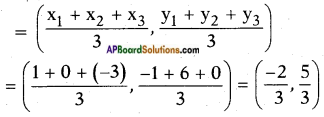
AP SSC 10th Class Maths Solutions Chapter 7 Coordinate Geometry Ex 7.2 19

AP SSC 10th Class Maths Solutions Chapter 9 Tangents and Secants to a Circle Ex 9.1

AP State Board Syllabus AP SSC 10th Class Maths Textbook Solutions Chapter 9 Tangents and Secants to a Circle Ex 9.1 Textbook Questions and Answers.

AP State Syllabus SSC 10th Class Maths Solutions 9th Lesson Tangents and Secants to a Circle Exercise 9.1

10th Class Maths 9th Lesson Tangents and Secants to a Circle Ex 9.1 Textbook Questions and Answers

Question 1.
Fill in the blanks.
i) A tangent to a circle intersects it in ——— point(s). (one)
ii) A line intersecting a circle in two points is called a ———. (secant)
iii) The number of tangents drawn at the end of the diameter is ———. (two)
iv) The common point of a tangent to a circle and the circle is called ———. (point of contact)
v) We can draw ——— tangents to a given circle. (infinite)

AP SSC 10th Class Maths Solutions Chapter 9 Tangents and Secants to a Circle Ex 9.1

Question 2.
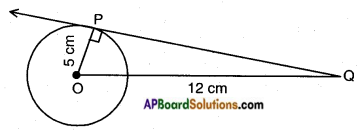
A tangent PQ at a point P of a circle of radius 5 cm meets a line through the centre O at a point Q so that OQ = 12 cm. Find length of PQ.
Answer:
Given: A circle with centre O and radius OP = 5 cm
[latex]\overline{\mathrm{PQ}}[/latex] is a tangent and OQ = 12 cm
AP SSC 10th Class Maths Solutions Chapter 9 Tangents and Secants to a Circle Ex 9.1 1We know that ∠OPQ = 90°
Hence in △OPQ
OQ2 = OP2 + PQ2
[∵ hypotenuse2 = Adj. side2 + Opp. side2]
122 = 52 + PQ2
∴ PQ2 = 144 – 25 .
PQ2 = 119
PQ = √119

Question 3.
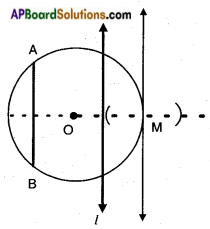
Draw a circle and two lines parallel to a given line such that one is a tangent and the other, a secant to the circle.
Answer:
AP SSC 10th Class Maths Solutions Chapter 9 Tangents and Secants to a Circle Ex 9.1 2Steps:

  1. Draw a circle with some radius.
  2. Draw a chord of the circle.
  3. Draw a line parallel to the chord intersecting the circle at two distinct points.
  4. This is secant of the circle (l).
  5. Draw another line parallel to the chord, just touching the circle at one point (M). This is a tangent of the circle.

AP SSC 10th Class Maths Solutions Chapter 9 Tangents and Secants to a Circle Ex 9.1

Question 4.
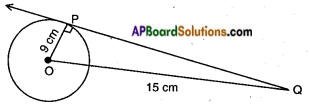
Calculate the length of tangent from a point 15 cm. away from the centre of a circle of radius 9 cm.
Answer:
AP SSC 10th Class Maths Solutions Chapter 9 Tangents and Secants to a Circle Ex 9.1 3Given: A circle with radius OP = 9 cm
A tangent PQ from a point Q at a distance of 15 cm from the centre, i.e., OQ =15 cm
Now in △POQ, ∠P = 90°
OP2 + PQ2 – OQ2
92 + PQ2 = 152
PQ2 = 152 – 92
PQ2 = 144
∴ PQ = √144 = 12 cm.
Hence the length of the tangent =12 cm.

Question 5.
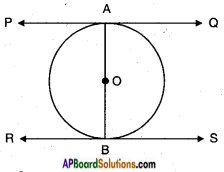
Prove that the tangents to a circle at the end points of a diameter are parallel.
Answer:
A circle with a diameter AB.
PQ is a tangent drawn at A and RS is a tangent drawn at B.
R.T.P: PQ || RS.
Proof: Let ‘O’ be the centre of the circle then OA is radius and PQ is a tangent.
∴ OA ⊥ PQ ……….(1)
[∵ a tangent drawn at the end point of the radius is perpendicular to the radius]
Similarly, OB ⊥ RS ……….(2)
[∵ a tangent drawn at the end point of the radius is perpendicular to the radius]
But, OA and OB are the parts of AB.
i.e., AB ⊥ PQ and AB ⊥ RS.
∴ PQ || RS.
AP SSC 10th Class Maths Solutions Chapter 9 Tangents and Secants to a Circle Ex 9.1 4O is the centre, PQ is a tangent drawn at A.

∠OAQ = 90°
Similarly, ∠OBS = 90°
∠OAQ + ∠OBS = 90° + 90° = 180°
∴ PQ || RS.
[∵ Sum of the consecutive interior angles is 180°, hence lines are parallel]

AP SSC 10th Class Maths Solutions Chapter 13 Probability Ex 13.1

AP State Board Syllabus AP SSC 10th Class Maths Textbook Solutions Chapter 13 Probability Ex 13.1 Textbook Questions and Answers.

AP State Syllabus SSC 10th Class Maths Solutions 13th Lesson Probability Exercise 13.1

10th Class Maths 13th Lesson Probability Ex 13.1 Textbook Questions and Answers

Question 1.
Complete the following statements:
i) Probability of an event E + Probability of the event ‘not E’ =.
ii) The probability of an event that cannot happen is zero.
Such an event is called an impossible event.
iii) The probability of an event that is certain to happen is  such an event is called sure or certain event.
iv) The sum of the probabilities of all the elementary events of an experiment is .
v) The probability of an event is greater than or equal to zero and less than or equal to .

AP SSC 10th Class Maths Solutions Chapter 13 Probability Ex 13.1

Question 2.
Which of the following experiments have equally likely outcomes? Explain.
i) A driver attempts to start a car. The car starts or does not start.
Answer:
Equally likely. Since both have the same probability [latex]\frac{1}{2}[/latex].

ii) A player attempts to shoot a basket-ball. She/he shoots or misses the shot.
Answer:
Equally likely. Since both have the same probability [latex]\frac{1}{2}[/latex].

iii) A trial is made to answer a true-false question. The answer is right or wrong.
Equally likely. Since both have the same probability [latex]\frac{1}{2}[/latex].

iv) A baby is born. It is a boy or a girl.
Equally likely. Since both the events have the same probability [latex]\frac{1}{2}[/latex].

Question 3.
If P(E) = 0.05, what is the probability of not E?
Answer:
Given: P(E) = 0.05
Hence, P(E) + P([latex]\overline{\mathrm{E}}[/latex]) = 1, where P([latex]\overline{\mathrm{E}}[/latex]) is the probability of ‘not E’
0.05 + P([latex]\overline{\mathrm{E}}[/latex]) = 1
∴ P([latex]\overline{\mathrm{E}}[/latex]) = 1 -0.05 = 0.95.

AP SSC 10th Class Maths Solutions Chapter 13 Probability Ex 13.1

Question 4.
A bag contains lemon flavoured candies only. Malini takes out one candy without looking into the bag. What is the probability that she takes out
i) an orange flavoured candy?
ii) a lemon flavoured candy?
Answer:
Bag contains only lemon flavoured candies.
i) Taking an orange flavoured candy is an impossible event and hence the probability is zero.
ii) Also taking a lemon flavoured candy is a sure event and hence its probability is 1.

Question 5.
Rahim removes all the hearts from the cards. What is the probability of
i. Picking out an ace from the remaining pack.
ii. Picking out a diamond.
iii. Picking out a card that is not a heart.
iv. Picking out the Ace of hearts.
Answer:
Total number of cards in the deck = 52.
Total number of hearts in the deck of cards =13.
When Hearts are removed, remaining cards = 52 – 13 = 39.
i)Picking out an Ace:
Number of outcomes favourable to Ace = 3 [∵ ♦ A, ♥ A, ♠ A, ♣ A]
Total number of possible outcomes from the remaining cards = 39
– after removing Hearts.
Probability = P(A)
= [latex]\frac{\text { No. of favourable outcomes }}{\text { Total no. of outcomes }}[/latex]
= [latex]\frac{3}{39}[/latex] = [latex]\frac{1}{13}[/latex]

AP SSC 10th Class Maths Solutions Chapter 13 Probability Ex 13.1

ii) Picking out a diamond:
Number of favourable outcomes to diamonds (♦) = 13
Total number of possible outcomes = 39
∴ p(♦) = [latex]\frac{13}{39}[/latex] = [latex]\frac{1}{3}[/latex]

iii) Picking out a card that is ‘not a heart’:
As all hearts are removed, the remain-ing cards are all non-heart cards. So the picked card will be definitely a non-heart card. So this is a sure event.
Hence its probability is one
P(E) = [latex]\frac{39}{39}[/latex] = 1

iv) Picking out the Ace of Hearts:
a) As all the heart cards are removed the left over cards will have three suits (i) spades, (ii), clubs, (iii) dia¬monds of each 13.
Hence total outcomes = 3 × 13 = 39 But among them there is no Ace of heart. So number of favourable outcomes for picking Ace of heart = zero.
∴ Probability P(E) = [latex]\frac{0}{39}[/latex] = 0
So it is an impossible event.

b) If picking from the rest of the cards, it is an impossible event and hence probability is zero.
It is given that in a group of 3 students, the probability of 2 students not having the same birthday is 0.992.

AP SSC 10th Class Maths Solutions Chapter 13 Probability Ex 13.1

Question 6.
What is the probability that the 2 students have the same birthday?
Answer:
Let P(E) = The probability that two students not having the same birthday = 0.992
Then P([latex]\overline{\mathrm{E}}[/latex]) = The complementary event of E, i.e., two students having the same birthday Also, P(E) + p([latex]\overline{\mathrm{E}}[/latex]) = 1
∴ The probability that two students have the same birthday P([latex]\overline{\mathrm{E}}[/latex]) = 1 – P(E)
= 1 – 0.992 = 0.008

Question 7.
A die is thrown once. Find the probability of getting
(i) a prime number;
(ii) a number lying between 2 and 6;
(iii) an odd number.
Answer:
i) When a die is thrown for one time, total number of outcomes = 6
No. of outcomes favourable to a prime number (2, 3, 5) = 3
∴ Probability of getting a prime = [latex]\frac{\text { No. of favourable outcomes }}{\text { Total no. of outcomes }}[/latex]
= [latex]\frac{3}{6}[/latex] = [latex]\frac{1}{2}[/latex]

ii) No. of outcomes favourable to a number lying between 2 and 6 (3, 4, 5) = 3
∴ Probability of getting a number between 2 and 6
= [latex]\frac{\text { No. of favourable outcomes }}{\text { Total no. of outcomes }}[/latex]
= [latex]\frac{3}{6}[/latex] = [latex]\frac{1}{2}[/latex]

iii) Number of outcomes favourable to an odd number (1, 3, 5) = 3
∴ Probability of getting an odd number P(odd)
= [latex]\frac{\text { No. of favourable outcomes }}{\text { Total no. of outcomes }}[/latex]
= [latex]\frac{3}{6}[/latex] = [latex]\frac{1}{2}[/latex]

AP SSC 10th Class Maths Solutions Chapter 13 Probability Ex 13.1

Question 8.
What is the probability of drawing out a red king from a deck of cards?
Answer: Number of favourable outcomes to red king (♥ K, ♦ K) = 2.
Number of total outcomes = 52
(∵ Number of cards in a deck of cards = 52)
∴ Probability of getting a red king P (Red king)
= [latex]\frac{\text { No. of favourable outcomes }}{\text { Total no. of outcomes }}[/latex]
= [latex]\frac{2}{52}[/latex] = [latex]\frac{1}{26}[/latex]

Question 9.
Make 5 more problems getting probability using dice, cards or birthdays and discuss with friends and teacher about their solutions.
Answer:
Class-room activity.

AP SSC 10th Class Maths Solutions Chapter 14 Statistics Ex 14.4

AP State Board Syllabus AP SSC 10th Class Maths Textbook Solutions Chapter 14 Statistics Ex 14.4 Textbook Questions and Answers.

AP State Syllabus SSC 10th Class Maths Solutions 14th Lesson Statistics Exercise 14.4

10th Class Maths 14th Lesson Statistics Ex 14.4 Textbook Questions and Answers

Question 1.
The following distribution gives the daily income of 50 workers of a factory.
AP SSC 10th Class Maths Solutions Chapter 14 Statistics Ex 14.4 1
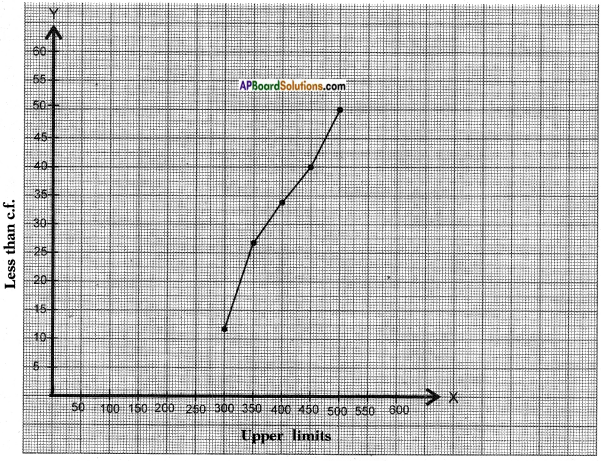
Convert the distribution above to a less than type cumulative frequency distribution, and draw its ogive.
Answer:
Since the curve is a less than type graph the data changes to
AP SSC 10th Class Maths Solutions Chapter 14 Statistics Ex 14.4 2
X – axis – upper limits 1 cm = 50 units.
Y – axis – less than c.f. 1 cm = 5 units.
AP SSC 10th Class Maths Solutions Chapter 14 Statistics Ex 14.4 3

AP SSC 10th Class Maths Solutions Chapter 14 Statistics Ex 14.4

Question 2.
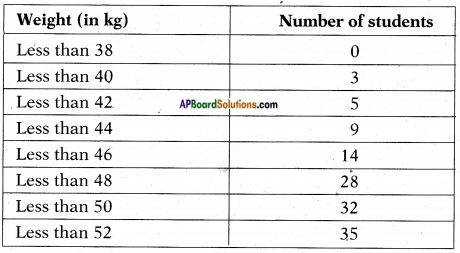
During the medical check-up of 35 students of a class, their weights were recorded as follows:
AP SSC 10th Class Maths Solutions Chapter 14 Statistics Ex 14.4 4
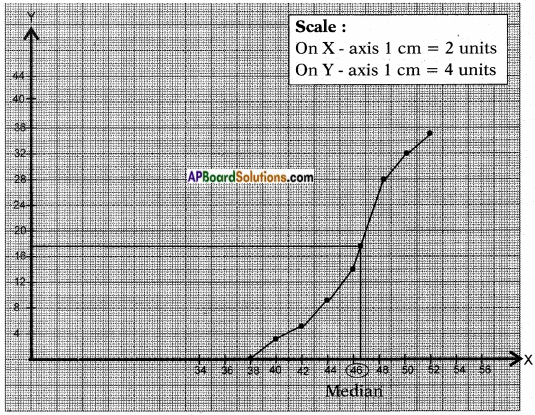
Draw a less than type ogive for the given data. Hence obtain the median weight from the graph and verify the result by using the formula.
Answer:
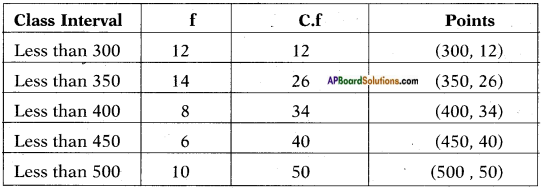
Given: Upper limits of the classes and less than cumulative frequencies. Therefore required points are (38, 0), (40, 3), (42, 5), (44, 9), (46, 14), (48, 28), (50, 32) and (52, 35)
X – axis – upper limits 1 cm = 2 units.
Y – axis – less than c.f. 1 cm = 4 units.
AP SSC 10th Class Maths Solutions Chapter 14 Statistics Ex 14.4 5

AP SSC 10th Class Maths Solutions Chapter 14 Statistics Ex 14.4

Number of observations = 35
∴ [latex]\frac{N}{2}[/latex] = [latex]\frac{35}{2}[/latex] = 17.5
Locate the point on the ogive whose ordinate is 17.5.
The x – coordinate of this point is the required median.
From the graph, median = 46.5.
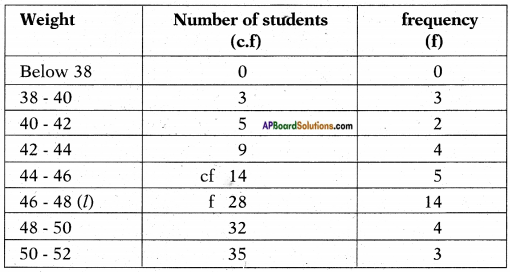
AP SSC 10th Class Maths Solutions Chapter 14 Statistics Ex 14.4 6
Number of observations = n = 35
∴ [latex]\frac{N}{2}[/latex] = [latex]\frac{35}{2}[/latex] = 17.5
17.5 belongs to the class 46 – 48
∴ Median class = 46-48
l – lower boundary of class = 46
f – frequency of the median class =14
c.f = 14
Class size = 2
Median = [latex]l+\frac{\left[\frac{\mathrm{n}}{2}-\mathrm{cf}\right]}{\mathrm{f}} \times \mathrm{h}[/latex]
= 46 + [latex]\frac{17.5-14}{14}[/latex] × 2
= 46 + [latex]\frac{3.5}{14}[/latex] × 2
= 46 + [latex]\frac{7}{14}[/latex]
= 46 + [latex]\frac{1}{2}[/latex]
= 46.5
Here median is 46.5 by either by ways.

AP SSC 10th Class Maths Solutions Chapter 14 Statistics Ex 14.4

Question 3.
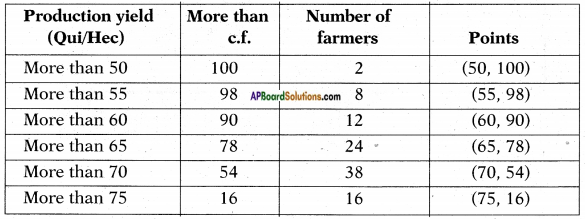
The following table gives production yield per hectare of wheat of 100 farms of a village.
AP SSC 10th Class Maths Solutions Chapter 14 Statistics Ex 14.4 7
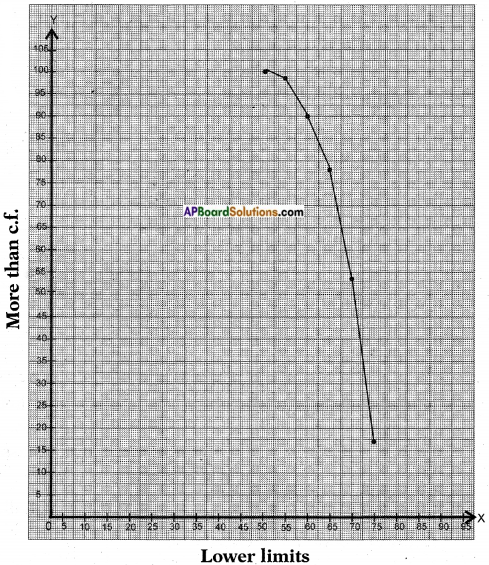
Change the distribution to a more than type distribution, and draw its ogive.
Answer:
The given data is to be changed to more than frequency distribution type.
AP SSC 10th Class Maths Solutions Chapter 14 Statistics Ex 14.4 8
A graph is plotted by taking the lower limits on the X – axis and respective of Y – axis.
Scale:
X – axis: 1 cm = 5 units
Y – axis: 1 cm = 5 units
AP SSC 10th Class Maths Solutions Chapter 14 Statistics Ex 14.4 9

AP SSC 10th Class Maths Solutions Chapter 11 Trigonometry Ex 11.2

AP State Board Syllabus AP SSC 10th Class Maths Textbook Solutions Chapter 11 Trigonometry Ex 11.2 Textbook Questions and Answers.

AP State Syllabus SSC 10th Class Maths Solutions 11th Lesson Trigonometry Exercise 11.2

10th Class Maths 11th Lesson Trigonometry Ex 11.2 Textbook Questions and Answers

Question 1.
Evaluate the following.
i) sin 45° + cos 45°
Answer:
sin 45° + cos 45°
= [latex]\frac{1}{\sqrt{2}}[/latex] + [latex]\frac{1}{\sqrt{2}}[/latex]
= [latex]\frac{1+1}{\sqrt{2}}[/latex]
= [latex]\frac{2}{\sqrt{2}}[/latex]
= [latex]\frac{\sqrt{2} \times \sqrt{2}}{\sqrt{2}}[/latex]
= √2

ii)
AP SSC 10th Class Maths Solutions Chapter 11 Trigonometry Ex 11.2 1
Answer:
AP SSC 10th Class Maths Solutions Chapter 11 Trigonometry Ex 11.2 2

AP SSC 10th Class Maths Solutions Chapter 11 Trigonometry Ex 11.2

iii)
AP SSC 10th Class Maths Solutions Chapter 11 Trigonometry Ex 11.2 3
Answer:
AP SSC 10th Class Maths Solutions Chapter 11 Trigonometry Ex 11.2 4

iv) 2 tan2 45° + cos2 30° – sin2 60°
Answer:
2 tan2 45° + cos2 30° – sin2 60°
= 2(1)2 + [latex]\left(\frac{\sqrt{3}}{2}\right)^{2}[/latex] – [latex]\left(\frac{\sqrt{3}}{2}\right)^{2}[/latex]
= [latex]\frac{2}{1}[/latex] + [latex]\frac{3}{4}[/latex] – [latex]\frac{3}{4}[/latex]
= [latex]\frac{8+3-3}{4}[/latex]
= [latex]\frac{8}{4}[/latex]
= 2

AP SSC 10th Class Maths Solutions Chapter 11 Trigonometry Ex 11.2

v)
AP SSC 10th Class Maths Solutions Chapter 11 Trigonometry Ex 11.2 5
Answer:
AP SSC 10th Class Maths Solutions Chapter 11 Trigonometry Ex 11.2 6

Question 2.
Choose the right option and justify your choice.
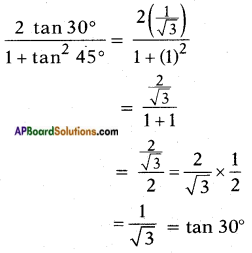
i) [latex]\frac{2 \tan 30^{\circ}}{1+\tan ^{2} 45^{\circ}}[/latex]
a) sin 60°
b) cos 60°
c) tan 30°
d) sin 30°
Answer:
AP SSC 10th Class Maths Solutions Chapter 11 Trigonometry Ex 11.2 7

ii) [latex s=2]\frac{1-\tan ^{2} 45^{\circ}}{1+\tan ^{2} 45^{\circ}}[/latex]
a) tan 90°
b) 1
c) sin 45°
d) 0
Answer:
[latex s=2]\frac{1-\tan ^{2} 45^{\circ}}{1+\tan ^{2} 45^{\circ}}[/latex] = [latex s=2]\frac{1-(1)^{2}}{1+(1)^{2}}[/latex]
= [latex s=2]\frac{0}{1+1}[/latex] = [latex s=2]\frac{0}{2}[/latex] = 0

AP SSC 10th Class Maths Solutions Chapter 11 Trigonometry Ex 11.2

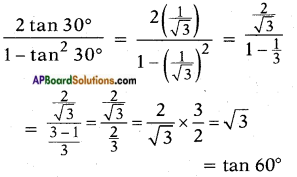
iii) [latex]\frac{2 \tan 30^{\circ}}{1-\tan ^{2} 30^{\circ}}[/latex]
a) cos 60°
b) sin 60°
c) tan 60°
d) sin 30°
Answer:
AP SSC 10th Class Maths Solutions Chapter 11 Trigonometry Ex 11.2 8

Question 3.
Evaluate sin 60° cos 30° + sin 30° cos 60°. What is the value of sin (60° + 30°). What can you conclude?
Answer:
Take sin 60°.cos 30° + sin 30°.cos 60°
= [latex]\frac{\sqrt{3}}{2}[/latex] . [latex]\frac{\sqrt{3}}{2}[/latex] + [latex]\frac{1}{2}[/latex] . [latex]\frac{1}{2}[/latex]
= [latex]\frac{(\sqrt{3})^{2}}{4}[/latex] + [latex]\frac{1}{4}[/latex]
= [latex]\frac{3}{4}[/latex] + [latex]\frac{1}{4}[/latex]
= [latex]\frac{3+1}{4}[/latex]
= [latex]\frac{4}{4}[/latex] = 1 …… (1)
Now take sin (60° + 30°)
= sin 90° = 1 …….. (2)
From equations (1) and (2), I conclude that
sin (60°+30°) = sin 60° . cos 30° + sin 30° . cos 60°.
i.e., sin (A + B) = sin A . cos B + cos A . sin B

Question 4.
Is it right to say cos (60° + 30°) = cos 60° cos 30° – sin 60° sin 30° ?
Answer:
L.H.S. = cos (60° + 30°)
cos 90° = 0
R.H.S. = cos 60° . cos 30° – sin 60° . sin 30°.
= [latex]\frac{1}{2}[/latex] . [latex]\frac{\sqrt{3}}{2}[/latex] – [latex]\frac{\sqrt{3}}{2}[/latex] . [latex]\frac{1}{2}[/latex]
= [latex]\frac{\sqrt{3}}{4}[/latex] – [latex]\frac{\sqrt{3}}{4}[/latex] = 0
∴ L.H.S = R.H.S
Yes, it is right to say
cos (60°+30°) = cos 60° . cos 30° – sin 60° . sin 30°.
i.e., cos (A + B) = cos A . cos B – sin A . sin B

AP SSC 10th Class Maths Solutions Chapter 11 Trigonometry Ex 11.2

Question 5.
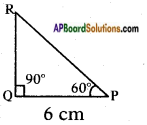
In right angle triangle △PQR, right angle is at Q and PQ = 6 cms, ∠RPQ = 60°. Determine the lengths of QR and PR.
Answer:
Given that △PQR is a right angled triangle, right angle is at Q and PQ = 6 cm, ∠RPQ = 60°.
AP SSC 10th Class Maths Solutions Chapter 11 Trigonometry Ex 11.2 9
tan 60° = [latex]\frac{\text { Opposite side to } \angle P}{\text { Adjacent side to } \angle P}[/latex]
√3 = [latex]\frac{RQ}{6}[/latex]
which gives RQ = 6√3 cm ……. (1)
To find the length of the side RQ, we consider
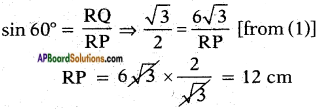
AP SSC 10th Class Maths Solutions Chapter 11 Trigonometry Ex 11.2 10
∴ The length of QR is 6√3 and RP is 12 cm.

Question 6.
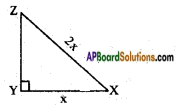
In △XYZ, right angle is at Y, YZ = x, and XY = 2x then determine ∠YXZ and ∠YZX.
Answer:
Note: In the problem take
YX = x, and XZ = 2x.
AP SSC 10th Class Maths Solutions Chapter 11 Trigonometry Ex 11.2 11
Given that △XYZ is a right angled triangle and right angle at Y, and YX = x and XZ = 2x.
By Pythagoras theorem
XZ2 = XY2 + YZ2
(2x)2 = (x)2 + YZ2
4x2 = x2 + YZ2
YZ2 = 4x2 – x2 = 3x2
YZ = [latex]\sqrt{3 x^{2}}[/latex] = √3x
Now, from the △XYZ
tan X = [latex]\frac{XZ}{XY}[/latex] = [latex]\frac{\sqrt{3} x}{x}[/latex]
tan X = √3 = tan 60°
∴ Angle YXZ is 60°.
tan Z = [latex]\frac{XY}{YZ}[/latex] = [latex]\frac{x}{\sqrt{3} x}[/latex]
tan Z = [latex]\frac{1}{\sqrt{3}}[/latex] = tan 30°
∴ Angle YZX is 30°.
Hence ∠YXZ and ∠YZX are 60° and 30°.

AP SSC 10th Class Maths Solutions Chapter 11 Trigonometry Ex 11.2

Question 7.
Is it right to say that
sin (A + B) = sin A + sin B? Justify your answer.
Answer:
Let A = 30° and B = 60°
L.H.S = sin (A + B)
= sin (30° + 60°) = sin 90° = 1
R.H.S = sin 30° + sin 60°
= [latex]\frac{1}{2}[/latex] + [latex]\frac{\sqrt{3}}{2}[/latex]
= [latex]\frac{\sqrt{3}+1}{2}[/latex]
Hence L.H.S ≠ R.H.S
So, it is not right to say that sin (A + B) = sin A + sin B

AP SSC 10th Class Maths Solutions Chapter 12 Applications of Trigonometry Ex 12.1

AP State Board Syllabus AP SSC 10th Class Maths Textbook Solutions Chapter 12 Applications of Trigonometry Ex 12.1 Textbook Questions and Answers.

AP State Syllabus SSC 10th Class Maths Solutions 12th Lesson Applications of Trigonometry Exercise 12.1

10th Class Maths 12th Lesson Applications of Trigonometry Ex 12.1 Textbook Questions and Answers

Question 1.
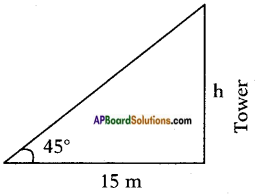
A tower stands vertically on the ground. From a point which is 15 meter away from the foot of the tower, the angle of elevation of the top of the tower is 45°. What is the height of the tower?
Answer:
AP SSC 10th Class Maths Solutions Chapter 12 Applications of Trigonometry Ex 12.1 1Let the height of the tower = h m
Distance of the point of observation from the foot of the tower =15 cm.
Angle of elevation of the top of the tower = 45°
From the figure tan θ = [latex]\frac{\text { opp. side }}{\text { adj. side }}[/latex]
tan 45° = [latex]\frac{h}{15}[/latex]
⇒ 1 = [latex]\frac{h}{15}[/latex]
∴ h = 1 × 15 = 15 m

AP SSC 10th Class Maths Solutions Chapter 12 Applications of Trigonometry Ex 12.1

Question 2.
A tree breaks due to storm and the broken part bends so that the top of the tree touches the ground by making 30° angle with the ground. The distance between the foot of the tree and the top of the tree on the ground is 6 m. Find the height of the tree before falling down.
Answer:
AP SSC 10th Class Maths Solutions Chapter 12 Applications of Trigonometry Ex 12.1 2Distance between the foot of tree and the point of contact of the top of the tree on the ground = 6 cm.
Let the length of the remaining part be = h m.
Let the length of the broken part be = x m.
Angle made by the broken part with the ground = 30°.
From the figure
tan 30° = [latex]\frac{h}{6}[/latex]
⇒ [latex]\frac{1}{\sqrt{3}}[/latex] = [latex]\frac{h}{6}[/latex]
∴ h = [latex]\frac{6}{\sqrt{3}}=\frac{3 \times 2}{\sqrt{3}}[/latex] = 2√3 m
Also cos 30° = [latex]\frac{6}{x}[/latex]
⇒ [latex]\frac{\sqrt{3}}{2}[/latex] = [latex]\frac{6}{x}[/latex]
⇒ x = [latex]\frac{6 \times 2}{\sqrt{3}}[/latex] = [latex]\frac{3 \times 2 \times 2}{\sqrt{3}}[/latex] = 4√3
∴ Height of the tree = broken part + remaining part
= x + h
= 2√3 + 4√3 = 6√3 m
= 6 × 1.732
≃ 10.392 m.

AP SSC 10th Class Maths Solutions Chapter 12 Applications of Trigonometry Ex 12.1

Question 3.
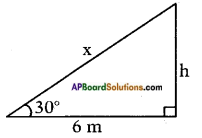
A contractor wants to set up a slide for the children to play in the park. He wants to set it up at the height of 2 m and by making an angle of 30° with the ground. What should be the length of the slide?
Answer:
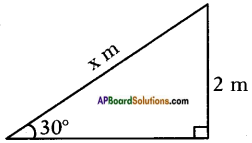
AP SSC 10th Class Maths Solutions Chapter 12 Applications of Trigonometry Ex 12.1 3Height of slide = 2 m
Let the length of the slide = x m.
Angle made by the slide with the ground = 30°
From the figure
sin 30° = [latex]\frac{2}{x}[/latex]
⇒ [latex]\frac{1}{2}[/latex] = [latex]\frac{2}{x}[/latex]
⇒ x = 2 × 2 = 4 m
Length of the slide = 4 m.

Question 4.
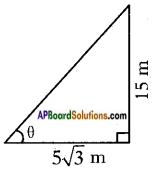
Length of the shadow of a 15 meter high pole is 5√3 meters at 7 o’clock in the morning. Then, what is the angle of elevation of the Sun rays with the ground at the time?
Answer:
AP SSC 10th Class Maths Solutions Chapter 12 Applications of Trigonometry Ex 12.1 4Height of the pole = 15 m
Length of the shadow = 5√3 m
Let the angle of elevation be ‘θ’.
Then from the figure
tan θ = [latex]\frac{15}{5 \sqrt{3}}=\frac{5 \times \sqrt{3} \times \sqrt{3}}{5 \times \sqrt{3}}[/latex] = √3
tan θ = √3 = tan 60°
∴ θ = 60°
∴ Angle of elevation of Sun rays with the ground = 60°.

AP SSC 10th Class Maths Solutions Chapter 12 Applications of Trigonometry Ex 12.1

Question 5.
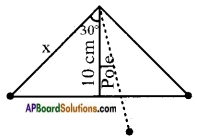
You want to erect a pole of height 10 m with the support of three ropes. Each rope has to make an angle 30° with the pole. What should be the length of the rope?
Answer:
Height of the pole = 10 m
Let the length of each rope = x
Angle made by the rope with the pole = 30°
AP SSC 10th Class Maths Solutions Chapter 12 Applications of Trigonometry Ex 12.1 5
From the figure
cos 30° = [latex]\frac{10}{x}[/latex]
[latex]\frac{\sqrt{3}}{2}[/latex] = [latex]\frac{10}{x}[/latex]
⇒ x = [latex]\frac{10 \times 2}{\sqrt{3}}=\frac{20}{\sqrt{3}}[/latex]
∴ Length of each rope = [latex]\frac{20}{\sqrt{3}}[/latex]m
= 11.546 m.

∴ Total length of the rope = 3 × [latex]\frac{20}{\sqrt{3}}[/latex]
= 20√3
= 20 × 1.732
≃ 34.64 m.

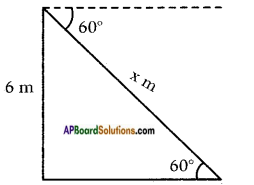
Question 6.
Suppose you are shooting an arrow from the top of a building at a height of 6 m to a target on the ground at an angle of depression of 60°. What is the distance between you and the object?
Answer:
AP SSC 10th Class Maths Solutions Chapter 12 Applications of Trigonometry Ex 12.1 6Height of the building = 6 m
Angle of depression = Angle of elevation at the ground = 60°
Let the distance of the target from the shooting point = x m
Then from the figure
sin 60° = [latex]\frac{6}{x}[/latex]
[latex]\frac{\sqrt{3}}{2}[/latex] = [latex]\frac{6}{x}[/latex]
⇒ x = [latex]\frac{6 \times 2}{\sqrt{3}}=\frac{2 \times \sqrt{3} \times \sqrt{3} \times 2}{\sqrt{3}}[/latex] = 4√3
∴ Distance = 4√3 m or
4 × 1.732 = 6.928 m.

AP SSC 10th Class Maths Solutions Chapter 12 Applications of Trigonometry Ex 12.1

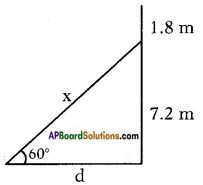
Question 7.
An electrician wants to repair an electric connection on a pole of height 9 m. He needs to reach 1.8 m below the top of the pole to do repair work. What should be the length of the ladder which he should use, when he climbs it at an angle of 60° with the ground? What will be the distance between foot of the ladder and foot of the pole?
Answer:
AP SSC 10th Class Maths Solutions Chapter 12 Applications of Trigonometry Ex 12.1 7Height of the pole = 9m
Height of the point from the ground where he reaches the pole = 9 – 1.8 = 7.2 m
Angle of elevation = 60°
Angle of depression = Angle of elevation at the ground = 60°
Let the distance of the target from the shooting point = x m
Then from the figure
sin 60° = [latex]\frac{7.2}{x}[/latex]
[latex]\frac{\sqrt{3}}{2}[/latex] = [latex]\frac{7.2}{x}[/latex]
⇒ x = [latex]\frac{7.2 \times 2}{\sqrt{3}}=\frac{3 \times 2.4 \times 2}{\sqrt{3}}=\frac{\sqrt{3} \times \sqrt{3} \times 4.8}{\sqrt{3}}[/latex]
⇒ x = 1.732 × 4.8
≃ 8.31 m
Also tan 60° = [latex]\frac{7.2}{d}[/latex]
√3 = [latex]\frac{7.2}{d}[/latex]
⇒ d = [latex]\frac{7.2}{\sqrt{3}}=\frac{2.4 \times 3}{\sqrt{3}}[/latex] = 2.4 × √3 = 2.4 × 1.732
∴ d ≃ 4.1568 m

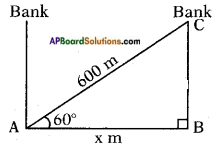
Question 8.
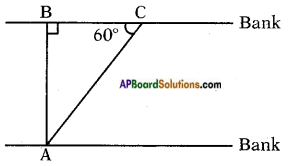
A boat has to cross a river. It crosses the river by making an angle of 60° with the bank of the river due to the stream of the river and travels a distance of 600 m to reach the another side of the river. What is the width of the river?
Answer:
AP SSC 10th Class Maths Solutions Chapter 12 Applications of Trigonometry Ex 12.1 8Let the width of the river = AB = x m
Angle made by the boat = 60°
Distance travelled = AC = 600 m
From the figure
cos 60° = [latex]\frac{x}{600}[/latex]
[latex]\frac{1}{2}[/latex] = [latex]\frac{x}{600}[/latex]
⇒ x = [latex]\frac{600}{2}[/latex] = 300 m.
AP SSC 10th Class Maths Solutions Chapter 12 Applications of Trigonometry Ex 12.1 9In the figure
A = Boat’s place
C = Reach place of another side (or) Point of observation.
AC = Travelling distance of the boat ∠AC = 60°
AB = width of the river AB
In △ABC, sin 60° = [latex]\frac{AB}{AC}[/latex]
⇒ [latex]\frac{\sqrt{3}}{2}[/latex] = [latex]\frac{AB}{600}[/latex]
⇒ AB = 600 × [latex]\frac{\sqrt{3}}{2}[/latex] = 300√3

AP SSC 10th Class Maths Solutions Chapter 12 Applications of Trigonometry Ex 12.1

Question 9.
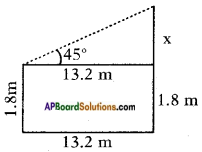
An observer of height 1.8 m is 13.2 m away from a palm tree. The angle of elevation of the top of the tree from his eyes is 45°. What is the height of the palm tree?
Answer:
Height of the observer = 1.8 m
Distance of the observer from the palm tree = 13.2 m
AP SSC 10th Class Maths Solutions Chapter 12 Applications of Trigonometry Ex 12.1 10From the figure
tan 45° = [latex]\frac{x}{13.2}[/latex]
⇒ 1 = [latex]\frac{x}{13.2}[/latex]
⇒ x = 13.2 m
∴ Height of the palm tree = 13.2 + 1.8 = 15 m.

Question 10.
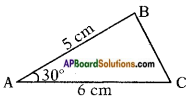
In the given figure, AC = 6 cm, AB = 5 cm and ∠BAC = 30°. Find the area of the triangle.
AP SSC 10th Class Maths Solutions Chapter 12 Applications of Trigonometry Ex 12.1 11Answer:
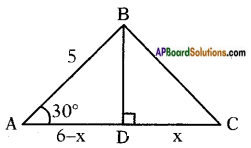
AP SSC 10th Class Maths Solutions Chapter 12 Applications of Trigonometry Ex 12.1 12Draw a perpendicular BD to AC
∴ BD ⊥ AC
Now let AD = 6 – x and DC = x
Given AB = 5 cm and ∠BAD = 30° then in △ABD
sin 30° = [latex]\frac{BD}{AB}[/latex] = [latex]\frac{BD}{5}[/latex] = [latex]\frac{1}{2}[/latex]
⇒ BD = [latex]\frac{5}{2}[/latex] = 2.5 cm
and cos 30° = [latex]\frac{AD}{AB}[/latex] = [latex]\frac{6-x}{5}[/latex] = [latex]\frac{\sqrt{3}}{2}[/latex]
⇒ 6 – x = [latex]\frac{5 \sqrt{3}}{2}[/latex]
⇒ x = 6 – [latex]\frac{5 \sqrt{3}}{2}[/latex] = 6 – [latex]\frac{5(1.732)}{2}[/latex]
∴ x = 1.67
∴ Area of △ABC = [latex]\frac{1}{2}[/latex]bh
= [latex]\frac{1}{2}[/latex] × AC × BD
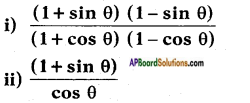
= [latex]\frac{1}{2}[/latex] × 6 × 2.5
= 7.5 cm2

AP SSC 10th Class Maths Solutions Chapter 14 Statistics Ex 14.3
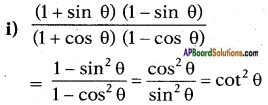
AP State Board Syllabus AP SSC 10th Class Maths Textbook Solutions Chapter 14 Statistics Ex 14.3 Textbook Questions and Answers.

AP State Syllabus SSC 10th Class Maths Solutions 14th Lesson Statistics Exercise 14.3

10th Class Maths 14th Lesson Statistics Ex 14.3 Textbook Questions and Answers

Question 1.
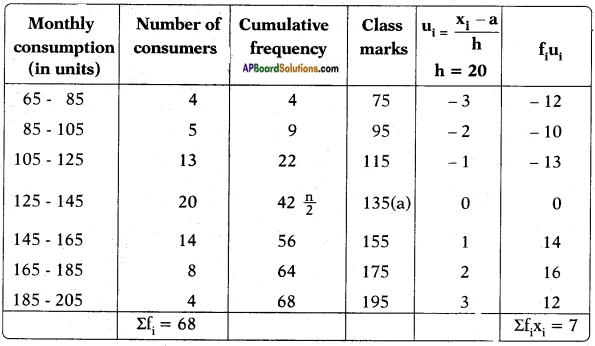
The following frequency distribution gives the monthly consumption of electricity of 68 consumers of a locality. Find the median, mean and mode of the data and compare them.
AP SSC 10th Class Maths Solutions Chapter 14 Statistics Ex 14.3 1
Answer:
AP SSC 10th Class Maths Solutions Chapter 14 Statistics Ex 14.3 2

AP SSC 10th Class Maths Solutions Chapter 14 Statistics Ex 14.3
Sum of the frequencies = 68
∴ [latex]\frac{n}{2}[/latex] = [latex]\frac{68}{2}[/latex] = 34
Hence median class = 125 – 145
Lower boundary of the median class, l = 125
cf – cumulative frequency of the class preceding the median class = 22
f – frequency of the median class = 20
h = class size = 20
Median = [latex]l+\frac{\left[\frac{\mathrm{n}}{2}-\mathrm{cf}\right]}{\mathrm{f}} \times \mathrm{h}[/latex]
= 125 + [latex]\frac{[34-22]}{20}[/latex] × 20
∴ Median = 125 + 12 = 137
Maximum number of consumers lie in the class 125 – 145
Modal class is 125 -145
l – lower limit of the modal class =125
f1 – frequency of the modal class = 20
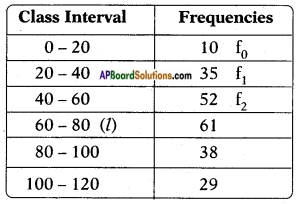
f0 – frequency of the class preceding the modal class =13
f2 – frequency of the class succeeding the modal class =14
h – size of the class = 20
Mode (Z) = [latex]l+\frac{f_{1}-f_{0}}{\left(f_{1}-f_{0}\right)+\left(f_{1}-f_{2}\right)} \times h[/latex]
Mode (Z) = 125 + [latex]\frac{20-13}{(20-13)+(20-14)} \times 20[/latex]
= 125 + [latex]\frac{7}{7+6}[/latex] × 20
= 125 + [latex]\frac{140}{13}[/latex]
= 125 + 10.76923
∴ Mode = 135.769
Mean [latex]\overline{\mathrm{x}}=\mathrm{a}+\frac{\Sigma \mathrm{f}_{\mathrm{i}} \mathrm{u}_{\mathrm{i}}}{\Sigma \mathrm{f}_{\mathrm{i}}} \times \mathrm{h}[/latex]
a = assumed mean = 135
∴ [latex]\overline{\mathbf{x}}[/latex] = 135 + [latex]\frac{7}{68}[/latex]
= 135 + 0.102941
≃ 135.1
Mean, Median and Mode are approximately same in this case.

AP SSC 10th Class Maths Solutions Chapter 14 Statistics Ex 14.3

Question 2.
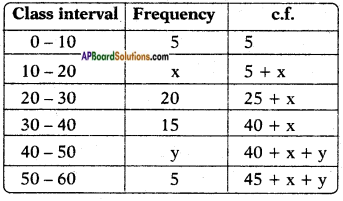
If the median of 60 observations, given below is 28.5, find the values of x and y.
AP SSC 10th Class Maths Solutions Chapter 14 Statistics Ex 14.3 3
Answer:
AP SSC 10th Class Maths Solutions Chapter 14 Statistics Ex 14.3 4
Median = [latex]l+\frac{\left[\frac{\mathrm{n}}{2}-\mathrm{cf}\right]}{\mathrm{f}} \times \mathrm{h}[/latex]
It is given that ∑f = n = 60
So, 45 + x + y = 60
x + y = 60 – 45 = 15
x + y = 15 ….. (1)
The median is 28.5 which lies be-tween 20 and 30.
Median class = 20 – 30
Lower boundary of the median class ‘l’ = 20
[latex]\frac{N}{2}[/latex] = [latex]\frac{60}{2}[/latex] = 30
cf – cumulative frequency = 5 + x
h = 10
Median = [latex]l+\frac{\left[\frac{\mathrm{n}}{2}-\mathrm{cf}\right]}{\mathrm{f}} \times \mathrm{h}[/latex]
⇒ 28.5 = 20 + [latex]\frac{30-5-x}{20}[/latex] × 10
⇒ 28.5 = 20 + [latex]\frac{25-x}{2}[/latex]
[latex]\frac{25-x}{2}[/latex] = 28.5 – 20 = 8.5
25 – x = 2 × 8.5
x = 25- 17 = 8
also from (1); x + y = 15
8 + y = 15
y = 7
∴ x = 8; y = 7.

AP SSC 10th Class Maths Solutions Chapter 14 Statistics Ex 14.3

Question 3.
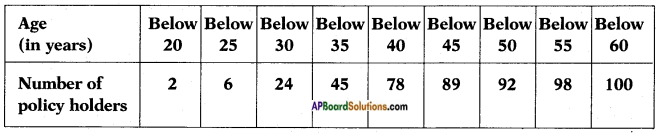
A life insurance agent found the following data about distribution of ages of 100 policy holders. Calculate the median age. [Policies are given only to persons having age 18 years onwards but less than 60 years.
AP SSC 10th Class Maths Solutions Chapter 14 Statistics Ex 14.3 5
Answer:
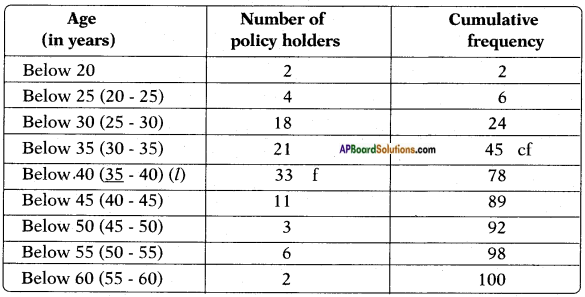
AP SSC 10th Class Maths Solutions Chapter 14 Statistics Ex 14.3 6
The given distribution being of the less than type, 25, 30, 35, give the upper limits of corresponding class intervals. So the classes should be 20 – 25, 25 – 30, 30 – 35, ………. 55 – 60.
Observe that from the given distribution 2 persons with age less than 20.
i.e., frequency of the class below 20 is 2.
Now there are 6 persons with age less than 25 and 2 persons with age less than 20.
∴ The number of persons with age in the interval 20 – 25 is 6 – 2 = 4.
Similarly, the frequencies can be calculated as shown in table.
Number of observations = 100
n = 100
[latex]\frac{n}{2}[/latex] = [latex]\frac{100}{2}[/latex] = 50, which lies in the class 35-40
∴ 35 – 40 is the median class and lower boundary l = 35
cf = 45;
h = 5;
f = 33
Median = [latex]l+\frac{\left[\frac{\mathrm{n}}{2}-\mathrm{cf}\right]}{\mathrm{f}} \times \mathrm{h}[/latex]
= 35 + [latex]\frac{50-45}{33}[/latex] × 5
= 35 + [latex]\frac{5}{33}[/latex] × 5
= 35 + 0.7575
= 35.7575
∴ Median ≃ 35.76

AP SSC 10th Class Maths Solutions Chapter 14 Statistics Ex 14.3

Question 4.
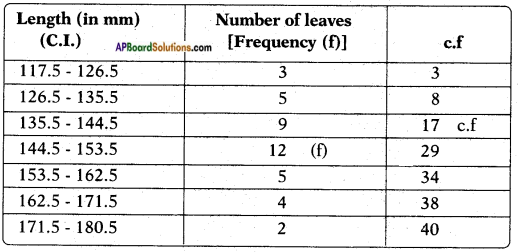
The lengths of 40 leaves of a plant are measured correct to the nearest millimetre, and the data obtained is represented in the following table:
AP SSC 10th Class Maths Solutions Chapter 14 Statistics Ex 14.3 7
Find the median length of the leaves. (Hint: The data needs to be converted to continuous classes for finding the median, since the formula assumes continuous classes. The classes then change to 117.5 – 126.5, 126.5 – 135.5,…, 171.5 – 180.5.)
Answer:
Since the formula, Median = [latex]l+\frac{\left[\frac{\mathrm{n}}{2}-\mathrm{cf}\right]}{\mathrm{f}} \times \mathrm{h}[/latex] assumes continuous classes assumes continuous class, the data needs to be converted to continuous classes.
The classes then changes to 117.5 – 126.5; 126.5 – 133.5, …… 171.5 – 180.5.
AP SSC 10th Class Maths Solutions Chapter 14 Statistics Ex 14.3 8
∑fi = n = 40
[latex]\frac{n}{2}[/latex] = [latex]\frac{40}{2}[/latex] = 20
[latex]\frac{n}{2}[/latex]th observation lie in the class 144.5- 153.5
∴ Median class = 144.5 – 153.5
Lower boundary, l = 144.5
Frequency of the median class, f = 12
c.f. = 17
h = 9
∴ Median = [latex]l+\frac{\left[\frac{\mathrm{n}}{2}-\mathrm{cf}\right]}{\mathrm{f}} \times \mathrm{h}[/latex]
= 144.5 + [latex]\frac{20-17}{12}[/latex] × 9
= 144.5 + [latex]\frac{3}{12}[/latex] × 9
= 144.5 + [latex]\frac{9}{4}[/latex]
= 144.5 + 2.25
∴ Median length = 146.75 mm.

AP SSC 10th Class Maths Solutions Chapter 14 Statistics Ex 14.3

Question 5.
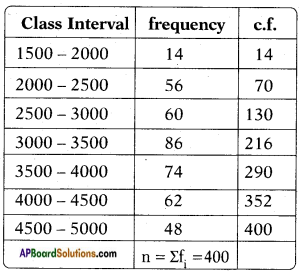
The following table gives the distribution of the life-time of 400 neon lamps.
AP SSC 10th Class Maths Solutions Chapter 14 Statistics Ex 14.3 9
Find the median life-time of a lamp.
Answer:
AP SSC 10th Class Maths Solutions Chapter 14 Statistics Ex 14.3 10
Total observations are n = 400
[latex]\frac{n}{2}[/latex]th observation i.e [latex]\frac{400}{2}[/latex] = 200
200 lies in the class 3000 – 3500
∴ Median class = 3000 – 3500
Lower boundary l = 3000
frequency of the median class f = 86
c.f = 130
Class size, h = 500
Median = [latex]l+\frac{\left[\frac{\mathrm{n}}{2}-\mathrm{cf}\right]}{\mathrm{f}} \times \mathrm{h}[/latex]
= 3000 + [latex]\frac{200-130}{86}[/latex] × 500
= 3000 + [latex]\frac{70}{86}[/latex] × 500
= 3000 + 406.977
= 3406.98
∴ Median life ≃ 3406.98 hours

AP SSC 10th Class Maths Solutions Chapter 14 Statistics Ex 14.3

Question 6.
100 surnames were randomly picked up from a local telephone directory and the frequency distribution of the number of letters in the English alphabet in the surnames was obtained as follows.
AP SSC 10th Class Maths Solutions Chapter 14 Statistics Ex 14.3 11
Determine the median number of letters in the surnames. Find the mean number of letters in the surnames ? Also, find the modal size of the surnames.
Answer:
Number of letters in the surnames.
Also find the modal size of the surnames.
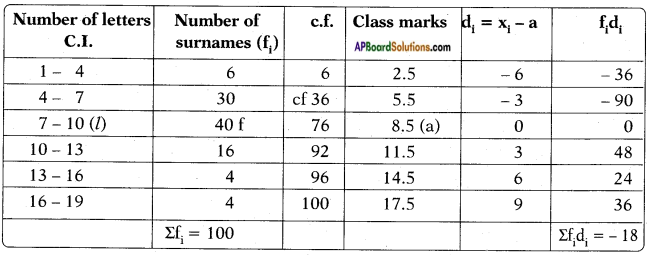
AP SSC 10th Class Maths Solutions Chapter 14 Statistics Ex 14.3 12
Total observations are n = 100
[latex]\frac{n}{2}[/latex] = [latex]\frac{100}{2}[/latex] = 50
50 lies in the class 7 – 10
∴ Median class = 7 – 10
l – lower boundary = 7
f – frequency of the median class = 40
cf = 36
Class size h = 3
Median:
Median = [latex]l+\frac{\left[\frac{\mathrm{n}}{2}-\mathrm{cf}\right]}{\mathrm{f}} \times \mathrm{h}[/latex]
= 7 + [latex]\frac{50-36}{40}[/latex] × 3
= 7 + [latex]\frac{14}{40}[/latex] × 3
= 7 + [latex]\frac{42}{40}[/latex]
= 7 + 1.05
= 8.05
∴ Median = 8.05.

Mean:
Assumed mean, a = 8.5
Mean [latex]\overline{\mathrm{x}}=\mathrm{a}+\frac{\Sigma \mathrm{f}_{\mathrm{i}} \mathrm{d}_{\mathrm{i}}}{\Sigma \mathrm{f}_{\mathrm{i}}}[/latex]
= 8.5 + [latex]\frac{(-18)}{100}[/latex]
= 8.5 – 0.18
= 8.32
∴ Mean = 8.32.

Mode:
Maximum number of surnames = 40
∴ Modal class = 7-10
l – lower boundary of the modal class = 7
Mode (Z) = [latex]l+\frac{f_{1}-f_{0}}{\left(f_{1}-f_{0}\right)+\left(f_{1}-f_{2}\right)} \times h[/latex]
l = 7; f1 = 40, f0 = 30, f2 = 16, h = 3
Mode (Z) = 7 + [latex]\frac{40-30}{(40-30)+(40-16)}[/latex] × 3
= 7 + [latex]\frac{10}{10+24}[/latex] × 3
= 7 + [latex]\frac{30}{34}[/latex]
= 7 + 0.882
= 7.882

Median = 8.0.5; Mean = 8.32; Modal size = 7.88.

AP SSC 10th Class Maths Solutions Chapter 14 Statistics Ex 14.3

Question 7.
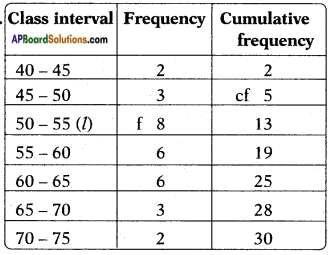
The distribution below gives the weights of 30 students of a class. Find the median weight of the students.
AP SSC 10th Class Maths Solutions Chapter 14 Statistics Ex 14.3 13
Answer:
AP SSC 10th Class Maths Solutions Chapter 14 Statistics Ex 14.3 14
Number of observations (n) = ∑fi
[latex]\frac{n}{2}[/latex] = [latex]\frac{30}{2}[/latex] = 15
15 lies in the class 50 – 55
∴ Median class = 50-55
l – lower boundary of the median class = 55
f – frequency of the median class = 8
c.f = 5
Class size h = 6
Median = [latex]l+\frac{\left[\frac{\mathrm{n}}{2}-\mathrm{cf}\right]}{\mathrm{f}} \times \mathrm{h}[/latex]
= 50 + [latex]\frac{15-5}{8}[/latex] × 6
= 50 + 7.5
= 57.5
= 50 + 7.5 = 57.5
∴ Median weight = 57.5 kg.

AP SSC 10th Class Maths Solutions Chapter 14 Statistics Ex 14.1

AP State Board Syllabus AP SSC 10th Class Maths Textbook Solutions Chapter 14 Statistics Ex 14.1 Textbook Questions and Answers.

AP State Syllabus SSC 10th Class Maths Solutions 14th Lesson Statistics Exercise 14.1

10th Class Maths 14th Lesson Statistics Ex 14.1 Textbook Questions and Answers

Question 1.
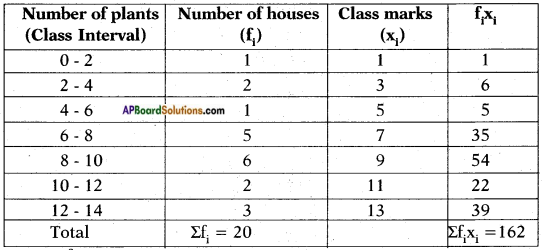
A survey was conducted by a group of students as a part of their environment awareness programme, in which they collected the following data regarding the number of plants in 20 houses in a locality. Find the mean number of plants per house.
AP SSC 10th Class Maths Solutions Chapter 14 Statistics Ex 14.1 q1
Answer:
AP SSC 10th Class Maths Solutions Chapter 14 Statistics Ex 14.1 q2
Since fi and xi are of small values we use direct method.
∴ [latex]\overline{\mathrm{x}}=\frac{\Sigma \mathrm{f}_{\mathrm{i}} \mathrm{x}_{\mathrm{i}}}{\Sigma \mathrm{f}_{\mathrm{i}}}[/latex]
= [latex]\frac{162}{20}[/latex]
= 8.1

AP SSC 10th Class Maths Solutions Chapter 14 Statistics Ex 14.1

Question 2.
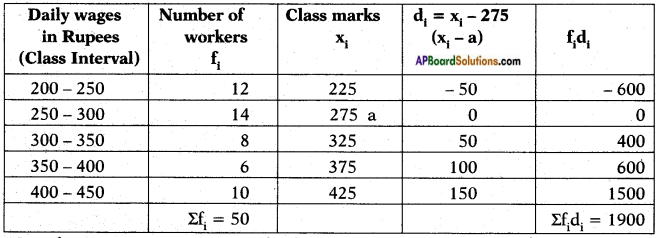
Consider the following distribution of daily wages of 50 workers of a factory.
AP SSC 10th Class Maths Solutions Chapter 14 Statistics Ex 14.1 3
Find the mean daily wages of the workers of the factory by using an appropriate method.
Answer:
AP SSC 10th Class Maths Solutions Chapter 14 Statistics Ex 14.1 4
Here the xi are of large numerical values.
So we use deviation method then,
[latex]\overline{\mathbf{x}}=\mathbf{a}+\frac{\Sigma \mathbf{f}_{\mathbf{i}} \mathbf{d}_{\mathbf{i}}}{\Sigma \mathbf{f}_{\mathbf{i}}}[/latex]
Here the assumed mean is taken as 275.
∴ [latex]\overline{\mathrm{x}}=\mathrm{a}+\frac{\Sigma \mathrm{f}_{\mathrm{i}} \mathrm{d}_{\mathrm{i}}}{\Sigma \mathrm{f}_{\mathrm{i}}}[/latex]
= 275 + [latex]\frac{1900}{50}[/latex]
= 275 + 38
= 313.

AP SSC 10th Class Maths Solutions Chapter 14 Statistics Ex 14.1

Question 3.
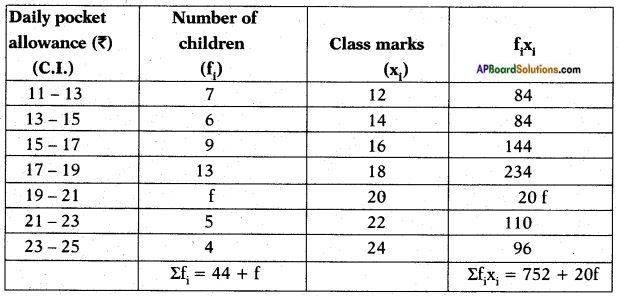
The following distribution shows the daily pocket allowance of children of a locality. The mean pocket allowance is Rs. 18. Find the missing frequency f.
AP SSC 10th Class Maths Solutions Chapter 14 Statistics Ex 14.1 5
Answer:
AP SSC 10th Class Maths Solutions Chapter 14 Statistics Ex 14.1 6
[latex]\overline{\mathrm{x}}=\frac{\Sigma \mathrm{f}_{\mathrm{i}} \mathrm{x}_{\mathrm{i}}}{\Sigma \mathrm{f}_{\mathrm{i}}}[/latex]
xi = 18 (given)
[latex]\Rightarrow 18=\frac{752+20 \mathrm{f}}{(44+\mathrm{f})}[/latex]
18 (44 + f) = 752 + 20 f
⇒ 20f- 18f= 792-752
⇒ 2f = 40
∴ f = [latex]\frac{40}{20}[/latex] = 20.

AP SSC 10th Class Maths Solutions Chapter 14 Statistics Ex 14.1

Question 4.
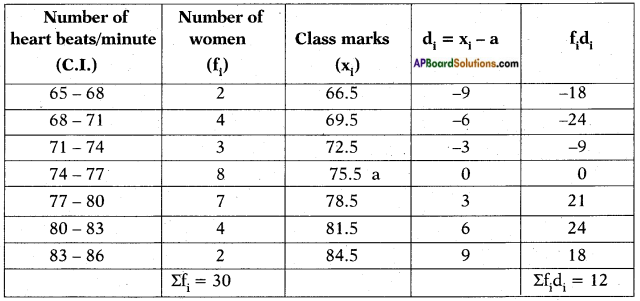
Thirty women were examined in a hospital by a doctor and their of heart beats per minute were recorded and summarised as shown. Find the mean heart beats per minute for these women, choosing a suitable method.
AP SSC 10th Class Maths Solutions Chapter 14 Statistics Ex 14.1 7
Answer:
AP SSC 10th Class Maths Solutions Chapter 14 Statistics Ex 14.1 8
[latex]\overline{\mathbf{x}}=\mathbf{a}+\frac{\Sigma \mathbf{f}_{\mathbf{i}} \mathbf{d}_{\mathbf{i}}}{\Sigma \mathbf{f}_{\mathbf{i}}}[/latex]
75.5 + [latex]\frac{12}{30}[/latex]
= 75.5 + 0.4
= 75.9.

AP SSC 10th Class Maths Solutions Chapter 14 Statistics Ex 14.1

Question 5.
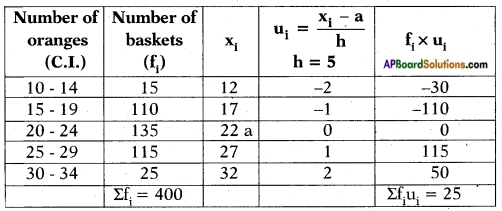
In a retail market, fruit vendors were selling oranges kept in packing baskets. These baskets contained varying number of oranges. The following was the distribution of oranges.
AP SSC 10th Class Maths Solutions Chapter 14 Statistics Ex 14.1 9
Find the mean number of oranges kept in each basket. Which method of finding the mean did you choose?
Answer:
AP SSC 10th Class Maths Solutions Chapter 14 Statistics Ex 14.1 10
Here we use step deviation method where a = 135, h = 5,a multiple of all di
[latex]\overline{\mathrm{x}}=\mathrm{a}+\left(\frac{\Sigma \mathrm{f}_{\mathrm{i}} \mathrm{u}_{\mathrm{i}}}{\Sigma \mathrm{f}_{\mathrm{i}}}\right) \times \mathrm{h}[/latex]
= 22 + [latex]\frac{25}{400}[/latex] × 5
= 22 + 0.31
= 22.31

AP SSC 10th Class Maths Solutions Chapter 14 Statistics Ex 14.1

Question 6.
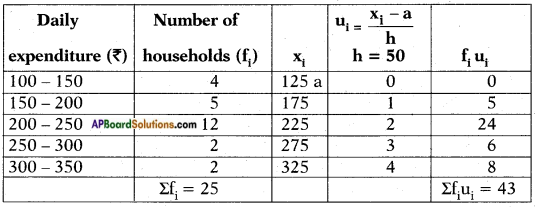
The table below shows the daily expenditure on food of 25 households in a locality.AP SSC 10th Class Maths Solutions Chapter 14 Statistics Ex 14.1 11
Find the mean daily expenditure on food by a suitable method.
Answer:
AP SSC 10th Class Maths Solutions Chapter 14 Statistics Ex 14.1 12
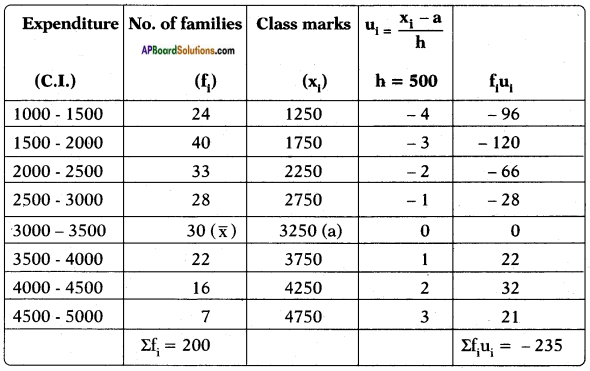
Here a = 125, h = 50, ∑fiui = 43
Now
[latex]\overline{\mathrm{x}}=\mathrm{a}+\left(\frac{\Sigma \mathrm{f}_{\mathrm{i}} \mathrm{u}_{\mathrm{i}}}{\Sigma \mathrm{f}_{\mathrm{i}}}\right) \times \mathrm{h}[/latex]
= 125 + [latex]\frac{43}{25}[/latex] × 50
= 125 + (43 × 2)
= 125 + 86
= 211.
NOTE: If we consider first value as “a” then we dont get negative values in ui, fiui columns. Then it becomes easy for calculation.

AP SSC 10th Class Maths Solutions Chapter 14 Statistics Ex 14.1

Question 7.
To find out the concentration of SO2 in the air (in parts per million, i.e., ppm), the data was collected for 30 localities in a certain city and is presented below:
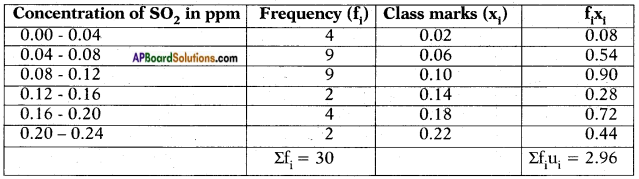
AP SSC 10th Class Maths Solutions Chapter 14 Statistics Ex 14.1 13
Find the mean concentration of SO2 in the air.
Answer:
AP SSC 10th Class Maths Solutions Chapter 14 Statistics Ex 14.1 14
∴ [latex]\overline{\mathrm{x}}=\frac{\Sigma \mathrm{f}_{\mathrm{i}} \mathrm{x}_{\mathrm{i}}}{\Sigma \mathrm{f}_{\mathrm{i}}}[/latex]
= [latex]\frac{2.96}{30}[/latex]
= 0.00986666…….
≃ 0.099

AP SSC 10th Class Maths Solutions Chapter 14 Statistics Ex 14.1

Question 8.
A class teacher has the following attendance record of 40 students of a class for the whole term. Find the mean number of days a student was present out of 56 days in the term.
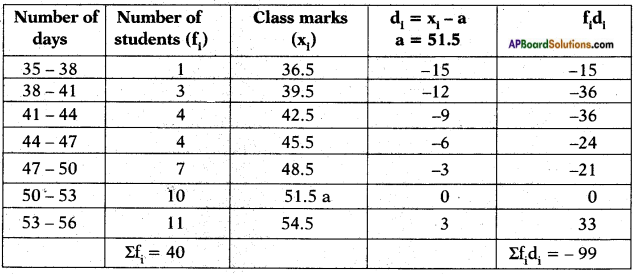
AP SSC 10th Class Maths Solutions Chapter 14 Statistics Ex 14.1 15
Answer:
AP SSC 10th Class Maths Solutions Chapter 14 Statistics Ex 14.1 16
Here, a = 51.5
∴ [latex]\overline{\mathbf{x}}=\mathbf{a}+\frac{\Sigma \mathbf{f}_{\mathbf{i}} \mathbf{d}_{\mathbf{i}}}{\Sigma \mathbf{f}_{\mathbf{i}}}[/latex]
= 51.5 – [latex]\frac{99}{40}[/latex]
= 51.5 – 2.475
= 49.025
≃ 49 days

AP SSC 10th Class Maths Solutions Chapter 14 Statistics Ex 14.1

Question 9.
The following table gives the literacy rate (in percentage) of 35 cities. Find the mean literacy rate.
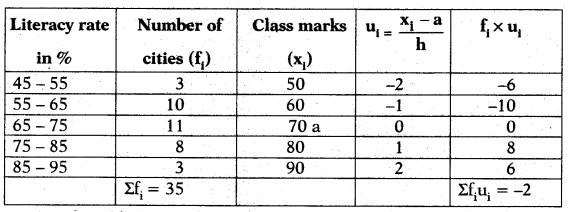
AP SSC 10th Class Maths Solutions Chapter 14 Statistics Ex 14.1 17
Answer:
AP SSC 10th Class Maths Solutions Chapter 14 Statistics Ex 14.1 18
a = 70; h = 10
∴ [latex]\overline{\mathbf{x}}=\mathbf{a}+\frac{\Sigma \mathbf{f}_{\mathbf{i}} \mathbf{u}_{\mathbf{i}}}{\Sigma \mathbf{f}_{\mathbf{i}}} \times \mathbf{h}[/latex]
[latex]\Rightarrow \bar{x}=70-\frac{2}{35} \times 10[/latex]
= 70 – [latex]\frac{2}{35}[/latex] × 10
= 70 – [latex]\frac{20}{35}[/latex]
= 70 – 0.57142
= 69.4285
≃ 69.43%

AP SSC 10th Class Maths Solutions Chapter 11 Trigonometry Ex 11.1

AP State Board Syllabus AP SSC 10th Class Maths Textbook Solutions Chapter 11 Trigonometry Ex 11.1 Textbook Questions and Answers.

AP State Syllabus SSC 10th Class Maths Solutions 11th Lesson Trigonometry Exercise 11.1

10th Class Maths 11th Lesson Trigonometry Ex 11.1 Textbook Questions and Answers

Question 1.
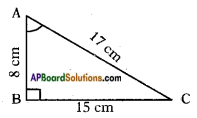
In right angle triangle ABC, 8 cm, 15 cm and 17 cm are the lengths of AB, BC and CA respectively. Then, find out sin A, cos A and tan A.
Answer:
Given that
△ABC is a right angle triangle and Lengths of AB, BC and CA are 8 cm, 15 cm and 17 cm respectively.
Among the given lengths CA is longest.
Hence CA is the hypotenuse in △ABC and its opposite vertex having right angle.
i.e., ∠B = 90°.
With reference to ∠A, we have opposite side = BC = 15 cm
adjacent side = AB = 8 cm
and hypotenuse = AC = 17
AP SSC 10th Class Maths Solutions Chapter 11 Trigonometry Ex 11.1 1
sin A = [latex]\frac{\text { Opposite side of } \angle \mathrm{A}}{\text { Hypotenuse }}[/latex] = [latex]\frac{BC}{AC}[/latex] = [latex]\frac{15}{17}[/latex]
cos A = [latex]\frac{\text { Adjacent side of } \angle \mathrm{A}}{\text { Hypotenuse }}[/latex] = [latex]\frac{AB}{AC}[/latex] = [latex]\frac{8}{17}[/latex]
tan A = [latex]\frac{\text { Opposite side of } \angle \mathrm{A}}{\text { Adjacent side of } \angle \mathrm{A}}[/latex] = [latex]\frac{BC}{AB}[/latex] = [latex]\frac{15}{8}[/latex]
∴ sin A = [latex]\frac{15}{17}[/latex];
cos A = [latex]\frac{8}{17}[/latex]
tan A = [latex]\frac{15}{8}[/latex]

AP SSC 10th Class Maths Solutions Chapter 11 Trigonometry Ex 11.1

Question 2.
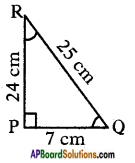
The sides of a right angle triangle PQR are PQ = 7 cm, QR = 25 cm and ∠P = 90° respectively. Then find, tan Q – tan R.
Answer:
AP SSC 10th Class Maths Solutions Chapter 11 Trigonometry Ex 11.1 2
Given that △PQR is a right angled triangle and PQ = 7 cm, QR = 25 cm.
By Pythagoras theorem QR2 = PQ2 + PR2
(25)2 = (7)2 + PR2
PR2 = (25)2 – (7)2 = 625 – 49 = 576
PR = √576 = 24 cm
tan Q = [latex]\frac{PR}{PQ}[/latex] = [latex]\frac{24}{7}[/latex];
tan R = [latex]\frac{PQ}{PR}[/latex] = [latex]\frac{7}{24}[/latex]
∴ tan Q – tan R = [latex]\frac{24}{7}[/latex] – [latex]\frac{7}{24}[/latex]
= [latex]\frac{(24)^{2}-(7)^{2}}{168}[/latex]
= [latex]\frac{576-49}{168}[/latex]
= [latex]\frac{527}{168}[/latex]

Question 3.
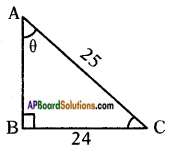
In a right angle triangle ABC with right angle at B, in which a = 24 units, b = 25 units and ∠BAC = θ. Then, find cos θ and tan θ.
Answer:
Given that ABC is a right angle triangle with right angle at B, and BC = a = 24 units, CA = b = 25 units and ∠BAC = θ.
AP SSC 10th Class Maths Solutions Chapter 11 Trigonometry Ex 11.1 3
By Pythagoras theorem
AC2 = AB2 + BC2
(25)2 = AB2 + (24)2
AB2 = 252 – 242 = 625 – 576
AB2 = 49
AB = √49 = 1
With reference to ∠BAC = θ, we have
Opposite side to θ = BC = 24 units.
Adjacent side to θ = AB = 7 units.
Hypotenuse = AC = 25 units.
Now
cos θ = [latex]\frac{\text { Adjacent side of } \theta}{\text { Hypotenuse }}[/latex] = [latex]\frac{AB}{AC}[/latex] = [latex]\frac{7}{25}[/latex]
tan θ = [latex]\frac{\text { Opposite side of } \theta}{\text { Adjacent side of } \theta}[/latex] = [latex]\frac{BC}{AB}[/latex] = [latex]\frac{24}{7}[/latex]
Hence cos θ = [latex]\frac{7}{25}[/latex] and tan θ = [latex]\frac{24}{7}[/latex]

AP SSC 10th Class Maths Solutions Chapter 11 Trigonometry Ex 11.1

Question 4.
If cos A = [latex]\frac{12}{13}[/latex], then find sin A and tan A.
Answer:
From the identity
sin2 A + cos2 A = 1
⇒ sin2 A = 1 – cos2 A
= 1 – [latex]\left(\frac{12}{13}\right)^{2}[/latex]
= 1 – [latex]\frac{144}{169}[/latex]
= [latex]\frac{169-144}{169}[/latex]
= [latex]\frac{25}{169}[/latex]
∴ sin A = [latex]\sqrt{\frac{25}{169}}[/latex] = [latex]\frac{5}{13}[/latex]
AP SSC 10th Class Maths Solutions Chapter 11 Trigonometry Ex 11.1 4
∴ sin A = [latex]\frac{5}{13}[/latex]; tan A = [latex]\frac{5}{12}[/latex]

Question 5.
If 3 tan A = 4, then find sin A and cos A.
Answer:
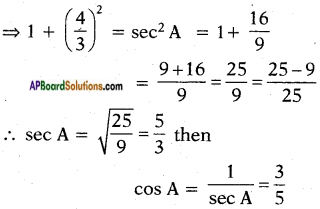
Given 3 tan A = 4
⇒ tan A = [latex]\frac{4}{3}[/latex]
From the identify sec2 A – tan2 A = 1
⇒ 1 + tan2 A = sec2 A
AP SSC 10th Class Maths Solutions Chapter 11 Trigonometry Ex 11.1 5
If cos A = [latex]\frac{3}{5}[/latex] then from
sin2 A + cos2 A = 1
We can write sin2A = 1 – cos2A
= 1 – [latex]\left(\frac{3}{5}\right)^{2}[/latex]
= 1 – [latex]\frac{9}{25}[/latex]
⇒ sin2 A = [latex]\frac{16}{25}[/latex]
⇒ sin A = [latex]\frac{4}{5}[/latex]
∴ sin A = [latex]\frac{4}{5}[/latex]; cos A = [latex]\frac{3}{5}[/latex]

AP SSC 10th Class Maths Solutions Chapter 11 Trigonometry Ex 11.1

Question 6.
In △ABC and △XYZ, if ∠A and ∠X are acute angles such that cos A = cos X then show that ∠A = ∠X.
Answer:
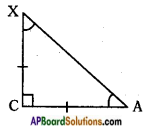
AP SSC 10th Class Maths Solutions Chapter 11 Trigonometry Ex 11.1 6
In the given triangle, cos A = cos X
⇒ [latex]\frac{AC}{AX}[/latex] = [latex]\frac{XC}{AX}[/latex]
⇒ AC = XC
⇒ ∠A = ∠X (∵ Angles opposite to equal sides are also equal)

Question 7.
Given cot θ = [latex]\frac{7}{8}[/latex], then evaluate
AP SSC 10th Class Maths Solutions Chapter 11 Trigonometry Ex 11.1 7
Answer:
AP SSC 10th Class Maths Solutions Chapter 11 Trigonometry Ex 11.1 8
cot2 θ = (cot θ)2
= [latex]\left(\frac{7}{8}\right)^{2}[/latex] = [latex]\frac{49}{64}[/latex] …… (1)
AP SSC 10th Class Maths Solutions Chapter 11 Trigonometry Ex 11.1 9
= sec θ + tan θ
So cot θ = [latex]\frac{7}{8}[/latex]
⇒ tan θ = [latex]\frac{8}{7}[/latex]
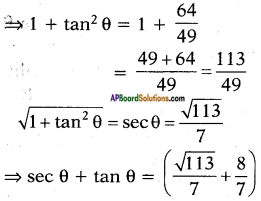
⇒ tan2 θ = [latex]\left(\frac{8}{7}\right)^{2}[/latex] = [latex]\frac{64}{49}[/latex]
From sec2 θ – tan2 θ = 1
⇒ 1 + tan2 θ = sec2 θ
AP SSC 10th Class Maths Solutions Chapter 11 Trigonometry Ex 11.1 9

AP SSC 10th Class Maths Solutions Chapter 11 Trigonometry Ex 11.1

Question 8.
In a right angle triangle ABC, right angle is at B, if tan A = √3, then find the value of
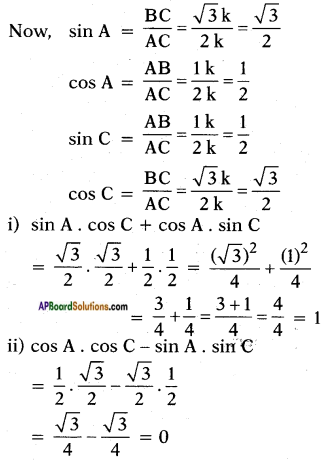
i) sin A cos C + cos A sin C
ii) cos A cos C – sin A sin C
Answer:
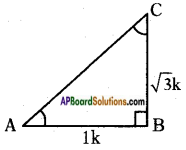
Given, tan A = [latex]\frac{\sqrt{3}}{1}[/latex]
Hence [latex]\frac{\text { Opposite side }}{\text { Adjacent side }}=\frac{\sqrt{3}}{1}[/latex]
Let opposite side = √3k and adjacent side = 1k
AP SSC 10th Class Maths Solutions Chapter 11 Trigonometry Ex 11.1 12a
In right angled △ABC,
AC2 = AB2 + BC2
(By Pythagoras theorem)
⇒ AC2 = (1k)2 + (√3k)2
⇒ AC2 = 1k2 + 3k2
⇒ AC2 = 4k2
∴ AC = [latex]\sqrt{4 k^{2}}[/latex] = 2k
AP SSC 10th Class Maths Solutions Chapter 11 Trigonometry Ex 11.1 11

AP SSC 10th Class Maths Solutions Chapter 13 Probability Ex 13.2

AP State Board Syllabus AP SSC 10th Class Maths Textbook Solutions Chapter 13 Probability Ex 13.2 Textbook Questions and Answers.

AP State Syllabus SSC 10th Class Maths Solutions 13th Lesson Probability Exercise 13.2

10th Class Maths 13th Lesson Probability Ex 13.2 Textbook Questions and Answers

Question 1.
A bag contains 3 red balls and 5 black balls. A ball is drawn at random from the bag. What is the probability that the ball drawn is (i) red ? (ii) not red?
Answer:
i) Total number of balls in the bag = 3 red + 5 black = 8 balls.
Number of total outcomes when a ball is drawn at random = 3 + 5 = 8
Now, number of favourable outcomes of red ball = 3.
∴ Probability of getting a red ball = [latex]\frac{\text { No. of favourable outcomes }}{\text { No. of total outcomes }}[/latex] = [latex]\frac{3}{8}[/latex]
ii) If P( E) is the probability of drawing no red ball, then P(E) + P([latex]\overline{\mathrm{E}}[/latex]) = 1
P([latex]\overline{\mathrm{E}}[/latex]) = 1 – P(E)= 1 – [latex]\frac{3}{8}[/latex] = [latex]\frac{5}{8}[/latex]

AP SSC 10th Class Maths Solutions Chapter 13 Probability Ex 13.2

Question 2.
A box contains 5 red marbles, 8 white marbles and 4 green marbles. One marble is taken out of the box at random. What is the probability that the marble taken out will be (i) red? (ii) white? (iii) not green?
Answer:
Total number of marbles in the box = 5 red + 8 white + 4 green = 5 + 8 + 4= 17
Number of total outcomes in drawing a marble at random from the box =17.
i) Number of red marbles = 5
Number of favourable outcomes in drawing a red ball = 5
∴ Probability of getting a red ball P(R) = [latex]\frac{\text { No. of favourable outcomes }}{\text { No. of total outcomes }}[/latex]
P(R) = [latex]\frac{5}{17}[/latex]

ii) Number of white marbles = 8
Number of favourable outcomes in drawing a white marble = 8
∴ Probability of getting a white marble
P(W) = [latex]\frac{8}{17}[/latex]

iii) Number of ‘non-green’ marbles = 5 red + 8 white = 5 + 8 = 13
Number of outcomes favourable to drawing a non-green marble =13.
∴ Probability of getting a non- green marble
P(non – green) = [latex]\frac{\text { No. of favourable outcomes }}{\text { No. of total outcomes }}[/latex]
P(non – green) = [latex]\frac{13}{17}[/latex]
Probability of getting a green ball = [latex]\frac{\text { No. of green balls }}{\text { Total no. of balls }}[/latex] = [latex]\frac{4}{17}[/latex]
Now P(G) = [latex]\frac{4}{17}[/latex]
and P(G) + P([latex]\overline{\mathrm{ G}}[/latex]) = 1
∴ P([latex]\overline{\mathrm{G}}[/latex]) = 1 – P(G)
= 1 – [latex]\frac{4}{17}[/latex]
= [latex]\frac{13}{17}[/latex]

AP SSC 10th Class Maths Solutions Chapter 13 Probability Ex 13.2

Question 3.
A Kiddy bank contains hundred 50p coins, fifty Rs. 1 coins, twenty Rs. 2 coins and ten Rs. 5 coins. If it is equally likely that one of the coins will fall out when the bank is turned upside down, what is the probability that the coin (i) will be a 50 p coin? (ii) will not be a Rs. 5 coin?
Answer:
i) Number of 50 p coins = 100
Number of Rs. 1 coins = 50
Number of Rs. 2 coins = 20
Number of Rs. 5 coins = 10
Total number of coins = 180
Number of total outcomes for a coin to fall down = 180.
Number of outcomes favourable to 50 p coins to fall down = 100.
∴ Probability of a 50 p coin to fall down = [latex]\frac{\text { No. of favourable outcomes }}{\text { No. of total outcomes }}[/latex]
= [latex]\frac{100}{180}[/latex] = [latex]\frac{5}{9}[/latex]

ii) Let P(E) be the probability for a Rs. 5 coin to fall down.
Number of outcomes favourable to Rs. 5 coin = 10.
∴ Probability for a Rs. 5 coin to fall down = [latex]\frac{\text { No. of favourable outcomes }}{\text { No. of total outcomes }}[/latex]
= [latex]\frac{10}{180}[/latex] = [latex]\frac{1}{18}[/latex]
Then P([latex]\overline{\mathrm{E}}[/latex]) is the probability of a coin which fall down is not a Rs. 5 coin.
Again P(E) + P([latex]\overline{\mathrm{E}}[/latex]) = 1
∴ P([latex]\overline{\mathrm{E}}[/latex])= l-P(E)
= 1 – [latex]\frac{1}{18}[/latex]
= [latex]\frac{17}{18}[/latex].

AP SSC 10th Class Maths Solutions Chapter 13 Probability Ex 13.2

Question 4.
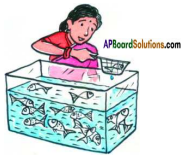
Gopi buys a fish from a shop for his aquarium. The shopkeeper takes out one fish at random from a tank containing 5 male fish and 8 female fish (See figure). What is the probability that the fish taken out is a male fish?
AP SSC 10th Class Maths Solutions Chapter 13 Probability Ex 13.2 1Answer:
Number of male fish = 5
Number of female fish = 8
Total number of fish = 5 m + 8 f
= 13 fishes.
∴ Number of total outcomes in taking a fish at random from the aquarium =13.
Number of male fish = 5
∴ Number of outcomes favourable to male fish = 5.
∴ The probability of taking a male fish = [latex]\frac{\text { No. of favourable outcomes }}{\text { No. of total outcomes }}[/latex]
= [latex]\frac{5}{13}[/latex]
= 0.38

Question 5.
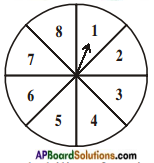
A game of chance consists of spinning an arrow which comes to rest pointing at one of the numbers 1, 2, 3, 4, 5, 6, 7, 8 (See figure), and these are equally likely outcomes. What is the probability that it will point at
(i) 8?
(ii) an odd number?
(iii) a number greater than 2?
(iv) a number less than 9?
AP SSC 10th Class Maths Solutions Chapter 13 Probability Ex 13.2 2
Answer:
Number of total outcomes are (1,2,……….., 8) = 8

i) Number of outcomes favourable to 8 = 1.
∴ P(8) = [latex]\frac{\text { No. of favourable outcomes }}{\text { No. of total outcomes }}[/latex]
= [latex]\frac{1}{8}[/latex]

ii) Number of ‘odd numbers’ on the spinning wheel = (1, 3, 5, 7) = 4
∴ Number of outcomes favourable to an odd number.
∴ Probability of getting an odd number = [latex]\frac{\text { No. of favourable outcomes }}{\text { No. of total outcomes }}[/latex]
= [latex]\frac{4}{8}[/latex] = [latex]\frac{1}{2}[/latex]

iii) Number greater than 2 are (3, 4, 5, 6, 7, 8)
Number of outcomes favourable to ‘greater than 2’ are = 6.
Probability of pointing a number greater than 2
P(E) = [latex]\frac{\text { No. of favourable outcomes }}{\text { No. of total outcomes }}[/latex]
= [latex]\frac{6}{8}[/latex] = [latex]\frac{3}{4}[/latex]

iv) Number less than 9 are: (1,2, 3, 4, 5, 6, 7, 8 …… 8)
∴ Number of outcomes favourable to pointing a number less than 9 = 8.
∴ Probability of a number less than 9
P(E) = [latex]\frac{\text { No. of outcomes favourable to less than } 9}{\text { No.of total outcomes }}[/latex]
= [latex]\frac{8}{8}[/latex] = 1
Note : This is a sure event and hence probability is 1.

AP SSC 10th Class Maths Solutions Chapter 13 Probability Ex 13.2

Question 6.
One card is drawn from, a well-shuffled deck of 52 cards. Find the probability of getting
(i) a king of red colour
(ii) a face card
(iii) a red face card
(iv) the jack of hearts
(v) a spade
(vi) the queen of diamonds.
Answer:
Total number of cards = 52.
∴ Number of all possible outcomes in drawing a card at random = 52.
i) Number of outcomes favourable to the king of red colour = 2(♥ K, ♦ K)
∴ Probability of getting the king of red colour
P(E) = [latex]\frac{\text { No. of favourable outcomes }}{\text { No. of total outcomes }}[/latex]
= [latex]\frac{2}{52}[/latex] = [latex]\frac{1}{26}[/latex]

ii) Number of face cards in a deck of cards = 4 × 3 = 12 (K, Q, J)
Number of outcomes favourable to select a face card = 12.
∴ Probability of getting a face card
= [latex]\frac{\text { No. of favourable outcomes }}{\text { No. of total outcomes }}[/latex]
= [latex]\frac{12}{52}[/latex] = [latex]\frac{3}{13}[/latex]

iii) Number of red face cards = 2 × 3 = 6.
∴ Number of outcomes favourable to select a red face card = 6.
∴ Probability of getting a red face
= [latex]\frac{\text { No. of favourable outcomes }}{\text { No. of total outcomes }}[/latex]
= [latex]\frac{6}{52}[/latex] = [latex]\frac{3}{26}[/latex]

iv) Number of outcomes favourable to the jack of hearts = 1.
∴ Probability of getting jack of hearts
= [latex]\frac{\text { No. of favourable outcomes }}{\text { No. of total outcomes }}[/latex]
= [latex]\frac{1}{52}[/latex]

v) Number of spade cards = 13
∴ Number of outcomes favourable to ‘a spade card’ = 13.
∴ Probability of drawing a spade
= [latex]\frac{\text { No. of favourable outcomes }}{\text { No. of total outcomes }}[/latex]
= [latex]\frac{13}{52}[/latex] = [latex]\frac{1}{4}[/latex]

vi) Number of outcomes favourable to the queen of diamonds = 1.
∴ Probability of drawing the queen of diamonds
= [latex]\frac{\text { No. of favourable outcomes }}{\text { No. of total outcomes }}[/latex]
= [latex]\frac{1}{52}[/latex]

AP SSC 10th Class Maths Solutions Chapter 13 Probability Ex 13.2

Question 7.
Five cards-the ten, jack, queen, king and ace of diamonds, are well-shuffled with their face downwards. One card is then picked up at random.
i) What is the probability that the card is the queen?
ii) If the queen is drawn and put aside, what is the probability that the second card picked is (a) an ace? (b) a queen?
Answer:
Total number of cards = 5.
∴ Number of total outcomes in picking up a card at random = 5.
i) Number of outcomes favourable to queen = 1.
∴ Probability of getting the queen
= [latex]\frac{\text { No.of outcomes favourable to the ‘Q’ }}{\text { No.of total outcomes }}[/latex]
= [latex]\frac{1}{5}[/latex]

ii) When queen is drawn and put aside, remaining cards are four.
∴ Number of total outcomes in drawing a card at random = 4.
a) Number of favourable outcomes to ace 1
Probability of getting an ace
= [latex]\frac{\text { No. of favourable outcomes }}{\text { No. of total outcomes }}[/latex]
= [latex]\frac{1}{4}[/latex]

b) Number of favourable outcomes to ‘Q’ = 0 (as it was already drawn and put aside)
∴ Probability that the card is Q = [latex]\frac{0}{4}[/latex] = 0
After putting queen aside, selecting the queen from the rest is an impossible event and hence the probability is zero.

Question 8.
12 defective pens are accidentally mixed with 132 good ones. It is not possible to just look at a pen and tell whether or not it is defective. One pen is taken out at random from this lot. Determine the probability that the pen taken out is a good one.
Answer:
Number of good pens = 132
Number of defective pens = 12
Total number of pens = 132 + 12 = 144
∴ Total number of outcomes in taking a pen at random = 144.
No. of favourable outcomes in taking a good pen = 132.
∴ Probability of taking a good pen
= [latex]\frac{\text { No. of favourable outcomes }}{\text { No. of total outcomes }}[/latex]
= [latex]\frac{132}{144}[/latex] = [latex]\frac{11}{12}[/latex]

AP SSC 10th Class Maths Solutions Chapter 13 Probability Ex 13.2

Question 9.
A lot of 20 bulbs contain 4 defective ones. One bulb is drawn at random from the lot. What is the probability that this bulb is defective? Suppose the bulb drawn in previous case is not defective and is not replaced. Now one bulb is drawn at random from the rest. What is the probability that this bulb is not defective?
Answer:
Given :
4 out of 20 bulbs are defective
(i.e.) Number of defective bulbs = 4
Number of non-defective bulbs = 20 – 4 = 16
If a bulb is drawn at random, the total outcomes are = 20
Number of outcomes favourable to ‘defective bulb’ = 4
∴ Probability of getting a defective bulb
= [latex]\frac{\text { No. of favourable outcomes }}{\text { No. of total outcomes }}[/latex]
= [latex]\frac{4}{20}[/latex] = [latex]\frac{1}{5}[/latex]
Suppose a non-defective bulb is drawn and not replaced, then the bulbs remaining are = 19
∴ Total outcomes in drawing a bulb from the rest = 19
Number of favourable outcomes in drawing non-defective bulb from the rest = 16 – 1 = 15
∴ Probability of getting a non-defective bulb in the second draw
= [latex]\frac{\text { No. of favourable outcomes }}{\text { No. of total outcomes }}[/latex]
= [latex]\frac{15}{19}[/latex]

Question 10.
A box contains 90 discs which are numbered from 1 to 90. If one disc is drawn at random from the box, find the probability that it bears
(i) a two digit number
(ii) a perfect square number
(iii) a number divisible by 5.
Answer:
Total number of discs in the box = 90
∴ Number of total outcomes in drawing a disc at random from the box = 90.

i) Number of 2-digit numbers in the box (10, 11,….., 90) = 81
i.e., Number of favourable outcomes in drawing a 2 – digit numbers = 81
∴ Probability of selecting a disc bearing a 2 – digit number
= [latex]\frac{\text { No. of favourable outcomes }}{\text { No. of total outcomes }}[/latex]
= [latex]\frac{81}{90}[/latex] = [latex]\frac{9}{10}[/latex] = 0.9

ii) Number of perfect squares in the box (12 = 1, 22 = 4, 32 = 9, 42 = 16, 52 = 25, 62 = 36, 72 = 49, 82 = 64 and 92 = 81) = 9
i.e., Number of favourable out-comes in drawning a disc bearing a perfect square = 9
∴ Probability of drawning a disc with a perfect square
= [latex]\frac{\text { No. of favourable outcomes }}{\text { No. of total outcomes }}[/latex]
= [latex]\frac{9}{90}[/latex] = [latex]\frac{1}{10}[/latex]

iii) Number of multiples of 5 from 1 to 90 are (5, 10, 15, ……….., 90) = 18
i.e., Number of favourable outcomes in drawing a disc with a multiple of 5 = 18
∴ Probability of drawing a disc bearing a number divisible by 5
= [latex]\frac{\text { No. of favourable outcomes }}{\text { No. of total outcomes }}[/latex]
= [latex]\frac{18}{90}[/latex] = [latex]\frac{1}{5}[/latex]

AP SSC 10th Class Maths Solutions Chapter 13 Probability Ex 13.2

Question 11.
Suppose you drop a die at random on the rectangular region shown in figure. What is the probability that it will land inside the circle with diameter 1 m?
AP SSC 10th Class Maths Solutions Chapter 13 Probability Ex 13.2 3
Answer:
3 m.
Length of the given rectangle = 3 m.
and its breadth = 2 m.
Area of the rectangle
= length × breadth = 3 × 2 = 6 m2
∴ Total area of the region for landing = 6 m2.
Diameter of the given circle = 1 m.
Area of the circle = [latex]\frac{\pi \mathrm{d}^{2}}{4}[/latex]
= [latex]\frac{22}{7} \times \frac{1 \times 1}{4}\left[\text { or } \pi r^{2}=\frac{22}{7} \times \frac{1}{2} \times \frac{1}{2}\right][/latex]
= [latex]\frac{22}{28}[/latex]
∴ Probability of the coin to land on the circle
= [latex]\frac{\frac{22}{28}}{6}[/latex]
= [latex]\frac{22}{28×6}[/latex]
= [latex]\frac{11}{28×3}[/latex]
= [latex]\frac{11}{84}[/latex]

Question 12.
A lot consists of 144 ball pens of which 20 are defective and the others are good. The shopkeeper draws one pen at random and gives it to Sudha. What is the probability that (i) She will buy it? (ii) She will not buy it?
Answer:
Given : 20 out of 144 are defective i.e., no. of defective ball pens = 20
no. of good ball pens = 144 – 20 = 124
∴ Total outcomes in drawing a ball pen at random = 144.

i) Sudha buys it if it is not defective / a good one.
No. of outcomes favourable to a good pen = 124.
∴ Probability of buying it
= [latex]\frac{\text { No. of favourable outcomes }}{\text { No. of total outcomes }}[/latex]
= [latex]\frac{124}{144}[/latex] = [latex]\frac{31}{36}[/latex]

ii) Sudha will not buy it-if it is a defective pen
No. of outcomes favourable to a defective pen = 20
∴ Probability of not buying it
= [latex]\frac{\text { No. of favourable outcomes }}{\text { No. of total outcomes }}[/latex]
= [latex]\frac{20}{144}[/latex] = [latex]\frac{5}{36}[/latex]

!! (not buying) = 1 – P (buying)
= 1 – [latex]\frac{31}{36}[/latex] = [latex]\frac{5}{36}[/latex]

AP SSC 10th Class Maths Solutions Chapter 13 Probability Ex 13.2

Question 13.
Two dice are rolled simultaneously and counts are added
(i) Complete the table given below:
AP SSC 10th Class Maths Solutions Chapter 13 Probability Ex 13.2 4
(ii) A student argues that ‘there are 11 possible outcomes 2, 3, 4, 5, 6, 7, 8, 9, 10, 11 and 12. Therefore, each of them has a probability [latex]\frac{1}{11}[/latex]. Do you agree with this argument? Justify your answer.
Answer:
When two dice are rolled, total number of outcomes = 36 (see the given table).
AP SSC 10th Class Maths Solutions Chapter 13 Probability Ex 13.2 5(i)
AP SSC 10th Class Maths Solutions Chapter 13 Probability Ex 13.2 6(ii) The above (given) argument is wrong [from the above table].
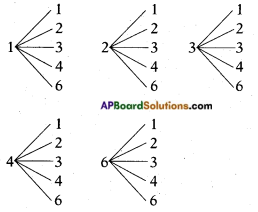
The sum 2, 3, 4, ………… and 12 have different no. of favourable outcomes, moreover total number of outcomes are 36.

AP SSC 10th Class Maths Solutions Chapter 13 Probability Ex 13.2

Question 14.
A game consists of tossing a one rupee coin 3 times and noting its outcome each time. Hanif wins if all the tosses give the same result i.e., three heads or three tails, and loses otherwise. Calculate the probability that Hanif will lose the game.
Answer:
When a coin is tossed for n – times, the total number of outcomes = 2n.
∴ If a coin is tossed for 3 – times, then the total number of outcomes = 23 = 8
Note the following :
TTT
TTH
THT
HTT
HHT
HTH
THH
HHH
Of the above, no. of outcomes with different results = 6.
Probability of losing the game
= [latex]\frac{\text { No. of favourable outcomes to lose }}{\text { No. of total outcomes }}[/latex]
= [latex]\frac{6}{8}[/latex] = [latex]\frac{3}{4}[/latex]

Question 15.
A dice is thrown twice. What is the probability that (i) 5 will not come up either time? (ii) 5 will come up atleast once? [Hint : Throwing a dice twice and throwing two dice simultaneously are treated as the same experiment].
Answer:
If a dice is thrown n-times or n-dice are thrown simultaneously then the total
number of outcomes = 6×6×6….×6
(n – times) = 6n.
No. of total outcomes in throwing a dice for two times = 62 = 36.
AP SSC 10th Class Maths Solutions Chapter 13 Probability Ex 13.2 5i) Let E be the event that 5 will not come up either time, then the favourable outcomes are
(1, 1), (1, 2), (1, 3), (1, 4), (1, 6), (2, 1), (2, 2), (2, 3), (2, 4), (2, 6), (3, 1), (3/2), (3, 3), (3, 4), (3, 6), (4, 1), (4, 2), (4, 3), (4, 4), (4, 6), (6, 1), (6, 2), (6, 3), (6, 4), (6, 6) = 25.
AP SSC 10th Class Maths Solutions Chapter 13 Probability Ex 13.2 7∴ P(E) = [latex]\frac{\text { No. of favourable outcomes }}{\text { No. of total outcomes }}[/latex]

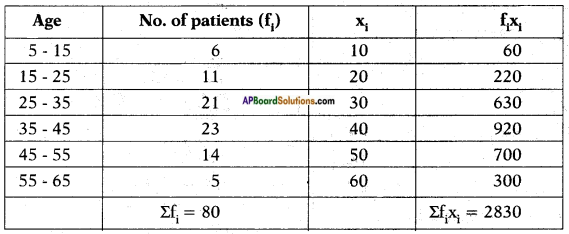
= [latex]\frac{25}{36}[/latex]

AP SSC 10th Class Maths Solutions Chapter 13 Probability Ex 13.2

ii) Let E be the event that 5 will come up atleast once.
Then the favourable outcomes are (1,5), (2, 5), (3, 5), (4, 5), (5, 5), (6, 5), (5, 1), (5, 2), (5, 3), (5, 4), (5, 6) = 11 No. of favourable outcomes = 11
∴ P(E) = [latex]\frac{\text { No. of favourable outcomes }}{\text { No. of total outcomes }}[/latex]

= [latex]\frac{11}{36}[/latex]

AP SSC 10th Class Maths Solutions Chapter 14 Statistics Ex 14.2

AP State Board Syllabus AP SSC 10th Class Maths Textbook Solutions Chapter 14 Statistics Ex 14.2 Textbook Questions and Answers.

AP State Syllabus SSC 10th Class Maths Solutions 14th Lesson Statistics Exercise 14.2

10th Class Maths 14th Lesson Statistics Ex 14.2 Textbook Questions and Answers

Question 1.
The following table shows the ages of the patients admitted in a hospital during a year:
AP SSC 10th Class Maths Solutions Chapter 14 Statistics Ex 14.2 1
Find the mode and the mean of the data given above. Compare and interpret the two measures of central tendency.
Answer:
Maximum number of patients joined in the age group 35 – 45.
∴ Modal class is 35 – 45.
Lower limit of the modal class ‘l’ = 35
Class size h = 10
Frequency of modal class, f1 = 23
Frequency of the class preceding the modal class f0 = 21
Frequency of the class succeeding the modal class f2 = 14
AP SSC 10th Class Maths Solutions Chapter 14 Statistics Ex 14.2 2
∴ Mode = [latex]l+\frac{\left(f_{1}-f_{0}\right)}{2 f_{1}-f_{0}-f_{2}} \times h[/latex]
[latex]\begin{array}{l}
=35+\left(\frac{23-21}{2 \times 23-21-14}\right) \times 10 \\
=35+\left(\frac{2}{46-35}\right) \times 10
\end{array}[/latex]
= 35 + [latex]\frac{2}{11}[/latex] × 10
= 35 + 1.81818……
= 36.8 years.
Mean x = [latex]\frac{\Sigma \mathrm{f}_{\mathrm{i}} \mathrm{x}_{\mathrm{i}}}{\Sigma \mathrm{f}_{\mathrm{i}}}[/latex]
= [latex]\frac{2830}{80}[/latex]
= 35.37 years.
Interpretation: Mode age is 36.8 years, Mean age = 35.37 years.
Maximum number of patients admitted in the hospital are of the age 36.8 years, while on an average the age of patients admitted to the hospital is 35.37 years. Mode is less than the Mean.

AP SSC 10th Class Maths Solutions Chapter 14 Statistics Ex 14.2

Question 2.
The following data gives the information on the observed lifetimes (in hours) of 225 electrical components:
AP SSC 10th Class Maths Solutions Chapter 14 Statistics Ex 14.2 3
Determine the modal lifetimes of the components.
Answer:
AP SSC 10th Class Maths Solutions Chapter 14 Statistics Ex 14.2 4
Since the maximum frequency 61 is in the class 60 – 80, this is the required modal class.
Modal class frequency, f1 = 61.
Frequency of the class preceding the modal class f0 = 52
Frequency of the class succeeding the modal class f2 = 38
Lower boundary of the modal class, l = 60
Height of the class, h = 20
∴ Mode (Z) = [latex]l+\frac{\left(f_{1}-f_{0}\right)}{2 f_{1}-f_{0}-f_{2}} \times h[/latex]
[latex]=60+\left[\frac{61-52}{2 \times 61-(52+38)}\right] \times 20[/latex]
= 60 + [latex]\frac{9}{122-90}[/latex] × 20
= 60 + [latex]\frac{9}{32}[/latex] × 20
= 60 + 5.625
= 65.625 hours.

AP SSC 10th Class Maths Solutions Chapter 14 Statistics Ex 14.2

Question 3.
The following data gives the distribution of total monthly household expenditure of 200 families of a village. Find the modal monthly expenditure of the families. Also, find the mean monthly expenditure:
AP SSC 10th Class Maths Solutions Chapter 14 Statistics Ex 14.2 5
Answer:
AP SSC 10th Class Maths Solutions Chapter 14 Statistics Ex 14.2 6
Since the maximum families 40 lies in the class 1500 – 2000, this is the required modal class.
Lower boundary of the modal class (l) = 1500
Frequency of the modal class (f1) = 40
Frequency of the class preceding the modal class f0 = 24
Frequency of the class succeeding the modal class f2 = 33
Height of the class, h = 500
Hence, modal monthly income = Rs. 1847.83.
Assumed mean (a) = 3250
∑fi = 200, ∑uifi = -235
Mean monthly income = [latex]\overline{\mathrm{x}}=\mathrm{a}+\frac{\Sigma \mathrm{f}_{\mathrm{i}} \mathrm{u}_{\mathrm{i}}}{\Sigma \mathrm{f}_{\mathrm{i}}} \times \mathrm{h}[/latex]
= 3250 – [latex]\frac{235}{200}[/latex] × 500
= 3250 – 587.5
= Rs. 2662.50

AP SSC 10th Class Maths Solutions Chapter 14 Statistics Ex 14.2

Question 4.
The following distribution gives the state-wise, teacher-student ratio in higher secondary schools of India. Find the mode and mean of this data. Interpret the two measures.
AP SSC 10th Class Maths Solutions Chapter 14 Statistics Ex 14.2 7
Answer:
AP SSC 10th Class Maths Solutions Chapter 14 Statistics Ex 14.2 8
Since the maximum number of states ‘10’ lies in the class interval 30-35, this is the modal class.
Lower boundary of the modal class, l = 30
Frequency of the modal class, f1 = 10
Frequency of the class preceding the modal class = f0 = 9
Frequency of the class succeeding the modal class = f2 = 3
Height of the class, h = 5
∴ Mode (Z) = [latex]l+\left(\frac{\mathrm{f}_{1}-\mathrm{f}_{0}}{\left(\mathrm{f}_{1}-\mathrm{f}_{0}\right)+\left(\mathrm{f}_{1}-\mathrm{f}_{2}\right)}\right) \times \mathrm{h}[/latex]
[latex]=30+\frac{10-9}{(10-9)+(10-3)} \times 5[/latex]
= 30 + [latex]\frac{1×5}{1+7}[/latex]
= 30 + [latex]\frac{5}{8}[/latex]
= 30 + 0.625
= 30.625
Mean [latex]\overline{\mathrm{x}}=\mathrm{a}+\frac{\Sigma \mathrm{f}_{\mathrm{i}} \mathrm{u}_{\mathrm{i}}}{\Sigma \mathrm{f}_{\mathrm{i}}} \times \mathrm{h}[/latex]
a = assumed mean = 32.5; h = height of the class = 5
∴ x = 32.5 – [latex]\frac{23}{35}[/latex] × 5
= 32.5 – 3.28
= 29.22
Mean = 30.625
Mode = 29.22
Mode states have a students – teacher ratio 29.22 and on an average this ratio is 30.625.

AP SSC 10th Class Maths Solutions Chapter 14 Statistics Ex 14.2

Question 5.
The given distribution shows the number of runs scored by some top batsmen of the world in one-day international cricket matches.
AP SSC 10th Class Maths Solutions Chapter 14 Statistics Ex 14.2 9
Find the mode of the data.
Answer:
AP SSC 10th Class Maths Solutions Chapter 14 Statistics Ex 14.2 10
Maximum number of batsmen are in the class 4000 – 5000.
∴ Modal class is 4000 – 5000.
Lower boundary of the modal class ‘l’ = 4000
Frequency of the modal class, f1 = 18
Frequency of the class preceding the modal class, f0 = 4
Frequency of the class succeeding the modal class, f2 = 9
Height of the class, h = 1000
Mode (Z) = [latex]l+\left(\frac{\mathrm{f}_{1}-\mathrm{f}_{0}}{\left(\mathrm{f}_{1}-\mathrm{f}_{0}\right)+\left(\mathrm{f}_{1}-\mathrm{f}_{2}\right)}\right) \times \mathrm{h}[/latex]
Mode (Z) = [latex]4000+\frac{18-4}{(18-4)+(18-9)} \times 1000[/latex]
= 4000 + [latex]\frac{14}{14+9}[/latex] × 1000
= 4000 + [latex]\frac{14000}{23}[/latex]
= 4000 + 608.695
= 4608.69
≃ 4608.7 runs

AP SSC 10th Class Maths Solutions Chapter 14 Statistics Ex 14.2

Question 6.
A student noted the number of cars passing through a spot on a road for 100 periods, each of 3 minutes, and summarised this in the table given below.
AP SSC 10th Class Maths Solutions Chapter 14 Statistics Ex 14.2 11
Find the mode of the data.
Answer:
AP SSC 10th Class Maths Solutions Chapter 14 Statistics Ex 14.2 12
Since the maximum frequency is 20, the modal class is 40 – 50.
Lower boundary of the modal class ‘l’ = 40
Frequency of the modal class, f1 = 20
Frequency of the class preceding the modal class, f0 = 12
Frequency of the class succeeding the modal class, f2 = 11
Height of the class, h = 10;
Mode (Z) = [latex]l+\left(\frac{\mathrm{f}_{1}-\mathrm{f}_{0}}{\left(\mathrm{f}_{1}-\mathrm{f}_{0}\right)+\left(\mathrm{f}_{1}-\mathrm{f}_{2}\right)}\right) \times \mathrm{h}[/latex]
Mode (Z) = [latex]40+\frac{(20-12)}{(20-12)+(20-11)} \times 10[/latex]
= 40 + [latex]\frac{8}{8+9}[/latex] × 10
= 40 + [latex]\frac{80}{17}[/latex]
= 40 + 4.70588
= 44.705
≃ 44.7 cars