AP Board 8th Class Physical Science Important Questions Chapter 11 Some Natural Phenomena

AP State Syllabus AP Board 8th Class Physical Science Important Questions Chapter 11 Some Natural Phenomena

AP State Syllabus 8th Class Physical Science Important Questions 11th Lesson Some Natural Phenomena

8th Class Physical Science 11th Lesson Some Natural Phenomena 1 Mark Important Questions and Answers

Question 1.
What is an electroscope?
Answer:
The device which can be used to test whether an object is carrying charge or not is called electroscope.

Question 2.
What is electrical discharge? Where does electrical discharge takes place?
Answer:
The process of transfer of negative or positive charges is called electrical discharge.
The electrical discharge can occur between two or more clouds, or between clouds and the earth.

AP Board 8th Class Physical Science Important Questions Chapter 11 Some Natural Phenomena

Question 3.
What is the other device at buildings acts as lightning conductor?
Answer:
The metal columns used during construction and water pipes in the buildings also protect us by acting as lightning conductors.

Question 4.
Why water pipes should not be touched during thunder storm?
Answer: During thunder storm there would be a possibility that the charge developed due to lightning may travel through the water pipes. So we should not touch water pipes during thunder storm in order to avoid electric shocks.

Question 5.
What is an earthquake?
Answer:
An earthquake is a sudden shaking or trembling of the earth lasting for a short period of time due to disturbance deep inside the earth’s crust.

Question 6.
What is the cause of most earthquakes?
Answer:
The most earthquakes are caused by the movement of earth’s plates.

AP Board 8th Class Physical Science Important Questions Chapter 11 Some Natural Phenomena

Question 7.
What is a earth’s plate?
Answer:
The outer most layer of the earth is not in one piece. It is fragmented. Each frament is called a earth’s plate.

Question 8.
How do we measure the intensity of the earthquake?
Answer:
The power of an earthquake is expressed in terms of a magnitude on ricter scale.

Question 9.
What is the range of destructive earthquake?
Answer:
The destructive earthquake have magnitude heigher than 7 on the ricter scale.

Question 10.
Whether it is possible to predict when and where the next earthquake might occur?
Answer:
It is not possible to predict when and where the next earthquake might occur. But we can predict that there is a possibility of the earthquake when a volcano erupts, or a meteor hits the earth, or an underground nuclear explosion takes place.

Question 11.
What are seismic waves?
Answer:
The tremors produce waves on the surface of the earth. These are called seismic waves.

AP Board 8th Class Physical Science Important Questions Chapter 11 Some Natural Phenomena

Question 12.
What are the places in Andhra Pradesh which lie in seismic zone?
Answer:
According to seismic hazard map Andhra Pradesh lies in zones II and III. The south eastern districts of Chittoor, YSR Kadapa, Nellore and Krishna and Godavari delta region have been placed in zone III and the city of Hyderabd lies in zone II.

8th Class Physical Science 11th Lesson Some Natural Phenomena 2 Marks Important Questions and Answers

Question 1.
What is earthing? Why does earthing is provided in buildings?
Answer:

  1. The process of transferring of charge from a charged object to the earth is called earthing.
  2. Earthing is provided in building to protect us from electrical shock due to any leakage of electric charge.

Question 2.
Which is safe place during thunder storm?
Answer:

  1. A house or building of low height.
  2. If you are travelling in a bus or in a car, you are safe inside provided that doors and windows are closed.
  3. If you are in a forest taking shelter under shorter trees than a taller tree is a good idea during the thunder storm.

Question 3.
What are different layers of earth? Draw a neat diagram of different layers of earth and label its parts?
Answer:
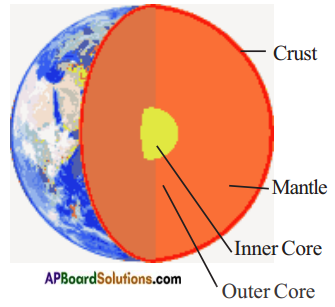
AP Board 8th Class Physical Science Important Questions Chapter 11 Some Natural Phenomena 1
The different layers of earth are:

  1. Crust: This is upper most layer of the earth.
  2. Mantle: This is middle layer.
  3. Core: This is inner layer of the earth.

Again core is divided into two parts.

  1. Inner core
  2. Outer core

AP Board 8th Class Physical Science Important Questions Chapter 11 Some Natural Phenomena

Question 4.
How does earthquake is formed?
Answer:
The outermost layer of the earth is not in one piece, it is fragmented. Each fragment is called a plate. These plates are in continuous motion.
When they brush past on one another, or a plate goes under another plate due to collision, they cause disturbance in the earth’s crust. It is this disturbance that shows up an earthquake on the surface of the earth.

Question 5.
What are the main instruments used by seismologists ? What are the uses of those instruments?
Answer:
Seismologists use two main devices to measure an earthquake.

  1. Seismograph: The seismograph is an instrument that measures the seismic waves caused by an earthquake.
  2. Seismoscope: The seismoscope is an instrument that measures the occurrence or the time of occurrence of an earthquake. The seismoscope is a simple device which can be used without any technological background.

Question 6.
How does destructive energy related to ricter scale?
Answer:
Ricter scale is not linear. This means that an earthquake of magnitude 6 does not have one and half time of the destructive energy of an earthquake of magnitude 4.
In fact, an increase of 2 in magnitude means 1000 times more destructive energy. For example, an earthquake of magnitude 6 has thousand times more destructive energy than an earthquake of magnitude 4.

Question 7.
Which scale measures the destructive energy released by earth more accurately?
Answer:
The moment magnitude scale which is based on the amount of displacement that occurred along a fault zone rather than the measurement of ground motion at a given point measures more accurately the energy released by earthquake than the ricter scale.
It is the only magnitude scale that adequately measures the size of large earthquake.

Question 8.
Raju watched pictures of earthquake victims on T.V. What are the questions raised in his mind about earthquake ?
Answer:

  1. What is the cause of earthquake?
  2. Why some areas are frequently affected by earthquakes?
  3. What are the indications before a major earthquake takes place?
  4. What are the precautionary method to be followed to avoid excess of loss of human life?
  5. What are the measures we have to take when earthquake occur?

AP Board 8th Class Physical Science Important Questions Chapter 11 Some Natural Phenomena

Question 9.
Which places are not safe during a thunderstorm?
Answer:

  1. Travelling in an open place.
  2. Standing under tall trees in open fields or in a garden/park.
  3. Staying in multi storied building which do not have lightning conductors.
  4. Standing near electric poles or telephone poles.
  5. Speaking on landline telephones.
  6. Using electrical appliances like TV and computer.

Question 10.
Explain how do you determine the intensity of Earthquake.
Answer:

  1. The intensity of Earthquake can be measured on richter scale. Like many other scales, richter scale is not linear. That means increase of 2 in magnitude mean 1000 times more destructive energy.
  2. There is another method of measuring the intensity of earthquake using the moment magnitude scale which is based on the amount of displacement that occurred along a faulty zone.
  3. The moment magnitude measures energy released by the earthquake more accurately than the richter scale. It is the only magnitude scale that adequately measures the size of large earthquakes.

Question 11.
Is there any alternative methods to find the intensity of earthquake ?
Answer:
The main method to find the intensity of earthquake is richter scale.
The alternative methods are:

  1. The moment magnitude scale: Which is based on amount of displacement that occured along a faulty zone.
  2. Mercalli scale: This scale uses the observations of the people who experienced the earthquake to estimate intensity.

Question 12.
We know that the clouds have charges. Can we produce current through these charges?
Answer:
Cloud to ground lightning discharges 30,000 amperes and up to 100 million volts and emits light, X rays, radio waves and even gamma rays.
Plasma temperature in lightning can approach 28000 K and electron densities may exceed 1024/m3.
So it not easy to use this charge as electricity.

AP Board 8th Class Physical Science Important Questions Chapter 11 Some Natural Phenomena

Question 13.
What happens if two objects having same charge brought close to each other?
What happens if two objects having different charges are brought close? Can you give an example for this?
Answer:
Two objects having same charge repel each other and two objects having different charge attract each other.
e.g.: A balloon rubbed with woollen cloth is repelled by another balloon rubbed with woollen cloth because both will acquire same type of charge.
A balloon rubbed with a woollen cloth is attracted by a refill rubbed with a polythene sheet because both will acquire different type of charge.

Question 14.
How do you relate the energy release during the collusion of fault lines during earthquake to the atmospheric variation on the surface of the earth?
Answer:
An earthquake affects the atmosphere by creating amounts of debris and dust which will add to the air that we breathe. Earthquakes can also trigger volcanoes which will release tonnes of ashes and other debris into the atmosphere. This can sometimes cause the blocking out of the sun, air pollution and are increased amount of carbon in the air.

Question 15.
Explain why a charged ballon is repelled by another charged balloon whereas an uncharged balloon is attracted by another charged balloon?
Answer:

  1. We have seen that two balloons with similar charges on them, whether positive or negative, repel each other. Similarly two balloons with dissimilar charge on them attract each other.
  2. So, similar charges repel each other while dissimilar charges attract each other.

8th Class Physical Science 11th Lesson Some Natural Phenomena 4 Marks Important Questions and Answers

Question 1.
Explain how lightning would be formed?
Answer:
The clouds moving in air acquire a charge on their surface due to the friction with particles of air. As the surface area of a cloud is very large, the amount of charge accumulated on its surface is very high.
When a charged cloud comes close to another cloud is induces an opposite charge on the later and the accumulated charge tries to move from one cloud to another cloud.
But the air present between them bring a poor conductors of electricity resists the flow of charge between them.
When the magnitude of the accumulated charges become very large, the air which is normally a poor conductor of electricity, is no longer to able to resist their flow.
Hence discharge takes place between negative and positive charges which produce streaks of bright light and sound. We see streaks as lightning.

AP Board 8th Class Physical Science Important Questions Chapter 11 Some Natural Phenomena

Question 2.
Which is not safe during a thunder storm?
Answer:

  1. Travelling in an open place.
  2. Standing under tall trees in open fields or in a garden/park.
  3. Staying in multi storied building which do not have lightning conductors.
  4. Standing near electric poles or telephone poles.
  5. Speaking on landline telephones.
  6. Using electrical appliances like T.V. and Computer.

Question 3.
What is a lightning conductor ? How does it works during lightning ?
Answer:
Lightning conductor is a device used to protect buildings from the effect of lightning. A metallic rod, taller than the building is installed in the walls of the building during its construction.
One end of the rod is kept out in the air and other is buried deep in the ground. The rod provides an easy route for the transfer of electric charge to the ground.
The projected end of the metal rod is at a height more than the height of the building. Hence it receives the charge first during lightning because it is closer to the cloud than the building.
As it is good conductor of electricity, it allows all the charge to flow through it there by causing no damage to the buildings.

Question 4.
What are seismic zones? Name main seismic zones in India.
Answer:
Earthquakes are caused by the movement of plates, the places at boundaries of the plates are considered as weak zones where earthquakes are more likely to occur. These weak zones are also called as seismic or fault zones.
The main seismic zones in India are Kashmir, Western and Central Himalayas, the whole of North east, Rann of Kutch, Rajasthan, Indogangetic plane and some areas of South India.

Question 5.
Draw a table showing magnitude ricter scale reading and effect of earthquake for that reading?
Answer:

Ricter Magnitude Earthquake effects
less than 3.5 Generally not felt, but recorded
3.5 to 5.4 Often felt, but rarely cause damage
5.5 to 6.0 At most slight damage to well designed buildings can cause major damage to poorly constructed buildings over small regions.
6.1 to 6.9 Can be destructive in areas upto 100 kilometres across where people live.
7.0 to 7.9 Major earthquake. Can cause serious damage over larger areas.
8 or greater Great earthquake can cause serious damage in areas several hundred kilometers across.

AP Board 8th Class Physical Science Important Questions Chapter 11 Some Natural Phenomena

Question 6.
How do you appreciate the efforts of the scientists to develop a Lightning conductor to protect buildings from the effect of lightning?
Answer:
Lightning conductor is a device used to protect buildings from the effect of lightning.
A metallic rod, taller than the building is installed in the walls of the building during its construction.
One end of the rod is kept out in the air and other is buried deep in the ground. The rod provides an easy route for the transfer of electric charge to the ground.
The projected end pf the metal rod is at a height more than the height of the building. Hence it receives the charge first during lightning because it is closer to the cloud than the building.
As it is good conductor of electricity, it allows all the charge to flow through it there by causing no damage to the buildings. Hence sole of scientists is appreciated.

Question 7.
Find out if there is an organisation in your area which provides relief to those suffering from natural disaster. Enquire about the type of help they render to the victims of earthquakes. Prepare a brief report on the problems of the earthquake victims.
Answer:
In India National Disaster Force provides relief for disaster victims.
Problems of earthquake victims:

  1. Death: Many times, the people who support a family socially and economically dies. This causes most of the other members of the family to either fight their way through, or restart their lives from the bottom of the food chain.
  2. Destroyed Structures: If the members of the family survive, then they could still be short of a home. The earthquake would have caused the destruction of their house and because of that, they would be left homeless.
  3. No food or water: In the aftermath of an earthquake, people see weather all the pipelines, roads, etc. are in good shape or order. If the pipes are broken, then water scarcity begins. If the roads are broken, then food supplies cannot be transported, later causing problems in food scarcity.
  4. Electricity: With inadequate supply of electricity, the debris and rubble will take a lot of time and if people are under it then they may die before the rubble is removed.
  5. Spread of diseases: After the destruction of many buildings, the sewer pipes will also break and open, causing spread of diseases everywhere.

Help rendered by relief organisation:

  1. They minimize the death of people.
  2. They provide drinking water and food for victims.
  3. They provide shelter for earthquake victims.
  4. They provide medical facility for earthquake victims.

AP Board 8th Class Physical Science Important Questions Chapter 11 Some Natural Phenomena

Question 8.
Explain how lightning would be formed.
Answer:
The clouds moving in air acquire a charge on their surface due to the friction with particles of air. As the surface area of a cloud is very large, the amount of charge accumulated on its surface is very high.
When a charged cloud comes close to another cloud is induces an opposite charge on the later and the accumulated charge tries to move from one cloud to another cloud.
But the air present between them bring a poor conductors of electricity resists the flow of charge between them.
When the magnitude of the accumulated charges become very large, the air which is normally a poor conductor of electricity, is no longer to able to resist their flow.
Hence discharge takes place between negative and positive charges which produce streaks of bright light and sound. We see streaks as lightning.

Question 9.
How the power of earthquake estimated? At what strength it becomes destructive?
Answer:

  1. The power of earthquake is expressed in terms of magnitude on scale called Richter scale.
  2. The destructive earthquakes have magnitudes higher than about 7 on richter scale.
  3. Like many other scales, richter scale is not linear. It means that earthquake of magnitude 6 does not have the twice the destructive energy of an earthquake magnitude 3.
  4. Infact, an increase of 2 in magnitude means 1000 times more destructive energy.
  5. For example, an earthquake of magnitude 6 has thousand times more energy than earthquake of magnitude 4.

Question 10.
What suggestions will you give to people living in seismic areas so that the destruction due to earthquake may be minimized?
Answer:

  1. We know that earthquakes cannot be predicted and that they can be highly destructive.
  2. It is therefore important that we have to take necessary precautions to protect ourselves all the time.
  3. Consult qualified architect and structural engineer to build the buildings.
  4. It is better to fix the cup boards and shelves to the walls, so that they do not fall easily.
  5. Be careful where you hang wall clocks, photoframes, water heaters, etc. so that in the event of an earthquake they do not fall on the people.
  6. Some buildings may catch fire due to an earthquake, it is necessary that all buildings have fire fighting equipment installed.

8th Class Physical Science 11th Lesson Some Natural Phenomena Important Questions and Answers

AP Board 8th Class Physical Science Important Questions Chapter 11 Some Natural Phenomena

Question 1.
Draw a neat diagram of the instrument used to measure the intensity of earthquake. Name the scale used in this instrument.
Answer:
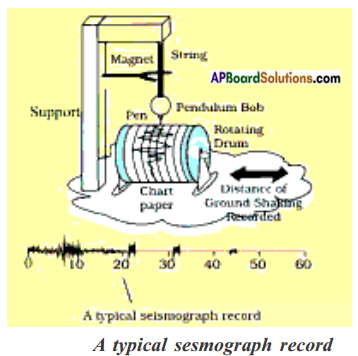
AP Board 8th Class Physical Science Important Questions Chapter 11 Some Natural Phenomena 2
Richter scale is used in this instrument.

Question 2.
“Earthquakes can cause floods, landslides and tsunamis. A major tsunami occurred in the Indian ocean on 26th December 2004. All the coastal areas around the ocean, suffered huge losses.”
Based on the above information answer the following questions:
i) What is the cause for tsunami?
Answer:
Tsunami is caused by sudden movement of the earth that happens under the sea.

ii) What happens when a major tsunami occurs?
Answer:
When tsunami waves become extremely large in height, they .savagely attack coast lines, causing devastating property damage and loss of life.

iii) Name the instrument which is used to detect an earthquake and what are its major parts.
Answer:
The instrument which is used to detect on earthquake is Seismograph.
Major parts of Seismograph are,
i) rotating drum
ii) chart paper
iii) pen
iv) pendulum bob
v) magnet
vi) string

iv) What is the effect of earthquake, if the scale of magnitude is recorded more than eight?
Answer:
If the scale of magnitude is recorded more than 8, the effect of earthquake is property and life damage in areas several hundred kilometers across and it may be causes tsunami also.

AP Board 6th Class Social Studies Solutions Chapter 8 Kingdoms and Empires

SCERT AP Board 6th Class Social Solutions 8th Lesson Kingdoms and Empires Textbook Questions and Answers.

AP State Syllabus 6th Class Social Studies Solutions 8th Lesson Kingdoms and Empires

6th Class Social Studies 8th Lesson Kingdoms and Empires Textbook Questions and Answers

Improve Your Learning

Question 1.
After the war of Kalinga, King Ashoka decided not to fight any more wars. Do you think this type of decision promotes world peace? How?
Answer:
This type of decision definitely promotes world peace. Ashoka said that winning people through dhamma is much better than conquering them through force. He believed that victory of dhamma was the best victory. Ashoka sent his missions of peace to the countries outside of the Maurya Empire and both inside and outside India. It showed an impact on Southern states. To achieve independence Gandhiji also followed non-violence. He brought all the nation together. India won independence. So I think this type of decision promotes world peace.

AP Board 6th Class Social Studies Solutions Chapter 8 Kingdoms and Empires

Question 2.
Explain the relevance of Ashoka Damma today? Appreciate the greatness of Ashoka.
Answer:
The main principles of Damma include :

  1. Be kind towards animals. We should be kind to animals all the time.
  2. Be obedient to father and mother. We should be grateful and obedient to our parents.
  3. Be kind towards the poor. Poor need the support of others to come out of their prob¬lems all the time.
  4. Respect the elders. May be of Ashoka’s time or today elders are to be respected.
  5. Never criticize other religions. We should be tolerant of other religions.
  6. Work for the welfare of mankind. We should work for all the men by not being selfish. So we can say that the principles of dhamma have relevance even today or in the future also.
Question 3.
Compare and contrast the public works undertaken during Ashoka’s period with those of today.
Answer:
Ashoka founded hospitals for people and animals and supplying medicines. Good roads with trees on both sides were provided. People draw water from the wells dug by the government. Travelers were provided with rest houses.
Even today the government is providing some of these facilities to us. But we have to pay some amount for these facilities. In widening the roads they are cutting the big trees. Because of this, the heat will increase and it will become difficult in day time particularly in summer.

Question 4.
Ashoka used his army to serve the people instead of war. What are relief operations do the present Indian army participate in other than war today?
Answer:
Relief operations attended by Army:

  1. Non – combat operations in support of national interest.
  2. Whenever unrest prevails they will go there and re-establish peace there.
  3. They will go to flood-hit areas and serve the people.

AP Board 6th Class Social Studies Solutions Chapter 8 Kingdoms and Empires

Question 5.
What is the contribution of the Guptas in the fields of literature, art, and architecture?
Answer:
The Gupta period was famous for great books and development in literature, art, architecture, Kalidasa was a great poet and play writer during this period. His master¬piece was the Shakuntala. Sophisticated gold coins were minted during the Gupta period. The Gupta period was famous for marvelous rock-cut caves. Some of the paintings and sculptures of Ajantha and Ellora Caves are the finest examples of that period.

Question 6.
Why do we call the Gupta period as a golden age in Indian History?
Answer:
The Gupta period became known as the golden age;> because there are inventions in science, technology, literature, mathematics and astronomy. There were nine great scholars in the court of Chandragupta – II. They were called ‘Navaratnas’. Aryabhatta and Brahmagupta were the two great mathematicians of that time. Char aka and Sushruta were the two great persons in medicine. Without any lab, the scientists of the Gupta period understood that the earth is round and it revolves around the Sun. They noticed the movements of stars and planets. The scientists of the Gupta period were also experts in metal technology. They made steel and iron weapons and tools. They minted sophisticated gold coins also. So we can say that the Gupta period is the golden age in Indian history.
Question 7.
How did Guptas contribute to the fields of medicine and metal technology?
Answer:
Medicine: Charaka and Sushruta were the two great persons in medical knowledge during the Gupta period. Sushruta was the first Indian doctor who carried out plastic surgery on the damaged noses. Doctors of the Gupta period could set broken bones and perform operations. Charaka composed ‘Charaka Samhitha’. This was the basic text for Ayurvedic medicine. He was a renowned physician of that period.
Metal technology: The scientists of the Gupta period were experts in metal technology. They made steel and iron tools and weapons. They minted gold coins.

AP Board 6th Class Social Studies Solutions Chapter 8 Kingdoms and Empires

Question 8.
What was the contribution of the Pallavas to architecture?
Answer:
Mahendravarman-I was a great patron of art and architecture. He introduced a new style of Dravidian architecture which was known as the Mahendra style. Narasimhavarman-I converted the port of Mahabalipuram into a beautiful city of art and architecture. Five rathas were built in Mahabalipuram. Each ratha has been carved out of a single rock. Narsimhavarman-II was another Pallava king and during his period temples were built by using soft sand rocks. It was known as the Rajasimha style. The famous Kailasnath temple at Kanchipuram is the best Example of Rajasimha style.

Question 9.
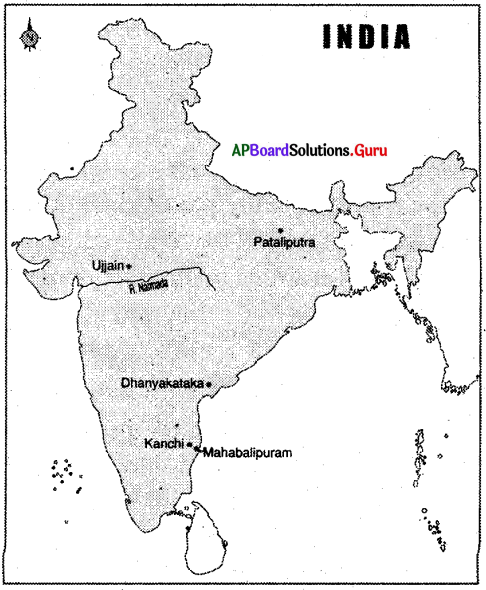
Locate the following places on the outline map of India.

  1. Pataliputra
  2. Ujjaini
  3. The river Narmada
  4. Kanchi
  5. Mahabalipuram
  6. Dhanyakataka

Answer:
AP Board 6th Class Social Studies Solutions Chapter 8 Kingdoms and Empires 1

Question 10.
Who am I ?
a) I am in the lion capital of Ashoka. I am at the center of our national flag. Who am I?
Answer:
Ashoka Chakra.
b) I belong to Gupta Dynasty. I defeated all the kings in India. Who am I?
Answer:
Samudragupta.
c) I am the Capital of Satavahana Empire. I am located on the banks of the river Krishna. Who am I?
Answer:
Dhanyakataka.
d) I completed the rock-cut temples of Mahabalipuram. I am the son of Mahendravarman-I. Who am I?
Answer:
Narasimhavarman -I.

AP Board 6th Class Social Studies Solutions Chapter 8 Kingdoms and Empires

Project Work

Collect the pictures of some rock-cut temples of Mahabalipuram and paste them in your scrapbook.
Answer:
Student Activity.

6th Class Social Studies 8th Lesson Kingdoms and Empires InText Questions and Answers

Let’s Do

(Textbook Page No. 89)

Question 1.
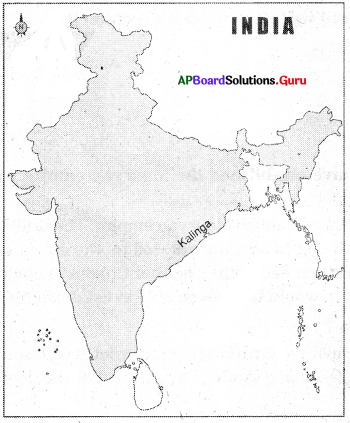
Identify the kingdom of Kalinga in the present map of India with the help of your teacher.
Answer:
AP Board 6th Class Social Studies Solutions Chapter 8 Kingdoms and Empires 2

Question 2.
What is the present name of Kalinga?
Answer:
Odisha state.

AP Board 6th Class Social Studies Solutions Chapter 8 Kingdoms and Empires

(Textbook Page No. 90)

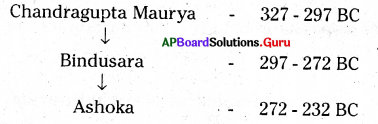
Question 3.
Prepare a timeline chart of the Mauryan Dynasty.
Answer:
AP Board 6th Class Social Studies Solutions Chapter 8 Kingdoms and Empires 3

Question 4.
Discuss the character of emperor Ashoka in the classroom.
Answer:

  1. Ashoka the Great was the third king of the Mauryan Dynasty.
  2. Ashoka was the most famous and unique Mauryan ruler.
  3. Ashoka was the only king in the world’s history who gave up the conquest even after winning the war.
  4. He converted to Buddhism after witnessing the mass deaths of the Kalinga War.
  5. He was the first ruler who tried to spread his message through inscriptions to the people.
  6. He started to follow a religious policy of his own and formulated various policies of Dhamma.
  7. Ashoka’s ‘Ashoka Chakra’ was adopted as the ‘Symbol of Independent India’.

Question 5.
Write any four important cities of the Gupta empire as shown in the map. (Textbook Page No. 92)
Answer:
Ujjain, Pataliputra, Sanchi and Bharukaccha.

Question 6.
Collect the pictures of the coins of the Mauryas and the Satavahana empires. Paste them in your scrapbook. (Textbook Page No. 94)
Answer:
Student Activity.

Question 7.
Collect the pictures of the local temple and write a note on its architecture. (Textbook Page No. 97)
Answer:
Student Activity.

AP Board 6th Class Social Studies Solutions Chapter 8 Kingdoms and Empires

Think and Respond

(Textbook Page No. 88)

Question 1.
Do you think Chandragupta could have established the Mauryan empire without Chanakya?
Answer:
I don’t think that Chandragupta alone can establish the Mauryan empire. The brilliance of Chanakya and the efficiency of Chandragupta as a warrior led to the establishment of the Mauryan empire. I think that without each other, neither Chanakya could have completed his dream nor Chandragupta would have been able to establish his rule.

Question 2.
Why did Ashoka want to win Kalinga?
Answer:
Kalinga was an important kingdom because it controlled the trade routes with Southeast Asia. Because of this, Ashoka, the Mauryan king wanted to capture it. So he declared a war on Kalinga.

Question 3.
Why was Ashoka not happy after the Kalinga war?
Answer:
In the Kalinga war both sides suffered heavy losses. More than one lakh people died in the war. The Kalinga war resulted in the great loss of life and property. Ashoka was so horrified wher^he saw the violence and bloodshed. This war was the most important event of Ashoka’s life. His heart was moved to see the misery of men. He decided not to fight any more wars, He realized that there is a need to be some other way to achieve or conquer. He started a new path which was known as Dhamma. He was the only king in the history of the world who gave up conquest after winning a war.

AP Board 6th Class Social Studies Solutions Chapter 8 Kingdoms and Empires

(Textbook Page No. 90)

Question 4.
Ashoka’s Inscriptions were understood by illiterates also. How do you think it was possible?
Answer:
Ashoka appointed special officers to read his inscriptions to the illiterates.

Question 5.
In what way do the messages of the government reach the people today?
Answer:
Today there are many newspapers and television channels. It is very easy to spread the message of the government to people today.

(Textbook Page No. 91)

Question 6.
Discuss the importance of our National Symbols in the classroom.
Answer:
The national symbol commands high respect and is used only for official purposes and events of national importance. It appears on all government official letterheads, Indian currency, and passports. It is the official seal of the state governments and the President of India also.
Question 7.
Do you think there was a relationship between trade and transport? If so justify your answer.
Answer:
There is a close relationship between trade and transport. Transportation helps in easy exchange of raw materials and finished goods. Transport is important because it enables trade between people, which is essential for the development of civilizations. Transport plays an important part in the economic growth of a particular place.

Question 8.
Do you think Samudra Gupta was a great conqueror? Support your answer. (Textbook Page No. 93)
Answer:
After Chandragupta’s death, his son Samudragupta took over and expanded the Gupta empire in north India. He was a great conqueror and remained undefeated. Nine important kingdoms of North India were made part of the Samudraguptas empire. 12 rulers of Dakshinapadha surrendered after defeat. Other neighboring countries like Nepal, Bhutan, and Srilanka accepted his authority. With all these, I can say that Samudragupta was a great conquerer.
AP Board 6th Class Social Studies Solutions Chapter 8 Kingdoms and Empires

Question 9.
Shall we say Gauthamiputhra Satakarni the greatest ruler of the Satavahanas? If so, why? (Textbook Page No. 95)
Answer:
Yes. we can say that Gautamiputra Satakarni was the greatest ruler of the Satavahanas. He defeated sakas. He defeated Yawanas and Pallavas and conquered their kingdoms. He conquered the land between the three seas. He got the title of ‘Trisamudradhees-wara.’

Question 10.
Ikshvakus were able to bring all other clans together. Do you agree or disagree? If so, what were the ways they were used? (Textbook Page No. 96)
Answer:
I agree with the above statement. Ikshvakus tried to strengthen their kingdom by marrying people from the other clans. So that they will all get united and they will become strong and they will get support from other clans.

AP Board 8th Class Physical Science Important Questions Chapter 10 Reflection of Light at Plane Surfaces

AP State Syllabus AP Board 8th Class Physical Science Important Questions Chapter 10 Reflection of Light at Plane Surfaces

AP State Syllabus 8th Class Physical Science Important Questions 10th Lesson Reflection of Light at Plane Surfaces

8th Class Physical Science 10th Lesson Reflection of Light at Plane Surfaces 1 Mark Important Questions and Answers

Question 1.
What is reflection?
Answer:
The light rays falling on a surface are returned into the original medium. This phenomenon is called reflection.

AP Board 8th Class Physical Science Important Questions Chapter 10 Reflection of Light at Plane Surfaces

Question 2.
How Is image appeared with a big hole of pinhole camera?
Answer:
We get blurred image on the screen due to big hole of the camera.

Question 3.
Which path light tends to prefer?
Answer:
Light selects the path which takes least time to travel.

Question 4.
What is meant by lateral inversion?
Answer:
The right appears as left in the image is called lateral inversion.

Question 5.
If an object placed in front of a plane mirror has size 6 cm, then what is size of the image?
Answer:
Size of the object = Size of image.
∴ Size of the image = 6 cm.

Question 6.
What is a real image? What is a virtual image?
Answer:
Real image: The image formed due to convergence of light rays. The real image can be caught on the screen.
Virtual image: The image that we get by extending the rays backwards is called a virtual image. A virtual image cannot be caught on the screen.

Question 7.
What is a reflecting surface?
Answer:
The surface used for reflection is called reflecting surface.

AP Board 8th Class Physical Science Important Questions Chapter 10 Reflection of Light at Plane Surfaces

Question 8.
What is principal axis?
Answer:
The horizontal line which passes through the centre of curvature is called principal axis.

Question 9.
What is meant by converging of light rays?
Answer:
If light rays after reflection meet at a point, then we say the light rays are converging.

Question 10.
Why does our image appear thin or bulged?
Answer:
Due to converging or diverging of light rays from the mirror.

Question 11.
Why is angle of incidence equal to angle of reflection when a light ray reflects from a surface?
Answer:
Because light selects the path that takes least time to cover a distance.

Question 12.
Are angle of reflection and angle of incidence also equal for curved surface?
Answer:
Yes, it is equal for curved surfaces like spherical mirrors.

Question 13.
Why is there right-left inversion (lateral inversion) when we look into mirror?
(OR)
Explain the lateral (righ-left) inversion of the image in plane mirrors through an example.
Answer:

  1. The light rays which come from object get reflected from the plane mirror and reach our eye.
  2. Our brain feels that the ray is coming from the inside of mirror.
  3. So there is right-left inversion.

AP Board 8th Class Physical Science Important Questions Chapter 10 Reflection of Light at Plane Surfaces

Question 14.
What are the minimum conditions to get shadows?
Answer:
The minimum conditions required are a source of light to produce light, an opaque object to obstruct the light and a screen to collect the shadow.

Question 15.
What happens if we increase the size of the hole of the pinhole camera?
Answer:
If the size of the pinhole camera is increased, the image seems to be blurred.

Question 16.
Name some apparatus which can work on the principle of reflection of light.
Answer:
Plane mirror, spherical mirrors, periscope, kaleidoscope.

Question 17.
What is your opinion on elevating buddings with mirrors?
Answer:
The mirrors used in elevating buildings are reinforced, tough and laminated glasses. These mirrors provide safety and make the buildings attractive.

Question 18.
What happens when light falls on an opaque object?
Answer:
Some part of light is reflected back and remaining part is absorbed.

Question 19.
What happens when light is reflected from transparent object?
Answer:
Some part of light is reflected and remaining part is partly transmitted or partly absorbed.

Question 20.
If angle of incidence of light ray on a plane mirror is 40°, then what is the angle between incident ray and reflected ray?
Answer:
The angle between incident ray and reflected ray is 80°.

AP Board 8th Class Physical Science Important Questions Chapter 10 Reflection of Light at Plane Surfaces

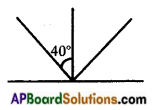
Question 21.
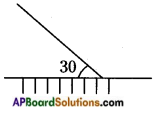
From the figure, find angle of reflection.
AP Board 8th Class Physical Science Important Questions Chapter 10 Reflection of Light at Plane Surfaces 1
Answer:
The angle of reflection is 40°.

Question 22.
If distance of plane mirror and object is 10 cm, then what is the distance between object and its image ?
Answer:
Object distance = image distance
∴ Distance between object and image = 10 + 10 = 20 cms.

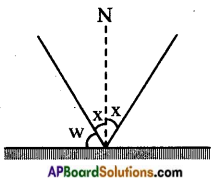
Question 23.
If the angle between the mirror and incident ray is 40°, then find the angle of reflection.
Answer:
Given that angle between incident ray and mirror = 40°.
AP Board 8th Class Physical Science Important Questions Chapter 10 Reflection of Light at Plane Surfaces 2
Suppose angle of incidence = x.
∴ 40 + x = 90
x = 90 – 40 = 50°.
But we know angle of incidence = angle of reflection
Angle of reflection = 50°.

Question 24.
State Fermat’s principle.
Answer:
Light chooses the path which takes the least time to travel.

AP Board 8th Class Physical Science Important Questions Chapter 10 Reflection of Light at Plane Surfaces

Question 25.
Can a virtual image be photographed by a camera?
Answer:
Yes, virtual image can be photographed by a camera.

8th Class Physical Science 10th Lesson Reflection of Light at Plane Surfaces 2 Marks Important Questions and Answers

Question 1.
What are the characteristics of image formed by a plane mirror?
Answer:
Characteristics of image formed by a plane mirror.

  1. It is a virtual image.
  2. The image is straight.
  3. The image is laterally inverted.
  4. Size of the image is equal to size of the object.
  5. Image distance is equal to object distance.

Question 2.
Can a plane mirror ever form a real image?
Answer:

  1. Real image can only be formed when the reflected rays converge.
  2. For plane mirrors it is not possible.
  3. However if the reflected rays are converged it can form a reed image.
  4. Consider a source of light at infinity (say sun) and plane mirror is very small in size, its reflected image will show a circular bright spot (image of sun) on the screen.

AP Board 8th Class Physical Science Important Questions Chapter 10 Reflection of Light at Plane Surfaces

Question 3.
Frame some questions on the importance of ‘perpendicular’ in the reflection of light.
Answer:

  1. Why do we require perpendicular (normal) to a plane mirror?
  2. If light falls normal to the surface of a plane mirror, what happens?
  3. What is the importance of normal?
  4. In this figure what is angle of reflection?
    AP Board 8th Class Physical Science Important Questions Chapter 10 Reflection of Light at Plane Surfaces 3

Question 4.
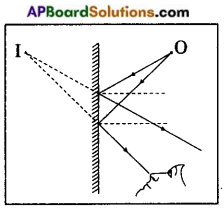
How is an image formed by a plane mirror?
Answer:

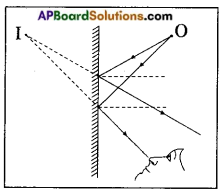
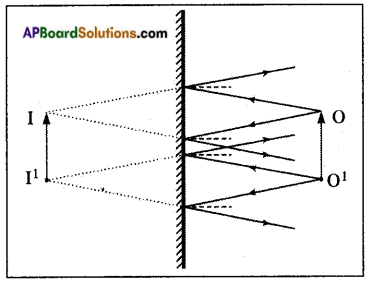
  1. ‘O’ is a point object. Some rays from O reach the mirror and get reflected.
    AP Board 8th Class Physical Science Important Questions Chapter 10 Reflection of Light at Plane Surfaces 4
  2. When we look into the mirror, the reflected rays seem to be coming from the point I. So point I is the image of point object ‘O’.

Question 5.
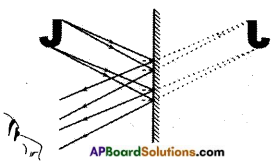
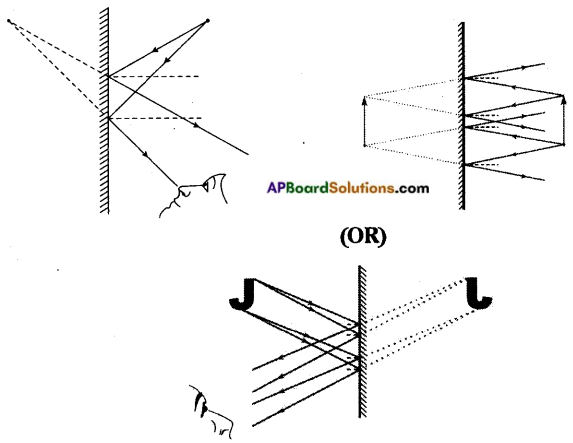
Draw the ray diagram of lateral inversion of a letter.
Answer:
AP Board 8th Class Physical Science Important Questions Chapter 10 Reflection of Light at Plane Surfaces 5

Question 6.
Draw the ray diagram showing point object (O). (OR)
Draw the ray diagram showing an object (OO’) by a plane mirror.
Answer:
AP Board 8th Class Physical Science Important Questions Chapter 10 Reflection of Light at Plane Surfaces 6

Question 7.
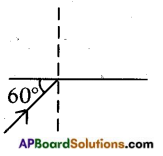
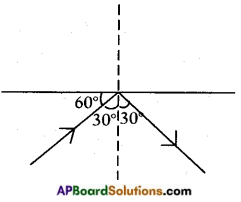
Observe the given figure. Write the values of angle of incidence and angle of reflection. Complete the figure using these values.
AP Board 8th Class Physical Science Important Questions Chapter 10 Reflection of Light at Plane Surfaces 7
Answer:
The angle of incidence (i) = 90 – 60 = 30°
The angle of reflection (r) = 30°
(∵ angle of incidence = angle of reflection)
AP Board 8th Class Physical Science Important Questions Chapter 10 Reflection of Light at Plane Surfaces 8

AP Board 8th Class Physical Science Important Questions Chapter 10 Reflection of Light at Plane Surfaces

Question 8.
Draw the diagram that explains the formation of an Image by a plane mirror.
Answer:
AP Board 8th Class Physical Science Important Questions Chapter 10 Reflection of Light at Plane Surfaces 9

8th Class Physical Science 10th Lesson Reflection of Light at Plane Surfaces 4 Marks Important Questions and Answers

Question 1.
Write briefly about formation of image by a plane mirror. Write characteristics of image. (OR)
A teacher asked a student which mirror is used by him to see his image at home. Then name that mirror and also give formation of image due to that mirror and characteristic of image formed by that mirror.
Answer:
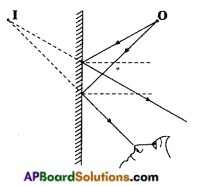
Image formation for a point sized object:

  1. ‘O’ is a point object. Some rays from ‘O’ reach mirror and get reflected.
  2. When we look into the mirror, the reflected rays seem to be coming from the point I.
  3. So T is the image of point ‘O’.
    AP Board 8th Class Physical Science Important Questions Chapter 10 Reflection of Light at Plane Surfaces 10
    Image formation of an object:
  4. Now place an erect object in front of plane mirror.
  5. Draw some incident rays from the object to the mirror and reflected rays from the mirror using laws of reflection.
  6. The rays coming from the point ‘O’ and reflected from the mirror seem to be coming from point ‘I’.
  7. So I is the image of ‘O’.
  8. The rays coming from the point O1 get reflected from the mirror and seems to be coming from point I1. So I1 is the image of O1.
    AP Board 8th Class Physical Science Important Questions Chapter 10 Reflection of Light at Plane Surfaces 11
  9. The rays coming from the middle part of the O and O1 will form their images between I and I1.
  10. Thus I – I1 is the image of the object O – O1.

Characteristics of image:

  1. The image has same size as object.
  2. The image distance and object distance are same.
  3. The image undergoes right-left inversion (lateral inversion).
  4. The image is virtual and erect.

AP Board 8th Class Physical Science Important Questions Chapter 10 Reflection of Light at Plane Surfaces

Question 2.
Why does the size of the image decrease when you move the object towards your eye?
Answer:

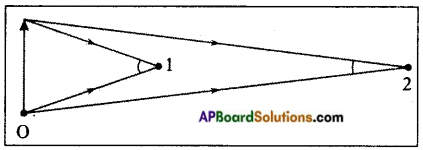
  1. The given figure shows how our eye judges the distance of an object.
  2. The object which is at point ‘O’ looks smaller to the observer 2 than to the observer 1 because the light rays coming from the object 1 makes a smaller angle at the eye of the observer 2 compared to observer 1.
    AP Board 8th Class Physical Science Important Questions Chapter 10 Reflection of Light at Plane Surfaces 12
  3. The angle plays the role in sensing the size of the object.
  4. Similarly, when we move the object from the mirror to our eye, the image in the mirror seems to move back in the mirror.
  5. Then the distance from the image to our eye increases.
  6. The angle formed by image at our eye is smaller than that of angle formed by the object.
  7. That is why the image looks smaller than the object.

Question 3.
Why does a plane mirror act as better reflecting surface when compared with other reflecting surfaces? Why?
Answer:

  1. When light falls on any surface some part of light is reflected by the surface, some other part is transmitted by the surface and remaining part is absorbed by the surface.
  2. However, a reflecting surface like mirror reflects most of the light (nearly 90%) fallen on it.
  3. A plane mirror is made by polishing or silvering one side of plane glass.
  4. The side which is silvered called silvered surface while the other side is called reflecting surface.
  5. The light always reflects from reflecting surface.
  6. To protect the silver polish or silvered surface often it is painted with red or black colours.
  7. This type of arrangement actually increases the reflection up to 90%. So it acts as better reflecting surface.

AP Board 8th Class Physical Science Important Questions Chapter 10 Reflection of Light at Plane Surfaces

Question 4.
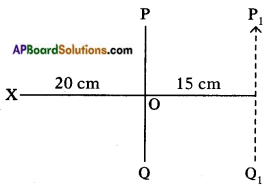
The figure shows a plane mirror PQ at distance 20 cm from an object. The mirror is moved 15 cm away from object O to next position. What is the shift in the image of O?
AP Board 8th Class Physical Science Important Questions Chapter 10 Reflection of Light at Plane Surfaces 13
Answer:
Given that at first the object 20 cm from the mirror. So the image is also at a distance of 20 cm from mirror (Since object distance = image distance).
Now the mirror is moved 15 cm away from the object. So the image also moves 15 cm away from actual image distance before. So now the image distance is 35 cm. Therefore the image is 70 cm from the object.

AP Board 8th Class Physical Science Important Questions Chapter 9 Electrical Conductivity of Liquids

AP State Syllabus AP Board 8th Class Physical Science Important Questions Chapter 9 Electrical Conductivity of Liquids

AP State Syllabus 8th Class Physical Science Important Questions 9th Lesson Electrical Conductivity of Liquids

8th Class Physical Science 9th Lesson Electrical Conductivity of Liquids 1 Mark Important Questions and Answers

Question 1.
Why do we use LED in the tester instead of a bulb?
Answer:
LED glows even when a very weak current is passing through the circuit. Thus, it helps in testing flow of electricity in conductors when meager current is passing through the circuit.

AP Board 8th Class Physical Science Important Questions Chapter 9 Electrical Conductivity of Liquids

Question 2.
Why do we use LEDs as indicators in electrical appliances?
Answer:
LEDs glow even with a very small current passing through them. So they are used as indicators in electrical appliances like mobile phones, televisions, transformers, etc. to indicate whether the device is working or not.

Question 3.
What is meant by good conductors of electricity?
Answer:
Some materials allow electric current pass through them easily. They are called good conductors of electricity.

Question 4.
What is meant by bad conductors of electricity?
Answer:
The materials that do not allow current to pass through them are called bad conductors of electricity.

Question 5.
Why distilled water is poor conductor of electricity?
Answer:
Distilled water does not dissociate easily to form ions. So there is no availability of charged particles for passage of electricity. So it behaves like a bad conductor of electricity.

Question 6.
Why water used at our homes is a good conductor of electricity?
Answer:
The water that we get from sources such as taps, hand pumps, wells and ponds is not pure like distilled water. It contains some salts and minerals dissolved in it. This makes the water used at our homes a good conductor of electricity.

AP Board 8th Class Physical Science Important Questions Chapter 9 Electrical Conductivity of Liquids

Question 7.
What is electrolytic cell?
Answer:
The cell which convert chemical energy into electric energy is called electrolytic cell.

Question 8.
A child staying in a coastal region tests the drinking water and also the sea water with his tester. He finds that compass needle deflects more in the case of sea water. Can you explain the reason?
Answer:
The reason is sea water is very good conductor of electricity when compared with drinking water due to more dissolved salts.

Question 9.
Is it safe for electrician to carry out electrical repairs outdoor during heavy down pour?
Answer:
No, because it makes electrical appliance which he repairs become wet and also rainy water is good conductor of electricity due to dissolved minerals and salts. So to avoid electric shock it is advised to carry out electric repairs indoor during heavy downpour.

Question 10.
A tester is used to check conduction of electricity through two liquids labelled A and B. It is found that the bulb of the tester glows brightly for liquid A while it glows very dimly for liquid B. What is your conclusion?
Answer:
Liquid A is better conductor than liquid B.

AP Board 8th Class Physical Science Important Questions Chapter 9 Electrical Conductivity of Liquids

Question 11.
When the free ends of a tester are dipped into a solution, the magnetic needle shows deflection. Can you explain the reason?
Answer:
The solution is a good conductor of electricity and also when we dipped the tester into the solution due to chemical effect it produces electricity and it behaves like an electrolytic cell and also current carrying tester behaves like a magnet and shows deflection.

Question 12.
What is the main threat to environment from electroplating factories?
Answer:
In the electroplating factories the disposal of the used conducting solution is a major concern. It is a polluting waste. So it is the main threat to environment from electroplating factories.

Question 13.
Why should we have to deposit nickel or chromium on iron?
Answer:
Iron which is easily corroded by atmospheric air, moisture and carbon dioxide are coated with deposits of nickel or chromium which are most resistant to such corrosion.

8th Class Physical Science 9th Lesson Electrical Conductivity of Liquids 2 Marks Important Questions and Answers

Question 1.
What is the name given to wires attached to LED. How these wires are connected to a battery?
Answer:
There are two wires called leads attached to an LED. One lead is slightly longer than other.
AP Board 8th Class Physical Science Important Questions Chapter 9 Electrical Conductivity of Liquids 1
While connecting to the LED to the circuit, the longer lead is always connected to the positive terminal of the battery and the short lead connected to the negative terminal of the battery.

AP Board 8th Class Physical Science Important Questions Chapter 9 Electrical Conductivity of Liquids

Question 2.
What are the requirements for fine coating in electroplating process?
Answer:

  1. The object to be electroplated should be free from greasy matter.
  2. The surface of the article should be rough so that the metal deposited sticks permanently.
  3. The concentration of the electrolyte should be so adjusted as to get smooth coating.
  4. Current must be the same throughout.

Question 3.
Answer the following questions.
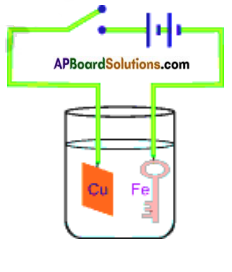
a) When we pass current through a copper sulphate solution having copper plate and iron key connected to a battery and tap key in series by closing tap key. What is deposit on iron key?
b) If the key is to be coated with zinc or aluminium instead of copper, what changes do we need to make the above experiments?
Answer:
a) There is red mass of copper deposited on iron key.
b) If we want to coat aluminium or zinc or iron then, we have to take electrolyte is like aluminium sulphate or zinc sulphate and the positive electrode is aluminium or zinc.

Question 4.
Name three liquids which when tested in the manner shown in figure may cause the magnetic needle to deflect.
Answer:
In order to deflect the needle the liquid must be a good conductor of electricity. So we have to take liquids like lemon juice, vinegar solution, salt solution.

Question 5.
The bulb does not glow in the set up shown in figure. List the possible reasons. Explain your answer.
Answer:

  1. The wires are not properly connected so the circuit may be open.
  2. The liquid taken in the vessel may be a bad conductor of electricity which does not allowing the passage of current.

Question 6.
Give two examples for electrolyte.
Answer:
Electrolyte is a solution of substance through which current can pass. The examples of electrolyte solutions are NaC/ solution, CaCl2 solution.

AP Board 8th Class Physical Science Important Questions Chapter 9 Electrical Conductivity of Liquids

Question 7.
If the key is to be coated with aluminium instead of copper,what changes do we need to make in the experiment of coating on iron key with copper?
Answer:
Changes we need to make are:

  1. Anode should be aluminium.
  2. The electrolyte solution must be salt solution of aluminium that is aluminium chloride or aluminium sulphate solutions.

Question 8.
Is plastic coated by the process of electroplating? Why?
Answer:
No. Plastic cannot be coated on a metal by using electroplating. Plastic does not act as an electrolyte. So electrolysis process is not possible with plastic which is main criteria for electroplating. So plastic cannot be coated on a metal by the process of electroplating.

Question 9
What are the requirements for fine coating in electroplating process?
Answer:

  1. The object to be electroplated should be free from greasy matter.
  2. The surface of the article should be rough so that the metal deposited sticks permanently.
  3. The concentration of the electrolyte should be so adjusted as to get smooth coating.
  4. Current must be the same throughout.

Question 10.
In case of a fire, before the fire men use the water, they shut off the main electrical supply for the area. Explain why they do this.
Answer:
Fire men use water to put out fire. Water containing dissolved salts is a good conduc¬tor of electricity. If fire men pour water on fire the electrical appliances near the fire may be wet if anybody touches those appliances they may have electric shock. In order to avoid people to get electric shock due to wet electrical appliances the fire men shut off electrical supply before they use water.

AP Board 8th Class Physical Science Important Questions Chapter 9 Electrical Conductivity of Liquids

Question 11.
We get some items made from iron wire in which iron wire is coated with plastic. Is plastic coated by the process of electroplating? Why can plastic not be coated on a metal by the process of electroplating?
Answer:
No. Plastic cannot be coated on a metal by using electroplating. The reason is plastic being a carbon polymer does not dissociate into ions. So it does not allow passage of current. So it does not act as an electrolyte. So electrolysis process is not possible with plastic which is main criteria for electroplating. So plastic cannot be coated on a metal by the process of electroplating.

8th Class Physical Science 9th Lesson Electrical Conductivity of Liquids 4 Marks Important Questions and Answers

Question 1.
Prepare a table having various material used at home classifying as good conductors or poor conductors and their use.
Answer:

Material used at home Good conductor/ poor conductor Use
1) Copper Good conductor Wires, electrical appliances
2) Iron Good conductor Electrical wires, electrical appliances
3) Aluminium Good conductor Wires, electrical appliances
4) Plastic Poor conductor Handles of electrical appliances, electrical insulating material
5) Wood Poor conductor Handles of electrical appliances

Question 2.
What are the uses of electrolysis in daily life?
Answer:
The uses of electrolysis:

  1. Electroplating: To avoid rusting of iron it is coated with nickel or chromium by electrolysis.
  2. Gold covering works: Ornaments made of cheap metal like copper can be coated with gold using electrolysis.
  3. Metallurgy: Pure metals can be extracted from minerals and ores using electrolysis.
  4. Electrolysis: It is used in electrical printing and to produce gramphone records.

AP Board 8th Class Physical Science Important Questions Chapter 9 Electrical Conductivity of Liquids

Question 3.
Collect the information from various sources on the applications of electroplating in daily life and prepare a note on that.
Answer:
Uses of electroplating:

  1. Metals like iron are coated with deposits of nickel or chromium to prevent rusting.
  2. Machinery parts are often chromium plated to protect them from corrosion and at the same time to give them good polish.
  3. Electroplating is also used in repairing worn out parts of machinery.
  4. Electroplating is also done for ornamentation and decoration purposes.
  5. Processed food items are preserved in tin coated iron cans by electroplating method.
  6. Zinc coated iron by electroplating method is used for bridges and in automobiles.

Question 4.
Test the conductivity of liquids given below and fill the table.

Material Compass needle show deflection Yes / No Conductor / Insulator
Lemon juice
Honey
Milk
Vinegar
Tap water
Vegetable oil

Answer:

Material Compass needle show deflection Yes / No Conductor / Insulator
Lemon juice Yes Conductor
Honey No Insulator
Milk No Insulator
Vinegar Yes Conductor
Tap water Yes Conductor
Vegetable oil No Insulator

AP Board 8th Class Physical Science Important Questions Chapter 9 Electrical Conductivity of Liquids

Question 5.
Why does chromium is used for electroplating? Why the objects which have chromium plated are not made of chromium itself?
Answer:

  1. Chromium has a shiny appearance does not corrode and resist scratches.
  2. However chromium is expensive and may not be possible to make the whole object out of chromium.
  3. So the object is made from a cheaper metal and only a coating of chromium is done over it.

8th Class Physical Science 9th Lesson Electrical Conductivity of Liquids Important Questions and Answers

Question 1.
Name the process of coating a metal on another metal. Draw a neat diagram related to this process. Label the parts.
Answer:
The process which is used to coating a metal on another metal is called “electroplating”.
AP Board 8th Class Physical Science Important Questions Chapter 9 Electrical Conductivity of Liquids 2

AP Board 8th Class Physical Science Important Questions Chapter 9 Electrical Conductivity of Liquids

Question 2.
Draw a diagram shows electroplating process. Write any one of the requirements for the fine coating.
Answer:

  1. The object to be electroplated should be free from greasy matter.
    AP Board 8th Class Physical Science Important Questions Chapter 9 Electrical Conductivity of Liquids 2
  2. The surface of the article should be rough so that the metal deposited sticks permanently.
  3. The concentration of the electrolyte should be so adjusted as to get smooth coating.
  4. Current must be the same throughout.


AP Board 8th Class Physical Science Important Questions Chapter 8 Combustion, Fuels and Flame

AP State Syllabus AP Board 8th Class Physical Science Important Questions Chapter 8 Combustion, Fuels and Flame

AP State Syllabus 8th Class Physical Science Important Questions 8th Lesson Combustion, Fuels and Flame

8th Class Physical Science 8th Lesson Combustion, Fuels and Flame 1 Mark Important Questions and Answers

Question 1.
What do you mean by combustion?
Answer:
A chemical process in which a material reacts with oxygen present in air to generate heat is called combustion.

Question 2.
What is ignition temperature?
Answer:
The lowest temperature at which a substance catches fire is called ignition temperature.

AP Board 8th Class Physical Science Important Questions Chapter 8 Combustion, Fuels and Flame

Question 3.
What are inflammable substances? Give examples.
Answer:
The substance which have very low ignition temperature easily catch fire are called inflammable substances, e.g.: Petrol, alcohol, LPG, etc.

Question 4.
What is explosion?
Answer:
A chemical reaction takes place with the evolution of heat, light, sound and large amount of gas is called explosion.

Question 5.
What is calorific value? What is its unit?
Answer:
Calorific value of a fuel is the amount of heat energy produced on complete combustion of 1 kg of that fuel.
It is measured in kilo joules per kg. (kJ/kg)

Question 6.
Which zone of a flame does a goldsmith use for melting gold and silver and why?
Answer:
The goldsmith would use outermost zone for melting gold and silver because it is hottest zone due to complete combustion.

Question 7.
Explain how CO2 is able to control fires?
Answer:
When CO2 released from the cylinder on fire, it expands enormously in volume and cools down. So, it is not only forms a blanket around fire, it also brings down the temperature of fuel. That is why it is an excellent fire extinguisher.

AP Board 8th Class Physical Science Important Questions Chapter 8 Combustion, Fuels and Flame

Question 8.
Paper by itself catches fire easily whereas a piece of paper wrapped around an aluminium pipe does not ?
Answer:
When you heat a piece of paper wrapped around an aluminium pipe the heat is taken up by aluminium pipe so the paper does not reach its ignition temperature.

Question 9.
Can the process of rusting be called combustion? Discuss.
Answer:
Rusting of Iron is a combustion reaction. Combustion is a process in which elements combine with oxygen. During formation of rust iron atoms combine oxygen in the air forming iron oxides or rust.

Question 10.
Name the products formed when a candle burns in air.
Answer:
The products formed are carbondioxide and water because wax is mixture of hydrocarbons.

8th Class Physical Science 8th Lesson Combustion, Fuels and Flame 2 Marks Important Questions and Answers

Question 1.
What are combustible and non combustible materials and give examples for them?
Answer:
Combustible materials:
The materials which burn when brought near a flame are called combustible materials, e.g. : Petrol, diesel, kerosene, etc.
Non-combustible materials:
The materials which do not burn when brought near a flame are called non-combustible materials, e.g.: Pebbles, sand, clay, iron, etc.

AP Board 8th Class Physical Science Important Questions Chapter 8 Combustion, Fuels and Flame

Question 2.
What are the different types of combustion and define them?
Answer:
Combustion is two types.

  1. Spontaneous combustion:
    The type of combustion in which material suddenly bursts into flames without the application of apparent cause is called spontaneous combustion.
  2. Rapid combustion:
    The type of combustion in which materials burns rapidly and produce heat and light is called rapid combustion.

Question 3.
What are the different zones present in a candles and what are the colours of those zones?
Answer:
There are three zones in a candle.

  1. Outermost zone: This is the hottest part which is in blue colour.
  2. Middle zone: This is moderately hot part which is in yellow colour.
  3. Dark zone: This is least hot part which is in black colour.

Question 4.
In an experiment 4.5 kg of a fuel was completely burnt. The heat produced was measured to be 1,80,000 KJ. Calculate the calorific value of fuel?
Answer: The mass of fuel = 4.5 kg
The heat produced = 1,80,000 KJ
heat produced 1,80,000
The calorific value of fuel = [latex]\frac{\text { heat produced }}{\text { mass of the fuel }}[/latex] = [latex]\frac{1,80,000}{4.5}[/latex] = 40,000 KJ/Kg
mass of the fuel 4.5

AP Board 8th Class Physical Science Important Questions Chapter 8 Combustion, Fuels and Flame

Question 5.
LPG is better domestic fuel than wood?
Answer:

  1. On burning wood it produces lot of smoke and also complete burning does not takes place whereas LPG undergo complete combustion so does not produce smoke.
  2. Due to incomplete combustion wood produce harmful gas like carbon monoxide whereas LPG does not produce carbon monoxide.
  3. Wood has high ignition temperature so does not burn immediately whereas LPG has low ignition temperature burns easily.

Question 6.
How do you appreciate use of fossil fuels in daily life?
Answer:
We are depend upon fossil fuels for our daily needs like cooking, transportation, running machinery and producing electricity, etc. Everywhere we go there is use of fossil fuel. Without fossil/fuels we may be in stone age. So the use of fossil fuels in daily life should be thoroughly appreciated.

Question 7.
What would happen if oxygen stops to support combustion? – Make a guess. And if it is the situation for what other fuels are useful?
Answer:
If oxygen stops to support combustion there is no other gas which will support combustion. Then fossil fuels are not useful in producing heat, energy and electricity.
So we should have to prefer alternative sources of energy like solar energy, wind energy, tidal energy, biomass energy, geothermal energy, etc. for our energy needs.

Question 8.
Let us assume that you are on the moon. If you try to focus sun light on a paper using magnifying glass, does the paper catch fire? or not? Why?
Answer:
No, moon reflects entire sunlight that falls on the surface because it acts as perfect reflector. Whereas earth is also acts as reflector but green house gases present in atmosphere absorbing the sunlight and resending on earth. So paper can be burnt on earth by using magnifying glass but it is not possible on moon.

AP Board 8th Class Physical Science Important Questions Chapter 8 Combustion, Fuels and Flame

Question 9.
Why does tap water is not used to control fire involving electrical equipment ?
Answer:

  1. Tap water cannot be used to control the fire involving electric equipment because it is a good conductor of electricity.
  2. It conducts electricity resulting in electrical shock to the user.

Question 10.
Explain how carbon dioxide is able to control fires.
Answer:
Carbon dioxide, being heavier than oxygen, covers the fire like blanket and also brings down the temperature of fuel. Since the contact between the fuel and oxygen is cut off the fire comes under control.

8th Class Physical Science 8th Lesson Combustion, Fuels and Flame 4 Marks Important Questions and Answers

Question 1.
How does candle works?
Answer:

  1. A candle is mainly a source of light and heat.
  2. A candle is made of wax in which a thick thread inserted wax in the candle melts when it is lighted by a match stick.
  3. A little of wax forms vapour.
  4. This vapour combines with oxygen in the air to form flame.
  5. The heat of the flame melts more of the wax from the top of the candle.
  6. The melted liquid wax moves upward through the thread. It also changes to vapour when it reaches the top of the wick and byrns with the flame.

8th Class Physical Science 8th Lesson Combustion, Fuels and Flame Important Questions and Answers

AP Board 8th Class Physical Science Important Questions Chapter 8 Combustion, Fuels and Flame

Question 1.
Spirit burns quickly like petrol but sodium metal and white phosphorous burns without any ignition.
Complete the following table and rewrite it in the table.

Rapid combustible substances Spontaneous combustible substances

Answer:

Rapid combustible substances Spontaneous combustible substances
1)  Material burns rapidly and produce heat and light.

2)   Spirit burns quickly.

3)   Petrol burns quickly.

1)  Material suddenly bursts into flames without the application of apparent cause.

2)   Sodium burns without any ignition.

3)   Phosphorous burns without any ignition.

Question 2.

Fuel Calorific Value (K.J / Kg)
Cow dung 6,000 – 8,000
Coal 25,000 – 30,000
Petrol, Diesel 45,000
LPG 55,000
Hydrogen 1,50,000

Answer the following questions.
i) Name the fuel having highest calorific value.
ii) How much heat energy is released when one kg of petrol burnt?
iii) Name two fuels which causes less pollution.
iv) Mention any one of the alternate energy source which is not mentioned in the above table.
Answer:
i) Hydrogen
ii) 45,000 Kilo Joules
iii) Hydrogen, L.P.G
iv) Solar power, Gobar gas, Wind power, Bio-diesel.

AP Board 6th Class Social Studies Solutions Chapter 1 Our Earth in the Solar System

SCERT AP Board 6th Class Social Solutions 1st Lesson Our Earth in the Solar System Textbook Questions and Answers.

AP State Syllabus 6th Class Social Studies Solutions 1st Lesson Our Earth in the Solar System

6th Class Social Studies 1st Lesson Our Earth in the Solar System Textbook Questions and Answers

Improve Your Learning

Question 1.
How does a planet differ from a star?
Answer:
Stars have their own heat and light and planets have to depend on stars for light and heat.

Question 2.
What is meant by the ‘Solar system’?
Answer:
The eight planets which revolve around the sun, satellites and other celestial bodies are together known as‘Solar System’.

Question 3.
Why is life not possible on all planets?
Answer:
The Earth has all the three components such as lithosphere, hydrosphere and atmosphere which makes life possible. The remaining planets do not consist of these components. So life is not possible on all planets.

AP Board 6th Class Social Studies Solutions Chapter 1 Our Earth in the Solar System

Question 4.
Why do we always see only one side of the moon?
Answer:
The moon moves around the earth and spin on its own also. So we can see only one side of the moon always.

Question 5.
What is the Universe?
Answer:
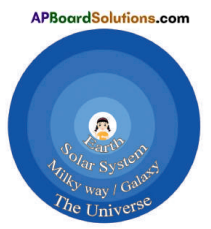
Millions of Milkyway galaxies including the solar system together is called the Universe.

Question 6.
Air and water are essential to life on the earth. But now they are being polluted by humans. What happens to the life of humans on this earth if pollution increases further?
Answer:
Pollution contains toxins that adversely impact living creatures within them. Rising pollution will lead to premature aging. Human exposure to toxins will increase to a great extent if pollution is not controlled. This pollution is directly linked to cancer and heart diseases.

Question 7.
Scientists are now trying to explore more about the moon and other planets. Do you think their efforts benefit us?
Answer:
The efforts of scientists in exploring the moon and other planets definitely useful to us. Space exploration alone provides us a significant amount of knowledge which is important for the education of people also about our planet and universe. It increases the knowledge about space and the discovery of distant planets and galaxies and gives us an insight into the beginnings of our universe.

Question 8.
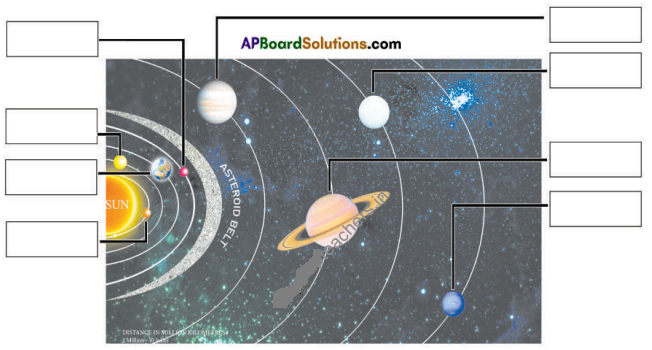
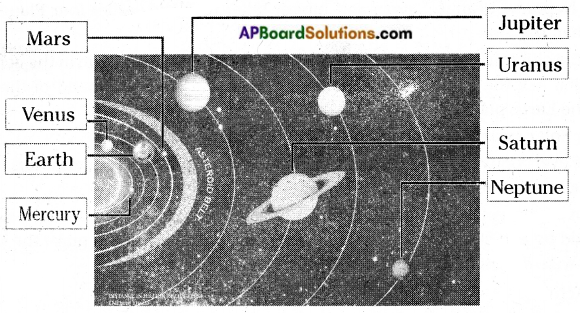
Observe figure 1.4 (text book Page No. 5) and fill in the table.
AP Board 6th Class Social Studies Solutions Chapter 1 Our Earth in the Solar System 2
Answer:

SI. No Name of the Planet Distance from the Sun in Kilometres No. of Moons
1. Mercury 58,000,000
2. Venus 108,000,000
3. Earth 150,000,000 1
4. Mars 228,000,000 2
5. Jupiter 778,000,000 79
6. Saturn 1,427,000,000 82
7. Uranus 2,869,000,000 27
8. Neptune 4,496,000,000 14

AP Board 6th Class Social Studies Solutions Chapter 1 Our Earth in the Solar System

Project Work

Prepare a model of the solar system.
Answer:
Student Activity.

Choose the correct answer.
1. Though tremendous heat is emitted by the Sun, why do we receive only limited heat?
A) Sun is very far from the Earth
B) Sun is very small when compared with the Earth
C) Sun is very close to the Earth
D) None of these
Answer:
A) Sun is very far from the Earth

2. The planet is known as the “Earth’s Twin” is
A) Jupiter
B) Saturn
C) Venus
D) Aries
Answer:
C) Venus

3. Which is the third nearest planet to the sun?
A) Venus
B) Earth
C) Mercury
D) Jupiter
Answer:
B) Earth

4. All the planets move around the Sun in a
A) Circular path
B) Rectangular path
C) Elongated path
D) Square path
Answer:
C) Elongated path

5. Asteroids are found in between the orbits of
A) Saturn and Jupiter
B) Mars and Jupiter
C) The Earth and Mars
D) Uranus & Neptune
Answer:
B) Mars and Jupiter

AP Board 6th Class Social Studies Solutions Chapter 1 Our Earth in the Solar System

Match the following:

1. Blue Planet                        [ ]          a) Mars
2. Farthest Planet to Sun       [ ]          b) Neptune
3. Fourth Planet from Sun     [ ]          c) Mercury
4. Nearest Planet to Sun       [ ]          d) Earth
Answer:
1. Blue Planet                            [ D ]          a) Mars
2. Farthest Planet to Sun           [ B ]          b) Neptune
3. Fourth Planet from Sun         [ A ]          c) Mercury
4. Nearest Planet to Sun           [ C ]           d) Earth

Let’s do

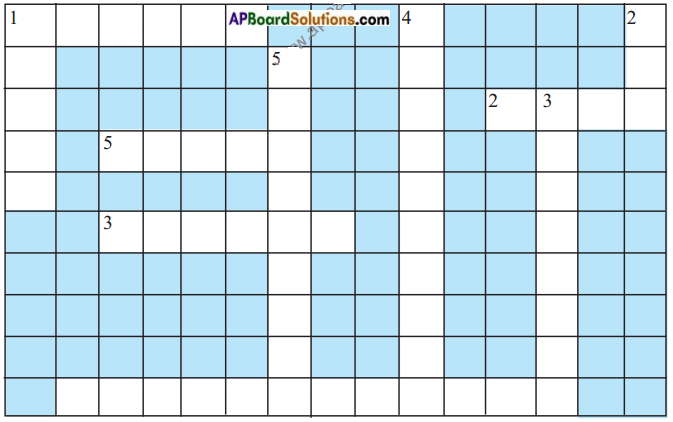
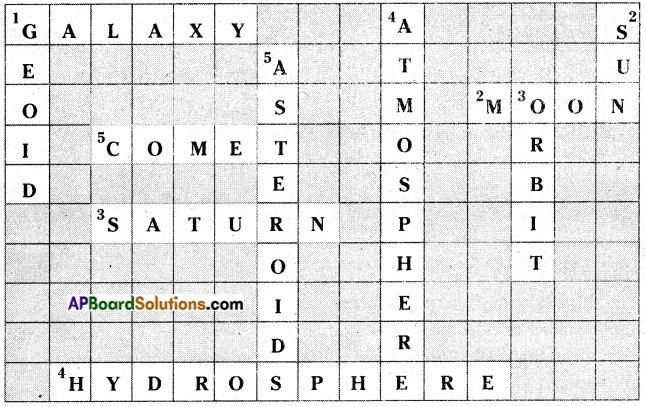
Solve the puzzle with the terms defined in the following statements.

CROSS:

  1. The cluster of millions of Stars. – Galaxy
  2. The natural satellite of the Earth. – Moon
  3. The ringed planet (See figure 1.4). – Saturn
  4. The sphere of water. – Hydrosphere
  5. The celestial object is made up of a head and a tail. – Comet

DOWN:

  1. The shape of the Earth. – Geoid
  2. The closest star to the earth. – Sun
  3. The path of the planets that move around the Sun. – Orbit
  4. The sphere of gases that surrounds the Earth. – Atmosphere
  5. The small pieces of celestial bodies, move around the Sun between Mars and Jupiter.

AP Board 6th Class Social Studies Solutions Chapter 1 Our Earth in the Solar System 1
Answer:

AP Board 6th Class Social Studies Solutions Chapter 1 Our Earth in the Solar System 4

AP Board 6th Class Social Studies Solutions Chapter 1 Our Earth in the Solar System

Let’s do

You might have heard that people make human chains and run for world peace etc. You can also make a Solar system and run for fun by using the following steps.
Step – 1: All children of your class can play this game. Assemble in a big hall or on a playground.
Step – 2: Now draw eight circles on the ground. Draw all circles in the same manner.
Step – 3: Prepare 10 placards. Name them as Sun, Moon, Mercury, Venus, Earth, Mars, Jupiter, Saturn, Uranus, Neptune.
Step – 4: Select 10 children in the following order and give each one of them a placard.
Order of placard distribution

  • The Sun – tallest, The Moon – smallest; Mercury, Mars, Venus, and Earth(almost equal heights); Neptune, Uranus, Saturn, and Jupiter taller than the earlier four Planets but smaller than the Sun.
  • Now ask the children holding placards to take their places with the Sun in the cent rein their orbits. Ask the child holding the Moon placard to keep the hand of the child holding the Earth placard always.
  • Now your Solar system is almost ready to go into action.
  • Now make everybody move slowly in the anti-clockwise direction. Your class has turned into a small human replica of the Solar system.
  • While moving in your orbit you can also turn around. For every celestial body, the spin should be anti-clockwise except for Venus and Uranus who will make the spin in the clockwise direction.

Answer:
Student Activity.

Field Visit

Question 1.
Observe the video of Planetarium in the QR Code. Describe your experiences.
AP Board 6th Class Social Studies Solutions Chapter 1 Our Earth in the Solar System 3
Answer:
Student Activity.

Question 2.
Visit SHAR which is located in SPSR Nellore District.
Answer:
Student Activity.

AP Board 6th Class Social Studies Solutions Chapter 1 Our Earth in the Solar System

6th Class Social Studies 1st Lesson Our Earth in the Solar System InText Questions and Answers

Let’s Do

(Textbook Page No. 3)

Question 1.
To know how days and nights occur
Answer:
Let us observe celestial bodies:
Required material: Torch, a sheet of plain paper, pencil and a needle.
Process:

  1. Place the torch in the centre of the paper with its glass front touching the paper.
  2. Now draw a circle around the torch.
  3. Perforate the paper with the needle within the circled area.
  4. Now place the perforated circle part of the paper on the glass front and wrap the paper around the torch with a rubber band.
  5. In a dark room, stand at some distance facing a plain wall. Switch off all other lights. Now flash the torchlight on the wall. You will see numerous dots of light on the wall, which look like stars at night.
  6. Switch on all the lights in the room. All dots of light will be almost invisible.
  7. You may now compare the situation with what happens to the bright objects of the night sky after the Sun rises in the morning.

Answer:
Student Activity.

Question 2.
Observe the following picture and name the planets in the boxes given below. (Textbook Page No. 6)
AP Board 6th Class Social Studies Solutions Chapter 1 Our Earth in the Solar System 5
Answer:
AP Board 6th Class Social Studies Solutions Chapter 1 Our Earth in the Solar System 6

AP Board 6th Class Social Studies Solutions Chapter 1 Our Earth in the Solar System

Think and Respond

Question 1.
From ancient times people worship the Sim as God. Give reasons. (Textbook Page No. 4)
Answer:
Sun is glorified in the Vedas of ancient India as an all-seeing god who observes both good and evil victims. The Sun is the source of all life on our planet. Without the Sun we couldn’t be here. Sun is the only natural source of energy. So people in ancient times treated the Sun as a god and we worship him.

Question 2.
What do animals and plants require in order to grow and survive? (Textbook Page No. 6)
Answer:
To grow and survive animals need air, water, food and shelter. To grow and survive plants require air, water, nutrients and light.

Question 3.
How can you say that our earth is a unique planet in the solar system? (Textbook Page No. 7)
Answer:
Earth is a unique planet for many reasons. They are:

  1. Earth is the only planet that supports animal or plants life.
  2. Earth’s location maintains the right temperature which is important for life forms.
  3. Human beings in-universe is found only on the Earth,

AP Board 6th Class Social Studies Solutions Chapter 1 Our Earth in the Solar System

Question 4.
How is man-made satellites useful to mankind? Discuss. (Textbook Page No. 9)
Answer:
A satellite is an object that orbits another object. They are natural and man-made. Moon is a natural satellite of the Earth. Satellites are used for many purposes. They are weather satellites, communication satellites, navigation satellites, astronomy satellites and many other kinds.

  1. They are used for communication purposes.
  2. Carry instruments or passengers to perform experiments in space.
  3. For weather forecasting system.
  4. For global positioning system. (GPS).

Question 5.
Can you relate yourself to the Universe now? You are on the Earth and the Earth is a part of the Solar system. Our Solar system is a part of the Milky Way or Galaxy which is part of the Universe. Think of the fact that the Universe contains millions of such galaxies. How do you fit in the picture? How tiny you are? Think a while. (Textbook Page No. 11)
AP Board 6th Class Social Studies Solutions Chapter 1 Our Earth in the Solar System 7
Answer:
Student Activity.

Explore

Question 1.
Browse the following website and know more about the solar system. (Textbook Page No. 5) https://spaceplace.nasa.gov/menu/solarsystem/.
Answer:
Student Activity.

AP Board 6th Class Social Studies Solutions Chapter 1 Our Earth in the Solar System

Question 2.
Up to 2006, there were 9 planets in our Solar system. But now we have only 8 planets. What was the 9th planet? What happened to it? Find out the reasons with the help of your teacher? (Textbook Page No. 6)
Answer:
Up to 2006, we considered there are 9 planets in our solar system.
They are:

  1. Mercury,
  2. Venus,
  3. Earth,
  4. Mars,
  5. Jupiter,
  6. Saturn,
  7. Uranus,
  8. Neptune,
  9. Pluto.

In 2006 the International Astronomical Union decided that Pluto is not having the technical qualities of a planet and reduced the number of planets from 9 to 8.

Question 3.
Who is the first Indian astronaut to go into space? (Textbook Page No. 8)
Answer:
Rakesh Sharma was the first Indian Astronaut to travel into space. He was part of the Soviet Union’s Soyuz T-11 expedition, which was launched on April 2, 1984.

AP Board 6th Class Social Studies Solutions Chapter 1 Our Earth in the Solar System

Question 4.
Have you heard of Chandrayan-1 and Chandrayan-2? Try to know about them and discuss in class. (Textbook Page No. 8)
Answer:
Chandrayaan is India’s moon mission. Chandra means the moon and yarn is a vehicle. Chandrayaan means Lunar Space Craft.
Chandrayaan -1 was India’s first moon mission. Chandrayaan -1 was launched in 2008 from Satish Dhawan Space Centre, Sriharikota.
Chandrayaan – 2 is the second moon mission developed by the Indian Space Research Organisation. It was launched in September 2019 from Satish Dhawan Space Centre, Sriharikota.

AP Board 6th Class Social Studies Solutions Chapter 5 Early Life to Settled Life

SCERT AP Board 6th Class Social Solutions 5th Lesson Early Life to Settled Life Textbook Questions and Answers.

AP State Syllabus 6th Class Social Studies Solutions 5th Lesson Early Life to Settled Life

6th Class Social Studies 5th Lesson Early Life to Settled Life Textbook Questions and Answers

Improve Your Learning

Question 1.
List out the products of the forests?
Answer:
Fruits, edible roots and tubers, nuts, seeds, leaves, honey, wild grains, medicinal herbs, fungi and other natural products.

Question 2.
What do you know about nomadic life?
Answer:
A nomad is someone who lived by travelling from place to place. The nomadic lifestyle is likely the oldest form of human society. Nomads generally move from place to place depending upon variables such as climate, season, water availability, food and movement of animal herds.

AP Board 6th Class Social Studies Solutions Chapter 5 Early Life to Settled Life

Question 3.
How do we use fire today?
Answer:
Today, we use fire

  1. to cook food,
  2. to heat the water
  3. for making steam from coal and water
  4. for moulding metals
  5. in rituals,
  6. in agriculture for clearing land,
  7. generating heat and light and many more.

Question 4.
Prepare a list of the food items eaten by the early people and the modern people. Do you notice any similarities or differences?
Answer:

Early people Modern people
Similarities:
Fruits Fruits
Edible roots and tubers Edible roots and tubers
Nuts Nuts
Seeds Seeds
Leaves Leaves
Honey Honey
Differences:
Wild grains Cooked grains
Raw meat Cooked meat
Fishes (uncooked) Cooked fish
Eggs (uncooked) Cooked eggs
Milk Boiled milk

Question 5.
“The earliest human life became easier by domesticating animals and plants” Do you agree or not? Support your answer.
Answer:
Yes. We can say that the lives of the earliest humans became easier on domesticating animals because.

  1. They will provide them with food.
  2. They help them in pulling cars.
  3. They are trustful so they can protect them from other animals also.

AP Board 6th Class Social Studies Solutions Chapter 5 Early Life to Settled Life

Question 6.
If there is no grinding stone, how would it affect our food habits?
Answer:
It would be a little tough for us to have food without a grinding stone. But still, we should remember our ancestors – the primitive humans, they had no grinding stone. But they survived. Instead of eating cooked items, we could eat fruits and vegetables. Our diet would completely consist of plants. We would be more conscious of plants and how to save them since they were our main diet.
But I can say cooking would be difficult without any stone or grinder.

Question 7.
What tools do you use for cutting fruits? What would they be made of?
Answer:
To cut fruits generally, I use a knife. They are made of iron or steel.

Question 8.
Where did the early people store food grains?
Answer:
The early people used large clay pots or woven baskets or fig pits into the ground to store food grains.

Question 9.
List out three ways in which the present lives of farmers and herders are different from that of the early people.
Answer:

  1. Hunter-gatherers kept travelling from place to place whereas farmers had to live at the same place for longer periods of time to take care of their crops.
  2. Hunter-gatherers depended on the meat of wild animals whereas farmers and herders used plants, crops and cattle.
  3. Hunter-gatherers did not have any settled life whereas farmers and herders gradually …… settled in huts, pit houses.

AP Board 6th Class Social Studies Solutions Chapter 5 Early Life to Settled Life

Question 10.
How did the lifestyle of farmer-herders lead to early civilisations?
Answer:
Farmer herders learnt to plant the seeds they wanted and grow them for food. They attracted animals by leaving food for them. These animals provided them milk, meat and carried loads. They protected them from wild animals. They stayed in a place for a long time taking care of the plants. They learned storing methods of food. So, people began to settle down inconvenient places for a long time. They built houses. They developed new kinds of tools made of stone. Toolmakers created better farming tools. These communities extended to different parts. In this way, the lifestyle of farmer- herders lead to early civilisations.

Question 11.
Locate the following Rock Art Sites on the map of Andhra Pradesh.
A) Chintakunta
B) Adoni
C) Kavali
D) Naidupalli
E) Velpumadugu
F) Srikalahasti
Answer:
AP Board 6th Class Social Studies Solutions Chapter 5 Early Life to Settled Life 1

AP Board 6th Class Social Studies Solutions Chapter 5 Early Life to Settled Life

Project Work

Question 1.
Collect the information about rock painting sites. Write a report and exhibit it in your class.
Answer:
Recently I visited rock painting caves in Akkampalle Village in the Kurnool district with my parents. There are three sites to see. Of the three sites, one is a painted rock shelter locally known as “Mosalla-gundu” (‘Boulder of Crocodiles’), while the remaining two are naturally formed rock caves. Artworks found within the caves reflect the life, culture, traits and beliefs of the era.
AP Board 6th Class Social Studies Solutions Chapter 5 Early Life to Settled Life 2
The Boulder of Crocodiles is open on three sides towards the west, north and south, and contains a large number of paintings. The first crocodile is large in size compared with the other two. These paintings may be assigned to the Mesolithic period due to the nature of their depictions and application of red-ochre colour.
AP Board 6th Class Social Studies Solutions Chapter 5 Early Life to Settled Life 3
The second cave is a natural rock cave facing north and situated south of the Boulder of Crocodiles. The cave was intentionally closed on three sides with huge boulders, which might have been to offer protection from the cold winds and other natural hazards. The inner face of the cave is decorated with vertical strips of white lime coating.
AP Board 6th Class Social Studies Solutions Chapter 5 Early Life to Settled Life 4
The final cave is a natural formation facing towards the north, which appears to have been used for the purpose of dwelling. Its three sides – east, west, and south – are closed off with huge boulders of quartzite. There is a roughly rectangular area with uneven natural bedrock as its floor.

AP Board 6th Class Social Studies Solutions Chapter 5 Early Life to Settled Life

Question 2.
Collect some pictures of ancient people and prepare an album.
Answer:
Student Activity.

6th Class Social Studies 5th Lesson Early Life to Settled Life InText Questions and Answers

Let’s Do

Question 1.
List out the activities of early people in the below pictures? (Textbook Page No. 54)
AP Board 6th Class Social Studies Solutions Chapter 5 Early Life to Settled Life 5
Answer:

Fig. – 1

  1. People fetching an animal for food.
  2. Women planting seeds.
  3. Man searching for something in bushes.

Fig. – 2

  1. People fetching an animal for food.
  2. The man was polishing a leather.
  3. Man trying to lit a fire with rocks,
  4. A man is frying food on fire.

Question 2.
List the items that you eat which are not grown but collected from the wild. (Textbook Page No. 55)
Answer:
Honey, tamarind, wood apple, nuts, berries, apricot and spices.

Question 3.
Apart from food, list out the other things that we get from the animals. (Textbook Page No. 60)
Answer:
Wool from sheep, silk from the silkworm, pearls from oyster, leather products from snakes, buffalo etc.,

AP Board 6th Class Social Studies Solutions Chapter 5 Early Life to Settled Life

Question 4.
Make a list of animals and birds that are reared in your area. (Textbook Page No. 60)
AP Board 6th Class Social Studies Solutions Chapter 5 Early Life to Settled Life 6
Answer:
Animals: cow, buffalo, ox, dog, ass, horse, cat and rabbit.
Birds: Peacock, pigeon, parrot.

Think and Respond

Question 1.
How did the early people discover fire? Discuss with your teacher and write. (Textbook Page No. 55)
Answer:
Perhaps someone discovered fire while making a stone tool. When stones are rubbed or struck against each other, sparks can be seen. Strike means to hit very hard These sparks can start a fire. Maybe, once the sparks set fire to some dry grass or wood nearby. Or, perhaps some people saw a forest fire. When the fire was over they found many wild animals burnt in it. They also probably tasted a piece of the burnt meat and liked the new taste.
The discovery of fire changed the lives of the people forever.

Question 2.
How does the changing climate affect human life at present? Discuss with your teacher, friends and write.
(Textbook Page No. 58)
Answer:
Human health has always been influenced by climate and weather. Changes in climate patterns result in crop loss or drastically reduced yield. Hence more agriculturists are moving away from agriculture to other occupations which are less reliant on climate. The rise in ocean levels has forced people who live by the coastline, to move inwards and pursue other places.

AP Board 6th Class Social Studies Solutions Chapter 5 Early Life to Settled Life

Question 3.
How did the early humans become herders? (Textbook Page No. 58)
Answer:
People say that they could attract tame animals by leaving food for them. The first animal to be tamed was the ancestor of the dog. They started rearing sheep, goats, cattle, etc. that lived in herds and most of them eat grass! People often protected these animals from being attracted by other wild animals. This is how they became herders.

Question 4.
How can you say the rearing of animals paved the way to a settled life of the early humans? (Textbook Page No. 59)
Answer:
As early humans started farming, they realized that seeds will take time to grow. For this, the early man realized that he has stayed in that place for a long time. He realized that he has to take care of the plants, watering them and protecting them from birds and animals.
Besides, he realized that animals will get multiplied if they are taken care of. He realised that he will get milk and meat from them.
For these reasons, early humans began to settle down inconvenient places for a long time.

Question 5.
Compare the lifestyle of the modern farmers with the early farmers-herders.
Answer:

Modern farmer Early farmers-herders
1. They are enjoying settled life. 1. They enjoyed nomadic life.
2. They market the surplus food. 2. They shared the food among the group.
3. They receive government help during the time of famines/natural calamities. 3. They received no help during the time of famines/natural calamities.

AP Board 6th Class Social Studies Solutions Chapter 5 Early Life to Settled Life

Question 6.
What will happen if we don’t store food grains? (Textbook Page No. 59)
Answer:
Grains had to be stored for food and seeds. If we don’t store them scarcity arises and there will be no grains to put in the fields.

Question 7.
Prepare a list of articles that are using for cooking and storing in modern days. (Textbook Page No. 61)
Answer:
For cooking, we use gas stoves or electric induction stoves. For- storing we use refrigeration, vacuum packaging, pasteurisation, canning and irradiation.

AP Board 6th Class Social Studies Solutions Chapter 4 Land Forms – Andhra Pradesh

SCERT AP Board 6th Class Social Solutions 4th Lesson Land Forms – Andhra Pradesh Textbook Questions and Answers.

AP State Syllabus 6th Class Social Studies Solutions 4th Lesson Land Forms – Andhra Pradesh

6th Class Social Studies 4th Lesson Land Forms – Andhra Pradesh Textbook Questions and Answers

Improve Your Learning

Question 1.
What is a landform?
Answer:
The ups and downs, uneven slopes on the surface of the earth is called a landform.

Question 2.
Into how many categories landforms can be divided?
Answer:
Landforms can be divided into mountains, plateaus, and plains depending upon their elevation and slope.

Question 3.
How is the delta formed?
Answer:
Before joining the sea, a river divides into a large number of small streams. Before joining the sea the water slows down and can’t carry the sediment which forms the delta.

AP Board 6th Class Social Studies Solutions Chapter 4 Land Forms - Andhra Pradesh

Question 4.
Why do plain areas have dense settlements?
Answer:
Plains are suitable for building houses and cultivation. Because of fertile soil, the land is highly productive and transportation is also easy in plains. So plains have dense settlements.

Question 5.
Compare the various types of soils that prevailed in different landforms.
Answer:

Plains Plateau Mountains
Alluvial soils Deep and Fertile Red and saline soils.
Saline soils have a high content of lime and salts.
Lava Plateaus are rich in black soil that is fertile.
Soils are uneven and sloped Red and Rocky soil.

Question 6.
Why did the government declare some mandals as drought-hit?
Answer:
Drought means a long period where there is little or no rain. In plateau regions, rains are very little and unreliable. Because of low rainfall, farmers lost their crops. To aid them the government declares some mandals as drought-hit.

Question 7.
“Physical and climate feature determine the economic activities of a region”. Explain.
Answer:
Location and climate have large effects on income levels and income growth. People living in the plains depend on agriculture. Because of fertile soil, this region is highly productive. As transportation is also easy the plain regions have more economic activities than plateau and mountain regions. Plateau regions have fewer economic activities because of low rainfall. This region has an underlying influence on the people who live here. In hilly regions people completely depend on rainfall and transportation is also not easy in this region. When compared to the plain region hilly region is also underlying influence upon the people there. So we can say physical and climatic feature determines the economic activities of a region.

AP Board 6th Class Social Studies Solutions Chapter 4 Land Forms - Andhra Pradesh

Question 8.
Are all the lands in your village agriculturally productive? If not give reasons.
Answer:
All the lands in my village are agriculturally productive.

Question 9.
Do you think it is important to preserve the lifestyle of tribals – Why?
Answer:
I think that it is important to preserve the lifestyle of tribals because they do not destroy the forests they use. Their lifestyle is also ecofriendly. If they follow the lifestyle of the people who live in plains they too destroy the forests. This will lead to low rainfall in hilly areas also. They possess good knowledge of forest which leads to more productivity of forest products. They take care of the environment in a lot of ways than expected.

Question 10.
Why kitchen garden is more important for the tribal people?
Answer:
Tribal people do not have daily markets. They can’t go to the nearby cities and towns for essential commodities like vegetables. They may not have good transportation also. So, kitchen gardening is important for them as they grow vegetables in their backyards.

Question 11.
Why agriculture is a profitable trade in plains? Explain.
Answer:
The fertile soils in the plains are very deep and fertile. The alluvial soils are deposited as sediments. Using machines in cultivation is easy in plains. Rivers in plains forms deltas that are fertile. Underground water is also an added advantage in plains. They can cultivate two or three crops in a year. Good transportation facilities are available in plains. Produce can be easily transported to the markets. So, agriculture is a profitable trade in plains.

AP Board 6th Class Social Studies Solutions Chapter 4 Land Forms - Andhra Pradesh

Fill in the blanks:

12. The highest peak in eastern ghats is ………….. (Armakonda)
13. Large part of …………… is located in the Deccan plateau. (Rayalaseema)
14. In plain areas ………….. crop is extensively cultivated. (Paddy)
15. Hills of eastern ghats are composed of …………… (Charnockites and Khondalite rocks)
16. In hilly areas people fetch water from …………. (natural springs or down streams of downhills)
17. ………….. soils have a high content of lime and salts. (Saline)
18. Plain areas receive rainfall in …………….. (June to October)

Choose the correct answer.

19. Plateaus are rich in ………..
A) Vegetables
B) Minerals
C) Population
D) Crops
Answer:
B) Minerals

20. Black soils are fertile and good for …………..
A) Cotton
B) Millets
C) Vegetables
D) Wheat
Answer:
A) Cotton

21. There are …………… districts in coastal Andhra Pradesh.
A) 6
B) 4
C) 9
D) 5
Answer:
C) 9

AP Board 6th Class Social Studies Solutions Chapter 4 Land Forms - Andhra Pradesh

22. …………………………………
A) Rayalaseema
B) Coastal Andhra
C) Northern Andhra
D) Deccan Plateau
Answer:
A) Rayalaseema

23. Fill this table with appropriate information.
AP Board 6th Class Social Studies Solutions Chapter 4 Land Forms - Andhra Pradesh 1
Answer:

Feature Plain Plateau Mountains or hills
Soils Fertile and Alluvial black soil Red soil with little nutrients Red and Rocky soils
Crops Paddy and cash crops Orchards Coffee
Rainfall Above Average Rainfall Below Average rainfall Average Rainfall
Occupation Agriculture Agriculture Shifting Agriculture

Project Work

1. Make a poster of landforms.
Answer:
Student Activity.

AP Board 6th Class Social Studies Solutions Chapter 4 Land Forms - Andhra Pradesh

2. Make the day moulds of different landforms.
Answer:
Student Activity.

6th Class Social Studies 4th Lesson Land Forms – Andhra Pradesh InText Questions and Answers

Let’s Do

(Textbook Page No. 44)

Question 1.
The names of Coastal Districts from North to South.
Answer:

  1. Srikakulam,
  2. Vizianagaram,
  3. Visakhapatnam,
  4. East Godavari,
  5. West Godavari,
  6. Krishna,
  7. Guntur,
  8. Prakasam and
  9. Sri Potti Sriramulu Nellore District.

Question 2.
The names of Rayalaseema Districts:
Answer:

  1. Kurnool,
  2. Anantapur,
  3. YSR Kadapa and
  4. Chittoor Districts.

AP Board 6th Class Social Studies Solutions Chapter 4 Land Forms - Andhra Pradesh

Question 3.
Write your village/town/city name:
Answer:
Student Activity
Ex: Mandal: Giddalur
District: Prakasam
Neighbouring districts to your district: Kurnool, YSR Kadapa, SPS Nellore, Prakasam
Districts
Neighbouring state to your districts: Karnataka, Tamilnadu and Telangana.
(Note: Students can write their own districts and their Neighbouring districts & States)

Think and Respond

(Textbook Page No. 41)

Question 1.
List out the landforms from the below picture?
AP Board 6th Class Social Studies Solutions Chapter 4 Land Forms - Andhra Pradesh 2
Answer:

  1. Mountain,
  2. Plateau and
  3. Plain are the landforms in the above picture.

Question 2.
Name the landforms around your village/town?
Answer:
Mountains, Plateau and Plains are the landforms that are found around our village.

(Textbook Page No. 42)

Question 3.
“The construction of a road is easy in plain areas”- Give the reason.
Answer:
Plains are level lands with flat surfaces. So it is easy to lay a road in plain areas.

AP Board 6th Class Social Studies Solutions Chapter 4 Land Forms - Andhra Pradesh

Question 4.
Why plain areas are densely populated? Write two reasons.
Answer:
The plains are densely populated because:

  1. Plains are more suitable to construct buildings as well as cultivation.
  2. Transport facilities are plenty.

Question 5.
Generally, the villages located in plains will have good employment and standard of living. Why?
Answer:
Plains in villages are fertile. They have plenty of water resources. Canals, underground water facilities are available in plains. They can use modern agricultural equipment also. So the production is also high. So, employment in agricultural activities is more. Transportation facilities are more and employment can be generated in this sector also. Construction of roads and buildings and for human inhabitation is suitable. So we can say that the villages located in plains will have good employment and standard of living.

Question 6.
Which type of soil is more suitable for cultivation?
Answer:
Fertile and alluvial black soils, nutrient soils and high water holding capacity soils are more suitable for crops.

Question 7.
Look at the pictures of a mountain, a plain and a plateau and identify which of them is similar to your region.
Answer:
Plateaus and plains are the landforms that are found in our region.

(Textbook Page No. 46)

Question 8.
Why hilly areas are suitable for plantation crops? Discuss with your Mends or teachers and write.
Answer:
In hilly areas, the soils are uneven and sloped. The soils in hilly areas are red and rocky. Due to their high elevation and the natural downward movement of water, the soils are well-drained. These soils are suitable for plantation crops like coffee and tea. For example, coffee is grown in the Araku valley in Andhra Pradesh.

AP Board 6th Class Social Studies Solutions Chapter 4 Land Forms - Andhra Pradesh

Question 9.
Name some forest products.
Answer:
Honey, fruits, gum, tamarind and wood pulp are some of the forest products.

Question 10.
Have you visited any forests? If so describe your experiences.
Answer:
Recently I visited Maredumilli in the East Godavari district. It is located in the deep forest area of Eastern Ghats quiet away from the urban concrete jungle. Maredumalli nestled in green nature’s lap. It is a pleasant place to visit as it is good for its scenic beauty with trees and lovely waterfalls pretty close to one another.

(Textbook Page No. 48)

Question 11.
What are the major changes in the cropping pattern of the plateau region?
Answer:
Due to the insufficient availability of water, only one crop can be grown here. Farmers in this region are trying to overcome this problem with various types of irrigation methods. Millet crops like ragi, sama, varagu, korra and groundnut are grown. Sometimes paddy, sugarcane, and fruit orchards are sown in this region. At present farmers are trying mixed crops like red gram, maize with groundnut. Farmers are trying contour bunding and organic farming to improve the soil quality As water facilities are fewer farmers are growing sweet lime, sapota and mango. These orchards require water in some seasons only and give regular returns. Wherever water is available plantation crops like banana, papaya, guava and pomegranate are being cultivated. In this way, major changes came in cropping patterns in plateau region when compared to the olden days.

Question 12.
What are the problems we may face in, future by digging more bore wells? Find out and discuss the causes and possible solutions.
Answer:
The impact of bore wells includes scarcity of water, vanishing moisture in the soil as well as the fertility of the soil. More and more borewells in the same area may cause earthquakes.
We have to plant more trees, create small ponds, create small check dams, save rainwater, make water holding tanks to overcome this problem.

AP Board 6th Class Social Studies Solutions Chapter 4 Land Forms - Andhra Pradesh

Question 13.
Compare the rainfall in the coastal plains and in the interior plateau.
Answer:
In regions closer to the coast, rainfall is heavy but in northern and western plateau regions, meagre rainfall is observed. During October and November, heavy rainfall occurs due to northeast monsoon winds.

(Textbook Page No. 49)

Question 14.
Name the main rivers that flow through the plains of Andhra Pradesh.
Answer:
Krishna and Godavari are the main rivers that flow through the plains of Andhra Pradesh.

Question 15.
What are the districts that come under the Krishna and Godavari deltas?
Answer:
Guntur, Krishna, West Godavari and East Godavari are the ‘districts that come under the Krishna and Godavari deltas.

Question 16.
Name the two main cities from where the two deltas begin. Find out the names of at least two rivers that join the Krishna river.
Answer:
Vijayawada and Rajahmundry are the two cities from where the two deltas begin. Ghataprabha River, Malaprabha River, Bhima River, Tungabhadra River are the rivers that join the Krishna river.

Question 17.
What are the reasons for the changes in cropping patterns?
Answer:
Farmers in plain areas change their cropping pattern towards cash crops and food crops. Some of the crops will make the soil fertile and the next will give high returns. Food crops like vegetables and fruits will give high returns. So they are changing the cropping pattern.

AP Board 6th Class Social Studies Solutions Chapter 4 Land Forms - Andhra Pradesh

Question 18.
Why coastal deltas are rich in infertility?
Answer:
Because of floods, the soil in these areas will get fertile due to the continuous deposition of sediments by the rivers.

Question 19.
Why agriculture is a main occupation in the plain areas?
Answer:
Plain areas are gifts to agriculture and farmers. Agriculture is the main occupation in these areas. Because of the fertility of the soil, more than one crop can be cultivated here.

AP Board 6th Class Social Studies Solutions Chapter 3 Maps

SCERT AP Board 6th Class Social Solutions 3rd Lesson Maps Textbook Questions and Answers.

AP State Syllabus 6th Class Social Studies Solutions 3rd Lesson Maps

6th Class Social Studies 3rd Lesson Maps Textbook Questions and Answers

Improve Your Learning

Question 1.
What are the components of a map?
Answer:
The components of the map are

  1. Directions,
  2. Scale,
  3. Symbols and
  4. Colours.

Question 2.
Why is the actual distance on the ground reduced on a map?
Answer:
It is impossible to draw a map showing actual distances. So we use ‘scale’ to show the actual distance on the ground in a reduced manner on a map.

Question 3.
Explain the need for symbols in preparing maps.
Answer:
Maps are too small for us to draw pictures of the things shown on them. For example, we can’t draw the real school or a bus stand or a tree as they will take too much space on the map. Therefore, we always show things with the help of symbols on the map.

AP Board 6th Class Social Studies Solutions Chapter 3 Maps

Question 4.
Find out the scale used in your district map to show the distance between your Mandal headquarter and district headquarter?
Answer:
Student Activity (One example is given for you).
Ex: Our mandal is Agiripalli. It is in the Krishna district. Our district headquarter is Machilipatnam.
On the map, the scale is given as 1 cm = 10 km.
The actual distance from Agiripalli to Machilipatnam is 83 km.
The distance between Agiripalli to Machilipatnam is 8.3 cms on the map.

Question 5.
How political maps are different from physical maps.
Answer:
Political maps show territorial features like country, cities, nations and their boundaries. A physical map indicates the natural features of a place like mountains, water bodies, plains etc.

Question 6.
What is the importance of thematic maps?
Answer:
A thematic map shows the spatial distribution of earth surface features. Thematic maps are used to display geographical concepts such as density, distribution, relative magnitudes, gradients, spatial relationships and movements. These maps focus on specific information like the map of rainfall, roads, tourist places etc..

Question 7.
What are the uses of maps in our daily life?
Answer:
Maps help us in many ways in our daily life. They help us to understand the concept of a subject.

  1. Maps help us to locate places like cities, districts, states and countries.
  2. Maps show the physical features such as mountains, plateaus, plains.
  3. Maps help us to know the major routes of transport such as roads, railways, etc.
  4. Maps help us to understand the distribution of crops, minerals, soils etc.
  5. Maps help the army at the time of war and for security reasons.
  6. Maps guide the tourists to their destination.
  7. Maps help us to understand history easily.

AP Board 6th Class Social Studies Solutions Chapter 3 Maps

Question 8.
Locate all continents and oceans on the given World map.
Answer:
AP Board 6th Class Social Studies Solutions Chapter 3 Maps 1

Choose the correct answer.

1) Maps showing the distribution of forests are …………….
A) Physical map
B) Thematic Map
C) Political map
D) none of the above
Answer:
B) Thematic Map

2) The blue colour is used for showing …………….
A) Waterbodies
B) Mountains
C) Land
D) Plains
Answer:
A) Waterbodies

3) A scale is a necessary component for …………….
A) Map
B) Sketch
C) Plan
D) None
Answer:
A) Map

AP Board 6th Class Social Studies Solutions Chapter 3 Maps

4) A compass is used …………….
A) To show symbols
B) To find the main direction
C) To measure distance.
D) To find the height
Answer:
B) To find the main direction

5) The intermediate direction between the North and East is called …………….
A) North-east
B) South-east
C) North-west
D) South-west
Answer:
A) North-east

Project Work

Question 1.
Draw a sketch of your school.
Answer:
Student Activity.

Question 2.
Collect different maps and make a scrapbook.
Answer:
Student Activity.

Question 3.
Draw a sketch map showing the route from your home to school by using appropriate symbols.
Answer:
Student Activity.

6th Class Social Studies 3rd Lesson Maps InText Questions and Answers

Let’s Do

Question 1.
Why was Mrudula not able to reach her destination with the help of the above sketch?  (Textbook Page No. 29 & 30)
Answer:
Mrudula was not able to reach her destination (Sathwika’s house) because there are no directions and scale in the given sketch.

AP Board 6th Class Social Studies Solutions Chapter 3 Maps

Question 2.
Go through the below picture and fill in the following table. (Textbook Page No. 30 & 31)
AP Board 6th Class Social Studies Solutions Chapter 3 Maps 2
AP Board 6th Class Social Studies Solutions Chapter 3 Maps 3
Answer:

Direction Object
North Hill, Trees
North – East Temple
South Well
South – West Masjid
East Rising Sun
South – East School
West House
North – West Church

AP Board 6th Class Social Studies Solutions Chapter 3 Maps

Question 3.
Observe the given picture and calculate the actual distance between the following places using the scale. (Textbook Page No. 32)
AP Board 6th Class Social Studies Solutions Chapter 3 Maps 4
Answer:
i. The distance between PO (A) and Raju’s house (C).
Answer:
Approximately 60 metres.
ii. The distance between Raju’s house (C) and Puja’s house (E).
Answer:
Approximately 30 metres.
iii. The distance between Chiru’s house (D) and the school.
Answer:
Approximately 55 metres.

Question 4.
Make a table with the states, UTs and their capital. (Textbook Page No. 35)
AP Board 6th Class Social Studies Solutions Chapter 3 Maps 5
Answer:

S.No. State/UT Capital
1. Andhra Pradesh Amaravati
2. Arunachal Pradesh Itanagar
3. Assam Dispur
4. Bihar Patna
5. Chattisgarh Raipur
6. Goa Panaji
7. Gujarat Gandhinagar
8. Haryana Chandigarh
9. Himachal Pradesh Shimla
10. Jharkhand Ranchi
11. Karnataka Bengaluru
12. Kerala Tiruvanantapuram
13. Madhya Pradesh Bhopal
14. Maharashtra Mumbai
15. Manipur Imphal
16. Meghalaya Shillong
17. Mizoram Aizwal
18. Nagaland Kohima
19. Orissa Bhubaneswar
20. Punjab Chandigarh
21. Rajasthan Jaipur
22. Sikkim Gangtok
23. Tamilnadu Chennai
24. Telangana Hyderabad
25. Tripura Agartala
26. Uttar Pradesh Lucknow
27. Uttarakhand Dehradun
28. West Bengal Kolkata
Union Territories and Capitals :
Andaman Nicobar Islands Port Blair
Lakshadweep Kavaratti
Ladakh Leh
Chandigarh Chandigarh
Dadar and Nagar Haveli Daman and Diu Silvassa
Puducherry Pondicherry
National Capital Region New Delhi
Jammu & Kashmir Srinagar (Summer) Jammu (Winter)

AP Board 6th Class Social Studies Solutions Chapter 3 Maps

Question 5.
Go through the below physical map and write some physical features of India. (Textbook Page No. 35)
AP Board 6th Class Social Studies Solutions Chapter 3 Maps 6
Answer:
India has all major physical features of the earth i.e., mountains, plains, deserts, plateaus and islands.

  1. The Himalayan mountains or the Northern Mountains.
  2. The Northern plains or the Indo – Gangetic Plains.
  3. The Peninsular Plateau.
  4. The Great Indian desert
  5. The Coastal Plains.
  6. The Islands.

Question 6.
Collect different thematic maps and display in your classroom. Discuss with your Mends. (Textbook Page No. 36)
Answer:
Student Activity.

Think and Respond

Question 1.
How do symbols give us information? (Textbook Page No. 32)
Answer:
With the help of symbols, maps can be drawn easily and are simple to read also. It is not possible to draw a map in the actual shape and size with different features such as buildings, rivers, bridges, trees and railway lines etc. So they are shown by using certain colours, letters, shades, pictures and lines.

Question 2.
What does the map indicate? (Textbook Page No. 36)
AP Board 6th Class Social Studies Solutions Chapter 3 Maps 7
Answer:
This is a thematic map of India. Major crop grown areas were shown on this map. From this map, we can know in which areas of India Rice, Wheat, Jowar, Bajra were grown. We can also know where two crops were grown.

AP Board 6th Class Social Studies Solutions Chapter 3 Maps

Question 3.
Why it is called a thematic map? (Textbook Page No. 36)
Answer:
Thematic maps are called so because they focus on a specific theme or subject relating to a particular theme or aspect of geography like the map of rainfall, roads, tourist places.

AP Board 6th Class Social Studies Solutions Chapter 2 Globe – Model of the Earth

SCERT AP Board 6th Class Social Solutions 2nd Lesson Globe – Model of the Earth Textbook Questions and Answers.

AP State Syllabus 6th Class Social Studies Solutions 2nd Lesson Globe – Model of the Earth

6th Class Social Studies 2nd Lesson Globe – Model of the Earth Textbook Questions and Answers

Improve Your Learning

Question 1.
What is a globe?
Answer:
Globe is a true model of the Earth.

Question 2.
What are the movements of the Earth?
Answer:
Rotation and Revolution are the movements of the Earth.

Question 3.
Which movement of the Earth causes Day and Night?
Answer:
Rotation of the Earth causes Day and Night.

AP Board 6th Class Social Studies Solutions Chapter 2 Globe – Model of the Earth

Question 4.
What happens when the Earth rotates?
Answer:
During rotation, half portion of the Earth receives Sun’s rays and the remaining half portion remains in darkness.

Question 5.
Define the Earth’s Rotation and Revolution.
Answer:
Rotation: Planet Earth rotates around itself on its own axis. This movement is called Rotation.
Revolution: Planet Earth rotates around the Sun. This movement is called Revolution.

Question 6.
What is the true shape of the Earth?
Answer:
The Earth is round in shape. The Earth is slightly flattened at the poles and bulges in the middle or at the equator.

Question 7.
Which Latitude is known as the Tropic of Cancer?
Answer:
The latitude which is located at 23[latex]\frac{1}{2}[/latex]° north of the equator is known as the Tropic of Cancer.

AP Board 6th Class Social Studies Solutions Chapter 2 Globe – Model of the Earth

Question 8.
Read the Paragraph under the title ‘Equinox’ and comment on it.
On 21st March and September 23rd direct rays of the Sun fall on the equator. At this position, neither of the poles is tilted towards the Sun. So, the whole earth experiences equal days and nights. This is called an equinox.
On 23rd September, it is autumn season in the Northern Hemisphere and spring season in the Southern Hemisphere. The opposite is the case on 21st March when it is spring in the Northern Hemisphere and autumn in the Southern Hemisphere. Thus, you find days and nights and changes in the seasons because of the rotation and revolution of the earth.
Answer:
On 21st March and 23rd, September Sun’s rays fall directly on the Equator. So we experience equal day and night on both these days. This is called equinox. On 21st March it is autumn in the Northern Hemisphere and spring in the Southern Hemisphere. Because of Earth’s rotation, half portion of the Earth receives Sun’s rays and the remaining half remains in darkness. So we find changes on Earth because of Earth’s rotation and revolution.

Question 9.
Create a table and list out the similarities and differences between Latitudes and Longitudes.
Answer:
Similarities between latitudes and longitudes:

  1. Latitudes and longitudes are both artificial.
  2. Latitudes and Longitudes are both invisible lines.
  3. Latitude is based on the 0° latitude while longitude is based on Greenwich.
  4. They both help us to locate a place on earth

Differences:

Latitudes Longitudes
1) Latitudes are the horizontal lines. 1) Longitudes are vertical lines
2) Lines of latitudes are parallel to the equator. 2) Lines of longitude are not parallel and come to a singular point.
3) Latitudes lines run in the East and West directions. 3) Longitude lines run in the North to South direction.

AP Board 6th Class Social Studies Solutions Chapter 2 Globe – Model of the Earth

Question 10.
If India has day, it is night in America. What is the reason for this difference?
Answer:
The part of the Earth that faces the Sun gets illuminated and experiences the day. The opposite part of the earth that does not face the Sun, experiences night. As India is opposite to America the difference in day and night occurs.

Question 11.
Take a ball and draw the latitudes and longitudes on the surface.
Answer:
Project Work: Student Activity.
AP Board 6th Class Social Studies Solutions Chapter 2 Globe – Model of the Earth 1

Question 12.
Prepare a note on the difference between a globe and an atlas.
Answer:

  1. A globe is a three-dimensional sphere. An atlas is two-dimensional.
  2. A globe represents the whole earth. An atlas represents the whole earth or a part of it.
  3. A globe can be used to get a broad-level picture of the world. An atlas provides more specific information about different places.

Question 13.
Find out the latest leap year and the coming leap year.
Answer:
The present year 2020 is a leap year. 2024 is the coming leap year.

Question 14.
What preparations should be taken to watch a solar eclipse safely?
Answer:
The Sun outputs more power than our eye is designed and so it damages the retina. So we should not watch the Sun or the solar eclipse directly. We should use special-purpose solar filters, such as eclipse glasses to watch Solar eclipses safely. Projecting the Sun through a box projector is another safe way to watch the solar eclipse.

AP Board 6th Class Social Studies Solutions Chapter 2 Globe – Model of the Earth

Question 15.
It is difficult to understand the geographical location, time, and distance in the absence of the imaginary lines – latitudes and longitudes. Appreciate the design of the imaginary lines of latitudes and longitudes.
Answer:

  1. Latitudes are used to define the North-South position of a location on the planet.
    The general climatic division of a place can be studied with the help of latitudes.
  2. Longitudes are used to define the East-West position of a location on the planet. Longitudes also help us to calculate the time of a particular place.
  3. If the latitude and longitude are known any position on earth can be located. Even- though, longitudes and latitudes are imaginary lines they play an important role.

So we should appreciate the design of the imaginary lines of the latitudes and longitudes.

Question 16.
Venu met some children from different cities at a youth festival. They were: Geethika, John, Nihal, and Uma. Venu collected some information about their cities.
Venu has given us certain clues. Can you find out the cities with the help of an Atlas?

  • Geethika – A girl from a city where 19° Northern Latitude and 72° Eastern Longitude nearly coordinates.
    Find and write the city name: ………………………………………………………
  • John – A boy from a city where 12° Northern Latitude and 77° Eastern Longitude nearly coordinates.
    Find and write the city name: ………………………………………………………
  • Nihal – A boy from a city where 28° Northern Latitude and 77° Eastern Longitude nearly coordinates.
    Find and write the city name: ………………………………………………………
  • Uma – A girl from a city where 22° Northern Latitude and 88° Eastern Longitude nearly coordinates.
    Find and write the city name: ………………………………………………………

Answer:

  • Geethika – A girl from a city where 19° Northern Latitude and 72° Eastern Longitude nearly coordinates.
    Find and write the city name: ( Bombay)
  • John – A boy from a city where 12° Northern Latitude and 77° Eastern Longitude nearly coordinates.
    Find and write the city name: (Bangalore)
  • Nihal – A boy from a city where 28° Northern Latitude and 77° Eastern Longitude nearly coordinates.
    Find and write the city name: (Delhi)
  • Uma – A girl from a city where 22° Northern Latitude and 88° Eastern Longitude nearly coordinates.
    Find and write the city name: (Kolkata)

AP Board 6th Class Social Studies Solutions Chapter 2 Globe – Model of the Earth

Question 17.
If an astronaut from a spaceship looks down at the Earth, can he/she see the rotation of the earth?
Answer:
Yes. From a spaceship, an astronaut can see the rotation of the earth. Spaceships move around the Earth at a different speed. So the astronaut can see the Earth’s rotation.

Question 18.
Why can’t we sense the rotation and revolution of the Earth?
Answer:
The Earth is moving at a fixed speed and we are also moving along with it at the same speed. That is why we can’t sense the Earth’s spin. If Earth’s spin changes we would definitely sense it. If we are in a car that is moving at a constant speed on a smooth surface, we will not know that we are moving. However, when the car accelerates or when the brakes are applied, we will feel the motion. Another example is, we can drink coffee or tea on a moving train which is moving at a constant speed* because we are traveling by the train at the same speed. If the speed of the train changes we can’t drink. The spin of Earth doesn’t make those kinds of changes. So we can’t sense the rotation and revolution of the Earth.

Question 19.
Choose the correct answer.
i) The movement of the Earth around the Sun is known as
A) Rotation
B) Revolution
C) Inclination
D) Meridian
Answer:
B) Revolution

AP Board 6th Class Social Studies Solutions Chapter 2 Globe – Model of the Earth

ii) Sun rays fall directly on the Equator on:
A) 21 March
B) 21 June
C) 22 December
D) 22 October
Answer:
A) 21 March

iii) Christmas is celebrated in summer in:
A) Japan
B) Australia
C) India
D) The USA
Answer:
B) Australia

iv) The cycle of the seasons is caused due to:
A) Rotation
B) Revolution
C) Gravitation
D) Inclination
Answer:
B) Revolution

Question 20.
Find and fill the latitudes and longitudes in the given table with the help of Atlas and Globe.

S.No. PLACE LATITUDES LONGITUDES
1. Vijayawada
2. Kadapa
3. Tirupati
4. Visakhapatnam
5. Your Village (Chittor)

Answer:

S.No. PLACE LATITUDES LONGITUDES
1. Vijayawada 16°50′ N 80°64′ E
2. Kadapa 14°46’ N 78°82′ E
3. Tirupati 13°62’ N 79°41′ E
4. Visakhapatnam 17°68′ N 83°21′ E
5. Your Village (Ex: Chittoor) 13°21′ N 79°10’ E

AP Board 6th Class Social Studies Solutions Chapter 2 Globe – Model of the Earth

Question 21.
Find and fill the latitudes and longitudes extent of India and Andhra Pradesh in the given table with the help of Google Maps or Atlas.

PLACE LATITUDES LONGITUDES
From To From To
India
Andhra Pradesh
Your district (Kurnool)
Your Mandal (Nandyal)

Answer:

PLACE LATITUDES LONGITUDES
From To From To
India 8°4′ N 37°6′ N 68°7′ E 97°25′ E
Andhra Pradesh 12°41′ N 19°07’ N 77° E 84°40′ E
Your district (Ex: Kurnool) 15°50′ N 4°32′ N 78° 1′ E 45° 71′ E
Your Mandal (Ex: Nandyal) 15°28′ N 42°84′ N 78°28′ E 59°13′ E

Question 22.
Observe the following pictures and fill the boxes with the name of the shaded hemispheres.
AP Board 6th Class Social Studies Solutions Chapter 2 Globe – Model of the Earth 2
Answer:
AP Board 6th Class Social Studies Solutions Chapter 2 Globe – Model of the Earth 3

Project Work

Draw a diagram of the globe showing the earth’s axis, the Equator, Tropic of Cancer and Capricorn, Arctic Circle, and Antarctic Circle.
Answer:
Student Activity.

AP Board 6th Class Social Studies Solutions Chapter 2 Globe – Model of the Earth

6th Class Social Studies 2nd Lesson Globe – Model of the Earth InText Questions and Answers

Let’s Do

(Textbook Page No. 17)

Question 1.
Take a big round apple. Pierce a cycle spoke through it. The spoke resembles the axis shown in a globe. You can now move the apple around this axis from left to right.
Answer:
Student Activity.
AP Board 6th Class Social Studies Solutions Chapter 2 Globe – Model of the Earth 4

Think and Respond

(Textbook Page No. 16)

Question 1.
How does the earth rotate and revolve without any needle, unlike the Globe? Discuss with the teacher.
Answer:
Our Solar System formed about 4.6 billion years ago when a huge cloud of gas and dust started to collapse under its own gravity. As the cloud collapsed, it started to spin. The Solar system is made up of the Sun and everything that orbits around it includes the planets and their moons as well as numerous asteroids, meteoroids, and comets. Without any unbalanced forces acting on them, the tremendous gravity of the Sun and the planets have kept them rotating for billions of years. Either the Earth or any other planet does not have any needle to rotate or to revolve.

AP Board 6th Class Social Studies Solutions Chapter 2 Globe – Model of the Earth

Question 2.
All the celestial bodies are round in shape. Why?
Answer:
A planet is round because of its gravity. Gravity pulls from the center to the edges like the spokes of a bicycle wheel. This makes the overall shape of a planet a sphere, which is a three-dimensional circle.

(Textbook Page No. 17)

Question 3.
In which hemisphere is India located?
Answer:
India is located within both the Northern and Eastern hemispheres.

Question 4.
Which hemisphere has the maximum number of continents?
Answer:
Northern Hemisphere has the maximum number of continents.

Question 5.
In which hemisphere is the continent Antarctica located?
Answer:
Antarctica is located in the Southern hemisphere.

AP Board 6th Class Social Studies Solutions Chapter 2 Globe – Model of the Earth

(Textbook Page No. 17)

Question 6.
Complete the table with the help of a world map, globe, or internet.
AP Board 6th Class Social Studies Solutions Chapter 2 Globe – Model of the Earth 5
Answer:

Name the Continents in the Northern Hemisphere Name the Continents in the Southern Hemisphere Name the Continents that are spread over Southern and Northern Hemispheres
Europe
North America
Australia
Antarctica
Africa
Asia
South America
Name the Continents in the Northern Hemisphere Name the Continents in the Southern Hemisphere Name the Continents that are spread over Southern and Northern Hemispheres
Arctic Ocean Southern Ocean Pacific Ocean Atlantic Ocean Indian Ocean

Question 7.
Why do latitudes get smaller towards the pole? Which latitude is the biggest circle?
Answer:
The equator is the largest circle and divides the globe into two equal halves. So it is at the center of the Earth. Circles of latitude are all great circles with the center of Earth in the middle. The circles of latitude get smaller as the distance from the Equator increases. So the latitudes get smaller towards the poles. The Equator is the biggest latitude.

AP Board 6th Class Social Studies Solutions Chapter 2 Globe – Model of the Earth

(Textbook Page No. 18)

Question 8.
Fill in the table with the help of a globe/map.

Latitude Value in degrees
North Pole
Arctic Circle
Tropic of Cancer
Equator
Tropic of Capricorn
Antarctic Circle
South Pole

Answer:
AP Board 6th Class Social Studies Solutions Chapter 2 Globe – Model of the Earth 6

(Textbook Page No. 20)

Question 9.
Identify and write down the Latitude and Longitude between the extents of the given Andhra Pradesh map. You can take the help of Atlas.
AP Board 6th Class Social Studies Solutions Chapter 2 Globe – Model of the Earth 7
Answer:
Andhra Pradesh Latitude: 12°41’ N to – 19°07′ N
Longitude : 77° – 84°40′ E.

AP Board 6th Class Science Solutions Chapter 3 Animals and their Food

AP State Syllabus AP Board 6th Class Science Solutions Chapter 3 Animals and their Food Textbook Questions and Answers.

AP State Syllabus 6th Class Science Solutions 3rd Lesson Animals and their Food

6th Class Science 3rd Lesson Animals and their Food Textbook Questions and Answers

Improve Your Learning

Fill in the Blanks.

1. The butterfly uses ——– to suck honey from flowers.
Answer:
Proboscis.
2. Tiger is a ——– because it eats only meat.
Answer:
carnivore.
3. Decomposers are also called ——–
Answer:
Recyclers.

AP Board 6th Class Science Solutions Chapter 3 Animals and their Food

Choose the correct answer.

1. The source of energy for a food chain is
A) Producers
B) Consumers
C) Sun
D) Decomposers
Answer:
C) Sun

2. Identify the omnivore from the following.
A) Lion
B) Cow
C) Dog
D) Tiger
Answer:
C) Dog

3. At which position of the food chain would you place a human being
A) Primary consumer
B) Secondary consumer
C) Tertiary consumer
D) All the above
Answer:
C) Tertiary consumer

Answer the Following Questions.

1. List some animals in your surroundings which have the same kind of food habit.
Answer:

  • Cow, buffalo, goat and sheep have some kind of food habit as an herbivore depend upon the plants for food.
  • Dog and cat depend upon meat, milk and curd.

2. Compare the legs and nails of a dog and hen and say why they are different?
Answer:

Dog Hen
1. Legs of dog is longer and has four legs. 1. Legs of hen is shorter and has 2 legs.
2. The legs are muscular and strongly jointed. 2. The legs are thin them dog’s leg.
3. It has hard and slight curved nails. 3. It has thin, sharp and slightly elongated nails.
4. It uses its legs to run and catch the prey. 4. It uses legs to dig the ground to find food.
5. The nails are used for tearing the flesh. 5. Nails are useful for scratching the soil to pick up worms.

3. Name some animals which use tongue as a tool for taking in food.
Answer:
Frogs, lizards, garden lizard, chameleon, echidna use tongue as a tool for taking in food.

AP Board 6th Class Science Solutions Chapter 3 Animals and their Food

4. Identify which of the following statements are wrong and give reasons.
(a) All the animals living in water feed only on plants.
(b) Elephants and deer are herbivores living in the forest.
(c) Birds’ beaks are designed to suit their food habits.
(d) Sharp claws are useful for hunting.
(e) Most of the food chains end with herbivores.
Answer:
a) All the animals living in water feed only on plants.

  • This statement is wrong. There are many animals living in water which eat animals.
    Ex: A blue whale in the sea eats tiny animals called krill.

b) Elephants and deer are herbivores living in the forest.

  • This statement is correct as elephants and deer are herbivores living in the forest.

c) Bird’s beaks are designed to their food habits.

  • This statement is correct as bird’s beaks are designed to their food habits.

d) Sharp claws are useful for hunting.

  • This statement is correct.
  • Sharp claws of some animals meant for tearing the flesh of prey. And also help to increase traction to run faster as in the case of cheetah.
  • In some animals claws help holding the grip for running while hunting.
  • In the hen the claws are helpful to scratch the soil to find worms.

e) Most of the food chains end with herbivores.

  • This statement is wrong.
  • The food chain starts with herbivores and ends with carnivores which are wild.

5. Write the importance of the food chain.
Answer:

  • The food chain shows how energy is transferred from one living organism to another organism.
  • It describes energy and nutrients move through an ecosystem.
  •  It shows the relationship between producers and consumers.
  • It explains the interdependence of diverse organisms in nature.

6. Arrange the following in a correct sequence and form a food chain
1. Rabbit → Carrot → Eagle → Snake
2. Human → Insect → Algae → Fish
Answer:
1. Carrot → Rabbit → Snake → Eagle
2. Algae → Insect → Fish → Human

7. If you want to understand more about food chain what questions would you like to ask?
Answer:

  • What is food chain?
  • How does animals and plants dependent on one another?
  • How does energy flow with in an ecosystem?
  • Is there any relation of food habits of animals with that of living ecosystem?
  • How the nature balances the ecosystem?
  • Why the food chain always starts with plants?

8. What happens if there are no decomposers on the earth?
Answer:

  • Bacteria and fungi are get energy by breakdown of dead plants and animals. So, they are called decomposers.
  • They help in the cycling of materials in the environment.
  • If there were no decomposers the dead and waste materials remains on earth.
  • The nutrients would not be replenished.
  • Natural enrichment of the soil cannot takes place.
  • Because of the dead organisms remain on earth, the existence of life on earth would have been impossible.

AP Board 6th Class Science Solutions Chapter 3 Animals and their Food

9. Draw a food chain of your choice.
Answer:

10. How can you appreciate the role of producers in a food chain?
Answer:

  • Plants are known as producers, as they make their own food.
  • Plants are the only organisms which provide food for all organisms in an ecosystem.
  • In an ecosystem, Producers are at base of entire food chain.
  • Plants not only provide the food but also oxygen to the earth.
  • Plants are the precious things to continue the life on earth.

Activities and Projects

Question 1.
Go to a nearby pond where cranes are usually seen. Observe how they catch fish. Write about the process of catching fish. (Take care of yourself when you are near water places.)
Answer:

  • The crane usually has been seen in lakes and the fishes are food for that.
  • The long thin legs that it has helps it to move in the water without disturbing the water.
  • While catching the fish it tries to move very slowly.
  • So that the fishes don’t know its presence it also can stand still for a long time for hunting of fishes.
  • Crane used to catch the fish with the help of their long beak.

Question 2.
Collect one or two earthworms and put them in a bottle containing wet soil. Close it with a lid that has holes. Observe how earthworms get their food. Record your observations.
Answer:
Aim: To observe the eating activity of earthworms in the wet soil.
What we want: Two earthworms, one glass bottle, wet soil.
What to do: Take a glass bottle and fill it with some wet soil.

  • Now kept the two earthworms in the soil filled bottle.
  • Observe them for sometime.

What do we see: We observed that the earthworms are started swallowing soil in, little quantities.
What we learned: With the above observations we concluded that the earthworms are feed on moist soil which contains nutrients.

Question 3.
Fill up the following table

Body part used to collect food Examples
Beak Hens,…
Tongue
Teeth
Sucker
Strong legs with claws

Answer:

Body part used to collect food Examples
Beak Hens, crane, parrot, eagle, humming bird.
Tongue Lizard, frog, snake, garden lizard, chameleon, dog.
Teeth Cat, dog, tiger, lion.
Sucker Leech.
Strong legs with claws Tiger, lion, dog.

Question 4.
Make your own food chain and display it in your classroom.
Answer:
Plant → Caterpillar → Chameleon → Snake → Mangoose
(This food chain can make with diagrams of those animals) (Student Activity)

AP Board 6th Class Science Solutions Chapter 3 Animals and their Food

Question 5.
Prepare a scrapbook of animals and separate them into carnivores, omnivores and herbivores.
Answer:
Students can collect the pictures of different animals and after dividing them into carnivores, omnivores and herbivores they can be pasted under these heads separately in the scrapbook. (Student Activity)
AP Board 6th Class Science Solutions Chapter 3 Animals and their Food 2

6th Class Science 3rd Lesson Animals and their Food Activities

Activity – 1

Some animals are listed in the given Table -1. For some the animals, the type of food they eat is also given. Fill the blanks in Table.

Name of the animal Food the animal eats
Buffallo Grass, oil cake, hay, grains
Cat Small animals, Birds, Milk
Rat
Lion
Tiger
Spider
House Lizard
Cow
Human Beings
Butterfly
Crow
Others

Answer:

Name of the animal Food the animal eats
Buffallo Grass, oil cake, hay, grains
Cat Small animals, Birds, Milk
Rat Seeds, insects, small animals
Lion Deer, jiraffee, fox etc.
Tiger Other animals
Spider Beetles, flies
House lizard Worms, insects
Cow Grass, oil cake, hay, grains.
Homan beings Rice, eggs, milk, meat etc.
Butterfly Nectar
Crow Small animals, insects

Answer the following questions based on the table.
i) List the animals that depend only on plants and their products for food.
Answer:
Buffalo, cow, butterfly.

ii) List the animals that depend only on animals and their products for food.
Answer:
Cat, lion, tiger, house lizard, spider.

iii) List the animals that depend on both plants and animals for food.
Answer:
Rat, cow, crow and human beings.

AP Board 6th Class Science Solutions Chapter 3 Animals and their Food

Activity – 2

2. Write the parts of the body animals that are used to collect or capture food in the given table.

S. No. Animal Sense used in tracking food Body parts-used in taking food
1. Dog Smell Sharp teeth, Tongue
2. Cow
3. Hen Beak
4. Frog
5. Snake
6. Bat
7. Lizard
8. Vulture
9 Lion Legs, Claws, Mouth ….
10. Humming Bird

Answer:

S. No. Animal Sense used in tracking food Body parts used in taking food
1. Dog Smell Sharp teeth, tongue
2. Cow Smell, vision Mouth, tongue
3. Hen Vision Beak, claws
4. Frog Touch Tongue
5. Snake Taste, Smell Mouth, teeth
6. Bat Hearing Mouth, tongue
7. Lizard Vision, hearing Mouth, tongue
8. Vulture Vision, smell Beak, claws
9. Lion Vision, hearing Legs, claws, mouth
10. Humming bird Smell, taste Beak

Answer the following questions based on the above table.
i) Do all the animals use similar parts in taking in food?
Answer:

  • No. All animals do not use similar parts in taking in food.
  • Ex: Cow and lizard uses mouth and tongue, whereas hen and humming bird uses beak taking in food.

AP Board 6th Class Science Solutions Chapter 3 Animals and their Food

ii) Name some animals which use similar parts in taking in food?
Answer:
The animals that use some parts for taking food are

  1. Hen, humming bird, vulture use their beak to get food.
  2. Cat and dog – use their sharp teeth to tear the food in pieces.
  3. Lizard and frog – use their tdngue to capture the food.
  4. Lion and tiger – uses their strong legs to run for chasing the animal, sharp claws to catch and sharp teeth to tear flesh.

iii) Compare the parts of dog to that of frog. Note down the similarities as well as differences observed by you.
Answer:
Dog uses smell sense to trick the food whereas frog have a smell organ in the roof of their mouth called the jacobsons organ. This detects food.

  • Dog and frog both use the tongue in taking food.
  • The dog uses its teeth and nails in capturing the food, while frog uses its sticky tongue to capture the food and swallows it.

iv) Compare the parts of hen and sparrow in eating food. Note down the similarities as well as differences you observed.
Answer:
Similarites:

  • Hen and sparrow use their beaks to take the food in.
  • Both are finding out their food by using the vision, as a sense.
  • Hen and sparrow both feeds on grains, worms and insects.

Difference:

  • Hen uses its claws to scratch the soil to find out worms whereas sparrows feed on the insects / worms which are present on plants.

v) What are the similarities between a dog and a lion in the parts involved in taking in food?
Answer:

  • The dog licks with its tongue and runs fast.
  • The lion hunts the other animals. It uses strong legs to run sharp claws to catch and sharp teeth to tear the flesh.
  • The claws of the lion are also sharp to hold the animal.
  • Dog also uses its teeth and nails in capturing its food.

AP Board 6th Class Science Solutions Chapter 3 Animals and their Food

vi) What are the similarities and differences between a vulture and a lion in their mode of taking in food?
Answer:

  • Both lion and vulture are carnivores.
  • They both have sharp vision and use their sharp claws to tear the flesh.
  • Lion hunts animals staying on land.
  • Vulture hunts its food by flying high in the sky.

Activity – 3

3. Look at the picture. Different birds have different beaks. Do you know why they are different?
AP Board 6th Class Science Solutions Chapter 3 Animals and their Food 3
Answer:
The beaks are different because the birds eat different kinds of food.

  • So, the type of beaks depends upon their habitat, environment and food habits also.
  • The beaks of birds are help to them to kill the prey, to fight, to get food and feeding their young ones. Based on their food habit the birds have different types of beaks such as strong hooked beak, hooked beak, long beak, long thin beak etc.

Activity – 4

4. i) Observe how a lizard catches its food. Write down your observations.
Answer:

  • Lizard uses its visionary sense to track the food.
  • Lizard concentrates its attention on the movements of the insect.
  • Lizard moves so fast towards the insect.
  • It catches the insect by using tongue and eats it.

ii) Find out the differences between a frog and a lizard’s way of taking in food.
Answer:

Frog Lizard
1. Frog is carnivore as it feed on insects and worms. 1. Lizard is insectivore in nature as it feed on insects.
2. Frog senses the food through a social organ called jacobsons organ in the roof of their mouth- 2. Lizard uses its visionary sense to track the food.
3. Frog throws its sticky tongue towards an insect. The insect stuck to the tongue. Then the frog swallows it. 3. Lizard moves so fast towards the insect, and catches the insect with the tongue and eats it.

iii) How do these animals (Frog, lizard) use their tongue?
Answer:
These animals (Frog, lizard) use their tongue to capture the food.

AP Board 6th Class Science Solutions Chapter 3 Animals and their Food

Activity – 5

5. Observe a cow/buffalo while eating its food. Write your observations in your notebook by following the given questions.
AP Board 6th Class Science Solutions Chapter 3 Animals and their Food 4
i) How does a cow find its food?
Answer:
Cow finds its food by using the sense of smell.

ii) Note the parts of the body involved in it?
Answer:
Mouth and tongue are involved to take the food in.

iii) What mouthparts of the cow are involved in eating its food?
Answer:

  • The cow uses its tongue to grasp a clump of grass.
  • Teeth help to shred the grass into small pieces.

iv) Do cows have teeth? Do they have teeth on both jaws?
Answer:
Yes. Cows have teeth on both jaws. But don’t have top front teeth.

v) In what way can you justify it is herbivore?
Answer:

  • Cow depends only on plant and plant products for food.
  • They eat different parts of plants like green/dry grass, leaves, branches arid fruits.
  • So that, we can say cow is herbivore.

vi) You may have observed cows and buffaloes sitting under the trees and moving their jaws. Do you know why they do that?
Answer:

  • Cow and buffalo chew food very quickly, swallow and store it in a part of their stomach.
  • After some time, they back the food material from the stomach to the mouth and chew it again leisurely.

AP Board 6th Class Science Solutions Chapter 3 Animals and their Food

Activity – 6

6. Observe a dog in your surroundings. How does it get its food? Write your observations by following the given questions.
AP Board 6th Class Science Solutions Chapter 3 Animals and their Food 5
i) What does it do to find food?
Answer:
The dog finds its food by smelling. Dog’s nose is a thousand times more sensitive than ours.

ii) Which parts are involved in taking in food?
Answer:
The mouth and tongue are involved in taking in food.

iii) How does a dog eat meat?
Answer:

  • The dog catches another animal with its legs.
  • It tears the meat using its sharp teeth.
  • It eats the meat and chews it with the help of teeth and uses its tongue to swallow it.

iv) How does a dog drink water?
Answer:
The dog licks water with its tongue and drinks it.

v) Is there any difference in using its tongue when compared with a frog or a cow? Write in the space provided below.

Animal Use of tongue
Frog
Cow
Dog

Answer:

Animal Use of tongue
Frog To catch the food
Cow To swallow grass
Dog To lick water

AP Board 6th Class Science Solutions Chapter 3 Animals and their Food

Activity – 7

7. Observe the picture and answer the following questions.
AP Board 6th Class Science Solutions Chapter 3 Animals and their Food 6
i) What is the source of energy in a food chain?
Answer:
Sunlight is the source of energy in a food chain.

ii) How does grasshopper get its energy?
Answer:

  • In a food chain grasshopper is a primary consumer so that it depends on grass for food.
  • Then grasshopper gets its energy by eating grass.

iii) What happens to the crow if the frog was removed from this food chain?
Answer:

  • In this food chain frog is a secondary consumer as its feed on grasshopper.
  • If the frog was removed in this food chain, the grasshopper population will be increased.
  • In this food chain crow is a tertiary consumer as its feed on frogs.
  • If the frog was removed from this food chain, the crows will go hungry and their population will be decreased.

AP Board 6th Class Science Solutions Chapter 3 Animals and their Food

iv) What is the role of mushrooms in the given picture?
Answer:

  • Mushroom is a decomposer.
  • Mushroom get it energy by the breakdown of dead matter.
  • It helps in the cycling of materials in between producers, consumers and to the soil.

AP Board 8th Class English Solutions Chapter 5C I Can Take Care of Myself

AP State Syllabus AP Board 8th Class English Textbook Solutions Chapter 5C I Can Take Care of Myself Textbook Questions and Answers.

AP State Syllabus 8th Class English Solutions Chapter 5C I Can Take Care of Myself

8th Class English Chapter 5C I Can Take Care of Myself Textbook Questions and Answers

Comprehension

Answer the following questions.

Question 1.
What do you think is the most important thing to learn to live well?
Answer:
The most important thing to learn to live well is that one should not depend upon others. One should take care of oneself. One should stand on one’s own feet.

AP Board 8th Class English Solutions I Can Take Care of Myself

Question 2.
What are the skills or qualities that would help you to be independent in your life?
Answer:
The skills or qualities that would help us to be independent in our life are:

  1. One needs to know how to take care of oneself.
  2. One needs to be able to protect oneself.
  3. One needs to learn to be strong and work hard.
  4. One needs to be powerful oneself.
  5. One needs to stand on one’s own feet.
  6. One needs to learn more about the world and learn to live in it as a good creature.
  7. One needs to depend on the power within oneself to seek the target in one’s life.

Question 3.
Do you agree/disagree with the daughter of the mother rat? Give reasons for your response.
Answer:
I agree with the daughter of the mother rat. Depending on another person’s power, position or prosperity does not promise peace and security in the long run. To be safe, one needn’t get someone married. One should work hard to achieve one’s goal. The married woman, who doesn’t stand on her own feet has to depend upon her husband for everything.

I. Observe the data given in the bar diagrams related to male and female infant mortality rates (IMR) in India over the years 1990 to 2008 and answer the questions given.
AP Board 8th Class English Solutions Chapter 5C I Can Take Care of Myself 1
(Source: Ministry of Statistics and Programme Implementation National Statistical Organisation – Website : www.mospi.gov.in)

AP Board 8th Class English Solutions I Can Take Care of Myself

Question 1.
In which year is the difference in infant mortality rates between male and female the highest?
Answer:
In the year 2003, the difference in infant mortality rates between male and female is the highest.

Question 2.
In which case and in which year do we find a sudden decrease in the IMR?
Answer:
We find sudden decrease in the case of male IMR in the year 2003.

Question 3.
What will happen if there is a wide gap in IMR between male and female?
Answer:
If there is a wide gap in IMR between male and female, one of them (either male or female) will be left unmarried. There will be an imbalance in the ratio between the male and female.

Question 4.
What, according to you, may the reasons be for the female IMR being higher than the male IMR?.
Answer:
I think the reason may be that the parents think that girl children are burdensome. They think it is very difficult to educate them and get them married to the males. They have to give dowry to the males. So, most of the parents don’t want female children. Hence, the female IMR is higher than the male IMR.

Question 5.
What may be the reasons for the decrease in IMR rates over the years?
Answer:
The reasons for the decrease in IMR rates over the years.

  1. The attitude of the parents is changed with the times.
  2. Increasing medical facilities.
  3. Increase in the literacy rate among the girls (women).
  4. Women empowerment.

AP Board 8th Class English Solutions I Can Take Care of Myself

Question 6.
Do you think there could be a further decrease in the IMR after 5 years?
Answer:
Yes. I think there would be a further decrease in the IMR after 5 years.

Question 7.
What, according to you, may the reasons be for the death of more than half of both male and female infants?
Answer:
The reasons for the death of more than half of both male and female infants.

  1. The superstitious beliefs of the parents. (Village parents)
  2. Lack of proper medical facilities.
  3. In some cases the young couples don’t want the children in the earlier days after their marriage. They think that the children will obstruct their privacy.

II. Group Work :
Discuss the above questions in your group and write an analytical report on the Infant Mortality Rates in India.
Answer:
When we observe the bar diagram, there has been a gradual decrease in both the female IMR and the male IMR. There is a sudden fall in the male IMR in 2003. The difference in infant mortality rates between male and female is the highest in 2003. The decrease in the IMR shows us the changed views of the parents with the times. If there is a wide gap in IMR between male and female, one of genders will be left unmarried and there is an imbalance in the family system. The parents think that females are burdensome. They feel it difficult to educate and get them married. They are not in a position to give dowry to the males. So, most of the parents don’t want female children. Hence, the female IMR is higher than the male IMR. The main reason for the decrease in IMR over the years is that the parents have changed their attitude with the times. The advanced medical facilities and the increase in the literacy rate among the girl children are also reasons for it. I think there will be a further decrease in the IMR after 5 years.

AP Board 8th Class English Solutions I Can Take Care of Myself

Oral Activity

Work in pairs and debate on the following proposition.
“Reservation in education, employment and legislature will empower the women.”
Answer:
Argument for the statement:
There is no doubt, surely reservation in education, employment and legislature will empower the women. As all of us know, today most of the women’s lives are confined to the kitchen. They have to depend upon their husbands for everything. They can’t protect themselves. If they have reservation, most of the women get good education and employment. Then they don’t have to beg anyone for anything. They will be able to lead a dignified life. If there is reservation in legislature, there will be more women participation in politics and society. It is expected to create equal opportunities for women along with men with reservation for women. Our society is a male dominated one. Reservation in education, employment and legislature would amount to a positive discrimination. Reservation for women not only empowers them but also helps the society.
Argument against the statement:
Can reservations for women be an effective measure and do the women really require such special treatment and will they be really empowered with reservations ? The intelligent male persons will lose the opportunities if the women are given reservations. Instead of providing any solution to this problem, giving reservations to women may give rise to social, political and psychological tensions. Besides, it is debatable if more women will attend schools, colleges or offices merely because of reservations. Reservation for women can be a temporary sort of relief and it won’t empower them. There should be a broader political, social and economic policy for the upliftment and empowerment of women.

AP Board 8th Class English Solutions I Can Take Care of Myself

Project work

A. Interview some female members in your family and neighbourhood with the following questions.
Would you like the girls in the family to take up a job after they have received education?
If yes, give some reasons.
Yes, I would like the girls in the family to take up a job after they have received education. The girl child is an equal partner in sharing the responsibilities and duties. An educated girl can render financial assistance to the father and later to the husband. The woman can take care of herself if she is employed. She doesn’t need to depend on others. She is able to lead a dignified life. So, the girls should take up a job after they have received education.
If no, give some reasons.
No, I would not like the girls in the family to take up a job after they have received education. The girl child’s primary duty in the later part of life is to look after the family and children. So, she doesn’t need to take up a job. If she takes up a job, she can’t find time to look after the family and children when she gets married.

B. Work on the following items.
Note down whether the woman you have interviewed is educated or uneducated; working/not working; married/unmarried.
AP Board 8th Class English Solutions Chapter 5C I Can Take Care of Myself 2
Answer:
AP Board 8th Class English Solutions Chapter 5C I Can Take Care of Myself 3

C. Based on the above information write a paragraph on ‘Woman Empowerment’.
Answer:
I have interviewed five women. Of them three women are married the rest of the two are unmarried. Three women are employed and the rest of the two are unemployed. All the five women opined that the women should be empowered. The employed women opined that they couldn’t find time to serve their families. The unemployed women want to stand on their feet. They want financial independence. They want jobs to get the stability and share the responsibilities and duties along with men. A woman is dynamic in
many roles she plays. She has to face many challenges and find out practical solutions. She is facing the challenges of economic inequality, gender-based violence, limited leadership and political participation and other issues. So, the women should be provided with more opportunities which could empower them to improve their lives, their rights and their future.

AP Board 8th Class English Solutions I Can Take Care of Myself

Grammar Family

Parts of Speech

There is a family in London whose surname is grammar. There is a couple, Mr. Noun and Mrs. Verb. The couple has three children-one son pronoun and two daughters adverb and adjective. The son (pronoun) has to do all the work of his father in his absence. The two daughters love each other but there is a difference in them. Adjective loves her father and brother and keeps praising them. Adverb loves her mother more she always modifies her when there is a need. There are two servants in the family, preposition and conjunction. The preposition is the chief servant. He is the official servant of his master. He is the family servant and looks after every member of the family. The interjection joins the family in times of joy and sorrow.

I Can Take Care of Myself Summary in English

Once, a mother rat wanted to get her young daughter married to the most powerful being that she could find. She thought that the sun god was the most powerful being on earth. So, she asked the sun god if he was the most powerful being on earth. The sun god smiled and replied that the rain was greater than him as there would be no water on earth or no crop or tree without the rain. So, the mother rat asked the rain god if he was the most powerful being on earth. The rain god smiled and replied that the mountain was greater than him as he would protect the creatures. He blocked the clouds and let the water flow safely. The mother rat asked the mountain god if he was the most powerful being on earth. The mountain god smiled and replied that the worm was greater than him. He also told that the earthworm was the greatest friend of the living beings. The mother rat’s daughter came to her and asked her what she was doing. The mother replied that she was looking for the most powerful being on earth to get her married. She also told her daughter that she would be safe if she married the most powerful being on earth. The daughter replied why she would need to marry to be safe. She also told that she would need to know how to take care of herself if she wanted to be safe. To protect herself, she needed to learn to be strong and work hard. She wanted to be powerful herself, so that she could take care of herself and those that she loved. She wanted to stand on her own feet. She opined that she needed to learn more about the world and learn to live in it as a good creature. She asked for her mother’s help. She wanted her mother’s support. She was not interested in marrying anybody. She didn’t want to depend on others. She wanted to believe her power only.