AP Board 7th Class English Solutions Chapter 1B The Town Child & The Country Child

AP State Syllabus AP Board 7th Class English Textbook Solutions Chapter 1B The Town Child & The Country Child Textbook Questions and Answers.

AP State Syllabus 7th Class English Solutions Chapter 1B The Town Child & The Country Child

7th Class English Chapter 1B The Town Child & The Country Child Textbook Questions and Answers

I. Answer the following questions.

Question 1.
Where does the town child want to live?
Answer:
The town child wants to live in a country.

Question 2.
Why is there smoke in the towns?
Answer:
There is smoke in the towns because there are buses and motors and trams, plying often.

AP Board 7th Class English Solutions Chapter 1B The Town Child & The Country Child

Question 3.
There is one thing that the town child loves. What is it?
Answer:
The town child loves the sky which is far above.

Question 4.
“There is no one to play with at all”. This sentence means
a) there are no people in villages.
b) there are no players in villages.
c) the villages have lesser population than the towns.
Answer:
b) There are no players in villages.

Question 5.
What is the wish of the country child?
Answer:
The country child’s wish is that he lived in a town.

Question 6.
Which child is able to watch meadows and lambs?
Answer:
The country child is able to watch meadows and iambs.

Question 7.
Why are the lanes in the country so quiet?
Answer:
The lanes in the country are so quiet because they are not crowded with traffic and feet.

Question 8.
Why are nights colourful in towns?
Answer:
Nights are colourful in towns because of the bright and twinkling streets. There are electric lights at night in towns.

Question 9.
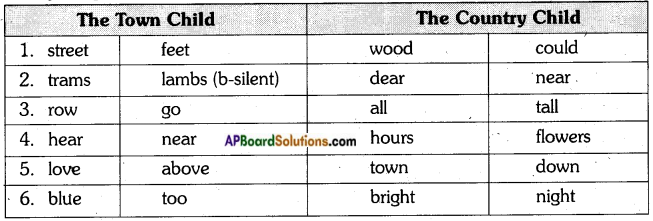
Pick out the rhyming words from both the poems.
The first one is done for you.

go row
hear
bright
blue
hours
near

Answer:
The rhyming words from the poems are:
AP Board 7th Class English Solutions Chapter 1B Town Child & The Country Child 1

AP Board 7th Class English Solutions Chapter 1B The Town Child & The Country Child

Question 10.
If you were given an option to live in a town or a country, where would you prefer to live? Give reasons for your option.
Answer:
I would prefer to live in a country. I like the greenery there. It is a pollution free place. People are innocent and courteous. It is always quiet and calm. Hence I like to live in a village.

Project

Conduct a Survey

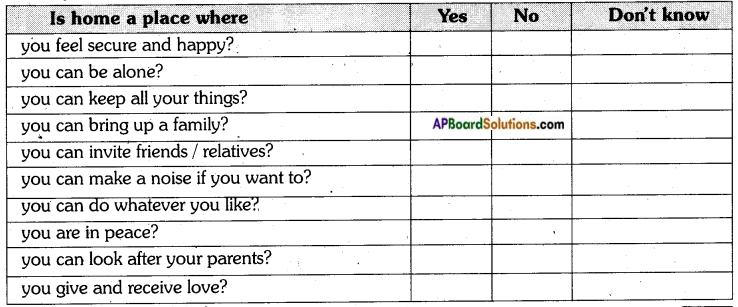
Study the following questionnaire and discuss the points in small groups.

Contact people in your School/your locality and put these questions to them. Collect information by ticking in the relevant column.
AP Board 7th Class English Solutions Chapter 1B Town Child & The Country Child 2
Analyse the results in the group and write a brief report on the result of your survey.
Use phrases such as the following:
Most people think that ……………………………….
A few people think that ……………………………….
Hardly anyone thinks that ……………………………….
No one thinks that ……………………………….

THE REPORT

Most people think that home is a place where they feel secure and happy. Some people- not many-think that you can be alone at home if you choose to be. A large number of people feel that they can keep all their things at home. Almost everyone agreed that home is the place where we can bring up a family. A considerable number of persons opine that one can invite friends and relatives to home. Only a very few persons agree to the idea that one can make a noise or do whatever one likes at home. A great part of the participants are of the view that one can be at peace at home. Many people contribute to the point that home is the place where we look after parents and exchange love.

AP Board 7th Class English Solutions Chapter 1B The Town Child & The Country Child

The Town Child & The Country Child Summary in English

The Town Child
The town child lives in a street full of buses, cars, producing a lot of noise and discharging smoke. The boy wishes to have meadows and lambs around. He hates those rows of houses filled with noises. He loves to have woods near. The only thing he loves in the town is the blue sky. He says the sky alone has room for him and lots of clouds.

The Country Child
The country child lives close to a wood. The streets are quiet. The lanes are not crowded. The boy wants players all around. The trees are too tall and the boy feels lonely. He has the company of just birds and flowers. He wishes to have a home in a town. He loves to watch trams all around. He longs to see colourful lights glitter at nights. He prays to have town life.

The Town Child & The Country Child Glossary

feet (n): (here) people who walk in streets

tram (s): an electric vehicle that transports people in cities

meadow (n): a field with grass and often wild flowers

castle (n): a large strong building

lane (n): a narrow road in the countryside or, in a town

twinkling (adj): shining strongly and then weakly

woods (pl.n): an area of trees, smaller than a forest

AP Board 7th Class English Solutions Chapter 1B The Town Child & The Country Child

quiet (adj): silent! peaceful

lonely (adj): unhappy because you have no friends or people to talk to

wood (noun): the hard material that the trunk and branches of a tree are made of.
AP Board 7th Class English Solutions Chapter 1A The Town Mouse and the Country Mouse

AP State Syllabus AP Board 7th Class English Textbook Solutions Chapter 1A The Town Mouse and the Country Mouse Textbook Questions and Answers.

AP State Syllabus 7th Class English Solutions Chapter 1A The Town Mouse and the Country Mouse

7th Class English Chapter 1A The Town Mouse and the Country Mouse Textbook Questions and Answers

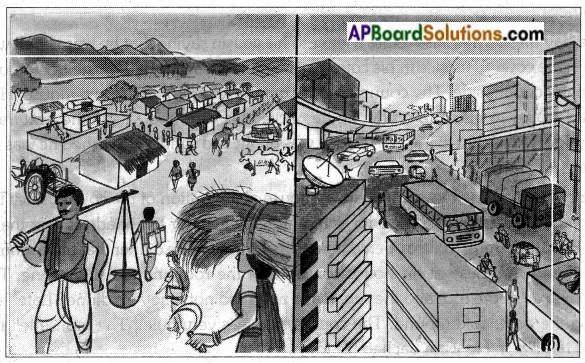
Look at these two pictures and answer the questions that follow.

AP Board 7th Class English Solutions Chapter 1A The Town Mouse and the Country Mouse 1

Question 1.
Write the differences you notice between the things you see in the two pictures.
Answer:
i) Picture-1 is the scenery of a village life.
Picture-2 is the scene of a city life.
ii) In the village we can see thatched houses.
But in the city we can see tall, multi-storeyed buildings.
iii) In the village we can see farmers, bullocks, cows and bullock carts.
But in cities we can see a lot of buses, cars and two-wheelers.
iv) The village is surrounded by beautiful fields and hills.
But the cities are surrounded by industries and workshops besides slums.
v) Villages are calm and peaceful but the cities are noisy because of heavy traffic and . industries.

AP Board 7th Class English Solutions Chapter 1A The Town Mouse and the Country Mouse

Question 2.
Where would you like to live, in a town or in a village?
Answer:
I would like to live in a village.

Question 3.
Where do you think life is peaceful? Why?
Answer:
Life is peaceful in villages. The village is calm, beautiful and peaceful. It is surrounded by
pastures and fields. The people living there have cordial relations with each other.

Question 4.
Do animals feel the same like you?
Answer:
Yes. Animals also feel that life is peaceful in villages.

I. Answer the following questions.

Question 1.
Why did the town mouse want to go to the countryside?
Answer:
The town mouse wanted to go to the countryside because he had been ill with a cough and his doctor had advised him to spend a week in the countryside.

Question 2.
Describe the town mouse’s experience at the countryside.
Answer:
At the countryside, the town mouse had to drink coconut water instead of orange juice or lemonade. He did not enjoy his dinner as it consisted of the root and the sugarcane. There he had to sleep on the hard, cold ground. It was so quiet at the countryside. He felt the country a strange place. He did not like it.

Question 3.
What differences do you find between the country and the town?
Answer:
The town is full of noises. Lights are on all the time. Artificial food, cool drinks, air conditioning etc., are common. The village is quiet where clear water, fresh air and raw food greet everyone.

Question 4.
How can you say that the town mouse could not enjoy the dinner offered by the country mouse?
Answer:
The town mouse did not enjoy his dinner as it consisted of only the root and the sugarcane, instead of bread and jam, different kinds of fruit and slabs of chocolate.

AP Board 7th Class English Solutions Chapter 1A The Town Mouse and the Country Mouse

Question 5.
What would happen if the person who opened the cupboard found any of the mice?
Answer:
If the person who opened the cupboard found any of the mice, the mouse that was found would be caught and killed.

Question 6.
Why did the town mouse travel in an ordinary train?
Answer:
The town mouse travelled to the countryside in an ordinary train because there was no air- conditioned coach.

Question 7.
Why did the country mouse go back to his house in the country?
Answer:
The country mouse went back to his house in the country because the town was noisy and polluted. He wanted to eat in peace but could not find that in the town.

Question 8.
How can you say the town mouse was not comfortable in the country?
Answer:
The town mouse came to the village for rest for a week. But he went back to the town the very next day. This clearly shows that the town mouse was uncomfortable in the village.

Question 9.
How are the streets of a town different from those of a village?
Answer:
There was heavy traffic of cars, buses and lorries in the streets of a town and so they were noisy and polluted. No such traffic was seen in the streets of a village and so they were quiet and unpolluted. Unlike the streets of a village, the streets of a town had many lights even in the middle of the night.

Question 10.
Describe the lifestyle of the country mouse in two or three sentences.
Answer:
The country mouse lived in a hole in a field of a village. He was in the habit of taking raw food such as roots, sugar-cane and fresh water. He lived in a peaceful and natural way.

Question 11.
“The town mouse and the country mouse did not visit each other again.” Why ? Give reasons for your answer.
Answer:
The town mouse did not visit the country mouse again because the country was so quiet and he had to eat only raw food there.
The country mouse did not visit the town mouse again because there the streets were noisy with the traffic of buses, lorries and cars. He could not get raw food there. He could not even eat in peace, there.

AP Board 7th Class English Solutions Chapter 1A The Town Mouse and the Country Mouse

II. Choose the best answer from the choices given to complete each sentence.

1. The town mouse and the country mouse are ….
a) friends
b) cousins
c) classmates

2. The house of the town mouse was ….
a) a field in a village
b) a building in a village
c) a kitchen cupboard in a town

3. The house of the town mouse was ….
a) full of most delicious food
b) full of sugar-canes and roots
c) full of coconut water

4. At the end of the story, the country mouse ….
a) went back to his country
b) stayed in the town
c) visited the town mouse
Answer:
1. b
2. c
3. a
4. a

III. Say whether the following statements are TRUE/FALSE. Correct the wrong statements.

1. The country mouse lives in a town. ( )
2. The town mouse feels very comfortable in the train. ( )
3. It was hot when the town mouse travelled to the countryside. ( )
4. The town mouse liked to eat cooked food. ( )
5. There are more lights, cars and lorries in the town than in the’village. ( )
Answer:
1. False
2. False
3. True
4. True
5. True

AP Board 7th Class English Solutions Chapter 1A The Town Mouse and the Country Mouse

Vocabulary

I. The following sentences are from your lesson. Read them carefully and tick (✓) the correct meaning of the underlined word in each sentence.

1. He has asked me to spend a week in the countryside. [ ]
(a) a land with towns and cities.
(b) a neighbouring country.
(c) a land outside towns and cities with fields, woods etc.

2. The town mouse packed his bags. [ ]
(a) put something in a container so that it can be stored
(b) put clothes etc., into a bag in preparation for a trip away from home
(c) put expensive things in a bag so as to keep them safe

3. The day was bright and sunnv. [ ]
(a) with a lot of bright light from the sun
(b) with a cool wind from the east
(c) without rain

4. He nibbled at the root and the sugar-cane. [ ]
(a) took a large quantity of food
(b) took a small quantity of food showing a slight interest
(c) took food with a great interest

5. The country mouse arrived in town. [ ]
(a) left for a place (b) got to a place (c) left a place

Answer:
1. c (✓)
2. b (✓)
3. a (✓)
4. b (✓)
5. b (✓)

II. Fill in the blanks using appropriate words/phrases given below.

AP Board 7th Class English Solutions Chapter 1A The Town Mouse and the Country Mouse 2

Rambabu started his journey to his grandfather’s village in Prakasam District. He caught a train to reach the village. The train arrived at the station. At that time, he was hungry and thirsty. As soon as he —1— the train, he wanted to drink and eat something. So he —2— but found nothing to eat and drink. He started walking towards his grandfather’s house. On the way, he found a shop which was —3— cool drinks. He had —4— money. So he bought a cool drink and a —5— bread.
Answer:
1) got off,
2) looked around,
3) full of,
4) plenty of,
5) piece of

AP Board 7th Class English Solutions Chapter 1A The Town Mouse and the Country Mouse

III. Read the following sentence from your lesson and identify the underlined expression.

He nibbled at the root and the sugar-cane. The expression sugar-cane is a compound noun. It is a combination of two nouns.
sugar + cane – sugar-cane
Now read your lesson and pick out at least two compound nouns.
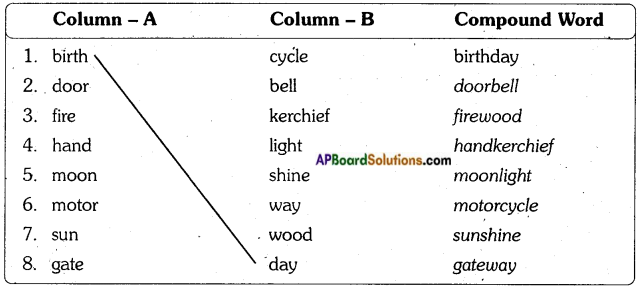
cupboard, coconut water, Mouse Town, Country Mouse
Let’s form some compound nouns now.

Join each word in column-A with a suitable word in column-B to form Compound Nouns. The first one is done for you.

AP Board 7th Class English Solutions Chapter 1A The Town Mouse and the Country Mouse 3

Grammar

I. Read the following sentences and notice the underlined words.

It’s always quiet in the country, Sometimes it is quieter than today. My grandfather says that our village is the quietest among all the villages in our district.

The underlined words are adjectives. But they are in different degrees of comparison. The first one is in positive degree: The second and the third are in comparative and superlative degrees respectively.

Positive Degree             Comparative Degree            Superlative Degree
quiet                                       quieter                                  quietest

Here is a list of adjectives. Write the other degrees of them. The first one is done for you. (Use a dictionary and check your work.)
Note: Usually short words take ‘er’ and ‘est’ as suffixes to form other degrees.

Positive degree Comparative degree Superlative degree
dark darker darkest
small smaller smaller
rich richer richest
safe safer safest
clever cleverer cleverest
tall taller tallest
bright brighter brightest
large larger largest
short shorter shortest
long longer longest
wise wiser wisest
dark darker darkest
hard harder hardest
soft softer softest
hot hotter hottest
cool cooler coolest
cold colder coldest
fast faster fastest
slow slower slowest
brave braver bravest

AP Board 7th Class English Solutions Chapter 1A The Town Mouse and the Country Mouse

Note: Words with two or more than two syllables take ‘more’ and ‘most’ respectively in comparative degree and superlative degree.

Positive degree Comparative degree Superlative degree
useful more useful most useful
beautiful more beautiful most beautiful
interested more interested most interested
doubtful more doubtful most doubtful
precious more precious most precious
delicious more delicious most delicious
dreadful more dreadful most dreadful
cheerful more cheerful most cheerful
dangerous more dangerous most dangerous
honest more honest most honest
harmful more harmful most harmful
cunning more cunning most cunning
handsome more handsome most handsome
intelligent more intelligent most intelligent
industrious more industrious most industrious
courageous more courageous most courageous
famous more famous most famous
prestigeous more prestigeous most prestigeous
attractive more attractive most attractive
prosperous more prosperous most prosperous
colourful more colourful most colourful
poisonus more poisonous most poisonous
powerful more powerful most powerful
enjoyable more enjoyable most enjoyable
difficult more difficult most difficult
frightening more frightening most frightening
pleasing more pleasing most pleasing
wonderful more wonderful most wonderful
populous more populous most populous
remarkable more remarkable most remarkable
glorious more glorious most glorious
charming more charming most charming
wanted more wanted most wanted
injurious more injurious most injurious
curious more curious most curious

Note: Unlike the above, some words change completely in other degrees.

Positive degree Comparative degree Superlative degree
much more most
good better best
bad worse worst
far farther farthest
many (number) more most
little less least
few fewer fewest
well better best

AP Board 7th Class English Solutions Chapter 1A The Town Mouse and the Country Mouse

Read the following sentence from your lesson and notice the underlined word.

May I stay with you?
The underlined word ‘may’ is a helping verb. It is used to take or give permission in a formal
way.
But ‘can’ is used to take or give permission in an informal way.

  • Can I leave this place? ( Taking permission)
  • You can go now. ( Giving permission)

‘May’ has another use also. It is used to express possibility, e.g. It may rain today.
1. May I + bare infinitive is used to ask for permissions,
e.g.: May I stay with you?
May I use your cell phone?
May I leave the class earl ?

2. Can I + bare infinitive (V1) is used to ask for permissions,
e.g.: Can I leave this place?
Can I take leave of you?
Can I use your cell phone?

3. You + may / can + bare infinitive (V1) is used to give permissions,
e.g.:
1) You may go now.
2) You may use my cell phone.
3) You may take my umbrella.
4) You can go now.
5) You can use my scooter.
6) You can lend my notebook.
4. May is used to express possibility.
e.g.:
1) It may rain today.
2) He may come tomorrow.
3) She may attend the party.

I. Read the following sentences and say what they mean. Choose the right answer from the choices given:

1. May I come in, sir? ( )
a) aiving permission
b) taking permission
c) expiring the possibility

2. Sindhu may come to India next month. ( )
a) giving permission
b) taking permission
c) expressing the possibility

3. You may use my cell phone if you need. ( )
a) giving permission
b) taking permission
c) expressing the possibility

4. Can I take leave of you? ( )
a) taking permission in a formal way
b) taking permission in an informal way
c) expressing the possibility

5. The dog may attack you if you run. ( )
a) giving permission
b) taking permission
c) expressing the possibility
Answer:
1. b
2. c
3. a
4. b
5. c

AP Board 7th Class English Solutions Chapter 1A The Town Mouse and the Country Mouse

II. Rewrite the following sentences as directed.

1. The boy seems to cry if you do not buy an ice-cream for him. (Express this using ‘may’)
Answer:
The boy may cry, if you do not buy an ice-cream for him.

2. You can use my camera if you need. (Give permission using ‘may’)
Answer:
You may use my camera if you need.

3. He seems to be a nice man. (Express this possibility using ‘may’)
Answer:
He may be a nice man.

4. You want to leave the class now.
Answer:
May I leave the class, now? (Take permission using ‘may’)

5. Raju wants to use your water bottle. (Give permission using ‘may’)
Answer:
You may use my water bottle, if you need.

III. Read the following sentence from your lesson.

I wish there was an air-conditioned coach.

The above sentence expresses unreal past.
We use “ wish + subject + past tense” to express unreal past. This sentence means …. 1 am sorry there is no air-conditioned coach.
Some more examples:
1) I wish I had wings. (This means that I am sorry I don’t have wings.)
2) I wish I were a bird.
3) I wish I were the Prime Minister.
4) I wish 1 had a car.

Now express the wishes of the people mentioned below using unreal past (wish + subject + past tense). The first one is done for you.

1. Sindhu has missed her school bus. She has to go to school urgently. She wishes to have a car. How would Sindu express her wish?
Answer:
I wish I had a car.

2. Anita wants to abolish the system of exams. She wishes to be the Prime Minister. How would Anita express her wish?
Answer:
I wish I were the Prime Minister.

3. Srinu’s father has a car. He wishes to drive that car. But he doesn’t know how to drive a car. How would Srinu express his wish?
Answer:
I wish my father/I knew how to drive a car.

4. Sharmila wants to play tennis. But she doesn’t have a tennis racket. How would Sharmila express her wish?
Answer:
I wish I had a tennis racket.

5. Mahendra wants to get first rank in the class. But he can’t. How would Mahendra express his wish?
Answer:
I wish I got first rank in the class.

AP Board 7th Class English Solutions Chapter 1A The Town Mouse and the Country Mouse

Writing

I. Write a letter to your friend inviting him/her to your village to spend summer holidays. Write about your family and the places where you will take him/her.

Near Ramalayam,
75 – Tyallur,
Pedakurapadu Mandal,
Guntur District.
April 18, 20xx.

My dear Guruvardhan,

I am fine and pink in health. I am doing well in my examinations. I do hope the same with you, there.

You know, our summer holidays begin on April 24. I cordially invite you to my village to spend summer holidays with me, at least for a fortnight. All the members of our family are friendly and affectionate. They treat you as one of us. You also have asked me to write to you a letter, inviting you to my house for the summer vacation. If you come over here, I can show you the beautiful locations in and around our village which you will certainly enjoy well. Besides, I can take you to Amaravathi where you can see the Amaravathi museum, the huge statue of Lord Buddha. We can also have a holy dip in the river Krishna and visit the temple of Lord Amaralingeswara.

I shall make your stay enjoyable here. Please intimate me the day when you leave for my village so that I can receive you.

Kindly express my regards to your parents and best wishes to your younger sister.

Yours lovingly,
xxx xx

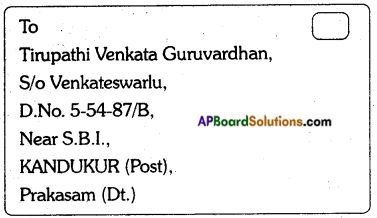
Address on the envelope:
AP Board 7th Class English Solutions Chapter 1A The Town Mouse and the Country Mouse 4

II. Imagine you were the town mouse/ country mouse and write a paragraph describing your visit.

I am a town mouse. I was born there and I spent all my life in the same town. Recently I suffered badly from cough. The doctor advised me to spend a week or two in the countryside. So I wrote a letter to my cousin who lives in a village, expressing my desire to spend a week in his village. He was very happy and invited me to his village with great pleasure. Immediately after receiving the letter I went to the village. He received me at the station. There it was very hot indeed. I was very much thirsty. I asked him for a cool drink or a lemonade. But he offered me coconut water. At dinner he offered me raw roots and sugarcane. In my town 1 usually take delicious foods such as bread and jam; cheese, and different kinds of fruits. I didn’t like the food offered to me by him. At night I had to sleep on cold and hard ground. The life at the village is very different from that of the town. There is no glitter of lights. There are no buses, cars and even two wheelers. It appears very dull when compared to the city life. There was no ready food. I had to go to nearby farms in search of food. 1 felt the village life dreadful and unpleasant. I cannot accustom with the hardships of the village life system. So I came back to the town the very next day. And I never visited the village again in my life. I thought that the city, in which I live, is the heaven on this earth.

(Or)

I am a country mouse. I live in the countryside. On receiving an invitation from my cousin, the town mouse, I went to his town. His house was at the back of a kitchen cupboard. There he received me warmly. But my head began to ache because of the noise caused by ’ the traffic of cars, buses and lorries, running in the streets of the town. They also cause air-pollution. I was also surprised to see the lights even in the middle of the night. On my asking, my cousin replied that it was common in towns. I wanted to drink some water and eat raw food like the root and the sugar-cane. But my cousin offered me ice-cold orange juice to drink. He also offered me bread and jam, different kinds of fruit and slabs of chocolate. But I could not eat any in peace because he pushed me out through a hole when somebody was opening the cupboard door. On the whole, it was not a pleasant experience and I decided not to visit the town again.

AP Board 7th Class English Solutions Chapter 1A The Town Mouse and the Country Mouse

Study Skills

I. Study the table given below and observe the changing patterns of unemployment in some advanced countries. Answer the questions that follow.

AP Board 7th Class English Solutions Chapter 1A The Town Mouse and the Country Mouse 5

1. How many countries are compared in the given table?
Answer:
Eight countries

2. What period does the table represent?
Answer:
The period from 2000 to 2006.

3. Which country has the least unemployment rate in 2005?
Answer:
Japan

4. Which country has a decrease of nearly 6% in unemployment rate between 2000 and 2006?
Answer:
Spain.

5. In the case of every country we can notice that (Choose the correct answer.)
(a) The unemployment rate is steadily increasing.
(b) The unemployment rate is steadily decreasing.
(c) The unemployment rate is fluctuating, i.e. sometimes it rises and sometimes it falls.
Answer:
(c) The unemployment rate is fluctuating i.e., sometimes it rises and sometimes it falls.

6. Which year recorded the highest unemployment rate for many countries?
Answer:
The year 2000.

7. Which country recorded the least fluctuations in the unemployment rate?
Answer:
The U.K. recorded the least fluctuations.

AP Board 7th Class English Solutions Chapter 1A The Town Mouse and the Country Mouse

Listening and Speaking

I. An old student of your school visits your school. Your teacher introduces her to your class like this. (Now the teacher has to read the following information.)

My dear students! Look, who is here! This is Kumari Nithya. I am very happy to introduce her to you. She was my student; I mean, a student of this school. You know, she is now working as a software engineer in a big company. When I remember Nithya, I see a pretty little girl with two plaits sitting in the first row eagerly waiting for a chance to speak. She would answer any question at the drop of a hat.
When I talked to others, she would become restless and went on saying ma’am, ma’am, thrusting her hand into air. No wonder she passed S.S.C. in first class and scored more than 550 marks. I hope you have seen her name in our H.M.’s room, haven’t you?
Going by her marks, don’t think she is just a bookworm. She did equally well in sports and games. She led our school kabaddi team to state level competitions. There are many other things that I would like to share with you, but I’m leaving them, especially the naughty things, for her to share with you.
Now Nithya will address you. Nithya …. !

Imagine that your eldest brother has come to your school. Introduce him to your class and your teachers.
Answer:
Respected teachers ! My dear friends ! I think the person standing by my side is known to many of the teachers, here. This is Hanuman. I am very happy to introduce him to you. He is my eldest brother. He was a student of this school. He is, now, doing his engineering.
He is sharp right from the start. He has passed S.S.C. and scored more than 570 marks. I hope you have seen his name in our H.M.’s room, haven’t you? But don’t think, he is just a bookworm. He has done equally well in sports and games. If you want to know some more about him, you can talk to him. Thank you all, for giving me this opportunity.

II. Listen to the conversation between Sulochana and Madhavi.

Sulochana: Hi! Madhavi, welcome to city. How are you?
Madhavi: I am fine. Thank you. I-low about you?
Sulochana: Pretty well. Why are you waiting outside? Come in. When did you return from your village?
Madhavi: Just this morning.
Sulochana: How was Pongal?
Madhavl: It was great fun. I really enjoyed every moment in the village. I wish I could spend some more time there.
Sulochana: Oh! Did the village life impress you so much?
Madhavi: Yes, it was wonderful.
Sulochana: What fascinated you so much there?
Madhavi: Well ! It was pollution free. Fresh air, fresh water, clear sky… and what not?
Sulochana: Was there anything else?
Madhavi: Yes, I liked the green fields, strange birds, sheep, cows, bulls etc.
Sulochana: Oh! That’s interesting. Why don’t yàu take me with you the next time you go to your village?
Madhavi: Done.

AP Board 7th Class English Solutions Chapter 1A The Town Mouse and the Country Mouse

Now work in pairs and talk about your experience of living in a town/village.
Answer:
Seeta: Hi, Lata! When did you return from the village?
Lata: Hi, Seeta! I came back yesterday. It was a memorable experience.
Seeta: What impressed you so much?
Lata: Everything in the village. Absolute peace, green fields, clean water, fresh air, innocent villagers and what not?
Seeta: You are carried away by your stay there it seems!
Latha: You too will feel the same way if you stay there for sometime.
Seeta: When are you, then, taking me to your grandparents’ village?
Lata: Shall go during Dasara holidays!
Seeta: Done.

(Or)

During the Pongal holidays, I visited my uncle’s village and stayed on there for a week. The celebration of Pongal in villages. I had a lot of fun and really enjoyed every moment in the village. The village life impressed me much. There is no air-pollution and sound pollution in villages. People in villages get fresh air and fresh water. There the sky is clear. I liked the green fields, the sheep, the cows and the bulls. I wish I could spend some more time there.

III. In groups, read the story once again. Decide on a scene from the story and per¬form a sport play.
(Group work – Let the students form 3 or 4 groups).

  • Read the story once again.
  • Identify the characters.
  • Pick out the dialogues of the characters.
  •  Identify the locations of the events.
  • Decide scenes and setting accordingly.
  • Assign roles to the members of the groups.
  • Enact the drama before the whole class.

Answer:
(When the curtain rises up, the kitchen room in a rich man’s house is seen, with a cupboard. Beside it, the town-mouse (the student having this character, wears trousers with a tail hang-ing from behind it, and a shirt under a coat) appears, coughing and sniffing.)
The town mouse to himself : Oh ! I can’t bear this cough. I must phone to my family doctor for a speedy recovery.
(The town mouse makes a phone call to the doctor. After a gap of two/three minutes, the doctor (the student having the character of the doctor-mouse) comes into his room.)
Town Mouse: (seeing the doctor) Good morning doctor!
Doctor: Good morning. Why have you called me to come urgently?
Town Mouse: Doctor, I need your help, now.
Doctor: OK. What’s the problem?
Town Mouse: See, doctor, how I am coughing!
[Doctor checks his chest with a stethoscope]
Doctor: For how many days have you been suffering from cough and cold?
Town Mouse: For the last 4 days.
Doctor: Oh ! You have delayed. You should have called me as and when you were attacked with cough.
Town Mouse: Sorry doctor. I didn’t think it would last for long.
Please tell me what I should do to restore normal and good health.
Doctor: Use this medicine tonight for tomorrow, after taking a light diet.
Town Mouse: OK. Doctor.
Doctor: But one thing
Town Mouse: Tell me, doctor.
Doctor: I strongly say you need change of climate as well as change of place.
Town Mouse: You mean I need to go somewhere else.
Doctor: Yes, you have caught my point. Spend some days in a countryside where you get fresh and unpolluted air for your health. Do you have any relatives in any countryside ?
Town Mouse: Yes, I have. My cousin, country mouse lives at Mouse Cciuntry. We often write letters to each other and are affectionate to each other.
Doctor: That’s good. Then you had better leave for your cousin’s place and be there at least for a week to have a speedy recovery.
Town Mouse: OK, doctor. Tomorrow. I go there.
Doctor : OK. Now, I leave.
Town Mouse: Thank you, doctor, for your kind concern. I shall see you soon after I return from my cousin’s place.
(The doctor departs)
Town Mouse to himself: I’ll send my cousin a letter about my visiting his place and start my
journey after receiving the reply from him.
(The curtain comes down and after a gap of three/four minutes, it rises up again, showing the country mouse (the student having this character wears a white Dhoti and a white Laichi with a Kanduva on his shoulder) with a letter in his hand.)
Country Mouse to himself: Oh! This letter is from cousin, the town mouse. I shall know what he has written.
(The Country Mouse reads out the undermentioned letter, loudly)

Kitchen Cupboard,
Mouse Town.
22 March, 20xx.

Dear Cousin,
I have been ill with cough and my doctor feels I need a holiday. He has asked me to spend a week in the countryside. May I stay with you? Please give me an early reply.
With warm regards,

Yours affectionately
Town Mouse

To
Country Mouse,
The Mouse Hole,
Mouse Country.

(After reading the letter)
Country Mouse to himself: Oh ! My cousin is ill-healthy. I must send an immediate reply asking him to come over here, at once.
(The country mouse is seen writing a letter. Then the curtain begins to come down)
(Later after a gap of 3 minutes, the curtain rises up, showing the country mouse waiting for his cousin near the ‘MOUSE-COUNTRY’ board. Then comes in the town mouse)
Country Mouse: Oh, cousin! Welcome.
Town Mouse: Thank you. Sorry for keeping you waiting.
Country Mouse: No, you need not say that.
Town Mouse: Oh, cousin, I felt .rather hot and thirsty while travelling in that train. I wished I travelled in an air-conditioned coach.
Country Mouse: Are you OK now?
Town Mouse: OK. But I am rather thirsty. I hope you have something ice-cold lemonade for me to drink at home.
Country Mouse: Well, I have some water. But J can look around for some coconut water if you like.
Town Mouse (showing horror): Coconut water? Don’t you have any orange juice or lemonade?
Country Mouse: I’m afraid not. But I found a very nice piece of root toddy and a tender bit of sugar-cane. I’m sure you will enjoy that.
Town Mouse: Root? Sugar-cane? But I don’t eat raw food like that.
(Both sit under a big tree, where a large hole is seen)
Country Mouse: This is what we eat in the country. Try it. It’s not bad.
(The town mouse pretends to nibble at the root and the sugar-cane)
Town Mouse: Cousin, I want to sleep, now.
Country Mouse: You can sleep there. (showing a comer)
Town Mouse: On the ground?
Country Mouse: Yes. This is how we sleep in the country.
Town Mouse: Cousin, why is itso quiet here?
Country Mouse: You mean
Town Mouse: I mean it is rather silent here. Where are all the cars and lorries? Where are the radios and the televisions? Where are all the lights?
Country Mouse: Such things are not seen here. It is always quiet here.
(The two pretend to be asleep).
(The curtain comes down)
(When the curtain rises up, the town mouse is seen, holding a suitcase and the country mouse beside him)
Country Mouse: Cousin, today we’ll visit another farm.
Town Mouse: Sorry, cousin. But I must leave for my town, now itself.
Country Mouse: Why?
Town Mouse: I’ll catch the next train home. I have suddenly remembered that I have
forgotten something.
Country Mouse: OK. I’ll come with you to the station.
(Both pretend to be walking towards the station-side. Then the curtain comes down.)

End of the First Scene

AP Board 7th Class English Solutions Chapter 1A The Town Mouse and the Country Mouse

IV. Have a discussion in the whole class on how the performance could be improved in terms of delivery of dialogues, costumes, action, settings, etc.

Teacher: Good morning, students.
Students: Good morning, sir.
Teacher: Now, we will have discussion on the first scene of our play.
Students: O.K., sir.
Teacher: Venkat, do you feel satisfied with your acting, dialogue delivery and costumes, as the Town Mouse?
Venkat: I do, sir.
Guruvandhan: Sir, I think Venkat should have been in Pyzama and Lalchi, the light clothes which may suit for an ill-healthy person.
Hanuman : He didn’t show his suffering much both in his dialogue and acting.
Teacher : Yes. T too have observed and I want to say the same.
Payan: Sir, at the countryside, we have shown only a tree.
Teacher: You mean, there should be some other. If so, what would you suggest?
Payan: I mean we should have put some grass around, making the audience feel it is a farm or field.
Teacher: Good.
Guravalah: instead of the doctor coming to the house of the town mouse, the town mouse should have gone to hospital and the discussion be seen in a hospital. Am I correct, sir?
Teacher: Chennakesava, do you agree with him?
Chennakasva: Yes, sir. I do.
Teacher: OK. You have given some suggestions for the improvement of the first scene. We’ll put them next time in the play.
Students: Thank you, sir.
Teacher: OK. Concentrate on your work, now.

V. You have already written the script for one scene. Develop the other scenes in the same manner and make it a complete script for the play.

Answer:
Script for the other (second) scene:
(When the curtain rises up, the country mouse is seen, sitting near his house, the hole at the bottom of a tree)

Country Mouse to himself: Oh ! I have hurt my cousin’s feelings and disappointed him by not pro¬viding him with what he wanted. Besides, he seemed he didn’t like qui¬etness of the countryside. That’s why he left the place the very next morning . It’s already a month since he left this place. I don’t know how he is now. I make sure he is healthy. I’ll write a letter about my visiting his place.
(After a few minutes, the curtain rises up and shows the town mouse with a letter in his hand)
Town Mouse to himself : Oh ! What a happy news it is ! My cousin wants to visit my house.
I must send him the message to come over here. I’ll send a telegram now itself.
(The curtain comes down. A few minutes later, the town mouse is seen beside a cupboard in a room. The country mouse, after a minute – time enters.)
Country Mouse: How are you, my cousin?
Town Mouse: I am fine and active now, I am very happy to see you here. How are you, cousin?
Country Mouse: I am OK. I am worried about your health. I want to make sure you are alright. That’s why I have come here.
Country Mouse: It’s already 11 p.m. Why are there lights even in the middle of the night?
Town Mouse: Oh, cousin, this is the town. Here there are lights even in the middle of the day.
Country Mouse: (closing his ears with hands)
What is this dreadful noise that never stops?
Town Mouse: That is the traffic. That is the noise made by buses, lorries, cars and aeroplanes.
Country Mouse: Oh, cousin! All this noise has made my head ache.
Town Mouse: Don’t worry. You’ll be alright soon.
Country Mouse: Could I have some water to drink?
Town Mouse: Oh, cousin, what a silly thing! You have come to my house. Then, why only water? (opens the door of the cupboard and shows the cool-drinks, juice, etc.) Look at what there is for you ice-cold lemonade, orange
juice…. Which one do you want?
Country Mouse: I don’t want those. They are not good for my health. I want just some water.
I want some water to drink and then a little bit of food to eat.
Town Mouse: OK. Have this water to quench your thirst.
(The country mouse drinks some water)
Country Mouse: Cousin, can I have some food?
Town Mouse: I have plenty of food, cousin. You can eat as much as you like.
(The town mouse shows the country mouse by opening the door of the cupboard, bread and different kinds of food items)
Town Mouse: Cousin, there are different kinds of fruits, bread and jam, slabs of chocolate and a huge piece of lovely cheese.
Eat, cousin, eat whichever you want.
(By the time the country mouse was about to take some fruits, there was a sound like thunder. The country mouse was frightened.)
Town Mouse: Run, cousin, run, run along with me into the hole.
(Later the town mouse pushed the country mouse out through the hole in the back of the cupboard. The country mouse exhibits as if his heart was beating very fast.)
Country Mouse: I am in fear, but what is it?
Town Mouse: Sssh …. Don’t say loudly. Wait here for sometime.
[A man comes into the room, opens the door of the cupboard and gets some juice. Later he goes out]
[When everything was silent again, the town mouse crept out of the hole. He was quite cheerful again]
Town Mouse: Cousin. now come out. You need not be afraid now. Come out.
[The country mouse comes to the town mouse]
Country Mouse: What was it, dear?
Town Mouse: Cousin, that was only somebody opening the cupboard. We are safe now.
[They heard the same sound and had to escape by running, two times again]
[At last, when it was completely quiet]
Town Mouse: It won’t happen again. You can eat now.
Country Mouse: (eating) But I feel I am not safe here. I am quite tired of running and hiding.
Town Mouse: I’ve also done the same, yet I am not tired.
Country Mouse: You are accustomed to doing this and living like this.
Town Mouse: Tomorrow, I’ll take you to different areas in this town.
Country Mouse: No, cousin. I want to go back to the country. I may not get much food there but at least I can eat in peace. So, please let me go there.
Town Mouse: OK. Cousin, I don’t like to trouble or pain you.
You can go there tomorrow, morning.
[The curtain comes down]

End of the play

AP Board 7th Class English Solutions Chapter 1A The Town Mouse and the Country Mouse

The Town Mouse and the Country Mouse Summary in English

The town mouse lived at the back of the kitchen cupboard in a rich man’s house in a town whereas the country mouse lived in a country. They were cousins. They often wrote letters to each other.

One day the town mouse wrote a letter to his cousin saying that he was ill and wanted to stay with the country mouse in his country as he had been advised by the doctor to spend a week in the countryside. The country mouse got the letter from the town mouse. He invited the town mouse to his countryside. So he packed his bags and caught the next train to the countryside. He felt hot in train as the day was bright and sunny. He wished he was in an air- conditioned coach.

The country mouse received the town mouse at the station of the countryside. The town mouse asked the country mouse for some organge juice or lemonade saying that he was thirsty. But the country mouse offered him coconut water. The dinner that the country mouse served the town mouse at his house consisted of the root and the sugar-cane. The town mouse nibbled at the root and the sugarcane as he did not enjoy his dinner. Later he had to sleep on the hard, cold ground. The countryside was very quiet. The mouse felt it strange and did not like it. He went back to his town.

Next time, the country mouse visited the house of the town mouse. He did not like the traffic there. He felt surprised watching lights in the streets even in the midnight. The country mouse wanted some water and a little bit of food. The town mouse offered him ice-cold lemonade and orange-juice to drink. The town-mouse offered him bread and jam, different kinds of fruit, slabs of chocolate and a huge piece of lovely cheese. The country mouse had to eat and drink what the town mouse had offered. Meanwhile, they had to run for safety and hide themselves as somebody entered the room and opened the cupboard. The country mouse was tired of doing this and did not like to be there. So, he took leave of his cousin and went back to his house in the country. Since then, they did not visit each other again.

The Town Mouse and the Country Mouse Glossary

1. country (n): a village/an area outside towns or cities with fields and farms

2. affectionately (adv): lovingly/showing caring feelings and love

3. pack (v): to put clothes etc.. into a bag in preparation for a trip away from home

4. uncomfortable (adj): unpleasant

5. grumble (v): to complain about something in a bad-tempered way

6. chug (v): to move making the sound of an engine .

7. dreadful (adj): very bad / unpleasant

AP Board 7th Class English Solutions Chapter 1A The Town Mouse and the Country Mouse

8. horror (n): a feeling of great shock or fear

9. lemonade (n): a sweet FIZZY drink with a lemon flavour .

10. nibbled (v): took small bites of something especially food

11. cousin (n): a child of your aunt or uncle

12. quiet (adj): making very little noise

13. strange (adj): unusual or surprising, especially in a way that is difficult to understand

14. farm (n): an area of land used for growing crops

AP SSC 10th Class Biology Solutions Chapter 8 Heredity

AP State Board Syllabus AP SSC 10th Class Biology Solutions Chapter 8 Heredity Textbook Questions and Answers.

AP State Syllabus SSC 10th Class Biology Solutions 8th Lesson Heredity

10th Class Biology 8th Lesson Heredity Textbook Questions and Answers

Improve your learning

Question 1.
What are variations? How do they help organisms?
Answer:

  1. Differences in characters within very closely related groups of organisms are referred to as variations.
  2. Variations develop during reproduction in organisms.
  3. Variations are passed from parent to offspring through heredity.
  4. Beneficial variations are selected by the nature in evolution.
  5. Variations increase the survival chance of the organisms.
  6. These variations help the organisms to adapt to their environments.
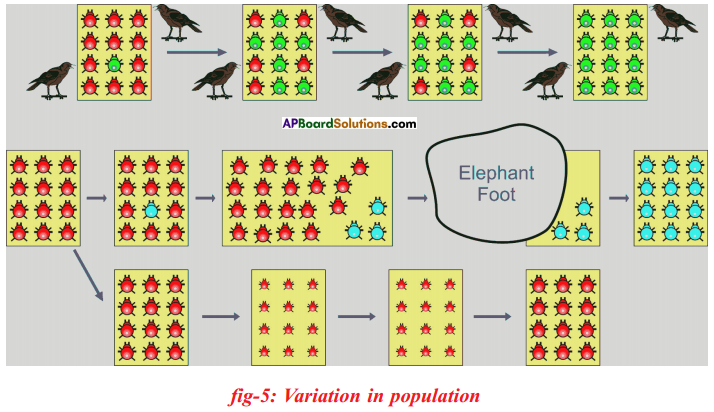
  7. For example, green colour in the beetles is a variation that gave a survival advantage to the beetles as they cannot be seen by the crows.
  8. Some variations do not help organisms to survive. For example, colour variation occurs in red beetles and some blue beetles are produced instead of red beetles as they are eaten by crows easily.

AP SSC 10th Class Biology Solutions Chapter 8 Heredity

Question 2.
One student (researcher) wants to cross pure tall plant (TT) with pure dwarf (tt) plant, what would be the Fj and F2 generations? Explain.
Answer:

  1. Pure tall plant has both the factors of the same type ‘TT’.
  2. Pure dwarf plant has both the factors of the same type ‘tt’.
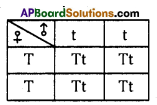
  3. When a pure tall plant (TT) is crossed with pure dwarf plant (tt), all the offsprings in Fj generation are tall (Tt).
  4. So all the plants are heterozygous tall, as ‘T’ is the dominating factor.
    AP SSC 10th Class Biology Solutions Chapter 8 Heredity 1
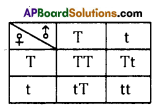
  5. On self pollination of these F1 generation plants the new breed can have any combination of T and t like TT, Tt, Tt or tt.
    AP SSC 10th Class Biology Solutions Chapter 8 Heredity 2
  6. So in F2 generation 75% of plants are tall and 25% of plants are dwarf. Thus the phenotype ratio is 3 : 1.
  7. Among 75% of tall plants 25% are pure tall (TT) or homozygous tall, remaining 50% are heterozygous tall (Tt, tT).
  8. The remaining 25% dwarf plants are pure or homozygous dwarf (tt).
  9. So the genotype ratio is 1 : 2 : 1.

Question 3.
One experimenter cut the tails of parent rats, what could be the traits in offsprings? Do the daughter rats contain tails or not? Explain your argument.
Answer:

  1. If the tails of parent rats were cut, their offsprings will have normal tails.
  2. Daughter rats do not contain tails because the bodily changes are not inherited.
  3. So the change would not be passed to their offsprings.
  4. This was proved experimentally by Augustus Weisemann and rejected the theory ‘inheritance of acquired characters’ proposed by Lamarck.

AP SSC 10th Class Biology Solutions Chapter 8 Heredity

Question 4.
In a mango garden a farmer saw one mango tree with full of mango fruits but with a lot of pests. He also saw another mango tree without pests but with few mangoes. But the farmer wants the mango tree with full of mango fruits and pests free. Is it possible to create new mango tree which the farmer wants? Can you explain how it is possible?
Answer:

  1. Yes, it is possible to create new mango tree which one the former wants with full of mango fruits and pests free.
  2. The former can cross two plants one with full of mangoes and pests and another plant with less mango fruits and without pests,
  3. In F1 generation he may get plants with full of mango fruits and without pests. Such plants are called hybrid plants.
  4. The F1 generation plants can be self pollinated and desired plants can be selected from the mixed population of F2 generation.
  5. The plant with desirable characters can be vegetatively propagated to get required number of plants.

Question 5.
ExplaIn monohybrid experiment with an example. Which law of inheritance can we understand? Explain.
Answer:

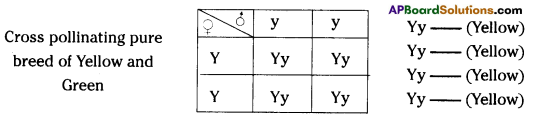
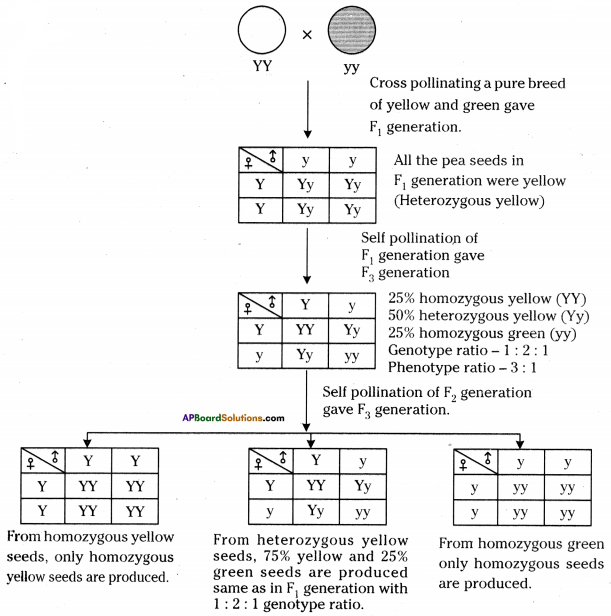
  1. We can understand the law of inheritance with an example of monohybrid cross between pure yellow pea seeds with pure green pea seeds.
  2. A pure breed (parental) yellow will have both the factors which denote them by ‘YY’ and pure breed (parental) green seed will have both the factors denote them by ‘yy’.
  3. During reproduction one factor (genes) from each parent is taken to form a new pair in the progeny (off spring).
  4. In F1 generation all pea plants are Yellow.
    AP SSC 10th Class Biology Solutions Chapter 8 Heredity 3
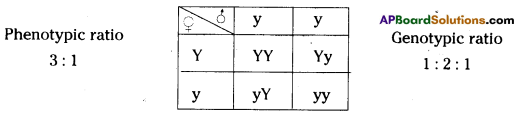
  5. F1 generation pea plants are self pollinated.
  6. In F2 generation 75% of the plants produced were Yellow seeds and the remaining 25% produced were green seed. It can be represented as
    AP SSC 10th Class Biology Solutions Chapter 8 Heredity 4
    In F2 generation the produced plants are YY, Yy; yY or yy.
    From the above example of monohybrid cross we can understand the following laws of inheritance.

1) When pure breed Yellow (YY) and green (yy) seeds were crossed, only Yellow seeds were expressed phenotypically in the F1 generation. It indicates that Yellow seed character is dominent over green seed characters.
This is “LAW OF DOMINANCE”.

2) When F1 plants are self pollinated each parent passes randomly selected allele (Y or y) of one of these factor to offsprings. This is segregation of alleles or genes during production of gametes.
This is “LAW OF SEGREGATION”.

AP SSC 10th Class Biology Solutions Chapter 8 Heredity

Question 6.
What is the law of independent assortment? Explain with an example.
Answer:

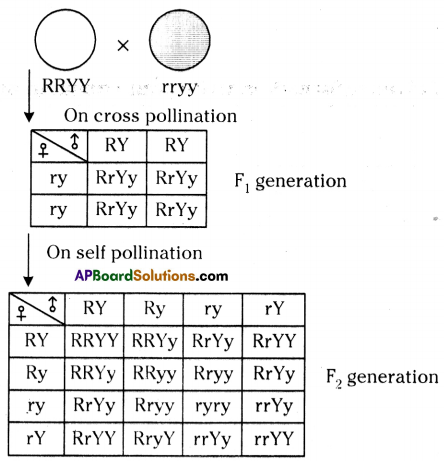
  1. In the inheritance of more than one pair of characters (traits), the factors for each pair of characters assorts independently of the other pairs. This is known as “Law of independent assortment”.
  2. If pea plants with two different pairs of characteristics (eg. : Round / yellow and green wrinkled) are breed with each other, the F1 progeny plants would have all round and yellow seeds.
  3. This implies that round and yellow seeds are dominant characters over green and wrinkled seeds.
  4. In F2 progeny there would be some plants with round and yellow seeds and some with green and wrinkled seeds.
  5. However, there would be some plants with mixed characters – yellow and wrinkled seeds and green and round seeds.
  6. This depicts that round/wrinkled trait and yellow / green trait are inherited independent of each other (law of independent assortment).
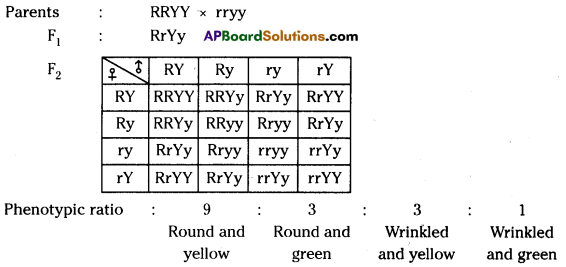
    The following punnet square explains this.
    AP SSC 10th Class Biology Solutions Chapter 8 Heredity 5
  7. The different combination of characters resulted from dihybrid cross.
    a) RRYY, RRYy, RrYy, RrYY, RRYy, RrYy, RrYy, RrYY, RrYy are having round and yellow seeds.
    b) RRyy, Rryy, Rryy have round and green seeds.
    c) rrYy, rrYy, rrYY have wrinkled and yellow seeds.
    d) rryy have wrinkled and green seeds.
  8. From the result, it can be concluded that the factors for each character or trait remains separate and maintain its identity in the gametes. This is known as “Law of independent assortment”.

Question 7.
How does sex determination take place in human?
(OR)
Explain sex determination in humans with the help of flow chart.
Answer:

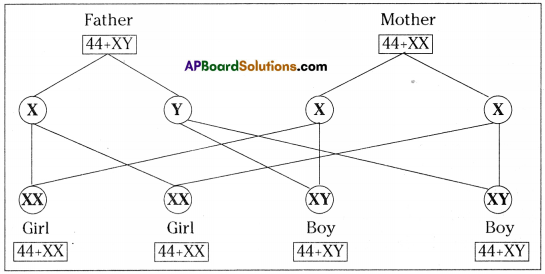
  1. Each human cell contains 23 pairs (46) of chromosomes.
  2. Out of 23 pairs, 22 pairs of chromosomes are called autosomes.
  3. Remaining one pair is called allosomes or sex chromosomes.
  4. There are two types of sex chromosomes – one is ‘X’ and the other is ‘Y’.
  5. These two chromosomes determine the sex of an individual.
  6. Females have two ‘X’ chromosomes in their cells (XX).
  7. Males have one ‘X’ and one ‘Y’ chromosomes in their cells (XY).
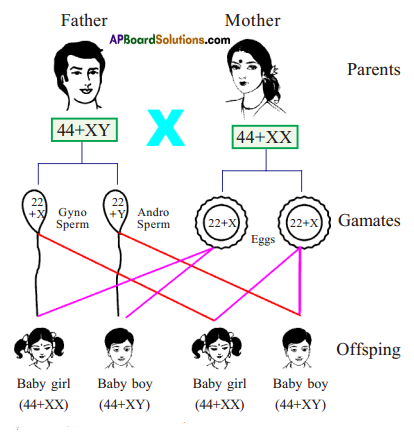
    AP SSC 10th Class Biology Solutions Chapter 8 Heredity 6
  8. All the gametes produced by women (ovum) will be with only X chromosomes.
  9. The gametes produced by man (sperm) will be of two types, one with X chromosomes and other with Y chromosomes.
  10. If the sperm carries X chromosome and fertilizes with the ovum, the resultant baby will have XX condition. So the baby will be a girl.
  11. If the sperm carries Y chromosome and fertilises with the ovum, the resultant baby will have XY condition. So the baby will be a boy.

AP SSC 10th Class Biology Solutions Chapter 8 Heredity

Question 8.
Explain Darwin’s theory of ‘Natural selection’ with an example.
(OR)
What do you understand by the term Natural selection? Write Darwin’s theory of evolution.
Answer:

  1. Darwin proposed the theory of Natural selection.
  2. Nature only selects or decides which organism should survive or perish in nature.
  3. The organism with useful traits will survive and the organisms having harmful traits are going to perished or eliminated from its environment.
  4. For example, a group of twelve red beetles live in a bush of green leaves.
  5. They will grow their population by sexual reproduction.
  6. So they generate variations in their population. Let us assume crows eat the red beetles more the population of red beetles slowly reduced.
  7. Crows eat these red beetles and their population slowly reduces.
  8. During this time a colour variation arises by the sexual reproduction.
  9. So that there appears one beetle that is green in colour instead of red.
  10. Moreover this green colour beetle passes its colour to its offsprings; so that all its progeny are green.
  11. Crows cannot see the green coloured beetles on green leaves of the bushes and therefore crows cannot eat them.
  12. The crows can see the red beetles and eat them as a result, there are more and more green beetles than red ones which decrease in their number.
  13. The variation of green colour beetle gave a survival advantage to green beetles’ than red beetles. They were naturally selected.

Question 9.
What are variations? Explain with a suitable example.
Answer:

  1. Differences in characters within very closely related groups of organisms are referred to as variations.
  2. Often a new character in a group may lead to variations that are inherited.
  3. If we observe parents and offsprings, there will be some similar features in the offspring of the parents.
  4. At the same time we find differences between parents and offspring in their features.
  5. These differences are an example of variations.
  6. Variations are quite apparent among closely related groups of organisms.
  7. If we take roses as an another example, we observe number of varieties in them.
  8. But we can still find some characters similar to all plants.
  9. Thus rose plants have similar physical features, at the same time they have differences in characters like flower colour, number of petals, leaf size, stem, spines, etc.
  10. These differences in features are variations.

AP SSC 10th Class Biology Solutions Chapter 8 Heredity

Question 10.
What variations generally have you observed in the species of cow?
Answer:
In the species of cow the following contrasting variations can be observed:

  1. White coloured – spotted
  2. Longhorns – short horns
  3. Height – dwarf
  4. Long-tail – short tail
  5. Elongated face – stunted face
  6. More milk giving – less milk giving, etc.

Question 11.
What are the characters that Mendel selected for his experiments on pea plants
(OR)
Write the seven pairs of contrasting characters in pea plant identified by Mendel and mention their traits.
Answer:
Mendel selected the following characters on pea plants for his experiment. They are:

Character Description
1. Colour of the flower 1. Purple or white.
2. Position of the flower 2. Axial or terminal in position
3. Colour of the seed 3. Either yellow or green.
4. Shape of the seed 4. Either round or wrinkled.
5. Shape of the pod 5. Inflated and constricted
6. Colour of the pod 6. Yellow or green.
7. Length of the stem 7. Tall and dwarf.

Question 12.
In what way Mendel used the word ‘Traits’? Explain with an example.
Answer:

  1. Trait is a separate variant of an organism.
  2. Mendel hypothesized that characters were carried as traits.
  3. An organism always carried a pair of factors for a character.
  4. He also hypothesized that distinguishing traits of the same character were present in the population of an organism.
  5. He assumed that the traits shown by the pea plants must be in the seeds that produce them.
  6. The seeds must have obtained these traits from the parent plants.
  7. The factors which are responsible for the character or trait of an organism, are now named as “genes”.
  8. By all these we can assume that Mendel used the word ‘traits’ for indicating the variant of an organism expressed by a pair of factors or genes.
  9. For example, height is a character of pea plant while the tallness is a trait expressed by a pair of factors either TT or Tt and dwarfness is another trait expressed by a pair of factors tt.

Question 13.
What are the differences that Mendel observed between parent and F2 generation?
Answer:
Mendel identified the following differences between parent and F2 generation.

Parent F2 Generation
1. They are pure breeds. 1. They consist of mixed population.
2. They consist of homozygous alleles. 2. They consist of homozygous alleles in some plants and heterozygous alleles in some other plants.
3. They have some fixed characteristic features. 3. New combination of characters will appear.

AP SSC 10th Class Biology Solutions Chapter 8 Heredity

Question 14.
Male is responsible for sex determination of baby – do you agree? If so write your answer with a flow chart.
Answer:

  1. Yes, I agree with the statement that male is responsible for sex determination of baby.
  2. There are two types of sex chromosomes in human beings, one is ‘X’ and other is ‘Y’.
    AP SSC 10th Class Biology Solutions Chapter 8 Heredity 7
  3. Females have two ‘X’ chromosomes in their cells (XX) whereas males have one ‘X’ and one ‘Y’ chromosomes in their cells (XY).
  4. All the gametes produced by woman (ovum) will be with only X chromosomes.
  5. The gametes produced by man (sperm) will be of two types one with X chromosomes and other Y chromosomes.
  6. If the sperm carrying X chromosome fertilizes the ovum, the resultant baby will have XX condition. So the baby will be a girl.
  7. If the sperm carrying Y chromosome fertilizes the ovum, the resultant baby will have XY condition. So the baby will be a boy.
  8. So the gamete produced by the male is the deciding factor for sex determination of the baby.

Question 15.
Write a brief note on analogous organs.
(OR)
What are analogous organs?
Answer:

  1. The organs which are structurally different but functionally similar are known as ‘Analogous organs’.
  2. Wings of birds and bats is the example for analogous organs.
  3. The wings of bats are skin folds stretched mainly between elongated fingers.
  4. But the wings of birds are a feathery covering all along the arm.
  5. The designs of the two wings, their structure and components are different.
  6. They look similar because they have common use for flying, but their origins are not common.
  7. This makes the ‘analogous’ characteristics.
  8. This type of evolution is called convergent evolution.

AP SSC 10th Class Biology Solutions Chapter 8 Heredity

Question 16.
How do scientists utilise information about fossils?
(OR)
“Fossils are valuable material that nature had preserved to know about ancient organisms.” Write the information you have collected about fossils.
Answer:

  1. Fossils are evidence of ancient life forms or ancient habitats which have been preserved by natural processes.
  2. The scientific study of fossils is called ‘Palaeontology’.
  3. Scientists utilise information about fossils to understand the evolutionary history of life.
  4. This information is also useful to study ecology and environmental history, such as ancient climates.
  5. This also helps to find out how old that certain layer of earth is.
  6. This information is also utilized as indicators of possible fossil fuel deposits which are of great interest to humanity.
  7. Thus scientists utilize the information on fossils to learn more about the earth’s past.

Question 17.
Mendel selected a pea plant for his experiments. Mention the reasons for the selection as these plants.
(OR)
Why did Mendel select the pea plant for his experiment? (OR)
Which characters in the pea plant are selected by Mendel, for his experiments?
What are the reasons for selecting pea plant by Mendel to conduct his experiments?
Answer:
Mendel chose the pea plant (Pisum sativam) for his breeding experiments for the following reasons.

  1. It is sexually reproducing.
  2. Flowers are bisexual.
  3. Predominantly self-pollinated.
  4. Predominantly self-fertilization.
  5. Well developed characters.
  6. Early hybridization.
  7. It is an annual plant.
  8. These plants have short maturity and can produce large number of seeds in a single generation.
  9. Pea plants have short life cycle.
  10. These plants can easy to grow either on the ground or in pots.

Question 18.
If the theory of inheritance of acquired characters proposed by Lamarck was true, how will the world be?
Answer:
If the theory of inheritance of acquired characters proposed by Lamarck was correct,

  1. All the organisms which lost some of their body parts should give birth to the offsprings without the lost parts.
  2. Rat which lost their tail should give birth to tail less rats.
  3. A handicapped who lost their legs in an accident should give birth to babies v without legs.
  4. A body builder’s children should be body builders.
  5. But all these are not happening because bodily changes won’t be passed to its offspring.

Question 19.
Collect information on the inherited traits in your family members and write a note on it.
Answer:

  1. My grandfather and father- had curling hair. I too have curling hair. So it’s an inherited trait in family.
  2. My mother and I both have long noses which appear similar. It’s another inherited trait.
  3. Eyes of my grandmother, my brother and mine are similar. It’s another inherited trait.
  4. Ear lobes of my father, brother and mine are similar. This is another inherited trait.

AP SSC 10th Class Biology Solutions Chapter 8 Heredity

Question 20.
With the help of given information write your comment on evidences of evolution.

Mammals have fore limbs as do birds, reptiles and amphibians. The basic structure of the limbs is similar, though it has been modified to perform different functions.

Answer:

  1. The given information gives the evidences of evolution.
  2. Mammals. birds, reptiles and amphibians all these have forelimbs which have similar basic structure.
  3. But they are modified to perform different functions.
  4. This indicates that all the vertebrates have evolved from a common ancestor. These organs are called homologous organs. This type of evolution is called divergent evolution.
  5. In case of bat (mammal) and bird the designs of the two wings, their structure and components are different.
  6. They look similar because they have common use for flying, but their origins are not common.
  7. These organs which are structurally different but functionally similar are known as ‘Analogous organs’. This type of evolution is called “convergent evolution”.
  8. There are remarkable similarities in the embryos of above mentioned animals even in their limb formation. These are called embryological evidences.

Question 21.
Collect information about carbon dating method. Discuss with your physical science teacher.
(OR)
Write about the carbon dating method from the information collected by you.
Answer:

  1. Carbon dating is the method used to calculate the age of rocks, minerals or fossils.
  2. The breakdown of radioactive isotopes of certain elements such as carbon, uranium and potassium takes place at a known rate. So the age of rock or mineral containing isotopes can be calculated.
  3. Archaeologists use the exponential, radioactive decay of carbon 14 to estimate the death dates of organic material.
  4. The earth’s atmosphere contains various isotopes of carbon, roughly in constant proportions.
  5. These include the main stable isotope 12C and an unstable istope 14C.
  6. Through photosynthesis, plants absorb both forms from carbon dioxide in the atmosphere.
  7. When an organism dies, it contains the standard ratio of 14C to 12C.
  8. But as the 14C decays with no possibility of replenishment, the proportion of carbon 14 decreases at a known constant rate.
  9. The time taken for it to reduce by half is known as the half-life of 14C, which is 5730.
  10. The measurement of the remaining proportion of 14C in organic matter thus an estimation of its age.
  11. As the half life of carbon – 14 is 5,700 years, it is useful for dating objects up (o about 60,000 years old.

AP SSC 10th Class Biology Solutions Chapter 8 Heredity

Question 22.
Draw a checker board, show the law of independent assortment with a flowchart and explain the ratio.
Answer:

AP SSC 10th Class Biology Solutions Chapter 8 Heredity 8

  1. The phenotypic ratio is 9 : 3 : 3 : 1. i.e., 9 round and yellow seeds 3 round and green seeds, 3 wrinkled and green seeds and 1 wrinkled and green seed.
  2. RRYY, RRYy, RrYy, RrYy, RRYy, RrYy, RrYy, RrYY and RrYy are round and yellow seeds.
  3. RRyy, Rryy, Rryy are round and green.
  4. rrYY, rrYy, rrYy are wrinkled and yellow.
  5. rryy are wrinkled and green.

From the above result, it can be concluded that factors for each character or trait remains separate and maintains its identity in the gametes. Thus in the inheritance of more than one pair of characters, the factors for each pair of characters assort independently of the other pairs. This is known as “Law of independent assortment”.

AP SSC 10th Class Biology Solutions Chapter 8 Heredity

Question 23.
Explain the process to understand the monohybrid cross of Mendel experiment with a checker board.
Answer:
AP SSC 10th Class Biology Solutions Chapter 8 Heredity 9

Question 24.
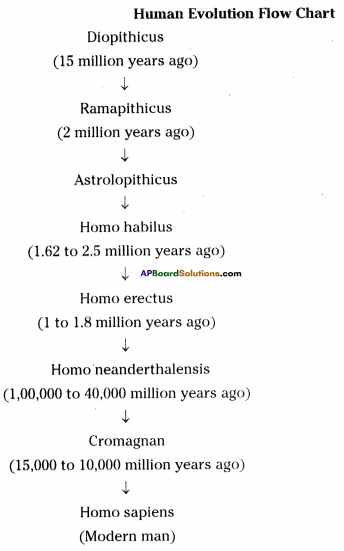
Prepare a chart showing the evolution of man through ages.
Answer:
AP SSC 10th Class Biology Solutions Chapter 8 Heredity 10

AP SSC 10th Class Biology Solutions Chapter 8 Heredity

Question 25.
Nature selects only desirable characters. Prepare a cartoon.
Answer:
Nature selects only desirable characters
AP SSC 10th Class Biology Solutions Chapter 8 Heredity 11

Question 26.
What is your understanding about survival of the fittest? Give some situations or examples that you observe in your surroundings.
Answer:

  1. Nature favours only useful variations.
  2. Each species tends to produce a large number of offspring.
  3. They compete with each other for food, space, mating and other species.
  4. In this struggle for existence only the fittest can survive.
  5. When cat tries to catch some rats, the rats which can run fast and hide in its hole can survive and which is slow can become prey for the cat.
  6. When we spray some insecticide on insects, most of them will die but few which can withstand that chemical will escape.
  7. When a pest attacks our garden plants, most of them may die but Which can withstand the pest can survive.
  8. When the dog tries to catch chickens, the chickens which will run fast and escape can survive but the slower ones will become food for the dog.

Question 27.
Write a monologue on the evolution of a human to perform a stage show on the theatre day in your school.
Answer:

  1. Hai, I am a human being. I am going to recall what had happened to me so far, how I had evolved, simply my journey from my origin to till now.
  2. Nearly 1.6 – 2.5 million years ago, during the gelasian pleistocene period, I used to wander in the forest. It is belived that, I evolved from apes.
  3. Between 1-1.8 million years ago, I gradually evolved into Homo erectus. I lived in this stage throughout most of the pleistocene. I used more diverse and sophisticated stone tools than my predecessors and it is belived that I travelled over oceans using rafts.
  4. Around 1,00,000 – 40,000 thousand years ago I evolved into Homo sapiens neanderthalensis. I was stronger than present in those days. I made advanced tools. I had language to communicate.
  5. Around 40 thousand years ago, I reached the present form of human being, the modern humans known as Homo sapiens. I learnt cultivation, construction of houses, cooking, etc. I had invented various things that help me to live comfortably.
  6. But my journey did not stop. It is still continuing. Let us see what may happen? Where can I reach? What changes may come in me? Hope for the best.
    Thank you.

AP SSC 10th Class Biology Solutions Chapter 8 Heredity

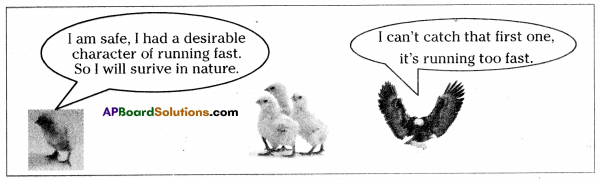
Fill in the blanks.

  1. The process of acquiring change is called ———–.
  2. Mendel’s experiment explains about ———–.
  3. The four characters observed in the experiments on law of independent assortment are ———–.
  4. If we cross pollinate red flower plant with white flower we will get percent of ———– recessive trait plants.
  5. TT or YY, Tt or Yy are responsible for a ———– character.
  6. Female baby having 23 pairs of autosomes at the age of 18 years, has ———– pair autosomes and ———– of sex chromosomes.
  7. The population grows in ———– progression whereas food sources grow in ———– progression.
  8. A goat which walks properly can’t live for a long time. According to Darwin, this represents ———–.
  9. Forelimb of whale is for swimming whereas in horse it is used for ———–.
  10. The study of fossils is called ———–.

Answer:

  1. evolution
  2. heredity
  3. Round, wrinkled, yellow, green
  4. 100
  5. dominant
  6. 22, one pair
  7. geometrical, arithmetic
  8. survival of the fittest
  9. running
  10. palaeontology

Choose the correct answer.

  1. Which of the following is not a variation in rose plant?  [ ]
    A) Coloured petals
    B) Spines
    C) Tendrils
    D) Leaf margin
    Answer: C
  2. According to Mendel, alleles are  [ ]
    A) Pair of genes , Responsible for character
    B) gene
    C) Production of Gametes
    D) Recessive factors
    Answer: B
  3. Natural selection means  [ ]
    A) Nature selects desirable characters
    B) Nature rejects undesirable characters
    C) Nature reacts with an organism
    D) A, B
    Answer: A
  4. Palaeontologists deal with  [ ]
    A) Fossilised Embryological evidences
    B) Fossil evidences
    C) Fossilised Vestigial organ evidences
    D) All
    Answer: D

10th Class Biology 8th Lesson Heredity InText Questions and Answers

10th Class Biology Textbook Page No. 166

Question 1.
How does evolution take place?
Answer:

  1. Evolution takes place through the accumulation of new characters or variations in a species of organisms.
  2. Accumulation of variations occurs only when new characters are passed on from one generation to other and much more new characters are added to the pre-existing once.
  3. So this happens oVer a kirig period of time, sometimes several generations may pass.
  4. Hence it happens in a slow and steady manner.
  5. It is not just about change but producing something new and different.
  6. It is about the formation of new species and their adaptation to their environments.

10th Class Biology Textbook Page No. 168

AP SSC 10th Class Biology Solutions Chapter 8 Heredity

Question 2.
Is variation all about apparent differences? Or is it about some subtle differences as well that we most often overlook?
Answer:

  1. Variations are not always apparent differences.
  2. Sometimes these may be subtle differences that we most often overlook.
  3. When these subtle differences accumulate together they may become apparent.

10th Class Biology Textbook Page No. 171

Question 3.
How do parent plants pass on their traits to the seeds?
Answer:

  1. Every character or trait is controlled by a pair of factors called genes.
  2. At the time of sexual reproduction, one factor or each trait will pass to the gametes.
  3. By the fussion of male and female gametes zygote will form in which factors from both male and female parents get paired again.
  4. This zygote will develop into seed in the later stages.
  5. Thus parent plants pass on their traits to the seeds.

Question 4.
Will the seeds from tall plants always produce new tall plants?
Answer:

  1. No. Tall plants may or may not produce tall plants again.
  2. This is because tallness is a dominant character in most of the plants, especially in peas.
  3. So tall plant may be homozygous tall (TT) or heterozygous tall (Tt).
  4. If the parental plant is homozygous tall (pure breed), then they always produce new tall plants.
  5. If the parental plant is a heterozygous tall plant, then they produce the tall and dwarf plants in the ratio of 3 : 1.

10th Class Biology Textbook Page No. 175

Question 5.
What should be the percentage of each type of plants in F2 generation produced in dihybrid cross between pea plants with yellow, smooth seeds and green wrinkled seeds?
Answer:

  1. In F2 generation of dihybrid cross between pea plants with yellow, smooth seeds and green wrinkled seeds, new plants will produce with the following combination.
    i) Round and yellow
    ii) Round and green and
    iii) Wrinkled and green iv) Wrinkled and yellow
  2. They will produce in the ratio of 9 : 3 : 3 : 1 respectively.
  3. So 56 (56.25%) of plants should be with round and yellow seeds. 19 (18.75%) of plants should be with wrinkled and yellow seeds. 19 (18.75 %) of plants should be with round and green seeds and 6% (6. 25%) of plants should be with wrinkled and green seeds.

10th Class Biology Textbook Page No. 178

AP SSC 10th Class Biology Solutions Chapter 8 Heredity

Question 6.
What will happen if the sperm containing X chromosomes fertilizes the ovum?
Answer:

  1. If the sperm containing X chromosomes fertilizes the ovum which has X chromosome, the baby will have XX condition.
  2. So the baby will be a girl.

Question 7.
Who decides the sex of the baby – mother or father?
Answer:
Father decides the sex of the baby.

Question 8.
Is the sex also a character or trait? Does It follow Mendels’ law of dominance?
Answer:

  1. Yes, sex is also a character or a trait.
  2. It has two contrasting characters male and female.
  3. Male character is represented by a pair of allosomes ‘XY‘ (heterozygous).
  4. In this, we can consider Y as dominant and X as recessive.
  5. In this, recessive character is expressed only when it is homozygous recessive, i.e. female.
  6. Homozygous dominant is not existing as reproduction occurs between male (heterozygous dominent XY) and female (homozygous recessive XX) only.
  7. As X is not exhibiting its nature when Y is present along with it. it follows Mendel’s law of dominance.

Question 9.
Were all your traits similar to that of your parents?
Answer:

  1. No, all my traits are not similar to my parents.
  2. There are certain traits which differ from my parents.

10th Class Biology Textbook Page No. 185

AP SSC 10th Class Biology Solutions Chapter 8 Heredity

Question 10.
How does the evolution of organisms have taken place?
Answer:

  1. Variations which are beneficial are selected by nature and passed from parents to offspring through heredity.
  2. The same process happens with every new generation until the variation becomes common feature.
  3. As the environment changes, the organism within environment adopts and changes to the new living conditions.
  4. Over a long period of time, each species of organisms can acuumulate so many changes that it becomes a new species.
  5. Thus evolution of organisms took place from common pre-existing ancestors.

Question 11.
Are birds and bats more closely related to each other than to squirrels or lizards?
Answer:

  1. No, bats are mammals whereas birds belong to aves.
  2. Squirrels are mammals and lizards belong to reptiles.
  3. So bats and birds are not closely related to each other as they belong to two different groups.
  4. Both bats and birds have wings.

10th Class Biology Textbook Page No. 186

Question 12.
Do embryological evidences indicate that frogs have evolved from ancestors of fish?
Answer:
Yes the embryological evidences indicate that frogs have evolved from ancestors of fish.

Question 13.
Does the life history of every individual exhibit the structural features of their ancestors?
Answer:

  1. Yes. The life history of every individual exhibit the structural features of its ancestors.
  2. The resemblance is so close at an early stage.

10th Class Biology Textbook Page No. 189

AP SSC 10th Class Biology Solutions Chapter 8 Heredity

Question 14.
Think why did ancient human beings travelled from one place to other and how did they travelled?
Answer:

  1. Ancient human beings travelled from one place to other in search of better living conditions such as availability of food, water shelter and other facilities.
  2. They did not travel in a single line.
  3. They went forwards and backwards with groups, sometimes separating from each other.
  4. This travel is responsible for the formation of races.

10th Class Biology Textbook Page No. 183

Question 15.
In a forest there are two types of deer, in which one type of deer can run very fast. Whereas second type of deer can not run as fast as the first one. Lions, Tigers hunt deer for their food. Imagine which type of deer are going to survive in the forest and which type of deer population is going to be eliminated? And why?
Answer:

  1. Deer that can run fast can survive in the forest. Because they can escape easily from lions and tigers, when compared to second type.
  2. Deer that run slowly are going to be eliminated. Because they can be caught easily by its predators. So the survival chance will decrease.

10th Class Biology 8th Lesson Heredity Activities

Activity – 1

Think of your own family, what similarities do you share with your father and mother? Draw a table to represent the similarities of some characters like colour of eye (cornea), colour of hair, shape of nose, shape of face, type of earlobe (attached or free), inner thumb markings, etc. Write your characters in one column and that of your parents in the other columns.
Table – 1

Characters In me In my Mother/Father In my Brother/Sister In my grandma/grandpa

Answer:

S.No. Characters In me In my Mother/Father In my Brother/Sister In my grandma/grandpa
1. Colour of eye Black Black Black Black
2. Colour of hair Black Black Black Black
3. Shape of nose Long Long Short Short
4. Shape of face Oval Round Oval Oval
5. Type of earlobe Free Free Free Free
6. Type of hair Curling Curling Straight Straight
7. Inner thumb marking Conical Round Round Conical
8. Skin colour Fair Fair Fair Fair

1. Is there any character in you similar to that of your mother as well as your grandma?
Answer:
There are four characters in me similar to my mother as well as my grandma. They are

  1. Colour of eye
  2. Colour of hair
  3. Type of earlobe and
  4. Skin colour.

2. Is there any character in you similar only to that of your grandma?
Answer:
Two characters are similar in me and in my grandma. They are

  1. Shape of face and
  2. Inner thumb marking.

3. How do you think these characters may have been inherited by you from grandma?
Answer:
These characters are hereditary from parent to child.

4. Is there any character that is not present in grandma but present in your mother and you?
Answer:
Two characters are not present in grandma which are only present in me and my mother. They are

  1. Shape of nose
  2. Type of hair

5. Think where from your mother got that character?
Answer:
This character is the result of inherited traits transmitted from parent to progeny.

AP SSC 10th Class Biology Solutions Chapter 8 Heredity

Activity – 2
Observe some of your friends and note their characters in the following table. Fill in yours as well.
Table – 2

Name of your friend Colour of skin Earlobes Free / Attached Marking on inner side of thumb Length of forehead Colour of eyes (Cornea) Any other features

Answer:

Name of your friend Colour of skin Earlobes Free / Attached Marking on inner side of thumb Length of forehead Colour of eyes (Cornea) Any other features
Ravi Black Free Round Broad Blue Straight hair, long nose, and face, etc.
Ganesh Black Attached Conical Narrow Black Straight hair, short nose, oval face, etc.
Vi jay Fair Free Conical Broad Black Curling hair, short nose, round face, etc.
Karthik Fair Free Round Broad Black Straight hair, long nose, round face, etc.

1. Compare your characters to that of any one of your friend. How many characters did you find were similar among you and your friend?
Answer:
Only few characters such as black hair and black eye were similar among me and my friend.

2. Do you share more similar characters with your parents or with your friends?
Answer:
I share more similar characters with my parents than my friends.

3. Do you think that your differences from parents are same as differences from friends? Why / Why not?
Answer:
My differences from parents are not same as differences from friend. This is because the differences from parents are subtle as there is more genetic relation with parents but the differences from friends are apparent.

Activity – 3

AP SSC 10th Class Biology Solutions Chapter 8 Heredity

Observe seeds in a pea or bean pod. You may observe several parts to arrive at a generalisation.

1. Can you find two similar seeds there?
Answer:
No, all the seeds are not similar. They had certain variations.

2. What makes them vary? even though they are in the same pod. (Hint: You know that seeds are formed from ovules).
Answer:

  1. They vary from one another because they are produced from different ovules.
  2. Ovules of a plant are female gametes.
  3. These gametes carry different factors (genes) for different characters randomly.

3. Why variations are important? How are variations useful for an organism or a population?
Answer:

  1. Variations perhaps help a certain group of organisms in a community when conditions would otherwise be unfavourable for other groups.
  2. Desirable variations can be selected by nature.
  3. Desirable variations increase the chance of survival of an organism.
  4. Accumulation of variations after a long period leads to formation of new species.

Activity – 4

Let us do the following activity to understand the Mendelian principles of Heredity. Materials required :
a) 3 cm length and 1cm breadth chart pieces – 4
b) 2 cm length and 1cm breadth chart pieces – 4
c) Red buttons – 4
d) White buttons – 4
e) Chart, scale, sketch pen, pencil, 2 bags.

Method: Prepare a chart with 2×2 boxes along with number and symbol as shown in the figure.

AP SSC 10th Class Biology Solutions Chapter 8 Heredity 12

Game 1: Monohybrid cross (starting with hybrid parents)
To start with take 1, 2 or 3, 4 . In case you start 1, 2 pick all the 16 long and short pieces and prepare such pairs in each of which you have a long and short piece.

Take 4 pairs each of long and short strips and put them in two separate bags. Now each bag contains 8 strips (4 long and 4 short).One bag say ‘A’ represents male and the bag ‘B’ represents female. Now randomly pick one strip each from bag A and B and put them together in the 1 on the chart. Keep picking out the strips and arrange them in the same manner till your bags are empty. Same time your boxes in the chart are filled with pairs of strips. You might have got the following combinations, two long strips, one long and one short strip, two short strips.

1. What is the number of long strip pairs?
Answer:
There are four long strip pairs.

2. What is the number of one long and one short pairs?
Answer:
There are eight, one long and one short strip pairs.

3. What is the number of short strips pairs?
Answer:
There are four short strip pairs.

4. What is the percentage of each type? Also find their ratios.
Answer:
The percentage of long strip pairs, one long and one short strip pairs and short strip pairs are 25%, 50% and 25% respectively and the ratio is 1 : 2 : 1.

5. What can you conclude from this game?
Answer:
From this game I have concluded that:

  1. Every individual possesses a pair of alleles, for any particular trait.
  2. Each parent passes a randomly selected copy (allele) of these to an offspring.
  3. The offspring then receives its own pair of alleles for that trait one each from both parents.
  4. If the long strip is considered as dominant 75% exhibit dominant and 25% exhibit recessive character. Thus the phenotype ratio is 3 : 1 in monohybrid cross.
  5. The genotype ratio is 1 : 2 : 1.

AP SSC 10th Class Biology Solutions Chapter 8 Heredity

Activity – 5

Observe the below diagram showing variation in beetle population and its impact.
AP SSC 10th Class Biology Solutions Chapter 8 Heredity 13Let us consider a group of twelve beetles. They live in bushes on green leaves. Their population will grow by sexual reproduction. So they were able to generate variations in population. Let us assume crows eat these red beetles. If the crows eat more Red beetles, their population is slowly reduced. Let us discuss the above three different situations in detail.
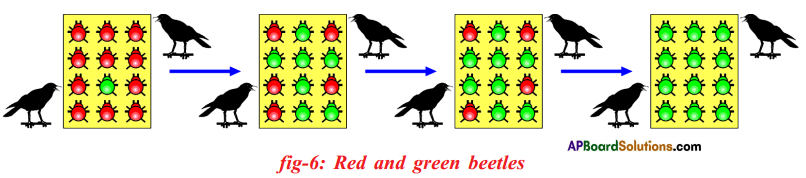
Answer:
Situation-1: In this situation, a colour variation arises during reproduction. So that there appears one beetle that is green in colour instead of red.
AP SSC 10th Class Biology Solutions Chapter 8 Heredity 14Moreover, this green coloured beetle passes its colour to Its offspring (Progeny). So that all its progeny are green. Crows cannot see the green coloured beetles on green leaves of the bushes and therefore crows cannot eat them. But crows can see the red beetles and eat them. As a result there are more and more green beetles than red ones which decrease in their number.
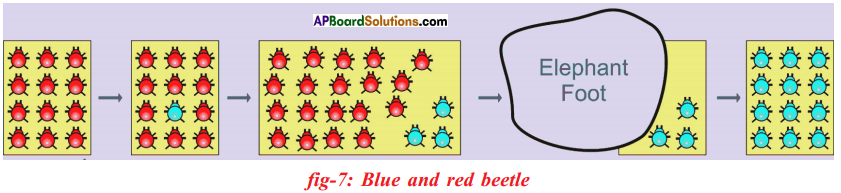
The variation of colour in beetle ‘green’ gave a survival advantage to’green beetles’ than red beetles. In other words it was naturally selected. We can see that the ‘natural selection’ was exerted by the crows. The more crows there are, the more red beetles would be eaten and the more number of green beetles in the population would be. Thus the natural selection is directing evolution in the beetle population. It results in adaptation in the beetle population to fit in their environment better.

Let us think of another situation.
Situation-2: In this situation a colour variation occurs again in its progeny during reproduction, but now it results in ‘blue’ colour beetles instead of ‘red’colour beetle. This blue colour beetled can pass its colour to its progeny. So that all its progeny are blue.
AP SSC 10th Class Biology Solutions Chapter 8 Heredity 15Crows can see blue coloured beetles on the green leaves of the bushes and the red ones as well. And therefore crows can eat both red and blue coloured beetles. In this case there is no survival advantage for blue coloured beetles as we have seen in case of green coloured beetles.
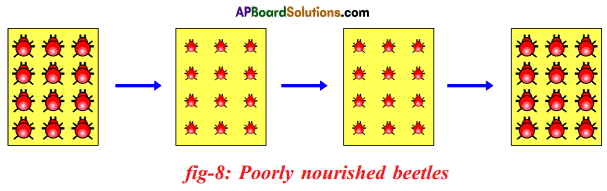
What happens initially in the population, there are a few blue beetles,but most are red. Imagine at this point an elephant comes by and stamps on the bushes where the beetles live. This kills most of the beetles. By chance the few beetles survived are mostly blue. Again the beetle population slowly increases. But in the beetle population most of them are in blue colour.

Thus sometimes accidents may also result in changes in certain characters of the population. Characters as we know are governed by genes. Thus there is change in the frequency of genes in small populations. This is known as “Genetic drift’, which provides diversity in the population.

Let us think of another situation :
Situation-3: In this case beetles population is increasing, but suddenly bushes were affected by a plant disease in which leaf material were destroyed or in which leaves are affected by this beetles got less food material.
AP SSC 10th Class Biology Solutions Chapter 8 Heredity 16So beetles are poorly nourished. So the weight of beetles decrease but no changes take place in their genetic material (DNA). After a few years the plant disease are eliminated. Bushes are healthy with plenty of leaves.
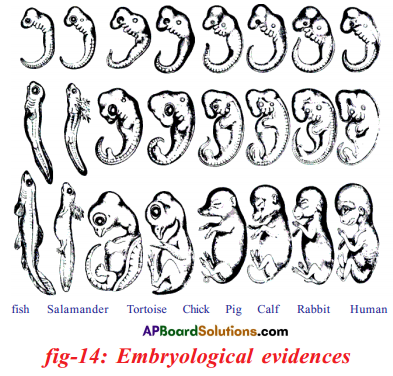

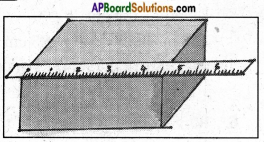
What do you think will be condition of the beetles?
Answer:
The weight of beetles will increase once again as they get plenty of food material again.

AP SSC 10th Class Biology Solutions Chapter 8 Heredity

Activity – 6

Let us observe different stages of development of vertebrate embryos. Try to find out similarities and differences and discuss with your friends.
(OR)
What do you infer about the embroyological evidences of various organisms?
Answer:
AP SSC 10th Class Biology Solutions Chapter 8 Heredity 17

  1. There are remarkable similarities in the embryos of different animals from fish to man.
  2. The resemblance is so close at an early stage.
  3. Gradually the similarities are decreased when they become babies.
  4. The embryological evidences give us an idea that all the organisms have evolved from a common ancestors.


AP Board 6th Class Science Important Questions Chapter 7 Let us Measure

AP State Syllabus AP Board 6th Class Science Important Questions Chapter 7 Let us Measure

AP State Syllabus 6th Class Science Important Questions 7th Lesson Fun with Magnets

6th Class Science 7th Lesson Let us Measure 2 Mark Important Questions and Answers

Question 1.
What are conventional methods of measurement?
Answer:
The conventional methods of measurement are Foot – space, Hand – space, and Cubit.

Question 2.
What are the units for length?
Answer:
Meter is the standard unit of length.

Question 3.
What do you mean by area? What is the standard unit to measure area?
Answer:
Square centimeter (cm2) is the standard unit to measure area.

Question 4.
What is the instrument used to measure the volume of liquids?
Answer:
Measuring cylinder.

Question 5.
What is the yard?
Answer:
A distance between the nose and tip of the figure is called a yard.

Question 6.
Who made the first scale? Now, where is it?
Answer:
France made the first scale and now it is in France museum.

Question 7.
What was the material used by France to make the scale?
Answer:
Platinum and iridium.

Question 8.
What are the instruments we used in our daily life to measure the length?
Answer:
We use instruments like plane tape, roll tape, scales with different measurements made with wood plastic, and metals.

Question 9.
Give examples for having cured path?
Answer:
The perimeter of the bucket and perimeter of Kadai or Tava having curved paths.

Question 10.
What is the convenient unit to measure the distance between Guntur to Visakhapatnam?
Answer:
Kilo meter is a suitable unit to measure long distances.

Question 11.
Why cubit can’t be used as a standard unit of length?
Answer:
The cubit can’t be used as a standard unit of length, because the length of the hand or cubit is not equal for all of the people.

Question 12.
What is a cube?
Answer:
The cube is a measurement of 1 cm length 1cm breadth and 1cm of Height.

Question 13.
Which device did we use to measure the length of the curved line?
Answer:
We use the thread to measure the length of a curved line.

Question 14.
How the long-distance is measured?
Answer:
Long-distance is measured by kilometers.
1 kilo meter = 100 meters

Question 15.
The distance between Rama’s house and school is 2500 meters. Convert this distance in to kilometers?
Answer:
1 kilometer = 1000 meters
2500 m = 2500/1000 = 2.5 km

Question 16.
What is the relation between ml and cm3?
Answer:
1 ml = cm3

Question 17.
What is the unit to express the thickens of wires?
Answer:
Milli meters.

Question 18.
Which instruments are used to measure the volumes of milk and liquids?
Answer:
Measuring cylinders.

Question 19.
Which instruments are used to measure the plane of irregular surface?
Answer:
Graph paper.

Question 20.
What is the standard unit of measuring the volume of solids?
Answer:
The standard unit of measuring the volume of solids is ml.

Question 21.
Are you able to measure the volume of loose solids?
Answer:
Yes, we are able to measure the volume of loose solids.

Question 22.
How can you decide a standard unit of volume of a solid?
Answer:
The standard unit of volume of a solid cm3.

6th Class Science 7th Lesson Let us Measure 4 Mark Important Questions and Answers

Question 1.
How is the distance yard decided in the early days?
Answer:

  • The distance between nose and tip of the middle finger of their king was taken a measure by some people.
  • They called this distance as a yard.
  • This yard was divided into three equal parts and each part was called as a foot.
  • They divided each foot into twelve equal parts called inches.
  • Then they divided each inch into smaller parts.

Question 2.
Why there is a need to develop an internationally accepted instrument for measuring lengths?
Answer:

  • Each country had its own scale which differs from others, so it lead to commerce a lot of problems in trade and commerce.
  • So each country in the world began to make their own sales.
  • Finally in France, it was decided that a certain length of rod made of a special material (Platinum – Iridium) would be called a meter.
  • This was finally accepted as an instrument of measuring lengths.

Question 3.
What is the standard unit of length? How is it divided into smaller units?
Answer:

  • Meter is the standard unit of length.
  • The centimeter and millimeters are smaller units of length
    AP Board 6th Class Science Important Questions Chapter 7 Let us Measure 1
  • 1 Meter (1 m) = 100 centimeters (100 cm)
  • 1 Centimeter (1 cm) = 10 millimeters (10 mm)

Question 4.
Describe a measuring cylinder. Where are they used?
Answer:

  • A measuring cylinder is a tubular structure with graduations marked on the body.
  • We can fill it with liquid and can read markings at the lowest point of the concave surface of the liquid.
  • Measuring cylinders are available in different sizes.
  • They are used in laboratories to measure a certain volume of liquids like milk, oil etc.

Question 5.
A persons height is written as 1.85 m. Convert it in to cm and milli meters?
Answer:
Person height is 1.85 m
1 meter = 100 cm
1.85 m = 1.85 x 100 = 185 cm
We know that 1 meter = 1000 mm
1.85m = 1.85 x 1000 mm = 1850 mm

Question 6.
Why meter scale is used to measure the cloth length?
Answer:

  • The meter scale is an internationally accepted instrument for measuring length.
  • This avoids a lot of problems in international trades and commerce.
  • The length measures with the meter is constant anywhere in the world.

Question 7.
Why did women use their hands to measure the jasmine flowers sting?
Answer:
Accuracy is not important in measuring the jasmine string.
Various in measurement is negligible in this trade.
So, there is no problem by using hand measurement in this aspect.
And this is also an old tradition of our country that will be continued.

Question 8.
Define volume? What is its importance?
Answer:
Volume is a measure of extent space that occupy a body.
Apart from the measuring of volume of liquids we also measure the volumes of solids like sand and clay.

  • We use measuring cylinders to measure the volume of liquids as milk, kerosene and oil.
  • The volume of liquid is expressed in liters or in ml.

Question 9.
How is meter scale designed and what is it subunits? Where it is preserved?
Answer:

  • In France, it was decided that a certain length of rod made of a special material (Platinum-Iridium) would be called a meter.
  • The meter was divided into 100 equal parts called centimeters.
  • Each centimeter was further divided into ten equal parts called millimeters.
  • Now we are using this as a standard measurement for length throughout the world.
  • This original scale is preserved in a museum in France.

Question 10.
How do you measure the length with a meter scale?
Answer:

  • The zero marks on the scale are made to coincide with one end of the table and the reading at the point which is coinciding with the other end of the table is taken.
  • Since a meter scale has some thickness.
  • We may make an error if the eye is not correctly positioned.
  • The correct position of the eye is vertically above the end where the reading is to be taken.

Question 11.
How do you select a suitable instrument to measure length?
Answer:
I select a tape to which is a suitable instrument to measure the length.

6th Class Science 7th Lesson Let us Measure 8 Mark Important Questions and Answers

Question 1.
What precautions must be taken while using a meter scale?
Answer:
We must take the following precautions while using a meter scale:
AP Board 6th Class Science Important Questions Chapter 7 Let us Measure 2

  • The scale should be placed exactly along length to be measured.
  • Zero-point of the scale should be coincide with the starting point of the length to be measured.
  • Our eyes must be vertically above the point of coincidence of scale where the measurement is to be taken.
  • Ensure that the ends of scale are not worn out.
  • Measure the length of an object more than two times and then take the average of these measurements for accuracy.

Question 2.
How do you measure the height of your classmate using a meter scale?
Answer:

  • I shall ask my classmate to stand with his / her back against a wall.
    AP Board 6th Class Science Important Questions Chapter 7 Let us Measure 3
  • I put a mark on the wall exactly above his / her head.
  • Then I measure the distance, from the floor to this mark on the wall, with a scale.
  • The same procedure is followed to some other students and their observations are recorded in the table.

Question 3.
How do you measure the length accurately with a meter scale?
Answer:

  • In our day-to-day work, we use a wooden/plastic scale to measure lengths.
  • It is marked or graduated in centimeters and millimeters.
  • Take a scale. The zero mark on the scale is made to coincide with one end of the table.
  • And the reading at the point which is coinciding with the other end of the table is taken.
  • Since a meter-scale has some thickness, we may make an error if the eye is not correctly positioned.
  • The correct position of the eye is which is vertically above the end where the reading is to be taken.

Question 4.
Observe the given of figure. In each figure, vertical and horizon¬tal lines divide the surface into certain number of parts.
AP Board 6th Class Science Important Questions Chapter 7 Let us Measure 4
Now answer the following questions?
i) Which figure has more area and why?
Answer:
I think, both the figures have same area.

ii) Are all the parts in both figures equal?
Answer:
No, in both figure length and breadth are not equal.

iii) What is the shape of the smaller part in each diagram?
Answer:
It has square shape.

iv) Is the length and breadth of each smaller part are equal?
Answer:
Yes, the length and breadth of each smaller part are equal.

v) Measure the length and breadth of any one part of each diagram. What do you notice?
Answer:
We notice that they have equal area with different measurements.

Question 5.
How can you measure the area of a rectangular surface?
Answer:

  • Cut a cardboard into a shape of rectangle having length 4 cm and breadth 2 cm as shown in Figure.
    AP Board 6th Class Science Important Questions Chapter 7 Let us Measure 5
  • Let us measure its area. The convenient unit to measure the area of given cardboard would be cm2.
  • Take a centimeter graph paper. Each small square on this graph paper has a side equal to 1 cm.
  • The area of each small square on this graph paper is 1 cm2.
  • Place the cardboard on the centimeter graph paper (figure).
  • and draw its outline with the help of a sharp pencil.
  • Now remove the cardboard and mark the shape as PQRS.
  • Count the number of squares inside the outline. The number of squares is 8.
  • Area of the cardboard is equal to the area covered by PQRS on the graph paper.
  • Area of PQRS = Total area of unit squares inside the PQRS
    = 8 x area of 1 unit square
    = 8 x 1cm2 = 8 cm2
    In this case, the cardboard we used has a regular shape – rectangle.

Question 6.
Write about the measuring cylinder?
Answer:

  • Measuring cylinder is cylindrical in shape, with graduations marked on its body.
  • Measuring cylinders are available in different sizes.
    AP Board 6th Class Science Important Questions Chapter 7 Let us Measure 6
  • They are used in laboratories to measure a certain volume of a liquid and to measure milk, oils, etc by shop keepers.
  • We can fill it with the liquid to be measured and then read the marking at the lowest point of the concave surface of liquid.
  • We must bring our eyes in line with this level of liquid and then read it.
  • Apart from measuring the volumes of liquids, we also measure the volumes of solids, for example, loose solids like sand, clay, and ready-mix of cement.

Question 7.
See the picture and answer the following questions?
AP Board 6th Class Science Important Questions Chapter 7 Let us Measure 7
i) Can we measure long distances such as one country to other country using the instruments?
Answer:
No, its not possible.

ii) If not, how are these distances measured?
Answer:
Long distances are used in kilo meters.

iii) What instruments are used?
Answer:
An odometer is used to measure the kilometers.

iv) Is there any other way to measure very large distances?
Answer:
Very long distances are generally denoted in light-years. That is, distance traveled by light in one year.

Question 8.
Narrate the story of scale?
Answer:
Many hundred years ago, people used to measure distances with their hand-spans, strides or foot-spans.

  • One day a very tall man went to a shop to buy some cloth. He asked for three and a half arm’s length of cloth.
  • The shopkeeper measured three arm lengths of cloth and then added approximately another half-arm length.
  • The man felt that the shopkeeper had cheated on him. So he measured the cloth with his arms and found that the cloth was not even three arm lengths.
  • He told the shopkeeper that the length of the cloth was less than three-and-a-half arms when he measured with his own arm.
  • The shopkeeper replied that his own arm was the standard for measuring. They both argued about whose arm was to be taken as a standard measure.
  • In those days, people arguing over measuring the length of fields, ropes, and hundreds of other things must have been a familiar fight. How should one measure a half or a quarter arm length
  • Finally, some sensible people got together and decided to have a scale of a fixed length.
  • In order to measure subunits, they marked this scale with several smaller but equal divisions.
  • They then decided that everyone would measure lengths with this scale.
  • They used wood and metal to make scales of the same length.

Question 9.
How do you measure the volume of a cardboard box?
Answer:

  • We measure the volume of cardboard with the help of cube boxes.
  • Each cube has a measurement of 1 cm length, 1 cm breadth, and 1 cm height.
  • The volume of one cube is equal to 1cm x 1cm x 1cm = 1 cm3 which is known as 1 cubic centimeter and written as 1 cm3.
  • A cubic centimeter is a standard unit for the measurement of the volume of solids.
  • Therefore the volume of the rectangular cardboard box is equal to the total number of cubes occupying it. Therefore the volume of a rectangular cardboard box
    = 12 x 1 cm3 = 12 cm3.
  • However, if we multiply length, breadth and height, it would be
    3 cm x 2 cm x 2 cm = 12 cm3
  • Therefore, we can say the volume of a box = length x breadth x height

AP Board 6th Class Science Important Questions Chapter 12 Movement and Locomotion

AP State Syllabus AP Board 6th Class Science Important Questions Chapter 12 Movement and Locomotion

AP State Syllabus 6th Class Science Important Questions 12th Lesson Movement and Locomotion

6th Class Science 12th Lesson Movement and Locomotion 2 Mark Important Questions and Answers

Question 1.
What is movement?
Answer:
The displacement of a body or its parts from its original position is called movement.

Question 2.
What is locomotion?
Answer:
The displacement of an entire body from one place to another is called locomotion.

AP Board 6th Class Science Important Questions Chapter 12 Movement and Locomotion

Question 3.
What is the use of locomotion?
Answer:
Locomotion helps for protection and food gathering.

Question 4.
How the muscles are connected to hones?
Answer:
Muscles are connected to bones either directly or with the help of tendons.

Question 5.
How do the muscles work?
Answer:
Muscles work in pairs. When one of them contracts, the bone is pulled in that direction and the other muscle of the pair relaxes.

Question 6.
What is a skeleton?
Answer:
Different bones of our body combine together to form the skeleton.

Question 7.
What is joint?
Answer:
The point where two bones meet is called a joint.

Question 8.
What are the types of joints?
Answer:
Joints are of two types. They are movable and immovable (fixed)

Question 9.
What are the types of movable joints?
Answer:
Movable joints are four types namely 1. Ball and socket 2. Hinge 3. Sliding 4. Pivot joints.

AP Board 6th Class Science Important Questions Chapter 12 Movement and Locomotion

Question 10.
What is the use of tendons?
Answer:
Tendons join the muscles to bones.

Question 11.
What is the function of the ligament?
Answer:
Ligaments join one bone to the other bone.

Question 12.
Where do you find fixed joints?
Answer:
The joint between the upper jaw and the skull is the fixed joint.

Question 13.
Give some examples for locomotory organs?
Answer:
The stream-lined body, fins in fish; wings, legs in birds; ribs in the snake; muscular foot in snail are useful in locomotion.

Question 14.
How many muscles are there in our body?
Answer:
There are more than 650 muscles in our body.

Question 15.
What is the biggest muscle in our body?
Answer:
The biggest muscle is Gluteus Maximus

Question 16.
What is the smallest muscle in our body?
Answer:
The smallest muscle in our body is Stapedius.

Question 17.
Which muscles work without rest?
Answer:
Interestingly the muscle of the heart works without rest.

AP Board 6th Class Science Important Questions Chapter 12 Movement and Locomotion

Question 18.
How much blood is pumped by the heart per minute?
Answer:
The human heart forces 4500 ccs of blood per minute through blood vessels.

Question 19.
What is the movable joint in the skull?
Answer:
This lower jaw is the only movable joint of the skull.

Question 20.
How many bones are there in the body?
Answer:
There are 206 bones present in our body.

Question 21.
How the bones are made up of?
Answer:
These bones are so hard they are made of calcium and phosphorus.

Question 22.
What is the biggest bone in our body?
Answer:
The biggest bone is the femur.

Question 23.
What is the smallest bone in our body?
Answer:
The smallest bone is stapes.

Question 24.
Why we can’t move the upper jaw?
Answer:
There is a joint between the upper jaw and the rest of the head. It is a fixed joint. So, you cannot move the upper jaw.

6th Class Science 12th Lesson Movement and Locomotion 4 Mark Important Questions and Answers

Question 1.
How do you observe the shoulder muscles?
Answer:
Make a fist with one hand, bend your arm at the elbow and touch your shoulder with the fist.
AP Board 6th Class Science Important Questions Chapter 12 Movement and Locomotion 1
Also, touch your upper arm with the other hand, you feel a swollen region inside your upper arm. This is muscle.
The muscle bulges due to contraction.
When the muscle is contracted it becomes shorter, stiffer, and thicker.

AP Board 6th Class Science Important Questions Chapter 12 Movement and Locomotion

Question 2.
Is it possible to move your parts without moving muscles? Why?
Answer:
It is not possible to move the body parts without moving muscles.
Muscles are fleshy structures that cause movement.
These are attached to one another and perform contraction and relaxation.
By these contractions, bones are pulled in that direction that makes the movement.

Question 3.
How do Muscles work?
Answer:

  1. Muscles work in pairs.
    AP Board 6th Class Science Important Questions Chapter 12 Movement and Locomotion 2
  2. When one of them contracts, the bone is pulled in that direction and the other muscle of the pair relaxes.
  3. To move the bone in the opposite direction, the relaxed muscle contracts and the first one relaxes.
  4. Thus two muscles have to work together to move a bone.

Question 4.
What is Tendon? What is its role in our body?
Answer:
Some muscles have round, white, and rope-like fibers at their ends that connect them to the bone.
These fibrous structures are called Tendons.
AP Board 6th Class Science Important Questions Chapter 12 Movement and Locomotion 3
You can feel the tendons in several parts of your body like; above the elbow, beneath the knee, near the ankle.
They have a key role in body movements to pull the bones.
These also help muscles to attach to the bones.

Question 5.
What is Skeleton System? What is its importance?
Answer:

  1. The different bones of different parts of the body combine together to form a single structure or system. This structure is called the skeleton.
  2. The skeletal system provides base and shape to our body.
  3. It provides protection to internal organs.
  4. It also help in blood formation.

AP Board 6th Class Science Important Questions Chapter 12 Movement and Locomotion

Question 6.
What is a ligament? What is its use?
Answer:
Two bones are joined together in a special way by fibers. These fibers are called ligaments These helps in bones connection and body movements.
AP Board 6th Class Science Important Questions Chapter 12 Movement and Locomotion 4

Question 7.
How we are without a skeleton.
Answer:

  1. It’s funny to imagine our body without a skeleton.
  2. Without a skeleton, muscles don’t have support.
  3. So the body does not have a shape.
  4. The body becomes a fate round ball.

Question 8.
How do you observe the lower jaw bone?
Answer:
Ask your friend to open his mouth and move his lower jaw up and down as well as sideways.
Observe his face carefully.
This is the place where the lower jaw bone is joined to the skull.
Press your finger on both sides of your face and spot where you have these joints. This lower jaw is the only movable joint of another skull.

Question 9.
What is Clavicle? What is its importance?
Answer:

  1. The clavicle is a long bone between the neck and the shoulder blade it’s also known as collar bone.
  2. It provides great support to the shoulder and helps to carry weighty things.

Question 10.
How do you observe the Clavicle?
Answer:

  1. To observe the clavicle fold one arm and rest it on your waist.
  2. Now slowly lift your arm and shoulder together.
    AP Board 6th Class Science Important Questions Chapter 12 Movement and Locomotion 5
  3. Run a finger of your other hand from just below your neck towards your shoulder.
  4. Try and locate a raised bone there and the one behind it.
  5. The raised bone is called the clavicle and the bone behind it is the shoulder blade.

AP Board 6th Class Science Important Questions Chapter 12 Movement and Locomotion

Question 11.
What are the differences between Ribs and Ric Case?
Answer:

Ribs Rib case
1. Ribs are the bones in chest cavity. 1. Ribs connect together and form rib case.
2. These are 12 in pair. 2. Its single in number.
3. These are connected to chest bone at front side and back bone to back side. 3. Whole structure of chest bone, ribs and back bone is called as rib case.
4. Helps in respiratory movements and protection. 4. It protects lungs and heart.

Question 12.
How do you observe the backbone?
Answer:

  1. Ask your friend to stand up, bend forward at the waist and try to touch his toes with his palms.
    AP Board 6th Class Science Important Questions Chapter 12 Movement and Locomotion 6
  2. Run a finger along the center of his back from below the neck.
  3. A long structure running down the middle of his back is called the backbone.

Question 13.
How do you observe the Pelvic Girdle?
Answer:

  1. Press the area just below your waist with the fingers of both hands.
    AP Board 6th Class Science Important Questions Chapter 12 Movement and Locomotion 7
  2. You can feel the bones with the same shape on both sides of your body. This is called the pelvic girdle.
  3. Here the leg bones are attached to the bottom of the spine by a group of bones. This is called the pelvis.
  4. This is also the part you sit on.

Question 14.
Write about the Skull?
Answer:

  1. The skull is made up of many bones joined together.
  2. It encloses and protects the brain.
    AP Board 6th Class Science Important Questions Chapter 12 Movement and Locomotion 8
  3. The joints between the skull bones are fused.
  4. They are also called fixed joints.

AP Board 6th Class Science Important Questions Chapter 12 Movement and Locomotion

Question 15.
What is Cartilage? How it useful to the body?
Answer:

  1. Some parts of the ear and nose are soft and others are hard.
  2. The soft parts are made up of a structure called cartilage.
  3. This is also a bone but it is flexible.
  4. The cartilage is present in other parts of the skeleton as well, like, between the tips of the rib, eyelids, and sternum, between the vertebrae of the vertebral column, etc.
  5. It protects the ends of long bones at the joints and is a structural component of the rib cage, the ear, and the nose.

Question 16.
What are the joints? What are the types in it?
Answer:

  1. The point where two bones meet is called a Joint.
  2. The joints help us to bend, twist and turn.
  3. There are different types of joints in our body to help us carry out different movements and activities.
  4. The joints are divided into two types. 1. Movable joints 2. Immovable joints

Question 17.
Write about fixed joints?
Answer:

  1. Some joints between bones in our body can’t move, such joints are called fixed joints.
  2. These joints are fused and seem to be a single bone.
  3. These are present in the skull. When you open your mouth, you can move your lower jaw only.
  4. The remaining joints are fixed joints in the skull.

Question 18.
Write about locomotion in birds?
Answer:

  1. Birds fly in the air and walk on the ground.
  2. Birds can fly because their bodies are well suited for flying.
  3. Their bones are hollow and light.
  4. The bones of the hind limbs are typical for walking and perching.
  5. The forelimbs are modified as wings which help the bird in flight.
  6. Feathers also play an important role in flight mechanism.

Question 19.
Observe the hen and the sparrow. How do they move?
Answer:
Hen and Sparrows, both are birds but they have different styles in locomotion.

HEN SPARROW
1. It can’t fly. 1. It can fly.
2. Walking is main locomotion. 2. It can jump and fly.
3. Legs are enough strong. 3. Legs are thin and weak.
4. Wings are not enough strong to ; floats its body in air. 4. Wings are enough strong to fly.

Question 20.
Describe the Locomotion in Snakes?
Answer:

  1. Snakes do not have limbs (legs).
  2. Snakes have a long backbone and several muscles.
  3. Usually, the snake’s body curves into many loops.
  4. Each loop of the snake gives it a forward push by pressing against the ground.
  5. This helps the snake move forward very fast.

AP Board 6th Class Science Important Questions Chapter 12 Movement and Locomotion

Question 21.
How do you observe the Locomotion in Snails?
Answer:

  1. Collect a snail from a garden.
  2. Place the snail on a glass plate and watch it when it starts moving.
    AP Board 6th Class Science Important Questions Chapter 12 Movement and Locomotion 9
  3. A thick structure may come out of an opening in the shell.
  4. The thick structure is its foot, made of strong muscle.
  5. The wavy motion of its foot is the reason why a snail moves slowly.

6th Class Science 12th Lesson Movement and Locomotion 8 Mark Important Questions and Answers

Question 1.
There are other ways in which snakes move. Try to find out about them. Collect those pictures, information and display them on wall magazine.
Answer:
Snakes have four ways of moving around. Since they don’t have legs they use their muscles and their scales to do the “walking”.

  • Serpentine method: This motion is what most people think of when they think of snakes. Snakes will push off of any bump or other surface, rocks, trees, etc., to get going. They move in a wavy motion. They would not be able to move over slick surfaces like glass at all. This movement is also known as lateral undulation.
    AP Board 6th Class Science Important Questions Chapter 12 Movement and Locomotion 10
  • Concertina method: This is a more difficult way for the snake to move but is effective in tight spaces.
    The snake braces the back portion of their body while pushing and extending the front portion. Then the snake drops the front portion of their body and straightens and pulls the back portion along. It is almost like they threw themselves forward.
    AP Board 6th Class Science Important Questions Chapter 12 Movement and Locomotion 11
  • Side winding: This is a difficult motion to describe but it is often used by snakes to move on loose or slippery surfaces like sand or mud. The snake appears to throw its head forward and the rest of its body follows while the head is thrown forward again.
    AP Board 6th Class Science Important Questions Chapter 12 Movement and Locomotion 12
  • Rectilinear Method: This is a slow, creeping, straight movement. The snake uses some of the wide scales on its belly to grip the ground while pushing forward with the others.
    AP Board 6th Class Science Important Questions Chapter 12 Movement and Locomotion 13

AP Board 6th Class Science Important Questions Chapter 12 Movement and Locomotion

Question 2.
Write about movable joints in Human beings?
Answer:
Movable joints are four types. They are:

  1. Ball-and-socket joint: The ball-shaped surface of one bone fits into the cup-like shape of another. Examples of a ball-and-socket joint include the hip and the shoulder.
  2. Hinge joint: The ends of the bones are shaped in a way that allows motion in two directions, forward and backward. Examples of hinge joints are the knees and elbows
  3. Pivot joint: Only allows rotating movement. The joint that joins the skull to the backbone is called the pivot or neck joint.
  4. Gliding joint: It is a joint which allows only gliding movement. The gliding joint allows one bone to slide over the other. The gliding joint in your wrist allows you to flex your wrist. It also allows you to make very small side-to-side motions. There are also gliding joints in your ankles and backbone.

Question 3.
How the fish swim in the water?
Answer:

  1. The body of the fish is streamlined.
  2. The shape is such that it allows the fish to move in water easily.
  3. The skeleton of the fish is covered with strong muscles.
    AP Board 6th Class Science Important Questions Chapter 12 Movement and Locomotion 14
  4. While swimming, muscles make the front part of the body swing towards one side while the tail swings its body towards the opposite side.
  5. This creates a jerk and pushes the body forward.
  6. A series of such jerks help the fish swim forward.
  7. The tail fins also aid in this movement.

Question 4.
Write about different types of Locomotion and their Locomotory Organs in a tabular manner.
Answer:
Animals show different types of locomotion with their locomotory organs. Those are:

Locomotion Animals Locomotary
Organ
Discription
1. Swim Fish Fins Fins and spindle body helps to fish in swimming.
2. Fly Birds Wings Birds have strong feathered wings to fly.
3. Crawl Snakes Scales Snakes crawl with scales that are present at bottom of the body.
4. Walk Man Legs Animals use four legs to walk, but humans two.

AP Board 6th Class Science Important Questions Chapter 12 Movement and Locomotion

Question 5.
Observe the skeletal system of a bird and write their parts.
Answer:
AP Board 6th Class Science Important Questions Chapter 12 Movement and Locomotion 15

AP Board 7th Class English Solutions Chapter 3C The Magic of Silk

AP State Syllabus AP Board 7th Class English Textbook Solutions Chapter 3C The Magic of Silk Textbook Questions and Answers.

AP State Syllabus 7th Class English Solutions Chapter 3C The Magic of Silk

7th Class English Chapter 3C The Magic of Silk Textbook Questions and Answers

I. Answer the following questions.

Question 1.
Who do you think the old man is? Justify your reasons.
Answer:
The old man, I think, is God or a messenger from God because a man could not do such miracle.

Question 2.
Do you believe in miracles?
Do you think that magic and miracles are the same? If not, give your reasons.
Answer:
Yes, I believe in miracles as I believe in the Almighty.
Magic and Miracles are not the same.
A Miracle is an act or event that does not follow the laws of nature and is believed to be caused by God. But ’magic’ is the secret power of appearing to make impossible things happen by saying special words or doing special things. A man can do magic but not miracles. So, they are not the same.

AP Board 7th Class English Solutions Chapter 3C The Magic of Silk

Question 3.
If you were Siew Mei, how would you feel?
Answer:
If I were Siew Mei, I would highly get astonished to see the change of long white beard into the finest silk thread. I would feel it a miracle and get immense happiness and the feeling that luck favoured me.

What is an anagram?
An anagram is the rearrangement of the letters of a word, name, phrase, sentence, title, or the like into another word or phrase. But ALL the letters of the name or phrase must be used ONCE and only ONCE. This is the basic rule of anagramming. The best anagrams are meaningful and relate in some way to the original subject. Example: if we take the word ‘the classroom’ and rearrange the letters in it, we get ‘school master’. So, ‘school master’ is an anagram of‘the classroom’ and vice versa. Here are some other anagrams: mother-in-law _ woman Hitler; debit card _ bad credit; dormitory _ dirty room; eleven plus two _ twelve plus one.
Write some anagrams and display them on the wall magazine.
Answer:

Original expression Changed expression
the classroom school master
mother-in-law woman Hitler
debit card bad debit
dormitory dirty room

The Magic of Silk Summary in English

Long ago, there lived an old woman with her daughter, Siew Mei in a hut in the forest. Her husband had been killed by a tiger, some years ago.

Siew Mei helped her mother. She did cooking and cleaning herself. They had a garden in front of their hut. Siew Mei looked after the silkworms, growing in the garden. Siew Mei made beautiful silk from the fine silk thread given by the silkworms. She sold the silk to the travellers in the village market and got money. With that money, she bought items of food and other things.

One day as Siew Mei was returning home, it started to rain heavily and it wats getting dark. So, Siew Mei ran into the first hut she saw. She found nobody in the hut. Then Siew Mei swept the dirty floor and washed the unwashed bowls and pots. She kept the hut clean and tidy. When the rain stopped, Siew Mei came out of the hut. There she saw a long-bearded old man, aged about a hundred years. The man saw the girl and looked at the clean and tidy hut. He understood what the girl had done. He was so pleased that he cut off a little of his white beard and put it in a piece of cloth. He tied it up and gave her the bundle.

AP Board 7th Class English Solutions Chapter 3C The Magic of Silk

The old man told Siew Mei not to give the bundle to anyone. He also told her to open the bundle at her home.

Siew Mei reached her hut with the bundle. She told her mother what had happened. Then she opened the bundle to show the old man’s beard. When the handle was opened, they were surprised to see the finest silk thread in the whole of China, in that bundle. With that finest silk thread, they made the finest silk that they had ever seen. They also noticed that the bundle of silk thread still remained exactly the same size as before.

With the luck they got, the old woman and her daughter, Siew Mei became famous and lived happily together.

By this jesson, one should know that unselfish service fetches a person fame as well as happiness. One can understand by reading this story, how the miracle happened and who the person who did the miracle might be.

The Magic of Silk Glossary

enough (adj): sufficient

had better (aux.v.): should

strange (adj): unknown

a present (n): a gift

beard (n): hair on the cheeks, on and under the chin.

glad (adj): happy

AP Board 7th Class English Solutions Chapter 3C The Magic of Silk

surprise (n): wonder (or) astonishment

noticed (v): observed

far (adv): distant

AP Board 7th Class English Solutions Chapter 3B Home They Brought Her Warrior Dead

AP State Syllabus AP Board 7th Class English Textbook Solutions Chapter 3B Home They Brought Her Warrior Dead Textbook Questions and Answers.

AP State Syllabus 7th Class English Solutions Chapter 3B Home They Brought Her Warrior Dead

7th Class English Chapter 3B Home They Brought Her Warrior Dead Textbook Questions and Answers

I. Answer the following questions.

Question 1.
How do you think the warrior lost his life?
Answer:
The warrior must have fought bravely in the battle field. He must have been killed by an enemy soldier.

Question 2.
What was unnatural with the warrior’s wife?
Answer:
Even though the dead body of her husband was placed before her, she neither swooned nor uttered a cry. Her maidens did their best to make her cry but they all failed. It was unusual.

AP Board 7th Class English Solutions Chapter 3B Home They Brought Her Warrior Dead

Question 3.
What did the maidens do to make her cry?
Answer:
They praised the warrior as worthy to be loved, and the truest friend and the noblest foe. A maiden took the face-cloth from the face of the dead warrior.

Question 4.
Why did they want her to cry?
Answer:
They wanted her to cry because they thought that she would die if she did not cry.

Question 5.
Who succeeded in making the woman cry?
Answer:
A nurse of ninety-years succeeded in making the woman cry.

Question 6.
Look at the word order in the title. Normally we say “They brought her dead warrior home.”
Why do you think the poet changed the word order? Is it beautiful? Discuss. Find other lines with a similar order in the poem.
Answer:
The poet changed the word order so as to make the title attract the reader’s attention.

Project

I. Here is a list of India’s neighbouring countries. Collect the information mentioned below in the table. After collecting this information display it in “Our Reading Corner” (ORC).

AP Board 7th Class English Solutions Chapter 3B Home They Brought Her Warrior Dead 1
Answer:
AP Board 7th Class English Solutions Chapter 3B Home They Brought Her Warrior Dead 2

AP Board 7th Class English Solutions Chapter 3B Home They Brought Her Warrior Dead

Home They Brought Her Warrior Dead Summary in English

A warrior died in a war. His dead body was brought home by some of his friends, the other soldiers. His wife was too sensitive. When she heard the news of her husband, she was greatly shocked. In her shock, she almost went into a typical semi-unconscious state. She neither fainted nor cried. The maidens, who were watching her, said that she would die, if she did not cry. They made all possible attempts to bring her to normal state.

They praised the warrior as worthy to be loved. Some praised him as the truest friend and the noblest foe. All their admiration and praising words of the soldier failed to bring her to her normal state. She did not speak a single word. She was totally unmoved.

A maiden made another attempt. She slowly went to the dead body and removed the face-cloth from his face. Her trial also failed. The state of the dead warrior’s wife remained the same. She did not move. She did not cry.

A nurse of ninety-years attempted. She put the child of the dead warrior in the lap of the woman. The touch of her child had a magical charm. The woman shed tears. She cried out that she would live for the sake of the child. She regained her full consciousness. She realised that she had to live to look after her child.

Home They Brought Her Warrior Dead Glossary

wanlor(n): soldier good at fighting

swooned(v): became unconscious

stole(v): moved silently

foe(n): enemy

tempest(n): storm in the ocean

they (here): the other soldiers

uttered (v): spoke

maidens (n): noble ladies

AP Board 7th Class English Solutions Chapter 3B Home They Brought Her Warrior Dead

praised (v): admired

soft and low (adv): slowly and gently

worthy (adj): rightly fit or suitable

for thee (prn): for your sake

AP Board 6th Class Science Important Questions Chapter 11 Shadows – Images

AP State Syllabus AP Board 6th Class Science Important Questions Chapter 11 Shadows – Images

AP State Syllabus 6th Class Science Important Questions 11th Lesson Shadows – Images

6th Class Science 11th Lesson Shadows – Images 2 Mark Important Questions and Answers

Question 1.
What is the need of light?
Answer:
We need light to see objects.

Question 2.
What is light of source?
Answer:
Substance which gives light is known as a source of light.

Question 3.
When the shadows are formed?
Answer:
Shadows are formed when opaque objects obstruct the path of light.

AP Board 6th Class Science Important Questions Chapter 11 Shadows - Images

Question 4.
What we need to obtain shadow?
Answer:
In addition to light and object we also need a screen to obtain the shadow of an opaque object.

Question 5.
Are you guess the colour of object by its shadow?
Answer:
The colour of objects cannot be determined by looking at their shadows.

Question 6.
How the light travels?
Answer:
Light travels in a straight line.

Question 7.
When the light reflected?
Answer:
Light gets reflected when it falls on any object.

Question 8.
How do the people know that light travels in a straight line?
Answer:
People came to an understanding that light travels in a straight line by observing the shapes of shadows.

Question 9.
Why am I not able to see the objects clearly when it gets dark?
Answer:
In the dark light is not sufficient to see the objects.

Question 10.
Why am I not able to see the objects when the power goes off?
Answer:
When the power goes off light is absent. So we can’t see the objects.

Question 11.
How are we able to see the objects in the presence of light?
Answer:
The light reflects eyes that fell on objects. So we are able to see the objects.

AP Board 6th Class Science Important Questions Chapter 11 Shadows - Images

Question 12.
Why are we not able to see the objects in the absence of light?
Answer:
Light is the source of visible since. So without light, we can’t see anything.

Question 13.
What are the conditions to form a shadow?
Answer:
We need a source of light and an opaque object and a screen to get a shadow.

Question 14.
How in ancient days, people came to an understanding that light travels in a straight line?
Answer:
In ancient days, by observing the shapes of shadows people came to an understanding that light travels in a straight line.

6th Class Science 11th Lesson Shadows – Images 4 Mark Important Questions and Answers

Question 1.
How can we see the objects?
Answer:

  1. When we put on the bulb, light falls on the object, bounces from the object and reaches us.
  2. We can see an object only when light falls on it and bounces back to our eyes.
    AP Board 6th Class Science Important Questions Chapter 11 Shadows - Images 1
  3. The object is visible when there is no obstruction between your eyes and the object.
  4. It means light travels in straight lines.

Question 2.
How do you classify the objects according to light traveling through them?
Answer:

  1. The substances like paper, plank, wood, iron, etc. don’t allow light to pass through them. These objects form shadows. These are called opaque substances.
  2. The substances like glass and air allow light to pass through them and hence we don’t get their shadows. Such substances are called transparent substances.
  3. The substances such as polyethylene cover and oily paper partially allow the light to pass through them. Their shadows are unclear. These substances.

AP Board 6th Class Science Important Questions Chapter 11 Shadows - Images

Question 3.
Write about shadow puppet?
Answer:

  1. Shadow puppetry is one of our traditional recreational activities.
  2. In this, some puppets are used to form shadows on a screen and a story is narrated with the help of these shadows.
    AP Board 6th Class Science Important Questions Chapter 11 Shadows - Images 2
  3. By using this art old epics like Ramayana and Maha Bharat were played.
  4. Now a days this old art losses its glow.

Question 4.
Write the difference between opaque and transperent substances?
Answer:
Opaque: An object which does not allow light to pass through it and you are not able to see the objects behind your opaque material.
Transparent: An object that allows light to pass through it and you can see the objects behind your transparent material.

Question 5.
Vivek said that light and object are enough to form a shadow? Are you agree with him?
Answer:
No. I can’t agree with this statement. I understand that only light and an opaque object are not enough to form the shadow of an object. In addition to these, we need a screen.

Question 6.
Can we guess the object by observing its shadow?
Answer:

  1. Mostly we guess the object by observing its shadow.
  2. But it is not always possible.
  3. Sometimes the shadow may differ from the shape of the object.
  4. Because of light source position and shape of the object.

Question 7.
What is a pinhole camera?
Answer:
It is a small instrument that works on the light.
With this camera, we can observe a big object through a pinhole.
On the screen, it forms a little reverse image without a lance.
The nature of the straight-line motion of light can also be understood by this one.

Question 8.
Look at a tree through the pinhole camera. What do you see?
Answer:
When I observe the tree in the pinhole camera

  1. the image is small.
  2. it is inverted on the screen.
  3. it is colorful.
  4. and appear near to me.

AP Board 6th Class Science Important Questions Chapter 11 Shadows - Images

Question 9.
Predict what would happen if we make two pin-holes in the camera?
Answer:

  1. If we make two pin-holes in the camera I predict that images are not clear.
  2. But it is a wonder that it forms two images, both are clear.

Question 10.
We see our faces in the mirror every day. Is the picture in the mirror a shadow or an image? How did you decide that?
Answer:

  1. The picture in the mirror is an image.
  2. We know that shadows are not colored but an image has colors that are the same as that of the object.
  3. A shadow shows only the outline of the object but an image shows the complete object as it is, just like a photograph.
  4. The picture in the mirror has color and shows a complete object. So its an imaged

Question 11.
Can you show the difference between a shadow and an image through a drawing?
Answer:
Yes, we can show the difference between shadows and images through a drawing.

  1. In images, we can use color and draw the whole picture.
  2. Whereas in shadows we draw only outline and fill with black.

6th Class Science 11th Lesson Shadows – Images 8 Mark Important Questions and Answers

Question 1.
How do you prove that screen is necessary to form shadow?
Answer:
Aim: To prove that screen is necessary to form shadow.
Materials: Torch, leaf, darkroom, drawing sheet, or plank.
Procedure:

  1. Do this activity in a dark room with a torch and a leaf.
  2. Focus the light on the leaf with a torch.
  3. Keep the distance about 30 cm between the leaf and the torch.
    AP Board 6th Class Science Important Questions Chapter 11 Shadows - Images 3
  4. Now the shadow is formed in the wall.
  5. Now put the torch under the leaf at a distance of about 30cm.
  6. Now the shadow is formed on the roof.
  7. Do the same activity, in the open air (outside) at night.
  8. Now we can’t find any shadow outside.
    AP Board 6th Class Science Important Questions Chapter 11 Shadows - Images 4
  9. Place a drawing sheet or a plank at a distance of 1 m. above
  10. Now we can find a shadow on the drawing sheet.
  11. It means the screen is needed to form shadows.

Conclusion: It is proved that screen is needed to form shadows.

AP Board 6th Class Science Important Questions Chapter 11 Shadows - Images

Question 2.
Write the process of making a pinhole camera? (Activity – 6)
Answer:
Aim: Making a pin-hole camera.
Materials: A PVC pipe, about 8 cm in diameter and of length 30 cm.
A PVC pipe, about 7 cm in diameter and of length 20 cm.
One black drawing sheet. Oil -1 ml, two rubber bands, a pin, and A4 Sheet. (If you cannot get PVC pipes, take a thick sheet of paper and roll it to form tubes. The diameter and length of the tubes should be the same as that given for the pipes.)
Procedure:

  1. Cut a piece of black paper and put it like a cap at one end of the big pvc pipe and fix it with a rubber band as shown in the figure.
    AP Board 6th Class Science Important Questions Chapter 11 Shadows - Images 5
  2. Put the white paper like a cap at one end of the thinner PVC pipe.
  3. Fix it with a rubber band, now make a hole in the middle of the black paper cap with the help of a pin.
  4. Put 2 to 3 drops of oil on the white paper cap so that it becomes translucent.
  5. Insert the thin pipe into the big pipe. Your pinhole camera is ready

Working:

  1. Arrange a lighted candle in front of the pinhole of the camera.
    AP Board 6th Class Science Important Questions Chapter 11 Shadows - Images 6
  2. Move the thinner pipe forward and backward to get a clear picture of the candle on the screen of the thin pipe.
  3. This picture is to be observed from the back of the thin pipe.
    Observation: The flame of the candle appears inverted on the screen. This is not the shadow of the candle. It is its image.

AP Board 6th Class Science Important Questions Chapter 11 Shadows - Images

Question 3.
Why the image in the pinhole camera is inverted?
Answer:

  1. The light from the candle travels straight in all directions from each point of the flame of the candle.
  2. But only the light coming in some particular directions can enter into the camera through its pin-hole.
    AP Board 6th Class Science Important Questions Chapter 11 Shadows - Images 7
  3. The light that comes from the point at the top of the flame goes straight towards the bottom of the screen.
  4. And the light that comes from the point at the bottom of the flame goes straight towards the top of the screen.
  5. In this way, the light coming in a particular direction from each point of the flame will be able to enter into the pin-hole.
  6. And light going in other directions is blocked by the black sheet.
  7. This leads to the formation of an inverted image.
  8. The formation of an inverted image on the screen of the pinhole camera explains that light travels in a straight line.

AP SSC 10th Class Biology Important Questions Chapter 6 Reproduction

AP State Board Syllabus AP SSC 10th Class Biology Important Questions Chapter 6 Reproduction.

AP State Syllabus SSC 10th Class Biology Important Questions 6th Lesson Reproduction

10th Class Biology 6th Lesson Reproduction 1 Mark Important Questions and Answers

Question 1.
What questions you ask the doctor, who visited your school on World AIDS day?
Answer:

  1. How does AIDS disease occurs?
  2. How does the AIDS transmit?
  3. What are the symptoms of AIDS?
  4. What are the precautions to be taken to prevent AIDS?

AP SSC 10th Class Biology Important Questions Chapter 6 Reproduction

Question 2.
What is colostrum?
Answer:
The first secretion from the Mammary glands, after giving birth, rich in antibodies.
During the end of pregnancy, a watery yellowish lymph like fluid accumulates in mammary glands. It is known as colostrum.

Question 3.
Name the types of asexual reproduction in the following organisms:
a) Paramoecium b) Yeast
Answer:
a) Paramoecium : Paramoecium reproduces by splitting into two. (Transverse binary fission)
b) Yeast: Yeast reproduces by Budding.

Question 4.
What are the advantages of grafting method in plants.
Answer:

  1. Grafting is used to obtain a plant with desirable characters.
  2. It can be used to produce varieties in seedless fruits.

Question 5.
What measures can be taken to avoid sexually transmitted diseases?
Answer:

  1. Avoid sex with unknown or multiple partners.
  2. Sex with life partners only.
  3. Follow ethical and healthy life practices because contraceptives always cannot prevent STD’s.
  4. In case of any doubt, consult a qualified doctor for early detection if diagonised with disease take complete treatment.

AP SSC 10th Class Biology Important Questions Chapter 6 Reproduction

Question 6.
What is parthenogenesis?
Answer:
The process of developing zygote from female gametes without fertilization is known as parthenogenesis.

Question 7.
In flowering plants, I am formed as the result of double fertilization. The cotyledons digest and absorb me. Who am I?
Answer:
Endosperm.

Question 8.
In what way does mitotic division help the living organism?
Answer:

  1. growth
  2. cell repair
  3. healing wounds.

Question 9.
Give any two suggestions to create awareness to stop female foeticide.
Answer:

  1. Preparing relevant slogans
  2. Organising rallies
  3. Awareness campaign by using electronic and print media

Question 10.
Write two precautions you take, while observing Rhizopus in the laboratory.
Answer:

  1. Don’t touch the experimental bread with hand.
  2. If you touch the bread, thoroughly wash your hands.
  3. Leave the bread in the open air for about an hour.
  4. Avoid opening of the plastic bag as much as you can.
  5. Sprinkle water over bread.
  6. Place the bag in a dark and warm place.

AP SSC 10th Class Biology Important Questions Chapter 6 Reproduction

Question 11.
Mention two materials you have used to observe Rhizopus on bread mould.
Answer:
Bread mould sample, plain glass slide, cover slip, water, disposable gloves.

Question 12.
What type of reproduction occurs in paramoecium during favourable conditions?
Answer:
During favourable conditions paramoecium reproduce asexually by fission.

Question 13.
What type of reproduction occurs in paramoecium during unfavourable conditions?
Answer:
During unfavourable conditions paramoecium reproduce sexually by conjugation.

Question 14.
Which bacteria is responsible for formation of curd from milk?
Answer:
Lactobacillus bacteria is responsible for formation of curd from milk.

Question 15.
What is asexual reproduction?
Answer:
The reproduction in which a single parent is involved, without formation of gametes is known as asexual reproduction.

Question 16.
What is fission?
Answer:
Splitting of organisms into two or more offsprings in a symmetrical manner is known as fission. Ex: Paramoecium and bacteria.

AP SSC 10th Class Biology Important Questions Chapter 6 Reproduction

Question 17.
How budding occurs in yeast?
Answer:

  1. A bud develops as an outgrowth due to repeated cell division at specific site.
  2. These buds develop when fully mature, detach from the parent body and become new independent individuals.

Question 18.
Which animals reproduce through fragmentation?
Answer:
Fragmentation is a common mode of reproduction in Algae, Fungi and many land plants.

Question 19.
What is Regeneration?
Answer:

  1. Many fully differentiated organisms have the ability to give rise to new individual organism from their body parts.
  2. If the individual is some how cut or broken up into many pieces, many of these pieces grow into separate individuals. Ex: Hydra and planaria.

Question 20.
In which plant, small plants grow at the edge of leaves?
Answer:
In Bryophyllum, small plants grow at the edge of leaves.
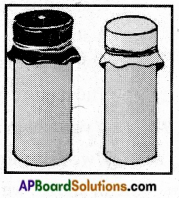
Question 21.
By means of which plants propagate vegetatively through stem?
Answer:
Plants propagate vegetatively through stem by means of stolons, bulbs, corms, tuber etc.

AP SSC 10th Class Biology Important Questions Chapter 6 Reproduction

Question 22.
Through which the Vallisneria, Strawberry propagate vegetatively?
Answer:
Vallisneria, Strawberry propagate vegetatively through stolons.

Question 23.
Which plants produce the new plants through roots?
Answer:
New plants are produced from the roots of Dahlia, radish, carrot etc.

Question 24.
What are the artificial propagation methods in plants?
Answer:
Cutting, Layering and Grafting are the artificial propagation methods in plants.

Question 25.
Which method is used to obtain a plant with desirable characters?
Answer:
Grafting is used to obtain a plant with desirable characters.

Question 26.
Which method will you adopt to get two desirable characters from two different plants in a single plant?
Answer:
I will adopt grafting method to get two desirable characters from two different plants in a single plant.

Question 27.
Which fungus is commonly called as bread mould?
Answer:
Rhizopus is commonly called bread mould.

AP SSC 10th Class Biology Important Questions Chapter 6 Reproduction

Question 28.
How bread mould appears when you observe it under microspore?
Answer:
The common bread mould consists of fine thread like projections called hyphae and thin knob like structures called Sporangia.

Question 29.
In which plants leaf is known as Sporophyll? Why?
Answer:
In fern plants leaf is known as Sporophyll. Because on the lower surface of the leaf sporangia are present.

Question 30.
What is fertilisation?
Answer:
Union of male and female gametes is known as fertilisation.

Question 31.
What is external fertilisation?
Answer:
If the fertilisation occurs outside the body of the organism then it is known as external fertilisation. Eg : Frog and fish.

Question 32.
What is internal fertilisation?
Answer:
If the fertilisation occurs inside the body of the female organism then it is known as internal fertilisation. Eg : Terrestrial animals (Reptiles, Aves, Mammals).

AP SSC 10th Class Biology Important Questions Chapter 6 Reproduction

Question 33.
What are the parts present in male reproductive system of man?
Answer:
A pair of testis, Accessory glands and System of ducts.

Question 34.
The male reproductive organ testis produces?
Answer:
Testis produces male reproductive cells or spermatozoa.

Question 35.
Sperms are temporarily stored in which part of duct system?
Answer:
Sperms are temporarily stored in epididymis of duct system.

Question 36.
What are the accessory glands present in male reproductive system?
Answer:
The accessory glands present in male reproductive system are one prostrate gland . and two cow cowper glands.

Question 37.
The fluid secreted by accessory glands is
Answer:
The fluid secreted by the accessory glands is semen.

Question 38.
What is the function of semen?
Answer:
Semen provide nutrients for sperm to keep alive and helps as a medium for the movement of sperms.

Question 39.
Which hormone regulates the development of the male reproductive organs?
Answer:
The hormone testosterone regulates the development of the male reproductive organs.

AP SSC 10th Class Biology Important Questions Chapter 6 Reproduction

Question 40.
How are the secondary sexual characters are controlled in males?
Answer:
Secondary sexual characters in males are controlled by the male sex hormone testosterone.

Question 41.
Men produce sperm from the age of about?
Answer:
Men produce sperm from the age of about 13 or 14 years and can go on doing so most their lives.

Question 42.
Which are capable of changing the sex of the organism in which they grow like wasp?
Answer:
Some bacteria and other micro-organisms have been found capable of changing the sex of the organism of wasp in which they live.

Question 43.
The female gamete ovum is produced by
Answer:
The female gamete ovum is produced by graffian follicles of Ovary.

Question 44.
What is ovulation?
Answer:
The release of ovum from graffian follicle is known as ovulation.

Question 45.
Fertilisation of ovum occurs in which part of female reproductive system?
Answer:
Fertilisation of ovum occurs in fallopian tube or oviduct of female reproductive system.

AP SSC 10th Class Biology Important Questions Chapter 6 Reproduction

Question 46.
What is placenta?
Answer:
Placenta is the nourishment tissue formed by the outer membrane of the embryo called chorion and the part of the uterine tissue.

Question 47.
When do placenta is formed during the development of embryo?
Answer:
Placenta is formed at around 12 weeks of pregnancy or during the embryonic development.

Question 48.
What keeps embryo moist and protects it from minor mechanical injury?
Answer:
The embryo develop in amniotic fluid filled cavity which keeps it moist and protects it from minor mechanical injury.

Question 49.
Which membrane forms umbilical cord?
Answer:
Allantois membrane which originates from the digestive canal of the embryo forms the major part of tube like structure called umbilical cord.

AP SSC 10th Class Biology Important Questions Chapter 6 Reproduction

Question 50.
What is foetus?
Answer:
From the third month of pregnancy the embryo is called foetus.

Question 51.
What is gestation period?
Answer:
Total time required for the development of embryo and foetus is called gestation period.

Question 52.
What is the gestation period in human beings?
Answer:
The gestation period in human beings is 9 months or 280 days.

Question 53.
Collect the information about gestation periods in different animals.
Answer:
Gestation period in different animals:

Animal Gestation period
Cat and dog 63 days
Horse 330 days
Cow 280 days
Rat and mouse 20-22 days

Question 54.
What is after birth?
Answer:
The muscular contractions of the uterus continue until they push out the tissues of the placenta, which are commonly called the ‘after birth’.

AP SSC 10th Class Biology Important Questions Chapter 6 Reproduction

Question 55.
What are labour pains?
Answer:
The rhythmic contraction and relaxation of muscle layers of the uterus is known as labour pains.

Question 56.
What is colostrum?
Answer:
Colostrum: During the end of pregnancy a watery yellowish lymph like fluid accumulates in the mammary glands. It is known as colostrum.

Question 57.
What is the importance of feeding colostrum to new born baby?
Answer:
It is very important to feed colostrum to the new born baby because it helps in developing the immune system of the child.

Question 58.
What is the need of sexual reproduction?
Answer:
Sexual reproduction help organisms to develop characters that would be help them to adapt better to their surroundings.

Question 59.
In which mountain regions can Sal trees grow?
Answer:
Sal trees grow in the Himalayan mountains.

AP SSC 10th Class Biology Important Questions Chapter 6 Reproduction

Question 60.
What are the different parts of a flower?
Answer:
Sepals, petals, stamens and carpels are the different parts of a flower.

Question 61.
What are stamens and carpels?
Answer:
The reproductive parts of a flower which possess the sex cells or germ cells are called stamens and carpels.

Question 62.
What are unisexual flowers? Give examples.
Answer:
Flowers having either stamens or carpels are called unisexual flowers.
Eg: Bottlegourd, papaya.

Question 63.
What are Bisexual flowers? Give some examples.
Answer:
Flowers having both the stamen and carpel are called bisexual flowers. Eg: Datura.

Question 64.
What are the three parts of carpel or gynoecium?
Answer:
The three parts of carpel or gynoecium are ovary, style and stigma.

AP SSC 10th Class Biology Important Questions Chapter 6 Reproduction

Question 65.
What is self pollination?
Answer:
Plants having flowers. Where reproductive cells of stamen of the flower fertilise the female reproductive cells of the carpel of the same flower is called self pollination.
Eg: Plants of pea family.

Question 66.
How cross fertilisation occurs?
Answer:
If the male cells of flower of a plant fertilise the female cells of flowers on the same or different plants of the same species, the type of pollination is called cross pollination.

Question 67.
What did Darwin showed regarding fertilization of plants?
Answer:
Darwin in 1876 showed that plants when isolated had the greatest tendency to self fertilize while when surrounded by varieties of the same flower, they readily cross fertilize.

Question 68.
Which cells are composed the embryosac of ovule?
Answer:
The embryosac of ovule composed of gametophyte cells.

Question 69.
How many cells and nuclei does an embryosac consisting in majority of flowering plants?
Answer:
The majority of flowering plants have an embryosac consisting of seven cells and eight nuclei.

Question 70.
What is double fertilisation?
Answer:
Double fertilisation: Union of one male nucleus with an egg and the second male nucleus with the fusion nucleus is called double fertilisation.

Question 71.
What is germination?
Answer:
The seed produced after fertilisation contains the future plant or embryo that develops into a seedling under appropriate conditions. This process is called germination.

Question 72.
Who gave the phrase “omnis cellula de cellula”? What does it mean?
Answer:
The ‘phrase omnis cellula de cellula’ means cells arise from pre-existing cells. It was given by Rudolph Virchow who discovered cell division.

AP SSC 10th Class Biology Important Questions Chapter 6 Reproduction

Question 73.
Who stated that the animals can reproduce through binary fission of cells?
Answer:
In 1852 Robert Remak of Germany stated that animals can reproduce through binary fission of cells.

Question 74.
Who discovered the process of mitosis?
Answer:
Mitosis was discovered by Walther Flemming in 1879.

Question 75.
What is the most important discovery of Walther Flemming regarding chromosomes?
Answer:
Walther Flemming’s most important discovery was chromosomes appear double in nature.

Question 76.
Who proposed that chromosomes carried a different set of heritable elements?
Answer:
Wilhelm Roux proposed that chromosomes carried a different set of heritable elements.

Question 77.
What are the hypothesis made by August Weiseman on chromosomes?
Answer:

  1. In successive generations, individuals of the same species have the same number of chromosomes.
  2. In successive cell division the number of chromosomes always remain constant.

AP SSC 10th Class Biology Important Questions Chapter 6 Reproduction

Question 78.
Who confirmed the scheme of mitotic division?
Answer:
The scheme of mitotic division was confirmed in 1904 by Theodor Boveri.

Question 79.
Who discovered the structure of DNA?
Answer:
The structure of (DNA) deoxy ribonucleic acid was discovered in 1953 by James Watson and Francis Crick.

Question 80.
The cells in which organ do not divide?
Answer:
Cells present in organs such as heart and brain of an individual never divide.

Question 81.
What is time required for completion of mitosis?
Answer:
The process of mitosis is completed in 40 to 60 minutes.

Question 82.
What is interphase?
Answer:
The period between two cell divisions is called interphase.

AP SSC 10th Class Biology Important Questions Chapter 6 Reproduction

Question 83.
Into how many phases the interphase can be divided?
Answer:
Interphase can be divided into three phases. They are G1 phase, S phase and G2 phase.

Question 84.
What is G1 phase of interphase?
Answer:
G1 phase is the linking period between the completion of mitosis and the begining of DNA replication (Gap 1 phase).

Question 85.
What is S phase of interphase?
Answer:
S phase is the period of DNA synthesis leading to duplication of chromosomes.

Question 86.
What is G2 phase of interphase?
Answer:
G2 phase is the time between the end of DNA replication and the beginning of mitosis (Gap 2 phase).

Question 87.
Who conducted some experiments using the cell fusion technique on phases of interphase?
Answer:
Potu Narasimha Rao and Johnson conducted some experiments using the cell fusion technique to understand the functional relationship between the phases of interphase.

AP SSC 10th Class Biology Important Questions Chapter 6 Reproduction

Question 88.
What is cytokinesis?
Answer:
Division of cytoplasm is called cytokinesis.

Question 89.
What are the different stages present in mitosis?
Answer:
Prophase, Metaphase, Anaphase and Telophase are the different stages present in mitosis.

Question 90.
In which phase of the mitosis chromosomes split lengthwise to form chromatids?
Answer:
In prophase of the mitosis chromosomes split lengthwise to form chromatids.

Question 91.
During which phase of mitosis chromatids are pulled towards poles?
Answer:
During anaphase of mitosis chromatids are pulled towards poles.

Question 92.
How many haploid daughter cells are formed after meiosis?
Answer:
Four haploid daughter cells are formed after meiosis.

Question 93.
What are the diseases that can be sexually transmitted?
Answer:
Sexually transmitted diseases include bacterial infections such as Gonorrhoea and Syphilis and Viral infections such as AIDS.

AP SSC 10th Class Biology Important Questions Chapter 6 Reproduction

Question 94.
In what way the sexually transmitted diseases spread from person to person?
Answer:
Sexually transmitted diseases spread by unsafe sexual contacts, using infected devices, infected blood transfusion, from an infected mother to child.

Question 95.
Which state has the highest number of HIV patients in the country?
Answer:
Andhra Pradesh and Telangana has the highest number of HIV patients in the country.

Question 96.
Which factors are contributing to the spread of HIV in Andhra Pradesh?
Answer:
Illiteracy, poor health, unemployment, migration, non-traditional sex practise, unethical contacts and trafficking are some of the factors contributing to the spread of HIV in Andhra Pradesh.

Question 97.
Expand “ASHA”.
Answer:
Accredited Social Health Activist.

Question 98.
What is Red ribbon express?
Answer:
Red Ribbon express is an AIDS/HIV awareness campaign train by the Indian Railways. The motto of the Red ribbon express is “Embarking on the Journey of Life”.

Question 99.
What is contraception?
Answer:
The prevention of pregnancy in women by preventing fertilisation is called contraception.

AP SSC 10th Class Biology Important Questions Chapter 6 Reproduction

Question 100.
Which device not only prevents fertilisation but also transmitting some sexually transmitted diseases?
Answer:
Condoms and diaphragm (cap) prevents fertilisation and also useful to not transmitting some sexually transmitted diseases like gonorrhoea, syphilis, AIDS.

Question 101.
What are spermicides?
Answer:
Spermicides are the pills used for killing sperms.

Question 102.
What are the surgical methods to birth control in males and females?
Answer:
Vasectomy for males and Tubectomy for female are the surgical birth control methods in human beings.

Question 103.
What is Vasectomy?
Answer:
In males, a small portion of vas deferens is removed by surgical operation ami both ends are tied properly. This method is called vasectomy.

Question 104.
What is Tubectomy?
Answer:
In females, a small portion of oviducts (fallopian tube) is removed by surgical operation and the cut ends are tied. This prevents the ovum from entering into the oviducts. This method is called Tubectomy.

AP SSC 10th Class Biology Important Questions Chapter 6 Reproduction

Question 105.
What is the marriage age for girls in India?
Answer:
The marriage age for girls in India is 18 years.

Question 106.
What is foeticide?
Answer:
Foeticide is the act of destruction or aborting a foetus because it is female.

10th Class Biology 6th Lesson Reproduction 2 Marks Important Questions and Answers

Question 1.
What are the questions you asked the doctor who visited your school to know “the ways of transmission of HIV”?
Answer:
I shall ask the following questions to the doctor.

  1. What are the ways of transmission of HIV?
  2. How can we prevent the spread of HIV?
  3. What precautions should we take while doing transfusion of blood:
  4. How does HIV transmit from mother to baby?
  5. Why should we use disposable syrenges?

Question 2.
The chromosomal number is reduced to half in the daughter cells produced by meiosis. What happens if the number is not reduced to half in daughter cells?
(OR)
In Meiosis, the chromosome number in the daughter cells are reduced to half that of their parent cells. Guess, what would happen, if the reduction of chromosome number is not done.
Answer:

  1. If the reduction of chromosomes number is not done, the chromosomal number is doubled in the offsprings.
  2. The change in chromosomal number leads to development of abnormal characters in the individual.
  3. The offspring differs from parental generation.
  4. Abnormal characters will be formed in new generation, which are not useful for the existence of individual.

AP SSC 10th Class Biology Important Questions Chapter 6 Reproduction

Question 3.
What questions do you ask a doctor to know about different birth control methods?
Answer:

  1. What is family planning?
  2. What is meant by contraception?
  3. How many types of contraceptive methods are there?
  4. What are the contraceptive devices used for female?
  5. What are the contraceptive devices used for male?
  6. What is tubectomy?
  7. What is vasectomy?
  8. What are surgical methods of birth controls?

Question 4.
Apparao and Ramulamma are a newly married illiterate couple. They don’t want children for few years. Suggest some birth control methods for them.
(OR)
Mention any four birth control methods.
Answer:
a) condoms
b) diaphragm (Cap)
c) pills
d) copper – T
e) loop

Question 5.
Why is it important for gametes to have half the number of chromosomes?
Answer:

  1. If gametes have 2 sets of chromosomes, the number of chromosomes will be 4 sets in zygote after fertilization because of this the chromosomal number will be doubled in each generation. This results in abnormalities in off-spring.
  2. Hence, to maintain a constant number of chromosomes, garnets should have half set of chromosomes.

AP SSC 10th Class Biology Important Questions Chapter 6 Reproduction

Question 6.
Identify the flower parts a, b, c, d and write their main function.
AP SSC 10th Class Biology Important Questions Chapter 6 Reproduction 1Answer:
a) Ovary: Female reproductive organ in flower. It produces female gametes called ovules.
b) Style: Ovary has a pipe like structure called style. It allows the pollen tube to enter the ovary for fertilization.
c) Stamen: These are male parts called androecium. It has two parts. They are filament and Anther.
d) Anther : Produces male gametes called pollen grain.

Question 7.
Draw and label the diagram of human sperm cell.
Answer:
AP SSC 10th Class Biology Important Questions Chapter 6 Reproduction 2

Question 8.
How can we get the desired useful triats with the help of two selected triats by using grafting method?
Answer:

  1. Two plants are joined together in such a way that two stems join and grow as a single plant.
  2. One which is attached to soil is called stock and the cut stem of another plant without roots is called scion.
  3. Both stock and scion are tied with the help of a twine thread and covered by a polythene cover.
  4. Grafting is used to obtain a plant with desirable characters.
  5. This technique is very useful in propagating improved varieties of plants with various flowers and fruits. Ex: Mango, citrus, apple, rose.

Question 9.
Draw the labelled diagram of Embryo-sac A.
Answer:
AP SSC 10th Class Biology Important Questions Chapter 6 Reproduction 3

AP SSC 10th Class Biology Important Questions Chapter 6 Reproduction

Question 10.
Observe the diagram and answer the following questions.
i) Which phases take same time duration?
Answer:
G1 phase and S phase.
ii) In which phase, DMA synthesis takes place?
Answer:
S Phase.

Question 11.
Write the process involved in seedless fruit development with two suitable examples.
Answer:
In some plants ovary directly develops into fruit without the process of fertilization, this phenomenon is called as parthenocarypy.
Ex: Grapes, water melon.

Question 12.
What precautions will you take to keep away from diseases like AIDS and other sexually transmitted diseases?
Answer:

  1. Avoid sex with unknown partners or multiple partners.
  2. Use condom every time.
  3. Use disposable syringes and needles.
  4. Transfusion of safe blood to the patients.
  5. HIV mother can have child with doctor’s advice only.

Question 13.
Observe the diagram and answer the following questions.
AP SSC 10th Class Biology Important Questions Chapter 6 Reproduction 4i) Name male and female reproductive parts of the above figure.
Answer:
Male reproductive parts – anther / pollen grain / stamen
Female reproductive parts – ovary / ovule / style / stigma.

ii) Write the names of (1) and (2) in the diagram.
Answer:

  1. Sepal or calyx
  2. Petal or corolla

Question 14.
When does Parthenogenesis occur? Write names of two animals in which parthenogenesis takes place.
Answer:
a) Parthenogenesis is a process of reproduction where there is a shift from sexual to asexual mode of reproduction.
b) In this process generally the female garnets develops into zygote without fertilization.
c) This strange kind of reproduction occur in bees, ants and wasps.
d) The parthenocarpic zygote develop into male (Monoploid) while the fertilized one developed into female (Diploid)

AP SSC 10th Class Biology Important Questions Chapter 6 Reproduction

Question 15.
Draw the figure of metaphase in mitosis, and write about it.
Answer:

  1. Chromosomes move to spindle equator, centromeres attached to spindle fibres.
    AP SSC 10th Class Biology Important Questions Chapter 6 Reproduction 5
  2. Centromeres split, separating the chromatids.

Question 16.
Prepare 4 questions on meiosis, to conduct a Quiz programme.
Answer:

  1. Where does meiosis occur in?
  2. How many daughter cells are produced at the end of meiosis?
  3. In which phase of meiosis karyokinesis takes place?
  4. Name the scientist who discovered meiosis for the first time.

Question 17.
Write slogans on ‘Child marriages – a social evil’.
Answer:

  1. Child marriage, a loosing game.
  2. She is a child herself, why burden her with another child?
  3. My childhood, my right.
  4. A child should call ‘mother’ but a child should not be called mother.
  5. Good marriages take place slowly. Go slow with children’s marriage.
  6. Say no to child marriage.

Question 18.
Write 5 slogans on the prevention of HIV/AIDS.
Answer:

  1. Open your eyes before AIDS closes them.
  2. Hate the disease but not the diseased.
  3. Spread the knowledge not the virus.
  4. Wear protection to prevent infection.
  5. AIDS brings pain! Girls please obstain.

Question 19.
What is fission? Give examples.
Answer:

  1. Fission is a method of asexual reproduction in which a single-celled organism splits into two or more offsprings.
  2. This splitting usually occurs in a symmetrical manner.
  3. When an organism is split into two offsprings it is called binary fission.
  4. When an organism is split into more offsprings, it is called multiple fission.
  5. This is often the only mode of reproduction for single celled organisms.
    Ex : Paramoecium and bacteria.

AP SSC 10th Class Biology Important Questions Chapter 6 Reproduction

Question 20.
Write a short notes on fragmentation.
Answer:

  1. Fragmentation is a reproductive method in multicellular organisms with relatively simple body organisation.
  2. Some can grow from a separate piece of parent organism. This can be from any part of the body.
  3. This happens only in the simplest such as some flat-worms, moulds, lichens, spirogyra, etc.
  4. Fragmentation is a common mode of reproduction in algae, fungi and many land plants.

Question 21.
What do you know about parthenogenesis? Explain with examples.
Answer:

  1. Parthenogenesis is an asexual reproduction in which unfertilized eggs develop into offsprings.
  2. In this process generally egg develops into new individual without meiosis and fertilization. So the offsprings are diploid.
  3. In some species of animals reproduction occurs only through parthenogenesis. There are no males known in these species. Ex: Rotifers.
  4. In another type of parthenogenesis meiosis does occur and the egg can develop whether fertilized or not.
  5. The monoploid offsprings develop into males and diploid into females.
    Ex: Bees, Ants and Wasps.
  6. Nowadays we are able to develop seed less fruits like watermelon, grapes, pomegranate etc.

Question 22.
Describe the vegetative propagation through the stem with examples.
Answer:

  1. Production of new plants from the vegetative parts such as stem, root, leaves of the existing plant is called vegetative propagation.
  2. Aerial weak stems like runners and stolons, when they touch the ground, give off adventitious roots.
  3. When the connection with the parent plant is broken, the portion with the newly struck roots develops into an independent plant.
  4. Some examples for propagation by stem are from stolons, bulbs, corms and tubers as follows.
    a) Stolons – Vallisneria, Strawberry
    b) Bulbs – Alliumcepa or onion
    c) Corms – Colacasia
    d) Tuber – Potato

AP SSC 10th Class Biology Important Questions Chapter 6 Reproduction

Question 23.
Write short note on artificial propagation method cutting.
Answer:

  1. Cutting is an artificial method of vegetative propagation in which new plants are developed from the cut portion of existing plant.
    AP SSC 10th Class Biology Important Questions Chapter 6 Reproduction 6
  2. Some plants grow individually when a piece of the parent plant having bud is cut from the existing plant.
  3. The lower part of this cutting is buried in moist soil.
  4. After few days the cut parts having buds grow as an individual plant.
    Ex: Rose, Hibiscus.

Question 24.
What is layering? Explain briefly about it.
Answer:

  1. Stems that form roots while still attached to the parent plants are called layers. Propagating the plants in this method is layering.
  2. A branch of the plant with at least one node is bent towards the ground and a part of it is covered with moist soil leaving the tip of the branch exposed above the ground.
  3. After sometime, new roots develop from the part of the branch hurried in the soil.
  4. The branch is then cut off from the parent plant, later it develops roots and grows to become a new plant. Ex: Nerium.

Question 25.
Write a short note on Grafting.
Answer:

  1. Grafting is a method of artificial vegetative propagation in which two plants are joined together in such a way that two stems join and grow as a single plant.
    AP SSC 10th Class Biology Important Questions Chapter 6 Reproduction 7
  2. One which is attached to soil is called stock and the cut stem of another plant without roots is called scion.
  3. Both stock and scion are tied with help of a twine thread and covered by a polythene cover.
  4. After few days both will unite by forming new tissue and grow as a single one.
  5. Grafting is used to obtain a plant with desirable characters.
  6. Plants in which grafting is done more in mango, apple, citrus, plants.

AP SSC 10th Class Biology Important Questions Chapter 6 Reproduction

Question 26.
What are the advantages of grafting?
Answer:

  1. Grafting enables us to combine the most desirable characteristics of the two plants (scion and stock) in its flower and fruits.
  2. By grafting method, a very young scion can be made to flower and produce fruits quite fast when it is grafted to the stock.
  3. Grafting can be used to produce varieties of seedless fruits.

Question 27.
How is tissue culture more beneficial than other traditional methods for the artificial propagation of plants? (OR)
What is tissue culture? What are its uses?
Answer:

  1. The traditional methods for the artificial propagation of plants are being replaced by the modern methods of artificial propagation of plants involving tissue culture, as it is more beneficial than the traditional methods.
  2. In tissue culture, a few plant cells or plant tissue are placed in a growth medium with plant hormones in it and it grows into new plants.
  3. Thousands of plants can be grown in very short interval of time.
  4. There will be no climatic impact on the propagation, so multiplication can be done throughout the year.
  5. It is possible to obtain plants that are free from pathogens.

Question 28.
How does the Rhizopus propagate?
Answer:

  1. Rhizopus propagates by means of spores.
    AP SSC 10th Class Biology Important Questions Chapter 6 Reproduction 8
  2. The Rhizopus parent plant produces hundreds of microscopic reproductive units called spores.
  3. When the spore case of the plant bursts, the spores spread into air.
  4. These air borne spores fall on food or soil, under favourable conditions like damp and warm conditions, they germinate and produce new plants.

AP SSC 10th Class Biology Important Questions Chapter 6 Reproduction

Question 29.
Write a short note on spore formation. (OR)
How spores are produced in sporangia of fungi?
Answer:

  1. Spore formation is a method of asexual reproduction which occurs through microscopic reproductive units called spores.
  2. Most of the fungi like rhizopus, mucor etc., bacteria and non-flowering plants such as ferns and mosses reproduce by the method of spore formation.
  3. In fungi like rhizopus spores are produced in some specialised structures called sporangia which bursts and spreads the spores into air. These spores when fall on food or soil under favourable conditions germinate and produce new plants.
  4. In non-flowering plants like fern, the leaves called sporophyll bears clusters of sporangia on their lower side. These sporangia produce the spores which produce the new plant when it falls on ground under favourable conditions.

Question 30.
How is external fertilisation different from internal fertilisation? (OR)
What are the differences between external and internal fertilisation?
Answer:

  1. Fertilisation that takes place outside the body of mother is called external fertilisation. This is most common in animals like fishes and amphibians. As the chance of fertilisation is controlled by nature it becomes necessary to give rise to vast number of eggs and sperms by these animals.
  2. Fertilisation that takes place inside the body of mother is called internal fertilisation. This is common in most of the land animals. As the chance of fertilisation is not controlled by the nature, these animals generally produce less number of eggs.

Question 31.
Write a short note on ovulation. (OR)
What is ovulation? How it occurs?
Answer:

  1. Release of the egg or ovum is called ovulation.
  2. The ova develop in tiny cellular structures in ovary called follicles, which at first look like cellular bubbles.
  3. As a follicle grows, it develops a cavity filled with fluid.
  4. Each follicle contains a single ovum.
  5. When an ovum is mature, the follicle ruptures at the surface of the ovary and the tiny ovum is flushed out.
  6. This release of ovum is called ovulation.

AP SSC 10th Class Biology Important Questions Chapter 6 Reproduction

Question 32.
How does the uterus get adapted to receive the embryo?
Answer:

  1. The uterus at the time of fertilization is beautifully adapted to receive the developing embryo, providing it with food and disposing of its wastes.
  2. A few days prior to this time, the uterus was small, its tissues were thin, and its supply of blood vessels was poor.
  3. When the fertilized egg or zygote is about to enter the uterus become much larger, its inner wall becomes thick, soft and moist with fluid, its blood supply is greatly increased and waiting for an embryonic occupant.

Question 33.
What is colostrum? What is its importance?
Answer:

  1. During the end of pregnancy, a watery lymph like fluid accumulates in the mammary glands.
  2. This is called colostrum.
  3. For the first few days after the baby is born, the mammary glands secrete only colostrum.
  4. It is very important to feed the new born baby with colostrum because it helps in developing the immune system of the child.

Question 34.
What is the importance of mitosis in human beings?
Answer:

  1. Mitosis is the cell division that transforms a human fertilized egg into a baby in nine months and into an adult in the next 20 years.
  2. The bone marrow cells actively divide by mitosis to produce red blood cells.
  3. Mitosis helps in replacing the worn out cells in the skin.
  4. Mitotic divisions in the cells surrounding the wound helps in cease the wound and healing.

Question 35.
Collect the information about the significance of the experiments done by Dr Potu Narasimha Rao and Johnson.
Answer:

  1. Nearly 4 decades back Dr.P.N. Rao and Johnson did some elegant experiments using the cell fusion technique to understand the functional relationship between the phases of cell cycle.
  2. These experiments have, for the first time provided evidence that the progression of cells through the cell cycle is sequential and unidirectional and are controlled by a series of chemical signals that can diffuse freely between nucleus and cytoplasm.
  3. These experiments revealed for the first time the structure of interphase chromosomes that are not ordinarily visible under the microscope.
  4. These experiments are considered to be a ‘milestone’ in the cell cycle studies.

AP SSC 10th Class Biology Important Questions Chapter 6 Reproduction

Question 36.
Ramu said that it is very essential to create more awareness in Andhra Pradesh on the risk of HIV infection and AIDS. Do you support him? If so, how can you support his statement?
Answer:
Yes, what Ramu said is right. I support his statement with the following reasons.

  1. Andhra Pradesh has the highest number of HIV patients in the country.
  2. According to official statistics, the state had 5 lakh of the 24 lakh HIV positive patients
    in the country during 2011-12.
  3. While one in every 300 adults is suffering from HIV elsewhere, in Andhra Pradesh one in every 100 adults is a HIV patient, that is almost one per cent.
  4. The prevalence of HIV is 1.07 per cent among males and 0.73 among females in the state, which again is higher than in other states.

Question 37.
Briefly explain about the contraception and contraceptive methods.
Answer:
The prevention of pregnancy in the woman by preventing fertilisation is called contraception. Any device or chemical which prevents pregnancy in a woman is called a contraceptive. Contraceptive methods are of various types and used by any of the partners as preferable. Some of the contraceptive methods are:

  1. Use of physical devices such as condoms and diaphragm (cap).
  2. Use of hormonal pills which stop the ovaries from releasing ovum into oviduct.
    These pills can be induced either orally or inserting into female reproductive organ vagina.
  3. Use of spermicides that kills the sperms.
  4. Use of intra-uterine device called copper – T, loop, etc.
  5. Use of surgical methods such as vasectomy for male and tubectomy for female.

AP SSC 10th Class Biology Important Questions Chapter 6 Reproduction

Question 38.
Classify the given organisms basing on the type of reproduction.
Man, Flatworm, Mould, Dog, Bacteria, Frog, Fern, Datura, Hen, Yeast.
Answer:

Sexually reproducing organisms Asexually reproducing organisms
Man Flat worm
Dog Mould
Frog Bacteria
Datura Fern
Hen Yeast

Question 39.
What will happen if the amnion is ruptured before the foetus is developed completely?
Answer:

  1. Amnion is the embryonic membrane that grows around the embryo itself.
  2. The cavity within the amnion is filled with a fluid called amniotic fluid, which keeps the growing embryo moist and protects it from minor mechanical injury.
  3. If the amnion ruptures by accident before the foetus developed completely, the amniotic fluid is released out through vagina.
  4. As there is no protective fluid around the foetus, it starts getting damaged.
  5. So if possible delivery must done immediately by surgerical method, otherwise abortion must be done.
  6. If baby dies inside the uterus which leads to infections in uterus causing problems
    to mother that leads to death.

Question 40.
How will you appreciate the contribution of August Weiseman to the cell biology?
Answer:

  1. Science is not advanced only by the collection of data. Someone must think about and interpret the data. August Weiseman belongs to this category who think and interpret the data.
  2. Even though his poor eyesight not allowed him to use a microscope to study cells, he made great contribution to the cell biology making use of his thinking capacity and interpretation skills.
  3. He hypothesised that
    a) In successive generations, individuals of the same species have the same number of chromosomes.
    b) In successive cell division, the number of chromosomes remains constant.
  4. His hypothesis proved right in case of mitosis.
  5. We should take such a great person who overcame his defect with his will as our role model.

AP SSC 10th Class Biology Important Questions Chapter 6 Reproduction

Question 41.
How will you appreciate the contribution of Dr. P.N. Rao to the ceil biology?
Answer:

  1. Dr. Potu Narasimha Rao, a renowned scholar and eminent cytologist came from a poor family in Muppalla village of Guntur district.
  2. He did his research work on the cytogenetics of tobacco plant and cancer cells in culture medium.
  3. He conducted research in cell kinematics and triggering factor of cell division i.e., mitosis.
  4. He observed the interphase and its three phases.
  5. To understand the functional relationship between these phases he did elegant experiments on cell fusion technique along with his research associate Dr.Johnson.
  6. His researches revealed that the cell cycle is sequential, unidirectional and controlled by a series of chemical signals.
  7. His experiments are considered to be a milestone in the cell cycle.
  8. He is an exemplary person who proved that poverty is not a barrier to the talent and wisdom.

Question 42.
Write briefly about natural vegetative propagation in plants.
Answer:

  1. In natural vegetative propagation new plants are produced from stem, root, leaves of old plants without the help of any reproductive organs.
  2. In bryophyllum small plants grow at the edge of leaves.
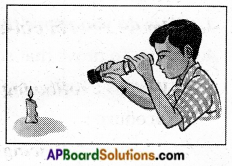
  3. Aerial weak stems like runners stolons, when they touch the ground give it adventitious roots.
  4. When the connection with the parent plant is broken the stem portion with the adventitious roots develops into an independent plant.
  5. Some examples for propagation by stem are from stolons, bulbs, corms, tuber etc.
    AP SSC 10th Class Biology Important Questions Chapter 6 Reproduction 9
  6. Stolons – Vallisneria, strawberry.
    Bulbs – Onion (Alliumcepa)
    Corms – Colacasia
    Tuber – Potato

AP SSC 10th Class Biology Important Questions Chapter 6 Reproduction

Question 43.
What are sexually transmitted diseases and mention the ways to prevent them?
Answer:

  1. A disease which can be transmitted through sexual contact is called sexually transmitted disease or STD.
  2. These include bacterial infections such as gonorrhoea, syphilis, Herpis and viral infections such as herpes and AIDS.
  3. Lack of hygiene is usually a major factor in providing conditions for spread of STDs.
  4. But unprotected sex with multiple and unknown partners is the highest reason for the spread of STDs.
  5. Some of the ways to prevent STD are as follows.
    a) Being faithful to one’s life partner.
    b) Avoid sexual contact with unknown person.
    c) Using condom during sexual intercourse.
    d) Maintaining personal hygiene.

Question 44.
Why more complex organisms cannot give rise to new individual through regeneration ?
Answer:

  1. Many organisms have the ability to give rise to new individual organisms from their body parts.
  2. Regeneration happens through mitosis and a particular type of tissue can give rise to its own kind only.
  3. In complex organisms, different tissues and organs have altogether different structures.
  4. Regenerating a different kind of tissue from another kind is not possible.
  5. Hence complex organisms are not able to give rise to new individuals through regeneration.

Question 45.
How an organism will be benefited if it reproduces through spores?
Answer:

  1. Reproduction through spores gives several advantages to an organism like they are produced in very large numbers and it helps in propagation of species.
  2. Spores can remain dormant till favourable conditions become available.
  3. Spores help an organism to overcome unfavourable conditions.
  4. Spores can be spread through water, air or animals and thus is good for the spread of an organism to more places.

AP SSC 10th Class Biology Important Questions Chapter 6 Reproduction

Question 46.
What is the role of the placenta in embryo development?
Answer:

  1. Placenta is a tissue formed by the cells from the embryo and the mother.
  2. It is formed around 12 weeks of pregnancy and becomes an important structure for nourishment of the embryo.
  3. Placenta is a disc which is embedded in the uterine wall. It contains villi on the embryo’s side of the tissue.
  4. On the other side mother’s blood spaces are present.
  5. This provides a large surface area for diffusion of glucose, oxygen and other nutrients from the mother of the embryo.

Question 47.
Why do we practise vegetative propagation for growing some types of plants?
(OR)
Why vegetative propagation is adopted over other types of propagation?
Answer:
Vegetative propagation is practised in some plants because

  1. It is the only method of reproduction in seed less plants.
  2. We get more number of matured plants in a very short time.
  3. Thousands of plants can be grown in very short time.
  4. This method can help the breeder in preserving the characters he need.
  5. It is very easy and economical method for the multiplication of ornamental plants.

Question 48.
What is Mitosis? Which type of cells it occurs in organisms? Write about the different stages of it.
Answer:

  1. Mitosis is a method of cell division, in which the nucleus divides into two daughter nuclei.
  2. Each containing the same number of chromosomes as the parent nucleus.
  3. Mitosis takes place in all body cells which retains same number of chromosomes.
  4. Different stages of mitosis:
    1. Prophase
    2. Metaphase
    3. Anaphase
    4. Telophase

10th Class Biology 6th Lesson Reproduction 4 Marks Important Questions and Answers

AP SSC 10th Class Biology Important Questions Chapter 6 Reproduction

Question 1.
Explain the changes involved in the formation of seed from Ovule.
(OR)
Pollen grain reached the stigma of a flower. Explain the changes that occurs up to the formation of seeds in a sequence.
Answer:
Process of double fertilization:

  1. At the time of fertilization there will be a total of 7 cells arranged in three groups in a mature embryo sac.
  2. They are one egg (female garnet) two synergids, one central cell (secondary or polar nucleus) and three antipodals.
  3. While all the cells are in haploid (n) condition only the polar nucleus is diploid (2n). This is due to the fusion of two nuclei.
  4. The synergids are also known as helper cells.
  5. Fertilization is the process of fusion of male and female gametes. For the fusion pollen grains have to reach the surface of the stigma. This is called pollination.
    AP SSC 10th Class Biology Important Questions Chapter 6 Reproduction 10
  6. Pollen grain received by the stigma, germinate and give rise to pollen tubes. The pollen tube has two male nuclei.
  7. Usually the pollen tube enters the ovule through microphyle and discharges the two male gametes into the embryo sac.
  8. One male nucleus (garnet) approaches the egg and fuses with it to form diploid (2n) zygote this is called first fertilization.
  9. The other male nucleus reaches the secondary nucleus (2n) (polar nucleus) and fuses with it to form endosperm nucleus which will be triploid. This is second fertilization. Thus double fertilization occurs in embryosac.
    Changes after double fertilization:
  10. After double fertilization, the ovule increases in size rapidly as a result of formation of endosperm tissue by mitosis and the development of new embryo.
  11. The embryo consists of cotyledons an epicotyl and a hypocotyl. The cotyledons become greatly enlarged because of stored food for the seedling.
  12. The zygote divides several times to form an embryo within the ovule. The ovule develops a tough coat and is converted into a seed. The ovary grows to form a fruit.

AP SSC 10th Class Biology Important Questions Chapter 6 Reproduction

Question 2.
Observe the given diagram and answer the following questions.
AP SSC 10th Class Biology Important Questions Chapter 6 Reproduction 12i) What are the four main parts of a flower?
Answer:
Calyx, Corolla, Androecium and Gynoecium are the main parts of a flower.

ii) Which parts of the flower produces gametes?
Answer:
Androecium and gynoecium produces gametes.

iii) Which parts of the flower help in pollination?
Answer:
Petals or corolla help flower in pollination.

iv) Which part protect the flower during its bud stage?
Answer:
Sepals or calyx protect flower in bud stage.

v) Which part of the flower will turn into a fruit in the future?
Answer:
Ovary of the flower will change into fruit.

Question 3.
Organisms reproduce asexually in many ways. Some of the organisms are given below. Fill the below table based on the collected information about the organism and mode of asexual reproduction in it.
a) Onion b) Spirogyra c) Strawberry d) Ginger e) Honey-bee f) Paramoecium g) Planaria h) Yeast

Name of the organism Mode of Asexual reproduction

Answer:

Name of the organism Mode of Asexual reproduction
a) Onion Bulb
b) Spirogyra Fragmentation
c) Strawberry Stolons
d) Ginger Rhizome
e) Honey – bee Parthenogenesis
f) Paramoecium Binary fission
g) Planaria Regeneration
h) Yeast Budding

AP SSC 10th Class Biology Important Questions Chapter 6 Reproduction

Question 4.
i) Draw a neat labelled diagram of L.S. of flower.
ii) What are the sexual parts in the flower ?
Answer:
i)
AP SSC 10th Class Biology Important Questions Chapter 6 Reproduction 11ii) A. Androecium or Stamen
B. Gynoecium or Pistil

Question 5.
Read carefully and answer the following questions.

According to Weismann prediction, every organism undergoes two kinds of cell divisions. In Mitosis, there is no change in chromosomal number (2n) and in Meiosis, chromosomal number is reduced to half (n).

i) What does ‘n’ and ‘2n’ indicate?
Answer:
‘n’ indicates haploid state. ‘2n’ indicates diploid state.

ii) In which cells, Meiosis takes place?
Answer:
Meiosis occurs in sex cells during the formation of gametes.

iii) What happens, if chromosomal number is not reduced in Meiosis?
Answer:
The chromosomal number not constant in successive generations.

iv) Which type of cell division occurs in the skin cells?
Answer:
Mitosis

AP SSC 10th Class Biology Important Questions Chapter 6 Reproduction

Question 6.
Observe the diagram and answer the following.
AP SSC 10th Class Biology Important Questions Chapter 6 Reproduction 13
i) Which part produce the female gamete?
Answer:
Ovary

ii) Where does the fertilization takes place in female reproductive system?
Answer:
Fallopian tube

iii) Where does the embryo develops until it is ready to born?
Answer:
Uterus

iv) In some cases doctor’s cut and tie the cut ends of the fallopian tubes. What is the name of surgery?
Answer:
Tubectomy

Question 7.
Briefly explain the stages of cell cycle.
Answer:
The process of cell division is called “mitosis”. The period between two cell divisions is called “Interphase”.
This is actually the period when the genetic material makes it’s copy so that it is equally distributed to the daughter cells during mitosis. Interphase can be devided into three phases.
G1 Phase: This is the linking period between the completion of mitosis and the beginning of DNA replication (GAP-1 Phase). The cell size increase during this period.
S Phase: This is the period of DNA synthesis (Synthesis phase) leading duplication of chromosomes.
G2 Phase: This is the time between the end of DNA replication and the beginning of mitosis. Cell organells devide and prepare chromosome for mitosis.

AP SSC 10th Class Biology Important Questions Chapter 6 Reproduction

Question 8.
i) Draw a labelled diagram of the human male reproductive system.
ii) What is the function of testosterone?
Answer:
i) Male reproductive system:
AP SSC 10th Class Biology Important Questions Chapter 6 Reproduction 14ii) The function of testosterone hormone is maintaining of secondary sexual chracters in males.

Question 9.
Describe the life cycle of a flowering plant with a help of neat labelled diagrams. (OR) Draw the life cycle of a flowering plant.
Answer:

  1. Adult plant produces flowers:
    When the plant matures and is ready to reproduce, it develops flowers. Flowers are special structures involved in sexual reproduction, which includes pollination and fertilisation.
    AP SSC 10th Class Biology Important Questions Chapter 6 Reproduction 15
  2. Pollination: The transfer of pollen grains from the anther of a stamen to the stigma of a carpel is called pollination.
  3. Fertilisation:
    i) After pollen grains falls on the stigma fertilization occurs when the male gamete present in pollen grains joins with the female gametes present in the ovule.
    ii) In the ovary the male nucleus of pollen combines with the nucleus of female gamete or egg present to form zygote.
  4. Formation of fruit and seed: After fertilisation, a combined cell i.e. zygote grows into an embryo within a seed formed by the ovule.
  5. Each seed contains a tiny plant called an embryo which has root, stem and leaf parts ready to grow into a new plant when conditions are favourable.
  6. Another part of the flower (the ovary) grows to form fruit, which protects the seeds and helps them spread away from the parent plant to continue the cycle.

AP SSC 10th Class Biology Important Questions Chapter 6 Reproduction

Question 10.
Analyze the following information and answer the following questions.

S.No. Name of the plant Method of propagation
1. Mango Grafting
2. Rose, Hibiscus Cutting
3. Jasmine Layering
4. Bryophyllum Small plants grow on edges of leaves
5. Colacasia Cor ms
6. Onions Bulbs

i) What do you call the given reproduction methods?
Answer:
Given reproduction methods are called ‘vegetative propagation’.

ii) What is the major difference between sexual reproduction and vegetative reproduction in plants?
Answer:
In sexual reproduction gametes form zygote. Plant parts like root, stem and leaf are used in vegetative reproduction. It is one of asexual method.

iii) Potato plants do not produce seeds. How can you propagate this plant?
Answer:
Potato plants propagates through the ‘eyes’.

iv) What are the advantages of propagating plants with the above given methods?
Answer:
In vegetative propagation

  1. More plants are produced in less time
  2. Characters are not changed.
  3. It would be possible to develop new varieties with useful characters.

Question 11.
Explain the methods of artificial propagation in various plants.
Answer:
Artificial propagation:

  1. Cutting: Some plants can grow individually when a piece of the parent plant having bud is cut off from the existing plant. The lower part of this cutting is buried in moist soil.
    AP SSC 10th Class Biology Important Questions Chapter 6 Reproduction 16
    After few days the cut parts having buds grow as an individual plant after developing roots. E.g. Rose, Hibiscus.
  2. Layering: A branch of the plant with atleast one node is bent towards the ground and part of it is covered with moist soil. After a few days new roots develop from the part of the branch buried in the soil. The branch is then cut off from the parent plant.
    E.g: Nerium, Jasmine
    AP SSC 10th Class Biology Important Questions Chapter 6 Reproduction 17
  3. Grafting: Two plants are joined together in such a way that two stems join and grow as a single plant. This technique is very useful in propagating improved varieties of various flowers and fruits. Grafting is used to obtain a plant with desirable character. E.g: Mango, citrus, apple, rose.
    AP SSC 10th Class Biology Important Questions Chapter 6 Reproduction 18

AP SSC 10th Class Biology Important Questions Chapter 6 Reproduction

Question 12.
Observe the following figures and find the stages of cell division and explain.
AP SSC 10th Class Biology Important Questions Chapter 6 Reproduction 19Answer:
In the mitotic cell division, the division of nucleus (karyokinesis) followed by the division of cytoplasm (cytokinesis). Finally brings about the formation of two daughter cells. There are four stages in mitosis division.
They are

  1. Prophase
  2. Metaphase
  3. Anaphase
  4. Telophase
1) Prophase 1) Chromosomes condense and get coiled. They become visible even in light microscope. Nucleoli become smaller.
2) Chromosomes split lengthwise to form chromatids, connected by centromeres.
3) Nuclear membrane disappears.
4) Centrosome, containing rod-like centrioles, divide and form ends of spindle
2) Metaphase 1) Centrosomes move to spindle equator, spindle fibres attached to centromeres.
3) Anaphase 1) Centromeres split, separating the chromatids.
2) Spindle fibres attached to centromeres contract, pulling chromatids towards poles.
4) Telophase 1) Chromatids elongate, replication at this stage to become chromosomes and become invisible.
2) Nuclear membrane form round daughter nuclei.
3) Cell membranes pinches into form daughter cells (animals) or new cell wall material becomes laid down across spindle equator (plants)
4) Nucleus divides into two and division of cytoplasm starts.
Two cells are form.

Question 13.
Mention the stages of Mitosis with the help of diagrams. Explain the changes that takes place in Prophase.
Answer:
Mitosis is a method of cell division, in which the nucleus divides into two daughter nuclei each containing the same number of chromosomes as the parent nucleus. Mitosis takes place in all body cells which retains same number of chromosomes.
Different stages of mitosis:
1) Prophase 2) Metaphase 3) Anaphase 4) Telophase
AP SSC 10th Class Biology Important Questions Chapter 6 Reproduction 20

1) Prophase

  1. In this phase chromosomes condense and get coiled.
  2. They become visible even in light microscope.
  3. Nucleoli becomes smaller.
  4. Chromosome split lengthwise to form chromatids, connected by centromeres.
  5. Nuclear membrane breaks down.
  6. Centrosome containing rod like centrioles, divide and form ends of spindle.

AP SSC 10th Class Biology Important Questions Chapter 6 Reproduction

Question 14.
Describe the process of double fertilization in plants. Explain the uses of endosperm that is formed.
Answer:
Double fertilization:

  1. In flowering plant germinated pollen grain forms pollen tube.
  2. The end of the pollen tube ruptures and two male garnets are released in the Embryosac.
  3. Out of two male garnets one male garnet fuses with female garnet which is called fertilization.
  4. Another male garnet fuses with the secondary nucleus and forms endosperm.
  5. So in flowering plant fertilization occures twice hence it is called double fertilization.

Uses of Endosperm:

  1. Cotyledons develops by utilizing endosperm.
  2. The Cotyledons utilizes the stored food in the endosperm.
  3. Some of the plants utilizes the endosperm completely and changes in to seed.
  4. Because of the stored food the size of the cotyledons increases.

Question 15.
Explain any two natural and two artificial vegetative propagation methods to produce more number of plants in less time period with examples.
Answer:
Natural propagation:
i) Leaves – Small plant grow at the edge of the leaves. Ex: Bryophyllum
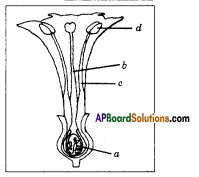
ii) Stems:
a) Stolon – Ex: Jasmine, strawberry b) Bulbs – Ex: Onion
c) Corns – Ex: Colocasia d) Rhizome – Ex: Ginger e) Tuber – Ex: Potato
iii) Root – Ex: Roots of murayya, guava
Artificial propagation:
Cutting: Some plants can grow individual when a piece of parent plant having bud is cut off from the existing plants. Ex: Rose, Hibiscus.
Layering: A branch of the plant with at least one node is bent towards the ground and a part of it is covered with moist soil leaving the tip of the branch exposed above the ground. Ex: Nerium, Jasmine.
Grafting: Two plants are joint together in such a way that stems join and grow as a single plant one which is attached to soil is called stock and stem of another plant without roots is called scion. Both stock and scion are tied with a twine thread and cover by a polythene cover. Ex: Mango, citrus, apple, rose.

AP SSC 10th Class Biology Important Questions Chapter 6 Reproduction

Question 16.
Read the following table and answer the following questions.

SI. No. Structure Location
1. Tricuspid valve Right auriculo-ventricular aperture
2. Guard cells Epidermis of leaves
3. Glomerulus Nephron
4. Alveoli Lungs
5. Acrosome Above the head of a sperm.

i) Name the structure concerned to the heart.
Answer:
Tricuspid valve

ii) What is the function of acrosome?
Answer:
It helps the sperm in penetrating into ovum.

iii) Name the structures which are helpful for gaseous exchange.
Answer:
Alveoli and guard cells

iv) Name the part performing Excretion.
Answer:
Glomerulus

Question 17.
a) Draw a neat and labelled diagram of Human female reproductive system.
b) What happens when the Fallopian tubes are closed?
Answer:
a) Female reproductive system
AP SSC 10th Class Biology Important Questions Chapter 6 Reproduction 21b) If fallopian tubes are closed the sperm can not reach the ova, fertilization will not happen and zygote will not form.
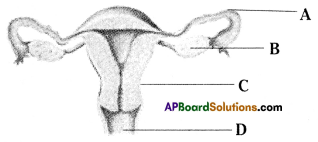
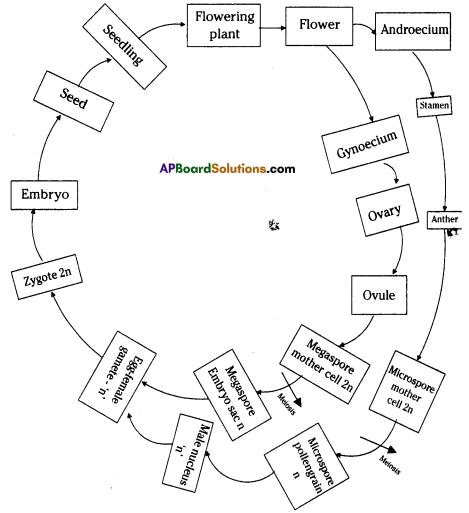
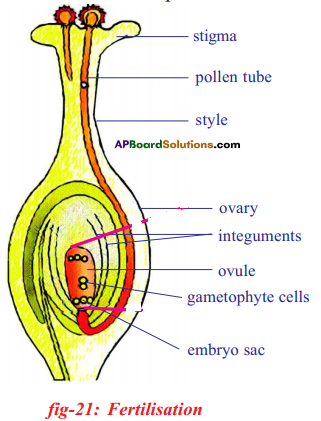
AP SSC 10th Class Biology Important Questions Chapter 6 Reproduction

Question 18.
Observe the following table.

Reproduction system Organisms
Fission Paramoecium, Bacteria
Budding Yeast, Hydra
Fragmentation Flatworms, Spirogyra
Rhizome Ginger, Turmeric
Cutting Rose, Hibiscus
Grafting Citrus, Apple

On the basis of information given in the table write- the answers to the following questions.
i) Write the names of two organisms that show Asexual reproduction.
Answer:
Yeast, Hydra, Bacteria, Paramoecium (any two you may write)

ii) Write two artificial vegetative propagation methods mentioned in the table.
Answer:
Cutting, Grafting

iii) Write the names of two plants, which undergo natural vegetative propagation mentioned in the table.
Answer:
Ginger, Turmeric

iv) In fission, how many organisms can we get from one organism?
Answer:
Two

Question 19.
Among the following organisms can we see asexual reproduction? Write about the method of asexual reproduction in any of the two organisms.
Answer:
а) Paramoecium b) Yeast c) Spirogyra d) Amoeba e) Planaria
Yes, we can see asexual reproduction in all the following organisms.

Method of asexual reproduction – Organism
Binary fission                                – Paramoecium, amoeba
Budding                                        – Yeast
Fragmentation                              – Spirogyra
Regeneration                                – Planaria

1) Binary fission in Paramoecium: A single cell divides into two equal daughter cells. First the cytoplasm divides into two parts followed by nuclear division.
2) Asexual reproduction in Yeast: Budding is the common method of asexual reproduction in yeast. In this method, yeast cell wall at a particular region becomes soft and bulges into an outgrowth called bud. Cytoplasm enters into this bulge and then nucleus divides mitotically into two nuclei, one moves into the bud. Finally bud is detached from the parent cell and grows into an independent yeast cell.

AP SSC 10th Class Biology Important Questions Chapter 6 Reproduction

Question 20.
See the adjacent picture. Which type of pollination will occur in this ? Why do you think so?
AP SSC 10th Class Biology Important Questions Chapter 6 Reproduction 12Answer:

  1. Self-pollination occurs if stamens and carpels matures at the same time.
  2. If they mature at different times, cross pollination occurs.
  3. Cross pollination occurs in this plant.
  4. For cross pollination the pollen grains are carried from other plants belonging to the same species.
  5. The mechanism of dispersal of pollen grains from one plant to other plant is facilitated mostly by wind and insects.
  6. Cross pollination is believed to be advantageous for the plant.
  7. The seeds produced by the flower will contain another source of genetic material
  8. Which may contain genes which are advantageous to the survival of the seedlings.

Question 21.
What are the consequences if meiosis do not happen in the body cells of the organism?
Answer:

  1. Each organism has a fixed number of chromosomes.
  2. This number has to be maintained in its offspring.
  3. Any sudden change in the number of chromosomes will be harmful to the offspring. Assume parent has 10 chromosomes.
  4. In the absence of meiosis during sexual reproduction gametes will also have the same number of chromosomes as parent i.e., 10 chromosomes.
  5. Union of female and male gametes occur forming zygote during sexual reproduction. The number of chromosomes doubled in zygote will have 10+10 chromosomes.
  6. In the next generation, the offspring will have forty chromosomes. If this continues cells in the offsprings will have thousands of chromosomes within few generation.
  7. This results in formation of abnormalities in each generation. Hence by way of meiotic division, the chromosome number is maintained constant from generation to generation.

AP SSC 10th Class Biology Important Questions Chapter 6 Reproduction

Question 22.
Describe different artificial vegetative methods to produce large scale production of plants.
Answer:

  1. Different artificial vegetative propagation methods are cutting, layering, grafting and tissue culture methods.
  2. Cutting: Some plants grow individually when a piece of parent plant having bud is cut from the existing plant. After burying in the soil the cut parts having buds grow as an individual plant after developing roots. E.g. Rose.
  3. Layering: A branch of the plant with at least one node is bent towards the ground and part of it is covered with moist soil. After sometime, new roots develop from the part of the branch hurried in the soil. The branch is then cut off from the parent plant. E.g: Nerium.
  4. Grafting: Two plants are joined together in such a way that two stems join and grow as a single plant. This technique is very useful in propagating improved vari¬eties of various flower and fruits. Grafting is used to obtain a plant with desirable character. E.g: Mango, citrus, apple, rose.
  5. Tissue culture: In this method, few plant cells or plant tissues are placed in a growth medium with plant hormones in it and it grows into new plants. Thousands of plants can be grown in very short interval of time.

Question 23.
i) Labelled parts of A, B, C, D above drawn Human female reproductive system.
AP SSC 10th Class Biology Important Questions Chapter 6 Reproduction 22
ii) In which part fertilization takes place?
iii) Which part is in connection with implantation?
iv) What is ovulation?
Answer:
i) A: Fallopian tube
B: Ovary
C: Uterus
D: Vagina
ii) Fertilization takes place in fallopian tube.
iii) Uterus
iv) Release of ovum from graffian follicle of ovary is known as ovulation.

AP SSC 10th Class Biology Important Questions Chapter 6 Reproduction

Question 24.
Write some programmes conducted by you to bring awareness in the people about health and hygeine and family planning?
Answer:

  1. Organising Health camps on World Health day to people of the village.
  2. Conducting immunisation programs for every three months.
  3. Supplying tablets on the deworming day.
  4. Organising seminars by expert doctors on individual health and cleanliness programs.
  5. Propagating small family norms conducting camps for family planning operations.
  6. Educating the masses through pamplets on the needs of taking balanced diet.
  7. Need of using toilets and washing hands and legs before and after meals.
  8. Educating the people by conducting adult education centres. This is basically required for enlightening the people on health aspects.

Question 25.
Government made an act on determining sex through ultrasound scanning and telling it as crime. What do you do to tell this to others?
Answer:

  1. I will educate people knowing the sex of foetus inside mother’s womb is a severe crime as per the act made by government.
  2. The purpose of ultrasound tests are to know the growing condition of the foetus and also to see whether it is suffering with severe ailments.
  3. By knowing the sex of the foetus, if it is female people are ready for aborting it.
  4. This leads to reduction in male female ratio in the country.
  5. Children either male or female are equal to parents.
  6. We should see proper development of girl child after her birth.

Question 26.
Write about the embryonic membranes that nourish, protect and support to the embryo?
Answer:

  1. The growing embryo form two membranes – Chorion and Amnion.
  2. Chorion establishes connection with the walls of the uterus and helps in the supply of nutrients to the embryo and in the removal of wastes from the embryo.
  3. Amnion forms a sac like structure around the embryo and amniotic fluid is present between layers of Amnion.
  4. Amnion and Amniotic fluid give protection to the embryo against mechanical shocks.
  5. Placenta is a tissue formed around 12 weeks of pregnancy by the cells from the embryo and mother.
  6. Embryo receives all the required nutrients and oxygen for its metabolism from the mother through the blood vessels present in the placenta.
  7. Another membrane called allantois, which originates from the digestive canal of the embryo forms the major part of a tube like structure called umbilical cord.
  8. Umbilical cord contains very important blood vessels that connect the embryo with the placenta.

AP SSC 10th Class Biology Important Questions Chapter 6 Reproduction

Question 27.
Write brief history of cell division.
Answer:

  1. In 1852 a German scientist, Robert Remak published his observations on cell division and stated that the binary fission of cells was the means of reproduction of animal cells.
  2. This view was widely publicized by Rudolf Virchow who gave the phrase “Omnis cellulade cellula” means all cells arising from pre existing cells.
  3. In 1879 Walther Flemming reported that there were string like structures in the nucleus which split longitudinally during cell division. He named the process as mitosis means fine threads as the dividing structures resembled threads.
  4. Wilhelm Roux proposed that each chromosome carried a different set of heritable elements and suggested that the longitudinal splitting observed by Flemming ensured the equal division of these elements.
  5. Combined with the rediscovery of Gregor Mendel’s 1866 paper on heritable elements in peas, these results highlighted the central role of the chromosomes in carrying heritable material or genetic material.
  6. The scheme of mitotic division was confirmed in 1904 by Theodor Boveri.
  7. The chemical nature of the genetic material was determined in a series of experiments over the next fifty years.
  8. The structure of DNA – the constituent of the genetic material was determined in 1953 by James Watson and Francis Crick.

Question 28.
Explain briefly about child birth. (OR) How child birth occurs after gestation period?
Answer:

  1. Total time required for the embryonic and foetal development is about 9 months or 280 days.
  2. After this time, foetus is expelled from the uterus by the mother. This is child birth.
  3. Child birth is a complicated process and involves the participation of child and mother.
  4. The foetal hormones produced inside, stimulate the contraction of the muscles present in the walls of uterus.
  5. These contractions called labour pains help in the expulsion of the foetus from the uterus.
  6. During this process the amnion ruptures, placenta is separated from the walls of J the uterus.
  7. At child birth the head usually comes out first.
  8. The foetus is still attached to the mother’s uterus through the umbilical cord, which is later separated by the doctors.

Question 29.
Draw the life history of flowering plant in the form of block diagram.
Answer:
Life history of a flowering plant:
AP SSC 10th Class Biology Important Questions Chapter 6 Reproduction 23

AP SSC 10th Class Biology Important Questions Chapter 6 Reproduction

Question 30.
In a flower self fertilization takes place. Write the process, the flower organs which involve in self fertilization.
Answer:

  1. Fusion of male and female gametes produced by the same individual is called self fertilization.
  2. Self ferlization occurs in bisexual flowering plants.
  3. The flower organs which involve in self fertilization are stamens (androecium) and carpels (Gynoecium).
  4. Majority of flowering plants have an embryo sac consisting of seven cells and eight nuclei.
    AP SSC 10th Class Biology Important Questions Chapter 6 Reproduction 24
  5. The pollen grains produced by anther of stamen are transferred to the stigma of the same flower by wind or insects.
  6. The stigma of the carpel secretes a sticky substance which promotes the growth of pollen grains.
  7. Under favourable conditions pollen grains germinate on the stigma and give rise to pollen tubes.
    Only one pollen tube finally reaches the embryo sac.
  8. This pollen tube will have two male nuclei, which migrate to the tip of the pollen tube at the time of fertilization. Usually the pollen tube enters the ovule through micropyle and discharges the two male gametes into its embryo-sac.
  9. One male nucleus (gamete) approaches the egg and fuses with it to form a diploid zygote. This is first fertilization.
  10. The other male nucleus reaches the secondary nucleus (2n) and fuses with it to form the endosperm nucleus which will be triploid. This is second fertilization in the embryo sac.
  11. Thus double fertilization occurs in embryo sac which is unique in flowering plants.

AP SSC 10th Class Biology Important Questions Chapter 6 Reproduction

Question 31.
Describe the structure of flower with a neatly labelled diagram.
Answer:

  1. A typical flower consists of an outer whorl of green sepals (calyx) which protects the parts with in.
  2. The second whorl has petals (corolla) which are usually brightly coloured. They sometimes emit fragrance also.
  3. Petals are soft and are useful to attract insects to facilitate cross pollination.
    AP SSC 10th Class Biology Important Questions Chapter 6 Reproduction 11
  4. The third whorl of the flower consists of stamens (Androecium) which are the male reproductive organs.
  5. Each stamen is made up of a filament and an anther.
  6. Each anther usually has two anther lobes. The anther produces pollen grains (microspores).
  7. The inner most fourth whorl is gynoecium or pistil. It consists of ovary, style and stigma.
  8. Ovary occupies central portion on the thalamus. A swollen ovary is present on the thalamus.
  9. Inside the ovary future seeds, known as ovules are present.
  10. Ovary has a pipe like extension called style. The tip of the style ends in stigma. The stigma receive the pollen grains.

Question 32.
Write a brief note on male reproductive system of human beings.
Answer:

  1. The male reproductive system of human beings consists of a pair of testis, accessory glands and a system of ducts.
  2. Testis are male reproductive organs and produces spermotozoa or sperms and also secretes male sex hormone Testosterone.
    AP SSC 10th Class Biology Important Questions Chapter 6 Reproduction 14
  3. Inside each testis several lobules are present. Each lobule has several tubules called seminiferous tubules.
  4. Germinal epithelial cells in the seminiferous tubules undergo meiotic division to produce sperms.
  5. The accessory glands include one prostrate gland and two cowper glands. Secretion of these glands produce semen.
  6. The duct system consists of vasa efferentia.
    They collect spermatozoa from seminiferous tubules.
  7. Vasefferentia continue as epididymis where sperms are stored temporarily.
  8. From epididymis sperms moved into tubule called vas deference and then into urethra.

AP SSC 10th Class Biology Important Questions Chapter 6 Reproduction

Question 33.
Describe the female reproductive system in human beings.
Answer:

  1. A pair of ovaries, oviducts, uterus and vagina are the parts present in female reproductive system.
  2. Ovaries are present just below the Kidneys in the abdominal cavity.
  3. Each ovary has several sac like structures called ovarian follicles or Graffian follicles.
    AP SSC 10th Class Biology Important Questions Chapter 6 Reproduction 21
  4. Every time only one follicle matures and release one ovum into the body cavity.
  5. Ovaries secrete two female sex hormones called oestrogen and progesterone which control the development of female reproductive organs, ovulation and menstruation.
  6. Just above the ovaries are the tubes called oviducts or fallopian tubes where fertilisation takes place.
  7. The two oviducts connect to a bag like organ called uterus at their other ends.
  8. The uterus is connected through a narrow opening called cervix to another tube called vagina which opens to the outside of the body.
  9. Vagina is a tubular structure and is also called birth canal because it is through this passage that the baby is born after the completion of development inside the uterus of the mother.

Question 34.
Describe briefly about the reduction division or meiosis.
(OR)
Why meiosis is also known as reduction division? Comment on it.
Answer:

  1. Meiosis occurs only during the formation of gametes in sexual reproduction.
  2. During meiosis only one set of chromosomes are passed on to the daughter cells. Hence daughter cells have half the number of chromosomes of the mother cells.
    AP SSC 10th Class Biology Important Questions Chapter 6 Reproduction 25
  3. In meiosis karyokinesis and cytokinesis occur two times.
  4. During first phase of meiosis the parent cell divides twice, though the chromosomes divide only once.
  5. The second phase meiosis is similar to normal mitosis, but chromosomes do not duplicate more over the chromosome number distributed equally to each cells.
  6. Thus the four daughter cells have just half the number of chromosomes of the parent cells.
  7. These are haploid (containing only one set of chromosomes).
  8. Thus meiotic division is also called reduction division.

AP SSC 10th Class Biology Important Questions Chapter 6 Reproduction

Question 35.
Describe the developmental stages of human embryo after fertilization with the help of neatly labelled diagrams.
Answer:

  1. During fertilization, chromosomes of the ovum and the chromosomes of the sperm make up into pairs and the resulting cell is called zygote.
  2. Fertilization takes place in the oviduct or fallopian tube.
    AP SSC 10th Class Biology Important Questions Chapter 6 Reproduction 26
  3. The zygote which is diploid travels down the fallopian tube. As it moves it undergoes several mitotic divisions forming the embryonic stage called blastocyst.
  4. Blastocyst moves towards the wall of the uterus and finally gets attached and embedded in the wall of the uterus. This is called implantation.
  5. The growing embryo forms two membranes Chorion and Amnion.
  6. Chorion establishes connection with the walls of the uterus and helps in the supply of nutrients to the embryo and removal of wastes from the embryo.
  7. Amnion forms a sac like structure around the embryo. The space between the amnion and embryo is filled with a fluid called amniotic fluid.
  8. Amnion and amniotic fluid give protection to the embryo against minor mechanical injury.
  9. Placenta is a tissue formed by the cells from the embryo and the mother. It is formed around 12 weeks of pregnancy.
  10. Placenta nourishes the growing embryo.
    AP SSC 10th Class Biology Important Questions Chapter 6 Reproduction 27
  11. A tough cord called umbilical cord is also formed by the embryo which is connected to the walls of the uterus through the placenta.
  12. From 3 months of pregnancy, the embryo is called foetus.
  13. Pregnancy lasts on an average 9 months or 280 days. This period is called gestation period.
  14. After this time foetus is expelled from the uterus by the mother – this is child birth.
  15. This process is complicated and involves the participation of foetus and mother.

AP SSC 10th Class Biology Important Questions Chapter 6 Reproduction

AP Board 7th Class English Solutions Chapter 3A Puru, the Brave

AP State Syllabus AP Board 7th Class English Textbook Solutions Chapter 3A Puru, the Brave Textbook Questions and Answers.

AP State Syllabus 7th Class English Solutions Chapter 3A Puru, the Brave

7th Class English Chapter 3A Puru, the Brave Textbook Questions and Answers

Look at the picture and answer the questions that follow.

AP Board 7th Class English Solutions Chapter 3A Puru, the Brave 1

Question 1.
Talk about what is happening in the picture.
Answer:
It is the scene of a fierce battle of ancient times. It appears to be completely an Indian battle. The soldiers of both the sides of the battle are using the old instruments of warfare – swords, daggers and spears. Battle is going on fiercely. The soldiers are slashing their swords with lightning speed. Though they are well armoured the soldiers of both sides are wounded seriously. Their heads are cut off. Some lost their limbs. The battle field must have become red with the bloodshed.

AP Board 7th Class English Solutions Chapter 3A Puru, the Brave

Question 2.
What do you think may be the cause of the war?
Answer:
The thirst of conquering the other’s kingdom.

Question 3.
Who is Puru? What do you know about him?
Answer:
Puru is a brave king. He fights bravely. He is patriotic and a man of self-respect.

I. Answer the following questions.

Question 1.
Who is Alexander?
Answer:
Alexander is the King of Macedonia.

Question 2.
Why did the generals and Alexander think that the battle of Jhelum would go down in the history of the world?
Answer:
They thought that it would go down in the history of the world because they had never fought such a battle before. Every Indian soldier fought like a hungry tiger. The Greeks had to fight hard until Puru was injured and captured.

Question 3.
What do you think is the reason for Indian soldiers’ defeat?
Answer:
Indian soldiers fought bravely like tigers. But the generals were not so skilful as the Greek generals. They followed the old methods of warfare. They depended more upon their elephants. So they were defeated.

Question 4.
Do you think that Indian generals were not as brave as the Greek generals?
Answer:
No, I don’t hink so. Our Indian generals were braver than the Greek generals. Even Alexander himself admitted this fact and said he had the highest respect for them.

Question 5.
Do you believe that Puru was really proud ? Give reasons. Do you justify his pride? How?
Answer:
No. Puru was not really proud. He was a man of self-respect. He showed how a king should behave with another king. He did not misbehave with Alexander. Moreover he greeted Alexander when he entered the court. Thus his pride was justifiable.

AP Board 7th Class English Solutions Chapter 3A Puru, the Brave

Question 6.
If you were Alexander, what would you do with Puru?
Answer:
If I were Alexander, I too would behave like Alexander. I mean that Alexander respected and honoured Puru in apt way 1 too would like to have friendship with Puru.

II. Tick (✓) the correct answers.

1. Alexander asked his soldiers to remove the chains of Puru because ( )
a) he was sympathetic to Puru.
b) he did not like a brave man like Puru in chains.
c) Puru requested Alexander to remove his chains.
d) Alexander did not dare see Puru in chains.
Answer:
b) he did not like a brave man like Puru in chains.

2. Puru did not accept Alexander’s proposal to be a vassal because ( )
a) he was very proud.
b) he was very brave and patriotic,
c) he was not very wise.
d) he did not have respect for Alexander.
Answer:
b) he was very brave and patriotic

3. Alexander made friends with Puru because, ( )
a) Puru accepted that Alexander was really great.
b) Alexander wanted to make use of Puru’s services.
c) Alexander liked Puru’s bravery and self-respect.
d) Alexander was very kind.
Answer:
c) Alexander liked Puru’s bravery and self-respect.

AP Board 7th Class English Solutions Chapter 3A Puru, the Brave

4. Alexander was really great because, ( )
a) he defeated Puru.
b) he made friends with a brave king like Puru. .
c) he defeated Puru, set him free, respected, and made friends with him.
d) he was the conqueror of the world.
Answer:
c) he defeated Puru, set him free, respected, and made friends with him.

I. Pick out the antonyms from the text for the words given below.

AP Board 7th Class English Solutions Chapter 3A Puru, the Brave 2
AP Board 7th Class English Solutions Chapter 3A Puru, the Brave 4
Answer:
1) defeat
2) brave
3) proud
4) reject
5) independent

II. Fill in the blanks in the following paragraph with the words given in the box.
AP Board 7th Class English Solutions Chapter 3A Puru, the Brave 3

I know that you are very ……………………… and ………………………. of the position you hold. But I am really ………………….. to know that you feel as though you have ……………… the world. These days nobody is being …………………. by the other. I would like to make a ……………………. so that you will ……………………. humble and ………………… I hope my words …………………. your imagination and you ………………….. me as your teacher.
Answer:
1) skilful
2) worthy
3) amazed
4) conquered
5) frightened
6) proposal
7) remain
8) lawful
9) capture
10) respect

AP Board 7th Class English Solutions Chapter 3A Puru, the Brave

III. Look at the following words from the text: 1. independent 2. difference

The word ‘precaution’ consists of two parts – ‘in-’ and ‘dependent’ (prefix+root).
The word ‘dangerous’ consists of two parts ‘differ’ and ‘-ence’ (root+suffix).
Add appropriate prefixes / suffixes to the following roots to make new words. The first one is done for you
AP Board 7th Class English Solutions Chapter 3A Puru, the Brave 5
Answer:
AP Board 7th Class English Solutions Chapter 3A Puru, the Brave 6

Fill in the blanks in the following sentences with suitable forms (after adding a prefix/suffix) of the words in brackets.
1. He was acting in a very ——– way. (child)
2. This word is very difficult to spell, and even worse, its ——–. (pronounce)
3. You shouldn’t have done that! It was very ——– of you. (think)
4. He didn’t pass his exam. He was ——– in the second attempt. (succeed)
5. Some of the Indian cities are dreadfully ——–.(crowd)
6. The team won the ——–. (champion)
7. There is a very high ——– that they will be late, (likely)
8. I couldn’t find any ——– in his theory, (weak)
9. There was a three-hour ——– because of the strike, (stop)
10. You need a ——– of motivation, organization and revision to learn English.(combine)
Answer:
1) childish
2) pronunication
3) ill thinking
4) successful
5) crowdy
6) championship
7) likelihood
8) weakness
9) stoppage
10) combination

AP Board 7th Class English Solutions Chapter 3A Puru, the Brave

Grammar

I. Let’s have a look at the following sentences from the text.

1. My kingdom should remain independent.
2. You should treat me as your equal.
3. I must say every Indian soldier fought like a tiger.
In sentence 1, should indicates obligation whereas in 2, it indicates condition.
In sentence 3, “must’ is used to indicate insistence on the part of the speaker / necessity.
It is also used when the speaker has authority over the listener.
It is important to understand how the modals ‘should’ and ‘must’ are used.
(People sometimes use should to indicate something that is desirable and must to indicate obligation. However, some people use them interchangeably.)

Now fill in the blanks in the following paragraph with ‘should or ‘must’.

I –(1)– say that you –(2)– come to school regularly because you cannot miss important lessons. You –(3)– attend extra classes in time tomorrow. Otherwise I will punish you. You –(4)– return my book which I gave you month ago. You –(5)– change your habits otherwise you will not come up in life.
Answer:
1) should
2) must
3) must
4) must
5) should

Now read the conversation between a doctor and a patient and fill in the blanks with should (should not) and must (must not).

Doctor: Mr. Rao, what exactly is your problem?
Patient: I’ve been suffering from gastric problem for a long time.
Doctor: Mr. Rao, I (1)………. say you (2)………. eat non-vegetarian or spicy food for sometime.
Patient: Can I eat boiled eggs or omelette, doctor?
Doctor: Isn’t an egg non-vegetarian ? You (3)………. eat any non-vegetarian food for quite some time. In fact, you (4)………. have stopped eating it long ago. You (5)……….. consult me in a week.
Patient: I am sorry, doctor. I won’t eat non-vegetarian food any longer. You are quite correct, doctor. I (6)………. take your advice and (7)………. avoid eating non-vegetarian and spicy food. Thank you very much, doctor.
Doctor: You are welcome. In think you (8)………. remember my advice.
Answer:
1) must
2) should not
3) must hot
4) should
5) must
6) must
7) must
8) should

AP Board 7th Class English Solutions Chapter 3A Puru, the Brave

II. Look at the following sentences from the text:

1. But their generals are not so good as ours.
2. The Indian generals are not so skillful as the Greek generals.
3. It has been a great battle – perhaps the greatest of my life.

In the above sentences 1&2, the Indian generals are compared with Greek generals. The third sentence means that it was the greatest or the best battle of all his (Alexander’s) battles. When we want to compare one thing with the other, we use degrees of comparison – positive, comparative and superlative forms of adjectives.

If we compare two things or two sets of things, we use positive or comparative forms of adjectives. If we compare more than two things or two sets of things, we use the superlative form of adjectives. We can transform positive, (comparative and superlative degrees) into comparative and superlative and vice versa.

Let us observe the sentences 1 and 2 above.
1. Their generals are not so good as ours.
2. Indian generals are not so skillful as the Greek generals.

The underlined words in the above sentences are adjectives. These are the positive forms of adjectives. The other forms of these adjectives are given below.
Positive              Comparative                   Superlative
good                     better                               best
skillful                 more skillful                   most skillful

The two sentences are said to be in the positive degree since the adjectives are in the positive degree.
They can be transformed into comparative degree by changing the adjectives into comparative degree and making certain other changes.
Sentences 1 and 2 can be changed into comparative forms as shown below:
1. Our generals are better than their generals.
2. The Greek generals are more skillful than Indian generals.

AP Board 7th Class English Solutions Chapter 3A Puru, the Brave

Now look at the third sentence.
It is the greatest battle of my life.
The above sentence can be turned into the comparative and positive degrees as shown below.
It is greater than any other battle of my life.
No other battle of my life is so great as this.

Now look at the following sentence in the superlative degree of comparison:
Puru is one of the bravest kings in the world.
This sentence means that there are a few kings in the world who are as brave as Puru. It also means that Puru is not the only bravest king in the world. Let’s see how the above sentence can be transformed into comparative and positive degrees of comparison.

Puru is braver than many other/ most of the other kings in the world (Comparative)
Very few kings in the world are as brave as Puru. (Positive Degree)

Observe the following forms of comparison of some adjectives.

Positive Degree Comparative Degree Superlative Degree
nice nicer nicest
short shorter shortest
big bigger biggest
great greater greatest
fast faster fastest
worthy worthier worthiest
frightened more frightened most frightened
lawfyl more lawful most lawful
brave braver bravest

Change the following sentences into other forms of comparison as indicated in brackets.

1. Rahul Dravid is one of the greatest batsmen in the world. (comparative degree)
Answer:
Rahul Dravid is greater than many other batsmen in the world.

2. Alexander was the greatest soldier in the world. (positive degree)
Answer:
No other soldier in the world was as great as Alexander.

3. India is one of the fastest developing countries in the world. (comparative degree)
Answer:
India is developing faster than many other countries in the world.

4. No other river in the world is so long as the Nile. (superlative degree)
Answer:
The Nile is the longest river in the world.

5. Hindi is one of the most popular languages in India. (positive degree)
Answer:
Very few languages in India are as popular as Hindi.

AP Board 7th Class English Solutions Chapter 3A Puru, the Brave

6. Lara is not so great as Tendulkar. (comparative degree)
Answer:
Tendulkar is greater than Lara.

7. Rekha is one of the most beautiful girls in the class. (positive degree)
Answer:
Very few girls in the class are as beautiful as Rekha.

8. Very few metals are as expensive as platinum. (comparative degree)
Answer:
Platinum is more expensive than many other metals.

9. Shimla is colder than all other hill stations in the Himachal Pradesh. (superlative degree)
Answer:
Shimla is the coldest hill station in Himachal Pradesh.

10. Delhi is one of the most crowded cities of India. (positive degree)
Answer:
Very few cities of India are as crowded as Delhi.

Writing

I. Given below are some jumbled sentences. Rearrange them in the right order and write a meaningful paragraph by using appropriate connectives.

1. Alexander asked Puru why he had rejected his offer.
2. Alexander defeated many kings besides Puru, became the world conqueror, and was called Alexander the Great.
3. Alexander was born in Greek and he was the disciple of the greatest Greek philosopher, Aristotle.
4. Puru lost the battle though his generals and soldiers fought very bravely.
5. Alexander asked his generals to remove the chains and bring Puru to him.
6. Puru killed more than one hundred soldiers but he was gravely injured and chained in the battle.
7. Puru lost the battle as he had used the oldest methods of warfare and elephants.
8. Puru said that he was the lawful owner of his kingdom.
9. Puru was a brave king and a great soldier of Northern India.
10. Alexander liked Puru’s bravery and self-respect , so he became his best friend.
11. There was a great battle between Alexander and Puru on the banks of Jhelum.
12. Alexander asked Puru to be his vassal but he refused.
Answer:
1. Alexander was born in Greek and he was the disciple of the greatest Greek philosopher, Aristotle. (3)
2. Puru was a brave king and a great soldier of Northern India. (9)
3. Alexander asked Puru to be his vassal but he refused. (12)
4. There was a great battle between Alexander and Puru on the banks of Jhelum. (11)
5. Puru killed more than one hundred soldiers but he was gravely injured and chained in the battle. (6)
6. Puru lost the battle though his generals and soldiers fought very bravely. (4)
7. Puru lost the battle as he had used the oldest methods of warfare and elephants. (7)
8. Alexander asked his generals to remove the chains and bring Puru to him. (5)
9. Alexander asked Puru why he had rejected his offer. (1)
10. Puru said that he was the lawful owner of his kingdom. (8)
11. Alexander liked Puru’s bravery and self-respect, so he became his best friend. (10)
12. Alexander defeated many kings besides Puru, became the world conqueror, and was called Alexander the Great. (2)

AP Board 7th Class English Solutions Chapter 3A Puru, the Brave

Forming a paragraph by placing the jumbled sentences in the right order:

Alexander was born in Greek and he was the disciple of the greatest Greek philosopher, Aristotle. Puru was a brave king and a great soldier of Northern India. Alexander asked Puru to be his vassal but refused. So there was a great battle between Alexander and Puru on the banks of Jhelum. Puru killed more than one hundred soldiers but he was gravely injured and chained in the battle. Puru lost the battle though his generals and soldiers fought very bravely. He lost the battle because he had used the oldest methods of warfare and elephants Alexander asked his generals to remove the chains and bring Puru to him. He asked Puru why he had rejected his offer. Puru said that he was the lawful owner of his kingdom. So he rejected the offer of being his vassal. Alexander liked Puru’s bravery and self respect, so he became his best friend Alexander defeated many Kings besides Puru, became the world conqueror, and was called Alexander the great.

II. Rewrite the playlet as a short story. You may follow the steps given below :
Read the drama script as many times as necessary.

Answer the questions that follow.

Question 1.
Identify the major events depicted in the drama.
Answer:
Alexander asked Puru to be his vassal – great battle between Puru and Alexander – Puru lost the battle – Puru refused to be a vassal – Puru greatly injured, captured – chained – Puru used the oldest methods of warfare – Puru’s generals and soldiers fought bravely – Puru was / brought before Alexander – Alexander liked Puru’s bravery and self-respect – made friends with Puru.

Question 2.
Take turns and share the major events in the order they occur.
Answer:

  1. Alexander asked Puru to be his vassal.
  2. Puru refused to be a vassal.
  3. Great battle between Puru and Alexander.
  4. Puru’s generals and his soldiers fought bravely.
  5. Puru used the oldest methods of warfare.
  6. Puru lost the battle.
  7. Puru greatly injured, captured and chained.
  8. Puru was brought before Alexander.
  9. Alexander liked Puru’s bravery and self-respect.
  10. Made friends with Puru.

AP Board 7th Class English Solutions Chapter 3A Puru, the Brave

Question 3.
Expand each event in terms of:
a) the location where it takes place
b) the characters involved
c) what they say / think / involved
Answer:
a) Expanding the events in terms of the location where its takes place:
3. There was a great battle between Puru and Alexander on the banks of the river Jhelum:
4. Puru’s generals and soldiers fought bravely in the battle field.
8. Puru was brought before Alexander where he was conducting his camp court.

b) Expanding the events in terms of the characters involved:
1. Alexander was the king of Macedonia. His aim was to conquer the whole world.
2. Puru was a king of Northern India.

c) Expanding the events in terms of the characters what they say / think / feel.
At the camp court of Alexander, Alexander and his generals were discussing how bravely Puru and his soldiers fought. Generals said that the battle of Jhelum went down in the history of the world. Alexander admitted that it was the greatest battle he had ever fought. Alexander thought Puru’s faulty battle plans, using old methods of warfare and depending too much on elephants were the causes for Puru’s defeat.

Meanwhile Puru was brought before Alexander. Alexander asked him why he had rejected his offer to be his vassal while all the other kings gladly agreed to do so. Then Puru told that none of them was Puru.
Alexander asked Puru how he’ should treat him. Puru aksed him to treat him as a king should treat another king. .

AP Board 7th Class English Solutions Chapter 3A Puru, the Brave

Question 4.
Write the first draft.
Answer:
Alexander was the king of Macedonia. His aim was to conquer the whole world. Puru was a king of Northern India. Alexander asked Puru to be his vassal. Puru refused Alexander’s offer.

  1. There was a battle between Alexander and Puru on the banks of the river Jhelum. Puru and his generals fought bravely at the battle field. Puru was greatly injured.
  2. He was captured and he was chained. He lost the battle. At the camp court of Alexander, Alexander and his generals were discussing how bravely Puru and his soldiers fought. The generals opined that the battle of Jhelum would go down in the history of the world. Alexander admitted that it was the greatest battle he had ever fought. He thought that Puru’s faulty battle plans, his using of other oldest methods of warfare and depending too much on elephants were the causes for Puru’s defeat.
  3. Puru was brought before Alexander. Alexander asked his soldiers to remove his chains. He asked Puru why he had refused to be his vassal, while all other kings gladly agreed to so. Then Puru told that he was not a traitor like them. Alexander liked Puru’s bravery and self respect.
    He asked Puru how he should treat him. Puru asked him to treat him as a king should treat another king. Alexander asked him whether he would be a friend to him. Puru agreed to be his friend only when Alexander agreed to keep his kingdom independent.
  4. Conclusion to be added.

Question 5.
Edit and refine the draft.
Answer:

  1. So there was a great battle between Alexander and Puru on the banks of the river Jhelum.
  2. Puru was greatly injured, captured and chained.
  3. Meanwhile Puru was brought before Alexander after removing his chains.
  4. Thus the battle of Jhelum really went down in the history of the world. And Puru was remembered for his bravery, and for his sense of patriotism and self-respect.

Final draft:
Alexander was the king of Macedonia. His aim was to conquer the whole world. Puru was a king of Northern India. Alexander asked Puru to be his vassal. Puru refused Alexander’s offer. So there was a great battle between Alexander and Puru on the banks of the river Jhelum. Puru and his generals fought bravely at the battle field.

Puru was greatly injured, captured and chained. He lost the battle. At the camp court of Alexander, Alexander and his generals were discussing how bravely Puru and his soldiers fought. The generals opined that the battle of Jhelum would go down in the history of the world. Alexander admitted that it was the greatest battle he had ever fought. He thought that Puru’s faulty battle plans, his using of the oldest methods of warfare and depending too much on elephants were the causes for Puru’s defeat.

AP Board 7th Class English Solutions Chapter 3A Puru, the Brave

Meanwhile Puru was brought before Alexander after removing his chains. He asked Puru why he had refused to be his vassal, while all other kings gladly agreed to do so. Then Puru told that he was not a traitor like them. Alexander liked Puru’s bravery and self-respect.

He asked Puru how he should treat him. Puru asked him to treat him as a king should treat another king. Alexander asked him whether he would be a friend of him. Puru agreed to be his friend only when Alexander agreed to keep his kingdom independent.

Thus the battle of Jhelum really went down in the history of the world and Puru was remembered for his bravery, and for his sense of patriotism and self-respect.

Study Skills

There are many words which can function as more than one part of speech. For instance ‘talk’ can be used as a verb as well as a noun.
She talks at length about her dress.
Her talk is boring.

I. Refer to the dictionary and say whether the following words can be used as different parts of speech like a noun, a verb, an adjective, etc. The first one is done for you.

AP Board 7th Class English Solutions Chapter 3A Puru, the Brave 7

Answer:
AP Board 7th Class English Solutions Chapter 3A Puru, the Brave 8

Usage:
1. battle (n): The battle of Waterloo took place in 1815.
battle (v): She is still battling with her knee injury.
battle (adj): He ran away from the battle field.
2. chain (n): She wore a heavy gold chain.
chain (v): She chained the dog and welcomed us in.
3. conquer (v): Ashoka conquered Kalinga.
4. fight (v): We must fight against corruption.
fight (n): He put up a fight when the police tried to arrest him.
5. like (n): We all have different likes and dislikes.
like (prep): She is wearing a dress like mine.
like (v): I like sweets.
like (adj): She responded in like manner.
like (adv): it’s really hard. Like I have no time for my own mork.
like (conj): It didnt turn out like I intended.
6. refuse (v): She refused to accept that there was aproblem.
refuse (n): Municipal authorities asked the people to keep their domestic refuse in the
bins provided by the Municipality.
7. reject (v): The proposa! was firmly rejected.
reject (n): Mother Teresa used to serve the family rejects and the society rejects.
8. respect (n): 1 have the greatest respect for your brother.
respect (v): She had always been honest with me and I respect her for that.
9. talk (v): She talks at length about her dress.
talk (n): Her talk is boring.
10. treat (v): My parents still treat me like a child.
treat (n): We took the kids to the zoo as a special treat.

AP Board 7th Class English Solutions Chapter 3A Puru, the Brave

Listening and Speaking

Your teacher will read the passage “Nepal and the Himalayas”. Listen carefully and answer the questions given below:

Nepal lies between India and Tibet, among the Himalayan mountains. It is a country of mountains and valleys. The tallest mountain in the world, Mount Everest, is in Nepal. And there are several other mountains nearly as high. When mountaineers try to climb Mount Everest, they take the help of the Sherpas, who live in these mountains, to carry heavy loads and to act as guides.

A long time ago, the Sherpas crossed over the mountains from Tibet and made their homes along the slopes of the Himalayas in Nepal. So, they are rather like the people of Tibet to look at. Here, life is hard, and the entire family, including the children, have to work to get enough to eat.

The Sherpas grow potatoes, barley, garlic, and other vegetables. They also graze their yaks on the higher mountain slopes in the summer and on the lower slopes in the winter. The Sherpas use them for almost everything they need. They ride them, plough with them, and use them to carry their goods. The hairy wool of these animals is made into cloth and their skins into leather boots and tents. The yaks also provide milk, fat and meat. Their dung is dried and used as a fuel instead of wood or coal.

There are hardly any roads in the Himalayas, and everything has to be carried either on animals like yaks and donkeys or on human backs. Even children learn to carry heavy loads in large baskets which are tied to them. The baskets are big enough to carry a person.

The highest mountain tops of the Himalayas are cold, cheerless and covered with snow, but lower down one can find flowers in the spring and summer, and fir trees too. There are colourful butterflies, kites and eagles in the skies, and black and red Himalayan bears hiding in the rocks.

Though the Sherpas lead a tough life in their beautiful country, these small, dark haired people are always cheerful, and like most Buddhist people, they are friendly and kind.

Choose the right answer from the choices given below:

1. The passage is about . . . . . . . . . . . . . . . . . . ( )
a) Nepal
b) the Himalayas
c) the Himalayas and the Sherpas
d) none of these
Answer:
c) the Himalayas and the Sherpas

2. The Sherpas came from . . . . . . . . . . . . . . . . . . ( )
a) Nepal
b) Tibet
c) China
d) none of these
Answer:
b) Tibet

AP Board 7th Class English Solutions Chapter 3A Puru, the Brave

3. Lower down the Himalayas we can see . . . . . . . . . . . . . . ( )
a) colourful butterflies
b) kites
c) eagles
d) all of these
Answer:
d) all of these

4. The most useful animals for Sherpas are . . . . . . . . . . . . . . . . ( )
a) cows
b) buffaloes
c) yaks
d) none of these
Answer:
c) yaks

II. Read the following sentences and say whether they are true or false.

1. Mount Everest is iri India. ( )
2. There are many roads in the Himalayas. ( )
3. Even the children of Sherpas carry heavy loads. ( )
4. One can find flowers on the tops of the Himalayas. ( )
Answer:
1) False
2) False
3) True
4) False

Work in groups. Ask and answer the following questions:

Question 1.
What are the modes of transport in the Himalayas?
Answer:
Animals like yaks and donkeys or on human backs.

Question 2.
Why do Sherpas look like the people of Tibet?
Answer:
A long time ago, the Sherpas crossed over the mountains from Tibet and made their homes along with the slopes of the Himalayas in Nepal. So they look the people of Tibet.

AP Board 7th Class English Solutions Chapter 3A Puru, the Brave

Question 3.
What interesting things would you find in the Himalayas?
Answer:
There are hardly any roads in the Himalayas. Everything has to be carried either on animals like yaks and donkeys or on human backs. The highest mountain tops of the Himalayas are a cold, cheerless and covered with snow, but lower down one can find colourful butterflies, kites and eagles in the skies.
Listen to the following conversation:
Teacher: Meghana! Have you ever been to the Himalayas?
Meghana: No, Sir. I have never been to the Himalayas.
Teacher: Do you have any idea about the Himalayas?
Meghana: Yes, I do.
Teacher: Tell me whatever you know about it.
Meghana: Sir, the Himalayas are the highest mountains in the world.
Teacher: Oh! Are they? Then tell me which is the highest peak among them?
Meghana: Mount Everest, Sir.
Teacher: What sort of help is available to the climbers in the Himalayas?
Meghana: Sir, there are plenty of Sherpas.
Teacher: Who are these Sherpas?
Meghana: Sir, they are helpers in the mountains.
They carry our luggage to earn their living.
Teacher: Good. Meghana.
Meghana: Thank you, sir.

Work in groups and share your experiences about the place you have visited. You may talk about the following:

  • The hill station you visited
  • How you travelled
  • When was it? Where did you stay?
  • Who went with you?
  • The places you visited. The places you liked and disliked.
  • Any memorable experience or anecdote.

Answer:
A: Let’s talk about the places we visited.
B: Yes. To start with, I visited Lakshmi Narasimha Swami temple in Antharvedhi.
C: I had been to Papikondalu.
D: We once went to Ooty.
A: Shall we talk about our mode of travel?
B: Yes, of course! We travelled by a taxi.
C: I went there partly by bus and partly by boat.
D: Our journey was by train and car.
A: May I ask you where you stayed?
B: We stayed in a hotel.
C: We didn’t stay overnight. Our visit was of a few hours.
D: We booked accommodation in a private guest house.
A: Who accompanied you?
B: We all went with the members of our family.
C: We all went with the members of our family.
D: We all went with the members of our family.
A: What places did you see there?
B: M the important.places like lakes, temples, etc. we covered
C: All the important places like lakes, temples, gardens, hill stations we covered …
D: All the important places like lakes, temples, gardens, hill stations we covered …

AP Board 7th Class English Solutions Chapter 3A Puru, the Brave

Puru, the Brave Summary in English

Alexander was the King of Macedon. He conquered Greece, Persia etc. He also made several Indian kings his vassals.
Puru was a king of northern India. He was a brave soldier and a true patriot.

Alexander wanted to make Puru his vassal. So he sent Puru an offer that he would not fight a battle with Puru if he agreed to be his vassal. But Puru rejected his offer. So a great battle occurred between Alexander’s army and Puru’s army. It was such a great battle that Alexander’s army had to sweat a lot and strive their best to defeat Puru’s army. Every Indian soldier fought like a tiger in the battle. The Indian soldiers and generals fought more bravely than the Greek soldiers and generals. Bu the Indian generals were less skilful than the Greek generals. They followed the old methods of warfare. They depended too much on their elephants. At last the Greek were able to defeat Puru’s army.

Puru continued to fight even when others had left the field. Puru killed at least a hundred Greek soldiers with his sword. But he was injured badly and so the Greek generals were able to capture him. Puru was chained and brought to the camp of Alexander, on the banks of the Jhelum.

Alexander in his camp was discussing with his Greek generals how the battle of Jhelum went on. Alexander and the generals admitted that the battle of Jhelum would go down not only in the history of their country but also in the history of the world. Everone praised the Indian army for their bravery and great fight but pitied them for their poor, old methods of warfare.

Meanwhile, a soldier came there and said that Puru had been brought to the camp, in chains. Then Alexander said that Puru was a king and a king should not be brought, in chains. So he ordered them to remove the chains and bring him there. Pure came.

Alexander asked Puru why he had rejected his offer. Puru replied that he was a lawful king and so he would never like to be a vassal. Puru said that a patriotic king ought to be proud of being a king otherwise he could not be a king. Alexander admired Puru’s bravery and self-respect. So he said that he wanted to make friends with Puru. Puru said that he would agree to be so provided his kingdom remained independent and Alexander treated him as his equal. Alexander gave him back his kingdom and made friends with Puru. Puru admired the personality of Alexander and called him, Alexander the Great.

Puru, the Brave Glossary

go down (phr.v): to be recorded

Your Highness (n): a title of respect used when talking to or about a member of the Royal family

warfare (n): the act of fighting a war

Your Majesty: the way of addressing Roya’ people

AP Board 7th Class English Solutions Chapter 3A Puru, the Brave

vassal (n): a man promising to fight for a king in return for the right to hold land

conquered (v): captured

battle (n): war

believe (v): think something is true

perhaps (adv): probably

brave (adj): courageous / bold / dare

faulty (adj): wrong

amazed (v): wondered / astonished

injured (v): hurt badly / wounded badly

besides (prep): in addition to

return (v): give back

softly (adv): gently


AP Board 8th Class Social Studies Solutions Chapter 1 Reading and Analysis of Maps

SCERT AP Board 8th Class Social Solutions 1st Lesson Reading and Analysis of Maps Textbook Questions and Answers.

AP State Syllabus 8th Class Social Studies Solutions 1st Lesson Reading and Analysis of Maps

8th Class Social Studies 1st Lesson Reading and Analysis of Maps Textbook Questions and Answers

AP Board 8th Class Social Studies Solutions Chapter 1 Reading and Analysis of Maps

Question 1.
Study the school atlas carefully by looking at various thematic maps.
Answer:
Self-exercise.

Question 2.
Do you think the use of maps has changed between the time of ancient Greeks and now? In what way is it similar and different?

in ancient Greece Now
Similarities
Differences

Answer:
Yes, I think so.

In ancient Greece Now
Similarities They tried to make the maps accurate with the help of longitudes and latitudes. The maps are very accurate and detailed with the help of satellites.
Differences Maps were made to help the sailor. Maps are used extensively for planning, development of countries.

AP Board 8th Class Social Studies Solutions Chapter 1 Reading and Analysis of Maps

Question 3.
Many people believe that making of maps by the Colonial powers was a more powerful tool for exploitation and control of the colonies than guns. Do you agree? Why?
Answer:
Yes, 1 agree with the given statement.
The reasons are –

  1. When European powers coionised the entire continents like North and South Americas, Africa, Australia and Asia they needed to know about the places, their climate, crops, mineral resources and about the people living there.
  2. They sent scientific expeditions consisting of map makers and others to explore the different parts of the world and prepare maps.
  3. These teams fought their way into interiors of continents crossing mountains, deserts and rivers, fighting local peoples to get the necessary information. ,
  4. This information and the maps enabled the colonial powers to establish their rule over these areas and also exploit their resources.

Question 4.
In what ways were the maps prepared by the British different from the one made by Ptolemy or Idrisi?
Answer:

British maps Maps of Ptolemy or idrisi
1. They prepared maps to establish their rule over the areas and .also exploit their resources. 1. They prepared their maps for their kings and their interests.
2. These maps give more information of their colonies. 2. These maps give more correct information of Europe and nearby countries.
3. These are relevant to present day maps. 3. They show their continents in the centre of the earth.
4. These show the north towards the top of the map. 4. Al-Idrisi’s map shows the south towards the top of the map.

AP Board 8th Class Social Studies Solutions Chapter 1 Reading and Analysis of Maps

Question 5.
Read the text the “Use of maps in our times” and answer the following question:

As we saw above, maps were made and used for a variety of purposes: for trade, sailing, for conquests and colonising and for fighting wars. In our own times maps are used extensively for planning, development of countries. This requires planners to identify the problems faced by a region and its resources etc. This is done with the help of maps. For example, we can make a map of regions which have very little drinking -water. We can compare this map with maps showing water resources – rainfall, groundwater and rivers. Based on this comparison we can decide what is the best way to make drinking water available to all the people of the region – by sinking tube wells, or building dams across streams or making tanks (cheruvus) or bringing water from distant places in large pipes. Similarly, we can plan agricultural development, setting up new industries, building roads, hospitals and schools with the help of maps.

What are the various purposes for which maps are used in our times?
Answer:

  1. In our own times maps are used extensively for planning and development of countries.
  2. We can plan agricultural development, setting up new industries, buildings, roads,
    hospitals and schools with the help of maps.
  3. Maps are also used by companies to plan their business work.

AP Board 8th Class Social Studies Solutions Chapter 1 Reading and Analysis of Maps

Question 6.
Prepare a few questions to know about different types of maps.
Answer:

  1. How many kinds of maps are there?
  2. What are different kinds of maps?
  3. What are thematic maps?
  4. What are political maps?
  5. What do the physical maps show?
  6. Which kind of maps show information about the climate of an area?
  7. What are road maps?

8th Class Social Studies 1st Lesson Reading and Analysis of Maps InText Questions and Answers

Question 1.
In what ways do you think the sailors influenced the making of maps in early times?
(Textbook Page No. 6)
Answer:
The sailors travelled widely and wrote down descriptions of the land and people and their histories they saw or heard about. They prepared maps based on these travels and descriptions. Though these maps have not survived, historians have tried to recreate them with the help of their descriptions.

Question 2.
Do you think this free access to maps is a good thing? Why? (Textbook Page No. 8)
Answer:
No, I do not think so. Any government has to maintain secrecy in access to maps. Otherwise it helps the enemies. But at present satellite images reveal every place on the earth.

AP Board 8th Class Social Studies Solutions Chapter 1 Reading and Analysis of Maps

Question 3.
If someone wants to choose an appropriate place to set up a hospital, what kind of maps would be useful to her? Make a list.
Answer:

  1. Map showing hospitals
  2. Map showing laboratories
  3. Map showing scanning centres
  4. Map showing ill-health
  5. Map showing bus routes
  6. Map showing train routes and
  7. Map showing blood banks.

Question 4.
Can you suggest how maps can be used to plan setting up new schools and colleges? What different kinds of maps would have to be studied for this? (Textbook Page No. 8)
Answer:
One has to observe the following matters to establish educational institutions.

  1. School going children or college going youth.
  2. Up locations of their schools and colleges.
  3. Their distances
  4. Area/land for establishing the institution.
  5. Their financial status for fees determination, etc.

For this one has to Study

  1. Population map
  2. Residential area map
  3. Transport map
  4. Water facilities map, etc.

AP Board 8th Class Social Studies Solutions Chapter 1 Reading and Analysis of Maps

Question 5.
Find out about the lives of some of the great explorers like David Livingstone, Stanley, Amundsan, etc. Find out who sponsored their expeditions and why? (Textbook Page No. 8)
Answer:
a) David Livingstone: 19-3-1813 to 1-5-1873 – Scotland – UK – Explored Africa. Sponsored by London Missionary Society.
To develop trade and spread of Christianity
b) Sir Henry Morton Stanley : 28-1-1841 to 10-5-1904 – Denbigh – Wales – UK. Sponsored by New York Herald – To find David Livingstone.
c) Roald Amundsan: 16-7-1872 to 18-6-1928 – Borge – Ostfold – Norway.
Sponsored by Belgian Antarctic expedition – To discover the South pole.
d) Alfonsa – De – Albuquerque: 1453 to 16-12-1515 – Portuguese Sponsored by King Manuel I of Portugal.
To establish Portuguese colonial empire in the Indian Ocean.

Question 6.
Why do you think the map makers place their own country in the middle of the map? (Textbook Page No. 6)
Answer:
The map makers in the olden days were mostly depended on the books written by sailors. They were really patriots. They thought that their country was centre of the world and most important in the world. So they placed their own country in the middle of the map.

Question 7.
Why do you think the colonial powers invested so much money to prepare detailed maps? (Textbook Page No. 8)
Answer:
The information from the maps and map makers enabled the colonial powers to establish their rule over their colonies and also exploit their resources. So the colonial powers invested so much money to prepare detailed maps.

AP Board 8th Class Social Studies Solutions Chapter 1 Reading and Analysis of Maps

Question 8.
Why do you think maps are useful to armies in times of war? (Textbook Page No. 8)
Answer:
Maps were also in great demand during times of war as armies and airforces needed them.
They use strategy maps to illustrate an organization’s vision, mission, overarching strategies and key goals and initiatives.

Question 9.
Can you guess why? Can you locate India and Srilanka (which was shown much bigger that it is)? (Textbook Page No. 4)
Answer:
Peninsular India is-pushed into the northern India in Al Idrisi’s map. The coast has become more east-west aligned. The Deccan is surrounded on two sides of coasts running North- South ending in sharp point, Cape Comorin.
Sri Lanka is shown much bigger than it is. So it is not easy to locate India and Sri Lanka in Al Idrisi’s map. But I will try.
AP Board 8th Class Social Studies Solutions Chapter 1 Reading and Analysis of Maps 1Note: To read this map we should turn it upside down.
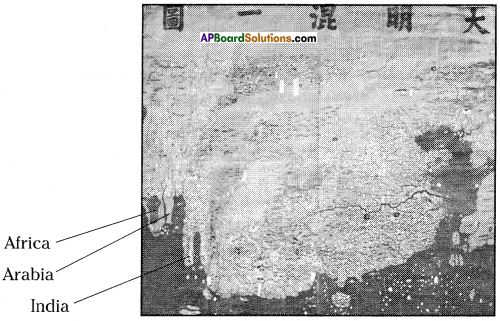
Question 10.
Can you identify India, Arabia and Africa in map (Map of Da Ming Hun Yi Tu of China)? (Textbook Page No. 5)
AP Board 8th Class Social Studies Solutions Chapter 1 Reading and Analysis of Maps 2Answer:
In this map India, Arabia and Africa were mapped from an Indian Ocean perspective. They are mis-shaped. They are on the bottom of left side of the map.

AP Board 6th Class Science Important Questions Chapter 10 Basic Electric Circuits

AP State Syllabus AP Board 6th Class Science Important Questions Chapter 10 Basic Electric Circuits

AP State Syllabus 6th Class Science Important Questions 10th Lesson Organisms and Habitat

6th Class Science 10th Lesson Organisms and Habitat 2 Mark Important Questions and Answers

Question 1.
What does a cell contain?
Answer:
A cell contains some chemical substances which can produce electricity with two terminals.

Question 2.
Many times in our houses we observe that though electricity is available some bulbs glow and some don’t glow. What could be the reason for that?
Answer:
The filament might have been fused off.

Question 3.
What is current?
Answer:
The flow of electricity in a circuit is called current.

AP Board 6th Class Science Important Questions Chapter 10 Basic Electric Circuits

Question 4.
Do not connect the two terminals of a cell with a single wire. Give reason.
Answer:

  1. We should never connect the two terminals of a cell with a single wire.
  2. If we do so, the chemicals in the cell get used up very fast and the cell stops working.

Question 5.
What is filament?
Answer:
The part of the bulb that glows is the filament, which is a thin spring-like wire attached to the two metal wires inside the glass bulb.

Question 6.
What is the switch?
Answer:
The switch is a device used to close or open an electric circuit.

Question 7.
What is the purpose of a switch?
Answer:
We use switches to put ON or put OFF the torchlight.

Question 8.
Is our body insulator or conductor?
Answer:
Our body is a good conductor of electricity.

Question 9.
Why is the handle of the electrician’s screwdriver made of plastic?
Answer:

  1. Plastic is a bad conductor and does not allow current to pass through it.
  2. So, the electrician has a plastic handle to protect him from any shock.

AP Board 6th Class Science Important Questions Chapter 10 Basic Electric Circuits

Question 10.
What is the difference between our present bulbs and the Edison bulb?
Answer:

  1. Today we use the same kind of bulbs as were first made by Edison.
  2. The only difference is that our bulbs have a filament made of a metal called Tungsten.

6th Class Science 10th Lesson Organisms and Habitat 4 Mark Important Questions and Answers

Question 1.
What is the use of a switch in a circuit?
Answer:

  1. The switch allows the flow of electricity when it is ON and cuts off the flow of electricity when it is OFF.
  2. In this way, the switch is used to allow / stop the flow of electricity to the bulb or any other electrical device.
    Label the parts in the following figure.

Question 2.
Label the parts in the following figure.
AP Board 6th Class Science Important Questions Chapter 10 Basic Electric Circuits 1
Answer:
1. Glass chamber
2. Filament
3. Metal cap
4. Terminals

Question 3.
Match the following by seeing the figure.
AP Board 6th Class Science Important Questions Chapter 10 Basic Electric Circuits 2
AP Board 6th Class Science Important Questions Chapter 10 Basic Electric Circuits 7
Answer:
a – q,
b – r,
c – s,
d – p

AP Board 6th Class Science Important Questions Chapter 10 Basic Electric Circuits

Question 4.
Observe the following figure.
AP Board 6th Class Science Important Questions Chapter 10 Basic Electric Circuits 3
Does the bulb glow or not? Why?
Answer:

  1. Yes, the bulb will glow.
  2. Since the connections are
    perfectly done in the closed circuit.

Question 5.
Observe the following figure.
AP Board 6th Class Science Important Questions Chapter 10 Basic Electric Circuits 4
Does the bulb glow or not in the arrangement which shown in figure? Why?
Answer:

  1. No, the bulb will not glow.
  2. Here in this arrangement the circuit is not completed.
  3. The handle of the screw is an insulator.

Question 6.
Would the bulb glow in the circuit shown in figure? Why?
Answer:

  1. No, the bulb will not glow.
    AP Board 6th Class Science Important Questions Chapter 10 Basic Electric Circuits 5
  2. This is because an electric bulb glow up only when circuit is completed and eraser is a non – conducting material.

Question 7.
Give reasons for the following:
a) Electric wires are made of copper.
b) We should not operate electric switches with wet hands.
Answer:
a) Copper is a good conductor of electricity.
b) Water is a good conductor of electricity and we might get an electric shock.

AP Board 6th Class Science Important Questions Chapter 10 Basic Electric Circuits

Question 8.
What was the story of the bulb ? Who ultimately succeeded in making the first bulb?
Answer:

  1. The story of invention of bulb is very interesting.
  2. We may think that a bulb is a very sinjple gadget, just press a switch and it lights up.
  3. But many scientists worked hard for many years before the first successful bulb was made.
  4. One of them was Thomas Alva Edison who ultimately succeeded in making the first bulb.

Question 9.
What was the nature of Thomas Alva Edison?
Answer:

  1. From childhood, Edison was of an inquisitive nature and he learned science by performing experiments himself.
    AP Board 6th Class Science Important Questions Chapter 10 Basic Electric Circuits 6
  2. We will be amazed to know that in his life time he invented more them one thousand inventions.
  3. Even an intelligent scientist like Edison had to work hard for many years before he could make a bulb that worked.

Question 10.
Why do bulbs and cells have two terminals?
Answer:

  1. Current needs a closed path in order to flow.
  2. To form a closed path there should be two terminal – one for inlet and another for an outlet.
  3. So in order to complete the circuit bulbs and cells have two terminals.

AP Board 6th Class Science Important Questions Chapter 10 Basic Electric Circuits

Question 11.
How does a bulb glow with the help of a cell?
Answer:

  1. Cell is the source of energy that produces electricity from the chemical stored inside it.
  2. When the terminals of the bulb are connected with that of the electric cell by wires, the current passes through the filament of the bulb.
  3. As a result the filament gats heated up and emits the light.
  4. This makes the bulb glow.

6th Class Science 10th Lesson Organisms and Habitat 8 Mark Important Questions and Answers

Question 1.
Describe the construction of a torch-bulb.
Answer:

  1. A torch bulb consists of a glass chamber fixed on a metal base.
  2. Two metal wires are firmly fixed.
    AP Board 6th Class Science Important Questions Chapter 10 Basic Electric Circuits 8
  3. One wire is attached to the metal cap and the other is attached to the base at the center of the metal cap.
  4. These wires act as two terminals. The two terminals do not touch each other.
  5. The part of the bulb that glows is the filament, which is a thin spring-like wire attached to the two metal wires inside the glass bulb.

Question 2.
How do you test when the electric bulb glows with a cell? Describe the activity you do with simple electric circuits.
Answer:
Aim: To test when do the electric bulb glows with a cell.
What do you need? (Materials required): Four wires of different colors each about 15 cm long, a bulb, a cell, a cello-tape or cell-holder
How to do? (Procedure):

  1. Take four wires of different colors, say blue, green, red and yellow, each about 15 cm long.
  2. Electric wires are often covered with plastic. First, remove about two centimeters of the plastic covering, from both ends of each wire.
  3. Now attach two wires (Blue and Green) to a bulb and two Wires (Red and Yellow) to a cell with a cello-tape or cell-holder as shown in Fig.
  4. We can use a cell holder to hold the cells and wires together tightly.
  5. Now connect the wires in different forms as shown in Fig. 4(b) to 4(g).
    AP Board 6th Class Science Important Questions Chapter 10 Basic Electric Circuits 9
  6. In each case, check whether the bulb glows or not.
  7. Record your observations in the table.
    Connection Does the bulb glow (Yes / No)
    Fig (b) No
    Fig (c) No
    Fig (d) Yes
    Fig (e) Yes
    Fig (0 No
    Fig (g) No

What do you see? (Observation): You may observe that the bulb glows in connections shown in Fig. 4(d) and Fig. 4(e), but not in other cases.
What do you learn? Result: We noticed that in Fig. (d) and Fig. 4(e) the connections form a closed path while in the remaining cases we find some gap in the path.

AP Board 6th Class Science Important Questions Chapter 10 Basic Electric Circuits

Question 3.
Write an activity showing the working of a switch in a circuit.
Answer:
Aim: To show the working of switch in a circuit.
What do you need? (Materials required: a cell (power source, a bulb, connecting wires, wooden plank or thermocol sheet, two drawing pins, and the materials provided to test.
How to do it? (Procedure):

  1. Connect à èirÙit on a wooden plank or on a thermocol sheet as shown in Fig.
  2. Insert two drawing pins at A and B.
    AP Board 6th Class Science Important Questions Chapter 10 Basic Electric Circuits 10
  3. Insert a safety pin in between A and B, such that one end of the pin is completely in contact wLth Rand the other end is left free.
  4. Now observe the bulb.
  5. Now touch the safety pin to pin A and observe the bulb again

What do you see? (Observation): The bulb doesn’t glow when the safety pin left free at one end. But it glows when the safety pin touches pin A.
What do you learn? (Result): In this activity, the safety pin is used to close /open the circuit. Similarly, An electric switch is an arrangement to close or open (break) a circuit. The switch allows the flow of electricity when it is on and cuts off the flow of electricity when it is off. In this way, the switch is used to allow/stop the flow of electricity to the bulb or any other electrical device.

Question 4.
Describe the trials of Edison to make a bulb.
Answer:

  1. First of all, Edison passed electricity through a thin, thread-like platinum wire.
  2. He noticed that the wire did give out the light after being heated, but it burned out after only a few seconds.
  3. He made a glass casing and fitted a filament of platinum wire in it.
    AP Board 6th Class Science Important Questions Chapter 10 Basic Electric Circuits 11
  4. He then removed all the air from within the glass casing.
  5. He passed an electric current through the wire and, to his delight, the bulb lit up and did not burn out for eight long minutes.
  6. He began experimenting with different materials while searching for a better choice of filament.
  7. He tried cotton thread coated with soot. This filament burned continuously for 45 hours.
  8. He tried different kinds of thread.
  9. Finally, he succeeded in making a cotton filament that was even better than the bamboo one.

AP Board 6th Class Science Important Questions Chapter 10 Basic Electric Circuits

Question 5.
Label the parts 1, 2, 3, 4, 5, 6, 7 and 8 in Torchlight.
AP Board 6th Class Science Important Questions Chapter 10 Basic Electric Circuits 12
Answer:

  1. Hollow cylindrical barrel
  2. Metal spring
  3. Cells
  4. Switch
  5. Copper wire
  6. Reflector
  7. Glass
  8. Bulb

Question 6.
Observe the given diagram.
AP Board 6th Class Science Important Questions Chapter 10 Basic Electric Circuits 13
Now answer the following questions.

  1. In a bulb which part gives us light?
  2. What is the use of a switch in a circuit?
  3. What is the filament made of?
  4. What does a torch consist of?
  5. What is a source of electrical energy in a torchlight?
  6. Which of the following acts as the negative terminal of a torchlight?

Answer:

  1. Filament.
  2. The switch helps us to allow or break the flow of current in a circuit.
  3. Tungsten.
  4. Torchlight consists of a cell, bulb, and switch.
  5. Cell.
  6. Zinc plate or Zinc container.