AP Board 9th Class English Solutions Chapter 5A A Havoc of Flood

AP State Syllabus AP Board 9th Class English Textbook Solutions Chapter 5A A Havoc of Flood Textbook Questions and Answers.

AP State Syllabus 9th Class English Solutions Chapter 5A A Havoc of Flood

9th Class English Chapter 5A A Havoc of Flood Textbook Questions and Answers

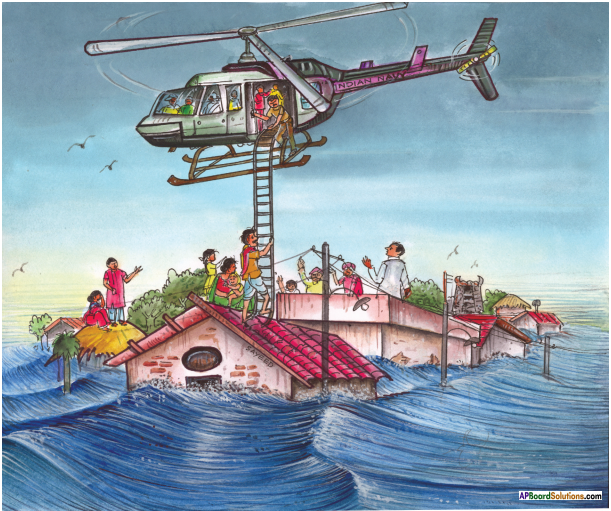
Look at the picture and answer the questions that follow.
AP Board 9th Class English Solutions Chapter 5A A Havoc of Flood 1
Question 1.
What made the people stand on the roof-tops?
Answer:
Floods of severe intensity made people stand on the roof-tops.

Question 2.
What are the people in the helicopter trying to do?
Answer:
People in the helicopter are trying to airlift the people standing on the roof-tops.

AP Board 9th Class English Solutions Chapter 5A A Havoc of Flood

Question 3.
Have you ever seen a situation like this in your life? If yes, when and where did you see it?
Answer:
No, I haven’t seen a situation like that. But in cinemas and on TVs I have seen such situations.

Comprehension

I. Answer the following questions.

Question 1.
What mood is highlighted throughout the description? Pick out the words that suggest the mood.
Answer:
The mood highlighted in the description is that of sorrow, shock and horror. Some of the words that suggest the mood are : terrible, damp, cold, cloudy, gloomy, roaring, shattering, frantically, trauma, heart-rending, pathetic plight, catastrophe, aghast

Question 2.
Which of the scenes in the text has moved you the most? Why?
Answer:
A 40 year old widow Rajeswari staying at a roadside shelter with her four young children without food and water moved me. A mother watching silently the suffering of tender children is unbearable and unimaginable.

AP Board 9th Class English Solutions Chapter 5A A Havoc of Flood

Question 3.
Who played the key role in the rescue operation of the floods? What steps were taken by the government?
Answer:
Government agencies, the army, the navy and personnel from Disaster Management Response Force played a key role in rescue operations. Government opened relief camps and distributed food, clothing, medicines etc., among the victims. Government also extended all possible help.

Question 4.
“The flood victims were looking on with wide open eyes for some help to meet their needs.” Can you guess what their needs may have been?
Answer:
The immediate needs of the flood victims are food, shelter, clothing and medicines.

Question 5.
“Help always pays gratitude.” In what way is this statement true in the light of the context?
Answer:
All the needs of the victims were met by government agencies, philanthropists and NGOs. The victims were thankful for the help. Hence the saying ‘Help always pays gratitude1’ is true.

Question 6.
How did the roaring floods disturb the lives of the people of Kurnool?
Answer:
The roaring floods destroyed houses, disturbed normal life, killed men and animals, shattered their hopes in Kurnool.

Question 7.
What relief measures would you suggest for the flood victims?
Answer:
Apart from basic needs like food and clothing, I would suggest emotional support to victims and permanent solution to floods.

AP Board 9th Class English Solutions Chapter 5A A Havoc of Flood

Question 8.
What inspiration can you draw from the last two paragraphs of the lesson?
Answer:
Rajeswari’s courage, determination, hope and concern for children teach us very valuable lessons. And her sense of thankfulness to those who helped her is highly admirable.

Vocabulary

Read the following sentence and notice the meaning of the underlined word.
They reached their dwelling places hoping a bright morning the next day.
In this sentence ‘bright’ means ‘full of light’ or ‘shining strongly’ or ‘happy.’

A single word in English (with the same spelling and the same pronunciation) may have many meanings.

The correct meaning (or the suitable meaning) of that word is understood with the help of the context.

Words with multiple meanings are called HOMONYMS. (It is very interesting to improve one’s word power with the help of HOMONYMS.)

Some commonly used Homonyms are : kind, type, plant, articles, cricket, bat, bowl, sight, light, kite …..

I. Identify the meaning of ‘bright’ in each of the foliowing sentences and write your own sentences using ’bright1 in different meanings.

1. I like bright colours.
bright = strong, thick, easy to see
My uncle bought a bright blue dress for me.

2. Tejaswini gave me a bright smile, bright = cheerful and lively
On knowing the results, their eyes turned bright.

3. Sindu is a bright student.
bright = brilliant, quick to learn
Many teachers prefer to talk to bright students.

4. Yamuna has bright ideas.
bright = helpful
The manager always seeks bright ideas.

5. This young player has a bright future.
bright = likely to be successful
The students of this school can hope for a bright future.

6. We took rest in a bright room.
bright = full of light
As she kept all the windows open, the room was bright when we entered it.

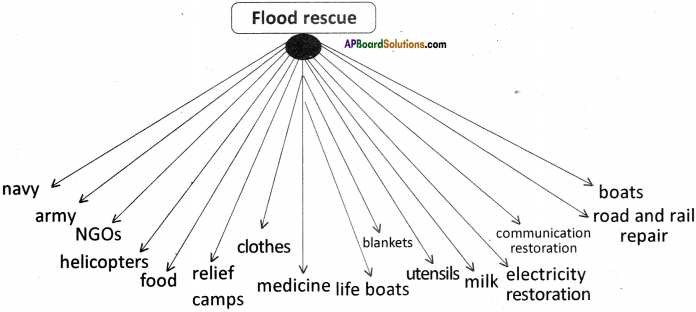
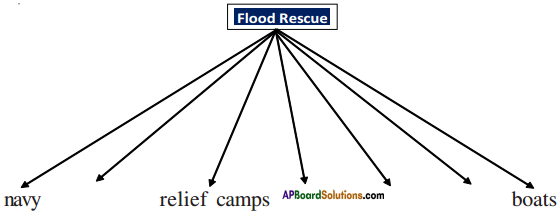
II. Several people and things are involved in rescue operations. There is a description of a flood rescue operation. Complete the concept map given below with the suitable information from the text:
AP Board 9th Class English Solutions Chapter 5A A Havoc of Flood 2
Answer:
AP Board 9th Class English Solutions Chapter 5A A Havoc of Flood 5

Grammar

Read the following sentences from the text and notice the underlined words/ expressions.

1. No sooner had the relief team arrived there than their joy knew no bounds.
2. They had scarcely arrived at their destinations when the rain poured down.
In the above sentences the expressions “No sooner… than” and “scarcely… when” are used to suggest that one thing happened very soon after another. The expression ‘hardly … when’ is also used to express the same.

  • Pairs of words like ‘No sooner… than’ ; ‘scarcely… when’ and ‘hardly…. when’ are called ‘correlative conjunctions’.
  • They connect two expressions/clauses /actions. Hence they are conjunctions.
  • They show the relationship between the two actions in terms of time. Hence they are correlatives.
  • Special Note

1. ‘No sooner’ always goes with ‘than’ and ‘scarcely/hardly’ always go with ‘when’. They are inseparable.
2. ‘When ‘scarcely/hardly’ are used at the beginning of the clause, the helping verb is used before the subject, not after the subject. (Subject – helping verb inversion) If they are used after the subject, the word order is not changed. In the case of ‘No sooner’, there is inversion always.

AP Board 9th Class English Solutions Chapter 5A A Havoc of Flood

Combine the following sentences using the expressions “No sooner… than, scarcely… when, hardly… when.”
One has been done for you.
1. I put the phone down. It rang again.
A : No sooner had I put the phone down than it rang again.
or
B : I had scarcely put the phone down when it rang again.
or
C : I had hardly put the phone down when it rang again.

2. I arrived at the station. Then the bus came in.
A : No sooner had I arrived at the station than the bus came in.
B : I had scarcely arrived at the station when the bus came in
C : I had hardly arrived at the station when the bus came in.

3. I closed the door. Somebody knocked it again.
A : No sooner had I closed the door than somebody knocked it again.
B : Scarcely had I closed the door when somebody knocked it again.
C : Hardly had I closed the door when somebody knocked it again.

4. She finished the meal. She started feeling hungry again.
A : No sooner had she finished her meal than she started feeling hungry again.
B : She had scarcely finished her meal when she started feeling hungry again.
C : She had hardly finished her meal when she started feeling hungry again.

5. Madhavi opened the door. The dog entered the room.
A : No sooner had Madhavi opened the door than the dog entered the room.
B : Scarcely had Madhavi opened the door when the dog entered the room.
C : Madhavi had hardly opened the door when the dog entered the room.

Writing

I. In the reading passage, one of the victims of the flood, Rajeswari shared her sufferings with the flood relief team. On the basis of this, develop an interview by a news reporter.

News Reporter : Rajeswari, could you tell me what had happened?
Rajeswari : ……………………………………………
News Reporter : ……………………………………………
Rajeswari : ……………………………………………
News Reporter : ……………………………………………
Rajeswari : ……………………………………………
News Reporter : ……………………………………………
Rajeswari : ……………………………………………
News Reporter : ……………………………………………
Answer:
News Reporter : Rajeswari, could you tell me what had happened?

Rajeswari : Oh! It was dreadful. The night of 27! Horrible! Downpour! Nonstop! We couldn’t believe our eyes! Even multi-storeyed buildings were shaking. What about our mud shack?

News Reporter : Has someone come to help you?

Rajeswari : Not immediately. As waters entered our small shaky house, I took my four children and ran for safety.

News Reporter : Could you easily find out a safe place?

Rajeswari : Yes, very close to my house, the road has a high side wall like structure which then stood above flood waters. So we all stayed there!

News Reporter : How long did you stay there?

Rajeswari : It was for two long days in open I Without food and water. Only flood water and our tears!

News Reporter : Hasn’t help reached you even then?

Rajeswari : Help in the form of rescue team in a fibre boat came to us. They took us to the nearby relief camp, gave us clothes and food. They promised to give money to repair my damaged house. They supported us well. May God be kind to them!

News Reporter : Even in your testing times you are so thankful and you think of their welfare! Great of you! May God bless you!

AP Board 9th Class English Solutions Chapter 5A A Havoc of Flood

II. Assume that you happened to read some of the articles/news reports on the flood rescues. You were deeply moved by the sorrows of the victims of the floods. You decided to raise funds for the cause. You wanted to share this idea with your classmates and seek their assistance in this matter.

Prepare a speech/a talk that you would like to make to convince the donors about the need for raising funds for the cause.

You may use the ideas given below.

  • Floods in Kurnool
  • Damage occurred
  • Human suffering and deaths
  • Loss of property
  • Death of animals
  • Loss of crops
  • Shortage of basic needs like food, clothing and shelter
  • Importance of relief operations
  • Moral responsibility

Answer:
My dear lovers of humanity!

Times call us to rise to the occasion. Here is a situation watching which none can remain unmoved. I know your concern for our fellow beings’ suffering : Recently Kurnool witnessed floods of grave intensity. Flood water reached house roof level. Hundreds of people lost their lives. Animals in thousands were covered in water and were dead. Loss of property runs into crores of rupees. Crops were damaged when they were about to be reaped. People now are crying for basic needs like food, shelter, water, clothes, medicines. They need moral support. They need assurance from us. They lost everything except hope. It is our duty to ensure their hope continues to live. It is our moral responsibility to extend to them whatever help we can ! You know ‘Service to man is service to God! And service to man in such dire need is the best kind of worship. I very humbly appeal to you all with folded hands. Let us join our hands. Let us collect men, money, materials etc. Let us support our brothern. Let us share their sorrow and suffering. Let us prove to the world that we love humanity!

AP Board 9th Class English Solutions Chapter 5A A Havoc of Flood

III. Assume that you were one of the victims of the flood and received some help from a donor. Write a letter thanking him and expressing your gratitude.

Bus stand centre,
Kurnool.
01 October 2009.

Respected Dharma Rao garu,

Our gratitude makes us write thus. Pray that you and your family members are fine.

Thank you so much for your generous help at a very apt time. Floods carried away everything from us except our lives and hope. When we were cursing our fate, help from you came like God-sent gift. It was really like a boat to a person drifting in waters with no shore.

As we were thinking that our end was not far away, your timely help infused life and and hope into us. How much I may say, our gratitude still remains incompletely expressed.

Persons like you prove to the world what humanity is, nay – what divinity is! May God bless you with what we call eternal bliss.

I continue to pray to God to be kind to you and all your near and dear. I look forward to a chance to be of any use to you. I will be blessed if I get that opportunity.

Once again our pranamams to you.

Thankfully yours,
Rakshita.

To
Sree Dharma Rao garu
H.No. 12-85
Near Masjid
KADAPA.

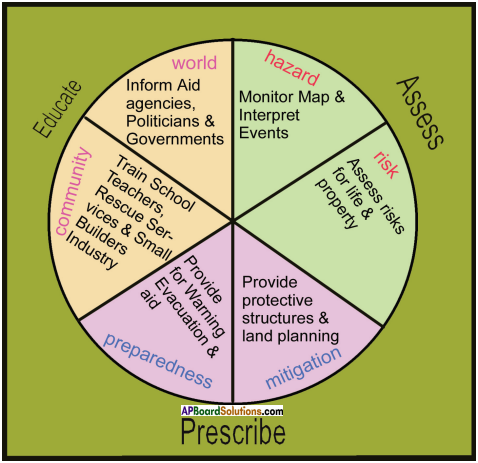
IV. On the basis of the diagram given below write a paragraph stating the sequential series of actions/methods (preparation before, during and after) that can be taken for disaster management.
AP Board 9th Class English Solutions Chapter 5A A Havoc of Flood 3
Answer:
Disaster Management includes different activities. First disaster-prone areas are to be assessed with the help of past occurrence and present events. And probable risk to life and property is to be estimated. Then protective structures and relief camps are to be planned and got constructed. After these preparatory arrangements, advance warning systems and evacuation machinery are to be put in place. Later community at large and teachers in particular are to be trained in rescue operations. And finally the outside world is to be informed about the disaster along with the particulars of loss and quantity of aid required. Effective Disaster Management depends on the execution of these steps in sequence.

Study Skills

Note-Making
We take notes when we read a book in order to record information for future reference. Such notes help us to revise lessons easily before examinations.

Let’s know the process of note-making.

  • Read the passage once quickly
  • Underline the key terms during the second reading s Note only the most important information
  • Condense the information
  • Omit examples and illustrations
  • Organize the condensed information in a suitable format
  • Keep a suitable title

Some strategies for condensing information.

  • Use numbers instead of words
    e.g. sixty eight written as 68
  • Use short substitutes for long words
    e.g. maths for mathematics
  • Use reduced verb forms
    e.g. Killed instead of was killed
  • Use the ‘to-infinitive’ to indicate future time
    e.g. relief teams to help the people
  • Use abbreviations and acronyms
    e.g. IAF, AIR
  • Use condensed spelling of words
    e.g. Dept, for Department, Dr. for Doctor

Here is a model answer for paragraphs 2 – 5 from your Reading Passage – A.
Floods in Kurnool
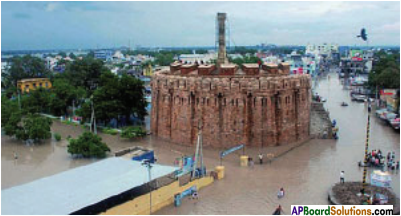
AP Board 9th Class English Solutions Chapter 5A A Havoc of Flood 4

28-9-2009
a)No tourists
b)No buses

27-9-2009
a) heavy rainfall
b) damp, cold and cloudy climate
c) pouring rain

28-9-2009
a) river waters entered the streets
b) flood inundating houses
c) 20 lakh cusecs inflow to the Srisailam Dam
d) threat of flood on the banks of the Krishna
e) heart-rending scenes
f) people seeking help to rescue them

Now make notes from the following passage and then summarise it.

The word “disaster” is derived from Middle French “desastre” and from old Latin “disastro”. A disaster can be defined as any tragic event that can cause damage to life, property and destroy the economic, social and cultural life.

The natural disaster is a consequence when a natural hazard affects humans or built environment. Human vulnerability and lack of appropriate emergency management lead to financial, environmental and human loss. The resulting loss depends on the capacity of the population to support or resist the disaster. Disasters occur when hazards meet vulnerability.

A natural hazard will never result in a natural disaster in areas without vulnerability. Various phenomena like earthquakes, landslides, volcanic eruptions, floods and cyclones are all natural hazards that kill thousands of people and destroy a lot of money and property each year.

Natural hazards can strike in unpopulated areas and never develop into disasters. The rapid growth of the world’s population and its increased concentration often in hazardous environments has escalated both the frequency and severity of natural disasters. Tropical climate, unstable land forms, deforestation and non-engineered constructions m^kethe disaster-prone areas more vulnerable. Developing countries suffer more or less chronically by natural disasters.
Answer:
A) Notes :
Para 1 :
disaster rooted in French, Latin
damage to life and property
destroys economic, social and cultural life

Para 2 :
natural hazards affecting populated areas
vulnerability adds to loss
hazard + vulnerability = disaster

Para 3 :
earthquakes, floods etc – hazards

Para 4 :
hazards in unpopulated areas – not disasters
increasing population, tropical climate,
unstable land forms, deforestation,
non – engineered constructions increase vulnerability
developing countries – chronic – victims.

B) The word ‘disaster’ – rooted in French and Latin – means a damage-causing event that destroys economic, social and cultural life. Hazards affecting vulnerable populations result in disasters. Lack of emergency management mechanism leads to huge loss of life and property. Hazards like earthquakes and floods destroy life and property every year. Increasing populations, tropical climate, unstable land forms, deforestation and non-engineered constructions add to the vulnerability. Developing countries are the chronic victims.

Listening

Practise listening carefully. Then you will be able to speak.
Listen to the ’News Bulletin’ and answer the following questions.

News Bulletin

This is All India Radio. The news…. read by Latika Ratnam.

The headlines first…
An unprecedented flood caused a havoc in Krishna, Guntur, Kurnool and Mahabubnagar districts of Andhra Pradesh.

The Prime Minister visits the flood-affected areas tomorrow.

India defeated Pakistan in the triangular cricket series held at Brisbane, Australia.

Now the news in detail. Massive floods wreaked a havoc in Krishna, Guntur, Kurnool and Mahabubnagar districts of Andhra Pradesh. Water has been released from the dams of Srisailam, Nagarjuna Sagar and the Prakasam Barrage. About 400 villages have been inundated with floodwaters, 4 lakhs of people have become homeless. The death toll has reached 532 so far.

However, the rescue operations are in full swing. The Chief Minister of Andhra Pradesh has made an aerial survey of the flood-hit areas. An immediate aid of two lakhs of rupees has been announced to the members of the deceased. A relief of ten thousand rupees has been announced to the homeless. The C.M. has conducted an emergency meeting with the respective collectors of the flood-hit areas and asked them to set up rehabilitation camps immediately on war-footing.

1. What was the havoc caused by the flood?
Answer:
About 400 villages were inundated. Around 4 lakh people became homeless. 532 persons died till then.

2. What relief measures were taken by the Government of A.P.?
Answer:
The Chief Minister made an aerial survey. An immediate aid of rupees two lakhs was announced to the members of the deceased. A relief of rupees ten thousand was declared to the homeless. Rehabilitation camps were set up on war footing.

3. What are the other highlights of the news bulletin?
Answer:
1) The Prime Minister visits the flood-affected areas tomorrow.
2) India defeated Pakistan in the triangular cricket series held at Brisbane, Australia.

Oral Activity

Read the lesson “A Havoc of Flood” once again. On the basis of the ideas in it, prepare a mock interview for a TV/newspaper.

Work in groups and collect the information about the havoc caused, relief operations
etc., from the following.
1. Victims
2. Officials
3. Doctors
4. N.G.Os (Non-Governmental Organisations/Voluntary Organisations)

In each group one member will be the reporter and the others will play the other roles. Afterwards each group will make the presentation.

1. Interview with Victims :
TV Reporter : Hello, the floods seem to be very severe. Have you been receiving relief from anyone?

Victims : Yes, the floods have been very severe. Never before in our lives have we seen floods of this seriousness. Yes, as to relief, Government officials and voluntary organisations have been extending maximum help. But because of the large number of victims, damaged roads , dead telephones, disrupted power supply, relief is not in sufficient quantity and at right time. But expecting more than what we get would be a sin. We hope and pray for good days ahead.

TV Reporter : Thank you for your detailed inputs. Your positive attitude in these testing times is highly admirable. I firmly believe God will bless people of your kind.

Victims : Thank you.

AP Board 9th Class English Solutions Chapter 5A A Havoc of Flood

2. Interview with Officials :
Reporter : Good afternoon sir. How have you been coping with the disaster?

Officials :
Good afternoon. We have been putting in our best efforts. All available men and materials have been put to use. Forecast of floods well in advance has helped us in planning. Warning of floods also helped us minimise the loss of lives and property.

Reporter : Are any other departments working with you?

Officials :
Yes, almost all the government departments are working with us. Some departments are directly on the field. Other departments support us from behind. Even non-government organisations and individuals join us in extending relief.

Reporter : Thank your sir.

3. Interview with Doctors :
Reporter : Good evening doctor. How is the health scenario in the flood affected areas?

Doctor : Good evening. Floods bring in a flood of diseases too. Water is contaminated. Cleanliness is totally missing. People don’t even think of hygiene. Doctors work with their focus on present illness and possible epidemics. Cooperation from every corner eases our job to some extent.

Reporter : Thank you doctor.

AP Board 9th Class English Solutions Chapter 5A A Havoc of Flood

4. Interview with NGOs :
Reporter : Good morning gentlemen ! As government agencies are also actively involved in relief programmes, what do you think is the importance of your role?

NGO : Good morning. Yes, you have a valid point there ! But the fact is our job is to extend to the needy whatever help they require. Government Agencies are no doubt active. But they work in a certain frame work. For us, there are no such limitations. We help those who don’t fit into government schemes for one or the other reason. Any how, every one plays a significant role in times of trouble !

Reporter : Thank you. Your analysis is really eye opening !

NGO : You’re welcome.

A Havoc of Flood Summary in English

Water, water everywhere! 10 feet deep even in houses! For three or four days! Dead bodies of cattle and people, damaged houses, breached bunds, deafening cries for help, rescue, and relief teams that was the scene in Kurnool district on 28 September 2009. Continuous downpour during the night brought floods into the city and other villages. Never before in the known history was there such a heavy downpour. Floods from the Thungabhadra, the Handri Niva rivers added to the gravity. Lakhs of people lost their shelters. Loss of lives and property was at shocking levels. Government stepped in at once. The services of the Army, Navy and Disaster Management Agencies were sought. Helicopters, inflatable boats, fibre glass boats and other equipment were pressed into use. Voluntary organisations, institutions, individuals and philanthropists joined the relief operations. Camps for homeless were organised. Food, water, blankets, milk and medicines were distributed among victims. One Ms. Rajeswari 40 exhibited rare courage in rescuing herself and her four children. She expressed her gratitude to all those who helped her during their intense suffering.

A Havoc of Flood Glossary

havoc(n) : a situation in which there is a lot of damage and destruction

basin (n) : an area of land along a river with streams running down into it

namesake (n) : the same name

destination (n) : a place where one wants to reach

gloomy (adj) : sad ;unhappy

inundating (v+ing) : submerging ; filling with water

shattering (v+ing) : destroying

forecast(v) : tell in advance what is going to happen

bore the brunt (idiom) : received or suffered the major part of something bad

fury (n) : anger, severity

submerged (v-past tense) : covered in water

heart-rending (adj) : heart-breaking ; causing a lot of sadness

frantically (adv) : in a hectic way ; quickly ; with uncontrollable emotions

rescue (v) : save from a danger

trauma (n) : an upsettingly unpleasant condition

tributaries (n-plural) : rivers or streams that flow into a larger river

requisitioned (v-past tense) : demanded officially the use of

breached (v-past tense) : damaged, broken

inflatable (adj) : that which can be filled with air

reluctant (adj) : unwilling

groping (v+ing) : trying and finding something that cannot be seen

pathetic (adj) : causing pity

plight (n) : a difficult and sad situation

catastrophe (n) : a disaster

fastened (v-past tense) : tied or joined, tethered (Note : The letter’t’ is silent in ‘fasten’.)

aghast (adj) : horrified ; surprised

reaped (v-past tense) : cut crops ; harvested

rejuvenated (v-past tense) : made to look more lively

shack(n) : a small building made of wood or metal

flee (v) : run away from danger

despair (n) : hopelessness, sorrow

beaming (adj) : cheerful; pleased
AP SSC 9th Class English Textbook Solutions

AP Board 9th Class Social Studies Important Questions Chapter 23 Disaster Management

AP State Syllabus AP Board 9th Class Social Studies Important Questions Chapter 23 Disaster Management.

AP State Syllabus 9th Class Social Studies Important Questions 23rd Lesson Women Protection Acts

9th Class Social 23rd Lesson Disaster Management 1 Mark Important Questions and Answers

Question 1.
Give examples of human induced disasters. (SA-III : 2016-17)
Answer:

  1. Road accidents
  2. Rail accidents
  3. Air accidents
  4. Fire accidents
  5. Terrorism

9th Class Social 23rd Lesson Disaster Management Important Questions and Answers

Question 1.
Write about the air accidents.
Answer:
Across the world including India, air accidents have increased. Many factors govern the safety of the passengers in the aircraft like increase in the number of aircrafts, technical problems, fire, landing and take off condition, the environment that the airline operates in (mountainous terrains or frequent storms), factors like airport security in cases of hijackings, bomb attacks, etc.

Question 2.
Who should not drive vehicles?
Answer:
The following people should not be driving vehicles :

  1. Having consumed alcohol.
  2. Have been taking any medicine or drug that affects their responses.
  3. Are tired, as tiredness affects the driving skills and reaction time.
  4. Are sick or injured.
  5. Are angry or upset.

AP Board 9th Class Social Studies Important Questions Chapter 23 Disaster Management

Question 3.
What safety measures should be taken while air travel?
Answer:
Some safety measures that can be taken up are given below :

  1. Pay attention to the flight crew safety demonstration.
  2. Carefully read the safety briefing card, that is there in the seat pocket.
  3. Know where the nearest safety emergency exit is and know how to open in case of emergency.
  4. Always keep your seat belt fastened when you are in seat.

Question 4.
Collect the information about this.
Answer:
Date : 26-11-2008
Time : 20.00 hours
Attack type : Bombings, shootings, hostage crisis, siege.
Deaths : 166 including attackers
Injured : More than 600
Perpetrators : ISI, Lashkar-e-Toiba
Note : One was caught and executed later.

AP Board 9th Class Social Studies Important Questions Chapter 23 Disaster Management

Question 5.
Read the following suggestions and answer the given questions.

Be alert, Be vigilant and Be safe

  1. Inform police if you see any unowned objects like bags, suitcase etc. lying in public place or in a public transport as it could contain explosive device.
  2. Call Police Control Room on Telephone No. 100. Every citizen has the right to call up.
  3. After informing the police try to keep a watch on the suspected object and caution others to keep away from it.
  4. Be alert of any suspicious behaviour, parked vehicle.

i) Why should we inform police?
Answer:
As it could contain explosive device.

ii) What is the police control room number?
Answer:
100

iii) What should we do after informing the police?
Answer:
We should keep a watch on the suspected object.

iv) ………………. of any suspicious behaviour, parked vehicle.
Answer:’
Be alert

AP Board 9th Class Social Studies Important Questions Chapter 23 Disaster Management

Question 5.
Read the following and answer the questions given below.
The 2004 fire in a school in Kumbakonam, Tamil Nadu sparked off debates and arguments on the safety of schools in the country. 93 innocent lives were charred to death. The main causes of this fire were lack of awareness amongst children and teachers as to what to do in case of a fire, lack of preparedness, kitchen close to the classroom etc. However, incidents like these are not new.
1) When was the fire sparked off?
Answer:
In 2004.

2) Where is Kumbakonam?
Answer:
It is in Tamil Nadu district.

3) What were the main causes of this fire?
Answer:
The main causes of this fire were lack of awareness amongst children and teachers.

4) Where is the kitchen?
Answer:
The kitchen is close to the classroom.

5) Who died in the accident?
Answer:
93 innocent lives were charred to death.

AP Board 9th Class Social Studies Important Questions Chapter 22 Women Protection Acts

AP State Syllabus AP Board 9th Class Social Studies Important Questions Chapter 22 Women Protection Acts.

AP State Syllabus 9th Class Social Studies Important Questions 22nd Lesson Women Protection Acts

9th Class Social 22nd Lesson Women Protection Acts 1 Mark Important Questions and Answers

Question 1.
Many acts are made by the government of India to protect the rights of women and girls. Mention any two such acts enforced by the government of India. (SA-II : 2018-19)
Answer:

  • Child marriage Act – 2006
  • The Dowry Prohibition Act -1961
  • Sexual Assault and Torturing Act – 2013
  • The Immoral Trafficking (prevention) Act -1956 and Amendment – 2006.

9th Class Social 22nd Lesson Women Protection Acts 2 Marks Important Questions and Answers

Question 1.
Even after the ‘Prohibition of child marriage Act1, child marriages are still going on here and there. Suggest some measures to stop this dogma. (SA-III : 2016-17)
Answer:

  1. Empower girls with information, skills and support networks.
  2. Provide economic support and incentives to girsl and their families.
  3. Educate and rally parents and community members.
  4. Enhance girls.

AP Board 9th Class Social Studies Important Questions Chapter 22 Women Protection Acts

Question 2.
The Government made many programmes and acts for girls, women protection and development. What is your suggestion for the better implementation?
Answer:
Govt made so many acts for women and girld child protection and developments.
Suggestions for better implementation :

  1. To raise awareness on women’s right issues.
  2. Enhancement of the political and legal status of women through political empowerment.
  3. Protesting when violations against women, children take place.
  4. Wider publicity, propaganda about acts to be made and educate people.
  5. Campaign against injustice by coming on to the streets, approaching the courts and by sharing information.

9th Class Social 22nd Lesson Women Protection Acts Important Questions and Answers

Question 1.
What are children rights?
Answer:

  • All the people below 18 years age are all children without gender discrimination.
  • Protection from government for children rights.
  • Right to live.
  • Right to live with parents as far as possible.
  • Right to gain knowledge and get awareness about the world through media like radio, newspapers, TV, etc.
  • Right to protection from violence and harmful incidents.
  • Right to get special care to live and for development in case of disabled children.
  • Right to have good health and get medical care.
  • Right to use mother tongue, follow their religion and tradition.
  • Right to play.
  • Right to avoid the harm for children from getting education and health.
  • Right to get protection from using harmful medicines also manufacturing and purchasing.
  • Right to get help when the children are neglected and being suffered.

AP Board 9th Class Social Studies Important Questions Chapter 22 Women Protection Acts

Question 2.
What are the forms of domestic violence?
Answer:
Forms of Domestic Violence :

  • Sexual abuse (forcible sexual intercourse, watching obscene films )
  • Physical abuse (behaviour caused to bodily pain or harm, beating, torturing)
  • Verbal and emotional abuse (humiliation, name calling or ridicule not speaking to them, ignoring.)
  • Mental abuse (threaten to harm, not to send the children for study, stopping from jobs, force to marry whom she doesn’t like)
  • Economic abuse (deprivation of economic or financial resources, use the women wealth, sell their property)

Question 3.
Write some of the important features of the ordinance on ‘Sexual Assault and Torturing.
Answer:

  • Minimum 20 years of imprisonment.
  • Recruitment of women police to address the complaints from the victims.
  • It is not necessary for the victim to attend before the police officers individually.
  • There will be no punishment if the accused dies in struggle at the time of attack with acid on women.
  • There is a scope to shoot video at the time of complaining and trial on the request of the victims.

Question 4.
Who are eligible for judicial assistance?
Answer:

  • Citizens belong to scheduled castes and scheduled tribes.
  • Victims of immoral human trafficking, beggars, women, children, mentally imbalanced and physically challenged. „
  • Victims of natural disasters, agricultural and industrial labourers and victims of Domestic Violence and Caste enmity.
  • Citizens earning annual income less than Rs. 50,000.

AP Board 9th Class Social Studies Important Questions Chapter 22 Women Protection Acts

Question 5.
What are the methods of Judicial Assistance?
Answer:
Methods of Judicial Assistance :

  • Judicial advice is given free of cost by the advocate.
  • After verification of the cases and if it is found necessary, the advocates may be appointed on behalf of the complaint and take up the cases in the court.
  • To bear the expenditures of court and court fee.
  • The xerox copies of the judgment will be given at free of cost to those who sought judicial assistance.

Question 6.
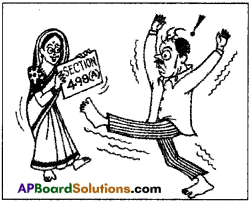
Comment on this picture.
AP Board 9th Class Social Studies Important Questions Chapter 22nd Women Protection Acts 1
Answer:
They both are couple. The man is angry and ready to kick his wife. She is cheerful and warning him with the section 498 A of I PC.
Note: Section 498 A of IPC, 1860: Husband or relative of husband of women subjecting her to cruelty – whoever beingthe husband orthe relative ofthe husband of a woman, subjects such woman to cruelty shall be punished with the imprisonment for a term which may extend to three years and shall also be liable to fine.

Question 7.
What about the Immoral Trafficking Act (1956) and amendment 2006? What are the different forms of trafficking?
Answer:
The Immoral Trafficking (Prevention) Act 1956 and amendment 2006 :
Girls and women are being lured in the name of providing jobs, bright future, offering roles in cinema etc., and take them to towns and cities and sell them for prostitution. Even they beat and, cause physical violence to make them obey. Certain times they remove body parts.

Trafficking and selling of them for prostitution or encouraging them to enter into prostitution is a punishable crime. Though they come on their will and interest is also treated a crime.

Different forms of trafficking :
Sexual assault

  1. Forced prostitution
  2. Social and religious prostitution (Devadasi, Jogini, Mathangi etc.)
  3. Sexual assault in tourism
  4. Reading rustic writings and watching obscene pictures

Activities against the law

  1. It is a crime to make the trafficking children involve in the begging for money and beating them to obey. Certain times they make them?physically handicapped by removing their body parts and make them as beggars.
  2. Removing body parts and doing business.
  3. Selling narcotics with the trafficked children.

Labourers
1. Vetti :
Taking work without making proper payments, not providing nutrious food, clothes and even not treat them as human beings.

2. Domestic labour:
Washing clothes, cleaning the houses and utensils without proper wages, entrusting work in neighbours’ houses.

3. Agriculture Labour:
Involving in the agriculture work and exploiting them for more physical work.

4. Construction work :
Labour involved in construction of buildings, roads, etc. with nominal payments and providing them with substandard food.

Sadistic pleasure

  1. Tying up the children on camels and make them run for entertainment
  2. Marriages and adoption without their consent

Question 8.
Read the following passage and answer the given questions.
Lok Adalat means people’s court. All are equal before law. The Article 39-A of the Constitution of India, contains various provisions for settlement of disputes through Lok Adalat. It is an Act to constitute legal services authorities to provide free and competent legal services to the weaker sections of the society. It is to ensure that opportunities for securing justice are not denied to any citizen by reason of economic or other disabilities. And to organize Lok Adalats to secure that the operation of the legal system promotes justice on a basis of equal opportunity.

In addition to above, an Act was formulated which is called “Act of Judicial Services Authority.” This is a central law. The State government and High Court jointly formulated certain principles as per this Act.
1) What is Lok Adalat?
Answer:
It is people’s court.

2) Write about the Article 39 – A.
Answer:
The Article 39 – A of the Constitution of India, contains various provisions for settlement of disputes through Lok Adalat.

3) To whom does it help?
Answer:
It helps the weaker sections of the society.

4) What is the name of the Act?
Answer:
Act of Judicial Services Authority

5) This is a _______ law.
Answer:
central

AP Board 9th Class Social Studies Important Questions Chapter 22 Women Protection Acts

Question 9.
Read the following passage and answer the given questions.

The Dowry Prohibition Act, 1961:
If any person gives or takes or abets dowry, he/she shall be punishable with imprisonment for a term which shall not be less than five years, and with the fine which shall not be less than 15 thousand rupees or the amount of the value of such dowry whichever is more.It is observed that afterthe marriage, the bride is teased, scolded, abused, beaten and even sometimes cause for death or makes her commit suicide. All these offences cover in this Act. Parents can present offerings, articles in the marriage, but these offerings must be as per the law.

  1. Enlisting the offerings
  2. Offerings can’t be demanded
  3. The offerings that are being provided must be as per one’s cultural norms and traditions. The value of offerings shall not be over and above of the parents’ economic status and never become a burden to the family.

1) What is punishment mentioned here?
Answer:
Five years of imprisonment and a fine.

2) What is observed?
Answer:
It is observed that after the marriage the bride is teased, scolded, abused, beaten and sometimes killed or forced to commit suicide.

3) What are all these called?
Answer:
These are all called ‘Offences’.

4) What is the law for offerings? (Write any two)
Answer:
1) Enlisting the offerings
2) Offerings cannot be demanded.

5) The value of offerings shall not be _____ and ______ the parents’ economic status.
Answer:
Over, above

AP Board 9th Class Social Studies Important Questions Chapter 22 Women Protection Acts

Question 10.
Write some misconceptions and realities of domestic violence.
Answer:
Domestic Violence – Misconceptions and Realities :
Misconception:
Parents punishing their children now and then is not a major issue to be considered.

Reality:
Domestic violence starts slowly and it becomes a routine, if nobody opposes it. The victims certain times are hospitalised for treatment and even lose their life and it adversely affects their dignity and self-respect.

Misconception :
Addiction to the drinking is the major cause for violence.

Reality :
The alcoholism for domestic violence is only an assumption but the statistics reveals that 40% of the men who beat their wives are not addicted to alcoholism.

Misconception :
Women shall bear the violence for the sake of children.

Reality :
Violence leads to more and more violence. Children that grow in the violent atmosphere will become more violent in future.

Misconception :
There is no way to get out of domestic violence.

Reality :
The violence free environment is the birth right of every woman. The Women Protecting Acts and laws are available and one should take their support.

AP Board 9th Class Social Solutions Chapter 5 జీవావరణం

SCERT AP 9th Class Social Studies Guide Pdf 5th Lesson జీవావరణం Textbook Questions and Answers.

AP State Syllabus 9th Class Social Solutions 5th Lesson జీవావరణం

9th Class Social Studies 5th Lesson జీవావరణం Textbook Questions and Answers

Improve your learning (మీ అభ్యసనాన్ని మెరుగుపడుచుకోండి)

ప్రశ్న 1.
జీవులను ఒక ప్రత్యేకమైన జీవావరణంగా వర్ణిస్తారు. వివరించండి. (AS1)
జవాబు:

  1. భూ శాస్త్రజ్ఞులు జీవాన్ని ఒక ప్రత్యేక ఆవరణంగా పరిగణిస్తారు. దీనినే “జీవావరణం” అంటారు.
  2. జీవంతో కళకళలాడే ఏకైక గ్రహం భూమి.
  3. అతి సూక్ష్మ బాక్టీరియా నుంచి అత్యంత పెద్దవైన మర్రి చెట్టు, నీలి తిమింగలాలు, ఏనుగులు వంటి జీవులు, పులులు మానవులతో భూమి విలసిల్లుతోంది.
  4. సూర్యుడికి భూమి మరీ దగ్గరగా, మరీ దూరంగా లేనందున ఇక్కడ అనువైన ఉష్ణోగ్రతలు ఉండటం.
  5. నేల, నీరు, గాలి మూడు కలిసి ఉండటం వల్ల ఒక్క భూమిపైన మాత్రమే జీవం సాధ్యమైంది. అందువల్ల జీవులతో కూడిన దానిని జీవావరణం అంటారు.

AP Board 9th Class Social Solutions Chapter 5 జీవావరణం

ప్రశ్న 2.
ఆధునిక కాలంలో పర్యావరణ సంక్షోభం సృష్టించబడుతున్నది. వాటి యొక్క ప్రభావాన్ని వివరించండి. (AS4)
(లేదా)
పర్యావరణ సంక్షోభ పరిణామాలను తెలపండి.
జవాబు:

  1. పారిశ్రామికీకరణం, వేగంగా వృద్ధి చెందుతున్న జనాభా, పట్టణీకరణ వల్ల ఖనిజాలు, అడవులు, నేల, రాళ్లు, గాలి వంటి ప్రకృతి వనరులు ఇంతకు ముందు కనీవిని ఎరగని స్థాయిలో దోపిడికి గురవుతున్నాయి.
  2. ఇదే క్రమంలో భూమిలో కోట్ల సంవత్సరాలుగా నిలవ ఉన్న ఇంధన వనరులను కొల్లగొడుతున్నారు.
  3. దీని వల్ల అడవులు వేగంగా తగ్గిపోతున్నాయి.
  4. ఖనిజ, చమురు, భూగర్భజలవనరులు అంతరించిపోతూ ఉన్నాయి.
  5. ప్రస్తుత జీవన విధానం సుస్థిరమైనది కాదని చాలా మంది శాస్త్రజ్ఞులు అంటున్నారు.
  6. ప్రకృతి వనరులను ఇదే తీరులో వినియోగించుకుంటూ పోతే మన పిల్లలు, వాళ్ల పిల్లలకు ఏమీ మిగలదు.
  7. మానవులు అభివృద్ధి, సంతోషం పేర్లతో ప్రకృతిని నాశనం చేస్తున్నారు.
  8. మానవుల వ్యాపార కార్యకలాపాల వల్ల భూమిపై ప్రతిజీవి, ప్రతి పదార్థమూ ప్రభావితం అవుతున్నాయి.
  9. ఇది ఇలాగే కొనసాగితే ఇతర జీవ జాతులకే కాక అంతిమంగా మనుషులకు కూడా ముప్పుగా పరిణమిస్తుంది.

ప్రశ్న 3.
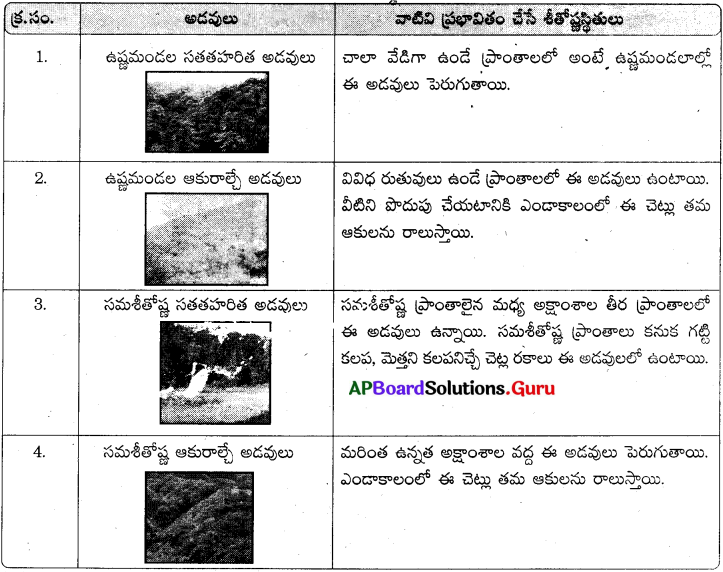
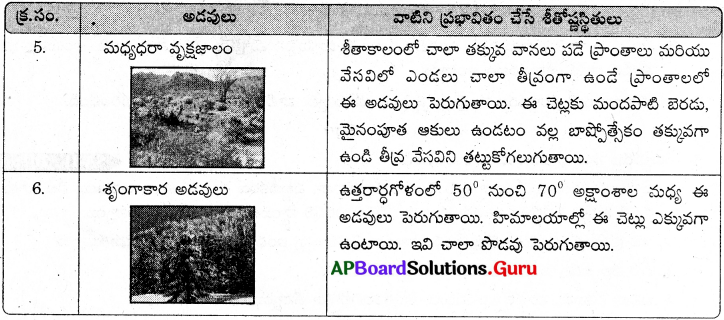
సహజ వృక్ష సంపదను శీతోష్ణస్థితి ప్రభావితం చేస్తుంది. వివిధ రకాలైనటువంటి అడవులను, వాటిని ప్రభావితం చేసే శీతోష్ణస్థితులను వివరించండి. (AS1)
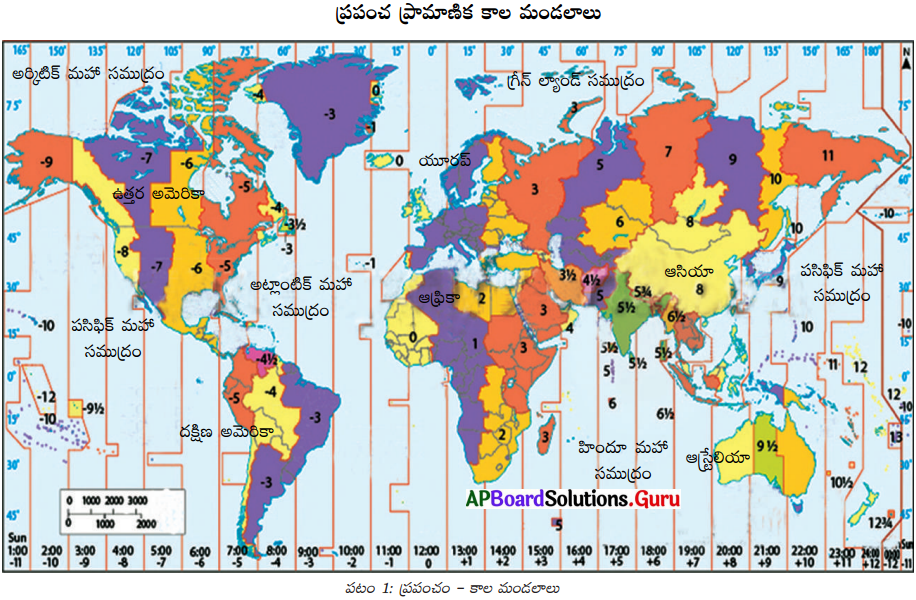
జవాబు:
AP Board 9th Class Social Solutions Chapter 5 జీవావరణం 1
AP Board 9th Class Social Solutions Chapter 5 జీవావరణం 2

ప్రశ్న 4.
అంతరించిపోతున్న అడవులను ఎలా సంరక్షించుకోవచ్చు? (AS6)
(లేదా)
అడవుల సంరక్షణకై ఏవేని రెండు మార్గాలను సూచించండి.
(లేదా)
ప్రస్తుతం అంతరించిపోతున్న అడవులను సంరక్షించుకొనుటకు నాలుగు సూచనలు రాయండి.
జవాబు:
అంతరించిపోతున్న అడవులను సంరక్షించుకొనే విధానం :

  1. పారిశ్రామిక ప్రాంతాల యందు, పాఠశాలల ఆవరణంలోను, కళాశాలల ఆవరణంలోను,ఇంటి ఆవరణంలోను, రోడ్లు కిరువైపుల, కాలువ గట్లపైన, నదుల గట్లపైన, ఖాళీస్థలాల యందు, మొక్కలను పెంచాలి.
  2. అడవుల అక్రమ నరికి వేతలను అరికట్టి ఆక్రమ రవాణాను పూర్తిగా ఆపుచేయాలి.
  3. అడవులను నరుకుతున్న ప్రదేశాల యందు మొక్కలను నాటాలి.
  4. మొక్కల పెరుగుదలకు అన్ని రకాల చర్యలు చేపట్టాలి.
  5. అడవుల ఆవశ్యకత గురించి ప్రజలకు తెలియజేయాలి.

ప్రశ్న 5.
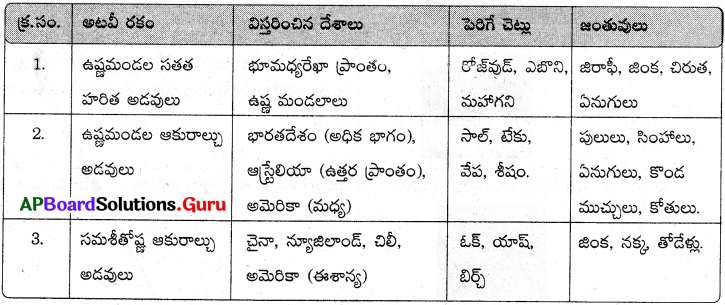
పాఠ్యాంశాన్ని చదివి కింద పట్టిక నింపండి.
AP Board 9th Class Social Solutions Chapter 5 జీవావరణం 3
జవాబు:
AP Board 9th Class Social Solutions Chapter 5 జీవావరణం 4

ప్రశ్న 6.
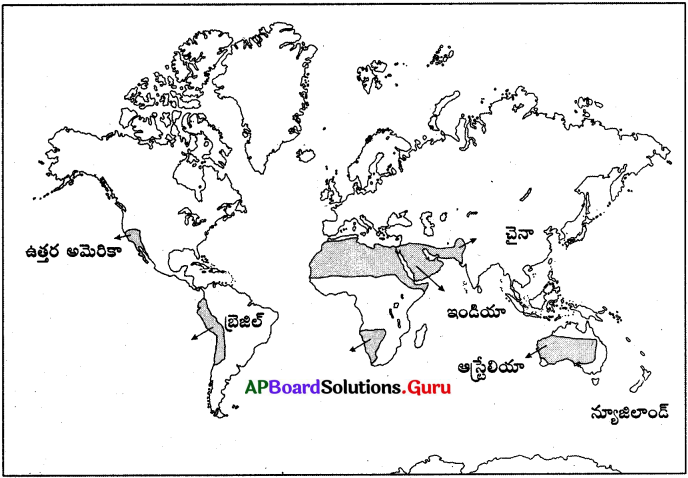
ప్రపంచ పటంలో ఈ కింది దేశాలను గుర్తించండి.
1. న్యూజిలాండ్ .2. బ్రెజిల్ 3. ఆస్ట్రేలియా 4.ఉత్తర అమెరికా 5. చైనా 6. ఇండియా
జవాబు:
AP Board 9th Class Social Solutions Chapter 5 జీవావరణం 5

ప్రశ్న 7.
పేజీ నెం. 57లోని “వనరులు అంతరించిపోవడం” అంశం చదివి, వ్యాఖ్యానించండి.
జవాబు:
వనరులు అంతరించిపోవడం ఇటీవల చాలా తీవ్రమైంది. పారిశ్రామికీకరణ వేగంగా వృద్ధి చెందుతున్న జనాభా, పట్టణీకరణ వల్ల ఖనిజాలు, అడవులు, నేల, రాళ్లు, గాలి వంటి ప్రకృతి వనరులు కనీవినీ ఎరుగని రీతిలో, స్థాయిలో దోపిడీకి గురౌతున్నాయి. అదే విధంగా భూమిలో కోట్ల సంవత్సరాలుగా నిలవ ఉన్న ఇంధన వనరులు అనగా బొగ్గు, ముడిచమురు కొల్లగొడుతున్నారు. వనరులు అంతరించడం వలన అటు జీవ వైవిధ్యానికి కూడా పెను సవాలు ఎదురౌతుంది. అడవులు తగ్గిపోతూ, ఖనిజాలు, చమురు, భూగర్భజల వనరులు అంతరించిపోతున్నాయి. అభివృద్ధి ముసుగులో ప్రకృతి వనరులు అంతరించడం వల్ల భవిష్యత్తు తరాల భవిష్యత్తు చీకటిలో కొట్టుమిట్టాడుతుంది. పర్యావరణం కూడా కలుషితమౌతూ, మానవాళి మనుగడకే ముప్పు వాటిల్లుతుంది.

9th Class Social Studies 5th Lesson వాతావరణం InText Questions and Answers

9th Class Social Textbook Page No.51

ప్రశ్న 1.
గాలి, నీరు మీద మొక్కలు ఎలా ఆధారపడి ఉన్నాయో చెప్పండి ; మొక్కలు ఆ రెండింటిని ఎలా ప్రభావితం చేస్తాయో చెప్పండి.
జవాబు:

  1. అన్ని రూపాలలోని జీవులకు వాటి చుట్టూ ఉండే నేల, నీరు, గాలి, సూర్యరశ్మిలతో అవినాభావ సంబంధం ఉంది.
  2. వీటినుండి జీవం తనకు కావలసినవన్నీ పొందుతుంది, తిరిగి వాటిని గణనీయంగా ప్రభావితం చేస్తుంది.
  3. తమ చుట్టూ ఉన్న మూడు ఆవరణాలతోనే కాకుండా వివిధ జీవరూపాల మధ్య పరస్పర సంబంధాలు ఉంటాయి. ఇవన్నీ ఒక సంక్లిష్ట ‘ఆహార శృంఖలం’లో భాగం – అంటే ఒక రకమైన జీవరూపం మరొకదానికి ఆహారం అవుతుంది.
  4. అనేక రకాల జీవరూపాలు అత్యవసర పదార్థాలను ఒకదానితో ఒకటి పంచుకుంటూ పరస్పర ప్రయోజన సంబంధాలలో ఉంటాయి. వీటన్నిటికీ ఉదాహరణలు తెలుసుకుందాం.
  5. భూమి మీద ప్రాథమిక ఆహార ఉత్పత్తిదారులు మొక్కలు. సూర్యరశ్మిని ఉపయోగించుకుని ఇవి ఆహారం తయారుచేస్తాయి. వీటికి కావలసిన పోషకాలను నేలనుంచి, ప్రత్యేకించి ఇతర మొక్కలు, పశువుల వ్యర్థపదార్థాలు కుళ్లగా ఏర్పడిన సేంద్రియ మూలకాల నుంచి గ్రహిస్తాయి.
  6. నేలలో బ్యాక్టీరియా స్థిరీకరించిన నత్రజనిపై కూడా. ఇవి ఆధారపడతాయి. మొక్కలు తయారుచేసిన ఆహారాన్ని ‘శాకాహారులు’ అని పిలిచే జింక, ఆవు, మేక, ఏనుగు వంటి గడ్డి తినే జంతువులు తింటాయి.
  7. కుక్క, పిల్లి, డేగ, పులి వంటివి మాంసాహారులు, ఇవి శాకాహార జంతువులను తినడం వల్ల పరోక్షంగా మొక్కలపై ఆధారపడినవే. చనిపోయిన మొక్కలు, జంతువులు, వాటి వ్యర్థ పదార్థాలపై బ్యాక్టీరియా, శిలీంధ్రాలు వంటివి పనిచేసి సేంద్రియ మూలకాలుగా విచ్ఛిన్నం చేస్తాయి.
  8. మొక్కలు తమ ఎదుగుదలకు సేంద్రియ మూలకాలపై ఆధారపడతాయి. ఈ విధంగా జీవన చక్రం నిరంతరం కొనసాగుతూ ఉంటుంది.

AP Board 9th Class Social Solutions Chapter 5 జీవావరణం

ప్రశ్న 2.
దోమలు, సీతాకోకచిలుకలు వంటి పురుగులు రాళ్ళు లేదా మట్టి మీద, నీటి మీద ఏ విధంగా ఆధారపడి ఉన్నాయి? తిరిగి వాటిని అవి ఎలా ప్రభావితం చేస్తాయి?
జవాబు:

  1. దోమలు, సీతాకోకచిలుకలు వంటి పురుగులు రాళ్ళు లేదా మట్టి మీద, నీటి మీద ఆధారపడి ఉండటానికి కారణం దోమలు నీటి మీద నివసిస్తూ, గుడ్లు పెడుతూ తమ సంతానాన్ని వృద్ధి చేసుకుంటూ మానవుల, జంతువుల ఇతర విధములైన రక్తమును పీలుస్తూ జీవిస్తాయి.
  2. సీతాకోక చిలుకలు పుష్పాలలో మకరందాన్ని సేవిస్తూ జీవిస్తాయి. అలాగే ఇతర క్రిమికీటకాదులు తమతమ రీతులలో జీవనం చేస్తాయి.

9th Class Social Textbook Page No.55

ప్రశ్న 3.
మీ పరిసరాల్లో గట్టి కలప, మెత్తటి కలపతో చేసిన వస్తువులను గుర్తించండి.
జవాబు:
గట్టి కలపతో చేసిన వస్తువులు :
తలుపులు, కిటికీలు, మంచాలు, కుర్చీలు, బల్లలు, సోఫాలు, వివిధ రకాలైన గృహోపకరణాలు.

మెత్తటి కలపతో చేసినవి :
అగ్గి పుల్లలు, ప్యాకేజింగ్ పెట్టెలు.

ప్రశ్న 4.
మీ ప్రాంతంలో ఉండే చెట్ల పేర్లతో పాటు వాటి గురించి తెలుసుకోండి.
జవాబు:
మా ప్రాంతంలో ఉండే చెట్లు
మామిడి : కాయలు, కలపనిస్తుంది.
వేప : ఆరోగ్యప్రదాయిని, కలప, ఔషధాల సపోటానిస్తుంది.
చింత : కలప, చింతపండుకు ఉపయోగపడుతుంది.
సరుగుడు : కలపనిస్తుంది.
జీడిమామిడి : జీడిపప్పునిస్తుంది.
జామ : కాయలు, కలపనిస్తాయి.
సపోటా : కాయలనిస్తుంది.
ద్రాక్ష : పండ్లనిస్తుంది.
బాదం : పప్పునిస్తుంది.
మఱ్ఱి : కలపనిస్తుంది.

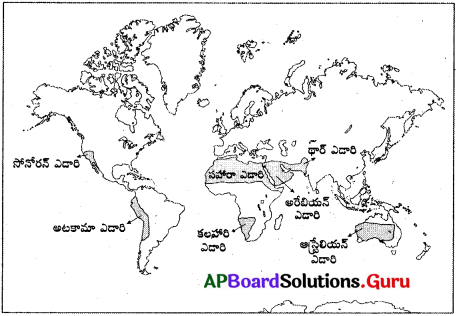
ప్రశ్న 5.
ప్రపంచ పటంలో ఎడారి ప్రాంతాలను గుర్తించండి.
జవాబు:

  1. సహారా ఎడారి
  2. కలహారి ఎడారి
  3. థార్ ఎడారి
  4. అరేబియన్ ఎడారి
  5. ఆస్ట్రేలియన్ ఎడారి
  6. అటకామా ఎడారి
  7. సోనోరన్ ఎడారి

AP Board 9th Class Social Solutions Chapter 5 జీవావరణం 6

9th Class Social Textbook Page No.56

ప్రశ్న 6.
వ్యవసాయం, పశుపోషణ మొదలు పెట్టినప్పుడు మనుషులు తమ చుట్టూ ఉన్న భూమి, నీరు, మొక్కలు, జంతువులను ఏ విధంగా ప్రభావితం చేసి ఉంటారో చర్చించండి.
జవాబు:

  1. మానవులు వ్యవసాయం, పశుపాలన మొదలు పెట్టినప్పుడు, పర్యావరణాన్ని మరింతగా ప్రభావితం చేయసాగారు.
  2. ఇత్తడి, ఇనుము వంటి లోహాల వినియోగం, నగరాల నిర్మాణంతో, పర్యావరణంతో మానవ సంబంధాలు మారిపోయాయి.
  3. అనతి కాలంలోనే ప్రజలు నీళ్లు నిల్వచేయటానికి చెరువులు, పొలాలకు నీళ్ళు ‘ మళ్లించటానికి కాలువలు, నదులకు ‘ అడ్డంగా ఆనకట్టలు వంటివి నిర్మించటం మొదలు పెట్టారు.
  4. వివిధ ప్రాంతాలను కలుపుతూ ప్రజలు రహదారులు వేశారు.
  5. మహా సముద్రాల మీద ఓడలు, పడవలతో ప్రయాణం చేశారు.

ప్రశ్న 7.
వాళ్లు ఏ ఇంధన వనరులను ఉపయోగించి ఉంటారు? వాటిని ఎలా పొంది ఉంటారు?
జవాబు:

  1. ఇంధన వనరుల కోసం పారిశ్రామిక దేశాలు ప్రపంచమంతటా వెదకసాగాయి.
  2. వాళ్లు ప్రపంచమంతా అన్వేషించి అన్ని రకాల వనరుల జాబితా తయారు చేశారు.
  3. లోతైన బావులు తవ్వి భూమి లోపల పొరల్లో ఏముందో చూశారు.
  4. అనతి కాలంలోనే భూమి అంతటా పెద్ద ఎత్తున గనుల తవ్వకం, అడవులు నరికి వేయటం, కర్మాగారాల నిర్మాణం, రోడ్లు వేయటం, వ్యవసాయ పొలాలుగా మార్చటం వంటివి చేపట్టారు.

AP Board 9th Class Social Solutions Chapter 5 జీవావరణం

ప్రశ్న 8.
నగరాలు నిర్మించటం వల్ల వాటి చుట్టూ నేల, నీళ్లు ఏ విధంగా ప్రభావితమై ఉంటాయి?
జవాబు:

  1. నగరాలు నిర్మించటం. వల్ల, పరిశ్రమలు స్థాపించటం వల్ల, జనాభా పెరుగుదల వల్ల ఖనిజాలు, అడవులు, నేల, రాళ్లు, గాలి వంటి ప్రకృతి వనరులు ఇంతకు ముందు కనీవినీ ఎరగని స్థాయిలో దోపిడికి గురవుతున్నాయి.
  2. నేల, నీళ్ళు కలుషితం అవుతున్నాయి.
  3. నేల వేడెక్కుతుంది. నీళ్ళు కలుషితం అవుతున్నాయి. వీటి వలన మానవుల జీవితం రోగాల బారిన పడుతుంది.
  4. శిలాజ ఇంధనాలను ఉపయోగించటం వల్ల ఆధునిక పరిశ్రమలు ఘన, ద్రవ,వాయు రూపాలలో వ్యర్థ పదార్థాలను విడుదల చేసి గాలి, నీరు, నేలను కలుషితం చేస్తున్నాయి.

ప్రశ్న 9.
భూమి స్వరూపాన్ని, నీటి చక్రాన్ని ఇది ఏ విధంగా ప్రభావితం చేస్తోంది?
జవాబు:

  1. కాలుష్యాల వల్ల కొంతకాలానికి మన పర్యావరణం విషపూరితం అవుతుంది.
  2. ముఖ్యమైన మార్పు ప్రపంచ వ్యాప్తంగా శీతోష్ణస్థితులు మారటం.
  3. దీనినే ప్రపంచం వేడెక్కటం అంటున్నారు.
  4. దీనితో వర్షాలు తగ్గిపోతున్నాయి.
  5. కాలుష్యం పెరిగిపోతుంది.
  6. మంచి నీటి ప్రవాహం ఏర్పడుతుంది.
  7. మరొక వైపు ధృవాల వద్ద మంచు సముద్రాల నీటి మట్టం పెరిగి దీవులు జలమయం అవుతాయి.
  8. శిలాజ ఇంధనాలను ఉపయోగించటం వల్ల బొగ్గు పులుసు వాయువుతో పాటు నైట్రోజన్ ఆక్సైడ్, సల్ఫర్ డై ఆక్సైడ్, ఆవిరై పోయే కర్బన మూలకాలు, భార లోహాలు వంటి ఇతర రసాయనాలు విడుదలవుతాయి.
  9. వీటి వల్ల గంధిక, కర్బన, నత్రిత ఆమ్లాలు విడుదలై ఆమ్ల వర్షాలు కురుస్తాయి. దీనితో జలచక్రం దెబ్బతింటుంది.

ప్రాజెక్టు

ప్రశ్న 1.
దగ్గరలోని పరిశ్రమను సందర్శించి దానినుంచి వెలువడుతున్న వాయు, ద్రవ, ఘన వ్యర్థ పదార్థాలను గమనించండి. వాటి వల్ల మొక్కలు, పశువులు ఏ విధంగా ప్రభావితం అవుతున్నాయో చుట్టుపక్కల ఉంటున్న వాళ్ళను అడిగి తెలుసుకోండి. సేకరించిన సమాచారాన్ని ఆధారం చేసుకొని ఒక నివేదిక తయారుచేసి తరగతిలో ప్రదర్శించండి.
జవాబు:

  1. మాకు దగ్గరలోని రవాణా పరికరాలు తయారుచేసే పరిశ్రమను సందర్శించడం జరిగింది.
  2. ఈ పరిశ్రమ బొగ్గు, చమురు నుంచి వచ్చే ఇంధనాలను పెద్ద ఎత్తున వినియోగిస్తారు.
  3. ఈ విధంగా శిలాజ ఇంధనాలను ఉపయోగించటం వల్ల బొగ్గుపులుసు వాయువుతో పాటు నైట్రోజన్ ఆక్సెడ్, సల్ఫర్ డై ఆక్సైడ్, ఆవిరైపోయే కర్బన మూలకాలు, భారీ లోహాలు వంటి ఇతర రసాయనాలు విడుదలవుతాయి.
  4. వీటివల్ల గంధిక, కర్బన, నత్రిత ఆమ్లాలు విడుదలై, దాని ఫలితంగా ఆమ్ల వర్షాలు కురుస్తాయి.
  5. ఈ పరిశ్రమ ఘన, ద్రవ, వాయు రూపాలలో వ్యర్థ పదార్థాలను విడుదల చేసి గాలి, నీటి (వాగులు, నదులు) వంటి ఉపరితల ప్రవాహాలను, బావులలోని భూగర్భ జలాలను నేలను కలుషితం చేస్తున్నాయి.
  6. ఇలాంటి కాలుష్యం వల్ల కొంత కాలానికి పర్యావరణం వేడెక్కుతుంది, శీతోష్ణస్థితులు మారిపోతాయి.
  7. ఈ ప్రభావం మొక్కలు, జంతువులు, మానవుల పై పడుతుంది.

ప్రశ్న 2.
మీ ప్రాంతంలో లేదా మీ గ్రామంలో అంతరించిపోతున్న జంతువులు లేదా పక్షులు వివరాలను సేకరించి, క్రింది పట్టికలో నింపి, తరగతి గదిలో చర్చించండి. అందుకు మీ తల్లిదండ్రుల, పెద్దల సహకారం తీసుకోండి.
AP Board 9th Class Social Solutions Chapter 5 జీవావరణం 7
జవాబు:

AP Board 9th Class Social Studies Important Questions Chapter 21 Human Rights and Fundamental Rights

AP State Syllabus AP Board 9th Class Social Studies Important Questions Chapter 21 Human Rights and Fundamental Rights.

AP State Syllabus 9th Class Social Studies Important Questions 21st Lesson Human Rights and Fundamental Rights

9th Class Social 21st Lesson Human Rights and Fundamental Rights 1 Mark Important Questions and Answers

Question 1.
What is a writ?
(OR)
What do you understand about ‘writt1? (SA-II : 2017-18)
Answer:

  • Writ is an authority given to the court to issue directions to the government to protect and enforce any constitutional right.
  • It is an inherent power given to the court.
  • The court can “Suo motu” (on its own motion) take congnizance of a violation of fundamental rights.

AP Board 9th Class Social Studies Important Questions Chapter 21 Human Rights and Fundamental Rights

Question 2.
Write any two slogans about abolition of child labour. (SA-II : 2017-18)
Answer:
1. Child is your heart not born to push your cart.
2. Children are the future heroes, they need to learn before they can work.

9th Class Social 21st Lesson Human Rights and Fundamental Rights 2 Marks Important Questions and Answers

Question 1.
Read the following situations. Which Fundamental Right is being violated in each case and how? (SA-II : 2018-19)
i. A director who makes a documentary film that criticizes the policies of the government is arrested and sent to prison.
ii. A ten years old boy is not allotted to go to school and is forced to work in a firecracker factory.
Answer:
i) In first case Right to freedom of speech and expression is violated. Everyone has a right to express their opinion on the administration of govt. But some limitations are there.
ii) In the second case, Right against exploitation is violated.
The Constitution says “no child below the age of 14 shall be employed engaged in any other hazardous employment.

AP Board 9th Class Social Studies Important Questions Chapter 21 Human Rights and Fundamental Rights

Question 2.
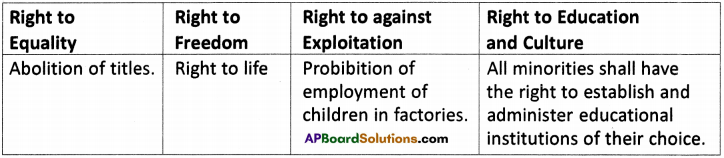
Read the following concepts and write under the table with relevant fundamental right. (SA-II : 2017-18)

  • Prohibition of employment for children in factories.
  • All minorities shall have the right to establish and administer educational institutions of their choice.
  • Abolition of titles.
  • Right to life.

AP Board 9th Class Social Studies Important Questions Chapter 21 Human Rights and Fundamental Rights 1

Answer:
AP Board 9th Class Social Studies Important Questions Chapter 21 Human Rights and Fundamental Rights 2

9th Class Social 21st Lesson Human Rights and Fundamental Rights Important Questions and Answers

Question 1.
Write a short note about UDHR.
Answer:

  • A group of people from 9 countries around the world formed by UNO drafted a list of 30 articles.
  • This became the Universal Declaration of Human Rights.
  • It was passed by the UN General Assembly in 1948.

AP Board 9th Class Social Studies Important Questions Chapter 21 Human Rights and Fundamental Rights

Question 2.
What are the functions of NHRC?
Answer:

  • NHRC is vested with the authority to make an inquiry, Suo motu or on a petition presented to it by a victim.
  • It works for protecting human rights.
  • It intervenes in any case involving human rights in the court or outside the court.

Question 3.
What are our fundamental duties?
Answer:
The fundamental duties to be discharged by the citizens were not there in our Constitution earlier. They were included through 42nd amendment. They are :

  1. Respecting the constitution, National Flag and National Anthem.
  2. Cherishing the noble ideals of the freedom struggle.
  3. Defending the country and rendering national service when called for.
  4. Upholding and protecting the sovereignty, unity and integrity of India.
  5. Promoting harmony and the spirit of common brotherhood amongst all the people of India and renouncing any practice derogatory to the dignity of women.
  6. Preserving the rich heritage of the Nation’s composite culture.
  7. Protecting and improving the natural environment including forests, lakes, rivers and wild life and having compassion for living creatures.
  8. Developing scientific temper, humanism and spirit of inquiry or reform.
  9. Safeguarding public property and abjuring violence.
  10. Striving for the excellence in all individual and collective activities.

AP Board 9th Class Social Studies Important Questions Chapter 21 Human Rights and Fundamental Rights

Question 4.
What are the differences between the fundamental rights and fundamental duties?
Answer:
1) Fundamental rights :
a) Fundamental rights are definite.
b) No one can deprive us of these rights.
c) Even Government cannot ignore them.
d) These rights are safeguarded through court of law.

2) Fundamental duties :
a) No one can force us to abide to them.
b) The discharge of fundamental duties is left to our discretion.
c) No court can force us to discharge these duties.

Question 5.
Read the passage and answer the following questions.
Human Rights Commission :
AP Board 9th Class Social Studies Important Questions Chapter 21 Human Rights and Fundamental Rights 3
The United Nations has been working to protect the basic human rights of people and in this effort they have encouraged their member nations to do the same. In 1993,the Government of India passed an act of legislature to protect human rights. A commission for human rights was set up under this law called the National Human Rights Commission (NHRC). The commission has been given powers of a civil court extendable to the entire country. The Government has also established other institutions to monitor and inquire into situations in which rights are violated. Thus we have different institutions such as the National Commission for Women, National Commission for Protection of Child Rights, National Minority Commission and State Human Rights Commissions.
i) When did the Government of India pass an act of legislature to protect human rights?
Answer:
In 1993 the Government of India passed a legislature.

ii) Expand NHRC.
Answer:
NHRC means National Human Rights Commission.

iii) What are the institutions that work on Human Rights?
Answer:
1) National Human Rights Commission.
2) National Commission for Women.
3) National Minority Commission.
4) State Human Rights Commission.

iv) What does the above Logo stand for?
Answer:
It is the logo of Human Rights designed by the United Nations Organization.

v) Which organization is behind the establishment of Human Rights Commission?
Answer:
The UNO is instrumental in establishing the Human Rights Commission.

Question 6.
Gather certain information about violation of fundamental rights and how the court protected them.
Answer:
I.

  1. One factory was emitting dangerous gases and health of the people was effected.
  2. A public interest litigation is filed in the court.
  3. The factory was forced to close down. As it is against the fundamental right of Right to life.

II.

  1. One child was working as a domestic servant in a family.
  2. The family members went on a tour for two days.
  3. The child (servant) was kept in the house and the door was locked from outside.
  4. The neighbours recognized it. Given a complaint to the police.
  5. The police broke open the doors and a case was filed against the head of the family.

AP Board 9th Class Social Studies Important Questions Chapter 21 Human Rights and Fundamental Rights

Question 7.
Which of the following rights is available under the Indian Constitution?
a) Right to work
b) Right to adequate livelihood
c) Right to protect one’s culture
d) Right to privacy
Answer:
c) Right to protect one’s culture

AP Board 9th Class English Study Material Textbook Solutions Guide State Syllabus

Andhra Pradesh SCERT AP State Board Syllabus 9th Class English Textbook Solutions and Study Material Pdf are part of AP Board 9th Class Textbook Solutions.

AP State Syllabus 9th Class English Textbook Solutions Study Material Guide Pdf Free Download

Unit 1 Humour

Unit 2 Games and Sports

Unit 3 School Life

Unit 4 Environment

Unit 5 Disasters

Unit 6 Freedom

AP Board 9th Class Social Solutions Chapter 4 వాతావరణం

SCERT AP 9th Class Social Studies Guide Pdf 4th Lesson వాతావరణం Textbook Questions and Answers.

AP State Syllabus 9th Class Social Solutions 4th Lesson వాతావరణం

9th Class Social Studies 4th Lesson వాతావరణం Textbook Questions and Answers

Improve your learning (మీ అభ్యసనాన్ని మెరుగుపడుచుకోండి)

ప్రశ్న 1.
వాతావరణంలోని వివిధ అంశాలను వివరించండి. (AS1)
జవాబు:
వాతావరణంలోని వివిధ అంశాలు:

  1. ఉష్ణోగ్రత
  2. పీడనం
  3. పవనాలు
  4. గాలిలోని తేమ
  5. వర్షపాతం

1. ఉష్ణోగ్రత :
భూ ఉపరితలం నుండి పైకి వెళ్ళే కొలది ఉష్ణోగ్రతలు తగ్గుతాయి.

2. పీడనం :
వాతావరణం యొక్క బరువు భూమి ఉపరితలముపై ఒత్తిడిని కలిగిస్తుంది. దీనినే పీడనం అంటారు.

3. పవనాలు :
అధిక పీడన ప్రాంతం నుంచి ఎల్లప్పుడు అల్పపీడన ప్రాంతానికి వీచే గాలిని పవనాలు అంటారు.

4. గాలిలోని తేమ :
గాలిలోని తేమను ఆర్ధత అంటారు.

5. వర్షపాతం :
నీటి బిందువుల రూపంలో పడుతుంది.

ప్రశ్న 2.
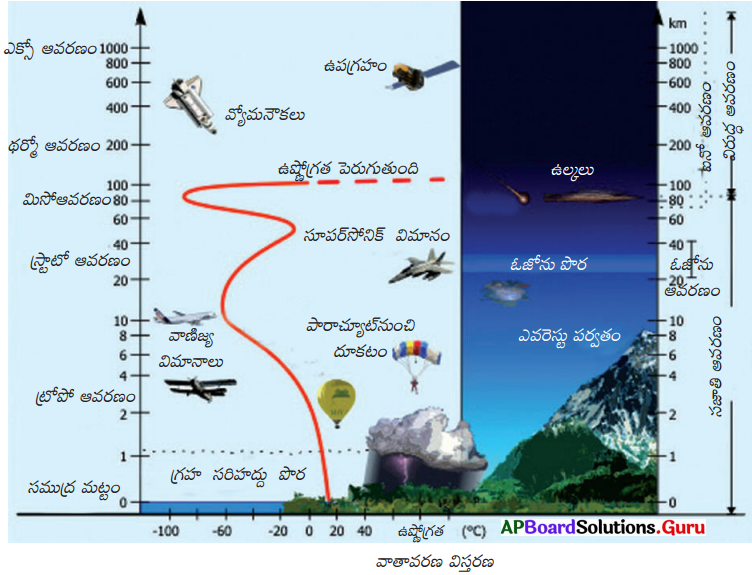
చిత్రం సహాయంతో వాతావరణంలోని పొరలను చర్చించండి. (AS1)
జవాబు:
AP Board 9th Class Social Solutions Chapter 4 వాతావరణం 1
సాంద్రత, ఉష్ణోగ్రతల ఆధారంగా కూడా వాతావరణాన్ని వివిధ పొరలుగా విభజించవచ్చు.

1. ట్రోపో ఆవరణం :

  1. వాతావరణంలో అన్నిటి కంటే కింద ఉన్న పొర.
  2. ధృవాల వద్ద 8 కిలోమీటర్లు భూమధ్యరేఖ వద్ద 18 కిలోమీటర్ల ఎత్తు వరకు ఉంటుంది.
  3. ఈ పొర సగటు ఎత్తు 13 కిలోమీటర్లు.
  4. వాతావరణంలో మార్పులు జరుగుతాయి.
  5. జీవరాశి నివసిస్తుంది.
  6. మేఘాలు ఏర్పడతాయి.

2. స్ట్రాటో ఆవరణం :

  1. 50 కిలోమీటర్ల ఎత్తు వరకు ఉంటుంది.
  2. జెట్ విమానాలు ఎగరటానికి ఈ పొర చాలా అనువుగా ఉంటుంది.
  3. ఓజోన్ పొర ఈ ఆవరణలోనే కలదు.
  4. ఎత్తుకు వెళ్తున్న కొలది ఈ ఆవరణంలో ఉష్ణోగ్రతలు తగ్గుతాయి.

3. మీసో ఆవరణం :

  1. 80 కిలోమీటర్ల ఎత్తు వరకు ఉంటుంది.
  2. విశ్వంలో రాని ఉల్కలు ఈ పొరలోకి ప్రవేశించగానే కాలిపోతాయి.
  3. ఎత్తు పెరుగుతున్న కొద్దీ ఈ ఆవరణంలో ఉష్ణోగ్రతలు తగ్గుతాయి.

4. థర్మో ఆవరణం :

  1. 400 కిలోమీటర్ల ఎత్తు వరకు ఉంటుంది.
  2. ఈ ఆవరణంలో ఎత్తుకు వెళుతున్న కొద్ది ఉష్ణోగ్రతలు వేగంగా పడిపోతాయి.
  3. ఈ పొరలో అయాన్లు అనే విద్యుదావేశం ఉండే కణాలు ఉంటాయి.
  4. భూమి నుంచి ప్రసారితమయ్యే రేడియో తరంగాలు ఈ అయాన్ల కారణంగా తిరిగి – భూమికి పరావర్తనం చెందుతాయి.

5. ఎక్సో ఆవరణం :
వాతావరణంలోని అన్నిటి కంటే చివరి పైపొర ఇదే. అత్యంత ఎత్తులో ఉండే ఈ పొర గురించి మనకు తెలిసింది చాలా తక్కువ.

AP Board 9th Class Social Solutions Chapter 4 వాతావరణం

ప్రశ్న 3.
శీతోష్ణస్థితులు (climate), స్థానిక వాతావరణ స్థితులు (weather) మధ్య తేడాలను తెలియజేయండి. (AS1)
జవాబు:

  1. శీతోష్ణస్థితులు అనగా ఉష్ణోగ్రత, పీడనం, పవనాలు, గాలిలోని తేమ, వర్షపాతం వంటి అంశాలను శీతోష్ణస్థితి అంశాలు అనవచ్చును. సాధారణంగా అంతటా ఉన్న పై అంశాలను గురించి తెలియజేసేది శీతోష్ణస్థితి.
  2. స్థానిక వాతావరణ స్థితులు అనగా ప్రత్యేకంగా ఒక ప్రాంతంలో ఉన్న ఉష్ణోగ్రత, పీడనం, పవనాలు, గాలిలోని తేమ, వర్షపాతం వంటి అంశాలను గురించి వివరించడాన్ని స్థానిక వాతావరణ స్థితులు అంటారు. స్థానికం అనగా ఒక ప్రాంతం గురించి వివరించడం.

ప్రశ్న 4.
సంవహన వర్షపాతం, పర్వతీయ వర్షపాతాల మధ్య తేడాలు, పోలికలు తెలియజేయండి. (AS1)
జవాబు:
1. సంవహన వర్షపాతం :
వేడెక్కిన ఉపరితలం మీద తేమ కలిగిన గాలి కూడా వేడెక్కి పైకిలేచి చల్లబడినపుడు పడే వర్షాన్ని సంవహన వర్షపాతం అంటారు.

2. పర్వతీయ వర్షపాతం :
తేమతో కూడిన గాలి దాని దారిలో ఉన్న కొండ లేదా ఎత్తైన అవరోధం వల్ల పైకి లేచినపుడుఈ రకమైన వర్షం కురుస్తుంది.

తేడాలు :
సంవహన వర్షం తేమ కలిగిన గాలి పైకి లేచి ఆదే ప్రాంతంలో వర్షం పడుతుంది. పర్వతీయ వర్షపాతం తేమతో కూడిన గాలి వీయడం వల్ల పర్వతాలు అడ్డు వచ్చే వరకు వెళ్ళి అక్కడ వర్షం సంభవిస్తుంది.

పోలికలు :
రెండు రకాలైన వర్షాలు తేమతో కూడిన గాలుల వలన సంభవిస్తాయి.

రెండు రకాల వర్షాలు భూ ఉపరితలం పైనున్న నీరు ఆవిరై నీటి ఆవిరిగా మారి వర్షపాతం సంభవిస్తుంది.

ప్రశ్న 5.
ప్రపంచ వ్యాప్తంగా వర్షపాతం ఎలా ఉంటుందో వివరించండి. (AS1)
జవాబు:
ప్రపంచవ్యాప్తంగా వర్షాలు :

  1. భూమధ్యరేఖకు ఉత్తర, దక్షిణ దిశలలో 10° నుంచి 30° అక్షాంశాల మధ్య వాణిజ్య పవనాల కారణంగా తూర్పు తీరంలో భారీ వర్షాలు పడతాయి, పశ్చిమం వైపునకు వెళ్ళే కొద్దీ వర్షాలు తగ్గుతాయి.
  2. భూమధ్యరేఖకు, ఉత్తర, దక్షిణ దిశలలో 40° నుంచి 60° అక్షాంశాల మధ్య పశ్చిమ పవనాల వల్ల పడమటి తీరంలో భారీ వర్షాలు పడతాయి. తూర్పునకు వెళుతున్న కొద్దీ వర్షాలు తగ్గుతాయి.
  3. తక్కువ పీడనం ఉన్న ప్రాంతాలలో, ప్రత్యేకించి భూమధ్యరేఖకు సమీపంలో ఎక్కువ పీడనం ఉన్న ప్రాంతాలకంటే ఎక్కువ వర్షాలు పడతాయి.
  4. ఖండాల మీదకంటే సముద్రాల మీద వర్షాలు ఎక్కువ పడతాయి.

ప్రశ్న 6.
శీతోష్ణస్థితులలోని మార్పులు మానవ జీవితాన్ని ఎలా ప్రభావితం చేస్తాయి? (AS4)
(లేదా)
వాతావరణంలో వస్తున్న మార్పులు మానవ జీవితాన్ని ఎలా ప్రభావితం చేస్తున్నాయి?
జవాబు:
శీతోష్ణస్థితులలోని మార్పులు మానవజీవితాన్ని ప్రభావితం చేసే విధానం:
శీతోష్ణస్థితి అంశాలు –

  1. ఉష్ణోగ్రత
  2. పీడనం
  3. పవనాలు
  4. గాలిలోని తేమ
  5. వర్షపాతం వంటి అంశాలు మానవుని ఆర్థిక, సామాజిక, సాంస్కృతిక జీవన విధానాన్ని నిర్ణయిస్తాయి. ఉష్ణోగ్రత పీడనం, పవనాలు, గాలిలోని తేమ, వర్షపాతాలపై ఆచారాలు, అలవాట్లు, వేషధారణ, ఆహారం మొ||న విషయాలు ఆధారపడి ఉన్నాయి.

AP Board 9th Class Social Solutions Chapter 4 వాతావరణం

ప్రశ్న 7.
సాపేక్ష ఆర్ధతను వివరించండి. (AS1)
జవాబు:

  1. ఒక నిర్దిష్టమైన ఉష్ణోగ్రత మరియు పీడనము వద్ద గాలి గ్రహించగల మొత్తం నీటి ఆవిరి పరిమాణమునకు మరియు లెక్కకట్టిన సమయంలో గాలిలోగల నీటి ఆవిరి పరిమాణానికి మధ్యగల నిష్పత్తిని సాపేక్ష ఆర్ధత అంటారు.
  2. దీనిని ఎల్లప్పుడూ శాతములో చూపుతారు.
  3. వాతావరణంలో సాపేక్ష ఆర్ధత 100 గా ఉన్నప్పుడు దానిని సంతృప్తి స్థాయి అంటారు.

ప్రశ్న 8.
ఎత్తు పెరిగేకొలది నీటి ఆవిరి వేగంగా తగ్గుతుంది. ఎందువల్ల? (AS1)
జవాబు:
ఎత్తు పెరిగేకొలది నీటి ఆవిరి వేగంగా తగ్గుతుంది. కారణం ఎత్తుకు నీటి ఆవిరికి విలోమ సంబంధం కలదు.

  1. థర్మో ఆవరణం 400 కిలోమీటర్ల ఎత్తు వరకు ఉంటుంది.
  2. ఈ ఆవరణలో ఎత్తుకు వెళుతున్న కొద్దీ ఉష్ణోగ్రతలు వేగంగా పడిపోతుంటాయి. అందువల్ల నీటి ఆవిరి కూడా వేగంగా తగ్గిపోతుంది.

ప్రశ్న 9.
కొరియాలిస్ ప్రభావం అనగానేమి? దాని ప్రభావాన్ని వివరించండి. (AS1)
జవాబు:

  1. భూభ్రమణము వలన జనించు శక్తిని కొరియాలిస్ ప్రభావం అంటారు.
  2. దాని ప్రభావం : ఉత్తరార్ధగోళంలో వీచే పవనాలు కుడివైపునకు, మరియు దక్షిణార్ధ గోళములో. వీచే పవనాలుఎడమవైపునకు నెట్టబడుతున్నాయి.
  3. ఇది భూమధ్యరేఖ వద్ద శూన్యంగానూ, ధృవ ప్రాంతాల వద్ద అత్యధికంగానూ ఉంటుంది.
  4. కాబట్టి ప్రపంచం అంతటా నిరంతరం వాతావరణ ప్రసరణ జరుగుతూ ఉంటుంది.

ప్రశ్న 10.
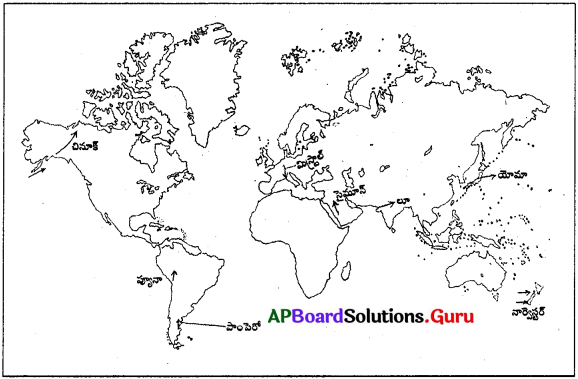
ప్రపంచ పటంలో కింది స్థానిక పవనాలను గుర్తించండి. (AS5)
ఎ) చినూక్ బి) లూ సీ) సైమూన్ డి) యోమా ఇ) నార్వెస్టర్ ఎఫ్) మిస్ట్రాల్ జి) ప్యూనా హెచ్) పాంపెరో
జవాబు:
AP Board 9th Class Social Solutions Chapter 4 వాతావరణం 2

ప్రశ్న 11.
పేజి నెం. 43లోని “ప్రపంచ పవనాల ప్రభావం” అంశాన్ని చదివి, వ్యాఖ్యానించండి. (AS2)
జవాబు:
ప్రపంచవ్యాప్తంగా వేడిని, తేమను రవాణా చేయటంలో ప్రపంచ పవనాలు కీలకపాత్ర పోషిస్తాయి. కనుకనే ప్రపంచంలో ఏ భాగము కూడా ప్రాణులు మనలేనంతగా వేడెక్కదు, లేదా చల్లబడదు. వాతావరణం, లేకపోతే పగటి పూట, లేదా ఉష్ణ మండలాల్లో భరించలేనంత వేడిగా ఉండేది, రాత్రిళ్లు లేదా ధృవప్రాంతాల్లో భరించలేనంతగా చల్లగా ఉండేది. అయితే వేడిని, తేమను ప్రపంచ పవనాలు సమంగా పంచటం లేదు. అందుకే మనకు ప్రపంచంలో కొన్ని ప్రాంతాలు వేడిగా, కొన్ని ప్రాంతాలు చలిగా, కొన్ని ప్రాంతాలు అధిక వర్షపాతంతో, కొన్ని ప్రాంతాలు ఎడారులుగా ఉన్నాయి.

9th Class Social Studies 4th Lesson వాతావరణం InText Questions and Answers

9th Class Social Textbook Page No.37

ప్రశ్న 1.
గాలిలో నీటి ఆవిరి లేకపోతే ఏమవుతుంది?
జవాబు:

  1. గాలిలో నీటి ఆవిరి లేకపోతే వేడిగా ఉంటుంది.
  2. వేడిగాలులు వలన మనం అనేక సమస్యలను ఎదుర్కోవలసి వస్తుంది.
  3. వర్షాలు పడవు.
  4. దానితో నీరు ఉండదు. సముద్రాలలో మార్పులుండవు.

ప్రశ్న 2.
శీతాకాలంలో మన చర్మం పొడారి పోతుంది. ఎందుకు?
జవాబు:
శీతాకాలంలో మన చర్మం పొడారి పోవడానికి కారణం :

  1. శీతాకాలంలో గాలి చలిగా, పొడిగా ఉంటుంది.
  2. ఇటువంటి వాతావరణంలో మన చర్మం దురద పెడుతుంది.
  3. ఇటువంటి సమయంలో పెదాలు పగులుతాయి. కారణం గాలిలో తేమ లేకపోవడమే.

9th Class Social Textbook Page No.37

ప్రశ్న 3.
వాతావరణంలోని రేణువులు మనకు ఏ రకంగా ఉపయోగకరమో, ఏ రకంగా హానికరమో పేర్కొనండి.
జవాబు:

  1. వాతావరణంలోని రేణువులు ప్రకృతి ప్రక్రియల ద్వారా, మానవ చర్యల ద్వారా ఏర్పడతాయి.
  2. భూమి మీద జీవనానికి అనువుగా వాతావరణ పరిస్థితులను ఈ రేణువులు మారుస్తాయి.
  3. సూర్యోదయం, సూర్యాస్తమయం సమయాల్లో సూర్యుడు నారింజ రంగులో ఉండటానికి కారణం ఈ రేణువులే.
  4. వర్షానికి, వడగండ్లు పడడానికి కూడా రేణువులు చాలా వరకు కారణమవుతాయి.

హానికరం :

  1. దుమ్ము, ధూళీ వలన కళ్లు దెబ్బతింటాయి.
  2. మృత్తికా క్రమక్షయం జరుగుతుంది.
  3. వీటి వలన ఎడారుల మీద ఇసుక తుపానులు, అడవుల్లో మంటలు సంభవిస్తాయి.

AP Board 9th Class Social Solutions Chapter 4 వాతావరణం

ప్రశ్న 4.
మనకు వాతావరణం ఎందుకు ముఖ్యమైనది?
జవాబు:

  1. మనం పీల్చే గాలితో పాటు ప్రాణవాయువు తీసుకుంటాం.
  2. అది లేకపోతే మనం బతకలేం. మనకు కావలసిన ప్రాణవాయువు వాతావరణంలో ఉంటుంది.
  3. మనం ఊపిరి బయటికి వదిలినపుడు బొగ్గుపులుసు వాయువు వదులుతాం.
  4. సూర్యుని నుండి వెలువడే హానికరమైన కిరణాల నుండి వాతావరణం మనల్ని కాపాడుతుంది.
  5. ఆకుపచ్చని చెట్లు బొగ్గుపులుసు వాయువు తీసుకుని సూర్యరశ్మి, నీటితో కిరణజన్య సంయోగక్రియ జరుపుతాయి.
  6. తత్ ఫలితంగా వాటి నుంచి తియ్యటి పళ్లు, కూరగాయలు, ఆహారధాన్యాలు వంటివి లభిస్తాయి.
  7. వీటి నుంచి మనకు మాంసకృత్తులు, పిండిపదార్థాలు, చక్కెరలు, కొవ్వు పదార్థాలు, ఖనిజలవణాలు, మనం జీవించటానికి అవసరమయ్యే ఇతర పోషకాలు లభిస్తాయి.
  8. వాతావరణం, వానను కూడా ఇస్తుంది.
  9. వాతావరణం లేకపోతే చాలా రాళ్లు కోతకు గురయ్యేవి కావు. అంటే మనకు అనేక రకాల నేలలు ఉండేవి కావు. అనేక రకాల పంటలు పండించగలిగేవాళ్లం కాదు.

ప్రశ్న 5.
చంద్రుని మీద జీవనం ఎందుకు సాధ్యం కాదో ఊహించండి.
జవాబు:
చంద్రుని మీద వాతావరణం లేదు. వాయువులు లేవు. నీరు లేదు. అందువలన మానవ జీవన విధానానికి కావలసిన వాతావరణం చంద్రుడి మీద లేదు కాబట్టి జీవనం సాధ్యం కాదు.

9th Class Social Textbook Page No.39

ప్రశ్న 6.
ఏ ఆవరణంలో జీవం ఉంది?
జవాబు:

  1. ట్రోపో ఆవరణంలో జీవం ఉంది.
  2. శీతోష్ణస్థితులు, వర్షపాతం వంటి వాతావరణ అంశాలన్నీ ఈ ఆవరణంలోనే సంభవిస్తాయి.
  3. అందువల్ల జీవం ట్రోపో ఆవరణంలోనే కలదు.

ప్రశ్న 7.
ఏ ఆవరణం గురించి మనకు చాలా తక్కువ తెలుసు?
జవాబు:

  1. ఎక్సో ఆవరణం గురించి మనకు చాలా తక్కువ తెలుసు.
  2. వాతావరణంలో అన్నిటి కంటే చివరి పై పొర ఇదే.
  3. అత్యంత ఎత్తులో ఉంటుంది.

AP Board 9th Class Social Solutions Chapter 4 వాతావరణం

ప్రశ్న 8.
జెట్ విమానాలు ఎగరటానికి ఏ ఆవరణం అనువైనది? ఎందుకు?
జవాబు:

  1. జెట్ విమానాలు ఎగరటానికి అనువైన ఆవరణం స్ట్రాటో ఆవరణం.
  2. ఈ ఆవరణంలో మబ్బులు ఉండవు. వర్షపాతం, తుపానులు వంటివి ఉండవు.
  3. అందువల్ల బాగా అనుకూలంగా ఉంటుంది.

ప్రాజెక్టు

ప్రశ్న 1.
వాతావరణ పరిస్థితికి సంబంధించిన సమాచారాన్ని పత్రికలు, రేడియో, టీవీల ద్వారా సేకరించండి. (T.Q.)
జవాబు:

ప్రశ్న 2.
జూలై నుండి డిసెంబర్ వరకు దేశంలోని వివిధ ప్రాంతాల్లో సంభవించిన అత్యధిక వర్షపాతానికి సంబంధించిన సమాచారాన్ని సేకరించండి. (T.Q)
జవాబు:

AP Board 9th Class Social Solutions Chapter 3 జలావరణం

SCERT AP 9th Class Social Studies Guide Pdf 3rd Lesson జలావరణం Textbook Questions and Answers.

AP State Syllabus 9th Class Social Solutions 3rd Lesson జలావరణం

9th Class Social Studies 3rd Lesson జలావరణం Textbook Questions and Answers

Improve your learning (మీ అభ్యసనాన్ని మెరుగుపడుచుకోండి)

ప్రశ్న 1.
భిన్నంగా ఉన్న దానిని గుర్తించి మీ ఎంపికకు కారణాన్ని వివరించండి. (AS1)
i) అ) బాష్పీభవనం ఆ) ద్రవీభవనం ఇ) లవణీకరణ ఈ) అవపాతం
జవాబు:
ఇ) భిన్నంగా ఉన్నది లవణీకరణ.
బాష్పీభవనం :
నేలమీదనున్న నీరు ఆవిరి కావటం ద్వారా వాతావరణంలోకి ప్రవేశించే ప్రక్రియలో నీరు ద్రవరూపం నుంచి వాయు రూపంలోకి మారడాన్ని బాష్పీభవనం అంటారు.

ద్రవీభవనం :
రవాణా చేయబడిన నీటి ఆవిరి ద్రవీభవనం చెంది చిన్న నీటి బిందువులుగా, మబ్బులుగా మారడాన్ని ద్రవీభవనం అంటారు.

అవపాతం :
అవపాతం అనగా వాతావరణంలోని నీరు భూమి ఉపరితలానికి చేరటం.
పై మూడు ఒకే తరగతికి చెందిన ప్రక్రియలు. కాబట్టి లవణీకరణ భిన్న ప్రక్రియ.

లవణీకరణ :
అనగా సముద్రనీటిలో ఉన్న ఉప్పదనం. ఉప్పు రుచిని చూపిస్తుంది.

ii) అ) ఫలకాలు ఆ) అపకేంద్రబలం ఇ) సౌరశక్తి ఈ) అవపాతం
జవాబు:
అ) భిన్నంగా ఉన్నది ఫలకాలు.
ఫలకాలు రెండవ పాఠ్యాంశానికి చెందిన అంశం.

ఆ) అపకేంద్ర బలం ఇ) సౌరశక్తి ఈ) అవపాతం
ఈ మూడు ఈ పాఠ్యాంశానికి సంబంధించిన అంశాలు.

AP Board 9th Class Social Solutions Chapter 3 జలావరణం

ప్రశ్న 2.
తప్పు వాక్యాలను సరిచేయండి. (AS1)
అ) సముద్రాలకు దగ్గరగా సముద్రపు అగాధాలు ఉంటాయి.
ఆ) మైదాన ప్రాంతంలో మాదిరిగానే సముద్రాలలోనూ ఉపరితల రూపాలు ఉంటాయి.
ఇ) శతాబ్దాలుగా భూమి మీద నుంచి కొట్టుకురావటం వల్ల సముద్రాలలో, అధికశాత లవణం ఏర్పడింది.
ఈ) ప్రపంచమంతటా మహాసముద్రాల నీళ్ళు ఒకే ఉష్ణోగ్రతను కలిగి ఉంటాయి.
జవాబు:
అ) సముద్రాలకు దగ్గరగా సముద్రపు అగాధాలు ఉంటాయి. ఇది సరైన వాక్యము కాదు.
జవాబు:
సముద్ర అగాధాలు సముద్రపు మధ్య భాగంలో కాకుండా ఖండాలకు దగ్గరగా ఉంటాయి.

ఆ) మైదాన ప్రాంతంలో మాదిరిగానే సముద్రాలలోను ఉపరితల రూపాలు ఉంటాయి.
జవాబు:
ఇది సరైన వాక్యము.

ఇ) శతాబ్దాలుగా భూమి మీద నుంచి కొట్టుకురావటం వల్ల సముద్రాలలో, అధికశాత లవణం ఏర్పడింది.
జవాబు:
ఇది సరైన వాక్యము.

ఈ) ప్రపంచమంతటా మహాసముద్రాల నీళ్ళు ఒకే ఉష్ణోగ్రతను కలిగి ఉంటాయి. ఇది సరైన వాక్యము కాదు.
జవాబు:
సముద్రపు లోతుల్లోకి వెళ్తున్న కొద్దీ ఉష్ణోగ్రతలు తగ్గుతాయి. మొదటి కిలోమీటరు లోతుకి ఉష్ణోగ్రతలు గణనీయంగా పడిపోతాయ.

ప్రశ్న 3.
మీరు నివసిస్తున్న ప్రాంతంపై సముద్ర తరంగాలు చూపే ఒక ప్రభావాన్ని వివరించండి. (AS6)
జవాబు:
మన దక్షిణ భారతదేశంపై సముద్ర ప్రవాహాలు నేరుగా కాకుండా పరోక్షంగా ప్రభావాన్ని చూపుతున్నాయి. భూమితో పోలిస్తే సముద్రాల మీద ఉష్ణోగ్రతలలో కొద్దిపాటి తేడాలే ఉంటాయి. ఈ ఉష్ణోగ్రతల తేడాల వల్ల సముద్ర ప్రవాహాలు ఏర్పడుతున్నాయి. ఈ – ఉష్ణోగ్రతలలో తేడాల వల్ల మా ప్రాంతంపై నైరుతి రుతుపవనాలు ప్రభావితమవుతున్నాయి. ఈ ప్రభావం వలన వర్షాలు, తుపానులు మా ప్రాంతంలో వస్తున్నాయి.

ప్రశ్న 4.
భూమిని నీలిగ్రహం అనడం సరైనదేనా? సముద్రాలను ప్రభావితం చేసే మీ చర్యల్లో ఒకదానిని వివరించండి. (AS1)
జవాబు:
భూమిని నీలిగ్రహం అనడం సరైనదే. కారణం ఇప్పటి వరకు నీరు ఉన్న గ్రహం భూమి మాత్రమే. అందువల్ల భూమిని జలయుత గ్రహం అంటారు.

సముద్రాలను ప్రభావితం చేసే మానవచర్యలు :

  1. భూమి మీద మానవుడు అనేక రకాల రసాయనాలను ఉపయోగిస్తున్నాడు. . వీటివలన సముద్రజలం కలుషితం అవుతుంది.
  2. భూమి మీద మానవుడు అనేక రకాల యంత్రాలను ఉపయోగించడం వలన అవి విడుదల చేసే వాయువుల వల్ల వాతావరణం వేడెక్కుతుంది. దానితో ధ్రువాల వద్ద ఉన్న మంచు కరిగి సముద్రాలలోనికి ప్రవేశిస్తుంది.
  3. దానితో సముద్రాల నీటిమట్టం పెరుగుతుంది. భూమి మీద తక్కువ ఎత్తులో ఉన్న దీవులు ముంపునకు గురౌతున్నాయి.

AP Board 9th Class Social Solutions Chapter 3 జలావరణం

ప్రశ్న 5.
సముద్రాల లవణీయతలో వ్యత్యాసాలు ఎందుకు ఉంటాయి? (AS1)
జవాబు:
సముద్రంలోని అధిక శాతం ఉప్పు నేల నుంచే వచ్చింది. లక్షల సంవత్సరాలపాటు సోడియం క్లోరైడ్ మూలకం ఉన్న కొండలపై వర్షంపడి వాగులు, నదులు ప్రవహించి దానిని సముద్రంలోకి చేర్చాయి. మహాసముద్రాలలోని ఉప్పు కొంతవరకు సముద్రపు అగ్ని పర్వతాల నుంచి, జల-ఉష్ణదారుల నుంచి వస్తుంది. సాధారణంగా సముద్రాల లవణీయతలో వ్యత్యాసాలు ఎందుకు ఉంటాయంటే ………………..

  • నీరు ఆవిరి కావటం, అవపాతాలలో తేడాలు వలన
  • తీర ప్రాంతంలో నదుల నుంచి ప్రవహించే మంచినీళ్ళు, ధృవప్రాంతాలలో మంచు గడ్డకట్టటం, కరగటంలో తేడాలు వలన
  • నీటిని ఇతర ప్రాంతాలకు తరలించే గాలుల వలన.
  • సముద్రపు ప్రవాహాలు / తరంగాల వలన వచ్చే తారతమ్యాల వలన లవణీయతలో తేడాలు కానవస్తాయి.

ప్రశ్న 6.
మానవ మనుగడ మహాసముద్రాలతో ఏ విధంగా ముడిపడి ఉంది? (AS6)
(లేదా)
సముద్రాలు మానవ జీవితాన్ని ఏ విధంగా ప్రభావితం చేస్తున్నాయి?
జవాబు:
భూమి మీద అధిక శాతం జీవులు నీటిలో ఉన్నాయి. నీటిలో ఉన్న అన్ని జీవాలను గుర్తించే ప్రక్రియను మానవులు ఇంకా పూర్తి చేయలేదు. పురాతన కాలం నుంచి మానవులు తమ ఆహారం కోసం, జీవనోపాధి కోసం సముద్రాలపై ఆధారపడేవారు. అనంతమైన ఉప్పు, మత్స్య సంపదను సముద్రాలు అందిస్తాయి. ఇసుక, గులక రాళ్ళు వంటి వాటిని ఇళ్ళకు, పరిశ్రమలలో ఉపయోగిస్తారు. క్లోరిన్, ఫ్లోరిన్, అయోడిన్ వంటి ఖనిజాలను మానవులు సముగ్రాల నుంచి వెలికి తీస్తున్నారు. సముద్ర అలలతో విద్యుత్ ను ఉత్పత్తి చేస్తున్నారు. సముద్రగర్భం నుంచి చమురు వెలికి తీస్తున్నారు. సముద్రం నుంచి ముత్యాలు, రత్నాలు కూడా లభిస్తున్నాయి. శతాబ్దాలుగా సముద్ర తీరాలలో నాగరికతలు వెల్లివిరిశాయి. సముద్రఁ పై ప్రయాణాలు చేస్తూ దేశాల మధ్య వాణిజ్య సంబంధాలు ఏర్పడ్డాయి.

ప్రశ్న 7.
ఓ నెం. 35లోని పటాన్ని పరిశీలించి, కొన్ని ఉష్ణ, శీతల ప్రవాహాలను రాయండి. (AS5)
AP Board 9th Class Social Solutions Chapter 3 జలావరణం 1
జవాబు:
ఉష్ణప్రవాహాలు

  1. కురోషివో సముద్ర ప్రవాహం
  2. తూర్పు ఆస్ట్రేలియా సముద్ర ప్రవాహం
  3. కరేబియన్ సముద్ర ప్రవాహం
  4. మెక్సికన్ గల్ఫ్ సముద్ర ప్రవాహం
  5. బ్రెజిల్ సముద్ర ప్రవాహం
  6. పాక్ లాండ్ సముద్ర ప్రవాహం
  7. భారతీయ ప్రతి ప్రవాహం
  8. మడగాస్కర్ సముద్ర ప్రవాహం
  9. మెజబిక్ సముద్ర ప్రవాహం

శీతల ప్రవాహాలు

  1. కురైల్ ప్రవాహం
  2. పెరువియన్ సముద్ర ప్రవాహం
  3. లాబ్రడార్ సముద్ర ప్రవాహం
  4. బెంగ్యులా సముద్ర ప్రవాహం
  5. అసలహాన్ సముద్ర ప్రవాహం

AP Board 9th Class Social Solutions Chapter 3 జలావరణం

ప్రశ్న 8.
పేజి నెం. 33, 34లోని ‘వనరులుగా మహాసముద్రాలు’ అంశం చదివి, వాఖ్యానించండి. (AS2)
జవాబు:
మానవ జీవితంలో అతి ప్రధానమైన అంశం వనరులుగా మహాసముద్రాలు. ప్రధాన పాత్ర పోషిస్తున్నాయి. అనాదిగా మానవుడు సముద్రాల మీదనే ఆధారపడి జీవనం సాగిస్తున్నాడు. అతి ప్రధానమైన నాగరికతలన్నీ సముద్ర తీరాలలోనే వెలిశాయి. అతి విలువైన, అతి ఖరీదైన ముత్యాలు, రత్నాలు వంటి అమూల్యమైన వస్తువులకు సముద్రాలే ఆధారం. అతి ప్రధానమైన విద్యుత్ ఉత్పత్తికి సముద్రాలే కారకాలు. పెట్రోలియం వంటి అతి విలువైన ఖనిజ వనరులకు సముద్రాలే కీలకాధారం. మత్స్య సంపదను మన దేశానికే కాకుండా ఇతర దేశాలకు ఎగుమతి చేసి విదేశీ మారక ద్రవ్యాన్ని సముపార్జించి పెడుతున్నాయి.

అయితే ఇటీవలి కాలంలో సముద్రాలు కూడా కలుషితమౌతూ, దోపిడీకి గురౌవుతున్నాయి. తిమింగలాల వంటి పెద్ద జంతువులు అంతరించిపోతున్నాయి. ప్లాస్టిక్, ఇతర వ్యర్థ పదార్థాలు సముద్రాలలో పారవేస్తూ వాటిని కలుషితం చేస్తున్నారు.

9th Class Social Studies 3rd Lesson జలావరణం InText Questions and Answers

9th Class Social Textbook Page No.32

ప్రశ్న 1.
బాల్టిక్ సముద్రంలో తక్కువ లవణీయత ఉండటానికి గల కారణాలను పేర్కొనండి.
జవాబు:
బాల్టిక్ సముద్రంలో తక్కువ లవణీయత ఉండటానికి గల కారణాలు :

  1. నదులు వచ్చి ఎక్కువగా కలుస్తాయి.
  2. హిమానీనదాలు కలుస్తాయి.
  3. మంచు కరిగి ఆ నీరు వచ్చి ఎక్కువగా కలుపుంది. 4) నీరు చాలా తక్కువగా ఆవిరి అవుతుంది.
    అందువలన బాల్టిక్ సముద్రంలో తక్కువ లవణీయత ఉంటుంది.

ప్రాజెక్టు

ప్రశ్న 1.
పసిఫిక్, అట్లాంటిక్ హిందూ మహాసముద్రాలలో కనపడే ప్రవాహాల జాబితా తయారుచేయండి. వివిధ మహాసముద్రాలలోని ఉష్ణ, శీతల ప్రవాహాలను గుర్తించి క్రింది పట్టికలో నమోదు చేయండి.
AP Board 9th Class Social Solutions Chapter 3 జలావరణం 2
జవాబు:
AP Board 9th Class Social Solutions Chapter 3 జలావరణం 3

AP Board 9th Class Social Solutions Chapter 2 భూమి – ఆవరణములు

SCERT AP 9th Class Social Studies Guide Pdf 2nd Lesson భూమి – ఆవరణములు Textbook Questions and Answers.

AP State Syllabus 9th Class Social Solutions 2nd Lesson భూమి – ఆవరణములు

9th Class Social Studies 2nd Lesson భూమి – ఆవరణములు Textbook Questions and Answers

Improve your learning (మీ అభ్యసనాన్ని మెరుగుపడుచుకోండి)

ప్రశ్న 1.
ఖాళీలను పూరించండి. (AS1)
1. జలావరణం …………………………….. సంబంధించినది.
2. శిలావరణం ………………………… సంబంధించినది.
3. వాతావరణం ……………………….. సంబంధించినది.
4. జీవావరణం ……………………….. సంబంధించినది.
జవాబు:

  1. నీటికి
  2. శిలలకు
  3. వాయువులకు
  4. జీవులకు

ప్రశ్న 2.
శిలావరణం నేపథ్యంలో కింద ఇచ్చిన వాటిలో సరిపోనిది ఏమిటి? మీ ఎంపికకు కారణం పేర్కొనండి. (AS1)
‘బైసన్ గార్జ్, గ్రాండ్ కాన్యన్, థార్ ఎడారి
జవాబు:
థార్ ఎడారి శిలావరణం నేపథ్యానికి సరిపోదు.

కారణాలు :
థార్ ఎడారి అంతా ఇసుకతో ఏర్పడినది.
ఇక్కడ ఏ విధమైన రాతి పొరలు భూ ఉపరితల భాగంలో లేవు.
అందువలన ఇది శిలావరణం నేపథ్యానికి సరిపోదు.

AP Board 9th Class Social Solutions Chapter 2 భూమి – ఆవరణములు

ప్రశ్న 3.
శిలావరణం ఎలా ఏర్పడింది? (AS1)
జవాబు:

  1. శిలావరణం ఏర్పడిన విధానము : భూమిలో ఘనీభవించిన పొర, లేదా గట్టిగా ఉండే పై పొర ఇది.
  2. దీంట్లో రాళ్ళు, ఖనిజ లవణాలు ఉండి మందపాటి మట్టి పొర ఉంటుంది.
  3. ఈ ఆవరణాన్ని ఇంగ్లీషులో ,లితోస్పియిర్ అంటారు. లితో అంటే గ్రీకు భాషలో రాయి లేదా శిల అని అర్థం.
  4. ‘స్పేయిరా’ గోళం లేదా బంతి అని అర్థం. అనగా ఈ పొర చదునుగా ఉండే ఉపరితలం కాదు.
  5. ఎత్తైన కొండలు, పీఠభూములు, మైదాన ప్రాంతాలు, లోయలు నీటితో నిండిన లోతైన అగాధాలు వంటివి ఉండటం మీరు మ్యాపుల్లో చూసే ఉంటారు.
  6. వీటిల్లో పలు అంశాలు గాలి, నీటి ప్రభావాల వల్ల రూపుదిద్దుకున్నాయి.
  7. ఈ పై పొరలోని కొంత భాగం దుమ్ము వంటి వాటి రూపంలో గాలిలో కలిసి ఉంటుంది.

ప్రశ్న 4.
ఖండ ఫలకాలు ఎలా ఏర్పడ్డాయి? అవి అంతిమంగా ఎలా అంతరించిపోతాయి? (AS1)
జవాబు:

  1. ఎన్నో సంవత్సరాల సునిశిత అధ్యయనం ద్వారా ఖండాలు, మహాసముద్రాలు కూడా “ఫలకాలు” అనే అతి పెద్ద రాళ్ళ మీద ఉన్నాయని శాస్త్రజ్ఞులు తెలుసుకున్నారు.
  2. భూమిలో పెద్ద ఫలకాలు, అనేక చిన్న ఫలకాలు ఉన్నాయి.
    పెద్ద ఫలకాలకు ఉదా : ఆఫ్రికా, ఉత్తర అమెరికా, దక్షిణ అమెరికా, ఇండో – ఆస్ట్రేలియా, అంటార్కిటిక్, యూరేసియా, పసిఫిక్. చిన్న ఫలకాలకు ఉదా : నాజ్ కా, అరేబియా వంటివి.
  3. ఈ ఫలకాలు వాస్తవంగా మధ్య పొరమీద తేలుతూ ఉంటాయి. ఇవి నిరంతరం నెట్టబడుతూ ఉంటాయి.
  4. అందువల్ల అవి మెల్లగా కదులుతూ ఉంటాయి.
  5. అవి చాలా నిదానంగా కదులుతూ ఉంటాయి. కాబట్టి వాటి కదలిక మనకు తెలియదు.
  6. ఈ కదలిక ఫలితంగా ఒక ఫలకం పక్కనున్న మరొక ఫలకాన్ని నెడుతూ ఉంటుంది.
  7. రెండు ఫలకాలు కలిసే చోట ఒకదానినొకటి నెట్టుకుంటాయి. ఒక దాని మీద మరొకటి ఎంతో ఒత్తిడి చూపుతుంది.
  8. ఒక ఫలకం కిందికి మధ్య పొరలోకి వెళితే మరొక ఫలకం పైకి నెట్టబడి పర్వత శ్రేణులు ఏర్పడతాయి.
  9. ఈ ఫలకాల కదలికను ఫలక చలనాలు అంటారు. ఈ ప్రక్రియ వల్ల భూకంపాలు వంటివి సంభవిస్తాయి.

ప్రశ్న 5.
నదీ ప్రభావం వల్ల ఏర్పడే భూస్వరూపాలను పేర్కొనండి. (AS1)
జవాబు:
నదీ ప్రభావం వల్ల ఏర్పడే భూస్వరూపాలు :

  1. ఎత్తైన కొండలలో నది పుట్టిన చోటు నుంచే దాని ప్రభావం మొదలవుతుంది.
  2. వాలు ఎక్కువగా ఉన్న ప్రాంతాల్లో నదీ ప్రవాహం వేగంగా ఉండి కొండను నిలువుగా కోతకు గురిచేస్తుంది.
  3. దీని ఫలితంగా లోతైన లోయ ఏర్పడుతుంది. ఇది కింద సన్నగా పైగా వెడల్పుగా ఉంటుంది. దీనిని సాధారణంగా “V” ఆకారపు లోయ అంటారు.
  4. రాళ్ళు చాలా గట్టిగా ఉన్న ప్రాంతాలలో నది తన ప్రవాహ మార్గాన్ని సన్నటి, లోతైన లోయగా కోస్తుంది.
  5. దీని అంచులు నిటారుగా ఉంటాయి. వీటిని “గార్జెస్” అంటారు.
  6. మరొక ముఖ్యమైన రూపాన్ని ‘అగాధదరి అంటారు. దీనిలో నది అంచులు తీవ్ర వాలుతో చాలా లోతుకు కోతకు గురవుతాయి. అగాధదరిలో కింద కంటే పై భాగం ఎక్కువ వెడల్పుగా ఉంటుంది.
  7. వాలులో తేడాలు బాగా ఎక్కువగా ఉండే పర్వత ప్రాంతాలలో జలపాతాలు అధిక సంఖ్యలో ఉంటాయి.
  8. జలపాతంలో నీళ్లు ఎంతో శక్తితో కిందకు పడతాయి. ఆ నీళ్లు కిందపడే చోట “దుముకు మడుగు” ఏర్పడుతుంది.
  9. నదికి వరదలు వచ్చినపుడు అది నేలను కోతకు గురిచేస్తుంది. వరద తగ్గుముఖం పట్టినపుడు కోసిన మట్టిని వేరేచోట మేట వేస్తుంది. దీనిని “ఒండ్రు” అంటారు.
  10. మెలిక తిరిగిన భాగం నది నుంచి తెగిపోయి ఒక చెరువులాగా ఏర్పడుతుంది. ఇటువంటి వాటిని ‘ఆక్స్ బౌ సరస్సు’ అంటారు.
  11. సముద్రాన్ని నది చేరుకున్నప్పుడు దాంట్లో మేటవేయని రేణువులు ఉంటే అవి నదీ ముఖంలో మేట వేయబడి డెల్టా ప్రాంతం ఏర్పడుతుంది.

AP Board 9th Class Social Solutions Chapter 2 భూమి – ఆవరణములు

ప్రశ్న 6.
కింద పేర్కొన్న విధంగా పట్టిక తయారుచేసి సమాచారాన్ని నింపండి. భూమి బయటి మార్పుల నేపథ్యంలో మీకు కనిపించే తేడాలు, పోలికలను వివరించడానికి ఒక పేరా రాయండి. (AS3)
జవాబు:
AP Board 9th Class Social Solutions Chapter 2 భూమి – ఆవరణములు 1

ప్రశ్న 7.
మీ పరిసరాల్లో హిమానీనదాలు ఎందుకు కనిపించవు? (AS1)
జవాబు:

  1. హిమాలయాలు, ఆల్బ్ వంటి బాగా చలిగా ఉండే ప్రాంతాలలో మంచు బాగా కురుస్తుంది.
  2. అక్కడ వర్షానికి బదులు మంచు కురుస్తుంది.
  3. మంచు పోగుబడి గడ్డగా మారుతుంది.
  4. అలా పోగుపడుతున్న క్రమంలో అది కింది వైపు మెల్లగా కదలటం మొదలు పెడుతుంది.
  5. అలా ప్రయాణించి కొంచెం వెచ్చగా ఉండే ప్రాంతాన్ని చేరుకునే సరికి మంచు కరిగి చిన్న నది మొదలవుతుంది.
  6. హిమాలయాలలోని గంగోత్రి హిమానీనదం నుంచి గంగానది ఈ విధంగానే ఏర్పడుతుంది.
  7. మా పరిసరాల్లో హిమానీనదాలు ఎందుకు లేవు అనగా ఇక్కడ హిమాలయాలు, ఆల్బ్ వంటి బాగా చలిగా ఉండే ప్రాంతాలు లేవు.
  8. అందువలన మా ప్రాంతాల్లో హిమానీనదాలు లేవు.

ప్రశ్న 8.
బీలు ఎలా ఏర్పడతాయి? కొన్ని బీచ్ పేర్లు రాయండి.
జవాబు:
సముద్ర అలలు తీరం వెంట మేటవేసే పదార్థాల వల్ల బీచ్లు ఏర్పడతాయి.
ఉదా: విశాఖపట్టణంలోని రామకృష్ణ బీచ్
మచిలీపట్నంలోని మంగినపూడి బీచ్
చెన్నైలోని మెరీనా బీచ్

ప్రశ్న 9.
ఏడారుల విస్తరణకు మానవ జీవన విధానం ఏ విధంగా కారణమౌతున్నది?
జవాబు:
ఏడారుల విస్తరణకు మానవ జీవన విధానం ప్రధాన కారణం
కారణాలు :

  1. పారిశ్రామిక విప్లవం తరువాత పరిశ్రమల స్థాపన సంఖ్య పెరిగింది.
  2. పరిశ్రమల నుండి విడుదలయ్యే కార్బన్ మోనాక్సైడ్ వంటి వాయువుల వల్ల వాతావరణం వేడెక్కుతుంది.
  3. అలాగే మానవుని రవాణా సాధనాల సంఖ్య, మోటారు వాహనాల సంఖ్య విపరీతంగా పెరిగింది.
  4. దీంతో ఈ రవాణా సాధనాలు విడుదల చేసే కార్బన్ మోనాక్సైడ్ వంటి వాయువుల వల్ల వాతావరణం వేడెక్కుతుంది.
  5. అలాగే మానవుని విలాస జీవితానికి ఆలవాలమైన రిఫ్రిజిరేటర్లు, కూలర్లు, ఎయిర్ కండిషన్స్ సంఖ్య నానాటికి పెరుగుతుండడంతో అవి విడుదలచేసే వాయువుల వల్ల కూడా వాతావరణం వేడెక్కుతుంది.

ఈ విధంగా వాతావరణం వేడెక్కడం వల్ల వర్షపాతం తగ్గిపోతుంది. వర్షపాతం తగ్గిపోవడం వల్ల భూ ఉపరితలం ఎడారిగా మారిపోతుంది. కావున ఎడారుల విస్తరణకు మానవ జీవన విధానం ప్రధాన కారణం.

AP Board 9th Class Social Solutions Chapter 2 భూమి – ఆవరణములు

ప్రశ్న 10.
ఇవి ఏ శ్రేణి భూస్వరూపాలలో తెలియజేయండి. (AS1)
జవాబు:

భూ స్వరూపంభూస్వరూప శ్రేణి
1. హిమాలయ పర్వతాలురెండవ శ్రేణి భూస్వరూపం
2. పసిఫిక్ మహాసముద్రంమొదటి శ్రేణి భూస్వరూపం
3. ఆసియా ఖండంమొదటి శ్రేణి భూస్వరూపం
4. బైసన్ గార్జ్మూడవ శ్రేణి భూస్వరూపం
5. జోగ్ జలపాతంమూడవ శ్రేణి భూస్వరూపం
6. రాఖీ పర్వతాలురెండవ శ్రేణి భూస్వరూపం
7. హిందూ మహాసముద్రంమొదటి శ్రేణి భూస్వరూపం
8. గొప్ప విధీర్ణధరిమూడవ శ్రేణి భూస్వరూపం

ప్రశ్న 11.
పటం – 2ను చూసి ప్రపంచ పలకలను గీయండి.
జవాబు:
AP Board 9th Class Social Solutions Chapter 2 భూమి – ఆవరణములు 2

ప్రశ్న 12.
ఓ నెం. 20 లోని (ప్రవహిస్తున్న …….. క్రమక్షయం అని అంటారు) క్రమక్షయం పేరాను చదివి వాఖ్యానించండి. (AS2)
జవాబు:
ప్రవహిస్తున్న నీటికి, గాలికి ఎంతో శక్తి ఉంటుంది. అది రాళ్ళను నిదానంగా కరిగించి వేస్తుంది. మట్టి పై పొరలను తొలగించివేస్తుంది. వాన, నది, ప్రవహిస్తున్న భూగర్భజలం, సముద్ర అలలు, హిమానీ నదులు వంటి అనేక రూపాలలో నీళ్ళు ప్రభావం చూపుతాయి. గాలి కూడా స్థిరమైన గాలులు, ఈదురు గాలులు, తుపాను గాలులు వంటి అనేకరూపాలను తీసుకుంటుంది. గాలి, నీటి శక్తుల కారణంగా భూమి ఉపరితలం పై పొరలు కొట్టుకుపోవడాన్ని క్రమక్షయం అని అంటారు.

9th Class Social Studies 2nd Lesson భూమి – ఆవరణములు InText Questions and Answers

9th Class Social Textbook Page No.14

ప్రశ్న 1.
బెరైటీస్, బొగ్గు వంటి ఖనిజాల తవ్వకం గురించి మీరు చదివారు. ఇది శిలావరణాన్ని, జలావరణాన్ని, వాతావరణాన్ని ఎలా ప్రభావితం చేస్తుంది?
జవాబు:
శిలావరణాన్ని ప్రభావితం చేసే విషయం :
శిలలను కూడా ధ్వంసం చేసి బెరైటీస్, బొగ్గు వంటి ఖనిజాలను వెలికి తీస్తున్నారు.

జలావరణాన్ని ప్రభావితం చేసే విషయం :
బొగ్గు వలన జలావరణం కలుషితం అవుతుంది. జలావరణం వలన బెరైటీస్ గనులు దెబ్బతింటున్నాయి.

వాతావరణాన్ని ప్రభావితం చేసే విషయం :
బొగ్గు, బెరైటీస్ వలన వాతావరణం కలుషితం అవుతుంది.

ప్రశ్న 2.
రోగాలు నయం చేయడానికి మనుషులు అధిక సంఖ్యలో యాంటిబయాటిక్ మందులు తీసుకుంటున్నారు. ఇది శిలావరణాన్ని, జలావరణాన్ని, వాతావరణాన్ని ఎలా ప్రభావితం చేస్తుంది?
జవాబు:

  1. మనుషులు అధిక సంఖ్యలో తీసుకునే యాంటిబయాటిక్ మందులు తయారుచేసే ఫ్యాక్టరీలు వివిధ రకాల రసాయనాలను విడుదల చేస్తాయి.
  2. ఈ రసాయనాల వలన శిలావరణం, జలావరణం, వాతావరణాల సమతుల్యత దెబ్బతింటుంది.
  3. మనుషులు వీటిని అధికంగా వాడటం వలన కొన్ని సూక్ష్మజీవులు, వైరస్లు నశించిపోతాయి. మరికొన్ని వాతావరణంలోనికి విడుదల చేయబడతాయి. తద్వారా భూమ్యావరణములు కలుషితమవుతాయి.

AP Board 9th Class Social Solutions Chapter 2 భూమి – ఆవరణములు

ప్రశ్న 3.
అనేక శాస్త్రీయ పదాల మూలాలు గ్రీకు భాషలో ఉండటం మీరు గమనించి ఉంటారు. ఇలా ఎందుకు ఉంది? మీ టీచరుతో చర్చించండి.
జవాబు:
శాస్త్ర, సాంకేతిక రంగాలకు మూలం గ్రీకు నాగరికత. గ్రీకు భాష కూడా ప్రాచీనమైనది. గ్రీకు తత్త్వవేత్తలు ఆయా ఆంశాలను గురించి వివరించి చెప్పడమే గాక ప్రయోగ పూర్వకంగా ఋజువు చేయడానికి ప్రయత్నించారు. అందువలన ప్రాచీన పదాలు ఎక్కువగా గ్రీకు భాష నుండి ఉద్భవించాయి.

9th Class Social Textbook Page No.15

ప్రశ్న 4.
వాన ఎలా పడుతుంది?
జవాబు:
భూమి ఉపరితలంపై ఉన్న నీరు ఆవిరై మేఘంగా ఏర్పడి, ఆ మేఘాలు చల్లదనానికి నీటిని నిల్వ ఉంచుకోక వర్షం రూపంలో భూమిపైకి మరల నీటిని వదులుతాయి. ఆ విధంగా వర్షం కురుస్తుంది.

ప్రశ్న 5.
డెల్టాలు ఎలా ఏర్పడతాయి?
జవాబు:
సముద్రాన్ని నది చేరుకున్నప్పుడు దాంట్లో మేటవేయని రేణువులు ఉంటే అవి నదీ ముఖంలో మేటవేయబడి డెల్టా ప్రాంతం ఏర్పడుతుంది. ఈ ప్రాంతం గ్రీకు అక్షరం డెల్టా (A) రూపంలో ఉంటుంది. కాబట్టి దానికి ఆ పేరు వచ్చింది.

AP Board 9th Class Social Solutions Chapter 2 భూమి – ఆవరణములు

ప్రశ్న 6.
భూకంపాలు, అగ్నిపర్వతాలు ఎలా సంభవిస్తాయి?
జవాబు:
భూకంపాలు సంభవించే విధానం :

  1. భూమికి సంబంధించి ఫలకాలు వాస్తవంగా మధ్య పొర మీద తేలుతూ ఉంటాయి.
  2. ఇవి నిరంతరం నెట్టబడుతూ ఉంటాయి. అందుకే అవి మెల్లగా కదులుతూ ఉంటాయి.
  3. అవి చాలా నిదానంగా కదులుతూ ఉంటాయి. కాబట్టి వాటి కదలిక మనకు తెలియదు.
  4. ఈ కదలిక ఫలితంగా ఒక ఫలకం పక్కనున్న మరొక ఫలకాన్ని నెడుతూ ఉంటుంది.
  5. రెండు ఫలకాలు కలిసేచోట ఒకదానినొకటి నెట్టుకుంటాయి.
  6. ఒక దాని మీద మరొకటి ఎంతో ఒత్తిడి చూపుతుంది.
  7. ఒక ఫలకం కిందికి మధ్య పొరలోకి వెళితే మరొక ఫలకం పైకి నెట్టబడి పర్వత శ్రేణులు ఏర్పడతాయి.
  8. ఈ ఫలకాల కదలికను ఫలక చలనాలు అంటారు. ఈ ప్రక్రియ వల్ల భూకంపాలు వంటివి సంభవిస్తాయి.

AP Board 9th Class Social Solutions Chapter 2 భూమి – ఆవరణములు 3
అగ్నిపర్వతాలు సంభవించే విధానం :
భూ గర్భంలోని శిలాద్రవం అనుకూల పరిస్థితులలో గొట్టం వలె ఉండే భాగాల నుండి బయటకు వస్తుంది. బయటికి ప్రవహించిన శిలాద్రవం ముఖద్వారం చుట్టూ ఘనీభవించి ఒక శంఖాకార పర్వత నిర్మాణంగా ఏర్పడుతుంది. దీనినే అగ్ని పర్వతం అంటారు.

ప్రశ్న 7.
కొండలు ఎందుకు ఉన్నాయి?
జవాబు:
ఒక ఫలకను ఇంకొక ఫలక నెట్టడం వలన కొండలు ఏర్పడుతున్నాయి.

ప్రశ్న 8.
నదుల వెంట లోయలు, అగాధాలు వంటివి ఎందుకు ఉన్నాయి?
జవాబు:

  1. వాలు ఎక్కువగా ఉన్న ప్రాంతాలలో నదీ ప్రవాహం వేగంగా ఉండి కొండను నిలువుగా కోతకు గురిచేస్తుంది. దీని ఫలితంగా లోతైన లోయ ఏర్పడుతుంది. అందువల్ల నదుల వెంట లోయలు ఏర్పడతాయి.
  2. రాళ్ళు చాలా గట్టిగా ఉన్న ప్రాంతాలలో నది తన ప్రవాహ మార్గాన్ని సన్నటి లోతైన లోయగా కోస్తుంది. దీని అంచులు నిటారుగా ఉంటాయి. అగాధాలలో పైన ఎక్కువ వెడల్పుగాను, కింద భాగం సన్నగాను ఉంటాయి. అందువల్ల అగాధాలు వంటివి కూడా నదుల వెంట ఉంటాయి.

ప్రశ్న 9.
గాలులు ఎలా వీస్తాయి?
జవాబు:
గాలులు ఎల్లప్పుడు అధిక పీడన ప్రాంతం నుండి అల్ప పీడన ప్రాంతం వైపు వీస్తాయి.

9th Class Social Textbook Page No.17

ప్రశ్న 10.
హిమాలయ, ఆండిస్, రాకీ పర్వత శ్రేణులను పటం మీద గుర్తించండి. అవి అక్కడే ఎందుకు ఏర్పడ్డాయి? కారణాలు సూచించండి.
జవాబు:
AP Board 9th Class Social Solutions Chapter 2 భూమి – ఆవరణములు 4
1. హిమాలయాలు ఏర్పడటానికి కారణం :
యూరేసియా ఫలకాన్ని ఇండియా ఫలకం నెట్టటం వల్లనే హిమాలయ పర్వతాలు ఏర్పడ్డాయి.

AP Board 9th Class Social Solutions Chapter 2 భూమి – ఆవరణములు 5
2. అండీస్ పర్వతాలు ఏర్పడటానికి కారణం :
దక్షిణ అమెరికా ఫలకాన్ని ఇండో- ఆస్ట్రేలియా ఫలకం నెట్టటం వల్లనే ఆండీస్ పర్వతాలు ఏర్పడ్డాయి.

AP Board 9th Class Social Solutions Chapter 2 భూమి – ఆవరణములు 6
3. రాకీ పర్వతాలు ఏర్పడటానికి కారణం :
ఉత్తర అమెరికా ఫలకాన్ని యూరేసియా ఫలకం నెట్టటం వల్లనే రాకీ పర్వతాలు ఏర్పడ్డాయి.

ప్రశ్న 11.
భూమి మీద శిలలు అన్నీ మహాసముద్ర మధ్యమిట్ట ప్రాంతంలోనే ఏర్పడ్డాయా?
జవాబు:
భూమి మీద గుట్టలన్నీ మహసముద్ర మధ్యమిట్ట ప్రాంతంలోనే ఏర్పడ్డాయి.

  1. సముద్రాలలోని భూమి పై పొరను అధ్యయనం చేస్తున్న భూ శాస్త్రజ్ఞులు పసిఫిక్ మహాసముద్రం వంటి కొన్ని మహా సముద్రాలలోని, మధ్య భాగంలో మిట్టలు, పర్వత శ్రేణులు ఉన్నాయని కనుగొన్నారు.
  2. మధ్య పొరల నుంచి పైకి లేచే లావా వల్ల ఇవి ఏర్పడుతున్నాయి.
  3. మిట్టప్రాంతంలో నేలపైకి నెట్టబడి బీటలు వారటం వల్ల బసాల్ట్ రాళ్ళతో కూడిన సముద్రపు కొత్తనేల తయారవుతుంది.
  4. ఆ తరువాత ఇది మిట్టనుంచి రెండు వైపులా పక్కలకు విస్తరిస్తుంది. అంటే మన భూమి మీద మహాసముద్ర మధ్య ప్రాంతంలోని మిట్టలలో అత్యంత తాజాగా ఏర్పడిన పై పొర ఉంటుంది.

ప్రశ్న 12.
భూగర్భవేత్తలు హిమాలయాల్లో సముద్ర జీవుల శిలాజాలను కనుగొన్నారు. వీటిల్లో చాలా వాటిని ‘సాలగ్రామాలు’ (శివలింగాకారంలో) గా ఇళ్లల్లో పూజిస్తారు. ఈ శిలాజాలు హిమాలయాల్లో ఎందుకు ఉన్నాయి?
జవాబు:

  1. ఖండఫలకాలు జరిగేటప్పుడు ఖండాల అంచులలో ఉన్న శిలాద్రవం పైకి వచ్చి పర్వతాలు ఏర్పడతాయి.
  2. హిమాలయాలు ప్రపంచంలో నూతన ముడుత పర్వతాలు.
  3. యురేసియా ఫలకాన్ని ఇండియా ఫలకం నెట్టడం వల్లనే హిమాలయ పర్వతాలు ఏర్పడ్డాయి.
  4. కనుక సముద్ర జీవుల శిలాజాలు నూతనంగా ఏర్పడిన హిమాలయాల్లోనే ఉన్నాయి.

AP Board 9th Class Social Solutions Chapter 2 భూమి – ఆవరణములు

ప్రశ్న 13.
భూమి మీద జరుగుతున్న ఇటువంటి పెనుమార్పులు మన అనుభవంలోకి ఎందుకు రావటం లేదు? అవి మనల్ని ప్రభావితం చేయకపోవడంవల్లనా? ఈ మార్పులు అసలు మనల్ని ఏరకంగానైనా ప్రభావితం చేస్తాయా?
జవాబు:
భూమి మీద జరుగుతున్న ఇటువంటి పెనుమార్పులు కొన్ని వందల, వేల సంవత్సరాలకు జరుగుతుంటాయి. అప్పటికి మానవుల జీవిత కాలం చాలదు. అందువల్ల అవి మన అనుభవంలోకి రావడం లేదు. అవి మనల్ని ప్రభావితం చేయటం లేదు. ఈ మార్పులు మనల్ని మన తరువాత తరాల్ని అనేక రకాలుగా ప్రభావితం చేస్తాయి. జీవన విధానాన్ని మార్చివేస్తాయి.

9th Class Social Textbook Page No.19

ప్రశ్న 14.
అగ్నిపర్వతం పేలుడు వల్ల ఆ ప్రాంతంలో సంభవించే నష్టాలను ఊహించి రాయండి.
జవాబు:
అగ్నిపర్వతాలు పేలడం వల్ల ఆ ప్రాంతంలో సంభవించే నష్టాలు :

  1. అగ్ని పర్వతాలు పేలడం వల్ల సమీప ప్రాంతాలలో కూడా ధన, ప్రాణ నష్టాలు సంభవిస్తాయి.
  2. పంటలు నాశనమౌతాయి, జలాలు కలుషితమౌతాయి.
  3. బూడిద, అనేక రకాల వాయువులు, ధూళితో వాతావరణం కలుషితమవుతుంది.

9th Class Social Textbook Page No.20

ప్రశ్న 15.
శిలలోని అంతర్భాగం బయటిభాగం కంటే ఎందుకు కఠినంగా ఉంటుంది?
జవాబు:
శిలలోని అంతర్భాగం బయటిభాగం కంటే కఠినంగా ఉండటానికి గల కారణాలు :

  1. రాళ్ళు వేడెక్కినప్పుడు వ్యాకోచిస్తాయి. చల్లబడినప్పుడు సంకోచిస్తాయి.
  2. ఇది ప్రతి పగలూ, రాత్రి, వేసవి, శీతా కాలాల్లో సంవత్సరాల తరబడి జరుగుతూ ఉంటుంది.
  3. పైన ఉన్న రాళ్ళు సంకోచించి, వ్యాకోచించి తిరిగి సంకోచిస్తూ ఉండటం వల్ల అవి పెళుసుగా మారి ముక్కలవుతాయి.
  4. నీళ్ళు, గాలిలోని తేమ కూడా ఈ ప్రక్రియకు దోహదం చేస్తుంది.
  5. అందువలన అంతర్భాగం గట్టిగా ఉంటుంది.

9th Class Social Textbook Page No.21

ప్రశ్న 16.
ఆనకట్టలు కట్టటానికి గార్జెస్ అనువుగా ఉంటాయి. ఎందుకో చెప్పండి.
జవాబు:

  1. రాళ్ళు (శిలలు) చాలా గట్టిగా ఉన్న ప్రాంతాలలో నది తన ప్రవాహ మార్గాన్ని సన్నటి, లోతైన లోయగా కోస్తుంది. దీని అంచులు నిటారుగా ఉంటాయి. వీటిని గార్జెస్ అంటారు.
  2. గార్జెస్ వద్ద ఆనకట్టలు కట్టడానికి అనుకూలంగా ఉంటుంది. కారణం
  3. నదులు సన్నగా ఉంటాయి.
  4. రెండు వైపులా నిటారుగా రాళ్ళు ఉంటాయి. ఇవి కోతకు గురికాకుండా ఆనకట్టలు ఉంటాయి.
  5. అందువల్ల ఇవి ఆనకట్టలు నిర్మించడానికి అనుకూలంగా ఉంటాయి.

9th Class Social Textbook Page No.22

ప్రశ్న 17.
జలపాతాలు ఎలా ఉపయోగపడతాయో వివరించండి.
జవాబు:

  1. వినోద పర్యటనానికి ఉపయోగపడతాయి.
  2. జలవిద్యుత్ ప్రాజెక్టులు నిర్మించడానికి అనువుగా ఉంటాయి.

AP Board 9th Class Social Solutions Chapter 2 భూమి – ఆవరణములు

ప్రశ్న 18.
మన రాష్ట్రంలోని జలపాతాల వివరాలు సేకరించండి.
జవాబు:

  1. విశాఖపట్టణం జిల్లాలోని రణజిల్లెడ జలపాతం.
  2. గుంటూరు జిల్లాలోని మాచర్ల వద్ద ఎత్తిపోతల జలపాతం.

ప్రశ్న 19.
కొన్ని జలపాతాల చిత్రాలు సేకరించండి.
జవాబు:
AP Board 9th Class Social Solutions Chapter 2 భూమి – ఆవరణములు 7
AP Board 9th Class Social Solutions Chapter 2 భూమి – ఆవరణములు 8

9th Class Social Textbook Page No.23

ప్రశ్న 20.
పర్వత, మైదాన ప్రాంతాలలో నదీ ప్రవాహంలోని పోలికలు, తేడాలు పేర్కొనండి. ఈ రెండింటి మధ్య సంబంధం ఏమిటి?
జవాబు:
పర్వత ప్రాంతాలు :

  1. వాలు ఎక్కువగా ఉన్న ప్రాంతాల్లో నదీ ప్రవాహం వేగంగా ఉండి కొండను నిలువుగా కోతకు గురిచేస్తుంది.
  2. ‘V’ ఆకారపు లోయలను ఏర్పరుస్తాయి.
  3. రాళ్ళు చాలా గట్టిగా ఉన్న ప్రాంతాలలో నది తన ప్రవాహ మార్గాన్ని సన్నటి లోతైన లోయగా కోస్తుంది. వీటిని గార్డెన్ అంటారు.
  4. వాలులో తేడాలు బాగా ఎక్కువగా ఉండే పర్వత ప్రాంతాలలో జలపాతాలు అధిక సంఖ్యలో ఉంటాయి.

మైదాన ప్రాంతాలు :

  1. మైదాన ప్రాంతంలో వాలు చాలా తక్కువగా ఉంటుంది. కాబట్టి నదీ ప్రవాహ వేగం తగ్గుతుంది.
  2. అప్పుడు బరువైన రేణువులను తీసుకువెళ్ళే శక్తి నదికి ఉండదు.
  3. నదికి వరదలు వచ్చినపుడు అది నేలను కోతకు గురిచేస్తుంది.
  4. వరద తగ్గుముఖం పట్టినపుడు కోసిన మట్టిని వేరేచోట మేట వేస్తుంది.
  5. మైదాన ప్రాంతాలలో నది తరచూ తన ప్రవాహ దారిని మారుస్తూ ఉంటుంది.
  6. మైదాన ప్రాంతాలలో నదులు డెల్టాలను ఏర్పరచుతాయి.

రెండింటి మధ్య సంబంధం :

  1. కొండలలో పడిన వర్షపు నీరు నదులలో ప్రవహించి మైదాన ప్రాంతాలలో డెల్టాలను ఏర్పాటు చేయడానికి అవకాశం ఉంటుంది.
  2. కొండల ప్రాంతంలో నదీప్రవాహ వేగం ఎక్కువగా ఉండటం వలన సారవంతమైన పై పొర కొట్టుకు వచ్చి మైదాన ప్రాంతాలలో నదీ ప్రవాహ వేగం తక్కువగా ఉంటుంది కాబట్టి దానిని అక్కడ మేట వేయగలదు.
  3. దాని వలన సారవంతమైన మైదానాలు ఏర్పడి తద్వారా పంటలు బాగా పండటానికి అవకాశం ఉంటుంది.

AP Board 9th Class Social Solutions Chapter 2 భూమి – ఆవరణములు

ప్రశ్న 21.
పర్వత ప్రాంతాలతో పోలిస్తే వరద మైదానాలు మానవ ఆవాసానికి ఎందుకు అనువుగా ఉంటాయి?
జవాబు:

  1. కొండ ప్రాంతాలు ఎత్తైన ప్రాంతాలు. ఇవి మానవ నివాసానికి అనువైన ప్రాంతాలు కావు.
  2. ఇవి ఎగుడు దిగుడు స్థలాకృతులను కలిగి ఉంటాయి.
  3. అందువలన వ్యవసాయం చేయడానికి, పంటలు.పండించడానికి అనువైనవి కావు.
  4. శిలా నిర్మితమై ఉంటుంది. కాబట్టి మొక్కలు నాటటానికి అనుకూలంగా ఉండవు.
  5. అదే వరద మైదానాలు అయితే బల్లపరుపుగా ఉంటాయి.
  6. విశాలంగా ఉంటాయి. నీటిని నిలువ చేసుకోడానికి అనుకూలంగా ఉంటాయి.
  7. సారవంతమైన నేలలు ఉంటాయి.
  8. పంటలు సమృద్ధిగా పండుతాయి.
  9. ఇళ్లు నిర్మించడానికి అనుకూలంగా ఉంటాయి. నివాస యోగ్యాలుగా ఉంటాయి. కనుక ప్రజలు కొండ ప్రాంతాల్లో కన్నా మైదాన ప్రాంతాలలోనే ఎక్కువగా నివసిస్తారు.

ప్రశ్న 22.
వరద మైదానాలలో ఉండటంలోని ప్రమాదాలు ఏమిటి?
జవాబు:
వరద మైదానాలలో ఉండటంలోని ప్రమాదాలు :

  1. తరచుగా వరదలు వస్తాయి.
  2. పంటలు పాడైపోతాయి.
  3. ఒక్కొక్కసారి చెట్లు, ఇళ్లు కూలిపోతాయి.
  4. జంతువులు, వస్తువులు కొట్టుకుపోతాయి.
  5. ప్రాణనష్టం, ఆస్తినష్టం జరుగుతుంది.
  6. కనుక వరద మైదానాలలో ఉండటం వలన పై ప్రమాదాలు ఎదురవుతాయి.

ప్రశ్న 23.
కొండ లేదా వరద మైదానాల్లో నివసిస్తున్న ప్రజల గురించి మీరు చదివిన దానిని గుర్తుకు తెచ్చుకోండి.
జవాబు:

  1. కొండ ప్రాంతాలలో గిరిజనులు, ఆదిమ వాసులు నివసిస్తారు.
  2. వారికి అంతగా నాగరికత తెలియదు.
  3. ఇప్పుడిప్పుడే పోడు వ్యవసాయం చేస్తున్నారు.
  4. అటవీ ఉత్పత్తులపై ఆధారపడి జీవనం కొనసాగిస్తారు.
  5. రవాణా సౌకర్యాలను కల్పించడం కష్టంతో కూడుకున్న పని.
  6. మైదాన ప్రాంతాలలో నాగరీకులు నివసిస్తారు.
  7. అధునాతన, వ్యవసాయ పరికరాలను ఉపయోగించి వ్యవసాయం చేస్తారు.
  8. అధిక దిగుబడులను సాధిస్తారు.
  9. అధునాతన రవాణా సౌకర్యాలను సులభంగా ఏర్పాటు చేసుకోవచ్చు.
  10. పరిశ్రమలను స్థాపించవచ్చు. పారిశ్రామిక ఉత్పత్తులను ఉత్పత్తి చేయవచ్చు.

9th Class Social Textbook Page No.25

ప్రశ్న 24.
లోయస్ మైదానాలను డెల్టాతో పోల్చండి. వాటి మధ్య పోలికలు తేడాలు ఏమిటి?
జవాబు:
లోయస్ మైదానాలు:

  1. మెత్తగా ఉండే దుమ్ము ఎడారులను దాటి, కొట్టుకెళ్ళి పక్క భూముల మీద పడుతుంది. ఇటువంటి నేలను ”లోయస్” అంటారు.
  2. ఇది చక్కటి ఒండ్రు. దీంట్లో సున్నం చాలా ఎక్కువగా ఉంటుంది.
  3. రేణువులు ఒకదానితో ఒకటి అతుక్కుని ఉండి అదే సమయంలో దానికి నీళ్లు బాగా ఇంకిపోయే గుణముంటుంది.
  4. లోయస్ మేటతో ఏర్పడిన మైదానాలను లోయస్ మైదానాలు అంటారు.

డెల్టాలు :
1. సముద్రాన్ని నది చేరుకునేటప్పుడు దాంట్లో మేట వేయని రేణువులు ఉంటే అవి నదీ ముఖంలో మేట వేయబడి డెల్టా ప్రాంతం ఏర్పడుతుంది.

ఈ ప్రాంతం గ్రీకు అక్షరం డెల్టా (∆) రూపంలో ఉంటుంది. కాబట్టి దానికి ఆ పేరు వచ్చింది.

పోలికలు :

  1. రెండూ ఇసుక రేణువులతో ఏర్పడినవే.
  2. రెండింటిలోనూ నీరు త్వరగా ఇంకిపోతుంది.
  3. రెండింటిలోనూ ఒండ్రు ఉంటుంది.

తేడాలు :

లోయస్ మైదానాలుడెల్టా
1. లోయస్ దుమ్ముతో ఏర్పడినది.1. డెల్టా నదులు తీసుకొచ్చిన ఒండ్రుతో ఏర్పడినది.
2. లోయలో సున్నం ఉంటుంది.2. డెల్టాలలో గవ్వల రూపంలో సున్నం ఉంటుంది.
3. లోయలో నీరు ఎక్కువగా ఇంకిపోతుంది.3. డెల్టాలలో నీరు ఎక్కువగా ఇంకిపోదు. నదులు ఎల్లప్పుడు ప్రవహిస్తూ ఉంటాయి. కాబట్టి నీరు ఎక్కువగా ఉంటుంది.

AP Board 9th Class Social Solutions Chapter 2 భూమి – ఆవరణములు

ప్రాజెక్టు

ప్రశ్న 1.
వివిధ వార్తాపత్రికలు, మ్యాగజైన్స్ ద్వారా భూకంపాలు, అగ్ని పర్వతాలకు సంబంధించిన సమాచారాన్ని సేకరించి ఒక క్రమంలో అమర్చండి. ఇవి ఏ విధంగా ఏర్పడతాయి? మానవ జీవనాన్ని ఎలా ప్రభావితం చేస్తాయి?
జవాబు:
అగ్ని పర్వతాలు ఎలా ఏర్పడతాయి అనగా :

  1. భూమి లోపలికి పోయేకొలది ప్రతి 32 మీటర్లకు 1°C ఉష్ణోగ్రత పెరుగుతుంది.
  2. అందువల్ల భూమిలోపల కొన్ని ప్రదేశాలలో శిలలు కరిగిపోయి శిలాద్రవంగా (మాగ్మా) గా మారతాయి.
  3. ఈ మాగ్మా పైన కార్బన్ డై ఆక్సైడ్, సల్ఫర్ డై ఆక్సైడ్ లాంటి వాయువులు ఉత్పత్తి అయి యుగ్మాను ఒత్తిడి చేసినందున మాగ్మా బలహీనంగా ఉన్న భూ పొరలను చీల్చుకుంటూ ఒక రంధ్రం చేస్తూ బయటపడి శంఖువు ఆకారంలో ఘనీభవించి అగ్ని పర్వతాలు ఏర్పడతాయి.

మానవ జీవనాన్ని ఎలా ప్రభావితం చేస్తాయి. అనగా

  1. అగ్ని పర్వతాలు ఉద్భేదనము చెందిన ప్రాంతాలలోనూ సమీప పరిసర ప్రాంతాలలో కూడ ధన, ప్రాణ నష్టాలు సంభవిస్తాయని మనందరకూ తెలుసు.
  2. అయితే ఆ తరువాత ఎంతోకాలంపాటు ఈ అగ్నిపర్వతాలు ఉద్భేదనము ఫలితంగా మానవ జాతి అనేక విధాలుగా లాభం పొందుతుంది.
  3. ఈ ఉద్భేదనము ఫలితముగా భూమి లోతుల నుండే విలువైన ఖనిజాలు భూమి ఉపరితలానికి దగ్గరగా తీసుకుని రాబడతాయి.
  4. ఈ ప్రదేశాలలో సారవంతమైన నేలలు ఏర్పడతాయి.
    ఉదా : భారతదేశంలోని డెక్కన్ ట్రాప్స్ ప్రాంతంలో ఏర్పడిన నల్లరేగడి నేలలు నూనెగింజలు, ప్రత్తి మొదలైన వాణిజ్య పంటలకు నిలయాలుగా ఉన్నాయి.

AP Board 9th Class English Solutions Chapter 4A What is Man without the Beasts?

AP State Syllabus AP Board 9th Class English Textbook Solutions Chapter 4A What is Man without the Beasts? Textbook Questions and Answers.

AP State Syllabus 9th Class English Solutions Chapter 4A What is Man without the Beasts?

9th Class English Chapter 4A What is Man without the Beasts? Textbook Questions and Answers

Look at the picture and answer the questions that follow.

Question 1.
What do you think the picture is about?
Answer:
The picture shows the dead body of an elephant. It also shows a fallen tree. It presents man’s cruelty to animals and trees. It shows man’s selfishness as well as senselessness. It reminds us of the need to protect plant life and animal life.

Question 2.
What can you do to save nature?
Answer:
We can do a lot to save nature. First of all, not harming nature itself is a great service. Then, we can go on planting trees at various places like school grounds, road sides. We can promote animal life. We can spread awareness among people the need to and methods of saving nature. Preventing pollution, avoiding excessive use of resources, limiting deforestation and encouraging afforestation, promoting animal life are some of the steps we can initiate.

Comprehension

Answer the following questions.

Question 1.
Why does Chief Seattle say that the Earth is sacred to his people?
Answer:
Chief Seattle says that the Earth is sacred to them. It is the creation of god. It is ash of our ancestors. It supports life. It has warmth. It is holy and pious. It is precious too. That is why people love it. They respect it. They worship it too.

AP Board 9th Class English Solutions Chapter 4A What is Man without the Beasts?

Question 2.
The speaker says, ‘I am a savage’. Who do you think is a savage, the Red Indian or the White? Why?
Answer:
Chief Seattle belongs to a primitive Red Indian tribe. They live in the lap of nature. Civilization has not touched them. Hence he humbly calls himself a savage. But at heart, he is good, cultured, and concerned. The White is civilized. But at heart, he is the real savage.

Question 3.
Why does the Chief say ‘The destiny is a mystery to us’?
Answer:
Chief Seattle says that the destiny is a mystery to them. They know how to live with nature. They don’t know destroying nature. They don’t understand why the White want to control them. They fail to understand why animals and trees are being killed and felled. Hence he says it is a mystery.

Question 4.
“What is man without the beasts? If all the beasts were gone, man would die from a great loneliness of the spirit.” Why?
Answer:
God has a scheme. Every living being has its own important role in nature. All animals and even plants help one another in various ways. This fact is all the more important in the lives of tribes. Life without beasts is unimaginable for them. Man without beasts becomes lonely in spirit.

AP Board 9th Class English Solutions Chapter 4A What is Man without the Beasts?

Question 5.
Is man the sole owner of the Earth? Pick out sentences from the speech to justify your answer.
Answer:
Man is not at all the owner of the earth. Earth does not belong to man. Man belongs to Earth. We are a part of the Earth. All animals and trees share the same breath. The Earth is God’s creation, not the man’s property.

Question 6.
Why does the speaker say that if we spit on the ground, we spit on ourselves?
Answer:
The writer says that the earth is the mother of many lives. If we harm mother earth, we are harming ourselves. If something bad happens to the earth, it is bad to us. If men spit upon the ground, they spit upon themselves.

Question 7.
“All belong to the same family.” The speaker says this to mean
(a) all animais belong to one family.
(b) all animals and plants belong to the same family.
(c) everything on the earth belongs to one family.
Answer:
(c) everything on the earth belongs to one family.

AP Board 9th Class English Solutions Chapter 4A What is Man without the Beasts?

Question 8.
In his speech, Chief Seattle asks the audience a number of questions. He also creates vivid pictures in the minds of the audience. What are the other features of the speech? List them.
Answer:
Chief Seattle makes use of many literary features. He creates many images. Repetition of some powerful expressions is frequent. Metaphors like “the river of blood of ancestors”, “the land of ashes of forefathers” are very piercing.

Vocabulary

Read the following expression.
The warmth of the land
The word warmth here suggests love, care, affection, intimacy, etc.

I. Which of the following words can be used to work out new combinations with the word warmth?
AP Board 9th Class English Solutions Chapter 4A What is Man without the Beasts 2
e.g. the warmth of friendship
Answer:
the warmth of love ; the warmth of relationship; the warmth of freedom.

Why do you think certain combinations are not possible?
Are there any other expressions of this kind in the reading material?
Answer:
Yes. There are other expressions of this kind in the reading material. They are : the freshness of air; the sparkle of water; the body heat of the pony; the blood of our ancestors; the ashes of our grandfathers

AP Board 9th Class English Solutions Chapter 4A What is Man without the Beasts?

Work out new combinations and use them in your own sentences.
Answer:
a) the pain of the suppressed
If only every one feels the pain of the suppressed, the planet will be a better place to live on.

b) the mood of the listeners
Some speakers do not at all take into consideration the mood of the listeners and go on speaking.

c) the depth of their feeling
Can you measure the depth of their feeling?

In the speech you can see a few words suggesting movement. For example, in the sentence ‘The sap which courses through the trees carries the memories of the red man’ the word ‘course’ means ‘flow’ or ‘move rapidly’.

II. Pick out from the speech other words that denote movement. If necessary, refer to a dictionary.

Answer:
The other words used in the speech denoting “movement” are: moves; carry; go; passing; walks.

Grammar

The Verb Phrase (a part of the predicate)

  • A sentence is a group of words with complete sense.
  • A sentence has two parts : 1) The Subject and 2) The Predicate
  • The part of the sentence about which something is said is the subject of that sentence.
  • The part of the sentence that says something about the subject is the predicate.
    AP Board 9th Class English Solutions Chapter 4A What is Man without the Beasts 3
  • The subject is either a noun or a noun equivalant.
  • The predicate has a verb and some other elements.
  • The predicate begins with a verb.
  • The predicate may have only the verb or the verb along with other elements.

Note the following examples.
AP Board 9th Class English Solutions Chapter 4A What is Man without the Beasts 4

  • You must have noticed that the verb begins the predicate.
  • The verb may be a single word. Then it must be the main verb.
  • The ‘verb’ may be a group of words with one or more helping verbs. Such groups of verbs (helping verb + main verb) are called the VERB PHRASES.

AP Board 9th Class English Solutions Chapter 4A What is Man without the Beasts?

Read the following sentences taken from the text.
1. We are a part of the Earth.
2. You must teach your children that the ground beneath their feet is the ashes of our grandfathers.

1. What is the relationship of the above underlined parts with the first part of the sentences?
Answer:
You must have noticed that the underlined parts are the PREDICATES and the other parts are the SUBJECTS.

2. What type of word do you see at the beginning of the underlined part?
Answer:
The first word in the predicate is the VERB.

3. Which is the most important word in it?
Answer:
The verb is the most important word in the predicate.

I. List all the verb phrases in the following passage. Identify the Main verb.

Look at the river. It has very little water in it. Once it was flowing well. Now it is dying. Can’t you hear the cries of the dying river? The water in it is polluted. Do you get its stink? You cannot drink it. You cannot give this water even to animals. Animals will not go near it. We must make the river live forever. We must make the river our own companion.
Answer:
List of Verb Phrases

look (main verb)
has (main verb)
was flowing (flowing – main verb)
is dying (dying – main verb)
can’t hear (hear – main verb)
is (main verb)
do get (get – main verb)
cannot drink (drink – main verb)
cannot give (give – main verb)
will not go (go – main verb)
must make (make – main verb)

II. Analyze the verb phrases you have already identified and list the Main verb and the Auxiliary verbs in each of them.
AP Board 9th Class English Solutions Chapter 4A What is Man without the Beasts 5
AP Board 9th Class English Solutions Chapter 4A What is Man without the Beasts 6

III. If Clauses

Read the following sentences.
1. If you leave the door of the cage open, the bird will fly out. .
2. If Mother Teressa were alive today, how would people receive her?
3. If I had played well, I would have won the game.

  • What is the meaning of each sentence?
  • What are the two parts in each sentence?
  • What is the role of ‘If’?

AP Board 9th Class English Solutions Chapter 4A What is Man without the Beasts?

Types of ‘If Clauses’

1. Sentence (1) means there is a possibility of the bird flying out when we leave the door of the cage open.
2. In sentence (2) the speaker is not thinking about a real situation. He is only imagining the future happening ( because Mother Teressa is not alive today.).
There is no possibility of future happening. (People receiving her.)
3. In sentence (3) the speaker talks about something that might have happened in the past, but it didn’t.

Let us identify the ‘verb and tense’ elements in each of these sentences both in the ‘If- clause’ and in the ‘Main clause’.

If-clauseMain clause
Sentence (1)leavewill fly
Sentence (2)werewould receive
Sentence(3)had playedwould have won

Complete the following sentences using possible main clauses.
1. If I were asked to stay at home and do only household chores, ……………..
2. If I had attended the function, …………….. .
3. If Raju comes to school every day, …………….. .
4. If Lalit had helped him do his homework, …………….. .
5. If I were the class teacher of class-IX, …………….. .
Answer:

  1. I would not accept.
  2. my friend would have felt very happy.
  3. he will shine in studies.
  4. he would have escaped imposition.
  5. I would try my best to improve the students’ performance.

Writing

I. Read the last part of the speech of Chief Seattle once again.
Answer:
Are all the sentences of the same length? Obviously, not. The speech contains long sentences (But in your… over the red man), short ones (Where is the thicket?) and even fragments (Gone). Why do writers vary the length of the sentences? Again,why do they use different types of structures (sometimes statements, questions,exclamations, fragments, etc.)?

Good writers vary their sentences to make them interesting.
Sentence length can influence the mood of the piece. If you’re concerned that your writing is either too choppy or too flowery, review it with an eye toward sentence length.

  • Is it varied?
  • Does it fit the mood you’re trying to convey?

Do you heavily favour short, simple sentences, or does the piece contain too many paragraph-long sentences?

To make your texts more interesting, you should use sentences of varying lengths with a variety of structures.

Read the following text.

Dogs are our great companions, aren’t they? Any idea when the friendship between man and dogs began? Maybe, thousands of years back. Who knows! What is important is that they are man’s best friends for obvious reasons. Dogs, as such, need to be walked. Walks keep their owners healthy; and the owners can talk to their dogs. They never tell secrets. Dogs don’t care what their owners observe while walking or what they watch on TV. As long as dogs are taken care of, they are happy.
What are the features of this write-up? In this the variety in sentences has been obtained in a number of ways:
Using different sentence types (statements, questions, exclamations, etc.)
Using elements such as tags, connectives (and, as such, etc.)

Read the following write-up.

You must have heard about the Hussain Sagar Lake. It is in Hyderabad. It is one of the largest man-made lakes. Hyderabad and Secunderabad are twin cities of the State. The lake connects these cities. It was originally constructed to supply drinking water. Now it is not used as a drinking water source. People say, “This is sad. There is plenty of water. Nobody can drink it.” The lake faces a few threats. The main threat is encroachment by both private and public agencies. The lake also faces the problem of pollution. One of the locals said: ‘Oh, sometimes it stinks horribly.” This is due to the continuous discharge of domestic wastes and industrial chemicals. Hence it is our duty to save the Hussain Sagar Lake.

AP Board 9th Class English Solutions Chapter 4A What is Man without the Beasts?

I. Rewrite the sentences according to the direction given in the brackets.

1. The lake connects these cities. (Change into a question).
2. It is in Hyderabad. It is one of the largest man-made lakes. (Combine the two sentences using ‘and’.)
3. Hyderabad and Secunderabad are twin cities of the State. The lake connects these cities. (Begin the sentence with ‘The lake … ‘and connect the two sentences.)
4. It was originally constructed to supply drinking water. Now it is not used as a drinking water source. ( Connect using ‘though’)
5. “This is sad,… ?” (Complete the sentence with a question tag.)
6. “Oh, sometimes it stinks horribly.”(Rewrite the sentence beginning with ‘How )
Answer:

  1. Does the lake connect these cities?
  2. It is in Hyderabad and one of the largest man-made lakes.
  3. The lake connects Hyderabad and Secunderabad which are twin cities of the state.
  4. Though it was originally constructed to supply drinking water, now it is not used as a drinking water source.
  5. This is sad, isn’t this (it)?
  6. How horribly it stinks sometimes!

Read the speech made by Chief Seattle once again and reflect on the following features.
1) The beginning and ending of the speech
2) The arguments and the building up of arguments in a sequential manner
3) The emotive and argumentative language used
4) The variety of sentences used
5) Mental images created
Answer:

  1. The speech begins with a question that has no valid answer. And the speech ends with a paradox packed with sarcasm.
  2. The arguments are developed gradually and in a logical and powerful sequence.
  3. The language used is filled with emotions and rhetoric.
  4. A wide variety of sentences add force and interest to the argument.
  5. A good number of mental images employed in the speech serve a very valuable purpose.

AP Board 9th Class English Solutions Chapter 4A What is Man without the Beasts?

II. Prepare a speech that you would like to make on ‘the World Environment Day’. You can make use of the following hints :

1) The threats to animal and plant life
2) The pollution of air, water and earth and the consequences
3) The need to preserve our environment for ourselves and for the future generations
Answer:
Good evening everyone. We are all here on the occasion of the ‘World Environment
Day’. It is definitely not a happy gathering. Are we not aware of the most serious problem we face today ? Yes, it is fast polluting environment. Who, then, is responsible ? It is we, the makind. And the sufferers ? Plants and animals too ! And they suffer for none of their faults.

Was pollution a problem centuries ago too ? No, it wasn’t. Why, then, now it poses a serious threat ? Is man today not as intelligent as his forefathers? No, it is not the question of intelligence. It isthe question of wisdom. In good olden days man was wise and selfless. Now man has become clever and selfish.

Mother Earth can satisfy every one’s needs. But man wants his greed to be satisfied. The result? The very existence of LIFE on the earth becomes doubtful in a few hundred years. Why?

Man’s selfishness results in senseless falling of trees. Industrialisation leads to pouring out of poison into air, water, and the earth. Automobiles add to air and noise pollution. Excessive use of pesticides and fertilisers leave food items, ground water, and even the earth full of harmful chemicals. The list, in fact, is too long to be completed now.

What, then can we do now? Should we silently suffer? Can we remain as mere spectators? Does Mother Earth excuse us if we don’t respond? Can we forgive ourselves if we don’t react? No. Let us do our bit. Let us plant a tree each on every important event. Let us stop using automobiles at least once a week. Let us promote awareness among villagers once a month. Let us ask the public representatives to make effective laws to prevent pollution. Let us pledge to become strong soldiers in the war against pollution. Let us promise to bring peace into the minds of every living being. Let us strive to see Mother Earth have green smile all over her surface! Say Green is Great!

Jai Green Earth ! Bye Dear friends!

Study Skills

I. Study the following table, which shows the ranking of districts in Andhra Pradesh in terms of industrial pollution intensity.
AP Board 9th Class English Solutions Chapter 4A What is Man without the Beasts 7

Answer the following questions:

1. Which district tops the list in pollution intensity?
Answer:
Krishna district tops the list in pollution intensity.

2. Which region of Andhra Pradesh has the least pollution intensity?
Answer:
In terms of regions, it is the Rayalaseema region that has the least pollution intensity.

3. What percentage of land is affected by industrial pollution in Guntur?
Answer:
46.87% of land is affected in Guntur.

4. What percentage of land is not affected by industrial pollution in Krishna district?
Answer:
42.37% of land in Krishna district is not affected.

5. What are the comparisons that you can make related to the two regions in terms of pollution intensity?
Answer:
Rayalaseema is the least affected Area. In Andhra region too, Krishna, the Godavari districts, Visakhapatnam, Sreekakulam district have high intensity of pollution.

AP Board 9th Class English Solutions Chapter 4A What is Man without the Beasts?

II. Write an analytical report on the pollution intensity in Andhra Pradesh.
Answer:
The Pollution Intensity figures for Andhra Pradesh are rather alarming. Krishna, East Godavari too join together in alerting us to awake. What comforts us a little bit is the position of pollution in districts like Kadapa and Ananthapur. But that doesn’t leave any scope for sleep or rest. The picture presents a grave problem. We are all to work for a solution. That too as early as possible. The quicker we work out the solution, the better for us!

Listening

Practise listening carefully. Then you will be able to speak.
Listen to the ‘Earth Song’ by Michael Jackson and answer the following questions.

EARTH SONG

What about sunrise
What about rain
What about all the things
That you said we were to gain …
What about killing fields
Is there a time
What about all the things
That you said was yours and mine…
Did you ever stop to notice
All the blood we’ve shed before
Did you ever stop to notice
The crying Earth the weeping shores?
What have we done to the world
Look what we’ve done
What about all the peace
That you pledge your only son…
What about flowering fields
Is there a time
What about all the dreams
That you said was yours and mine…
Did you ever stop to notice
All the children dead from war
Did you ever stop to notice
The crying Earth the weeping shores
– Michael Jackson

AP Board 9th Class English Solutions Chapter 4A What is Man without the Beasts?

1. How does Michael Jackson respond to man’s attack on Nature?
Answer:
Man has been attacking Nature mercilessly. Michael Jackson is moved. He is concerned. He asks everyone to think. He asks everyone to notice the crying earth. He appeals for peace, protection, preservation. He uses a series of questions to convince the reader.

2. What is the mood of the song? Indicate by putting a tick(✓).
a) sadness ( )
b) anger ( )
c) anguish ( )
d) joy ( )
Answer:
c) anguish (✓)

Oral Activity

Discuss the following in groups.

1. Why do writers often write about these things (things like earth)?
2. In what ways does nature influence man?
3. Can it shape one’s personality?
Answer:
“Mother earth motivates writers in many ways. Poets find Mother earth as an endless source of inspiration. Earth’s colour, shape, textures, life it supports and many more things have formed themes of a lot many works.”

“But these days the major theme has been “how man abuses Mother earth”. People have become not only selfish but also senseless. Their cruelty to earth is going to cost a heavy price to man.”

“Nature is man’s best benefactor. It gives us rich food, fresh water, and clean air. It provides us with chances to play. It entertains us. It educates us. It fills our minds with great ideas. It sets models of behaviour.”

“Nature helps one develop one’s personality well. It creates plenty of opportunities to learn, to correct, to improve, to perform and to progress. Hence great persons, poets, philosophers appreciate Nature’s glory and acknowledge its service. They appeal for the preservation of nature for posterity.”

Literary Terms

Literary elements :
The essential techniques used in literature (e.g., characterization, setting, plot, theme).

Literary devices :
Tools used by the author to enliven and provide voice to the writing (e.g., dialogue, alliteration).

Metaphor:
The comparison of two, unlike things in which no words of comparison (like or as)are used (e.g., That new kid in class is really a squirrel.).

Narrative :
A story, actual or fictional, expressed orally or in writing.

Personification :
An object or abstract idea given human qualities or human form (e.g., Flowers danced about the lawn.).

Satire :
A literary tone used to ridicule or make fun of human vice or weakness.

Simile :
A comparison of two, unlike things in which a word of comparison (like or as) is used(e.g., She eats like a bird.).

Metaphor vs. Simile :
A metaphor is direct relationship where one thing is another (e.g. “Juliet is the sun”). A simile, on the other hand, is indirect and usually only likened to be similar to something else. Similes usually use “like” or “as” (e.g. “Your eyes are like the ocean”).

What Is Man Without The Beasts? Summary in English

Chief Seattle’s speech “What is Man Without the Beasts” is a heart-rending, thought provoking, and environment-protecting piece. These words flowed directly out of Seattle’s heart when the white chief proposed to buy the land in which the Red Indians were living. Seattle says that the idea of buying is strange. We are a part of the earth. The earth is not a part of us. We cannot own the warmth of the land, the sparkle of the water, the freshness of the air or the vastness of the sky. Then, how can we buy or sell them ? The land is the ash of our grandfathers. The river is the blood of our brothers. The air that we breathe binds all the living beings together. The plants and animals around us are all our brothers and sisters. The land, the water, and the air are sacred to us. They are precious to us. We respect them. We worship them. They protect us. They sustain us. Without beasts, we become lonely in spirit. If we kill them, we will die later. If we harm the earth, it harms us. The white man’s words of buying and offering make no sense to me. What we know is to live in the lap of nature. What we teach our children is to respect every living being. We know only living not surviving.

What Is Man Without The Beasts? Glossary

beasts (n – plural) : wild animals

resonate (v) : resound, echo

gospel (n) : the Bible; final and pious saying

sparkle (n) : shine; brightness

sacred (adj) : holy; pious

pine (n) : a kind of tree

sap (n) : the liquid in plants carrying food to various parts

courses (verb- simple present) : passes; moves ; flow

perfumed (adj) : sweet scented

crests (n – plural) : tops of hills ; rocks

pony (n) : a type of a small horse

ancestors (n – plural) : forefathers

ghostly (adj) : of a ghost

quench (v) : satisfy; fulfil

canoes (n – plural) : light, narrow boats

numb (adj) : insensitive (Note that the letter ‘b’ is silent).

stench (n) : strong, unpleasant smell

savage(n) : an uncivilized person

rotting (adj; v+ing) : decaying, decomposing

prairie (n) : a piece of land covered mainly with grass (with not many trees)

the smoking iron horse (phrase) : the train (Notice the creativity of the innocent person with a kind heart and wise mind.)

befalls (v – simple present tense) : happen to (particularly something bad)

web (n) : a complicated pattern of things

strand (n) : a single piece/line of thread

compassion (n) : a strong feeling of symathy

heap (v) : put a lot

contempt (n) : lack of respect; not treating someone with due respect

perishing (n – v+ing) : destruction

dominion (n) : authority; control

slaughtered (v – past tense) : killed

blotted (v-past tense) : covered

thicket (n) : a group of bushes

AP Board 9th Class Social Solutions Chapter 1 భూమి – మనం

SCERT AP 9th Class Social Studies Guide Pdf 1st Lesson భూమి – మనం Textbook Questions and Answers.

AP State Syllabus 9th Class Social Solutions 1st Lesson భూమి – మనం

9th Class Social Studies 1st Lesson భూమి – మనం Textbook Questions and Answers

Improve your learning (మీ అభ్యసనాన్ని మెరుగుపడుచుకోండి)

ప్రశ్న 1.
అట్లాస్ లో భారతదేశ పటాన్ని చూసి కింది ప్రదేశాల అక్షాంశ, రేఖాంశాలను గుర్తించండి. (AS5)
1. కన్యాకుమారి : ……………………., ………………………….
2. ఇంఫాల్ ……………………….., ……………………………
3. జైసల్మేర్ ……………………………, …………………………
4. పూనా ……………………………., …………………………
5. పాట్నా ……………………………, ………………………….
జవాబు:
1. 8°35′ ఉత్తర అక్షాంశం, 77°36′ తూర్పు రేఖాంశం.
2. 24°44′ ఉత్తర అక్షాంశం, 93°58′ తూర్పు రేఖాంశం.
3. 26° 55′ ఉత్తర అక్షాంశం, 70° 54′ తూర్పు రేఖాంశం.
4. 18°32′ ఉత్తర అక్షాంశం, 73°52′ తూర్పు రేఖాంశం.
5. 27°34′ ఉత్తర అక్షాంశం, 81°46′ తూర్పు రేఖాంశం.

ప్రశ్న 2.
అక్షాంశ, రేఖాంశాలతో సరిపోయే పదాలను గుర్తించండి. (AS1)
జవాబు:

అక్షాంశాలురేఖాంశాలు
సమాంతర రేఖలునిలువురేఖలు
వృత్తాలుఅర్ధవృత్తాలు
ఉహాజనిత రేఖలుఉహాజనిత రేఖలు
అడ్డంగా గీయబడినవికాలాన్ని నిర్ణయిస్తాయి.

ప్రశ్న 3.
క్రింద ఉన్న ప్రపంచ కాల మండలాల పటం చూడండి. (AS5)
AP Board 9th Class Social Solutions Chapter 1 భూమి - మనం 1
(అ) మీరు విజయవాడ నుండి పారిస్ కి వెళుతుంటే ఏ కాల మండలానికి ప్రయాణిస్తున్నారు?
జవాబు:
పశ్చిమానికి ప్రయాణించడం జరుగుతుంది.

(ఆ) హైదరాబాదు నుంచి టోక్యోకి వెళుతుంటే ఏ కాల మండలానికి ప్రయాణిస్తున్నారు?
జవాబు:
తూర్పునకు ప్రయాణించడం జరుగుతుంది.

ప్రశ్న 4.
భూమి ఏర్పడటం, దాని నిర్మాణం గురించి అధ్యయనం చేయటం ఎందుకు కష్టమైనది? (AS1)
జవాబు:
భూమి ఏర్పడటం, దాని నిర్మాణం గురించి అధ్యయనం చేయటం కష్టం ఎందువల్లనంటే …

  1. భూమి పుట్టుక మీద భిన్నాభిప్రాయాలుండటం.
  2. ప్రారంభంలో భూమి చలనం లేకుండా స్థిరంగా ఉందని, మిగిలినవి అన్నీ దానిచుట్టూ తిరుగుతున్నాయని భావించారు.
  3. 500 సం||రాల క్రితం శాస్త్రజ్ఞులు ఒక కొత్త అవగాహనకు వచ్చారు.
  4. భూమి విశ్వానికి మధ్యలో లేదని, వాస్తవానికి అది సూర్యుని చుట్టూ తిరుగుతోందని, ఆ సూర్యుడు కూడా తిరుగుతూ ఉన్నాడని, ఆకాశంలో అసంఖ్యాకంగా ఉన్న నక్షత్రాలు వాస్తవానికి సూర్యుళ్లని తెలుసుకున్నారు.
  5. నక్షత్రాలు కూడా పుడతాయని, పెరుగుతాయని, చివరికి చనిపోతాయని తెలుసుకున్నారు.
  6. పెద్ద విస్ఫోటనంతో 1370 కోట్ల సంవత్సరాల క్రితం విశ్వం ఆవిర్భవించిందని, కొన్ని వందల కోట్ల సం||రాల తరువాత అంతరించిపోతుందని అభిప్రాయపడ్డారు.
  7. భూమి పుట్టుక అధ్యయనం చేయడానికి సరైన శాస్త్ర విజ్ఞానం కూడా అంతగా ఇంకా అభివృద్ధి చెందలేదు.
  8. శాస్త్రీయ పరికరాలు ఇంకా కనిపెట్టవలసిన అవసరం ఉంది.
  9. ఇంకా ఎన్నో అంశాలు ఋజువు కావలసి ఉంది.

AP Board 9th Class Social Solutions Chapter 1 భూమి - మనం

ప్రశ్న 5.
క్రింది పేరాను చదివి కింది ప్రశ్నకు సమాధానం రాయండి. (AS2)
కేంద్ర భాగంలో ఉండే పదార్థం అగ్నిపర్వతాల నుండి సముద్ర తలంలోని పగుళ్ల నుండి పైకి వచ్చి, చల్లబడి భూమి పై పొరగా మారుతుంది. భూమిలో అనేక ప్రాంతాలలో పై పొర తిరిగి మధ్యపొరలోకి ప్రవేశించి ద్రవంగా మారుతుంది. ఈ విధంగా భూపటలం నిత్యం ఏర్పడుతూ, నశిస్తూ ఉండటం భూమి ఇంకా సక్రియంగా ఉందన్న వాస్తవాన్ని వెల్లడి చేస్తుంది. భూమి లోపలి పొరల్లోని ప్రక్రియల వల్ల ఏర్పడే భూకంపాలు, అగ్నిపర్వతాలు, భూమి లోపలికి కుంగటం, కొండల పైకి లేవటం వంటి వాటి ద్వారా మనం నివసిస్తున్న పైపొర నిత్యం మారుతూనే ఉంది.
ప్ర. భూమి ఇప్పటికీ క్రియాశీలకంగా ఉందని మీరు ఎలా చెప్పగలరు.? అయితే కారణాలు ఏమిటి?
జవాబు:
భూమి ఇప్పటికీ క్రియాశీలకంగా ఉంది.

కారణాలు :

  1. కేంద్రభాగంలో ఉండే పదార్థం అగ్నిపర్వతాల నుండి సముద్ర తలంలోని పగుళ్ల నుండి పైకి వచ్చి, చల్లబడి భూమిపై పొరగా మారుతుంది.
  2. భూమిలో అనేక ప్రాంతాలలో పై పొర తిరిగి మధ్య పొరలోకి ప్రవేశించి ద్రవంగా మారుతుంది.
  3. ఈ విధంగా భూ పటలం నిత్యం ఏర్పడుతూ, నశిస్తూ ఉండటం భూమి ఇంకా సక్రియంగా ఉందన్న వాస్తవాన్ని వెల్లడి చేస్తుంది.
  4. భూమి లోపలి పొరల్లోని ప్రక్రియల వల్ల ఏర్పడే భూకంపాలు, అగ్నిపర్వతాలు, భూమి లోపలికి కుంగటం, కొండలు పైకి లేవటం వంటి వాటి ద్వారా మనం నివసిస్తున్న పై పొర నిత్యం మారుతునే ఉంది. అందువల్ల భూమి ఇంకా క్రియాశీలకంగా ఉంది.

ప్రశ్న 6.
గ్రిడ్ అనగా నేమి? అది మనకు ఎలా సహాయపడుతుంది? (AS1)
జవాబు:
గ్లోబు మీద అక్షాంశాలు, రేఖాంశాలు గీసి ఉంటాయి. ఈ నిలువు, అడ్డ గీతలతో గళ్లు ఏర్పడతాయి. దీనిని గ్రిడ్
అంటారు. గ్రిడ్ మనకు ఏ విధంగా సహాయపడుతుందనగా: – 1. ఈ గళ్ల సహాయంతో పటం మీద ఒక ప్రదేశాన్ని గుర్తించగలం. 2. దాని గురించి ఎన్నో విషయాలు తెలుసుకోగలం. ఉదా : అక్కడ ఎంత వేడిగా ఉన్నది, ఎంత చల్లగా ఉన్నది, అక్కడికి చేరుకోవటానికి ఏ దిశగా ప్రయాణం చేయాలి.
ఏ క్షణంలో అక్కడ సమయం ఎంత ఉంటుంది వంటి అంశాలను తెలుసుకోవచ్చు.

ప్రశ్న 7.
కింది వాని మధ్యగల తేడాలు వివరించండి. (AS1)
జవాబు:
ఆ) స్థానిక కాలం – ప్రామాణిక కాలం
ఆ) భూమధ్యరేఖ – ప్రామాణిక కాలం

అ) స్థానిక కాలం :

  1. భూభ్రమణం వల్ల భూమి మీద ఉన్న ఏ స్థలమైనా 24 గంటలలో ఒకసారి సూర్యునికి ఎదురుగా వస్తుంది.
  2. అంటే ప్రతి రేఖాంశం ఒక దినంలో ఒకసారి సూర్యునికి ఎదురుగా వస్తుంది.
  3. అప్పుడు ఆ రేఖాంశంపై ఉన్న ప్రాంతాలకు మధ్యాహ్నం సరిగ్గా 12 గంటలు అవుతుంది.
  4. ఈ సమయాన్ని ఆ ప్రాంతం యొక్క స్థానిక కాలం అంటారు.

ప్రామాణిక కాలం :

  1. ప్రతి దేశానికి ఒక ప్రామాణిక కాలాన్ని నిర్ణయించారు.
  2. దీని వల్ల కాలాన్ని గుర్తించడం సులభమౌతుంది.
  3. సాధారణంగా ప్రామాణిక కాలాన్ని నిర్ధారించడానికి ఆ దేశం మధ్యగా పోయే రేఖాంశాన్ని గుర్తిస్తారు.
  4. ఆ రేఖాంశం యొక్క స్థానిక కాలాన్ని ఆ దేశమంతటికి ప్రామాణిక కాలంగా వర్తింపజేస్తారు.

ఆ) భూమధ్యరేఖ :

  1. భూమికి మధ్యలో అడ్డంగా వెళ్లే వృత్తాన్ని భూమధ్యరేఖ. అంటారు.
  2. ఇది ఉత్తర, దక్షిణ ధృవాల నుంచి సమదూరాలలో ఉంటుంది.
  3. ఇది భూమిని రెండు సమభాగాలుగా చేస్తుంది. కాబట్టి దీనిని భూమధ్య రేఖ అంటారు.
  4. దీనిని 0° అక్షాంశంగా గుర్తిస్తారు.

ప్రామాణిక రేఖాంశం :

  1. ఇంగ్లాండ్ లోని గ్రీన్ విచ్ (Greenwich – ఉచ్చారణ గ్రీనిచ్) లోని నక్షత్రశాల గుండాపోయే రేఖాంశాన్ని 0° మెరిడియన్ లేదా ప్రామాణిక రేఖాంశం లేదా గ్రీనిచ్ మెరిడియన్ అంటారు.
  2. ఆ కాలంలో ప్రపంచంలో అధిక భాగాన్ని ఇంగ్లాండ్ పరిపాలిస్తుండేది. దాంతో వాళ్ళు అనుసరిస్తున్న విధానాన్ని మిగిలిన అందరూ అనుసరించటం మొదలుపెట్టారు.

AP Board 9th Class Social Solutions Chapter 1 భూమి - మనం

ప్రశ్న 8.
భారతదేశంలో ప్రతి రాష్ట్రం తమ స్థానిక సమయం పాటిస్తే ఎలాంటి సమస్యలు వస్తాయి? (AS1)
జవాబు:
భారతదేశంలో ప్రతి రాష్ట్రం తమ స్థానిక సమయాన్ని పాటిస్తే –

  1. సమయం విషయంలో గందరగోళం నెలకొంటుంది.
  2. సమయాన్ని నిర్ణయించటం మరింత క్లిష్టమవుతుంది.
  3. ఒక గంట వ్యవధితో దేశాన్ని పలు కాల మండలాలుగా విభజిస్తారు.

ప్రశ్న 9.
మీ ఉపాధ్యాయుల సహాయంతో నేపాల్, పాకిస్థాన్, బంగ్లాదేశ్, ఇంగ్లాండ్, మలేషియా, జపాన్ దేశాల ప్రామాణిక రేఖాంశాన్ని గుర్తించండి. (AS5)
జవాబు:
నేపాల్ ప్రామాణిక రేఖాంశం – 82° 30′ తూర్పు రేఖాంశం (+ 5.45 యుటిసి)
పాకిస్థాన్ ప్రామాణిక రేఖాంశం – 74°22 తూర్పు రేఖాంశం (యుటిసి + 6 గం)
బంగ్లాదేశ్ ప్రామాణిక రేఖాంశం – 90° 24 తూర్పురేఖాంశం (యుటిసి + 4 గం)
ఇంగ్లాండ్ ప్రామాణిక రేఖాంశం – 0°07 పశ్చిమరేఖాంశం (యుటిసి + 1 గం).
మలేషియా ప్రామాణిక రేఖాంశం – 105° తూర్పురేఖాంశం (యుటిసి + 8 గం)
జపాన్ ప్రామాణిక రేఖాంశం – 135° తూర్పురేఖాంశం (యుటిసి + 9 గం)

ప్రశ్న 10.
భూ పరిరక్షణ కోసం ఆలోచింపజేసే ఒక పోస్టరు తయారుచేయండి.
జవాబు:
AP Board 9th Class Social Solutions Chapter 1 భూమి - మనం 2
భూ పరిరక్షణ కోసం ఆలోచింపజేసే పోస్టర్

9th Class Social Studies 1st Lesson భూమి – మనం InText Questions and Answers

9th Class Social Textbook Page No.2

ప్రశ్న 1.
సుదూరంగా ఉన్న నక్షత్రాలు, పాలపుంతల రహస్యాల గురించీ, విశ్వం ఆవిర్భావం గురించి తెలుసుకోవాలన్న ఆసక్తి ఈనాటి మానవులకు ఎందుకు ఉంది?
జవాబు:

  1. వేల సంవత్సరాలుగా మనుషులు ఆకాశంలోకి చూస్తూ అక్కడ మెరిసే వాటి గురించి తెలుసుకోటానికి ప్రయత్నిస్తున్నారు.
  2. ఆకాశంలో సంచరిస్తూ ఉండే సూర్యుడు, చంద్రుడు, గ్రహాలు ఇతర నక్షత్రాలలో పోలిస్తే ఎప్పుడూ ఒకే దూరంలో ఉండే నక్షత్రాలు. ఇవి ఏమిటి? వీటికీ మనకూ సంబంధం ఏమిటి? ఇవి మనల్ని ఎలా ప్రభావితం చేస్తాయి? వంటి వాటిని గురించి తెలుసుకోవడానికి ప్రయత్నించారు.
  3. ఆకాశంలో గల వీటి కదలికలను, ఘటనలను నమోదు చేస్తూ అవి ఏమిటో, అవి ఎలా కదులుతున్నాయో అర్థం చేసుకోటానికి ప్రయత్నించారు. అందువల్ల విశ్వం ఆవిర్భావం గురించి తెలుసుకోవాలన్న ఆసక్తి ఈనాటి మానవులకు ఉంది.

AP Board 9th Class Social Solutions Chapter 1 భూమి - మనం

ప్రశ్న 2.
విశ్వం మధ్యలో భూమి ఉందనీ, సృష్టిలో ముఖ్యమైనది మానవులనీ మొదట భావించేవాళ్లు. ఈ అనంత విశ్వంలో మనం అతి చిన్న నలుసు మాత్రమేనని తెలుసుకోవటం వల్ల అది మనపై ఎటువంటి ప్రభావం చూపుతుంది?
జవాబు:

  1. మొదట్లో భూమి చలనం లేకుండా స్థిరంగా ఉందనీ, మిగిలినవన్నీ దాని చుట్టూ తిరుగుతున్నాయని భావించారు.
  2. వేల సంవత్సరాలుగా ఇలాగే ఉంది కాబట్టి ఎటువంటి మార్పులూ లేకుండా భూమి, నక్షత్రాలు, సూర్యుడు శాశ్వతంగా ఇలాగే ఉంటాయని భావించారు.
  3. కానీ తరువాత భూమి విశ్వానికి మధ్యలో లేదని, వాస్తవానికి అది సూర్యుని చుట్టూ తిరుగుతోందని, ఆ సూర్యుడు కూడా తిరుగుతూ ఉన్నాడని, ఆకాశంలో అసంఖ్యాకంగా ఉన్న నక్షత్రాలు వాస్తవానికి సూర్యుళ్లని తెలుసుకున్నారు.
  4. నక్షత్రాలు కూడా పుడతాయని, పెరుగుతాయని, చివరికి చనిపోతాయని కూడా గత వంద సంవత్సరాల కాలంలో అర్థం చేసుకున్నారు. ఇది మనపై చూపే ప్రభావం ఏదీ శాశ్వతం కాదని, అనంత విశ్వంలో మనం చాలా చిన్న నలుసులం మాత్రమేనని అర్థమవుతుంది. కావున మనకు తెలిసినది తక్కువ అని, తెలియాల్సిందే ఎక్కువ అని కూడా అర్థమౌతుంది.

9th Class Social Textbook Page No.3

ప్రశ్న 3.
భూమి మీద కాలాలు ఏర్పడటానికి గల కారణాలను కింది వానిలో గుర్తించండి.
1. అక్షంపై రోజుకు ఒకసారి భూమి తన చుట్టూ తాను తిరగడం
2. భూమి చుట్టూ చంద్రుడు నెలకు ఒకసారి తిరగటం
3. అక్షంపై సూర్యుడు తన చుట్టూ తాను తిరగటం
4. సూర్యుని చుట్టూ భూమి పరిభ్రమణం
5. కక్ష్య తలంతో పోలిస్తే భూమి అక్షం వంగి ఉండటం
6. భూమి గోళాకారంలో ఉండటం
7. సంవత్సర పరిభ్రమణ కాలంలో సూర్యుడి నుండి భూమి ఉండే దూరం
జవాబు:
1. అక్షంపై రోజుకు ఒకసారి భూమి తన చుట్టూ తాను తిరగడం
2. సూర్యుని చుట్టూ భూమి పరిభ్రమణం
3. కక్ష్య తలంతో పోలిస్తే భూమి అక్షం వంగి ఉండటం
4. భూమి గోళాకారంలో ఉండటం

9th Class Social Textbook Page No.4

ప్రశ్న 4.
భూమి అకస్మాత్తుగా ఏర్పడిందని అనుకుంటున్నారా లేక అది ఒక సుదీర్ఘ, సంక్లిష్ట ప్రక్రియల ఫలితంగా ఏర్పడిందని అనుకుంటున్నారా?
జవాబు:
భూమి ఒక సుదీర్ఘ సంక్లిష్ట ప్రక్రియల ఫలితంగానే ఏర్పడింది.

  1. ఎక్కువమంది శాస్త్రవేత్తల అభిప్రాయం ప్రకారం సుమారుగా 450 కోట్ల సంవత్సరాల క్రితం భూమి ఏర్పడటం మొదలయ్యింది.
  2. భూమి అనేక దశలలో మార్పు చెంది, ప్రస్తుత రూపాన్ని సంతరించుకుంది.
  3. పరిభ్రమిస్తున్న ధూళి, మేఘాల గోళంగా మొదలై, ద్రవ దశ గుండా పరిణమించింది.
  4. ఆ దశలో భూమి చాలా వేడిగా ఉండేది.
  5. విశ్వం నుంచి పెద్ద పెద్ద రాళ్ళు, ఇతర పదార్థాలు దానిని ఢీకొంటూ ఉండేవి.
  6. ఆ విధంగా భూమి పరిమాణం పెరిగింది.
  7. భూమి అత్యంత వేడిమి గల ద్రవంగా ఉండేది.
  8. బరువైన పదార్థాలు ద్రవరూప కేంద్రభాగంగా మారితే, తేలిక పదార్థాలు పైకి లేచి చల్లబడ్డాయి. కాల క్రమంలో ద్రవరూప కేంద్రాన్ని కప్పుతూ తేలికైన, చల్లబడిన పదార్థాలతో పై పొర ఏర్పడింది.

AP Board 9th Class Social Solutions Chapter 1 భూమి - మనం

ప్రశ్న 5.
అనేక యాదృచ్చిక ఘటనల ఫలితంగా భూమి మీద మానవులు రూపొందారని కొంతమంది నమ్ముతారు. లేకుంటే భూమి మీద ప్రాణం ఏర్పడి ఉండేదే కాదు. వాళ్ళతో మీరు ఏకీభవిస్తారా? మీ కారణాలను పేర్కొనండి.
జవాబు:
మా కారణాలు కూడా శాస్త్రవేత్తలు తెల్పినవే.

  1. భూమి చరిత్రలో సగం కాలం ఎటువంటి ప్రాణీ లేకుండా నిర్జీవంగా గడిచింది.
  2. ఆ తరువాత సముద్రాలలో జీవం మొదలైంది.
  3. లక్షల సంవత్సరాల పరిణామక్రమంలో మనుషులతో సహా అనేక రకాల మొక్కలు, జంతువులు రూపొందాయి.

9th Class Social Textbook Page No.5

ప్రశ్న 6.
భూప్రావారంను అధ్యయనం చేయటానికి మనం దాని వరకు ప్రయాణించలేం. అయితే భూప్రావారంలోని పదార్థాల ద్వారా దాన్ని అధ్యయనం చేయవచ్చు. ఈ పదార్థాలు ఏమిటో, వాటిని ఎలా పొందవచ్చో చెప్పండి.
జవాబు:
భూప్రావారం:

  1. ఈ పొర భూమి లోపల 100 కిలోమీటర్ల నుంచి మొదలుకొని 2900 కిలోమీటర్ల వరకు ఉంటుంది.
  2. భూ ప్రావారంలో పై పొర తేలుతూ ఉంటుంది.
  3. ఇందులో ప్రధానంగా సిలికేట్లు అనే రసాయనాలు ఉంటాయి.
  4. అగ్నిపర్వతాలు విస్ఫోటనం చెందటం వలన మరియు యంత్రాలను భూ అంతర్భాగంలోనికి పంపడం ద్వారా వీటిని పొందవచ్చు.

9th Class Social Textbook Page No.7

ప్రశ్న 7.
ప్రపంచ పటాన్ని జాగ్రత్తగా గమనించండి. ‘జిగ్ సా పజిల్’ లోని రెండు ముక్కలుగా ఏవైనా రెండు ఖండాలు కనిపిస్తున్నాయా? ఆ ఖండాలు ఏవి?
జవాబు:
జిగ్ సా పజిల్ లోని రెండు ముక్కలుగా కనిపించే రెండు ఖండాలు:

  1. లారెన్షియా
  2. గోండ్వానా భూమి.

ప్రశ్న 8.
ఆస్ట్రేలియా ఏ దిశవైపునకు కదిలింది?
జవాబు:
దక్షిణం వైపునకు కదిలింది.

AP Board 9th Class Social Solutions Chapter 1 భూమి - మనం

ప్రశ్న 9.
భారతదేశం ఏ దిశవైపునకు కదిలింది?
జవాబు:
తూర్పు వైపునకు కదిలింది.

9th Class Social Textbook Page No.8

ప్రశ్న 10.
కింద ఇచ్చిన పటం ఆధారంగా దిగువ పట్టిక నింపండి.
AP Board 9th Class Social Solutions Chapter 1 భూమి - మనం 3

అర్ధ గోళంఖండాలు
ఉత్తరార్ధగోళం
పశ్చిమార్ధగోళం
దక్షిణార్ధగోళం
తూర్పు అర్ధగోళం

జవాబు:

అర్ధ గోళంఖండాలు
ఉత్తరార్ధగోళంఉత్తర అమెరికా, ఆసియా, ఐరోపా, ఆఫ్రికాలో సగభాగం.
పశ్చిమార్ధగోళంఉత్తర అమెరికా, దక్షిణ అమెరికా.
దక్షిణార్ధగోళందక్షిణ అమెరికా, ఆస్ట్రేలియా, ఆఫ్రికాలో సగభాగం, అంటార్కిటికా.
తూర్పు అర్ధగోళంఆఫ్రికా, ఐరోపా, ఆసియా, ఆస్ట్రేలియా, అంటార్కిటికా.

9th Class Social Textbook Page No.12

ప్రశ్న 11.
అట్లాస్ చూసి ఈ దేశాలలో ఎన్ని ప్రామాణిక కాల మండలాలు (Time Zones) ఉన్నాయో తెలుసుకోండి.
అమెరికా, ఆస్ట్రేలియా, రష్యా, జపాన్, జింబాబ్వే, చిలీ.
జవాబు:

  1. అమెరికా : ఐదు ప్రామాణిక కాలమండలాలు ఉన్నవి. అవి -9, -3, -2, -6, -5 మండలాలు.
  2. ఆస్ట్రేలియా : మూడు ప్రామాణిక కాల మండలాలు ఉన్నవి. అవి +8, +9, +10 మండలాలు.
  3. రష్యా : పది ప్రామాణిక కాలమండలాలు ఉన్నవి. అవి +3, +4, +5, +6, +7, +8, +9, +10, +11, +12 మండలాలు.
  4. జపాన్ : ఒకే ఒక్క ప్రామాణిక కాలమండలం ఉంది. అది +9 మండలం.
  5. జింబాబ్వే : ఒకే ఒక్క ప్రామాణిక కాలమండలం ఉంది. అది +2 మండలం.
  6. చిలీ : ఒకే ఒక్క ప్రామాణిక కాలమండలం ఉంది. అది -5 మండలం.

ప్రశ్న 12.
హైదరాబాదులోని ఒక కాల్ సెంటరులో స్వాతి పనిచేస్తోంది. ఆమె క్లయింటులు అమెరికాలో ఉన్నారు. కంప్యూటర్ సమస్యలకు సంబంధించి క్లయింటుల ప్రశ్నలకు ఆమె సమాధానాలు ఇస్తుంది. ఆమె ఎప్పుడూ రాత్రివేళల్లోనే పనిచేస్తుంది. ఎందుకని ? భూగోళశాస్త్రాన్ని ఉపయోగించి తెలుసుకోండి.
జవాబు:

  1. భారతదేశము తూర్పు అర్ధగోళంలోనూ, అమెరికా పశ్చిమార్ధగోళంలోనూ ఉంది.
  2. రెండు దేశాల మధ్య దాదాపు 12 గంటల కాల వ్యత్యాసం ఉంది.
  3. అమెరికా వాళ్ల మధ్యాహ్న 12 గంటల సమయం, మనకు అర్ధరాత్రి 12 గంటల సమయమవుతుంది.
  4. అందువలన స్వాతి ఎప్పుడూ వాళ్లకు పగటివేళలయిన, మన రాత్రివేళల్లోనే, పనిచేయవలసి వస్తుంది.

AP Board 9th Class Social Solutions Chapter 1 భూమి - మనం

ప్రశ్న 13.
మెదడుకు మేత :
గ్రీన్ విచ్ (0) వద్ద మధ్యాహ్నం 12 : 00 అయితే ఈ దిగువ ప్రదేశాల్లో స్థానిక సమయం ఎంతో తెలుసుకోండి :
(అ) ముంబయి (73° తూ.రే) ; (ఆ) షికాగో (87° 30 ప.రే) ; (ఇ) సిడ్నీ ‘(151° తూ.రే.).
జవాబు:
ఒక్కొక్క రేఖాంశానికి సమయ వ్యత్యాసం 4 ని||లు.
(అ) ముంబయి (73° తూ.రే) :

  1. 73 × 4 = 292 నిమిషాలు = 4 గం||ల 52 ని॥లు
  2. తూర్పు రేఖాంశము గ్రీన్ విచ్ కు పైన ఉంటుంది. కనుక 4 గం|| 52 ని||లు కలుపవలసి ఉంటుంది.
  3. 12-00 + 4-52 = 16-52 అనగా స్థానిక సమయం సాయంత్రం 4 గం|| 52 ని||లు.

(ఆ) షికాగో (87° 30 ప.రే) :

  1. 87.30 × 4 = 87½ × 4 = 350 నిమిషాలు = 5 గం|| 50 ని||
  2. పశ్చిమ రేఖాంశము గ్రీన్ కు క్రింద ఉంటుంది. కనుక 5 గం|| 50 ని||లు తీసివేయవలసి ఉంటుంది.
  3. 12.00 – 5.50 = 6 గం|| 10 ని||
    అందువలన స్థానిక సమయం ఉదయం 6గం|| 10ని||

(ఇ) సిడ్నీ (151° తూ.రే.) :

  1. 151 × 4 = 604 ని||లు = 10 గం|| 4 ని||
  2. తూర్పు రేఖాంశము గ్రీన్ విచ్ కు పైన ఉంటుంది.
  3. 12.00 + 10 – 04 = 22-04
    అనగా స్థానిక సమయం రాత్రి 10 గం|| 4 ని||

AP Board 9th Class Social Studies Important Questions Chapter 13 Democratic and Nationalist Revolutions 17th and 18th Centuries

AP State Syllabus AP Board 9th Class Social Studies Important Questions Chapter 13 Democratic and Nationalist Revolutions 17th and 18th Centuries.

AP State Syllabus 9th Class Social Studies Important Questions 13th Lesson Democratic and Nationalist Revolutions 17th and 18th Centuries

9th Class Social 13th Lesson Democratic and Nationalist Revolutions 17th and 18th Centuries 1 Mark Important Questions and Answers

Question 1.
What was Slogan raised in American Independence? (SA-II : 2016-17)
Answer:
“No taxation without representation.”

Question 2.
What was the uniqueness of ‘Bloodless Revolution’? (SA-III : 2016-17)
(OR)
Why was the England revolution called as a bloodless revolution? (SA-I : 2018-19)
Answer:
The supreme power was transferred from king to parliament without shedding a drop of blood or firing a single shot.

AP Board 9th Class Social Studies Important Questions Chapter 13 Democratic and Nationalist Revolutions 17th and 18th Centuries

Question 3.
What is the Jacobin Clubs? (SA-II : 2017-18)
Answer:
People who wish to discuss policies and plan their own form of action. These are called Political Clubs. One of such is Jacobin Club.

Question 4.
What was the effect of Glorious revolution? (SA-II : 2018-19)
Answer:
Not only was an absolutist catholic monarch removed, but the declaration of rights ensured the sovereignty of parliament and imposed significant limitations on the prerogatives of the crown.

Question 5.
Answer questions (a) and (b) based on the table given below. (SA-I : 2018-19)
Livres –Unit of currency in France, discontinued in 1974.
Clergy –Group of persons invested with special functions in the church.
Tithes –A tax levied by the church, comprising one-tenth of the agricultural produce.
Taille –Tax to be paid directly to the state.
Nobles –Rich landlords, king’s family members.

a) What percentage of tax was levied by the church?
b) Find the terms related to tax from the above table.
Answer:
a) A tax leived by the church, comprising 1/10th of agricultural produce.
b) Terms related to tax are
1) Tithes
2) Taille

AP Board 9th Class Social Studies Important Questions Chapter 13 Democratic and Nationalist Revolutions 17th and 18th Centuries

Question 6.
State the importance of Declaration of the ‘Rights of Man1 in France. (SA-I : 2019-20)
Answer:
The importance of Declaration of the Rights of Man is to provide,

Rights to the people; such as freedom of religion, freedom of speech, freedom of assembly and separation of powers. Women were denied from these rights.

9th Class Social 13th Lesson Democratic and Nationalist Revolutions 17th and 18th Centuries 2 Marks Important Questions and Answers

Question 1.
What do you know about ‘bloodless revolution (or) glorious revolution? (SA-II : 2017-18)
Answer:
In 1688, William of Orange and his wife Mary were invited by the Parliament to occupy the throne of England. A new arrangement was worked out by which ministers were responsible to the Parliament and the powers of the king were restricted. The supreme power was transferred to Parliament, without shedding a drop of blood of firing a single shot.

Question 2.
Look the timeline given below. (SA-I : 2019-20)
AP Board 9th Class Social Studies Important Questions Chapter 13 Democratic and Nationalist Revolutions 17th and 18th Centuries 1
i) Which revolution does the timeline indicate?
Answer:
American Revolution indicates in the above time line.

ii) In this revolution, against which country the people fought for their independence?
Answer:
England.

9th Class Social 13th Lesson Democratic and Nationalist Revolutions 17th and 18th Centuries 4 Marks Important Questions and Answers

Question 1.
When the French Revolutionaries were preparing the declaration of Rights of Men in 1791, many French women protested against this and drafted a separate declaration of the Rights of Women. It declared – “Women are born free and remain equal to men in rights.
Read the above paragraph and explain your opinion on “Women – Right to Vote”. (SA-II : 2016-17)
Answer:
If the women has Right to vote the following benefits are there :

  1. The moral, educational and humane legislation desired by women would be got more easily if women had votes.
  2. The laws unjust to women would be amended more quickly.
  3. Equal suffrage would increase the proportion of educated voters.
  4. It leads to fair treatment of women in the public service.
  5. It would help those women who need help the most.

AP Board 9th Class Social Studies Important Questions Chapter 13 Democratic and Nationalist Revolutions 17th and 18th Centuries

Question 2.
Examine the table and answer the following questions. (SA-II : 2016-17)

A Jacobin ConstitutionClub for radical democracy thinkers all people were given the right to vote and the right of insurection. The constitution stated that the government must pronde the people with work (or) livelihood.
B AristocracySocially and Politically, a landed Aristocracy was the dominant class on the continent. The members of this class were united by a common way of life that across regional divisions.
C Liberal NationalismIdeas of National unity in early Nineteenth century Europe were closely allied to the ideology of liberalism. Liberalism stood for freedom for the individual and equality of all before the law.

Answer the following Questions.
1. Jocabin constitution belongs to which country?
2. Which ideology was closely allied to the idea of National Unit?
3. Which stood for freedom for the individual and equality to all before the law?
4. Members of which class wee united by a common way of life?
Answer:

  1. Jacobin constitution belongs to the country of France.
  2. Ideas of national unity in early 19th century Europe were closely allied to the ideology of liberalism.
  3. Liberalism stoods for freedom for the individual and equality of all before the law.
  4. The members of Aristocracy class were united by a common way of life that across regional divisions.

Question 3.
Observe the given table and answer the following questions.
AP Board 9th Class Social Studies Important Questions Chapter 13 Democratic and Nationalist Revolutions 17th and 18th Centuries 2
a) How many estates were there? What were their names?
(OR)
How many estates were there in French Society? (SA-II : 2016-17) (SA-II : 2017-18)
Answer:
There were three estates. First estate, second estate, and the third estate.

b) Who belonged to 3rd estate? (SA-II : 2016-17)
Answer:
Business men, merchants, officials, artists, peasants and artisans, small peasants, landless labour, servants, etc. constitute the third estate.

c) What were the problems faced by third estate? (SA-II : 2016-17)
Problems of third estate.
1) There is no equality.
2) Scarcity of food.
3) More taxes were imposed by church and govt.
4) 90% of people are landless people.

d) Which were privileged group? (SA-II : 2016-17)
Answer:
The Clergy and the Nobility were privileged group in the French society.
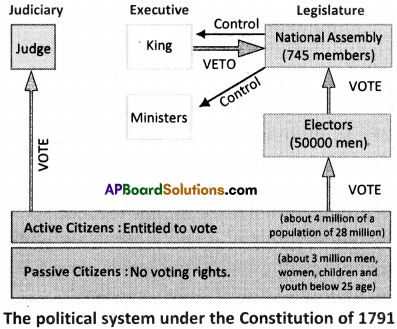
e) Which is the Superior group in French Society? (SA-II : 2017-18)
Answer:
Clergy is the superior group in the French society.

f) Who were the richest group in third Estate? (SA-II : 2017-18)
(OR)
Name the richer groups in third estate. (SA-II : 2018-19)
Answer:
Big business men, merchants, court officials, Lawyers, etc. were the richest groups in third estate.

g) Which Estate people did only pay the taxes in French Society? (SA-II : 2017-18)
(OR)
Which group paid taxes to the church? (SA-I : 2018-19)
Answer:
Third estate people only pay the taxes to the government.

h) Who were in first estate? (SA-I : 2018-19)
In first estate clergy are there.

i) Which country’s information is shown in the above chart? (SA-I : 2018-19)
Given information is related to France.

j) What does the above picture represent?
Answer:
The above picture represents the division of the society in France.

k) Who were the majority people?
Answer:
The third estate were the majority people.

Question 4.
The picture below shows the political system under the constitution of 1791 in France. Observe it carefully and answer the questions given.
AP Board 9th Class Social Studies Important Questions Chapter 13 Democratic and Nationalist Revolutions 17th and 18th Centuries 3
a) Who had the power to elect the judiciary in the above system? (SA-II : 2018-19)
Answer:
Active citizens, who have the vote.

b) Who had the power over the King and the Ministers in the above system? (SA-II : 2018-19)
Answer:
National Assembly has more powers on king and ministers.

c) Who had the power to veto the laws made by the National Assembly? (SA-II : 2018-19)
Answer:
King has the power to veto the laws made by the National Assembly.

d) Which branch of government was responsible for the implementation of laws? (SA-II : 2018-19)
Answer:
Executive was responsible to the implementation of laws.

e) Who has veto power? (SA-II : 2016-17)
Answer:
King has veto power.

f) Who is having vote to elect the judge? (SA-II : 2016-17)
Answer:
Active citizens who have the Right to vote.

Question 5.
French revolution is regarded as one of the most important events in history not just in France but also across Europe and the world. Explain with reference to the ideas propagated by the French Revolution. (SA-I : 2019-20)
Answer:
Ideas of French Revolution :
Liberty, Equality and Fraternity are the ideas of French Revolution.
1. The ideas of the French Revolution were drawn from the Enlightenment, influenced by the British political system, inspired by the American Revolution and shapped by local grievances.

2. The French Revolution supported the motto of Liberty, Equality, Fraternity because it eliminated the old social classes, overthrew the monarchy and brought the church under state control. People of all social classes were citizens and they all had equal rights.

Liberty :
Liberty meant freedom from all soils of torture and abuse.

Equality :
Provide Equality to the people in all spheres without discrimination.

Fraternity :
It creates brotherhood nature among the people.

AP Board 9th Class Social Studies Important Questions Chapter 13 Democratic and Nationalist Revolutions 17th and 18th Centuries

Question 6.
“With the emergence of nation states in Europe, the dominance of aristocracy declined and that of the middle class increased.” Do you agree with the statement? Give reasons. (SA-I : 2019-20)
Answer:
Yes, I agree with the statement that the emergence of nation – states in Europe the dominance of Aristocracy declined, and middle class increased.

Reasons:

  • The middle class people were educated, so they became lawyers, other administrative officials.
  • The read the books which are written by John Lock, Rousseau and believed that no group in society should be privileged by birth.
  • They understood a person’s social position must depend on his merit.
  • Rousseau carried the idea forward, proposing a form of government based on a social contract between people and their representatives.

The above ideas provoke the middle class fight for equality and end of special privileges.

9th Class Social 13th Lesson Democratic and Nationalist Revolutions 17th and 18th Centuries Important Questions and Answers

Question 1.
Compare the results of the English and American Revolutions. Which one managed to build entirely new principles of government?
Answer:

  • Glorious revolution of England made an agreement of powersharing with the king.
  • American revolution set up democratic government.
  • The British people sought more rights from king.
  • Americans prepared own constitution and established democracy by abolishing the English supremacy.
  • American revolution managed to build entirely new principles of government.

AP Board 9th Class Social Studies Important Questions Chapter 13 Democratic and Nationalist Revolutions 17th and 18th Centuries

Question 2.
Can you think of why America was able to establish a democratic republic while England could not?
Answer:

  • American people were against the taxation without representation.
  • They do not want to be ruled by the British as colonies.
  • They wanted to assert their independence and to be a democratic republic.
  • Whereas the English, especially the influential middle class did not long for a demo-cratic republic.
  • They were readily accepted a powersharing agreement between them and the king.
  • Thus they could not set up a republic then.

Question 3.
In what ways did the American Constitution ensure maximum freedom for its people?
Answer:

  • The Constitution of America guarantees maximum freedom to its people.
  • It divided political power between centre and states such that it gave maximum autonomy for the states.
  • A bill of rights was passed which guaranteed freedom of speech and religion.
  • It guaranteed fundamental rights to all citizens.
  • Thus we can say American Constitution ensures maximum freedom for its people.

Question 4.
Write about the Declaration of Independence in the American war of Independence.
Answer:

  • The Declaration of Independence was adopted on 4th July 1776, during the Third Congress at Philadelphia.
  • Thomas Jefferson was the author of the Declaration.
  • It declared that all men are created equal and are endowed with certain rights like liberty, equality and pursuit of happiness.

Question 5.
Write about Bill of Rights of the American war of Independence.
Answer:

  • A Bill of Rights was adopted guaranteeing the freedom of speech, religion and rule of law were enacted.
  • This paved way for the establishment of the United States of America.

AP Board 9th Class Social Studies Important Questions Chapter 13 Democratic and Nationalist Revolutions 17th and 18th Centuries

Question 6.
What do you know about the Reign of Terror?
(OR)
“The period from 1973 to 1974 in France is referred as the region of terror”. Give reason. (SA-I : 2018-19)
Answer:

  • The period from 1793 to 1794, in France, is referred as the Reign of Terror.
  • Robespierre followed a policy of severe control and punishment.
  • A lot of restrictions on food items were imposed.
  • Robespierre pursued his policies so relentlessly that even his supporters began to demand moderation.
  • Finally, he was convicted by a court in July 1794, arrested and on the next day sent to the guillotine.

Question 7.
Read the following passage and answer the following question.
AP Board 9th Class Social Studies Important Questions Chapter 13 Democratic and Nationalist Revolutions 17th and 18th Centuries 4
Answer:
The Declaration of Rights of Man and Citizen :

  • Men are born and remain free and equal in rights.
  • The aim of every political association is the preservation of the natural and inalien¬able rights of man. These are liberty, property, security and resistance to oppression.
  • The source of all sovereignty resides in the nation; no group or individual may exercise authority that does not come from the people.
  • Liberty consists of the power to do whatever is not injurious to others.
  • The law has the right to forbid only actions that are injurious to society.
  • Law is the expression of the general will. All citizens have the right to participate in its formation, personally or through their representatives. All citizens are equal be¬fore it.
  • No man may be accused, arrested or detained, except in cases determined by the law.
  • Every citizen may speak, write and print freely; he must take responsibility for the abuse of such liberty in cases determined by the law.
  • For the maintenance of the public force and for the ex¬penses of administration a common tax is indispensable; it must be assessed equally on all citizens in proportion to their means.
  • Since property is a sacred and inviolable right, no one may be deprived of it, unless a legally established public necessity requires it. In that case a just compensation must be given in advance.
    (Note: The above list is not complete. It is only a selection often.)

Question 8.
Observe the following.
AP Board 9th Class Social Studies Important Questions Chapter 13 Democratic and Nationalist Revolutions 17th and 18th Centuries 5
a) Name the bodies among which the powers are distributed.
Answer:
The Judiciary, the Executive and the Legislature are the three bodies among which the powers are distributed.

b) Who were entitled to vote?
Answer:
The Active Citizens were entitled to vote.

c) How many members were there in the National Assembly?
Answer:
There were 745 members in the National Assembly.

d) Did the king have absolute powers?
Answer:
No, he was under the control of the National Assembly.

e) Who were passive citizens?
A. The citizens with no voting rights were the passive citizens.

AP Board 9th Class Social Studies Important Questions Chapter 13 Democratic and Nationalist Revolutions 17th and 18th Centuries

Question 9.
Study the following timeline and answer the given questions.
AP Board 9th Class Social Studies Important Questions Chapter 13 Democratic and Nationalist Revolutions 17th and 18th Centuries 6
a) When was the draft Constitution written by the National Assembly?
Answer:
In 1789 June. National Assembly had written the draft Constitution.

b) Who was the master of ‘Reign of Terror’?
Answer:
The master of ‘Reign of Terror’ was Robespierre.

c) What was the significance of 1871?
Answer:
The significance of 1871 was that France became republic.

d) When was the Declaration of Rights of Man and Citizens made?
Answer:
The Declaration of Rights of Man and Citizens was made in 1791.

e) Who declared himself the Emperor of French Republic?
Answer:
Napolean Bonaparte declared himself the Emperor of French Republic.

Question 10.
Do you feel that equality of status for women is necessary? Women’s fight for rights in France inspired the world. Do you agree with this?
Answer:

  • Yes. Women need to have equal status with men.
  • They need to educate themselves, participate in active politics.
  • Yes, the political activities of French women during the revolutionary years were kept alive as an inspiring memory.

Question 11.
What would happen if all people were not equal before law – and some special privileges like the right to kill others?
Answer:

  • If all people were not equal then society might be divided into classes.
  • A few classes might have some privileges and the rest would have to suffer.
  • People might not have fundamental rights.
  • If a few people had the privilege of killing others it would result in loss of lives to those who do not have had that privilege.

AP Board 9th Class Social Studies Important Questions Chapter 13 Democratic and Nationalist Revolutions 17th and 18th Centuries

Question 12.
Locate the following on the world outline map.
1) USA
2) UK
3) France
4) Turkey
AP Board 9th Class Social Studies Important Questions Chapter 13 Democratic and Nationalist Revolutions 17th and 18th Centuries 7

Question 13.
Are revolutions essential for human development?
Answer:

  • Revolutions are essential for the development of human society.
  • Without revolutions or changes, the society and its structure remains static and may not take its course towards the growth and development.

Question 14.
Who are the philosophers that spread the ideas of democracy?
Answer:

  • Locke in his book “Two Treatises of Government” sought to refute the doctrine of the divine and absolute right of the monachy.
  • Rousseau advocated people’s sovereignty, equality and supremacy of majority.
  • Montesquieu’s theory of separation of powers paved way for division of powers.
  • Voltaire advocated the theory of restricted powers.

Question 15.
Compare the political rights which the Constitution of 1791 gave to the citizens with Articles from 1 to 6 of the Declaration. Are the two documents consistent? Do the two documents convey the same idea ?
Answer:

  • The 1st Article of the Declaration says that ‘All men are free and equal in rights’.
  • The 6th Article of the Declaration says that ‘All citizens have the right to participate in the formation of laws’.
  • But the Constitution of 1791 contradicted with the Declaration of Rights in giving all the citizens equal political rights.
  • According to the Constitution only men above 25 years of age and who paid taxes equal to at least 3 days of a labourer’s wage were given the right to vote.
  • Thus the Constitution violates the Declaration of Rights.
  • Thus we can say two documents contradicted with each other. They do not convey the same idea.

AP Board 9th Class Social Studies Important Questions Chapter 13 Democratic and Nationalist Revolutions 17th and 18th Centuries

Question 16.
How different would our lives have been if we were ruled by kings?
Answer:

  1. It would be very different if we were ruled by kings.
  2. They may have had made laws at their will.
  3. Society might had been divided in high and low castes or estates.
  4. Estates might have had their privileges and obligations.
  5. We might have had been denied our fundamental rights.
IMPORTANT YEARS AND EVENTS
 EventsYears
1. Period of Long Parliament1640-60
2. Execution of Charles I1649
3. The Glorious Revolution1688
4. The Declaration of Independence1776
5. The American Revolution1783
6. The French Revolution1789
7. Execution of Louis XVI1793
8. The Reign of Terror1793-94
9. The execution of Robespierre1794
10. The right to vote for women in France1946