AP Board 8th Class English Solutions Chapter 5B Bonsai Life Part 2

AP State Syllabus AP Board 8th Class English Textbook Solutions Chapter 5B Bonsai Life Part 2 Textbook Questions and Answers.

AP State Syllabus 8th Class English Solutions Chapter 5B Bonsai Life Part 2

8th Class English Chapter 5B Bonsai Life Part 2 Textbook Questions and Answers

I. Complete the statements giving more than one reason.

1. Girls should be educated like boys because
a. ———————
b. ———————
c. ———————
d. ———————
Answer:
a. they need to stand on their own feet.
b. they need to get financial independence,
c. they need not to beg others for anything,
d. they need to lead a dignified life.

AP Board 8th Class English Solutions Bonsai Life Part 2

2. Fully grown trees are more useful because
a. ———————
b. ———————
c. ———————
Answer:
a. they give us shade.
b. they give us flowers and fruit.
c. they give us wood for constructions and firewood.
d. they give us medicines.

II. Answer the following questions:
Question 1.
Why was Akkayya perplexed?
Answer:
Akkayya was surprised to see the turayi and pomegranate trees in the little flower pots among the other flower plants. She didn’t know they were bonsai trees. So, she asked Ammalu why they planted those trees in the flower pots and how they could grow if they didn’t let them grow freely. Hearing Akkayya’s words, Ammalu burst into laughter. Akkayya didn’t understand why Ammalu had laughed. So, she was perplexed.

Question 2.
How is a bonsai reared?
Answer:
Bonsai is a Japanese art form using miniature trees grown in containers. A bonsai is created beginning with a specimen of source material. The source specimen is shaped to be relatively small. Then it is planted in a display pot. The practice of bonsai development incorporates a number of techniques, they are:
a) leaf trimming
b) punning the trunk, branches and roots
c) wining branches and trunks
d) clamping
e) grafting new growing material and
f) defoliation.

AP Board 8th Class English Solutions Bonsai Life Part 2

Question 3.
What similarities do you notice between the bonsai tree and the housewife?
Answer:
Like the housewife, the bonsai tree is very delicate. Both the housewife and the bonsai can’t protect themselves. They can’t provide shelter to anyone. They can’t bear sufferings. They depend upon others for everything.

Question 4.
What made the narrator feel the urge to free the bonsai?
Answer:
The narrator’s heart was touched by Akkayya’s words. Akkayya’s words made the narrator feel the urge to free the Bonsai. She thought that it was just as one freed a bird from a cage to let it fly.

Question 5.
What is the central theme of ‘Bonsai Life’?
Answer:
The central theme of ‘Bonsai Life’ is that the women should be well educated and empowered. The women should know how to take care of themselves. They should protect themselves. They should be able to stand on their own feet. They shouldn’t depend upon others for everything. They should take up jobs.

III. Make a list of activities done by a homemaker and a working woman.

Homemaker Working Woman

Answer:

Homemaker Working Woman
1) Serving the husband 1) Doing the job
2) Looking after the offspring 2) Looking after the offspring
3) Washing the clothes 3) Managing the things at home
4) Cleaning the floor 4) Marketing
5) Cleaning the vessels 5) Cooking (in some cases)
6) Cooking the dishes 6) Washing (in some cases)

IV. Put a tick (✓) mark against the most appropriate meaning for the phrases given below.
1. ‘… to keep the washerman’s account’ means
a) to take care of household work.
b) to count clothes,
c) to maintain the washerman’s account.

2. ‘… uphill task’ means
a) high quality work.
b) a difficult job.
c) working on a hill.

AP Board 8th Class English Solutions Bonsai Life Part 2

3. ‘… grass is greener on the other side’ means
a) the grass on this side is green.
b) others are as good as we are.
c) others are in a better position than us.

4. ‘… like a scorpion under a slipper’ means
a) killing a scorpion with a slipper.
b) being guided and controlled,
c) feeling totally suppressed.

Answer:
1 – a (✓)
2 – b (✓)
3 – c (✓)
4 – c (✓)

Vocabulary

I. Look at the phrasal verb underlined in the following sentence.
“I feel like giving it up. (give up).
What does it mean?
‘Give’ is a verb and ‘up’ is a preposition. Such combinations are called phrasal verbs. A phrasal verb normally gives a meaning different from the meaning of its parts.
‘Give up’ means ‘to stop doing something’.
Refer to a dictionary and find out the meaning of some more phrasal verbs beginning with ‘give’ and ‘look’.
give in ———–
give out ———–
give away ———–
look after ———–
look up ———–
look into ———–
Use the above phrasal verbs in your own sentences.
1. ———————–
2. ———————–
3. ———————–
4. ———————–
5. ———————–
6. ———————–
Answer:
give in: to accept that you are defeated
give out: to come to an end
give away: to give something to someone
look after: to take care of someone
look up: to become better
look into: to try to find out the truth about a problem.
1. The enemies were eventually forced to give in.
2. Her patience finally gave out.
3. I gave most of my books away to my friend.
4. The old man was looking after the child.
5. Finally, the things are beginning to look up.
6. The police officer is looking into the missing of the boy.

AP Board 8th Class English Solutions Bonsai Life Part 2

II. Look at the simile in the following sentence.
Without it, she will have to live under her husband’s thumb ‘like a scorpion under a slipper’. The life of a homemaker is compared to a scorpion under a slipper. When we compare two things, we often use the word ‘like’.
Here are a few more examples of similes.
1. He roars like a lion.
2. They eat like wolves.
Answer:
Look at the following similes.
a) bright like a full moon
b) sleep like a log
c) eat like a bird
d) beautiful like a rose
e) sweet like honey
Now write five sentences using the above similes.
1. ———————–
2. ———————–
3. ———————–
4. ———————–
5. ———————–
Answer:
1. This light is bright like a full moon.
2. He sleeps like a log.
3. She eats like a bird.
4. It seems beautiful like a rose.
5. It is sweet like honey.

III. Make some idioms from the words in circles and use them in your own sentences, one is done for you
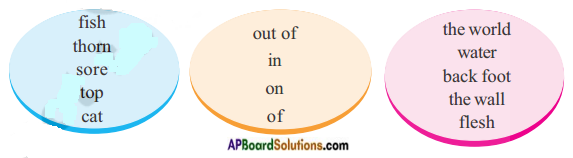
AP Board 8th Class English Solutions Chapter 5A Bonsai Life Part I 2
AP Board 8th Class English Solutions Chapter 5A Bonsai Life Part I 3
Answer:

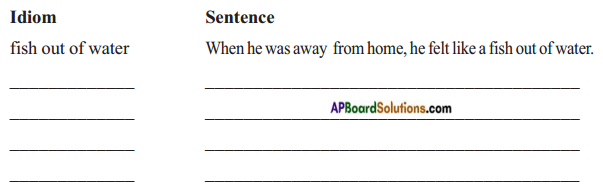
Idiom Sentence
thorn in flesh He has been a thorn in flesh for them for years.
sore on back foot Mr. Rao has been annoying them like a sore on back foot.
top of the world As Sharma got a job. he is on top of the world.
cat on the wall sriram has not yet decided; he is being like a cat on wall.

AP Board 8th Class English Solutions Bonsai Life Part 2

Grammar

I. Read the sentences.
1. AP Board 8th Class English Solutions Chapter 5A Bonsai Life Part I 4 grew accustomed to village life.
2. AP Board 8th Class English Solutions Chapter 5A Bonsai Life Part I 5 went into the kitchen.

The words in circles are subjects. The words underlined are predicates.

II. Circle the subjects and underline the predicates.
1. The girls danced.
2. The dark clouds filled the sky.
3. Shiva drove a silver Toyota.
Answer:
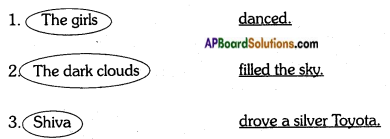
AP Board 8th Class English Solutions Chapter 5A Bonsai Life Part I 6

III. Identify subjects and predicates in each of the sentence in the following paragraph.
The narrator felt very happy to receive her sister and brother-in-law, who came to stay with them. They brought many things with them. Akkaya made special dishes for her sister’s husband, which he liked very much. She praised her sister for being employed and making her living. She was very sorry about her position at home.
One day the narrator showed her Bonsai plants and explained how they are grown but she did not like it. On a rainy day many people gathered under a tree to take shelter. Showing this, Akkaya made the narrator understand the importance of freedom in one’s life.

Note: Subjects are given in bold letters and predicates are underlined.
i) The narrator – subject
felt very happy to recieve her sister and brother-in-law, who came to stay with them – predicate
ii) They – subject
brought many things with them – predicate
iii) Akkayya – subject
made special dishes for her sister’s husband which he liked very much – predicate
iv) She – subject
praised her sister for being employed and making her living – predicate
v) She – subject
was very sorry about her position at home – predicate
vi) the narrator – subject
showed her Bonsai plants and explained how they are grown but she did not like it – one day – predicate
vii) many people – subject
gathered under a tree to take shelter on a rainy day – predicate
viii) Akkayya – subject
Showing this – made the narrator understand the importance of freedom in one’s life – predicate

AP Board 8th Class English Solutions Bonsai Life Part 2

Writing

Look at the following poster.
AP Board 8th Class English Solutions Chapter 5A Bonsai Life Part I 7
List the features of this poster.
e.g. Who has issued the poster? What is it about?
The date, time, place of the event, layout and nature of the sentences.
Answer:

  1. Issuing authority: APDWACRA, Arunodaya building, Brodiepet, Guntur.
  2. Event: Inauguration of handicrafts exhibition cum sale.
  3. Time: 4 p.m.
  4. Date: 15 October
  5. Place: Gunta Ground, Kothapet, Guntur.
  6. Duration: From 15th to 25th October.
  7. Layout: Suitable layout with the sentences which convey the theme directly.

I. Now, make a poster based on the information given below.

  1. Issuing authority: Andhra Pradesh Arts and Crafts Society, Vijayawada.
  2. Event: Dance Performance by Aarthi.
  3. November 14.
  4. Chief Guest: Honourable Chief Minister of Andhra Pradesh.
  5. Venue: PWD Grounds, Vijayawada.

Answer:

AP Board 8th Class English Solutions Chapter 5A Bonsai Life Part I 8

Listening

I. Listen to a debate on the topic ‘Education of the Girl Child is a Burden’.

Education of the Girl Child Is a Burden

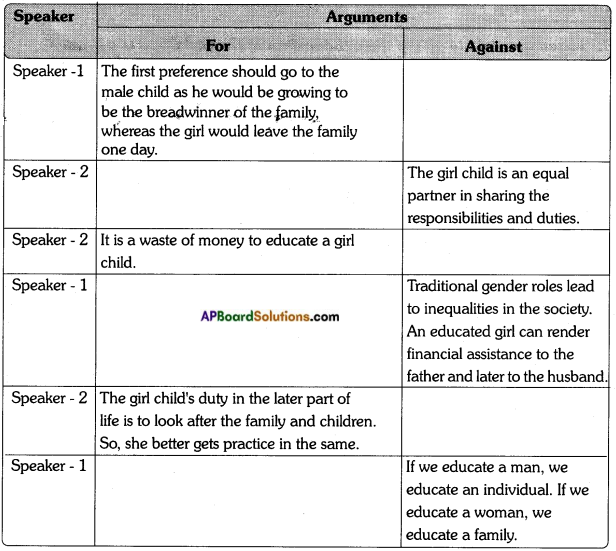
Speaker 1: Respected Chairperson, honourable Judges and dear friends, I stand here to express my views for the motion, ‘Education of the girl child is a burden’. I would like to state that the education of the girl child is indeed a burden. In a poor family the main concern for the head of the family is to provide food, clothing and health to all the members. Most of their resources are used for these priorities. Later, when they think of education, the first preference goes to the male child as he would be growing to be the breadwinner of the family, whereas the girl would leave the family one day. So, I feel that educating of the girl child is a burden.

AP Board 8th Class English Solutions Bonsai Life Part 2

Speaker 2: Respected chairperson, honourable Judges and dear friends! My knowledgeable opponent is of the opinion that the education of the girl child is a burden. May I ask how education of the girl could be a burden when she is an equal partner in sharing the responsibilities and duties? If given a chance, she will be sharing the burden of the family at least till she gets married. So, I strongly oppose the motion.

Speaker 1: When my opponent feels that the girl child would leave the family one day after marriage, can’t we agree that it is a waste of money to educate a girl child? Instead, the families can save the money to bear the expenses of her wedding. Yes, surely the girl can reduce the burden not by earning after education but by managing the household work. As her duty in the later part of life is to look after the family and children, she better gets practice in the same. If she is away from home for longer periods, it would be an additional burden on the family.

Speaker 2: My friend said, the future of the girl child is to look after the family and children. Haven’t such traditional gender roles led to inequalities in the society? I strongly feel that an educated girl can render financial assistance to the father and later to the husband. My dear friend, it is education that will bring about a change in the attitude of people towards the role of women. Indeed, it is rightly said: ‘If you educate a man, you educate an individual. If you educate a woman, you educate a family’.

Now, complete the table based on the information you’ve just listened to:
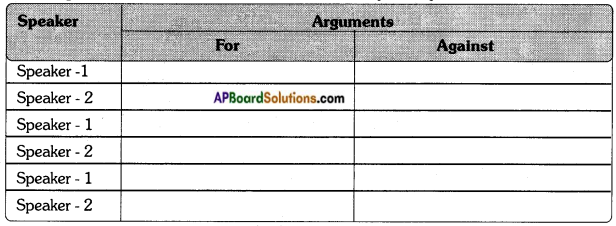
AP Board 8th Class English Solutions Chapter 5A Bonsai Life Part I 9
Answer:
AP Board 8th Class English Solutions Chapter 5A Bonsai Life Part I 10

AP Board 8th Class English Solutions Bonsai Life Part 2

Bonsai Life Part 2 Summary in English

Though Akkayya had been very interested in studying, Nannagaru didn’t educate her. He believed that studies wouldn’t get into a girl’s head. So, he had made Akkayya discontinue her education. He concentrated only on Annayya’s education. Akkayya got married to a villager and she was limited to do her household work. Ammalu took her Akkayya around the house. Akkayya was surprised to see the turayi and pomegranate trees in the flower pots among the flower plants. She felt sorry for them. She questioned Ammalu how they would grow in that little space and why they couldn’t let them grow freely. Ammalu explained that they were bonsai trees. She told that Bonsai was a special method of growing plants. The Japanese named this method bonsai. But Akkayya didn’t like this idea. Ammalu was distressed as she was unable to impress her Akkayya with her bonsai. Then came the storm which brought all the sand from the desert. Ammalu caught hold of Akkayya’s shoulder and dragged her into the room. After a while it started raining. Ammalu immediately pulled the bonsai tree pots and flower pots inside, under the canopy. Akkayya opened the window and looked at the streets. She saw many people standing under the huge turayi tree. She showed it to Ammalu saying that it was providing shelter to the people and potecting them. Ammalu asked her Akkayya what was the surprising thing about it. Then Akkayya made Ammalu understand that a housewife’s life was like that of a bonsai. Though bonsai looked proper and sweet, it was very delicate. It couldn’t provide protection to anyone. Infact, it had to be brought under the canopy so that it would not be destroyed. Akkayya’s words touched Ammalu’s heart. She felt like freeing the bonsai trees from their flower pots. Thus the story is a plea to provide education for women to empower them and make financially independent.

About the Author

Abburi Chayadevi is a well known feminist writer born in 1933. She has written many short stories and essays. She was awarded by the Central Sahitya Akademi in 2005. In her works, she elucidates women life and their feelings.

Bonsai Life Part 2 Glossary

adept (adj): a natural ability to do something skilfully

drudgery (n): hard, boring work

stunted (v): prevented from growth

perplex (v): confuse

canopy (n): a cover fixed over something for shelter

squall (n): a strong wind

rage (v): come with force

respite (n): a short period of rest

nought (n): nothing’zero

backyard (n): an area with a hard surface behind a house

AP Board 8th Class English Solutions Bonsai Life Part 2

trimming (n): making something neater, smaller, better by cutting parts from it

confine (v): to keep something inside the limits of a particular activity

disheartened (adj): made somebody lose hope or confidence

collapsed (v): lay down

tend (v): to care for something

withstand (v): to be strong enough not to be hurt or damaged by extreme conditions

dragged (v): pulled somebody or something along with effort and difficulty
AP Board 8th Class English Solutions Chapter 5A Bonsai Life Part 1

AP State Syllabus AP Board 8th Class English Textbook Solutions Chapter 5A Bonsai Life Part 1 Textbook Questions and Answers.

AP State Syllabus 8th Class English Solutions Chapter 5A Bonsai Life Part 1

8th Class English Chapter 5A Bonsai Life Part 1 Textbook Questions and Answers

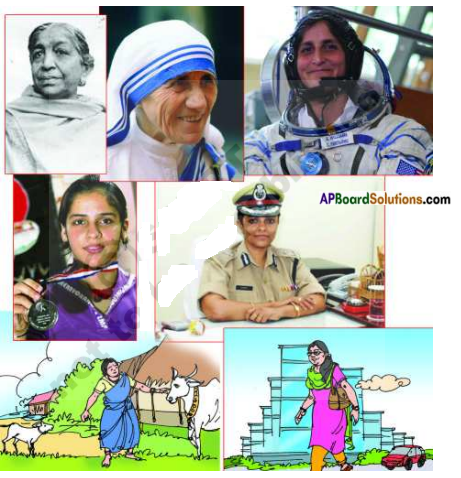
Observe the pictures and discuss the questions that follow.
AP Board 8th Class English Solutions Chapter 5A Bonsai Life Part I 1

Question 1.
Who are these people? What do you know about them?
Answer:
In the first picture we see Sarojini Naidu. She is also known as The Nightingale of India’. She was a poet and an Indian independence activist. In the second picture we see Mother Teresa. She was an ethnic Albanian, Indian Roman Catholic nun. She founded the Missionaries of Charity and served the needy. In the third picture we see Sunita Williams. She is an American astronaut. Her parental ancestry originates in Gujarat in India. In the fourth picture we see Saina Nehwal. She is an Indian badminton player who attained a career best ranking of 2 in December 2010. The fifth is the picture of Bharatha Das, Inspector of General of Crime Branch, Kerala, the first IG of Police of the Kerala Armed Police Battalions. In the sixth picture we see a village woman and in the last picture we see a city woman.

AP Board 8th Class English Solutions Bonsai Life Part 1

Question 2.
‘Education leads to empowerment of women? Do you agree or disagree? Give reasons.
Answer:
Yes, I agree with the statement. Women education plays a key role in the social and economic development of the country. Educating a woman uplifts her life as well as the quality of her life
and her entire family. It is a fact that any educated woman will definitely support the education of her children especially a girl child and provide a better guidance to her children. An educated woman will easily imbibe an independent and progressive outlook in her children. More importantly, an educated woman in a society like India will assist in reducing the infant mortality rate and control the blossoming of the population. Hence we can say, education leads to empowerment of women.

Comprehension

I. Tick (✓) the statements that are true.

1. The narrator receives letters very frequently. [ ✓ ]
2. The letter brought the news of the narrator’s sister and brother-in-law’s arrival. [ ✓ ]
3. The narrator’s husband was very happy to hear the news of the visitors. [ ✓ ]
4. Akkayya was not interested to continue her studies. [ ]
5. The narrator’s husband likes the traditional food of Andhra Pradesh. [ ✓ ]

II. Answer the following questions.

Question 1.
“The moment I see letters can’t …….. contain my excitement” Why does the narrator get excited?
Answer:
When the narrator gets the letters and reads them she thinks that it is almost as if she is face to face with her near and dear ones and they are speaking affectionately to her. When she reads the letters the exhaustion of office work disappears and her heart grows light. The sight of letters gives her the energy and enthusiasm and then she discharges her household duties very effectively. So, the narrator gets excited whenever she receives letters.

AP Board 8th Class English Solutions Bonsai Life Part 1

Question 2.
What change did the narrator observe in her father’s attitude towards education over a decade?
Answer:
The narrator’s father felt in the beginning that education for girls was of no use. Those were the days when people thought it was enough if a girl was able to keep the washerman’s accounts. So, Nannagaru did not let Akkayya study after class Five. A decade later, when Ammalu was born, there was not much debate as to whether a girl should have education or not. Ammalu was lucky that her father changed with the times. He didn’t even hesitate to send her to college.

Question 3.
Why was Akkayya determined to send her daughter to college?
Answer:
Akkayya knew very well how she had suffered as she was not educated and not an employee. She didn’t have financial independence. She had to depend on her husband even for a few paise worth of karivepaku. She didn’t like to keep a girl at home without educating her. She thought that a woman would come to nothing if she didn’t have a degree and she would have to live under her husband’s thumb, like a scorpion under a slipper without it. So, she determined to send her daughter to college.

Bonsai Life Part 1 Summary in English

‘Bonsai Life’ by Abburi Chayadevi is a plea for educating women, thereby freeing them from their ‘Bonsai Life’. Ammalu is a wel! educated woman who works in Delhi. Her sister, on the other hand, is not educated as Ammalu. Their father did not let Akkayya study after class Five. He felt that it was enough if a girl was able to keep the washerman’s accounts. But Ammalu was lucky that her father changed with the times and allowed her to send her to college. Ammalu completed her education and married a job holder. Later she took up one well. Because Akkayya was not educated, she was married to a man from the village. Akkayya’s husband chose agriculture as his profession and settled down in the village to cultivate his land.
Ammalu is lazy about writing letters and loves to receive one from some place or the other, every day. She gets excited when she receives one. One day she received an unexpected letter from her Akkayya. Akkayya didn’t usually write a letter. So Ammalu thought that there might be a reason. She opened the letter and started reading. Akkayya wrote that she and her husband (Baavagaru) were visiting them soon as they wished to visit Kasi and Haridwar. Both Ammaiu and her husband were excited to know about their visit. For the first time Akkayya and Baavagaru were visiting their home since their marriage. Akkayya brought cucumber, drumsticks, appadams, vadiyams and coconuts which were all liked by Ammalu’s husband very much. As Ammalu was always busy with her work, she usually could not find time to prepare the things such as appadams, vadiyams etc. When she expressed the same, her Akkayya consoled her that she didn’t know how she was able to manage work at home and in the office. Ammalu was very unhappy with her job. Sometimes, she felt like giving it up. But Akkayya’s thoughts were different. She felt that a job holder didn’t have to beg anyone for anything and Ammalu was able to lead a dignified life because of her job only. Akkayya yearned for the financial independence of a working woman whereas Ammalu longed for happy life of a house wife. Akkayya’s daughter was in her final year at school. She was determined to send her to college. She felt if a woman didn’t have a degree, she would come to nothing.

AP Board 8th Class English Solutions Bonsai Life Part 1

Bonsai Life Part 1 Glossary

exhaustion (n): extreme tiredness

vanish (v): disappear

mutter (v): complain about something privately

savour (n): enjoy eating

sumptuous (adj): grand

dignified (adj): deserving respect

elated (adj): very happy, excited

wretched (adj): very unhappy, miserable

uphill (adj): difficult

enthusiasm (n): a strong feeling of excitement and interest in something

sip (n): a very small amount of a drink that one takes into one’s mouth

apprehensive (adj): worried or frightened that something unpleasant may happen

avoided (v): prevented from happening

hesitate (v): to slow to speak or act because one feels uncertain or nervous

accustomed (u): familiar with something and accepting it as normal or usual

AP Board 8th Class English Solutions Bonsai Life Part 1

consoled (v): gave comfort or sympathy to somebody who is unhappy the grass is greener

on the otherside (idiom): It is said about people who never seem happy with what they have and always think that other people have a better situation than they have

AP Board 8th Class English Study Material Textbook Solutions Guide State Syllabus

Andhra Pradesh SCERT AP State Board Syllabus 8th Class English Textbook Solutions and Study Material Pdf are part of AP Board 8th Class Textbook Solutions.

AP State Syllabus 8th Class English Textbook Solutions Study Material Guide Pdf Free Download

Unit 1 Family

Unit 2 Social Issues

Unit 3 Humanity

Unit 4 Art and Culture

Unit 5 Women Empowerment

Unit 6 Gratitude


AP Board 8th Class English Solutions Chapter 4C Maestro with a Mission

AP State Syllabus AP Board 8th Class English Textbook Solutions Chapter 4C Maestro with a Mission Textbook Questions and Answers.

AP State Syllabus 8th Class English Solutions Chapter 4C Maestro with a Mission

8th Class English Chapter 4C Maestro with a Mission Textbook Questions and Answers

Comprehension

Answer the following questions.

Question 1.
Vempati Chinna Satyam left his house on a purpose. Do you think he was successful at the end?
Answer:
Yes, Vempati China Satyam was successful at the end. He wanted to elevate the status of Kuchipudi he had learnt from his great gurus. He decided to dedicate his life for the enrichment of that art form. So, he left his house for Madras. He carved a niche in Telugu film industry as a Kuchipudi dance director. He established Kuchipudi Art Academy in 1963 in Madras. He composed and choreographed as many as 180 solo items and 15 dance dramas. All his disciples were distinguished ones such as Shanta Rao, Yamini Krishna Murthy, Vfyjayanthimala Bali, Hema Malini, Manju Bhargavi, Shoba Naidu, Bala Kondala Rao and Daggubati Purandheshwari. He was conferred many awards. All the Telugu speakers identify themselves with ‘Kuchipudi’. The rest of the world looks at Kuchipudi and Dr. Vempati’s stupendous work with reverent eyes. Thus, Dr. Vempati was successful when he elevated the status of Kuchipudi.

AP Board 8th Class English Solutions Chapter 4C Maestro with a Mission

Question 2.
When the stationmaster asked Satyam “Where are you going, dear?,” he kept silent.
Now choose one of the options that is not the reason for the silence.
a. He was determined to achieve something. [  ]
b. He was determined and confident about his destiny. [  ]
c. He was not determined or confident about his destiny. [  ]
Answer:
c. He was not determined or confident about his destiny. [ ✓ ]

Question 3.
If the eighteen year old lad hadn’t left his village, Kuchipudi would not have gained this popularity. Do you agree/disagree? Why?
Answer:
Yes, I agree with this statement. Kuchipudi originated in the village of Kuchipudi and was performed at temples at the time of annual festivals and in streets on the demand of the people. Only the males perform this art in those days. Though great gurus like Vedantam Lakshminarayana, Chinta Krishna Murthy enriched and transformed it completely, it was not much popular. It was not recognized on a par with other classical dances. The eighteen year old lad wanted to elevate the status of Kuchipudi, left his village and finally succeeded. So, if he hadn’t left his village, Kuchipudi wouldn’t have gained this popularity.

AP Board 8th Class English Solutions Chapter 4C Maestro with a Mission

Question 4.
Is it appropriate to call him Dr. Vempati? Do you agree? Why (not)?
Answer:
Yes, it is appropriate to call him Dr. Vempati. Kuchipudi gained the popularity because of him only. He had been passionate about Kuchipudi since his childhood. Though he was not a good performer of Kuchipudi in the early stages, he didn’t lose hopes. He learnt the difficult aspects of Kuchipudi style from Tadepalli Peraiah Sastry and Vedantam Lakshminarayana Sastry. They inspired him very much. Later he did so much to the development and emergence of Kuchipudi to a full-fledged dance form. So it was appropriate to call him Dr. Vempati.

Writing

Based on the details of the famous singer, S.P. Bala Subrahmanyam given below, write a biographical sketch of him.

Full name: Sirpathi Panditaradhyula Balasubrahmanyam
Date of Birth: 4th June 1946
Place of Birth: Konetammapeta, Nellore District
State: Andhra Pradesh
Educational qualifications: Engineering
Entry into film field: 1966
First Film : Sri Sri Sri Maryada Ramanna
Entry into Bollywood: in 1980
Total number of songs sung: About 40.000
Other credits: Noted dubbing artist.
Actor: Acted in a number of Telugu films
TV programmes: Leading many TV programmes.
Awards:

  1. National Film Award for best male playback singer — 6 times
  2. Nandi Awards from Government of Andhra Pradesh — 25 times
  3. State Award from Tamil Nadu
  4. State Award from Karnataka
  5. Padma Shri Award
  6. Padma Bhushan

Answer:
Mr. S.R Bala Subrahmanyam is a famous singer. His full name is Sripathi Panditaradhyala Bala Subrahmanyam. He was born on 4th June, 1946 at Konetammapeta, Nellore district, Andhra Pradesh. He was a graduate in engineering. His entry into film field was made in 1966. He sang for the film Sri Sri Sri Maryada Ramanna for the first time in his life. He entered Bollywood in 1980. He has sung about 40,000 songs in all the languages till now. He is also a noted dubbing artist. He acted in a number of Telugu films. He has already led a number of TV programmes and is leading many of them now. He was rightly conferred the ‘Padma Bhushan’ and ‘Padma Shri’ Awards by our government. He was given ‘Nation Film Award’ for best male play back singer for six times. He received ‘Nandi Awards’ from government of Andhra Pradesh for 25 times. Tamil Nadu and Karnataka honoured him with ‘State Awards’.

AP Board 8th Class English Solutions Chapter 4C Maestro with a Mission

Listening

I. Listen to the news bulletin read by your teacher and answer the following questions.

The News

This is All India Radio, giving you the news. The headlines. The Government of AP all set to declare a new art & cultural policy. A new cultural programme to be launched to show the Government’s commitment to cultural development of the state. Exhibitions and other activities to mark the new programme.
The news in detail…

The Government of AP is all set to declare a new art and cultural policy. The policy is expected to stress the development of arts and crafts of the state. The Chief Minister is expected to announce the policy today at Ravindra Bharati, Hyderabad.

As per the Government sources, a drive under this programme will benefit the artists of Kuchipudi, Burrakatha, Oggukatha and Harikatha. Puppet shows would be made compulsory in all the Government organized programmes, they said.

According to the Handicrafts Minister, 51 new cultural centres would be started to boost the sales of Nirmal, Etikoppaka and Kondapalli toys. He also stated that handloom weaving would be given due importance. Dharmavaram, Pochampalli, Venkatagiri, Mangalagiri, Ponduru weavers would get interest free loans.
The headlines once again. The Government of AP all set to declare a new cultural policy. That’s the end of this news bulletin.

Have a good day!

Answer the following questions.

Question 1.
What are the highlights of the news bulletin?
Answer:
The highlights of the news bulletin are:

  1. The Government of Andhra Pradesh all set to declare a new art and cultural policy.
  2. Exhibitions and other activities will be conducted to mark the new programme.
  3. The artists of Kuchipudi, Burrakatha, Oggu katha and Hari katha will be benefited.
  4. New cultural centres would be started to boost the sales of Nirmal, Etikoppa and Kondapalli toys.
  5. Dharmavaram, Pochampalli, Venkatagiri, Mangalagiri, Ponduru weavers would get interest free loans.

Question 2.
Where is the art and culture polity programme going to be announced? Who is going to be benefited from this policy?
Answer:
The art and culture policy programme is going to be announced at Ravindra Bharathi, Hyderabad. The artists of Kuchipudi, Burrakatha, Oggu katha and Hari katha are going to be benefited from this policy.

AP Board 8th Class English Solutions Chapter 4C Maestro with a Mission

Question 3.
How will the weavers be benefited from this polity?
Answer:
Dharmavaram, Pochampalli, Venkatagiri, Mangalagiri, Ponduru weavers would get interest free loans.

Study Skills

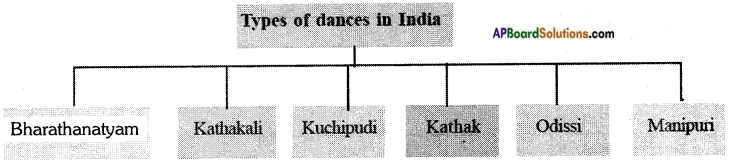
I. India is a land of culture and tradition. One aspect of culture is dance. India has six major types of dances: Bharathanatyam, Kathakali, Kuchipudi, Kathak, Odissi and Manipuri.
The information can be transformed into a tree diagram.
AP Board 8th Class English Solutions Chapter 4C Maestro with a Mission 1
Here is some information about musical instruments in India:
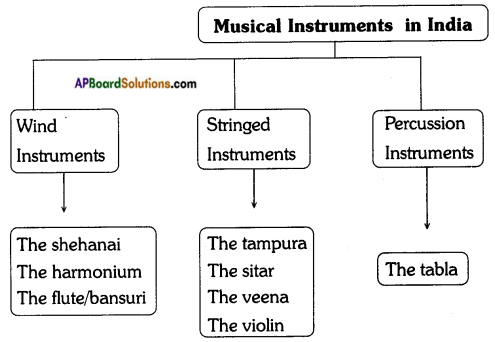
In India, we have some musical instruments. The shehanai is an Indian wind instrument. This is played during auspicious functions. The harmonium is a wind instrument, having its roots in Europe. The sitar is one of the prime musical instruments of Indian music. It is a stringed instrument. The tampura is another stringed instrument. Among the stringed instruments, the veena is the most ancient stringed instrument. The tabla is a percussion instrument. The flute/bansuri is a wind instrument. The violin is a stringed instrument played with a bow.
Now, convert the above information Into a tree diagram.
AP Board 8th Class English Solutions Chapter 4C Maestro with a Mission 2

AP Board 8th Class English Solutions Chapter 4C Maestro with a Mission

Project work

Identify a performing artist like a singer, a dancer or any other artist in your village or town. He/She might not be a famous person. Go to him/her. Collect the details about him/her.
You can take the help of the following questions for interviewing.

  1. Who are your parents?
  2. What is your place of birth?
  3. Who taught you this art?
  4. Are there any specific reasons for taking up this art?
  5. Does the community around you support you?
  6. Does this art make you financially independent?
  7. Would you give any message to the student community?

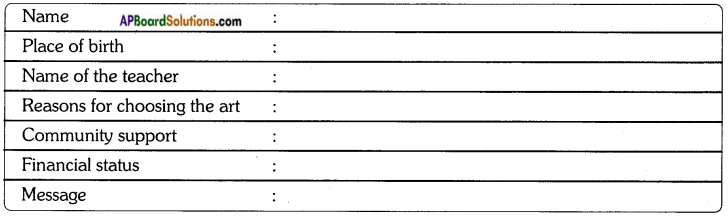
Fill the following table based on the information you have collected.
AP Board 8th Class English Solutions Chapter 4C Maestro with a Mission 4
Prepare a brief profile and exhibit it in your classroom.
Answer:
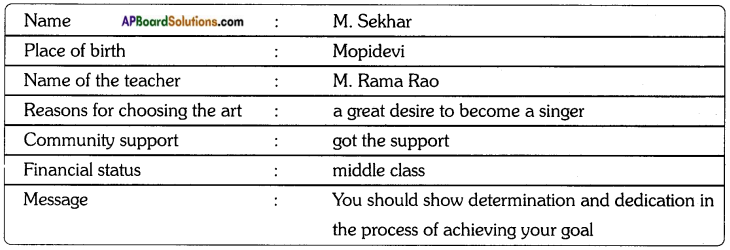
AP Board 8th Class English Solutions Chapter 4C Maestro with a Mission 3
Yesterday, I met M. Sekhar, one of the popular singers in our village. His parents are Chaya Devi and Prakash. He was born at Nuziveedu, his grandparents’ place. He has a passion for singing since his childhood. He wanted to become a play back singer in film industry. After completion of his SSC, he left his village for Hyderabad. He learnt the music from M. Rama Rao, a great guru. The community around him gave him much support in the process of becoming a singer. He got chances to sing in two or three Telugu films. He is a regular singer in all kinds of festive occasions. Now, he is leading a middle-class life. His message to all of us is that we should show determination and dedication in the process of achieving our goal.

AP Board 8th Class English Solutions Chapter 4C Maestro with a Mission

Writing an e-mail

Electronic mail, commonly referred to as email or e-mail, is a method of exchanging digital messages from an author to one or more recipients.
In order to send or receive e-mail messages, you need to create an account to access the service. You must need an internet connection for this purpose.
The messages you receive is stored in the mailbox created for your account. You can re-read the message anytime, delete it if you want to or even forward it to others.

  • The address of the recipient is to be typed in the ‘to’ text field.
  • The subject, if any, of the message is typed in the ‘subject’ field.
  • The ‘message’ is to be typed in the message field.
  • If you want to attach any files you can attach to the ‘attachment’ field.
  • Click on the ‘send’ in order to send the message.

Messages sent by e-mail normally reach a recipient’s account within seconds. Through mails you can send pictures, documents in addition to messages.
You can send anything to anywhere in the world.

Maestro with a Mission Summary in English

Dr. Vempati Chinna Satyam was born to Venkata Chalamaiah and Varalakshmi on 15th, October 1929. He was survived by his wife Swarajya Lakshmi, two sons and three daughters. He faced many hardships in his childhood. He had a strong desire to learn Kuchipudi. Though his teacher ridiculed him, he didn’t lose his interest in Kuchipudi. His passionate dream was to elevate the status of an art form he had learnt from his great gurus. He decided to dedicate his life for the enrichment of that art form. So, he left his house for Madras when he was eighteen. He walked all the way to Madras. On his long way, he fed himself on plantains and water.

The Kuchipudi dance form originated in the village of Kuchipudi. The art was performed at temples at the time of annual festivals and in streets for a long time. Though it was transformed by great gurus like Vedantam Lakshminarayana, Chinta Krishna Murthy, it was not much popular. It was not recognised on a par with other classical dances. Dr. Vempati learnt the difficult aspects of Kuchipudi style from Tadepalli Peraiah Sastry and Vedantam Lakshminarayana Sastry. He wanted to popularize Kuchipudi all over the world. He gained reputation as a dance director in Telugu film industry by composing the dance sequences in the films “Narthanasala”, “Devadasu” and “Pandava Vanavasam”. He established Kuchipudi Art Academy in 1963 in Madras. Dr. Vempati composed and choreographed as many as 180 solo items and 15 dance dramas. The distinguished performers Shanta Rao, Yamini Krishna Murthy, Vyjayanthimala Bali, Hema Malini, Manju Bhargavi, Shobha Naidu, Bala Kondala Rao and Daggubati Purandheshwari were all Dr. Vempati’s disciples.

AP Board 8th Class English Solutions Chapter 4C Maestro with a Mission

Dr. Vempati was conferred ‘Padma Bhushan’ by the government of India. Andhra University awarded him an honorary doctorate in 1980 and Sri Venkateswara University honoured him with D. Litt. in 1983. The mayor of Miami, USA presented him ‘Golden Key’ in 1981. He was presented ‘Raja-Lakshmi’ award. The TTD made him the ‘Asthana Natyacharya’ in 1976. He led an illustrious life of 83 years and passed away on 29th July 2012. The rest of the world looks at Kuchipudi and Dr. Vempati’s stupendous work with respectful eyes. He is rightly called “Maestro with a Mission” as he remains the source of inspiration for the people who work for Kuchipudi. He remains at the centre stage of Kuchipudi’s surge as a classical dance form in Modem India.

Maestro with a Mission Glossary

passion (n): strong feeling

choreography (n): art of arranging steps for a dance

ardent (adj): serious

oblivion (n): state of being unnoticed

carve a niche (idm): build reputation

reverent (adj): filled with honour

nuance (n): subtle difference

connoisseur (n): judge of an art

coveted (adj): liked by everyone to have

stupendous (adj): amazingly large

AP Board 8th Class English Solutions Chapter 4C Maestro with a Mission

elevate (v): to give something a higher position

transform (v): to change the form of something

humiliated (v): made somebody feel ashamed or stupid and lose the respect of other people

ridiculed (v): made somebody look silly by laughing at them in an unkind way

rudimentary (adj): dealing with only the most basic matters or ideas

lofty (adj): deserving praise because of its high quality

nostalgic (adj): feeling of sadness mixed with pleasure and affection

laurels (n): honour and praise given to somebody because of something that they have achieved

lay-person (n): a person who doesn’t have expert knowledge of a particular subject

distinguished (adj): very successful and admired by other people

conferred (v): gave somebody an award

AP Board 8th Class English Solutions Chapter 4C Maestro with a Mission

reverent (adj): showing great respect and admiration

illustrious (adj): very famous and much admired, especially because of what one has achieved

AP Board 8th Class English Solutions Chapter 4B The Earthen Goblet

AP State Syllabus AP Board 8th Class English Textbook Solutions Chapter 4B The Earthen Goblet Textbook Questions and Answers.

AP State Syllabus 8th Class English Solutions Chapter 4B The Earthen Goblet

8th Class English Chapter 4B The Earthen Goblet Textbook Questions and Answers

Question 1.
Who is ‘I’ in the poem? Who is the speaker in the first stanza?
Answer:
‘I’ in the poem is the earthen goblet. The speaker in the first stanza is the poet.

Question 2.
What does the phrase ‘fragrant friendship’ convey about the goblet’s relationship with the flower?
Answer:
The goblet told that it had fragrant friendship with the flower. Before the goblet was given its shape, it was in the form of natural clay. The flower plant sent its roots deep into clay and blossomed a little flower. The clay was attracted to the scent of the flower and made friends with it. Thus the phrase ‘fragrant friendship’ conveys about the goblet’s relationship with the flower.

AP Board 8th Class English Solutions Chapter 4B The Earthen Goblet

Question 3.
The poem has the expression ‘burned so warm’. Does the poet have tender feelings towards the goblet or the earth? What is your opinion?
Answer:
The poet has tender feelings towards the goblet. The earth is very happy in its natural state. One need not show any tender feelings towards the earth. But, when the earth is given the shape of a goblet, it has to be burnt very warm. It causes the goblet a deep distress. Hence, the poet has tender feelings towards the goblet.

Question 4.
The goblet has certain feelings towards its present life and past life. Which life does it like? Why?
Answer:
The goblet likes its past life as it was full of life in its natural form. In its past life, the goblet was in the form of unshapely earth. It had a fragrant friendship of a little flower. The earth was very happy to have its root deep in it. Just one flower was flaming through its breast. The goblet thinks that its present form is nothing but a death.

Question 5.
What common things do you notice between the expression ‘living breath’ of me and ‘natural stage’?
Answer:
Both the expressions ‘living breath’ and ‘natural stage’ have the sense of ‘life’. The earth is full of life in its ‘natural stage’. The earth is very happy in its ‘natural stage’ when it has a fragrant friendship with a little flower. When the earth is given the shape of the goblet, it thinks that it loses its life and the potter draws out its ‘living breath’.

Literary devices

The devices which can be used to recognize or identify the literary text are called literary devices. Literary devices are useful to interpret or analyse the literary texts.

Tone: The implied attitude towards the subject of the poem. Is it hopeful, pessimistic, dreary, worried? A poet conveys tone by combining all of the elements listed above to create a precise impression on the reader.

Genre: A category used to classify literary works, usually by form, technique or content (e.g., prose, poetry).

Satire: A literary tone used to ridicule or make fun of human vice or weakness.

Point of View – pertains to who tells the story and how it is told. The point of view of a story can sometimes indirectly establish the author’s intentions.

AP Board 8th Class English Solutions Chapter 4B The Earthen Goblet

Metaphor vs Simile: A metaphor is direct relationship where one thing is another (e.g. “Juliet is the sun”). A simile, on the other hand, is indirect and usually only likened to be similar to something else.
Similes usually use “like” or “as” (e.g. “Your eyes are like the ocean”).

The Earthen Goblet Summary in English

In this poem the poet conversed with the earthen goblet. The poet tried to bring out the misery that had been faced by the goblet in the process of becoming a goblet. The goblet was red in colour from its top to bottom. The poet expressed his sympathy for the goblet. He asked the goblet how it felt when he was being turned round and round up on the potter’s wheel before the potter made it. The goblet felt a conscious impulse in its clay to break away from the potter’s hand. It burnt so warm that it suffered very much to get into its present form. The goblet became a prisoner on the potter’s wheel and was shaped into his dark red coloured goblet-sleep. It thought that the time when it was on the wheel was most deadly. The goblet had the fragrant friendship of a little flower whose root was buried deep in its heart when it was in the form of clay. The potter drew out the living breath of the clay and gave it the shape of deadly goblet. The goblet thought that its past unshapely natural stage (the clay) was best with just one flower flaming through its breast. The goblet didn’t like its present shape.

The Earthen Goblet Glossary

twirl (v): turn something round and round

fatal (adj): causing death

captive (n): prisoner

goblet (n): a cup

heel (n): the back part of the foot below the ankle

AP Board 8th Class English Solutions Chapter 4B The Earthen Goblet

impulse (n): a sudden strong wish or need to do something without stopping to think

about the results cast (v): to shape

crimson (ad)): dark red in colour

fragrant (ad)): having a pleasant smell

bosom (n): chest


AP Board 8th Class English Solutions Chapter 6C The Dead Rat

AP State Syllabus AP Board 8th Class English Textbook Solutions Chapter 6C The Dead Rat Textbook Questions and Answers.

AP State Syllabus 8th Class English Solutions Chapter 6C The Dead Rat

8th Class English Chapter 6C The Dead Rat Textbook Questions and Answers

Comprehension

Answer the following questions.

Question 1.
What did the mother do to make Madananka normal and settled in life?
Answer:
Madananka’s mother hoped that he would become normal and settle down if he was married. So, she got him married to a girl.

Question 2.
What kind of man was Yakshadatta?
Answer:
Yakshadatta was a well-to-do merchant. He lent money to the poor but capable persons. He was an intelligent person.

AP Board 8th Class English Solutions Chapter 6C The Dead Rat

Question 3.
What did Ratnanka do with the dead rat?
Answer:
Ratnanka made a cup out of a leaf and placed the dead rat in that cup. He carried it through streets crying, A rat for sale !” A merchant purchased that dead rat for feeding his cat and gave him a handful of bengalgram.

Question 4.
How did the firewood which Ratnanka had collected fetch him a hundred gold coins?
Answer:
Ratnanka had collected the firewood from the woodcutters by offering each of them some soaked bengalgram and cold water. Ratnanka sold the firewood away for two rupees in the city. He gave one rupee to his grandmother towards savings and purchased a Kuncham of bengalgram with the other rupee. Out of this he soaked one kilo everyday and sat under the same tree with cold water. He collected many cart-loads of fuel within a month and sold it when there was a scarcity of firewood in the city. Thus the firewood fetched him a hundred gold coins.

Question 5.
How did Ratnanka show his gratitude to Yakshadatta?
Answer:
Ratnanka got a rat made of gold and kept it in a silver tray and carried in a procession with pomp. He led the procession to the residence of Yakshadatta. Ratnanka told Yakshadatta that he became a millionaire by his grace. He also told him that his wise saying and the capital which he borrowed from him made him a rich man. He told Yakshadatta that he had come to repay his debt in the shape of a golden rat and requested him to accept it as a symbol of his gratitude. Thus Ratnanka showed his gratitude to Yakshadatta.

AP Board 8th Class English Solutions Chapter 6C The Dead Rat

Question 6.
How did Ratnanka help the woodcutters?
Answer:
Ratnanka offered each thirsty wood cutter some soaked bengalgram and cold water. The hungry and thirsty woodcutters were pleased with Ratnanka’s service.

Study Skills

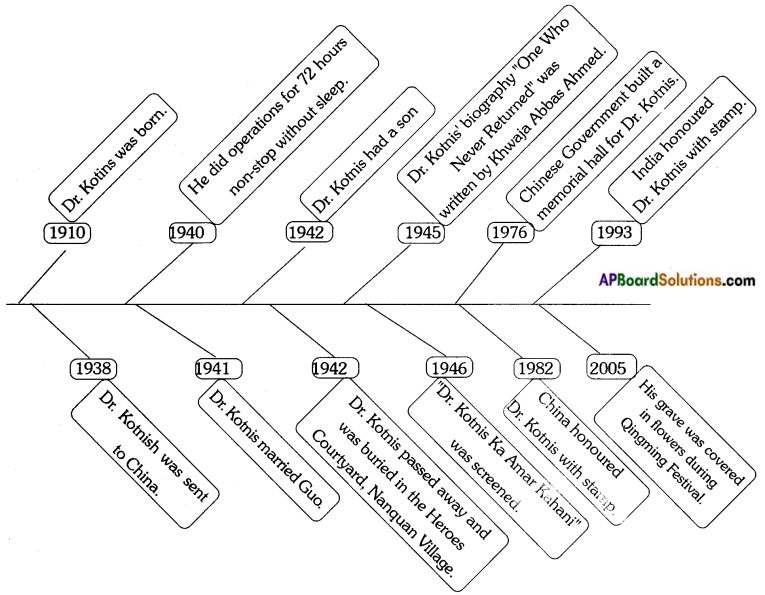
Read the biographical write up on Dr. Kotnis again and write the timeline of the events referred to, in your notebook. A few events are shown here.
1. 1910 – Kotnis was born
………..
2. 1938 – Chinese Government built a memorial hall for Dr. Kotnis
Answer:

  1. 1910 – Kotnis was born
  2. 1938 – Chinese Government built a memorial hall for Dr. Kotnis
  3. 1940 – He did operations for 72 hours non-stop without any sleep.
  4. 1941 – He married Guo
  5. 1942 – Hehadason
  6. 1942 – He passed away and was buried in the Heroes Courtyard, Nanquan Village.
  7. 1945 – Dr. Kotnis’ biography “One Who Never Returned” was written by Khwaja Abbas Ahmed.
  8. 1946 – The movie based on Dr. Kotni& life, “Dr. Kotnis Kl Amar Kahani” was screened.
  9. 1976 – Chinese Government built a memorial hail for Dr. Kotnis.
  10. 1982 – China honoured him with stamp.
  11. 1993 – India honoured him with stamp
  12. 2005 – Dr. Kotnis’ grave was covered completely in flowers donated by the Chinese people during the Qingming Festival.

v

AP Board 8th Class English Solutions Chapter 6C The Dead Rat

Project work

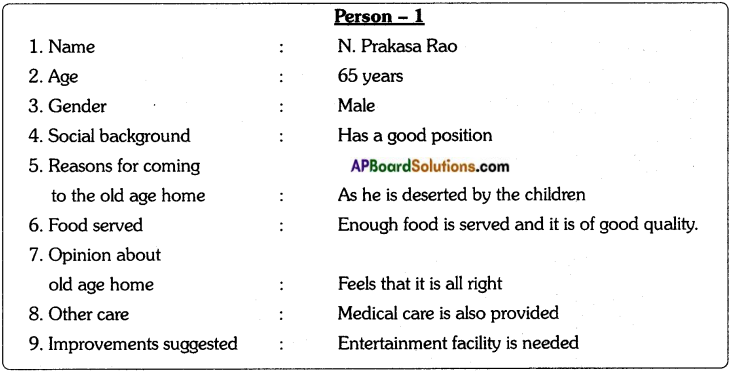
There are many old age homes in our society. Visit any one of them and interview any two persons.
Before you conduct an interview, prepare a questionnaire centred around the following items.
1. Name
2. Age
3. Gender
4. Social background
5. Reasons for coming to the old age home
6. Food served
7. Opinion about old age home
8. Other care
9. Improvements suggested
Write a report based on the interview and present it before the class.
Answer:
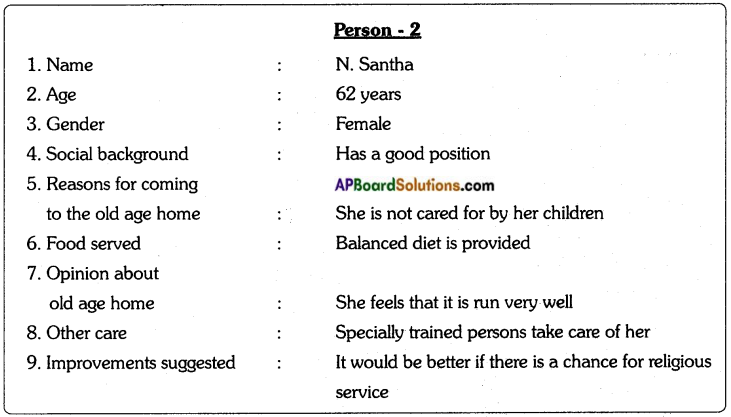
AP Board 8th Class English Solutions Chapter 6C The Dead Rat 1
AP Board 8th Class English Solutions Chapter 6C The Dead Rat 2
Report:
N. Prakasa Rao, a senior citizen, is a 65 year old person. Though he has a good position in the society, he has come to old age home as he is deserted by his children. He is very much satisfied with the conditions of the old age home. He feels that proper medical facility is also available there. He wants to have some kind of entertainment facility. N. Santha is a 62 year old senior citizen. Though she has been enjoying a good position in the society, she has come to the old age as she is neglected by her children. She feels that the balanced and healthy diet is served there. She feels that it is run very well and she is very happy with the services provided by specially trained persons. She opines that if there is a chance for religious service it would be a lot better.
The main reason for the alienation of the old people is that the young people don’t show them any love and affection. They forget the sacrifices made by their parents and desert them. They don’t care for them. So, the young persons should change their attitude. They should know the importance of human relations and values. They should prevent their parents from going to old age homes by showing them love and affection.

AP Board 8th Class English Solutions Chapter 6C The Dead Rat

The Dead Rat Summary in English

Madananka was a young merchant living in Ujjain. As he lost his father, his mother brought him up with great affection and love. Unfortunately, he turned out to be a vagabond. Hoping he would become normal and settle down, his mother got him married to a girl but he became worse. One day he left his house deserting his mother and pregnant wife. His wife gave birth to a son and he was named Ratnanka. He too was brought up with affection and care and given good education. When he was ten, his grandmother told him to take up some business to earn their living. She advised him to go to Yakshadatta and borrow some money from him. Yakshadatta, a well-to-do merchant living in the neighbouring village, lent money to the poor but capable persons. Ratnanka met Yakshadatta and requested him to lend him some money for business. He promised Yakshadatta that he would repay the amount soon. Yakshadatta pointed towards a dead rat and told Ratnanka that it was the capital he could lend him. He also told that an intelligent man could earn millions with that dead rat. Ratnanka took the dead rat and kept it in a cup made out of a leaf. A merchant purchased it for feeding his cat and gave him a handful of bengalgram. Ratnanka took the bengalgram home and soaked it. Then he added some salt and pepper to the bengalgram. He offered some soaked bengalgram and cold water to the hungry and thirsty woodcutters. They were pleased with his service and gave him two pieces of firewood each. Ratnanka sold the firewood away for two rupees in the city. He gave one rupee to his grandmother towards savings and purchased bengalgram with the other rupee. Again he offered soaked bengalgram and cold water to the woodcutters. In this way he collected many cart-loads of fuel within a month. When there was scarcity of firewood in the city, he sold the firewood and earned a hundred gold coins. He became one of the leading merchants in that city within two years. Then he wanted to show his gratitude to Yakshadatta. He got a rat made of gold and carried it in a procession to the residence of Yakshadatta. Ratnanka told Yakshadatta his success story and requested him to accept the golden rat as repayment of the loan and also as a token of his gratitude. Yakshadatta was pleased with the intelligence and gratitude of Ratnanka.

The Dead Rat Glossary

vagabond (n): a person who has no home and usually no job, and who travels from a particular place

abscond (v): escape; or to go away suddenly and secretly in order to escape from somewhere

stroll (n): a slow relaxed walk

generosity: the nature of giving money, time, gifts, kindness, etc.

eke out (phr.v): earn

menace (v): something that is likely to cause harm

incessant (adj): never stopping, especially in an annoying or unpleasant way

AP Board 8th Class English Solutions Chapter 6C The Dead Rat

grieved (v): felt very sad

approached (v): went near to somebody

deserted (v): left somebody without help or support

capital (n): a large amount of money that is invested or is used to start a business

AP Board 8th Class English Solutions Chapter 6B Be Thankful

AP State Syllabus AP Board 8th Class English Textbook Solutions Chapter 6B Be Thankful Textbook Questions and Answers.

AP State Syllabus 8th Class English Solutions Chapter 6B Be Thankful

8th Class English Chapter 6B Be Thankful Textbook Questions and Answers

Comprehension

Answer the following questions.

Question 1.
The poet depicts different situations/aspects of life where we need to be thankful. What are they?
Answer:
We need to be thankful to the following situations/aspects of life:

  1. When we don’t know something;
  2. When we face difficult times;
  3. When we have certain limitations;
  4. When we face new challenges;
  5. When we make mistakes;
  6. When we are tired and weary;
  7. When we suffer setbacks and
  8. When we face troubles.

AP Board 8th Class English Solutions Chapter 6B Be Thankful

Question 2.
Do you agree to the poet’s idea? Yes/No? Give reasons.
Answer:
Yes, I agree to the poet’s ideas. We need to be thankful that we don’t already have everything we desire. If we get everything we desire, there will be nothing to look forward to do. If we don’t know something, we will try to learn about it. We grow in the difficult times. We try to find out a solution to get rid of our difficulties. When we have limitations, we try to overcome them. In the process of facing the new challenges, we will build our strength and character. Our mistakes will teach us valuable lessons. When we suffer setbacks it will bring out our innate powers. All these things make us perfect ones.

Question 3.
How do the difficulties help us grow? When will the troubles become blessings?
Answer:
The difficulties help us grow. When one faces difficulties, one tries to get rid of them. It makes the person to think in the right way and find the right solution. Thus he is able to get out of his difficulties. When one finds a way to be thankful for one’s troubles, the troubles become blessings.

Be Thankful Summary in English

We need to be thankful that we don’t already have everything we desire. There would be nothing to look forward to do if we get everything we desire. We need to be thankful when we don’t know something for it gives us the opportunity to learn. We need to be grateful when we face the difficult times as we grow during those times. We need to be thankful for our limitations as they give us opportunities for improvement. We need to be grateful for each new challenge as it will build our strength and character. We need to be thankful for our mistakes as they will teach us valuable lessons. We need to be thankful when we are tired and weary as it means we have made a difference. It is easy for all of us to be thankful for the good things. But we need to be thankful even for the setbacks to get a life of rich fulfillment. Gratitude can change a negative into a positive. We need to find a way to be thankful for our troubles as they can become our blessings.

AP Board 8th Class English Solutions Chapter 6B Be Thankful

Be Thankful Glossary

desire (n): a strong wish to have or do something

character (n): all the qualities and features that make a person, groups of people, and places different from others

weary (adj): very tired


AP Board 8th Class English Solutions Chapter 6A Dr. Dwarakanath Kotnis

AP State Syllabus AP Board 8th Class English Textbook Solutions Chapter 6A Dr. Dwarakanath Kotnis Textbook Questions and Answers.

AP State Syllabus 8th Class English Solutions Chapter 6A Dr. Dwarakanath Kotnis

8th Class English Chapter 6A Dr. Dwarakanath Kotnis Textbook Questions and Answers

Read the newspaper headline given below and answer the questions that follow.

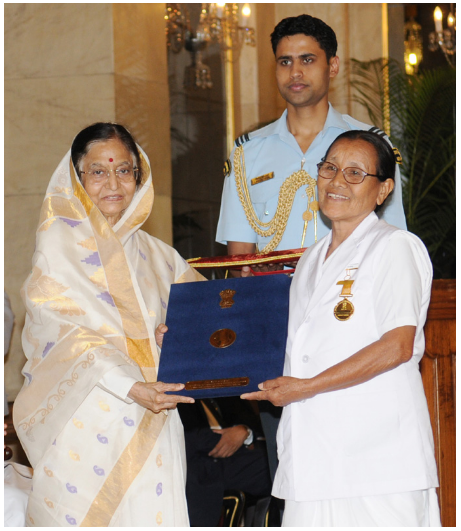
International Nurses’ Day : President gives away Florence Nightingale Awards

AP Board 8th Class English Solutions Chapter 6A Dr. Dwarakanath Kotnis 1

President Pratibha Patil giving away Florence Nightingale Award to S. Hoikholhing on 12th May 2012.

Question 1.
Why are the nurses given awards on the name of Florence Nightingale?
Answer:
Florence Nightingale Awards are annually given for excellence in nursing. The main aim of giving these awards to the nurses is to recognize professional nurses for their contributions to direct patient care.

AP Board 8th Class English Solutions Dr. Dwarakanath Kotnis

Question 2.
Do you know the name of any Indian who may have rendered any significant services in another country and is still remembered and honoured by the people there?
Answer:
Yes, I know the name of an Indian who rendered his significant services in another country and is still remembered and honoured by the people there. He is none other than Dr. Dwarakanath Shantaram Kotnis. He was one of the five Indian physicians dispatched to China to provide medical assistance during the second Sino-Japanese War. No other Indians can claim the kind of adulation and respect Dr. Kotnis enjoys in China.

Comprehension

Answer the following questions.

Question 1.
Why was Dr. Kotnis sent to China?
Answer:
In 1937, the communist General Zhu De requested Jawaharlal Nehru to send Indian physicians to China during the Second Sino-Japanese War to help the soldiers. The President of the Indian National Congress, Netaji Subhash Chandra Bose accepted the request and made arrangements to send a team of volunteer doctors. A medical team of five doctors M. Atal, M.Cholkar, D. Kotnis, B.K. Basu and D. Mukeiji was sent as the part of Indian Medical Mission Team in September 1938. Thus Dr. Kotnis was sent to China to help the Chinese soldiers.

Question 2.
What was Dr. Kotnis’ contribution to the Dr. Bethune International Peace Hospital in China?
Answer:
Dr. Kotnis once served as Dr. Bethune International Peace Hospital’s doctor. He took over the post of the first President of the Bethune International Peace Hospital after Dr. Norman Bethune passed away. He worked as a lecturer earlier for sometime in the military area at the Dr. Bethune Hygiene School.

AP Board 8th Class English Solutions Dr. Dwarakanath Kotnis

Question 3.
Why did Dr. Kotnis opt to stay back in China?
Answer:
After the Second Sino-Japanese War, all other doctors except Dr. Kotnis, returned to India. However, Dr. Kotnis decided to serve at the military base. So he opted to stay back in China.

Question 4.
How did the Chinese show their gratitude towards Dr. Kotnis?
Answer:
In order to cherish the memory of Dr. Kotnis, the Chinese government built a memorial hall for him in Shijiazhuang city, Hebei Province in 1976. Along with the Candian Dr. Norman Bethune, he continues to be revered by the Chinese people. In April 2005, both their graves were covered completely in flowers donated by the Chinese people during the Qingming Festival. A small museum there has a hand book which contains words that Kotnis wrote in his “Passage from India to China,” some of the instruments that the surgeon^ used at their time and many photogrpahs of doctors. China has honoured him with stamp in 1982.

Question 5.
Why was Mrs. Kotnis a regular invitee at the Indian Embassy functions in China?
Answer:
Mrs. Kotnis had been an honoured guest at many high-level diplomatic functions between China and India. She was a regular invitee at the Indian Embassy fuctions in China, because
the Chinese wanted to have good relationship with India. Not only that, to respect Dr. Kotnis’ selfless service to the Chinese, she was invited at the Indian Embassy functions in China.

Question 6.
What sort of person, do you think, was Dr. Kotnis? What are your impressions about him?
Answer:
Dr. Kotnis dedicated his entire life working as a battlefront doctor in China and rendered his selfless service to the injured Chinese soldiers during the Second Sino-Japanese War. Dr. Kotnis’ contribution towards humanity will be remembered forever. No single Indian has been more revered by ordinary Chinese than Dr. Kotnis. He was not only a hero but also a loved brother, husband and an adventurous young man.

AP Board 8th Class English Solutions Dr. Dwarakanath Kotnis

II. Read the passage about Dr. Kotnis again and fill in the form given below.

1. Name:
2. Year of birth:
3. Place of birth:
4. Occupation:
5. Nationality:
6. Wife’s name:
7. Places of work and the positions held:
8. Honours given by China and India:
9. Date of death:
Answer:
1. Name Dwarakanath Kotnis
2. Year of birth 1910 (October 10,1910)
3. Place of birth Sholapur, Maharashtra
4. Occupation Doctor
5. Nationality Indian
6. Wife’s name Guo Qinglan
7. Places of work and the positions held:
(a) Yan’an → doctor
(b) Eighth Route Army General Hospital, North China → physician-in-charge
(c) Dr. Bethune Hygiene School → lecturer
(d) The Bethune International Peace Hospital → president
8. Honours given by China and India:
(a) The Chinese government built a memorial hall for him in Shijiazhuang city, Hebei Province in 1976.
(b) In April 2005, his grave was covered completely in flowers donated by the Chinese people during the Qingming Festival.
(c) A small museum there has a hand book which contains words that Kotnis wrote in his “Passage from India to China”.
(d) Both China and India honoured him with stamps in 1982 and 1993 respectively.
9. Date of death: 9th December, 1942.

AP Board 8th Class English Solutions Dr. Dwarakanath Kotnis

Vocabulary

I. Here are some of the words that are related to the word ‘doctor’. In how many ways can you classify the following words?
AP Board 8th Class English Solutions Chapter 6A Dr. Dwarakanath Kotnis 2

profession physician
specialization neurologist
qualification MBBS, MD
dress code white coat
medicines crocin
place of work clinic, Hospital
service treatment
tools syringe
related vehicle ambulance
target group patient

Mapping these meanings through words is called semantic mapping. A set of words related in meaning are said to belong to the same semantic field.
e.g. : bus, driver, conductor, ticket, etc.
Write four words that belong to and that you can associate with the following words.
1. space                 (a)            (b)             (c)             (d)
2. business            (a)             (b)            (c)             (d)
3. occupation        (a)             (b)            (c)             (d)
4. travel                 (a)             (b)            (c)             (d)
Answer:
1. space                 (a) space-shuttle     (b) space travel     (c) space station      (d) spaceship
2. business            (a) selling                 (b) buying             (c) exports               (d) imports
3. occupation        (a) teacher               (b) driver               (c) collector             (d) conductor
4. travel                 (a) road                    (b) rail                   (c) sea travel            (d) air travel

II. Read the sentence given below.
Dr. Kotnis lost his heart to a Chinese woman.
What does the expression ‘lose heart’ in the above sentence mean?
Lost his heart means fell in love.
Here is one more expression using the word heart.
‘Eat your heart out’. (Suffer from envy or jealousy)
e.g.: I am going to New York next week. Eat your heart out!
e.g.: When he hears about your promotion he will eat his heart out.

AP Board 8th Class English Solutions Dr. Dwarakanath Kotnis

III. Match the following.
1. have a heart         ( )      (a) sadness
2. broken heart        ( )      (b) no feelings
3. heavy heart          ( )      (c) a very deep thank you
4. take to heart        ( )      (d) be merciful
5. a heart of stone   ( )      (e) lost love
6. thanks from the bottom of my heart ( ) (f) take seriously
Answer:
ANSWERS
1 – d,
2 – e,
3 – a,
4 – f,
5 – b,
6 – c

Grammar

Coordination is a grammatical process by which two or more words phrases or clauses of the same rank are conjoined.
A conjunction that joins parts of a sentence (words, phrases or clauses) that are grammatically equal or similar in importance and structure is called a Coordinating Conjunction, e.g: and, but, or, nor, for, yet, so.
Coordinating Conjunctions: and, but, or, yet, so, neither… nor, either…. or, not only
but also, both, etc.
Subordinate Conjunctions: when, before, after, since, while, as, till, until, whenever, as long as, as soon as, no sooner….than, then, scarcely, hardly,…. when, wherever, because, in order that, so….that, if, though, even though, whereas, as if, whether …. or, etc.

Compound Sentence and Complex Sentence

Observe the following sentences.
1. Dr. Kotnis was a doctor and Guo, a nurse.
2. I could not stop laughing when he told jokes.

  • What are the main clauses in each sentence?
  • How many subordinate clauses are there in sentences 1 and 2?

Dr. Kotnis was a doctor and Guo, a nurse, (two main clauses)
I could not stop laughing when he told jokes, (one main clause and one subordinate clause) I could not stop laughing’ is a main clause, ‘when he told jokes’ is a subordinate clause.

  • A sentence which consists of two or more main clauses combined with coordinate conjuctions is called a Compound Sentence.
  • A sentence which consists of one main clause and one or more subordinate clauses combined with subordinate conjuctions is called a Complex Sentence.

Read the following sentences. Identify the clauses and say whether they are main clauses or subordinate clauses.
1. John suffers from Asthma but attends school regularly.
2. We like songs but they like games.
3. Japan attacked China in 1937 and wounded many soldiers.
4. If the rain stops, we will go out.
5. She was unhappy or she was upset.
6. The shops were closed because there was a strike.
Answer:
1. John suffers from Asthama but attends school regularly.
Main clause – John suffers from Asthama
Main clause – (he) attends school regularly.

2. We like songs but they like games.
Main clause – We like songs
Main clause – they like games.

3. Japan attacked China in 1937 and wounded many soldiers.
Main clause – Japan attacked China in 1937.
Main clause – (Japan) wounded many soldiers.

4. If the rain stops, we will go out.
Main clause – We will go out.
Subordinate clause – If the rain stops

5. She was unhappy or she was upset.
Main clause – She was unhappy
Main clause – She was upset.

6. The shops were closed because there was a strike.
Main clause – The shops were closed.
Subordinate clause – because there was a strike.

AP Board 8th Class English Solutions Dr. Dwarakanath Kotnis

Writing

Developing Headlines.
When writing a news report for a newspaper, or your school News Board, the headline is the first and foremost impression you make on your reader. Therefore, writing a headline is a critical and creative art. „
Most of the people read only the headlines while reading a newspaper, to get the gist of the news.

  • Headlines often contain a noun phrase with no verb.
  • Headlines may have noun strings (several nouns put together).
  • Various changes are made in the headlines.
  • The simple tense form is used instead of the continuous or perfect form.
  • The infinite form refers to the future.
  • The auxiliary verb is dropped in the passive form.
  • Articles are dropped; full-stops are not placed after headlines.
  • Headlines may contain initials and abbreviations, e.g : Prime Minister’s advice

e.g : Man snatches woman’s chain
e.g : Andhra Pradesh State Board Examination Results Declared
e.g : Hyderabad celebrates kite festival
e.g : Chief Minister to inaugurate Craft Bazars
e.g : Passengers injured seriously in Nellore train accident
e.g : India to host SAARC meet in UP

I. Now write a headline for each of the following news reports. Remember to pick out only the main idea or words from the sentence.
(a) Hyderabad: With an alarming rise in cases of missing people, especially women and children, since 2009, the Andhra Pradesh Police have stepped up measures to trace them in co-ordination with various agencies and police forces.
Answer:
Andhra Pradesh police have stepped up measures to trace missing people

(b) The full moon that rises on this Friday night, August 31,2012, will be a Blue Moon. That’s what it has been dubbed as in modern folklore of the west. But will it actually be blue?
Answer:
A Blue Moon to rise on Friday night, August 31, 2012

(c) “If you look at the last three months, I am really practising well. ! am looking forward to playing my first game after a year.”
Answer:
I am to play my first game after a year

AP Board 8th Class English Solutions Dr. Dwarakanath Kotnis

(d) Next time your cell phone runs out of battery, you can charge it by just holding it in your hands as the scientist claims to have developed a new technology that turns body heat into electricity.
Answer:
A new technology that runs body heat into electricity developed

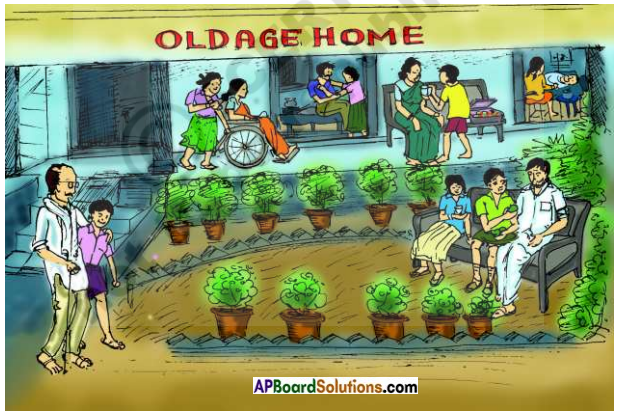
II. Look at the picture where students are serving in an old age home.
AP Board 8th Class English Solutions Chapter 6A Dr. Dwarakanath Kotnis 3
Discussion Points

  1. Do old people go to old age homes on their own or are they forced to go there?
  2. What are the conditions which make people leave their own homes and go to an old age home?
  3. In what way are the conditions at an old age home different from those at home?
  4. Are there any ways to prevent the old people from going to old age homes?
    Note : Answers for the 4 discussion points given above are given in Q. III.

III. Now write an article based on the following hints.

  • What are old age homes?
  • Why do old people go there?
  • Facilities at the old age homes
  • Compare facilities at home and old age homes

Answer:
The old age homes are intended for senior citizens. Nowadays, most of the old people prefer to live in old age homes. Many factors have contributed to the alienation of the elders. Migration of young couples from the rural areas to the cities in search of better employment opportunities to fend for themselves. Youngsters are sometimes unfair to their parents. They don’t show the old ones any love or affection. Sometimes the old people are not given enough food to eat. The young people don’t provide proper medical facilities for the old people. The young people don’t care for them. Parents take a lot of pain to grow their children and sacrifice a plenty of their happiness: Our culture has it, that it is duty of the child to look after his parents. Unfortunately, it doesn’t happen in our present society. Everyone is in a mad race of earning money. And in the process they don’t take time off to look after their parents. We don’t find good relationships and human values in our present society. Aged parents are like children. They are sensible. Nowadays, India is intensely influenced by the western world where parents live alone or stay at old age homes. The old people don’t go to old age homes on their own. They are forced to go there.
In the old age homes trained staff can assist the old people. They can be kept clean and fed well. Proper medical care is provided. Old age homes have special medical facilities for senior citizens such as mobile health care systems, ambulances, nurses and provision of well-balanced meals. Apart from food, shelter and medical amenities, the entertainment and library facilities are also available for them. These homes create a family like atmosphere among the residents. Senior citizens experience a sense of security and friendship when they share their joys and sorrows with one another. Here, they live peacefully. Old age homes provide them the much needed comfort, solace and companionship. We can prevent the old people from going to old age homes by showing them love and affection. The youngsters should take care of them. They should provide proper medical facilities for them. They should allow their parents to move and talk freely in their homes.

AP Board 8th Class English Solutions Dr. Dwarakanath Kotnis

Listening

Listen to your teacher. She/He will read out an announcement made by the headmaster of a Govt. High School.

An Announcement in a School

Dear students,
I am to inform you that we are going to start an ‘Enrolment Drive Programme’ next week. We will go to the nearby slums in our locality for 3 days and see if there are any children who are not studying in any school. There will be 10 teams each consisting of 6 students. I want all the students and teachers of classes VIII and IX to join this mission. Mr. Rajkumar and Ms. Christina will be joining us in our mission. They will help us in all the aspects related to the programme. Children, now those who volunteer to take the lead in teams should meet their class teachers after the lunch hour.
Now, answer the following questions.
1. What is the announcement about?
Answer:
The announcement is about launching of ’Enrolment Drive Programme.’

2. Who are the special guests joining their mission?
Answer:
Mr. Rajkumar and Ms. Christina are the special guests joining their mission.

3. What are the students asked to do in the programme?
Answer:
The students are asked to go to the nearby slums in their locality for 3 days and see if there are any children who are not studying in any school.

4. Why does the headmaster call it a mission?
Answer:
The headmaster calls it a mission as he thinks that the ‘Enrolment Drive Programme’ is a very important programme.

Oral Activity

If you get an opportunity to propose a ‘Vote of Thanks’ after completing the Enrolment Drive Programme. How would you do it?
Prepare ‘Vote of Thanks’ to thank Mr. Rajkumar, Ms. Christina, and all other participants.
Clues :

  • Introduction of the programme
  • About the participants and the service they offered during the programme.
  • Their role in making the Programme a great success.
  • Thanking each and everyone referring to their role in the programme.
  • Requesting the extension of their service in future.

Answer:
Good evening to all of you. I am proud and lucky to have the opportunity of proposing a ‘Vote of Thanks’ to thank all the participants. As you are all aware that our ‘Enrolment Drive Programme’ has come to an end and it is a great success for all of us recognizing the students who are outside the school and joining them in the school. At first I would like to thank our special guests Mr. Rajkumar and Ms. Christina on behalf of our school and on my behalf for sparing some of their valuable time for us. We are very much thankful to you sir and madam for the service offered by you during the programme and your valuable suggestions. We are hopeful that we will get your extended cooperation and help in the future. Once again I wish to express our sincere thanks to you sir and madam for your role in making this programme a grand success. Now, I would like to thank each and everyone who participate in this programme and make it a grand success. I would like to request all of you to extend your priceless services
in the future.

AP Board 8th Class English Solutions Dr. Dwarakanath Kotnis

Dr. Dwarakanath Kotnis Summary in English

Dr. Dwarakanath Kotnis was born in a lower middle class family on October 10, 1910 in Sholapur, Maharashtra. Coming from a family of doctors, Dr. Kotnis aspired to become a doctor.

After completing his graduation in medicine, he went on to pursue his post-graduation internship. He started his medical expedition in Vietnam, and then, moved on to Singapore and Brunei. The communist General Zhu De requested Jawaharlal Nehru in 1937 to send Indian physicians to China to help the war victims. Dr. Kotnis was one of the five doctors who were sent to China as the part of Indian Medical Mission Team. Though the other doctors returned to India after the war, Dr. Kotnis decided to stay back and serve at the military base. He started his work in Yan’an and then worked in the surgical department of the Eighth Route Army General Hospital as the physician-in-charge. He fell in love with a Chinese nurse, Guo Qinglan and married her in November, 1941. They had a son on August 23, 1942 and he was named Yin Hua. He worked as a lecturer for sometime at the Dr. Bethune Hygiene School. Later he took over the post of the first President of the Bethune International Peace Hospital. He did operations for 72 hours nonstop without any sleep during the long-drawn out battle against Japan. He played a major role in controlling a virulent strain of plague that hit Chinese soldiers. He died of epilepsy on December 9, 1942 at the age 32, and was buried in the Heroes Courtyard, Nanquan Village.

The Chinese government built a memorial hall for him in Shijiazhuang city, Hebei Province in 1976. His grave was covered completely in flowers donated by the Chinese people during the Qingming festival. Both China and India honoured him with stamps in 1982 and 1983 respectively. Later, Kotnis, family visited Kotnis’ grave and Dr. Bethune International Peace Hospital.

After Dr. Kotnis’ death, their son Yin Hua also passed away when he was just 25. Despite the two premature deaths, Mrs. Kotnis maintained her links with the Kotnis family. Mrs. Kotnis had been an honoured guest at many high-level diplomatic functions between China and India. She was a regular invitee at the Indian Embassy functions in China. Dr. Kotnis become famous in his hometown with the publication of “One Who Never Returned” written by Khwaja Abbas Ahmed and the screening of the movie “Dr. Kotnis Ki Amar Kahani,” directed by V. Shantaram. No other Indians can claim the kind of adulation and respect Dr. Dwarakanath Kotnis enjoys in China. Dr. Kotnis’ contribution towards humanity will be remembered for ever.

AP Board 8th Class English Solutions Dr. Dwarakanath Kotnis

Dr. Dwarakanath Kotnis Glossary

adulation (n): admiration; praise

virulent (adj): dangerous

shy away (phr.v): avoid something that you dislike

epilepsy (n): a disease of the nervous system that causes a person to fall unconscious

revered (v): respected or admired deeply

commemorate (v): keep a great person, event etc. in people’s memories

vivacious (adj): cheerful

venerated (v): respected

septuagenarian (n): a person who crossed 70 years

memorabilia (n): objects that are collected in memory of persons and events

render (v): to give somebody something

vivacious (adj): having a lively, attractive personality

pursue (v): to try to achieve something over a period of time

internship (n): a job that an advanced student of medicine, whose training is nearly finished, does in a hospital to get further practical experience

put aside (phr.v): to ignore or forget something, usually a feeling or difference of opinion.

expedition (n) : an organized journey with a particular purpose

lose heart (idiom): to fall in love with somebody

passed away (phr.v): died

AP Board 8th Class English Solutions Dr. Dwarakanath Kotnis

fortnight (n): two weeks

soulmate (n): an intimate associate or companion ; someone with whom you have a special relationship and whom you know and love very much

cherish (v): to love somebody/something very much and want to protect them or it

AP Board 8th Class English Solutions Chapter 4A The Story of Ikat

AP State Syllabus AP Board 8th Class English Textbook Solutions Chapter 4A The Story of Ikat Textbook Questions and Answers.

AP State Syllabus 8th Class English Solutions Chapter 4A The Story of Ikat

8th Class English Chapter 4A The Story of Ikat Textbook Questions and Answers

Look at the pictures given and answer the questions that follow.

Question 1.
What do you see in these pictures? Where do you find them?
Answer:
In the first picture we see Kondapalli Bommalu. In the second picture we see the Rudrakshamalas (Chains of beads). In the third picture we see the statues of Vinayaka made with plaster of paris. We generally find these three kinds of handicrafts in stalls, shops, emporiums, exhibitions, etc. In the fourth picture we see Mayuri (Sudha Chandran), a famous Bharatanatyam dancer.

Question 2.
Why did the woman make up herself differently? Do you find anything unique in the make up of the woman in the picture? What could be the occasion for this make up?
Answer:
The woman made herself differently as she wanted to perform something. Yes, I find something unique in the make up of the woman in the picture. Usually women don’t make up themselves in such a way. It must be a special occasion. I think she was going to perform Bharatanatyam.

AP Board 8th Class English Solutions Chapter 4A The Story of Ikat

Question 3.
Are these handicrafts and the make up a part of our culture? Give reasons to your answer.
Answer:
Yes, these handicrafts and the make up are a part of our culture. Handicrafts promote our cultural heritage. They make the younger generations know our ancestry, the richness of culture and traditions. Since old ages, our land is famous for these handicrafts. The art forms such as Kuchipudi, Bharatanatyam etc., need the make up. These art forms originated in our country and there have been so many well known artists in our country. Hence, 1 can say that these handicrafts and make up are a part of our culture.

Comprehension

Answer the following questions.

Question 1.
What is the main theme of the story?
Answer:
The main theme of the story is making the children know the richness of our cultural heritage. The story of Ikat’ presents the present condition of textiles in Andhra Pradesh, the meaning of Ikat, the great skill of weavers behind weaving Ikat, the holiness of tying the knot and our traditions. It sends us a message that we should promote handicrafts and protect artists.

Question 2.
How is chitiki rumal used by different people?
Answer:
‘Chitiki Rumal’ is the favourite headgear of fishermen and other labourers. It is also used by Gujarat traders as the towel on their shoulders.

AP Board 8th Class English Solutions Chapter 4A The Story of Ikat

Question 3.
The teacher became silent when she was discussing handloom. Why?
Answer:
When the teacher was discussing handloom, she became silent because of the present status of it. She thought that we had forgotten our heritage in the race with the machine. So, she became serious in those kinds of thoughts.

Question 4.
Children’s attention was divided between her words and thefabrics as she opened silk patola sari. Why?
Answer:
The teacher used the words such as Chitiki, Patola and Ikat to explain the handloom. Saying these words, she opened a silk patola sari from Patan, Gujarat. It had a red design on a black background with rows of flowers in the border. The simple leaf design repeated across the body and the flowers in the border created a mesmorising effect. So, their attention was divided between her words and fabrics.

Question 5.
The writer described some designs, historical things and the weaving. Which part of the story do you like most?
Answer:
I like the process of weaving the most as it is a complex process. Counting the threads, measuring the distance, calculating when to repeat a pattern and tying the knot seem that it is a complex process.

Vocabulary

I. Read the following sentences.
V.V.S. Lakshman is a top class batsman.
Sruthi is in class VIII.
We have ten minutes left for the show.
The minutes of every official meeting remain an important document.
The words underlined in the above sentences have the same spelling but they differ in meaning. These words are called Homonyms.

AP Board 8th Class English Solutions Chapter 4A The Story of Ikat

Find the meaning of the following homonyms with the help of a dictionary.

1. a) fair (adj): ——————————-
b) fair (noun): ——————————-
2. a) mind (noun): ——————————-
b) mind (verb): ——————————-
3. a) quiet (adj): ——————————-
b) quiet (noun): ——————————-
Answer:
1. a) fair (adj): acceptable and appropriate in a particular situation
b) fair (noun): a large public event where goods are bought and sold; a type of entertainment in a field or park
2. a) mind (noun): the part of a person that makes them able to be aware of things, to think and to feel
b) mind (verb): to be upset, annoyed or worried by something
3. a) quiet (adj): making very little noise
b) quiet (noun): the state of being calm without much noise

II. Use the above homonyms In your own sentences.
Answer:
1. a) He is very fair always.
b) This evening we are going to the fair.
(or)
This evening we will go to the fair.
2. a) She is in a disturbed state of mind,
b) I hope you don’t mind if I leave now.
3. a) All the class is very quiet.
b) He always loves the quiet of his own room.

III. Read the following sentences carefully.
The students have some knowledge about ‘Ikat’.
This sum from chapter III is very tough.
The words underlined in the above sentences have the same pronunciation but differ in spelling and meaning. Such words are called Homophones.
Read the following passage carefully and replace the underlined words with correct homophones.
One day Janaki teacher said to the class, “We all no that the boy in the blew dress has one the best student price for this year.” She added this is the write hour to felicitate him. Here is the gift for the boy but can anyone help me to untie the not of the died ribbon. One boy came forward and helped her. There is a wonderful gift inside the box!
Answer:
One day Janaki teacher said to the class, “We all know that the boy in the blue dress has won the best student prize for this year. ” She added this is the right hour to felicitate him. Here is the gift for the boy but can anyone help me to untie the knot of the dyed ribbon. One boy came forward and helped her. There is a wonderful gift inside the box!

AP Board 8th Class English Solutions Chapter 4A The Story of Ikat

Grammar

I. Read the following pair of sentences taken from the narrative “The Story of Ikat”.
1. Ramya asked, “Are these fabrics from Indonesia?”
2. The teacher said, “What can be the origin of the word?”
a. Who are the speakers?
b. What are the exact words spoken by them?
c. If you want to report the above sentences, how will you do?
Let’s analyse the sentences 1 and 2.
The first part of the sentence ‘Ramya aksed’ has a subject ‘Ramya’ and a verb ‘asked’.
This clause is called the reporting clause. The verb is called reporting verb.
The part within the quotation marks is called reported clause, which gives the exact words spoken by the speaker.
Let’s look at the answer to the question ‘c’.
1. Ramya asked if/whether those fabrics were from Indonesia.
2. The teacher asked what the origin of the word could be.
Let’s look at the changes that have taken place.
You will find the following changes.
a. Change of the pronoun (these – those)
b. Change of the verb in the reported clause (are – were)
c. Change of question to a statement by adding if/whether
All the above changes are made when the reporting verb is in Past tense.
1. Report the following conversation.
Ramya visits a weaver at Pochampally. She asks him a few questions.
Ramya : Uncle, What are you doing?
Weaver: I’m making a sari. Do you like it?
Ramya : Oh! Yes. What is the price?
Weaver : Five hundred rupees. Do you want to buy it?
Ramya : Oh! Yes. Can you pack it for me?
Weaver : Sure, here you are.
Answer:
Ramya asked the weaver what he was doing. He replied that he was making a sari. He asked her if she liked it/that. Ramya replied affirmatively and asked him what the price was. He replied that it was five hundred rupees and asked her if she wanted to buy it/that. Ramya replied affirmatively and asked him if he could pack it/that for her. He replied that he could certainly give it and then offered her the sari she wanted.

Look at the following changes while reporting.
AP Board 8th Class English Solutions Chapter 4A The Story of Ikat 2

AP Board 8th Class English Solutions Chapter 4A The Story of Ikat

WASH AWAY THE GERMS
Washing hands helps prevent the spread of germs, and should be done frequently.

  • Before you eat.
  • Before and after you help a sick person.
  • Before you care for a wound or cut, and again after.
  • After you use the toilet.
  • After you cough, sneeze or blow your nose.
  • After you handle animal waste or an animal or pet treats/food.

The Story of Ikat Summary in English

Janaki was a Social Studies teacher. That day she came a bit late to the class. She brought the brilliant red and black checked rumals, shawls with black and blue geometric patterns with her. That material made the dull class vibrant. She wrote on the blackboard ‘Textiles of India – “Ikat” of Andhra Pradesh and pronounced the word “Ikat”. “Ikat” means “to bind” or “knot”. Then she elicited the name of Nalgonda district from the students. She made them know the name ‘Pochampally’, a village in Nalgonda district in connection with “Ikat”. Every student immediatley connected to the village. A handloom is a hand operated loom which weaves. It has been weaving fabrics for centuries. Now we have forgotten our heritage in race with the machine. After telling this, Janaki began to tell the story of Ikat. It is called ‘Chitiki’ in Telugu, ‘Patola’ in Gujarati and simply ‘Ikat’ in Oriya. She showed them a silk patola sari from Patan, Gujarat which created a mesmerising effect. Then she asked them if they were thinking about ‘Ikat’ or ‘tie and dye’. When no one could answer her, she told them about ‘warp’ and ‘weft’. The threads stretched lengthwise are called ‘warp’ and the threads intersecting them widthwise are called ‘weft’. In ‘Ikat’ the threads are carefully sorted, warp and weft divided into bundles, then tied with the materials like plastic sheets, rubber strips and then dropped into colours. The weavers count the threads, measure the distance, calculate when to repeat a pattern and then tie the knots. They draw patterns on the graphs and copy them on the threads. ‘Chitiki rumal’ was the favourite headgear of fishermen and other labourers. Gujarat traders put them on their shoulders as the towels. In Telugu ‘Chitikedu’ means a small quantity of material. Then the students came to know about the original explanation of Ikat. They understood that the characteristic of Ikat was small and small dots of colour. Once Chitiki fabric was our favourite export item. There are different stories about its origin. Different regions fight about its origin but there is no systematic documentation to resolve this dispute. Tying the knot is sacred in our tradition. Muslim culture influenced the designs in Ikat in parts of Gujarat, Maharashtra and Deccan.

The Story of Ikat Glossary

mandatory (adj): compulsory

wonder (v): wish to know

drab (adj): dull

AP Board 8th Class English Solutions Chapter 4A The Story of Ikat

pelt (v): throw; shoot

giggle (v): laugh in a silly way

babble (n): a talk difficult to understand

pensive (adv): serious

hesitantly (adv): unwillingly/uncertainly

expectantly (adv): hopefuL of something

intersect (v): crossing each other at a point

headgear (n): a piece of cloth worm on head

jubilant (adj): very happy

resolve (v): solve

knot (n): fastening

vibrant (adj): active

compelling (adj): extremely interesting

dashed (v): went somewhere very quickly

partial (adj): showing or feeling too much support for one person, team, idea, etc.

persisted (v): continued

criss-cross (v): to make a pattern on something with many straight lines that cross each other

AP Board 8th Class English Solutions Chapter 4A The Story of Ikat

motif (n): a design or a pattern used as a decoration

sorted (v): arranged things in groups or in groups or in a particular order according to their type

vigorous (adj): very active, determined

origin (n): the point from which something starts

AP Board 8th Class English Solutions Chapter 1B My Mother

AP State Syllabus AP Board 8th Class English Textbook Solutions Chapter 1B My Mother Textbook Questions and Answers.

AP State Syllabus 8th Class English Solutions Chapter 1B My Mother

8th Class English Chapter 1B My Mother Textbook Questions and Answers

Comprehension

Answer the following questions.

Question 1.
How does the poet feel the presence of his mother?
Answer:
The poet feels the presence of his mother when he plays with his play things. When he plays with his play things, he seems to be able to hear a tune which reminds him his mother. He also feels the presence of his mother when he smells the fragrance of shiuli flowers in autumn and when he sees the blue sky through this bedroom window.

Question 2.
What do you understand from the statement – ‘I cannot remember my mother’?
Answer:
The poet’s mother passed away when he was still young. Hence, he can’t be able to recall his mother.

AP Board 8th Class English Solutions Chapter 1B My Mother

Question 3.
Does the poem convey sadness? If yes, pick out the suggestive expressions.
Answer:
Yes, this poem conveys some kind of sadness. The expression “I cannot remember my mother”, suggests this. The poet can’t remember his mother because she passed away when he was young.

Question 4.
What imagery do you find in each stanza? How does it appeal to you?
AP Board 8th Class English Solutions Chapter 1B My Mother 1
Answer:

Stanza Images Sense it appeals to
1 Mother rocking the cradle and singing a song ears (sound)
2 The poet smelling the scent of the shiuli flowers which is like the scent of his mother. nose (smell)
3 The poet sending his eyes into the blue sky to feel mother’s gaze. eyes (sight)

Question 5.
Read the poem ‘My Mother’ again and complete the table.
AP Board 8th Class English Solutions Chapter 1B My Mother 2
Answer:
AP Board 8th Class English Solutions Chapter 1B My Mother 3a

Question 6.
We all love our mother, don’t we? We love her because of certain qualities. Think and write about her qualities.
Answer:
We love mother as:
i) She gives birth to her children.
ii) She gives her children her love and care.
iii) She understands her children’s needs.
iv) She makes her children ready to live a happy life.
v) She defends her children.
vi) She supports her children’s dreams even when they seem impossible.
vii) She loves her children though they hurt and neglect her.

AP Board 8th Class English Solutions Chapter 1B My Mother

Question 7.
How would you choreograph the first stanza? (Group work)
(a) What settings do you arrange ?
Answer:

Stanza Settings
1 Swinging cradle
2 Garden, morning service in the temple
3 Bedroom – window – sky

(b) What are the characters and their actions ?
Answer:

Stanza Characters Actions
1 Child The child plays with his playthings listening to the tune of the song sung by his mother.
Mother She rocks the cradle humming a tune.
2 Child The child smells the fragrance of shiuli flowers.
Mother The mother does the morning service in the temple.
3 Child The child gazes at her mother through the window.
Mother The mother is spread all over the sky.

(c) What is the sequence of actions ?
Answer:

Stanza Action of the main character Action of the supporting team/characters
1 The child is playing with his play things. He is listening to the tune of some song. The mother is rocking the cradle. She is humming a song.
2 The poet (child) is smelling the scent of shiuli flowers. The mother is making morning service in the temple.
3 The poet (child) is looking at the blue distant sky through his bedroom. The mother is standing outside the window in some distance.

Each group may choreograph different stanzas of the song.

Figurative language: The use of words to express meaning beyond the literal meaning of the words themselves.
Imagery: Language which describes something in detail, using words to substitute for and create sensory stimulation, including visual imagery and sound imagery, e.g: Mother rocking the cradle. Here child senses with eyes and ears.
Metaphor: The comparison of two unlike things in which no words of comparison (like or as) are used.
e.g: Harry was a lion in the fight.
Simile: A figure of speech involving a comparison between unlike things using like, as, or as though.
e.g: as cool as a cucumber, as white as snow, life is just like an ice-cream. Personification: Giving non-human objects human characteristics, e.g: The moon danced mournfully over the water.

AP Board 8th Class English Solutions Chapter 1B My Mother

My Mother Summary in English

‘My Mother’ is a gentle nostalgic poem written by ‘Guru’ Rabindranath Tagore. He is one of the greatest poets of modern India. His mother passed away when he was young. In this poem, he expresses his inability to recall the face or the features of his mother. When he looks at his playthings, he seems to be able to hear a tune. Perhaps his mother often sang the same song when she moved his cradie gently. In autumn, the shiuli tree blossoms into fragrant tiny flowers. His mother would string the flowers for the morning service in the temple. When he smells the scent of shiuli flowers, he recalls his mother. When he sees from his bedroom window into the blue of the distant sky, he feels the stillness of his mother’s gaze. This poem eloquently reveals the emotional bonding between the poet and his mother. She has a great impact on the poet.

About the Poet

Rabindranath Tagore (1861-1941) is popularly known as Vishwa Kavi and Gurudev. He was the founder of Shantiniketan, an experimental school. He was awarded the Nobel Prize in literature for his ‘Gitanjali’, the Song of Offerings. Each of his poems reflects Indian vision and love towards his Mother Land. He is considered the Voice of Indian Heritage and Spiritualism.

My Mother Glossary

hover (v): remain in the air

shiuli (n): small, white or orange flowers that bloom in autumn

scent (n): perfume/good smell

AP Board 8th Class English Solutions Chapter 1B My Mother

rock (v): move gently

hum (v): sing with closed lips

gaze (v): look fixedly

morning service (n.phr): a religious service

AP Board 8th Class English Solutions Chapter 3C The Garden Within

AP State Syllabus AP Board 8th Class English Textbook Solutions Chapter 3C The Garden Within Textbook Questions and Answers.

AP State Syllabus 8th Class English Solutions Chapter 3C The Garden Within

8th Class English Chapter 3C The Garden Within Textbook Questions and Answers

Look at the pictures given and answer the questions that follow.

Comprehension

Question 1.
What is the central idea of the poem?
Answer:
There is a garden in the poet’s heart. She wants to tend it beautifully. She wants to be grateful to achieve her goal. She wants to be good to others. When one is good to others, one will get respect. When one is thankful, one will reach one’s goal.

Question 2.
What features of the garden in the poet’s heart are mentioned in stanza 1?
Answer:
The feature of the garden in the poet’s heart that is mentioned in stanza 1 is that beauty grows in fits and starts.

AP Board 8th Class English Solutions Chapter 3C The Garden Within

Question 3.
What is the mood of the poet? Put a tick (✓) mark,
a. sad b. hopeful c. thankful
Answer:
b) hopeful ( ✓)

Question 4.
Explain the word ‘gratitude’ as used in the poem.
Answer:
‘Gratitude’ means thankfulness. The poetess wants to be thankful to achieve her goal and it will comfort her soul.

Simile, Metaphor and Personification:

Observe the following sentences.

1. Here and there over the grass stood beautiful flowers like stars.
In this sentence “flowers are compared to stars” such a comparison using ‘like’ and ‘as’ is called ‘simile’.
e.g.: a. He roared like a lion.
b. Her face is as white as snow.

2. Life is a journey. Enjoy the ride.
In the above sentence the word ‘journey’ is used to describe/compare the word ‘life’. Such words are called ‘metaphor’. They are used to show that two things have same qualities. They make the description more powerful, e.g.: a. Rudramadevi was a lioness in battle, b. Her home was a prison.

3. Spring has forgotten his garden.
Here, though ‘spring’ is a season, it is represented as a human being and given the qualities of forgetting, etc. Such usage in literature is called ‘personification’, e.g.: a. The stars danced playfully in the moonlit sky.
b. The snow covered up the grass with her great white cloak.

AP Board 8th Class English Solutions Chapter 3C The Garden Within

Project work

Collect a few story books and fill in the table with details and present it before the class.

AP Board 8th Class English Solutions Chapter 3C The Garden Within 1

Answer:
AP Board 8th Class English Solutions Chapter 3C The Garden Within 2

The Garden Within Summary in English

The poetess finds that there is a garden in her heart. Like the gardener who lovingly tends his garden for the pleasures of bloom, the poetess nourishes the memories because they comfort her soul. In the garden of her heart beauty doesn’t grow continuously. She wants to give her smiles to others like the petals of the flowers in the garden of her heart. Then the others will respond in the same way and respect her feelings. There is a good hope in her and it results in good seeds to comfort her spirit. She wants to reach her goal with thankfulness and it will touch her soul. Here the soul of the poetess is compared with beautiful garden.

The Garden Within Glossary

petal (n): a delicate coloured part of a flower

bestowed (v): gave, showed respect

bowers (n): a pleasant place in the shade of tree

AP Board 8th Class English Solutions Chapter 3C The Garden Within

nutritious (adj): good

reaps (v): gives

spirit (n): inner feeling or mood

gratitude (n): thankfulness

goal (n): something that you hope to achieve

in fits and starts (phr): in a sudden and irregular manner

AP Board 8th Class English Solutions Chapter 1A The Tattered Blanket

AP State Syllabus AP Board 8th Class English Textbook Solutions Chapter 1A The Tattered Blanket Textbook Questions and Answers.

AP State Syllabus 8th Class English Solutions Chapter 1A The Tattered Blanket

8th Class English Chapter 1A The Tattered Blanket Textbook Questions and Answers

Look at the pictures given and answer the questions that follow.

AP Board 8th Class English Solutions Chapter 1A The Tattered Blanket 1

Question 1.
What do you observe in the pictures?
Answer:
In picture A, we observe a nuclear family that consists of a pair of adults and their children. In picture B, we observe a joint family that consists of a man (the head), his wife, their children, daughters-in-law and their grandchildren.

AP Board 8th Class English Solutions Chapter 1A The Tattered Blanket

Question 2.
Do we find many joint families in our society? Yes/No? Give reasons.
Answer:
We don’t find many joint families in our society. The joint family system has been breaking up in India as a result of the increasing individualistic and independent attitudes of grown up children. Nuclear families provide more privacy. Today youngsters want financial independence. Hence, the system of joint family has been gradually disappearing.

Comprehension

I. Answer the following questions.

Question 1.
Why didn’t the mother recognise Gopi and how did he feel?
Answer:
Gopi’s mother did not recognize him as she might have lost her memory. He didn’t visit her very often. He was very disappointed at that. He tried to convience her that he was Gopi, her son but of no use.

Question 2.
Why do you think Gopi didn’t get anything for his mother?
Answer:
I think Gopi didn’t have any love and affection for his Amma. Actually he didn’t have any feelings for her. He spent all his time in money making. He didn’t have any values. He didn’t give any importance to human relations. He forgot his mother. So, I think, he didn’t get anything for his mother.

Question 3.
The mother could not remember Gopi. Do you think Gopi remembered his mother? What does it suggest?
Answer:
No, I don’t think Gopi remembered his mother. It suggests us that he didn’t have any moral values. He didn’t care for human relations. He was the man of money. He forgot her service and sacrifice. He only looked for the status.

Question 4.
What is meant by the expression ‘the tattered blanket’?
Answer:
The expression “the tattered blanket” means the torn blanket. It symbolizes the life of the Amma. Here the old woman is compared to the torn blanket. Amma is very old and she is in her last stage. No one has any use of her. In the same way, the blanket is a tattered one which is not very useful.

AP Board 8th Class English Solutions Chapter 1A The Tattered Blanket

Question 5.
Why didn’t Gopi answer his sister’s question, ‘Do you remember your Amma?’?
Answer:
Gopi knew what he had done to his mother. He came after a very long time to his mother. He didn’t remember his mother. He didn’t even write a letter to her. He came there only for selling his share of the family property but not with love and affection. He valued money and status only. So, Gopi didn’t answer his sister’s question.

Question 6.
If you were Gopi’s sister, how would you respond to his behaviour?
Answer:
If I were Gopi’s sister, I would make him know that he was doing wrong. I would make him know a son’s responsibility towards his mother. I would make him recall Amma’s service and sacrifice for him. I would make him realize that one day he too would become old and face the same situation. I would really hate him.

Vocabulary

I. Fill in the blanks with the most appropriate words from the box. Remember, the box has some extra words.
AP Board 8th Class English Solutions Chapter 1A The Tattered Blanket 2

1. All my attempts to make him happy proved ———–.
2. It was very cold. So, I ———– in a corner.
3. Forced by her parents, Sita ———– took the diploma course.
4. What are you ———–? I can’t hear you.
5. The news that he was denied promotion caused ———– to him.

II. Tick (✓) the words that are similar in meaning to the underlined words.

1. His mother made a futile attempt to get up.
a. barren
b. limited
c. useless
d. empty
Answer:
c. useless

2. It’s all tattered now.
a. spoiled
b. old
c. dirty
d. torn
Answer:
d. torn

3. There is a cold mist in the mornings,
a. ice
b. snow
c. fog
d. win
Answer:
c. fog

AP Board 8th Class English Solutions Chapter 1A The Tattered Blanket

4. It’s just like a ball of knotted yarn.
a. very small
b. rounded tightly
c. joined
d. tied
Answer:
d. tied

5. I can’t make both ends meet with my salary.
a. earn a lot of money
b. spend a lot of money
c. earn just enough money
d. give all that one has
Answer:
c. earn just enough money

Grammar

Phrases, Noun Phrase and Noun Phrase Apposition

I. Look at the following sentences from the text and observe the underlined part in each sentence.

She saw a bald, fat, middle-aged man.

Discussion:

  • Which word in the underlined part is important?
  • The underlined part in the above sentence has more than one word. It is called a phrase. The underlined part ‘a bald, fat middle-aged man’ functions as a Noun Phrase.

AP Board 8th Class English Solutions Chapter 1A The Tattered Blanket 3
Here the word ‘man’ is important and all other words add more information to that word. So it is called a Noun Phrase.
Identify some more noun phrases from the story and write them below.
Answer:
1) The tattered blanket
2) A thin bath towel
3) His office jeep
4) Her wrinkled cheeks
5) A ball of knotted yarn

Complete the sentences with noun phrases using the words given in brackets.

1. I bought ———– (beautiful/a/umbrella/red)
2. We saw ———–in the zoo. (baby/a/elephants/of/couple)
3. Our grand father lives in ———– (big/house/a/stone-built)
4. Ramya has ———– (nice/a/sari/silk)
Answer:
1. a beautiful red umbrella.
2. a couple of baby elephants
3. a big stone-built house.
4. a nice silk sari.

AP Board 8th Class English Solutions Chapter 1A The Tattered Blanket

II. Noun Phrase in Apposition.

Look at the following sentences and observe the underlined part in each sentence.

1. Kamala, her eldest daughter, a widow, got up reluctantly.
2. Don’t you remember Vimala, District Collector Nambiar’s eldest daughter?

The underlined parts in the above sentences refer to the nouns that occur before them. The underlined parts are called Noun phrases in Apposition.

Rewrite the following sentences using Noun Phrase in Apposition.
1. Mahesh is my elder brother. He lives in Delhi.
Mahesh, ———–, lives in Delhi.
2. Sarojini Naidu is popularly known as the Nightingale of India. She wrote many poems in English.
Sarojini Naidu, ———–, wrote many poems in English.
3. Rabindranath Tagore is called Gurudev. He was awarded the Nobel Prize for literature in 1913.
Rabindranath Tagore, ———–, was awarded the Nobel Prize for literature in 1913.
4. Mount Everest is the highest peak in the world. It is located in Nepal.
Mount Everest, ———–, is located in Nepal.
Answer:
1. my elder brother
2. the Nightingale of India
3. Gurudev
4. the highest peak in the world

Writing

I. Read the following paragraph, taken from the story.

Delhi is too expensive. You know I have four children to look after now. I can’t make both ends meet with my salary. And one has to keep up one’s status. It will be a great help if I can raise some money by selling my share of the family property. I came to talk it over with you.
Now, write a paragraph on how to keep up family ties despite economic pressures (You may use the hints given below).

  • Impact of economic pressures
  • Lack of time to spend with the family
  • Lack of love and affection
  • Absence of human relationships

Answer:
People lead a very busy life in the present society. They work like machines. They even don’t find time to sit together. They forget their families. They don’t have any enjoyment. Because of the economic pressures they have to earn more and more money. They don’t give any importance to the human relations. Everyone tries to keep up his/her status. They don’t show any love and affection on their family members. The younger ones forget the selfless service rendered by their parents. They don’t have any feelings to them. They forget the sacrifice made by their par¬ents in the process of giving them good education, providing them good facilities and giving them good lives. In the hunting of money, they don’t find time to spend with their family members. They neglect their parents. The old people are equal to the little children. They need help, service, money, etc. from their offspring. So, the younger ones must provide them to their parents. Despite their economic pressures, they must find some time to spend with their parents. They should remember that one day they too will become old. If they don’t show any love and affection, they too will have to face the same situation. Though the younger ones are busy with their work, they should maintain family ties and show the right path to the next generations.

AP Board 8th Class English Solutions Chapter 1A The Tattered Blanket

Listening

Listen to your teacher making an announcement and answer the following questions.

An Announcement on the Radio

Prashanth, a thirteen year old boy has been missing since last Sunday. The boy is in blue trousers and pink T-shirt. He can speak Telugu, Hindi and English. He has fair complexion. He is fond of movies. His parents are much worried about him. Whoever finds Prashanth will be rewarded. You may contact the Sub- Inspector of Police, Vidya Nagar, Thiruvananthapuram. (Mobile No. 99xxxxxx00)

Question 1.
What is the announcement about?
Answer:
The announcement is about the missing boy, Prashanth.

Question 2.
What are the features of Prashanth?
Answer:
Prashanth is a thirteen year old boy. He is in blue trousers and pink T-shirt. He can speak Telugu, Hindi and English. He has fair complexion. He is fond of movies.

Question 3.
Where do you generally listen to such announcements?
Answer:
We generally listen to such announcements :
(i) On the radio (ii) On the television (iii) Over the loudspeakers, etc.

Question 4.
Think of some announcement you may make or listen at school.
Answer:
As you are aware, we are going to celebrate the Children’s Day celebrations in our school on the 14th of this month. We are going to organize a number of cultural programmes on the occasion. So, I would like to request the students who are interested to give their names to the SPL. The selected events are : Dances, Skits, Songs and Plays.

AP Board 8th Class English Solutions Chapter 1A The Tattered Blanket

Question 5.
What are the other ways to trace the missing persons or things?
Answer:
The other ways to trace the missing persons or things are :
(i) Announcement on TV.
(ii) Announcement in dailies, weeklies and other magazines.
(iii) Announcement over loudspeakers.
(iv) Announcement through wall posters, pamphlets, etc.

Study Skills

Family related information.

AP Board 8th Class English Solutions Chapter 1A The Tattered Blanket 4

Is yours a nuclear or joint family?
Now write a paragraph describing the types of families using the information given in the above tree diagram.
Write which type of family you prefer and why.
Answer:
Ours is a nuclear family. But I prefer to be a member of a joint family. There are two types of families. They are (i) Joint family and (ii) Nuclear family. A joint family consists of father, mother, their children and their families. A nuclear family consists of father, mother and their children. I really can’t see any disadvantages with a joint family. In every sense it is a convenient arrangement for everyone – morally, emotionally, mentally, financially, etc. With everyone putting his or her efforts, joint family system benefits everyone. The children are well taken care of. They learn to give and take, to be patient, cooperative, tolerant and to adjust with the other family members in a joint family. The joint family gives security, health and prosperity to everyone of its members. The joint family system is one that could help us to live a less stressful life as there are a lot of people around to help us and to share joys and sorrows. The eleders handle the financial matters. So there is no stress on the younger ones. The elders show the right path to younger ones. The younger ones develop the virtues like co-operation, sympathy, sacrifice, selfless ser­vice, obedience, etc. in a joint family. We find love and affection among the members of a joint family. Hence I prefer the joint family system.

AP Board 8th Class English Solutions Chapter 1A The Tattered Blanket

The Tattered Blanket Summary in English

Gopi was a government officer living in Delhi. He married Vimala. district collector Nambiar’s eldest daughter. They had four children. Gopi’s old mother was living in the countryside along with her eldest daughter Kamala, a widow. After attending a meeting in Thiruvananthapuram, he dropped in on his way back. His mother saw him getting down at the gate and asked Kamala to see who he was. Kamala walked slowly to the gate reluctantly. She recognised Gopi and asked him unpleasantly why he made a sudden unexpected visit. But Amma did not recognize him. Gopi tried to tell her that he was her son. Kamala told Gopi that that Amma was often like that those days. She didn’t recognize anybody. When Amma asked Kamala if her son (Gopi) had sent a letter, Kamala told her everything was fine with him. But Gopi didn’t write any letter to her. When Kamala told Gopi all these things, he replied that he was on his toes always as he got promotion the previous year. So he didn’t get any time to write letters. Again Amma asked who he was. Gopi told her that he was her son Gopi and he had come from Delhi. She even forgot his wife’s name. She used to think that Gopi wrote letters to him every day. So she asked Kamala if he wrote a letter that day. Gopi kept his briefcase on the thinna, opened it and pulled out his contents such as clothes, files, a shaving set, etc. Amma told Gopi that her son Gopi was a government officer in Delhi and had Kesariyogam. She asked him to send her a new red blanket to protect herself from a cold mist. Her old blanket, which was brought by Gopi when he was studying in Madras, was all tattered. Actually Gopi didn’t come to the village too see her Amma. He didn’t have any affection and love towards his Amma. He gave more importance to status. He wanted to raise some money by selling his share of the family property. He came to talk it over with his sister. Kamala knew that he would never come there anymore after selling his land. When she told Gopi the same, he answered that he would come when he got time. He said that Amma couldn’t remember who he was. Actually it was he who didn’t remember his Amma.

About the Author

Kamala Das (1932-2009) is the daughter of the famous Malayalam poet- Balamani Amma and V.M. Nair. She is an internationally known poet, short story writer and novelist who writes effortlessly both in English and Malayalam. She has received many awards for her literary work. Some of them are Asian Poetry Prize, Kent Award for English Writing from Asian Countries, Asian World Prize, Sahitya Academy Award and Vayalar Rama Varma Sahitya Award.

The Tattered Blanket Glossary

thinna (n): sit out (elevated place on the verandas)

futile (adj): unsuccessful

huddled (v): held arms and legs close because of fear or cold.

reluctantly (adv): not willing to do something

screwing up eyes (v): narrowing the eyes to look more carefully

AP Board 8th Class English Solutions Chapter 1A The Tattered Blanket

on toes (idm): busy, ready to work

mumbling (v): speaking unclearly and quietly

exasperatedly (adv): very annoyed

kesariyogam (n): well settled (in Malayalam)

tattered (adj): torn

irritation (n): annoyance

peer (v): to look closely or carefully at something or somebody

grating (adj): unpleasant to Listen to

scared (adj): frightened

awkwardly (adv): uncomfortably

wrinkled (adj): having folds in one’s skin.

knotted yarn (n.phr): tied threads

nod (v) : move one’s head up and down to show agreement

make both ends meet (idiom): to earn just enough money to be able to buy the things you need

look after (phr. v): to take care of somebody/something

feebly (adv): weakly