AP 7th Class Social Important Questions Chapter 10 రాష్ట్ర ప్రభుత్వం

These AP 7th Class Social Important Questions 10th Lesson రాష్ట్ర ప్రభుత్వం will help students prepare well for the exams.

AP Board 7th Class Social 10th Lesson Important Questions and Answers రాష్ట్ర ప్రభుత్వం

ప్రశ్న 1.
గవర్నర్ నియామకం మరియు విధులను గురించి వ్రాయండి.
జవాబు:
భారతదేశంలో ప్రతి రాష్ట్రానికి ఒక గవర్నర్ ఉంటారు. ప్రధానమంత్రి, కేంద్రమంత్రి మండలి సిఫారసు మేరకు రాష్ట్రపతి అయిదు సంవత్సరాల పదవీ కాలానికి గవర్నర్ ని నియమిస్తారు. ఒక్కోసారి రెండు లేక మూడు రాష్ట్రాలకు ఒకే గవర్నర్ ఉంటారు. ఆర్టికల్ 158 (3a) ప్రకారం రెండు లేక ఎక్కువ రాష్ట్రాలకు ఒకే వ్యక్తిని గవర్నర్ గా నియమించవచ్చు.

గవర్నర్ విధులు :

  1. శాసనసభ : మెజారిటీ పార్టీ నాయకుణ్ణి ప్రభుత్వాన్ని ఏర్పాటు చేయమని ఆహ్వానించడం.
  2. రాజ్యాంగం పట్ల విశ్వాసం కలిగి, దాని గోప్యతను కాపాడతామని వారి చేత ప్రమాణం చేయించటం.
  3. శాసనసభ సమావేశాలు నిర్వహించమని మరియు నిరవధిక వాయిదా వేయమని ఆజ్ఞలు ఇవ్వడం.
  4. హైకోర్టు పరిధిలో పనిచేసే అన్ని న్యాయస్థానాలలో న్యాయమూర్తులను నియమించటం.
  5. రాష్ట్ర ప్రభుత్వ పనితీరును రాష్ట్రపతికి నివేదించటం.

ప్రశ్న 2.
శాసన సభ నిర్మాణం మరియు శాసన సభకు ఎన్నికలను ఎవరు నిర్వహిస్తారు?
జవాబు:
శాసనసభ :
రాష్ట్ర శాసనసభ ఒక శాసన నిర్మాణ విభాగం. దిగువ సభగా భావించే ఈ సభలో ప్రజలచే ఎన్నుకోబడిన శాసన సభ్యులందరు సమావేశమై, రాష్ట్ర ప్రగతి మరియు సంక్షేమానికి సంబంధించిన వివిధ విషయాలను చర్చిస్తారు. ప్రతి రాష్ట్రాన్ని, ఆ రాష్ట్ర జనాభా ఆధారంగా శాసనసభ నియోజక వర్గాలుగా విభజించారు.

శాసనసభకు ఎన్నికలు :
సాధారణంగా, ప్రతి 5 సంవత్సరములకు ఒకసారి శాసనసభకు ఎన్నికలు జరుగుతాయి. అన్ని అసెంబ్లీ నియోజక వర్గాలకు కేంద్ర ఎన్నికల సంఘం ఎన్నికల ప్రకటన చేస్తుంది. స్వతంత్ర అభ్యర్థులు, రాజకీయ పార్టీల అభ్యర్థులు వారి మ్యానిఫెస్టోలతో ఎన్నికలలో పోటీ చేస్తారు. స్వతంత్ర అభ్యర్థులు మరియు రాజకీయ పార్టీలు ఎన్నికల ముందు ఇచ్చే హామీలను మ్యానిఫెస్టో అంటారు.

 AP 7th Class Social Important Questions Chapter 10 రాష్ట్ర ప్రభుత్వం

ప్రశ్న 3.
శాసన సభ సభ్యుని ఎన్నిక ప్రక్రియను వివరించండి.
జవాబు:

  1. శాసన సభ నియోజక వర్గాలలో ఎన్నికల నిర్వహణకు ఎన్నికల సిబ్బందిని ఎన్నికల సంఘం నియమిస్తుంది.
  2. 18 సం|| పైబడి ఓటు హక్కు కలిగిన ఓటర్లందరూ ఎన్నికల రోజున ఆ నియోజక వర్గంలో ఓటు వేస్తారు.
  3. ఓటర్లు ఓటరు గుర్తింపు కార్డును బూత్ స్థాయి అధికారికి చూపించాలి.
  4. రహస్య ఓటింగు విధానం ప్రకారం, ఓటర్లు వారు ఎవరికి ఓటు వేసినది తెలియపరచరాదు.
  5. పోలింగ్ పూర్తి అయిన తరువాత, ప్రకటించిన తేదీ నాడు ఓట్లను లెక్కిస్తారు.
  6. ఓట్ల లెక్కింపు తరువాత ఎవరికైతే ఎక్కువ ఓట్లు (Majority) వస్తాయో వారిని ఆ నియోజకవర్గ యం.ఎల్.ఏ. (శాసనసభ సభ్యుడు) (Member of Legislative Assembly) గా ప్రకటిస్తారు.

ప్రశ్న 4.
శాసన మండలి సభ్యుల కూర్పు, నిర్మాణం గురించి వివరంగా తెలియజేయండి.
జవాబు:
శాసన మండలి :

  1. శాసన నిర్మాణ శాఖలోని ఎగువసభను శాసన మండలి అంటారు.
  2. ద్విసభా విధానములో, శాసన మండలి పరోక్షంగా ఎన్నుకోబడిన వారితో పనిచేస్తుంది.
  3. ప్రతి 2 సంవత్సరాలకు 6 సంవత్సరాల పదవీ కాలం ముగిసిన 1/3 వ వంతు సభ్యులు పదవీ విరమణ చేయగా కొత్త సభ్యులు ఎన్నిక అవుతారు.
  4. ఇది శాశ్వతసభ ఎందుకంటే ఈ సభ రద్దు కాదు. ప్రతి శాసన మండలి సభ్యుడు (MLC) ఆరు సంవత్సరములు పదవిలో కొనసాగుతాడు.

శాసన మండలి నిర్మాణం ఈ క్రింది విధంగా ఉంటుంది :

  1. 1/3 వ వంతు మంది సభ్యులు శాసనసభ సభ్యులచే ఎన్నుకోబడతారు.
  2. 1/3 వ వంతు మంది సభ్యులు స్థానిక ప్రభుత్వ సంస్థల సభ్యులచే ఎన్నుకోబడతారు.
  3. 1/12 వ వంతు మంది సభ్యులు పట్టభద్రులచే ఎన్నుకోబడతారు.
  4. 1/12 వ వంతు మంది సభ్యులు ఉపాధ్యాయులచే ఎన్నుకోబడతారు.
  5. 1/6 వ వంతు మంది సభ్యులు రాష్ట్ర గవర్నర్ చే నామినేట్ చేయబడతారు.

ప్రశ్న 5.
ముఖ్యమంత్రి అధికారాలు మరియు మంత్రి మండలి గురించి క్లుప్తంగా రాయండి.
జవాబు:
ముఖ్యమంత్రి అధికారాలు :

  1. మంత్రిమండలి జాబితాను తయారుచేసి గవర్నర్‌కు పంపిస్తారు.
  2. మంత్రులకు శాఖలను కేటాయిస్తారు.
  3. మంత్రిమండలి సమావేశాలు ఏర్పాటు చేసి అధ్యక్షత వహిస్తారు.
  4. ముఖ్యమంత్రి అన్ని శాఖలను సమన్వయం చేస్తారు మరియు పర్యవేక్షిస్తారు.

ఆర్టికల్ 163 (1) ప్రకారం గవర్నర్ తన విధులను నిర్వర్తించడంలో సహాయపడడానికి మరియు సలహా ఇవ్వడానికి ముఖ్యమంత్రికి మంత్రి మండలి ఉండాలి.

మంత్రిమండలి :

  1. ముఖ్యమంత్రి క్యాబినెట్ సభ్యులకు వివిధ మంత్రిత్వ శాఖలను కేటాయిస్తారు.
  2. ఆ మంత్రులు తమ పరిధిలో ఉన్న విభాగాలకు ప్రభుత్వ విధానాలను నిర్దేశిస్తారు.
  3. ఈ విధానాలను ఆయా విభాగాల అధికారులు నిబంధనల ప్రకారం అమలు చేస్తారు.
  4. సభ ఆమోదం కోసం సమర్పించవలసిన విధానాలు మరియు ప్రణాళికలను సిద్ధం చేయాల్సిన బాధ్యత మంత్రిత్వశాఖపై ఉంది.
  5. సభ ఆమోదం పొందిన విధానాలను కార్యనిర్వాహక శాఖ అమలు చేస్తుంది.

 AP 7th Class Social Important Questions Chapter 10 రాష్ట్ర ప్రభుత్వం

ప్రశ్న 6.
రాష్ట్రంలో రాష్ట్ర ఉన్నత న్యాయస్థానం నిర్మాణం గురించి వివరణాత్మకంగా తెలియజేయండి.
జవాబు:
న్యాయశాఖ – రాష్ట్ర ఉన్నత న్యాయస్థానం :

  1. రాష్ట్ర ప్రభుత్వ ప్రధాన అంగాలలో ఇది ఒకటి. ఇది చట్టాలను వ్యాఖ్యానించటంతో పాటు వాటిని పరిరక్షించడం మరియు రాష్ట్రంలోని చట్టాల అమలుకు బాధ్యత వహిస్తుంది.
  2. హైకోర్టు రాష్ట్ర స్థాయిలో అత్యున్నత న్యాయ విభాగం.
  3. స్వతంత్ర న్యాయవ్యవస్థలో భాగంగా, దేశంలో అత్యున్నత న్యాయస్థానం అయిన సుప్రీం కోర్టు క్రింద పనిచేస్తుంది.
  4. రాష్ట్ర హైకోర్టులో ప్రధాన న్యాయమూర్తి మరియు ఇతర న్యాయమూర్తులు ఉంటారు.
  5. భారత రాష్ట్రపతి హైకోర్టు ప్రధాన న్యాయమూర్తిని నియమిస్తారు.
  6. ప్రధాన న్యాయమూర్తి ఈ పదవిలో అతనికి / ఆమెకి 62 సంవత్సరముల వయస్సు వచ్చే వరకు కొనసాగుతారు. రాష్ట్ర స్థాయిలో హైకోర్టే కాకుండా ట్రిబ్యునల్స్ మరియు దిగువ స్థాయిలో జిల్లా కోర్టులు ఉన్నాయి.
  7. న్యాయవ్యవస్థ ఎటువంటి పక్షపాతం లేకుండా ప్రజలకు న్యాయం చేస్తుంది. సయోధ్య మరియు రాజీ ద్వారా వివాదాలను పరిష్కరించడానికి లోక్ అదాలత్ (ప్రజా న్యాయస్థానం)ను భారత ప్రభుత్వం ఏర్పాటు చేస్తుంది.

ప్రశ్న 7.
చట్టాలను ఎవరు తయారుచేస్తారు? ఆధారమేమి?
జవాబు:
చట్టాలను ఎవరు తయారు చేస్తారంటే

  1. రాష్ట్రంలో వ్యవస్థ సక్రమంగా పని చేయడానికి మనకు చట్టాలు అవసరం.
  2. రాష్ట్రం మరియు దేశం అభివృద్ధి చెందడానికి మరియు ప్రగతి పథంలో పయనించడానికి చట్టాలు సహాయపడతాయి.
  3. రాష్ట్ర శాసన నిర్మాణ శాఖ ఆ రాష్ట్రానికి చట్టాలను తయారు చేస్తుంది.
  4. ఒక రాష్ట్ర పరిధిలోని పరిపాలన బాధ్యత ఆ రాష్ట్ర ప్రభుత్వానిదే.
  5. కేంద్ర మరియు రాష్ట్ర ప్రభుత్వ విధులు మరియు అధికారాలు మూడు జాబితాలుగా విభజించబడ్డాయి.
  6. అవి 1. కేంద్ర జాబితా, 2. రాష్ట్ర జాబితా, 3. ఉమ్మడి జాబితా. రాష్ట్ర జాబితా, ఉమ్మడి జాబితాలలో ఉన్న అంశాలపై రాష్ట్ర ప్రభుత్వం చట్టాలను తయారు చేస్తుంది.

ప్రశ్న 8.
చట్ట సభలలో ఒక బిల్లు శాసనం (చట్టం)గా ఎలా రూపొందుతుందో విశదీకరించండి.
జవాబు:

  1. సాధారణంగా, అధికార పక్షానికి చెందిన సభ్యుడు రాష్ట్ర శాసనసభ లేక శాసనమండలిలో బిల్లును ప్రవేశపెడతారు.
  2. ఆర్థిక బిల్లును గవర్నర్ ముందస్తు అనుమతి పొందిన తరువాత మాత్రమే శాసనసభలో ప్రవేశపెడతారు. సభలోని ప్రతి సభ్యునికి బిల్లు ప్రతులను పంచుతారు.
  3. బిల్లుపై సవివరమైన చర్చలు జరిపి అవసరమైతే కొన్ని మార్పులు చేర్పులు చేసిన తరువాత ఓటింగ్ జరుపుతారు.
  4. మెజారిటీ సభ్యుల ఆమోదం పొందిన తరువాత, ఆ బిల్లును రెండవ సభకు పంపుతారు.
  5. మొదటి సభలో జరిగిన విధంగానే రెండవ సభలో కూడా అదే విధానం బిల్లును ఆమోదించడం కొనసాగుతుంది.
  6. రెండు సభల ఆమోదం పొందిన తరువాత బిల్లు గవర్నర్ ఆమోదం కోసం పంపబడుతుంది.
  7. గవర్నర్ ఆమోదం తెలిపి సంతకం చేసిన తరువాతనే బిల్లు చట్టంగా మారుతుంది.
  8. చట్టాన్ని గెజిట్ లో ప్రచురిస్తారు. చట్టాన్ని అమలు చేయడానికి, గెజిట్ ప్రతులను కార్యనిర్వాహక శాఖకు పంపడం జరుగుతుంది.

ప్రశ్న 9.
ఒక అంశంపై బిల్లు చట్టంగా ఎలా రూపొందుతుందో ‘ఫ్లో చార్టు ద్వారా వర్ణించండి.
జవాబు:
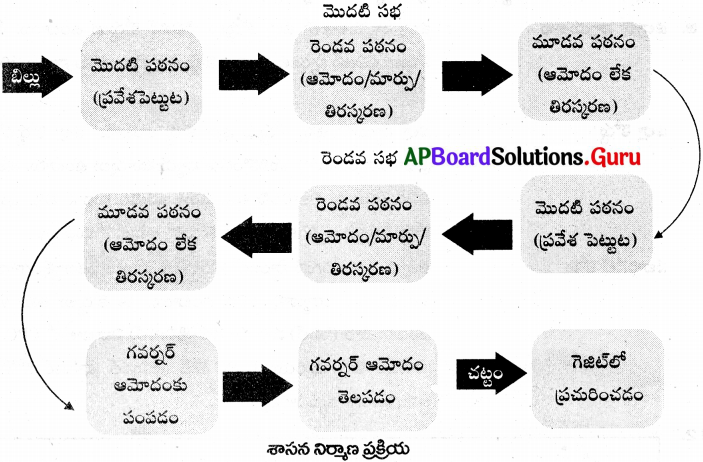
AP 7th Class Social Important Questions Chapter 10 రాష్ట్ర ప్రభుత్వం 1

ప్రశ్న 10.
ఈ క్రింది వారి విధులు, అధికారాలు తెలియజేయండి.
ఎ) పోలీసు సూపరింటెండెంట్, బి) RDO, సి) తహసీల్దార్, డి) VRO
జవాబు:
ఎ) పోలీసు సూపరింటెండెంట్ :
ప్రతి జిల్లా ప్రధాన కార్యాలయంలో పోలీసు సూపరింటెండెంట్ ఉంటారు. అతను జిల్లా ముఖ్య పోలీసు అధికారి. జిల్లాలో శాంతి భద్రతల నిర్వహణలో జిల్లా కలెక్టర్‌కు సహాయం చేస్తారు.

బి) రెవెన్యూ డివిజనల్ అధికారి :
సబ్ డివిజన్లో శాంతిభద్రతల నిర్వహణ, భూ రికార్డులు, ఎన్నికల నిర్వహణ మొదలగునవి రెవెన్యూ డివిజనల్ అధికారి బాధ్యతలు. భూ సేకరణ మరియు పునరావాస పనులను మరియు జిల్లా కలెక్టర్ సూచించిన ఇతర పనులను నిర్వహిస్తారు.

సి) తహసీల్దార్ :
మండల స్థాయిలో ఇతను ముఖ్య పరిపాలనా కార్యనిర్వహణాధికారి. మండల స్థాయిలో రెవెన్యూ వ్యవహారాల సక్రమ అంచనా, లెక్కింపు, వసూలు మరియు భూ రికార్డుల నిర్వహణకు బాధ్యత వహిస్తారు.

డి) గ్రామ రెవెన్యూ అధికారి :
గ్రామ రెవెన్యూ రికార్డులు మరియు అకౌంట్లను కచ్చితంగా నిర్వహించడం. గ్రామ స్థాయి పరిపాలనలో రెవెన్యూ విభాగానికి సంబంధించిన భూమి శిస్తు; పన్నులు మరియు ఇతర మొత్తాల వసూళ్ళతో పాటు సర్వే రాళ్లను తనిఖీ చేయడం, స్థానికత, నివాస ధృవీకరణ పత్రాలు జారీ చేయడం మొదలగు విధులు నిర్వహిస్తారు.

ప్రశ్న 11.
జిల్లా మరియు దిగువ స్థాయిలోని న్యాయస్థానాల ఏర్పాటు గురించి వివరించండి.
జవాబు:
జిల్లాలో న్యాయశాఖ :
జిల్లా న్యాయశాఖలో జిల్లా కోర్టులు, డివిజిన్ కోర్టులు ఉంటాయి. డివిజన్ కోర్టులు డివిజన్ స్థాయిలోను జిల్లా కోర్టు జిల్లా స్థాయిలోను న్యాయ పరిపాలన చేస్తాయి.

జిల్లా కోర్టు :
జిల్లా స్థాయిలో ఉన్న కోర్టును జిల్లా కోర్టు అంటారు. జిల్లా కోర్టులో జిల్లా ప్రధాన న్యాయమూర్తి, మరికొందరు న్యాయమూర్తులు ఉంటారు. జిల్లాలోని వివిధ కేసులను విచారించి తుది తీర్పు ఇవ్వడం ప్రధాన విధి. డివిజనల్ కోర్టు తీర్పుకు వ్యతిరేకంగా జిల్లా కోర్టులో అప్పీల్ చేయవచ్చు.

సబార్డినేట్ కోర్టు :
జిల్లా మరియు దిగువ స్థాయిలో సబార్డినేట్ కోర్టులు దేశవ్యాప్తంగా దాదాపు ఒకే విధమైన నిర్మాణాన్ని కలిగి ఉంటాయి. ఈ కోర్టులు తమ అధికార పరిధిలో పౌర (సివిల్) మరియు నేర (క్రిమినల్) వివాదాలలో CPC (సివిల్ ప్రొసీజర్ కోడ్) మరియు CrPC కోడ్ (క్రిమినల్ ప్రొసీజర్ కోడ్), లకు అనుగుణంగా వ్యవహరిస్తాయి.

ప్రశ్న 12.
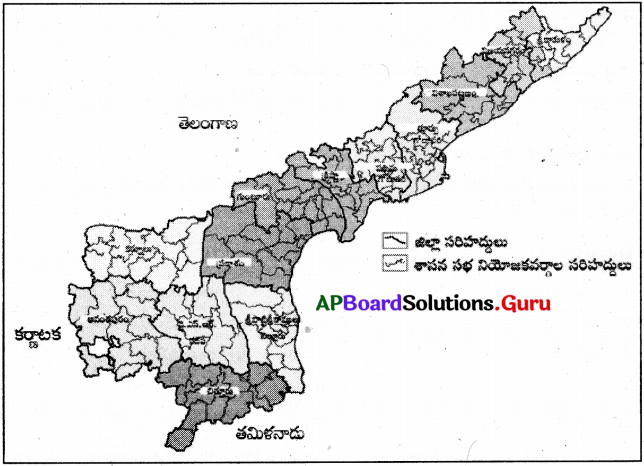
AP Board 7th Class Social Solutions Chapter 10 రాష్ట్ర ప్రభుత్వం 2
పై పటమును పరిశీలించి క్రింది ప్రశ్నలకు సరియైన సమాధానములివ్వండి.
ఎ) ఆంధ్రప్రదేశ్ లో మొత్తం ఎన్ని శాసనసభ నియోజక వర్గాలు కలవు?
బి) అత్యధిక శాసనసభా స్థానాలు కల జిల్లా ఏది?
సి) అత్యల్ప శాసనసభా స్థానాలు కల జిల్లా ఏది?
డి) మీ పాఠశాల ఏ శాసన సభా నియోజక వర్గ పరిధిలో కలదు?
జవాబు:
ఎ) 175
బి) తూర్పు గోదావరి (19)
సి) విజయనగరం (9)
డి) ప్రత్తిపాడు

ప్రశ్న 13.
ఈ పదాలను మీ తరగతిలో చర్చించండి: మెజారిటీ, అధికార పార్టీ, ప్రతిపక్ష పార్టీ, నియోజక వర్గం, రహస్య ఓటింగ్ విధానం, సార్వత్రిక వయోజన ఓటు హక్కు.
జవాబు:
1) మెజారిటీ :
జరిగినటువంటి ఎన్నికల్లో అధిక ఓట్లు / సీట్లు వచ్చినవారు.

2) అధికార పార్టీ :
ప్రజాస్వామ్య వ్యవస్థలో శాసన సభకు (చట్ట సభలకు) జరిగిన ఎన్నికల్లో మెజారిటీ పొంది (ఎక్కువ సీట్లు గెలుచుకుని) అధికారం పొందిన పార్టీ.

3) ప్రతిపక్ష పార్టీ :
రాజకీయంగా ఒకటి లేదా అంతకంటే ఎక్కువగానీ పార్టీలు అధికార పార్టీని వ్యతిరేకించే పార్టీలు.

4) నియోజక వర్గం :
అక్కడ నివసిస్తున్న ఓటర్లందరూ తమ ప్రతినిధులను ఎన్నుకునే ఒక నిర్దిష్ట ప్రాంతం.

5) రహస్య ఓటింగు విధానం :
ఎన్నికల సమయంలో ఓటరు తాను ఓటు వేసే విషయంలో గోప్యతను కల్గి ఉండటం.

6) సార్వత్రిక వయోజన ఓటు హక్కు :
ఒక నిర్దిష్ట వయస్సు (18 సం||లు) నిండిన భారతదేశ పౌరులందరికి ఎటువంటి తారతమ్యం లేకుండా ఓటు హక్కు కల్పించటం.

 AP 7th Class Social Important Questions Chapter 10 రాష్ట్ర ప్రభుత్వం

ప్రశ్న 14.
జిల్లా కలెక్టర్ మిగతా విధుల జాబితా తయారుచేయండి.
జవాబు:
రెవెన్యూ పాలన

  1. భూమి శిస్తు వసూలు
  2. రెవెన్యూ రికార్డుల నిర్వహణ పర్యవేక్షణ.
  3. వ్యవసాయ గణాంక సేకరణ.
  4. బంజరు భూముల విస్తీర్ణం అంచనా,
  5. పబ్లిక్ ఎస్టేట్స్ నిర్వహణ మొదలైన రెవెన్యూ కార్యకలాపాల పర్యవేక్షణ.

మెజిస్టీరియల్ అధికారాలు

  1. అల్లర్లు సంభవించినపుడు నిషేధాజ్ఞల విధింపు,
  2. సబార్డినేట్ కోర్టులపై పర్యవేక్షణ.
  3. పోలీసు స్టేషన్ల తనిఖీ.
  4. ఖైదీలకు కనీస సదుపాయాల కల్పన.
  5. కార్మిక సమస్యల పరిష్కారం.
  6. వార్తా పత్రికల ప్రారంభానికి అనుమతివ్వడం.
  7. పేలుడు పదార్థాల తయారీకి, పెట్రోలు బంకులు, సినిమా హాళ్ళ నిర్మాణానికి NOC జారీ చేయుట మొదలైనవి.

ఎన్నికల పర్యవేక్షణ అధికారం

  1. జిల్లా స్థాయిలో ముఖ్య ఎన్నికల రిటర్నింగ్ అధికారిగా వ్యవహరిస్తాడు.
  2. ఓటర్ల జాబితా తయారీ, సవరణ, తుది జాబితా ప్రకటన మొదలగు విధుల పర్యవేక్షణ.
  3. రిటర్నింగ్ అధికారుల నియామకం.
  4. జిల్లా సహకార బ్యాంకులు, పాల కేంద్రాలు, నీటి వినియోగ సంఘాలు మొదలైన సంస్థల్లో ఎన్నికల నిర్వహణ.
  5. ఎన్నికలు నిష్పక్షపాతంగా, పారదర్శకంగా జరిగేలా పర్యవేక్షణ చేయుట.

ప్రకృతి ఉపద్రవాలను ఎదుర్కోవడం (డిజాస్టర్ మేనేజ్ మెంట్) అభివృద్ధి కార్యక్రమాల అమలు

  1. తుఫానులు, వరదలు, భూకంపాలు, కరువు వంటి ప్రకృతి విపత్తులు సంభవించినపుడు కలెక్టర్ కీలక పాత్ర పోషిస్తాడు.
  2. ఉపశమన, సహాయక చర్యలు చేపడతాడు.
  3. వివిధ అధికారుల మధ్య సమన్వయ కార్యకర్తగా వ్యవహరిస్తారు.
  4. జిల్లాలో కేంద్ర-రాష్ట్ర ప్రభుత్వాల అభివృద్ధి కార్యక్రమాలను అమలు చేస్తాడు.
  5. వివిధ ప్రభుత్వరంగ సంస్థల నిర్వాహకులతో సమీక్షించి ప్రభుత్వ లక్ష్యాలను సాధించేలా చేయడం.
  6. జిల్లాలో నిరుద్యోగులకు స్వయం ఉపాధి అవకాశాలు లభించేటట్లు చూస్తాడు.

జనాభా లెక్కలు

  1. కలెక్టరు జిల్లా స్థాయిలో ముఖ్య జనాభా లెక్కల అధికారిగా వ్యవహరిస్తాడు.
  2. జిల్లాలో జనాభా లెక్కల సేకరణకు చర్యలు తీసుకొంటాడు.
  3. అలాగే జిల్లాలో పాడి గేదెలు, పెంపుడు జంతువులు, ఫల వృక్షాలకు సంజా. సంబంధించిన సమాచారాన్ని సేకరించేందుకు ఏర్పాట్లు చేస్తారు.

వివిధ పథకాలకు అధ్యక్షులు

  1. కుటుంబ సంక్షేమం, మహిళల సాధికారత, గ్రామీణాభివృద్ధి, నీటి యాజమాన్యంల పథకాలు సక్రమంగా అమలయ్యేలా చూస్తారు.
  2. MGNREGA అమలుకు కృషి.
  3. SSA, DRDA మొదలగు పథకాల అమలు.

స్థానిక సంస్థల పర్యవేక్షణ

  1. జిల్లాలోని స్థానిక సంస్థల సమావేశాలకు కలెక్టరు పదవీ రీత్యా సభ్యుడిగా, శాశ్వత ఆహ్వానితుడి హోదాలో పాల్గొంటాడు.
  2. జిల్లా పరిషత్తు సమావేశాలను ఏర్పాటు చేస్తాడు.
  3. ఆయా సంస్థలకు ప్రత్యేక అధికారి (Special Officer) గా వ్యవహరిస్తాడు.

ఇతర అధికారాలు

  1. మాజీ సైనికోద్యోగుల సంక్షేమానికి సమీక్ష జరపడం.
  2. నీటి పారుదల వసతుల కల్పన.
  3. ట్రెజరీలపై పర్యవేక్షణ.
  4. కేంద్ర ప్రభుత్వ శాఖల విధుల మధ్య సంధానకర్తగా వ్యవహరించడం.
  5. నిత్యావసర వస్తువుల సక్రమ సరఫరా.
  6. శాంతిభద్రతలపై పర్యవేక్షణ.
  7. ముఖ్య ప్రోటోకాల్ అధికారిగా వ్యవహరించడం.
  8. జిల్లాలోని అన్ని జిల్లా సంస్థల అధికారులపై పర్యవేక్షణ.

ప్రశ్న 15.
ఎన్నికలలో నిలబడిన అభ్యర్థి ఏవిధంగా ప్రచారం చేస్తాడో, సమాచారం సేకరించండి.
జవాబు:

  1. ఎన్నికల సంఘం విధించిన ప్రవర్తనా నియమావళి అనుసరించి ఎన్నికలలో నిలబడిన అభ్యర్థి ప్రచారం చేస్తాడు.
    ఉదా : ఎన్నికల ఖర్చు వగైరా.
  2. అభ్యర్థి తన నియోజకవర్గ ప్రజలను కలుస్తూ, వాగ్దానాలను చేస్తూ కాలిబాట, వాహనాల ద్వారా ప్రచారం చేస్తాడు.
  3. వివిధ రకాల మీడియాలలో టివి, యూట్యూబ్, ఫేస్ బుక్ లో ప్రచారం చేస్తాడు.
  4. వార్తా పత్రికలలో ఇంటర్వ్యూల ద్వారా, ప్రకటనల ద్వారా ప్రచారం చేస్తాడు.
  5. పోస్టర్లు అంటించటం, గోడ పత్రికలు, కరపత్రాల ద్వారా ప్రచారం చేస్తాడు.

ప్రశ్న 16.
అన్ని ప్రభుత్వ ఉత్తర్వులు గవర్నరు పేరు మీద వెలువడతాయి. ఎందుకు?
జవాబు:

  1. రాష్ట్ర కార్యనిర్వాహక శాఖలో గవర్నర్, ముఖ్యమంత్రి, మంత్రిమండలి మరియు ప్రభుత్వ ఉద్యోగులు ఉంటారు.
  2. గవర్నర్ రాష్ట్రానికి రాజ్యాంగపరమైన అధిపతి.
  3. గవర్నర్ కార్యనిర్వాహక అధిపతి. పరిపాలన అంతా ఆయన పేరు మీద కొనసాగుతుంది.
  4. అతని అనుమతి తర్వాత మాత్రమే అన్ని బిల్లులు చట్టంగా మారుతాయి.
  5. గవర్నర్ తన అధికారాన్ని ప్రత్యక్షంగా కాని లేదా తను నియమించిన అధికారుల ద్వారా కాని ఉపయోగించవచ్చు.

ప్రశ్న 17.
ప్రజలు ఎన్నికలలో ఓట్లు ఎందుకు వేస్తారు?
జవాబు:
ప్రజలు తమ సంక్షేమం కోసం ప్రభుత్వం ఏర్పడి తమ అభివృద్ధికి పాటుపడే నాయకుడిని ఎన్నుకోవటం కోసం ఓట్లు వేస్తారు.

ప్రశ్న 18.
ఆంధ్రప్రదేశ్ శాసన మండలి సభ్యుల కూర్పును గురించి మీ ఉపాధ్యాయుని సహాయంతో తెలుసుకోండి.
జవాబు:
ఆంధ్రప్రదేశ్ శాసన మండలి సభ్యులు మొత్తం : 58 వీరిలో
శాసనసభ సభ్యులచే ఎన్నుకోబడినవారు (1/3 వ వంతు) : 20
స్థానిక సంస్థల సభ్యులచే ఎన్నుకోబడినవారు (1/3 వ వంతు) : 20
రాష్ట్ర గవర్నర్ చే నామినేట్ చేయబడినవారు : 08
పట్టభద్రులచే ఎన్నిక కాబడినవారు : 05
ఉపాధ్యాయులచే ఎన్నిక కాబడినవారు : 05

మీకు తెలుసా?

7th Class Social Textbook Page No. 93

సంకీర్ణ ప్రభుత్వం అనేది ప్రభుత్వం ఏర్పాటు చేయడానికి రాజకీయ పార్టీలు సహకరించే ప్రభుత్వ రూపం. రెండు లేదా అంతకంటే ఎక్కువ పార్టీలు ఉమ్మడి లక్ష్యాలతో ఏర్పాటు చేసుకున్న కూటమి. ఎన్నికల తరువాత ఏ ఒక్క పార్టీ కూడా సంపూర్ణ మెజారిటీ సాధించకపోవడమే అటువంటి ఏర్పాటుకు సాధారణ కారణం.

7th Class Social Textbook Page No. 95

ఆర్టికల్ 171 (1) ప్రకారం ఒక రాష్ట్ర శాసనమండలి సభ్యుల సంఖ్య, ఆ రాష్ట్ర శాసనసభ సభ్యుల సంఖ్యలో 1/4వ వంతుకు మించరాదు.

7th Class Social Textbook Page No. 99

ఆర్టికల్ 163 (1) ప్రకారం గవర్నర్ తన విధులను నిర్వర్తించడంలో సహాయపడడానికి మరియు సలహా ఇవ్వడానికి ముఖ్యమంత్రి నాయకత్వంలోని మంత్రి మండలి ఉండాలి.

 AP 7th Class Social Important Questions Chapter 10 రాష్ట్ర ప్రభుత్వం

7th Class Social Textbook Page No. 101

కోర్ట్ ఆఫ్ రికార్డు :
హైకోర్టు జారీ చేసిన అన్ని నిర్ణయాలు మరియు డిక్రీలు ముద్రించబడతాయి. ఇవి కోర్టులు మరియు న్యాయవాదులకు భవిష్యత్ సూచనల కోసం ఒక రికార్డుగా ఉంచబడతాయి.
AP 7th Class Social Important Questions Chapter 9 భారత రాజ్యాంగం – పరిచయం

These AP 7th Class Social Important Questions 9th Lesson భారత రాజ్యాంగం – పరిచయం will help students prepare well for the exams.

AP Board 7th Class Social 9th Lesson Important Questions and Answers భారత రాజ్యాంగం – పరిచయం

ప్రశ్న 1.
భారత ప్రభుత్వ చట్టం – 1935లోని ముఖ్యాంశాలేవి?
జవాబు:

  1. రాజ్యాంగం లేదు. బ్రిటిష్ పార్లమెంటు చేసిన చట్టాల ప్రకారం వారు భారతదేశాన్ని పాలించారు. వాటిలో, భారత ప్రభుత్వ చట్టం – 1935 చాలా ముఖ్యమైన చట్టం.
  2. ఈ చట్టం ద్వారా ప్రావిన్సులు (రాష్ట్రాలు) మరియు స్వదేశీ సంస్థానాలతో కూడిన అఖిల భారత సమాఖ్య ఏర్పడింది.
  3. కేంద్రం మరియు రాష్ట్రాల మధ్య అధికారాలను మూడు జాబితాలుగా విభజించింది.
  4. కేంద్రంలో ద్వంద్వ ప్రభుత్వాన్ని ఏర్పాటు చేసింది. అదే విధంగా రాష్ట్రాలకు స్వయం ప్రతిపత్తిని కల్పించింది.

ప్రశ్న 2.
బ్రిటిషు పాలనలో భారత రాజ్యాంగానికి సంబంధించి ఏవిధమైన చర్యలు చేపట్టినారు?
జవాబు:
బ్రిటిష్ పాలనలో భారత రాజ్యాంగానికి సంబంధించి చేపట్టిన చర్యలు:

  1. 1928వ సంవత్సరంలో, భారతదేశానికి రాజ్యాంగాన్ని రూపొందించడానికి భారత జాతీయ కాంగ్రెస్ సహా అన్ని పార్టీలు ఒక కమిటీని ఏర్పాటు చేశాయి.
  2. మోతీలాల్ నెహ్రూ (జవహర్‌లాల్ నెహ్రూ తండ్రి) ఈ కమిటీ చైర్మన్‌గా వ్యవహరించారు.
  3. ఈ కమిటీ తన నివేదికను 1929వ సంవత్సరంలో సమర్పించింది. దీనిని నెహ్రూ నివేదిక అని పిలుస్తారు.
  4. ఇది మొదటి రాజ్యాంగ పత్రంగా పరిగణించబడుతుంది. కానీ బ్రిటిష్ వారు అంగీకరించకపోవడం వలన ఇది అమలులోకి రాలేదు.
  5. 1931వ సంవత్సరంలో, కరాచీలో జరిగిన భారత జాతీయ కాంగ్రెస్ సమావేశం స్వతంత్ర భారతదేశం యొక్క రాజ్యాంగం ఎలా ఉండాలో ఒక తీర్మానాన్ని ఆమోదించింది.
  6. నెహ్రూ నివేదిక మరియు కరాచీ తీర్మానం రెండూ సార్వత్రిక వయోజన ఓటు హక్కు స్వేచ్ఛ మరియు సమానత్వ హక్కుకు కట్టుబడి ఉన్నాయి.

ప్రశ్న 3.
రాజ్యాంగ సభ అనగానేమి? రాజ్యాంగ సభ నిర్మాణం గురించి వివరించండి.
జవాబు:
రాజ్యాంగ సభ :

  1. రాజ్యాంగాన్ని రూపొందించడానికి, ఎన్నుకోబడిన ప్రతినిధుల చేత ఏర్పడిన సభనే రాజ్యాంగ సభ అంటారు.
  2. చారిత్రకంగా, 1934లో భారత జాతీయ కాంగ్రెస్ ఒక రాజ్యాంగ సభ కోసం డిమాండ్ చేసింది. 1946 కేబినెట్ మిషన్ ప్లాన్ ప్రకారం, రాజ్యాంగ సభకు జులై 1946లో ఎన్నికలు జరిగాయి. రాజ్యాంగ సభ సభ్యులను అసెంబ్లీల సభ్యులు పరోక్షంగా ఎన్నుకున్నారు.
  3. క్యాబినెట్ మిషన్ ప్రణాళిక ప్రతి బ్రిటిష్ పాలిత రాష్ట్రాల నుండి మరియు ప్రతి స్వదేశీ సంస్థానాల నుండి సీట్లు కేటాయించింది.
  4. దీని ప్రకారం, బ్రిటిష్ పాలనలో ఉన్న రాష్ట్రాలు లేదా ప్రాంతాల నుండి 292 మంది సభ్యులను ఎన్నుకున్నారు.
  5. మరియు స్వదేశీ సంస్థానాలు అన్ని కలిసి 93 మంది సభ్యులను ఎంపిక చేసాయి.
  6. ఢిల్లీ, అజ్మీర్-మేవాడ్, కూర్గ్ మరియు బ్రిటిష్ బెలూచిస్తాన్ నుండి నలుగురు సభ్యులను ఎన్నుకున్నారు.
  7. దీంతో భారత రాజ్యాంగ సభ. మొత్తం సభ్యుల సంఖ్య 389కి చేరుకున్నది.
  8. ఈ 389 మంది సభ్యులలో 26 మంది షెడ్యూల్డ్ కులాలకు చెందినవారు, 9 మంది మహిళా సభ్యులు.
  9. 1947 ఆగస్టులో దేశ విభజనతో, రాజ్యాంగ సభను, భారత రాజ్యాంగ సభ మరియు పాకిస్తాన్ రాజ్యాంగ సభగా విభజించారు.
  10. భారత రాజ్యాంగ సభలో 299 మంది సభ్యులు ఉన్నారు. దీనికి డా|| బాబు రాజేంద్ర ప్రసాద్ ను అధ్యక్షునిగా ఎన్నుకొన్నారు.

AP 7th Class Social Important Questions Chapter 9 భారత రాజ్యాంగం – పరిచయం

ప్రశ్న 4.
భారత రాజ్యాంగ పీఠిక యొక్క ముఖ్య ఆదర్శాలు మరియు వాటి నిర్వచనాలు తెల్పండి.
జవాబు:
భారత రాజ్యాంగ పీఠిక యొక్క ముఖ్య ఆదర్శాలు:

సర్వసతాక
బాహ్య మరియు అంతర్గత విషయాలపై నిర్ణయాలు తీసుకునే పూర్తి అధికారం.

సామ్యవాదం
సమాజంలో సామాజిక, ఆర్థిక మరియు రాజకీయ అసమానతలు తగ్గించడం ద్వారా సామాజిక న్యాయం అందించబడుతుంది.

లౌకిక వాదం
తమకు ఇష్టమైన మతాన్ని అనుసరించడానికి మరియు ప్రచారం చేసుకోవడానికి పౌరులకు హక్కు ఉంది. రాజ్యానికి అధికారిక మతం లేదు. అన్ని మతాలు సమానమే.

ప్రజాస్వామ్యం
ప్రజలచే ఎన్నుకోబడిన ప్రజా ప్రతినిధులచే ప్రభుత్వం నడుపబడుతుంది.

గణతంత్ర వ్యవస్థ
రాజ్యాధినేత ఎన్నికల ద్వారా ఎన్నుకోబడతారు.

న్యాయం :
భారత రాజ్యాంగం పౌరులందరికీ సామాజిక, ఆర్థిక మరియు రాజకీయ న్యాయాన్ని హామీ ఇచ్చింది. కులం, మతం మరియు లింగం ఆధారంగా పౌరుల పట్ల వివక్ష చూపరాదు. ప్రభుత్వం అందరి సంక్షేమం కోసం కృషి చేయాలి.

స్వేచ్చ :
అందరికి స్వేచ్చ అని అర్థం. రాజ్యాంగ ప్రవేశిక పౌరులకు ఒకరి స్వంత నమ్మకం మరియు విశ్వాసం ప్రకారం ఆలోచించడం, వ్యక్తీకరించడం మరియు ఆరాధించడం కోసం స్వేచ్ఛను అందిస్తుంది.

సమానత్వం :
చట్టం ముందు అందరూ సమానమే. పౌరులందరూ అభివృద్ధికి సమాన అవకాశాలు పొందుతారు. భారత రాజ్యాంగం యొక్క ఉపోద్ఘాతం పౌరులందరికీ సమాన హెూదా సాధించడానికి అవకాశాలను కల్పిస్తుంది.

సౌభ్రాతృత్వం :
అనగా సోదర భావం. ఇది ప్రజలందరి మధ్య ఐక్యత, సమగ్రత మరియు విధేయతను ప్రోత్సహిస్తుంది.

ఐక్యత మరియు సమగ్రత :
దేశం యొక్క ఐక్యత మరియు సమగ్రత అనేది మనం దేశం యొక్క అభివృద్ధి మరియు పురోగతి ఐక్యంగా ఉండాలని పేర్కొనడం పీఠికలోని మరొక వాగ్దానం. భారతదేశం సమాఖ్య స్వభావం కలిగి ఉన్నప్పటికీ, ఇది ఏకీకృత న్యాయవ్యవస్థ, ఏక పౌరసత్వం, ఒకే రాజ్యాంగం మరియు ప్రాథమిక హక్కులు మరియు అఖిల భారత సేవల వ్యవస్థను కలిగి ఉంది.

ప్రశ్న 5.
ప్రాథమిక హక్కుల గురించి వివరణాత్మకంగా తెల్పండి.
జవాబు:
ప్రాథమిక హక్కులు :

  1. హక్కులు అనేవి వ్యక్తుల సహేతుకమైన వాదనలు. ప్రాథమిక హక్కులనేవి ఒక దేశం తన పౌరులను రక్షించడానికి రాజ్యాంగం ప్రకారం గుర్తించబడినవి.
  2. ప్రజాస్వామ్య విజయం మరియు పౌరుల సమగ్ర అభివృద్ధి కొరకు ప్రాథమిక హక్కులు భారత రాజ్యాంగం ద్వారా హామీ ఇవ్వబడ్డాయి.
  3. వీటిని భారత సుప్రీం కోర్టు మరియు హైకోర్టులు నేరుగా పరిరక్షిస్తాయి.
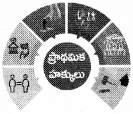
  4. ప్రస్తుతం భారత రాజ్యాంగంలోని 3వ భాగంలో, ఆర్టికల్ 14 నుండి 32 వరకు ఆరు ప్రాథమిక హక్కులు ఉన్నాయి. అవి చిత్రంలో చూపించబడ్డాయి.
    AP 7th Class Social Important Questions Chapter 9 భారత రాజ్యాంగం – పరిచయం 1
    i) పీడనాన్ని నిరోధించే హక్కు
    ii) స్వేచ్ఛా హక్కు
    iii) సమానత్వపు హక్కు
    iv) మత స్వాతంత్ర్యపు హక్కు
    v) విద్యా సాంస్కృతిక హక్కు
    vi) రాజ్యాంగ పరిహారపు హక్కు

భారత రాజ్యాంగం ఆవిర్భావ సమయంలో, మనకు ఏడు థమిక హక్కులు ఉండేవి. కాని, 1978వ సంవత్సరంలో 44వ రాజ్యాంగ సవరణ ద్వారా ప్రాథమిక హక్కుల జాబితా నుండి ఆస్తి హక్కు తొలగించబడింది.

AP 7th Class Social Important Questions Chapter 9 భారత రాజ్యాంగం – పరిచయం

ప్రశ్న 6.
సమాచార హక్కు విద్యా హక్కు చట్టాల గురించి వివరించండి.
జవాబు:
సమాచార హక్కు చట్టం :

  1. సమాచార హక్కు చట్టం ప్రకారం, ప్రతి పౌరునికి ప్రభుత్వం నుండి ఏదైనా సమాచారం తీసుకోవడానికి అధికారం కల్పిస్తుంది.
  2. ఇది పరిపాలనలో పారదర్శకతను నిర్ధారిస్తుంది.
  3. సమాచార హక్కు చట్టాన్ని (ఆర్టీఐ) భారత పార్లమెంట్ 2005లో ఆమోదించింది.
  4. ఈ చట్టం అక్టోబర్ 12, 2005 నుండి అమలులోకి వచ్చింది.

విద్యా హక్కు:

  1. మన పార్లమెంటు స్వేచ్ఛా హక్కులో భాగంగా విద్యను, ప్రాథమిక హక్కుగా గుర్తించింది.
  2. 2002 లో 86 వ రాజ్యాంగ సవరణ ద్వారా పార్లమెంటు ఆమోదంతో రాజ్యాంగంలో విద్యను ప్రాథమిక హక్కుగా చెప్పే 21ఎ ప్రకరణ ద్వారా చేర్చారు.
  3. “6 నుండి 14 సంవత్సరాల మధ్య వయస్సు ఉన్న పిల్లలందరికి చట్టం ద్వారా ఉచిత మరియు నిర్బంధ విద్యను అందించాలి” అని ఈ చట్టం పేర్కొంటుంది.
  4. బాలల ఉచిత మరియు నిర్బంధ విద్యాహక్కు చట్టాన్ని 2009 లో భారత పార్లమెంట్ ఆమోదించింది. ఈ చట్టం ఏప్రిల్ 1, 2010న అమల్లోకి వచ్చింది.

ప్రశ్న 7.
విలువలు అనగానేమి? మన జీవితంలో వాటి ప్రాధాన్యత ఏమి?
జవాబు:

  1. విలువలు వ్యక్తుల ప్రవర్తనను నిర్ణయించే అంతర్గత ప్రమాణాలు. ఇవి మన చర్యలను ప్రేరేపిస్తాయి.
  2. మన జీవితంలో ఇవి ముఖ్యమైనవి, పవిత్రమైనవి. విలువలను వ్యక్తిలో ఉండే నైతికత అనేవి కుటుంబం, సమ వయస్కులు, సామాజిక నేపథ్యం మొదలైన కారకాలతో ప్రభావితమౌతాయి.
  3. ఒక వ్యక్తిగాని, సమాజం గాని అభివృద్ధిని సాధించాలంటే విలువలు. అనేవి అత్యంత ఆవశ్యకమైనవి. ముఖ్యంగా ప్రజాస్వామ్యం విజయవంతం కావడానికి ఇవి మరింత అవసరం. నీతి, నిజాయితీ, నిబద్ధత, పారదర్శకత, జవాబుదారీతనం, చిత్తశుద్ది మొదలగు విలువలను పౌరులు కలిగి ఉన్నప్పుడు సమాజం అన్ని విధాలుగా ప్రగతి పథంలో పయనిస్తుంది.

ప్రశ్న 8.
రాజ్యాంగం అనగానేమి? భారత రాజ్యాంగం ఏ రూపంలో ఉంటుంది?
జవాబు:

  1. దేశం యొక్క స్వభావం, ప్రభుత్వ రూపం, పౌరుల హక్కులు మరియు విధులను తెలియచేసే నియమనిబంధనలతో కూడిన ప్రాథమిక చట్టమే రాజ్యాంగం.
  2. ఇది లిఖిత లేదా అలిఖితరూపంలో ఉంటుంది. మన భారత రాజ్యాంగం లిఖిత రూపంలో ఉంది. కాని బ్రిటిష్ రాజ్యాంగం అలిఖితరూపంలో ఉంటుంది.

ప్రశ్న 9.
రాజ్యాంగ ముసాయిదా రూపకల్పనలో అంబేద్కర్ పాత్రను గురించి వ్రాయుము.
జవాబు:

  1. 1947, ఆగస్టు 29న రాజ్యాంగ రచనా కమిటీని ఏర్పాటు చేయడం జరిగింది. దానికి చైర్మన్ డా|| బి.ఆర్. అంబేద్కర్.
  2. అంబేద్కర్ తనతోపాటు ఉన్న మిగతా సభ్యుల సహకారంతో ఇతర దేశాల రాజ్యాంగాలను క్షుణ్ణంగా చదివి మనకు అవసరమైన అంశాలను మన రాజ్యాంగంలో చేర్చడం జరిగింది.
  3. అంటరానితనాన్ని నిర్మూలించేందుకు మరియు అణగారిన వర్గాలను అభివృద్ధిపరచడానికి అంబేద్కర్ కృష చేశారు.
  4. అన్ని వర్గాల వారితో చర్చలు జరిపిన తరువాత భారతదేశానికి అవసరమైన ఒక విశాలమైన రాజ్యాంగాన్ని రూపొందించారు.

ప్రశ్న 10.
పాఠశాల మొత్తానికి ఒక రాజ్యాంగం ఏర్పాటు చెయ్యాల్సి వుంటే ఎవరెవరు అందులో భాగస్వాములు కావాలి?
జవాబు:
పాఠశాల మొత్తానికి ఒక రాజ్యాంగం ఏర్పాటు చెయ్యాల్సి ఉంటే

  1. అన్ని తరగతుల బాలబాలికల ప్రతినిధులు
  2. ప్రధానోపాధ్యాయులు
  3. ఉపాధ్యాయులు మరియు బోధనేతర సిబ్బంది
  4. పాఠశాల యాజమాన్య కమిటీ సభ్యులు మొదలగువారు భాగస్వాములు కావాలి.

AP 7th Class Social Important Questions Chapter 9 భారత రాజ్యాంగం – పరిచయం

ప్రశ్న 11.
ప్రస్తుత సమాజంపై ప్రాథమిక హక్కుల ప్రభావాలు ఏమిటి?
జవాబు:

  1. ప్రాథమిక హక్కులనేవి వ్యక్తి స్వేచ్ఛకు పట్టుకొమ్మలుగాను, భారత ప్రజాస్వామ్యానికి జవసత్వాలు అందించే పునాదులుగాను చెప్పవచ్చు.
  2. మన జాతీయోద్యమ నాయకుల త్యాగాల ఫలితంగానే ప్రాథమిక హక్కులు పౌరులకు లభించాయి.
  3. ప్రస్తుత సమాజంపై ప్రాథమిక హక్కుల ప్రభావం ఎంతైనా ఉంది. విద్యా హక్కు, సమాచార హక్కు స్వేచ్ఛా హక్కులు మొదలైన హక్కులు పౌరుల సర్వతోముఖాభివృద్ధికి తోడ్పడుతున్నాయి.
  4. సమాజంలో రాజకీయ, సామాజిక, ఆర్థిక, మత, సాంస్కృతిక సమానత్వానికి ఈ హక్కులు ఎంతో – తోడ్పడుతున్నాయి.
  5. జాతి సమగ్రతకు, సమైక్యతకు, సౌభ్రాతృత్వంనకు ఈ హక్కులు ఎంతో ఉపయోగపడుతున్నాయి.

ప్రశ్న 12.
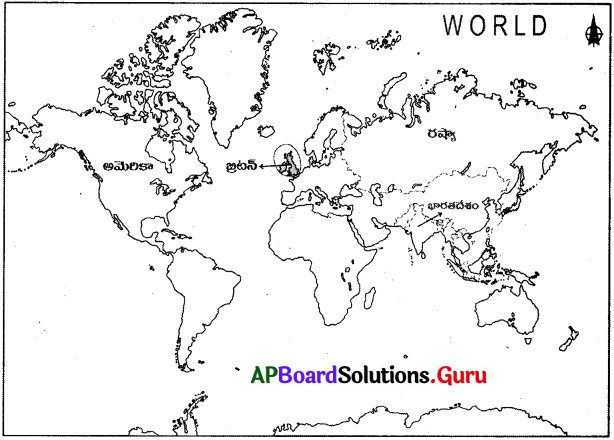
ప్రపంచ పటంలో ఈ క్రింది దేశాలను గుర్తించండి.
ఎ) భారతదేశం బి) అమెరికా సి) రష్యా డి) బ్రిటన్
జవాబు:
AP 7th Class Social Important Questions Chapter 9 భారత రాజ్యాంగం – పరిచయం 2

ప్రశ్న 13.
ఒకవేళ సార్వత్రిక వయోజన ఓటు హక్కు ద్వారా రాజ్యాంగ సభ సభ్యులను ఎన్నుకుంటే, దాని ప్రభావం రాజ్యాంగంపై ఎలా ఉండేది?
జవాబు:

  1. రాజ్యాంగ సభకు రాష్ట్రాలకు, రాజ సంస్థానాలకూ జనాభా ప్రాతిపదిక మీద ప్రాతినిధ్యం కల్పించారు. అదే విధంగా అనేక రంగాలలో నిష్ణాతులైన వారు రాజ్యాంగ సభకు ఎన్నికైనారు. అల్పసంఖ్యాక వర్గాల నుండి షెడ్యూల్డ్ కులాలు, షెడ్యూల్డ్ తెగల నుండి కూడా సభ్యులు రాజ్యాంగ సభకు ఎన్నికైనారు. చైతన్యవంతులైనటువంటి నాయకులు రాజ్యాంగ సభకు ఎన్నికవడం మూలంగా, దేశంలోని ఏ వర్గ ప్రజలకు అన్యాయం జరగకుండా దేశ ప్రజలందరిని పరిగణనలోకి తీసుకొని ప్రజల అభివృద్ధిని కాంక్షిస్తూ రాజ్యాంగాన్ని రూపొందించారు.
  2. రాజ్యాంగ సభకు, వయోజన ఓటు హక్కు ద్వారా సభ్యులను ఎన్నుకున్నట్లయితే నిష్ణాతులైన, చైతన్యవంతులైన వారు ఎన్నిక కాకపోవచ్చు. తద్వారా అందరి ప్రయోజనాలకు అనుగుణమైన రాజ్యాంగం తయారై ఉండేది కాదు.
  3. వయోజన ఓటు హక్కు ద్వారా అన్ని వర్గాల నుండి, అన్ని ప్రాంతాల నుండి మరియు వయోజనులందరు ఎన్నికలో పాల్గొనే అవకాశం వచ్చేది.

ప్రశ్న 14.
రాజ్యాంగ సభకు సభ్యులుగా స్వదేశీ సంస్థానాలు సభ్యులను నియమించుటకు ఎందుకు అనుమతించారని మీరు అనుకుంటున్నారు?
జవాబు:
రాజ్యాంగ సభకు సభ్యులుగా స్వదేశీ సంస్థానాలు సభ్యులను నియమించుటకు ఎందుకు అనుమతించారంటే, భవిష్యత్తులో స్వదేశీ సంస్థానాలకు కూడా స్వతంత్రం ఇవ్వబడితే అవి భారతదేశంలో భాగమవుతాయని భావించడం మరియు అవి స్వతంత్రంగా ఉన్నను రాజ్యాంగం అవసరం కాబట్టి మరియు అవి కూడా బ్రిటిషు వారి పాలనలోనే ఉన్నాయి కాబట్టి.

ప్రశ్న 15.
ప్రాథమిక హక్కుల పట్టిక అధ్యయనం ఆధారంగా, ప్రాథమిక హక్కులు మీ అభివృద్ధికి ఎలా సహాయపడతాయి? వివరించండి.
జవాబు:
ప్రాథమిక హక్కులు మా అభివృద్ధికి ఎలా సహాయపడతాయంటే :

  1. సమాజంలోని నా తోటి వారందరితో నేను సమానమనే భావన కల్గిస్తున్నాయి.
  2. నా యొక్క భావాన్ని, ఆలోచనల్ని స్వేచ్ఛగా ప్రకటించగల్గుతున్నాను.
  3. నా తోటి వారితో సమావేశం అవుతున్నా, సంఘంగా ఏర్పడుతున్నాము.
  4. భారతదేశంలో నాకు నచ్చిన ప్రాంతానికి వెళుతున్నాను. అవసరమయితే అక్కడ ఉండాలనుకుంటే ఉండగల్గుతున్నాను.
  5. ప్రజలు గౌరవప్రదమైన జీవితాలు గడపటానికి ఈ హక్కులు ఉపయోగపడుతున్నాయి.
  6. నాకు నచ్చిన వృత్తిని నేను స్వీకరించగల్గుతున్నాను.
  7. పర్యావరణ హిత వాతావరణంలో జీవించగల్గుతున్నాను.
  8. వెట్టి చాకిరి నుండి, బాలకార్మిక వ్యవస్థ బారిన పడకుండా ఉండగలిగాను.
  9. నా ప్రాథమిక విద్య అంతా ఉచితంగా అందించబడింది.
  10. నాకు నచ్చిన మతంను స్వీకరించా, ప్రచారం చేసుకోగల్గుతున్నా.
  11. ప్రభుత్వ పాలనలోని అవినీతిని ప్రశ్నించగలుగుతున్నాను.
  12. ప్రభుత్వ నిర్మాణంలో ఓటు హక్కు వినియోగించుకుని భాగస్వామినవుతున్నాను.

ప్రశ్న 16.
స్వేచ్ఛా హక్కు ప్రాథమిక హక్కుగా లేకపోతే మన పరిస్థితి ఏవిధంగా ఉంటుంది?
జవాబు:

  1. స్వేచ్ఛా హక్కు ప్రాథమిక హక్కుగా లేకపోతే మన పరిస్థితి పంజరంలోని చిలక లాగా చాలా అధ్వాన్నంగా ఉంటుంది.
  2. అసలు జీవించే హక్కును కల్పించిన హక్కు స్వేచ్ఛా హక్కు
  3. స్వేచ్ఛా హక్కు లేకపోతే ప్రజలు నిర్బంధంలో, పాలకుల నియంతృత్వంలో ఉండాల్సి వస్తుంది.
  4. భావాన్ని వెళ్ళబుచ్చలేము, నచ్చిన వృత్తిని చేపట్టలేం, సంఘంలా ఏర్పడలేం, నచ్చిన ప్రదేశంను సందర్శించలేం, నివసించలేం.

AP 7th Class Social Important Questions Chapter 9 భారత రాజ్యాంగం – పరిచయం

ప్రశ్న 17.
విధులు ఏవిధంగా ముఖ్యమైనవి?
జవాబు:

  1. దేశం ప్రజల వద్ద నుంచి ఆశించే సామాజిక చైతన్యం, ప్రవర్తనా నియమావళీ ప్రాథమిక విధులు.
  2. ప్రాథమిక విధులు భారత పౌరులలో సామాజిక స్పృహను పెంపొందించి బాధ్యతాయుత ప్రవర్తనను అలవరుస్తాయి.
  3. రాజ్యాంగ ఆశయాలు, రాజ్యాంగ చట్టం, ప్రభుత్వ వ్యవస్థలను పౌరులు గౌరవిస్తారు.
  4. భిన్నత్వంలో ఏకత్వ సాధనకు ప్రాథమిక విధులు పాటుపడతాయి.
  5. శాస్త్రీయ దృక్పథాన్ని కలిగి ఉండేలా, మూఢ విశ్వాసాలు పారద్రోలటానికి.
  6. పర్యావరణ పరిరక్షణ వంటి ఆశయాల సాఫల్యానికి ఈ విధులు ఉద్దేశించాయి.
ప్రశ్న 18.
బాధ్యతాయుతమైన పౌరుని లక్షణాలలో ఏయే లక్షణాలు మీలో ఉన్నాయి?
జవాబు:

  1. చట్టాలను మరియు అధికారాన్ని గౌరవించడం.
  2. దేశభక్తి కల్గి ఉండటం.
  3. నిజాయితీ కల్గి ఉండటం.
  4. జవాబుదారీతనం.
  5. బాధితులు మరియు పీడితుల పట్ల దయ కలిగి ఉండటం.
  6. ఇతరుల పట్ల మర్యాద కల్గి ఉండటం.
  7. క్రమశిక్షణతో మెలగటం.
  8. న్యాయంగా ఉండటం వంటి లక్షణాలు నేను కల్గి ఉన్నాను.

ప్రశ్న 19.
భారత రాజ్యాంగం గురించి మరిత సమాచారం కొరకు అంతర్జాలాన్ని సందర్శించండి లేదా మీ ఉపాధ్యాయుని సహాయం తీసుకోండి (ప్రస్తుతం, భారత రాజ్యాంగంలో ఎన్ని నిబంధనలు, షెడ్యూల్స్ మరియు భాగాలు ఉన్నాయో తెలుసుకోండి).
జవాబు:
ప్రస్తుతం భారత రాజ్యాంగంలో
నిబంధనలు : 465
షెడ్యూల్సు : 12
భాగాలు : 25 కలవు.

ప్రశ్న 20.
అంతర్జాలం లేదా లైబ్రరీని సందర్శించడం ద్వారా మన రాజ్యాంగంలో వివిధ దేశాల నుండి స్వీకరించబడిన అంశాలపై పట్టికను తయారు చేయండి. ప్రపంచ పటంలో ఆ దేశాలను గుర్తించండి.
జవాబు:
1. బ్రిటిష్ రాజ్యాంగం :
పార్లమెంటు క్యాబినెట్ తరహా పాలనా పద్దతి. ద్విసభా పద్దతి. సమన్యాయ పాలన, శాసన నిర్మాణ ప్రక్రియ, శాసన సభ్యుల స్వాధికారాలు, స్పీకరు, డిప్యూటీ స్పీకరు, కంప్రోలర్ ఆడిటర్ జనరల్, అటార్నీ జనరల్, మొదలగు పదవులు మరియు రిట్లు జారీ చేసే విధానం.

2. అమెరికా రాజ్యాంగం :
ప్రాథమిక హక్కులు, న్యాయ సమీక్ష, స్వతంత్ర ప్రతిపత్తి కలిగిన న్యాయశాఖ, ఉపరాష్ట్రపతి రాజ్యసభకు చైర్మన్‌గా వ్యవహరించడం, రాష్ట్రపతిని తొలగించే మహాభియోగ తీర్మానం, ప్రజా ప్రయోజనాల వ్యాజ్యాలు. రాజ్యాంగ సవరణ బిల్లుకు రాష్ట్రాలు ఆమోదం తెలపడం.

3. కెనడా రాజ్యాంగం :
బలమైన కేంద్ర ప్రభుత్వం, గవర్నర్లు నియమించే పద్ధతి. అవశిష్ట అధికారాలను కేంద్రానికి ఇవ్వడం, ప్రకరణ 143 ప్రకారం రాష్ట్రపతి సుప్రీం కోర్టు సలహాను కోరడం.

4. ఐర్లాండు రాజ్యాంగం :
ఆదేశిక సూత్రాలు, రాష్ట్రపతిని ఎన్నుకునే నైష్పత్తిక ప్రాతినిధ్యం, ఒక ఓటు బదిలీ పద్ధతి, రాజ్యసభకు విశిష్ట సభ్యుల నియామకం.

5. వైమార్ రిపబ్లిక్ (జర్మనీ):
జాతీయ అత్యవసర పరిస్థితి, ప్రాథమిక హక్కులు రద్దు చేసే అధికారం, మొదలగునవి. (వైమార్ అనునది జర్మనీ దేశ రాజ్యాంగ పరిషత్తు సమావేశమైన నగరము.)

6. ఆస్ట్రేలియా :
ఉమ్మడి జాబితా, పార్లమెంటు ఉభయసభల సంయుక్త సమావేశము (బిల్లు ఆమోదంలో వివాదం ఏర్పడితే) వాణిజ్య, వ్యాపార లావాదేవీలు, అంతర్రాష్ట్ర వ్యాపారము.

7. దక్షిణ ఆఫ్రికా :
రాజ్యాంగ సవరణ విధానం, రాజ్యసభ సభ్యుల ఎన్నిక పద్దతి, మొదలగు అంశాలు.

8. ఫ్రాన్సు :
గణతంత్ర విధానం, స్వేచ్ఛ, సమానత్వం, సౌభ్రాతృత్వం, తాత్కాలిక సభాధ్యక్షుల నియామకం.

9. రష్యా :
ప్రాథమిక విధులు, సామ్యవాద సూత్రాలు.

మీకు తెలుసా?

7th Class Social Textbook Page No. 59

భారతదేశం యొక్క ఐక్యతను కాపాడటం మరియు దానికి స్వాతంత్ర్యం ప్రసాదించే లక్ష్యంతో బ్రిటీష్ ప్రభుత్వం నుండి భారత నాయకత్వానికి అధికారాలను బదిలీ చేయడం గురించి చర్చించడానికి ఉద్దేశించిన క్యాబినెట్ మిషన్ 1946లో భారతదేశానికి వచ్చింది. అదే విధంగా రాజ్యాంగ అసెంబ్లీని ఏర్పాటు చేయాలని సిఫార్సు చేసింది. ఈ క్యాబినెట్ మిషన్లో లార్డ్ పెథిక్ లారెన్స్, సర్ స్టాఫోర్డ్ క్రిప్స్ మరియు A.V. అలెగ్జాండ్ ఇందులో సభ్యులు.

7th Class Social Textbook Page No. 65

1. రాజ్యాంగ దినోత్సవం :
భారత రాజ్యాంగాన్ని 1949, నవంబర్ 26న రాజ్యాంగ సభ ఆమోదించింది. దానికి గుర్తుగా భారతదేశంలో రాజ్యాంగ దినోత్సవం సంవిధాన్ దివసను ప్రతి సంవత్సరం నవంబర్ 26న జరుపుకుంటున్నాము. రాజ్యాంగ సభ మన రాజ్యాంగాన్ని తయారు చేయడానికి 2 సంవత్సరాల, 11 నెలల 18 రోజులు పట్టింది.

2.
AP 7th Class Social Important Questions Chapter 9 భారత రాజ్యాంగం – పరిచయం 3
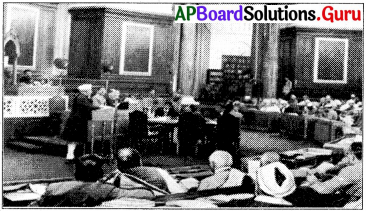
13.12.1946 న, రాజ్యాంగ సభ ప్రారంభ సమావేశంలో ప్రసంగిస్తున్న పండిట్ జవహర్‌లాల్ నెహ్రూ. ఆ రోజు అతడు “లక్ష్యాల తీర్మానం” ను ప్రతిపాదించాడు. ఇదే భారత రాజ్యాంగ పీఠికకు మూలాధారం.

3. ఎ. ప్రకరణ (అధికరణ) అనేది రాజ్యాంగంలోని ఒక నిర్దిష్ట అంశంపై నిర్దిష్ట నియమం లేదా సూత్రాన్ని సూచిస్తుంది.
బి. భాగం అనేది ఒక భావనకు సంబంధించిన ప్రకరణల సముదాయమును సూచిస్తుంది.
సి. షెడ్యూలు అనేది ప్రకరణలలో పేర్కొనబడని అదనపు సమాచారం లేదా వివరాలను సూచిస్తుంది.
డి. ‘సామ్యవాదం’, ‘లౌకిక’ పదాలు 1976 లో 42 వ రాజ్యాంగ సవరణ ద్వారా ప్రవేశికలో చేర్చబడ్డాయి.
7th Class Social Textbook Page No. 73

బాలల హక్కుల పరిరక్షణ సదస్సులో ఐక్యరాజ్య సమితి చేసిన తీర్మానాలపై మన దేశం కూడా సంతకం చేసింది. ఆ విధంగా మన దేశం కూడా బాలల హక్కుల పరిరక్షణకు కట్టుబడి ఉంది. ప్రధానమైన బాలల హక్కులు క్రింద ఇవ్వబడ్డాయి.
  1. జీవించే హక్కు
  2. రక్షణ పొందే హక్కు
  3. అభివృద్ధి హక్కు
  4. భాగస్వామ్య హక్కు

AP Board 7th Class Maths Solutions Chapter 2 Fractions, Decimals and Rational Numbers Review Exercise

SCERT AP 7th Class Maths Solutions Pdf Chapter 2 Fractions, Decimals and Rational Numbers Review Exercise Questions and Answers.

AP State Syllabus 7th Class Maths Solutions 2nd Lesson Fractions, Decimals and Rational Numbers Review Exercise

Question 1.
Write the following fractions in ascending order.
(i) [latex]\frac{3}{2}, \frac{5}{2}, \frac{1}{2}, \frac{17}{2}, \frac{9}{2}[/latex]
Answer:
Given [latex]\frac{3}{2}, \frac{5}{2}, \frac{1}{2}, \frac{17}{2}, \frac{9}{2}[/latex]
Given fractions are like fractions.

So, we should arrange the numerators in ascending order.
[latex]\frac{1}{2}<\frac{3}{2}<\frac{5}{2}<\frac{9}{2}<\frac{17}{2}[/latex]

Ascending order: [latex]\frac{1}{2}<\frac{3}{2}<\frac{5}{2}<\frac{9}{2}<\frac{17}{2}[/latex]

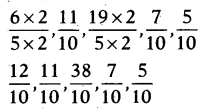
(ii) [latex]\frac{6}{5}, \frac{11}{10}, \frac{19}{5}, \frac{7}{10}, \frac{5}{10}[/latex]
Answer:
Given [latex]\frac{6}{5}, \frac{11}{10}, \frac{19}{5}, \frac{7}{10}, \frac{5}{10}[/latex]
Given fractions are not like fractions. So, first we have to convert them into like fractions.
AP Board 7th Class Maths Solutions Chapter 2 Fractions, Decimals and Rational Numbers Review Exercise 1
Now arrange them in ascending order according to their numerators.
[latex]\frac{5}{10}<\frac{7}{10}<\frac{11}{10}<\frac{12}{10}<\frac{38}{10}[/latex]
Ascending order: [latex]\frac{5}{10}<\frac{7}{10}<\frac{11}{10}<\frac{12}{10}<\frac{38}{10}[/latex]

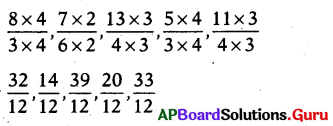
(iii) [latex]\frac{8}{3}, \frac{7}{6}, 3 \frac{1}{4}, \frac{5}{3}, \frac{11}{4}[/latex]
Answer:
Given [latex]\frac{8}{3}, \frac{7}{6}, 3 \frac{1}{4}, \frac{5}{3}, \frac{11}{4}[/latex]
[latex]\frac{8}{3}, \frac{7}{6}, \frac{13}{4}, \frac{5}{3}, \frac{11}{4}[/latex]
We have to find the LCM of denominators to convert them into equal fraction.

LCM of numerators is 12
AP Board 7th Class Maths Solutions Chapter 2 Fractions, Decimals and Rational Numbers Review Exercise 2
Now arrange the like fractions in ascending order according to their numerators.
[latex]\frac{14}{12}<\frac{20}{12}<\frac{32}{12}<\frac{33}{12}<\frac{39}{12}[/latex]
Ascending order :
[latex]\frac{14}{12}<\frac{20}{12}<\frac{32}{12}<\frac{33}{12}<\frac{39}{12}[/latex]

AP Board 7th Class Maths Solutions Chapter 2 Fractions, Decimals and Rational Numbers Review Exercise

Question 2.
Calculate the following.
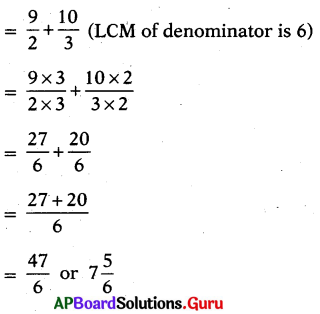
(i) [latex]\frac{3}{5}+\frac{7}{4}[/latex]
Answer:
Given [latex]\frac{3}{5}+\frac{7}{4}=\frac{12+35}{20}=\frac{47}{20}[/latex]

(ii) [latex]\frac{5}{6}+\frac{7}{12}[/latex]
Answer:
Given [latex]\frac{5}{6}+\frac{7}{12}[/latex]
= [latex]\frac{5 \times 2}{6 \times 2}+\frac{7}{12}[/latex]
= [latex]\frac{10}{12}+\frac{7}{12}[/latex]
= [latex]\frac{10+7}{12}=\frac{17}{12}=1 \frac{5}{12}[/latex]

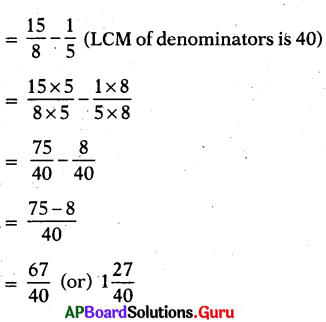
(iii) 1[latex]\frac{7}{8}-\frac{1}{5}[/latex]
Answer:
Given 1[latex]\frac{7}{8}-\frac{1}{5}[/latex]
AP Board 7th Class Maths Solutions Chapter 2 Fractions, Decimals and Rational Numbers Review Exercise 3

(iv) 4[latex]\frac{1}{2}[/latex] + 3[latex]\frac{1}{3}[/latex]
Answer:
Given 4[latex]\frac{1}{2}[/latex] + 3[latex]\frac{1}{3}[/latex]
AP Board 7th Class Maths Solutions Chapter 2 Fractions, Decimals and Rational Numbers Review Exercise 4

Question 3.
Simplify the following.
(i) [latex]\frac{1}{4}[/latex] of 3
Answer:
Given [latex]\frac{1}{4}[/latex] of 3
= [latex]\frac{1}{4} \times \frac{3}{1}=\frac{3}{4}[/latex]

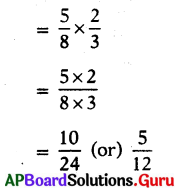
(ii) [latex]\frac{5}{8}[/latex] of [latex]\frac{2}{3}[/latex]
Answer:
Given [latex]\frac{5}{8}[/latex] of [latex]\frac{2}{3}[/latex]

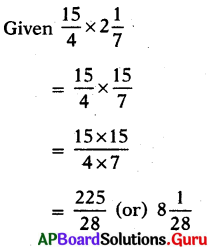
(iii) [latex]\frac{15}{4} \times 2 \frac{1}{7}[/latex]
Answer:
AP Board 7th Class Maths Solutions Chapter 2 Fractions, Decimals and Rational Numbers Review Exercise 6

(iv) 3[latex]\frac{1}{3}[/latex] × 2[latex]\frac{2}{5}[/latex]
Answer:
Given 3[latex]\frac{1}{3}[/latex] × 2[latex]\frac{2}{5}[/latex]
= [latex]\frac{10}{3} \times \frac{12}{5}[/latex]
= [latex]\frac{120}{15}=\frac{8}{1}[/latex] = 8

AP Board 7th Class Maths Solutions Chapter 2 Fractions, Decimals and Rational Numbers Review Exercise

Question 4.
Calculate the following.
(i) [latex]\frac{3}{4}[/latex] ÷ 3
Answer:
Given [latex]\frac{3}{4}[/latex] ÷ 3
= [latex]\frac{3}{4}[/latex] ÷ [latex]\frac{3}{1}[/latex]

We know reciprocial of [latex]\frac{3}{1}[/latex] is [latex]\frac{1}{3}[/latex]
= [latex]\frac{3}{4} \times \frac{1}{3}[/latex]
= [latex]\frac{3}{12}[/latex] (or) [latex]\frac{1}{4}[/latex]

(ii) 8 ÷ 2[latex]\frac{1}{7}[/latex]
Answer:
Given 8 ÷ 2[latex]\frac{1}{7}[/latex]
= 8 ÷ 2[latex]\frac{15}{7}[/latex]

We know reciprocial of [latex]\frac{15}{7}[/latex] is [latex]\frac{7}{15}[/latex]
= 8 × [latex]\frac{7}{15}[/latex]
= [latex]\frac{8 \times 7}{15}[/latex]
= [latex]\frac{56}{15}[/latex] (OR) 3[latex]\frac{11}{15}[/latex]

(iii) [latex]\frac{12}{7} \div \frac{2}{7}[/latex]
Answer:
Given [latex]\frac{12}{7} \div \frac{2}{7}[/latex]
We know reciprocial of [latex]\frac{12}{7} \div \frac{2}{7}[/latex]
= [latex]\frac{12}{7} \times \frac{7}{2}[/latex]
= [latex]\frac{12 \times 7}{7 \times 2}=\frac{84}{14}=\frac{6}{1}[/latex] = 6

(iv) 5[latex]\frac{1}{2}[/latex] ÷ 2[latex]\frac{9}{11}[/latex]
Answer:
Given 5[latex]\frac{1}{2}[/latex] ÷ 2[latex]\frac{9}{11}[/latex]
= [latex]\frac{11}{2} \div \frac{31}{11}[/latex]

We know reciprocial of [latex]\frac{31}{11}[/latex] is [latex]\frac{11}{31}[/latex]
= [latex]\frac{11}{2} \times \frac{11}{31}[/latex]
= [latex]\frac{121}{62}[/latex] (OR) 1[latex]\frac{59}{62}[/latex]

AP Board 7th Class Maths Solutions Chapter 1 Integers Ex 1.2

SCERT AP 7th Class Maths Solutions Pdf Chapter 1 Integers Ex 1.2 Textbook Exercise Questions and Answers.

AP State Syllabus 7th Class Maths Solutions 1st Lesson Integers Exercise 1.2

Question 1.
Calculate the following,
(i) (- 96) ÷ 16
Answer:
(- a) ÷ b = – [latex]\frac{a}{b}[/latex]
= [latex]\frac{-96}{16}[/latex] = – 6

AP Board 7th Class Maths Solutions Chapter 1 Integers Ex 1.2

(ii) 98 ÷ (- 49)
Answer:
a ÷ (- b) = – [latex]\frac{a}{b}[/latex]
= [latex]\frac{98}{-49}[/latex] = – 2

(iii) (- 51) ÷ 17
Answer:
(- a) ÷ b = – [latex]\frac{a}{b}[/latex]
= [latex]\frac{-51}{17}[/latex] = – 3

(iv) 38 ÷ (- 19)
Answer:
a ÷ (- b) = – [latex]\frac{a}{b}[/latex]
= [latex]\frac{38}{-19}[/latex] = – 2

(v) (- 80) ÷ 20
Answer:
(- a) ÷ b = – [latex]\frac{a}{b}[/latex]
= [latex]\frac{-80}{20}[/latex] = – 4

(vi) (- 150) ÷ (- 25)
Answer:
(- a) ÷ (- b) = – [latex]\frac{-a}{-b}[/latex] = [latex]\frac{a}{b}[/latex]
= [latex]\frac{-150}{-25}[/latex] = [latex]\frac{150}{25}[/latex] = – 6

(vii) (- 600) ÷ 60
Answer:
(- a) ÷ b = – [latex]\frac{a}{b}[/latex]
= [latex]\frac{-600}{60}[/latex]
= – 10

(viii) (-54) ÷ 9
Answer:
(- a) ÷ b = – [latex]\frac{a}{b}[/latex]
= [latex]\frac{- 54}{9}[/latex]
= – 6

(ix) 130 ÷ 65
Answer:
a ÷ b = [latex]\frac{a}{b}[/latex]
= [latex]\frac{130}{65}[/latex]
= 2

AP Board 7th Class Maths Solutions Chapter 1 Integers Ex 1.2

(x) (- 315) ÷ ( -315)
Answer:
(- a) ÷ (- b) = [latex]\frac{-a}{-b}[/latex] = [latex]\frac{a}{b}[/latex]
= [latex]\frac{-315}{-315}[/latex]
= [latex]\frac{315}{315}[/latex]
= 1

Question 2.
The product of two integers is – 165. If one number is – 15, find the other integer.
Answer:
Given one number a = – 15
Other number b = ?
Product of two numbers = (- 165)
a × b = – 165
(- 15) × b = – 165
b = (- 165) × (- 15)
Other number b = 11

Question 3.
Because of Covid-19 a company lockdown for 6 months and got loss of ₹1,32,000 in the year 2020. Find the average loss of each month.
AP Board 7th Class Maths Solutions Chapter 1 Integers Ex 1.2 1
Answer:
Given loss of 6 months = ₹ 1,32,000
Average loss of each month = 1,32,000 ÷ 6
Average loss of each month = ₹ 22,000

AP Board 7th Class Maths Solutions Chapter 1 Integers Ex 1.2

Question 4.
The temperature at 12 noon was 10°C above zero. If it decreases at the rate of 2°C per hour until midnight, at what time would the temperature be 8°C below zero ? What would be the temperature at mid-night ?
Answer:
The temperature at 12 noon = 10°C above zero.
The temperature is decreasing at 2°C per hour 8°C below zero = – 8°C
So, total temperature falls 2°C in every one hour.
Therefore, to decrease 18°C, time taken
= 18/2 = 9 hrs.
Present time is 12 noon, so, the time when the temperature at 12 midnight will be
= (- 8° C) + (- 2° C × 3 hrs.)
= (- 8° C) + (- 6° C)
= 160
So, at 12 midnight the temperature will be – 14°C

Question 5.
A green grocer earns a profit of ₹ 7 per kg of tomato and got loss of ₹ 4 per kg of brinjal by selling. On Monday he gets neither profit nor loss,.if he sold 68 kgs of tomato. How many kgs of brinjal did he sell ?
AP Board 7th Class Maths Solutions Chapter 1 Integers Ex 1.2 2
Answer:
Given profit per kg of tomato = ₹ 7
Loss per kg of brinjal = ₹ 4
Weight of tomatoes sold = 68 kgs
Let number of kgs of tomato be x kg.
Number of kgs of brinjals be y kg.
7x – 4y = 0
7 × 68 – 4y = 0
– 4y = – 7 × 68
y = [latex]\frac{-7 \times 68}{-4}[/latex]
∴ Weight of brinjals sold = + 7 × 17
= + 119 kgs.

AP Board 7th Class Maths Solutions Chapter 1 Integers Ex 1.2

Question 6.
In a test, each correct answer carry + 3 marks and incorrect answer – 1 mark, Sona attempted all the questions and scored + 20 marks though she got 10 correct answers.
(i) How many incorrect answers did she attempt ?
(ii) How many questions were given in the test ?
Answer:
Given marks for every correct answer = + 3
Given marks for every incorrect answer = – 1
No. of correct answer questions = 10
Total marks gained on correct answer questions = 10 × (+3) = + 30

(i) No. of incorrect answer questions = x
Total marks gained on incorrect answer questions = y × (-1) = – y.
Marks scored by Sona
⇒ + 30 + (- y) = + 20
⇒ – y = + 20 – 30
⇒ – y = – 10
⇒ y = 10
∴ No. of incorrect answers Sona attempts =10

(ii) Number of questions given in the test = No. of correct answer questions + No. of incorrect answer questions.
= 10 + 10 = 20 questions.

AP Board 7th Class Maths Solutions Chapter 1 Integers Ex 1.2

Question 7.
Write 5 pairs of integers (a, b) such that a ÷ b = -4.
(Ex : (12, – 3) because 12 + (-3) = -4)

AP Board 7th Class Maths Solutions Chapter 1 Integers Ex 1.2 3
Answer:
(i) (-16, +4) because (- 16) ÷ 4 = -4
(ii) (20, -5) because 20 ÷ (-5) = – 4
(iii) (—8, 2) because (-8) ÷ 2 =- 4
(iv) (24, -6) because 24 ÷ (-6) = – 4
(v) (-36, 9) because (-36) ÷ 9 = – 4

(OR)

a b a ÷ b = – 4
(-16) 4 (-16) ÷ 4 = – 4
20 (-5) 20 ÷ (-5) = – 4
8 2 (- 8) ÷ 2 = – 4
24 (-6) 24 ÷ (- 6) = – 4
-36 9 (-36) ÷ 9 = – 4

AP Board 7th Class Maths Solutions Chapter 2 Fractions, Decimals and Rational Numbers Unit Exercise

SCERT AP 7th Class Maths Solutions Pdf Chapter 2 Fractions, Decimals and Rational Numbers Unit Exercise Questions and Answers.

AP State Syllabus 7th Class Maths Solutions 2nd Lesson Fractions, Decimals and Rational Numbers Unit Exercise

Question 1.
Choose the correct answer,
(i) The set of integers are denoted by [ ]
(A) N
(B) W
(C) Z
(D) Q
Answer:
(C) Z

(ii) Number of decimal places in the product of 48.23 × 0.2 [ ]
(A) 2
(B) 3
(C) 1
(D)5
Answer:
(B) 3

(iii) Number of decimal places to the quotient of 537.1 + 10 [ ]
(A) 1
(B) 2
(C) 4
(D) 3
Answer:
(B) 2

(iv) An integer can be ____________
(A) negative
(B) positive
(C) zero
(D) all the above
Answer:
(D) all the above

Question 2.
Fill in the blanks:
(i) The numbers written in the form of [latex]\frac{p}{q}[/latex], where p. q are integers and q ≠ 0 are __________ numbers
Answer:

(ii) 0.11 × 0.11 = __________
Answer:
0.11 × 0.11
= [latex]\frac{11}{100} \times \frac{11}{100}[/latex]
= [latex]\frac{121}{10000}[/latex] = 0.0121

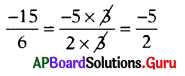
(iii) Standard form of – [latex]\frac{15}{6}[/latex] = ______
Answer:
Standard form of – [latex]\frac{15}{6}[/latex]
AP Board 7th Class Maths Solutions Chapter 2 Fractions, Decimals and Rational Numbers Unit Exercise 1

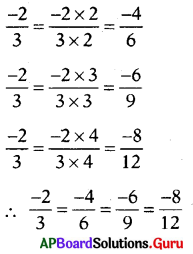
(iv) Equivalent fraction to -[latex]\frac{2}{3}[/latex] = __________
Answer:
Equivalent fraction to -[latex]\frac{2}{3}[/latex]
AP Board 7th Class Maths Solutions Chapter 2 Fractions, Decimals and Rational Numbers Unit Exercise 2

AP Board 7th Class Maths Solutions Chapter 2 Fractions, Decimals and Rational Numbers Unit Exercise

Question 3.
Find the product:
(i) 2.1 × 6.3
Answer:
2.1 × 6.3
= [latex]\frac{21}{10} \times \frac{63}{10}[/latex]
= [latex]\frac{1323}{100}[/latex] = 13.23
∴ 2.1 × 6.3 = 13.23

(ii) 43.205 × 1.27
Answer:
43.205 × 1.27
= [latex]\frac{43205}{1000} \times \frac{127}{100}[/latex]
= [latex]\frac{43205 \times 127}{1000 \times 100}[/latex]
= [latex]\frac{5487035}{100000}[/latex]
∴ 43.205 × 1.27 = 54.87035

(iii) 7.641 × 3.5
Answer:
7.64 1 × 3.5
= [latex]\frac{7641}{1000} \times \frac{35}{10}[/latex]
= [latex]\frac{7641 \times 35}{1000 \times 10}[/latex]
= [latex]\frac{267435}{10000}[/latex]

∴ 7.641 × 3.5 = 26.7435.

(iv) 5.24 × 0.99
Answer:
5.24 × 0.99
= [latex]\frac{524}{100} \times \frac{99}{100}[/latex]
= [latex]\frac{524 \times 99}{100 \times 100}[/latex]
= [latex]\frac{51876}{10000}[/latex]

∴ 5.24 × 0.99 = 5.1876

Question 4.
Solve the following :
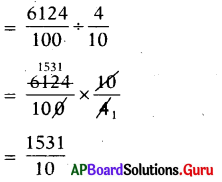
(i) 61.24 ÷ 0.4
Answer:
61.24 ÷ 0.4
AP Board 7th Class Maths Solutions Chapter 2 Fractions, Decimals and Rational Numbers Unit Exercise 3

∴ 61.24 ÷ 0.4 = 153.1

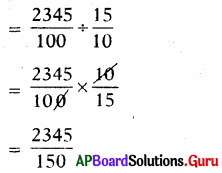
(ii) 23.45 ÷ 1.5
Answer:
23.45 ÷ 1.5
AP Board 7th Class Maths Solutions Chapter 2 Fractions, Decimals and Rational Numbers Unit Exercise 4
∴ 23.45 ÷ 1.5 = 15.633….

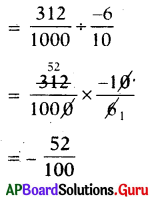
(iii) 0.312 ÷ – 0.6
Answer:
0.312 ÷ – 0.6
AP Board 7th Class Maths Solutions Chapter 2 Fractions, Decimals and Rational Numbers Unit Exercise 5
∴ 0.312 ÷ – 0.6 = -0.52

(iv) 32.2 ÷ 2.2
Answer:
32,2 ÷ 2.2
AP Board 7th Class Maths Solutions Chapter 2 Fractions, Decimals and Rational Numbers Unit Exercise 6
∴ 32.2 ÷ 2.2 = 14.6363….,

Question 5.
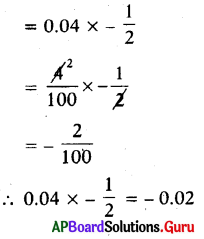
Multiply 0.04 by – [latex]\frac{1}{2}[/latex]
Answer:
Given multiply 0.04 by -[latex]\frac{1}{2}[/latex]
AP Board 7th Class Maths Solutions Chapter 2 Fractions, Decimals and Rational Numbers Unit Exercise 7

AP Board 7th Class Maths Solutions Chapter 2 Fractions, Decimals and Rational Numbers Unit Exercise

Question 6.
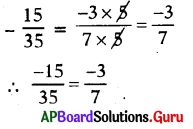
Find standard form of – [latex]\frac{15}{35}[/latex]
Answer:
AP Board 7th Class Maths Solutions Chapter 2 Fractions, Decimals and Rational Numbers Unit Exercise 8

Question 7.
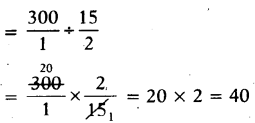
A bus travelled 300 km In 7 [latex]\frac{1}{2}[/latex]hours with uniform speed. Find how many km, it travelled in 1 hour.
Answer:
Given distance travelled by bus in 7[latex]\frac{1}{2}[/latex]
hours = 300 km

Distance travelled by bus in 1 hour
= 300 ÷ 7[latex]\frac{1}{2}[/latex]
AP Board 7th Class Maths Solutions Chapter 2 Fractions, Decimals and Rational Numbers Unit Exercise 9

Question 8.
Suvarna had 300. She spent [latex]\frac{1}{3}[/latex] of her money on notebooks and [latex]\frac{1}{4}[/latex] of the remaining on stationery items. How much money is left with ber?
Answer:
Total money Suvarna had = ₹ 300
Money spent on notebooks
= [latex]\frac{1}{3}[/latex] of ₹ 300
AP Board 7th Class Maths Solutions Chapter 2 Fractions, Decimals and Rational Numbers Unit Exercise 10

Remaining amount
= Total money – spent on books
= 300 – 100 = ₹ 200

Money spent on stationery
= [latex]\frac{1}{4}[/latex] of remaining amount
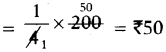
AP Board 7th Class Maths Solutions Chapter 2 Fractions, Decimals and Rational Numbers Unit Exercise 11

Money left with Suvarna
= Total money – spent on books – spent on stationery
= 300 – 100 – 50
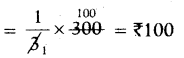
= 300 – 150
∴ Money left with Suvarna = ₹ 150

Question 9.
One litre of diesel costs ₹ 84.65. What is the cost of 12.5 liters of diesel?
Answer:
Given cost of one litre diesel = ₹ 84.65
Cost of 12.5 liters diesel = 84.65 × 12.5
= [latex]\frac{8465}{100} \times \frac{125}{10}[/latex]
= [latex]\frac{1058125}{1000}[/latex] = ₹ 1058.125
∴ Cost of 12.5 litres diesel = ₹ 1058.125

AP Board 7th Class Maths Solutions Chapter 2 Fractions, Decimals and Rational Numbers Unit Exercise

Question 10.
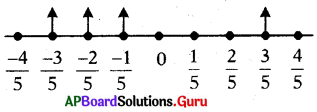
Represent [latex]\frac{-2}{5}, \frac{-3}{5}, \frac{-1}{5}, \frac{3}{5}[/latex] on same number line.
Answer:
Given fractions are [latex]\frac{-2}{5}, \frac{-3}{5}, \frac{-1}{5}, \frac{3}{5}[/latex]
Ascending order: [latex]\frac{-3}{5}, \frac{-2}{5}, \frac{-1}{5}, \frac{3}{5}[/latex]
AP Board 7th Class Maths Solutions Chapter 2 Fractions, Decimals and Rational Numbers Unit Exercise 12

AP Board 7th Class Maths Solutions Chapter 2 Fractions, Decimals and Rational Numbers Ex 2.3

SCERT AP 7th Class Maths Solutions Pdf Chapter 2 Fractions, Decimals and Rational Numbers Ex 2.3 Textbook Exercise Questions and Answers.

AP State Syllabus 7th Class Maths Solutions 2nd Lesson Fractions, Decimals and Rational Numbers Exercise 2.3

Question 1.
Fill ¡n the blanks in the table. One is done for you.
Answer:

Division Quotient
1. 362.21 ÷ 10 36.221
2. 5636.1 ÷ 100 56.361
3. 374.9 ÷ 1000 0.3749
4. 2016.4 ÷ 1000 2.0164
5. 123.0 ÷100 1.23
6. 1300.7 ÷ 1000 1.3007
7. 590.01 ÷ 10 59.001

Question 2.
Solve the following,
(i) 5.51 ÷ 2
Answer:
5.51 ÷ 2
= [latex]\frac{551}{100} \div \frac{2}{1}[/latex]
= [latex]\frac{551}{100} \times \frac{1}{2}[/latex]
= [latex]\frac{551 \times 1}{100 \times 2}[/latex]
= [latex]\frac{551}{200}[/latex]
∴ 5.51 ÷ 2 = 2.755

(ii) 38.4 ÷ 3
Answer:
38.4 ÷ 3
= [latex]\frac{384}{10} \div \frac{3}{1}[/latex]
= [latex]\frac{384}{10} \times \frac{1}{3}[/latex]
= [latex]\frac{384 \times 1}{10 \times 3}[/latex]
= [latex]\frac{384}{30}[/latex]
∴ 38.4 ÷ 3 = 12.8

(iii) 57.39 ÷ 6
Answer:
57.39 ÷ 6
= [latex]\frac{5739}{100} \div \frac{6}{1}[/latex]
= [latex]\frac{5739}{100} \times \frac{1}{6}[/latex]
= [latex]\frac{5739 \times 1}{100 \times 6}[/latex]
= [latex]\frac{5739}{600}[/latex]
∴ 57.39 ÷ 6 = 9.565

AP Board 7th Class Maths Solutions Chapter 2 Fractions, Decimals and Rational Numbers Ex 2.3

(iv) 562.1 ÷ 11
Answer:
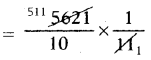
562.1 ÷ 11
= [latex]\frac{5621}{10} \div \frac{11}{1}[/latex]
AP Board 7th Class Maths Solutions Chapter 2 Fractions, Decimals and Rational Numbers Ex 2.3 1
= [latex]\frac{511}{10}[/latex]
∴ 562.1 ÷ 11 = 51.1

(v) 0.7005 ÷ 5
Answer:
0.7005 ÷ 5
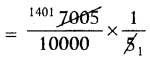
= [latex]\frac{7005}{10000} \div \frac{5}{1}[/latex]
AP Board 7th Class Maths Solutions Chapter 2 Fractions, Decimals and Rational Numbers Ex 2.3 2
= [latex]\frac{1401}{10000}[/latex]
∴ 0.7005 ÷ 5 = 0.1401

(vi) 9.99 ÷ 3
Answer:
9.99 ÷ 3
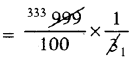
= [latex]\frac{999}{100} \div \frac{3}{1}[/latex]
AP Board 7th Class Maths Solutions Chapter 2 Fractions, Decimals and Rational Numbers Ex 2.3 3
= [latex]\frac{333}{100}[/latex]
∴ 9.99 ÷ 3 = 3.33

(vii) 13 ÷ 6.5
Answer:
13 ÷ 6.5
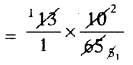
= [latex]\frac{13}{1} \div \frac{65}{10}[/latex]
AP Board 7th Class Maths Solutions Chapter 2 Fractions, Decimals and Rational Numbers Ex 2.3 4
= [latex]\frac{2}{1}[/latex]
∴ 13 ÷ 6.5 = 2

(viii) 10.01 ÷ 11
Answer:
10.01 ÷ 11
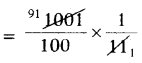
= [latex]\frac{1001}{100} \div \frac{11}{1}[/latex]
AP Board 7th Class Maths Solutions Chapter 2 Fractions, Decimals and Rational Numbers Ex 2.3 5
= [latex]\frac{91}{100}[/latex]
∴ 10.01 ÷ 11 = 0.91

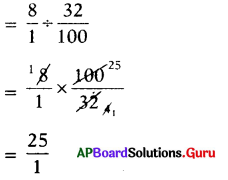
(ix) 8 ÷ 0.32
Answer:
8 ÷ 0.32
AP Board 7th Class Maths Solutions Chapter 2 Fractions, Decimals and Rational Numbers Ex 2.3 6
∴ 8 ÷ 0.32 = 25

AP Board 7th Class Maths Solutions Chapter 2 Fractions, Decimals and Rational Numbers Ex 2.3

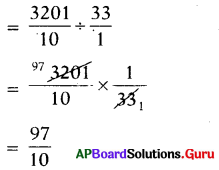
(x) 320.1 ÷ 33
Answer:
320.1 ÷ 33
AP Board 7th Class Maths Solutions Chapter 2 Fractions, Decimals and Rational Numbers Ex 2.3 7
∴ 320.1 ÷ 33 = 9.7

Question 3.
Solve the following divisions,
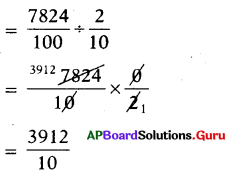
(i) 78.24 ÷ 0.2
Answer:
78.24 ÷ 0.2
AP Board 7th Class Maths Solutions Chapter 2 Fractions, Decimals and Rational Numbers Ex 2.3 8
∴ 78.24 ÷ 0.2 = 391.2

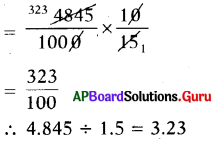
(ii) 4.845 ÷ 1.5
Answer:
4.845 ÷ 1.5
= [latex]\frac{4845}{1000} \div \frac{15}{10}[/latex]
AP Board 7th Class Maths Solutions Chapter 2 Fractions, Decimals and Rational Numbers Ex 2.3 9

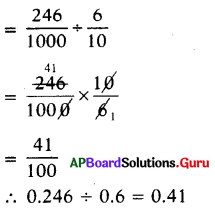
(iii) 0.246 ÷ 0.6
Answer:
AP Board 7th Class Maths Solutions Chapter 2 Fractions, Decimals and Rational Numbers Ex 2.3 10

(iv) 563.2 ÷ 2.2
Answer:
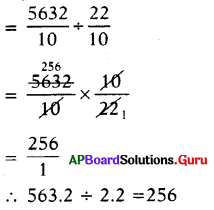
563.2 ÷ 2.2
AP Board 7th Class Maths Solutions Chapter 2 Fractions, Decimals and Rational Numbers Ex 2.3 11
∴ 563.2 ÷ 2.2 = 256

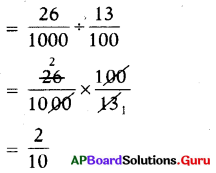
(v) 0.026 ÷ 0.13
Answer:
0.026 ÷ 0.13
AP Board 7th Class Maths Solutions Chapter 2 Fractions, Decimals and Rational Numbers Ex 2.3 12
∴ 0.026 ÷ 0.13 = 0.2

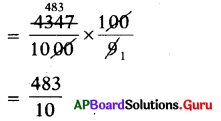
(vi) 4.347 ÷ 0.09
Answer:
4.347 ÷ 0.09
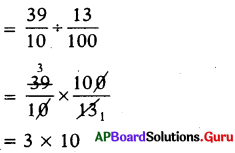
[latex]\frac{4347}{1000} \div \frac{9}{100}[/latex]
AP Board 7th Class Maths Solutions Chapter 2 Fractions, Decimals and Rational Numbers Ex 2.3 13
∴ 4.347 ÷ 0.09 = 48.3

(vii) 3.9 ÷ 0.13
Answer:
3.9 ÷ 0.13
AP Board 7th Class Maths Solutions Chapter 2 Fractions, Decimals and Rational Numbers Ex 2.3 14
∴ 3.9 ÷ 0.13 = 30

(viii) 2032 ÷ 0.8
Answer:
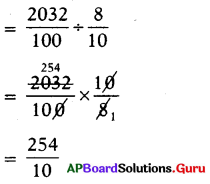
20.32 ÷ 0.8
AP Board 7th Class Maths Solutions Chapter 2 Fractions, Decimals and Rational Numbers Ex 2.3 15
∴ 20.32 ÷ 0.8 = 25.4

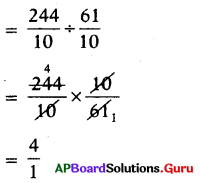
(ix) 24.4 ÷ 6.1
Answer:
24.4 ÷ 6.1
AP Board 7th Class Maths Solutions Chapter 2 Fractions, Decimals and Rational Numbers Ex 2.3 16
∴ 24.4 ÷ 6.1 = 4

AP Board 7th Class Maths Solutions Chapter 2 Fractions, Decimals and Rational Numbers Ex 2.3

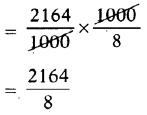
(x) 2.164 ÷ 0.008
Answer:
2.164 ÷ 0.008
[latex]\frac{2164}{1000} \div \frac{8}{1000}[/latex]
AP Board 7th Class Maths Solutions Chapter 2 Fractions, Decimals and Rational Numbers Ex 2.3 17
∴ 2.164 ÷ 0.008 = 270.5

Question 4.
Solve the following.
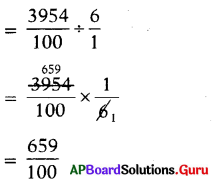
(i) Divide 39.54 by 6
Answer:
39.54 by 6
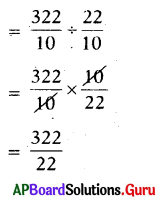
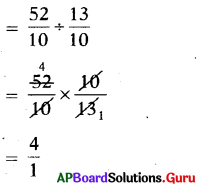
= 39.54 ÷ 6
AP Board 7th Class Maths Solutions Chapter 2 Fractions, Decimals and Rational Numbers Ex 2.3 18
∴ 39.54 ÷ 6 = 6.59

(ii) Divide 72 by 10
Answer:
7.2 by 10
= 7.2 ÷ 10
= [latex]\frac{72}{10} \div \frac{10}{1}[/latex]
= [latex]\frac{72}{10} \times \frac{1}{10}[/latex]
= [latex]\frac{72 \times 1}{10 \times 10}=\frac{72}{100}[/latex]
∴ 7.2 ÷ 10 = 0.72

(iii) Divide 5.2 by 1.3
Answer:
5.2 by 1.3
= 5.2 ÷ 1.3
AP Board 7th Class Maths Solutions Chapter 2 Fractions, Decimals and Rational Numbers Ex 2.3 19
∴ 5.2 ÷ 1.3 = 4

Question 5.
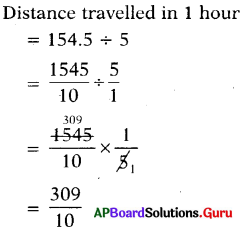
‘Sekhar travelled 154.5 km. in 5 hours with uniform speed on his bike. How much distance does he travel in one hour ?
Answer:
Given, distance travelled in 5 hours = 154.5 km
AP Board 7th Class Maths Solutions Chapter 2 Fractions, Decimals and Rational Numbers Ex 2.3 20
∴ Distance travelled by Sekhar in 1 hour = 30.9 km

AP Board 7th Class Maths Solutions Chapter 2 Fractions, Decimals and Rational Numbers Ex 2.3

Question 6.
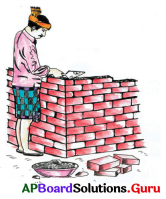
If a Mason worked 100 hours in 12.5 days to construct a wall, then how many hours he totally worked in a day?
AP Board 7th Class Maths Solutions Chapter 2 Fractions, Decimals and Rational Numbers Ex 2.3 21
Answer:
Given number of hours worked in 12.5 days to.construct a wall = 100 hours.
Number of hours worked in one day
= 100 ÷ 12.5
= [latex]\frac{100}{1} \div \frac{125}{10}[/latex]
= [latex]\frac{100}{1} \times \frac{10}{125}[/latex]
= [latex]\frac{1000}{125}[/latex]
∴ Number of hours worked by Mason in one day = 8 hours.

Question 7.
If the cost of dozen eggs is ₹ 61.80, then find the cost of an egg.
Answer:
Given, cost of dozen eggs = ₹ 61.80
We know 1 dozen =12
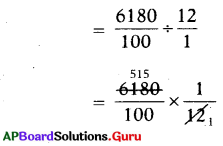
Cost of one egg = 61.80 ÷ 12
AP Board 7th Class Maths Solutions Chapter 2 Fractions, Decimals and Rational Numbers Ex 2.3 22
= [latex]\frac{515}{100}[/latex]
∴ Cost of one egg = ₹ 5.15

Question 8.
If the price of a tablet strip containing 10 tablets is ₹ 26.5, then find the price of each tablet.
Answer:
Given, cost of 10 tablets = ₹ 26.5
Cost of each tablet = 26.5 ÷ 10
= [latex]\frac{265}{10} \div \frac{10}{1}[/latex]
= [latex]\frac{265}{10} \times \frac{1}{10}[/latex]
= [latex]\frac{265}{100}[/latex]

∴ Cost of each tablet = ₹ 2.65.

AP Board 7th Class Maths Solutions Chapter 2 Fractions, Decimals and Rational Numbers Ex 2.2

SCERT AP 7th Class Maths Solutions Pdf Chapter 2 Fractions, Decimals and Rational Numbers Ex 2.2 Textbook Exercise Questions and Answers.

AP State Syllabus 7th Class Maths Solutions 2nd Lesson Fractions, Decimals and Rational Numbers Exercise 2.2

Question 1.
Find the product of the following.
(i) 23.4 × 6
Answer:
= [latex]\frac{234}{10} \times \frac{6}{1}[/latex]
= [latex]\frac{1404}{10}[/latex]
∴ 23.4 × 6 = 140.4

(ii) 681.25 × 9
Answer:
681.25 × 9
= [latex]\frac{68125}{100} \times \frac{9}{1}[/latex]
= [latex]\frac{68125 \times 9}{100}[/latex]
= [latex]\frac{613125}{100}[/latex]
∴ 681.25 × 9
= 6131.25

(iii) 53.29 × 14
Answer:
53.29 × 14
= [latex]\frac{5329}{100} \times \frac{14}{1}[/latex]
= [latex]\frac{74606}{100}[/latex]
∴ 53.29 × 14
= 746.06

(iv) 8 × 2.52
Answer:
8 × 2.52
= 8 × [latex]\frac{252}{100}[/latex]
= [latex]\frac{8 \times 252}{100}[/latex]
= [latex]\frac{2016}{100}[/latex]
∴ 8 × 2.52 = 20.16

(v) 25 × 2.013
Answer:
25 × 2.013
= 25 × [latex]\frac{2013}{1000}[/latex]
= [latex]\frac{25 \times 2013}{1000}[/latex]
= [latex]\frac{50325}{1000}[/latex]
∴ 25 × 2.013 = 50.325

AP Board 7th Class Maths Solutions Chapter 2 Fractions, Decimals and Rational Numbers Ex 2.2

Question 2.
Fill the blanks in the table.
Answer:

Multiplications Product
36.21 × 10 362.1
23.104 × 100 2310.4
6.24 × 1000 6240.0
0.02105 × 1000 21.05
9.234 × 100 923.4
1.3004 × 1000 1300.4
5.9001 × 10 59.001

Question 3.
Find the product.
(i) 5.1 × 8.1
Answer:
= [latex]\frac{51}{10} \times \frac{81}{10}[/latex]
= [latex]\frac{51 \times 81}{10 \times 10}[/latex]
= [latex]\frac{4131}{100}[/latex]
∴ 5.1 × 8.1 = 41.31

(ii) 63.205 × 0.27
Answer:
63.205 × 0.27
= [latex]\frac{63205}{1000} \times \frac{27}{100}[/latex]
= [latex]\frac{63205 \times 27}{1000 \times 100}[/latex]
= [latex]\frac{1706535}{100000}[/latex]
∴ 63.205 × 0.27 = 17.06535

(iii) 1.321 × 0.9
Answer:
1.321 × 0.9
= [latex]\frac{1321}{1000} \times \frac{9}{10}[/latex]
= [latex]\frac{1321 \times 9}{1000 \times 10}[/latex]
= [latex]\frac{11889}{10000}[/latex]
∴ 1.321 × 0.9 = 1.1889

(iv) 6.51 × 0.99
Answer:
6.51 × 0.99
= [latex]\frac{651}{100} \times \frac{99}{100}[/latex]
= [latex]\frac{651 \times 99}{100 \times 100}[/latex]
= [latex]\frac{64449}{10000}[/latex]
∴ 6.51 × 0.99 = 6.4449

(v) 837.6 × 0.006
Answer:
837.6 × 0.006
= [latex]\frac{8376}{10} \times \frac{6}{1000}[/latex]
= [latex]\frac{8376 \times 6}{10 \times 1000}[/latex]
= [latex]\frac{50256}{10000}[/latex]
∴ 837.6 × 0.006 = 5.0256

Question 4.
Rithesh reads a book for 2.5 hours everyday. If he reads the entire book in a week, then how many hours all together are required for him to read the book ?
AP Board 7th Class Maths Solutions Chapter 2 Fractions, Decimals and Rational Numbers Ex 2.2 1
Answer:
Given, time taken to read a book per day = 2.5 hours.

Time taken to read entire book in a week (one week = 7 days)
= 2.5 × 7 days
= [latex]\frac{25}{10}[/latex] × 7
= [latex]\frac{175}{10}[/latex]
∴ Time taken to read entire book = 17.5 hours.

AP Board 7th Class Maths Solutions Chapter 2 Fractions, Decimals and Rational Numbers Ex 2.2

Question 5.
Find the area of the rectangle whose length and breadth are 5.3 cm, 2.7 cm respectively.
Answer:
Given length of the rectangle l = 5.3 cm
Breadth of the rectangle b = 2.7 cm
Area of the rectangle = l × b
= 5.3 × 2.7
= [latex]\frac{53}{10} \times \frac{27}{10}[/latex]
= [latex]\frac{53 \times 27}{10 \times 10}[/latex]
∴ Area of the rectangle = [latex]\frac{1431}{100}[/latex]
= 14.31 sq.cm

Question 6.
If the cost of each cement bag is ₹ 326.50, then find the cost of 24 bags of cement.
Answer:
Given, cost of each cement bag
= ₹ 326.50

Cost of 24 cement bags
= 326.50 × 24
= [latex]\frac{32650}{100}[/latex] × 24
= [latex]\frac{32650 \times 24}{100}[/latex]
= [latex]\frac{783600}{100}[/latex]

∴ Cost of 24 cement bags = ₹ 7,836.

Question 7.
Dharmika purchased chudidhar material of 1.40 m at the rate of 7152.5 pet irtetre. Find the amount to be paid.
Answer:
Given cost of one meter chudidhar material = 7152.50
Cost of 1.40 meter chudidhar material = 152.50 × 1.40
= [latex]\frac{15250}{100} \times \frac{140}{100}[/latex]
= [latex]\frac{15250 \times 140}{100 \times 100}[/latex]
= [latex]\frac{2135000}{10000}[/latex]
∴ Cost of 1.40 meter chudidhar material = ₹ 213.50

Question 8.
If a picture chart costs 74.25. Amrutha wants to buy 16 charts to make an album. How much money does she has to pay ?
Answer:
Given, cost of one picture chart = ₹ 4.25
Cost of 16 charts = 4.25 × 16
= [latex]\frac{425}{100}[/latex] × 16
= [latex]\frac{425 \times 16}{100}[/latex]
∴ Cost of 16 charts to make album = [latex]\frac{6800}{100}[/latex] = ₹ 68

AP Board 7th Class Maths Solutions Chapter 2 Fractions, Decimals and Rational Numbers Ex 2.1

SCERT AP 7th Class Maths Solutions Pdf Chapter 2 Fractions, Decimals and Rational Numbers Ex 2.1 Textbook Exercise Questions and Answers.

AP State Syllabus 7th Class Maths Solutions 2nd Lesson Fractions, Decimals and Rational Numbers Exercise 2.1

Question 1.
In Jagananna Gorumudda (MDM) scheme each student got [latex]\frac{3}{20}[/latex] kg. rice per day, find the weight of the rice required for 60 students in a class per day.
Answer:
Given quantity of rice each student get per day = [latex]\frac{3}{20}[/latex] kg.
Quantity of rice 60 students get per day
= [latex]\frac{3}{20} \times \frac{60}{1}[/latex]
= [latex]\frac{3 \times 60}{20 \times 1}[/latex]
= [latex]\frac{180}{20}[/latex] = 9

∴ Quantity of rice required for 60 students per day = 9 kg.

Question 2.
What is a perimeter of an equilateral triangle, if each*side of a triangle is 5[latex]\frac{3}{10}[/latex]cm?
Answer:
Let the side of an equilateral triangle be x cm.
Perimeter of an equilateral triangle = 3x.
= 3 × 5 [latex]{30}{10}[/latex]
= [latex]\frac{3}{1} \times \frac{53}{10}[/latex]
= [latex]\frac{3 \times 53}{1 \times 10}[/latex]

∴ Perimeter of triangle = [latex]\frac{159}{10}[/latex] or 15[latex]\frac{9}{10}[/latex] cm

AP Board 7th Class Maths Solutions Chapter 2 Fractions, Decimals and Rational Numbers Ex 2.1

Question 3.
Surya can walk [latex]\frac{18}{5}[/latex]kilo meters in an hour. How much distance can he walk in 2[latex]\frac{1}{2}[/latex] hours ?
Answer:
Given, distance walked by Surya in 1 hour = [latex]\frac{18}{5}[/latex]km.
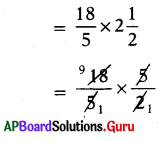
Distance walked by Surya in 2[latex]\frac{1}{2}[/latex]hours
AP Board 7th Class Maths Solutions Chapter 2 Fractions, Decimals and Rational Numbers Ex 2.1 1

∴ Distance walked in 2[latex]\frac{1}{2}[/latex]hours
= [latex]\frac{9}{1}[/latex] = 9 km

Question 4.
If the length and breadth of a rectan-gular garden are [latex]\frac{27}{2}[/latex]m and [latex]\frac{15}{2}[/latex]m respectively, then find the area of the garden.
Answer:
Given, the length of a garden = [latex]\frac{27}{2}[/latex]m.
breadth of a garden = [latex]\frac{15}{2}[/latex]m.
Area of rectangular garden = length × breadth
= [latex]\frac{27}{2} \times \frac{15}{2}[/latex]
= [latex]\frac{27 \times 15}{2 \times 2}[/latex]

∴ Area of the garden = [latex]\frac{405}{4}[/latex] or 101[latex]\frac{1}{4}[/latex]

Question 5.
Gopal bought 3[latex]\frac{1}{2}[/latex]kg. of potatoes in the market. If he paid ?84, then find the cost of 1 kg. of potatoes.
Answer:
Given, cost of 3[latex]\frac{1}{2}[/latex] kgs of potatoes = ₹ 84
Cost of 1 kg of potatoes = 84 ÷ 3[latex]\frac{1}{2}[/latex]
= 84 ÷ [latex]\frac{7}{2}[/latex]
= [latex]\frac{84}{1} \times \frac{2}{7}[/latex]

∴ Cost of one kg of potatoes = [latex]\frac{168}{7}[/latex]
= ₹ 24

Question 6.
A car travelled 225 km. in 4 [latex]\frac{1}{2}[/latex] hours with uniform speed. Find the distance travelled in 1 hour.
Answer:
Given, distance travelled in 4[latex]\frac{1}{2}[/latex] hours = 225 km
Distance travelled in 1 hour
= 225 ÷ 4[latex]\frac{1}{2}[/latex]
= 225 ÷ [latex]\frac{9}{2}[/latex]
= [latex]\frac{225}{1} \times \frac{2}{9}[/latex]
= [latex]\frac{225 \times 2}{1 \times 9}[/latex]

∴ Distance travelled by car in 1 hour
= [latex]\frac{450}{2}[/latex] = 50 km

Question 7.
If 24 students share 4[latex]\frac{4}{5}[/latex]kg. of cake, then how much cake does each one get?
Answer:
Given, quantity of cake shared by 24 students = 4[latex]\frac{4}{5}[/latex]kg

Quantity of cake each one got
= 4[latex]\frac{4}{5}[/latex] ÷ 24 .
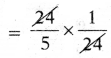
= [latex]\frac{24}{5} \div \frac{24}{1}[/latex]
AP Board 7th Class Maths Solutions Chapter 2 Fractions, Decimals and Rational Numbers Ex 2.1 2
∴ Quantity of cake each one got = [latex]\frac{1}{5}[/latex]kg (or) 0.2 kg (or) 200 gm.

AP Board 7th Class Maths Solutions Chapter 2 Fractions, Decimals and Rational Numbers Ex 2.1

Question 8.
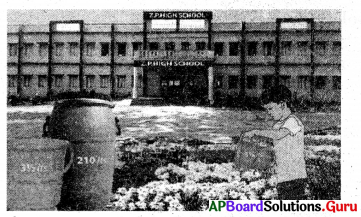
A drum contains 210 l of water. How many times does the boy get the water for watering die plants with 3[latex]\frac{1}{2}[/latex] l of full bucket from the drum ?
AP Board 7th Class Maths Solutions Chapter 2 Fractions, Decimals and Rational Numbers Ex 2.1 3
Answer:
Given, Capacity of water drum = 210 l
Capacity of bucket = 3[latex]\frac{1}{2}[/latex] l

Number of buckets of water the boy get = 210 ÷ 3[latex]\frac{1}{2}[/latex]
= 210 ÷ [latex]\frac{7}{2}[/latex]
= [latex]\frac{210}{1} \times \frac{2}{7}[/latex]
= [latex]\frac{420}{7}[/latex] = 60

∴ Number of buckets the boy get = 60

AP Board 7th Class Maths Solutions Chapter 1 Integers Review Exercise

SCERT AP 7th Class Maths Solutions Pdf Chapter 1 Integers Review Exercise Questions and Answers.

AP State Syllabus 7th Class Maths Solutions 1st Lesson Integers Review Exercise

Question 1.
Represent the following statements with suitable integer.
(i) Sneha deposited ₹ 2000 in her savings account.
Answer:
+ 2000 Rupees.

AP Board 7th Class Maths Solutions Chapter 1 Integers Review Exercise

(ii) A submarine is in the depth of 350 feet in the sea level.
Answer:
– 350 feet.

(iii) The height of Mount Everest is 8848 m J 3 above the sea level.
Answer:
+ 8848 m.

(iv) Temperature of 14 degrees below 0° C.
Answer:
– 14°C.

Question 2.
Fill the missing integers on the number line.
AP Board 7th Class Maths Solutions Chapter 1 Integers Review Exercise 1
Answer:
AP Board 7th Class Maths Solutions Chapter 1 Integers Review Exercise 2

Question 3.
Represent the following additions and subtractions on number line.
(i) 7 + 4
(ii) – 8 + 3
(iii) 9 – 11
(iv) 13 – 5
Answer:

Question 4.
Write the following integers in descending order and ascending order.
(i) -9, -1, 0, -10, -6
Answer:
Ascending order: -10, -9, -6,- 1, 0
Descending order: 0, -1, -6, -9,-10

AP Board 7th Class Maths Solutions Chapter 1 Integers Review Exercise

(ii) -6, 6, -9, 5, 10, -3
Answer:
Ascending order: -9, -6, -3, 5, 6, 10
Descending order: 10, 6, 5, -3, -6, -9

(iii) 15, -20, -35, 0, 2
Answer:
Ascending order: -35, -20, -15, 0, 2
Descending order: 2, 0, -15, -20, -35

Question 5.
Calculate the following.
(i) – 2 + 3
Answer:
– 2 + 3 = +1

(ii) – 6 + (- 2)
Answer:
– 6 + (- 2) = – 6 – 2 = – 8

(iii) 8 – (- 6)
Answer:
8 – (-6) = 8 + 6 = + 14

(iv) – 9 + 4
Answer:
– 9 + 4 = – 5

(v) – 23 – (- 30)
Answer:
– 23 – (- 30) = – 23 + 30 = + 7

(vi) 50 – 153
Answer:
50 – 153 = + 50 – 153 = – 103

(vii) 71 + (- 10) – 8
Answer:
71 + (-10) – 8 = + 71 – 10 – 8
= + 71 – 18 = + 53

AP Board 7th Class Maths Solutions Chapter 1 Integers Review Exercise

(viii) – 30 + 58 – 38
Answer:
-30 + 58 – 38 = – 30 – 38 + 58
= – 68 + 58 = – 10

Question 6.
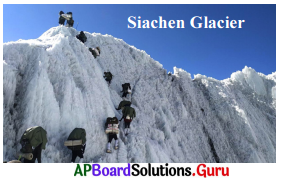
The temperature in Siachen at 5 a.m. was 10 degrees below 0°C. Six hours later, it had increased to 14°C. What is the temperature at 11 a.m. ?
AP Board 7th Class Maths Solutions Chapter 1 Integers Review Exercise 3
Answer:
Temperature at 5 a.m. = 10 degrees below 0°C = – 10°C
Six hours later increased temperature = + 14°C
Temperature at 11 a.m. = -10°C + 14°C
= +4°C
∴ Temperature at 11 a.m. in Siachen is + 4°C.

Question 7.
A fish was at 16 feet below the surface of sea and went down another 17 feet. What is its position now from the surface of sea?
AP Board 7th Class Maths Solutions Chapter 1 Integers Review Exercise 4
Answer:
Place of the fish in the beginning = 16 feet below surface = -16 feet
Place of the fish at last from the beginning = – 17 feet
∴ Position of fish now = – 16 + (-17)
= – 16 – 17
= – 33 feet

AP Board 7th Class Maths Solutions Chapter 1 Integers Review Exercise

Question 8.
A green grocer had a profit of ₹ 250 on Monday, a loss of ₹ 120 on Tuesday and loss of ₹ 180 on Wednesday. Find total profit or loss after 3 days.
Answer:
Profit on Monday = + ₹ 250
Loss on Tuesday = – ₹ 120
Loss on Wednesday = – ₹ 180
Total loss two days = – 120 + (- 180)
= – 120 – 180 = – 300
Loss is greater than profit. So, he will get loss.
∴ Total loss on three days = + 250 + (-300)
= + 250 – 300
= – 50
= – ₹ 50

Question 9.
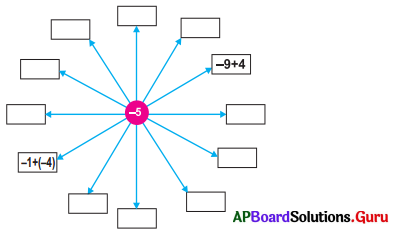
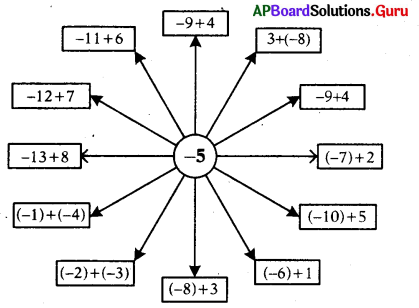
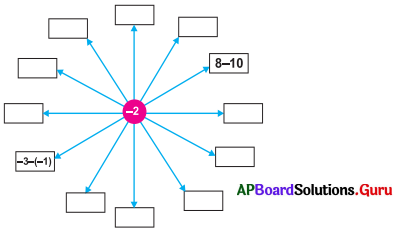
Fill the empty boxes in first diagram by doing addition of two integers and in second diagram by doing subtraction of two integers.
(i)
AP Board 7th Class Maths Solutions Chapter 1 Integers Review Exercise 5
Answer:
AP Board 7th Class Maths Solutions Chapter 1 Integers Review Exercise 6

AP Board 7th Class Maths Solutions Chapter 1 Integers Review Exercise

(ii)
AP Board 7th Class Maths Solutions Chapter 1 Integers Review Exercise 7
Answer:
AP Board 7th Class Maths Solutions Chapter 1 Integers Review Exercise 8

AP Board 7th Class Maths Solutions Chapter 1 Integers Unit Exercise

SCERT AP 7th Class Maths Solutions Pdf Chapter 1 Integers Unit Exercise Questions and Answers.

AP State Syllabus 7th Class Maths Solutions 1st Lesson Integers Unit Exercise

Question 1.
Calculate the following.
(i) 8 × (-1)
Answer:
8 × (-1)
We know, a × (- b) = – (a × b)
= – (8 × 1) = – 8

AP Board 7th Class Maths Solutions Chapter 1 Integers Unit Exercise

(ii) (- 2) × 175
Answer:
(-2) × 175
We know, (- a) × b = – (a × b)
= – (2 × 175) = – 350

(iii) (- 3) × (-40)
Answer:
(- 3) × (-40)
We know, (- a) × (-b) = (a × b)
= (- 3) × (- 40)
= 3 × 40 = 120

(iv) (- 24) × (- 7)
Answer:
(- 24) × (- 7)
We know, (- a) × (- b) = (a × b)
= 24 × 7 = 168

(v) (- 7) ÷ (-1)
Answer:
(- 7) ÷ (-1)
We know, (- a) + (- b) = a ÷ b
= (- 7) ÷ (- 1)
= 7 ÷ 1 = 7

(vi) (- 12) ÷ (+ 6)
Answer:
(- 12) ÷ ( + 6)
We know, (- a) ÷ (- b) = – (a ÷ b)
= (- 12) ÷ 6 = – 2

(vii) (- 49) ÷ (-7 )
Answer:
(- 49) ÷ (-7)
We know, (- a) ÷ (- b) = a ÷ b
= (- 49) ÷ (- 7)
= 49 ÷ 7 = 7

AP Board 7th Class Maths Solutions Chapter 1 Integers Unit Exercise

(viii) (+ 63) ÷ (- 9)
Answer:
(+ 63) ÷ (- 9)
We know, a ÷ (- b) = – (a ÷ b)
= 63 ÷ (-9) = – (63 ÷ 9) = – 7

Question 2.
Replace the blank with an integer to make it a true statement.
(i) (- 7) × _______ = 21
Answer:
(- 7) ×   x    = 21
× = 21 ÷ (-7)
We know, a ÷ (-b) = – (a ÷ b)
x = – (21 ÷ 7)
∴ x = – 3

(ii) 7 × _______= – 42
Answer:
7 ×  x   = – 42
x = (- 42) ÷ 7
We know, (- a) ÷ b = – (a ÷ b)
x = – (42 ÷ 7)
∴ x = – 6

(iii) ________ × (-9) = – 72
Answer:
  x    × (- 9) = – 72
x = (- 72) ÷ (- 9)
We know, (- a) ÷ (-b) = (a ÷ b)
x = (72 ÷ 9)
∴ x = 8

(iv) ________ × (- 11) = 132
Answer:
  x    × (- 11) = 132
× = 132 ÷ (-11)
We know, a ÷ (- b) = – (a ÷ b)
x = – (132 ÷ 11)
∴ × = – 12

AP Board 7th Class Maths Solutions Chapter 1 Integers Unit Exercise

(v) (- 25) ÷ ________ = 1
Answer:
(- 25) ÷   x    = 1
(- 25) = 1 × x
x = (- 25) ÷ 1
We know, (- a) ÷ b = – (a ÷ b)
x = – (25 ÷ 1)
∴ x = – 25

(vi) 42 ÷ ________ = – 6
Answer:
42 ÷   x    = – 6
42 = (- 6) × x
x = 42 ÷ (- 6)
We know, a ÷ (- b) = – (a ÷ b)
x = – (42 ÷ 6)
∴ x = – 7

(vii) ______ ÷ 4 (- 15) = 6
Answer:
  x    × 4 (- 15) = 6
x = 6 × (- 15)
We know, a × (-b) = – (a × b)
x = – (6 × 15)
∴ x = – 90

(viii) ________ ÷ (- 9) = 16
Answer:
  x    ÷ (- 9) = 16
x = 16 × (- 9)
We know, a × (- b) = – (a × b)
x = – (16 × 9)
∴ x = – 144

AP Board 7th Class Maths Solutions Chapter 1 Integers Unit Exercise

Question 3.
Write all the possible pairs of integers that give a product of – 50.
Answer:

a b a × b = – 50
41 (-50) 41 × (-50) = – 50
(-D (+50) (-1) × (50) = – 50
+2 (-25) 42 × (-25) = – 50
(-2) (+25) (-2) × (25) = – 50
+5 (-10) 45 × (-10) = – 50
(-5) (+10) (-5) × (10) = – 50
450 (-D 50 × (-1) = – 50
(-50) (1) (-50) × (1) = – 50

Question 4.
Sarikar, a fruit vendor sells 100 kg of oranges and 75 kg of pomegranates. If he makes a profit of ₹ 11 per one kg of pomegranates and loss of ₹ 8 per one kg oranges, what will be his overall profit or loss ?
AP Board 7th Class Maths Solutions Chapter 1 Integers Unit Exercise 1
Answer:
Given
Profit on 1 kg of pomegranates = ₹ 11
Profit on 75 kg of pomegranates
= 75 × 11
= ₹ 825
Loss on 1 kg of oranges = ₹ 8
Loss on 100 kg of oranges
= 100 × 8
= ₹ 800
Profit is greater than loss.
So, Sankar will get profit.
Overall profit = ₹ 825 – ₹ 800
= ₹ 25

AP Board 7th Class Maths Solutions Chapter 1 Integers Unit Exercise

Question 5.
Bhargavi lost 5700 calories in the month of June using yoga. If the calory loss is uniform, calculate the loss of calories per day ?
AP Board 7th Class Maths Solutions Chapter 1 Integers Unit Exercise 2
Answer:
Given number of calories Bhargavi lost in the month of June = 5700 calories June month has 30 days.
So, number of calories lost in 30 days = 5700
Number of calories lost in 1 day = 5700 ÷ 30
Number of calories lost per day = 190 Calories.

Question 6.
Simplify 625 × (-35) + 625 × 30 using suitable law.
Answer:
625 × (-35) + 625 × 30
Multiplication distributes over addition of integers.
We know, a × b + a × c = a(b + c)
= 625 [(- 35) + 30]
= 625 (- 35 + 30)
= 625 (- 5)
We know, a × (- b) = – (a × b)
= – (625 × 5)
= – 3125

Question 7.
Simplify the following using BODMAS.
(i) 12 – 36 ÷ 3
Answer:
12 – 36 = 3 (Division)
= 12 – 12 (Subtraction)
= 0

(ii) 6 × (-7) + (- 3) ÷ 3
Answer:
6 × (- 7) + (- 3) ÷ 3
We know, (- a) ÷ b = – (a ÷ b)
= 6 × (- 7) – 3 ÷ 3 (Division)
We know, a × (-b) = – (a × b)
= – (6 × 7) – 1 (Multiplication)
= – 42 – 1 (Subtraction)
= – 43

AP Board 7th Class Maths Solutions Chapter 1 Integers Unit Exercise

(iii) 38 – {35 – (36 – [latex]\overline{34-37}[/latex])}
Answer:
38 – {35 – (36 – [latex]\overline{34-37}[/latex])} (Vinculum)
= 38 – {35 – (36 – (-3)}
= 38 – {35 – (36 + 3)} (Simple bracket)
= 38 – {35 – 39} (Curly bracket)
= 38 – (-4)
= 38 + 4 (Addition)
= 42

Question 8.
Write the absolute values of following numbers.
(i) – 700
Answer:
We know, |- x| = x
|- 700| = 700

(ii) 150
Answer:
We know, | x | = + x
So, |150| = 150

(iii) – 150
Answer:
We know, | – x | = x
So, |- 150| = 150

(iv) – 35
Answer:
We know, | – x | = x
So, |- 35| = 35

(v) If p < 10, then |p – 10|
Answer:
We know, if × < a, then |x – a | = a – x
So, |p – 10| = 10 – p

AP Board 7th Class Maths Solutions Chapter 1 Integers Unit Exercise

(vi) If y > 7, then |7 – y|
Answer:
We know, if x > a, then |a – x| = x – a
So, |7 – y | = y – 7

AP Board 7th Class Maths Solutions Chapter 1 Integers Ex 1.4

SCERT AP 7th Class Maths Solutions Pdf Chapter 1 Integers Ex 1.4 Textbook Exercise Questions and Answers.

AP State Syllabus 7th Class Maths Solutions 1st Lesson Integers Exercise 1.4

Question 1.
Simplify the following.
(i) 6 × 9 – 6 ÷ 3
Answer:
6 × 9 – 6 ÷ 3 (Division)
= 6 × 9 – 2 (Multiplication)
= 54 – 2 (Subtraction)
= 52

AP Board 7th Class Maths Solutions Chapter 1 Integers Ex 1.4

(ii) 12 ÷ 4 – 8 + 5
Answer:
12 ÷ 4 – 4 – 8 + 5 (Division)
= 3 – 8 + 5
= 3 + 5 – 8 (Addition)
= 8 – 8 (Subtraction)
= 0

(iii) 80 – 56 ÷ 8 × 9
Answer:
80 – 56 ÷ 8 × 9 (Division)
= 80 – 7 × 9 (Multiplication)
= 80 – 63 (Subtraction)
= 17

(iv) 15 ÷ 5 + 17-30
Answer:
15 ÷ 5 + 17 – 30 (Division)
= 3 + 17 – 30 (Addition)
= 20 – 30 (Subtraction)
= – 10

(v) 8 + 8 – 8 × 8 ÷ 8
Answer:
8 + 8 – 8 × 8 ÷ 8 (Division)
= 8 + 8 – 8 × 1 (Multiplication)
= 8 + 8 – 8 (Addition)
= 16 – 8 (Subtraction)
= 8

Question 2.
Simplify the following.
(i) 8 × 3 – [latex]\overline{13-7}[/latex]
Answer:
8 × 3 – [latex]\overline{13-7}[/latex] (Vinculum)
= 8 × 3 – 6 (Multiplication)
= 24 – 6 (Subtraction)
= 18

AP Board 7th Class Maths Solutions Chapter 1 Integers Ex 1.4

(ii) {12 – [latex]\overline{14-8}[/latex] + 7} – 15
Answer:
{12 – [latex]\overline{14-8}[/latex] + 7} – 15 (Vinculum)
= {12 – 6 + 7} – 15
= {12 + 7 – 6} – 15 (Curly bracket)
= {19 – 6} – 15
= 13 – 15 (Subtraction)
= – 2

(iii) 16 – (4 + 18 ÷ 6 – [latex]\overline{7-5}[/latex]) × 5
Answer:
16 – (4 + 18 ÷ 6 – [latex]\overline{7-5}[/latex]) × 5 (Vinculum)
= 16 – (4 + 18 + 6 – 2) × 5 (Division)
= 16 -(4 + 3 – 2) × 5 (Simple bracket)
= 16 – (7 – 2) × 5
= 16 – 5 × 5 (Multiplication)
= 16 – 25 (Subtraction)
= – 9

(iv) {6 of 145 ÷ (3 + 2)} ÷ 2 – 4 of 20
Answer:
{6 of 145 ÷ (3 + 2)} ÷ 2 -4 of 20 (Simple Bracket)
= {6 of 145 ÷ 5} ÷ 2 – 4 of 20 (Of)
= {870 ÷ 5} ÷ 2 – 80 (Curly bracket, Division)
= 174 ÷ 2 – 80 (Division)
= 87 – 80 (Subtraction)
= 7

AP Board 7th Class Maths Solutions Chapter 1 Integers Ex 1.4

(v) 25 + [14 – 18 + {12 of 5 – (- 4 + 14)}]
Answer:
Given
25 + [14 – 18 + {12 of 5 – (- 4 + 14)}]
Applying BODMAS Rule
= 25 + [14 – 18 + {12 of 5 – (10)}]
[Removing inner most in bracket]
= 25 + [14 – 18 + {12 × 5 – 10}] [Replacing of]
= 25 + [14- 18 + {60 – 10}]
= 25 + [- 4 + 50]
= 25 – 4 + 50
= 75 – 4 = 71

Question 3.
Identify the true statements.
(i) 48 ÷ 6 – 4 = 24
Answer:
48 ÷ 6 – 4 = 24 (Division)
8 – 4 = 24 (Subtraction)
4 ≠ 24
It is a false statement.

(ii) – 18 + 12 + 3 = – 14
Answer:
– 18 + 12 ÷ 3 = – 14 (Division)
– 18 + 4 = – 14 (Subtraction)
– 14 = – 14
It is a true statement.

(iii) – 11 + 3 × 7 = – 56
Answer:
– 11 + 3 × 7 = – 56 (Multiplication)
– 11 + 21 = – 56 (Subtraction)
10 ≠ – 56
It is a false statement.

AP Board 7th Class Maths Solutions Chapter 1 Integers Ex 1.4

(iv) 2020 ÷ 20 – 100 = 1
Answer:
2020 ÷ 20 – 100 = 1 (Division)
101 – 100 = 1 (Subtraction)
1 = 1
It is a true statement.

Question 4.
Fill the blanks with +, -, ×, ÷ to make the statement as true.
(i) 9 __ 3 __ 6 = – 3
Answer:
9 ÷ 3 – 6 = – 3 (Division)
3 – 6 = – 3 (Subtraction)
– 3 = – 3

(ii) – 6 __ 12 __ 6 = – 4
Answer:
– 6 + 12 ÷ 6 = – 4 (Division)
– 6 + 2 = – 4 (Subtraction)
– 4 = – 4

AP Board 7th Class Maths Solutions Chapter 1 Integers Ex 1.4

(iii) – 15 __ 3 __ 6 = – 30
Answer:
– 15 ÷ 3 × 6 = – 30 (Division)
– 5 × 6 = – 30 (Multiplication)
– 30 = – 30

AP Board 7th Class Maths Solutions Chapter 1 Integers Ex 1.3

SCERT AP 7th Class Maths Solutions Pdf Chapter 1 Integers Ex 1.3 Textbook Exercise Questions and Answers.

AP State Syllabus 7th Class Maths Solutions 1st Lesson Integers Exercise 1.3

Question 1.
Identify the laws in the following statements :

(i) – 3 + 5 = 5 + (- 3)
Answer:
a + b = b + a (Additive commutative property)
– 3 + 5 = 5 – 3
2 = 2

AP Board 7th Class Maths Solutions Chapter 1 Integers Ex 1.3

(ii) – 2 × 1 = 1 × (-2) = – 2
Answer:
a × 1 = 1 × a = a
Multiplicative identity property
– 2 × 1 = 1 × (-2) = – 2
– 2 = – 2

(iii) [(-5) × 2)] × 3 = (-5) × [(2 × 3)]
Answer:
(a × b) × c = a × (b × c)
Multiplicative associative property.
(- 10) × 3 = (- 5) × (6)
– (10 × 3) = – (5 × 6)
– 30 = – 30

(iv) 18 × [7 +(- 3)] = [18 × 7] + [18 × (-3)]
Answer:
a × (b + c) = (a × b) + (a × c)
Distributive over addition property
18 × (7 – 3) = (126) + (- 54)
18 × 4= 126 – 54
72 = 72

(v) – 5 × 6 = – 30 .
Answer:
(- a) × b = – (ab)
Multiplicative closure property
– 30 = – 30

(vi) – 3 + 0 = 0 + (- 3) = – 3
Answer:
a + 0 = 0 + a = a
Additive identity property
-3 = 0 – 3 = -3
-3 = – 3 = – 3.

AP Board 7th Class Maths Solutions Chapter 1 Integers Ex 1.3

Question 2.
What will be the sign of the product of the following
(i) 24 times of negative integer?
(ii) 35 times of negative integer?
Answer:
(- 1) × (- 1) = + 1
(- 1) × (- 1) × (- 1) = – 1
(- 1) × (- 1) × (- 1) × (- 1) = + 1
(- 1) × (- 1) × (- 1) × (- 1) × (- 1) = – 1
If negative integer multiplied even number of times, the product is positive integer. If negative integer multiplied odd number of times, the product is negative integer.
(i) (-a) × (-a) × ………….. 24 times
= + a (Positive integer)

(ii) (-a) × (-a) × ……………. 35 times
= – a (Negative integer)

Question 3.
Write the suitable numbers in the blanks by using appropriate law.
(i) – 3 + ________= – 3
Answer:
a + 0 = a
– 3 + 0 = – 3

(ii) 2 × (-3) = (-3) × ________
Answer:
a × b = b × a
2 × (-3) = (-3) × 2

(iii) – 6 + [3 + (-2)] = [(- 6) + ________] + ________
Answer:
a + (b + c) = (a + b) + c
= [(-6) + 3] + (- 2)

(iv) – 6 × ________ = – 6
Answer:
a × 1 = a = 1 × a
-6 × ________ = – 6

(v) 5 × [(- 6) + 9] = ________ × (-6) + 5 × ________
Answer:
a × (b + c) = (a × b) + (a × c)
5×[(-6)+9] = 5 × (-6) + [(5 × 9 )]

AP Board 7th Class Maths Solutions Chapter 1 Integers Ex 1.3

Question 4.
State true or false. Write the reasons,
(i) 2 is the multiplicative identity of – 2.
Answer:
False.
2 is not the multiplicative identity of – 2. Multiplicative identity of – 2 is – [latex]\frac{1}{2}[/latex].
2 is the additive inverse of – 2.

(ii) Integers are commutative under subtraction.
Answer:
False.
5 – 3 ≠ 3 – 5
2 ≠ – 2, i.e., a – b ≠ b – a.
Integers are not commutative under subtraction.

(iii) For any two integers a and b,
a × b = b × a
Answer:
True.
4 × (- 5) = (- 5) × 4
– (4 × 5) = -(5 × 4)
– 20 = – 20
So, for any two integers a and b,
a × b = b × a.

(iv) The division of integers by zero is not defined.
Answer:
True.
5 ÷ 0 is not defined.
So, the division of integers by zero is not defined.

(v) 6 + (-6) = (-6) + 6 = 0 indicates additive identity property. .
Answer:
False.
(-6) is the additive inverse of 6.
So, it indicates additive inverse property. But, not additive identity property.

AP Board 7th Class Maths Solutions Chapter 1 Integers Ex 1.3

Question 5.
Simplify the following using suitable laws.
(i) – 11 × (- 25) × (- 4)
Answer:
– 11 × (- 25) × (- 4)
a × (b × c)
= (- 11) × [(- 25) × (- 4)]
= (- 11) × (25 × 4)
= – 11 × 100
= – (11 × 100)
= – 1100

(ii)
3 × (- 18) + 3 × (- 32)
Answer:
3 × (- 18) + 3 × (- 32)
(a × b) + (a × c) = a × (b + c)
= 3 × [(- 18) + (- 32)]
= 3 × (- 18 – 32) .
= 3 × (- 50)
= – (3 × 50)
= – 150

Question 6.
Are the integers are associative under subtraction ? Explain by an example.
Answer:
No, integers are not associative under subtraction.
(a – b) – c ≠ a – (b – c)
(6 – 4) – 5 ≠ 6 – (4 – 5)
2 – 5 ≠ 6-( – 1)
– 3 ≠ 6 + 1
– 3 ≠ + 7

AP Board 7th Class Maths Solutions Chapter 1 Integers Ex 1.3

Question 7.
Verify [(-5) × 2)] × 3 = (- 5) × [(2 × 3)].
Answer:
[(- 5) × 2)] × 3 = (- 5) × [(2 × 3)]
(a × b) × c = a × (b × c)
[- (5 × 2)] × 3 = (- 5) × (6)
(- 10) × 3 = – (5 × 6)
– (10 × 3) = – 30
– 30 = – 30
L.H.S. = R.H.S.