AP Board 7th Class Social Solutions 6th Lesson Vijayanagara Empire

SCERT AP 7th Class Social Study Material Pdf 6th Lesson Vijayanagara Empire Textbook Questions and Answers.

AP State Syllabus 7th Class Social 6th Lesson Questions and Answers Vijayanagara Empire

7th Class Social 6th Lesson Vijayanagara Empire Textbook Questions and Answers

Improve Your Learning

I. Answer the following questions.

Question 1.
Discuss the conflict between Vijayanagar and Bahaman kingdoms.
Answer:

  1. The struggle between Vijayanagara and Sultanate of Madurai lasted for about four decades.
  2. The disputes/ conflicts started during the time of son of Bukkaraya -1, Kumarakampana.
  3. Kumarakampana destroyed Madurai Sultans and freed people from the Sultan misrule.
  4. The dispute arises between Vijayanagara and Bahmani kingdom over Raichur Doab, the region between the rivers Krishna and Tungabhadra.
  5. And also over the fertile areas of Krishna – Godavari delta led to this long drawn conflict.

Question 2.
Write about the Nayakar system in Vijayanagar kingdom.
Answer:
In Vijayanagara empire Nayakas and Amara Nayakas are there.
Nayakas:

  1. They were military chiefs usually mentioned law and order in their areas of control.
  2. They maintained forests and kept armed supporters.
  3. They use to control and expand fertile land and agricultural settlements.
  4. They usually submitted to kings.

Amara Nayakas:

  1. The Amaranayaka system was a major political innovation of Vijayanagara empire.
  2. These Amaranayakas form military commanders, who are given territories to be governed by the Raya.

AP Board 7th Class Social Solutions 6th Lesson Vijayanagara Empire

Question 3.
Describe the development of trade and commerce under the Vijayanagar rulers.
Answer:

  1. Vijayanagara kingdom was a great center of trade.
  2. Inland, Coastal and Overseas trade led to the general prosperity.
  3. There were a number of seaports on the Malabar coast, the chief being Cannanore.
  4. Commercial contacts with Arabia, Persia, South Africa and Portugal on the West and Burma, Malaya Peninsula and China on the east flourished.
  5. Cotton and Silk, spices, rice iron, saltpeter and sugar were the chief items exported.
  6. Vijayanagara kings imported horses, pearls, copper, coral, mercury, China silk and velvet clothes.
  7. The art of shipbuilding developed.

Question 4.
Read the concept of “Art and Music” in the lesson and compare it with the present.
Answer:
During the Vijayanagara period Carnatic music is famous. But at present due to change the interest of the people rock and pop music are famous.

At that time Bharata Natyam, Kuchipudi, Yakshaganam, Perni Natyam are famous. But at present breakdance and disco dance styles are famous.

Question 5.
Write about the administration of Sri Krishna Deva Raya.
Answer:

  1. Sri Krishna Devaraya was not only a great warrior but also a good administrator.
  2. He took the help of his minister Saluva Timmarusu, known as Appaji, in reorganizing the administrative system.
  3. The chief adviser to the king was Prime Minister. ‘
  4. Council of Ministers assisted the king in administration.
  5. He maintained friendly relations with the foreigners.
  6. He respected all religions.
  7. He was a great patron of literature and art.
  8. He maintained Ashtadiggajas, a great 8 poets in his court.
  9. The empire was divided into different administrative units called Mandalas, Nadus, Sthalas and finally into Gramas.

Question 6.
Describe the literary services of Sri Krishna Deva Raya.
Answer:

  1. Sri Krishna Devaraya was not only a great monarch, soldier and a stateman but was also an accomplished poet and scholar himself.
  2. He was a great patron of literature and art.
  3. He was known as Andhra Bhoja.
  4. His famous quote was “Desa Bhasalandu Telugu Lessa.”
  5. Eight eminent scholars known as “Astadiggajas” were at his royal court.
  6. Krishna Devaraya himself authored a telugu work ‘Amuktamalyada’ and Sanskrit works, ‘Jambavathi Kalyanam’ and ‘Usha Parinayam’.
  7. He patronized various writers and poets in his court called ‘Bhuvana Vijayam’.

Question 7.
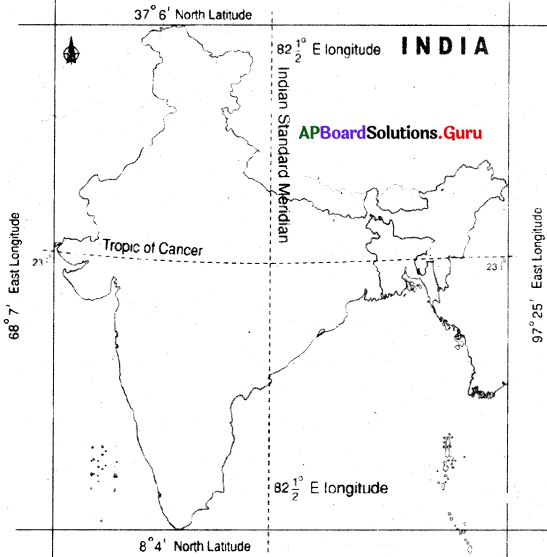
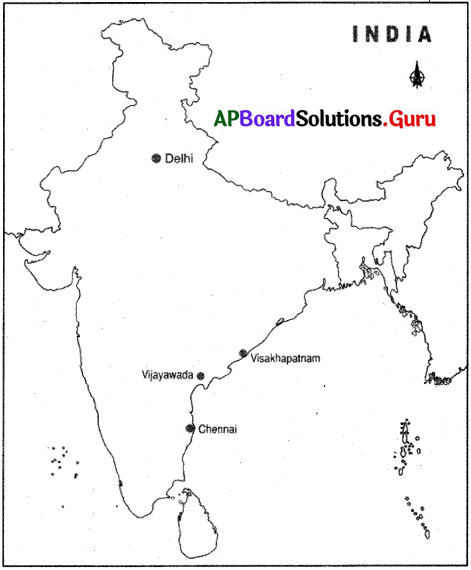
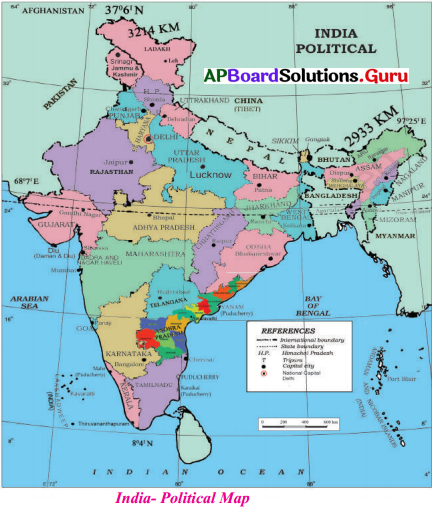
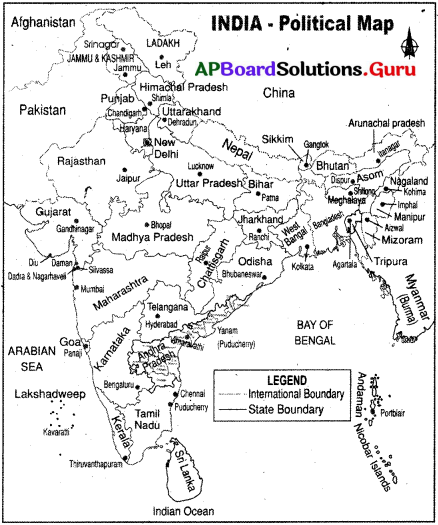
Locate the boundaries of Vijayanagara empire in India map.
Answer:
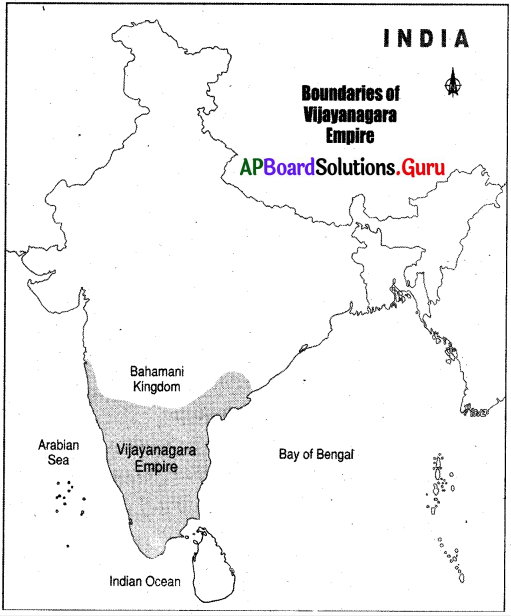
AP Board 7th Class Social Solutions 6th Lesson Vijayanagara Empire 1

Question 8.
What are the architectural traditions that inspired the architects of Vijayanagar?
Answer:

  1. The rulers of Vijayanagara made many innovations in the architectural traditions.
  2. They added many new features in the temple architecture.
  3. The rulers of Vijayanagara built mandapas or pavilions.
  4. Besides there were long and pillared corridors that ran around the shrines.
  5. There were two main temples : The Virupaksha temple and’Vithala temple.
  6. During the Krishna Devaraya time he built a hall in front of the main shrine to these temples.
  7. This hall was decorated with delicately carved pillars.

Question 9.
Why did Bahamani kingdom breakup and what was the result?
Answer:
The Bahamani kingdom was breakup due to the following reasons :

  1. Royal officers were appointed in each province.
  2. They were aimed to increase the control of Sultan over the nobles and provinces.
  3. Most of the forts were under the control of these officers.
  4. Allowances were reduced to the nobles who shirked their responsibility. This was disliked by the nobles.
  5. Muhammad Gawan was very strict and gave punishments to his nobles. This made them to revolt against Gawan.
  6. So, the Deccan nobles organised a plot against Gawan.
  7. They induced the Sultan to punish him with death.
  8. Muhammad Shah-Ill died in 1482 CE. His successors were weak.

Result:
So the Bahamani kingdom disintegrated into five kingdoms namely :

  1. Ahmednagar,
  2. Birar,
  3. Bidar,
  4. Bijapur,
  5. Golkonda.

AP Board 7th Class Social Solutions 6th Lesson Vijayanagara Empire

Question 10.
Describe the services of Reddy kings to the people.
Answer:

  1. The Reddy rulers patronised and protected Hinduism and its institutions.
  2. Telugu literature blossomed under the Reddy kings.
  3. The administration was carried according to the “Dharmasutras”.
  4. One sixth of agricultural surplus was levied as tax.
  5. Under the reign of Anapota Reddy, customs-duty and taxes on trade were lifted.
  6. Sea trade was carried through the port Motupalli.
  7. Celebrating “Vasantosavalu” was revived during the rule of Anavema Reddy.
  8. Caste systerp was observed.

II . Choose the correct answer.

1. Sri Krishna Deva Raya belongs to this Vijayanagar dynasty.
a) Saluva
b) Thuluva
c) Aravedu
d) Sangama
Answer:
b) Thuluva

2. The kingdom of Vijayanagara was established during the reign of ………….
a) Alauddin Khilji
b) Muhammad Bin Tughlaq
c) Firoz Shah Tughlaq
d) Ghiyasuddin Tughlaq
Answer:
b) Muhammad Bin Tughlaq

3. Rakshasathangadi or Tallikota war broke out in the year.
a) 1563 A.D
b) 1564A.D
c) 1565 A.D
d) 1566 A.D
Answer:
c) 1565 A.D

4. Madura Vijayam is a book written by
a) GangaDevi
b) Tirumalamma
c) Hanumayamma
d) Nagalamba
Answer:
a) GangaDevi

5. The founder of the Bahamani kingdom was
a) Alauddin Mujahid Shah
b) Ahmed Shah
c) Alauddin Bahman Shah
d)FirozShah
Answer:
c) Alauddin Bahman Shah

III. Match the following.

Group-A Group-B
1. Krishnadevarays a) Chief Minister
2. Muhammad Gawan b) Capital city of Bahamani
3. Vijayanagara empire c) Andhra Bhoja
4. Gulbarga d) Persian
5. Abdul Rajjak e) Tungabhadra

Answer:

Group-A Group-B
1. Krishnadevarays c) Andhra Bhoja
2. Muhammad Gawan a) Chief Minister
3. Vijayanagara empire e) Tungabhadra
4. Gulbarga b) Capital city of Bahamani
5. Abdul Rajjak d) Persian

7th Class Social 6th Lesson Vijayanagara Empire InText Questions and Answers

7th Class Social Textbook Page No. 78

Question 1.
Get the information about the first Surveyor General of India from your library or Internet.
Answer:
Collin Mackenzie was appointed first Surveyor General of India to the Madras Presidency in 1810.

7th Class Social Textbook Page No. 81

Question 2.
Play a drama of Astadiggajas with the help of your teacher.
Answer:

7th Class Social Textbook Page No. 83

Question 3.
There are so many ancient and modern Indian women who are role model to us. Prepare a list of great India women with the help of your teacher and parents.
Answer:
Sita, Savitri, Arundhathi, Anasuya, Ahalya, Gargi and Maithreyi etc.,–these are the great woman from our Indian mythology.

Jhansi Lakshmi bai, Rani Rudrama Devi, Razia Sultana etc., — are the great woman from our historical period.

Indira Gandhi, Kiran Bedi, Mother Teresa, Kalpana Chawla, Sushma Swaraj, Lata Mangeshkar, M.S. Subbu Laxmi, P. Suseela, Karanam Malleswari etc. are the great women in modern times in India.

AP Board 7th Class Social Solutions 6th Lesson Vijayanagara Empire

7th Class Social Textbook Page No. 86

Question 4.
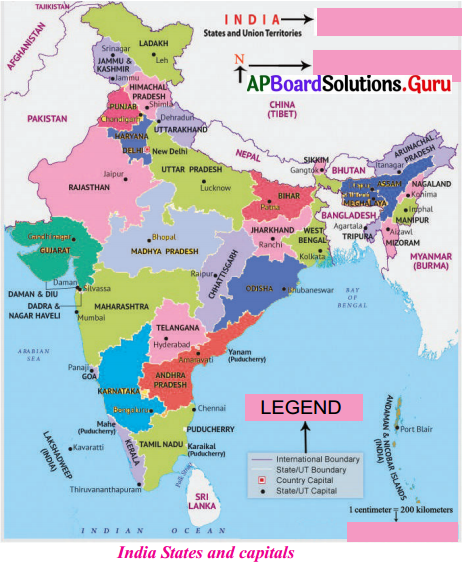
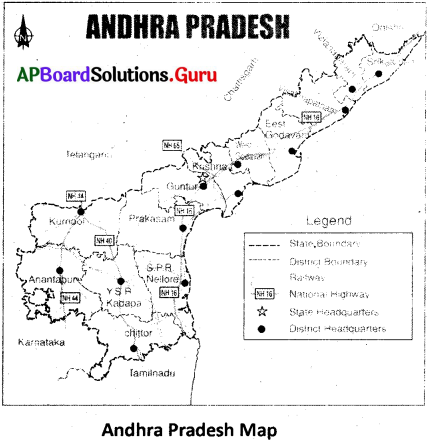
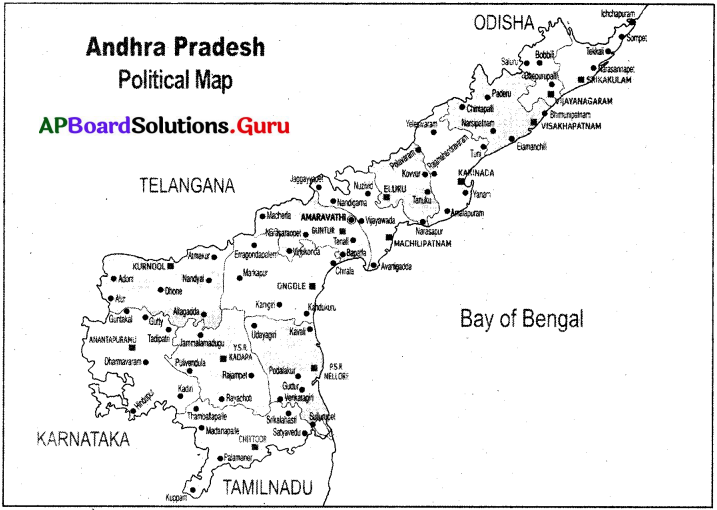
Locate the cities ” Kondapalli, Rajamundry, Kondaveedu, Vinukonda, and Addanki in present Andhra Pradesh Map.
Answer:
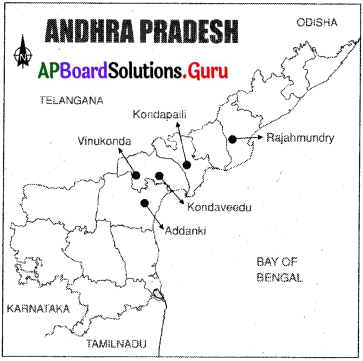
AP Board 7th Class Social Solutions 6th Lesson Vijayanagara Empire 3

Think & Respond

7th Class Social Textbook Page No. 77

Question 1.
Why did Vidyaranya want to establish new kingdom on the bank of Tungabhadra river?
Answer:
Vidyaranya told the brothers Hari Hara Raya and Bukkaraya the South Bank of the River Tungabhadra area was sacred.

And he advised them to establish a new kingdom on the bank of Tungabhadra river.

Question 2.
Under which dynasty Harihara-1 and Bukkaraya-1 worked?
Answer:
Hari Hara Raya – I and Bukkaraya – I worked in the court of the Kakatiya king Pratapa Rudra II of Warangal in 1323 CE.

After defeat of Kakatiya kingdom, they worked under the control of Muslim rule. Later they established Vijayanagara Kingdom.

7th Class Social Textbook Page No. 81

Question 3.
Why were there constant wars between Vijayanagara Empire and the contemporary Muslim rulers?
Answer:
The main reason for the constant wars between Vijayanagara and contemperory rulers were :

  1. Both the kingdoms wanted to control of fertile and rich Raichur doab lying between rivers Krishna and Tungabhadra.
  2. They also wanted to conquer Golconda because of its diamond mines.

AP Board 7th Class Social Solutions 6th Lesson Vijayanagara Empire

Question 4.
What were the effects of Taliikota war? Discuss with your teacher.
Answer:
The effects of Taliikota war :

  1. Aliya Ramaraya was defeated.
  2. He and his people were killed mercilessly.
  3. Temples were destroyed.
  4. Rama Raya was imprisoned and executed.
  5. Tirumala Raya and Venkata Raya sons of Rama Raya escaped from the war and ran away to Penukonda.
  6. The city of Vijayanagara was destroyed by the Muslim kings.
  7. This battle is also known as Rakshasa Thangadi.
  8. This battle was generally considered to mark the end of the Vijayanagara empire.

7th Class Social Textbook Page No. 85

Question 5.
Discuss the contribution of the Vijayanagara empire to Indian art and. Architecture.
Answer:

  1. The temple building activity of the Vijayanagar rulers produced a new style called the Vijayanagar style.
  2. Though often characterized as Dravida style, it had its own distinct features.
  3. The distinct features of the architecture were the pillars.
  4. The horse was the most common animal to be depicted on the pillars.
  5. The temples had a Mandapam or Open Pavilion with a raised platform, generally meant for seating the deity on special occasions.
  6. The Rajagopurams, towers in commemoration of the visit of emperors in different corners of the empire are also important examples.
  7. Amman Shrine was meant for the consort of the God.

Project Work

Collect the information about temples costructed in Andhra Pradesh with the influence of Vijayanagara style.
Answer:
In Andhra Pradesh the empire built the Mallikarjuna Temple at Srisailam, Upper Narasimha Temple and Lower Narasimha Temple at Ahobilam, Veera Bhadra Temple at Lepakshi and Venkateswara Temple at Tirupati and others.

The Veerabhadra temple of Lepakshi, which was built by the brothers Viranna and Virupanna, is dedicated to Veerabhadra. it is an example of the Vijayanagara architectural

AP Board 7th Class Social Solutions 6th Lesson Vijayanagara Empire 2

AP Board 7th Class Social Solutions 5th Lesson Kakatiya Kingdom

SCERT AP 7th Class Social Study Material Pdf 5th Lesson Kakatiya Kingdom Textbook Questions and Answers.

AP State Syllabus 7th Class Social 5th Lesson Questions and Answers Kakatiya Kingdom

7th Class Social 5th Lesson Kakatiya Kingdom Textbook Questions and Answers

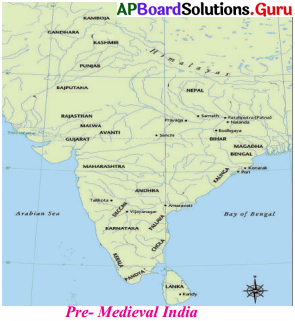
Review Of Your Previous Knowledge
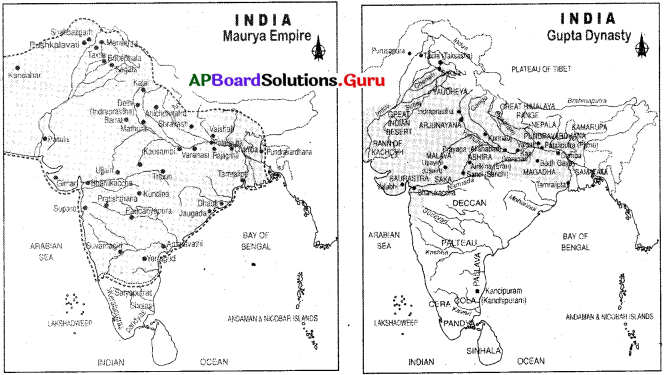
AP Board 7th Class Social Solutions 5th Lesson Kakatiya Kingdom

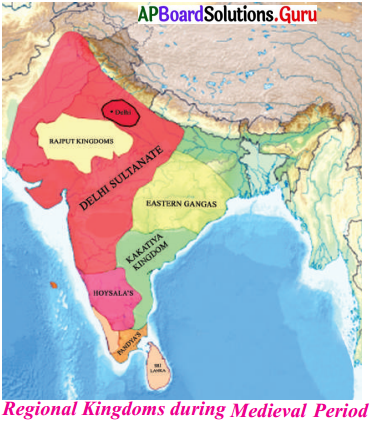
Observe the given Map and respond to the following questions.

Question 1.
Which dynasties do you observe in the given map?
Answer:

  1. Rajput kingdoms
  2. Delhi Sultanate
  3. Eastern Gangas
  4. Kakatiya kingdom
  5. Hoyasalas
  6. Pandyas

Question 2.
According to given map who ruled Andhra region?
Answer:
Kakatiya Kingdom.

AP Board 7th Class Social Solutions 5th Lesson Kakatiya Kingdom

Question 3.
Name the South Indian kingdoms in the given map?
Answer:

  1. Delhi Sultanate
  2. Eastern Gangas
  3. Kakatiya Kingdom
  4. Pandyas.

Improve Your Learning

I. Answer the following questions.

Question 1.
How did the Kakatiyas emerge as independent rulers?
Answer:

  1. Early Kakatiyas served as a feudatories to the Rashtrakutas and the Western Chalukya kings.
  2. They were holding the posts of village heads called Rattadi and through their military skills became army chiefs, Samanthas, etc., and gained control over Ammakonda in Telangana.
  3. The Kakatiyas emerged as independent rulers after the fall of Western Chalukyas.

Question 2.
Explain about the Kakatiya’s Administration.
Answer:
Kakatiya’s Administration :

  1. The administration of the kingdom was organised on a military basis.
  2. The Kakatiyas divided their territories among a number of military chiefs known as Nayankara.
  3. The Nayankara had to maintain a stipulated number of troops for the services of the king.
  4. The village administrative divisions were divided into two main classes, the Sthala and the Nadu.
  5. The Sthala consisted of a group of villages ranging perhaps from 10 to 60 in number.
  6. Nadu formed out of a combination of several Sthalas.
  7. The villages were looked after by village officials called Ayagars.
  8. The village was the basic unit of administration.

Question 3.
Who were Nayankara? Why were they appointed?
Answer:
Nayankara who served as a feudatory to the Kakatiyas obtained grants of lands from the Kakatiya monarchs to enable them to maintain their status.

“The skilled warriors are called Nayankar.”

They were appointed to collect the taxes and the maintain the army.

These Nayankaras were always loyal to the king or queen.

Question 4.
Describe the Kakatiya art and architecture.
Answer:
Art and Architecture of Kakatiyas :

  1. The Thousand pillar temple and Ramappa temple were glorious constructions of the Kakatiya dynasty.
  2. The iconic Kakatiya Toranam was built by Ganapathi Deva.
  3. The scenic Pakhal Lake in Warangal is one of the famous.
  4. The Thousand pillar temple has rock cut elephants and the monolithic dolerlte rock Nandi are the main attractions.
  5. Ramappa temple was built with brick.
  6. The carvings on them depict flowers, creepers, elephants, gandharvas, dancers, epic stories, etc.
  7. Among the statues Yakshini’s and Nagini’s are most attractive.
  8. Some of the pillars of that temple produce Saptaswaras.
  9. Kakatiya temple architecture shows fantastic smooth carving of black-marble stone.
  10. They followed Mandapa, Antaralaya and Garbha griha model with pillar sculptures. This style is called Thrikuta method.
  11. UNESCO recognised this art and architecture as world heritage centres.

AP Board 7th Class Social Solutions 5th Lesson Kakatiya Kingdom

Question 5.
Read Introduction paragraph “During medieval period …………. art and architecture” comment.
Answer:
During the medieval period five important kingdoms are there in South India. Among them Kakatiyas are very famous.

  1. Though they faced so many rampages from other kingdoms the Kakatiya’s did their best to protect their kingdoms.
  2. They put more effort to promote unity among the regions which are under their control.
  3. They encouraged local languages with the help of poets and scholars.
  4. The protect their own architecture with the construction of temples and arches, etc.

Question 6.
Rudrama Devi, Ganapathi Deva, Prola raj II, Mahadev Rudra deva. Following rulers arrange in a chronological order.
Answer:
Kakatiya Rules:

  1. Prola Raju-II : 1115-1157 C.E
  2. Maha Deva : 1195-1199 C.E
  3. Ganapathi Deva : 1199-1262 C.E
  4. Rudramma Devi : 1262-1289 C.E

Question 7.
A European traveller visited Rudrama Devi reign. Who was he and which country did he come from?
Answer:
Marco Polo an Italian traveller visited Rudrama devi’s court.

Question 8.
Write a short note on the Economic and Social life of people in the Kakatiya reign.
Answer:
Economic Social life of people :

  1. Some of the farmers get the land from the king on rent purpose these are called Artha Seeri.
  2. The Kakatiyas brought large tracts of forest land under cultivation.
  3. For the encouragement of agriculture rulers dug many tanks and constructured reservoirs.
  4. During this period trade tax, lllari (house tax), Pullari (forest products), tax upon of flock (Addapatlu Sunkam) were imposed.
  5. The imposed professional tax on artisans.
  6. They appointed officials called Sunkadhikavisfor tax collection.
  7. The Kakatiya kings gave much importance to foreign trade.
  8. They developed Motupalli Port for this purpose.
  9. In this period many women members of royal families made land grants.
  10. Land, tanks, money, cattle, jewellery, etc., were donated to temple’s, brahmins and others.

Question 9.
Which regional dynasties emerged in the south India in Medieval era?
Answer:
During the medieval period five important kingdoms emerged in South India.
They are:

  1. The Chalukyas of Kalyani,
  2. The Yadavas,
  3. The Kakatiyas,
  4. The Hoyasalas and
  5. The Pandyas.

Question 10.
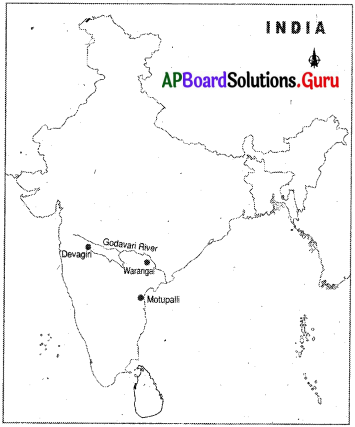
Locate the following places in India map.
a) Godavari river b) Motupalli c) Warangal d) Devagiri
Answer:
AP Board 7th Class Social Solutions 5th Lesson Kakatiya Kingdom 2

II. Choose the correct answer.

1. Founder of the Kakatiya Dynasty was ………….
a) Gundyana
b) Recharla Rudra
c) Ganapathi deva
d) Jayapa
Answer:
a) Gundyana

2. The Kakatiyas worshipped the mother goddess ……………..
a) Ammathalli
b) Kakati
c) Tripurasundari
d) Maisamma
Answer:
b) Kakati

3. Siva tatava saaram was written by ……………..
a) Mallikharjuna Panditharadya
b) Jayapa
c) Palkurki Somanadha
d) Nanne Choda
Answer:
a) Mallikharjuna Panditharadya

4. In every village some land was kept under king’s possession it was …………….
a) Velipolam
b) Rachapolam
c) Thotapolam
d) All the above
Answer:
b) Rachapolam

5. Motupalli inscription was issued by ………………
a) Rudrama Devi
b) Rudra Deva
c) Prataparudra
d) Ganapathi Deva
Answer:
d) Ganapathi Deva

III. Match the following.

Group-A Group-B
1. Basava puranam a) Vidhyanadha
2. Kumara Sambhavam b) Palkurki Somanadha
3. Nrutya Ratnavali c) Nanne Chodudu
4. Pratapa Rudreeyamu d) Tikkana
5. Srimadandhra Mahabharatam e) Jayapa

Answer:

Group-A Group-B
1. Basava puranam b) Palkurki Somanadha
2. Kumara Sambhavam c) Nanne Chodudu
3. Nrutya Ratnavali e) Jayapa
4. Pratapa Rudreeyamu a) Vidhyanadha
5. Srimadandhra Mahabharatam d) Tikkana

IV. Fill in the blanks with suitable words.

1. Ramappa temple is located at ………………… .
2. Vilasa Grant referred to ………………… Nayaka.
3. Rekhapalli lies in the ………………… river basin.
4. Educational institutions Ghatikas were established by ………………… kingdom.
5. Capital of Yadavas ………………… .
Answer:

  1. Warangal near Palampet village.
  2. Prolaya
  3. Sabari
  4. Chalukyas of Kalyani
  5. Devagiri

Puzzle

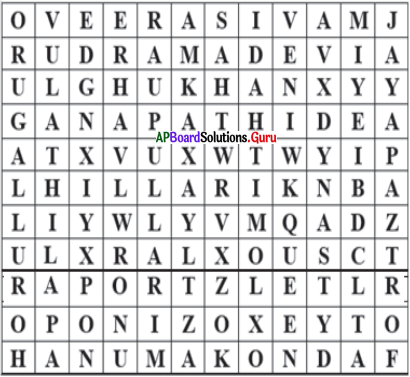
Draw boxes with help of given clue words.
AP Board 7th Class Social Solutions 5th Lesson Kakatiya Kingdom 3
1. Early capital of Kakatiya’s (11)
2. Women ruler in Kakatiya’s (11)
3. New capital of Kakatiya’s (8)
4. Prataparudra lost his throne due to the invasion of (9)
5. Nrutya ratnavali written by (6)
6. A fortified building called (4)
7. Women ruler (5)
8. Tax on forest products (7)
9. House tax (6)
10. The place where ships are allowed (4)
11. Founder of Chalukyas (7)
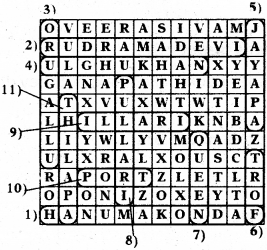
Answer:
AP Board 7th Class Social Solutions 5th Lesson Kakatiya Kingdom 4

  1. Hanukonda
  2. Rudrama Devi
  3. Orugallu
  4. Ulghu Khan
  5. Jayapa
  6. Fort
  7. Queen
  8. Pullari
  9. lllari
  10. Port
  11. Thilapa

7th Class Social 5th Lesson Kakatiya Kingdom InText Questions and Answers

7th Class Social Textbook Page No. 72

Question 1.
Have you heard any news related to ancient excavations and remains of historical monuments? Discuss in class.
Answer:
Yes, I heard some news about excavations in recent times.

Madurai: A granite plough and a tiny terracotta cubical dice have been found during the latest excavations at Keeladi ancient site in Tamilnadu.

R. Sivanatham, Deputy Director of Archaeology, State Archaeological Department, said the cubical dice has numbers one, two, three, four, five and six marked on it with depressions.

The three-sided granite plough is indicative of the fact that the people of Keeladi was indulged in farming according to him.

Think & Respond

7th Class Social Textbook Page No. 68

Question 1.
How do you think Rudrama Devi got those brave adventurous qualities?
Answer:
It was possible because that she was trained well from her childhood in the martial arts as well as in administrative skills.

They helped her to lead large armies and become a good administrator.

AP Board 7th Class Social Solutions 5th Lesson Kakatiya Kingdom

7th Class Social Textbook Page No. 69

Question 2.
Why did the Kakatiya rulers transfer the Nayankaras frequently?
Answer:
Nayankara were given several villages from where they could collect tax, but they did not keep the villages permanently.

They could be transferred at the will of the king to a new place.

7th Class Social Textbook Page No. 71

Question 3.
What aspects do you observe while visiting a temple?
Answer:
I observed the following aspects :

  1. This temple is famous for Vishnu and Siva being combinedly worshipped in the same place.
  2. Temple was built with brick.
  3. The statues of this temple were made of black granite stone.
  4. They used decorative art very beautifully.
  5. The statue of Nandi here is very splendid.
  6. Some of the pillars of that temple produce Saptaswaras.

7th Class Social Textbook Page No. 73

Question 4.
Why did all the local kings form into an alliance?
Answer:
The local kings formed an alliance to protect themselves from Muslim invasions.

Ex : Prolaya Verna Reddy and Prolaya Nayaka had joined efforts to drive the Muslim rule out from their area.

Explore

7th Class Social Textbook Page No. 64

Question 1.
Know the duration of the Medieval period with the help of your teacher.
Answer:
The Medieval period may be divided into two periods.
1. The Early Medieval period which lasted from the 6th to the 13th century and the “Late Medieval period” which lasted from the 13th to 16th century, ending with the start of the Mughal empire in 1526 A.D.

7th Class Social Textbook Page No. 67

Question 2.
Find out more details about Kakatiya Kala Thoranam from the internet.
Answer:

  1. The arch was built around 12th century during the rule of Kakatiya dynasty.
  2. The monument was included in the list of UNESCO World Heritage site.
  3. The Warangal Fort has four Arnamental gates to the destroyed great Shiva temple which are known as Kakatiya Kala Toranam.
  4. These gates or arches in the Warangal Fort are said to have similarities with the gateways of the Sanchi Stupa.

AP Board 7th Class Social Solutions 5th Lesson Kakatiya Kingdom

7th Class Social Textbook Page No. 73

Question 3.
Let us discuss : What do we learn from History?
a) We should know the past and act wisely in future.
b) We should learn the heritage and culture from the past
Now add your opinion ……………………
…………………………………………………..
Answer:

  1. History helps us develop a better understanding of the world.
  2. History teaches a working understanding of change.
  3. History gives us the tools we need to be decent citizens.
  4. History makes us better decision makers.

Project Work

Collect the pictures related to Kakatiya kingdom and prepare photo album.
Answer:

AP Board 7th Class Social Solutions 11th Lesson Road Safety Education

SCERT AP 7th Class Social Study Material Pdf 11th Lesson Road Safety Education Textbook Questions and Answers.

AP State Syllabus 7th Class Social 11th Lesson Questions and Answers Road Safety Education

7th Class Social 11th Lesson Road Safety Education Textbook Questions and Answers

Improve Your Learning

I. Answer the following questions.

1. Prepare slogans to create awareness on the prevention of road accidents.
Answer:

  1. Little attention on road leads you risk free journey.
  2. Stop – Look – Go while you cross the road.
  3. Drive with carefulness because you life is priceless.
  4. Line and signs on the road are the symbols of your safety.
  5. Respect the road rules – Be a responsible citizen.

Question 2.
If you are a traffic officer, which steps would you like to suggest to the students to reach the school safely?
Answer:

  1. I would create indepth awareness about the rules to be followed on road.
  2. Ask the school staff to conduct a mock road usage like Kerb drill.
  3. I will ask the students to follow the basic rules like
    a) Always walk on footpath.
    b) Cross the road at Zebra Crossing only.
    c) If Zebra Cross is not available, find safe place to cross, look first at right, then left, if everything is clear – cross the road safety.
    d) Start early to reach your destination in time and avoid hurriedness on road.
    e) Follow the traffic signs strictly. Use hand signs wherever necessary.
    f) Give adequate space to heavy vehicles and never overtake them.

AP Board 7th Class Social Solutions 11th Lesson Road Safety Education

Question 3.
What are the traffic rules you need to follow while using road?
Answer:
Rules for pedestrians :

  1. Use footpath to walk on road. Else walk on left side margin.
  2. Cross the road only at Zebra Crossing. If it is not available follow Kerb drill.
  3. Be cautious at signal lights and move accordingly.
  4. Don’t go for triple ride on cycle or motor cycle.
  5. Avoid using phones on road and listening to music.
  6. Don’t play on road and let pet animals on road.
  7. Use torch and reflectors during night time
  8. Don’t overtake vehicles from left.
  9. Don’t ride close to heavy vehicles.
  10. Don’t accept gifts from strangers.

Question 4.
What are the duties of a traffic police?
Answer:

  1. Traffic police is the person who assigned the duties of regulating, the traffic and guide the public for safe travel on road.
  2. Inculcate awareness on road usage among public.
  3. Regulate the flow of traffic.
  4. Alert the people regularly to avoid road accidents.
  5. Make arrangements for emergency medical help to the victim of road accidents.
  6. Accord penalties to the road users who violate road safety rules.

Question 5.
Give suggestions to prevent road accidents.
Answer:

  1. Follow the road rules and traffic signs compulsorly.
  2. Use vehicles as per speed limits on road.
  3. Always ride the vehicles in controllable speed.
  4. Use helmet, seat belts.
  5. Avoid using mobile phone on road and listening music.
  6. Inculcate awareness on road usage measures from school life.
  7. Do not rush on roads.
  8. Do not play and let animals on road.
  9. Do not chase or overtake the power driven vehicles.
  10. Driving licence is mandatory for power driven vehicles..
  11. Trauma care must be available on high ways.

II. Choose the correct answers.

1. Which of the following colour lights indicate stop before line?
A) Orange
B) Green
C) Red
D) Yellow
Answer:
C) Red

2. Find out the odd one.
A) Footpath
B) Bridge
C) Divider
D) Zebra crossing
Answer:
B) Bridge

3. Which is a road safety hurdle?
A) Using footpaths by pedestrians
B) Following traffic signals
C) Pedestrians crossing the road at zebra crossing
D) None
Answer:
D) None

AP Board 7th Class Social Solutions 11th Lesson Road Safety Education

III. Match the following.

Group-A Group-B
1. Footpath a) Road marking sign
2. Red colour light b) Get ready to go
3. Green colour light c) Pedestrians
4. Orange colour light d) Move the vehicle
5. Road divider e) Stop before the line

Answer:

Group-A Group-B
1. Footpath c) Pedestrians
2. Red colour light e) Stop before the line
3. Green colour light d) Move the vehicle
4. Orange colour light b) Get ready to go
5. Road divider a) Road marking sign

7th Class Social 11th Lesson Road Safety Education InText Questions and Answers

7th Class Social Textbook Page No. 57

Question 1.
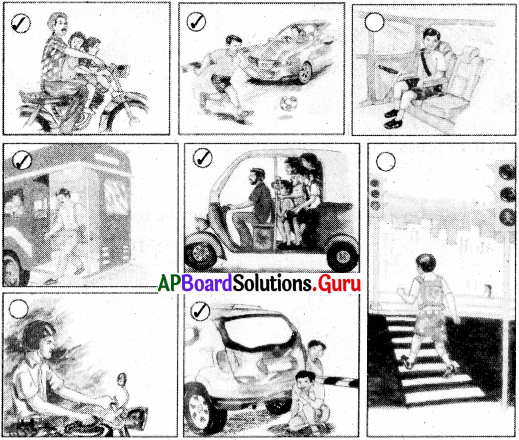
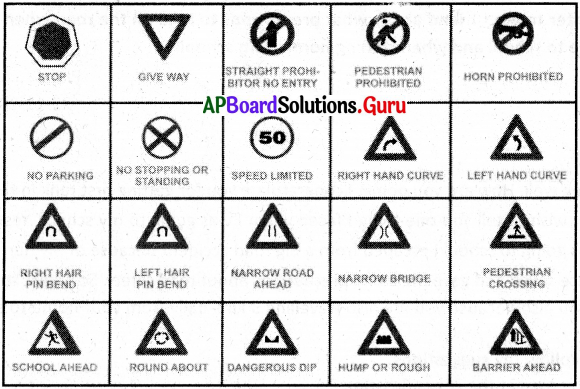
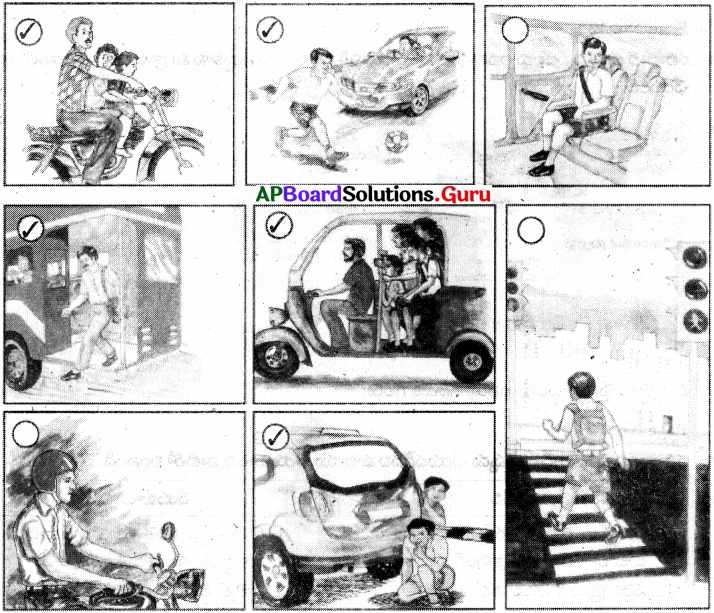
Observe the pictures given below and put a tick mark (✓) against pictures that are dangerous.
AP Board 7th Class Social Solutions 11th Lesson Road Safety Education 1

7th Class Social Textbook Page No. 63

Question 2.
Interact with traffic police about traffic rules.
Ans. One day after school hours I met the traffic police who discharges his duties on the road.
Even though he is busy with duties but accepted my request to explained the following traffic rules.

  1. Pedestrains should walk on footpath.
  2. Cross the road at zebra crossing.
  3. Look behind and cross only when there is enough gap.
  4. Never play on the road.
  5. Nevel walk on railway tracts.

7th Class Social Textbook Page No. 67

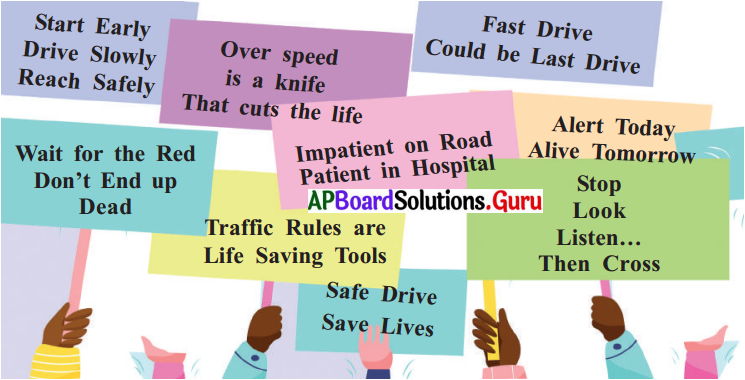
Question 3.
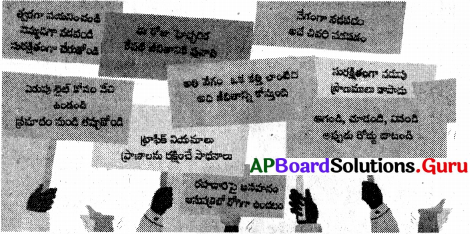
Let’s pick up the placards and make a rally in your village/ town to aware people on road safety.
AP Board 7th Class Social Solutions 11th Lesson Road Safety Education 4
Answer:

7th Class Social Textbook Page No. 68

Question 4.
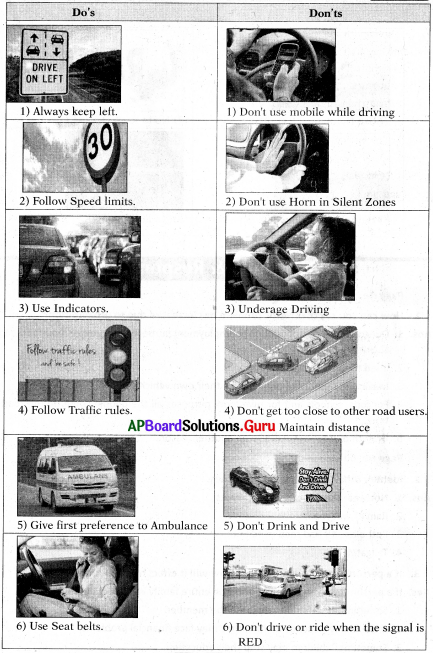
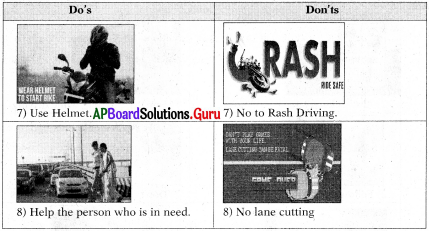
Fill up the following with Do’s and Don’ts while using the road.
AP Board 7th Class Social Solutions 11th Lesson Road Safety Education 5
Answer:
AP Board 7th Class Social Solutions 11th Lesson Road Safety Education 6 AP Board 7th Class Social Solutions 11th Lesson Road Safety Education 7

Think & Respond

7th Class Social Textbook Page No. 57

Question 1.
How can you say that traffic problem has increased due to urbanization?
Answer:

  1. Due to rapid industrialisation for employment purpose more people move to the towns & cities.
  2. It led to the increase of traffic.
  3. Maximum number of people have their own vehicles.
  4. For jobs, schools and for own work purposes all the people come on the road at a time.
  5. Growth of population is also an another reason.

7th Class Social Textbook Page No. 60

Question 2.
Identify other reasons for road crashes.
Answer:

  1. Not wearing seat belts and helmets.
  2. Rain or wet roads.
  3. Potholes and Bad road condition.
  4. Tailgating etc.

AP Board 7th Class Social Solutions 11th Lesson Road Safety Education

Question 3.
If a person met with a road crash, how will it effect his / her family?
Answer:
If a person met with an road crash, the entire family will effect by the following,

  1. Sometimes the family may loose the member.
  2. If the family depends on him, they may face financial problems.
  3. Sometimes children may stop their education.

Question 4.
How do you react when somebody met with an crash on the road?
Answer:

  1. At first, I will check how is the person’s condition. If it is ok, means small incident.
  2. I will take the candidate to the hospital in case of minor injures, or I will call 108 in case of major accident.
  3. I will inform to the police and tell about what I saw on the spot of an crash

Question 5.
How a country’s economy effects, if majority of the youth lost their lives in accidents.
Answer:

  1. The economy of any country depends on the productive capacity of the youth of the country.
  2. If majority of the youth lost their lives in accidents, it would damage our economy.

7th Class Social Textbook Page No. 67

Question 6.
Now a days traffic is increasing rapidly. Find out the possible solutions for this.
Answer:

  1. Use of public transportation.
  2. Carpooling is a .very good option.
  3. If we want to go for short distance, we should go on foot.
  4. The government has to allocate sites to hospitals, colleges and offices in the outskirts of city.
  5. Government has to increase more number of public transport facilities.

Question 7.
What will happen if someone doesn’t follow traffic signals?
Answer:
If traffic signals are not followed, there can be more accidents.

Question 8.
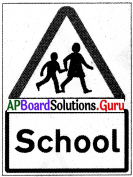
What sign boards are required at your school premises?
Answer:
AP Board 7th Class Social Solutions 11th Lesson Road Safety Education 8

  1. School is ahead, go slow.
  2. Drive slowly, children may cross the road.
  3. Blow Horn, save children.

Explore

7th Class Social Textbook Page No. 62

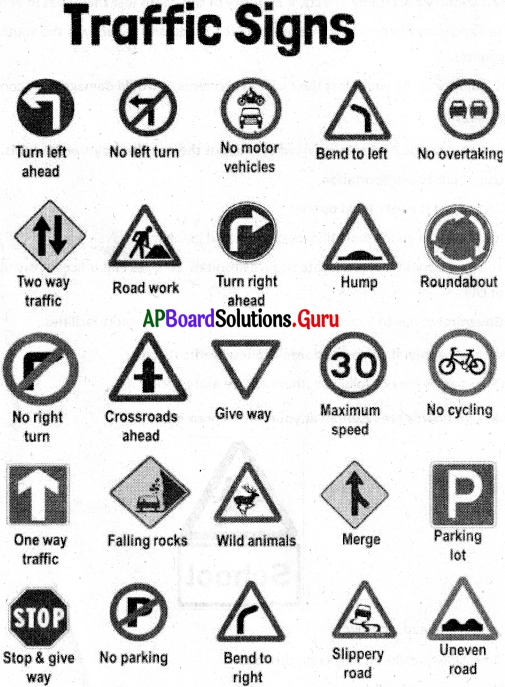
Question 1.
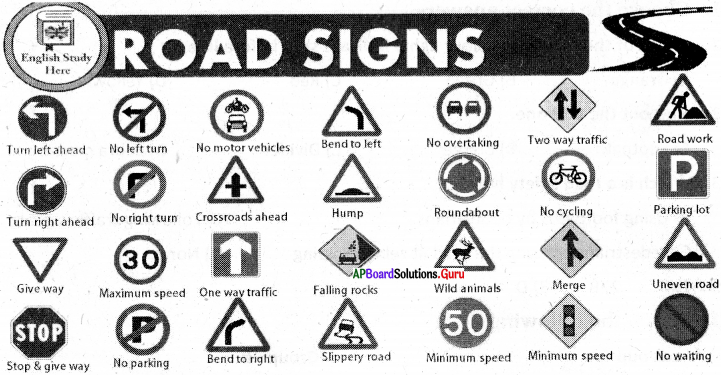
With the help of your teacher collect the remaining signs from RTA office/ Traffic Police. Discuss about them in the classroom. Or Visit: https://morth.nic.in/
Answer:
AP Board 7th Class Social Solutions 11th Lesson Road Safety Education 9

7th Class Social Textbook Page No. 62

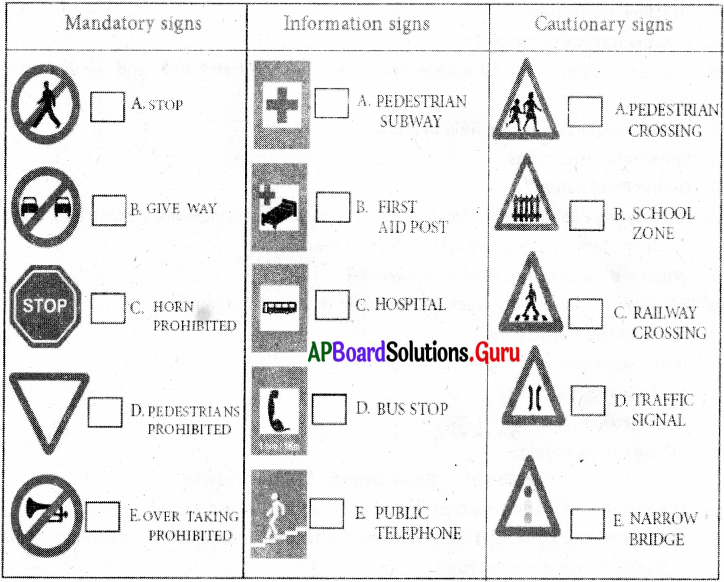
Question 2.
Match the following traffic signs with their meanings.
AP Board 7th Class Social Solutions 11th Lesson Road Safety Education 10
Answer:
Mandatory Signs : D, E, A, B, C
Information Signs : B, C, D, E, A
Cautionary Signs : B, C, A, E, D

Project Work

Question 1.
Prepare a model electronic traffic signals with all road marking signs.
Answer:
AP Board 7th Class Social Solutions 11th Lesson Road Safety Education 2
AP Board 7th Class Social Solutions 11th Lesson Road Safety Education 3

Question 2.
Visit traffic police office and learn about road safety.
Answer:
One day I visited traffic police office.
I met some of the traffic police officers here. They are explaining about road safety
measures to persons. Some of the following road safety measures.

  1. Always avoid distractions.
  2. Never break Red Signal.
  3. Keep a safe distance from the vehicle ahead.
  4. Always drive within speed limit.
  5. Always wear a helmet while riding a bike (or) Wear seat belt while driving a car.
  6. Follow the traffic signals.

AP Board 7th Class Social Solutions 11th Lesson Road Safety Education

Question 3.
Write a letter to your friend what precautions to take on the road when going from home to school and when coming home from school.
Answer:

Place : ………….
25-11-2021

Dear Murthy,

I am doing well. How are you doing. I congratulate you for getting first rank in the first semester. I wish to tell you one thing I faced when I was going to my school. Yesterday when I was going to school I escaped from a big road accident because of my hurry. The traffic police saved and gave me some precautions about road safety. So I want to share those to you also because you are also travelling 3 kms daily from your home to school daily.

Please do follow my suggestions.

  1. Cross the road at the Zebra Crossing….
  2. Do not run on the streets. …
  3. Always walk on the pavement….
  4. Do not stick your hand or head out of a moving vehicle. …
  5. Strap on seatbelts in cars. …
  6. Get off on the safer side of the car….
  7. Gear up for bicycle rides.

Wish you a bright future

Thank you raa.

Yours loving friend
BABU.

To
NLN Murthy
S/o. ………………………..
………………………………..
………………………………..

AP Board 7th Class Social Solutions 4th Lesson Delhi Sultanate

SCERT AP 7th Class Social Study Material Pdf 4th Lesson Delhi Sultanate Textbook Questions and Answers.

AP State Syllabus 7th Class Social 4th Lesson Questions and Answers Delhi Sultanate

7th Class Social 4th Lesson Delhi Sultanate Textbook Questions and Answers

Review Of Your Previous Knowledge
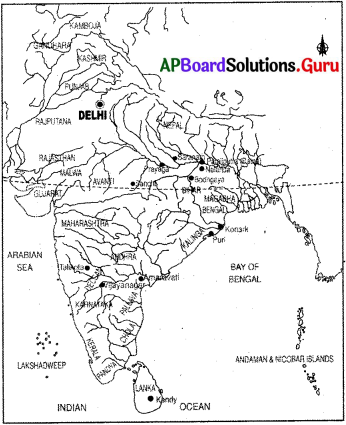
AP Board 7th Class Social Solutions 4th Lesson Delhi Sultanate 1

Observe the given Map and respond to the following questions.

Question 1.
Suggest a title to the map given here.
Answer:
Different dynasties in South India.

Question 2.
Find the different kingdoms in South India and list out them.
Answer:

  1. Pandya
  2. Chola
  3. Deccan
  4. Vijayanagar.

Question 3.
Locate any two cities in the map which are still in existence.
Ansnser:

  1. Sanchi
  2. Sarnath
  3. Pataliputra (Patna)
  4. Konark
  5. Puri.

AP Board 7th Class Social Solutions 4th Lesson Delhi Sultanate

Question 4.
Locate Delhi in the given map and discuss its importance.
Answer:
Delhi is of great historical significance as an important commercial, transport and cultural hub, as well as the political centre of India.

According to legend, the city was named for Raja Dhilu, a king who reigned in the region in the 1st century B.C.
AP Board 7th Class Social Solutions 4th Lesson Delhi Sultanate 2

I. Answer the following questions.

Question 1.
Write about Bandagan System introduced by lltutmish.
Answer:

  1. lltutmish purchased slaves for military service called Bandagan in Persian.
  2. The Sultan was confident in this system as these slaves were loyal and completely dependent on their king.
  3. It was continued during Khiljis and Tughlaqs.
  4. The heirs of the Bandagans who were loyal to Sultah were appointed as generals and governors.

AP Board 7th Class Social Solutions 4th Lesson Delhi Sultanate

Question 2.
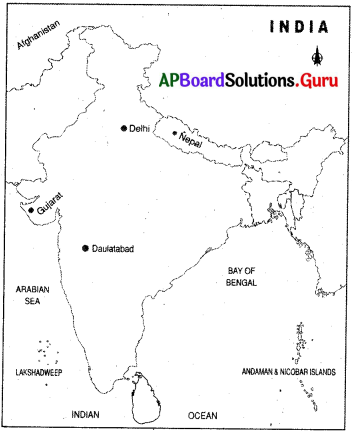
Locate the following in the out line map of India,
i. Delhi ii. Nepal iii. Afghanistan iv. Daulatabad v. Gujarat
Answer:
AP Board 7th Class Social Solutions 4th Lesson Delhi Sultanate 3

Question 3.
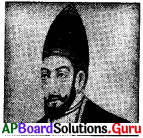
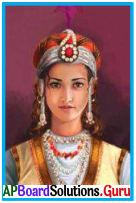
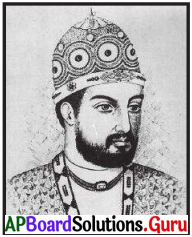
Collect and paste the pictures of any five rulers of the Delhi sultanate on a chart and write about them in five lines each.
Answer:
Five rulers of the Delhi Sultanate. MB

AP Board 7th Class Social Solutions 4th Lesson Delhi Sultanate 4
1. Qutubuddin Aibak

  1. Qutubuddin Aibak was a general of Muhammad Ghori.
  2. He was incharge of the Ghori territories in the Northern India.
  3. After death of Ghori, he became a ruler of an independent kingdom in India.
  4. He was the first ruler of Delhi Sultanate.
  5. He was the founder of Slave Dynasty in India.

AP Board 7th Class Social Solutions 4th Lesson Delhi Sultanate
2. Razia Sultana :

  1. Razia Sultan was the first Muslim woman, who was involved in the throne of Delhi.
  2. She succeeded her father lltutmish and turned into the Sultanate of Delhi.
  3. Razia Sultan was very wise, an excellent administrator and brave warrior.
  4. Being a profitable ruler Razia Sultan set up legitimate and complete peace in her domain.
  5. Each and every single person follows the rules and regulations set up by her.

AP Board 7th Class Social Solutions 4th Lesson Delhi Sultanate
3. Alauddin Khalji

  1. Alauddin Khalji was the successor of Jalaluddin Khalji.
  2. He took strong measures to control Mangole invasions and to curb his opponents.
  3. He maintained spy system to control the conspiring nobles.
  4. He recruited and organised a standing army.
  5. He strictly controlled the prices of commodities in the markets.

AP Board 7th Class Social Solutions Chapter 4 ఢిల్లీ సుల్తానులు 7
4. Muhamad bin Tughlaq

  1. Muhammad bin Tughlaq was the most learned and yet he was an eccentric ruler.
  2. He was proficient in philosophy, mathematics, astronomy etc.
  3. He was an excellent warrior and good administrator of innovative measures.
  4. He changed his capital from Delhi to Devagiri.
  5. He introduced copper coins.

AP Board 7th Class Social Solutions 4th Lesson Delhi Sultanate 5
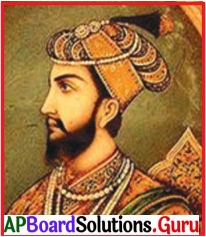
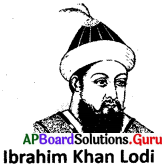
5. Ibrahim Khan Lodi

  1. Ibrahim Lodi was an Afghan Sultan of the Delhi Sultanate.
  2. He faced a numbers of rebellions.
  3. He was a very cruel and high headed ruler who was known for his atrocities.
  4. He fought with Rana Sangram. Ibrahim Khan Lodi
  5. He was defeated by Babur a Mughal ruler in the Battle of Panipat in 1526 A.D.

Question 4.
Write a brief note on administration of the Delhi Sultanate?
Answer:
Administration of Sultans :

  1. The Sultan authority was supreme in all aspects of administration.
    All the powers of political, legal, military and religious powers vested with him.
  2. The rule was in accordance with Shariat or the Islamic law.
  3. The Sultanate was divided into smaller units ’Iqtas, Shiqs, Parganas and Villages.
  4. The centre will not interfere in the affairs of village administration.
  5. The heirs of the Bandagans who were loyal to Sultan were appointed as generals and governors.
  6. Chahaigani played pivotal role during the period of lltutmish.

Question 5.
What is your opinion on introducing copper and brass coinage during the Tughlaqs?
Answer:
My opinion is

  1. It became difficult for Tughlaq to obtain regular supply of gold and silver for minting coins.
  2. Thus, he replaced those coins and started the circulation of copper and brass coins as the token currency.
  3. He asked the people to consider them equal to the value of gold and silver coins.

Question 6.
Write about Iqta system.
Answer:
Iqta system

  1. Delhi Sultanate was divided into Iqtas.
  2. The governors of these Iqtas were called Muqtis, the military officers.
  3. Muqtis had to maintain law and order in theirallotted Iqtas and had to provide military, revenue services to Sultan.
  4. Revenue collected from their Iqtas was utilised for administrative purpose and maintenance of army.
  5. Rank of Muqti was not hereditary.
  6. They were often transferred from one Iqta to another Iqta.

AP Board 7th Class Social Solutions 4th Lesson Delhi Sultanate

Question 7.
Write a few words on social and economic life of Delhi sultanate.
Answer:
Social Life :

  1. The Muslim community had two branches, foreign and local.
  2. Foreign origin stood first in the society. ‘
  3. They got many privileges and influenced the administration.
  4. The Indian Muslims were down graded to the second place.
  5. They occupied many jobs like teachers, judges etc. ‘

Economic Life:

  1. Agriculture was the main occupation.
  2. The tillers had to play 1/3 of their produce as land revenue.
  3. Textile industry was the main industry. .
  4. Trade was carried in both ways – internal and international.
  5. Alauddin Khalji introduced the market reforms. .
  6. Grains were stored in government granaries.
  7. Muhammad Bin Tughlaq was introduced copper and brass coins.

Question 8.
Explain the administrative failures of Mohammad-Bin-Tughlaq.
Answer:
Failures of Tughlaq :

  1. His campaign into Kashmir was a disaster, after which he gave up his plans to invade Transoxiana.
  2. The shifting of capital from Delhi to Daulatabad was a spoiled decision.
  3. He ordered entire population to move with bed and baggage. Many died during the travel and some after reaching the destination.
  4. The rising of taxes and famine, the Ganga, Yamuna belt led to the wide spread of rebellions.
  5. He also, introduced ‘Token’ currency in copper coins and agriculture reforms. These were ill-calculated experiments which provied a miserable failures of Muhammad bin Tughlaq.

II. Choose the correct answer.

1. The Delhi Sultans divided the Empire into …………………..
a) Mandala
b) Iqtas
c) Nadus
d) Valanadus.
Answer:
b) Iqtas

2. People started minting coins in their homes during the period of ……………….
a) Alauddin Khalji
b) Balban
c) Muhammad bin Tuglaq
d) Ibrahim Lodi
Answer:
c) Muhammad bin Tuglaq

3. Alauddin Khalji was connected to this issue.
a) Branding of horses
b) Changing of capital
c) Founder of Khilji dynasty
d) All the above
Answer:
a) Branding of horses

4. Alai Darwaja was constructed by
a) Muhammad bin Tuglaq
b) Alauddin Khalji
c) Gyasuddin Balban
d) Sikindar Lodi.
Answer:
b) Alauddin Khalji

5. Iqtas were administered by
a) Muqtis
b) Governors
c) Wazirs
d) Quazis
Answer:
a) Muqtis

III. Match the following.

Group-A Group-B
1. Slave Dynasty a) Bahalul Lodi
2. Tuglaq Dynasty b) Khizr Khan
3. Khalji Dynasty c) Ghiyasuddin
4. Lodi Dynasty d) Qutb’uddin Aibak
5. Sayyad Dynasty e) Jalaluddin

Answer:

Group-A Group-B
1. Slave Dynasty d) Qutb’uddin Aibak
2. Tuglaq Dynasty c) Ghiyasuddin
3. Khalji Dynasty e) Jalaluddin
4. Lodi Dynasty a) Bahalul Lodi
5. Sayyad Dynasty b) Khizr Khan

IV. Identify and write the rulers to the description given below.

Famous Woman ruler
Founder of Slave dynasty
Couplet writer during Tughluks
Shifting of Capital
Last ruler of Delhi Sultans
The first ruler of Mughal dynasty

Answer:

Famous Woman ruler Raziya Sultana
Founder of Slave dynasty Qutubuddin Aibak
Couplet writer during Tughluks Amir Khusrau
Shifting of Capital Muhammad – Bin – Tughlaq
Last ruler of Delhi Sultans Ibrahim Lodi
The first ruler of Mughal dynasty Babar

Puzzle

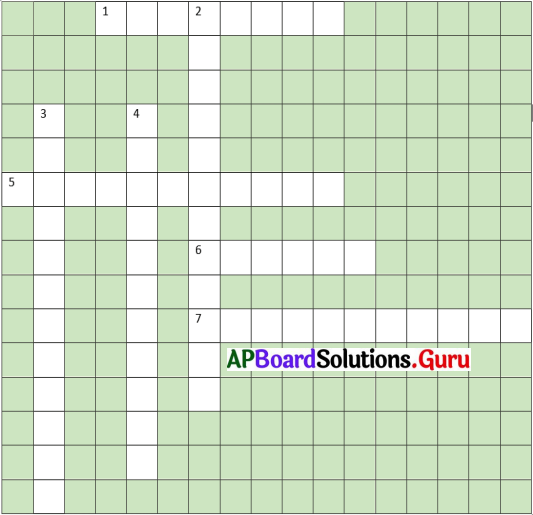
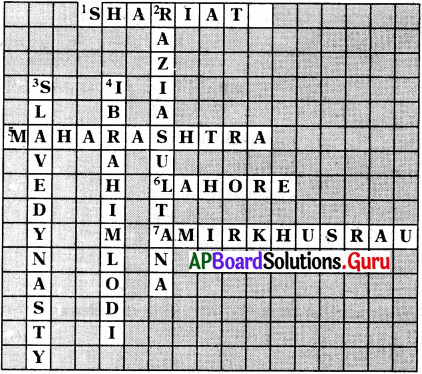
Solve the puzzle with the words related to given hints.
AP Board 7th Class Social Solutions 4th Lesson Delhi Sultanate 6

Down :
2. Famous woman Muslim ruler (12)
3. Another name of Mamluk dynasty (12)
4. The last ruler of Delhi Sultanate (11)

Across:
1. The rule is based on Islam principles. (7)
5. Daulatabad is located in this state (11)
6. The first capital of Delhi sultanate (6)
7. The writer of couplets (11)
Answer:
AP Board 7th Class Social Solutions 4th Lesson Delhi Sultanate 7

7th Class Social 4th Lesson Delhi Sultanate InText Questions and Answers

7th Class Social Textbook Page No. 50

Question 1.
Collect the names of some literary works of the Medieval period and write them on a chart.

Name of the book Writer
1. Tarik-AI-Hind Alberuni
2. Tuti-e-Hind Amir Khusrow
3. Badshah Nama Abdul Hamid Lahori
4. Tughlaq Nama Amir Khusrow
5. SurSagar Surdas
6. Periya Puranam Sekkilar
7. Amukta Malyada Sri Krishna Devaraya
8. Shahnama Ferdowsi
9. Kitab-ul-Rehla Ibn Battuta

Question 2.
Have you visited any historical places earlier? Try to write a travelogue.
Answer:
Yes, I visited important historical places, Madurai, Rameswaram in Tamilnadu.

Like a lot of other trips, Madurai to Kanyakumari circuit had been on my mind for a long time. Since the whole trip was not working out I went for a short trip to Madhurai and Rameshwaram.

I went on road way. The road from Madurai is single lane but very good and does not have too much traffic like NH.7.

I stayed at a Hotel. It provide all facilities.

About Madurai:
I saw Meenakshi temple is what makes Madurai famous.

Temple is located at the middle of the city. I can enter the temple from all four directions, but east is the recommend direction to enter.

As I go inside by design I get into the queue for darshan. And came out only after I have had the darshan.

When I came after the Sundareswar darshan from the exit on the eastern side, i came across the Mandapam or hall with thousand pillars. The central hall has Nataraj Statue.

Next I went to Rameswaram Temple.

This temple is similar to the Madurai Meenakshi temple, may be a bit smaller. The unique feature of this temple is the 22 wells. The temple has many Shiva Lingas.

I returned after 3 days. I am so tired, but I am happy I did it.

Question 3.
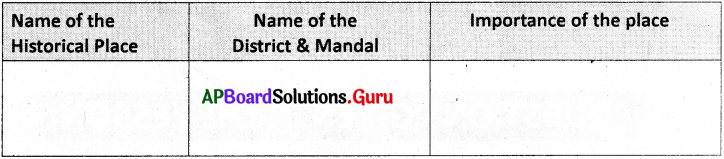
Name some historical places in your surroundings in the following proforma :
AP Board 7th Class Social Solutions 4th Lesson Delhi Sultanate 13
Answer:

Name of the Historical Place Name of the District & Mandal Importance of the place
1. Gandikota Fort Kadapa district Jammalamadugo (Md) Sand fort
It was ruled by Kalyani Chalukyas and Kamma kings.
2. Lepakshi Anantapur-(dt)

Hindupur

Vijayanagara kings ruled this area. Veerabhadra Temple is there.
3. Amaravati Guntur (Dt) It is the capital of Andhra Satavahanas. Famour pilgrimage site for Hindus & Buddhists.
So many dynasties ruled this place.
4. Kondareddy Buruju / Fort Kurnool The fort has different gateways and bastions. It was ruled by Vijayanagara Kings.
5. Undavalli caves Guntur (Dt) These are ancient cave temples. It was ruled by Vishnu kundinas famous for Gupta architecture. Lord Vishnu statue is there.
6. Chandragiri Fort Chittoor District Near Tirupati It came under the control of Vijayanagara Kings.
7. Kondapalli Fort Krishna District It was built by Reddy Kings.
It was used as business centre.
During colonial rule British soldiers were given training in this fort.

7th Class Social Textbook Page No. 53

Question 4.
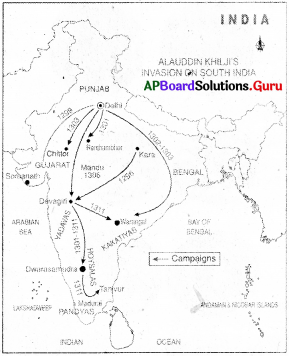
List out the invasions of Alauddin Khalji the Map 4.2. into South India with place and year based on
Answer:
Invasions of Alauddin Khalji

Year Place
1. 1296 Devagiri
2. 1301-1311 Dwarasamudra
3. 1311 Madurai
4. 1311 Warangal

AP Board 7th Class Social Solutions 4th Lesson Delhi Sultanate 14

7th Class Social Textbook Page No. 56

Question 5.
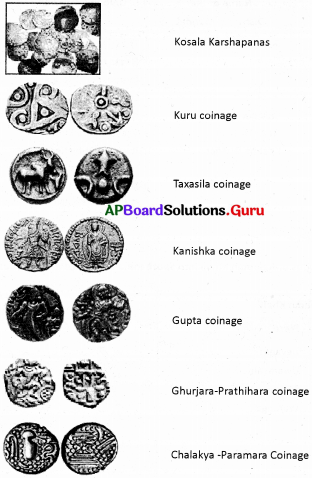
Collect the pictures of coins belong to different dynasties.
Answer:
AP Board 7th Class Social Solutions 4th Lesson Delhi Sultanate 15
AP Board 7th Class Social Solutions 4th Lesson Delhi Sultanate 16

7th Class Social Textbook Page No. 58

Question 6.
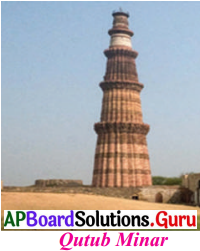
Qutub Minar stands as master piece of Delhi architecture. Discuss.
Answer:

  1. Qutub Minar construction was started by Qutubuddin Aibak and completed by lltutmist.
  2. The minar is made of red sandstone. The first three storeys are same.
  3. The Fourth and fifth storeys are of marble and sandstone.
  4. Highest tower with a height of 74.1 meters.
  5. It was constructed as a grand monument to celebrate the defeat of the last Hindu ruler of Delhi and the establishment of Muslim dominance.

Question 7.
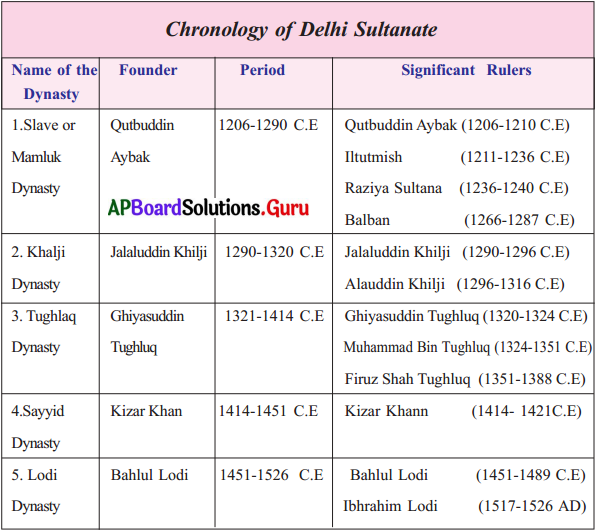
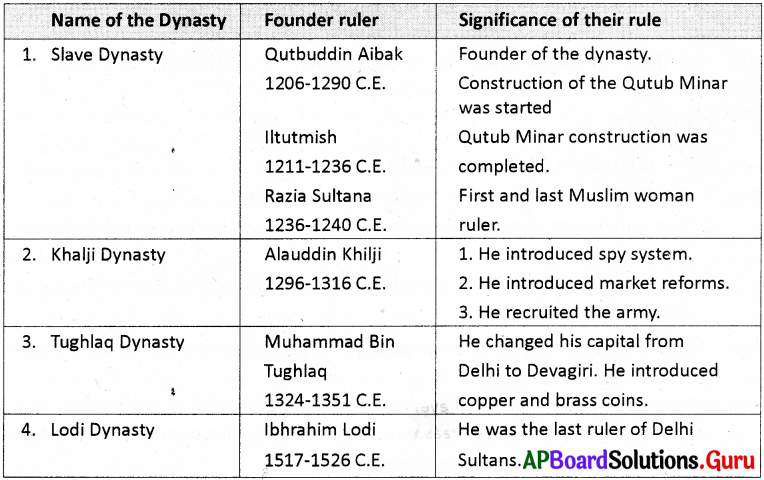
Prepare a table with the details of the famous rulers of Delhi sultanate and significance of their rule.
Answer:
Chronology of Delhi Sultanate
AP Board 7th Class Social Solutions 4th Lesson Delhi Sultanate 17
Significance of the Rulers

AP Board 7th Class Social Solutions 4th Lesson Delhi Sultanate 18

Think & Respond

7th Class Social Textbook Page No. 50

Question 1.
How are archeological sources useful for the study of history.
Answer:

  1. The archeological sources played an important role in construct or to reconstruct the history of a region.
  2. The archeological source enhanced our knowledge about our pa :” and ais provided important materials, which we could not have been obtained othe wise.

Example :
Inscriptions, coins, monuments are the archeological sources.

These material things provide valuable information about social, political ar d economic status of the people of the period.

They give evidences of Ancient history.

7th Class Social Textbook Page No. 52

Question 2.
During those days the ruling power was on hereditary basis. But sometimes Sons-in- law and Fathers-in law also occupied the crown. Imagine the reason behind it.
Answer:

  1. If the king did not have an eldest son, then his brother or another male relative may be appointed as king.
  2. Some of the kings were assassinated by their Son-in-law or Father-in-laws to gain the power.

AP Board 7th Class Social Solutions 4th Lesson Delhi Sultanate

Question 3.
As a woman ruler Rasia had to face discrimination and conspiracies. Are the women of the present times free to make their choices as a man would?
Answer:
Even though at present women are facing discrimination and conspiracies they au coming them and making their ae choices.

7th Class Social Textbook Page No. 53

Question 4.
What is corruption? And how it can be checked?
Answer:

  1. Illeagal ways and means of earning money is corruption.
  2. Establishing accountability through oversight systems and transparent decision-making.
  3. We can reduce corruption by increasing direct contact between government and the governed.

Question 5.
“Kings or rulers usually conduct campaigns on other kingdoms or places”, Find out the reasons.
Answer:
The general reason is each and every king or ruler has a desire to protect and extend their empire. Due to these kings reason usually conduct the campaigns on other kingdoms.
Ex : Alexander, Akbar, Aurangazeb, Asoka etc.

7th Class Social Textbook Page No. 54

Question 6.
What could be the reason for shifting the capital from Delhi to Daulathabad?
Answer:
Sultan changed the capital from Delhi to Devagiri (Daulathabad) as he wanted to establish it at a strategic point and at the central location and close proximity to the South.

Question 7.
What might be the reason for the death of many people on their travelling from Delhi to Daulathabad?
Answer:
Reasons:

  1. The distance between Delhi to Devagiri was far more than they expected.
  2. They carried heavy bed and baggage without transportation.
  3. In addition to that there was no suffient amount of food and water.

All these circumstances led them to their death while travelling Delhi to Daulatabad.

Explore

7th Class Social Textbook Page No. 58

Question 1.
Learn more information about the art and architecture of Delhi sultanate.
Answer:
The important architectures of Delhi Sultanate.

  1. Tomb of lltutmish.
  2. Purana Qila
  3. Tomb of Kale Khan
  4. Tomb of Darya Khan
  5. Tomb of Hashang Shah
  6. Mehrauli, Tomb of Imam Zamin
  7. The Alai Darwaja
  8. Tomb of Isa Khan
  9. The Qutub Minar
  10. Alauddiq Khilji’s Tomb
  11. Quwwat Ul Islam Mosque
  12. Lodhi Gardens etc.

Characteristics of Sultanate Architecture :

  1. A mixture of Indian and Iranian style.
  2. Buildings constructed with the material of Hindu temples.
  3. Pointed arched in Muslim structures’.
  4. Carvings
  5. Use of geometrical designs.
  6. Use of Stones and Lime.

AP Board 7th Class Social Solutions 4th Lesson Delhi Sultanate

Project Work

Prepare an album with the pictures of the constructions of Delhi Sultans and find out their style of Architecture.
Answer:
AP Board 7th Class Social Solutions 4th Lesson Delhi Sultanate 8
Qutub Minar :
The Qutub Minar is the world’s tallest brick minaret at 74.1 metres, built by Qutb-ud-din Aibak of the Slave dynasty in 1192 CE.

AP Board 7th Class Social Solutions 4th Lesson Delhi Sultanate 9
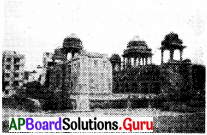
Jahaz Mahal:
Jahaz Mahal is built during the Lodi dynasty period (1452¬1526) as a pleasure resort,
Malwa architectural style,
AP Board 7th Class Social Solutions 4th Lesson Delhi Sultanate 10
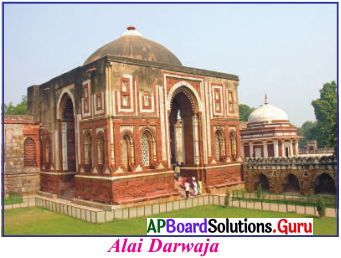
Alai Darwaja :
Indo-lslamic architecture

AP Board 7th Class Social Solutions 4th Lesson Delhi Sultanate 11
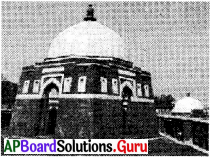
Tomb of Ghiyath al-Din Tughluq :
The tomb of the founder of the dynasty, Ghiyathal-Din Tughluq (d. 1325) is more austere, but impressive; like a Hindu temple, it is topped with a small amalaka and a round finial like a kaiasha. Unlike the buildings mentioned previously, it completely lacks carved texts, and sits in a compound with high walls and battlements.

AP Board 7th Class Social Solutions 4th Lesson Delhi Sultanate 12
Mausoleum of lltutmish :
Mausoleum of lltutmish, Delhi, by 1236, with corbel arches.

AP Board 7th Class Social Solutions 10th Lesson State Government

SCERT AP 7th Class Social Study Material Pdf 10th Lesson State Government Textbook Questions and Answers.

AP State Syllabus 7th Class Social 10th Lesson Questions and Answers State Government

7th Class Social 10th Lesson State Government Textbook Questions and Answers

Review of Your Previous Knowledge
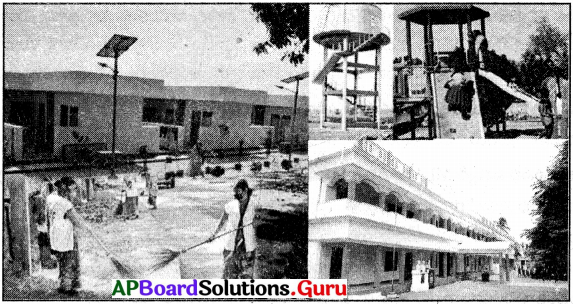
AP Board 7th Class Social Solutions 10th Lesson State Government 1

Observe the above pictures and respond to the following questions.

Question 1.
What do you observe in the picture?
Answer:
I observe the following in the above given picture :

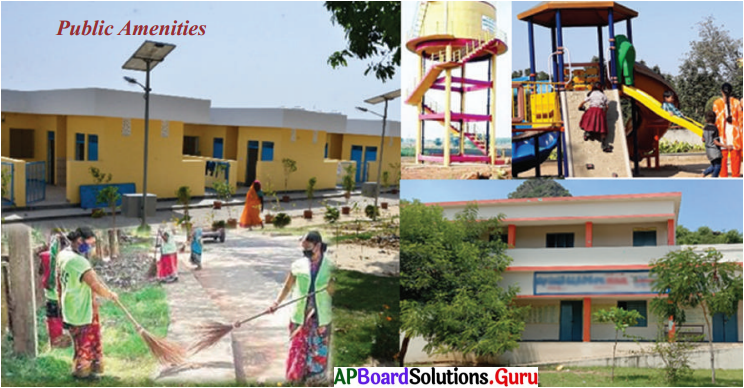
  1. School
  2. The children are playing in the Park
  3. Water tank
  4. Roads are cleaning by municipal workers.

Question 2.
What are the public amenities observed in the picture?
Answer:

  1. Safe drinking water.
  2. Park
  3. Removal of Garbage from the streets.
  4. School.
  5. Street Lights.

Question 3.
Who provides the public amenities?
Answer:
Government provides the public amenities.

AP Board 7th Class Social Solutions 10th Lesson State Government

Question 4.
What is a Government?
Answer:
A government is an institution or a system made of a group of people that takes care or manages a country or state.

Improve Your Learning

I. Answer the following questions.

Question 1.
Differentiate between Local Government and State Government.
Answer:

State Government Local Government
The Government offices, elected officials, bureaucrats, laws and government services that exist at the state level. The governments that cover smaller jurisdictions below the state level including village and city.

Question 2.
What is a Constituency?
Answer:
A constituency means the body of citizens eligible to vote for a particular representative.
(OR)
A country is divided into many separate units or areas for the purpose of holding elections.
Each area in which elections are held is known as a constituency. People living in a consti-tuency elect their own representative from their constituency.

Question 3.
How can an MLA become Chief Minister? Explain.
Answer:

  1. After the elections, the MLAs belonging to the ruling party will elect their leader who will become the chief minister.
  2. A Chief Minister is an elected head of the government who is selected through a majority in the state legislative assembly established by the vote of confidence in the legislative assembly, suggested by the governor of the state who is the appointing authority.

Question 4.
Who appoints the Chief Minister and other Ministers?
Answer:
The Governor appoints Chief Minister and other Ministers.

AP Board 7th Class Social Solutions 10th Lesson State Government

Question 5.
If you were elected as a Member of Legislative Assembly (MLA), what would you do for your Constituency?
Answer:
If I become MLA :

  1. First, I will study the problems of my constituency.
  2. I will meat the people of my constituency and ask their problems like electricity, drainage and water facilities, etc.
  3. In the time of Assembly session, I will address the problems of my constituency and try to solve them.

Question 6.
What will happen if the Governor does not approve the bill?
Answer:
A bill that the state legislature has passed can become a law only after the Governor gives assent.

Sometimes the Governor can return a bill to the state legislature for reconsideration.

After reconsideration, if the state legislature sends it back to the Governor for the second time, the Governor must assent to it.

Question 7.
Name some Departments of the State Government.
Answer:

  1. Public works department.
  2. The Agriculture Department.
  3. The Health Department.
  4. The Education Department and so on.

Question 8.
Write a note on Lok Adalat.
Answer:
Lok Adalts are people’s courts.

  1. It is one of the alternative dispute redreslsal mechanisms.
  2. It is a forum where cases pending in the court of law are settled amicably.
  3. Lok Adalat’s deal only civil, matrimonial and petty offence cases.
  4. Lok Adalat’s provide free and competent legal services to the weaker sections of thesociety.

Question 9.
Make a list of functions of the District Collector.
Answer:
Functions of District Collector:

  1. Collection of land revenue.
  2. Maintenance of land records, land reforms, consolidation of holding, etc.
  3. Distribution of agricultural loans.
  4. Collection of income tax dues, excise duties irrigation dues, etc.
  5. Disaster management during natural calamities such as floods, famines or epidemics, etc.

Question 10.
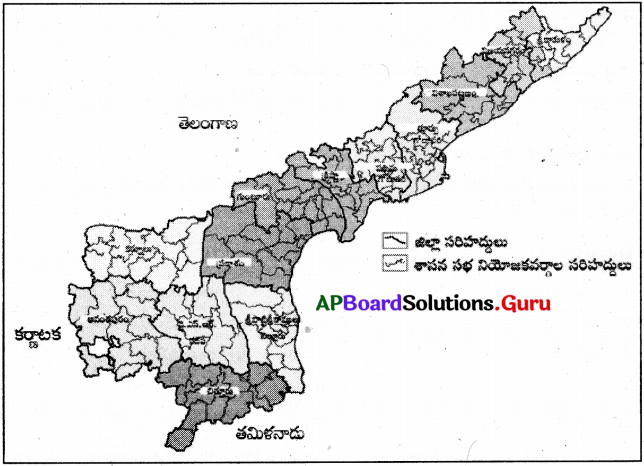
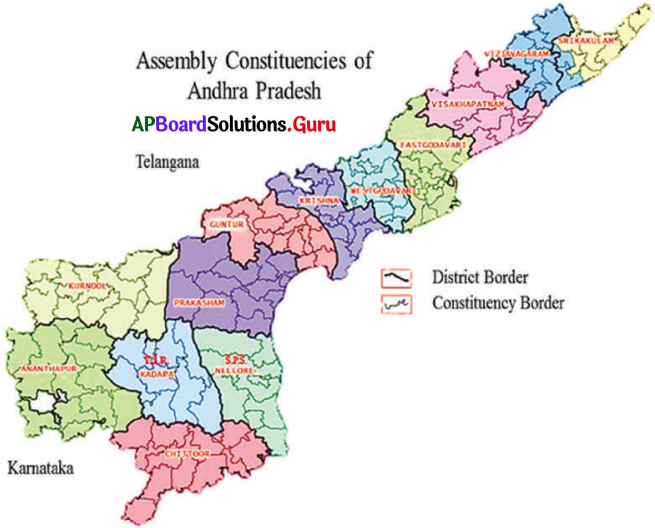
Locate the Assembly constituencies on the outline map of AP.
Answer:
AP Board 7th Class Social Solutions 10th Lesson State Government 2

District Constituencies
1. Srikakulam 10
2. Vizianagaram 9
3. Visakhapatnam 15
4. East Godavari 19
5. West Godavari 15
6. Krishna 16
7. Guntur 17
8. Prakasam 12
9. Nellore 10
10. Kadapa 10
11. Kurnool 14
12. Anantapur 14
13. Chittoor 14
Total 175

Question 11.
Appreciate the role of the District Collector in the development of a district.
Answer:
The District Collector is the head of the district administration. He/She is selected through UPSC, and allotted to states, by the Central Government. He has to take responsibility of various departments like Revenue (The Collector handles all matters connected to land records and Revenue Administration.), law & order (to maintain Law and Order to maintain Social harmony), local self-government, agriculture, disaster management (To take immediate actions at the time of disasters and prevent or minimize the damage) and Election Officer (To ensure the conduct of elections), etc. He is the First-class Magistrate at district Level.

Question 12.
Why is it necessary to elect a representative? Discuss.
Answer:
Now-a-days most of the countries followed democracy.

Due to vast areas and more population each and every country adopted representative democracy, means indirect democracy.

In this part instead of people, people’s representatives participated in law making, interact with constituents and decisions are taken by representives only.

So to elect the representatives is necessary.

II. Choose the correct answer.

1. The word State Government refers to
A) Government Departments in the States
B) Legislative Assembly
C) Legislative Council
D) All of the above
Answer:
D) All of the above

2. How many states are there in India?
A) 29
B) 28
C) 27
D) 26
Answer:
B) 28

3. The real powers in administration in the state government are exercised by
A) Speaker
B) Governor
C) Chief Minister
D) All of the above
Answer:
C) Chief Minister

4. Who becomes the Chief Minister?
A) Leader of the Opposition Party
B) Leader of the Majority Party
C) Member of Legislative Assembly
D) Speaker
Answer:
B) Leader of the Majority Party

III. Match the following.

Group-A Group-B
1. Chief Minister i) Legislative Assembly
2. Governor ii) Legislative Council
3. M.L.A iii) Head of the state
4. M.L.C iv) Head of the Govt.
5. Collector v) District Magistrate

Answer:

Group-A Group-B
1. Chief Minister iv) Head of the Govt.
2. Governor iii) Head of the state
3. M.L.A i) Legislative Assembly
4. M.L.C ii) Legislative Council
5. Collector v) District Magistrate

IV. 1. Segregate the following in suitable heading.
Speaker, Judge, Min ister, Member of Legislative Assembly, Lawyer, Chief justice,

Judiciary Legislature

Answer:

Judiciary Legislature
1. Chief justice 1. Member of Legislative Assembly (MLA)
2. Judge 2. Speaker
3. Lawyer 3. Minister

IV. 2.Fill the labile with correct words given. (AS – 3)
(175 members, MLA, Speaker, 58 members, 5 years, MLC, 6 years,Chairman)

Item Legislative Assembly Legislative Council
Term
No. of Members
Presides th e House
People representative

Answer:

Item Legislative Assembly Legislative Council
Term 5 years 6 years
No. of Members 175 58
Presides th e House Speaker Chair Person
People representative M.L.A. M.L.C.

7th Class Social 10th Lesson State Government InText Questions and Answers

7th Class Social Textbook Page No. 44

Question 1.
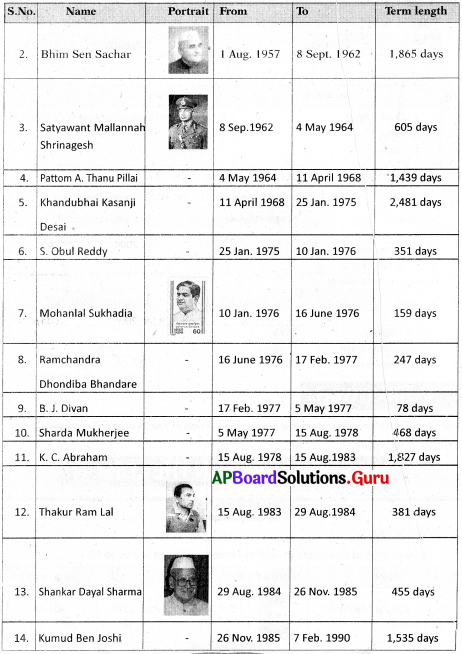
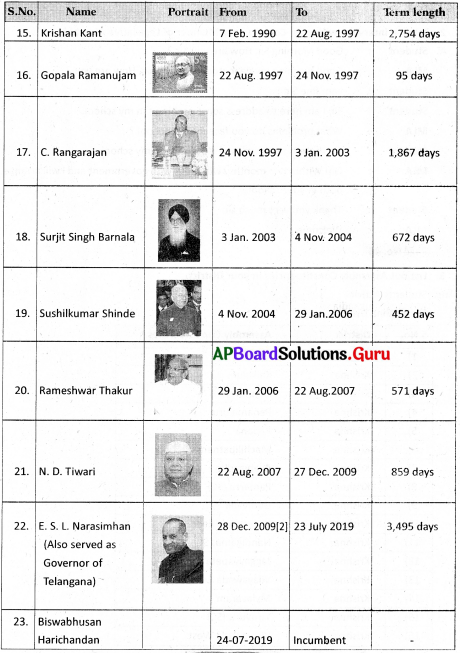
Make of a list of Governors of Andhra Pradesh, who has served so far.
Answer:
AP Board 7th Class Social Solutions 10th Lesson State Government 3
AP Board 7th Class Social Solutions 10th Lesson State Government 4
AP Board 7th Class Social Solutions 10th Lesson State Government 5

7th Class Social Textbook Page No. 45

Question 2.
Take an interview with your Constituency Member of Legislative Assembly.
Answer:
Student : Good Morning Sir. How are you Sir?

MLA : Good morning my dear student. 1 am fine. How are you?

Student : I am fine Sir.

Student : Sir, I am here to address some problems in my school.

MLA : What problems do you face in your school?

Student : Sir, there is no library and laboratory in my school.

MLA : Oh! Within two months I will speak with government and I will arrange both in your school.

Student : Thank you very much sir.

MLA : Welcome

7th Class Social Textbook Page No. 46

Question 3.
List out Assembly Constituencies in your District.
Answer:
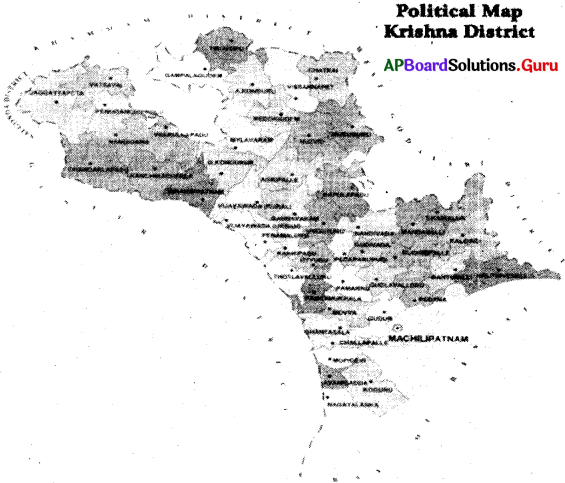
EX : Krishna District.

District Assembly Constituencies
Krishna Nuzvid
Krishna Kaikalur
Krishna Gannavaram
Krishna Penamaluru
Krishna Pedana
Krishna Machilipatnam
Krishna Avanigadda
Krishna Pamarru (SC)  .
Krishna Gudivada
Krishna Vijayawada East
Krishna Nandigama (SC)
Krishna Jaggayyapeta
Krishna Vijayawada Central
Krishna Mylavaram
Krishna Tiruvuru (SC)
Krishna Vijayawada West

AP Board 7th Class Social Solutions 10th Lesson State Government

Question 4.
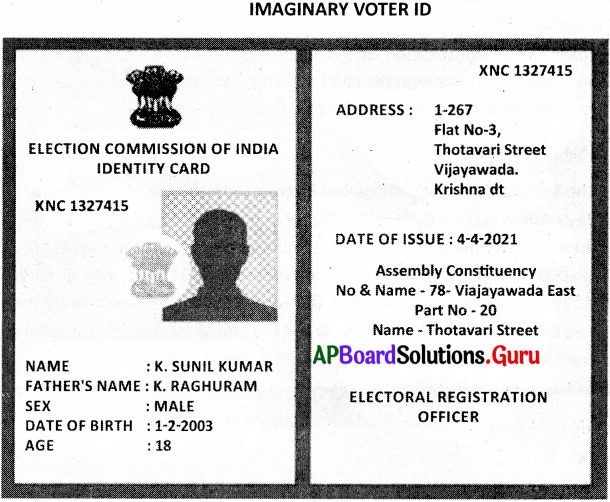
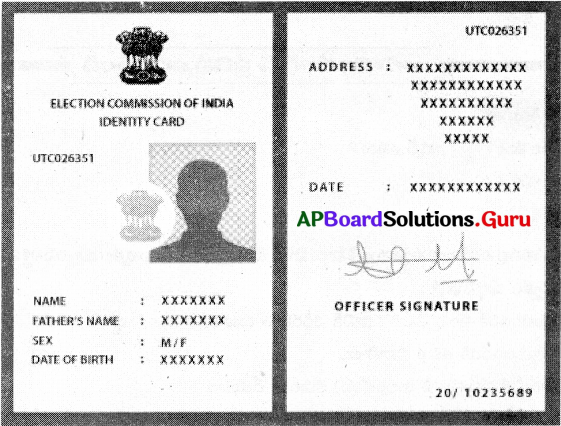
Examine the Voter ID Card of your parents and prepare an imaginary Voter ID Card for you with all the details.
Answer:
AP Board 7th Class Social Solutions 10th Lesson State Government 6

Note :

  1. More possession of this card is no guarantee. That you are elector in the current ele-ctoral roll. Please check your name in the current electoral roll before every election.
  2. Date of Birth mentioned in this card shall not be treated as a proof of age/ D.O.B for any purpose other than registration in electoral roll.

7th Class Social Textbook Page No. 48

Question 5.
Make a list of the Acts on Women safety.
Answer:
List of Acts :

  1. The Sexual Harassment of Women at Workplace (PREVENTION, PROHIBITION and REDRESSAL) Act, 2013
  2. The Immoral Traffic (Prevention) Act, 1956
  3. The Dowry Prohibition Act, 1961 (28 of 1961) (Amended in 1986)
  4. The Indecent Representation of Women (Prohibition) Act, 1986
  5. The Commission of Sati (Prevention) Act, 1987 (3 of 1988)
  6. Protection of Women from Domestic Violence Act, 2005
  7. The Criminal Law (Amendment) Act, 2013

7th Class Social Textbook Page No. 49

Question 6.
Why the Chief Minister is called real head of the Government? Discuss in class and list out reasons.
Answer:
According to the Constitution of India, the Governor is a state’s head, but de facto executive authority rests with the chief minister. The Chief Minister is called real head of the Government because he is the elected head.

7th Class Social Textbook Page No. 51

Question 7.
Visit the District Collector’s office and interact with the authorities there.
Answer:
One day I visited District Collector’s office. I met three officials from revenue, police and educational departments. They were humble and accepted my request to share their work experience. At first I have gone to revenue officials and they explained me how they collect taxes from people. And then the Police Officer explained me how they maintain law and order in the society. At last the official from the Educational department explained how they work to improve our educational system.

Think & Respond

7th Class Social Textbook Page No. 44

Question 1.
Who is the present Governor of our state?
Answer:
Biswabhusan Harichandan is the present Governor of our State (AP).

7th Class Social Textbook Page No. 45

Question 2.
If you to contest in elections in your assembly constituency, what would be your election manifesto?
Answer:

  1. I will promise to people to solve the problems of the constituency.
    Ex : Water, electricity, removal of garbage, etc.
  2. I will promise to the people to provide moral assistance when they are in problamatic situation.
  3. I will promise the people, I will try to avoid corruption from my constituency.

7th Class Social Textbook Page No. 47

Question 3.
What is the name of your Assembly Constituency?
Answer:
Ex : ……………………….. is the name of your Assembly Constituency.

7th Class Social Textbook Page No. 47

Question 4.
Who is the present MLA of your Assembly constituency?
Answer:

Ex : ……………………. is is the Present MLA of My Assembly constituency.

7th Class Social Textbook Page No. 48

Question 5.
What happens if any one of the houses do not approve a bill?
Answer:
The Parliament of Indiai is bicameral. Concurrence of both houses are required to pass any bill. However, the framers of the Constitution of India anticipated situations of deadlock between the Legislative Assembly and the Legislative Council. Therefore, the Constitution of India provides for Joint sittings of both the Houses to break the deadlock.

AP Board 7th Class Social Solutions 10th Lesson State Government

7th Class Social Textbook Page No. 49

Question 6.
If you get a chance to get. into a Ministry, which portfolio do you like most? What are the policies you will implement?
Answer:
I like Tourism ministry. I implement tour visits to the middle class and lower class people by giving them concessions.

Explore

7th Class Social Textbook Page No. 43

Question 1.
Learn more about the federal system, with the. help of your teacher.
Answer:
Federal System:

  1. Federal system is a system based upon democratic rules and institutions in which the power to govern is shared between central and state governments.
  2. This system gives definite powers to both central and state governments.
  3. According to this system our constitution divided the administrative powers into three lists.
  4. They are (i) The Union list, (ii) The State list and (iii) The Concurrent list.

7th Class Social Textbook Page No. 46

Question 2.
Learn more about secret voting system.
Answer:

  1. The most basic form of a secret ballot utilizes blank pieces.of paper upon which each voter marks his or her choice.
  2. Without revealing the votes to ainyone, the voter folds the ballot paper in half and places it in a sealed box.
  3. This box is later emptied for counting.

7th Class Social Textbook Page No. 47

Question 3.
Know about the number of members of Andhra Pradesh Legislative Council.
Answer:
There are 58 members in AP Legislative Council.

7th Class Social Textbook Page NO. 51

Question 4.
Know more about the magisterial powers of District Collector.
Answer:
As District Magistrate :

  1. Conducts criminal court of executive magistrate.
  2. Maintenance of law and order.
  3. Coordinates of the police.
  4. Supervision of subordinate executive magistracy and conduct magisterial inquiries.
  5. Hearing cases under the preventive section of the Criminal Procedure Code.
  6. Supervision of jails, and certification of execution of capital sentences.
  7. inspection of police stations, prisons, and juvenile homes in the district.
  8. Authorising parole orders to inmates.
  9. Granting arms and ammunition licence under Arms Act.
  10. Prepares panel of names for appointment of public prosecutors and additional public prosecutors with consultation with session judge in district.
  11. Disaster management during natural calamities such as floods, famines or epidemics.
  12. Crisis management during riots or external aggression.
  13. Child Labour/bonded labour related matters.

AP Board 7th Class Social Solutions 10th Lesson State Government

Project Work

Conduct: a Mock Assembly in your school with the help of your teacher and participate in it.
Answer:

AP Board 7th Class Social Solutions 9th Lesson Indian Constitution – An Introduction

SCERT AP 7th Class Social Study Material Pdf 9th Lesson Indian Constitution – An Introduction Textbook Questions and Answers.

AP State Syllabus 7th Class Social 9th Lesson Questions and Answers Indian Constitution – An Introduction

7th Class Social 9th Lesson Indian Constitution – An Introduction Textbook Questions and Answers

Improve Your Learning

I. Answer the following questions.

Question 1.
Why does a democratic country need a constitution? *
Answer:

  1. The constitution lays out the important guidelines that govern decision making within the the country.
  2. It serves as an asset of rules and principles as the basis by which the country has to be governed.

So a democratic country needs a Constitution.

Question 2.
How many fundamental rights are there in our Indian constitution? What are they?
Answer:
There are six fundamental rights in our Indian constitution.
i) Right to equality,
ii) Right to freedom,
iii) Right against exploitation,
iv) Right to freedom of religion,
v) Cultural and educational rights, and
vi) Right to constitutional remedies.

AP Board 7th Class Social Solutions 9th Lesson Indian Constitution – An Introduction

Question 3.
Give examples for violation of Fundamental Rights.
Answer:

  1. Sexual harassment is a violation of Fundamental Right.
  2. Meetings on Public roads and road margins is violative of fundamental right.
  3. False prosecution.
  4. Without submitting the arrested person keep in the prison more than 24 hrs is a violation of fundamental right,

Question 4.
The fundamental duties enhance patriotism. How?
Answer:

  1. The major intention behind the adoption of fundamental duties under the constitution of India was to make citizens ensure that they own some duties to the community in return for fundamental rights.
  2. Such duties are not merely needed to uphold unity, integrity, and sovereignty but also to remind the citizens about their democratic conduct and manners to maintain social harmony as the rights and duties go hand in hand. ,

Question 5.
Appreciate the role of Dr.B.R Ambedkar in the preparation of the Indian Constitution.
Answer:

  1. The contribution of Dr. B.R. Ambedkar in Indian Democracy is not to be forgotten.
  2. Baba Saheb Ambedkar’s name will be written in golden letters in the history of India as a creator of social justice.
  3. He spent his whole life for the betterment of the poor, exploited, untouchables and troubled classes.
  4. Baba Saheb gave shape to social aspect without exploitation.
  5. Thus, Dr. Ambedkar’s contribution to the Indian Constitution is undoubtedly of the highest order.
  6. Indeed he deserved to be called the “Father of the Chief Architect of the Indian Constitution”.

Question 6.
Write the Fundamental Duties of our Constitution.
Answer:
The fundamental duties noted in the Constitution are as follows:
It shall be the duty of every citizen of India –

  1. To abide by the Constitution and respect its ideals and institutions, the National Flag and the National Anthem;
  2. To cherish and follow the noble ideals which inspired our national struggle for freedom;
  3. To uphold and protect the sovereignty, unity and integrity of India;
  4. To defend the country and render national service when called upon to do so;
  5. To promote harmony and the spirit of common brotherhood amongst all the people of India transcending religious, linguistic and regional or sectional diversities; to renounce practices derogatory to the dignity of women;
  6. To value and preserve the rich heritage of our composite culture;
  7. To protect and improve the natural environment including forests, lakes, rivers, wildlife ‘ and to have compassion for living creatures;
  8. To develop the scientific temper, humanism and the spirit of inquiry and reform;
  9. To safeguard public property and to abjure violence;
  10. To strive towards excellence in all spheres of individual and collective activity so that the nation constantly rises to higher levels of endeavour and achievement;
  11. Who is a parent or guardian, to provide opportunities for education to his child, or as the case may be, ward between the age of six to fourteen years.

Question 7.
“India is a sovereign country” comment.
Answer:

  1. The Preamble to the Indian Constitution declares India to be a Sovereign Republic.
  2. India is free to conduct her internal and external affairs as she deems desirable.
  3. India is no longer under subjugation of any foreign power.
  4. As a sovereign state, India is free from any kind or form of foreign interference in its domestic affairs.
    So India is a sovereign country.

AP Board 7th Class Social Solutions 9th Lesson Indian Constitution – An Introduction

Question 8.
Write the characteristics of a good citizen.
Answer:

  1. Obeys the law / Respects authority.
  2. Contribute to Society and Community/ Performs Civic Duty.
  3. Loves his/her country/Patriotism.
  4. Courtesy and respect for the rights of others.
  5. Trust worthy and Honesty.
  6. Tolerance.
  7. Accountability.
  8. Moral Courage.

II. Choose the correct answers.

1. The Chairman of Constituent Assembly is …………………
a) Dr.B. R. Ambedkar
b) Jawahar Lai Nehru
c) Mahatma Gandhiji
d) Dr. Babu Rajendra Prasad
Answer:
d) Dr. Babu Rajendra Prasad

2. Find the odd one out.
a) Liberty
b) Inequality
c) Justice
d) Fraternity
Answer:
b) Inequality

3. Which Article tells about Right to Education in our Constitution ?
a) 19
b) 20 A
c) 21
d) 21 A
Answer:
d) 21 A

4. Which of the following is a violation of Fundamental Rights?
a) All are equal before law
b) A child below 14 years, working in tea shop
c) A person has a right to follow any religion
d) All
Answer:
b) A child below 14 years, working in tea shop

5. Which Article tells about Fundamental Duties in our Constitution?
a) 51
b) 51 A
c) 21
d) 21 A
Answer:
b) 51 A

6. Who proposed the “objective resolution” of the Indian constitutaion.
a) B.R Ambedkar
b) Sardhar Vallabh bhai Patel
c) Jawaharlal Neheu
d) H.C. Mukharjee
Answer:
c) Jawaharlal Neheu

III. Matching.

Group-A Group-B
1. 42nd Amendment a) Fundamental Rights
2. 44th Amendment b) Fundamental Duties
3. 86th Amendment c) Deletion of Right to Property
4. Part-III d) Right to Education
5. Part – IVA e) Socialist, Secular added to Preamble

Answer:

Group-A Group-B
1. 42nd Amendment e) Socialist, Secular added to Preamble
2. 44th Amendment c) Deletion of Right to Property
3. 86th Amendment d) Right to Education
4. Part-III a) Fundamental Rights
5. Part – IVA b) Fundamental Duties

Puzzle

Solve the puzzle with the words based on the given hints, takes from the preamble of the constitution.
AP Board 7th Class Social Solutions 9th Lesson Indian Constitution – An Introduction 1
DOWN :
1. People should live like brothers and sisters.
4. Government will not favour any religion.
5. Head of the state is an elected person.

ACROSS:
2. Government by the people
3. Moral obligations of all citizens. Reasonable claims of a person
7. The complete power to take decisions.
Answer:
AP Board 7th Class Social Solutions 9th Lesson Indian Constitution – An Introduction 2

7th Class Social 9th Lesson Indian Constitution – An Introduction InText Questions and Answers

7th Class Social Textbook Page No. 31

Question 1.
Identify any four prominent members of our Constituent Assembly and briefly write about them.
Answer:
AP Board 7th Class Social Solutions 9th Lesson Indian Constitution – An Introduction 4
AP Board 7th Class Social Solutions 9th Lesson Indian Constitution – An Introduction 5
AP Board 7th Class Social Solutions 9th Lesson Indian Constitution – An Introduction 6

7th Class Social Textbook Page No. 38

Question 2.
Identify the statements of fundamental rights and fundamental duties given below, and put a tick mark in the respective box.
Answer:
AP Board 7th Class Social Solutions 9th Lesson Indian Constitution – An Introduction 7

7th Class Social Textbook Page No. 39

Question 3.
Make a role play on the practice of equality and brotherhood in our lives and perform it in the classroom.
Answer:

Think & Respond

7th Class Social Textbook Page No. 28

Question 1.
Our national leaders opposed the acts made by the British government. Why?
Answer:
Our National leaders opposed the acts made by the British government because they implemented Regulating Act 1773, Pitts India Act 1784, Charter Act 1883, etc. which were against to wish of the Indians. Moreover they implemented Divide and Rule policy. So, our National leaders opposed their Acts.

7th Class Social Textbook Page No. 29

Question 2.
Why did the Indian National Congress demanded for a separate Constitution for India. What were the reasons for it?
Answer:

  1. After the elections to Constituent Assembly, the Muslim League refused to cooperate with the Congress and the political situation deteriorated.
  2. Hindu, Muslim riots began, and the Muslim League demanded a separate constituent assembly for Muslims in India. And
  3. The separate Nations of India & Pakistan were announced by Lord Mountbatten.

AP Board 7th Class Social Solutions 9th Lesson Indian Constitution – An Introduction

Question 3.
What is Universal Adult Franchise?
Answer:
The Universal Adult Franchise refers that all citizens who are 18 years and above irrespective of their caste or education, religion, colour, race and economic conditions are free to vote in a democracy.

7th Class Social Textbook Page No. 31

Question 4.
There are only nine women members in the Constituent Assembly. Do you think it would have been better if there had been more female members? Why?
Answer:
Yes. I think it would have been better if there had been more female members. Why because it would have increased the opportunites to women in their fields.

7th Class Social Textbook Page No. 32

Question 5.
Our Constitution was adopted by the Constituent Assembly on 26th November, 1949. But it Came into force on 26th January, 1950. Why was it delayed? Find out the reason with the help of your teacher.
Answer:
The Constitution of India was adopted on 26th November, 1949 and the honourable members appended their signatures to it on 24th January, 1950. In all 284 members actually signed the constitution.

Question 6.
Why do we celebrate Republic day on 26th January?
Answer:
India has been celebrating Republic day every year on January 26th to honour the date on which our constitution came into effect.

7th Class Social Textbook Page No. 33

Read the Preamble of our Constitution very carefully and answer the following questions.
AP Board 7th Class Social Solutions 9th Lesson Indian Constitution – An Introduction 8

Question 7.
The Preamble of our Constitution starts with ‘We the people of India/ What does it mean ?
Answer:
WE, THE PEOPLE OF INDIA, means
The Constitution has been drawn up and enacted by the people through their repre¬sentative, and not handed down to them by a king or any outside powers.

Question 8.
Identify the date which was given in the Preamble and write its importance.
Answer:
Date in the Preamble – 26-11-1949.

The importance is our Constitution was adopted on that day.

Question 9.
Is Preamble a part of the Constitution or not? Try to know that with the help of your teacher.
Answer:
Amendment of the Preamble.
42nd Amendment Act, 1976.
After the judgement of Kesavananda Bharathi case. It was accepted that the Preamble is part of the Constitution.

7th Class Social Textbook Page No. 34

Question 10.
Why is India called a Republic?
Answer:
India is called a Republic, because the head of the nation means President is an elected person.

AP Board 7th Class Social Solutions 9th Lesson Indian Constitution – An Introduction

Question 11.
How can you say that India is a Secular country?
Answer:
Yes, India is a secular country. Because, Indian Government did not give any importance to any religion during the policy decisions (or) making.
There is no state religion in India. Just people of India are followed the religion.

7th Class Social Textbook Page No. 36

Question 12.
Right to Property was deleted from the Fundamental Rights. Why?
Answer:
The word Socialism was incorporated in our Constitution through 42nd Amendment in 1976. Socialism means avoiding the differences between Have’s & Have not’s.

So Right to Property was deleted from fundamental Rights through 44th Amendment in 1978 to reduce the boundaries of rich & poor.

Question 13.
Why do we need right to freedom?
Answer:

  1. Right to freedom generates liberty of expression and speech association, or assembly etc.
  2. It protects us from exploitation.
  3. It provides a chance to us to practice any ocupation or profession.
  4. If protects us from offences against detention and arrest in many cases.
  5. It rainforces of all other human rights, allowing society to develop and progress.

Question 14.
How do the “Right against exploitation” contributes to the development of the children?
Answer:
The fundamental right against exploitation guaranteed to all citizens prohibits child labour in mines, factories, and hazardous conditions.

Question 15.
Try to know, How the Right to Information ensures transparency in government administration?
Answer:
The enactment of Right to Information Act 2005, people are now able to seek information from any government department with a definite time frame.

The Right to Information Act is intended to promote accountability and transparency in government by making the process of government decision making more open.

Question 16.
Have you seen any violation of Fundamental Rights in your surroundings? If so mention some examples.
Answer:
Yes.
Example : A person below 14 years working in tea shop.

7th Class Social Textbook Page No. 37

Question 17.
What are the rights you enjoy and the duties done by you in your school?
Answer:
I enjoyed the following rights.

  1. Right to Equality.
  2. Right to Freedom.
  3. Right to Education and Culture.

I perform the following duties :

  1. Respect to the National Flag and National Anthem.
  2. Protect the Unity and Integrity.
  3. Promote Harmony and brotherhood.
  4. Develop Humanism, etc.

AP Board 7th Class Social Solutions 9th Lesson Indian Constitution – An Introduction

Question 18.
“Rights and duties are the two sides of the same coin”. Discuss.
Answer:

  1. Right and duties are closely related and cannot be separated from one another.
  2. For every right there is a corresponding duty.
  3. The state protects and enforces rights and it is the duty of all citizens to be loyal to the state. Thus, a citizen has both Rights and Duties.

7th Class Social Textbook Page No. 39

Question 19.
What activities you can perform as a responsible citizen?
Answer:
Be honest and trustworthy.
Follow rules and laws.
Respect the rights of others.

Explore

7th Class Social Textbook Page No. 28

Question 1.
Browse the internet or go through the library books and know more about other acts made by the British parliament for ruling India. (If necessary, take the help of your teacher).
Answer:
List of acts passed by British in India. Some important Acts.

  1. Regulating Act of 1773
  2. Charter Acts, – 1793,1813, 1833,1853.
  3. Bengal Sati Regulation Act – 1829.
  4. Hindu Widow’s Remarriage Act – 1829.
  5. Transfer of Property Act -1882.
  6. Minto – Morley Reforms -1909.
  7. Montague – Chemsfofd Reforms -1919.
  8. Rowlatt Act – 19×19.
  9. Government of India Act – 1935.
  10. India Independence Act – 1947, etc.

7th Class Social Textbook Page No. 32

Question 2.
Do you know that all your textbooks have preamble of the constitution, can you identify and read aloud?
Answer:

Project Work

Question 1.
Collect pictures of prominent members of Indian Constituent Asssembly and make an album.
Answer:
AP Board 7th Class Social Solutions 9th Lesson Indian Constitution – An Introduction 3

Question 2.
Prepare a report on how you celebrated Constitution day in your school.
Answer:

Z.P.H School
Celebration of the Constitution Day
26th November, 2018

“The Constitution Day” was celebrated on 26<sup>th</sup> November, 2018 Z.P.H. School.

To spread awareness about the Indian Constitution and to install a sense of patriotism among ourselves.

On that day, the Assembly began with the principal addressing the students from class 2nd to 7th about the significance of the Constitution Day and the importance of being a Sovereign, Socialist, Secular, Democratic and Republic country.

My Principal Sir led the students in taking the pledge by reciting the Preamble of the Constitution.

On that day a special period was taken by the social studies teachers who explained in detail the meaning of the Constitution, the Preamble, the Five Year Plan and the Directive Principles.

The Day ended with the students of VI to IX participating in a Poster Making Competition where they had to reflect their thought on the principle of the preamble.

AP Board 7th Class Social Solutions 8th Lesson Bhakthi – Sufi

SCERT AP 7th Class Social Study Material Pdf 8th Lesson Bhakthi – Sufi Textbook Questions and Answers.

AP State Syllabus 7th Class Social 8th Lesson Questions and Answers Bhakthi – Sufi

7th Class Social 8th Lesson Bhakthi – Sufi Textbook Questions and Answers

Review Of Your Previous Knowledge
AP Board 7th Class Social Solutions 8th Lesson Bhakthi – Sufi 1

Question 1.
What do you observe in the picture 8.1?
Answer:
I observe Jagadguru Adi Sankaracharya, his disciples and his devotees in the left picture. In the right side picture, I observe Muslim priest and his disciples. In both the pictures the gurus are preaching their disciples.

Question 2.
What are they teaching?
Answer:

  1. In the first picture Adi Shankara Charya preached equality of all humans.
  2. In the second picture Sufi Saints emphasised on an egalitarian society based on Universal love.

Improve Your Learning

I. Answer the following questions.

Question 1.
What are the salient features of Bhakti movement?
Answer:
Salient features of Bhakti Movement:

  1. Oneness of God.
  2. One of the ways to Moksha is Bhakti.
  3. Bhakti means to surrender to God.
  4. Emphasized equality of all humans.
  5. No discrimination of caste, creed, sect.
  6. The Bhakti saints travelled to various places to speak about the path of Bhakti and preached in the local languages.

AP Board 7th Class Social Solutions 8th Lesson Bhakthi – Sufi

Question 2.
Who is Mira Bai? What was her contribution to the Bhakthi movement?
Answer:

  1. Mira Bai was woman saint of the medieval times.
  2. Mira became a devotee of Krishna right from her childhood.
  3. Mira Bai’s contribution to the Bhakti movement was primarily in her music.
  4. She wrote hundreds of songs and initiated a mode of singing the songs a raga.
  5. About 200 400 songs are accepted by scholars as being written by Mirabai.
  6. Mirabai wrote her songs in Rajasthani and Braj Bhasha languages, and they were translated into Hindi and Gujarathi.
  7. Mirabai’s songs express her love and devotion to Krishna, almost always as Krishna’s wife.

Question 3.
What can the present society learn from the bhakthi movement and the sufi movement?
Answer:

  1. The songs and the teachings of the Sufi and the Bhaki saints are relevant even today.
  2. The two movements brought a new form of religious expression amongst Muslims and Hindus.
  3. Worship, or singing bhajans, kirtans or qawwalis, or even repeating the name of God in silence, and noticed that some of them are moved to tears. Such intense devotion or love of God is the legacy of various kinds of bhakti and Sufi movements that have evolved even today.

Question 4.
Read the topic in page number 46 under the heading ‘Impact of bhakti movement onthe medieval Indian society’ and comment in your own words.
Answer:
Impact of the Bhakti Movement on the Medieval Indian Society :

  1. The most important social impact of the Bhakti movement was that the followers of the Bhakti movement rejected caste discrimination.
  2. This movement encouraged religious tolerance.
  3. The bhakti saints preached religous tolerance and monotheism
  4. A spirit of harmony developed among different sections of the society.
  5. It tried to develop humanitarian attitude.

Iitipact of Sufi movement :

  1. Sufis travelled all over the country to reach the poor and rural communities.
  2. They preached in the local languages.
  3. They lived a modest simple life.

Question 5.
Who was the founder of Sikhism and what were the main principles of Sikhism?
Answer:
Guru Nanak was the founder of Sikh religion.
Main Principles:

  1. Truthful living,
  2. Serving to humanity,
  3. Uphold the values of honesty,
  4. Compassion, generosity, humanity, integrity, servi-e and spirituality on a daily basis.

Question 6.
Write an essay appreciating the social services rendered by bhakti saints.
Answer:

  1. The Bhakti movement empowered the underbelly of Indian society in fundamental ways and also provided the required impetus for the growth of vernacular literature.
  2. This tradition of those deemed “low” singing and writing did not, however, end with
    the Bhakti movement comingling into the mainstream. ‘
  3. They emphasized the virtues of love and devotion, brotherhood and equality etc. This helped to bring the two communities nearer.
  4. It also helped to harmonise the conflicting interests. The saints of the Bhakti movement rejected the differences of caste system.

AP Board 7th Class Social Solutions 8th Lesson Bhakthi – Sufi

Question 7.
Decribe the prominent saints of South India.
Answer:
Prominent Saints of South India :
1. Ramanujacharya:
Ramanuja gave a philosophical basis to the teachings of Vaishnavism. His commentaries on the Brahma Sutras are popularly known as “Sri Bhasya”.

2. Nimbarka :
He was a younger contemporary of Ramanuja, who also rendered great service to the spread of Bhakti movement.

3. Madhwacharya :
Madhwacharya propagated Dvaita philosophy.
Madhwacharya divides the Universe into two parts.
i) Swatantra (independent being) and
ii) Aswatantra (dependent being).

4. Vallbhacharya :
He advocated a system of pure non-dualism devoid of the concept of Maya.

5. Basaveswara:
He popularised the Veerasaivism. His literary works are named Vachanas.

6. Adi Shankaracharya :
1) He preached Advaita Philosophy.
2) He established four Shakthi Peethas in all the four corners of India.

Question 8.
Write about Sufi saints and their teachings.
Answer:

  1. The Sufi saints were always in meditation and they led a simple life.
  2. They wore woollen clothes.

The main teachings of Sufism are ;

  1. There is only one God.
  2. All are children of God.
  3. Devotional music is one of the ways to move nearer to God.
  4. Sufi believes. Wahdat-ul-Wujud means worship for a single God.
  5. Fasts and rituals are not essential to reach God.
  6. Different religions are different ways to reach God.

II. Choose the correct answer.

1. Who preached the Vishishtadvaitha philosophy?
a) Ramanuja
b) Sankaracharya
c) Ramananda
d) Kabir
Answer:
a) Ramanuja

2. Who of the following preached Saguna Bhakti?
a) Mira bai
b) Shankara Deva
c) Basaveswgra
d) All the above
Answer:
a) Mira bai

3. Who is the founder of Sikh religion?
a) Gurunanak
b) Sankaracharya
c) Ramananda
d) Akbar
Answer:
a) Gurunanak

4. What does it mean “oneness of god”?
a) Only one god
b) Belief in one god
c) Unity of god
d) All the above
Answer:
d) All the above

5. In which century did the Bhakti movement begin?
a) 6th CE
b) 7th CE
c) 8th CE
d) 9th CE
Answer:
c) 8th CE

III. Match the following.

Group-A Group-B
1. Alvars a) Worshipping god with form
2. Hindu scripture b) Worshiping of Vishnu
3. Saguna Bhakti c) Worship of the divine as formless
4. Nirguna Bhakti d) Nayanars
5. Shaiva e) Ramayana, Bhagavadgita

Answer:

Group-A Group-B
1. Alvars b) Worshiping of Vishnu
2. Hindu scripture e) Ramayana, Bhagavadgita
3. Saguna Bhakti a) Worshipping god with form
4. Nirguna Bhakti c) Worship of the divine as formless
5. Shaiva d) Nayanars

7th Class Social 8th Lesson Bhakthi – Sufi InText Questions and Answers

7th Class Social Textbook Page No. 19

Question 1.
With the help of your teacher/parents collect some preachings of Adi Sankaracharya from your school library and discuss in classroom.
Answer:
The preachings of Adi Sankaracharya :

  1. He taught that supreme Brahman in Nirguna (without the Gunas), Nirakara (formless), Nirvisesha (without attributes) and Akarta (non-agent).
  2. Brahman is above all needs and desires.
  3. Brahman is alone real,
  4. This world is unreal,
  5. and the jiva or the individual soul is non-different from Brahman.

7th Class Social Textbook Page No. 22

Question 2.
Collect the information regarding the holy texts Guru Grandh Sahib.
Answer:
The text consists of 1,430 angs (pages) and 5,894 sabads (line compositions), which are poetically rendered and set to a rhythmic ancient north Indian classical form of music.

The bulk of the scripture is divided into 31 main ragas, with each Granth raga subdivided according to length and author.

7th Class Social Textbook Page No. 25

Question 3.
List out the similarities in the preachings of Hindu and Islamic reformers.
Answer:
Similarities :

  1. Both Islam and Hinduism are based on divine revelation and in essence both worship the Supreme being is generally ignored.
  2. Both are followed the words of Prophets and Rishis.
  3. Hinduism and Islam share some ritual practices such as fasting and pilgrimage.

Think & Respond

7th Class Social Textbook Page No. 21

Question 1.
Kabir said that “All are equal before God”? Do you agree with this statement? Mention your reasons.
Answer:
Yes, “I agree with the statement, because he preached a religion of love which aimed at promoting unity amongst all castes and creeds.

He was the first saint who tried to reconcile Hinduism and Islam.

7th Class Social Textbook Page No. 23

Question 2.
Namdev preached no need to follow rituals and elaborated process to worship god.Why did he say?
Answer:
According to Namdev we have to concentrate our mind on God to attain moksha.

AP Board 7th Class Social Solutions 8th Lesson Bhakthi – Sufi

7th Class Social Textbook Page No. 24

Question 3.
Bhakti inculcates honesty, kindness, love, service-mindedness, etc. Discuss
Answer:
Honesty, kindness, love, service mindedness are interconnnected with each other. Without these a soul cannot walk through the Bhakti Path.

Explore

7th Class Social Textbook Page No. 19

Question 1.
What are the contributions of Ramanujacharya to attain social equality?
Answer:
Sri Ramanujacharya is considered as the first Acharya, who devoted his entire life for the upliftment of the equality in the society.

He gave perfect commentaries to the Brahma Sutras and Upanishads and made a perfect bridge between different sections of society.

He established 74 authoritative acharyas to spread the message of equality across the world.

7th Class Social Textbook Page No. 20

Question 2.
Why did Ramananda oppose sectarianism? Know from your teacher.
Answer:
Ramananda perceived that there is only one God. Who is the origin of all, all the distinctions of caste and creed vanished for him and he saw humanity as one large family, and all men as brothers.
One man is higher than another, not through birth, but only through his love and sympathy.

Question 3.
Collect the information about Basaveswara from internet, discuss with your teacher.
Answer:
AP Board 7th Class Social Solutions 8th Lesson Bhakthi – Sufi 3
Basaveshwara, colloquially known as Basavanna, was a 12th-century CE

Indian statesman, philosopher, poet, social reformer and Lingayat saint in the Shiva-focussed bhakti movement, and a Hindu Shaivite social reformer during the reign of the Kalyani Chalukya/Kalachuri dynasty.

7th Class Social Textbook Page No. 22

Question 4.
Collect the names of ten Sikh gurus with the help of your teacher.
Answer:

  1. Guru Nanak
  2. GuruAngad
  3. Guru Amardas
  4. Guru Ramdas
  5. Guru Arjan
  6. Guru Hargobind
  7. Guru Har Rai
  8. Guru Har Krishan
  9. Guru Tegh Bahadur
  10. Guru Gobind Singh

Project Work

Collect the pictures of various Bhakthi and Sufi saints.
Answer:
AP Board 7th Class Social Solutions 8th Lesson Bhakthi – Sufi 2

AP Board 7th Class Social Solutions 3rd Lesson Learning Through Maps

SCERT AP 7th Class Social Study Material Pdf 3rd Lesson Learning Through Maps Textbook Questions and Answers.

AP State Syllabus 7th Class Social 3rd Lesson Questions and Answers Learning Through Maps

7th Class Social 3rd Lesson Learning Through Maps Textbook Questions and Answers

review of your previous knowledge:
AP Board 7th Class Social Solutions 3rd Lesson Learning Through Maps 1

Observe the given map and respond.

Question 1.
What do you notice in the map?
Answer:
I noticed on the above map Route is drawn between Vijayawada to New Delhi.

And I noticed Different means of transport from Vijayawada to Delhi and the timings also mentioned. .

Through air way, time taken from Delhi to Vijayawada is 2 hrs. 20 min.

Through road way, time taken by car-30 hrs. and through railway, 1 day 2 hrs. time taken.

Question 2.
What does the blue mark (dotted line) in the map indicate?
Answer:
The dotted line in the map indicates train route.

Question 3.
Name the neighbouring countries of India.
Answer:
Neighbouring countries of India are

  1. East – Mynmar, Bangladesh
  2. North – China, Nepal, Bhutan
  3. North – West – Pakistan, Afghanistan
  4. South -Srilanka
  5. South – West – Maldives

AP Board 7th Class Social Solutions 3rd Lesson Learning Through Maps

Question 4.
Can you name any two states in the given route?
Answer:
Two states

  1. Uttar Pradesh,
  2. Andhra Pradesh.

Question 5.
What are the different means of transportation shown in the map?
Answer:
Roadway, Railway & Airways are shown on the map.

Improve Your Learning

I. Answer the following questions.

Question 1.
How do you identify the direction in the map?
Answer:
AP Board 7th Class Social Solutions 3rd Lesson Learning Through Maps 2
N – North, E – East, S – South, W – West, N.E – North East, S.E – South East, N.W – North West, S.W – South West.

Generally, maps are prepared showing the North direction on the top of the map. The direction can be noticed with the help of an arrow on the right top gcorner.

Question 2.
Scale in map helps to study a place. Discuss.
Answer:
Scale : It resembles the ratio of corresponding distance in map to actual distance.

Map scale helps us to study a place with the help of verbal scale – 1 cm = 10 kms, Graphical Scale and Represention function Ex : 1′ = 10,000′

Question 3.
What are the items you need to study a physical map?
Answer:
We need scale, directions, symbols, and colours are need to study a physical map.

Question 4.
Describe the location of India.
Answer:
Location of India :

  1. India is located in the northern hemisphere.
  2. The main land of India extends between latitudes 8°4’to 37° 6′ N and logitudes between 68° 7’to 97° 25° E.
  3. The Tropic of Cancer (23° 30’N) passes almost through the middle of the country.
  4. Apart from the mainland, the Andaman and Nicobar Islands and the Lakshadweep are also parts of India.

Question 5.
Prepare the list of countries in Asian Continent with the help of Atlas.
Answer:
50 countries are there in Asia.

1) India 2) China 3) Indonesia
4) Japan 5) Srilanka 6) Pakistan
7) Bangladesh 8) Iran 9) Phillippines
10) Vietnam 11) Turkey 12) Thailand ,
13) Taiwan 14) Mynmar 15) South Korea
16) Iraq 17) Afghanistan 18) Saudi Arabia
19) Uzbekistan 20) Malaysia 21) Yemen
22) Nepal 23) Bhutan 24) Brunei
25) Maldives 26) Cyprus 27) Timorleste
28) Bahrian 29) Qatar 30) Armenia
31) Mangolia 32) Georgia 33) Kuwait
34) State of Palestine 35) Oman 36) Singapore
37) Turkmenistan 38) Kyrgyzstan 39) Lebanon
40) Laos 41) Israel 42) Tajikistan
43) UAE 44) Azerbaijan 45) Jordan
46) Combodia 47) Syria 48) Kazakistan
49) North Korea 50) Russia.

AP Board 7th Class Social Solutions 3rd Lesson Learning Through Maps

Question 6.
What are the boundaries of India?
Answer:
Boundaries of India are :

  1. North – Himalayan Ocean
  2. South – Indian Ocean
  3. East – Bay of Bengal
  4. West – Arabian Sea

Question 7.
Prepare the rough grid of India.
Answer:
AP Board 7th Class Social Solutions 3rd Lesson Learning Through Maps 3

Question 8.
Locate the following in outline map of India.
a) Chennai
b) Delhi
c) Vijayawada
d) Visakhapatnam
Answer:
AP Board 7th Class Social Solutions 3rd Lesson Learning Through Maps 4

II. Choose the correct answer.

1. Find the correct sentence.
a) River Ganga originates in the Himalayas.
b) River Cauvery flows in West Bengal.
c) River Krishna drains into Arabian sea.
d) River Penna flows in Maharashtra.
Answer:
a) River Ganga originates in the Himalayas.

2. India lies in Eastern hemisphere between the longitudes of:
a) 14°27′ to 19°07′
b) 77° to 84°40′
c) 68°07′ to 97°25′
d) 8°4′ to 37°06′
Answer:
c) 68°07′ to 97°25′

3. Identify the odd one regarding the location of rivers.
a) Krishna
b) Penna
c) Brahmaputra
d) Cauvery
Answer:
c) Brahmaputra

4. a) Kerala is on west coast.
b) Arunachal Pradesh has border with Pakistan.
Note : Answer with the help of above information
a) ‘a’ is true; ‘b’ is false.
b) ‘a’ is false; ‘b’ is true
c) Both’a’and’b’are false.
d) Both of them are true.
Answer:
a) ‘a’ is true; ‘b’ is false.

5. Identify mismatched pair.
a) Chennai-Tamil Nadu
b) Bhopal – Gujarat
c) Jaipur – Rajasthan
d) Thiruvananthapuram – Kerala
Answer:
b) Bhopal – Gujarat

7th Class Social 3rd Lesson Learning Through Maps InText Questions and Answers

7th Class Social Textbook Page No. 35

Question 1.
Identify the elements of the map and write their names in map.
AP Board 7th Class Social Solutions 3rd Lesson Learning Through Maps 8
Answer:
AP Board 7th Class Social Solutions 3rd Lesson Learning Through Maps 9 AP Board 7th Class Social Solutions 3rd Lesson Learning Through Maps 10

7th Class Social Textbook Page No. 36

Question 2.
Name the cardinal and intermediate directions in the adjacent image.
AP Board 7th Class Social Solutions 3rd Lesson Learning Through Maps 2
Answer:
1) Cardinal directions : 1) North, East, West, South
2) Intermediate directions : 1 – North East, North West, South East, South West.

Question 3.
If you want to travel from Bengaluru to Itanagar, from which direction you have to travel?
Answer:
We should start from South-West direction Bengaluru and travel to North-East direction to reach itanagar.

AP Board 7th Class Social Solutions 3rd Lesson Learning Through Maps

Question 4.
Fill up the given table based on the scale given in the map – 3.2 (India States and Capitals).

Places : From – To Distance in the above map Actual Distance
Chennai to Hyderabad 3 cm
Mumbai to Bhuvaneswar 5 cm
Panaji to Thiruvananthapuram 2.5 cm
Gandhinagar to Jaipur 3 cm
Kolkata to Ranchi 3000 km
New Delhi to Kohima 2200 km

Answer:

Places : From – To Distance in the above map Actual Distance
Chennai to Hyderabad 3 cm 600 kms
Mumbai to Bhuvaneswar 5 cm 1000 kms
Panaji to Thiruvananthapuram 2.5 cm 500 kms
Gandhinagar to Jaipur 2 cm 400 kms
Kolkata to Ranchi 15 cm 3000 kms
New Delhi to Kohima 11 cm 2200 kms

7th Class Social Textbook Page No. 38

Question 5.
Prepare a Map of Andhra Pradesh by using the elements discussed in the Index of the map.
AP Board 7th Class Social Solutions 3rd Lesson Learning Through Maps 11

Answer:
AP Board 7th Class Social Solutions 3rd Lesson Learning Through Maps 13

7th Class Social Textbook Page No. 40

Question 6.
Fill up the following table with the help of the India Political map that shares land frontier.
AP Board 7th Class Social Solutions 3rd Lesson Learning Through Maps 14
Answer:

S.No. Neighbouring Country States that share borders with
1. Pakistan Gujarat, Rajasthan, Punjab, Srinagar, Ladakh
2. Nepal Uttarakhand, Uttar Pradesh, Bihar, West Bengal, Sikkim
3. Bhutan Sikkim, West Bengal, Assom, Arunachal Pradesh
4. Bangladesh West Bengal, Assom, Meghalaya, Tripura
5. Myanmar Mizoram, Manipur, Nagaland, Arunachal Pradesh
6. China Ladakh, Uttarakhand, Sikkim, Himachal Pradesh, Arunachal Pradesh

Question 7.
Prepare the list of States and Union Territories; write their capitals.
Answer:

State Capital
1. Andhra Pradesh Amaravati
2. Arunachal Pradesh Itanagar
3. Assom Dispur
4. Himachal Pradesh Shimla
5. Haryana Chandigarh
6. Punjab Chandigarh
7. Uttarakhand Dehradun
8. Uttar Pradesh Lucknow
9. Bihar Patna
10. Sikkim Gangtok
11. Nagaland Kohima
12. Manipur Imphal
13. Mizoram Aizwal
14. Meghalaya Shillong
15. Tripura Agartala
16. West Bengal Kolkata
17. Jarkhand Ranchi
18. Chhattisgarh Rayapur
19. Madhya Pradesh Bhopal
20. Gujarath Gandhi Nagar
21. Rajasthan Jaipur
22. Maharashta Mumbai
23. Goa Panaji
24. Karnataka Bengaluru
25. Kerala Tiruvanantapuram
26. Tamil Nadu Chennai
27. Orissa Bhuvaneswar
28. Telangana Hyderabad

Complete list of 8 Union Territories :

Union Territories Capital
1. Andaman and Nicobar Island Portblair
2. Chandigarh Chandigarh
3. Dadra and Nagar Haveli, Daman and Diu Daman
4. Delhi Delhi
5. Ladakh Leh
6. Lakshadweep Kavaratti
7. Jammu and Kashmir Srinagar and Jammu
8. Puducherry Pondicherry

Question 8.
Take an outline map of India, draw the boundaries of states and loc te their capitals.
Answer:

7th Class Social Textbook Page No. 42

Question 9.
Prepare the list of Continents and a few important countries in each continent based on map – 3.5.
AP Board 7th Class Social Solutions 3rd Lesson Learning Through Maps 15
Answer:

Continent Important Countries
1. North America Alaska, Canada, U.S.A, Mexico etc.
2. South America Columbia, Equator, Peru, Venezula, Brazil, Chile, Argentina etc.
3. Africa Egypt, Libya, Algeria, South Africa, Kenya, Zimbabwe, Congo, Angola, Ghana etc
4. Europe England, France, Portugal, Poland, Germany, Italy, Switzerland, Russia, etc.
5. Asia India, China, Vietnam, Japan, Pakistan, Bangladesh, Korea, Malaysia etc.
6. Australia Indonesia
7. Antarctica No Countries.

Question 10.
Name the continents through which the Equator runs.
Answer:
1 – South America
2 – Africa
3 – Asia

7th Class Social Textbook Page No. 43

Question 11.
Prepare a raised relief map with the guidance of your teacher.
Answer:

Question 12.
Fill up the following mind map with the help of the India- physical map (map-3.6) See Text Page: 42.
AP Board 7th Class Social Solutions 3rd Lesson Learning Through Maps 16
AP Board 7th Class Social Solutions 3rd Lesson Learning Through Maps 17
Answer:
AP Board 7th Class Social Solutions 3rd Lesson Learning Through Maps 18

7th Class Social Textbook Page No. 45

Question 13.
Based on map 3.7 prepare a table with the distribution of soils. (Consider the type of soil and respective districts).
AP Board 7th Class Social Solutions 3rd Lesson Learning Through Maps 19
Answer:

Soil Name Districts / Distributed Area
1. Sandy coastal soil Srikakulam, Visakhapatnam East Godavari and Nellore district
2. Red soil Vijayanagaram, Visakhapatnam, Guntur, Prakasam, Nellore, Chittoor, Kurnool
3. Rocky Hilly Soils East Godavari, West Godavari
4. Black soils East Godavari, West Godavari, Krishna, Guntur, Kurnool, Anantapur

AP Board 7th Class Social Solutions 3rd Lesson Learning Through Maps

Question 14.
Take an Andhra Pradesh map and prepare a Thematic map (Andhra Pradesh-Population Density Map) with the help of the given data.
AP Board 7th Class Social Solutions 3rd Lesson Learning Through Maps 20
Answer:
Note – Write the figures in the concerned districts of Andhra Pradesh.
AP Board 7th Class Social Solutions 3rd Lesson Learning Through Maps 21

Question 15.
Prepare a table with edicts of Ashoka and their location in the present states based on map 3.9. See Text Page – 45
AP Board 7th Class Social Solutions 3rd Lesson Learning Through Maps 22
Answer:
AP Board 7th Class Social Solutions 3rd Lesson Learning Through Maps 23
AP Board 7th Class Social Solutions 3rd Lesson Learning Through Maps 24

Think & Respond

7th Class Social Textbook Page No. 36

Question 1.
What is the use of scale in a map?
Answer:
Use of Scale :
Scale : The relationship between the real world size of a geographic features and its representative feature on a map, is known as scale.

  1. The map scale is used to measure the distance of actual.ground represented by the map.
  2. Scale help in calculating the area on the map.
  3. The scale Is used in map enlargement and reduction.

7th Class Social Textbook Page-Mo. 37

Question 2.
Why do we use symbols in a map?
Answer:
It is not possible to draw a map in the actual shape and size with different features such as buildings, roads, rivers, bridges, trees, railway lines, etc.

So they are shown by using certain letters, shades, colours, pictures and linds. These symbols give a lot of information and help in reading maps. These symbols are called conventional symbols.

7th Class Social Textbook Page No. 39

Question 3.
Name the types of maps.
Answer:
Maps are classified into 4 types.

  1. Political maps
  2. Physical maps
  3. Thematic maps and
  4. Historical maps

AP Board 7th Class Social Solutions 3rd Lesson Learning Through Maps

Question 4.
What do they (maps) denote?
Answer:
The maps explains the administrative units, physical features, population density, soils, minerals, inscriptions and architecture of India.

7th Class Social Textbook Page No. 40

Question 5.
Observe the given political map (Map-3.4)
Answer:
AP Board 7th Class Social Solutions 3rd Lesson Learning Through Maps 25

Question 6.
Name the state closest to equator.
Answer:
Tamil Nadu & Kerala both are closest to equator.

Question 7.
What is Tropic of Cancer?
Answer:

  1. Tropic of Cancer is at 23°30′ North latitude.
  2. It divides the India into two equal halves:

Question 8.
Name the states through which the Tropic of Cancer runs.
Answer:
Tropic of Cancer passes through Gujarat, Rajasthan, Madhya Pradesh, Chattisgarh, Jarkhand, West Bengal, Tripura, and Mizoram states.

7th Class Social Textbook Page No. 43

Question 9.
The rivers originated in Western Ghats flow towards east and join Bay of Bengal. Discuss with your teacher.
Answer:

  1. The rivers which are originated in Western Ghats originates at eastern side of the Western ghats in South India.
  2. As rivers cannot claim up, they flow towards slanting side.
  3. They flow through the Deccan Plateau which slopes towards east.
  4. Hence, the rivers flow towards east and join the Bay of Bengal.

Question 10.
Classify the rivers based on the seas they join. Name these rivers.
Answer:
Rivers are classified into two groups based on the seas they join.

  1. West flowing rivers.
  2. East flowing rivers.
River Name Sea
1. Ganga Bay of Bengal East flowing rivers
2. Brahmaputra Bay of Bengal
3. Mahanadi Bay of Bengal
4. Krishna Bay of Bengal
5. Godavari Bay of Bengal
6. Penna Bay of Bengal
7. Kaveri Bay of Bengal
1. Indus Arabian sea West flowing rivers
2. Narmada Arabian sea
3. Tapiti Arabina sea

Question 11.
Mention land forms of Andhra Pradesh.
Answer:
The Andhra Pradesh state has three main physiographic regions.
1. Mountains 2. Plains 3. Plateau

  1. The coastal plain tothe east extending from the Bay of Bengal to the mountain ranges.
  2. The mountain ranges themselves, the Eastern Ghats, which form the western flank of the coastal plain.
  3. In the South west, the plateau to the west of the ghats.

Explore

7th Class Social Textbook Page No. 37

Question 1.
Explore more conventional symbols used by the Survey of India in the preparation of a map with the help of Atlas or through internet.
Answer:
Conventional Symbols :

  1. It is not possible to draw a map in the actual shape and size.
  2. Different features on the map shows with different symbols. Those are
1) Buildings 2) Roads 3) Bridges
4) Trees 5) Railway lines 6) Broad gauge railway
7) Meter guage railway 8) River 9) Well
10) Tank 11) Temple 12) Church
13) Mosque 14) Post office 15) Police station
16) Kutcha road 17) Mountain peak 18) Grave

AP Board 7th Class Social Solutions 3rd Lesson Learning Through Maps 26

7th Class Social Textbook Page No. 40

Question 2.
Explore the location of Andhra Pradesh with the help of Atlas.
Answer:
Andhra Pradesh lies between 12°41′ and 19°.07′ N latitudes. 77° and 84°.40′ E longitude.

7th Class Social Textbook Page No. 43

Question 3.
With the help of the Atlas explore about extension of various mountain ranges and the highest peaks in those respective ranges.
Answer:

Mountain Range Peaks
1. Himalayas Mt. Everest (Nepal), Kanchanajunga (India)
2. Karakoram Mt – K2
3. Aravallis Gurushikhar
4. Western Ghats Anaimudi
5. Eastern Ghats Aroyakonda
6. Nilgiris Dodabetta
7. Satpura Range Dhupgarh
8. Vindhya Range Sadbhavna Shikhar
9. Purvanchal Range Mt Dapha

AP Board 7th Class Social Solutions 3rd Lesson Learning Through Maps

Question 4.
Explore physical features of India with the help of the Atlas or go through the internet.
Answer:
The major physiographic divisions of India are :

  1. The Greater Himalayas
  2. The Northern plains
  3. The Great Indian desert
  4. The Peninsular plateau
  5. The Eastern and Western coastal plains and
  6. The Island group ‘

7th Class Social Textbook Page No. 46

Question 5.
Use the books in the library and the Atlas to explore various maps of dynasties related to ancient and medieval India.
Answer:
AP Board 7th Class Social Solutions 3rd Lesson Learning Through Maps 27

Project Work

Prepare a self-made Atlas by using tracing technic for different continents and political map of India, Andhria Pradesh and your district.
Answer:
1. Children need to prepare their own Atlas (Student Activity).
1.
AP Board 7th Class Social Solutions 3rd Lesson Learning Through Maps 5

2.
AP Board 7th Class Social Solutions 3rd Lesson Learning Through Maps 6

3.
AP Board 7th Class Social Solutions 3rd Lesson Learning Through Maps 7


AP Board 7th Class Social Solutions Chapter 13 ప్రపంచ పరివర్తనలో మహిళలు

SCERT AP 7th Class Social Study Material Pdf 13th Lesson ప్రపంచ పరివర్తనలో మహిళలు Textbook Questions and Answers.

AP State Syllabus 7th Class Social Solutions 13th Lesson ప్రపంచ పరివర్తనలో మహిళలు

7th Class Social 13th Lesson ప్రపంచ పరివర్తనలో మహిళలు Textbook Questions and Answers

కింది తరగతులలోని విషయ పునశ్చరణకి

AP Board 7th Class Social Solutions Chapter 13 ప్రపంచ పరివర్తనలో మహిళలు 1
ప్రశ్న 1.
పై చిత్రంలో మీరు ఏమి గమనించారు? మీరు ఎప్పుడైనా ఇటువంటి దృశ్యాన్ని చూశారా?
జవాబు:
పై చిత్రంలో ఒక మహిళ వ్యవసాయం (చేనును దున్నటం) చేయటం గమనించాను. ఇలాంటి దృశ్యాన్ని మా ప్రాంతంలో తరచుగా చూస్తుంటాను.

ప్రశ్న 2.
పురుషులతో సమానమైన సామర్థ్యాలు మహిళలకు ఉన్నాయనే భావనను మీరు సమర్థిస్తారా? వివరించండి.
జవాబు:
పురుషులతో సమానమైన సామర్థ్యాలు మహిళలకు ఉన్నాయనే భావనను నేను సమర్థిస్తాను.

  1. పురుషులతో సమానంగా అన్ని రంగాలలో స్త్రీలు రాణిస్తున్నారు.
  2. పురుషులకు ధీటుగా వారి శక్తి, సామర్థ్యాలు ప్రదర్శిస్తున్నారు.
  3. మహిళలు తక్కువ సామర్థ్యం కల్గి ఉంటారనేది ఒక మూస ఆలోచన మాత్రమే అని చెబుతూ అన్ని వృత్తులలో మహిళలు రాణిస్తున్నారు.

Improve your learning (మీ అభ్యసనాన్ని మెరుగుపడుచుకోండి)

I. క్రింది ప్రశ్నలకు సమాధానాలు వ్రాయండి.

ప్రశ్న 1.
ఈ పాఠంలో కొంతమంది స్పూర్తిదాయక మహిళల గురించి తెలుసుకున్నారు. మీకు తెలిసిన ఎవరైనా ఇద్దరు మహిళలు, వారు సాధించిన విజయాల గురించి వ్రాయుము.
జవాబు:
1) వైద్య విద్య కోసం ఆస్తులు అమ్మడానికైనా సిద్ధమయ్యే వాళ్లు ఎందరో ! మోనిక ఇందుకు భిన్నంగా ఆలోచించింది. తొలి ప్రయత్నంలోనే కామన్ ఎంట్రన్స్ టెస్ట్ లో 200వ ర్యాంకు సాధించింది. బంధువులు, కుటుంబ సభ్యులు ‘మంచి ర్యాంకు….. మెడికల్ సీటు పక్కా’ అంటూ పొగడ్తలతో ముంచేశారు. కానీ మోనిక సమాధానం విన్నాక అందరూ ఆశ్చర్యపోయారు. తనకి వైద్య విద్య కన్నా వ్యవసాయమే ఇష్టమని. ఆ కోర్సునే ఎంచుకుంటానని చెప్పింది. అప్పటి తన నిర్ణయం సరైందే అని తాజాగా మోనిక సాధించిన విజయాలే నిరూపించాయి. బెంగళూరులో మంగళవారం నిర్వహించిన బెంగళూరు వ్యవసాయ విశ్వవిద్యాలయం 55వ స్నాతకోత్సవంలో 10 స్వర్ణ పతకాలు అందుకుంది.

సేవ చేయాలనే తపన ఉంటే ఏ రంగమైనా ఒకటేనని చెబుతోంది మోనిక. కర్ణాటకలోని తుమకూరు జిల్లా మధుగిరి ఆమె సొంత ఊరు. అక్కడ సరైన సదుపాయం లేక దగ్గర్లోని మూడబిదరిలోని ఆళ్వాస్ పీయూ కళాశాలలో చేరింది. అప్పుడే తనకి తన సొంత ఊర్లోనే కాక, చదువుకుంటున్న చోట కూడా రైతులు ఎదుర్కొంటున్న కష్టాలు తెలిశాయి. రైతు కష్టానికి తగిన ఆదాయం పొందలేకపోవడంపై అధ్యయనాలు చేపట్టింది. వ్యవసాయ కుటుంబంలో పుట్టిన మోనిక తండ్రి సాగులో లాభం రాదని ఉపాధ్యాయ వృత్తిని చేపట్టారు. కానీ మోనిక మాత్రం వ్యవసాయంలోనే విజయం సాధించాలని నిర్ణయించుకుంది. ఎప్పుడు ఊరు వెళ్లినా… తాతయ్య, చిన్నాన్న, పెదనాన్నలనడిగి పంటల బాగోగులు, మార్కెట్ పరిస్థితుల్ని ఆరా తీసేది. సాగుపై మమకారంతో మండ్య వ్యవసాయ కళాశాలలో చేరి నాలుగేళ్ల అగ్రి బీఎస్సీని 91.10 సీజీపీఏతో పూర్తి చేసింది. ప్రస్తుతం అసోంలో ఎమ్ఎస్ఎస్సీ చేస్తోంది. మారుతున్న జీవనశైలికి అనుగుణంగా రైతులు తమ పంటల్లో వైవిధ్యత పాటించాలి. ఈ రంగంలో సమస్యల్ని అధ్యయనం చేసి పరిష్కారాలు చూపడం, రైతన్నల జీవితాల్లో వెలుగులు నింపడమే నా లక్ష్యం ‘ అని అంటోంది మోనిక.

2) రక్షణ శాఖ ఆధ్వర్యంలో డీఆర్‌డీవో జాతీయ స్థాయిలో డేర్ టు డ్రీమ్ 2.ఓ-2020 కార్యక్రమానికి దేశవ్యాప్తంగా 1965 మంది యువ శాస్త్రవేత్తలు ఆలోచనలను పంపగా స్టార్టప్ విభాగంలో 15, వ్యక్తిగత విభాగంలో 20 మంది చొప్పున ఎంపిక చేశారు. తెలుగు రాష్ట్రాల నుంచి చిత్తూరు జిల్లా కేజీ కుప్పంకు చెందిన డాక్టర్ శిరీష ఒకరే ఎంపికయ్యారు. మద్రాసు యూనివర్సిటీ నుంచి ఎలక్ట్రానిక్స్ అండ్ కమ్యూనికేషన్ ఇంజనీరింగ్, జేఎన్టీయూ, హైదరాబాద్ నుంచి ఎంఈ, కేఎల్ యూ నుంచి పీహెడీ చేశారు. ప్రస్తుతం హైదరాబాద్ ఎంవీఎస్ఆర్ ఇంజనీరింగ్ కాలేజ్ లో అసిస్టెంట్ ప్రొఫెసర్. భర్త దగ్గుబాటి వంశీకృష్ణ స్కూల్ డైరెక్టర్ శిరీష ప్రొఫెసర్ కేఎస్ఆర్ మూర్తి ఆధ్వర్యంలో మరో ముగ్గురితో కలిసి బృందంగా ఎనిమిదేళ్లుగా రక్షణ సంబంధిత ప్రాజెక్టులపై పని చేస్తున్నారు. తను రాసిన పలు పరిశోధన పత్రాలు అంతర్జాతీయ జర్నల్స్ లో ప్రచురితమయ్యాయి. డేర్ టూ డ్రీమ్ పోటీల్లో భాగంగా మూడు అంచెల వడపోత తర్వాత వ్యక్తిగత విభాగంలో శిరీష ఎంపికయ్యారు. ఇటీవల కేంద్ర రక్షణ శాఖ మంత్రి రాజ్ నాథ్ సింగ్ చేతుల మీదుగా అబ్దుల్ కలాం ఆత్మనిర్బర్ పురస్కారం అందుకున్నారు. ‘రక్షణ శాఖలో ఎయిర్ క్రాఫ్ట్ ఇంజిన్ మానిటరింగ్ పై పరిశోధన చాలా క్లిష్టం. పైగా ఖర్చుతో కూడుకున్నది. ఎయిర్ క్రాఫ్ట్ చాలా వేగంగా ప్రయాణిస్తుంది. ఈ క్రమంలో ఇంజిన్ లోపాలు తలెత్తుతుంటాయి. దీనిపై ఆధారపడే ఇతర భాగాల పనితీరు ఉంటుంది. మేము కనిపెట్టిన విధానంతో ఇంజిన్ పనితీరు, కండిషన్ పైలట్ కు ఎప్పటికప్పుడు తెలుస్తుంది. భవిష్యత్తులో ఈ ప్రాజెక్టుపై మరింత పరిశోధన చేయాలన్నది నా లక్ష్యం’ అంటున్నారు శిరీష.

AP Board 7th Class Social Solutions Chapter 13 ప్రపంచ పరివర్తనలో మహిళలు

ప్రశ్న 2.
“పురుషులు ఏ పనినైనా చేయగలరు, స్త్రీలు కొన్ని పనులు మాత్రమే చేయగలరు అనే మూస ఆలోచన స్త్రీల పురోగతికి ప్రతిబంధకంగా ఉన్నది”. వ్యాఖ్యానించుము.
జవాబు:

  1. నిజమే, పురుషులు ఏ పనైనా చేయగలరు. స్త్రీలు కొన్ని పనులు మాత్రమే చేయగలరు అనే మూస (సంప్రదాయ) ఆలోచనల పరంపరే స్త్రీల పురోగతికి ప్రతిబంధకంగా ఉంది.
  2. నేటి సమాజంలో మహిళలు సాధిస్తున్న విజయాలు, ఈ ఆలోచనలకు చరమ గీతికలుగా భావించవచ్చు.
  3. నేటి ఆధునిక సమాజంలో స్త్రీలు లేని రంగం ఒకటి కూడా లేదు అంటే అతిశయోక్తి కాదాయే. విద్య, వైద్యం, రక్షణ, పోలీస్, రైల్వే, బ్యాంకింగ్, క్రీడలు, వాణిజ్యం, రాజకీయం ఒకటి ఏమిటి అన్ని రంగాలలో పురుషులతో సమానంగా రాణిస్తున్నారు.
  4. కావున సంప్రదాయపు, మూస ఆలోచనల్లోంచి సమాజము కూడా బయటపడినపుడు స్త్రీ పురోగతి సాధ్యమవుతుంది.
  5. ఈ మూస ధోరణుల నుండి విముక్తి పొందడంలో విద్య ప్రధాన పాత్ర పోషిస్తుంది.

ప్రశ్న 3.
మహిళలు పురుషులతో సమానమైన శక్తి సామర్థ్యాలు కలిగి ఉన్నారు. అను భావనను రెండు ఉదాహరణల ద్వారా సమర్థించుము.
జవాబు:

  1. మహిళలు పురుషులతో సమానమైన శక్తి సామర్థ్యాలు కలిగి ఉన్నారు అనుటలో సందేహం లేదు.
  2. మహిళలు, పురుషులతో సమానంగా అన్ని రకాల ఉద్యోగాలు, వృత్తులు చేయగలుగుతున్నారు. ఉదాహరణ పైలెట్లుగా, సైన్యంలో కమాండర్లుగా రైల్వేలో కో పైలట్లుగా, సాఫ్ట్వేర్, శాస్త్రవేత్తలుగా, వాణిజ్యవేత్తలుగా, పారిశ్రామికవేత్తలుగా ఎదిగారు, ఎదుగుతున్నారు. వీటితో పాటు ఇంటి పనులు సైతం చాలా చాకచక్యంగా నిర్వహిస్తున్నారు.
  3. శారీరక దృఢత్వంలోను పురుషులతో సమానంగా వివిధ క్రీడలలో రాణిస్తున్నారు. ఉదా : కరణం మల్లీశ్వరీ వెయిట్ లిఫ్టింగ్ ఛాంపియన్ మరియు స్వర్ణ పతకం సాధించింది. అలాగే గీతా పోగట్ కుస్తీ పోటీల్లో మొదటిగా భారతదేశానికి స్వర్ణపతకం అందించింది.

ప్రశ్న 4.
మహిళల కోసం ఏయే అంశాలలో ఉద్యమించవలసిన అవసరం ఉంది అని నీవు భావిస్తున్నావు?
జవాబు:
నేను మహిళల కోసం క్రింది అంశాలలో ఉద్యమించవలసిన అవసరం ఉందని భావిస్తున్నాను.

  1. మహిళా సాధికారత (ఆర్ధిక మరియు రాజకీయ సాధికారత).
  2. చట్టసభల్లో మహిళలకు రిజర్వేషన్లు కల్పించుటకు (ఇది రాజకీయ సాధికారతకు నిదర్శనం)
  3. అత్యాచార నిందితులకు, కఠిన (మరణ శిక్షలు అమలుచేయడంపై.
  4. లైంగిక వేధింపులకు పాల్పడేవారిని కఠినంగా శిక్షించే చట్టాలు చేయటంపై.
  5. బాలికల, మహిళల అక్రమ రవాణాకు కఠినంగా శిక్షించే చట్టాలు చేయటం మొ||న వాటికై ఉద్యమించాల్సి ఉంది.

ప్రశ్న 5.
“పేద అమ్మాయిలు చదవడం ఇష్టం లేకపోవడం వలన చదువు మానేస్తారు”. ఈ ప్రకటనను సమర్థిస్తారా?
జవాబు:
“సమర్థించను, పేద అమ్మాయిలు చదవడం ఇష్టం లేకపోవటం వలన చదువు మానివేయడం లేదు, దానికి ఇతర కారణాలు కలవు. అవి :

  1. పేదరికం, ఆర్థిక స్తోమత లేకపోవడం.
  2. తల్లిదండ్రుల నిరక్షరాస్యత.
  3. తల్లిదండ్రుల మూఢ నమ్మకాలు, విశ్వాసాలు.
  4. తల్లిదండ్రుల పేదరికం.
  5. ఇంటి దగ్గర పనులు చేయించడం.
  6. ఇంటి దగ్గర సోదర, సోదరీమణుల పోషణ అమ్మాయికి అప్పగించడం మొ||వి.

ప్రశ్న 6.
మహిళల సమానత్వము ప్రాముఖ్యతను తెలిపే కొన్ని నినాదాలను వ్రాయుము.
జవాబు:

  1. మహిళ సమానత్వము గౌరవించడం పురుషుడి సంపన్నత్వము.
  2. మహిళా (లింగ) సమానత్వము – ఇది ప్రతి ఒక్కరి బాధ్యత.
  3. దేశ అభివృద్ధికి చిహ్నం – లింగ సమానత్వం,
  4. మహిళా సమానత్వము లేనిదే – నిజమైన స్వేచ్ఛ లేదు.
  5. మహిళా సమానత్వము అంటే సాంఘిక సమానత్వమునకు చిహ్నం.
  6. మహిళ నీలో సగం, నింగిలో సగం. జనాభాలో సగం అందుకే మీతో సమానం.

AP Board 7th Class Social Solutions Chapter 13 ప్రపంచ పరివర్తనలో మహిళలు

ప్రశ్న 7.
“బేటీ బచావో బేటీ పఢావో” ప్రచారం యొక్క ఉద్దేశ్యం ఏమిటో వ్రాయుము.
జవాబు:
“బేటీ బచావో బేటీ పఢావో” ప్రచారం యొక్క ఉద్దేశ్యం:

  1. బాలిక జననం వేడుక కావాలి, ఆమె చదువుకు ఆటంకం లేకుండుట.
  2. బాలికల రక్షణ మరియు జీవనమునకు భరోసా కల్పించుట.
  3. బాలికల విద్య, భాగస్వామ్యంకై భరోసా కల్పించుట, (హామినిచ్చుట)
  4. లింగ వివక్షతను రూపుమాపుట.

ప్రశ్న 8.
మహిళా సాధికారతపై కొన్ని నినాదాలను తయారుచేయండి.
జవాబు:

  1. మహిళా సాధికారత – అది జాతి సాధికారత.
  2. మహిళల స్వేచ్ఛ – సామాజిక స్వేచ్ఛకు సంకేతం.
  3. మహిళలకు సాధికారత కల్పించడం – సామాజిక అభివృద్ధికి చిహ్నం.
  4. మహిళ – దేశ భవిత, దానిని అపాయంలోకి నెట్టకండి.
  5. మహిళలకు సాధికారత కల్పించండి – లింగ అసమానతను తొలగించండి.
  6. స్త్రీని శక్తివంతం చేయండి – తద్వారా దేశం శక్తివంతం అవుతుంది.

II. సరైన సమాధానాన్ని ఎన్నుకోండి.

1 ఎన్.ఎస్.ఎస్ 61వ రౌండ్ (2004-2005) ప్రకారం భారతదేశంలో వ్యవసాయ పనిలో నిమగ్నమైన శ్రామిక మహిళల శాతం.
ఎ) 89.6
బి) 91.7
సి) 83.6
డి) 65.2
జవాబు:
సి) 83.6

2. “బేటీ బచావో బేటీ పఢావో” కార్యక్రమం ఈ సంవత్సరంలో ప్రారంభమైంది.
ఎ) 2012
బి) 2013
సి) 2014
డి) 2015
జవాబు:
డి) 2015

3. అంతర్జాతీయ మహిళా దినోత్సవంను మనం ఈ తేదీన జరుపుకుంటాం.
ఎ) మార్చి 15
బి) ఏప్రిల్ 7
సి) మార్చి 8
డి) జులై 11
జవాబు:
సి) మార్చి 8

4. పద్మశ్రీ అవార్డు పొందిన మొట్టమొదటి మహిళా శాస్త్రవేత్త.
ఎ) జానకీ అమ్మాళ్
బి) నందిని హరినాథ్
సి) కాదంబరి గంగూలీ
డి) అన్నా మణి
జవాబు:
ఎ) జానకీ అమ్మాళ్

5. మహిళల ఉద్యమ ఫలితంగా 1993వ సంవత్సరంలో సారాను నిషేధించిన రాష్ట్రం.
ఎ) తమిళనాడు
బి) ఆంధ్రప్రదేశ్
సి) గుజరాత్
డి) కేరళ
జవాబు:
బి) ఆంధ్రప్రదేశ్

III. జతవరుచుము.

గ్రూప్ -ఎ గ్రూప్ -బి
1. మిథాలీ రాజ్ ఎ) పర్యావరణవేత్త
2. వందనా శివ బి) కమాండో ట్రైనర్
3. సీమారావ్ సి) క్రికెటర్
4. ప్రాంజల్ పాటిల్ డి) శాస్త్రవేత్త
5. నందిని హరినాథ్ ఇ ) ఐ.ఏ.ఎస్ అధికారిణి

జవాబు:

గ్రూప్ -ఎ గ్రూప్ -బి
1. మిథాలీ రాజ్ సి) క్రికెటర్
2. వందనా శివ ఎ) పర్యావరణవేత్త
3. సీమారావ్ బి) కమాండో ట్రైనర్
4. ప్రాంజల్ పాటిల్ ఇ ) ఐ.ఏ.ఎస్ అధికారిణి
5. నందిని హరినాథ్ డి) శాస్త్రవేత్త

7th Class Social Studies 13th Lesson ప్రపంచ పరివర్తనలో మహిళలు InText Questions and Answers

7th Class Social Textbook Page No.171

ప్రశ్న 1.
ఎవరు ఏ పనులు చేస్తారు?
మీ ప్రాంతంలో క్రింద ఇవ్వబడిన పనులను ఎవరు నిర్వహిస్తారు ? వృత్తులు
మహిళలు పురుషులు వైద్యం అంగడి నిర్వాహకుడు వ్యవసాయం శాస్త్రవేత్త డ్రైవర్
ప్రశ్న : పై పట్టిక నుండి మీరు ఏమి గమనించారు?
జవాబు:
పై పట్టికలో నేను గమనించిన అంశాలు :

  1. పైన ఇవ్వబడిన పనులు అన్నీ మహిళలు, పురుషులు నిర్వహిస్తున్నారు.
  2. మహిళలు ఏ విషయంలోను పురుషుల కంటే తక్కువ కాదని గమనించాను.
  3. డ్రైవర్ వృత్తి మా ప్రాంతంలో చేయడం లేదు కాని మిగతా ఇతర పట్టణాలలో, ప్రాంతాల్లో నిర్వహిస్తున్నారని గమనించాను.
  4. మహిళలు, పురుషులు సమాన నైపుణ్యాలు కల్గి ఉంటారని గమనించాను.

7th Class Social Textbook Page No. 177

ప్రశ్న 2.
మీ ప్రాంతంలో మూస పద్ధతులను విచ్చిన్నం చేసి విజయం సాధించిన మహిళల గురించి సమాచారాన్ని సేకరించండి. మీ తరగతి గదిలో చర్చించండి.
జవాబు:
మా ప్రాంతంలో ఈశ్వరమ్మ అనే ఆమెకు ఇద్దరు పిల్లలు. ఒక మగపిల్లాడు, ఒక ఆడపిల్ల. అయితే ఈమెకు చిన్నతనంలోనే అంటే 36 సం||ల వయస్సులోనే భర్త మరణించాడు. ఆమె ఏనాడూ బయటికి వచ్చి ఏ పనీ చేసింది లేదు. కాని భర్త మరణంతో ఆమె బ్రతుకు పోరాటాన్ని ఒక చిన్న టిఫిన్ సెంటర్లో ప్రారంభించింది. ఆమె తన ఇద్దరి పిల్లల చదువుకు ఏ మాత్రం ఆటంకం కలుగనీయలేదు. సమాజంలో బాగా బ్రతికిన ఆమె అలా చితికిపోవటం బాధాకరం అయితే చుట్టుప్రక్కల వాళ్ళు, బంధువులు ఆమె ఆర్థిక పరిస్థితిని చూసి ఆదుకోవాల్సింది పోయి ఆడిపోసుకుంటున్నారు. కొంత మంది హేళనగా మాట్లాడేవారు. అయినా ఆమె వీటన్నింటిని ఎదుర్కొని తన కుమారుడిని బ్యాంక్ అధికారిగా, కుమార్తెను టీచర్ గా తీర్చిదిద్దింది. నిజంగా ‘ ఆమెను గురించి మా పెద్దలు చెబుతుంటే నాకు ఎంతో స్ఫుర్తిదాయకంగా ఉంది.

AP Board 7th Class Social Solutions Chapter 13 ప్రపంచ పరివర్తనలో మహిళలు

ప్రశ్న 3.
శ్రీ గుఱ్ఱం జాషువా రచించిన ‘అనాథ’ పద్యంను చదవండి.
జవాబు:
విద్యార్థులు స్వయంగా చదవగలరు.

7th Class Social Textbook Page No. 179

ప్రశ్న 4.
మీ గ్రామంలో బాలికలు బడి మానేయడానికి గల కారణాలను చర్చించండి.
జవాబు:
మా గ్రామంలో బాలికలు బడి మానేయడానికి గల కారణాలు :

  1. పేదరికం, తల్లిదండ్రుల ఆర్ధిక స్తోమత.
  2. బాల్య వివాహాలు
  3. ఇంటి దగ్గర చిన్న పిల్లలను చూసే బాధ్యత అప్పగించటం.
  4. తల్లిదండ్రులలో ఎవరో ఒకరు మరణించటం.
  5. అభద్రతా భావం
  6. సమాజంలోని మూఢనమ్మకాలు / విశ్వాసాలు మరియు మూస ధోరణులు

ఆలోచించండి & ప్రతిస్పందించండి

7th Class Social Textbook Page No. 171

ప్రశ్న 1.
మీ పరిసరాలలోని మహిళలు పురుషులతో సమానంగా తమ హక్కులను వినియోగించుకోగలుగుతున్నారా?
జవాబు:
మా పరిసరాలలోని మహిళలు కొంతమంది మాత్రం పురుషులతో సమానంగా తమ హక్కులను వినియోగించు కోగలుగుతున్నారు. ఈ తరం మహిళలు దీనిలో ముందంజలో ఉన్నారు. పాత తరం మహిళలు సంప్రదాయాలు, కట్టుబాట్లు మొ||న వలయంలోనే చిక్కుకొని తమ హక్కులను కొన్నింటిని కోల్పోతున్నారు.

7th Class Social Textbook Page No. 173

ప్రశ్న 2.
పైన పేర్కొన్న పనులలో ఏవి పురుషులు మాత్రమే చేయగలరని మీరు అనుకుంటున్నారు?
జవాబు:
పైన పేర్కొన్న పనులలో ఏవీ కూడా పురుషులు మాత్రమే చేయగలరని నేను అనుకోవడం లేదు, మహిళలు కూడా చేయగలరు.

ప్రశ్న 3.
పైన పేర్కొన్న పనులలో ఏవి మహిళలు మాత్రమే చేయగలరని మీరు అనుకుంటున్నారు?
జవాబు:
పైన పేర్కొన్న పనులలో ఏవీ కూడా మహిళలు మాత్రమే చేయగలరని నేను అనుకోవడం లేదు, పురుషులు కూడా చేయగలరు.

ప్రశ్న 4.
పురుషులు చేసే పనులు మహిళలు చేయలేరని అనుకోవడం సమంజసమా? ఎందుకు?
జవాబు:
పురుషులు చేసే పనులు మహిళలు చేయలేరని అనుకోవడం సమంజసం కాదు. ఎందుకంటే, పనిలో నైపుణ్యం, (తెలివితేటలు) శక్తి సామర్థ్యాలు మొ||వి లింగం ఆధారంగా ఉండవు. అవి అందరికి సమానంగానే ఉంటాయి.

7th Class Social Textbook Page No. 175

ప్రశ్న 5.
కుటుంబంలో, సమాజంలో ఎదురవుతున్న ఈ సవాళ్లను అధిగమించడానికి ఏమి చేయాలి?
జవాబు:
కుటుంబంలో, సమాజంలో ఎదురవుతున్న ఈ మూస ధోరణులు / సవాళ్ళను అధిగమించడానికి

  1. మహిళలు/బాలికలు విద్యావంతులు కావాలి.
  2. మహిళలు ఆర్ధిక మరియు రాజకీయ సాధికారత సాధించాలి.
  3. మహిళలు ఆర్థిక స్వేచ్ఛను కల్గి ఉండాలి. దానికిగాను ఉద్యోగ, ఉపాధులను పొందాలి.
  4. మహిళలు స్వయం శక్తులు / పోషకులు అవ్వాలి ఇతరులపై ఆధారపడకూడదు.
  5. మహిళలు తాము బలహీనులమని భావించకూడదు. బలవంతులమని దృఢంగా నమ్మాలి.
  6. మహిళలు అబలలు కాదని సబలలని నిరూపించాలి. ఆత్మవిశ్వాసంతో ముందుకు నడవాలి/నడపాలి.

7th Class Social Textbook Page No. 179

ప్రశ్న 6.
మహిళా హక్కుల ఉద్యమాలు మహిళా హక్కుల సాధనకు ఎలా దోహదపడ్డాయి?
జవాబు:
మహిళలు మరియు బాలికలకు చదువుకునే మరియు పాఠశాలకు వెళ్లే హక్కు ఉంది. ఇతర అంశాలు ఐన హింస మరియు ఆరోగ్యం వంటి రంగాలలో న్యాయపరమైన సంస్కరణలు జరిగి, మహిళలు మరియు బాలికల పరిస్థితి మెరుగుపడింది. ఈ మార్పులు అనుకోకుండా జరిగినవి కావు. ఈ మార్పులను తీసుకురావడానికి మహిళలు వ్యక్తిగతంగా మరియు సమష్టిగా పోరాటం చేశారు. ఈ పోరాటాన్నే మహిళా ఉద్యమం అంటారు.

ఉదాహరణకు ఆంధ్రప్రదేశ్ లో మహిళలు చేసిన సారా వ్యతిరేక ఉద్యమ ఫలితంగా 1993వ సంవత్సరంలో ప్రభుత్వం సారాను నిషేధించింది.

ఆడపిల్లల ఆత్మ గౌరవం కోసం జరిగిన ఉద్యమాల ఫలితంగా పాఠశాలలో ఆడపిల్లలకు ప్రత్యేకంగా మరుగుదొడ్లు , ఏర్పాటు చేయడమే కాకుండా ప్రతి ఇంటా మరుగుదొడ్లు నిర్మించడం జరిగింది.

అన్వేషించండి

7th Class Social Textbook Page No. 179

ప్రశ్న 1.
2015 లో ప్రారంభించిన ‘బేటీ బచావో బేటీ పఢావో’ ప్రచారం గురించి తెలుసుకోండి.
జవాబు:

  1. ‘ఆడపిల్లను రక్షించు – ఆడపిల్లను చదివించు’ పథకాన్ని 2015, జనవరి 22లో హర్యానాలో ఆడపిల్లలను రక్షించే ఉద్దేశ్యంతో ప్రధానమంత్రి ప్రారంభించారు.
  2. మహిళా, బాల వికాస మంత్రిత్వశాఖ ఈ చట్టాన్ని తయారుచేసి, దానిని పర్యవేక్షిస్తుంది.

ముఖ్య లక్ష్యాలు :

  1. ఆడపిల్లల సంఖ్య తక్కువగా ఉన్న 100 జిల్లాల్లో బాలికల సంఖ్య పెరిగే విధంగా చూడటం. (CSR లో వ్యత్యాసం తగ్గించడం)
  2. 5 సం||లలోపు సంభవించే శిశుమరణాల రేటు 8% నుండి 5% నికి తగ్గించడం.
  3. బాలికలకు పౌష్టికాహారం అందించడం.
  4. ప్రతి తరగతిలోను బాలికల సంఖ్య పెరిగేలా చూడటం, బాలికల విద్యను ప్రోత్సహించడం.
  5. ఆడపిల్లల్ని లైంగిక వేధింపుల నుండి రక్షించే విధానాలు రూపొందించడం.
  6. భ్రూణ హత్యలను అరికట్టేలా ప్రజలను చైతన్యపరచడం.

AP Board 7th Class Social Solutions Chapter 13 ప్రపంచ పరివర్తనలో మహిళలు

ప్రాజెక్ట్ పని

ప్రశ్న 1.
ప్రముఖ మహిళలు మరియు వారి విజయాలతో ఒక ప్ పుస్తకమును తయారుచేయండి.
జవాబు:
విద్యార్థులు స్వయంగా చేయగలరు. క్రింది ఉదాహరణ ఆధారంగా
సాహిత్య రంగం:
1. సుసన్నా అరుంధతీ రాయ్ – రచయిత – సంఘాన్ని చైతన్యం చేసే వ్యక్తి :
మొట్టమొదటిసారిగా తన రచన ‘ది గాడ్ ఆఫ్ స్మాల్ థింగ్స్, అనే పుస్తకానికి 1997లో బ్రిటన్ వారిచ్చే ‘బుకర్ ప్రైజ్’ను గెలుచుకున్న భారతీయ మహిళ. 24.11. 1961లో బెంగాల్ లో జన్మించి కేరళ, కొట్టాయంలోని ‘అయమానమ్’ గ్రామంలో పెరిగింది. ఆమె చాలామందికి స్ఫూర్తి ప్రదాత. చిన్నతనం నుండి బాలికగా, స్త్రీగా ఎన్నో ఇబ్బందులను, అడ్డంకులను అధిగమించి ఈ స్థాయికి చేరింది. పేదలు, అణగారిన వర్గాల తరపున గొంతెత్తి ‘అధికారం’తో మాట్లాడాలంటే ఈమెకి ఈమే సాటి. 2004లో ఈమె సిడ్నీ శాంతి బహుమతిని కూడా గెలుచుకుంది.

విద్యారంగం :
2. శకుంతలాదేవి : మానవ కంప్యూటర్ – గణితంలో ఎంత కష్టమైన సమస్యనైనా ఎటువంటి యంత్ర సహాయం లేకుండానే సాధించగలిగేటటువంటి అసమాన ప్రతిభ కలిగిన స్త్రీ. 1939లో కర్ణాటకలోని బెంగుళూరులో జన్మించింది. చాలా దేశాలు ఈవిడ ప్రతిభను ప్రదర్శించడానికి తమ దేశాలకు ఆహ్వానించాయి. 1995లో గిన్నిస్ బుక్ ఆఫ్ వరల్డ్ రికార్డ్స్ లో ఈమె పేరును 26వ పేజీలో లిఖించారు.

AP Board 7th Class Social Solutions Chapter 11 రహదారి భద్రత

SCERT AP 7th Class Social Study Material Pdf 11th Lesson రహదారి భద్రత Textbook Questions and Answers.

AP State Syllabus 7th Class Social Solutions 11th Lesson రహదారి భద్రత

7th Class Social 11th Lesson రహదారి భద్రత Textbook Questions and Answers

Improve your learning (మీ అభ్యసనాన్ని మెరుగుపడుచుకోండి)

I. క్రింది ప్రశ్నలకు సమాధానం రాయండి.

ప్రశ్న 1.
రోడ్డు ప్రమాదాల నివారణపై అవగాహన కల్పించే నినాదాలు తయారుచేయండి.
జవాబు:

  1. ట్రాఫిక్ నియమాలు – ప్రాణాలను రక్షించే సాధనాలు.
  2. ఈరోజు హెచ్చరిక – రేపటి జీవితానికి పునాది.
  3. వేగంగా నడపటం – మృత్యువుకు దగ్గరవటం.
  4. సురక్షితంగా నడుపు – ప్రాణాలు కాపాడు.
  5. ఆగండి, చూడండి, వినండి – అప్పుడు రోడ్డు దాటండి.
  6. Speed thrills but kills.
  7. నిదానమే – ప్రధానం
  8. నిదానంగా నడపండి – సురక్షితంగా గమ్యం చేరండి.
  9. అతివేగం – అనర్థం, ప్రమాదకరం.

ప్రశ్న 2.
మీరు ఒక ట్రాఫిక్ ఆఫీసర్ అయితే, స్కూల్ విద్యార్థులు సురక్షితంగా పాఠశాలకు చేరుకోవడానికి మీరు ఏమి చర్యలు సూచిస్తారు?
జవాబు:
నేనే ట్రాఫిక్ ఆఫీసర్ అయితే, స్కూల్ విద్యార్థులు సురక్షితంగా పాఠశాలకు చేరుకోవడానికి తీసుకునే చర్యలు :

  1. స్కూలు విద్యార్ధులకు ట్రాఫిక్ నిబంధనలపై అవగాహన కల్పించటం.
  2. ట్రాఫిక్ నిబంధనలు అతిక్రమించినచో కౌన్సిలింగ్ ఇవ్వటం.
  3. జీబ్రా క్రాసింగ్ వద్దనే రోడ్డు దాటేటట్లు చూడటం.
  4. ఎదురుగా, ఎడమ, కుడి వైపుల గమనించి రోడ్డు దాటడం వంటి చర్యలను సూచిస్తాను.

AP Board 7th Class Social Solutions Chapter 11 రహదారి భద్రత

ప్రశ్న 3.
రహదార్లను ఉపయోగిస్తున్నప్పుడు మీరు ఏ ట్రాఫిక్ నియమాలను పాటించాలి?
జవాబు:
రహదార్లను దాటేటప్పుడు మనం పాటించవలసిన నియమ నిబంధనలు :

  1. రహదారులపై నడిచేటపుడు ఎల్లప్పుడు ఫుట్ పాత్ లను వినియోగించడం వలన పాదచారులు రోడ్డు అంచుల నుండి దూరంగా ఉండటం తద్వారా ఏదైనా వాహనం ఢీకొట్టి వెళ్ళే ప్రమాదాన్ని నివారించవచ్చు.
  2. ఎదురుగా వాహనాలు వచ్చే విధంగా ఉన్న రోడ్డు వైపున పూర్తిగా చివరి అంచున నడవడం వలన పొరపాటున జరగబోయే ప్రమాదాల నుండి తప్పించుకునే అవకాశం ఉంటుంది.
  3. తెరిచి వున్న డ్రైనేజీ కాలువలు, గుంతలు, పండ్లు మరియు కూరగాయల తొక్కల వంటి వాటిని గుల.
  4. వేగంగా వెళ్లే వాహనాల వలన ప్రమాదం ఉంటుంది కాబట్టి, రహదారులపై ఆడుకోకూడదు. ఇతరులకు అసౌకర్యం కలగవచ్చు కాబట్టి ఫుట్ పాత్ లపై ఆడుకోరాదు.
  5. అపరిచితుల వాహనాలు ఎక్కకూడదు. కిడ్నాప్ కు గురికావడం, గాయపరచబడడం వంటి రూపాల్లో ఇది మీకు ప్రమాదకరం కావచ్చు.
  6. జీబ్రా క్రాసింగ్ వద్ద మాత్రమే రోడ్డు దాటాలి. జీబ్రా క్రాసింగ్ లేని సమయాల్లో రెండు వైపుల రోడ్డు కనిపించే విధంగా ఉన్న సురక్షిత ప్రదేశం వద్ద రోడ్డు దాటాలి. ప్రమాదకర మలుపు వద్ద రోడ్డు దాటకూడదు.
  7. రైల్వే ట్రాక్ పై ఎప్పుడూ నడవరాదు. ఎల్లప్పుడూ ఓవర్ బ్రిడ్జిలను ఉపయోగించాలి. ఒకవేళ ఓవర్ బ్రిడ్జి లేకపోయినట్లయితే గేటు తెరుచుకునే వరకు ఎదురుచూసి గేటు దాటాలి.

సైక్లిస్టుల కోసం నియమాలు :

  1. రోడ్డుకు ఒకవైపున అంచు వెంబడి సైకిల్ నడపండి. సైకిల్ ట్రాక్ ఉంటే తప్పనిసరిగా ఉపయోగించండి.
  2. సైకిల్ నడిపేవారు రోడ్డుకు ఎడమవైపున ఫుట్ పాత కు దగ్గరగా ఉండేట్టు చూడటంతో పాటు కాలువలు, మూసి వుంచని డ్రైనేజి గుంతలను గమనించుకుంటూ జాగ్రత్తగా ప్రయాణం చేయాలి.
  3. ఎక్కువగా రద్దీ ఉన్న మార్గాలను వదిలేయాలి.
  4. రహదారులపై భారీ వాహనాలకు తగిన దూరంలో ప్రయాణించాలి. లేనిచో ఆ వాహనాల వేగం వలన కలిగే పీడనం వలన సైకిల్ నడిపేవారు సమతుల్యతను కోల్పోయే ప్రమాదం ఉంటుంది.
  5. వేగంగా సైకిల్ నడపరాదు. ప్రత్యేకించి రహదారులు తడిగా ఉన్నపుడు అస్సలు వేగంగా ఉండరాదు.
  6. ప్రయాణం మొదలు పెట్టేముందు, ఆగడం, మలుపు తీసుకోవడం వంటి సమయాల్లో చేతి సంజ్ఞలు ఇవ్వడం ద్వారా మీ కదలికలు ఇతరులకు తెలియజేయాలి. సురక్షితంగా ఉన్నప్పుడు మాత్రమే ముందుకు కదలాలి.
  7. రహదారి కూడళ్ళలో ఉన్న ట్రాఫిక్ సిగ్నల్స్ ని తప్పనిసరిగా పాటించాలి. ఎరుపు రంగు సిగ్నల్ ని దాటి వెళ్ళరాదు. రహదారులు కలిసేచోట సైకిలను నిదానంగా నడపాలి.
  8. కూడళ్ళు, రహదారులు కలిసేచోట వాహనాల కదలికలను గమనిస్తూ తగిన అవకాశం ఉన్నపుడు మాత్రమే రోడ్డును దాటాలి.
  9. రాత్రిపూట ప్రయాణంలో లైట్ లేదా రిఫ్లెక్టర్ ఉండేట్లు చూసుకోవాలి.
  10. అన్ని రహదారుల సంజ్ఞల గురించి అవగాహన కలిగి ఉండటం, రోడ్డుపై ప్రయాణించే సమయంలో నియమాలను తప్పనిసరిగా ఆచరించడం వంటివి అత్యంత ముఖ్యమైన అంశాలు.

సురక్షిత ప్రయాణం :

  1. కదులుతున్న ఆటో, కారు, బస్సు నుండి ఎక్కడం / దిగడం చేయకూడదు.
  2. ఎల్లప్పుడు ఎడమ వైపున ఫుట్ పాత్ పైకి దిగేలా చూసుకోవాలి.
  3. వాహన చోదకుని ఏకాగ్రతకు ఆటంకం కలిగించకూడదు.
  4. పరిమితికి మించి ఎక్కువ మంది ఉన్న ఆటో, బస్సులలో ప్రయాణం చేయరాదు.
  5. వాహనానికి ఉన్న అన్ని డోలు సరిగా వేసి ఉన్నది లేనిది గమనించాలి.
  6. చేతులు / తల కిటికి నుండి బయట పెట్టరాదు.
  7. ప్రయాణ సమయంలో తప్పనిసరిగా సీటు బెల్టు ధరించాలి.
  8. బస్సు కోసం వేచి వున్న సమయంలో ఎల్లపుడు క్యూలో నిలబడాలి. రోడ్డుపై కాకుండా ఫుట్ పాత్ లపై మాత్రమే నిలబడాలి. బస్సులో సీటు పొందడం కొరకు ఒకరినొకరు తోసుకోకూడదు.
  9. బస్సు దిగిన వెంటనే అది దాటుకుని వెళ్ళే వరకు వేచి వుండి తరువాత కదలాలి.
  10. సురక్షిత ప్రదేశం వద్దనే రోడ్డు దాటాలి. కెర్చ్ డ్రిల్ (సురక్షితంగా రహదారి దాటడానికి చిన్నారులకు ఇచ్చే శిక్షణ)ను తప్పనిసరిగా తీసుకోవడం మర్చిపోవద్దు.
  11. కదులుతున్న బస్సును ఎక్కడం లేదా దిగడం వంటివి చేయరాదు.

ప్రశ్న 4.
ట్రాఫిక్ పోలీసు యొక్క విధులు ఏవి?
జవాబు:

  1. రహదారి వినియోగంపై ప్రజలకు అవగాహన కల్పించటం.
  2. రహదారీ రద్దీని క్రమబద్ధీకరించటం.
  3. ప్రమాదాలు జరగకుండా నిరంతరం ప్రజలను అప్రమత్తం చేయటం.
  4. క్షత్రగాత్రులకు అత్యవసర సహాయాన్ని అందించటం.
  5. రహదారి నియమాలను ఉల్లంఘించిన వారికి జరిమానా విధించటం.

AP Board 7th Class Social Solutions Chapter 11 రహదారి భద్రత

ప్రశ్న 5.
రహదారి పమాదాలను నివారించడానికి సూచనలు ఇవ్వండి.
జవాబు:
రహదారి ప్రమాదాల నివారణకు సూచనలు :

  1. రోడ్డు వినియోగదారులందరికి కచ్చితంగా రహదారి భద్రతా నియమాలపై అవగాహన కల్పించాలి.
  2. వాహనాలను అతివేగంగా మరియు నిర్లక్ష్యంగా నడపకూడదు.
  3. మద్యం సేవించి వాహనాలను నడపకూడదు.
  4. సీట్ బెల్ట్ మరియు హెల్మెట్లు ధరించి వాహనాలను నడపాలి.
  5. ముఖ్యంగా వాహనం నడుపునపుడు సెల్ ఫోన్ వాడకం నిషేధించాలి.
  6. వాహనాలను ఓవర్ టేక్ చేసేటపుడు అప్రమత్తంగా ఉండాలి.
  7. ట్రాఫిక్ సిగ్నల్స్ ని కచ్చితంగా అనుసరించాలి.

II. సరియైన సమాధానాలను ఎంచుకోండి.

1. ఈ క్రింది వాటిలో వాహనాలు ఆగడానికి సూచించే రంగు ఏది?
ఎ) ఆరెంజ్
బి) ఆకుపచ్చ
సి) ఎరుపు
డి) పసుపు
జవాబు:
సి) ఎరుపు

2. భిన్నమైనది ఏది?
ఎ) ఫుట్ పాత్
బి) వంతెన
సి) డివైడర్
డి) జీబ్రా క్రాసింగ్
జవాబు:
బి) వంతెన

3. రహదారి భద్రతకు అడ్డంకి ఏది?
ఎ) పాదచారులు ఫుట్ పాత్ ను ఉపయోగించడం
బి) ట్రాఫిక్ సంకేతాలు అనుసరించడం
సి) పాదచారులు జీబ్రా క్రాసింగ్ వద్ద రోడ్డు దాటడం
డి) ఏదీ కాదు
జవాబు:
డి) ఏదీ కాదు

III. జతపరుచుము.

గ్రూప్ – ఎ గ్రూప్ -బి
1. ఫుట్పాత్ ఎ) రహదారిపై గల సంకేతాలు
2. ఎరుపు రంగు లైట్ బి) ముందుకు వెళ్ళుటకు సిద్ధం
3. ఆకుపచ్చ రంగు లైట్ సి) పాదచారులు
4. ఆరంజ్ రంగు లైట్ డి) వాహనం ముందుకు వెళ్ళడం
5. రహదారి డివైడర్ ఇ) గీత ముందు ఆగటం

జవాబు:

గ్రూప్ – ఎ గ్రూప్ -బి
1. ఫుట్పాత్ సి) పాదచారులు
2. ఎరుపు రంగు లైట్ ఇ) గీత ముందు ఆగటం
3. ఆకుపచ్చ రంగు లైట్ డి) వాహనం ముందుకు వెళ్ళడం
4. ఆరంజ్ రంగు లైట్ బి) ముందుకు వెళ్ళుటకు సిద్ధం
5. రహదారి డివైడర్ ఎ) రహదారిపై గల సంకేతాలు

7th Class Social Studies 11th Lesson రహదారి భద్రత InText Questions and Answers

7th Class Social Textbook Page No.115

ప్రశ్న 1.
క్రింద ఇచ్చిన చిత్రాలను పరిశీలించి, వాటిలో ప్రమాదాలకు దారితీసే చిత్రాలను టిక్ (✓) మా తో సూచించండి.
జవాబు:
AP Board 7th Class Social Solutions Chapter 11 రహదారి భద్రత 1

7th Class Social Textbook Page No.127

ప్రశ్న 2.
ట్రాఫిక్ పోలీసులను కలిసి రోడ్డు నియమాలు గురించి చర్చించండి.
జవాబు:
రోడ్డు నియమాలు :

  1. ట్రాఫిక్ సిగ్నలను కచ్చితంగా పాటించాలి.
  2. లైసెన్స్ లేకుండా వాహనం నడపరాదు.
  3. జీబ్రా క్రాసింగ్ వద్దనే రోడ్డును దాటాలి.
  4. పాదచారులు ఫుట్పలను వినియోగించాలి.
  5. పరిమితికి మించి వాహనంలో ఎక్కువ మంది ప్రయాణం చేయరాదు.
  6. ద్విచక్ర వాహనాలను నడిపేటపుడు హెల్మెట్ విధిగా ధరించాలి.
  7. నాలుగు చక్రాల వాహనాలను నడిపేటపుడు సీట్ బెల్ట్ పెట్టుకోవాలి.
  8. రోడ్డు చిహ్నాలను అనుసరించాలి.
  9. మద్యం తాగి వాహనాలు నడపరాదు.
  10. పరిమితికి మించి వేగంగా వాహనం నడపరాదు.
  11. సెల్ ఫోన్ ఉపయోగిస్తూ వాహనం నడపరాదు.

AP Board 7th Class Social Solutions Chapter 11 రహదారి భద్రత

7th Class Social Textbook Page No.135

ప్రశ్న 3.
రహదారి భద్రతపై ప్రజలకు అవగాహన కల్పించడానికి ప్లకార్డులను పట్టుకొని మీ గ్రామంలో / పట్టణంలో ర్యాలీ చేయండి.
జవాబు:
AP Board 7th Class Social Solutions Chapter 11 రహదారి భద్రత 2
విద్యార్థులు పై ప్లకార్డులను ఉపయోగించుకోగలరు.

7th Class Social Textbook Page No.137

ప్రశ్న 4.
రహదారిని ఉపయోగిస్తున్నప్పుడు చేయదగినవి మరియు చేయకూడని వాటితో నింపండి.
జవాబు:

చేయదగినవి చేయకూడనివి
1. నెమ్మదిగా, రోడ్డుకు ఇరువైపులా చూస్తూ రోడ్డును దాటాలి. లేదా జీబ్రా క్రాసింగ్ వద్ద దాటాలి. 1. రోడ్డు ఎక్కడ పడితే అక్కడ దాటకూడదు.
2. పరధ్యానం, కబుర్లాడుతూ వెళ్ళరాదు. 2. సరైన డ్రైవింగ్ లైసెన్స్ కల్గి ఉండాలి.
3. హెల్మెట్ లేకుండా ప్రయాణించరాదు. 3. హెల్మెట్ ధరించాలి.
4. మద్యం సేవించి వాహనం నడపరాదు. 4. కారు సీట్ బెల్ట్ ధరించాలి.
5. వేగంగా, నిర్లక్ష్యంగా వాహనం నడపరాదు. 5. ట్రాఫిక్ సిగ్నల్స్ పాటించాలి.
6. ట్రాఫిక్ నియమాలను ఉల్లంఘించరాదు.

ఆలోచించండి & ప్రతిస్పందించండి

7th Class Social Textbook Page No.115

ప్రశ్న 1.
పట్టణీకరణ వలన ట్రాఫిక్ సమస్య పెరిగిందని నీవు ఎలా చెప్పగలవు?
జవాబు:

  1. పట్టణ జనాభా పెరుగుదల (పట్టణీకరణ) వలన ట్రాఫిక్ సమస్య చాలా పెరిగిందని చెప్పవచ్చు.
  2. పట్టణంలో వివిధ వృత్తులు చేయువారు తమ కార్యస్థానాలకు చేరుటకు వివిధ వాహనాలు వినియోగించటం.
  3. పట్టణీకరణలలోని పారిశ్రామికీకరణ కూడా ట్రాఫిక్ సమస్యకు కారణం. పరిశ్రమల నుండి జరుగు రవాణా ట్రాఫిక్ సమస్యకు కారణం.
  4. పట్టణ జనాభా సహజంగా కొనుగోలు శక్తి కలవారై ఉండి, వాహనాల కొనుగోలు పెరిగి, వాడకం పెరిగింది.
  5. పట్టణాలలో వాహన దుకాణదారులు వాహనాల కొనుగోలును ప్రోత్సహించటం.
  6. పట్టణ జనాభా చేయు ఉద్యోగాలకు సమయానికి చేరుకోవాలనే ఆరాటం.

7th Class Social Textbook Page No.121

ప్రశ్న 2.
రహదారి ప్రమాదాలకు ఇతర కారణాలను గుర్తించండి.
జవాబు:
రోడ్డు ప్రమాదాలకు కారణాలు :

  1. రోడ్డు ప్రమాదాలకు అతిముఖ్య కారణం వాహనం వేగంగా నడపటం.
  2. వాహనం నడపడంలో నిర్లక్ష్యం.
  3. మత్తు పానీయాలు సేవించి వాహనం నడపడం.
  4. రోడ్డు సిగ్నల్స్ ని అతిక్రమించి వాహనం నడపడం.
  5. ఓవర్ లోడింగ్ మరియు ఓవర్ టేకింగ్ వలన.
  6. వాహనం నడిపే సమయం, రోడ్డు దాటే సమయంలో సెల్‌ఫోన్‌ను ఉపయోగించటం.
  7. సీట్ బెల్ట్, హెల్మెట్ మొ||నవి సక్రమంగా వాడకపోవటం.
  8. డ్రైవర్ యొక్క పరధ్యానం లేక కబుర్లు చెప్పటం మరియు విశ్రాంతి లేకుండా డ్రైవింగ్ చేయడం.
  9. రోడ్డు సంకేతాలను పట్టించుకోకపోవటం.
  10. రహదారులపై గేదెలు, మేకలు, గొర్రెలు వంటి జంతువులను యథేచ్ఛగా వదిలివేయుట.
  11. దమ్ము చక్రాలతో ట్రాక్టర్లను నడుపుట.
  12. ప్రొక్లెనర్ వంటి భారీ వాహనాల వినియోగం వలన ఏర్పడే గుంటలు.

AP Board 7th Class Social Solutions Chapter 11 రహదారి భద్రత

ప్రశ్న 3.
ఒక వ్యక్తి రహదారి ప్రమాదానికి గురైతే, అతని/ఆమె కుటుంబం ఎలా ఇబ్బంది పడుతుంది?
జవాబు:
ఒక వ్యక్తి రోడ్డు ప్రమాదానికి గురైతే అతని / ఆమె కుటుంబం చాలా తల్లడిల్లిపోతుంది. వారి బాధ వర్ణనాతీతం. వారి కుటుంబం దాదాపుగా ఒంటరి అయ్యే అవకాశాలు ఎక్కువగా ఉంటాయి. అదే వారు ఇంటి ఆదాయ వనరు అయితే వారికి ఆర్థికపరమైన సమస్యలు కూడా చుట్టుకుంటాయి. పెద్దవారయితే ఇంటి పెద్దని / యజమానిని కోల్పోతే ఆ కుటుంబం దాదాపుగా అనాథ లాగా మారుతుంది.

ప్రశ్న 4.
ఎవరైనా ప్రమాదానికి గురైతే నీవు ఎలా స్పందిస్తావు?
జవాబు:
నా కళ్ల ఎదుట ఎవరైనా ప్రమాదానికి గురైతే ముందుగా ప్రమాద తీవ్రతని బట్టి అంబులెన్స్ (108)కి ఫోన్ చేస్తాను. ఈలోగా – ప్రథమ చికిత్స ఏమైనా అందించవచ్చేమో చూసి అందిస్తాను. అలాగే ప్రమాదానికి గురైన వ్యక్తి యొక్క కుటుంబ సభ్యులకు ఈ విషయంను తెలియజేస్తాను.

ప్రశ్న 5.
ఎక్కువ శాతం యువత ప్రమాదాలలో చనిపోతే ఆ దేశ ఆర్థిక వ్యవస్థపై ఎటువంటి ప్రభావం పడుతుందో చర్చించండి.
జవాబు:

  1. ఎక్కువ శాతం రోడ్డు ప్రమాదాలకు గురవుతున్నవారు యువతే.
  2. యువత ఇలా ప్రమాదాలలో చనిపోతే దేశ ఆర్థిక వ్యవస్థపై దుష్ప్రభావం కలిగిస్తుంది.
  3. యువత అంటే శ్రామిక జనాభా, అత్యధిక ఉత్పత్తి సామర్థ్యం కల్గి ఉంటారు. GDP అభివృద్ధిలో కీలక పాత్ర పోషిస్తారు. వారిని కోల్పోతే దేశాభివృద్ధి కుంటుపడుతుందనుటలో సందేహం లేదు.
  4. కుటుంబాలకు కూడా ఆధారం కోల్పోయి, పేదరికంలోకి నెట్టబడతారు. జీవనాధారం కోల్పోతారు.
  5. అలాగే వారిపై పెట్టిన విద్య, ఆహారం మొదలైన ఖర్చులు నష్టపోయినట్లే.

7th Class Social Textbook Page No.135

ప్రశ్న 6.
ఈ రోజుల్లో ట్రాఫిక్ వేగంగా పెరుగుతోంది. దీనికి పరిష్కారాలు తెలపండి.
జవాబు:

  1. వాహనాల వినియోగం తగ్గించాలి. అవకాశం ఉన్నప్పుడు కాలి నడక, సైకిల్ ను వినియోగించాలి.
  2. విశాలమైన రహదారుల నిర్మాణం చేపట్టాలి. ట్రాఫిక్ ను దారి మళ్ళించాలి.
  3. సరి, బేసి పద్ధతులలో వాహనాల వాడకానికి అనుమతినివ్వాలి.
  4. వాహనాలపై భారీగా పన్ను విధించాలి.
  5. ట్రాఫిక్ సమస్యలు, రద్దీ, గందరగోళం గురించి ప్రజల్లో అవగాహన కల్పించాలి.

ప్రశ్న 7.
ఎవరైనా ట్రాఫిక్ సిగ్నల్స్ పాటించకపోతే ఏమి జరుగుతుంది?
జవాబు:

  1. ట్రాఫిక్ సిగ్నల్స్ పాటించకపోతే ఆ వ్యక్తి ప్రమాదానికి గురికావచ్చు. అతనితో పాటు ప్రక్కవారు ప్రమాదానికి గురి కావచ్చు.
  2. ట్రాఫిక్ జామ్ / గందరగోళంలు ఏర్పడవచ్చు.

AP Board 7th Class Social Solutions Chapter 11 రహదారి భద్రత

ప్రశ్న 8.
మీ పాఠశాల పరిసరాలలో ఎటువంటి రహదారి చిహ్నాలు ఉండాలి?
జవాబు:
మా పాఠశాల పరిసరాలలో క్రింది రహదార్ చిహ్నాలు ఉండాలి :

  1. హారన్ నిషేధం అనే తప్పనిసరి చిహ్నం.
  2. పాఠశాల ప్రాంతం అనే హెచ్చరిక గుర్తు.
  3. పాదచారుల దారి అనే హెచ్చరిక గుర్తు.

అన్వేషించండి

7th Class Social Textbook Page No.125

ప్రశ్న 1.
మీ ఉపాధ్యాయుని సహాయంతో మిగిలిన సంకేతాలను ఆర్టీఏ కార్యాలయం/ట్రాఫిక్ పోలీసుల నుండి సేకరించండి. తరగతి గదిలో వాటి గురించి చర్చించండి. లేదా సందర్శించండి.
జవాబు:
మోటారు వాహనాలు నిషేధం
ఎడమకు తిరుగుము
సైక్లింగ్ నిషేధం
కలుపు
కుడివైపుకు తిరుగుము

ప్రాజెక్ట్ పని

ప్రశ్న 1.
ఇంటి నుండి పాఠశాలకు వెళ్ళేటప్పుడు, పాఠశాల నుండి ఇంటికి వచ్చేటప్పుడు రోడ్డు మీద ఏమేమి జాగ్రత్తలు పాటించాలో తెలుపుతూ మీ మిత్రునికి ఒక లేఖ రాయండి.
జవాబు:

తేది XXX XX
గుంటూరు.ప్రియమైన మిత్రుడు రఘుపతి సాయికి,నేను ఇక్కడ క్షేమమే. నువ్వు క్షేమమేనని తలుస్తున్నాను. నేటి రోజుల్లో రోడ్డు ప్రమాదాలు బాగా పెరిగిపోతున్నాయి. కనుక నీవు ఈ క్రింది జాగ్రత్తలు పాఠశాల నుండి ఇంటికి, ఇంటి నుండి పాఠశాలకు వెళ్ళేపుడు పాటించగలవని ఆశిస్తున్నాను.

  1. రోడ్డు పూర్తి ఎడమ వైపునే నడవాలి. అవకాశం వుంటే ఫుట్ పాత్ వినియోగించగలవు.
  2. తెరిచి ఉన్న డ్రైనేజీ కాలువలు, గుంతలు, పండ్ల తొక్కలు లాంటి వాటిని గమనిస్తూ నడవాలి.
  3. రహదారులపై ఆడుకోవటం, కబుర్లు చెబుతూ నడవటం లాంటివి చేయరాదు.
  4. జీబ్రా క్రాసింగ్ వద్దనే రోడ్డును దాటాలి. డివైడర్స్ ఎక్కరాదు.
  5. రైల్వే ట్రాక్స్ దగ్గర చాలా అప్రమత్తంగా ఉండాలి.
  6. అపరిచితుల వాహనాలు ఎక్కరాదు. (కిడ్నాప్ కు గురికావచ్చు)
  7. కూడళ్ళు రహదారులు కలిసే చోట వాహనాల కదలికలను చూసుకుని నిదానంగా వెళ్ళాలి.
  8. నీవు ఆటో గాని, బస్సు గాని ఎక్కితే చేతులు తల బయటికి పెట్టవద్దు.
  9. క్యూలో నిలబడే బస్సు ఎక్కాని. బస్సులో కూడా తోపులాట కూడదు.
  10. కదులుతున్న బస్సు, ఆటోలు ఎక్కవద్దు.

ఇట్లు,
నీ ప్రియ మిత్రుడు,
శ్రీనివాస్.

AP Board 7th Class Social Solutions Chapter 10 రాష్ట్ర ప్రభుత్వం

SCERT AP 7th Class Social Study Material Pdf 10th Lesson రాష్ట్ర ప్రభుత్వం Textbook Questions and Answers.

AP State Syllabus 7th Class Social Solutions 10th Lesson రాష్ట్ర ప్రభుత్వం

7th Class Social 10th Lesson రాష్ట్ర ప్రభుత్వం Textbook Questions and Answers

కింది తరగతులలోని విషయ పునశ్చరణ

AP Board 7th Class Social Solutions Chapter 10 రాష్ట్ర ప్రభుత్వం 1
పటాన్ని పరిశీలించి ఇవ్వబడిన ప్రశ్నలకు జవాబులు రాయండి.

ప్రశ్న 1.
చిత్రంలో నీవేమి గమనించావు?
జవాబు:
చిత్రంలో ప్రభుత్వం ద్వారా కట్టించబడిన ఇళ్ళు ఒకే మాదిరిగా ఉన్న ఇళ్లు, సౌర దీపాలు, మంచినీటి రిజర్వాయరు, ప్రభుత్వ పాఠశాల, వీధులను శుభ్రం చేస్తున్న పారిశుద్ధ్య సిబ్బంది, పిల్లల వినోదానికి ఉద్యానవనం గమనించాను.

ప్రశ్న 2.
చిత్రంలో ఏ ప్రజా సౌకర్యాలను గమనిస్తున్నావు?
జవాబు:
విద్యుత్, పారిశుద్ధ్య, విద్య, వినోద, మంచినీటి సౌకర్యాలను గమనించాను.

ప్రశ్న 3.
ఈ ప్రజా సౌకర్యాలను ఎవరు కల్పిస్తారు?
జవాబు:
రాష్ట్ర ప్రభుత్వం ఈ సౌకర్యాలను కల్పిస్తుంది.

AP Board 7th Class Social Solutions Chapter 10 రాష్ట్ర ప్రభుత్వం

ప్రశ్న 4.
ప్రభుత్వం అంటే ఏమిటి?
జవాబు:
ప్రభుత్వమనేది రాజ్యం యొక్క ఒక లక్షణం. ఒక చట్టపరమైన నిర్మితి లేదా వ్యవస్థ.

Improve your learning (మీ అభ్యసనాన్ని మెరుగుపడుచుకోండి)

I. క్రింది ప్రశ్నలకు సమాధానం రాయండి.

ప్రశ్న 1.
స్థానిక ప్రభుత్వానికి మరియు రాష్ట్ర ప్రభుత్వానికి మధ్య భేదాలను వ్రాయండి.
జవాబు:

  1. రాష్ట్ర ప్రభుత్వమునకు అధికారాలు రాజ్యాంగబద్దంగా, (రాజ్యాంగంలో) పొందుపరచబడ్డాయి. స్థానిక ప్రభుత్వాలకు అధికారాలు రాష్ట్ర ప్రభుత్వాలు దత్తత చేస్తాయి.
  2. రాష్ట్ర ప్రభుత్వము రాష్ట్రం అంతటికి వర్తించే చట్టాలు చేస్తాయి. స్థానిక ప్రభుత్వాలు అలా చేయలేవు, వాని పరిధి చాలా తక్కువ.
  3. రాష్ట్ర ప్రభుత్వాలు కొత్త చట్టాలు చేయగలవు. స్థానిక ప్రభుత్వాలు చేయలేవు.

ప్రశ్న 2.
నియోజక వర్గం అంటే ఏమిటి?
జవాబు:
అక్కడ నివసిస్తున్న ఓటర్లు అందరూ (బృందం) చట్ట సభలకు తమ ప్రతినిధులను ఎన్నుకునే ఒక నిర్దిష్ట ప్రాంతంను నియోజక వర్గం అంటారు.

ప్రశ్న 3.
ఎమ్మెల్యేగా ఎన్నికైన వ్యక్తి, ముఖ్యమంత్రి ఎలా అవుతారు? వివరించండి.
జవాబు:
సాధారణ ఎన్నికల తరువాత, మెజారిటీ పార్టీ లేక సంకీర్ణ పార్టీల నాయకుణ్ణి ప్రభుత్వాన్ని ఏర్పాటు చేయమని గవర్నరు ఆహ్వానిస్తారు. గవర్నరు ముఖ్యమంత్రిచే ప్రమాణ స్వీకారం చేయిస్తారు. అంతేకాక, ముఖ్యమంత్రి సలహా మేరకు మంత్రిమండలితో కూడా ప్రమాణ స్వీకారం చేయిస్తారు. ఆ విధంగా ప్రభుత్వం ఏర్పాటవుతుంది.

ప్రశ్న 4.
ముఖ్యమంత్రి మరియు ఇతర మంత్రులను ఎవరు నియమిస్తారు?
జవాబు:
ముఖ్యమంత్రిని మరియు ముఖ్యమంత్రి సలహా మేరకు మంత్రి మండలిని గవర్నర్ నియమిస్తారు.

ప్రశ్న 5.
మీరు శాసనసభ సభ్యుడి MLAగా ఎన్నికైనట్లయితే, మీ నియోజక వర్గం కోసం మీరు ఏమి చేస్తారు?
జవాబు:
నేను శాసనసభ సభ్యుడిగా ఎన్నికైనట్లయితే, మా నియోజక వర్గ ప్రజల కోసం క్రింది పనులు చేస్తాను.

  1. చట్టసభకు కచ్చితంగా హాజరవుతాను. మా నియోజక వర్గ సమస్యలను అక్కడ చర్చిస్తాను.
  2. అందరికి అన్ని ప్రాంతాలకు త్రాగునీరు అందేలా చేస్తాను.
  3. అందరికి అన్ని ప్రాంతాలకు ప్రభుత్వ పథకాలు సక్రమంగా అందేలా చూస్తాను.
  4. నియోజకవర్గంలోని అన్ని ప్రాంతాలలో రోడ్ల నిర్మాణం, నిర్వహణ చేస్తాను.
  5. నియోజకవర్గంలోని అన్ని ప్రాంతాలలో మురుగునీటి కాల్వల నిర్మాణం, నిర్వహణ చేస్తాను.
  6. నియోజకవర్గంలోని ప్రజలందరికీ రేషన్, పించను అందేలా చూస్తాను.
  7. ప్రభుత్వం చేసిన చట్టాలను సక్రమంగా అమలయ్యేలా చూస్తాను.
  8. శాంతి భద్రతలు కాపాడేలా చూస్తాను, ప్రాంత అభివృద్ధికి పాటుపడతాను.

AP Board 7th Class Social Solutions Chapter 10 రాష్ట్ర ప్రభుత్వం

ప్రశ్న 6.
బిల్లును గవర్నర్ ఆమోదించకపోతే ఏమి జరుగుతుంది?
జవాబు:
రాష్ట్ర ఉభయ సభలైన శాసన సభ మరియు శాసన మండలిలో ఒక బిల్లు మెజారిటీ సభ్యుల యొక్క ఆమోదం పొంది గవర్నర్ ఆమోదానికి చేరితే, సదరు బిల్లు ఆర్థిక బిల్లు కాకపోతే గవర్నర్ దానిని పునఃపరిశీలనకుగాను చట్ట సభలకు పంపవచ్చును. తరువాత చట్ట సభలు మరల ఆమోదించి గవర్నర్ ఆమోదానికి పంపితే ఈసారి కచ్చితంగా గవర్నరు ఆమోదించి తీరాలి. భారత రాజ్యాంగంలోని ఆర్టికల్ 200 దీని గురించి వివరిస్తుంది.

ప్రశ్న 7.
రాష్ట్ర ప్రభుత్వంలోని విభాగాల పేర్లు రాయండి.
జవాబు:
రాష్ట్ర ప్రభుత్వంలోని కొన్ని విభాగాల పేర్లు :

1. డిపార్ట్ మెంట్ ఆఫ్ స్కూల్ ఎడ్యుకేషన్ 31. డిపార్ట్ మెంట్ ఆఫ్ క్రైమ్ ఇన్వెస్టిగేషన్
2. డిపార్ట్ మెంట్ ఆఫ్ టెక్నికల్ ఎడ్యుకేషన్ 32. డిపార్ట్మెంట్ ఆఫ్ ఫోరెన్సిక్ సైన్స్ లేబరేటరీ
3. డిపార్ట్ మెంట్ ఆఫ్ హయ్యర్ ఎడ్యుకేషన్ 33. డిపార్ట్ మెంట్ ఆఫ్ హౌసింగ్
4. డిపార్ట్మెంట్ ఆఫ్ మైన్స్ & జియాలజి 34. డిపార్ట్మెంట్ ఆఫ్ హ్యాండ్లూమ్ & టెక్స్ టైల్స్
5. డిపార్ట్మెంట్ ఆఫ్ టూరిజం 35. డిపార్ట్మెంట్ ఆఫ్ ఇరిగేషన్ & కమాండ్ ఏరియా డెవలెప్ మెంట్
6. డిపార్ట్మెంట్ ఆఫ్ వుమెన్స్ డెవలప్మెంట్ & చైల్డ్ వెల్ఫేర్ 36. డిపార్ట్మెంట్ ఆఫ్ లేబర్, ఎంప్లాయిమెంట్ & డెవలెప్ మెంట్
7. డిపార్ట్ మెంట్ ఆఫ్ రిజిస్ట్రేషన్స్ & స్టాంప్స్ 37. డిపార్ట్ మెంట్ ఆఫ్ లా
8. డిపార్ట్మెంట్ ఆఫ్ యానిమల్ హజ్బండరీ, డెయిరీ డెవలెప్మెంట్ 38. డిపార్ట్ మెంట్ ఆఫ్ మున్సిపల్ అడ్మినిస్ట్రేషన్ & అర్బన్ డెవలప్మెంట్
9. డిపార్ట్మెంట్ ఆఫ్ ఇండస్ట్రీస్ 39. డిపార్ట్మెంట్ ఆఫ్ ప్లానింగ్
10. డిపార్ట్ మెంట్ ఆఫ్ ఫిషరీస్ 40. డిపార్ట్ మెంట్ ఆఫ్ పబ్లిక్ ఎంటర్ ప్రైజెస్
11. డిపార్ట్మెంట్ ఆఫ్ హార్టీ కల్చర్ 41. డిపార్ట్మెంట్ ఆఫ్ పంచాయతీ రాజ్ & రూరల్ డెవలప్మెంట్
12. డిపార్ట్ మెంట్ ఆఫ్ ట్రైబల్ వెల్ఫేర్ 42. డిపార్ట్ మెంట్ ఆఫ్ రెవెన్యూస్
13. డిపార్ట్ మెంట్ ఆఫ్ డ్రగ్స్ కంట్రోల్ అడ్మినిస్ట్రేషన్ 43. డిపార్ట్ మెంట్ ఆఫ్ రోడ్ & బిల్డింగ్స్
14. డిపార్ట్ మెంట్ ఆఫ్ ఎన్విరాన్మెంట్ ప్రొటెక్షన్ 44. డిపార్ట్ మెంట్ ఆఫ్ యూనివర్సిటీస్
15. డిపార్ట్ మెంట్ ఆఫ్ సోషల్ వెల్ఫేర్ 45. డిపార్ట్ మెంట్ ఆఫ్ బ్యాక్ వర్డ్ క్లాసెస్ వెల్ఫేర్
16. డిపార్ట్ మెంట్ ఆఫ్ అగ్రికల్చర్ కోఆపరేషన్ 46. ఆంధ్రప్రదేశ్ పబ్లిక్ సర్వీస్ కమీషన్
17. డిపార్ట్ మెంట్ ఆఫ్ మార్కెటింగ్ 47. ఆంధ్రప్రదేశ్ స్టేట్ ఎలక్షన్ కమీషన్
18. డిపార్ట్ మెంట్ ఆఫ్ సెరికల్చర్ 48. ఆంధ్రప్రదేశ్ విజిలెన్స్ కమీషన్
19. డిపార్ట్ మెంట్ ఆఫ్ సివిల్ సప్లైస్ 49. ఆంధ్రప్రదేశ్ మైనారిటీస్ కమీషన్
20. డిపార్ట్ మెంట్ ఆఫ్ ఇంటర్మీడియట్ ఎడ్యుకేషన్ 50. ఆంధ్రప్రదేశ్ హ్యూమన్ రైట్స్ కమీషన్
21. డిపార్ట్ మెంట్ ఆఫ్ అడల్ట్ ఎడ్యుకేషన్ 51. ఆంధ్రప్రదేశ్ వుమెన్ కమీషన్
22. డిపార్ట్ మెంట్ ఆఫ్ ఫైనాన్స్ 52. ఆంధ్రప్రదేశ్ కమీషన్ ఫర్ SC & STS
23. డిపార్ట్ మెంట్ ఆఫ్ ట్రెజరీస్ & అకౌంట్స్ 53. ఆంధ్రప్రదేశ్ ఇన్ఫర్మేషన్ కమీషన్
24. డిపార్ట్మెంట్ ఆఫ్ స్టేట్ ఆడిట్ 54. ఆంధ్రప్రదేశ్ కోఆపరేటివ్ బ్యాంక్ (APCOB)
25. డిపార్ట్ మెంట్ ఆఫ్ జనరల్ అడ్మినిస్ట్రేషన్ 55. ఆంధ్రప్రదేశ్ మైక్రో ఇరిగేషన్ ప్రాజెక్ట్
26. డిపార్ట్ మెంట్ ఆఫ్ విజిలెన్స్ & ఎన్ఫోర్స్మెంట్ 56. ఆంధ్రప్రదేశ్ స్టేట్ ఆగ్రో ఇండస్ట్రీస్ డెవలప్మెంట్ కార్పోరేషన్
27. డిపార్ట్ మెంట్ ఆఫ్ ఇన్ఫర్మేషన్ & పబ్లిక్ రిలేషన్స్ 57. ఆంధ్రప్రదేశ్ స్టేట్ వేర్ హౌసింగ్ కార్పొరేషన్
28. డిపార్ట్ మెంట్ ఆఫ్ ప్రోటోకాల్ 58. ఆంధ్రప్రదేశ్ స్టేట్ కోఆపరేటివ్ రూరల్ ఇరిగేషన్ ఫ్యాక్టరీస్
29. డిపార్ట్మెంట్ ఆఫ్ పబ్లిక్ హెల్త్ & ఫ్యామిలీ వెల్ఫేర్ 59. ఆంధ్రప్రదేశ్ TRANSCO
30. డిపార్ట్మెంట్ ఆఫ్ హోమ్ 60. ఆంధ్రప్రదేశ్ GENCO

ప్రశ్న 8.
లోక్ అదాలత్ గురించి రాయండి.
జవాబు:
ప్రజా న్యాయస్థానం (లోక్ అదాలత్) :

  1. ఇది ప్రత్యామ్నాయ వివాద పరిష్కార యంత్రాంగాలలో ఒకటి.
  2. ఇది న్యాయస్థానంలో లేదా ప్రీ-లిటిగేషన్ స్థితిలో పెండింగ్ లో ఉన్న వివాదాలు / కేసులు స్నేహపూర్వకంగా పరిష్కరించుకునే / రాజీపడే వేదిక.
  3. లోక్ అదాలతకు, లీగల్ సర్వీస్ అథారిటీస్ యాక్ట్ – 1987 ప్రకారం చట్టబద్ధమైన హోదా ఇవ్వబడింది.
  4. సివిల్ కేసులు, వివాహ సంబంధ కేసులు నురియు చిన్న నేరాలకు సంబంధించిన కేసులను ప్రధానంగా లోక్ అదాలత్ కు సూచిస్తారు.

ప్రశ్న 9.
జిల్లా కలెక్టర్ విధులను ఒక పట్టిక రూపంలో వ్రాయండి.
జవాబు:
రెవెన్యూ పాలన

  1. భూమి శిస్తు వసూలు.
    రెవెన్యూ రికార్డుల నిర్వహణ పర్యవేక్షణ.
  2. వ్యవసాయ గణాంక సేకరణ.
  3. బంజరు భూముల విస్తీర్ణం అంచనా,
  4. పబ్లిక్ ఎస్టేట్స్ నిర్వహణ మొదలైన రెవెన్యూ కార్యకలాపాల పర్యవేక్షణ.

మెజిస్త్రీయల్ అధికారాలు

  1. అల్లర్లు సంభవించినపుడు నిషేధాజ్ఞల విధింపు.
  2. సబార్డినేట్ కోర్టులపై పర్యవేక్షణ.
  3. పోలీసు స్టేషన్ల తనిఖీ.
  4. ఖైదీలకు కనీస సదుపాయాల కల్పన.
  5. కార్మిక సమస్యల పరిష్కారం.
  6. వార్తాపత్రికల ప్రారంభానికి అనుమతివ్వడం.
  7. పేలుడు పదార్థాల తయారీకి, పెట్రోలు బంకులు, సినిమా హాళ్ళ నిర్మాణానికి NOC జారీ చేయుట మొదలైనవి.

ఎన్నికల పర్యవేక్షణ అధికారం

  1. జిల్లా స్థాయిలో ముఖ్య ఎన్నికల రిటర్నింగ్ అధికారిగా వ్యవహరిస్తాడు.
  2. ఓటర్ల జాబితా తయారీ, సవరణ, తుది జాబితా ప్రకటన మొ|| విధుల పర్యవేక్షణ.
  3. రిటర్నింగ్ అధికారుల నియామకం.
  4. జిల్లా సహకార బ్యాంకులు, పాల కేంద్రాలు, నీటి వినియోగ సంఘాలు మొదలైన సంస్థల్లో ఎన్నికల నిర్వహణ.
  5. ఎన్నికలు నిష్పక్షపాతంగా, పారదర్శకంగా జరిగేలా పర్యవేక్షణ చేయుట.

ప్రకృతి ఉపద్రవాలను

  1. తుఫానులు, వరదలు, భూకంపాలు, కరువు వంటి ప్రకృతి విపత్తులు ఎదుర్కోవడం సంభవించినపుడు కలెక్టర్ కీలక పాత్ర పోషిస్తాడు. (డిజాస్టర్ మేనేజ్ మెంట్)
  2. ఉపశమన, సహాయక చర్యలు చేపడతాడు. అభివృద్ధి కార్యక్రమాల అమలు
  3. వివిధ అధికారుల మధ్య సమన్వయ కార్యకర్తగా వ్యవహరిస్తారు.
  4. జిల్లాలో కేంద్ర-రాష్ట్ర ప్రభుత్వాల అభివృద్ధి కార్యక్రమాలను అమలు చేస్తాడు.
  5. వివిధ ప్రభుత్వ రంగ సంస్థల నిర్వాహకులతో సమీక్షించి ప్రభుత్వ లక్ష్యాలను సాధించేలా చేయడం.
  6. జిల్లాలో నిరుద్యోగులకు స్వయం ఉపాధి అవకాశాలు లభించేటట్లు చూస్తాడు.

జనాభా లెక్కలు

  1. కలెక్టరు జిల్లా స్థాయిలో ముఖ్య జనాభా లెక్కల అధికారిగా వ్యవహరిస్తాడు.
  2. జిల్లాలో జనాభా లెక్కల సేకరణకు చర్యలు తీసుకొంటాడు.
  3. అలాగే జిల్లాలో పాడి గేదెలు, పెంపుడు జంతువులు, ఫల వృక్షాలకు సంబంధించిన సమాచారాన్ని సేకరించేందుకు ఏర్పాట్లు చేస్తారు.

వివిధ పథకాలకు అధ్యక్షులు

  1. కుటుంబ సంక్షేమం, మహిళల సాధికారత, గ్రామీణాభివృద్ధి, నీటి యాజమాన్యం పథకాలు సక్రమంగా అమలయ్యేలా చూస్తారు.
  2. MGNREGA అమలుకు కృషి.
  3. SSA, DRDA మొదలగు పథకాలు అమలు.

స్థానిక సంస్థల పర్యవేక్షణ

  1. జిల్లాలోని స్థానిక సంస్థల సమావేశాలకు కలెక్టరు పదవీరిత్యా సభ్యుడిగా, శాశ్వత ఆహ్వానితుడి హోదాలో పాల్గొంటాడు.
  2. జిల్లా పరిషత్తు సమావేశాలను ఏర్పాటు చేస్తాడు.
  3. ఆయా సంస్థలకు ప్రత్యేక అధికారి (Special Officer) గా వ్యవహరిస్తాడు.

ఇతర అధికారాలు

  1. మాజీ సైనికోద్యోగుల సంక్షేమానికి సమీక్ష జరపడం.
  2. నీటి పారుదల వసతుల కల్పన.
  3. ట్రెజరీలపై పర్యవేక్షణ.
  4. కేంద్ర ప్రభుత్వ శాఖల విధుల మధ్య సంధానకర్తగా వ్యవహరించడం.
  5. నిత్యావసర వస్తువుల సక్రమ సరఫరా.
  6. శాంతిభద్రతలపై పర్యవేక్షణ.
  7. ముఖ్య ప్రోటోకాల్ అధికారిగా వ్యవహరించడం.
  8. జిల్లాలోని అన్ని జిల్లా సంస్థల అధికారులపై పర్యవేక్షణ.

AP Board 7th Class Social Solutions Chapter 10 రాష్ట్ర ప్రభుత్వం

ప్రశ్న 10.
శాసన సభ నియోజకవర్గాలను ఆంధ్రప్రదేశ్ పటంలో గుర్తించండి.
జవాబు:
AP Board 7th Class Social Solutions Chapter 10 రాష్ట్ర ప్రభుత్వం 2

ప్రశ్న 11.
జిల్లా అభివృద్ధిలో, జిల్లా కలెక్టర్ పాత్రను ప్రశంసించండి.
జవాబు:
జిల్లా కలెక్టర్, జిల్లా పరిపాలనకు అధిపతి. కేంద్ర ప్రభుత్వం వీరిని యూనియన్ పబ్లిక్ సర్వీస్ కమీషన్ ద్వారా ఎంపిక చేసి, రాష్ట్రాలకు కేటాయిస్తుంది. రెవెన్యూ (భూ రికార్డులు, మరియు రెవెన్యూ పరిపాలనకు సంబంధించిన అన్ని విషయాలను జిల్లా కలెక్టర్ నిర్వహిస్తారు), శాంతిభద్రతల నిర్వహణ మరియు సామాజిక సామరస్యాన్ని కొనసాగించడం, స్థానిక ప్రభుత్వాలు, వ్యవసాయం, విపత్తు నిర్వహణ (విపత్తుల సమయంలో తక్షణ చర్యలు తీసుకోవడం మరియు నష్టాన్ని నివారించడం లేక తగ్గించడం), మరియు ఎన్నికల విధులు (జిల్లాలో ఎన్నికలు నిర్వహించడం) మొదలగు వాటిని, జిల్లాలో వివిధ విభాగాల బాధ్యతను ఆయన తీసుకోవాలి.

ప్రశ్న 12.
ప్రజా ప్రతినిధులను ఎన్నుకోవలసిన అవసరం ఏమిటి? చర్చించండి.
జవాబు:

  1. నేటి ఆధునిక దేశాలన్నీ దాదాపు ప్రజాస్వామ్య దేశాలే, అవి కూడా ప్రాతినిధ్య ప్రజాస్వామ్య దేశాలే.
  2. జనాభా ఎక్కువగా ఉన్న ఇలాంటి దేశాలలో ప్రత్యక్ష ప్రజాస్వామ్యం అమలు అసాధ్యం. కనుక ప్రాతినిధ్య ప్రజాస్వామ్యమే అమల్లో ఉంది.
  3. ప్రాతినిధ్య ప్రజాస్వామ్యంలో ఎన్నికలు చాలా కీలకం. తమ పాలకులను ఎన్నుకొనుట బాధ్యతాయుత పౌర లక్షణం.
  4. ప్రజలందరూ పాలనలో ప్రత్యక్షంగా భాగస్వామ్యం అవ్వలేరు కనుక తమ ప్రతినిధులను ఎన్నుకొని పాలనలో పరోక్ష భాగస్వామ్యులవుతారు.

II. సరియైన సమాధానాన్ని ఎంచుకోండి.

1. రాష్ట్ర ప్రభుత్వం అనగా
ఎ) రాష్ట్రంలోని ప్రభుత్వ విభాగాలు
బి) శాసన సభ
సి) శాసన మండలి
డి) పైవన్నీ
జవాబు:
డి) పైవన్నీ

2. భారతదేశంలో రాష్ట్రాలు ఎన్ని?
ఎ) 29
బి) 28
సి) 27
డి) 30
జవాబు:
బి) 28

3. రాష్ట్ర ప్రభుత్వంలో వాస్తవ అధికారాలు ఎవరి చేతులలో ఉంటాయి?
ఎ) స్పీకర్
బి) గవర్నర్
సి) ముఖ్యమంత్రి
డి) పై వారందరూ
జవాబు:
సి) ముఖ్యమంత్రి

4. క్రింది వారిలో ముఖ్యమంత్రి ఎవరు?
ఎ) ప్రతిపక్ష పార్టీ నాయకుడు
బి) మెజారిటీ పార్టీ నాయకుడు
సి) విధానసభ సభ్యుడు
డి) స్పీకర్
జవాబు:
బి) మెజారిటీ పార్టీ నాయకుడు

III. జతపరచండి.

1. ముఖ్యమంత్రి (iv) i) శాసనసభ 2. గవర్నర్ ( iii ) ii) శాసనమండలి 3. ఎమ్.ఎల్.ఎ (i) iii) రాష్ట్రాధినేత 4. ఎమ్.ఎల్.సి (ii) iv) ప్రభుత్వా ధినేత 5. కలెక్టర్ ( v) v) జిల్లా మేజిస్ట్రేట్
జవాబు:

IV.1 దిగువనీయబడిన అంశాలను ఆయా శాఖల వారీగా వేరు చేసి తగిన శీర్షిక క్రింద వ్రాయండి.
స్పీకర్, న్యాయమూర్తి, మంత్రి, శాసనసభ సభ్యుడు, న్యాయవాది, ప్రధాన న్యాయమూర్తి

న్యాయశాఖ శాసన నిర్మాణ శాఖ

జవాబు:

న్యాయశాఖ శాసన నిర్మాణ శాఖ
ప్రధాన న్యాయమూర్తి
న్యాయమూర్తి
న్యాయవాది
స్పీకర్
మంత్రి
శాసనసభ సభ్యుడు

IV. 2 దిగువనీయబడిన అంశాలను ఆయా అంశాల వారీగా వేరు చేసి తగిన శీర్షిక క్రింద వ్రాయండి. 175 మంది సభ్యులు, శాసన సభ సభ్యులు, స్పీకర్, 58 మంది సభ్యులు, 5 సంవత్సరాలు, శాసన మండలి సభ్యులు, 6 సంవత్సరాలు, ఛైర్మన్

అంశం శాసన సభ శాసన మండలి
పదవీ కాలం
సభ్యుల సంఖ్య
అధ్యక్షత వహిస్తారు
ప్రజా ప్రతినిధి

జవాబు:

అంశం శాసన సభ శాసన మండలి
పదవీ కాలం 5 సం||లు 6 సం||లు
సభ్యుల సంఖ్య 175 58
అధ్యక్షత వహిస్తారు స్పీకర్ చైర్మన్
ప్రజా ప్రతినిధి శాసనసభ సభ్యులు (MLA) శాసన మండలి సభ్యులు (MLC)

7th Class Social Studies 10th Lesson రాష్ట్ర ప్రభుత్వం InText Questions and Answers

7th Class Social Textbook Page No.89

ప్రశ్న 1.
ఇప్పటి వరకు ఆంధ్రప్రదేశ్ గవర్నర్ గా పనిచేసిన వారి జాబితా తయారుచేయండి.
జవాబు:
ఆంధ్రప్రదేశ్ గవర్నర్ గా పనిచేసిన వారి జాబితా :

1. శ్రీ సి.ఎమ్. త్రివేది 1953-1957
2. శ్రీ భీమ్ సేన్ సచార్ 1957-1962
3. జనరల్ శ్రీ ఎస్.ఎమ్. శ్రీనగేష్ 1962-1964
4. శ్రీ పి.ఎ. తనూ పిళ్ళె 1964-1968
5. శ్రీ భాండూబాయ్ కసాంజి దేశాయ్ 1968-1975
6. శ్రీ జస్టిస్ ఎస్. ఓబుల్ రెడ్డి 1975-1976
7. శ్రీ మోహన్ లాల్ సుఖడియా 1976-1976
8. శ్రీ ఆర్.డి. భండారి 1976-1977
9. శ్రీ జస్టిస్ బి.జె. దివాన్ 1977-1977
10. శ్రీమతి శారదా ముఖర్జీ 1977-1978
11. శ్రీ కె.సి. అబ్రహామ్ 1978-1983
12. శ్రీ రామ లాల్ 1983-1984
13. డా|| శంకర్‌దయాళ్ శర్మ 1984-1985
14. శ్రీమతి కుమ్బున్ మనిష్ జోషి 1985-1990
15. శ్రీ కిషన్ కాంత్ 1990-1997
16. శ్రీ జి. రామానుజన్ 1997-1997
17. డా|| సి. రంగరాజన్ 1977-2003
18. శ్రీ సుర్జీత్ సింగ్ బర్నాలా 2003-2004
19. శ్రీ సుశీల్ కుమార్ షిండే 2004-2006
20. శ్రీ రామేశ్వర్ ఠాకూర్ 2006-2007
21. శ్రీ నారాయణ్ దత్ తివారి 2007-2009
22. శ్రీ ఈ.ఎస్.ఎల్. నరసింహన్ 2009-2019
23. బిశ్వభూషణ్ హరిచందన్ 2019

7th Class Social Textbook Page No.91

ప్రశ్న 2.
మీ స్థానిక నియోజకవర్గ శాసనసభ్యున్ని ఇంటర్వ్యూ చేయండి.
జవాబు:
మా నియోజక వర్గం ప్రత్తిపాడు. మా నియోజక వర్గం శాసన సభ్యులు గౌ|| మేకతోటి సుచరిత గారు.
నేను : నమస్కారం MLA గారు.

MLA : నమస్కారం బాబు.

నేను : మేడమ్ మన నియోజక వర్గంలో ఏమేమి అభివృద్ధి పనులు జరుగుతున్నాయి?

MLA : మన నగరంలో రోడ్ల మరమ్మతు, పాఠశాలల పునర్నిర్మాణం (MBNN), మరమ్మతుల నిర్వహణ, నగరంలో ప్రధాన రోడ్లను జాతీయ రహదారికి అనుసంధానించే ప్రక్రియలో భాగంగా రోడ్లను వైడెన్ చేయడం, అన్ని కాలనీలకు త్రాగునీటి సౌకర్యం కల్పించటం మొదలైనవి.

నేను : చాలా మంచి కార్యక్రమాలు చేస్తున్నారు మేడమ్, అలాగే ప్రభుత్వ పథకాలు అన్నీ లబ్దిదారులకు సక్రమంగా చేరటానికి ఏ విధమైన చర్యలు తీసుకున్నారు.

MLA : BPL దిగువన ఉన్న వారందరికి పారదర్శకంగా ప్రభుత్వ పథకాలు అందేలా చూస్తున్నాం……
(ఈ విధంగా విద్యార్థులు తమ MLA ని ఇంటర్వ్యూ చేయండి)

AP Board 7th Class Social Solutions Chapter 10 రాష్ట్ర ప్రభుత్వం

7th Class Social Textbook Page No.93

ప్రశ్న 3.
మీ జిల్లాలోని నియోజక వర్గాల జాబితా తయారు చేయండి.
జవాబు:
మాది గుంటూరు జిల్లా, నియోజక వర్గాల జాబితా :

  1. పెదకూరపాడు,
  2. తాడికొండ,
  3. మంగళగిరి,
  4. పొన్నూరు,
  5. వేమూరు,
  6. రేపల్లె,
  7. తెనాలి,
  8. బాపట్ల,
  9. ప్రత్తిపాడు,
  10. గుంటూరు వెస్ట్,
  11. గుంటూరు ఈస్ట్,
  12. నర్సరావుపేట,
  13. చిలకలూరిపేట,
  14. సత్తెనపల్లి,
  15. వినుకొండ,
  16. గురజాల,
  17. మాచర్ల

ప్రశ్న 4.
మీ తల్లిదండ్రుల ఓటరు గుర్తింపు కార్డును పరిశీలించి, నీ అన్ని వివరాలతో నమూనా ఓటరు కార్డును తయారు చేయండి.
జవాబు:
AP Board 7th Class Social Solutions Chapter 10 రాష్ట్ర ప్రభుత్వం 3

7th Class Social Textbook Page No.97

ప్రశ్న 5.
మహిళల భద్రతకు సంబంధించిన చట్టాల యొక్క జాబితాను తయారుచేయండి.
జవాబు:
మహిళల భద్రతకు సంబంధించిన చట్టాలు:

  1. అక్రమ రవాణా నిరోధక చట్టం (1956) సవరణ 2006
  2. వరకట్న వేధింపుల చట్టం – 1961
  3. గృహ హింస నుండి మహిళా రక్షణ చట్టం – 2005
  4. బాల్య వివాహాల నిషేధ చట్టం – 2006
  5. నిర్భయ చట్టం – 2013
  6. లైంగిక వేధింపుల నిరోధక చట్టం – 2013
  7. ముస్లిం మహిళల (వివాహంపై హక్కుల పరిరక్షణ) చట్టం (ట్రిపుల్ తలాక్) – 2019.

7th Class Social Textbook Page No.99

ప్రశ్న 6.
ముఖ్యమంత్రిని వాస్తవ, రాష్ట్ర ప్రభుత్వాధినేత అని ఎందుకు అంటారు? తరగతిలో చర్చించండి మరియు కారణాల జాబితా తయారుచేయండి.
జవాబు:
ముఖ్యమంత్రిని వాస్తవ, రాష్ట్ర ప్రభుత్వాధినేత అనటానికి కారణాలు :

  1. ఎన్నికలలో (అత్యధిక) మెజారిటీ ప్రజల ఆదరణ పొందిన నాయకుడు ముఖ్యమంత్రిగా ఉండటం.
  2. రాజ్యాంగ గవర్నర్ నామమాత్రపు అధికారిగా, ముఖ్యమంత్రి వాస్తవ అధికారిగా రూపకల్పన చేయటం.
  3. మనది పార్లమెంటరీ వ్యవస్థ (కేంద్ర స్థాయిలో) అలాగే రాష్ట్రంలో శాసనసభలో మెజారిటీ సీట్లు సాధించిన వారు తమలో ఒకరిని ముఖ్యమంత్రిగా ఎన్నుకోవటం జరుగుతుంది.

ఆలోచించండి ప్రతిస్పందించండి

7th Class Social Textbook Page No.89

ప్రశ్న 1.
ప్రస్తుతం మన రాష్ట్ర గవర్నర్ ఎవరు?
జవాబు:
విశ్వభూషణ్ హరిచందన్.

7th Class Social Textbook Page No.91

ప్రశ్న 2.
మీ శాసనసభ నియోజక వర్గం నుండి మీరు పోటీ చేసినట్లయితే, మీ ఎన్నికల మ్యానిఫెస్టో ఏవిధంగా ఉంటుంది?
జవాబు:
నా ఎన్నికల మ్యానిఫెస్టో :

  1. రైతులందరికి పంట వేసుకోవడానికి వడ్డీరహిత రుణాలు, కొంత పెట్టుబడి ఉచితం.
  2. కార్మికులందరికి ఉచిత నివాసాలు.
  3. త్రాగునీటి సమస్య (ఏ కాలంలోను) లేకుండా చేయటం.
  4. నిరుద్యోగులందరికి స్వయం ఉపాధి ఏర్పాటు, ఆసక్తి కల వారికి ఉద్యోగ పోటీ పరీక్షలకు ఉచిత శిక్షణ.
  5. నియోజక వర్గంలో రోడ్ల నిర్మాణం, నిర్వహణ చేపట్టుట.
  6. నియోజక వర్గంలో సాగు నీటి కాల్వల నిర్మాణం నిర్వహణ చేపట్టుట మొదలైనవి.
  7. ప్రజలందరికి ఉచిత విద్య, వైద్యం అందుబాటులోకి తేవటం.

7th Class Social Textbook Page No.95

ప్రశ్న 3.
ఎ) మీ అసెంబ్లీ నియోజకవర్గం ఏది?
జవాబు:
ప్రత్తిపాడు.

బి) మీ నియోజక వర్గ ప్రస్తుత శాసనసభ సభ్యుని పేరేమిటి?
జవాబు:
ఉదాహరణకి :

  1. మా నియోజక వర్గం ప్రత్తిపాడు.
  2. మా నియోజక వర్గం శాసన సభ్యులు గౌ|| మేకతోటి సుచరితగారు.

7th Class Social Textbook Page No.97

ప్రశ్న 4.
ఏదైనా ఒక సభ బిల్లును ఆమోదించకపోతే ఏం జరుగుతుంది?
జవాబు:
వివిధ సందర్భాలలో ఒక సభ బిల్లును ఆమోదించకపోతే జరుగు పరిణామాలు.
సందర్భం 1 – ద్విసభా విధానంలో శాసనసభలో బిల్లు ఆమోదింపబడి, శాసన మండలిలో బిల్లు ఆమోదించక పునఃపరిశీలనకు పంపితే మరల శాసనసభ సవరించి తిప్పి పంపుతుంది. అప్పుడు కూడా ఎగువ సభ ఆమోదించకపోతే ప్రతిస్తంభన ఏర్పడుతుంది.

సందర్భం 2 – శాసన సభలోనే బిల్లు ఆమోదం పొందకపోతే, అంటే బిల్లు వీగిపోతే ప్రభుత్వం పడిపోయే అవకాశం కలదు. (అది ప్రభుత్వ బిల్లు అయితే) ప్రయివేటు బిల్లు వీగిపోయినా ఏమీ కాదు.

AP Board 7th Class Social Solutions Chapter 10 రాష్ట్ర ప్రభుత్వం

7th Class Social Textbook Page No.99

ప్రశ్న 5.
మీకు మంత్రి పదవి పొందే అవకాశం వస్తే, మీకు ఏ శాఖ ఎక్కువ ఇష్టం ? మీరు ఏయే విధానాలను అమలు చేస్తారు?
జవాబు:
నాకు మంత్రి పదవి పొందే అవకాశం వస్తే నేను ‘విద్యాశాఖ’ను ఇష్టపడతాను.

  1. ఉచిత విద్యా విధానం అమలుచేస్తాను.
  2. ఉచిత పుస్తకాల పంపిణీ, స్కాలర్షిన్లను అందిస్తాను.
  3. భావితరాలకు బంగారు బాట వేసేది విద్యే.
  4. స్వయం ఉపాధి అవకాశాలు కల్పించేటటువంటి విద్యా విధానాలు అమలుచేస్తాను.

అన్వేషించండి

7th Class Social Textbook Page No.87

ప్రశ్న 1.
సమాఖ్యవ్యవస్థ గురించి మరింత సమాచారాన్ని మీ ఉపాధ్యాయుని ద్వారా తెలుసుకోండి.
జవాబు:
ప్రభుత్వాధికారాలు కేంద్ర, రాష్ట్రాల మధ్య రాజ్యాంగబద్ధంగా పంపిణీ అయితే దానిని సమాఖ్య వ్యవస్థ అనవచ్చు.

సమాఖ్య లక్షణాలు:
1) రెండు స్థాయిలలో ప్రభుత్వాలు :
కేంద్ర, రాష్ట్ర స్థాయిలలో సర్వసత్తాకమైన వేర్వేరు ప్రభుత్వాలుంటాయి.

2) అధికార విభజన :
కేంద్ర, రాష్ట్ర ప్రభుత్వాల మధ్య అధికారాల విభజన ఉంటుంది. జాతీయ ప్రాధాన్యం ఉన్న దేశ రక్షణ, విదేశీ వ్యవహారాలు, తంతి తపాలా, రవాణా మొదలైనవి కేంద్ర ప్రభుత్వ అధీనంలో ఉంటాయి.

3) లిఖిత రాజ్యాంగం :
సమాఖ్య వ్యవస్థలో కేంద్ర, రాష్ట్ర ప్రభుత్వాల వ్యవస్థలను నిర్ణయించి, నిర్దేశించేది లిఖిత రాజ్యాంగమే.

4) దృఢ రాజ్యాంగం :
కేంద్ర ప్రభుత్వం కాని, రాష్ట్ర ప్రభుత్వం కాని ఏకపక్షంగా రాజ్యాంగాన్ని మార్చలేవు.

5) రాజ్యాంగ ఆధిక్యత :
సమాఖ్య వ్యవస్థలో రాజ్యాంగమే అత్యున్నతమైన శాసనం. రాజ్యాంగం వీధించే పరిమితులకు లోబడి కేంద్ర, రాష్ట్ర ప్రభుత్వాలు అధికారాలను చెలాయిస్తాయి.

6) స్వతంత్ర న్యాయశాఖ :
కేంద్ర, రాష్ట్ర ప్రభుత్వాల మధ్య వచ్చే వివాదాలను పరిష్కరించి, సమాఖ్యను సరిగ్గా నడిపించడానికి, రాజ్యాంగం ఆధిక్యాన్ని పరిరక్షించడానికి స్వతంత్ర ప్రతిపత్తి, సర్వాధికారాలు ఉన్న ఒక ఉన్నత న్యాయవ్యవస్థ ఉంటుంది.

7) ద్వంద్వ పౌరసత్వం :
సమాఖ్య రాజ్యాల్లో పౌరులకు రెండు పౌరసత్వాలు ఉంటాయి. అవి
1) వారి రాష్ట్ర పౌరసత్వం,
2) దేశ పౌరసత్వం. కాని భారతదేశంలో ఏక పౌరసత్వం మాత్రమే ఉంది. అదే దేశ పౌరసత్వం.

7th Class Social Textbook Page No.93

ప్రశ్న 2.
రహస్య ఓటింగ్ విధానం గురించి తెలుసుకోండి.
జవాబు:

  1. ఎన్నికల ప్రక్రియలో రహస్య ఓటింగ్ విధానం అత్యంత ప్రాధాన్యత కల్గిన అంశం. ఓటరు తన ఓటు హక్కును రహస్యంగా (ఎవ్వరు చూడకుండునట్లుగా) వినియోగించుకోవటమే రహస్య ఓటింగ్.
  2. ఓటర్లు తమ ఓటు హక్కును స్వేచ్ఛాపూరిత, భయరహిత వాతావరణంలో జరగటానికి ఈ రహస్య ఓటింగ్ సహాయపడుతుంది.
  3. అలాగే ఓటర్లు ప్రలోభ పడకుండా, ధైర్యంగా తమ ఓటు హక్కు వినియోగించుకోవటానికి ఇది సహకరిస్తుంది.
  4. ఎన్నికల సందర్భంలో ఓటరు తన ఓటు హక్కును రహస్యంగా వినియోగించుకునేట్లు ఎన్నికల అధికారులు ఏర్పాటు చేస్తారు. ఇలాంటి సందర్భాలలోనే ఓటరు ఎవ్వరికి భయపడకుండా తన ఓటును తనకు నచ్చిన వారికి వేసుకుంటాడు.

7th Class Social Textbook Page No.95

ప్రశ్న 3.
ఆంధ్రప్రదేశ్ శాసన మండలి సభ్యుల సంఖ్య గురించి తెలుసుకోండి.
జవాబు:
ఆంధ్రప్రదేశ్ శాసన మండలి సభ్యుల సంఖ్య – 58.

AP Board 7th Class Social Solutions Chapter 10 రాష్ట్ర ప్రభుత్వం

7th Class Social Textbook Page No.103

ప్రశ్న 4.
జిల్లా కలెక్టర్ మేజిస్టీరియల్ అధికారాల గురించి తెలుసుకోండి.
జవాబు:
జిల్లా కలెక్టర్ మెజిస్టీరియల్ అధికారాలు :

  1. అల్లర్లు సంభవించినపుడు నిషేధాజ్ఞల విధింపు.
  2. సబార్డినేట్ కోర్టులపై పర్యవేక్షణ.
  3. పోలీసు స్టేషన్ల తనిఖీ.
  4. ఖైదీలకు కనీస సదుపాయాల కల్పన.
  5. కార్మిక సమస్యల పరిష్కారం.
  6. వార్తా పత్రికల ప్రారంభానికి అనుమతివ్వడం.
  7. పేలుడు పదార్థాల తయారీకి, పెట్రోలు బంకులు, సినిమా హాళ్ళ నిర్మాణానికి NOC జారీ చేయుట మొదలైనవి.

AP Board 7th Class Social Solutions Chapter 12 మన పరిసరాలలో ఉన్న మార్కెట్లు

SCERT AP 7th Class Social Study Material Pdf 12th Lesson మన పరిసరాలలో ఉన్న మార్కెట్లు Textbook Questions and Answers.

AP State Syllabus 7th Class Social Solutions 12th Lesson మన పరిసరాలలో ఉన్న మార్కెట్లు

7th Class Social 12th Lesson మన పరిసరాలలో ఉన్న మార్కెట్లు Textbook Questions and Answers

కింది తరగతులలోని విషయ పునశ్చరణకి

AP Board 7th Class Social Solutions Chapter 12 మన పరిసరాలలో ఉన్న మార్కెట్లు 1
ప్రశ్న 1.
పై చిత్రాలు ఏమి తెలియజేస్తున్నాయి?
జవాబు:
మొదటి చిత్రంలో నిత్యావసర సరుకులు అమ్ముతున్న కిరణా వ్యాపారి, రెండవ చిత్రంలో పండ్లు, కూరగాయలు (దొరికే) అమ్మే మార్కెట్ ను తెలియజేస్తున్నాయి.

ప్రశ్న 2.
అక్కడ ప్రజలు ఎందుకు గుమిగూడారు?
జవాబు:
అక్కడ ప్రజలు కూరగాయలు, పండ్లు కొనుగోలు కొరకు గుమిగూడారు.

ప్రశ్న 3.
అక్కడ ఎలాంటి వస్తువులు విక్రయించబడుతున్నాయి?
జవాబు:
అక్కడ నిత్యావసర సరుకులైన పప్పులు, బియ్యం, ఇతర ధాన్యాలు, పండ్లు, పంచదార మరియు సుగంధ ద్రవ్యాలు విక్రయించబడుతున్నాయి. రెండవ చిత్రంలో అరటి, ‘మ, బత్తాయి వంటి పండ్లు, సొరకాయ, వంకాయ, బెండకాయ, దొండకాయ, క్యాబేజి, బీరకాయ లాంటి కూరగాయలు అమ్ముతున్నారు.

Improve your learning (మీ అభ్యసనాన్ని మెరుగుపడుచుకోండి)

I. క్రింది ప్రశ్నలకు జవాబులివ్వండి.

ప్రశ్న 1.
మార్కెట్ అనగానేమి? వివిధ రకాల మార్కెట్ల గురించి సంక్షిప్తంగా వివరించండి.
జవాబు:
మార్కెట్ :
రద్దీగా ఉండే వ్యక్తులు, వివిధ రకాల వస్తువులు, పండ్లు, కూరగాయలు మరియు ఆ వస్తువులను కొనుగోలు చేసే వినియోగదారులు మరియు వాటిని విక్రయించే దుకాణాలు ఉండే ప్రాంతం.

మార్కెట్లు-రకాలు :
పని చేసే విధానం ఆధారంగా మార్కెట్లను రెండు రకాలుగా విభజిస్తారు. అవి 1. భౌతిక మార్కెట్లు, 2. ఈ-మార్కెట్లు.

భౌతిక మార్కెట్లు :
భౌతిక మార్కెట్ అనేది కొనుగోలుదారులు, అమ్మకందారులను, భౌతికంగా కలిసి వారికి అవసరమైన వస్తువులను కొనుగోలు చేసే ప్రాంతం.
ఉదా : షాపింగ్ మాల్స్, డిపార్ట్ మెంటల్ స్టోర్స్, రిటైల్ స్టోర్స్, భౌతిక మార్కెట్లను క్రింది విధంగా వర్గీకరించవచ్చు.

భౌగోళిక ఉనికి ఆధారంగా స్థానిక మార్కెట్లు :
కొనుగోలుదారులు మరియు అమ్మకందారులు స్థానికంగా వస్తువులు ఉత్పత్తి అయ్యే ఒక నిర్ణీత ప్రాంతానికి పరిమితమైతే వాటిని స్థానిక మార్కెట్లు
అంటారు.

ప్రాంతీయ మార్కెట్లు :
స్థానిక మార్కెట్ల కంటే ఎక్కువ విస్తృతిని కలిగి ఉండి ఆయా ప్రాంతాలలో లేదా రాష్ట్రాల సముదాయంలో మాత్రమే లభించే వస్తువులను కల్గి ఉండే మార్కెట్లు.

జాతీయ మార్కెట్లు :
జాతీయ మార్కెట్ అనునది దేశంలోని అన్ని ప్రాంతాలలో వస్తువులు మరియు సేవల కోసం వర్తకం జరిగే మార్కెట్. ఉదాహరణకు తీరప్రాంత రాష్ట్రాలలో లభించే చేపలను దేశవ్యాప్తంగా అమ్మడం.

అంతర్జాతీయ మార్కెట్లు :
వివిధ దేశాల మధ్య జరిగే వస్తువులు మరియు సేవల వ్యాపారాన్ని అంతర్జాతీయ మార్కెట్ అంటారు.

AP Board 7th Class Social Solutions Chapter 12 మన పరిసరాలలో ఉన్న మార్కెట్లు

ప్రశ్న 2.
“వారాంతపు సంతలు క్రమంగా అంతరిస్తున్నాయి”. ఈ వ్యాఖ్యను అంగీకరిస్తారా? అలా అయితే కారణాలు చెప్పండి.
జవాబు:
“వారాంతపు సంతలు క్రమంగా అంతరిస్తున్నాయి” ఈ వ్యాఖ్యను అంగీకరిస్తున్నాను.

కారణాలు :

  1. అందరూ ఎక్కువగా ఒకే రకమైన వస్తువులు అమ్మటం ద్వారా ‘పోటీ’ ఎక్కువగా ఉంటుంది.
  2. ధరలు అధికంగా అన్పించటం వల్ల వేరే ప్రాంతానికి తరలి వెళుతున్నారు.
  3. పెరిగిపోతున్న అవసరాలు, ఫ్యాషన్లు వారాంతపు మార్కెట్లు తీర్చలేకపోవుట.
  4. ఆధునిక సమాజంలో కొత్తగా వెలుస్తున్న షాపింగ్ మాల్స్, సూపర్ మార్కెట్ల పోటీని తట్టుకోలేకపోవటం మొదలైన కారణాలు.

ప్రశ్న 3.
“పండుగ రోజులలో అమ్మకాలు పెరుగుతాయి” దీనిని మీరు అంగీకరిస్తారా? మీ సమాధానాన్ని సమర్థించండి.
జవాబు:
పండుగ రోజులలో అమ్మకాలు పెరుగుతాయి. దీనిని నేను అంగీకరిస్తాను. కారణం

  1. పండుగ అంటే అందరు కచ్చితంగా కొనుగోలు చేస్తారు.
  2. పండుగలకి డిస్కౌంటులు ప్రకటించడంతో కొనుగోళ్ళు కూడ పెరుగుతాయి.
  3. పండుగ అంటే సామాన్య ప్రజానీకం కూడా ఎంతో కొంత కొనుగోలు చేస్తారు.
  4. భారతీయ సాంప్రదాయంలో పండుగలకు కొంత ప్రత్యేకత ఉంటుంది. దాని వలన సదరు పండుగ జరుపు కునేవారు వస్తువులు / వస్త్రాలు కొనుగోలు చేస్తారు.

ప్రశ్న 4.
వారాంతపు మార్కెట్లో లభించే వస్తువుల జాబితా తయారు చేసి పొరుగు మార్కెట్లలో లభించే వస్తువులతో పోల్చండి.
జవాబు:

  1. వారాంతపు మార్కెట్లో లభించే వస్తువుల జాబితా :
    కూరగాయలు, పండ్లు, వస్త్రాలు, మాంసం, చేపలు, కోళ్ళు, ఎండుచేపలు, చేతితో తయారుచేసిన పనిముట్లు, చెప్పులు, గేదెలు, మేకలు, గొర్రెలు, సౌందర్య లేపనాలు, ఎండు మిర్చి, పసుపు, కారం మరియు అటవీ ఉత్పత్తులు.
  2. పొరుగు మార్కెట్లలో లభించే వస్తువులు చాలా వరకు వారాంతపు మార్కెట్లలో లభిస్తాయి.
  3. వారాంతపు మార్కెట్లలో ఎక్కువగా చేతితో తయారుచేసినవి (హ్యాండిక్రాఫ్స్) లభిస్తాయి.
  4. వారాంతపు మార్కెట్లలో ‘ప్రముఖ బ్రాండ్ల ఉత్పత్తులు దొరకవు. మన పొరుగు మార్కెట్లో అన్ని బ్రాండ్లు దొరుకుతాయి.
  5. నాణ్యత విషయంలో పొరుగు మార్కెట్లలో దొరికే వస్తువులు చెప్పుకోదగినవి.

ప్రశ్న 5.
వినియోగదారుల రక్షణ చట్టం – 2019 యొక్క లక్ష్యం ఏమిటి?
జవాబు:
వినియోగదారుల రక్షణ చట్టం 2019:

  1. వినియోగదారుల రక్షణ చట్టం ఆగష్టు 9, 2019న ఆమోదించబడింది.
  2. ఈ డిజిటల్ యుగంలో వినియోగదారుల వివాదాలను సకాలంలో మరియు సమర్ధవంతంగా నిర్వహించడం మరియు పరిష్కరించడం లక్ష్యంగా పెట్టుకుంది.
  3. ఈ చట్టం ‘వినియోగదారుడు’ అనే భావనను విస్తృతం చేసింది.
  4. ఈ చట్టం ‘వినియోగదారుల’ భావనను విస్తృతం చేసింది. ఇది ఆన్లైన్ లేదా ఆన్లైన్ లావాదేవీలు, ఎలక్ట్రానిక్ మార్గాలు, టెలీ షాపింగ్, ప్రత్యక్ష అమ్మకం లేదా బహుళస్థాయి మార్కెటింగ్ ద్వారా ఏవైనా వస్తువులను కొనుగోలు చేసే వ్యక్తిగా వినియోగదారుని నిర్వచిస్తుంది.

ప్రశ్న 6.
ఏవైనా మూడు వినియోగదారుల హక్కులు రాయండి.
జవాబు:
వినియోగదారుల హక్కులు :

  1. వినియోగదారుల ప్రాణ మరియు ఆస్తులకు నష్టాన్ని కలిగించే ప్రమాదకరమైన ఉత్పత్తులు లేదా మార్కెటింగ్ కి వ్యతిరేకంగా రక్షణ పొందే హక్కు.
  2. అన్యాయమైన వాణిజ్య పద్ధతుల నుండి వినియోగదారుని రక్షించడానికి, వస్తువుల, ఉత్పత్తుల లేదా సేవల యొక్క నాణ్యత, పరిమాణం, శక్తి, స్వచ్ఛత, ప్రామాణికత మరియు ధరల గురించి తెలియజేసే హక్కు.
  3. వివిధ రకాల వస్తువులు, ఉత్పత్తులు, సేవలను సాధ్యమైనంత వరకు పోటీ ధరలకు పొందగలం అనే భరోసా కల్పించే హక్కు
  4. అన్యాయమైన వాణిజ్య పద్దతులు లేదా నిర్బంధిత వాణిజ్య పద్దతులు లేదా వినియోగదారులు అసాంఘిక దోపిడీకి గురికావడానికి వ్యతిరేకంగా పరిష్కారం కోరుకునే హక్కు
  5. “వినియోగదారులు అవగాహన” పొందే హక్కు.

ప్రశ్న 7.
ప్రసాద్ తన రెండు గేదెల పాలను అమ్ముతూ జీవనం సాగిస్తున్నాడు. దానిని వ్యాపారం అనవచ్చా? అలా అయితే, అతని వ్యాపారాన్ని పెద్ద ఎత్తున విస్తరించడానికి మీరు ఏమి సలహా ఇస్తారు?
జవాబు:
అనవచ్చు, పాల వ్యాపారం అని పిలవవచ్చు. అతని వ్యాపారం పెద్ద ఎత్తున విస్తరించటానికి క్రింది సలహాలు ఇస్తాను.

  1. తన ఖాతా ఉన్న బ్యాంకు సంప్రదించి వ్యాపార విస్తరణకు ఋణం గ్రహించవలెను.
  2. బ్యాంక్ లోను ద్వారా రెండు గేదెల నుంచి 20 గేదెలకు పెంచాలి.
  3. పెద్ద షెడ్డు నిర్మించుకొని, ఇద్దరు ముగ్గురు పనివాళ్ళను సహాయంగా పెట్టుకోవాలి.
  4. పెరిగిన పాల ఉత్పత్తికి తగినట్లుగా పాలు పోయించుకునే ఖాతాలను పెంచుకోవాలి.

AP Board 7th Class Social Solutions Chapter 12 మన పరిసరాలలో ఉన్న మార్కెట్లు

II. సరి అయిన సమాధానాన్ని ఎన్నుకోండి.

1. ఒక వ్యక్తి ఒక జాతీయ బ్యాంక్ లో కొంత మొత్తాన్ని ఫిక్స్ డ్ డిపాజిట్ చేశాడు. దానిపై అతనికి ప్రతి నెల కొంత ఆదాయం వస్తుంది. ఈ ఆదాయాన్ని ఏమంటారు?
ఎ) జీతం
బి) అద్దె
సి) వడ్డీ
డి) కమీషన్
జవాబు:
సి) వడ్డీ

2. క్రింది ఇవ్వబడిన మార్కెట్లలో, దేనిలో వస్తువులు చౌకగా లభిస్తాయి?
ఎ) షాపింగ్ మాల్
బి) వారాంతపు సంత
సి) ఈ-మార్కెట్
డి) పరిసరాలలోని మార్కెట్
జవాబు:
బి) వారాంతపు సంత

3. క్రింది వానిలో అంతర్జాతీయ మార్కెట్ కలిగి ఉన్న వస్తువులు ఏవి?
ఎ) బంగారం
బి) ఆభరణాలు
సి) పెట్రోలియం
డి) పైవన్నీ
జవాబు:
డి) పైవన్నీ

4. పెద్ద మొత్తంలో వస్తువులను కొనుగోలు చేసేవారిని క్రింది విధంగా పిలుస్తారు.
ఎ) టోకు వర్తకుడు
బి) చిల్లర వర్తకుడు
సి) వ్యాపారి
డి) ఎవరూ కాదు
జవాబు:
ఎ) టోకు వర్తకుడు

5. ఆన్ లైన్ షాపింగ్ కి మనం చెల్లింపులు క్రింది ఏ పద్ధతిలో చేయవచ్చు?
ఎ) నెట్ బ్యాంకింగ్
బి) క్రెడిట్ కార్డ్
సి) డెబిట్ కార్డ్
డి) ఇవన్నీ
జవాబు:
డి) ఇవన్నీ

III. జతవరుచుము.

గ్రూప్ -ఎ గ్రూప్ – బి
1. ఇంటర్నెట్ బ్యాంకింగ్ ఎ) షాపింగ్ మాల్స్
2. అంతర్జాతీయ మార్కెట్ బి) నిర్మాత
3. రైతు సి) పెట్రోలియం
4.  బహుళజాతి కంపెనీలు డి) డిజిటల్ చెల్లింపులు
ఈ) చిల్లర వర్తకుడు

జవాబు:

గ్రూప్ -ఎ గ్రూప్ – బి
1. ఇంటర్నెట్ బ్యాంకింగ్ డి) డిజిటల్ చెల్లింపులు
2. అంతర్జాతీయ మార్కెట్ సి) పెట్రోలియం
3. రైతు బి) నిర్మా త
4.  బహుళజాతి కంపెనీలు ఎ) షాపింగ్ మాల్స్

IV. ఖాళీలను పూరించండి.

1. ………………… భూమికి లభించే ప్రతిఫలం. (అద్దె)
2. వస్తువులు మరియు సేవలు కొనుగోలు చేసే వ్యక్తిని ……………….. అంటారు. (కొనుగోలుదారుడు)
3. అంతిమంగా వినియోగదారులకి వస్తువులను అమ్మే వ్యక్తిని ……………. అంటారు. (చిల్లర వర్తకుడు)
4. జాతీయ వినియోగదారుల దినోత్సవంను ……………….. రోజున జరుపుకుంటాం. (డిసెంబరు 24)

7th Class Social Studies 12th Lesson మన పరిసరాలలో ఉన్న మార్కెట్లు InText Questions and Answers

7th Class Social Textbook Page No.153

ప్రశ్న 1.
వివిధ షాపింగ్ మాల్స్ యొక్క చిత్రాలు సేకరించి, మీ తరగతి గదిలో ప్రదర్శించండి.
జవాబు:
AP Board 7th Class Social Solutions Chapter 12 మన పరిసరాలలో ఉన్న మార్కెట్లు 3

7th Class Social Textbook Page No. 155

ప్రశ్న 2.
షాపింగ్ మాల్స్ మరియు షాపింగ్ కాంప్లెక్స్ మధ్య భేదాలు గుర్తించండి.

షాపింగ్ మాల్స్ షాపింగ్ కాంప్లెక్స్‌లు
1. బహుళ అంతస్తుల భవనంలో దుకాణాలు ఉంటాయి. 1. ఒకే ప్రాంగణంలో అన్ని రకాల అనేక వస్తువులను విక్రయించే దుకాణాలుంటాయి.
2. ఎయిర్ కండీషన్ సౌకర్యం కల్గి ఉంటుంది. 2. కొన్ని దుకాణాలకు ఏసి ఉండవచ్చును.
3. బ్రాండెడ్ & నాన్ బ్రాండెడ్ వస్తువులు ఉంటాయి. 3. బ్రాండెడ్, నాన్ బ్రాండెడ్’ ఉంటాయి.
4. ధరలు కొంచెం ఎక్కువగా ఉంటాయి. 4. ధరలు మరీ అంత ఎక్కువగా ఉండవు.
5. షాపింగ్ మాల్ మొత్తం ఒకే యజమాని నిర్వహిస్తాడు. 5. వివిధ షాపులకు వివిధ యజమానులుంటారు.

7th Class Social Textbook Page No. 159

ప్రశ్న 3.
ఏదైనా హోల్ సేల్ దుకాణాన్ని సందర్శించి, వివిధ వస్తువుల ధరలను సేకరించి వాటిని ఏదైనా రిటైల్ దుకాణం ధరలతో పోల్చండి.
జవాబు:
విద్యార్థులు స్వయంగా చేయగలరు.
క్రింద ఇచ్చిన ఉదాహరణ ఆధారంగా
AP Board 7th Class Social Solutions Chapter 12 మన పరిసరాలలో ఉన్న మార్కెట్లు 4

ప్రశ్న 4.
వ్యవసాయ క్షేత్రాల నుండి లభించే ఉత్పత్తుల జాబితాను తయారు చేయండి. వాటిని నిల్వ వుండేవి మరియు త్వరగా పాడైపోయేవిగా వాటిని వర్గీకరించి వ్రాయండి.
జవాబు:
వ్యవసాయ ఉత్పత్తులు :

త్వరగా పాడైపోయేవి నిల్వ వుండేవి
1. కాయగూరలు (కూరగాయలు) 1. ఎండు మిర్చి
2. ఆకుకూరలు 2. పొగాకు
3. నిమ్మకాయలు 3. పత్తి
4. వివిధ రకాల పండ్లు 4. సుగంధ ద్రవ్యాలు
5. డ్రైఫ్రూట్స్
(జీడిపప్పు, బాదం, ఎండుద్రాక్ష మొదలైనవి)
6. వివిధ రకాల పప్పులు
(కందిపప్పు, మినప, పెసర, శనగపప్పు మొదలైనవి)

ప్రశ్న 5.
మీ ప్రాంతంలో స్థానికంగా సాగుచేయబడిన లేదా తయారు చేయబడిన వస్తువుల జాబితాను తయారు చేయండి.
జవాబు:

  1. పత్తి,
  2. పొగాకు,
  3. ఎండు మిర్చి,
  4. క్రేన్ వక్కపొడి,
  5. జూట్,
  6. చేనేత వస్త్రాలు

7th Class Social Textbook Page No. 161

ప్రశ్న 6.
ఒక వస్తువుల జాబితాను తయారు చేసి, వాటిని ఆర్థిక వస్తువులు మరియు ఉచిత వస్తువులుగా వర్గీకరించండి.
జవాబు:
ఉచిత వస్తువులు :
నీరు, గాలి, కొండ ప్రాంతాలలో వారికి రాళ్ళు, నదీతీర ప్రాంతం వారికి ఇసుక మొ|| ప్రకృతి ప్రసాదించేవి ఉచిత వస్తువులు.

ఆర్ధిక వస్తువులు :
(మనం డబ్బులు చెల్లించి కొనుగోలు చేసే వువులను ఆర్ధిక వస్తువులంటారు) బియ్యం, పప్పులు, కూరగాయలు, పండ్లు, వంట పాత్రలు, భవన నిర్మాణ సామగ్రి, మందులు, కూల్ డ్రింక్స్, ఔషధాలు, పుస్తకాలు, పెన్లు, కంప్యూటర్స్, ఫోన్లు, టి.వి.లు, ఫ్రిడ్జ్, మిక్సీ, గైండర్స్, బట్టలు, బ్యాగ్, షూస్, చెప్పులు, దుప్పట్లు, కళ్ళజోడు, సైకిల్, బైక్ మొదలైనవి.

AP Board 7th Class Social Solutions Chapter 12 మన పరిసరాలలో ఉన్న మార్కెట్లు

ప్రశ్న 7.
వివిధ రంగాలలోని వృత్తుల గురించి సమాచారాన్ని సేకరించండి.
జవాబు:
ప్రజలు తమ జీవనోపాధి కోసం వివిధ రకాల వృత్తులు చేపడతారు.
ఈ వృత్తులను ప్రధానంగా మూడు రంగాలుగా విభజిస్తారు. అవి

  1. ఉత్పత్తి ప్రక్రియలో ప్రకృతి ప్రధాన పాత్ర వహించే వ్యవసాయం, మత్స్య పరిశ్రమ, అటఖీ, పౌల్టీ, గనులు, ఉద్యానవన, పశుసంవర్ధక శాఖ మొదలైన వాటికి సంబంధించిన పనులు.
  2. యంత్రాలు, పరికరాలు ఉపయోగించి వస్తువులు ఉత్పత్తి చేయడం. కుటీర, చిన్నతరహా, మధ్యతరహా, భారీ పరిశ్రమల్లో పనిచేయువారు.
  3. సేవారంగం : వ్యాపారం, వాణిజ్యం, హోటళ్ళు, రవాణా, ప్రసార మాధ్యమాలు, పోస్టల్, కొరియర్, ఆర్థిక, బీమా, స్థిరాస్తి, బ్యాంకింగ్, సాఫ్ట్వేర్, ప్రజా, సామాజిక సేవలు, రక్షణ, భద్రత, ప్రభుత్వపాలన, విద్య, వైద్యం, గ్రంథాలయాలు, దస్తావేజుల నిర్వహణ, మ్యూజియం, రైల్వేలు, ఓడరేవులు, విమానయానం, రోడ్డు రవాణా మరియు ఉపగ్రహ సేవలు, సెల్‌ఫోన్ మొదలైనవి.

ఆలోచించండి & ప్రతిస్పందించండి

7th Class Social Textbook Page No. 143 & 145

ప్రశ్న 1.
కమల ఆమె కుమారుడు బాలు ఆదివారం ఉదయం మార్కెట్‌కు వెళ్లారు. బాలు అక్కడ రకరకాల పండ్లు, కూరగాయలు గమనించాడు. అతను పండ్లు మరియు కూరగాయల దుకాణాలతో పాటు కిరాణా మరియు ఫ్యాన్సీ దుకాణాలను కూడా గమనించాడు. బాలు క్రికెట్ బ్యాట్ కొనుగోలు చేశాడు. బాలు వాళ్ళ అమ్మగారు, మార్కెట్ నుండి కొన్ని పండ్లు మరియు కూరగాయలు కొనుగోలు చేసింది. ఇంతలో బాలు మామిడికాయలు కావాలని పండ్ల అమ్మకందారుడిని అడగ్గా మామిడిపండ్లు వేసవిలో మాత్రమే దొరుకుతాయని, ఇప్పుడు చలికాలం కావడంతో అవి దొరకవని సమాధానమిచ్చాడు. బాలు తన తల్లిని క్రికెట్ బ్యాట్ కావాలని అడిగాడు, దానితో ఆమె బ్యాట్ కొనుగోలు చేసింది. చివరకు తాము కొనుగోలు చేసిన వస్తువులతో మార్కెట్ ను వదిలి వెళ్లారు.
పై పేరా చదివి ప్రశ్నలకు సమాధానాలు వ్రాయండి.
1. మార్కెట్లో బాలు ఏమి గమనించాడు?
జవాబు:
బాలు మార్కెట్లో రకరకాల పండ్లు, కూరగాయల దుకాణాలతో పాటు కిరాణా మరియు ఫ్యాన్సీ దుకాణాలను గమనించాడు.

2. బాలు వాళ్ల అమ్మ మరియు బాలు మార్కెట్లో ఏమి కొనుగోలు చేశారు?
జవాబు:
బాలు వాళ్ళ అమ్మగారు, మార్కెట్ నుండి కొన్ని పండ్లు మరియు కూరగాయలు కొనుగోలు చేసింది. బాలు క్రికెట్ బ్యాట్ కొనుగోలు చేశాడు.

3. మీ పట్టణం / గ్రామంలోని మార్కెట్ గురించి వ్రాయండి.
జవాబు:
మా పట్టణంలోని మార్కెట్లో కూరగాయలు, పూలు మరియు వివిధ రకాల పండ్లను అమ్ముతారు. చాలా తక్కువగా కిరాణా దుకాణాలున్నాయి. కొన్ని ప్రాంతాలలో ‘రైతు బజార్లు’న్నాయి.

7th Class Social Textbook Page No. 145

ప్రశ్న 2.
AP Board 7th Class Social Solutions Chapter 12 మన పరిసరాలలో ఉన్న మార్కెట్లు 5
పై చిత్రాలను గమనించి క్రింది ప్రశ్నలకు జవాబులు ఇవ్వండి :
ఎ) మొదటి చిత్రంలో ఏ దుకాణం ఉంది?
బి) మొదటి చిత్రంలోని వ్యక్తులు ఏమి చేస్తున్నారు?
సి) రెండవ చిత్రంలో మీరు ఏమి గమనించారు?
డి) జనరల్ స్టోర్ అల్మారాలలోని వస్తువులను పేర్కొనండి.
జవాబు:
ఎ) మొదటి చిత్రంలోని దుకాణం వస్త్ర దుకాణం.
బి) మొదటి చిత్రంలో వ్యక్తులు కొందరు బట్టలను అమ్ముతున్నారు. కొందరు వారికి కావలసిన బట్టలను ఎంచుకొని కొనుక్కొంటున్నారు.
సి) రెండవ చిత్రంలో జనరల్ స్టోర్‌ను గమనించాను.
డి) జనరల్ స్టోర్ అల్మారాలోని వస్తువులు :
బిస్కెట్ ప్యాకెట్లు, కురురే, లేస్, సబ్బులు, షాంపూలు, పప్పుండలు వంటి తినుబండారాలు, పెన్నుల బాప్లు, సిగరెట్ బార్లు, అగ్గిపెట్టెలు.

7th Class Social Textbook Page No. 147

ప్రశ్న 3.
జాతీయ మరియు అంతర్జాతీయ మార్కెట్ల మధ్య వ్యత్యాసాలు పేర్కొనండి.
జవాబు:

  1. దేశంలోని అన్ని ప్రాంతాలలో వస్తువులు మరియు సేవల కోసం వర్తకం జరిగే మార్కెట్.
  2. వివిధ దేశాల మధ్య జరిగే వస్తువులు మరియు సేవల వ్యాపారాన్ని అంతర్జాతీయ మార్కెట్ అంటారు.
    ఉదా : ఆభరణాలు, పెట్రోలియం, ఔషధాలు.

ప్రశ్న 4.
స్థానిక మార్కెట్ల యొక్క ప్రాధాన్యత ఏమిటి?
జవాబు:
స్థానిక మార్కెట్ల యొక్క ముఖ్యమైన ప్రాధాన్యత ఇవి ఎక్కువగా అందుబాటులో (స్థానికంగా) ఉంటాయి. స్థానికంగా వస్తువులు ఒక నిర్ణీత ప్రాంతానికే పరిమితమై ఉంటాయి. ఎక్కువ మంది ప్రజలకు దగ్గరలో ఉంటాయి.

AP Board 7th Class Social Solutions Chapter 12 మన పరిసరాలలో ఉన్న మార్కెట్లు

ప్రశ్న 5.
మీ స్థానిక మార్కెట్లో లభించే కొన్ని సుగంధ ద్రవ్యాలను పేర్కొనండి.
జవాబు:
మా స్థానిక మార్కెట్లో లభించే సుగంధ ద్రవ్యాలు :
శొంఠి, నువ్వులు, మిరియాలు, గసగసాలు, దాల్చిన చెక్క, లవంగాలు, పసుపుకొమ్ములు, యాలకులు, మరాఠి మొగ్గ, జాజికాయ, జాపత్రి, వాము, ఇంగువ, సోంపు, జీలకర్ర, మెంతులు, బార్లీ, వెల్లుల్లి, అల్లం, ధనియాలు మొదలైనవి.

7th Class Social Textbook Page No. 149

ప్రశ్న 6.
మీ పరిసరాలలో మీరు ఏ రకమైన దుకాణాలను గమనించారు? ఆ దుకాణాల నుండి మీరు ఏయే వస్తువులు కొనుగోలు చేస్తారు?
జవాబు:
మా పొరుగున ఒక చిల్లర దుకాణం కలదు. దాని నుండి మేము బియ్యం, గోధుమలు (పిండి), పప్పులు, పుస్తకాలు, సబ్బులు, పేస్టులు, నూనెలు, పౌడర్లు మరియు ఇంటిలోకి అవసరమైన వెచ్చాలు కొనుగోలు చేస్తాము.

ప్రశ్న 7.
డిజిటల్ చెల్లింపు అనగానేమి?
జవాబు:
ఏదైనా ఒక వస్తువు కొనుగోలు చేయుటకు ద్రవ్యం / కరెన్సీని వాడకుండా ఏదైనా ఎలక్ట్రానిక్ పద్దతిలో చెల్లింపులు, లావాదేవీలు చేసినట్లయితే దానిని డిజిటల్ చెల్లింపు అనవచ్చు.
ఉదా : మొబైల్ యాప్స్, బ్యాంక్ కార్డు మొ||

7th Class Social Textbook Page No. 151

ప్రశ్న 8.
రైతు బజారు వల్ల ప్రయోజనాలు ఏమిటి?
జవాబు:

  1. రైతు బజార్ల వల్ల రైతులకు మరియు వినియోగదారులకి ఇద్దరికి లాభదాయకంగా ఉంటుంది.
  2. రైతులు నేరుగా తమ ఉత్పత్తులను వినియోగదారులకి అమ్మటం వలన రైతులు మంచి ధరను పొందగలుగుతారు.
  3. అలాగే వినియోగదారులు నేరుగా రైతుల దగ్గర నుండి ఉత్పత్తులు కొనుగోలు చేయటం వలన తక్కువ (సరసమైన) ధరకు పొందగలుగుతున్నారు.
  4. రైతులు నేరుగా అమ్మటం వలన ‘తాజా’ మరియు నాణ్యమైన ఉత్పత్తులు అందించగలుగుతారు. వినియోగదారులకు ఇది కూడా ప్రయోజనకారే.

ప్రశ్న 9.
వస్తువుల ధరలు పొరుగు మార్కెట్లు మరియు షాపింగ్ మాల్స్ కంటే వారాంతపు సంతలలో చౌకగా ఉంటాయి. ఎందుకు?
జవాబు:

  1. వారాంతపు మార్కెట్లు సంప్రదాయ మార్కెట్లు. సాధారణంగా, ఈ మార్కెట్లు గ్రామీణ ప్రాంతాల్లో కనిపిస్తాయి.
  2. ప్రతి వారం ఒక నిర్దిష్ట రోజున ఈ మార్కెట్లు ఉదయాన్నే ఏర్పాటు చేయబడి సాయంత్రం మూసివేయబడతాయి.
  3. వారాంతపు మార్కెట్లో వివిధ రకాల వస్తువులను కొనుగోలు చేయవచ్చు.
  4. నిర్వహణ ఖర్చులు తక్కువగా ఉన్నందున ఈ వారాంతపు మార్కెట్లు సాధారణ మార్కెట్ ధరల కంటే తక్కువ ధరలకు వస్తువులను విక్రయించగలుగుతాయి.
  5. వారాంతపు మార్కెట్ చుట్టూ నివసించే ప్రజలు ఈ మార్కెట్ల నుండి తమకు అవసరమైన అన్ని వస్తువులను కొనుగోలు చేస్తారు.
  6. ఫలితంగా, ఈ మార్కెట్లు చాలామందికి ప్రత్యక్షంగా లేదా పరోక్షంగా ఉపాధి అవకాశాలను అందిస్తున్నాయి.

7th Class Social Textbook Page No. 153

ప్రశ్న 10.
సంజు మరియు మను ఒక షాపింగ్ మాలను సందర్శించారు. అది వారు ఇప్పటివరకు సందర్శించిన అత్యంత ఉత్తేజకరమైన మరియు మనోహరమైన ప్రదేశం. అక్కడ తిరుగుతున్న ప్రజలను చూసి వారిద్దరూ ఆశ్చర్యపోయారు. వారు బ్యాటరీతో పనిచేసే కార్లు మరియు బైక్ పై తిరుగుతూ ఆడుకున్నారు. వారు కొంత నగదు చెల్లించి మాల్ అంతటా ఉత్సాహంగా తిరిగారు తరువాత వారి చూపులు రుచికరమైన మరియు విభిన్నమైన వంటకాలపై పడ్డాయి. వారు కాటన్ క్యాండీలు, మిల్క్ షేక్స్ మరియు ఐస్ క్రీంల రుచిని ఆస్వాదించారు. వీటన్నింటికీ వారు డబ్బు చెల్లించారు.

వారు కొత్త బట్టలు, బూట్లు, టోపీలు మరియు బెల్టులను కొన్నారు. వారు చాలా సాఫ్ట్ టాయ్స్ కూడా కొన్నారు. వారు మాల్ లో చాలా సంతృప్తిగా గడిపారు.
పై సన్నివేశం ఆధారంగా క్రింది ప్రశ్నలకు జవాబులు ఇవ్వండి.
1. సంజు మరియు మను మాల్ లో సంతోషంగా గడపడానికి డబ్బు చెల్లించారు. ఎందుకు?
జవాబు:
సంజు మరియు మను మాల్ లో బ్యాటరీతో పనిచేసే కార్లు మరియు బైక్ పై తిరుగుతూ ఆడుకున్నారు. వాటిని వాడుకున్నందుకు డబ్బు చెల్లించారు.

2. సంజు మరియు మను సందర్శించిన మాల్ లో లాగా, అన్ని షాపింగ్ మాల్స్ ఆకర్షణీయమైన ఏర్పాట్లు ఎందుకు చేస్తాయి?
జవాబు:
వినియోగదారులను ఆకర్షించటానికి.

3. సంజు మరియు మనులు కొనుగోలు చేసిన వస్తువుల జాబితాను తయారు చేయండి.
జవాబు:
సంజు మరియు మనులు కొనుగోలు చేసిన వస్తువుల జాబితా : కాటన్ క్యాండీలు, మిల్స్ షేక్స్ మరియు ఐస్ క్రీంలు వంటి తినుబండారాలు, కొత్త బట్టలు, బూట్లు, టోపీలు మరియు బట్టలను, సాఫ్ట్ టాయ్స్ ను కొనుగోలు చేసారు.

ప్రశ్న 11.
బహుళజాతి కంపెనీలు నిర్వహించే షాపింగ్ మాల్స్ రిటైల్ వ్యాపారంపై ఎలాంటి ప్రభావం చూపుతాయని మీరు అనుకుంటున్నారు?
జవాబు:
బహుళజాతి కంపెనీలు నిర్వహించే షాపింగ్ మాల్స్ వల్ల రిటైల్ వ్యాపారం దాదాపు కుదేలయిపోతుంది. కొన్ని సందర్భాలలో రిటైల్ షాపులు మూతపడతాయి కూడా.

7th Class Social Textbook Page No. 157

ప్రశ్న 12.
ఆన్లైన్ మార్కెట్ ద్వారా వస్తువులను ఎలా కొనుగోలు చేస్తావు?
జవాబు:
మనకు కావలసిన వస్తువులను ప్రముఖ ఆన్లైన్ మాధ్యమం అమెజాన్, ఫ్లిప్ కార్ట్ మొదలైన వానిలో ఆర్డర్ (మొబైల్ ఫోన్, ఇంటర్నెట్ కంప్యూటర్ ద్వారా) ఇచ్చి, సదరు వస్తువు యొక్క ధరను క్రెడిట్ / డెబిట్/నెట్ బాంకింగ్ / యూపిఐ ద్వారా కాని చెల్లించి, మన ఇంటి అడ్రసను ఇచ్చినట్లయితే, సదరు E-Commerce , కంపెనీ వారు మనం ఆర్డర్ ఇచ్చిన వస్తువును నిర్దిష్ట పని దినాలలో మని ఇంటికి చేర్చును.

AP Board 7th Class Social Solutions Chapter 12 మన పరిసరాలలో ఉన్న మార్కెట్లు

ప్రశ్న 13.
ఆన్లైన్ షాపింగ్ యొక్క ప్రయోజనాలు మరియు ప్రతికూలతలు వ్రాయండి.
జవాబు:
ఆన్ లైన్ షాపింగ్ యొక్క ప్రయోజనాలు :

  1. మనం ఇంటి దగ్గర ఉండే సరుకులు కొనుగోలు చేయవచ్చు.
  2. విభిన్నమైన వస్తువులలో (వెరైటీస్) ఎంపిక చేసుకోవచ్చు (వివిధ బ్రాండెడ్ వస్తువులు).
  3. మన ఇంటి దగ్గరకే సరుకులు డెలివరీ చేయబడును.
  4. నాణ్యతా ప్రమాణాలు గల వస్తువులు దొరుకును.
  5. డబ్బులు భౌతికంగా అవసరం లేదు. ఆన్లైన్లోనే చెల్లించవచ్చు (వివిధ రకాల డిజిటల్ మార్గాల ద్వారా).
  6. కొన్ని సందర్భాలలో తక్కువ ధరకే వస్తువులు దొరుకును.

ఆన్ లైన్ షాపింగ్ యొక్క నష్టాలు :

  1. స్థానిక, చిన్న వ్యాపారులపై ప్రభావం చూపుతాయి.
  2. నకిలి E-Commerce వెబ్ సైట్ల వల్ల చాలా నష్టం జరగవచ్చు.
  3. ఆన్లైన్ నేరాలకు అవకాశం కలదు.
  4. వస్తువులు మనం ఆన్లైన్లో చూసినట్లుగా ఉండకపోవచ్చు (వస్త్రాలు మొదలైనవి).
  5. న్యాయ సంబంధమైన విషయాల్లో ఇబ్బంది కల్గవచ్చు.
  6. దీనికి కచ్చితంగా ఇంటర్నెట్ సదుపాయం మరియు ఫోన్ గాని కంప్యూటర్ గాని కావాలి.

ప్రశ్న 14.
ఆన్లైన్ షాపింగ్ కి చెల్లింపులు ఎలా చేస్తావు?
జవాబు:
ఆన్ లైన్ షాపింగ్ కి డబ్బులు క్రింది విధంగా చేయవచ్చును.

  1. క్రెడిట్ కార్డు
  2. డెబిట్ కార్డు
  3. నెట్ బ్యాంకింగ్
  4. UPI (Phone pay, Google pay, Amazon pay etc.)
  5. కొన్ని రకాల గిఫ్ట్ కార్డ్స్ ద్వారా

ప్రశ్న 15.
“ఆన్లైన్ కొనుగోళ్ళు స్థానిక వ్యాపారులపై ప్రభావం చూపుతాయి” ఈ ప్రకటనను అంగీకరిస్తారా? వ్యతిరేకిస్తారా? కారణాలు రాయండి.
జవాబు:
ఆన్లైన్ కొనుగోళ్ళు స్థానిక వ్యాపారులపై ప్రభావం చూపుతాయి అనడానికి నేను అంగీకరిస్తాను. కారణం :

  1.  ఆన్ లైన్ లో అన్ని రకాల ఉత్పత్తులు దొరుకుతాయి. అన్ని బ్రాండ్లు దొరుకుతాయి.
  2. ఇంట్లోంచి బయటకు వెళ్ళకుండానే ఆర్డర్ చేయవచ్చు.
  3. డబ్బుల (చిల్లర) సమస్య ఉండదు. ఆన్ లైన్ లో చెల్లించవచ్చు.

7th Class Social Textbook Page No. 159

ప్రశ్న 16.
AP Board 7th Class Social Solutions Chapter 12 మన పరిసరాలలో ఉన్న మార్కెట్లు 6
పై బాలో ఇచ్చిన సమాచారం ఆధారంగా క్రింది ప్రశ్నలకు జవాబులు వ్రాయండి.
ఎ) ఒక చిల్లర వర్తకుడు తన దుకాణానికి కావాల్సిన వస్తువులు ఏ విధంగా పొందుతాడు?
బి) వస్తువుల పంపిణీలో టోకు వర్తకుడు ఎందుకు ముఖ్యమని మీరు అనుకుంటున్నారు?
జవాబు:
ఎ) చిల్లర వర్తకుడు తన దుకాణానికి కావల్సిన వస్తువులను ‘టోకు వర్తకుడు’ లేదా ‘పంపిణీదారుడు’ నుంచి పొందుతాడు.
బి) వస్తువుల పంపిణీలో టోకు వర్తకుడు ముఖ్యమైనవాడు ఎందుకంటే, ఉత్పత్తిదారునికి, చిల్లర వర్తకునికి మధ్య అనుసంధానకర్తగా ఉంటాడు. ఉత్పత్తిదారుడు ఉత్పత్తి చేసిన వస్తువులను మార్కెటింగ్ చేయాలంటే టోకు వర్తకునిది కీలక పాత్ర.

ప్రశ్న 17.
“కుటీర పరిశ్రమలు గ్రామీణ నిరుద్యోగులకు వరం వంటివి.” చర్చించండి.
జవాబు:

  1. కుటీర పరిశ్రమలు గ్రామీణ నిరుద్యోగులకు వరం లాంటివి. ఇవి తక్కువ పెట్టుబడితో ప్రారంభించవచ్చును.
  2. వీటి ఉత్పత్తి స్థానికంగా డిమాండ్ ఉన్నదే కాబట్టి మార్కెటింగ్ సులభం.
  3. కుటీర పరిశ్రమలకు ప్రభుత్వ ప్రోత్సాహం లభిస్తుంది. వీటి ఉత్పత్తులకు మార్కెటింగ్ సౌకర్యం కల్పిస్తుంది.
  4. ఎక్కువ మంది శ్రామికులతో పని లేదు, ఇంట్లోని వారంతా కలిసి చేసుకోవచ్చు. ముఖ్యంగా మహిళలకు పని కల్పించవచ్చు.
  5. ముఖ్యంగా ఉద్యోగం కోసం ఒకరిని అడగనక్కర్లేదు. స్వంతంగా మనమే పరిశ్రమ ప్రారంభించవచ్చు.

ప్రశ్న 18.
మీ ప్రాంతంలో ఏవైనా కుటీర పరిశ్రమలు ఉన్నాయా?
జవాబు:
ఉన్నాయి. మా ప్రాంతంలోని కుటీర పరిశ్రమలు :

  1. చేనేత వస్త్రం తయారీ
  2. స్టీల్ పాత్రల తయారీ
  3. బిస్కట్ల తయారీ
  4. బుట్టల అల్లిక
  5. లేన్ల అల్లిక
  6. మగ్గం వర్క్ (డైయింగ్ వర్క్)
  7. పిండి వంటల తయారీ (స్వగృహ ఫుడ్స్)
  8. జామ్ తయారీ
  9. ఇటుకల తయారీ
  10. హలోబ్రిక్స్ తయారీ
  11. సిమెంట్ పైపుల తయారీ
  12. అగరు బత్తీల తయారీ
  13. విస్తరాకుల తయారీ
  14. కొవ్వొత్తుల తయారీ
  15. కుండల తయారీ మొదలైనవి.

7th Class Social Textbook Page No. 161

ప్రశ్న 19.
మీ కుటుంబం యొక్క ఆదాయ వనరు ఏది?
జవాబు:
వ్యవసాయం

AP Board 7th Class Social Solutions Chapter 12 మన పరిసరాలలో ఉన్న మార్కెట్లు

ప్రశ్న 20.
ఒక రైతు తన కుటుంబ అవసరాల కోసం డబ్బు ఎలా సంపాదిస్తాడు?
జవాబు:
రైతు తన పొలంలో (రకరకాల) పంటలను వేసి, వాటిని సంరక్షించి, పంట దిగుబడిని మార్కెట్లో అమ్మి డబ్బు సంపాదిస్తాడు.

7th Class Social Textbook Page No. 163

ప్రశ్న 21.
వినియోగదారుల రక్షణ చట్టాల ఉపయోగం ఏమిటి?
జవాబు:
వినియోగదారుల రక్షణ చట్టాల వలన ఉపయోగాలు :

  1. వినియోగదారుని డబ్బుకు మరియు వస్తువుల నాణ్యత ప్రమాణాలకు రక్షణ/భద్రత కల్పిస్తాయి.
  2. వినియోగదారుని సార్వభౌమాధికారానికి ఈ చట్టం రక్షణ కల్పిస్తుంది.
  3. సత్వర, సులభ మరియు చౌకగా రక్షణ / న్యాయం పొందవచ్చును.
  4. వివిధ రకాలైన అమ్మకందార్ల మోసాల నుంచి వినియోగదారునికి రక్షణ కల్పిస్తాయి.

అన్వేషించండి

7th Class Social Textbook Page No. 149

ప్రశ్న 1.
వివిధ రకాల ఎలక్ట్రానిక్ చెల్లింపుల గురించి మీ ఉపాధ్యాయుని అడగండి.
జవాబు:
ఎలక్ట్రానిక్ చెల్లింపులు:

  1. నెట్ బ్యాంకింగ్
  2. UPI (United Payment Interface)
  3. బ్యాంక్ కార్డ్పు (Debit & Credit cards)
  4. మొబైల్ వ్యాలెట్స్
  5. మొబైల్ బ్యాంకింగ్
  6. AEPS (Aadhaar Enabled Payment System)
  7. డిజిటల్ పేమెంట్ యాప్స్ మొదలైనవి.

7th Class Social Textbook Page No. 155

ప్రశ్న 2.
తేలియాడే మార్కెట్లను గురించి మరింత సమాచారాన్ని సేకరించి మీ తరగతి గదిలో చర్చించండి.
జవాబు:
శ్రీనగర్, జమ్మూ కాశ్మీర్‌లో తేలియాడే మార్కెట్ :
శ్రీనగర్ లోని అత్యంత సుందరమైన దాల్ సరస్సులో ప్రతిరోజు ఉదయం 5 గంటల నుండి 7 గంటల వరకు కూరగాయల వ్యాపారం పడవల ద్వారా జరుగుతుంది. ఈ పడవలను స్థానిక భాషలో ‘షికారా’ అంటారు. కూరగాయలతోపాటు చెక్కబొమ్మలు, కుంకుమ పువ్వు మరియు ఇతర స్థానిక వస్తువులు కూడా ఈ షికారాల్లో లభిస్తాయి. వివిధ దేశాల పర్యాటకులు ఈ దాల్ సరస్సులో షాపింగ్ చేయడాన్ని ఆనందిస్తారు.

ప్రశ్న 3.
కోవిడ్ 19 మహమ్మారి సమయంలో, చాలా మంది ప్రజలు ఆన్లైన్లో వస్తువులను కొనుగోలు చేశారు. దీనికి గల కారణాలను మీ స్నేహితునితో చర్చించండి.
జవాబు:
కోవిడ్-19 మహమ్మారి సమయంలో ఆన్లైన్లో వస్తువులు కొనుగోలుకు కారణం :

  1. ఆన్లైన్లో అయితే మిగతా వ్యక్తులతో ప్రత్యక్ష సంబంధం ఉండదు.
  2. ఆన్లైన్లో అయితే చాలా సురక్షితంగా ఉంటుంది.
  3. బయట లాక్ డౌన్ విధించి ఉండటం.
  4. బయటకు వెళ్ళే గుంపుల్లో కలవాల్సిన పని, భౌతికదూరంతో పని ఉండదు.
  5. ఒకరు తాకిన వస్తువులు మరొకరు తాకాల్సిన అవసరం ఉండదు.

ప్రాజెక్ట్ పని

ప్రశ్న 1.
వివిధ ఈ-కామర్స లను సందర్శించి, కింది వస్తువుల ధరలను సేకరించి, వాటిని ఒకదానితో ఒకటి పోల్చండి.
అ) ల్యాప్టాప్ ఆ) సెల్యులార్ ఫోన్ ఇ జీన్స్ ప్యాంట్స్ ఈ) పెన్నులు ఉ) బొమ్మలు
జవాబు:
విద్యార్థులు స్వయంగా చేయగలరు. క్రింది ఉదాహరణల ఆధారంగా.
AP Board 7th Class Social Solutions Chapter 12 మన పరిసరాలలో ఉన్న మార్కెట్లు 2

ప్రశ్న 2.
వారాంతపు మార్కెట్ ని సందర్శించి, సమాచారాన్ని సేకరించి అక్కడ లభించే వస్తువుల జాబితాను తయారు చేయండి.
జవాబు:
వారాంతపు మార్కెట్లోని వస్తువులు :

  1. వివిధ రకాల పండ్లు,
  2. వివిధ రకాల కూరగాయలు,
  3. వివిధ రకాల దుస్తులు,
  4. వివిధ రకాల చెప్పులు, బూట్లు,
  5. వివిధ రకాల పప్పుధాన్యాలు,
  6. వివిధ రకాల ఆహారధాన్యాలు,
  7. వివిధ రకాల బుట్టలు, తట్టలు,
  8. వివిధ రకాల బొమ్మలు,
  9. వివిధ రకాల వంటపాత్రలు, సామగ్రి,
  10. వివిధ రకాల వ్యవసాయ పరికరాలు,
  11. వివిధ రకాల తినుబండారాలు (స్వీట్స్, కారా మొదలైనవి),
  12. వివిధ రకాల ప్లాస్టిక్ సామాన్లు,
  13. వివిధ రకాల మట్టి పాత్రలు,
  14. గొడుగులు, చాపలు, దుప్పట్లు,
  15. వివిధ రకాలైన హస్తకళా వస్తువులు,
  16. వివిధ రకాల సుగంధ ద్రవ్యాలు,
  17. వివిధ రకాల సౌందర్య లేపనాలు,
  18. వివిధ రకాల ఔషధాలు (ఆయుర్వేదం)
  19. తేనె, మాంసం.

AP Board 7th Class Social Solutions Chapter 12 మన పరిసరాలలో ఉన్న మార్కెట్లు

ప్రశ్న 3.
ఏదైనా షాపింగ్ మాల్ ని సందర్శించి, మీ అనుభవాన్ని క్లుప్తంగా వ్రాయండి.
జవాబు:
విద్యార్థి స్వయంగా సందర్శించగలరు. ఉదాహరణ

నేను గత ఆదివారం మా తల్లిదండ్రులతో కలిసి మా పట్టణంలోని పెద్ద షాపింగ్ మాల్ కి వెళ్ళాను. అక్కడ అన్ని రకాల వస్తువులు ఉన్నాయి. కిరాణా సరుకులు, స్టేషనరీ, కాస్మటిక్స్. బేకరీ, కిచెన్, వస్త్రాలు, ఎలక్ట్రానిక్స్, కూరగాయలు, పండ్లు, మాంసం, నూనెలు, సుగంధ ద్రవ్యాలు, చాక్లెట్స్, షాంపూలు, సబ్బులు మొ||న వస్తు విభాగాలు కలవు. మేము ఆ షాపు అంతా కలియ చూడటానికి దాదాపు 3 గం||ల సమయం పట్టింది. మధ్యలో బేకరీలో పిజ్జా తిన్నాము) మా ఇంటి అవసరాలకు కావల్సిన వస్తువులన్నీ కొనుగోలు చేసి చివరిగా బిల్ కౌంటర్‌లో బిల్లు చెల్లించి, వస్తువులు తనిఖీ చేయించుకుని చివరిగా బయటపడ్డాము.