AP Board 8th Class Maths Solutions Chapter 3 Construction of Quadrilaterals Ex 3.1

AP State Syllabus AP Board 8th Class Maths Solutions Chapter 3 Construction of Quadrilaterals Ex 3.1 Textbook Questions and Answers.

AP State Syllabus 8th Class Maths Solutions 3rd Lesson Construction of Quadrilaterals Exercise 3.1

AP Board 8th Class Maths Solutions Chapter 3 Construction of Quadrilaterals Ex 3.1

Construct the quadrilaterals with the measurements given below:

Question (a).
Quadrilateral ABCD with AB = 5.5 cm, BC = 3.5 cm, CD = 4 cm, AD = 5 cm and ∠A = 45°.
Solution:
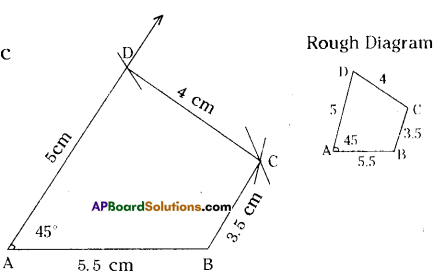
In Quadrilateral ABCD with AB = 5.5 cm, BC = 3.5 cm, CD = 4 cm, AD = 5 cm and ∠A = 45°.
AP Board 8th Class Maths Solutions Chapter 3 Construction of Quadrilaterals Ex 3.1 1

Construction Steps:

  1. Construct a line segment [latex]\overline{\mathrm{AB}}[/latex] with radius 5.5 cm
  2. With the centre A draw a ray and an arc which are equL1 to 45° and 5 cm.
  3. These intersecting point is keep as ‘D’.
  4. With centres D, B draw two arcs equal to radius 4 cm, 3.5 cm respectively.
  5. The intersecting point of these two arcs is keep as ‘C’.
  6. Join DC and BC. A F
  7. ∴ The required quadrilateral ABCD is formed.

Question (b).
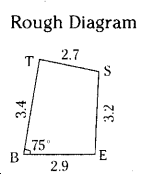
Quadrilateral BEST with BE = 2.9 cm, ES = 3.2 cm, ST = 2.7 cm, BT = 3.4 cm and ∠B=75°.
Solution:
In Quadrilateral BEST
BE = 2.9 cm, ES = 3.2 cm, ST = 2.7 cm, BT = 3.4 cm and ∠B=75°.
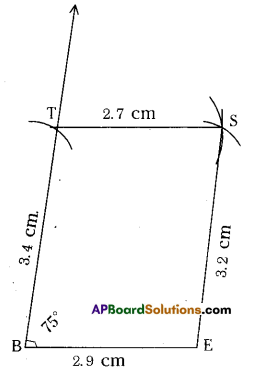
AP Board 8th Class Maths Solutions Chapter 3 Construction of Quadrilaterals Ex 3.1 2
AP Board 8th Class Maths Solutions Chapter 3 Construction of Quadrilaterals Ex 3.1 3

Construction Steps:

  1. Draw a line segment [latex]\overline{\mathrm{BE}}[/latex] with radius 2.9 cm.
  2. With the centre B, draw a ray of 75° and draw 2.9
    an arc with radius 3.4 cm, keep the intersecting point of these two as T.
  3. With the centres T, E draw arcs with radius 2.7 cm, 3.2 cm respectively. These intersection point is keep as S’.
  4. Join T, S and E,S.
  5. ∴ The required quadrilateral BEST is formed.

Question (c).
Parallelogram PQRS with PQ = 4.5 cm, QR =3 cm and ∠PQR = 60°.
Solution:
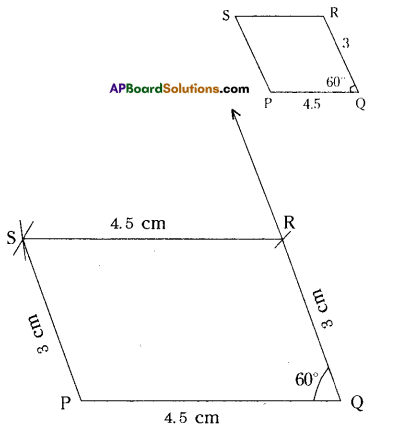
AP Board 8th Class Maths Solutions Chapter 3 Construction of Quadrilaterals Ex 3.1 4
In a parallelogram PQRS
PQ = 4.5 cm, QR = 3 cm, ZPQR = 60°.
=RS4.5cmzPS=3crn
[: Opposite sides of a I)aralielograrn are equal]

Construction Steps:

  1. Draw a line segment ¡i with radius 4.5 cm.
  2. With the centre Q draw a ray and an arc equal to 60° and 3 cm.
  3. The intersecting point of these two keep as R’.
  4. With the centres R, P draw arcs with 4.5 cm, 3 cm respectively. Keep ‘S’ as the intersecting point of these two arcs.
  5. Join P, S and R, S.
  6. ∴ The required parallelogram PQRS is formed.

Question (d).
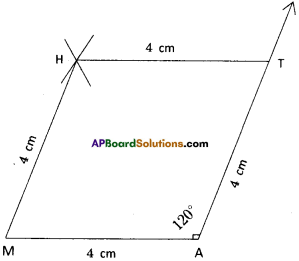
Rhombus MATH with AT =4 cm, ∠MAT =120°.
Solution:
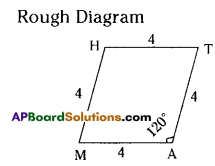
AP Board 8th Class Maths Solutions Chapter 3 Construction of Quadrilaterals Ex 3.1 5
AP Board 8th Class Maths Solutions Chapter 3 Construction of Quadrilaterals Ex 3.1 6

Construction Steps:

  1. Draw a line segment [latex]\overline{\mathrm{MA}}[/latex] with radius 4 cm.
  2. With the centre A draw a ray and an arc equal to 120°, 4 cm. These two intersecting point be keep as T.
  3. With the centres M, T draw arcs equal to 4 cms.
    These two arcs intersected at the point ‘H’.
  4. Join M, H and T, H.
  5. ∴ The required rhombus MATH is formed.

Question (e).
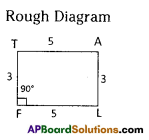
Rectangle FLAT with FL =5 cm, LA= 3 cm.
Solution:
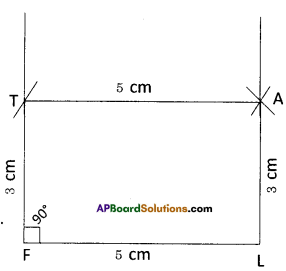
AP Board 8th Class Maths Solutions Chapter 3 Construction of Quadrilaterals Ex 3.1 7
AP Board 8th Class Maths Solutions Chapter 3 Construction of Quadrilaterals Ex 3.1 8
In a rectangle FLAT
FL=AT=5cm, LA = TF = 3cm, ∠F = ∠L = ∠A = ∠T = 90°

Construction Steps:

  1. Draw a line segment [latex]\overline{\mathrm{FL}}[/latex] with radius 5 cm.
  2. With the centre F draw a ray and an arc equal to 900, 3 cm.
    These to meet at point T.
  3. With the centres T, L draw arcs equal to 5 cm, 3 cm respectively.
  4. These two arcs meet at the point ‘A’.
  5. Join T, A and L, A.
  6. ∴ The required rectangle FLAT is formed.

Question (f).
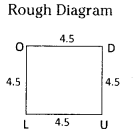
Square LUDO with LU = 4.5 cm.
Solution:
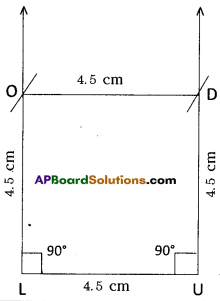
AP Board 8th Class Maths Solutions Chapter 3 Construction of Quadrilaterals Ex 3.1 9
AP Board 8th Class Maths Solutions Chapter 3 Construction of Quadrilaterals Ex 3.1 10
In a square LUDO
LU = UD = DO = OL = 4.5 cm
∠L = ∠U = ∠D = ∠O = 90°

Construction Steps: 45

  1. Draw a line segment [latex]\overline{\mathrm{LU}}[/latex] with radius 4.5 cm.
  2. With the centre ‘L’, draw a ray of 90° and an arc with radius 4.5 cm. These two meet at the point ‘O’.
  3. Now with the centre U’, draw another ray of 90° and an arc with radius 4.5 cm. These two meet at the point “D”.
  4. Join O, D.
  5. ∴ The required square LUDO is formed.
AP Board 8th Class Maths Solutions Chapter 2 Linear Equations in One Variable Ex 2.5

AP State Syllabus AP Board 8th Class Maths Solutions Chapter 2 Linear Equations in One Variable Ex 2.5 Textbook Questions and Answers.

AP State Syllabus 8th Class Maths Solutions 2nd Lesson Linear Equations in One Variable Exercise 2.5

AP Board 8th Class Maths Solutions Chapter 2 Linear Equations in One Variable Ex 2.5

Question 1.
Solve the following equations.
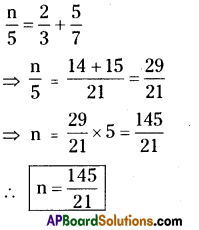
i) [latex]\frac{n}{5}-\frac{5}{7}=\frac{2}{3}[/latex]
Solution:
AP Board 8th Class Maths Solutions Chapter 2 Linear Equations in One Variable Ex 2.5 1

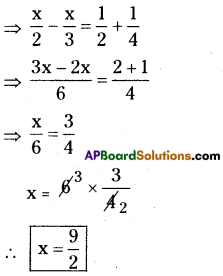
ii) [latex]\frac{x}{3}-\frac{x}{4}=14[/latex]
⇒ [latex]\frac{4 x-3 x}{12}[/latex] = 14
⇒ [latex]\frac{x}{12}[/latex] = 14
⇒ x = 12 × 14 = 168
∴ x = 168

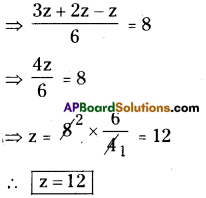
iii) [latex]\frac{z}{2}+\frac{z}{3}-\frac{z}{6}=8[/latex]
AP Board 8th Class Maths Solutions Chapter 2 Linear Equations in One Variable Ex 2.5 2

AP Board 8th Class Maths Solutions Chapter 2 Linear Equations in One Variable Ex 2.5

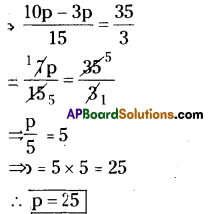
iv) [latex]\frac{2 p}{3}-\frac{p}{5}=11 \frac{2}{3}[/latex]
AP Board 8th Class Maths Solutions Chapter 2 Linear Equations in One Variable Ex 2.5 3

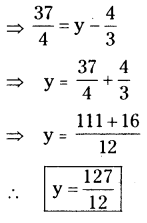
v) [latex]9 \frac{1}{4}=y-1 \frac{1}{3}[/latex]
AP Board 8th Class Maths Solutions Chapter 2 Linear Equations in One Variable Ex 2.5 5

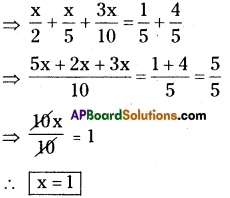
vi) [latex]\frac{x}{2}-\frac{4}{5}+\frac{x}{5}+\frac{3 x}{10}=\frac{1}{5}[/latex]
AP Board 8th Class Maths Solutions Chapter 2 Linear Equations in One Variable Ex 2.5 6

AP Board 8th Class Maths Solutions Chapter 2 Linear Equations in One Variable Ex 2.5

vii) [latex]\frac{x}{2}-\frac{1}{4}=\frac{x}{3}+\frac{1}{2}[/latex]
AP Board 8th Class Maths Solutions Chapter 2 Linear Equations in One Variable Ex 2.5 7

viii) [latex]\frac{2 x-3}{3 x+2}=\frac{-2}{3}[/latex]
⇒ 3(2x – 3) = – 2(3x + 2)
⇒ 6x – 9 = -6x – 4
⇒ 6x + 6x = -4 + 9
⇒ 12x = 5
∴ x = [latex]\frac{5}{12}[/latex]

ix) [latex]\frac{8 p-5}{7 p+1}=\frac{-2}{4}[/latex]
Solution:
⇒ [latex]\frac{8 p-5}{7 p+1}=\frac{-2}{4}[/latex]
⇒ 2(8p – 5) = – (7p + 1)
⇒ 16p – 10 = – 7p – 1
⇒ 16p + 7p = – 1 + 10
⇒ 23p = 9
∴ x = [latex]\frac{9}{23}[/latex]

AP Board 8th Class Maths Solutions Chapter 2 Linear Equations in One Variable Ex 2.5

x) [latex]\frac{7 y+2}{5}=\frac{6 y-5}{11}[/latex]
⇒ 11 (7y + 2) = 5 (6y-5)
⇒ 77y + 22 = 30y – 25
⇒ 77y – 30y = – 25 – 22
⇒ 47y = – 47
∴ y = [latex]\frac{-47}{47}[/latex]
∴ y = -1

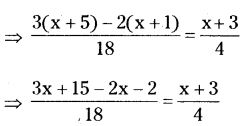
xi) [latex]\frac{x+5}{6}-\frac{x+1}{9}=\frac{x+3}{4}[/latex]
AP Board 8th Class Maths Solutions Chapter 2 Linear Equations in One Variable Ex 2.5 8
⇒ 4(x + 13) = 18 (x + 3)
⇒ 4x + 52 = 18x + 54
⇒ 4x – 18x = 54-52
⇒ – 14x = 2
⇒ x = [latex]\frac{2}{-1}[/latex] = [latex]\frac{-1}{7}[/latex]
∴ x = [latex]\frac{-1}{7}[/latex]

AP Board 8th Class Maths Solutions Chapter 2 Linear Equations in One Variable Ex 2.5

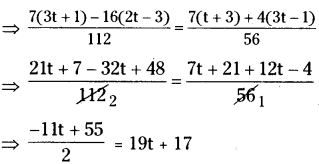
xii) [latex]\frac{3 t+1}{16}-\frac{2 t-3}{7}=\frac{t+3}{8}+\frac{3 t-1}{14}[/latex]
Solution:
AP Board 8th Class Maths Solutions Chapter 2 Linear Equations in One Variable Ex 2.5 9
⇒ -11t + 55 = 2(19t + 17) = 38t + 34
⇒ -11t – 38t = 34 – 55
⇒ -49t = – 21
⇒ [latex]\frac{-21}{-49}[/latex] = [latex]\frac{3}{7}[/latex]
∴ t = [latex]\frac{3}{7}[/latex]

Question 2.
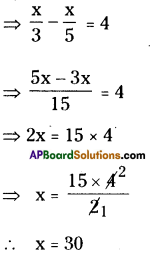
What number is that of which the third part exceeds the fifth part by 4?
Solution:
Let the number be ‘x’ say.
[latex]\frac{1}{3}[/latex] rd of a number = [latex]\frac{1}{3}[/latex] x x = [latex]\frac{x}{3}[/latex]
[latex]\frac{3}{7}[/latex] th of a number = [latex]\frac{1}{5}[/latex] x x = [latex]\frac{x}{5}[/latex]
According to the sum
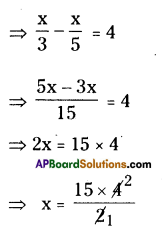
AP Board 8th Class Maths Solutions Chapter 2 Linear Equations in One Variable Ex 2.5 10
∴ The required number is 30.

AP Board 8th Class Maths Solutions Chapter 2 Linear Equations in One Variable Ex 2.5

Question 3.
The difference between two positive integers is 36. The quotient when one integer is
divided by other is 4. Find the integers.
(Hint: If one number is ‘X’, then the other number is ‘x – 36’)
Solution:
Let the two positive numbers be x, (x – 36) say.
If one number is divided by second tten the quotient is 4.
∴ [latex]\frac{x}{x-36}=4[/latex]
⇒ x = 4(x – 36) = 4x – 144
⇒ 4x – x = 144
3x = 144
x = 48
∴ x – 36 = 48 – 36 = 12
∴ The required two positive intgers are 48, 12.

Question 4.
The numerator of a fraction is 4 less than the denominator. If 1 is added to both its
numerator and denominator, it becomes 1/2 . Find the fraction.
Solution:
Let the denominator of a fractin be x.
The numerator of a fraction is 4 less than the denominator.
∴ The numerator = x – 4
∴ Fraction [latex]\frac{x-4}{x}[/latex]
If ‘1’ is added to both, its numerator and denominator, it becomes [latex]\frac{1}{2}[/latex]
∴ [latex]\frac{1+x-4}{1+x}=\frac{1}{2}[/latex]
2 + 2x – 8 = 1 + x
2x – x = 1 + 6 = 7
x = 7
∴ The denominator = 7
The numerator = 7 – 4 = 3
∴ Fraction = [latex]\frac{3}{7}[/latex]

AP Board 8th Class Maths Solutions Chapter 2 Linear Equations in One Variable Ex 2.5

Question 5.
Find three consecutive numbers such that if they are divided by 10, 17, and 26 respectively,
the sum of their quotients will be 10.
(Hint: Let the consecutive numbers = x, x+ 1, x+ 2, then [latex]\frac{x}{10}+\frac{x+1}{17}+\frac{x+2}{26}=10[/latex])
Solution:
Let the three consecutive numbers be assume that x, (x + 1), (x + 2) respectively.
Given that x, (x + 1), (x + 2) are divided by 10, 17, 26 respectively, the sum of the quotients is 10. Then
⇒ [latex]\frac{x}{10}+\frac{x+1}{17}+\frac{x+2}{26}=10[/latex]
⇒ [latex]\frac{x \times 221+130(x+1)+85(x+2)}{2210}=10[/latex]
⇒ 221x + 130x + 85x + 130 + 170 = 22,100
⇒ 436x + 300 = 22,100
⇒ 436x = 22,100 – 300
⇒ 436x = 21,800
⇒ [latex]\frac{21800}{436}[/latex]
∴ x = 50
∴ The required three consecutive num-bers are x = 50
x + 1 =50+ 1 = 51
x + 2 = 50 + 2 = 52

Question 6.
In class of 40 pupils the number of girls is three-fifths of the number of boys. Find the
number of boys in the class.
Solution:
Let the number of boys = x say.
Total number of students = 40
Number of girls = [latex]\frac{3}{5}[/latex] × x = [latex]\frac{3x}{5}[/latex]
According to the sum 3x
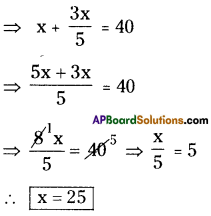
AP Board 8th Class Maths Solutions Chapter 2 Linear Equations in One Variable Ex 2.5 11
∴ x = 25
∴ Number of boys in the class room = 25

AP Board 8th Class Maths Solutions Chapter 2 Linear Equations in One Variable Ex 2.5

Question 7.
After 15 years , Mary’s age will be four times of her present age. Find her present age.
Solution:
Let the present age of Mary = x years say.
After 15 years Mary’s age = (x + 15) years
According to the sum
(x + 15) = 4 x x
⇒ x + 15 = 4x
⇒ 4x – x =15
⇒ 3x = 15
⇒ x = 5
∴ The present age of Mary = 5 years.

Question 8.
Aravind has a kiddy bank. It is full of one-rupee and fifty paise coins. It contains 3 times
as many fifty paise coins as one rupee coins. The total amount of the money in the bank is
₹ 35. How many coins of each kind are there in the bank?
Solution:
Number of 1 rupee coins = x say.
Number of 50 – paise coins = 3 x x = 3x
The value of total coins = [latex]\frac{3x}{2}[/latex] + x
[∵50 paisa coins of 3x = ₹[latex]\frac{3x}{2}[/latex]
According to the sum
⇒ [latex]\frac{3x}{2}[/latex] + x = 35
⇒ [latex]\frac{3 x+2 x}{2}[/latex] = 35
⇒ 5x = 2 × 35
⇒ x = 2 × [latex]\frac{35}{5}[/latex]
∴ x = 14
∴ Number of 1 rupee coins = 14
Number of 50 paisa coins = 3 × x = 3 × 14 = 42

AP Board 8th Class Maths Solutions Chapter 2 Linear Equations in One Variable Ex 2.5

Question 9.
A and B together can finish a piece of work in 12 days. If ‘A’ alone can finish the same work in 20days , in how many days B alone can finish it?
Solution:
A, B can do a piece of work in 12 days.
(A + B)’s 1 day work = [latex]\frac{1}{12}[/latex] th part.
A can complete the same work in 20 days.
Then his one day work = [latex]\frac{1}{20}[/latex]
B’s one day work = (A+B)’s 1 day work – A’s 1 day work
[latex]=\frac{1}{12}-\frac{1}{20}=\frac{5-3}{60}=\frac{2}{60}=\frac{1}{30}[/latex]
∴ Number of days to take B to com¬plete the whole work = 30.

Question 10.
If a train runs at 40 kmph it reaches its destination late by 11 minutes . But if it runs at 50 kmph it is late by 5 minutes only. Find the distance to be covered by the train.
Solution:
Let the distance to be reached = x km say. Time taken to travel ‘x’ km with speed x
40 km/hr = [latex]\frac{x}{40}[/latex] hr.
Time taken to travel ‘x’ km with speed 50 km/hr = [latex]\frac{x}{50}[/latex] hr.
According to the sum the difference between the times
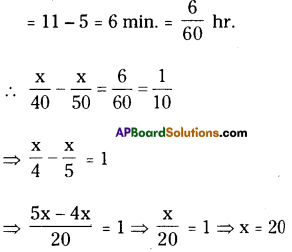
AP Board 8th Class Maths Solutions Chapter 2 Linear Equations in One Variable Ex 2.5 12
∴ The required distance to be trav¬elled by a train = 20 kms‘.

AP Board 8th Class Maths Solutions Chapter 2 Linear Equations in One Variable Ex 2.5

Question 11.
One fourth of a herd of deer has gone to the forest. One third of the total number is
grazing in a field and remaining 15 are drinking water on the bank of a river. Find the total
number of deer.
Solution:
Number of deer = x say.
Number of deer has gone to the forest
= [latex]\frac{1}{4}[/latex] × x = [latex]\frac{x}{4}[/latex]
Number of deer grazing in the field
= [latex]\frac{1}{3}[/latex] × x =[latex]\frac{x}{3}[/latex]
Number of remaining deer =15
According to the sum
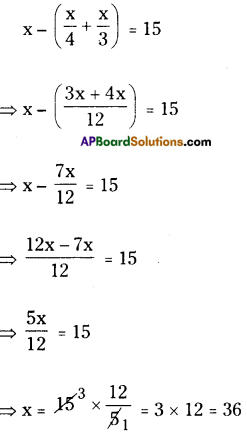
AP Board 8th Class Maths Solutions Chapter 2 Linear Equations in One Variable Ex 2.5 13
∴ x = 36
∴ The total number of deer = 36

Question 12.
By selling a radio for ₹903, a shop keeper gains 5%. Find the cost price of the radio.
Solution:
The selling price of a radio = ₹ 903
Profit % = 5%
C.P = ?
C.P = [latex]\frac{\mathrm{S.P} \times 100}{(100+\mathrm{g})}[/latex]
= [latex]\frac{903 \times 100}{(100+5)}[/latex]
= [latex]\frac{903\times 100}{105}[/latex]
C.P. = 8.6 × 100 = 860
∴ The cost price of the radio = ₹ 860

AP Board 8th Class Maths Solutions Chapter 2 Linear Equations in One Variable Ex 2.5

Question 13.
Sekhar gives a quarter of his sweets to Renu and then gives 5 sweets to Raji. He has 7 sweets left. How many did he have to start with?
Solution:
Number of sweets with Sekhar = x say.
Number of sweets given to Renu
= [latex]\frac{1}{4}[/latex] × x = [latex]\frac{x}{4}[/latex]
Number of sweets given to Raji = 5
Till he has 7 sweets left.
x – ( [latex]\frac{x}{4}[/latex] + 5) = 7
⇒ x – [latex]\frac{x}{4}[/latex] – 5 = 7
⇒ x – [latex]\frac{x}{4}[/latex] = 7 + 5 = 12
⇒ [latex]\frac{4 x-x}{4}[/latex] = 12
⇒ [latex]\frac{3x}{4}[/latex] = 12
⇒ x = 12 × [latex]\frac{4}{3}[/latex] = 16
∴ x = 4 × 4 = 16
∴ Number of sweets with Sekhar at the beginning = 16

AP Board 8th Class Maths Solutions Chapter 2 Linear Equations in One Variable Ex 2.4

AP State Syllabus AP Board 8th Class Maths Solutions Chapter 2 Linear Equations in One Variable Ex 2.4 Textbook Questions and Answers.

AP State Syllabus 8th Class Maths Solutions 2nd Lesson Linear Equations in One Variable Exercise 2.4

AP Board 8th Class Maths Solutions Chapter 2 Linear Equations in One Variable Ex 2.4

Question 1.
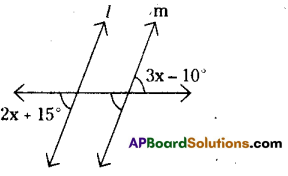
Find the value of ’x’ so that l || m
AP Board 8th Class Maths Solutions Chapter 2 Linear Equations in One Variable Ex 2.4 1
Solution:
Given l|| m. Then 3x – 10° = 2x + 15°
[Vertically opposite angles and corresponding angles are equal.]
⇒ 3x – 10 = 2x + 15
⇒ 3x – 2x = 15 + 10
∴ x = 25°

AP Board 8th Class Maths Solutions Chapter 2 Linear Equations in One Variable Ex 2.4

Question 2.
Eight times of a number reduced by 10 is equal to the sum of six times the number and 4. Find the number.
Solution:
Let the number be ‘x’ say.
8 times of a number = 8 × x = 8x
¡f10 is reduced from 8x then 8x – O
6 times of a number = 6 × x = 6x
If 4 is added to 6x then 6x + 4
According to the sum,
8x – 10 = 6x + 4
⇒ 8x – 6x = 4 + 10
⇒ 2x = 14
⇒ x = 7
∴ The required number = 7

AP Board 8th Class Maths Solutions Chapter 2 Linear Equations in One Variable Ex 2.4

Question 3.
A number consists of two digits whose sum is 9. If 27 is subtracted from the number its digits are reversed. Find the number.
Solution:
Let a digit of two digit number be x.
The sum of two digits = 9
∴ Another digit = 9 – x
The number = 10 (9 – x) + x
= 90 – 10x + x
= 90 – 9x
If 27 is subtraçted from the number its digits are reversed.
∴ (90 – 9x) – 27 = 10x + (9 – x)
63 – 9x = 9x + 9
9x + 9x = 63 – 9
18x = 54
∴ x = [latex]\frac { 54 }{ 18 }[/latex] = 3
∴ Units digit = 3
Tens digit = 9 – 3 = 6
∴ The number = 63

AP Board 8th Class Maths Solutions Chapter 2 Linear Equations in One Variable Ex 2.4

Question 4.
A number is divided into two parts such that one part is 10 more than the other. If the two parts are in the ratio 5:3, find the number and the two parts.
Solution:
If a number is divided into two parts in he ratio of 5 : 3, let the parts be 5x, 3x say.
According to the sum,
5x = 3x + 10
⇒ 5x – 3x = 10
⇒ 2x = 10
∴ x = [latex]\frac { 10 }{ 2 }[/latex]
∴ x = 5
∴ The required number be
x + 3x = 8x
= 8 × 5 = 40
And the parts of number are
5 = 5 × 5 = 25
3 = 3 × 5 = 15

AP Board 8th Class Maths Solutions Chapter 2 Linear Equations in One Variable Ex 2.4

Question 5.
When I triple a certain number and add 2, I get the same answer as I do when I subtract the number from 50. Find the number.
Solution:
Let the number be x’ say.
3 times of a number = 3 × x = 3x
If 2 is added to 3x then 3x + 2
If ‘xis subtracted from 50 then it becomes 50 – x.
According to the sum,
3x + 2 = 50 – x
3x + x = 50 – 2
4x = 48 .
x = 12
∴ The required number 12

Question 6.
Mary is twice older than her sister. In 5 years time, she will be 2 years older than her sister. Find how old are they both now.
Solution:
Let the age of Marys sister = x say.
Mary’s age = 2 × x = 2x
After 5 years her sister’s age
= (x + 5) years
After 5 years Mary’s age
= (2x + 5) years
According to the sum,
2x + 5 = (x + 5) + 2
= 2x – x = 5 + 2 – 5
∴ The age of Mary’s sister = x = 2 years
Mary’s age = 2x = 2 x 2 = 4 years

AP Board 8th Class Maths Solutions Chapter 2 Linear Equations in One Variable Ex 2.4

Question 7.
In 5 years time, Reshma will be three times old as she was 9 years ago. How old is she now?
Solution:
Reshma’s present age = ‘x’ years say.
After 5 years Reshmats age
= (x + 5) years
Before 9 years Reshma’s age
=(x – 9) years
According to the sum
= x+ 5 = 3(x – 9) = 3x – 27
x – 3x = -27-5
-2x = -32
x = [latex]\frac{-32}{-2}[/latex] = 16
∴ x = 16
∴ Reshma’s present age = 16 years.

AP Board 8th Class Maths Solutions Chapter 2 Linear Equations in One Variable Ex 2.4

Question 8.
A town’s population increased by 1200 people, and then this new population decreased 11%. The town now had 32 less people than it did before the 1200 increase. Find the original population.
Solution:
Let th population of a town after the increase of 1200 is x say.
11% of present population
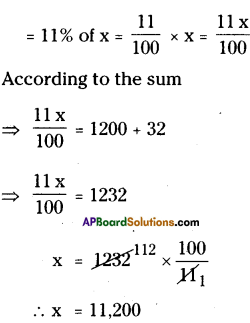
AP Board 8th Class Maths Solutions Chapter 2 Linear Equations in One Variable Ex 2.4 2
The present population of town
= 11,200 – 1200 = 10,000

AP Board 8th Class Maths Solutions Chapter 2 Linear Equations in One Variable Ex 2.4

Question 9.
A man on his way to dinner shortly after 6.00 p.m. observes that the hands of his watch form an angle of 110°. Returning before 7.00 p.m. he notices that again the hands of his watch form an angle of 1100. Find the number of minutes that he has been away.
Solution:
Let the number be ‘x ray.
[latex]\frac { 1 }{ 3 }[/latex] rd of a number = [latex]\frac { 1 }{ 3 }[/latex] x x = [latex]\frac { x }{ 3 }[/latex]
[latex]\frac { 1 }{ 5 }[/latex] th of a number = [latex]\frac { 1 }{ 5 }[/latex] x x = [latex]\frac { x }{ 5 }[/latex]
According to the sum
AP Board 8th Class Maths Solutions Chapter 2 Linear Equations in One Variable Ex 2.4 3
∴ x = 30
∴ The required number is 30.

AP Board 8th Class Maths Solutions Chapter 2 Linear Equations in One Variable Ex 2.3

AP State Syllabus AP Board 8th Class Maths Solutions Chapter 2 Linear Equations in One Variable Ex 2.3 Textbook Questions and Answers.

AP State Syllabus 8th Class Maths Solutions 2nd Lesson Linear Equations in One Variable Exercise 2.3

 AP Board 8th Class Maths Solutions Chapter 2 Linear Equations in One Variable Ex 2.3

Question
Solve the following equations:
1. 7x – 5 = 2x
2. 5x – 12 = 2x – 6
3. 7p- 3 = 3p + 8
4. 8m + 9 = 7m + 8
5. 7z + 13 = 2z + 4
6. 9y + 5 = 15y – 1
7. 3x + 4 = 5(x – 2)
8. 3(t – 3) = 5(2t – 1)
9. 5(p – 3) = 3(p – 2)
10. 5(z + 3) = 4(2z + 1)
11. 15(x – 1) + 4(x + 3) = 2 (7 + x)
12. 3 (5z – 7) +2 (9z – 11) = 4 (8z – 7) – 111
13. 8(x – 3) – (6 – 2x) = 2(x + 2) – 5 (5 – x)
14. 3(n – 4)+2(4n – 5) = 5(n + 2) + 16
Solution:
1. 7x – 5 = 2x
⇒ 7x – 2x = 5
⇒ 5x = 5
⇒ x = [latex]\frac { 5 }{ 5 }[/latex] = 1
∴ x = 1

 AP Board 8th Class Maths Solutions Chapter 2 Linear Equations in One Variable Ex 2.3

2. 5x – 12 = 2x – 6
⇒ 5x – 2x = – 6 + 12
⇒ 3x = 6
⇒ x = [latex]\frac { 6 }{ 3 }[/latex] = 2
∴ x = 2

3. 7p – 3 = 3p + 8
⇒ 7p – 3p = 8 + 3
⇒ 4p = 11
⇒ p = [latex]\frac { 11 }{ 4 }[/latex]

4. 8m + 9 = 7m + 8
⇒ 8m – 7m = 8 – 9
∴ m = – 1

5. 7z + 13 = 2z + 4
⇒ 7z – 2z = 4 – 13
⇒ 5z = – 9
∴ z = [latex]\frac { -9 }{ 5 }[/latex]

 AP Board 8th Class Maths Solutions Chapter 2 Linear Equations in One Variable Ex 2.3

6. 9y + 5 = 15y – 1
⇒ 9y – 15y = – 1 – 5
⇒ -6y = -6
⇒ y = [latex]\frac { -6 }{ -6 }[/latex]
∴ y = 1

7. 3x + 4 = 5(x – 2)
⇒ 3x + 4 =5x – 10
⇒ 3x – 5x= – 10 – 4
⇒ – 2x = – 14
:. x = 71

8. 3(t – 3) = 5(2t – 1)
⇒ 3t – 9 = 10t – 5
⇒ 3t – 10t = – 5+ 9
⇒ – 7t = 4
∴ t = [latex]\frac { -4 }{ 7 }[/latex]

9. 5 (p – 3) = 3 (p – 2)
⇒ 5p – 15 = 3p – 6
⇒ 5p – 3p = -6 + 15
⇒ 2p = 9
∴ p = [latex]\frac { 9 }{ 2 }[/latex]

 AP Board 8th Class Maths Solutions Chapter 2 Linear Equations in One Variable Ex 2.3

10. 5(z + 3) = 4(2z + 1)
⇒ 5z + 15 = 8z + 4
⇒ 5z – 8z = 4 – 15
⇒ – 3z = – 11
⇒ z = [latex]\frac { -11 }{ 3 }[/latex]
∴ z = [latex]\frac { -11 }{ 3 }[/latex]

11. 15(x – 1) + 4(x + 3) = 2(7 + x)
⇒ 15x – 15 + 4x + 12= 14 + 2x
⇒ 19x – 3 = 14 + 2x
⇒ 19x – 2x = 14 + 3
⇒ 17x = 17 ,
x = [latex]\frac { 17 }{ 17 }[/latex] = 1
∴ x = 1

12. 3(5z – 7)+2(9z – 11) = 4(8z – 7) – 111
⇒ 15z – 21 + 18z – 22 = 32z – 28 – 111
⇒ 33z – 43 = 32z – 139
⇒ 33z – 32z = – 139 + 43
∴ z = – 96

 AP Board 8th Class Maths Solutions Chapter 2 Linear Equations in One Variable Ex 2.3

13. 8(x – 3) – (6 – 2x)=2(x+2)-.5(5 – x)
⇒ 8x – 24 – 6 + 2x = 2x + 4 – 25 +5x
⇒ 8x – 30 = 5x – 21
⇒ 8x – 5x= – 21 +30
⇒ 3x = 9
∴ x = 3

14. 3(n – 4) + 2(4n – 5) = 5(n + 2) + 16
⇒ 3n – 12 + 8n – 10 = 5n + 10 + 16
⇒ 11n – 22 = 5n + 26
⇒ 11n – 5n = 26 + 22
⇒ 6n =48
⇒ n = [latex]\frac { 48 }{ 6 }[/latex] = 8
∴ n = 8

AP Board 8th Class Maths Solutions Chapter 2 Linear Equations in One Variable Ex 2.2

AP State Syllabus AP Board 8th Class Maths Solutions Chapter 2 Linear Equations in One Variable Ex 2.2 Textbook Questions and Answers.

AP State Syllabus 8th Class Maths Solutions 2nd Lesson Linear Equations in One Variable Exercise 2.2

 AP Board 8th Class Maths Solutions Chapter 2 Linear Equations in One Variable Ex 2.2

Question 1.
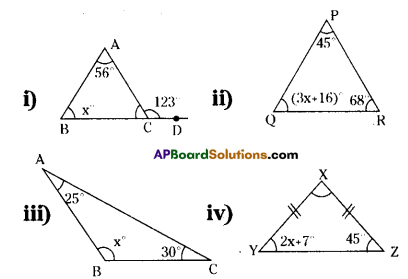
Find ‘x’ in the following figures?
AP Board 9th Class Maths Solutions Chapter 2 Linear Equations in One Variable Ex 2.2 1
AP Board 9th Class Maths Solutions Chapter 2 Linear Equations in One Variable Ex 2.2 2
Solution:
1) In a triangle the exterior angle is equal to the sum of its opposite interior angles.
∴ ∠ACD = ∠B + ∠A
⇒ 123°= x + 56°
⇒ x = 123°- 56° = 67°
∴ x = 67°

ii) Sum of three angles of a triangle = 180°
∠P + ∠Q +∠R = 180°
⇒ 45° + 3x + 16°+ 68° = 180°
⇒ 3x + 129° = 180°
3x = 180 – 129 = 51
∴ x = [latex]\frac{51}{3}[/latex]
∴ x = 17°

 AP Board 8th Class Maths Solutions Chapter 2 Linear Equations in One Variable Ex 2.2

iii) ∠A + ∠B + ∠C = 180°
⇒ 25° + x + 30° = 180°
x + 55°= 180°
x = 180 – 55 = 125°
∴ x = 125°

iv) In ΔXYZ, [latex]\overline{\mathrm{XY}}=\overline{\mathrm{XZ}}[/latex] then ∠Y = ∠Z
∴ 2x + 7° = 45°
⇒ 2x = 45 – 7
⇒ 2x = 38
⇒ x = [latex]\frac{38}{2}[/latex]
∴ x = 19°

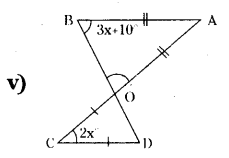
v) From ΔBOA
[latex]\overline{\mathrm{AB}}=\overline{\mathrm{OA}} [/latex] ⇒ ∠B = ∠O = 3x + 10° ………(1)
From ΔCOD
[latex]\overline{\mathrm{OC}}=\overline{\mathrm{CD}} [/latex] ⇒ ∠O = ∠D …………………(2)
[∵ The angles which are opposite to the equal sides are equal].
from (1) & (2)
∠BOA = ∠COD
[∵ Vertically opposite angles are equal.]
But ∠COD = 90 – x
(∵ 2x + ∠O + ∠D = 180
⇒ 2x + ∠O + ∠O = 180 (∵∠O = ∠D)
⇒ 2∠O = 180 – 2x
∠O = [latex]\frac{180-2 x}{2}[/latex] = 90 – x]
∴ From ∠BOA = ∠COD
⇒ 3x + 10 = 90 – x
⇒ 3x + x = 90 – 10
⇒ 4x = 80
∴ x = 20°

 AP Board 8th Class Maths Solutions Chapter 2 Linear Equations in One Variable Ex 2.2

Question 2.
The difference between two numbers is 8. if 2 is added to the bigger number the result will be three times the smaller number. Find the numbers.
Solution:
Let the bigger number be x.
The difference between two numbers 8
∴ Smaller number = x – 8
If 2 is added to the bigger number the result will be three times the smaller
number.
So x + 2 = 3(x – 8)
x + 2 = 3x – 24
x – 3x = -24 – 2
– 2x = -26
∴ x = [latex]\frac{26}{2}[/latex] = 13
∴ Bigger number = 13
Smaller number = 13 – 8 = 5

Question 3.
What are those two numbers whose sum is 58 and difference is 28’?
Solution:
Let the bigger number be ‘x’.
The sum of two numbers = 58
∴ Smaller number = 58 – x
The difference of two numbers = 28
∴ x – (58 – x) = 28
x – 58 + x = 28
2x = 28 + 58 = 86
∴ x = [latex]\frac{86}{2}[/latex] = 43
∴ Bigger number or one number = 43
Smaller number or second number = 58 – 43 = 15

 AP Board 8th Class Maths Solutions Chapter 2 Linear Equations in One Variable Ex 2.2

Question 4.
The sum of two consecutive odd numbers is 56. Find the numbers.
Solution:
Let the two consecutive odd numbers
be 2x 1, 2x + 3 say.
Sum of the odd numbers
=(2x + 1) + (2x + 3) = 56
= 4x + 4 = 56
⇒ 4x = 56 – 4 = 52
x = [latex]\frac{52}{4}[/latex] = 13
∴ x = 13
∴ 2x + 1 = 2 × 13 + 1
= 26 + 1 = 27
2x + 3 = 2 × 13 + 3
= 26 + 3 = 29
∴ The required two consecutive odd numbers be 27, 29.

 AP Board 8th Class Maths Solutions Chapter 2 Linear Equations in One Variable Ex 2.2

Question 5.
The sum of three consecutive multiples of 7 is 777. Find these multiples.
(Hint: Three consecutive multiples of 7 are ‘x’, ‘x+ 7’, ‘x+ 14’)
Solution:
Let the three consecutive multiples of 7 be x, x + 7, x + 14 say.
According to the sum,
The sum of three consecutive multiples of 7 is 777.
⇒ x + (x + 7) + (x + 14)= 777
⇒ 3x + 21 = 777
⇒ 3x = 777 – 21 = 756
x = [latex]\frac { 756 }{ 3 }[/latex] = 252
x+ 7 = 252 + 7 = 259
x + 14 252 + 14 = 266
∴ The required three consecutive multiples of 7 are 252, 259, 266

Question 6.
A man walks 10 km, then travels a certain distance by train and then by bus as far as twice by the train. 1f the whole journey is of 70km, how far did he travel by train?
Solution:
The distance travelled by walk = 10 km
Let the distance travelled by train = x km say.
The distance travelled by bus
= 2 × x = 2x km
∴ 10 + x + 2x = 70
⇒ 3x = 70 – 10
⇒ 3x = 60
⇒ x = [latex]\frac { 60 }{ 3 }[/latex] = 20
⇒ x = 20
∴ The distance travelled by train = 20 km.

 AP Board 8th Class Maths Solutions Chapter 2 Linear Equations in One Variable Ex 2.2

Question 7.
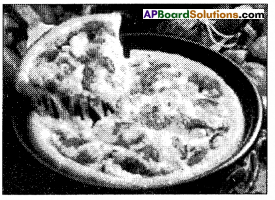
Vinay bought a pizza and cut it into three pieces. When the weighed the first piece he found that it was 7g lighter than the second piece and 4g.heavier than the third piece. If the whole pizza weighed 300g. How much did each of the three pieces weigh?
AP Board 9th Class Maths Solutions Chapter 2 Linear Equations in One Variable Ex 2.2 3
(Hint: weight of normal piece be ‘x’ then weight of largest piece is ‘x+ 7’, weight of the smallest piece is ‘x-4’)
Solution:
If pizza is cut into three pieces.
Let the weight of first piece he ‘x’ gm say.
Weight of the second piece = (x + 7) gm
Weight of the third piece = (x – 4) gm
According to the sum
∴ x + (x + 7) + (x – 4) = 300
⇒ 3x + 3 = 300
⇒ 3x = 300 – 3 = 297
⇒ x = [latex]\frac { 297 }{ 3 }[/latex] = 99
∴ x= 99
x + 7= 99 + 7 =106
x – 4 = 99 – 4 = 95
∴ The required 3 pieces of pizza weighs 95 gm. 99 gm, 106 gm.

 AP Board 8th Class Maths Solutions Chapter 2 Linear Equations in One Variable Ex 2.2

Question 8.
The distance around a rectangular field is 400 meters.The length of the field is 26 meters more than the breadth. Calculate the length and breadth of the field’?
Solution:
Let the breadth of a rectangular field = x m
Length = (x + 26) m.
Perimeter of a rectangular field
= 2(l + b) = 400
l + b = 200
x + 26 + x = 200
2x = 200 – 26 = 174
x = [latex]\frac { 174 }{ 2 }[/latex]
∴ x = 87
∴ The length = x +26
= 87 + 26
= 113 m
Breadth = x = 87 m.

 AP Board 8th Class Maths Solutions Chapter 2 Linear Equations in One Variable Ex 2.2

Question 9.
The length of a rectangular field is 8 meters less than twice its breadth. If the perimeter of the rectangular field is 56 meters, find its length and breadth’?
Solution:
Let the breadth of a rectangular field = xm.
Length = 2 × x – 8 = (2x – 8) m.
Perimeter of a field = 56 m.
∴ 2(l + b) = 56
l + b = 28
2x – 8 + x = 28
3x = 28 + 8 = 36
x = [latex]\frac { 36 }{ 3 }[/latex]
∴ x= 12
∴ Breadth = 12 m
Length = 2x – 8
= 2 × 12 – 8
= 24 – 8 = 16m.

Question 10.
Two equal sides of a triangle are each 5 meters less than twice the third side. if the perimeter of the triangle is 55 meters, find the length of its sides’?
Solution:
A triangle in which the length of the third side = x m. say.
The length of remaining two equal sides = 2 × x – 5 = (2x – 5) m.
Perimeter of a triangle = 55 m.
∴ (2x – 5) + (2x -5) + x = 55
⇒ 5x – 10 = 55
⇒ 5x = 65
⇒ x = [latex]\frac { 65 }{ 5 }[/latex]
∴ x = 13m
2x – 5 = 2 × 13 – 5 = 26 – 5 = 21m.
∴ The lengths of three sides of a triangle are 13, 21, 21. (in m.)

 AP Board 8th Class Maths Solutions Chapter 2 Linear Equations in One Variable Ex 2.2

Question 11.
Two complementary angles differ by 12°, find the angles’?
Solution:
Let one angle in two complementary angles be x.
Sum of the two complementary angles = 90°
∴ Second angle = 90° – x
Here two complementary angles differ by 12°.
∴ x – (90°- x) = 12°
x – 90° + x = 12°
2x = 12° + 90° = 102°
∴ [latex]\frac{102^{\circ}}{2}[/latex] = 51°
one angle = 51°
Second angle 90° – 51° = 39°

 AP Board 8th Class Maths Solutions Chapter 2 Linear Equations in One Variable Ex 2.2

Question 12.
The ages of Rahul and Laxmi arc in the ratio 5:7. Four years later, the sum of their ages will
be 56 years. What are their present ages’?
Solution:
The ratio of ages of Rahul and Lakshmi = 5:7
Let their ages be 5x, 7x say.
After 4 years Rahuls agt. = 5x + 4
After 4 years Lakshmis age = 7x + 4
According to the sum,
After 4 years the sum of their ages = 56
⇒ (5x + 4) + (7x + 4) = 56
⇒ 12x + 8 = 56
⇒ 12x = 56 – 8 = 48
⇒ x= [latex]\frac { 48 }{ 12 }[/latex] = 4
∴ x = 4
∴ Rahuls present age
= 5x = 5 × 4 = 20 years
∴ Lakshmi’s present age
= 7x = 7 × 4 = 28 years

 AP Board 8th Class Maths Solutions Chapter 2 Linear Equations in One Variable Ex 2.2

Question 13.
There are 180 multiple choice questions in a test. A candidate gets 4 marks for every correct answer, and for every un-attempted or wrongly answered questions one mark is deducted from the total score of correct answers. If a candidate scored 450 marks in the
test how many questions did he answer correctly ?
Solution:
Number of questions attempted for correct answers = x say
umber of questions attempted for wrong answers = 180 – x
4 marks are awarded for every correct answer.
Then numl)er of marks ohtained for correct answers 4 × x = 4x
1 mark is deducted for every wrong answer.
∴ Number of marks deducted for wrong answers
=(180 – x) × 1 = 180 – x
According to the sum.
4x – (180 – x) = 450
⇒ 4x – 180 + x = 450
⇒ 5x = 450 + 180
⇒ 5x = 630
x = [latex]\frac { 630 }{ 5 }[/latex]
∴ x = 126
∴ Number of questions attempted for correct answers = 126

Question 14.
A sum of ₹ 500 is in the form of denominations of ₹ 5 and ₹ 10. If the total number of notes is 90 find the number of notes of each denomination.
(Hint: let the number of 5 rupee notes be ‘x’, then number of 10 rupee notes = 90 – x)
Solution:
Number of ₹ 5 notes = x say.
Number of ₹ 10 notes = 90 – x
5x + 10(90 – x) = 500
5x + 900 – 10x = 500
– 5x = 500 – 900 = – 400
x = [latex]\frac { -400 }{ -5 }[/latex]
∴ x = 80
∴ Number of ₹ 5 notes = 80
Number of ₹ 10 notes
= 90 – x = 90 – 80 = 10

 AP Board 8th Class Maths Solutions Chapter 2 Linear Equations in One Variable Ex 2.2

Question 15.
A person spent ₹ 564 in buying geese and ducks,if each goose cost ₹ 7 and each duck ₹ 3 and if the total number of birds bought was 108, how many of each type did he buy?
AP Board 9th Class Maths Solutions Chapter 2 Linear Equations in One Variable Ex 2.2 4
Solution:
Let the number of pens be x.
The total number of things = 108
∴ The number of pencils = 108 – x
Thecostofpens of x = ₹7 × x = ₹ 7x
The cost of pencils of (108- x)
= ₹3(108 – x) = ₹ (324 – 3x)
Total amount to t)uy eflS and Pencils = ₹564
∴ 7x + (324 – 3x) 5M
7x + 324 – 3x = 564
4x = 564 – 324 = 240
∴ x = [latex]\frac { 240 }{ 4 }[/latex] = 60
The number of pens = 60
The number of pencils = 108 – 60 = 48

 AP Board 8th Class Maths Solutions Chapter 2 Linear Equations in One Variable Ex 2.2

Question 16.
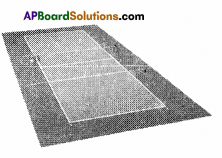
The perimeter ofa school volleyball court is 177 ft and the length is twice the width. What are the dimensions of the volleyball court’?
AP Board 9th Class Maths Solutions Chapter 2 Linear Equations in One Variable Ex 2.2 5
Solution:
Breadth of a volleyball court = x feet say.
∴ Its length = 2 × x = 2 x feet.
The perimeter of a court = 177 feet.
⇒ 2(l + b) = 177
⇒ 2(2x + x) = 177
⇒ 2 x 3x = 177
⇒ 6x = 177
⇒ x =[latex]\frac { 177 }{ 6 }[/latex]
∴ x = 29.5
∴ The breadth of a volleyball court = 29.5 ft
The length of a volleyball court = 2x = 2 × 29.5 = 59ft

Question 17.
The sum of the page numbers on the facing pages of a book is 373. What are the page numbers?
(Hint :Let the page numbers of open pages are x and (x + 1)
AP Board 9th Class Maths Solutions Chapter 2 Linear Equations in One Variable Ex 2.2 6
Solution:
Number of first page of a opened book x
Number ol second page = x + 1
∴ The surï of the numbers of two pages = 373
⇒ x + (x + 1) = 373
⇒ 2x + 1 = 373
2x = 372
⇒ x = 186
∴x + 1 = 186 + 1 = 187
∴ Numbers of two c(nlsecutive pages = 186, 187

AP Board 8th Class Maths Solutions Chapter 2 Linear Equations in One Variable Ex 2.1

AP State Syllabus AP Board 8th Class Maths Solutions Chapter 2 Linear Equations in One Variable Ex 2.1 Textbook Questions and Answers.

AP State Syllabus 8th Class Maths Solutions 2nd Lesson Linear Equations in One Variable Exercise 2.1

 AP Board 9th Class Maths Solutions Chapter 2 Linear Equations in One Variable Ex 2.1

Question
Solve the following Simple Equations:

(i) 6m = 12
(ii) 14p -42
(iii) -5y = 30
(iv) – 2x = – 12
(v) 34x = – 51
(vi) [latex]\frac{n}{7}[/latex] = -3
(vn) [latex]\frac{2x}{3}[/latex] = 8
(vui) 3x+1 = 16
(ix) 3p – 7 = 0
(x) 13 – 6n = 7
(xi) 200y – 51 = 49
(xii) 11n + 1 = 1
(xiii) 7x – 9 = 16
(xiv) 8x + [latex]\frac{5}{2}[/latex] =13
(xv) 4x – [latex]\frac{5}{3}[/latex] = 9
(xvi) x – [latex]\frac{4}{3}[/latex] = 3[latex]\frac{1}{2}[/latex]
Solution:
i) 6m = 12 ⇒ m = [latex]\frac{12}{6}[/latex] ⇒ m = 2

ii) 14p = – 42p ⇒ P = [latex]\frac{-42}{14}[/latex]
∴ p = -3

iii) -5y = 30 ⇒ y = [latex]\frac{30}{-5}[/latex] = -6
∴ y = -6

 AP Board 9th Class Maths Solutions Chapter 2 Linear Equations in One Variable Ex 2.1

iv) -2x = -12
⇒ 2x = 12
x = [latex]\frac{30}{-5}[/latex]
= 6
∴ x = 6

v) 34x = -51
⇒ [latex]\frac{-3}{2}[/latex] = [latex]\frac{-3}{2}[/latex]
∴ x = [latex]\frac{-3}{2}[/latex]

vi) [latex]\frac{n}{7}[/latex] = -3
⇒ n = -3 x 7 = -21
∴ n = -21

vii) [latex]\frac{2x}{3}[/latex] = 18 ⇒ 18 x [latex]\frac{3}{2}[/latex] = 27
∴ x = 27

 AP Board 9th Class Maths Solutions Chapter 2 Linear Equations in One Variable Ex 2.1

viii) 3x + 1 = 16
3x = 16 – 1 = 15
3x = 15
x = [latex]\frac{15}{3}[/latex]
∴ x = 5

ix) 3p – 7 = 0
⇒ 3p = 7
∴ p = [latex]\frac{7}{3}[/latex]

x) 13 – 6n = 7 ⇒ -6n = 7 – 13
⇒ -6n = -6 ⇒ n= [latex]\frac{-6}{-6}[/latex]
∴ n = 1

xi) 200y – 51 = 49
⇒ 200y = 49 + 51
⇒ 200y = 100
⇒ y = [latex]\frac{100}{200}[/latex]
∴ y = [latex]\frac{1}{2}[/latex]

xii) 11n + 1 = 1
⇒ 11n = 1 – 1
= 11n = 0
⇒ n = [latex]\frac{0}{11}[/latex] = 0
∴ n = 0

 AP Board 9th Class Maths Solutions Chapter 2 Linear Equations in One Variable Ex 2.1

xiii) 7x – 9 = 16
⇒ 7x = 16 + 9
⇒ 7x = 25
∴ x = [latex]\frac{25}{7}[/latex]

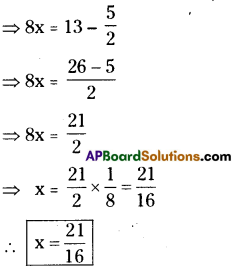
xiv) 8x + [latex]\frac{5}{2}[/latex] = 13
AP Board 9th Class Maths Solutions Chapter 2 Linear Equations in One Variable Ex 2.1 1

 AP Board 9th Class Maths Solutions Chapter 2 Linear Equations in One Variable Ex 2.1

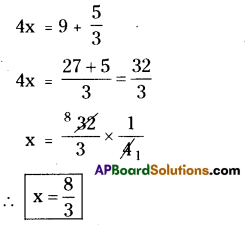
xv) 4x – [latex]\frac{5}{3}[/latex]
AP Board 9th Class Maths Solutions Chapter 2 Linear Equations in One Variable Ex 2.1 2

 AP Board 9th Class Maths Solutions Chapter 2 Linear Equations in One Variable Ex 2.1

xvi) x + [latex]\frac{4}{3}[/latex] = 3[latex]\frac{1}{2}[/latex]
⇒ [latex]x+\frac{4}{3}=\frac{7}{2}[/latex]
⇒[latex]\frac{7}{2}-\frac{4}{3}=\frac{21-8}{6}[/latex]
∴ x = [latex]\frac{13}{6}[/latex]

AP Board 9th Class Maths Solutions Chapter 2 Polynomials and Factorisation Ex 2.3

AP State Syllabus AP Board 9th Class Maths Solutions Chapter 2 Polynomials and Factorisation Ex 2.3 Textbook Questions and Answers.

AP State Syllabus 9th Class Maths Solutions 2nd Lesson Polynomials and Factorisation Exercise 2.3

Question 1.
Find the remainder when
x3 + 3x2 + 3x + 1 is divided by the following Linear polynomials i) x + 1 Each
Solution:
Let f(x) = x3 + 3x2 + 3x + 1
By remainder theorem, the remainder is f (- 1)
f (- 1) = (- 1)3 + 3(- 1)2 + 3(- 1) + 1
= – 1 + 3 – 3 + 1 = 0

AP Board 9th Class Maths Solutions Chapter 2 Polynomials and Factorisation Ex 2.3

ii) [latex]x-\frac{1}{2}[/latex]
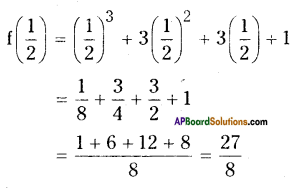
f(x) = x3 + 3x2 + 3x + 1
By remainder theorem, the remainder is [latex]\mathrm{f}\left(\frac{1}{2}\right)[/latex]
AP Board 9th Class Maths Solutions Chapter 2 Polynomials and Factorisation Ex 2.3 1

iii) x
Solution:
f(x) = x3 + 3x2 + 3x + 1
The remainder is f(0)
∴ f(0) = 03 + 3(0)2 + 3(0) + 1 = 1

iv) x + π
Solution:
f(x) = x3 + 3x2 + 3x + 1
By remainder theorem, the remainder is f(- π)
f(- π) = (- π)3 + 3(-π)2 + 3 (-π) + 1 .
= – π3 + 3π2 – 3π + 1

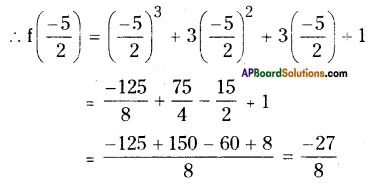
v) 5 + 2x
f(x) = x3 + 3x2 + 3x + 1
The remainder is [latex]\mathrm{f}\left(\frac{-5}{2}\right)[/latex]
AP Board 9th Class Maths Solutions Chapter 2 Polynomials and Factorisation Ex 2.3 2

AP Board 9th Class Maths Solutions Chapter 2 Polynomials and Factorisation Ex 2.3

Question 2.
Find the remainder when x3 – px2 + 6x – p is divided by x – p.
Solution:
Let f(x) = x3 – px2 + 6x – p
(x – a) = x – p)
By Remainder theorem, the remainder is f(p)
∴ f(P) = P3 – P(P)2 + 6p – p
= p3 – p3 + 5p = 5p

Question 3.
Find the remainder when 2x2 – 3x + 5 is divided by 2x – 3. Does it exactly divide the polynomial ? State reason.
Solution:
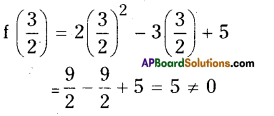
Let f(x) = 2x2 – 3x + 5 and
x – a = 2x – 3 = x – [latex]\frac{3}{2}[/latex]
By Remainder theorem f(x) when divided by (x – [latex]\frac{3}{2}[/latex] ) leaves a remainder [latex]\mathrm{f}\left(\frac{3}{2}\right)[/latex]
AP Board 9th Class Maths Solutions Chapter 2 Polynomials and Factorisation Ex 2.3 3
As the remainder is 5 we say that (2x – 3) is not a factor of f(x).

Question 4.
Find the remainder when 9x3 – 3x2 + x – 5 is divided by x – [latex]\frac{2}{3}[/latex]
Solution:
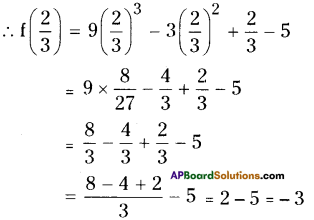
Let f(x) = 9x3 – 3x2 + x – 5
x-a = x – [latex]\frac{2}{3}[/latex]
Remainder theorem the remainder is [latex]\mathrm{f}\left(\frac{2}{3}\right)[/latex]
AP Board 9th Class Maths Solutions Chapter 2 Polynomials and Factorisation Ex 2.3 4

AP Board 9th Class Maths Solutions Chapter 2 Polynomials and Factorisation Ex 2.3

Question 5.
If the polynomials 2x3 + ax2 + 3x – 5 and x3 + x2 – 4x + a leave the same remainder, when divided by x – 2, find the value of a.
Solution:
Let f(x) = 2x3 + ax2 + 3x – 5
g(x) = x3 + x2 – 4x + a
Given that f(x) and g(x) divided x – 2
give same remainder.
i e., f(2) = g(2)
By Remainder theorem.
But f(2) = 2(2)3 + a(2)2 + 3(2) – 5
= 2 x 8 + 4a + 6 – 5
= 17 +4a
g(2) = 23 + 22 – 4(2) + a .
= 8 + 4 – 8 + a = 4 + a
i.e., 4 + a = 17 + 4a
∴ a – 4a = 17 – 4
– 3a = 13
a = -13/3

Question 6.
If the polynomials x3 + ax2 + 5 and x3 – 2x2 + a are divided by (x + 2) leave the same remainder, find the value of a.
Solution:
Let f(x) = x3 + ax2 + 5
g(x) = x3 – 2x2 + a
Given that when f(x) and g(x) divided by (x + 2) leaves the same remainder.
i.e.,f(-2) = g(-2)
By Remainder theorem
f(- 2) = (- 2)3 + a(- 2)2 + 5
= -8 + 4a + 5 = 4a – 3
g(- 2) = (- 2)3 – 2(- 2)2 + a
= -8 – 8 + a = a – 16
By problem,
4a – 3 = a – 16
4a – a = – 16 + 3
⇒ 3a = – 13 ⇒ a = -13/3

AP Board 9th Class Maths Solutions Chapter 2 Polynomials and Factorisation Ex 2.3

Question 7.
Find the remainder when f(x) = x4 – 3x2 + 4 is divided by g(x) = x – 2 and verify the result by actual division.
Solution:
Given f(x) = x4 – 3x2 + 4
g(x) = x – 2
The remainder when f(x) is divided by g(x) is f(2).
f(2) = 24 – 3(2)2 + 4
= 16 – 12 + 4
= 8
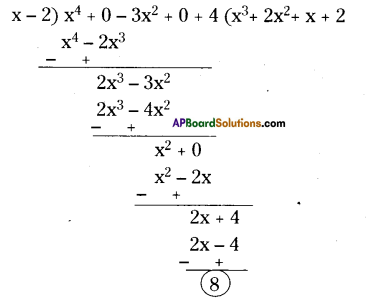
Actual division
AP Board 9th Class Maths Solutions Chapter 2 Polynomials and Factorisation Ex 2.3 5
∴ The remainder either by Remainder theorem or by actual division is the same.

Question 8.
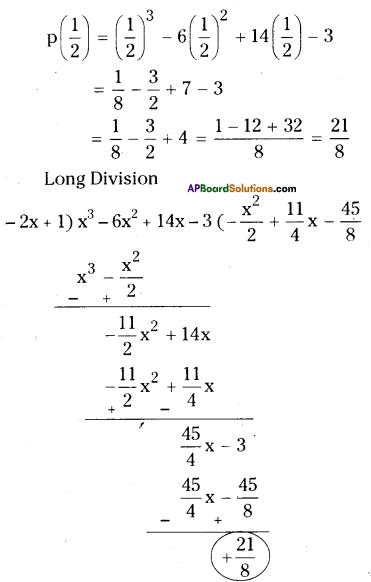
Find the remainder when p(x) = x3 – 6x2 + 14x – 3 is divided by g(x) = 1 – 2x and verify the result by long division method.
Solution:
Given p(x) = x3 – 6x2 + 14x – 3
g(x) = 1 – 2x
By Remainder theorem when p(x) is divided by g(x) is p(1/2).
AP Board 9th Class Maths Solutions Chapter 2 Polynomials and Factorisation Ex 2.3 6

AP Board 9th Class Maths Solutions Chapter 2 Polynomials and Factorisation Ex 2.3

Question 9.
When a polynomial 2x3 + 3x2 + ax + b is divided by (x – 2) leaves remainder 2, and (x + 2) leaves remainder – 2. Find a and b.
Solution:Let f(x) = 2x3 + 3x2 + ax + b
The remainder when f(x) is divided by (x – 2) is 2.
i.e., f(2) = 2
⇒ 2(2)3 + 3(2)2+ a(2) + b = 2
⇒ 16 + 12 + 2a +b = 2
⇒ 2a + b = – 26 …………………..(1)

Also the remainder when f(x) is divided by (x + 2) is – 2.
i.e., f(- 2) = – 2
⇒ 2(- 2)3 + 3(- 2)2 + a (- 2) + b = – 2
⇒ -16 + 12 – 2a + b = – 2
– 2a + b = 2 ………………..(2)
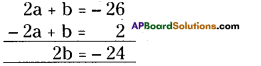
Solving (1) and (2),
AP Board 9th Class Maths Solutions Chapter 2 Polynomials and Factorisation Ex 2.3 7
b = – 12
and 2a – 12 = – 26
2a = -26+ 12
a = -14/2 = -7,
a = -7, b = – 12

AP Board 9th Class Maths Solutions Chapter 4 Lines and Angles Ex 4.3

AP State Syllabus AP Board 9th Class Maths Solutions Chapter 4 Lines and Angles Ex 4.3 Textbook Questions and Answers.

AP State Syllabus 9th Class Maths Solutions 4th Lesson Lines and Angles Exercise 4.3

Question 1.
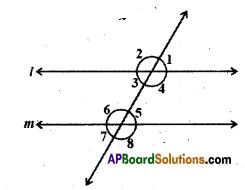
It is given that l // m; to prove ∠1 is supplement to ∠8. Write reasons for the Statements.
AP Board 9th Class Maths Solutions Chapter 4 Lines and Angles Ex 4.3 1

Solution:

Statement Reasons
i) l //m ∠1 + ∠8 = 180° (exterior angles on the same side of the transversal)
ii) ∠1 = ∠5 corresponding angles
iii) ∠5 + ∠8 = 180° linear pair of angles
iv) ∠1 + ∠8 = 180° exterior angles on the same side of the transversal.
v) ∠1 is supplement is ∠8 exterior angles on the same side of the transversal.

AP Board 9th Class Maths Solutions Chapter 4 Lines and Angles Ex 4.3

Question 2.
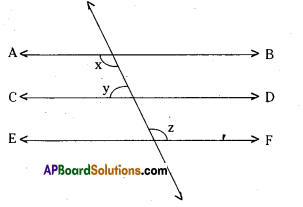
In the given figure AB || CD; CD || EF and y: z = 3:7 find x.
AP Board 9th Class Maths Solutions Chapter 4 Lines and Angles Ex 4.3 2
Solution:
Given that AB//CD; CD//EF.
⇒ AB // EF
Also y : z = 3 : 7
From the figure x + y = 180 …………. (1)
[∵ interior angles on the same side of the transversal]
Also y + z = 180 ………….. (2)
Sum of the terms of the ratio y : z
= 3 + 7 = 10
∴ y = [latex]\frac{3}{10}[/latex] x 180° = 54°
y = [latex]\frac{7}{10}[/latex] x 180° = 126°
From (1) and (2)
x + y = y + z
⇒ x = z = 126°

Question 3.
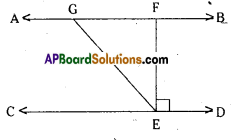
In the given figure AB//CD; EF ⊥ CD and ∠GED = 126°, find ∠AGE, ∠GEF and ∠FGE.
AP Board 9th Class Maths Solutions Chapter 4 Lines and Angles Ex 4.3 3
Solution:
Given that EF ⊥ CD; ∠GED = 126°
i. e., ∠FED = 90° and
∠GEF = ∠GED – ∠FED
∠GEF = 126° – 90° = 36°
In ∆GFE
∠GEF + ∠FGE + ∠EFG = 180°
36 + ∠FGE + 90° = 180°
∠FGE = 180° – 126° = 54°
∠AGE = ∠GFE + ∠GEF
(exterior angle in ∆GFE)
= 90°+ 36°= 126°

AP Board 9th Class Maths Solutions Chapter 4 Lines and Angles Ex 4.3

Question 4.
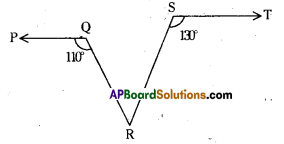
In the given figure PQ//ST, ∠PQR = 110° and ∠RST = 130°, find ∠QRS. [Hint : Draw a line parallel to ST through point R.]
AP Board 9th Class Maths Solutions Chapter 4 Lines and Angles Ex 4.3 4
Solution:
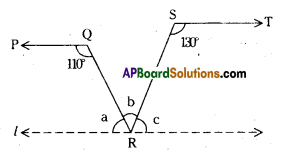
AP Board 9th Class Maths Solutions Chapter 4 Lines and Angles Ex 4.3 5
Given PQ // ST
Draw a lipe ‘l’ parallel to ST through R.
From the figure
a + 110° = 180° and c + 130 = 180°
[ ∵ Interior angles on the same side of the transversal]
∴ a = 180° -110° = 70°
c = 180° – 130° = 50°
Also a + b + c = 180° (angles at a point on a line)
70° + b + 50° = 180°
b = 180° – 120° = 60°
∴ ∠QRS = 60°

AP Board 9th Class Maths Solutions Chapter 4 Lines and Angles Ex 4.3

Question 5.
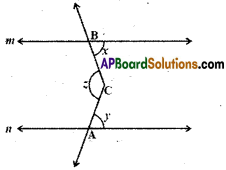
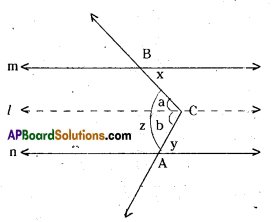
In the given figure m // n. A, B are any two points on in and n respectively. Let C be an interior point between the lines m and n. Find ∠ACB.
AP Board 9th Class Maths Solutions Chapter 4 Lines and Angles Ex 4.3 6
Solution:
AP Board 9th Class Maths Solutions Chapter 4 Lines and Angles Ex 4.3 7
Draw a line ‘l’ parallel to m and n through C.
From the figure
x = a [ ∵ alternate interior angles for l, m]
y = b [ ∵ alternate interior angles for l, n]
∴ z = a + b = x + y

Question 6.
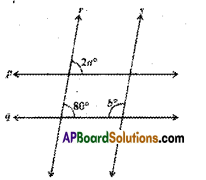
Find the values of a and b, given that p // q and r // s.
AP Board 9th Class Maths Solutions Chapter 4 Lines and Angles Ex 4.3 8
Solution:
Given that p // q and r // s.
∴ From the figure
2a = 80° (∵ corresponding angles)
a = [latex]\frac { 80° }{ 2 }[/latex] = 40°
Also 80° + b = 180° ( ∵ interior angles on the same side of the transversal)
∴ b = 180° – 80° = 100°

AP Board 9th Class Maths Solutions Chapter 4 Lines and Angles Ex 4.3

Question 7.
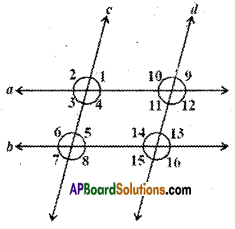
If in the figure a // b and c // d, then name the angles that are congruent to (i) ∠1 and (ii) ∠2.
AP Board 9th Class Maths Solutions Chapter 4 Lines and Angles Ex 4.3 9
Solution:
Given that a // b and c // d.
∠1 = ∠3 (∵ vertically opposite angles)
∠1 = ∠5 (∵ corresponding angles)
∠1 = ∠9 (∵ corresponding angles)
Also ∠1 = ∠3 = ∠5 = ∠7 ;
∠1 = ∠11 = ∠9 = ∠13 = ∠15
Similarly ∠2 = ∠4 = ∠6 = ∠8
Also ∠2 = ∠10 = ∠12 = ∠14 = ∠16

Question 8.
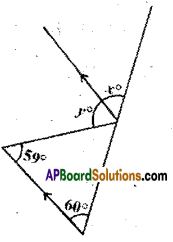
In the figure the arrow head segments are parallel, find the values of x and y.
AP Board 9th Class Maths Solutions Chapter 4 Lines and Angles Ex 4.3 10
Solution:
From the figure
y = 59° ( ∵ alternate interior angles)
x = 60° ( ∵ corresponding angles)

AP Board 9th Class Maths Solutions Chapter 4 Lines and Angles Ex 4.3

Question 9.
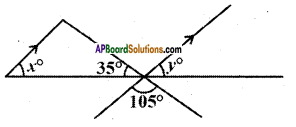
In the figure the arrow head segments are parallel then find the values of x and y.
AP Board 9th Class Maths Solutions Chapter 4 Lines and Angles Ex 4.3 11
Solution:
From the figure 35° + 105° + y = 180°
∴ y = 180° – 140°
= 40°
∴ x = 40° (∵ x, y are corresponding angles)

Question 10.
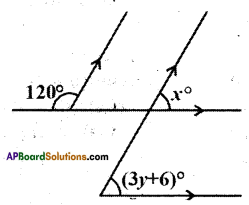
Find the values of x and y from the figure.
AP Board 9th Class Maths Solutions Chapter 4 Lines and Angles Ex 4.3 12
Solution:
From the figure 120° + x = 180°
(∵ exterior angles on the same side of the transversal)
∴ x = 180° – 120°
x = 60°
Also x = (3y + 6)
(∵ corresponding angles)
3y + 6 = 60°
3y = 60° – 6° = 54°
y = [latex]\frac { 54 }{ 3 }[/latex] = 18°
∴ x = 60°; y = 18°

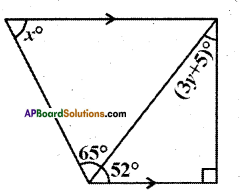
Question 11.
From the figure find x and y.
AP Board 9th Class Maths Solutions Chapter 4 Lines and Angles Ex 4.3 13
Solution:
From the figure
52° + 90° + (3y + 5)° = 180°
(∵ interior angles of a triangle)
∴ 3y + 147 = 180°
⇒ 3y = 33°
⇒ y = [latex]\frac { 33 }{ 3 }[/latex] = 11°
Also x + 65° + 52° = 180°
(∵ interior angles on the same side of the transversal)
∴ x = 180° -117° = 63°

AP Board 9th Class Maths Solutions Chapter 4 Lines and Angles Ex 4.3

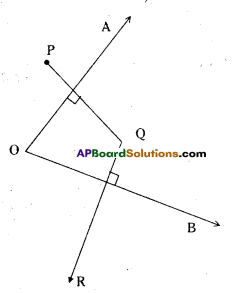
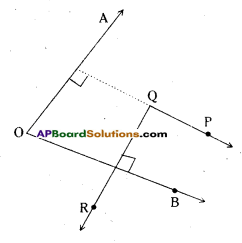
Question 12.
Draw figures for the following statement.
“If the two arms of one angle are respectively perpendicular to the two arms of another angle then the two angles are either equal or supplementary
Solution:
AP Board 9th Class Maths Solutions Chapter 4 Lines and Angles Ex 4.3 14
AO ⊥ PQ, OB ⊥ QR
Angles are supplementary.
AP Board 9th Class Maths Solutions Chapter 4 Lines and Angles Ex 4.3 15
AO ⊥ PQ, OB ⊥ QR
Angles are equal.

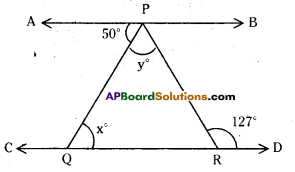
Question 13.
In the given figure, if AB // CD; ∠APQ = 50° and ∠PRD = 127°, find x and y.
AP Board 9th Class Maths Solutions Chapter 4 Lines and Angles Ex 4.3 16
Solution:
Given that AB // CD.
∠PRD = 127°
From the figure x = 50°
(∵ alternate interior angles)
Also y + 50 = 127°
(∵ alternate interior angles)
∴ y = 127-50 = 77°

AP Board 9th Class Maths Solutions Chapter 4 Lines and Angles Ex 4.3

Question 14.
In the given figure PQ and RS are two mirrors placed parallel to each other.
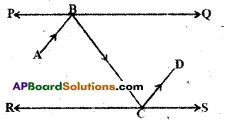
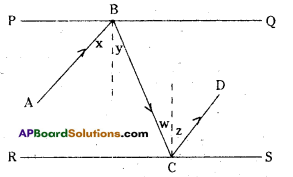
An incident ray [latex]\overline{\mathrm{AB}}[/latex] strikes the mirror PQ at B, the reflected ray moves along the path [latex]\overline{\mathrm{BC}}[/latex] and strikes the mirror RS at C and again reflected back along CD. Prove that AB // CD. [Hint : Perpendiculars drawn to parallel lines are also parallel]
AP Board 9th Class Maths Solutions Chapter 4 Lines and Angles Ex 4.3 17
Solution:
AP Board 9th Class Maths Solutions Chapter 4 Lines and Angles Ex 4.3 18
Draw the normals at B and C.
then ∠x = ∠y (angle of incidence angle of reflection are equal)
∠y = ∠w (alternate interior angles)
∠w = ∠z (angles of reflection and incidence)
∴ x + y = y + z (these are alternate interior angles to [latex]\overline{\mathrm{AB}}[/latex], [latex]\overline{\mathrm{CD}}[/latex])
Hence AB // CD.

AP Board 9th Class Maths Solutions Chapter 4 Lines and Angles Ex 4.3

Question 15.
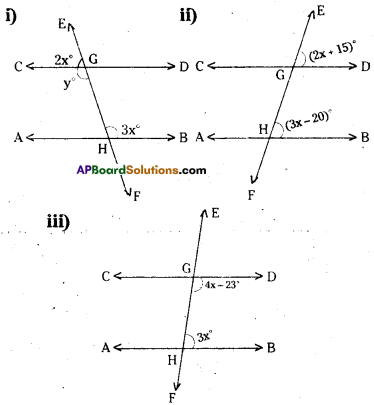
In the figures given below AB // CD. EF is the transversal intersecting AB and CD at G and H respectively. Find the values of x and y. Give reasons.
AP Board 9th Class Maths Solutions Chapter 4 Lines and Angles Ex 4.3 19
Solution:
For fig(i)
3x = y (∵ alternate interior angles)
2x + y = 180° (∵ linear pair of angles)
∴ 2x + 3x = 180°
5x= 180°
x = [latex]\frac { 180 }{ 5 }[/latex] = 36°
and y = 3x = 3 x 36 = 108°

For fig (ii)
2x + 15 = 3x- 20°
(∵ corresponding angles)
2x-3x = -20-15
– x = – 35
x = 35°

AP Board 9th Class Maths Solutions Chapter 4 Lines and Angles Ex 4.3

For fig (iii)
(4x – 23) + 3x = 180° ,
( ∵ interior angles on the same side of the transversal)
7x- 23 = 180°
7x = 203
x = [latex]\frac { 203 }{ 7 }[/latex] = 29°

Question 16.
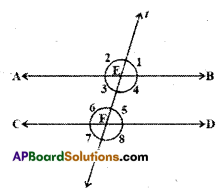
In the given figure AB // CD, ‘t’ is a transversal intersecting E and F re-spectively. If ∠2 : ∠1 = 5 : 4, find the measure of each marked angles.
AP Board 9th Class Maths Solutions Chapter 4 Lines and Angles Ex 4.3 20
Solution:
Given that AB // CD and ∠2 : ∠1 = 5 : 4 ∠1 + ∠2 = 180° (-. linear pair of angles) Sum of the terms of the ratio ∠2 :∠1 = 5 + 4 = 9
∴ ∠1 = [latex]\frac { 4 }{ 9 }[/latex] x 180° = 80°
∠2= [latex]\frac { 5 }{9 }[/latex] x 180° = 100°
Also ∠1, ∠3, ∠5, ∠7 are all equal to 80°. Similarly ∠2, ∠4, ∠6, ∠8 are all equal to 100°.

Question 17.
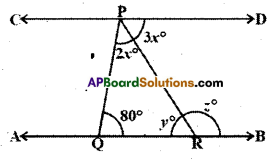
In the given figure AB//CD. Find the values of x, y and z.
AP Board 9th Class Maths Solutions Chapter 4 Lines and Angles Ex 4.3 21
Solution:
Given that AB // CD.
From the figure (2x + 3x) + 80° = 180°
(∵ interior angles on the same side of the transversal)
∴ 5x = 180° – 80°
x = [latex]\frac{100}{5}[/latex] = 20°
Now 3x = y (∵ alternate interior angles)
y = 3 x 20° = 60° .
And y + z = 180°
(∵ linear pair of angles)
∴ z = 180°-60° = lg0°

AP Board 9th Class Maths Solutions Chapter 4 Lines and Angles Ex 4.3

Question 18.
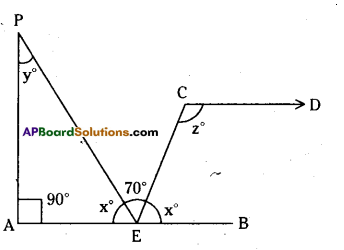
In the given figure AB // CD. Find the values of x, y and z.
AP Board 9th Class Maths Solutions Chapter 4 Lines and Angles Ex 4.3 22
Solution:
Given that AB // CD.
From the figure x° + 70° + x° = 180°
(∵ The angles at a point on the line)
∴ 2x = 180° – 70°
x = [latex]\frac { 110° }{ 2 }[/latex] = 55-
Also 90° + x° + y° = 180°
[∵ interior angles of a triangle]
90° + 55° + y = 180°
y = 180° – 145° = 35°
And x° + z° = 180°
[∵ interior angles on the same side of a transversal]
55° + z = 180°
z = 180°-55° = 125°

Question 19.
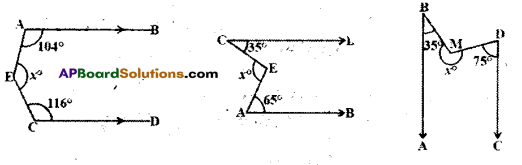
In each of the following figures AB // CD. Find the values of x in each case.
AP Board 9th Class Maths Solutions Chapter 4 Lines and Angles Ex 4.3 23
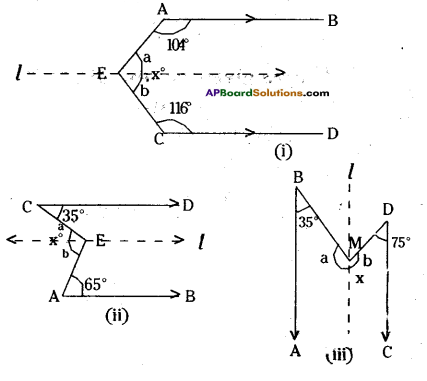
Solution:
AP Board 9th Class Maths Solutions Chapter 4 Lines and Angles Ex 4.3 24
In each case draw a line ‘l’ parallel to AB and CD through F.
fig (i)
a + 104° = 180° ⇒ a = 180° – 104° = 76°
b+ 116° = 180° ⇒ -b = 180°- 116° = 64°
[∵ interior angles on the same side]
∴ a + b = x = 76° + 64° = 140°

fig-(ii)
a = 35°, b = 65° [∵ alt. int. angles]
x = a + b = 35° + 65° = 100°

fig- (iii)
a + 35° = 180° ⇒ a = 145°
b + 75° = 180° ⇒ b = 105°
[ ∵ interior angles on the same side]
∴ x = a + b = 145° + 105° = 250°

AP Board 9th Class Maths Solutions Chapter 4 Lines and Angles Ex 4.3

AP Board 9th Class Maths Solutions Chapter 2 Polynomials and Factorisation Ex 2.2

AP State Syllabus AP Board 9th Class Maths Solutions Chapter 2 Polynomials and Factorisation Ex 2.2 Textbook Questions and Answers.

AP State Syllabus 9th Class Maths Solutions 2nd Lesson Polynomials and Factorisation Exercise 2.2

Question 1.
Find the value of the polynomial 4x2 – 5x + 3, when
(i) x = 0
Solution:
The value at x = 0 is
4(0)2 – 5(0) + 3
= 3

AP Board 9th Class Maths Solutions Chapter 2 Polynomials and Factorisation Ex 2.2

(ii) x = – 1
Solution:
The value at x = – 1 is
4 (- 1)2 – 5 (- 1) + 3
= 4 + 5 + 3
= 12

iii) x = 2
Solution:
The value at x = 2 is
4(2)2 – 5(2) + 3
= 16 -10 + 3
= 9

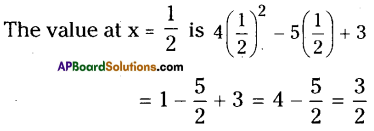
iv) x = [latex]\frac{1}{2}[/latex]
Solution:
AP Board 9th Class Maths Solutions Chapter 2 Polynomials and Factorisation Ex 2.2 1

Question 2.
Find p(0), p(1) and p(2) for each of the following polynomials.
i) p(x) = x2 – x + 1
Solution:
p(0) = 02 – 0 + 1 = 1
p(1) = 12 – 1 + 1 = 1
p(2) = 22 – 2 + 1 = 3

ii) P(y) = 2 + y + 2y2 – y3
Solution:
p(0) = 2 + 0 + 2(0)2 – 03 = 2
p(1) = 2+ 1 + 2(1)2 – 13 = 4
p(2) = 2 + 2 + 2(2)2 -23 = 4 + 8- 8 = 4

AP Board 9th Class Maths Solutions Chapter 2 Polynomials and Factorisation Ex 2.2

iii) P(z) = z3
Solution:
p(0) = 03 = 0
p(1) = 13 = 1
p(2) = 23 = 8

iv) p(t) = (t – 1)(t + 1) = t2 – 1
Solution:
p(0) = (0 – 1) (0 + 1) = – 1
p(1) = t2 – 1 = 12 – 1 = 0
p(2) = 22 – 1 = 4 – 1 = 3

v) p(x) = x2 – 3x + 2
Solution:
p(0) = 02 – 3(0) + 2 = 2
p(1) = 12 – 3(1) + 2 = 1 – 3 + 2 = 0
p(2) = 22 – 3(2) + 2 = 4- 6 + 2 = 0

Question 3.
Verify whether the values of x given in each case are the zeroes of the polynomial or not ?
i) p(x) = 2x + 1; x = [latex]\frac{-1}{2}[/latex]
Solution:
The value of p(x) at x = [latex]\frac{-1}{2}[/latex] is
[latex]\mathrm{p}\left(\frac{-1}{2}\right)=2\left(\frac{-1}{2}\right)+1[/latex]
= -1 + 1 = 0
∴ x = [latex]\frac{-1}{2}[/latex] is a zero of p(x).

AP Board 9th Class Maths Solutions Chapter 2 Polynomials and Factorisation Ex 2.2

(ii) p(x) = 5x – π ; x = [latex]\frac{-3}{2}[/latex]
Solution:
The value of p(x) at x = [latex]\frac{-3}{2}[/latex] is
[latex]\mathrm{p}\left(\frac{-3}{2}\right)=5\left(\frac{-3}{2}\right)-\pi=\frac{-15}{2}-\pi \neq 0[/latex]
∴ x = [latex]\frac{-3}{2}[/latex] is not a zero of p(x).

iii) p(x) = x2 – 1; x = ±1
Solution:
The value of p(x) at x = 1 and – 1 is
p(1) = 12 – 1 = 0
p(-1) = (-1)2 -1 = 0
∴ x = ±1 is a zero of p(x).

iv) p(x) = (x – 1) (x + 2); x = – 1, – 2
Solution:
The value of p(x) at x = – 1 is
p(-1) = (-1 – 1) (-1 + 2)
=-2 x 1 =-2 ≠ 0
Hence x = – 1 is not a zero of p(x).
And the value of p(x) at x = – 2 is
p (- 2) = (- 2 – 1) (- 2 + 2) = – 3 x 0 = 0
Hence, x = – 2 is a zero of p(x).

v) p(y) = y2; y = o
Solution:
The value of p(y) at y = 0 is p(0) = 02 = 0
Hence y = 0 is a zero of p(y).

AP Board 9th Class Maths Solutions Chapter 2 Polynomials and Factorisation Ex 2.2

vi) p(x) = ax + b ; x = [latex]\frac{-\mathbf{b}}{\mathbf{a}}[/latex]
Solution:
The value of p(x) at x = [latex]\frac{-\mathbf{b}}{\mathbf{a}}[/latex] is
[latex]\mathrm{p}\left(\frac{-\mathrm{b}}{\mathrm{a}}\right)=\mathrm{a}\left(\frac{-\mathrm{b}}{\mathrm{a}}\right)+\mathrm{b}[/latex]
= -b + b = 0
∴ x = [latex]\frac{-\mathbf{b}}{\mathbf{a}}[/latex] is a zero of p(x).

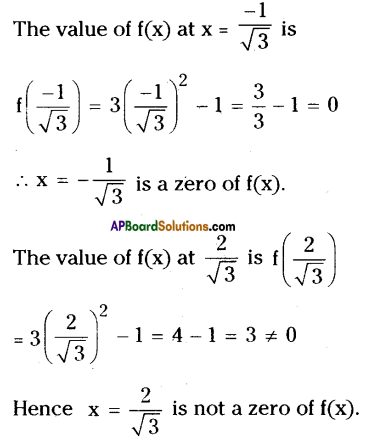
vii) f(x) = 3x2 – 1; x = [latex]\frac{-1}{\sqrt{3}}, \frac{2}{\sqrt{3}}[/latex]
Solution:
AP Board 9th Class Maths Solutions Chapter 2 Polynomials and Factorisation Ex 2.2 2

AP Board 9th Class Maths Solutions Chapter 2 Polynomials and Factorisation Ex 2.2

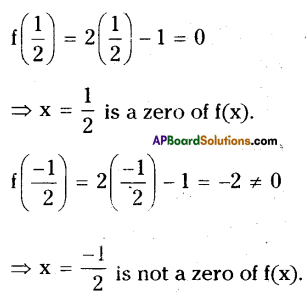
viii) f(x) = 2x – 1; x = [latex]\frac{1}{2} ;-\frac{1}{2}[/latex]
Solution:
AP Board 9th Class Maths Solutions Chapter 2 Polynomials and Factorisation Ex 2.2 3

Question 4.
Find the zero of the polynomial in each of the following cases.
i) f(x) = x + 2
Solution:
x + 2 = 0
x = – 2

ii) f(x) = x – 2
Solution:
x – 2 = 0
x = 2

iii) f(x) = 2x + 3
Solution:
2x + 3 = 0
2x = – 3
x = [latex]\frac{-3}{2}[/latex]

AP Board 9th Class Maths Solutions Chapter 2 Polynomials and Factorisation Ex 2.2

iv) f(x) = 2x – 3
Solution:
2x – 3 = 0
2x = 3
x = [latex]\frac{3}{2}[/latex]

v) f(x) = x2
Solution:
x2 = 0
x = 0

vi) f(x) = px, p ≠ 0
Solutin:
px = 0
x = 0

vii) f(x) = px + q; p ≠ 0; p, q are real numbers.
Solution:
px + q = 0
px = -q
x = [latex]\frac{-\mathrm{q}}{\mathrm{p}}[/latex]

AP Board 9th Class Maths Solutions Chapter 2 Polynomials and Factorisation Ex 2.2

Question 5.
If 2 is a zero of the polynomial p(x) = 2x2 – 3x + 7a, find the value of
a.
Solution:
Given that 2 is a zero of p(x) = 2x2 – 3x + 7a
(i.e.) p(2) = 0
⇒ 2(2)2 – 3(2) + 7a = 0
⇒ 8 – 6 + 7a = 0
⇒ 2 + 7a = 0
⇒ 7a = – 2
⇒ a = [latex]\frac{-2}{7}[/latex]

AP Board 9th Class Maths Solutions Chapter 2 Polynomials and Factorisation Ex 2.2

Question 6.
If 0 and 1 are the zeroes of the polynomial f(x) = 2x3 – 3x2 + ax + b, find the values of a and b.
Solution:
Given that f(0) = 0; f(1) = 0 and
f(x) = 2x3 – 3x2 + ax + b
∴ f(0) = 2(0)3 – 3(0)2 + a(0) + b
⇒ 0 = b
Also f(1) = 0
⇒ 2(1)3 – 3(1)2 + a(1) + 0 = 0
⇒ 2 – 3 + a = 0 .
⇒ a = 1
Hence a = 1; b = 0

AP Board 9th Class Maths Solutions Chapter 4 Lines and Angles Ex 4.2

AP State Syllabus AP Board 9th Class Maths Solutions Chapter 4 Lines and Angles Ex 4.2 Textbook Questions and Answers.

AP State Syllabus 9th Class Maths Solutions 4th Lesson Lines and Angles Exercise 4.2

AP Board 9th Class Maths Solutions Chapter 4 Lines and Angles Ex 4.2

Question 1.
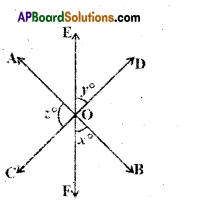
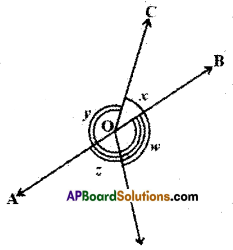
In the given figure three lines [latex]\overline{\mathrm{AB}}[/latex] , [latex]\overline{\mathrm{CD}}[/latex] and [latex]\overline{\mathrm{EF}}[/latex] intersecting at ‘O’. Find the values of x, y and z, it is being given that x : y : z = 2 : 3 : 5
AP Board 9th Class Maths Solutions Chapter 4 Lines and Angles Ex 4.2 1
Solution:
From the figure
2x + 2y + 2z = 360°
⇒ x + y + z = 180°
x : y : z = 2 : 3 : 5
Sum of the terms of the ratio
= 2 + 3 + 5 = 10
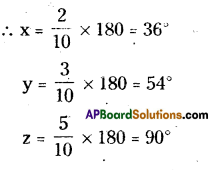
AP Board 9th Class Maths Solutions Chapter 4 Lines and Angles Ex 4.2 2

AP Board 9th Class Maths Solutions Chapter 4 Lines and Angles Ex 4.2

Question 2.
Find the value of x in the following figures.
i)
AP Board 9th Class Maths Solutions Chapter 4 Lines and Angles Ex 4.2 3
Solution:
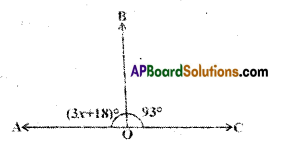
From the figure
3x + 18= 180° – 93° (∵ linear pair )
3x + 18 = 87
3x = 87- 18 = 69
∴ x = [latex]\frac{69}{3}[/latex] = 23

ii)
AP Board 9th Class Maths Solutions Chapter 4 Lines and Angles Ex 4.2 4
Solution:
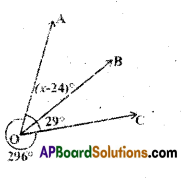
From the figure
(x – 24)° + 29° + 296° = 360“
(∵ complete angle)
x + 301° = 360°
∴ x = 360° – 301° = 59°

iii)
AP Board 9th Class Maths Solutions Chapter 4 Lines and Angles Ex 4.2 5
Solution:
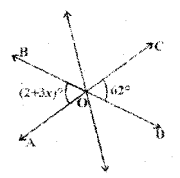
From the figure
2 + 3x = 62
(∵ vertically opposite angles)
3x = 62 – 2
∴ 3x = 60° ⇒ x = [latex]\frac{60}{3}[/latex]
∴ x = 20°

AP Board 9th Class Maths Solutions Chapter 4 Lines and Angles Ex 4.2

iv)
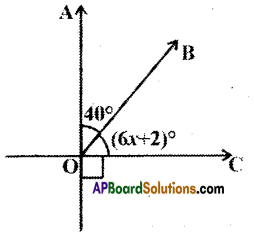
AP Board 9th Class Maths Solutions Chapter 4 Lines and Angles Ex 4.2 6
Solution:
From the figure
40 + (6x + 2) = 90°
(∵ complementary angles)
6x = 90° – 42°
6x = 48
x = [latex]\frac{48}{6}[/latex] = 8°

Question 3.
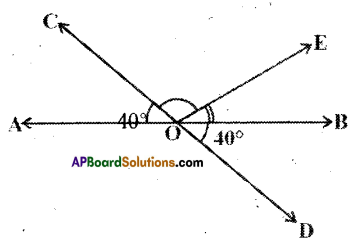
In the given figure lines [latex]\overline{\mathrm{AB}}[/latex] and [latex]\overline{\mathrm{CD}}[/latex] intersect at ’O’. If ∠AOC + ∠BOE = 70° and ∠BOD = 40°, find ∠BOE and reflex ∠COE.
AP Board 9th Class Maths Solutions Chapter 4 Lines and Angles Ex 4.2 7
Solution:
Given that ∠AOC +∠BOE = 70°
∠BOD = 40°
∠AOC = 40°
(∵ ∠AOC, ∠BOD are vertically opposite angles)
∴ 40° + ∠BOE = 70°
⇒ ∠BOE = 70° – 40° = 30°
Also ∠AOC + ∠COE +∠BOE = 180°
( ∵ AB is a line)
⇒ 40° + ∠COE + 30° = 180°
⇒ ∠COE = 180° -70° = 110°
∴ Reflex ∠COE = 110°

AP Board 9th Class Maths Solutions Chapter 4 Lines and Angles Ex 4.2

Question 4.
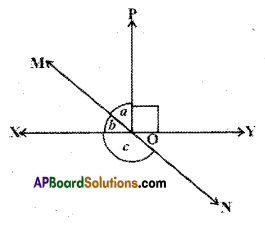
In the given figure lines [latex]\overline{\mathrm{XY}}[/latex] and [latex]\overline{\mathrm{MN}}[/latex] . intersect at O. If ∠POY = 90° and a : b = 2:3, find c.
AP Board 9th Class Maths Solutions Chapter 4 Lines and Angles Ex 4.2 8
Solution:
Given that XY and MN are lines.
∠POY = 90°
a : b = 2 : 3
From the figure a + b = 90°
Sum of the terms of the ratio a : b
= 2 + 3 = 5
∴ b = [latex]\frac{3}{5}[/latex] x 90° = 54°
From the figure b + c = 180°
(∵ linear pair of angles)
54° + c = 180°
c = 180°-54° = 126°

AP Board 9th Class Maths Solutions Chapter 4 Lines and Angles Ex 4.2

Question 5.
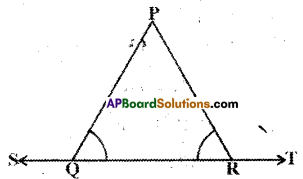
In the given figure ∠PQR = ∠PRQ, then prove that ∠PQS = ∠PRT.
AP Board 9th Class Maths Solutions Chapter 4 Lines and Angles Ex 4.2 9
Solution:
Given that ∠PQR = ∠PRQ
From the figure
∠PQR + ∠PQS = 180° ………….. (1)
∠PRQ + ∠PRT = 180° …………..(2)
From (1) and (2)
∠PQR + ∠PQS = ∠PRQ + ∠PRT
But ∠PQR = ∠PRQ
So ∠PQS = ∠PRT
Hence proved.

Question 6.
In the given figure, if x + y = w + z, then prove that AOB is a line.
AP Board 9th Class Maths Solutions Chapter 4 Lines and Angles Ex 4.2 10
Solution:
Given that x + y = w + z = k say
From the figure
x + y + z + w = 360°
(∵ Angle around a point)
Also x + y = z + w
∴ x + y = z + w = [latex]\frac{360^{\circ}}{2}[/latex]
∴ x + y = z + w = 180°

OR

k + k = 360°
2k = 360°
k = [latex]\frac{360^{\circ}}{2}[/latex]

(i.e.) (x,y) and (z, w) are pairs of adjacent angles whose sum is 180°.
In other words (x, y) and (z, w) are linear pair of angles ⇒ AOB is a line.

AP Board 9th Class Maths Solutions Chapter 4 Lines and Angles Ex 4.2

Question 7.
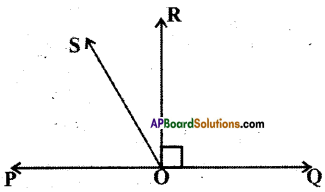
In the given figure [latex]\overline{\mathrm{PQ}}[/latex] is a line. Ray [latex]\overline{\mathrm{OR}}[/latex] is perpendicular to line [latex]\overline{\mathrm{PQ}}[/latex].[latex]\overline{\mathrm{OS}}[/latex] os is another ray lying between rays [latex]\overline{\mathrm{OP}}[/latex] and [latex]\overline{\mathrm{OR}}[/latex] Prove that
AP Board 9th Class Maths Solutions Chapter 4 Lines and Angles Ex 4.2 11
Solution:
Given : OR ⊥ PQ ⇒ ∠ROQ = 90°
To prove: ∠ROS = [latex]\frac{1}{2}[/latex] (∠QOS – ∠POS)
Solution:
Proof: From the figure
∠ROS = ∠QOS – ∠QOR ……………(1)
∠ROS = ∠ROP – ∠POS ……………..(2)
Adding (1) and (2)
∠ROS + ∠ROS = ∠QOS – ∠QOR +∠ROP – ∠POS [ ∵ ∠QOR = ∠ROP = 90° given]
⇒ 2∠ROS = ∠QOS – ∠POS
⇒ ∠ROS = [latex]\frac{1}{2}[/latex] [∠QOS – ∠POS]
Hence proved.

AP Board 9th Class Maths Solutions Chapter 4 Lines and Angles Ex 4.2

Question 8.
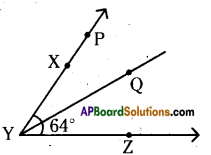
It is given that ∠XYZ = 64° and XY is produced to point P. A ray [latex]\overline{\mathrm{YQ}}[/latex] bisects ∠ZYP. Dräw a figure from the given Information. Find ∠XYQ and reflex ∠QYP.
Solution:
AP Board 9th Class Maths Solutions Chapter 4 Lines and Angles Ex 4.2 12
∠XYQ = 32°
∠QYP = 32°

AP Board 9th Class Maths Solutions Chapter 2 Polynomials and Factorisation Ex 2.1

AP State Syllabus AP Board 9th Class Maths Solutions Chapter 2 Polynomials and Factorisation Ex 2.1 Textbook Questions and Answers.

AP State Syllabus 9th Class Maths Solutions 2nd Lesson Polynomials and Factorisation Exercise 2.1

Question 1.
Find the degree of each of the polynomials given below,
i) x5 – x4 + 3
Solution:
Degree is 5.

ii) x2 + x – 5
Solution:
Degree is 2.

iii) 5
Solution:
Degree is 0.

iv) 3x6 + 6y3 – 7
Solution:
Degree is 6.

v) 4 – y2
Solution:
Degree is 2.

vi) 5t – √3
Solution:
Degree is 1.

AP Board 9th Class Maths Solutions Chapter 2 Polynomials and Factorisation Ex 2.1

Question 2.
Which of the following expressions are polynomials in one variable and which are not ? Give reasons for your answer.
i) 3x2 – 2x + 5
Solution:
Given expression is a polynomial in one variable.

ii) x2 + √2
Solution:
Given expression is a polynomial in one variable.

iii) p2 – 3p + q
Solution:
Given expression is not a polynomial in one variable. It involves two variables p and q.

iv) y + [latex]\frac{2}{\mathbf{y}}[/latex]
Solution:
Given expression is not a polynomial. Since the second term contains the variable in its denominator.

v) [latex]5 \sqrt{x}+x \sqrt{5}[/latex]
Solution:
Given expression is not a polynomial. Since the first term’s exponent is not an integer.

vi) x100 + y100
Solution:
Given expression has two variables. So it is not a polynomial in one variable.

AP Board 9th Class Maths Solutions Chapter 2 Polynomials and Factorisation Ex 2.1

Question 3.
Write the coefficient of x3 in each of the following.
i) x3 + x + 1
ii) 2 – x3+ x2
iii) [latex]\sqrt{2} x^{3}+5[/latex]
iv) 2x3 + 5
v) [latex]\frac{\pi}{2} x^{3}+x[/latex]
vi) [latex]-\frac{2}{3} x^{3}[/latex]
vii) 2x2 + 5
viii) 4
Solution:
i) x3 + x + 1 : co-efficient of x3 is 1.
ii) 2 – x3+ x2 : co-efficient of x3 is – 1.
iii) [latex]\sqrt{2} x^{3}+5[/latex] co-efficient of x3 is √2
iv) 2x3 + 5 : co-efficient of x3 is 2.
v) [latex]\frac{\pi}{2} x^{3}+x[/latex] co-efficient of x3 is [latex]\frac{\pi}{2}[/latex]
vi) [latex]-\frac{2}{3} x^{3}[/latex] co-efficient of x3 is [latex]-\frac{2}{3}[/latex]
vii) 2x2 + 5 : co-efficient of x3 is ‘0’.
viii) 4 : co-efficient of x3 is ‘0’.

AP Board 9th Class Maths Solutions Chapter 2 Polynomials and Factorisation Ex 2.1

Question 4.
Classify the following as linear, quadratic and cubic polynomials.
i) 5x2+ x – 7 : degree 2 hence quadratic polynomial.
ii) x – x3 , : degree 3 hence cubic polynomial.
iii) x2 + x + 4 : degree 2 hence quadratic polynomial.
iv) x – 1 : degree 1 hence linear polynomial.
v) 3p : degree 1 hence linear polynomial.
vi) πr2 : degree 2 hence quadratic polynomial.

Question 5.
Write whether the following statements are True or False. Justify your answer.
i) A binomial can have at the most two terms
ii) Every polynomial is a binomial
iii) A binomial may have degree 3
iv) Degree of zero polynomial is zero
v) The degree of x2 + 2xy + y2 is 2
vi) πr2 is monomial
Solution :
i) A binomial can have at the most two terms -True
ii) Every polynomial is a binomial – False
[∵ A polynomial can have more than two terms]
iii) A binomial may have degree 3 – True
iv) Degree of zero polynomial is zero – False
v) The degree of x2 + 2xy + y2 is 2 – True
vi) πr2 is monomial – True

AP Board 9th Class Maths Solutions Chapter 2 Polynomials and Factorisation Ex 2.1

Question 6.
Give one example each of a monomial and trinomial of degree 10.
Solution :
– 7x10 is a monomial of degree 10.
3x2y8 + 7xy – 8 is a trinomial of degree 10.

AP Board 9th Class Maths Solutions Chapter 6 Linear Equation in Two Variables Ex 6.2

AP State Syllabus AP Board 9th Class Maths Solutions Chapter 6 Linear Equation in Two Variables Ex 6.2 Textbook Questions and Answers.

AP State Syllabus 9th Class Maths Solutions 6th Lesson Linear Equation in Two Variables Exercise 6.2

AP Board 9th Class Maths Solutions Chapter 6 Linear Equation in Two Variables Ex 6.2

Question 1.
Find three different solutions of the each of the following equations.
i) 3x + 4y = 7
Solution:
Given equation is 3x + 4y = 7

Choice of  value of x Or y Simplification for y or x Solution
x = 0


3 x 0 + 4y = [latex]\frac{7}{4}[/latex] (0, [latex]\frac{7}{4}[/latex] )


y = 0


3x + 4(0) = 7 ⇒ x = [latex]\frac{7}{3}[/latex] ([latex]\frac{7}{3}[/latex] ,0)
x = 1


3(1) + 4y = 7

⇒ y = [latex]\frac{7-3}{-4}[/latex] = 1

(1, 1)

Choice of x or y Simplification for y or x
Solution

ii) y = 6x
Solution: Given equation is y = 6x ⇒ 6x – y = 0

Choice of  value of x Or y Simplification for y or x Solution
x = 0 6(0) – y = 0 ⇒ y = 0 (0,0)
y = 0 6x – 0 = 0 ⇒ x = 0 (0,0)
x = 1 6(1) – y = 0 ⇒ y = 6 (1,6)
Y = 1 6x – 1 = 0 ⇒ 6x = 1 ⇒ x = [latex]\frac{1}{6}[/latex] ([latex]\frac{1}{6}[/latex],1)

AP Board 9th Class Maths Solutions Chapter 6 Linear Equation in Two Variables Ex 6.2

iii) 2x – y = 7
Solution:
Given equation is 2x – y = 7

Choice of  value of x Or y Simplification for y or x Solution
x = 0 2(0) – y = 7 ⇒ y = -7 (0, -7)
y = 0 2x – 0 = 7 ⇒ x = [latex]\frac{7}{2}[/latex] ([latex]\frac{7}{2}[/latex] , 0)
x = 1 2(1) – y = 7 ⇒ -y = 7 – 2  ⇒ y = -5 (1, -5)

iv) 13x – 12y = 25
Solution:
Given equation is 13x – 12y = 25

Choice of  value of x Or y Simplification for y or x Solution:
x = 0


13(0) – 12y = 25 ⇒ y = [latex]-\frac{25}{12}[/latex] (0, [latex]-\frac{25}{12}[/latex] )


y = 0


13x – 12(0) = 25 ⇒ y = [latex]\frac{25}{13}[/latex] ([latex]\frac{25}{13}[/latex] ,0)
x = 1


13(1) – 12y = 25
⇒ -12y = 25 – 13
y = [latex]\frac{12}{-12}[/latex] = -1
(1, -1)

v) 10x + 11y = 21
Solution:
Given equation is 10x + 11y = 21

Choice of  value of x Or y Simplification for y or x Solution
x = 0 10(0) + 11y = 21 ⇒ y = [latex]\frac{21}{11}[/latex] (0, [latex]\frac{21}{11}[/latex])
y = 0 10x +11(0) = 21 ⇒ x = [latex]\frac{21}{10}[/latex] ([latex]\frac{21}{10}[/latex] , 0)
x = 1 10(1) + 11y = 21 ⇒ 11y = 21 – 10  ⇒ y = [latex]\frac{11}{11}[/latex] = 1 (1, 1)

AP Board 9th Class Maths Solutions Chapter 6 Linear Equation in Two Variables Ex 6.2

vi) x + y = 0
Solution:
Given equation is x + y = 0

Choice of a value of x or y Simplification Solution
x = 0 0 + y = 0 ⇒ y = 0 (0, 0)
x = 1 1 + y = 0 ⇒ y = -1 (1,-1)
y = 1 x + 1 = 0 ⇒ x = -1 (- 1, 1)

Question 2.
If (0, a) and (b, 0) are the solutions of the following linear equations. Find a and b.
8x – y = 34
Solution:
Given that (0, a) and (b, 0) are the solutions of 8x – y = 34
∴ 8(0) – a = 34 and 8(b) – 0 = 34
⇒ a = -34 and b = [latex]\frac{34}{8}=\frac{17}{4}[/latex]

ii) 3x = 7y – 21
Solution:
Given that (0, a) and (b, 0) are the solutions of 3x = 7y – 21
⇒ 3x – 7y = – 21
∴ 3(0) – 7(a) = -21 and 3(b) – 7(0) = -21
⇒ a = [latex]\frac{-21}{-7}[/latex] and b = [latex]\frac{-21}{3}[/latex]
⇒ a = 3 and b = -7

AP Board 9th Class Maths Solutions Chapter 6 Linear Equation in Two Variables Ex 6.2

iii) 5x – 2y + 3 = 0
Given that (0, a) and (b, 0) are the solutions of 5x – 2y = – 3
i. e., 5(0) – 2a = – 3 and 5 (b) – 2(0) = – 3
⇒ -2a = -3 and 5b = -3
⇒ a = [latex]\frac{3}{2}[/latex] and b = [latex]\frac{-3}{5}[/latex]

Question 3.
Check which of the following is solution of the equation 2x – 5y = 10.
(i) (0, 2) (ii) (0,-2) (iii)(5, 0) (iv) (2√3, -√3) (v) ([latex]\frac{1}{2}[/latex] , 2)
Solution:
i) (0, 2)
The given equation is 2x – 5y = 10
On substituting (0, 2), the L.H.S becomes
2(0)-5(2) = 0-10 = -10
R.H.S = 10
L.H.S ≠ R.H.S
∴ (0, 2) is not a solution.

ii) (0. – 2)
Substituting (0, – 2) in the L.H.S of 2x – 5y = 10, we get
2(0) – 5 (- 2) = 0 + 10 = 10 = R.H.S
∴ (0, – 2) is a solution.

AP Board 9th Class Maths Solutions Chapter 6 Linear Equation in Two Variables Ex 6.2

iii) (5, 0)
Substituting (5, 0) in the L.H.S of 2x – 5y = 10, we get
2(5)-5(0) = 10-0 = 10 = R.H.S
∴ (5, 0) is a solution.

iv) 2√3, -√3
On substituting (2√3, -√3 ), the L.H.S becomes
2(2√3) – 5(-√3) = 4√3 + 5√3 = 9√3 ≠ R.H.S
∴ (2√3, -√3) is not a solution.

v) ([latex]\frac{1}{2}[/latex], 2)
Given equation is 2x – 5y = 10
Put x = [latex]\frac{1}{2}[/latex] and y = 2 in the given equation.
Then 2([latex]\frac{1}{2}[/latex]) – 5(2) =10
1-10 = 10
-9 = 10 false
∴ ([latex]\frac{1}{2}[/latex] , 2) is not a solution.

Question 4.
Find the value of k, if x = 2; y = 1 is a solution of the equation 2x + 3y = k. Find two more solutions of the resultant equation. £3 Each
Solution:
Given that x = 2 and y = 1 is a solution of 2x + 3y = k .
∴ 2(2) + 3(1) = k ⇒ 4 + 3 = k ⇒ k = .7 ’
∴ The equation becomes 2x + 3y = 7

x 0 1
y 2(0) + 3y = 7
3y = 7
y = [latex]\frac{7}{3}[/latex]
2(1) + 3y = 7
3y = 7 – 2= y = [latex]\frac{5}{3}[/latex]
(x, y) (0,[latex]\frac{7}{3}[/latex]) (1, [latex]\frac{5}{3}[/latex])

Two more solutions are (0, [latex]\frac{7}{3}[/latex]) and (1, [latex]\frac{5}{3}[/latex])

AP Board 9th Class Maths Solutions Chapter 6 Linear Equation in Two Variables Ex 6.2

Question 5.
If x = 2 – α and y = 2 + α is a solution of the equation 3x – 2y + 6 = 0, find the value of ‘α’. Find three more solutions of the resultant equation.
Solution:
Given that x = 2 – α and y = 2 + α is a solution of 3x – 2y + 6 = 0
Thus 3 (2 – α) – 2 (2 + α) + 6 = 0
⇒ 6 – 3α – 4 – 2α + 6 = 0
⇒ -5α + 8 = 0
⇒ -5α = -8
∴ α = [latex]\frac{8}{5}[/latex]
Three more solutions are

x 0 3x – 2y = -6
3x – 2(0) = -6
y = [latex]\frac{-6}{3}[/latex] = -2
1
y 3x – 2y = -6
3(0) – 2y = -6
y = 3
0 3x – 2y = -6
3(1) – 2y = -6
y = [latex]\frac{9}{2}[/latex]
Solutions (0, 3) (-2, 0) (1, [latex]\frac{9}{2}[/latex])

Question 6.
If x = 1;y = 1 is a solution of the equation 3x + ay = 6, find the value of ‘a’.
Solution:
Given that x = 1; y = 1 is a solution of 3x + ay = 6.
Thus 3(1) + a(1) = 6
⇒ 3 + a = 6 ⇒ a = 6 – 3 = 3

Question 7.
Write five different linear equations in two variables and find three solutions for
each of them.
Solution:
i) Let the equations are 2x – 4y = 10

x 0 1 2
y 2(0) – 4y = 10
y = [latex]\frac{-5}{2}[/latex]
2x – 4y = 10
2(1)  – 4y =10y = -2
2x – 4y = 10
2(2) – 4y = 10
y = -[latex]\frac{-3}{2}[/latex])
Solutions (0, -[latex]\frac{-5}{2}[/latex]) (1 , -2) (2, [latex]\frac{-3}{2}[/latex])

AP Board 9th Class Maths Solutions Chapter 6 Linear Equation in Two Variables Ex 6.2

ii) 5x + 6y = 15

x 0 5x + 6(0) = 15
x = 3
1
y 5(0) + 6y = 15
y = [latex]\frac{15}{6}[/latex] = [latex]\frac{5}{2}[/latex]
0 5(1) + 6y = 15
y = [latex]\frac{5}{3}[/latex]
(x, y) (0, [latex]\frac{5}{2}[/latex]) (3, 0 ) (1, [latex]\frac{5}{3}[/latex])

iii) 3x-4y = 12

x 0 4 1
y -3 0 [latex]\frac{-9}{4}[/latex]
(x, y) (0, -3) (4, 0 ) (1, [latex]\frac{-9}{4}[/latex])

iv) 2x – 7y = 9

x 0 [latex]\frac{9}{2}[/latex] 1
y [latex]\frac{-9}{7}[/latex] 0 -1
(x, y) (0, [latex]\frac{-9}{7}[/latex]) ( [latex]\frac{9}{2}[/latex] , 0 ) (1, -1)

AP Board 9th Class Maths Solutions Chapter 6 Linear Equation in Two Variables Ex 6.2

v) 7x- 5y = 3

x 0 [latex]\frac{3}{7}[/latex] 1
y [latex]\frac{-3}{5}[/latex] 0 [latex]\frac{4}{5}[/latex]
(x, y) (0, [latex]\frac{-3}{5}[/latex] ) ([latex]\frac{3}{7}[/latex], 0 ) (1, [latex]\frac{4}{5}[/latex])