AP Board 7th Class English Important Questions Unit 2

AP State Syllabus 7th Class English Important Questions Unit 2

7th Class English Important Questions Unit 2

Section – A: Reading Comprehension

A. Reading

1. Read the following passage carefully.

On the busy Bowbazaar Street in Calcutta there was an old building. It was the headquarters of the Indian Association for Cultivation of Science. In December, on a fine evening in 1927, there was much excitement in one of its laboratories. Chandrasekhar Venkata Raman was showing a visitor some of his instruments when a young man, K.S.Krishnan, rushed in and announced, “Professor Compton has won the Nobel Prize.”

Now answer the following questions:
1) What was there in the old building?
2) Where was the Indian Association for cultivation of Science located ?
3) When did this incident take place?
4) Why was there such an excitement in the laboratory?
5) Who was the famous scientist mentioned in the passage?
6) What was C.V. Raman doing?
7) Who was the young man mentioned in the passage?
8) What did K.S. Krishnan announce?
9) Who won the Nobel Prize?
10) When did professor Compton win Nobel Prize?
Answers:
1) In the old building there was the head quarters of the Indian Association for Cultivation of Science.
2) The head quarters of the Indian Association for Cultivation of Science was located in Bowbazaar street in Calcutta.
3) This incident took place in December of 1927.
4) C.V. Raman was showing a visitor some of his instruments.
5) C.V. Raman was the famous scientist mentioned in the passage.
6) C.V. Raman was showing a visitor some of his instruments.
7) The young man mentioned in this passage was K.S. Krishnan.
8) K.S. Krishnan announced that Professor Compton had won the Nobel Prize.
9) Professor Compton won the Nobel Prize.
10) Professor Compton won the Nobel Prize in 1927.

AP Board 7th Class English Important Questions Unit 2

2. Read the following passage carefully.

Raman was equally delighted. “Excellent news,” he said, smiling at the visitor and then he was lost in thought. “But…. look here, Krishnan,” he said turning to the young man, “if this. Compton Effect is true of X-rays, it must be true of light too.”
A few years earlier, A.H.Compton had shown that the nature of X-rays changes when passed through matter. The change was dependent on the kind of matter. This effect was called the ‘Compton Effect.’

Now answer the following questions:
1) Why was Raman equally delighted?
2) What was the ‘Excellent news’?
3) “He was lost in thoughts” – What was he thinking?
4) What was the assumption made by C.V. Raman?
5) What do you mean by ‘Compton Effect’?
6) What did A.H. Compton show?
7) Does the nature of X-rays change in the same way when pass through all kinds matter?
8) “It must be true of light too” – What does ‘it’ refer to?
9) If A.H. Compton had not discovered the Compton Effect, do you think Raman would have discovered the ‘Raman Effect’?
10) What does the change of nature of X-rays depend on?
Answers:
1) “If the Compton Effect of X-rays is true. It must be true of light too.” It made C.V. Raman equally delighted.
2) The news that “Professor Compton has won the Nobel Prize” was excellent.
3) He was thinking that, if the Compton Effect of X-rays is true, it must be true of light too.
4) If Compton Effect is true of X-rays, it must be true of light too. ’
5) The nature of X-rays changes when passed through matter. The matter was dependent on the
kind of matter. The effect was known as ‘The Compton Effect”.
6) A.H. Compton showed that the nature of X- rays changes when passed through matter.
7) No. The nature of X-rays changes dependent on the kind of matter.
8) The assumption that the nature of light changes when it passes through matter.
9) From the passage we can understand that C.V. Raman had already formulated his theory and he was about to announce his ‘Raman Effect’. But the Compton Effect give him confidence. Hence I can say if Compton Effect had not been discovered C.V. Raman would have discovered his ‘Raman Effect’.
10) The nature of X-rays change when it passes through matter depending on the kind of matter.

3. Read the following passage.

Could light also change its nature when passed through a transparent medium? That was the question that Raman asked himself. For five years he had been doing research in optics, the science of light. No sophisticated equipment was available in his laboratory, but Raman was confident that he could find the answer with some modifications in his equipment.
Four months later, on March 16,1928, Raman announced his discovery of ‘new radiation’ (describing the behaviour of a beam of light passing through a liquid chemical) to an assembly of scientists at Bangalore (now called Bengaluru).

Now answer the following questions :
1) What was the question Raman asked himself?
2) How long had he been doing research on light?
3) What do you mean by optics?
4) What was the setback faced by C.V. Raman in his research?
5) How was C.V. Raman able to find solution to his problem?
6) When did Raman announce his discovery?
7) What was the discovery made by C.V. Raman?
8) How is Bangalore now called?
9) Where did Raman announce his discovery?
10) To whom did C.V. Raman reveal his discovery to?
Answers :
1) Raman asked himself whether light could also change its nature when passed through a transparent medium.
2) He had been doing research on light for five years.
3) Optics means the science of light.
4) No sophisticated equipment was available in his laboratory.
5) Ramart was able to find the answer with some modifications in his equipment.
6) Raman announced his discovery on 16th March, 19281
7) Raman discovered ‘new radiation’ describing the behaviour of a beam of light passing through a liquid chemical.
8) Bangalore is now called ‘Bengaluru’.
9) Raman announced his discovery in Bengaluru.
10) C.V. Raman described his discovery to an assembly of scientists.

AP Board 7th Class English Important Questions Unit 2

4. Read the following passage.

The world hailed the discovery as the ‘Raman Effect’. For scientific research in this country, it was a red-letter day. His discovery caught the attention of the world. With equipment worth hardly Rs. 200/- and limited facilities, Raman was able to make a discovery which won him the Nobel Prize in physics in 1930.

Now answer the following questions :
1) How was C.V. Raman’s discovery hailed as?
2) What was a red-letter day?
3) What do you mean by the phrase “red-letter day “?
4) What was the day ‘a red-letter day’ for?
5) What was so special about Raman’s discovery?
6) What did his discovery fetch him?
7) When did C.V. Raman win the Nobel Prize?
8) In which subject did C.V. Raman win Nobel Prize?
9) “For his scientific research in his country” – Which country did he belong to?
10) What do you mean by ‘Raman Effect’?
Answers : .
1) C.V. Raman’s discovery was hailed as ‘Raman Effect’.
2) March, 16, 1928 was a red-letter day.
3) The phrase ‘a red-letter day’ means an important day.
4) The day was the red-letter day for scientific research in his country.
5) Raman was able to make a discovery with equipment worth hardly Rs. 200 and limited facilities.
6) His discovery fetched him the Nobel Prize.
7) C.V. Raman won the Nobel Prize in 1930.
8) C.V. Raman won the Nobel Prize in Physics.
9) C.V. Raman belonged to India.
10) Raman Effect means that the light change its nature when passed through a transparent medium.

5. Read the following passage.

Raman was born on November 7, 1888, at Tiruchirapalli in Tamil Nadu. His father was a college physics teacher. He was a brilliant student right from the start. When Raman passed his matriculation, his parents were keen to send him abroad for higher studies. But on medical grounds, a British surgeon advised them against it and Raman stayed in the country to do the M.A. course at Presidency College in Madras (now called Chennai).

Now answer the following questions:
1) When was C.V. Raman born?
2) Where was C.V Raman born?
3) What was C.V. Raman’s father?
4) “He was a brilliant student right from the start” – Who does ‘he’ here refer to?
5) What did his parents want to do when he passed matriculation?
6) Why could C.V. Raman not go abroad for higher studies?
7) What did the British surgeon advise him?
8) ” …….. a British surgeon advised them against it” — What does it refer to?
9) Where did C.V. Raman do his M.A. course?
10) How is Madras now called?
Answers:
1) C.V. Raman was born on November 7, 1888.
2) C.V. Raman was born at Tiruchirapalli in Tamil Nadu.
3) C.V. Raman’s father was a Physics teacher.
4) ‘He’ here refers to C.V. Raman.
5) When C.V. Raman passed his Matriculation his parents decided to send him to abroad for higher studies.
6) He was unable to go abroad for higher studies because a British surgeon advised him against it on medical grounds.
7) The British surgeon advised them not to send C.V. Raman abroad for higher studies because his, health did not support him.
8) It here refers to go abroad.
9) C.V. Raman did his M.A. course at Presidency College in Madras.
10) Madras is now called Chennai.

AP Board 7th Class English Important Questions Unit 2

6. Read the following passage.

In his youth, Raman was mainly interested in acoustics, the science of sound. He studied how stringed instruments like the violin and the sitar could produce harmonious music.
He was elected to the Royal Society of London in 1924 and the British Government made him a knight of the British Empire in 1929. It was a high honour for any great scientist.
His advice to young scientists was to look at the world around them and not to confine themselves to their laboratories. “The essence of science,” he said, “is independent thinking and hard work, not equipment.”

Now answer the following questions:
1) What was Raman mainly interested in?
2) What do you mean by acoustics?
3) What did he study in acoustics?
4) How did the British Government honour him?
5) When was he elected to Royal Society of London?
6) What was an honour for any scientist?
7) What was Raman’s advice to young scientists?
8) What is ‘the essence of science’ according to C.V. Raman?
9) What are the stringed instruments mentioned in the passage?
10) What does the word ‘harmonious’ mean?
Answers:
1) Raman was mainly interested in acoustics.
2) Acoustics is a science of sound.
3) In acoustics he studied how stringed instruments such as the violin and the sitar could produce harmonious music.
4) The British government honoured him by making him the knight of the British Empire.
5) He was elected to Royal Society London in 1924.
6) Receiving the knighthood of the British Empire is an honour to any scientist.
7) Raman advised the young scientists not to confine themselves to their laboratories but to
look at the world.
8) According to C.V. Raman, the essence of science is independent thinking and hardwork not equipment.
9) The violin and the sitar are the stringed instruments mentioned in the passage.
10) The word ’harmonious’ means ‘very pleasant’.

7. Read the following passage.

C.V.Raman was the first Indian scholar who studied wholly in India and received the
Nobel Prize. He was the first Asian and the first non-white to win such a great award in science. He passed away in 1970 on November 21. But his memories are with us. February 28, the day on which he discovered the ‘Raman Effect’, is celebrated as National Science Day to commemorate his remarkable achievement in science.

Now answer the following questions:
1) Who was the first Indian scholar that studied wholly in India and received the Nobel Prize?
2) What was so special in C.V. Raman’s winning Nobel Prize?
3) When did C.V. Raman die?
4) When did C.V. Raman discover Raman Effect?
5) On which day do we celebrate the National Science Day in India?
6) Why do we celebrate the National Science day on 28th February?
7) What was the remarkable achievement of C.V. Raman?
8) Who was the first Asian to receive the Nobel Prize in science?
9) Who was the first non-white to receive the Nobel Peace Prize?
10) What does the phrase ‘pass away’ mean?
Answers :
1) C.V. Raman was the first Indian scholar who wholly studied in India and received the Nobel Prize.
2) a) C.V. Raman was the first Indian scholar who wholly studied in India and received the Nobel Prize.
b) C.V. Raman was the first Asian and the first non-white to win Nobel Prize in Science.
3) C.V. Raman died on 21st November 1970.
4) C.V. Raman discovered Raman Effect on 28th February 1928.
5) We celebrate National Science day on 28th February in India.
6) We celebrate our National Science day on 28th February because on the same day of 1928 Raman discovered Raman Effect. .
7) Discovering ‘Raman Effect’ was the remarkable achievement of C.V. Raman.
8) C.V. Raman was the first Indian to receive the Nobel Prize in science.
9) C.V. Raman was the first non-white to receive the Nobel Prize in science.
10) The phrase ‘pass away’ means ‘to die’.

AP Board 7th Class English Important Questions Unit 2

B. Reading

1. Read the following lines.

Mum, I don’t want to go to school today,
‘Cause I fear our world is in decay.
I feel my teachers are part of the plot,
I’m the only one who sees through the rot.
Scientists are cloning pigs and sheep,
Saying, it’s change – a quantum leap.
Biologists are making stem cells grow,
Saying, it’s change – the way to go.

Now answer the following questions:
1) Who is the speaker of these lines?
2) I’m the only one who sees through the rot.
What is the poet trying to convey by the underlined words above?
3) Who are the parts of the plot to ruin the world?
4) What change are the biologists bringing in?
5) What is considered a quantum leap?
Answers:
1) The speaker of these lines is a school going child.
2) The speaker means that humans are destroying nature and the Earth. So, many changes are happening in the world now.
3) The speaker fears that teachers are part of the plot.
4) Biologists are making stem, cells grow.
5) Cloning of pigs and sheep is considered a quantum leap.

Additional Questions (i):
1) Who is the speaker of these lines?
2) Can you guess the age of the speaker?
3) What do you mean by ‘plot’?
4) What is the speaker’s complaint?
5) Pick out the rhyming words from above.
Answers:
1) School going girl.
2) The speaker is a small child. I can say that because she is a school-going girl.
Actually the poet “Emma Gorrie’ was an bight year old girl when she wrote the poem, she wrote this poem for a competition.
3) The scientists made a plot to destroy the world.
4) The speaker’s complaint is that the teachers are teaching her about the discoveries of scientists which she feels are causing the decay of the world.
5) today – decay; plot – rot; sheep – leap; grow – go.

Additional Questions (ii):
1) Why does not the speaker want to go to school?
2) “I fear our world is in decay” – How can you support the speaker’s statement?
3) Who are part of the secret plans to decay the world?
4) What are the teachers a part of?
5) What are the scientists doing?
6) How do the scientists feel about cloning?
7) What do you mean by cloning?
8) How would you feel if a scientist cloned you?
9) “I am the only one who sees through the rot” – What does ‘the rot’ here mean?
10) Why does the speaker only understand the plot?
Answers:
1) Because in her school she was taught many scientifical developments and discoveries which she fears leads to the decay of the world.
2) The scientists were able to find out so many things about the world that tells about the decay of the world. But scientists are not responsible for the decay of the world as the poet thinks of but the human beings are exploiting the nature and environment and in such a way they are causing the decay of the world.
3) According to the poet the teachers are part of the plot.
4) The teachers are the part of the plot made by scientists.
5) The scientists are cloning pigs and sheep.
6) The scientists feel that cloning as a quantum leap.
7) Producing an exact copy of an animal using DNA fragments, cells of the animals.
8) If a scientist cloned me I would be very much excited to see another ‘me’, with the same
appearances, mannerisms and resemblances of mine.
9) The rot here means that those worst things which cause the decay of the world.
10) The poet sees the negative side of the scientists findings and they cause a lot of concern to her.

AP Board 7th Class English Important Questions Unit 2

2. Read the following lines.

Biologists are making stem cells grow,
Saying, it’s change — the way to go.
Geologists are finding cracks in our earth,
Saying, it’s change — predicting its birth.
Archaeologists are digging up fossils and bones,
Saying, it’s change — time for clones.
Yes, scientists are causing me great concern,
Giving us kids too much to learn!

Now answer the following questions:
1) What are the biologists doing?
2) What do the biologists say when they make the stem cells grow?
3) What do the geologists discover?
4) After finding the cracks what are the geologists able to discover?
5) What are the archaeologists doing?
6) What do the archaeologists say when they find out fossils and bones?
7) What do the archaeologists want to clone?
8) In what way are the scientists causing a great concern?
9) Who are causing a great concern to the students?
10) What do you mean by ‘stem cell’?
11) What do you mean by fossil?
12) What does an archaeologist do?
13) Pick out the word that describes the person who studies the life of plants and animals.
14) Pick out the word which describes a person who studies the interior of the earth and rocks.
15) Are the scientists actually causing a great concern? Support your answer.
Answers :
1) The biologists are making the stem cells grow.
2) When they make the stem cells grow, the biologists say that it is a change and it should be the’way to happen.
3) The geologists find the cracks in our earth.
4) After finding the cracks in the earth the geologists are able to*predict the process of the birth of the earth.
5) Archaeologists are digging up fossils and bones.
6) The archaeologists say it’s a change and they say it’s time to clone the ancient animals using fossils and bones.
7) The archaeologists want to clone fossils and bones.
8) The scientists are causing a great concern to students by discovering a lot of new things and making the students to learn all these things.
9) The scientists are causing a lot of concern to the students.
10) The stem cells means a basic type of cell from which all other cells develop.
11) The fossil means the remains of an animal or a plant which have become hard and turned into rock.
12) Archaeologist is a person who studies the buried remains of ancient times.
13) The person who studies the life of plant animals is called a biologist.
14) Geologist.
15) No. The scientists are not causing a great concern. When they find out something serious about the existence of the world they warn us. They also suggest us some measures to protect the environment and the nature.

AP Board 7th Class English Important Questions Unit 2

C. Reading

1. Read the following passage.

It was midnight when Susruta was awakened by a frantic knocking at the door.
“Who’s out there?” asked the aged doctor, taking a lighted torch from its socket in the wall and approaching the door.
“I’m a traveller, my revered Susruta,” was the anguished reply. “A tragedy has befallen me. I need your help….”
Susruta opened the door. What he saw was a man kneeling before him, tears flowing from his eyes and blood from his disfigured nose.
“Get up, my son, and come in,” said Susruta. “Everything will be all right. But be quiet, now.”
He led the stranger to a neat and clean room.

Now answer the following questions:
a) Who was the aged doctor mentioned in the passage ?
b) How was the traveller when Susruta saw him?
c) What time of the day did the above incident take place?
d) Why did Susruta take the traveller into a room?
e) Who helped the traveller?
Answers:
a) Susrutha
b) tears flowing from his eyes and blood from his disfigured nose
c) It was midnight.
d) to treat his disfigured nose
e) Susrutha helped the traveller.

Additipnal Questions (i):
a) When was Susruta awakened?
b) What was the profession of Susruta?
c) How was the traveller’s nose?
d) Where was the lighted torch?
e) What did Susruta say to the traveller?
Answers:
1) At midnight
2) Doctor
3) Disfigured
4) It was in a socket in the wall.
5) Susruta told the traveller that everything would be alright and suggested him to be quiet
then.

Additional Questions (ii):
1) Who was Susruta?
2) Who awakened Susruta at midnight?
3) What do you mean by the word “Frantic”?
4) Why was the traveller anguished?
5) Why were there tears in the eyes of the traveller?
6) What did the traveller ask Susruta?
7) What was the tragedy befallen to him?
8) What help do you think did the traveller needed from Susruta?
9) How did Susruta receive him?
10) What do you understand about Susruta by the way he received the traveller?
Answers:
1) Susruta was an ancient surgeon.
2) A traveller awakened Susruta at midnight.
3) Quick and unorganised
4) Because his nose was disfigured and there was a lot of bleeding.
5) Because his nose was cut off and it was bleeding heavily.
6) The traveller asked Susnita for his help.
7) The tragedy befallen to him was his nose was cut off and it was bleeding heavily.
8) The traveller needed the treatment for Susruta. He wanted his nose to be operated.
9) Though it was a midnight, though he was very old he received the traveller with love and he assured him everything would be all right and he would be quite well very soon.
10) By the way he received the traveller we can understand that Susruta was very kind and considerate. He did not frighten the patient but gave him assurance that he Would be quite very soon.

AP Board 7th Class English Important Questions Unit 2

2. Read the following passage.

He led the stranger to a neat and clean room, with surgical instruments on its walls. He washed his face with water and the juice of a medicinal plant. He then offered him a mug of wine and began preparing for the operation.
With a large leaf of a creeper brought from the garden, he measured the size of the stranger’s nose. Taking a knife and forceps from the wall, he held them over a flame and cut a strip of flesh from the stranger’s cheek. The man moaned, but the wine had numbed his senses.

Now answer the following questions:
1) Where did Susruta take him to?
2) How was the room?
3) What do you think was the room used as?
4) What did Susruta do as soon as he took the man inside the room?
5) Why do you think Susruta offered him a mug of wine?
6) How did Susruta use the leaf of a creeper?
7) What did Susruta do with knife and forceps?
8) Why did Susruta cut a strip of flesh from the traveller’s check?
9) How could the traveller bear the pain of the surgery?
10) What did Susruta use wine for?
Answers:
1) Susruta took the traveller to a neat and clean room.
2) The room was neat and clean with surgical instruments on its walls.
3) I think the room was used as an operation theatre.
4) As soon as Susruta took the man inside the room he washed his face with water and the juice of a medicinal plant.
5) I think Susruta offered him a mug of wine for making his senses ‘numb’ when he was being operated on.
6) Susruta used the leaf to measure his nose.
7) Susruta used the knife and forceps to cut a strip of flesh from the stranger’s cheek.
8) Susruta wanted to use the flesh to make up the cut off nose.
9) The traveller drank a mug of wine and it numbed his senses when he was operated upon
and thus he was able to bear the pain of the surgery.
10) Susruta used the wine as an anaesthesia.

3. Read the following passage.

In this manner Susruta mended a nose some 26 centuries ago. And what he did is not greatly different from what a plastic surgeon would do today. In fact, Susruta is today recognised as the father of plastic surgery all over the world. His treatise, Susruta samhita, has considerable medical knowledge of relevance even today. It indicates that India was far ahead of the rest of the world in medical knowledge.

Now answer the following questions:
1) When did Susruta live?
2) What did he do 26 centuries ago?
3) How is Susruta recognised today?
4) Who wrote ‘Susruta Samhita’?
5) What did ‘Susruta Samhita’ indicate?
Answers:
1) Susruta lived 26 centuries ago.
2) Susruta did a plastic surgery 26 centuries ago.
3) Susruta is recognised as the father of plastic surgery all over the world.
4) Susruta wrote Susruta Samhita.
5) Susruta Samhita indicates that India was far ahead of the rest of the world in medical knowledge.

AP Board 7th Class English Important Questions Unit 2

4. Read the following passage.

Born in the sixth century B.C., Susruta was a descendant of the Vedic sage Viswamitra. He learnt surgery and medicine at the feet of Divodasa Dhanvantari in his hermitage at Varanasi. Later, he became an authority in not only surgery but also in other branches of medicine.

He was the first physician to advocate what is today known as the ‘caesarean’ operation. He was also an expert in removing urinary stones, locating and treating fractures and doing eye operations for cataract. His suggestion to give wine to patients about to be operated upon makes him also the father of anaesthesia.

Now answer the following questions:

1) When was Susruta born?
2) What relation did Susruta have with Viswamitra?
3) Where did Susruta learn surgery and medicine?
4) Who was the first physician to advocate ‘Caesarean operation’?
5) What was Susruta expert in?
6) Who is considered as the father of anaesthesia?
7) What makes him to consider as the father of anaesthesia?
8) Where was Dhanvantari’s hermitage?
9) Who was Dhanvantari?
10) What is ‘Caesation operation’ aimed at?
Answers:
1) Susruta was born in 6th century B.C.
2) Susruta was the descendent of Viswamitra.
3) Susruta learn surgdbry and medicine at the feet of Dhanvantari at his hermitage in Varanasi.
4) Susruta was the first physician to advocate caesarian operation.
5) Susaita was expert in removing in urinary stones, locating and treating fractures and doing eye operation, for-cataract.
6) Susruta is considered as the father of anaesthesia.
7) His suggestion to give wine to patients about to be operated upon makes him the father of anaesthesia.
8) Dhanvantari’s hermitage was in Varanasi.
9) Dhanvantari was an Indian ancient physician and he was the teacher of Susruta.
10) Caesarean operation is aimed at family planning.

5. Read the following passage.

Susrutha was born in the sixth century B.C. He belonged to the clan of Viswamitra. He learnt medicine and surgery at the feet of Divodasa Dhanvantari in his hermitage at Varanasi. Later, he became an authority in not only surgery but also in other branches of medicine.
Susrutha was the first physician to advocate what is today known as the ‘caesarean’ operation. He was also an expert in removing urinary stones, locating fractures and doing eye operations for cataract.

Now, answer the following questions.
1) Which period did Susrutha belong to?
2) What did Susrutha learn from Dhanvantari?
3) Pick out the Word which means ‘a shelter’.
4) Which operation did Susrutha recommend?
5) How did Susrutha great cataract?
Answers:
1) Susrutha belonged to sixth century B.C.
2) medicine and surgery
3) a hermitage
4) caesarean operation
5) by performing operations

AP Board 7th Class English Important Questions Unit 2

Unseen Comprehension

1. Read the following passage carefully.

There seems to be a general opinion in this country that ‘Sardar Patel was slightly of a harsh and rough temperament. People call him ‘The Iron Man of India”. He was, no doubt, an iron man in the sense that one could rely on him for strict and efficient administration. But as a man, those who had the good fortune of coming into close contact with him, he was kind and considerate. At times he even became emotional, where his personal friends and followers were concerned. He knew the way of picking people and placing them in their proper places. When the native princes refused to amalgamate their kingdoms with the Indian Union, he was forced to take military action on the states like Kashmir, Nizam and Nawanagar. His mission was successful. At times he was not in good terms with Jawaharlal Nehru. Gandhiji used to intervene and cleared the differences between them.
Now answer the following questions.

1) What is the general opinion in the country about Sardar Patel?
Answer:
The general opinion in the country that Sardar Patel was of a harsh and rough temperament.

2) Why was Patel called ‘The Iron Man of India”?
Answer:
Patel was called “The Iron man of India” because everyone could rely on him for strict and efficient administration.

Choose the correct answer from the choices given.
3) What did Patel know? ( )
a) Putting the right man in the right job
b) Pacifying the differences with others
c) How to take military action on princely states
Answer:
a) Putting the right man in the right job

4) Why did Patel take military action on three native states? ( )
a) Because they refused to surrender their states
b) As they demanded high compensation
c) Since they supported the British rule
Answer:
a) Because they refused to surrender their states

5) What is the phrase used in the passage that means ‘be friendly with’? ( )
a) rough temperament b) picking people c) in good terms
Answer:
c) in good terms

2. Read the following passage carefully.

Swami Vivekananda, speaking in America, told a story in order to impress upon his hearers how very little as a rule, people really longed for God. He told of a young man who came to a religious teacher and said that he wanted to find God. The sage smiled and said nothing. The young man returned home. After many days he met the sage and put him the same question. The sage asked him to accompany him as he went to the river to take his morning bath; and when both were in the river, the sage took hold of the young man and plunged him under the surface of the water and held him there. The young man struggled and struggled to take off his hold. Finally the sage raised him out of the water, and said to him, “My son, what did you long for most when you were under the water ? “A breath of air”, gasped the youth. ‘Thus must the disciple long for God. If you have firm belief in God, you will find Him.”

Now answer the following questions.
1) What did the young man long for when he was under the surface of the water?
Answer:
The young man longed for a gasp of air when he was under the surface of the water.

2) When can one find God according to the sage?
Answer:
According to the sage, one can find God if he has a firm belief in Him. He longed for God as greatly as he longed for a gasp of air when he was under the surface of water.

Choose the correct answer from the choices given:
3) What was the intention of Swami Vivekananda? ( )
a) To tell the people that God exists
b) To impress on the people to follow his ideals
c) To treat him as a religious teacher
Answer:
c) To treat him as a religious teacher

4) What did the sage ask the young man to do? ( )
a) To take regular bath in the morning
b) Not to doubt the existence of God
c) To follow him to the river
Answer:
c) To follow him to the river

5) When both were in the river, what did the sage do with the young man? ( )
a) He plunged him under the surface of the water
b) He raised him out of the water
c) He made the young man realise the existence of God.
Answer:
a) He plunged him under the surface of the water

AP Board 7th Class English Important Questions Unit 2

3. Read the following passage carefully.

Up the river Hudson in North America are the Catskill mountains. They are not so high as the Himalayas in India. In a certain village at the foot of these mountains there lived long ago a man called Rip Van Winkle. He was simple and good natured. A very kind neighbour and a great favourite of all the good wives in the neighbourhood. The women took his side and put the blame on Dam Van Winkle.
The children of the village too would shout with joy whenever they saw him. He made play things for them. He told them fairy tales. So they liked him.

Now answer the following questions.
1) Why did children like Rip Van Winkle?
Answer:
Rip Van Winkle used to make play things for children. He told them fairy tales. So children liked Rip Van Winkle very much.

2) What kind of man was Rip Van Winkle?
Answer:
Rip Van Winkle was simple and good natured. He was a very kind neighbour and a great favpurite of all the women and children in the village.

Choose the correct answer from the choices given:
3) Where are the Catskill mountains? ( )
a) In South America
b) In Africa
c) In North America
Answer:
c) In North America

4) Where did Rip Van Winkle live? ( )
a) On the top of Catskill mountains
b) In a village at the foot of the Catskill mountains
c) In a city in North America
Answer:
b) In a village at the foot of the Catskill mountains

5) Who liked Rip Van Winkle very much? ( )
a) All the wives in the neighbourhood
b) All the husband? in the neighbourhood
c) All the friends in the village
Answer:
a) All the wives in the neighbourhood

4. Read the following passage carefully.

In the American War of Independence, a Corporal and a party of soldiers were ordered to raise a heavy beam for a battery that was being repaired. There were too few men for the work, but the Corporal, full of his dignity did nothing but stand by and shout orders, pres-ently an officer, not in uniform rode up. “Hallo,” he said to Corporal, ’why don’t you lend your men a hand to get that beam up? “Don’t you know that I am a Corporal ? was the reply, “Are you ?” said the officer, who then got down from his horse and joined the men. He worked till the sweat streamed down his face. When the beam had been raised and put to its place, he turned to the Corporal and bade him a low bow, “Good day Mr. Corporal. Next time when you have too few men for this kind of work, send for the Commander in Chief and I shall be happy to.help you again.”
It was George Washington himself.

Now answer the following questions.
1) Why did the officer get down from the horse?
Answer:
The officer got down from his horse to help the men in their work.

2) Who was the person that helped the men and the Corporal?
Answer:
The person that helped the man and the Corporal was none other than the President of America, George Washington.

Choose the correct answer from the choices given:
3) What was to be raised? ( )
a) A battery
b) A cannon
c) A beam
Answer:
c) A beam

4) Who was the person that was having dignity? ( )
a) The Corporal
b) The Soldier
c) The President
Answer:
a) The Corporal

5) What did the Corporal have? ( )
a) Very few men
b) Many men
c) A lot of soldiers
Answer:
a) Very few men

AP Board 7th Class English Important Questions Unit 2

5. Read the following passage carefully.

Thirteen hundred years ago, a great traveller from China came to India in search of wisdom and knowledge. His name was Hiuen Tsang and over the deserts and mountains of the north he came, braving many dangers, facing and overcoming man obstacles so great was his thirst for knowledge and he spent many years in India learning himself and teaching others. He stayed at the great university of Nalanda, which existed then near the city, that used to be called Pataliputra and is now known as Patna. Hiuen Tsang was given the ‘title of ‘Master of Law’ the law of the. Buddha. He journeyed all over India and saw and studied the people. Later he wrote a book of his travel known as Si-Yu-Ki.

Now answer the following questions.
1) How did Hiuen Tsang spend many years in India?
Answer:
Hiuen Tsang spent many years in India learning himself and teaching others.

2) What was the earlier name of the city, Patna?
Answer:
Pataliputra

Choose the correct answer from the choices given below.
3) What was the title given to Hiuen Tsang? ( )
a) Master of Wisdom
b) Master of Law
c) Master of Nalanda
Answer:
b) Master of Law

4) Hiuen Tsang came to India in search of ( )
a) Si-Yu-Ki.
b) deserts and mountains
c) wisdom and knowledge.
Answer:
c) wisdom and knowledge.

5) Choose the correct statement from the following. ( )
a) Hiuen Tsang spent a few years in India.
b) The book, ‘Si-Yu-Ki’ was written by Hiuen Tsang.
c) Hiuen Tsang went to China to teach at Nalanda University.
Answer:
b) The book, ‘Si-Yu-Ki’ was written by Hiuen Tsang.

Additional Questions:
1) Why did Hiuen Tsang come to India?
Answer:
Hiuen Tsang came to India in search of wisdom and knowledge.

2) How did Hiuen Tsang come to India?
Answer:
He crossed the deserts and mountains of the north. He overcame many dangers, many obstacles and came to India.

Choose the correct answer from the choices given.
3) What was the title given to Hiuen Tsang?
a) Master of science
b) Master of Arts
c) Master of Law
Answer:
c) Master of Law

4) What did Hiuen Tsang cross over?
a) Deserts and mountains
b) Rivers and plains
c) Valley and meadows
Answer:
a) Deserts and mountains

5) Where did he stay?
a) At Pataliputra
b) At Patna
c) At Nalanda
Answer:
c) At Nalanda

AP Board 7th Class English Important Questions Unit 2

6. Read the following passage.

When you read a book, it feels great to put yourself into the world the writer has created for you. The habit of reading good content daily will act as an exercise for your mind and keep you mentally fit and flexible. Reading a book does not mean that you read a book only in English, it can be in any language in which you feel comfortable. If you have never given it a try then always remember that it’s never too late to start a good habit.
Books are of many types. Some books inspire us, some books give us a moral, some books act as a turning point in our lives. Reading books also improves our language and vocabulary. Sometimes books bring tears or laughter. The first book in the life of every person is their mother.
Books like the Gita, the Mahabharata, the Quran and the Bible inspire us and teach the best lessons of our life. Some books enlighten us with the great works, struggles and achievements of great people in the society. If you want to select a best friend in life, then it’s time to select books as your best friends because books give good company in our good or
bad times.

Now, answer the following questions.
1) Why can books be our best friends according to the passage?
Answer:
because books give good company in our good or bad times

2) Which books inspire us and teach us the best lessons?
Answer:
Books like the Gita, the Mahabharatha, the Bible and the Quran inspire us while reading.

Choose the correct answer from the choices given below.
3) The habit of reading good content in books helps us ( )
a) to stay physically healthy
b) to be away from friends
c) to be mentally fit and flexible
Answer:
c) to be mentally fit and flexible

4) Choose the first book for any person. ( )
a) The Gita
b) Our mother
c) The Bible
Answer:
b) Our mother

5) Which of the following statements is TRUE? ( )
a) We don’t need books if we have our mother’s company.
b) Books bring out different emotions in us.
c) We should read only holy books.
Answer:
b) Books bring out different emotions in us.

AP Board 7th Class English Important Questions Unit 2

Unseen (Data Interpretation)

1. In the table given below the data is given about different age groups in different employment sectors.
Read the table and answer the following questions:

Employment 18-25 25-40 40-65
Sector age group age group age group
agriculture 5 7 9
manufacturing 12 15 23
health 12 15 12
retail 23 7 6
accountancy 3 2 3
education 9 12 12

Now answer the following questions.
1) What does the above table show?
2) In which sector are very small member of people working?
3) In which sector are maximum number of people working?
4) In which sector are maximum number of young people working?
5) In which sector are maximum number of old people working?
Answers:
1) The above table shows people of different age groups working under different employment sectors.
2) In education sector very small number of people are working.
3) In manufacturing sector maximum number of people are working.
4) In retail sector maximum number of young people are working.
5) In manufacturing sector maximum number of old people are working.

2. Study the pie-charts and answer the questions given below them.
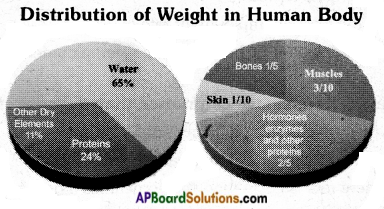
AP Board 7th Class English Important Questions Unit 2 1
Now answer the following questions.
1. Which of the following constitute most of the weight in the human body? ( )
a) water
b) proteins
c) dry elements
d) bones
Answer:
a) water

2. Which of the following statements is correct? ( )
a) Proteins constitute 11 per cent of the human body.
b) Dry elements constitute 15 pet cent of the human body.
c) Hormones, enzymes and other proteins constitute 2/5 of the human body.
Answer:
c) Hormones, enzymes and other proteins constitute 2/5 of the human body.

3. If a person’s weight is 100 kilograms, how much do his bones weigh?
Answer:
20 kgs

4. If the proteins in a person weight 12 kilograms, what will be his weight?
Answer:
50 kgs

5. Are the bones in our body heavier than the water in our body? Support your answer.
Answer:
The weight of bones in our body (in %) = [latex]\frac{1}{5}[/latex] × 100 = 20 %
∴ Hence the bones in our body are not heavier than water in our body.

AP Board 7th Class English Important Questions Unit 2

3. Study the table given below and observe the changing patterns of unemployment in some advanced countries. Answer the questions that follow.

AP Board 7th Class English Important Questions Unit 2 2
Now answer the following questions.
1. How many countries are compared in the given table?
2. What period does the table represent?
3. Which country has the least unemployment rate in 2005?
4. Which country has a decrease of nearly 6% in unemployment rate between 2000 and 2006?
5. In the case of every country we can notice that (Choose the correct answer.)
a) The unemployment rate is steadily increasing.
b) The unemployment rate is steadily decreasing.
c) The unemployment rate is fluctuating i.e., sometimes it rises and sometimes it falls.
6. Which year recorded the highest unemployment rate for many countries?
7. Which country recorded the least fluctuations in the unemployment rate?
Answers:
1) Eight countries are compared in the given table.
2) The table represents the period 2000 – 2006.
3) Japan has the least unemployment rate in 2005.
4) Spain has a decrease of nearly 6% in unemployment rate between 2000 and 2006.
5) c) The unemployment rate is fluctuating i.e., sometimes it rises and sometimes it falls.
6) 2003
7) Germany

4. Read the following tree diagram showing the constituents of blood.
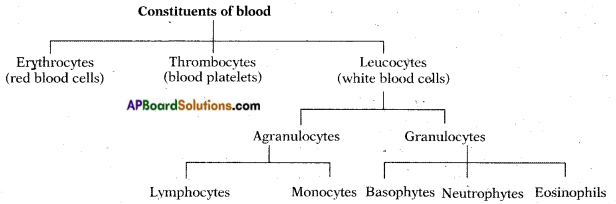
AP Board 7th Class English Important Questions Unit 2 4
Now answer the following questions.
1) What are red cells called?
2) How many main constituents are there in blood? What are they?
3) How many categories are there in granulocytes?
4) Under which category do monocytes come?
5) Are neutrophils granulocytes or agranulocytes?
Answers:
1) Red cells are called Erythrocytes.
2) There are three main constituents are there in blood.
They are 1) erythrocytes 2) thrombocytes 3) leucocytes.
3) There are three sub categories in granulocytes.
4) Monocytes come under agranulocytes.
5) Neutrophytes are granulocytes.

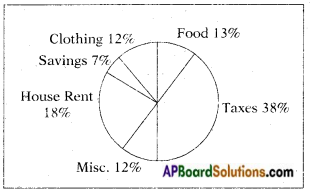
5. Read the following pie-chart which shows the spendings of a country on various sports.
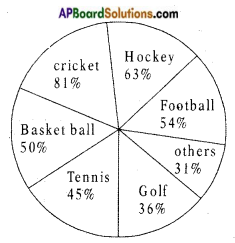
AP Board 7th Class English Important Questions Unit 2 5
Now answer the following questions.
1) On which sports maximum amount is spent?
2) How much percent more is spent oh hockey than on golf?
3) How much percent less is spent on football than that on cricket?
4) The sum of total spendings on tennis and golf is equal to the total spending on which game?
5) The difference of spendings on cricket and basketball is equal to the spending on which game?
Answers :
1) On cricket
2) 27% (63% – 36%)
3) 27% (81% – 54%)
4) Cricket (45 + 36 = 81%)
5) other games (81 – 50)

AP Board 7th Class English Important Questions Unit 2

6. Read the following tree diagram carefully.

AP Board 7th Class English Important Questions Unit 2 6

Now, answer the following questions.
1) What does the above diagram show?
2) What are the three main categories of musical instruments?
Choose the correct answer from the choices given below.
3) Which of the following is a stringed instrument? [ ]
a) Harp
b) Horn
c) Tabla
4) What type of musical instrument is Xylophone? [ ]
a) Percussion instrument
b) Wind instrument
c) Stringed instrument
5) Which of the following statements TRUE based on the information given. [ ]
a) All string instruments are a type of percussion instruments.
b) Wood block is a wind instrument.
c) Guitar and Violin are stringed instruments.
Answers :
1) The above diagram shows a tree-diagram of musical instruments.
2) Three catagories.
(1) Wind instruments,
(2) Percussion instruments,
(3) Stringed instruments.
3) a) Harp
4) a) Percussion instrument
5) c) Guitar and Violin are stringed instruments.

7. Study the family tree of Bala Krishna.
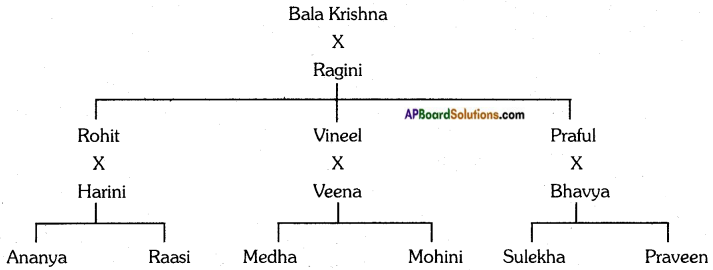
AP Board 7th Class English Important Questions Unit 2 7
Now, answer the following questions.
1) Who are the grandparents of Praveen?
2) How many granddaughters does Bala Krishna have?
Choose the correct answer from the choices given below.
3) Medha is the daughter of   [ ]
a) Rohit b) Veena c) Bhavya
4) Praveen and Raasi are   [ ]
a) brothers b) cousins c) friends
5) Which of the following statements is TRUE based on the information given?
a) Rohit has two daughters.
b) Ananya and Raasi are cousins.   [ ]
c) Rohit’s wife is Bhavya.
Answers:
1) Balakrishna and Ragini
2) Five granddaughters
3) b) Veena
4) b) cousins
5) a) Rohit has two daughters.

AP Board 7th Class English Important Questions Unit 2

Section – B: Creative Writing

1. In the lesson ‘C.V. Raman, the Pride of India’, you have read about the greatness of C.V. Raman. Now, imagine that you are the secretary of the Science Club of your school and prepare a script for a speech to deliver on the National Science Day.
Use the following hints to write a script for the speech.
C.V. Raman – bom on November 7, 1888 – at Tiruchirapalli in Tamil Nadu – interested in science – spent much time in his laboratory – became a great scientist – bright student from the beginning – discovered the Raman Effect – the world hailed – caught the attention of the world – won the Nobel Prize in 1930 in Physics – research in optics – elected to the Royal Society of London – studied wholly in India – passed away on November 21 in 1970 – National Science Day on 28 February is celebrated on the day on which he discovered the ‘Raman Effect’.
Answer:
Honourable Judges, Teachers, Guests and all my dear friends. I have been given the privilege of speaking on C.V. Raman on this National Science Day. You know National Science Day is celebrated every year on 28th February in order to remember the great invention of ‘Raman Effect’ by C.V. Raman on the same day in the year 1928.
It is very much proper to know about Sri. C.V. Raman on this occasion. C.V. Raman was born on 7, November 1888 at Tiruchirapalli in Tamil Nadu. He became a great scientist who became the pride of India. He was a brilliant student from the beginning. He was interested in science. He wrote many research papers for science journals. He became the member of the Indian Association for cultivation of Science at the age of 19. He was elected to the Royal Society of London in 1924. He started his own laboratory with no sophisticated equipment. He spent much time in his laboratory. C.V. Raman had been doing research in optics, the Science of Light. On 16, March, 1928 Raman announced his discovery of ‘new radiation’ to an assembly of scientists at Bangalore. The world hailed this discovery as “Raman Effect”. With this he made all Indians proud. With equipment worth hardly Rs. 200 and limited facilities, Raman was able to make discovery. For his Raman Effect he was given a Nobel Prize in Physics in 1930. He was made a knight of the British Empire in 1929.
C.V. Raman was the first – Indian scholar who studied wholly in India and received Nobel Prize. He was the first Asian and first non-white to win such a great award in science. He passed away on 21, November 1970. But his memories are with us. So it is appropriate to celebrate 28th February of every year as National Science Day to commemorate C.V. Raman’s remarkable achievement in Science.
Thank you one and all for giving me this wonderful opportunity.

2. Write a biographical sketch on the life of Sri C.V. Raman.
Answer:
C.V. Raman was bom on November 7, 1888 at Tiruchirapalli in Tamilnadu. He was a brilliant student right from the start. When he passed his matriculation, his parents are keen on sending him to abroad for higher studies. But the doctors advised not to send him abroad for , higher studies On medical grounds. So Raman completed his M.A. course at Presidency Col-lege In Madras. He was very much interested in science. He used to write research papers in science journals. At the age of 19, he became a member of the Indian Association for Cultivation of Science. He took up an administrative job in Finance Ministry in Calcutta. Though he joined in an administrative job his interest in science did not flag. He used to spend hours after office in the lab of the Association, Raman was mainly interested in acoustics, the science of sound. Later he built his own laboratory. He was elected to the Royal Society of London in 1924. For five years he had done research in optics, the science of light. No sophisticated equipment was available in his laboratory. Finally on 28 February, 1928 Raman announced his discovery, which is known as ‘Raman Effect’. With equipment worth hardly Rs. 200/- and limited facilities, Raman was able to make a discovery. The whole world hailed his discovery. For his Raman Effect he got Nobel Prize in Physics in 1930.
C.V. was the first Indian scientist who studied wholly in India and received the Nobel Prize. He was the first Asian and the first non-white to win such a great, award, in Science. C.V. Raman passed away on 21, November 1970 February 28 the day on which he discovered the ‘Raman Effect’ is celebrated as ‘National Science Day’ to commemorate his remarkable achievement in Science.

3. Write a paragraph on J.C. Bose using the hints given below. You must use the right linkers to join the sentences.
Answer:
Jagadish Chandra Bose (J.C. Bose) was a famous- Indian Scientist. He was born on 30th September, 1858.
J.C. Bose studied at St. Xavier’s School in Calcutta. Later he went abroad for higher stud¬ies. He returned to India in 1885. He published a Monograph which was about the response in the living and the non-living. He became famous by being a Fellow of the Royal Society in 1920.
J.C. Bose invented wireless telegraphy in 1895. He proved that plants have life.
J.C, Bose invented Crescograph, an instrument with which the growth in plants can be known.
J.C. Bose founded the Bose Institute in Calcutta. He devoted most of his life to the study of plants J.C. Bose passed away on 23rd November, 1937.

AP Board 7th Class English Important Questions Unit 2

4. On the occasion of Science Day you have to deliver a speech about our ancient Indian scientist and doctor, surgeon Susruta. Prepare a script for the speech using the following hints.
Susruta – born in 6th century B.C. – father of plastic surgery – great surgeon – first person – Rhinoplasty, plastic surgery to nose – given about 101 types of instruments – book – Susruta Samhitha – still in use – excellent teacher – pupils – good physician – both theory and practice.
Answer:
Honourable teachers, guests and all my dear friends. I have been given the privilege of speaking on Susruta, the ancient Indian scientist, doctor and the first plastic surgeon, on this National Science Day. You know National Science day is celebrated every year on 28th February in order to remember the great invention of Raman Effect by C.V. Raman on the same day in the year 1928.
On this day, it is very much proper to know about another great ancient scientist and doctor Susrutha. Susrutha was born in 6th century B.C. He learnt surgery and medicine from Dhanvantri in Varanasi. He became a great surgeon and physician. He was considered as father of plastic surgery. He was the first doctor to conduct Rhinoplasty, plastic surgery to nose. He designed 101 types of surgical instruments useful to perform for various surgeries. His treatise “Susruta Samhita” is a great reference book even today. He was an excellent teacher too.
He advocated the importance of practical. He advised his pupils to use carcasses and models for practice.
Thank you for giving me this opportunity on this auspicious day.

(A)

1. The Marriage of your elder sister is going to be held on 25th July 20xx at Vasavi Kalyana Mandapam, in Nellore. The bridegroom is an engineer. He is not taking any dowry. Write a letter to your friend inviting him to the marriage.
Answer:

Nellore.
10. 7. 20xx.

Dear Ravi,
I hope that you are in good health and you are going along nicely in your studies. Here I’m very glad to inform you that my elder sister’s marriage is going to be take place on 25th July 20x x at Vasavi Kalyana Mandapam, Nellore. The bridegroom is an engineer. He is working in B.D.L. Hyderabad. Their is a nice family. They seem to be friendly and dignified people. One thing I want to mention here that they are I not taking any dowry and they did demand any greedy gifts. I shall be very glad to see at you and your family at the function. Please inform your parents about the same and tell them that my parents will be pleased if they attend the function. My father wants to call your father and mother and invite them on phone. I have already posted the invitation on your father’s name. I shall be very glad if you come two days before and help me in preparations.
Convey my regards to your parents and my best wishes to your,little brother. Hoping that you will come, I remain.

Yours lovingly,
xxxxxx

Address on the Envelope:
R Ravi Kumar,
S/o Surya Narayana,
H.No: 1 – 20 – 22/A,
Malladivari street,
Gandhinagar,
Vijayawada.

AP Board 7th Class English Important Questions Unit 2

2. You are Ravi. You’ve received a letter from your friend Rahul. Inviting you and your family to his elder sister’s marriage. But on the same day you and your family are attending your neice’s marriage at Hyderabad. Hence write a letter to your friend apologising him for not attending his sister’s marriage.
Answer:

Vijayawada.
12. 7. 20xx.

Dear Rahul,
It was great to hear from you and I’m really glad that things are working out for you there in your school.
I’m very glad to know about your sisters marriage. My parents are also very happy to know this. We are very much happy when we know about the gentlemanship of your would be brother-in-law. What a nice people they are! Who will marry a girl without taking a dowry these days ? We are very much pleased to know this.
Here I want to apologize you. We are unable to attend your sister’s marriage. We’re extremely sorry for not attending your sister’s marriage because the same day. We have to attend our cousins marriage at Hyderabad. Since the bride has no father, my parents are performing the rituals of the marriage . So we cannot avoid it My father asked me to convey his apologies to your father. He will write a letter to your father personally.
My parents asked me to convey their blessings and best wishes to your sister. We’ll visit your home at a convenient day very soon after the marriage.
Hoping that you’ll excuse us, I remain.

Yours lovingly,
xxxxxx

Address on the Envelope:
To
R. Rahul,
S/o R. Srinivasa Rao,
H.No: 8 – 3 – 1/A.
Chaturvedula vari street,
Trunk Road,
Nellore.

3. Write a letter to your friend asking him/her to visit your village during Dasara vacation. Describe what activities he/she can participate in during the festival along with you.
Answer:
H.No.: 242/7B,
Komaravallipadu.
20. 03. 20xx.

Dear Shashank,
I am safe here and I hope the same with you. I am studying well and I hope the same with you.
Now, I would like to invite you to come to my village in Dasara vacation and spend at least a week in my village. Ours is a family of six members – grandparents, my parents, me and my younger sister. My grandparents are very friendly and looking after our fields and cattle. My father is a high school teacher. My mother is a house-wife. She takes care of us very much. My sister studies in class V in our village.
Ours is a very beautiful village. There are a lot of places worth watching in our village. Beautiful green fields, ancient Lord Shiva’s temple and running streams and some others are worth watching. My mother will prepare delicious dishes for us.
We are looking forward to seeing you, Convey my regards to your parents and my best wishes to your little sister.
Awaiting your arrival ………….

Yours lovingly,
xxxxxx

Address on the Envelope:
To
C. Shashank,
S/o C. Ravi Prakash,
D. No. 18 – 208,
Nagaram Town
Keesara Mandal,
Hyderabad.
PIN: 500001.

AP Board 7th Class English Important Questions Unit 2

4. Recently you paid a visit to your relatives place. You spent your holidays there. You visited a temple. You met new friends. You also attended some family functions.
Now, write a letter to your friend describing your visit to your relatives place. Also, invite your friend to visit your place.
Answer:

Tenali.
13-3-xx.

Dear friend,
We are all safe here and I hope the same with you all there. I am doing very well here. I hope you are also doing well there. In this I would like to write to you about how I enjoyed myself in my relative’s place.
During the recent holidays I paid a visit to my relative’s house. I spent all my holidays there. There I visited Sri Janardhana Swamy Temple which is said to be built by Sri Krishnadevaraya. It was famous for its architecture. The idols of Sridevi, Bhudevi and Sri Janardhana Swamy are beautiful and full of life. I have made some new friends there. They are very much amiable and sociable. I also attended some family functions there. All my stay there was quite entertaining, hectic and full of energy and enthusiasm.
Convey my regards to your parents. Why don’t you visit our place during the Sankranthi holidays? I am looking forward to seeing you here. I will assure you I will make your stay here full of fun and entertainment.

Yours lovingly,
xxxx

Addres on the Envelope:
To
xxxxx
S/o K. Krishna Reddy,
Near Ramalayam,
Main Road,
Kollipara.

(B) Write a story using the following hints.
1. A crow – find a peice of meat – take the piece of meat fly – about to eat – a cunning fox – sees piece of meat – wants to take it – Fox says – crow has a sweat voice – to sing a song – vexed with his repeated requests – put the piece of meat – under his leg says – that he has already read the story – get away from there.
Answer:
One day a crow found a piece of meat somewhere. The crow took the piece of the meat in its beak and flew off to a tree nearby. As it was about to eat the meat, a cunning fox came there. The fox saw the piece of the meat. Somehow he wanted to take it away from the crow. Then the fox said that the crow had a sweet voice. He asked the crow to sing a song for him. He repeatedly requested the crow for a song. Having been vexed with his repeated requests the crow put the piece of the meat under his claw and asked the fox to get away from there. He told the fox that he had already read the story of stupid crow and cunning fox.

2. An old tiger – weak – unable to catch its prey – thinks of a plan – wants to draw his pray closer – showing a golden bangle – bait – a poor man – comes – the other side of the river – about to drink water – hears someone calls – sees the tiger – afraid – tries to run away – tiger’s call – great scholar – changed – sorry for sing – now a pious – accept the golden ring – poor man – sees the golden bangle – becomes greedy – greediness overcomes – fear – goes close to tiger – to accept the ring – tiger spring up – kill – eat.
Answer:
Once there was on old tiger. He was week. He was unable to catch his prey. So he thought of a plan. He wanted to draw his prey closer to him by showing the golden bangle as a bait.
One day a poor man came that way. He was on the other side of the river. When he was about to drink water, he heard someone calling him. He looked up and saw the tiger on the other side of the river. At first the poor man was afraid. He tried to ran away from there. At the same time he heard the tiger’s call again “Oh! great scholar, I don’t harm you. I am now a changed one. I am sorry for my sins. I am now a pious man ! please accept golden ring and help me to recede my sins.”
When the poor man saw the golden bangle, he became greedy. His greediness overcame his fear. He believed the tiger’s words. So he went close to the tiger to accept the golden ring. At once the tiger sprang upon him, killed him and ate him.
This story tells us “Greediness brings us misery”.

AP Board 7th Class English Important Questions Unit 2

3. Two cats – quarrel – a cake – claim – the cake belongs to him – keeps on quarrel – not know – go to a monkey – known for his wisdom – to share the cake – cuts the cake – two equal parts – make them equal – eats a small piece – piece becomes smaller – monkey – eats the second piece – becomes smaller – repeats the same trick – eats up – goes away – disappointed.
Answer:
One day two cats were quarrelling over a cake. They both claimed that the cake belonged to him. They kept on quarrelling for a long time. But they did not know what to do. Then they went to a monkey. The monkey was noted for his wisdom. They asked him to share the cake between themselves. The monkey intentionally cut the cake into two unequal parts. To make them equal the monkey ate a small piece of the bigger piece. Now that piece became smaller. Then the monkey ate the second piece. Then it became smaller. Thus the monkey repeated the same trick several times and ate up all the cake. Then the two cats went away disappointedly.

4. Write a news report to a daily about how the inefficient garbage system in your city is affecting the people and the role of community and government in the disposal of garbage in a safe way.
Answer:
Need of efficient garbage system – Role of community and government in bringing UP cleanliness

Guntur,
24 – 10 – 20xx.

Guntur city is facing a severe problem of inefficient garbage system. A huge quantity of domestic wastes including kitchen wastes, vegetable peels, paper wastes and hazardous hospital wastes are produced daily. Due to the lack of proper disposal system, many health problems are prevailing in the city. There is an urgent need to establish an eco-friendly waste disposal system.
People have to play a key role in reducing the quantity of domestic wastes by practising 3 R’s principle (Reduce, Reuse, Recycle). Government has to take necessary steps to solve this problem by implementing the best solid waste management methods like incineration and sanitary landfills. Otherwise people will suffer from different ailments.

Vocabulary

Read the following paragraph and write the synonyms of the underlined words choosing the words from the words given in the box.

1. house; lived; prize; died; completely; intellectual
C.V. Raman has the first Indian scholar (a) who studied wholly (b) in India and received the Nobel Prize. He was the first Asian and the first non-white to win such a great award (c) in science. He passed away (d) in 1970 on November 21. But his memories ace with us.
Answer:
a) intellectual
b) completely
c) prize
d) died

2. thrill; friendship; organization; tools; development; farming
On the busy Bow bazaar street in Calcutta there was an old building. It was head quarters of the Indian Association (a) for cultivation (b) of science, In December on a fine evening in 1927, there was much excitement (c) in one of its laboratories. Chandrasekhar Venkata Raman was showing a visitor some of his instruments (d) in his laboratory.
Answer:
a) organisation
b) development
c) thrill
d) tools

AP Board 7th Class English Important Questions Unit 2

3. laughing; overjoyed; consequence; good; magnificent; sad
Raman was equally delighted (a). “Excellent (b) news,” he said, smiling (c) at the visitor and then he was lost in thought. “But…. look here, Krishnan,” he said turning to the young man, “if this Compton Effect (d) is true of X-rays, it must be true of light too.”
Answer:
a) overjoyed
b) good
c) laughing
d) consequence

4. instruments; changes; quality; advanced; infrastructure; creation
Could light also change its nature (a) when passed through a transparent medium? That was the question that Raman asked himself. For five years he had been doing research in optics, the science of light. No sophisticated (b) equipment (c) was available in his laboratory, but Raman was confident that he could find the answer with some modifications (d) in his equipment.
Answer:
a) quality
b) advanced
c) instruments
d) changes

5. interested; causes; fields; clever; foreign countries; dull
C.V. Raman was a brilliant (a) student right from the start. When Raman passed his matriculation, his parents were keen (b) to send him abroad (c) for higher studies. But on medical grounds, (d) a British surgeon advised them against it.
Answer:
a) clever
b) interested
c) foreign countries
d) causes

6. desires; decline; impact; journey; magazine; imagination
Science had already made an impression (a) on him and he began to write research papers for science journals (b). When he was only 19, he became a member of the Indian Association for Cultivation of Science. Meanwhile, respecting his parents’ wishes (c) he took up an administrative job in the Finance Ministry in Calcutta. His interest in science, however, did not flag (d).
Answer:
a) impact
b) magazine
c) desires
d) decline

AP Board 7th Class English Important Questions Unit 2

7. invention, nation, praised
The world hailed (a) the discovery as the ‘Raman Effect’. For scientific research in this country (b), it was a red-letter day.
Answer:
a) praised
b) nation

8. kingly, selected, divine
He was elected (a) to the Royal (b) Society of London in 1924 and the British Govt, made him knight of the British Empire.
Answer:
a) selected
b) kingly

9. The following sentences are from your lesson. Read them carefully and tick ( ✓ ) the correct meaning of the underlined word in each sentence.
1. His parents were keen to send him abroad for higher studies.
(a) particular (b) eager (c) worried
Answer:
(b) eager

2. The world hailed the discovery as the ‘Raman Effect’.
(a) admired (b) called (c) thought
Answer:
(a) admired

3. In his youth Raman was mainly interested in acoustics.
(a) primarily (b) simply (c) certainly
Answer:
(a) primarily

4. The British made Raman a knight of the British Empire.
(a) appointed (b) managed (c) placed
Answer:
(a) appointed

5. Raman passed awav on November 21, 1970.
(a) was killed (b) died (c) left
Answer:
(b) died

9. Read the following paragraph and write the antonyms of the underlined words.

1. On the busy (a) Bowbazaar Street in Calcutta there was an old (b) building. It was the head-quarters of the Indian Association for Cultivation of Science. In December, on a fine evening (c) in 1927. there was much excitement (d) in one of its laboratories.
Answer:
a) quiet
b) new
c) morning
d) boredom

2. Raman was equally (a) delighted (b) “Excellent (c) news” he said, smiling at the visitor and then he was lost (d) in thought.
Answer:
a) unequally
b) disappointed
c) unworthy
d) regained

3. Could light also change its nature when passed through a transparent (a) medium? That was the question (b) Raman asked himself. For five years he had been doing research in optics, the science of light. No sophisticated equipment was available (c) in his laboratory, but Raman was confident (d) that he could find the answer with some modifications in his equipment.
Answer:
a) opaque
b) answer
c) unavailable
d) diffident

4. C.V. Raman was a brilliant (a) student right from the start (b). When Raman passed (c) his matriculation, his parents were keen to send him abroad for higher (d) studies.
Answer:
a) dull
b) ending
c) failed
d) lower

AP Board 7th Class English Important Questions Unit 2

5. C.V.Raman was the first (a) Indian scholar (b) who studied wholly (c) in India and received the Nobel Prize. He was the first Indian and the first non-white to win (d) such a great award in science.
Answer:
a) last
b) layman
c) partially
d) defeat/lose

6. Susruta led (a) the stranger (b) to a neat and clean (c) room, with surgical instruments on its walls. He washed his face with water and the juice of medicinal plant. He then offered him a mug of wine and began (d) preparing for the operation.
Answer:
a) followed
b) acquaintance
c) dirty
d) ended

10. Fill in the blanks with the right form of the words given in brackets.

1. It was the headquarters of the Indian ——– (a) (Associate/Association) for ——– (b) (Cultivation/Cultivate) of Science. In December, on a fine evening in 1927, there was much ——– (c) (excitement/excite) in one of its laboratories. Then K.S.Krishnan, rushed in and ——– (d) (announce/announced), “Professor Compton has won the Nobel Prize.”
Answer:
a) association
b) cultivation
c) excitement
d) announced

2. Raman was ——– (a) (equal/equally) delighted. “Excellent news,” he said, ——– (b) (smiling/smile) at the visitor and then he was ——– (c) (lose/lost) in thought. “But …. look here, Krishnan,” he said: ——– (d) (turn/turning) to the young man, “if this Comptpn Effect is true of X-rays, it must be true of light too.”
Answer:
a) equally
b) smillng
c) Lost
d) turning

3. No ——– (a) (sophisticated/sophisticate) equipment was ——– (b) (avail/available) in his laboratory, but Raman was ——– (c) (confidence/confident) that he could find the answer with some ——– (d) (modifications/modifies) in his equipment.
Answer:
a) sophisticated
b) available

4. a) He was shocked to see a snake in his room but he recovered from his ——– (shock/ shocking) in no time.
b) He pretended to look relieved but, in fact, he did not have any ——– (relieve/relief).
c) I can understand your (excitement/excite). But do not be so excited that you have health problems.
d) Raju, an auto driver, was very honest. His ——– (honest/honesty) was known to everybody when he returned the bag of jewellery a passenger had left in his auto.
Answer:
a) shock
b) relief
c) confident
d) modifcations

5. Raman was mainly ——– (a) (interested / interesting) in acoustics, the science of sound. He studied how stringed instruments like the violin and the sitar could ——– (produce/production) harmonious music.
Answer:
a) interested
b) produce
c) excitement
d) honesty

AP Board 7th Class English Important Questions Unit 2

a) Complete the following words using ai, ea, ee, ia, ie, iu, oa, oo, ou, ua, ue, ui.

1. On the busy Bowbazaar (a) Str _ _ t in Calcutta there was an old (b) b _ _ lding.
2. A (a) y _ _ ng man named K.S. Krishnan.(b) ann _ _ nced, “Professor Compton, has won the Nobel Prize.”
3. “If this Compton Effect is (a) tr _ _ of X-rays, it must be true of light (b) t _ _ .”
4. Could light also change its nature when passed (a) thr _ _ gh a transparent (b) med _ _ m?
5. No sophisticated (a) eq _ _ pment was (b) av _ _ lable in his laboratory.
6. (a) F _ _ r months later, on March 16, 1928, Raman announced his discovery of ‘new (b) rad _ _ tion’.
7. For (a) sc _ _ ntific (b) res _ _ rch in this country, it was a red-letter day.
8. His parents were keen to send him (a) abr _ _ d for higher (b) stud _ _ s.
9. In his (a) y _ _ th, Raman was mainly interested in (b) ac _ _ sties.
10. He studied how stringed instruments like the violin (a) c _ _ ld produce” (b) harmoni _ _ s music.
Answer:
1. a) Street b) building
2. a) young b)announced
3. a) true b) too
4. a) through b) medium
5. a) equipment b) available
6. a) Four b) radiation
7. a) scientific b) research
8. a) abroad b) studies
9. a) youth b) acoustics
10. a) could b) harmonious

b) Complete the words with the correct suffixes given in brackets.

1. In December, on a fine evening in 1927, there was much (a) excite ——– (mant/ment) in one of its (b) laborato ——– (ries/rys).
2. Raman was (a) equa ——– (ly/lly) delighted, (b) “Excel ——– (ent/lent) news,” he said.
3. No sophisticated equipment was (a) avail ——– (able/ible) in his labora ——– (tary/tory).
4. Raman was (a) confi ——– (dant/dent) that he could find the answer with some (b) modifica ——– (tions/ssions) in his equipment.
5. His (a) disco ——– (very/vary) caught the (b) atten ——– (sion/tion) of the world.
6. With equipment worth hardly Rs. 200/- and (a) limi ——– (tted/ted) (b) facili ——– (ties/tys), Raman was able to make a discovery.
7. February 28, the day on which he discovered the ‘Raman Effect’, is celebrated as National
Science Day to commemorate his achieve ——– (mant/ ment) in science: His achievement was remark ——– (able/ible).
8. Raman was the first Indian scholar who Studied who ——– (ly / lly) in India.
9. a) Raman was equally delighted. “Exce ——– (llent/lent) news,” he said.
b) Raman announced the discovery of ‘new radia ——– ‘ (sion/tion).
10. a) transpa ——– (rant/rent) b) equip ——– (mant/ment).
Answer:
1. a) excitement b) laboratories
2. a) equally b) Excellent
3. a) available b) laboratory
4. a) confident b) modifications
5. a) discovery b) attention
6. a) limited b) facilities
7. achievement, remarkable
8. wholly
9. a) Excellent b) radiation
10. a) transparent b) equipment

c) Find the wrongly spelt words and write the correct spelling.

i) building; head quarter; associasion; science
ii) excitement; laboratary; instrument; visitor
iii) announce; professer; delight; excellent
iv) nature; resarch; effect; through
v) mediam; question; optics; answer
vi) transperant; sophisticated; equipment; available
vii) confident; dependent; brillient; government
viii) discovery; honesty; monky; wholly
ix) behaviur; radiation; facilities; matriculation
x) luggage; marriage; carriage; collage
xi) impression; journal; surgen; throughout
xii) accousists; violin; produce; harmonious
xiii) advice; scintist; confine; essence
xiv) scholer; driver; teacher; preacher
xv) recieve; relieve; believe; achieve
xvi) science; equipment; sociaty; instrument
Answer:
i) association
ii) laboratory
iii) professor
iv) research
v) medium
vi) transparent
vii) brilliant
viii) monkey
ix) behaviour
x) college
xi) surgeon
xii) acoustics
xiii) scientist
xiv) scholar
xv) receive
xvi) society

AP Board 7th Class English Important Questions Unit 2

12. Put the following words under correct headings.

A.
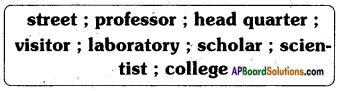
AP Board 7th Class English Important Questions Unit 2 8
Answer:
AP Board 7th Class English Important Questions Unit 2 9
B.
AP Board 7th Class English Important Questions Unit 2 10
Answer:
AP Board 7th Class English Important Questions Unit 2 11
C.
AP Board 7th Class English Important Questions Unit 2 12
AP Board 7th Class English Important Questions Unit 2 13
Answer:
AP Board 7th Class English Important Questions Unit 2 14
D.
AP Board 7th Class English Important Questions Unit 2 15
Answer:
AP Board 7th Class English Important Questions Unit 2 16

13. A) Write the meaningful sentences using the words given below.
i) much:
ii) excellent:
iii) equally:
iv) too:
v) earlier:
vi) through:
vii) some:
viii) hardly :
ix) keen :
x) against:
Answer:
xiii) throughout:
xiv) wholly:
xv) used to:
Answer:
i) I don’t have much money with me.
ii) Her speech was absolutely excellent.
iii) Diet and exercise are equally important.
iv) Can I come too?
v) He learnt to play the violin at an early age.
vi) The thief got in through the window.
vii) Do you want to have some more tea?
viii) There’s hardly anytime left.
ix) John was very keen to help.
x) We are fighting against terrorism.
xi) I’ve already eaten my lunch.
xii) The doctor will see you again next week, meanwhile use these medicines regularly.
xiii) The ceremony lasted two hours anti we had to stand throughout the ceremony.
xiv) The government is not wholly to be blamed for the raising of prices.
xv) I used to live in Guntur when I was a boy.

AP Board 7th Class English Important Questions Unit 2

B) Write the other forms of the following adjectives.
i) busy:
ii) excellent:
iii) young:
iv) confident:
v) brilliant:
vi) high:
vii) great:
viii) neat:
ix) clean:
x) large:
Answer:

Positive Comparative Superlative
i) busy busier busiest
ii) excellent more excellent most excellent
iii) young younger youngest
iv) confident more confident most confident
v) brilliant . more brilliant most brilliant
vi) high higher highest
vii) great greater greatest
viii) neat neater neatest
ix) clean cleaner cleanest
x) large larger largest

C) Write the full forms of the following abbreviations.

Abbreviation    Full form
1) C.D.               ……………..
2) DVD.             ……………..
3) A.D.               ……………..
4) p.m.              ……………..
5) B.A.               ……………..
6) C.M               ……………..
7) B.C.               ……………..
Answer:
1. Compact Disk
2. Digital Video Disk
3. Anno Domini
4. Post meridian
5. Bachelor of Arts
6. Chief Minister
7. Before Christ

D) Write the full forms of the words in the blanks given against each of them.
(One is done for you as an example)
Short form of the word     Full form of the word
plane                                       aeroplane
kilo                                             ………….
para                                            ………….
specs                                          ………….
photo                                         ………….
Answer:
kilogram, paragraph, spectacles, photograph

Grammar

14. Edit the following passage correcting the underlined parts.

1. Dolphins are very interesting animals. They, looks (a) like fish’but they are not fish. Fish has (b) cold blood but dolphins have warm blood. Fish can live under water and (c) dolphins cannot. They can stay in (d) water for a long time.
2. An (a) Olympic Games are the great (b) celebrations of sport in the world. They are held once . in four years. The Olympic Games began at (c) Olympia in 776 B.C. They took place from time to time till (d) 393 A.D.
3. Dhyanchand is (a) a very well – known hockey player. He was born at (b) 29 August 1905 in Allahabad. He studied in the (c) local secondary high school. In 1922, he joined a (d) British army as a sepoy.
4. Vikram Sarabhai was responsible to (a) the setting up of the Rocket Launching station or (b) space science and technology centre in (c) Thumba in Kerala. A (d) Rocket and Launching Ranger at Srihari Kota in Andhra Pradesh was set up by Dr. Sarabhai only.
5. Kites are man’s older (a) play things. Before kites man is using (b) dolls as play things. Man first used kites at (c) war. He used them to lift battle supplies. He used kites to carrying (d) other things also.
6. One day, a group of frog (a) decided to make a race and get to the top of an (b) high tower. A lot of people came to see them and give him (c) their support, but the race had just begin (d) and everybody was already saying that the frogs would not get there: It doesn’t made (e) any sense. You’ll never reach the top of the tower!
Answer:
1. a) look
b)have
c) but
d) under
2. a) The
b) greatest
c) in
d) until
3. a) was
b) on
c) a
d) the
4. a) for
b) and
c) at
d) The
5. a) oldest
b) was using
c) in
d) carry
6. a) frogs
b) a
c) them
d) begun
e) make

AP Board 7th Class English Important Questions Unit 2

15. Read the following passage and fill in the blanks with the correct options given against the number of blanks.

1. Have you ever ——– (1) people putting ——– (2) thumb impression on important documents? This is done mainly ——– (3) illiterate people ——– (4) they cannot put their signatures.
1) A) see B) sees C) seen D) seeing
2) A) its B) his C) their D) her
3) A) with B) from C) by D) of
4) A) so B) because C) as D) since

2. The finger prints ——– (1) the police to ——– (2) the thieves and criminals. ——– (3) keep a record of the finger prints of thieves and criminals ——– (4) to them.
1) A) helps B) help C) helped D) helping
2) A) identify B) identifying C) identified D) identifies
3) A) He B) She C) They D) It
4) A) knows B) know C) known D) knowing

3. A cell phone is ——– (1) extremely sophisticated radio. ——– (2) cell phones ——– (3) can talk to anyone ——– (4) the planet from just about anywhere.
1) A) a B) an C) the D) any
2) A) by B) with C) from D) n
3) A) she B) he C) they D) you
4) A) on B) in C) over D) above

4. Abdul is ——– (1) friend. One evening he ——– (2) home from school. He saw a boy ——– (3) in a tank suddenly he jumped ——– (4) the tank and saved the boy.
1) A) I B) my C) me D) mine
2) A) is returning B) returns C) was returning D) returned
3) A) drowns B) drowning C) drowned D) drown
4) A) in B) on C) into D) over

5. ——– (1) zoo is a place ——– (2) many kinds of birds ——– (3) animals are bred and protected. A visit to zoo is not only pleasure giving ——– (4) educative and informative.
I) A) The B) A C) An D) Any
2) A) there B) here C) where D) at
3) A) but B) or C) and D) yet
4) A) as well as B) and C) but also D) in addition to

6. Atmosphere makes ——– (1) earth a planet of life. It ——– (2) us with the air to breathe, protects ——– (3) from dangerous solar rays ——– (4) saves us from extremes of heat and cold.
1. A) a B) an C) the D) that
2. A) supply B) supplies C) supplied D) supplyinq
3. A) we B) us C) our D) ours
4. A) but B) yet C) or D) and

7. Yudhisthira was the name of ——– (1) poor potter who ——– (2) in a certain kingdom. One night, ——– (3) he was returning after drinking ——– (4) than he should, he stumbled and fell over some pots. When he got up, he saw blood was oozing out of his forehead. There was a deep cut due to a broken piece of pot.
1. A) a B) an C) the D) any
2. A) live B) lived C) living D) lives
3. A) which B) where C) who D) when
4. A) much B) more C) many D) lot
Answer:
1. 1 – C; 2 – C; 3 – C; 4 – B
2. 1 – B; 2 – A; 3 – C; 4 – C
3. 1 – B; 2 – B; 3 – D; 4 – A
4. 1 – B; 2 – C; 3 – B; 4 – C
5. 1 – B; 2 – C; 3 – C; 4 – C
6. 1 – C; 2 – B; 3 – B; 4 – D
7. 1 – A; 2 – B; 3 – D; 4 – B

AP Board 7th Class English Important Questions Unit 2

16. A) Write the other forms of the following verbs.
Present tense Past tense Past Participle
1) show          ………………..  ………………..
2) announce
3) win
4) delight
5) lose
6) say
7) pass
8) hail
9) catch
10) make
11) bear
12) advise
13) begin
14) become
15) think
Answer:

Present tense Past tense Past Participle
1) show showed shown
2) announce .announced announced
3) win won won
4) delight delighted delighted
5) lose lost lost
6) say said said
7) pass passed passed
8) hail hailed hailed
9) catch caught caught
10) make made made
11) bear bore borne
12) advise advised advised
13) begin began begun
14) become became become
15) think thought thought

B) Read the following sentences and say what they mean. Choose the right answer from the choices given.

1. Shall I help you in carrying your luggage? ( )
(a) making a request
(b) asking for permission
(c) offering help
2. Could you please lend me your note book? ( )
(a) making a request
(b) asking for permission
(c) making an enquiry
3. Would you mind my leaving the class early? ( )
(a) asking for permission
(b) making a request
(c) giving permission
4. You had better join English tution. ( )
(a) Giving permission
(b) Making a request
(c) Giving a suggestion
5. I am afraid I can’t attend the party. ( )
(a) Expressing fear
(b) Expressing apology
(c) Refusing a request
6. Will you join us for a party? ( )
(a) questioning
(b) advising
(c) inviting
7. Could you please shut the door? ( )
(a) Making a request
(b) asking for permission
(c) Giving an order
8. Shoot the enemy ….. ( )
(a) Giving an order
(b) request
(c) advice
9. Work hard ( )
(a) Advice
(b) request
(c) order
10. Keep quiet, won’t you? ( )
(a) Advice
(b) request
(c) order
Answer:
1) c
2) a
3) a
4) c
5) b
6) c
7) a
8) a
9) a
10) c

AP Board 7th Class English Important Questions Unit 2

C. Fill in the blanks with ‘a’, ‘an’ or ‘the’.

1. 1987, M.S. Swaminathan was awarded ______ Ramon Magsaysay Award.
2. We dined yesterday at ________ Maurya Sherton hotel.
3. Tejaswini lent me _________ interesting book.
4. My father is ____________ school teacher.
5. M.S.Swaminathan worked at _______ Indian Agricultural Research Institute.
6. Rekha bought _______ long notebook yesterday.
7. Sravani is eating ___________ mango now.
8. Ganesh always carries _______ umbrella with him.
9. Rambabu is _______ English teacher in a high school.
10. Manjula and Sruthi play______ guitar well.
11. 1)Raju is __________ honourable person.
2) That would make _________ good present.
3) Can you give me _________ books on the table?
12. 1)Suresh is _______ first ranker in the class.
2) The teacher gave me _______ interesting book.
3) Bhargavi is eating _______ biscuit now.
13. 1) In 1987, M.S. Swaminathan was awarded _______ Ramon Magsaysay Award.
2) We stayed yesterday at ________ Taj Mahal hotel.
3) Anusha lent me ________ interesting book.
Answer:
1) the
2) the
3) an
4) a
5) the
6) a
7) a
8) an
9) an
10) the
11) 1) an 2) a 3) the
12) 1) the 2) an 3) a
13) 1) the 2) the 3) an

D. Now fill in the blanks with ‘in’, ‘on’ and ‘at’.

1. Sarathchandra and Keerthana are brother and sister. Sarathchandra was born —(1)— 25th April —(2)— 2000. Keerthana was born —(3)— December 2, 2001. They are with their parents. They Live —(4)— Kondamudusupalem, a small village —(5)— Prakasam District. They play games —(6)— school. It is usually very hot —(7)— May —(8)— their village. So they spend their summer —(9)— Hyderabad —(10)— their uncle’s house.
Mr. Srisailam is their uncle. He resides —(11)— High Court Colony —(12)— Hyderabad with his wife, Jagadeeswan and his daughter, Vishnu Priya.

2. Sridevi was a famous Indian actress. She was born ——– 13 August 1963 ——– Sivakasi. Her parents were Ayyappan and Rajeswari. She acted ——– 285 films.

3. Raman was born ——– November 7, 1888 and did his M.A. Course ——– Presidency College ——– Madras.
Answer:
1. 1) on
2) in
3) on
4) at
5) in
6) at
7) in
8) at
9) in
10) at
11) at
12) in
2. on, at, in
3. on, at, in

AP Board 7th Class English Important Questions Unit 2

E. Fill in the blanks with too, throughout; however ; meanwhile ; against ; later.

1) The house was painted white ——–.
2) They are fighting ——– terrorism.
3) Bob spent an hour with his computer, Ann ——– took care of the children of-her own.
4) He wanted to take no risks ——– small.
5) See you ——–.
6) When I’ve finished painting the hall, I’m going to do the kitchen ——–.
Answer:
1) throughout
2) against
3) meanwhile
4) however
5) later
6) too

F.
1) Ravi wants to buy a car but he doesn’t have enough to buy a car. How would Ravi express his wish using wish?
2) Sita was angry and spoke rudely to Gita. Later she thought It was wrong. She was not happy about the way she spoke to her friend. How would she express her unhappiness using ‘wish’?
3) Your father is smoking heavily these days. You are not happy with it and you want to change him. How would you express the same idea using ‘wish’?
4) You joined a job in a company. You are not happy with the job. How would you express your
unhappiness using ‘wish’?
5) Sarala is somewhat beautiful. She wants to be even more beautiful. How would she express the idea using ‘wish’?
Answer:
1) I wish I had more money.
2) I wish I had not said that.
3) I wish father would stop smoking.
4) I wish I had not joined the job.
5) I wish I were even more beautiful.

AP Board 7th Class English Important Questions Unit 2

G. Add question tags to the following statements.

1) I will go home, ___________ ?
2) The story is interesting, ______________ ?
3) I am not a fool, ___________ ?
4) I am clever, ______________ ?
5) 1 can speak English, _____________ ?
6) She has paid the fees, _____________ ?
7) We have seen the film, ___________ ?
8) You are wise, ___________ ?
9) I shall go, ____________ ?
10) You must do this, _____________ ?
Answer:
1)won’t I?
2) Isn’t it?
3) am I?
4} aren’t I?
5) can’t I?
6} hasn’t she?
7) haven’t we?
8) aren’t you?
9) shan’t I?
10) mustn’t you?
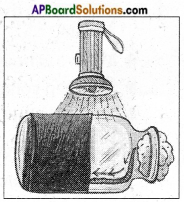
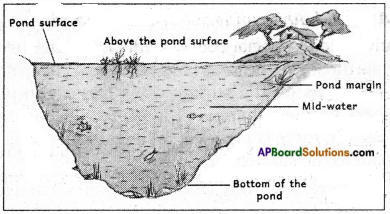
AP Board 6th Class Science Solutions Chapter 9 Organisms and Habitat

AP State Syllabus AP Board 6th Class Science Solutions Chapter 9 Organisms and Habitat Textbook Questions and Answers.

AP State Syllabus 6th Class Science Solutions 9th Lesson Organisms and Habitat

6th Class Science 9th Lesson Organisms and Habitat Textbook Questions and Answers

Improve Your Learning

Fill in the Blanks.
1. ——– is a dwelling place for plants and animals.
Answer:
Habitat
2. Soil is an ——– component of a habitat.
Answer:
Non-living

Choose the Correct Answer.
1. Which of the following is not a character ofa living thing?
A) Reproduction
B) Growth
C) Breathless
D) Excretion
Answer:
C) Breathless

2. Which of the following is a terrestrial habitat?
A) Pond
B) Garden
C) Lake
D) River
Answer:
B) Garden

AP Board 6th Class Science Solutions Chapter 9 Organisms and Habitat

Answer the Following Questions.

Question 1.
What are the common characteristics of living things?
Answer:
The living things show different specific characters.
1. Movement: – Most of the living things move from one place to another. They have the organs for movement like legs, wings, fins etc. Certain living things such as plants do not move from one place to another as they are fixed to the soil.
2. Food: – Acquiring food is also a character of living things. They acquire food for getting energy.
3. Growth: – Living things grow from time to time. Growth is a common phenomenon among them.
4. Breathing: – All living organisms inhale and exhale air from their surroundings. Many organisms have specialized organs for it. Plants have specialized organs called stomata for the exchange of gases.
5. Get rid of wastes: – Both plants and animals produce waste materials during life processes. They get rid of it by a process called Excretion.
6. Giving birth to young ones: – All living organisms give birth to young ones. Among them some animals lay eggs called Oviparous and some give birth to young ones called Viviparous. Plants produce seeds.
7. Responding to stimuli: The living things show response to stimulus in their surroundings. A change in the surroundings that make organisms respond to it is called stimulus.

Question 2.
How can you say that a tree is living even though it doesn 7 move?
Answer:

  • Tree has got the following characteristics of living beings though it cannot move.
  • The plant body shows growth, taking food, breathing, getting rid of wastes, response to stimuli giving birth to young ones through seeds.
  • So I can say that tree is living.

Question 3.
What is a habitat? How can you say our house is a habitat?
Answer:

  • A habitat is a dwelling place for plants and animals that gives them optimum conditions for life.
  • We live in houses that protect us from heat, cold and rain, etc. and are a shelter for us.
  • We keep some animals and birds as pets in our houses.
  • We also grow some plants which give us fruits and vegetables.

Question 4.
List out the organisms living in various regions of a pond?
Answer:

Region of the pond Organisms living in that region
Above the surface dragonfly, mayfly and kingfisher, hovering above the pond and then resting over a bamboo pole or a stick jutting out of the surface of the pond. They get food from the surface of the pond.
On the surface whirling beetle, pond skater, larva of mayfly and dragon­fly, Plants like pistia float on the surface completely while those like the lotus have roots going deep under. [Organisms on the surface are easily eaten up by others because there is little protection for them.] However, there is plenty of food and air. Fish usually come to the surface for food.
Pond margins Several grasses, frogs, cranes, crabs etc. Fish usually lay eggs here.
Midwater Great water boatman, leech and mosquito larva are found in this region. Fish and crabs also swim around this region.
Bottom of the pond This region has plants like Hydrilla and animals like mussels, flatworms and some maggots (larvae of some insects). Light is minimum here, but food, in the form of dead and decaying matter is plenty.

AP Board 6th Class Science Solutions Chapter 9 Organisms and Habitat

Question 5.
I am a living being. I have four legs. I live in water and also on land. “Who am I? And who are there in my habitat along with me?
Answer:

  • The four-legged organism which lives in water and also on land is a frog.
  • Turtles will also be in the habitat of frogs.

Question 6.
What questions do you ask to know more about microorganisms?
Answer:

  • What are microorganisms?
  • What is the smallest microorganism?
  • Can we see microorganisms with the naked eye?
  • What is the instrument using for observing microorganisms?
  • Are all microorganisms harmful to us?

Question 7.
How do you prove that earthworms respond to stimulus?
Answer:
Response to light by earthworm:
AP Board 6th Class Science Solutions Chapter 9 Organisms and Habitat 1
Aim: To observe the response of earthworm to light.
What we need: – Glass jar, Black Paper, Torch, Moist soil, Earthworm.
How to do:

  • Get an earthworm from a nearby moist soil.
  • Take a glass jar.
  • Cover half of the glass jar with black paper, pour the moist oil in the jar and put the earthworm in the uncovered portion of the jar.
  • Close the jar with a lid that contains small holes.
  • Shed some light on the jar.

What do we see: – The earthworm moves to the dark portion of the jar
What do we learn: – The earthworm shows a response to the light (Stimulus).

AP Board 6th Class Science Solutions Chapter 9 Organisms and Habitat

Question 8.
Draw the diagram showing different regions of a pond.
Answer:
AP Board 6th Class Science Solutions Chapter 9 Organisms and Habitat 2

Question 9.
What steps do you take to keep a habitat good?
Answer:

  • We should not dump the wastes in nearby ponds, lakes, rivers, and ground.
  • We should not cut down the forest.
  • The industries should not release wastes into air.
  • We should not dump polythene covers on the soil.
  • We should not burn the plastic, tires, and polythene covers.
  • We should not dig bore wells indiscriminately.

Activities and Projects

6th Class Science Textbook Page No. 106

Question 1.
Collect sweet potato, bottle, salt, and water. Take a bottle full of water and add salt, then put the sweet potato inside the bottle. Observe for a few days. What happens? Note your observations. How can you prove that sweet potato is also a living thing?
Answer:

  • The sweet potato bulges by absorbing saltwater.
    AP Board 6th Class Science Solutions Chapter 9 Organisms and Habitat 3
  • The metabolic changes continue in the potato, though removed from the parent plant.
  • It forms roots and stem.
  • This proves that sweet potato is also a living thing.

AP Board 6th Class Science Solutions Chapter 9 Organisms and Habitat

Question 2.
Identify the habitat in which the following live. More than one organism may be present in one habitat (use information given in the help box).
Our intestine, pond margin, kitchen, garden, tree, underground, grass,
Answer:

  1. Our intestine: Bacteria, Roundworms, Hookworms
  2. Pond margin: Several green types of grass, frogs, cranes, crabs, snails etc.
  3. Kitchen: Cockroach, lizards, rats, ants, flies, etc.
  4. Garden: Rats, bees, butterfly, ants, earthworms, garden lizard, beetles etc.
  5. Tree: Birds, bees, squirrels, mosquitoes, insect larvas, ants, termites etc.
  6. Underground: Snakes, rats, earthworms, snails, crabs, Termites, ants, etc.
  7. Grass: Crickets, grasshopper, ants, insects, larvas, etc.

Question 3.
Observe a spider in its web and write how a spider shares its habitat.
Answer:

  • The web of the spiders is made up of a special protein that solidifies to form silken threads.
  • The spider spins a web to trap insects.
  • When an insect accidentally flies over the web it gets stuck in the web.
  • The vibrations in the web are received by the spider and it attacks on the insect.
  • The spider releases some poisonous materials into the body of an insect to paralyzes it and makes the prey into liquid form.
  • This liquid form of food is absorbed by the spider.
  • This is how a spider shares its habitat.

Question 4.
Collect a hydrilla plant. Put it in a glass of water and observe for a week, how it grows.
Answer:

  • Hydrilla is a submerged plant.
  • It does not contain specialized roots.
  • The leaves are very small and strap-shaped with pointed tips.
  • The leaves have a distinct midrib.
  • The leaves are directly attached to the stem without a petiole.
  • When we put this Hydrilla in a glass of water it grows an inch in a day.
  • The plant gets it food from sunlight by a process called photosynthesis.

Question 5.
Take a map of Andhra Pradesh and color the areas where mangroves grow.
Answer:
Student Activity. Ex :
AP Board 6th Class Science Solutions Chapter 9 Organisms and Habitat 4

AP Board 6th Class Science Solutions Chapter 9 Organisms and Habitat

Question 6.
Write your experiences with your pet dog/cat/cow etc, that shows its affection on you.
Answer:

  • The animals like dogs/cat/cow are called as pet animals.
  • Man domesticated these organisms in earlier days to fulfill his needs.
  • He domesticated these for protection and food.
  • So we should take care of our pet animals.
  • In this process we clean them, we supply food and fodder to them.
  • If we show concern on these organisms, they become more affectionate to us.
  • So sometimes we can see the dogs licks our feet and wags its tails and sit near us. This is the way they show their affection on us.
  • Our motto should be “Live and Let Live”.

Question 7.
Prepare a map that represents different habitats that exist in your school.
Answer:
AP Board 6th Class Science Solutions Chapter 9 Organisms and Habitat 5

Question 8.
Prepare an article to deliver a speech in Literary Association meeting on “Animals also have right to live. ”
Answer:
“Animals also have the right to live”,

  • In this beautiful world, animals have as much right to live as human beings.
  • In totality, the entire earth is a common property of all of us.
  • It is our world and it is their world. People often ask if animals should have rights, and quite simply, the answer is “Yes !”
  • Animals surely deserve to live their lives free from suffering and exploitation. Just because we are at the top of the food chain.
  • Life is life and it should be valued, no matter what you are.
  • Animals cannot speak for themselves and for that reason we need to protect them.
  • Protecting them is something we should take pride in, it is our responsibility.
  • By respecting animal rights and having consideration for animal welfare, we also support ecological balance.

AP Board 6th Class Science Solutions Chapter 9 Organisms and Habitat

6th Class Science 9th Lesson Organisms and Habitat Activities

Activity – 1

Living things & Non-living things. (Page No. 93)

1. List some living things. Don’t forget to give reasons for why you think something is living.
Answer:
Dog – it takes a breath
Tree – it has growth
Buffalo – moves with legs

i) Chairs and tables also have four legs like buffalo. But they can’t move, why?
Answer:
Chairs and tables are non-living things. So they can’t move.

ii) Trees cannot move but they can produce seeds that give birth to new plants. Are they living things?
Answer:
Yes, trees are living things, but they can’t move. Except for this (movement), it has all living characters.

iii) How do we know whether some things are living and some others are nonliving?
Answer:
Living things have some special characters like growth and breath. By these charac¬ters we find living things.

iv) Will you notice that there are many characteristics of living things?
Answer:
Yes, living things have many characters.

v) Do all living things have common characteristics that make them different from non-living things?
Answer:
Yes, all living things have common characteristics that make them different from non-living things.

vi) Do you know that you are a living being? How can you say that?
Answer:
Yes, human beings are living things, they have living characters like growth, breath, and reproduction.

Activity – 2

Compare the characteristics. (Page No. 94)

2. Some characteristics are listed in table. Compare these characteristics with plants, animals and rocks.
AP Board 6th Class Science Solutions Chapter 9 Organisms and Habitat 6
Answer:
AP Board 6th Class Science Solutions Chapter 9 Organisms and Habitat 7

i) Do plants and animals possess the same characteristics as you do?
Answer:
Yes, mostly plants and animals possess the same characteristics as me, but plants can’t move.

AP Board 6th Class Science Solutions Chapter 9 Organisms and Habitat

ii) In which way do the characteristics of plants differ from you or from other animals?
Answer:
Plants can’t move.

iii) What characteristics are the same in plants and animals?
Answer:

  1. Growth
  2. Movement
  3. Taking food
  4. Breathing
  5. Getting rid of waste
  6. Respond to heat
  7. Respond to touch
  8. Respond to light
  9. Giving birth to young ones

iv) Do you agree that you are the same as other animals?
Answer:
Yes, I agree that living characters are the same as animals, but human beings are more intellectual and cultural.

v) What characteristics do you observe in rocks?
Answer:
Rocks do not have any living characters, so they are non-living things.

Activity – 3

Response to stimulus. (Page No. 95)

3. When you step on a sharp object what would you do? You will take back your feet. Is it not? Fill your responses to the stimulus in the below table.

Stimulus Response
When you step on a sharp object
Touch a flame or fire
Touch a block of ice
See a bright light Blink……….
Get bitten by an ant or mosquito
When you hear the word ‘ice-cream’ Mouth waters………..

Answer:

Stimulus Response
When you step on a sharp object I will take back my foot
Touch a flame or fire I will withdraw my hand
Touch a block of ice I will withdraw the touched part
See a bright light I will blink my eyes
Get bitten by an ant or mosquito I will scratch the place of bite
When you hear the word ‘ice-cream’ Mouth watering

i) Do all living beings possess the characteristic feature of response to stimulus.
Answer:
Yes, all living beings possess the characteristic feature of response to stimulus

ii) Do other animals also respond to stimuli like us?
Answer:
Yes, all other animals also respond to stimuli like us.

iii) Do plants respond to stimuli like animals?
Answer:
Yes, plants respond to stimuli like animals.

AP Board 6th Class Science Solutions Chapter 9 Organisms and Habitat

Activity – 4

Mimosa (Atti-Patti) (Page No. 96)

4. It is very interesting to observe a touch-me-not (Attipatti or mimosa) plant Touch it. Record your observations.
Answer:
i) How does this plant respond when you touch it?
Answer:
When we touch the mimosa, it closes its leaves.

ii) How much time does it take to return to its previous position?
Answer:
It takes nearly 15 to 20 minutes.

Activity – 5

Seeds – Living or not: (Page No. 96)

5. Seeds are produced from plants. We know that plant is a living being. Can we say that seeds are also living things? Let us discuss the characteristics of living seeds?
Answer:

i) Does a seed take in food? From where?
Answer:
Seed has stored food in it. So it does not take in food. The food store is in the endosperm, and/or in the cotyledons.

ii) Will it die if stored for a long time?
Answer:
Yes, if we preserve it carefully we can store the food for a long time.

iii) What happens when a seed is sown in soil?
Answer:
When a seed is sown in the soil it will germinate.

Activity – 6

Microorganisms in water. (Page No. 98)

6. Collect water samples from a pond, well, bore well. Keep them separately. Put a drop of water on a slide. Keep a coverslip on it. Observe under the microscope.
Draw what you have observed. Describe the shapes of the micro-organisms.
AP Board 6th Class Science Solutions Chapter 9 Organisms and Habitat 8
i) What type of micro-organisms do you see in water samples?
Answer:
I found different types of microorganisms some are thread-like structures and some are round.

ii) Do all water samples have the same type of microorganisms?
Answer:
No.different water samples have different types of microorganisms.

iii) Is there any water without micro-organisms?
Answer:
No all water samples have microorganisms, but few in topwater.

iv) Which water contains a larger number of micro-organisms? Why?
Answer:
Pond water has more microorganisms because it is an open-source to grow micro¬organisms.

v) What kind of micro-organisms do you find in the water from a pond and borewell?
Answer:
Pond water has more greenish microorganisms and the bore well has moving organisms.

AP Board 6th Class Science Solutions Chapter 9 Organisms and Habitat

Activity – 7

Who lives where. (Page No. 98)

7. Write the names of organisms in the box below according to where they are found. Some examples are filled to help you.

Under the ground On the ground In/On water Some other place
Snake Snake Snake
Earthworm
Cat Lotus
Sparrow (in homes)

Answer:

Under the ground On the ground In/On water Some other place
Snake Snake Snake Birds (tree)
Earthworm Frog Frog Eagle (rocks)
Rabit Cat Lotus squirrel (tree holes)
Ant Ant Dragon fly Sparrow (in homes)
Rat Squirrel Leech Honey bees (trees and rocks
Crab Snail Crab, snail

i) Which organisms are found mostly in your area often?
Answer:
Crows and cows are found mostly in my area often.

ii) How many organisms are present in more than one column?
Answer:
Two organisms are present in more than one column.

iii) Why did you place them there?
Answer:
They live in more than one place.

iv) In which column will you put a frog?
Answer:
I will put the frog in the second and third columns.

Activity – 8

8. Read the table and answer the following questions. (Page No. 100)

S.No. Region of the pond Organisms living in that region
1. Above the surface dragonfly, mayfly and kingfisher, hovering above the pond and then resting over a bamboo pole or a stick jutting out of the surface of the pond. They get food from the surface of the pond.
2. On the surface whirling beetle, pond skater, larva of mayfly and dragon­fly, Plants like pistia float on the surface completely while those like the lotus have roots going deep under. [Organisms on the surface are easily eaten up by others because there is little protection for them.] However, there is plenty of food and air. Fish usually come to the surface for food.
3. Pond margins Several grasses, frogs, cranes, crabs etc. Fish usually lay eggs here.
4. Midwater Great water boatman, leech and mosquito larva are found in this region. Fish and crabs also swim around this region.
5. Bottom of the pond This region has plants like Hydrilla and animals like mussels, flatworms and some maggots (larvae of some insects). Light is minimum here, but food, in the form of dead and decaying matter is plenty.

i) Name some organisms in the pond that can stay in different regions in the same pond?
Answer:
Frogs, cranes, crabs.

ii) What makes them stay in different regions in the pond?
Answer:
Their food habits and body structure makes them stay in different regions in the pond.

iii) Can different places in the pond also be called as habitat? Why? or why not?
Answer:
Yes, particular organisms are live in different places in the pond. So it be called as habitat.

AP Board 6th Class Science Solutions Chapter 9 Organisms and Habitat

iv) Is there any animal with legs in the pond?
Answer:
Yes, the frog has legs.

v) Do all animals in the pond have tails?
Answer:
No, all the animals in the pond does not have tail.

vi) Do all animals in the pond swim?
Answer:
No, crane can’t swim.

vii) What are the animals that share the surface of the pond as habitat?
Answer:
Whirling beetle, pond skater, larva of mayfly and dragonfly.

viii) Are the leaves of all plants growing in a pond, similar?
Answer:
No, the leaves of all plants growing in a pond are not similar. They are of different types. Ex : Hydrilla, Lotus.

ix) What is the difference between the leaves of a plant growing at the bottom (hydrilla) and that floating on the surface (lotus)? Try to think and write why we find such differences.
Answer:
a) The leaves of a plant growing at the bottom (hydrilla) have small tubular leaves to pass water flow.
b) Floating on the surface (lotus) plants have large leaves to grasp sunlight.

Activity – 9

Now, in the same way, let us study a plant or a tree as habitat. Birds, monkeys, squirrels, snakes, ants, spiders, caterpillars, moths, bees, wasps, small plants (mosses), mosquitoes are some organisms that you may find on a tree. Try to classify them in table based on where you find them. Add some more examples that you know. (Page No. 101)

At the base of the tree ants, ……..
On the trunk
Between the branches monkeys, ………
On or within the leaves

Answer:

At the base of the tree ants, snakes, caterpillars, moths, small plants, mosquitoes.
On the trunk ants, caterpillars, moths, mosquitoes, squirrels, bees, wasps, spiders.
Between the branches monkeys, birds, caterpillars, squirrels, mosquitoes, bees, wasps, snakes, ants, spiders.
On or within the leaves birds, monkeys, squirrels, snakes, ants, spiders, caterpillars, bees, small plants.

Activity – 10

10. i) Can animals that are our pets live in other places as well? (Page No. 101)
Answer:
Yes, our pets live in other places.

ii) Name the animals and also write the places where they can live.
Answer:
Dog – it lives in the streets.
Cat – it lives in the forest.
Parrots – lives on the tree.

AP Board 6th Class Science Solutions Chapter 9 Organisms and Habitat

iii) Why do only certain types of animals and plants live along with us?
Answer:
For food and shelter, some animals live along with us
For our food and needs, we cultivate some plants.

Activity – 11

11. Compare water (Aquatic) plants with land (Terrestrial) plants. (Page No. 103)
i) Collect an aquatic plant like Hydrilla or Vallisneria, also collect any terrestrial plant. Now compare the two and write your observations in the below table.

Parts Terrestrial plant (Tulsi) Aquatic plant (Valisneria / Hydrilla)
Stem
Leaf
Root
Others

Answer:

Parts Terrestrial plant (Tulsi) Aquatic plant (Valisneria / Hydrilla)
Stem Woody, grows towards the sunlight. Weak, less availability of sunlight.
Leaf Grows on stem with petiole and veins No petiole and simple leaf.
Root Tap root is present. Fibrous roots are present.
Others Grown on land, terrestrial plant. Grown in water. aquatic plant.

ii) Good Habit – Good Life:
Which habitat do you like more? Habitat – A or Habitat – B. Why?
AP Board 6th Class Science Solutions Chapter 9 Organisms and Habitat 9
Answer:
Habitat – A: I like more which is clean and tidy. Whereas in Habitat B there is environmental degradation which causes danger to plants and animals life.

AP Board 7th Class English Important Questions Unit 3

AP State Syllabus 7th Class English Important Questions Unit 3

7th Class English Important Questions Unit 3

Section – A: Reading Comprehension

A. Reading

1. Read the following text carefully.

Alexander: The battle of Jhelum will go clown in the history of our country.
First general: It’ll go down in the history of India, too.
Second general: It’ll go down in the history of the world.
Third general: I’ve never fought such a battle before.
Fourth general: I haven’t either. Until the last moment, I couldn’t believe that we would be
able to defeat the army of Puru.
Alexander: Yes, it has been a great battle perhaps the greatest of my life.
I must say every Indian soldier fought like a tiger.
First general: They fought like devils, Your Majesty.
Alexander: The Indians are good soldiers. They know how to fight. They fight better than our men.
Second general: But their generals aren’t so good as ours.

Now answer the following questions.
1) Who do you think ‘Alexander’ was?
2) Between which two kings did the battle of Jhelum take place?
3) Why did Alexander think that the battle of Jhelum would go down in the history of the world?
4) According to Alexander, how did every Indian soldier fight?
5) After reading the passage why do you think did the Indians lose the battle?
Answer:
1) Alexander was the king of Macedonia.
2) The battle of Jhelum was fought between Alexander and Puru, a king of northern India.
3) Alexander thought that the battle of Jhelum would go down in the history because he had never fought such a battle. The Indian soldiers fought very bravely.
He could not believe that he would be able to defeat the Indians. The army of Puru fought better than the army of the Greeks.
4) According to Alexander every Indian soldier fought like a tiger.
5) All Indian soldiers fought bravely but because of the inefficiency of the Indian generals Indians lost their battle.

AP Board 7th Class English Important Questions Unit 3

2. Read the following text carefully.
Alexander: If you mean they aren’t so brave as the Greek generals, I don’t agree with you.
Second general: But they aren’t very skilful, Your Highness.
Alexander: I see what you mean, and here I agree with you. The Indian generals are still following the old methods of warfare. Their battle plans are faulty and they depend too much upon their elephants. But as fighters they are wonderful. I have the highest respect for them.
Third general I was amazed to see how Puru fought in the battle of Jhelum.
Fourth general He continued to fight even when others had left the field. I think he killed
at least a hundred of our men with his sword.
Second general: And injured many more.
First general: He was badly injured himself.
Second general: That’s why we were able to capture him.
Alexander: Oh! He is a brave man and a great soldier. I wish he were one of my generals.

Now answer the following questions.
1) What was the opinion of Alexander about Indian generals?
2) According to Alexander, why were Indians defeated?
3) Why did Alexander have the highest respect for Indian soldiers?
4) Why were the Greeks able to capture Puru?
5) Alexander said, “Puru is a brave man and great soldier.” – How can you agree with his statement?
Answer:
1) In Alexander’s opinion Indian soldiers were as brave as Greek soldiers but they might not be as skilful as the Greeks.
2) The Indian generals used the old methods of warfare. Their battle plans are faulty. They depend too much upon their elephants.
3) The Indian generals were brave. They were wonderful fighters. So Alexander had highest respect for Indian soldiers.
4) Puru was injured badly. So the Greeks were able to capture him.
5) Puru continued to fight even when others had left the field. He killed at least a hundred of Greek soldiers with his sword. He injured many more. Thus I can agree with, Alexander’s statements that Puru was a brave and a great soldier.

AP Board 7th Class English Important Questions Unit 3

Additional Questions:
1) What was the opinions of Greek generals about Indian generals?
2) How can you say that Indian generals were” not skilful?
3) What was the name of the battle?
4) Why was the battle called the battle of Jhelum?
5) “I wish he were one of my generals.” – Why did Alexander wish so?
Answer:
1) In the opinion of Greek generals the Indian generals were not so brave and skilful, as the Greek generals.
2) The Indian generals followed the old methods of warfare. Their battle plans were faulty
and they depended too much on their elephants. Thus we can say Indian generals were not skilful.
3) The name of the battle was the battle of Jhelum.
4) The battle was fought on the bank of the river Jhelum. So it was called the battle of Jhelum.
5) Puru was a brave man and a great soldier. He continued to fight even when others had left the field. He killed hundreds of Greeks and injured many with his sword. Alexander was inspired With his bravery and wished if Puru were one of his generals.

3. Read the following text.
Second general: He is a proud man, Your Majesty.
Alexander: A soldier is not a soldier if he is not proud. I’m not angry with him at all.
He was not frightened by the news of my victories and refused to bow before me.
First general: He will be brought to Your Majesty soon. Let us see how he behaves.
Alexander: I’m sure he will not behave like a coward. (A soldier enters and bows to Alexander.)
Soldier: Sir. Puru has been brought to the camp.
Alexander: Has he been put in chains?
Soldier: Yes, Your Majesty.
Alexander: Go and remove the chains, and bring him in. I don’t want to see a brave man in chains.
(The soldier bows and goes out.)
Alexander: They should not have put him in chains. He is a king besides being a great soldier.
Now answer the following questions.
1) How should a soldier be according to Alexander?
2) Though Puru behaved proudly why was Alexander not angry with him?
3) How can you say Puru was not a coward?
4) Why did Alexander ask his generals to remove the chains of Puru?
5) Why did Alexander think Puru should not have been put in chains?
6) What were the feelings of Alexander about Puru?
7) Why did Alexander have a high esteem about Puru?
8) After reading the above text what can you say about the nature of Alexander?
9) What were the feelings of Greek generals about Puru?
10) “I don’t want to see a brave man in chains” – Who is the brave man mentioned here?
Answer:
1) According to Alexander, a soldier should be proud.
2) Alexander believed that a soldier should be proud and should not be a coward. So he was not angry with Puru though he behaved proudly.
3) Puru was not frightened by the news of Alexander’s victories and refused to bow before him.
4) Alexander did not to like to see Puru in his chains. Puru was a king besides being a soldier.
He had a great respect for good soldiers and brave kings. So Alexander asked his generals to remove the chains of Puru.
5) Besides being a soldier Puru was a king. He was a brave-king. He wanted to respect other kings. So Alexander think Puru should not have been put in chains.
6) Alexander did not treat Puru as his enemy but he was equal to him in power and authority. In his opinion Puru was a brave king and he should be respected.
7) Puru was a noble king. He fought bravely to defend the sovereignty of his kingdom. He was ready to sacrifice his life for defending his motherland. So Alexander had a high es¬teem about Puru.
8) Alexander was a noble king and man of good polity. He used to respect the self respect of other kings especially those who were brave and fought for defend the sovereignty of his own country.
9) According to the Greek generals, Puru was very proud and haughty.
10) The brave man mentioned in the line was Puru.

AP Board 7th Class English Important Questions Unit 3

4. Read the following text.

Alexander: (to Puru) Well, how are you, king?
Puru: My name is Puru.
Alexander: All right. Are you sorry for the ‘mistake you made, Puru?
Puru: I made no mistake, sir.
Alexander: Didn’t you reject my proposal?
Puru: I did. I refused to be your vassal.
Alexander: Do you know that many kings have gladly agreed to be my vassals?
Puru: I know that, and I also know that none of them is Puru.
First general: (softly to the second General) He is, indeed, a very proud man.
Alexander: Don’t you realize that you are my prisoner?
Puru: I do, but that doesn’t make any difference to me. I’m still the lawful king of my country.

Now answer the following questions.
1) What was the mistake done by Puru according to Alexander?
2) What was Alexander’s proposal?
3) Did Puru accept Alexander’s proposal?
4) Why do you think Puru did not accept Alexander’s proposal?
5) “I also know that none of them is Puru” – What is the meaning of the above sentence?
Answer:
1) Puru did not accept to be Alexander’s vassal.
2) Alexander’s proposal was to have Puru as his vassal.
3) No. Puru did not accept Alexander’s proposal.
4) Puru was a sovereign king and he wanted to be an independent and free king of his own kingdom. So Puru did not accept to be the vassal of Alexander.
5) By this sentence Puru wanted to say that the other kings who accepted to be the vassals of Alexander were not as sovereign as Puru. They did not have the self respect.

5. Read the following text.

First general: (softly to the second General) He is, indeed, a very proud man.
Alexander: Don’t you realize that you are my prisoner?
Puru: I do, but that doesn’t make any difference to me. I’m still the lawful king of my country.
Alexander: How shall I treat you?
Puru: As a king should treat another king.
Alexander: Puru, you are a brave man. I’m pleased with you. I want to make friends with you. Will you be a friend to me?
Puru: On one condition.
Alexander: What is that condition?
Puru: My kingdom should remain independent and you should treat me as your equal.
Alexander: Agreed, (after a pause) I’m proud of your friendship, my brother.
Puru: I’ll do my best to be worthy of the friendship of Alexander the Great.

Now answer the following questions.
1) Why did the generals think that Puru was a proud king?
2) Though Puru was a prisoner of Alexander, why was he talking and behaving proudly?
3) How should Puru want himself to be treated?
4) What condition did Puru put to Alexander to be friends with him?
5) If you were Alexander, what would you do with Puru?
Answer:
1) The generals thought that Puru was a proud king because Puru was talking and behaving like a king with self respect and sovereignty though he was in captivity.
2) Puru was a noble king with sovereignty and self respect. He was courageous and brave . man. Such kings live like kings and like to die as kings. They don’t like to be as slaves, vassals and subjects of any other kings.
3) Puru wanted to be treated as a sovereign king by Alexander.
4) If his kingdom was allowed to remain independent and he was treated as equal to Alexander he would make friends with his equal.
5) If I were Alexander, I would also treat Puru as Alexander treated him). I would respect his kingship. I would respect his sovereignty. I would be a friend to him and I would allow him to rule his kingdom independently.

AP Board 7th Class English Important Questions Unit 3

6. Read the following text.
The camp of Alexander on the banks of the Jhelum. Alexander is sitting on a high chair and his four generals are sitting on low chairs. Two Greek soldiers are standing at the door. Alexander is having a talk with his generals.
Alexander: The battle of Jhelum will go down in the history of our country.
First general: It’ll go down in the history of India, too.
Second general: It’ll go down in the history of the world.
Third general: I’ve never fought such a battle before.
Now, answer the following questions.
1) Where is Alexander’s camp?
2) Who is/are standing at the door?
3) Who is Alexander talking to?
4) How many generals are there in the passage?
5) Pick out the word that means ‘an army officer’.
Answer:
1) on the banks of die Jhelum
2) Two Greek Soldiers
3) his generals
4) Four generals
5) ‘general’

7. Read the following text.
Alexander: Didn’t you reject my proposal?
Puru: I did. I refused to be your vassal.
Alexander: Do you know that many kings have gladly agreed to be my vassals.
Puru : I know that, and I also know that none of them is Puru.
First General: (softly to the second general) He is, indeed, a very proud man.
Alexander: Don’t you realise that you are my prisoner?
Puru: I do, but that doesn’t make any difference to me. I’m still lawful king of my country.
Alexander: How shall I treat you?
Puru: As a king should treat another king.
Alexander: Puru, you are a brave man.
Now, answer the following questions.
1) How many persons were taking part in the above conversation?
2) What was Alexander’s proposal to Puru?
3) What kind of man was Puru according to Alexander?
4) Who was the prisoner mentioned in the above passage?
5) How did Puru want to be treated?
Answer:
1) Three persons
2) that Puru should be his vassal
3) a brave man
4) Puru
5) as a king

B. Reading

1. Read the following stanza.
Home they brought her warrior dead
She nor swooned, nor uttered a cry:
All her maidens, watching, said,
‘She must weep or she will die’.
Now answer the following questions
1) Who was brought dead?
2) Why did he die?
3) Who was ‘she’?
4) What were her feelings when her husband was brought dead?
5) What did all the women say?
6) Why did she not cry?
7) Why did they think she had to cry?
8) Which word in the above stanza means ‘became unconscious?
9) Write the rhyming words.
10) What is the rhyming scheme followed in the stanza?
Answer:
1) A warrior was brought dead.
2) While fighting with his enemy soldiers he was killed in a war.
3) ‘She’ was the warrior’s wife.
4) When her husband was brought dead she neither fainted nor cried. She was in shock. She stood stock still and she did not she$ even a single tear.
5) All the women who surrounded her said that she had to cry otherwise she would die.
6) She was in a shock. She stood stock still. So she did not shed even a single tear.
7) They believed that all the pain that the widow was keeping pent up inside her would finally have an adverse effect on her health and she would not surprise from the misery.
8) The word ‘swooned’ means unconscious.
9) dead – said – cry – die
10) The rhyming scheme followed in the poem is ABAB.

AP Board 7th Class English Important Questions Unit 3

2. Read the following stanza.
Then they praised him, soft and low.
Called him worthy to be loved,
Truest friend and noblest foe;
Yet she neither spoke nor moved.
Now answer the following questions.
1) Who does ‘they’ here refer to?
2) What did they do?
3) Why did they praise him?
4) How did they praise him?
5) What effect did their words have on her?
6) Identify the rhyming words in the stanza.
Answer:
1) “They” here refer to her women who surrounded her.
2) They praised her husband.
3) They praised her dead husband to remind the widow of her nobility and dignity her husband enjoyed from the large. They praised him before her to evoke an emotional reaction from him.
4) They praised him worthy to be loved, They said that he was the truest friend and a noblest foe.
5) None of their words did not have any effect on the wife. She stood motionless and silent.
6) The rhyming words in this stanza are; low – foe; loved – moved;

3. Read the following stanza.
Stole a maiden from her place,
Lightly to the warrior stepped,
Took the face-cloth from the face;
Yet she neither moved nor wept.
Now answer the following questions.
1) What did the maiden do?
2) Why did she remove the face-cloth?
3) What does the word ‘lightly’ here mean?
4) What effect did the maiden’s act have on the widows?
5) Identify the rhyming words in the stanza.
Answer:
1) The maiden walked up slowly and quietly to the dead body of the warrior and removed the face-cloth that covered his face.
2) The maiden removed the face-cloth supposing the sight of her husband’s lifeless face would move her and she would cry.
3) Lightly here means slowly and quietly.
4) The sight of her husband’s lifeless face did not have any effect on the widow. Still she did not cry.
5) The rhyming words in the stanza are; place – face; stepped – wept;

AP Board 7th Class English Important Questions Unit 3

4. Read the following stanza.
Rose a nurse of ninety years,
Set his child upon her knee –
Like summer tempest came her tears –
‘Sweet my child, I live for thee’.

Now answer the following questions.
1) How old was the nurse?
2) What did the nurse do?
3) How did the tears come out from the woman’s eyes?
4) Which season of the year is mentioned in the stanza?
5) Pick out the rhyming words from the stanza.
Answer:
1) The nurse was ninety years of age.
2) The nurse placed the widows child on woman’s knee.
3) Tears came out like the summer tempest.
4) The summer season
5) years – tears; knee – thee

Additional Questions:
1) What did the woman do when she saw her child?
2) “Like the summer tempest came her tears” – What figure of speech is used in this line?
3) What is the ‘tempest’ here compared to?
4) Who succeeded in making the woman cry?
5) What did the widow say in the end?
6) What is the meaning of the last line of the stanza?
7) Identified the rhyming words given in the stanza.
8) Why did the widow cry on seeing her child?
Answer:
1) When she saw her child the woman at once cried. The tears came down with the force of a storm.
2) The figure of speech ‘simile’ is used in the above line because the tears are compared to a storm.
3) The tempest is compared to the tears that came down her face with a force.
4) The ninety nine year old nurse succeeded in making her weep.
5) The widow that she would live for her daughter.
6) I would not die with your dead father. I would live for you.
7) Years – tears ; knee – thee.
8) All the while the widow had been thinking of her child. She was thinking who would have to live like without a father. These thoughts made her cry when she saw her child.

C. Reading

1. Read the following passage.

This is a story from China. A long, long time ago, there lived an old woman in a hut in the forest. Her husband had been killed by a tiger some years ago. She was old and weak. Life was difficult for her and her daughter, Slew Mei.
Siew Mei did all the cooking and cleaning herself. She also looked after the silkworms in their garden. The worms gave them fine thread to make beautiful silk. Siew Mei sold the silk to travellers in the village market. In this way, she got enough money to buy food and other things.

Now answer the following questions.
1) Where did this story take place?
2) Whom was the story about?
3) What happened to her husband?
4) Why was life difficult for the woman and her daughter?
5) What did Siew Mei do to earn her living?
Answer:
1) The story took place in China.
2) The story was about a woman and her daughter Siew-Mei.
3) Her husband was killed by a tiger some years ago.
4) The woman lost her husband. She was old and weak. They were poor. So life was difficult for the woman and her daughter.
5) Siew Mei used to look after the silkworms, collect the thread from the silkworms, make beautiful silk and sell the silk in the market and earn enough money to buy food and other things.

AP Board 7th Class English Important Questions Unit 3

2. Read the following passage.
One day as Siew Mei was returning home, it started to rain heavily. It was getting dark, too. Siew Mei ran into the first hut she saw. The door was open and there was no one inside. “Is anybody in?” she called loudly, again and again. But there was no reply.
Siew Mei looked around the hut. The floor was very dirty. Bowls and pots were left unwashed. Siew Mei swept the floor and washed all the bowls and pots.
By the time she had finished, the hut was as clean as a new one. By then the rain had stopped too.“I had better go home,” she said to herself. “Mother will be worried.”
Now answer the following questions.
1) What happened one day when Siew Mei was returning home?
2) Where did she take shelter in the rain?
3) How was the hut?
4) What did Siew Mei do to make hut clean?
5) How was the hut when she was abput to leave the hut?
Answer:
1) One day when Siew Mei was returning home it rained heavily.
2) In the rain she took shelter in a hut.
3) The floor inside the hut was dirty. Bowls and pots were left unwashed.
4) Siew Mei swept the floor, washed all the bowls and pots. She cleaned the hut to look as a new one.
5) When she had finished cleaning, the hut was as clean as a new one.

3. Read the following passage.
As she walked out of the hut, she saw a strange old man. His long beard reached down to his waist. He looked about a hundred years old. The old man looked at Siew Mei and smiled.
“Uncle,” she said, “I went into the hut because it was raining. I hope you don’t mind.” “Not at all, young girl,” replied the old man. His eyes fell on the clean floor and on the bowls and pots. “Did you clean the hut for me?”
“Yes,’’answered Siew Mei. “Let me help you into the hut.”
The old man was very happy. “You’re a very kind girl,” he said. “I must give you a present.”
He took out a pair of scissors and cut off a little of his long white beard. He put it in a piece of old cloth, tied it up, and gave the bundle to her.
“Do not give it to anyone,” said the old man. “Open it when you get home.”

Now answer the following questions.
1) Who did she see when she was about to come out of the hut?
2) How was the old man?
3) According to the old man, what kind of girl was she?
4) “I must give you a present.” – Why did the old man feel that he should give a present to her?
5) What present did the old man give Siew Mei?
6) What do you think was the girl rewarded for?
7) How can you say the girl was kind-hearted?
8) On the name of a present the old man gave her a piece of his beard; Though it was just a hair of the beard the girl accepted it. What does it tell us about the girl?
9) What lesson do you learn from this episode of young girl and old man?
10) Who do you think the old man was?
Answer:
1) The girl saw an old man when she was about to come out of the house.
2) The old man looked about a hundred years old. He had a long beard.
3) According to the old man she was a very good and kind girl.
4) The old man thought that she cleaned the floor of his house, washed the bowls and pots without expecting anything. So he thought he should give her a present.
5) The old man cut off a piece from his long beard, tied it a bundle in a cloth gave it to her as a present.
6) I think the girl was rewarded for her selfless service and for her cleanliness.
7) When the old man was about to enter the hut she offered her that she would help him into
the hut.
8) Whenever an elder person offers us a present, we should accept it without considering its value. Then it will give us good fortune. It is good manners.
9) Your selfless service will fetch you a great reward.
10) I think the old man must be a supernatural creature with holy powers.

AP Board 7th Class English Important Questions Unit 3

4. Read the following passage.
Siew Mei thanked him and went home. Her mother was very glad to see Siew Mei safe.
Siew Mei told her mother about the old-man.
Siew Mei opened the bundle to show her mother the old man’s white beard. To their surprise, they saw the finest silk thread in the whole of China. They began to weave with the silk thread. When they had finished weaving, they bad made the finest silk they had ever seen. They noticed that the bundle of silk thread still remained exactly the same size as before.
News of their wonderful silk spread far and wide. The old woman and her daughter became famous and lived happily ever after.
Now answer the following questions.
1) Why was her mother glad to see Siew Mei?
2) What did Siew Mei show her mother?
3) What made them surprised?
4) What did they do with the silk?
5) What did they notice?
6) Which news spread far and wide?
7) What happened to them?
8) How can you describe the turning of old man’s beard into silk?
9) Do you believe in miracles?
10) If you were Siew Mei, how would you feel?
Answer:
1) It was very, late in the night. And there was a heavy rain. In spite of the rain and the darkness her daughter was able to reach home safely. So she was glad to see her daughter.
2) Siew Mei showed her mother the whiteman’s white beard.
3) When they opened the bundle they did not see the old man’s white beard but they saw the finest silk thread. It made them surprised.
4) They wove the finest silk cloth with the silk.
5) They noticed that the silk thread remained exactly the same size even after they wove the
cloth using it.
6) News of their wonderful silk spread far and wide.
7) The old woman and her daughter became famous for the finest silk they produced.
8) The turning of the beard into silk can be described as a miracle.
9) Yes. I believe in. it because I’ve so many such things. After a dreadful earthquake, though thousands of people lost their lives, a girl was saved alive after a week from the rumblings. Was it not a miracle? So many miracles happened in the human history.
10) I’d be very glad if I were Siew Mei.

Unseen Comprehension

1. Read the following passage carefully.
Have you ever seen a UFO? A UFO is an Unidentified Flying Object, a strange object or light that people see in the sky. Many people believe that these strange lights are really spaceships from another planet.
For years people have seen and heard many odd things in the sky, blinking and glowing . lights, flying objects shaped like saucers, and moving objects making strange noises. Some people have even taken pictures of these unusal sights.
Some of these UFOs are really aeroplanes, weather balloons or meteors. But many UFO reports are still a mystery.
Now answer the following questions.
1) What do people believe about these strange lights?
Answer:
People believe that these strange lights are really spaceships from other planets.

2) What are these UFOs really?
Answer:
These UFOs are really aeroplanes, weather balloons or meteors.

Choose the correct answer from the choices given.
3) U.F.O stands for: ( )
a) Unknown Flying Object
b) Unidentified Flying Object
c) Unseen Flying Object.
Answer:
b) Unidentified Flying Object

4) U.F.Os are believed to be spaceships from other ( )
a) countries
b) continents
c) planets
Answer:
c) planets

5) Which of the following statements is true? ( )
a) UFOs are make-believe.
b) Moving objects with blinking lights have to be UFOs
c) People have seen moving objects making strange noises.
Answer:
a) UFOs are make-believe.

AP Board 7th Class English Important Questions Unit 3

2. Read the following passage carefully.
Do you know about one of the most famous, monsters in the world? The Loch Ness Monster is a large animal that some people believe lives in Loch Ness, a deep dark lake in Scotland. For many years, hundreds of people have reported seeing something strange in the lake. They have even given it the nick name “Nessie”.
Nessie is said to be about 30 feet long, with a long slender neck, one or two humps and flippers.
There are even pictures that have been taken of a large animal-like shape in the water. Scientists are still trying to solve the mystery of Nessie.
Now answer the following questions.
1) Where do the Loch Ness Monsters live?
Answer:
Loch Ness monsters are said to be lived in the Loch Ness lake in Scotland.

2) How is Nessie?
Answer:
Nessie is said to be about 30 feet long with a long slender neck, one or two humps and flippers.

Choose the correct answer:
3) Actually the Loch Ness is the name of a ( )
a) country.
b) city.
c) lake.
Answer:
c) lake

4) Which of the following is a fact about Nessie? ( )
a) Nessie has a long slender neck.
b) Nessie has flippers.
c) Nessie is a mystery.
Answer:
c) Nessie is a mystery.

5) What was the Nickname given to Loch Ness Monster? ( )
a) Nest
b) Nestle
c) Nessie
Answer:
c) Nessie

3. Read the following passage carefully.
Perhaps you have seen a green, fuzzy spot on bread or cheeses. If so, it was probably mold. Mold is a kind of plant called fungi. The most common molds are green or black. Mold likes to grow in a moist, warm places. But where does it come from?
Mold comes from spores, which exist in the air. If these find a moist, warm place they will produce mold. Mold grows weds of fuzzy branches. It continues to grow as long as the conditions are right.
Foods such as cheese, fruit and bread can develop mold, If they are left out in a warm damp room. Mold may even grow on leather shoes, belts or furniture.
Mold is usually thougt of as a problem. But some molds are valuable to scientists. The most famous mold is called penicillium Notatum. This mold is used to make a valuable drug called penicillin.
Now answer the following questions.
1) What is mold?
Answer:
Mold is a kind of plant called fungi.
2) How are the molds useful to scientists?
Answer:
Some molds are valuable to scientists. Scientist produce a drug called penicillin from the mold ‘Penicillium Notatum’.

AP Board 7th Class English Important Questions Unit 3

Choose the correct answer:
3) Mold grows in ——– places. ( )
a) dry and warm
b) moist and warm
c) dry and cool
Answer:
b) moist and warm

4) Mold comes from: ( )
a) fungi
b) spores
c) pencillin
Answer:
b) spores

5) Penicillium Notation is a ——–. ( )
a) drug
b) plant
c) mold
Answer:
c) mold

4. Read the following passage carefully.
Do you know that you are a mammal? Any animal that gives birth to live babies; not eggs, and feeds ifs young on milk are called mammals. Cows, humans and whales are all mammals. Mammals are warm-blooded animals. Most mammals have hair on their bodies. Many mammals live on land. People, elephants, rabbits, dogs and cows, cats are all land mammals. Some animals like dolphins and whales, live in water. The seal, walrus and otter are mammals that live on land and in the water. Did you know there is even a mammal that flies? It is the bat.

Now answer the following questions.
1) What are called mammals?
Answer:
The animals that give birth to babies, not eggs, and feed their young ones on milk are called mammals.

2) Write some characteristics of mammals.
Answer:
a) Mammals are warm-blooded animals.
b) Mammals have hair on their bodies.

Choose the correct answer:
3) Mammals are ………… animals.  (  )
a) cold blooded
b) warm blooded
c) white blooded
Answer:
b) warm blooded

4) Which of the following is not a mammal?   (  )
a) bat
b) whale
c) hen
Answer:
c) hen

5) Which of the following birds is a mammal?   (  )
a) duck
b) hen
c) bat
Answer:
c) bat

AP Board 7th Class English Important Questions Unit 3

5. Read the following passage.
After the war, our church was in a very bad condition. So we decided to build a new one on the top of a hill just outside the town. We used many different kinds of materials. We built the walls of stone and glass, the heavy doors of wood and metal. From the top of the church there was a wonderful view. You can see the entire town and countryside for miles around. People from all parts of the country visit the church every day. It is such an interesting building..
Now, answer the following questions.
1) What was the condition of the church after the war?
Answer:
The church was in a very bad condition after the war.

2) Where did the people want to build the church?
Answer:
on the top of the hill

3) The walls of the new church were made of …… ( )
a) wood and glass
b) wood and metal
c) stone and glass
Answer:
c) stone and glass

4) The doors were made of ….. ( )
a) metal and wood
b) cement and bricks
c) glass and marble
Answer:
a) metal and wood

5) Choose the correct statement from the following. ( )
a) The new church was built in a town.
b) The new church was in interesting building.
c) The new church had no walls and doors.
Answer:
b) The new church was in interesting building.

6. Read the following passage.

Penny-wise Monkey

Once upon a time, there lived the king of a big and affluent country. The king was quite fond of travelling. Usually, he didn’t like to visit his own country; instead he went to other countries. One day, he assembled his army to move out for a holiday to some distant country. The king and his soldiers walked for the whole morning in the forest. After this, they went into the camp to take some rest.
The horses were also tired, so they were fed with peas. One of the monkeys, who lived in the forest, was keeping a track of the things done by the king’s men from a distance. When he saw peas offered to the horses, he jumped down from the tree at once to get some of them. He quickly gobbled some peas, also filled his mouth and hands with them. Then, he went up the tree and sat down, to eat the peas.
As and when, he sat there to eat peas; one pea fell from his hand to the ground. The greedy monkey dropped all the peas he had in his hands and ran down to look for the lost pea at once. Unluckily, he could not find that one pea. He climbed up the tree again and sat at rest. He was looking very sad. He said to himself, “To get one pea, I threw away what I had”.
The king was watching the monkey from the camp and said to himself, “I would not be like this stupid monkey, who lost much to gain a little. I will go back to my own country and enjoy what I have”. Thus, the king and his army marched back to their own country.

Now, answer the following questions.
1) Why did the king want to visit other countries?
Answer:
because he was quite fond of travelling

2) What did the monkey see?
Answer:
The monkey saw peas being offered to the horses.

Choose the correct answer from the choices given below.
3) The monkey gobbled the peas in a particular way.
From this, we know that ….. ( )
a) the monkey was kind
b) the monkey was greedy
c) the monkey wanted just enough to eat
Answer:
b) the monkey was greedy

4) Another possible title to the story is ….. ( )
a) The Horses and the Monkey
b) The Wise Monkey
c) Penny-wise and Pound-foolish
Answer:
c) Penny-wise and Pound-foolish

5) Choose the correct statement from the following. ( )
a) The king learnt that it is foolish to lose more to gain little.
b) The king learnt that it is good to take risk in life.
c) The king learnt that without pain there cannot be any gain.
Answer:
a) The king learnt that it is foolish to lose more to gain little.

AP Board 7th Class English Important Questions Unit 3

Unseen (Data Interpretation)

1. Study the following bar graph and answer the questions that follow.
AP Board 7th Class English Important Questions Unit 3 1
Now answer the following questions.
1) What does the above bar graph show?
Answer:
The above bar graph shows the project exports contracts secured by a company during the period 1984-88.

2) What is the maximum value of exports secured in all the five years?
Answer:
The maximum value of exports secured ip all the years is 143.9 crores in the year 1987.

Choose the correct answer:
3) In which year the minimum value of exports secured? ( )
a) 1988
b) 1984
c) 1985
Answer:
a) 1988

4) In which year the project exports declined by 33% when compared to the previous year? ( )
a) 1988
b) 1985
c) 1986
Answer:
b) 1985

5} In which year the project exports rised to high extent? ( )
a) 1985
b) 1988
c) 1987
Answer:
c) 1987

AP Board 7th Class English Important Questions Unit 3

2. Read the following table.
The table below shows the estimated cost (in Rs. Lakhs) of a project of laying of a railway line between two places.
AP Board 7th Class English Important Questions Unit 3 2

Now answer the following questions.
1) What does the above table show?
Answer:
The table shows the estimated cuts of a project of laying a railway line between two places.

2) What is the total cost spent on laying the railway line?
Answer:
705.3 lakh rupees.

Choose the correct answer:
3) In which year very least total amount is spent? ( )
a) 1991
b) 1990
c) 1988
Answer:
c) 1988

4) In which year maximum amount is spent? ( )
a) 1989
b) 1990
c) 1991
Answer:
a) 1989

5) In which year the maximum amount is spent on Cement? ( )
a) 1988
b) 1989
c) 1981
Answer:
b) 1989

3. Read the following table showing Endocrine glands, hormones they release and their functions.
AP Board 7th Class English Important Questions Unit 3 3

Now answer the following questions
1) What does the table show?
Answer:
The table shows endocrine glands, hormones they secrete and their functions.

2) Which gland stimulates glucose uptake in all cells?
Answer:
Pancreas stimulates glucose uptake in all cells.

Choose the correct answer:
3) Which of the following glands stimulates heart rate and blood pressure? ( )
a) pituitary
b) parathyroid
c) adrenal
Answer:
c) adrenal

4) Which of the following glands releases growth hormone? ( )
a) pancreas
b) parathyroid
c) pituitary
Answer:
c) pituitary

AP Board 7th Class English Important Questions Unit 3

5) Which of the following glands stimulates metabolism and heart rate ? ( )
a) pituitary
b) thyroid
c) adrenal
Answer:
b) thyroid

4. Study the following table:
AP Board 7th Class English Important Questions Unit 3 4

Now answer the following questions.
1) What does the table show?
Answer:
The table shows the openers with more than 8000 runs in one day internationals.

2) Who was the highest scorer as an opener in ODIs?
Answer:
Sachin Tendulkar was the highest scorer in one day internationals as an opener.

Choose the correct answer:
3) How many centuries were scored by Sachin as an opener? ( )
a) 75 b) 28 c) 45
Answer:
c) 45

4) Who was the second highest scorer as an opener? ( )
a) Adam Gilchrist
b) Sanath Jayasurya
c) Sourav Ganguly
Answer:
b) Sanath Jayasurya

5) The average of which two openers is almost equal? ( )
a) Desmond Haynes and Chris Gayle
b) Sourav Ganguly and Desmond Haynes
c) Chris Gayle and Saeed Anwar
Answer:
b) Sourav Ganguly and Desmond Haynes

5. The following table shows the marks secured by some students in a school exam.
AP Board 7th Class English Important Questions Unit 3 5

Now, answer the following questions.
1) What information is the table likely to-show?
Answer:
The marks scored by some students in a school exam.

2) Identify the two low scores in English.
Answer:
64 and 73 respectively scored by Suresh and Vineela

Choose the correct answer from the choices given below.
3) Find out the subject that was scored well by all students. ( )
a) Maths
b) English
c) Telugu
Answer:
b) English

4) Which is the subject the students need to improve? ( )
a) Sciences
b) English
c) Hindi
Answer:
c) Hindi

5) Choose the correct statement from the fallowing: ( )
a) Mohini scored the least score in total score.
b) Vineela scored the highest total in all subjects.
c) Suresh scored least marks in social studies.
Answer:
c) Suresh scored least marks in social studies.

AP Board 7th Class English Important Questions Unit 3

Section – B: Creative Writing

1. Rewrite the playlet “Alexander the Great” as a short story.
Answer:
Alexander was a king of Macedonia. He was the disciple of the greatest Greek philosopher, Aristotle. His aim in his life was to conquer the world. He had defeated so many kings in the middle east the western Asia and reached the North-western India. In the northern India he had to fight with Puru, a great king and a brave soldier. Puru was a noble patriot. He did not like India to be conquered by any foreign ruler. So he decided to fight against Alexander. There was a great battle, between Alexander and Puru on the banks of Jhelum. His soldiers, generals fought bravely. Puru also fought like a tiger. He killed hundreds of Greek soldiers and injured many with his sword. Puru lost the battle though his generals and soldiers fought bravely. Puru lost the battle as he had used the oldest methods of warfare and he used elephants. Puru was gravely injured and chained in the battle. He was brought before Alexander. Alexander liked his bravery and courage. He did not like such a great king to be in captivity., He asked his soldiers to remove his chains. Alexander asked Puru to be his vassal. But Puru refused. Alexander asked him why he rejected his offer.- Puru said that he was the lawful owner of his kingdom. He asked Puru how he should treat him. Puru asked to treat him as his equal. Alexander liked his bravery, gave back his kingdom. Alexander liked Puru’s self-respect, so became his best friend.

2. You’ve read the playlet Puru the Brave. You liked it very much. You liked the characters both Alexander and Puru. Write a letter to your friend describing why you liked both of them.
Answer:

Tenali.
24.5.20xx.

Dear Krishna,
I hope this letter finds you in the best of health and spirits. All of us are doing fine here. It has been a very long since we met or wrote to each other. So I thought of penning down a few lines to check things with you. The primary purpose of writing this letter to you is to make you know about two great heroes of history. They are Alexandar and Puru, the great.
You must have heard about these two in our lesson-“Puru, the Great.” After reading this lesson I’ve inspired with the great qualities of Alexander and Purushotham. Both are courageous and valient people. Both are noble. Both respected each other’s sovereignty. Alexander was such a noble personality that he respected the bravery, patriotism, and his love for free¬dom and sovereignty. For Puru the only thing that Puru valued very much was the freedom, independence and sovereignty of his kingdom. Nothing is valuable for him more than that. Puru rejected the proposal of Alexander to be as his vassal. He fought bravely like a lion until the end with the means and warfare available to him. In my opinion he was a true hero. What is your opinion about Puru? What do you think about Alexander ?
Write a replay to me describing your feelings about these two great personalities. Convey my regards to your parents and my best wishes to you sister.
Yours lovingly,
xxxxxx
Address on the Envelope:
R Ravi Kumar,
S/o Surya Narayana,
H.No: 1 – 20 – 22/A,
Malladivari Street,
Gandhinagar,
Vijayawada.

3. In the lesson ‘Puru, the Brave’ you have read about the bravery of Puru. Now imagine that you are making a speech on the bravery of Puru at the time of Independence Day celebrations and prepare a draft for it.
Use the following hints to write a script for the speech.
Puru – one of the greatest Indian kings – fought with Alexander bravely – his soldiers – fought like tigers – Puru killed at least a 100 Greek soldiers – injured many more – but finally injured and captured – did not lose his courage – said he was a lawful king – Alexander pleased with his words – treated him like his brother – gave his kingdom back.
Answer:
Respected teachers and dear friends,
Good morning to everyone. I, S. Haneesh, stand before you to speak about the bravery of Puru on this auspicious occasion of Independence Day.
Puru was one of the greatest Indian kings. He fought with Alexander bravely. His soldiers fought like tigers. Puru killed at least a hundred Greek soldiers and he injured many more. But finally he was injured and captured by the Greek.
He did not lose his courage even though he was captured. When Alexander asked Puru whether he would accept the former’s supremacy and remain his vassal. Puru said that he was still the lawful king of his kingdom so refused his proposal. Alexander was pleased with his words and treated him like his brother. He gave his kingdom back.
Thank you one and all for giving me this opportunity.

AP Board 7th Class English Important Questions Unit 3

1. Write a story using the following hints.
A carpenter – working – under tree – daily cut wood into pieces – made windows, doors, furniture – one day – cutting a’beam with a saw – put a small plug in it- went home for food – meanwhile – monkeys came down from tree – ran here and there – jumped over timber – one monkey removed plug from beam – tail was caught in crevice – cried and died at last – moral: Mischievous deeds – dangerous.
Answer:
Once a carpenter was working under the shadow of a tree. Daily he used to cut the wood into small pieces. He made many windows, doors and other furniture.
One day while he was cutting a beam with a saw, he put a small plug in it. He went home for food at mid-day. Meanwhile some monkeys came down from the tree. They ran here and  there and jumped over the timber. One of the monkeys removed the plug from the beam. Its tail was caught in the crevice. It cried and cried and died at last.
Moral: Mischievous deeds are dangerous.

2. Write a story using the. hints given below.
A farmer – lived in village – brought up goose – gave him – a golden egg – every day – sold golden eggs – became rich – thought – many golden eggs – in the stomach – killed the goose – could not get more than one golden egg – felt sorry for his greed.
Answer:
Once there lived a farmer in a certain village. He brought up a goose. Everyday it gave him a golden egg. The farmer sold the golden eggs and soon became rich. One day an idea struck in his mind. He thought that there would be many golden eggs in the stomach of the goose. So he killed the goose. He searched the dead body for golden eggs. He could not get more than one golden egg. He felt sorry for his greed.
Moral: Avarice causes sorrow.

3. Write a story Using the following hints.
A clever thief – Veerappa robs the rich – gives all to the sick and the needy – other thieves jealous – plan to get rid of him – challenge Veerappa to steal the king’s pyjamas – Veerappa accepts challenge – dressed like a soldier – finds king sleeping – opens a bottle of red ants on the bed – king badly bitten – king cries for help – servants rush in – king pretends to look for ants – Veerappa – removes king’s trousers – escapes – other thieves shocked – accept Veerappa – their leader.
Answer:
Once there was a clever thief Veerappa. He robs the rich and gives all the money to the sick and the needy. Other thieves are jealous of him. They plan to get rid of him. They challenge Veerappa to steal the king’s pyjamas. Veerappa accepts the challenge.
He dresses himself like a soldier and enters the palace. He finds the king sleeping. He opens a bottle of red ants on the king’s bed. The king is badly bitten and cries for help. Servants come rushing in. The king pretends to look for ants. Veerappa removes the king’s pyjamas and escapes from there.
Other thieves who challenged him are shocked. They accept Veerappa as their leader.

4. You are suffering from severe headache. You are not able to sit in the class. You did not take lunch because of this. You want to leave early to take rest.
Now, write a letter to your Class teacher and request permission for leaving early. Explain the reasons for requesting permission.
Answer:
To
The Class Teacher,
Class VII, A/S,
Municipal Boys High School,
Tenali.

Respected Sir,
I am suffering from severe headache. I am not able to sit in the class. I did not take lunch because of this bad headache. I want to take rest by leaving early.
Hence I request you to grant me leave for a half day (the post lunch session of today). Thanking you sir,

Yours obediently,
x x x x x
Roll No: 23,
Class VII, A/S.

AP Board 7th Class English Important Questions Unit 3

Vocabulary

Read the following paragraph and write the synonyms of the underlined words choosing the words from the words given in the box.
1.
AP Board 7th Class English Important Questions Unit 3 6
I see that you mean, and here I agree with you. The Indian generals are still following old methods (a) of warfare (b). Their battle (c) plans are faulty (d) and they depend too much upon their elephants.
Answer:
a) ways
b) activity of fighting a war
c) war
d) defective

2.
AP Board 7th Class English Important Questions Unit 3 7
First general: He was badly (a) injured (b) himself.
Second general: That’s why we were able to capture (c) him.
Alexander: Oh! He is a brave (d) man and a great soldier. I wish he were one of my generals.
Answer:
a) in a bad way
b) hurt
c) arrest
d) courageous

3.
AP Board 7th Class English Important Questions Unit 3 8
Alexander: A soldier is not a soldier if he is not proud. I am not angry with him at all. He was not frightened (a) by the news of my victories (b) and refused (c) to bow (d) before me.
First general: He will be brought to Your Majesty soon. Let us see how he behaves.
Alexander: I’m sure he will not behave like a coward (e).
Answer:
a) afraid
b) win
c) declined
d) obey
e) timid

4.
AP Board 7th Class English Important Questions Unit 3 9
Alexander: All right. Are you sorry for the mistake (a) you made, Puru?
Puru: I made no mistake, sir.
Alexander: Didn’t you reject (b) my proposal (c)?
Puru: I did. I refused to be your vassal (d).
Answer:
a) a wrong doing
b) disagree
c) suggestion
d) a subordinate king

5.
AP Board 7th Class English Important Questions Unit 3 10
First general: (softly (a) to the second General) He is, indeed (b), a very proud man.
Alexander: Don’t you realize (c) that you are my prisoner?
Puru: I do, but that doesn’t make any difference to me. I’m still the lawful (d) king of my country.
Answer:
a) quietly
b) realty
c) understand
d) legitimate

6.
AP Board 7th Class English Important Questions Unit 3 11
If you mean they are as brave (a) as the Greek Generals, I agree (b) with you.
Answer:
a) noble
b) accept

Read the following paragraph and write the antonyms of the underlined words.

1. Third general: I’ve never (a) fought such a battle before.
Fourth general: I haven’t either. Until the (b) moment, I couldn’t believe that we would be able to defeat (c) the army of Puru.
Alexander: Yes, it has been a great (d) battle.
Answer:
a) always
b) first
c) win
d) small

AP Board 7th Class English Important Questions Unit 3

2. Second general: But their generals aren’t so good (a) as ours.
Alexander: If you mean they aren’t so brave (b) as the Greek generals, I don’t agree (c) with you.
Second general: But they aren’t very skilful (d), Your Highness.
Answer:
a) bad
b) timid
c) refuse
d) unskillful

3. Alexander: The Indian generals are still following the old (a) methods of warfare.
Their battle plans are faulty (b) and they depend too much upon their elephants. But as fighters they are wonderful. I have the highest (c) respect (d) for them.
Answer:
a) new
b) correct
c) lowest
d) disrespect

4. Alexander: A soldier is not a soldier if he is not proud (a). I’m not angry (b) with him at all. He was not frightened (c) by the news of my victories (d) and refused to bow before me.
Answer:
a) humble
b) calm
c) comforted
d) defeats

5. Alexander: Didn’t you reject (a) my proposal?
Puru: I did. I refused (b) to be your vassal.
Alexander: Do you know that many kings have gladly (c) agreed to be my vassals?
Puru: I know that, and I also know that none of them is Puru.
First general: (softly (d) to the second General) He is, indeed, a very proud man.
Answer:
a) accept
b) agreed
c) sadly
d) loudly

6. Puru: I do, but that doesn’t make any difference (a) to me. I’m still the lawful (b) king of my country.
Alexander: How shall L treat you?
Puru: As a king should treat another king.
Alexander: Puru, you are a brave man. I’m pleased (c) with you. I want to make friends with you. Will you be a friend (d) to me?
Answer:
a) similarity
b) illegitimate
c) displeased
d) enemy

7. Puru you are a brave (a) man. I am pleased (b) with you.
Answer:
a) timid
b) displeased

Fill in the blanks with the right forms of the words given in brackets.

1. Second general: But they aren’t very ___________ (a) (skilful/skilfully). Your Highness.
Alexander: I see what you mean, and here I agree with you. The ___________ (b) (Indian/India) generals are still following the old methods of warfare. Their battle plans are ___________ (c) (fault/faulty) and they depend too much upon their elephants. But as fighters they are ___________ (d) (wonder/wonderful). I have the highest respect for them.
Answer:
a) skilful
b) Indian
c) faulty
d) wonderful

2. Alexander: Didn’t you reject my __________ (a) (proposal/propose)?
Puru: I did. I refused to be your vassal.
Alexander: Do you know that many kings have ___________ (b) (gladly/glad) agreed to be my vassals?
Puru: I know that, and I also know that none of (c) (they/them) is Puru.
First general ___________ (d) ((soft/softly) to the second General) He is, indeed, a very proud man.
Answer:
a) proposal
b) gladly
c) them
d) softly

AP Board 7th Class English Important Questions Unit 3

3. One day as Siew Mei was returning home, it started to ___________ (a) (rain/raining) ___________ (b) (heavy/heavily). It was getting dark, too. Siew Mei ran into the first hut she saw. The door was ___________ (c) (open/opened) and there was no one inside. Is anybody in?” she called ___________ (d) (loud/loudly), again and again. But there was no reply.
Answer:
a) rain
b) heavily
c) open
d) loudly

4. Alexander: Don’t you ____________ (a) (realize/realization) that you are my prisoner?
Puru: I do, but that doesn’t make any ___________ (b) (different/difference) to me.
I’m still the lawful king of my country.
Answer:
a) realize
b) difference

a) Complete the following words using ai, au, ea, ee, ei, ie, oo, ou, ua, ue.

1. I could (a) bel _ _ ve that we would be able to (b) def _ _ t the army of Puru.
2. I must say every Indian (a) sold _ _ r (b) f _ _ ght like a tiger.
3. Their battle plans are (a) f _ _ lty and they depend too much upon th _ _ r elephants.
4. He (a) contin _ _ d to fight even when others had left the (b) f _ _ ld.
5. He will be (a) br _ _ ght to Your Majesty (b) s _ _ n.
6. Has he(a) b _ _ n put in (b) ch _ _ ns?
7. Puru joins the palms of his hands and raises them to his (a) foreh _ _ d to return the (b) gr _ _ ting.
8. He is, (a) ind _ _ d, a very (b) pr _ _ d man.
9. I’m (a) pl _ _ sed with you. I want to make (b) fr _ _ nds with you.
10. My kingdom should (a) rem _ _ n independent and you should treat me as your (b) eq _ _ l.
11. Third General: I’ve never f _ _ ght (a) such a battle before.
Fourth General: I haven’t _ _ ther (b). Until the last moment. I couldn’t believe that we would be able to defeat the army of Puru.
Answer:
1. a) believe b) defeat
2. a) soldier b) fought
3. a) faulty b) their
4. a) continued b) field
5. a) brought b) soon
6. a) been b) chains
7. a) forehead b) greeting
8. a) indeed b) proud
9. a) pleased b) friends
10. a) remain b) equal
11. a) fought b) either

b) Complete the words with the correct suffixes given in brackets.

1. But as (a) fight…… (ers/ors) they are (b) wonder…… (full/ful).
2. He was not (a) fright …… (end/ened) by the news of my (b) victo …… (rys/ries).
3. I do, but that doesn’t make any (a) differ…… (ence/ance) to me. I’m still the (b)…… law (full/ful) king of my country.
4. My (a) king…… (dam/dom) should remain (b) indepen…… (dent/dant).
5. (a) Didn’t you reject my propo…… (sel/sal)?
(b) I’m proud of your friend…… (ship/sheep).
6. Alexander: What is that (a) condi …… (tion/sion)?
Puru: My kingdom should remain (b) independ ……(ant/ent) and you should treat me as your equal.
Answer:
1. a) fighters b) wonderful
2. a) frightened b) victories
3. a) difference b) lawful
4. a) kingdom b) independent
5. a) proposal b) friendship
6. a) condition b) independent

AP Board 7th Class English Important Questions Unit 3

c) Find the wrongly spelt word and write the correct spelling.
i) driver; teacher; preacher; warrier
ii) general; conquer; solder; history
iii) batil; world; moment; defeat
iv) careful; wonderful; beautiful; skilfull
v) dependent; confident; resident; elephent
vi) coward; capture; victory; proposel
vii) prisoner; soldier; collecter; wonder
viii) raise; praise; surpraise; paise
ix) soldier; honour; haspital; music
x) proposel; respect; great; people
Answer:
i) warrior
ii) soldier
iii) battle
iv) skilful
v) elephant
vi) proposal
vii) collector
viii) surprise
ix) hospital
x) proposal

Put the following words under correct headings.

A.
AP Board 7th Class English Important Questions Unit 3 12
Answer:
AP Board 7th Class English Important Questions Unit 3 13

B.
AP Board 7th Class English Important Questions Unit 3 14
Answer:
AP Board 7th Class English Important Questions Unit 3 15

C.
AP Board 7th Class English Important Questions Unit 3 16
Answer:
AP Board 7th Class English Important Questions Unit 3 17

D.
AP Board 7th Class English Important Questions Unit 3 18
Answer:
AP Board 7th Class English Important Questions Unit 3 19

E.
AP Board 7th Class English Important Questions Unit 3 20
Answer:
AP Board 7th Class English Important Questions Unit 3 21

A) Write meaningful sentences using the words given below.
i) never:
ii) either:
iii) perhaps:
iv) every:
v) many more:
vi) wish:
vii) indeed:
viii) still:
Answer:
i) My friend Ravi never tells lies.
ii) There is a door at either end of the corridor.
iii) Perhaps you are going home.
iv) Our principal knows every student in school.
v) One is not enough. I want many more.
vi) I wish I had wings.
vii) It is indeed a remarkable achievement.
viii) They began quarrelling early in the morning, it is 12 noon. Still they are quarrelling.

AP Board 7th Class English Important Questions Unit 3

B) Look at the following words from the text:
1. independent 2. difference
The word ‘precaution’ consists of two parts – ‘in-’ and ‘dependent’ (prefix + root).
The word ‘dangerous’ consists of two parts ‘differ’ and ‘-ence’ (root + suffix).
1. Add appropriate prefixes/suffixes to the following roots to make new words. The first one is done for you.

Prefix Root New Word
dis- courage discourage
active
legal
able
believe
Root Suffix New Word
king- dom kingdom
rich
brave
fame
boy

Answer:

Prefix Root New Word
dis- courage discourage
in- active inactive
il- legal illegal
dis- believe disbelieve
un- able unable

2. Add appropriate suffixes (-dom, -ry, -ous, -ness) to the following root words to make new words.
(One is done for you as an example)

Root Word Suffix to be added New word
1. king -dom kingdom
2. govern -ment …………………….
3. associate -ion …………………….
4. depend -ent …………………….
5. fame -ous …………………….

Answer:

Root word Suffix to be added New word
1. king – dom kingdom
2. govern – ment government
3. associate – ion association
4. depend – ent dependent
5. fame – ous famous

3. Add appropriate suffixes (-ment, -ful, -ly, -ry, -ous, -ness) to the following root words to make new words.
(One is done for you as an example)

Root word Suffix to be added New word
1) disgrace -ful disgraceful
2) arrange -ment …………………….
3) fixed -ly …………………….
4) dark -ness …………………….
5) brave -ry …………………….

Answer:

Root word Suffix to be added New word
1. disgrace -ful disgraceful
2. arrange -ment arrangement
3. fixed -ly fixedly
4. dark -ness darkness
5. brave -ry bravery

AP Board 7th Class English Important Questions Unit 3

C) Fill in the blanks in the following sentences with suitable forms (after adding a prefix/suffix) of the words in brackets.

1. He was acting in a very ________________ way. (child).
2. This word is very difficult to spell, and even worse, its ________________. (pronounce)
3. You shouldn’t have done that! it was very _________________ of you. (think)
4. He didn’t pass his exam. He was ___________ in the second attempt. (succeed)
5. Some of the Indian cities are dreadfully __________________. (crowd)
6. The team won the ________________. (champion)
7. There is a very high ________________ that they will be late. (likely)
8. I couldn’t find any ________________ in his theory. (weak)
9. There was a three-hour __________________ because of the strike. (stop)
10. You need a motivation, organizatiòn and revision to learn ________________ English. (combine)
Answer:
1) childish
2) pronunication
3) ill thinking
4) successful
5) crowdy
6) championship
7) likelihood
8) weakness
9) stoppage
10) combination

Grammar

1. Edit the following passage correcting the underlined parts.

1. Tigers lives (a) in different parts of Asia and Siberia. The tiger or (b) the lion are the biggest animals in the cat family. An (c) male tiger is about 10 feet long. Their (d) coat is yellow and black.
2. Around the earth there was (a) atmosphere who (b) is like a rind round the (c) fruit. It is made up of oxygen, nitrogen, water vapour or (d) a number of other gases.
3. In a village there lived a boy and his mother. There (a) are (b) very poor. The boy collected wood in (c) the forest and sold it. He cuts (d) down small trees also.
4. The Banyan tree is possibly a (a) biggest and friendliest of all our trees. We did (b) not see many banyan trees in our cities nowadays. This (c) trees require plenty of trees for (d) spread themselves.
5. Once there was (a) an eagle and a (b) owl in a forest. They are (c) good friends. The eagle eats the young ones of all birds of (d) the forest.
6. One day an (a) merchant and his son went to a town to buy a new car. They pay (b) a huge amount but (c) bought a beautiful black car. Then they both came to there (d) village in that car.
Answer:
1. a) live b) and c) A d) Its
2. a) is b) which c) a d) and
3. a) They b) were c) from d) cut
4. a) the b) do c) These d) to
5. a) were b) an c) were d) in
6. a) a b) paid c) and d) their

2. Read the following passage and fill in the blanks with the correct options given against the number of blanks.

1. Every Sunday Daniel and his family ________ (1) to the beach. They live far ________ (2) the beach. _________ (3) once a week the family gets into the car and Daniel’s father sleeps for hours _________ (4) they reach the beach.
1) A) goes B) went C) go D) going
2) A) away B) from C) to D) of
3) A) and B) but C) or D) yet
4) A) till B) to C) until D) up to
Answer:
1-C; 2-B; 3-B; 4-C

2. Mahatma Gandhi freed India from ________ (1) British Empire. He did not ________ (2) the British _________ (3) guns _________ (4) he loved all people.
1) A) a B) an C) the D) some
2) A) fight B) fought C) fighted D) fighting
3) A) from B) by C) with D) on
4) A) so B) because C) why D) for
Answer:
1-C; 2-A; 3-C; 4-B

AP Board 7th Class English Important Questions Unit 3

3. Of all ________ (1) creatures, butterflies are perhaps ________ (2) most beautiful. They have such brightly _________ (3) wings. If you look at the wings ________ (4) a magnifying glass, you will see that they are covered by tiny scales.
1) A) fly B) flying C) flew D) flown
2) A) a B) an C) the D) some
3) A) colour B) colours C) coloured D) colouring
4) A) from B) in C) into D) through
Answer:
1-B; 2-C; 3-C; 4-D

4. Atmosphere makes _________ (1) earth a planet of life. It _________ (2) us with the air to breathe, protects _________ (3) from dangerous solar rays _________ (4) saves us from the extremes of heat and cold.
1) A) a B) an C) the D) that
2) A) supply B) supplies C) supplied D) supplying
3) A) we B) us C) our D) ours
4) A) but B) and C) or D) yet
Answer:
1-C; 2-B; 3-B; 4-B

5. When Sita was a small girl she knew _________ (1) it was like to be cold _________ (2) hungry. Her parents ________ (3) very poor. On some days there would be no food in the house _________ (4) them and children.
1) A) that B) what C) which D) who
2) A) or B) but C) and D) yet
3) A) are B) was C) were D) is
4) A)to B)for C)from D)on
Answer:
1-B; 2-C; 3-C; 4-B

6. A farmer had two sons. The first son used to _______ (1) in the fields and spent a lot of time with ___________ (2) father. The second son __________ (3) a business in a town. He earned a _________ (4) of money than he should.
1. A) works B) worked C) work D) working
2. A) his B) he C) himself D) him
3. A) was run B) running C) will run D) was running
4. A) much B) lot C) many D) more
Answer:
1-C; 2-A; 3-D; 4-B

A. Write the other degrees of the following adjectives/adverbs.

Positive Degree Comparative Degree Superlative Degree
nice
short
big
great
fast
worthy
frightened
lawful
much
rich

Answer:

Positive Degree Comparative Degree Superlative Degree
nice nicer nicest
short shorter shortest
big bigger biggest
great greater greatest
fast faster fastest
worthy worthier worthiest
frightened more frightened most frightened
lawful more lawful most lawful
much more most
rich richer richest

AP Board 7th Class English Important Questions Unit 3

B. Choose the right answers.
Read the following sentences and say what they mean. Choose the right answer from the choices given.
1. Can I see the manager? ( )
(a) making a suggestion
(b) seeking permission
(c) making a request
Answer:
(b) seeking permission

2. You can go now. ( )
(a) giving advice
(b) giving permission
(c) expressing possibility
Answer:
(b) giving permission

3. Can I help you? ( )
(a) seeking permission
(b) asking for help
(c) offering help
Answer:
(c) offering help

4. Could I give you a cup of coffee? ( )
(a) making an offer
(b) seeking permission
(c) asking a question
Answer:
(a) making an offer

5. Wasn’t it very kind of you? ( )
(a) suggesting
(b) congratulating
(c) thanking
Answer:
(c) thanking

D. Fill in the blanks with appropriate forms of the verbs given in brackets.

1. She usually ______________ (wear) Punjabi dress, but today she ______________ (wear) jeans.
2. He usually ______________ (wear) shoes, but today he ______________ (wear) sandals.
3. She always _______________ (tell) lies.
4. He always ______________ (come) late to school.
5. He never ______________ (sing) songs.
6. Sometimes the wind _______________ (blow) very fast.
7. He often ______________ (go) to pictures.
8. She rarely ______________ (eat) meat.
9. My father ______________ (read) newspaper daily.
10. They ______________ (visit) Ooty every year.
Answer:
1) wears, is wearing
2) wear, is wearing
3) tells
4) comes
5) sings
6) blows
7) goes
8) eats
9) reads
10) visit

AP Board 7th Class English Important Questions Unit 3

E. i) Now fill in the blanks in the following paragraph with ‘should’ or ‘must’.
I …..(1)….. say that you …..(2)….. come to school regularly because you cannot miss important lessons. You …..(3)….. attend extra classes in time tomorrow. Otherwise I will punish you. You …..(4)….. return my book which I gave you a month ago. You …..(5)….. change your habits otherwise you will not come up in life.
Answer:
1) should; 2) must; 3) must; 4) must; 5) should

ii) Now read the conversation between a doctor and a patient and fill in the blanks with should (should not) and must(must not).
Doctor: Mr. Rao, what exactly is your problem?
Patient: I’ve been suffering from gastric problem for a long time.
Doctor: Mr. Rao, I …..(1)….. say you …..(2)….. eat non-vegetarian or spicy food for some time.
Patient: Can I eat boiled eggs or omelettes, doctor?
Doctor: Isn’t an egg non-vegetarian? You …..(3)….. eat any non vegetarian food for quite some time. In fact, you …..(4)….. have stopped eating it long ago. You ….(5)….. consult me in a week.
Patient: I am sorry, doctor. I won’t eat non-vegetarian food any longer. You are quite correct, doctor. I …..(6)….. take youe advice and …..(7)….. avoid eating non-vegetarian and spicy food. Thank you very much, doctor.
Doctor: Yor are welcome. I think you …..(8)….. remember my advice.
Answer:
1) should; 2) must not; 3) must not; 4) should; 5) should; 6) should; 7) must; 8) should

F. Change the following sentences into other forms of comparison as indicated in brackets.
1. Rahul Dravid is one of the greatest batsmen in the world, (comparative degree)
2. Alexander was the greatest soldier in the world.( positive degree)
3. India is one of the fastest developing countries in the world. (comparative degree)
4. No other river in the world is so long as the Nile. (superlative degree)
5. Hindi is one of the most popular languages in India. (positive degree)
6. Lara is not so great as Tendulkar. (comparative degree)
7. Rekha is one of the most beautiful girls in the class. (positive degree)
8. Very few metals are as expensive as platinum. (comparative degree)
9. Shimla is colder than all other hill stations in the Himachal Pradesh. (superlative degree)
10. Delhi is one of the most crowded cities of India. (positive degree)
Answer:
1) Rahul Dravid is greater than most other batsmen in the world.
2) No other soldier in the world is so great as Alexander.
3) India is faster developing than most other countries in the world.
4) The Nile is the longest river in the world.
5) Very few languages in India are as popular as Hindi.
6) Tendulkar is greater than Lara.
7) Very few girls in the class are as beautiful as Rekha.
8) Platinum is more expensive than most other metals.
9) Shimla is the coldest of all the hill stations in the Himachal Pradesh,
10) Very few cities in India are as crowded as Delhi.

AP Board 6th Class Science Solutions Chapter 11 Shadows – Images

AP State Syllabus AP Board 6th Class Science Solutions Chapter 11 Shadows – Images Textbook Questions and Answers.

AP State Syllabus 6th Class Science Solutions 11th Lesson Shadows – Images

6th Class Science 11th Lesson Shadows – Images Textbook Questions and Answers

Improve Your Learning

Fill in the Blanks.

1. Light travels in a ——–.
Answer:
straight line.
2. A substance that gives light is known as ——–.
Answer:
light source.
3. The bouncing back of light after hitting an object is called ——–.
Answer:
reflection.
4. The color of the shadow formed by a green tree is ——–.
Answer:
Black.

AP Board 6th Class Science Solutions Chapter 11 Shadows - Images

Choose the correct answer.

1. Identify the transparent substance
A) Paper
B) Wood
C) Glass
D) Oil Paper
Answer:
C) Glass

2. Which of the following substance forms shadows?
A) Transparent
B) Translucent
C) Opaque
D) All the above
Answer:
C) Opaque

3. What do you need to get a shadow?
A) Light Source
B) Opaque Object
C) Screen
D) All the above
Answer:
D) All the above

Answer the Following Questions.

Question 1.
Classify the following objects into transparent, translucent, and opaque:
Cardboard, duster, polythene cover, oily paper, glass, spectacle lens, piece of chalk, ball, table, book, window glass, palm, school bag, mirror, air, water.
Which type of materials do you find more in your surroundings?
Answer:
A. Transperent Objects: glass, spectacle lens
B. Translucent Objects: polythene cover, oil paper
C. Opaque Objects: cardboard, duster, piece of chalk
I find opaque materials are more in our surroundings.

Question 2.
We can’t identify the type presence of completely transparent objects even in light. Is it correct or not? Support your answer.
Answer:
Yes, we can’t identify the presence of completely transparent objects even in Light. Because it allows light to pass through it. So we can’t find it.

Question 3.
Why can’t we see objects which are behind us?
Answer:
The reflected light behind objects of us can’t reach our eyes. So we can’t see objects which are behind us.

AP Board 6th Class Science Solutions Chapter 11 Shadows - Images

Question 4.
What is required to get a shadow of an opaque body?
Answer:
To get a shadow we need

  1. light source
  2. opaque body
  3. screen.

Question 5.
Can we use a plain mirror as a rearview mirror? If not why not?
Answer:
No, we can’t use the plain mirror as a rearview mirror. Because the plain mirror can’t cover all objects behind the vehicle. So we use the concave mirror as a rearview mirror.

Question 6.
Why do we get shadows of different shapes of the same object?
Answer:

  1. We get different shadows for the same object.
  2. because shadow shape is changed depending upon the position of the light source
  3. and angle position of the object.
  4. So we may get different shadows shapes from a same object and same shadows from different objects.

Question 7.
What are the differences between a shadow and an image?
Answer:

IMAGE SHADOW
1. Images are colour full. 1. Shadows does not have colour.
2. Image is formed due to the reflection or refraction of light. 2. Shadows are formed when opaque objects obstruct the path of light.
3. Image gives more information such as colour, structure, etc. about the object. 3. Shadow does not provide any details about the object but it gives an idea about the shape of the object.
4. An image in a plane mirror doesn’t change in size at all; it is always of the same size as that of the object. 4. Shadow size may be changed depend on light sources position.
5. An image in a mirror can be seen without a screen, whereas it is mandatory to have a screen to form a shadow. 5. A dark patch formed on a surface behind an opaque object placed in the path of light is called a shadow.

Question 8.
Malati noticed changes in the lengths of her shadows during the daytime. She had some doubts about this. What could be those doubts?
Answer:

  1. Why shadows are always black?
  2. Why sometimes shadows are small and large?
  3. Why our shadows always follows us?
  4. Can we guess the time when see the shadow?

AP Board 6th Class Science Solutions Chapter 11 Shadows - Images

Question 9.
How can you explain the straight-line motion of light?
Answer:

  1. Observe the objects, the formation of shadows and the path of light as shown, in the figure.
  2. Similarly draw the shadows for the objects given in the fig. Extend the path of light and draw a shadow on the given screen.
    AP Board 6th Class Science Solutions Chapter 11 Shadows - Images 1
  3. We have drawn arrows in the above figures assuming that light travels like rays that are straight.
  4. We can predict the shapes of the shadows only when we consider that light travel as rays along a straight path.
  5. In ancient days, by observing the shapes of shadows people came to an understanding that light travels in a straight line.

Question 10.
We would not be able to see any object around us if light does not get reflected. How do you appreciate this property of objects?
Answer:

  1. Vision is the vital sense to organisms.
  2. Its possible by light reflection.
  3. I feel wonder by this phenomena that provide the vision.
  4. I also feel happy by seeing beauty nature by light.

Question 11.
Where do you find reflection of light in your daily life?
Answer:

  • Due to the regular reflection of light, we look at our image in the plane mirror.
  • We can turn the sunlight towards dark places by the regular reflection of light with the help of a shiny surface.
  • The wing and rear-view mirrors of a car are made of a convex and a plane mirror
    respectively.
  • A microscope uses a mirror to reflect light to the specimen under the microscope.

Activities and Projects

6th Class Science Textbook Page No. 126

Question 1.
Hold a glass slab at one end with your hand and stand in the sunlight. See the shadows of your hand and glass slab. Explain what you observed.
Answer:

  1. I find that glass slab does not form a shadow.
  2. I observed the shadow of my hand.
  3. It means glass slab is a transparent object and hand is opaque object.
  4. My conclusion is that only opaque objects form clear shadow.
  5. And transparent objects does not form shadows.

AP Board 6th Class Science Solutions Chapter 11 Shadows - Images

Question 2.
If we focus a coloured light on an opaque object, does the shadow of the object possess colour or not? Predict and do the experiment to verify your predictions. (Coloured light can be obtained by covering torch glass with a transparent coloured paper).
Answer:

  1. In the colour light opaque objects forms shadows.
  2. But they does not have any colour.
  3. because shadow is the place where the light is prevented.
  4. It does not effected by colour light.

Question 3.
Between an electric bulb and a tube light, which forms sharp shadows of objects? Do an experiment to find out and give the reasons.
Answer:

  1. Between electric bulb and tube light electric bulb forms clear and sharp image.
  2. Electric bulb is round in shape.
  3. It takes more voltage and forms intensity light
  4. That’s why electric bulb forms sharp and clear shadows.
  5. But at the tube light shadow it is not sharp.
  6. Here light source is lengthy.
  7. And light fell on objects from different side.
  8. So the shadow does not sharp.

Question 4.
A mirror is kept on the wall of your room. Your friend is sitting on a chair in that room. You are not visible to him in the mirror. How do you adjust your place so that you are visible to your friend in the mirror? Explain.
Answer:

  1. Its simple technique to appear to my friend in mirror.
  2. In mirror image formed by reflection.
  3. In reflection light bounce in same angle.
  4. That’s why I am visible to my friend when he is visible to me.
  5. So, I adjust my place until my friend appear to me.
  6. When my friend visible to me, I am also visible to my friend.

Activity – 1

1. Make your room dark by shutting the door and windows; and then put on the light. Look at any one of the objects in the room. After that, hold a plank or a writing pad in front of your face.  (Page No. 117)
AP Board 6th Class Science Solutions Chapter 11 Shadows - Images 2
i) Is the object visible to you?
Answer:
No the object can’t visible to me.

ii) Why is it not visible though there is light?
Answer:
Light can’t reach the eyes. So it is not visible.

iii) What happens when you hold a plank between the object and you?
Answer:
Plank prevent the light. So it can’t reach the eyes.

iv) What is that something coming from the object?
Answer:
Its light that causes sight sense.

v) Where does light come from?
Answer:
A substance which gives light is known as a light source.

AP Board 6th Class Science Solutions Chapter 11 Shadows - Images

vi) Which objects give us light?
Answer:
Objects give us light are Sun, a glowing bulb, lighted candle etc.

vii) Can you give some more examples for source of light?
Answer:
Sun, stars, torch, candle, bulb, flame, glowing worm.

viii) When did you see shadow? Is it during day time or at night?
Answer:
I saw the shadow at day time.

ix) Are shadows formed at night?
Answer:
No, generally shadows does not form at night time. We may form shadows by using light at night time.

x) Is it possible to form shadows when there is no sunlight, bulb or any other light?
Answer:
Its not possible to form shadows without light.

xi) What do we need to form a shadow?
Answer:
We need light to get the shadow of any object.

Activity – 2

2. Try to form shadows of a book, a pen, a duster, a polythene cover, and a glass plate on the wall of your classroom with the help of a torch.  (Page No. 117)
Do you find any differences in the shadow of the above objects? Do all objects form shadow?
i) Which objects form shadows?
Answer:
Book, plank, table, chair.

ii) Which objects do not form shadows?
Answer:
Glass, air, polyethene sheet.

iii) Think and write why some objects form shadows? And others do not?
Answer:
The objects which allow light does not form shadows. And which objects does don’t allow the light form the shadows. It means prevention of light forms shadows.

iv) Observe the figure. Write whether the sheet held by the boy is transparent, translucent or opaque below each of the picture?
AP Board 6th Class Science Solutions Chapter 11 Shadows - Images 3
Answer:
a) Opaque sheet b) Transparent sheet c) Translucent sheet

v) Think and guess and write in table which objects in your class room form shadows, which do not form shadows and which form an unclear objects?

Objects which form shadows.
Objects which form unclear shadows.
Objects which don’t form shadows.

Answer:

Objects which form shadows. Benches, Chairs, Blackboard, Towel, Bicycle, Shoes
Objects which form unclear shadows. Oil paper, Window, Glass pans (some), polythene
Objects which don’t form shadows. Glass, Water, Petrol, Spirit, etc.

vi) Where do you find the shadow of the leaf?
Answer:
We find the shadow of the leaf on the wall.

vii) Where do you find the shadow of the lea fin the room?
Answer:
On the ceiling.

AP Board 6th Class Science Solutions Chapter 11 Shadows - Images

viii) Do you find the shadow of the leaf if you remove the sheet?
Answer:
No, we do not find the shadow of the leaf.

ix) What do you understand from the above activity?
Answer:
Only light and an opaque object are not enough to form the shadow of an object. In addition to these we need a screen.

x) Can you guess the object by observing its shadow?
Guess and write the names of the objects which form the shadows?
AP Board 6th Class Science Solutions Chapter 11 Shadows - Images 4
Answer:
a) Tree
AP Board 6th Class Science Solutions Chapter 11 Shadows - Images 5
b) Ball
AP Board 6th Class Science Solutions Chapter 11 Shadows - Images 6
c) Rabbit formed as shadow with fingers
AP Board 6th Class Science Solutions Chapter 11 Shadows - Images 7
d) Musical instrument
AP Board 6th Class Science Solutions Chapter 11 Shadows - Images 8
e) Bird formed as shadow with hands
AP Board 6th Class Science Solutions Chapter 11 Shadows - Images 9

xi) What do you find?
Answer:
I found shadows which are in dark colour.

xii) Are you able to guess the object correctly in all cases?
Answer:
No, it is not possible.

xiii) What can you conclude from the above activity?
Answer:
Shadows have no colour. We can’t guess the object by observing its shadow.

xiv) Can we guess the object by observing its shadow?
Answer:
No, not possible in all cases.

Activity – 3

3. Colour of a Shadow.  (Page No. 120)

Take four balls of equal size of different colours. Try to form a shadow of each ball as shown in fig. Ask your friend who is facing the screen and not able to see the balls to guess the colour of.
AP Board 6th Class Science Solutions Chapter 11 Shadows - Images 10
i) Is your friend able to guess the colour of the ball correctly?
Answer:
No, he not able to guess the colour.

AP Board 6th Class Science Solutions Chapter 11 Shadows - Images

ii) Is it possible to guess the colour of the object by observing it’s shadow? If not why?
Answer:
No, its not possible to guess the colour of the object by observing its shadow. Because any colour of object forms only dark shadows. A shadow is an area/where light is absent. Hence, the shadow is colourless irrespective of the colour of the object.

Activity – 4

Shape of Shadow.  (Page No. 121)

4. Observe the shadows of a book, a pen, a duster, a ball and a round plate, one by one, in sunlight While doing this, rotate the objects to change their positions and observe the changes in shadows. Try to answer the following questions on the basis of your observations:

i) Is there any similarity between the shadows of the ball and the plate? If yes, what?
Answer:
Yes, both shadows are round in shape.

ii) What change do you observe in the shadows formed when you hold the pen horizontally and then vertically?
Answer:
The pen shadow is different when you hold the pen horizontally and then vertically. When you hold the pen vertically the shadow seems as object. When you turn the pen horizontally the shadow become round in shape.

iii) What differences do you observe ip the shadows when the duster is kept in different positions by rotating it?
Answer:
I found that duster have different shadows in different positions by rotating it. Some times the shadow seems as duster and sometimes not.

iv) Why are the shapes of the shadows of the same object different when you change the position of the object?
Answer:
A. shadow is a dark area where light from a light source is blocked by an opaque object.
B. The object may have different shapes in different angles.
C. So, the shadow shape is changed.

Activity – 5

GETTING DIFFERENT SHAPES OF SHADOWS OF A SINGLE OBJECT:  (Page No. 122)

5. Take a rectangular piece of cardboard. Try to form shadows of different shapes by using it. You can do this in the sunlight or with the light from a torch. Now, answer the following questions:
i) Were you able to make a square shaped shadow?
Answer:
When I just bend the rectangular cardboard in front of light source, it forms square shaped shadow.

ii) Were you able to make a triangular shadow?
Answer:
When we gradually rotate the object towards the light source, the square shadow change into triangle.

iii) Were you able to make a circular shadow?
Answer:
No. I am not able to make a circular shadow.

AP Board 6th Class Science Solutions Chapter 11 Shadows - Images

iv) What are the other possible shapes?
Answer:
Rectangular, square, line, rhombus, triangle.

v) Why are we getting different shapes of shadows when the object is the same?
Answer:
Because of the straight line path followed by light rays, we can get different shaped shadows for a single object by changing its position.

Activity – 6

FUN WITH A MAGNIFYING LENS        (Page No. 123)

6. Take a magnifying lens and try to form an image of a tree on a white drawing sheet.
i) What do you observe in the image formed on the sheet?
Answer:
The image on the white drawing sheet is inverted.

ii) What difference do you notice between the images formed through the pinhole camera and through the magnifying glass?
Answer:
I notice that the image formed through the magnifying lens is clearer than that formed with a pinhole camera.

iii) Can you find any other differences or similarities between shadows arid images? Write in your note book.
Answer:
Similarity:
Shadow and image are related to light.
Without light both are not visible.

Difference:
The key difference between image and shadow is that the image is the reflection of the light rays by an object, whereas the shadow is a dark shape projected onto a surface when an opaque object obstruct the light rays.
The term image generally refers to an optical representation of a real object. A shadow is black in color while an image is colorful, and represents the real colors of the object it represents.

Activity – 7

OBSERVE THE REFLECTION  (Page No. 124)

7. Make your classroom dark by closing the doors and windows. Ask one of your friends to hold a mirror in his hand. Take a torch and cover its glass with a black paper leaving only slit in the middle. Now switch on the torch and adjust it so that light falls on the mirror in your friend’s hand. Ask your friend to adjust the mirror so that the patch of light falls on another friend standing in front of him at some distance.
AP Board 6th Class Science Solutions Chapter 11 Shadows - Images 11

i) What do you observe from the above activity?
Answer:
When light falls on any object, it rebounds back. This is called reflection.

AP Board 6th Class Science Solutions Chapter 11 Shadows - Images

ii) Ask your friend A to cover the mirror with a book. Now switch on the torch and focus it on the book, Can you see the patch of light on your friend? Why?
Answer:
When mirror is covered with book I can’t found patch of light on my friend. Because the surface of book is not smooth as mirror. On smooth surfaces reflection is effective.

iii) Did the light that fell on the book not get reflected?
Answer:
The light fell on the book is reflected. But its irregular reflection. Because the book surface is not smooth as mirror.

AP Board 7th Class English Solutions Chapter 5C Sindbad, the Sailor

AP State Syllabus AP Board 7th Class English Textbook Solutions Chapter 5C Sindbad, the Sailor Textbook Questions and Answers.

AP State Syllabus 7th Class English Solutions Chapter 5C Sindbad, the Sailor

7th Class English Chapter 5C Sindbad, the Sailor Textbook Questions and Answers

I. Answer the following questions.

Question 1.
Who changed the fate of Sindbad? How?
Answer:
The huge mighty birds, the rocs changed Sindbad’s fate as they dropped him in the valley of diamonds and later dropped him in one of their nests where the local merchants were. They helped Sindbad go home safely with the diamonds.

Question 2.
What would you want to become in your life? Would you like to become a sailor? Why/Why not?
Answer:
I would like to become an engineer in my life. I would not like to be a sailor»because the job of a sailor is rather risky.

AP Board 7th Class English Solutions Chapter 5C Sindbad, the Sailor

Question 3.
How would you have handled the encounter with a roc?
Answer:
I would have not lost my courage when I faced a roc. I would have used my brain sharply and do what Sindbad had done as it would be the only possible thing to get on to a safer place.

Question 4.
What factors would you change to make the story more adventurous and thrilling?
Answer:
Unlike what was said in the story that Sindbad was dropped into a nest by a roc, and helped by the local merchants, the roc should have dropped him onto the land where wild and uncultured humans inhabited. Then how Sindbad would tackle with them and reach home would be more adventurous and thrilling.

Question 5.
Describe Sindbad’s preparations for his journey.
Answer:
To make his journey peaceful and comfortable, Sindbad bought a substantial stock of goods to trade and packed some food and got water-stored cans. He kept all these in the ship and sailed with a large number of his merchant friends.

What is a palindrome?
Answer:
A palindrome is a word (or a number), phrase or sentence which reads the same backwards or forwards. Look at the following examples and try to discover some more palindromes.
WORDS: madam, bib, level, Malayalam
PHRASES: dog’s god, lion oil, too hot to hoot
SENTENCES: Madam, I’m Adam; Was it a cat I saw? Rise to vote, Sir.

Sindbad, the Sailor Summary in English

Sindbad was sailing along with many other merchants on a ship with his stock of goods to trade. Soon they reached an island. All his friends went to gather fruits and flowers there. But Sindbad went to a shady place and there he had his meal. Later he slept under the trees. When he woke up, he found that the ship had gone and he was alone there. Then he went to something which appeared like a huge white ball. It was so high and so smooth that he could not climb to the top of it. Later he saw a great, huge and wonderful bird called ‘roc’ coming towards the ball- like object. Then he realized that it was the egg of the ‘roc’ and the bird was coming for it. When the bird came there, he quickly tied himself with his turban to one of the legs of the huge bird. Then the bird flew away, carrying Sindbad. It landed on the ground among huge and great mountains. At once Sindbad untied the turban. The bird caught up a snake and flew away.

AP Board 7th Class English Solutions Chapter 5C Sindbad, the Sailor

Sindbad could not know what to do. The sides of the valley looked so steep that there was no possibility of climbing them. Sindbad looked around the valley. He found large diamonds lying on the ground. All around the valley, there were huge snakes which could eat even an elephant. At nightfall, they came out of their holes. During the day, the snakes hid themselves from the huge mighty birds, the rocs.

Sindbad found a small cave and decided to spend the night in it. He put a large stone at the entrance of the cave so as to prevent the snakes from entering it. But he could not sleep well because of the hissing sound outside the cave. As day light came on, all the snakes went into their holes. Sindbad came out of the cave. He walked upon the diamonds. He ate food and slept for a while. Suddenly Sindbad woke up as a huge piece of meat had fallen near him. Some more pieces of meat fell down. He remembered how the local merchants would use huge eagles (rocs) to carry up the diamonds for them, and how they would throw huge pieces of meat into the valley as food for them, etc.

At once, Sindbad collected a large number of diamonds. He put them in his wallet and tied it to his waist. Next he tied one large piece of meat to the middle of his back with his turban. He lay down with his face to the ground. Then a huge roc flew down and picked up the piece of meat along with Sindbad and flew away to the top of the rocky walls of the valley. He was dropped into a nest. There were already some local merchants in that nest. They heard the story of Sindbad. So they helped him to find a ship to go home. Thus Sindbad got back to Baghdad. He became very rich. He gave money to the poor and lived peacefully in his home.

Sindbad, the Sailor Glossary

sailor (n): a person who works on a ship as a member

crept (v): moved slowly, quietly and carefully

day break: dawn or the time of sun rising

immense (adj): very large or huge

steep (adj): a slope on which rising/falling ¡s quick

frightened (v): made somebody suddenly feel afraid

serpents (n): snakes

suppose (v): guess/think/imagine

hissing (n): sound produced by the snakes

AP Board 7th Class English Solutions Chapter 5C Sindbad, the Sailor

huge (adj): very large/big

believed (v): thought something to be true

merchants (n): people doing some trade

consider (u): think about something carefully

wallet (n): a small flat folding casa of leather/plastic used for keeping paper/money in

wealthy (adj): rich

AP Board 7th Class English Solutions Chapter 5B My Trip to the Moon

AP State Syllabus AP Board 7th Class English Textbook Solutions Chapter 5B My Trip to the Moon Textbook Questions and Answers.

AP State Syllabus 7th Class English Solutions Chapter 5B My Trip to the Moon

7th Class English Chapter 5B My Trip to the Moon Textbook Questions and Answers

I. Answer the following questions.

Question 1.
Do you think the: child really went to the moon?
Answer:
No, I don’t think so. It’s only the imagination of the child.

Question 2.
What was the child’s feeling about his trip to the moon?
Answer:
The child felt very happy, and amused. It was a lot of fun to the child.

AP Board 7th Class English Solutions Chapter 5B My Trip to the Moon

Question 3.
Why couldn’t the astronaut and the. child walk on the moon?
Answer:
The astronaut and the child could not walk on the moon because the gravitational force of the moon is much less than that of the earth. A person becomes lighter in terms of weight, on the moon.

Question 4.
How would you feel if you were in the child’s place?
Answer:
If I were in the child’s place, I would feel even more amused and very happy.

Question 5.
If you were given a chance, which planet would you visit?
Answer:
If I were given a chance, I would visit the planet Mars, as there are guessings of the presence of water on that planet.

Question 6.
Can you guess the secret that dwells inside the child’s mind?
Answer:
I think the secret that dwells inside the child’s mind is the unexpected happiness in the mind of the child because of the dream he had about his trip to the moon.

Project

Take a few important tourist places in your district / state, collect a few pictures and paste them on a big chart with a small write up under each picture. Display this in your classroom. The write up should include the following.

  • The name of the place
  • Its importance
  • Salient features of the place

AP Board 7th Class English Solutions Chapter 5B My Trip to the Moon

1. THE TAJ MAHAL: The Taj Mahal looms fairytale-like from the banks of the Yamuna River. It’s actually a tomb that contains the body of Mumtaz Mahal – the wife of the Mughal emperor Shah Jahan. He had it built as an ode to his love for her. Dating back to 1630 AD, the Taj Mahal is made out of marble and took 22 years and 20,000 workers to complete. One of the most captivating things about it is the way its colour appears to gradually alter in the changing light of the day.
AP Board 7th Class English Solutions Chapter 5B My Trip to the Moon 1

2. HAMPI: Now a relegated village, Hampi was once the last capital of Vijayanagar, one of the greatest Hindu empires in India’s history. It has some extremely captivating ruins, intriguingly intermingled with large boulders that rear up all over the landscape. The ruins, which date back to the 14th century, stretch for just over 25 kilometers (10 miles) and comprise more than 500 monuments.
AP Board 7th Class English Solutions Chapter 5B My Trip to the Moon 2

3. AJANTA AND ELLORA CAVES:
Astonishingly carved into hillside rock in the middle of nowhere are the Ajanta and Ellora caves. There are 34 caves at Ellora dating from between the 6th and 11th centuries AD, and 29 caves at Ajanta dating back to between the 2nd century BC and 6th century AD. While the Ajanta caves are rich in paintings and sculpture, the Ellora caves are renowned for their extraordinary architecture. The most incredible thing about these caves is that they were crafted by hand, with only a hammer and chisel.
AP Board 7th Class English Solutions Chapter 5B My Trip to the Moon 3

4. FATEHPUR SIKRI: A city that was once the proud capital of the Mughal Empire in the 16th century, Fatehpur Sikri
now stands deserted as a well preserved ghost town. It was abandoned by its occupants after only 15 years due to insufficient water supply. Constructed out of red sandstone, Fatehphur Sikri is full of regal palaces and courtyards.
AP Board 7th Class English Solutions Chapter 5B My Trip to the Moon 4

AP Board 7th Class English Solutions Chapter 5B My Trip to the Moon

My Trip to the Moon Summary in English

The poem was an imagination by the poet of his trip to the moon. The writer was a student appearing for his exams. He had already taken exams in four subjects. Now he is to study for and write the science examination, going to be held the very next day.

The writer was sitting alone in his house. He was studying the structure of a mouse. Suddenly the lights went out. Then he heard a loud burst. He thought that someone was there outside. So he went out, full of fright. There he saw a big rocket. An astronaut was there inside the rocket. He invited the writer on a flight to the moon. The writer readily agreed. He went in and sat by his side.

The writer along with the astronaut reached the moon by afternoon. But they could not walk on the ground of the moon as the gravitational force of the moon is much less than that of the moon. So they jumped around. It was a lot of fun to the writer. The writer along with the astronaut started their return journey.

The writer reached home before the setting sun. To his surprise and also to the surprise of his parents, the writer fared his science test very well. But no one knew the secret as to how his science test had gone very well. The secret still dwelled inside the writer.

My Trip to the Moon Glossary

structure (n): a particular arrangement of the parts

a loud burst: a huge/big sound

full of fright: full of fear caused by something

AP Board 7th Class English Solutions Chapter 5B My Trip to the Moon

huge (adj): very big/large

astronaut (n): a person whose job involves travelling and working in a spacecraft.

fun (n): enjoyment/pleasure

dwells (v): lives

AP Board 6th Class Science Important Questions Chapter 5 Materials: Separating Methods

AP State Syllabus AP Board 6th Class Science Important Questions Chapter 5 Materials: Separating Methods

AP State Syllabus 6th Class Science Important Questions 5th Lesson Materials: Separating Methods

Question 1.
Name any five objects which are made up of only one material.
Answer:
The following objects are made up of only iron.

  1. Iron pan
  2. Iron lock
  3. Iron key
  4. Iron trunk
  5. Iron cot
  6. Iron crow bar
  7. Bodkin (Iron)
  8. Blowpipe (Iron).

Question 2.
Name any five objects which are made up of more than two materials.
Answer:

  1. Pen (Plastic + Metal)
  2. Cycle (Steel + Iron + Rubber)
  3. Scissors (Steel + Plastic top)
  4. Mirror (Glass + Metal frame)
  5. Axe (Iron + Wooden handle)
  6. Table (Wood + Steel)

AP Board 6th Class Science Important Questions Chapter 5 Materials: Separating Methods

Question 3.
With what material is your pen made?
Answer:
My pen is made of plastic, whereas its clip is made of iron.

Question 4.
How do we decide which material should be used for making an object?
Answer:
Depending upon the use and purpose they serve, we decide which material should be used for making an object.

Question 5.
What are soluble substances?
Answer:
Substances which dissolve in water are said to be soluble substances.

Question 6.
Select those objects from the following which are made up of plastic.
Table, mug, utensils, chair, iron gate, wood, cotton shirt, plastic toy, pen, computer
Answer:
Table, mug, utensils, chair, plastic toy, pen, computer.

Question 7.
Write two substances that are made from leather.
Answer:

  1. Belt and
  2. shoes.

Question 8.
List out any 5 items that float on water.
Answer:
List of 5 items that float on water:

  1. Paper
  2. Wood
  3. Wax
  4. Ice
  5. Oil

Question 9. (You might come across some situations where you have to separate some components from a mixture. Write down two examples of such situations.
1. …………………………
2. …………………………
Ex: 1) Rice and small stones. 2) Muddy water.
What do you do to separate the components?
Answer:

  1. Rice and small stones are separated by handpicking.
  2. Muddy water is filtered with filter paper.

Question 10.
How are stones separated from pulses and rice?
Answer:
Stones are separated by handpicking from rice and pulses.

AP Board 6th Class Science Important Questions Chapter 5 Materials: Separating Methods

Question 11.
Give some examples of the handpicking method of separation.
Answer:
Examples for handpicking method of separation:

  1. Rotten fruits are removed from fresh fruits.
  2. Separating oranges and apples.

Question 12.
When can winnowing be used?
Answer:
Winnowing can be used to separate lighter and heavier components of a mixture. Eg: To
separate husk from grain with the help of air.

Question 13.
Where do we use the chromatography method?
Answer:
We use chromatography to separate colours or pigments from their mixtures.
Ex: 1. To separate colours from ink.
2. To separate colouring pigments from the leaf extract, etc.

Question 14.
Identify the mixtures among the following:
Jangree, coffee, sand, haldi, red chilli.
Answer:
Mixtures:

  1. Jangree
  2. Coffee
  3. Sand with impurities
  4. Haldi with impurities.

Question 15.
Can you filter mud water with filter paper?
Answer:
Yes, we can filter the mud water with filter paper.

Question 16.
Is the water clean after the mud water is sieved with filter paper?
Answer:
The mud water filtered after using the filter paper is clean.

Question 17.
Are you able to separate the salt from the saltwater with filter paper?
Answer:
We cannot separate the salt from the saltwater with filter paper.

AP Board 6th Class Science Important Questions Chapter 5 Materials: Separating Methods

Question 18.
A solid substance is dissolved in water which method is used for separating it?
Answer:
Filtration.

Question 19.
20. Name the process by which water is separated from rice and pulses after washing them.
Answer:
Sedimentation.

Question 20.
Which process is used to separate a mixture of camphor and salt?
Answer:
Sublimation is the process that is used to separate the mixture of camphor and salt.

Question 21.
How do farmers use sieving?
Answer:
Farmers separate grains which are bigger in size from the smaller ones by sieving. The bigger grains are then used as seeds or sold at a higher price.

Question 22.
What is filter paper? How is it useful?
Answer:
Filter paper is a sieve made of paper that has very fine holes. We can filter very small particles using this type of sieve.

Question 23.
What is sublimation?
Answer:
The process in which a substance changes directly from solid to gaseous form and vice-versa is called sublimation.

Question 24.
What is Chromatography?
Answer:
The process of separating colours from a mixture of colours is called chromatography.

6th Class Science 5th Lesson Materials: Separating Methods 4 Mark Important Questions and Answers

Question 1.
Give a list of objects which would be broken and which might not be broken when they fall on the floor.
Answer:

Objects Examples
Would be broken glass cups, earthenware pots, ceramic utensils … etc.
Might not be broken stainless steel plates, wooden items, iron pans … etc.

Question 2.
How do you sort materials as solids, liquids and gases? Write your answer with an example.
Answer:
1) We sort materials as solids, liquids and gases based on their state at normal temperature.
AP Board 6th Class Science Important Questions Chapter 4 Water 2

AP Board 6th Class Science Important Questions Chapter 5 Materials: Separating Methods

Question 3.
Can you think of any material other than ice that goes from solid to liquid, liquid to gas (vapour)?
Answer:

  1. Many materials change their state from solid to liquid and from liquid to gas.
  2. Ghee at slightly low temperature will be in solid state.
  3. If it is heated it comes to liquid state and on further heating it becomes vapour.

Another example:

  1. At room temperature candle wax will be in solid state (candle).
  2. When it is lighted it starts burning and liquid wax is seen at the wick of the candle.
  3. The white smoke on the top of the wick is wax vapour.

Question 4.
What are the properties of solids and liquids?
Answer:

  1. The materials which do not change shape are solids.
    Example: Wood, rock, brick, plastic objects, vegetables … etc.
  2. The materials which change shape are liquids.
    Example: Water, rasam, milk, kerosene, oil… etc.

Question 5.
Explain the terms ‘soluble’ and ’insoluble’ with reference to water.
Answer:

  1. Substances that get dissolved in water are called soluble substances.
  2. Substances that do not dissolve in water are called insoluble substances.

Question 6.
Can you make a cricket ball, with mud or glass?
Answer:

  1. We cannot make a cricket baH with mud or glass.
  2. If that ball is struck with the bat it breaks into pieces.
  3. This ball cannot withstand hard strokes.

Question 7.
Can you make a chair with glass or mud? If not why?
Answer:

  1. No. We cannot make a chair with glass or mud.
  2. Both are brittle materials and can be broken easily.

Question 8.
Give two examples for soluble and insoluble substances in water
Answer:

  1. Soluble substances in water: 1) Sugar 2) Salt
  2. Insoluble substances in water: 1) Wood 2) Sand

AP Board 6th Class Science Important Questions Chapter 5 Materials: Separating Methods

Question 9.
Create table of objects different types that are made from the same material.
Answer:

S.No. Materials Objects made of these materials
1. Iron Table, doors, mesh
2. Wood Cart, plough, doors
3. Leather Shoes, belt
4. Cotton Bed, pillow, dress
5. Plastics Chairs, buckets

Question 10.
Kiran observed his father separating husk and grains by winnowing method in the field and appreciated how wind flow helped in separation. On evaporation, salt is formed from seawater. Isn’t it? How would you appreciate this process?
Answer:

  1. The flowing wind carries the lighter husk with it and the heavy grains fall vertically downwards.
  2. This winnowing is done with the help of flowing wind which is nature’s gift.
  3. Similarly, the evaporation of seawater leaves salt for us. This is done with the help of sunlight. This is also nature’s gift.

Question 11.
When farmers thresh their crops, they get a mixture of husk and grain. How do the farmers separate the husk from the grains?
Answer:

  1. On a windy day, a farmer stands on a high platform and allows the mixture of grain and husk to drop slowly from the flat Pan.
    AP Board 6th Class Science Important Questions Chapter 4 Water 3
  2. The wind carries the husk forward and the grips fall vertically downward.
  3. A separate heap of grain is formed.

Question 12.
How will you separate the tea leaves from tea? Which property helped in the separation of tea leaves from tea?
Answer:

  1. Tea leaves are separated from tea using a strainer.
  2. The size of the tea leaves is more when compared to the size of the holes in the Strainer.
    This property helped in the separation of tea leaves from the tea.

AP Board 6th Class Science Important Questions Chapter 5 Materials: Separating Methods

Question 13.
Laxmi says that sedimentation and decantation are used at home while cleaning rice and pulses for cooking. Describe the sediments in this process.
Answer:

  1. While cleaning rice we wash rice with water. Rice settles down in the water as sediments and the lighter impurities float. This is called sedimentation.
  2. The water gets separated from the sediment (rice). This process is called decantation.
  3. The same process takes place while washing pulses.

Question 14.
We use sieves to separate tea leaves from tea and sand from gravel. What are the differences between the sieves used in the two instances?
Answer:

  1. The holes of the sieve to separate tea leaves from tea are small.
  2. The holes of the sieve to separate sand from gravel, are relatively large.

Question 15.
With what liquid do doctors mix injection powder before administering injections to patients?
Answer:

  1. Before administering injections to patients, doctors mix injection powder with some liquid.
  2. This liquid is water and it is known as distilled water.

Question 16.
What is a mixture? Give examples.
Answer:

  1. Mixtures contain more than one substance.
  2. A combination of more than one substance forms a mixture.
  3. Some mixtures are natural like soil.
  4. Some mixtures are man-made like laddu, lemon juice etc.

Question 17.
What is a filter paper made of? For what purpose is it useful?
Answer:

  1. Filter paper is a sieve made of paper that has very fine holes.
  2. We can filter very small particles using this type of sieve.

Question 18.
Can you separate mad from muddy water using a sieve?
Answer:

  1. Yes. We can separate mud from muddy water using a sieve.
  2. Mud water can be filtered with filter paper. The pores of the sieve (filter paper) are very small.

Question 19.
After using the Filter paper to filter water what do you find? What do you see left behind on the paper? What is obtained in the beaker?
Answer:

  1. After using the filter paper to filter mud water. 1 find pure water free from mud in the filtrate.
  2. Mud is left behind on the paper.
  3. Pure water is obtained in the beaker.

Question 20.
How is salt manufactured?
Answer:

  1. Water is generally evaporated in sunlight.
    AP Board 6th Class Science Important Questions Chapter 4 Water 4
  2. We use this property while extracting salt from seawater.
  3. Seawater is captured in wide pans and is exposed to air and sunlight.
  4. Then water evaporates and the salt is left behind in the pans.

AP Board 6th Class Science Important Questions Chapter 5 Materials: Separating Methods

Question 21.
AP Board 6th Class Science Important Questions Chapter 4 Water 5

  1. Identify the part labelled X’.
  2. Write a short note about it.

Answer:

  1. The name of the part ’X’ is filter paper.
  2. Filter paper is a sieve made of paper that has very fine holes.
  3. Very small particles using this type of sieve.

Question 22.
Distinguish between the separation methods of winnowing and sieving.
Answer:

Winnowing Sieving
1. If mixtures have light and heavy substances winnowing can be used for separation. 1. Sieving can be used for separating longer and smaller substances in a mixture.
2. Ex: Husk from grains. 2. Ex: Sand from gravel.

Question 23.
What is meant by solvent? Why water is called a universal solvent?
Answer:

  1. A solvent is a liquid that dissolves other substances in it.
  2. Water can dissolve more substances than any other solvents. So it is called Universal Solvent.

6th Class Science 5th Lesson Materials: Separating Methods 8 Mark Important Questions and Answers

Question 1.
Write at least two properties of solids, liquids and gases.
Answer:
A) Solids:

  1. Solids have a definite shape.
  2. Solids are incompressible.
  3. Solids do not flow.

B) Liquids:

  1. Liquids occupy the shape of the container.
  2. Liquids are incompressible.
  3. Liquids can flow.

C) Gases:

  1. Gases have no fixed shape.
  2. Gases can be compressible.
  3. Gases flow and diffuse.

AP Board 6th Class Science Important Questions Chapter 5 Materials: Separating Methods

Question 2.
What is the sweet dilemma? How do you support the argument of the student Razia?
Answer:

  1. Sugar takes the shape of the container. So one group of students concluded that sugar is a liquid.
  2. Razia, a student, took a single crystal of sugar and one drop of water and declared that sugar is solid while water is a liquid.
  3. As sugar crystals are very small they assumed the shape of the container. Razia argued that sugar crystal has a definite shape and can be held independently.
  4. She showed that a drop of water has no definite shape and is not possible to hold it independently as is done with the sugar crystal.
  5. This sweet dilemma is thus solved.

Question 3.
Observe the diagram and answer the following.
AP Board 6th Class Science Important Questions Chapter 4 Water 6

  1. What is the aim of the experiment?
  2. Write two gaseous substances.
  3. Did the candle not catch fire from a distance?
  4. Does the white smoke represent candle wax in the state of gas?

Answer:

  1. Aim: Lighting a candle without touching its wick.
  2. a) Oxygen, b) carbon dioxide
  3. Yes. It catches fire, as there is vapour around the wick.
  4. Yes, the smoke is the gas of wax.

Question 4.
Srikar accidentally mixed mustard seeds with rice and salt. How can he separate them?
Answer:

  1. First, this mixture should be sieved through the sieve of small holes.
  2. Then rice will remain in the sieve and mustered seeds along with salt will come down.
  3. Now take the mixture of mustard seeds and salt in a vessel and add water to it.
  4. Let the salt dissolve in the water.
  5. Filter it into another vessel using a cloth or filter paper.
  6. Mustered seeds will remain on the cloth/ filter paper and saltwater goes down into the vessel.
  7. Heat the saltwater till the water completely get evaporate living behind the salt crystals in the vessel.
  8. Thus by using three methods- sieving, filtration and crystallization, he can separate
    mustered seeds, rice and salt from their mixture.

Question 5.
Divya suggested some methods to separate mixtures given below. Are they correct? Find whether they are possible or not. Give reasons.
a) Pure water can be obtained from seawater by the process of filtration.
b) Cheese is removed from curdled milk by the process of decantation.
c) Separation of sugar from tea can be done by filtration.
Answer:
a) 1) No. Filteration is used to remove the insoluble substances only. But salt is soluble in water.
2) So, filtration is not used to obtain pure water from seawater.
b) 1) Yes. The decantation method is used to .separate an insoluble substance (cheese) in liquid (milk).
2) So, it can be removed from curdled milk.
c) 1) No. Filtration is used to remove the insoluble substances only. But sugar is soluble in tea it cannot be removed by filtration.

AP Board 6th Class Science Important Questions Chapter 5 Materials: Separating Methods

Question 6.
Collect information from your parents regarding various methods used by us to clean food grains at home and prepare a chart to show them.
Answer:
Methods used to clean food grains at home:

  1. Handpicking: This method is used for separating small particles of dirt, stone, husk etc., from the grains of wheaL rice, pulses …. etc.
  2. Sieving:
    a) Sieving is used when two components of a mixture have different particle size.
    b) Sieving allows the fine particles to pass through the holes of the sieve, while the bigger-particlesTepnain on the sieve. Eg: Sieving of wheat flour.
  3. Threshing: The process that is used to separate the grain from stalks is called threshing.

Question 7.
How do you separate mud and sand from muddy water? What is sedimentation and decantation?
Answer:

  1. Take a mixture of soil and. water in a glass tumbler and keep it undisturbed for some time.
  2. We will find that the sand and the mud particles in the soil settle down at the bottom of the glass tumbler.
    AP Board 6th Class Science Important Questions Chapter 4 Water 7
  3. These are called sediments. This process of separation of mud and sand is called sedimentation.
  4. After sedimentation, the tumbler is gently lifted.
  5. The tip of the tumbler is inclined on the edge of another tumbler without disturbing the sediments. The water gets separated from the sediment (mud).
  6. This process is called decantation.

Question 8.
Draw different objects made up of wood which we use in our daily life.
Answer:
AP Board 6th Class Science Important Questions Chapter 4 Water 8

AP Board 6th Class Science Important Questions Chapter 5 Materials: Separating Methods

Question 9.
Identify the parts labelled ‘A’ ‘B’ ‘C’ and ‘E’ in the following figure.
AP Board 6th Class Science Important Questions Chapter 4 Water 9
1. Name of the part A: ……………………..
2. Name of the part B: ……………………..
3. Name of the part C: ……………………..
4. Name of the part D: ……………………..
5. Name of the part E: ……………………..
Answer:
A: Cotton,
B: Funnel,
C: China dish,
D: Burner,
E: Stand


AP Board 7th Class English Important Questions Unit 4

AP State Syllabus 7th Class English Important Questions Unit 4

7th Class English Important Questions Unit 4

Section – A: Reading Comprehension

A. Reading

1. Read the following passage.
Tenali Raman was a poet and jester in the court of King Krishnadevaraya of Vijayanagar. He was famous for his wit and intelligence. This interesting play provides an example of his wit.
Now answer the following questions.
a) What was Tenali Raman?
b) Which kingdom did King Krishnadevaraya rule?
c) What do you call a person who amuses people?
d) Two qualities of Tenali Raman were mentioned in the passage. What are they?
e) What are the people in the court called?
Answer:
a) Tenali Raman was a poet and jester.
b) Krishnadevaraya ruled Vijayanagara kingdom.
c) Jester
d) He was famous for his wit and intelligence.
e) Courtiers

AP Board 7th Class English Important Questions Unit 4

2. Read the following passage.
One day, Raja Krishnadevaraya and his courtiers watch as an artist shows his paintings to the king. The king and most of his courtiers are impressed with the paintings. However, one of the courtiers, Tenali Raman, looks displeased.
Now answer the following questions.
a) Why did the artist come to Krishnadevaraya’s court?
b) What was the reaction of Raja and courtiers when they saw the paintings?
c) Why were the king and the courtiers impressed with the artist?
d) Who was Tenali Raman?
e) How did Tenali Raman react after looking at the paintings?
Answer:
a) To show his paintings.
b) The Raja and the courtiers were pleased to see the paintings.
c) Because they were beautiful.
d) Tenali Raman was the poet and jester in Krishnadevaraya’s court.
e) Tenali Raman was displeased with the paintings.

3. Read the following passage.
That is really a beautiful painting. I can almost feel the peace of the village scene. You are a very talented artist. Here is a bag of gold for you. We shall be very pleased if you can stay on at our court and make more beautiful paintings like these.
Now answer the following questions
a) Who liked the painting?
b) What is the speciality mentioned in the painting?
c) What did the king offer the artist?
d) What was the request of Raja to the artist?
e) Who really did not like the painting in the king’s court?
Answer:
a) The king and the courtiers
b) The painting was a village scene with peaceful atmosphere.
c) The king offered a bag of gold to the artist.
d) The Raja requested the artist to stay, at their court and make more beautiful paintings.
e) Tenali Raman

AP Board 7th Class English Important Questions Unit 4

4. Read the following passage.
For one thing, where is the other side of these two men? You can only see their one side. For another, where is the face of that cow?
What an ignorant fool you are! Everything cannot be painted. You must imagine the bits that are missing.
I bet I can paint better than that. Well, I could if I had the paints.
Now answer the following questions.
a) “Where is the other side…” Who said these words and to whom?
b) Who was called ‘an ignorant fool’?
c) Where did this incident take place?
d) What must be imagined, according to the speaker?
e) What did Tenali Raman bet?
Answer:
a) Tenali Raman said these words to the Raja and the artist.
b) Tenali Raman
c) In Krishnadevaraya’s court
d) The other side of the picture
e) Tenali Raman made a bet to make more beautiful painting than that of the artist.

5. Read the following passage.
Good afternoon, Sir. See what a beautiful horse I have drawn. It’s a magnificent black stallion with a white star on its forehead. Look at the polished leather saddle on it. Hmm, I wonder if I should have the reins trail like that.
Now answer the following questions.
a) Who has drawn a horse?
b) Who does ‘Sir’ refer to?
c) What does the word ‘stallion’ mean?
d) What is there on the horse?
e) Did Tenali Raman paint the complete picture of the horse?
Answer:
a) Tenali Raman
b) Krishnadevaraya
c) A male horse
d) A white spot on the forehead
e) No

6. Read the following text.
Raja: What’s this? I cannot see a horse! This is very insulting. You’re trying to make a fool’of me. There’s nothing on this canvas.
Tenali: Well, you were the one who told me that we had to use our imagination when we looked at paintings. Imagine that the rest of the horse is just outside the canvas grazing at some lush green grass. Look, you can see the edge of its tail in that corner.
Now, answer the following questions.
a) ‘You’re trying to …….’ – Who does ‘you’ refer to?
b) What should be used by us when we look at paintings according to the Raja?
c) What was the horse doing according to Tenali Raman?
d) Where did Tenali Raman paint the picture?
e) Can anybody really see a horse in the painting of Tenali Raman?
Answer:
a) You’ here refers to Tenali Raman.
b) Our imagination
c) The horse was grazing at some lush green grass.
d) On the canvas
e) No. Nobody can see a horse in the painting of Tenali Raman.

AP Board 7th Class English Important Questions Unit 4

B. Reading

1. Read the following stanza.

While you were out
a cup went and broke itself,
a crack appeared in the blue vase
your great-great granddad
brought back from China.
Somehow, without me even turning on the tap
the sink mysteriously overflowed.

Now answer the following questions.
a) Who does ‘you’ refer to?
b) What happened to the cup?
c) Who brought the blue vase?
d) Where was it brought back from?
e) Who do you think did all’those mysterious things?
Answer:
a) Mother of the boy
b) The cup broke.
c) The child’s great-great granddad
d) It was brought back from China.
e) I think the boy himself did all those mysterious things.

Additional Questions:
a) Who is the speaker?
b) What happened to the things at home?
c) How old could be the poet?
d) How did the poet support himself?
Answer:
a) The little boy
b) The things at home were all disordered and at a mess.
c) The poet could be 8 to 10 years old.
d) The poet supported himself that he was not at home when the mess happened.

2. Read the following stanza.

A strange jam stain
about the size of a boy’s hand
appeared on the kitchen wall.
I don’t think we’ll ever discover,
exactly how the cat.
managed to turn on the washing machine
(especially from the inside)
or how the self-raising flour
managed to self-raise.

AP Board 7th Class English Important Questions Unit 4

Now answer the following questions.
a) Why was the jam stain in the size of a boy’s hand?
b) What mess did the cat do?
c) How do you think the flour raised?
d) What spoiled the kitchen wall?
e) Who does T refer to here?
Answer:
a) Because the boy Spilt the jam.
b) The cat turned on the washing machine.
c) When the boy tried to open the flour can, it tumbled and raised in the air.
d) The kitchen wall was stained with jam.
e) T refers to the boy.

3. Read the following stanza.

I can tell you I was scared when,
as if by magic,
a series of muddy footprints
appeared on the new white carpet.
I was being good (honest)
but I think the house is haunted
So, knowing you’re going to have a fit.
I’ve gone over to gran’s for a bit.

Now answer the following questions.
a) What was the magic the poet refers to?
b) Whose muddy footprints could they be?
c) What impression did the poet create about the house?
d) Why do you think mom is going to be in fit?
e) When did the poet escape?
Answer:
a) The white carpet turns dirty with muddy footprints.
b) The boy’s muddy footprints
c) The poet said the house has been haunted.
d) Because mom has to reset the house and bring it to the original condition.
e) The poet escaped when he knew his mom arrived.

C. Reading

1. Read the following passage.
Many years ago there was an Emperor who was so fond of new clothes that he spent all his money on them. One day, two men came to the Emperor’s court. “We’re weavers,” they said. ‘We can make the most beautiful cloth in the world.” The Emperor was very happy.
“Our cloth is also very special,” said the men. “Only wise men can see it, fools cannot.
“That’s very good,” thought the Emperor. “When I wear.the clothes made with it, I will know who is wise and who is foolish.”
The Emperor gave the men a lot of money. “Start weaving at once,” he told them.
They set up two looms, and pretended to be very busy, though they had nothing at all on the looms. They asked for the finest silk and the purest gold thread. They put these in their own bags, and they worked at the empty looms until late at night.

Now, answer the following questions.
a) What did the king like to do?
b) Why was the king happy?
c) What is the speciality of the clothes?
d) How will the clothes help the king?
e) What did the weavers do with the silk and gold thread?
Answer:
a) The king liked to wear new clothes.
b) because the weavers said that they could make the most beautiful cloth in the world.
c) Only wise men could see those clothes.
d) to find out who was wise and who was foolish
e) They hid them in their bags.

Additional Questions:
a) What did the Emperor deeply like?
b) Who visited the Emperor?
c) What were the weavers good at?
d) What is the special feature of the weavers’ cloth?
e) Why did the Emperor wish to wear the clothes made by the weavers?
Answer:
a) The Emperor deeply liked new clothes that he spent all his money on them.
b) Two weavers met the Emperor.
c) The weavers were good at making the most beautiful cloth in the world.
d) Only wise men can see the weavers’ cloth.
e) Because the Emperor was fond of new clothes and they were the best clothes.

AP Board 7th Class English Important Questions Unit 4

2. Read the following passage.

“I should like to know how those weavers are getting on with my cloth,” thought the Emperor. “Only wise men can see the cloth. I’ll send my old minister, who is the wisest man in the court.” So the good old minister went into the room in which the men were working at the empty looms. “What can be the meaning of.this?” thought the old man, opening his eyes very wide. “I cannot see anything on the looms!”:

Now answer the following questions.
a) What was the Emperor curious about?
b) Who, according to the king, was the wisest man in the court?
c) What were the weavers doing?
d) Why was the old man surprised?
e) What do you think the old minister was?
Answer:
a) The Emperor was curious to know-how the weavers are getting on with the cloth.
b) The old minister
c) The weavers were acting as if they were making cloth.
d) The old man was surprised to see the empty looms.
e) The old minister was a wise man.

3. Read the following passage.
Now the Emperor thought he would like to see the cloth. So he called his officers and went with them to the weavers’ room. “Isn’t the cloth beautiful!” said the old minister, pointing to the empty looms. “How.is this?” said the Emperor to himself. “I can see nothing at all. Am I a fool?” “Oh, it’s beautiful!” said the Emperor aloud.
All the officers looked keenly. They saw nothing on the looms. But they all said, “It’s very beautiful!” “For the great procession next week,” said the old minister, “kindly wear robes made.of this cloth,” The Emperor agreed.

Now answer the following questions.
a) Why did the Emperor go to the weavers’ room?
b) Who found the cloth beautiful?
c) What did the old minister propose to the king?
d) Why did the Emperor feel confused?
e) What did the Emperor, old minister and the courtiers pretend?
Answer:
a) The Emperor went to the weavers room to see the cloth.
b) The old minister, the officers and other courtiers formed the cloth beautiful.
c) The old minister proposed the king to wear the new clothes for the procession.
d) The Emperor was confused if he was wise or foolish.
e) The Emperor, the old minister and the courtiers pretended as if they could see the cloth.

4. Read the following passage.
“Will Your Majesty take off your clothes?” said the men. “Then you can put on your new clothes.” The Emperor took off all his clothes. The men made a show of putting new clothes on him. The Emperor stood in front of a mirror and turned round and round. “How well his Majesty looks in his new clothes!” cried all his officers.
Then the Emperor walked along in the procession. People in the streets cried, “How beautiful the Emperor’s new clothes are!” “But he’s got nothing on at all!” said a little child. And one person said to the other, “He has nothing on at all. He has nothing on.” “He has nothing on!” cried all the people. The Emperor felt unhappy. He knew that the people were right; he had nothing on. But the procession had to go on.

Now answer the following questions.
a) Whose clothes were sewn by the weavers?
b) How was the Emperor cheated by the weavers?
c) Where did the Emperor go with his new clothes?
d) Who dared to say the truth to the Emperor?
e) Why was the Emperor unhappy?
Answer:
a) The Emperor’s cloth
b) The weavers said that only wise people could see their cloth and acted as if they were, making the cloth.
c) The Emperor went on a procession.
d) A little child
e) The Emperor felt unhappy for having no clothes on his body.

AP Board 7th Class English Important Questions Unit 4

Unseen Comprehension

1. Read the following passage carefully.
Respect is a very important part of life. If a person is respected, it makes him feel good and in return, he or she respects you. Respect is important to me because if a person didn’t respect anyone, he himself would not be admired^ and overtime, he would grow up to be a very rude and inconsiderate person. Rudeness and kindness are also two very big components of respect. If you are rude to people or a person, you are disrespectful. If you are purposely mean or nasty to people, you are disrespectful. Teachers feel good when they are respected and tend to be less grumpy and nicer during the day. Bosses like respectfulness because they’know you will be a good member of their company by helping others and working with others.
Now answer the following questions.
a) How does a person feel when he is respected?
Answer:
It makes the person feel good.

b) What has to be faced by a disrespectful person?
Answer:
A disrespectful person should face the grumpiness of his teacher or irritation of their bosses.

Choose the correct answer from the choices given.
c) The antonym of kindness is ………. ( )
i) respect
ii) disrespect
iii) rudeness
iv) obedience
Answer:
iii) rudeness

d) A disrespectful man acts in a ………. way. ( )
i) nasty
ii) admirable
iii) good
iv) pleasing
Answer:
i) nasty

e) What happens if you respect teachers? ( )
i) They bless you
ii) They hate you
iii) They respect you
iv) They will be less irritated and also feel nice.
Answer:
iv) They will be less irritated and also feel nice.

2. Read the following passage carefully.

Nationalism is a concept that involves a feeling of extremely strong attachment towards one’s own country.
Due to one or more than one object factors like race, religion, language, literature, culture, etc. there grows in a people a strong feeling of like mindedness which endows them with the quality of nationality.
This feeling of oneness prompts every member of the group to feel themselves as equal partners in the pleasure and regret, justice and injustice, pride and humiliation of the entire people. Nationalism is a great democratic ideal which continues to live as the strongest force and continues to inspire struggle for national liberation in different parts of the globe.
However Nationality is an all-round development of human civilisation. It builds healthy culture and progresses to the world’s peaceful environment.

Now answer the following questions.
a) What is Nationalism?
Answer:
Nationalism is a feeling of extremely strong attachment towards one’s own country.

b) When do people of a nation develop like mindedness?
Answer:
Due to factors like some race, religion, language, literature or culture.

Choose the correct answer from the choices given.
c) Which quality in people makes them feel as one in pleasure or regret? ( )
i) thoughtfulness
ii) nationalism
iii) sorrow
iv) extreme happiness
Answer:
ii) nationalism

d) Nationalism continues to inspire ( )
i) strong men
ii) struggle for national liberation
iii) people retain from peace
iv) injustice
Answer:
ii) struggle for national liberation

e) How does civilisation tend to build a healthy culture? ( )
i) nationalism
ii) foreign culture
iii) by riots and revolts
iv) giving up hope on one’s own nation
Answer:
i) nationalism

AP Board 7th Class English Important Questions Unit 4

3. Read the following passage carefully.

When you read a book, its feels great to put yourself into the world the writer has created for you. The habit of reading good content daily will act as an exercise for your mind and keep you mentally fit and flexible. Reading a book is not like that you read a book in English, that is in any language which you feel comfortable. If you have never given it a try then always remember that it’s never too late to start a good habit.
Books are many types. Some inspire you ; some books are given a moral of life, some books are turning point of some person’s life and it will improve our language, vocabulary also. Sometimes books bring tears or laughter also. The first book of life of every person is the mother. Books like the Gita, the Mahabharata, the Quran, the Bible, inspire us and teach the best lessons of our life. Some books enlighten us with the great works, struggles and achievements of great people in the society. If you want to select a best friend in life, then it’s time to select books as your best friends because books give good company in our good or bad times.

Now answer the following questions.
a) Where do you go as you read a book?
Answer:
We go into a world created for us.

b) Why should we read books?
Answer:
It is an exercise for mind and keeps mentally fit and flexible.

Choose the correct answer from the choices given.
c) Books are useful for students ( )
i) to learn
ii) to improve vocabulary and language
iii) to be away from friends
iv) to avoid, textbooks
Answer:
ii) to improve vocabulary and language

d) The first book for any person is ( )
i) Ramayana
ii) Bible
iii) Quran
iv) Mother
Answer:
iv) Mother

e) What can compensate or replace the best friend? ( )
i) Mother
ii) Father
iii) A good book
iv) Examinations
Answer:
iii) A good book

4. Read the following passage carefully.
A man stopped at a flower shop to order some flowers to be wired to his mother who lived two hundred miles away. As he got out of his car he noticed a young girl sitting on the curb sobbing. He asked her what was wrong and she replied, ‘I wanted to buy a red rose for my mother. But I only have seventy-five cents, and a rose costs two dollars.
The man smiled and said, “Come with me. I’ll buy you a rose.” He bought the little girl her rose and ordered his own mother’s flowers. As they were leaning he offered the girl a ride home. She said, ‘Yes please! You can take me to my mother.” She directed him to a cemetery, where she placed the rose on a freshly dug grave.

Now answer the following questions.
a) Where was the man travelling?
Answer:
The man was travelling to visit his mother.

b) Why was the girl sobbing?
Answer:
Because she had no money to buy a rose for her mother.

Choose the correct answer from the choices given.
c) How much was the cost of the rose? ( )
i) a dollar
ii) 75 cents
iii) 2 dollars
iv) 2 dollars 75 cents
Answer:
iii) 2 dollars

d) Where did the girl take the man? ( )
i) to her house
ii) to graveyard
iii) to the church
iv) to the countryside
Answer:
ii) to graveyard

e) What happened to the girl’s mother? ( )
i) The girl’s mother died.
ii) The girl’s mother is sleeping.
iii) She is waiting for the girl at the cemetery.
iv) She is selling flowers.
Answer:
i) The girl’s mother died.

AP Board 7th Class English Important Questions Unit 4

5. Read the following passage.
Far away from a forest there was a village. A young shepherd used to take his sheep to the forest and go back to his village in the evenings. Every day it was the duty of the boy. In course of time, having worked so many days in the same way, the boy lost interest in that routine work. One day he decided to escape from the routine work and do something different. So he began to shout, “Wolf! Wolf! A wolf is carrying away the lamb, please help.” On hearing it, the farmers working in the nearby fields, rushed to the spot, but they could not find any wolf there. They asked, “Where is the wolf?”.
The boy laughed at them and said, “There is no wolf. I shouted just for fun, but you took it seriously.” The farmers left the place. But the boy, now and then, was doing the same. The farmers stopped believing him.”
But one day a wolf pounced on a lamb. Terrified by the very sight of the wolf, the boy really began to shout for help. The farmers thought that the boy was shouting just for fun. So, they did not turn up. The wolf had taken away the lamb. He wept for some time and went home.

Now, answer the following questions.
a) What is the wild animal mentioned in the story?
Answer:
Wolf

b) What was the routine work of the shepherd boy?
Answer:
taking his sheep to the forest and going back to his village in the evenings.

Choose the correct answer from the choices given below.
c) The boy shouted “Wolf! Wolf!” for the first time because
i) He wanted to kill the wolf.
ii) He wanted to protect the lamb.
iii) He wanted to make fun.
Answer:
iii) He wanted to make fun.

d) The farmer stopped believing the shepherd because
i) he was frequently making fun of them.
ii) they disliked the shepherd boy.
iii) the shepherd boy can fight with the wolf and protect the lambs.
Answer:
i) he was frequently making fun of them.

e) Choose the correct statement from the following.
i) At last the wolf attacked and took away the lamb.
ii) The boy felt sad that he could not make fun of the farmers anymore.
iii) The lamb escaped from the wolf and reached home.
Answer:
i) At last the wolf attacked and took away the lamb.

Unseen (Data Interpretation)

1. Read the Average Inflation table In India for the past 10 years and answer the questions given below.
Now answer the following questions.
a) In which year is the inflation very high?
Answer:
2010

b) What was the Average inflation rate in 2007?
Answer:
6.39%

Choose the correct answer from the choices given.
c) In which year was inflation above 9% and below 9.5 %? ( )
i) 2014
ii) 2012
iii) 2007
iv) 2008
Answer:
ii) 2012

d) In 2014, the inflation rate is ……….. than 2015. ( )
i) more than ii) less than
iii) equal to iv) the highest
Answer:
i) more than

e) In which years was the average inflation rate almost same? ( )
i) 2014 and 2011
ii) 2014 and 2007
iii) 2016 and 2008
iv) 2010 and 2009
Answer:
ii) 2014 and 2007

AP Board 7th Class English Important Questions Unit 4

2. Observe the advertisement given below.
AP Board 7th Class English Important Questions Unit 4 2

Now answer the following questions.
a) What is the advertisement about?
Answer:
The advertisement is about the sale of a washing powder.

b) What is free with each product?
Answer:
One sachet of ‘Grow Well’ coconut oil

Choose the correct answer from the choices given.
c) What is special about the product?
i) adds brightness to whiteness
ii) makes the coconut oil
iii) we can see fresh air.
iv) it is clean and clear.
Answer:
i) adds brightness to whiteness

d) When was the product launched?
i) 1959
ii) 1950
iii) long time ago
iv) Rs. 59/-
Answer:
ii) 1950

e) What can clean the tough stains?
i) free product
ii) bright and white
iii) OMO
iv) the fresh air
Answer:
iii) OMO

3. Observe the following flow chart.
What do we do at school to help out?
AP Board 7th Class English Important Questions Unit 4 3
Now answer the following questions.
a) What does the flow chart show?
Answer:
The flow chart shows what children do at school to help out!

b) How do the other people at school learn?
Answer:
Because they look up to you learning.

Choose the correct answer from the choices given.
c) How can the school become better? ( )
i) When a boy gets 1st in class
ii) When the whole class learns
iii) When other schools do better
iv) When there is no progress
Answer:
ii) When the whole class learns

d) When do we need more teachers? ( )
i) When there is absence of teachers
ii) When pupils are absent
iii) When the headmaster needs more teachers
iv) When there are many pupils/students
Answer:
iv) When there are many pupils/students

e) What is developed in between schools? ( )
i) competition
ii) confusion
iii) war
iv) friendship
Answer:
i) competition

AP Board 7th Class English Important Questions Unit 4

4. Observe the following flow chart.
AP Board 7th Class English Important Questions Unit 4 4
Now answer the following questions.
a) What does it mean when you say there is no homework?
Answer:
You are lying.

b) What would you do if there is more time for completing homework?
Answer:
Watch TV, check E-mail, play games, have snacks, etc.

Choose the correct answer from the choices given.
c) If there is less time due for homework, what should you do?
i) sleep
ii) start working
iii) play games
iv) enjoy free time
Answer:
ii) start working

d) What is the meaning of ‘get a life’?
i) get a gift
ii) get a chance
iii) make it active
iv) waste your time
Answer:
iii) make it active

e) When does one lie, ‘there is no homework’?
i) When the student is not interested
ii) When the student wants to escape
iii) When there is no homework!
iv) When the student completes every work
Answer:
ii) When the student wants to escape

5. Observe the following table.
QUALITY ASSURANCE FOR SMALL-SCALE RURAL FOOD INDUSTRIES
AP Board 7th Class English Important Questions Unit 4 5
Now answer the following questions.
a) What does the table show?
Answer:
The table shows the quality assurance of the food products in rural areas.

b) What are the two food products processed in industries?
Answer:
1. Spices 2. Herbs

Choose the correct answer from the choices given.
c) What is done to the spices after winnowing? ( )
i) dried
ii) harvested
iii) transported
iv) ground into powder
Answer:
iii) transported

d) What is done at last after processing both the products? ( )
i) stored in containers
ii) distribution is done
iii) both are mixed
iv) kept for sale
Answer:
ii) distribution is done

e) When are the herbs transported? ( )
i) after winnowing
ii) after distribution
iii) after packing
iv) after harvesting
Answer:
iv) after harvesting

AP Board 7th Class English Important Questions Unit 4

6. The following table tells us about, the population details of five villages. Study it and answer the questions given under.

Name of the village No. of families Male Female
Veerukonda 321 390 500
Alkapur 765 766 813
Suripadu 704 960 900
Rambedu 412 390 389
Velagalammapudi 563 580 530

Answer the following questions.
a) What information can we get from the above table?
Answer:
Population details of five villages

b) Which village has the highest n umber of total population?
Answer:
Suripadu

Choose the correct answer from the choices given below.
c) Which village is in the second place in female population? [ ]
i) Veerukonda
ii) Alkapur
iii) Suripadu
Answer:
ii) Alkapur

d) The two villages with the same number of male population are [ ]
i) Velagalammapudi and Suripadu
ii) Rambedu and Suripadu
iii) Veerukonda and Rambedu
Answer:
iii) Veerukonda and Rambedu

e) Which of the following statements is true with reference to the information given above? [ ]
i) The number of males and females in Rambedu is almost equal.
ii) The number of females is higher than the number of males in Velagalammapudi.
iii) Alkapur has the lowest number of families.
Answer:
i) The number of males and females in Rambedu is almost equal.

7. Study the following tree diagram carefully.
AP Board 7th Class English Important Questions Unit 4 6
Now, answer the following questions.
a) Who is Meena’s mother-in-law?
Answer:
Naveena

b) How many granddaughters does Arjun have?
Answer:
Four

Choose the correct answer from the choices given below.
c) Praveena is the daughter of [ ]
i) Meena
ii) Ravi
iii) Kavya
Answer:
iii) Kavya

d) Venu and Nikhil are [ ]
i) brothers
ii) cousins
iii) friends
Answer:
ii) cousins

e) Which of the following statements is true with reference to the information given above? [ ]
i) Anil has two daughters.
ii) Anuhya and Rani are sisters.
iii) Kavya is Ravi’s wife.
Answer:
ii) Anuhya and Rani are sisters.

AP Board 7th Class English Important Questions Unit 4

Section – B: Creative Writing

1. When the king made a bet with Tenali Raman that he had to paint a picture in one month, the courtiers were happy to find Tenali Raman in a fix. What could be the possible conversation between two courtiers?
Answer:
1st Courtier: A very good thing happened! I am very happy to see Tenali Raman in a soup.
2nd Courtier: Yah! You are right. Otherwise he feels too proud of himself.
1st Courtier: I know he doesn’t paint at all.
2nd Courtier: That’s true, but what is he going to do for a month.
1st Courtier: May be think of what to do. Any way I’m sure he would be punished.
2nd Courtier: But he Is very clever. We should wait and see what happens.
1st Courtier: Let us wait for a month.

2. When Tenali Raman went home, his wife asked him why he came home with paper and paints. Write a possible conversation between Tenali Raman and his wife.
Answer:
Tenali Raman: See what I brought home today.
Wife: Why did you bring these things home? We do not have children.
Tenali Raman: They are for me. I’m going to paint.
Wife: What! You are going to paint! What on earth made you think so?
Tenali Raman: Why are you surprised? I had a bet with the king.
Wife: Bet? For what?
Tenali Raman: I said I could paint as any other well-known artist.
Wife: But you do not know even to make a sketch?
Tenali Raman: I need’nt. The only thing I should know is imagination.
Wife: Imagine what?
Tenali Raman: The painting, the surroundings of the painting, the scenic beauty …….
Wife: Stop …… stop. I cannot understand you.
Tenali Raman: OK, you can see my painting after a month. Then you will understand my talent.

3. When the king sent away Tenali Raman off the court, he became thoughtful of Tenali Raman’s comments. Write a diary entry of the king.
Answer:
Dear diary,
What happened to Tenali Raman today. I know he is very good and talented at poems, jokes and funny things. But today he made a bet that he could paint! How funny? Did he joke as usual or serious ? But he could not bet with a king in a silly way. There must be something in his mind. He is very clever. He can do anything and prove himself right. Is he going to employ an artist to paint the picture ? No, no, he is not a cheater. Let me wait for a month and see if he can win the bag of gold.
Krishnadevaraya

4. The artist in Krishnadeva Raya’s court was hurt when Tenali Raman said the painting was not pleasing. When the king gave him the task of painting, he felt happy. Write the diary entry of the artist.
Answer:
Dear diary,
Today I was deeply hurt when Tenali Raman said my painting was not pleasing. What does he know about painting. How foolish it is to say that he should see the other side of the painting ! The king and all other courtiers were pleased with my work. Only Tenali Raman became the spoil in the game. But, the king, his Highness was very justful. He bet against Tenali Raman to make an equally beautiful picture. I’m so happy, Tenali Raman to be in a fix. But that man was very cool. He agreed for the bet and went home with the canvas and colours. Can he really make a painting and impress the king? Let me wait and see.
Artist

AP Board 7th Class English Important Questions Unit 4

1. Write a letter to your sister in Guntur congratulating her on her success in Kabaddi.
Answer:

Sudarsan Buildings
Vinukonda
2.4.20xx

Dear Anu
How are you ? Very pleased to learn about your success in Kabaddi competitions.
I am fine and finished my Summative Exams. I am regularly going for volleyball practice to the stadium. When Mum, Dad and I knew you won in Inter-School Kabaddi competition, we felt very excited and happy. Congratulations ! We shall celebrate when you come here. When are you coming ? I am eagerly waiting for your arrival.

With love
Kanchana

Address on the Envelope:
To
R. Anusha,
1-134, Girls Hostel,
ZPHS,
Guntur.

2. Write a letter to your Headmaster requesting him for three days leave to visit your uncle’s place.
Answer:
Dt 2.4.20 xx
Ravi Kumar,
Class VII ZPHS
Ramavarappadu
VIJAYAWADA

The Headmaster
ZP High School
Ramavarappadu
Vijayawada
Sir
I bring to your kind notice that last night we received a call from our uncle’s place. He met with an accident and admitted in the hospital. Our family has to visit his place to be helpful to his family.
So kindly grant me leave for three days. I promise that I shall attend the Exams without fail.
Thanking you

Yours sincerely
Ravi Kumar
Class VII
(Parent’s Signature)

3. Your school is going to celebrate its Annual Day next month. You are going to dance for two songs. The local M.L.A will be the chief guest of the function. Many important people of the village will attend the programme. All the teachers are working very hard to make it a big success. Games are being conducted for the occasion.
Now, write a letter to your friend inviting him to attend the programme.
Answer:

Tenali.
10-3-xx.

Dear Ravi,
It has been a long time since I wrote to you. How are your parents? How are you? How is your little sister? I hope you are studying well. We are all fine here. I am also doing well here. In this letter I would like to describe you about our school Annual Day which we celebrate next month.
On 20th of April our school is going to celebrate the Annual Day. The local M.L.A. will be the Chief Guest of the function. Our Head Master will preside over the function. Many important people of the village will attend the programme. All the teachers are working hard to make it a big success. Competitions in games and sports are being conducted for the occasion, Many cultural activities are going to be held. I am going to dance for two songs. It is going to be a great fun and enjoyment.
Do you want to grab the fun and entertain yourself by attending our Annual Day? I would like you to be at the function. I am looking forward to seeing you here.
Convey my regards to your parents. Hoping you will turn up, I remain.

Yours lovingly,
x x x x x

Addres on the Envelope:
To
G. Suresh,
S/o G. Satish,
H.No: 8-95/A,
Sai Baba Temple Street,
Brahmin Street,
Nizam Patnam.
Guntur (Dt.)

4. Write a story using the following hints.
Crocodile and monkey.- friends – monkey gives fruits every day – crocodile gives the fruits to its wife – wife wants to eat the Heart of the monkey – crocodile invites monkey for dinner – asks monkey to sit on its back to swim across the river – on the way says it’s going to take out its heart – monkey says – put its heart on the tree – will go back and bring it – crocodile takes it back to the tree – monkey jumps to the bank-climbs the tree.
Answer:
Once there were a crocodile and a monkey. They were good friends. Monkey used to give fruits to crocodile every day. The,crocodile used to give these fruits given by monkey to his wife. His wife was a crooked one. She wanted to eat the heart of the monkey. She told her husband about her wish. At first the crocodile did not accept his wife’s proposal. With her repeated requests the crocodile had to accept his wife’s wish.
One day the crocodile invited the monkey to his home for dinner. Since his burrow is on the other side of the river they had to swim across the river. The monkey did not know how to swim. So the crocodile asked the monkey to sit on his back to swim across the river.
On the way the crocodile said that he was going to take out his heart. The clever monkey told the crocodile that it had put his heart on the tree. The monkey said that they would go back and bring it. Believing the monkey’s words the crocodile took the monkey back to the three. When they reached the bank the monkey jumped to the bank and climbed the tree. Thus the clever monkey saved its life from the crooked crocodile.

AP Board 7th Class English Important Questions Unit 4

5. Write a story using the following hints.
Woodcutter – cutting tree – on river bank – axe slips – falls into water – woodcutter sad – river god appears from water – offers golden axe – woodcutter refuses – god offers silver axe – woodcutter refuses – god offers iron axe – woodcutter happy and accepts the iron axe – god very pleased – admired honesty of woodcutter – gives all the three axes.
Answer:
Once there was a woodcutter. One day he was cutting a tree on a river bank. When he was cutting down the branch his axe slipped and fell into water. The woodcutter was sad.
Then the river god came up from water and appeared before him. The god offered him the golden axe. The woodcutter refused saying that it was not his own axe. Then the god entered water and came up with a silver axe. When die god offered the woodcutter the silver axe he once again refused to accept it by saying that it was not his own axe.
Finally the god came up with the woodcutter’s iron axe. When the god offered him the iron axe the woodcutter happily accepted it. The god was very pleased. He admired the woodcutter’s honesty and gave him all the three axes – gold, silver and iron axes.
Moral: Honesty is the best policy.

Vocabulary

Choose the words with similar meaning from the list given to the words underlined.

1.
AP Board 7th Class English Important Questions Unit 4 7
Tenali Raman was a poet and iester (a) in the court of King Krishnadevaraya of Vijayanagar. He was famous (b) for his wit and intelligence.

2.
AP Board 7th Class English Important Questions Unit 4 8
One day, Raja Krishnadevaraya and his courtiers (a) watch as an artist shows his paintings to the king. The king and most of his courtiers are impressed (b) with the paintings;

3.
AP Board 7th Class English Important Questions Unit 4 9
I can almost feel the peace (a) of the village scene. You are a very talented (b) artist.

4.
AP Board 7th Class English Important Questions Unit 4 10
What an ignorant (a) fool you are! Everything cannot be painted. You must imagine (b) the bits that are missing.

5.
AP Board 7th Class English Important Questions Unit 4 11
It’s only fair that if he doesn’t make good his boast (a), he should pay a penalty (b).

6.
AP Board 7th Class English Important Questions Unit 4 12
It’s a magnificent (a) black stallion with a white star on its forehead. Look at the polished (b) leather saddle on it.

7.
AP Board 7th Class English Important Questions Unit 4 13
Imagine that the rest of the horse is just outside the canvas (a) grazing at some lush (b) green grass.
Answer:
1. a) joker b) well-known
2. a) king’s ministers b) pleased
3. a) calm b) skilful
4. a) without knowledge b) think
5. a) speak great of oneself b) fine
6. a) wonderful b) shining
7. a) a cloth for painting b) thick and strong

AP Board 7th Class English Important Questions Unit 4

Write the opposite words to the underlined words in the given paragraph.

1. That is really a beautiful (a) painting. I can almost feel the peace (b) of the village scene.
2. Your Highness is very kind (a). It will be an honour (b) to paint for Your Majesty.
3. What an ignorant (a) fool you are! Everything cannot be painted. You must imagine the bits that are missing (b).
4. I agree (a). After a month. I will show you a better (b) painting than that one.
5. Perhaps he’s so busy (a) with his painting that he has lost (b) track of the days.
6. It’s only fair (a) that if he doesn’t make good his boast, he should pay a penalty (b).
7. You old rascal, you have got the better (a) of me. Minister, where is that bag of gold? Give it to Tenali Raman, the cleverest (b) man in my kingdom!
Answer:
1. a) ugly b) din
2. a) cruel b) dishonour
3. a) innocent b) found
4. a) disagree b) worse
5. a) idle b) found
6. a) unfair b) reward
7. a) worse b) dullest

Fill in the blanks with the right form of the words given in brackets.

1. That is really a ——– (beauty/beautiful) (a) painting. I can almost feel the ——– (peace/peaceful) (b) of the village scene.
2. Your Highness is very ——– (kindly/kind) (a). It will be an ——– (honourable/honour) (b) to paint for Your Majesty.
3. What an ——– (ignorance/ignorant) (a) fool you are! Everything cannot be painted. You must ——– (imagination/imagine) (b) the bits that are missing.
4. I ——– (agree/agreement) (a). After a month, I will show you a better ——– (paint/painting) (b) than that one.
5. I wouldn’t be too ——– (certain/certainly) (a) of that. He really is very ——– (clever/cleverly) (b).
6. It’s only ——– (fairness/fair) (a) that if he doesn’t make good his ——– (boasting/boast) (b), he should pay a penalty.
7. This is very ——– (insult/insulting) (a). You’re trying to make a ——– (fool/foolish) (b) of me.
Answer:
1. a) beautiful b) peace
2. a) kind b) honour
3. a) ignorant b) imagine
4. a) agree b) painting
5. a) certain b) clever
6. a) fair b) boast
7. a) insulting b) fool

a) Complete the following words using ie, ei, ea, ee, ai, ou, io.

1. Raja Krishnadevaraya and his court _ _ rs watch as an artist shows his p _ _ ntings to the king.
2. That is r _ _ lly a b _ _ utiful painting.
3. I can almost f _ _ l the p _ _ ce of the village scene.
4. We shall be very pl _ _ sed if you can stay on at our c _ _ rt and make more beautiful paintings like these.
5. I wouldn’t be too cert n of that. Her lly is very clever.
6. Well, I can’t w _ _ t anymore. Somebody sh _ _ ld go to his house and tell him he has lost his
bet and the bag of gold.
7) It’s a magnificent black stall _ _ n with a white star on its foreh _ _ d.
8) Tenali comes in with two men carrying a p _ _ nting covered with a sh _ _ t of cloth.
Answer:
1. a) courtiers b) paintings
2. a) really b) beautiful
3. a) feel b) peace
4. a) pleased b) court
5. a) certain b) really
6. a) wait b) should
7. a) stallion b) forehead
8. a) painting b) sheet

AP Board 7th Class English Important Questions Unit 4

b) Complete the words with the correct suffixes given in brackets.

1) Tenali Raman had a great imagina——– (sion/tion) in drawing pictures.
2) See what a beauti——– (ful/full) horse I have drawn.
3) If you don’t pay the fee in time, you should pay a penal——–(ty/ti).
4) This magnifi——– (sent/cent) hare is black in colour.
5) Tenali Raman was famous for his wit and intelli——– (gense/gence).
6) The court——– (iers/ears) disliked Tenali Raman.
7) What an igno——– (rent/rant) fool you are!
Answer:
1) imagination
2) beautiful
3) penalty
4) magnificent
5) intelligence
6) courtiers
7) ignorant

c) Find the wrongly spelt word and write the correct spelling.

i) promiss; imagine; clear; corner
ii) smartest; sertain; clever; court
iii) indeed; smiling; pleased; courtear
iv) wisper; eager; each other; tower
v) imagine; courtiers; lovily; everything
Answer:
i) promise
ii) certain
iii) courtier
iv) whisper
v) lovely

Put the following words under correct headings.
AP Board 7th Class English Important Questions Unit 4 14
Answer:

People Things
1)    artist

2)    courtier

3)    soldier

4)     minister

1)   painting

2)    canvas

3)    colours

4)    paper

a) Make sentences with the phrasal verbs given below

i) catch up
ii) part from
iii) lookout
iv) get through
v) get on
vi) look after
Answer:
i} catch up: Komal has to catch up with others in studies.
ii) part from: Sonam cried when she had to part from her parents.
iii) look out: Look out! The tiger is coming.
iv) get through: Mani worked hard and got through all the difficulties.
v) get on: You should get on with good and bad people.
vi) look after: Geetha looks after her little brother, when her mother goes out.

AP Board 7th Class English Important Questions Unit 4

b) Guess the meaning of the idioms below and use in your own sentences.

i) a hot potato
ii) at the drop of a hat
iii) ball is in your court
iv) be glad to see the back of
v) costs an arm and a leg
Answer:
i) a hot potato: To get first in class is like a hot potato.
ii) at the drop of a hat: After packing everything, we are at the drop of a hat.
iii) ball is in your court: Do you want to buy a cake or pastry? Now the ball is in your court.
iv) be glad to see the back of: We are happy to see the back of the other team.
v) costs an arm and a leg: It costs an arm and a leg to go across with my neighbour.

Grammar

Read the following passage and correct the parts underlined. Rewrite the corrected parts in the space provided.
1. That is really the (a) beautiful painting. I can almost feeling (b) the piece (c) of the village scene. You are a very talent (d) artist.
2. For one thing, where is an (a) other side of these too (b) men? You can only sea (c) there (d) one side.
3. You may also take live (a) from the court at (b) a month. If on (c) the end of the month you bring me a painting that half as good for (d) the ones we saw today, I promise you a bag of gold and the title ‘King of Artists !’
4. Sir, the day has arrive (a) when Tenali Raman show (b) you her (c) painting. He’s so busy for (d) his painting that he has lost track of the days.
5. It’s a magnificient (a) black stallion of (b) a white star on its fourhead (c) Look at the polish (d) leather saddle on it.
6. This is very insult (a). You’re trying to made (b) a fool at (c) me. There is nothing of (d) this canvas.
Answer:
1. a) a
b) feel
c) peace
d) talented
2.
a) the
b) two
c) see
d) their
3. a) leave
b) for
c) at
d) as
4.
a) arrived
b) shows
c) his
d) with
5. a) magnificent
b) with
c) forehead
d) polished
6. a) insulting
b) make
c) of
d) on

AP Board 7th Class English Important Questions Unit 4

Complete the passage choosing the right words from those given below. Each blank is numbered and for each blank four choices (A), (B), (C) and. (D) in the blanks.

1. That is really a ________ (1) painting. I can almost feel ________ (2) peace of the village scene. You are ________ (3) very talented artist. Here is a bag of gold ________ (4) you.
1) A) beautiful B) beauty C) most beautiful D) beautifullest
2) A) a B) of C) an D) the
3) A) the B) a C) all D) very
4) A)to B)of C)for D)in
Answer:
1 – A; 2 – D; 3 – B; 4 – C

2. What ________ (1) ignorant fool you are! Everything cannot (2) painted. You must _________(3) the bits that ______ (4) missing.
1) A) a B) an C) th D) one
2) A) be B) will C) is D) was
3) A) imaginary B) imagines C) imagine D) imagination
4) A) is B) are D) may be C) will be
Answer:
1 – B; 2 – A; 3 – C; 4 – B

3. The courtiers start _______ (1) thinking that he would lose ________ (2) bet. They _________ (3) Tenali Raman cannot paint at all. Tenali looks _________ (4) the giggling courtiers angrily and walks out.
1) A) smile B) smiled C) smiling D) smiles
2) A) the B) a C) one D) an
3) A) knew B) knows C) know D) knowing
4) A) for B) at C) by D) on
Answer:
1 – C; 2 – A; 3 – C; 4 – B

4. Well, I can’t________ (1) anymore. Somebody should go ________ (2) his house and tell him _________ (3) he has lost his bet and the bag _________ (4) gold.
1) A) waiting B) waited C) waits D) wait
2) A) to B) for C) by D) with
3) A) because B) so C) hcnce D) that
4) A) and B) of C) with D) for
Answer:
1 – D; 2 – A; 3 – D; 4 – B

5. Sir, see what a beautiful horse I ____ (1) drawn. It’s a magnificent black stallion with ________ (2) whitestar on – (3) forehead. Look ________ (4) the polished leather saddle on it.
1) A) am B) have C) has D) was
2) A) the B) an C) a D) one
3) A) it B) its C) her D) their
4) A) at B) on C) with D) for
Answer:
1 – B; 2 – C; 3 – B; 4 – A

6. Well, you ________ (1) the one who told me that we had to use ________ (2) imagination when we looked at paintings. Imagine that _________ (3) rest of the horse is just outside the canvas _________ (4) at some lush green grass.
1) A) will be B) are C) were D) may be
2) A) our B) its C) their D) my
3) A) a B) very C) the D) an
4) A) graze B) grazing C) grazed D) is grazing
Answer:
1 – B; 2 – A; 3 – C; 4 – B

AP Board 7th Class English Important Questions Unit 4

Read the following sentences and say what they mean.

A) Choose the right answer from the choices given.
1. You will wait here, won’t you? ( )
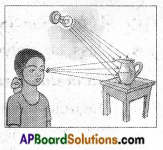
A) confirmation
B) request
C) order
D) suggestion
Answer:
A) confirmation

2. Do exercises every day to be fit. ( )
A) Order
B) Advice
C) Wishes
D) Suggestion
Answer:
B) Advice

3. Many happy returns of the day. ( )
A) Request
B) Statement
C) Blessings
D) Wishes
Answer:
D) Wishes

4. You may get inside. ( )
A) giving permission
B) taking permission
C) rejecting permission
D) request
Answer:
A) giving permission

5. Where is the Goddess Durga’s temple? ( )

A) suggestion
B) exclamation
C) seeking information
D) giving information
Answer:
C) seeking information

AP Board 7th Class English Important Questions Unit 4

B) Rewrite the sentence with contract form wherever possible.
1) Ram is not coming today.
2) They are not leaving for any business.
3) I have many pets at home.
4) We are planning for a day’s outing.
5) Nora could not climb the wall.
Answer:
a) Ram isn’t coming today.
b) They aren’t leaving for any business.
c) I’ve many pets at home.
d) We’re planning for a day’s outing.
e) Nora couldn’t climb the wall.

C) Fill in the blanks with Adverbs of manner. The words are given in the brackets.
1. My brother completed his homework ——– (quick).
2. The teacher asked the question ——– (loud).
3. Rina did ——– in the Exams. (good)
4. The children entered the restaurant ——– (noise).
5. Mona asked for a bicycle ——– (pleasing).
Answer:
1. quickly
2. loudly
3. well
4. noisily
5. pleasingly

AP Board 7th Class English Important Questions Unit 5

AP State Syllabus 7th Class English Important Questions Unit 5

7th Class English Important Questions Unit 5

1. Read the following passage carefully.

In the evening, we boarded a ship for Port Blair, the capital of the Andaman and Nicobar Islands. The ship looked much bigger than our school building. It had four storeys. It set out after sounding a loud horn. People who had come to see off their friends and relatives cheered them up by waving their hands. My sister Amala and I too waved our hands while Mom and Dad smiled at us.

Now answer the following questions.
1) What is the capital of city of Andaman & Nicobar Islands?
2) Who were travelling to Andaman and Nicobar Islands?
3) What is the ship compared to?
4) Name two places where people come to see off their friends and relatives.
5) Why did the writer’s parents smile at him and Amala?
Answer:
1) Port Blair
2) The writer and his family.
3) A school building.
4) Airport, railway station, sea-port.
5) Because the writer and Amala enjoyed waving hands like other even though the people are unknown to them.

AP Board 7th Class English Important Questions Unit 5

2. Read the following passage carefully.
Tall buildings, cell towers and factory chimneys began to vanish gradually. After a while, the twinkling lights of Chennai bade us farewell. Soon everything around us began to look dark and calm but inside the ship it was all bright and beautiful. When we closed the windows and doors of our cabin, we did not feel the movement of the ship.
On the second day, we came to know that we were in the middle of the sea. The weather was pleasant on the sea. The day was sunny and the sea was reflecting the clouds like a flat mirror. We saw Dolphins swimming along the ship. They sprang and dived again and again. It was quite amusing.
Now answer the following questions.
1) Where did the writer and his family board the ship?
2) How was it inside the ship even in the dark?
3) How was the weather in the sea?
4) Which sea animals are mentioned in the passage?
5) What was the amusing thing for the writer?
Answer:
1) The writer and his family boarded the ship at Chennai port.
2) Inside the ship it was all bright and beautiful.
3) The weather was pleasant on the sea.
4) Dolphins
5) The sprinihg and diving of Dolphins was amusing to the writer.

3. Read the following passage.

I was dUrious to know what other people were doing on the ship. So I went around. I saw some watching films and some others eating and drinking in the restaurants. A few were buying things in the fancy stores. I was surprised to see some in a saloon getting their hair cut.
The medical staff was busy treating the patients suffering mostly from sea-sickness. The sanitary workers were on their job of keeping the cabins, corridors and toilets neat and clean. The crew of the ship was very friendly and courteous. They gladly answered all my queries about the ship.
Now answer the following questions.
1) Who went around the ship?
2) Why did the speaker go round the ship?
3) What were the people doing on the ship?
4) How were the crew with the people on the ship?
5) What do we call the people who work on the ship?
Answer:
1) The writer
2) He was curious to know what qther people were doing on the ship.
3) Some were watching films, some were eating and drinking, some were buying things and others in the hair cutting saloon.
4) The crew of the ship was very friendly and courteous.
5) Crew

AP Board 7th Class English Important Questions Unit 5

4. Read the following passage.
Dad said, “I know a little. There are about six hundred islands. They are located between India’s coast and Myanmar. Only 37 of them are inhabited. They have plant, animal and marine life in abundance.”
We learnt that the inhabitants of the islands were the aboriginal tribes. Some of them lived far away from the civilized society. Despite this, the islands today look like a miniature India. We saw people of different languages, cultures, and faiths living together happily.
We visited a famous national monument, the Cellular jail. We learnt that the Cellular jail was built by the British. It was nd longer a jail. It had been converted into a big hospital.
Now answer the following questions.
1) How many islands are there in the Andaman and Nicobar islands?
2) What is inhabitance?
3) How did the islands look like to the writer?
4) What is the famous monument in the islands?
5) What has the Cellular jail changed to?
Answer:
1) There are about six hundred islands.
2) The existence of plant, animal and marine life is called inhabitance.
3) The islands looked like a miniature India.
4) The Cellular jail
5) It was changed into a big hospital.

5. Read the following passage.

After a while, we reached an exciting place, the Mahatma Gandhi Marine National Park.
The park was spread over a wide area of 15 islands. Open creeks running through the park area were a special attraction. We watched coral reefs, fishes of different celours and sea turtles through glass-bottomed boats. For some time, we felt ourselves as a part of them. Amala and I cheered the fish and turtles.
We travelled by a ferry from Port Blair to a place called Havelock island. The ferries carry people, vehicles and goods. We enjoyed panipuri, samosas and gharam chai during the ferry journey.

Now answer the following questions.
1) What is the exciting place visited by the writer’s family?
2) What is the special attraction on the island?
3) Name some sea animals mentioned in the passage.
4) What is the means of transport to reach Havelock islands from Port Blair?
5) What is a ferry?
Answer:
1) Mahatma Gandhi Marine National Park
2) Open creeks running through the park area.
3) Fishes and turtles
4) Ferry
5) A ferry is a small boat to carry people, vehicles and goods.

AP Board 7th Class English Important Questions Unit 5

6. Read the following passage.
A majestic lighthouse greeted us on our arrival at the Havelock Island. We felt as if the sandy beaches and greenish-blue sea were warmly welcoming us.
Some foreign tourists on the beaches were basking in the sun and enjoying themselves. We saw tourists enjoying swimming in the sea, and riding on elephants. Silky sands, foaming tides and cool breeze of the sea attracted us very much. We took lots of pictures of the beautiful scenery.
Now answer the following questions.
1) What looked very grand and royal in the Havelock Island?
2) What welcomed the tourists to the island?
3) What is the meaning of basking?
4) What was the most fun making and amusing activity for the tourists here?
5) The sea was attractive to the tourists. Why?
Answer:
1) Light house
2) The sandy beaches and greenish-blue sea
3) Drying up oneself in the sun.
4) Swimming in the sea and riding on elephants.
5) Because there was silky sand, foaming tides and cool breeze.

7. Read the following passage.

We visited the beach called Elephant beach. To our amazement, we saw some swimmers
diving into the sea from the motor boats. They were dressed in a different way. They put masks on their faces and carried air cylinders on their backs.
I asked Dad, “Why are the swimmers diving into the sea?”
Dad replied, “They want to watch the coral reefs and beautiful coloured fishes and sea turtles. They stay for a long time beneath the sea and swim along with them. lt is called Scuba diving.” The Scuba diving filled my heart with a spirit of adventure. I wished 1 could do it.

Now answer the following questions.
1) What is Scuba diving?
2) Why do swimmers dive into the sea?
3) Why do the swimmers carry air cylinders?
4) Name the place where the Scuba diving is done.
5) Can you name two adventurous acts?
Answer:
1) Diving deep into the sea and spending time watching the sea animals is called Scuba diving.
2) They want to watch the coral reefs and beautiful coloured fishes and sea turtles.
3) Because they stay for a long time under the sea and need air to breathe.
4) Elephant beach
5) Trekking, mountaineering, surfing on the sea.

AP Board 7th Class English Important Questions Unit 5

B. Reading

1. Read the following lines.
I was sitting alone in my house,
Studying the structure of a mouse,
My exams were going on.
And science I hadn’t done.
Suddenly the lights went out,
Then I heard a loud burst,
Someone was there, outside,
I went out to look, full of fright.
Now answer the following questions
1) Who was ‘I’ in the poem?
2) What was the speaker doing?
3) What was the subject the speaker was not ready with?
4) Why did the speaker feel someone was outside?
5) How do you feel when you were alone at home?
Answer:
1) The boy/ the poet
2) He was preparing for science exam.
3) Science
4) Because he heard a loud burst.
5) A little scared if it is night.

2. Read the following stanza.
I saw a huge rocket,
And an astronaut in white,
He invited me on a flight to the moon,
We reached there by afternoon.
We jumped around
As we couldn’t walk on the ground.
Now answer the following questions.
1) Do you think the child really went on the moon?
2) Who is an astronaut?
3) Why couldn’t the speaker and the astronaut walk on the ground?
4) How did the speaker feel on the moon?
5) How would you feel if you were invited on the moon?
Answer:
1) No, it was his dream.
2) A person who studies about other planets/travels in space.
3) Because there was no air in the space.
4) It was exciting to the speaker to spend time on the moon.
5) I would feel very happy and delightful.

AP Board 7th Class English Important Questions Unit 5

3. Read the following stanza.
We jumped around
As we couldn’t walk on the ground.
It was a lot of fun,
I reached home before the setting sun.
My science test went very well,
But no one knows the secret,
Which even now inside me dwells.
Now answer the following questions.
1) Who does ‘we’ refer to?
2) Where were they?
3) How did the speaker reach home?
4) What was the secret about the speaker?
5) If you were given a chance, which planet do you prefer to visit?
Answer:
1) The poet and the astronaut
2) They were on the moon.
3) By rocket
4) The secret was that the poet spent his time in the space. The speaker learnt everything by self experience.
5) Mars

C. Reading

1. Read the following passage.
I bought a substantial stock of goods to trade, and sailed on a ship with a number of my merchant friends. We placed ourselves in the care of Allah and set off. Soon we reached an island.
We decided to go ashore. My friends went to gather fruits and flowers, but I took my food packet to a place in the shade. I had a good meal and lay down to sleep under the trees. I don’t know how long I slept, but when I awoke and looked out to sea, the ship had gone. I was all alone. Not knowing what to do, I climbed up to the top of a tall tree and looked over the island on all sides. In the distance I could see something white, and decided to find out what it was.
Now answer the following questions.
1) Who does ‘I’ refer to?
2) Why do you think the speaker bought the stock of goods?
3) Who accompanied the speaker?
4) What did the speaker realise after he woke up?
5) What would you do if you were left alone in a place?
Answer:
1) ‘I’ refers to Sindbad.
2) The speaker bought the goods to trade.
3) His friends
4) The speaker realised that the ship had gone leaving him alone on the island.
5) I would search for a companion.

AP Board 7th Class English Important Questions Unit 5

2. Read the following passage.
Suddenly, the sky above me became dark, as if a huge cloud was covering it. Looking up,
I saw that the darkness was caused by the shadow of a huge bird that was flying towards me.
I had often heard sailors talk of a great and wonderful bird, called a ‘roc’. This must be a roc,
1 thought, and this huge ball must be its egg!
The bird came nearer and sat on its egg. I soon crept close to the egg. Near me was one of the bird’s legs, which was as big as a tree. I decided to tie myself to the leg of this bird with my turban so that when it flew away from the island, it would carry me with it.
Now answer the following questions.
1) What made the sky dark?
2) How is the bird described?
3) What is the egg of the bird compared with?
4) How big was the bird’s leg?
5) What was the plan of escape made by the speaker?
Answer:
1) It was the shadow of a huge bird that came between the speaker and the sky.
2) Huge, great and wonderful.
3) Huge ball
4) The leg was as big as a tree.
5) The speaker tied himself to the leg of the bird with his turban.

3. Read the following passage.
At day break, the bird flew up so high that 1 was carried out of sight of the island. Then it came down again so fast that I lost my senses. When I found myself on the ground, I quickly untied the turban. The bird caught up a snake and flew away.
This time I found myself surrounded on all sides by immense mountains that seemed to reach above the clouds. The sides of the valley looked so steep that there was no possibility of climbing them. When I began to look around the valley, I found that there were large diamonds lying on the ground.
Now answer the following questions.
1) What happened to the speaker when the bird landed very fast?
2) Where did the bird leave the speaker?
3} How were the mountains?
4) Have you ever climbed mountains? What is mountain climbing called?
5} What did the speaker find in the valley?
Answer:
1) The speaker lost his senses.
2) In a valley
3) The mountains were immense/very big in size.
4) No, I did not climb a mountain. Mountain climbing is called Alpinism or Mountaineering.
5) Huge serpents

4. Read the following passage.

I was excited to find such riches lying around me. Then I saw something else that made
roe very frightened. All around the valley there were huge serpents, some of them big enough to even eat an elephant! These came out of their holes at nightfall. During the day, I suppose, they hid themselves from the rocs.
I found a small cave where I decided to spend the night. At the entrance I put a large stone to protect myself from the serpents, but the noise of their hissing outside made sleep impossible.
Now answer the following questions.
T) How would you feel if you find diamonds?
2) What is the valley inhabited with?
3) How did the speaker try to protect himself?
4) What made the speaker unable to sleep?
5) Did you ever face a serpent? What did you do to escape?
Answer:
1) Very excited
2) Huge serpents
3) The speaker protected himself by taking shelter in the rocks in the night.
4) The hissing noise of the serpents.
5) No. I never faced a serpent.

AP Board 7th Class English Important Questions Unit 5

5. Read the following passage.

I had heard stories in the past about this valley of diamonds, but had not believed them. Now I saw with my own eyes what the local merchants did to obtain the jewels; they used huge eagles to carry up the diamonds for them!
When the eagles have young ones in their nests among the rocks, they fly down into the valley to get food for them. So, the merchants would throw down large pieces of raw meat; the diamonds stick to the meat, and in this way get carried to the eagles nests. Each merchant has his own nest, and considers its jewels his. The idea came to me that I too could use these eagles I myself could be lifted up from this deep valley, and thus escape from it! The eagles were so big and strong that my weight would seem little.
Now answer the following questions.
1) What did the merchants do to obtain jewels?
2) Why did the eagle fly down into the rocks?
3) What happens to the diamonds when the merchants throw meat into the valley?
4) How did the speaker try to escape from the valley?
5) What would you do with the diamonds if you get them?
Answer:
1) The merchants threw meat to make the diamonds stick to them. When the eagles pick them up as food, they separate the diamonds from the meat.
2) To pick the meat.
3) The diamonds stick to the meat.
4) The speaker tied a large piece of meat to his back and laid on the ground enabling the eagle to carry him.
5) I would keep some for my living and help the poor with others.

6. Read the following passage.

First, I collected a number of large diamonds. These I put in my wallet and tied the wallet
to my waist. Next, I tied one of the large pieces of meat to the middle of my back with my turban. I then lay down with my face to the ground, and waited there. There was the sound of huge wings around me. Then I felt myself lifted up and carried to the top of the rocky walls of the valley.
Soon I was in one of the nests. The merchants were surprised to see me there, and I when they heard my story, they helped me to find a ship to go home. When I got back to Baghdad.
I was a very wealthy man. I gave large amounts of money to the poor and lived peacefully in my own home.

Now answer the following questions.
1) Why did the speaker tie large pieces of meat to his back?
2) Who carried the speaker to the top of the valley?
3) Who helped the speaker reach home?
4) What good’work did the speaker do after reaching home?
5) What do you call the incidents that took place with the speaker?
Answer:
1) To attract the eagles
2) The eagle
3) The merchants
4) He gave large amounts of money to the poor.
5) Adventures

AP Board 7th Class English Important Questions Unit 5

Unseen Comprehension

1. Read the following passage carefully.
From the architectural and cultural point of view, India is one of the most famous countries all over the world. Here is the variety in clothing, food, culture, tradition, language, living status etc. because of the presence of many religions all over the country. So, people become more interested to travel India more than once in their life time. India is the right place for the historical and peaceful scenery visits. India is most populated and multicultural country however
famous for unity in diversity. India is the motherland Of the worldwide famous legends such as Mahatma Gandhi, Gautama Buddha, Rani Lakshmi Bai, Ratan Tata and so many. India is the country having well-developed cities, heritages, monuments and other sight seeings such as Taj Mahal, Great Indian Himalayas, Bengal Tiger, etc. which are considered as the icons of India tourism.
Now answer the following questions
1) What made India one of the most famous country in the world?
Answer:
India is famous for its architecture and culture.

2) India has people following many religions. What is the effect of this feature?
Answer:
There will be variety of traditions, culture, food, clothing, languages, etc.

Choose the correct answer from the choices given.
3) Foreigners visit India more than once because
a) there are many forests.
b) there are many cities.
c) people are very beautiful.
d) the country has a great history and scenic beauty.
Answer:
d) the country has a great history and scenic beauty.

4) What do we call ‘Mahatma Gandhi’ nationwide ?
a) Gandhiji
b) Bapu
c) Mahan
d) Guruji
Answer:
b) Bapu

5) Where is Taj Mahal?
a) In Taj
b) In Telangana
c) In Delhi
d) In Agra
Answer:
d) In Agra

AP Board 7th Class English Important Questions Unit 5

2. Read the following passage carefully.

A visit to an exhibition is a novel experience. An exhibition which I visited recently was very interesting. It was one of the largest exhibitions ever held. Being a Sunday there were many visitors that made it difficult to walk.
Men, women and children in their colourful and best dresses were there. At the booking counter there were long quees. I bought tickets and entered the exhibition ground. Our parents and I enjoyed the exhibition for a long time. The grounds were tastefully decorated. There were stalls and pavilion of ministries, companies and states.
There were hundreds of exhibits for the domestic use.. By the time we came out of the German pavilion, we were very tired. We went to a coffee-shop and had hot coffee. My mother bought a shawl. There was a village complex with many village singers, jugglers and folk artists. The puppet show was very amusing.

Now answer the following questions
1) What is necessary to visit the exhibition?
Answer:
An entrance ticket

2) Who is a juggler?
Answer:
One who does magic is a juggler.

Choose the correct answer:
3) When is it difficult to go around in exhibition? ( )
a) Sunday
b) Tuesday
c) Working day
d) In the morning
Answer:
a) Sunday

4) What was very entertaining for the author? ( )
a) Stalls
b) Coffee shop
c) Puppet show
d) Exhibition
Answer:
c) Puppet show

5) What did the writer’s family do when they were tired? ( )
a) They sat down and released.
b) They went to a coffee shop and had coffee.
c) They bought toys and shawl.
d) They went home.
Answer:
b) They went to a coffee shop and had coffee.

3. Read the following passage carefully.

Sally jumped up as soon as she saw the surgeon come out of the operating room. She said: “How is my little boy? Is he going to be all right? When can I see him?” The surgeon said, “I’m sorry. We did all we could, but your boy didn’t make it”. Sally said, “Why do little children get cancer? Doesn’t God care any more ? Where were you, God, when my son needed you?”
The surgeon asked, “would you like some time alone with your son? One of the nurses will be out in a few minutes, before he’s transported to the university”.
Sally asked the nurse to stay with her while she said goodbye to son. She ran her fingers through his curly hair. “Would you like a lock of his hair?” the nurse said. She cut a lock of the boy’s hair and gave it to Sally in a plastic bag. Sally said, “It was Jimmy’s idea to donate his body to the university for study. He said it might help somebody else. “She continued,” My Jimmy had a heart of gold. Always thinking of some one else. Always wanting to help others if he could”.

Now answer the following questions.
1) Who was admitted in the hospital?
Answer:
Sally’s son

2) What was the boy suffering from?
Answer:
Cancer

Choose the correct answer:
3) Where will the boy be taken after the surgery?
a) to his home
b) to hospital
c) to university
d) to a clinic
Answer:
c) to university

4) What did the nurse offer sally as a token of memory?
a) a gold win
b) a big chest of clothes
c) the boy’s clothes
d) a lock of hair of the boy
Answer:
d) a lock of hair of the boy

5) Why was the boy taken to the university?
a) to be operated
b) to get good treatment
c) to be helpful for the study of others
d) to help the doctors
Answer:
c) to be helpful for the study of others

AP Board 7th Class English Important Questions Unit 5

4. Read the following passage carefully.
Gardening! It is a hard work. It is even a dirty work. You have to dig up the hard earth and make its heart soft. Not only this. You have to plan it well. You have to lay out beds for different kinds of plants. They require great care. They must get food and water in time. All this requires hard work and it fills your body with dirt and sweat.
A Gardener is like a mother to the garden. No, good mother leaves her children to a nurse. So as a gardener your garden requires food and water, love and affection. A plant is also a living being and has feelings like a human or an animals. The beauty of flowers, the medicinal value of some plants, the utility of the branches alre all the benefits of possessing a garden.
The hobby of gardening is good for health, fitness and recreation. It involves physical activities in open air. The study of plant life is very interesting.
Now answer the following questions.
1) Why should the hard earth be made soft?
Answer:
To sow the seeds or plant new saplings.

2) Why is gardening a hard work?
Answer:
Because the soil has to be dug, lay out beds, plants must be watered regularly, etc.

Choose the correct answer:
3) Who is the mother of the garden? ( )
a) you
b) plants
c) gardener
d) people
Answer:
c) gardener

4) Who has feelings of pain, love, affection, etc.? ( )
a) gardener
b) plants
c) animals
d) all the three
Answer:
d) all the three

5) What is the study of plant life called? ( )
a) gardening
b) biology
c) anatomy
d) plantology
Answer:
b) biology

5. Read the following passage carefully.
Mother Teresa is also known as ‘Blessed Teresa of Calcutta”. Her earlier name was ‘Anjeze Gonxhe Bojaxhier” She was born on 26th August, 1910 at the then Yugoslavia. She came to India in 1929. Mother Teresa was Roman Catholic nun moved to Calcutta’s slum “to serve God among the poorest of the poor”.
In 1950, she established the Missionaries of Charity to help the poor, helpless, disabled, diseased refugees and lepers. Today, the missionaries of charity are in more than 100 countries.
She was awarded the title of “Padma Shri” in 1962. She received the Nobel Peace Prize in 1979. Later in 1980, she received conferred the title of ‘Bharat Ratna”, the highest civilian award in India. She was the first citizen of India to win Nobel Peace Prize.
Now answer the following questions.
1) What is the other name for Mother Teresa?
Answer:
‘Blessed Teresa of Calcutta’

2) What was the birth place of Teresa?
Answer:
Yugoslavia

Choose the correct answer from the choices given.
3) When did Mother Teresa found the Missionaries of Charity?
a) 1980
b) 1929
c) 1950
d) 1919
Answer:
d) 1919

4) What was the award received by Teresa in 1979?
a) Nobel Prize
b) Padma Shri
c) Blessed Teresa
d) Bharat Ratna
Answer:
c) Blessed Teresa

5) Where did Mother Teresa find God?
a) in the city of Calcutta
b) in the school of charity
c) in Yugoslavia
d) in the poorest of the poor
Answer:
a) in the city of Calcutta

AP Board 7th Class English Important Questions Unit 5

6. Read the following passage.
There was a Guru who had mastered the Scriptures. One day when he was teaching the] Vedas to his disciples, a cat started moving around. This did not disturb the Guru, but was a distraction to some of his disciples. So the Guru instructed his disciples to get hold of the cat and tie it to pillar. As the nuisance recurred on the following days, the cat was regularly tethered to the pillar before the Guru began his teaching.
Some years later the Guru died. One of his disciples became the new head. The practice of tethering the cat to the pillar continued. After a few months the cat died. When the Guru began his teaching the next day he noticed that the cat was missing. He said, “Don’t you know that a cat must be tied to the pillar during my teaching ? That is our tradition. Go and find a cat”. The disciples immediately obeyed the order. Blindly following traditions, thus, is foolish and serves no purpose.
Now, answer the following questions.
1) Why were the disciples distracted?
Answer:
A cat’s moving around distracted the disciples.

2) What was done to prevent the cat from roaming about?
Answer:
The cat was tied to the pillar.

Choose the correct answer from the choices given below.
3) Who became the new head? ( )
a) One of the disciples of the Guru
b) The cat
c) All the disciples
Answer:
a) One of the disciples of the Guru

4) What practice continued after the new Guru took charge? ( )
a) Keeping the cat near the Guru
b) Tethering the cat to the pillar
c) Making it go round the pillar
Answer:
b) Tethering the cat to the pillar

5) Choose the correct statement from the following. ( )
a) The new Guru was foolish because he was blindly following a practice.
b) The new Guru was foolish because he was fond of cats.
c) The new Guru was foolish because he disliked traditions.
Answer:
a) The new Guru was foolish because he was blindly following a practice.

1. This table shows the climate of Port Blair from January to December 2015
AP Board 7th Class English Important Questions Unit 5 1

Now answer the following questions.
1) What is the highest temperature recorded in 2015?
Answer:
April

2) Which months experience the lowest temperature?
Answer:
January and February

Choose the correct answer from the choices given.
3) In which month is the precipitation high? ( )
a) March
b) July
c) June
d) December
Answer:
c) June

4) Which months have a stable low temperature? ( )
a) Jan-May
b) May-Sept
c) Oct-Dec
d) July-Dee
Answer:
d) July-Dee

5) According to the table, which of the following statement proves to be true? ( )
a) The precipitation has been high in the middle of the year.
b) Port Blair is a beautiful city.
c) The minimum temperature has been decreasing from January to December.
Answer:
a) The precipitation has been high in the middle of the year.

AP Board 7th Class English Important Questions Unit 5

2. Given below is John’s family tree. Study and answer the questions.
AP Board 7th Class English Important Questions Unit 5 2

Now answer the following questions.

1) Who are John’s parents?
Answer:
Edward and Diana

2) Who is the sibling of Diana?
Answer:
Maid

Choose the correct answer from the choices given.
3) Wendy and Edward are ( )
a) cousins
b) brother and sister
c) daughters
d) parents
Answer:
b) brother and sister

4) Who did Maid-marry? ( )
a) Edward
b) Fred
c) Harold
d) Jimmy
Answer:
c) Harold

5) How many people exist in 3rd generation of the family chart? ( )
a) 5 members
b) 10 members
c) 6 members
d) 4 members
Answer:
a) 5 members

3. The bar graph below shows the Sex ratio of females per 1000 males. Study the graph and answer the questions.
AP Board 7th Class English Important Questions Unit 5 3
Now answer the following questions.
1) What is the Rural female population during 2001?
Answer:
946 females

2) What is the difference in the population from 2001 to 2011?
Answer:
The population has increased in 10 years of time.

Choose the correct answer from the choices given.
3) How many females are existing in urban areas in 2011? ( )
a) 947
b) 900
c) 926
d) 947
Answer:
c) 926

4) The ratio of male : female in 2011 in rural area is ( )
a) 1000: 933
b) 1000 : 947
c) 900 : 1000
d) 946 : 1000
Answer:
b) 1000 : 947

5) Which of the following statement is true according to the graph representation? ( )
a) In 2011, the urban female population is lesser than the total population.
b) The female population decreased in 2011 when compared to 2001.
c) The male and female population is same in 2001 in rural areas.
Answer:
a) In 2011, the urban female population is lesser than the total population.

AP Board 7th Class English Important Questions Unit 5

4. The pie chart below shows the usage of water for domestic purposes. Study it and answer the questions.
AP Board 7th Class English Important Questions Unit 5 4
Now answer the following questions.
1) For which purpose is water mostly used on domestic front?
Answer:
Toilet flushing

2) What are the different kinds of washing mentioned in the pie chart?
Answer:
Washing up, clothes washing, personal washing showers, personal washing baths and taps

Choose the correct answer from the choices given.
3) Water used for is very less. ( )
a) personal washing showers
b) toilet flushing
c) drinking
d) washing hands
Answer:
c) drinking

4) What is the percentage of water used for outdoor purposes? ( )
a) 12%
b) 7%
c) 21%
d) 5%
Answer:
b) 7%

5) Pick out the true statement with reference to the details in the pie chart. ( )
a) Water is best utilized for clothes washing.
b) Consumption of water for various washing purposes can be minimised/reduced.
c) Water is the main source for keeping ourselves and surroundings clean.
Answer:
c) Water is the main source for keeping ourselves and surroundings clean.

5. Study the following tree diagram carefully.
AP Board 7th Class English Important Questions Unit 5 5
Distribution of annual income of Ramesh on savings and expenditure

Now, answer the following questions.
1) What does the above pie chart describe?
Answer:
Distribution of annual income of Ramesh on savings and expenditure

2) What is the second highest expenditure of Ramesh?
Answer:
House rent

Choose the correct answer from the choices given below.
3) Ramesh spends the most on ( )
a) taxes
b) clothes
c) miscellaneous
Answer:
a) taxes

4) Ramesh spends the least on ( )
a) taxes
b) clothing
c) food
Answer:
b) clothing

5) Which of the following statements is true with reference to the information given above? ( )
a) Ramesh spends equally on clothing and miscellaneous items.
b) Ramesh does not have any savings.
c) Ramesh spends more on clothing than food.
Answer:
a) Ramesh spends equally on clothing and miscellaneous items.

AP Board 7th Class English Important Questions Unit 5

Section – B: Creative Writing

1. In the lesson A Trip to Andaman’, the writer’s Dad made it possible for the family on a trip to Andaman during summer vacation. Write a conversation between writer and his dad about planning during summer holidays.
Answer:
Writer: Hi Dad, a good news. Our summer vacation is from tomorrow.
Dad: Is it? Very good. I shall take leave from the office. Let’s plan to go somewhere.
Writer: That’s exciting! Where shall we go?
Dad: I have already thought about it. We shall plan for Andaman and Nicobar islands.
Writer: Are we flying?
Dad: No. let us make a trip by ship.
Writer: Wow, that’s wonderful.
Dad: Let us inform your mother. She will pack all the necessary things.
Writer: Is there anything specific to carry?
Dad: Nothing. But let us carry our sweaters and shawls.
Writer: Ok Dad. I shall help Mom do the arrangements.
Dad: Fine. Let us go and tell your mother and your sister Amala.
Writer : Yes.

2. Describe a journey you made with your family.
Answer:
Recently we planned a tour to Araku Valley. Dad said it’s a very pleasant and cool hill station that can be visited in summer. Charan and I were so excited and told our friends about our trip to Araku. Mom also said its a worthy sight seeing place.
We started early in the morning of Monday by a train to Vishakhapatnam. I enjoyed the climate and scenic beauty sitting by the window. Mom made some snacks and lunch for us to enjoy during the journey. We reached Vishakhapatnam in the afternoon. We took rest in a hotel and went to see R.K. Beach in the evening. First time, to go near the heavy waters scared me a lot. But my father held our hands and gave the courage to go near the waters. We enjoyed a lot with the on and off movements of tides.
We took rest for the night and started for Araku early in the morning by train. The journey was pleasant and exciting as we passed through forests and tunnels. Children in the train shouted with joy. We reached Araku, hired a room and got fresh. We hired a taxi to see some old temples. Borra caves, tea and coffee plantations and beautiful gardens. We enjoyed the trip. The garden was beautiful with flower beds, bushes and decorated trees.
The trip was a memorable experience in my life.

3. There was discipline maintained by the crew on the ship. Write a diary entry of the writer about his feelings on the behaviour of the crew on the ship.
Answer:
12th June, Tuesday.
We returned home yesterday after a joyful trip to Andaman and Nicobar islands. When Dad said we are going by ship 1 was afraid of the sea waters and journey by ship. But all my fears vanished when I saw the hospitality of the crew on the ship.
The crew on the ship took utmost care in making arrangements for the travellers. They wandered from one place to another giving right directions. They showed a lot of patience to explain the tourists about the utilization of facilities on the ship. They smiled at everyone and bore the naughty behaviour of children like us. They served at every door of the room and were very friendly and courteous. We liked them and became friends very soon. The crew < never wasted their time. They even worked in the night when everyone slept. The journey was comfortable and enjoyable because of them.
We thanked the crew before we left the port. They smiled and simply bowed in respect.

AP Board 7th Class English Important Questions Unit 5

4. The Inhabitants of the Islands look like a miniature India because there are different languages, cultures and faiths living together. This is called Unity In Diversity. We find the same culture in India. Write a speech on Unity ¡n Diversity that
prevails in India.
Answer:
‘Unity in Diversity’
Respected teachers and my dear friends,
… India is a country that is well known for its ‘Unity in Diversity’. So I feel honoured and proud to speak before you on this remarkable feature of India.
Unity in diversity means oneness In the varieties. India is a country where it is very clear to see this concept because people of many religion, race, culture and traditions live together without affecting each others feelings and believes to their religion. Unity in Diversity focuses in the existence of oneness even after lot of differences of cultural, social, physical, linguistic religions, political, ideological, psychological, etc. More number of differences make more complex unity. People in India are united in spite of the much diversity of races, religions, castes, sub-castes, communities, languages and dialects. People in India are highly spiritual and God fearing in nature so they give respect to everyone’s religion.
Humanity and likelihood of people help them to maintain the policy of Unity in Diversity. We are proud to be Indians”

5. Describe a park or a zoo you visited.
Answer:
We have a small park in front of our house where we go to play every evening. Ours is a residential area with many houses in rows, a few flats and some shopping complexes. Our house in the centre of the street. There is a small park in front of our house. There is a gardener who looks after the park. The park has well cut bushes all around it and trees here and there giving shade to the visitors.
The park is open from 4 p.m. every day. On Sunday, it is open since 6 a.m. in the morning for walkers and children. We go to park every day after school to play and have fun. It is a dwelling place for elders too. Some teenagers come there to read a book or call a friend and have relaxed chat. I love the park. Sometimes I take my comics and drawing books to read and paint.
Every Sunday the park looks like a picnic spot. We have play things like turnstile, merry go round, slide, bells and dens and hiding places to play hide and seek. There are also big structures of animals and people. We can climb them and sit there. y
The park is a place of entertainment, recreation and fun making activities.

AP Board 7th Class English Important Questions Unit 5

6. Your father is interested to join you in swimming, but you are afraid of water.
Write a possible conversation where your father tries to convince you to join swimming.
Answer:
Father: Bunny. Here is an exciting news for you!
Bunny: What is it, Dad?
Father: I would like to join you in swimming classes this summer.
Bunny: Oh, no Dad. I’m afraid of water.
Father: Don’t be silly. You’re a brave boy. Swimming is a very good exercise.
Bunny: But I can’t swim. I may drown in the water.
Father: No boy. There will be a trainer to teach you swimming. Moreover the water is only 5 feet deep.
Bunny: Is it so easy?
Father: The coach will make it easy and comfortable. First you’ll practise with the support of a ring and slowly individually.
Bunny: Are you also accompanying me?
Father: Yes, of course.
Bunny: Then its OK. I shall join the classes from tomorrow.

1. Here is the profie of a great swimmer Virdhawal Khade. Write a biosketch of the great swimmer Virdhawal Khade.
Answer:
Full Name: Virdhawal Vikram Khade
Nickname: Veer
Nationality: Indian
Born: August 29, 1991 (Age 24)
Kolhapur, Maharashtra
Height: 6ft 3″
Weight: 83 kg
Sport: Swimming
Strokes: Free style, Butterfly
Medal record: Swimming, Asian games
Answer:
Biographical Sketch:
Virudhawal Vikram Khade, shortly known as ‘Veer’ is an Indian swimmer, who earned fame and name in swimming world. He was born on 29th August, 1991 in Kolhapur, Maharashtra. He is 24 years old. He was 6 feet 3 inches tall and weighs about 83 kgs.
Vikram Khade was famous in swimming free style and Butterfly strokes in swimming. He participated in Asian games and won medals for the country. We should encourage people with such talent because they are the pride of the nation.

2. Two boys of 13 years went swimming into the nearby river after school hours. They were drowned in the water as they went very far into water. Write a news report on this incident.
Answer:
TWO BOYS DIED IN WATER: PARENTS IN DEEP SORROW
13th September, 20xx, Vijayawada: Two children of 10 years and 11 years of the nearby area at Yanamalakuduru, Vijayawada went into the waters for bath and swimming and lost their lives; reporters said.
Veeraswamy (10 years) and Adidas (11 years) went into the water making fun and swimming after the school hours on Wednesday. While playing, they did not observe going far into the water. Suddenly the speed flowing water pulled swamy. He lost his balance and went along with the water. Adidas who tried to help him also was dragged away by the water, flow. Both of them drowned in the water.
The dead bodies were recovered by the search team. The parents sorrow knew no bounds. The police were reported and they are investigating the case. The local people demanded for some security check in such places where there is hidden danger.
News Reporter The Hindu.

AP Board 7th Class English Important Questions Unit 5

3. Your elder sister is going to be married. You have to attend the marriage function. You have to spend 4 days at home. You cannot attend school these days. Now, write a letter to your class teacher applying for leave of absence for four days.
Answer:

Tenali.
10-3-xx.

To
The Class Teacher,
7th Class, A/S,
Municipal Boys High School,
Tenali.
Respected Sir,
My elder sister’s marriage is going to be celebrated on 20th of this month at Tirupathi. I have to help my parents in making arrangements and I have to attend the marriage function. I have to spend for four days. I cannot attend school these days.
Hence I request you to sanction leave for four days from 18.3.xx to 21.3.xx.

Thanking you sir,

Yours obediently,
x x x x x
Roll No: 23,
VII Class, A/S,
Municipal Boys School,
Tenali.

Vocabulary

1. Read the following paragraph and write the synonyms of the underlined words choosing the words from the words given in the box.

1.
AP Board 7th Class English Important Questions Unit 5 6
After lunch, we hired (a) a taxi for the port. In the evening, we boarded (b) a ship for Port Blair.

2.
AP Board 7th Class English Important Questions Unit 5 7
It set out (a) after sounding a loud horn. People who had come to see off their friends and relatives cheered (b) them up by waving their hands

3.
AP Board 7th Class English Important Questions Unit 5 8
Tall buildings, cell towers and factory chimneys began to vanish (a) gradually. After a while, the twinkling lights of Chennai bade us farewell (b).

4.
AP Board 7th Class English Important Questions Unit 5 9
The Dolphins sprang and dived (a) again and again. It was quite amusing (b).

5.
AP Board 7th Class English Important Questions Unit 5 10
The crew of the ship was very friendly and courteous (a). They gladly answered all my queries (b) about the ship.

6.
AP Board 7th Class English Important Questions Unit 5 11
Early in the morning, Mom woke us up to show us the magnificent (a) spectacle of the dawn (b) at the sea.

7.
AP Board 7th Class English Important Questions Unit 5 12
Only 37 of them are inhabited (a). They have plant, animal and marine life in abundance (b).

8.
AP Board 7th Class English Important Questions Unit 5 13
Despite this, the islands today look like a miniature (a) India. We saw people of different languages, cultures, and faiths (b) living together happily.

9.
AP Board 7th Class English Important Questions Unit 5 14
Open creeks (a) running through the park area were a special attraction. We watched coral reefs (b), fishes of different colours and sea turtles through glass-bottom boats.

10.
AP Board 7th Class English Important Questions Unit 5 15
To our amazement (a), we saw some swimmers diving into the sea from the motor boats. They were dressed in a different way. They put masks (b) on their faces.

11.
AP Board 7th Class English Important Questions Unit 5 16
We tasted delicious (a) Tandoori fish and other sea foods on the islands. My mouth still waters when I remember those moments. I cherish (b) the memory of the great fun we had.

Answers:
1. a) taken for rent b) to enter, get into
2. a) started b) greeted
3. a) disappear b) good bye
4. a) jump into water from a height b) entertaining
5. a) kind and helpful b) questions
6. a) wonderful b) rising of sun
7. a) living area b) sufficient
8. a) small b) religious belief
9. a) streams b)rocks
10. a) surprise b) a cover to the face
11. a) tasty b) enjoy

AP Board 7th Class English Important Questions Unit 5

2. Write the opposite words to the underlined words in the given paragraph.

1. After lunch, we hired (a) a taxi for the port. In the evening, we boarded (b) a ship for Port Blair.
2. The ship looked much bigger (a) then our school building. It had four storeys. It set out after sounding a loud (b) horn.
3. Tall (a) buildings, cell towers and factory chimneys began to vanish gradually (b).
Soon, everything around us began to look dark (a) and calm (b) but inside the ship it was bright and beautiful.
5. The weather was pleasant (a) on the sea. We saw Dolphins swimming, springing and diving along the ship. It was quite amusing (b).
6. I was curious (a) to know what other people were doing on the ship. So I went around. A few were buying (b) things in the family stores.
7. The crew of the ship were friendly and courteous (a). They gladly (b) answered all my queries about the ship.
8. After a while, we reached an exciting (a) place, the Mahatma Gandhi Marine National Park. The park was spread over a wide (b) are of 15 islands.
9. A majestic lighthouse greeted us on our arrival (a) at the Havelock island. We felt as if the sandy beaches and greenish-blue sea were warmly (b) welcoming us.
10. In the evening (a) we boarded the ship for Port Blair, the capital of the Andaman and Nicobar Islands. The ship looked much bigger (b) than our school building.
Answer:
1. a) owned b) alighted
2. a) smaller b) soft
3. a) short b) suddenly
4. a) bright b) noisy
5. a) unpleasant b) boring
6. a) reluctant b) selling
7. a) rude b) sadly
8. a) boring b) narrow
9. a) departure b) harshly
10. a) morning b) smaller

3. Fill in the blanks with the right form of words given in brackets.

1. Soon after the______ (a) (examines/examinations) were over, Mom made ______ (b) (preparations/prepares) for the trip,.
2. Soon everything around us began to look dark and calm but inside the ship it was all bright and ______ (a) (beauty/beautiful). When we closed the windows and doors of our cabin, we did not feel the _______(b) (movement/move) of the ship.
3. The medical staff were busy ________ (a) (treating/treat) the patients suffering mostly from sea ________ (b) (sick/sickness).
4. The crew of the ship were very _______ (a) (friend/friendly) and ________ (b) (courteous/courtesy).
5. Only 37 of them are __________ (a) (inhabitants/inhabited). They have plant, animal and marine life in ________. (b) (abundant/abundance).
6. Open creeks ___________ (a) (mn/running) through the park area wire a special __________ (b) (attraction/attract).
7. A majestic lighthouse greeted us on our ___________ (a) (arrive/arrival) at the Havelock Island. We felt as if the sandy beaches and greenish – blue sea were __________ (b) (warm/warmly) weLcoming us.
8. To our __________ (a) (amaze/amazement), we saw some swimmers diving into the sea from the motor boats. They were dressed in a __________ (b) (different/difference) way.
9. We saw people of___________ (a) (difference/different) languageš, cultures and faiths living together happily. We visited a famous (b) (national/nation) monument.
Answer:
1. a) examinations b) reparations
2. a) beautiful b) movement
3. a) treating b) sickness
4. a) friendly b) courteous
5. a) inhabited b) abundance
6. a) running b) attraction
7. a) arrival b) warmly
8. a) amazement b) different
9. a) different b) national

AP Board 7th Class English Important Questions Unit 5

a) Complete the following words using ai, ea, ee, ei, eo, ie, oa, oo, ou, ui.

1. The ship looked much bigger than our (a) sch _ _ l (b) b _ _ lding.
2. (a) P _ _ ple came to see off their (b) fr _ _ nds and relatives.
3. The day was sunny and the (a) s _ _ was reflecting the (b) cl _ _ ds like a flat mirror.
4. I was surprised to see some in (a) sal _ _ n getting their (b) h _ _ r cut.
5. The medical staff was busy (a) tr _ _ ting the (b) pat _ _ nts suffering mostly from sea-sickness. .
6. The crew of the ship was very (a) fr _ _ ndly and (b) court _ _ us.
7. We watched coral (a) r _ _ fs, fishes arid sea turtles through glass-bottomed (b) b _ _ ts.
8. We felt as if the sandy (a) b _ _ ches and (b) gr _ _ nish blue sea were warmly welcoming us.
9. Some (a) for _ _ gn (b) t _ _ rists on the beaches were basking in the sun.
10. We tasted (a) delici _ _ s Tandoori fish and other (b) s _ _ foods on the islands.
11. After a while, we (a) r _ _ ched an exciting place, the Mahatma Gandhi Marine National park. The park was spread over a wide area of 15 islands. Open creeks running through the park area were a (b) spec _ _ l attraction.
Answer:
1. a) school b) building
2. a) People b) friends
3. a) sea b) clouds
4. a) saloon b) hair
5. a) treating b) patients
6. a) friendly b) courteous
7. a) reefs b) boats
8. a) beaches b) greenish
9. a) foreign b) tourists
10. a) delicious b) seafoods
11. a) reached b) special

b) Complete the words with the correct suffixes given in brackets.

1) The day was (a) sun ____ (y/ny) and the sea was (b) reflec (ting/tting) the clouds like a flat mirror.
2) The (a) medi ____ (cal/cel) staff was busy treating the patients (b) suffer ____ (ing/ring) mostly from sea-sickness.
3) The crew of the ship was very (a) friend ____ (ily/ly) and (b) courte ____ (ous/aus).
4) We learnt that the (a) inhabit ____ (ents/ants) of the islands were the (b) aborigin ____ (el/al) tribes.
5) We visited a (a) fam ____ (ous/aus) national (b) monu ____ (ment/ mant).
6) Open creeks (a) run ____ (ing/ning) through park area were a special (b) attrac____(ssion/tion).
7) We felt as if the sandy beaches and (a) green ____ (ich/ish) blue sea were warmly (b) welcom ____ (ing/eing) us.
8) To our (a) amaze____ (mant/ment), we saw some (b) swim ____ (mers/mars) diving into the sea from the motor boats.
9) A (a) majest ____ (ick/ic) lighthouse greeted uson our (b) arri ____ (val/vel) at the Havelock Island.
10) a) It was quite amus ____ (eing/ing).
b) They have plant. animal and marine life in aban____ (dance/dence).
Answer:
1. a) sunny b) reflection
2. a) medical b) suffering
3. a) friendly b) courteous
4. a) inhabitants b) aboriginal
5. a) famous b) monument
6. a) running b) attraction.
7. a) greenish b) welcoming
8. a) amazement b) swimmers
9. a) majestic b) arrival
10. a) amusing b abundance

AP Board 7th Class English Important Questions Unit 5

c) Find the wrongly spelt word and write the correct spelling.
1. beach; cureas; majestic; beneath
2. enjoying; adventure; riding; costline
3. masks; jolyride; remember; payment
4. borded; chimneys; movement; swimming
5. medical; suffer; coridors; beautiful
Answer:
1) curious
2) coastline
3) jollyride
4) boarded
5) corridors

Put under correct headings.
A.
AP Board 7th Class English Important Questions Unit 5 17
Answer:
AP Board 7th Class English Important Questions Unit 5 18

B.
AP Board 7th Class English Important Questions Unit 5 19
Answer:
AP Board 7th Class English Important Questions Unit 5 20

C.
AP Board 7th Class English Important Questions Unit 5 21
Answer:
AP Board 7th Class English Important Questions Unit 5 22

A) Fill in the blanks with appropriate forms of words given in the brackets.
1. The gardener ___________ the plants every day. The plants grew well with the _________ (water).
2. Arjuna _________ an arrow at the bird.. The Guru praised him for the perfect _________ (shoot).
3. Naveen was __________ to know his result. His __________ grew when he heard about the outcome of results. (curious)
4. John _________ the TV many times. But the TV comes for __________ very frequently. (repair)
5. Water is _________ . But milk cannot be _________ (reverse).
Answer:
1) watered; water
2) shot; shot
3) curious; curiosity
4) repaired; repair
5) reversible; reversed

AP Board 7th Class English Important Questions Unit 5

B) Pick out phrasal verbs beginning with ‘give’, and make sentences of your own.

1. …………………………………………..
2. …………………………………………..
3. …………………………………………..
4. …………………………………………..
Answer:
1. give up (stop) – I gave up coffee.
2. give in (put in) – Lata gave in a lot of effort for the exams.
3. give to (inclined to) – The bank gives loan to the govt’s approval.
4. give out (stop doing) – The old woman gives out and helping hand for the poor and needy as she was bankrupt.

Grammar

1. Edit the following passage correcting the underlined parts.

1. We had been longed (a) to make a trip toAndaman; and Dad makes (b) it possible for we (c) during the last summer holidaze (d).
2. In the evening, we borded (a) a ship for Port Blair, the capital at (b) the Andaman and Nicobar Islands. The ship looks (c) much bigger than our school building. It have (d) four storeys.
3. People who had come to see at (a) their friends and relatives cheered them up for (b) waving there (c) hands. My sister Am ala and I too wave (d) our hands while Mom and Dad smiled at us.
4. On the second day, we come (a) to know that we were down (b) the middle of the sea. The whether (c) was pleasant on the sea. The day was sun (d) and the sea was reflecting the clouds.
5. The medical staff were (a) busy treating the patients suffered (b) from sea-sick (c). The sanitary workers were on their job of keeping the cabins, corridoors (d) and toilets neat and clean.
6. We learnt that the inhabitance (a) of the islands were the aboriginal tribes. Some for (b) them lived far away from the civil (c) society. Despite this, the islands today looked (d) like a miniature India.
7. Open creeks running around (a) the park area were a speciality (b) attraction. We watched coral reefs, fishes by (c) different colours and sea turtles through glass-bottom (d) boats.
8. To our amazing (a), we saw some swimmers dived (b) into the sea from the motor boats. They were dressing (c) in this (d) different way.
9. Once upon a time there lived a farmer and his four daughters in an (a) village. The farmer became old out (b) sick. He wanted to teacher (c) a lesson to his daughters. He called them to him (d) bedside.
10. English is not an (a) difficult language to learn. If we learned (b) it systematically, we can learn it easily. English grammar but (c) spelling are difficult. So we have to learn it (d) carefully.
Answer:
1. a) longing b) made c) US d) holidays
2. a) boarded b) of c) looked d) had
3. a) off b) by c) their d) waved
4. a) came b) in c) weather cl) sunny
5. a) was b) suffering c) sea sickness d) corridors
6. a) iuhabitants b) of c) civilized d) look
7. a) through b) special c) of d) glass-bottomed
8. a) amazement b) diving c) dressed d) a
9. a) a b) and c) reach d) his
10. a) a b) learn e) and d) them

AP Board 7th Class English Important Questions Unit 5

2. Complete the passage choosing the right words from those given below. Each blank is numbered and for each blank four choices (A), (B), (C) and (D) in the blanks.

1. We visited ________ (1) beach ________ (2) Elephant Beach. To ______ (3) amazement, we ________ (4) some swimmers diving into the sea from the motor boats.
1) A) an B) a C) the D) for
2) A) call B) called C) calling D) calls
3) A) our B) your C) their D) his
4) A) see B) few C) along D) saw
Answer:
1-C; 2-B; 3-A; 4-D

2. They ______ (1) to watch ______ (2) coral reefs and beautiful coloured fishes and sea turtles.
They stay _________ (3) a long time beneath the sea _________ (4) swim along with them.
1) A) wanted B) want C) wants D) are wanting
2) A) the B) a C) their D) those
3) A) by B) in C) of D) for
4) A) but B) or C) and D) because
Answer:
1-B; 2-A; 3-D; 4-C

3. My sister Amala and I _________ (1) a jolly ride _________ (2) the elephant. _________ (3) tasted delicious Tandoon fish and other seafoods on the islands. My mouth still ____ (4) when I remember those moments.
1) A) enjoy B) enjoying C) enjoyed D) will enjoy
2) A) on B) in C) near D) through
3) A) I B) We C) They D) It
4) A) waters B) water C) watered D) is watering
Answer:
1-C; 2-A; 3-B; 4-C

4. The park was spread ________ (1) a wide area of 15 islands. Open creeks ________ (2) through the park area were _________ (3) special attraction. We _________ (4) coral reefs, fishes of different colours and sea turtles.
1) A) in B) around C) over D) by
2) A) running B) runs C) ran D) will run
3) A) a B) the C) of D) other
4) A) watch B) are watching C) watches D) watched
Answer:
1-C; 2-A; 3-A; 4-D

5. Rajani is studying seventh dass. She is a_________ (1) student. Šhe plays tennis every day.
Last year _________ (2) won a first prize in inter-school junior tennis competitions. Her father is ______ (3) artist. Her mother _________ (4) in a factory.
1. A) clever B) cleverness C) cleverest D) best
2. A) he B) they C) she D) we
3. A) a B) an C) the D) one
4. A) works B) work C) was worked D) is worked
Answer:
1-A; 2-C; 3-B; 4-A;

6. A poor man was walking through ________ (1) forest. He saw a ________ (2) tiger which _________ (3) a gold bracelet wfth him. The tiger asked the poor man to take the bracelet. The poor man believed _________ (4) cunning words. Hë went near th tiger to take the bracelet. The tiger jumped at him and killed him.
1. A) a B) an C) the D) any
2. A) hunger B) hungry C) hungrily D) hungerly
3. A) had B) has C) have D) having
4. A) him B) his C) them D) their
Answer:
1-A; 2-E; 3-A; 4-B

AP Board 7th Class English Important Questions Unit 5

A) Choose the right answer from the choices given.

1. Will you call me before you leave? ( )
A) seeking permission
B) making a suggestion
C) making a request
D) making an after
Answer:
C) making a request

2. How about going for a movie tonight? ( )
A) asking a question
B) making an offer
C) seeking permission
D) making a suggestion
Answer:
D) making a suggestion

B) Combining the following sentences using “If”.
i) Spare the red, spoil the child.
ii) Finish the exercise. Then only you can leave the class.
Answer:
i) If you spare the rod, you’ll spoil the child.
ii) If you finish the exercise, you can leave the class.

C) Fill in the blanks with simple past tense or past continuous tense of verbs.
1. They ——– for the bus when the rain ——–. (wait, fall)
2. The children ——– the cartoon show when Dad ——–. (watch, come)
3. Raju ——– ill because he ——– icecream. (fall, eat)
4. We ——– a movie before father ——–. (plan, arrive)
5. Sheetal ——– a cake when the child ——– up. (prepare, wake)
Answer:
1. were waiting, fell
2. were watching, came
3. fell, ate
4. planned, arrived
5. was preparing, woke

D) Fill in the blanks with appropriate forms of the verbs given in the brackets.
1. We ——– a programme when the lights ——–. (watch, go off)
2. Sobha and Sumanth ——– with each other when the teacher ——– the class. (fight, enter)
Answer:
1. were watching, went off
2. were fighting, entered

AP Board 6th Class Science Important Questions Chapter 4 Water

AP State Syllabus AP Board 6th Class Science Important Questions Chapter 4 Water

AP State Syllabus 6th Class Science Important Questions 4th Lesson Water

6th Class Science 4th Lesson Water 2 Mark Important Questions and Answers

Question 1.
Where do we get water from?
Answer:
We get water from rivers, ponds, lakes, canals and borewells.

Question 2.
For what purpose do we need water?
Answer:
We need water to perform day to day activities like cooking food, washing clothes, cleaning utensils, bathing etc.

Question 3.
Name the two processes responsible for the formation of clouds.
Answer:
Two processes are responsible for the formation of clouds.

  1. Evaporation
  2. Condensation

AP Board 6th Class Science Important Questions Chapter 4 Water

Question 4.
Write any natural disasters that are related to water.
Answer:

  1. Floods
  2. Tsunami
  3. Drought

Question 5.
Give some examples of fruits and vegetables that contain more water.
Answer:
Vegetables: Cucumber, tomato, bottle gourd, snake gourd, etc.
Fruits: Watermelon, lemon, orange, muskmelon, mango, etc.

Question 6.
What are the main water sources in villages?
Answer:
In villages wells, canals, tanks, ponds, rivers, etc. are the main water sources.

Question 7.
What are juicy fruits ? Give examples.
A. The fruits that contains more water are called juicy fruits. Ex : Watermelon, grapes, orange, muskmelon. .

Question 8.
What are the forms of water?
Answer:
There are three forms of water in nature. They are
Ice (Solid form), Water (Liquid form) arid Water vapour (Gaseous form)

Question 9.
What is evaporation?
Answer:
The process of water changing into water vapour is called evaporation.

Question 10.
What is a cloud?
Answer:
The water vapour which enters into air through the process of evaporation forms clouds in the sky. .

Question 11.
Define condensation.
Answer:
The process of conversion of water vapour into water is called condensation.

Question 12.
When does a drought occur?
Answer:
If there is no rain for a long period, it may cause drought.

Question 13.
What are hailstones?
Answer:
Big drops of water solidify into ice and fall as pieces of ice known as hailstones.

Question 14.
What do you understand by the word ‘Precipitation’?
Answer:
The kind of weather condition where rain, snow, sleet or hail fall from the sky is called precipitation.

AP Board 6th Class Science Important Questions Chapter 4 Water

Question 15.
Define the Hydrological cycle.
Answer:
The circulation of water between the earth surface and air is called the Hydrological cycle or water cycle.

Question 16.
What are the main reasons that disturb the water cycle?
Answer:
Deforestation and pollution are the main reasons that disturb the water cycle.

Question 17.
What happens if there is less rainfall or too much rainfall?
Answer:
If there is less rainfall its results in droughts or water scarcity and too much rainfall results in floods.

Question 18.
Name the drought-prone districts in Andhra Pradesh.
Answer:
Ananthapur, Kadapa and Kurnool are drought-prone districts in AP.

Question 19.
Fill the blanks with suitable answers.
A → Water → B
Answer:
A. Ice,
B. water vapour

Question 20.
What is the specific measurement of volume for liquids?
Answer:
Water and other liquids are measured in litres.

AP Board 6th Class Science Important Questions Chapter 4 Water

6th Class Science 4th Lesson Water 4 Mark Important Questions and Answers

Question 1.
What is evaporation? What its importance in our life?
Answer:

  • Evaporation is the process of water changing into water by applying heat.
  • Evaporation of water helps the atmosphere to provide moisture.
  • It helps in the formation of clouds.
  • It cools our body from the sweat.

Question 2.
Write the situations of evaporation that we see in our daily life?
Answer:
We observe evaporation by the following situations in our daily life.

  • Wet clothes drying under the sun.
  • Hot tea getting cold.
  • Drying of mopped floor.
  • Drying of lakes and rivers
  • In the preparation of salt from the sea.
  • Grains and fishes dry under the sun.
  • In the formation of clouds.

Question 3.
What is the importance of water in our daily life?
Answer:

  • Our body needs water to maintain temperature and bodily functions.
  • Water helps in digestion of food.
  • Water helps to removal of toxins from the body.
  • It improves skin moisture.

Question 4.
How do you appreciate the people who dicing a well?
Answer:

  • Tapping of ground water by digging a well is tough job.
  • The place where the well is to be dug is selected first.
  • Workers using cow bars and spades begin to remove the soil at that place.
  • The process of digging continues till water in the underground found.

AP Board 6th Class Science Important Questions Chapter 4 Water

Question 5.
How can you say that three forms of water are interchangeable?
Answer:

  • Water is available naturally in three forms as ice, water and water vapour.
  • When ice is heated it converts into water and if water is heated it turns into water vapour,
  • Where water vapour is cooled it converts into water. If water cooled further, we will get ice.
  • So, we can say that three forms of water are interchangeable.
    AP Board 6th Class Science Important Questions Chapter 4 Water 1

Question 6.
Explain how the evaporation takes place.
Answer:

  • If water is gently heated, it will become warm and vapour is produced.
  • If we heat more it .starts boiling and converts completely into water vapour.
  • The amount of heat absorbed by water affects its evaporation.
  • If water is heated more, it will evaporate more.

Question 7.
What is the relation between rains arid clouds?
Answer:

  • Clouds are formed by evaporation of water.
  • When water vapour rises in the sky it forms clouds.
  • The clouds are coolecl by cool breeze.
  • Then the water present in the clouds condense and they become heavy and descend towards the earth as rain.

Question 8.
Why don’t all clouds cause rain?
Answer:

  • The clouds moving in the air are generally at higher levels.
  • The cool breeze along with the air makes the clouds cooler.
  • Due to this water vapour condenses and causes rain.
  • When the warmer air touches the clouds, it makes the water evaporate easily. So that that clouds cannot cause rain.

Question 9.
You might have observed a small dew-drops appeared on grass and leaves of plants. From where do these water-drops came on the leaves and grass?
Answer:

  • During the winter season due to low temperature, the fog in the air settle on the grass and plants.
  • Due to the transpiration process water is also evaporate through stomata. It also condensed to form fog.
  • This fog condensed into tiny droplets of water which is called as dew.
  • We can observe this dew only in the early hours of the day.

AP Board 6th Class Science Important Questions Chapter 4 Water

Question 10.
Have you observed in your daily life where water vapour changes into water? List out them.
Answer:
Yes. Here are the following situations where water vapour changes into water.

  • Dew forming on grass and plants in early morning.
  • Eye glasses fogging up in a cold winter day.
  • Water drops forming a glass holding a cool drink or ice cream.
  • Cooked food lid get water drops when the vessel cooled.

Question 11.
What changes do you notice in the sky and in the atmosphere before it rains?
Answer:

  • Before the rain the sky becomes dark due to the condensation of the water or the formation of clouds.
  • The atmosphere becomes very humid so that we feel so suffocated.
  • The sky is covered with rainy clouds and cool wind.
  • Some times thundering and sparkling may be occurring.

Question 12.
What are the types of monsoons?
Answer:
There are two types of monsoons in India.
1. South-West monsoon 2. North-East mortsoon

  1. South-West monsoon: During the months of June to September clouds are moving along with the winds blowing from western direction. These winds are called SouthWest Monsoon.
  2. North-East monsoon: In the months of November and December rains occur due to the movement of clouds in the direction of winds blowing from Eastern side. These winds are called North-East monsoon

Question 13.
How the rain water restores in water sources?
Answer:

  • Water that comes from rainfall runs down as small streams.
  • These small streams join together and make bigger streams.
  • These bigger streams join the rivers.
  • The rivers flow down to seas and oceans.
  • Some of the rain water seeps into the ground and becomes ground water.

Question 14.
Prepare slogans on Water Conservation.
Answer:

  • Water is gift from the creator. Protect it!
  • Do the earth a favour- Be a saver.
  • Save the water and save the life on the earth.
  • Water is essence of life, save rain water.

Question 15.
What precautions do you follow to prevent the water scarcity?
Answer:

  • Educate the people to change consumption of water and their life styles.
  • Recycle the waste water.
  • By following the water management techniques.
  • Improve irrigation and agricultural practises
  • By following water conservation methods such as rain water harvesting etc.

AP Board 6th Class Science Important Questions Chapter 4 Water

Question 16.
Which departments serve in natural disaster condition?
Answer:

  • National Disaster Relief Force, State Disaster Relief Force, local fire, Health, Police and Revenue department helps the victims of natural disaster.
  • Military also participate in relief activities of natural disaster.

Question 17.
What are the reasons for water scarcity?
Answer:
The main reasons for water scarcity are

  • Population explosion
  • Uneven distribution of rainfall
  • Decline of ground water table
  • Pollution of water
  • Careless use of water

6th Class Science 4th Lesson Water 8 Mark Important Questions and Answers

Question 1.
Why the rainy season important for us?
Answer:

  • In India, the rainy season is known as Monsoon.
  • The season lasts in India for about 3-4 months.
  • Indian population mainly depends on agriculture.
  • So, the harvesting is largely depending on the quality of rain.
  • The rainy season also significant to maintain groundwater levels.
  • All the living and non-living things directly of indirectly depend upon the rainy season.
  • The monsoon provides us to collect the runoff water by different methods of rainwater harvesting.
  • The rains help to replenish the freshwater which is essential for life on the planet.

Question 2.
What are the main types of precipitation? Explain.
Answer:
There are four main types of precipitation. They are rain, sleet, snow and hail.

  1. Rain: Water droplets fall when the air temperature is above freezing.
  2. Sleet: This occurs when raindrops fall through freezing air, then they turn into pellets of ice.
  3. Snow: When the water vapour passes through the very cold air, the water vapour crystallizes and forms snowflakes.
  4. Hail: These forms when thunderstorm winds push water back up into the atmosphere. The water turns into ice coated with more water and pushed up to freeze again.

AP Board 6th Class Science Important Questions Chapter 4 Water

Question 3.
Classify the uses of water in three groups. Uses in a house or a family, for agriculture purposes and others.
Answer:

  • Uses of water in a house: For drinking, bathing, washing, cleaning of vessels, toilets etc.
  • For agriculture: Water is essential for germination of seeds, irrigation of crops,
  • Others: Water helps to maintain our body temperature constant.
    Water is used to generate electricity.
    Water is used in many industries.

Question 4.
Write briefly about the water sources.
Answer:
Water is mainly available in three forms. 1. Ice 2. Water 3. Water vapour
1. Ice:

  • It is a solid form of water. Snow occurs naturally.
  • It is present in snow-covered mountains, glaciers and polar regions.
  • 10% of the land area is covered with glaciers.

2. Water:

  • It is a liquid form of water.
  • 3/4 th of the earth surface is covered with water.
  • It was present in oceans, seas, lakes, rivers and even underground.
  • Seawater is salty. But water used by us in our daily purpose is not salty. It is known as freshwater.
  • 3% of freshwater is available on earth.

3. Water vapour: The gaseous form of water. It was present in the atmosphere is 0.01%.

Question 5.
How the floods affect human life?
Answer:
Too much rainfall causes floods.
The immediate impacts of flooding include the following:

  • Loss of human life,
  • Damage to property,
  • Destruction of crops,
  • Loss of livestock,
  • Deterioration of health conditions due to water-borne diseases,
  • Destruction of power plants, roads and bridges,
  • People forced to leave their own homes,
  • Disruption of supply of clean water, transport, electricity, communicating etc.

Question 6.
What are the causes of the droughts? How it affects human life?
Answer:

  • When a rainfall is less than normal for a long period of years for a particular region results in drought.
  • Deforestation and pollution from factories lead to global warming.
  • Global warming changes the atmospheric conditions which are not favourable for clouds to get cooled.
  • Consequently, it leads to a decrease the rainfall.

It effects of Human life:

  • It is very difficult to get food and fodder.
  • Drinking water is scarce.
  • People need to travel long distances to collect water.
  • The soil becomes dry, agriculture and cultivation become difficult.
  • Many people who depend on farming for their livelihood, migrate to other places in search of jobs.
  • There is a higher incidence of heatstroke.
  • Economic loss and reduced income.

AP Board 6th Class Science Important Questions Chapter 4 Water

Question 7.
What are the methods of water conservation? Write about water management in briefly.
Answer:
There are mainly two methods followed by us to conserve the water.
1. Water management 2. Rainwater harvesting
1. Water management: Water management consists of the following factors.
a) Bringing awareness about the bad effects of throwing wastes into the water bodies
b) Recycling of water by separating pollutants.
c) Minimizing the use of chemical fertilizers in agriculture. It reduces the pollution of underground water.
d) Controlling deforestation.
e) Adopting drip irrigation and sprinkler irrigation in agriculture. In this way, a lesser amount of water can be used for irrigation.

Question 8.
Write about the water conservation method of rainwater harvesting.
Answer:
Direct collection and use of rainwater is called rainwater harvesting There are two types of rainwater harvesting.
a) Collecting water from where it falls.
Ex: Collecting water from the rooftops of the houses or buildings (Roof water harvesting)
b) Collecting flowing rainwater.
Ex: Collecting rainwater by constructing ponds with bund.

AP Board 6th Class Science Important Questions Chapter 8 How Fabrics are Made

AP State Syllabus AP Board 6th Class Science Important Questions Chapter 8 How Fabrics are Made

AP State Syllabus 6th Class Science Important Questions 8th Lesson How Fabrics are Made

6th Class Science 8th Lesson How Fabrics are Made 2 Mark Important Questions and Answers

Question 1.
What are natural fibres? Give examples?
Answer:
The fibres which are deriving from plants and animals are called natural fibres.
Ex: cotton, wool, silk, jute, coir, etc.

Question 2.
What are Artificial fibres? Give examples?
Answer:
The fibres which are deriving from chemicals are artificial fibres or synthetic fibres. Ex : – Polyester, polythene, Nylon, Rayon, etc.

Question 3.
What is fibre?
Answer:
Small strand-like structures are called fibres.

Question 4.
What is weaving?
Answer:
Making fabric from yarn is called weaving.

AP Board 6th Class Science Important Questions Chapter 8 How Fabrics are Made

Question 5.
How can you remove wrinkles from our dress?
Answer:
By ironing, we can remove wrinkles from our dress.

Question 6.
How are clothes useful to us?
Answer:
1) The clothes are used as a shield to protect ourselves from different weather conditions.
2) Along with protection, clothes can also be a symbol of beauty and status.

Question 7.
Which fabric is used in making banners and book bindings?
Answer:
Calico is a type of fabric used in making banners and book bindings.

Question 8.
Which fibre is known as golden fibres?
Answer:
Jute.

Question 9.
Which state is the highest produces of Jute in India?
Answer:
West Bengal.

Question 10.
Why should we use cloth bags instead of polythene bags?
Answer:
To protect our environment we should use cloth bags instead of polythene bags.

Question 11.
Which type of fabrics dries in a short time?
Answer:
Artificial fabrics dry in a short time.

Question 12.
Why seeds are removing from cotton balls?
Answer:
Cotton seeds are removing from cotton balls to make an even and uniform fabric.

Question 13.
Why we spin the fibres in order to make yarn?
Answer:
Fibres are very thin and weak we twist them together to make them strong thick and long.

Question 14.
Which material is used for making gunny bags and why?
Answer:
Jute fibres are used for making gunny bags. Because they are strong and can hold heavy loads.

Question 15.
Name the two types of looms?
Answer:
Handlooms and power loom.

Question 16.
Name the two simple devices used for spinning?
Answer:
Spindle (Takli) and Charaka.

AP Board 6th Class Science Important Questions Chapter 8 How Fabrics are Made

Question 17.
Name the person who made the Charaka popular during the Independence movement?
Answer:
Mahatma Gandhi.

Question 18.
Where is the coconut industry well developed in India?
Answer:
The coconut industry is mainly well developed in the states of Kerala* Tamilnadu, Karnataka, Andhra Pradesh and Odisha.

Question 19.
Which area is famous for Kalamkari Textiles?
Answer:
Machilipatnam and Pedana are famous for Kalamkari textiles.

Question 20.
Which city is famous for the carpet industry?
Answer:
Machilipatnam.

6th Class Science 8th Lesson How Fabrics are Made 4 Mark Important Questions and Answers

Question 1.
While purchasing your dress what doubts would you want to clarify from the shopkeepers?
Answer:

  • What type of washing does it need?
  • Will it absorb the sweat of the body?
  • Does the cloth provide free airflow to the body?
  • What is the durability of cloth?

Question 2.
How can different fabrics be used?
Answer:

  • Our purpose and the priority of fabric together determine which type of fabric to be used.
  • Coarse fabrics can be used for mopping and making gunny bags but not for making clothes.
  • Some fabrics have to be considered for choosing curtain fabrics.
  • The calico fabric used to make banners and bookbinding.

Question 3.
Where is the handloom industry well developed in our state?
Answer:

  • The handloom industry is very well developed in our state.
  • Places like Venkatagiri, Narayanapeta, Dharmavaram, Mangalagiri and Kothakota are famous for handloom industries.
  • Pedana and Machilipatnam are famous for kalamkari.
  • Machilipatnam is also famous for the carpet industry.

Question 4.
Where is child labour working? Why are they forced into labour? How can you eradicate child labour?
Answer:

  • In agricultural works, where cotton is widely grown, their child labourers are working.
  • To pick up maturing cotton bolls from cotton plants, children work in field as child labourers.
  • Some parents to get additional income through their children are putting them as child labourers.
  • Some organizations are working against child labourers and sending them back to schools.

AP Board 6th Class Science Important Questions Chapter 8 How Fabrics are Made

Question 5.
What are the uses of coir?
Answer:

  • The coconut coir industry is one of the rural industry in India.
  • The coir is still used for agricultural and domestic purposes, and controlling landslide or soil erosion.
  • Brown coir is used in brushes, doormats, mattresses and for making sacks.

Question 6.
What are different clothes used in ancient times by human beings?
Answer:

  • Human beings in ancient times use leaves and skins of animals as clothes.
  • Clothes were also made from metal Warriors used to wear a metal jacket during wars.
  • You can see clothes like these in historical museums are in television shows.

Question 7.
What are the uses of the gunny bags?
Answer:

  • Paddy, Chilli and other commercial crops are packed in gunny bags.
  • All bags of those types are made up of coarse Jute fabric.
  • These bags are suitable for carrying heavy materials.

Question 8.
How do you prepare strong yarn from cotton boll? Describe the activity yam perform?
Answer:

  • The yarn that we make from cotton wool is not strong enough to be used for weaving.
  • To get strong yarn from fibre, a spindle (takli) an instrument for spinning has been used since olden days.
  • Charaka is also used to make yarn.
  • The process of making yarn from fibre is called spinning.
    AP Board 6th Class Science Important Questions Chapter 8 How Fabrics are Made 1

AP Board 6th Class Science Important Questions Chapter 8 How Fabrics are Made

Question 9.
How yarn is used to make fabric?
Answer:

  • The yarn that is prepared from the fibre is used to make fabric.
  • Strands of yarn are arranged in vertical and horizontal rows in a Loom to weave fabric.
  • The spinning of yarn on large scale is now done by using machines.
  • Two sets of yarn arranged together to make the fabric is called weaving.
  • Weaving is done on looms, the looms that work with the help of man are called Handlooms. Power looms are run by a machine.
    AP Board 6th Class Science Important Questions Chapter 8 How Fabrics are Made 2

Question 10.
How do you make cotton yarn?
Answer:

  1. Cotton is usually picked by hands. Cotton wool is separated from seeds. This process is called ginning.
  2. Cotton fibre is collected after removing the seeds from the cotton boll.
  3. This cotton fibre is cleaned, washed and combed.
  4. After combed its is spun to make cotton yarn.

Question 11.
How do you get jute yarn?
Answer:

  1. Jute fibre is obtained from the stem of the jute plant.
  2. The stem of the harvested plant is cut and immersed in water for some days.
  3. When the stem is soaked in water it becomes rotten and easy to peel.
  4. Then the fibres are separated from the stem to get jute yarn.

Question 12.
Where do we use jute yarn?
Answer:

  1. Paddy, chilli and other commercial crops are packed in gunny bags.
  2. All bags of these types are made up of coarse jute fabric.
  3. These bags are suitable for carrying heavy material.
  4. Jute fibre is obtained from stem of jute plant.

AP Board 6th Class Science Important Questions Chapter 8 How Fabrics are Made

Question 13.
Where do we find the handloom industry in our state?
Answer:

  1. The handloom industry is well developed in our state.
  2. Places like Uppftda, Venkatagiri, Dharmavaram, Pondhuru, Chirala and Mangalagiri are famous for the handloom industry.
  3. Kalamkari is a type of hand-printed cotton textile.
  4. Machilipatnam, Pedana are famous for Kalamkari. Machilipatnam is also famous for its carpet industry.

Question 14.
Draw a flow chart to explain the process from fiber to fabric?
Answer:
AP Board 6th Class Science Important Questions Chapter 8 How Fabrics are Made 3

Question 15.
Write about the coconut industry?
Answer:

  1. The coconut coir industry is one of the rural industry in India.
  2. It is located mainly in the states like Kerala, Tamilnadu, Karnataka, Andhra Pradesh and Odisha.
  3. It provides a source of income to about 5 lakhs of artisans in rural areas.
  4. Women constitute about 80% of the workforce in coir industry.

Question 16.
Draw a flow chart about coconut products?
Answer:
AP Board 6th Class Science Important Questions Chapter 8 How Fabrics are Made 4

Question 17.
Write the uses of coir?
Answer:

  1. Coir has come a long way from the ancient uses.
  2. It is still used for agricultural and domestic purposes and to control landslide or soil erosion.
  3. Coir is also used as a substrate to grow mushrooms.
  4. Brown coir is used in brushes, doormats, mattresses and for making sacks.

AP Board 6th Class Science Important Questions Chapter 8 How Fabrics are Made

Question 18.
What are the types of fibres?
Answer:

  1. The fibres of some fabrics such as cotton, jute are obtained from plants. Silk and wool are obtained from animals. The fibres that are derived from plants and animals are natural fibres.
  2. Nowadays, clothes are also made up of chemically developed yarn like polyester, terylene, nylon, acrylic etc. These are all called artificial fibres.

Question 19.
Why should we use cloth bags instead of plastic bags?
Answer:
We all use polythene bags for different purposes. Polythene is very difficult to decompose. To protect our environment. We should use cloth bags instead of polythene bags.

6th Class Science 8th Lesson How Fabrics are Made 8 Mark Important Questions and Answers

Question 1.
How do you make cotton yarn and fibres?
Answer:

  • Collect some cotton balls from nearby houses or cotton fields.
  • Remove the seeds from cotton balls and separate cotton.
  • Take a small piece of cotton and observe it under a microscope.
  • We will observe small tiny hairy structures called fibres.
  • Removing of seeds from cotton is called ginning.
  • These fibres are cleaned, washed and combed.
  • These fibres are twisted together to make yarn.
  • Now these yarns are dyed and coated with chemicals.
  • Then they become strong enough to make fabrics.
    AP Board 6th Class Science Important Questions Chapter 8 How Fabrics are Made 5

Question 2.
How do you identify the fibres in fabric? Describe the procedure.
Answer:

  • Take a fabric piece. With the help of a magnifying lense, observe how the fabric is
  • Pull out threads one by one from the fabric.
    AP Board 6th Class Science Important Questions Chapter 8 How Fabrics are Made 6
  • Take one thread, scratch its end and observe it through a magnifying lens.
  • We can observe small tiny long structures called fibres.
  • These fibres are twisted together to form yarn
  • By using of these yarn on handlooms or powerlooms the workers are making the cotton fabrics.
    Fibre → Yarn → Fabric

Question 3.
What are the factors involved in the selection of a fabric?
Answer:

  • The fabrics protect us from different weather conditions.
  • Along with protection clothes are also be a symbol of beauty and status.
  • Choice of fabric may vary from person to person.
  • Some may like to wear clothes made up of light, thin, shiny fabrics.
  • Another person may like to wear clothes that are brightly coloured and made of coarse fabrics.
  • Fabrics for casual and formal wear may be different.
  • Personal choice, the personality of the owner and the cost of the fabric are all important factors in the selection of perfect fabric.

AP Board 6th Class Science Important Questions Chapter 8 How Fabrics are Made

Question 4.
How do you make a mat with coconut leaves?
Answer:

  • Take coconut leaves or two colour paper strips.
  • Cut and remove the middle vein of the leaf to get two halves.
  • Now put these strips parallel to each other.
  • Take one more strips and insert horizontally and alternately between the vertical strips.
  • Finally, you will get a sheet-like structure. This is the way a mat is prepared.

Question 5.
What do you observe in gunny yarn? Compare Jute yarn with other yarns?
Answer:

  • Collect gunny bags, pull out the threads from the bag and observe under magnifying lens.
  • We will see strands of yarn.
  • We can compare these fibres with cotton fibres.
  • In the same way fibre is made from Red sorrel (Gongura) and bamboo.
  • Hemp and flax also plant fibres that are used in making clothes but in smaller quantities as compared to cotton.
  • Like cotton, jute yarn is also useful in making fabric.
  • It is also called Golden fabric.
  • Jute fabrics is not the same as cotton fabric. It is harder, stronger and rougher.

Question 6.
People dress up according to the season. The earth’s revolution is responsible for the changing seasons. Complete the following table.

S.No. Season Months Climate Clothes we wear
1. Rainy
2. Winter
3. Summer

Answer:

S.No. Season Months Climate Clothes we wear
1. Rainy June – Sep More humid, Rains Polyester, PVC
2. Winter Oct – Jan Very cool Wool, Polyester, Nylon Etc
3. Summer Feb – May Very hot Cotton


AP Board 7th Class English Solutions Chapter 1C The New Blue Dress

AP State Syllabus AP Board 7th Class English Textbook Solutions Chapter 1C The New Blue Dress Textbook Questions and Answers.

AP State Syllabus 7th Class English Solutions Chapter 1C The New Blue Dress

7th Class English Chapter 1C The New Blue Dress Textbook Questions and Answers

I. Answer the following questions.

Question 1.
What kind of street was Gates Avenue at the beginning of the story?
(Or)
What was Gates Avenue ? How was it at the beginning of the story?
Answer:
Gates Avenue was a part of the city of Cleveland. At the beginning of the story, it was dirty and ugly. It had no pavement, no running water facility and no street lighting. It was noisy also because of the nearby railway-track.

AP Board 7th Class English Solutions Chapter 1C The New Blue Dress

Question 2.
What happened to the Gates Avenue by the end of the story?
Answer:
By the end of the story the Gates Avenue had a good pavement, streetlight on the corner and running water facility. The houses were painted’and the surroundings were clean.

Question 3.
Why do you think the teacher gave the blue dress to the little girl?
Answer:
The teacher saw the little girl wearing the same dress over months. She understood that the little girl most probably had no other dress to wear. She was kind and sympathetic. She took pity on the little girl. So she gave her the new blue dress.

Question 4.
What change did the new blue dress bring in the little girl’s house?
Answer:
The little girl’s parents decided to keep the house and the surroundings clean. The girl’s mother put a cloth on the kitchen table. She washed the kitchen floor. Her husband repaired the fence. He made a garden with the help of the members of his family.

AP Board 7th Class English Solutions Chapter 1C The New Blue Dress

Question 5.
How did the change in the little girl’s house influence the neighbours?
Answer:
The neighbours watched the change in the little girl’s house. They too painted their houses and kept them clean.

The New Blue Dress Summary in English

A small good act of a person can make others good. It can change the entire complexion of the surroundings. The present story ‘The New Blue Dress” illustrates this.

Gates Avenue was a short and dirty street in Cleveland. The inhabitants of that street were poor. They never tried to improve their living conditions and better their standard of living. There was no tap water supply in Gates Avenue. There were no street lights. There was also no good pavement.

There was a little girl studying in a school in Gates Avenue. She used to wear the same dress during the spring because she had no other dress to wear. Her parents were too poor to buy a pair of new dress to her.

One day the teacher advised the little girl to keep, at least, her face clean. The girl washed her face clean and came to the class the next morning. She looked more beautiful and tidier. The teacher was pleased. She gave the girl a new blue dress. Her parents saw her in her new blue dress and they were also highly pleased. Since then the members of the family started keeping everything clean and tidy. They washed the floor, repaired the fence and made a garden. The neighbours also followed the same. The surroundings were kept clean. They painted their houses.

After a few days, a young minister of a church passed that way. With his help Gates Avenue got a good pavement, tap-water supply and a street light on the corner.

Within six months Gates Avenue was completely changed. It turned into a neat street where respectable citizens lived.

The new blue dress presented by a teacher to a poor girl could change the entire dirty street into a neat one. So we learn from this incident “A good act shall never go unrewarded”.

AP Board 7th Class English Solutions Chapter 1C The New Blue Dress

The New Blue Dress Glossary

running water: water coming from the main supply when taps are turned on

pavement (n): footpath

excitement (n): strong feeling

amazed (adj): filled with great wonder

decent (adj): respectable

community (n): people living in the same locality who are considered as a unit

organise (v): to arrange/to make preparation

campaigns (n): a series of planned activities to do something

spring (n): the season of flower, tender leaves and fruit

rail road (n): railway line

dirt (n): dust

probably (adv): perhaps

polite (adj): good mannered

untidy (adj): unclean

tidy (adj): neat/good looking

eagerly (adv): anxiously

AP Board 7th Class English Solutions Chapter 1C The New Blue Dress

rushed home: went home quickly

supper (n): night meal

watch: observe keenly

fence (n): the barrier

minister of a church (n): a priest

deserve: worthy to have