AP 10th Class Social Bits Chapter 22 Citizens and the Governments with Answers

Practice the AP 10th Class Social Bits with Answers Chapter 22 Citizens and the Governments on a regular basis so that you can attempt exams with utmost confidence.

AP State Syllabus 10th Class Social Bits 22nd Lesson Citizens and the Governments with Answers

Question 1.
People belong to the following category need not pay fees to get the information.
A) Above the poverty line
B) Below the poverty line
C) Government employees
D) Political leaders
Answer:
B) Below the poverty line

AP 10th Class Social Bits Chapter 22 Citizens and the Governments with Answers

Question 2.
The head of state legal services authority and its Patron-in Chief is…………..
A) District Civil Court Judge
B) High Court Chief Justice
C) Civil Court Lawyer
D) Criminal Court Lawyer
Answer:
B) High Court Chief Justice

Question 3.
Of the following which gives right to know about government information in the form of record
A) Right to freedom
B) Right to information
C) Right to speech
D) Right to print
Answer:
B) Right to information

Question 4.
Right to Information is enacted in….
A) 2002
B) 2004
C) 2006
D) 2005
Answer:
D) 2005

Question 5.
SPIC and CPIC
A) can impose punishment to PIOs
B) cannot impose penalty fee on PIOs
C) can impose penalty fee on PIOs
D) none of the above
Answer:
C) can impose penalty fee on PIOs

Question 6.
Information Commissioner at the State
Level is
A) CEO
B) PIO
C) SPIC
D) CPIC
Answer:
C) SPIC

Question 7.
The following information cannot be revealed
A) about sports
B) cabinet records before decision is taken
C) about health status of politicians
D) about movie awards
Answer:
B) cabinet records before decision is taken

Question 8.
Who of the following are not eligible to receive free legal aid from Legal Services Authority?
A) Persons of above one lakh annual income
B) Industrial labourers
C) Persons of below one lakh annual income
D) Victims of illegal human trafficking
Answer:
A) Persons of above one lakh annual income

AP 10th Class Social Bits Chapter 22 Citizens and the Governments with Answers

Question 9.
These are outside the purview of Information Commissions.
A) Information of armed forces and security agencies
B) Welfare schemes run by government
C) Matters related to education
D) Matters related to hospitals
Answer:
A) Information of armed forces and security agencies

Question 10.
The person who gets information should pay Rs.
A) 20-25
B) 5-10
C) 30-35
D) 40-45
Answer:
B) 5-10

Question 11.
What type of information is not accessible to the citizens ?
A) The particulars of government run organisation, its functions and duties.
B) The powers and duties of officers and employees of government
C) The information that endangers the life or physical safety of a person.
D) The manner of execution of subsidy programmes, including the amounts allocated.
Answer:
C) The information that endangers the life or physical safety of a person.

Question 12.
CPIC, SPIC are autonomus bodies. This helps RTI
A) as they paid high salaries.
B) as they are elected by people.
C) as they are constituted by Parliament.
D) as they can discharge duties without any fear or bias.
Answer:
D) as they can discharge duties without any fear or bias.

Question 13.
The officer can be punished if he fails to provide the required information under RTI. Neelima supports this as ……………………
1) It improves responsibility among PIOs.
2) It will be considered a warning to the lapse.
3) Punishment for his delay in providing inf ormation.
4) None.
A) 1, 2
B) 1,2,3
C) None
D) Only -1
Answer:
B) 1,2,3

Question 14.
Responsible person for the Right to Information Act is
(or)
The officer, who is responsible to implement the Right to Information Act in every Governmental Department is …………………
A) Election Commissioner
B) Public Information Officer
C) General Secretary
D) Mayor
Answer:
B) Public Information Officer

Question 15.
Judgement in Lok adalats cannot be claimed for further prosecution. Neelima says the following reasons for this ……………..
1) They are solved by legal experts
2) Both parties agreed to settle dispute in Lok Adalats in case of prima facie
3) They are forcefully implemented
4) They are unauthorised
A) 3,4
B) 1,2,3
C) 1,2
D) 2,4
Answer:
C) 1,2

Question 16.
Which of the following Act is providing Right to the students to get their answer scripts to verify each answer that it has been evaluated correctly ?
A) Stamps & Registrations Act
B) Children’s Rights Act
C) Right to Information Act
D) Legal Services Authorities Act
Answer:
C) Right to Information Act

Question 17.
Fees payment for filing an RTI is exempted to.
A) People of APL (Above Poverty Line)
B) People of BPL (Below Poverty Line)
C) Rich people
D) Non Resident Indians
Answer:
B) People of BPL (Below Poverty Line)

Question 18.
Which of the following is not an autonomous body ?
A) NCPCR (National Commission for Protection of Child Rights)
B) Election Commission
C) CPIC & SPIC
D) Judiciary
Answer:
A) NCPCR (National Commission for Protection of Child Rights)

Question 19.
The inf ormation relating to this is not accessible.
A) Armed forces
B) Education
C) Roads
D) Health
Answer:
A) Armed forces

Question 20.
The Present Chief Information Commissioner of India is
A) Nirupama Rai
B) Sushma Swaraj
C) R.K. Mathur
D) Devyani Khobragade
Answer:
C) R.K. Mathur

AP 10th Class Social Bits Chapter 22 Citizens and the Governments with Answers

Question 21.
Under which act can one get information from the government records?
A) Right to Liberty
B) Freeedom of press
C) Right to freedom speech
D) Right to Information
Answer:
D) Right to Information

Question 22.
The officer in-charge to look after the development of the Panchayat
A) Panchayat Officer
B) Mandal Revenue Officer
C) Mandal Development Officer
D) District Collector
Answer:
A) Panchayat Officer

Question 23.
Juvenile criminals are
A) Girls below 17
B) Persons aged above 17
C) Persons aged below 19
D) Children aged below 17
Answer:
D) Children aged below 17

Question 24.
RTI ensures the government to…………..
A) make laws
B) conduct welfare programs
C) maintain records
D) none of these
Answer:
C) maintain records

Question 25.
……………. are accountable to SPIC and CPIC.
A) Government bodies
B) PIOs
C) State Legislature
D) Health Department
Answer:
B) PIOs

Question 26.
The information under RTI is provided in ………….. language.
A) Regional
B) English
C) Hindi
D) All of above
Answer:
A) Regional

Question 27.
Who can make amendments in R.T.I. Art ?
A) State Assembly
B) Supreme Court
C) Prime Minister
D) Parliament
Answer:
D) Parliament

Question 28.
Right to information Act is a weapon for common man because
1) It helps him to fight against corruption.
2) It helps him to get his salary regularly.
3) It improves accountability.
4) One can fight against unj ustice with proper information.
A) 1, 2, 3 are correct
B) Only 2 is correct
C) All are correct
D) None
Answer:
C) All are correct

Question 29.
The following is not considered information.
A) Financial statements
B) Oral instruction of an officer
C) Circular in office
D) Office records
Answer:
C) Circular in office

Question 30.
Find the odd one out.
A) CPIC
B) SPIC
C) PWD
D) PIO
Asnwer:
C) PWD

Question 31.
The following is not correct regarding Lok Adalats
A) Lok Adalats are constituted under NALSA -1987 amended in 2002.
B) All the citizens are eligible to get services of Lok Adalats.
C) They provide free legal aid.
D) They provide chance to solve dispute on mutual concent
Answer:
B) All the citizens are eligible to get services of Lok Adalats.

Question 32.
The beneficiaries of Legal Service authorities are …………..
A) Weaker sections and the poor
B) Government employees.
C) Soldiers
D) Rich people
Answer:
A) Weaker sections and the poor

Question 33.
Varan agrees the following statements as he appreciates Lok Adalats
1) They provide free legal aid
2) They help to get legal assistance to weaker sections
3) Legal experts help to settle disputes
4) Victims of domestic violence, natural calamities may get fast & free judgement
A) Only 2
B) Only 3
C) All
D) None
Answer:
C) All

AP 10th Class Social Bits Chapter 22 Citizens and the Governments with Answers

Read the para and answer the questions.

The Lok Adalats are constituted in every State under the Legal Services Authority Act, 1987 and amended in 1994 and 2002, to settle disputes/ cases in an amicable atmosphere by mutual consent in the presence of legal experts, officials and non official dignitaries.

Question 34.
The basis for Lok Adalats
A) An old form of dispute settling system
B) Various judgements given by Supreme Court.
C) The system is adopted from France
D) A form of conflict resolution system introduced by President of India.
Answer:
A) An old form of dispute settling system

Question 35.
The object of Lok Adalats
A) to settle industrial disputes fast
B) to get fast justice to those who can spend money to save time
C) to develop an effective resolution mechanism outside the court
D) to settle civil and criminal cases
Answer:
C) to develop an effective resolution mechanism outside the court

Question 36.
Identify a non autonomous body
A) Shah Commission
B) Information Commission
C) Election Commission
D) Judiciary
Answer:
A) Shah Commission

Question 37.
People belonging to the following category need not pay fees to get the information
A) Political leaders
B) Government employees
C) Below the poverty line
D) Above the poverty line
Answer:
C) Below the poverty line

Question 38.
Present Chief Election Commissioner of India
A) T.N. Seshan
B) H.S. Brahma
C) Nasim
D) Achal Kumar Jyothi
Answer:
D) Achal Kumar Jyothi

Question 39.
The first authority of your school is…………..
A) Head Master
B) SPIC
C) DEO
D) MEO
Answer:
A) Head Master

Question 40.
Which department produces medicines …………..
A) PWD
B) Health
C) Human Right
D) Educational
Answer:
B) Health

Question 41.
It is possible that even before being asked by a citizen a ………….. department may voluntary disclose its process to public …………..
A) School
B) Government
C) Private
D) Endoment
Answer:
B) Government

AP 10th Class Social Bits Chapter 22 Citizens and the Governments with Answers

Question 42.
The member of District Legal Service Authority are nominated by
A) Lok Adalats in district
B) District Court
C) District Judge
D) State Government
Answer:
D) State Government

Question 43.
The Right to information Act 2005 was passed by the
A) Central Government
B) State Government
C) Panchayath
D) ASP
Answer:
A) Central Government

Question 44.
Which do not come under RTI act ?
A) Institutions made under the laws of Parliament or State Legislative
B) Institutions created through a notification of government
C) Embassies of foreign countries
D) Institutions created under the Constitution
Answer:
C) Embassies of foreign countries

Question 45.
Who is the Assistant Public Information Officer of your school ?
A) First School Assistant
B) Physical Education Teacher
C) H.M.
D) S.A. Inmates
Answer:
A) First School Assistant

Question 46.
Enactment of RTI effectively means even individual government depart¬ments have a responsibility to maintain…………..
A) Dams
B) Roads
C) Records
D) Many
Answer:
C) Records

Question 47.
The department which takes care about land records
A) Revenue
B) Health
C) Education
D) Registration & Stamps
Answer:
A) Revenue

Question 48.
…………..does not include in RTI
A) Reports
B) Records
C) Memo
D) Oral instruction
Answer:
D) Oral instruction

Question 49.
Every government department functions on the basis of certain………….. and …………..
A) System
B) Rtiles, regulations
C) Management, finance
D) Account, salary
Answer:
B) Rtiles, regulations

Question 50.
The Public Information Officer of your School …………..
A) HM
B) PET
C) SA Maths
D) SA Social
Answer:
A) HM

AP 10th Class Social Bits Chapter 22 Citizens and the Governments with Answers

Question 51.
Which of the following is not entitled to get benefit under Legal Service Authority
A) Persons who are victims of mass disaster
B) Persons with annual income of more than 1 lakh
C) Industrial labour
D) Victims of trafficking in human beings
Answer:
B) Persons with annual income of more than 1 lakh

Question 52.
Which is not the ob j ect of Legal Service Authority
A) to develop alternative dispute resolution mechanism outside the courts
B) to ensure the opportunity for securing justice for disabled people
C) to organise Lok Adalats to provide justice on the basis of equal opportunity
D) to provide free and competent legal service to all the people
Answer:
D) to provide free and competent legal service to all the people

Question 53.
The Ex-officio Chairman of District Legal Service Authority is …………..
A) District – Judge
B) Collector
C) DEO
D) MEO
Answer:
A) District – Judge

Question 54.
This department has to provide information on new schools, procuring books, distributing midday meals, arranging for hostel facilities, allowing leave for teachers, collecting money for building play grounds.
A) Education
B) PWD
C) Electricity
D) Health
Answer:
A) Education

Question 55.
The law permits the governments not to describe certain information. Among the following which can be disclosed by the governments
A) Information received in confidence from the foreign government
B) Expenditure on Welfare schemes
C) Information that could endanger the life of a person
D) Information that could affect the sovereignty and integrity of India
Answer:
B) Expenditure on Welfare schemes

Question 56.
Suppose you live in a village. You want to know what was the expenditure on the constitution of a building for government office. Of the following, which is not correct regarding getting the information ?
A) You can file an RTI at the mandal office to get the information
B) You can file an RTI at district department of the PWD to get the information
C) If the information is not available at mandal or district office, the offices have to sent if to concerned authority
D) If the information is not available, the departments need not reply.
Answer:
D) If the information is not available, the departments need not reply.

Question 57.
Which of the following information cannot be disclosed under RTI Act 2005
A) Received in confidence from foreign government
B) Indian prisoners abroad.
C) Vehicles running without valid license
D) Answer sheet copies of school examinations
Answer:
A) Received in confidence from foreign government

Question 58.
All Central Government PIO’s are accountable to …………..
A) CPID
B) CPIC
C) CPIC
D) CPIT
Answer:
C) CPIC

Question 59.
The State Public Information Office (SIO) is with a …………..
A) State Property Information
B) State Public Information Commissioner
C) State Private Information Commissioner
D) State Public Information Commissioner
Answer:
D) State Public Information Commissioner

AP 10th Class Social Bits Chapter 22 Citizens and the Governments with Answers

Question 60.
Who can make amendments in RTI Act?
A) Parliament
B) Suprem Court
C) Prime Minister
D) State Assembly
Answer:
A) Parliament
AP 7th Class Social Important Questions Chapter 22 Rulers and Buildings

AP State Syllabus 7th Class Social Important Questions 22nd Lesson Rulers and Buildings

Question 1.
Describe the main features of ‘trabeate’ or ‘corbelled’ style of architecture.
Answer:
Between the seventh and tenth centuries, architects started adding more rooms, doors, and windows to buildings. Making large rooms with an elaborate superstructure requires more sophisticated skills. Roofs, doors, and windows were still made by placing a horizontal beam across two vertical columns, a style of architecture called trabeate or corbelled style of architecture. Between the eighth and thirteenth centuries, the trabeate style was used in the construction of temples, mosques, tombs, and in buildings attached to large stepped – wells.

AP 7th Class Social Important Questions Chapter 22 Rulers and Buildings

Question 2.
What are the two technological and stylistic developments?
Answer:
Two technological and stylistic developments are noticeable from the twelfth century.

  1. Arcuate style of architecture: The weight of the superstructure above the doors and windows was sometimes carried by arches. The roofs too used this principle and was converted into vaults and domes. This architectural firm is called ‘arcuate’.
  2. Use of Limestone Cement: Limestone cement was increasingly in the construction of heavy and large structures. This was very high-quality cement, which, when mixed with stone chips hardened into concrete. This made the construction of large structures easier and faster. Arches, domes, and limestone mortar were used extensively in buildings after 1190 A.D.
Question 3.
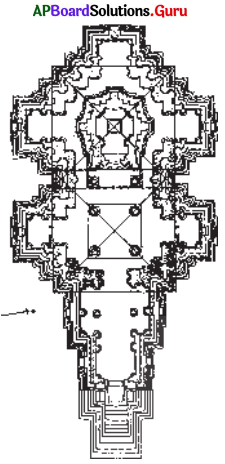
Describe the plan of the temples of the Chandela dynasty?
Answer:
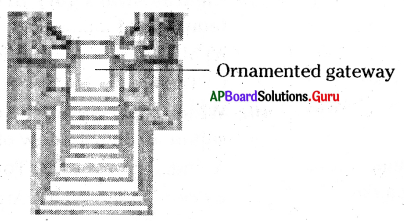
To begin with, an ornamented gateway led to an entrance and the main hall (mahamandapa) where dances were performed. The image of the chief deity was kept in the main shrine (garbha griha). This was the place for ritual worship where only the king, his immediate family, and priests gathered.

Question 4.
What are the main characteristics of the Vijayanagara style of architecture?
Answer:
Vijayanagara kings wanted their architecture to reflect all the important imperial build¬ing traditions. They followed the architectural styles of Cholas and Pandyas. This included vimanas and the gopurams y/hich were built on a scale and height. The first floor of the gopuram was built of solid granite and the upper floors were built of brick and sunnam. Other distinctive features include mandapas or pavilions and long pillared corridors that often ran around the shrines within the temple complex. They built secular royal buildings modeled on the style and techniques of the sultanate architecture.

Question 5.
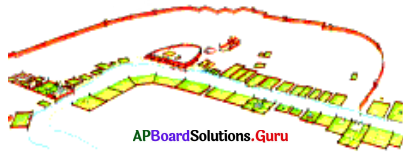
Look at the following picture.
AP 7th Class Social Important Questions Chapter 22 Rulers and Buildings 1
Now answer the following questions:
a. What does the picture show?
Answer:
The riverfront garden city of Agra.

b. Which river is flowing through the city?
Answer:
The Yamuna.

c. Which great monument is shown in the picture?
Answer:
The Taj Mahal.

d. Whose garden palaces are shown in the map?
Answer:
Garden palaces of the nobles.

e. Can you locate the Taj Mahal in the picture?
Answer:
Yes.

AP 7th Class Social Important Questions Chapter 22 Rulers and Buildings
Question 6.
Describe the arcuate style of architecture.
Answer:
The weight of the superstructure above the doors and windows was sometimes carried by arches. The roofs too used this principle and were converted into vaults and domes. This architectural firm is called the ‘arcuate’ style of architecture. This style is used from the twelfth century.

Question 7.
How were the tallest – shikhara constructed by using heavy stones?
Answer:
Constructing tall Shikharas was not easy because there were no cranes in those days and the 90 tonne stone for the top of the shikhara was too heavy to lift manually. So the architects built an inclined path to the top of the temple, placed the boulder on rollers, and rolled it all the way to the top. The path started more than four kilometers away so that it would not be too steep. This path was dismantled after the temple was constructed.

Question 8.
Study the following table.

Style of the architecture Characteristics Used in
Trabeate (or) corbelled A roof can be made by placing a horizontal beam across two vertical columns, a style of ‘ architecture is called trabeate or corbelled. in the construction of temples, mosques and tombs.
Arcuate style The weight of the superstructure above the doors and windows was sometimes carried by arches. The roofs used this principle and was converted into vaults and domes. This architectural form is called arcuate’. in constructing roofs and domes.
Imperial style of the Vijayanagara period. The Vijayanagara style of architecture had been developed by using the techniques of Chola and Pandya styles. This included Vimanas and Gopurams. Towers on the central shrines were dwarfed. Other distinctive features of this style include mandapas or pavilions and long pillared corridors that often ran around the shrines within the temple complex. in building Gopurams, Vimanas and Mandapas of the temple.

Now answer the following questions:
a. Write the characteristic of trabeate style of architecture.
Answer:
A roof can be made by placing a horizontal beam across two vertical columns. This style of architecture is called trabeate or corbelled type of architecture. This style is used in the construction of temples, mosques, and tombs.

b. Write the characteristics of Arcuate style of architecture.
Answer:
The weight of the superstructure above the doors and windows was sometimes carried by arches. The roofs too used this principle and were converted into vaults and domes. This architectural form is called ‘Arcuate’. This is used in constructing roofs and domes of temples and mosques.

c. Write about the imperial style of Vijayanagara period.
Answer:
The Vijayanagara style of architecture had been developed by using the techniques of Chola and Pandyan styles. This included Vimanas and Gopurams. Towers on the central shrines were dwarfed other distinctive features of this style include mandapams or pavilions and long pillared corridors that ran around the shrines with in the temple complex.

AP 7th Class Social Important Questions Chapter 22 Rulers and Buildings

Question 9.
Read the following passage.
Temples and mosques were beautifully constructed because they were places of worship. They were also meant to demonstrate the power, wealth and devotion of the patron. Take the example of the Rajarajeshvara temple. An inscription mentions that it was built by King Rajarajadeva for the worship of his god, Rajarajeshvara. Notice how the name of the ruler and the god are very similar. The king took the god’s name because it was auspicious and he wanted to appear like a god. Through the rituals of worship in the temple, one god (Rajarajadeva) honored another (Rajarajeshvara).
Now answer the following questions.
a. Why were the temples and mosques constructed beautifully?
Answer:
Temples and mosques were built beautifully because they were places of worship.

b. What were the beautiful temples and mosques meant to?
Answer:
Temples and mosques were meant to demonstrate the power, wealth and devotion of the patron.

c. Who built the Rajarajesvara temple?
Answer:
The King Rajarajadeva built Rajarajeshvara temple.

d. Why did King Rajaraja take the name of God?
Answer:
King Rajarajadeva took the name of God – Rajarajesvara because it was auspicious and he wanted to appear like a god.

e. Who were the two gods mentioned in the passage?
Answer:
The Lord Rajarajeshvara and the King Rajarajadeva who himself wanted to appear like a god.

Question 10.
Read the following passage :
Sultan Mahmud of Ghazni was a contemporary of Rajendra I. During his campaigns in the subcontinent, he also attacked the temples of defeated kings and looted their wealth and idols. Sultan Mahmud was not a very important ruler at that time. But by destroying temples – especially the one at Somnath – he tried to win credit as a great hero of Islam. In the political culture of the Middle Ages, most rulers displayed their political might and military success by attacking and looting the places of worship of defeated rulers.
Now answer the following questions.
a. Which Chola ruler was the contemporary of Rajendra I?
Answer:
Sultan Mahmud of Ghazni

b. What is called the Subcontinent?
Answer:
India.

c. Why did Mahmud of Ghazni destroy temples?
Answer:
To win credit as a great hero of Islam.

d. What was the prevalent political culture of the middle ages?
Answer:
To display their political might and military success by attacking and looting the places of worship.

e. Who looted the Somanath temple?
Answer:
Mahmud of Ghazni.

AP 7th Class Social Important Questions Chapter 22 Rulers and Buildings

Question 11.
Read the following passage:
The city of Vijayanagara was developed by the Rayas to act as the imperial capital of the entire South India. Thus they wanted it to reflect all the important imperial building traditions. They built large temples for Sri Virupaksha, Ramachandra, Krishna, and Vitthala using a style that had been developed by Chola and Pandya emperors% of Tamil Nadu. This included the Vimanas and the Gopurams. The Rayas paid special attention to the Gopurams which were now built on d scale and height as drivers before. It consisted of a first floor usually built of solid granite and a series of upper. floors made of brick and sunnam.
Now answer the following questions.
a. Which city was developed as the imperial capital of the entire South India?
Answer:
Vijayanagara.

b. What were the temples built by Vijayanagara Kings?
Answer:
Sri Virupaksha, Ramachandra, Krishna and Vitthala.

c. Whose style of architecture was used by the Vijayanagara Kings?
Answer:
Chola and Pandya styles of Architecture.

d. Which elements of Chola and Pandyan style of architecture did Vijayanagara kings use in building temples?
Answer:
Vimanas and Gopurams?

e. What, were Gopurams?
Answer:
Gopurams were the towering gateways of the temples.

Question 12.
Read the following passage.
The most impressive remain of Vijayanagara, the Mahanavami Dibba is a very high platform, of 55 feet that is as tall as a five-floor building and 11000 feet in area. Its height was increased at least three times during two hundred years. The sides of the platform were covered with sculptures of various kinds. It did not have a complete building on the top. The platform Was covered by cloth shamiana or pandal sup¬ported by wooden pillars. On this platform, the Vijayanagara kings held their Navaratri Puja and held their Dussera court in which all their subordinate chiefs, nayakas and officers paid their tributes to the Emperor. Ambassadors from Europe and other sultan¬ates also attended the festival.
Now answer the following questions.
a. What was the most impressive remain of the Vijayanagara Kingdom?
Answer:
Mahanavami Dibba.

b. Why was it called ‘dibba’?
Answer:
Because it was built on a high platform of 55 feet.

c. How did Vijayanagara used this dibba for?
Answer:
The Vijayanagara Kings used this dibba for performing Navaratri puja and held Dussera court.

d. Who paid tributes during the Dussera court?
Answer:
Subordinate chiefs, nayakas and officers paid their tributes to the Emperor.

e. What were the sides of the platform covered with?
Answer:
The sides of the platform were covered with sculptures of various kinds.

AP 7th Class Social Important Questions Chapter 22 Rulers and Buildings

Question 13.
Read the following passage.
Under the Mughals, architecture became more complex. Mughal emperors were per¬sonally interested in literature, art and architecture. In his autobiography, Babur described his interest in planning and laying out formal gardens, placed within rectangular walled enclosures and divided into four quarters by artificial channels.
These gardens were called chahar baghs, four gardens, because of their symmetrical division into quarters. Beginning with Akbar, some of the most beautiful chahar baghs were constructed by Jahangir and Shah Jahan in Kashmir, Agra, and Delhi.
Now answer the following questions.
a. What were Mughal emperors interested in?
Answer:
The Mughal emperors were interested in literature, art and architecture.

b. What was Babur interested in?
Answer:
Babur was interested in planning and laying out formal gardens.

c. What are Chahar baghs’?
Answer:
Formal gardens are placed within rectangular walled enclosures and divided into four quarters by artificial channels. These gardens were called Chahar bagh, four gardens.

d. Why are chahar baghs called so?
Answer:
These gardens were called Chahar bagh “four gardens, because of their symmetrical division into quarters.

e. Where did Mughal emperors construct Chahar baghs?
Answer:
Chahar bags were constructed in Kashmir, Agra, and Delhi by Akbar, Jahangir, and Kashmir.

Question 14.
Read the following passage.
Qutb Minor is five stories high. The band of inscriptions you see is under its first balcony. The first floor was constructed by Qutbuddin Aybak and the rest by Iltutmish around 1229. Over the years it was damaged by lightning and earthquakes and repaired by later kings.
Now answer the following questions.
a. How tall is Qutub Minor?
Answer:
Qutub Minar is five storeys high.

b. Who started the construction of Qutb Minar?
Answer:
Qutbuddin Aybak.

c. Who completed the construction of Qutb Minar?
Answer:
Iltutmish.

d. When was the construction of Qutub Minar completed?
Answer:
In 1229 A.D.

e. What damaged Qutb Minar?
Answer:
Qutb Minar was damaged by lightning and earthquakes.

AP 7th Class Social Important Questions Chapter 22 Rulers and Buildings

Question 15.
Read the following passage.
Muslim Sultans and Badshahs did not claim to be incarnations of god but Persian court chronicles described the Sultan as the “Shadow of God”. An inscription in the Delhi mosque explained that God chose Alauddin as a king because he had the qualities of Moses and Solomon, the great law-givers of the past. The greatest law¬giver and architect was God himself. He created the world out of chaos and introduced order and symmetry.
Now answer the following questions.
a. What was it that described the Sultan as the: “Shadow of God”?
Answer:
The Persian court chronicles.

b. Did the Muslim Sultans and Badshahs claim themselves to be the incarnations of God?
Answer:
No.

c. Why did God choose Allauddin as a king according to the inscription in the Delhi mosque?
Answer:
Because he had the qualities of Moses and Solomon.

d. Who were Moses and Solomon?
Answer:
The great law-givers of the past.

e. Who is actually the greatest lawgiver and architect?
Answer:
God himself.

Question 16.
Read the following passage.
In the early ninth century, when the Pandyan king Shrimara Shrivallabha invaded Sri Lanka and defeated the king, Sena I (831-851), the Buddhist monk and chronicler Dhammakitti noted: “he removed all the valuables … The statue of the Buddha made entirely of gold in the Jewel Palace… and the golden images in the various monasteries – all these he seized. ” The blow to the pride of the Sinhalese ruler had to be avenged and the next Sinhalese ruler, Sena II, ordered his general to invade ‘Madurai, the capital of the Pandyas. The Buddhist chronicler noted that the expedition made a special effort to find and restore the gold statue of the Buddha.
Now answer the following questions.
a. Which Pandyan King invaded Srilanka?
Answer:
Shrimara Shrivallabha.

b. Who did Shrimara Srivallabha defeat?
Answer:
Sena I.

c. Who was Dhamma kitti?
Answer:
A Buddhist monk and chronicler.

d. What are the values to seized by Shrivallabha?
Answer:
The Golden statue of Buddha and the Golden images.

e. How was the golden statue of Buddha recaptured by the Sinhalese?
Answer:
According to Dhammakitti, the expedition led by Sena II made a special effort to find and restore the golden statue of the Buddha.

AP 7th Class Social Important Questions Chapter 22 Rulers and Buildings

Question 17.
Read the following passage.
Shah Jahan adapted the river-front garden in the layout of the Taj Mahal, the grand¬est architectural accomplishment of his reign. Here the white marble mausoleum was placed on a terrace by the edge of the river and the garden was to its South. The new city of Shahjahanabad that he constructed in Delhi, the imperial palace commanded the riverfront. Only especially favoured nobles – like his eldest son Dora Shukoh – were given access to the river. All others had to construct their homes in She city away from the River Yamuna.
Now answer the following questions.
a. What did Shah Jahan adapt in the layout of the Taj Mahal?
Answer:
The riverfront gardens.

b. What was the grandest architectural accomplishment of Shah -Jahan’s reign?
Answer:
The Taj Mahal.

c. What is referred to as *White marble mausoleum9 in the above passage?
Answer:
The Taj Mahal.

d. Who constructed the new Shah Jahanabad?
Answer:
Shah Jahan.

e. Who was Dara Shukoh?
Answer:
Shahjahan’s eldest son.

Question 18.
An Inscription in Shah Jahan’s diwan – i – khas in Delhi stated: “If there is Paradise on Earth, It is here, It is here. It is here”, How was this Image created?
Answer:
The ceremonial halls of the public and private audience – diwan – i – khas or diwan – i – aam were carefully planned. These courts were also described as chihil sutun or forty-pillared halls, placed within a large courtyard. Thus the beautiful courtyards, carefully planned halls with different elements of Mughal architecture Shah Jahan’s biwan – i – khas (or) diwan – i – aam were called the paradises on earth.

AP 7th Class Social Important Questions Chapter 22 Rulers and Buildings

Question 19.
Look at the picture.
AP 7th Class Social Important Questions Chapter 22 Rulers and Buildings 2
Now answer the following questions.
a. What does the above picture show?
Answer:
The above picture shows the plan of the temple of the Chandala dynasty.

b. How many main parts are there? What are they?
Answer:
There are three main parts in the plan – They are

  1. ornamented gateway,
  2. Maha mandapa and
  3. Garbhagriha.

c. Locate the Mahamandapa on the map.
Answer:
AP 7th Class Social Important Questions Chapter 22 Rulers and Buildings 3

d. Locate the garbhagriha in the map.
Answer:
AP 7th Class Social Important Questions Chapter 22 Rulers and Buildings 4

e. Locate the ornamented gateway.
Answer:
AP 7th Class Social Important Questions Chapter 22 Rulers and Buildings 5

AP 7th Class Social Important Questions Chapter 22 Rulers and Buildings

Question 20.
Look at the picture.
AP 7th Class Social Important Questions Chapter 22 Rulers and Buildings 6
Now answer the following questions.
a. What does the above picture show?
Answer:
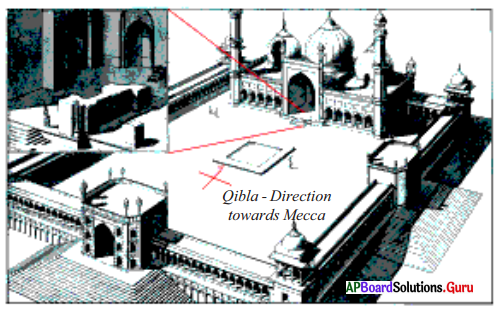
The plan of the Jami Masjid.

b. Who built this structure?
Answer:
Shah Jahan.

c. Where was it built?
Answer:
At Shahjahanabad.

d. What was special about this?
Answer:
Qibla was built in direction of Mecca.

e. Which Masjid was shown in the picture?
Answer:
Jami Masjid.

AP 7th Class Social Important Questions

AP 7th Class Social Important Questions Chapter 21 Devotional Paths to the Divine

AP State Syllabus 7th Class Social Important Questions 21st Lesson Devotional Paths to the Divine

Question 1.
What were the major ideas expressed by Basavanna?
Answer:
The connection between the bhakti movement and temple worship in turn to led to a reaction that was best represented in Virashaiva movement. It was initiated by Basavanna. This movement began in Karnataka in the mid twelfth century The major ideas expressed by Basavanna were,

  • the Virashaivas argued strongly for the equality of all human beings.
  • they were against scriptural ideas about the caste and the treatment of women.
  • they were also against all forms of ritual and idol worship.

AP 7th Class Social Important Questions Chapter 21 Devotional Paths to the Divine

Question 2.
Discuss the ideas of the saints of Maharashtra?
Answer:
The ideas of the saints of the Maharashtra were :

  1. They rejected all forms of ritualism, outward display of piety and social differences based on birth.
  2. They rejected the idea of renunciation.
  3. They insisted that bhakti lay in sharing others’ pain.

Question 3.
Study the following table.

Religious group Their teachings and beliefs
Nathpanthis, Siddhas, and Yogis 1)    They criticized rituals and other aspects of conventional religion and social order.
2)    They advocated renunciation of the world.
3)    They believed salvation lay in meditation on the formless ultimate.
4)    To achieve salvation they advocated intense training of the mind and the body through practices like yogasanas breathing exercises and meditation.
The saints of Maharashtra 1)    They rejected all forms of ritualism, outward display of piety.
2)    They opposed social differences based on birth.
3)    They rejected the idea of renunciation.
4)    They insisted that bhakti lay in sharing others’ pain.
The Sufi saints 1)    The sufis rejected outward religiosity.
2)    They emphasized love and devotion to God and compassion towards all fellow human beings.
3)    They rejected the elaborate rituals and codes of behavior demanded by Muslim religious scholars.
4)    They sought union with God.
5)    They believed that the heart can be trained to look at the world in a different way.

Now answer the following questions.
a. Write about the teachings and beliefs of Nathpanthis, Siddhas, and Yogis.
Answer:

  1. They criticized rituals and other aspects of conventional religion and social order.
  2. They advocated renunciation of the world.
  3. They believed that salvation lay in meditation on the formless ultimate.
  4. To achieve salvation they advocated intense training of the mind and the body through practices like yogasanas, breathing exercises, and meditation.

AP 7th Class Social Important Questions Chapter 21 Devotional Paths to the Divine

b. What were the prevalent religious and social beliefs opposed by the saints of Maharashtra?
Answer:

  1. The saints of Maharashtra rejected all forms of ritualism. The outward display of piety.
  2. They opposed social differences based on birth.
  3. They rejected the idea of renunciation.

c. What were the teachings of Sufi Saints?
Answer:

  1. The Sufis rejected outward religiosity.
  2. They emphasized love and devotion to God and compassion towards all fellow human beings.
  3. They rejected the elaborate rituals and codes of behavior demanded by Muslim religious scholars.
  4. They sought union with God.
  5. They believed that the heart can be trained to look at the world in a different way.

Question 4.
Study the following table.

Name of the Saint His teachings and beliefs
Basavanna 1)      He argued strongly for the equality of all human beings
2)      He was against the scriptural ideas about caste and the treatment of women.
3)      He was against all forms of ritual and ritual and idol worship.
Kabir 1)      He rejected the major religious traditions.
2)      He openly ridiculed all forms of external worship of both Hinduism and Islam.
3)      He ridiculed the pre-eminence of the priestly classes and caste system.
4)      He believed in a formless Supreme God.
5)      He preached that the only path to salvation was through bhakti or devotion.
Guru Nanak 1)   He emphasized the importance of worship of one God.
2)    He insisted that caste, creed, or gender are irrelevant for attaining liberation.
3)    He emphasized right worship, the welfare of others, and purity of conduct.
4)    Guru Nanak’s idea of equality had social and political implications.

a. What were the views of Basavanna, Kabir, and Gurunanak about the caste?
Answer:
Basavanna strongly argued for the equality of all human beings. Kabir ridiculed the pre-eminence of priestly classes and the caste system. Guru Nanak insisted that greed and gender are irrelevant for attaining liberation. Thus all the three saints criticized the caste in pits prevalent form and proposed suggestions to reform it.

AP 7th Class Social Important Questions Chapter 21 Devotional Paths to the Divine

b. Write about the religious beliefs of Basavanna, Kabir, and Guru Nanak?
Answer:
Basavanna was against all forms of rituals and idol worship Kabir openly ridiculed all forms of external worship of both the Hindus and Muslims. He believed in a formless Supreme God. He preached that the only path to salvation was through bhakti or devotion. Guru Nanak emphasized the importance of worship of one god.

c. What were the views of Kabir and Guru Nanak about liberation and salvation?
Answer:
Kabir preached that the only path to salvation was through bhakti or devotion. Nanak insisted that caste, creed, and gender are irrelevant for attaining liberation.

Question 5.
Study the following table.

Name of the Saint Lived in Doctrine Propounded Teachings
Ramanujacharya 11th Century Visishtadvaita or qualified monotheism The best means of attaining salvation was through intense devotion to Vishnu.
Basavanna Twelfth-Century Virashaivism Equality of all human beings and against scriptural ideas about caste and the treatment of women. He was against all forms of ritual and idol worship.
Kabir Sixteenth Century He ridiculed all forms of external worship of both Hinduism and Islam. He rejected the pre-eminence of priestly classes and the caste system.

Now answer the following questions.
a. What was the doctrine propounded by Ramanuja?
Answer:
Visishtadvaita

b. Who propounded the doctrine of Virashaivism?
Answer:
Basavanna

AP 7th Class Social Important Questions Chapter 21 Devotional Paths to the Divine

c. Who advocated the equality of all human beings?
Answer:
Basavanna

d. Who criticized all forms of external worship of both Hinduism and Islam?
Answer:
Kabir

e. Who believed that the best means of attaining salvation was through intense\devotion of Vishnu?
Answer:
Ramanujacharya

Question 6.
Read the following passage.
Ramanujacharya born in South India in the eleventh century was deeply influenced by the Alvars. According to him the best means of attaining salvation was through intense devotion of Vishnu. Vishnu in His grace helps the devotee to attain the bliss of union with Him. Ramanuja also ensured a place for people of lower castes in temple worship. He propounded the doctrine of Vishishtadvaita or qualified oneness according to which the soul even when united with the Supreme God remained distinct. Ramanuja’s doctrine greatly inspired the new strand of bhakti, which developed in north India subsequently.
Now answer the following questions.
a. By whose teachings were Ramanujacharya influenced?
Answer:
Ramanujacharya was influenced by Alvar’s teachings.

b. What was the best means of attaining salvation according to Ramanujacharya?
Answer:
Intense devotion to Vishnu was the best means of attaining salvation according to Ramanujacharya.

c. What was the doctrine propounded by Ramanujacharya?
Answer:
Visishtadvaita.

d. What does Visishtadvaita means?
Answer:
Visishtadvaita means the soul even when united with the Supreme God remained distinct.

e. What is the other name of Visishtadvaita?
Answer:
Qualified oneness.

AP 7th Class Social Important Questions Chapter 21 Devotional Paths to the Divine

Question 7.
Read the following passage.
From the thirteenth to the seventeenth centuries Maharashtra saw a great number of saint-poets, whose songs in simple Marathi continue to inspire people. The most important among them were Jnaneshwar, Namdev, Eknath, and Tukaram as well as women like Sakkubai and the family of Chokhamela, who belonged to the “untouchable ” Mahar caste. This regional tradition of bhakti focused on the Vitthala (a form of Vishnu) temple in Pandharpur, as well as on the notion of a personal god residing in the hearts of all people.
Now answer the following questions.
a. In which language did the saints of Maharashtra preach their teachings?
Answer:
Marathi

b. Name some important saints of Maharashtra.
Answer:
Jnaneshwar, Namdev, Eknath and Tukaram, Sakkubai, and the family of Chokhamela.

c. Which saint of Maharashtra belonged to the untouchable Mahar caste?
Answer:
Chokhamela

d. What was the center of the Marathi Bhakti movement?
Answer:
Vithala

e. Which form of Vishnu is mentioned in the above passage?
Answer:
Vithala

Question 8.
Read the following passage.
Many religious groups of this period criticized the ritual and other aspects of conventional religion and the social order, using simple, logical arguments. Among them were the Nathpanthis, Siddhacharas, and Yogis. They advocated renunciation of the world. To them, the path to salvation lay in meditation on the formless Ultimate Reality and the realization of oneness with it. To achieve this they advocated intense training of the mind and body through practices like yogasanas, breathing exercises, and meditation. These groups became particularly popular among low castes. Their criticism of conventional religion created the ground for devotional religion to become a popular force in northern India.
Now answer the following questions.
a. What were the prevalent social and religious conditions criticized by the religious groups?
Answer:
The rituals and other aspects of conventional religion and the social order.

b. Name some religious groups that emerged during the medieval period.
Answer:
The Nathpanthis, Siddhacharas, and Yogis.

c. What was the path of salvation according to Siddhacharas?
Answer:
Meditation on the formless ultimate Reality and the realization of oneness With it.

d. What were the practices advocated by Siddhacharas to achieve salvation?
Answer:
Practices like Yogasanas breathing exercises and meditation are the methods advocated by Siddhacharas to achieve salvation.

e. What created the ground for devotional religion, a popular force?
Answer:
The criticism of conventional religion by Siddhacharas, Nathpanthis, and Yogis created the ground for devotional religion.

AP 7th Class Social Important Questions Chapter 21 Devotional Paths to the Divine

Question 9.
Read the following passage.
Like the saint-poets, the Sufis too composed poems expressing their feelings, and a rich literature in prose, including anecdotes and fables, developed around them. Among the great Sufis of Central Asia were Ghazzali, Rumi, and Sadi. Like the Nathpanthis, Siddhas, and Yogis, the Sufis too believed that the heart can be trained to look at the world in a different way. They developed elaborate methods of training using zikr (chanting of a name or sacred formula), contemplation, sama (singing), raqs (dancing), discussion of parables, breath control, etc. under the guidance of a master or pir. Thus emerged the silsilas, a genealogy of Sufi teachers, each following a slightly different method (tariqa) of instruction and ritual practice.
Now answer the following questions.
a. Write the names of great Sufi saints of Central Asia.
Answer:
Ghazzali, Rumi, and Sadi were the great Sufi saints of Central Asia.

b. Write at least two comparisons between the Sufis and Nathpanthis, Siddhas and Yogis.
Answer:
a) Like the Saint – poets the Sufis too composed poems expressing their feelings,
b) Like the Nathpanthis, Siddhas, and Yogis, the Sufis too believed that the heart can be trained to look at the world in a different way.

c. What were the methods developed by Suits to train the heart?
Answer:
Zikr, Contemplation, Sama, Raqs, discussion of parables, breath control, etc., were the methods developed by Sufis to train the heart.

d. What are silsilas?
Answer:
A genealogy of Sufi teachers.

e. Who guides the people in methods of training heart?
Answer:
Pir, the master guides the people in methods of training heart.

AP 7th Class Social Important Questions Chapter 21 Devotional Paths to the Divine

Question 10.
Read the following passage.
These saints – poets rejected all forms of ritualism, outward display of piety, and social differences based on birth. In fact, they even rejected the idea of renunciation and preferred to live with their families, earning their livelihood like any other person, while humbly serving fellow human beings in need. A new humanist idea emerged as they insisted that bhakti lay in sharing other’s pain. As the famous Gujarati saint Narsi Mehta said, “Vaishnavas are those who understand the pain of others”.
Now answer the following questions :
a. Who were the saint poets mentioned in the passage?
Answer:
The saint poets were Jnaneshwar; Namdevi, Eknath, and Tukaram.

b. What were the unscrupulous religious practices rejected by the saint poets?
Answer:
Expensive rituals, outward, display piety and social differences based on birth.

c. Were these saint poets complete Sanyasis?
Answer:
No. They did not renounce but they preferred to live with their families earning their livelihood like any other person.

d. What was the humanist idea that emerged during the times of saints?
Answer:
“To humble serve the fellow human beings in need’ was the humanist idea that emerged during the saints of poets.

e. Who was Narsi Mehta?
Answer:
A famous Gujarati saint.

Question 11.
What do you think were the existing religious and social conditions that caused the outbreak of the Bhakti movement?
Answer:
In the medieval period, society was under the burden of evil social practices such as casteism. Untouchability, the dominance of priestly class over the people of other castes. So the saints of Bhakti wanted to reform the society. Therefore they argued strongly for the equality of all human beings and questioned the relevance of scriptural ideas about the caste. There were so many unscrupulous religious beliefs challenged by the saints of Bhakti. Idol worship, polytheism evil aspects of conventional religion expensive rituals, external worship, pre-eminence of the priestly classes, orthodox customs and beliefs, outward display of piety were the unscrupulous religious practices the saints of Bhakti wanted to do away with.
These social and religious conditions caused the outbreak of the bhakti movement.

AP 7th Class Social Important Questions Chapter 21 Devotional Paths to the Divine

Question 12.
What were the prevalent social evils and unscrupulous religious beliefs the saints of bhakti wanted to be reformed?
Answer:
The social evils that the saints of bhakti wanted to reform are:

  1. untouchability and
  2. casteism.

Almost all the saints opposed casteism and they criticized social differences based on birth. They opposed the pre-eminence of the priestly classes. Thus the saints argued strongly for the equality of all human beings.
The prevalent unscrupulous religious beliefs challenged by the saints of bhakti were (a) Idol worship (b) rituals (c) outward display of piety (d) narrow and unscrupulous aspects of conventional religion (e) polytheism.

Question 13.
Visit any dargahs, gurudwaras, or temples associated with saints of the bhakti tradition and describe what you saw and heard about them.
Answer:
Student Activity.

AP 7th Class Social Important Questions Chapter 21 Devotional Paths to the Divine

Question 14.
Get information about other works of the saint-poets mentioned in this chapter. Sing those songs in your school programs.
Answer:
Student Activity.

AP 7th Class Social Important Questions

AP 7th Class Social Important Questions Chapter 20 Folk Religion

AP State Syllabus 7th Class Social Important Questions 20th Lesson Folk Religion

Question 1.
Who are the Popular deities and when and by whom are they worshipped?
Answer:
Pochamma, Maisamma, Ganganamma, Yellamma and Paidithalli are folk goddesses. Potharaju Beerappa and Katamaraju are folk gods.
Folk gods and goddesses belong to particular castes or even particular villages or even particular families. Many of the folk gods and goddesses were actually local heroes who either died fighting for the defence of their people or were themselves wronged by the powerful people of their times. Common people believed that such persons attained special powers to help people or cause problems if not worshipped. So people worship these folk gods and goddesses for good crops, for keeping away infectious diseases and evils from their families, for guarding the boundaries of the villages and will not allow any disease or evil or enter the village.

AP 7th Class Social Important Questions Chapter 20 Folk Religion

Question 2.
How did Sammakka and Sarakka become folk goddesses?
Answer:
Medaraju was a tribal chief who was under the Kakatiya kings. His wife was Sammakka and their daughter was Sarakka and their son was Jampanna. He had a son-in-law named Pagididda Raju. Once due to drought, he could not pay the tribute to the Kakatiya king who sent his army against Medaraju. Medaraju’s entire family led the men and women of the tribe in the fierce battle. All of them got killed in the battle Jampana also fought bravely till his last breath and died in ‘Sampenga Vaagu’ to prevent the Kakatiya army from crossing the stream. Hence it is known as Jampanna vaagu. Sammakka and Sarakka fought against the army and sacrificed their lives for the sake of their tribe. From then onwards the tribal people of the entire region venerated them for their courage and sacrifice and to this, they celebrate the Medaram Jatara in their honour.

Question 3.
How do new technologies influence the devotee’s experience of their village deities?
Answer:
The new technologies influence the devotee’s experience of their village deities. People now use music players to play songs; at times they even play cinema songs based on village deities. Tube lights and coloured bulbs add glitter to the celebration Television and Newsprint media are giving a lot of advertisements to the village Jataras. Sometimes the local channels telecast the celebrations live. Sometimes the celebrations which attract the devotees in crores from all over the state are telecast in main channels all over the state.
Thus the new technologies give the devotees a novel experience of their village deities.

Question 4.
Which goddesses are worshipped in your area?
Answer:
In our area goddesses Ganganamma, Poleramma, Renuka, Ankamma, Perantalamma and Maddi Ravamma are worshipped.

AP 7th Class Social Important Questions Chapter 20 Folk Religion

Question 5.
Which gods are worshipped in your area?
Answer:
Potharaju and Madaru Sahib are worshipped in our area.

Question 6.
Which saints, pirs and Babas have you seen your family pay their respects to?
Answer:
In our area, people worship saints such as Brahmam guru, Yogi Vemana, the saints of Vaishnava- the Alvars are worshipped. In our area – Babas such as Shirdi Sai Baba, Puttaparthi Satya Sai Baba are worshipped.
In our area, people go to different dargahs. People visit and pay respects to Baba Mastanvali Dargah at Guntur; Baji baba at Peda Kakani and Kaleshavali Dargah at Kasmuru of Nellore district.

Question 7.
Which animals and trees have you seen people worship?
Answer:
I have seen people worship the animals – snake (Nagendra Swami); Dog (Kala Bhairava); Ox (Basavanna / Nandi); Gow (Gomatha).
I have seen the people worship trees such as – Tulasi, Neem and Peepal trees in our area.

Question 8.
Do you know how people worship?
Answer:
In the villages on special occasions, people of all castes go to the shrine with bonalu. They wash the deity and clean the shrine area. People pray to god/goddess in their own language according to their customs and traditions. They offer a part of the bonam and sometimes also offer a chicken or sheep.

AP 7th Class Social Important Questions Chapter 20 Folk Religion

Question 9.
How are the deities worshipped and who does they worship?
Answer:
People who are facing problems, who have been falling ill repeatedly worship the goddesses. They would offer her special worship to appease her. They offer bonalu and sacrifice a cock to the goddess.

Question 10.
In which languages are the deities addressed by the worshippers?
Answer:
The worshippers use their own language to address the deities. Like in the temples of main deities they don’t use any Sanskrit mantras and chantings.

Question 11.
Read the following passage:
Maisamma: She is believed to protect the cattle. Among the cattle sheds, a niche is whitewashed and decorated with “Kumkuma ” and called ‘Maisamma Goodu ’. In many places, Katta-Maisamma is also worshipped as a goddess of water and is worshipped in the form of a small stone on the tank bund. People believe that she will ensure that the tank is full. Thus, due to her blessings the crops flourish.
Now answer the following questions :
a. Which deity is talked about in the above passage?
Answer:
Maisamma.

b. What is called Maisamma goodu?
Answer:
The whitewashed and decorated with Kumkuma in the cattle she discalled “Maisamma goodu”.

c. Which goddess blesses the people with good crop?
Answer:
Katta Maisamma.

d. Which goddess protects cattle?
Answer:
Maisamma.

AP 7th Class Social Important Questions Chapter 20 Folk Religion

Question 12.
Read the following passage:
Yellamma: Yellamma is also called Polimeramma, ‘Mariaemma ’ ‘Renuka ’Mahankali,
Jogamma, Somalamma and other names. It is believed that she guards the boundaries of the village and will not allow any disease or evil to enter the village. People mainly pray to her to prevent epidemics like cholera.
Now answer the following questions:
a. Which deity is being talked about in the above passage?
Answer:
Yellamma.

b. What are the other names of Yellamma?
Answer:
The other names of Yellamma are Polimeramma. Mariaemma, Renuka, Mahankali, Jogamma, Somalamma.

c. Who guards the boundaries of the village?
Answer:
Yellamma.

d. What do the people mainly worship Yellamma for?
Answer:
People mainly pray for Yellamma to prevent epidemics like cholera.

Question 13.
Read the following passage:
Many of the folk gods and goddesses were actually local heroes who either died fighting for the defence of their people or were themselves wronged by the powerful people of their times. Common people believed that such persons attained special powers to help people or cause problems if not worshipped. Two such folk heroes who laid down their lives in defence of the tribal people were Sarakka and Sammakka in whose honour a Jatara is
conducted.
Now answer the following questions :

a. Who were folk gods and goddesses actually?
Answer:
The folk gods and goddesses were actually the local heroes who either died fighting for the defence of their people or were themselves wronged by the powerful people of their times.

b. What was the common belief about the heroes?
Answer:
The common belief was that the heroes attained special powers to help people or cause problems if not worshipped.

c. Name the goddesses who laid down their lives in defence of the tribal people.
Answer:
Sarakka and Sammakka.

d. On whose honour a Jatara is celebrated?
Answer:
Sammakka and Sarakka.

e. What would happen if folk deities were not worshipped according to the common belief?
Answer:
They would cause problems.

AP 7th Class Social Important Questions Chapter 20 Folk Religion

Question 14.
Read the following passage :
It is a celebration by the tribal people of Taadwai mandal in Warangal District at Medaram village. People from Andhra Pradesh, Telangana, Maharashtra, Madhya Pradesh, Odisha, Chattisgarh and Jharkhand assemble to celebrate the jatara. Nearly one crore people attend it.
Now answer the following questions:

a. Which celebration is being talked about in the above passage?
Answer:
Medaram jatara.

b. Where is the jatara celebrated?
Answer:
At Medaram, in Taadwai Mandal of Warangal district.

c. Which celebration is considered the largest Jatara in Andhra Pradesh?
Answer:
Medaram Jatara

d. Where do the people come from to attend the jatara?
Answer:
People from Telangana, Andhra Pradesh, Maharashtra, Madhya Pradesh, Odisha, Chattisgarh, Jharkhand assemble to attend the jatara.

AP 7th Class Social Important Questions Chapter 20 Folk Religion

Question 15.
Study the following table.

1. Medaram jatara at Medaram village in Taadwai Mandal of Warangal district. The Medaram Jatara is organised every two years. This is a three day fair. Sammakka and Sarakka are formless goddesses. Caskets representing them are brought from the forests in an elaborate procession, brightly decorated and placed on the platform under a tree. At that time devotees feel the spirits or goddess has taken possession of them. The people offer Bangaram Jaggery to the goddess.
2. Urs At Ameenpeer Dargah, in Y.S.R. Kadapa district. Ameenpeer Dargah in Y.S.R Kadapa District, Khajapeerullah Hussaini’s tomb was founded around 400 years ago. In memory of his great-grandson, Syed Shah, Arifullah Hussainy, Urs is celebrated for seven days in which both Hindus and Muslims participate. Offerings of sandalwood paste (Gandhapu Chandanam) on the first day, ‘Chadar’ on the second day and ‘Mushaira’ on the third day take place in this seven day Urs in a grand manner. Qawwali programme is held on both nights.

Now answer the following questions.
a. Describe how medaram Jatara is celebrated.
Answer:
It’s a celebration by the tribal people of Taadwai mandal in Warangal district at Medaram village.
The Medaram Jatara is organised every two years. This is a three day fair. Sammakka and Sarakka are the formless goddesses. Caskets representing them are brought from the forests in an elaborate procession, gaily decorated and placed on the platform under a tree. At that time devotees feel the spirits or goddess has taken possession of them. The people offer Bangaram, Jaggery to the goddess.

b. Describe how Urs is celebrated.
Answer:
Ameenpeer Dargah in Y.S.R Kadapa district, Khajapeerullah Hussaini tomb was founded around 400 years ago. In memory of his great-grandson, Syed Shah Arifullah Hussainy Urs is celebrated for seven days in which both Hindus and Muslims participate. Offerings of sandalwood paste (Gandhapu Chandanam) on the first day, ‘Chadar’ offer on the second day and ‘Mushaira’ on the third day take place in this seven day Urs in a grand manner. Qawwali programme is held on both nights.

AP 7th Class Social Important Questions Chapter 20 Folk Religion

Question 16.
In these times of heavy rural migration to cities, what happens to the rural migrant’s relation to the village deity after the people move to the cities?
Answer:
In these times of heavy rural migration to cities to the rural migrant’s relation to the village, deity has been decreasing. After they migrated to cities people don’t get any regular employment. They end up as casual labours or domestic workers. They struggle to make both ends meet. Facing such economic hardships, the people don’t have any time and money to go back to their village to celebrate the rituals of the village deities.

Question 17.
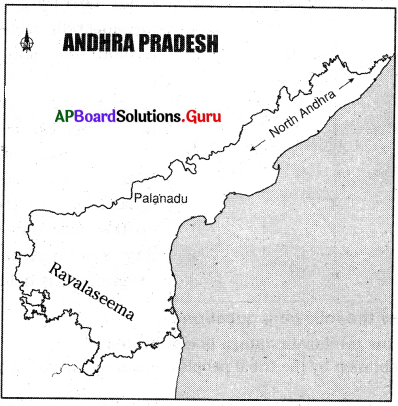
Locate the following places in the map given below:

  1. Rayalaseema
  2. Palanadu
  3. North Andhra

Answer:
AP 7th Class Social Important Questions Chapter 20 Folk Religion 1

Question 18.
Animals buffaloes, in many cases, are usually sacrificed for the village deities. What are the possible consequences of the ban on animal slaughter?
Answer:
As a law of nature, we can kill those animals which we eat. For other purposes, for entertainment, hunting and for sacrifices we should not kill animals. It is a crime. If the ban on animal slaughter is strictly executed, it is better for society. In fact, laws and Acts stay on paper, still, these practices will continue. Because the governments are apathetic to interfere with religious practices. But with the awareness campaigns by the intellectuals and N.G.Os and with the teachings of Mahatma Gandhi and Ambedkar the buffalo sacrifice is on the decline.

AP 7th Class Social Important Questions Chapter 20 Folk Religion

Question 19.
Gel detailed information from your grandparents about any Jatara in your area. Prepare a report.
Answer:
Student Activity.

Question 20.
Collect stories and songs about any of the folk deities of your area and prepare a small booklet about it.
Answer:
Student Activity

Question 21.
Write about a Jatara or Urs celebrated by the people together in your area.
Answer:
I went to Venkatagiri in the Nellore district to visit Poleramma Jatara.
It is celebrated with great pomp and show. Thousands of devotees from far and near made a beeline to the handloom town to witness the centenary year celebrations organised by the Endowments department in veneration of the goddess in keeping with the tradition.
People offering prayers to the beautifully decorated idol of the goddess. This Jatara is celebrated for two days. All people participated and worship goddess Poleramma in a devotional manner.

AP 7th Class Social Important Questions

AP 7th Class Social Important Questions Chapter 19 Livelihood and Struggles of Urban Workers

AP State Syllabus 7th Class Social Important Questions 19th Lesson Livelihood and Struggles of Urban Workers

Question 1.
The details of workers in a paper mill are given in the table below. Study the table and answer the following questions.

Nature of Employment Nature of Work Monthly Salary Other Benefits Number of  Workers
Permanent Technical work 15,000 Provident fund. Free medical facility, paid leave, Bonus 1800
Contractual Unloading wood, packing and loading paper 8,000 Get work throughout the year. May become permanent worker after 3 years 1000
Casual Cleaning the floors, Pasting labels on paper packets. 2,500 Nil 500

a) How is the nature of the work of a permanent worker different from a contractual worker?
Answer:
The permanent worker is using his mental labour. But contract worker is using his physical labour.

b) How are contractual workers different from casual workers in terms of “Other benefits”?
Answer:
Contract labour job may or may not become permanent after 3 years.
But permanent worker enjoys all benefits along with the permanent job.

c) Why do you think a large number of workers in the mill are not permanent? Explain briefly.
Answer:
Skilled labour is need throughout the year. But unskilled labour is needed whenever the work is there. So companies appoint more labour temporarily why because if ‘ the worker is temporary in manner, there is no need to provide all facilities. This is the benefit to the owner.

AP 7th Class Social Important Questions Chapter 19 Livelihood and Struggles of Urban Workers

Question 2.
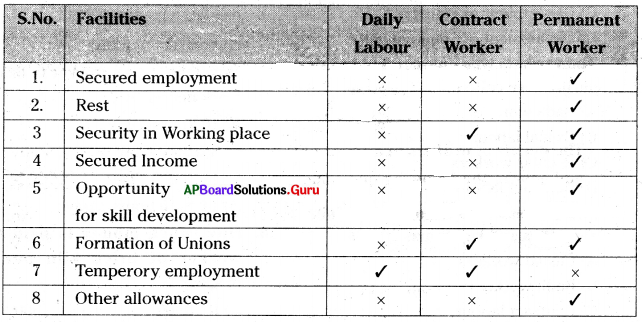
Read the table and answer the following questions.
AP 7th Class Social Important Questions Chapter 19 Livelihood and Struggles of Urban Workers 1
i) Write any two facilities of contract labour.
Answer:

  1. Security in working place.
  2. Formation of unions.
  3. Temporary employment.

ii) Which type of workers get paid holiday?
Answer:
Permanent workers.

iii) How can you. say the permanent worker get better facilities than oil…
Answer:
According to the above information maximum, all facilities are enjoyed by the permanent worker.

iv) What do you understand about daily labour?
Answer:
Daily labour enjoys only temporary employment if he did not do the work, not gaining any wage.

AP 7th Class Social Important Questions Chapter 19 Livelihood and Struggles of Urban Workers

Question 3.
What rights and securities have the workers been fighting for?
Answer:

  1. Right to Productive and Safe Employment.
  2. Right to Leisure and Rest.
  3. Right to Employment Security.
  4. Income Security.
  5. Work Security.
  6. Skill Improvement.
  7. Collective Voice so that they can form unions to express their problems and needs.

Question 4.
Who are called regular workers and who are called contract or casual workers?
Answer:
Workers in the factories who are properly registered with the government and who are provided security and workers’ rights under the laws of the government are called regular workers.
Workers in factories, registered and unregistered with the government; and who are not provided security and worker’s rights and who have not been given basic needs of the workers are called casual or contract workers.

Question 5.
What are the benefits available to the permanent workers?
Answer:

  1. Their wages were fixed through agreements with the union.
  2. Medical facilities through employees State Insurance and Provident Fund are provided for the permanent workers.
  3. Health checkups in big private hospitals and leave in case workers become sick are provided for the workers.
  4. Educational allowance for their children, travelling allowance and conveyance allowance for the workers are given.
  5. Companies provide quarters for the workers to live in.
  6. They will be given loans when needed.
  7. The company also provide training for workers.
  8. Contract workers should be regularised after a definite period of work.

AP 7th Class Social Important Questions Chapter 19 Livelihood and Struggles of Urban Workers

Question 6.
What is the difference between a permanent worker and a badli worker?
Answer:
Workers who are employed permanently, who are provided with regular and high wages and whose employment is secured, and who can enjoy all the facilities such as Provident Fund, Employees State Insurance and all types of allowances are called permanent workers.
Workers who are employed on a casual basis, who replaced permanent workers in their absence, are called badli workers. They get very little salary and very few benefits like Provident Fund and Health Insurance etc.,

Question 7.
Describe the process of making bricks.
Answer:

  1. Clay is to be prepared by mixing sand, clay and water.
  2. Clay is to be put in brick moulds.
  3. Once the clay is shaped into bricks, they are to be smoothened and the seal of the brick company is to be fixed on the bricks.
  4. They are allowed to dry and then loaded on bullock carts and taken to kilns for baking.

Question 8.
What kind of machines tools and sources of power are used in brick production?
Answer:
Any machines and tools are not used in brick making except the moulds to shape the clay into bricks. No power is used for making bricks. Only the muscle power of the workers is used for mixing the clay, shaping the clay into bricks by using moulds. In all levels of brick making, no machinery is used. For transport of the clay, sand and dried bricks to the kilns, bullock carts or tractors are used.

AP 7th Class Social Important Questions Chapter 19 Livelihood and Struggles of Urban Workers

Question 9.
Describe a lot of brick workers.
Answer:

  1. The workers have to work for 14 to 16 hours a day.
  2. They are paid Rs. 108 per 1000 bricks. They normally manage to make about 1000 bricks a day.
  3. If they are ill they are not paid anything.
  4. Most of the days they don’t get proper feed to eat-they neither have the time nor the money for it.
  5. Their children don’t get any education.
  6. Though the government frees from their bonded labour they are forced to come back to the kilns since they don’t have any employment opportunities at their home.
  7. There are no trade unions that fight for their rights.

Question 10.
Read the following passage.
Over the last two hundred years, workers all over the world have fought to get these rights recognised even though they may not be implemented in all places. In most countries, the governments have agreed that these are the basic needs of workers and made laws that ensure workers these rights. Governments also have Labour Departments which have the responsibility to ensure that these laws are followed. If the laws are not followed workers can file cases in courts.
Now answer the following questions.
a. What did the workers all over the world fight for?
Answer:
To get their rights recognised

b. Are the rights of the workers being implemented everywhere?
Answer:
No. Not in all places

c. What are considered the basic needs by the governments?
Answer:
The rights of the workers are considered as basic needs by the governments.

d. What did the governments do?
Answer:
The governments made laws that ensure workers these rights.

e. Which department has the responsibility to ensure that their laws are followed?
Answer:
The labour department.

AP 7th Class Social Important Questions Chapter 19 Livelihood and Struggles of Urban Workers

Question 11.
Read the following passage:
In our country, we find that many factories which are properly registered with the government often follow many of these laws. However even they try to give these rights only to some workers who are called the ‘Regular Workers’ of the factory and not to those called ‘casual’ or ‘contract workers’ who are employed irregularly. At the same time, there are many factories that are not properly registered with the government and the government does not supervise them.
Now answer the following questions.
a. Which factories follow the laws of the workers?
Answer:
Factories registered with the government.

b. Which workers have been given the rights of the workers?
Answer:
The regular workers.

c. What kind of workers have not been given the rights of the workers?
Answer:
Casual or contract workers.

d. Which type of factory is not supervised by the government?
Answer:
The factories are not properly registered with the government.

e. Which workers are employed irregularly?
Answer:
Casual or contract labour.

Question 12.
Read the following passage:
This company (not a real name) mixes and packs medicines for another big medicine company. It employed about 118 workers of whom about 104 workers were employed as daily casual workers. That is only 14 workers were regular and permanent and were used for the skilled work of mixing the chemicals to prepare the medicine powder. They were paid about Rs. 1500 to Rs 2500 per month and had security of employment. They also got ESI and PE The remaining 104 workers who were engaged on a daily basis mainly did the packaging and labelling of the medicine. About 56 of them were women. These daily workers were engaged by a labour contractor who was told every day by the manager how many workers to engage.
Now answer the following questions.
a. Which company is talked about in the above passage?
Answer:
A multinational medicine company.

b. How many workers work in the factory in total?
Answer:
118

c. How many workers are regular and permanent workers?
Answer:
Only 14 are permanent workers.

d. How many workers are skilled labour?
Answer:
Only 14

e. What are the benefits availed by the permanent workers?
Answer:
They get Rs. 2500/- as salary, they have the security of employment. They also get ESI, medical insurance and Provident Fund.

AP 7th Class Social Important Questions Chapter 19 Livelihood and Struggles of Urban Workers

Question 13.
Read the given passage.
A Trade Union is an organisation formed by workers to protect their interests. If every single worker has to negotiate with the employer separately, they will not be in a strong position. However, if all of them negotiate, their position will become stronger. Trade Unions negotiate on behalf of all workers with the government and the employers. They seek to ensure proper wages, other benefits and decent working conditions for their members. Collectively with their member workers, they secure social security benefits, medical facilities, houses, Provident Fund and pension. If any worker is harassed or is in need of help, the Trade Union takes up his or her cause. Unions adopt a variety of measures like negotiations, filing cases in the law courts and even strikes or stoppage of work to pressurise the employers.
Now answer the following questions :
a. What is a trade union?
Answer:
An organisation formed by workers for protecting their rights.

b. What do the trade unions work for?
Answer:
Ensuring proper wages, other benefits and decent working conditions for its number.

c. What are the measures adopted by the trade unions to pressurise the employers?
Answer:
Negotiations, filing cases in the law courts and even strikes or stoppage of work to pressurise the employers.

d. What is it that conducts negotiations with the government and employers?
Answer:
The trade union.

e. What are the social security benefits the workers should get?
Answer:
Medical facilities, houses, provident fund and pension.

Question 14.
Read the following Passage.
In Andhra Pradesh and other states of India, towns and cities are becoming bigger and bigger. People are rapidly shifting from villages to these towns. But many of them do hot get sufficient regular employment there and are doing a variety of odd jobs. They sell vegetables or other items, make and sell snacks, work in tea stalls, or small factories, stitch clothes, load and unload in markets, work as domestic maids, etc.
Many of them produce goods at home – weavings clothes, papads, pickles, doing embroidery, etc. and are engaged through the putting-out system.
Now answer the following questions:
a. Why are towns and cities becoming bigger and bigger?
Answer:
Because people are rapidly shifting from village to village.

b. Why, do the people end up as casual workers in cities?
Answer:
Because in cities they do not get any regular jobs.

c. Write some jobs that come under the informal sector.
Answer:
Selling vegetables, making snacks and selling, working in tea stalls and small factories.

d. What is the system that the workers of the informal sector are engaged through?
Answer:
Putting out system.

e. Growth of cities leads to the growth of ……….. labour in cities.
Answer:
Casual

AP 7th Class Social Important Questions Chapter 19 Livelihood and Struggles of Urban Workers

Question 15.
Here is a bar diagram. Based on the answer the questions below:
AP 7th Class Social Important Questions Chapter 19 Livelihood and Struggles of Urban Workers 2
Fill in the blanks.
i) In 2009 of all the 100 people employed ………… were causal labourers.
(54,52,57,51)
Answer:
52

ii) In 1999 of all the 100 people employed ………….. were women, casual workers.
(52, 54, 57, 51)
Answer:
54

iii) In 1993 of all the 100 people employed ………….. were men casual workers
(47, 45, 43, 48)
Answer:
43

iv) The total number of women casual labourers increased faster than male casual labourers between ………….. (a. 1993 to 1999; b. 1999 to 2009)
Answer:
a. 1993 to 1999

Question 16.
Correct the false statement,
a. The total number of casual labourers in rural Andhra Pradesh has decreased from 1993 to 2009.
Answer:
The total number of casual labourers in rural Andhra Pradesh has increased from 1993 to 2009.

b. There are more women casual labourers than male casual labours during all three years.
Answer:
The statement is true.

AP 7th Class Social Important Questions Chapter 19 Livelihood and Struggles of Urban Workers

Question 17.
Write a short note on how gender differences are making an impact on the labour market, drawing from previous chapters as well.
Answer:
Yes. Gender differences are making a great impact on the labour market. From the above bar diagram, it is proved. There are more women casual labourers than male casual labourers during all three years. It is because the female labourers are employed at cheaper rates than the male ones. Thus the gender differences are making a great impact on the labour market.

Question 18.
Below are three pie charts of working people in the entire Andhra Pradesh, rural and urban areas. Study them and answer the questions.
AP 7th Class Social Important Questions Chapter 19 Livelihood and Struggles of Urban Workers 3
a. Of all the working persons in Andhra Pradesh 45% are …………….
(self-employed, salaried, casual labourers)
Answer:
Casual labourers.

b. Of all the rural working people in Andhra Pradesh 7% are …………….
(self-employed, salaried, casual labourers)
Answer:
Salaried

c. Of all the urban working people in Andhra Pradesh 37% are ……………
(self-employed, salaried, casual labourers)
Answer:
self-employed

d. There are more …………. in the rural area than urban area (self-employed, salaried casual labourers) but there are more ………… in an urban area than rural area (self-employed; salaried; casual labourers)
Answer:
casual labourers; regular salaried workers.

e. More than half of the rural population are …………. (self-employed, salaried, casual labourers)
Answer:
casual labourers

AP 7th Class Social Important Questions Chapter 19 Livelihood and Struggles of Urban Workers

Question 19.
Write a short note on the differences in the rural and urban contexts of employment conditions.
Answer:
a) While casual labourers are more than half of the rural population, in urban areas only 18% of casual labourers are there.
b) Whole self-employed people occupy 41% of the rural population 37% of the working persons in urban areas are self-employed.
c) While 7% of the rural working persons are regular waged / salaried workers, but in urban areas regular waged / salaried workers occupy 45% of the urban working people.
d) In urban areas skilled employment in the organised sector than in the rural areas.
e) In rural areas unskilled employment in the unorganised primary sector is more than in urban areas.

Question 20.
Why do you think people migrate for work in other distant states?
Answer:
In their own place, people may have a small plot of land, with which they cannot get on. They are in debt and on the verge of selling their land. They don’t get regular employment in their villages. Because of the closing down of the factories and mills, the workers of these factories migrate to cities and join the ranks of casual workers.

AP 7th Class Social Important Questions Chapter 19 Livelihood and Struggles of Urban Workers

Question 21.
Which of the seven rights are available to brick kiln workers like Bandhani?
Answer:

  1. Right to productive and Safe Employment: Though the brick kiln workers employment is productive, their employment is not safe.
  2. Right to Leisure and Rest: They don’t have any Leisure and time to rest. They have to work for 14 to 16 hours a day.
  3. Right to Employment Security: No. Their employment is not at all called employment in legal terms. It is called a bonded labour. Moreover, it is seasonable employment.
  4. Income Security: The kiln workers do not have an adequate and regular income for taking care of the needs of their families and savings for living a dignified life in their old age.
  5. Work Security: If they fall ill or meet with an accident they won’t get proper care and won’t get paid for the period of illness.
  6. Skill Improvement: It is not a job in which skill is needed.
  7. Collective voice: There are not trading unions that fight for their rights as they are migrant workers and spread out in a number of sites.

AP 7th Class Social Important Questions

AP 7th Class Social Important Questions Chapter 18 Caste Discrimination and the Struggle for Equality

AP State Syllabus 7th Class Social Important Questions 18th Lesson Caste Discrimination and the Struggle for Equality

Question 1.
Write any two measures taken by the government of Andhra Pradesh to empower women?
Answer:

  1. To provide loans to women from Cooperative societies & Banks for their empower.
  2. Provide 33% reservations in local educational and employment institutions.

Question 2.
Classify the given items under suitable headings matching to the person and related issues?

  • Savithri Bai Phule, Narayan Guru, Bahadur Shah Jafar, Rani of Jhansi.
  • Sepoys revolt, First women teacher, Social reformer who worked on the abolition of the caste system, last Mughal Emperor.
    AP 7th Class Social Important Questions Chapter 18 Caste Discrimination and the Struggle for Equality 1

Answer:

S.No. Persons Related issues
1. Savithri Bhai Phule First women Teacher
2. Jhansi Laxmi Bhai Sepoy Revolt
3. Narayan Guru The social reformer who worked on the abolition of the caste system
4. Bahadur Shah Last Mughal Emperor

AP 7th Class Social Important Questions Chapter 18 Caste Discrimination and the Struggle for Equality

Question 3.
What is the mid-day meal programme? Can you list three benefits of this, programme?
Answer:
The government is trying to implement the equality that is guaranteed in the Constitution through laws and several schemes. The government has set up several schemes to improve the lives of communities and individuals who have been treated unequally for several centuries. One such programme is the mid-day meal programme. This programme was introduced in all government elementary schools to provide children with cooked and nutritious food. This programme has many positive effects.
Some of them are:

  1. More poor children have begun enrolling and regularly attending schools,
  2. This programme has also helped to reduce caste prejudices because both lower and upper caste children in schools eat this meal together.
  3. A mid-day meal is prepared by the members of the women self-help groups that too from the deprived classes. Thus Dalit women have got employment with this programme.

Question 4.
Read the following passages:
“Long did we wait, but no one turned up. An hour elapsed and the station master came to enquire. He asked us for our tickets. We showed them to him. He asked us why we tarried. We told him that we were bound for Koregaon and that we were waiting for father or his servant to come, but that neither had turned up and that we did not know how to reach Koregaon. We were well-dressed children. From our dress or talk, no one \ could make out that we were children of the untouchables. Indeed the station master j was quite sure we were Brahmin children and was extremely touched at the plight in which he found us. As is usual among the Hindus, the stationmaster asked us who we j were. Without a moment’s thought, I blurted out that we were Mahars. (Mahar is one of the communities which are treated as untouchables in the Bombay Presidency.) He was stunned. His face underwent a sudden change. We could see that he was overpowered by a strange feeling of repulsion. As soon as he heard my reply, he went away to his room and we stood where we were.
Fifteen to twenty minutes elapsed; the sun was almost setting. Our father had not turned up nor had he sent his servant, and now the station master had also left us. We were quite bewildered, and the joy and happiness, which we felt at the beginning of the journey, gave way to a feeling of extreme sadness.
After half an hour the station master returned and asked us what we proposed to do. We said that if we could get a bullock-cart on hire we would go to Koregaon, and if it was not very far we would like to start straight away. There were many bullock-carts I plying for hire. But my reply to the station master that we were Mahars had gone round among the cart men and not one of them was prepared to suffer being polluted and to demean himself carrying passengers of the untouchable classes. We were prepared to pay double the fare but we found that money did not work. The station-master, who was negotiating on our behalf, stood silent, not knowing what to do.
Source: Dr B.R. Ambedkar, Writings and Speeches, Volume 12, Edited Vasant Moon,
Bombay Education Department, Govt, of Maharashtra.
Now answer the following questions:
a. Despite the children offering money the cartmen refused them. Why?
Answer:
The fact that the children belonged to the caste of Mahars had gone around the cartmen. Though the children offered money the cartmen refused them because a) they were not prepared to, suffer being polluted and to demean themselves by carrying passengers of untouchable classes, b) They feared that the upper caste people would never engage their carts if they carried the children of Mahars.

AP 7th Class Social Important Questions Chapter 18 Caste Discrimination and the Struggle for Equality

b. How did the people at the station discriminate against Dr Ambedkar and his brother?
Answer:
At the station, the station master showed no interest in them after he was told that they belonged to Mahars. He made them wait for a long time. He could not convince the cartmen to carry them in their carts to Koregaon. After they learnt that they belonged to Mahars, the cart- men refused to carry them in their carts because they were not prepared to suffer being polluted and to demean themselves by carrying the children of untouchables.

c. How do you think Dr B.R.Ambedkar felt as a child when he saw the station master’s reaction to his statement that they were Mahars?
Answer:
I don’t think Ambedkar should have repented for saying that they were Mahars when he saw the station master’s reaction. He was truthful and courageous and he knew that he would have to suffer a lot of discrimination if he revealed his caste. For the sake of convenience and comfort, he did not like to sacrifice his caste.

d. Have you ever experienced prejudice or witnessed an incident of discrimination?
Answer:
No. I have never experienced prejudice or witnessed an incident of discrimination
personally; I’ve read in newspapers that people are still showing discrimination by using special tumblers for offering water to the low caste people.

e. How did this make you feel?
Answer:
I feel very bad about this. I want to ask myself how I should feel if I were to face discrimination. I think there should not be any discrimination based on birth. It is very much insulting and hurtful. We should not violate anyone’s dignity by showing discrimination.

Question 5.
Read the following passage:
An example of Discrimination in schools
Omprakash Valmiki is a famous Dalit writer. In his autobiography, Jonathan, writes, “I had to sit away from the others in the class, and that too on the floor. The mat ran out before reaching the spot I sat on. Sometimes I would have to sit way behind everybody, right near the door sometimes they would beat me without any reason.
When he was in Class IV, the headmaster asked Omprakash to sweep the school and the playground. He writes, “The playground was way larger than my small physique could handle and in cleaning it, my back began to ache. My face was covered with dust. The dust had gone inside my mouth. The other children in my class were studying and I was sweeping. The headmaster was sitting in his room and watching me. I was not even allowed to get a drink of water. I swept the whole day,… From the doors and windows of the school rooms, the eyes of the teachers and the boys saw this spectacle. ” Omprakash was made to sweep the school and the playground for the next couple of days and this only came to an end when his father, who happened to be passing, saw his son sweeping. He confronted the teachers and then walking away from the school holding Omprakash’s hand, he said loudly for all of them to hear, “You are a teacher So I am leaving now. But remember this much Master…. (He) will study right here in this school. And not just him, but there will be more coming after him. ”
Now answer the following questions:
a. What acts of discrimination did Omprakash Valmiki face in his school?
Answer:

  1. He had to sit away from the others in the class, and that too on the floor. Sometimes he would have to sit way behind everybody, right near the door.
  2. He was beaten by the upper caste children without any reason.
  3. He was asked to sweep all the school and the playground.
  4. He was not allowed to drink water.

AP 7th Class Social Important Questions Chapter 18 Caste Discrimination and the Struggle for Equality

b. Why do you think, was Omprakash discriminated against at the school?
Answer:
Omprakash Valmiki belonged to a Dalit community that was looked down upon in those days as a lower caste. Omprakash was discriminated against because of his caste.

c. “Omprakash was made to sweep the school and the playground for the next couple of days” When did this come to an end? (or) How did his father react to seeing this?
Answer:
One day Omprakash’s father happened to be passing by and saw his son sweeping. He confronted the teachers. He took his son and walked away from the school. He was annoyed to see his son sweeping, while all the other children were listening to lessons in the classroom.

Picture Reading:

Question 6.
Observe the following photos of social reformers and write their names.

AP 7th Class Social Important Questions Chapter 18 Caste Discrimination and the Struggle for Equality 2AP 7th Class Social Important Questions Chapter 18 Caste Discrimination and the Struggle for Equality 3AP 7th Class Social Important Questions Chapter 18 Caste Discrimination and the Struggle for Equality 4AP 7th Class Social Important Questions Chapter 18 Caste Discrimination and the Struggle for Equality 5

Answer:

  1. Jyotirao Govindrao Phule
  2. Savitri Bai Phule
  3. Periyar E.V. Ramaswami
  4. Sri Narayana Guru

AP 7th Class Social Important Questions Chapter 18 Caste Discrimination and the Struggle for Equality

Question 7.
Observe the following table:

S.No. Social Reformer Their contribution to achieving social equality
1. Jyotirao Govindarao Phule 1)    He was the pioneer of women’s education in India.
2)    He founded the ‘Satyasodhak Samaj’ to secure human rights and social justice for low caste people.
2. Savitri Bai Phule 1)    She devoted her life to educate Dalits.
2)    She was the pioneer of women’s education in India.
3)    She was the first headmistress of the country’s first girls’ school in Pune.
4)    She started a night school for agriculturists and labourers.
5)    She died while serving plague patients.
3. Periyar 1)      Periyar is known as a rationalist and the leader of the lower caste movement in India.
2)    He made the people realise that all men are equal.
3)    He taught that it is the birthright of every individual to enjoy liberty and equality.
4. Sri Narayana Guru 1)    He preached brotherhood for all.
2)    He fought against the ill effects of the caste system.
3)    He led the quiet but significant social revolution.
4)    He gave the watchwords ‘One Caste, One Religion, One God for all men.’

Now answer the following questions.
a. What was Jyotiba Phule’s contribution to achieving social equality?
Answer:
He was the pioneer of women’s education in India. He founded the ‘Satyasodhak Samaj’ to secure human rights and social justice for low caste people.

b. What was Savitri Bai Phule’s contribution to Indian society? (or)
Explain the efforts of any one of the social reformers.
Answer:
She devoted her life to educating Dalits. She was the pioneer of women’s education in India. She was the first headmistress of the country’s first girls’ school in Pune. She started a night school for agriculturists’ and labourers. She died while serving plague patients.

AP 7th Class Social Important Questions Chapter 18 Caste Discrimination and the Struggle for Equality

c. Write about Narayana Guru’s contribution to Indian society.
Answer:
He preached brotherhood for all. He fought against the ill effects of the caste system. He led the quiet but significant social revolution. He gave the watchwords ‘One Caste, One Religion, One God for all men.’

d. What was Periyar’s contribution to Indian society?
Answer:
Periyar is known as a rationalist and the leader of the lower caste movement in India. He made the people realise that all men are equal. He taught that it is the birthright of every individual to enjoy liberty and equality.

Question 8.
In what ways do you think the caste system promotes inequality among people?
Answer:

  1. People who take up dignified professions are considered as higher caste people and those who take up undignified professions are called people of low caste and are treated as untouchables.
  2. People of low castes are not allowed to enter temples, and the houses of the people of upper caste; their children are not allowed to sit with the children of higher caste people.
  3. They are not allowed to take water from the wells.
  4. This discrimination went on for ages based on the caste system. Thus the caste system promoted inequalities among people.

Question 9.
Why do you think Omprakash Valmiki was being treated unequally by his teacher and his classmates?
Answer:
Omprakash Valmiki was a Dalit by birth. Because he belonged to a lower caste, his schoolmates and teachers hurt his dignity badly and made him feel as if he was less than equal to all the other students in the school. Because of his caste, he was picked and was made to sweep the school, and he was made to sit on the floor behind all the other students in the class.

AP 7th Class Social Important Questions Chapter 18 Caste Discrimination and the Struggle for Equality

Question 10.
Find out about a government scheme in your area. What does this scheme do? To whom is this scheme intended to benefit?
Answer:
Student Activity.

Question 11.
Discuss with your parents or grandparents how the caste system functioned earlier to find out what has changed and what has not. Prepare a report and present it in the class.
Answer:
Student Activity.

AP 7th Class Social Important Questions

AP 7th Class Social Important Questions Chapter 17 Implementation of Laws in the District

AP State Syllabus 7th Class Social Important Questions 17th Lesson Implementation of Laws in the District

Question 1.
What are the responsibilities of MRO (Tahsildar)?
Answer:

  1. Mandal Revenue Officer is an officer or head of law order, land revenue, and judiciary at the Mandal level.
  2. Mandal Revenue Officer keeps the records of land revenue and maps of the land showing the land owned by different people showing crops, tanks, drainages, wells, neighbouring plots, roads, hillocks and so on.
  3. Using these land records and maps the Mandal Revenue Officer settles the disputes between two individuals.
  4. If anyone encroaches on the forest and the lands belonging to the government, the Mandal Revenue Officer evicts them.
  5. The Mandal Revenue officer has the responsibility of updating and issuing ration cards.

AP 7th Class Social Important Questions Chapter 17 Implementation of Laws in the District

Question 2.
What are the main features of the Water, Land, and Trees Protection Act of 2002?
Answer:
Some of the features of this law are:

  1. Permission from Mandal Revenue Officer is essential to drill/dig a new well.
  2. Specific depth and distance should be maintained between the wells to avoid unnecessary competition.
  3. Steps to prevent wastage of rainwater.
  4. Industrial units have wastewater treatment plants.
  5. Protection of drinking water.
  6. In the regions affected by groundwater depletion sand quarrying from riverbeds is prohibited.
  7. Social forestry to be taken up on large scale.
  8. Cutting trees without permission is prohibited. When a tree is cut two saplings should be planted.

Question 3.
Read the following passage and answer the questions.
We saw in the last lesson that there are various departments of the government to do various kinds of activities. These departments are under the control of ministers, but they have a large number of officials who carry out the orders of the government. Some of these officials are posted in the state capital like Hyderabad from where they plan the implementation in all parts of the state. At the same time, the entire state is divided into a number of districts and most departments have their offices in them for the implementation of the government’s laws and plans. There are 13 districts in Andhra Pradesh.
a. Who controls various departments?
Answer:
The ministers.

b. Who carries out the orders of the government?
Answer:
The officials.

c. Where are these officials posted to implement the decisions of the government?
Answer:
At the state capital and at the district headquarters.

d. How many districts are there in Andhra Pradesh?
Answer:
13

e. What is the capital of our state?
Answer:
Amaravathi.

AP 7th Class Social Important Questions Chapter 17 Implementation of Laws in the District

Question 4.
Read the following passage and answer the questions.
You may have noted that the Nallavaram district is divided into different mandals. There are many villages in each of these Mandate. Nallavaram is divided into many Mandate. Many villages together form a Mandal. Just like in the district headquarter there are different offices at the Mandal. There are Mandal Parishad Development Officer Revenue, Education, agriculture, and so on.
a. What is Nallavaram?
Answer:
An imaginary district.

b. What is the district divided into?
Answer:
Mandals

c. What are the mandals composed of?
Answer:
Villages.

d. Where are the different offices located at the mandal?
Answer:
At the mandal headquarters.

e. Write some offices you can have at the mandal headquarter.
Answer:
Mandal Office of Education, Mandal Agricultural Office. Mandal Revenue Office, Mandal Development Office.

f. What is the name of your mandal?
Answer:
Students Activity

g. Write any three neighboring mandals of your district.
Answer:
Students Activity

Question 5.
Read the following passage and answer the questions.
After the law was passed, the government formed an authority to implement the act. It was called the Water, Land, and Trees Protection Authority or WALTA: If you look carefully, in order to implement a law like this – it is necessary that different departments of the government work together. You can note that the forest department has to be taken into account because forests are important for saving water and government departments are in charge of the industry to ensure that the factories are not polluting the water.
a. What was the law mentioned in the above passage?
Answer:
Andhra Pradesh Water, Land and Trees Protection Act.

b. What is necessary to implement a law?
Answer:
The different departments working together.

c. Expand WALTA.
Answer:
Water, Land, and Tree Protection Authority.

d. What was the authority formed by the government?
Answer:
WALTA.

e. What are forests important for?
Answer:
For saving water.

AP 7th Class Social Important Questions Chapter 17 Implementation of Laws in the District

Question 6.
Read the following passage.
It is important to protect the resources for the benefit and survival of the next generations. In this connection, the Government of Andhra Pradesh enacted the Andhra Pradesh Water, Land, and Trees Protection Act in 2002. It is being implemented from 19 – 04 – 2002.
a. Why is it so important to protect the resources?
Answer:
For the benefit and survival of the next generations.

b. What did the government do to protect the resources?
It enacted the Andhra Pradesh Water, Land, and Trees Protection Act

c. When was the Water, Land, and Trees Protection Act made?
Answer:
In 2002.

d. was the Water, Land, and Trees Protection Act implemented?
Answer:
From 19 – 4 – 2002.

e. What is it that is very important for the survival of the next generations?
Answer:
To protect the resources.

Question 7.
Study the following table.

Department Subject
Ground Water Department Registration of Rigs, Sand Mining, classification of Groundwater basins, etc.
Municipal Administration & Urban Development Department Construction of Rain-water harvesting structures, tree planting, permission for construction of new buildings.
Mines and Geology Department Monitoring Sand Mining in water bodies
Forest Department Granting permission for felling trees

Now answer the following questions.
a. What are the responsibilities of the Ground Water Department?
Answer:
Registration of rigs sand mining, classification of groundwater basins is the responsibilities of the Ground Water Department.

b. Who issues permissions for new buildings?
Answer:
Municipal Administration & Urban Development Department.

c. Which department monitors sand mining in water bodies?
Answer:
Mines and Geology Department.

d. Which department grants permission for felling trees?
Answer:
Forest Department.

e. Which department does the construction of rainwater harvesting structures?
Answer:
Municipal Administration & Urban Development Department.

AP 7th Class Social Important Questions Chapter 17 Implementation of Laws in the District

Question 8.
Some activities and some departments are given hereunder. Can you match them?

Activities Departments
i) Building dams and canals a) Civil supplies
ii) Supplying electricity to houses b) Railways
iii) Running ration shops c) Major irrigation
iv) Running trains d) Revenue
v) Printing currency notes e) Child welfare
vi) Collecting taxes from people. f) Army
vii) Preventing child labour and educating all children. g) Poverty Alleviation
viii) Defending the borders the country h) Reserve Bank
ix) Identifying those below the poverty line and implementing schemes for their benefit. i) Electricity
x) Preventing people from stealing from other people’s houses. j) Police

Answers:
i) c
ii) i
iii) a
iv) b
v) h
vi) d
vii) e
viii) f
ix) g
x) j

AP 7th Class Social Important Questions Chapter 17 Implementation of Laws in the District

Question 9.
Read the following table.

Department Subject
Ground Water Department Registration of Rigs, Sand Mining, classification of Groundwater basins, etc.
Municipal Administration & Urban Development Department Construction of Rainwater harvesting structures, tree planting, permission for construction of new buildings.
Mines and Geology Department Monitoring Sand Mining in water bodies.
Forest Department Granting permission for felling trees.

Now answer the following questions:
a. The responsibilities of Ground Water Department is
Answer:
a) Registration of Rigs
b) Sand mining
c) Classification of groundwater basins.

b. The responsibilities of the Municipal Administration & Urban Development Department are ……………..
Answer:
a) Construction of rainwater harvesting structures.
b) Tree planting.
c) Permission for the construction of new buildings.

c. The responsibility of the Mines and Geology Department is ……………….
Answer:
Monitoring sand mining in water bodies.

d. What is the responsibility of the Forest Department?
Answer:
Granting permission for felling trees.

AP 7th Class Social Important Questions Chapter 17 Implementation of Laws in the District

Question 10.
What is the need for the Water, Land, and Trees Protection Act?
Answer:
It is important to protect these resources for the benefit and survival of the next generations. In this connection, the Government of Andhra Pradesh enacted the Andhra Pradesh Water, Land, and Trees Protection Act in 2002. It is being implemented from 19-04-2002.

AP 7th Class Social Important Questions

AP 7th Class Social Important Questions Chapter 16 Making of Laws in the State Assembly

AP State Syllabus 7th Class Social Important Questions 16th Lesson Making of Laws in the State Assembly

Question 1.
Expand M.L.A. and M.L.C.
Answer:
MLA – stands for Member of Legislative Assembly
MLC – stands for Member of Legislative Council.

AP 7th Class Social Important Questions Chapter 16 Making of Laws in the State Assembly

Question 2.
The results of an assembly election in a state having 300 seats are shown in the table below.
Study the table and answer the following questions.

Political party Number of Candidates Elected
Party A 115
Party B 80
Party C 65
Party D 40
Total 300

a) What is the minimum number of elected candidates required for a political party to form government in this state?
Answer:
Minimum 151 elected candidates are required.

b) Based on the election result which party has a better chance of forming the government? Why do you think so?
Answer:
Generally, no party has a chance to form the government because no one has more than 150 seats.

c) Give two different alternatives for the political parties that can form a coalition government in this state?
Party A – 72
Party B – 82
Party C – 66
Others – 30
Answer:
To form the coalition.
First step – party A + B + C = 115 + 80 + 65 = 260
Second step = A + B + D = 115 + 80 + 40 = 235

AP 7th Class Social Important Questions Chapter 16 Making of Laws in the State Assembly

Question 3.
After an election, different political parties got seats as shown below:
Answer the following questions based on the above information.
a) How many seats are needed for getting a majority to form the government in the state?
Answer:
To form the government in any state a political party should have more than 50% of the total seats. So in this state, more than 125 seats are needed.

b) Which one emerged as the single largest party?
Answer:
Party B emerged as the single largest party.

c) If you were the Governor, which party would you call first to form the government?
Answer:
If I am a governor, I would call party B to form the government and say to them to show their majority in a given time.

d) Can the single largest party form the government here? If not, what can be the alternatives to form the government?
Answer:
The coalition government is the alternative form.

Question 4.
What is called manifestos?
Answer:
In elections, political parties play a major role. All political parties and candidates come out with election manifestos. These manifestos are descriptions of programs that they intend to the local context.

AP 7th Class Social Important Questions Chapter 16 Making of Laws in the State Assembly

Question 5.
Make a list of active political parties in your area and in your state along with their symbols.
Answer:

Political Party Symbol
Congress (I) Palm (Hastam)
Telugu Desam Party Cycle
Bharatiya Janata party Lotus flower
YSR Congress Party Fan
Communist Party of India Sickle and Hammer
CPI (M) Sickle
Janasena Glass Tumbler

Question 6.
How do the assemblies make laws?
Answer:
Before a law is passed, the proposed law is called a ‘Bill’. After being passed by both the chambers and approval of the Governor it becomes a law and it is called an ‘Act’ of the state legislature.
Procedure:
The minister who brings the Bill will describe in detail the reason for the new law in the Assembly. There will be a lot of discussions and sometimes opposition from differ¬ent MLAs. There could be suggestions to improve the provisions in the Bill. A small committee is set up to discuss these suggestions. Then it will be placed before the Assembly for voting. If more than half the members of the Vidhan Sabha accept the bill it will be passed and taken to Vidhan Parishad. If the Vidhana Parishad passes it, then it will be sent to the Governor for approval. After his approval the Bill will be called an Act and published in the gazette.

AP 7th Class Social Important Questions Chapter 16 Making of Laws in the State Assembly

Question 7.
What is the difference between the role of a ruling party MLA and an opposition Party M.L.A.?
Answer:
A ruling party MLA should be constructive in making laws. He must use his discretion to vote for legitimate laws and oppose the Illegitimate ones. He should be in a position to answer the questions of the opposition MLAs who ask about what steps have the government taken on a certain issue.
On the other hand, the opposition M.L.A. should prevent the Government from making illegitimate laws. He should check the government to make laws to favor one section of society. He should offer the government constructive suggestions. He should not unnecessarily criticize the government. He should not play politics over an important issue.

Question 8.
What do you know about Legislative Council? How is it composed?
Answer:
Legislative Council
Earlier we said Andhra Pradesh has two houses. The second house is called Legis-lative Council and was created in 2007. It is a permanent house. Members of this house are elected for 6 years, known MLAs. To contest in this house person should be above 30 years of age. It consists of 50 members.
Composition:

  • 17 members (1/3) are elected by the MLAs.
  • 17 members (1/3) are elected by the members who were elected to Local Bodies like panchayats and municipalities.
  • 3 or 4 members (1/12) from Graduates
  • 3 or 4 members (1/12) from Teachers.
  • 8 members (1/6) are nominated by the Governor.

In order to make any law in the state now, it has to get the approval of both the houses.

Question 9.
Why is the system of reservation for weaker sections necessary in Assemblies? How are the constituencies reserved for the weaker sections in the Vidhan Sabha of Andhra Pradesh?
Answer:
System of Reservation
It has been observed that it is very difficult for weaker sections of the population, like the Dalits or Adivasis to fight and win elections. As such very few of them get elected to the assemblies. In order to ensure that they are adequately represented in the Assemblies, the Indian Constitution reserves certain constituencies for the Scheduled Castes and Scheduled Tribes.
Reserved Constituencies in Andhra Pradesh State Legislative Assembly:
Total Number of Constituencies: 175
Constituencies Reserved for SCs: 29
Constituencies Reserved for STs: 07

AP 7th Class Social Important Questions Chapter 16 Making of Laws in the State Assembly

Question 10.
Read the following passage and answer the questions.
Bill for a ban on public smoking passed
March 27: The Andhra Pradesh State Legislative Assembly on Wednesday passed a bill providing for the prohibition of smoking in places of public work or public use and in public service, vehicles. It also provides for eviction and levying of fines ranging from Rs. 100 to Rs. 1,000 on those who contravene the provisions.
Some of the concerns expressed by the opposition members include implementation of the ban on the sale of cigarettes within 100 meters of educational institutions, sale to those below 18 years, and prohibition of advertisement of cigarettes. Others spoke of the effect it would have on the livelihood of tobacco farmers and pan shop owners. The Minister allayed their apprehensions.
The Minister said the legislation was necessary for a view of the harmful effects of smoking on the health of people and in pursuance of the Supreme Court directions are given on November 2, 2001. Those contravening Sections 5,6 and 10 relating to the ban on smoking in public places and public service vehicles and display of no smoking board, would be punishable with a fine which may extend to Rs. 100 and for the second or subsequent offense with a fine of Rs. 200 which may extend to Rs. 500.

a. Newspapers are often written with the assumption that they are read by adults. So let us first find out the word meanings – eviction, allayed, apprehension, pursuance, implementation, and contravening.
Answer:
Meanings:
eviction = forcing somebody to leave a house or land especially When you have the legal right to do so
allayed = to make some feeling less strong
apprehension = worry or fear that something unpleasant may happen
pursuance = In order to do something
Implementation = Carrying out, making something that has been officially decided to start or happen
contravening = to do something that is not allowed by a law or a rule

b. In the context of the above news items fill in the following.
i) A ……………….. was passed to prohibit smoking in public places (bill, custom, law, rule)
Answer:
bill

ii) Prohibition of smoking does not include ………………. . (place of work, public vehicles, private gardens, bus stand)
Answer:
Private Gardens

iii) The legislation was in order to …………………. the directions from Supreme Court. (silence, punish, follow, dismiss).
Answer:
follow

iv) The bill was passed in the …………….. . (Supreme Court, Ministry, Collectorate, Assembly)
Answer:
Assembly

v) Does the newspaper article suggest that everyone had same opinion about the bill?
Answer:
No. some spoke of the effect it would have on the livelihood of tobacco farmers and pan shop owners.

vi) What are the provisions for punishment mentioned in the newspaper?
Answer:
The contravening sections 5, 6, and 10 of the Supreme Court directions relating to the ban on smoking in public places and public service vehicles are the provisions for punishment.

AP 7th Class Social Important Questions Chapter 16 Making of Laws in the State Assembly

Question 11.
Read the following passage and answer the questions.
Bill: Before a law is passed, the proposed law is called a ‘Bill’. After being passed by both the chambers and after the approval of the Governor, it becomes a law and is called an ‘Act’ of the state legislature.
a. What is called a bill?
Answer:
Before the law is passed, the proposed law bill is called a Bill.

b. Who pays the bills?
Answer:
Both the chambers of the legislature.

c. Who will approve the bill?
Answer:
The Governor.

d. What is called an Act?
Answer:
After the approval of the Governor, the Bill is called an Act.

e. What is the difference between a Bill and Act?
Answer:
Before a law is passed, the proposed law is called a Bill. After being passed by both chambers and approved by the Governor it becomes a law and is called an Act.

Question 12.
Study the following table.

Political Party No. of Candidates Elected
Political Party – A 102
Political Party – B 67
Political Party – C 04
Political Party – D 02
Political Party – E 00
Political Party – F 00
Political party – G 00
Political Party – H 00
Political Party -1 00
Political Party – J 00
Total 175

Now answer the following questions.
a. Which party has got the majority?
Answer:
Party A

b. Which Party has won the second largest number of Candidates?
Answer:
Party B

c. Member of which party is elected as the Chief Minister?
Answer:
Party A

d. Which party is called the opposition party?
Answer:
Party B

e. Members of which party are selected as the Cabinet?
Answer:
Party A

AP 7th Class Social Important Questions Chapter 16 Making of Laws in the State Assembly

Question 13.
Study the following table.

Political Party No. of Candidates Elected
Political Party – P 82
Political Party – Q 60
Political Party – R 14
Political Party – S 11
Political Party – T 04
Political Party – U 03
Political party – V 01
Total 175

Now answer the following questions.
a. What does the above table show?
Answer:
Political parties which compete in the elections and the number of seats they got in the elections. .

b. Which party has the right to form the government?
Answer:
Political party – P

c. Which party is considered as the opposition party?
Answer:
Political Party – Q

d. Member of which party becomes the Chief Minister?
Answer:
Political Party – P

Question 14.
Study the following table.

Political Party No. of Candidates Elected
Political Party – Abed 91
Political Party – Mnop 42
Political Part – Wxyz 32
Political Party – Stuv 10
Total 175

Now answer the following questions.
a. How many total seats are there in the Assembly?
Answer:
175.

b. What is the Optimum majority the party needs to form the government?
Answer:
88 (More than half of the seats).

c. Can any party form the Government on its own?
Answer:
Abed parties can form the government.

d. If Abed got 71, and Mnop got 62, what can be the possible alternatives to form the government?
Answer:
Parties Abed and Mnop together can form the government or parties Abed and Wxyz together can form the government or parties, Mnop and Wxyz together can form the government or parties Mnop and Wxyz and Stuv together can form the Government.

e. What type of Government is possible in this context?
Answer:
The Coalition government is possible in this context.

AP 7th Class Social Important Questions Chapter 16 Making of Laws in the State Assembly

Question 15.
Read the passage and answer the following questions.
There are 175 constituencies in the state. The number of constituencies in a state will depend upon its population. A constituency in Andhra Pradesh has about 1,70,000 voters. You may remember that all men and women of 18 years of age or above have the right to vote. They have to get their names registered as voters in the area where they live. All voters of one constituency will vote to elect one member for the Assembly.
a. Which state has 175 Constituencies?
Answer:
Andhra Pradesh.

b. What do the number of constituencies in a state depend upon?
Answer:
The number of constituencies in a state will depend upon its population.

c. How many voters do a constituency in Andhra Pradesh consist of?
Answer:
A constituency in Andhra Pradesh consists of about 1,70,000 voters.

d. Who has the right to vote?
Answer:
All men and women of 18 years of age or above have the right to vote.

e. Who will elect the member of the Assembly?
Answer:
All voters of one constituency will vote to elect one number for the Assembly.

Question 16.
Read the passage and answer the following questions.
We see that political party A got the 102 seconds largest number of candidates i.e., a number of seats is considered to have got a majority. If any law has to be made they can easily get it passed as more than half the members will support it. The majority members will elect one member among themselves as their leader. He or she will be made the Chief Minister of the state by the Governor. The Chief Minister will select from among party MLAs to be ministers. Together they will be called the Cabinet (or ministry). In popular terms, the Cabinet is also called the ‘Government’. The Cabinet is responsible for the implementation of the laws, for preparing and passing new laws and welfare schemes in the Assembly.
a. Which party is considered to have got the majority?
Answer:
The party which has more than half the number of seats is considered to have got a majority.

b. Who will be made the chief minister?
Answer:
The leader of the majority party.

c. Who is called the Cabinet?
Answer:
The Chief Minister and his ministers together are called the cabinet.

d. Who nominates the Chief Minister?
Answer:
The governor nominates the Chief Minister.

e. What are the duties of the Cabinet?
Answer:
The Cabinet is responsible for the implementation of laws, for implementing development plans, and for preparing and passing new laws and welfare schemes in the assembly.

f. What is called the Cabinet?
Answer:
Ministers selected by the Chief Minister from the MLAs together called the Cabinet.

AP 7th Class Social Important Questions Chapter 16 Making of Laws in the State Assembly

Question 17.
Read the following passage and answer the questions.
This is the most important body for making the laws for the state. The Government of Andhra Pradesh which is responsible for implementing these laws and also formulating policies for the welfare of the state is largely composed of members of the Assembly. Our state Assembly has 175 members (MLAs) who are elected by the people just as panchayat members are elected.
a. What is the most important body for making the laws for the state?
Answer:
Legislative Assembly.

b. Which is responsible for implementing the laws?
Answer:
The State Government.

c. Who formulate the policies for the welfare of the state?
Answer:
The State Government.

d. How many members are there in our Assembly?
Answer:
175

e. Who elected the M.L.As?
Answer:
The people of state directly.

Question 18.
Read the following passage and answer the questions.
Usually, elections to the state legislative assembly are held once every five years.
Persons aspiring to become MLAs contest these elections. Various political parties field their candidates. There are also individuals who contest elections and do not belong to any political party. They are known as “Independents”. To contest elections a person should be a citizen of India and should have completed twenty-five years of age.
a. What is the term of the Legislative Assembly?
Answer:
Five years.

b. Who contest the elections?
Answer:
Persons aspiring to become M.L.As

c. Who are called independent?
Answer:
The individuals who contest elections and who do not belong to any party are called independents.

d. What are the eligible conditions for contesting elections?
Answer:
a) He should be a citizen of India.
b) He should have completed 25 years of age.

e. What is the minimum age to complete by a person to be elected as an MLA?
Answer:
25 years.

AP 7th Class Social Important Questions Chapter 16 Making of Laws in the State Assembly

Question 19.
Some people feel that elections require spending huge amounts of money which is possible only for very rich people. Do you agree with this?
Answer:
Yes, I agree with this. Many parties which promised clean, free, and fair politics and which are assured to be uncorrupted were not able to get at least 5% of the total votes polled. Voting has today become a trade and ‘vote’ a tradable commodity. The contestants offer the most rewarding inducements to voters. People have been lured to caste their votes for mere a packet of liquor and a couple of hundred rupees. Sometimes the voters are lured with valuable rewards of Gold ornaments. Hence contesting elections re¬quires spending huge amounts of money.

Question 20.
If only rich people are able to contest elections how will it affect the decisions taken in the assembly?
Answer:
If only rich people are able to contest elections. They will generate economic distortions in the public sector by diverting public investment into capital projects where bribes and kickbacks are more plentiful They tend to be corruptive and lower the quality of the Government services and infrastructure and increases budgetary pressure on Government. The rich enter politics mainly to amass and enhance their wealth.

Question 21.
Many people feel that similar reservation of seats for women too should be ensured. What do you feel?
Answer:
India is the World’s largest democracy in the world. Even after 60 years of Independence and in spite of 15 general elections women still have a very low representation in parliament. Women comprise half of the population in India. They constitute 340 million voters out of the total electorate of 710 million in 2009. Still, they constitute a lowly 9% of the total strength of the Loksabha. The Indian constitution guarantees Gender equality in Articles 325 and 326. Patriarchal society, male domination in social and political life, violence in the form of dowry, domestic violence, and female infanticide, all these oppressive measures against women make the reservation for women in legislative Assemblies necessary. Women’s interests can never be completed by a group of men. That is why women need reservations.

AP 7th Class Social Important Questions Chapter 16 Making of Laws in the State Assembly

Question 22.
Study the following map:
AP 7th Class Social Important Questions Chapter 16 Making of Laws in the State Assembly 1
Now answer the following questions.
a. What does the map show?
Answer:
The map shows the Assembly constituencies of Andhra Pradesh.

b. How many constituencies are there in our state?
Answer:
There are 175 constituencies in our state.

c. Which district has the highest number of constituencies?
Answer:
East Godavari district has the highest number of constituencies.

d. Which district has the lowest number of constituencies?
Answer:
Vijayanagaram district has the lowest number of constituencies.

e. How many constituencies are there in each region?
Answer:
Coastal region: 123 ; Rayalaseema: 52

Question 23.
If you were to contest elections from your district, prepare an election Manifesto- your promises to the constituency people.
Answer:
If I am elected, I promise you, the people of my constituency, that I will
a) do my level best to increase the old age monthly pension from Rs. 200 to 500.
b) make arrangements, to supply drinking water to the neck and corner of my constituency.
c) Provide free education to all from KG to PG.
d) Provide a free power supply to agriculture connections. I will make arrangements to provide a continuous 8 hours supply of power to the agricultural connections.
e) Try to implement Rajiv Arogyasri efficiently to give medical aid to the poor and the needy.

AP 7th Class Social Important Questions Chapter 16 Making of Laws in the State Assembly

Question 24.
What do you feel about voting for money or caste or out of fear? To what extent will those candidates be interested in formulating good laws and carrying out welfare programs?
Answer:
Voting has become a trade and the ‘vote’ a highly tradable commodity. Very often elections are reduced to show where those constituents who offer the most rewarding inducements and rewards to voters emerge victorious but not on merit. Such political leaders are only engaged in usurping political power and monetary benefits rather than serving the people of India and developing the nation. So I hate voting for money or caste or out of fear. It is embarrassing that billions of dollars are being spent on electing leaders who do nothing more than amassing wealth for themselves after getting elected. Such candidates will not be interested in formulating good laws and carrying out welfare programs.

Question 25.
Suppose you are a member of the Andhra Pradesh Legislative Assembly. Which issue will you raise for the making of law and why? Explain with example.
Answer:
If I were a member of the Andhra Pradesh Legislative Assembly, I would raise the groundwater level issues in my constituency. Because almost in all the delta area, the corn is being grown as a second crop in the rabi season which needs a lot of water. The crop needs at least 5 spells of watering. It causes a decrease in groundwater level to a great extent. There has been an increase in the number of bore wells. Because of the decrease in groundwater level the bore wells can not pump out the water. So the people have to walk a long distance to fetch water.
Hence I would like to raise the groundwater level issue in the Assembly and ask the government to take proper steps to increase the groundwater level.

Question 26.
What are the malpractices committed by the contestants to persuade the voters?
Answer:
The candidates may seek to influence the voters by offering money and other goods. Sometimes they may try to persuade them to vote for them because they belong to a particular caste or community. Sometimes they may also threaten the voters to vote for them only. These are the malpractices committed by the contestants to influence the voters.

AP 7th Class Social Important Questions Chapter 16 Making of Laws in the State Assembly

Question 27.
Why do you think voting has to be kept a secret?
Answer:
We should exercise our franchise through a secret ballot system, i.e. we keep it a secret to whom we voted for. If it were not kept a secret, the poor and weak people might be attacked by the bullies, who got defeated in the election. Then it could not be a free and fair election. People have to vote in fear. Then the democracy will be meaningless. Only the people with money and muscle power will be elected.

Question 28.
Examine the photo identity card of your parents and try to prepare an imaginary identity card for yourself with all the details.
Answer:
AP 7th Class Social Important Questions Chapter 16 Making of Laws in the State Assembly 2

AP 7th Class Social Important Questions

AP 7th Class Social Important Questions Chapter 15 Establishment of the British Empire in India

AP State Syllabus 7th Class Social Important Questions 15th Lesson Establishment of the British Empire in India

Question 1.
Study the following information and answer the questions given below.

Place: The military cantonment at Meerut – Indian soldiers began firing their guns on English officers.
Date: Sunday, May 10, 1857 – They were not getting salaries on time and they were not treated with respect.
– They are not ready to use new rifles because they suspected that the cartridges for these guns were coated with cow and pig fat.
Place: Meerut town
Date: Sunday night. Monday, May 10, 11,1857
– Revolt spread in Meerut
– Police too joined the mobs
Place: Delhi, the Lai Quila Date: Monday, May 11, 1857 – Soldiers entered the Lai Quila
– Declared Bahadur Shah Zafar their Badshah
– Gave the clear call “Drive out the English and bring back the Mughal rule”

a) Where and when did the 1857 Revolt start?
Answer:
The 1857 Revolt started on 10th May 1857 at Meerut.

b) What was the immediate cause of the Revolt?
Answer:
The use of guns was coated with cow & pig fat.

c) Who was the last Mughal Emperor?
Answer:
Bahadur Shah Zafar.

d) What was the call of rebels?
Answer:
“Drive out the English and bring back the Mughal rule”.

AP 7th Class Social Important Questions Chapter 15 Establishment of the British Empire in India

Question 2.
Read the following passage and answer the questions.
Tie royal charter, however, could not prevent other European powers from entering the Eastern markets. By the time the first English ships sailed down the west coast of Africa, round the Cape of Good Hope, and crossed the Indian Ocean, the Portuguese had already established their presence in the western coast of India and had their base in Goa. It was Vasco da Gama, a Portuguese explorer, who had discovered this sea route to India in1498. By the early seventeenth century, the Dutch (Holland) too were exploring the possibilities of trade in the Indian Ocean. Soon the French traders arrived on the scene.
a. What do you think was the sea route to India?
Answer:
Starting from Portugal, they had to sail down the west coast of Africa, round the Cape of Good Hope, across the Indian ocean, and then reach the western coast of India.

b. Who discovered the sea route to India?
Answer:
Vasco da Gama

c. Which European country first established its trade center in India?
Answer:
Portugal

d. Which European country was the last one to establish their trade relationship with India?
Answer:
England

e. Write the order of the European countries that established trade relationships with India?
Answer:
Portugal, Dutch (Holland); France, and England.

Question 3.
Read the following passage and answer the questions.
The English East India Company also forced the Nizam of Hyderabad to hand over the coastal Andhra Pradesh districts (Krishna, East Godavari, West Godavari, Srikakulam, Vijayanagaram, Prakasam, Visakhapatnam, and Guntur) between 1765-1768. These were known as the ‘Northern Sarkars’ of the Madras province of the company. In return, the English agreed to maintain an army contingent for the use of the Nizam. In fact, this army was used more to control the Nizam rather than to help him.
a. What did the English East India company force Nizam of Hyderabad to do?
Answer:
To hand over the coastal districts of Andhra Pradesh to them.

b. Which districts were called the ‘Northern Sarkars’?
Answer:
Guntur, Krishna, Prakasam, West Godavari, East Godavari, Visakhapatnam, Srikakulam, and Vijayanagaram are called the Northern Sarkars.

c. Which province did Northern Sarkars belong to?
Answer:
Northern Sarkars belonged to the Madras province of the company.

d. In return how did the English agree to help Nizam?
Answer:
The English agreed to maintain an army contingent for the use of the Nizam.

e. How was the army contingent, supposed to maintain for Nizam used to actually?
Answer:
The army contingent supposed to maintain for Nizam was actually used to control the Nizam.

AP 7th Class Social Important Questions Chapter 15 Establishment of the British Empire in India

Question 4.
Read the following passage and answer the questions.
The royal families resisted them because the English would anoint or remove rulers as and when it suited their purposes.
Farmers and landowners resisted them because the English imposed very high taxes on them and collected the taxes very strictly. So they lived in constant fear of failing to pay the taxes and losing their lands as a result.
Tribal people also offered resistance, because of the new rules and laws the English began implementing in their areas. As a result, many tribal people lost their rights over jungles and land.
Many Hindus and Muslims feared that the English would destroy their religions and convert them to Christianity.
a. Why did the royal families resist the English?
Answer:
Because the English anointed or removed rulers as and when it suited their purposes.

b. Why did the landowners and farmers oppose the English?
Answer:
Because the English imposed very high taxes on them and collected the taxes very strictly.

c. Why did the tribal people offer resistance to British rule?
Answer:
Because of the new rules and laws of the English, they began implementing them in their areas.

d. What did the Hindus and the Muslims fear?
Answer:
Many Hindus and Muslims feared that the English would destroy their religions and convert them to Christianity.

e. Why did the farmers and landowners live in constant fear?
Answer:
The farmers and landowners lived in constant fear of failing to pay the taxes and losing their lands as a result.

Question 5.
Read the following passage and answer the questions.
Place: Delhi, the Lai Quila Date: Monday, May 11, 1857
By daybreak, the sipahis of Meerut had crossed the Yamuna and reached Delhi. They entered the Lai Quila where Badshah Bahadur Shah Zafar of the Mughal dynasty was imprisoned by the English. They declared him their Badshah and persuaded hint to reject the sovereignty of the British. ‘Drive out the English and bring back Mughal rule was the clarion call of the rebels.
a. Why did the Sipahis go to Delhi?
Answer:
To declare Bahadur Shah Zafar as their Badshah.

b. Who was Bahadur Shah Zafar?
Answer:
Bahadur Shah Zafar was the last emperor of the Mughal empire.

c. Who did Sipahis declare as their Badshah?
Answer:
The Sipahis declared Bahadur Shah as their Badshah.

d. What did the Sipahis ask Bahadur Shah to do?
Answer:
The Sipahis persuaded Bahadur Shah to reject the sovereignty of the British.

e. What was the clarion call of the rebels?
Answer:
‘Drive out the English and bring back Mughal rule’ was the clarion call of the Sipahis.

AP 7th Class Social Important Questions Chapter 15 Establishment of the British Empire in India

Question 6.
Picture Reading:
AP 7th Class Social Important Questions Chapter 15 Establishment of the British Empire in India 1
Study the following picture:

  1. The soldier was supposed to tear open the paper case with his teeth.
  2. He would pour the gun powder into the rifle.
  3. He would then ram the bullet wrapped in paper into the rifle.

Now answer the following questions:
a. What does the picture show?
Answer:
How to use the greased cartridges.

b. What does picture no. 1 show?
Answer:
The soldier was supposed to tear open the paper case with his teeth.

c. What does picture no. 2 show?
Answer:
The soldier should pour the gun powder into the rifle.

d. What does picture no. 3 show?
Answer:
The soldier should then ram the bullet wrapped in paper into the rifle.

e. What is the significance of the picture?
Answer:
The use of these greased cartridges was opposed by the Indian soldiers and caused the outbreak of the 1857 revolt.

Question 7.
Study the following table.

Sections of society Why they resisted the English in the 1857 revolt? How Queen victoria addressed their complaints in 1858?
The royal families and Indian kings The English anointed or removed the rulers as and when it suited their purposes. The Indian kings should rule their own kingdoms without anxiety because the English would not try to dethrone them.
Farmers and landowners
(common people)
The English imposed very high taxes on them and collected the taxes very strictly. The Indians would be included in the government.
Zamindars Because the English confiscated their properties when they were not able to collect the stipulated amount of revenue. Zamindars were given many con­cessions and were assured that their property would be protected.
Hindus and Muslims Feared that the English would destroy their religions and convert them to Christianity. The pundits and maulvis were assured that the British government would not interfere in matters relating to Indian religions and would let the old traditions continue.

Write a short note on the need for unity to avert foreign invasion.
Now answer the following questions:
a. Why did the royal families revolt against the English in 1857? And how did the Queen address their complaints in 1858?
Answer:
The royal families and the local kings resisted the English in 1857 because they anointed or removed the rulers when it suited their purposes. So In 1858, the queen assured the Indian kings should rule their own kingdom without anxiety because the English would not try to dethrone them.

AP 7th Class Social Important Questions Chapter 15 Establishment of the British Empire in India

b. Why did the farmers and landowners (common people) resist the English in 1857? And how did the Queen address their complaints in 1858?
Answer:
The farmers and the landowners (the common people) resisted the English because the English imposed very high taxes on them and collected the taxes strictly Queen Victoria assured the Indians they would be included in government.

c. Why did the Zamindars fight against the British in 1857? And how did the Queen address their complaint in 1858?
Answer:
Zamindars resisted the English because the English used to confiscate their proper¬: ties when they Were not able to collect the stipulated amount of revenue. But Queen Victoria assured Zamindars were given many concessions and were assured their prop¬erty would be protected.

d. Why did the Hindus and the Muslims fight against the English in 1857? And how did the Queen address their complaint in 1855?
Answer:
The Hindus and Muslims resisted the English because they feared that the English would destroy their religions and convert them to Christianity. But Queen Victoria assured the pundits and maulvis that they would not interfere in matters relating to Indian religions and would let the old traditions continue.

Question 8.
Read the following passage and answer the questions.
In 1757 AD, the English defeated Sirajuddaula, the Nawab of Bengal, at a place called Plassey and established their rule over Bengal. The Battle of Plassey is an important event in Indian history. After that, the English started conquering many of the kingdoms of India, big and small.
a. When did the battle of Plassey take place?
Answer:
In 1757 AD.

b. Who did the English defeat in the battle of Plassey?
Answer:
Sirajuddaula.

c. Which battle led to the establishment of British rule in India?
Answer:
Battle of Plassey.

d. Why do you think, ‘the battle of Plassey’ is an important event in the history of India?
Answer:
Because of this battle, the English established their rule in India.

e. Who was Sirajuddaula?
Answer:
The Nawab of Bengal.

AP 7th Class Social Important Questions Chapter 15 Establishment of the British Empire in India

Question 9.
Read the following passage and answer the questions.
Place: The military cantonment at Meerut, where the British army had camped
Date: Sunday, May 10, 1857
The sun was about to set when the Indian soldiers began firing their guns on their English officers. These Were the same soldiers who had helped the English to conquer the kingdoms of India. They were now fed up with the behavior of the English. They were not getting their salaries on time and they were not treated with respect in the British army. On top of this, the sipahis suspected that the cartridges for their new guns (rifles) were being coated with cow and pig fat to keep them dry. They felt that their religious faith was being violated. Based on this suspicion, a similar uprising had occurred at Barrackpur, near Kolkata in March 1857.
AP 7th Class Social Important Questions Chapter 15 Establishment of the British Empire in India 2
a. Which event was described in the passage?
Answer:
The revolt of 1857.

b. Where did the incident take place?
Answer:
In Meerut.

c. When did the incident take place?
Answer:
On May 10.

d. How were the soldiers fed up with the behavior of the English?
Answer:

  1. They were not paid their salaries on time.
  2. They were treated as slaves.
  3. They felt their religious faiths were being violated when they were asked to use the greased cartridges.

e. Why did the soldiers feel that their faith was being violated?
Answer:
They were asked to use the greased cartridges which were coated with the fat of cows and pigs. So they felt their religious faiths were being violated.

f. What do you think was the immediate cause of the revolt?
Answer:
Use of greased cartridges.

g. Where did the similar uprising as Meerut took place?
Answer:
At Barrackpur, near Calcutta.

AP 7th Class Social Important Questions Chapter 15 Establishment of the British Empire in India

Question 10.
What were the causes that led to the 1857 revolution? (OR)
Explain the causes for the 1857 revolt in detail.
Answer:
There was discontent almost in all spheres of Indian society against the British.

  1. By waging wars, concluding subsidiary alliances and annexations on the pretext of maladministration, and with the doctrine of lapse of Dalhousie the British annexed Indian kingdoms one after the other. So many royal families such as the Nawab of Avadh, the Maratha Peshwa Nana Sahib, Lakshmi Bai of Jhansi, and Tantia Tope joined the revolt.
  2. The increased land tax due to frequent changes in the revenue policies affected farmers badly. Due to the economic policies of the British, the people had no employment to earn their livelihood. So the common people and even the landowners took part in the revolt.
  3. The Hindus and the Muslims of India feared that the English would destroy their religions and convert them into Christianity. The British’s interference into the Indian’s religious matters led to unrest and discontent among the masses and so joined the revolt.
  4. Indian Sipahis were racially discriminated against. They were paid low salaries and allowances. They were humiliated. Their religious beliefs were violated. So there was a lot of discontent and unrest among the Indian Sipahis.
  5. On top of that, the Sipahis suspected that the cartridges for their new guns were being coated with the fat of the pig and cow. They felt that their religious faith was being violated. Based on this, uprisings took place at Barrackpur, Meerut and the revolt spread like wildfire.

Question 11.
What are the causes for the failure of the revolt?
Answer:
There were many reasons which caused the failure of the revolt of 1857.

  1. There were two major weaknesses among the rebels. In every town or religion, different groups of rebels fought separately against the English. They did not fight together. So the English were able to tackle the rebels one by one in each area.
  2. There was no combined and well-planned effort. So the English were able to tackle the rebels one by one in each area.
  3. The rebels also faced a shortage of arms. The rebels had to fight with old guns, arrows, spears, and swords.

AP 7th Class Social Important Questions Chapter 15 Establishment of the British Empire in India

Question 12.
Discuss why the idea of the Mughal empire brought the rebelling Indian people together.
Answer:
Hoping that the English would be driven away and the Mughal rule and the earlier political order would be restored, armies of rebels, Sipahis, and rulers from different corners of the country marched-towards Delhi. Though the Mughals were originally foreigners they did not treat the Indians as slaves or second-rated people as the British did. Moreover, they tried to attain harmony between the Hindus and the Muslims. So Mughal emperors continued to be symbolically important. When a rebellion against the British rule broke out in 1857, Bahadur Shah Zafar, the Mughal emperor at that time was seen as the natural leader, when we oppose something you need an alterna¬tive in its place. So when the rebels opposed the British, the immediate alternative that came to their mind was the earlier successful political order i.e., Mughal rule.

Question 13.
While carrying on trade with India why did the English East India company start thinking of establishing its rule over the country?
Answer:
In the areas, the company had acquired the company tried to squeeze revenue from the peasants beyond reasonable limits. When the rulers protested against such practices the English fought against them. They even went to the extent of dethroning kings and anointing successors who would be only too willing to remove any obstacles in the way of their trade. The English gradually began to feel that they could make fuller and freer use of India for trade if they themselves ruled the country. So they began removing the Nawabs and Rajas and started ruling themselves.

Question 14.
In 1857, which soldiers felt their religious faith was being violated, and why?
Answer:
The Sipahis suspected that the cartridges for their new guns were being coated with cow and pig fat to keep them dry. The soldiers were supposed to tear open the paper case with his teeth. The Hindu and Muslim soldiers felt that their religious faiths were. being violated because the cow is a sacred animal for the Hindus and pig is hated by the Muslims. Based on this suspicion the Sipahis revolted against the British.

AP 7th Class Social Important Questions Chapter 15 Establishment of the British Empire in India

A) Map Reading:

Question 15.
Study the given map.
AP 7th Class Social Important Questions Chapter 15 Establishment of the British Empire in India 3
Now answer the following questions:
a. What does the above map show?
Answer:
The map shows the areas which were under British rule and which were not under British rule.

b. In the above map which shows the areas under British rule?
Answer:
The unshaded part in the above map shows the areas under British rule.

c. According to the above map, which areas were under British rule?
Answer:
A part of Kerala and Madras and a part of Tamilnadu, Coastal Andhra Pradesh, Calcutta, and Bihar were under British rule.

d. According to the above map, which was the main trade centers under the British?
Answer:
Calcutta, Machilipatnam, and Madras.

e. Some part of the present-day Andhra Pradesh was under British rule then. What was that part called in those days?
Answer:
Northern Sarkars.

f. Which part of the western coast was under British control?
Answer:
A part of Kerala.

Question 16.
Study the given map:
AP 7th Class Social Important Questions Chapter 15 Establishment of the British Empire in India 4
Now answer the following questions:
a. What does the adjacent map show?
Answer:
The adjacent map shows the areas under British rule in 1830 AD.

b. What does the shaded part show?
Answer:
The shaded part of the map shows the areas which were not under British rule in 1830 AD.

c. What does the unshaded part show?
Answer:
The unshaded part of the map shows the areas which were under British rule in 1830 AD.

d. Which southern kingdoms were still enjoy¬ing independence?
Answer:
Mysore, Hyderabad, and a part of Kerala were, still enjoying the Independence.

e. What Were the main seaports under British control?
Answer:
Calcutta, Machilipatnam, Madras, and Bombay.

f. What do you think was the capital of British Indian territories then?
Answer:
Calcutta.

AP 7th Class Social Important Questions Chapter 15 Establishment of the British Empire in India

Question 17.
Study the given map:
AP 7th Class Social Important Questions Chapter 15 Establishment of the British Empire in India 5
Now answer the following questions:
a. Make a comment about British India in 1857 AD.
Answer:
All the fertile plains, all the productive areas of India almost all the coastal area was under the British rule.

b. What does the above map show?
Answer:
The map shows the area Under British control in 1857.

c. Which seaport was not under British rule?
Answer:
Goa.

d. Which seaport on the west coast was under British rule?
Answer:
Bombay.

e. Which parts of Northern India were not under British control?
Answer:
Kashmir, Punjab, Rajasthan, and Gujarat were not under British control.

B) Map Pointing:

Question 18.
Locate the following places on the map given below.

  1. Madras
  2. Bombay
  3. Calcutta
  4. Surat
  5. Machilipatnam
  6. Goa
  7. Delhi
  8. Meerut

Answer:
AP 7th Class Social Important Questions Chapter 15 Establishment of the British Empire in India 6

AP 7th Class Social Important Questions Chapter 15 Establishment of the British Empire in India

Question 19.
Locate the following places on the map given below:

  1. Hyderabad
  2. Mysore
  3. Poona
  4. Lahore
  5. Lucknow
  6. Benaras
  7. North Sarcars
  8. Kathmandu

Answer:
AP 7th Class Social Important Questions Chapter 15 Establishment of the British Empire in India 7

Question 20.
Study the following map.
AP 7th Class Social Important Questions Chapter 15 Establishment of the British Empire in India 3
Now answer the following questions :
a. Which states of present-day India were under British rule then?
Answer:
Bihar, Bengal, Coastal Andhra, parts of Tamilnadu, and Kerala.

b. A part of Andhra Pradesh was under British rule then what was that place called?
Answer:
Northern Sarkars

c. On seeing the above map, in which parts of India the British preferred first to establish their rule?
Answer:
The British first referred to establish their rule in coastal areas.

d. What does the unshaded part of the map show?
Answer:
The unshaded part shows the areas under British rule.

e. What does the shaded part of the map show?
Answer:
The shaded part shows the areas under the rule of the Indian kingdom.

AP 7th Class Social Important Questions Chapter 15 Establishment of the British Empire in India

Question 21.
Study the following map:
AP 7th Class Social Important Questions Chapter 15 Establishment of the British Empire in India 4
Now answer the following questions:
a. What does the shaded part show?
Answer:
The area was not under British rule.

b. What does the unshaded part show?
Answer:
The area was under British rule.

c. Which port city was not under British rule?
Answer:
Goa.

d. What does the map show?
Answer:
The area was under British rule.

e. What do you think was the capital of British India?
Answer:
Calcutta.

AP 7th Class Social Important Questions Chapter 15 Establishment of the British Empire in India

Question 22.
Imagine that you are a villager living at that time when the Mughal Empire lias been declining and the English are beginning to establish their rule (sometime around 1800). Write a first-person account telling your opinions about the Mughals and about the English?
Answer:
I am a common man. I live in a village. My grandfather was an officer in the Mughal court. Our family then was flourished. My grandfather was removed from the service when the British took our area under their control. My father worked as a peasant on our small farm. But now we lost it for we could not pay the tax to the Zamindar. He confiscated our land. With their policy of economic exploitation of India, they destroyed the native cottage industries and handicrafts. They compelled the farmers to sell their agricultural products to them such as cotton at very low rates. Common people and even the landowners who were put to less by their economic policies. We don’t have any employment to earn our livelihood. In one word the English are ruling us as aliens. But the Mughals settled in India. They considered India their own country and took care of all the subjects. They developed agriculture and handicrafts. We used to have a lot of work to do. We were flourished in those days we cannot call the English rulers. Because they don’t have any commitment to the welfare of the people. They are alien businessmen who plundered all our wealth. They tortured every section of Indian society. They interfered in our religion also. They are Christians. They tried to convert us into Christianity.

AP 7th Class Social Important Questions

AP 7th Class Social Important Questions Chapter 14 Mughal Empire

AP State Syllabus 7th Class Social Important Questions 14th Lesson Mughal Empire

Question 1.
Observe the following table and answer the following questions.

S.No Rulers Ruling period Specialties
1. Babur 1526 – 1530 A.D. He introduced cannons and guns in Indian warfare
2. Humayun 1530 – 1556 A.D. Recaptured Delhi in 1555 A.D
3. Akbar 1556 – 1605 A.D. He became emperor when he was 13 years old.
4. Jahangir 1605 – 1627 A.D. The military campaigns started by Akbar continued.
5. Shah Jahan 1627 – 1658 A.D. He built Tajmahal
6. Aurangazeb 1658- 1707 A.D. He occupied Bijapur in 1685 A.D.

Questions:
a. Who was the founder of the Mughal dynasty?
Answer:
Babur was the founder of the Mughal dynasty.

b. Who built Tajmahal?
Answer:
Shahjahan built the Tajmahal.

c. Who had become the Moghul emperor an early age?
Answer:
Akbar became the emperor of the Mughal empire at an early age.

d. Which Mughal Emperor ruled the longest period?
Answer:
Aurangzeb and Akbar both are ruled nearly the longest period.

AP 7th Class Social Important Questions Chapter 14 Mughal Empire

Question 2.
Study the following table and answer the questions given below.

Sl.No. Name of the Emperor Ruling Period Important Features
1 Babur 1526 -1530AD Founder of Mughal Dynasty. Won the first battle of Panipat.
2 Humayun 1530 -1556 AD Son of Babur, he was defeated by Sher Khan.
3 Akbar 1556 -1605 AD Won the second battle of Panipat. Proposed the idea of “Sulh-i-kul” or “universal peace”. Abul Fazal was a close friend and member of Akbar’s Court.
4 Jahangir 1605 -1627 AD Son of Akbar. He followed the idea of “Sulh-i-kul” or “universal peace”.
5 Shah Jahan 1627 -1658 AD Taj Mahal and Red Fort were built by Shah Jahan.
6 Aurangzeb 1658 -1707 AD Son of Shah Jahan. He conquered Bijapur and Golkonda.

a. Name the first Mughal ruler who practiced the idea of “universal peace”.
Answer:
Akbar.

b. Who built the Red Fort from where the Prime Minister of India addresses the nation on Independence day?
Answer:
Shahjahan.

c. Who was the first Mughal emperor defeated by other kings?
Answer:
Humayun.

d. Name the emperor who ruled the Mughal dynasty for the longest duration?
Answer:
Akbar and Aurangzeb.

AP 7th Class Social Important Questions Chapter 14 Mughal Empire

Question 3.
Describe the religious policy of Akbar.
Answer:
Akbar was interested in the religion and social customs of different people. He wanted to bring together people of diverse faiths. He started discussions on religion with scholars of all religions. This eventually led Akbar to the idea of sulh-i-kul or “universal peace”. His idea of tolerance did not discriminate among people of different reli¬gions in his realm. With the help of Abut Fazl Akbar framed a vision of governance,
i.e., the emperor would work for the welfare of all subjects irrespective of their religion or social status and not for the welfare of just one community. Akbar believed that by having friendly relations with the native kings of all religions and with the co-operation from the people of all religions Mughal kingdom could last long. So this policy of Sulh-i-kul helped him a lot.

Question 4.
Describe the mansabdari system, (or) Describe the role of mansabdars in the Mughal administration.
Answer:
Mansabdar was a military, administrative and revenue officer of the Mughal empire. Mansabdars were directly under the control of the emperor. He could be allocated any work by the emperor – like guarding his palace, governing a province, conquering a new kingdom, or suppressing a rebellion. The mansabdars should maintain a number of cavalrymen. Mansabdarship was not hereditary. Mansabdars received, their sal a¬ries as revenue assignments called jagirs. Mansabdars would not act independently but follow the order of the emperor. The Mughal emperors transferred mansabdars from one place to another every two or three years so that the mansabdars could not become powerful and independent.

Question 5.
What were the differences between a mansabdar and a zamindar?
Answer:
The officials who were recruited to do any work allotted to them by the emperor were called mansabdars. The zamindars were the rural elites, i.e., the headmen or the local chieftain. The zamindars were not appointed by the emperor. The office of mansabdar was not hereditary whereas the office of a zamindar was hereditary. But like the mansabdars, who had the responsibility of maintaining a specified number of cavalry, the zamindars too had contingents of armed followers. While the office of a zamindar was permanent and static, the office of mansabdar was transferable and the mansabdars were expected to serve in some parts of the country. While mansabdars were expected to work under the direct control of the emperor, the zamindars acted as the representatives of the local people in dealing with the Mughal officials.

AP 7th Class Social Important Questions Chapter 14 Mughal Empire

Question 6.
Compare the position of a nayaka and a mansabdar.
Answer:
The mansabdars of the Mughal empire should not act independently, but they should act as per the wishes of the emperor. Nayakas in the Vijayanagara empire could become inde¬pendent and powerful enough to challenge the authority of the king. Mughals pre¬vented this by constantly transferring the mansabdars from one place to another ev¬ery two or three years. Thus a mansabdar could not become settled and powerful in any one place. Both the nayakas and mansabdars received their salaries as revenue assignments. But unlike the nayakas most mansabdars did not actually reside in or administer their jagirs. They served in some other parts of the country.

Question 7.
Read the following passage and answer the questions.
Mughal rulers campaigned constantly against rulers who refused to accept their authority. But as the Mughals became powerful many other rulers also joined them voluntarily. The Rajputs are a good example of this. Many of them married their daughters into Mughal families and received high positions. But many resisted as well. The Sisodiya Rajputs of Chittor refused to accept Mughal authority for a long time. Once defeated, however, they were given their lands back as assignments. The careful balance between defeating but not removing their opponents enabled the Mughals to extend their influence over many kings’ arid chieftains. The Mughals married princesses of many of the local rulers as a mark of friendship.
a. Who did the Mughals campaign against constantly?
Answer:
Mughal rulers campaigned constantly against rulers who refused to accept their au¬thority.

b. Which native rulers joined the Mughals voluntarily?
Answer:
The Rajputs joined the Mughals voluntarily.

c. Which Rajput kingdom resisted the Mughals?
Answer:
The Sisodiya Rajputs of Chittor refused to accept Mughal authority for a long time.

d. How did the Rajputs maintain a relationship with the Mughals?
Answer:
The Mughals married princesses of many of the local rulers as a mark of friendship.

e. How did the Mughals treat the native kings who had been defeated by them?
Answer:
The defeated kings were treated honorably and their lands were given back to them as assignments.

f. How could the Mughals extend their influence over many kings and chieftains?
Answer:
By carefully balancing between defeating but not removing their opponents the Mughals could extend their influence over many kingdoms.

AP 7th Class Social Important Questions Chapter 14 Mughal Empire

Question 8.
Read the following passage and answer the questions.
Mansabdars received their salaries as revenue assignments called jagirs which were somewhat like Vijayanagara Nayankaras. But unlike the Nayakas, most mansabdars did not actually reside in or administer their jagirs. They could only collect the revenue due from their jagir villages and send it to the emperor. This was collected for them by their servants while the mansabdars themselves served in some other part of the country. The jagir was administered by other officials directly under the emperor. These officials tried to ensure that the jagirdars agents did not collect more from the farmers than permitted. The jagirs too were constantly transferred every two or three years.
a. How did mansabdars receive their salaries?
Answer:
Mansabdars received their salaries as revenue assignments called jagirs.

b. What were jagirs?
Answer:
Revenue assignments are given to mansabdars as salaries are called jagirs. Jagirs are rev¬enue units.

c. How were jagirs called in the Vijayanagara kingdom?
Answer:
In the Vijayanagara kingdom, the jagirs were called Nayankaras.

d. Who were the equivalent officers of mansabdars in the Vijayanagara kingdom?
Answer:
In the Vijayanagara kingdom, the equivalent officers of mansabdars were called nayakas.

e. What was the main difference between nayakas and mansabdars?
Answer:
Nayakas exercised their authority so freely that they could become powerful. But mansabdars could not act independently They had to act as per the wishes of the emperor.

f. Who collected revenue in the jagirs?
Answer:
Revenue’ was collected, by the servants not by the mansabdars.

g. How did the Mughals check the jagirdars?
Answer:
The jagir was administered by the officials directly under the emperor. These officials tried to ensure that jagirdars’ agents did not collect more from the farmers than per-mitted,.

h. What was the duty of mansabdars
Answer:
Mansabdars’ main duty was to collect the revenue. But it was done by the other servants. Mansabdars had to do any work allocated to them by the emperor like guarding the palace, governing a province, conquering a new kingdom, or suppressing a rebel¬lion.

AP 7th Class Social Important Questions Chapter 14 Mughal Empire

Question 9.
Read the following para and answer the questions.
In most places, peasants paid taxes through the rural elites, i.e., the headman or the local chieftain. The Mughals used one term – zamindars – to describe all intermediaries, whether they were local headmen of villages or powerful chieftains. The zamindars were not appointed by the Mughal Emperors but existed on a hereditary basis, that is, sons succeeded when the fathers died. They too had contingents of armed followers.
They received from the jagirdars a share of the revenue collected from the area and also some dues from the farmers and others. They often acted as representatives of the local people in dealing with the Mughal officials.
a. Who were zamindars?
Answer:
Zamindars were the revenue officials.

b. Who could be the zamindars?
Answer:
The zamindars were the headmen of villages or the local chieftains.

c. How did zamindars get their office?
Answer:
The office of a zamindar was hereditary.

d. What were the responsibilities of zamindars?
Answer:
They should maintain the contingent of the army and they should collect revenue from the jagirs.

e. What was the position of zamindars in the administration of Mughals?
Answer:
They often acted as representatives of local people in dealing with the Mughal officials.

Question 10.
Read the following passage and answer the questions.
Akbar was interested in the religion and social customs of different people. Akbar wanted to bring together people of diverse faiths. This eventually led Akbar to the idea of Sulh-i-kul or “universal peace”. This idea of tolerance did not discriminate among people of different religions in his kingdom. Instead, it focused on a system of ethics – honesty, justice, peace – that was universally applicable. Abul Fazl helped Akbar in framing a vision of governance around this idea of Sulh-i-kul. The Emperor would work for the welfare of all subjects irrespective of their religion or social status. This principle of governance was followed by Jahangir and Shah Johan as well.
a. What was it that led Akbar to the idea of Sulh-i-kul?
Answer:
His interest in religion and his desire to bring together the people of diverse faiths led Akbar to the idea of Sulh-i-kul.

b. What does Sulh-i-kul mean?
Answer:
‘Sulh-i-kul’ means universal peace.

c. What is the idea of Sulh-i-kul?
Answer:
Sulh-i-kul is the idea of tolerance. It should not discriminate among people of different religions in his realm.

d. What were universally applicable ethics?
Answer:
Honesty, justice, and peace were universally applicable ethics.

e. Who helped Akbar in framing the vision of governance?
Answer:
Abul Fazl helped Akbar in framing the vision of governance.

f. What was Akbar’s vision of governance?
Answer:
The emperor would work for the welfare of all subjects irrespective of their religion or social status.

g. Who followed the principle of governance?
Answer:
Akbar, Jahangir, and Shah Jahan followed the principle of governance.

h. What was the basis for the principle of governance?
Answer:
‘Sulh-i-kul’ (universal peace) is the basis for the principle of governance.

AP 7th Class Social Important Questions Chapter 14 Mughal Empire

Question 11.
Study the following table.

S.No. Name of the officer Responsibilities
1. Mansabdars Mansabdar was a military, administrative and revenue officer of the Mughal empire. They were directly under the control of the Mughal emperor. He had the responsibilities of guarding his palace, governing his province, conquering a new kingdom, or suppressing rebellions. Their servants could collect the revenue due from jagir villages and send them to the emperor. The office of Mansabdar was not hereditary.
2. Zamindars Zamindars were rural elites i.e the headman or the local chieftain, to whom the peasants paid taxes. Zamindars were not appointed by the Mughal Emperors but existed on a hereditary basis. They had contingents of armed followers. They received from the jagirdars a share of the revenue collected from the area and also received dues of taxes from the farmers. They acted as the representations of the local people in dealing with the Mughal officials.

a. Write about the responsibilities of Mansabdars.
Answer:
Mansabdar was a revenue, military, and administrative officer of the Mughal empire.
He had the responsibilities of guarding the emperor’s palace, conquering a new kingdom, or suppressing a rebellion. Their servants could collect revenue from the jagirs.

b. Write about the responsibilities of Zamindars.
Answer:
Zamindars were rural elites i.e., the headman or the local chieftain, to whom the peasants paid taxes. They had contingents of armed followers. They received from the jagirdars a share of revenue collected from the area and also received dues of taxes from the farmers. They acted as the representatives of local people while dealing with the Mughal officials.

c. What were the differences between the position and authority of Mansabdar and Zamindar?
Answer:
The mansabdars were directly under the control of the Mughal emperor. The office of the mansabdar was not a hereditary one. But zamindars should not be directly under the control of the emperor. Their office was hereditary. Unlike the mansabdars, the zamindars were not appointed by the emperor. Zamindars acted as representatives of the people while dealing with the Mughal officials.

AP 7th Class Social Important Questions Chapter 14 Mughal Empire

Question 12.
Study the following table.

Name of the officer Information about their position, authority, and responsibilities
Nayakas in Vijayanagar kingdom Nayakas of the Vijayanagara empire were the military, revenue, and administrative officers. The nayakas in the Vijayanagara empire could become independent and powerful enough to challenge the authority of the emperor. The nayaka received the nayankaras or land assignments as salaries. They had to maintain a stipulated army. They had the responsibility of collecting revenue and administering land assignments.
Mansabdars Mansabdars of the Mughal empire were the revenue and military officers. They were directly under the control of the emperor. They had the responsibilities of guarding the palace, governing a province, conquering a new kingdom, or suppressing a rebellion. The mansabdars should not act independently but they should act as per the wishes of the king. The mansabdars were transferred from one place to another every two or three years so that they could not become powerful.

a. Write about the nayakas in the Vijayanagara kingdom.
Answer:
Nayakas in the Vijayanagara empire were the military, revenue, and administrative officers. They were independent and could become powerful enough to challenge the authority of the emperor. The nayakas received nayankaras – the land assignment as salaries. They had to maintain a stipulated army. They had the responsibility of collecting revenue and administering land assignments.

b. Write about the position and responsibilities of mansabdars.
Answer:
Mansabdars of the Mughal empire was the revenue and military officers. They were directly under the control of the emperor. They had the responsibilities of guarding the palace, governing a province, conquering a new kingdom, or suppressing a rebellion. The mansabdars should not act independently but they should act as per the wishes of the emperor. The mansabdars were transferred from one place to another every two or three years so that they could not become powerful.

c. What differences do you find between the positions of nayakas and mansabdars?
Answer:
The nayakas of the Vijayanagara kingdom didn’t have any direct control over themselves.
They could exercise their authority freely. They were free enough to become powerful and could challenge the authority of the emperor. The nayakas had the responsibilities of collecting revenue, maintaining a stipulated amount of army, and administering the land assignments. On the other hand, mansabdars were directly under the control of the emperor. They should act as per the wishes of the emperor. They would be asked to guard the emperor’s palace, govern a province, conquer a new kingdom, or suppress a rebellion. Mansabdars could not exercise their authority freely. They were checked at every stage by the emperor.

AP 7th Class Social Important Questions Chapter 14 Mughal Empire

Question 13.
Read the following table.

Name of the Emperor Ruled from
Babur 1526-1530 A.D.
Humayun 1530-1556 A.D.
Akbar 1556-1605 A.D.
Jahangir 1605-1627 A.D.
Shah Jahan 1627-1658 A.D.
Aurangazeb 1658-1707 A.D.

Now answer the following questions:
a. Who was the founder of the Mughal kingdom?
Answer:
Babur

b. Who ruled for the least period?
Answer:
Babur

c. Who was the father of Akbar?
Answer:
Humayun

d. Who ruled for the most years?
Answer:
Akbar and Aurangazeb

e. Who was the father of Aurangazeb?
Answer:
Shah Jahan

f. When was the Mughal empire founded?
Answer:
In 1526 A.D.

AP 7th Class Social Important Questions Chapter 14 Mughal Empire

Question 14.
Study the following table.

Name of the emperor Significance of their rule
Babur 1.   Founded the Mughal empire
2.    Introduced guns and cannons into Indian warfare
Humayun 1.   Defeated by Sher than
2.    Spent most of his rule in exile
Akbar 1.   Consolidated the Mughal empire
2.    Formulated the principle of Sulh-i-kul and the vision of governance.
Jahangir Continued military campaigns started by Akbar
Shah Jahan 1.   A war of succession occurred during his reign.
2.    He was kept in prison by Aurangazeb.
Aurangazeb 1.   He was victorious in the war of succession.
2.    He deviated from the principles of governance.
3.    He favoured Sunnis.

Now answer the following questions:
a. Who, do you think, was the greatest ruler of the Mughal dynasty?
Answer:
Akbar

b. Who, do you think, were the fundamentalist and the cruel of all the Mughal emperors?
Answer:
Aurangazeb

c. Who introduced guns and cannons into Indian warfare?
Answer:
Babur

d. Who consolidated the Mughal empire?
Answer:
Akbar

e. During, whose reign the war of succession took place?
Answer:
During Shah Jahan’s reign

f. Who started the principle of Sulh-i-kul?
Answer:
Akbar

g. Which Mughal emperor spent most of his life in exile?
Answer:
Humayun

h. Who formulated the vision of governance?
Answer:
Akbar

AP 7th Class Social Important Questions Chapter 14 Mughal Empire

Question 15.
How do you think the Mughals were able to build a system where the emperor’s wife was supreme?
Answer:
We have seen that the nayakas in the Vijayanagara empire could become independent and powerful enough to challenge the emperor. The Mughals prevented this by constantly transferring the mansahdars from one place to another every two or three years. Thus a mansabdar could not become settled and powerful in any one place. The Mughals developed a political system in which the mansabdars would not act independently but-only as per the wishes of the emperor.
Mansabcjarship was not hereditary. The emperor should decide whether or not to appoint a son as a mansabdar. The mansabdar brought his cavalrymen for review, got them registered, their horses branded, and then received money to pay them as salary.

A. Map Reading:

Question 16.
Study the following map:
AP 7th Class Social Important Questions Chapter 14 Mughal Empire 1
Now answer the following questions.

a. Whose empire does this map show?
Answer:
The map shows the empire of Akbar.

b. What were the places that were annexed by Akbar in the northwest region?
Answer:
Qandahar and Kabul.

c. Identify the important battle place which has its own significance in the history of the Mughals.
Answer:
Panipat.

d. Name the kingdom annexed by Akbar in south India.
Answer:
Ahmednagar.

e. Name the kingdoms of the South that were annexed by Aurangazeb.
Answer:
Golkonda and Bijapur.

f. Where did Akbar conduct his religious discussions?
Answer:
Fatehpur Sikri.

g. What was the capital city of the Mughals?
Answer:
Delhi.

AP 7th Class Social Important Questions Chapter 14 Mughal Empire

Question 17.
Study the following map:
AP 7th Class Social Important Questions Chapter 14 Mughal Empire 2
Now answer the following questions.
a. What were the capital cities of the Mughals?
Answer:
Delhi, Agra and Fatehpur Sikri.

b. Where did the war take place between Babur and Ibrahim Lodi?
Answer:
Panipat.

c. What were the southern kingdoms annexed by Aurangazeb?
Answer:
Golkonda and Bijapur.

d. The only southern kingdom captured by Akbar was ……..
Answer:
Ahmednagar.

e. Name the Rajput kingdom that resisted the authority of Mughals.
Answer:
Chittor.

f. Name the kingdoms on the north west of India captured by Akbar.
Answer:
Kabul and Qandahar.

AP 7th Class Social Important Questions Chapter 14 Mughal Empire

B. Map Pointing:
Question 18.
Locate the following on the map of India.
1. Delhi
2. Agra
3. Panipat
4. Fatehpur Sikri
5. Ahmednagar
6. Ajmer
7. Chittor
8. Kashmir
Answer:
AP 7th Class Social Important Questions Chapter 14 Mughal Empire 3

Question 19.
Locate the following on the map given below.
1. Kabul
2. Qandahar
3. Multan
4. Bijapur
5. Golkonda
6. Bengal
7. Berar
8. Amber
Answer:
AP 7th Class Social Important Questions Chapter 14 Mughal Empire 4

AP 7th Class Social Important Questions Chapter 14 Mughal Empire

Question 20.
How is Akbar’s policy of universal peace or Sulh-i-kul relevant to the condition of present-day Indian society?
Answer:
India is a poly religious, poly linguistic, and poly cultural society. In India, we have all kinds of religions and faiths. We should all live in harmony and without discrimination. All the subjects are equal before the law. So the constitution made India a secular state. Still, communal feelings are very high in India. Religious fundamentalist groups of Pakistan and India are causing insurgency in the country. Thus communalism has become a threat to the national integration of our country.
So Akbar’s Sulh-i-kul or universal peace or the idea of tolerance is very much relevant to present today’s Indian society. Akbar’s idea of tolerance did not discriminate among people of different religions in his realm. It is based on the universally acceptable principles – honesty, justice, and peace. Akbar’s vision of government says that the emperor would work for the welfare of all the subjects irrespective of their religion or social status and not just for the welfare of one community.

AP 7th Class Social Important Questions

AP 7th Class Social Important Questions Chapter 13 The Kings of Vijayanagara

AP State Syllabus 7th Class Social Important Questions 13th Lesson The Kings of Vijayanagara

Question 1.
How do you appreciate the services of Sri Krishna Devaraya for the Telugu language?
Answer:

  1. Sri Krishna Devaraya the only king and Non-Telugu king to praise the language by the following words. “Telugu is the best language among the nations various regional languages which can be seen in the book written by himself named Amuktamalyada.”
  2. During his rule, Telugu culture and literature flourished and reached they heyday.
  3. In his court, eight Telugu poets were regarded as the eight pillars of the literary assembly.
  4. At this peak of Telugu literature, the most famous writing in the Prabhandha style was “Manucharitamu.”

AP 7th Class Social Important Questions Chapter 13 The Kings of Vijayanagara

Question 2.
Some important Kings of Vijayanagara:
Harihararaya (1336-1357 AD)
Bukkaraya I (1357-1377 AD)
Harihararaya II (1377-1404 AD)
Devaraya II (1426-1446 AD)
Saluva Narasimharaya (1486-1491 AD)
Sri Krishnadevaraya (1509-1529 AD)
Achyutaraya (1529-1542 AD)
Aliya Raima Raya (1543-1565 AD)
Venkatapati Raya (1585-1614 AD)
Q: Based on the information given above, answer the following questions.
a) Who were the founders of Vijayanagara Kingdom?
Answer:
Harihara Raya and Bukkaraya were the founders of the Vijayanagara kingdom.

b) Who ruled for less time?
Answer:
Saluva Narasimharaya ruled very less time.

c) When Abdul Razzac from Persia visited Vijayanagara in 1443 A.D, who was the ruler?
Answer:
Devaraya – II was the ruler during the Abdul Razzac visited Vijayanagar.

d) Who was most famous among all the kings of Vijayanagara?
Answer:
Sri Krishna Devaraya was famous among all kings.

Question 3.
This king has a million fighting troops, in which are included 35,000 cavalries (horse riders) ready to be dispatched to any quarter whenever necessary…… He is the most feared king in these parts ……..
The captains of these troops are the nobles of his kingdom and they hold the city, the towns and the villages of the kingdom. There are captains among them who have a revenue of about a million gold coins, others two hundred, three hundred or five hundred thousand coins. The king fixes for each according to his revenue the number of troops which he must maintain, on foot, on horse, and elephants. These troops are always ready for duty, whenever and wherever they may have to go. Besides maintaining these troops, each captain has to make his annual payment to the king.
Besides the troops supplied by the captains, the king has his own troops whom he pays”.
Q: Is it correct to collect high taxes from people for the army expenditure? Write your comment.
Answer:
I am not agreeing with the above statement.
Why because for the army expenditure purpose kings impose the taxes on people is correct but imposing heavy taxes on people is not correct.
Sometimes, some kings have a desire of doing more wars during that time more army is needed along with that expenditure is also increasing. During that time kings tried to impose more taxes, but people are not able to pay more taxes. And they suffered very highly. So the kings reduce the expenditure of the army of not to wage more wars.

AP 7th Class Social Important Questions Chapter 13 The Kings of Vijayanagara

Question 4.
Who founded the kingdom of Vijayanagara Kingdom? And when?
Answer:
Vijayanagara was located on the banks of the Tungabhadra River In Karnataka. It was founded by two brothers named Harihara Raya and Bukka Raya with the blessings of the sage Sri Vidyaranya in 1336 AD.

Question 5.
Name the dynasties that ruled the Vijayanagara Kingdom?
Answer:
The dynasties that ruled the Vijayanagara kingdom in chronological order were Sangama, Saluva, Tuluva and Araviti dynasties.

Question 6.
What do you know about the Bahmani Kingdom?
Answer:
North of the Tungabhadra river arose the Bahmani kingdom. Initially, it was a large kingdom with its capital at Gulbarga. Later on, between 1489 and 1520 AD it broke up into five smaller kingdoms. Of these five kingdoms, Bijapur and Golkonda ruled over large parts of present-day Karnataka and Andhra Pradesh. These kingdoms were ruled by Sultans and warriors many of who came from Iran and Arabia.

Question 7.
How do we know about Vijayanagara Empire? (or)
What are the sources for building the history of the Vijayanagara kingdom?
Answer:
We know much about Vijayanagara Empire from inscriptions, books and buildings of that period. The detailed accounts were left by travellers from several countries – Nicolo Conti, from Italy who visited Vijayanagara in 1420 AD, Abdul Razzak the Persian trader who visited it in 1443 AD, the Portuguese travellers and Peas who visited it in 1520 AD and Nuniz who wrote in 1537 AD. From these sources, we get insights into the daily life, the administration and the social organisation of the kingdom.

AP 7th Class Social Important Questions Chapter 13 The Kings of Vijayanagara

Question 8.
Write about the construction of the city of Vijayanagara.
Answer:
The rulers of Vijayanagara built a strong city fortified with walls and towers, The walls were made of strong masonry. Inside the city, there were beautiful rows of buildings with flat roofs.
AP 7th Class Social Important Questions Chapter 13 The Kings of Vijayanagara 1
The city had four separate divisions- the first one developed into temples, situated on rocky hills, the second one on the valley where crops were raised, the third a royal centre in which royal palaces and residences of important nayakas were located and fourthly the residences of ordinary townsfolk.
Each area was separated from the others as shown in the map.

Question 9.
How can you say that Vijayanagara state was highly militarized?
Answer:
Vijayanagara rulers invested a lot of money for their military power. They imported a large number of horses from Arabia and Iran. They built a large army and built many strong forts. They recruited Muslim fighters to train his soldiers in the new modes of warfare. The Vijayanagara kings adopted guns and cannons in their forces. The combination of firearms and cavalry (horse-riders) made them one of the most powerful armies in India.

Question 10.
Describe the role of the Amaranayakas – the captains of the troops in the administration of the Vijayanagara Kingdom?
Answer:

  1. The entire kingdom was actually controlled and administered by the commanders of these armies.
  2. The captains of these troops are the nobles of his kingdom and they hold the city, the towns and the villages of the kingdom.
  3. The king fixes for each according to his revenue the number of troops which he must maintain on foot, on horse and on elephants.
  4. Besides maintaining these troops, each captain has to make his annual payments to the king.
  5. The captains – the nayakas held Amara revenue assignments-that is they were given assignments that is they were given some villages and cities whose revenue they could collect and use.
  6. They had an obligation to collect revenue, to maintain a certain number of troops, to administer the areas under their control, to have judicial powers too.
  7. Most of the amaranayakas were Telugu warriors.
  8. The nayakas recruited their own soldiers from among their own villages and trained
    them.
  9. Many powerful nayakas controlled vast areas and at times could even challenge the Vijayanagara kings.

AP 7th Class Social Important Questions Chapter 13 The Kings of Vijayanagara

Question 11.
What was the role played by Amaranayakas in the development of agriculture?
Answer:

  1. The Nayakas – the peasant soldiers brought land under cultivation.
  2. All over the empire tanks/reservoirs for capturing rainwater and other drainage water, were constructed by the kings, chiefs, nayakas and traders.

Question 12.
What were the steps taken for the enhancement of agricultural production in the Vijayanagara kingdom?
Answer:

  1. The Nayakas settled down in various parts of Andhra Pradesh and Tamilnadu, especially in regions with black cotton soils.
  2. All over the empire, tanks/reservoirs for capturing rainwater and other drainage water were constructed.
  3. They built irrigation tanks and canals.
  4. Even temples invested their own endowments in irrigation and were sharing the enhanced production with those who worked their lands.
  5. All these efforts resulted in the expansion of agriculture into hew areas and a tremendous increase in agricultural production.

Question 13.
Write about the development of trade and commerce in the Vijayanagara Empire.
Answer:

  1. Trade-in agricultural produce, as well as craft, produce like cloth increased manifold in the Vijayanagara period.
  2. Trade centres were established on both of India’s extensive coasts.
  3. They were under the administration of local merchants and the representatives of trader communities of foreign countries such as Arabs, Jews, Armenians and others.
  4. Through the ports, war horses from Arabia could be imported by chiefs and kings in the Indian peninsula.
  5. Guns were another strategic good obtained through the ports.
  6. Indian exports remained the same as in the earlier periods as textiles and spices and other craft items.

AP 7th Class Social Important Questions Chapter 13 The Kings of Vijayanagara

Question 14.
Describe the foreign relations of Krishnadeva Raya and Vijayanagara emperors.
Answer:
During the period of Sri Krishnadevaraya, the Portuguese had established their power over some ports of the western coast, Goa.
Krishnadeva Raya established friendly relations with them in order to get an exclusive supply of horses and firearms from them.
He also employed Portuguese troops in his wars.
Vijayanagara rulers imported a large number of horses also from Arabia and Iran. Vijayanagara rulers started recruiting Muslim fighters to serve and to train their soldiers in the new modes of warfare.

Question 15.
Write about Krishnadeva Raya’s patronisation of temples.
Answer:
Krishnadeva Raya paid special attention to the temples of his kingdom. He personally visited many of them like Tirupathi, Srisailam and Ahobilam and also made big dona¬tions to a large number of temples. Krishnadeva Raya’s inscriptions announce that he had distributed the great treasure gained in his successful wars to all the major temples of southern India.
Towering temple gateways called ‘Raya Gopuram’ were built in many of these temples in his honour.
He also built some beautiful temples in Vijayanagara city. This munificence assured that his name would be remembered for long among the people of South India.

Question 16.
Write about Krishnadeva Raya’s patronisation of Telugu literature.
Answer:

  1. Krishnadeva Raya was also a patron of Telugu literature.
  2. He himself composed the poetic work “Amuktamalyada” on the life of Andal the Tamil Bhakta poetess.
  3. His court was adorned with eight poets known popularly as “Ashtadiggajas.”
  4. They are Allasani Peddana, Mukku Timmana, Dhurjati, Ramaraja Bhushana, Tenali Rama Krishna, Pingali Surana, Ayyalaraju Ramabhadrudu and Madayagari Mallana.

AP 7th Class Social Important Questions Chapter 13 The Kings of Vijayanagara

Question 17.
Read the following para and answer the questions:
Vijayanagara means the ‘City of Victory’. It was located on the banks of the Tungabhadra River in Karnataka. According to tradition, it was founded by two brothers named Harihara Raya and Bukka Raya around 1336 AD with the blessings of a sage named Vidyaranya. The kings of Vijayanagara worshipped Sri Virupaksha (Shiva) and greatly enlarged the temple. The Vijayanagara empire lasted for about 250 years – but it was not ruled by kings of the same family. After the family of Harihara Raya and Bukka Raya of Sangam, Saluva, Tuluva and Araviti families ruled the empire one after the other.
a. Where was Vijayanagara located?
Answer:
Vijayanagara was located on the banks of the Tungabhadra river in Karnataka.

b. Who founded the Vijayanagara kingdom?
Answer:
Two brothers named Harihara Raya and Bukka Raya founded the Vijayanagara em¬pire.

c. When was the Vijayanagara kingdom founded?
Answer:
The Vijayanagara kingdom was founded in 1336 AD.

d. Who did the kings of Vijayanagara worship?
Answer:
The kings of Vijayanagara worshipped Virupaksha.

e. How many dynasties ruled the Vijayanagara kingdom? Who are they?
Answer:
Four dynasties ruled the Vijayanagara kingdom. They are Sangama, Saluva, Tuluva and Araviti.

f. What is the correct chronological order of the Vijayanagara dynasties?
Answer:
The correct chronological order of the dynasties that ruled the Vijayanagara kingdom is Sangama, Saluva, Tuluva and Arivati.

g. Which dynasty did Harihara Raya and Bukkaraya belong to?
Answer:
Harihara Raya and Bukka Raya belonged to Sangama dynasty.

Question 18.
Read the following para and answer the questions :
On the North of the Tungabhadra river too arose some new kingdoms called the Bahmani kingdoms. Initially, it was one large kingdom with its capital in Gulbarga, later on, between 1489 and 1520 AD, it broke up into five smaller kingdoms. Of these five kingdoms, Bijapur and Golkonda ruled over large parts of present-day Karnataka and Andhra Pradesh.
a. Where was the Bahmani kingdom located?
Answer:
The Bahmani kingdom was located on the north of the Tungabhadra river.

b. What was the capital of the Bahmani kingdom?
Answer:
The capital of the Bahmani kingdom was Gulbarga.

c. Into how many smaller kingdoms did the Bahmani kingdom break up?
Answer:
Bahmani kingdom broke up into five kingdoms.

d. Which Bahmani kingdoms ruled Karnataka and Andhra Pradesh?
Answer:
Golkonda and Bijapur.

e. Which rulers of South India were the contemporaries of the Vijayanagara kingdom?
Answer:
Rulers of Bahmani were the contemporaries of the Vijayanagara empire.

f. What was the original native home of the Bahmani Sultans?
Answer:
Iran and Arabia.

AP 7th Class Social Important Questions Chapter 13 The Kings of Vijayanagara

Question 19.
Read the following para and answer the questions :
Vijayanagara rulers invested a lot of money in building their military power. They imported a large number of horses from Arabia and Iran, which came in ships to their ports on the west coast. They recruited a large army and built many strong forts. One of the important rulers, Devaraya – II of Vijayanagara started recruiting Muslim fighters to serve him and to train his soldiers in the new modes of warfare. He also permitted the
construction of mosques in the capital city where the Muslim soldiers were garrisoned.
In those days, guns and cannons had been newly introduced. The Vijayanagara kings adopted guns and cannons in their forces. The combination of firearms and cavalry (horse-riders) made them one of the most powerful armies in India.
a. With which country did the rulers of Vijayanagara have trade relations?
Answer:
The Vijayanagara rulers had trade relations with Arabia and Iran.

b. What steps were taken by the rulers of Vijayanagara to make them powerful?
Answer:
a) Vijayanagara rulers invested in building their military power.
b) They imported a large number of horses from Arabia and Iran.
c) They recruited a large army and built many strong forts.
d) They recruited Muslim fighters to train their soldiers in the new modes of warfare.
e) The Vijayanagara kings adopted guns and cannons in their forces.
f) The combination of firearms and cavalry made them one of the most powerful armies in India.

c. Which Vijayanagara ruler recruited Muslims to train his soldiers?
Answer:
Devaraya -II of Vijayanagara recruited the Muslims to train his soldiers.

d. What kinds of arms and weapons did the rulers of Vijayanagara use?
Answer:
Guns and cannons were used by the Vijayanagara rulers.

e. What made the Vijayanagara armies one of the most powerful armies in India?
Answer:
The large and powerful army fully equipped with guns and cannons and supported by powerful cavalry made the Vijayanagara armies one of the most powerful armies in India.

f. For what did the rulers of Vijayanagara rulers maintain commercial relations With Arabia and Iran?
Answer:
It is evident that the rulers of Vijayanagara had trade relations with Arabia and Iran for horses and for the trainers of cavalry.

g. After reading the above passage what do you think about the religious policy of Devaraya -II?
Answer:
Devaraya followed the principle of religious tolerance. He recruited the Muslim fighters to train his soldiers in the new modes of warfare. He also permitted the construction of mosques in the capital city where the Muslim soldiers were garrisoned.

AP 7th Class Social Important Questions Chapter 13 The Kings of Vijayanagara

Question 20.
Read the following para and answer the questions:
The ‘captains’ mentioned here were the Nayakas. These nayakas held amara revenue assignments – that is they were given some villages and cities whose revenue they could collect and use. They had an obligation to maintain a certain number of troops for keeping the revenue of such assignments. They also administered the areas under their control. They had judicial powers too. (the power to judge criminals and give punishments). This was quite similar to the system of the Delhi Sultanate, whose nobles or amirs were given similar revenue assignments called Iqtas.
a. What were nayakas?
Answer:
The nayakas were the military captains who were assigned amaras – the revenue assignments.

b. What were the nayakas assigned to?
Answer:
The nayakas were assigned to amaras – the revenue assignments.

c. What obligations did the nayakas have?
Answer:
The nayakas had to maintain army troops. The nayakas held amara revenue assignments – that is they were given some villages and cities whose revenue they could collect and use for maintaining these troops. They were also given judicial powers.

d. What does ‘amara’ mean?
Answer:
Amara means the revenue assignments.

e. What was the land assignment given to amirs in the Delhi Sultanate called?
Answer:
The land assignments given to amirs in the Delhi Sultanate were called Iqtas.

f. What were the Delhi sultanate counterparts for ‘nayakas’ in the Vijayanagara kingdom called?
Answer:
Amirs of the Delhi Sultanate were counterparts of the Vijayanagara’s nayakas.

g. What were ‘Iqtas’?
Answer:
Iqtas were the revenue assignments of the Delhi sultanate.

h. Who were “amirs’?
Answer:
Amirs were the officers of Iqtas in the Delhi sultanate.

i. What were ‘amaras’?
Answer:
Amaras were revenue assignments in the Delhi Sultanate.

j. Which administrative department and its authorities of the Vijayanagara kingdom and the Delhi sultanate were compared to in the above passage?
Answer:
The revenue department and its authorities of the Delhi Sultanate and the Vijayanagara kingdom were compared in the above passage.

AP 7th Class Social Important Questions Chapter 13 The Kings of Vijayanagara

Question 21.
Read the following para and answer the questions:
During this period the Portuguese had established their power over some ports of the western coast like Goa. Krishnadevaraya established friendly relations with them in order to get an exclusive supply of horses and firearms from them. He also employed Portuguese troops in his wars.
a. Which European country established its power in India during Sri Krishnadevaraya’s period?
Answer:
Portugal was the European country that established its power in India during the Krishnadevaraya period.

b. In India where did the Portuguese establish their power?
Answer:
In the early part of the 16th century, the Portuguese established their power in India.

c. Why did Krishnadevaraya maintain a friendly relationship with the Portuguese?
Answer:
Krishnadevaraya maintained a friendly relationship with the Portuguese in order to get an exclusive supply of horses and firearms from them.

d. Which Indian ruler employed Portuguese troops in the wars?
Answer:
Sri Krishnadeva Raya was the Indian ruler to employ the Portuguese troops in the war.

e. Why was it so necessary for Krishnadevaraya to maintain friendly relationships with the Portuguese?
Answer:
It was very much necessary for Krishnadevaraya to maintain friendly relationships with the Portuguese. Krishnadevaraya was a great general. He had to lead the Vijayanagara armies successfully against the Bahmani Sultans and also against Gajapathis of Odisha. For facing such powerful armies, Krishnadevaraya needed to strengthen his military power by purchasing horses, firearms and ammunition from the Portuguese. It was the reason behind Krishnadevaraya for maintaining friendly relationships with the Portuguese.

Question 22.
Read the following para and answer the questions ;
The power of the Vijayanagara kings grew further during the time of Krishnadevaraya’s successors Achyutadevaraya and Aliya Rama Raya. As the Bahmani rulers were unable to fight the Vijayanagara individually, by 1565 AD, all the five Bahmani kingdoms joined together and defeated Rama Raya in Rakkasi Tangadi war also known as Tallikota war, looted and destroyed the city of Vijayanagara. The emperors who succeeded him shifted their capital to Chandragiri near Tirupati, but never regained the glory of earlier times. While part of the .empire came under the control of the Sultans, the chiefs and Nayakas became independent in other parts.
a. During whose reign did the power of the Vijayanagara kings grow after Sri Krishnadeva Raya?
Answer:
During the reign of Achyutadevaraya and Aliya Rama Raya the power of the Vijayanagara kings grew further.

b. When did the battle of Rakkasi tangadi take place?
Answer:
The battle of Rakkasi tangadi took place in the year 1565 AD.

c. What was the battle of Rakkasi tangadi called ?
Answer:
The battle of Rakkasi tangadi was also called as battle of Tallikota.

d. What was the reason for the Rakkasi tangadi war?
Answer:
Achyutadevaraya and Aliya Rama Raya set one Bahmani king against the other. Worried by the constant interference of Vijayanagara kings in their affairs, all the five Bahmani kingdoms joined and defeated Rama Raya at Tallikota in 1565 AD.

e. Who was the Vijayanagara king at the time of Rakkasi tangadi war ?
Answer:
Aliya Rama Raya was the ruler of Vijayanagara at the time of Rakkasi tangadi war.

f. Who did Aliya Rama Raya fight with in the war of Rakkasi tangadi ?
Answer:
in the war of Rakkasi Tangadi, Aliya Rama Raya fought with the combined forces of the five Bahmani kingdoms.

g. Where was the capital of Vijayanagara shifted to?
Answer:
The capital of Vijayanagara was shifted to Chandragiri near Tirupathi.

h. How did the Vijayanagara kingdom fall down?
Answer:
Aliya Rama. Raya was defeated by the combined forces of Bahmani kingdoms. They looted and destroyed the city of Vijayanagara. While the part of the empire came under the control of the Sultans, the chiefs and Nayakas became independent in other parts.

AP 7th Class Social Important Questions Chapter 13 The Kings of Vijayanagara

Question 23.
Observe the following picture and answer the questions.

AP 7th Class Social Important Questions Chapter 13 The Kings of Vijayanagara 2
Relief on Hazara Rama Temple

a. What does the picture show?
Answer:
The picture is a relief on the Hazara Rama temple.

b. Where can you find this picture?
Answer:
We can find this picture on the walls of Hazara Rama temple.

c. Can you write a story based on this picture?
Answer:
Yes, I can. Panels of the entire life of Rama and episodes from the Ramayana are delicately sculptured on the exterior of the temple.

Question 24.
Read the following passage. Fill the blanks.
Particular values are the detailed accounts left by travellers from several countries Nicolo Conti from Italy who visited Vijayanagara in 1420AD, Abdul Razzak the Persian trader who visited in 1443AD, Portuguese travellers and Paes, who visited it in 1520 AD and Nuniz who wrote in 1537 AD.
a. The Italian traveller who visited the Vijayanagara kingdom was …………………
Answer:
Nicolo Conti

b. The Persian traveller who visited the Vijayanagara kingdom in 1443 AD was ……………
Answer:
Abdul Razzak.

c. The Portuguese traveller who visited Vijayanagara kingdom in 1520 AD was …………….
Answer:
Domingo Paes
d. The …………. traveller Nuniz visited the Vijayanagara kingdom in 1537AD.
Answer:
Portuguese

AP 7th Class Social Important Questions Chapter 13 The Kings of Vijayanagara

Question 25.
Read the following table and answer the questions.
Some Important Kings of Vijayanagara
Harihararaya (1336 – 1357 AD)
Bukkaraya I (1357 – 1377 AD)
Harihararaya II (1377 – 1404 AD)
Devaraya II (1426 – 1446 AD)
Saluva Narasimharaya(1486 – 1491 AD)
Krishnadevaraya (1509 -1529 AD)
Achyutaraya (1529 – 1542 AD)
Aliya Rama Raya (1543 – 1565 AD)
Venkatapati Raya (1585 – 1614 AD)
a. When was the Vijayanagara kingdom founded?
Answer:
In 1336 AD.

b. Who founded the Vijayanagara kingdom?
Answer:
Harihara Raya and Bukka Raya.

c. How long had the Vijayanagara kingdom in existence?
Answer:
278 years.

d. Who was the last Vijayanagara ruler?
Answer:
Venkatapathi Raya.

e. How long did Krishnadevaraya rule?
Answer:
For 20 years.

f. Who was the ruler of Vijayanagara at the time of Rakkasi tangadi war?
Answer:
Aliya Rama Raya.

g. Name the rulers who belonged to Sangama dynasty.
Answer:
Harihara Raya, Bukka Raya and Harihara Raya II.

h. Name the rulers who belonged to Saluva dynasty.
Answer:
Devaraya II and Saluva Narasimharaya.

i. Name the rulers who belonged to Tuluva dynasty.
Answer:
Krishnadeva Raya.

j. Name the rulers who belonged to Araviti dynasty.
Answer:
Achyuta Raya, Aliya Rama Raya and Venkatapathi Raya.

AP 7th Class Social Important Questions Chapter 13 The Kings of Vijayanagara

Question 26.
Observe the following table carefully and answer the questions given below.

Revenue System of Delhi Sultanate and Vijayanagara Kings
Delhi Sultanate Vijayanagara Kingdom
Name of the land assignments The name of the land assignments in the Sultanate were called Iqtas. The name of the land assignments in the Vijayanagara kingdom were called amaras.
Officer of the land assignments The officers of the Iqtas were called Muktis (or) Amirs. The officers of the Amaras were called nayakas.
Main responsibilities Their main responsibility was to collect revenue from their assign­ments and to maintain army based on his income Their main responsibility was to collect revenue from their landholdings and to maintain an army based on their income.
Other responsibilities They also administered the areas under their control. They also administered the areas under their control. They also had judicial powers.

a. Write about the revenue and military administration under the Delhi Sultanate.
Answer:
In the Delhi Sultanate, the nobles or muktis or amirs were given land assignments called Iqtas. These Muktis were military officials. They had to collect revenue, maintain an army, and administer the areas under him. He had to maintain an army based on his
income.

b. Write about the revenue and military administration under the Vijayanagara kingdom.
Answer:
The nayakas – the captains of the military, was given the land assignments known as amaras. They had to collect revenue from their holdings, maintain an army according to their income, administer the areas under his control. They also had judicial powers.

c. What were the comparisons do you find in the revenue Systems of the Delhi Sultanate and the Vijayanagara kingdoms?
Answer:
The revenue system of the Vijayanagara kingdom was similar to that of the Delhi Sultanate.
While the land holdings in the Delhi Sultanate were called Iqtas, the land holdings in the Vijayanagara kingdom were called Amaras.
While the officers of Iqtas were called Muktis or Amirs, the officers of Amaras were called the ‘nayakas’ under the Vijayanagara kingdom.
In both the reigns, these officials had similar responsibilities such as maintaining the army, collect revenue and administering the areas under them.

AP 7th Class Social Important Questions Chapter 13 The Kings of Vijayanagara

Question 27.
Observe the following table carefully and answer the questions hereunder.

Achievements of Krishnadevaraya

Field Achievements
Political achievements Krishnadevaraya was a great general. He led the Vijayanagara armies successfully against the Bahmani Sultans and also against the Gajapathis of Odisha. He also subdued several chiefs who had revolted in Karnataka, Andhra Pradesh and Tamilnadu. This gave him control over the entire region south of river Krishna and over the ports of the eastern coast.
Foreign relations Krishnadevaraya maintained friendly relations with the Portuguese in order to get an exclusive supply of horses and firearms from them. He also employed Portuguese troops in his army. The Portuguese traveller Paes visited his court in 1520 AD.
Patronisation of temples Krishnadevaraya paid special attention to the temples of his kingdom. He personally visited many of them like Tirupathi, Srisailam and Ahobilam and also made big donations to a large number of temples. Krishnadevaraya distributed the great treasure he gained in his successful wars to all the major temples of southern India. He also built some beautiful temples in Vijayanagara city. Towering gateways of temples – Raya gopurams were built in many of these temples in his honour.
Literature Krishnadevaraya was a great patron of Telugu literature. He himself composed the poetic work ‘Amuktamalyada’ on the life of Andal. His court was adorned with eight poets, known as ‘Ashtadiggajas’. They are Allasani Peddana, Mukku Timmana; Dhurjati, RamaRaja Bhushana, Tenali Rama krishna, Pingali Surana, Ayyalaraju Rama bhadrudu and Madayagari Mallana.

a. What were the political achievements of Sri Krishnadevaraya?
Answer:
Krishnadevaraya was a great general. He led the Vijayanagara armies successfully against the Bahmani Sultans, and also against the Gajapathis of Odisha. He also subdued the revolts made by several chiefs. This gave him control over the entire region south of river Krishna and over the parts of the eastern coast.

b. Write about Krishnadevaraya’s relations with the Portuguese.
Answer:
Krishnadevaraya maintained friendly relations with the Portuguese in order to get an exclusive supply of horses and firearms from them. He also employed Portuguese troops in wars.

c. Write about Krishnadevaraya’s patronisation of Telugu literature.
Answer:
Krishnadevaraya was a patron of Telugu literature. He himself composed the poetic work Amuktamalyada on the life of Andal His court was adorned with eight poets known popularly as ‘Ashtadiggajas’. They are Allasani Peddana, Mukku Timmana, Dhurjati, Ramaraja Bhushana, Tenali Ramakrishna; Pingali Surana; Ayyalaraju Ramabhadrudu and Madayagari Mallana.

d. Write about Krishnadevaraya’s Patronisation of temples.
Answer:
Krishnadevaraya paid special attention to the temples of his kingdom. He personally visited many of them like Tirupathi, Srisailam, and Ahobilam. He also made large donations to a large number of temples. He distributed the great treasure he gained in his successful wars to all the major temples of southern India. Towering temple gateways – Raya gopurams were built in his honour. He also built some temples in Vijayanagaram city.

AP 7th Class Social Important Questions Chapter 13 The Kings of Vijayanagara

Question 28.
Why was Krishnadevaraya the most feared king for others?
Answer:
Krishnadevaraya had a million fighting troops in which are included 35,000 cavalry ready to be dispatched to any quarter wherever necessary.
The soldiers of Vijayanagara were well trained in the new modes of warfare.
Krishnadevaraya adopted guns and cannons in their forces.
The combination of firearms and cavalry made them one of the most powerful armies in India.
Krishnadevaraya maintained friendly relations with the Portuguese and got a supply of horses and firearms from them. He also employed Portuguese troops in his wars.
His powerful cavalry and armies fully equipped with guns and firearms and well-trained soldiers in the use of modern warfare made Krishnadevaraya the most feared king for others.

Question 29.
Can you compare the administration of villages in Cholai kingdom with that of the Vijayanagara system and point out the differences.
Answer:
The basic unit of administration under cholas is known as ‘Ur’ – a village. Groups of such villages formed larger units called Nadu. The village council and the Nadu performed several administrative functions including dispensing justice and collecting taxes. Rich peasants of the Vellala caste exercised considerable control over the affairs of the Nadu.
But things had begun to change in the Vijayanagara empire as the power of the armies and nayakas increased. The control over the villages and towns was given to the nayakas. The nayakas had the responsibility of administering the villages or towns under his control in addition to maintain the armies given to him.
Thus there are a lot of differences in the administration of villages between the Cholas and Vijayanagara kings.

Question 30.
In what ways would nayakas have benefited from an increase in agricultural income?
Answer:
The tremendous increase in agricultural production, in turn, provided the impetus to trade. These incomes from agriculture and trade must have made the amara nayakas wealthy and powerful. They had already been vested with lots of militaries, political and administrative powers. Their financial and military strength must have made them so powerful that at times they could even challenge the Vijayanagara kings. In fact, some of them became so powerful that when a king died they took power in their own hands and themselves became kings.

AP 7th Class Social Important Questions Chapter 13 The Kings of Vijayanagara

Question 31.
Observe the following map and answer the questions that follow.
AP 7th Class Social Important Questions Chapter 13 The Kings of Vijayanagara 1
a. What does the map show?
Answer:
The map shows a picture of Vijayanagara city.

b. Write your comment on the picture.
Answer:
The map shows a picture of Vijayanagara city. It is a very strong city fortified with walls and towers. These walls were made of strong masonry. Inside there were beautiful rows of buildings with flat roofs. The city had four separate divisions – the first one devoted to temples, situated on rocky hills, the second one on the valley where crops were raised, third – a royal centre in which royal palaces and residences of important nayakas were located and fourthly the residences of the ordinary townsfolk. Each area was separated from the others.

c. How many separate divisions do you find in the picture?
Answer:
There are four separate divisions.

d. What is the name of the gate mentioned on the map?
Answer:
Tower gate

e. Name the temple shown in the picture.
Answer:
Pattabhi Rama temple.

Question 32.
Observe the given map and answer the following questions.
AP 7th Class Social Important Questions Chapter 13 The Kings of Vijayanagara 3
a. What are the northern borders of the Vijayanagara empire?
Answer:
Bijapur, Bidar and Golkonda.

b. What is the important city in Andhra Pradesh during the Vijayanagara empire?
Answer:
Udayagiri.

c. Which is the capital city of the Vijayanagara empire?
Answer:
Vijayanagara.

d. Mention the contemporary kingdoms of Vijayanagara in South India.
Answer:
Bijapur, Bidar, Golkonda. Ahmadnagar, Berar sultans (i.e) Bahmanis.

AP 7th Class Social Important Questions Chapter 13 The Kings of Vijayanagara

Question 33.
Observe the given map and answer the questions given.
AP 7th Class Social Important Questions Chapter 13 The Kings of Vijayanagara 4
a. What are the oceans surrounding South India?
Answer:

  1. Arabian Sea
  2. Bay of Bengal
  3. Indian Ocean

b. What are the neighbouring kingdoms of Bidar?
Answer:

  1. Golkonda
  2. Bijapur
  3. Ahmadnagar
  4. Berar

c. What are the southern frontier kingdoms of Khandesh?
Answer:

  1. Ahmadnagar
  2. Berar

d. What are the northern frontier kingdoms of the Vijayanagara?
Answer:

  1. Bijapur
  2. Bidar
  3. Golkonda

Question 34.
Describe how did the Vijayanagara rulers treat the Muslims.
Answer:
Though they were at loggerheads with the Bahmani rulers, they followed the policy of tolerance towards the Muslim people. They recruited Muslim fighters to train their soldiers in the new modes of warfare. They also permitted the construction of mosques in the capital city where the Muslim soldiers were garrisoned.

AP 7th Class Social Important Questions Chapter 13 The Kings of Vijayanagara

Question 35.
“The kingdom of Vijayanagara was famous for its wealth. It was known as one of the richest kingdoms in India” – How can you say?
(Or)
Describe the economic conditions of the Vijayanagara kingdom.
Answer:
All over the empire tanks/reservoirs for capturing rainwater and other drainage water, were constructed by the kings, nayakas and chiefs. Even temples invested their endowments in irrigation. All these efforts resulted in the enhancement of agriculture into new areas and a tremendous increase in agricultural production. This in turn provided the impetus to trade. Trade-in agricultural produce, as well as craft, produce like cloth increased manifold in the Vijayanagara period. Trade centres were established on both of India’s extensive coasts and these were under the administration of local merchants. In the city, there were broad and beautiful streets full of houses – which belongs to the merchants, and they’re all sorts of rubies, diamonds emeralds and pearls were sold. Clothes of every sort on the earth were available there. In the evening they held fairs to sell horses, vegetables, fruits and wood etc.
Thus we can say that the Vijayanagara kingdom was famous for its wealth.

Question 36.
How can you say that Krishnadevaraya was a versatile personality?
Answer:
Krishnadevaraya was a versatile personality. He was a great general who led his armies successfully against the Bahmani Sultans and also against the Gajapathis of Odisha. He controlled over the entire region south of river Krishna and especially and over the ports of the eastern coast. He patronized many temples like Tirupathi, Srisailam, and Ahobilam and also made big donations to a large number of temples. He also built some beautiful temples in Vijayanagara city. Krishnadevaraya was also a great patron of Telugu literature. He himself was a poet who wrote Amukta Malyada on the life of Andal. His court was adorned with poets known popularly as Ashtadiggajas. Thus we can say Krishnadevaraya was a versatile personality.

AP 7th Class Social Important Questions Chapter 13 The Kings of Vijayanagara

Question 37.
Describe the downfall of the Vijayanagara kingdom.
Answer:

  1. The power of the Vijayanagara kings grew further during the time of Krishnadevaraya’s successors – Achyuthadevaraya and Aliya Rama Raya.
  2. As the Bahmani rulers were unable to fight the Vijayanagara individually, by 1565 AD all the five Bahmani kingdoms joined together and defeated Rama Raya in Rakkasi Tangadi war also known as Tallikota war.
  3. They located and destroyed the city of Vijayanagara.
  4. The emperors who succeeded Rama Raya shifted their capital to Chandragiri near Tirupati.
  5. But the Vijayanagara kingdom never regained the glory of earlier times.

AP 7th Class Social Important Questions

AP 7th Class Social Important Questions Chapter 12 The Kakatiyas – Emergence of the Regional Kingdom

AP State Syllabus 7th Class Social Important Questions 12th Lesson The Kakatiyas – Emergence of the Regional Kingdom

Question 1.
Which incidents given in your textbook make you feel that Rudrama Devi was a brave and adventurous lady?
Answer:

  1. She was one of the female monarchies who had to promote a male image in order to rule her empire.
  2. She defeated the Yadava king and chased him away into his own territory and forced him to make peace with her.
  3. This was one of the bravest things she has done.

Question 2.
Write any two sentences appreciating Rudrama Devi rule.
Answer:

  1. Rudrama Devi was a powerful and successful ruler who impressed one and all with her abilities.
  2. Rudrama Devi ruled the Kakatiya dynasty and took the name Rudrdeva Maharaja.
  3. She was a brave soldier and cared about the oppressed granting them land rights.
  4. She started to collect land revenues against this.

AP 7th Class Social Important Questions Chapter 12 The Kakatiyas – Emergence of the Regional Kingdom

Question 3.
Explain the services rendered by the Kakatiyas in the development of Agriculture. (Or)
Kings and chiefs built irrigation tanks to improve agriculture in the Kakatiyan times. Write a short note on appreciating the uses of those.
Answer:

  1. The Kings and Chiefs of Kakatiyas brought large tracks of land under cultivation by building tanks and digging wells.
  2. Apart from members of the royal family and other feudal families the rich sections the society like merchants and artisans participated in expanding agriculture through the construction of tanks.
  3. This enabled the extension of cultivation in the difficult terrains of Telangana and Rayalaseema.

Question 4.
Describe the greatness of Rani Rudramadevi.
Answer:

  1. Rani Rudrama Devi became the ruler of the Kakatiya empire after the death of her father Ganapathi Deva.
  2. Rudrama Devi was coronated as the Queen of the Kakatiya Dynasty and assumed the male name “Rudra Deva”.
  3. Her reign was marked by the uprising of her feudatories who did not like the succession of a woman to the throne.
  4. Rani Rudrarria overcome all the difficulties and maintained the integrity of the empire.
  5. The Yadava King Mahadeva invaded the Kakatiya empire. It was a mere raid and did not result in any loss of territory to the Kakatiyas.
  6. She was able to suppress the Eastern Ganga dynasty who challenged her authority and also defeated Yadavas.

AP 7th Class Social Important Questions Chapter 12 The Kakatiyas – Emergence of the Regional Kingdom

Question 5.
Read the following paragraph and answer the question.
The leading character in Palanaativeerula Katha Balachandrudu has a small war band of devoted companions from diverse backgrounds. One is a brahmin while the others – a blacksmith, a goldsmith, a washerman, a potter and a barber – are drawn from the service and artisan communities. Balachandrudu and his cohorts are so committed to each other that they are called sodarulu (brothers). Just before they set out for battle, Balachandrudu’s mother prepares a meal for all the “brothers” with her own hands. But she serves this food to each one on a different kind of plate (earthen, bronze, leaf, etc.)and is rebuked for making such distinction by her son, who says that caste must be set aside when one goes to war.
Comment on caste discrimination.
Answer:
According to the story even though his mother served in different plates, but they eat from each other’s plates in defiance of the convention but in recognition of their joint fate.

Question 6.
Observe the given below table and answer the following questions.

Rulers Riding period Specialities
Prola II 1116-1157 A.D first Kakatiyan Emperor
Rudra Deva 1158-1195 A.D changed capital from Anmakonda to Orugallu
Ganapati Deva 1199-1262 A.D. long time rule
Rudrama Devi 1262-1289 A.D. courageous women ruler
Pratapa Rudra 1289-1323 A.D. Grandson of Rudrama Devi

Questions:
1. Who is the brave women ruler in Kakatiya Dynasty?
Answer:
Rani Rudrama Devi.

2. What is the present name of Orugallu?
Answer:
The present name of Orugallu is in Warangal.

3. Who ruled the longest period in Kakatiyas.
Answer:
Ganapathi Deva ruled the longest period in Kakatiyas.

4. Who is the last king in the Kakatiya dynasty?
Answer:
Pratapa Rudra was the last king in Kakatiya Dynasty.

AP 7th Class Social Important Questions Chapter 12 The Kakatiyas – Emergence of the Regional Kingdom

Question 7.
Observe the inscription and find out its language. If you know the language try to identify any ten tetters and write them.
AP 7th Class Social Important Questions Chapter 12 The Kakatiyas – Emergence of the Regional Kingdom 1
Answer:
It is mostly in the Telugu language (Old Telugu) Some letters from the inscription:
AP 7th Class Social Important Questions Chapter 12 The Kakatiyas – Emergence of the Regional Kingdom 6

Question 8.
Observe the picture and answer the questions.
AP 7th Class Social Important Questions Chapter 12 The Kakatiyas – Emergence of the Regional Kingdom 2
a. What is the name of this construction?
Answer:
Kirti Torana entrance of Svayambhu Siva Temple.

b. What is this?
Answer:
This is the relic of the Kirti Torana entrance.

c. Who built this?
Answer:
Kakatiya kings built this.

d. Where did they build this?
Answer:
They built this in Qrugallu (Warangal).

e. Have you ever seen this in any film?
Answer:
Yes, I have seen this in the film ‘Sainikudu’.

AP 7th Class Social Important Questions Chapter 12 The Kakatiyas – Emergence of the Regional Kingdom

Question 9.
Read the following para and answer the questions.
The coins… bear the royal insignia Varaha facing right in the centre, with sun and moon on the legend incused at either end of the flan facing each other, the left one containing three letters, reading Kesari, whereas on the right is 5 letters, in two rows ahi on the top and tagaja in the second. Some of the coins hear Varaha in the centre surrounded by four lions on four cardinal points.
AP 7th Class Social Important Questions Chapter 12 The Kakatiyas – Emergence of the Regional Kingdom 3
a. What did the coins bear?
Answer:
The coins … bear the royal insignia Varaha facing right in the centre.

b. What celestial bodies were present on the coin?
Answer:
The sun and the moon.

c. What were the three letters?
Answer:
The three letters were Ke-sa-ri.

d. How were some of the coins?
Answer:
Some of the coins bear Varaha in the centre.

e. What were the animals on the coin?
Four, lions

AP 7th Class Social Important Questions Chapter 12 The Kakatiyas – Emergence of the Regional Kingdom

Question 10.
Read the following para and answer the questions.
The Kakatiya inscriptions generally contain the titles Daya/Raya/Raja/Gaja Kesari and Ari Gaja Kesari. The title Ari Gaja Kesari is ascribed to Prola I and Prola II,… but no coin with this title has so far been reported. There is a title Raya gajendra kesari in the Bidar inscription. An inscription from Bekkallu ascribes to Rudradeva the titles Daya Gaja Kesari, Tripura Maheswara, and Parakrama kesaro Kesari. The title Ahita gaja Kesari means that a gaja or elephant frightens at the mere sight of Kesari (lion). Similarly, here the king was just like Kesari (lion) to his (elephant) like enemies.
a. What did the Kakatiya inscription contain?
Answer:
The Kakatiya inscriptions generally contain the titles Daya/Raya/Raja/Gaja kesari and Ari Gaja Kesari.

b. What were the titles ascribed to Prola I and Prola II?
Answer:
The title Ari Gaja Kesari is ascribed to Prola I and Prola II.

c. What was the title in the Bedar inscription?
Answer:
There is a title Raya gajendra kesari in the Bidar inscription.

d. Write about Bekkallu
Answer:
An inscription from Bekkallu ascribes to Rudradeva the titles Daya Gaja Kesari, Tripura Maheswara and Parakrama kesaro Kesari.

e. What is meant by ‘Ahitagaja Kesari’?
Answer:
The title Ahita Gaja Kesari means that a Gaja or elephant frightens at the mere sight of Kesari (lion).

Question 11.
Read the following information and answer the questions.
AP 7th Class Social Important Questions Chapter 12 The Kakatiyas – Emergence of the Regional Kingdom 5
a. Who was the last important ruler?
Answer:
Prataparudra

b. Who was the queen among them?
Answer:
Rudramadevi

c. When did Rudradeva rule Kakatiya kingdom?
Answer:
1158- 1195 AD

AP 7th Class Social Important Questions Chapter 12 The Kakatiyas – Emergence of the Regional Kingdom

Question 12.
Read the following para and answer the questions.
Warriors, chiefs and Kings derived much of their income by taxing traders, especially those who engaged in overseas trade from the ports. Read a portion of an inscription issued by Kakatiya king Ganapatideva in a place called Motupatli:
“This Abhaya Shasana has been granted by Ganapatideva to sea traders going back and forth to all continents, countries and towns. In the past, kings forcibly seized all the cargo such as gold, elephants, horses, jewels, etc., when seagoing vessels were caught in storms, wrecked and cast on shore. But we for the sake of our reputation and Punya and out of pity for those who have incurred the grave risk of a sea voyage, give up all but the customary tax.”
a. How did the kings derive much of their income?
Answer:
Warriors, chiefs and Kings derived much of their income by taxing traders, especially those who engaged in overseas trade from the ports.

b. Who was Ganapatideva?
Answer:
He was a Kakatiya king.

c. What was the name of the inscription?
Answer:
Motupalli inscription.

Question 13.
Read the following para and answer the questions.
During Rudradeva’s rule (1158-1195 AD) the capital was shifted from Anmakonda to Orugallu (Warangal): The new city was laid out with a plan to accommodate the grow¬ing city population and to address the needs of an imperial capital. Rudradeva built a big fort, a tank and a temple called Thousand Pillared Temple in Anmakonda.
a. What was the time of Rudradeva Rule?
Answer:
1158-1195 AD.

b. When was the capital shifted?
Answer:
During Rudradeva’s rule (1158-1195 AD) the capital was shifted from Anmakonda to Orugallu (Warangal).

c. How was the new city?
Answer:
The new city was laid out with a plan to accommodate the increase in city population and to address the needs of an imperial capital.

d. What did he build?
Answer:
He built a big fort, a tank and a temple.

e. What is the temple in Hanmakonda?
Answer:
The temple is Thousand Pillared Temple.

AP 7th Class Social Important Questions Chapter 12 The Kakatiyas – Emergence of the Regional Kingdom

Question 14.
Observe the map of Orugallu and answer the following questions.
AP 7th Class Social Important Questions Chapter 12 The Kakatiyas – Emergence of the Regional Kingdom 4
1. Use the scale shown on the map to find out the breadth of the outer wall front from East to West.
Answer:
13.6 km.

2. Also find out the breadth of the city within the inner stone wall from North to South.
Answer:
1.25 km

Question 15.
If you have ever been to Warangal city, describe it to your classmates.
Answer:
Once I have been to the city Warangal. It is a historical place in Telangana. I saw Ramappa temple and reins of Svayambhu Siva temple there. The old city Orugallu was constructed inside the fort. In the centre of the fort, there was Svayambhu Siva temple. In the beginning, the ‘Kakatiyas’ tried to shift the Linga to some other place for their convenience. But they failed to carry the ‘Svayambhu Linga’. So they constructed the palaces and buildings around the temple. And I also saw the Regional Engineering College in Warangal.

AP 7th Class Social Important Questions