AP Board 8th Class Social Studies Important Questions Chapter 21 Performing Arts and Artistes in Modern Times

AP State Syllabus AP Board 8th Class Social Studies Important Questions Chapter 21 Performing Arts and Artistes in Modern Times.

AP State Syllabus 8th Class Social Studies Important Questions 21st Lesson Performing Arts and Artistes in Modern Times

Question 1.
What was the special role of the nattuvanars?
Answer:
The nattuvanars are the dance masters of devadasis. They were usually male children of devadasis. They maintained these traditions from generation to generation. They also trained the new dancers from other castes.

Question 2.
What changes do you see in the position of the artistes and the subject of their performances since the time of the national movement?
Answer:
After the national movement, their condition became worse. Nobody is there to encourage them. As a result the folk artists are facing a decline and crisis of livelihood.

AP Board 8th Class Social Studies Important Questions Chapter 21 Performing Arts and Artistes in Modern Times

Question 3.
Is it possible to orient folk arts to new requirements of modern life and revive them?
Answer:
I think it is impossible. Today the life style is very fast. The people who are stuck to the TVs and computers, may not be interested in these arts which are expensive.

Question 4.
Who is Nazar Vali?
Answer:
He was a Burrakatha artist.

Question 5.
Where did Nazar Vali start his profession?
Answer:
He started it with Tenali Balaratna Nataka Samajam.

AP Board 8th Class Social Studies Important Questions Chapter 21 Performing Arts and Artistes in Modern Times

Question 6.
Do you think it is important to preserve the folk art traditions when TV and films are becoming the dominant forms of entertainment? Give your reasons
Answer:
I think it is important to preserve it. Our customs and traditions are gifts from our ancestors. Mainly folk arts – These are our traditional entertainment. We should preserve them. They are the soul of nation.

Question 7.
Why do you think the nationalists and communists tried to revive and renew folk arts?
Answer:
Nationalists and communists encouraged these folk arts. They opposed the foreign arts and tried to revive and renew our folk arts.

Question 8.
Do you think institutions like Kalakshetra can help to revive folk arts too?
Answer:
Yes, they can help to revive folk arts too.
But they encourage the rich and the interested people only. They cannot render services to the real hires of the arts. Thus there are mixed results with this type of institutions.
AP Board 8th Class Social Studies Important Questions Chapter 21 Performing Arts and Artistes in Modern Times

AP Board 8th Class Social Solutions Chapter 6 ఖనిజాలు, గనుల తవ్వకం

SCERT AP 8th Class Social Study Material Pdf 6th Lesson ఖనిజాలు, గనుల తవ్వకం Textbook Questions and Answers.

AP State Syllabus 8th Class Social Solutions 6th Lesson ఖనిజాలు, గనుల తవ్వకం

8th Class Social Studies 6th Lesson ఖనిజాలు, గనుల తవ్వకం Textbook Questions and Answers

Improve your learning (మీ అభ్యసనాన్ని మెరుగుపడుచుకోండి)

ప్రశ్న 1.
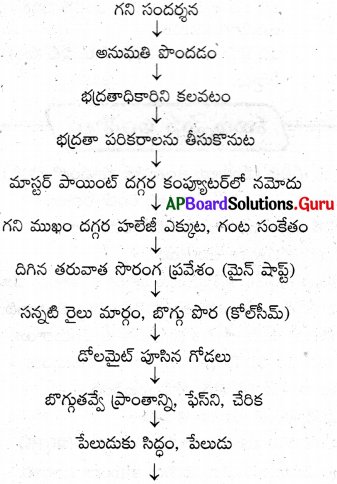
భూగర్భగని సందర్శనని చూపించే ఫ్లో చార్టు తయారుచేయండి. (AS1)
జవాబు:
AP Board 8th Class Social Solutions Chapter 6 ఖనిజాలు, గనుల తవ్వకం 1
AP Board 8th Class Social Solutions Chapter 6 ఖనిజాలు, గనుల తవ్వకం 2

ప్రశ్న 2.
గనులలో పని చేస్తున్నప్పుడు ఉద్యోగులు ఎదుర్కొనే ప్రధాన ఆరోగ్య సమస్యలు, ముందు జాగ్రత్తలు, గని కార్మికుల రక్షణ కోసం తీసుకోవాల్సిన జాగ్రత్తలు అన్న శీర్షికతో పట్టిక తయారుచేయండి. (AS3)
జవాబు:
గనులలో పని చేస్తున్నప్పుడు, ఉద్యోగంలో ఉన్నప్పుడు ప్రధాన ఆరోగ్య సమస్యలు, ముందు జాగ్రత్తలు, గని కార్మికుల రక్షణ కోసం తీసుకోవాల్సిన జాగ్రత్తలు :-

గనులలో పనిచేసే వారికి ప్రధానంగా ఊపిరితిత్తుల సమస్యలు తలెత్తుతాయి. రెండవది మోకాళ్ళ నొప్పులు ఎక్కువగా వస్తాయి. కళ్ళ సమస్యలు కూడా ఎక్కువగా వస్తాయి, ఇవే కాకుండా ఏవేనీ ప్రమాదాలు జరిగినపుడు అనుకోని సమస్యలు తలెత్తుతాయి.

ఉద్యోగంలో ఉన్నవారికి వారి వారి వృత్తిని బట్టి, చేసే పనులను బట్టి వారికి వ్యాధులు వస్తాయి.

ఉదా : ఉపాధ్యాయులకు గొంతు సమస్యలు, డ్రైవర్లకు – కీళ్ళ, కళ్ళ సమస్యలు, బరువులు మోసే వారికి, వెన్నుపూస సమస్యలు.

కొంత మందికి వారికి ఉన్న ఒత్తిడుల మూలంగా అనేక రకాల మానసిక సమస్యలు కూడా రావడానికి అవకాశం ఉన్నది. వీరు నిత్య జీవితంలో ప్రాణాయామం , ధ్యానం, నడక వంటి యోగసాధనలు రోజుకి ఒక గంట చేసినట్లయితే -వీటిని అధిగమించవచ్చును.

గనులలో పనిచేసేవారు ముక్కుకి మాస్క్ లాంటిది పెట్టుకోవాలి. కాళ్ళకు బూట్లు, చేతులకు తొడుగులు వేసుకోవాలి. గనిలో పనిచేసే యంత్రాలను రోజూ పరీక్ష చేసి సరిగా ఉన్నాయని నిర్ధారించుకోవాలి. ముఖ్యంగా డాక్టర్లు, ఆక్సిజన్ సిలిండర్లు వారికి అందుబాటులో ఉండాలి.

AP Board 8th Class Social Solutions Chapter 6 ఖనిజాలు, గనుల తవ్వకం

ప్రశ్న 3.
జానకి ప్రస్తుతం వ్యవసాయ కూలిగా పని చేస్తోంది. ఆమెకు గని కార్మికురాలు కావాలని ఉంది. ఆమె పనిలో ఎటువంటి మార్పులు వస్తాయో, ఉపాధిరంగ చిత్రం, ఆరోగ్య సమస్యలు వంటివి ఆమెకు వివరించండి. (AS1)
జవాబు:
“జానకీ, ఇప్పటి వరకూ మీరు పనిచేసిన రంగం వేరు. గని రంగం వేరు. ఇవి షిప్టు వేళలలో పనిచేస్తాయి. అంటే రాత్రి వేళల్లో కూడా పనిచేయాల్సి రావచ్చు. ఒక స్త్రీగా మికది ఇబ్బందికరమేమో ఆలోచించండి. ఇప్పుడు మీరు పచ్చటి పొలాలలో పరిశుద్ధమయిన వాతావరణంలో పనిచేస్తున్నారు. కాని అపుడు దుమ్ము, ధూళిలో పనిచేయాల్సి వస్తుంది. తలకి, చేతులకి, కాళ్ళకి ఏదో ఒకటి ధరించాల్సి వస్తుంది. ముఖ్యంగా పేలుడు పదార్థాలతో పనిచేయాల్సి వస్తుంది. కొద్ది కాలం తరువాత ఊపిరితిత్తుల వ్యాధులు వచ్చే అవకాశం ఉంది. కాబట్టి మీరు ఆలోచించుకుని నిర్ణయం తీసుకుంటే బాగుంటుంది. మీకు మేలు జరుగుగాక.. ఉంటాను”.

ప్రశ్న 4.
గనులలో యంత్రాలు, మానవ శ్రమ వినియోగించేటప్పుడు కార్మికుల అవసరంలో తేడాలను పేర్కొనండి. (AS1)
జవాబు:
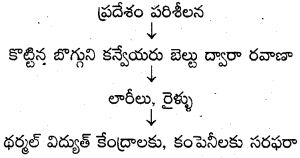
గనులలో యంత్రాలు లేనపుడు మానవశ్రమ అధికంగా అవసరమవుతుంది. యంత్రాలున్నపుడు మానవశ్రమ తగ్గుతుంది. ఉదా : ఇది వరకు బొగ్గు గనుల్లో త్రవ్విన బొగ్గును, లిఫ్టుకు చేర్చడానికి తోపుడు బండ్లను వాడేవారు. వాటిని శ్రామికులే నడిపేవారు. కాని ఇప్పుడు ఆ బొగ్గును కన్వేయరు బెల్టుపై పంపుతున్నారు. దీని వలన అక్కడ శ్రామికుల అవసరం తగ్గింది. ఇలా అనేక యంత్రాలను వినియోగించడం మూలంగా ఇటీవల గనులలోకి క్రొత్త శ్రామికులను చేర్చుకోవడం తగ్గిందని చెప్పవచ్చు.

ప్రశ్న 5.
దేశ ఆర్థిక పరిస్థితికి గనుల తవ్వకం దోహదం చేసిన దానిని ఈ అధ్యాయంలో ఎలా గుర్తించారు? (AS1)
జవాబు:
భారతదేశం స్వతంత్ర్యం వచ్చే నాటికి వెనుకబడిన ఆర్థిక వ్యవస్థ. ఈ గనుల త్రవ్వకం మొదలు పెట్టిన తరువాత ప్రభుత్వానికి ఆదాయము లభించింది. వీటిని కౌలుకిచ్చిన తరువాత కూడా ప్రభుత్వానికి ఆదాయం లభిస్తోంది. ఇందువలన ఆర్థిక పరిస్థితికి గనుల తవ్వకం దోహదం చేసిన దానిని నేను ఈ అధ్యాయంలో గుర్తించాను.

ప్రశ్న 6.
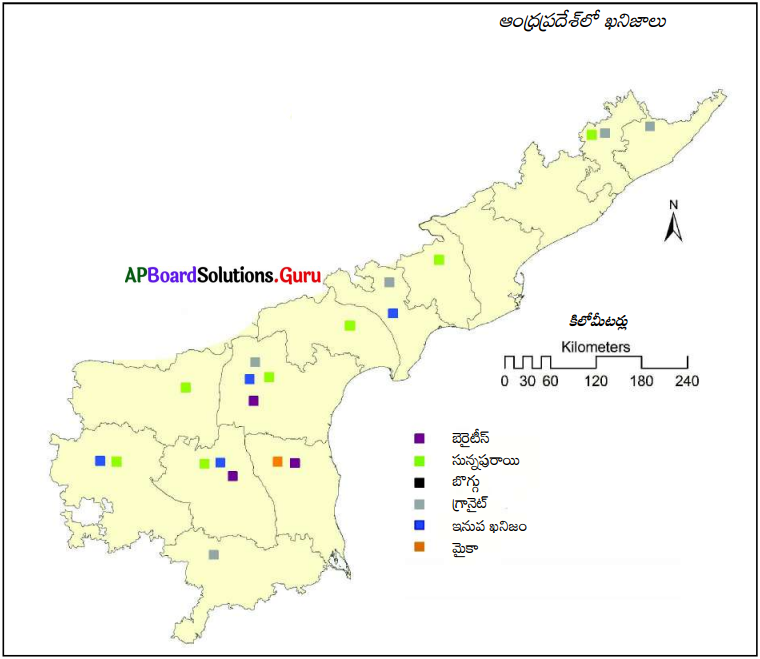
“ఆంధ్రప్రదేశ్ లో ఖనిజాలు” పటాన్ని చూసి ఏ జిల్లాలో ఏ ఖనిజాలు ఉన్నాయో గుర్తించండి. (AS5)
AP Board 8th Class Social Solutions Chapter 6 ఖనిజాలు, గనుల తవ్వకం 3
జవాబు:
మాది …………… జిల్లా : మా జిల్లాలో …………… ఖనిజాలు ఉన్నాయి.

ప్రశ్న 7.
“ఖనిజాలు ఎవరికి చెందుతాయి” అనే పేరాను చదివి కింది ప్రశ్నకు సమాధానం రాయండి. “ఖనిజ వనరులు ఏ ఒక్కరికీ చెందినవి కావు. ఇవి అందరి సంపద.” దీనిని ఏ విధంగా మీరు సమర్ధిస్తారు? (AS2)

ఖనిజాలు సాధారణంగా భూమి లోపలి పొరల్లో ఉంటాయి. ఇవి ఏ ఒక్క వ్యక్తికి చెందవు. ఇవి దేశ ప్రజలందరికీ చెందుతాయి. వీటిని అందరి ప్రయోజనం కోసం ఉపయోగించాలి. అందుకే దేశంలోని యావత్తు ఖనిజ సంపదను ఆ దేశ ప్రభుత్వ ఆస్తిగా భావిస్తారు. దేశంలోని ప్రజలందరి ప్రయోజనాలను దృష్టిలో ఉంచుకుని ప్రభుత్వం ఆ ఖనిజాలను వినియోగిస్తుంది.
జవాబు:
భూమి లోపల దొరికే వస్తువులన్నీ ప్రభుత్వానికి అంటే ప్రజలకి చెందుతాయి. అయితే ఇవి ఏ వ్యక్తికో చెందవు. ఇవి దేశ ప్రజలందరికీ చెందుతాయి. అందరి ప్రయోజనం కోసం ఉపయోగించాలి. అందుకే దేశంలోని ప్రజలందరి ప్రయోజనాలను దృష్టిలో ఉంచుకుని ప్రభుత్వం ఆ ఖనిజాలను వినియోగిస్తుంది.

ప్రశ్న 8.
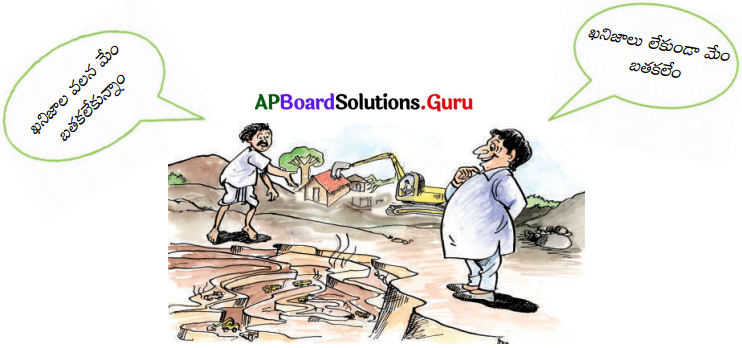
ఈ క్రింది చిత్రాన్ని గమనించండి. ఇద్దరు వ్యక్తులు రెండు రకాలుగా వ్యాఖ్యానాలు చేస్తున్నారు. వాళ్ళు గనుల తవ్వకంలో ఏ విషయంపై మాట్లాడుతున్నారు? (AS1)
AP Board 8th Class Social Solutions Chapter 6 ఖనిజాలు, గనుల తవ్వకం 4
జవాబు:
ఖనిజాల వలన మేం బతకలేకున్నాం :
ఈ వ్యాఖ్యానం చేసిన వ్యక్తి, గనుల తవ్వకం మూలంగా తన ఇంటిని, న బ్రతకలేకున్నాం బ్రతకలేం స్థలాన్ని పోగొట్టుకుంటున్నాడు. వారి జీవితాలు అస్తవ్యస్త మవుతున్నాయి. అందువలన అలా వ్యాఖ్యానించాడు.

ఖనిజాలు లేకుండా మేం బతకలేం :
ఈ వ్యాఖ్యానం చేసిన వ్యక్తి ప్రభుత్వం ద్వారా గనిని కౌలుకి తీసుకున్న వ్యక్తి. ఇతనికి ఖనిజాలు, గనులు లేకపోతే సంపద ఉండదు. అందువలన అలా వ్యాఖ్యానించాడు.

ప్రశ్న 9.
ఖనిజాలు దేశాభివృద్ధికి ఏ రకంగా తోడ్పడుతున్నాయి?
(లేదా)
ఖనిజాల వలన కలిగే ఉపయోగాలు ఏవి? (AS6)
జవాబు:
ఖనిజాలు దేశ సంపద. వీటిని ఎగుమతి చేయడం ద్వారా విదేశీ మారకద్రవ్యము ఆర్జించవచ్చు. ఖనిజాలు త్రవ్వేచోట వేలాదిమందికి ఉపాధి లభిస్తుంది. వీటిని శుద్ధి చేసి వివిధ వస్తువులు, ఉత్పత్తులు తయారుచేసే పరిశ్రమల ద్వారా ప్రజలకు ఉపాధి లభించడమే గాక జాతీయాదాయం కూడా పెరుగుతుంది. ఖనిజాలు, పరిశ్రమలు గల ప్రాంతాలలో రవాణా, కమ్యూనికేషన్ వ్యవస్థ మెరుగుపడుతుంది. యురేనియం వంటి ఖనిజాలు అణుశక్తిగా ఉపయోగపడతాయి. ఈ రకంగా ఖనిజాలు దేశ సంపదను అభివృద్ధి చేస్తాయి.

AP Board 8th Class Social Solutions Chapter 6 ఖనిజాలు, గనుల తవ్వకం

ప్రశ్న 10.
వివిధ ఖనిజాలు, వాటి ఉపయోగాలను తెలిపే పట్టికను తయారుచేయండి. (AS3)
జవాబు:

ఖనిజము ఉపయోగాలు
1) ఇనుప ధాతువు (ముడి ఇనుము) హెమటైట్ మరియు మాగ్నటైట్ ఇనుప ధాతువులను ఉక్కు, ఫెలిటైజేషన్, స్పాంజ్ ఐరన్, పిగ్ ఐరన్ పరిశ్రమలలో ఉపయోగిస్తారు.
2) మైకా (అభ్రకం) విద్యుత్, ఎలక్ట్రానిక్ పరిశ్రమలలో విస్తృతంగా ఉపయోగిస్తారు.
3) గ్రానైట్ దీనిని కోత (కటింగ్) మరియు పాలిష్ పరిశ్రమలలో అలంకరణ స్మారక కట్టడాలలో, నేలను నునుపు చేసే సామానులలో ఉపయోగిస్తారు.
4) మాంగనీస్ దీనిని పొటాషియం పర్మాంగనేట్, ఇనుము మిశ్రమ లోహాలలోనూ ఇనుము – ఉక్కు బ్యాటరీలు, రసాయనాలు, పింగాణి (సిరామిక్స్) గాజు పరిశ్రమలలో ఉపయోగిస్తారు.
5) బెరైటీస్ పారిశ్రామిక, వైద్య అవసరాల కోసం వాడతారు.
6) ఫెల్డ్ స్పార్ గాజు, సిరామిక్ వస్తువులు తయారు చేస్తారు.

8th Class Social Studies 6th Lesson ఖనిజాలు, గనుల తవ్వకం InText Questions and Answers

8th Class Social Textbook Page No.63

ప్రశ్న 1.
తనకు తానుగా పునరుద్ధరింపబడే ఖనిజం ఒకటి చెప్పండి. ఈ ప్రక్రియలో మనం ఎలా సహాయపడగలం?
జవాబు:
భూగర్భజలం ఒక పునరుద్ధరింపబడే ఖనిజము. వీటిని పెంచడానికి మనం ఈ క్రింది పనులు చేయాలి.

  1. ఇంకుడు గుంటలు త్రవ్వాలి.
  2. వర్షపు నీరు వృథాగా పోకుండా భూమిలోకి యింకి పోయేలా చర్యలు తీసుకోవాలి.
  3. చెట్లు కూడా భూగర్భజలాలని పెంచుతాయి. కాబట్టి చెట్లను పెంచాలి.
  4. పొలాల్లో ఉన్న మిగులు నీటిని కూడా బయటకు పారించి, వాటిని భూమిలోకి ఇంకేలా చేయవచ్చు.
  5. ఉపయోగించని డ్రెయిన్లలో నీరు పారించి, దానికి అడ్డు గేట్లను నిర్మించినట్లయితే అక్కడ నీరు నిదానంగా పారి, నేలలోకి ఇంకుతుంది.

ప్రశ్న 2.
మనం వాడుతున్నా తరిగిపోని, మనం ఏమి చేయకపోయినా పునరుద్ధరింపబడే శక్తి వనరు ఏదో చెప్పండి.
జవాబు:
గాలి

AP Board 8th Class Social Solutions Chapter 6 ఖనిజాలు, గనుల తవ్వకం

ప్రశ్న 3.
రైళ్ళు, కార్లు నడపటానికి వీలులేని ప్రపంచాన్ని మీరు ఊహించండి.
జవాబు:
రైళ్ళు, కార్లు కనిపెట్టని రోజుల్లో పరిస్థితి వేరుగా ఉండేది. కాని అవి ఉండి నడపడానికి వీలులేని పరిస్థితి చాలా దారుణంగా ఉంటుంది. ప్రపంచంలో దూరాలు బాగా పెరుగుతాయి. జీవితం నల్లేరు మీద నడకలా ఉంటుంది.

8th Class Social Textbook Page No.64

ప్రశ్న 4.
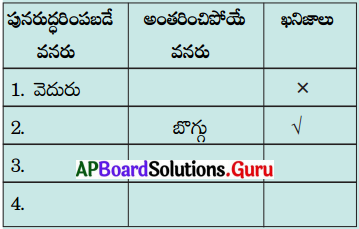
కింద ఇచ్చిన సహజ వస్తువులను పునరుద్ధరింపబడేవి, అంతరించిపోయేవిగా వర్గీకరించండి.
ఖనిజం అయితే టిక్కు (✓) పెట్టండి, కాకపోతే ఇంటూ (✗) పెట్టండి : వెదురు, బొగ్గు, సముద్రపు నీరు, మట్టి, చీమలు, ఇసుక, ఇనుప ఖనిజం, వజ్రాలు, చెట్లు, ముడి చమురు, గడ్డి, గాలి, పాలరాయి, చేపలు, బావినీళ్లు, సూర్యకాంతి.
AP Board 8th Class Social Solutions Chapter 6 ఖనిజాలు, గనుల తవ్వకం 5
జవాబు:

పునరుద్ధరింపబడే వనరు అంతరించిపోయే వనరు ఖనిజాలు
1. వెదురు
2. బొగ్గు
3. సముద్రపు నీరు
4. చీమలు
5. మట్టి
6. ఇసుక
7. ఇనుప ఖనిజం
8. వజ్రాలు
9. చెట్లు
10. ముడిచమురు
11. గడ్డి
12. గాలి
13. పాలరాయి
14. చేపలు
15. బావినీరు
16. సూర్యకాంతి

ప్రశ్న 5.
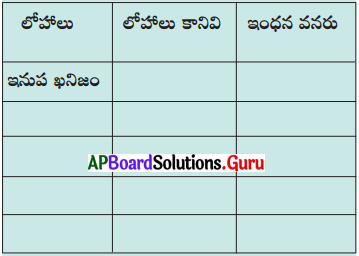
కింద ఇచ్చిన ఖనిజాలను లోహాలు, లోహాలు కాని వాటిగా వర్గీకరించి, ఇంధన వనరులను పేర్కొనండి : ఇనుప ఖనిజం, బాక్సెట్ (అల్యూమినియం ఖనిజం), బొగ్గు, రాగి ఖనిజం, సున్నపురాయి, జిప్సం, మైకా, భూగర్భ జలాలు, ముడి చమురు, సైంధవ లవణం, ఇసుక, వజ్రపు రాళ్లు,
AP Board 8th Class Social Solutions Chapter 6 ఖనిజాలు, గనుల తవ్వకం 6
జవాబు:

లోహాలు లోహాలు కానివి ఇంధన వనరు
ఇనుప ఖనిజం బొగ్గు బొగ్గు
బాక్సెటు సున్నపురాయి ముడిచమురు
రాగి భూగర్భ జలాలు
ముడిచమురు
సైంధవ లవణం
ఇసుక
వజ్రపు రాళ్ళు
జిప్సం
మైకా

8th Class Social Textbook Page No.66

ప్రశ్న 6.
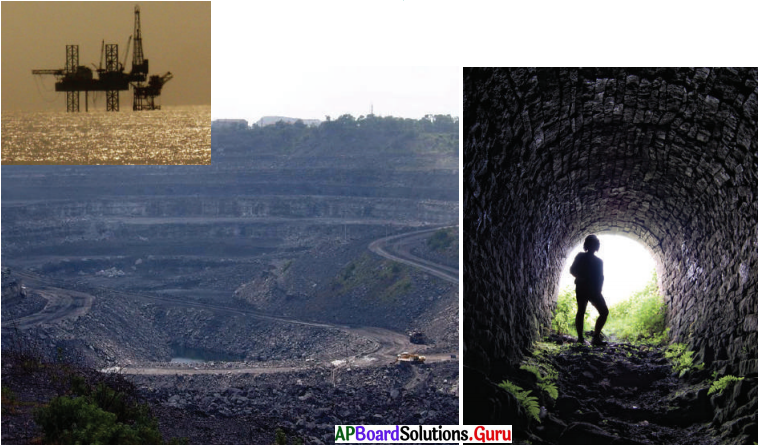
కింద చిత్రాలు చూసి వాటిల్లో ఏది ఓపెన్ కాస్ట్ గనుల తవ్వకమో, భూగర్భ తవ్వకమో, చమురు కోసం బోరు బావుల తవ్వకమో చెప్పండి.
జవాబు:
AP Board 8th Class Social Solutions Chapter 6 ఖనిజాలు, గనుల తవ్వకం 7
చమురు కోసం బోరు బావుల తవ్వకం – ఓపెస్ట్ గనుల తవ్వకం – భూగర్భ తవ్వకం.

8th Class Social Textbook Page No.67

ప్రశ్న 7.
ఖనిజాలను ప్రభుత్వం ఎలా వినియోగించుకుంటుంది?
జవాబు:

  1. 1970లలో ప్రభుత్వం గనులన్నింటినీ జాతీయం చేసింది.
  2. దీని ద్వారా ప్రభుత్వం గనుల త్రవ్వకాన్ని తానే నిర్వహించడమో లేదా లీజుకిచ్చి వారి నుంచి సొమ్ము తీసుకోవడమో చేస్తుంది.
  3. వీటి ద్వారా వచ్చిన ఆదాయాన్ని ప్రభుత్వం ప్రజోపయోగానికి, అభివృద్ధి పనులకు వెచ్చిస్తుంది.

ప్రశ్న 8.
మీ ప్రాంతంలో గనుల తవ్వకం జరుగుతూ ఉంటే అక్కడ పనిచేసే, నివసించే ప్రజల గురించి తెలుసుకోండి. చుట్టుపక్కల వాతావరణాన్ని గనుల తవ్వకం ఎలా ప్రభావితం చేస్తుందో తెలుసుకోండి. గనుల తవ్వకం వల్ల ఎంత మంది ప్రయోజనం , పొందుతున్నారో తెలుసుకోండి.
జవాబు:
మాది వై.యస్.ఆర్ కడప జిల్లాలో మంగంపేట. ఇక్కడ బెరైట్ ఖనిజ నిల్వలు ఉన్నాయి. వీటిని 1960లో కనుగొన్నారు. 1967 నుంచి దీని తవ్వకం కొనసాగుతుంది. ఈ గ్రామంలో ‘1200 కుటుంబాలు ఉండేవి. వీరిని కొత్త ప్రాంతానికి తరలించి ఆంధ్రప్రదేశ్ ఖనిజ అభివృద్ధి కార్పొరేషన్ (ప్రభుత్వరంగ కంపెనీ – ఎస్ఎండిసి) వారికి పునరావాసం కల్పించింది. ఈ గనులు ఈ కంపెనీకి చెందుతాయి. ఇందులో పనిచేసే కార్మికుల, ఉద్యోగస్టులు, స్థానిక ప్రజల కోసం NMDC చెట్లు నాటించడం లాంటి పర్యావరణ పరిరక్షణ కార్యక్రమాలను చేపడుతుంది. మా నాన్నగారి పేరు R. ఈశ్వరరావు. ఆయన ఇక్కడ G.M. ఆఫీసులోనే పనిచేస్తున్నాడు. ఇక్కడ పనిచేసే వారంతా కలిసి మెలిసి ఉంటారు.

8th Class Social Textbook Page No.68

ప్రశ్న 9.
a) మన ఖనిజాలను తవ్వడానికి ప్రైవేటు కంపెనీలను అనుమతించటంలోని లాభ, నష్టాలను చర్చించండి.
b) వాటిని ఎలా నియంత్రించవచ్చు?
c) పర్యావరణ సమస్యలు తలెత్తకుండా ఏమి చేయవచ్చు?
జవాబు:
a) 1. 1993లో కొత్త జాతీయ ఖనిజ విధానాన్ని ప్రభుత్వం ప్రకటించింది.
2. దీని ద్వారా గనులను ప్రైవేటు వారికి కౌలుకిచ్చి వాటిలో త్రవ్వకాలు నిర్వహించమంది.
లాభాలు :
గనుల తవ్వకం మీద ప్రభుత్వానికి నియంత్రణాధికారం ఉంటూనే, కొంత ఆదాయం సమకూరుతోంది. అదే సమయంలో పెట్టుబడులు పెట్టి కొత్త సాంకేతిక విజ్ఞానం తీసుకుని రావడానికి ప్రైవేటు కంపెనీలకు ప్రోత్సాహం లభిస్తుంది. ఈ విధానం ఫలితంగా గత 20 సం||రాలలో గనుల తవ్వకం ఊపందుకుంది. గనుల సంఖ్య, తవ్వి తీసే ఖనిజాలు, ఉపాధి ఈ రంగంలో పెరిగాయి.

నష్టాలు :
ప్రభుత్వ అనుమతిని లెక్క చేయకుండా ప్రయివేటు కంపెనీలు అడ్డూ అదుపు లేకుండా గనులను తవ్వేస్తున్నాయి. ఎక్కువ మొత్తంలో గనుల తవ్వకం వల్ల దీర్ఘకాల సుస్థిరతకు భంగం వాటిల్లుతుంది. ప్రభుత్వానికి రాయల్టీ చెల్లించకుండా ప్రైవేటు కంపెనీలు ఖనిజాలను తరలించి వేస్తున్నాయి. నిజంగా అవి చెందాల్సిన ‘ప్రజలకు చెందటం లేదు’.

b) గనులు ప్రభుత్వ ఆధీనంలోనే ఉంచాలి. లేదా ప్రైవేటు వారికిచ్చినపుడు ఉన్నత స్థాయి అధికారుల అజమాయిషీ. – స్థానికుల పర్యవేక్షణ దానిపై ఉండేలా చర్యలు తీసుకోవాలి.

c) గనులను కౌలుకిచ్చేటప్పుడు, భూగర్భ గనులను తవ్వేవారికే ఎక్కువ ప్రాధాన్యతనివ్వాలి. తవ్వగా ఏర్పడిన గోతులను, గుట్టలను సరిచేయాలి. ఇసుక లాంటి వాటిలో ఎక్కువ తవ్వకుండా పర్యవేక్షణ ఉండాలి.

AP Board 8th Class Social Solutions Chapter 6 ఖనిజాలు, గనుల తవ్వకం

ప్రశ్న 10.
ప్రజలందరూ ఖనిజ వనరుల అసలైన యజమానులు అయితే వాళ్ళందరి మేలు కోసం వీటిని ఉపయోగించుకోవడం ఎలా?
జవాబు:
వీటి ద్వారా వచ్చిన ఆదాయాన్ని రవాణా సౌకర్యాల అభివృద్ధికి, ప్రజారోగ్య వసతులకు, విద్యకు, ఇతర సబ్సిడీలకు ఉపయోగించాలి. అపుడు ప్రజలందరి మేలు కోసం ఉపయోగించినట్లవుతుంది.

ప్రశ్న 11.
రానున్న తరాలకు, అంటే మన పిల్లలు, వాళ్ళ పిల్లలకు కూడా ఈ వనరులు ఉండాలా, వద్దా? ఈ వనరులు అంతరించి పోకుండా వాళ్ళకి కూడా అందేలా ఎలా చూడగలం?
జవాబు:
రానున్న తరాలకు కూడా ఈ వనరులు ఉండాలి. ఇవి వారికి అందాలంటే మనం ప్రత్యామ్నాయ ఇంధన వనరులను వాడుకోవాలి. అలాగే కొన్ని వనరుల వాడకాన్ని నిర్దిష్ట శాతం మాత్రమే ఉండేలా చూడాలి. లేకుంటే ఇవి నిజంగానే భవిష్యత్తులో అంతరించిపోతాయి.

8th Class Social Textbook Page No.69

ప్రశ్న 12.
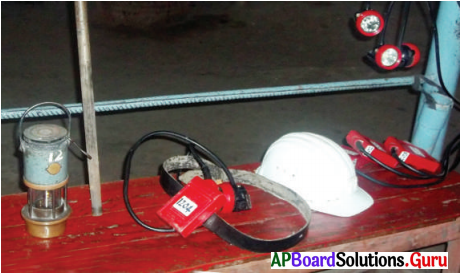
ఈ పరికరాలు ఏమిటో చెప్పండి.
AP Board 8th Class Social Solutions Chapter 6 ఖనిజాలు, గనుల తవ్వకం 8
జవాబు:
ఇవి గనిలో కార్మికుల భద్రత కోసం ఉపయోగించే పరికరాలు. అవి కర్ర, హెల్మెట్, లాంతరు మొదలైనవి.

ప్రశ్న 13.
కర్ర ఉపయోగం ఏమిటి?
జవాబు:
పేలుడు జరిగిన తరువాత, ఆ ప్రాంతం ఎలా ఉంది అని పరిశీలించడానికి అక్కడ కర్రతో తడుతూ ముందుకెళతారు. బొగ్గు వదులుగా ఉన్నచోట దుంగలు, ఇనుపరాడ్లు పెట్టి నిలబెడతారు.

AP Board 8th Class Social Solutions Chapter 6 ఖనిజాలు, గనుల తవ్వకం

ప్రశ్న 14.
హెల్మెట్ పై దీపం ఎందుకు ఉంది?
జవాబు:
గనిలో చాలా చీకటిగా ఉంటుంది. ఒక వ్యక్తి సంచరించే ప్రాంతంలో ముందు వైపు వెలుగు కోసం హెల్మెట్ పై దీపం ఉంటుంది.

ప్రశ్న 15.
చిత్రంలోని లాంతరును గుర్తించారా ? ఇది ఎందుకు ఉపయోగపడుతుంది?
జవాబు:
ఈ లాంతరు గనిలోనికి తీసుకువెళతారు. ఏమైనా విషవాయువులు గనిలో వెలువడినట్లయితే ఈ లాంతరు ద్వారా ఆ సంగతిని తెలుసుకుని జాగ్రత్త పడతారు.

ప్రశ్న 16.
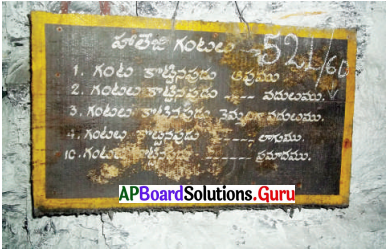
కింద ఇచ్చిన హామీ పత్రం చూడండి. ఏఏ షరతులకు మేం అంగీకరించవలసి వచ్చింది?
AP Board 8th Class Social Solutions Chapter 6 ఖనిజాలు, గనుల తవ్వకం 9
జవాబు:
ప్రమాదం జరిగే అవకాశం ఉంది కాబట్టి దానిని అంగీకరించాల్సి వచ్చింది. తగిన జాగ్రత్తలు, పాటిస్తామని, ప్రమాదాలు జరిగినపుడు, భద్రతా పెట్టిలోని పరికరాలతో ఎదుర్కొంటామని అంగీకరించాల్సి వచ్చింది.

8th Class Social Textbook Page No.73

ప్రశ్న 17.
ఈ సమస్యను ఎలా పరిష్కరించవచ్చు ? పర్యావరణం, భూములను నష్టపరుస్తూ, జీవనోపాధులు నష్టపోయేలా చేస్తూ తక్కువ ఖర్చుతో బొగ్గుతవ్వకం చేపట్టటం సమంజసమైనదేనా?
జవాబు:
a) విద్యుత్తు ఉత్పత్తికి ప్రత్యామ్నాయ వనరులను (ఉదా: సముద్రపు నీరు, సూర్యకాంతి) ఉపయోగించే విధానాలను కనిపెట్టడం, కని పెట్టిన వాటిని అమలు పరచడం ద్వారా ఈ సమస్యను పరిష్కరించవచ్చు.
b) ఇది సమంజసం కాదు. దీనివలన ప్రభుత్వరంగ సంస్థలకి, ప్రైవేటు సంస్థలకి తేడా లేకుండా పోయిందని నేను భావిస్తున్నాను.

8th Class Social Textbook Page No.75

ప్రశ్న 18.
బొగ్గుగనుల తవ్వకాన్ని, మంగంపేటలో గనుల తవ్వకాన్ని పోల్చండి. పోలికలు, తేడాలు ఏమిటి?
జవాబు:
పోలికలు:

  1. రెండూ నేల నుండి తవ్వి తీయబడేవే.
  2. ఇవి రెండూ ప్రభుత్వ పర్యవేక్షణలోనే ఉన్నాయి.
  3. వీటిని అవసరమైన చోట డిటోనేటర్ల సహాయంతో పేలుస్తారు.
  4. నాణ్యత కోసం లోపలి పొరల వరకూ వెళతారు.
  5. కార్మికుల భద్రత కోసం చర్యలు చేపడతారు.

తేడాలు :

బొగ్గు గనుల తవ్వకం మంగం పేటలో గనుల తవ్వకం
1. ఇవి అనేక చోట్ల ఉన్నాయి. 1. ఇవి ఒకే చోట ఉన్నాయి.
2. వీటిలో వేల సంఖ్యలో కార్మికులు, ఉద్యోగస్థులు ఉన్నారు. 2. వీటిలో వందల సంఖ్యలో మాత్రమే ఉన్నారు.
3. ఈ గనులు భూగర్భ, ఓపెన్ కాస్ట్ అని రెండు రకాలు. 3. ఇవి ఓపెన్ కాస్ట్ మాత్రమే.
4. ఈ గనుల లోపల పురుషులు మాత్రమే పని చేస్తారు. 4. వీటిలో స్త్రీలు కూడా పనిచేస్తారు.
5. స్వాతంత్ర్యం రాకముందు నుండి ఈ గనులు తవ్వబడుతున్నాయి. 5. 1967 నుండి ఈ తవ్వకాలు మొదలయ్యా యి.

పట నైపుణ్యాలు

ప్రశ్న 19.
ఆంధ్రప్రదేశ్ ఖనిజాల పటం చూసి క్రింది పట్టిక నింపండి.
AP Board 8th Class Social Solutions Chapter 6 ఖనిజాలు, గనుల తవ్వకం 3
జవాబు:

జిల్లా ఖనిజం
1. శ్రీకాకుళం బెరైటీస్
2. విజయనగరం సున్నపురాయి, బెరైటీస్
3. పశ్చిమ గోదావరి సున్నపురాయి
4. కృష్ణా గానైట్, ఇనుప ఖనిజం
5. గుంటూరు సున్నపురాయి
6. ప్రకాశం సున్నపురాయి, గ్రానైట్, ఇనుప ఖనిజం, బెరైటీస్
7. నెల్లూరు మైకా, బెరైటీస్
8. చిత్తూరు గ్రానైట్
9. అనంతపూర్ సున్నపురాయి, ఇనుప ఖనిజం
10. కర్నూలు సున్నపురాయి
11. కడప సున్నపురాయి, బెరైటీస్, ఇనుప ఖనిజం


AP Board 8th Class Social Solutions Chapter 1 పటాల అధ్యయనం – విశ్లేషణ

SCERT AP 8th Class Social Study Material Pdf 1st Lesson పటాల అధ్యయనం – విశ్లేషణ Textbook Questions and Answers.

AP State Syllabus 8th Class Social Solutions 1st Lesson పటాల అధ్యయనం – విశ్లేషణ

8th Class Social Studies 1st Lesson పటాల అధ్యయనం – విశ్లేషణ Textbook Questions and Answers

Improve your learning (మీ అభ్యసనాన్ని మెరుగుపడుచుకోండి)

ప్రశ్న 1.
మీ పాఠశాలలోని అట్లాస్ లో వివిధ విషయ నిర్దేశిత పటాలను క్షుణ్ణంగా అధ్యయనం చేయండి. (AS2)
జవాబు:
స్వయం అధ్యయనం

ప్రశ్న 2.
ప్రాచీన గ్రీకుల కాలం నాటికి, నేటికి పటాల వినియోగంలో మార్పులు వచ్చాయని భావిస్తున్నారా? పోలికలు, తేడాలు కింది పట్టికలో పొందుపరచండి. (AS1)

విషయం ప్రాచీన గ్రీకుల కాలంలో ప్రస్తుతం
పోలికలు
తేడాలు

జవాబు:

విషయం ప్రాచీన గ్రీకుల కాలంలో ప్రస్తుతం
పోలికలు వారు అక్షాంశాలు, రేఖాంశాలు ఊహించి, వాటి సహాయంతో పటాలను కచ్చితంగా గీయడానికి ప్రయత్నించేవారు. నేడు ఉపగ్రహాల సహాయంతో పటాలను  ఒంపులతో సహా కచ్చితంగా గీస్తున్నారు.
తేడాలు పటాలు నావికులకు ఉపయోగపడటానికి రచించే వారు. వర్తక, వ్యాపార అభివృద్ధికి కూడా ఉపయోగించేవారు. తేడాలు నేడు పటాలను ప్రణాళికల కొరకు, దేశాభివృద్ధికి, వ్యూహరచనకు ఉపయోగిస్తున్నారు.

AP Board 8th Class Social Solutions Chapter 1 పటాల అధ్యయనం - విశ్లేషణ

ప్రశ్న 3.
వలసపాలకులు తుపాకుల ద్వారా కంటే పటాలు తయారు చేయడం ద్వారా ఆ ప్రాంతాలను బాగా దోచుకోగలిగారని, అదుపులో ఉంచగలిగారని చాలామంది భావిస్తారు. మీరు దీంతో ఏకీభవిస్తారా? కారణాలను తెలపండి. (AS1)
జవాబు:
అవును. నేను కూడా దీనితో ఏకీభవిస్తాను. ఇందుకు గల కారణాలు :

  1. ఐరోపా దేశాలు ఇతర ప్రపంచ దేశాలను తమ వలసలుగా మార్చుకోవడంతో, ఆ ప్రాంత వివరాలను తెలుసు కోవలసిన అవసరం ఏర్పడింది.
  2. వీరు పటాలను తయారుచేసేవారిని శాస్త్రబృందాలతో కలిపి ఆయా ప్రాంతాలకు పంపారు.
  3. వారు అక్కడ అన్ని ప్రాంతాలలోనూ ప్రయాణించి, శాస్త్రీయంగా అధ్యయనం చేసి పటాలు రచించారు.
  4. ఆ పటాలు ఆ ప్రాంత రవాణా సౌకర్యాలు, పంటలు, ఇతర వనరుల సమాచారాన్ని వెల్లడి చేశాయి.
  5. వీటి ఆధారంగా వలసపాలకులు ఆయా ప్రాంతాలపై తమ పాలనను పటిష్టపరచుకొని అక్కడి వనరులను దోచుకున్నారు.

ప్రశ్న 4.
టాలమీ లేదా ఇద్రిసీ తయారుచేసిన పటాలకు బ్రిటిష్ వాళ్లు తయారుచేసిన పటాలకు గల తేడాలు ఏమిటి? (AS5)
జవాబు:

బ్రిటిష్ వారి పటాలు టాలమీ ఇద్రిసి పటాలు
1. వీరు పటాలను ఆ ప్రాంతాలను, ఆ ప్రాంతాలలోని వనరులను దోచుకోవడానికి తయారుచేశారు. 1. వీరు పటాలను వారి ఆసక్తి కోసం, వారి రాజుల కోసం తయారుచేశారు.
2. వీరి పటాలు వీరి వలసల సమాచారాన్ని అందిస్తున్నాయి. 2. వీరి పటాలు ఐరోపా ఖండాన్ని, దాని చుట్టుప్రక్కల దేశాల్ని చూపించాయి.
3. ఇవి నేటి పటాలకు, వాస్తవానికి దగ్గరగా ఉన్నాయి. 3. ఇవి వారి దేశాలను భూమికి మధ్యలో ఉంచాయి.
4. ఇవి పటానికి పైభాగాన ఉత్తరాన్ని సూచించాయి. 4. అల్ ఇద్రిసి పటము పైభాగాన దక్షిణాన్ని సూచించింది.

ప్రశ్న 5.
ఎనిమిదవ పేజిలోని “మన కాలంలో పటాల వినియోగం” అనే అంశం చదివి ప్రశ్నకు జవాబు రాయండి.
వ్యాపారం, నౌకాయానం, యుద్ధాలు, వలస ప్రాంతాలను ఏర్పరచుకోవటం వంటి వాటికోసం పటాలు తయారుచేసి ఉపయోగించారని మనం తెలుసుకున్నాం. నేటి కాలంలో దేశ అభివృద్ధికి, ప్రణాళికలు తయారు చేయటానికి పటాలను విస్తృతంగా వినియోగిస్తున్నారు. ఒక ప్రాంతంలోని వనరులు, ఆ ప్రాంతం ఎదుర్కొంటున్న సమస్యలు వంటివి ప్రణాళికలు తయారు చేసేవాళ్లకు తెలియాలి. పటాల ద్వారా ఈ విషయాలు తెలుస్తాయి. ఉదాహరణకు తాగునీటి సమస్య ఉన్న ప్రదేశాలను చూపించే పటాన్ని తయారు చేయవచ్చు. ఈ పటాన్ని నీటి వనరులైన వర్షపాతం, భూ గర్భజలాలు, నదుల పటాలతో పోల్చవచ్చు. ఈ పోలికల ఆధారంగా ఆ ప్రాంతం ప్రజలందరికీ తాగునీరు అందించటానికి బోరుబావులు తవ్వటం, నదులకు అడ్డంగా ఆనకట్టలు కట్టడం, చెరువులు తవ్వటం లేదా దూర ప్రాంతం నుంచి పైపుల ద్వారా నీటిని చేరవేయడం – వీటిలో ఏది ఉత్తమమైన విధానమో నిర్ణయించవచ్చు. అదే విధంగా పటాల సహాయంతో వ్యవసాయ అభివృద్ధికీ, కొత్తగా పరిశ్రమలు నెలకొల్పటానికీ, రోడ్డు వెయ్యటానికి, ఆసుపత్రులు, పాఠశాలల నిర్మాణానికి ప్రణాళికలు తయారు చెయ్యవచ్చు.
ప్రస్తుతం పటాలను వివిధ ఉద్దేశాలతో ఉపయోగిస్తున్నారు? అవి ఏవి? (AS1)
జవాబు:

  1. నేటి కాలంలో దేశాభివృద్ధికి, ప్రణాళికలు తయారుచేయటానికి పటాలను విస్తృతంగా ఉపయోగిస్తున్నారు.
  2. పటాల సహాయంతో వ్యవసాయ అభివృద్ధికి, కొత్తగా పరిశ్రమలు నెలకొల్పడానికి, రోడ్లు వేయడానికి, ఆసుపత్రులు, పాఠశాలల నిర్మాణానికి ప్రణాళికలు తయారుచేయవచ్చు.
  3. కంపెనీలు తమ వ్యాపార కార్యకలాపాలు రూపొందించుకోవడానికి పటాలు తయారుచేస్తాయి.

AP Board 8th Class Social Solutions Chapter 1 పటాల అధ్యయనం - విశ్లేషణ

ప్రశ్న 6.
వివిధ రకాల పటాలను గురించి తెలుసుకోవడానికి కొన్ని ప్రశ్నలను తయారుచేయండి. (AS5)
జవాబు:

  1. ప్రపంచంలో దేశాల సరిహద్దులతో ముద్రించిన పటాలనేమంటాం? (ప్రపంచం – రాజకీయ పటం)
  2. ప్రపంచంలోని వివిధ భూ స్వరూపాలతో ముద్రించిన పటాలను ఏమంటాం? (ప్రపంచం – భౌగోళిక పటం)
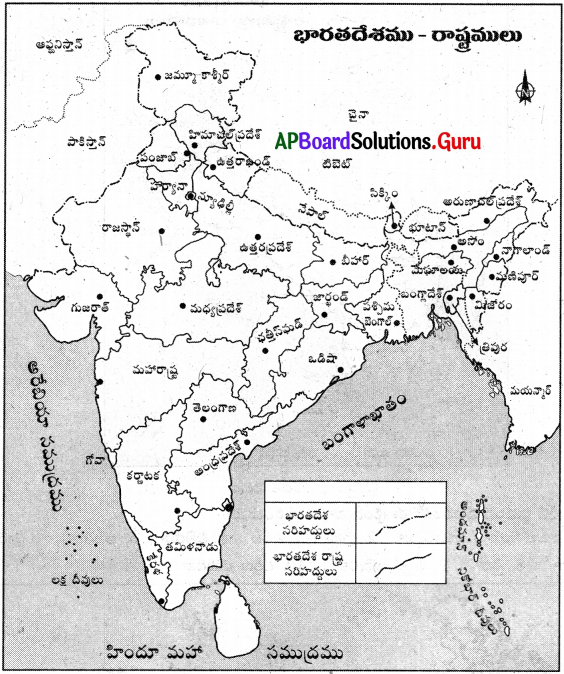
  3. భారతదేశంలోని రాష్ట్రాలను సూచించే పటాన్ని ఏమంటాం? (భారతదేశం – రాజకీయపటం)
  4. భారతదేశంలో రవాణా సౌకర్యాలను సూచించే మానచిత్రాన్ని ఏమంటారు? (భారతదేశం – రవాణా సౌకర్యాలు)
  5. మన గ్రామం – చిత్తు పటాన్నేమంటాం? (గ్రామం – స్కెచ్ పటం)
  6. అల్ ఇద్రిసి, దామింగ్ హయితు, మెర్కేటర్ రూపొందించిన పటాల విశిష్టత ఏమిటి?
  7. పవిత్ర బైబిలు ప్రకారం ప్రపంచనమూనా ఎట్లా ఉండేది?

8th Class Social Studies 1st Lesson పటాల అధ్యయనం – విశ్లేషణ InText Questions and Answers

8th Class Social Textbook Page No.6

ప్రశ్న 1.
ప్రాచీన కాలంలో పటాల తయారీని నావికులు ఏ విధంగా ప్రభావితం చేశారు?
జవాబు:
ప్రాచీన కాలంలో నావికులు విస్తృతంగా సముద్ర ప్రయాణాలు చేసేవారు. వారు సందర్శించిన భూమిని గురించి, కలిసిన వ్యక్తులను గురించి, విన్న చరిత్రను గురించి, పుస్తకాలను రచించేవారు. దానికి సంబంధించిన పటాలను కూడా తయారుచేసేవారు. అవి పెద్దగా ప్రాచుర్యంలోనికి రానప్పటికీ చరిత్రకారులు వాటిని ఉపయోగించి తిరిగి పటాలను తయారుచేసేవారు.

ప్రశ్న 2.
పటాలను తయారు చేసేవాళ్ళు తమ దేశాన్ని పటం మధ్యలో ఎందుకు ఉంచారు?
జవాబు:
పటాలను తయారు చేసేవారు వాటిని తయారుచేయటానికి నావికుల, అన్వేషకుల రచనల మీద ఆధారపడేవారు. అంతేకాక వీరు అమిత దేశభక్తులని చెప్పవచ్చు. వీరు తమ దేశం ప్రపంచానికి మూలమని, చాలా ముఖ్యమైనదని భావించేవారు. అందుకే వీరు తమ దేశాన్ని పటం మధ్యలో ఉంచారు.

8th Class Social Textbook Page No.8

ప్రశ్న 3.
పటాలు అందరికీ అందుబాటులో ఉండటం మంచిదేనా? ఎందుకు?
జవాబు:
పటాలు అందరికీ అందుబాటులో ఉండటం మంచిది కాదు అని నా అభిప్రాయము. ఏ దేశ ప్రభుత్వానికైనా కొంత రహస్యత అవసరము. దేశ రక్షణకు సంబంధించిన పటాలు శత్రువుల చేతిలో పడినట్లయితే వాటిని దుర్వినియోగం చేసే అవకాశం ఉంటుంది. దేశ భద్రతకు ముప్పు వాటిల్లుతుంది. కానీ ఈ రోజుల్లో ఉపగ్రహ ఛాయాచిత్రాలు అందరికీ అందుబాటులోకి వచ్చేస్తున్నాయి.

ప్రశ్న 4.
ఆసుపత్రి నెలకొల్పటానికి అనువైన ప్రాంతాన్ని ఎంచుకోవాలనుకుంటున్న వ్యక్తికి ఏ ఏ పటాలు అవసరమవుతాయి? జాబితా తయారుచేయండి.
జవాబు:

  1. ఆసుపత్రుల పటము
  2. లాబొరేటరీల పటము
  3. స్కానింగ్ సెంటర్ల పటము
  4. అనారోగ్యం ఎక్కువగా ఏ ప్రాంతంలో ఉందో చూపించే పటము
  5. బస్సు రవాణా పటము
  6. రైలు రవాణా పటము
  7. బ్లడ్ బ్యాంకుల పటము

AP Board 8th Class Social Solutions Chapter 1 పటాల అధ్యయనం - విశ్లేషణ

ప్రశ్న 5.
కొత్త పాఠశాలలు, కళాశాలలు నెలకొల్పటానికి పటాలను ఎలా ఉపయోగించవచ్చో చెప్పండి. దీని కోసం ఏఏ పటాలను అధ్యయనం చేయవలసి ఉంటుంది?
జవాబు:
కొత్త పాఠశాలలు, కళాశాలలు నెలకొల్పడానికి ఆ ప్రాంతంలో పాఠశాలకు, కళాశాలకు వెళ్ళే విద్యార్థులు ఎంతమంది ఉన్నారు, వారు ఏయే ప్రాంతాలకు ఎంత దూరం వెళుతున్నారు, ఆ ప్రాంతంలో విద్యాలయం స్థాపించడానికి తగిన వసతి ఎక్కడ ఉన్నది, ఫీజు నిర్ణయించడానికి వారు ఏ స్థాయికి చెందినవారు మొదలైన అంశాలను తెలుసుకోవాలి. దీని కోసం జనాభా పటము, నివాస పటము, రవాణా పటము, నీటివసతి పటము మొదలైన వాటిని అధ్యయనం చేయాలి.

ప్రశ్న 6.
డేవిడ్ లివింగ్స్టన్, స్టాన్లీ, అముద్సన్ వంటి ప్రముఖ అన్వేషకుల జీవితాల గురించి తెలుసుకోండి. వారి అన్వేషణలకు అయ్యే ఖర్చును ఎవరు భరించారు? ఎందుకు?
జవాబు:
1. డేవిడ్ లివింగ్స్టన్ : 19-3-1813 నుండి 1-5-1873 వరకు జీవించాడు.
స్కాట్లాండ్ దేశస్థుడు. ఆఫ్రికాను కనుగొన్నాడు. లండన్ మిషనరీ సొసైటీ వారు పంపించారు.
ఈ వ్యాపారాన్ని వృద్ధి చేసి, క్రైస్తవాన్ని వ్యాపింపచేయడానికి.

2. సర్ హెన్రీ మోర్టన్ స్టాన్లీ : 21-1-1841 నుండి 10-5-1904 వరకు జీవించాడు.
డెంబిగ్-వేల్స్-యు.కె. దేశస్థుడు. న్యూయార్క్ హెరాల్డ్ పత్రికవారు పంపారు.
డేవిడ్ లివింగ్ స్టనను వెతికి పట్టుకోవడానికి.

3. రోల్డ్ అముడ్సన్ : 16-7-1872 నుండి 18-6-1928.
బోర్డ్-ఓ ఫోల్డ్ – నార్వే దేశస్థుడు.
బెల్జియన్ అంటార్కిటిక్ ఎక్స్ పెడిషన్ వారు పంపారు.
దక్షిణ ధృవ అన్వేషణకు పంపారు.

4. అల్ఫోన్సా డి అల్బుకర్క్ : పోర్చుగీసు నావికుడు.
పోర్చుగల్ రాజైన ఇమ్మాన్యుయేల్-I పంపారు.
హిందూ మహాసముద్రంలో పోర్చుగీసు వలస సామ్రాజ్యాన్ని స్థాపించడానికి

ప్రశ్న 7.
అన్ని వివరాలతో కూడిన పటాలను తయారు చేయటానికి వలస పాలకులు పెద్ద ఎత్తున నిధులు ఎందుకు వెచ్చించారు?
జవాబు:
పటాల తయారీ వలన వలసపాలకులకు తమ వలసల పట్ల, వాటి వనరుల పట్ల పూర్తి అవగాహన కలిగేది. తద్వారా వారు తమ వలస దేశాలను దోచుకోవడానికి వీలు కలిగేది. అందువలన వలస పాలకులు పటాల తయారీకి పెద్ద ఎత్తున నిధులు వెచ్చించారు.

AP Board 8th Class Social Solutions Chapter 1 పటాల అధ్యయనం - విశ్లేషణ

ప్రశ్న 8.
యుద్ధ సమయంలో సైన్యానికి పటాలు ఏ విధంగా ఉపయోగపడతాయి?
జవాబు:
యుద్ధ సమయంలో సైన్యానికి, ఎయిర్ ఫోర్స్ వారికి పటాలు అత్యంత ఆవశ్యకం. వారు ప్రాంతాల వివరాలను, సంస్థల ప్రాంతాలను, వారి గమ్యాల నిర్దేశానికి స్ట్రాటజీ’ పటాలను ఉపయోగిస్తారు.

పట నైపుణ్యాలు

8th Class Social Textbook Page No.4

ప్రశ్న 9.
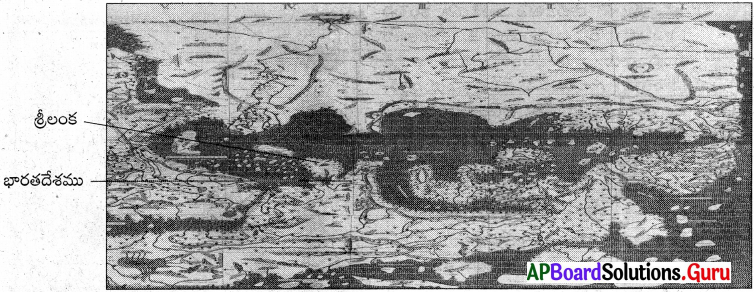
అల్ ఇద్రిసి గీసిన పటంలో శ్రీలంకను, భారతదేశాన్ని గుర్తించండి.
జవాబు:
అల్ ఇద్రిసి పటంలో ద్వీపకల్ప పీఠభూమి ఉత్తర భారతదేశంలోనికి నెట్టివేయబడింది. తూర్పు, పశ్చిమ తీరాలు బాగా కలిసిపోయినాయి. దక్కను పీఠభూమి ఉత్తర, దక్షిణాలుగా వ్యాపించి కన్యాకుమారి వద్ద సూదిమొనగా తేలింది. శ్రీలంకను వాస్తవంగా ఉన్న దానికన్నా బాగా పెద్దదిగా చూపించారు. కావున అల్ ఇద్రిసి పటంలో భారతదేశాన్ని, శ్రీలంకను గుర్తించుట చాలా కష్టము.
AP Board 8th Class Social Solutions Chapter 1 పటాల అధ్యయనం - విశ్లేషణ 6
గమనిక : ఈ మ్యాపును చదువుటకు దీనిని తలక్రిందులు చేయాలి.

ప్రశ్న 10.
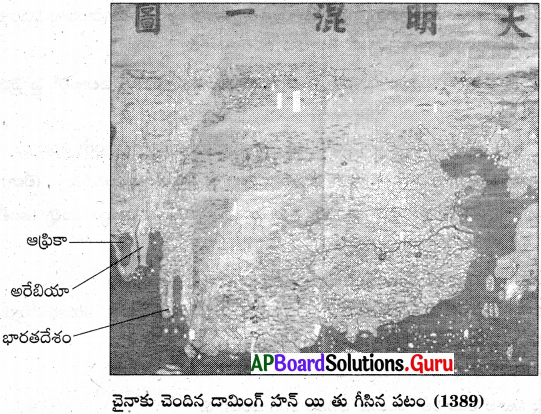
‘పటం -4లో భారతదేశం, అరేబియా, ఆఫ్రికాలను గుర్తించండి.
AP Board 8th Class Social Solutions Chapter 1 పటాల అధ్యయనం - విశ్లేషణ 7
జవాబు:
ఈ పటంలో భారతదేశం, అరేబియా, ఆఫ్రికాలు హిందూ మహాసముద్రంను దృష్టిలో వుంచుకొని చూపించారు. కావున అవి వాటి ఆకారాన్ని కొంతవరకు మాత్రమే పొందగలిగాయి. అవి పటంలో ఎడమచేతి వైపు క్రింది భాగంలో చిత్రించబడ్డాయి.

ప్రశ్న 11.
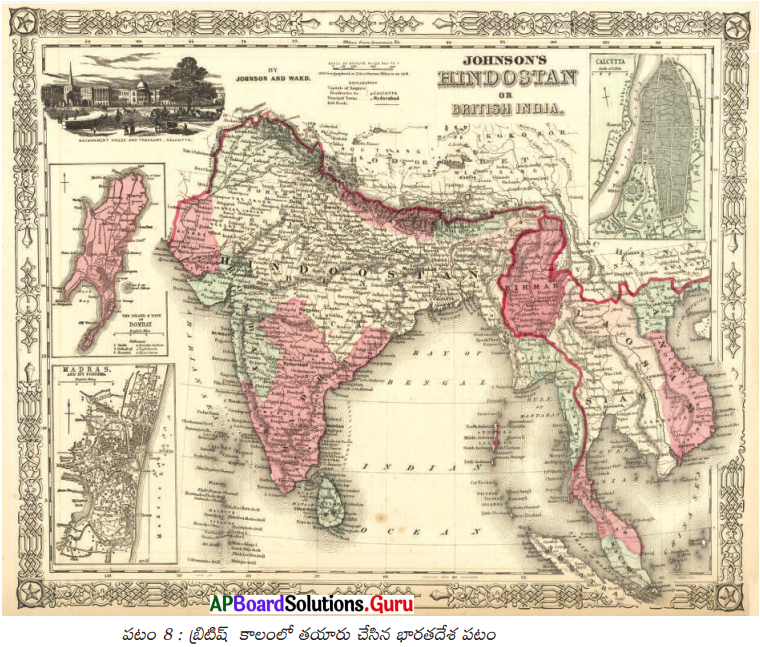
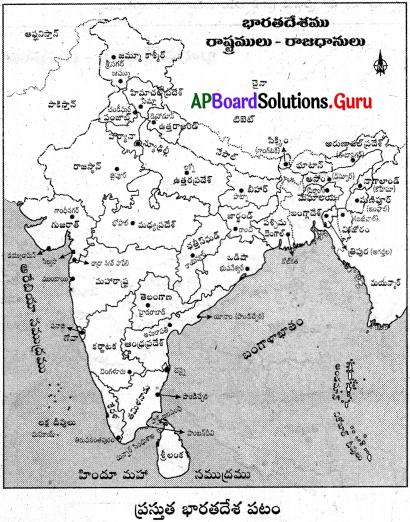
పటం 8ను చూడండి. బ్రిటిష్ కాలంలో తయారు చేసిన భారతదేశ పటంతో, నేటి భారతదేశాన్ని పోల్చండి.
AP Board 8th Class Social Solutions Chapter 1 పటాల అధ్యయనం - విశ్లేషణ 8
జవాబు:

  1. పటం 8లో ఉన్న భారతదేశ పటం బ్రిటిష్ కాలంలో 19వ శతాబ్దం ప్రారంభంలో తయారు చేశారు. అనగా ఇది 200 సం||ల క్రితం తయారైంది. ప్రస్తుత భారతదేశ పటం ఎప్పటికప్పుడు సవరించబడి నేటి రూపంలో ఉంది.
  2. నాడు బ్రిటిష్ వారు రూపొందించిన ఊహాపటం కాదిది. సర్వే నిర్వహించి రూపొందించిందే. అయితే నాడు ఉపగ్రహచిత్రాలు లేకపోవడం, సాంకేతిక అభివృద్ధి ప్రారంభంలో ఉండటంతో కొంత సమగ్రత లోపించింది. నేడు సాంకేతిక పరిజ్ఞానం సహకారంతో కచ్చితమైన పటాలను రూపొందించగలుగుతున్నాం.
  3. నాడు హిందుస్థాన్ లేక బ్రిటిష్ ఇండియా పేరుతో ఈ పటాన్ని రూపొందించారు. నేడు ఇండియా (భారతదేశం) పేరుతో దేశ పటాలను తయారు చేస్తున్నాం.
  4. ఇన్ బాక్స్ లో నాటి ఈస్ట్ ఇండియా కంపెనీ ప్రావన్సీలైన బొంబాయి, మద్రాస్, కలకత్తాలు ముద్రించారు. నాటి పటంలో జమ్మూ, కాశ్మీర్ ప్రాంతాన్ని గుర్తించలేదు. నేటి మయన్మార్, బంగ్లాదేశ్, కాంబోడియా, వియత్నాం దేశాలను హిందూస్థాన్లో చేర్చారు. నేటి పటంలో ఈ దేశాలు మన సమీపంలోని దేశాలుగా తెల్లరంగులో ముద్రిస్తున్నాం.
  5. ఇండియన్ ఓషన్, బే ఆఫ్ బెంగాల్, అరేబియన్ సీ (హిందూమహా సముద్రం, బంగాళాఖాతం, అరేబియా ‘సముద్రం) నాడు, నేడూ ఒకే రకంగా ఉన్నాయి.
  6. పాకిస్థాన్‌ను బ్రిటిష్ వారి .హిందూస్థాన్ పటంలో చూపలేదు.

AP Board 8th Class Social Solutions Chapter 1 పటాల అధ్యయనం - విశ్లేషణ 9

ప్రశ్న 12.
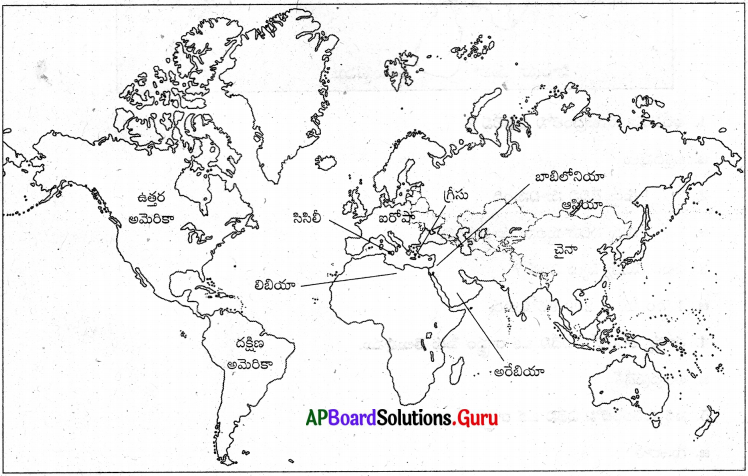
క్రిందనీయబడిన ప్రపంచ పటములో ఈ క్రింది వాటిని గుర్తించుము.
1. ప్రస్తుత బాబిలోనియా (సుమేరియా
2. గ్రీసు
3. సిసిలీ
4. లిబియా
5. ఆసియా
6. ఐరోపా
7. అరేబియా
8. చైనా
9. ఉత్తర అమెరికా
10. దక్షిణ అమెరికా

AP Board 8th Class Social Solutions Chapter 1 పటాల అధ్యయనం - విశ్లేషణ 10

ప్రశ్న 13.
క్రిందనీయబడిన పటాన్ని చూచి, ఈ క్రింది. ప్రశ్నలకు సమాధానములిమ్ము.
AP Board 8th Class Social Solutions Chapter 1 పటాల అధ్యయనం - విశ్లేషణ 11
1. అరేబియా సముద్రంలోని దీవులేవి?
జవాబు:
లక్షదీవులు

2. గుర్తు దేనిని సూచిస్తుంది.
జవాబు:
గుర్తు సరిహద్దులను సూచిస్తుంది.

3. పటం యొక్క స్కేలు ఎంత?
జవాబు:
1 సెం.మీ. = 200 కిలోమీటర్లు

4. తూర్పు తీరంలోని ఏదేని ఒక రాష్ట్రం పేరు తెలుపుము.
జవాబు:
ఆంధ్రప్రదేశ్

5. పశ్చిమతీరంలోని ఏదేని ఒక రాష్ట్రం పేరు తెలుపుము.
జవాబు:
గుజరాత్

ప్రశ్న 14.
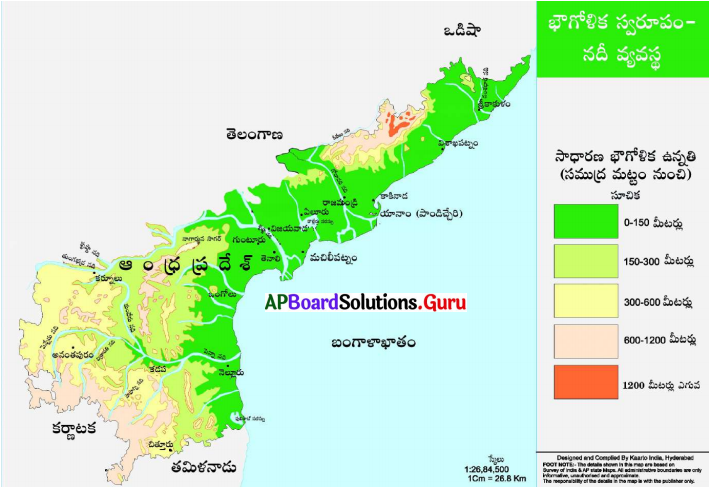
క్రిందనీయబడిన పటాన్ని చూచి, ఈ క్రింది ప్రశ్నలకు సమాధానములిమ్ము.
AP Board 8th Class Social Solutions Chapter 1 పటాల అధ్యయనం - విశ్లేషణ 12
1. ఆంధ్రప్రదేశ్ లో రెండు నదీ వ్యవస్థ పేర్లు రాయండి.
జవాబు:
కృష్ణా, గోదావరి.

2. ఉభయ గోదావరి జిల్లాల సాధారణ భౌగోళిక ఉన్నతి ఎంత?
జవాబు:
సముద్ర మట్టము నుండి 0 నుండి 150 మీటర్ల ఎత్తులో ఉన్నాయి.

3. మీ జిల్లా సాధారణ భౌగోళిక ఉన్నత ఎంత?
జవాబు:
విద్యార్థి కృత్యం.

ప్రశ్న 15.
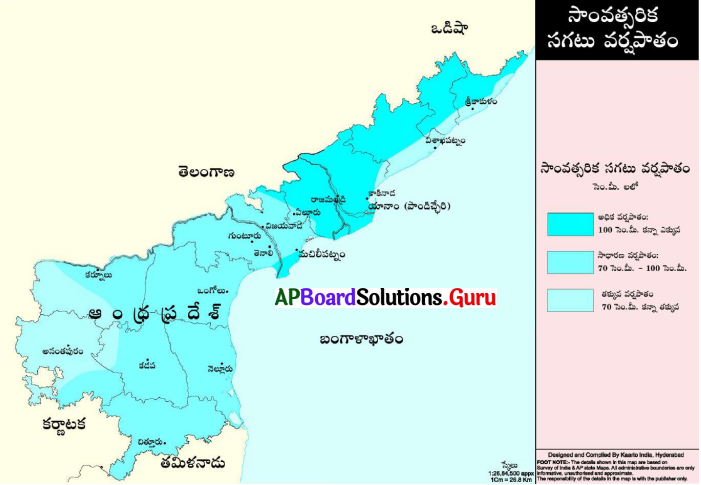
క్రిందనీయబడిన పటాన్ని చూచి, ఈ క్రింది ప్రశ్నలకు సమాధానములిమ్ము.
AP Board 8th Class Social Solutions Chapter 1 పటాల అధ్యయనం - విశ్లేషణ 13
1. ఆంధ్రప్రదేశ్ రాష్ట్రానికి పశ్చిమంగా ఉన్న రాష్ట్రం ఏది?
జవాబు:
తెలంగాణ

2. ఆంధ్రప్రదేశ్ లో అధిక వర్షపాతం (100 సెం.మీ.) కన్నా ఎక్కువ పొందే జిల్లాలు ఏవి?
జవాబు:
శ్రీకాకుళం, విశాఖపట్నం, తూర్పు గోదావరి, పశ్చిమ గోదావరి జిల్లాలు.

3. ఆంధ్రప్రదేశ్ రాష్ట్రంలో సాధారణ వర్షపాతం (70 సెం.మీ. – 100 సెం.మీ.) వర్షపాతం పొందే జిల్లాలు ఏవి?
జవాబు:
కృష్ణా, గుంటూరు, ప్రకాశం, నెల్లూరు, కడప జిల్లాలు.

ప్రశ్న 16.
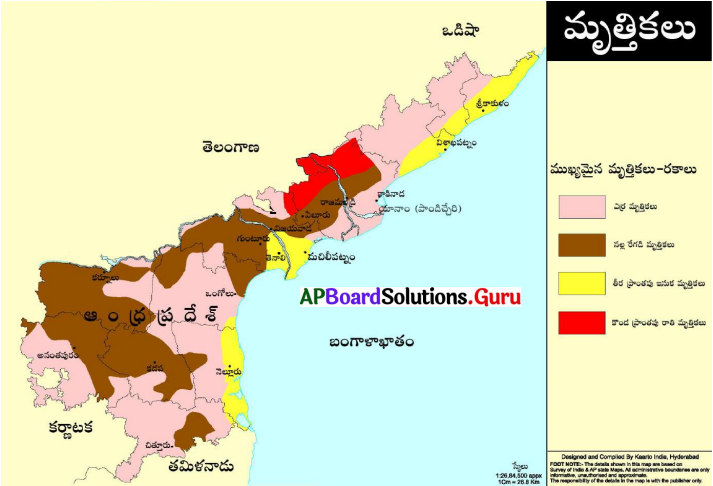
క్రిందనీయబడిన పటాన్ని చూచి, ఈ క్రింది ప్రశ్నలకు సమాధానములిమ్ము.
AP Board 8th Class Social Solutions Chapter 1 పటాల అధ్యయనం - విశ్లేషణ 14
1. ఆంధ్రప్రదేశ్ రాష్ట్రం నందలి ఎన్ని రకాల మృత్తికాలున్నాయి?
జవాబు:
ఆంధ్రప్రదేశ్ రాష్ట్రం నందు ప్రధానంగా నాలుగు రకాల మృత్తికలున్నాయి.

2. ఆంధ్రప్రదేశ్ రాష్ట్రం నందలి మృత్తికలు ఏ రకానికి చెందినవి?
జవాబు:
ఆంధ్రప్రదేశ్ రాష్ట్రం నందలి మృత్తికలు ఎర్ర, నల్లరేగడి, ఇసుక మరియు రాతి రకానికి చెందినవి.

3. ఆంధ్రప్రదేశ్ రాష్ట్రం నందు నల్లరేగడి మృత్తికలు ఏ ఏ జిల్లాలలో ఉన్నాయి?
జవాబు:
ఆంధ్రప్రదేశ్ రాష్ట్రం నందు నల్లరేగడి మృత్తికలు ఉన్న జిల్లాలు

  1. కృష్ణా
  2. కర్నూలు
  3. ఉభయగోదావరి జిల్లాలలోని మధ్య ప్రాంతాలు.

4. పై పటాన్ని పరిశీలించగా అత్యధిక ప్రాంతంలో నల్లరేగడి నేలలు ఉన్న జిల్లా ఏది?
జవాబు:
కర్నూలు.

5. మీ జిల్లాలో ఏ రకమైన మృత్తికలు ఉన్నాయి?
జవాబు:
విద్యార్థి కృత్యం.

AP Board 8th Class Physical Science Solutions Chapter 8 Combustion, Fuels and Flame

AP State Syllabus AP Board 8th Class Physical Science Solutions Chapter 8 Combustion, Fuels and Flame Textbook Questions and Answers.

AP State Syllabus 8th Class Physical Science Solutions 8th Lesson Combustion, Fuels and Flame

8th Class Physical Science 8th Lesson Combustion, Fuels and Flame Textbook Questions and Answers

Improve Your Learning

Question 1.
Give four examples of combustible materials.
Answer:

  1. Petrol
  2. Diesel
  3. Kerosene
  4. Alcohol

Question 2.
Give four examples of non-combustible materials.
Answer:

  1. Sand
  2. Clay
  3. Iron
  4. Steel

AP Board 8th Class Physical Science Solutions Chapter 8 Combustion, Fuels and Flame

Question 3.
Why should not we store spirit or petrol near our living place?
Answer:
Spirit or petrol has low ignition temperature. So they turn into gas at room tempera¬ture. So they are highly inflammable that means they easily catch fire at room temperature. So in order to avoid fire accidents we should not store spirit or petrol near our living place.

Question 4.
Give an example of a good fuel. How do you choose that fuel? Explain.
Answer:
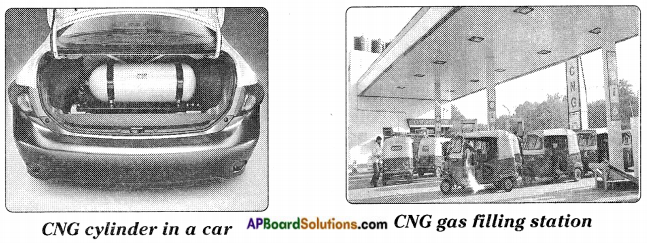
The example for good fuel is CNG.
The characteristics of good fuel.

  1. It should be cheap.
  2. It should be readily available.
  3. It should be readily combustible.
  4. It should be transported easily.
  5. It should have high calorific value.
  6. It should not produce gases or residue that pollute the environment.

CNG possess all these characteristics so it is an example for good fuel or ideal fuel.

Question 5.
The oil tires should not be sprayed with water. Why?
Answer:
We should not spray water on oil fires because water is heavier than the oil, it sinks below the oil and oil keeps burning on the top. So water is not suitable for oil fire accidents.

AP Board 8th Class Physical Science Solutions Chapter 8 Combustion, Fuels and Flame

Question 6.
What precautions are to be taken while pouring water on fire?
Answer:

  1. Put off the electric mains.
  2. Do not pour water on fires caused by electricity water containing dissolves salts is a good conductor of electricity.
  3. Do not pour water on fires due to petrol and oil because water is more denser the u oil and petrol.

Question 7.
Why a wick is not used in gas burners ?
Answer:
Wax in the candle melts when it is lighted by a match and a little wax forms vapour. This vapour combines with oxygen in the air to form flame. The heat of the flame melts more of the wax from the top of the candle. The melted liquid wax move upward through the thread. It also changes to vapour when it reaches the top the wick and burns w’ h the flame.
Wick is not required in gas burners because LPG has low ignition temperature so it is easily convert into vapour state.

Question 8.
Water is not used to control fires involving electrical equipment. Why?
Answer:
Water is not used to control fires involving electric equipments because water is good
conductor of electricity (water having dissolved salts) so it may conduct electricity and harm those trying to douse the fire.

AP Board 8th Class Physical Science Solutions Chapter 8 Combustion, Fuels and Flame

Question 9.
Give supporting arguments for both the statements (1) fire is useful (2) fire is harmful.
Answer:
Fire is useful:

  1. Fire is useful in cooking food.
  2. Fire is used in preparing different types of jewellery with gold and silver.
  3. Fire is utilized in making different types of articles with metals and plastics.
  4. The heat energy produced from fire of coal used to produce electricity.

Fire is harmful:

  1. During fire accidents fire can burn human organs and tissues causing severe damage to mankind, sometimes the people may die due to severe burns.
  2. During fire accidents the fire not only kill people but lot of damage to articles, equipments in the house.
  3. Fire can burn the forests in summer which may be harmful to animals present in the forest.

Question 10.
What would happen if oxygen stops to support combustion? – Make a guess. And if it is the situation for what other works fuels are useful?
Answer:
If oxygen stops to support combustion there is no other gas which will support combustion. Then fossil fuels are not useful in producing heat, energy and electricity.
So we should have to prefer alternative sources of energy like solar energy, wind energy, tidal energy, biomass energy, geothermal energy, etc. for our energy needs.

Question 11.
Let us assume that you are on the moon. If you try to focus sunlight on a paper using magnifying glass, does the paper catch fire? or not? Why?
Answer:
No, moon reflect entire sunlight falls on the surface because it acts as perfect reflector. Whereas earth is also acts as reflector but green house gases present in atmosphere absorbing the sunlight and resending on earth. So paper can be burnt on earth by using magnifying glass but it is not possible on moon.

AP Board 8th Class Physical Science Solutions Chapter 8 Combustion, Fuels and Flame

Question 12.
Can you heat water in a paper vessel? How is it possible?
Answer:
In order to find the answer we have to do an experiment.
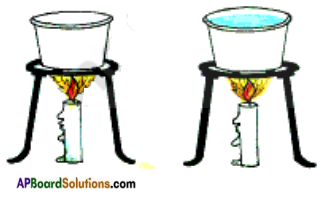
AP Board 8th Class Physical Science Solutions Chapter 8 Combustion, Fuels and Flame 8
Take two small paper cups. Pour water in one of the cups. Put the two cups on different tripod stands and heat both of them using a candle shown in the figure. One cup burns quickly and other does not.
The reason is when heat is supplied to cups, the heat received by second cup is transferred to water
in it. The water in this cup prevents the paper to reach its ignition temperature and hence it does not burn. So water can be heated in a paper vessel upto ignition temperature of paper.

Question 13.
“Is combustion possible without the supply of oxygen”? Discuss with your teacher.
Answer:
No, combustion is not possible without oxygen because it is a reaction of material with oxygen that is an oxidation process. For example, carbon compounds react with oxygen and form carbon-dioxide and water. So no combustion reaction is possible without oxygen.

Question 14.
Explain giving reasons: In which of the following situations water will get heated in a shorter time?
a) Srikar kept water beaker near the wick in the yellow part of a candle flame.
b) Sonu kept water beaker in the outermost part of the flame.
Answer:
In the second situation water will get heated in a short time in the outermost part in the flame complete combustion takes place so which is hottest part whereas yellow part is in the middle zone of candle where partial combustion takes place and it is moderately hot.

Question 15.
List the ways adopted by fire fighters to combat fires.
Answer:
Ways adopted by fire fighters:

  1. The fire fighters immediately put off the electric mains and start spraying water on the fire. The water spray cool the combustible material below the ignition tempera¬ture. This prevents fire from spreading. Then the heat turns the water into vapours which surround the burning material and prevent supply of oxygen to the burning material. So the fire extinguishes.
  2. For electrical fire accidents or fire accidents involving oil and petrol water is not useful. So fire fighters use carbondioxide. It is heavier than oxygen and does not affect the electric equipment.

Question 16.
Collect information available on different fuels. Find out the cost per kg and compare the cost with calorific value. Prepare report on that.
Answer:

Fuel Cost per kg (or) litre Calorific value
1. LPG Rs. 67 55000
2. Diesel Rs. 58 45000
3. Petrol Rs. 80 45000
4. CNG Rs. 49 50000

From the table we will observe CNG has least price and also comparatively equal calorific value with other fuels and also it is less pollutant and easily transportable. So from the report we say CNG is preferable as fuel.

AP Board 8th Class Physical Science Solutions Chapter 8 Combustion, Fuels and Flame

Question 17.
Draw the diagram of candle flame and label all the zones. (OR)
Draw the diagram of structure of flame and label the parts. In which zone incomplete combustion takes place? (OR)
Draw a diagram of candle flame and label all the zones. What happens in the dark zone of a flame?
Answer:
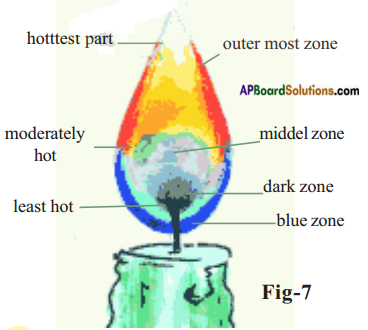
AP Board 8th Class Physical Science Solutions Chapter 8 Combustion, Fuels and Flame 10
In the dark zone wax gets vapourised and it is least hot part, (or)
In black zone in complete combustion takes place.

Question 18.
Where do you find spontaneous combustion and rapid combustion in your daily life?
Answer:
Spontaneous combustion is observed in burning of match stick. When the match stick is struck against the rubbing surface the red phosphorous converts into white phosphorous which immediately react with potassium chlorate in the match stick head to produce enough heat to ignite antimony sulphide and start the combustion.
Rapid combustion is observed in gas stoves. When we turn the nob of the gas stove in the kitchen and bringing a burning match stick near to it. The gas burns rapidly and produce heat and light.

Question 19.
How do you organize your daily works with fuels to conserve bio-diversity?
Answer:

  1. I would use bicycle to travel short distances which consumes fuel.
  2. I would go to school or office (long distance) in a public vehicle like bus which will consume fuel.
  3. I will drive at a constant and moderate speed as far as possible which will consume fuel.
  4. I switch off the engine at traffic lights or at a place where I have to wait which will consume fuel.
  5. I ensure correct tyre pressure which will consume fuel.
  6. I ensure regular maintenance of the vehicle which decreases the harmful gases.
  7. I will clean gas burners regularly which decreases pollution.
  8. I will cook with sufficient water which will consume fuel.
  9. I would not prepare fries which take more time.
  10. I will use CNG in place of petrol or diesel which is less pollutant.
    The above steps not only reduce the consumption of fuel and also decrease the air pollution. These steps of preserving fuels helps the mankind from pollution there by helps the bio-diversity.

AP Board 8th Class Physical Science Solutions Chapter 8 Combustion, Fuels and Flame

Question 20.
How do you feel about “Fuels have become a part of human life”
Answer:
I feel that fuels are essential part of human life in their day to day life. Starting from the morning before they going to sleep they would found application of fuels. In the morning for breakfast we need fuel for cooking. For seeing TV or working with computer we need fuel because they run by electricity from thermal power (coal). If we want to go to school or office we use vehicle which required fuel. Every electrical articles like fans, mixies works by taking electricity from coal. So we conclude that fuels are essential part of human life.

Question 21.
It is difficult to bum a heap of green leaves but not a heap of dry leaves. Explain why?
Answer:
Green leaves contain water has high ignition temperature. So it will not burn whereas dry leaves does not contain water. So their ignition temperature is low. So they burn during summer.

Question 22.
In a few years the fuels on earth will be exhausted. Think, what would happen to human civilization? (OR)
In few years the fuel on earth will be exhausted. Predict the consequences.
Answer:
If people unable to use alternative sources of energy then lack of fuels drastically affect the human civilization. The consequences of lack of fuel.

  1. There would be no fuel for cooking.
  2. There would be no fuel for transport.
  3. There would be no fuel for running machinery.
  4. There would be no fuel for producing electricity.

So life of people on earth is miserable. The people once again go back to stone age where there is no availability of any facilities.

Question 23.
Use of more fuels in our daily life causes air pollution and it is harmful to human being and the other life on earth. Suggest some remedies to avoid this.
Answer:
Remedies to avoid air pollution:

  1. Look for alternative sources of energy like wind energy, solar energy, tidal energy which does not produce pollution.
  2. Try to minimise the use of fuels that is for travelling short distances use bicycles and try to go by bus (public transport) for offices which will minimise the use of fuels and there by air pollution.
  3. Ensure regular maintenance of vehicle and engine which will release the less quantity of harmful gases there by decrease of air pollution.
  4. Use CNG (compressed natural gas) as fuel as it is less pollutant and release small quantity of harmful gases.

AP Board 8th Class Physical Science Solutions Chapter 8 Combustion, Fuels and Flame

Question 24.
Project work: Collect information about the experiments of Joseph Priestly. Write a two page report describing Priestly’s experiments proving that oxygen is needed for burning.
Answer:
In August 1774, Priestly isolated an air to be completely new, but he did not have an opportunity to pursue the matter because he was about to tour Europe. While in Paris Priestly managed to replicate the experiments for others, including French chemist Antonie Levoisier. After returning to Britain in January 1775, he continued his experiments and discovered vitriolic acid air (Sulphurdioxide, SO2).
In March he wrote to several people regarding the new air that he had discovered in August. One of these letters was read aloud to the royal society, and a paper outlining the discovery, titled “An Account of further Discoveries in air”, was published in society’s journal “Philosophical Transactions”. Priestly called the new substance “dephlogisticated air” which he made in the famous experiment by focussing sun’s rays on a sample of mercuric oxide. He first tested it on mice, who surprised him by surviving quite a while entrapped with the air, and then on himself, writing that it was “five or six better than common air for the purpose of respiration, inflammation and I believe, every other use of common atmospherical air. He had discovered oxygen gas (O2).”
Priestly called his discovery “dephlogisticated air” on the theory that it supported combustion so well because it had no phlogiston in it and hence could absorb maximum amount during burning.

Question 25.
Collect the information about annual fuel consumption in different parts of the world. How many years more the fossil fuels last? Make a poster with this information and issue an appeal to save fuel.
Answer:
Table showing different countries and their petrol consumption.

Country Usage of Petrol/Diesel per annum in barrels
United States 6821850000
China 2993000000
Japan 1592495000
India 1087700000
Russia 1000100000
Brazil 897900000
Germany 889505000
Saudi Arabia 886950000
South Korea 797525000

The information showing the remaining years in which fossil fuels exhausted.

Fuel Years in which it exhausted
Petrol / Diesel Around 60 years
Natural gas 50 years
Coal 250 years
LPG Around 70 years

We are using excess of petroleum products, coal and natural gas from the above table shows they will not exists long. So fuel consumption should be minimised otherwise no fuel is available in the future. So save fuel for better living.

8th Class Physical Science 8th Lesson Combustion, Fuels and Flame InText Questions and Answers

8th Class Physical Science Textbook Page No. 110

AP Board 8th Class Physical Science Solutions Chapter 8 Combustion, Fuels and Flame

Question 1.
Why does candle give flame when it is burnt but why does coal burn without emitting a flame?
Answer:
A candle is made of wax in which a thick thread is inserted. When it is lighted melts by a match stick. A little of the wax forms gas. This gas combines with oxygen in the air to form flame.
But coal is a natural fuel contains more carbon. When it is burnt it sends out carbon monoxide and carbon dioxide gases and becomes ember and does not emit a flame. Coal is the changed material of wood. Hence it does not emit a flame as it possesses a huge calorific value (heat).

Question 2.
Do all fuels produce same amount of heat when they are burnt?
Answer:
No, different fuels produce different amount of heat when they are burnt.

Question 3.
What do we need to burn a material?
Answer:
We need oxygen to burn a material.

Question 4.
Have you ever tried burning a piece of paper or wood or coal, a small rock or a pebble?
Answer:
Yes, I tried.

Question 5.
Do all of them burn?
Answer:
Except a small rock and a pebble, the rest of them are burnt.

8th Class Physical Science Textbook Page No. 112

Question 6.
How does scented stick started burning?
Answer:
The stick starts burning with flame because oxygen supports combustion.

AP Board 8th Class Physical Science Solutions Chapter 8 Combustion, Fuels and Flame

Question 7.
Why does not it catch again fire when it is kept aside in air after putting its flame off?
Answer:
The air is not sufficient to burn the scented stick.

8th Class Physical Science Textbook Page No. 113

Question 8.
a) A slow fire bursts into a flame when air is blown on it, but a candle burning with flame goes off when air is blown on it. Why?
Answer:
A slow fire burst into a flame when air is blown on it because it increase the supply of oxygen to fire. So combustion takes place to produce a flame.
Whereas when the wind or your breathe blows on the mixture of combustible particles and flame of a candle, it pushes the mixture of combustible particles away from the steam of fresh particles. So flame will be go out in the absence of combustible particles.

b) If a large quantity of dry grass is set on fire in forests then it is very difficult to put off the fire. Why?
Answer:
The dry grass is more combustible and supports burning. Hence due to the flow of oxygen (air) it is kindled.

Question 9.
When an object catches fire, the fire is put off by covering with sand or a blanket. Why ?
Answer:
Combustion takes place only in the presence of oxygen. When we cover a burning object with sand or blanket that would cut off the supply of oxygen to burning object. So the fire is puts off.

8th Class Physical Science Textbook Page No. 114

Question 10.
What makes match sticks to catch fire?
Answer:
A mixture of antimony trisulphide, potassium chlorate and white phosphorous with some glue and starch was applied on the head of a match stick made of suitable wood. When it struck against a rough surface white phosphorous got ignited due to heat of friction. This starts the combustion of match stick.

8th Class Physical Science Textbook Page No. 115

AP Board 8th Class Physical Science Solutions Chapter 8 Combustion, Fuels and Flame

Question 11.
List different fuels that are used for!
Domestic purpose LPG, CNG
Automobiles/ Aircraft/ Trains/ Rockets Petrol, gasoline
Industry Coal, Charcoal, wood, natural gas
Classify the above fuels into solid, liquid, gases and write them in table.

Solid Liquid Gas
Coal Petrol LPG
Charcoal Gasoline CNG
Wood Diesel Natural gas

Look at the fuels in the above table.

Classify the above fuels into solid, liquid, gases and write them in table.

a) Can you decide the best fuel among them?
Answer:
CNG, LPG.

b) What is the criteria to decide a best fuel?
Answer:
CNG & LPG burn completely. The fuel which burns completely is the best fuel.

8th Class Physical Science Textbook Page No. 116

Question 12.
What is calorific value? Write its units.
Answer:
Calorific value of a fuel is the amount of heat energy produced on complete combustion of 1 kg of that fuel.
It is measured in kJ/kg.

Question 13.
How can we put off the fire if it breaks out?
Answer:
We can put off the fire by using the fire extinguishers in which CO2 gas is present.

Question 14.
How water helps in eliminating the factors, which support the combustion?
Answer:
The water spray cools the combustible material so that its temperature decreases. This prevents the fire from spreading.

AP Board 8th Class Physical Science Solutions Chapter 8 Combustion, Fuels and Flame

Think and Discuss

8th Class Physical Science Textbook Page No. 111

Question 1.
Why some materials burn and why some do not? Give reasons.
Answer:
Burning is a process of reaction of a material with oxygen. The materials which have weak molecular bonds easily react with oxygen so they burn easily. The material which have strong molecular bonds does not react with oxygen easily because the molecular bonds should be broken before they react with oxygen.

Question 2.
Why some materials which do not burn at normal temperature burn at higher temperatures?
Answer:
Burning is a process of reaction of a material with oxygen. The material which have strong molecular bonds does not undergo burning because the molecular bonds should be broken in order to react the material with oxygen. So they have high ignition temperature. So the materials which do not burn at normal temperature burn at higher temperature.

8th Class Physical Science Textbook Page No. 112

Question 3.
If you lift the glass tumbler (which is placed over a burning candle) to 1 cm height what happens? Why?
Answer:
The Candle tends to burn because of availability air containing oxygen because cool air is more denser than hot air.

8th Class Physical Science Textbook Page No. 113

Question 4.
How do you say that the gas released in the above experiment is oxygen?
Answer:
If we put a burning match stick into the container having oxygen it burns with bright flame the reason is oxygen supports combustion.

Question 5.
Can we replace potassium permanganate with any other substance to release oxygen?
Answer:
We can replace with HgO (Mercuric oxide), KClO3 (Potassium chlorate), H2O2 (Hydrogen peroxide), NaNO3 (Sodium nitrate), KNO3 (Potassium nitrate) for release of oxygen.

Question 6.
Is there any other procedure to prove that oxygen is needed for burning?
Answer:
We can put off a fire by covering with sand or blanket because we are preventing supply of oxygen. So we can say oxygen is needed for burning.

8th Class Physical Science Textbook Page No. 115

AP Board 8th Class Physical Science Solutions Chapter 8 Combustion, Fuels and Flame

Question 7.
Why is phosphorous preserved in water? (Hint: Think about the role of ignition temperature in combustion)
Answer:
Phosphorous is highly reactive with air containing oxygen. It has low ignition temperature. So it catches fire at room temperature. So it is preserved in water.

Question 8.
Why kerosene stoves and Bunsen burners have small holes in them? (Hint: Think about the role of air in combustion)
Answer:
Kerosene stoves and bunsen burners have small holes for entry of air for combustion of fuel.

Question 9.
It is hard to ignite match stick in rainy days. Why?
Answer:
It is hard to ignite match stick in rainy days because water has extinguishing property.

8th Class Physical Science Textbook Page No. 118

Question 10.
A wax candle burns with a yellow flame. The domestic gas burns with a blue flame. Why?
Answer:
The wax candle burns with a yellow in the middle zone because it undergoes partial combustion whereas domestic gas burns with a blue flame because it undergoes complete combustion.

8th Class Physical Science 8th Lesson Combustion, Fuels and Flame Activities

AP Board 8th Class Physical Science Solutions Chapter 8 Combustion, Fuels and Flame

Activity – 1

Question 1.
Do all materials bum?
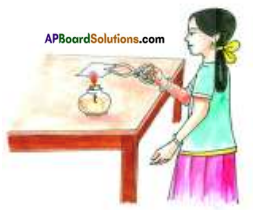
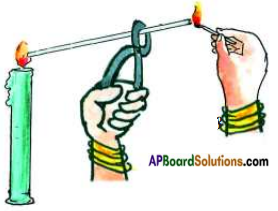
You will need a pair of tongs, some metal or clay dishes and a candle or a spirit lamp. Using tongs, pick up a small piece of paper and bring it near to the lighted candle and keep it on flame as shown in figure.
AP Board 8th Class Physical Science Solutions Chapter 8 Combustion, Fuels and Flame 3
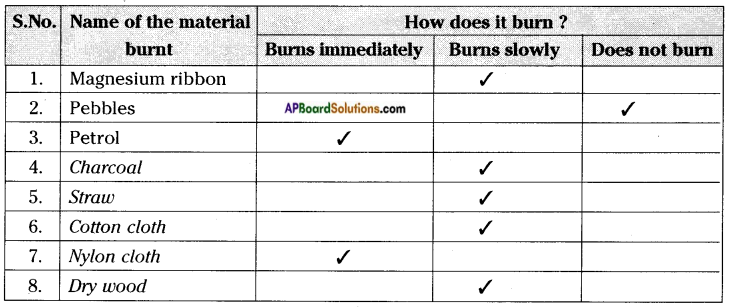
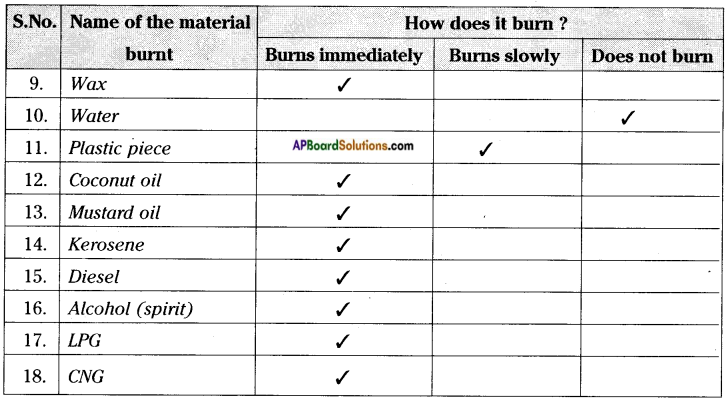
Record your observations in table.
AP Board 8th Class Physical Science Solutions Chapter 8 Combustion, Fuels and Flame 2
AP Board 8th Class Physical Science Solutions Chapter 8 Combustion, Fuels and Flame 4
Carry out this experiment with a piece of charcoal, magnesium ribbon, straw, cotton cloth, nylon cloth, dry wood, pebble, wax, plastic piece, etc. and record your observations.
You can try to burn liquids like water, petrol, diesel, alcohol and note down your observations in table.
Take 2 ml of water in small plate. Bring the lighted stick near to water in plate.
a) What do you observe in your attempt of burning water?
Answer:
Water does not burn.

b) Is there any difference in flame of lighted stick?
Answer:
If we brought near to water plate the flame decreases.

AP Board 8th Class Physical Science Solutions Chapter 8 Combustion, Fuels and Flame

c) What happened to the lighted stick when it is brought closer to water in the plate?
Answer:
The water in the plate puts off.the lighted stick.
Carryout this activity using coconut oil, mustard oil, kerosene, etc. Record your observation in the above table.

d) What can we conclude from this activity?
Answer:
We conclude that some materials burn and others do not.

e) Which of the material in the above activity are combustible?
Answer:
Except pebbles and water remaining materials are combustible.

Activity – 2

Question 2.
Testing the necessity of air for burning.
Answer:
AP Board 8th Class Physical Science Solutions Chapter 8 Combustion, Fuels and Flame 5
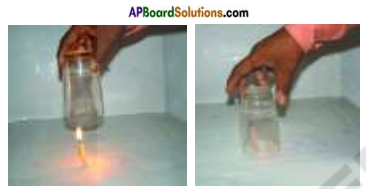
Take a small burning candle and put it on a table. Invert a glass tumbler over it.
The candle continues to burn for some time. Then flickers and finally flame goes off.
Remove the tumbler and again light the candle. Put the tumbler back over the candle. When the candle flame begins to flicker, remove the tumbler. What happens to the candle?
We find that putting the glass tumbler over the candle cuts off the supply of air and candle flame goes off. When the flame just begins to flicker if we removes tumbler the flame retains back due to supply of oxygen.
This experiment proves that air is needed to burn a material.

Lab Activity

Write an activity to prove that oxygen helps in burning. (OR)
How can you perform the acitivity to prove that Oxygen is essential for burning? Explain.
Answer:
Aim: To prove that oxygen helps in burning.
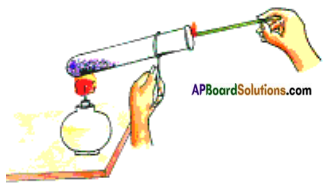
Material required: Test tube, test tube holder, spirit lamp, match box, inscence stick (agarbatti), potassium permanganate (KMnO4) crystals.
Procedure:
Light a scented / incense stick and let it burn for 10 seconds, then put out the flame and keep it aside.
Take potassium permanganate (KMnO4) in a test tube. Hold the test tube with a test tube holder and heat it over the flame of spirit lamp. Oxygen is released on heating of potassium permanganate (KMnO4).
2 KMnO4 → K2MnO4 + MnO2 + O2
Insert the agarbatti with the burning stub into the test tube as shown in figure.
AP Board 8th Class Physical Science Solutions Chapter 8 Combustion, Fuels and Flame 6
Observations: The stick burns with a flame. This proves that oxygen supports combustion by helping agarbatti to burn with bright flame.

Activity – 3

Question 3.
Burning a paper with sun rays.
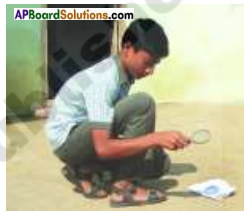
On a sunny day, go out and focus the sun rays on a piece of paper using a magnifying lens.
AP Board 8th Class Physical Science Solutions Chapter 8 Combustion, Fuels and Flame 7
a) Touch the spot after some time. How do you feel?
Answer:
It is hot.
You must have heard about people in ancient times rubbing the pieces of stones together to produce sparks.

b) Have you tried it?
Answer:
Yes.

AP Board 8th Class Physical Science Solutions Chapter 8 Combustion, Fuels and Flame

c) Rub two stones together hardly and touch them. What do you feel?
Answer:
They become hot.
Now recall some of your experiences:

d) Does a matchstick burns by itself?
Answer:
No.

e) Why do you rub the match stick on the side of the matchbox to bum it?
Answer:
When we rub match stick on the side of the match box due to friction it produces it which will burn the match stick.

f) Can you bum a piece of wood by bringing it close to a lighted matchstick?
Answer:
No.

g) Why do we use paper pieces or kerosene oil to start fire in wood or coal?
Answer:
Paper or Kerosene oil has low ignition temperature. So they are used to burn wood or coal which have higher ignition temperature.

Activity – 4

Question 4.
Understanding ignition temperature.
Take two small paper cups. Pour water in one of the cups. Put the two cups on different tripod stands and heat both of them using a candle.
AP Board 8th Class Physical Science Solutions Chapter 8 Combustion, Fuels and Flame 8
a) Which cup bums first?
Answer:
The cup which does not have water.

b) Does the water in the cup become hot? Why?
Answer:
The water in the second cup is hot because the heat received by second cup is transferred to water in it. The water in this cup prevents the paper to reach its ignition temperature and hence it does not burn.

c) When does the second cup start burning?
Answer:
When it reaches its ignition temperature.

AP Board 8th Class Physical Science Solutions Chapter 8 Combustion, Fuels and Flame

Activity – 5

Question 5.
Observing the behaviour of different solid fuels.
Collect some fuels like candle, coal, charcoal, magnesium ribbon, wood, cakes of cow-dung, camphor, wick of the oil lamp, wick of kerosene stove, domestic gas, etc. Burn each of them one by one with the help of spirit lamp and note the time they take to catch fire. Also observe how do they burn?
a) Do all of them bum in the same manner? If not, what difference do you notice?
Answer:
No, some of them produce flame and some does not produce flame.

b) Do all of them form a flame while they are burning?
Answer:
No, all of them does not form flame.
Record your observation in the following table
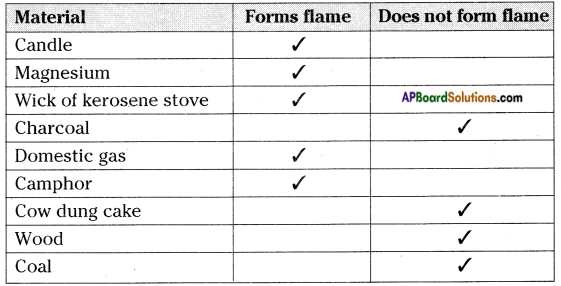
AP Board 8th Class Physical Science Solutions Chapter 8 Combustion, Fuels and Flame 9
You may observe that a candle burns with flame whereas charcoal does not. Some materials burn with flame, some do not. Kerosene oil and molten wax rise through the wick become gas and form flames. But charcoal cannot be vaporized. So it does not produce flame.

Activity – 6

Question 6.
Observing the structure of the flame.
Light a wax candle and watch the flame.
AP Board 8th Class Physical Science Solutions Chapter 8 Combustion, Fuels and Flame 10
Carefully note the different coloured zones in the flame.
a) How many colours are there in the flame?
Answer:
There are three colours in the flame.

b) Starting from the base of the flame, how many flame zones do you observe?
What is the colour of the outer most zone of the flame?
Answer:
There are three flame zones are observed.
The colour of outermost zone is blue.

c) Observe the innermost zone which is dark. What do you observe there?
Answer:
In this zone wax gets vapourised. This is dark zone.
Observe near the base of the flame. Vaporized wax gets completely oxidized and burns with a blue flame. It is blue zone.

AP Board 8th Class Physical Science Solutions Chapter 8 Combustion, Fuels and Flame

Activity – 7

Question 7.
Observing what happens in different zones of candle flame.
Light a candle. Hold a glass tube (with 7 cm length) a pair of tongs and introduce its one end in the dark zone of a non flickering candle flame. Keep lighted match stick near the other end of the glass tube as shown in the figure.
AP Board 8th Class Physical Science Solutions Chapter 8 Combustion, Fuels and Flame 1
a) What do you observe? Do you see a flame? If so what is it, that produces a flame?
Answer:
Yes, the some of vapours produced by wax pass through the glass tube and are burnt by match stick to produce flame.

b) Notice that the wax near the heated wick melts quickly. What do you observe?
Answer:
When the candle’s flame is steady introduce a clean glass slide into the luminous zone of the flame and hold it with a pair of tongs for 10 seconds.
A blackish circular ring is formed on the glass slide.

c) What is it?
Answer:
The deposition of unburnt carbon particles present in the luminous zone of the flame due to incomplete combustion.

d) Hold a thin long copper wire just inside the flame for about half a minute. What do you observe? What is your inference?
Answer:
The copper wire just outside the flame gets red hot. It indicates that the non luminous zone of the flame has high temperature. It is the hottest part of the flame. It is blue in colour and complete combustion takes place due to good supply of oxygen.

AP Board 8th Class Social Studies Solutions Chapter 3 Earth Movements and Seasons

SCERT AP Board 8th Class Social Solutions 3rd Lesson Earth Movements and Seasons Textbook Questions and Answers.

AP State Syllabus 8th Class Social Studies Solutions 3rd Lesson Earth Movements and Seasons

8th Class Social Studies 3rd Lesson Earth Movements and Seasons Textbook Questions and Answers

Improve your learning

Question 1.
Do you think there is any correlation between the crops grown in your region and the seasons? Find out by discussing with your eiders and friends and write a short essay on it.
Answer:
Ours is a small village Anther vedipalem in East Godavari district. In our area, we have 3 crop seasons – Kharif, Rabi and Zaid. The farmers cultivate paddy and maize in Kharif season. This season is upto October and November. Rabi is cultivated as winter crop. In Rabi also some cultivate paddy and some cereals. Duration of this season is upto March and April. After that some fruits and vegetables are grown in the Zaid season. In addition to these we have coconut plantations which give fruits throughout the year. Due to these reasons there is correlation between crops and seasons.

Question 2.
Why do you think Andhra Pradesh does not receive any snowfall during winter months?
Answer:
Snow forms in the clouds that are below freezing. Andhra Pradesh is in tropical belt. To get snow the temperatures in Andhra Pradesh are not enough cold. So Andhra Pradesh does not receive any snowfall during winter season.

AP Board 8th Class Social Studies Solutions Chapter 3 Earth Movements and Seasons

Question 3.
We have a rainy season. How do you think it is related to the movement of the Earth and the pattern of Sun’s rays? Does it occur in the summer or winter or in the season in between?
Answer:
The seasons occur due to the revolution and the pattern of Sun’s rays. During summer the Sun’s rays fall straightly on our area. Then the air in the atmosphere gets heated and moves up by forming low pressure belt. The winds from high pressure belt from the Indian ocean blow to this area and give rains. We receive rains after summer and in the beginning of winter due to these seasonal winds-monsoons.

Question 4.
Collect information about time of Sunrise and Sunset for different months of the year in your place (you can look up the local newspaper for this). Calculate the duration of day and night- how many hours every day – for every month. Do you see any pattern in this?
Answer:
I have opted Kanyakumari in Tamilnadu for this project. It is famous for its sunrise and sunset.

Date/Month Sunrise Sunset Day time Duration Night time Duration
1/1/2015 06-33 18-13 11-40 12-20
1/2/2015 06-40 18-27 11-47 12-13
1/3/2015 06-33 18-31 11-58 12-02
1/4/2015 06-18 18-29 12-11 11-49
1/5/2015 06-05 18-29 12-24 11-36
1/6/2015 06-01 18-34 12-33 11-27
1/7/2015 06-06 18-41 12-35 11-25
1/8/2015 06-12 18-40 12-28 11-32
1/9/2015 06-12 18-28 12-16 11-44
1/10/2015 06-08 18-11 12-03 11-57
1/11/2015 06-08 17-58 11-50 12-10
1/12/2015 06-18 18-00 11-42 12-18

After thorough observation I came to the following conclusion.
* The duration of night time is more in the months from August to January. The duration of day time is more in the months from February to July.

AP Board 8th Class Social Studies Solutions Chapter 3 Earth Movements and Seasons

Question 5.
Explain the idea of rotation of the Earth to your parents or sisters or brothers. Write down their questions or doubts and try to answer them.
Answer:
I explained the earth’s rotation to my brother and sister. I write down their doubts here under.

  1. Why does the earth rotate?
  2. What is the speed of the earth’s rotation?
  3. How can we prove the earth’s rotation?
  4. Why is the axis of earth tilled?
  5. What happens if earth stops its rotation?

Question 6.
Imagine that the Earth does not rotate but goes around the Sun around the year. What difference will it make to the seasons and distribution of temperature?
Answer:
The one portion of the earth which is infront of the sun would constantly get Sun’s heat and light and the other portion would remain cold and dark. This would make both portions unfit for life-the bright half would be too hot and the dark half would be too cold. This would happen if the earth did not rotate on its own axis.

Question 7.
Identify a country in the Temperate Belt in both Northern and Southern Hemisphere. Compare the seasons in those countries and your place. Which will be warmer in May- June and which will be cooler in December – January or in March or September Identify a country in the Temperate Belt in both Northern and Southern Hemisphere.
(OR)
Compare the seasons in those countries and your place.
Answer:
I have opted Russia in Northern hemisphere, Falkland Islands for this.
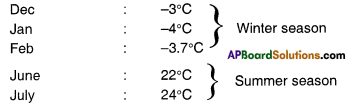
Moscow in Russia – It is located near 55.7558° N. latitude. The average temperatures are as follows.
AP Board 8th Class Social Studies Solutions Chapter 3 Earth Movements and Seasons 1
Falkland Islands: It is extended from 51 °S latitude to 52°S. Latitude.
AP Board 8th Class Social Studies Solutions Chapter 3 Earth Movements and Seasons 2
The seasons are quite opposite in both hemispheres.
Ours is Vijayawada in Andhra Pradesh. This is located at 16°5200 N. latitudes. Here April and May are famous for high temperatures. Winter season will be in December and January. When compared to Russia and Falkland Islands, the summer temperatures and winter temperatures are both higher than their summer temperatures. But the seasons in these three areas are more or less equal.

AP Board 8th Class Social Studies Solutions Chapter 3 Earth Movements and Seasons

Question 8.
What are the six seasons of Indian climate?
Answer:
The six seasons are:

  1. Vasantham – Mid March – Mid May
  2. Greeshrnam – Mid May to Mid July
  3. Varsha – Mid July to Mid September
  4. Sarath – Mid September – Mid November
  5. Hemantham – Mid November – Mid. January
  6. Sisiram – Mid January – Mid March

Question 9.
Read the first paragraph of this chapter and answer the following question

Human beings live along with a large community of plants and animals. We can observe constant change in the course of the year – the flowering and fruiting of trees and plants changes in the animal activity in our surroundings. As months pass by you would have noticed that trees shed leaves, stand bare, new shoots come forth, they flower and fruit. You may have also noticed that in different times of the year you get different kinds of vegetables and fruits. In some months it is very hot and in some it is cold or wet.

“What is the impact of seasons on the lives of human beings ?”
Answer:
Human beings live along with a large community of plants and animals. We can find a constant change in the course of the year – the flowering and fruiting of trees and plants changes the animal activity in our surroundings. As months pass by, trees shed leaves, stand bare, new shoots come forth, leaves grew again they flower and give fruits. In different times of the year we get different kinds of fruits and vegetables. In some months, it is very hot and in some months, it is cold or wet.

8th Class Social Studies 3rd Lesson Earth Movements and Seasons InText Questions and Answers

AP Board 8th Class Social Studies Solutions Chapter 3 Earth Movements and Seasons

Question 1.
Can you relate what are the major seasons you have seen? (Textbook Page No. 33)
Answer:
The major seasons I have seen are Summer season, Rainy season and Winter season.

Question 2.
Can you describe What happen in each -how hot it gets, how much it rains, what happens to the plants and trees and animals, what food you get to eat etc.? (Textbook Page No. 33)
Answer:
Summer season: The atmospheric temperature is too hot i.e., upto 45°C. At the end of this season sometimes it rains. Plants, trees, human beings, animals long for water, food and cool air. This season is famous for watermelons, mangoes and palm fruits etc.

Rainy season: Heavy rains occur during this season. But temperature varies between 30°C to 35°C. We can see greenery everywhere. Cattle are well with their abundant feed. They give us plenty of milk. Many types of vegetables and mushrooms are available.

Winter season: Cold is heavy in this season. Temperature varies from 25°C to 30°C. Even then nights are too cold. Animals also long for warmth. During this season cauliflower, tomato and grapes etc., are available in plenty.

Question 3.
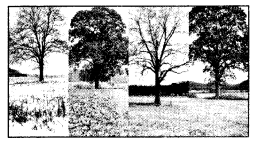
Do you think the trees observed ¡n the pictures are same or different? (Textbook Page No. 33)
AP Board 8th Class Social Studies Solutions Chapter 3 Earth Movements and Seasons 3
Answer:
They are same.

AP Board 8th Class Social Studies Solutions Chapter 3 Earth Movements and Seasons

Question 4.
What are the changes you can see in the trees?
Answer:

  1. In the first picture it is covered by snow.
  2. In the second picture the same tree has fully grown leaves.
  3. In the third picture the same tree is sprouting leaves.
  4. In the last picture ripe red leaves are falling from the same tree.

Question 5.
Imagine that the Earth goes around the Sun but its axis is not tilted. How will it affect the change in seasons in Andhra Pradesh? (Textbook Page No. 37)
Answer:
This happens if the Earth’s axis is not fitted. Andhra Pradesh is in tropical belt. So the Sun rays fall straight on this area. If the axis is not fitted, there will be continuous temperatures and summer throughout the year on this area. Rainy and winter seasons may not be possible. Most probably the three seasons may come on every day.

Question 6.
How will it affect the change in seasons in the northern region whose photograph you saw in the beginning of the chapter? (Textbook Page No. 37)
Answer:
The photographs are different in different seasons. If the earth’s axis is not tilted, the northern most area on the earth may get freezed. We cannot find any vegetation there.

AP Board 8th Class Social Studies Solutions Chapter 3 Earth Movements and Seasons

Question 7.
Find out if there is anyone in the class who has lived in distant places where the seasons are different. Get them to describe what happens there. (Textbook Page No. 33)
Answer:
In my class one student named ‘Atchyut’ came from ‘Dehradun’. He is staying with his grand-parents. His parents are in ‘Dehradun’. He told that the seasons there are entirely different from us. They have heavy winters. Let us listen to his words.
“My name is Atchyut. I came here from ‘Dehradun’ which is at the feet of the ‘Himalayas’. We feel sweat during summer, even though we have less temperatures. Rains are too heavy during the rainy season. Coming to winter season – wow! it is too cold. Hot water should be used for every task in daily life. Warm water is used for drinking. We feel sunlight only after 8 a.m. We must use inners, sweaters, mufflers, caps, socks, and gloves. But our area is very beautiful”.

Question 8.
Find out which country is called the ‘land of midnight Sun’ and locate it on the globe. Find out its latitude and compare it with the latitude of Andhra Pradesh. (Textbook Page No. 34)
Answer:
Norway is called “Land of Midnight Sun. Its latitude is 60.47°N. Some other countries like,

  1. Sweden -59.26°N.
  2. Iceland – 64.83°N.
  3. Lapland -67°N.
  4. Denmark – 55.72°N.
  5. Finland -62°43″N
  6. Alaska -61°18″N
  7. Russia – 54°82″N
  8. Yukon – 63.63°N
  9. Canada – 56°75″ N etc.

comes under this session also. Whereas Latitude as Andhra Pradesh is 80°E;

AP Board 8th Class Social Studies Solutions Chapter 3 Earth Movements and Seasons

Question 9.
Look at the globe and find out the names of countries which are located to the south of equator. (Textbook Page No. 34)
Answer:
Asia: Indonesia, partly Maldives partly Sumatra.
Africa: Angola, Botswana, Burundi, South Africa, Tanzania.
Europe: No
North America: No
South America: Argentina, Chile, Bolivia
Australia: Australia, New Guinea

Question 10.
Did you find any continent which is located entirely to the North of the Equator ? (Textbook Page No. 34)
Answer:
Yes. They are Europe and North America.

Question 11.
Did you find any continent which is located entirely to the South of the Equator ? (Textbook Page No. 34)
Answer:
Yes. It is Australia.

Question 12.
Did you find any continent which is spread on both ideas of the North and South of the Equator ? (Textbook Page No. 34)
Answer:
Yes. It is Asia.

AP Board 8th Class Social Studies Solutions Chapter 3 Earth Movements and Seasons

Question 13.
Can all the students of the class write down three questions regarding this magic of seasons? we will try to find answers for them. (Textbook Page No. 34)
a) What are the reasons behind the formation of seasons?
Answer:
Earth’s revolution and inclination of the axis are the reasons behind it.

b) In which season the earth tipped towards the sun? (A region)
Answer:
In summer season.

c) What happens if there are no seasons?
Answer:
No seasons, no life on the earth.
Identification of these countries on the globe: Self exercise

AP Board 8th Class Social Studies Solutions Chapter 3 Earth Movements and Seasons

Question 14.
Find out if Andhra Pradesh is in the Tropical Belt or in the Temperate Belt. (Textbook Page No. 38)
Answer:
Andhra Pradesh is extended between 12°N to 19°N latitude (approximately). It is in Tropical Belt.

Question 15.
Will the Sun shine directly on our heads in Andhra pradesh during any month? If yes, in which month? (Textbook Page No. 38)
Answer:
The Sun’s rays fall straightly on Andhra Pradesh in the month of May.

Question 16.
Find out in which belt is Delhi and if it will get snowfall in winters. (Textbook Page No. 38)
Answer:
Delhi is located between 28°22″ N. latitude and 28°54″ N. latitude. It is in Temperate Belt. It records low temperatures but there is no snowfall.

AP Board 8th Class Biology Solutions Chapter 2 కణం – జీవుల మౌళిక ప్రమాణం

SCERT AP 8th Class Biology Study Material Pdf 2nd Lesson కణం – జీవుల మౌళిక ప్రమాణం Textbook Questions and Answers.

AP State Syllabus 8th Class Biology 2nd Lesson Questions and Answers కణం – జీవుల మౌళిక ప్రమాణం

8th Class Biology 2nd Lesson కణం – జీవుల మౌళిక ప్రమాణం Textbook Questions and Answers

అభ్యసనాన్ని మెరుగుపరచుకుందాం

ప్రశ్న 1.
మొట్టమొదట కణాన్ని ఎవరు, ఎలా కనిపెట్టారు ?
జవాబు:

  1. బ్రిటన్ కు చెందిన రాబర్ట్ హుక్ అనే శాస్త్రవేత్త పలుచని బెండు ముక్క నుంచి ఒక పలుచని పొరను సూక్ష్మదర్శినితో పరిశీలించాడు.
  2. బెండు ముక్కలో ఖాళీ గదుల లాంటి నిర్మాణాలను గమనించాడు.
  3. అవి తేనెపట్టులో ఉండే ఖాళీ గదుల్లా కనిపించాయి.
  4. వీటికి ‘కణం’ అని పేరు పెట్టాడు.
  5. లాటిన్ భాషలో ‘సెల్’ (cell) అనగా చిన్నగది అని అర్థం. మనం. దాన్ని తెలుగులో ‘కణం’ అంటాము.
  6. కణం యొక్క ఆవిష్కరణ సైన్సు చరిత్రలో ఒక ముఖ్య ఘట్టం.

ప్రశ్న 2.
కణం యొక్క ఆకారం ఏయే అంశాలపై ఆధారపడి ఉంటుంది ?
(లేదా) ఒక కణం యొక్క ఆకారాన్ని ప్రభావితం చేసే అంశాలేమిటి ?
జవాబు:
కణం యొక్క ఆకారం మూడు అంశాలపై ఆధారపడి ఉంటుంది.

  1. కణత్వచం
  2. కణకవచం
  3. కణం చేసే పని మీద వాటి ఆకారం ఆధారపడి ఉంటుంది.

ఉదా : నాడీకణం పొడవుగా ఉంటుంది. అది నాడులను ఏర్పరచటానికి పొడవుగా ఉండటం అవసరం.

AP Board 8th Class Science Solutions Chapter 2 కణం - జీవుల మౌళిక ప్రమాణం

ప్రశ్న 3.
ఏకకణ జీవులకు, బహుకణ జీవులకు మధ్యగల భేదాలు రాయండి.
జవాబు:

ఏకకణ జీవులు బహుకణ జీవులు
1. ఇవి ఒకే ఒక కణంతో నిర్మితమై ఉంటాయి. 1. ఇవి ఒకటి కన్నా ఎక్కువ కణాలతో నిర్మితమై ఉంటాయి.
2. అన్ని జీవక్రియలు ఒక కణం లోపలే జరుగుతాయి. 2. వీటిలో ప్రతి జీవక్రియను చేయటానికి ఒక నిర్దిష్ట కణం లేదా కణాలు ఉంటాయి.
3. వీటికి స్పష్టమైన ఆకారం అమీబా వంటి వాటిలో ఉండదు. కానీ పేరమీషియం, యుగ్లీనా వంటి వాటిలో నిర్దిష్టమైన ఆకారం ఉంటుంది. 3. బహుకణ జీవులకు నిర్దిష్టమైన ఆకారం ఉంటుంది.
4. ఇవన్నీ సూక్ష్మదర్శిని సాయంతోనే చూడవచ్చు. 4. వీటిలో కొన్ని సూక్ష్మదర్శినితోనూ, మరికొన్ని మన కంటితోనూ చూడవచ్చు.

ప్రశ్న 4.
స్లెడ్ మీద ఉంచిన పదార్థం త్వరగా ఆరిపోకుండా ఉండాలంటే ఏం చేస్తావు ?
జవాబు:

  • స్లెడ్ మీద ఉంచిన పదార్థం త్వరగా ఆరిపోకుండా ఉండాలంటే ఒక నీటిచుక్కతో పాటు ఒక చుక్క గ్లిసరినను వేయాలి.
  • ఎక్కువ రోజులు సైడ్ ను ఉంచాలంటే గ్లిసరిన్, వేసి కవర్ స్లిప్ ను కూడా అమర్చాలి.
  • అందువల్ల నీరు కానీ, గ్లిసరిన్ కానీ సూక్ష్మదర్శిని యొక్క అక్షి కటకానికి అంటుకోకుండా ఉంటుంది.

ప్రశ్న 5.
“మనం కణాలను కంటితో చూడలేం !” అని దీక్షిత్ చెప్పాడు. ఈ వాక్యం తప్పా ? ఒప్పా ? ఎందుకో రాయండి.
జవాబు:
1. ఈ వాక్యం ‘తప్పు.
2. కారణాలు :
i) కణాలు చాలా సూక్ష్మంగా ఉండి, మైక్రోస్కోప్ సహాయంతో చూడగలము. అయినప్పటికి దీనికి మినహాయింపుగలదు. అండము (ఆస్ట్రిచ్ గుడ్డు) ఒక కణము. ఇది 17 సెం.మీ. నుండి 18 సెం.మీ. పరిమాణం ఉంటుంది.
ii) చాలా కణాలు సూక్ష్మంగా ఉన్నప్పటికి, కంటికి కనిపించే పెద్ద కణాలు కూడా కలవు.

AP Board 8th Class Science Solutions Chapter 2 కణం - జీవుల మౌళిక ప్రమాణం

ప్రశ్న 6.
పెద్ద ఉల్లిగడ్డలను, చిన్న ఉల్లిగడ్డలతో పోల్చినప్పుడు పెద్ద కణాలు కలిగి ఉంటాయి” అని రియాజ్ చెప్పాడు. అతడు . చెప్పిన దానితో నీవు ఏకీభవిస్తావా ? కారణాలు వివరించండి.
జవాబు:
రియాజ్ చెప్పిన దానితో నేను ఏకీభవించను.
శరీర పరిమాణానికి కణపరిమాణానికి సంబంధం లేదు. దాదాపు ఒక కణజాలంలోని కణాలన్ని ఒకే పరిమాణం కల్గి ఉంటాయి. శరీర పరిమాణం పెరిగే కొలది కణాల సంఖ్య పెరుగుతుంది. కావున చిన్న ఉల్లిగడ్డలో కణాల సంఖ్య తక్కువగాను, పెద్ద ఉల్లిగడ్డలో అదే పరిమాణం కలిగిన కణాలు అధికంగా ఉంటాయి. కణాల సంఖ్య పెరగటం వలన జీవి పరిమాణం పెరుగుతుంది. భూమిపైన పెద్ద శరీరం కలిగిన ఏనుగులోనూ కణాల పరిమాణం సాధారణంగానే ఉంటుంది.

ప్రశ్న 7.
కింది వాక్యాలు చదవండి. తప్పుగా ఉన్న వాటిని గుర్తించి, సవరించి రాయండి.
ఎ) కణకవచం వృక్ష కణాలకు తప్పనిసరిగా అవసరం.
బి)కేంద్రకం కణం యొక్క జీవక్రియలను నియంత్రిస్తుంది.
సి) ఏకకణ జీవులు శ్వాసక్రియ, విసర్జన, పెరుగుదల మరియు ప్రత్యుత్పత్తి లాంటి జీవక్రియలన్నింటినీ నిర్వహిస్తాయి.
డి) కేంద్రకం, కణాంగాలు స్పష్టంగా చూడటానికి రంజనం చేయనవసరం లేదు.
జవాబు:
ఎ) కణకవచం వృక్షకణాలకు తప్పనిసరి. ఎందుకంటే ఇది కణానికి పటుత్వాన్ని ఇస్తుంది.
బి) కేంద్రకం కణం యొక్క జీవక్రియలు నిర్వర్తిస్తుంది. (DNA సహాయంతో) నిజమే !
సి) ఏకకణ జీవులు శ్వాసక్రియ, విసర్జనక్రియ, పెరుగుదల మరియు ప్రత్యుత్పత్తి లాంటి జీవక్రియలన్నింటినీ నిర్వహిస్తాయి.
వాస్తవమే – కనుక ఇది ఒప్పు.
డి) కేంద్రకం, కణాంగాలు స్పష్టంగా చూడటానికి రంజనం చేయాలి. అప్పుడే మనం స్పష్టంగా అన్నింటినీ సూక్ష్మదర్శినితో చూడగలం.

ప్రశ్న 8.
కేంద్రకం విధులను వివరించండి.
జవాబు:
కేంద్రకం విధులు :

  • ఇది కణంలోని జీవపదార్థం మధ్యలో గుండ్రంగా ఉంటుంది.
  • ఇది కణంలో అంతర్భాగం.
  • ఈ కేంద్రకం కణంలో జరిగే చర్యలను నియంత్రిస్తుంది.
  • కేంద్రకంలో ఉన్న జన్యువులు ఈ వంశపారంపర్య లక్షణాలను జీవులలో ఒక తరం నుండి మరొక తరానికి సంక్రమింపచేస్తాయి.

AP Board 8th Class Science Solutions Chapter 2 కణం - జీవుల మౌళిక ప్రమాణం

ప్రశ్న 9.
ఉల్లిపొరలోని కణాలకు, గడ్డి చేమంతి కాండం అడ్డుకోతలోని కణాలకు తేడాలు తెలపండి.
జవాబు:

ఉల్లిపొరలోని కణాలు గట్టి చేమంతి కాండంలోని కణాలు
1. ఇవి అన్నీ ఒకే ఆకారంలో ఉన్నాయి. 1. ఇవి అన్నీ ఒకే ఆకారంలో లేవు.
2. ఇవి అన్నీ ఒకే పరిమాణంలో ఉన్నాయి. 2. ఇవి అన్నీ ఒకే పరిమాణంలో లేవు. వేర్వేరుగా ఉన్నాయి.
3. ఇవి కేంద్రకాన్ని కలిగి ఉన్నాయి. 3. వీటిలో కూడా కేంద్రకం ఉంది.
4. ఇవి అన్నీ ఒకే పనికి వినియోగించబడ్డాయి. అది ఆహార నిల్వ. 4. వీటిని గ్రూపు-ఎ, గ్రూపు-బి, గ్రూపు-సి, గ్రూపు-డి లుగా గుర్తిస్తాం.
5. జీవక్రియలన్నీ ఏకకణంలోనే జరుగుతాయి. (జీర్ణక్రియ, నీరు, ఆహార రవాణా, పెరుగుదల మొదలైనవి.) 5. గ్రూపు-ఎ కణాలు ఆకారాన్ని ఇస్తాయి.
గ్రూపు-బి కణాలు కిరణజన్య సంయోగక్రియ ద్వారా ఆహారాన్ని తయారుచేస్తాయి.
గ్రూపు-సి కణాలు నీరు, ఆహారాన్ని రవాణా చేస్తాయి.
గ్రూపు-డి కణాలు కాండం మధ్యలో ఉంటాయి.

ప్రశ్న 10.
AP Board 8th Class Science Solutions Chapter 1 కణం - జీవుల మౌళిక ప్రమాణం 1
పైన ఇవ్వబడిన పటాలలో భాగాలు గుర్తించండి. వీటిలో ఏది వృక్షకణమో ? ఏది జంతు కణమో గుర్తించండి.
(లేదా)
ఎ) వృక్షకణ నిర్మాణం చూపు బొమ్మను గీచి, భాగాలను గుర్తించండి.
బి) కణ కవచం దేనికి ఉపయోగపడుతుంది ?
జవాబు:
A. కేంద్రకము
B. జీవపదార్ధం
C. ప్లాస్మాపొర
D. రిక్తిక
E. కేంద్రకం
F. కణకవచము
G. ప్రక్క కణము
H. ప్లాస్మాపొర
I. జీవ పదార్థము
పై పటాలలో ఎడమవైపుది జంతుకణం, కుడివైపుది వృక్షకణం (దీర్ఘచతురస్రాకారం)
1. కుడివైపున ఉన్న కణం జంతు కణం.
2. ఎడమవైపున ఉన్న కణం వృక్ష కణం.
బి) కణ కవచం వృక్షకణానికి యాంత్రిక బలాన్ని చేకూర్చుతుంది.

ప్రశ్న 11.
కణాలలో వైవిధ్యం గురించి తెలుసుకోవటానికి నీవు ఏ ఏ ప్రశ్నలు అడుగుతావు?
జవాబు:

  1. కణాలన్నీ చిన్నవిగా ఉంటాయా? కొన్ని పెద్దకణాలు ఉంటాయా?
  2. కణాలలో ఉండే ప్రధానమైన నిర్మాణాలు ఏమిటి?
  3. కణాల ఆకారం ఏ ఏ అంశాలపై ఆధారపడి ఉంటుంది?
  4. అతిపొడవైన కణం ఏమిటి?
  5. వృక్షకణం జంతుకణం కంటే విభిన్నంగా ఉంటుందా?
  6. వృక్షాలలో లేకుండా జంతువులలో మాత్రమే ఉండే కణాలు ఏమిటి?

AP Board 8th Class Science Solutions Chapter 2 కణం - జీవుల మౌళిక ప్రమాణం

ప్రశ్న 12.
ఏకకణజీవులు, బహుకణజీవుల గురించి తెలుసుకోవటానికి ఏమేమి ప్రశ్నలు అడుగుతావు?
జవాబు:

  1. ఏకకణజీవులు అనగానేమి?
  2. బహుకణజీవులు అనగానేమి?
  3. బహుకణజీవులలో కణాల పరిమాణం ఎలా ఉంటుంది?
  4. ఏకకణజీవులలో అన్ని జీవక్రియలు జరుగుతాయా?
  5. ఉపయోగకర ఏకకణజీవులు ఏమిటి?
  6. బహుకణజీవులను ఎలా వర్గీకరిస్తావు?

ప్రశ్న 13.
నీటికుంటలో తేలే పచ్చని మొక్కను (Slime) సేకరించండి. దాని నుండి సన్నని భాగాన్ని వేరు చేసి స్లెడ్ మీద వేసి మైక్రోస్కోప్ ద్వారా పరిశీలించండి. మీరు పరిశీలించిన దానిని పటం గీయండి.
జవాబు:
AP Board 8th Class Science Solutions Chapter 1 కణం - జీవుల మౌళిక ప్రమాణం 2
మా ఇంటి దగ్గరలోని కుంటలో తేలియాడుతున్న పచ్చని మొక్కను సేకరించాను.

  • అది నాచు మొక్కలా జిగురుగా ఉంది.
  • పీచు భాగం కూడా దానిలో ఉండటం గమనించాను.
  • దానిని బ్లేడుతో సన్నని ముక్కలుగా చేసి పెట్రేడిష్ లో కణకవచం ఉన్న నీళ్ళలో వేశాను.
  • అతి సన్నని ముక్కను బ్రష్ సహాయంతో స్లెడ్ పైన వేసి ఒక చుక్క నీరు వేశాను.
  • తరువాత దానికి ఒక చుక్క గ్లిసరిన్ వేసి దానిని కవర్ స్లిప్ తో కప్పాను.
  • తరువాత దానిని సూక్ష్మదర్శిని సాయంతో చూడగా పక్క బొమ్మ మాదిరిగా కనిపించింది.

ప్రశ్న 14.
మీ పరిసరాలలోని ఆకులు సేకరించండి. ఆకుల ఉపరితల కణాలు, ఆకారాలను, సూక్ష్మదర్శినితో చూడండి. ఒక పట్టిక తయారుచేయండి. పట్టికలో క్రమసంఖ్య, ఆకు పేరు, ఆకు ఆకారం, బాహ్యత్వచంలోని కణాలు ఆకారం రాయండి. మీరు ప్రత్యేకంగా కనుగొన్న అంశాలను పట్టిక కింద రాయడం మరువవద్దు.
జవాబు:
AP Board 8th Class Science Solutions Chapter 1 కణం - జీవుల మౌళిక ప్రమాణం 3

AP Board 8th Class Science Solutions Chapter 2 కణం - జీవుల మౌళిక ప్రమాణం

ప్రశ్న 15.
ఈ పాఠంలో మీరు పరిశీలించిన కణాలను అంతర్జాలం నుండి సేకరించి వాటిని చిత్తుపుస్తకంలో అతికించి, వాటి విధులు రాయండి.
జవాబు:

పటం కణం పేరు విధి
1. కండర కణం పటం కండర కణం చలనము, కదలిక
2. నాడీకణం పటం నాడీకణం సమాచార రవాణా సమాచార విశ్లేషణ
3. ఎర్రరక్త కణం పటం ఎర్రరక్త కణం O2, CO2, సరఫరా
4. తెల్లరక్త కణం పటం తెల్లరక్త కణం సూక్ష్మజీవుల నుండి రక్షణ

AP Board 8th Class Science Solutions Chapter 1 కణం - జీవుల మౌళిక ప్రమాణం 4

ప్రశ్న 16.
సూక్ష్మదర్శినితో పరిశీలించిన వృక్ష, జంతు కణాల పటాలు, భాగాలను గీయండి.
జవాబు:
1. వృక్ష కణం
AP Board 8th Class Science Solutions Chapter 1 కణం - జీవుల మౌళిక ప్రమాణం 5

2. జంతు కణం
AP Board 8th Class Science Solutions Chapter 1 కణం - జీవుల మౌళిక ప్రమాణం 6

ప్రశ్న 17.
మానవులు, జంతువులు, వృక్షాలు మొదలైనవన్నీ కంటికి కనిపించని కణాలతో నిర్మితమైనాయి. దీనిని నీవు ఏవిధంగా అభినందిస్తావు ?
జవాబు:

  • కంటికి కనిపించని సూక్ష్మ నిర్మాణాలు కణాలు.
  • ఇవి సజీవులైన మొక్కలు, జంతువులు, మానవులలో నిర్మాణాత్మక, క్రియాత్మక నిర్మాణాలు అని తెలిసినప్పుడు ఆశ్చర్యం కలుగుతుంది.
  • కణాలన్నీ కలసి అంగాలను నిర్మిస్తాయి.
  • అంగాలన్నీ కలసి వ్యవస్థలు నిర్మిస్తాయి.
  • అభివృద్ధి చెందిన జీవులలో ప్రతి జీవక్రియా నిర్వహణకు ఒక్క వ్యవస్థ ఉంటుంది.
    ఉదా : జీర్ణవ్యవస్థ, విసర్జక వ్యవస్థ, రక్త ప్రసరణ వ్యవస్థ మొ॥నవి.
  • ఈ వ్యవస్థలన్నీ కలసి ‘జీవి’ నిర్మాణం జరుగుతుంది.
  • పై విషయాలు తెలుసుకున్నప్పుడు, కణం, దాని ప్రాముఖ్యతను అర్థం చేసుకున్నప్పుడు ఎంతో ఆశ్చర్యం కలిగి అభినందించాలని అనిపిస్తుంది.

AP Board 8th Class Science Solutions Chapter 2 కణం - జీవుల మౌళిక ప్రమాణం

ప్రశ్న 18.
“వృక్ష కణాలలో కణకవచం లేకపోతే మొక్కలు నిలబడలేవు” అని దీపక్ తన మిత్రుడు జాతో చెప్పాడు. అతను చెప్పిన దానిని నీవెలా సమర్థిస్తావు ?
జవాబు:

  • దీపక్ చెప్పిన ఈ విషయాన్ని నేను సమర్థిస్తాను. ఎందుకంటే –
  • వృక్ష కణాలలో కణత్వచంపై అదనపు రక్షణ, పటుత్వం కోసం కణకవచం ఉంటుంది.
  • ఈ పటుత్వం వల్ల మొక్కలు వృక్షాలు నిర్దిష్టమైన ఆకారంలో నిలబడతాయి.
  • వీటిలో ప్రకాండ వ్యవస్థ, వేరు వ్యవస్థలు ఏర్పడతాయి.
  • అందువల్ల వేర్లు, కాండం, శాఖలు, ఆకులు పటుత్వంతో ఉంటాయి.
  • ఇది మొక్కను పటుత్వంతో నిలబెట్టగలుగుతుంది.

కనుక నేను దీపక్ చెప్పిన విషయాన్ని సమర్థిస్తాను.

8th Class Biology 2nd Lesson కణం – జీవుల మౌళిక ప్రమాణం InText Questions and Answers

8th Class Biology Textbook Page No. 21

ప్రశ్న 1.
వివిధ రకాల కణాలు కాండంలో ఎందుకు ఉంటాయో ఆలోచించండి. (పేజీ నెం. 21)
జవాబు:

  1. కాండము అనేక రకాల పనులు నిర్వహిస్తుంది.
  2. నీరు, పోషక పదార్థాల రవాణా కోసం ప్రత్యేక కణజాలం ఉంటుంది.
  3. ఆధారాన్ని ఇవ్వటానికి బరువు మోయటానికి ప్రత్యేక కణజాలం ఉంటుంది.
  4. కాండాన్ని ఆవరించి వెలుపలివైపు పొరవంటి కణజాలం రక్షణ ఇస్తుంది.
  5. కాండం పెరగడానికి విభజన చెందే కణాల గుంపు ఉంటుంది.

8th Class Biology Textbook Page No. 23

ప్రశ్న 1.
ఏనుగులో ఉండే కణాలు, మనిషిలో ఉండే కణాల కంటే పెద్దవా ?
జవాబు:

  1. ఏనుగు మరియు మనిషిలో ఉండే కణాలు ఒకే పరిమాణం కలిగి ఉంటాయి.
  2. జీవి సైజు కణాల సంఖ్యపై ఆధారపడి ఉంటుంది కాని కణాల పరిమాణంపై కాదు.
  3. కావున ఏనుగులో మనిషికన్నా ఎక్కువ కణాలు ఉంటాయి.

కృత్యములు

కృత్యం – 1

ప్రశ్న 1.
అగ్గిపుల్లలో కణాల పరిశీలన
AP Board 8th Class Science Solutions Chapter 1 కణం - జీవుల మౌళిక ప్రమాణం 7
కృత్యం : ఒక అగ్గిపుల్లను నీటిలో అరగంట నానబెట్టండి. పల్చని పొరలుగా బ్లేడ్ తో కత్తిరించండి. వీటిలో చాలా పల్చని పొరని బ్రష్ తో తీసుకొని దానిని స్లెడ్ పైన పెట్టండి. దానిపై ఒక నీటిచుక్క వేసి దానిని కవర్ స్లిప్ తో నీటి బుడగలు ఏర్పడకుండా కప్పండి. సూక్ష్మదర్శినితో పరిశీలించండి. మీరు గీసిన పటాన్ని నమూన పీఠం బెండు కణాల పటంతో పోల్చండి..

a) మీరు గీసిన పటాన్ని పటం – 2 తో పోల్చండి. రెండూ ఒకేరకంగా ఉన్నాయా ?
జవాబు:
ఔను. నేను గీసిన పటం,పటం – 2 రెండూ ఒకే విధంగా ఉన్నాయి.

b) దీర్ఘచతురస్రాకారంగా ఉన్న వాటిని ఏమని పిలుస్తారు ?
జవాబు:
దీర్ఘచతురస్రాకారంగా ఉన్న వాటిని కణాలు అంటారు.

AP Board 8th Class Science Solutions Chapter 2 కణం - జీవుల మౌళిక ప్రమాణం

కృత్యం – 2

ప్రశ్న 2.
ఉల్లిగడ్డ పొరను పరిశీలించే విధానం రాయండి.
జవాబు:

  • ఉల్లిగడ్డ పొట్టు తీసి మందమైన చిన్న ముక్కను కోయాలి.
  • ఉల్లిముక్కను రెండుగా విరిచి నెమ్మదిగా వేరుచేసే ప్రయత్నం చేయండి.
  • రెండు ముక్కలను కలుపుతూ ఉన్న పలుచని పాక్షిక పారదర్శకంగా ఉండే పొరను గమనించండి.
  • ఈ పొరను నెమ్మదిగా వేరు చేయాలి. దాని నుండి చిన్నముక్క కత్తిరించాలి.
  • స్లెడ్ పై నీటిచుక్క వేసి ఉల్లి పొరను పెట్టాలి.
  • స్లెడ్ పైన వేసిన ఉల్లిపొర మడతలు పడకుండా జాగ్రత్తగా కవర్ స్లిప్ తో కప్పాలి. దానిని సూక్ష్మదర్శినితో పరిశీలించాలి.

a) మీరు పరిశీలించిన ఉల్లిపొర కణాల పటాలు గీయండి.
జవాబు:
AP Board 8th Class Science Solutions Chapter 1 కణం - జీవుల మౌళిక ప్రమాణం 8

b) మీరు గీచిన పటాన్ని పై పటంతో పోల్చండి. ఆ రెండింటి మధ్య ఏమైనా తేడాలున్నాయా ?
జవాబు:
రెండింటి మధ్య ఎటువంటి తేడాలు లేవు.

కృత్యం – 3

ప్రశ్న 3.
బుగ్గలోని కణాలను పరిశీలించే విధానం రాయండి.
జవాబు:
AP Board 8th Class Science Solutions Chapter 1 కణం - జీవుల మౌళిక ప్రమాణం 9

  • నోటిని శుభ్రంగా కడుక్కొని, ప్లాస్టిక్ స్పూన్ తో నోటి లోపల బుగ్గపై గీకండి.
  • స్లెడ్ పై నీటి బిందువును వేసి, దానిలో గీకగా వచ్చిన పదార్థం వేయాలి.
  • దీనిని కవర్ స్లితో కప్పి సూక్ష్మదర్శిని సహాయంతో పరిశీలించాలి.
  • గుండ్రని, కేంద్రకం కలిగిన కణాలను మనం గమనించవచ్చు.

జాగ్రత్తలు :

  1. స్పూన్ శుభ్రంగా కడగాలి.
  2. నోటి లోపల గట్టిగా గీకరాదు.

a) నీవు పరిశీలించిన కణాలు, పటంలో చూపిన కణాలు మాదిరిగానే ఉన్నాయా ?
జవాబు:
ఔను నేను పరిశీలించిన కణాలులో చూపిన కణాలు మాదిరిగానే ఉన్నాయి.

b) రెండు కణాల చుట్టు ఆవరించి ఉన్న పొర ఒకే విధంగా ఉందా ?
జవాబు:
ఔను. రెండింటిని ఆవరించి ఉన్న పొర ఒకే విధంగా ఉంది. దీనినే ప్లాస్మాపొర అంటారు.

AP Board 8th Class Science Solutions Chapter 2 కణం - జీవుల మౌళిక ప్రమాణం

కృత్యం – 4

ప్రశ్న 4.
ఉల్లి పొరలోని కేంద్రకం పరిశీలించే విధానం రాయండి. (లేదా) నీవు ఉల్లిపొరలోని కణాలను పరిశీలించావు కదా ? ఈ ప్రయోగ విధానాన్ని తెలపండి.
జవాబు:
AP Board 8th Class Science Solutions Chapter 1 కణం - జీవుల మౌళిక ప్రమాణం 10

  • ఉల్లిగడ్డ నుండి ఉల్లిపొరను తియ్యాలి.
  • పొరను స్లెడ్ పై ఉంచి 1-2 చుక్కల రంజకాన్ని (సాఫనిన్ లేదా మిథైలీన్ బ్లూ లేదా ఎర్రసిరా) వెయ్యాలి.
    కణకవచం
  • దానిని కవర్ స్లిప్ తో కప్పి 5 ని॥లు కదల్చకుండా ఉంచాలి.
  • తరువాత కవర్ స్లిప్ కు ఒకవైపు చుక్కలు చుక్కలుగా నీరు పోస్తూ అధికంగా ఉన్న నీటిని రెండవవైపు నుండి ఫిల్టర్ పేపర్లో అద్ది తీసివేయాలి.
  • దీనివల్ల అధికంగా ఉన్న రంజనం తొలగిపోతుంది. ఇప్పుడు సైడ్ ను సూక్ష్మదర్శిని సహాయంతో చూడండి.
  • నీలం లేదా ఎరుపు రంగులో ఉండే చుక్కలాంటి నిర్మాణం కనిపించింది కదా ! ఇదే ఉల్లిపొర కణంలోని కేంద్రకం.

కృత్యం – 5

ప్రశ్న 5.
బుగ్గ కణంలోని కేంద్రకం పరిశీలించే విధానం రాయండి.
జవాబు:
AP Board 8th Class Science Solutions Chapter 1 కణం - జీవుల మౌళిక ప్రమాణం 11

  • ఒక స్పూన్ తీసుకొని నోటి లోపలి భాగంలో గీకండి.
  • పదార్థాన్ని స్లెడ్ మీద ఉంచి ఒక్క చుక్క నీరు చేర్చండి.
  • దానికి మిథైలీన్ బ్లూ రంజకం కలిపి కవర్ స్లిప్ వేయండి.
  • స్లెడ్ ను మైక్రోస్కోప్ కింద పరిశీలించండి.
  • కణం మధ్యభాగంలో గుండ్రని కేంద్రకం కనిపిస్తుంది.

a) ఉల్లిపొరలోని కణాలను బుగ్గలోని కణాలను పరిశీలించారు కదా ? రెండింటిని పోల్చండి.
జవాబు:

  • ఉల్లిపొరలోని కణాలు చాలా పొడవుగా ఉండే బుగ్గకణాలు గుండ్రంగా ఉన్నాయి.
  • ఉల్లి పొరకణాలు దీర్ఘచతురస్రాకారంగా ఉంటే, బుగ్గకణాలు వృత్తాకారంగా ఉన్నాయి.

b) కణాలలో మీరు పరిశీలించిన నిర్మాణాలు ఏమిటి ?
జవాబు:

  • కణాలలో జీవపదార్థం ఉంది.
  • జీవ పదార్థంలో గుండ్రని నిర్మాణం ఉంది.
  • జీవపదార్థం చుట్టూ వెలుపలి పొర ఉంది.

c) రంగు కలిగిన గుండ్రని నిర్మాణాలు ఏవైనా చూసారా ?
జవాబు:
కణాల మధ్య అధిక రంగు కలిగిన గుండ్రని నిర్మాణాలు ఉన్నాయి.

d) అవి కణాల మధ్యలోనే ఉన్నాయా ?
జవాబు:
ఔను, రంగుకలిగిన గుండ్రని నిర్మాణాలు కణాల మధ్యలోనే ఉన్నాయి.

e) ఉల్లిపొరలోని కణాలు, బుగ్గకణాలు, బుగ్గకణాల బయట త్వచంలో ఏమైనా తేడాలు గమనించారా ?
జవాబు:
ఉల్లిపొరలోని త్వచం బయటకు స్పష్టమైన గోడవంటి నిర్మాణం ఉంది. బుగ్గ కణాల త్వచం బయట ఇటువంటి గోడ వంటి నిర్మాణం కనిపించదు.

AP Board 8th Class Science Solutions Chapter 2 కణం - జీవుల మౌళిక ప్రమాణం

కృత్యం – 6

ప్రశ్న 6.
ఆకులోని కణాలను ఎలా పరిశీలిస్తావు ?
జవాబు:
AP Board 8th Class Science Solutions Chapter 1 కణం - జీవుల మౌళిక ప్రమాణం 12

  • లేతగడ్డి ఆకు నుండి పలుచని పొర తీసుకొని దానిని స్లెడ్ పైన ఉంచండి.
  • దానికి ఒక చుక్క నీటిని కలపండి.
  • పదార్థంపై కవర్ స్లిప్ వేసి సూక్ష్మదర్శిని కింద పరిశీలించండి.
  • వరుసగా అమరిన కణాలు కనిపిస్తాయి.

a) మీరు పరిశీలించిన కణాలు పై పటంలో పోల్చి చూడండి. రెండింటిలో కణాలు ఒకే విధంగా ఉన్నాయి ?
జవాబు:
ఔను. రెండింటిలో కణాలు ఒకే విధంగా ఉన్నాయి.

b) దానిలో ఎన్ని రకాల కణాల గుంపులు చూసారు ?
జవాబు:
ఆకుపై పొరలోని కణాలు అన్ని ఒకే విధంగా ఉంటాయి.
కాని ఆకును అడ్డుకోత కోసి పరిశీలించగా విభిన్న కణాల గుంపులు ఉన్నాయి.

కృత్యం – 7

ప్రశ్న 7.
కింద ఇచ్చిన మానవ శరీర కణాలను పరిశీలించండి.
AP Board 8th Class Science Solutions Chapter 1 కణం - జీవుల మౌళిక ప్రమాణం 13

AP Board 8th Class Science Solutions Chapter 2 కణం - జీవుల మౌళిక ప్రమాణం

ప్రశ్న 8.
కింది పట్టిక నింపండి.
AP Board 8th Class Science Solutions Chapter 1 కణం - జీవుల మౌళిక ప్రమాణం 14
జవాబు:
AP Board 8th Class Science Solutions Chapter 1 కణం - జీవుల మౌళిక ప్రమాణం 15

a) కణాల ఆకారంలో ఏమైనా పోలికలు ఉన్నాయా ?
జవాబు:
కణాలు విభిన్న ఆకారాలలో ఉన్నాయి. కొన్ని గుండ్రముగా ఉండి, మరికొన్ని పొడవుగా, ఇంకొన్ని శాఖాయుతంగా ఉన్నాయి.

b) అన్ని కణాల కేంద్రకం ఉందా ?
జవాబు:
అన్ని కణాలలో దాదాపు కేంద్రకం ఉంది. కాని ఎర్రరక్త కణాలలో కేంద్రకం కనిపించలేదు.

c) అన్ని జీవులలో ఏ కణం పెద్దదిగా ఉంటుందో తెలుసా ?
జవాబు:
జీవులలో నాడీకణం పొడవుగా ఉంటుంది. ఇది సుమారు 90 నుండి 10 సెం.మీ. పొడవు ఉంటుంది. ఉష్ణపక్షి గుడ్డు అన్నింటికంటే పెద్దకణం. దీని పరిమాణం 17 సెం.మీ. × 18 సెం.మీ. ఉంటుంది.

AP Board 8th Class Physical Science Solutions Chapter 2 Friction

AP State Syllabus AP Board 8th Class Physical Science Solutions Chapter 2 Friction Textbook Questions and Answers.

AP State Syllabus 8th Class Physical Science Solutions 2nd Lesson Friction

8th Class Physical Science 2nd Lesson Friction Textbook Questions and Answers

Improve Your Learning

Question 1.
Do you agree with the statement, “friction is both good and an evil”? Explain with examples.
Answer:
Yes, I agree with the statement friction is both good and an evil.
Explanation with examples.
a) Friction is good:

  1. We cannot walk or run without friction.
  2. We will not have any cars or bicycles because all of them move because of friction.
  3. We cannot stop a moving car by applying brakes.
  4. Carpenters will not be able to smoothen surfaces.
  5. We will not able to hold any appliances such as hammer, soap, etc.
  6. It will not possible to write with pen or pencil if there is no friction.
  7. We could not fix nail on the wall.
  8. No building could be constructed if there is no friction.

b) Friction is an evil: Friction is undesirable in machinery because it is responsible for overheating and wearing out of moving parts.

AP Board 8th Class Physical Science Solutions Chapter 2 Friction

Question 2.
Explain why sportsmen use shoes with spikes.
Answer:
The spikes will increases the frictional force so that the sportsmen will get better grip on the floor.

Question 3.
Would it be easier or more difficult for you to walk on soapy water on the marble floor ? Why ?
Answer:
It is more difficult to walk on a marble floor having soapy water because soapy water acts as lubricant and decreases the friction.

Question 4.
What ways do you suggest to reduce friction?
Answer:
Ways of reducing friction:
a) Polishing: Decreasing irregularities of surface (or) smoothening the surface.
B) Lubricants: Using lubricants which will decrease the friction.
c) Ball bearings: Using ball bearings in machinery.
d) Steam lining: Automobiles and aeroplanes are steam lined to reduce the friction due to air.

Question 5.
What conditions are needed for static friction to come into play?
Answer:
The object should be at rest with respect to the surface upto certain limiting acceleration.

AP Board 8th Class Physical Science Solutions Chapter 2 Friction

Question 6.
Give examples of practical application of static friction.
Answer:
The objects unable to move on their own is due to static friction between surfaces of object.
The practical application of static friction:

  1. Construction of buildings.
  2. Fixing nail in the wall.
  3. A book placed in the shelf unable to change its position because it is unable to overcome frictional force.
  4. We can write with pen or pencil due to static friction between finger and pen or pencil.
  5. We will not able to hold appliances such as hammer.

Question 7.
Give examples showing the existence of sliding friction.
Answer:

  1. A moving ball stops after sometime.
  2. If we push an object it will stop after sometime.

Question 8.
Explain how can you measure frictional force?
Answer:
Tie a string around a brick. Pull the brick by a spring balance. When the brick just begins to move note down the reading on the spring balance that measure the force of friction between the surface of brick and the floor.

AP Board 8th Class Physical Science Solutions Chapter 2 Friction

Question 9.
Explain how does lubrication reduce friction?
Answer:
When oil, grease or any other lubricants are applied between the moving parts of a machine, a thin layer formed between the moving surfaces so they do not directly rub against each other which will avoid the interlocking of irregularities. So lubrication reduce the friction.

Question 10.
What kinds of friction do you know?
Answer:
There are three types of friction.

  1. Static friction
  2. Sliding friction
  3. Rolling friction

Question 11.
Explain why sliding friction is less than static friction.
Answer:
When an object starts sliding, the contact points on its surface do not get enough time to lock into the contact points on the floor. So the sliding friction is slightly less than the static friction.

Question 12.
Give examples of how is friction responsible for energy wastages? Give suggestions to reduce energy wastages by friction.
(OR)
How is friction responsible for energy loses give examples? Give suggestions to reduce energy loses by friction.
Answer:
As the friction increases the machinery parts develops heat there by efficiency of the machine decreases which leads lot of wastage of energy. The wastage of energy is due to overheating and wearing out of moving parts.
Suggestions:

  1. To reduce friction between rotating shafts of machine tools we should have to use ball bearings.
  2. Replacing wearing out of moving parts with new ones.

AP Board 8th Class Physical Science Solutions Chapter 2 Friction

Question 13.
Seetha is observing a moving bus with the luggage on its top. As the bus is moving slowly there is change in the state of luggage on its top. But when the bus speeds up and starts moving fast, she noticed that the luggage on the top of the bus fell to the back of the bus. This raised many doubts in her mind regarding to the effect frictional force acting on the luggage as well as on the tyres of the bus. Can you guess the questions raised in her mind ? Write them.
Answer:

  1. Why the bag is moving backward direction?
  2. In which direction friction is acting on the bus as well as on the bag?
  3. Whether frictional force effecting relative motion between bag and bus?
  4. What happens to frictional force if we replace bag with other object?

Question 14.
Collect information either from internet or from books in library, about various new techniques being adopted by human beings to reduce energy losses due to friction. Prepare a note on that.
Answer:

  1. We are using grease, oil, wax and other lubricants in the vehicles and machinery to reduce the friction.
  2. Ball bearings are also used to reduce the friction.
  3. Engine oil, gear oil, brake oil, clutch oil, etc. are used in vehicles.
  4. Shock up oil is also used.
  5. Levers are reducing the friction.
  6. In trolleys and other vehicles which should carry heavy loads, the wheels are fixed.

Question 15.
Draw a free body diagram (FBD) to show various forces acting on a body which is sliding on an inclined plane.
Answer:
AP Board 8th Class Physical Science Solutions Chapter 2 Friction 1

AP Board 8th Class Physical Science Solutions Chapter 2 Friction

Question 16.
“Reducing friction to the lowest possible level in machine tools solves the problem of energy crisis and conserve biodiversity”. How do you support the statement? Explain.
Answer:
Yes, it will solve the problem of energy crisis and conserve biodiversity the reason is the majority of energy wasted in the form of heat energy due to friction. In order to develop more electrical energy we are depending on coal, petroleum, gas, nuclear energy and hydro electricity. The production of energy from these sources except hydroelectric power causing severe air pollution which are affecting animals and plants. So energy should be conserved by means of reducing friction.

8th Class Physical Science 2nd Lesson Friction InText Questions and Answers

Think and Discuss

8th Class Physical Science Textbook Page No. 22

Question 1.
Does friction oppose motion or relative motion of surfaces in contact? Discuss.
Answer:
Yes. Frictional force opposition or relative motion of surfaces in contact that’s why an object placed on a table unable to move on its own because it is unable to overcome friction similarly a moving ball comes to rest after sometime due to friction.

Question 2.
What observations and experiments can you cite to show the existence of friction?
Answer:

  1. Push a ball on a sandy surface and on a concrete surface and the observation is on a concrete surface it travels more distance, the reason is the concrete surface apply less frictional force on the ball.
  2. Apply vehicle brakes during summer and rainy seasons and the observation is during summer season the brakes works more efficiently than rainy season the reason is friction between tyre and brakes is less because rainy water acts as lubricant.

Question 3.
When do we speak of sliding friction?
Answer:
When applied force is more than the limit of static friction, the body starts to move then we speak about sliding friction.

8th Class Physical Science Textbook Page No. 25

Question 4.
Does friction act on a table resting on the floor?
Answer:
Yes, frictional force is acting on the table which is known as static friction.

AP Board 8th Class Physical Science Solutions Chapter 2 Friction

Question 5.
If normal force is doubled ? What happens to friction? Discuss.
Answer:
Friction is directly proportional to normal force therefore friction will be doubled if the normal force is doubled.

Question 6.
Your friend says “friction depends on the area of contact?” How do you correct your friend through some experiments ?
Answer:
If is plain that the friction doesn’t depend on area of contact, I will explain this fact to my friend by fastening a brick kept horizontal to the surface to a spring balance and pulling it at the hook. The same experiment I do by keeping the brick vertical to the surface. In both the experiments we find no difference and I will make him to come to the conclusion that the friction depends on the normal force and not on weight of the object on the surface of contact.

Question 7.
“Friction is independent of weight, but depends on normal force between surfaces of contact where friction exists.” Do you agree with this statement? Discuss.
Answer:
Yes, I agree with this statement. The above experiment helps us to come to this conclusion. In both cases we used the same brick hence the weight doesn’t change. But when its positions were changed the frictions at each case is changed.

8th Class Physical Science Textbook Page No. 26

AP Board 8th Class Physical Science Solutions Chapter 2 Friction

Question 8.
What important role does friction play in the life of human beings and animals?
Answer:

  1. Without friction human beings and animals unable to walk or run on any surface.
  2. Without friction they unable to hold any appliances.
  3. It will not be possible to write with pen or pencil if there is no friction.
  4. We cannot stop car or cycle by applying brakes.
  5. No building is constructed if there is no friction.
  6. Carpenters will not be able to smoothen surfaces.

Question 9.
Why is friction important for transport?
Answer:
Threading in tyres provide friction for cars or buses so that they can move safely therefore friction is important for transport.

8th Class Physical Science Textbook Page No. 28

Question 10.
Can we reduce friction to zero? Explain.
Answer:
No, we cannot. Friction can never be entirely eliminated because no surface is perfectly smooth and some irregularities are always there.

Question 11.
What purposes are served by bearings in machines? Explain with daily life situations.
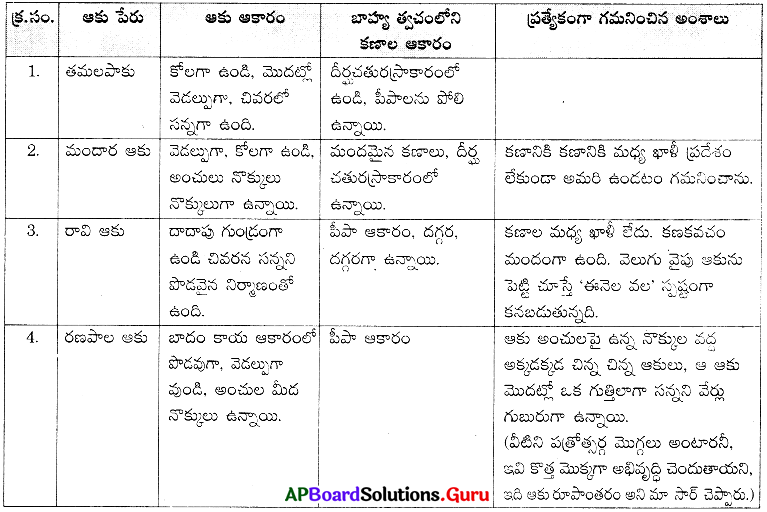
Answer:
The ball bearings are used to reduce friction between rotating shafts of machine tools and it increases the efficiency of machines.

8th Class Physical Science 2nd Lesson Friction Activities

Activity – 1
Question 1.
Identifying forces acting on a body and effect of frictional force.
Gently push a book on a horizontal floor. You may observe that the book acquires certain speed in the direction of push. However, the speed of the book gradually decreases and after sometime it stops.
AP Board 8th Class Physical Science Solutions Chapter 2 Friction 2
a) Why does the book stop after covering some distance?
Answer:
Some opposing force is acting to its motion.

b) Is the book moving with uniform speed?
Answer:
No, its speed decreases gradually.

c) Why does the speed of the book change gradually?
Answer:
Some net force is acting opposite direction to its motion.

d) How many forces act on the book when it is pushed on the floor?
Answer:
Two forces act on the vertical direction. They are

  1. Weight of the book or gravitational force acting vertically down.
  2. Normal force or reaction force applied by the floor vertically up.
  3. Forces acting horizontal direction.

e) What are the forces acting on the book in the horizontal direction?
Answer:

  1. Muscular force applied by us.
  2. Opposing force acting opposite to motion of book.

f) What is the net force acting in the horizontal direction?
Answer:
The net force is the difference between muscular force and opposing force to the motion of book.

AP Board 8th Class Physical Science Solutions Chapter 2 Friction

Lab Activity

Write an activity to understand friction and static friction.
(OR)
Conduct an experiment to understand the nature of friction and the concept of static friction.
Answer:
Aim: To understand the nature of friction and the concept of static friction.
Materials required: Toy trolley, small wooden block, inextensible string, weight hanger, weights, pulley and table.
Procedure: Take a small toy trolley and keep a small wooden block on it as in the figure. Tie an inextensible string to the trolley and pass it over a pulley. And other end of the string is fixed to weight hanger. Take a small weight and keep it on weight hanger and observe the changes in motions of block and trolley.
AP Board 8th Class Physical Science Solutions Chapter 2 Friction 3
Observation:
The trolley with block moves towards left with an acceleration. The block is not with respect to the surface of trolley, but it is in motion with respect to surface e table. The force of friction of the trolley acts on the direction of motion.
We increase trolley’s acceleration gradually by increasing the weight on the hanger at certain limiting weight the block comes in motion in the reverse direction.
That means now there exists relative motion between the surface of the trolley and block.
Result:
The force which opposes the relative motion of the two surfaces of bodies which are in contact is called frictional force.
The block is at rest relative to surface of the trolley upto a certain limiting acceleration. The friction exists at that stage is called static friction.

AP Board 8th Class Physical Science Solutions Chapter 2 Friction

Activity – 2

Question 2.
Observing the variation of friction.
Push a heavy box which is kept on a floor. The box does not move. Now increase the applied force until the box moves.
AP Board 8th Class Physical Science Solutions Chapter 2 Friction 4
a) Why does the box does not move at first?
Answer:
The applied force is less than frictional force (static friction).

b) When does the box tends to move?
Answer:
When the applied force is more than static friction.

Activity – 3

Question 3.
Effect of roughness on frictional force.
Set up an inclined plane on the horizontal floor. Use a wooden board as inclined plane. Put a mark at any point
‘A’. Now let a pencil cell or ball is move down from this point. Note down the distance travelled by the ball from the bottom of the inclined plane to point where it comes to a stop.
AP Board 8th Class Physical Science Solutions Chapter 2 Friction 5
Now, spread a cloth over the floor. Try again with ball and note down the distance.

a) What are your observations from these experiments?
Answer:
The distance covered by ball in the two cases are different.

b) In which case is the distance covered maximum?
Answer:
When there is no cloth on the floor.

c) In which case is the distance covered minimum?
Answer:
When cloth is spread over the floor.

d) Why is the distance covered by the pencil cell different on different surfaces?
Answer:
Because, the friction offered by different surfaces are different.

e) If the cloth is replaced with white marble surface or glass surface, what will be your prediction about the distance covered by the pencil cell?
Answer:
The pencil cell covers more distance.

AP Board 8th Class Physical Science Solutions Chapter 2 Friction

Activity – 4

Question 4.
Effect of area of contact on frictional force.
Tie a string around a wooden block and pull the wooden block by using a spring balance.
AP Board 8th Class Physical Science Solutions Chapter 2 Friction 6
Pull it to make a move in the brick. Note down the readings of spring balance when the brick just begins to move.
a) How many forces are acting on the wooden block in the horizontal direction?
Answer:
Two forces are acting in the horizontal direction.

  1. Force of friction,
  2. Force applied by us.

Now turn the wooden block upright and measure the friction by doing the same experiment using the reading of the spring balance.

b) How does the frictional force vary with the change in the area of contact?
Answer:
AP Board 8th Class Physical Science Solutions Chapter 2 Friction 7
The frictional force appears the same in both cases irrespective of area of contact. So it is independent of area of contact.

Activity – 5

Question 5.
Effect of normal force on friction.
Keep a wooden block on the horizontal floor and pull it with the spring balance attached to it and measure the frictional force.
Now put another wooden block over the brick tied to the spring balance or press it vertically with your hand and measure the frictional force.
a) Is there any difference between frictional forces in two cases? If yes, why?
Answer:
Yes, the reason is when we add a wooden block to the existing wooden block or apply force by pressing vertically, the normal force increases and hence we find increase in frictional force.

b) What is the relationship between friction and normal force?
Answer:
Friction is proportional to the normal force, i.e., friction °c normal force.

AP Board 8th Class Physical Science Solutions Chapter 2 Friction

Activity – 6

Question 6.
Friction produces heat.
a) Rub your palms against each other for a few minutes. How do you feel?
Answer:
AP Board 8th Class Physical Science Solutions Chapter 2 Friction 8
They became hot.

b) Strike a match stick against the rough surface of match box. What happens?
Answer:
The match stick catches fire.

c) What is your observation in this activity?
Answer:
Temperature of surfaces increases due to friction.

d) What is your conclusion on this activity?
Answer:
Friction can also produce heat.

e) You have probably heard that space craft returning to the earth have to be protected by a heat shield covering it. Find out why. What is the material used as heat shield?
Answer:
AP Board 8th Class Physical Science Solutions Chapter 2 Friction 9
Space craft returning earth have to be protected by a heat shield covering it in order to protect it from atmospheric friction.
The material generally used is insulator of heat.

AP Board 8th Class Physical Science Solutions Chapter 2 Friction

Activity – 7

Question 7.
How to increase Motion?
Take a spoon and hold its head (broader portion) in the left hand and hold the mid portion of the spoon by the right hand and pull it towards the other end of the spoon.
a) What do you notice?
Answer:
We unable to pull the spoon.
Now dip your right hand fingers in water, do it again as said above.

b) In which case is it easy to pull? Why?
Answer:
In second case it is easy to pull because water decreases the friction.

c) Have you ever thought why the sole of your shoes is grooved as shown in figure?
Answer:
AP Board 8th Class Physical Science Solutions Chapter 2 Friction 10
It will provide shoes better grip on the floor so that we can move safely.

d) Cars, trucks and bulldozers tyres are threaded. Why?
Answer:
AP Board 8th Class Physical Science Solutions Chapter 2 Friction 11
To provide them better grip on the floor.

e) Why do you need to change the tyres when it’s threading is worn out?
Answer:
If we does not change the tyre then the frictional force decreases and the vehicle may skid.
Play carrom board without powder and then play with fine powder sprinkled on board.

f) In which case is the movement of the striker and the coins easy? Why?
Answer:
When fine powder sprinkled on board, it will decrease the friction between coin and board surface.

g) Why do we pour a few drops of oil on the hinges of a door?
Answer:
It will decrease the friction and provide better movement of door.

h) Why do we use grease between the moving parts of motor vehicles?
Answer:
To reduce friction in order to increase efficiency.

AP Board 8th Class Physical Science Solutions Chapter 2 Friction

Activity – 8

Question 8.
Effect of rollers on friction.
Pull a suitcase without rollers and pull a suitcase which has rollers.
AP Board 8th Class Physical Science Solutions Chapter 2 Friction 12

a) In which case is the pulling easy? Why?
Answer:
It is easy to pull when suitcase has rollers.
Try to push a book lying on the table. Now place the book on two to three pencils or pens without caps. Push the book again.

b) What do you notice ? In which case is it easy to pull the book? Why?
Answer:
AP Board 8th Class Physical Science Solutions Chapter 2 Friction 13
In the second case it is easy to pull the book. The reason is it is always easier to roll a body than to slide it over a surface.

Activity – 9

Question 9.
Understanding the principle of ball bearings.
Take two lids and rotate them by putting one on the top of the other.
AP Board 8th Class Physical Science Solutions Chapter 2 Friction 14
a) What do you observe?
Answer:
It is difficult to rotate them.
Now place three to four marbles on one lid and place the other lid on the top of the marble. Now try to rotate the top lid.

b) What do you observe?
Answer:
Now we can easily rotate the lid because rolling friction is less than sliding friction.

c) What is your conclusion on the principle of ball bearings?
Answer:
We can easily rotate top lid by placing marbles between the lids. This is the principle of ball bearings.

AP Board 8th Class Physical Science Solutions Chapter 2 Friction

Activity – 10

Question 10.
Observing fluid friction.
Take a glass of water and stir it with a spoon. You know that water whirls around an axis. Stop stirring and see what happens.
AP Board 8th Class Physical Science Solutions Chapter 2 Friction 15
The whirling speed of water gradually decreases and after some – time, the water stops whirling and comes to a stable state

a) Which force is responsible for stopping the rotation of the water.
Answer:
The frictional forces between the liquid layers or between the liquid surfaces that is in contact with glass surface.

Activity – 11

Question 11.
Identifying factors influencing the fluid friction.
Take a tub of water. Try to move your hand in water in the direction of stretched fingers i.e., up and down. Now try to move your hand in the direction perpendicular to the plane of the hand i.e., to and fro.

a) In which orientation of your hand, do you experience more drag? Why?
Answer:
We experience more drag in the direction of stretched fingers. The frictional force on an object in a fluid depends on its speed with respect to fluid and on the shape of the object and nature of the fluid.
When objects move through fluids, they have to overcome friction acting on them. So objects are given special shapes to minimise fluid friction.

AP Board 8th Class Physical Science Solutions Chapter 2 Friction

b) Where do you think scientists get hint for these special shapes?
Answer:
From nature i.e., from birds and fishes, which have to move about in fluids all the time.

c) Do you find any similarity in the shape of an aeroplane and a bird? Why?
Answer:
Yes. The shape of aeroplane designed as bird in order to reduce fluid friction.
AP Board 8th Class Physical Science Solutions Chapter 2 Friction 16

AP Board 8th Class Social Studies Important Questions Chapter 13 The Indian Constitution

AP State Syllabus AP Board 8th Class Social Studies Important Questions Chapter 13 The Indian Constitution.

AP State Syllabus 8th Class Social Studies Important Questions 13th Lesson The Indian Constitution

Question 1.
Write some of the inequalities prevalent in our society at the time of Independence.
Answer:

  1. Economic inequalities
  2. Social inequalities

Question 2.
Write some of the discriminations prevalent in our society at the time of Independence.
Answer:

  1. Racial discrimination
  2. Gender discrimination

AP Board 8th Class Social Studies Important Questions Chapter 13 The Indian Constitution

Question 3.
“A Constitution is a set of rule. ” Write any two rules.
Answer:

  1. How the country should be governed,
  2. How the government should be formed.

Question 4.
Why do you think the kings were allowed to nominate members to the Constitutent Assembly?
Answer:
The kings were familiar with the ideas of their people. They could integrate the ideas of their people. So the kings were allowed to nominate members to the Constituent Assembly.

Question 5.
Why do you think there were so few women members? Do you think it would have been better if there had been more women members?
Answer:
At that time the educated women and the women politicians were very less in number. Even today we are fighting for 33% of women reservations. So there were so few women members. Yes, I think it would have been better if there had been more women members.
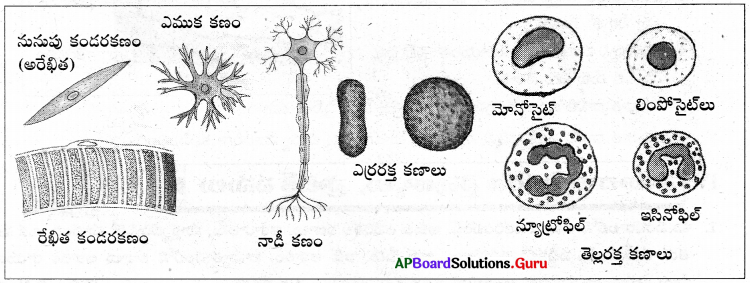
AP Board 8th Class Social Studies Important Questions Chapter 13 The Indian Constitution

Question 6.
Which of the guiding principles in the Objective Resolution, do you think is the most important?
Answer:
“Welfare of all mankind” – This guiding principle in the Objective Resolution is the most important.

Question 7.
Why is it necessary for an elected parliament to make laws?
Answer:
Our constitution provides us a parliamentary form of government. The Parliament, consisting of representatives of the people makes laws. These laws are according to the needs and views of the citizens/people. Judiciary comments on this.

Question 8.
Why do you think the Prime Minister and his Cabinet should get their decisions and actions approved by the Parliament and answer the questions raised by the members of Parliament?
Answer:
The Prime Minister and the Cabinet are answerable to the Parliament. The members of Parliament are the representatives elected by the civilians directly. So they are answerable to them.

AP Board 8th Class Social Studies Important Questions Chapter 13 The Indian Constitution

Question 9.
Some countries have a different structure, in which there is only a central government which makes laws for the entire country and governs all the provinces or states. Do you think such a system is suited for India?
Answer:
India is a land of many diversities. Different regions have different cultures. All these things should be taken into consideration to make laws. So such system is not suited for India.

Question 10.
Discuss why the courts and judges should be independent of the state and central government authorities.
Answer:
To safeguard the Constitution, the courts and judges should be independent. Otherwise there is a chance of sidetrack. So they should be independent.

Question 11.
Why should the Election Commission be autonomous?
Answer:
The Election Commission should be autonomous to conduct free and fair elections.
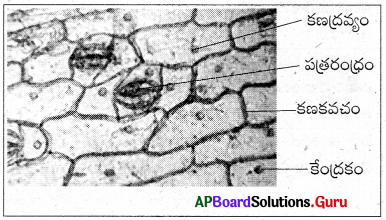
AP Board 8th Class Social Studies Important Questions Chapter 13 The Indian Constitution

Question 12.
Read the section ‘Dream and Promise’ again. Draw a table with statements that you consider as dream in the first column and promise in second column.
Answer:

Dream Promise
1) Release India from all thraldom and patronage. 1) No room for the curse of untouchability.
2) Land of no classes. 2) Or the curse of intoxicating drinks and drugs.
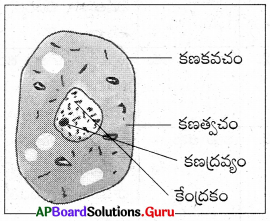
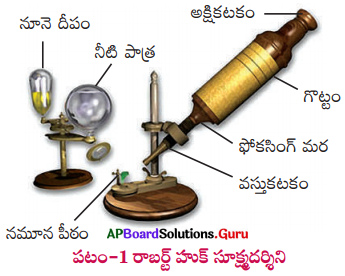
3) Perfect harmony. 3) Women will enjoy the same rights as men.
4) One man, one vote and one vote, one value. 4) Political equality.
5) Service of India, never ending work. 5) The ending of inequalities, to wipe every tear from every eye.

Question 13.
Observe the following picture and write your comments.
AP Board 8th Class Social Studies Important Questions Chapter 13 The Indian Constitution 1
Answer:
This picture belongs to the celebrations of 26th January, the Republic Day. These are NCC students/cadets. They are marching in daylight without gender discrimination. Their faces are bright with self-reliance.

AP Board 8th Class Social Studies Important Questions Chapter 13 The Indian Constitution

Question 14.
Match the names of the leaders with their photos.
AP State Syllabus 8th Class Social Studies Important Questions 12th Lesson The Indian Constitution 2a
Answer:
1) D,
2) C,
3) A,
4) B

Question 15.
Which aspects of the dreams and promises can you identify in the words used in preamble? Create a chart to show the relationships.
Answer:
AP State Syllabus 8th Class Social Studies Important Questions 12th Lesson The Indian Constitution 3

AP Board 8th Class Social Studies Important Questions Chapter 13 The Indian Constitution

Question 16.
Read the following passage.
When India gained its freedom from colonial rule it was decided to put together basic principles for which we stood and principles and procedures by which our country would be ruled. These were written down in a book called the ‘Constitution of India’.

A Constitution is a set of rules about how the country should be governed- how the laws that run it would be made or changed, how the government should be formed, what would be the role of the citizens, what would be their rights, etc. Above all, the Constitution sets before the country the goals for which the country has to strive.

Now answer the following questions:
1. From whom did India gain freedom?
Answer:
India gained its freedom from colonial rule.

2. Where were the basic principles and procedures written?
Answer:
These were written in a book called The Indian Constitution’.

3. “A Constitution is a set of rule.” Write any two rules.
Answer:

  1. How the country should be governed?
  2. How the government should be formed?

4. Above all the Constitution sets before the country ———– the for which the has to strive.
Answer:
goals.

AP Board 8th Class Social Studies Important Questions Chapter 13 The Indian Constitution

Question 17.
Read the following passages.

Some of you may have noticed a name missing from the sketches of the makers of the Constitution: Mahatma Gandhi. He was not a member of the Constituent Assembly. Yet there were many members who followed his vision. Writing in the magazine Young India in 1931, he had spelt out what he wanted the Constitution to do:
I shall strive for a Constitution which will release India from all thraldom and patronage… I shall work for an India in which the poorest shall feel that it is their country in whose making they have an effective voice; an India in which there shall be no high class and low class of people; an India in which all communities shall live in perfect harmony. There can be no room in such an India for the curse of untouchability or the curse of the intoxicating drinks and drugs. Women will enjoy the same rights as men… I shall be satisfied with nothing else. – Mahatma Gandhi
Now answer the following questions :
1. Whose name was missing from the sketches of the making of the Constitution?
Answer:
The sketch of Mahatma Gandhi.

2. Where was the dream written?
Answer:
In a magazine called ‘Young India’.

3. Whose dream was this?
Answer:
This was the dream of Mahatma Gandhiji.

4. There can be no room in such an India for the curse of ———–, ———– and ———–.
Answer:
Untouchability, drinks, drugs

5. ———– will enjoy the same rights as men.
Answer:
Women.

AP Board 8th Class Social Studies Important Questions Chapter 13 The Indian Constitution

Question 18.
Locate the following in the given World map.

  1. India
  2. South Africa
  3. U.S.A.

Answer:
AP State Syllabus 8th Class Social Studies Important Questions 12th Lesson The Indian Constitution 4

AP Board 8th Class Social Studies Important Questions Chapter 13 The Indian Constitution

AP Board 8th Class Biology Solutions Chapter 3 Story of Microorganisms 2

AP State Syllabus AP Board 8th Class Biology Solutions Chapter 3 Story of Microorganisms 2 Textbook Questions and Answers.

AP State Syllabus 8th Class Biology Solutions 3rd Lesson Story of Microorganisms 2

8th Class Biology 3rd Lesson Story of Microorganisms 2 Textbook Questions and Answers

Improve Your Learning

Question 1.
How do vaccines works in our body?
Answer:
When a vaccine is given which contains weak microorganisms our body learn to fight them by producing antibodies whenever danger comes. When the disease causing microorganisms enter in our body, the already present antibodies fight and eliminate them. And the disease is controlled. The weakened disease causing microorganisms which are injected into our bodies are called as vaccine.

AP Board 8th Class Biology Solutions Chapter 3 Story of Microorganisms 2

Question 2.
What are the differences between Antibiotic and Vaccine?
Answer:

Antibiotic Vaccine
An antibiotic is a compound or a substance that inhibits or kills the growth of bacteria. Vaccine is a preparation that improves the immunity to a particular disease.
An antibiotic heals infection caused by small pox. A vaccine prevents diseases like polio, bacteria.
Antibiotics are available in different forms like tablets, capsules, drops or ointments. Vaccines can be given orally or through injection.
Antibiotics are taken after getting infected. Vaccines are preventive method that is taken before getting infected.

Question 3.
Invention of pencillin protected the world from deaths during first world war, Explain.
Answer:

  1. Pencillin was invented by Dr. Alexander Flemming.
  2. He was an army doctor in First World War.
  3. In the First World War many injured soliders died because of bacterial infection of wounds.
  4. Pencillin killed many disease causing bacteria.
  5. So the invention of pencillin protect the world from deaths during the first World War.

Question 4.
Take three bowls and mark as A,B,C. Pour lukewarm milk in bowl A, hot milk in bowl B, cold milk in bowl C. Add one tea spoon of curd or butter milk in three bowls and stir them slightly. Cover the bowls with lids. Keep the bowls undisturbed for five to six hours. In which bowl milk turned into curd ? Give your reasons.
Answer:
After six hours the milk in the bowl A converted into curd.
This conversion is happened by fermentation. Fermentaion is one kind of enzy-matic action in anaerobic respiration. Fermentation needs the help of microbes like yeast or some other bacteria. This process occurs at a particular temperature. Be-cause of enzymes are inactive at low and high temperatures. Hence the milk in bowl A converted into curd by the bacterium Lactobacillus.

AP Board 8th Class Biology Solutions Chapter 3 Story of Microorganisms 2

Question 5.
Collect more information about scientists who invented and discovered other facts related to Microorganisms. How these discoveries helped mankind ? Make a chart presentation and paste it on your classroom wall magazine.
Answer:
AP Board 8th Class Biology Solutions Chapter 3 Story of Microorganisms II 2
AP Board 8th Class Biology Solutions Chapter 3 Story of Microorganisms II 3

AP Board 8th Class Biology Solutions Chapter 3 Story of Microorganisms 2

Question 6.
Make an album of scientists and their discoveries related to Microorganisms.
Answer:
AP Board 8th Class Biology Solutions Chapter 3 Story of Microorganisms II 4

Question 7.
Visit the veterinary hospital and prepare a list of cattle diseases by asking questions, to the doctor.
Answer:

Disease Animal
1) African Horse Sickness Horses
2) Bovine Spongiform Encephalopathy Cattle
3) Contagious Equine Metritis Horses
4) Equine Infectious Anaemia Horses
5) Anthrax Cattle and other mammals
6) Brucellosis (Brucella abortus) Cattle
7) Brucellosis (Brucella melitensis) Sheep and Goats
8) Contagious agalactia Sheep and Goats
9) Contagious bovine pleuro – pneumonia Cattle
10) Dourine Horses
11) European Bat Lyssavirus (FBLV) Bats
12) Enzootic bovine leukosis Cattle

AP Board 8th Class Biology Solutions Chapter 3 Story of Microorganisms 2

Question 8.
What is pasteurisation? What is the use of it?
Answer:

  1. Pasteurisation is a process which helps in the preservation of the milk.
  2. It is discovered by “Louis Pasteur.” Hence it is called as pasteurisation.
  3. In this process milk is heated up to 70° for 15 to 30 seconds and suddenly chilled and stored.
  4. This prevents the growth of the microorganisms.

Question 9.
How do you appreciate Edward Jenner’s experiment?
Answer:
AP Board 8th Class Biology Solutions Chapter 3 Story of Microorganisms II 1
Edward Jenner was a man of the Enlightenment and believed in the intellectual and moral improvement of mankind.
Possessing that spirit, he predicted in 1801 that “the annihilation of small pox-the most dreadful scourge of the human race-will be the final result of this practice” of vaccination. And he was right. Since the Enlightenment, the core branches of science and medicine have generally developed rationally. As a result, the World Health Organization was able to declare in 1980 that smallpox had been eradicated worldwide. Only two laboratory samples emained, one in Russia and one in the United States.

Question 10.
Visit a nearby milk chilling centre. Observe the process and make a report on it.
Answer:
The Milk Collection Station is a specially designed, integrated unit, which combines the several functions of a milk collection centre. It measures the weight, fat content and gives the price of the milk brought in by the each producer. The equipment is particularly useful for the milk cooperatives / milk collection centres as it can also maintain a summary of milk supplied. This state of the art equipment operates both on battery and mains and is able to process and record 120-150 milk collection per hour. An Electronic Milk Weighing Unit, the Electronic Milk Tester and Data Processor Unit are main components of the system. The membership code of individual mem¬bers is entered automatically by member identity card / manually by an electronic key-board.
AP Board 8th Class Biology Solutions Chapter 3 Story of Microorganisms II 5

Question 11.
“Prevention is better than cure” comment.
Answer:
We heard about “prevention is better than cure” since our childhood – brushing of teeth twice to prevent tooth decay, washing of hands before eating to prevent stomach upset, do not eat uncovered road side food items, get vaccine against polio to free from disability, get rid of stagnate water to prevent malaria like that follow the life skills to avoid dangerous AIDS. It’s better to take care that a problem does not happen than to have to solve the problem afterwards. It’s easier to stop something bad from happening in the first place than to fix the damage after it has happened.

AP Board 8th Class Biology Solutions Chapter 3 Story of Microorganisms 2

Question 12.
Raheem tells to his neighbours, “stagnation of’ sewage in our surroundings is harmful to our health. ” Do you support this? Why?
Answer:
Stagnation of sewage in our surroundings is harmful to our health in different ways. Sewage consist different wastes of organic matters. Microbes decompose all organic wastes. Disease transmitting carriers prefer to grow on decomposing organic matters. Hence sewage provides good shelter to mosquitoes, houseflies and other insects which transmit life threatening diseases like encephalitis, malaria, cholera, typhoid and other epidemics. Therefore sewage stagnation is more harmful to our health.
AP Board 8th Class Biology Solutions Chapter 3 Story of Microorganisms II 6

Question 13.
Jeevan said that “If there are no microorganisms earth will remain with wastes. ” Will you agree this statement? Why?
Answer:
Yes, I will agree this statement. Because of:

  1. Microorganisms present in the soil, air and water act upon wastes around us.
  2. They decomposes them.
  3. They are converted into simple substances.
  4. Thus microorganisms help us in cleaning the environment.
  5. So if there are no microorganisms earth will remain with wastes.

Question 14.
Pranavi is suffering from serious illness. Doctor prescribed antibiotics for five days. After three days of usage she stopped taking antibiotics. Is it right or not, discuss.
Answer:
No, it is not right. Doctor prescribed anitbiotics for five days. Because the doctor knows that the correct days of the recovering of her illness. After three days of usage she stopped taking antibiotics. But her illness is not completely recovered. It is breaking out after some time. So it is not right.

Question 15.
What are the precautions taken to eradicate malaria?
Answer:

  1. Malaria is caused by the pathogen piasmodium, is transmitted by female Anopheles mosquito.
    AP Board 8th Class Biology Solutions Chapter 3 Story of Microorganisms II 10
  2. Methods used to prevent malaria include medications, mosquito elimination and the prevention of bites.
  3. Using of indoor mosquito repellents, residual sprays, taking care not to store water.
  4. Providing awareness how to control mosquito population.

Question 16.
One medical store owner is giving antibiotics to his customer who is suffering from fever without doctor’s prescription? But the customer’s daughter Malathi is telling her father not to take antibiotics without doctor’s prescription. Whom do you support and why?
Answer:
We must use antibiotics prescribed by qualified doctor only. If you use antibiotics without consulting a qualified doctor it may harm us. Unnecessary use of antibiotics affects blood cells which fight infections. Sometimes they may kill useful bacteria too in our intestine and this increases the resistance towards antibiotics.
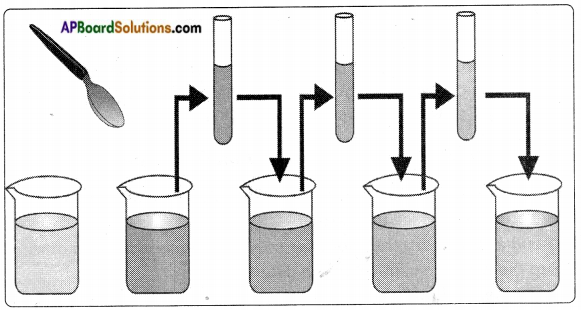
8th Class Biology 3rd Lesson Story of Microorganisms 2 InText Questions and Answers

Question 1.
What diseases can be prevented if we control mosquitoes?
Answer:
Malaria, Dengue, Chickungunya, Japanese Encephalitis.

Question 2.
Which diseases can we prevented by vaccination?
Answer:
Tuberculosis, Chickenpox, Measles, Polio, Swineflu.

Question 3.
Name the diseases which are transmitted by contaminated water?
Answer:
Cholera, Typhoid

Question 4.
Can you name some diseases which are transmited by Air?
Answer:
Tuberculosis, Chickenpox, Measles, Polio, Swineflu.

8th Class Biology 3rd Lesson Story of Microorganisms 2 Activities

Activity – 1

Question 1.
Take some lukewarm milk in two small bowls. Add a few drops of butter milk or little curd in one of the bowls. In the second bowl do not add anything. Keep the two bowls in a warm place and observe the milk in the bowls after 5 to 6 hours.
a) What changes did you observe?
Answer:
In the first bowl milk changed into curd. There is no change in the second bowl.
b) What is the reason for this?
Answer:
We add curd or butter milk in the first bowl. Curd or buttermilk contain bacterium named lactobacillus. Lactobacillus converts the milk into curd.

Activity – 2

Question 2.
Take 100 grams of maida in a bowl, add one or two spoons of yeast powder, add some water and knead it to make dough. Keep the dough in a warm place. Observe the dough after 3 – 4 hours.
a) What changes do you observe in the dough ?
Answer:
We observe that the dough rises and increase its volume.
b) What might be the reason ? Discuss with your friends and write about it.
Answer:
When yeast is added to the maida dough, the dough rises. This is due to the produc¬tion of carbondioxide gas during the process of fermentation. Bubbles of the gas fill the dough, increase its volume and make it spongy in nature.

Activity – 3

Question 3.
Commercial use of microorganisms.
Take some water in two separate beakers. Add 5 to 10 spoons of sugar to each beaker, then add 2 to 3 spoons of yeast to one of the bowls only. Close both of the bowls with lids and keep them in a warmplace. After 3 to 4 hours remove the lids and smell the contents.
a) What differences did you observe between the two bowls?
Answer:
We feel a new variety of smell from one of the bowls. This is the characteristic smell of alcohol. There is no smell from another bowl.
b) What will be the reason for the odour in yeast mixed bowl?
Answer:
Sugars are converted into alcohol by yeast. This process of conversion of sugars into alcohol is known as fermentation.

Activity – 4

Question 4.
Visit nearby PHC and collect information about vaccination given to 0-15 years chil-dren. Meet a doctor or a health worker and ask what types of vaccines are there ? Which disease can be prevented ? When it should be taken? List them out.
Answer:
AP Board 8th Class Biology Solutions Chapter 3 Story of Microorganisms II 11

Activity – 5

AP Board 8th Class Biology Solutions Chapter 3 Story of Microorganisms 2

Question 5.
Take two pots or dig two pits in the corner of the garden at home or at your school ground. Fill them up to half with loose soil. Put some biological wastes like fallen leaves, vegetable wastes, waste papers, etc., in one of them. Fill the second one with plastic wastes, polythene bags and with some empty glass bottles.
Answer:
Now cover both the pits with soil and sprinkle water twice a day up to three weeks and observe the changes in both the pits and record.
After three weeks the pit which consists organic wastes decomposed into inorganic matter. But the pit which is filled with polythene bags, plastics and glass bottles is remain same no change is observed. Because of plastics and polythene materials are non biodegradables.
AP Board 8th Class Biology Solutions Chapter 3 Story of Microorganisms II 7

Activity – 6

Question 6.
Meet a doctor of your locality and ask him about the different types of diseases, caused by different microorganisms. Note them down. (OR)
Read the following table and answer the following questions.
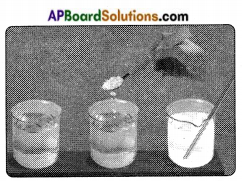
AP Board 8th Class Biology Solutions Chapter 3 Story of Microorganisms II 8
AP Board 8th Class Biology Solutions Chapter 3 Story of Microorganisms II 9
Questions:
a) Name the viral diseases that can be prevented by controlling mosquito population.
Answer:
Dengue, Chikungunya, Japanese encephalitis.

b) Which bacterial disease / diseases cannot be controlled by vaccination (acc.to above table) ?
Answer:
Cholera, Typhoid.

c) What would you do to control mosquito population ?
Answer:
Use mosquito repellents, control breeding of mosquitoes by not allowing water stag¬nation in our surroundings.

d) Name the viral disease that spreads through water.
Answer:
Polio.

AP Board 8th Class Physical Science Solutions Chapter 5 Metals and Non-Metals

AP State Syllabus AP Board 8th Class Physical Science Solutions Chapter 5 Metals and Non-Metals Textbook Questions and Answers.

AP State Syllabus 8th Class Physical Science Solutions 5th Lesson Metals and Non-Metals

8th Class Physical Science 5th Lesson Metals and Non-Metals Textbook Questions and Answers

Improve Your Learning

Question 1.
Explain the physical properties of metals with suitable examples.
(OR)
Explain briefly the physical properties of metals.
Answer:
Physical properties of metals:

  1. Lustrous:
    When we rub the surface of metals with sand paper they will shine. This property is called lustrous, e.g.: Iron, zinc etc.
  2. Sonority:
    When we hit the metal surface they give a ringing sound is called sonority, e.g.: Iron, copper etc.
  3. Malleability:
    Metals can be flattened into thin sheets. The property of flattening metals into thin sheets is called malleability, e.g.: Silver, Iron, copper.
  4. Ductility:
    Metals can be drawn into wires.
    The property of drawing a metal to make fine wire is called ductility, e.g.: Silver, gold.
  5. Electric conductivity:
    Electricity can be easily pass through metals. So they are called good conductors of electricity.
    e.g.: Silver, copper, iron.
  6. Conductivity of heat:
    Metal absorbs heat quite easily. They are good conductors of heat, e.g.: Copper, iron.

AP Board 8th Class Physical Science Solutions Chapter 5 Metals and Non-Metals

Question 2.
You are given two samples. How do you distinguish which is metal and which is non-metal?
Answer:

  1. By physical properties, generally we can judge whether the given sample is metal or non-metal that is metals are hard. They are lustrous, sonorous, malleable, ductile and good conductors of heat and electricity.
  2. Generally metal sample react with water and non-metal sample does not react with water.
  3. Generally metal sample react with acid and produce hydrogen gas whereas non-metal samples does not react with acid.

Question 3.
Which metals are used in making jewellery? Why?
Answer:
Generally we use metals like gold, silver and copper for making jewellery due to their high ductility and lustrous surface.

Question 4.
Which substance liberate hydrogen when react with metals?
Answer:
Generally acids react with metals and liberate hydrogen gas. Water also react with some metals and liberate hydrogen gas.

Question 5.
In a chemical reaction iron is unable to displace zinc from zinc sulphate. Why?
Answer:
Zinc is more reactive than iron. A less reactive metal cannot displace a more reactive metal from its salt solution. So iron unable to displace zinc from zinc sulphate.

AP Board 8th Class Physical Science Solutions Chapter 5 Metals and Non-Metals

Question 6.
Why cooking pans do not have metal handles?
Answer:
Metals are good conductors of heat. So they gain heat easily. So in order to avoid the burning of our palms, the handles of cooking pans made of heat resist material such as plastic.

Question 7.
Sulphur dioxide is
A) basic oxide
B) acidic oxide
C) neutral oxide
D) amphoteric oxide
Answer:
B) acidic oxide

Question 8.
Match the following.
Group – A                                             Group – B
1. Making into thin sheets        ( )        A) Ductility
2. Shining materials                  ( )        B) Conductivity
3. Making into wires                 ( )        C) Sonority
4. Transmission of heat            ( )        D) Lustrous
5. Making ringing sound          ( )         E) Malleability
Answer:
1. E
2. D
3. A
4. B
5. C

Question 9.
Which gas makes a ‘pop’ sound if exposed to lighted matchstick?
Answer:
Hydrogen gas makes a pop sound when it is exposed to a lighted matchstick.

Question 10.
Why are bells made up of metals instead of wood
Answer:
Metals have sonority property that means they make ringing sound when we hit them with a hammer. Where wood does not give ringing sound when it is hit with a hammer. So bells are made up of metals instead of wood.

AP Board 8th Class Physical Science Solutions Chapter 5 Metals and Non-Metals

Question 11.
Imagine the human life without metals, write briefly about the consequences.
Answer:

  1. There would not be any utensil for cooking.
  2. There would not be trains, buses, aeroplanes for travelling.
  3. There would be no almirahs, no school bells, no agricultural material, no electrical appliances, no automobiles, no satellites, no machinery and no decorative material. So everything in life directly or indirectly depends upon metals. So we cannot imagine a life without metals.

Question 12.
After completion of metals and non-metals chapter, Raheem understood that metals are hard and non-metals are soft. During the discussion with his brother he came to know that diamond is a hardest material and it is a non-metal. Similarly mercury is a soft material and it is a metal. These findings from the discussion raised some questions in Raheem’s mind. Can you guess those questions? Write them.
Answer:
The doubts arised in Raheem’s mind are

  1. If diamond is hard how it behaves like a non-metal?
  2. If mercury is soft material how it acts as metal?
  3. What are the properties which actually decide whether the given material is either metal or non-metal?

Question 13.
Discuss the acidic and basic nature of the metals and non-metals with suitable experiments.
Answer:
Take a small strip of magnesium and burn it. It forms white ashes of magnesium oxide collect the ashes of magnesium and add some distilled water to it. Test the solution with red and blue litmus papers. Note the colour changes. The solution turns red litmus into blue. It indicates given solution is basic. So metallic oxides are basic in nature.
Take a small amount of powdered sulphur in a deflagrating spoon and heat it. As soon as sulphur starts burning, introduce the spoon into a gas jar or tumbler. Cover the tumbler with lid to ensure that the gas produced does not escape. The gas formed is sulphur dioxide. Remove the spoon after some time but try to keep the jar covered. Add a small quantity of water into the tumbler and quickly replace the lid. Shake the tumbler well. Check the solution with red and blue litmus paper. The solution turns blue litmus into red. It indicates the solution is acidic. So non-metallic oxides are acidic in nature.

AP Board 8th Class Physical Science Solutions Chapter 5 Metals and Non-Metals

Question 14.
How do you appreciate wide range utility of aluminium right from utensils to space craft?
Answer:
Aluminium is essential part of our life. Aluminium foil is used on inner packing of food materials and toffees. Aluminium and copper mixture is used in currency coins, medals and statues. Aluminium is used in electrical appliances, automobiles, satellites, space crafts, aeroplanes, cooking utensils, machinery, decorative materials. This indicates wherever we go we observe articles made up of aluminium. So we require aluminium for better living.

Question 15.
How is malleability of metals used in our daily life
Answer:
Metals can be flattened into sheets is called malleability. Due to this metals can be made into different shapes like railway coaches, railway tracks, cooking utensils, etc. So malleability of metals is extremely useful in daily life.

Question 16.
Dumping of waste material made up of metals and non-metals leads to environment pollution. Do you support the statement? Give your justification with suitable examples.
Answer:
Soil samples analyzed from location adjacent and with in deposite show high level of heavy metals in particular lead, mercury, cadmium, copper and chromium. In which lead and mercury are extremely harmful to environment as well as mankind. After medical evaluation the adolescents living and children living near dump site had high incidence of diseases that are associated with high exposure levels to these metal pollutants. So waste material made of metals and non-metals leads to environmental pollution. Some more examples are burning of sulphur forms sulphur dioxide and sulphur trioxide, which is a cause for acid rain and soil corrosion. In complete burning of carbon leads to release of poisonous carbon monoxide.

8th Class Physical Science 5th Lesson Metals and Non-Metals InText Questions and Answers

Think and Discuss

8th Class Physical Science Textbook Page No. 68

Question 1.
How will you close the circuit using sulphur, carbon or iodine? They may be in powder form. Try to tightly pack the powder in a straw and use it. Think of other ways!
Answer:
Circuit will not be completed by using non-metals like sulphur, carbon or iodine because they are bad conductors of electricity. So by packing the powder will not complete the circuit. There is no other by using which we can complete the circuit by using a non-metal.

AP Board 8th Class Physical Science Solutions Chapter 5 Metals and Non-Metals

Try This

8th Class Physical Science Textbook Page No. 74

Question 1.
Recall the names of the some of the laboratory acids and bases that you know. Write down their names in table and identify metal/non-metal present in them, which form oxides when react with oxygen. Take the help of your teacher.
Answer:

Name of the base Metal present in it Name of the acid Non-metal present in it
Calcium hydroxide (Ca(OH)2) Calcium (Ca) Sulphuric acid (H2SO4> Sulphur (S)
Sodium hydroxide (NaOH) Sodium (Na) Hydrochloric acid (HCl) Chlorine (Cl)
Magnesium hydroxide (Mg(OH)2) Magnesium (Mg) Nitric acid (HNO3) Nitrogen (N)
Zinc hydroxide (Zn(OH2) Zinc (Zn) Phosphoric acid (H3PO4) Phosphorus(P)
Sodium hydroxide (NaOH) Sodium (Na) Sulphurus acid (H2SO3) Sulphur (S)
Cupric hydroxide (Cu(OH)2) Copper (Cu) Carbonic acid (H2CO3) Carbon (C)

Question 2.
Have you seen a periodic table?
Answer:
Yes.

Question 3.
Try to find the metals and non-metals that you come across in the chapter on the periodic table.
Answer:
Metals               Non-metals
1) Zinc               1) Sulphur
2) Copper          2) Chlorine
3) Iron               3) Nitrogen
4) Potassium     4) Carbon
5) Sodium         5) Phosphorus
6) Gold
7) Silver
8) Magnesium
9) Calcium
10) Aluminium

8th Class Physical Science 5th Lesson Metals and Non-Metals Activities

AP Board 8th Class Physical Science Solutions Chapter 5 Metals and Non-Metals

Activity – 1

Question 1.
Observing appearance and colour of some materials:
Observe the appearance of your samples. Look at their colour. Decide whether they appear shining or dull and record your observations in table. If the surface seems dirty, clean it with sand paper.

Sample Appearance Shining / not shining Colour
Iron shining grey
Zinc shining pale green
Copper shining red
Sulphur not shining yellow
Aluminium shining silver white
Carbon not shining black
Magnesium shining silver white
Iodine shining black

a) Which of the samples did not shine even after you cleaned them with sand paper?
Answer:
Sulphur, carbon.

b) Generally metals are lustrous. Do all lustrous materials are metals?
Answer:
No. Some may be non-metals, e.g.: Iodine

c) We all know that mirror is lustrous. Can a mirror be called metal?
Answer:
No. Several properties required to decide if a given material is metal or not.

Activity – 2

Question 2.
Listening the sound produced by some material:
AP Board 8th Class Physical Science Solutions Chapter 5 Metals and Non-Metals 3
a) Drop a piece of coal on the floor and listen the sound.
Do you think coal is sonorous?
Answer:
No.

b) Take the pieces of zinc, copper, aluminium, magnesium and tightly packed packets of sulphur, carbon and iodine. Drop them one by one, on a hard surface. Listen carefully to the sound produced and record your observation in table.
Answer:

Material sample that Material sample that
produce sound do not produce sound
Zinc Sulphur
Copper Carbon
Aluminium Iodine
Magnesium

c) What similarity do you notice among materials which produce sound?
Answer:
All of them are metals.

d) Which property of metals first attracted the attention of human beings?
Answer:
Metals had the advantage of not just being harder but they could be heated in a fire and moulded or cast into different shapes. This property of metals first attracted the attention of human beings.

e) Do you bring a similar change in the shape of a clay material by beating it?
Answer: Yes, we bring similar change in the shape of a clay material by beating it.

AP Board 8th Class Physical Science Solutions Chapter 5 Metals and Non-Metals

Activity – 3

Question 3.
Identifying malleability of material:
Take a hammer and beat the material samples which are used in Activity-2 and observe the changes in material samples. Record your observations in the table.
Answer:

Observing the change Name of sample
Flattens Iron, zinc, copper, aluminium
Breaks/ converts into powder Magnesium, sulphur, carbon, iodine
No change

Some of the samples like zinc, copper are flattened whereas some materials such as carbon, iodine broken into pieces.
The materials which can be flattened into thin sheets are called malleable materials.
Ductility:
We use wires in different situations in our daily life. Look at the samples given in the table.

a) Have you ever seen the wires made up of materials mentioned in the above table?
Answer:
Yes. I have seen the wires made of iron, copper, aluminium.

b) What is the property of drawing material to make wire is called?
Answer:
Ductility.

Activity – 4

Question 4.
Identifying electric conductivity of a material:
Arrange an electric circuit with a battery and bulb. Close the circuit using an iron nail, as shown in figure. Observe whether the bulb glows or not. Record your observations in table. Repeat the same experiment using the other samples and record your observations in the same table.

Sample Can we convert it into wires
Iron Yes
Zinc Yes
Copper Yes
Sulphur No
Aluminium Yes
Carbon No
Magnesium No
Iodine No

a) Do all the samples allow the bulb to glow?
Answer:
No. Materials like iron, zinc, copper allows bulb to glow.

b) What is name given to these material which allows electricity to pass them and make to bulb to glow are called?
Answer:
They are called conductors.

c) Give examples for good conductors of electricity?
Answer:
Copper, iron, aluminium

d) Talk to an electrician. Look at the handles of his tools. Are the handles made of the same materials? If not why?
Answer:
No. The handles of his tools are made of electrical insulating material in order to avoid electrical shock.

AP Board 8th Class Physical Science Solutions Chapter 5 Metals and Non-Metals

Activity – 5

Question 5.
Observing heat conduction by metals:
AP Board 8th Class Physical Science Solutions Chapter 5 Metals and Non-Metals 4
Take an iron rod. Stick pins on it with the help of wax. Now fix the rod to a stand as shown in figure. Heat one end of the rod with a spirit lamp and see how the pins fall off?

a) Why did the pins fall off from iron rod?
Answer:
Iron rod gains heat from spirit lamp.

b) Pin of which end fell off first?
Answer:
The pin which is near to spirit lamp falls first.

c) What could be the reason for this?
Answer:
The pin falls off because of heat supplied to the iron rod and makes the wax to melt at one end. The wax closer to the flame melted first and the pin falls off. Then the other pins falls. This activity shows that heat moves from one end of the rod to the other. This property of a material is known as conductivity of heat.

d) Go back to the list of samples. On the basis of all the activities carried out, fill the following table.
Answer:
AP Board 8th Class Physical Science Solutions Chapter 5 Metals and Non-Metals 5

AP Board 8th Class Physical Science Solutions Chapter 5 Metals and Non-Metals

Lab Activity

Conduct an experiment to know the reaction of oxygen with metals and non-metals.
Answer:
Aim: To know reaction of oxygen with metals and non-metals.
Materials required: One metal sample (Magnesium) and one non-metal sample (Sulphur), spirit lamp or Bunsen burner and litmus paper, etc.
Procedure:
Take a small strip of magnesium and burn it. It burns brilliantly and produce white ashes of magnesium oxide due to reaction between magnesium and oxygen. Collect the ashes of magnesium and add some distilled water to it. Test the solution with red and blue litmus papers. Note the changes in table.
AP Board 8th Class Physical Science Solutions Chapter 5 Metals and Non-Metals 6
Take a small amount of powdered sulphur in a deflagrating spoon and heat it. Sulphur starts burning and forms sulphur dioxide. Introduce the spoon into a jar and cover the jar with a lid to ensure that the gas produced does not escape. Add small quantity of water into the jar quickly replace the lid. Shake the jar well. Check the solution with blue and red litmus papers. Record the changes in table.

Sample Physical Appearance before reaction Physical Appearance after reaction Effect of Litmus Paper
Magnesium Silver white sheet White ash Turns red litmus into blue
Sulphur Yellow powder Colourless gas Turns blue litmus into red

From the table we can observe metallic oxide solutions are basic in nature whereas non metallic oxide solutions are acidic in nature.

Activity – 6

Question 6.
Experiment about reaction of metals with water.
Answer:
Take a 500 ml beaker or a big trough and fill half of it with water. Cut a small piece of sodium (which is kept in kerosene) and put the sodium piece in water using forceps. This piece of sodium floats on the surface of water with a hissing sound.
AP Board 8th Class Physical Science Solutions Chapter 5 Metals and Non-Metals 7
This shows that sodium is reacting extremely fast with water.
Repeat the same experiment using aluminium, and iron. We will not see any change even after five minutes. This is because these metals react extremely slow with water. This shows metals react with water at different rates.

AP Board 8th Class Physical Science Solutions Chapter 5 Metals and Non-Metals

Activity – 7

Question 7.
Reaction with Acids.
Fill the reactions of the following metals and non-metals with dilute hydrochloric acid and dilute sulphuric acid.
Iron, Zinc, Copper, Sulphur, Aluminium, Graphite, Magnesium and Iodine.
AP Board 8th Class Physical Science Solutions Chapter 5 Metals and Non-Metals 8
Observation:
We find that some metals react with dilute HCl or H2SO4 liberating hydrogen but non-metals usually do not react with acids.

Activity – 8

Question 8.
Reactivity of metals:
Take six beakers and label them a, b, c, d, e and f. Take 50 ml of water in each beaker and dissolve a spatulaful of copper sulphate in beakers ‘a’ and ‘b’. Dissolve a spatulaful of zinc sulphate, in beakers ‘c’ and ‘d’. Iron sulphate in beakers ‘e’ and ‘f’.
AP Board 8th Class Physical Science Solutions Chapter 5 Metals and Non-Metals 9

  • Zinc granules in beaker ‘a and e’
  • Iron nail in beaker ‘b and d’
  • Copper turnings in beaker ‘c and f’

Leave the beakers undisturbed. Record the changes in the colour of the solution in the table.
AP Board 8th Class Physical Science Solutions Chapter 5 Metals and Non-Metals 10

Solutions Observations
Beaker a The blue colour of copper sulphate disappears and a powdery red mass of copper is deposited at the bottom of the beaker ’a’.
Beaker b In beaker ’b’ red copper is found at the bottom of the beaker and on the nail leaving light green iron sulphate solution.
Beaker c No change
Beaker d No change
Beaker e No change
Beaker f No change

a) What could be the reasons behind these changes?
Answer:
In beaker ‘a’, zinc displaces copper from copper sulphate giving rise to colourless zinc sulphate. Iron displaces copper from copper sulphate in beaker ’b’ leaving light green colour of iron sulphate and zinc displaces iron from Iron sulphate by change the colour from light green to colour less:
Copper sulphate + Zinc → Zinc sulphate + Copper
Copper sulphate + Iron → Iron sulphate + Copper
Iron sulphate + Zinc → Zinc sulphate + Iron

AP Board 8th Class Physical Science Solutions Chapter 5 Metals and Non-Metals

b) Do you find any changes in beakers c, d and f?
Answer:
There is no change in beakers c, d and f. The reason is

  1. Copper is unable to displace zinc from zinc sulphate in beaker ‘c’.
  2. Copper is unable to displace iron from iron sulphate in beaker ‘f’.
  3. Iron is unable to displace zinc from zinc sulphate in beaker ‘d’.

c) Why does iron is unable to displace zinc from zinc sulphate?
Answer:
Iron is less reactive than zinc. A more reactive metal can replace a less reactive metal from its salt solution. But a less reactive metal unable to displace a more reactive metal from its salt solution.
The order of reactivity of given metals are Zinc > Iron > Copper

AP Board 8th Class Physical Science Solutions Chapter 3 Matter Around Us

AP State Syllabus AP Board 8th Class Physical Science Solutions Chapter 3 Matter Around Us Textbook Questions and Answers.

AP State Syllabus 8th Class Physical Science Solutions 3rd Lesson Matter Around Us

8th Class Physical Science 3rd Lesson Matter Around Us Textbook Questions and Answers

Improve Your Learning

Question 1.
Describe an activity which provides the evidence for
a) the motion of particles
b) attraction between particles
c) inter-particle space
Answer:
a) An activity which provides the evidence for the motion of particles:
Materials required: Two 250 ml round bottom flasks, red or blue ink, dropper, Potassium permanganate (KMnO4) solution.
Procedure:

  1. Take two 250 ml round bottomed flasks and fill them with water.
  2. Use a dropper and put a few drops of blue or red ink slowly along the sides of first flask.
    AP Board 8th Class Physical Science Solutions Chapter 3 Matter Around Us 1
  3. Use a dropper and put one or two drops of KMnO4 solution along the sides of second flask.
  4. We observe that in the first flask the ink drops slowly diffusing and mix with water, so as to change the colour of water to red/blue.
  5. In the second flask we observe that the KMnO4 solution diffuses fast in the water and the colour of water changes.
  6. This activity provides an evidence for the motion of particles.

AP Board 8th Class Physical Science Solutions Chapter 3 Matter Around Us

b) An activity which provides the evidence for the attraction between particles:

  1. Open a water tap and allow the water to reach the ground.
  2. Now try to break the stream of water with your finger.
  3. We can break the stream momentarily, but not permanently.
  4. The reason behind the stream of water remaining together is the force of attraction between the water particles.
  5. Now try to break a piece of iron nail with your hands.
  6. We cannot break it, because the force of attraction between the particles of nail is very high.
  7. Do the same with a piece of chalk. We can break it easily, due to the weak attraction forces among the particles of piece of chalk.
  8. From the above, we can say that the particles of matter have attractive forces among them to keep the particles together.
  9. These forces of attraction are not equally strong in all the forms of matter.

c) An activity which provides the evidence for the inter-particle space:
Materials required: Beaker, water, salt, spoon and a glass rod.
Procedure:

  1. Take a graduated beaker and fill it with some water and mark the level of water.
  2. Add some salt and stir it thoroughly with a glass rod.
  3. Observe the change in water level. There will be no change in it.
    AP Board 8th Class Physical Science Solutions Chapter 3 Matter Around Us 2
  4. Add some more salt and stir it again.
  5. Observe the change in water level. There will be no change.
  6. Continue this process till you see some salt remains undissolved in water.
  7. From this activity, we can say that solid and liquid particles have some space between them.
  8. The solid particles enter into the space between the liquid particles on dissolving solid in liquid.
  9. This process continues till all the space in liquid particles is occupied by solid particles.
  10. After completion of this occupation, the solid particles, as there is no space to occupy remain undissolved.

AP Board 8th Class Physical Science Solutions Chapter 3 Matter Around Us

Question 2.
Name the characteristics of matter that are demonstrated by diffusion.
Answer:
The characteristics of matter that are demonstrated by diffusion:

  1. Matter is made up of tiny particles.
  2. Particles of matter have space between them.
  3. Particles of solids and liquids diffuse into liquids.
  4. Particles of gases diffuse into gases.
  5. Rate of diffusion of gases is higher than that of liquids or solids.
  6. Particles of solids occupy the space between the particles of liquids on addition of a solid to a liquid.
  7. Particles of matter move continuously in liquids and gases.

Question 3.
“When sugar is dissolved in water, there is no increase in volume.” Is it true or false? Comment on the statement keeping in mind the amount of sugar, amount of water, etc.
Answer:
This statement is true.
Reason: When sugar is dissolved in water, the particles of sugar occupy the space between the particles of water. Hence there is no change in the volume of water.
Conditions for observing the change in volume of water:
If we go on adding sugar without increasing the quantity of water, there will be no space between water particles, to be occupied by sugar particles. Hence the sugar remains undissolved.

Question 4.
Is there any change in mass when a substance changes its state? Explain with example.
Answer:

  1. Take a beaker and fill it with ice cubes.
  2. Find the mass (m1) of the beaker along with ice cubes using a spring balance.
  3. Keep the beaker at rest for some time, till the ice changes into water.
  4. Then find the mass (m2) of the beaker along with water.
  5. We observe that m1 = m2.
  6. We conclude that the mass never changes when a substance changes its state.

Question 5.
Do all substances change from solid to liquid and liquid to gas on heating ? Explain. Ans. All substances cannot change from solid to liquid and liquid to gas on heating.
e.g.:

  1. When wood is heated, it cannot change its state from solid to liquid, but the form of substance changes.
  2. Mercury/blood.

Question 6.
Define the following terms:
a) Melting point
b) Boiling point
c) Evaporation
Answer:
a) Melting point: The temperature at which a solid melts to become a liquid is called “melting point”.
b) Boiling point: The temperature at which a liquid starts boiling at the atmospheric pressure is known as its “boiling point”.
c) Evaporation : The phenomena of change of a liquid into vapours at any temperature below its boiling point is called “evaporation”.

AP Board 8th Class Physical Science Solutions Chapter 3 Matter Around Us

Question 7.
Correct the following statements.
a) Water boils at 100°C under atmospheric pressure.
Answer:
This is a correct statement.

b) A liquid evaporates above its boiling point.
Answer:
This statement is incorrect.
Reason: Evaporation takes place at any temperature below its boiling point.

c) Solids have the largest inter-particle space.
Answer:
This statement is incorrect.
Correct Statement: The inter-particle space of solids is minimum.
Explanation: The force of attraction between the particles is also very high due to less inter-particle space. Hence solids have definite shape and a fixed volume.

d) Gases have the strongest inter-particle forces.
Answer:
This statement is incorrect.
Correct Statement: Gases have weakest inter-particle forces.
Explanation: The inter-particle space for a gas is maximum. Hence the inter-particle forces are also weak. Due to this gases have no definite shape or fixed volume. They have to be stored in a closed container always.

Question 8.
Why do we prefer to sip hot tea with a saucer rather than a cup ?
Answer:

  1. The surface area of saucer is more than the surface area of a cup.
  2. We know that the rate of evaporation increases with an increase of surface area.
  3. The hot tea particles can easily escape from the saucer than a cup.
  4. Hence hot tea becomes cold easily in a saucer than a cup.
  5. So we prefer to sip hot tea with a saucer rather than a cup.

AP Board 8th Class Physical Science Solutions Chapter 3 Matter Around Us

Question 9.
When water solidifies to ice then heat is
a) Liberated
b) Absorbed
c) No change
d) Depending upon the condition heat may absorbed or liberated.
Answer:
a) Liberated

Question 10.
Convert the following temperatures to the Celsius scale.
a) 283 K   b) 570 K
Answer:
a) We know that 273 K = 0°C
283 K = 283 – 273 = 10°C
∴ 283 K = 10°C

b) We know that 273 K = 0°C
570 K = 570 – 273 = 297
∴ 570 K = 297°C

Question 11.
Convert the following temperatures to the Kelvin scale,
a) 27°C   b) 367°C
Answer:
a) 27°C = 27 + 273 = 300 K
b) 367°C = 367 + 273 = 640 K

Question 12.
Fill in the blanks.
a) Matter changes from one state to another either raising the …………… or lowering the ……………..
b) A change in which a solid on heating directly changes into vapour state is called …………….
Answer:
a) temperature, temperature
b) sublimation

Question 13.
Match the following.
a) Conversion of liquid into gas      ( )        (i) gas
b) Non – compressible                    ( )        (ii) solid
c) Maximum expansion                   ( )        (iii) particle
d) Constituents of matter                ( )        (iv) evaporation
Answer:
a) iv
b) ii
c) i
d) iii

AP Board 8th Class Physical Science Solutions Chapter 3 Matter Around Us

Question 14.
How can we smell perfume sitting several meters away from the source?
Answer:

  1. We know that the particles of gas are highly mobile in the air.
  2. The particles of perfume vapours also move in air for several meters.
  3. Hence we can smell perfume, sitting several meters away from the source.

Question 15.
Steam produces more severe burns than boiling water. Think why?
Answer:

  1. Steam particles have more energy than the particles of boiling water.
  2. This is because particles in water vapour have absorbed additional energy in the form of latent heat of vaporization.
  3. So, steam produces more severe burns than boiling water.

Question 16.
Make a model to explain the structure of particles in solids, liquids and gases.
Answer:
Students have to prepare their own models.

Question 17.
How do you appreciate sweating mechanism of human body to control the temperature of the body?
Answer:

  1. When we do some physical exercise or hard work, sweating is observed on the body.
  2. The sweat evaporates from the surface of our body by absorbing the heat from your body.
  3. Thus the particles of liquid absorb energy from our body and escapes to the surroundings.
  4. Due to this we feel cool.

Different shaped containers, Beaker, Measuring jar, Conical flask, Round bottomed flask, Test tubes, CNG related Pictures, 50 ml syringe, Incense stick, Scent bottle, Potassium permanganate, Copper sulphate, Long glass tube with scale, Liquid Ammonia, Hydrochloric acid, Cotton, Two rubber corks, Two tongs, Dropper, Water, Salt, Thermometer, Spirit lamp, China dish.

8th Class Physical Science 3rd Lesson Matter Around Us InText Questions and Answers

8th Class Physical Science Textbook Page No. 31

Question 1.
Is there any substance which can be found in three states like water?
Answer:
Yes. The substance which can be found in three states like water is wax.

AP Board 8th Class Physical Science Solutions Chapter 3 Matter Around Us

Question 2.
What are the properties that lead us to consider petrol or milk as liquids?
Answer:
Petrol and milk are considered as liquids because they have no fixed shape. But they get the shape of the container in which they have been poured.

Question 3.
Do solids have definite shape and fixed volume?
Answer:
Yes, solids have definite shape and fixed volume.

8th Class Physical Science Textbook Page No. 32

Question 4.
What is the shape of the water in different containers?
Answer:
Water gets the shape of containers in which it has been poured.

Question 5.
Is it same in all cases or different?
Answer:
Yes, it is same in all cases.

Question 6.
What shape does water take if it spills on the floor?
Answer:
Water spreads on floor if it spills on the floor.

Question 7.
Are the levels of water and milk same?
Answer:
Yes, the levels of water and milk are same.

Question 8.
Can you guess the volume of oil?
Answer:
Volume of the oil is equal to 50 ml.

AP Board 8th Class Physical Science Solutions Chapter 3 Matter Around Us

Question 9.
What does a fluid mean?
Answer:
Fluid is a substance which can flow easily.

8th Class Physical Science Textbook Page No. 33

Question 10.
Does CNG have a fixed volume?
Answer:
No, CNG does not have a fixed volume.

Question 11.
Does CNG have a definite shape?
Answer:
No, CNG doesn’t have a fixed shape. Its shape is depending on the containers.

8th Class Physical Science Textbook Page No. 34

Question 12.
Does the smell from burning incense stick and deodorant spray reach someone on the other end at the same time?
Answer:
The smell from deodorant spray reaches someone on the other end faster than the smell from incense stick.

8th Class Physical Science Textbook Page No. 36

Question 13.
Why do gases diffuse faster than solids and liquids?
Answer:
The molecules in the gas are far from each other i.e., the inter molecular space is very high than in solids and liquids. Hence they have less attractive power. So, gases diffuse faster than solids and liquids.

Question 14.
When does water change into ice and then into vapour?
Answer:
Water when cooled in a refrigerator, it becomes ice. (Decreasing the temperature).

8th Class Physical Science Textbook Page No. 39

AP Board 8th Class Physical Science Solutions Chapter 3 Matter Around Us

Question 15.
What type of changes occur inside the matter during a change of state?
Answer:
Inside the matter, we observe the increase/decrease in volume during the change of state.

Question 16.
How does this change of state take place?
Answer:
Change of state takes place by change in temperature.

Question 17.
What does happen to the particles of matter during a change of state?
Answer:
During a change of state, the kinetic energy of particles may increase/decrease, resulting in the increase/decrease of inter molecular attraction.

8th Class Physical Science Textbook Page No. 41

Question 18.
What will does happe when we apply pressure and compress a gas enclosed in a cylinder?
Answer:
When pressure is applied and compressed the volume of a gas in a cylinder decreases. (According to Boyle’s law).

Question 19.
Will the particles come closer?
Answer:
Yes, the inter molecular space between the particles decreases and they come close.

Question 20.
Do you think that increasing or decreasing the pressure can change the state of matter?
Answer:
Change in pressure can change the state of matter.

Question 21.
Can we liquify gases by applying pressure or reducing temperature?
Answer:
Gases can be liquefied by cooling below its critical temperature. Hence, change in temperature and pressure causes the gases to liquefy.

Question 22.
Do we always need to supply heat or change the pressure for changing the state of matter?
Answer:
It is required. But in some cases like natural evaporation of water, it is not necessary.

Question 23.
Can the change of state from liquid to vapour take place without the liquid reaching its boiling point?
Answer:
Yes, it is possible in case of drying the wet clothes. In the process, water direly changes into vapour form without reaching its boiling point.

AP Board 8th Class Physical Science Solutions Chapter 3 Matter Around Us

Question 24.
Can you give few more examples for evaporation?
Answer:
Evaporation of iodine, drying up of wet body, etc.

Question 25.
What could be the reasons for this type of changes in states?
Answer:
In liquid s, the particles at the surface possess higher energy than particles in the bulk of watt.. The particles on the surface are able to break away from the force of attraction of other particles and change into vapour state.

Think & Discuss

8th Class Physical Science Textbook Page No. 34

Question 1.
Rubber band Activity:
a) Let us stretch a rubber band. Is there a change in its shape?
b) Is rubber band solid or liquid? Why?
Answer:
a) When rubber band is stretched it changes its shape.
b) It is a solid. If stretching is stopped, the rubber band regains its shape. If the stretching is too much, the rubber band permanently loses its shape.
Reason : Rubber band is a solid, but the nature of particles by which the rubber band is made is responsible for the above phenomena.

Question 2.
Powdered salt Activity:
a) Which shape does the powdered salt take?
b) Can you say that salt is a liquid on the basis of change in its shape? Justify your answer. Take a sponge. Observe its shape.
Answer:
a) Powdered salt takes the shape of the container, b) It is a solid.
Justification:

  1. Change in shape or state means a complete change in the arrangement of particles.
  2. Powdered salt is a composition of tiny particles, which do not change their shape.

AP Board 8th Class Physical Science Solutions Chapter 3 Matter Around Us

Question 3.
Sponge Activity:
Can you compress it? Is it a soild? Why? Think. Is anything coming out from the sponge when it is compressed.
Answer:

  1. Sponge can be compressed.
  2. It is a solid.

Justification :

  1. The inter-particle space is slightly more than a rigid body.
  2. So that it can be compressed.

Question 4.
Why can’t you able compress a wooden block ? (or) Why aren’t you able to compress a wooden block ?
Answer:

  1. The inter-particle space is very less in a wooden block.
  2. So we cannot compress it at ordinary conditions.
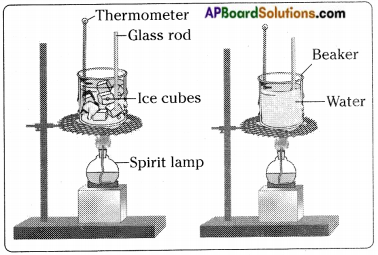
8th Class Physical Science Textbook Page No. 42

Question 5.
Why do we wear cotton clothes in summer?
Answer:

  1. More sweat is produced from our body during summer due to excess of external temperature.
  2. We feel cool when the sweat is evaporated.
  3. On wearing cotton clothes, the clothes absorb sweat from our body. So, we feel cool.
  4. Other clothes like silk, polyester, etc. cannot absorb sweat.
  5. Hence we wear cotton clothes in summer.

Question 6.
Why do we see water droplets on outer surface of a glass containing ice-cold water?
Answer:

  1. Ice-cold water in the glass cools its surface.
  2. Air around the glass contains water vapour which is warmer than the surface of the glass.
  3. Due to the cold glass, air close to its surface will also become cooler.
  4. This changes the water vapour in the air around the surface of the glass into water.
  5. This water forms small drops on the outer surface of the glass.

Question 7.
Why do pigs toil in the mud during hot summer?
Answer:

  1. Generally, the temperature of body is controlled through the sweating evaporation.
  2. In the case of pigs, these have less sweat pores on their skin surfaces. So sweating evaporation process does not take place.
  3. Because of this type of arrangement in pigs, they toil in the mud ponds more time during hot summer.

8th Class Physical Science 3rd Lesson Matter Around Us Activities

Activity – 1

AP Board 8th Class Physical Science Solutions Chapter 3 Matter Around Us

Identifying the shape and volume of liquids
Question 1.
(a) Prove that the liquids have no fixed shape.
Answer:

  1. Collect transparent containers of different shapes.
  2. Take some water using the measuring jar.
  3. Pour the water in one of the containers.
  4. Observe the shape of water.
  5. Pour the same water in different containers and observe the shape of water.
  6. We observe that the water (liquid) takes the shape of container.
  7. We can say that liquids have no fixed shape.
    AP Board 8th Class Physical Science Solutions Chapter 3 Matter Around Us 3

(b) Prove that the liquids have fixed volume.
Answer:

  1. Take 50 ml of water with a measuring jar.
  2. Pour this water in a transparent beaker.
  3. Mark the level of water on the beaker and throw the water out.
  4. Now measure 50 ml of milk, and pour it in the same beaker.
  5. Mark the level of milk on it, and remove milk from the beaker.
  6. Now take 50 ml of oil and pour it in the same beaker.
  7. Mark the level of oil on it, and remove the oil from the beaker.
  8. We observe that the mark on the beaker is same for water, milk and oil.
  9. This proves that the liquids have a fixed volume.

Activity – 2

Question 2.
Do the gases have a definite shape and a fixed volume?
Answer:
CNG (Compressed Natural Gas) is stored in a tank. In vehicles CNG is stored in cylinders. We observe that CNG and all other gases neither have a fixed shape nor fixed volume.
AP Board 8th Class Physical Science Solutions Chapter 3 Matter Around Us 4

Activity – 3

AP Board 8th Class Physical Science Solutions Chapter 3 Matter Around Us

Observing the compressibility of different materials
Question 3.
Prove that the gases are highly compressible than liquids and solids.
Answer:

  1. Take a 50 ml syringe.
  2. Draw the piston to suck in air.
    AP Board 8th Class Physical Science Solutions Chapter 3 Matter Around Us 5
  3. Place your finger on the nozzle and press.
  4. Observe depth of piston moved into syringe and note the height of air column.
  5. We feel hard to press the piston after certain height.
  6. Here the air in the syringe is compressed.
  7. Now fill water in the syringe and do the same experiment.
  8. Note the height of water column when you feel hard to press the piston.
  9. Here the height of water column is more than the height of air column.
  10. Now take a piece of wood or iron and press it with your thumb.
  11. We cannot find any observable change in its volume.
  12. From the above observations, we can say that gases are highly compressible than liquids and solids.

Activity – 4

Observing the diffusion of gases
Question 4.
Describe an activity to observe the diffusion of gases.
Answer:

  1. Ask your friend to hold an unlit incense stick and stand in one corner of the room.
  2. Then you go and stand in the other corner.
  3. We cannot observe any smell (This depends on the type of incense stick).
  4. Now ask your friend to light the incense stick.
  5. After a few seconds, we can observe the smell of incense stick.
  6. The scent in the vapour form and smoke mixes with air and moves across the room and reaches our nose.
  7. This activity proves that the gases can diffuse.

Activity – 5

AP Board 8th Class Physical Science Solutions Chapter 3 Matter Around Us

Observing the diffusion of liquids
Question 5.
Write an activity which shows the diffusion of liquids.
Answer:
Take 250 ml round bottomed flask with 2/3rd water in it. Use a dropper and put a few drops of blue or red ink or Potassium permanganate (KMnO4) solution slowly along the sides of the flask.
AP Board 8th Class Physical Science Solutions Chapter 3 Matter Around Us 6
We can observe that liquids also diffuse into each other like gases.

Activity – 6

Observing the diffusion of particles of solids into liquids
Question 6.
Prove that the particles of solids diffuse into liquids.
Answer:

  1. Take a beaker full of water.
  2. Add a few crystals of potassium permanganate to it.
  3. We observe that the diffusion of potassium permanganate crystal into water and the colour of water changes.
  4. Repeat the experiment with crystals of copper sulphate.
  5. Here also we observe the diffusion of CuSO4 crystals into water and the colour of water changes.
  6. From the above observations, we found that the particles of solids diffuse into liquids.

Lab Activity Diffusion of two gases
Question 7.
Describe an experiment to measure the speed of diffusion of two gases.
Answer:
Aim: To observe the speed of diffusion of two gases.
Materials required : Long glass tube with scale, liquid ammonia, Hydrochloric acid (HC/), pieces of cotton, two rubber corks and two tongs.
AP Board 8th Class Physical Science Solutions Chapter 3 Matter Around Us 7
Procedure:

  1. Take a one meter long narrow glass tube.
  2. Take two pieces of cotton wool.
  3. Soak one piece of cotton wool in HCl solution.
  4. Soak another piece of cotton wool in NH3 solution.
  5. Insert them separately at the two ends of the tube with the help of tongs.
  6. Close the ends of the glass tube with rubber cork and observe.
  7. The HCl gives off hydrogen chloride gas and ammonia solution gives off ammonia gas.

Observation:

  1. Both gases react together to form a white ring in the tube due to formation of ammonium chloride.
  2. Measure the distance of white ring from two ends of the glass tube.

Explanation:
We can observe that the ammonia gas travelled faster. So that the distance of white ring is more from ammonia end than hydrochloric acid end.

AP Board 8th Class Physical Science Solutions Chapter 3 Matter Around Us

Activity – 7

Question 8.
How small are the particles of matter?
Answer:
AP Board 8th Class Physical Science Solutions Chapter 3 Matter Around Us 8

  1. Take a beaker with water. Mark the level of water.
  2. Add 1 or 2 crystals of potassium permanganate and dissolve in water.
  3. Colour of water changes to light violet.
  4. Now take out approximately 10 ml of this solution and add it to 90 ml of clear water in another beaker.
  5. Now the colour of water will be lighter than in the previous one.
  6. Again take out 10 ml of this solution and add it to another 90 ml of clear water.
  7. Carry out this process 4, 5 times and observe the changes in colour of the solution.
  8. We observe the water in last beaker also changed to light violet.
  9. From this activity we conclude that both solids and liquids are made up of tiny particles.

Activity – 8

There exists space between particles
Question 9.
Write an activity which shows the space between particles.
Answer:
AP Board 8th Class Physical Science Solutions Chapter 3 Matter Around Us 9
Procedure: Take a graduated beaker and fill it with some water and mark the water level. Add some salt and stir it thoroughly with a glass rod. Observe if there is any change in water level. Add some more salt and stir it again.
Observations: From the activity we can conclude that both solid and liquid particles have some space between them. Hence the solid particles enter into the space between the liquid particles on dissolving solid in liquid. So there is no change in the water level.

Activity – 9

Observing the force of attraction between the particles of matter
Question 10.
Write an activity which provides an evidence for the force of attraction between the particles of the matter.
Answer:
Procedure:
Open a water tap and allow the water to reach the ground. Now try to break the stream of water with our finger. But we cannot break the stream permanently.
We cannot also break a piece of iron nail with our hands. But we can break a piece of chalk with our hands.
Observations: From the above observations we can say that particles of the matter have forces acting between them that keeps the particles together.
It is also clear that this force is not equally strong and different in different forms of matter.

AP Board 8th Class Physical Science Solutions Chapter 3 Matter Around Us

Activity – 10

Effect of temperature on change of state
Question 11.
Write an activity to know the effect of temperature on change of state of matter.
Answer:

  1. Take about 100 g of ice in a beaker.
  2. Suspend a laboratory thermometer so that its bulb is in contact with the ice.
  3. Set up the beaker as shown in the figure.
  4. Note the temperature.
  5. Now heat the beaker slowly.
    AP Board 8th Class Physical Science Solutions Chapter 3 Matter Around Us 10
  6. Record the change in temperature after every 30 seconds.
  7. Let the ice melt completely.
  8. Now place a glass rod in the beaker and continue heating till water starts boiling.
  9. After some time all the water will get vapourised.
  10. From this we understand that substances around us change state from solid to liquid and from liquid v to gas on application of heat.
  11. There are some substances which can change directly from solid state to gaseous state and vice versa without changing into the liquid state.

Activity – 11

Effect of surface area, humidity and wind speed on evaporation
Question 12.
(a) Explain the effect of surface area on the rate of evaporation.
Answer:
Rate of evaporation increases with an increase of surface area.
Explanation:

  1. During evaporation process, the particles escape from the surface of liquid.
  2. The increase in the surface area provides more scope for particles to escape from the surface.
  3. Hence it leads to increase the rate of evaporation.

Ex: Water in a China dish evaporates faster than the water in test tube.

(b) Explain the effect of humidity on the rate of evaporation.
Answer:
Rate of evaporation decreases with the increase in humidity.
Explanation:

  1. The amount of water present in air is called humidity.
  2. The air around us cannot hold more than a definite amount of water vapour at a given temperature.
  3. If the amount of water vapour is high in air, then the rate of evaporation decreases. Ex : Clothes dry slowly on a rainy day than on a normal day.

AP Board 8th Class Physical Science Solutions Chapter 3 Matter Around Us

(c) Explain the effect of wind speed on rate of evaporation.
Answer:
Rate of evaporation increases with the increase in wind speed.
Explanation:

  1. Because of increase in wind speed, particles of water vapour move away with the wind.
  2. Due to this, amount of water vapour in the surroundings decreases.
  3. It leads to increase in the rate of evaporation.
    Ex: Clothes dry faster on a windy day or under fan than a normal day.

AP Board 8th Class Social Studies Important Questions Chapter 12 Freedom Movement in Hyderabad State

AP State Syllabus AP Board 8th Class Social Studies Important Questions Chapter 12 Freedom Movement in Hyderabad State.

AP State Syllabus 8th Class Social Studies Important Questions 12th Lesson Freedom Movement in Hyderabad State

Question 1.
Was there any difference between the attitude of the British and the Nizams when it came to democracy?
Answer:
No. Both suppressed the people.

Question 2.
Write any two demands of Andhra Maha Sabha in 1935.
Answer:
The demands of Andhra Maha Sabha in 1935:

  1. Compulsory primary education should be implemented.
  2. Mother tongue (Telugu) should be the medium of instruction.

AP Board 8th Class Social Studies Important Questions Chapter 12 Freedom Movement in Hyderabad State

Question 3.
What are the languages spoken in your area?
Answer:
Telugu, Urdu and Hindi are the languages mostly spoken in our area.

Question 4.
What is the medium of teaching in schools and colleges today in our state?
Answer:
The mediums of teaching in schools and colleges today are Telugu and Urdu. There are many schools also which teach in other statutory languages.

Question 5.
Do you think all teaching should be done in one’s mother tongue?
Answer:
No. I don’t think so. The teaching should be in their own mother tongue.

AP Board 8th Class Social Studies Important Questions Chapter 12 Freedom Movement in Hyderabad State

Question 6.
Why do you think it is important to publish books in mother tongues?
Answer:
Books are knowledge giving ones. If they are in other languages, nobody can read them. So to attain knowledge it is important to publish in mother tongues.

Question 7.
Why do you think the doras who were Hindus helped the Razakars?
Answer:
Doras, who were Hindus, ruled as dictators. Razakars also had anti-democratic views and they fought the democratic political parties and communist led peasants. Hence, Doras supported and helped the Razakars.

Question 8.
Why do you think the Nizam rule ended on 26th January 1950?
Answer:
The Constitution of India came into force on that day. So we can say that the Nizam rule ended on 26th January, 1950.

AP Board 8th Class Social Studies Important Questions Chapter 12 Freedom Movement in Hyderabad State

Question 9.
What was the role of women in Telangana Armed struggle?
Answer:
Women in the Telangana Struggle:
Women suffered most under the rule of Nizams and doras. They were constantly harassed. They not only had to work for the landlords but also to serve the visiting officials. Many women were made slaves of the landlords. Such women attended the night schools of Andhra Maha Sabha and decided to join the Sanghams and the Communist Party. Some of them took arms and fought the Razakars, some of them sang songs and inspired people, some of them acted as doctors and nurses. But they had to make supreme sacrifices for the sake of the movement.

Question 10.
What were the demands of the Andhra Maha Sabha in 1935?
Answer:
The demands of Andhra Maha Sabha in 1935:

  1. Compulsory primary education should be implemented.
  2. Mother tongue (Telugu) should be the medium of instruction.
  3. The legitimate rights of the people in Jagirs should be protected.
  4. Child marriages should be discouraged.
  5. Local Self Government should be introduced.
  6. Untouchability should be eradicated and the untouchables should be given due place in the society.

AP Board 8th Class Social Studies Important Questions Chapter 12 Freedom Movement in Hyderabad State

Question 11.
How was the Telangana Armed Struggle in 1947-48?
Answer:
The movement was transformed in 1947-48 into a broad anti-Nizam and anti-feudal struggle demanding merging of Hyderabad with independent India. The people burnt the records of the village officials and moneylenders and seized the grains hoarded by the landlords and the merchants. To broaden the scope of the movement and integrate various sections into it, the demand was raised to merge Telangana with the other Telugu speaking regions to create Vishal Andhra.

Question 12.
How was the Hyderabad state merged in India?
Answer:
When India became independent in 1947, Osman Ali Khan, the Nizam wanted Hyderabad to remain as an independent kingdom. The common people of the state wanted to join Independent India and a large campaign was organized by the Hyderabad State Congress led by Ramananda Theertha. The Razakars attacked them too. Then the Indian government decided to end this anarchy and sent armed forces to Hyderabad. Hyderabad was finally integrated into Indian Union in September 1948.

AP Board 8th Class Social Studies Important Questions Chapter 12 Freedom Movement in Hyderabad State

Question 13.
You read about the demands of Andhra Maha Sabha (1935). Explain in what way the demands are being implemented now.
Answer:

  1. Compulsory Primary Education is implemented (RTE Act)
  2. Telugu Medium schools are established.
  3. All people have legitimate rights irrespective of caste, race, religion and region.
  4. Child marriages are banned.
  5. Now untouchability is a crime. They are given due place in the society.

Question 14.
Observe the map and fill in the blanks.
AP State Syllabus 8th Class Social Studies Important Questions 12th Lesson The Indian Constitution 1

  1. Hyderabad was in ———–.
  2. ———– Green colour (Refer to textbook on P.No. 140) indicates
  3. Aurangabad is present in ———–.
  4. The Presidency on West side was ———–.
  5. The South-west part was ———–.

Answer:

  1. Surf-e-Khas
  2. Samsthanas
  3. Maharashtra
  4. Bombay Presidency
  5. Jagir.

AP Board 8th Class Social Studies Important Questions Chapter 12 Freedom Movement in Hyderabad State