AP Board 8th Class Biology Solutions Chapter 11 Why Do We Fall Ill?

AP State Syllabus AP Board 8th Class Biology Solutions Chapter 11 Why Do We Fall Ill Textbook Questions and Answers.

AP State Syllabus 8th Class Biology Solutions 11th Lesson Why Do We Fall Ill

8th Class Biology 11th Lesson Why Do We Fall Ill Textbook Questions and Answers

Improve Your Learning

Question 1.
A doctor/nurse/health-worker is exposed to more sick people than others in the community. Find out how she/he avoids getting sick herself/himself.
Answer:

  1. By choosing nutritious food and an active lifestyle, managing stress, using tobacco- free, getting preventive immunizations and screenings and choosing protection measures.
  2. Maintaining good hygiene:
    By washing hands frequently, cleaning their stethoscopes from patient to patient, using gloves.
  3. Recognising the symptoms quicker and knowing what to do can help speedy recovery, easier access to medical care. (E.g.: They can self-prescribe, can ask col¬leagues for help etc.)

AP Board 8th Class Biology Solutions Chapter 11 Why Do We Fall Ill

Question 2.
Differentiate the infective and non-infective diseases.
Answer:

  1. Infectious diseases can be spread from person to person.
    Non-infectious diseases can not be spread from person to person.
  2. Infectious diseases are caused by pathogens (microbes) which are disease causing organisms.
    The major group of pathogens (microbes) are viruses, bacteria, fungi, single cell organisms like protozoans, multicellular organisms like worms.
    Non-infectious diseases are not caused by Pathogens (microbes), but can be caused by physiological malfunctions, environmental or chemical factors, heredity, unknown causes. These are mostly internal, non-infectious causes.
  3. Examples of infectious diseases are Viral, diseases, bacterial etc.
    Example for non infectious causes are some cancers caused by genetic abnormali¬ties and high blood pressure caused by excessive weight and lack of exercise.

Question 3.
Why acute disease become chronic disease?
Answer:

  1. Some diseases last for only very short periods of time and these are called acute diseases.
    E.g.: Common Cold lasts only a few days.
  2. Some other diseases or ailments can last for a long time, even as much as a life time and are called chronic diseases.
    E.g,: The infection causing elephantiasis, which is very common in some parts of India.
  3. As an example, a cough and cold which all of us have from time to time. Most of us get better and become well within a week or so.
  4. But if we get infected a chronic disease like tuberculosis of the lungs, it takes over the years to suffer with cough and lose weight and feel tired all the time.
  5. In other words, we are likely to have prolonged general poor health if we have a chronic disease.
  6. Chronic diseases therefore have very drastic, longterm effects on people’s health
    as compared to acute disease.
  7. One reason might be that, because the person is not well nourished and does not get enough food and it is because of poverty, the acute disease becomes a chronic disease.

Question 4.
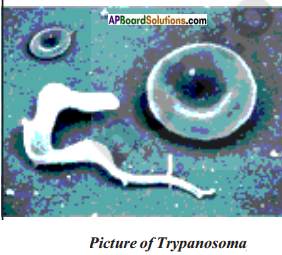
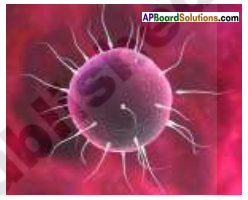
Draw the figure of leishmania and trypanosome.
Answer:
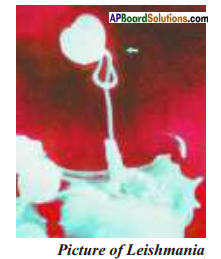
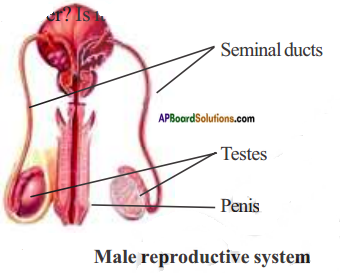
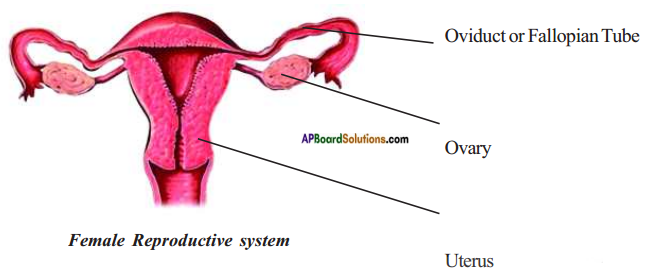
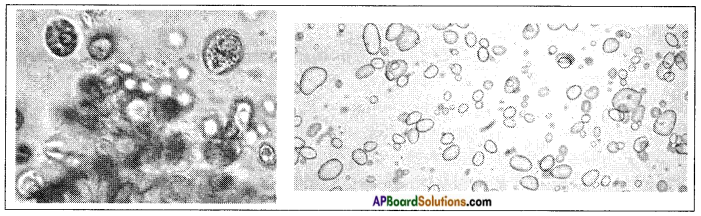
AP Board 8th Class Biology Solutions Chapter 11 Why Do We Fall Ill 1AP Board 8th Class Biology Solutions Chapter 11 Why Do We Fall Ill 2

Question 5.
Ramu was effected with small pox. What advice do you give Ramu for not spreading disease?
Answer:
Prevention of Small Pox:

  1. Isolation of the infected person.
  2. Surrounding should be kept clean and hygeinic.
  3. Clothes of the infected person must be washed in hot water and dried in the Sun.
  4. They should not be used by others.
  5. Small Pox can be prevented by taking vaccine against it.
  6. But in 1776 Edward Jenner discovered a vaccine for small pox. Now it is wiped out from our country.

AP Board 8th Class Biology Solutions Chapter 11 Why Do We Fall Ill

Question 6.
How do you appreciate for role of vaccine in preventing disease?
Answer:

  1. Vaccination was discovered by a British doctor called Edward Jenner in the year 1776. Since then, this method has been modified and has become most popular for making people resistant to disease.
  2. In this process, the disease causing organism are cultured in the laboratory and are collected. They are killed by heat treatment.
  3. The dead micro-organisms are made into a suspension and injected into humans. The body reacts to these dead micro-organisms as if they are alive and are produces antibodies.
  4. Next time when the same disease producing micro-organisms enter the body, these antibodies will react and kill them.
  5. Thus the person is not affected by the disease, even if he is exposed to the disease causing microorganisms. Vaccination also prevents the spread of epidemics.
  6. At present, vaccines are available for various diseases-Cholera, typhoid, diphtheria, whooping cough, polio, tuberculosis etc. Some of the vaccines if taken once, the immunity persists for life time, while in some cases the immunity will lasts only for limited amount of time.

Question 7.
Prepare a questionnaire to collect the information from your local health worker about spreading of diseases?
Answer:

  1. What are the causes for a disease?
  2. Name the organisms that cause diseases.
  3. Name the diseases caused by virus, bacteria, fungi and protozoans.
  4. How the infectious agents spread?
  5. Name the diseases caused by air, water and physical contact.
  6. What are the symptoms of Typhoid and Jaundice?
  7. How can we prevent exposure to infectious diseases?
  8. How do we kill microbes?
  9. How to get rid of an infection in some one who has the disease?
  10. What are the treatments for any type of diseases?
  11. What are the measures taken by Public Health,Programmes to prevent diseases?
  12. What is immunization? What are antibiotics?
  13. What is the duty of everyone in the community for the effective prevention of infectious diseases?

AP Board 8th Class Biology Solutions Chapter 11 Why Do We Fall Ill

Question 8.
How many times did you fall ill in the last one year? What were the illnesses?
a) Think of one change you could make in your habits in order to avoid any of/ most of the above illnesses.
b) Think of one change you would wish for in your surroundings in order to avoid any of/most of the above illnesses.
Answer:
In the last one year, fall ill for one time with Malaria.
Symptoms:

  1. It is a communicable disease caused by the Protozoan Plasmodium Falciparum. It is spread by the infected female anopheles mosquito.
  2. It starts with extreme cold. Patient wants to be covered with heavy blankets. This is followed by fever, as high as 106° F.
  3. There will be severe head ache and body pains. There will be sweating.
  4. In children the parasite enter and block the capillaries, supplying blood to the brain. The blood vessels may ruptures child becomes unconscious and may even die.

a) Think of one change you could make in your habits in order to avoid any of/ most of the above illnesses.
Answer:
Preventive measures of malaria:

  1. To reduce the mosquito population successfully.
  2. By protecting ourselves from mosquito bites, the spread of malaria can also be prevented.
  3. Best method is to use mosquito nets while sleeping and by using mosquito proof nets for windows and doors. These nets do not allow mosquitoes to enter the house.

b) Think of one change you would wish for in your surroundings in order to avoid any of/most of the above illnesses.
Answer:

  1. Preventing water stagnation in water tanks, drainage canals, and discarded vessels lying outside. The stored water tanks should be emptied frequently and filled with fresh water.
  2. Spraying of insecticides or light oil such as kerosene on stagnant water, especially in drainage water.
  3. Growing of specific varieties of fishes in stagnant water. They feed on mosquito larvae.

AP Board 8th Class Biology Solutions Chapter 11 Why Do We Fall Ill

Question 9.
Conduct a survey in your neighbourhood to find out what the three most common diseases are. Suggest three steps that could be taken by your local authorities to bring down the incidence of these diseases.
Answer:
The most common cause for the spread of diseases in our neighbourhood is by drinking of contaminated water. Polio, Cholera, Typhoid, Jaundice and Amoebiasis and several worms spread through drinking water.
Preventive Measures:

  1. Drinking water is purified by filtration and chlorination before it is supplied through municipal taps and provide safe drinking water.
  2. Providing basic sanitation by keeping the surroundings clean.
  3. Arranging the public health programmes to prevent and control of local diseases by giving immunisation to childhood.

8th Class Biology 11th Lesson Why Do We Fall Ill InText Questions and Answers

Question 1.
Let us read the wall writings on the panchayat office

Drink boiled water only.
Use mosquito nets.
Keep your surroundings neat and clean.
Do not left water to stagnate.
Eat food when it is hot.
Wash hands before eating food.
Wash hands after toilet.
Use toilets only, not defecate in open.
Keep lids on food vessels.
Wash vegatables before cooking

a) Why local Panchayats display such instructions on the wall?
Answer:
To bring awareness in the local people against diseases.

b) What do we come to know from such instructions?
Answer:
Such infections will spoil the health of people.

c) What would happen if we do not follow the instructions.
Answer:
People who would not follow the instruction may fall sick.

d) In which season do we generally find more mosquitoes? How do they affect us?
Answer:
Generally we find more mosquitoes in rainy season. Mosquitoes cause malaria.

e) What is health ? And when do we fall sick?
Answer:
Health is a state of being well enough to function physically, mentally and socially with optimum efficiency.
When disease causing organisms attack us we fall sick.

AP Board 8th Class Biology Solutions Chapter 11 Why Do We Fall Ill

Question 2.
State any two conditions essential for good health.
Answer:
Clean surroundings and fresh air.

Question 3.
State any two conditions essential for being free of disease.
Answer:
Safety food and water and exercise to the body.

Question 4.
Are the answers to the above questions necessarily the same or different? Why?
Answer:
Different.

Question 5.
Do all diseases spread to people coming in contact with a sick person?
Answer:
No, some diseases are infectious and some diseases are non-infectious.

Question 6.
What are the diseases that are not spreading?
Answer:
Non-infectious diseases E.g.: Some cancers, high blood pressure etc.

Question 7.
How would a person develop those diseases that do not spread by contact with a sick person?
Answer:
Non-infectious diseases are some times caused by genetic abnormalities, excessive weight or lack of exercise.

Question 8.
List any three reasons why you would think that you are sick and ought to see a doctor. If only one of these symptoms were present, would you still go to the doctor? Why or why not?
Answer:
Because of not feeling well, unable to do daily work and when feeling uneasy thinking that we are sick we want to see the doctor. If the situation is unbearable then we would like to see the doctor.

AP Board 8th Class Biology Solutions Chapter 11 Why Do We Fall Ill

Question 9.
In which of the following case do you think the long-term effects on your health are likely to be most unpleasant?
Answer:

  1. If in the case of Jaundice, the suffering will be more and it will be cured only by taking medicines. Prescribed by a doctor.
  2. Because this is the disease for liver, the normal functioning of the liver will be stopped, and feels unpleasant.

8th Class Biology 11th Lesson Why Do We Fall Ill Activities

Activity – 1

Question 1.
a) Find out what provisions are made by your local authority (Panchayat/ Municipal Corporation) for the supply of clean drinking water.
Answer:
The Panchayat/Municipal Corporation should filter the water and chlorinated before sending through pipes.

b) Are all the people in your locality able to access this?
Answer:
Yes, all the people can access this. The people are avail of this.

Activity – 2

Question 2.
a) Find out how your local authority manages the solid waste generated in your neighbourhood.
Answer:
The solid waste generated in the neighbourhood is collected and disposed.

b) Are these measures adequate?
Answer:
Yes. But still more they can take measures.

c) If not what improvement would you suggest?
Answer:
The authority can announce the public to reduce the waste in the household.
Suitable arrangements will be arranged for the garbage disposal, to prevent accumulation of waste in and around residential areas. This attracts the houseflies and other microbes to spread diseases.

d) What could your family do to reduce the amount of solid waste generated during a day/week from your house?
Answer:
The peels of fruits and vegetables and other waste materials which decay and turns good manure can deposit in the compost pit.

AP Board 8th Class Biology Solutions Chapter 11 Why Do We Fall Ill

Activity – 3

Question 3.
Survey your neighbourhood to find out:
a) How many people did suffer from acute diseases during the last three months?
Answer:
More people suffered from acute diseases.

b) How many people did develop chronic diseases during this same period?
Answer:
Very few people develop chronic diseases.

c) And finally, what is the total number of people suffering from chronic diseases in your neighbourhood?
Answer:
One or two.

d) Are these answers to questions (I) and (2) different?
Answer:
Same.

e) Are these answers to questions (2) and (3) different?
Answer:
Same.

f) What do you think could be the reason for these differences? What do you think would be the effect of these differences on the general health of the population?
Answer:
In general people get acute diseases seasonally but chronic diseases are drastic, long term effect because of their poor health.

Activity – 4

AP Board 8th Class Biology Solutions Chapter 11 Why Do We Fall Ill

Question 4.
a) Find out how many of in your class had cold/cough/fever recently.
Answer:
One or two or few students.

b) How long did the illness last?
Answer:
The illness lasts for one week.

c) How many of you took antibiotics?
Answer:
Half of the students took antibiotics.

d) How long did they suffer who took antibiotics pills?
Answer:
Seven days.

e) How long did they suffer who did not take antibiotics pills?
Answer:
Seven days.

f) Is there any difference between these two groups?
Answer:
No difference is seen between these two groups.

g) If yes, why ? If not, why not?
Answer:
Because antibiotics do not work against viral infections.

Activity – 5

AP Board 8th Class Biology Solutions Chapter 11 Why Do We Fall Ill

Question 5.
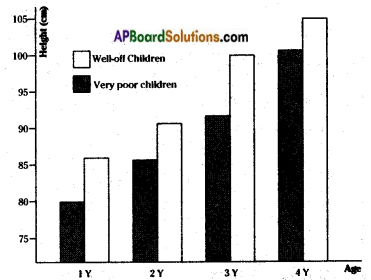
Conduct a survey in your locality. Talk to ten families who are well-off and ten who are very poor. Both sets of families should have children who are below five years of age. Measure the heights of these children. Draw a graph of the height of each child against its age for both sets of families.
Families who are well – off

Name of the child Age Heights
1) C. Vivek 5 105 cm
2) B. Ramu 4 99 cm
3) B. Gopi 4 100 cm
4) R. Rahul 3 91 cm
5) B. Somu 2 86 cm

Families of very poor

Name of the child Age Heights
1) A. Kotaiah 5 100 cm
2) P. Ankalu 4 94 cm
3) B. Srinu 4 92 cm
4) C. Samuel 3 86 cm
5) P. Gopi 2 80 cm

AP Board 8th Class Biology Solutions Chapter 11 Why Do We Fall Ill 3

a) Is there any difference between the groups? If yes, Why?
Answer:
Yes, there is a difference between the groups. The children who are sufficient nourishment have good health. Their growth is healthy.

b) If there is no difference, do you think that your findings mean that being well-off or poor does not matter tor health?
Answer:
The functioning of the immune system, like any other system in the body, will not be good if proper and sufficient nourishment and food is not available.
So the availability of proper and sufficient food helps us to be healthy.

Activity – 6

Question 6.
Rabies virus is spread by the bite of infected dogs and other animals. There are anti-rabies vaccines for both humans and animals.
a) Find out the plan of your local authority for the control of rabies in your neighbourhood.
Answer:
Control of Rabies:

  1. Parental rabies vaccination of owned dogs.
  2. Sterlization of pet dogs.
  3. Unwanted dogs should not be abondoned.
  4. Animal birth control attempt should be made to sterilize the stray dog population or other methods of birth control should be investigated.
  5. Suitable infrastructure for garbage disposal, to prevent the accumulation of waste in and around residential areas.

AP Board 8th Class Biology Solutions Chapter 11 Why Do We Fall Ill

This attracts stray and ownerless dog packs to these areas.
Vaccination:
Sufficient and affordable cell culture vaccine should be available for post exposure treatment.
Mass oral vaccination of the stray dog population.

b) Why we are normally advised to take bland and nourishing food when we are sick?
Answer:
When we fall sick our normal body functions will be affected the digestion will be slow, so it is advised to take bland and nourishing food when we are sick.

c) What are the different means by which infectious diseases are spread?
Answer:
The infectious diseases are spread through contaminated air, water, food and vectors like mosquitoes, flies, cockroaches, snails and even lice.

d) What precautions can you take in your school to reduce the incidence of infec-tious diseases?
Answer:

  1. Encouraging sick students and staff to stay at home and seek medical attention for several illnesses.
  2. Facilitating hand hygiene by supplying soap and paper towels and teaching good hand hygiene practicles.
  3. Cleaning of class room materials and surfaces.
  4. Daily announcements about preventing infectious diseases.
  5. Encouraging students and staff to get annual influenza vaccination.

e) What is immunization?
Answer:
The creation of immunity against a particular disease, by vaccination of an organism for the purpose of making it immune to a particular pathogen (disease causing organ¬ism) is called immunisation.

f) What are the immunization programmes available at the nearest health centre in your locality?
Answer:
More children are being protected against vaccine preventable diseases, such as tuberculosis tetanus, pertusis (Whooping cough), diphtheria, polio, measles and now hepatitis – A, B then ever before.
The public health programme of childhood immunisation for preventing infectious diseases.

g) Which of these diseases are the major health problems in your area?
Answer:
Measles and jaundice.
AP Board 8th Class Biology Solutions Chapter 10 Not For Drinking-Not For Breathing

AP State Syllabus AP Board 8th Class Biology Solutions Chapter 10 Not For Drinking-Not For Breathing Textbook Questions and Answers.

AP State Syllabus 8th Class Biology Solutions 10th Lesson Not For Drinking-Not For Breathing

8th Class Biology 10th Lesson Not For Drinking-Not For Breathing Textbook Questions and Answers

Improve Your Learning

Question 1.
How does air pollution lead to water pollution?
Answer:

  1. Air and water are not separate problem. There is a close link between the health of air and the health of water.
  2. Nitrogen and chemical contaminants are two types of pollutants that harm both the air and water.
  3. Up to l/3rd of the nitrogen that pollutes the bay and it’s rivers comes from the air.
  4. Air pollution from a very large geographic area can eventually wind up in the Bay.
  5. Use of fertilizers and pesticides in agriculture pollutes not only air but also land and water.
  6. Sources of air pollution includes vehicles, industries, power plants and farm operations which lead to water pollution.

AP Board 8th Class Biology Solutions Chapter 10 Not For Drinking-Not For Breathing

Question 2.
What steps can be taken up to control air pollution and water pollution?
Answer:
Some of the methods for controlling air pollutions are:

  1. Tall chimneys should be installed in all factories to reduce air pollution at the ground level.
  2. Better designed fuel burning equipment should be used in homes and industries so that fuel burnt completely.
  3. Install electrostatic precipitators in the chimneys of industries.
  4. Reduce vehicular emissions by using non polluting fuels like CNG (compressed natural gas)
  5. Use LPG for domestic use (Liquify Petroleum Gas)
  6. Improve the quality of fuel in automobiles and use catalytic converters in them.
  7. Make use of renewable alternative source of energy like solar energy, wind energy and hydro energy.
  8. All motor vehicles should be maintained properly so that they comply with pollution norms.
  9. Use unleaded petrol.
  10. Plant and grow, more and more trees, we can protect plants and trees. Vanamahotsav should be continued every year in July month.

Prevention and controlling of water pollution

  1. Toxic industrial wastes should be treated chemically to neutralize the harmful substances present in it before discharging into rivers and lakes.
  2. The sewage should not be dumped in to the rivers directly.
  3. The use of excessive fertilizers and pesticides should be avoided.
  4. The use of synthetic detergent should be minimized or biodegradable detergents should be used.
  5. Dead bodies of human beings and animals should not be thrown into rivers.
  6. The excreta and other garbage should be treated in a biogas plant to get fuel as well as manure.
  7. The water of rivers, streams, ponds and lakes should be purified or cleaned. For example Ganga action plait launched by the Indian Government.
  8. Trees and shrubs should bp planted along the banks of the rivers.
  9. There should be general Rareness among the people regarding the harmful of water pollution and the ways of prevention.
  10. Waste papers, plastic, waste fbod materials and rotten food and vegetables should not be thrown into open drains.
  11. Go for the alternate energy resources that can replenish themselves without affecting our environment.
  12. Reuse the materials for secondary purpose. Recycling is the next stage of reuse.

Question 3.
Why does the increased level of nutrients in the water affect the survival of aquatic organisms?
Answer:
Plants nutrients:

  1. Phosphates and nitrates – chemical fertilizers from agriculture run – off due to rain and industrial wastes enter into water through sewage and pollute the water.
  2. It helps algae to bloom, weeds to grow and bacteria is spread. As a result water turn green and cloudy and smell bad.
  3. Decomposing plants use up the oxygen in water, disrupting aquatic life, reducing biodiversity and even killing aquatic life.
  4. Thus, this enrichment of water by nutrients leading to excessive plant growth and depletion of oxygen is known as ‘Eutrophication’. This affects aquatic life badly.

AP Board 8th Class Biology Solutions Chapter 10 Not For Drinking-Not For Breathing

Question 4.
Road side plants cannot grow properly. Find your own reasons and explain with your argument.
Answer:

  1. The plantation along the roads mainly includes neem, peepal, banyan, almond etc.
  2. It was observed that vegetation at roadside with heavy traffic and markets was much affected by vehicular emissions.
  3. Significant decrease in total chlorophyll and protein content was observed with reduced leaf area.
  4. It is concluded that plants can be uses as indicators for urban air pollution and there is need to protect the road side plants from air pollution.
  5. Biomonitoring of plants is an important tool to evaluate the impact of air pollution on plants.
  6. A study suggests that plants have the potential to serve as excellent quantitative and qualitative indices of pollution levels.
  7. So plants should be grown and protected.

Question 5.
Sudheer is a traffic constable. What do you think about his health? Give some suggestions to protect his health during duty period.
Answer:

  1. Environmental pollution place a significance role in the development of various respiratory diseases. Different particles and gases from vehicular emissions like carbondioxide, carbon monoxide, sulphur, benzene, lead, nitrogen dioxide and black smoke are the root of the problem.
  2. Traffic police are increasingly becoming victims of a diabetes and allergies at a younger age. Irregular work schedule were posing a challenge to the health of the police. Besides physical strain, mental stress and asymmetrical food habits are also contributing the problem.
  3. The traffic police men who work at busy intersections are at the highest risk of developing asthma, bronchitis, shortness of breath, sore throat, chest pain, lung cancer, eye irritation, skin ailments. Impaired hearing, excessive carboxy haemoglobin and annoyance with noise also high blood pressure and cardiovascular problems.
  4. On the basis of the study, pollution masks should be used by the traffic police men on duty at higher polluted junctions.
  5. He should be recommended better and special medical care for his protection. Various duty places for them need to be scientifically evaluated for their exposure risk.
  6. To protect ears from deafening noises, they can put small cotton balls in the ear and also wear ear masks for this purpose.
  7. Ecofriendly solar traffic booths at traffic intersections will be provided for the traffic police men. These booths contains ionisers which supress the suspended particulate matter and provide a healthy environment for a police man seated inside.

Question 6.
Write a short note on the effects of water pollution in your village. Suggest precautions.
Answer:

  1. Patancheru is a suburban mandal headquarters in Medak district, located about 25 km from Hyderabad. It is a major industrial hub of the state.
  2. It is one of the most polluted areas in India. Nearly 14 villages were badly affected by pollution related diseases like cancer, respiratory diseases and heart diseases caused by number of poisons in air, water and on land.
  3. The presence of pharmaceutical and chemical industries, pesticide units, steel rolling industries, distilleries releasing the pollutants like chlorine, Hydrogen sulphide, which are entering into the atmosphere.
  4. Most of the agricultural lands became barren. The lives of people there depend on agriculture and animal husbandry. They became helpless. Most of the people converted themselves as workers in the factories.

AP Board 8th Class Biology Solutions Chapter 10 Not For Drinking-Not For Breathing

Question 7.
Visit a pollution check centre. Observe the process of conducting a pollution check and record your findings. You may consider the following areas your record.
Average number of vehicles checked in a certain time period, Time taken to check each vehicle, Pollutants checked for, The process of testing, Permissible limits of emission of various pollutants, Measures taken if the emitted gases are above the permissible limits.

  • % Average number of vehicles checked in a certain time period.
    Answer:
    10-15
  • Time taken to check each vehicle.
    Answer:
    5-7 minutes
  • Pollutants checked for
    Answer:
    Carbon dioxide, carbon monoxide, nitrogen, nitrogen oxide, methane, hydro carbons, sulphur dioxide, particular matter, trace elements, water vapour etc.
  • The process of testing:
    1. The test shall be carried out with the engine mounted on a test bench and connected to a dynamometer.
    2. The gases emission from the exhaust of the engine include hydrocarbons, carbondioxide, carbon monoxide and oxides of nitrogen.
    3. During prescribed sequence of warmed up engine operating conditions, the amount of the above gases in the exhaust, shall be examined continuously.
    4. The prescribed sequence of operations consists of a number of speed and power modes which span the typical operating range of engine.
    5. During each mode, the concentration of each pollutant, exhaust flow and power out put shall be determined and the measured values, weighed and used to calculate the grams of each pollutant emitted for kilowatt hour.
  • Permissible limits of emission of various pollutants.
    Pefrol engine
    Carbondioxide                                  14%
    Carbon monoxide                            1 to 2%
    Nitrogen oxide less than                  0.5%
    Hydrocarbons                                   0.5%
    Sulphur dioxide                                possible traces
    Particular matter less than                0.5%
    Trace elements less than                   0.5%
    Nitrogen                                            71%
    Water vapour                                    12%
    Diesel Engine
    Nitrogen                                                   67%
    Carbondioxide                                          13%
    Water vapour                                            11%
    Carbon monoxide                             less than 0.045%
    Nitrogen oxide                                 less than 0 to 1.5%
    Sulphur dioxide                                less than 0.03%
    Hydro carbons                                  less than 0.43%
    Particulate Pollutants                       less than 0.045%
    Trace elements                                           0.3%
  • Measures taken if the emitted gases are above the permissible limits.
    Answer:
    The carbon particles (soot) deposited in the engine head will be checked and cleaned or the vehicle will be ceased by .R.T.O.

Question 8.
Organize a field visit to a pond/lake/river present in or near to your village with the help of your teachers.
Observations followed by discussion could focus on…. The history of the pond or lake or river, Water resources available other than that river/pond/or lake, Cultural traditions, Pollution concerns, Source of pollution, Effects of pollution on the people living by the river side as well as those living far away.
Answer:
Kolleru lake: It is a 2nd largest fresh water lake located in Andhra Pradesh located between Krishna and Godavari delta.
History: Two copper plates of the early Pallava dynasty have been found in the lake, tracing it’s history to Langula Narasimha Deva an Ganga Vanshi Odisha King. According to legend, the Gajapathi fort was located at Kolleti kota on one of the eastern islands of the lake. The enemy general “Muhammadan” general escamped at “Chiguru kota” located on the shores. In some ways the lake protected the Oriya forces. The enemy finally tried to excavate a channel, the modern day Upputeru. So that the water of the lake would empty into the sea and the level would fall so that they could attack the Gajapathi fort. The royal oriya army general sacrificed his own daughter to propitiate Gods and ensure his success against Muhammadan and her name was “Perantala Kanama”. Therefore the channel Was called perantala Kanama. “Sri Peddinti Ammavari Temple” is one of the oldest and famous temples found in Kolleru.
Water sources available other than Kolleru: Wells, taps. The lake is fed directly water from seasonal Budameru and Tammileru streams and connected to the Krishna and Godavari systems by channels.
Cultural traditions: The vast majority of the district is rural in nature. Thus the culture of the kolleru lake people is mostly conservative and traditional. The joint family system, the arranged marriages are the norms. Telugu language is spoken in this place. Pollution concerns: Kolleru lake is suffering from the unsatisfied greed of people and selfish interests of mankind who exploit the lake’s integrity. Thousands of fish tanks were dug up effectively converting the lake into a mere drain. This had great impact in terms of pollution, leading to difficulty in getting drinking water for the local people.
Source of pollution: Satellite images taken on February 9, 2001 by the Indian remote sensing satellite found that approximately 42% of the 245 km2 lake was occupied by aquaculture. While agriculture had encroached another 8.5% they were mostly rice paddies. Surprisingly no clear water could be found in the satellite image. The rest of the lake is being diminished by weeds like elephant grass and water hyacinth.
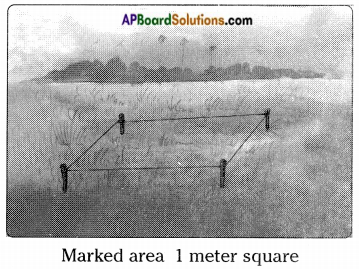
Effects of pollution on people: Thousands of fish tanks were dug up effectly leading to difficulty in getting drinking water for the local people. An adverse effect on the thousands of acres of crop in the upper reaches of water flow into the sea because of obstruction by bunds of the fish tanks that appeared illegally.

AP Board 8th Class Biology Solutions Chapter 10 Not For Drinking-Not For Breathing

Question 9.
What is air pollution? Make a flow-chart to describe its causes and effects.
Answer:
If solid, liquid and gaseous substances are present in higher volumes than required in the air, it is harmful to air. It is called air pollution.
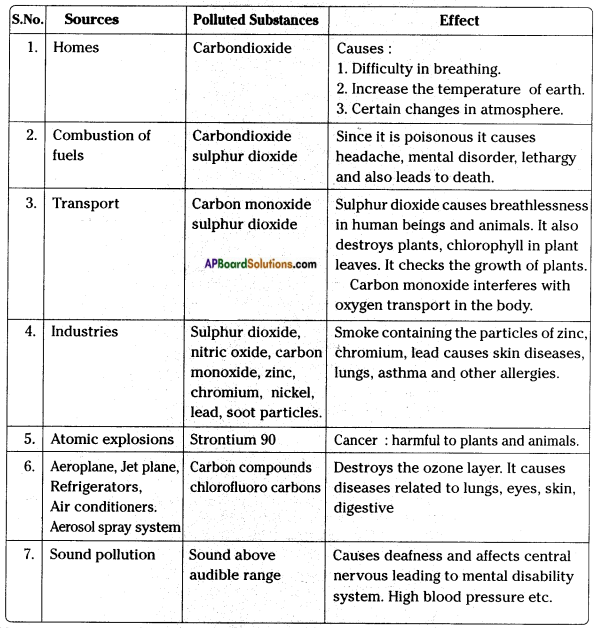
Table shows causes and effects of air pollution:
AP Board 8th Class Biology Solutions Chapter 10 Not For Drinking-Not For Breathing 1
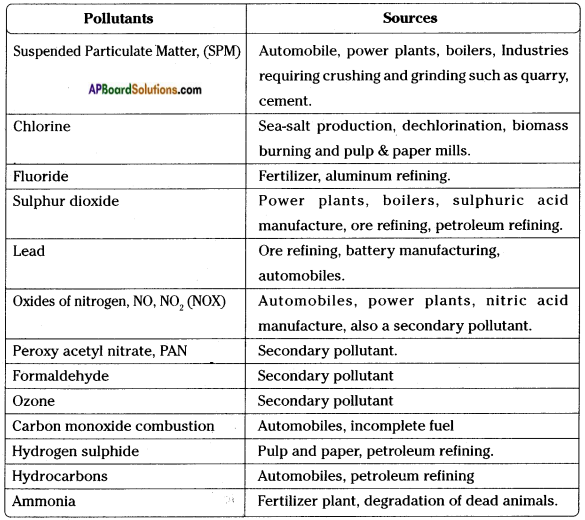
COMMON POLLUTANTS AND THEIR SOURCES
AP Board 8th Class Biology Solutions Chapter 10 Not For Drinking-Not For Breathing 2

Question 10.
Clear and transparent water is always suitable for drinking. Comment.
Answer:

  1. No. Clear and transparent water is not always suitable for drinking.
  2. Water might appears clean but it may contain some disease causing micro-organisms and other dissolved impurities.
  3. Hence it is advised to purify water before drinking.
  4. Purifying can be done by water purifying systems or by boiling the water.

AP Board 8th Class Biology Solutions Chapter 10 Not For Drinking-Not For Breathing

Question 11.
If our monument like Tajmahal is effected by air pollution, what is your advise to protect it?
Answer:
The Taj Mahal one of the seven wonders of the world is located in Agra. It is made of white marbles. The effect of pollutants like SO2, NO2, smoke, dust, soot, etc. on it has turned the marble from white to yellow.
Precautions to protect Taj Mahal:

  1. Switch over to cleaner fuels like CNG (Compressed Natural Gas) and LPG (Liquify Petroleum Gas)
  2. Use unleaded petrol in vicinity of Taj Mahal.
  3. Shift polluting industries to the outside of Agra city.
  4. Industrial pollution should be banned around the Taj Mahal.
  5. Limited vehicular use in a specific radius.
  6. An electronic board should be installed in the Taj Mahal premises, that compares current pollution levels, to the levels that deemed safe.

Question 12.
Reshma going to talk about controlling measures of soil pollution. Prepare write up for her.
Answer:
Controlling measures of soil pollution:

  1. Limit the use of fertilizers and pesticides.
  2. Awareness about biological control methods and their implementation.
  3. The grazing of cattle must be controlled and forest management should be done properly.
  4. The afforestation and reforestation must take place.
  5. Proper preventing methods like shields should be used in areas of wind erosion .and wind breakes.
  6. Remember to carry paper bags and minimising plastic bags.
  7. The soil binding grass must be planted and the large trees must be plant along the banks.
  8. Industrial waste must be dumped in the low lying areas.
  9. There should be a definite technic of cropping which does not allow weeds to settle on the fields.
  10. The mining waste must be improved along with the transportation.
  11. The are must not be left barren and dry.

Question 13.
To conduct a quiz program on air and water pollution, prepare five thought provoking questions.
Answer:

  1. What is environmental pollution?
  2. What are the natural disasters of pollution?
  3. What are the human activities that leads to pollution?
  4. What is the unforgettable industrial tragedy took place in Bhopal on second December
  5. Who is responsible for thepollution in Patancheru ? What are the interim orders, released by supreme court of India for the sake of people and environment?
  6. What is the sad story of River Musi?
  7. Can we save Taj Mahal from pollution?
    What is the present situation of Taj Mahal?
  8. Natural resources are the devine gift for us by nature. Can we keep these resources clean and healthy for the future generations? What is your role and response towards this?

AP Board 8th Class Biology Solutions Chapter 10 Not For Drinking-Not For Breathing

Question 14.
“Use Bicycle – Avoid motor bikes and cars”. This slogan is prepared by Sravani. Prepare some more slogans on pollution.
Answer:

  1. Slogans towards biodiversity:
  2. Segregate the reusable waste.
  3. Don’t produce lot of waste.
  4. Don’t use plastic covers.
  5. Compost the wet waste.
  6. Turn the waste into compost.
  7. Make Compost out of fallen leaves.
  8. Never burn the fallen leaves of trees.
  9. Use bicycles if the destination is manageable.
  10. Plant trees in vacant places and take care to ensure their growth.
  11. Grow plants and protect them for fresh air and ventilation.
  12. Use cattle dung, organic fertilizers.
  13. Practice eco-friendly methods.
  14. Strictly follow environmental policies and laws.
  15. Limit the use of fire wood and use bio fuels for cooking.
  16. Plant a sapling on your birthday water it every day.
  17. Wash your hands, feet close to the trees and plants.

Question 15.
If you are a general manager of a chemical industry, what precautions would you take to control air and water pollution?
Answer:
Precautions to control air and water pollution :

  1. Stoppage of effluent flowing into air and water bodies immediately.
  2. Installing tall chimneys in factory to reduce air pollution at the ground level.
  3. Installing electrostatic precipitators in the chimney of industry to reduce.
  4. Plant and grow, more and more. Trees in the industry surroundings.
  5. Protecting plants and trees.
  6. Toxic industrial wastes should be treated chemically to neutralize the harmful substances present in it before discharging into water bodies.
  7. Waste water from the industry is to be filtered first to remove particulate material and stored in shallow tanks where bacterial degradation of organic compounds takes place.

8th Class Biology 10th Lesson Not For Drinking-Not For Breathing InText Questions and Answers

AP Board 8th Class Biology Solutions Chapter 10 Not For Drinking-Not For Breathing

Question 1.
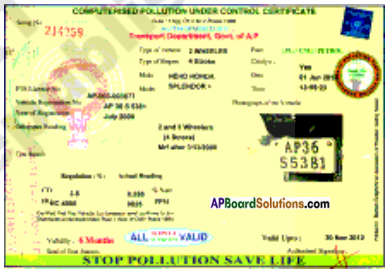
Observe this certificate try to find out answers for the following questions.
Answer:
The pollution under control certificate
AP Board 8th Class Biology Solutions Chapter 10 Not For Drinking-Not For Breathing 3
a) Which department issues the pollution under control certificate?
Answer:
The pollution check up centre issues the certificate.

b) For how much time is it valid?
Answer:
It is valid for six months.

c) For which type of vehicle has it been issued?
Answer:
Motor bike, scooters, cars, bus, lorry all type of vehicles.

d) What is emission test ? What components are tested ini the pollution check up centre?
Answer:
The test conducting of the gases releasing from the vehicle is called emission test. Components tested in the pollution check up center are carbondioxide, carbon monoxide, nitrogen, hydrocarbons, sulphur dioxide etc.

e) What will happen if carbon monoxide (CO) and hydro carbons (HQ readings are higher that the permissible limits reading ?
Answer:
If the above said gases are higher than the permissible limits reading it leads to pollution is harmful to the living organisms and hurt the health and well of living organisms.

f) Think of why there is a peed of “pollution under control certificate”?
Answer:
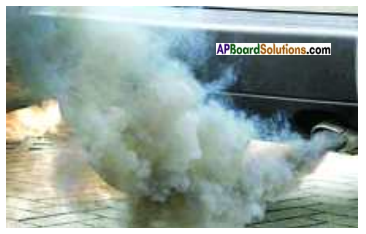
With a rapid increase in Ifie number of vehicles the problem of automobile pollution has assumed greater significance. The emission of smoke from motor vehicles is a major source of air pollution.

Question 2.
What will happen if harmful organisms or substances enter your body? How do you feel?
Answer:
If harmful organisms enter the body, the normal functioning of the body will be disrupted or disturbed. We feel sick.

What is air pollution ?
Question 3.
List out the gases that you know present in the air.
Answer:
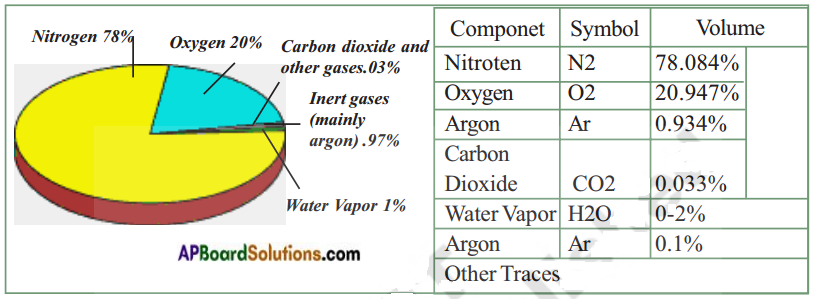
The gases present in the air are nitrogen, oxygen, carbondioxide, inert gases mainly argon, and water vapour.

AP Board 8th Class Biology Solutions Chapter 10 Not For Drinking-Not For Breathing

Question 4.
What are the four major gases in the air?
Answer:
The four major gases are nitrogen oxygen, argon and carbondioxide.

Question 5.
Draw a neat diagram showing the composition of air in the atmosphere arid write the percentage of gases.
Answer:
AP Board 8th Class Biology Solutions Chapter 10 Not For Drinking-Not For Breathing 4

Question 6.
Collect the pictures of natural activities and human activities which leads to pollution and paste them in your record book.
Answer:
AP Board 8th Class Biology Solutions Chapter 10 Not For Drinking-Not For Breathing 5AP Board 8th Class Biology Solutions Chapter 10 Not For Drinking-Not For Breathing 6

AP Board 8th Class Biology Solutions Chapter 10 Not For Drinking-Not For Breathing 7AP Board 8th Class Biology Solutions Chapter 10 Not For Drinking-Not For Breathing 8

Question 7.
If a person burnt out types or dried leaves at a particular place. Where shall go the smoke and ash goes?
Answer:
The smoke and ash raise up, mixes with gases in the atmosphere which leads to pollution.

Water Pollution
Question 8.
Let us read the following news paper clipping.
AP Board 8th Class Biology Solutions Chapter 10 Not For Drinking-Not For Breathing 9
Answer the following questions based on your understanding of the paper clipping.
a. What do you understand after reading the news paper clippings?
Answer:
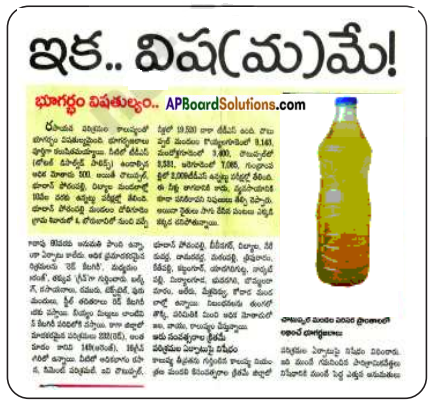
Some areas in Nalgonda district, the water got polluted because of the chemicals dissolved in it. These chemicals are released Into the water by the oil factory, textiles, pesticide factory and steel factory.

b. What are the issues discussed in this news paper clipping?
Answer:
Total dissolved solids (T.D.S.) in water should be maximum 500. Due to pollution it is estimated that T.D.S. has reached to 10,000. The pollution in water is higher which is dangerous for use.

c. What are its causes and effects?
Answer:
The causes for the TDS: The chemical pollutants released by the factories into the water. Effects: The water becomes unfit for drinking. By using the water the crops are beeing dead.

d. How does the problem arise?
Answer:
Large amounts of chemicals discharged into the ground water leads to water pollution. Due to water pollution the problem arise in those areas.

e. Are you also facing this type of problems in your area? Can you explain reasons behind?
Answer:
Yes, I am facing this type problems in our area. Because industries are developed in our area. So population is increasing. That’s why water is polluted in our area.

AP Board 8th Class Biology Solutions Chapter 10 Not For Drinking-Not For Breathing

8th Class Biology 10th Lesson Not For Drinking-Not For Breathing Activities

Activity – 1

Question 1.
NATURAL DISASTERS POLLUTION
Collect information from your school library for the following natural disasters in the world.
Answer:
Volcanic eruptions:
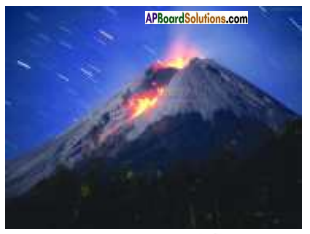
Deep under the earth’s surface, it’s so hot that even rock melts. Sometimes this molten rock, called ‘magma’, is pushed up to the surface. At this point it is referred to as lava. And the opening or vent that lets the lava out is a volcano. ‘
A volcano may explode violently throwing out rocks for miles around. It releases various gases and ash into the atmosphere.

Forest fires:
Forest fire is a moving combustion reaction spreading outwards in a band from it’s ignition point leaving burnt forest behind it and also called as wild fire.
It can be large uncontrolled disasters that burnt through hundred to hundred thousand acres.
Causes : Natural cause, lightening, volcanic eruptions, sparks from rocks falls and spontaneous combustion.
Pollution :
Forest fires release carbon particles (ash) into the air and pollute the air.

Sand storms and Tsunamis:
A sand storm or a dust storm is a meteorological phenomenon common in arid and semi arid regions. They arise when a gust front or other strong wind blows, loose sand and dirt from a dry surface. Particles are transported by saltation and suspension. The Sahara where sand is more prevalent, soil type than dirt or rock.
Causes:
As a force of wind passing over loosly held particles increased, the particles of sand first start to vibrate, then to saltate. As they repeatedly strike the ground, they loosen and break off smaller particles of dust, which then begin to travel in suspension.

Tsunamis:

  1. Tsunami is also called as a ‘seismic sea wave’ is a series of waves in a water body caused by the displacement of a large volume of water.
  2. Tsunami impact is limited to coastal areas. But their destructive power can be enormous, and they can effect entire ocean basin.
  3. The 2004 Indian Ocean tsunami was among the deadliest natural disasters in human history with, atleast 2,30,000 people killed or missing in 14 countries bordering the Indian Ocean.
  4. Tsunami causes much damage by two mechanisms. The smashing force of water travelling at a high speed and destructive power of a large volume of water draining of the land and carrying away large amount of debris with it.
  5. About 80% of tsunamis occur in the Pacific ocean, and there is possibility for tsunamis wherever there are large bodies of water including lakes.

AP Board 8th Class Biology Solutions Chapter 10 Not For Drinking-Not For Breathing

Activity – 2

Question 2.
A) OIL PAPER EXPERIMENT
Answer:
Take three square pieces of white paper of 5 x 5 cm size dipped in oil. Hang these oil dipped paper at three different locations, say your backyard, your school, near a park or parking lot etc. Let it be there for 30 minutes. Observe and compare all three papers.
a) What did you found on those papers dipped in oil ?
Answer:
Some dust particles sticking to the oil paper.

b) Is there any difference observed for all the three locations ?
Answer:
Some differences are observed. The soot and ash dust particles are seen on the oil paper hung at back yard which comes from burning of wood.
More dust particles seen on the oil paper at the school and less dust particles on the oil paper which was hung near a park.

c) Try to find out the answer why this difference occurred.
Answer:
When different types of fuels are burnt they release different types of particles into air. These particles are different according to different locations.

d) Do you know where the dust particles could have come from ?
Answer:
The dust particles could have come from the effect of air pollution caused by man made resources largely affects nature.

B) HUMAN ACTIVITIES:
Name of the fuels we burnt in our daily activities including rural and urban areas.
Answer:
Petrol, diesel, wood, charcoal, tyres etc.

Activity – 3

AP Board 8th Class Biology Solutions Chapter 10 Not For Drinking-Not For Breathing

Question 3.
POWER GENERATION PLANTS.
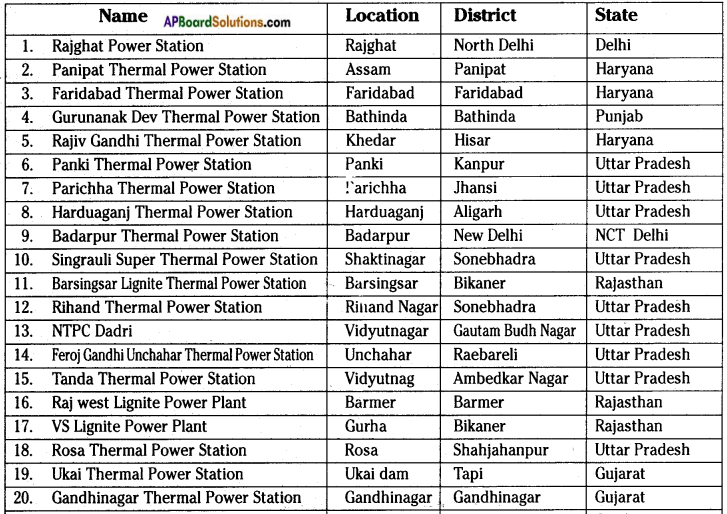
Go to your school library and collect information to make a list of these power generation plants and where they are located.
Answer:
THERMAL POWER PLANTS
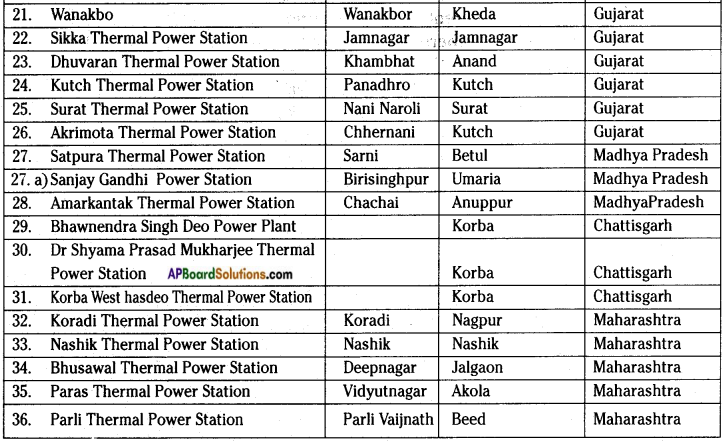
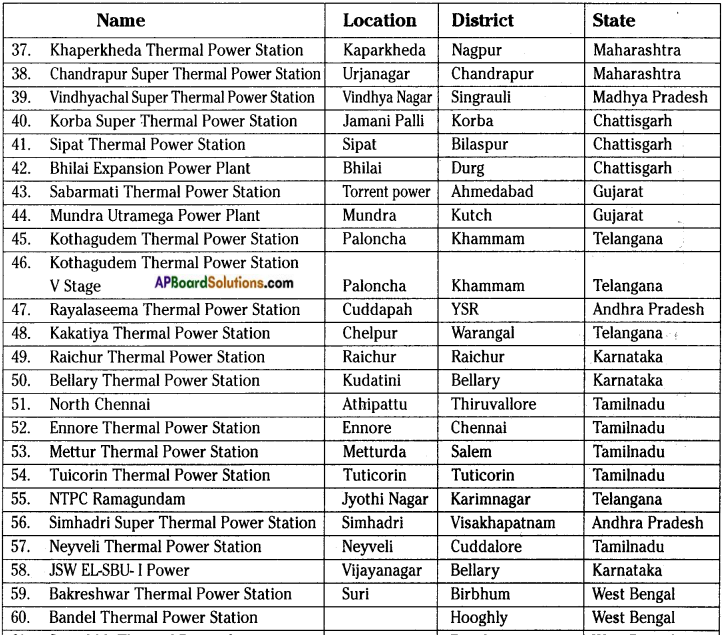
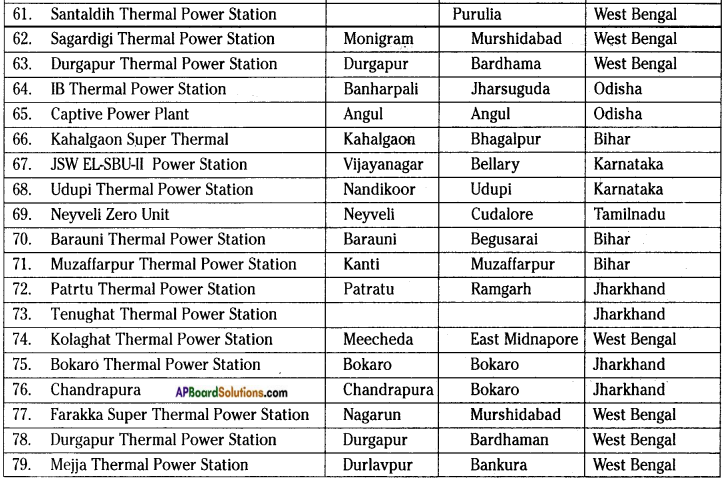
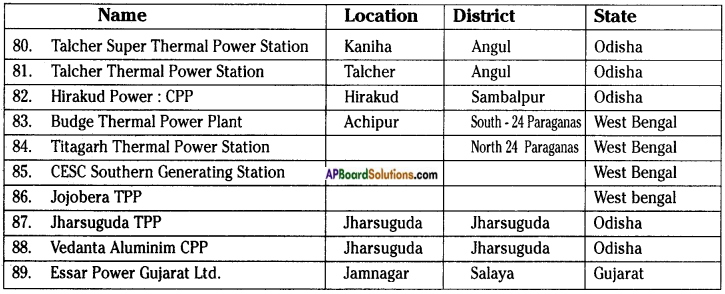
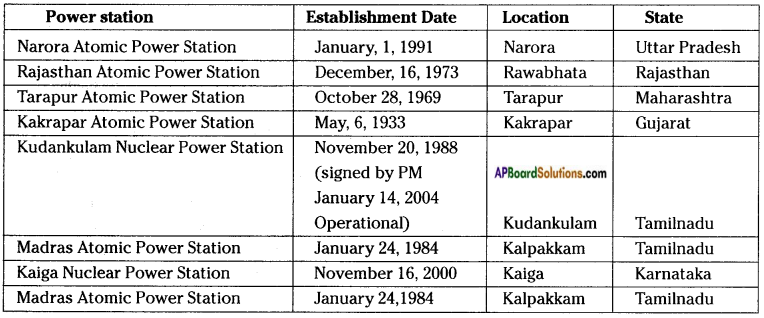
AP Board 8th Class Biology Solutions Chapter 10 Not For Drinking-Not For Breathing 10 AP Board 8th Class Biology Solutions Chapter 10 Not For Drinking-Not For Breathing 11 AP Board 8th Class Biology Solutions Chapter 10 Not For Drinking-Not For Breathing 12 AP Board 8th Class Biology Solutions Chapter 10 Not For Drinking-Not For Breathing 13AP Board 8th Class Biology Solutions Chapter 10 Not For Drinking-Not For Breathing 14

NUCLEAR POWER PLANTS
AP Board 8th Class Biology Solutions Chapter 10 Not For Drinking-Not For Breathing 15

Discuss about the adverse effects of Global warming.
Answer:
Effects of Global Warming: Global warming is having measurable effects on the planet right now. They are

  1. Ice is melting in both polar ice caps and mountain glaciers.
  2. Lakes around the world, including lake superior are warming rapidly.
  3. Animals are changing migration patterns.
  4. Plants are changing the dates of activity. Ex : Leaf flash.
  5. Global warming increase in temperature around the world.
  6. The average global temperature increased 0.8°C over the post 100 years.
  7. Weather is changed by globed warming, some places become more hot and some more cool.
  8. Global warming increases the sea level. So the costal areas will sink into the sea.
  9. Ice is melted which increases the sea level that leeds to ocean acidification.

Ask your teacher about secondary pollutants why they are called so?
Answer:
Oxides of nitrogen NO, NO2 (NOx), peroxy acetyl nitrate, formaldehyde, ozone, etc., are the secondary pollutants.
Pollutants are defined as primary pollutants resulting from combustion of fuels and industrial operations and secondary pollutants, those which are produced due to reaction of primary pollutants in the atmosphere.

Activity – 4

AP Board 8th Class Biology Solutions Chapter 10 Not For Drinking-Not For Breathing

Question 4.
FIELD VISIT:
Visit nearby factory, industry (boiled rice mill, brick making kiln, oil mill food processing mill etc.,) present in your area and observe.

  • How are they polluting air and water ?
    Answer:
    They are releasing smoke, smooth dust particles into air and releasing waste material into water sources and polluting air and water.
  • Is there any green belt around the factory ? Name the trees they are growing.
    Answer:
    Ashoka, Gulmohar, Neem, Eucalyptus are growing around the factory.
  •  What precautions are they taking to prevent pollution ?
    Answer:
    Suction devices known as vacuum pans are used to collect the pollutants from the water.
    To control air pollution, ventury type wet scrubber and meeting the norms described by A.P. Pollution board -have arranged.

Lab Activity 

Question 5.
POLLUTANTS:
Aim: Observation of pollutants in local available water samples.
Material: Glass tumblers, water samples from tap, pond, river, well, lake, red, blue litmus papers, soap.
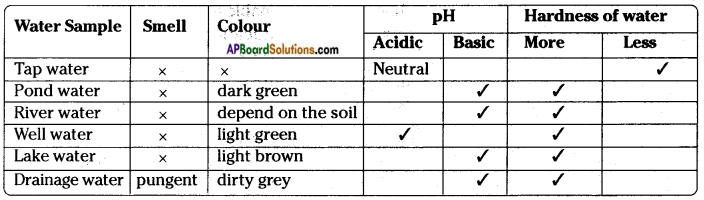
Procedure: Collect water samples from a tap, pond, river, well and lake. Pour each into separate glass containers. Compare these for smell, colour pH and hardness.

  • pH of water samples can be determined by using litmus paper. If blue litmus paper turns to the red colour, that water sample is acidic in nature and if red litmus turns to blue, water sample is basic in nature.
  • Hardness of water can be determined using soap. If water produces lesser foam it is referred as hard water.

Observations and findings:
Record your observation in the following table.
AP Board 8th Class Biology Solutions Chapter 10 Not For Drinking-Not For Breathing 16

Activity – 5

Question 6.
Visit your nearby pond/lake or river and find out the material being discharged in it. Prepare a biography on it.
Answer:
As Hyderabad has grown in size and is emerging as a global mega city, its growing water requirements have been met by under taking long distance water projects over the years. These projects are dependent on Musi River. Thousands of people depend on it for their daily needs and livelihood. The Moosi has been polluted for many years.
The people living near the Musi river, throw large quantities of garbage, untreated sewage, industrial waste, dead bodies, polythene bags, hot water and statues of deities and many other materials directly in to the river. –
The ‘Musi reservoir action plan project’ was undertaken to reduce the pollution level in the river. Pollution control activities include under the project are:

  • Solid waste management.
  • Installation of sewage treatment plant.
  • Provision of low cost sanitary facilities.
  • Development of river front.
  • Efforts to develop public awareness.

Ask your teacher about aerobic bacteria and write a note on it with some examples.
Answer:
An aerobic bacteria is the one that can survive and grow in an oxygenated environment. Bacillus, nocardic and pseudomonas space aeruginosa, myobacterium tuberculosis are some of the examples of aerobic bacteria.

Do you know oil slick on sea water ?In what way it is dangerous to aquatic life?
Answer:
Several kinds of plants and animals live in oceans. Oceans maintain equilibrium in nature. We transport several kinds of oils and fuels over seas. The spillage of these oils and fuels by accident creates a layer of oil over the surface of the sea water for hundreds of kilometers. This is called oil spill or oil slog. When it happens, air and light cannot enter the sea water and several marine creatures like fish, tortoise and other marine life forms die of asphyxiation.

Think and Discuss

AP Board 8th Class Biology Solutions Chapter 10 Not For Drinking-Not For Breathing

Question 1.
When we go on a busy road in the evening a lot of smoke is spread in the surroundings. We get cough and feel uneasy even when we close the nose with napkins.
a) Why this type of symptoms we observe? Think about it.
Answer:
Carbon monoxide is poisonous gas combines with haemoglobin of our blood and forms carboxy haemoglobin. Due to this haemoglobin is unable to carry oxygen to various parts. This leads to respiratory problems. It causes suffd&Stion and may cause even death.

b) If these symptoms will continue, what happens?
Answer:
Air pollution is like a slow poison. The effect of air pollution are not seen immediately. But over a long period of time the pollutants present in air damage our health and property.

Question 2.
Do you find any relation between pH and hardness of water?
Answer:
No relation between pH and hardness of water. pH is scale to measure acid, base or neutral hardness is the percentage of salts dissolved in the water.

Question 3.
Which water sample is colourless?
Answer:
Tap water.

Question 4.
Which water sample is suitable for drinking and why?
Answer:
Tap water is suitable for drinking because the tap water is cleaned and chlorinated and safe for drinking.

Question 5.
Do you find any change in colour and smell of water in some water samples ? What are your reasons ?
Answer:
The colour and smell of water is due to the nature of the soil and the plants grown in the water.

AP Board 8th Class Biology Solutions Chapter 9 Production and Management of Food From Animals

AP State Syllabus AP Board 8th Class Biology Solutions Chapter 9 Production and Management of Food From Animals Textbook Questions and Answers.

AP State Syllabus 8th Class Biology Solutions 9th Lesson Production and Management of Food From Animals

8th Class Biology 9th Lesson Production and Management of Food From Animals Textbook Questions and Answers

Improve Your Learning

Question 1.
One honey bee hive consists of different types of bees. What are they? How they differ from each other?
Answer:

  1. Honey bee species are social insects, which lives in colonies.
  2. A honey bee colony consists of three types of bees.
  3. One queen, several thousands of workers and few hundreds of drones.
  4. There is only one queen bee in a colony. The primary function of a queen is to lay eggs (800 – 1200 eggs per day). The life span of queen is two to three years.
  5. A worker has 5-6 weeks and the drone has 57 days of life span.
  6. There are sterile female which are called workers in the hive. These bees attend to indoor duties during first three weeks during first three weeks of their lives such as secretion of royal jelly, feeding of the brood.
  7. After three weeks they attend outdoor duties like collecting nector, pollen and water.
  8. Drones are the male members of the colony. They are very lazy and unable to gather food. Their main duty is participating in mating, after this they die.

AP Board 8th Class Biology Solutions Chapter 9 Production and Management of Food From Animals

Question 2.
Make a list of characters of local variety buffaloes, which gives good quantity of milk in your village.
Answer:

  1. Buffaloes are most common in India and other Asian countries.
  2. In general, buffaloes give more milk than cows and buffaloes milk has more fat than the cow’s milk.
  3. Buffaloes are more resistant to diseases than cows.
  4. There are about seven different breeds of buffaloes, Murrah, Bhadwari, Jaffrabadi, Surthi, Mehsana, Nagpri and Nili Ravi in our country.
  5. Each breed of buffalo is found in specific regions of the country and they differ in their body colour, shape and length of horns and in the shape and size of their forehead.
  6. Of these different breeds of buffaloes, Murrah breed of buffaloes have been recognised by Government of India, as the best native milk yielding breed.
  7. It yields about 8 litres of milk/day/animal and about 1800 – 2200 litres per year.

Question 3.
Explain the process of hatching eggs under broody hen in rural areas.
Answer:

  1. Hatching of eggs is an interesting process.
  2. The common village hen has less care and attention.
  3. So it’s productivity is low.
  4. It has the capacity to lay 15 to 20 eggs an egg per day respectively.
  5. After that the hen becomes a broody state (wish to hatch the egg).
  6. In this process the people of the house arrange the eggs in such a way that the broody hen can sit comfortably on the eggs to hatch.
  7. The hen sits on the eggs stretching its wings to provide heat to the eggs, to develop chicks inside the eggs.
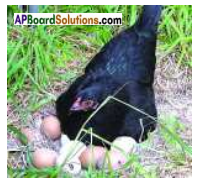
  8. It takes 21 days to the chicks emerges out by breaking the egg shell. This process is called incubation.
  9. Almost all the eggs hatch into chicken but some eggs which do not get sufficient heat from the broody hen become rotten.

Question 4.
Write about the accessory products produced in animal husbandry.
Answer:
Milk, meat, eggs, wool are the accessory products of animal husbandry.

Question 5.
What is estuaries, how they are suitable for both marine and river fish to live?
Answer:

  1. Estuary is the place where river joins the sea usually called mouth of the river. In this area fresh water (with low salt content from the river) is mixed up with sea water (with high salt content).
  2. When the wave action is strong or during high tide, large amount of sea water mixes with river water. In fact sea flows deep into the river.
  3. During low tide and when the wave action is weak, less amount of sea water mixes with river water.
  4. Because of this, salt content of the water in the estuary changes very rapidly.
  5. Animals living in the estuary should tolerate and adopt to rapid changes in the salt content of water.

AP Board 8th Class Biology Solutions Chapter 9 Production and Management of Food From Animals

Question 6.
If you have a chance to visit milk chilling centre, what doubts would you like to clarify? Please list out them.
Answer:

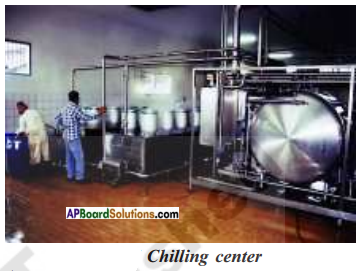
  1. Chilling of milk means rapid cooling of raw milk to sufficiently to low temperature. So that the growth of microorganisms present in the milk is checked.
    Doubts to clarify
  2. What would happen if the temperature of the milk should be reduced to less than 10°C preferably 3-4°C, in the chilling process?
  3. Whether the growth of the microorganisms will be controlled as the required nutrients and the growth conditions will be favourable to them?
  4. If the growth of the organisms will not be checked what would happen to the milk. Any changes would happen? Is it fit for consumption?
  5. If milk has to be transported to longer distances, considerable time is involved between production and heating process.
  6. During this period milk should be protected from spoilage by the action of micro-organisms the chilling process therefore considered is necessary.

Question 7.
Collect news from news papers about milk production and impurities in milk.
Prepare a note and display it on wall magazine.
Answer:
Milk Production:

  1. Our government treats producing milk as an industry.
  2. Generally farmers rear 1 to 5 cattle in small scale at their homes to produce milk.
  3. Among cows, traditional species give 2-5 liters of milk in a day. Murrah species are reared in most of the districts in our state.
  4. They give up to 8 liters of milk per day. Haryana, Jaferabad, Nagapuri are the traditional variety of cows which give good quantity of milk.
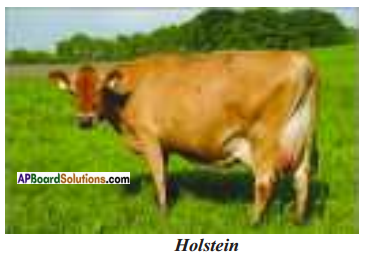
  5. Jersy (England) and Holstein (Denmark) are the foreign varieties. They give 25 liters of milk per day.
  6. These foreign varieties are cross breed with our traditional local varieties. They give 8-20 liters milk per day.
  7. Cows play vital role in total milk production of our country.
  8. Out of milk produced in our country 60% is used to prepare cheese, cova, ghee, curd, milk powder and other milk products.
  9. The milk produced in dairy forms is collected from house holds and pasteurized.

Impurities in Milk

  1. Addition of pure or impure water.
  2. Addition of colouring matter.
  3. Addition of preservatives like Sodium bicarbonate, Borax or Boric Acid, Salicylic Acid and formaldehyde.
  4. Addition of substances used for thickening after dilution with water, e.g. Flour, arrowroot, chalk, carbonate of magnesium.
  5. Sugar is added to raise the specific gravity of diluted skimmed milk.
  6. Milk is contaminated by
    a) improper or poisonous food eaten by the animal.
    b) Poor condition of animal due to nursing.
    c) Contamination of disease germs from the cub.
    d) Absorption of bad odours.
    e) If milk has been diluted it becomes pale and blueish, so milk and cream are artificially coloured with anilines or other pigments. Annotto is the common dye used to milk cream and butter.

AP Board 8th Class Biology Solutions Chapter 9 Production and Management of Food From Animals

Question 8.
Collect information about sea weeds, sea kelp from your school library and write a note with examples.
Answer:
Sea Weeds:
Sea weeds constitute an important marine resource and are found along the Rocky intertidal and subtidal regions of the coasts of India. The Sundarbans, the Chilka lake, the deltas of Godavari and Krishna. Gulf of Mannar. Palk bay Gujarath coast and around Lakshadweep, Andaman and Nikobar Islands are areas rich in sea weeds. They are used for human consumption, as cattle and poultry feed, as manure and for industrial purposes as the source phyco colloids like Agar-agar.

Sea Kelps:
Kelps are the largest sea weeds belonging to the brown algae (phaeophyceae) in the order laminariales.
Kelps grow in under water in shallow oceans, it has a high rate of growth and it’s decay is quite efficient in yielding methane as well as sugars that can be converted into ethanol.
It has been proposed that large open ocean, kelp farms could serve as a source as renewable source of energy.
Unlike some biofuels, such as corn, ethanol, Kelp energy avoids “food verses fuel” issues and does not require irrigation.

Question 9.
Observe nearby poultry farm and findout how do they export eggs to market? What material is used for transportation?
Answer:

  1. The most important component in the marketing of eggs is to handle them with care at the time of collection, transportation and in the sale counter.
  2. To avoid breakage of eggs special designs are planned in the poultry forms. They are packed in tailor made egg trays which can be piled up one over the other after inserting eggs in each tray.
  3. These trays protect the eggs from both vertical and horizontal friction and avoid breakage during transportation.
  4. The design of the transport vehicles for the chicken are also specially designed cages to allow the requisite freedom to the birds.

Question 10.
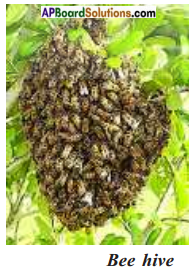
Observe a dry honey bee hive and how the bees built it. Draw a picture. How does it look like?
Answer:
AP Board 8th Class Biology Solutions Chapter 8 Production and Management of Food From Plants 14
Honey Bee hive is a construction of six sided (hexagon) wax compartments made by bees to store honey and eggs.
Wax is produced by the honey bees is known as bee’s wax or honey wax. Wax is used in the production of cosmetics, shoe polish, candles and leather industry.

AP Board 8th Class Biology Solutions Chapter 9 Production and Management of Food From Animals

Question 11.
Agriculture and animal husbandry are both sides of the same coin. How can you justify this?
Answer:

  1. Farmers adopt different methods of management for getting better yields in agriculture. In the same way, care is required in the management of reading animals also.
  2. Since long ago, man used animals not only for obtaining food but also for agriculture, transportation.
  3. People living in rural areas used to domesticate animals like cows, buffaloes, bullocks, goats, sheep, pigs, hens etc., supplying of nutritious food accommodating clear and hygienic, shelters for animals is very important issue in animal husbandry.
  4. Generally villages send their cattle to rear in their fields. Where grass is easily avail-able. These animals provide him with food (milk, meat, eggs etc) and clothing. Man in turn protected, fed and took care of these domestic animals.
  5. The selective relationship between man and the domestic animals has become in-dispensable – man cannot live without them and these animals cannot survive in wild.
  6. Thus, the relationship is mutually dependent and beneficial.

Question 12.
How do you appreciate the uses of cattle?
Answer:

  1. Cattle are not only for our food, even its excretions like dung and urine also we make them use. Cow dung is used as a cooking fuel, sanitizing cleanser, construction material, insulation and water proofing for walls and floors in rural houses, a cultural symbol in religious worship, the raw material for producing organic compost and generating electricity.
  2. The urine of cows is considered an elixir of life and is used as a natural remedy for liver and heart conditions as well as for enhancing mental and physical strength and increasing longevity.
  3. The utilization of cow dung and urine is a perfect example of sustainable living. An understanding of the use of cow dung and urine by the rural Indian population can illustrate the indigenous knowledge associated with these materials and alternative sources of materials for electricity generation as well as cost-effective and environmentally friendly fuel and medicines.
  4. Even the ash formed from burning of dung can be used as a cleaning agent for household utensils or used as a fertilizer.
  5. Cow manure contains several plant nutrients including nitrogen, potassium, calcium and magnesium. The composition of cow manure makes it ideal for several uses, including fuel, fertilizer and medicine.

Question 13.
What makes you amazing in division of work in Honey bee colony? Support your answer.
Answer:

  1. Honey bees lives in colonies. It consists of three types of bees.
  2. One queen bee, several thousands of worker bees and few hundreds of drones or male bees.
  3. The primary function of a queen bee is to lay 800 – 1200 eggs per day.
  4. The worker bees are the sterile female bees. They attend to indoor duties like secretion of royal jelly, feeding of the brood during first three weeks.
    After three weeks they attend outdoor duties like collecting nector, pollen and water.
  5. Drones are the male members of the colony. They are lazy. Their main duty is participating in mating. After this they die.
  6. Thus the division of work is amazing in honey bee colony.

AP Board 8th Class Biology Solutions Chapter 9 Production and Management of Food From Animals

Question 14.
Conversion of agricultural lands into fish ponds leads to food crisis and environmental pollution. Write your opinion to conduct in debate on this issue.
Answer:

  1. Fish culture is not new to our country. Even today in several villages, fishes are grown in small ponds in the backyard of the houses. Besides this, growing of fishes in rice fields is also more common in villages. In fact fish production is considered as second crop for farmers, the primary crop being rice.
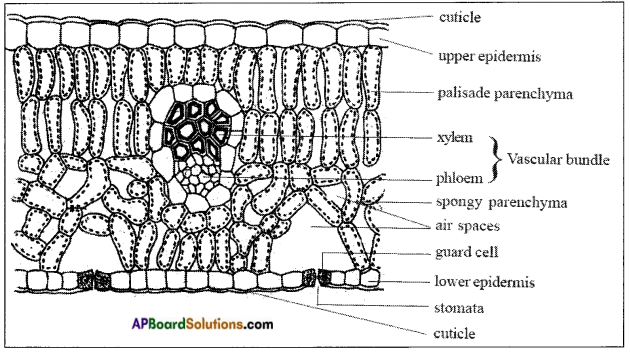
  2. Fish culture is sometimes practised in combination with a rice crop, so that fish are grown in the water in the paddy field.
  3. Growing fish in paddy field is also multi-utilitarian practice. The reason for this are the increasing use of inorganic fertilizers and insecticides in paddy fields which cause deleterious effects on fish and predation for birds, snakes etc.
  4. Cultivating fish in paddy fields lower diseases like stem borers on paddy.
  5. If the agricultural fields are converted to fish pond, food grains would not be sufficient for the growing population. This leads to food crisis.
  6. But ours is a agricultural country. So agriculture will be done in the crop seasons, and in the unseason they can convert to fish pond.
  7. The places where it is near to the water sources farmers can utilize these places for growing fish.

8th Class Biology 9th Lesson Production and Management of Food From Animals InText Questions and Answers

Question 1.
What are the food items that are obtained from animals?
Answer:
Milk, meat, eggs, honey.

Question 2.
Do we get our food only from domesticated animals? List out the food that is obtained from animals.
Answer:
We domesticated only such animals which were helpful to us. Buffalo, Cow etc. are reared for milk. Hens, goats, sheep for meat, ducks for eggs.

Question 3.
Do you know the period from which wild animals were being tamed?
Answer:

Name of the Animal Period of Domestication
Dog 30,000 – 7,000 BC
Sheep 11,000 – 9,000 BC
Pig 9,000 BC
Goat 8,000 BC

Question 4.
Why did early man domesticate only some of the animals?
Answer:
Domestic animals provide him food, (milk, meat, eggs), clothing (skin of the animals). The early man realised the capabilities of these animals, tamed and domesticated them to help him in his daily activities.

AP Board 8th Class Biology Solutions Chapter 9 Production and Management of Food From Animals

Question 5.
Why he did not domesticated animals like elephant, tiger, lion etc. or birds like eagle and owl?
Answer:
They are the wild animals and it is difficult to tame them. There is no use of these animals for his daily activities.

Question 6.
Do all the persons who won agriculture fields also rear cattle?
Answer:
All most all the persons who won agriculture fields, rear cattle also.

Question 7.
Is there any relation between agriculture and cattle rearing or animal husbandry?
Answer:
Cattle provide him food, help in agriculture and transport, man provide food for the animals from the agricultural fields.
Collect the following information from your calls.

Question 8.
Number of families in agriculture
Answer:
Less families

Question 9.
Number of families in agriculture along with animal husbandry.
Answer:
Almost all families.

Question 10.
Number of families in Animal husbandry alone.
Answer:
Less families.
LET US DO Cattle Rearing:

Question 11.
Form a group with four or five students in your class. Discuss about the reasons. Why does a farmers rear cattle?
Answer:
Farmers believe that animal husbandry is part and parcel of agriculture.

Question 12.
Where do people rear their cattle in your village?
Answer:
Generally people send their cattle to rear at the places where grass is easily available.

Question 13.
What are the cattle here?
Answer:
Cows, buffaloes, goats, sheep.

Question 14.
At which places fodder is available?
Answer:
Fodder is available in fields and open places.

AP Board 8th Class Biology Solutions Chapter 9 Production and Management of Food From Animals

Question 15.
What are places where water is available?
Answer:
Canals, ponds, wells etc.

Question 16.
Are there any differences between rearing of cows, buffaloes, goats and sheep?
Answer:
All the animals are herbivorous animals. Farmers use bullocks in agricultural practices like ploughing.

Question 17.
What are the major problems that cattle rearers generally face?
Answer:
Cattle sheds become unclean because of the remains of fodder, dung and urine. Care should be taken to prevent the growth of lice and mytes on cattle’s body.

Question 18.
Make a list of agricultural practices by using bullocks and the buffaloes.
Answer:
Ploughing, to draw the leveller, transporting agricultural goods etc.

Question 19.
Think in which way this practice is helpful to the farmer as well as field crops?
Answer:
Sheep and goats provide him meat and wool, the dung and urine becomes good manure to the field crops.

Question 20.
Where is veterinary hospital located in your area?
Answer:
It is located at the place where it is convenience to the people to bring their animals for check.

Question 21.
Who are working there and what do they do?
Answer:
The employees working in veterinary hospital are a veterinary doctor or animal husbandary assistant, a compounder and attenders. They provide treatment and health care for the cattle.

Question 22.
Meet a nearby veterinary doctor or animal husbandry assistant. Collect infor¬mation about common diseases in cattle and prepare a note on them.
Answer:

  1. Gali Kuntu is a common and dangerous disease in cows and buffaloes.
  2. Sheep and goats suffer from worm infections (Nattala Vyadhi)
  3. Growth of lice and mytes on cattle’s body.
  4. Some parasitic diseases cause damage to liver intestine.
  5. Viral and bacterial diseases also effect on milk production.

Milk Production:

AP Board 8th Class Biology Solutions Chapter 9 Production and Management of Food From Animals

Question 23.
From which animals we get maximum milk production?
Answer:
Cows, buffalows

Question 24.
In which areas people use camel milk?
Answer:
Desert areas.

Question 25.
Have you ever see people taking donkeys milk? Why was it preffered?
Answer:
Yes. Donkey milk which is Rich in immunoglobulin helps human body from many viral and bacterial infections. These are mostly found in Telangana regions especially in Adilabad. The secret behind the glowing skin of Egyptian princess Cleopatra’s is donkey milk.

Question 26.
What are the types of fodder generally farmers feed the cattle with?
Answer:

  1. They supply fodder from their agricultural fields.
  2. They also feed the cattle with hay, green and dry grass, oil seed cakes of ground nut.

Question 27.
How farmers preserve fodder for cattle after harvesting?
Answer:
After harvesting farmers preserve fodder by arranging into heaps. This heap will be used for the cattle throughout the year.

Pasteurization :

Question 28.
Is there a milk collecting centre in your village?
Answer:
Krishna Milk Union, Vijaya Dairy Milk centres are located in our village.
AP Board 8th Class Biology Solutions Chapter 8 Production and Management of Food From Plants 15AP Board 8th Class Biology Solutions Chapter 8 Production and Management of Food From Plants 16

AP Board 8th Class Biology Solutions Chapter 9 Production and Management of Food From Animals

Question 29.
How do they collect milk and export?
Answer:
The milk produced in dairy farm is collected from households and cattle rearers and export the milk in chilling form (cooling condition).

Question 30.
Do you know how they decide cost of milk?
Answer:
The cost of milk is decided due to fat content.

Question 31.
Do you know in which month the rate of milk production is high? Why?
Answer:
September to November the milk production is high.

Question 32.
Why the milk production is higher during those months than remaining year ? Discuss with your friends and find out the reasons.
Answer:
Milk production is slightly higher in the November and December months. Because

  1. In these months food availability is rich and intaking of good food increase the milk production.
  2. the climate is cool and enough hot. This sunny weather increase the milk production.
  3. water resources are well in these months. Availability of food and water leads to milk production.
  4. mostly animals delivered in July and August months and give milk before the summer. So the availability of milk is higher in November and December months.

Selection Procedure:

Question 33.
What care should be taken while buying cattle for milk production?
Answer:
The following points should be kept in mind.

  1. Select high milk producing varieties, either traditional or hybrid.
  2. Observe 2 to 3 days for average milk production.
  3. Number yielding size, health, eating fodder.
  4. Consult veterinary doctor, official of Director of Animal husbandry.

Some of rural people are experts in identifying high producing varieties.

AP Board 8th Class Biology Solutions Chapter 9 Production and Management of Food From Animals

Question 34.
What occasions, They decorate their cattle in your village?
Answer:
Pongal, Onam etc.

Question 35.
Do they respond when called by names ? Do you have any such experience with your pets ?
Answer:
We see the pet dogs climbing our body, sitting beside us, moves it’s tail and licks our feet when we call.

Poultry:

Question 36.
Collect information about Biogas Productions from your school library or internet and write notes on Biogas.
Answer:

  1. In recent years, an alternate and better method is used to obtain energy from cattle dung and from the excreta of other animals including man and some types of organic waste material from agriculture, homes and industries.
  2. This is by anaerobic fermentation of waste, to produce a gas which can be used as fuel. As this gas is produced from biological wastes, this is called BIO GAS.
  3. Biogas is a mixture of gases – methane, carbondioxide and small amounts of hydro-gen, nitrogen and hydrogen sulphide. About 200 cc of biogas gives about 900 K.Cal of energy.
  4. Production of biogas occurs in three stages. In the first stage, aerobic bacteria are allowed to degrade the complex molecules into simple molecules.
  5. In the second stage, the simple molecules are fermented anaerobically to produce organic acids mostly to acetic acid.
  6. In the final stage methane producing bacteria act on the acetic acid under anaerobic condition produce methane. The gases produced are collected into specially constructed chambers and supplied to users.
  7. Use of bio gas for domestic purposes (cooking) lighting of street lights etc.
  8. When bio gas is burnt, it does not pollute the environment.
  9. The left over material after the production of bio gas can be used as manure in agriculture.

Question 37.
Are the hens reared in the poultry is same as our traditional varieties reared by farmers in the village?
Answer:
Farmers rear cocks and hens in villages. Most of these are local varieties (Natukollu). Poultry farms are of two types. One is for production of eggs (layers) and other for meat (Broilers).

AP Board 8th Class Biology Solutions Chapter 9 Production and Management of Food From Animals

Question 38.
Think and discuss Is genetically modified food useful or not?
Answer:
Natural wild varieties grow fully in 5 to 6 years. But broilers grow fully in just 6 to 8 weeks. This happens due to genetic modifications in the hen. So genetically modified food is useful.

Question 39.
Do you know Chicken 65? Why is this called so?
Answer:
This preparation is prepared by A.M. Buhari, in South Indian food industry in Chennai, in the year 1965. So this is called Chicken-65.

Question 40.
Have you heard about cock fight during some festival seasons. Think and discuss in your class about this type of practices which show human cruelty towards animals.
Answer:
AP Board 8th Class Biology Solutions Chapter 8 Production and Management of Food From Plants 17
At the time of Pongal festival, in some places like India and Tamilnadu, the birds are equipped with either metal spurs or knives tightly tied to the legs in the area where the cock’s natural spur has been partially removed. In this cock fight both the cocks would be wounded, severely bleed, this leads to the death of the birds. By watching this cock fight show, people get enjoyment. This shows human cruelty towards animals.

Question 41.
Do you know how many days a hen spends to hatch it’s eggs?
Answer:
A hen spends 21 days to hatch its eggs.

AP Board 8th Class Biology Solutions Chapter 9 Production and Management of Food From Animals

Question 42.
Prepare a detailed note on hatching eggs by observing at your village. If you need, please draw pictures also.
Answer:
AP Board 8th Class Biology Solutions Chapter 8 Production and Management of Food From Plants 18
Hatching of eggs into chick is called as incubation period. The full incubation period for an egg is 21 days. During this time the hen sits on her eggs and maintains a temperature of 100°F, which is needed to ensure proper embryonic development.

Question 43.
Egg is a nutritious food. Collect information about various nutrients in egg and write a note on them in your notebook.
Answer:
The nutrients present in egg are is as follows:
Choline: Healthy cell membranes
Vitamin – B: Folate and Riboflavin – converts food we eat into energy. Folate also reduces homocysteine levels and prevent birth defects.
Vitamin – A: Vision and healthy skin.
Vitamin – E and Vitamin – C also present
Luteine and Zeaxanthin: Found in yellow pigment of yolk, prevent macular degeneration.
NECC:
If you want to be healthy person eat egg everyday. This is the slogan of National Egg Co-ordination Committee. Egg is chief nutritious food which is easily available for all.
AP Board 8th Class Biology Solutions Chapter 8 Production and Management of Food From Plants 19

APICULTURE:

Question 44.
In what way honey bees are helpful in pollination?
Answer:
Honey bees are helpful in pollination, there after growth of food grains.

Question 45.
Generally where do you find honey bee hives in your surroundings?
Answer:
Those plants which contain nectar and pollen liked by bees are called bee flora. We find honey bee hives on the fruit trees like citrus, apple, guava, tamarind, cultivated field crops like mustered, gingelly, wheat, cotton, sunflower, vegetable plants like beans, bendi, brinjal, Trees like acacia, neem, sal and bushes, shrubs.

Question 46.
In which seasons we find honey bee hives?
Answer:
In winter and summer seasons we find honey bee hives.

AP Board 8th Class Biology Solutions Chapter 9 Production and Management of Food From Animals

Question 47.
Collection of honey from hive is a careful activity. Write a note on how people collect honey from hives. What did they do for this ?
Answer:

  1. People take risk to collect honey from hives.
  2. They burn some plants or wood to make smoke. They cover their body with a thick blanket.
  3. They put the smoking material into a container. They take it over to the hive.
  4. Working slowly and carefully, they wait for the honey bees to leave the bee hive.
  5. Carefully they cut the hive with a sharp knife.
    By pressing the hive they can collect honey.

Question 48.
Ask your parents/teacher how a bear hunts bee hives for honey?
Answer:

  1. Before going for hibernation (winter sleep) the bear builts fat reserves in its body and prepares itself for the winter season.
  2. The bear attracted towards the bee hive and honey.
  3. When it finds bee hive it drives away the bees with its forelimbs.
  4. It has the advantage that its body has thick fur and avoids bee sting.
  5. It chews the bee hive along with some bees in the hive swallow honeys spits out the waste.
  6. This is how a bear hunts bee hives for honey.

FISHERIES:

Question 49.
Write a list of fishes that are available in your surroundings. Just write local names only.
Answer:
Marrel (Korramenu), Katla (Jella), Katrana (Bochu), Rahu (Mosu), Seer (Vanjiram) are the local varieties.

Question 50.
Do you know how to catch fish in a pond?
Answer:
Fishing rod will be helpful to catch fish.

Question 51.
How to catch fish in a large scale?
Answer:
Nylan nets will be useful to catch fish in large scale.

Question 52.
Think what will happen if mechanized fishing continuous for a long run.
Answer:
If mechanized fishing continuous at last we find no fish (extinction)

Question 53.
Ask your teacher what are the uses of Oysters?
Answer:
Oysters are the marine molluscs which produce pears. Economically pearls are important.

AP Board 8th Class Biology Solutions Chapter 9 Production and Management of Food From Animals

Question 54.
Tuna is an important fish which is available in our marine area. Collect information about Tuna and in what way it is important?
(OR)
Poultry Emu culture /Fish forms / Apiculture. Visit any one of the above industries. Get the information from farmers and prepare a note on this.
Answer:

  1. Poultry are domesticated birds kept by human for the eggs and meat.
  2. Generally chickens, ducks, geese, turkeys, quail are cultivated in poultry.
  3. Chicken poultry’s are very common in our areas.
  4. Here two types of hen’s are cultivated. Layer’s for eggs, and broiler’s for meat.
  5. Poultry’s are arranged in stair manner, which save the lot of place.
  6. Modern feeds for poultry consists such as soyabean oil, mineral supplements and vitamins.
  7. Daily they collect the eggs and parcel in egg cases to supply.
  8. Broiler chickens are domesticated and specially meant for meat production.
  9. Poultry become a major economic source in rural areas.
  10. It provides work and earning for rural people.

Question 55.
What is blue revolution? What are its effects? Discuss in your classroom.
Answer:
In the recent times, the Department of Agriculture and Cooperation (Blue Revolution) in the country. These schemes include the development of fresh water aquaculture through Fish Farmers Development Agencies (FFDAs) with development of brackish water aquaculture through Brackish Water Fish Farmer’s Development Agencies (BFDAs’ A shrimp and fish culture project is being implemented with World Bank assistance for the development of Shrimp culture in the states of Andhra Pradesh, Odisa and West Bengal.

8th Class Biology 9th Lesson Production and Management of Food From Animals Activities

AP Board 8th Class Biology Solutions Chapter 9 Production and Management of Food From Animals

Activity – 1

Question 1.
Form a group of 5 or 6 students. Collect different types hens and find their characters. If you want to know more details, about you need to ask hen rearers or poultry farmers in your village. Do not forget to collect information about the feed and diseases, treatment by using local technology.
Answer:

  1. Production and rearing of hens on a large scale is generally called poultry. So billion hens are reared world wide for eggs and chicken.
  2. Farmers rear cocks and hens in villages. Most of these are local varieties (Natukollu). Natural country varieties are good for hatching purpose, Aseel, Kadaknath, Chittagang, Longshan, Bursa are the pure local varieties.
  3. Aseel (Berisa Kodi) the Indian traditional variety is meant for fighting because of its pugnacity, high stamina and majestic gait.
  4. Feeding: The balanced feed must have nutrients, proteins, carbohydrates, fats, minerals, vitamins and water in sufficient quantities. Minerals like calcium, phosphorus, iodized salt, manganese and zinc are useful for better yield of eggs and meat.
  5. Diseases: Poultry chicken are known to suffer from bacterial, fungal and viral diseases. Fowl cholera, salmonellasis and coryza are the common bacterial diseases. Fowl pox and Rani kher are the dreaded viral diseases.
    Fowl mite, chicken mite, fleas, licks, lice etc., are known to be present on the external surface of the poultry chicken and cause diseases and are therefore called as external parasites.
    Round worm, tape worm and coccidiosis are categorized as internal parasites.
  6. Prevention and control: Prevention is always better than cure. For most of the diseases vaccines are now available. Newly born chicken should be vaccinated. A wide range of antibiotics, particularly broad spectrum sulfa drugs are widely used for treatment for poultry diseases. When a bird is identified to be suffering from a disease, it should be immediately to be isolated.

AP Board 8th Class Biology Solutions Chapter 8 Production and Management of Food From Plants

AP State Syllabus AP Board 8th Class Biology Solutions Chapter 8 Production and Management of Food From Plants Textbook Questions and Answers.

AP State Syllabus 8th Class Biology Solutions 8th Lesson Production and Management of Food From Plants

8th Class Biology 8th Lesson Production and Management of Food From Plants Textbook Questions and Answers

Improve Your Learning

Question 1.
State reasons why wheat is cultivated in Kharif.
Answer:

  1. The crops grown in the rainy season are termed as Kharif in the months of June to October.
  2. If we cultivate wheat crop in the month of July it takes 8 – 10 weeks for growing.
  3. After that flowering will take place. By that time, it would be October.
  4. Then the night duration extends more than 12[latex]\frac{1}{2}[/latex] hours. Wheat plants flowering takes place only in long night durations.
  5. Crop production is based on the flowering of plant. If flowering of plant is more, the crop production also is more.
  6. Wheat is important cereal crop gained a lot through Green Revolution by developing high yielding hybrid strains.

AP Board 8th Class Biology Solutions Chapter 8 Production and Management of Food From Plants

Question 2.
Ramaiah’s field is flattened. Somaiah’s field has many up and downs. Who will get more crop ?
Answer:

  1. Generally the fields have a lot of ups and downs even after ploughing. So a leveller is used for levelling the soil.
  2. By levelling the soil, it becomes flattened, water and nutrients can be reached to every part of the land. It also helps in sowing seeds and planting.
  3. Because Ramaiah’s field is flattened, he will get more produce than Somaiah.

Question 3.
What are the advantages of ploughing?
Answer:
Before growing crops ploughing the soil properly is necessary.
Advantages:

  1. Ploughing loosens the soil and it helps in easier transportation of air and water.
  2. Water is stored deeply for a long time as the soil is soft.
  3. Roots penetrate in the deep and can respire well as the air enters easily into the soil.
  4. Friendly microorganisms and earthworms can grow well when the soil is soft.
  5. Some foe microorganisms die due to the sun rays.

Question 4.
Treating with fungicides before sowing the seed is necessary. Why?
Answer:

  1. Sometimes farmers wash seeds with chemicals to protect from pests.
  2. Medication is done to keep away the seeds from the harmful microorganisms like bacteria, fungi etc.
  3. So, generally farmers treat the seeds with fungicides before sowing the seeds before making them to germinate.

AP Board 8th Class Biology Solutions Chapter 8 Production and Management of Food From Plants

Question 5.
Why do farmers dry the paddy crop after cutting them from fields?
Answer:

  1. Naturally food produce can be damaged by fungi, pests, rats and bacteria.
  2. If moisture is also there in the grains, it helps to develop moulds (fungi).
  3. Such grains neither germinates nor suitable to eat.
  4. To overcome this problem farmers dry the grains for 2-3 days in sun.
  5. After drying they keep the grains in jute bags and preserve them in godowns.

Question 6.
Give some examples of plants that grow after replanting.
Answer:
Seeds that are broadcast in a plot, grow into seedlings. When these plants grow to certain height, farmers pick out the plants (seedlings) from the plots, make bundles and are sown in proper distances. This is called transplantation (replanted)
E.g.: Rice (Sri Vari), Tobacco, Onions, Chillies etc.

Question 7.
Rahim removed weeds in his crop field, but David did not. Guess who get more yield. Why?
Answer:

  1. Rahim get more yield than David. Because
  2. Weeds are the unwanted or undesirable plants which grow in the fields and compete with crop plants for water, nutrients, light and space.
  3. Because of these plants the crop plants may not grow properly. So they should be removed.
  4. Otherwise the yield of the crop will be reduced.
  5. Weeds give shelter for insects, pests and microorganisms and serve as a host for them.
  6. Weeds are capable of germinating and growing fastern than crop plants. They flower and form seeds much earlier than the crop plants.
  7. Some weeds disperse pollen grain to air which in turn causes respiratory diseases.

Question 8.
What is natural manure? How to prepare it? Give two examples.
Answer:
Natural manure: A manure made by the decomposition of plants and animal (organic) wastes is called natural manure or natural fertilizer or Bio Fertilizer.
Preparation:

  1. These fertilizers are formed by decomposing plant and animal wastes.
  2. In rural areas farmers keep these plant and animal wastes outside the village in open space.
  3. Some bacteria like Azatobacter, Nitrobacter decompose and it becomes manure which contain nutrients.
  4. Wherever the manure is added to the soil, there it provides nutrients to the plants. Examples : Vermi compost, Dung fertilizer.

Question 9.
Why do farmers plough their field during summer?
Answer:

  1. Ploughing loosens the soil and it helps in easier transportation of air and water.
  2. In summer temperature is very high. So the soil becomes dry. Then the soil becomes very loosly.
  3. Some foe microorganisms die due to the sunrays.

AP Board 8th Class Biology Solutions Chapter 8 Production and Management of Food From Plants

Question 10.
Rajendar cultivated cotton crop in his field. He did not get sufficient yield. Can you guess the reasons? (OR)
A farmer cultivated cotton crop in his field. He did not get sufficient yield. Guess any four causes for it.
Answer:

  1. Farmers in our state generally purchase seeds in the nearby market. The grains that are available in the packets play vital role in agriculture.
  2. Sometimes the rate of germination of the seeds is not up to the mark, which was labelled on the packet.
  3. Sometimes never germinate too.
  4. At times, seeds grow into plants but they be sterile.
  5. And sometimes the crop may be attacked by the larva of spotted brown boll-worm and pinkish boll-worms.
  6. The larva of brown catter pillar sucks the juice from the leaves. The buds and the fruits of cotton plants drop off from the infected plants.
  7. The larva of pinkish boll worm of cotton make hole in the stem, flower buds, flowers and fruits. As a result flower buds, cotton bolls drop off.
  8. May be these reasons Rajendar did not get sufficient yield.

Question 11.
I am a plant. I grow in crop fields. Farmers pluck me. I do not know the reason. Can you tell who am I ?
Answer:

  1. We observe some other plants growing along with the crop plants These are undesirable plants called weeds. They should be removed immediately.
  2. The weeds, compete with the crop plants for nutrients, water and light, so he crop plants may not grow properly. This is the reason why they (weeds) should be removed.
  3. Besides competition for food, light and water they also work as a carrier for different diseases. They also serve as host for different pests.
  4. Some weeds disperse pollen grains to air which in turn causes respiratory diseases.
  5. So the farmers pluck the weeds from crop plants by using different methods.

Question 12.
What do you observe in the experiment of dropping a fist of Bengal gram seeds in water?
a) What are the differences you observed in both the seeds?
Answer:
We can observe some seeds floated on water, the remaining sank under the water. The seeds which are floated are wrinkled and rough shaped but the sank seeds are round and smooth.
The floated seeds are light in weight but the sank seeds are more in weight.

b) Do you know why the floated seeds are lighter in weight?
Answer:
The floated seeds are not healthy, so they are lighter in weight.

c) Which seeds germinate well? Why?
Answer:
The seeds which sank in water germinate well because they are healthy.

d) Which seeds would not germinate properly? Why?
Answer:
The seeds which are wrinkled and rough would not germinate properly. Because the cotyledon inside the seed would not develop healthy.

AP Board 8th Class Biology Solutions Chapter 8 Production and Management of Food From Plants

Question 13.
Go to your nearest fertilizer shop and collect the information about chemical fertilizers and fill the table. Copy the following table in your notebook.
Answer:
AP Board 8th Class Biology Solutions Chapter 8 Production and Management of Food From Plants 1

Question 14.
Prepare a flow chart from ploughing to yielding in paddy.
Answer:
AP Board 8th Class Biology Solutions Chapter 8 Production and Management of Food From Plants 2

AP Board 8th Class Biology Solutions Chapter 8 Production and Management of Food From Plants

Question 15.
How do you appreciate the irrigation systems used in the drought prone areas?
Answer:

  1. This method is employed when the availability of water is poor.
  2. As the water reaches the plants drop by drop this is called Drip irrigation.
  3. A long tube followed by small tubes attached to a motor. The tubes are made holes. So the water comes out from the tube.
  4. The holes are arranged in such a way that it provide water exactly at the place where plant roots could receive water.
  5. The man’s best technical method of utilizing the water in farming where the conditions are pravailing and in the areas where the availability of water is scanty.

Question 16.
Narendra sprayed over dose of pesticides on his cotton crop. Ramesh says it is a hazard to biodiversity and crop yield. Can you support Ramesh? How?
Answer:

  1. In agriculture pests damage the crops. Almost all crops are generally effected by pests.
  2. Wheat, Paddy and suagarcane are generally affected by fungal diseases. Groundnut is affected by Tikka disease. The catterpillars of spotted brown boll worm and Pinkish boll worm affect the crop.
  3. A wide variety of agricultural and garden pesticides are available. A few derived from neem tobacco and chrysanthemum (Chamanthi) are less dangerous to other living organisms.
  4. A wide variety of inorganic and organic pesticides are commonly used D.D.T. (Dichloro diphenoxy Trichloro ethane) BHC (Benzene Hexa Chloride), Chlordane, Endrin, Aldrin, Endosulfan and Diazinon pesticides are usually dusted or sprayed on crops or put in the soil.
  5. But pesticides should not use unwisely. They get into the bodies of plants and animals in the soil and water. When these plants are eaten by animals like fish the pesticide get into their bodies.
  6. A bird that eat the fish might get a concentrated lethal dose.
  7. D.D.T. also accumulate in the egg shells, weakening them and making the shells break before hatching. It is observed D.D.T. is present in the milk of buffaloes and cows.
  8. In this way pesticides are passed down the food chain and accumulate in the bodies of higher animals including human beings causing sickness and sometimes death.

AP Board 8th Class Biology Solutions Chapter 8 Production and Management of Food From Plants

Question 17.
Venkatesh observed the irrigation method for paddy field. He wanted to follow the same practice for his Maize crop. What suggestions do you give him?
Answer:

  1. Paddy is grown as a Kharif or a Rabi crop. It requires high temperature of 22°C to 32°C and heavy rain fall. It is cultivated heavily in Kharif season.
  2. Maize is cultivated in both Kharif and Rabi seasons but heavily in Kharif season. This requires high temeprature (35°C) with moderate rainfall.
  3. So Venkatesh can follow the ame practice for his maize crop as the requirements of both the crops are almost same.

8th Class Biology 8th Lesson Production and Management of Food From Plants InText Questions and Answers

Question 1.
Look at the picture given below and write the constituents in it.
AP Board 8th Class Biology Solutions Chapter 8 Production and Management of Food From Plants 12
Answer:
Nitrogen (20%), Phosphorus (5%), Potash (10%)

Question 2.
Which manure is beneficial?
Answer:
Natural manure is beneficial.

Question 3.
Let us compare both, which manure is beneficial.

Chemical fertilizers Natural fertilizers
1. These are made up of inorganic salts. 1. These are made by the decomposition of plants and animal (organic) wastes.
2. These are prepared in factories. 2. These are prepared in open places.
3. No humus can be found. 3. Deposits of humus layer is found in the soil.
4. More amount of Nitrogen, Phosphorus and Potash deposits in the soil. 4. Potash deposits in the soil.

Observe the table carefully, discuss with your teacher and conclude which fertilizer is best to the farmers and why?
Answer:
Natural fertilizer is the best because this is made by the decomposition of plants and animal (organic) waste. Deposits of humus layer is found in the soil with less amount of Nitrogen, Phosphorus and potash deposits in the soil.
a) When do farmers irrigate the land?
Answer:
After applying manure farmers irrigate the land.

b) List out the water resources of your village.
Answer:
Wells, ponds, canals, tanks are the water resources.

c) Are they useful to your farmers?
Answer:
Yes. They are useful.

d) In what way the farmers of your village get water to the fields ?
Answer:
Farmers irrigate their fields either manually using bullocks or by using pumps.

AP Board 8th Class Biology Solutions Chapter 8 Production and Management of Food From Plants

Question 4.
What are the reasons for high production in Japan?
Answer:
Japan has cooler temperature.

Question 5.
What are the reasons for low production in India?
Answer:
High temperature and uncertainty of rainfall.

8th Class Biology 8th Lesson Production and Management of Food From Plants Activities

Activity – 1

Question 1.
CROPS IN INDIA:
Observe the following India map.
AP Board 8th Class Biology Solutions Chapter 8 Production and Management of Food From Plants 3
a) Are there many crops that are grow in most of the parts of our country? What are they?
Answer:
India is a unique position to grow almost every possible crop. It is the land of producing a variety of cereals like paddy, wheat, jowar, bajra, maize and ragi, pulses, spices, fruits, vegetables, oil seeds, fibre crops etc.

b) Why such crops are grown all over the country?
Answer:
India is an agricultural country and people derive their livelihood from agriculture. Agriculture is the back bone of Indian economy.

c) From the above map, which of them are grown in your village?
Answer:
Rice, pulses, banana, vegetables and leafy vegetables
a) Country: India
b) State: Andhra Pradesh
c) Your village: Khajipalem

d) How many days are required for getting the crop?
Answer:
Nearly 120 days.

e) Is time period for all crops are same?
Answer:
The time peirod for all the crops are not same. They are different from one crop to another.

f) Which crop needs more duration?
Answer:
Rice and Wheat.

Activity – 2

Question 2.
DURATION OF CROP:
a) Write the information in the table.

Name of the crop Duration of the crop
1. Paddy 3 to 6 months
2. Wheat 110 to 120 days
3. Jowar 5 to 7 months
4. Bajra 100 to 120 days
5. Maize 100 days
6. Raagi May to Sept., Nov. and Dec.
7. Pulses 90 to 120 days
8. Cotton 165 days

1. Example for long term crops:
Answer:
Jowar, red gram.

2. Example for short term crops:
Answer:
Pulses like green gram, black gram etc., and onions.

AP Board 8th Class Biology Solutions Chapter 8 Production and Management of Food From Plants

Activity – 3

Question 3.
WHERE DO CROPS ARE GROWN.
Discuss in groups and make a list of these things for the following table.
AP Board 8th Class Biology Solutions Chapter 8 Production and Management of Food From Plants 4
1. In which season do you find more varieties of vegetables in the market?
Answer:
Rainy season.

2. Generally farmers grow varieties of vegetables during rainy season. Can you guess the reason?
Answer:
In rainy season ponds, wells, rivers, ditches are pooled with water.

3. If we cultivate wheat in the month of the November what will happen?
Answer:
We get hot climate from February onwards. It is suitable for maturing the grains. That is the reason wheat is cultivated in the Rabi season only.

Activity – 4

Question 4.
PRODUCTION OF PADDY:
a) Go and collect the information through your nearest farmer and fill the following table.
AP Board 8th Class Biology Solutions Chapter 8 Production and Management of Food From Plants 5
a) In which season farmers get more benefits?
Answer:
Kharif season

b) Are there any other crops which are growing both Kharif and Rabi seasons?
Answer:
Paddy, wheat and maize

c) In which seasons farmers generally get good quality of seeds.
Answer:
Kharif and Rabi

d) The quantity of grains is higher in Kharif season than Rabi season. Do you agree this? Give your reasons.
Answer:
The climate, (the temperature, humidity with abundance of water supply) will be suitable in Kharif season

e) Do you know about third crop?
Answer:
The third crop season known as Zayad, grown in the months of April, May and June.

AP Board 8th Class Biology Solutions Chapter 8 Production and Management of Food From Plants

Activity – 5

Question 5.
SELECTION OF SEEDS:
Take some water in glass. Drop a fist of seeds in it. You cam observe some seeds will float on water. Collect those seeds and observe with hand lens and comparing with seeds sink under the water. Write your observations in the table.
AP Board 8th Class Biology Solutions Chapter 8 Production and Management of Food From Plants 6
a) What are the differences you observed in both seeds?
Answer:
Some seeds sank in water, some seeds floated.

b) Do you know why the floated seeds are light in weight?
Answer:
They are unhealthy seeds.

Activity – 6

Question 6.
GERMINATION AND SELECTION:
Show both the seeds in different pots and provide water uniformly, observe the growth of the plants in two pots and make a report.
1. Which seeds germinate well? Why?
Answer:
The seeds which are smooth and round germinate well because they are healthy seeds. Biology

2. Which seeds do not germinate properly? Why?
Answer:
The seeds which are wrinkled and rough do not germinate properly because they are unhealthy.

3. Were all the seeds were tested like this?
Answer:
The crop plant like Rice, wheat etc.

4. Do you know how the paddy seeds germinate?
Answer:
There are different stages in sprouting of the soaked rice seeds before it is planted.

5. Observe a sprout of paddy. Cam you say which part become root? Which part become shoot im the picture?
Answer:
Coleoptile become shoot and the part beneath the ground is root.

AP Board 8th Class Biology Solutions Chapter 8 Production and Management of Food From Plants

Activity – 7

Question 7.
SOWING METHODS
Collect information from the nearby farmers and fill in the table.
AP Board 8th Class Biology Solutions Chapter 8 Production and Management of Food From Plants 7
1. Why the seedlings are replanted at proper distance?
Answer:
They get water, mineral and sunlight equally when they are replanted at proper distance.

2. Do all the crops grow when replanted? Why not?
Answer:
Mostly all plants will grow.

Activity – 8

Question 8.
CROPS AND DISEASES:
Form a group with 4 to 5 of your classmates, visit nearby field, discuss with farmers about diseases effected by, and how to control them. If you do not know the name of the disease, write its local name or its characters.
AP Board 8th Class Biology Solutions Chapter 8 Production and Management of Food From Plants 8
1. Do all the farmers use the same pesticides for the same crop?
Answer:
For different crops different pesticides are used.

2. Is there any disease that you find in all fields?
Answer:
No

3. Where do they buy pesticides?
Answer:
From government and private agencies.

4. What are the appliances that they use to spray pesticides?
Answer:
Sprayer or dusters.

5. Did you find any other living organisms dying along with pests due to pesticides ? What are they ?
Answer:
Yes. Caterpillars, sparrows etc.

AP Board 8th Class Biology Solutions Chapter 8 Production and Management of Food From Plants

Activity – 9

Question 9.
IDENTIFICATION OF PESTS:
Observe the plants in a nearby field or in your school garden. Closely observe the leaves and stems to collect the following information. If the character is present put a ‘S’ mark and if there is no character put ‘X’ mark.
Name of the plant/crop : Rice (Blast of Rice)
Place: Prakasam
AP Board 8th Class Biology Solutions Chapter 8 Production and Management of Food From Plants 9
a. Do all the leaves of plant have spots?
Answer:
Yes, all the leaves of plant have spots.

b. Draw the leaf with these spots.
Answer:
AP Board 8th Class Biology Solutions Chapter 8 Production and Management of Food From Plants 10

c. What is your reason for the leaves which have cutting edges?
Answer:
Eaten by grasshoppers.

d. Do you find any twilted leaves with insects? How are they?
Answer:
Infection occurs on leaf sheaths.

e. Are the scars on the stems is same as spots on leaves?
Answer:
Yes, the scars on the stems is same as spots on leaves.

f. Collect powdery substance of the spots on leaves and observe under microscope. Write down your observations.
Answer:
Fungus produce small spores known as conidia.

Activity – 10

Question 10.
PEST CONTROLING PRACTICES:
In your village farmers control pests by using different pesticides and insecticides for different crops. For this they use different practices. Ask your elders the names of pesticides that they use in the following pest controlling practices.
Answer:

  1. Spraying: Endrin, Diethane, M-45, Eldrine.
  2. Dusting: Aldrin, D.D.T.
  3. Put in the soil: Zinc, Sulphur, Phosphorous, fluorine
  4. Burning and picking are also the practices where they use these: Sugarcane, citrus
  5. Bio pesticides: Neem water

Observe the following pest controlling practices
a. Which of the above practices is good?
Answer:
A farmer remove the affected leaves from the plant and burnt them.

b. Why do you think so?
Answer:
By burning the affected leaves the pests will be controlled.

c. Why did the farmer use two pesticides at a time?
Answer:
At the first time the pests will be controlled by spraying pesticide, but if we use unwisely, pests become resistant to the pesticides.

d. What will we do to solve the problem?
Answer:
Pesticides will be used as per the requirement for the disease.

e. Farmers add manure to the soil.
What they used to add?
Answer:
They used to add nutrients to the soil.

f. Have you a compost pit in your school / house?
Answer:
Yes, there is a compost pit in our school. All the waste materials like dry leaves, fruits peel etc. will dump into the pit.

AP Board 8th Class Biology Solutions Chapter 8 Production and Management of Food From Plants

Activity – 11

Question 11.
WHEN SHOULD FARMERS IRRIGATE THE HELD?
Consult to the farmers and fill the table with the information to how and when they provide water to various crops.
AP Board 8th Class Biology Solutions Chapter 8 Production and Management of Food From Plants 13
a. Are all the crops provided with equal amount of water?
Answer:
No. Irrigation should be done according to nature of the soil and the type of crop to be grown.

b. Why do farmers provide more water to the summer crops?
Answer:
Summer season is the hottest climate so the crops which grow in summer requires high quantity of water.

Weedling:
a. Why should they (weeds) be removed?
Answer:
The weeds compet with the primary crops for nutrients, water and light because of these plants crop plants may not grow properly. So they should be removed.

Question 12.
How sprinklers and drip system are used and write down their merits and demerits.
Answer:
When the availability of water is poor, drip irrigation system is used. In this the water reaches the plant drop by drop through sprinklers. So that water comes out from the sprinklers wetting exactly the place of the roots of the plant.
Advantages:

  1. Maximum use of available water.
  2. No water being available to weeds.
  3. Maximum crop yield.
  4. Efficiency use of fertilizers.
  5. Less weed growth.
  6. Low labour and low operation cost.
  7. No soil erosion.
  8. Improved infiltration in soil with low in take.

Disadvantages:

  1. Sensitivity to clogging.
  2. Moisture distribution problem.
  3. Salinity hazards
  4. High cost compared to furrow.
  5. High skills is required for design, install and operation.

Activity – 12

Question 13.
Ask your nearby nursery and know the weeds that grow in different crops. Make a table in your notebook.

Name of the plant WEEDS
1) Paddy Garika, Wanza, Varipilla Gaddi, Sukha Bhogi, Dharaka, Buradha, Thunga
2) Vegetable crop Gunugu, Gaddi Chamanthi, Jeeluga
3) Cotton fields Puli chinta
4) Mirchi Puli chinta
5) Tobacco Pogaku Malle

Harvesting of paddy:
a. If the paddy is not dried well enough. What will happen?
Answer:
If moisture is there in paddy grains it helps to develop moulds (fungi). Such grains neither germinate nor suitable to eat.

b. Where do farmers harvest the crops in your village ?
Answer:
Farmers generally used to harvest by using traditional methods.

c. Is harvesting same for all crops?
Answer:
Yes.

AP Board 8th Class Biology Solutions Chapter 8 Production and Management of Food From Plants

Activity – 13

Question 14.
Find out the methods of harvesting in and around our village and fill the table.
Answer:
AP Board 8th Class Biology Solutions Chapter 8 Production and Management of Food From Plants 11

AP Board 8th Class Biology Solutions Chapter 7 Different Ecosystems

AP State Syllabus AP Board 8th Class Biology Solutions Chapter 7 Different Ecosystems Textbook Questions and Answers.

AP State Syllabus 8th Class Biology Solutions 7th Lesson Different Ecosystems

8th Class Biology 7th Lesson Different Ecosystems Textbook Questions and Answers

Improve Your Learning

Question 1.
Define an ecosystem. Explain it with a suitable example.
Answer:

  1. An ecosystem can be defined as a functional unit of nature, where living organisms interact among themselves and also with the surrounding physical environment.
  2. For example, Mangroves are one of the most productive ecosystem on earth, deriving nourishment from terrestrial fresh water and tidal salt water.
  3. Coringa mangrove is situated south of Kakinada Bay and is about 150 km south of Visakhapatnam.
  4. It is named after the river coringa. Coringa mangroves receives fresh water from coringa and Gaderu rivers and salt waters from Kakinada Bay.
  5. Biotic components in coringa:
    Producers: Mangrove, Spirogyra, Euglena, Oscilatoria, Blue Green Algae, Ulothrix etc.
    Consumers: Shrimp, crab, hydra, protozoans, mussel, snails, turtle, daphnia, brittle word, tube worm etc.
    Decomposers: Detritus feeding bacteria etc.
  6. Abiotic components: Salt and fresh water, air, sunlight, soil, etc.

AP Board 8th Class Biology Solutions Chapter 7 Different Ecosystems

Question 2.
Explain how diversity of living organisms helps in enriching any ecosystem.
Answer:

  1. The existence of the ecosystem depends on the continued survival of the organisms in the ecosystem.
  2. All organisms require energy for growth, reproduction and survival.
  3. This energy is obtained by the organisms from the food they consume.
  4. Plants are the producers producing food in any ecosystem. The animals present in the ecosystem are consumers as they consume food from plants.
  5. Some of the organisms in the ecosystem such as bacteria and fungi, obtained their nutritional requirements by decomposing the dead bodies of both producers and consumers.
  6. They retain nutrients to the soil for the plants to use. As the cycle begins again.
  7. Like this diversity of living organisms helps in enriching any ecosystem.

Question 3.
What happens when two animals having similar habits share one ecosystem?
Answer:
When two animals having similar habits, sharing one ecosystem , only the stronger and better equipped animal can survive, while the weaker one die or eliminated from the ecosystem. This is called ‘Survival of the fittest’.

Question 4.
What is the difference between habitat and ecosystem?
Answer:
Habitat is the natural living place of an organism or a group of organisms. Land and water are the major habitates.
An ecosystem is a Natural unit and has both Abiotic and biotic components, which interact and influence each other.

Question 5.
Who am I?
1. I am the base of food chain.
Answer:
Green plants.
2. I depend on plants for food.
Answer:
Consumers (Herbivorous Animals)
3. I break down the remains of dead plants and animals.
Answer:
Decomposers.
Ex: Bacteria, Fungi.

AP Board 8th Class Biology Solutions Chapter 7 Different Ecosystems

Question 6.
Which of the following is producer and why?
а) fox b) fungus c) chicken d) grass.
Answer:

  1. Grass is the producer.
  2. All green plants produce food materials with the help of carbondioxide and water in the presence of sunlight. So plants are called producers.
  3. As grass is the green plant and produce food for other animals, it is called producer.

Question 7.
What do you understand by food web? Describe your own food web with the help of diagrammatic representation.
Answer:

  1. A food web consists of several interlinked food chains and each organism in the food web will be a member of more than one food chain.
  2. For example rats and insects eat seeds and other plant parts. As their food.
  3. Insects are eaten by frogs and lizards.
  4. Rats and frogs are eaten by snakes.
  5. Lizards and snakes are eaten by birds.
  6. Birds are eaten by fox, wolves. These are eaten by tigers and lions.
  7. Thus a single plant or an animal may become food for more than one animal.
  8. Similiarly an animal may consume more than one type of food depending on its taste and availability in the ecosystem.
  9. Thus each organism in an ecosystem may be a member of more than one food chain.
  10. When we looked at these relationships between various organisms for food in the ecosystem, it appears that several food chains are interlinked with each other forming a food web.

FOOD WEB

AP Board 8th Class Biology Solutions Chapter 7 Different Ecosystems 1

AP Board 8th Class Biology Solutions Chapter 7 Different Ecosystems

Question 8.
An ecosystem that had mice. What happens if more cats were added to it?
Answer:

  1. In an ecosystem if the mice and the cats were existing equally, smooth balance would be maintained. When reproduction took place in these animals, generations would be continued then the ecosystem would be maintained healthy.
  2. When more cats were added in that ecosystem all the mice would be eaten away by the cats it leads to the end of mice population.
  3. Because of lack of food, the cats, either have to leave the ecosystem or they die.
  4. If there is no continuity of the animals, the ecosystem would be destroyed.

Question 9.
List out producers (plants, bushes, trees), consumers (herbivores and carnivores) and decomposers that you observed in your agriculture field or school garden.
Answer:
Producers:
Plants – Grass plants, creepers like pumpkin, bottlegourd, etc.
Bushes – Rose, Jasmine, chrysanthemum, marigold.
Trees – Palm, coconut, mango, drumstick, lemon, sweet lemon, guava.
Consumers:
Herbivores – Goat, sheep, buffalo, ox, rats, butterflies, etc.
Carnivores – Crow, dogs, snakes, frogs, lizards.
Decomposers – Fungi (mushroom), Bacteria.

Question 10.
In grassland ecosystem, rabbit eats only plants. They eat plants faster than the plants can grow back. What must happen to bring the ecosystem into balance?
Answer:
The animals like fox, wolves, tigers, etc. which feed on rabbits will be introduced in that grass land ecosystem, then the rabbits will be controlled by them. Thus the ecosystem will comes into balance.

AP Board 8th Class Biology Solutions Chapter 7 Different Ecosystems

Question 11.
Plant, Tiger, Rabbit, Fox, Hawk.
Did you find any connection among the above list of things. If we remove Rabbit from the list what will happen?
Answer:

  1. Plant, tiger, rabbit, fox, hawk these are the animals living in an ecosystem and are interdepending one on the other, and maintaining a food web – Plants → Rabbit → Hawk → Fox → Tiger.
  2. A delicate balance is seen in nature between members of different species.
  3. Any disturbance in this balance affects the organisms in a food web.
  4. If we remove rabbit from the list the other animals like tiger, fox, hawk which are depending one on the other for food will die because of no food.
  5. All the organisms, big or small, have right to live on this planet as man. We should respect this and allow other organisms to live and share the wealth of this planet.
  6. “LIVE AND LET LIVE” should become our motto.

Question 12.
What do you understand by interdependency of animals and plants ? How do you appreciate ?
Answer:

  1. An ecosystem is made up of groups of living things and their environments.
    AP Board 8th Class Biology Solutions Chapter 7 Different Ecosystems 2
  2. Living things like plants, animals and microorganisms are known as biotic components and others like soil, water, sunlight etc are called as abiotic components of the ecosystem.
  3. All these organisms live together and interact with one another in many ways.
  4. There is a feeding relationship between plants and animals. Along with this an interdependence between plants and animals for space, reproduction, shelter, etc.
  5. All organisms in an ecosystem derive energy from food to live.
  6. The sun is the main source of energy for all living things.
  7. Plants being autotrophic, trap this energy through a process called photosynthesis and produce food to all living organisms. They are known as Primary producers.
  8. Animals as they can not prepare food, they consume plants directly or indirectly and called consumers.
  9. Living organisms like fungi and bacteria which are called decomposers, decay and decompose the dead animals of producers and consumers, and valuable nutrients to the soil for plants to use, as the cycle begins again.
  10. A delicate balance is seen in nature between plants and animals by interdependence one to the other for thousands of years, which is unreachable to the human brain.

8th Class Biology 7th Lesson Different Ecosystems InText Questions and Answers

AP Board 8th Class Biology Solutions Chapter 7 Different Ecosystems

Question 1.
What is a Habitat?
Answer:

  1. The dwelling place for plants and animals is called habitat.
  2. One habitat shared by different types of plants and animals.
  3. Try to add more such points to your list.
  4. The natural home for plants and animals is called a habitat.
  5. Habitat is the environment of an animal or plant.
  6. Habitat is a suitable place for plants and animals to live.
  7. Habitat is the origin for plants and animals.

Question 2.
Draw the diagram of Interdependence between the biotic components and answer the following questions.
Answer:
Interdependence between the biotic components:
AP Board 8th Class Biology Solutions Chapter 7 Different Ecosystems 6
1. What do the arrows in the figure indicate?
Answer:
The animals are depending one on the other for food.

2. Trace the path from grass to tiger. You may trace out other paths as well.
Answer:
Grass → grass hopper → frog → snake.
Carrot and grass → rabbit → fox → tiger
Plants → deer → bear → tiger
Seeds → squirrel → eagle → tiger

3. On how many organisms is rabbit dependent? Write their names.
Answer:
Carrot, grass.

4. How many organisms depend on rabbit? Write their names.
Answer:
Snake, fox, eagle, tiger.

5. Where do plants get their food from?
Answer:
Plants are autotrophs they can prepare their food from carbondioxide and water, in the presence of sunlight.

6. What other things do animals need for their survival?
Answer:
Abiotic components like soil, water, sunlight, etc.

8th Class Biology 7th Lesson Different Ecosystems Activities

Activity – 1

AP Board 8th Class Biology Solutions Chapter 7 Different Ecosystems

Lab Activity
Answer:
Aim: Study an ecosystem at your school/ home garden to understand it’s structure. Material Required : Measuring tape string, small sticks, hand lens, hand towel.
Procedure: To know about structure of the ecosystem we have to follow the following procedure.
AP Board 8th Class Biology Solutions Chapter 7 Different Ecosystems 3

  1. Use the tape to measure a square area that is one meter long and one meter wide. It can be on grass, bare dirt or side wall.
  2. Mark the edges of the square with the help of string/chalk.
  3. Observe the study area (that has been marked). Look for the plants and animals that live there. Use the hand lens.
  4. Record all the living organisms you see. You can even dig to go deeper to find out other living organisms that may be present there.

Observation / Findings: We find –

  1. Plants like grass, herbs, shrubs, guava, neem and creepers.
  2. Insects like ants, grass hoppers, butterflies, mosquitoes, houseflies, locusts, etc.
  3. Animals like cat, dog, buffalo, frog, lizards, garden lizards, snake.
  4. Mushroom, algae.
  5. Deeper layers of soil we find earth worm, leech, rats, bandicoots, rabbits, etc.
  6. Birds like crow, parrot, mynah, etc.

Discussion:
1. What living things did you find in your study area? Try to count them if possible.
Answer:
Grass, creepers, shrubs, herbs, trees, herbivores, carnivores, fungi.
2. Which kind of living thing was most common in your study area?
Answer:
Plants.
3. How was your study area different from those of other student groups?
Answer:
Living conditions, food, animals and plants are different.
4. Other than the living organisms what other things can you record from your study area?
Answer:
Soil, water, sunlight (temperature) are recorded.

Activity – 2

AP Board 8th Class Biology Solutions Chapter 7 Different Ecosystems

Question 2.
Observe the food web given below figure.
AP Board 8th Class Biology Solutions Chapter 7 Different Ecosystems 4
Answer:
The diagram showing food web.
Now answer the following Questions.
1. Which are the producers in the food web?
Answer:
Grass, rice plants, maize, bushes.
2. Which are consumers?
Answer:
Fish, frog, birds, rats, rabbit, deer, tadpole, larva ,sheep, cat, fox, tiger, crane, eagle, snake, owl, peacock, insects, lion.
3. Where does the food web start from?
Answer:
Food web starts from green plants.
4. Name the organism where the food web ends.
Answer:
Crane, eagle, owl, peacock, lion.
5. What happens when plants and animals die in a food web?
Answer:
When plants and animals die, they are decayed and decomposed by Decomposers like bacteria and fungi. They return nutrients to the soil for plants to use, as the cycle begin again. This is the reason ‘Decomposers are also called as recyclers.

Activity – 3

Question 3.
Collect the information forests of Andhra Pradesh and write the flora and fauna and fill up the following table:
Answer:
Forests of Andhra Pradesh
AP Board 8th Class Biology Solutions Chapter 7 Different Ecosystems 8
Name of the Forest – Kondapalli Reserve Forest
AP Board 8th Class Biology Solutions Chapter 7 Different Ecosystems 7

AP Board 8th Class Biology Solutions Chapter 7 Different Ecosystems

Investigations:
AP Board 8th Class Biology Solutions Chapter 7 Different Ecosystems 5

1. Do all the forest have same type of vegetation?
Answer:
No, there are mainly trees that show much species diversity and greater degrees stratification.
2. Are producers afforest ecosystem higher than its consumers?
Answer:
Trees are higher than consumers, besides trees shrubs and ground vegetation also there.
3. Do all the forests have same type of animals?
Answer:
No, the availability of food and environment different type of animals are present in different forest.

AP Board 8th Class Biology Solutions Chapter 6 Biodiversity and its Conservation

AP State Syllabus AP Board 8th Class Biology Solutions Chapter 6 Biodiversity and its Conservation Textbook Questions and Answers.

AP State Syllabus 8th Class Biology Solutions 6th Lesson Biodiversity and its Conservation

8th Class Biology 6th Lesson Biodiversity and its Conservation Textbook Questions and Answers

Improve Your Learning

Question 1.
Read this and answer the following questions.
Answer:
Biodiversity – 2050.
A news item on Biodiversity discussed by Conference of Parties (CoP) -2012- Hyderabad says in the next four decades the earth’s natural resources will be limited to grass lands, mountains, ice and arid and semi arid plains.
By 2050 the loss of Biodiversity will lead to unprecedented. Climate change would be the key factor. Nearly 1.3 million natural ecosystems will be without any original species.
(The coloured areas are indicators of biodiversity loss. The red areas show maximum biodiversity loss.)
AP Board 8th Class Biology Solutions Chapter 6 Biodiversity and its Conservation 1

a) What does the areas with colour codes indicate?
Answer:
The coloured areas are the indicators of Biodiversity loss.

b) Which areas show maximum biodiversity loss?
Answer:
The red areas show maximum biodiversity loss.

c) Which areas show minimum biodiversity loss?
Answer:
The blue areas show minimum biodiversity loss.

d) From 2010 – 2050 what difference do you find in the state of biodiversity?
Answer:
In the few decades earth’s natural areas will be limited to grass lands, mountains, ice and arid and semi arid plans. Nearly 1.3 million natural ecosystems will be without any original species.

e) So what steps would you suggest to conserve our biodiversity?
Answer:
Utilizing the forests resources judiciously without effecting the ecosystems. So that we can have a sustainable development in the forests and the biodiversity can be conserved for future generations.

AP Board 8th Class Biology Solutions Chapter 6 Biodiversity and its Conservation

Question 2.
How can you say that forests are biosphere reserves? Give reasons.
Answer:

  1. Forests are the natural habitates for many types of plants (flora) and animals (fauna).
  2. Plants are primary producers as they provide food for entire human population and all other living organisms on earth.
  3. Every part of the plant is used by man and animals in their daily life, and also some of the exudates are used by man.
  4. We get cereals, pulses, oil seeds, sugars, spices, drugs, timber, fibres and coir from plants.
  5. In addition to this products like rubber, resins, fruits, vegetables, dyes, etc. are obtained from plants.
  6. Variety of animals live in the forests. Major products obtained from animals are meat, milk hair and skin.
  7. Primitive man obtained his food requirements primarily by hunting of animals in the forests.
  8. The skin of animals like tiger, lion, leopard, deer, snakes and ivory from elephants are very valuable.
  9. Thus we can say that forests are biosphere reserves.

Question 3.
What do you understand about the terms (a) extinct (b) endangered (c) endemic?
Give examples.
Answer:
a) Extinct: When animals vanish for ever from the earth it is said that the species has become extinct. E.g.: Sparrow, vulture.
b) Endangered : It is a warming signal about the organisms whose numbers have declined rapidly and the species might be wiped off from the earth in near future. Such organisms are called endangered species. E.g.: Lion, red fox, loris, wild cat, vulture.
c) Endemic: Plants or animal species found restricted to a particular area of a country are called endemic species. E.g.: Tiger, peacock, kangaroo, kiwi.

AP Board 8th Class Biology Solutions Chapter 6 Biodiversity and its Conservation

Question 4.
a) Extinct: When animals vanish for ever from the earth it is said that the species has become extinct. E.g.: Sparrow, vulture.
b) Endangered: It is a warming signal about the organisms whose numbers have declined rapidly and the species might be wiped off from the earth in near future. Such organisms are called endangered species. E.g.: Lion, red fox, loris, wild cat, vulture.
c) Endemic: Plants or animal species found restricted to a particular area of a country are called endemic species. E.g.: Tiger, peacock, kangaroo, kiwi.
Answer:

  1. Some birds live in the same habitate throughout the year. Other birds which don’t have permanent nestlings join into small flocks and move from one region to the other for food and shelter called as ‘migration’ and such birds are called migratory birds.
  2. Primary motivation for migration appears to be food. Also longer days of northern summer provide extended time per breeding birds to feed their young ones.

Question 5.
Identify the endemic and endangered species and write them below the pictures.
Answer:
AP Board 8th Class Biology Solutions Chapter 6 Biodiversity and its Conservation 2

Question 6.
What is the need of conducting biodiversity meet ? Collect information about these meetings when and where it was conducted and its agenda also.
Answer:
The need of conducting biodiversity meet is

  1. Managing biodiversity in transboundary landscapes in Hindukush Mountains.
  2. Conserving high altitudes wet lands of the Hindukush Himalayans.
  3. Operationalizing nagoya protocall in South Asia.

AP Board 8th Class Biology Solutions Chapter 6 Biodiversity and its Conservation 3

AP Board 8th Class Biology Solutions Chapter 6 Biodiversity and its Conservation

AGENDA

  1. Conservation of Biodiversity.
  2. Sustainable use of components of Biological diversity.
  3. Fair and equitable sharing of benefits arising out of the utilization of genetic resources.

33 Decisions were taken at cop – 11, Hyderabad among them some are given below.

  1. Status of Nagoya protocol an axis to genetic resources and equitable sharing of benefits.
  2. Review of progress in implementation of strategic plan for Biodiversity – 2011 – 20 and Aichi biodiversity targets.
  3. Review of implementation of the strategy for resource mobilization including establishments of targets.
  4. Financial mechanism.
  5. Cooperation with other conventions International organization and initiatives.
  6. Business and Biodiversity.
  7. Engagement of other state holders major groups and sub – National authorities.
  8. Progress report on gender main streaming
  9. Periodicity of meetings.

Question 7.
Nowadays we find animals like leopards and bears intruding into our living places. What may be the reason for this?
Answer:

  1. Forests are the living places for wild animals. Animals can get plenty of food, shelter from the shade of trees and they feel secure in the forests.
  2. People are so greedy that they cut down the forest areas for logging of wood, to increase agriculture, and for human habitations.
  3. They clear the forests to construct, thermal power stations, industries and many buildings which leads to destruction of forests.
  4. Due to deforestation, nowadays the animals like leopard and bears, lost their food and shelter, to satisfy their hunger and to keep themselves alive, they intruding into our living places.
  5. To escape from hunters and from climatic conditions because of deforestation, is may be one more reason, for the animals coming into our living places.

AP Board 8th Class Biology Solutions Chapter 6 Biodiversity and its Conservation

Question 8.
Make a list of animals/birds seen now and 30 years ago. Take the help of your elders. Write few reasons for their disappearance.
Answer:

  1. List of Animals and Birds: Lion, Tiger, Jackel, Fox, Wolves, Deer, Monkeys, Hyena, Squirrel, jungle foul etc. Birds like Crow, Pigeon, Peacock, Koel, Parrot, Flemingo, Mynah, King Fisher, Emu, Migratory shore birds etc.
  2. The endangered species of plants and animals of India are:
    Lion, Red fox, Single horned (Rhinoceros), Vulture, Spotted chital deer, Loris, Black spider monkey, wild cat, cycas, Rauvolfia serpentine, Nepenthes, Sandle wood tree.
  3. These species include mammals – Indian cheetah, Japan Rhinoceros and Sumatran Rhinoceros. Some species of birds of gone extinct in recent times – including pink headed duck (Rhodonessa caryophyllacca) and Himalayan quail (Ophrysia superciliosia)
  4. Warbler (Acrocephalus orinus) – Rampur in H.P was rediscovered after 139 years in Thailand.
  5. Based on the case study we find that many animals that were found earlier are not found now.
  6. The reason for this is exploitation of land and forest resources by humans, along with hunting and trapping for food and sport has led to the extinction. Feeding of Diclofenac treated cattle is the reason for disappearance of vulture.

Question 9.
Select an area in your locality. Observe the animals (living and visiting) for a day. Prepare a list and plot a graph.
Answer:
The animals in our locality:

  1. Dog
  2. Cat
  3. Rat
  4. Mouse
  5. Bandicoots
  6. Squirrels
  7. Frogs
  8. Lizards
  9. Garden Lizard
  10. Monkeys
  11. Buffaloes
  12. Goats
  13. Donkeys
  14. Mongoose
  15. Snake
  16. Sheep
  17. Fish
  18. Tortoise
  19. Rabbit
  20. Parrot
  21. Crow
  22. Hens
  23. Koel
  24. Pigeon
  25. Butterflies
  26. Houseflies
  27. Dragonflies
  28. Mosquitoes
  29. Honey bee
  30. Cockroach

AP Board 8th Class Biology Solutions Chapter 6 Biodiversity and its Conservation 4

AP Board 8th Class Biology Solutions Chapter 6 Biodiversity and its Conservation

Question 10.
When tree is considered as an ecosystem, record the flora and fauna connected with it.
Answer:
Flora and Fauna of a tree.
Flora:

  1. Grass,
  2. Trida (shrub),
  3. Datura (Herbs),
  4. Creppers,
  5. Mosses,
  6. Fungi.

Fauna: Squirrels, Butterflies, Dragonfly, Mosquitoes, Birds, Snakes, Ants, Catterpillers, Beetles, Buffaloes, Goats, Human beings, Mouse, Lizard.

Question 11.
Browse through the internet or books on wild life and gather information on birds sanctuaries in India. Prepare a list of birds migrating to India.
Answer:
AP Board 8th Class Biology Solutions Chapter 6 Biodiversity and its Conservation 5
Birds migration to India:

  1. Siberian cranes
  2. Greater flamingos
  3. Ruff
  4. Black winged stilt
  5. Common teal
  6. Common Green Shark
  7. Northern Pintail
  8. Yellow wag tail
  9. White wag tail

AP Board 8th Class Biology Solutions Chapter 6 Biodiversity and its Conservation

Question 12.
Visit local forest office and collect the data of local flora and fauna.
Answer:
Horticultural Resources: Guava, Mango, Papaya, Sapota, Banana, Coconut, Citrus.
Major oil seeds: Groundnut, Sunflower, Oil palm.
Major food crops: Paddy, Jowar, Ragi, Bazra, Maize, Green gram, Red gram, Black gram.
Commercial crops: Sugarcane, Jute, Chillies, Cotton, Turmeric.
Forest based Resources: Plantation of Eucalyptus Trees, Ponuku wood, Casuarina,
Subabul, Jatropa, Pongamia (bio – diesel plantation).
And also:
Vegetables, flowers, plantation crops, spices and medicinal plants, aromatic crops.
They occupy 6517, 177, 4440, 14315 and 369 hectors respectively in Khammam District.
Local Fauna:
Life Stock Resources: Poultry, Dairy form.
Marine Resources: Fish, Prawn.
Animal Husbandary: Plough animals, Dairy animals like Cow, Buffaloes, Sheep, Goat, Pig.
Forest resources:

  1. Panther, Hyena, Jungle cats, Foxes, Bears, and Carnivores, Mammalian are found.
  2. Deer, Spotted deer, Sambar, Black buck and other Herbivorous animals found in inland forests.
  3. The district has a large number of murrah buffaloes and cows.
  4. Migrant grey billed pelican is a protected bird in Kolleru lake and Pulicat lake.

Question 13.
Where do you find most of the biodiversity on the earth? Draw A.P map showing maximum biodiversity areas.
Answer:

  1. In areas with sufficient amount of water, a wide variety of plants ranging from grasses to tall trees are seen.
  2. Most of the forests are seen in these areas.
  3. As there is sufficient vegetation, there will be a large number of herbivorous animals. Carnivorous animals which feed on the herbivores are also found in these regions.
    AP Board 8th Class Biology Solutions Chapter 6 Biodiversity and its Conservation 6
  4. Generally there is a increase in biodiversity from poles to trophies. Thus localities at lower lattitudes have more species than localities at higher lattitudes.
  5. Ultimate factor behind many of the other factors is greater mean temperature at the equator.

AP Board 8th Class Biology Solutions Chapter 6 Biodiversity and its Conservation

Question 14.
What do you understand by biodiversity? How can you say variations are present in them?
Answer:
The word biodiversity is a contraction of biological diversity. It is commonly used to describe the number variety and variability of living organisms. This very broad usage embracing many different parameters, is essentially a synonym of LIFE ON EARTH.

  1. The whole world has wide variety of living organisms we can see both invisible (microbial) and the visible world around us are diverse.
  2. Different microorganisms like algae, fungi, bacteria, viruses etc., and also the micro-arthropods. There is diverse among microbes.
  3. There are different variety of plants like grass, herbs, shrubs, creepers, trees etc. Among the individuals also there are variations like height, colour and size of flower and fruits.
  4. We find variations in animals even though they are similar kind. We find differences in colour of fur, nails, claws or hoofs etc.
  5. Among birds we can see variations in their feathers, feet, crown, tail etc.
  6. As all the humans belong same genus but there is variation in their hands, fingers, toes, nails and hair, height and shape. We can even see variation in the texture of skin dry, oily, smooth or rough. Whether they are twins also we can find variations among them.

Question 15.
Most of our biodiversity is being lost due to human activities. Suggest few ways to protect them.
Answer:
Most of our biodiversity is being lost due to human activities like logging of wood, increased agriculture, increased human habitation and pollution etc. Man has realised this mistake before it was too late. Government of India also realised the importance of wild life and initiated several programmes to preserve wild life in the country and the wild life act was passed in 1972.
Efforts towards conservation:

  1. Activities leading to deforestation have been declared as illegal activities and severe punishments have been imposed.
  2. Pouching of birds and hunting their eggs are prohibited.
  3. Usage of pesticides should be minimised. Usage of biological control methods of pests should be maintained.
  4. Efforts to be made to substitude chemical fertilizers with more (natural) bio fertilizers.
  5. Pollution from the industries should be reduced.
  6. Automobiles should be designed to reduce pollution.
  7. Reforestation programmes will be conducted.
  8. Gardens, parks, lakes and zoos should be developed.
  9. National parks, wild life sanctuaries, where wild life is protected, have been created.
  10. Collection, marketing and selling of forest products such as sandal wood, ivory by private parties is banned and is taken up by the Government.
  11. Construction of cell phone towers which produce radiation, should be in greater height, so that they should not be reachable to the birds.

AP Board 8th Class Biology Solutions Chapter 6 Biodiversity and its Conservation

Question 16.
When you see a park, sanctuary or a zoo with many kinds of plants and animals, how would you express your happiness? Write a few lines on them.
Answer:

  1. Imagine a forest with a carpet of wet leaves littering the ground, the flowers on the trees, we can hear the water drops, sounds of insects, birds chirping and perhaps the distant screech of a monkey – the place picturing is a park, a sanctuary or a zoo. Which gives pleasure to us.
  2. These are the homes for many plants and wild animals – and also decorate the world. Any of them are airy and shadowy places.
  3. These dwelling places of plants and animals give us happiness. When we are in distress. They give relax – when we feel tired. They give us enjoyment when playing with our friends and they give good health – when we fall sick as they give fresh air and are the lungs of the world.
  4. They maintain ecological balance in the environment where we live.
  5. We notice the pet dog licks our feet, wags it’s tail, sits near us and walks with us we feel the affection, which gives pleasure mentally.
  6. Like this we can experience many situations plants and animals as they are the partners of our environment. So be kind towards them and protect the environment. By maintaining eco – friendly activities.

Question 17.
Prepare an essay to give a talk on biodiversity and conservation.
Answer:

  1. The existence of biodiversity in nature teaches us that every plant and animal whether useful or not has right to exist on earth.
  2. Every organism is a part of our ecosystem. Loss of any organism endemic or otherwise effects the food chain and food web of that ecosystem, which has impact on the world biodiversity.
  3. Hence if we want to protect the biodiversity on our planet, first we must be a part of conservation and then make other aware of it because today we see extinction of some species tomorrow it could be our species.
  4. Conserving the biodiversity in a wider prospective is utilizing the forest resources judiciously without affecting the ecosystems so that we can have a sustainable development in the forests and the biodiversity can be conserved for future generations.
  5. Nature is for human’s need, not for his greed. If we protect nature, it protects us.

AP Board 8th Class Biology Solutions Chapter 6 Biodiversity and its Conservation

Question 18.
Rani said conservation, of biodiversity starts from our home. Is she correct? How do you support Her? What will be your action for this?
Answer:

  1. We live in houses that protect us from heat, cold and rain etc.
  2. We keep some animals and birds as pets in our houses. We also grow some plants which give us fruits and vegetables.
  3. Thus we can say that our house is also a habitat. Several animals like dogs, cats, goats, cows, birds, hens, ducks, pigeons, spiders, ants, cockroaches live with us.
  4. Plants like money plant and some crotons are also kept inside our house.
  5. We know that every bit of effort towards conservation helps. If we take due care of plants growing around us, we may not be adding a forest, but adding to greenery around us which is essential for our own existence.
  6. So Rani is correct. Conservation of biodiversity starts from our house.

Question 19.
When we take steps towards conserving the tiger, what are the other things that have to be conserved?
Answer:

  1. When we take steps towards conserving the tiger we have to conserve the other flora and fauna related to the tiger.
  2. If a tiger has to be saved it’s food web should be protected.
  3. The tiger depends for food on deer and many other herbivores.
  4. If the tiger disappears, the deer and other herbivores population will increase and that would affect the flora of the area.
  5. All organisms in nature influence each other in some way or the other. So we need to protect all of them.

Question 20.
Prepare some slogans or a pamphlet to make aware of people about conservation of biodiversity. (OR)
Prepare two slogans to conserve biodiversity in your area.
Answer:

  1. Save tree – Save other lives too.
  2. Save the lungs of the earth.
  3. Be kind towards biodiversity.
  4. Reduce pollution.
  5. Protect Nature, it protects us.
  6. Nature is for human’s need not for his greed.
  7. Hunting of wild life is a crime.
  8. Forest is our life.

8th Class Biology 6th Lesson Biodiversity and its Conservation InText Questions and Answers

AP Board 8th Class Biology Solutions Chapter 6 Biodiversity and its Conservation

Question 1.
Rampachodavaram: East Godavari District, 60-70 years back Rampachodavaram had dense forest with a rich heritage of wild life. These forest extended to border areas of Aswaraopet of West Godavari district. It was an abode for wild animals like tigers, leopard, deers, hyenas (kondrigallu), foxes, wild boars (adavi pandi), bears, pythons, cobras, porqupines (mulla pandhi), owls, hares, monitor lizard (udumu) scorpions, geremandals (like the desert spider) etc.
After the erection of mines (colour soil) and other industries, human activities increased. Then many buildings, roads and stone quarries have come into exist¬ence. Forest area was cleared and so several organisms started disappearing.
Though an area near Maredumilly, Addateegala (very close to Eleswaram) was once known as Tiger valley, shows no signs of tigers now. Animals like foxen, deers are also not seen these days.
Now there are several human settlements in the area. Some areas of less dense forests with animals like pythons, cobras, deers, scorpions etc., are commonly seen. Bears are rarely found. Peacocks have been sighted recently.
The above case study explains you the need of conservation of biodiversity.
a. What is the difference between the situation regarding types of animals present 70 years ago and now?
Answer:
70 years ago Rampachodavaram had dense forest with a rich heritage of wild life. Now no animals are not seen. Now there are several human settlements in that area.

b. What might have happened to tigers of Rampachodavaram?
Answer:
After the erection of Mines (colour soil) and other industries, human activities increased. Many buildings, roads and stone quarries have come into existence. Forest areas were cleared and so several organisms started disappearing.

c. Do we find tigers any where else in our country?
Answer:
Tigers are found in other parts of our country and the world as well.

d. Peacocks love eating snakes. Can you guess why they dwell in this place?
Answer:
We can find snakes in desert areas. Peacocks love eating snakes. So they dwell in this place where it finds it’s food (snakes) plenty.

Question 2.
Is there any extinct species in your area ? Name them and write a note on them.
Answer:
Sparrow, Vulture.
i) Over use of pesticides and radiation from cell phone towers led to extinction of sparrow.
ii) By feeding of diclofenac – treated cattle led to extinction of vulture.

AP Board 8th Class Biology Solutions Chapter 6 Biodiversity and its Conservation

Question 3.
Give your reasons as for why the organisms become so extinct?
Answer:

  1. Either knowingly or unknowingly, man has destroyed the wild life.
  2. Hunting of animals either for food or for pleasure, cutting of trees and clearing of forests for fuel, timber and for human settlements, construction of dams and reservoirs has resulted in large scale destruction of forests. This has destroyed the wild life.

Question 4.
How biodiversity is depleting in your area? How to improve it?
Answer:
Biodiversity depleting: Reduction of plant and animal species is called biodiversity depletion. Causes:
1) It may be caused by natural causes which include floods, earthquakes, land slides, diseases etc.
2) Man made causes are called ‘Anthropocentric’ causes. These are

  1. Urbanization
  2. Expansion of agriculture
  3. Deforestation
  4. Pollution

In my area: Lot of animal species are in danger of depletion in may areas due to human activities. Sparrow’s, voltures, become rare ones. Their population decreased rapidly.
How to improve?

  1. Give importance to plantation
  2. Avoid deforestation
  3. Installing bird boxes
  4. Protect the native species
  5. Provide wild life corridors
  6. Use organic manures
  7. Utilise existing green space connections
  8. Be mercy with other creatures.

Question 5.
Observe the pictures and identify the animals. Also try to find out where these can be found.
AP Board 8th Class Biology Solutions Chapter 6 Biodiversity and its Conservation 8
Answer:
1. Peacock – India (It is our National bird)
2. Tiger – India (It is our National animal)
3. Kiwi – Newzealand

Question 6.
Name an Endemic species of our state.
Answer:
Indian lion, Leopard.

Question 7.
Why should we conserve a small insect like a bee or butterfly?
Answer:
The insects like bee and butterfly, suck nectar from the flowers. By this pollination takes place in flowers.

Question 8.
What will happen if these insects become extinct?
Answer:
Insects help in pollination of flowers. By this pollination fertilization of flowers takes place and seeds will form which helps in the growth of next generation of plants. If insects become extinct – no pollination – no fertilization and no future generations of plants, there by extinction of plants takes place.

AP Board 8th Class Biology Solutions Chapter 6 Biodiversity and its Conservation

Question 9.
What can be done to save these insects?
Answer:
Spraying of pesticides will be minimised. Biological Methods will be used to control pests. (The animals which feed on pests will be used in the agricultural lands.)

8th Class Biology 6th Lesson Biodiversity and its Conservation Activities

Activity – 1 & 2

Question 1.
How many different colours could you mark on your sheet?
AP Board 8th Class Biology Solutions Chapter 6 Biodiversity and its Conservation 7
Answer:
Seven different colours. (Refer textbook page 85 for colours)
i) What does the colours indicate?
Answer: The colours indicate the existence of plants, animals, insects, humans, and birds,
ii) What does your total colour code count indicate?
Answer: Plants, animals, birds, insects live in our surroundings.
iii) What are the things that attract you very much in the nature?
Answer: Bird’s nests, cobwebs, worms, leaves, insects, mosses etc attract us.
iv) Write your feelings without any hesitation.
Answer: Enjoyment, happiness and pleasure.

Activity – 3

Question 2.
Variations in plants.
Answer:
AP Board 8th Class Biology Solutions Chapter 6 Biodiversity and its Conservation 9
Similarities:

  1. Paddy and Maize belong to grass plants.
  2. Both of them have same root system (fibrous R.S.)
  3. They are green colour.
  4. Seeds are enclosed.
  5. They produce cereals.

Variations in Animals:
a) Do you find any differences between animals?
Answer:
They show difference in colour of fur, nails, claws, hoofs etc.

b) Do you find any differences among birds?
Answer:
Birds have differences in their feathers, feet, crown, tail etc.

Variations in Human beings:
a) Observe two students of your class. Do they appear similar?
Answer:
No. Human beings show differences in their height & shape, hands, fingers, toes, nails and hair.
The texture of skin also may be dry, oily, smooth or rough.

b) Suppose two of your classmates happen to be twins, will they look same in structure and shape.
Answer:
If they are twins also we find little differences.

AP Board 8th Class Biology Solutions Chapter 6 Biodiversity and its Conservation

Activity – 4

Question 3.
Collect and paste some pictures of your favourite cricket players belonging to countries like West Indies, Australia, India, etc. in your note book.
Write the differences and similarities that you have noticed in them. What diversity you observed?
Display your finding of above activity in the class and discuss the following questions.
a) Are there any two organisms with 100% similarities between them?
Answer:
No, there are no organisms with 100% similarities.

b) Why do they differ from each other?
Answer:
Because they belong to different species.

c) What will happen if all plants are creepers?
Answer:
If all plants are creepers there will be no shelter for many birds and animals.

d) Hen and goat both have legs. What diversity do you find between them?
Answer:
Hen is a bird and goat is an animal. So hen has two legs and goat has 4 legs.

e) Are all the nests of birds similar why?
Answer:
Because of their living conditions and food habits, the nests of birds are not similar.

f) Do animals all around the world have similar organs and functions? What is the diversity behind them?
Though they look similar, upon careful observation we find differences or variations between them that leads to Biodiversity.
AP Board 8th Class Biology Solutions Chapter 6 Biodiversity and its Conservation 10
There is no mononamy or uniqueness in structure and functions of nature.
Diversity is the nature’s way.

Activity – 5 (Project work)

Question 4.
Studying migration and its effect on biodiversity of an area.
AP Board 8th Class Biology Solutions Chapter 6 Biodiversity and its Conservation 11
Read the following ways to conserve biodiversity try to enrich this list in your own way.
1. Look at the sky in the morning and evening. Do you observe birds flying in groups ?
Answer:
Yes. We can see birds flying in the sky in the morning and evening in groups.

2. Did you get the same number and types of birds every day?
Answer:
No. Some times more and some times less in number.

3. Was there any sudden variation in a particular season?
Answer:
Particularly in winter season we can see large number of birds flying in the sky.

4. Did you notice any new type of bird population in any season?
Answer:
During rainy season most of the birds from far away places migrate to Kolleru and Pulikot lakes of our states.

5. Why do these birds move from one place to another?
Answer:
Birds move from one place to another for food and shelter (nestling habits)

6. Sometimes at night we see birds flying in groups. Where do you think they fly to?
Answer:
Sometimes to protect themselves from climatic conditions, for food, for reproduction and to escape from hunting and also due to deforestation, we see birds flying in groups.

7. Perhaps the most important value of biodiversity, particularly in a country like India. Is that it meets the basic survival needs of a vast number of people.
Answer:
Cereals, pulses, oil seeds, sugars, spices, drugs, fibres, coir, timber, resins, gums, fruits, vegetables, dyes are obtained from plants. Meat, skin and hair are obtained from animals.
Like this the biodiversity in our country meets the basic survival needs of a vast number of people.
Flora and Fauna are renewable resources and are to be use judiciously.

AP Board 8th Class Biology Solutions Chapter 6 Biodiversity and its Conservation

Activity – 6 (Project work)

Question 5.
How to make recycled newspaper from waste newspapers? (OR)
Write the procedure of preparation of recycled paper which you did in your school lab.
Answer:
Materials:
2 plastic tubs, wooden spoon, water, clean cotton cloth, old news paper, wire screen, measuring cup, plastic wrap, blender, heavy books / roller.
Procedure:

  1. Add cut news papers strips in a tub full of water and soak it for a day.
  2. Put two cups of soaked paper and six cups of water in a blender. Blend till the mixture turns into a pulp (like nanny oat meal).Pour it in a clean tub.
  3. Fill the tub with one fourth of blended paper pulp.
  4. Lay a cloth on a flat, waterproof surface. Slide the wire screen under the wet paper. Remove the screen gently. Press the news paper pulp to squeeze out any extra water.
  5. Carefully flip the screen onto the cloth. Press it down firmly. Remove the screen.
  6. Lay another cloth on top of the mixture. Cover the cloth with a plastic wrap and stack the books on the wrap.
  7. After several hours remove the books on the cloth and let the paper dry.
  8. You can even use a hair dryer to blow the paper dry.
  9. By adding few drops of edible colours to the pulp you can make your paper colourful. Iron the new made paper with a iron box and cut it to your required size and shape.
  10. Beautiful greeting cards, file covers, bags etc., can be made using recycled paper.

AP Board 8th Class Biology Solutions Chapter 6 Biodiversity and its Conservation

Question 6.
How is a compressed cardboard prepared?
Answer:
Materials: bits of wood, saw dust and chemicals sulphate.
Producer:

  1. The pulp is made by using bits of wood.
  2. It is spead evenly as layers.
  3. The saw dust is sandwiched between the two layers.
  4. This is compressed and dried.
  5. It becomes hard and strong as wooden board.
  6. Hence there is no need to cut down the whole tree. This helps in reducing deforestation.

AP Board 8th Class Biology Solutions Chapter 5 Attaining the Age of Adolescence

AP State Syllabus AP Board 8th Class Biology Solutions Chapter 5 Attaining the Age of Adolescence Textbook Questions and Answers.

AP State Syllabus 8th Class Biology Solutions 5th Lesson Attaining the Age of Adolescence

8th Class Biology 5th Lesson Attaining the Age of Adolescence Textbook Questions and Answers

Improve Your Learning

Question 1.
How is adolescence different from childhood?
Answer:

Adolescence Childhood
1. It is Independent nature and very self conscious. 1. It depends upon parental assistance for basic needs.
2. Adolescents seek company of friends to share their feelings. 2. Children are learning through experimenting and communicating with other.
3. Taking decisions by critical thinking. Don’t like the supervision of elders. 3. Adults supervise and support the development process of child.
4. Lot of Stress and strain. 4. No stress, make new friends and gain new skills.
5. Rate of growth is more 5. Comparatively less.

Question 2.
Write short notes on the following.
a) Secondary sexual characters
b) Adam’s Apple.
Answer:
a) Secondary Sexual characters:

  1. In adolescence age some external changes have seen in boys and girls.
  2. These are called secondary sexual characters.
  3. Example: in boys facial hair, moustaches and beards begin to grow. Hair starts growing on the chest of boys.
  4. In girls breast begin to develop.
  5. In both boys and girls hair grows in the arm pits.

b) Adam’s Apple:

  1. The Adam’s apple is actually a partial growth of our voice box or larynx.
  2. The larynx is made up of nine cartilages, one of which is the largest, called thyroid cartilage.
    AP Board 8th Class Biology Solutions Chapter 5 Attaining the Age of Adolescence 1
  3. Due to the elongation of the thyroid cartilage the Adam’s apple is formed. It protrudes out in front of the neck.
  4. This is caused mainly by male hormone. Testosterone during adolescence.
  5. As a result muscles or chords attached to the cartilage get loosened and thickened.
  6. When air passes through these chords a hoarse sound is produced.
  7. This is the reason for disturbance in voice in the stage of adolescence. At the end of this stage voice get perfect.

Question 3.
List out the changes in the body that take place at the age of adolescence.
(or)
What are the changes that could be observed in adolescence phase?
Answer:

  1. During this adolescence changes occur in external, internal parts of the body.
  2. They show interest to spend time with peers.
  3. Girls voice becomes soft, pimples also may appear on the face by the activation of oil and sweat glands.
  4. There is growth and maturity in reproductive system.
  5. In boys voice becomes coarse. Pimples, acne may appear on the face. Facial hair like mustache begin to grow.

Question 4.
Match the following:
1. Testes                                  ( )           a. Estrogen
2. Endocrine gland                  ( )           b. Pituitary
3. Menarche                            ( )           c. Sperm
4.Female hormone                  ( )           d. First menstruation
Answer:
1. c
2. b
3. d
4. a

Question 5.
Why acne and pimples are common in adolescents?
Answer:

  1. Naturally in adolescence boys and girls feel worried of their pimples and acne.
  2. The reason is the secretions of sweat and sebaceous glands are very active in adolescence.
  3. Because of increased activity of these glands in the skin, boys and girls get acne and pimples.

Question 6.
What can you suggest to your classmates to keep himself/herself clean and healthy?
Answer:

  1. It would better to have bath atleast twice in a day.
  2. All parts of the body and inner wears should be washed and cleaned every day.
  3. If cleanliness is not maintained, there are chances of having fungal, bacterial and other unwanted infections.
  4. Girls should take special care of cleanliness during the time of menstrual cycle.
  5. Making use of disposable napkins.

Question 7.
If you have chance to talk with a doctor, what questions you would ask about adolescent emotions and changes in the body ?
Answer:
If I have chance to talk with a doctor, I would ask about

  1. How to develop positive emotions like bravery, self confidence, happiness, satisfaction, appreciation gratitude, concern and forgiveness.
  2. And also how to over come the negative emotions like anger, bitterness, dissatisfaction, sadness, anxiety, fear, shame and guilt; which are needed in adolescence.

Question 8.
Some mobile phones have auditory meter to measure frequency of produced sound. By using this phone measure your friend’s voice frequency one from each class VI to X. Report your findings.
Answer:

Name Class His/Her Voice Frequency
Madhavi VI 50 decibels
Kalyan VII 52 decibels
Ravi VIII 54 decibels
Hemanth IX 55.5 decibels
Jalaja VI 48 decibels
Madhu VII 48.5 decibels
Padmaja VIII 49 decibels
Sailaja IX 49.5 decibels

Question 9.
Write five suggestions to improve the performance of Red Ribbon club of your school.
Answer:

  1. To instill life skills.
  2. To ensure that every college going youth is equipped with conceptual knowledge about various basic health aspects.
  3. To increase the capacity of educational system in teaching various basic health aspects.
  4. To motivate youth and build their capacity as peer educators.
  5. To promote voluntary blood donations.

Question 10.
Prepare a three minute speech on behavioural changes in adolescents.
Answer:

  1. Adolescence is the growing age where we may observe some changes in behaviour.
  2. They are very fast in taking decisions.
  3. They do not want to be forced to do any work, behave peculiarly sometimes fast and sometimes frigid.
  4. Adolescents prefers to spend more times before the mirror and like to use perfumes.
  5. They do not want to listen to parents suggestions and feels friends are correct but not parents.
  6. They search for identify from teachers and peer groups.
  7. They want more independence in taking decisions.
  8. Sometimes they feel shy and sometimes feel happy.
  9. They try to get romantic relationships.
  10. They are more inclined towards unhealthy habits.
  11. The adolescents have attraction towards opposite sex.
  12. The mind of an adolescent is full of zealous acts and urge to find reasons for several things around.
  13. Emotionally they are in a turbulent state all the time they get new thoughts for their life activities.
  14. An adolescent feel insecure while trying to adjust to the changes in the body and the mind.
  15. They seek company of friends to share their feelings even if they are of opposite sex.

Question 11.
Nature prepares human body to reproduce her generations. What do you think of it?
Answer:

  1. In females, the reproductive phase of life begins usually around 10 to 12 years of age.
  2. And generally it lasts till the age of 40 – 50 years.
  3. The ova begin to mature with the onset of adolescence.
  4. One ovum matures and is released by one of the ovaries once in about 28 to 30 days.
  5. During this period the wall of the uterus becomes thick so as to receive a fertilized egg.
  6. This results in pregnancy and childs’ birth.
  7. If fertilization does not occur, the released egg and thickened lining of the uterus will be released with some amount of blood in woman.
  8. This is called menstrual cycle.
  9. Thus nature prepares the female human body to reproduce generation after generation to continue human life on the earth.
  10. This is the secret of nature and is nature’s wonderful phenomena.

Question 12.
You know that early marriage is a social taboo. Prepare some slogans to prevent this. (OR)
You know about that child-marriages are social evil. Your school students are conducting a rally to educate the society. Prepare some slogans on this.
Answer:

  1. Avoid child marriage – Prevent childhood.
  2. Let a child be a child – stop child marriage.
  3. Child marriage – a loosing game.
  4. Stop child marriage – stop child abuse
  5. Childhood is not for motherhood.
  6. Let girls be girls but not brides.

Question 13.
13 years old Swaroop always think of his height. Can he improve his height? What do you suggest him?
Answer:
The suggestion is to take nutritious food and to do body exercise regularly to improve his height.

Question 14.
Are you angry with your parents. How do you wish your parents to be?
Answer:
When insulted or threatened unfairly by parents we get angry on them. In our opinion a parent is

  1. to be a good advisor to give advice how to control stress and strain, which is needed by the adolescent.
  2. to be like a guide to give guidance how to behave with opposite sex.
  3. to be like a friend to give good suggestions.
  4. to be like a wellwisher and always stand behind us to lead us for bright future.

Question 15.
What are your expectations about your parents and teachers?
Answer:
Parents and teachers play an important role to develop the adolescents in to healthy, productive young ones to the nation. Parents feel to develop their children in to better ones than themselves. They must have good courage, confidence, boldness, and free to solve the problems. They should not be tense and worse. Parent is to be a friend and guide towards adolescents.
Teacher is not only a master is to be a captain or a leader. Every adolescent needs mental support. Teacher is the only people who give suitable suggestions to make them free from all mental stress.

8th Class Biology 5th Lesson Attaining the Age of Adolescence InText Questions and Answers

Question 1.
Some of you also may behave like this, Why?
Answer:
At the age of 13 – 19 years, some changes like voice becomes hoarse, not caring to follow the suggestions and advises of parents, shows restlessness and growing tall.
Because at this age children will be entering into a period which is called as Adolescence, where some changes in the behaviour is seen.

Question 2.
Have you noticed that you are growing?
Answer:
At the age of adolescence growth in height takes place about 18 years of age both boys and girls reach their maximum height.

Question 3.
Have you reached the age of“Adolescence”?
a) Is mustache growing on your upper lip?
b) Did your voice change?
c) Are hairs growing under arm pit?
d) Are there pimples or acne on your face?
e) Are you taking care of your face by applying powder and combing your hairs frequently?
f) Are you feeling shy when talking with opposite sex?
g) Are you not interested to play with opposite sex which you have done earlier?
h) Are you showing restlessness while your parents suggest to do something?
Answer:
For above all the questions the answer is ‘yes’ during adolescence changes occur in external, internal parts of the body.

8th Class Biology 5th Lesson Attaining the Age of Adolescence Activities

Activity – 1

Question 1.
Observing growth rate.
a) Observe the below table and given graph, answer the following questions.
AP Board 8th Class Biology Solutions Chapter 5 Attaining the Age of Adolescence 2
i) What have you observed from the above table?
Answer:
We have observed the height attained by boys and girls in different ages.

ii) When does growth in height nearly stop?
Answer:
In boy growth in height nearly stops at the age of 18, in girls it stops at 17 years.

iii) Which period of age according to you is the fastest growing period for girls?
Answer:
The fastest growing period for girls is between 14-17 years.

iv) Which period of age is the fastest growing period for boys?
Answer:
The fastest growing period for boys is between 16 to 18 years.

v) Who do grow faster? How can you say?
Answer:
The girls grow faster than the boys. By seeing the above graph, about 17 years of age, girls reach their maximum height.

b) Sneha is 13 years old with 125 cm tall. At the end of the growth period likely to be use the following formulae and calculate the maximum height that Sneha will reach.
AP Board 8th Class Biology Solutions Chapter 5 Attaining the Age of Adolescence 3
Answer:
AP Board 8th Class Biology Solutions Chapter 5 Attaining the Age of Adolescence 4
Sneha’s present height = 125 cm
At the end of the growth period Sneha is likely to be 131.5 cm.

c) Table – 1 shows that girls grow faster than boys in their adolescent period. From a group with six students in your class. Measure the height and calculate the future heights in the following table:
Answer:
AP Board 8th Class Biology Solutions Chapter 5 Attaining the Age of Adolescence 5

Activity – 2

Question 2.
Form five groups in your class. Select at least 15 students. Collect body measurement data of the selected 15 students.
Find an average body measurements for boys and girls separately.
Answer:
AP Board 8th Class Biology Solutions Chapter 5 Attaining the Age of Adolescence 6

Activity – 3

Question 3.
Read the following check list. Put tick (✓) mark which points reflect your behaviour.
Answer:
Check List:
AP Board 8th Class Biology Solutions Chapter 5 Attaining the Age of Adolescence 7

Think & Discuss

I. Read the following information and answer the following questions.
Some sections of people in our society believe that during the period of menstruation women are untouchable. So, they are asked to keep a distance from others. During this time girls may be ristricted from taking bath, cooking food or going to school. In that case they may lag behind in their studies. In some sections of the society even women are also forced to stay in the huts built at the outskirts of the village.

Question 1.
In what way this kind of discrimination is harmful for girls and women?
Answer:

  1. During the period of menstruation women are treated as untouchable by some sections of people in our society.
  2. Generally during this period they feel weak and uncomfortable physically.
  3. By this kind of discrimination, mentally also they get hurt and feel that why they have born as woman.
  4. By separation, it would be known to all by this the girl may feels shy, unable to move freely with others and she becomes dull in studies.

Question 2.
Several researches have been done to prove that all these are myths and there is no scientific reason behind these. The blood and egg that is discarded would give rise to a baby if fertilization took place. This is a biological phenomena.
So how can it be impure or unclean?
Answer:

  1. If fertilization took place, the uterus receives a fertilized egg and this results in pregnancy and would give rise a baby which develops in the uterus.
  2. If fertilization does not occur this cause bleeding in woman, which is the unwanted and waste to the uterus. So it can be treated as impure or unclean and may create some problems in uterus.
  3. During menstrual period proper care regarding health and hygiene is needed rather than following myths.

Question 3.
If young generation is trapped into such unhealthy habits, what will be the
future of our country ? What are its effects?
Answer:

  1. If young generation is trapped into unhealthy habits like consuming tobacco (gutkha, cigarettes, cigar, beedi) they addicted to such social evil.
  2. Todays children are tomorrows citizens so it should be avoided.
  3. A famous psychiatrist Stanly Hall stated that adolescence is the age of stress and strain. By getting proper guidance from teachers, parents and elders, the adolescents be able to lead a happy meaning full life and they will save the future of the country.

AP Board 8th Class Biology Solutions Chapter 4 Reproduction in Animals

AP State Syllabus AP Board 8th Class Biology Solutions Chapter 4 Reproduction in Animals Textbook Questions and Answers.

AP State Syllabus 8th Class Biology Solutions 4th Lesson Reproduction in Animals

8th Class Biology 4th Lesson Reproduction in Animals Textbook Questions and Answers

Improve Your Learning

Question 1.
Differentiate between:
a) Sexual Reproduction and Asexual Reproduction
b) Gametes and Zygote
c) External fertilization and Internal fertilization
d) Viviparous and Oviparous animals
Answer:
a) Sexual Reproduction and Asexual Reproduction:

Sexual Reproduction Asexual Reproduction
1. Male and female gametes are formed. 1. No production of gametes.
2. Involves fusion of male and female gametes. 2. No fusion of gametes.
3. Involves two organisms. 3. Involves a single organism.
4. Offsprings have some characters from male parent and other from female parent. Some characters may not be present in either of the parents. 4. Produces offsprings that are identical to the parent.

AP Board 8th Class Biology Solutions Chapter 4 Reproduction in Animals

b) Gametes and Zygote:

  1. Millions of male gametes (sperms) are produced by the testes. These are microscopic and single celled. Sperm has a head, a middle piece and a tail.
    Ovary produces female gaffietes called ova. It is a single cell, (haploid)
  2. The fusion of male and female garnet is called fertilization. The result of fertilization is the formation of a zygote. Zygote is a diploid cell. This develops mitorically and forms into an embryo, which further develops into a baby.

c) External fertilization and Internal fertilization:
The process of fertilization that occurs outside of an organism is called External fertilization.
E.g. Frog, Fish, Star fish, etc.
The process of fertilization that takes place inside the body of females is called Internal fertilization. E.g. Animals, Human beings.

d) Viviparous and Oviparous animals:
Animals which give birth to their offsprings are called Viviparous animals.
E.g. Animals, human beings.
Animals which lay eggs are called Oviparous animals.
E.g. Hen, duck, pigeon, etc.

Question 2.
Compare the reproduction in Hydra and Amoeba. Note down the differences in your notebook.
Answer:
Comparison:
Asexual Reproduction takes place in Hydra and Amoeba.

Hydra Amoeba
1. Multicellular organism. 1. Unicellular organism.
2. Nucleus is absent. 2. Nucleus is present.
3. Buds are formed on the body surface. 3. A constriction is formed in the middle of the nucleus.
4. The bud increases in size and develops tentacles. 4. The constriction deepens divides the nucleus into two nuclei.
5. It grows in size. 5. A constriction is formed on the body wall of Amoeba in the middle.
6. This bud separates from the parent Hydra and lives independently. 6. The constriction deepens and divides the body of amoeba into two individuals (daughter amoebae).

AP Board 8th Class Biology Solutions Chapter 4 Reproduction in Animals

Question 3.
Why do fish and frog lay more number of eggs whereas cow and human beings usually give birth to only one at a time?
Answer:

  1. Fish and frog lay many eggs to increase chance of survival of the offspring and the continuation or their generation.
  2. They do not take care of their young ones making them prone to predators and may even be washed away by the water force.
  3. Thus the more eggs produced, the greater the chances that some will grow to maturation.
  4. Female frog and fish release their eggs in the water and male animals release their sperms in the water. As fertilization takes place in the water it is external ferlitization. There is no safety for the fertilized eggs in the water so these animals lay more number of eggs.
  5. Whereas cow and human beings usually give birth to only one at a time and the internal fertilization takes place in these animals. There is safety for the embryo (the offspring) in the mother’s womb until it’s birth.

Question 4.
Can animals produce offsprings even without formation of zygotes, how? Explain with suitables example.
Answer:

  1. Besides Asexual and Sexual Reprodution, there is other mode of reproduction called cloning.
  2. Cloning is the production of an exact copy of a cell, any other living part, or a complete organism.
  3. Cloning of an animal was successfully performed for the first time by Ian Wilmut and his colleagues at the Roslin Institute in Edinburgh, Scotland.
  4. They successfully cloned a sheep named Dolly. Dolly was born on 5th July 1996 and was the first mammal to be cloned.
    AP Board 8th Class Biology Solutions Chapter 4 Reproduction in Animals 1
  5. During the process of cloning dolly, a cell was collected from the mammary gland of a female Finn Dorset Sheep.
  6. Simultaneously, an egg was obtained from Scottish black face ewe.
  7. The nucleus was removed from the egg. Then the nucleus of the mammary gland cell from the Finn Dorset sheep was inserted into the egg of the Scottish black face ewe whose nucleus had been removed.
  8. Thus the egg produced was implanted into the Scottish black face ewe. Development of this egg followed normally and finally Dolly was born.
  9. Though Dolly was given birth by the Scottish black face ewe, it was found to be absolutely identified to the Finn Dorset sheep, from which the nucleus was taken.
    AP Board 8th Class Biology Solutions Chapter 4 Reproduction in Animals 2
  10. Since the nucleus from the egg of the Scottish black face ewe was removed, Dolly did not show any character of the Scottish black face ewe.
    Dolly was a healthy clone of the Finn Dorset sheep and produced several off-springs of her own through normal sexual means.

AP Board 8th Class Biology Solutions Chapter 4 Reproduction in Animals

Question 5.
How can you identify the animal is viviparous or oviparous?
Answer:

  1. Animals giving birth to young ones have epidermal hair on their skin and external ears. These animals are called viviparous animals.
    E.g. Animals, human beings, etc.
  2. The animals that lay eggs do not have epidermal hair or external ears. These animals are called oviparous animals.
    E.g. Hen, Duck, Pigeon, Parrot, etc.

Question 6.
Who am I?
a) I am formed by the fusion of male and female gametes.
Answer:
Zygote: Zygote is formed by the fusion of male and female gametes. This process is
called fertilization.

b) I am a gamete that has a tail and travel to fuse with female gametes.
Answer:
Male garnets or sperm or spermatozoa:
The structure of sperm has a head, a middle piece and a tail.

c) I am a fully developed embryo inside a mother’s body.
Answer:
Offspring or baby:
The zygote divides repeatedly to give rise a ball of cells. The cells then begin to form groups that develop into tissues and organs in the body. This developing structure is termed as an Embryo.
The embryo gets embedded in the wall of the uterus for further development. It develops in the uterus. It gradually develops body parts such as hands, legs, head, eyes, ears etc. From 3 months (12 weeks) of pregnancy the embryo is called FOETUS – After the completion of this period (about 270 – 280 days) a baby (offspring) is born. This is called gestation period.

Question 7.
State the reason why most of the terrestrial animals’, fertilization takes place internally.
Answer:

  1. In animals like insects, reptiles, birds and mammals, the male animals deposit the sperms inside the body of the female animals, where fertilization occurs. This is called Internal Fertilization. This is most common in terrestrial animals.
  2. In majority of the animals, sexes are separate and male and female animals are distinct. This is called sexual dimorphism and animals are said to be unisexual.
  3. The external features by which the males and females can be distinguished are called Secondary sexual characters.
  4. There are some animals in which male and female sex organs are present in the same animal. This is called Hermaphroditism and such animals are called Hermaphrodites or Bisexual.
  5. Hermaphroditism is seen in some of the members of protozoa, Coelenterata, Platy- helminthes, Nematoda, Annelida and mollusca. In these animals sperm and ova are formed in the same animal. However self fertilization is prevented by several methods.

AP Board 8th Class Biology Solutions Chapter 4 Reproduction in Animals

Question 8.
Observe the following figures and write the functions of them.
AP Board 8th Class Biology Solutions Chapter 4 Reproduction in Animals 3
Answer:
a) Testes:
Testes are the male reproductive organs and produce male gametes known as sperms or spermatozoa. Testes are egg shaped. It is connected with a pair of seminal ducts through which sperms travel and ejaculate out with the help of penis.
AP Board 8th Class Biology Solutions Chapter 4 Reproduction in Animals 4
b) Female Reproductive system. Oviduct or fallopian tube connected with ovary. Female reproductive system contains a pair ovaries, oviducts and also called fallopian tubes and uterus.
The ovary produces female gametes called ova or eggs. In human beings, a single matured egg is released into the oviduct by one of the ovaries every month.
AP Board 8th Class Biology Solutions Chapter 4 Reproduction in Animals 5
The ovum which is a single cell released from ovary and enters into a tube called Fallopian Tube. The end of the tube is like a funnel with several finger like structures and is also ciliated. The movement of cilia help the movement of ovum through the fallopian tube into uterus.
c) Sperm:
Human sperms are minute, microscopic and motile they have a oval head, a neck, a middle piece and a long tail.
Head consists of a large haploid nucleus. Acrosome is present in the head, which helps in fertilization.
AP Board 8th Class Biology Solutions Chapter 4 Reproduction in Animals 6
The neck is short middle piece has several mitochondria which produce energy required for the movements of sperms. Tail piece helps in the swimming of sperm to reach the ovum during fertilization.
d) Fusion of ovum and sperm:
(Fertilization) Fertilization is of internal type. Sperm reaches the ovum in the fallopian tube. Sperm nucleus enters the ovum which is haploid.
When sperm enters the ovum the membranes of ovum becomes thicken. So that another sperm can not penetrate the ovum. This prevents double fertilization of the ovum. During fertilization, the sperm and the ovum fuse to form a zygote.
AP Board 8th Class Biology Solutions Chapter 4 Reproduction in Animals 7
This type of internal fertilization occurs in different organisms like insects, snakes, lizards, birds and mammals etc.

AP Board 8th Class Biology Solutions Chapter 4 Reproduction in Animals

Question 9.
a) By taking help of given words label the following life cycle, (eggs, adult, pupa, larva)
AP Board 8th Class Biology Solutions Chapter 4 Reproduction in Animals 8
Answer:
AP Board 8th Class Biology Solutions Chapter 4 Reproduction in Animals 9

b) Explain the process of metamorphosis in housefly by taking help from in the given diagram.
AP Board 8th Class Biology Solutions Chapter 4 Reproduction in Animals 8
Answer:
Metamorphosis in the house fly: A female housefly at a time lays about 120 to 160 eggs. The eggs are laid in garbage, on dung heaps, or on a decaying animal and vegetable matter. The life history consists of 1) egg 2) larva 3) pupa and 4) adult stages. Egg: The egg is white and cylindrical on one side. It has two ribbon like longitudinal thickenings. They hatch in about 24 hours into larva.
Larva: The larva is known as a Maggot. It is white in colour. The baby of the larva has 13 segments. It has a mouth and feeds on organic matter.
Pupa: The fully grown larva moves to a dry place in the dung and changes to a pupa. The pupa is dark brown and barrel shaped. In a week, the pupa changes into an adult or imago.
Houseflies spread, germs that cause diseases like typhoid, cholera, amoebic dysentery, tuberculosis. Our food should be kept covered from houseflies. The surroundings should be clean without garbage and dung heaps. Insecticides can be used to kill the house flies.

AP Board 8th Class Biology Solutions Chapter 4 Reproduction in Animals

Question 10.
Match the following.
Group – A                                                Group – B
1. Oviparous                    (  )          A) Tadpole to adult
2. Metamorphosis           (  )          B) Birds
3. Embryo                        (  )          C) Fertilisation outside the body
4. External fertilization     (  )          D) Developed Zygote
Answer:
1) B
2) A
3) D
4) C

Question 11.
What would happen if all the organisms stop the process of reproduction?
Answer:

  1. Without reproduction living organisms would not survive long.
  2. Different species of living organisms die due to various reasons.
    E.g. Old age, diseases, accidents, etc.
  3. Imagine the death of members of a species continues and new individuals of that species are not added.
  4. A stage will come when that species will disappear.
  5. To ensure the continuity of the species reproduction is important.
  6. Depending on the available conditions in a community, different species will reproduce continuously and increase their numbers.
  7. Reproduction in a species will therefore:
    a) Replace those species that die and
    b) Allow an increase in total numbers of the species under suitable conditions.

Question 12.
Kavita found a tadpole in a pond. She collected it carefully and put it in an aquarium supposing it as a fish. After some days what did she find and why?
Answer:

  1. The larva that emerges from the eggs, known as tadpole, have oval bodies and long, vertically flattened tail and are fully aquatic.
  2. Tadpole lack eyelids and have cartilaginous skeleton. They take respiration through external gills, later it develops internal gills. It looks like a fish at this stage completely. The vertically flattened tails use for swimming.
  3. Tadpole lack true teeth, but the jaws two elongated parallel rows of small structures called keradonts in their upper jaw and three rows of keradonts in the lower jaw as same as the fish has.
  4. Tadpole are typically herbivorous, feeding mostly on algae, including diatoms, filtered the water through the gills.
  5. The tadpoles may be as short as a week during metamorphosis.

AP Board 8th Class Biology Solutions Chapter 4 Reproduction in Animals

Question 13.
Collect information from your library or from other sources like internet and discuss the life cycle of Honeybees in the symposium at your school.
Answer:
In the life cycle of butterfly there are four stages.

  1. Egg
  2. Larva
  3. Pupa
  4. Adult.

The cycle of changes that takes place from egg to adult is called metamorphosis.
AP Board 8th Class Biology Solutions Chapter 4 Reproduction in Animals 10
1) Egg: The egg is the first stage in the butterfly. They are very small and round. The female butterfly lays eggs on or near the plants.
2) Larva: The larva hatches from the egg. Butterfly larva are usually called Caterpillar. Caterpillars spend most of their time eating. Butterfly do all their growing when they are caterpillars, and food gives them the energy and body building materials they need. A caterpillar’s exoskeleton can’t stretch or grow, so the caterpillar sheds its skin or molts, several times as it grows.
3) Pupa: When the caterpillar has finished growing, it forms from the outside, the pupa looks as if it’s resting. But inside, every part of the caterpillar is changing. Most of it’s organs and other body parts like head, thorax and abdomen, 3 pairs of legs, 2 pairs of wings, a pair of compound eyes, the antennae, a proboscis etc. are formed. Butterfly pupa are called chrysalises.
4) Adult: When the pupa has finished changing, it molts one last time and emerges as an adult butterfly. The adult emerges with its wings folded up against its body. The adult is the stage when butterfly mate the reproduce. Females lay their eggs on plants or other surfaces and the cycle starts all over again.

AP Board 8th Class Biology Solutions Chapter 4 Reproduction in Animals

Question 14.
Sketch the diagrams of male and female reproductory systems.
Answer:
AP Board 8th Class Biology Solutions Chapter 4 Reproduction in Animals 11
AP Board 8th Class Biology Solutions Chapter 4 Reproduction in Animals 12

Question 15.
Draw labelled diagram of life history of frog and identify forms are herbivores.
Answer:
AP Board 8th Class Biology Solutions Chapter 4 Reproduction in Animals 13
Parts:

  1. Egg
  2. Embryo before hatching
  3. Hatched tadpole
  4. Tadpole attached to water plant
  5. Tadpole with external gills
  6. Developing tadpole
  7. Tadpole with fore and hind limbs
  8. Tadpole changing into frog
  9. Frog

AP Board 8th Class Biology Solutions Chapter 4 Reproduction in Animals

Question 16.
How would you appreciate Ritwik’s work when he kept back the pigeon squab in the ventilator? If you were in Ritwik’s place what would you do?
Answer:

  1. If i were in Ritwik’s place, I would like to show kindness towards the pigeon squab by keeping back the pigeon squab in the ventilator. He took great care towards it.
  2. Research their needs and do what makes them happiest.
  3. Check that we are not inadvertently supporting animal cruelty, which are in our surroundings.
  4. Leave room for wild life habitates in the own yard by providing birds with feeders and bird bath.
  5. Create a clean environment for the birds and animals.
  6. Cut the usage of plastic so they can not be danger to wild life.
  7. Appreciate wild life and learn more about it but do not approach them or attempt to resque them.
  8. Never tolerate birds or animal cruelty. Report suspected cruelty to the authorities.
  9. In still compasion in the children by demonstrating kindness and using positive training methods for the pets.
  10. Keep them vaccinations’ current and visit veterinarian regularly.

Project work

Note: This project work needs patience and carefulness. Teachers should be cautious while doing this project. Care should be taken at the time of collection of eggs of frogs. From a nearby pond or slow flowing streams. If eggs are not available, you need not to worry. You can start your project after collecting Tadpoles.
To conduct this project you require:

  1. Wide mouth transparent bottle / tub
  2. Transparent glass
  3. Dropper
  4. Petridish
  5. Some pebbles
  6. Magnifying lens

Answer:
Step -1: Go to a nearby pond or a slow flowing stream where usually sewage stagnates during rainy season. Collect few eggs of a frog with the help of wide mouthed bottle as shown in the figure. While collecting eggs, take care that the clusters of eggs are not disturbed and isolated.
AP Board 8th Class Biology Solutions Chapter 4 Reproduction in Animals 14AP Board 8th Class Biology Solutions Chapter 4 Reproduction in Animals 15

Step – 2: After collecting eggs, take a tub of 15 cm depth and a radius of 8-10 cms. Transfer the eggs along with the weeds and algae that you have collected from the pond into the tub. Carefully observe the eggs. You will find a blackish part in the middle of the eggs. That is the embryo of the frog.

Step – 3: Observe the tub daily and note down the changes in your observation book. Draw diagrams after observing for atleast once in three days.

CHANGES TAKES PLACE FROM EGG TO ADULT IN FROG
AP Board 8th Class Biology Solutions Chapter 4 Reproduction in Animals 16

Step – 4:
AP Board 8th Class Biology Solutions Chapter 4 Reproduction in Animals 17

Step – 5:
Try to answer these questions after your observation.
1. How many days did it take for the eggs to hatch?
Answer:
It takes 10 to 15 days for the eggs to hatch.

2. How does the tadpole look like?
Answer:
The tadpole looks like a fish.

3. When did you find gill slits in a tadpole?
Answer:
19 to 22 days.

4. On which dates did you observe?
Answer:
Heart: 28th to 30th dates.
Intestine: 31st to 3rd (31 to 33 days)
Bones: 4th to 6th (34 to 36 days)
Rectum: 31st to 3rd (31 to 33 days)
Hindlimbs: 4th to 6th (34 to 36 days)
Forelimbs: 7th to 9th (37 to 39 days)

AP Board 8th Class Biology Solutions Chapter 4 Reproduction in Animals

Step – 6:
AP Board 8th Class Biology Solutions Chapter 4 Reproduction in Animals 18
1. When did gill slits disappear?
Answer:
37 to 39 days.

2. When did the tail completely disappear?
Answer:
42 to 44 days.

3. How many days did it take for a tadpole to transform into an adult frog?
Answer:
It takes 45 to 46 days to take for a tadpole to transform into an adult frog.

8th Class Biology 4th Lesson Reproduction in Animals InText Questions and Answers

Question 1.
Do all eggs hatch into nestlings?
Answer:
Yes, all eggs hatch into nestlings.

Question 2.
Can there be pigeons if there were no eggs?
Answer:
If there were no eggs there can not be no pigeons.

Question 3.
Can there be eggs if there were no pigeons?
Answer:
If there were no pigeons, there cannot be no eggs.

Question 4.
Do all animals lay eggs?
Answer:
All animals do not lay eggs.

Question 5.
Are there any animals that give birth to young ones?
Answer:
Animals like cat, dog etc., give birth to their young ones.

Question 6.
How can we identify which animals lay eggs and which give birth to young ones?
Answer:
Animals that lay eggs do not have epidermal hair or external ears.
E.g. Crow, Pigeon, Parrot etc.
Animals giving birth to young ones have epidermal hair on their skin and external ears. E.g. Cow, Buffalo, Dog, Cat etc.

AP Board 8th Class Biology Solutions Chapter 4 Reproduction in Animals

Question 7.
Are there any patterns in nature that give clues to modes of reproduction?
Answer:
There are two types of reproduction.

  1. Asexual reproduction and
  2. Sexual reproduction.

Question 8.
Names of some animals are listed below. Observe carefully and fill the table. Deer, Leopard, Pig, Fish, Buffalo, Giraffe, Frog, Sparrow, Lizard, Crow, Snake, Elephant, Cat.
Answer:

Animals that have external ears Animals that do not have external ears
Deer Fish
Leopard Frog
Pig Sparrow
Buffalo Lizard
Giraffe Crow
Elephant Snake
Cat

You can also add some more names of animals you know to this table.

Question 9.
Think how animals could hear without external ears?
Answer:
Though the animals do not have ears to hear, they can sense the surrounding by its body.

Question 10.
Read the names of animals given below and try to fill the table given below.
Cow, Rat, Crow, Pig, Fox, Hen, Camel, Duck, Frog, Elephant, Buffalo, Pigeon, Cat, Peacock, Lizard. You can also add a few more animals to this list.
Answer:

Name of Animals Presence of external ears (Yes/No) Presence of epidermal hairs on the skin/Feathers on their wings
Cow Yes Epidermal hair
Rat Yes Epidermal hair
Crow No Feathers on their wings
Pig Yes Epidermal hair
Fox Yes Epidermal hair
Hen No Feathers on their wings
Camel Yes Epidermal hair
Duck No Feathers on their wings
Frog No No hair, no feathers
Elephant Yes No hair
Buffalo Yes Epidermal hair
Pigeon No Feathers on their wings
Cat Yes Epidermal hair
Peacock No Feathers on their wings
Lizard No No feathers, no wings.

8th Class Biology 4th Lesson Reproduction in Animals Activities

Activity – 1

AP Board 8th Class Biology Solutions Chapter 4 Reproduction in Animals

Question 1.
Draw the diagram of Hydra. Compare it with the figure below recall what you have observed in the first slide ?
AP Board 8th Class Biology Solutions Chapter 4 Reproduction in Animals 19
Compare slide 1 & 2 to observe which part of it’s body develops a swelling?
Answer:
The body wall develops swelling. Observe all the remaining slides.
a) What have you observed in slide/picture 1, 2 and 3?
Answer:
Picture 1, 2 the body surface of hydra has smooth surface.
Picture 3, a swelling is formed on it’s body surface.

b) What is the main difference between slide 1 and 2 as well as 3 and 4?
Answer:
Slide 1 and 2 Hydra body is smooth.
Slide. 3, a swelling is formed. Swelling increases in size, tentacles are formed which is called bud.
Slide 4, the bud is cut off and separated from parent Hydra and can live individually.

c) What does swelling (bulge) develop into?
Answer:
The swelling develops into a bud.

Activity – 2

Question 2.
Observe the given diagram carefully and fill the following table:
AP Board 8th Class Biology Solutions Chapter 4 Reproduction in Animals 20
i)

Changes in the Nucleus/Body structure
1st diagram Nucleus is round.
2nd diagram Constriction in the centre of nucleus.
3rd diagram Nucleus divides into two daughter nuclei. On the centre of the body surface a constriction is formed.
4th diagram The constriction deepens.
5th diagram The constriction still deepens and ready to cut into two parts.
6th diagram Two daughter amoebae are formed.

ii) How many amoebae are formed at the end ?
Answer:
Two amoebae are formed at the end.
Male flower – its parts:
AP Board 8th Class Biology Solutions Chapter 4 Reproduction in Animals 21

  1. Calyx (sepals)
  2. Corolla (Petals)
  3. Androecium (stamen)(male part)
  4. Pollen grain (male gametes)

Female Flower – Its parts.
AP Board 8th Class Biology Solutions Chapter 4 Reproduction in Animals 22

  1. Calyx (Sepals)
  2. Corolla (Petals)
  3. Gynoecium (Ovary) female part
  4. Ovules (Future seeds)

1) What would happen if fusion of sperm and ova doesn’t takes place?
Answer:
If fusion of sperm and ova doesn’t takes place fertilization would not happen.

2) Why animals give birth to their babies?
Answer:
To continue their species on the earth.

3) What happens if each couple give birth to more than two babies?
Answer:
The population increases.

4) Is it necessary to control population?
Answer:
The rapidly increasing population is posing a number of problems as our resources in nature do not increase proportionately. On the other hand they diminish. So it is necessary to control population.

AP Board 8th Class Biology Solutions Chapter 4 Reproduction in Animals

Activity – 3

Question 3.
Observation of resemblance in Parents & Children.
Table given below will help you to note the similar and dissimilar. Fill in the table.
AP Board 8th Class Biology Solutions Chapter 4 Reproduction in Animals 23
You can ask your teacher and know why sometimes no characters match with your father or mother.
Answer:

  1. The ability of an organism to produce a new generation of individuals of the same species is called reproduction.
  2. That means the characteristics of parental organisms are being transferred to their next generation in the process of reproduction.
  3. It involves the transmission of genetic material (chromosomes) from the parental generation to the next generation.
  4. In some methods of reproduction the genetic material of the parent and the offspring next generation will be exactly same.
  5. Whereas in some methods the characters from two parents (male and female) recombine to form a new individual.
  6. In this process some characters of one parent and remaining characters from the other parent are seen in the offsprings. Some characters will be new which are not seen in either of the parents.
  7. This happens because of chromosome recombination. The process of reproduction ensures continuation of race and the perpetuation of characteristics of the species and particularly the parental organisms.

AP Board 8th Class Biology Solutions Chapter 3 Story of Microorganisms 1

AP State Syllabus AP Board 8th Class Biology Solutions Chapter 3 Story of Microorganisms 1 Textbook Questions and Answers.

AP State Syllabus 8th Class Biology Solutions 3rd Lesson Story of Microorganisms 1

8th Class Biology 3rd Lesson Story of Microorganisms 1 Textbook Questions and Answers

Improve Your Learning

Question 1.
Which organisms are interlinked between living and non-living organisms? Why do you think so?
Answer:
Viruses are an interesting type of microorganisms. They usually made up of crystalized proteins. They behave like nonliving things when they are outside of a living cell. But they behave like living organisms when they are inside host living cells and reproduce just like bacteria. Hence viruses can also call as connecting links between living and nonliving things.

AP Board 8th Class Biology Solutions Chapter 3 Story of Microorganisms 1

Question 2.
What are microorganisms? Where do you find them?
Answer:
We can see several organisms in our surroundings but we cannot see many of them with our unaided eyes. They can be seen only with the help of microscope only. They are called microorganisms. They can found in air, water, soil and all living organisms.

Question 3.
What type of microorganisms we can observe in pond water?
Answer:
Usually pond water contains bacteria, phytoplanktons, algal members, fungi, rotifers, hydra etc. Collect some pond water with greenish scrapings on a slide and we can observe different algal members like Spirogyra, Chara and Chlamydomonas through the microscope.
AP Board 8th Class Biology Solutions Chapter 3 Story of Microorganisms I 1

Question 4.
Whether microorganisms are useful or harmful. How? Explain.
Answer:

  1. Microorganisms are useful and some are harmful.
  2. Some microorganisms are useful in formation process, medicine preparation and increase soil fertility.
  3. Some microorganisms are harmful by causing diseases and spoling food items.

AP Board 8th Class Biology Solutions Chapter 3 Story of Microorganisms 1

Question 5.
How are the human actions causing the death of useful bacteria and fungi? What will happen if it continuous?
Answer:

  1. Soil is highly rich in microorganisms such a bacteria, fungi, protozoa, micro arthropods.
  2. The top eight inches of soil of one acre many contain as much as five and half tons of fungi and bacteria.
  3. This is very much useful for growing crops.
  4. Excess use of pesticides kills these bacteria.
  5. Thus human actions causing death of useful bacteria and fungi.
  6. If it happens continue, then it causes to ecological imbalance.

Question 6.
Why the cooked food spoil soon but not uncooked food ? Give your reasons.
Answer:

  1. Cooking of food items makes the proteins in the food materials coagulate.
  2. It also degrades the protective surface of the food.
  3. Thus the cooked foods can be easily inhabited by microoganisms.
  4. So they can be spoiled in less time than the uncooked food.

Question 7.
What questions would you like to ask your teacher to know about different shapes of bacteria ?
Answer:

  1. Where can we find bacteria?
  2. How can we see bacteria?
  3. What do we call the round shaped bacteria?
  4. What do we call the spring shaped bacteria?
  5. What is the name of coma shape bacteria?
  6. How many types of bacteria do we find in nature?
  7. What is the shape of Lactobacillus bacteria? How is it useful?
  8. How is septicemia bacteria harmful?
  9. Which type of bacteria is responsible for food poisoning?
  10. Which bacteria is present in root nodules of leguminous plants? How do they useful?
  11. Name the bacteria that causes leprosy.
  12. Which type of bacteria is responsible for tuberculosis?
  13. What is the shape of Bacillus thuringiensis bacteria how is it useful to plants?
  14. What is the shape of staphylococci bacteria? In what way it affect the health of people?

AP Board 8th Class Biology Solutions Chapter 3 Story of Microorganisms 1

Question 8.
What will happen if you add buttermilk to chilled milk?
Answer:

  1. Lacto bacillus bacteria is responsible for the formation of curd.
  2. When we add buttermilk to luke warm milk it takes 2 or 3 hours time to form curd.
  3. But if we add buttermilk to chilled milk it takes more time or curd would not form.
  4. Curdling indicates that the increase in number of bacteria in milk.
  5. In chilled condition the number of bacteria do not increase in number there by curd would not be formed.

Question 9.
How do you observe Lactobacillus bacterium?
Answer:
Take one or two drops of buttermilk on a slide and spread it. Heat the slide slightly on a lamp (3-4 sec¬onds). Add a few drops of crystal violet. Leave it for 30-60 seconds and wash the slide gently with water.
Observe the slide under the Compound Microscope to see the Lactobacillus bacterium.
AP Board 8th Class Biology Solutions Chapter 3 Story of Microorganisms I 2

Question 10.
Visit any bakery or milk chilling center near your school with the help of your teacher or parents. Learn about some techniques to culture and usage of some Microorganisms and prepare a note on them.
Answer:
The Milk Collection Station is a specially designed, integrated unit, which combines the several functions of a milk collection centre. It measures the weight, fat content and gives the price of the milk brought in by the each producer. The equipment is particularly useful for the milk cooperatives / milk collection centres as it can also maintain a summary of milk supplied. This state of the art equipment operates both on battery and mains and is able to process and record 120-150 milk collection per hour. An Electronic Milk weighing Unit, the Electronic Milk Tester and Data Processor Unit are main components of the system. The membership code of individual mem¬bers is entered automatically by member identity card / manually by an electronic key-board.

AP Board 8th Class Biology Solutions Chapter 3 Story of Microorganisms 1

Question 11.
Observe some permanent slides of microorganisms in your school lab with the help of microscope. Draw its picture.
Answer:
AP Board 8th Class Biology Solutions Chapter 3 Story of Microorganisms I 3
AP Board 8th Class Biology Solutions Chapter 3 Story of Microorganisms I 4

Question 12.
Prepare a model of any microorganism. And write a note on them.
Answer:
AP Board 8th Class Biology Solutions Chapter 3 Story of Microorganisms I 5

Question 13.
Why should we clean our hands with soap before eating ?
Answer:

  1. We touch the objects.
  2. Microbes are present on them.
  3. When we touch them, they will inhabit our hands.
  4. Washing our hands with soap kills all the microbes.
  5. And makes our hands clean and hygenic.
  6. So we should clean our hands with soap before eating.

8th Class Biology 3rd Lesson Story of Microorganisms 1 Activities

Activity – 2

AP Board 8th Class Biology Solutions Chapter 3 Story of Microorganisms 1

Question 1.
Identify the fungi present, in rotten vegetables.
Answer:
Take some rotten part of vegetable or black spoiled part of bread or coconut with help of a needle on a slide, Put a drop of water. Place a cover slip on it and we can see the following microorganisms through microscope.

AP Board 8th Class Biology Solutions Chapter 3 Story of Microorganisms I 6

Activity – 6

Question 2.
Observe different soil microorganisms through microscope and draw rough sketches.
Answer:
Collect some soil from the field in a beaker or in a glass. Add some water to it and stir it. Wait for some time to allow the soil particles to settle down. Take a drop of water on a slide and we can observe the following microorganisms.
AP Board 8th Class Biology Solutions Chapter 3 Story of Microorganisms I 7

AP Board 8th Class Biology Solutions Chapter 2 Cell: The Basic Unit of Life

AP State Syllabus AP Board 8th Class Biology Solutions Chapter 2 Cell: The Basic Unit of Life Textbook Questions and Answers.

AP State Syllabus 8th Class Biology Solutions 2nd Lesson Cell: The Basic Unit of Life

8th Class Biology 2nd Lesson Cell: The Basic Unit of Life Textbook Questions and Answers

Improve Your Learning

Question 1.
Who discovered the cell for the first time?
Answer:
It was the year 1665 Robert Hooke, a British scientist observed thin slices of cork under a simple magnifying device which he had made himself. He observed that the cork resembled the structure of a honey comb consisting of many empty spaces or empty box like structures. He thought it was made up of very small cavities, Robert Hooke called these cavities “Cell”.

AP Board 8th Class Biology Solutions Chapter 2 Cell: The Basic Unit of Life

Question 2.
Name the factors on which shape of the cells depend.
Answer:
The shape and size of the cells vary considerably but all of these cells ultimately determined by the specific function of the cells.
e.g.: Amoeba is changing its shape for specific functions like collection of food and locomotion.
The shape of the cell may vary for giving definite structure to the organism, e.g,: Epidermal cells.

Question 3.
Distinguish between unicellular and multi cellular organisms.
Answer:

Unicellular Multicellular
1) An organism composed of just one cell. 1) An organism composed of more than cell.
2) Many of nature’s simplest creatures called “unicellular organisms”. 2) More biologically advanced creatures, called “multicellular organisms”.
3) Cell is an individual form no gathering to perform tasks, but they live together. 3) Different kinds of cells are joined together to perform specialized tasks.
4) The single cell a unicellular organism possesses, the smaller its body, e.g.: Amoeba, Chlamydomonas. 4) The more cells a multicellular organism possesses, the larger its body, e.g.: Fish, Neem tree.

Question 4.
How will you prepare slide without drying quickly?
Answer:
Preparation of slide is a technique to observe microscopic structures. Microscopic slide is prepared on a 2 mm thick. Thin flat plant material directly placed in a drop of water on the glass slide. A drop of glycerin is added to the water to keep the material for longer time. Glycerine saves the material from drying quickly.

Question 5.
Deekshith said that, “we can’t see cells with unaided eye.” Is the statement true or false? Explain.
Answer:
We can’t see cell with naked eye is true. All living things formed by microscopic cells which are visible through microscope only but the egg of birds is visible without microscope. The size of the cells in living organism may be as small as the millionth of a meter.
Most of the cells either in unicellular and multicellular are small in size to perform all the life processes perfectly. The smallest cell 0.1 to 0.5 micrometers found in bacteria. Some of the cells can be seen with naked eye. The largest cell 17 cm x 18 cm egg of Ostrich.

AP Board 8th Class Biology Solutions Chapter 2 Cell: The Basic Unit of Life

Question 6.
Correct the statement and if necessary rewrite. (OR)
What is cell wall and what are its functions?
a) Cell wall is essential in plant cells.
b) Nucleus controls cell activity.
c) Unicellular organisms perform all life processes like respiration, excretion, growth and reproduction.
d) To observe nucleus and organelles clearly, staining is not necessary.
Answer:
a) Cell wall is essential in plant cells.
Plant cell walls are essential for plant life and also have numerous industrial applications, ranging from wood to nutraceuticals.
The cell wall is the tough, usually flexible but sometimes fairly rigid layer that surrounds some types of cells. It is located outside the cell membrane and provides these cells with structural support and protection, in addition to acting as a filtering mechanism. A major function of the cell wall is to act as a pressure vessel, preventing over-expansion when water enters the cell. Cell wall is found in plants, bacteria, fungi, algae, archaea. Animals and protozoa do not have cell walls. “Plant cell wall is an essential component of biotic stress response mechanisms.”

b) Nucleus controls cell activity.
By containing the instructions for protein products in the DNA of the nucleus. All “control” work in the cell is carried out by proteins, such as enzymes, though DNA codes for other structural material, only protein has metabolic and behavioural control in the organism’s cells. Thus, the nucleus is the cell’s control center.

c) Unicellular organism perform all life processes like respiration, excretion, growth and reproduction.
All living organisms perform some basic life processes like respiration, excretion, etc., to sustain its life and improve its race. Unicellular organisms also perform all life processes.

d) To observe nucleus and organelles clearly, staining is not necessary.
To observe nucleus and organelles clearly, staining is necessary. Staining is a technique to get attached color to different parts of a cell. This helps to highlight particular areas in the cell.

Question 7.
Describe the structure of Nucleus.
Answer:
The nucleus is the largest cellular organelle in animals. In mammalian cells, the average diameter of the nucleus is approximately 6 micrometers (pm), which occupies about 10% of the total cell volume.

AP Board 8th Class Biology Solutions Chapter 2 Cell: The Basic Unit of Life

Question 8.
Explain the functions of Nucleus.
Answer:
Functions:

  1. The main function of the cell nucleus is to control gene expression and mediate the replication of DNA during the cell cycle.
  2. The nucleus provides a site for genetic transcription that is segregated from the location of translation in the cytoplasm, allowing levels of gene regulation that are not available to prokaryotes.

Question 9.
What is difference between cells in onion peel and cells in Spinach?
Answer:
Cells in onion peel arranged systematically with prominent nucleus. Cells in spinach are in different sizes and shapes without nucleus to perform nutrition.

Question 10.
Label parts of diagrammes given below. And identify which one is plant cell and which one is animal cell.
AP Board 8th Class Biology Solutions Chapter 2 Cell The Basic Unit of Life 1
Answer:
A. Nucleus
B. Cytoplasm
C. Cell membrane
D. Vacuole
E. Nucleus
F. Cell wall
G. Cell membrane
H. Vocuole
I. Vacuole

Question 11.
What questions will you pose to know diversity in cells?
Answer:

  1. Are all the cells similar in shape and size?
  2. Do you find nuclei in all the cells?
  3. How many different types of cells could you see?
  4. What are the different shapes of the cells?
  5. Do all the cells one of the same in length?

AP Board 8th Class Biology Solutions Chapter 2 Cell: The Basic Unit of Life

Question 12.
If you want to know about unicellular and multicellular organisms, what questions will you pose?
Answer:

  1. What do you mean by unicelluar organism?
  2. What do you mean by multicellular organism?
  3. Give examples for unicellular and multicellular organisms.
  4. What are the differences between unicellular and multicellular organism?

Question 13.
Get some floating slime from a puddle, pick a very small amount of slime and put it on a slide. Separate out one fiber and look at it through the microscope. Draw the diagram what you have observed.
Answer:
AP Board 8th Class Biology Solutions Chapter 2 Cell The Basic Unit of Life 2

Question 14.
Collect different kinds of leaves from your surroundings and observe the shapes of the epidermal cells under microscope. Make a table which contains serial number, name of the leaf, shape of the leaf, shape of the epidermal cells. Do not forget to write specific findings below the table.
Answer:
AP Board 8th Class Biology Solutions Chapter 2 Cell The Basic Unit of Life 3

Question 15.
Make sketches of animal and plant cells which you observed under microscope.
Answer:
AP Board 8th Class Biology Solutions Chapter 2 Cell The Basic Unit of Life 4

AP Board 8th Class Biology Solutions Chapter 2 Cell: The Basic Unit of Life

Question 16.
Ameer said “Bigger onion has larger cells when compared to the cells of smaller onions”! Do you agree with his statement or not? Explain why.
Answer:
The sizes of the cells in living organisms are too small to be seen with naked eye. The size of the cell is related to its function. The cell has to perform similar function in all living organisms.
The size of the onion depends upon the number of cells and not the size of the cell. Cells are of different shape, size and number.
Hence, I don’t agree with Ameer. “Bigger onions have larger cells when compared to the cells of smaller onions”.

Question 17.
How do you appreciate the fact that a huge elephant, man and trees are made of cells, which are very small and we can look at them through microscope?
Answer:
The size of the cells in living organisms may be as small as the millionth of a meter (micron) or may be as large as a few centimeters. Majority of the cells are too small to be seen with naked eye.
The size of the cell is related to its function. For example, nerve cell both in man and animals are long and branched. They perform the same functions that of transferring message.
The size of the organism is depending upon the number of cells and not the size of the cell. Cells are of different shape, size and number.

Question 18.
Deepak said, “A plant can’t stand erect without cell wall”. Support this statement.
Answer:
Deepak said, “A plant can’t stand erect without cell wall.” We support this statement with the following reasons.
i) Plant cells differ from those of animals in having an additional layer around the cell membrane.
ii) We called if as ‘cell wall’.
iii) Cell wall gives strength and rigidity to planks.
So a plant can’t stand erect without cell wall.

8th Class Biology 2nd Lesson Cell: The Basic Unit of Life InText Questions and Answers

Question 1.
Make different questions to know cells and cell organelles.
Answer:

  1. What are the structures present in the cells?
  2. Why cells are considered to be structural and functional unit of life?
  3. What is the need of cell wall in plant cells?
  4. Did we see the cells with naked eye?

AP Board 8th Class Biology Solutions Chapter 2 Cell: The Basic Unit of Life

Question 2.
Prepare different questions to know the discovery of cell.
Answer:

  1. In which year cell discovered?
  2. Name the scientist who observed cells.
  3. What type techniques used to observe the cell?
  4. Is there any special devices used to study the cell?
  5. Name the different devices used for discovery of cell.
  6. Can we see living cells under the microscope?

Question 3.
Prepare permanent slides of Onion cell, cheek cell and compare practically.
Answer:
Take inner layer of onion and cheek cells. Stain them with saffranin or methylene blue and keep coverslip.
Observe both the slides under microscope. Cell membrane and cell wall is present in both the cells. Dark stained nucleus is presented in the centre of the cell.
Comparison between onion and cheek cells:

Onion cells Cheek cells
Cells arranged compactly Cells arranged loosely
Boundary of onion is cell membrane Boundary of cheek cell is cell wall
Cytoplasm and nucleus is present Cytoplasm surrounds the nucleus
Cell organelles present in cytoplasm Cell organelles present in cytoplasm.

Question 4.
Explain diversity in leaf cells practically.
Answer:
Take a section of Neem leaf on the slide and put a drop of water, cover it with a coverslip and observe it under the microscope. We can see different types of tissues present in the leaf. The section of leaf shows the following features.
Three groups of tissues arranged in leaf.
The first group epidermis where the cells are barrel shaped and covered by waxy material for protection.
The second group mesophyll tissue where the cells contain chloroplasts for nutrition. Cells arranged loosely with air spaces and stomata for exchange of gases.
The third group vascular tissue where the cells are thick walled to transport water and food.
AP Board 8th Class Biology Solutions Chapter 2 Cell The Basic Unit of Life 5

AP Board 8th Class Biology Solutions Chapter 2 Cell: The Basic Unit of Life

Question 5.
Make a sketch of blood cells.
Answer:
AP Board 8th Class Biology Solutions Chapter 2 Cell The Basic Unit of Life 6

Question 6.
Draw a neat diagram of Clilamydomonas.
Answer:
AP Board 8th Class Biology Solutions Chapter 2 Cell The Basic Unit of Life 7

Question 7.
Make a sketch of Amoeba. (OR)
a) Draw a labelled diagram of Amoeba.
b) What are pseudopodia?
Answer:
a)
AP Board 8th Class Biology Solutions Chapter 2 Cell The Basic Unit of Life 8
b) The projections on the body of amoeba which help in locomotion and collecting food.

Question 8.
Have you listened to the words of the cell? Guess how big a cell is? Is the number and sizes of cells in both man and elephant the same? Are the cells of an elephant bigger than that of a man?
Answer:
The size of the cells in living organisms may be as small as the millionth of a meter (micron) or may be as large as a few centimeters. Majority of the cells are too small to be seen with naked eye.
The size of the cell is related to its function. For example, nerve cell in both man and elephant are long and branched. They perform the same functions that of transferring message.
The size of the organism is depending upon the number of cells and not the size of the cell. Cells are of different shape, size and number. Hence size of cells in both elephant and man are same. The number of cells are more in elephant than man.

AP Board 8th Class Biology Solutions Chapter 2 Cell: The Basic Unit of Life

8th Class Biology 2nd Lesson Cell: The Basic Unit of Life Activities

Activity – 2

Question 1.
Prepare a slide of an onion peel and find out the special characters.
Answer:
Peel an onion and cut out a small fleshy portion from the bulb. Break this into two small parts and try to separate them. We notice a thin film like material holding the pieces together. Take out small portion and spread it evenly on a slide. Cover it with a cover slip and observe it under microscope.
Draw the figure what you have observed.
Cells are arranged side by side without any gaps.
AP Board 8th Class Biology Solutions Chapter 2 Cell The Basic Unit of Life 9

Activity – 4

Question 2.
Observation of the Nucleus in onion peel cells. (OR)
Sahitya is trying to observe the nucleus in the cells of onion peel. Explain the procedure to be followed for the experiment.
Answer:
Peel a membrane an onion now keep this membrane on a slide and add 1-2 drops of the stain (saffranin, methylene blue or red ink). Cover this with a cover slip and leave it for about five minutes. Then add water drop-wise from one side of the cover slip while soaking the extra water with a filter paper from the other side. This will help in washing away the extra stain. Now observe this slide under a microscope. The blue spot observed within the cell is the nucleus.
AP Board 8th Class Biology Solutions Chapter 2 Cell The Basic Unit of Life 10

AP Board 8th Class Biology Solutions Chapter 2 Cell: The Basic Unit of Life

Activity – 5

Question 3.
Observe the following pictures and answer the questions given below.
AP Board 8th Class Biology Solutions Chapter 2 Cell The Basic Unit of Life 10AP Board 8th Class Biology Solutions Chapter 2 Cell The Basic Unit of Life 11
i) What are the structures present in the cells ?
Answer:
Cell wall in onion cell and cell membrane in cheek cell.
Cytoplasm and nucleus are common in both the cells.

ii) Did you see a tiny dark stained thing in all the cells ?
Answer:
Yes there is a tiny dark stained nucleus is common in both the cells.

iii) Are they located in the center of the cell in both the cells ?
Answer:
Nucleus located in center of both the cells.

iv) What is the difference between boundary of onion cell and cheek cell ?
Answer:
Cell wall is the boundary of onion and cell membrane is the boundary of cheek cell.

Activity – 6

Question 4.
Collect leaves stems and roots of different plants from the field and take sections to study different types of cells and tissues present in leaf and stems practically.
Answer:
Take a section of grass leaf on the slide and put a drop of water, cover it with a cover slip and observe it under the microscope. We can see different types of tissues present in the leaf.
The section of root or stem shows the following features.
Four groups of cells can be observed.
First group is outermost layer called epidermis.
It protects stem or root externally.
Major portion of stem or root has second group of cells.
This group synthesizes food and preserve food.
Third group of cells transport water and food.
Fourth group of cells placed centrally.
AP Board 8th Class Biology Solutions Chapter 2 Cell The Basic Unit of Life 12

AP Board 8th Class Biology Solutions Chapter 2 Cell: The Basic Unit of Life

Question 5.
a) Observe the following cells and collect permanent slides.
AP Board 8th Class Biology Solutions Chapter 2 Cell The Basic Unit of Life 13
b) Fill the following table with help of your teacher.

Name of the cell Shape of the cell Name of the parts observed in it
RBC Biconcave Blood tissue
Smooth Muscle Cell Rod Muscles
Nerve Cell Tree Brain, spinal cord and nerves
Bone Cell Star All bones
White Blood cell Amoeboid Blood tissue

i) Are there any similarities in shape of the cells?
Answer:
No similarity is found in the shape and size of the above cells.

ii) Do you find nuclei in all the cells?
Answer:
In human RBC nucleus is absent. Muscle, Nerve, Bone and White Blood Cells consist nucleus.

iii) Do you know, which cell is the longest in all animals?
Answer:
Nerve cell is the longest in all animals.

AP Board 8th Class Maths Solutions Chapter 15 Playing with Numbers InText Questions

AP State Syllabus 8th Class Maths Solutions 15th Lesson Playing with Numbers InText Questions

AP State Syllabus AP Board 8th Class Maths Solutions Chapter 15 Playing with Numbers InText Questions and Answers.

8th Class Maths 15th Lesson Playing with Numbers InText Questions and Answers

Do this

Question 1.
Write the place value of numbers underlined.     (Pg. No: 312)
i) 29879   ii) 10344   iii) 98725
Answer:
i) 29879
Place value of 8 = 8 × 100 = 800
Place value of 2 = 2 × 10,000 = 20,000
ii) 10344
Place value of 4 = 4 × 1 = 4
Place value of 3 = 3 × 100 = 300
iii) 98725
Place value of 5 = 5 × 1 = 5
Place value of 8 = 8 × 1000 = 8,000

AP Board 8th Class Maths Solutions Chapter 15 Playing with Numbers InText Questions

Question 2.
Write the following numbers in expanded form,        (Pg. No: 313)
i) 65    ii)    74    iii) 153    iv) 612
Answer:
Number Expanded form
i) 65 = 60 + 5 = (6 × 101) + (5 × 100)
ii) 74 = 70 + 4 = (7 × 101) + (4 × 100)
iii) 153 = 100 + 50 + 3 = (1 × 10²) + (5 × 101) + (3 × 100)
iv) 612 = 600 + 10 + 2 = (6 × 10²) + (1 × 101) + (2 × 100)

Question 3.
Write the following in standard notation.       (Pg. No: 313)
i) 10 × 9 + 4     ii) 100 × 7 + 10 × 4 + 3
Answer:
Expanded form General form
i) 10 × 9 + 4 = 90 + 4 = 94
ii) 100 × 7 + 10 × 4 + 3 = 700 + 40 + 3 = 743

Question 4.
Fill in the blanks.       (Pg. No: 313)
Answer:
i) 100 × 3 + 10 × ——— + 7 = 357 (5)
ii) 100 × 4 + 10 × 5 + 1 = ——— (451)
iii) 100 × ——— + 10 × 3 + 7 = 737 (7)
iv) 100 × ——— + 10 × q + r = [latex]\overline{\mathrm{pqr}}[/latex] (p)
v) 100 × x + 10 × y + z = ——— ([latex]\overline{\mathrm{xyz}}[/latex])
Do you know?

Question 5.
The number 8281807978777675747372717069686766656463626160595857565554535251504948474645444342414039383736353433323130292827262524232221201918 1716151413121110987654321 is written by starting at 82 and writing backwards to 1 and see that it is a prime number.        (Pg. No: 313)
Answer:
No.of digits in the given number are 155.

AP Board 8th Class Maths Solutions Chapter 15 Playing with Numbers InText Questions

Question 6.
Write all the factors of the following numbers.       (Pg. No: 314)
a) 24    b) 15   c) 21   d) 27   e) 12   f) 20   g) 18   h) 23   i) 36
Answer:
a) Factors of 24 = 1, 2, 3, 4, 6, 8, 12, 24
b) Factors of 15 = 1, 3, 5, 15
c) Factors of 21 = 1, 3, 7, 21
d) Factors of 27 = 1, 3, 9, 27
e) Factors of 12 = 1, 2, 3, 4, 6, 12
f) Factors of 20 = 1, 2, 4, 5, 10, 20
g) Factors of 18 = 1, 2, 3, 6, 9, 18
h) Factors of 23 = 1, 23
i) Factors of 36 = 1, 2, 3, 4, 6, 9, 12, 18, 36

Question 7.
Write first five multiples of given numbers     (Pg. No: 314)
a) 5   b) 8   c) 9
Answer:
a) Multiples of 5 = 5, 10, 15, 20, 25
b) Multiples of 8 = 8, 16, 24, 32, 40
c) Multiples of 9 = 9, 18, 27, 36, 45

Question 8.
Factorize the following numbers into prime factors.    (Pg. No: 314)
a) 72    b) 158   c) 243
Answer:
a) 72 = 2 × 2 × 2 × 3 × 3
b) 158 = 2 × 7 × 9
c) 243 = 7 × 7 × 7

Question 9.
Check whether the following given numbers are divisible by 10 or not.   (Pg. No: 315)
a) 3860   b) 234   c) 1200   d) 103   e) 10 + 280 + 20
Answer:
a) 3860, c) 1200, d) 103, e) 10 + 280 + 20 are divisible by ’10’.
[∵ the units digit of above numbers is ‘0’]
b) 234, is not divisible by 10.
[∵ its unit digit is 4]

Question 10.
Check whether the given numbers are divisible by 10 or not.    (Pg. No: 315)
a) 1010   b) 210   c) 103 + 101
Answer:
a) 1010 = 10000000000
b) 210 = 1024
c) 103 + 101 = 1000 + 10 = 1010
∴ a) 1010, c) 103 + 101 are divisible by ’10’.
[∵ Their units digits are ‘0’.]
b) 1024 is not divisible by 10.
[∵ Its units digit is 4.]

AP Board 8th Class Maths Solutions Chapter 15 Playing with Numbers InText Questions

Question 11.
Check whether the given numbers are divisible by 5 or not      (Pg. No: 315)
a) 205   b) 4560    c) 402    d) 105    e) 235785
Answer:
a) 205, b) 4560, d) 105, e) 235785 are divisible by 5.
[∵ The units digit of the above numbers are either 0 (or) 5.]
c) 402 is not divisible by 5.
[∵ Its units digit is 2.]

Question 12.
Check whether the given numbers which are divisible by 3 or 9 or by both,      (Pg. No: 318)
a) 3663    b) 186    c) 342    d) 18871    e) 120    f) 3789    g) 4542    h) 5779782
Answer:
AP Board 8th Class Maths Solutions Chapter 15 Playing with Numbers InText Questions 1

AP Board 8th Class Maths Solutions Chapter 15 Playing with Numbers InText Questions

Question 13.
Check whether the given numbers are divisible by 6 or not.      (Pg. No: 320)
a) 1632    b) 456     c) 1008     d) 789     e) 369    f) 258
Answer:
AP Board 8th Class Maths Solutions Chapter 15 Playing with Numbers InText Questions 2

Question 14.
Check whether the given numbers are divisible by 6 or not.     (Pg. No: 320)
a) 458 + 676    b) 63    c) 62 + 63    d) 22 × 32
Answer:
AP Board 8th Class Maths Solutions Chapter 15 Playing with Numbers InText Questions 3

AP Board 8th Class Maths Solutions Chapter 15 Playing with Numbers InText Questions

Question 15.
Can you arrange the digits 1, 2, 3, 4, 5, 6, 7, 8, 9 in an order so that the number formed by first two digits is divisible by 2, the number formed by first three digits is divisible by 3, the number formed by first four digits is divisible by 4 and so on upto nine digits?
Solution: The order 123654987 looks promising check and verify.     (Pg. No : 320)
Answer:
AP Board 8th Class Maths Solutions Chapter 15 Playing with Numbers InText Questions 4
∴ This number can’t continue upto ‘9’.
→ 123654987
AP Board 8th Class Maths Solutions Chapter 15 Playing with Numbers InText Questions 5
∴ The given number 123654987 is not divisible by all the numbers like 2, 3, 4, 5,……… 9.

Question 16.
Check whether the given numbers are divisible by 4 or 8 or by both 4 and 8.
a) 464    b) 782     c) 3688    d) 100     e) 1000    f) 387856    g)44     h) 83 (Pg. No: 321)
Answer:
If a number is divisible by 4 then the last two digits of the number must be divisible by 4.
If the last 3 digits of a number is divisible by 8 then it is divisible by 8.
AP Board 8th Class Maths Solutions Chapter 15 Playing with Numbers InText Questions 6

AP Board 8th Class Maths Solutions Chapter 15 Playing with Numbers InText Questions

Question 17.
Check whether the given numbers are divisible by 7. (Pg. No: 322)
a) 322     b) 588     c) 952     d) 553    e) 448
Answer:
AP Board 8th Class Maths Solutions Chapter 15 Playing with Numbers InText Questions 7
All the given numbers are divisible by ‘7’.

Question 18.
Check whether the given numbers are divisible by 11.    (Pg. No: 323)
i) 4867216      ii) 12221     iii) 100001
Answer:
If the difference between the sum of digits of odd places and even places is divisible by 11, then entire number is divisible by 11.
AP Board 8th Class Maths Solutions Chapter 15 Playing with Numbers InText Questions 8

Question 19.
Take different pairs of numbers and check the above four rules.      (Pg. No: 325)
Answer:
a) Consider a factor of 36, say 9.
Factors of 9 are 1,3,9.
∴ 36 is divisible by 1, 3, 9.
∴ 36 is also divisible by all the factors of 9.
b) Let us consider a number 60. It is divisible by 5 and 6. It is also divisible by 5 x 6 = 30 Where 5, 6 are co-primes.
c) Take two numbers 25, 30. These numbers are both divisible by 5.
The number 25 + 30 = 55 is also divisible by 5.
d) Take two numbers 36, 54. These numbers are both divisible by 9.
Their difference i.e., 54 – 36 = 18 is also divisible by 9.

Question 20.
144 is divisible by 12. Is it divisible by the factors of 12? Verify.     (Pg. No : 325)
Answer:
Factors of 12 = 1, 2, 3, 4, 6, 12.
If 12 is a factor of 144 then 144 is divisible by all the factors of 12.

Question 21.
Check whether 23 + 24 + 25 is divisible by 2. Explain.       (Pg. No : 325)
Answer:
23 + 24 + 25 = 8 + 16 + 32 = 56 is an even.
∴ 56 is divisible by 2.

AP Board 8th Class Maths Solutions Chapter 15 Playing with Numbers InText Questions

Question 22.
Check whether 33 – 32 is divisible by 3. Explain    (Pg. No : 325)
Answer:
33 – 32 = 27 – 9 = 18 → 1 + 8 = 9 ⇒ [latex]\frac{9}{3}[/latex] (R = 0)
∴ It is divisible by ‘3’.

Question 23.
Check the result if the numbers chosen were       (Pg. No : 328)
i) 37    ii) 60    iii) 18   iv) 89
Answer:
i) If the digits are interchanged in 37 then it becomes as 73.
∴ 37 + 73 = 110 → [latex]\frac{110}{11}[/latex] (R = 0)
It is divisible by ’11’.
AP Board 8th Class Maths Solutions Chapter 15 Playing with Numbers InText Questions 9

Question 24.
In a cricket team there are 11 players. The selection board purchased 10x + y T-shirts to players. They again purchased ‘10y + x’ T-shirts and total T-shirts were distributed to players equally. How many T-shirts will be left over after they distributed equally to 11 players ? How many each one will get?     (Pg. No : 328)
Answer:
No.of players in the team = 11
No.of T- shirts are purchased at first = 10x + y
No. of T – shirts are purchased for the 2nd time = 10y + x
Sum of the T – shirts = (10x + y) + (10y + x)
= 11x + 11y = ll(x + y)
∴ 11(x + y) T – shirts are distributed among 11 players then each will get ll(x + y)
[latex]\frac{11(x + y)}{11}[/latex] = x + y
Remaining T – shirts = Purchased T – shirts – 11 (No.of T-shirts got by each)
= 11(x + y) – 11(x + y)
= 0

AP Board 8th Class Maths Solutions Chapter 15 Playing with Numbers InText Questions

Question 25.
In a basket there are ‘10a + b’ fruits (a ≠ 0 and a > b). Among them ‘10b + a’ fruits are rotten. The remaining fruits distributed to 9 persons equally. How many fruits are left over after equal distribution? How many fruits would each child get?      (Pg. No: 328)
Answer:
No. of fruits in a basket = 10a + b
No. of fruits are rotten = 10b + a
Remaining fruits to be distributed = (10a + b) – (10b + a)
= 10a + b – 10b – a
= 9a – 9b = 9(a – b)
∴ 9(a – b) fruits are distributed among ‘9’ Children
then each will get = 9(a – b) ÷ 9 = [latex]\frac{9(a – b)}{9}[/latex] = (a – b)
No. of fruits left over after distribution
= Total no. of fruits distributed – No.of fruits got by each
= 9(a – b) – 9(a – b) = 0

Question 26.
Check in the above activity with the following numbers.      (Pg. No: 329)
i) 657    ii) 473     iii) 167    iv) 135
Answer:
AP Board 8th Class Maths Solutions Chapter 15 Playing with Numbers InText Questions 10

Question 27.
If 21358AB is divisible by 99, find die values of A and B.     (Pg. No: 331)
Answer:
If 21358AB is divisible by 99, then it is divisible by 9 and 11.
If 21358AB is divisible by 9 then the sum of the digits is divisible by 9.
2 + 1 + 3 + 5 + 8 + A + B = 9 × 3 say
⇒ 19 + A + B = 27
⇒ A + B = 27-19 = 8
A + B = 8 …… (1)
If 21358AB is divisible by ‘ll’ then the difference of sum of even and odd digits will be divisible by’ll’.
2 1 3 5 8 A B
∴ (2 + 3 + 8 + B) – (1 + 5 + A) = 11 × 1 say
⇒ 13 + B – 6 – A = 11
⇒ B – A = 11 – 7 = 4 ……. (2)
From (1) & (2) A = 2, B = 6
∴ The required number is 21358AB = 2135826 which is divisible by 99.

AP Board 8th Class Maths Solutions Chapter 15 Playing with Numbers InText Questions

Question 28.
Find the values of A and B of file number 4AB8 (A, B are digits) which is divisible by 2, 3, 4, 6, 8 and 9.       (Pg. No: 331)
Answer:
Given number is 4AB8.
4AB8 → [latex]\frac{8}{2}[/latex] (R = 0) so, it is divisible by ‘2’.
4AB8 → If it is divisible by ‘3’, sum of all the digits should be a multiple of ‘3’. .
∴ 4 + A + B + 8 = 3 or 6 or 9 or 12 or 15 …….
AP Board 8th Class Maths Solutions Chapter 15 Playing with Numbers InText Questions 11
4AB8 → If it is divisible by 9, sum of all the digits should be a multiple of ‘9’.
∴ 4 + A + B + 8 = 9 or 18 or 27 or 36
⇒ A + B + 12 = 9 ∣18∣ 27∣ 36 ……. (3)
From (1) & (3)
A + B + 12 = 9 or 18 say
If A + B + 12 = 9
A + B = 9 – 12 = -3
It is impossible
If A + B + 12 = 18
A + B = 18 – 12 = 6
∴ A + B = 6
If A = 4 & B = 2
4AB8 = 4428
4AB8 → 4428 → [latex]\frac{428}{8}[/latex] (R ≠ 0)
∴ A = 4 & B = 2 are not possible.
If A = 2& B = 4
4AB8 → 4248 → [latex]\frac{248}{8}[/latex] (R = 0)
∴ A = 2 and B = 4

AP Board 8th Class Maths Solutions Chapter 15 Playing with Numbers InText Questions

Question 29.
By using the above method check whether 7810364 is divisible by 4 or not.        (Pg. No: 333)
Answer:
Given number = 7810364
AP Board 8th Class Maths Solutions Chapter 15 Playing with Numbers InText Questions 12
Sum of product of place values and remainders of place values = 0 + 0 + 0 + 0 + 0 + 12 + 4
→ [latex]\frac{16}{4}[/latex] (R = 0)
∴ 7810364 is divisible by ‘4’.

Question 30.
By using the above method check whether 963451 is divisible by 6 or not.     (Pg. No: 333)
Answer:
The given number = 963451
AP Board 8th Class Maths Solutions Chapter 15 Playing with Numbers InText Questions 13
Sum of product of place values and remainders of place values
= 36 + 24 + 12 + 16 + 20 + 1 → [latex]\frac{109}{6}[/latex] (R ≠ 0)
∴ 963451 is not divisible by ‘6’.

Try these

Question 1.
In the division 56 Z ÷ 10 leaves remainder 6, what might be the value of Z.     (Pg. No: 315)
Answer:
Let 56Z, Z = 0, 1,2, 3, 4, ….. , 9 say.
To obtain remainder ‘6’ when divided by 10, Z = 6
[latex]\frac{566}{10}[/latex] = [latex]\frac{560+6}{10}[/latex]
Remainder is 6.
AP Board 8th Class Maths Solutions Chapter 15 Playing with Numbers InText Questions 14
∴ Z = 6

AP Board 8th Class Maths Solutions Chapter 15 Playing with Numbers InText Questions

Question 2.
If 4B ÷ 5 leaves remainder 1, what might be the value of B?    (Pg. No : 316)
Answer:
If 4B is divided by 5 then remainder should be ‘1’,
∴ B = {0, 1, 2, ….. , 9}
i.e., 40, 41, 42, …… , 49
From the above numbers we have to take 41 and 46.
41 and 46 are divided by 5 and leaves the remainder 1.
∴ B = {1, 6}

Question 3.
If 76C ÷ 5 leaves remainder 2, what might be the value of C?     (Pg. No: 316)
Answer:
To get remainder 2, when 76C is divided by 5 take C = {0, 1,……, 9}.
If C = 2, 7 then
76C = 762 or 767 are divided by 5 leaves the remainder 2.

Question 4.
“If a number is divisible by 10, it is also divisible by 5.” Is the statement true? Give reasons.     (Pg. No : 316)
Answer:
The given statement is true.
∵ When a number is divisible by ’10’, then its units digit should be ‘0’.
Similarly the units digit of a number is 5 or 0, then it is divisible by 5.
∴ The number which is divisible by 10 is also divisible by 5.

Question 5.
“If a number is divisible by 5, it is also divisible by 10.” Is the statement is true or false? Give reasons.     (Pg. No : 316)
Answer:
The given statement is false.
∵ If a number is divisible by 5, then its units digit must be ‘5’ or ‘0’. But in case of 10, it . must be ‘0’ only.
∴ The number which is divisible by ‘5’ is need not be divisible by ’10’.

Question 6.
Check whether the given numbers are divisible by 4 or 8 or by both 4 and 8.     (Pg. No : 321)
a) 42 × 82 b) 103 c) 105 + 104 + 103 d) 43 + 42 + 41 – 22
Answer:
AP Board 8th Class Maths Solutions Chapter 15 Playing with Numbers InText Questions 15

AP Board 8th Class Maths Solutions Chapter 15 Playing with Numbers InText Questions

Question 7.
Take a four digit general number, make the divisibility rule for ‘7’.     (Pg. No : 322)
Answer:
Let the 4 – digited number be ‘abcd’ say.
The remainders when divided by ‘7’,
AP Board 8th Class Maths Solutions Chapter 15 Playing with Numbers InText Questions 16
∴ If (6a + 2b + 3c + d) is divisible by 7 then the 4 – digited number be divisible by ‘7’.

Question 8.
Check your rule with the number 3192 which is a multiple of 7.      (Pg. No : 322)
Answer:
The given number is 3192
⇒ a = 3, b = 1, c = 9, d = 2
6a + 2b + 3c + d = 6 × 3 + 2 × l + 3 × 9 + 2.
= 18 + 2 + 27 + 2
= 49 → [latex]\frac{49}{7}[/latex] (R = 0)
∴ 3192 is divisible by 7’according to my law.

Question 9.
1) Verify whether 789789 is divisible by 11 or not.     (Pg. No: 323)
2) Verify whether 348348348348 is divisible by 11 or not.
3) Take an even palindrome i.e. 135531 check whether this number is divisible by 11 or not.
4) Verify whether 1234321 is divisible by 11 or not.
Answer:
AP Board 8th Class Maths Solutions Chapter 15 Playing with Numbers InText Questions 17

AP Board 8th Class Maths Solutions Chapter 15 Playing with Numbers InText Questions

Question 10.
Check whether 1576 × 1577 × 1578 is divisible by 3 or not.     (Pg. No : 325)
Answer:
The given number is 1576 × 1577 × 1578.
The product of any 3 consecutive numbers is divisible by ‘3’.
Ex : 4 × 5 × 6 = 120 → [latex]\frac{120}{3}[/latex] (R = 0)
∴ 1576 × 1577 × 1578 is divisible by ’3’.

Question 11.
Check the above method applicable for the divisibility of 11 by taking 10-digit number.     (Pg. No : 326)
Answer:
The largest 10 – digited number = 9,99,99,99,999
D C B A
∴ 9/999/999/999
⇒ B + D = 9 + 999 = 1008
A + C = 999 + 999 = 1998
∴ (A + C) – (B + D) = 990 → [latex]\frac{990}{11}[/latex] (R = 0)
∴ The largest 10 – digited number should be divisible by 11 according to this method.

Question 12.
Take a three digit number and make the new numbers by replacing its digits as (ABC, BCA, CAB). Now add these three numbers. For what numbers the sum of these three numbers is divisible?      (Pg. No : 329)
Answer:
AP Board 8th Class Maths Solutions Chapter 15 Playing with Numbers InText Questions 18

Question 13.
If YE × ME = TTT find the numerical value of Y + E + M + T.
[Hint: TTT = 100T + 10T + T = T(111) = T(37 × 3)]      (Pg. No: 332)
Answer:
TTT = 100T + 10T + T
= T(111)
= T(37 × 3)
∴ YE × ME = T(37 × 3)
∴ T ={1, 2, 3, ….., 9}
But T = {3, 6, 9} are multiples of 3.
T(37 × 3) = 3(111), 6(111), 9(111) are divisible by 3.
∴ YE × ME = 333∣666∣999
YE × ME = 999 = 27 × 37
∴ Y = 2, M = 3, E = 7, T = 3
∴ Y + E + M + T = 2 + 3 + 7 + 3 = 15

AP Board 8th Class Maths Solutions Chapter 15 Playing with Numbers InText Questions

Question 14.
If cost of 88 articles is A733B, find the values of A and B.       (Pg. No: 334)
Answer:
If A733B is divisible by 88 then it is divisible by 8 × 11.
Divisibility of 11:
⇒ A733B → (A + 3 + B) – (7 + 3) = 0
⇒ A + B = 7 ……. (1)
Divisibility of 8:
⇒ A733B ⇒ [latex]\frac{33B}{8}[/latex]
∴ [latex]\frac{336}{8}[/latex] (R = 0) (If B = 6 then it is divisible by 8)
∴ B = 6 ……. (2)
From (1), (2)
∴ A = 1, B = 6

Question 15.
Check whether 456456456456 is divisible by 7, 11 and 13.     (Pg. No: 334)
Answer:
∴ The given number = 456456456456
456456456456 = 456 (1001001001)
= 456 × (7 × 11 × 13) × (1000001)
∴ 456456456456 is divisible by 7, 11 and 13.

Think, Discuss and Write

Question 1.
Find the digit in the units place of a number if it is divided by 5 and 2 leaves the remainders 3 and 1 respectively.   (Pg. No: 316)
Answer:
If a number is divided by 5 and 2 leaves the remainders 3 and 1 respectively, then its units digit be 3.
Ex: [latex]\frac{13}{5}[/latex] ⇒ (R = 3), [latex]\frac{13}{2}[/latex] ⇒ (R = 1)
[latex]\frac{23}{5}[/latex] ⇒ (R = 3), [latex]\frac{23}{2}[/latex] ⇒ (R = 1)
∴ The unit’s digit of a required number be 3.

AP Board 8th Class Maths Solutions Chapter 15 Playing with Numbers InText Questions

Question 2.
Take a two digit number reverse the digits and get another number. Subtract smaller number from bigger number. Is the difference of those two numbers is always divisible by 9?      (Pg. No : 328)
Answer:
AP Board 8th Class Maths Solutions Chapter 15 Playing with Numbers InText Questions 19

Question 3.
1) Can we conclude 102n – 1 is divisible by both 9 and 11? Explain.     (Pg. No: 333)
2) Is 102n+1 – 1 is divisible by 11 or not? Explain.
Answer:
AP Board 8th Class Maths Solutions Chapter 15 Playing with Numbers InText Questions 20

AP Board 8th Class Maths Solutions Chapter 15 Playing with Numbers InText Questions

Question 4.
Verify a5 + b5 is divisible by (a + b) by taking different natural numbers for ‘a’ and ‘b’.    (Pg. No : 334)
Answer:
AP Board 8th Class Maths Solutions Chapter 15 Playing with Numbers InText Questions 21
∴ a5 + b5 is divisible by (a + b).
∴ (a5 + b5) is divisible by (a + b) for all the values of a, b.

Question 5.
Can we conclude (a2n+1 + b2n+1) is divisible by (a + b)?      (Pg. No : 334)
Answer:
AP Board 8th Class Maths Solutions Chapter 15 Playing with Numbers InText Questions 22
a2n+1 + b2n+1 is divisible by (a + b) for all the values of ‘n’.

AP Board 8th Class Maths Solutions Chapter 14 Surface Areas and Volume (Cube-Cuboid) InText Questions

AP State Syllabus 8th Class Maths Solutions 14th Lesson Surface Areas and Volume (Cube-Cuboid) InText Questions

AP State Syllabus AP Board 8th Class Maths Solutions Chapter 14 Surface Areas and Volume (Cube-Cuboid) InText Questions and Answers.

8th Class Maths 14th Lesson Surface Areas and Volume (Cube-Cuboid) InText Questions and Answers

Do this

Question 1.
Find the total surface area of the following cuboid.      [Page No. 298]
AP Board 8th Class Maths Solutions Chapter 14 Surface Areas and Volume (Cube-Cuboid) InText Questions 1
Answer:
i) l = 4 cm, b = 4 cm, h = 10 cm.
The total surface area of a cuboid = 2 (lb + bh + lh)
= 2 (4 × 4 + 4 × 10 + 4 × 10) = 2(16 + 40 + 40)
= 2 × 96
= 192 Sq. cms.

AP Board 8th Class Maths Solutions Chapter 14 Surface Areas and Volume (Cube-Cuboid) InText Questions

ii) l = 6 cm, b = 4 cm, h = 2 cm.
The total surface area of a cuboid = 2 (lb + bh + lh)
= 2(6 × 4 + 4 × 2 + 6 × 2)
= 2 (24 + 8 + 12)
= 2 × 44
= 88 sq. cms.

Question 2.
Let us find the volume of a cuboid whose length, breadth and height are 6 cm, 4 cm and 5 cm respectively.      [Page No. 287]
AP Board 8th Class Maths Solutions Chapter 14 Surface Areas and Volume (Cube-Cuboid) InText Questions 2
Let place 1 cubic centimeter blocks along the length of the cuboid. How many blocks can we place along the length? 6 blocks, as the length of the cuboid is 6 cm.
How many blocks can we place along its breadth? 4 blocks, as the breadth of the cuboid is 4 cm. So there are 6 × 4 blocks can be placed in a layer.
How many layers of blocks can be placed in the cuboid? 5 layers, as the height of the cuboid is 5 cm. Each layer has 6 × 4 blocks. So, all the 5 layers will have 6 × 4 × 5 blocks i.e. length × breadth × height.
This discussion leads us to the formula for the volume of a cuboid.
Volume of a cuboid = length × breadth × height      [Page No. 305]
Answer:
The dimensions of a cuboid are 6 cm, 4 cm, 5 cm respectively.
∴ Volume (V) = lbh
= 6 × 4 × 5.
= 120 cm3

AP Board 8th Class Maths Solutions Chapter 14 Surface Areas and Volume (Cube-Cuboid) InText Questions

Question 3.
Arrange 64 unit cubes in as many ways as you can to form a cuboid. Find the surface area of each arrangement. Can solid cuboid of same volume have same surface area? [Page No. 306]
Answer:
No. of cuboids are formed using 64 unit cubes
64 = 1 × 64 ……. (1)
= 2 × 32 …….. (2)
= 4 × 16 …….. (3)
1) l = 64 cm, b = 1 cm, h = 1 cm.
The total surface area of a cuboid, A = 2 (lb + bh + lh)
= 2 (64 × 1 + 1 × 1 + 1 × 64)
= 2 (64 + 1 + 64)
= 2 × 129
= 258 Sq. cm.

2) l = 32 cm, b = 2 cm, h = 1 cm.
A = 2 (lb + bh + lh)
= 2 (32 × 2 + 2 × 1 + 32 × 1)
= 2 (64 + 2 + 32)
= 2 × 98 = 196 Sq. cm.

3) l = 16 cm, b = 4 cm, h = 1 cm.
A = 2 (lb + bh + lh)
= 2 (16 × 4 + 4 × 1 + 16 × 1)
= 2 (64 + 4 + 16)
= 2 × 84 = 168 Sq. cm.

No, the volume of a cuboid is not same as the surface area of a cuboid.

Try These

AP Board 8th Class Maths Solutions Chapter 14 Surface Areas and Volume (Cube-Cuboid) InText Questions

Question 1.
Find the surface area of cube ‘A’ and lateral surface area of cube ‘B’.      [Page No. 300]
AP Board 8th Class Maths Solutions Chapter 14 Surface Areas and Volume (Cube-Cuboid) InText Questions 3
Answer:
a = 10 cm.
The total surface area of a figure ‘A’ = 6a2
= 6 × (10)2
= 6 × 100 = 600 Sq. cm.
Lateral surface area of a figure ‘B’ – 4a2
= 4 × (8)2 [∵ a = 8 cm.]
= 4 × 64 = 256 Sq. cm.

Question 2.
Two cubes each with side ‘b’ are joined to form a cuboid as shown in the given fig. What is the total surface area of this cuboid?      [Page No. 300]
AP Board 8th Class Maths Solutions Chapter 14 Surface Areas and Volume (Cube-Cuboid) InText Questions 4
Answer:
AP Board 8th Class Maths Solutions Chapter 14 Surface Areas and Volume (Cube-Cuboid) InText Questions 5
Total surface area of a cuboid = 2 (lb + bh + lh)
= 2 (2b × b + b × b + 2b × b)
= 2 (2b2 + b2 + 2b2)
= 2(5b2) = 10b2 Sq. cm.

AP Board 8th Class Maths Solutions Chapter 14 Surface Areas and Volume (Cube-Cuboid) InText Questions

Question 3.
How will you arrange 12 cubes of equal lengths to form a cuboid of smallest surface area?      [Page No. 300]
AP Board 8th Class Maths Solutions Chapter 14 Surface Areas and Volume (Cube-Cuboid) InText Questions 6
Answer:
We can’t obtain the least total surface area by arranging 12 cubes by side by side.
AP Board 8th Class Maths Solutions Chapter 14 Surface Areas and Volume (Cube-Cuboid) InText Questions 7
∴ A = 2 (lb + bh + lh)
= 2 (12 × 1 + 1 × 1 + 12 × 1)
= 2 (12 + 1 + 12)
= 2 × 25 = 50 Sq. cm.
We can obtain the least total surface area by arranging 3 cubes by 4 cubes.
∴ A = 2 (lb + bh + lh)
= 2 (3 × 1 + 1 × 4 + 3 × 4) (∵ l = 3; b = 1; h = 4)
= 2 (3 + 4 + 12)
= 2 × 19
= 38 Sq. cm.

Question 4.
The surface area of a cube of 4 × 4 × 4 dimensions is painted. The cube is cut into 64 equal cubes. How many cubes have
(a) 1 face painted? (b) 2 faces painted? (c) 3 faces painted? (d) no face painted?       [Page No. 300]
Answer:
If the 4 × 4 × 4 cube is divided into 64 equal cubes then the length of its each side = 1 unit.
AP Board 8th Class Maths Solutions Chapter 14 Surface Areas and Volume (Cube-Cuboid) InText Questions 8
[∵ [latex]\frac{4 \times 4 \times 4}{64}[/latex] = 1]
a) No.of cubes (a = 4) have painted 1 face = 6(a – 2)2 = 6(4 – 2)2 = 6 × 4 = 24
b) No.of cubes have painted 2 faces = 12(a – 2) = 12(4 – 2) = 24
c) No.of cubes have painted 3 faces = 4 × a = 4 × 2 = 8
d) No.of cubes have painted no faces = (a – 2)3 = (4 – 2)3 = (2)3 = 8

Think, Discuss and Write

AP Board 8th Class Maths Solutions Chapter 14 Surface Areas and Volume (Cube-Cuboid) InText Questions

Question 1.
Can we say that the total surface area of cuboid = lateral surface area + 2 × area of base.      [Page No. 299]
Answer:
Total surface area of a cuboid = L.S.A + 2 × Area of base
= 2h (l + b) + 2 × lb
= 2lh + 2bh + 2lb
= 2 (lb + bh + lh)
We can conclude that total surface area of a cuboid = L.S.A + 2 × Area of base

Question 2.
If we change the position of cuboid from Fig. (i) to Fig. (ii) do the lateral surface areas become equal?     [Page No. 299]
AP Board 8th Class Maths Solutions Chapter 14 Surface Areas and Volume (Cube-Cuboid) InText Questions 9
Answer:
There will be no change in the L.S.A of a cuboid if its positions are changed.

AP Board 8th Class Maths Solutions Chapter 14 Surface Areas and Volume (Cube-Cuboid) InText Questions

Question 3.
Draw a figure of cuboid whose dimensions are l, b, h are equal. Derive the formula for LSA and TSA.       [Page No. 299]
Answer:
AP Board 8th Class Maths Solutions Chapter 14 Surface Areas and Volume (Cube-Cuboid) InText Questions 10
Lateral surface area of a cuboid
= 4 × (areas of 4 faces)
= 2 (l × h) + 2 × (b × h) (1 + 2 + 3 + 4 faces)
= 2h(l + b) sq.units (1 = 3, 4 = 2)
∴ Total surface area of a cuboid
= 4 × (Area of 4 faces) + (Areas of upper & lower faces)
= 2h (l + b) + 2 (lb)
= 2lh + 2bh + 27b
= 2 (lb + bh + lh) sq.units.