AP 8th Class Maths Bits Chapter 9 Area of Plane Figures with Answers

Practice the AP 8th Class Maths Bits with Answers Chapter 9 Area of Plane Figures on a regular basis so that you can attempt exams with utmost confidence.

AP State Syllabus 8th Class Maths Bits 9th Lesson Area of Plane Figures with Answers

Choose the correct answer.

Question 1.
π = ……………….
A) [latex]\frac{22}{9}[/latex]
B) [latex]\frac{22}{7}[/latex]
C) [latex]\frac{21}{91}[/latex]
D) [latex]\frac{22}{3}[/latex]
Answer:
B) [latex]\frac{22}{7}[/latex]

Question 2.
Circumference of circle = …………………
A) 2πr
B) πr
C) [latex]\frac{\pi \mathrm{r}}{2}[/latex]
D) πr2
Answer:
A) 2πr

AP 8th Class Maths Bits Chapter 9 Area of Plane Figures with Answers

Question 3.
Each exterior angle of an equilateral triangle is …………….
A) 70°
B) 60°
C) 100°
D) 120°
Answer:
D) 120°

Question 4.
Number of diagonals in a Quadrilateral is ………………
A) 2
B) 4
C) 3
D) 1
Answer:
A) 2

Question 5.
Area of Trapezium =
A) [latex]\frac {1}{2}[/latex] (a + b)
B) [latex]\frac {1}{2}[/latex] h (a + b)
C) [latex]\frac{a+b}{4}[/latex]
D) [latex]\frac {1}{4}[/latex] h (a + b)
Answer:
B) [latex]\frac {1}{2}[/latex] h (a + b)

Question 6.
Area of circle = ………………….
A) πr
B) 2πr
C) πr2
D) [latex]\frac{\pi \mathrm{r}}{2}[/latex]
Answer:
C) πr2

Question 7.
Perimeter of Semi circle is …………………
A) πr2
B) [latex]\frac{\pi}{\mathrm{r}}[/latex]
C) r + π
D) πr
Answer:
D) πr

Question 8.
Area of sector is ………………..
A) lr
B) [latex]\frac{l \mathbf{r}}{2}[/latex]
C) [latex]\frac{l+r}{2}[/latex]
D) [latex]\frac{l}{2}[/latex]
Answer:
C) [latex]\frac{l+r}{2}[/latex]

Question 9.
Central angle of circle is ………………..
A) 160°
B) 300°
C) 360°
D) 180°
Answer:
C) 360°

AP 8th Class Maths Bits Chapter 9 Area of Plane Figures with Answers

Question 10.
Diameter of a circle is 8.2 cm then its radius is ……………. cm
A) 4.5
B) 5.4
C) 4.1
D) 3.2
Answer:
C) 4.1

Question 11.
Sum of the angles in a triangle is ………………..
A) 130°
B) 170°
C) 160°
D) 180°
Answer:
D) 180°

Question 12.
Side of a square is 7 cm then its area is ………………. cm2
A) 49
B) 60
C) 80
D) 94
Answer:
A) 49

Question 13.
Area of the triangle is ……………..
A) a + b
B) [latex]\frac {1}{2}[/latex] b + h
C) [latex]\frac {1}{2}[/latex] bh
D) bh
Answer:
C) [latex]\frac {1}{2}[/latex] bh

Question 14.
Area of parallelogram is ………………..
A) bh
B ) [latex]\frac {1}{2}[/latex] bh
C) [latex]\frac {1}{2}[/latex] a + b
D) [latex]\frac{\mathrm{ab}}{4}[/latex]
Answer:
A) bh

Question 15.

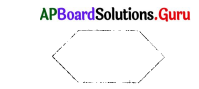
AP 8th Class Maths Bits Chapter 9 Area of Plane Figures with Answers 1 Number of triangles in the figure is …………………
A) 7
B) 2
C) 4
D) 3
Answer:
D) 3

Question 16.

AP 8th Class Maths Bits Chapter 9 Area of Plane Figures with Answers 2 Number of rectangles in the figure is …………………
A) 3
B) 4
C) 5
D) 6
Answer:
A) 3

AP 8th Class Maths Bits Chapter 9 Area of Plane Figures with Answers

Question 17.
AP 8th Class Maths Bits Chapter 9 Area of Plane Figures with Answers 3 Number of Trapeziums in the figure is ………………….
A) 6
B) 2
C) 4
D) 3
Answer:
B) 2

Question 18.
In a circle d = 28 cm then A = ……………… cm2
A) 216
B) 161
C) 606
D) 616
Answer:
D) 616

Question 19.
In the given figure area of Δ ABC = 10 cm2 then area of parallelogram is ………………… cm2
AP 8th Class Maths Bits Chapter 9 Area of Plane Figures with Answers 4
A) 60
B) 20
C) 80
D) 40
Answer:
B) 20

Question 20.
In a Quadrilateral d = 6 cm, h1 = 5 cm, h2 = 3 cm then A = ……………….. cm2
A) 16
B) 18
C) 24
D) 19
Answer:
C) 24

Question 21.
Area of Rhombus is ………………….
A) [latex]\frac{1}{2}[/latex] d1 d2
B) [latex]\frac{\mathrm{d}_{1} \mathrm{~d}_{2}}{4}[/latex]
C) [latex]\frac{1}{2}[/latex] d1 [latex]\frac{\mathrm{d}_{2}}{3}[/latex]
D) d12 . d22
Answer:
A) [latex]\frac{1}{2}[/latex] d1 d2

Question 22.
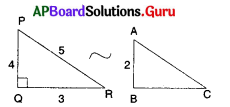
In the given figure area of Δ ABC = ………………… cm2
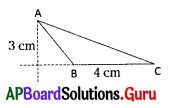
AP 8th Class Maths Bits Chapter 9 Area of Plane Figures with Answers 5
A) 12
B) 6
C) 11
D) 7
Answer:
B) 6

Question 23.
In a Rectangle l = 20 cm, b = 14 cm then A = ……………….. cm2
A) 150
B) 170
C) 180
D) 280
Answer:
D) 280

AP 8th Class Maths Bits Chapter 9 Area of Plane Figures with Answers

Question 24.
Area of sector = ………………
A) [latex][/latex] πr2
B) [latex][/latex] × 2 π r
C) [latex][/latex] × 3 π r
D) [latex][/latex] × πr2
Answer:
A) [latex][/latex] πr2

Question 25.
Area of square is 1225 cm2 then its side is ……………… cm
A) 25
B) 15
C) 45
D) 35
Answer:
D) 35

Question 26.
Area of adjacent figure is……………….. cm2
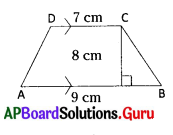
AP 8th Class Maths Bits Chapter 9 Area of Plane Figures with Answers 6
A) 64
B) 84
C) 74
D) 93
Answer:
A) 64

Question 27.
Area of parallelogram is 50 cm2 and a diagonal is drawn to it, then the area of triangle so formed is cm2
A) 19
B) 16
C) 25
D) 15
Answer:
C) 25

Question 28.
In the figure area of Right angle triangle ABC = ………………… cm2
AP 8th Class Maths Bits Chapter 9 Area of Plane Figures with Answers 7
A)10
B) 8
C) 12
D) 6
Answer:
D) 6

Question 29.
Diagonals of a Rhombus are 6 cm and 7 cm then area = ……………… cm2
A) 19
B) 16
C) 13
D) 21
Answer:
D) 21

Question 30.
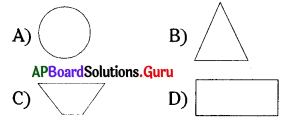
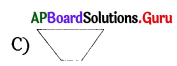
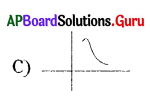
Which of the following figure represents a sector ?
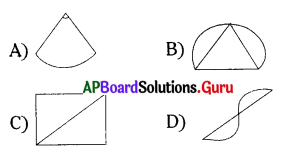
AP 8th Class Maths Bits Chapter 9 Area of Plane Figures with Answers 8
Answer:
AP 8th Class Maths Bits Chapter 9 Area of Plane Figures with Answers 9

AP 8th Class Maths Bits Chapter 9 Area of Plane Figures with Answers

Question 31.
In a circle r = 14 cm then area of Quadrant circle is ………………… cm2
A) 164
B) 154
C) 110
D) 150
Answer:
B) 154

Question 32.
Area of ring is ……………… cm2
A) π (R – r)
B) π (R + r)
C) π (R2 – r2)
D) π R2 – r2
Answer:
C) π (R2 – r2)

Question 33.
Which of the following figure represents concentric circles ?
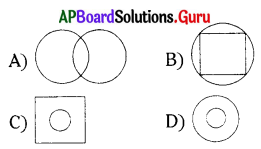
AP 8th Class Maths Bits Chapter 9 Area of Plane Figures with Answers 10
Answer:
AP 8th Class Maths Bits Chapter 9 Area of Plane Figures with Answers 11

Question 34.
Length of arc of a sector is 16 cm and radius of a circle is 7 cm then area of sector is …………….. cm2
A) 56
B) 46
C) 16
D) 36
Answer:
A) 56

Question 35.
Length of arc of a sector is …………………
A) [latex]\frac{\mathrm{x}^{\circ}}{360^{\circ}}[/latex] × 2 π r
B) [latex]\frac{\mathrm{x}^{\circ}}{360^{\circ}}[/latex] × π r
C) [latex]\frac{\mathrm{x}^{\circ}}{180^{\circ}}[/latex] × π r2
D) None
Answer:
A) [latex]\frac{\mathrm{x}^{\circ}}{360^{\circ}}[/latex] × 2 π r

Question 36.
In a triangle b = 5 cm, h = 10 cm then area is ……………. cm2
A) 19
B) 15
C) 25
D) 20
Answer:
C) 25

Question 37.
In a Rhombus the diagonals are 2a and 4b unite then its area is …………….. square unite.
A) 2ab
B) 4ab
C) 3ab
D) ab
Answer:
B) 4ab

AP 8th Class Maths Bits Chapter 9 Area of Plane Figures with Answers

Question 38.
In a circle d = 7 cm then its area is …………….. cm2
A) 10
B) 6
C) 18
D) None
Answer:
D) None

Question 39.
In a Ring the radii of outer and inner are 15 cm and 8 cm then the width is ……………….. cm
A) 7
B) 3
C) 6
D) 1
Answer:
A) 7

Question 40.
c : d = ……………………
A) 180°
B) [latex]\frac{\pi}{2}[/latex]
C) π
D) 90°
Answer:
C) π

Question 41.
The side of an equilateral triangle is ‘a’ units then its area is ……………. square units.
A) [latex]\frac{\sqrt{3}}{4}[/latex] a2
B) [latex]\frac{\sqrt{3}}{2}[/latex] a
C) [latex]\frac{\sqrt{3}}{7}[/latex] a2
D) [latex]\frac{\sqrt{3}}{6}[/latex] a2
Answer:
A) [latex]\frac{\sqrt{3}}{4}[/latex] a2

Question 42.
The side of an equilateral triangle is’a’ units then its height is ……………….. units.
A) [latex]\frac{\sqrt{3}}{4}[/latex] a
B) [latex]\frac{\sqrt{3}}{2}[/latex] a
C) [latex]\frac{\sqrt{3}}{4}[/latex] a2
D) [latex]\frac{2}{\sqrt{3}}[/latex] a
Answer:
B) [latex]\frac{\sqrt{3}}{2}[/latex] a

Question 43.
The area of adjacent figure is ……………….. cm2
AP 8th Class Maths Bits Chapter 9 Area of Plane Figures with Answers 12
A) 213
B) 103
C) 252
D) 203
Answer:
C) 252

Question 44.
Diagonal of a square is 9√3 cm then its area is ……………….. cm2
A) 90
B) 70
C) 37
D) 81
Answer:
D) 81

AP 8th Class Maths Bits Chapter 9 Area of Plane Figures with Answers

Question 45.
In the given figure there are two semicircles. Radius of big semicircle is 42 cm then the area of shaded portion is ………………… cm2

AP 8th Class Maths Bits Chapter 9 Area of Plane Figures with Answers 13
A) 300.5
B) 900.3
C) 346.5
D) 841.5
Answer:
C) 346.5

Question 46.
Diagonal of a square is 2.8 cm then its area is …………………. cm2.
A) 2.95
B) 3.92
C) 8.9
D) 5.3
Answer:
B) 3.92

Question 47.
1 cm2 = ……………………… mm2
A) 10
B) 2,000
C) 1,000
D) 100
Answer:
D) 100

Question 48.
1 hectare = ………………….. m2.
A) 10,000
B) 2,000
C) 3,000
D) 1,000
Answer:
A) 10,000

Question 49.
Area of triangle = 600 cm2, height =15 cm then base = ………………… cm.
A) 19
B) 16
C) 80
D) 10
Answer:
C) 80

Question 50.
Area of triangle is 120 cm2 and its base is 15 cm then its height is ………………. cm.
A) 16
B) 26
C) 36
D) 10
Answer:
A) 16

Question 51.
Area of Rhombus is 96 cm2 and its diagonal is 16 cm then its height is
………………….. cm
A) 60
B) 40
C) 70
D) 30
Answer:
B) 40

AP 8th Class Maths Bits Chapter 9 Area of Plane Figures with Answers

Question 52.
In a parallelogram the base is double the height and the area is 512 cm2 then its base is …………………… cm
A) 19
B) 13
C) 16
D) 32
Answer:
D) 32

Question 53.
In the above problem height = ……………….. cm
A) 19
B) 16
C) 23
D) 11
Answer:
B) 16

Question 54.
Perimeter of a Rhombus is 56 cm then the length of its side is ……………. cm.
A) 17
B) 16
C) 23
D) 19
Answer:
A) 17

Question 55.
Radius of a circle is 4.9 cm then its area is ………………. cm2.
A) 64.35
B) 95.35
C) 75.46
D) 15.46
Answer:
C) 75.46

Question 56.
Area of one circle is 100 times the area of other circle then the ratio of their circumferences is ………………….
A) 1:2
B) 10:1
C) 1:20
D) 30:29
Answer:
B) 10:1

Question 57.
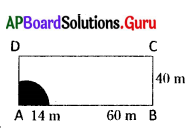
In the adjacent figure area of unshaded partis ………………… m2.
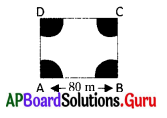
AP 8th Class Maths Bits Chapter 9 Area of Plane Figures with Answers 14
A) 6324
B) 5784
C) 8126
D) 1199
Answer:
B) 5784

Question 58.
The area of adjacent Quadrilateral is ……………… cm2.
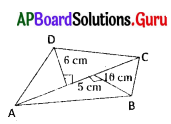
AP 8th Class Maths Bits Chapter 9 Area of Plane Figures with Answers 15
A) 35
B) 16
C) 80
D) 55
Answer:
D) 55

AP 8th Class Maths Bits Chapter 9 Area of Plane Figures with Answers

Question 59.
The area of adjacent Trapezium is ………….. cm2.
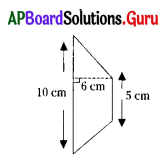
AP 8th Class Maths Bits Chapter 9 Area of Plane Figures with Answers 16
A) 45
B) 50
C) 60
D) 70
Answer:
A) 45

Question 60.
Area of circle is 616 cm2 then its circumference is ………………… cm
A) 88
B) 10
C) 19
D) 81
Answer:
A) 88

Question 61.
The area of shaded region in the adjacent figure is ………………..cm2
AP 8th Class Maths Bits Chapter 9 Area of Plane Figures with Answers 17
A) 104
B) 114
C) 154
D) 164
Answer:
C) 154

Question 62.
Circumference of circle is 264 cm then its area is …………………. cm2
A) 1936
B) 5544
C) 1543
D) 1980
Answer:
B) 5544

Question 63.
The height of an equilateral triangle is √6 cm then its area is ……………….. cm2.
A) 2√3
B) 3√2
C) 10√3
D) 9√2
Answer:
A) 2√3

Question 64.
Area of square is 200 cm2 then its diagonal is ………………. cm.
A) 80
B) 30
C) 20
D) 10
Answer:
C) 20

Question 65.
The difference of a circumference of a circle and the radius is 37 cm then its area is ………………. cm2.
A) 111
B) 160
C) 145
D) 154
Answer:
D) 154

Question 66.
Area of circle is 1386 cm2 then its circumference is ……………… cm.
A) 123
B) 169
C) 132
D) 119
Answer:
C) 132

Question 67.
Area of rectangle is 100 cm2, length is 20 cm then its breadth = ……………….. cm.
A) 16
B) 9
C) 10
D) 5
Answer:
D) 5

AP 8th Class Maths Bits Chapter 9 Area of Plane Figures with Answers

Question 68.
The side of a square is 9 cm then its perimeter is ……………….. cm.
A) 32
B) 10
C) 36
D) 16
Answer:
C) 36

Question 69.
Diagonal of a rectangle is ………………
A) [latex]\sqrt{l^{2}+b^{2}}[/latex]
B) l + √b
C) √l + b
D) l + b
Answer:
A) [latex]\sqrt{l^{2}+b^{2}}[/latex]

Question 70.
In the adjacent figure x = …………………. cm
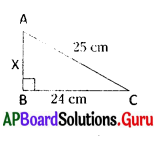
AP 8th Class Maths Bits Chapter 9 Area of Plane Figures with Answers 18
A) 7
B) 10
C) 13
D) 11
Answer:
A) 7
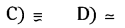
AP 8th Class Maths Bits Chapter 8 Exploring Geometrical Figures with Answers

Practice the AP 8th Class Maths Bits with Answers Chapter 8 Exploring Geometrical Figures on a regular basis so that you can attempt exams with utmost confidence.

AP State Syllabus 8th Class Maths Bits 8th Lesson Exploring Geometrical Figures with Answers

Choose the correct answer.

Question 1.
Order of rotation of square is ……………….
A) 4
B) 6
C) 3
D) 9
Answer:
A) 4

Question 2.
Number of symmetric lines for an Isosceles triangle is ……………….
A) 2
B) 10
C ) 9
D) 6
Answer:
A) 2

AP 8th Class Maths Bits Chapter 8 Exploring Geometrical Figures with Answers

Question 3.
Number of lines of symmetry for letter ‘H’ is ………………..
A) 4
B) 6
C) 1
D) 2
Answer:
D) 2

Question 4.
Order of rotation for a rectangle is …………………
A) 0
B) 6
C) 2
D) 4
Answer:
C) 2

Question 5.
Number of symmetrical lines for letter ‘O’ is ………………..
A) 6
B) 3
C) 10
D) Infinite
Answer:
D) Infinite

Question 6.
Rotation is a ……………………..
A) Expression
B) Change
C) Infinite
D) Square
Answer:
B) Change

Question 7.
Which letter in English alphabet has more lines of symmetry ?
A) O
B) P
C) Q
D) T
Answer:
A) O

Question 8.
Number of lines of symmetry for letter Q is ………………
A) 3
B ) 1
C) 0
D) 9
Answer:
C) 0

Question 9.
Number of lines of symmetry for letter R is …………………
A) 1
B) 0
C) 2
D) 4
Answer:
B) 0

AP 8th Class Maths Bits Chapter 8 Exploring Geometrical Figures with Answers

Question 10.
Number of lines of symmetry for a rectangle is ………………..
A) 2
B) 3
C) 4
D) None
Answer:
A) 2

Question 11.
Δ ABC ≅ Δ MNO then AB = ………………….
A) MN
B) NO
C) MO
D) None
Answer:
A) MN

Question 12.
Which of the following letter has no line of symmetry ?
A) H
B) T
C) Z
D) M
Answer:
C) Z

Question 13.
Which of the following figures are congruent pairs ?
A) Ear rings
B) Cycle wheels
C) Two palms
D) All the above
Answer:
D) All the above

Question 14.
Based on which property the geometrical shapes are seems to be beautiful is ……………….
A) Symmetry
B ) Angle
C ) Congruent
D ) None
Answer:
A) Symmetry

Question 15.
Δ ABC ≅ Δ DEF, ∠A = ………………
A) ∠F
B) ∠E
C) ∠D
D) None
Answer:
C) ∠D

Question 16.
Δ ABC ≅ Δ PQR, ∠A + ∠B = 100, ∠R = ?
A) 80°
B) 60°
C) 100°
D) 20°
Answer:
A) 80°

Question 17.
Order of rotation of a circle s ………………
A) 4
B) 3
C) 1
D) Infinite
Answer:
D) Infinite

AP 8th Class Maths Bits Chapter 8 Exploring Geometrical Figures with Answers

Question 18.
Number of lines of symmetry for letter U is ………………….
A) 1
B) 2
C) 3
D) 4
Answer:
A) 1

Question 19.
Order of rotation for an quilateral triangle is ……………….
A) 7
B) 8
C) 2
D) 3
Answer:
D) 3

Question 20.
Sum of the 3 angles in a triagle is ………………..
A) 160°
B) 80°
C) 180°
D) 30°
Answer:
C) 180°

Question 21.
Which of the following figure has only one line of symmetry ?
AP 8th Class Maths Bits Chapter 8 Exploring Geometrical Figures with Answers 1
Answer:
AP 8th Class Maths Bits Chapter 8 Exploring Geometrical Figures with Answers 2

Question 22.
Symbol for ‘is congruent to’ is …………………..
A) =
B) ≅
AP 8th Class Maths Bits Chapter 8 Exploring Geometrical Figures with Answers 2 1
Answer:
B) ≅

Question 23.
A complete rotation means ………………….
A) 360°
B) 180°
C) 190°
D) 300°
Answer:
A) 360°

Question 24.
Number of lines of symmetry for a parallelogram is …………………
A) 2
B) 3
C) 0
D) 4
Answer:
C) 0

AP 8th Class Maths Bits Chapter 8 Exploring Geometrical Figures with Answers

Question 25.
If a regular polygon contains ‘n’ sides then the number of lines of symmetry is …………………..
A) n2
B) n
C) 2n
D) [latex]\frac{\mathrm{n}}{2}[/latex]
Answer:
B) n

Question 26.
Which of the following has at least one line of symmetry ?
A) Honey Bee
B) Lotus
C) 8th class Mathematics Text Book
D) All the above
Answer:
D) All the above

Question 27.
Number of lines of symmetry for letter W is …………………
A) 9
B) 1
C) 3
D) 2
Answer:
B) 1

Question 28.
Which of the following letter has point symmetry ?
A) O
B) X
C) H
D) All the above
Answer:
D) All the above

Question 29.
The letter in the following has roational symmetry is ………………
A) O
B) E
C) H
D) All the above
Answer:
D) All the above

Question 30.
Number of lines of symmetry for letter N is ………………..
A) 1
B) 3
C) 4
D) 0
Answer:
D) 0

Question 31.
The letter which has two lines of symmetry is ………………..
A) H
B) I
C) O
D) All the above
Answer:
D) All the above

AP 8th Class Maths Bits Chapter 8 Exploring Geometrical Figures with Answers

Question 32.
Two circles with same radii are ………………..
A) Similar
B) Congruent
C) Triangles
D) None
Answer:
B) Congruent

Question 33.
To measure the height of long distance objects …………….. similarity is useful.
A) Triangle
B) Quadrilaterd
C) Figure
D) None
Answer:
A) Triangle

Question 34.
AP 8th Class Maths Bits Chapter 8 Exploring Geometrical Figures with Answers 3 In the above firgure AC = ………………….
A) 3
B) 2
C) 2.5
D) 5.2
Answer:
C) 2.5

Question 35.
The patterns formed by repeating figures to fill a plane without gaps or overlaps are called ………………….
A) Angles
B) Tessellations
C) 0
D) None
Answer:
B) Tessellations

Question 36.
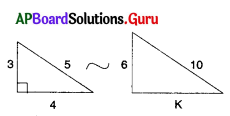
AP 8th Class Maths Bits Chapter 8 Exploring Geometrical Figures with Answers 4 In the above figure K = ………………..
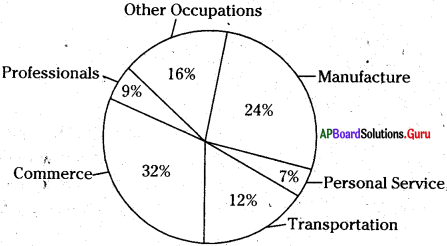
A) 6
B) 8
C) 10
D) 11
Answer:
B) 8

Question 37.
Symbol for ‘Similarity’ is ……………….
A) ~
B) ≅
AP 8th Class Maths Bits Chapter 8 Exploring Geometrical Figures with Answers 4 1
D) =
Answer:
A) ~

AP 8th Class Maths Bits Chapter 8 Exploring Geometrical Figures with Answers

Question 38.
Each angle in a square is ………………..
A) 60°
B) 90°
C) 100°
D) 99°
Answer:
B) 90°

Question 39.
Each angle in an equilateral triangle is ………………….
A) 80°
B) 70°
C) 75°
D) 60°
Answer:
D) 60°

Question 40.
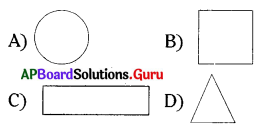
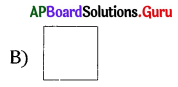
Which of the following figure has four lines of symmetry ?
AP 8th Class Maths Bits Chapter 8 Exploring Geometrical Figures with Answers 5
Answer:
AP 8th Class Maths Bits Chapter 8 Exploring Geometrical Figures with Answers 6

AP 6th Class English Important Questions Chapter 8 Where there is a Will, there is a Way

AP State Syllabus 6th Class English 8th Lesson Important Questions and Answers Where there is a Will, there is a Way

Reading Comprehension Textual Passages

Question 1.
Read the following passage carefully.

The 1992 Olympics had.put Barcelona on the map of the world. Normally, thousands of athletes take part in the games. Why do so many countries send their teams to the Olympics? It is because the Olympics is one of the world’s biggest sports events. It is an honour for any country to send their athletes to take part in the Olympic Games. It is not a success or a failure that counts; what matters is the participation in the event.

The players put in their best efforts to win, but a few among such good player have become victims of accidents; a few others have been victims of diseases. They are eager to show that they are champions in their own fields. One such champion was Wilma Rudolph of the U.S.A. She is popularly known as the ‘Black Gazelle’. She had the speed and the grace of a deer.

Now, answer the following questions.
1. What made Barcelona to be put on the map of the world?
Answer:
The 1992 Olympics

2. Why do so many countries send their teams to the Olympics?
Answer:
It is because the Olympics is one of the world’s biggest sports events. It is an honour for any country to send their athletes to take part in the Olympic Games.

3. What do the players do to win?
Answer:
The players put in their best efforts to win.

4. What are the players eager for?
Answer:
They are eager to show that they are champions in their own fields.

5. Who is known as ‘Black Gazelle’?
Answer:
Wilma Rudolph

AP 6th Class English Important Questions Chapter 8 Where there is a Will, there is a Way

Question 2.
Read the following passage carefully.

Wilma belonged to a large Afro-American family. In fact, she was the fourteenth child and was very weak when she was born. At the age of four, she had an attack of polio and was in bed for two long years. The doctors recommended regular massage to get her left leg back to normal. Each member in her family spent some time massaging her leg. In course of time, she was able to walk. She, however, needed special shoes. As her legs became a little stronger, she began to run about and play. She said, “I can run fast and I will participate in Olympics.” At no time did she feel that she was physically handicapped. As years passed, she improved 4n her health and grew stronger enough to play basketball for her school. She was always cheerful and active and was full of hope that she would, one day, be a great player.

Now, answer the following questions.
1. What was Wilma’s family background?
Answer:
Wilma belonged to a large Afro-American family.

2. How was Wilma’s fitness when she was born?
Answer:
She was very weak.

3. What happened to Wilma when she was four years old?
Answer:
She had an attack of polio and was in bed for two long years.

4. What was the ambition of Wilma?
Answer:
To participate in Olympics

5. What was the hope that Wilma had?
Answer:
She had a hope that she would become a great player.

Question 3.
Read the following passage carefully.

A trainer of athletes happened to meet her one day He saw that she was a talented girl and could become a sprinter. She took regular lessons from this coach, and the lessons helped her join the American Olympic team that went to Melbourne. In the next Olympics in Rome, she became a superstar and won three gold medals. She smiled and said, “I run fast because mine is a large family and I need to get to the dining table first”

Now, answer the following questions.
1. Who was referred to as a talented girl’?
Answer:
Wilma Rudolph

2. What did the trainer find in her?
Answer:
He found that she would become a sprinter.

3. How did the lessons of the coach help her?
Answer:
The lessons helped her join the American Olympic team that went to Melbourne.

4. In which Olympics did she become a superstar?
Answer:
In Rome Olympics

5. What did she win in Rome Olympics?
Answer:
Three gold medals

Question 4.
Read the following passage carefully.

Another champion who suffered a lot as a boy was Rafer Johnson. He Was only twelve, when his left leg was badly crushed in a machine. The front of one of the toes was hanging out as though it would fall off. The surgeon who treated him feared that the entire leg might have to be cut off. Rafer was upset. All the time he was in bed and prayed to God for His mercy. He grew better day by day and the surgeon could finally save his leg, but it did not heal completely.

Now, answer the following questions.
1. Who is the passage about?
Answer:
This passage is about Rafer Johnson.

2. What happened to Rafer Johnson when he was twelve?
Answer:
His left leg was badly crushed in a machine.

3. What happened to one of his toes?
Answer:
It was hanging out as though it would fall off.

4. What was the fear of the surgeon?
Answer:
The entire leg might have to be cut off.

5. Why was Rafer upset?
Answer:
Perhaps, the entire leg might have to be cut off.

AP 6th Class English Important Questions Chapter 8 Where there is a Will, there is a Way

Question 5.
Read the following passage carefully.

Rafer’s interest in sports was so strong that he did not worry about his weak leg. He often had difficulty in wearing spiked shoes, but this did not stop him from having regular practice. He worked hard day and night and was finally selected for the Olympics. He took part in the’ decathlon and won the first place. He was called “the greatest all round athlete in the world”.

Both these champions had their dreams. They set themselves their goals to achieve their dreams. They worked with a will to reach their goals. At last their dreams came true and they became world famous athletes.

Now, answer the following questions.
1. Who are ‘the champions’ referred to here?
Answer:
Wilma Rudolph and Rafer Johnson

2. How was Rafer’s interest in sports?
Answer:
Rafer’s interest in sports was so strong that he did not worry about his weak leg.

3. What was Rafer’s great achievement in Olympics?
Answer:
Rafer won the first place. He was called “the greatest all round athlete in the world”.

4. How did Rafer work for Olympic selections?
Answer:
He worked day and night./ He worked very hard.

5. What were their goals?
Answer:
To win in the Olympics

Question 6.
Read the following lines carefully.

What can a little chap do?
For his country and for you?
What can a little chap do?

He can play a straight game all through;
That’s one good thing he can do.

Now, answer the following questions.
1. What are these lines about?
Answer:
About a little chap and what he can do.

2. Who are ‘you’ in the second line?
Answer:
Parents or family

3. What does ‘play a straight game’ mean?
Answer:
Behave fairly

4. What can the little chap do?
Answer:
He can play a straight game.

AP 6th Class English Important Questions Chapter 8 Where there is a Will, there is a Way

Question 7.
Read the following lines carefully.

He can fight like a Knight
For the Truth and the Right;
That’s another good thing he can do.

He can shun all that’s mean
He can keep himself clean,
Both without and within;
That’s a very fine thing he can do.

Now, answer the following questions.
1. What are these lines about?
Answer:
About a little chap and what he can do.

2. How does he fight?
Answer:
He fights like a knight.

3. Why does he fight like a knight?
Answer:
For the Truth and the Right

4. What can he shun?
Answer:
All bad things

5. What is a very fine thing that he can do?
Answer:
He can keep himself clean (fair).

Question 8.
Read the following lines carefully.

His soul he can brace
Against everything base.
And the trace will be seen
All his life in his face;
That’s an excellent thing he can do.

He can look to the light,
He can keep his thoughts white,
He can fight the great fight,
He can do with his might
What is good in God’s sight;
Those are truly great things he can do.

Now, answer the following questions.
1. What does he do to £ace difficulties?
Answer:
He prepares his soul to face difficulties.

2. What is seen in his face?
Answer:
A trace (sign / mark) that indicates his,ability to face difficulties is seen in his face.

3. How does he keep his thoughts?
Answer:
He keeps his thoughts white (clear and rational).

4. How can he keep his thoughts white?
Answer:
With his wisdom (light)

5. How does his might help him?
Answer:
To fight a great fight

Unseen Comprehension

Question 9.
Read the following passage.

The Olympic Games began in Olympia in 776-B.C. At first they lasted one day and there was only one race. In 1894 a Frenchman, Baron De Coubertin, thought of starting the games. In 1896, the first modern Olympic Games took place in Athens in Greece. They are held once in four years.

Now, answer the following questions.
1. When did the Olympic Games begin?
Answer:
The Olympic Games began in 776 B.C.

2. When did the first modern Olympic Games take place?
Answer:
In the year 1896, the first modern Olympic Games took place.

Choose the correct answers from the choices given.
3. At first for how many days were the Olympic Games held?
A) 4 days
B) 3 days
C) 1 day
Answer:
C) 1 day

4. Where did the first modern Olympic Games take place?
A) Olympia
B) Athens
C) France
Answer:
B) Athens

5. Which of the following statements is True?
A) An Englishman thought of starting the games in 1896.
B) The Olympic Games began in 776 A.D.
C) Baron De Coubertin started the modern Olympic Games.
Answer:
C) Baron De Coubertin started the modern Olympic Games.

Interpretation Of Non-Verbal Information

1. Read the following data given in the table.
XYZ Survey Agency
The following table, represents the No. of tourists visited Amaravathi over the last five years. (Abstract figures)

Year Number of Tourists (in thousands)
Indian Foreign
2011-12 35 57
2012-13 41 47
2013-14 36 60
2014-15 31 65
2015 -16 37 69

Now, answer the following questions.
1) How many foreign tourists visited Amaravathi during 2013-14?
Answer:
Sixty thousand foreign tourists

2) In which year did the maximum number of Indian tourists visit Amaravathi?
Answer:
During 2012 – 2013

Choose the correct answer from the choices given.
3) The above table represents the number of the visitors in ………………
A) hundreds
B) thousands
C) millions
Answer:
B) thousands

4) The data given in the above table is for a period of ……………….
A) 2011 years
B) 2011 -17 years
C) 5 years
Answer:
C) 5 years

5) Which of the following statements is True?
A) The least number of foreign tourists visited in 2015-16.
B) The maximum number of Indian tourists visited in 2015 -16.
C) The number of .foreign tourists Visited Amaravathi is more than the tourists from India during the five year period mentioned in the above table.
Answer:
C) The number of .foreign tourists Visited Amaravathi is more than the tourists from India during the five year period mentioned in the above table.

Vocabulary

I. Choose the words with similar meanings (Synonyms) from the list given to the words underlined.

1. [ hurdles, refreshments, tasks, debilities ]
These qualities help a person overcome the weaknesses (a) and barriers (b) to achieve goals.
Answer:
a) debilities
b) hurdles

2. [ members, greatest, latest, sufferers ]
The players put in their best (a) efforts to win, but a few among such good players have become victims (b) of accidents.
Answer:
a) greatest
b) sufferers

3. [ reliable, feeble, big, nuclear ]
Wilma belonged to a large (a) Afro-American family. In fact, she was the fourteenth child and was very weak (b) when she was born.
Answer:
a) big
b) feeble

4. [ sorrowful, lean, joyful, energetic ]
She was always cheerful (a) and active (b) and was full of hope that she would, one day, be a great player.
Answer:
a) joyful
b) energetic

5. [ amputated, sliced, half, complete ]
The surgeon who treated him feared that the entire (a) leg might have to be cut off (b).
Answer:
a) complete
b) amputate

6. [ scarce, trouble, always, frequently ]
He often (a) had difficulty (b) in wearing spiked shoes, but this did not stop him from having regular practice.
Answer:
a) frequently
b) trouble

AP 6th Class English Important Questions Chapter 8 Where there is a Will, there is a Way

II. Write the opposite words of the underlined words.

1) One becomes great by his/her deeds, will power, patience (a), and perseverance. These qualities help a person overcome (b) the weaknesses and barriers to achieve goals.
Answer:
a) impatience b) give up

2) The players put in their best (a) efforts to win (b), but a few among such good players have become victims of accidents.
Answer:
a) worst
b) lose

3) The doctors recommended regular (a) massage to get her left leg back to normal (b).
Answer:
a) irregular
b) abnormal

4) The surgeon who treated him feared that the entire (a) leg might have to be cut off. Rafer was upset (b).
Answer:
a) partial
b) unperturbed

5) He took part in the decathlon and won (a) the first (b) place.
Answer:
a) missed
b) last

III. Fill in the blanks with die right form of the words given in the brackets.

1) One becomes _____ (a) (great/greatly) by his/her deeds, will power, _____ (b) (patient/patience) and perseverance.
Answer:
a) great
b) patience

2) The doctors _____ (a) (recommended/recommendation) regular massage to get her left leg back to _____ (b) (normal/normally).
Answer:
a) recommended
b) normal

3) As years passed, she _____ (a) (improved/improvement) in her health and grew _____ (b) (stronger/strongly) enough to play basketball for her school.
Answer:
a) improved
b) stronger

4) The _____ (a) (surgery/surgeon) who treated him feared that the _____ (b) (entire/entirely) leg might have to be cut off.
Answer:
a) surgeon
b) entire

5) He often had _____ (a) (difficult/difficulty) in wearing spiked shoes, but this did not stop him from having _____ (b) (regular/regularly) practice.
Answer:
a) difficulty
b) regular

AP 6th Class English Important Questions Chapter 8 Where there is a Will, there is a Way

IV. Complete the following words using “au, ea, ee, ei, eo, ie, oa, oo or ou”.

1) It is bec_ _se the Olympics is one of the world’s biggest sports events. It is an honour for any country to send th_ _r athletes to take part in the Olympic games.
2) The players put in their best efforts to win, but a few among such g_ _d players have become victims of accidents; a few others have been victims of dis_ _ses.
3) She had the sp_ _d and the grace of a d_ _r.
4) At the age of f_ _r, she had an attack of polio and was in bed for two long y_ _rs.
5) The surg_ _n who treated him f_ _red that the entire leg might have to be cut off.
6) Rafer’s interest in sports was so strong that he did not worry ab_ _t his w_ _kleg.
7) He was called “the gr_ _test all r_ _nd athlete in the world”.
8) They set themselves their g_ _ls to ach_ _ve their dreams.
Answer:
1) because, their
2) good, diseases
3) speed, deer
4) four, years
5) surgeon, feared
6) about, weak
7) greatest, round
8) goals, achieve

V. Complete the following words with the suitable suffixes given in the brackets.

1) One becomes great by his/her deeds, will power, pati _____ (ence/ance) and persever _____ (ence/ance).
2) It is not a success or a fail _____ (ure/er) that counts; what matters is the participat _____ (ion/eion) in the event.
3) He saw that she was a talent _____ (ed/d) girl and could become a sprint _____ (er/or).
4) He grew better day by day and the surg _____ (eon/en) could final _____ (ly/y) save his leg, but it did not heal completely.
5) He took part in deca _____ (athjon/thlon) and won the first place. He was called “the great _____ (er/est) all round athlete in the world”.
Answer:
1) patience, perseverance
2) failure, participation
3) talented, sprinter
4) surgeon, finally
5) decathlon, greatest

VI. Identify the wrongly spelt word and write its correct spelling in the space provided.

1) massage, message, recomend, special
Answer:
recommend

2) medal, sports, normally, perseverence
Answer:
perseverance

3) success,.accident, matter, patiense
Answer:
patience

4) participasion, lesson, improve, victim
Answer:
participasion

5) failure, chalenge, country, speed
Answer:
challenge

AP 6th Class English Important Questions Chapter 8 Where there is a Will, there is a Way

VII. Arrange the following words under the correct headings.

1. [ cot, television, success, failure ]

Abstract Things Material Things
1) success 1) cot
2) failure 2) television

2. [ grace, practice, selection, famous ]

Qualities Activities
1) grace 1) practice
2) famous 2) selection

3. [ shoes, sprinter, medals, coach ]

Persons Things
1) sprinter 1) shoes
2) coach 2) medals

4. [ door, mercy, stool, interest]

Abstract Thing Material Things
1) mercy 1) door
2) interest 2) stool

VIII. Complete the following paragraph choosing the correct word from those given in brackets.

It was early in the morning. The _____ (1) (sun/son) was hidden in the clouds. The sky was _____ (2) (belw/blue) in colour. It was very cool all over _____ (3) (their/there). The _____ (4) (mist/missed) covered all the trees. I picked a beautiful _____ (5) (flower/flour). It was _____ (6) (read/red) in colour. I turned my head towards my _____ (7) (write/right) side and found a snake coming out from a _____ (8) (hole/whole). I was frightened and ran away. It was really an unforgettable _____ (9) (scene/scen).
Answer:
1. sun
2. blue
3. there
4. mist
5. flower
6. red
7. right
8. hole
9. scene

Grammar

I. Read the following passage and correct the underlined parts. Rewrite the corrected parts in the space provided.

1. One day Sulochana teacher said to the class, “We all no (1) that the blew (2) dress has won the better (3) student prize for this ear (4).”
Answer:
1) know
2) blue
3) best
4) year

2. Once upon a time, there is (1) a mother rat who wanted to get her young daughter marry (2) as soon as possible, to the much (3) powerful being that she could found (4).
Answer:
1) was
2) married
3) most
4) find

3. The postman is an (1) useful, public servant. He wears Khaki uniform. He carry (2) letters, parcels and money orders, etc. in his bag. He can read many language (3). People know the time with (4) his daily round.
Answer:
1) a
2) carries
3) languages
4) of

AP 6th Class English Important Questions Chapter 8 Where there is a Will, there is a Way

II. Complete the following passage choosing the right words from the choices given below. Each blank is numbered and four choices are given. Choose the correct answer and write (A), (B), (Q or (D) in the blanks.

1. A rabbit was. very proud of being able to run very fast. It boasted _____ (1) this all the time. One day it saw _____ (2) tortoise. The tortoise was moving _____ (3). It looked at the tortoise and started _____ (4).
1. A) on B) in C) about D) at
2. A) an B) a C) the D) any
3. A) quickly B) fastly C) slowly D) quietly
4. A) laugh B) laughed C) laughter D) laughing
Answer:
1 – C
2 – B
3 – C
4 – D

2. A poor wood-cutter was _____ (1) beside a river. The axe _____ (2) his hands slipped and fell into _____ (3) water. The wood-cutter _____ (4) sorry and prayed to God.
1. A) worked B) work C) working D) works
2. A) in B) from C) on D) at
3. A) a B) the C) an D) some
4. A) is B) were C) had been D) was
Answer:
1 – C
2 – A
3 – B
4 – D

III. Choose the correct modal verbs from the box to complete these sentences.
[would, may, must, should, will]

1. Plants _____ need light and water to grow.
2. 2. The snake _____ bite you if you step on it.
3. _____ you like to have coconut water?
4. You _____ take an umbrella with you when you go out in rain.
5. _____ I use your dictionary, please?
Answer:

  1. must
  2. will
  3. Would
  4. should
  5. May

AP 6th Class English Important Questions Chapter 8 Where there is a Will, there is a Way

IV. Some situations are given below. Read them and respond suitably.

1. Suppose your uncle has visited you but your parents are not at home. Offer him something to drink.
2. You have been absent from school for a week because of your illness. Ask your friend to give you his/her English notebook.
3. Your friend always loves to wander everywhere. The Corona disease becomes a pandemic. A number of persons even lost their lives. Advise your friend to be at home.
4. A stranger at an office gives you his pen when you request him for it. How would you respond when you return it to him?
5. According to the meteorological department, it would be very hot tomorrow. How would you express this idea using ‘might’?
Answer:
1. Would you like to have some water, uncle?
2. Could you please give me your English notebook?
3. You should stay at home to protect yourself from Corona,
4. I would be grateful to you, sir. (OR)
I would like to thank you, sir.
5. It might be very hot tomorrow.

V. Complete the questions given below using the question words in the box.
[Does, Where, How, When, What, Which, Did, Is, Are, Why]
1. _____ did you go yesterday?
2. _____ is your mother?
3. _____ bus goes to Brodiepet?
4. _____ are you?
5. _____ have you been absent for all these days?
6. _____ you buy apples?
7. _____ you washing clothes?
8. _____ do you wake up every morning?
9. _____ she belong to India?
10. _____ he cleaning his car?
Answer:

  1. Where
  2. What
  3. Which
  4. How
  5. Why
  6. Did
  7. Are
  8. When
  9. Does
  10. Is

VI. Read the following statements and frame questions. Use the clues given in the brackets.

1. Now, the time is 10 o’clock.
Answer:
_____ ? (What)

2. Lakshmi is working in Mumbai.
Answer:
_____ ? (Where)

3. I went there to meet my cousin.
Answer:
_____ ? (Why)

4. This cell phone is hers.
Answer:
_____ ? (Whose)

5. My favourite teacher is our English teacher.
Answer:
_____ ? (Who)

6. Mount Everest is the highest peak.
Answer:
_____ ? (Which)

7. We celebrate the Children’s Day on 14th November.
Answer:
_____ ? (When)
Answer:

  1. What is the time now?
  2. Where is Lakshmi working?
  3. Why did you go there?
  4. Whose cell phone is this?
  5. Who is your favourite teacher?
  6. Which is the highest peak?
  7. When do we celebrate the Children’s Day?

VII. Write one meaninful question each beginning with the following words.

1. What _________ ?
2. Who _________ ?
3. Where _________ ?
4. When _________ ?
5. Why _________ ?
6. Which _________ ?
7. Whose _________ ?
8. How _________ ?
9. Are _________ ?
10. Is _________ ?
11. Have _________ ?
12. Do _________ ?
13. Does _________ ?
14. Did _________ ?
15. Will _________ ?
16. Can _________ ?
17. Can’t we _________ ?
18. Don’t vou _________ ?
19. Won’t they _________ ?
20. Didn’t he _________ ?
21. Doesn’t she _________ ?
22. Isn’t your _________ ?
23. Aren’t you _________ ?
24. Wasn’t he _________ ?
Answer:

  1. What is he making?
  2. Who will be the winner?
  3. Where did he keep his doll?
  4. When will the Ajantha Super Fast Express arrive?
  5. Why did Imran consult the doctor?
  6. Which boy is taller?
  7. Whose property is this?
  8. How is she teaching?
  9. Are you reading a novel?
  10. Is she teaching English?
  11. Have you bought all those books?
  12. Do they live in countryside?
  13. Does he go to school regularly?
  14. Did she catch a snake?
  15. Will you come in the evening?
  16. Can she beat him?
  17. Can’t we win the game?
  18. Don’t you speak in Tamil?
  19. Won’t they come tomorrow?
  20. Didn’t he paint the wall?
  21. Doesn’t she walk briskly?
  22. Isn’t your dog barking?
  23. Aren’t you sleepy?
  24. Wasn’t he speaking on phone?

Creative Expression

Question 1.
You have come to know that Wilma had been in bed for two long years and then she practised and achieved her goal of winning medals at Olympics with great will-power
and perseverance.

Now, describe Wilma’s feelings at the moment when she won three gold medals in Olympics.
Answer:
Wilma felt very happy at her achievement. Her joy knew no bounds. When a reporter asked her to tell him her feelings, at first, she became speechless. Then she said, “Its all God’s grace”. She also said that she ran fast because hers was a large family and she needed to get to the dining table first. Her feelings are as follows. “Oh, God! Because of you only, I have made it. I am very much grateful to you! I can’t believe my eyes! Finally, my dream came true. Now, I forget the disgusting days when I was in bed. I am really excited! I am very fortunate to win three gold medals in one Olympics. 1 won’t forget this memorable day. I should thank all the people who have been supporting me all these days. I am grateful to my family members who rendered priceless services to me while I was^n bed. I am really indebted to them for all they have done to me.”

AP 6th Class English Important Questions Chapter 8 Where there is a Will, there is a Way

Question 2.
You know that Rafer Johnson won the first place in the decathlon in Olympics. Though his left leg was badly injured, he worked hard and finally reached his goal.

Now, imagine that you were Rafer and attempt a diary entry on a day when you were in bed after your left leg was badly injured.
Answer:

Monday, 10 January 20xx
8 p.m.

Dear Diary,

What an unfortunate thing in my life it is ! I was thoroughly disappointed. When would I get up and walk like other children? Why did it all happen to me only? Why should I fear this pain? Why should 1 live like this? AH my friends are running and playing happily. But I can’t even walk. I want to become a great athlete. Now, how can I become an athlete? The surgeon told me that my entire leg might have to be cut off. Without my leg, how can 1 walk? How can I run? Oh! God! Please show your mercy upon me. Please help me get up and give me the strength to achieve my goal.

Rafer

AP 6th Class English Important Questions Chapter 8 Where there is a Will, there is a Way

Question 3.
Write a biographical sketch using the following clues.

Shivaji – born on 10th April 1627 – Parents – Jijabai and Shahaji Bhosle – father – a noble man – worked in the royal court of Bijapur – mother – devotee of Lord Shiva – Shivaji named after Lord Shiva – brave and fearless – born ruler – dream of building his kingdom at the age of 14 – first military attack – at the age of 20 – captured the Torna Fort – series of triumphs – known for his fatherly attitude towards his citizens – remembered as a hero – breathed his last in 1680.
Answer:
Shivaji was born in Shivneri on 10th April, 1627 to Jijabai and Shahaji Bhosle. His fa-, ther Shahaji was a noble man in the royal court of Bijapur. Shivaji was named so after Lord Shiva of Hindu mythology as his mother was an ardent Hindu devotee. Since childhood Shivaji was brave and fearless. There were many instances in his child¬hood that show he was a born ruler. At the young age of fourteen, he had the dream of building his kingdom. At the age of 20, he took out his very first military attack and captured the Torna Fort of the Kingdom of Bijapur.

After that, he had a series of triumphs. Shivaji was known for his protective and fatherly attitude towards his citizens. He is remembered till date as a hero who worked for the welfare of his subjects and state. Shivaji breathed his last in 1680 after suffer¬ing from fever for three whole weeks.

These AP 6th Class English Important Questions 8th Lesson Where there is a Will, there is a Way will help students prepare well for the exams.

AP 6th Class English Important Questions Chapter 7 Dr. B. R. Ambedkar

AP State Syllabus 6th Class English 7th Lesson Important Questions and Answers Dr. B. R. Ambedkar

Reading Comprehension Textual Passages

Question 1.
Read the following passage carefully.

Dear Kusuma,

I hope everything goes well with you. I am now rather busy with a project work in my school. The title of the project is “Pillars of Modern India”. We have to collect some important incidents that happened in the lives of the eminent persons who laid the foundation for modern India. Now I am working on the life of Dr. B. R. Ambedkar.

I am writing this letter to tell you certain heart-touching incidents from the life of Dr. B. R. Ambedkar. You see, they are very interesting.

Now, answer the following questions.
1. Who is the writer of this letter?
Answer:
Swapna

2. What was the name of the project that the writer was working on?
Answer:
Pillars of Modern India

3. Why did the person want to write this letter to Kusuma?
Answer:
The person wanted to write this letter to tell Kusuma certain heart-touching incidents from the life of Dr. B.R. Ambedkar. ‘

4. Why was the writer busy at the time of writing this letter?
Answer:
She was busy working on a project.

5. What was the hope of the writer expressed in the beginning of the letter?
Answer:
She hoped everything goes well with Kusuma.

AP 6th Class English Important Questions Chapter 7 Dr. B. R. Ambedkar

Question 2.
Read the following passage carefully.

Dr. Bhimrao Ramji Ambedkar also known as Babasaheb, was born into a Mahar family on 14th April 1891 at Mhow in Madhya Pradesh.
Bhimrao started experiencing the pangs of untouchability right from his childhood. His father was working in a distant village named Koregaon. When Bhimrao was nine years old, he, along with his brother and cousin, went to Koregaon to spend the summer vacation with his father. They had written a letter to his father about their arrival. But his father had not received the letter in time. Therefore, he did not come to the railway station to receive the children.
Now, answer the follolving questions. ,
1. When and where was Ambedkar born?
Answer:
Ambedkar was born on 14th April 1891 at Mhow in Madhya Pradesh.

2. What did Ambedkar experience right from his childhood?
Answer:
The pangs of untouchability

3. Where was Ambedkar’s father working?
Answer:
In Koregaon village

4. Why did Ambedkar want to go to Koregaon?
Answer:
To spend his summer vacation

5. Why did Ambedkar’s father not come to the Railway Station to receive the children?
Answer:
He did not know about their arrival.

Question 3.
Read the following passage carefully.

They managed to rent a bullock cart for Koregaon. The ill-treatment of the cart-man frightened the children on the way. By midnight, the cart reached a resting place. Bhim went to a man there and said, “Sir, we are very thirsty, please give us some water”. “Who has kept water for you?” replied the man rudely as he carne to know that they were Mahars. With that they had to sleep that night without food and water. This nightmare incident made an indelible impression on the tender mind of Bhim.

Now, answer the following questions.
1. Who were ‘they’ in the first line?
Answer:
Ambedkar, his brother and his cousin

2. Why were they going to Koregaon?
Answer:
To spend their summer vacation

3. HoW did the cart-man treat them?
Answer:
He ill-treated them.

4. Why did the man refuse to give water to Ambedkar?
Answer:
Because he knew that Ambedkar was a Mahar.

5. How did they spend the night?
Answer:
They spent the night without water and food.

AP 6th Class English Important Questions Chapter 7 Dr. B. R. Ambedkar

Question 4.
Read the following passage carefully.

They reached Koregaon at eleven in the morning the next day. His father was surprised to see them. Later it was known that his father’s servant had received their : letter, but forgotten to give it to his father.

Ambedkar came to know that all persons were not alike. In his high school, there ‘ was a Brahmin teacher who showed great love and affection for Bhimrao. He offered meals to Bhim during his recess. This teacher left a mark of love on Bhim’s life. Dr. Ambedkar remembered the teacher throughout his life.

Now, answer the following questions.
1. What was the surprising thing to Ambedkar’s father?
Answer:
Seeing the arrival of Ambedkar, his brother and cousin

2. Who forgot the letter to give to his father?
Answer:
A Servant

3. Who showed great love and affection for Bhimrao?
Answer:
A Brahmin teacher in his high school

4. What did the Brahmin teacher offer Bhim?
Answer:
Meals

5. How did Ambedkar remember his teacher?
Answer:
Throughout his life

Question 5.
Read the following passage carefully.

Ambedkar felt that lack of education is the root cause of caste discrimination in India. He decided to uplift the oppressed classes and remove caste barriers.

Seeing the intellectual capacity of Bhim, the Maharaja Sayajirao of Baroda helped him join Elphinstone College in Mumbai. Later, Ambedkar went to the USA to join Columbia University. He completed his M.A and Ph.D there. Then, he joined the London School of Economics and graduated in Political Science.

Now, answer the following questions.
1. What is the root cause of caste discrimination in India?
Answer:
Lack of education

2. What did he decide to do?
Answer:
He decided to uplift the oppressed classes and remove caste barriers.

3. Who helped Ambedkar join Elphinstone College in Mumbai?
Answer:
The Maharaja Sayajirao of Baroda

4. Where did he complete his M.A. and Ph.D?
Answer:
He completed his M.A. and Ph.D from Columbia University, the U.S.A.

5. What did Ambedkar study in London School of Economics?
Answer:
His graduation in Political Science

AP 6th Class English Important Questions Chapter 7 Dr. B. R. Ambedkar

Question 6.
Read the following passage carefully.

Babasaheb was a voracious reader throughout his life. He had a great thirst for books. He saved small amounts of money and spent it on buying books. He purchased about 2,000 old books when he was in New York. At the time of the Second Round Table Conference in London, he bought so many books. They were sent to India in 32 boxes. Doesn’t it sound amazing?

The services of Dr. Ambedkar to modern India were ever matchless. He was appointed Chairman of the Drafting Committee to write India’s new Constitution.

Now, answer the following questions.
1. What kind of reader was Babasaheb?
Answer:
He was a voracious reader.

2. What was his thirst for?
Answer:
His thirst was for books.

3. How did he spend his small savings?
Answer:
To buy books

4. Where did Babasaheb attend the Second Round Table Conference?
Answer:
In London

5. What was his role in writing India’s new Constitution?
Answer:
He was the Chairman of the Drafting Committee. .

Question 7.
Read the following passage carefully.

He was appointed the first Law Minister in Jawaharlal Nehru’s cabinet. He was the champion of the oppressed classes and the leader of all. Though he experienced a bitter childhood, he became the writer of the Constitution of India. In the year 1990, Dr. Ambedkar was awarded the ‘Bharat Ratna’ after his death. The Government of India released a stamp in memory of his valuable services to modern India.

I believe that Babasaheb achieved such a success because of his reading habit. Kusuma, I have really been inspired by Babasaheb. I have decided to read as many books as possible now onwards.

Now, answer the following questions.
1. What was he appointed for?
Answer:
He was appointed the first Law Minister in Jawaharlal Nehru’s cabinet.

2. Who was considered the champion of oppressed classes?
Answer:
Dr. Ambedkar

3. Who is referred to as T?
Answer:
Swapna

4. What was the decision of the writer of this letter?
Answer:
She decided to read as many books as possible.

5. Who was Kusuma?
Answer:
She was Swapna’s friend.

Read it yourself

Question 8.
Read the following passage carefully.

Malli Masthan Babu was born on 3 September 1974 in SPS Nellore District of Andhra Pradesh. His parents were Masthanaiah and Subbamma. His father was a farmer. He studied at Korukonda Sairtik School in Vizianagaram. He obtained his M.Tech Degree from IIT – Kharagpur.

Masthan Babu was interested in trekking and climbing high-altitude mountains. He climbed and reached the highest peaks in all the seven continents in the year 2006. He climbed Mount Everest and reached its peak on 21 May 2006.

Now, answer the following questions.
1. Which state did Malli Masthan Babu belong to?
Answer:
Andhra Pradesh

2. What was his father?
Answer:
His father was a farmer.

3. Where did he have his schooling?
Answer:
At Korukonda Sainik School in Vizianagaram

4. What was he interested in?
Answer:
He was interested in trekking and climbing high-altitude mountains.

5. When did he climb and reach the highest peaks in all the seven continents?
Answer:
In the year 2006

AP 6th Class English Important Questions Chapter 7 Dr. B. R. Ambedkar

Question 9.
Read the following passage carefully.

In the year 2015, Malli successfully climbed a peak in the Andes Mountains. The . height of that peak is 6,749. meters. He was regarded as the fastest “seven summiteer” in the world, that is, the fastest person to climb summits ift all seven continents.

Unfortunately, while descending the Andes, Malli was caught in a bad weather and died on its slopes on 24 March 2015. Rescue teams found his body only after 10 days of his death. People across India were shocked to know the news of his death. But his uncrushable spirit inspires us forever.

Now, answer the following questions.
1. When did he climb a peak in the Andes Mountains?
Answer:
In the year 2015

2. What was he regarded as?
Answer:
He was regarded as the fastest “seven summiteer” in the world.

3. What was the unfortunate thing?
Answer:
Malli was caught in a bad weather and died.

4. Who found his dead body?
Answer:
The rescue team

5. What kind of spirit did he have?
Answer:
Uncrushable

Unseen Comprehension

Question 10.
Read the following passage.

Dolphins are very interesting animals. They look like fish but they are not fish. Fish have cold blood but dolphins have warm blood like other animals. Fish can live under water but then they have to come up because they breathe air. Fish lay eggs but dolphins have babies. They drink their mother’s milk like other animals.

Now, answer the following questions.
1. What do dolphins look like?
Answer:
Dolphins look like fish.

2. Why do dolphins come up?
Answer:
Dolphins come up to breathe air.

Choose the correct answer from the choices given.
3. How is the blood of dolphins?
A) Cold blood
B) Warm blood
C) Lukewarm blood
Answer:
B) Warm blood

4. Which of the following can live under water?
A) Dolphins
B) Fish
C) Whales
Answer:
B) Fish

5. Which of the following statements is True?
A) Fish have warm blood.
B) Fish have babies.
C) Dolphin babies drink their mother’s milk just like other animals.
Answer:
C) Dolphin babies drink their mother’s milk just like other animals.

Interpretation of Non-Verbal Information

Question 1.
Read the following table.
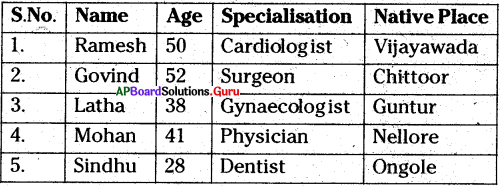
List of the doctors in NRI hospital, Guntur.
AP 6th Class English Important Questions Chapter 7 Dr. B. R. Ambedkar 1

Now, answer the following questions.
1) Who is the youngest doctor of all?
Answer:
Dr. Sindhu

2) Which doctor performs operations?
Answer:
Dr. Govind

Choose the correct answer from the choices given.
3) Sindhu treats the problems of………….
A) heart
B) teeth
C) eyes
Answer:
C) eyes

4) Who treats the problems of heart?
A) Dr. Ramesh
B) Dr. Sindhu
C) Dr. Mohan
Answer:
A) Dr. Ramesh

5) Which of the following statements is True?
A) Two doctors come from Guntur.
B) Govind comes from Ongole.
C) There is only one physician in the hospital.
Answer:
C) There is only one physician in the hospital.

Vocabulary

I. Choose the words with similar meanings (Synonyms) from the list given to the words underlined.

1) [suspect, gather, great, scrupulous ]
The title of the project is “Pillars of Modern India”. We have to collect (a) some important incidents that happened in the lives of the eminent (b) persons who laid the foundation for modern India.
Answer:
a) gather
b) great

2) [absence, partiality, termination, lakh]
Ambedkar felt that lack (a) of education is the root cause of caste discrimination (b) in India.
Answer:
a) absence
b) partiality

3) [arouse, distressed, fetched, elevate]
He decided to uplift (a) the oppressed (b) classes and remove caste barriers.
Answer:
a) elevate
b) distressed

4) [brought, bought, aged, ancient]
He purchased (a) about 2,000 oM (b) books when he was in New York.
Answer:
a) bought
b) ancient

5) [designated earliest, further, governed]
He was appointed (a) the first (b) Law Minister in Jawaharlal Nehru’s cabinet.
Answer:
a) designated
b) earliest

AP 6th Class English Important Questions Chapter 7 Dr. B. R. Ambedkar

II. Write the opposite words of the underlined words.

1) I am writing this letter to tell you certain (a) heart-touching incidents from the life (b) of Dr. Ambedkar.
Answer:
a) uncertain
b) death

2) This nightmare incident made an indelible (a) impression on the tender (b) mind of Bhim.
Answer:
a) erasable
b) tough

3) He decided to uplift (a) the oppressed classes and remove (b) caste barriers.
Answer:
a) lower
b) introduce

4) He was appointed the first (a) Law Minister in Jawaharfal Nehru’s cabinet. He was the champion of the oppressed, classes and the leader (b) of all.
Answer:
a) last
b) follower

5) I believe (a) that Babasaheb achieved such a success (b) because of his reading habit.
Answer:
a) doubt
b) failure

III. Fill in the blanks with the right form of the words given in the brackets.

1) We have to collect some ______ (a) (important/importance) incidents that happened in the lives of the ______ (b) (eminence/eminent) persons who laid the foundation for modern India.
Answer:
a) important
b) eminent

2) His father was ______ (a) (work/working) in a ______ (b) (distant/distance) village named Koregaon.
Answer:
a) working
b) distant

3) There was a Brahmin teacher in his high school who showed ______ (a) (great/greatly) love and ______ (b) (affect / affection) for Bhimrao.
Answer:
a) great
b) affection

4) He was ______ (a) (appointment/appointed) the first Law Minister in Jawaharlal Nehru’s cabinet. He was the ______ (b) (champion/championship) of the oppressed classes and the leader of all.
Answer:
a) appointed
b) champion

5) I believe that Babasaheb ______ (a) (achieved/achievement) such a ______ (b) (success/successful) because of his reading habit.
Answer:
a) achieved
b) success

AP 6th Class English Important Questions Chapter 7 Dr. B. R. Ambedkar

IV. Complete the following words using “ai, ea, ee, ie, oi, ou or ua”.

1) We have to collect some important incidents that happened in the lives of the eminent persons who l_ _d the f_ _ndation for modern India.
2) Bhimrao started exper_ _ncing the pangs of unt_ _chability right from his childhood.
3) There was a Brahmin t_ _cher in his high schbol who showed gr_ _t love and affection for Bhimrao.
4) Then, he joined the London School of Economics and grad_ _ted in Political Sc_ _nee.
5) He was app_ _nted Chairman of the Drafting Committ_ _to write India’s new Constitution.
6) The Government of India rel_ _sed a stamp in memory of his Veil_ _ble services to modern India.
Answer:

  1. laid, foundation
  2. experiencing, untouchabilitv
  3. teacher, great
  4. graduated, science
  5. appointed, committee
  6. released, valuable

V. Complete the following words with the suitable suffixes given in die brackets.

1) Bhimrao started experieheing the pangs of untouchabil ______ (yty/ity) right from his child ______ (hood/ish).
2) The ill-trea ______ (ment/mant) of the cart – man frighten ______ (ed/d) the children on the way.
3) Ambedkar felt that lack of educa ______ (sion/tiori) is the root cause of caste discrimina ______ (tion/sion) in India.
4) The Government of India releas ______ (d/ed) a stamp in memory of his valu ______ (eble/able) services to modern India.
Answer:

  1. untouchability, childhood
  2. ill-treatment, frightened
  3. education, discrimination
  4. released, valuable

VI. Identify the wrongly spelt word and write its correct spelling in the space provided.

1) childhood, station, arrivel, vacation
Answer:
arrival

2) expereince, frightened, nightmare, replied
Answer:
expereince

3) comittee, chairman, education, cause
Answer:
committee

4) oppress, modern, science, intelectual
Answer:
intellectual

5) appoint, amazing, voratious, capacity
Answer:
voracious

6) drafting, constitusion, champion, class
Answer:
constitusion

VII. Arrange the following words under the correct headings.

1) [love, midnight, morning, affection]

Time related things Abstract things
1) midnight 1) love
2) morning 2) affection

2) [receive, remove, oppressed, intellectual]

Activities Qualities
1) receive 1) oppressed
2) remove 2) intellectual

3) [champion, district, leader, market]

Persons Places
1) champion 1) district
2) leader 2) market

4) [conference, distant, rude, climbing]

Qualities Activities
1) distant 1) conference
2) rude 2) climbing

AP 6th Class English Important Questions Chapter 7 Dr. B. R. Ambedkar

VIII. Read the following sentences. Circle the Wrongly spelt words and write the correct spelling.

1. Those incidents are very intresting.
Answer:
Those incidents are very interesting.

2. Koregaon is a distent place from their village.
Answer:
Koregaon is a distant place from their village.

3. He spent summer vocation with his father.
Answer:
He spent summer vacation with his father.

4. Bhim experienced pongs of untouchability.
Answer:
Bhim experienced pangs of untouchability.

5. They mnaneged to rent a bullock cart.
Answer:
They managed to rent a bullock-cart.

6. They were fritened by the cart-man.
Answer:
They were frightened by the cart-man.

7. That incident made an indelibel impression on his tender mind.
Answer:
That incident made an indelible impression on his tender mind.

8. The teacher showed great love and afection for Bhim.
Answer:
The teacher showed great love and affection for Bhim.

9. Bhim was an intelectual.
Answer:
Bhim was an intellectual.

10. Ambedkar was the champion of the oppresed classes.
Answer:
Ambedkar was the champion of the oppressed classes.

Grammar

I. Read the following passage and correct the underlined parts. Rewrite the corrected parts in the space provided.

1. India get (1) its freedom m 1947 for (2) the struggle made by many greatness (3) lead¬ers. We maybe (4) proud to be Indians.
Answer:
1) got
2) with
3) great
4) are

2. Hyderabad is the (1) big city. There’s heavy traffic above (2) its roads. The buses, cars, and other vehicles releasing (3) gases which pollute the air. There are several industries in and along (4) Hyderabad.
Answer:
1) a
2) on
3) release
4) around

3. My village is Velur. He (1) is eight kilometers away from Chilakaluripet. It has around five hundred house (2). Our people are kind, friendly and co-operative. We don’t believe on (3) religion and politics. We lived (4) together. ‘
Answer:
1) It
2) houses
3) in
4) live

AP 6th Class English Important Questions Chapter 7 Dr. B. R. Ambedkar

II. Complete the following passage choosing the right words from the choices given below. Each blank is numbered and four choices are given. Choose the correct answer and write (A), (B), (C) or (D) in the blanks.

1. One day Mr. Rao was at ______ (1) office. Suddenly he ______ (2) a headache. He wanted to take rest. ______ (3) he went home early. He ______ (4) that his wife was not at home.
1. A) her B) his C) its D) their
2. A) have B) was C) had D) has
3. A) So B) But C) Why D) As
4. A) finds B) will find C) finding D) found
Answer:
1 – B
2 – C
3 – A
4 – D

2. One day a fox and a goat were thirtsy. They ______ (1) water.’They went ______ (2) a well. The fox said to the goat, “Stand by the wall. Stand ______ (3) your hind legs. Rise your fore legs. I will get upon you. I will jump ______ (4).
Then I will draw you after me.”
1. A) want B) wanted C) were wanting D) had wanted
2. A) up B) down C) after D) by
3. A) up B) upon C) by D) to
4. A) out B) down C) after D) by
Answer:
1 – B
2 – B
3 – B
4 – A

3. A king ______ (1) on his way home after hunting. He came across ______ (2) old man along the roadside. The old man ______ (3) shivering ______ (4) dark corner.
1. A) is B) was C) has D) came
2. A) one B) a C) the D) an
3. A) is B) was C) has D) an
4. A) with B) from C)by D) besides
Answer:
1 – B
2 – D
3 – B
4 – A

III. Change the following conversation into Indirect Speech.

Aunt : Where are you going?
Ram : I am going to market.
Aunt : Please bring me some vegetables.
Ram : Certainly, I will bringthem.
But, which vegetables do you want?
Aunt : Bring potatoes and brinials.
Ram : O.K., aunt.
Answer:
Aunt asked Ram where he was going. Ram replied that he was going to market. Aunt requested him to bring her some vegetables. Ram responded positively and asked her which vegetables she wanted. She asked him to bring potatoes and brinjals. Ram replied that he would bring them.

AP 6th Class English Important Questions Chapter 7 Dr. B. R. Ambedkar

IV. Change the following conversation into Indirect Speech.

Prakash : May I come in sir?
Teacher : Why are you so late?
Prakash : I missed the school bus and I have to walk all the way, sir.
Teacher : Why did you miss the school bus?
Prakash : I woke up late sir.
Teacher : It’s O.K., don’t be late once again. Go to bed early so that you will wake up early.
Prakash : O.K., sir.
Teacher : Come in.
Prakash : Thank you sir!
Answer:
Prakash asked his teacher to permit him to come into the classroom. The teacher asked him why he was so late Prakash replied that he had missed the school bus and he had to walk all the way to school. The teacher again asked him why he had missed the school bus. He replied that he had woken up late. The teacher asked him not to be late once again. He advised him to go to bed early so that he would wake up early. Prakash replied that he wouldn’t be late once again. The teacher permitted him to enter the classroom and Prakash thanked his teacher.

V. Change the following conversation into Indirect Speech.

1. He said, “I am ill.”
2. Lakshmi said to Veena, “I am leaving for Mumbai tomorrow.”
3. Nandu said; “1 killed a cobra.”
4. The teacher said to Aruna, “Stand up on the bench.”
5. He said to her, “Can you speak English ?
6. She said to him, “Where are you coming from ?”
7. He said, “She likes to wear black sarees.”
8. Venkatesh said, “I kept the ball in the shelf.”
9. Nitin said, “I have drawn a picture.”
10. Sindhu said to Meena, “Post the letter.”
11. Krishna said to Rama, “When did ypu pass your SSC?”
12. Rafi said to Benzamin, “Why did you do that?”
13. Sravya said, “1 have a beautiful parrot.”
14. Sudha said to Lekha, “Did you like it?”
15. Bhaskar said, “What a cool day it is!”
Answer:

  1. He said that he was ill.
  2. Lakshmi told Veena that she was leaving for Mumbai the next day.
  3. Nandu said that he had killed a cobra.
  4. The teacher ordered Aruna to stand up on the bench.
  5. He asked her if she could speak English.
  6. She asked him where he was coming from.
  7. He said that she liked tb wear black sarees.
  8. Venkatesh said that he had kept the ball in the shelf.
  9. Nitin said that he had drawn a picture.
  10. Sindhu requested Meena to post the letter.
  11. Krishna asked Rama when he had passed his SSC.
  12. Rafi asked Benzamin why he had done it.
  13. Sravya said that she had a beautiful parrot.
  14. Sudha asked Lekha whether she liked it.
  15. Bhaskar exclaimed that it was a very cool day.

AP 6th Class English Important Questions Chapter 7 Dr. B. R. Ambedkar

VI. Fill in the blanks with the suitable adverbs given in the box.
[slowly, heavily; carefully, wonderfully, angrity]

1. It’s raining ______ .
2. She plays the piano ______ .
3. The snail was moving ______ .
4. He yelled ______ .
5. He always drives his car ______ .
Answer:
1. heavily
2. wonderfully
3. slowly
4. angrily
5. carefully

Creative Expression

Question 1.
Bhim started his journey along with his brother and cousin to his father’s place. On their way, they were ill-treated by the cart-man. When he begged someone for water, he refused to give them water as he came to know that they were Mahars. That nightmare incident made an indelible impression on his tender mind.

Now, attempt a diary entry made by Dr.’ Bhim after he had received that ill- treatment.
Answer:

Monday, 24 April, 1900
8 p.m.

Dear Diary,

What a disgusting day today is! It is really an unforgettable day in my life. That cart- man really humiliated us ! We were upset with his behaviour. At the resting place, when I asked a man to give us some water to drink, he refused to give us. I was very sad to hear his harsh words. I became angry too! This is all because of my caste only! Is it our sin to be born as a Mahar? Why do they treat as untouchables ? No, I should do something about it. From today onwards, I should try to uplift the oppressed classes and remove caste barriers.

Bhim
2/7, Brodipet,

AP 6th Class English Important Questions Chapter 7 Dr. B. R. Ambedkar

Question 2.
You have read about Masthan Babu in the lesson “The Trekking Champion”. His story is really a source of inspiration to each and every child.
Now, write a letter to your friend who is studying fifth class describing the great achievements of Masthan Babu.
Answer:

Guntur.
10th December, 20xx.

Dear Sushma,
I am safe here and hope the same with you. 1 am doing well. What about you ? It’s a long time since I received a letter from you.

In this letter, I would like to write to you about Malli Masthan Babu, the trekking champion; Yesterday, we learnt about him when our teacher explained to us about his great achievements. He acquired his M.Tech Degree from IIT, Kharagpur. Though he was a brilliant student, he was interested in trekking. He reached the highest peaks in all the seven continents in 2006. He climbed Mount Everest and the Andes Mountains successfully. He was regarded as the fastest “Seven Summiteer”. Unfortunately, he died on 24 March 2015 while descending the Andes due to bad weather.

He is really a source of inspiration to all of us 1 His uncrushable spirit inspires us forever. I too want to become a mountaineer. I have taken this decision with the inspi¬ration I have got after knowing about him.

Convey my regards to your parents.

Yours lovingly,
x x x x

Address on the envelope :
To
K. Sushma,
D/o Prabhakar,
512, Sruthi Apartments,
Miyapur,
Hyderabad.

Question 3.
You want to go on leave In connection with your brother’s marriage. Write a letter to your Headmaster / Headmistress requesting to sanction you leave for 10 days.
Answer:

Veluru.
20th Septemebr, 20xx.

To
The Headmaster,
Z.P. High School,
Veluru.

Respected Sir,

I am a student of your school in 6th class in “B” section with roll no: 15. My brother’s marriage will be celebrated at Guntur on 24th of this month.

Hence I request you to sanction me leave for 10 days from tomorrow.

Yours obediently,
xxxx

These AP 6th Class English Important Questions 7th Lesson Dr. B. R. Ambedkar will help students prepare well for the exams.

AP 6th Class English Important Questions Chapter 6 A Lesson for All

AP State Syllabus 6th Class English 6th Lesson Important Questions and Answers A Lesson for All

Reading Comprehension Textual Passages

Question 1.
Read the following text carefully.
Mr. Vamsi : (looking out into the distance) The newspaper hasn’t been delivered today. Why? It’s nine o’clock. Almost time to leave for my office.
Mrs. Rupa : Hello! Mr. Vamsi!
Mr. Vamsi : Hi! Mrs. Rupa, have you received your newspaper today?
Mrs. Rupa : No, Mr. Vamsi, the newspaper boy hasn’t delivered the papers.
Mr. Vamsi : What about our milkman?
Mrs. Rupa : I made a call to him. He told me that he was coming on foot.
Mr. Vamsi : Oh! Look at our street. It’s shocking.
Mrs. Rupa : My word! What’s this? Where did all this litter and garbage come from?

Now, answer the following questions.
1. What was Vamsi waiting for?
Answer:
For the newspaper

2. What was the time when the conversation took place?
Answer:
It was nine o’clock in the morning.

3. How was the milkman reaching?
Answer:
On foot

4. Who made a call to the milkman?
Answer:
Mrs. Rupa

5. What was shocking about the street?
Answer:
The street was full of litter and garbage.

AP 6th Class English Important Questions Chapter 6 A Lesson for All

Question 2.
Read the following text carefully.

Kalyani : Oooh! Ouch! My foot! It hurts!
Mrs. Geetha : Oh Kalyani! Oh no, her foot is bleeding so much! Somebody help, please!
Mrs. Rupa : Jhansi, go and request Dr. Swathi to come quickly. Your sister has cut herself on a broken glass bottle.
Mrs. Geetha : Unbelievable! Where has all this rubbish come from? (Dr. Swathi enters with Jhansi. She has a doctor’s kit.)
Dr. Swathi : Let me see the wound.
Mr. Vamsi : Doctor, shall I go and bring a piece of ice to stop the bleeding?
Dr. Swathi : Good! (Applies ice on the wound.) It’s a deep cut. I will dress the wound and she will be fine.
Mrs. Geetha : Thank you, Doctor. It’s so kind of you to come at once. Have you seen the rubbish and litter on the road?

Now, answer the following questions.
1. What happened to Kalyani’s foot?
Answer:
Her foot was injured.

2. What was the relationship between Jhansi and Kalyani?
Answer:
They were sisters.

3. What was Swathi’s profession?
Answer:
She was a doctor.

4. What did Vamsi bring to stop bleeding?
Answer:
A piece of ice

5. What did they see on the road?
Answer:
Litter and garbage

Question 3.
Read the following text carefully.

Dr. Swathi : Oh! It’s a mystery. All this garbage was not there yesterday. And now… just look! (Enter newspaper boy, milkman, hawker, bus driver, etc.)
Mrs. Rupa : Look, the newspaper boy, the njilkman at last. Why are you so late?
Milkman : I had to come walking all the way.
Newspaper boy : I tripped on an old tyre in the middle of the road and sprained my foot.
Bus driver : Mrs. Geetha, I’m sorry. I can’t drive the school bus today. On every road and street thefe is nothing but litter.
Mrs. Geetha : Our children are not safe with all these dangerous broken objects around.
Hawker : No one is safe. Let’s request the Mayor to come and see for himself.
Mr. Vamshi : I’ll fetch him. (Exits.)

Now, answer the following questions.
1. What was the mystery?
Answer:
It was a mystery how the garbage came into the street.

2. What happened to the newspaper boy?
Answer:
He tripped on an old tyre in the middle of the road and sprained his foot.

3. Why was the milkman late?
Answer:
He had to walk all the way.

4. What was the problem of the school bus driver?
Answer:
He could not drive the bus as there was litter everywhere on the roads.

5. Who went to call the Mayor?
Answer:
Mr. Vamsi

AP 6th Class English Important Questions Chapter 6 A Lesson for All

Question 4.
Read the following text carefully.

The Mayor : (Annoyed) Shocking! What is this litter? How did it come back into the town overnight?
Bus driver : Nobody knows. It’s a mystery. (Enter animals who have been hiding – deer, rabbit, birds, squirrel, tiger, etc.)
Animals : We are responsible! We have spread the garbage all over the town.
Deer : Yes, we confess, we did so.
The Mayor : What? You! How dare you?
Mrs. Geetha : What right do you have to spoil our town?
Tiger : What right do you have to spoil our forests? The forest is our dwelling place.
Birds : Our trees are dying because of you. Where can we roost or build our nests?
Squirrel : And where can we live?
Rabbit : You are worried about Kalyani when she was injured.

Now, answer the following questions.
1. What made the Mayor feel shocking?
Answer:
The litter on the roads

2. Who were responsible for spreading garbage all Over the town?
Answer:
Animals

3. What did the deer confess?
Answer:
The deer confessed that animals were responsible for spreading garbage all over the town.

4. Where did the animals live?
Answer:
In.the forest

5. Who spoiled the trees?
Answer:
Human beings

AP 6th Class English Important Questions Chapter 6 A Lesson for All

Question 5.
Read the following text carefully.

Jhansi/Kalyani : Oh, no! How shocking! Terrible!
Deer : But we have no doctors.
Tortoise : All the fish in the rivers and lakes die because of the waste dumped in water.
Dr. Swathi : Yes, it is unfortunately true.
Birds : So we arranged a meeting and decided to give all your rubbish back to you.
Tiger : We have only returned the garbage, but not chemicals and poisons.
The Mayor : Dear animals and birds, you are fight.
Mrs. Rupa : But where can we dispose of it?
The Mayor : If you all agree to sort out the litter, I will arrange for it to be collected separately. Then, some of it Can go for processing and some, for recycling.
Mrs. Geetha : Good idea! Let’s do just that.
The Mayor : Let us save our mother earth. (To the animals) Thank you, dear animals for teaching us a lesson. We assure you we will not pollute or spoil your homes.
Animals : Thank you, Mr. Mayor! Thank you.(They return.)
The Mayor : Self-help is the best help. Let’s clear this up. (All including the Mayor start picking up the litter.)

Now, answer the following questions.
1. Who have doctors?
Answer:
Human beings

2. How did the fish in the rivers die?
Answer:
Because of the waste dumped in rivers

3. What did the animals not return?
Answer:
Chemicals and poisons

4. What was the Mayor’s suggestion?
Answer:
The Mayor suggested that the garbage should be collected separately..Then, some of it can go for processing and some, for recycling.

5. Why did the Mayor thank the animals?
Answer:
Because they taught a lesson to human beings.

AP 6th Class English Important Questions Chapter 6 A Lesson for All

Question 6.
Read the following lines carefully.

Said the little boy, “Sometimes I drop my spoon.”
Said the little old man, “I do that too.”
The little boy whispered, “I wet my pants.”
“I do that too”, laughed the little old man.

Now, answer the following questions.
1. Who are the two persons talking to each other?
Answer:
The little boy and the old man

2. What does the little boy say to the old man at first?
Answer:
He says that he sometimes drops his spoon.

3. What is the reply of the old man for the little boy’s first expression?
Answer:
The old man says that he also drops his spoon.

4. Why does the little boy whisper that he wets his pants?
Answer:
Because wetting pants is a bad habit.

5. Does the old man wet his pants?
Answer:
Yes.

AP 6th Class English Important Questions Chapter 6 A Lesson for All

Question 7.
Read the following lines carefully.

Said the little boy, “1 often cry.”
The old man nodded, “So do I.”
“But worst of all,” said the boy, “It seems
Grown-ups don’t pay attention on me.”
And he felt the warmth of a wrinkled old hand.
“I know what you mean,” said the little old’man.

Now, answer the following questions.
1. Who are the two persons talking to each other?
Answer:
The little boy and the old man

2. What does the little boy often do?
Answer:
He often cries.

3. ’The old man nodded.’ Why does the old man do that?
Answer:
To say that he also often cries

4. What is the worst of all according to the little boy?
Answer:
Grown-ups neglecting him

5. Is the old man neglected by the grown-ups?
Answer:
Yes.

Unseen Comprehension

Question 8.
Read the following passage.

In a certain house which was infested with mice, the cat found easy prey. The mice were very unhappy. The cat killed so many of them that they were all in great fear. At last they held a meeting to discuss how they could get rid of the nasty cat. One mouse said this, another said that but none of the plans was of any use. Then a young mouse stood up and said, “The best thing we can do is to tie a bell round the cat’s neck. Then when the cat comes we will hear the bell and get out of the way.” All the mice shouted. “Good ! Admirable ! Simple! Easy!” They all thought it was a very good plan, indeed. But now an old mouse, who had all the while been listening to the proposals quietly, stood up and said, “Yes, it is a very good plan, no doubt, but who will tie the bell round the cat’s neck ?” No one came forward to say that he would.

Now, answer the following questions.
1. Why were the mice unhappy?
Answer:
The cat ate them up. So they were unhappy.

2. Why did the mice hold a meeting?
Answer:
They held a meeting to discuss how they could .get rid of the nasty cat.

Choose the correct answer from the choices given.
3. Who came forward to tie the bell around the cat’s neck?
A) Oniy the young mouse
B) Only the old mouse
C) No one came forward
Answer:
C) No one came forward

4. What is meant by the word ‘infested’ in the passage?
A) Something which spreads in large numbers
B) It is an infection that affects mice
C) Spreads in a focused manner
Answer:
A) Something which spreads in large numbers

5. Who was the wise one in the passage?
A) The cat
B) The young mouse
C) The old mouse
Answer:
C) The old mouse

Interpretation of Non-Verbal Information

1. Study the following results.
AP 6th Class English Important Questions Chapter 6 A Lesson for All 1
Now, answer the following questions.
1. Name the school topper.
Answer:
Swathi is the school topper.

2. Who got the lowest percentage?
Answer:
Manjula and Bhanu Prasad got the lowest percentage.

Choose the correct answers from the choices given.
3. The two students who scored equal percentage are_______
A) Swathi and Bhanu Prasad
B) Manjula and Bhanu Prasad
C) Swathi and Manjula
Answer:
B) Manjula and Bhanu Prasad

4. Farooq has scored percentage of marks.
A) 69
B) 76.8
C) 85
Answer:
C) 85

5. Which of the following statements is True?
A) Mamatha and Sruthi Geetha scored equal percentage.
B) Masanna has scored the least percentage of marks in the class.
C) The average percentage of the class is 86.
Answer:
A) Mamatha and Sruthi Geetha scored equal percentage.

Vocabulary

I. Choose the words with similar meanmgs (Synonyms) from the list given to the words underlined.

1) [laboriously, swiftly, abuse, seek]
Mrs. Rupa : Jhansi, go and request (a) Dr. Swathi to come quickly (b).
Answer:
a) seek
b) swiftly

2) [notorious, cut, good, peculiar]
Dr. Swathi: I will dress the wound (a) and she will be fine (b).
Answer:
a) cut
b) good

3) [protected, substitute, threatening, vulgar]
Mrs. Geetha: Our children are not safe (a) with all these dangerous (b) broken objects around.
Answer:
a) protected
b) threatening

4) [determined, pious, assembly, party]
Birds: So we arranged a meeting (a) and decided (b) to give all your rubbish back to you.
Answer:
a) assembly
b) determined

5) [suppress, fresh, greatest, clean]
The Mayor: Self-help is the best (a) help. Let’s clear (b) this up.
Answer:
a) greatest
b) clean

AP 6th Class English Important Questions Chapter 6 A Lesson for All

II. Write the opposite words of the underlined words.

1) Mrs. Rupa : Jhansi, go and request (a) Dr. Swathi to come quickly (b).
Answer:
a) cortimand
b) slowly

2) Hawker: No one is safe (a). Let’s request (b) the Mayor to come and see for himself.
Answer:
a) unsafe
b) command

3) Birds: Our trees are dying (a) because of you. Where can we roost or build (b) our nests?
Answer:
a) living
b) destroy

4) The Mayor : Let us save (a) our earth. Thank you, dear animals for teaching us a lesson. We assure you we will not pollute (b) or spoil your homes.
Answer:
a) endanger
b) purify

III. Fill in the blanks with the right form of the words given in the brackets.

1) Dr. Swathi: Good! (Applies ice on the wound.) It’s a ______ (a) (deep/deeply) cut. I will ______ (b) (dress/dressing) the wound and she will be fine.
Answer:
a) deep
b) dress

2) Our children are not ______ (a) (safe/safely) with all these ______ (b) (danger/dangerous) broken objects around.
Answer:
a) safe
b) dangerous

3) Birds : Our trees are ______ (a) (dye/dying) because of you. Where can we roost or ______ (b) (build/building) our nests?
Answer:
a) dying
b) build

4) Birds : So we ______ (a) (arranged/arrangement) a meeting and ______ (b) (decided/decision) togive all your rubbish back to you.
Answer:
a) arranged
b) decided

AP 6th Class English Important Questions Chapter 6 A Lesson for All

IV. Complete the following words using “ea, ee, oa, oo, ou or ui”.

1) Mrs. Geetha: Oh Kalyani, Oh no, her foot is bl_ _ding so much! Somebody help, pi_ _se !
2) Dr. Swathi: Good ! (Applies ice on the wound.) It’s a d_ _p cut. I will dress the w_ _nd and she will be fine.
3) Bus driver: On every r_ _d and str_ _t there is nothing but litter.
4) Birds : Where can we r_ _st or b_ _Id our nests?
Answer:
1) bleeding, please
2) deep, wound
3) road, street
4) roost, build

V. Complete the following words with the suitable suffixes given in the brackets.

1) Mrs. Geetha : Oh Kalyani, Oh no, her foot is bleed ______ (ing/ng) so much! Somebody help, please!
Mrs. Rupa : Jhansi, go and request Dr. Swathi to come quick ______ (lly/ly).

2) Mrs. Geetha : Our child ______ (en/ren) are not safe with all these danger ______ (ous/eous) broken objects around.

3) The Mayor : (Annoyed) Shock ______ (ing/king) ! What is this litter? How did it come back into the town overnight?
Bus driver : Nobody knows. It’s a myst ______ (ery/ary).

4) The Mayor : If you all agree to sort out the litter, I will arrange for it to be collect ______ (d/ed) separate ______ (ly/lly).
Answer:
1) bleeding, quickly
2) children, dangerous
3) Shocking, mystery
4) collected, separately

VI. Identify the wrongly spelt word and write its correct spelling in the space provided.
1) receive, deliver, injure, cartan
Answer:
carton

2) leave, hurt, daughter, rubish
Answer:
rubbish

3) hawker, unbelevable, bleed, dress
Answer:
unbelievable

4) quickly, please, wound, triped
Answer:
tripped

5) dangerus, request, around, spread
Answer:
dangerous

VII. Arrange the following words under the correct headings.

1) [newspaper boy, lion hawker, hare]

Persons Animals
1) newspaper boy 1) lion
2) hawker 2) hare

2) [cat, hawk, pigeon, fox]

Animals Birds
1) cat 1) hawk
2) fox 2) pigeon

3) [process, pollute, unbelievable, wrinkled]

Qualities Activities
1) unbelievable 1) process
2) wrinkled 2) pollute

4) dangerous, laugh, terrible, nod

Activities Qualities
1) laugh 1) dangerous
2) nod 2) terrible

Grammar

I. Read the following passage and correct the underlined parts. Rewrite the corrected parts in the space provided.

1. In the city of Ujjain there was a young merchant name (1) madanaka. He lost her (2) father when he is (3) in his teens, so it was his mother brought him up by (4) great affection.
Answer:
1) named
2) his
3) was
4) with

2. Last Sunday, I attend (1) Lahari’s birthday party. All her family members but (2) friends are (3) present their (4).
Answer:
1) attended
2) and
3) were
4) there

AP 6th Class English Important Questions Chapter 6 A Lesson for All

II. Complete the following passage choosing the right words from the choices given below. Each blank is numbered and four choices are given. Choose the correct answer and write (A), (B), (Q or (D) in the blanks.

1. Lai Bsrtiadur Sastri ______ (1) born on 2nd October, 1964 ______ (2) Mogul Sarai ______ (3) Varanasi. His father was ______ (4) ordinary teacher and died when he was below two years of age.
1. A) is B) was C) are D) were
2. A) at B) in C) from D) on
3. A) of B) from C) in D) at
4. A) the B) an C) a D) one
Answer:
1 -B
2 – A
3 – C
4 – B

2. One day a Brahmin was walking ______ (1) a forest ______ (2) suddenly he ______ (3) someone crying out for help. He ______ (4) in the direction of the sound and came upon a well that was dried up.
1. A) by B) through C) in D) from
2. A) or B)through C) when D) but
3. A) heard B) hear C) hears D) hearing
4. A) go B) went C) goes D) going
Answer:
1 – B
2 – C
3 – A
4 – B

III. Read the following sentences and fill in the blanks with ‘will’ ’ or ‘shall’.

1. ______ you accompany me?
2. ______ I carry the bag for you?
3. ______ you give me your English reader?
4. ______ I drive your car? You are tired.
5. I ______ talk to your father.
6. You ______ go at once.
7. ______ I bring vou the tablets?
8. He ______ turn off the light.
9. She ______ close the door.
10. ______ we travel by car?
Answer:

  1. Will
  2. Shall
  3. Will
  4. Shall
  5. will
  6. shall
  7. Shall
  8. will
  9. will
  10. Shall

AP 6th Class English Important Questions Chapter 6 A Lesson for All

IV. Form the questions (offers, suggestions) using the hints given below.
1. shall/cook/idlis
2. shall/carry/luggage
3. shall/I/call/later
4. shall/start/game
5. shall/complete/together
6. shall/follow/enemy troops
7. shall/type letter/you
8. shall/go/our native-place
9. shall/invite/friends/dinner
10. shall/drop/office
Answer:

  1. Shall I cook idlis for breakfast?
  2. Shall I carry your luggage?
  3. Shall I call you later?
  4. Shall we start the game?
  5. Shall we complete the task together?
  6. Shall we follow the enemy troops?
  7. Shall I type the letter for you?
  8. Shall we go to our native place?
  9. Shall we invite my friends for dinner?
  10. Shall I drop you at your office?

V. Change the following “Future Actions” into “Past Actions”. (Simple Future into Simple Past)
1. I will meet you tomorrow.
2. She will prepare dinner.
3. They will play cricket.
4. Our team will win the match.
5. I will call you later.
6. He will arrive on time.
7. It will rain tomorrow.
8. Raju Will come at 9 p.m.
9. They will publish the results.
10. The headmaster will beat you.
Answer:

  1. I met you yesterday.
  2. She prepared dinner.
  3. They played cricket.
  4. Our team won the match.
  5. I called you yesterday.
  6. He arrived on time.
  7. It rained yesterday.
  8. Raju came at 9 p.m.
  9. They published the results.
  10. The headmaster beat you.

VI. Change the following “Past Actions” into “Present Actions”. (Simple Past into Simple Present)

1. We caught fish.
2. They sold bangles.
3. I brought vegetables.
4. I travelled by bus.
5. She ate too many sweets.
6. Mr. Prakash taught us English.
7. Priya painted a number of pictures.
8. Lavanya spoke in English.
9. Raju played chess with his friends.
10. He washed his car.
Answer:

  1. We catch fish.
  2. They sell bangles.
  3. I bring vegetables.
  4. I travel by bus.
  5. She eats too many sweets.
  6. Mr. Prakash teaches us English.
  7. Priya paints a number of pictures.
  8. Lavanya speaks in English.
  9. Raju plays chess with his friends.
  10. He washes his car.

Creative Expression

Question 1.
You have read how Kalyani injured her foot in the lesson “A Lesson for AH’. Later, she came to know how their town was polluted by animals and birds and their request to the Mayor to stop polluting their habitat.
Now, imagine that you were Kalyani and write a diary entry at the end of the day.
Answer:

Thursday, 4 February 20xx
8 p.m.

Dear Diary,
Today is a memorable day in my life. Though I injured earlier in the day, the animals and birds opened our eyes. I did not understand why all the streets were filled with litter and garbage. I was shocked to know from animals that the litter and garbage were returned to us from them. They, actually, did it to make us realize our mistakes. We, the human beings should curse ourselves for doing all this! Why should we pollute their dwelling places? Where can they live? The human beings should change their attitude. They should avoid the bags made of plastic. They can use the bags made of jute, paper or cloth. We should lessen the use of the number of vehicles. We should not cut down trees. We should not dump the waste in water bodies, We should not throw away litter everywhere. From today onwards I will try to do all these things. I shall make the persons 1 meet aware of the measures taken up to reduce pollution and save ourselves.

Kalyani

AP 6th Class English Important Questions Chapter 6 A Lesson for All

Question 2.
You want to go on leave in connection with your brother’^ marriage. Write a letter to your Headmaster / Headmistress requesting to sanction you leave for 10 days.
Answer:

Veluru.
20th Septemebr, 20xx.

To
The Headmaster,
Z.P. High School,
Veluru.

Respected Sir,

I am a student of your school in 6th class in ‘B’ section with roll no: 15. My brother’s marriage will be celebrated at Guntur on 24th of this month.

Hence I request you to sanction me leave for 10 days from tomorrow.

Yours obediently,
xx xx

These AP 6th Class English Important Questions 6th Lesson A Lesson for All will help students prepare well for the exams.

AP 6th Class English Important Questions Chapter 5 At the Vegetable Shop

AP State Syllabus 6th Class English 5th Lesson Important Questions and Answers At the Vegetable Shop

Reading Comprehension Textual Passages

Question 1.
Read the following text carefully.

Ramu’s mother is busy at home. She sends him to buy vegetables. Ramu goes to a vegetable shop, with a bag in his hand.
Vendor : Hi Ramu! You have come alone today.
Ramu : Hi uncle. My mother is very busy now. My aunt’s family is coming. So, she has sent me here.
Vendor : What do you like to buy today?
Ramu : My mother asked me to buy more vegetables today.
Vendor : Well, pick the vegetables you want to buy.
(Ramu looks at the vegetables and listens to them speaking)
Ramu : Buy me! Buy me! You can eat me raw or cooked. You can prepare a curry or sambar. I will keep your eyes sparkling.

Now, answer the following questions.
1. Who sent Ramu to buy vegetables?
Answer:
Ramu’s mother

2. Why did Ramu’s mother send Ramu to buy vegetables?
Answer:
Because she was busy at home.

3. How can we eat carrot?
Answer:
We can eat carrot raw or cooked.

4. Which vegetable is good for our eyesight?
Answer:
Carrot

5. Apart from the vendor, who is speaking to Ramu?
Answer:
Vegetables

AP 6th Class English Important Questions Chapter 5 At the Vegetable Shop

Question 2.
Read the following text carefully.

Spinach : Hey! Look at me. I give you a lot of iron content. You’ll be robust if you eat me!
Brinjal : Hi Ramu! Try me. I am the queen of vegetables. See, I have a crown on my head. Even poets wrote poems and songs on my taste.
Potato : Ramu! Why don’t you buy me? People across the world prefer to eat me. I have fibre, potassium and vitamins that keep you strong.
Pumpkin : Look at me! I’m very sweet. Though I am fat and round, I keep you thin!

Now, answer the following questions.
1. Which vegetable gives us iron content?
Answer:
Spinach

2. Who is the queen of vegetables?
Answer:
Brinjal

3. Who is potato talking to?
Answer:
Ramu

4. How are potatoes helpful for us?
Answer:
They give us fibre, potassium and vitamins that keep us strong.

5. Which vegetable looks fat and round?
Answer:
Pumpkin

Question 3.
Read the following text carefully.

Curry leaves : Oh! Don’t forget us! You need us in all spicy foods and chutneys. I give aroma to your dish. Remember, I keep your eyes and hair healthy.
Ramu : How shall I buy all these vegetables? Mother gave me only Rs. 80/-. Can I carry this pumpkin home? Let me see.
(Suddenly Ramu sees a purse among the pumpkins.)
Ramu : Uncle! I found a purse here. Whose purse is this?
Vendor : Oh! It is my purse. Perhaps it slipped from my pocket while unloading the vegetables from the bullock-cart. Thank you, Ramu!
Ramu : Is everything okay, uncle?
Vendor : Thank God! My purse is intact. I got my ATM card and money back.

Now, answer the following questions.
1. What gives aroma to our dishes?
Answer:
Curry leaves

2. How much money does Ramu have?
Answer:
Rs. 80 only

3. Where did Ramu find a purse?
Answer:
Among pumpkins

4. Whose purse is it?
Answer:
The vendor’s purse

5. What does the purse contain?
Answer:
An ATM card and money

AP 6th Class English Important Questions Chapter 5 At the Vegetable Shop

Question 4.
Read the following text carefully.

Ramu : Uncle! I want to buy all kinds of vegetables. But I don’t have enough money. Give me one kg of brinjals, half a kg of potatoes and some curry leaves.
Vendor : Ramu! Take whatever you want. You need not pay for the vegetables you buy today.
Ramu : Thank you uncle. Then I will buy half a kg each of all the vegetables.
Vendor : Do you need a polythene bag?
Ramu : No, uncle! I never use polythene bags. I always carry a jute bag with me.
Vendor : That’s good, Ramu!
Ramu : Oh! It’s 9 o’clock! It’s getting late! My mother is waiting for me. Bye, uncle!
Vendor : See you tomorrow!

Now, answer the following questions.
1. What does Ramu want to buy?
Answer:
All kinds of vegetables

2. What does the vendor offer?
Answer:
He offered vegetables free of cost.

3. Why does the vendor offer vegetables without payment?
Answer:
Because Ramu found his lost purse.

4. Which bag does Ramu always carry with him?
Answer:
A jute bag

5. What kind of boy is Ramu?
Answer:
Honest

Read it yourself

Question 5.
Read the following passage carefully.

Long ago there lived two brothers, Abhi and Adi. They loved each other very much. They worked day and night in their fields…and always had the highest yield in their area.

One day while sacking and dividing the paddy harvest Adi, the elder brother thought “Brother Abhi has a big family. My family is a smellier one. So, I will put an extra bag of paddy in his store and not tell him.”

Now, answer the following questions.
1. Who were the two brothers?
Answer:
Abhi and Adi

2. How did they work?
Answer:
Day and night/They worked very hard.

3. What were the two brothers?
Answer:
They were farmers.

4. Who was the elder brother?
Answer:
Adi

5. Who had big family?
Answer:
Abhi

AP 6th Class English Important Questions Chapter 5 At the Vegetable Shop

Question 6.
Read the following passage carefully.

So, late that night, he carried a bag of paddy to his brother’s storeroom. The next day, Adi was surprised to find that he still had the same number of paddy bags as he had before. “This is surprising! I kept a paddy bag in my brother’s store! Well, I will just carry another bag of paddy to my brother’s storeroom tonight!”

That night he took another bag of paddy and started inwards his brother’s storeroom. But he saw another person coming towards his storeroom with a heavy bag on his back. The two brothers put down their bags and hugged each other and laughed for a long time. Both of them thought that the other needs an extra bag of paddy.

Now, answer the following questions.
1. Why was Adi surprised?
Answer:
He found the same number of paddy bags as he had before in his storeroom.

2. What did he want to do again?
Answer:
He wanted to keep another bag of paddy in his .brother’s storeroom.

3. Who was the another man carrying the bag?
Answer:
Abhi

4. What did both of them think?
Answer:
They thought that the other needs an extra bag of paddy.

5. How did they feel when they found each other carrying paddy bags?
Answer:
They hugged each other and laughed for a long time.

Unseen Comprehension

Question 7.
Read the following passage.

Ibrahim was a poor man. He was very honest. He worked as a watchman in a mango grove.

One day his master went to the garden and said, “Ibrahim, a few guests are visiting us tomorrow. Please bring some good mangoes to my house. Bring the sweet ones.”

The next day Ibrahim picked some mangoes and put them in a basket. He took the mangoes to his master’s house. His master felt happy because the mangoes were big in size and yellow in colour. The master thought the mangoes would be sweet.

Now, answer the following questions.
1. Who were visiting the master’s house?
Answer:
A few guests were visiting the master’s house.

2. Where did Ibrahim take the mangoes ?
Answer:
Ibrahim took the mangoes to his master’s house.

Choose the correct answer from the choices given.
3. The master asked Ibrahim to bring ………….
A) big mangoes
B) yellow mangoes
C) sweet mangoes
Answer:
C) sweet mangoes

4. The master thought the mangoes would be ………….
A) sour
B) sweet
C) big and yellow
Answer:
B) sweet

5. Which of the following statements is True?
A) Ibrahim worked as a gardener in a mango grove.
B) Ibrahim picked some mangoes and put them in a box.
C) Ibrahim was poor but very honest.
Answer:
C) Ibrahim was poor but very honest.

Interpretation Of Non-Verbal Information

Question 1.
Study the bus timings from Hyderabad to Bengaluru.

Types of Buses Departure from Hyderabad Arrival at Bengaluru
1) Super Deluxe I 6.00 a.m 6.00 p.m
2) Super Express I 8.00 a.m 8.30 p.m
3) Semi Luxury 11.15 a.m 11.30 p.m
4) Super Express II 2.45 a.m 1.15 a.m6
5) Super Deluxe II 6.30 p.m 6.30 a.m

Now, answer the following questions.
1. When does the first bus start from Hyderabad?
Answer:
6.00 a.m.

2. When does Super Deluxe I arrive at Bengaluru?
Answer:
6.00 p.m.

Choose the correct answer from the choices given.
3. How many Super Deluxe buses go to Bengaluru every day?
A) Three
B) Four
C) Two
Answer:
C) Two

4. When does the Semi Luxury, bus reach Bengaluru?
A) 11:30 p.m
B) 3:15 a.m
C) 6:30 a.m
Answer:
A) 11:30 p.m

5. Which of, the following statements is True?
A) The Semi Luxury bus reaches Bengaluru at 11:30 p.m.
B) Super Deluxe I departures from Hyderabad at 6:30 a.m.
C) Three Super Deluxe buses go to Bengaluru every day.
Answer:
A) The Semi Luxury bus reaches Bengaluru at 11:30 p.m.

Vocabulary

I. Choose the words with similar meanings (Synonyms) from the list given to the words underlined.
1) [fat, few, vigorous, plenty]
Spinach : Hey ! Look at me. I give you a lot of (a) iron content. You’ll be robust (b) if you eat me!
Answeer:
a) plenty
b) vigorous

2) [delicious, edible, hefty, normal]
Pumpkin : Look at me! I’m very sweet (a). Though I am fat (b) and round, I keep you think!
Answer:
a) delicious
b) hefty

3) [peculiar, vigorous, aromatic, tasteless]
You need us in all spicy (a) foods and chutneys. I give aroma to your dish. Remember, I keep your eyes and hair healthy (b).
Answer:
a) aromatic
b) vigorous

4) [suffer, sufficient, a few, a number of]
But 1 don’t have enough (a) money. Give me one kg of brinjals, half a kg of potatoes, and some (b) curry leaves.
Answer:
a) sufficient
b) a few

AP 6th Class English Important Questions Chapter 5 At the Vegetable Shop

II. Write the opposite words of the underlined words.

1) Carrot: Buy me! You can eat me raw or cooked (a). You can prepare a curry or sambar. I will keep your eyes sparkling (b).
Answer:
a) uncooked
b) dull

2) Spinach : Hey! Look at me. I give (a) you a lot of iron content. You’ll be robust (b) if you eat me!
Answer:
a) take
b) weak

3) Potato : Ramu ! Why don’t you buy me? People across the world prefer (a) to eat me. I have fibre, potassium, and vitamins that keep you strong (b).
Answer:
a) dislike
b) weak

4) Vendor : Thank God ! My purse is intact (a). I got my ATM card and money back.
Ramu : Uncle! I want to buy all kinds of vegetables. Blit I don’t have enough (b) money.
Answer:
a) damaged
b) insufficient

III. Fill in the blanks with the right form of the words given in the brackets.

1) Vendor : Hi! Ramu ! You have come ______ (a) (alone/lonely) today.
Ramu : Hi! Unicle. My mother is very busy now. My aunt’s family is ______ (b) (come/coming). So, she has sent me here.
Answer:
a) alone
b) coming

2) Spinach : Hey! Look at me. I give you a lot of iron ______ (a) (content/contented). You’ll be ______ (b) (robust/robustly) if you eat me !
Answer:
a) content
b) robust

3) Pumpkin : Look at me ! I’m very ______ (a) (sweet/sweety). Though I am fat and round, I keep you ______ (b) (think/thought).
Answer:
a) sweet
b) think

AP 6th Class English Important Questions Chapter 5 At the Vegetable Shop

IV. Complete the following words using “ee, eo, oe, oo or ou”.

1) Ramu ! Why don’t y_ _ buy me? P_ _pie across the world prefer to eat; me.
2) Though I am fat and r_ _nd, I k_ _p you think!
3) Oh! Don’t forget us ! You n_ _d us in all spicy f_ _ds and chutneys.
4) But I don’t have en_ _gh money. Give me one kg of brinjals, half a kg of potat _ _s and some curry leaves.
Answer:
1) you, People
2) round, keep
3) need, foods
4) enough, potatoes

V. Complete the following words with die suitable suffixes given in the brackets.

1) It’s gett___ (ing/ting) late !
2) My mother is wait___ (ting/ing) for me.
3) One day Adi was sacking and divid___ (eing/ing) the paddy harvest.
4) So, late that night, he carr___ (yied/ied) a bag of paddy to his brother’s storeroom.
5) One day they were travell___ (ing/eing) through a forest.
Answer:
1) getting
2) waiting
3) dividing
4) carried
5) travelling

VI. Identify the wrongly spelt word and write its correct spelling

1) curry, polithene, remember, suddenly
Answer:
polythene

2) perhaps, uncle, clock, unloding
Answer:
unloading

3) potatos, brinjals, curry leaves, spinach
Answer:
potatoes

4) busy, prefar, strong, people
Answer:
prefer

5) fiber, potassium, vitamins, sweet
Answer:
fibre

AP 6th Class English Important Questions Chapter 5 At the Vegetable Shop

VII. Arrange the following words under the correct headings.

1) [onion, egg plant, okra, ginger]

Aromatic vegetables Fruit vegetables
1) onion 1) egg plant
2) ginger 2) okra

2) [bottlegourd, gherkins, guava, pineapple]

Fruits Vegetables
1) guava 1) bottlegourd
2) pineapple 2) gherkins

3) [jealousy, affection, hatred, love]

Good qualities Bad qualities
1) affection 1) jealousy
2) love 2) hatred

4) [heavy, sacking, hugging, fat]

Qualities Activities
1) heavy 1) sacking
2) fat 2) hugging

Grammar

I. Read the following passage and correct the underlined parts. Rewrite the corrected parts in the space provided.

1. Once in a small village near the mountains lived a (1) old farmer and his wife. They had know (2) children. They were very old. One morning the old man wake up (3) eariy. He climbed the mountain so (4) slowly.
Answer:
1) an
2) no
3) woke up
4) very

2. Charaka was the first person to find about (1) what actually makes a human being fall sick. Though (2) a great physician, he presented the concepts of digestion, metabolism or (3) immunity. He gave the number of bones present on (4) the human body including teeth.
Answer:
1) out
2) As
3) and
4) in

AP 6th Class English Important Questions Chapter 5 At the Vegetable Shop

II. Complete the following passage choosing the right words from the choices given below. Each blank is numbered and four choices are given. Choose the correct answer and write (A), (B), (C) or (D) in the blanks.

1. Once upon a time, ______ (1) lived a rich man ______ (2) had a beautiful garden. There were different kinds of sweet ______ (3) plants and trees laden ______ (4) fruits.
1. A) then B) there C) their D) that
2. A) which B) what C) who D) when
3. A) smelling B) smelled C) smell D) smells
4. A) among B) with C) on D) by
Answer:
1 – B
2 – C
3 – A
4 – B

2. Soyabeans have twice the protein that meat and milk have. Proteins help the body to ______ (1). Milk and meat ______ (2) costly these days. ______ (3) families can use soyabeans ______ (4) a healthy and cheaper diet.
1. A) growth B) grown C) growing. D) grow
2. A) are B) is C) are being D) instead
3. A) Because B) So C) However D) Have been
4. A) in B) as C) for D) ort
Answer:
1 – D
2 – A
3 – B
4 – B

III. Fill in the blanks with the correct forms of verbs given in brackets.

When Rohit went to the school, the school bell ______ (1) (ring). Most of the students ______ (2) (run). Teachers ______ (3) (talk) with each other. The headmaster ______ (4) (walk) in the garden. The peon ______ (5) (bring) attendance registers. Ramu ______ (6) (do) his work. Rahul ______ (7) (water) the plants. Priya ______ (8) (stand) under the tree. Swetha ______ (9) (count) the beads. Srinivas ______ (10) (sing) a song. The village headman ______ (11) (go) towards the headmaster.
Answer:

  1. was ringing
  2. were running
  3. were talking
  4. was walking
  5. was bringing
  6. was doing
  7. was watering
  8. was standing
  9. was counting
  10. was singing
  11. was going

AP 6th Class English Important Questions Chapter 5 At the Vegetable Shop

IV. Read the following sentences and fill in the blanks with the correct forms of verbs given in brackets.

1. Bhaskat ______ (play) cricket every Sunday.
2. We sometimes ______ (go) to library.
3. Yesterday, we ______ (talk) on the phone.
4. Mr. Bharadwaj ______ (start) this school in 2015.
5. I ______ (wake up) late this morning.
6. Last summer, we ______ (stay) at our uncle’s home.
7. Last night, she _____ (travel) to Delhi.
8. Right now, my father ______ (talk) to his friend.
9. At present, they ______ (work) with a foreign company.
10. While I ______(read) a novel, she ______ (cook) food.
11. They ______ (play) football when it started to rain.
12. Look at the clouds, I think that it ______ (rain) in a few minutes.
13. Next Sunday, I ______ (leave) for Hyderabad.
14. The match ______ (start) within a few minutes.
15. If you work hard, you ______ (get) good result.
16. We ______(play) a friendly match this evening.
Answer:
1) plays
2) go
3) talked
4) started
5) work up
6) stayed
7) travelled
8) is talking
9) are working
10) was reading, was cooking
11) were playing
12) will rain
13) shall leave
14) will start
15) will get

V. Change the following sentences (Past Tense) from Active Voice to Passive Voice.

1 The C.M. opened the exhibition.
2. Columbus discovered America.
3. Valmiki wrote the Ramayana.
4. They told her the truth.
5. Everyone praised him.
6. He killed a snake.
7. They painted the house.
8. She sang a song.
9. They pulled down the old house.
10. I wrote a letter.
11. My father brought a dozen apples.
12. He posted the letter.
13. The peon rang the bell.
14. The teacher beat him.
15. He lifted a heavy box.
Answer:
1. The exhibition was opened by the C.M.
2. America was discovered by Columbus.
3. The Ramayana was written by Valmiki.
4. The truth was told to her by them. (OR) She was told the truth by them.
5. He was praised by everyone.
6. A snake was killed by him.
7. The house was painted by them.
8. A song was sung by her.
9. The old house was pulled down by them.
10. A letter was written by me.
11. A dozen apples were brought by my father.
12. The letter was posted by him.
13. The bell was rung by the peon.
14. He was beaten by the teacher.
15. A heavy box was lifted by him.

Creative Expression

Question 1.
Imagine that you are the secretary of the Environment Club of your school. Write an announcement suggesting that your school will organise a tree plantation week in the next month.
Answer:

ANNOUNCEMENT
Z.P. High School, Velur

Date : 22.6.20xx

Dear Friends,
All of you are aware that Government has announced the ‘Plantation Week’ in the first week of July. In order to prove ourselves future citizens of our country, we are going to organise a one day camp in our school. The Municipal Commissioner, Chilakaluripet has promised to supply 500 plants. We will have the programme on 6th July. It starts at 10 a.m sharp. The Municipal Chairperson is going to inaugurate the programme. So, all of you are humbly requested to make it a grand success.

Secretary,
Environment Club,
Z.P. High School, Velur.

AP 6th Class English Important Questions Chapter 5 At the Vegetable Shop

Question 2.
Write a letter to your friend on the importance of planting trees and how you will protect them.
Answer:

Vijayawada.
15th October, 20xx.

My dear friend Raju,
I am doing well and hope you are also doing well. In this letter, I would like to write to you on the importance of planting trees and how to protect trees in your surroundings.
Trees are the most useful things in this world. Therefore it is our responsibility to protect trees. We must educate everyone about the value of trees. We must avoid felling trees. We must go on planting trees regularly. We must make authorities discharge their duties in protecting trees and promoting greenery all around.

Yours lovingly,
xxxx

Address on the envelope :
To
B. Raju,
S/o Mr. Avinash,
D. No. : 1 8-208,
2nd Line, Brodipet,
Guntur,
A.P.

AP 6th Class English Important Questions Chapter 5 At the Vegetable Shop

Question 3.
Look at the pictures and develop a story by using the words given in the box. Give a suitable title to the story.
AP 6th Class English Important Questions Chapter 5 At the Vegetable Shop 1
hare – tortoise – forest – proud hare – see – tortoise – walk – slow – laugh – challenge – in a race – tortoise – agree – start – race – hare – fast – tortoise – far behind – hare – slept – under – tree – tortoise – move – slow – steady – reach – goal – won – race.
Answer:
The Hare and the Tortoise
Once there lived a hare and a tortoise in a forest. One day the hare saw the tortoise walking slowly and laughed at it. The hare was proud of himself and challenged the tortoise in the running race. The tortoise agreed. They started the race. The hare ran very fast but the tortoise walked slowly. The proud hare looked back and the tortoise was not visible to its eye. So, it sat under a tree and slept off soon. The tortoise moved on and on, saw the hare sleeping and moved on slowly towards its goal. Finally, the tortoise won the race.

Moral: Pride goes before a fall.

These AP 6th Class English Important Questions 5th Lesson At the Vegetable Shop will help students prepare well for the exams.

AP 6th Class English Important Questions Chapter 4 What Can a Dollar and Eleven Cents do?

AP State Syllabus 6th Class English 4th Lesson Important Questions and Answers What Can a Dollar and Eleven Cents do?

Reading Comprehension Textual Passages

Question 1.
Read the following passage.

An eight-year-old child, Tess, heard her parents talking about her little brother, Andrew. All she knew was that Andrew was very sick and her parents did not have enough money for the treatment. They were moving into a smaller house because they could not afford to stay in the present house after paying the doctor’s bills. He needed a costly surgery now and there was no one to loan them the money, so her parents lost their hope and gave up their efforts.

Answer the following questions.
1) How old was Tess ? Who was her little brother?
Answer:
Tess was eight years old. Andrew was her little brother.

2) What was the problem with her brother?
Answer:
Andrew was very sick and he needed some operation to be alive. That was the problem with her brother.

3) Did Tess’s parents have enough money for the treatment? Why?
Answer:
Tess’s parents did not have enough money for the treatment because they were poor.

4) Why were Tess’s parents moving to a smaller house?
Answer:
Tess’s parents were very poor. They couldn’t afford to stay in the present house after paying the doctor’s bills. So they were moving to a smaller house.

5) Why did Tess’s parents give up their efforts?
Answer:
Tess’s parents were very poor. They couldn’t afford to spend money for the operation on Andrew. So they lost their hopes and gave up their efforts to save Andrew.

AP 6th Class English Important Questions Chapter 3 Little Hearts

Question 2.
Read the following passage.

When Tess heard her daddy say to her tearful mother, “Only a miracle can save him now,” she went to her room and pulled a jar of coins from a cupboard. She poured all the money out on the floor a,nd counted it carefully. Holding the jar tightly, she made her way to the medical store and placed it on the glass table.

“What do you want?” asked the chemist. “It’s for my little brother,” Tess answered, “He’s really, really sick and I want to buy a miracle.”

“We don’t sell miracles here, child. I’m sorry,” the chemist said, smiling sadly at the little girl. “Listen, I have the money to pay for it. If it isn’t enough, I can try and get some more. Just tell me how much it costs.”

Answer the following questions.
1) What did Tess’s father say to her mother?
Answer:
Tess’s father told her mother that only a miracle could save Andrew.

2) Where did Tess go with her savings?
Answer:
Tess went to a medical shop with her savings.

3) What did she want to buy?
Answer:
She wanted to buy a miracle. She thought that ‘a miracle’ was the medicine that was available in a medical store.

4) Why do you think the chemist smiled sadly at the little girl?
Answer:
I think the chemist smiled sadly at the little girl for her innocence.

5) “Just tell me how much it costs.” What does the word ‘it’ refer to here?
Answer:
The word ‘it’ refers to ‘a miracle’.

AP 6th Class English Important Questions Chapter 3 Little Hearts

Question 3.
Read the following passage.

At the shop there was a well-dressed customer. He bent down and asked the little girl, “What kind of a miracle does your brother need? “I don’t know,” she replied with her eyes welling up. “He’s really sick and Mummy says he needs an operation. But my Daddy can’t pay for it, so I have brought my savings.” “How much do you have?” asked the man. “One dollar and eleven cents, but I can try and get some more,” she answered barely audible.

Answer the following questions.
1) Who do you think is the ‘well-dressed customer’ at the shop?
Answer:
I think the well-dressed customer at the shop is Dr. Carlton Armstrong.

2) What did the well-dressed man ask the little girl?
Answer:
The well-dressed man asked the little girl what kind of a miracle her brother needed.

3) “He’s really sick.” Who does title word ‘he’ refer to here ? What is he to Tess?
Answer:
The word ‘he’ refers to Andrew. He was Tess’s little brother.

4) What did he need urgently?
Answer:
He needed an operation urgently.

5) How much money did the little girl have with her?
Answer:
The little girl had one dollar and eleven cents with her.

Question 4.
Read the following passage.

“Wonderful,” smiled the man. “A dollar and eleven cents, the exact price of a miracle for your little brother!” He took her money in one hand and held her hand with the other. He said, “Take me to your home. I want to see your brother and meet your parents. Let’s see if I have the kind of miracle he needs.”

That well-dressed man was Dr.Carlton Armstrong, a famous neurosurgeon. He had Andrew admitted to hospital where he operated on him without any charges. Within a few weeks Andrew was back at home and doing well. ..

“That surgery,” her Mum whispered, “was a real miracle. I wonder how much it would have cost.”

Answer the following questions.
1) ’Wonderful,” smiled the man. Who is the ‘man’ referred to here?
Answer:
The man referred to here is Dr. Armstrong.

2) Who did he want to see?
Answer:
He wanted to see Tess’s parents and her little brother, Andrew.

3) What was Carlton Armstrong?
Answer:
Carlton Armstrong was a famous neurosurgeon.

4) How much did he take to perform the operation?
Answer:
He performed the operation free of cost.

5) What was a real miracle according to Tess’s mother?
Answer:
The rescue of an unknown boy who was laid down with a severe disease by a kind – hearted doctor is really a miracle, according to Tess’s mother.

6) What did Tess’s mother want to know?
Answer:
Tess’s mother wanted to know the cost of the surgery.

7) What kind of man was Dr. Armstrong?
Answer:
Dr. Armstrong was kind and helpful.

AP 6th Class English Important Questions Chapter 3 Little Hearts

Question 5.
Read the following stanza carefully.

I like to be dependent, and so for ever
with warmth and care of my mother
my father, to love, kiss and embrace
wear life happily in all their grace.

Now, answer the following questions.
1) Who is the speaker of these lines?
Answer:
Tagore

2) How does the poet like to be?
Answer:
To be dependent

3) Why does the speaker depend on his mother?
Answer:
For warmth and care of his mother

4) How long does the speaker want to be a dependent?
Answer:
Forever

5) Why does the speaker depend on his father?
Answer:
For love, kisses, and embraces

AP 6th Class English Important Questions Chapter 3 Little Hearts

Question 6.
Read the following stanza carefully.

I like to be dependent, and so for ever
on my kith and kin, for they all shower
harsh and warm advices, complaints
full wondering, true and info giants.

Now, answer the following questions.
1) Who is the speaker of these lines?
Answer:
Tagore

2) How does the poet like to be?
Answer:
To be dependent

3) What do the kith and kin shower?
Answer:
Harsh and warm advice

4) How long does the speaker want to be a dependent?
Answer:
Forever

5) How does the speaker take the complaints?
Answer:
They are true and info giants.

AP 6th Class English Important Questions Chapter 3 Little Hearts

Question 7.
Read the following stanza carefully.

I like to be dependent, and so for ever
for my friends, chat and want me near
with domestic, family and romantic tips
colleagues as well, guide me work at risks.

Now, answer the following questions.
1) Who is the speaker of these lines?
Answer:
Tagore

2) How does the poet like to be?
Answer:
To be dependent

3) Why does the poet depend on friends?
Answer:
For chatting and nearness

4) How long does the speaker want to be a dependent?
Answer:
Forever

5) How does the speaker depend on colleagues?
Answer:
For guidance in work and in risks

AP 6th Class English Important Questions Chapter 3 Little Hearts

Question 8.
Read the following stanza carefully.

I like to be dependent, and so for ever
for my neighbours too, envy at times
when at my rise of fortune like to hear
my daily steps, easy and odd things too.

Now, answer the following questions.
1) Who is the speaker of these lines?
Answer:
Tagore

2) How does the poet like to be?
Answer:
To be dependent

3) Who are envious of the poet?
Answer:
His neighbours

4) When do the neighbours envy?
Answer:
When the poet gets any rise of fortune

5) What do the neighbours like to hear?
Answer:
Easy and odd things about the life of the speaker

Unseen Comprehesion

Question 9.
Read the following passage.

Lala Lajpat Rai was one of our great leaders. He was a great Punjabi. Even from his boyhood he knew no fear. He worked for the good of his motherland. He was called the “Lion of the Punjab”.

Lala Lajpat Rai was the son of Munshi Radha Krishna, a teacher in Jagraon. Jagraon is a small town in Ludhiana in the Punjab. Ludhiana is known for silks and shawls. Lajpat Rai was a poor boy. He was always weak. He did his lessons well. He was loved by allhis teachers. He stood first in his class. By sheer merit and with the help of his teachers he went up from class to class.

Now, answer the following questions.
1) How did Lala Lajpat Rai go up from class to class?
Answer:
By sheer merit and with the help of his teachers, Lala Lajpat Rai went up from class to class.

2) What is Ludhiana famous for?
Answer:
Ludhiana is famous for silks and shawls.

Choose the correct answer from the choices given.
3) Lala Lajpat Rai’s father was a
A) lawyer
B) teacher
D) leader
Answer:
B) teacher

4) Which is the motherland of Lala Lajpat Rai?
A) India
C) America
D) China
Answer:
A) India

5) Which of the following statements is True?
A) Munshi was called the ‘Lion of the Punjab’.
B) Lala Lajpat Rai was born in a rich family.
C) Lala Lajpat Rai was a brave man.
Answer:
C) Lala Lajpat Rai was a brave man.

AP 6th Class English Important Questions Chapter 3 Little Hearts

Question 10.
Read the following passage.

A merchant had a donkey. He used to carry all his goods on the back of the donkey to sell in the market. They need to cross a river on the way to the market. He cared for the donkey very much. But the donkey was very lazy and always hesitant of doing work. One day, the merchant had to sell loads of salt. As usual, the donkey and the merchant got down into the river to cross it. The donkey being lazy thought of a trick.

It slightly bent its legs while crossing the river. The salt bags got drenched and dissolved in water. Because of this, the load went down and the donkey became very happy since it need not carry heavy load. As a result of this, the merchant had a great loss of money. The merchant was wise enough to know the donkey’s trick. Hence, he wanted to teach the donkey a lesson. The next day, he loaded the donkey with loads of cotton. When the cotton gets wet, it becomes heavy. The donkey without knowing this played the same trick that day also. The cotton got wet and became very heavy. The donkey suffered a lot carrying the heavy load.

Now, answer the following questions.
1) Where were the merchant and his donkey going?
Answer:
The merchant and his donkey were going to market.

2) Why was the donkey always hesitant of working?
Answer:
It was lazy.

Choose the correct answer from the choices given.
3) Why did the load go down for the donkey while crossing the river with the bags of salt?
A) The salt bags got ruptured.
B) The donkey was very strong to carry the load.
C) The salt bags got drenched in the water.
Answer:
C) The salt bags got drenched in the water.

4) Why did the merchant want to teach a lesson to the donkey?
A) The donkey wants to sleep all the time.
B) The merchant had lost all the money.
C) The donkey started playing tricks to avoid the load.
Answer:
C) The donkey started playing tricks to avoid the load.

5) Which of the following statements is True?
A) The donkey is carrying all the money.
B) The merchant taught a lesson to the donkey.
C) The donkey is wiser than merchant.
Answer:
B) The merchant taught a lesson to the donkey.

Interpretation Of Non-Verbal Information

Question 1.
Study the following table carefully.
The maximum and minimum temperatures of certain citites as on 24th April are given below.
AP 6th Class English Important Questions Chapter 4 What Can a Dollar and Eleven Cents do 1

Now, answer the following questions.
1) Which city has the greatest maximum temperature?
Answer:
Kolkata has the greatest maximum temperature.

2) Name the city which has the least minimum temperature.
Answer:
Delhi has got the least minimum temperature.

Choose the correct answer from the choices given.
3) The following city is made up of six letters …………..
A) Mumbai
B) Chennai
C) Delhi
Answer:
A) Mumbai

4) Which city has got the second least minimum temperature?
A) Delhi
B) Bengaluru
C) Chennai
Answer:
B) Bengaluru

5) Which of the following statements is True?
A) The temperatures as bn 24th April of five cities are given in the table.
B) The minimum temperature in Chennai on 24th April is 40.4°.
C) The maximum temperature varies from 33° to 40°.
Answer:
A) The temperatures as bn 24th April of five cities are given in the table.

Vocabulary

I. Choose the words with similar meanings (Synonyms) from the list given to the words underlined.

1. [lend, bankrupt, debit, required]
He needed (a) a costly surgery now and there was no one to loan (b) them the money, so her parents lost their hope and gave up their efforts.
Answer:
a) required
b) lend

2. [peacefully, returned, headed, firmly]
Holding the jar tightly (a), she made her way (b) to the medical store and placed it on the glass table.
Answer:
a) firmly
b) headed

3) [chubby, smart, person, buyerj]
At the shop, there was a well-dressed (a) customer (b).
Answer:
a) smart
b) buyer

4) [becoming healthy, walking well, joined, discharged]
He had Andrew admitted (a) to hospital where he operated on him without any charges. Within a few weeks Andrew was back at home and doing well (b).
Answer:
a) joined
b) becoming healthy

AP 6th Class English Important Questions Chapter 3 Little Hearts

II. Write the opposite words of the underlined words.

1) He needed a costly (a) surgery now and there was no one to loan (b) them the money.
Answer:
a) cheap
b) borrow

2) When Tess heard her daddy say to her tearful (a) mother, “Only a miracle can save him now,” she went to her room and pulled (b) a jar of coins from a cupboard.
Answer:
a) smiling/laughing
b) pushed

3) He’s really sick (a) and I want to buy (b) a miracle.
Answer:
a) healthy
b) sell

4) He took her money in one hand and held (a) her hand with the other. He said, “Take me to your home. I want to see your brother and meet (b) your parents.”
Answer:
a) released
b) disperse

AP 6th Class English Important Questions Chapter 3 Little Hearts

III. Fill in the blanks with the right form of the words given in the brackets.

1) They were moving into a ______ (a) (smaller/smallest) house because they could not ______ (b) (affordable/afford) to stay in the present house after paying the doctor’s bills.
Answer:
a) smaller
b) afford

2) “We don’t sell miracles here, child. I’m sorry,” the ______ (a) (chemist/chemistry) said, smiling ______ (b) (sad/sadly) at the little girl.
Answer:
a) chemist
b) sadly

3) “He’s ______ (a) (real/really) sick and Mummy says he needs an ______ (b) (operate / operation).”
Answer:
a) really
b) operation

4) She knew ______ (a) (exact/exactly) how much the miracle cost – one dollar and eleven cents …………. plus the ______ (b) (love/lovely) of a little child.
Answer:
a) exactly
b) love

AP 6th Class English Important Questions Chapter 3 Little Hearts

IV. Complete the following words using “ea, ee, eu, io, oa, oe, oi, oo, or ou”.

a) She went to her room and pulled a jar of c_ _ns from a cupb_ _rd.
b) She p_ _red all the money out on the fl_ _r and counted it carefully.
c) What kind of a miracle d_ _s your brother n_ _d?
d) He’s r_ _lly sick and Mummy says he needs on operat_ _n.
e) He t_ _k her money in one hand and held her hand with the other. He said, “Take me to y_ _r home.”
f) That well-dressed man was Dr. Carlton Armstrong, a fam_ _s n_ _rosurgeon.
Answer:
a) coins, cupboard
b) poured, floor
c) does, need
d) really, operation
e) took, your
f) famous, neurosurgeon

V. Complete the following words with the suitable suffixes given in the brackets.

1. She poured all the money out on the floor and count ______ (d/ed) it care ______ (ful/fully).
2. He’s real ______ (ly/lly) sick and Mummy says he needs an opera ______ (tion/sion).
3. That well-______ (dress/dressed) man was Dr. Carlton Armstrong, a fam ______ (eous/ous) neurosurgeon.
4. “That surg ______ (ery/eon),” her Mum whisper ______ (ed/d), “was a real miracle.”
Answer:
1) counted, carefully
2) really, operation
3) well-dressed, famous
4) surgery, whispered

AP 6th Class English Important Questions Chapter 3 Little Hearts

VI. Identify the wrongly spelt word and write its correct spelling in the space provided.

1) surgery, real, neurosurgen, chemist
Answer:
neurosurgeon

2) table, daddy, castly, pour
Answer:
costly

3) listen, money, customar, down
Answer:
customer

4) brother, wonder, little, nead
Answer:
need

5) admitted, wonderfull, exact, price
Answer:
wonderful

VII. Arrange the following words under the correct headings.

1) [chemist, room, customer, medical store]

Persons Places
1) chemist 1) room
2) customer 2) medical store

2) [glass table, dollars, cents, stethoscope]

Money Things
1) dollar 1) glass table
2) cents 2) stethoscope

Grammar

I. Read the following passage and correct the underlined parts. Rewrite the corrected parts in the space provided.

1. The cow is an (1) domestic animal. It have (2) two horns. It gives we (3) milk. It eat (4) grass.
Answer:
1) a
2) has
3) us
4) eats

2. Once upon a time there lived a (1) English man. He lived on (2) a small cottage. He had no wife but (3) no children. All his brothers and sisters was (4) dead.
Answer:
1) an
2) in
3) and
4) were

3. Sreenu was a poor boy. He do (1) his lessons well. He was loved to (2) all his teachers. He stood first on (3) his class. All his classmates praise (4) him.
Answer:
1) did
2) by
3) in
4) praised

AP 6th Class English Important Questions Chapter 3 Little Hearts

II. Complete the following passage choosing the right words from the choices given below. Each blank is numbered and four choices are given. Choose the correct answer and write (A), (B), (Q or (D) in the blanks. .

1. Kalpana was very good ______ (1) science. She loved flying ______ (2) she She worked hard and finally became
1. A) in B) at C) for D) on
2. A) or B) so C) when D) and
3. A) become B) becomes C) became D) a
4. A) an B) the C) one D) will become
Answer:
1 – B
2 – D
3 – C
4 – A

2. Rohit was ______ (1) nine-year-old boy. His father Raja Rao ______ (2) a clerk and his mother, Janaki, a housewife. One day Rohit and his mother went ______ (3) a pet shop to ______ (4) a pet.
1. A) a B) the C) an D) one
2. A) were B) is C) was D) has
3. A) from B) to C) in D) for
4. A) bought B) by C) buying D) buy
Answer:
1 – A
2 – C
3 – B
4 – D

III. Read the following sentences and rewrite them using ‘used to’.

1. When I was at primary school I walked 5 kms. every day. Now I don’t need to walk any ‘ more.
Answer:
I used to walk 5 kms. every day. Now I don’t need to walk any more.

2. Three years ago Anitha had a long hair. Now her hair becomes short.
Answer:
Anitha used to have long hair. Now she has short hair.

3. We lived in India 10 years ago. Now we live in the U.S.A.
Answer:
We used to live in India. Now we live in the U.S.A.

4. When she was young she danced well. Now she doesn’t dance at all.
Answer:
She used to dance well. Now she doesn’t dance.

5. He smoked in the past. Now he doesn’t smoke at all.
Answer:
He used to smoke. Now he doesn’t smoke.

AP 6th Class English Important Questions Chapter 3 Little Hearts

IV. Read the following text and fill in the blanks with the correct forms of the verbs given in brackets.

I entered the third class compartment and ____(1)____ (take) my seat. A few minutes later a large family ____(2)____ (rush) in and ____(3)____ (occupy) the compartment. They ____(4)____ (arrange) their luggage on the racks. The train ____(5)____ (move) and ____(6)____ (gain) speed. Suddenly it ____(7)____ (come) to a halt. There was a lot of commotion. Everyone was asking who had pulled the chain. Then I ____(8)____ (observe) that an old woman had hung her bag to the alarm chain.
Answer:

  1. took
  2. rushed
  3. occupied
  4. arranged
  5. moved
  6. gained
  7. came
  8. observed

Creative Expression

Question 1.
Tess has the habit of writing a diary. On the day when she heard the news that her little brother Andrew had serious illness, she began writing the entry in her diary like this :

Today is a very bad day. What terrible news ! Mummy and daddy are worrying so much about Andrew. My poor brother, Andrew ! Why such big illness ? shocked to know that he was in danger.
Continue the diary entry in your notebook.
Answer:
I should do something. What can I do? Oh, I am very sorry for my brother. How can I play without Andrew ? I can do something to save my brother. Shall I go to someone and ask their help ? No, no, it’s not a good idea. Yes, I have some money with me. I can save him with that money. What has mum said ? A ‘miracle’ can save him. Yes, I immediately go to the medical shop and bring that miracle. How much money have I saved? Now, I count them. Yes, it is one dollar and eleven cents. I shall take this money and buy that miracle. The miracle will save my brother. Then we shall be happy, we shall play together.

Question 2.
Imagine that you were Tess and write a letter to Dr. Armstrong in your notebook thanking him for saving the life of the little boy.
Answer:

H.No. 2-3-4/A,
Bhavanipuram,
Vijayawada.
20th Sept, 20xx.

Dear Doctor,

We are safe here and hope to know the same from you. Andrew has recovered from his illness and now he is well. We are really indebted to you for saving my little brother. I am really happy to give you my one dollar and eleven cents. You have given the miracle and my brother has been saved. Now, my parents are very happy. On behalf of my family, I would like to invite you for dinner, the next Sunday. Please do come sir without fail. We are very much thankful to you for the rest of our lives.

We are awaiting your arrival.

Yours sincerely,
Tess

Address on the envelope :
To
Dr. Carlton Armstrong,
H.No. 32-41-3/B,
STPM Quarters,
Vijayawada.

Question 3.
In the lesson “What Can a Dollar and Eleven Cents Do ?”, you learnt how a kind- hearted doctor saved the life of the brother of Tess.
Imagine that all the members of Tess went to Dr. Armstrong to thank him. Write
Answer:
Tess : Good morning uncle!
Dr. Armstrong : Good morning child ! What is the matter?
Tess : Uncle, you did a miracle the other day.
You saved the life of my dear brother.
Dr. Armstrong : Dear child, I did nothing special. I did whatever you asked for and whatever I can do for him.
Tess’s mother : Doctor! It is so nice of you to operate on my son and save his life. It is only because of you that he is out of danger today.
Dr. Armstrong : Please don’t say like that. It is my responsibility to attend to my needy patients.
Tess & Tess’s mother : Thank you very much, doctor.
Dr. Armstrong : You are welcome.

AP 6th Class English Important Questions Chapter 3 Little Hearts

Question 4.
Write a story using the following hints.
crow – thirsty – search – water – not find – a pot – water – too low – try – reach – vain – idea – pebbles – drop – water – come up – drink – fly away
Answer:
The Thirsty Crow
Once there lived a crow. One day it was very thirsty. It searched for water here and there but couldn’t find. At last, it found a pot. There, the water was too low in the pot for the crow to reach. It thought for some time and got an idea. It gathered some pebbles and droped them into the pot one by one. After some time, the water came up. The crow drank the water and flew away happily.

These AP 6th Class English Important Questions 4th Lesson What Can a Dollar and Eleven Cents do? will help students prepare well for the exams.

AP 6th Class English Important Questions Chapter 3 Little Hearts

AP State Syllabus 6th Class English 3rd Lesson Important Questions and Answers Little Hearts

Reading Comprehension Textual Passages

Question 1.
Read the following passage carefully.

It was a rainy Sunday. There were rills everywhere in the village. There was a large puddle across the street. And at this puddle, two girls from class sixth met each other. One girl was older than the other. Their mothers dressed them in new clothes as there was a village festival. The little girl was wearing a green skirt and the older a pink skirt.

They began to play. The little girl started to go into the puddle with her shoes on. “Don’t go, Malasha! Your mother will scold you. Let’s remove our shoes and play,” said the older girl.
Now, answer the following questions.
1. How was the weather?
Answer:
Rainy

2. What was the relationship between the two girls?
Answer:
Classmates (Students of the same class)

3. Where did the two girls meet each other?
Answer:
At the puddle

4. How were the girls dressed?
Answer:
In new clothes

5. Why were the girls dressed in new clothes?
Answer:
Because there was a village festival

6. Who was wearing a green skirt?
Answer:
The little girl

7. What were the two girls doing?
Answer:
They were playing.

8. What was the little girl’s name?
Answer:
Malasha

9. What was the suggestion of the older girl?
Answer:
They should remove their shoes and play.

AP 6th Class English Important Questions Chapter 3 Little Hearts

Question 2.
Read the following passage carefully.

“It’s deep, Akulka, I am afraid,” said Malasha.
“Don’t be afraid! It’ll not be any deeper,” said Akulka.
Before Akulka completed her words, Malasha plumped her foot into the water. The muddy water splashed and fell not only on Akulka’s new dress, but also on her face. Seeing mud spots on her dress, Akulka grew angry with Malasha. She scolded her, ran after her and wanted to strike her. Malasha was frightened. Immediately she jumped out of the puddle and ran home.

Akulka’s mother passed by; she saw her daughter’s dress soiled.
“Why did you get yourself so dirty?” she asked.
“Malasha has purposely splashed it on me,” said Akulka.

Now, answer the following questions.
1. Who were Akulka and Malasha?
Answer:
They were classmates.

2. Who was responsible for splashing the muddy water?
Answer:
Malasha

3. What happened to Akulka’s new dress?
Answer:
It was soiled.

4. Why did Akulka grow angry with Malasha?
Answer:
Because her dress was soiled by Malasha.

5. Why did Akulka run after Malasha?
Answer:
She wanted to strike Malasha.

6. Why did Akulka scold Malasha?
Answer:
Malasha soiled Akulka’s dress. So Akulka grew angry with Malasha and scolded her.

Question 3.
Read the following passage carefully.

Akulka’s mother caught Malasha and gave a slap on her face. Malasha began to howl, and her mother ran out of the house. “Why do you slap my daughter?” she began to scold her neighbour. Soon, it turned to be a big quarrel. The men also joined the scene. One man pushed the other, and a fight began. Akulka’s grandmother tried to separate them. They paid no attention to her.

While the neighbours were busy with their fighting, Akulka wiped off her dress, and went back to the puddle. She took a pebble and scratched the ground so as to let the water off into the street. Seeing this, Malasha came with a chip to help her.

Now, answer the following questions.
1. Who slapped on Malasha’s face?
Answer:
Akulka’s mother

2. Why did Akulka’s mother slap on her face?
Answer:
Because she soiled her daughter’s dress.

3. What was the reason for tjie quarrel?
Answer:
Malasha soiled Akulka’s new dress.

4. Who tried to stop the quarrel?
Answer:
Akulka’s grandmother

5. Who let the water off into the street?
Answer:
Akulka

6. Who helped Akulka in letting the water off?
Answer:
Malasha

AP 6th Class English Important Questions Chapter 3 Little Hearts

Question 4.
Read the following passage carefully.

The fight was going on. The girls made a long rill. The old woman was still trying to separate the fighting crowd. Water started flowing down the rill. The girls put some pieces of paper on water. They ran along the rill laughing and jumping in joy. They ran straight into the crowd.

The old woman saw them and said to all of them, “Shame on you, men! You are fighting for these two girls. See! They have forgotten it. They are playing nicely together. They are wiser than you.

The men looked at the girls and felt ashamed. Then they laughed at themselves and left the place.

Now, answer the following questions.
1. Who were fighting?
Answer:
The members of the families of Akulka and Malasha

2. Why did the girls make a long rill?
Answer:
To make the water flow down

3. What was the mood of the two girls?
Answer:
Playful and happy

4. Who were the two girls?
Answer:
Akulka and Malasha

5. What did the girls forget?
Answer:
Their quarrel

6. Why were the girls wiser than the elders in their families?
Answer:
Tfyey forgot their quarrel and began playing together.

7. What made the men laugh at themselves?
Answer:
The girls playing together forgetting their quarrel

Read it yourself

Question 5.
Read the following passage carefully.

Once upon a time, the son of Brahmadatta was ruling righteously in Benares, in northern India. It came to pass that the king of Kosala made war, killed the king of Benares, and took the qUeen as a prisoner.

Meanwhile, the queen’s son escaped by sneaking away through the sewers. In the countryside, he eventually raised a large army and surrounded the city. He sent a message to the king, the murderer of his father. He told him to surrender the kingdom or fight a battle.

Now, answer the following questions.
1. Who killed the king of Benares?
Answer:
The king of Kosala

2. What happened to the queen of Benares?
Answer:
She was taken as a prisoner.

3. How did the queen’s son escape?
Answer:
By sneaking away through the sewers

4. What did the son do in the countryside?
Answer:
He eventually raised a large army.

5. What was the city surrdunded by the queen’s son?
Answer:
The city of Benares

6. What was his message to the king?
Answer:
To surrender the kingdom or fight a battle

7. What did the son do with his large army?
Answer:
He surrounded the city of Benares.

8. Who is referred to as ‘the murderer of his father’?
Answer:
The king of Kosala

AP 6th Class English Important Questions Chapter 3 Little Hearts

Question 6.
Read the following passage carefully.

The prince’s mother heard of this threat from her son by some faithful servants. She was a gentle and kind woman who wanted to prevent violence and suffering and killing. So she sent a message to her son – “There is no need for the risks of battle. It would be wiser to close every entrance to the city. Eventually the lack of food, water and firewood will wear down the citizens. Then they will give the city to you without any fighting.”

The prince decided to follow his mother’s wise advice. His army blockaded the city for seven days and nights. Then the citizens captured their unlawful king, cut off his head, and delivered it to the prince. He entered the city triumphantly and became the new king of Benares.

Now, answer the following questions.
1. How did the mother heai-of the threat from her son?
Answer:
By some faithful servants

2. What was the threat of the prince?
Answer:
He told the king to surrender the kingdom or fight a battle.

3. What kind of woman was the mother?
Answer:
Gentle and kind

4. What did the mother want?
Answer:
She wanted to prevent violence and suffering and killing.

5. What was the wise thing to do according to the mother?
Answer:
To close every entrance to the city

6. What did the citizens do after the seven day blockade of the city?
Answer:
The citizens captured their unlawful king, cut off his head, and delivered it to the prince.

7. Who became the new king of Benares?
Answer:
The son of the queen (the prince)

Unseen Comprehension

7. Read the following passage.

Once there lived in a village an old man named Muthu. He had four sons – Ramu, Shyam, Mannikam and Ratnam. They were always quarrelling with one another. Muthu became old and was bedridden. One day he called his sons to his bed side and told them not to quarrel with one another. He asked them to be happy. So, saying, he gave a bag to each one of his sons.

After a few days, Muthu died. His sons were curious to know what was kept in their bags. On opening the bags, they found sand in Ramu s bag, a brick in Shyam’s bag, a cow’s horn in Mannikam’s bag and a silver coin in Ratnam’s bag. They could not understand why their father had given those things.

All of them met the village headman and narrated the whole incident. The village headman thought for a while. He said that the land would go to Ramu, house to Shyam, the cattle wealth to Mannikam and the money to Ratnam. The four brothers were not satisfied with their father’s division. Then the village headman said that their father had divided the property in that way to keep them united. He advised them to share their assets with one another so that they could lead a happy life. The four brothers understood the meaning of their father’s division and lived happily ever after.

Now, answer the following questions.

1. Why did the sons go to the village headman?
Answer:
The sons of the old man went to the village headman to know why their father had given them those things. .

2. What did the village headman advise the old man’s sons to do?
Answer:
The village headman advised them to share their assets with one another and lead a happy life.

Choose the correct answer from the choices given.
3. The contents of Ratnam’s bag were
A) a brick
B) a cow’s horn
C) a silver coin
Answer:
C) a silver coin

4. What did the old man, Muthu wish for? (A)
A) his sons’ unity
B) peace of mind
C) a lot of wealth
Answer:
A) his sons’ unity

5. Which of the following statements is True?
A) There was a gold coin in Ramu’s bag.
B) The village headman was a wise person.
C) Muthu had four sons and a daughter.
Answer:
B) The village headman was a wise person.

Interpretation Of Non-Verbal Information

1. Study the following pie-chart carefully. The pie-chart given below represents the portion of wage earners engaged in various types of occupations in a city.
AP 6th Class English Important Questions Chapter 3 Little Hearts 1
Now, answer the following questions.
1) What does the pie-chart show?
Answer:
The pie chart shows the portion of wage earners engaged in various types of occupations in a city.

2) What is the percentage of professionals in the city?
Answer:
9%

Choose the correct answer from the choices given.
3) Who occupies 32 percent of wage earners in the city?
A) Professionals
B) Commerce
C) Transportation
Answer:
B) Commerce

4) The least percentage of wage earners are
A) Manufacture
B) Other occupations
C) Personal service
Answer:
C) Personal service

5) Which of the following statements is True?
A) The second highest wage earners next to commerce are manufacture.
B) The other occupation wage earners are 12%
C) Personal service and professionals occupy the same percent of manufacture.
Answer:
A) The second highest wage earners next to commerce are manufacture.

Vocabulary

I. Choose the words with similar meanings (Synonyms) from the list given to the words underlined.
1) [rebuke, catch, bring out, take off]
“Don’t go, Malasha ! Your mother will scold (a) you. Let’s remove (b) our shoes and play,” said the older girl.
Answer:
a) rebuke
b) take off

2) [intruded, picked, began, lifted]
The girls took off their shoes, raised (a) their skirts and started (b) walking in the puddle. .
Answer:
a) lifted
b) began

3) [straightaway, feared, suddenly, anxious]
Malasha was frightened (a). Immediately (b) she jumped out of the puddle and ran home.
Answer:
a) feared
b) Straightaway

4) [ideal, cleaned, engaged, stained]
While the neighbours were busy (a) with their fighting, Akulka wiped off (b) her dress, and went back to the puddle.
Answer:
a) engaged
b) cleaned

5) The old (a) woman was still trying to separate (b) the fighting crowd.
Answer:
a) aged
b) scatter

AP 6th Class English Important Questions Chapter 3 Little Hearts

II. Write the opposite words of the underlined words.

1) They began (a) to play. The little (b) girl started to go into the puddle with her shoes on.
Answer:
a) stopped/ended
b) older

2) “Don’t go, Malasha ! Your mother will scold (a) you. Let’s remove (b) our shoes and play,” said the older girl.
Answer:
a) praise
b) put on

3) Akulka’s grandmother tried to separate (a) them. They paid no attention (b) to her.
Answer:
a) combine/join/unite
b) inattention

4) They ran along the rill laughing and jumping in joy (a). They ran straight (b) into the crowd.
Answer:
a) sorrow
b) curved

AP 6th Class English Important Questions Chapter 3 Little Hearts

III. Fill in the blanks with the right form of the words given in the brackets.
1) The girls took off their shoes, ______ (a) (raise/raised) their skirts and started ______ (b) (walk/walking) in the puddle.
Answer:
a) raised
b) walking

2) ______ (a) (Immediate / Immediately) she jumped out of the puddle and ______ (b) (ran/run) home.
Answer:
a) Immediately
b) ran

3) Akulka’s grandmother ______ (a) (tried/trial) to separate them. They paid no ______ (b) (attentive/attention) to her.
Answer:
a) tried
b) attention

4) They are playing ______ (a) (nice/nicely) together. They are ______ (b) (wiser/wise) than you.
Answer:
a) nicely
b) wiser

IV. Complete the following words using “ai, au, ea, e.e, ei, ia, io, oi, oo or ou”.
1) r_ _ny
2) th_ _r
3) w_ _r
4) r_ _se
5) d_ _p
8) f_ _t
9) immed_ _tely
10) s_ _led
11) d_ _ghter
12) s_ _n
13) neighb_ _r
14) j_ _n
15) attent_ _n
Answer:

  1. rainy
  2. their
  3. wear
  4. raise
  5. deep
  6. afraid
  7. deeper
  8. feet (or) foot
  9. immediately
  10. soiled
  11. daughter
  12. soon
  13. neighbour
  14. join
  15. attention

AP 6th Class English Important Questions Chapter 3 Little Hearts

V. Complete the following words with the suitable suffixes given in the brackets.

1) One girl was old ______ (er/or) than the other. The mothers dress ______ (ed/d) them in new clothes as there was a village festival.
2) Malasha was frighten ______ (ed/d). Immediate ______ (ly/lly) she jumped out of the puddle and ran home.
3) He sent a message to the king, the murder ______ (er/or) of surrender the king ______ (dom/dome) or fight a battle.
4) There is no need for the risks of battle. It would be eas ______ (yer/ier) to close every entrance to the city. Eventual ______ (ly/y) the lack of food, water and firewood will wear down the citizens.
Answer:
1) older, dressed
2) frightened. Immediately
3) murderer, kingdom
4) easier. Eventually

VI. Identify the wrongly spelt word and write its correct spelling in the space provided.

1) daughter, seperate, caught, pebble
Answer:
separate

2) righteously, messege, battle, sewer
Answer:
message

3) nortltren, threat, unlawful, advice
Answer:
northern

4) servant, capture, citizen, triumphently
Answer:
triumphantly

5) follow, deliver, violance, blockade
Answer:
violence

VII. Arrange the following words under the correct headings.
1) [pebble, rill, puddle, chip]

Water Bodies Kinds of Rocks
1) rill 1) pebble
2) puddlex 2) chip

2) [piece of chalk, army, herd, table]

Collective Things Concrete Things
1) army 1) piece of chalk
2) herd 2) table

3) [king, arrow, sword, Chief Minister]

Persons Things
1) king 1) arrow
2) Chief Minister 2) sword

Grammar

I. Read the following passage and correct the underlined parts. Rewrite the corrected parts in the space provided.

1) My mother is Anasuya. She loves all at (1) us equally well. She studied Intermediate only. So (2) she has good knowledge about so many things. She is a good home make (3) She cooks food well. She receives our friends and relatives with courtesy. She is an (4) lovable mother.
Answer:
1) of
2) But
3) maker
4) a

2) Once a jackal was very much troubled with (1) fleets. He wanted to get rid of them. So he went to a tank and find (2) a dry stick in (3) the bank. He took it in his mouth but (4) walked slowly into the water.
Answer:
1) by
2) found
3) on
4) and

3) I want to become an (1) teacher. My father was a teacher. He inspire (2) me very much. 1 think that I could serve the nation by shaping the young minds on (3) the classroom. I become a sincere but (4) hard-working teacher.
Answer:
1) a
2) inspired
3) in
4) and

AP 6th Class English Important Questions Chapter 3 Little Hearts

II. Complete the following passage choosing the right words from the choices’given below. Each blank is numbered and four choices are given. Choose the correct answer and write (A), (B), (C) or (D) in the blanks.

1) Our school building is big. There ______ (1) twenty classrooms in it. It has strength of 1200 pupils. ______ (2) is a garden in front of our school. ______ (3) have a large playground too. We ______ (4) games in the afternoon.
1. A) B) are C) was D) were
2. A) Here B) Where C) However D) There
3. A) We B) They C) You D) It
4. A) played B) will play C) play D) have played
Answer:
1 – B
2 – D
3 – A
4 – C

2) Once there lived a king ______ (1) India. ______ (2) name was Sagara. He ______ (3) a beautiful horse. He-wanted to give it as ______ (4) present to the gods.
1. A) for B) in C) to D) on
2. A) Her B) Their C) Its D) His
3. A) had B) has C) have D) is having
4. A) the B) an C) a D) some
Answer:
1 – B
2 – D
3 – A
4 – C

3) There is a storv ______ (1) a kind tree and ______ (2) little boy. He used to ______ (3) in the shade ______ (4) the tree. The tree loved him verv much.
1. A) for B) on C) about D) with
2. A) a B) one C) the D) an
3. A) sits B) sit C) sat D) sitting
4. A) by B) near C) at D) of
Answer:
1 – C
2 – A
3 – B
4 – D

AP 6th Class English Important Questions Chapter 3 Little Hearts

III. Change the following statements into questions.

1) My father is writing a letter.
Answer:
Is my father writing a letter?

2) My mother is cooking food.
Answer:
Is my mother cooking food?

3) My brother is r|ading a story.
Answer:
Is my brother reading a story?

4) I am watering plants.
Answer:
Am I watering plants?

5) She is speaking in English.
Answer:
Is she speaking in English?

6) He is sleeping.
Answer:
Is he sleeping?

7) She is driving a car.
Answer:
Is she driving a car?

8) He is riding a horse.
Answer:
Is he riding a horse?

9) Ria is looking at the painting.
Answer:
Is Ria looking at the painting?

10) They are painting the wall.
Answer:
Are they painting the wall?

AP 6th Class English Important Questions Chapter 3 Little Hearts

IV. Read the following sentences and poin Comparison of each out the adjectives and name the Degree of Comparison of each.

1) The pen is mightier than the sword.
Answer:
Adjective → mightier → Comparative Degree

2) Bumrah bowls faster than Ishanth Sharma.
Answer:
Adjective → faster → Comparative Degree

3) Asia is the largest continent.
Answer:
Adjective → largest → Superlative Degree

4) Ramya is cleverer than Shobha.
Answer:
Adjective → cleverer → Comparative Degree

5) Srinivas is smarter than all other boys.
Answer:
Adjective → smarter → Comparative Degree

6) Shakespeare is the most famous English poet.
Answer:
Adjective → most famous → Superlative Degree

7) He is an intelligent boy,
Answer:
Adjective → intelligent → Positive Degree

V. Fill in the blanks in the following sentences with ‘a’ / ‘an’ or ‘the’.

1) ______ sun rises in ______ east.
2) He is ______ best friend of mine.
3) How blue ______ sky looks !
4) It is ______ interesting story.
5) What ______ beautiful picture it is !
6) He is ______ poor man.
7) ______ rose is ______ beautiful flower.
8) I like to take ______ cup of milk.
9) Solomon was ______ wisest king.
10) I need ______ bottle of water.
11) ______ Sahara is the biggest desert in India.
12) She has got ______ idea.
13) ______ tea in the cup is too hot to drink. •?>,
14) Chiranjivi is one of ______ most famous Indian actors.
15) He will come in ______ day or two.
16) You must speak ______ truth always
17) I visited ______ university yesterday.
18) ______ Pacific ocean is ______ deepest ocean.
19) They went on ______ expedition.
20) Kapildev was ______ highest wicket taker of Indian fast bowlers.
Answer:

  1. The, the
  2. the
  3. the
  4. an
  5. a
  6. a
  7. The, a
  8. a
  9. the
  10. a
  11. The
  12. an
  13. The
  14. the
  15. a
  16. the
  17. a
  18. The, the
  19. an
  20. the

Creative Expression

Question 1.
In the lesson “Little Hearts”, the parents of Akulka and Malasha were busy with their fighting. The little girls watched their quarrel for some time. Then they thought differently. They wanted to go out.
Now, develop an imaginary conversation between them.
Answer:
(The neighbours were busy with fighting. Akulka cleaned her dress, took a pebble and was going towards the puddle.)

Malasha : Akulka, why are you going towards the puddle?
Akulka : Come and see.
(Akulka is scratening the ground near the puddle.)
Malasha : What are you doing?
Akulka : I want to let the water off into the street.
Malasha : But, why?
Akulka : To make a rill. I shall make a rill and put the pieces of paper on water. It is really enjoyable !
Malasha : Shall I help you?
Akulka : How do you help me?
Malasha : I shall bring a chip along with me and help you in letting off the water into street.
Akulka : OK., join me. We shall jump, we shall enjoy!
Malasha : Thank you, Akulka. We both jump and enjoy!

Question 2.
In the lesson “Little Hearts,” the two girls opened the eyes of their elders. Malasha didn’t forget how their elders had quarrelled. That night, before going to bed, she started to write her diary.
Now, attempt a diary entry imagining that you were Malasha.
Answer:
Monday, 16th August 20xx
8:00 p.m.
Dear Diary,

What a terrible day it is ! It is only my fault! I should not have done it! If Akulka didn’t complain against me to her mother, they would not have quarrelled. They quar-relled for hours ! Akulka forgot it and played along with me. But our parents did not stop their quarrel till Akulka’s grandmother showed them our laughing and jumping. They are really not sensible. They are not wiser. They realized only after they had witnessed our playing together. Thank God (They stopped quarrelling finally! I won’t do such naughty things once again in my life.
Malasha

AP 6th Class English Important Questions Chapter 3 Little Hearts

Question 3.
Read the following Telephone conversation between Vasu and Venu. Venu’s sister Kamala is not at home. So, Venu writes a message for his sister as he has to go out on some urgent work.
Answer:
Vasu : Hello, is that Kamala?
Venu : Kamala is not at home. May I know who is speaking ? I am her brother Venu.
Vasu : I am Vasu, Kamala’s classmate. Could you tell her that the dance class which is going to be conducted tomorrow is cancelled. Our dance teacher has just informed me. She has said that she has to leave for Chinnai to attend an important task. Also tell her that the next class will be on the 10th of this month.
Venu : I will inform her, Vasu.
Vasu : Thank you.

Now, Venu leaves message for his sister. Write her message.
Answer:
Message
8, August’ 4:00 pm
Dear Sister,
Vasu called when you were away. He told me that your dance class scheduled to be conducted tomorrow is cancelled. Your dance teacher is leaving for Chennai. The next dance class will be on the 10th of this month.
Venu

AP 6th Class English Important Questions Chapter 3 Little Hearts

Question 4.
Write a story using the following hints.

A fox – lives in forest – one day – feels hungry – goes about forest – not find any food – at last – sees bunches of grapes – hanging from tree – jumps up – to get grapes – not reach them – jumps again and again — in vain – disappointed – thinks grapes were sour – goes away.
Answer:
Once there lived a fox in a forest. One day he felt hungry. It went about the forest but could not find any food. At last it saw some bunches of grapes hanging from a tree. It jumped up to get the grapes. But it could not reach them: It jumped again and again. All its efforts were in vain. It was disappointed. It thought that the grapes were sour after all, and went away.

These AP 6th Class English Important Questions 3rd Lesson Little Hearts will help students prepare well for the exams.

AP 6th Class English Important Questions Chapter 2 The Snake Catcher

AP State Syllabus 6th Class English 2nd Lesson Important Questions and Answers The Snake Catcher

Reading Comprehension

Question 1.
Read the following passage carefully.

Once there was a man in a town in Iraq. He was a snake catcher. He caught different kinds of snakes and let them dance in bazaars as it was his livelihood. As the days went on, it became very common to the town people. They lost interest in those street performances. Hence, the snake catcher decided to go to the cold and snowy mountains in search of new kinds of snakes. He wanted to display them to the town people and thereby raise a few coppers from the large crowd.

Now, answer the following questions.
1. Where did the shake catcher live?
Answer:
In a town in Iraq

2. What did he do with the snakes?
Answer:
He let them dance in bazaars.

3. Why did he let them in bazaars?
Answer:
Because it was his livelihood.

4. Why did the town people lose interest in those street performances?
Answer:
Because it became very common to them.

5. Why did he decide to go to the snowy mountains?
Answer:
To bring new kinds of snakes

6. What did the snake catcher decide?
Answer:
He decided to go to the cold and snowy mountains in search of new kinds of snakes.

7. Why did he want to display new kinds of snakes?
Answer:
to raise a few coppers from the large crowd

AP 6th Class English Important Questions Chapter 2 The Snake Catcher

Question 2.
Read the following passage carefully.

Foolish man that he was, he searched through the snowy mountains. He found a terrible and fierce-looking dragon which seemed quite dead from the cold (but it was in dormant state). It was big and looked attractive in golden yellow colour. He tied it up with a string, and carried it down to the town. He was dreaming that this mighty dragon would change his fate. People would admire his brave act and treat him in a ceremonial way. He might get a lot of money so that he could lead a luxurious life.

Now, answer the following questions.
1. Who is referred to as ‘foolish man’?
Answer:
The snake catcher

2. What did he find in the snowy mountains?
Answer:
A terrible and fierce-looking dragon

3. How was the dragon when it was found by the man?
Answer:
It was in a dormant state. It seemed quite dead from the cold.

4. How did the dragon look?
Answer:
It looked attractive in golden yellow colour.

5. How did he bring down the dragon?
Answer:
He tied it up with a string and carried it down to the town.

6. What was he dreaming?
Answer:
He was dreaming that the mighty dragon would change his fate.

7. What did he expect from the town people?
Answer:
People would admire his brave act and treat him in a ceremonial way.

8. What kind of life did he expect in future?
Answer:
Luxurious life

AP 6th Class English Important Questions Chapter 2 The Snake Catcher

Question 3.
Read the following passage carefully.

The town people, who came from far and near, looked eagerly at it. They rallied around the dragon, and the crowd grew so thick that people jostled against one another, all craning their necks to catch a glimpse of that fierce and terrible dragon. They were really astonished. Th<;y had never seen such a strange creature. It was bigger than any snake they had ever seen before.

In the town, the sun grew hotter and by the warmth of its rays, the dragon began to emerge slowly from its frozen state. It had not been dead at all but merely frozen without outward movement. Slowly the dragon started moving. Soon it made a loud noise.

Now, answer the following questions.
1. What did the town people look eagerly?
Answer:
They looked at the dragon eagerly.

2. Why did the town people look at it eagerly?
Answer:
Because it looked strange.

3. Why did they crane their legs?
Answer:
To catch a glimpse of that fierce and terrible dragon

4. Why were they really astonished?
Answer:
Because they had never seen such a strange creature.

5. What made the dragon emerge from frozen state?
Answer:
The sun’s rays

6. How was the dragon before moving?
Answer:
It was in frozen state.

7. Who jolted to see the dragon?
Answer:
The town people

AP 6th Class English Important Questions Chapter 2 The Snake Catcher

Question 4.
Read the following passage carefully.

The town people were filled with terror at the sight of the fierce dragon. They could not believe what was going on! The snake catcher said that he had killed the dragon. But this dragon came back from the dead as it was! They ran away from it in panic, crushing each other as they fled. Shrieks filled the streets.

The dragon, mighty serpent that it was, devoured whoever was in its path, and finding a pillar, entwined itself around it, eating alive the man who thought he had easily captured a terrible and fierce-looking dragon.

Now, answer the following questions.
1. What made the town people feel terror?
Answer:
The fierce-looking dragon

2. What did the snake catcher say?
Answer:
He said that he had killed the dragon.

3. What made the people run away in panic?
Answer:
The dragon coming back alive

4. What was described as mighty-serpent?
Answer:
The dragon

5. What did the dragon do when it came back alive?
Answer:
It devoured whoever was in its path.

6. What happened to the snake-catcher?
Answer:
He was eaten by the dragon.

7. Why did it become easy for him to capture it?
Answer:
Because it was in frozen state.

AP 6th Class English Important Questions Chapter 2 The Snake Catcher

Question 5.
Read the following lines carefully.

Rise, brothers, rise; the wakening skies pray to the morning light,
The wind lies asleep in the arms of the dawn like a child that has cried all night.
Come, let us gather our nets from the shore and set our catamarans free,
To capture the leaping wealth of the tide, for we are the kings of the sea!

Now, answer the following questions.
1. What did the fisherman tell other fishermen?
Answer:
To wake up

2. What does the phrase ‘the leaping wealth of the tide’ refer to?
Answer:
Fishes in the sea

3. Who is the speaker of this stanza?
Answer:
The fisherman

4. Who are referred to as ‘brothers’?
Answer:
The fellow fishermen

5. Where does the wind lie asleep?
Answer:
In the arms of the dawn like a child

6. Who are the kings of the sea?
Answer:
The fishermen

AP 6th Class English Important Questions Chapter 2 The Snake Catcher

Question 6.
Read the following lines carefully.

No longer delay, let us hasten away in the track of the seagull’s call,
The sea is our mother, the cloud is our brother, the waves are our comrades all.
What though we toss at’the fall of the sun where the hand of the sea-god drives?
He who holds the storm by the hair, will hide-in his breast our lives.

Now, answer the following questions.
1. How will the sea-god take care of the fisherman’s lives?
Answer:
fty keeping the storm away

2. What is a seagull?
Answer:
A sea bird

3. Which word in this stanza refers to’friends’?
Answer:
Comrades

4. Why does the poet say,’The sea is our mother.’?
Answer:
Because they earn their living depending on the sea.

5. “Why do you think the poet asks the fishermen to follow the seagull’s call?”
Answer:
Because the seagull only knows where the fish is and will lead them to that place to fish.

6. What is the poet asking her’brothers’to do?
Answer:
To wake up and to start their journey

AP 6th Class English Important Questions Chapter 2 The Snake Catcher

Question 7.
Read the following lines carefully.

Sweet is the shade of the coconut glade, and the scent of the mango grove,
And sweet are the sands at the full o’ the moon with the sound of the voices we love;
But sweeter, O brothers, the kiss of the spray and the dance of the wild foam’s glee;
Row, brothers, row to the edge of the verge, where the low sky mates with the sea.

Now, answer the following questions.
1. Who is the speaker of these lines?
Answer:
The fisherman

2. What are sweet things?
Answer:
The shade of the coconut glade and the scent of the mango grove

3. What are sweeter?
Answer:
The kiss of the spray and the dance of the wild foam’s glee

4. What does ‘the edge of the verge’ refer to?
Answer:
The bank of the sea / The sea shore

5. What makes the wild foam dance?
Answer:
The movements of the waves (The forward and backward movements of the waves)

Unseen Comprehension

Question 8.
Read the following passage.

It was a Sunday evening. Shankar was returning home on his bicycle after a foot¬ball match. It was getting dark and there was no moonlight. As he was in a hurry to get home, he took the shortest way. On the Way he reached his father’s pearl shop. He saw some thieves stealing bags of pearl from his father’s shop: They were putting the bags in a jeep. Shankar hid behind a tree. When the thieves went back into the shop, Shankar went to the jeep. He let out the air from all the tyres-. He went to the nearby police station and reported about the thieves. The police came to the spot and arrested them. Everyone praised Shankar for his courage.

Now, answer the following questions.
1. What did Shankar do on the Sunday evening?
Answer:
He played football.

2. Why did he take the shortest way?
Answer:
Because he was in a hurry to get home.

Choose the correct answers from the choices given below.
3. Where did Shankar hide?
A) Behind the jeep
B) Behind a car
C) Behind a tree
Answer:
C) Behind a tree

4. What were they bringing in the bags?
A) Money
B) Gold
C) Pearls
Answer:
C) Pearls

5. Which of the following statements is True?
A) Shankar was a timid boy.
B) Shankar fought with the thieves bravely.
C) People praised Shankar for his courage and bravery.
Answer:
C) People praised Shankar for his courage and bravery.

AP 6th Class English Important Questions Chapter 2 The Snake Catcher

Question 9.
Read the following passage.

This is a story from real life. The place was a farmhouse near Trondheim in Norway. It was June 1932. A four-year old child, Svenhild Hansen, was playing in the yard in front of the farmhouse. Suddenly a large eagle came down. It caught hold of the child in its claws and flew up. Luckily, only the child’s dress was held in its claws, so the child was not hurt. The big bird carried the child to near its nest on a high rock. Surprisingly, the little child was fast asleep when her parents reached there.

Now, answer the following questions.
1) Who is the girl in the story?
Answer:
Svenhild Hansen

2) How old was she?
Answer:
She was four years old.

Choose the correct answer from the choices given.
3) The girl belongs to
A) China.
B) Japan.
C) Norway.
Answer:
C) Norway.

4) When the eagle came down, the child
A) was sleeping.
B) was playing in the yard.
C) was drinking milk.
Answer:
B) was playing in the yard.

5) Which of the following statementsls True?
A) The eagle carried the child to near its nest on a high rock.
B) The child was badly hurt.
C) The story happened in June, 1930.
Answer:
A) The eagle carried the child to near its nest on a high rock.

Interpretation Of Non-Verbal Information

1. Study the table which gives the ages of five girls and the classes in which they study.
Name Age Class
1) Sravya 14 years X
2) Sunny 12 years VII
3) Sowjanya 12 years VIII
4) Sai Vani 13 years IX
5) Radha 11 years VII

Now, answer the following questions.
1) Which girl is in class IX?
Answer:
Sai Vani

2) How old is Sunny?
Answer:
Sunny is 12 years old.

Choose the correct answers from the choices given.
3) Who is older than Sai Vani?
A) Radha
B) Sunny
C) Sravya
Answer:
C) Sravya

4) Who is the youngest of all the girls?
A) Radha
B) Sunny
C) Sravya
Answer:
A) Radha

5) Which of the following statements is True?
A) Sowjanya is In class Vll.
B) Sai Vani is younger than Sunny.
C) Sunny and Radha are in the same class.
Answer:
C) Sunny and Radha are in the same class.

Vocabulary

I. Choose the words with similar meanings (Synonyms) from the list given to the words underlined.
1) [shallow, play, big, exhibit]
He wanted to display (a) them to the town people and thereby raise a few coppers from the large (b) crowd.
Answer:
a) exhibit
b) big

2) [strange, huge, state, destiny]
He was dreaming that this mighty (a) dragon would change his fate (b)
Answer:
a) huge
b) destiny

3) [ordinary, peculiar, muscular, surprised]
They were really astonished (a). They had never seen such a strange (b) creature.
Answer:
a) surprised
b) peculiar

4) [fright, appearance, faith, site]
The town people were filled with terror (a) at the sight (b) of the fierce dragon.
Answer:
a) fright
b) appearance

AP 6th Class English Important Questions Chapter 2 The Snake Catcher

II. Write the opposite words of the underlined words.

1) He wanted to display them tot he town people and thereby raise a few (a) coppers from the large (b) crowd.
Answer:
a) many.
b) small/tiny

2) Foolish (a) man that he was, he searched through the snowy mountains. He found a terrible and fierce-looking dragon which seemed quite dead from the cold (b).
Answer:
a) Wise
b) hotness

3) People would admire (a) his brave act and treat him in a ceremonial (b) way.
Answer:
a) criticise/blame
b) informal

4) They had never (a) seen such a strange (b) creature.
Answer:
a) always
b) familiar

AP 6th Class English Important Questions Chapter 2 The Snake Catcher

III. Fill in the blanks with the right form of the words given in the brackets.

1) He found a _____ (a) (terrible/terribly) and fierce-looking dragon which seemed _____ (b) (quitely/quite) dead from the cold.
Answer:
a) terrible
b) quite

2) He might get a lot of money so that he could lead a _____ (a) (luxury/luxurious) life. He _____ (b) (reached/reach) a bazaar in the town.
Answer:
a) luxurious
b) reached

3) They were _____ (a) (real/really) astonished. They had never seen such a strange creature. It was _____ (b) (bigger/biggest) than any snake they had ever seen
before.
Answer:
a) really
b) bigger

AP 6th Class English Important Questions Chapter 2 The Snake Catcher

IV. Complete the following words using “au, ea, oo, ou, or ue”.

a) c_ _ght
b) livelih_ _d
c) s_ _rch
d) thr_ _gh
e) m_ _ntain
f) l_ _k
g) col_ _r
h) cr_ _ture
Answer:
a) caught
b) livelihood
c) search
d) through
e) mountain
f) look
g) colour
h) creature

V. Complete the following words with thte suitable suffixes given in the brackets.

1) It was big and looked attractive in gold _____ (en/n) yellow colour. He bundled up the cold creature in a cloth and tied it up with a string, and carr _____ (ied / yed) it down to the town.
2) They were real _____ (y/ly) astonished. They had never seen such a strange creat _____ (ure/ere)
3) In the town, the sun grew hotter and by the warm _____(th/eth) of its rays, the dragon began to emerge slowly from its froz (en / in) state.
Answer:
1) golden, carried
2) really, creature
3) warmth, frozen

VI. Identify the wrongly spelt word and write its correct spelling in the space provided.

1) movement, serpant, search, rally
Answer:
serpent

2) emarge, glimpse, against, warmth
Answer:
emerge

3) merely, hoter, jostle, fierce
Answer:
hotter

4) soon, around, fill, panick
Answer:
panic

AP 6th Class English Important Questions Chapter 2 The Snake Catcher

VII. Arrange the following words under the correct headings.
1) [child, sky, sea, comrade]

Natural Things People
1) sky 1) child
2) sea 2) comrade

2) [earth, interest, sand, fate]

Abstract Things Natural Things
1) interest 1) earth
2) fate 2) sand

3) dreaming, dormant, snowy, display

Qualities Activities
1) dormant 1) dreaming
2) snowy 2) display

4) [street, park, engineer, lawyer]

Persons Places
1) engineer 1) street
2) lawyer 2) park

VII. Fill in the blanks choosing the suitable words from those given in the box.

1) [sell, display, raise]
He wanted to _____ (a) them to the town people and thereby coppers from the large crowd _____ (b) a few coppers from the large crowd.
Answer:
a) display
b) raise

2) [luxurious, terrible, ceremonial]
People would admire his brave act and treat him in a _____ (a) way. He might get a lot of money so that he could lead a _____ (b) life.
Answer:
a) ceremonial
b) luxurious

3) [big, strange, bigger]
They had never seen such a _____ (a) creature. It was _____ (b) than any snake they had ever seen before.
a) strange
b) bigger

4) They ran away from it in _____ (a) crushing each other as they fled. _____ (b) filled the streets.
Answer:
a) panic
b) Shrieks

Grammar

I. Read the following passage and correct the underlined parts. Rewrite the corrected parts in the space provided. ’ ‘

1. Vikram Sarabhai was born in (1) 12th August 1919 in Ahmedabad. He had his schooling at (2) Ahmedabad. He Had power in (3) imagination and wisdom. He devoted himself to the growth in (4) science.
Answer:
1) on
2) in
3) of
4) of

2. The banyan tree is a (1) biggest of all the trees. We do not find them on (2) cities. They spread about (3) a vast area. We can find some trees in parks than (4) villages. It has aerial roots’. These roots drop down from the branch and take roots again. They spread around the ground.
Answer:
1) the
2) in
3) over
4) and

3. Dhyan Chand was the (1) well-known hockey player. He was born m (2) 29th August 1905. From his childhood he showed interest in play (3) hockey. He joined the British army in India as a sepoy and retired from (4) major.
Answer:
1) a
2) on
3) playing
4) as

AP 6th Class English Important Questions Chapter 2 The Snake Catcher

II. Complete the following passage (choosing the right words from the choices given below. Each blank is numbered and four choices are given. Choose the correct answer and write (A), (B), (Q or (D) in the blanks.

1. Abraham Lincoln did _____ (1) unusual when he was twenty two. He left home. _____ (2) wanted to see other parts of the country _____ (3) he returned he _____ (4) up a job.
1) A) anything B) everything C) nothing D) something
2) A) He B) They C) It D) She
3) A) While B) After C) Later D) When
4) A) was taking B) takes C)took D) had taken
Answer:
1 – D
2 – A
3 – D
4 – C

2. One night _____ (1) old man stopped _____ (2) a small hotel in a village. There he ate his dinner, _____ (3) upstairs to his room and slept Soon _____ (4) the manager of the hotel came and woke him up.
1) A) a B) the C) one D) an
2) A) by B) at C) in D) for
3> A) went B) go C) goes D) has gone
4) A) afterwards B) later C)then D) immediately
Answer:
1 – D
2 – B
3 – A
4 – A

III. Fill in the blanks with suitable verb forms provided in brackets.

1. They are _____ (plav) cricket now.
2. She is _____ (sip) coffee.
3- She is _____ (cook) food.
4. My father is _____ (sleep) now.
5. He is _____ (catch) the ball.
Answer:
1. playing
2. sipping
3. cooking
4. sleeping
5. catching

AP 6th Class English Important Questions Chapter 2 The Snake Catcher

IV. Fill in the blanks with suitable conjunctions.
1. China is _____ (large) Pakistan.
2. Asia is _____ (big) continent.
3. He is _____ (tall) than his brother.
4. Shakespeare is one of _____ (famous) writers in English.
5. Aruna is _____ (clever) girl.
Answer:’
1. larger than
2. the biggest
3. taller
4. the most famous
5. a clever

Creative Expression

Question 1.
The snake catcher found the mighty dragon in the snowy mountains. He had never seen such a strange creature till then. Now, describe his feelings when he found that huge snake.
Answer:
“Oh, my God! What a huge creature it is! It is really wonderful. It is terrible and fierce- looking. How attractive it is in its golden yellow colour ! I have never seen such a strange creature in my life till now. It is really very big- I shall bundle up this cold creature in my cloth and tie it up with a string, and carry it down to the town. This mighty dragon will change my fate. People will admire my brave act and treat me in a ceremonial way. They respect me. I will definitely get a lot of money. I will become rich and lead a luxurious life happily.”

Question 2.
Prepare a ‘Notice* about the Tree Plantation Week” which is going to be observed in your school. Don’t forget to mention the time and venue.
Answer:
AP 6th Class English Important Questions Chapter 2 The Snake Catcher 1

AP 6th Class English Important Questions Chapter 2 The Snake Catcher

Question 3.
You learn something about fishermen in the poem The Coromandel Fishers”. Now describe their feelings expressing the relation between the fishermen and the sea.
Answer:
The fisherman’s life is full of dangers such as sea-creatures, lightning, high winds, etc. Every time they set out to catch fish, they don’t know what would happen. Yet, the fishermen gather their nets, set their boats free and go into sea cheerfully. They always think that they are the sons of the sea. They consider the sea as their mother, the cloud as their brother and the waves as their comrades.

They go into sea without any fear. They row towards the end point of the sea where the sea meets the sky. They always believe that the sea-god will definitely save them. They love the shade of the Coconut glade and the smell of the mango grove. They like the things – the sands on the full moon day with the sounds of the voices they love. More than the above mentioned things, they love the sea water drops that fall upon their faces and the dance of the wild foam. Their attachment with the sea is very great. . The sea and its surroundings are the pleasantest things as far as the fishermen are concerned.

Question 4.
Write a story using the following hints.
An old woman – a hen – laid a golden egg daily – became greedy – wanted to take all the eggs at a time – opened the stomach – no golden eggs – repented – poor.
Answer:
The Greedy Woman and Her Hen

In a certain village there lived on old woman. She was greedy and ambitious. She had a wonderful hen. The hen laid a golden egg daily. So, the old woman was rich. One day, she said, “I will kiU the hen. I will take all the golden eggs in it at a time.” She took a sharp knife and opened the stomach of the hen. There were no golden eggs in the hen. She repented for her folly and remained poor. Really, she was a foolish woman.

Moral: Greed brings grief.

These AP 6th Class English Important Questions 2nd Lesson The Snake Catcher will help students prepare well for the exams.

AP 8th Class Maths Bits Chapter 7 Frequency Distribution Tables and Graphs with Answers

Practice the AP 8th Class Maths Bits with Answers Chapter 7 Frequency Distribution Tables and Graphs on a regular basis so that you can attempt exams with utmost confidence.

AP State Syllabus 8th Class Maths Bits 7th Lesson Frequency Distribution Tables and Graphs with Answers

Choose the correct answer.

Question 1.
Which of the following are Central Tendency Measure ?
A) A.M.
B) Median
C) Mode
D) All the above
Answer:
D) All the above

Question 2.
Which of the following Central Tendency values is used frequently ?
A) A.M.
B) Median
C) Mode
D) All the above
Answer:
A) A.M.

AP 8th Class Maths Bits Chapter 7 Frequency Distribution Tables and Graphs with Answers

Question 3.
The mean of first 10 natural numbers is
A) 55
B) 5.5
C) 4.5
D) 45
Answer:
B) 5.5

Question 4.
The mean of 7 observations is 32. If one observation 48 is added to this then the new mean is
A) 36
B) 32
C) 34
D) 38
Answer:
C) 34

Question 5.
A.M. of 20, 11, 21, 25, 23, 14 is
A) 19
B) 18
C) 17
D) 20
Answer:
A) 19

Question 6.
Which of the following is depend on all the observations ?
A) A.M.
B) Median
C) Mode
D) All the above
Answer:
A) A.M.

Question 7.
Which of the following contains only one value ?
A) A.M.
B) Median
C) Mode
D) All the above
Answer:
A) A.M.

Question 8.
The mean of 9 observations is 45. If 24 is printed wrongly as 42 then the correct mean is
A) 42
B) 44
C) 41
D) 43
Answer:
D) 43

Question 9.
Which of the following is not affected by smallest and largest values of the observations ?
A) A.M.
B) Median
C) Mean
D) None
Answer:
B) Median

AP 8th Class Maths Bits Chapter 7 Frequency Distribution Tables and Graphs with Answers

Question 10.
The mode of first 10 natural numbers is
A) 0
B) 1
C) 5.5
D) 5
Answer:
D) 5

Question 11.
AP 8th Class Maths Bits Chapter 7 Frequency Distribution Tables and Graphs with Answers 1 = ……………….
A) Median
B) Frequency
C) Mean
D) None
Answer:
C) Mean

Question 12.
If ‘n’ is odd then median = ………………….
A) [latex]\frac{\mathbf{n}+1}{2}[/latex]
B) [latex]\frac{n}{2}[/latex]
C) [latex]\frac{n-1}{2}[/latex]
D) [latex]\frac{n}{2}[/latex] + 1
Answer:
A) [latex]\frac{\mathbf{n}+1}{2}[/latex]

Question 13.
AM (On Deviation Method) = ……………..
A) [latex]\bar{x}[/latex] = A + [latex]\frac{\Sigma(\mathrm{xi}-\mathrm{A})}{\mathrm{N}}[/latex]
B) Σfx
C) [latex]\frac{\Sigma f \mathrm{x}}{\Sigma \mathrm{f}}[/latex]
D) [latex]\overline{\mathrm{x}}[/latex] = A – [latex]\frac{\sum \mathbf{x} \mathrm{i}}{\mathbf{N}}[/latex]
Answer:
A) [latex]\bar{x}[/latex] = A + [latex]\frac{\Sigma(\mathrm{xi}-\mathrm{A})}{\mathrm{N}}[/latex]

Question 14.
If ‘n’ is even then median is equal to the mean of ……………….
A) [latex]\frac{n}{2}, \frac{n}{2}[/latex] – 1
B) [latex]\frac{n}{2}, \frac{n+1}{2}[/latex]
C) [latex]\frac{n-1}{2}[/latex], n
D) [latex]\frac{n}{2}[/latex], n + 1
Answer:
B) [latex]\frac{n}{2}, \frac{n+1}{2}[/latex]

Question 15.
Median of 14, 36, 25, 28, 35, 32, 56, 42, 50 is ……………….
A) 16
B) 53
C) 35
D) 45
Answer:
C) 35

Question 16.
The median of first 10 natural numbers is …………..
A) 5.7
B) 5.5
C) 6.5
D) 3.5
Answer:
B) 5.5

AP 8th Class Maths Bits Chapter 7 Frequency Distribution Tables and Graphs with Answers

Question 17.
Mode of 1, 2, 3, 5, 3, 7, 8, 3, 7, 8, 7 is ……………….
A) 8, 1
B) 1, 5
C) 7, 1
D) 3, 7
Answer:
D) 3, 7

Question 18.
The upper boundary of 1 -10 is …………………..
A) 10
B) 11
C) 13
D) 9
Answer:
A) 10

Question 19.
The upper boundary of 1 – 10 in 1 – 10, 11 – 20 is …………………
A) 13.5
B) 10.5
C) 20.5
D) 11.5
Answer:
B) 10.5

Question 20.
Class interval indicates …………………
A) Length
B) Area of rectangle
C) Perimeter
D) None
Answer:
D) None

Question 21.
Classes like 1-10,11-20, 21-30 …………….. are called ………….. classes.
A) Inclusive
B) Exclusive
C) Frequency
D) None
Answer:
A) Inclusive

Question 22.
Classes like 0-10, 10-20, 20-30 ………….. are called classes.
A) Maximum
B) Axis
C) Exclusive
D) Inclusive
Answer:
D) Inclusive

Question 23.
The mid value of 10 – 20 is …………………
A) 10
B) 20
C) 15
D) 16
Answer:
C) 15

AP 8th Class Maths Bits Chapter 7 Frequency Distribution Tables and Graphs with Answers

Question 24.
The upper boundary of a class is 20 and its mid value is 15. Then its lower boundary is ………………..
A) 35
B) 20
C) 10
D) 15
Answer:
C) 10

Question 25.
Maximum value – minimum value = ……………….
A) range
B) curve
C) axis
D) limit
Answer:
A) range

Question 26.
The range of first 100 natural numbers is …………………
A) 98
B) 99
C) 109
D) 110
Answer:
B) 99

Question 27.
AP 8th Class Maths Bits Chapter 7 Frequency Distribution Tables and Graphs with Answers 2 = ………………
A) Value
B) Number of classes
C) Items
D) None
Answer:
B) Number of classes

Question 28.
The difference between upper and lower boundaries of class is called ……………..
A) Value
B) Class Interval (C.I.)
C) Frequency
D) None
Answer:
B) Class Interval (C.I.)

Question 29.
The given figure represents …………………
AP 8th Class Maths Bits Chapter 7 Frequency Distribution Tables and Graphs with Answers 3
A) Pie chart
B) Histogram
C) Graph
D) None
Answer:
A) Pie chart

Question 30.
Histogram consists of ………………..
A) Square
B) Rectangles
C) Circles
D) Angles
Answer:
B) Rectangles

Question 31.
Which of the following graph represents LCF graph ?
AP 8th Class Maths Bits Chapter 7 Frequency Distribution Tables and Graphs with Answers 4
Answer:
AP 8th Class Maths Bits Chapter 7 Frequency Distribution Tables and Graphs with Answers 5

Question 32.
Mid value of 24 – 28 is ……………….
A) 13
B) 23
C) 16
D) 26
Answer:
D) 26

AP 8th Class Maths Bits Chapter 7 Frequency Distribution Tables and Graphs with Answers

Question 33.
65 is the mid value of ……………….
A) 70-80
B) 60-100
C) 60-70
D) 60-80
Answer:
C) 60-70

Question 34.
Range of 1, 2, 3 …………… 10 = …………..
A) 9
B) 10
C) 8
D) 32
Answer:
A) 9

Question 35.
The given figure represents ……………
AP 8th Class Maths Bits Chapter 7 Frequency Distribution Tables and Graphs with Answers 6
A) Pie chart
B) Bar graph
C) Observations
D) None
Answer:
B) Bar graph

Question 36.
How many measures of Central tendencies are there ?
A) 2
B) 31
C) 10
D) 3
Answer:
D) 3

Question 37.
Which is based on all observations ?
A) Mean
B) Median
C) Range
D) None
Answer:
A) Mean

Question 38.
Median of 1, 2, 3 is …………………
A) 1
B) 2
C) 3
D) 10
Answer:
B) 2

Question 39.
Mode of a, b, c, ……………. z is ………………
A) p
B) c
C) z
D) No mode
Answer:
D) No mode

AP 8th Class Maths Bits Chapter 7 Frequency Distribution Tables and Graphs with Answers

Question 40.
Which of the following graph represents GCF curve ?
AP 8th Class Maths Bits Chapter 7 Frequency Distribution Tables and Graphs with Answers 7
D) None
Answer:
AP 8th Class Maths Bits Chapter 7 Frequency Distribution Tables and Graphs with Answers 8

Question 41.
Σ xi = 380, N = 10, [latex]\bar{x}[/latex] = ……………….
A) 16
B) 10
C) 28
D) 38
Answer:
D) 38

Question 42.
Mean of first 10 natural numbers is ………………….
A) 6.5
B) 55
C) 3.5
D) 5.5
Answer:
D) 5.5

Question 43.
Mean of first 5 prime numbers is ………………
A) 6
B) 5
C) 6.5
D) 5.6
Answer:
D) 5.6

Question 44.
Median of 49, 48, 15, 20, 28, 17, 14 and 110 is ………………….
A) 31
B) 92
C) 24
D) 42
Answer:
C) 24

Question 45.
Sum of the central angles in a pie chart is ………………..
A) 360°
B) 300°
C) 110°
D) 60°
Answer:
A) 360°

Question 46.
AP 8th Class Maths Bits Chapter 7 Frequency Distribution Tables and Graphs with Answers 9 | represents ………………….
A) 6
B) 7
C) 8
D) 9
Answer:
A) 6

AP 8th Class Maths Bits Chapter 7 Frequency Distribution Tables and Graphs with Answers

Question 47.
Information collected is called …………………
A) Limit
B) Information
C) Range
D) Class Interval
Answer:
B) Information

Question 48.
Range of first 31 natural number is …………………..
A) 10
B) 21
C) 19
D) 30
Answer:
D) 30

Question 49.
The mean of first 6 multiples of 3 is ………………….
A) 19.5
B) 20.5
C) 10.5
D) 10
Answer:
C) 10.5

Question 50.
Mean of a, b, c is ……………..
A) [latex]\frac{a b c}{3}[/latex]
B) [latex]\frac{\mathbf{a}+\mathbf{b}+\mathbf{c}}{3}[/latex]
C) [latex]\frac{a+b}{2}[/latex]
D) [latex]\frac{a-b-c}{3}[/latex]
Answer:
B) [latex]\frac{\mathbf{a}+\mathbf{b}+\mathbf{c}}{3}[/latex]

Question 51.
AM of a – 21, a, a + 21 = ………………..
A) a
B) a – 2
C) a + 2
D) 3a
Answer:
A) a

Question 52.
Mean of 12, 13, 18, 17, x, 10, 15 is 15 then x = ………………..
A) 40
B) 31
C) 20
D) None
Answer:
C) 20

Question 53.
AM of x, x+2, x+4, x+6 and x+8 is ………………….
A) x – 1
B) x + 3
C ) x + 2
D) x + 4
Answer:
D) x + 4

AP 8th Class Maths Bits Chapter 7 Frequency Distribution Tables and Graphs with Answers

Question 54.
AM of 94, 85, 59, 62, 65, 70, 68, 72 is ……………..
A) 65.7
B) 85.1
C) 71.8
D) 79
Answer:
C) 71.8

Question 55.
Mean of 5, 6, 7, 8, x and 4 is 7 then x = ………………
A) 10
B) 12
C) 13
D) 19
Answer:
B) 12

Question 56.
AM of first 9 natural numbers is ……………….
A) 5
B) 6
C) 10
D) 9
Answer:
A) 5

Question 57.
AM of 8 observations is 30. One observation 30 is deleted from the data then the new mean is ………………….
A) 20
B) 30
C) 10
D) 90
Answer:
B) 30

Question 58.
AM of 6, y, 7, x and 16 is 9 then ………………..
A) x + 2y = 1
B) x – y = 16
C) x + 2y = 0
D) x + y = 16
Answer:
D) x + y = 16

Question 59.
Median of 40, 52, 34, 47, 31, 35, 48, 41, 44, 38 is …………………
A) 16.5
B) 40.5
C) 49.5
D) 50
Answer:
B) 40.5

Question 60.
Median of first 15 odd numbers is ……………
A) 32
B) 10
C) 19
D) 15
Answer:
D) 15

AP 8th Class Maths Bits Chapter 7 Frequency Distribution Tables and Graphs with Answers

Question 61.
Mean of 9, 11, 13, k, 18,19 is k then k = ……………….
A) 16
B) 13
C) 14
D) 10
Answer:
C) 14

Question 62.
Mode of 14, 17, 13, 14, 14, 3, 2, 1, 14 is ……………
A) 19
B) 16
C) 24
D) 14
Answer:
D) 14

Question 63.
Median of [latex]\frac{x}{5}[/latex] x, [latex]\frac{x}{4}, \frac{x}{2}, \frac{x}{3}[/latex] is 8 (x > 0) then the value of x is = …………
A) 14
B) 33
C) 10
D) 24
Answer:
D) 24

Question 64.
Sum of all deviations taken from AM is …………….
A) 4
B) 3
C) – 1
D ) 0
Answer:
D ) 0

Question 65.
The A.M numbers starting with x + 1 is
A) x + 5.5
B) x – 5.5
C) x + 10
D) x + 5
Answer:
A) x + 5.5

Question 66.
AM of [latex]\frac{1}{3}, \frac{3}{4}, \frac{5}{6}, \frac{1}{2}, \frac{7}{12}[/latex] is …………….
A) 12
B) [latex]\frac{3}{5}[/latex]
C) [latex]\frac{1}{2}[/latex]
D) [latex]\frac{1}{9}[/latex]
Answer:
B) [latex]\frac{3}{5}[/latex]

Question 67.
AM of 11 observations is 17.5 and one observation 15 is deleted from the data them the mean of remaining observations is………
A) 17.75
B) 19.85
C) 19.5
D) 18.15
Answer:
A) 17.75

AP 8th Class Maths Bits Chapter 7 Frequency Distribution Tables and Graphs with Answers

Question 68.
AM of 8, -2, 9, 6, 13, 17, 12 is …………..
A) 9
B) 10
C) 32
D) 19
Answer:
A) 9

Question 69.
Range of 0, 1, 2, 3 …………… , 9 is …………….
A) 0
B) 9
C ) 12
D) 13
Answer:
B) 9

Question 70.
Median of [latex]\frac{1}{5}, \frac{1}{2}, \frac{1}{6}, \frac{1}{4}, \frac{1}{3}[/latex] is …………….
A) 1
B) 2
C) 3
D) None
Answer:
D) None

Question 71.
AM of x, 15x, 2x is ……………….
A) 17x
B) 6x
C) 7x
D) 9x
Answer:
B) 6x

Question 72.
Mode of 1, 2, 2, 3, 3, 3 is ……………..
A) 1
B) 2
C) 3
D) None
Answer:
C) 3

Question 73.
AM of 1, 3, 5, 7 …………….. (2n – A) is ………….
A) [latex]\frac{2 n}{3}[/latex]
B) [latex]\frac{n}{3}[/latex]
C) n + 1
D) None
Answer:
D) None

Question 74.
Mode of 20, 30,10, 20, 30, 30, 30, 30, 30, 14, 16, 18, 30, 30 is ………………
A) 30
B) 60
C) 39
D) 38
Answer:
A) 30

AP 8th Class Maths Bits Chapter 7 Frequency Distribution Tables and Graphs with Answers

Question 75.
AM of -8, -4,+ 4, -3, 1 is …………….
A) – 4
B) – 1
C) 3
D) None
Answer:
D) None

Question 76.
Mean of x, [latex]\frac{1}{x}[/latex] is m then the mean of x3, [latex]\frac{1}{x^{3}}[/latex] is …………..
A) M (4m2 – 3)
B) M3 + 3
C) M
D) 3M
Answer:
A) M (4m2 – 3)

Question 77.
AM of first ‘n’ natural numbers is …………..
A) [latex]\frac{n}{2}[/latex]
B) [latex]\frac{n+1}{2}[/latex]
C) [latex]\frac{\mathrm{n}}{2}[/latex] – 1
D) [latex]\frac{\mathrm{n}}{3}[/latex] – 1
Answer:
B) [latex]\frac{n+1}{2}[/latex]

Question 78.
Median of 30, 5, 21, 42, 13, 10, 27, 33, 17, 8 …………………
A) 91
B) 19
C) 13
D) 25
Answer:
B) 19

Question 79.
Mode of ………….. 9, 8, 6, 6, 9, 1, 3, 3, 3, 3 is
A) 6
B) 3
C) 1
D) 8
Answer:
B) 3

Question 80.
There are four 20’s in 100 numbers five 40’s, six 30’s and the remaining are 10’s then AM = ………………..
A) 4.6
B) 7.4
C) 8.5
D) 9
Answer:
A) 4.6

Question 81.
Range of 2, 4, 6, …………. 200 is …………….
A) 190
B) 100
C) 100
D) 198
Answer:
D) 198

AP 8th Class Maths Bits Chapter 7 Frequency Distribution Tables and Graphs with Answers

Question 82.
AM of 1, 2, 3, 4 is
A) 4
B) 6
C) 9
D) None
Answer:
D) None

Question 83
…………. is known as Father of Statistics.
A) Gole
B) Ronald Fisher
C) Comtor
D) None
Answer:
B) Ronald Fisher

Question 84.
Class Interval is denoted by the letter ………………
A) K
B) C
C) P
D) Σ
Answer:
B) C

Question 85.
In [latex][/latex] = A + [latex][/latex], A is called ……….
A) Class
B) Table
C) Limit
D) Assumed mean
Answer:
D) Assumed mean

Question 86.
The average lower limit of one class and the upper limit of one preceding class is called as ……………… boundary.
A) Lower
B) Last
C) Class
D) None
Answer:
A) Lower

Question 87.
Median of x, 2x, 4x is 12 then mean is ………………
A) 10
B) 11
C) 12
D) none
Answer:
D) none

Question 88.
In a school all the students weared uniform, from this we observe …………….
A) mode
B) mean
C) median
D) none
Answer:
A) mode

AP 8th Class Maths Bits Chapter 7 Frequency Distribution Tables and Graphs with Answers

Question 89.
Sum of 20 items is 100 then the mean is………………
A) 16
B) 30
C) 10
D) 5
Answer:
D) 5

Question 90.
In 1 – 10, 11 – 20, 21 – 30 ………… Upper Boundary of class 11-20 is …………..
A) 20.5
B) 19.5
C) 29
D) 30
Answer:
A) 20.5

Question 91.
AP 8th Class Maths Bits Chapter 7 Frequency Distribution Tables and Graphs with Answers 10 | | | | represents ………..
A) 3
B) 10
C) 13
D) 9
Answer:
D) 9

Question 92.
Mid value of class means ………………
A) Class mark
B) Frequency
C) Average
D) Limit
Answer:
A) Class mark

Question 93.
Lower limit of 5-10 is ……………
A) 10
B) 5
C) 10
D) 20
Answer:
B) 5

Question 94.
Mid value of class 60-100 is …………….
A) 120
B) 100
C) 30
D) 80
Answer:
D) 80

Question 95.
The shape of ogive curve is ……………….
A) S
B) L
C) ⌉
D) P
Answer:
A) S

Question 96.
Histogram consists of ……………..
A) Squares
B) Rectangles
C) Circles
D) None
Answer:
B) Rectangles

Question 97.
An item which occurs most frequently in a data is called …………..
A) Median
B) Mean
C) Range
D) Mode
Answer:
D) Mode

AP 8th Class Maths Bits Chapter 7 Frequency Distribution Tables and Graphs with Answers

Question 98.
Mid values are used in the calculation of ……………
A) Mean
B) Median
C) Range
D) None
Answer:
B) Median

Question 99.
In a data AM of 7 items is 32 and for this data an item 48 is added then the result of AM = …………….
A) 70
B) 40
C) 34
D) 43
Answer:
C) 34

Question 100.
Which of the following is not a measures of central tendency ?
A) AM
B) Median
C) Mode
D) Range
Answer:
D) Range

AP 8th Class Maths Bits Chapter 6 Square Roots and Cube Roots with Answers

Practice the AP 8th Class Maths Bits with Answers Chapter 6 Square Roots and Cube Roots on a regular basis so that you can attempt exams with utmost confidence.

AP State Syllabus 8th Class Maths Bits 6th Lesson Square Roots and Cube Roots with Answers

Choose the correct answer.

Question 1.
If a, b, c are Pythagorean triplets then which of the following is true ?
A) a2 – b2 = c
B) a2 + b2 = c2
C) b = c2 – a2
D) a2 > b2 + c2
Answer:
B) a2 + b2 = c2

Question 2
Which of the following is pythagorean triplet ?
A) (1, 2, 3)
B)(4, 5, 6)
C) (3, 4, 5)
D) (5, 6, 7)
Answer:
C) (3, 4, 5)

AP 8th Class Maths Bits Chapter 6 Square Roots and Cube Roots with Answers

Question 3.
Which of the following number is doesn’t lie in the units place of a square number ?
A) 1
B) 4
C) 3
D) 5
Answer:
C) 3

Question 4.
Which of the following is not a perfect square number ?
A) 121
B) 1331
C) 1024
D) 367
Answer:
D) 367

Question 5.
[latex]\sqrt{625}+\sqrt{441}[/latex] =
A) 47
B) [latex]\sqrt{1066}[/latex]
C) 46
D) 45
Answer:
C) 46

Question 6.
The units digit of (123456)2
A) 6
B) 3
C) 8
D) 4
Answer:
A) 6

Question 7.
1112 = …………………..
A) 12341
B) 12321
C) 12312
D) 12221
Answer:
B) 12321

Question 8.
1 + 3 + 5 + 7 + 9 =
A) 92
B) 72
C) 52
D) 42
Answer:
C) 52

Question 9.
[latex]\sqrt{10201}[/latex] =
A) 1001
B) 101
C) 111
D) 121
Answer:
B) 101

AP 8th Class Maths Bits Chapter 6 Square Roots and Cube Roots with Answers

Question 10.
No. of integers lie between 42 and 52
A) 8
B) 10
C ) 9
D) 11
Answer:
A) 8

Question 11.
(121)2 is a ……………… number.
A) prime
B) odd
C) even
D) none
Answer:
B) odd

Question 12.
Which of the following is a perfect cube number ?
A) 25
B) 64
C) 81
D) 100
Answer:
B) 64

Question 13.
No. of non – perfect square numbers between n2 and (n + A)2 are …………………
A) [latex]\frac{\mathrm{n}}{2}[/latex]
B) 2n
C) n2
D) n
Answer:
B) 2n

Question 14.
If there are no common factors other than’ 1′ among a, b, c then the triplet is called a ………………….
A) Primitive
B) Secondary
C) Triplet
D) None
Answer:
A) Primitive

Question 15.
132 = ………………. + 122
A) 10
B) 2
C) 52
D) 10
Answer:
C) 52

Question 16.
[latex]\sqrt{225}[/latex] = ……………….
A) 12
B) 16
C) 15
D) 13
Answer:
C) 15

AP 8th Class Maths Bits Chapter 6 Square Roots and Cube Roots with Answers

Question 17.
[latex]\sqrt{2025}[/latex] = ………………….
A) 35
B) 45
C) 54
D) 15
Answer:
B) 45

Question 18.
The least integer should be multiplied to 6000 to become a perfect square number is ……………………
A) 19
B) 16
C) 10
D) 15
Answer:
D) 15

Question 19.
The least number should be multiplied to 720 to become a perfect square number is ………………….
A) 13
B) 9
C) 5
D) 10
Answer:
C) 5

Question 20.
…………….. should be subtracted from 4215 to become a perfect square number.
A) 119
B) 120
C) 110
D) 1
Answer:
A) 119

Question 21.
[latex]\sqrt{42.25}[/latex] =
A) 7
B) 6.5
C) 8.5
D) 5.5
Answer:
B) 6.5

Question 22.
The nearest value of [latex]\sqrt{\mathbf{3 0 0}}[/latex] = ………………
A) 19
B) 31
C) 17
D) 16
Answer:
C) 17

Question 23.
The side of a square is 19 units then its area is ………………… sq. units.
A) 312
B) 191
C) 163
D) 361
Answer:
D) 361

AP 8th Class Maths Bits Chapter 6 Square Roots and Cube Roots with Answers

Question 24.
The area of a square is 1024 sq.units, then its side is ……………… units.
A) 32
B) 22
C) 62
D) 92
Answer:
A) 32

Question 25.
The cube of 11 is …………………..
A) 1131
B) 1331
C) 1231
D) 1431
Answer:
B) 1331

Question 26.
The perfect square and cube number of a two digited number is ………………
A) 32
B) 91
C) 16
D) 64
Answer:
D) 64

Question 27.
7 + 9 + 11 = ………………..
A) 3 3
B) 34
C) 35
D) 310
Answer:
A) 3 3

Question 28.
[latex]\sqrt[3]{4913}[/latex] = ………………….
A) 27
B) 13
C) 18
D) 17
Answer:
D) 17

Question 29.
The units digit of (1997)3
A) 10
B) 3
C) 9
D) 4
Answer:
B) 3

Question 30.
The least number should be multi¬plied to 2560 to get a perfect cube number is ………………..
A) 15
B) 40
C) 25
D) 35
Answer:
C) 25

AP 8th Class Maths Bits Chapter 6 Square Roots and Cube Roots with Answers

Question 31.
[latex]\sqrt[3]{9261}[/latex] = ………………
A) 13
B) 21
C) 16
D) 31
Answer:
B) 21

Question 32.
[latex]\sqrt[3]{x}[/latex] = 12 ⇒ x = ……………….
A) 1728
B) 1928
C) 1314
D) 1628
Answer:
A) 1728

Question 33.
The value of [latex]\sqrt{97}[/latex] is nearer to ……………….
A) 14
B) 13
C) 11
D) 10
Answer:
D) 10

Question 34.
63 = …………………
A) 161
B) 216
C) 116
D) 117
Answer:
B) 216

Question 35.
The side of a square is 72 cm then its perimeter is ……………. cm.
A) 298
B) 148
C) 288
D) 188
Answer:
C) 288

Question 36.
How many integers are in between the squares of 25, 26 …………………..?
A) 50
B) 60
C) 70
D) 100
Answer:
A) 50

Question 37.
The units digit in the square of 431 is …………………
A) 3
B) 7
C) 0
D) 1
Answer:
D) 1

AP 8th Class Maths Bits Chapter 6 Square Roots and Cube Roots with Answers

Question 38.
(24)2 = ………………
A) 512
B) 156
C) 258
D) 256
Answer:
D) 256

Question 39.
35 = …………….
A) 243
B) 81
C) 813
D) 432
Answer:
A) 243

Question 40.
If we multiply 8788 by ……………… then we get a perfect cube.
A) 7
B) 4
C) 2
D ) 3
Answer:
C) 2

Question 41.
[latex]\sqrt[3]{2744}[/latex] = ………………
A) 14
B) 24
C) 34
D) 16
Answer:
A) 14

Question 42.
[latex]\sqrt{175.2976}[/latex] = ………………
A) 36.15
B) 81.14
C) 11.24
D) 13.24
Answer:
D) 13.24

Question 43.
(√a) = ………………
A) √a
B) 2a
C) [latex]\frac {a}{2}[/latex]
D) a
Answer:
D) a

Question 44.
[latex]\sqrt{1471369}[/latex] = ………………….
A) 1213
B) 1321
C) 1132
D) 1141
Answer:
A) 1213

AP 8th Class Maths Bits Chapter 6 Square Roots and Cube Roots with Answers

Question 45.
The square root of 6084 = ……………….
A) 87
B) 78
C) 88
D) 68
Answer:
B) 78

Question 46.
√2 = ………………
A) 1.414
B) 1.5
C) 1.814
D) 1.3
Answer:
A) 1.414

Question 47.
[latex]\sqrt{169}+\sqrt{25}[/latex] = ……………….
A) 18
B) 19
C) 13
D) 12
Answer:
A) 18

Question 48.
[latex]\sqrt{176+\sqrt{2401}}[/latex] = …………………..
A) 25
B) 15
C) 31
D) 35
Answer:
B) 15

Question 49.
In the expansion of 311 the units digit is ……………..
A) 3
B) 7
C) 10
D) 16
Answer:
B) 7

Question 50.
Car number of Jaya is 8289 then the square root of that number is ………………
A) 32
B) 70
C) 83
D) None
Answer:
D) None

Question 51.
[latex]\sqrt{9025}[/latex] = ……………….
A) 95
B) 59
C) 69
D) 73
Answer:
A) 95

AP 8th Class Maths Bits Chapter 6 Square Roots and Cube Roots with Answers

Question 52.
1 + 3 + 5 + 7 + 9 + 11 + 13 + 15 + 17 + 19 + 21 + 23 + 25 = ………………
A) 132
B) 168
C) 139
D) 169
Answer:
D) 169

Question 53.
How many cube numbers are there between 1 to 100 ?
A) 9
B) 10
C) 3
D) 13
Answer:
C) 3

Question 54.
How many digits are there in the square of 72?
A) 4 or 3
B) 3 or 6
C) 2 or 7
D) None
Answer:
A) 4 or 3

Question 55.
[latex]\sqrt{121}[/latex] = …………..
A) 11
B) 16
C) 31
D) 12
Answer:
A) 11

Question 56.
32 + 42 + K2, K = ……………..
A) 10
B) 13
C) 5
D) 25
Answer:
C) 5

Question 57.
How many integers are there between 92 and 102 ?
A) 16
B) 13
C) 28
D) 18
Answer:
D) 18

AP 8th Class Maths Bits Chapter 6 Square Roots and Cube Roots with Answers

Question 58.
[latex]\sqrt{55}[/latex] is ……………..
A) not, a square number
B) square number
C) cube number
D) value is 10
Answer:
A) not, a square number

Question 59.
[latex]\sqrt[3]{64}[/latex] = ……………..
A) 9
B) 16
C) 10
D) 4
Answer:
D) 4

Question 60.
Sum of n odd number is ……………….
A) n2
B) 2n
C) n
D) n-1
Answer:
A) n2

Question 61.
Identify Pythagorean Triplet.
A) 1, 2, 7
B) 8, 9, 6
C) 3, 4, 6
D) 6, 8, 10
Answer:
D) 6, 8, 10

Question 62.
82 + K2 – 172 then K = …………….
A) 15
B) 16
C) 19
D) 20
Answer:
A) 15

Question 63.
[latex]\sqrt{4^{4} \times 5^{4}}[/latex] = ………………
A) 4
B) 4 × 5
C) 42 × 52
D) 4 × 5
Answer:
C) 42 × 52

Question 64.
[latex]\sqrt{\frac{25}{64}}[/latex] = ……………..
A) [latex]\frac{5}{9}[/latex]
B) [latex]\frac{5}{8}[/latex]
C) [latex]\frac{15}{31}[/latex]
D) [latex]\frac{5}{4}[/latex]
Answer:
B) [latex]\frac{5}{8}[/latex]

AP 8th Class Maths Bits Chapter 6 Square Roots and Cube Roots with Answers

Question 65.
√1 = ……………
A) 0
B) 1
C) 6
D) 4
Answer:
B) 1

Question 66.
[latex]\sqrt{\mathbf{3 3 8 8}}[/latex] = ……………
A) [latex]\sqrt[30]{7}[/latex]
B) [latex]\sqrt[10]{7}[/latex]
C) [latex]\sqrt[12]{7}[/latex]
D) [latex]\sqrt[22]{7}[/latex]
Answer:
D) [latex]\sqrt[22]{7}[/latex]

Question 67.
[latex]\sqrt[3]{500} \times \sqrt[3]{686}[/latex] = ……………….
A) 16
B) 30
C) 70
D) 80
Answer:
C) 70

Question 68.
[latex]\sqrt{0.4489}[/latex] = ………………
A) 0.67
B) 6.7
C) 8.5
D) 7.7
Answer:
A) 0.67

Question 69.
[latex]\sqrt{12 \frac{169}{676}}[/latex] = ……………….
A) 2[latex]\frac{4}{5}[/latex]
B) 9[latex]\frac{3}{7}[/latex]
C) 3[latex]\frac{1}{26}[/latex]
D) 3[latex]\frac{13}{26}[/latex]
Answer:
D) 3[latex]\frac{13}{26}[/latex]

Question 70.
153 = ………………….
A) 3375
B) 7375
C) 1375
D) 1525
Answer:
A) 3375

Question 71.
[latex]\sqrt{142884}[/latex] =
A) 144
B) 278
C) 178
D) 378
Answer:
D) 378

AP 8th Class Maths Bits Chapter 6 Square Roots and Cube Roots with Answers

Question 72.
[latex]\sqrt{1156}[/latex] = x then x = ……………..
A) 44
B) 34
C) 84
D) 94
Answer:
B) 34

Question 73.
1, 4, 9, 16, 25 are ………………… numbers.
A) Square
B) Cube
C) Pure
D) None
Answer:
A) Square

Question 74.
212 = ……………….
A) 144
B) 441
C) 141
D) 191
Answer:
B) 441

Question 75.
(0.2)2 = …………..
A) 0.4
B) 0.004
C) 0.45
D) 0.04
Answer:
D) 0.04

Question 76.
(-2)3 = ……………..
A) 8
B) [latex]\frac{1}{8}[/latex]
C) [latex]\frac{1}{3^{2}}[/latex]
D) -8
Answer:
D) -8

Question 77.
[latex]\sqrt[3]{\mathbf{p}}[/latex] = 7, p = …………….
A) 416
B) 189
C) 343
D) 143
Answer:
C) 343

AP 8th Class Maths Bits Chapter 6 Square Roots and Cube Roots with Answers

Question 78.
If √2 = 1.414 then the value of [latex]\sqrt{\frac{200}{49}}[/latex] = ………….
A) 2.02
B) 20.2
C) 30.2
D) 21.2
Answer:
A) 2.02

Question 79.
If n3 = 2744 then the value of n2 – 11 is ………….
A) 145
B) 175
C) 165
D) 185
Answer:
D) 185

Question 80.
[latex]\sqrt[3]{1512} \times \sqrt[3]{49000}[/latex] = …………….
A) 160
B) 420
C) 129
D) 120
Answer:
B) 420

Question 81.
[latex]\sqrt{\frac{0.01}{0.81}}[/latex] = …………….
A) [latex]\frac{1}{5}[/latex]
B) [latex]\frac{1}{2}[/latex]
C) [latex]\frac{1}{9}[/latex]
D) 9
Answer:
C) [latex]\frac{1}{9}[/latex]

Question 82.
[latex]\sqrt{2 \frac{14}{25}}[/latex] = …………….
A) [latex]\frac{8}{7}[/latex]
B) [latex]\frac{8}{5}[/latex]
C) [latex]\frac{5}{8}[/latex]
D) [latex]\frac{1}{3}[/latex]
Answer:
B) [latex]\frac{8}{5}[/latex]

Question 83.
[latex]\sqrt[3]{217}[/latex] = …………………
A) 7
B) 8
C) 9
D) None
Answer:
D) None

Question 84.
In 1, 8, □ 64, □ = …………….
A) 27
B) 25
C) 26
D) 10
Answer:
A) 27

AP 8th Class Maths Bits Chapter 6 Square Roots and Cube Roots with Answers

Question 85.
Which of the following number is called Ramanujans number ?
A) 1729
B) 1728
C) 1818
D) 1719
Answer:
A) 1729

Question 86.
[latex][/latex] = ………………
A) 0.0112
B) 0.11
C)0.112
D) 0.114
Answer:
B) 0.11

Question 87.
13 + 23 =
A) 10
B) 33
C) 32
D) 92
Answer:
C) 32

Question 88.
[latex][/latex] = ………………
A) 0.5
B) 0.2
C) 0.7
D) 0.45
Answer:
B) 0.2

Question 89.
Identify perfect cube among the following:
A) 512
B) 14
C) 100
D) 96
Answer:
A) 512

Question 90.
[latex]\sqrt[3]{\frac{1}{27}}[/latex] = ………………
A) [latex]\frac{1}{8}[/latex]
B) [latex]\frac{1}{4}[/latex]
C) [latex]\frac{1}{6}[/latex]
D) [latex]\frac{1}{3}[/latex]
Answer:
D) [latex]\frac{1}{3}[/latex]

Question 91.
a + b + c = 0 then a3 + b3 + c3 = ………………
A) [latex]\frac{a b c}{3}[/latex]
B) 3 abc
C) ab+c
D) [latex]\frac{\mathrm{ab}}{\mathrm{c}}[/latex]
Answer:
B) 3 abc

AP 8th Class Maths Bits Chapter 6 Square Roots and Cube Roots with Answers

Question 92.
123+ 13 = ……………….
A) 1718
B) 1719
C) 1729
D) 1829
Answer:
C) 1729

Question 93.
13 + 23 + 33 = ………………
A) 52
B) 62
C) 82
D) 92
Answer:
B) 62

Question 94.
Cube root of 2545 is ………………..
A) 10
B) 20
C) 25
D) None
Answer:
D) None

Question 95.
Kishore told “Every number is asquare number”. Krishna told “Every number is a pure number”.
In the above two statements who is correct ?
A) Kishore
B) Krishna
C) Both are correct
D) Both are false
Answer:
D) Both are false

Question 96.
Identify polyndrome number in the following numbers.
A) 15651
B) 16566
C) 15655
D) 165167
Answer:
A) 15651

Question 97.
If y = x3 then ……………….
A) x = [latex]\sqrt[3]{y}[/latex]
E) x = √y
C) √x = y2
D) None
Answer:
A) x = [latex]\sqrt[3]{y}[/latex]

Question 98.
[latex]\sqrt[3]{9261}[/latex] = ………………..
A) 11
B) 41
C) 21
D) 14
Answer:
C) 21

AP 8th Class Maths Bits Chapter 6 Square Roots and Cube Roots with Answers

Question 99.
17 < √x < 18, x = ……………….
A) 100
B) 900
C) 300
D) 20
Answer:
C) 300

Question 100.
A solid with 6 equal square faces on all the surfaces is called …………………..
A) Side
B) Cube
C) Complete cube
D) Cuboid
Answer:
B) Cube

AP 8th Class Maths Bits Chapter 5 Comparing Quantities Using Proportion with Answers

Practice the AP 8th Class Maths Bits with Answers Chapter 5 Comparing Quantities Using Proportion on a regular basis so that you can attempt exams with utmost confidence.

AP State Syllabus 8th Class Maths Bits 5th Lesson Comparing Quantities Using Proportion with Answers

Choose the correct answer.

Question 1.
Which of the following is a golden ratio?
A) 25 : 1
B) 1.615 : 1
C) 1.5 : 1
D) 1 : 2
Answer:
B) 1.615 : 1

Question 2.
The compound ratio of a : b and c : d is
A) ab : cd
B) be : bd
C) ac : bd
D) ad : bc
Answer:
C) ac : bd

AP 8th Class Maths Bits Chapter 5 Comparing Quantities Using Proportion with Answers

Question 3.
The compound ratio of 5 : 7 and inverse 2 : 9 is
A) 45 : 14
B) 10 : 63
C) 63 : 10
D) 14 : 45
Answer:
A) 45 : 14

Question 4.
30% of 40 =
A) 22
B) 7
C) 12
D) 48
Answer:
C) 12

Question 5.
Increase in percent of 2 times of a number is
A) 200%
B) 100%
C) 300%
D) 50%
Answer:
B) 100%

Question 6.
The cost of one pair of shoes is ₹550, if 10% discount is allowed on, then the SP. of shoes is
A) ₹505
B) ₹495
C) ₹485
D) ₹475
Answer:
B) ₹495

Question 7.
The marked price of a cycle is ₹3600 and it S.P. is ₹3312 then discount% is
A) 8%
B) 9%
C) 6%
D) 7%
Answer:
A) 8%

Question 8.
The cost of one pair of clothes is ₹450. If 6% of sales tax is allowed on it then the bil has to pay
A) ₹ 57
B) ₹ 477
C) ₹ 46
D) ₹ 423
Answer:
B) ₹ 477

Question 9.
In A = P (1 + )n , ‘R’ stands for
A) Principal
B) Time
C) C.I.
D) Rate of interest
Answer:
D) Rate of interest

AP 8th Class Maths Bits Chapter 5 Comparing Quantities Using Proportion with Answers

Question 10.
Selling Price =
A) M.P – discount
B) Discount – M.P
C) M.P – Profit
D) None
Answer:
A) M.P – discount

Question 11.
The M.P. of an item is ₹ 1600 and allowed adiscountof6%to the purchaser then SP is ……………
A) ₹ 1107
B) ₹ 1105
C) ₹ 504
D) ₹ 1504
Answer:
D) ₹ 1504

Question 12.
Profit Percentage = …………………..
A) [latex][/latex] × 100
B) [latex][/latex] × 100
C) [latex][/latex]
D) None
Answer:
B) [latex][/latex] × 100

Question 13.
If two cycles are sold on equal price. He get 10% profit on the first and 10% loss on the second then his overall profit or loss percent = ………………..
A) Loss percentage 1%
B) Profit percentage 2%
C) Loss percentage 3%
D) None
Answer:
A) Loss percentage 1%

Question 14.
Simple Interest, I = …………………
A) [latex]\frac{100}{\mathrm{PTR}}[/latex]
B) [latex]\frac{\mathrm{PT}^{2} \mathrm{R}}{100}[/latex]
C) [latex]\frac{\mathrm{PTR}}{100}[/latex]
D) [latex]\frac{P}{100 \mathrm{~T}}[/latex]
Answer:
C) [latex]\frac{\mathrm{PTR}}{100}[/latex]

Question 15.
S.I on ₹ 500 at the rate of 5% of 2 years is ………………
A) ₹ 16
B) ₹ 50
C) ₹ 20
D) ₹ 90
Answer:
B) ₹ 50

Question 16.
Compound interest = ………………..
AP 8th Class Maths Bits Chapter 5 Comparing Quantities Using Proportion with Answers 1
Answer:
AP 8th Class Maths Bits Chapter 5 Comparing Quantities Using Proportion with Answers 2

Question 17.
The number of time periods for compounded every 6 months, for 2[latex]\frac {1}{2}[/latex] years is …………………
A) 7
B) 6
C) 5
D) 10
Answer:
C) 5

AP 8th Class Maths Bits Chapter 5 Comparing Quantities Using Proportion with Answers

Question 18.
The C.I on ₹ 5000 at the rate of 8% for 2 years is ……………….
A) ₹ 832
B) ₹ 238
C) ₹ 161
D) ₹ 169
Answer:
A) ₹ 832

Question 19.
The population of Krosur village in 2012 is 6250. If it increases at rate of 8% then the population of the village in 2014 is ………………
A) 7920
B) 7190
C) 7490
D) 7290
Answer:
D) 7290

Question 20.
P is the principle, R% is rate and time period is T, Simple Interest S and Compound Interest is C then observe the following cases.
(i) C > S
(ii) C = S
(iii) C < S
A) Only (i) is true
B) Either (i) or (ii) is true
C) Either (ii) or (iii) is true
D) Only (ii) is true
Answer:
A) Only (i) is true

Question 21.
The MP of an item is ₹ 80 and it sold is for X 76 then the discount percentage is …………………….
A) 6%
B) 5%
C) 15%
D) 20%
Answer:
B) 5%

Question 22.
Navya bought a scooter for ₹ 36,450 and paid a tax of 9% then how much amount she paid in total ?
A) ₹ 19,370
B) ₹ 39,170.5
C) ₹ 39,0470
D) ₹ 39,730.5
Answer:
D) ₹ 39,730.5

Question 23.
After allowing a discount of 20% the cost of a shirt is ₹ 1,120 then the MP is ………………
A) ₹ 1440
B) ₹ 1410
C) ₹ 2310
D) ₹ 1443
Answer:
A) ₹ 1440

Question 24.
The cost of a T.V with VAT 5% is ₹ 26,250 then the cost of that T.V is
A) ₹ 21,000
B) ₹ 52,000
C) ₹ 25,000
D) ₹ 16,000
Answer:
C) ₹ 25,000

AP 8th Class Maths Bits Chapter 5 Comparing Quantities Using Proportion with Answers

Question 25.
40% of (100 – 20% of 300) = …………………..
A) 19
B) 10
C) 26
D) 16
Answer:
D) 16

Question 26.
The new salary of a person after increasing 10% is ₹ 1,54,000 then the old salary was ………………..
A) ₹ 1,70,001
B) ₹ 1,90,000
C) ₹ 1,30,000
D) ₹ 1,40,000
Answer:
D) ₹ 1,40,000

Question 27.
On a Monday 845 people visited a park and on Tuesday 169 people visited then how much decrease percentage is observed in visitors ?
A) 20%
B) 30%
C) 70%
D) 80%
Answer:
D) 80%

Question 28.
3 : 4 = …………….. %
A) 70
B) 75
C) 65
D) 80
Answer:
B) 75

Question 29.
66 [latex]\frac {2}{3}[/latex] % = …………………
A) 2 : 3
B) 3 : 2
C) 1 : 4
D) 41
Answer:
A) 2 : 3

Question 30.
72% of 25 students got good narks in Mathematics, then how maiy people did not score good marks ?
A) 13
B) 11
C)10
D) 7
Answer:
D) 7

Question 31.
After spending 75% in his Dtal money Ravi was left with Rs 600/. Then how much money he had originally ?
A) ₹ 800
B) ₹ 1600
C) ₹ 2400
D) ₹ 120
Answer:
C) ₹ 2400

AP 8th Class Maths Bits Chapter 5 Comparing Quantities Using Proportion with Answers

Question 32.
P = ₹ 10,000, R = 4%, n = then A = ₹ ……………….
A) 10,816
B) 11,86
C) 10,861
D) 12,81
Answer:
A) 10,816

Question 33.
P = ₹ 12,000, R = 6% = 2 years then I = ?
A) ₹ 1320
B) ₹ 1,120
C) ₹ 1,220
D) ₹ 1,440
Answer:
D) ₹ 1,440

Question 34.
The cost of a scooter is ₹ 42,000 and the depreciation value for every year is 8% then the value of scooter after 1 year is ……………….
A) ₹ 18,600
B) ₹ 38,640
C) ₹ 39,469
D) ₹ 18,460
Answer:
B) ₹ 38,640

Question 35.
Raju took some amount from a bank at 10[latex]\frac {1}{2}[/latex]% per 1 year. He paid ₹ 1863.75 as interest after 2[latex]\frac {1}{2}[/latex] years. Then how much amount was initially taken ?
A) ₹ 6,500
B) ₹ 1,600
C) ₹ 6,800
D) ₹ 7,100
Answer:
D) ₹ 7,100

Question 36.
On certain amount simple interest is [latex]\frac {16}{25}[/latex] th part of the amount taken then the time and rate of interest is ……………….. (Numerically same)
A) 8
B) 9
C) 10
D) 3
Answer:
A) 8

Question 37.
On a certain amount at 12[latex]\frac {1}{2}[/latex] % rate for 1 years it becomes ₹ 2437.50 then the amount is ………………..
A) ₹ 1225
B) ₹ 1025
C) ₹ 1625
D) ₹ 1175
Answer:
C) ₹ 1625

AP 8th Class Maths Bits Chapter 5 Comparing Quantities Using Proportion with Answers

Question 38.
On ₹ 5000 at 12% per 1 year the interest for 3 years is …………………
A) ₹ 1200
B) ₹ 1800
C) ₹ 1000
D) None
Answer:
B) ₹ 1800

Question 39.
On wiich rate ₹ 500 will become ₹ 605 in 3 years?
A) 7%
B) 6%
C) 12%
D) 9%
Answer:
A) 7%

Question 40.
12.5% = ………………..
A) 3:2
B) 1:4
C) 8:1
D) 1:8
Answer:
D) 1:8

Question 41.
111:125 = ………………..
A) 88.8%
B) 60%
C) 12%
D) 69%
Answer:
A) 88.8%

Question 42.
How much percentage is 16 m in 40 m ?
A) 16%
B) 40%
C) 20%
D) 18%
Answer:
B) 40%

Question 43.
9% of ₹ 700 is ………………….
A) ₹ 20
B) ₹ 36
C) ₹ 60
D) ₹ 63
Answer:
D) ₹ 63

Question 44.
8% value of a number is 6 then the number is ……………………
A) 75
B) 60
C) 85
D) 65
Answer:
A) 75

Question 45.
3 [latex]\frac {1}{3}[/latex] % of 90 km = …………………..
A) 10
B) 16
C) 13
D) None
Answer:
D) None

Question 46.
P = ₹2500,T = 2years6months,R = 6% then A = ……………..
A) ₹ 1975
B) ₹ 2175
C) ₹ 2875
D) ₹ 8275
Answer:
C) ₹ 2875

AP 8th Class Maths Bits Chapter 5 Comparing Quantities Using Proportion with Answers

Question 47.
At 12% rate for 3 years how much amount will become ₹ 4590 ?
A) ₹ 3375
B) ₹ 2375
C) ₹ 1475
D) ₹ 1290
Answer:
A) ₹ 3375

Question 48.
One item was bought for ₹ 400 and sold it for ₹ 336 then the loss percentage is …………..
A) 13%
B) 12%
C) 15%
D) 16%
Answer:
D) 16%

Question 49.
If we increase a number by 20% it becomes 42 then the number is ……………….
A) 5
B) 16
C) 10
D) none
Answer:
D) none