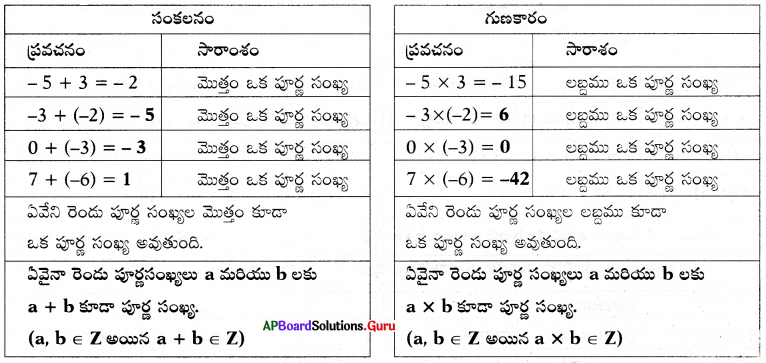
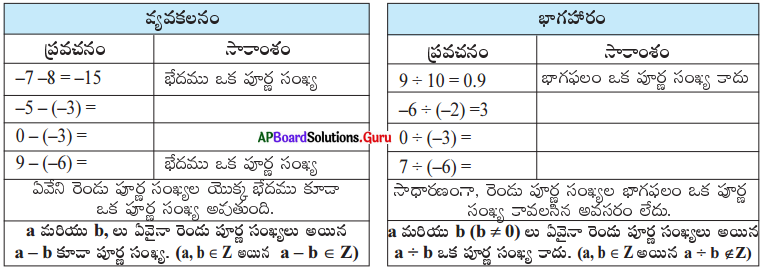
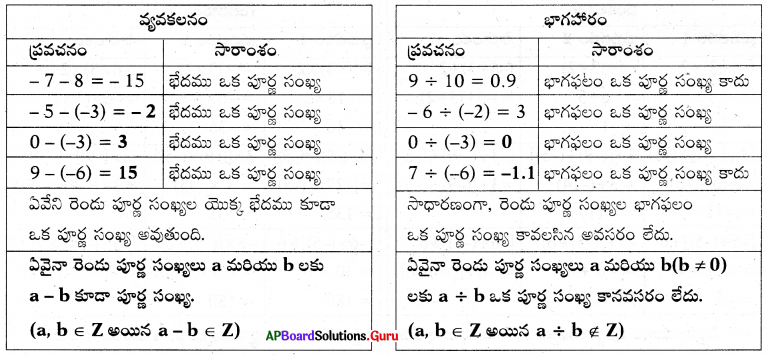
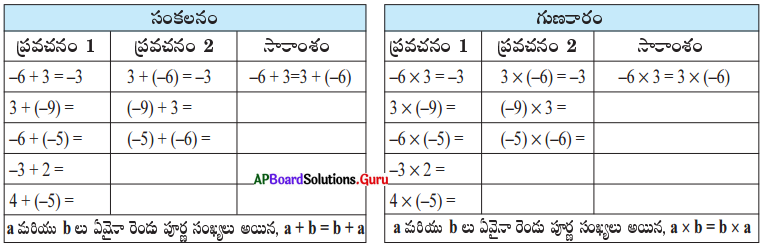
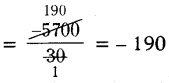
AP Board 10th Class Maths Solutions Chapter 1 వాస్తవ సంఖ్యలు Ex 1.2

SCERT AP 10th Class Maths Textbook Solutions Chapter 1 పూర్ణ సంఖ్యలు Ex 1.2 Textbook Exercise Questions and Answers.

AP State Syllabus 10th Class Maths Solutions 1st Lesson వాస్తవ సంఖ్యలు Exercise 1.2

ప్రశ్న1.
కింది వానిలో ప్రతిసంఖ్యను ప్రధాన కారణాంకాల లబ్ధంగా రాయండి.
(i) 140
(ii) 156
(iii) 3825
(iv) 5005
(v) 7429
సాధన:
(i) 140
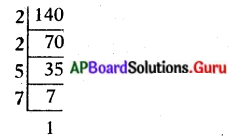
AP State Syllabus 10th Class Maths Solutions 1st Lesson వాస్తవ సంఖ్యలు Exercise 1.2 1

140 = 2 × 2 × 5 × 7
= 22 × 5 × 7

(ii) 156
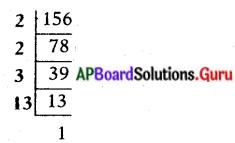
AP State Syllabus 10th Class Maths Solutions 1st Lesson వాస్తవ సంఖ్యలు Exercise 1.2 2

156 = 2 × 2 × 3 × 13
= 22 × 3 × 13

(iii) 3825
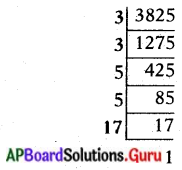
AP State Syllabus 10th Class Maths Solutions 1st Lesson వాస్తవ సంఖ్యలు Exercise 1.2 3

3825 = 3 × 3 × 5 × 5 × 17
= 32 × 52 × 17

AP Board 10th Class Maths Solutions 1st Lesson వాస్తవ సంఖ్యలు Exercise 1.2

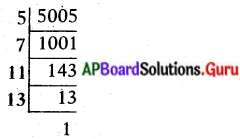
(iv) 5005

AP State Syllabus 10th Class Maths Solutions 1st Lesson వాస్తవ సంఖ్యలు Exercise 1.2 4

5005 = 5 × 7 × 11 × 13

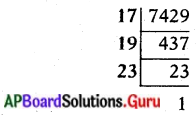
(v) 7429

AP State Syllabus 10th Class Maths Solutions 1st Lesson వాస్తవ సంఖ్యలు Exercise 1.2 5

7429 = 17 × 19 × 23

AP Board 10th Class Maths Solutions 1st Lesson వాస్తవ సంఖ్యలు Exercise 1.2

ప్రశ్న2.
కింది పూర్ణసంఖ్యల యొక్క క.సా.గు మరియు గ.సా.కా లను ప్రధాన కారణాంకాల లబ్ధ పద్ధతిలో కనుగొనండి.
(i) 12, 15 మరియు 21
(ii) 17, 23 మరియు 29
(iii) 8, 9 మరియు 25
(iv) 72 మరియు 108
(v) 306 మరియు 657
సాధన.
(i) 12, 15 మరియు 21
12 = 22 × 3; 15 = 3 × 5; 21 = 3 × 7
∴ 12, 15 మరియు 21 ల క.సా.గు = 22 × 3 × 5 × 7 = 420
∴12, 15 మరియు 21ల గ.సా.భా = 3
(సంఖ్యల యొక్క ప్రధాన కారణాంకాల లబ్దంలో అన్ని కారణాంకాల గరిష్ఠ ఘాతాంకం గల కారణాంకాల లబ్ధము గ.సా.భా)
(సంఖ్యల యొక్క ప్రధాన కారణాంకాల లబ్ధంలో కనిష్ఠ ఘాతాంకం గల సామాన్య కారణాంకాల లబ్దము క.సా.గు)

(ii) 17, 23 మరియు 29
17, 23 మరియు 29 లు ప్రధాన సంఖ్యలు.
∴ క.సా.గు = 17 × 23 × 29 = 11339
∴ గ.సా.భా = 1
(17, 23 మరియు 29 లు సాపేక్ష ప్రధాన సంఖ్యలు)

AP Board 10th Class Maths Solutions 1st Lesson వాస్తవ సంఖ్యలు Exercise 1.2

(iii) 8, 9 మరియు 25
8 = 23; 9 = 32; 25 = 52
∴ 8, 9, 25 ల క.సా.గు = 23 × 32 × 52
= 8 × 9 × 25
= 1800
8, 9, 25 లు సాపేక్ష ప్రధాన సంఖ్యలు –
∴ గ.సా.భా = 1

(iv) 72 మరియు 108
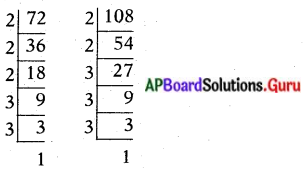
AP State Syllabus 10th Class Maths Solutions 1st Lesson వాస్తవ సంఖ్యలు Exercise 1.2 6

72 = 23 × 32 ;
108 = 22 × 33
∴ 72, 108 ల క.సా.గు = 23 × 33
= 8 × 27 = 216
∴ గ.సా.భా = 22 × 32 = 4 × 9 = 36

AP Board 10th Class Maths Solutions 1st Lesson వాస్తవ సంఖ్యలు Exercise 1.2

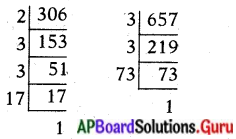
v) 306 మరియు 657

AP State Syllabus 10th Class Maths Solutions 1st Lesson వాస్తవ సంఖ్యలు Exercise 1.2 7

306 = 2 × 32 × 17
657 = 32 × 73
306, 657 ల క.సా.గు = 2 × 32 × 17 × 73
=2 × 9 × 17 × 73
= 22338
గ.సా.భా = 32 = 9

ప్రశ్న3.
n ఒక సహజ సంఖ్య అయిన 6″ సంఖ్య ‘సున్న’తో అంతమగునో, కాదో సరిచూడండి.
సాధన.
6n = (2 × 3)n = 2n × 3n
6n = 2n × 3n
సహజసంఖ్య n ఏ విలువకైనా’ 6n యొక్క ప్రధాన కారణాంకాల లబ్ధంలో 5 కారణాంకంగా లేదు.
కావున 6n సంఖ్య ఒకట్ల స్థానంలో సున్న లేదా 5 ఉండదు.
∴ 6n సంఖ్య సున్నతో అంతం కాదు.

AP Board 10th Class Maths Solutions 1st Lesson వాస్తవ సంఖ్యలు Exercise 1.2

ప్రశ్న4.
1 × 11 × 13 + 13 మరియు 7 × 6 × 5 × 4 × 3 × 2 × 1 + 5 ఏవిధంగా సంయుక్త సంఖ్యలగునో వివరించండి.
సాధన.
(i) 7 × 11 × 13 + 13 = 13(7 × 11 + 1)
= 13(77 + 1)
= 13 × 78
7 × 11 × 13 + 13కు 13 మరియు 78లు కారణాంకాలు కావున 7 × 11 × 13 + 13 సంయుక్త సంఖ్య అవుతుంది.

(ii) 7 × 6 × 5 × 4 × 3 × 2 × 1 + 5
= 5 (7 × 6 × 4 × 3 × 2 × 1 + 1)
= 5 × (1008 + 1)
= 5 × 1009
7 × 6 × 5 × 4 × 3 × 2 × 1 + 5కు 5 మరియు 1009లు.
కారణాంకాలు కావున 7 × 6 × 5 × 4 × 3 × 2 × 1 + 5 సంయుక్త సంఖ్య అవుతుంది.

AP Board 10th Class Maths Solutions 1st Lesson వాస్తవ సంఖ్యలు Exercise 1.2

ప్రశ్న5.
(17 × 11 × 2) + (17 × 11 × 5) అనేది ఒక సంయుక్త సంఖ్య’ అని ఏవిధంగా నిరూపిస్తావు ? వివరించండి.
సాధన.
(17 × 11 × 2) + (17 × 11 × 5)
= (17 × 11) (2 + 5) = 17 × 11 × 7
= 187 × 7
(17 × 11 × 2) + (17 × 11 × 5) యొక్క కారణాంకాలు 17, 11 మరియు 7.
కావున ఇది సంయుక్త సంఖ్య అవుతుంది:

ప్రశ్న6.
6100 యొక్క ఫలిత సంఖ్యలో ఒకట్ల స్థానంలోని అంకె ఏది ?
సాధన:
61 = 6 మరియు 62 = 36, 63 = 216; అలాగే
64 = 1296 తదుపరి 65 = 1296 × 6 = 7776
ఈ విధంగా 6ను ఏ ఘాతాన్ని పెంచినప్పటికి దాని ఒకట్ల స్థానంలో ‘6’ మాత్రమే ఉండుట మనం గమనించవచ్చు.
∴ 6100 యొక్క ఒకట్ల స్థానంలో గల అంకె = 6.
AP 7th Class Social Important Questions 13th Lesson Women Change the World

These AP 7th Class Social Important Questions 13th Lesson Women Change the World will help students prepare well for the exams.

AP Board 7th Class Social 13th Lesson Important Questions and Answers Women Change the World

Question 1.
When did International Women’s Day is celebrated?
Answer:
On 8th March, International Women’s Day is celebrated.

Question 2.
Who was the first Indian woman Scientist received the Padma Shri Award?
Answer:
Janaki Ammal Edavalath Kakkar.

Question 3.
Who were the first two female graduates in India?
Answer:
Kadambari Ganguly and Chandramuki Basu.

Question 4.
Who was the Indian American astronaut?
Answer:
Kalpana Chawla an Indian – American astronaut.

AP 7th Class Social Important Questions 13th Lesson Women Change the World

Question 5.
Who was the first Indian women enter into space?
Answer:
Kalpana Chawla was the first Indian woman to enter space.

Question 6.
How did Kalpana Chawla died?
Answer:
Kalpana Chawla died due to failure of the STS -107 Mission in the atmosphere on Febru¬ary 1st, 2003.

Question 7.
Mention the Award of Kalpana Chawl.
Answer:
U.S. Government awarded her the Congressional Space Medal of Honor and the NASA Distinguished Service Medal.

Question 8.
Who is the first visually challenged IAS officer in India?
Answer:
Pranjal Patil of Maharashtra.

Question 9.
Who is the highest run – scorer in Women’s International Cricket?
Answer:
Mithali Raj is the only woman highest run – scorer in Women’s International Cricket.

Question 10.
Which martial arts was developed by Burce Lee?
Answer:
Bruce Lee developed the Jeet Kune DO – art.

Question 11.
Who is Vandana Shiva?
Answer:
Vandana Shiva is an environmentalist and environmental rights activist.

Question 12.
Which organization was founded by Vandana Shiva?
Answer:
Research Foundation for Science, Technology and Ecology.

Question 13.
From which person Laxmi Agarwai receive the award?
Answer:
Laxmi Agarwai received a 2014 International Women of Courage Award by US first lady Michelle Obama.

Question 14.
Who worked as a rocket Scientist in ISRO?
Answer:
Nandini Harinath is a rocket Scientist at ISRO.

AP 7th Class Social Important Questions 13th Lesson Women Change the World

Question 15.
Who organised awareness programms on Forests and Environmental Protection?
Answer:
Archana Soreng.

AP Board 7th Class Social 13th Lesson 1 Mark Bits Questions and Answers Women Change the World

I. Multiple Choice Questions

1. In 2004 – 05 …….. % of working women in India are engaged in agricultural works.
A) 82
B) 83.6
C) 84
D) 85%
Answer:
B) 83.6

2. It plays a major role in getting rid of stereotypes. What is it?
A) Marriage
B) Migration
C) Education
D) None of the above
Answer:
C) Education

3. The Andhra Pradesh government banned arrack in
A) 1993
B) 1994
C) 1996
D)1997
Answer:
A) 1993

4. Who was the first South Asian Woman Physician to graduate in Western Medicine ?[
A) Sujata Rao
B) Seema Rao
C) Kadambari Ganguly
D) Kalpana Chawia
Answer:
C) Kadambari Ganguly

5. This award received by Janaki Ammal
A) Nobel Prize
B) Padma Shri
C) Arjun
D) Padma Vibhushan
Answer:
B) Padma Shri

AP 7th Class Social Important Questions 13th Lesson Women Change the World

6. The Indian – American astronaut
A) Sunitha Williams
B) Girija Shankar
C) Kalpana Chawia
D) Sumathi Rao
Answer:
C) Kalpana Chawia

7. Kalpana Chawia was died due to failure of
A) SS -11
B) SS -12
C) SS -13
D) STS-107
Answer:
D) STS-107

8. Who cross 7,000 run mark in women’s ODIs?
A) Mithali Raj
B) Mandhana
C) Shafaliverma
D) Jhulan Goswami
Answer:
A) Mithali Raj

9. Mithali Raj received Award.
A) Arjun
B) Khelratna
C) Padmasri
D) All the above
Answer:
B) Khelratna

10. First visually challenged IAS officer
A) Mithili
B) Pranjal Patil
C) Sailaja Mehata
D) Kadambari Ganguly
Answer:
B) Pranjal Patil

11. First woman Commando trainer.
A) Seema Rao
B) Sulochana
C) Mithali Raj
D) Pranjal Patil
Answer:
A) Seema Rao

12. Rajkumari Devi honored with ………… award
A) Arjun
B) Khelratna
C) Padma Shri
D) Nobel
Answer:
C) Padma Shri

13. Vandana Shiva received the ………… award in 1993.
A) Sydney peace prize
B) Right Livelihood
C) Khelratna
D) Women of encourage
Answer:
A) Sydney peace prize

14. A Rocket Scientist at the ISRO
A) Vandana
B) Archana
C) Nandini Harinath
D) Laxmi Agarwal
Answer:
C) Nandini Harinath

15. Archana Soreng, a tribal girl from
A) Andhra Pradesh
B) Odisha
C) Bihar
D) Punjab
Answer:
B) Odisha

AP 7th Class Social Important Questions 13th Lesson Women Change the World

16. Archana Soreng related to
A) Sports
B) Music
C) Science
D) Environment
Answer:
C) Science

II. Fill in the Blanks

1. Archana Soreng holds a master’s Degree from ……………. .
2. Nandini Harinath has served on the ……………. .
3. NABARD stands for ……………. .
4. Addala Suryakala is from ……………. .
5. Laxmi Agarwal is an ……………. survivor.
6. Vandana Shiva received ……………. prize in 2010.
7. Vandana Shiva conducts research on ……………. .
8. Kalpana Chawla died on ……………. .
9. NASA stands for ……………. .
10. ……………. served as a lecturer and principal at Betune College.
11. Women in Andhra Pradesh started ……………. movement.
12. Government provides many facilities for ……………. .
13. ……………. is even more severe in illiterate families.
14. ……………. have high place in Indian culture.
15. ……………. plays a vital role in the Development of the country.
Answer:

  1. Tata Institute of Social Sciences
  2. Mars Orbiter Mission Mangalyan
  3. National Bank for Agriculture and fcural Development
  4. Srikakulam District
  5. Acid attack
  6. Sydney Peace
  7. Environmental and Social Issues
  8. February 7, 2003
  9. National Aeronautics and Space
  10. Chandramukhi Basu
  11. Anti – arrack 14. Women
  12. Girls Education
  13. Discrimination
  14. Women

III. Match the following
1.

Group-A Group-B
1. Laxmi Agarwal A) Women’s Education
2. Chandra Mukhi Basu B) Michelle Obama
3. Kalpana Chawla C) Lady Sachin
4. Mithali Raj D) Sub Collector
5. Pranjal Patil E) NASA

Answer:

Group-A Group-B
1. Laxmi Agarwal B) Michelle Obama
2. Chandra Mukhi Basu A) Women’s Education
3. Kalpana Chawla E) NASA
4. Mithali Raj C) Lady Sachin
5. Pranjal Patil D) Sub Collector

2.

Group-A Group-B
1. Seema Rao A) Anandpur Jyothi
2. Kadambari Ganguly B) Light weight modern utensils
3. Janaki Ammal C) Bengal cultural Revolution
4. Addala Suryakala D) Botanical Survey of India
5. Rajkumari Devi E) Trained in Jeet Kune DO

Answer:

Group-A Group-B
1. Seema Rao E) Trained in Jeet Kune DO
2. Kadambari Ganguly C) Bengal cultural Revolution
3. Janaki Ammal D) Botanical Survey of India
4. Addala Suryakala B) Light weight modern utensils
5. Rajkumari Devi A) Anandpur Jyothi

Do You Know?

7th Class Social Textbook Page No. 86

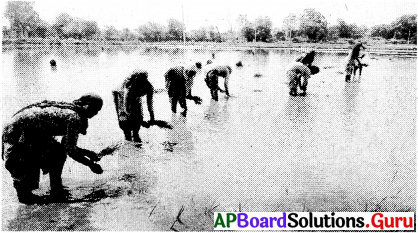
83.6 percent of working women in India are engaged in agricultural work. Their work includes planting, weeding, harvesting and threshing. Yet, when we think of a farmer we only think of a man.

Source: NSS 61st Round (2004-05).
AP 7th Class Social Important Questions 13th Lesson Women Change the World 1

7th Class Social Textbook Page No. 89

Jyothiba Phule and Savithribai Phule.

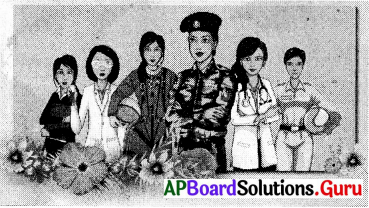
On 8th March, International women’s day is celebrated.
AP 7th Class Social Important Questions 13th Lesson Women Change the World 2

AP Board 7th Class Maths Solutions Chapter 2 భిన్నాలు మరియు దశాంశాలు Ex 2.2

SCERT AP 7th Class Maths Solutions Pdf Chapter 2 భిన్నాలు మరియు దశాంశాలు Ex 2.2 Textbook Exercise Questions and Answers.

AP State Syllabus 7th Class Maths Solutions 2nd Lesson భిన్నాలు మరియు దశాంశాలు Exercise 2.2

ప్రశ్న 1.
క్రింది వాటి లబ్దాన్ని కనుగొనండి.
(i) 23.4 × 6
సాధన.
23.4 × 6
= [latex]\frac{234}{10} \times \frac{6}{1}[/latex]
= [latex]\frac{1404}{10}[/latex]
∴ 23.4 × 6 = 140.4

AP Board 7th Class Maths Solutions Chapter 2 భిన్నాలు మరియు దశాంశాలు Ex 2.2

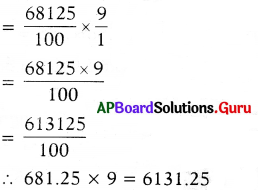
(ii) 681.25 × 9
సాధన.
681.25 × 9
AP Board 7th Class Maths Solutions Chapter 2 భిన్నాలు మరియు దశాంశాలు Ex 2.2 1

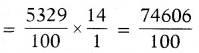
(iii) 53.29 × 14
సాధన.
53.29 × 14
AP Board 7th Class Maths Solutions Chapter 2 భిన్నాలు మరియు దశాంశాలు Ex 2.2 2
∴ 53.29 × 14 = 746.06

(iv) 8 × 2.52
సాధన.
8 × 2.52
= 8 × [latex]\frac{252}{100}[/latex]
= [latex]\frac{8 \times 252}{100}[/latex] = [latex]\frac{2016}{100}[/latex]
∴8 × 2.52 = 20.16

(v) 25 × 2.013
సాధన.
25 × 2.013
= 25 × [latex]\frac{2013}{1000}[/latex]
= [latex]\frac{25 \times 2013}{1000}[/latex]
= [latex]\frac{50325}{1000}[/latex]
1000 50325 – 1000 .
∴ 25 × 2.013 = 50.325

AP Board 7th Class Maths Solutions Chapter 2 భిన్నాలు మరియు దశాంశాలు Ex 2.2

ప్రశ్న 2.
పట్టికలో ఖాళీలను నింపండి.

గుణకారం లబ్దం
36.21 × 10 362.1
23.104 × 100 ________
6.24 × ________ 6240.0
________× 1000 21.05
9.234 × 100 ________
1.3004 × ________ 1300.4
________ × 10 59.001

సాధన.

గుణకారం లబ్దం
36.21 × 10 362.1
23.104 × 100 2310.4
6.24 × 1000 6240.0
0.02105 × 1000 21.05
9.234 × 100 923.4
1.3004 × 1000 1300.4
5.9001 × 10 59.001

ప్రశ్న 3.
లబ్దాన్ని కనుగొనండి.
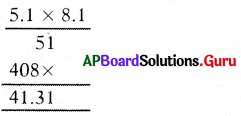
(i) 5.1 × 8.1
సాధన.
AP Board 7th Class Maths Solutions Chapter 2 భిన్నాలు మరియు దశాంశాలు Ex 2.2 3

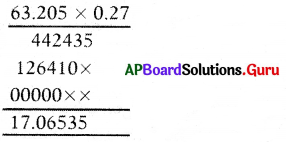
(ii) 63.205 × 0.27
సాధన.
AP Board 7th Class Maths Solutions Chapter 2 భిన్నాలు మరియు దశాంశాలు Ex 2.2 4

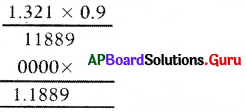
(iii) 1.321 × 0.9
సాధన.
AP Board 7th Class Maths Solutions Chapter 2 భిన్నాలు మరియు దశాంశాలు Ex 2.2 5

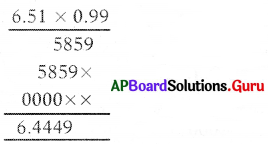
(iv) 6.51 × 0.99
సాధన.
AP Board 7th Class Maths Solutions Chapter 2 భిన్నాలు మరియు దశాంశాలు Ex 2.2 6

AP Board 7th Class Maths Solutions Chapter 2 భిన్నాలు మరియు దశాంశాలు Ex 2.2

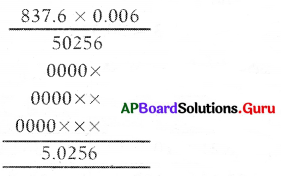
(v) 837.6 × 0.006
సాధన.
AP Board 7th Class Maths Solutions Chapter 2 భిన్నాలు మరియు దశాంశాలు Ex 2.2 7

ప్రశ్న 4.
రితేష్ ప్రతిరోజూ 2.5 గం.ల పాటు ఒక పుస్తకాన్ని చదువుతాడు. ఒక వారంలో ఆ పుస్తకంను అతను పూర్తిగా చదివితే, మొత్తం ఎన్ని గంటలు చదివాడు?
AP Board 7th Class Maths Solutions Chapter 2 భిన్నాలు మరియు దశాంశాలు Ex 2.2 8
సాధన.
రితేష్ ప్రతిరోజు పుస్తకాన్ని చదివే సమయం = 2.5 గం.లు
= 7 × 2.5
= 7 × [latex]\frac{25}{10}[/latex]
= [latex]\frac{175}{10}[/latex]
= 17.5 గంటలు.

ప్రశ్న 5.
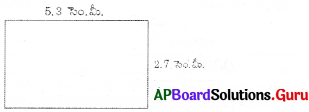
పొడవు మరియు వెడల్పులు వరుసగా 5.3 సెం.మీ. మరియు 2.7 సెం.మీ.గా ఉన్న దీర్ఘచతురస్రం యొక్క వైశాల్యం కనుగొనండి.
సాధన.
AP Board 7th Class Maths Solutions Chapter 2 భిన్నాలు మరియు దశాంశాలు Ex 2.2 9
దీర్ఘచతురస్ర పొడవు (1) = 5.3 సెం.మీ.
వెడల్పు (b) = 2.7 సెం.మీ.
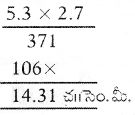
∴దీర్ఘచతురస్ర వైశాల్యం = lb
AP Board 7th Class Maths Solutions Chapter 2 భిన్నాలు మరియు దశాంశాలు Ex 2.2 10

AP Board 7th Class Maths Solutions Chapter 2 భిన్నాలు మరియు దశాంశాలు Ex 2.2

ప్రశ్న 6.
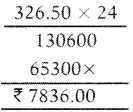
ఒక సిమెంట్ బస్తా ధర ₹ 326.50 అయినచో 24 బ్యాగుల సిమెంట్ బస్తాల ధరను కనుగొనండి.
సాధన.
ఒక సిమెంట్ బస్తా ధర = ₹ 326.50
24 సిమెంట్ బస్తాల ధర = 326.50 × 24
AP Board 7th Class Maths Solutions Chapter 2 భిన్నాలు మరియు దశాంశాలు Ex 2.2 11
∴24 సిమెంట్ బస్తాల ధర = ₹ 7,836.

ప్రశ్న 7.
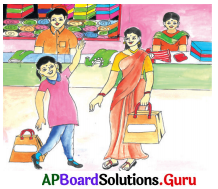
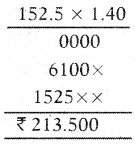
ధార్మిక చుడిధార్ మెటీరియల్ ను, ఒక మీ.కు ₹152.5 చొప్పున 1.40 మీ. కొనుగోలు చేసింది. చెల్లించాల్సిన మొత్తాన్ని కనుగొనండి.
AP Board 7th Class Maths Solutions Chapter 2 భిన్నాలు మరియు దశాంశాలు Ex 2.2 13
సాధన.
ఒక మీటరు చుడిధార్ మెటీరియల్ ధర = ₹152.5
1.40 మీ. చుడిధార్ మెటీరియల్ కొనుగోలు చేయుటకు ధార్మిక చెల్లించాల్సిన మొత్తం = 152.5 × 1.40
AP Board 7th Class Maths Solutions Chapter 2 భిన్నాలు మరియు దశాంశాలు Ex 2.2 12

AP Board 7th Class Maths Solutions Chapter 2 భిన్నాలు మరియు దశాంశాలు Ex 2.2

ప్రశ్న 8.
అమృత ఒక ఆల్బమ్ తయారు చేయడానికి 16 175 ఛార్జులను కొనుగోలు చేయాలని అనుకుంటుంది. ఒక పిక్చర్ ఛార్టు ధర ₹4.25 అయితే ఆమె ఎంత డబ్బు చెల్లించాల్సి ఉంటుంది ?
సాధన.
అమృత కొనుగోలు చేసిన ఛార్టుల సంఖ్య = 16
ఒక ఛార్టు ధర = ₹ 4.25
∴అమృత చెల్లించాల్సిన డబ్బు = 16 × 4.25
= 16 × [latex]\frac{425}{100}[/latex]
= [latex]\frac{6800}{100}[/latex]
= ₹68.00

AP Board 7th Class Maths Solutions Chapter 2 భిన్నాలు మరియు దశాంశాలు Ex 2.1

SCERT AP 7th Class Maths Solutions Pdf Chapter 2 భిన్నాలు మరియు దశాంశాలు Ex 2.1 Textbook Exercise Questions and Answers.

AP State Syllabus 7th Class Maths Solutions 2nd Lesson భిన్నాలు మరియు దశాంశాలు Exercise 2.1

ప్రశ్న 1.
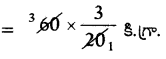
జగనన్న గోరు ముద్ద (MDM) పథకంలో ఒక్కొక్క విద్యార్థి రోజుకు [latex]\frac{3}{20}[/latex] కి.గ్రా. బియ్యం పొందిన, తరగతిలో గల మొత్తం 60 మంది విద్యార్థులకు ఒక రోజుకు కావలసిన బియ్యం బరువు కనుగొనండి.
సాధన.
జగనన్న గోరు ముద్ద పథకంలో ఒక్కొక్క విద్యార్థి రోజుకు పొందు బియ్యం [latex]\frac{3}{20}[/latex] = కి.గ్రా.
తరగతిలోని మొత్తం విద్యార్థులు = 60
∴ ఒక రోజుకు ఆ తరగతికి కావలసిన బియ్యం
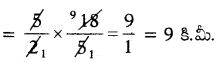
AP Board 7th Class Maths Solutions Chapter 2 భిన్నాలు మరియు దశాంశాలు Ex 2.1 1
= 9 కి.గ్రా.

AP Board 7th Class Maths Solutions Chapter 2 భిన్నాలు మరియు దశాంశాలు Ex 2.1

ప్రశ్న 2.
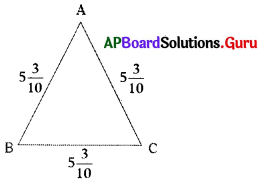
ఒక సమబాహు త్రిభుజం యొక్క ప్రతి 5[latex]\frac{3}{10}[/latex] సెం.మీ. అయితే త్రిభుజం యొక్క చుట్టుకొలత ఎంత?
సాధన.
సమబాహు త్రిభుజం యొక్క భుజం = 5[latex]\frac{3}{10}[/latex] సెం.మీ.
AP Board 7th Class Maths Solutions Chapter 2 భిన్నాలు మరియు దశాంశాలు Ex 2.1 2
సమబాహు త్రిభుజం యొక్క చుట్టుకొలత
= 3 × 5[latex]\frac{3}{10}[/latex]
= 3 × [latex]\frac{53}{10}[/latex] = [latex]\frac{159}{10}[/latex] = 15[latex]\frac{9}{10}[/latex] సెం.మీ.
(లేదా)
సమబాహు త్రిభుజ భుజం = 5[latex]\frac{3}{10}[/latex] = [latex]\frac{53}{10}[/latex] సెం.మీ.
సమబాహు త్రిభుజం చుట్టుకొలత
= [latex]\frac{53}{10}+\frac{53}{10}+\frac{53}{10}[/latex]
= [latex]\frac{159}{10}[/latex] = 15[latex]\frac{9}{10}[/latex] సెం.మీ.

ప్రశ్న 3.
సూర్య ఒక గంటలో [latex]\frac{18}{5}[/latex] కిలో మీటర్లు నడవగలడు 2[latex]\frac{1}{2}[/latex] గంటల్లో ఎంత దూరం నడవగలదు?
సాధన.
సూర్య ఒక గంటలో నడవగల దూరం = [latex]\frac{18}{5}[/latex] కి.మీ.
సూర్య 2[latex]\frac{1}{2}[/latex] గంటల్లో నడవగల దూరం = 2[latex]\frac{1}{2}[/latex] × [latex]\frac{18}{5}[/latex]
AP Board 7th Class Maths Solutions Chapter 2 భిన్నాలు మరియు దశాంశాలు Ex 2.1 3

AP Board 7th Class Maths Solutions Chapter 2 భిన్నాలు మరియు దశాంశాలు Ex 2.1

ప్రశ్న 4.
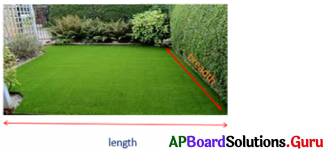
ఒక దీర్ఘచతురస్రాకార తోట పొడవు మరియు వెడల్పులు వరుసగా [latex]\frac{27}{2}[/latex] మీ. మరియు [latex]\frac{15}{2}[/latex] మీ. అయిన అప్పుడు ఆ తోట యొక్క వైశాల్యం కనుగొనండి.
AP Board 7th Class Maths Solutions Chapter 2 భిన్నాలు మరియు దశాంశాలు Ex 2.1 4
సాధన.
దీర్ఘ చతురస్రాకార తోట పొడవు = [latex]\frac{27}{2}[/latex] మీ
వెడల్పు = [latex]\frac{15}{2}[/latex] మీ
దీర్ఘచతురస్రాకార తోట వైశాల్యం = పొడవు × వెడల్పు
= [latex]\frac{27}{2}[/latex] × [latex]\frac{15}{2}[/latex]
= [latex]\frac{405}{2}[/latex]
= 101[latex]\frac{1}{4}[/latex]చ.మీ.

ప్రశ్న 5.
గోపాల్ మార్కెట్లో 3[latex]\frac{1}{2}[/latex] కి.గ్రా. బంగాళదుంపలు కొనుగోలు చేశాడు. వాటికి అతడు ₹84 చెల్లించినచో, 1 కి.గ్రా. బంగాళదుంపల వెల కనుగొనండి.
సాధన.
గోపాల్ మార్కెట్లో కొనుగోలు చేసిన బంగాళ దుంపలు = 3[latex]\frac{1}{2}[/latex] కి.గ్రా.
గోపాల్ చెల్లించిన డబ్బు = ₹84
∴ 1 కి.గ్రా. బంగాళ దుంపల వెల = 84 ÷ 3[latex]\frac{1}{2}[/latex]
= 84 ÷ [latex]\frac{7}{2}[/latex]
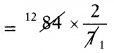
AP Board 7th Class Maths Solutions Chapter 2 భిన్నాలు మరియు దశాంశాలు Ex 2.1 5
= ₹ 24

ప్రశ్న 6.
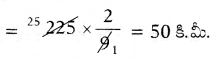
ఒక కారు సమవేగంతో 47 గం.లలో 225 కి.మీ. ప్రయాణించింది. అది ఒక గంటలో ప్రయాణించిన దూరాన్ని కనుగొనండి.
AP Board 7th Class Maths Solutions Chapter 2 భిన్నాలు మరియు దశాంశాలు Ex 2.1 7
సాధన.
ఒక కారు సమవేగంతో 4, గం.లలో ప్రయాణించిన
దూరం = 225 కి.మీ.
∴ కారు ఒక గంటలో ప్రయాణించిన దూరం
= 225 ÷ 4[latex]\frac{1}{2}[/latex] = 225 ÷ [latex]\frac{9}{2}[/latex]
AP Board 7th Class Maths Solutions Chapter 2 భిన్నాలు మరియు దశాంశాలు Ex 2.1 6

AP Board 7th Class Maths Solutions Chapter 2 భిన్నాలు మరియు దశాంశాలు Ex 2.1

ప్రశ్న 7.
24 మంది విద్యార్థులు 4[latex]\frac{4}{5}[/latex] కి.గ్రా.ల కేకేను సమానంగా పంచుకుంటే, అప్పుడు ప్రతి ఒక్కరూ ఎంత కేక్ ను పొందుతారు ?
AP Board 7th Class Maths Solutions Chapter 2 భిన్నాలు మరియు దశాంశాలు Ex 2.1 8
సాధన.
24 మంది విద్యార్థులు పంచుకొన్న కేకు = 4[latex]\frac{4}{5}[/latex] కి.గ్రా.
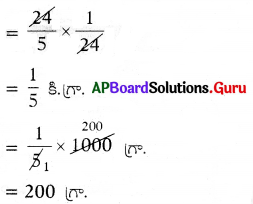
∴ ప్రతి ఒక్కరూ పొందు కేకు = 4[latex]\frac{4}{5}[/latex] ÷ 24
= [latex]\frac{24}{5}[/latex] ÷ [latex]\frac{24}{1}[/latex]
AP Board 7th Class Maths Solutions Chapter 2 భిన్నాలు మరియు దశాంశాలు Ex 2.1 9

ప్రశ్న 8.
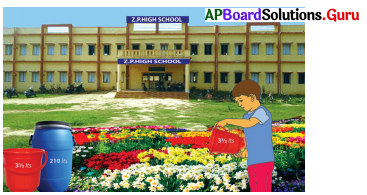
ఒక డ్రమ్ లో 210 లీ. నీరు కలదు. మొక్కలకు నీరు పోయుటకు బాలుడు 3[latex]\frac{1}{2}[/latex] లీ. సామర్థ్యం గల నిండు బక్కెట్టుతో ఆ డ్రమ్ నుంచి ఎన్నిసార్లు నీటిని పొందగలడు?
AP Board 7th Class Maths Solutions Chapter 2 భిన్నాలు మరియు దశాంశాలు Ex 2.1 10
సాధన.
ఒక డ్రమ్ లో గల నీరు = 210 లీ.
మొక్కలకు నీరు పోయుటకు బాలుడు ఉపయోగిస్తున్న బకెట్ సామర్థ్యం = 3[latex]\frac{1}{2}[/latex] లీ.
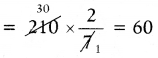
= 210 ÷ 3[latex]\frac{1}{2}[/latex]
= 210 ÷ [latex]\frac{7}{2}[/latex]
AP Board 7th Class Maths Solutions Chapter 2 భిన్నాలు మరియు దశాంశాలు Ex 2.1 11
∴ డ్రమ్ నుంచి నీటిని 60 సార్లు పొందగలడు.

AP Board 7th Class Maths Solutions Chapter 2 భిన్నాలు మరియు దశాంశాలు Review Exercise

SCERT AP 7th Class Maths Solutions Pdf Chapter 2 భిన్నాలు మరియు దశాంశాలు Review Exercise Questions and Answers.

AP State Syllabus 7th Class Maths Solutions 2nd Lesson భిన్నాలు మరియు దశాంశాలు Review Exercise

ప్రశ్న 1.
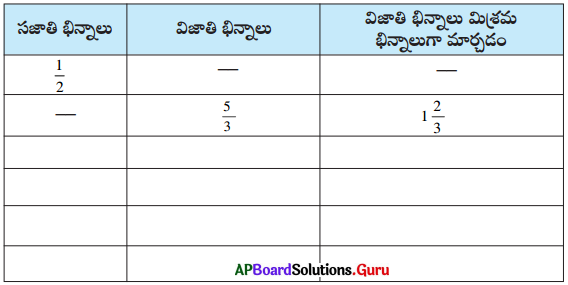
క్రింది భిన్నాలను గమనించండి మరియు వాటిని పట్టికలోనింపండి. [latex]\frac{1}{2}, \frac{5}{3}, \frac{11}{9}, \frac{23}{25}, \frac{19}{100}, \frac{99}{70}[/latex].
AP Board 7th Class Maths Solutions Chapter 2 భిన్నాలు మరియు దశాంశాలు Review Exercise 1
సాధన.

ప్రశ్న 2.
క్రింది భిన్నాలను ఆరోహణ క్రమంలో రాయండి.
(i) [latex]\frac{3}{2}, \frac{5}{2}, \frac{1}{2}, \frac{17}{2}, \frac{9}{2}[/latex]
సాధన.
ఆరోహణ క్రమం: [latex]\frac{1}{2}, \frac{3}{2}, \frac{5}{2}, \frac{9}{2}, \frac{17}{2}[/latex]

AP Board 7th Class Maths Solutions Chapter 2 భిన్నాలు మరియు దశాంశాలు Review Exercise

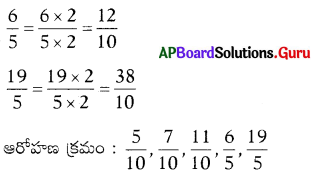
(ii) [latex]\frac{6}{5}, \frac{11}{10}, \frac{19}{5}, \frac{7}{10}, \frac{5}{10}[/latex]
సాధన.
5, 10 ల క.సా.గు = 10
AP Board 7th Class Maths Solutions Chapter 2 భిన్నాలు మరియు దశాంశాలు Review Exercise 2

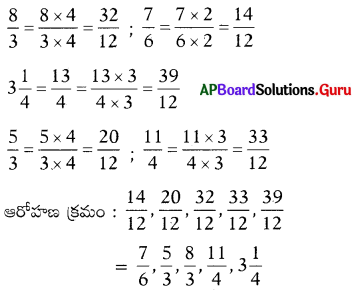
(iii) [latex]\frac{8}{3}, \frac{7}{6}, 3 \frac{1}{4}, \frac{5}{3}, \frac{11}{4}[/latex]
సాధన.
3, 4, 6ల క.సా.గు = 12
AP Board 7th Class Maths Solutions Chapter 2 భిన్నాలు మరియు దశాంశాలు Review Exercise 3

ప్రశ్న 3.
క్రింది వాటిని లెక్కించండి.

(i) [latex]\frac{3}{5}+\frac{7}{4}[/latex]
సాధన.
[latex]\frac{3}{5}+\frac{7}{4}[/latex]
= [latex]\frac{12+35}{20}[/latex] = [latex]\frac{47}{20}[/latex]

AP Board 7th Class Maths Solutions Chapter 2 భిన్నాలు మరియు దశాంశాలు Review Exercise

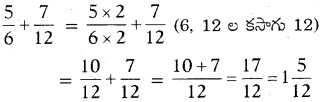
(ii) [latex]\frac{5}{6}+\frac{7}{12}[/latex]
సాధన.
AP Board 7th Class Maths Solutions Chapter 2 భిన్నాలు మరియు దశాంశాలు Review Exercise 4

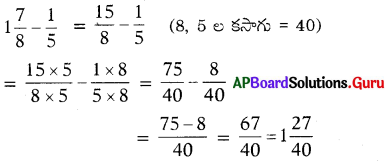
(iii) 1[latex]\frac{7}{8}[/latex] – [latex]\frac{1}{5}[/latex]
సాధన.
AP Board 7th Class Maths Solutions Chapter 2 భిన్నాలు మరియు దశాంశాలు Review Exercise 5

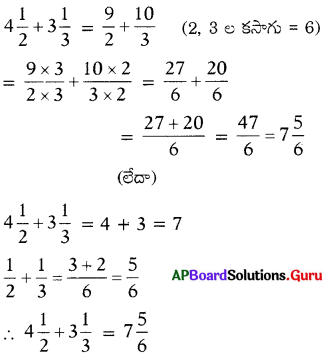
(iv) 4[latex]\frac{1}{2}[/latex] + 3[latex]\frac{1}{3}[/latex]
సాధన.
AP Board 7th Class Maths Solutions Chapter 2 భిన్నాలు మరియు దశాంశాలు Review Exercise 6

AP Board 7th Class Maths Solutions Chapter 2 భిన్నాలు మరియు దశాంశాలు Review Exercise

ప్రశ్న 4.
క్రింది వాటిని సూక్ష్మీకరించండి.

(i) 3 లో [latex]\frac{1}{4}[/latex] వ వంతు
సాధన.
3 × [latex]\frac{1}{4}[/latex] = [latex]\frac{3}{4}[/latex]

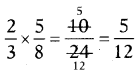
(ii) [latex]\frac{2}{3}[/latex] లో [latex]\frac{5}{8}[/latex] వ వంతు
సాధన.
AP Board 7th Class Maths Solutions Chapter 2 భిన్నాలు మరియు దశాంశాలు Review Exercise 7

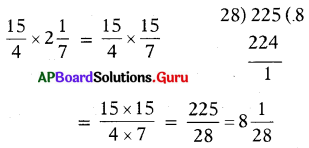
(iii) [latex]\frac{15}{4}[/latex] × 2[latex]\frac{1}{7}[/latex]
సాధన.
AP Board 7th Class Maths Solutions Chapter 2 భిన్నాలు మరియు దశాంశాలు Review Exercise 8

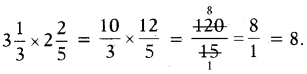
(iv) 3[latex]\frac{1}{3}[/latex] × 2[latex]\frac{2}{5}[/latex]
సాధన.
AP Board 7th Class Maths Solutions Chapter 2 భిన్నాలు మరియు దశాంశాలు Review Exercise 9

ప్రశ్న 5.
క్రింది వాటిని లెక్కించండి.
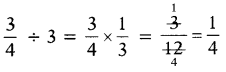
(i) [latex]\frac{3}{4}[/latex] ÷ 3
సాధన.
AP Board 7th Class Maths Solutions Chapter 2 భిన్నాలు మరియు దశాంశాలు Review Exercise 10

AP Board 7th Class Maths Solutions Chapter 2 భిన్నాలు మరియు దశాంశాలు Review Exercise

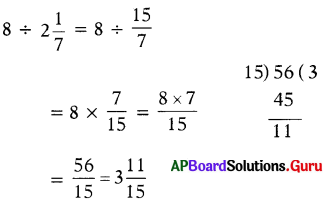
(ii) 8 ÷ 2[latex]\frac{1}{7}[/latex]
సాధన.
AP Board 7th Class Maths Solutions Chapter 2 భిన్నాలు మరియు దశాంశాలు Review Exercise 11

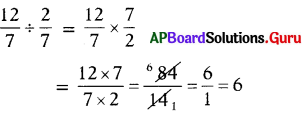
(iii) [latex]\frac{12}{7}[/latex] ÷ [latex]\frac{2}{7}[/latex]
సాధన.
AP Board 7th Class Maths Solutions Chapter 2 భిన్నాలు మరియు దశాంశాలు Review Exercise 12

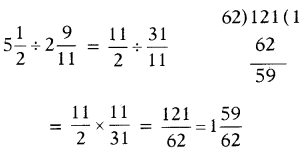
(iv) 5[latex]\frac{1}{2}[/latex] ÷ 2[latex]\frac{9}{11}[/latex]
సాధన.
AP Board 7th Class Maths Solutions Chapter 2 భిన్నాలు మరియు దశాంశాలు Review Exercise 13

AP Board 7th Class Maths Solutions Chapter 1 పూర్ణ సంఖ్యలు InText Questions

SCERT AP 7th Class Maths Solutions Pdf Chapter 1 పూర్ణ సంఖ్యలు InText Questions and Answers.

AP State Syllabus 7th Class Maths Solutions 1st Lesson పూర్ణ సంఖ్యలు InText Questions

[పేజి నెం. 6]

ఖాళీలను పూరించుము.

ప్రశ్న 1.
7 × (- 4) = – (7 × 4) = ________
సాధన.
– 28

AP Board 7th Class Maths Solutions Chapter 1 పూర్ణ సంఖ్యలు InText Questions

ప్రశ్న 2.
2 × (- 6) = – (2 × 6) = ________
సాధన.
– 12

నీ ప్రగతిని సరిచూసుకో [పేజి నెం. 8]

(i) 4 × (- 8)
సాధన.
4 × (- 8) = – (4 × 8) = – 32

(ii) 5 × (- 20)
సాధన.
5 × (20) = – (5 × 20) = – 100

(iii) 7 × (- 8)
సాధన.
7 × (- 8) = (7 × 8) = – 56

(iv) 10 × (- 9) ల విలువలను కనుక్కోండి.
సాధన.
10 × (- 9) = – (10 × 9) = – 90

[పేజి నెం. 8]

ఖాళీలను పూరించుము.

ప్రశ్న 1.
– 3 × 4 = _______ = 3 × (-4)
సాధన.
– 12

ప్రశ్న 2.
-4 × 4 = ________ = 4 × (4)
సాధన.
– 16

AP Board 7th Class Maths Solutions Chapter 1 పూర్ణ సంఖ్యలు InText Questions

సుందరి

అన్వేషిద్దాం [పేజి నెం. 8]

ప్రశ్న 1.
4 × 5 నుంచి ప్రారంభించి (- 3) ×5 విలువ కనుగొనుటకు అమరికను వ్రాయుము.
సాధన.
4 × 5 = 20
3 × 5 = 15
2 × 5 = 10
1 × 5 = 5
0 × 5 = 0

(- 1) × 5 = -5
(-2) × 5 = – 10
(- 3) × 5 = – 15

ప్రశ్న 2.
5 × 3 నుంచి ప్రారంభించి (-7) × 3 విలువ కనుగొనుటకు అమరికను వ్రాయుము.
సాధన.
5 × 3 = 15
4 × 3 = 12
3 × 3 = 9
2 × 3 = 6
1 × 3 = 3
0 × 3 = 0

(- 1) × 3 = – 3
(- 2) × 3 = – 6
(- 3) × 3 = 9
(- 4) × 3 = – 12
(- 5) × 3 = – 15
(- 6) × 3 = – 18
(- 7) × 3 = – 21

[పేజి నెం: 8]

క్రింది విలువలను కనుగొనుము.
ప్రశ్న 1.
(- 6) × 7 = ________ = (6 × 7) = – 42
సాధన.
6 × (- 7)

AP Board 7th Class Maths Solutions Chapter 1 పూర్ణ సంఖ్యలు InText Questions

ప్రశ్న 2.
(- 2) × 5 = ________ = – (2 × 5) = – 10
సాధన.
2 × (- 5)

ప్రశ్న 3.
(- 3) × 6 = ________ = – (3 × 6) = – 18
సాధన.
3 × (- 6)

ప్రశ్న 4.
(-4) × 5 = ________ = – (4 × 5) = – 20
సాధన.
4 × (- 5)

నీ ప్రగతిని సరిచూసుకో [పేజి నెం. 8]

ప్రశ్న 1.
(i) (- 6) × 5
సాధన.
(- 6) × 5 = (6 × 5) = – 30

(ii) (-15) × 2
సాధన.
(- 15) × 2 = -(15 × 2) = – 30

(iii) (-12) × 8
సాధన.
(- 12) × 8 = -(12 × 8) = – 96

(iv) (-10) × 6 ల విలువలను కనుక్కోండి.
సాధన.
(- 10) × 6 = (10 × 6) = – 60

క్రింది విలువలను కనుగొనుము. [పేజి నెం. 8]

ప్రశ్న 1.
(- 2) × (- 4) = _____
సాధన.
8

ప్రశ్న 2.
– 2 × (- 5) = _____
సాధన.
10

AP Board 7th Class Maths Solutions Chapter 1 పూర్ణ సంఖ్యలు InText Questions

నీ ప్రగతిని సరిచూసుకో [పేజి నెం. 10]

ప్రశ్న 1.
(- 5) × 3 నుంచి ప్రారంభించి (-5) × (- 4) విలువ కనుగొనుటకు అమరికను వ్రాయుము.
సాధన.
(- 5) × 3 = – 15
(- 5) × 2 = – 10
(- 5) × 1 = – 5
(- 5) × 0 = 0
(- 5) × (- 1) = 5
(- 5) × (- 2) = 10
(- 5) × (- 3) = 15
(- 5) × (- 4) = 20

ప్రశ్న 2.
(- 7) × 5 నుంచి ప్రారంభించి (-7) × (-2) విలువ కనుగొనుటకు అమరికను వ్రాయుము.
సాధన.
(- 7) × 5 = – 35
(- 7) × 4 = – 28
(- 7) × 3 = – 21
(- 7) × 2 = – 14
(- 7) × 1 = – 7
(- 7) × 0 = 0
(- 7) × (- 1) = 7
(- 7) × (- 2) = 14

AP Board 7th Class Maths Solutions Chapter 1 పూర్ణ సంఖ్యలు InText Questions

ఇవి చేయండి కృత్యం [పేజి నెం. 12]

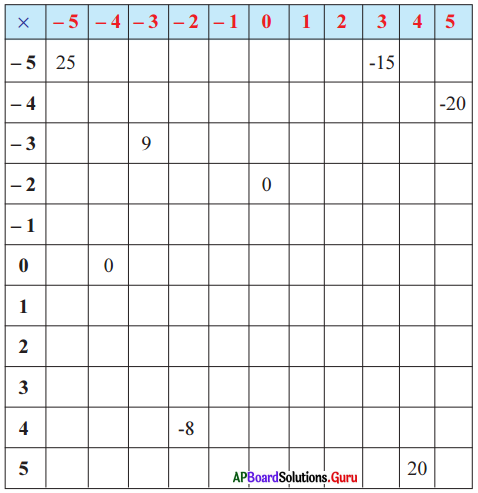
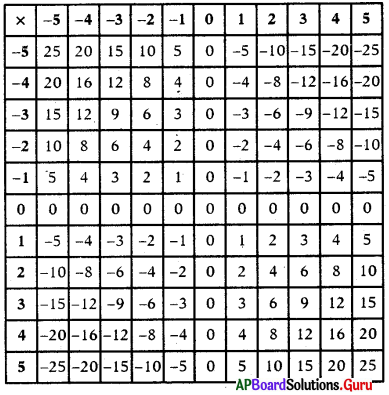
క్రింది పట్టికలో మొదటి నిలువు వరుసలో ప్రతి సంఖ్యను, మొదటి అడ్డు వరుసలోని ప్రతి సంఖ్యతో గుణిస్తూ పట్టికను పూరించుము మరియు ఇవ్వబడిన ప్రశ్నలకు సమాధానాలు ఇవ్వండి.
AP Board 7th Class Maths Solutions Chapter 1 పూర్ణ సంఖ్యలు InText Questions 1
సాధన.
AP Board 7th Class Maths Solutions Chapter 1 పూర్ణ సంఖ్యలు InText Questions 2

AP Board 7th Class Maths Solutions Chapter 1 పూర్ణ సంఖ్యలు InText Questions

ప్రశ్న 1.
పట్టిక నుండి మీరు ఏమి గమనించారో వ్రాయండి.
సాధన.
పై పట్టిక నుండి గమనించిన అంశాలు :

  • రెండు ధన పూర్ణ సంఖ్యల లబ్దం ధనపూర్ణసంఖ్య.
  • ఒక ధన పూర్ణ సంఖ్య, ఒక రుణ పూర్ణ సంఖ్యల లబ్దం రుణ పూర్ణ సంఖ్య.
  • పూర్ణ సంఖ్య, ‘O’ (సున్న) ల లబ్దము సున్న.
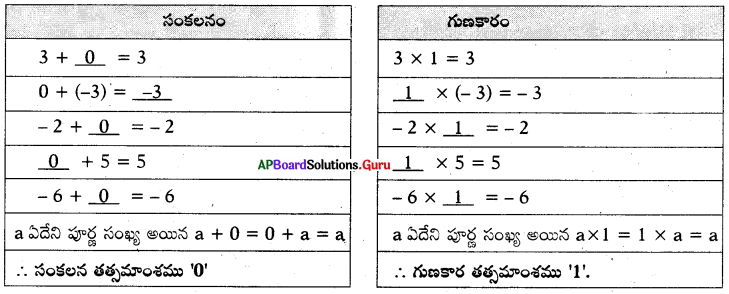
  • ఒక పూర్ణ సంఖ్యను 1 చే గుణించిన లబ్దము అదే పూర్ణసంఖ్య అవుతుంది.

ప్రశ్న 2.
పూర్ణసంఖ్యను (-1) చే గుణకారం చేసినపుడు ఏమవుతుంది ?
సాధన.
పూర్ణసంఖ్యను (-1)చే గుణకారము చేసినపుడు ఆ పూర్ణ సంఖ్య యొక్క గుర్తు మారుతుంది.

ప్రశ్న 3.
రెండు పూర్ణసంఖ్యల లబ్ధము సున్నా ఎప్పుడు అవుతుంది ?
సాధన.
రెండు పూర్ణ సంఖ్యలలో ఏదేని ఒక్కటి సున్న అయినపుడు, లేదా ఆ రెండు పూర్ణ సంఖ్యలు సున్నా అయినపుడు ఆ రెండు పూర్ణ సంఖ్యల లబ్ధము సున్న అవుతుంది.

[పేజి నెం. 16]

పూర్ణసంఖ్యల భాగహారము:
క్రింది పట్టికను పరిశీలించి, మిగిలిన ఖాళీలను పూరించండి.

గుణకార వాక్యము భాగహార వాక్యాలు
5 × 3 = 15 15 ÷ 3 = 5
15 ÷ 5 = 3
6 × (-2) = – 12 (-12) ÷ 6 = __________
(-12) ÷ (-2) = __________
(- 10) × 2 = – 20 (- 20) ÷ (-10) = __________

____________________

(-5) × (-6) = 30 ____________________
____________________

Answer:

గుణకార వాక్యము భాగహార వాక్యాలు
5 × 3 = 15 15 ÷ 3 = 5
15 ÷ 5 = 3
6 × (-2) = – 12 (-12) ÷ 6 = (-2)
(-12) ÷ (-2) = 6
(- 10) × 2 = – 20 (- 20) ÷ (-10) = 2

(- 20) ÷ 23 = (- 10)

(-5) × (-6) = 30 30 ÷ (-6) = (- 5)

30 ÷ (-5) = (- 6)

నీ ప్రగతిని సరిచూసుకో [పేజి నెం. 18]

ప్రశ్న 1.

1వ పూర్ణ సంఖ్య + 2వ పూర్ణ సంఖ్య భాగఫలము
1. (+ 25) ÷ (+ 5) 5
2. 42 ÷ (- 6)
3. (- 75) ÷ 15
4. (- 27) ÷ (- 3)

సాధన.

1వ పూర్ణ సంఖ్య + 2వ పూర్ణ సంఖ్య భాగఫలము
1. (+ 25) ÷ (+ 5) 5
2. 42 ÷ (- 6) (- 7)
3. (- 75) ÷ 15 (- 5)
4. (- 27) ÷ (- 3) 9

AP Board 7th Class Maths Solutions Chapter 1 పూర్ణ సంఖ్యలు InText Questions

ఇవి చేయండి కృత్యం [పేజి నెం. 20]

ప్రశ్న 1.
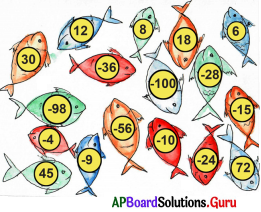
పక్క కొలనులోని చేపలపై కొన్ని సంఖ్యలు ఉన్నవి. ఏవేని 4 జతల సంఖ్యలను ఎన్నుకొని, 4 గుణకార వాక్యాలు రాయుము. తరువాత 4 జతల ఇతర సంఖ్యలను ఎన్నుకొని, 4 భాగహార వాక్యాలు రాయుము.
AP Board 7th Class Maths Solutions Chapter 1 పూర్ణ సంఖ్యలు InText Questions 4
సాధన.
గుణకార వాక్యాలు:

  • (-10) × 6 = – 60
  • 12 × 8 = 96
  • 6 × (-4) = – 24
  • (4) × (-9) = 36
  • (-56) × (- 10) = 560

భాగహార వాక్యాలు:

  • – 36 + 6 = – 6
  • 72 + 8 = 9
  • (- 24) + 6 = 4
  • (- 100) + (- 10) = 10
  • 18 + (- 9) = – 2

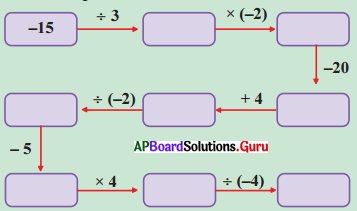
పజల్ టైమ్ [పేజి నెం. 22]

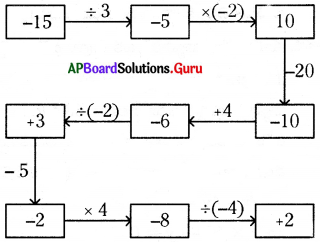
జశ్వి తన ఇష్టమైన సంఖ్యను ఒక పజిల్ రూపములో చెప్పినది. ఆ సంఖ్యను కనుగొనండి.
AP Board 7th Class Maths Solutions Chapter 1 పూర్ణ సంఖ్యలు InText Questions 5
సాధన.
AP Board 7th Class Maths Solutions Chapter 1 పూర్ణ సంఖ్యలు InText Questions 6

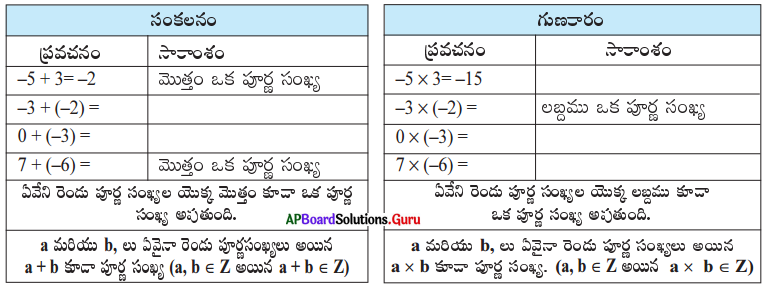
పేజి నెం. 22

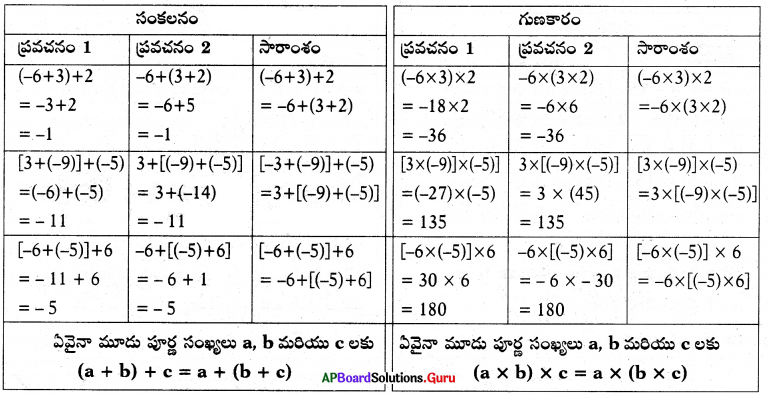
(i) సంవృత ధర్మము : కింది పట్టికలను పరిశీలించండి మరియు వాటిని పూరించుము.
AP Board 7th Class Maths Solutions Chapter 1 పూర్ణ సంఖ్యలు InText Questions 7
సాధన.
AP Board 7th Class Maths Solutions Chapter 1 పూర్ణ సంఖ్యలు InText Questions 8
∴ పూర్ణ సంఖ్యలు సంకలనము, గుణకారముల దృష్ట్యా సంవృత ధర్మాన్ని పాటిస్తాయి.

AP Board 7th Class Maths Solutions Chapter 1 పూర్ణ సంఖ్యలు InText Questions

ఆలోచించండి [పేజి నెం. 22]

మొత్తము లేదా లబ్దము పూర్ణ సంఖ్య కాని సంఖ్య అగునట్లు కనీసం ఒక పూర్ణ సంఖ్యల జత చెప్పగలమా ?
సాధన.
మొత్తము లేదా లబ్దము పూర్ణ సంఖ్య కాని సంఖ్య అగునట్లు కనీసం ఒక పూర్ణ సంఖ్యల జత సాధ్యము కాదు.

[పేజి నెం. 24]

AP Board 7th Class Maths Solutions Chapter 1 పూర్ణ సంఖ్యలు InText Questions 9
సాధన.
AP Board 7th Class Maths Solutions Chapter 1 పూర్ణ సంఖ్యలు InText Questions 10
∴ పూర్ణ సంఖ్యలు వ్యవకలనం దృష్ట్యా సంవృత ధర్మాన్ని పాటిస్తాయి. కానీ భాగహారము దృష్ట్యా సంవృత ధర్మాన్ని పాటించనవసరం లేదు.

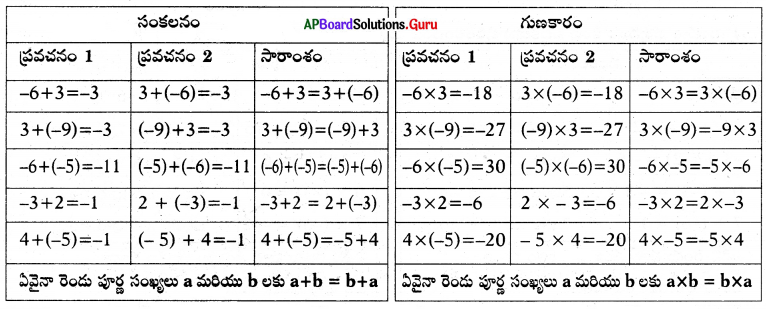
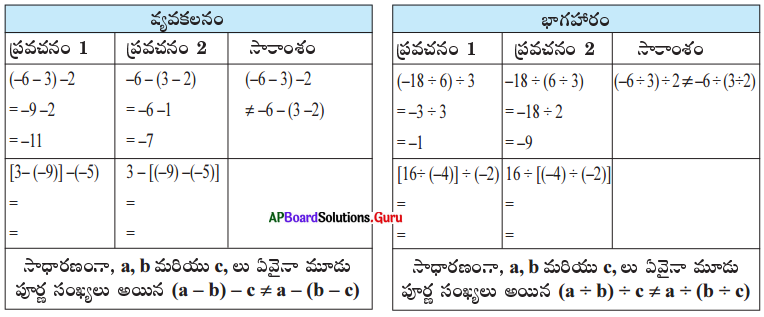
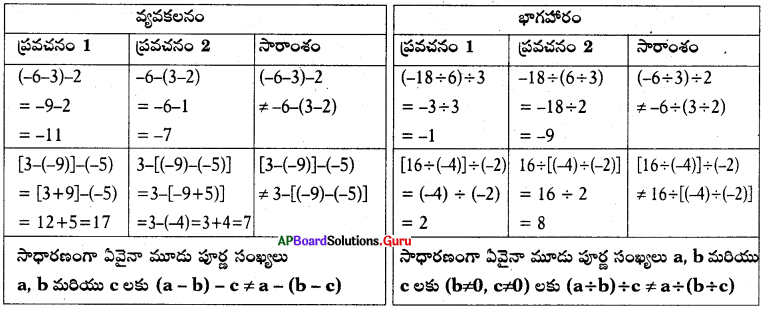
(ii) వినిమయ (స్థిత్యంతర) న్యాయము: కింది పట్టికలను పరిశీలించండి మరియు వాటిని పూరించుము. సంకలనం
AP Board 7th Class Maths Solutions Chapter 1 పూర్ణ సంఖ్యలు InText Questions 11
సాధన.
AP Board 7th Class Maths Solutions Chapter 1 పూర్ణ సంఖ్యలు InText Questions 12
∴ పూర్ణ సంఖ్యలు సంకలనము మరియు గుణకారముల దృష్ట్యా వినిమయ (స్థిత్యంతర) న్యాయమును పాటిస్తాయి.

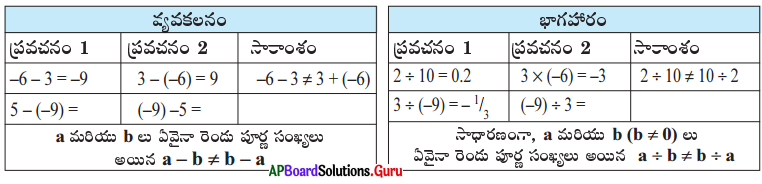
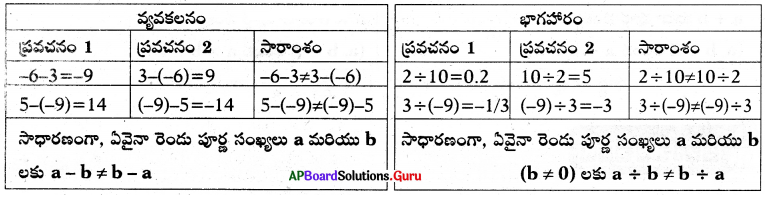
AP Board 7th Class Maths Solutions Chapter 1 పూర్ణ సంఖ్యలు InText Questions 13
సాధన.
AP Board 7th Class Maths Solutions Chapter 1 పూర్ణ సంఖ్యలు InText Questions 14
∴ పూర్ణ సంఖ్యలు వ్యవకలనము మరియు భాగహారముల దృష్ట్యా వినిమమ (స్థిత్యంతర) న్యాయమును పాటించవు.

AP Board 7th Class Maths Solutions Chapter 1 పూర్ణ సంఖ్యలు InText Questions

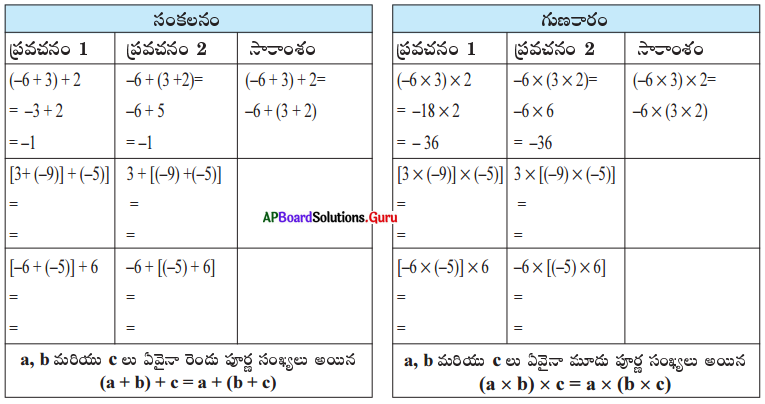
(iii) సహచర న్యాయము: కింది పట్టికలను పరిశీలించండి మరియు వాటిని పూరించుము.
AP Board 7th Class Maths Solutions Chapter 1 పూర్ణ సంఖ్యలు InText Questions 15
సాధన.
AP Board 7th Class Maths Solutions Chapter 1 పూర్ణ సంఖ్యలు InText Questions 16
∴ పూర్ణ సంఖ్యలు సంకలనము మరియు గుణకారముల దృష్ట్యా సహచర న్యాయము పాటిస్తాయి.

AP Board 7th Class Maths Solutions Chapter 1 పూర్ణ సంఖ్యలు InText Questions 17
సాధన.
AP Board 7th Class Maths Solutions Chapter 1 పూర్ణ సంఖ్యలు InText Questions 18
∴ పూర్ణ సంఖ్యలు వ్యవకలనము మరియు భాగహారముల దృష్ట్యా సహచర న్యాయమును పాటించవు.

AP Board 7th Class Maths Solutions Chapter 1 పూర్ణ సంఖ్యలు InText Questions

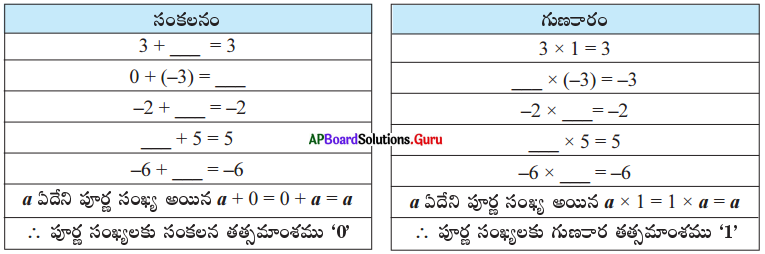
(iv) తత్సమ ధర్మము: ఈ క్రింది పట్టికలను గమనించి, పూరించండి.
AP Board 7th Class Maths Solutions Chapter 1 పూర్ణ సంఖ్యలు InText Questions 19
సాధన.
AP Board 7th Class Maths Solutions Chapter 1 పూర్ణ సంఖ్యలు InText Questions 20

[పేజి నెం. 28]

v. సంకలన విలోమ న్యాయము :
– 3 కు ఎంత కలిపిన సంకలన తత్సమాంశము ‘0’ వచ్చును ?
సాధన.
జ. పరిశీలన :

  • 4 + (- 4) = 0
  • (- 5) + 5 = 0
  • (- 6) + 6 = 0

నీ ప్రగతిని సరిచూసుకో [పేజి నెం. 28 ఉదాహరణ]

5, -8, 1, 0 ల సంకలన విలోమాలను వ్రాయుము.
సాధన.
5 యొక్క సంకలన విలోమం = – (5) = – 5
-8 యొక్క సంకలన విలోమం = – (-8) = 8
1 యొక్క సంకలన విలోమము = – (1) = – 1
0 యొక్క సంకలన విలోమము = – (0) = 0

ఆలోచించండి [పేజి నెం. 28]

ప్రశ్న 1.
6ను ఏ సంఖ్యతో గుణించిన గుణకార తత్సమాంశము ‘1’ వస్తుంది ? అది పూర్ణ సంఖ్యలలో వుంటుందా?
సాధన.
6 ను [latex]\frac{1}{6}[/latex] తో గుణించిన గుణకార తత్సమాంశము 1 వస్తుంది.
6 × [latex]\frac{1}{6}[/latex] = 1
[latex]\frac{1}{6}[/latex] పూర్ణ సంఖ్యలలో ఉండదు.

ప్రశ్న 2.
– 3 × [(- 4) – 2] = [(- 3) × (-4)] – [(- 3) × 2)ను సరిచూడుము. పూర్ణసంఖ్యలు వ్యవకలనముపై గుణకారము విభాగ న్యాయమును పాటిస్తాయా ? మీ పరిశీలనలను వ్రాయండి.
సాధన.
– 3 × [(- 4) – 2] = [(- 3) × (- 4)] – [(- 3) × 2]
– 3 × (-6) = 12 — (-6)
18 = 18
ప్రతి సందర్భములోనూ ఎడమచేతి వైపు ఉన్న విలువ, కుడిచేతి వైపు ఉన్న విలువకు సమానము.
కావున, పూర్ణసంఖ్యలు వ్యవకలనముపై గుణకారము విభాగ న్యాయమును పాటిస్తాయి.

AP Board 7th Class Maths Solutions Chapter 1 పూర్ణ సంఖ్యలు InText Questions

నీ ప్రగతిని సరిచూసుకో [పేజి నెం. 34]

సూక్ష్మీకరించుము:
(i) 5 × 6 – 6
సాధన.
5 × 6 – 6
= 30 – 6
= 24
(BODMAS నియమం ప్రకారం గుణకారం, ఆ తర్వాత వ్యవకలనం)

(ii) 24 ÷ 3 × 3 – 30
సాధన.
24 ÷ 3 × 3 – 30
= 8 × 3 – 30
= 24 – 30
= – 6
(BODMAS నియమం ప్రకారం మొదట భాగహారం, ఆ తరువాత గుణకారం, ఆ తరువాత వ్యవకలనం)

(iii) 5 × 5 – 5 ÷ 5 + 5
సాధన.
5 × 5 – 5 ÷ 5 + 5
= 5 × 5 – 1 + 5
= 25 – 1 + 5
= 30 – 1
(BODMAS నియమం ప్రకారం సూక్ష్మీకరణ క్రమం: భాగహారం, గుణకారం, సంకలనం, వ్యవకలనం)

అన్వేషిద్దాం [పేజి నెం. 38]

|x| = 15 అయిన x యొక్క విలువ ఏమవుతుంది ? చర్చించండి.
సాధన.
|x| = 15 అయిన x = 15 లేదా X = – 15 అవుతుంది.
వివరణ (i): .
ఎందుకనగా, |15| = 15 మరియు |- 15| = 15

వివరణ (ii):
x > 0 అయిన |x| = x
x < 0 అయిన |x| = – x .
|x| = 15 లో
x > 0 అనగా x ధనాత్మకం అయిన x = 15
x < 0 అనగా x రుణాత్మకం అయిన x = – 15

తార్కిక విభాగం

సంఖ్యాశ్రేణులు – 1 [పేజి నెం. 40]

ఒక ప్రత్యేక నియమము లేదా ప్రత్యేక అమరిక ఆధారంగా ఏర్పడిన సంఖ్యల సమాహారమే సంఖ్యా శ్రేణులుగా పరిగణించవచ్చు. ఒక పదమునకు దాని ముందు పదమునకు మధ్య సంబంధం ఏ విధంగా ఉందో, ఆ శ్రేణిలోని అన్ని పదాల మధ్య అదే విధంగా ఉండును. మనం శ్రేణిలోని పదాలు ఏ నియమం ప్రకారం ఏర్పడ్డాయో కనుగొని, ఆ నియమం ఆధారంగా మనకు తెలియని సంఖ్యను కనుగొనాలి. కొన్ని రకాల శ్రేణులు కింద ఇవ్వబడ్డాయి.

1. ప్రధాన సంఖ్యలు శ్రేణి : ,ఇందులో ప్రధాన సంఖ్యలు క్రమంలో ఉండును.
ఉదా (i) : 2, 3, 5, 7, 11, 13, ____.
ఈ శ్రేణిలో వరుస ప్రధాన సంఖ్యలు ఉన్నాయి. 13 తర్వాత వచ్చు ప్రధాన సంఖ్య 17.
కావున, సమాధానము 17.

ఉదా (ii): 2, 5, 11, 17, 23,
ఈ శ్రేణిలో ప్రత్యామ్నాయ (ఒకటి వదిలి మరొకటి) ప్రధాన సంఖ్యలు ఉన్నాయి. 23 తర్వాత వచ్చు ప్రధాన సంఖ్యలు 29, 31. కావున, సమాధానము 31.

AP Board 7th Class Maths Solutions Chapter 1 పూర్ణ సంఖ్యలు InText Questions

2. సంకలన శ్రేణి : ఈ శ్రేణిలో ప్రతి సంఖ్య దాని ముందున్న సంఖ్యకు, ఒక ప్రత్యేక సంఖ్య లేదా శ్రేణిని కలుపగా ఏర్పడును.
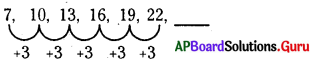
ఉదా (i) : 7, 10, 13, 16, 19, 22, ____.
కావున, సమాధానము = 22 + 3 = 25
AP Board 7th Class Maths Solutions Chapter 1 పూర్ణ సంఖ్యలు InText Questions 21

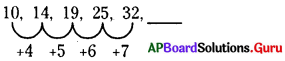
ఉదా (ii): 10, 14, 19, 25, 32, _____.
కావున, సమాధానము = 32 + 8 = 40
AP Board 7th Class Maths Solutions Chapter 1 పూర్ణ సంఖ్యలు InText Questions 22

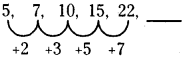
ఉదా (iii) : 5, 7, 10, 15, 22, ______.
AP Board 7th Class Maths Solutions Chapter 1 పూర్ణ సంఖ్యలు InText Questions 23
ప్రతి సంఖ్య వరుస ప్రధాన సంఖ్యలను కలుపగా ఏర్పడుచున్నది. కావున, సమాధానము
= 22 + 11 = 33.

3. ఫిబోనాకి శ్రేణి : ఇందులో మూడవ సంఖ్య నుండి ప్రతీ సంఖ్య దాని ముందున్న రెండు సంఖ్యల మొత్తముగా ఉండును.
ఉదా (i) : 3, 5, 8, 13, 21, ______.
ఇక్కడ మూడవ సంఖ్య నుండి,
3 + 5 = 8,
5 + 8 = 13,
8 + 13 = 21,
కావున, సమాధానము = 13 + 21 = 34
ఉదా (ii): 6, 10, 16, 26, 42, ______.
ఇక్కడ మూడవ సంఖ్య నుండి,
6 + 10 = 16,
10 + 16 = 26,
16 + 26 = 42,
కావున, సమాధానము = 26 + 42 = 68

ఉదాహరణలు:

ప్రశ్న 1.
నీటి గుంట(సంప్) పూర్తిగా నీటితో నిండి వుంది. మోటారుతో నీటిని తోడడం వలన నీటి స్థాయి నిముషానికి 2 అంగుళాల చొప్పున తగ్గిన 20 నిముషాల తరువాత నేలమట్టము నుండి నీరు ఎంత లోతులో ఉంటుంది ?
సాధన.
ఒక నిముషములో నీటి మట్టములో మార్పు = -2 అంగుళాలు (2 అంగుళాలు తగ్గినది)
20 నిముషాల తరువాత నీటి మట్టములో మార్పు = 20 × (- 2) = – 40 అంగుళాలు
కావున, నీటి గుంటలో నీరు నేల మట్టము నుండి 40 అంగుళాల లోతులో ఉండును.

ప్రశ్న 2.
భూమి నుంచి 20 మీ. ఎత్తు నుంచి ఒక లిఫ్ట్ ప్రారంభమయింది. అది గని లోపలికి నిముషానికి 6 మీ. చొప్పున కిందికి వెళ్ళిన, 15 నిముషాల తరువాత దాని స్థానము ఏమిటి ?
సాధన.
లిఫ్ట్ కిందికి వెళ్తున్నది కావున అది వెళ్ళే దూరాన్ని ఋణ పూర్ణ సంఖ్యతో సూచిస్తాము.
ఒక నిముషంలో లిఫ్ట్ యొక్క స్థానములో మార్పు = – 6 మీ.
15 నిముషాలలో లిఫ్ట్ యొక్క స్థానములో మార్పు = 15 × (- 6) = – 90 మీ.
కనుక, లిఫ్ట్ యొక్క చివరి స్థానము = 20 + (- 90) = -70 మీ.
∴ లిఫ్ట్ నేల మట్టము నుండి 70 మీ. లోతులో ఉండును.

AP Board 7th Class Maths Solutions Chapter 1 పూర్ణ సంఖ్యలు InText Questions

ప్రశ్న 3.
ఒక పరీక్షలో రాయబడిన సరైన సమాధానానికి (+5) మార్కులు మరియు తప్పు అయిన సమాధానానికి (-3) మార్కులు కేటాయించడం జరిగింది. లక్ష్మి రాసిన సమాధానాలలో 45 సరైనవి మరియు 15 తప్పు అయిన ఆమెకు వచ్చిన మార్కులు ఎన్ని?
సాధన.
ఒక సరైన సమాధానానికి ఇవ్వబడ్డ మార్కులు = 5
45 సరైన సమాధానాలకు మార్కులు = 45 × 5 = 225
ఒక తప్పు సమాధానానికి ఇవ్వబడ్డ మార్కులు = – 3
15 తప్పు సమాధానాలకి ఇవ్వబడ్డ మార్కులు = 15 × (- 3) = – 45
∴ లక్ష్మికి వచ్చిన మార్కులు = 225 + (- 45) = 180

ప్రశ్న 4.
భూ ఉపరితలం నుంచి ఒక బోర్ వెల్ యంత్రం ప్రతి గంటకు 72 అడుగుల లోతును త్రవ్వగలదు. భూ ఉపరితలం నుంచి 360 అడుగుల లోతులో ఉన్న నీటి పొరను చేరుటకు ఆ యంత్రానికి ఎంత సమయం పడుతుంది ?
AP Board 7th Class Maths Solutions Chapter 1 పూర్ణ సంఖ్యలు InText Questions 3
సాధన.
ఒక గంటలో త్రవ్వు లోతు = – 72 అడుగులు
భూ ఉపరితలము నుండి నీటిపొర గల దూరము = -360 అడుగులు
నీటిని చేరుటకు పట్టు సమయము = -360 ÷ (- 72) = 5
కావున, బోర్‌వెల్ యంత్రం నీటి పొరను చేరుటకు 5 గంటల సమయం పడుతుంది.

ప్రశ్న 5.
ఒక పరీక్షలో, ప్రతి సరైన సమాధానానికి (+ 4) మార్కులు మరియు ప్రతి తప్పు సమాధానానికి (- 2) మార్కులు ఇవ్వబడతాయి. శశి అన్ని ప్రశ్నలకు సమాధానం ఇచ్చాడు మరియు అతను వ్రాసిన 8 సరైన సమాధానాల ద్వారా 26 మార్కులు సాధించాడు. శశి రాసిన తప్పు సమాధానాలు ఎన్ని ?
సాధన.
ఒక్కొక్క సరైన సమాధానానికి మార్కులు = 4
కనుక, 8 సరైన సమాధానాలకు మార్కులు = 4 × 8 = 32
శశికి వచ్చిన మార్కులు = 26
తప్పు సమాధానాలకు ఇవ్వబడిన మార్కులు = 26 – 32 = – 6
ఒక్కొక్క తప్పు సమాధానానికి మార్కులు = – 2
∴ తప్పు సమాధానాల సంఖ్య = (- 6) ÷ (- 2) = 3

ప్రశ్న 6.
దుకాణదారుడు యాసిన్ ఒక సోనా మసూరి బియ్యపు బస్తాపై ₹20 లాభముతో మరియు హంస బియ్యపు బస్తాపై ₹12 నష్టముతో అమ్మాడు. ఒక నెలలో 1440 సోనా మసూరి బియ్యపు బస్తాలు అమ్మిన లాభము కానీ, నష్టము కానీ రాలేదు. అయిన ఆ నెలలో ఎన్ని హంస బియ్యపు బస్తాలు అమ్మాడు ?
సాధన.
ఇచ్చిన సమస్యలో, లాభము కానీ, నష్టము కానీ లేదు.
కావున, వచ్చిన లాభము + వచ్చిన నష్టము = 0
వచ్చిన లాభము = – వచ్చిన నష్టము
ఒక సోనా మసూరి బియ్యపు బస్తాపై వచ్చు లాభము = ₹ 20
1440 సోనా మసూరి బియ్యపు బస్తాలపై వచ్చు లాభము = 1440 × 20 = ₹ 28800
హంస బియ్యపు బస్తాలపై వచ్చు నష్టము = ₹ – 28800
ఒక హంస బియ్యపు బస్తాపై వచ్చు నష్టము = ₹ 12, దీనిని మనం – 12గా సూచిస్తాం.
ఆ నెలలో అమ్మిన హంస బియ్యపు బస్తాల సంఖ్య = (-28800) ÷ (-12) = 2400 బస్తాలు.

AP Board 7th Class Maths Solutions Chapter 1 పూర్ణ సంఖ్యలు InText Questions

ప్రశ్న 7.
(+2) మరియు (-3)ల సంకలన విలోమాలను వ్రాయుము.
సాధన.
+2 సంకలన విలోమము = -(+2) = – 2
-3 సంకలన విలోమము = -(-3) = + 3

ప్రశ్న 8.
క్రింది వాటిని సహచర న్యాయము ఆధారంగా గుణకారము చేయండి.
(i)
– 25 ×(4) × 2 × (-8)
సాధన.
– 25 × (4) × 2 × (- 8)
= [- 25 × (-4)] × 2 × (- 8)
= [100 × 2] × (- 8)
= 200 × (- 8) = – 1600

(ii) (- 20) × (-2) × (- 5) × 1
సాధన.
(- 20) × (- 2) × (- 5) ×7
= (- 20) × [(- 2) × (- 5)] × 7
= [(- 20) × 10] ×7
= – 200 × 7 = – 1400

ప్రశ్న 9.
(-42) × (-7) మరియు (-7) × (-42) లు సమానమా ? ఇది ఏ న్యాయము ?
సాధన.
(- 42) × (-7) = + 294
(- 7) × (42) = + 294
∴ (- 42) × (- 7) = (- 7) × (42)
ఇది గుణకార వినిమయ (స్థిత్యంతర) న్యాయము.

ప్రశ్న 10.
26 × (- 48) + (- 48) × (- 36) ను తగిన న్యాయాలను ఉపయోగించి సూక్ష్మీకరించుము.
సాధన.
26 × (-48) + (- 48) × (- 36)
= (- 48) × 26 + (- 48) × (- 36) (వినిమయ న్యాయము)
= (- 48) × [26 + (- 36)] (విభాగ న్యాయము)
= (48) × (- 10) = 480

ప్రశ్న 11.
3 × 2 + 8 ÷ 4 సూక్ష్మీకరించుము.
సాధన.
3 × 2 + 8 ÷ 4 (భాగహారము)
= 3 × 2 + 2 (గుణకారము)
= 6 + 2 (సంకలనము)
= 8

AP Board 7th Class Maths Solutions Chapter 1 పూర్ణ సంఖ్యలు InText Questions

ప్రశ్న 12.
1 × 6 – [latex]\overline{8-4}[/latex] సూక్ష్మీకరించుము.
సాధన.
7 × 6 – [latex]\overline{8-4}[/latex] (విన్కులం)
= 7 × 6 – 4 (గుణకారము)
= 42 – 4 (వ్యవకలనము)

ప్రశ్న 13.
18 + 64 – 4 {26 – (14 – [latex]\overline{7-3}[/latex]} సూక్ష్మీకరించుము.
సాధన.
18 + 64 -4 {26 – (14 – [latex]\overline{7-3}[/latex])} (విన్కులం)
= 18 + 64 ÷ 4 {26 – (14 – 4)} (సాధారణ బ్రాకెట్)
= 18 + 64 ÷ 4 {26 – 10} (కర్లీ బ్రాకెట్)
= 18 + 64 ÷ 4 {16} (ఆఫ్)
= 18 + 64 ÷ 64 (భాగహారము)
= 18 ÷ 1 (సంకలనము)
= 19

సాధనా ప్రశ్నలు [పేజి నెం. 42]

ప్రశ్న 1.
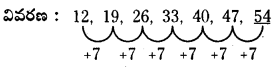
12, 19, 26, 33, 40, 47, ______
(a) 57
(b) 54
(c) 52
(d) 50
సాధన.
(b) 54

వివరణ:
AP Board 7th Class Maths Solutions Chapter 1 పూర్ణ సంఖ్యలు InText Questions 24

ప్రశ్న 2.
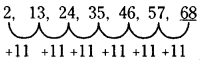
2, 13, 24, 35, 46, 57, _____
(a) 65
(b) 67
(c) 68
(d) 72
సాధన.
(c) 68

వివరణ:
AP Board 7th Class Maths Solutions Chapter 1 పూర్ణ సంఖ్యలు InText Questions 25

AP Board 7th Class Maths Solutions Chapter 1 పూర్ణ సంఖ్యలు InText Questions

ప్రశ్న 3.
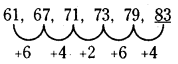
61, 67, 71, 73, 79, ______
(a) 89
(b) 87
(c) 85
(d) 83
సాధన.
(d) 83

వివరణ:
AP Board 7th Class Maths Solutions Chapter 1 పూర్ణ సంఖ్యలు InText Questions 26

ప్రశ్న 4.
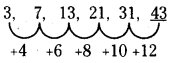
3, 7, 13, 21, 31,
(a) 43
(b) 48
(c) 51
(d) 53
సాధన.
(a) 43

వివరణ:
AP Board 7th Class Maths Solutions Chapter 1 పూర్ణ సంఖ్యలు InText Questions 27

ప్రశ్న 5.
8, 12, 20, 32, 52, 84, _______
(a) 111
(b) 126
(c) 136
(d) 174
సాధన.
(c) 136

వివరణ: 8, 12, 20, 32, 52, 84, 136 (ఫిబోనాకి శ్రేణ)
8 + 12 = 20
12 + 20 = 32
20 + 32 = 52
32 + 52 = 84
52 + 84 = 136

AP Board 7th Class Maths Solutions Chapter 1 పూర్ణ సంఖ్యలు InText Questions

ప్రశ్న 6.
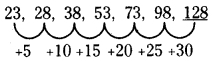
23, 28, 38, 53, 73, 98, __
(a) 121
(b) 128
(c) 135
(d) 146
సాధన.
(b) 128

వివరణ:
AP Board 7th Class Maths Solutions Chapter 1 పూర్ణ సంఖ్యలు InText Questions 28

ప్రశ్న 7.
101, 97, 89, 83, 79, 73, 71, _____
(a) 61
(b) 65
(c) 66
(d) 67
సాధన.
(d) 67

వివరణ: వరుస ప్రధాన సంఖ్యలు.
71 కి వెంటనే ముందున్న ప్రధాన సంఖ్య = 67

ప్రశ్న 8.
4, 7, 11, 18, 29, 47, __
(a) 67
(b) 76
(c) 84
(d) 92
సాధన.
(b) 76

వివరణ: ఫిబోనాకి శ్రేణి
4 + 7 = 11,
7 + 11 = 18,
11 + 18 = 29,
18 + 29 = 47,
29 + 47 = 76
4, 7, 11, 18, 29, 47, 76

ప్రశ్న 9.
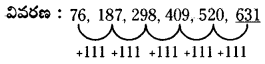
76, 187, 298, 409, 520, ______
(a) 631
(b) 656
(c) 701
(d) 724
సాధన.
(a) 631

వివరణ: 61, 67, 71, 73, 79, 83
AP Board 7th Class Maths Solutions Chapter 1 పూర్ణ సంఖ్యలు InText Questions 29

AP Board 7th Class Maths Solutions Chapter 1 పూర్ణ సంఖ్యలు InText Questions

ప్రశ్న 10.
0, 2, 5, 10, 17, 28, 41, ______
(a) 50
(b) 53
(c) 57
(d) 58
సాధన.
(d) 58

వివరణ:
AP Board 7th Class Maths Solutions Chapter 1 పూర్ణ సంఖ్యలు InText Questions 30

ప్రశ్న 11.
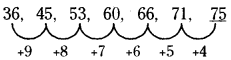
36, 45, 53, 60, 66, 71, ____
(a) 84
(b) 78
(c) 75
(d) 73
సాధన.
(c) 75

వివరణ:
AP Board 7th Class Maths Solutions Chapter 1 పూర్ణ సంఖ్యలు InText Questions 31

ప్రశ్న 12.
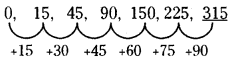
0, 15, 45, 90, 150, 225, _____
(a) 295
(b) 300
(c) 315
(d) 360
సాధన.
(c) 315

వివరణ:
AP Board 7th Class Maths Solutions Chapter 1 పూర్ణ సంఖ్యలు InText Questions 32
15, 30, 45, 60, 75 లు 15 గుణిజాలు.
కావున, 75 తరువాత గల 15 గుణిజము 90.

ప్రశ్న 13.
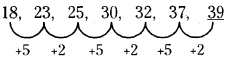
18, 23, 25, 30, 32, 37, _____ .
(a) 43
(b) 41
(c) 39
(d) 38
సాధన.
(c) 39

వివరణ:
AP Board 7th Class Maths Solutions Chapter 1 పూర్ణ సంఖ్యలు InText Questions 33

AP Board 7th Class Maths Solutions Chapter 1 పూర్ణ సంఖ్యలు InText Questions

ప్రశ్న 14.
4, 7, 11, 18, 29, 47, ______
(a) 71
(b) 76
(c) 77
(d) 82
సాధన.
(b) 76

వివరణ: ఫిబోనాకి శ్రేణి
4 + 7 = 11,
7 + 11 = 18,
11 + 18 = 29,
18 + 29 = 47,
∴ 29 + 47 = 76
4, 7, 11, 18, 29, 47, 76

ప్రశ్న 15.
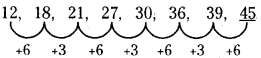
12, 18, 21, 27, 30, 36, 39, _____
(a) 43
(b) 45
(c) 49
(d) 52
సాధన.
(b) 45

వివరణ:
AP Board 7th Class Maths Solutions Chapter 1 పూర్ణ సంఖ్యలు InText Questions 34

AP 7th Class Social Important Questions 12th Lesson Markets Around Us

These AP 7th Class Social Important Questions 12th Lesson Markets Around Us will help students prepare well for the exams.

AP Board 7th Class Social 12th Lesson Important Questions and Answers Markets Around Us

7th Class Social 12th Lesson 2 Marks Important Questions and Answers

Question 1.
What are the important sources of income?
Answer:
Salaries, wages, profits, rents, shares and dividends, etc.

Question 2.
Define physical markets.
Answer:
A physical market is a place where buyers can physically meet the sellers and purchase the desired items from them.

Question 3.
Define Local Market.
Answer:
When competition between a purchaser and a seller is localised and limited to specific area is called a local market.

Question 4.
Define Regional Markets.
Answer:
These markets cover a wider area than local markets depending upon the availability of the goods in a particular region or even a group of states or districts.

AP 7th Class Social Important Questions 12th Lesson Markets Around Us

Question 5.
Define National Market.
Answer:
This is a market in which the trade for the goods and services takes place in a nation as a whole. ,

Question 6.
Define International Market.
Answer:
Trading of goods and services among different countries is known as the international Market.

Question 7.
What is meamt by weekly markets?
Answer:
In some areas markets are held on a particular day of the week. These are called weekly markets.

Question 8.
Define Rythu Bazar.
Answer:
Marginal and small scale farmers can directly sell the vegetables directly to the consumers and can get a good price for their products.

Question 9.
What is meant by Shopping Malls?
Answer:
In the Urban and Semi-urban areas, large multistoried air-conditioned buildings with shops on different floors are known as shopping malls.

Question 10.
Define Shopping Complex.
Answer:
Many shops are found in one compound in Urban areas, known as shopping complex.

Question 11.
What is meant by E – Market?
Answer:
Online platform that connect buyers and sellers through internet.

AP 7th Class Social Important Questions 12th Lesson Markets Around Us

12. Define a consumer?
Answer:
A consumer is a person who buys goods or services for his personal use.

7th Class Social 12th Lesson 42 Marks Important Questions and Answers

Question 1.
Explain the types of physical markets based on the Geographical location.
Answer:
A physical market is a place where buyers can physically meet the sellers and purchase the desired items from them.

On the basis of geographical location classified as physical markets are

  1. Local Markets.
  2. Regional Markets
  3. National Markets
  4. International Markets

Question 2.
Explain the types of physical markets based on nature.
Answer:
On the basis of nature, physical markets are classified as :

  1. Neighbourhood Markets.
  2. Weekly Markets.
  3. Shopping Malls.

7th Class Social 12th Lesson 8 Marks Important Questions and Answers

Question 1.
What are Consumer Rights?
Answer:
Consumer Rights:

  1. The right to be protected against the marketing of goods, products or services which are hazardous to life and property.
  2. The right to be informed about the quality, quantity, potency, purity, standard and price of goods, products or services, as the case may be, so as to protect the consumer against unfair trade practices.
  3. The right to be assured, wherever possible, access to a variety of goods, products or services at competitive prices.
  4. The right to be heard and to be assured that consumers interests will receive due consideration at appropriate fora.
  5. The right to seek redressal against unfair trade practice or restrictive trade practices or unscrupulous exploitation of consumers.
  6. The right to consumer awareness.

AP Board 7th Class Social 12th Lesson 1 Mark Bits Questions and Answers Markets Around Us

I. Multiple Choice Questions

1. One of the important source of income is
A) Salaries
B) Rents
C) Interest
D) All the above
Answer:
D) All the above

2. Return for moneylender
A) Profit
B) Rent
C) Interest
D) None
Answer:
C) Interest

AP 7th Class Social Important Questions 12th Lesson Markets Around Us

3. Return for land
A) Rent
B) Profit
C) Interest
D) None
Answer:
A) Rent

4. Return for entrepreneur
A) Interest
B) Profit/loss
C) Rent
D) None
Answer:
B) Profit/loss

5. Unorganised sector workers get
A) wages
B) profits
C) rents
D)none
Answer:
A) wages

6. Organised sector workers get
A) profits
B) wages
C) salaries
D)rents
Answer:
C) salaries

7. Goods available from neighbour markets
A) gold
B) silver
C) sugar
D) none
Answer:
C) sugar

8. Credit cards are issued by
A) banks
B) money lenders
C) government
D) none
Answer:
A) banks

9. Goods available from weekly markets
A) vegetables
B) grains
C) forest products
D) all the above
Answer:
D) all the above

10. Rythu Bazar’s were started in
A) 1998
B) 2000
C) 1999
D) 2001
Answer:
C) 1999

11. We find floating markets in
A) Srinagar
B) Delhi
C) Agra
D) Mumbaj
Answer:
A) Srinagar

12. Tourists of various nations enjoy the shopping in
A) Chilaka Lake
B) Kolleru Lake
C) Dal Lake
D) None
Answer:
C) Dal Lake

13. Consumer Protection Act as approved in
A) 2018
B) 2019
C) 2020
D) 2015
Answer:
B) 2019

AP 7th Class Social Important Questions 12th Lesson Markets Around Us

14. National consumer’s day is observed every year in
A) 24th December
B) 24th January
C) 24th March
D) 24th July.
Answer:
A) 24th December

II. Intext – Bits – Fill in the Blanks

1. Income comes from ……………… sources.
2. Agricultural labour works in ……………. sector.
3. Business people get ……………. .
4. Money lenders get ……………. .
5. Land and property owners get ……………. .
6. There are many shops that sell goods in our ……………. .
7. Credit cards are issued by ……………. .
8. The things in weekly markets are available at ……………. .
9. In urban and semi-urban areas ……………. are there.
10. Rythu Bazars are started in ……………. .
11. Many shops are found in one compound in urban areas known as ……………. .
12. We find floating market in ……………. .
13. Vegetable trade takes place through boats from 5 am to 7 am in the most picturesque ……………. of Srinagar.
14. Vegetable boats in local language are called ……………. .
15. On ……………. Consumer Protection Act was approved.
16. NCDRC was set up in ……………. .
17. NCDRC head office is in ……………. .
18. Every year ……………. is observed as National Consumer Day in India.
Answer:

  1. dilferent
  2. unorganised
  3. profits’Ioses
  4. Interest
  5. Rent
  6. Neighbourhood
  7. Banks
  8. Cheaper rates
  9. Shopping malls
  10. 1999
  11. Shopping complex
  12. Srinagar, Jammu &. Kashmir
  13. Dal Lake
  14. Shikaras
  15. 9th August, 2019
  16. 1988
  17. New Delhi
  18. 24th December

III. Match the following :

1.

Group-A Group-B
1. Labour A) Profit
2. Land B) Rent
3. Money lender C) Wages
4. Business man D) Interest

Answer:

Group-A Group-B
1. Labour C) Wages
2. Land B) Rent
3. Money lender D) Interest
4. Business man A) Profit

2.

Group-A Group-B
1. Weekly Market A) branded
2. e-commerce B) forest products
3. International market C) online shopping
4. Shopping malls D) petroleum

Answer:

Group-A Group-B
1. Weekly Market B) forest products
2. e-commerce C) online shopping
3. International market D) petroleum
4. Shopping malls A) branded

3.

Group-A Group-B
1. 2019 A) Rythu Bazar
2. 1988 B) Consumer Protection
3. 1999 C) NCDRC

Answer:

Group-A Group-B
1. 2019 B) Consumer Protection
2. 1988 C) NCDRC
3. 1999 A) Rythu Bazar

Do You Know?

7th Class Social Textbook Page No. 74

CREDIT CARD :
A card issued by financial institutions which lets you borrow funds from a pre-approved limit to pay for your purchases.

7th Class Social Textbook Page No. 77
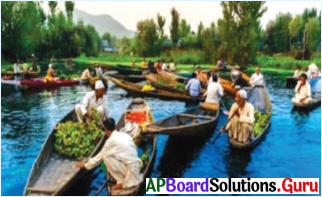
AP 7th Class Social Important Questions 12th Lesson Markets Around Us 1
Floating Market in Srinagar, Jammu and Kashmir. In the most picturesque Dal Lake of Srinagar every day from 5 am to 7 am vegetable trade takes place through boats.

These boats are called ‘Shikara’ in local language. Besides vegetables, wood carvings, saffron and other local goods also available on these Shikaras. Tourists of various nations enjoy the shopping in Dal Lake.

7th Class Social Textbook Page No. 79

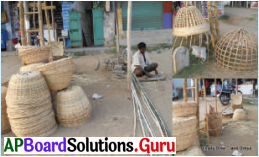
AP 7th Class Social Important Questions 12th Lesson Markets Around Us 2
Cottage industry is a production system that relies on producing goods or parts of goods, by craftsmen at home or small workshops, by individuals, small teams or family units instead of large factories.

7th Class Social Textbook Page No. 81

  • National Consumer Disputes Redressal Commission (NCDRC) was setup in 1988 under the Consumer Protection Act 1986. Its head office is in New Delhi.
  • Consumer help line number : National Toll-Free Number 1800-114000 or 14404.
  • Every year 24th December is observed as National Consumer Day in India.

AP 7th Class Social Important Questions 11th Lesson Road Safety Education

These AP 7th Class Social Important Questions 11th Lesson Road Safety Education will help students prepare well for the exams.

AP Board 7th Class Social 11th Lesson Important Questions and Answers Road Safety Education

7th Class Social 11th Lesson 2 Marks Important Questions and Answers

Question 1.
Why it is compulsory to have a driving licence?
Answer:
No person should drive a motor vehicle unless he/she holds driving license.

To drive vehicle is an offence without license, it is against law. So, it is compulsory to have a driving license.

Question 2.
What is the main reason for heavy increase of vehicular traffic?
Answer:
Increase of population, industrialisation, urbanisation, and globalisation.

Question 3.
What is the responsibility of every road user?
Answer:
To follow traffic rules.

Question 4.
What is traffic education?
Answer:
Traffic education is the education which describes the traffic rules and regulations in a clear and simple way.

AP 7th Class Social Important Questions 11th Lesson Road Safety Education

Question 5.
What is required for free flow of traffic?
Answer:
Systematic regulations.

Question 6.
Define Road safety.
Answer:
Road Safety: Road safety refers to the safety of road users including pedestrains, cyclists, motorists other passengers in the usage of road.

Question 7.
When did we organise road safety week?
Answer:
We organise road safety week every year in the month of January.

8. Mention the traffic signs.
Answer:
Traffic signs can be divided into two types :

  1. Manual traffic sighs.
  2. Electronic signs.

Question 9.
Define the following.
Footpath, Road divider, Zebra Crossing
Answer:
1) Footpath :
It is laid on either side of the road for the use of pedestrains.

2) Road divider :
The road is divided into two halves for separating the two directions of the traffic on the same road.

3) Zebra Crossing :
Zebra crossing is the place where the pedestrains cross the road Sufely.

AP 7th Class Social Important Questions 11th Lesson Road Safety Education

Question 10.
What are the distracters while driving?
Answer:
Talking over the mobile phone or texting message or engaging in any activities attention diverted from driving.

7th Class Social 11th Lesson 4 Marks Important Questions and Answers

Question 1.
How can media promote road safety among the public?
Answer:
Mass media and journals could play a key role to raise awareness on road safety.
In particular, they can disseminate preventive messages and promote safe behaviours, increase peoples knowledge and understanding of the gravity of the problem and advocate for safer roads and systems.

Question 2.
What are the rules followed by motor cyclists?
Answer:

  1. Must hold a valid driving license and required documents.
  2. Wearing a helmet is compulsory both for the rider and the pillion rider.
  3. Pillion rider should not disturb the rider.

Question 3.
Explain the road marking signs.
Answer:
There are three road marking signs :
1) Footpath :

  1. It is laid on either side of the road for the use of pedestrains.
  2. It is built with a width of about 2 mts.
  3. Road divider: The road is divided into two halves for separating the two directions of the traffic on the same road.

3) Zebra crossings:

  1. Zebra crossing is the place where the pedestrians cross the road safely.
  2. These are laid at places where traffic is heavy.

Question 4.
Explain about Electronic Traffic Signs.
Answer:
A traffic light, traffic signal or a signal post is a signatory device positioned at a road intersection to indicate when it is safe to drive through.

  1. Red indicates – Stop before the line.
  2. Orange indicates – get ready to go.
  3. Green indicates – move the vehicle.

Question 5.
What are the causes for road accidents in rural areas?
Answer:
Causes for road accidents in rural areas :

  1. Leaving animals like buffaloes, goats, sheeps etc., on roads.
  2. Using tractors with cage wheels.
  3. Heavy vehicles like proclainer cause potholes on roads.
  4. Piling up of grass, dumping of garbage on road sides and corners.
  5. Traffic caused by village fairs and markets.
  6. Drying piles of grains in the roads.

Question 6.
What are the causes of road accidents?
Answer:

  1. Overspeed and reckless driving.
  2. Drunk and drive
  3. Distractions of the driver
  4. Signal jumping.
  5. Avoiding safety measures like wearing seat belts and helmets.
  6. Non-adherence to lane driving and overtaking in a wrong manner.

7th Class Social 11th Lesson 8 Marks Important Questions and Answers

Question 1.
What are the causes of road accidents in urban areas?
Answer:

  1. Overspeed and reckless driving.
  2. Drunk and drive.
  3. Using mobile phone while driving.
  4. Distractions of the driver.
  5. Signal jumping.
  6. Avoiding safety measures like wearing seat belts and helmets.
  7. Non-adherence to lane driving and overtaking in a wrong manner.

AP 7th Class Social Important Questions 11th Lesson Road Safety Education

Question 2.
How can we reduce road accidents?
Answer:
Important ways to avoid accidents.

  1. Drive in the prescribed speed limits on the various roads.
  2. Always wear helmets, seat belts and other safety equipments before driving a cycle, motor cycle/vehicle.
  3. Do not drink and drive.
  4. Never use mobile phones or ear phones while driving.
  5. Know the traffic signs, signals, lights and traffic safety rules before you hit the road.
  6. Do not drive for long hours in a stretch.
    Have a proper breaks after every 2 hours of continuous driving.

Question 3.
What are the rules followed by pedestrains?
Answer:

  1. Walk on the footpath.
  2. If the footpath is not available and the road is narrow, walk on the right side of the road watching the oncoming traffic.
  3. Must use reflective clothing at night while walking on the road.
  4. Always carry a torch while on road at night time.
  5. Cross the road at zebra crossing.
  6. While crossing the road first look on to your right when it is a clear move to the centre then look to your left finding it Safe cross the road.
  7. Don’t use the mobile while walking on the road or crossing the road.

Question 4.
What are the precautions to be followed while riding a bicycle?
Answer:
Safe Cycling:

  1. Ride close to the road in single file. If there is a cycle track, use it.
  2. A cyclist should ride close the the kerb on the left and be careful about drainage pits that may in some case be without a cover.
  3. Try to avoid s road with heavy traffic.
  4. Always keep safe lateral distance from heavy vehicles as the wind turbulence created by them may throw a cyclist out of balance.
  5. Do not fide at high speed especially on wet roads.
  6. Before you start, stop or trun, use hand signals to indicate your intentions. And only if safe, move on.
  7. Follow traffic signals at all junctions. Don’t cross when the signal is red, slow down at intersections.
  8. Look out for vehicles at intersections. Look behind and cross only when there is enough gap.
  9. Have a reflector or light while riding at night.
  10. Most importantly, learn perfectly all signs and signals and obey them faithfully when you use your cycle.

Question 5.
What are the precautions for safety travelling?
Answer:
Safety Travelling:

  1. Don’t try to get in or out of a moving auto, car, bus.
  2. Always get down from the left side onto the footpath.
  3. Never disturb the driver.
  4. Don’t travel in an overcrowded auto, bus etc.
  5. See that the doors of a vehicle are properly locked.
  6. Never put your head or hand out of the window.
  7. Put on your seat belt while travelling in a car.
  8. Always stand in a queue while waiting for the bus stand on footpath and not on the road. We should not push each other to get a place on the bus.
  9. After getting down from the bus, wait till the bus leaves.
  10. Walk across from a safe point. Remember not to miss the kerb drill.
  11. Never board or get down from a moving bus.

AP Board 7th Class Social 11th Lesson 1 Mark Bits Questions and Answers Road Safety Education

I. Multiple Choice Questions

1. Road users are increased due to
A) Money
B) Offices
C) growth of population
D) None of the above
Answer:
C) growth of population

2. Percentage of people effected by accidents between 25-35 age group is
A) 22%
B) 26%
C) 22%
D) 30%
Answer:
B) 26%

AP 7th Class Social Important Questions 11th Lesson Road Safety Education

3. Road safety week is organised every year in the month of
A) February
B) January
C) May
D) June
Answer:
B) January

4. Who regulates the flow of traffic?
A) Police
B) Teacher
C) Traffic Police
D) Collector
Answer:
C) Traffic Police

5. When the red traffic light is on, the vehicle should stop
A) In the cross walk
B) In the intersection
C) Outside the stop line
D) Stop before the line
Answer:
D) Stop before the line

6. AP 7th Class Social Important Questions 11th Lesson Road Safety Education 1
A) A mandatory sign
B) A cautionary sign
C) An informationary sign
D) All of the above
Answer:
A) A mandatory sign

7. We should not enter where we see ………….. sign.
A) Mandatory
B) No entry
C) Cautionary
D) Information
Answer:
B) No entry

8. Parking at ………… are the main cause for traffic jam.
A) Zebra crossing
B) No parking
C) Footpath
D) None of the above
Answer:
B) No parking

9. Temporary licence is valid upto …………… months.
A) 5
B) 4
C) 6
D) 8
Answer:
C) 6

10. Age limit for transport vehicle is …………… years.
A) 20
B) 18
C) 21
D) 25
Answer:
D) 25

AP 7th Class Social Important Questions 11th Lesson Road Safety Education

11. Temporary licence is called as ……………
A) Trial
B) Learner’s licence
C) Pre-Learner
D) None of the above
Answer:
B) Learner’s licence

12. After learner’s license, the permanent license will provide with the days of …………………
A) 20-50
B) 30-60
C) 30-180
D) 100-200
Answer:
C) 30-180

13. It is an offence to drive a vehicle without ………………
A) Driving license
B) Aadhar card
C) Petrol
D) Pollution checking
Answer:
A) Driving license

14. Always carry a ………. while walking at night time.
A) Signal
B) Stick
C) Torch
D) Water
Answer:
C) Torch

15. Two-wheeler vehicle rider should were a ………….. for safe journey.
A) Helmet
B) Seat belt
C) Shoes
D) Sweater
Answer:
A) Helmet

16. Drunken drivers should pay penality in the ……………
A) Court
B) Police station
C) RTA office
D) None of the above
Answer:
A) Court

17. One of the road safety slogan is
A) Small family – Happy family
B) Live and let live
C) Word is the weapon
D) None of the above
Answer:
B) Live and let live

18. Learner’s license provide for a period of
A) 1 year
B) 1 month
C) 2 months
D) 6 months
Answer:
D) 6 months

AP 7th Class Social Important Questions 11th Lesson Road Safety Education

19. The main reason for traffic jam is
A) Animals
B) Birds
C) illiterates
D) Not following the rules and regulations
Answer:
D) Not following the rules and regulations

II. Intext – Bits – Fill in the Blanks

1. The …………………… created rapid changes in the usage of roads.
2. Road users are increased due to the …………………… .
3. Road safety week is organised by …………………… .
4. Manual traffic signs include ……………………, …………………… .
5. …………………… regulate the flow of traffic.
6. Follow traffic signals at the …………………… .
7. …………………… is the place where the pedestrains cross the road safety.
8. Walk on the …………………… .
9. Drunk and drive is an …………………… .
10. Age limit for driving of motor vehicle …………………… .
Answer:

  1. invention of wheel
  2. growth of population
  3. Ministry of Road Transport and Highways in India
  4. Mandatory signs, Information signs, Cautionary signs
  5. Traffic police
  6. Junction
  7. Zebra crossing
  8. Footpath
  9. offence
  10. 18 years

III. Match the following

1.

Group-A Group-B
1. Traffic police A) 25 years
2. Drive a vehicle B) control the traffic
3. Motor vehicle C) 18 years
4. Transport vehicle D) driving license

Answer:

Group-A Group-B
1. Traffic police B) control the traffic
2. Drive a vehicle D) driving license
3. Motor vehicle C) 18 years
4. Transport vehicle A) 25 years

Do You Know?

7th Class Social Textbook Page No. 60

Trauma care : The immediate medical care at a medical establishment to road crash victims with major and minor injuries.

Finit Aid: The intial medical support given to the victims of accidents before reaching I the hospital for better medical care.

7th Class Social Textbook Page No. 61

AP 7th Class Social Important Questions 11th Lesson Road Safety Education 2
Breath analyser :
A device used to identify the alcoholic dr

AP 7th Class Social Important Questions 11th Lesson Road Safety Education 3
Speed gun camera :
A device that measure the speed of the vehicle during the violation of orad safety rules.

7th Class Social Textbook Page No. 62

AP 7th Class Social Important Questions 11th Lesson Road Safety Education 4
Road Safety Week :
Road safety week is organized every’ year in the month of January by the Ministry of Road Transport and Highways in India. A variety of programmes related to road safety are organized to educate people on road safety driving rules and cautions and to reduce road accidents casualties.

AP 7th Class Social Important Questions 11th Lesson Road Safety Education

7th Class Social Textbook Page No. 67

Road Safety Club :
Road safety Club was formally launched in January 2010 at first in Delhi. The motto behind formation of Road Safety Club is to actively engage schools and to ensure their participation in various road safety activities.

Establish a road safety club in your school. Discuss what events are organized by this club.

  • Minimum age limit for driving of motor vehicle is 18 years.
  • Minimum age limit to drive transport vehicles is 25 years.

AP 7th Class Social Important Questions 10th Lesson State Government

These AP 7th Class Social Important Questions 10th Lesson State Government will help students prepare well for the exams.

AP Board 7th Class Social 10th Lesson Important Questions and Answers State Government

7th Class Social 10th Lesson 2 Marks Important Questions and Answers

Question 1.
How many organs are there in the government? What are they?
Answer:
There are three organs in the government. Thoy are :

  1. Legislature
  2. Executive
  3. Judiciary.

Question 2.
What is a state legislature?
Answer:
The Governor, Legislative Assembly and Le gislative Council are together called a State Legislature.

Question 3.
What is the primary function of the state legislature?
Answer:
The primary function of the state legislature is to enact laws.

Question 4.
Who appoints the Governor of a state?
Answer:
The President of India appoints the Governor of a State.

AP 7th Class Social Important Questions 10th Lesson State Government

Question 5.
Which is the lower house of the state legislature?
Answer:
Legislative Assembly is the lower house of the state legislature.

Question 6.
How many states are there in India?
Answer:
There are 28 States of India.

Question 7.
How many Assembly Constituencies are there in Andhra Pradesh?
Answer:
175 Assembly Constituencies are there in Andhra Pradesh.

Question 8.
Who takes up responsibility to conduct the elections?
Answer:
Election Commission takes up responsibility to conduct the elections.

Question 9.
What is meant by Universal Adult Franchise?
Answer:
Universal Adult Frachise means : Every Indian to get the Right to Vote at the age of 18 years without discrimination.

Question 10.
Who is an MLA?
Answer:
After counting votes, the candidate who gets the majority of the votes is declared as MLA of that constituency.

Question 11.
Who appoints the Chief Minister?
Answer:
Governor appoints the Chief Minister.

Question 12.
Which is the upper house of the state legislature?
Answer:
Legislative Council or Vidhana Parishat is the upper house of the state legislature.

Question 13.
Who is the Constitutional head of the state?
Answer:
Governor is the Constitutional head of the state.

Question 14.
Who allots the different portfolios to the cabinet?
Answer:
The Chief Minister allots different portfolios to the members of the cabinet.

AP 7th Class Social Important Questions 10th Lesson State Government

Question 15.
Which is the highest court at the state?
Answer:
The High Court is the highest court at the state level.

Question 16.
Which is the highest court in India?
Answer:
The Supreme Court is the highest court in India.

Question 17.
Who appoints the Chief Justice of India?
Answer:
The President of India appoints the Chief Justice of India.

Question 18.
What is the tenure of Chief Justice of High Court?
Answer:
Chief Justice of High Court holds the office until he completes the age of 62 years.

Question 19.
How many judges are there in the state High court?
Answer:
The present number of judges in the High Court of Andhra Pradesh is 37 (Permanent-28, Additional – 9).

Question 20.
What is the purpose of Lok Adalat’s?
Answer:
The purpose of Lok Adalat’s is to settle disputes through conciliation and compromise.

Question 22.
Into how many lists the powers are divided?
Answer:
The powers are divided into three lists.

  1. The Union list.
  2. The State list.
  3. The Concurrent list.

Question 23.
Who makes the laws on state list?
Answer:
The state government makes laws on the state list.

Question 24.
What is meant by gazette?
Answer:
An announcement in an official gazette.

(OR)

The Gazette of India is a public journal and an authorised legal document of the Government of India, published weekly by the Department of Publication, Ministry of Housing and Urban Affairs.

Question 24.
Who is the head of the district?
Answer:
The District Collector is the head of the district.

Question 25.
Who is the First-class Magistrate at district level?
Answer:
The Collector acts as a first-class magistrate at district level.

AP 7th Class Social Important Questions 10th Lesson State Government

Question 26.
Who is the First-class Magistrate at Mandal level?
Answer:
Tahsildar acts as a first class magistrate at Mandal level.

Question 27.
What is Fourth Estate?
Answer:
Media is the Fourth Estate.

7th Class Social 10th Lesson 4 Marks Important Questions and Answers

Question 1.
Write about the Functions of Governor.
Answer:
Functions of Governor:

  1. Invites the leader of majority party to form the government.
  2. Administers the oath of loyalty to the constitution and secrecy.
  3. Summons the sessions of legislative houses and also announces their prorogue.
  4. Appoints the Judges of all the courts that work under the High Court.
  5. Informs the President about the functioning of the State Government.

Question 2.
Write about the composition of Legislative Council?
Answer:
The composition of Legislative council:

  1. 1/3rd of the members are elected by the Legislative Assembly.
  2. 1/3rd of the members are elected by the Local Authorities.
  3. 1/12th of the members are elected by the Graduates Constituency.
  4. 1/12th of the members are elected by the Teachers Constituency.
  5. 1/6th of the members are nominated by Governor of the State.

Question 3.
Who becomes a Chief Minister? What is his / her role in a state?
Answer:

  1. Chief Minister is the leader of the ruling party.
  2. He / She is elected out of the total members of the party gaining majority in the general election.
  3. He / She is responsible for every action of the government.
  4. He / She also coordinates between the govenment at the centre and the state.

Question 4.
Explain the Qualifications of Judges of High Court.
Answer:
A person who is to be appointed as a judge of a High court must possess the following qualifications, \

  1. He must be citizen of India.
  2. He should have ten years of experience as a Judge or
  3. He should be a practising advocate for a period often years in the High court.

Question 5.
What are the functions of Governor?
Answer:
Functions of Governor :

  1. Invites the leader of the majority party to form the Government.
  2. Administers the oath of loyalty to the constitution and secrecy
  3. Summons the sessions of legislative houses and also announces their prorogue.
  4. Appoints the Judges of all the courts that work under the High Court.
  5. Informs the President about the functioning of the State Government.

7th Class Social 10th Lesson 8 Marks Important Questions and Answers

Question 1.
Write about the powers and functions of Chief Minister.
Answer:
Powers & Functions of Chief Minister:

  1. The Chief Minister is the chief administrator of the state.
  2. All major decisions of the state government are taken under his leadership.
  3. The Council of Ministers is formed by the advice of the Chief Minister.
  4. The Governor appoints the other ministers.
  5. The Chief Minister supervises the activities of different ministries and advises and coordinates the activities of different ministers.
  6. He plays an important role in making policies of the state government.
  7. His voice is final in the decisions of the state government.
  8. He has to ensure that the government policies would favour the public interest.

Question 2.
Write about the powers and functions of High Court.
Answer:

  1. High Court is the highest court in the state.
  2. Hich Court have the power of Judicial review.
  3. High Court has the power to hear a case in the first instance as an original court.
  4. It enjoys many powers like :
    a) Original Jurisdiction
    b) Writ Jurisdiction
    c) Appellate Jurisdiction
    d) Supervisory Jurisdiction
    e) A Court of Record
    f) Power of Judicial Review.

AP 7th Class Social Important Questions 10th Lesson State Government

Question 3.
Write about District Level Judiciary.
Answer:
1) The district Judiciary Department consists of district and divisional courts.
2) Division courts administer justice at the divisional level and district court at the district level.

3) District Court:
i) The Court at the district level is known as the District Court.
ii) The district court has a Chief District Judge and some other Judeges.
iii) The main function is prosecute and finalise various cases in the district level.
iv) The judgement of Divisional Court may be appealed in the District Court.

4) Subordinate Courts :
i) Subordinate courts at district level and lower level have almost similar structure all over the counrty.
ii) They deal with civil and criminal cases and administer the code of CPC (Civil Procedure Code) and the code of CrPC (Criminal Procedure Code).

AP Board 7th Class Social 10th Lesson 1 Mark Bits Questions and Answers State Government

I. Multiple Choice Questions

1. In India we have the government at
A) two levels
B) four levels
C) six levels
D) one levels
Answer:
A) two levels

2. The primary function of the stage legislature is
A) to enact laws
B) removal of government
C) appoints the government
D) none of the above
Answer:
A) to enact laws

3. Who nominates the governor?
A) The Chief Minister
B) The President of India
C) The Prime Minister
D) The Speaker
Answer:
B) The President of India

4. The tenure of Governor is
A) 6 years
B) 7 years
C) 5 years
D) 4 years
Answer:
C) 5 years

AP 7th Class Social Important Questions 10th Lesson State Government

5. The number of Assembly Constituencies in Andhra Pradesh.
A) 185
B) 294
C) 175
D) 115
Answer:
C) 175

6. The tenure of Assembly is
A) 4 years
B) 6 years
C) 3 years
D) 5 years
Answer:
D) 5 years

7. The upper house of the state legislature is called
A) Vidhan Sabha
B) Vidhan Parishad
C) Lok Sabha
D) Rajya Sabha
Answer:
B) Vidhan Parishad

8. The tenure of the members of Legislative Council is
A) 7 years
B) 5 years
C) 6 years
D) 4 years
Answer:
C) 6 years

9. Who is the real executive head of the state?
A) Chief Minister
B) Governor
C) Speaker
D) Collector
Answer:
B) Governor

10. Who is the head of the state?
A) The President
B) The Chief Minister
C) The Prime Minister
D) The Speaker
Answer:
A) The President

11. Who is the head of the Government?
A) The Governor
B) The Council of Ministers
C) The Chief Minister
D) The Collector
Answer:
C) The Chief Minister

12. The present number of Judges in Andhra Pradesh High Court.
A) 37
B) 33
C) 29
D) 9
Answer:
A) 37

AP 7th Class Social Important Questions 10th Lesson State Government

13. The tenure of Chief Justice of Supreme Court is _______
A) 65 years
B) 62 years
C) 59 years
D) 70 years
Answer:
A) 65 years

II. Intext – Bits – Fill in the Blanks

1. One example of Social Media : ……………………….
2. One example of Electronic Media : ……………………….
3. One example of Print Media : ……………………….
4. The court at the district level is known as the ……………………….. .
5. ………………………. is the First Class Magistrate at Mandal level.
6. The District Collector is the head of the ………………………. .
7. ………………………. is the First Class Magistrate at the District level.
8. Lok Adalats are ………………………. .
9. Laws are enacted by ………………………. .
10. ………………………. appoints the Chief Justice of High Court.
11. ………………………. is the highest judicial organ at the state level.
12. Judiciary is one of the ………………………. organs of state government.
13. The Chief Minister allots different ………………………. to the members of the cabinet.
14. FIR : ……………………….
15. DSP : ……………………….
16. ………………………. is the Constitutional head of a state’.
17. The Legislative Council is a ………………………. .
18. MLA : ……………………….
19. UPSC : ……………………….
20. CPC : ……………………….
21. CRPC : ……………………….
22. MLC : ……………………….
Answer:

  1. Facebook, Twitter, WhalsApp, etc.
  2. T. V. & Radio
  3. Newspapers, Magazines.
  4. The District Court
  5. Tahsildar
  6. district administration
  7. The District Collector
  8. People’s courts
  9. legislature
  10. The President of India
  11. The High Court
  12. Three
  13. Portfolios
  14. First Information Report
  15. Deputy Superintendent of Polite
  16. Governor
  17. Permanent body
  18. Member of Legislative Assembly
  19. Uniorj Public Service Commission
  20. Civil Procedure Code
  21. Criminal Procedure Code
  22. Member of Legislative Council

III. Match the following :

1. Group – A Group – B 1. Governor [ ] A) Vidhana Parishat 2. Chief Minister [ ] B) Vidhana Sabha 3. Chairman [ ] C) Head of the State 4. Speaker [ ] D) Head of the Government
Answer:

2. Group – A 1. Article 171 2. Disha App 3. Article 163(1) 4. Article 158 (3) Group – B [ ] A) Women Safety [ ] B) Aid and Advise the Governor [ ] C) bicameral houses [ ] D) Governor for 2 or more states
Answer:

Do You Know?

7th Class Social Textbook Page No. 46

A coalition government is a form of government in which political parties co-operate to form a government. It is an alliance formed by two or more parties with common goals. The usual reason for such an arrangment is that no single party has achieved an absolute majority after an election.

7th Class Social Textbook Page No. 47

Article 171(1) provides that the total number of members in the Legislative Council of a state shall not exceed one-third of the total number of members in the Legislative Assembly of that State.

AP 7th Class Social Important Questions 10th Lesson State Government

7th Class Social Textbook Page No. 49

According to Article 163(1), there shall be Council of Ministers with the CM as the head to aid and advise the Governor in the exercise of his functions.

7th Class Social Textbook Page No. 50

Court of record :
All the decisions and decrees issued by the High Court are printed and are kept as a record for future references by the court as well as by the lawers, if such a need arises.
AP 7th Class Social Important Questions 10th Lesson State Government 1

AP 7th Class Social Important Questions 9th Lesson Indian Constitution – An Introduction

These AP 7th Class Social Important Questions 9th Lesson Indian Constitution – An Introduction will help students prepare well for the exams.

AP Board 7th Class Social 9th Lesson Important Questions and Answers Indian Constitution – An Introduction

7th Class Social 9th Lesson 2 Marks Important Questions and Answers

Question 1.
In which year Government of India Act was made?
Answer:
Government of India Act was made in 1935.”

Question 2.
Which Act is called as Government of India Act?
Answer:
1935 Act is called as Government of India Act.

Question 3.
When did Indian National Congress was established?
Answer:
Indian National Congress was established in 1885.

Question 4.
Who was the founder of INC?
Answer:
A.O. Hume was the founder of INC.

AP 7th Class Social Important Questions 9th Lesson Indian Constitution – An Introduction

Question 5.
Who was elected for second time as a President of India?
Answer:
Dr. Babu Rajendra Prasad was elected for second time as a President of India.

Question 6.
At the beginning how many articles, parts and schedules are there in Indian Constitution?
Answer:
In Indian constitution there are 395 Articles, 22 Parts, 8 Schedules.

Question 7.
When was our Constitution adopted?
Answer:
Our Constitution was adopted on 26th November, 1949.

Question 8.
When did our Constitution came into force?
Answer:
Our Constitution came into force on 26th January, 1950.

Question 9.
Who is known as Father of the Indian Constitution?
Answer:
Dr. B.R. Ambedkar is known as Father of the Indian Constitution.

Question 10.
Who is known as “Father of the Nation”?
Answer:
Mahatma Gandhi is known as “Father of the Nation”.

Question 11.
How many years time taken for the preparation of our Constitution?
Answer:
Time taken for the preparation of our Constitution 2 years, 11 months, 18 days.

Question 12.
What is meant by Preamble?
Answer:

  1. Preamble is an introductory part of our constitution.
  2. It is the basic structure of our constitution.
  3. Preamble means Preface or Forword.

AP 7th Class Social Important Questions 9th Lesson Indian Constitution – An Introduction

Question 13.
Who address the inaugural session of the Constituent Assembly?
Answer:
Pandit Jawahar Lai Nehru address the inaugural session of the Constituent Assembly.

Question 14.
Which words were added to the Preamble through the 42nd Amendment?
Answer:
Socialist, Secular are the words added to the Preamble in 1976 through the 42nd Amendment.

Question 15.
Define Article.
Answer:
An Article refers to a specific rule or principle on a specific aspect in the constitution.

Question 16.
Define a Part.
Answer:
A Part refers to a set of articles relating to one concept.

Question 17.
Define a Schedule.
Answer:
A Schedule refers to additional information or details not mentioned in the Articles.

Question 18.
What is meant by Liberty?
Answer:
Liberty means freedom to all.

Question 19.
What is meant by Equality?
Answer:
All are equal before law. The government should ensure equal opportunities for all.

Question 20.
Define Fraternity.
Answer:
Fraternity means brotherhood.

Question 21.
In which part of our Constitution, Fundamental Rights and duties are mentioned.
Answer:
Fundamental Right – Part – III.
Fundamental Duties – Part – IVA.

Question 22.
Define Directive Principles.
Answer:
Directive Principles are the guidelines of our Constitution.

Question 23.
Define Constitution.
Answer:
Constitution is a set of rules and regulations which are followed by people and government.

7th Class Social 9th Lesson 4 Marks Important Questions and Answers

Question 1.
Why do we celebrate 26th January as Republic Day?
Answer:
India began to be governed according to the provisions of the constitution from 26th January 1950. The Indian Republic came into existence from this day.

Therefore 26th January is celebrated as Republic Day.

Question 2.
What is Right to education? And explain it.
Answer:

  1. The Right to education means that the state should maRe adequate provision to educate its citizens, between the ages 6 and 14.
  2. The 86th amendment of the constitution that was passed in 2002 added Article 21A which ensures education as a Fundamental Right as a port the Right to Freedom.

AP 7th Class Social Important Questions 9th Lesson Indian Constitution – An Introduction

Question 3.
What is Preamble? Why is it important?
Answer:
The preamble is an introduction of the things to come. The preamble to our constitution summarises its aims and objectives. The preamble express a great deal of meaning in a few words.

The preamble indicates the nature and ideals of the state and also the ultimate source of our constitution.

Question 4.
Is India a sovereign country ! Explain.
Answer:
The preamble declares India a sovereign state. This means that India is completely free from external control and is the master of her destiny.

No outside power can interfere in the internal affairs of the country.

Question 5.
State the basic features of Socialist state.
Answer:
Socialism means providing equal opportunities to all in order to bridge the gap between the rich and the poor.

There is a fair distribution of country’s wealth among all sections of the people.

Question 6.
Write about Dr. BR. Ambedkar.
Answer:

  1. Dr. Ambedkar was born in 14th April, 1891 in Mhow Army Cantonment in Central Provinces (Madhya Pradesh)
  2. He was the Chairman of Drafting Committee.
  3. He worked for the welfare of the depressed and poor.
  4. He was appointed as the First Law Minister of Independent India in 1947.

Question 7.
Define the following words.
Sovereignty, Socialism, Secularism, Democracy and Republic
Answer:
Supreme power : The complete power to take decisions on external and internal matters.

Socialism : Minimising social, economic and political inequalities in society.

Secularism: The state has no official religion.

Democracy : Rule by the people.

Republic : Head of the Nation is an elected person.

7th Class Social 9th Lesson 8 Marks Important Questions and Answers

Question 1.
Mention the salient features of the Indian Constitution.
Answer:
The Constitution of India is a very dynamic creation of our law makers. It comprises of many salient features.

  1. Written constitution.
  2. Lengthiest constitution.
  3. Democratic form of government.
  4. Sovereignty of the people.
  5. The parliamentary form of government.
  6. Fundamental Rights.
  7. Fundamental Duties.
  8. Directive Principle of State Policy.
  9. Single citizenship
  10. Rigid and Flexible constitution

Question 2.
What are the main ideals contained in the preamble to the Constitution of India?
Answer:
We, the people of India having solemnly resolved to Constitute India into a SOVEREIGN SOCIALIST SECULAR DEMOCRATIC REPUBLIC and to secure to all its citizers.

Justice, social, economic and political liberty of thought, expression, belief, faith and worship.

EQUALITY of status and of opportunity; and to promote among them all.

Fraternity assuring the dignity of the individual and the unity and integrity of the Nation.

AP 7th Class Social Important Questions 9th Lesson Indian Constitution – An Introduction

Question 3.
State the basic features of Secular state.
Answer:
A Secular state in one which :

  1. Does not have an official or state religion.
  2. Does not discriminate against anybody on grounds of religion.
  3. Does not favour or promote any particular religion.
  4. Guarantees the freedom of every individual to profess, practise and propagate his or her own religion.

AP Board 7th Class Social 9th Lesson 1 Mark Bits Questions and Answers Indian Constitution – An Introduction

I. Multiple Choice Questions

1. Government of India Act made in
A) 1935
B) 1937
C) 1940
D) 1918
Answer:
A) 1935

2. Election to Constituent Assembly was held in
A) August, 1946
B) June, 1946
C) July, 1946
D) December, 1946
Answer:
C) July, 1946

3. How many members were elected from Provinces?
A) 292
B) 293
C) 294
D) 295
Answer:
A) 292

4. How many members were nominated from Princely States?
A) 90
B) 93
C) 94
D) 95
Answer:
B) 93

5. Total members of Indian Constituent Assembly are ……………
A) 140
B) 150
C) 299
D) 389
Answer:
D) 389

AP 7th Class Social Important Questions 9th Lesson Indian Constitution – An Introduction

6. How many Scheduled Caste people are there in Constituent Assembly?
A) 14
B) 16
C) 26
D) 25
Answer:
C) 26

7. How many women members are there in Constituent Assembly?
A) 9
B) 10
C) 11
D) 12
Answer:
A) 9

8. Who is the First President of India?
A) Dr. B.R. Ambedkar
B) M.K. Gandhi
C) Jawahar Lai Nehru
D) Dr. Babu Rajendra Prasad
Answer:
D) Dr. Babu Rajendra Prasad

9. Who is the chairman of Drafting Committee?
A) Dr. B.R. Ambedkar
B) Dr. Babu Rajendra Prasad
C) Smt. Sarojini Naidu
D) K.M. Munshi
Answer:
A) Dr. B.R. Ambedkar

10. Our Constitution was adopted on
A) 27th November, 1949
B) 26th November, 1949
C) 26th December, 1949
D) 26th January, 1949
Answer:
B) 26th November, 1949

11. Our Constitution came into force on
A) 26th January, 1950
B) 28th January, 1949
C) 26th February, 1950
D) 26th August, 1950
Answer:
A) 26th January, 1950

12. Who is known as “Father of the Indian Constitution”?
A) M.K. Gandhi
B) Jawahar Lai Nehru
C) Dr. B.R. Ambedkar
D) Dr. Babu Rajendra Prasad
Answer:
C) Dr. B.R. Ambedkar

AP 7th Class Social Important Questions 9th Lesson Indian Constitution – An Introduction

13. Who was the first Law Minister of India?
A) Nehru
B) Patel
C) Gancfhiji
D) Ambedkar
Answer:
D) Ambedkar

14. Constitution Day is celebrated every year on
A) 26th November
B) 26th January
C) 26th February
D) 26th December
Answer:
A) 26th November

15. Constitution Day was officially started in
A) 2021
B) 2020
C) 2016
D) 2015
Answer:
D) 2015

16. Preamble is known as
A) a book
B) a story
C) an introduction to the Constitution
D) None
Answer:
C) an introduction to the Constitution

17. Fraternity means
A) Brotherhood
B) Rule of law
C) Freedom
D) Equality
Answer:
A) Brotherhood

18. Right to Property was deleted from the list of Fundamental Rights in
A) 1972
B) 1976
C) 1978
D) 1979
Answer:
C) 1978

19. 86th Amendment was passed in
A) 2002
B) 2003
C) 2004
D) 2005
Answer:
A) 2002

20. RTI Act was enacted in
A) 2005
B) 2002
C) 2006
D) 2007
Answer:
A) 2005

AP 7th Class Social Important Questions 9th Lesson Indian Constitution – An Introduction

21. 42nd Amendment was made in
A) 1974
B) 1976
C) 1978
D)1980
Answer:
B) 1976

II. Intext – Bits – Fill in the Blanks

1. In the year …………… a committee was Constituted by all parties to draft the Constitution for India.
2. …………. acted as the Chairman of this committee.
3. The committee submitted its report in the year …………. .
4. The report was known as …………. .
5. It (Nehru Report) was the …………. .
6. Historically, in …………. the INC made a demand for a Constituent Assembly.
7. Indian National Congress was established in …………. .
8. Cabinet Mission Plan came to India in …………. .
9. Four members were elected from …………. .
10. Drafting Committee was setup on …………. .
11. Draft Constitution was prepared and submitted to the Constituent Assembly in …………. .
12. Dr. B.R. Ambedkar was popularly known as …………. .
13. Dr. Ambedkar was born on …………. .
14. Pandit Jawahar Lai Nehru addressing the inaugural session of the Constituent Assembly on …………. .
15. Rights are …………. of persons.
16. At present there are …………. Fundamental Rights.
17. Fundamental Rights are mentioned from Article …………. .
18. Fundamental Rights are in …………. of Indian Constitution.
19. Fundamental Duties are in …………. of Indian Constitution.
20. The Fundamental Rights are directly protected by …………. .
21. Right to Information Act was enacted by …………. .
22. Our Parliament recognized education as a Fundamental Right as a part of the …………. .
23. The Right of Children to Free and Compulsory Education Act was enacted in …………. .
24. RTE Act was came into force on …………. .
25. The Fundamental duties were set out in Article …………. .
26. The founder of Indian National Congress was …………. .
27. 44th Amendment was made in …………. .
28. 42nd Constitution Amendment was called a …………. .
29. Preamble means …………. .
Answer:

  1. 1928
  2. Motilal Nehru
  3. 1929
  4. Nehru Report
  5. First Constitutional Document
  6. 1934
  7. 188
  8. 1946
  9. Delhi, Ajmer Mcwad, Koorg and British Baluchistan
  10. 29th August 1947
  11. 1948
  12. Baba Saheb Ambedkar
  13. 14th April, 1891
  14. 13-12-1946
  15. reasonable claims
  16. Six
  17. 14 to 32
  18. Part-3
  19. Part – 4A
  20. Supreme Court and High Courts
  21. the Parliament of India in 2005
  22. Right to Freedom
  23. 2009
  24. April 1st, 2010
  25. 51 A
  26. A.O. Hume
  27. 1978
  28. mini constitution
  29. Preface or Foreword

III. Match the following
1.

Group-A Group-B
1. Dr. B.R. Ambedkar A) Inaugural Session
2. Dr. Babu Rajendra Prasad B) First President of INC
3. W.C. Benerjee C) President of Constituent Assembly
4. Jawahar Lai Nehru D) Chairman of Drafting Commitee

Answer:

Group-A Group-B
1. Dr. B.R. Ambedkar D) Chairman of Drafting Commitee
2. Dr. Babu Rajendra Prasad C) President of Constituent Assembly
3. W.C. Benerjee B) First President of INC
4. Jawahar Lai Nehru A) Inaugural Session

2.

Group-A Group-B
1. RTI A) 1976
2. 42nd Amendment B) 2005
3. 86th Amendment C) 2002
4. 44th Amendment D) 1978

Answer:

Group-A Group-B
1. RTI B) 2005
2. 42nd Amendment A) 1976
3. 86th Amendment C) 2002
4. 44th Amendment D) 1978

Do You Know?

7th Class Social Textbook Page No. 29

The Cabinet Mission came to India in 1946 aiming to discuss the transfer of powers from the British government to the Indian leadership, with the aim of preserving India’s unity and granting its independence. And also, recommended forming a constituent assembly. The mission had lord Pethick Lawrence, Sir Stafford Cripps, and A.V. Alexander as its members.

7th Class Social Textbook Page No. 32

The Constitution Day :
Constitution Day (Samvidhari Divas) is celebrated in India on 26th November every year to commemorate the adoption of the Constitution of India on 26th November 1949 by the Constituent Assembly.

The Constituent Assembly took 2 years, 11 months, 18 days for the preparation of our Constitution.

AP 7th Class Social Important Questions 9th Lesson Indian Constitution – An Introduction 1
Pandit Jawaharlal Nehru addressing the Inaugural session of the Constituent Assembly on 13.12.1946

On that day he proposed “objective resolution” which is the base to the preamble of Indian Constitution.

An Article refers to a specific rule or principle on a specific aspect in the constitution.

A Part refers to a set (group) of articles relating to one concept.

A Schedule refers to additional information or details not mentioned in the articles.

The words ‘Socialist’, ‘Secular’ were added to the Preamble in 1976 through the 42nd amendment.

AP 7th Class Social Important Questions 9th Lesson Indian Constitution – An Introduction

7th Class Social Textbook Page No. 36

Our country has also signed the resolutions passed at the UNO Conference to Protect the Rights of the Child. Thus, our country is also committed to the protection of the rights of the child. The major child rights are listed below.

  1. The right to survival.
  2. The right to protection
  3. The right to development
  4. The right to participation

AP Board 7th Class Maths Solutions Chapter 1 పూర్ణ సంఖ్యలు Unit Exercise

SCERT AP 7th Class Maths Solutions Pdf Chapter 1 పూర్ణ సంఖ్యలు Unit Exercise Questions and Answers.

AP State Syllabus 7th Class Maths Solutions 1st Lesson పూర్ణ సంఖ్యలు Unit Exercise

ప్రశ్న 1.
క్రింది వాటిని లెక్కించుము. సాధన.
(i) 8 × (- 1)
సాధన.
8 × (-1)
a × (-b) = – (a × b) అని మనకు తెలుసు.
= – (8 × 1) = – 8

AP Board 7th Class Maths Solutions Chapter 1 పూర్ణ సంఖ్యలు Unit Exercise

(ii) (- 2) × 175
సాధన.
(- 2) × 175
(- a) × b = – (a × b) అని మనకు తెలుసు.
= – (2 × 175)
= – 350

(iii) (- 3) × (- 40)
సాధన.
(- 3) × (40)
(- a) × (- b) = (a × b) అని మనకు తెలుసు.
= (- 3) × (40)
= 3 × 40 = 120

(iv) (- 24) × (- 7)
సాధన.
(- 24) × (27)
(- a) × (- b) = (a × b) అని మనకు తెలుసు.
= 24 × 7 = 168

(v) (- 7) ÷ (- 1)
సాధన.
(- 7) ÷ (- 1)
(- a) ÷ (-b) = a ÷ b అని మనకు తెలుసు.
= (- 7) ÷ (- 1) = 7 ÷ 1 = 7

(vi) (- 12) ÷ (+ 6)
సాధన.
(- 12) ÷ (+ 6)
(- a) ÷ b = – (a ÷ b) అని మనకు తెలుసు.
= (- 12) ÷ 6 = – 2

(vii) (- 49) ÷ (-7)
సాధన.
(49) ÷ (-7)
(- a) ÷ (- b) = a ÷ b అని మనకు తెలుసు.
= (- 49) ÷ (- 7) = 49 ÷ 7 = 7

(viii) (+ 63) ÷ (- 9)
సాధన.
(+ 63) ÷ (- 9)
a ÷ (- b) = – (a ÷ b) అని మనకు తెలుసు.
= 63 ÷ (- 9) = – (63 ÷ 9) = – 7

AP Board 7th Class Maths Solutions Chapter 1 పూర్ణ సంఖ్యలు Unit Exercise

ప్రశ్న 2.
క్రింది వాక్యాలు సత్యమయ్యే విధముగా ఖాళీలను పూర్ణసంఖ్యలతో భర్తీ చేయుము.
(i) (- 7) × _____ = 21
సాధన.
(- 7) × x = 21
x = 21 ÷ (-7)
a ÷ (- b) = – (a ÷ b) అని మనకు తెలుసు.
x = – (21 ÷ 7)
∴ x = – 3

(ii) 7 x _______= – 42
సాధన.
7 × x = 42
x = (- 42) ÷ 7.
(- a) ÷ b = – (a ÷ b) అని మనకు తెలుసు.
x = – (42 ÷ 7)
∴ x = – 6

(iii) _______ × (9) = – 72
సాధన.
x × (- 9) = – 72
x = (- 72) ÷ (- 9)
(- a) ÷ (-b) = (a ÷ b) అని మనకు తెలుసు.
x = (72 ÷ 9)
∴ x = 8

(iv) _______ × (- 11) = 132
సాధన.
x × (- 11) = 132
x = 132 ÷ (- 11)
a ÷ (-b) = – (a ÷ b) అని మనకు తెలుసు.
x = – (132 ÷ 11)
∴ x = – 12

(v) (- 25) ÷ ______ = 1.
సాధన.
(- 25) ÷ x = 1 .
x = (- 25) ÷ 1
(- a) ÷ b = – (a ÷ b) అని మనకు తెలుసు.
x = (- 25 ÷ 1)
∴ x = – 25

(vi) 42 ÷ ____ = – 6
సాధన.
42 ÷ x = – 6
42 = (- 6) × x
x = 42 ÷ (- 6)
a ÷ (- b) = – (a ÷ b) అని మనకు తెలుసు.
x = – (42 ÷ 6)
∴ x = – 7

AP Board 7th Class Maths Solutions Chapter 1 పూర్ణ సంఖ్యలు Unit Exercise

(vii) __ ÷ (- 15) = 6
సాధన.
x ÷ (- 15) = 6 .. x = -3
x = 6 × (- 15)
a × (-b) = – (a × b) అని మనకు తెలుసు.
x = – (6 × 15)
∴ x = – 90

(viii) _____ ÷ (- 9) = 16
సాధన.
_x_ + (-9) = 16
x = 16 × (9)
a × (-b) = – (a × b) అని మనకు తెలుసు.
x = – (16 × 9)
∴ x = – 144

ప్రశ్న 3.
లబ్దము – 50 అయ్యే విధముగా వీలైనన్ని పూర్ణ సంఖ్యల జతలు వ్రాయండి.
సాధన.
AP Board 7th Class Maths Solutions Chapter 1 పూర్ణ సంఖ్యలు Unit Exercise 1

ప్రశ్న 4.
పండ్ల వ్యాపారి శంకర్, 100 కి.గ్రా. కమలా పండ్లు మరియు 75 కి.గ్రా. దానిమ్మ పండ్లు అమ్మాడు. అతను ఒక కి.గ్రా. దానిమ్మ పండ్లపై ₹ 11 లాభాన్ని, ఒక కి.గ్రా. కమలా పండ్లపై ₹8 నష్టాన్ని పొందిన మొత్తము మీద అతనికి ఎంత లాభము లేదా నష్టము ?
AP Board 7th Class Maths Solutions Chapter 1 పూర్ణ సంఖ్యలు Unit Exercise 2
సాధన.
పండ్ల వ్యాపారికి దానిమ్మ పండ్లపై కి.గ్రా. కు లాభం = ₹11
కావున, 75 కి.గ్రా. దానిమ్మ పండ్ల అమ్మకంపై లాభము = 75 × 11 = ₹ 825
కమలాపండ్లు అమ్మకంపై కి.గ్రా. కు నష్టం = – ₹8
100 కి.గ్రా. కమలాపండ్ల అమ్మకంపై నష్టం = 100 × (- 8) = – ₹800
వ్యాపారికి లాభం లేదా నష్టం = ₹825 + (- ₹800) = ₹ 25
∴ ₹25 ధన సంఖ్య కావున వ్యాపారికి ₹ 25 లాభం వస్తుంది.

AP Board 7th Class Maths Solutions Chapter 1 పూర్ణ సంఖ్యలు Unit Exercise

ప్రశ్న 5.
భార్గవి జూన్ నెలలో యోగా ద్వా రా 5700 కేలరీలను తగ్గించుకొంది. కేలరీల తగ్గుదల స్థిరంగా వున్న, ఆ నెలలో రోజువారి సరాసరి కేలరీల తగ్గుదల ఎంత?
AP Board 7th Class Maths Solutions Chapter 1 పూర్ణ సంఖ్యలు Unit Exercise 3
సాధన.
భార్గవి జూన్ నెలలో యోగా ద్వారా తగ్గిన కేలరీలు = – 5700
జూన్ నెలలోని రోజుల సంఖ్య = 30
జూన్ నెలలో రోజువారి సరాసరి కేలరీల తగ్గుదల
= (- 5700) ÷ 30
AP Board 7th Class Maths Solutions Chapter 1 పూర్ణ సంఖ్యలు Unit Exercise 4
∴ సరాసరి కేలరీల తగ్గుదల = 190

ప్రశ్న 6.
625 × (- 35) + 625 × 30 ను తగిన న్యాయాలను ఉపయోగించి సూక్ష్మీకరించుము.
సాధన.
625 × (- 35) + 625 × 30
= 625 × [[- 35) + 30]
(సంకలనంపై గుణకార విభాగ న్యాయము)
= 625 × (- 5)
= – 3125

ప్రశ్న 7.
BODMAS ను ఉపయోగించి సూక్ష్మీకరించుము.
(i) 12 – 36 ÷ 3
సాధన. 1
2 – 36 ÷3 (భాగహారం)
= 12 – 12 (వ్యవకలనం)
= 0

(ii) 6 × (- 7) + (- 3) ÷ 3
సాధన.
6 × (- 7) + (-3) ÷ 3
= 6 × (- 7) + (- 1) (భాగహారం)
= (42) + (- 1) (గుణకారం)
= – 43 (సంకలనం)

(iii) 38 – {35 – (36 – [latex]\overline{34-37}[/latex])}
సాధన.
38 – {35 – (36 – [latex]\overline{34-37}[/latex]) }
= 38 – {35 – (36 + 3)} (విన్కులం)
= 38 – {35 – 39} (సాధారణ బ్రాకెట్)
= 38 + 4 (కర్లీ బ్రాకెట్)
= 42 (సంకలనం)

AP Board 7th Class Maths Solutions Chapter 1 పూర్ణ సంఖ్యలు Unit Exercise

ప్రశ్న 8.
కింది సంఖ్యలకు పరమ మూల్య విలువను వ్రాయండి.
(i) – 700
సాధన.
|- 700| = 700

(ii) 150
సాధన.
|150| = 150

(iii) – 150
సాధన.
|- 150| = 150

(iv) – 35
సాధన.
|- 35| = 35

(v) p< 10 అయిన |p – 10|
సాధన.
p < 10 అయిన |p – 10|
= – (p – 10) = 10 – p

(vi) y > 7 అయిన |7 – y|
సాధన.
y > 7 అయిన |7 – y|
= – (7 – y) = y – 7
(y > 7 అయిన 7 – y < 0)

AP Board 7th Class Maths Solutions Chapter 1 పూర్ణ సంఖ్యలు Ex 1.4

SCERT AP 7th Class Maths Solutions Pdf Chapter 1 పూర్ణ సంఖ్యలు Ex 1.4 Textbook Exercise Questions and Answers.

AP State Syllabus 7th Class Maths Solutions 1st Lesson పూర్ణ సంఖ్యలు Exercise 1.4

ప్రశ్న 1.
కింది వాటిని సూక్ష్మీకరించుము.
(i) 6 × 9 – 6 ÷ 3
సాధన.
6 × 9 – 6 ÷ 3
= 6 × 9 – 2 (భాగహారం)
= 54 – 2 (గుణకారం)
= 52 (వ్యవకలనం)

AP Board 7th Class Maths Solutions Chapter 1 పూర్ణ సంఖ్యలు Ex 1.4

(ii) 12 ÷ 4 – 8 + 5
సాధన.
12 ÷ 4 – 8 + 5
= 3 – 8 + 5 (భాగహారం)
= 8 – 8 (సంకలనం)
= 0 (వ్యవకలనం)

(iii) 80 – 56 ÷ 8 × 9
సాధన.
80 – 56 ÷ 8 × 9
= 80 – 7 × 9 (భాగహారం)
= 80 – 63 (గుణకారం)
= 17 (వ్యవకలనం)

(iv) 15 ÷ 5 + 17 – 30
సాధన.
15 ÷ 5 + 17 – 30
= 3 + 17 – 30 (భాగహారం )
= 20 – 30 (సంకలనం)
= – 10 (వ్యవకలనం)

(v) 8 + 8 – 8 × 8 ÷ 8
సాధన.
8 + 8 – 8 × 8 ÷ 8
= 8 + 8 – 8 × 1 (భాగహారం )
= 8 + 8 – 8 (గుణకారం)
= 16 – 8 (సంకలనం)
= 8 (వ్యవకలనం)

ప్రశ్న 2.
కింది వాటిని సూక్ష్మీకరించుము.
i) 8 × 3 – [latex]\overline{13-7}[/latex]
సాధన.
8 × 3 – [latex]\overline{13-7}[/latex]
= 8 × 3 – 6 (విన్కులం)
= 24 – 6 (గుణకారం)
= 18 (వ్యవకలనం)

(ii) {12 – [latex]\overline{14-8}[/latex] + 7} – 15
సాధన.
{12 – [latex]\overline{14-8}[/latex] + 7} – 15
= {12 – 6+7} – 15 (విన్కులం)
= {19 – 6} – 15 (కర్లీ బ్రాకెట్లో సంకలనం)
= 13 – 15 (కర్లీ బ్రాకెట్ లో వ్యవకలనం)
= – 2 (వ్యవకలనం)

AP Board 7th Class Maths Solutions Chapter 1 పూర్ణ సంఖ్యలు Ex 1.4

(iii) 16 – (4 + 18 ÷ 6 – [latex]\overline{7-5}[/latex]) × 5
సాధన.
16 – (4 + 18 ÷ 6 – [latex]\overline{7-5}[/latex]) × 5
= 16 – (4 + 18 ÷ 6 – 2) × 5(విన్కులం)
= 16 – (4 + 3 – 2) × 5 (భాగహారం)
= 16 – (7 – 2) × 5
= 16 – 5 × 5 (సాధారణ బ్రాకెట్)
= 16 – 25 (గుణకారం)
= – 9 (వ్యవకలనం)

(iv) {6 of 145 ÷ (3 + 2)} ÷ 2 – 4 of 20
సాధన.
{6 of 145 ÷ (3 + 2)} ÷ 2 – 4 of 20
= {6 of 145 ÷ 5} + 2 – 4 of 20 (సాధారణ బ్రాకెట్)
= {870 ÷ 5} ÷ 2 – 4 of 20 (ఆఫ్)
= 174 ÷ 2 – 4 of 20 (కర్లీ బ్రాకెట్)
= 174 + 2 – 80 (ఆఫ్)
= 87- 80 (భాగహారం)
= 7 (వ్యవకలనం)

(v) 25 + [14 – 18+ {12 of 5 -( 4 + 14)}]
సాధన.
25 + [14 – 18 + {12 of 5 -(-4 + 14)}]
= 25 + [14 – 18 + {12 of 5 – 10}] (సాధారణ బ్రాకెట్)
= 25 + [14 – 18 + {60 – 10}] (ఆఫ్ )
= 25 + [14 – 18 + 50] (కర్లీ బ్రాకెట్)
= 25 + [64 – 18]
= 25 + 46 (చతురస్ర బ్రాకెట్)
= 71 (సంకలనం)

ప్రశ్న 3.
కింది వాటిలో సత్య వాక్యాలను గుర్తించుము.
(i) 48 ÷ 6 – 4 = 24
సాధన.
48 ÷ 6 – 4 = 24
8 – 4 = 24 (భాగహారం)
4 ≠ 24 (వ్యవకలనం)
∴ అసత్యం

AP Board 7th Class Maths Solutions Chapter 1 పూర్ణ సంఖ్యలు Ex 1.4

(ii) – 18 + 12 ÷ 3 = – 14
సాధన.
– 18 + 12 ÷ 3 = – 14
– 18 + 4 = – 14 (భాగహారం)
– 14 = – 14 (వ్యవకలనం)
∴ సత్యం

(iii) -11 + 3 ×7 = – 56
సాధన.
– 11 + 3 × 7 = – 56
-11 + 21 = – 56 (గుణకారం)
10 ≠ – 56 (వ్యవకలనం)
∴ అసత్యం

(iv) 2020 – 20 – 100 = 1
సాధన.
2020 + 20 – 100 = 1 (భాగహారం)
101 – 100 = 1 (వ్యవకలనం)
1 = 1
∴ సత్యం

ప్రశ్న 4.
కింది వాక్యాలు సత్యమయ్యే విధముగా ఖాళీలను +, -, ×, ÷ లతో పూరించుము.
(i) 9 __ 3 __ 6 = – 3
సాధన.
9 ÷ 3 – 6 = – 3

(ii) – 6 __ 12 __ 6 = – 4
సాధన.
– 6 + 12 ÷ 6 = -4

AP Board 7th Class Maths Solutions Chapter 1 పూర్ణ సంఖ్యలు Ex 1.4

(iii) – 15 __ 3 __ 6 = – 30
సాధన.
– 15 ÷ 3 × 6 = – 30