AP Board 8th Class Maths Solutions Chapter 5 Comparing Quantities Using Proportion Ex 5.3

AP State Syllabus AP Board 8th Class Maths Solutions Chapter 5 Comparing Quantities Using Proportion Ex 5.3 Textbook Questions and Answers.

AP State Syllabus 8th Class Maths Solutions 5th Lesson Comparing Quantities Using Proportion Exercise 5.3

AP Board 8th Class Maths Solutions Chapter 5 Comparing Quantities Using Proportion Ex 5.3

Question 1.
Sudhakar borrows ₹ 15000 from a bank to renovate his house. He borrows the money at 9% p.a. simple interest over 8 years. What are his monthly repayments’?
Solution:
P = 15,000
R = 9%
T = 8 years
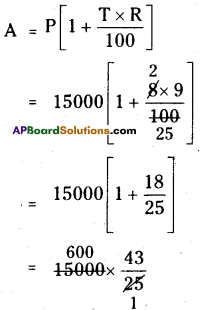
AP Board 8th Class Maths Solutions Chapter 5 Comparing Quantities Using Proportion Ex 5.3 1
A = ₹ 25800
∴ His monthly payment = [latex]\frac{25800}{8 \times 12}[/latex]
= ₹268.75
∴ Monthly he has to pay = ₹268.75

AP Board 8th Class Maths Solutions Chapter 5 Comparing Quantities Using Proportion Ex 5.3

Question 2.
A TV was bought at a price of ₹ 21000. After 1 year the value of the TV was depreciated by 5% (Depreciation means reduction of the value due to use and age of the item). Find the value of the TV after 1 year.
Solution:
The C.P. of T.V = ₹ 21,000.
After 1 year its value
= 21000 – 5% of 21000
=21000 – [latex]\frac { 5 }{ 100 }[/latex] × 21000
= 21000 – 1050
= ₹19,950

Question 3.
Find the amount and the compound interest on ₹ 8000 at 5% per annum, for 2 years
compounded annually.
Solution:
P = ₹8000
R = 5%
The interest is compounded every year.
Then 2 time periods wII be occurred.
∴ n = 2
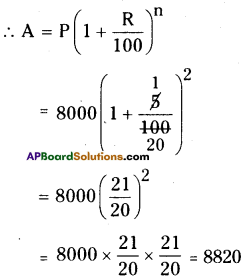
AP Board 8th Class Maths Solutions Chapter 5 Comparing Quantities Using Proportion Ex 5.3 2
∴ Amount (A) = ₹8820
C.I = A – P
= 8820 – 8000 = ₹ 820

AP Board 8th Class Maths Solutions Chapter 5 Comparing Quantities Using Proportion Ex 5.3

Question 4.
Find the amount and the compound interest on ₹ 6500 for 2 years, compounded annually, the rate of interest being 5% per annum during the first year and 6% per annum during the second year.
Solution:
P = ₹ 6500
R = 5%
T = 1 years
∴ [latex]\frac{\mathrm{PTR}}{100}=\frac{6500 \times 5 \times 1}{100}[/latex] = 325
∴ A = P + I = 6500 + 325 = 6825
∴ P = 6825
(At the begining of 2,id year A=P)
R = 6%
T = 1 year
∴ [latex]\frac{\mathrm{PTR}}{100}=\frac{6825 \times 6 \times 1}{100}[/latex] = 409.5
∴ A = P + I = 6825 + 409.5
∴ Amount = ₹ 7234.50
C.I. = A – P
= ₹ 7234.50 – 6500
= ₹734.50

Question 5.
Prathibha borrows ₹47000 from a fmance company to buy her first car. The rate of simple interest is 17% and she borrows the money over a 5 year period. Find: (a) How much
amount Prathibha should repay the finance company at the end of five years. (b) her equal
monthly repayments.
Solution:
P = ₹ 47000
R = 17%
T =5 years
∴ I = [latex]\frac{\mathrm{PTR}}{100}=\frac{47000 \times 5 \times 17}{100}[/latex]
= ₹ 39,950

AP Board 8th Class Maths Solutions Chapter 5 Comparing Quantities Using Proportion Ex 5.3

a) Amount to be paid
A = P + I
= 47000 + 39,950
= 86950
∴ Amount to be pay = ₹ 86950

b) In monthly equal instalments she has to pay
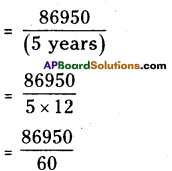
AP Board 8th Class Maths Solutions Chapter 5 Comparing Quantities Using Proportion Ex 5.3 3
= 149.1
= ₹ 1450 (approx)

Question 6.
The population of Hyderabad was 68,09,000 in the year 2011. If it increases at the rate of 4.7% per annum. What will be the population at the end of the year 2015.
Solution:
The population of Hyderabad
= 68,09,000
If every year increase in 4.7%.
Then the population of the city in 2015
= 68,09,000 ( 1 + [latex]\frac{4.7}{100}[/latex] )4
100 J
[ ∵ P = 6809000, R = 4.7 %, n = 4(2015 -2011)]
= 68,09,000 x [latex]\frac{104.7}{100} \times \frac{104.7}{100} \times \frac{104.7}{100} \times \frac{104.7}{100}[/latex]
= 81,82,199

AP Board 8th Class Maths Solutions Chapter 5 Comparing Quantities Using Proportion Ex 5.3

Question 7.
Find Compound interest paid when a sum of ₹ 10000 is invested for 1 year and 3 months at 8[latex]\frac{1}{2}[/latex] % per annum compounded annually.
Solution:
P = ₹10,000; R = 8[latex]\frac { 1 }{ 2 }[/latex] % = [latex]\frac { 17 }{ 2 }[/latex]%
T = 1 year
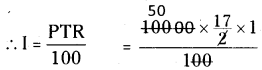
AP Board 8th Class Maths Solutions Chapter 5 Comparing Quantities Using Proportion Ex 5.3 4
= 50 × 17 = 850
∴ I = ₹ 850
∴ A = P + I = 10,000 + 850
A = 10,850
∴ P = 10,850; R = [latex]\frac { 17 }{ 2 }[/latex]% % ; T = 3 months
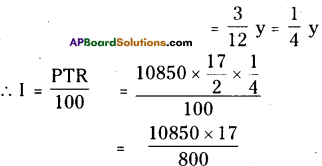
AP Board 8th Class Maths Solutions Chapter 5 Comparing Quantities Using Proportion Ex 5.3 5
= ₹ 230.50
∴ Compound Interest
= 850 + 230.50
= ₹ 1080.50

Question 8.
Arif took a loan of ₹ 80,000 from a bank. If the rate of interest is 10% per annum, find the
difference in amounts he would be paying after 1[latex]\frac{1}{2}[/latex] years, if the interest is (i) compounded annually (ii) compounded half yearly.
Solution:
P = ₹ 80,000; R = 10%;
T = 1 year
∴ [latex]\frac{\mathrm{PTR}}{100}[/latex] = [latex]\frac{80000 \times 10 \times 1}{100}[/latex]
= ₹8000
∴ A = P + I = 80000 + 8000
= ₹ 88,000

Interest on 6 months :
P = 88,000 ; R = 10% ; T = 6 Months
= [latex]\frac { 1 }{ 2 }[/latex] year
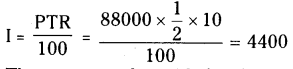
AP Board 8th Class Maths Solutions Chapter 5 Comparing Quantities Using Proportion Ex 5.3 6

i) The amount to be paid after 1 year 6 months = P + I
= 88000 + 4400
A1 = ₹ 92,400

ii) He has to pay compounded on
every 6 months in 1 [latex]\frac { 1 }{ 2 }[/latex] years
∴ 3 time periods will be occurred.
∴ n = 3
R = [latex]\frac { 10 }{ 2 }[/latex] = 5% P = ₹ 80,000
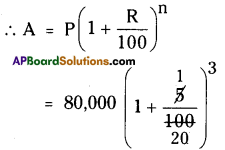
AP Board 8th Class Maths Solutions Chapter 5 Comparing Quantities Using Proportion Ex 5.3 7
AP Board 8th Class Maths Solutions Chapter 5 Comparing Quantities Using Proportion Ex 5.3 8
A2 = ₹ 92610
∴ Difference between the amounts = A2 – A1 = 92610 – 92400 = ₹ 210

AP Board 8th Class Maths Solutions Chapter 5 Comparing Quantities Using Proportion Ex 5.3

Question 9.
I borrowed ₹ 12000 from Prasad at 6°/o per annum simple interest for 2 years. Had
I borrowed this sum at 6% per annum compounded annually, what extra amount would
I have to pay9
Solution:
Sum borrowed from Prasad
P = ₹ 12000
T = 2 years;
R = 6%
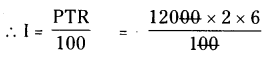
AP Board 8th Class Maths Solutions Chapter 5 Comparing Quantities Using Proportion Ex 5.3 9
= ₹144O
A = P + I
A1 = P + I = 12000 + 1440
= ₹13440
12000 + 1440 , = ₹ 13440
∴ He has to pay the amount after 2 years at the rate of 6% on C.I.
P = ₹12,000; R = 6%; n = 2 years
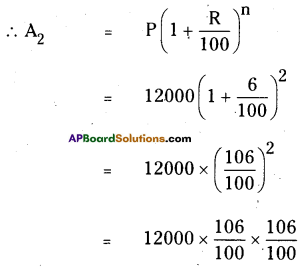
AP Board 8th Class Maths Solutions Chapter 5 Comparing Quantities Using Proportion Ex 5.3 10
A2 = ₹13483.2
∴ The difference between the C.I and S.I = 13483.2 – 13440
= ₹ 43.20

Question 10.
In a laboratory the count of bacteria in a certain experiment was increasing at the rate of 2.5% per hour. Find the bacteria at the end of 2 hours if the count was initially 5,06,000
Solution:
No. of bacteria in a laboratory = 5,06,000
If they are increased at the rate of 2.5% per hour then their number after 2 hours
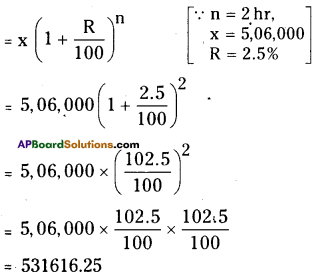
AP Board 8th Class Maths Solutions Chapter 5 Comparing Quantities Using Proportion Ex 5.3 11

AP Board 8th Class Maths Solutions Chapter 5 Comparing Quantities Using Proportion Ex 5.3

Question 11.
Kamala borrowed ₹ 26400 from a bank to buy a scooter at a rate of 15% per annum compounded yearly. What amount will she pay at the end of 2 years and 4 months to clear the loan?
Solution:
Kanala borrowed from bank = ₹ 26400
Rah of interest (R) =15%
n = 2 years
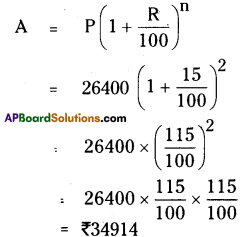
AP Board 8th Class Maths Solutions Chapter 5 Comparing Quantities Using Proportion Ex 5.3 12
After 4 rpnths the amount will be ₹ 34914
∴ P = 34914; R = 15%; T = 4 months
T = [latex]\frac { 4 }{ 12 }[/latex] year
= [latex]\frac { 1 }{ 3 }[/latex] year
∴ [latex]I=\frac{P T R}{100}=\frac{34914 \times 15 \times \frac{1}{3}}{100}[/latex]
= ₹1745.7
∴ Kamala has to pay the amount after 2 years and 4 months to the bank = 34914 + 1745.7
= ₹36659.7

AP Board 8th Class Maths Solutions Chapter 5 Comparing Quantities Using Proportion Ex 5.3

Question 12.
Bharathi borrows an amount of ₹ 12500 at 12% per annum for3 years at a simple interest and Madhuri borrows the same amount for the same time period at 10% per annum, compounded annually. Who pays more interest and by how much?
Solution:
Bharathi borrowed the sum
P = ₹12500
R = 12%
T = 3 years
S. I (I) = [latex]\frac { PTR }{ 100 }[/latex]
= [latex]\frac{12500 \times 12 \times 3}{100}[/latex]
= 125 × 36
= 4500
After 3 years she has to pay
(A1)= P + I
= 12500 + 4500 .
A1 = ₹17,000
Madhuri has to pay the amount on
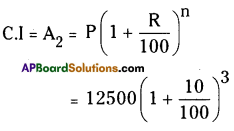
AP Board 8th Class Maths Solutions Chapter 5 Comparing Quantities Using Proportion Ex 5.3 13
AP Board 8th Class Maths Solutions Chapter 5 Comparing Quantities Using Proportion Ex 5.3 14
A2 = 16637.5
∴ A1 > A2
A1 – A2 = 17000 – 16637.5
= ₹ 362.5
∴ Bharathi has to pay ₹ 362.5 more than Madhuri.

AP Board 8th Class Maths Solutions Chapter 5 Comparing Quantities Using Proportion Ex 5.3

Question 13.
Machinery worth ₹ 10000 depreciated by 5%. Find its value after 1 year.
Solution:
The value of machinery after 1 year on 5% depreciation
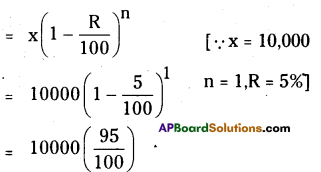
AP Board 8th Class Maths Solutions Chapter 5 Comparing Quantities Using Proportion Ex 5.3 15
= 95 × 100
= ₹ 9500

Question 14.
Find the population of a city after 2 years which is at present 12 lakh, if the rate of increase is 4%.
Solution:
Present population of a city = 12,00,000 If its population increases at the rate of 4%, then the population after 2 years
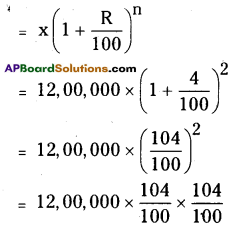
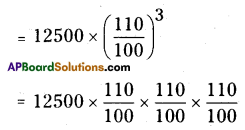
AP Board 8th Class Maths Solutions Chapter 5 Comparing Quantities Using Proportion Ex 5.3 16
= 120 × 104 × 104
= 12,97,920

AP Board 8th Class Maths Solutions Chapter 5 Comparing Quantities Using Proportion Ex 5.3

Question 15.
Calculate compound interest on ₹ 1000 over a period of 1 year at 10% per annum, if interest is compounded quarterly?
Solution:
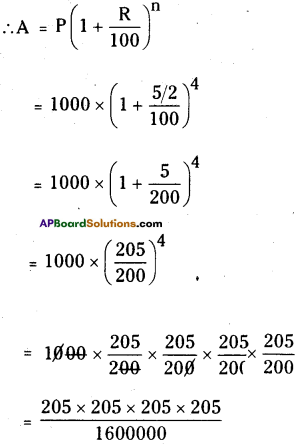
compounded quarterly then 4 time periods will be there in 1 year.
∴ n = 4
C.I. on ₹ 1000 over a period of 1 year at
10% per annum A = P (1 + [latex]\frac{\mathrm{R}}{100}[/latex] )n
P = 1000; n = 4; R = [latex]\frac{10}{4}=\frac{5}{2}[/latex] %
AP Board 8th Class Maths Solutions Chapter 5 Comparing Quantities Using Proportion Ex 5.3 17
= ₹ 1103.81
A = ₹ 1103.81
C.I. for 1 year
= 1103.81 – 1000
= ₹ 10.81
AP Board 8th Class Maths Solutions Chapter 5 Comparing Quantities Using Proportion Ex 5.2

AP State Syllabus AP Board 8th Class Maths Solutions Chapter 5 Comparing Quantities Using Proportion Ex 5.2 Textbook Questions and Answers.

AP State Syllabus 8th Class Maths Solutions 5th Lesson Comparing Quantities Using Proportion Exercise 5.2

AP Board 8th Class Maths Solutions Chapter 5 Comparing Quantities Using Proportion Ex 5.2

Question 1.
In the year 2012, it was estimated that there were 36.4 crore Internet users worldwide. In
the next ten years, that number will be increased by 125%. Estimate the number of Internet
users worldwide in 2022.
Solution:
Internet users in the year 2012
= 36.4 crores.
The number will be increased by next
10 years = 125%
∴ The no. of internet users in the year 2022
= 36.4 + 125% of 36.4
= 36.4 + [latex]\frac { 125 }{ 100 }[/latex] × 36.4
= 36.4 + 45.5
= 81.9 crores.

AP Board 8th Class Maths Solutions Chapter 5 Comparing Quantities Using Proportion Ex 5.2

Question 2.
A owner increases the rent of his house by 5% at the end of each year. If currently its rent is ₹ 2500 per month, how much will be the rent after 2 years’?
Solution:
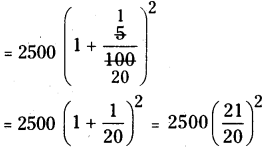
Present house rent = ₹ 2500 If the owner increases the rent by 5% on every year then the rent of the house after 2 years
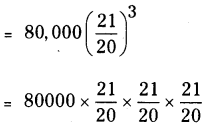
AP Board 8th Class Maths Solutions Chapter 5 Comparing Quantities Using Proportion Ex 5.2 1
= 2500 × [latex]\frac { 21 }{ 20 }[/latex] x [latex]\frac { 21 }{ 20 }[/latex]
= ₹ 2756.25

Question 3.
On Monday, the value of a company’s shares was ₹ 7.50. The price increased by 6% on Tuesday, decreased by 1.5% on Wednesday, and decreased by 2% on Thursday. Find the value of each share when trade opened on Friday.
Solution:
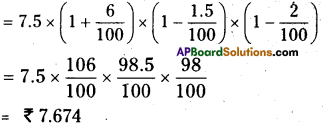
The value of the share when trade opened on Friday
= ₹ 7.674
AP Board 8th Class Maths Solutions Chapter 5 Comparing Quantities Using Proportion Ex 5.2 2

Question 4.
With most of the Xerox machines. you can reduce or enlarge your original by entering a percentage for the copy. Reshma wanted to enlarge a 2 cm by 4 cm drawing. She set the Xerox machine for 150% and copied her drawing. What will be the dimensions of the
copy of the drawing be’?
Solution:
Length of the copy = 2 cm
breadth = 4 cm
If the length is increase in 150% then its
measure = 150 % of 2 cm
= [latex]\frac { 150 }{ 100 }[/latex] × 2 = 1.5 × 2 = 3 cm

If the breadth is increase in 150% then
its measure = 150 % of 4 cm 150
= [latex]\frac { 150 }{ 100 }[/latex] × 4 = 1.5 × 4 = 6 cm
100
∴ New length = 3 cm
breadth = 6 cm

AP Board 8th Class Maths Solutions Chapter 5 Comparing Quantities Using Proportion Ex 5.2

Question 5.
The printed price of a book is ₹ 150. And discount is 15%. Find the actual amount to be paid.
Solution:
The printed price of a book = ₹ 150
Discount % = 15%
∴ Discount = 15% of 150
= [latex]\frac { 15 }{ 100 }[/latex] × 150 = ₹22.5
∴ The C.P. of a book = 150 – 22.5
= ₹127.50/-

Question 6.
The marked price of an gift item is ₹ 176 and sold it for ₹ 165. Find the discount percent.
Solution:
Marked price of a gift = ₹176
S.P. = 165
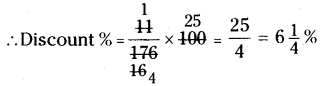
Discount = 176 – 165 = ₹ 11
AP Board 8th Class Maths Solutions Chapter 5 Comparing Quantities Using Proportion Ex 5.2 3

AP Board 8th Class Maths Solutions Chapter 5 Comparing Quantities Using Proportion Ex 5.2

Question 7.
A shop keeper purchased 200 bulbs for ₹10 each. However 5 bulbs were fused and put
them into scrap. The remaining were sold at ₹12 each. Find the gain or loss percent.
Solution:
The C.P. of 200 bulbs at the rate of ₹10 for each = 200 × 10 = ₹ 2000
If 5 bulbs are fused then remaining are
= 200 – 5 = 195
∴ TheS.P. of 195 bulbs at the rate of ₹12 for each = 195 × 12 = ₹ 2340
∴ S.P. > C.P.
∴ Profit = S.P.-C.P.
= 2340 – 2000 = 340
Profit = [latex]\frac { Profit }{ C.P }[/latex] × 100 = [latex]\frac { 340 }{ 2000 }[/latex] × 100
Profit = 17%

Question 8.
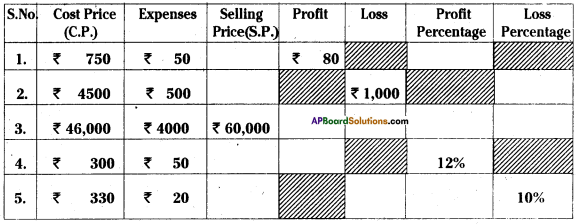
Complete the following table with appropriate entries (Wherever possible)
AP Board 8th Class Maths Solutions Chapter 5 Comparing Quantities Using Proportion Ex 5.2 9
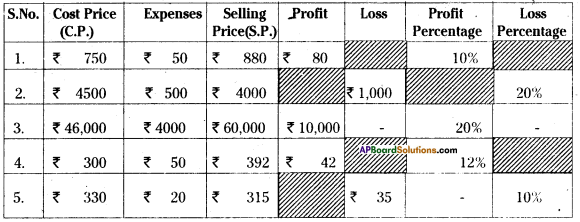
Solution:
AP Board 8th Class Maths Solutions Chapter 5 Comparing Quantities Using Proportion Ex 5.2 10

AP Board 8th Class Maths Solutions Chapter 5 Comparing Quantities Using Proportion Ex 5.2

Question 9.
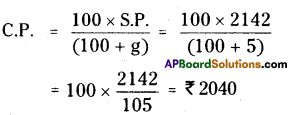
A table was sold for ₹2,142 at a gain of 5%. At what price should it be sold to gain 10%.
Solution:
S.P. of a table = ₹ 2142
Profit = 5%
AP Board 8th Class Maths Solutions Chapter 5 Comparing Quantities Using Proportion Ex 5.2 4
∴ The C.P. of buyyer = ₹ 2040
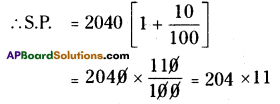
Profit % = 10%
AP Board 8th Class Maths Solutions Chapter 5 Comparing Quantities Using Proportion Ex 5.2 5
∴ S.P. = ₹2244

Question 10.
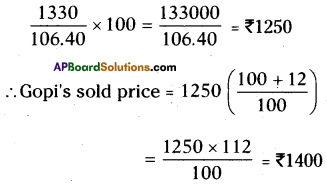
Gopi sold a watch to Ibrahim at 12% gain and Ibrahim sold it to John at a loss of 5%. If John paid ₹1,330, then find how much did Gopi sold it?
Solution:
. Let Gopi’s cost price = ₹100
Gain = 12%
∴ Gopi’s selling price to Ibrahim or Ibrahim’s cost price = ₹100 + ₹12 = ₹112
∴ Ibrahim’s loss = 5%
∴ Ibrahim’s selling price =
[latex]112\left(\frac{100-5}{100}\right)=\frac{112 \times 95}{100}[/latex] = ₹106.40
For ₹100 we get = ₹106.40
For ₹1330 how much we get ?
AP Board 8th Class Maths Solutions Chapter 5 Comparing Quantities Using Proportion Ex 5.2 6

AP Board 8th Class Maths Solutions Chapter 5 Comparing Quantities Using Proportion Ex 5.2

Question 11.
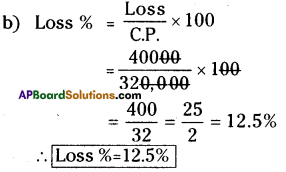
Madhu and Kavitha purchased a new house for ₹3,20,000. Due to some economic
problems they sold the house for ₹2,80,000. Find (a) The loss incurred (b) the loss percentage.
Solution:
C.P. of a house = ₹ 3,20,000
S.P. of a house = ₹ 2,80,000
∴ C.P. > S.P.
a) Loss
= C.P. – S.P.
= 3,20,000 – 2,80,000 = 40,000
AP Board 8th Class Maths Solutions Chapter 5 Comparing Quantities Using Proportion Ex 5.2 7

Question 12.
A pre-owned car show-room owner bought a second hand car for ₹ 1,50,000. He spent ₹20,000 on repairs and painting, then sold it for ₹ 2,00,000. Find whether he gets profit or loss. If so, what percent?
Solution:
After repair, the C.P of a car
= 1,50,000 + 20,000 = 1,70,000
S.P. of a ear = ₹ 2,00,000
∴ S.P. > C.P.
∴ Profit = S.P.-C.P.
= 2,00,000-1,70,000= 30,000
Profit = [latex]\frac { Profit }{ C.P }[/latex] × 100
[latex]\frac { 30,000 }{ 1,70,000 }[/latex] × 100 = Profit = [latex]\frac { 300 }{ 17 }[/latex]
Profit% = 17.64%

AP Board 8th Class Maths Solutions Chapter 5 Comparing Quantities Using Proportion Ex 5.2

Question 13.
Lalitha took a parcel from a hotel to celebrate her birthday with her friends. It was billed with ₹ 1,450 including 5% VAT. Lalitha asked for some discount, the hotel owner gave 8% discount on the bill amount. Now find the actual amount that lalitha has to pay to the hotel owner
Solution:
After allowing 5% VAT, the total bill = ₹ 1450
If 8% discount is allowed on bill, then
Discount = 8% of 1450
[latex]\frac { 8 }{ 100}[/latex] × 1450 = ₹116
Discount = ₹116
∴ Lalitha has to pay the bill = 1450 -116
= ₹ 1334

Question 14.
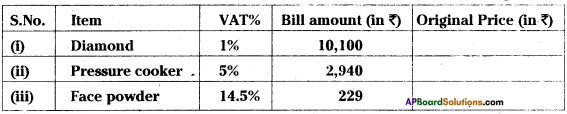
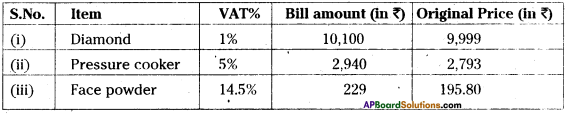
If VAT is included in the price, find the original price of each of the following.
AP Board 8th Class Maths Solutions Chapter 5 Comparing Quantities Using Proportion Ex 5.2 11
Solution:
AP Board 8th Class Maths Solutions Chapter 5 Comparing Quantities Using Proportion Ex 5.2 12

Question 15.
Find the buying price of each of the following items when a sales tax of 5% is added on them.
(1) a towel of ₹50 (ii) Two bars of soap at ₹35 each.
Solution:
Given that Sales tax = 5%
(i) Cost of a towel = ₹ 50
Sales Tax = 5% of 50
= [latex]\frac { 5 }{ 100 }[/latex] x 50 = [latex]\frac { 5 }{ 2 }[/latex] = ₹ 2.50
∴ C.P. = Net Price + Sales
Tax = 50 + 2.50 = ₹ 52.50

(ii) The cost of two soaps at the rate of
₹ 35 each = 2 × 35 = ₹ 70
Sales Tax = 5% of 70
= [latex]\frac { 5 }{ 100 }[/latex] × 70 = [latex]\frac { 7 }{ 2 }[/latex] = ₹ 3.50
∴ C.P. = Net Price + Sales
Tax = 70 + 3.50 = ₹ 73.50

AP Board 8th Class Maths Solutions Chapter 5 Comparing Quantities Using Proportion Ex 5.2

Question 16.
A Super-Bazar prices an item in rupees and paise so that when 4% sales tax is added, no rounding is necessary because the result is exactly in ‘n’ rupees, where ‘n’ is a positive integer. Find the smallest value of ’n’.
Solution:
Let the cost price = x say
∴ If x is increased 4% sales tax is added then
x + 4% of x = n
x + [latex]\frac { 4 }{ 100 }[/latex] × x = n
[latex]\frac { 140x }{ 100 }[/latex] = n
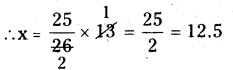
x = x = n × [latex]\frac { 100 }{ 104 }[/latex] = [latex]\frac{25 \times \mathrm{n}}{26}[/latex]
∴ n should be a least multiple of 26, then only the value of the article should be represented in only rupees.
AP Board 8th Class Maths Solutions Chapter 5 Comparing Quantities Using Proportion Ex 5.2 8
[∵n = 13, 26, 39. from them 13 should betaken]
:. Required value of the article
=12.50 + [latex]\frac { 4 }{ 100 }[/latex] × 12.5
12.50 + 0.5 = ₹13

AP Board 8th Class Maths Solutions Chapter 5 Comparing Quantities Using Proportion Ex 5.1

AP State Syllabus AP Board 8th Class Maths Solutions Chapter 5 Comparing Quantities Using Proportion Ex 5.1 Textbook Questions and Answers.

AP State Syllabus 8th Class Maths Solutions 5th Lesson Comparing Quantities Using Proportion Exercise 5.1

AP Board 8th Class Maths Solutions Chapter 5 Comparing Quantities Using Proportion Ex 5.1

Question 1.
Find the ratio of the following
(i) Smita works in office for 6 hours and Kajal works for 8 hours in her office. Find the
ratio of their working hours.
Solution:
The ratio of working hours of smita and kajal = 6:8
= (2 × 3 ) : (2 × 4) = 3 : 4

(ii) One pot contains 8 litre of milk while other contains 750 milliliter.
Solution:
8lit : 750ml
8 × 1000 : 750
= [latex][latex]\frac { 8000 }{ 750 }[/latex][/latex] = 32 : 3

(iii) speed of a cycle is 15km/h and speed of the scooter is 30km/h.
Solution:
The ratio of speeds of a cycle and a sector
= 15 : 30 = (15 × 1) : 15 × 2 = 1 : 2

AP Board 8th Class Maths Solutions Chapter 5 Comparing Quantities Using Proportion Ex 5.1

Question 2.
If the compound ratio of 5:8 and 3:7 is 45:x. Find the value of x.
Solution:
The compound ratio of 5:8 and 3:7
= [latex]\frac{5}{8} \times \frac{3}{7}=\frac{15}{56}[/latex]
According to the sum
15 : 56 = 45 : x
∴ x = 168

Question 3.
If the compound ratio of 7:5 and 8:x is 84:60. Find x.
Solution:
The compound ratio of 7:5 and 8:x
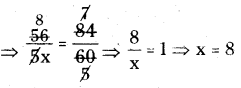
= [latex]\frac{7}{5} \times \frac{8}{x}=\frac{56}{5 x}[/latex]
According to the sum
56 : 5x = 84 : 60
AP Board 8th Class Maths Solutions Chapter 5 Comparing Quantities Using Proportion Ex 5.1 3
∴ x = 8

Question 4.
The compound ratio of 3:4 and the inverse ratio of 4:5 is 45:x. Find x.
Solution:
The inverse ratio of 4:5 is 45 : x
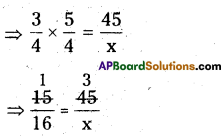
The compound ratio of 3:4 and 5 : 4
= 45 : x
AP Board 8th Class Maths Solutions Chapter 5 Comparing Quantities Using Proportion Ex 5.1 4
⇒ x = 16 × 3 = 48
∴ x = 48

AP Board 8th Class Maths Solutions Chapter 5 Comparing Quantities Using Proportion Ex 5.1

Question 5.
In a primary school there shall be 3 teachers to 60 students. If there are 400 students
enrolled in the school, how many teachers should be there in the school in the same ratio?
Solution:
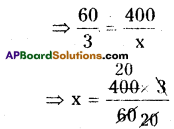
No. of teachers are required for 400 students at the rate of 3 teachers to 60
students are ⇒ 60 : 3 400 : x
AP Board 8th Class Maths Solutions Chapter 5 Comparing Quantities Using Proportion Ex 5.1 5
∴ x = 20

Question 6.
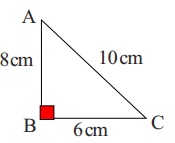
In the given figure, ABC is a triangle. Write all possible ratios by A
taking measures of sides pair wise.
8cm 10cm
(Hint: Ratio of AB : BC =8 : 6)
AP Board 8th Class Maths Solutions Chapter 5 Comparing Quantities Using Proportion Ex 5.1 1
Solution:
AP Board 8th Class Maths Solutions Chapter 5 Comparing Quantities Using Proportion Ex 5.1 6
In ΔABC
AB : BC = 8 : 6 = 4:3
⇒ BC : AB = 6 : 8 = 3: 4
BC : CA = 6 : 10 = 3 : 5
⇒ CA : BC = 10 : 6 = 5 : 3
CA : AB = 10:8=5:4
⇒ AB : CA = 8: 10 = 4: 5

AP Board 8th Class Maths Solutions Chapter 5 Comparing Quantities Using Proportion Ex 5.1

Question 7.
If 9 out of 24 students scored below 75% marks in a test. Find the ratio of student scored below 75% marks to the student scored 75% and above marks.
Solution:
Out of 24 students who got below 75% of marks = 9
Who got 75% and above marks =24 – 9 = 15
∴ The ratio between no. of students
who got less than 75% of marks and
who got 75% and above marks
= 9 : 15 =(3 × 3):(3 × 5) = 3 : 5

Question 8.
Find the ratio of number of vowels in the word’ MISSISSIPPI’ to the number of consonants in the simplest form.
Solution:
No. of vowels in the word MI S S SS! PPI = 4 (IIII)
No. of consonants in that word = 7 (MSSSSPP)
∴ The ratio between vowels and consonants = 4: 7

Question 9.
Rajendra and Rehana own a business. Rehana receives 25% of the profit in each month. If
Rehana received ₹ 2080 in particular month, what is the total profit in that month?
Solution:
Total Profit = x say
25% of x = 2080
⇒ [latex]\frac{25}{100}[/latex] × x = 2080
⇒ [latex]\frac{x}{4}[/latex] = 2080
⇒ x = 2080 × 4
∴ x = ₹ 8320

AP Board 8th Class Maths Solutions Chapter 5 Comparing Quantities Using Proportion Ex 5.1

Question 10.
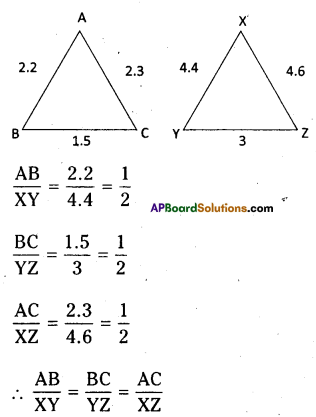
In triangle ABC, AB = 2.2 cm, BC = 1.5 cm and AC = 2.3 cm. In triangle XYZ, XY = 4.4cm, YZ = 3cm and XZ = 4.6cm. Find the ratio AB:XY, BC:YZ, AC:XZ. Are the lengths of corresponding sides of ΔABC and ΔXYZ are in proportion?
[Hint : Any two triangles are said to be in proportion, if their corresponding sides are in the
same ratio]
Solution:
AP Board 8th Class Maths Solutions Chapter 5 Comparing Quantities Using Proportion Ex 5.1 7
∴ The corresponding sides of both the triangles are in proportion.
∴ ΔABC ~ ΔXYZ

Question 11.
Madhuri went to a super market. The price changes are as follows. The price of rice reduced by 5% jam and fruits reduced by 8% and oil and dal increased by 10%. Help Madhuri to find the changed prices in the given table.

Item Original price/kg Changed price
Rice ₹ 30
Jam ₹ 100
Apples ₹ 280
Oil ₹ 120
Dal ₹ 80

Solution:

Item Original price/kg Changed price
Rice ₹ 30 ₹28.50
Jam ₹ 100 ₹ 92
Apples ₹ 280 ₹ 257.6
Oil ₹ 120 ₹ 132
Dal ₹ 80 ₹ 88

AP Board 8th Class Maths Solutions Chapter 5 Comparing Quantities Using Proportion Ex 5.1

Question 12.
There were 2075 members enrolled in the club during last year. This year enrolment is
decreased by 4%.
(a) Find the decrease in enrolment.
(b) How many members are enrolled during this year?
Solution:
No. of persons are enrolled in the last year = 2075
Present year no. of persons are enrolled
= 4% less than the previous year.
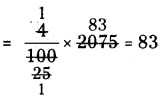
a) Decrease in enrolment = 4% of 2075
AP Board 8th Class Maths Solutions Chapter 5 Comparing Quantities Using Proportion Ex 5.1 8

b) No.of members are enrolled this
year = 2075 – 4% of 2075
=2075 – 83 = 1992

Question 13.
A farmer obtained a yielding of 1720 bags of cotton last year. This year she expects her crop to be 20% more. How many bags of cotton does she expect this year?
Solution:
During the last year yielding the bags of
cotton = 1720
If she expects 20% crop to be more then
=20% of 1720 .
= [latex]\frac{20}{100}[/latex] × 1720
= 2 × 172
= 344 bags
Her expectation of total bags
= 1720 + 344
= 2064

AP Board 8th Class Maths Solutions Chapter 5 Comparing Quantities Using Proportion Ex 5.1

Question 14.
Points P and Q are both in the line segment AB and on the same side of its midpoint. P divides AB in the ratio 2: 3, and Q divides AB in the ratio 3 :4. If PQ =2, then find the length of the line segment AB.
Solution:
Given that ‘C’ is the midpoint of line segment AB.
Here ‘P’ divides AB inthe ratio 2 : 3
‘Q’ divides AB in the ratio 3: 4
AP Board 8th Class Maths Solutions Chapter 5 Comparing Quantities Using Proportion Ex 5.1 9
PQ =2 cm [Given]
PQ = QB – PB
= 4 – 3 = 1 part = 2cm
∴ AB = AQ + QB [with respect to Ql
AB = AP+ PB [with respect to P]
L.C.M. of 5, 7 parts = 35 parts
∴ Length of AB 35 parts
= 35 × 2[ ∵ part = 2cm]
= 70cm

AP Board 8th Class Maths Solutions Chapter 4 Exponents and Powers Ex 4.2

AP State Syllabus AP Board 8th Class Maths Solutions Chapter 4 Exponents and Powers Ex 4.2 Textbook Questions and Answers.

AP State Syllabus 8th Class Maths Solutions 4th Lesson Exponents and Powers Exercise 4.2

AP Board 8th Class Maths Solutions Chapter 4 Exponents and Powers Ex 4.2

Question 1.
Express the following numbers in the standard form.
(i) 0.000000000947
Solution:
= [latex]\frac{947}{1000000000000}[/latex] = 947 × 10-12

(ii) 543000000000
Solution:
= 543 × 1000000000 = 543 × 109

(iii) 48300000
Solution:
= 483 × 100000 = 483 × 105

AP Board 8th Class Maths Solutions Chapter 4 Exponents and Powers Ex 4.2

(iv) 0.00009298
Solution:
= [latex]\frac{9298}{100000000}[/latex]
= 9298 × 10-8

(v) 0.0000529
Solution:
= [latex]\frac{529}{10000000}[/latex]
= 529 × 10-7

Question 2.
Express the following numbers in the usual form.
(i) 4.37 × 10⁵
Solution:
= 4.37 × 100000
= 437000

(ii) 5.8 × 10⁷
Solution:
= 5.8 × 10000000

(iii) 32.5 × 10⁻⁴
Solution:
= [latex]\frac{32.5}{10^{4}}=\frac{32.5}{10000}[/latex]
= 0.00325

AP Board 8th Class Maths Solutions Chapter 4 Exponents and Powers Ex 4.2

(iv) 3.71529 × 10⁷
Solution:
= 3.71529 × 10000000
= 37152900

(v) 3789 × 10-5
Solution:
= [latex]\frac{3789}{10^{5}}=\frac{3789}{100000}[/latex]
= 0.03789

(vi) 24.36 × 10⁻³
Solution:
= [latex]\frac{24.36}{10^{3}}=\frac{24.36}{1000}[/latex]
= 0.02436

Question 3.
Express the following information in the standard form
(i) Size of the bacteria is 0.0000004 m
Solution:
= [klatex]\frac{4}{10000000}[/latex] m = 4 x 10⁻⁷ m

(ii) The size of red blood cells is 0.000007mm
Solution:
= [latex]\frac{7}{1000000}[/latex] = 7 × 10⁻⁶

AP Board 8th Class Maths Solutions Chapter 4 Exponents and Powers Ex 4.2

(iii) The speed of light is 300000000 m/sec
Solution:
= 3 × 10,00,00,000 = 3 × 10⁸ m/sec

(iv) The distance between the moon and the earth is 384467000 m(app)
Solution:
= 384467 × 1000 m
= 384467 × 103

(v) The charge of an electron is 0.0000000000000000016 coulombs
Solution:
= 0.0000000000000000016
= [latex]\frac{16}{10000000000000000000}[/latex]
= [latex]\frac{16}{10^{19}}[/latex]
= 16 × 10-19 coulombs

(vi) Thickness of a piece of paper is 0.0016 cm
Solution:
= 0.0016 cm = [latex]\frac{16}{10000}[/latex]
= [latex]\frac{16}{10^{4}}[/latex]
= 16 × 10-4 cm

(vii) The diameter of a wire on a computer chip is 0.000005 cm
Solution:
= 0.000005 cm = [latex]\frac{5}{1000000}[/latex] cm
= [latex]\frac{5}{10^{6}}[/latex] cm = 5 × 10⁻⁶ cm

AP Board 8th Class Maths Solutions Chapter 4 Exponents and Powers Ex 4.2

Question 4.
In a stack, there are 5 books, each of thickness 20 mm and 5 paper sheets each of thickness 0.016mm. What is the total thickness of the stack.
Solution:
The thickness of 5 books of a pack
= (5 books × their thickness)
= 5(papers × their thickness)
= (20 mm × 5) + (0.016 mm × 5)
= 100 mm + 0.080 mm
= (100 + 0.080) mm
= 100.08 mm
= 1.0008 × 102 mm

Question 5.
Rakesh solved some problems of exponents in the following way. Do you agree with the solutions? If not why? Justify your argument.
(i) x-3 × x-2 = x-6
Solution:
x-3 × x-2 = x-6
= x-3+(-2) = x-6 [∵ am × an = am + n ]
= x-5 = x-6
= -5 = -6(False)
∴ In this case do not agree with Rakesh solution.

AP Board 8th Class Maths Solutions Chapter 4 Exponents and Powers Ex 4.2

(ii) [latex]\frac{X^{3}}{X^{2}}[/latex] = x4
Solution:
⇒ x3-2 = x4 [∵ [latex]\frac{a^{m}}{a^{n}}[/latex] = am – n ]
⇒ x1 = x4
[∵Here bases are equal, so exponents are also equal]
⇒ 1 = 4 (It is false)
∴ I do not agree with Rakesh solution.

(iii) (x2)3 = (x2)3 = x8
Solution:
(x2)3 = [latex]x^{2^{3}}[/latex] = x8
⇒ (x2)3 = [latex]x^{2^{3}}[/latex]
⇒ x2 × 3 = [latex]x^{2^{3}}[/latex]
⇒ x6 = x2 × 2 × 2
⇒ x6 = x8
[∵ Bases are equal, so exponents are also equal]
⇒ 6 = 8
It is false
∴ Rakesh solution is wrong.

(iv) x-2 = √x
Solution:
⇒ x-2 = x1/2
⇒ -2 = 1/2 (it is false)
∴ I don’t agree with Rakesh solution.

AP Board 8th Class Maths Solutions Chapter 4 Exponents and Powers Ex 4.2

(v) 3x-1 = [latex]\frac{1}{3 x}[/latex]
Solution:
⇒ 3x-1 = [latex]\frac{1}{3 x}[/latex]
⇒ 3 × 3 = [latex]\frac{x}{x}[/latex]
⇒ x0 = 9
⇒ 1 = 9
It is false
∴ I don’t agree with Rakesh solution.

AP Board 8th Class Maths Solutions Chapter 4 Exponents and Powers Ex 4.1

AP State Syllabus AP Board 8th Class Maths Solutions Chapter 4 Exponents and Powers Ex 4.1 Textbook Questions and Answers.

AP State Syllabus 8th Class Maths Solutions 4th Lesson Exponents and Powers Exercise 4.1

AP Board 8th Class Maths Solutions Chapter 4 Exponents and Powers Ex 4.1

Question 1.
Simplify and give reasons
(i) 4-3
(ii) (-2) 7
(iii) [latex]\left(\frac{3}{4}\right)^{-3}[/latex]
(iv) (-3)-4
Solution:
(i) 4-3 [latex]\frac{1}{4^{3}}=\frac{1}{64}[/latex] [∵ a-n = [latex]\frac{1}{\mathrm{a}^{\prime \prime}}[/latex]

(ii) (-2) 7 = -(2) 7 = -128
[∵ 7 is an odd number]
[∵ (-a)n = -(an) if ‘n’ is odd]

(iii) [latex]\left(\frac{3}{4}\right)^{-3}[/latex] = [latex]\frac{3^{-3}}{4^{-3}}=\frac{4^{3}}{3^{3}}=\left(\frac{4}{3}\right)^{3}[/latex]
AP Board 8th Class Maths Solutions Chapter 4 Exponents and Powers Ex 4.1 1

(iv) (-3)-4 = [latex]\frac{1}{(-3)^{4}}[/latex] [∵a-n = [latex]\frac{1}{a^{n}}[/latex]
= [latex]\frac{1}{(3)^{4}}[/latex] [∵ 4 is even ]
= [latex]\frac{1}{81}[/latex]

AP Board 8th Class Maths Solutions Chapter 4 Exponents and Powers Ex 4.1

Question 2.
Simplify the following:
(i) [latex]\left(\frac{1}{2}\right)^{4} \times\left(\frac{1}{2}\right)^{5} \times\left(\frac{1}{2}\right)^{6}[/latex]
(ii) (-2)7 x (-2)3 x (-2)4
(iii) 44 x [latex]\left(\frac{5}{4}\right)^{4}[/latex]
(iv) [latex]\left(\frac{5^{-4}}{5^{-6}}\right)[/latex] x 53
(v) (-3) 4 x 74
Solution:
(i) [latex]\left(\frac{1}{2}\right)^{4} \times\left(\frac{1}{2}\right)^{5} \times\left(\frac{1}{2}\right)^{6}[/latex]
[latex]\left(\frac{1}{2}\right)^{4+5+6}=\left(\frac{1}{2}\right)^{15}=\frac{1}{2^{15}}[/latex]
[∵ am x an = am + n]

(ii) (-2)7 x (-2)3 x (-2)4
(-2)7 + 3 + 4 = (-2) 14 = 2 14
[∵ (-a)n = an is even]

(iii) 44 x [latex]\left(\frac{5}{4}\right)^{4}[/latex]
44 x [latex]\left(\frac{5}{4}\right)^{4}[/latex] = 54
[ ∵ [latex]\left(\frac{a}{b}\right)^{m}=\frac{a^{m}}{b^{m}}[/latex] ]

(iv) [latex]\left(\frac{5^{-4}}{5^{-6}}\right)[/latex] x 53
5-4 x (56 x 53) [ ∵ [latex]\frac{1}{a^{-n}}=a^{n}[/latex]
= 5-4 x 56+3 [ ∵ am x an = (a)m+n
= 5-4 x 59
= 5(-4)+9 = 55

(v) (-3) 4 x 74
= 34 x 74[.4isevennumber]
=(3 x 7)4 [:amxbm=(ab)m]
= (21)4

AP Board 8th Class Maths Solutions Chapter 4 Exponents and Powers Ex 4.1

Question 3.
Simplify
(i) [latex]2^{2} \times \frac{3^{2}}{2^{-2}} \times 3^{-1}[/latex]
(ii) (4-1 x 3-1) ÷ 6-1
Solution:
(i) [latex]2^{2} \times \frac{3^{2}}{2^{-2}} \times 3^{-1}[/latex]
= 22 x 22 x 32 x 3-1
= 22+2 x 32 + ( – 1)
=24 x 31 = 16 x 3 = 48

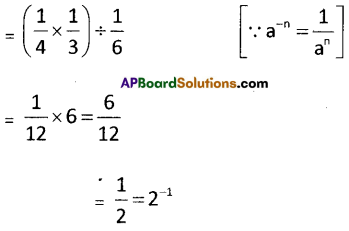
(ii) (4-1 x 3-1) ÷ 6-1
AP Board 8th Class Maths Solutions Chapter 4 Exponents and Powers Ex 4.1 2

Question 4.
Simplify and give reasons
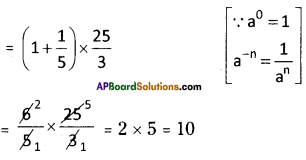
(i) (40 + 5-1) x 52 x [latex]\frac{1}{3}[/latex]
Solution:
AP Board 8th Class Maths Solutions Chapter 4 Exponents and Powers Ex 4.1 3

(ii) [latex]\left(\frac{1}{2}\right)^{-3} \times\left(\frac{1}{4}\right)^{-3} \times\left(\frac{1}{5}\right)^{-3}[/latex]
Solution:
= [latex]\left(\frac{1}{2} \times \frac{1}{4} \times \frac{1}{5}\right)^{-3}[/latex]
= [latex]\left(\frac{1}{40}\right)^{-3}[/latex] [∵ am x bm x cm = (abc)m
= (40)3 [ ∵][latex]\frac{1}{a^{-n}}[/latex] = an ]

AP Board 8th Class Maths Solutions Chapter 4 Exponents and Powers Ex 4.1

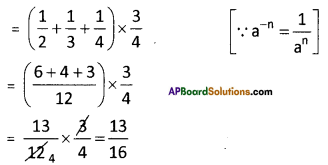
(iii) (2-1 + 3-1 + 4-1) x [latex]\frac{3}{4}[/latex]
Solution:
AP Board 8th Class Maths Solutions Chapter 4 Exponents and Powers Ex 4.1 4

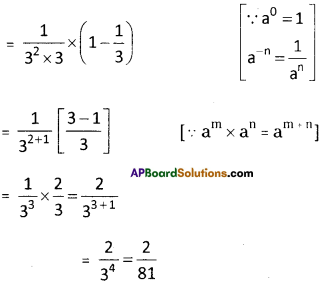
(iv) [latex]\frac{3^{-2}}{3}[/latex] x (30 – 3-1
Solution:
AP Board 8th Class Maths Solutions Chapter 4 Exponents and Powers Ex 4.1 5

AP Board 8th Class Maths Solutions Chapter 4 Exponents and Powers Ex 4.1

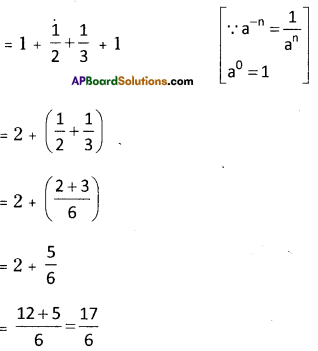
(v) 1 + 2-1 + 3-1 + 40
Solution:
AP Board 8th Class Maths Solutions Chapter 4 Exponents and Powers Ex 4.1 6

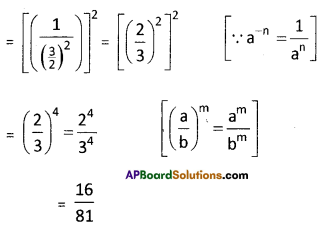
(vi) [latex]\left[\left(\frac{3}{2}\right)^{-2}\right]^{2}[/latex]
Solution:
AP Board 8th Class Maths Solutions Chapter 4 Exponents and Powers Ex 4.1 7

AP Board 8th Class Maths Solutions Chapter 4 Exponents and Powers Ex 4.1

Question 5.
Simplify and give reasons
(i) [latex]\left[\left(3^{2}-2^{2}\right) \div \frac{1}{5}\right]^{2}[/latex]
Solution:
[latex]\left.\left[(9-4) \div \frac{1}{5}\right)\right]^{2}[/latex]
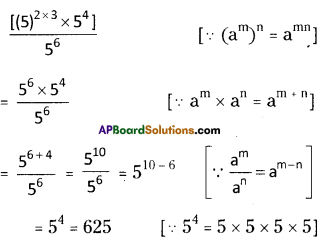
= [latex]\left[5 \times \frac{5}{1}\right]^{2}[/latex] = (52)2 54 = 625 [∵ (am)n = amn]

(ii) ((52)3 x 54) ÷ 56
Solution:
AP Board 8th Class Maths Solutions Chapter 4 Exponents and Powers Ex 4.1 8

Question 6.
Find the value of ’n’ in each of the following:
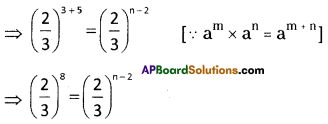
(i) [latex]\left(\frac{2}{3}\right)^{3} \times\left(\frac{2}{3}\right)^{5}=\left(\frac{2}{3}\right)^{\mathrm{n}-2}[/latex]
Solution:
AP Board 8th Class Maths Solutions Chapter 4 Exponents and Powers Ex 4.1 9
Here bases are equal, so exponents are
also equal.
⇒ n – 2 = 8
⇒ n = 8 + 2 = 10
∴ n = 10

AP Board 8th Class Maths Solutions Chapter 4 Exponents and Powers Ex 4.1

(ii) (-3)n+1 x (-3)5 = (-3)3
Solution:
⇒(-3)n+1+5 = (-3)-4 [∵ am x an = am+n ]
⇒ (-3)n+6 = (-3)-4
⇒ n + 6 = -4
⇒ n = -4 – 6 = -10
⇒ n = -10

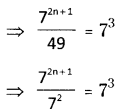
(iii) 72n+1 ÷ 49 = 73
Solution:
AP Board 8th Class Maths Solutions Chapter 4 Exponents and Powers Ex 4.1 10
⇒ 72n+1-2 = 73 [ ∵ [latex]\frac{a^{m}}{a^{n}}=a^{m-n}[/latex] ]
⇒ 72n – 1= 73
⇒ 2n – 1 = 3
⇒ 2n = 3 + 1 = 4
⇒ n = [latex]\frac{4}{2}[/latex]
∴ n = 2

Question 7.
Find ’x’ if 2-3 = [latex]\frac{1}{2^{x}}[/latex]
Solution:
2-3 = [latex]\frac{1}{2^{x}}[/latex] = 2-x
⇒ 2-3 = 2-x [ [latex]\frac{1}{a^{n}}[/latex] = a-n ]
⇒ -x = -3
∴ x = 3

AP Board 8th Class Maths Solutions Chapter 4 Exponents and Powers Ex 4.1

Question 8.
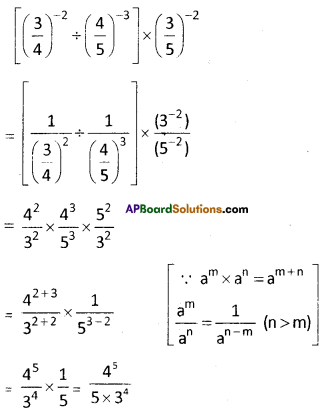
Simplify [latex]\left[\left(\frac{3}{4}\right)^{-2} \div\left(\frac{4}{5}\right)^{-3}\right] \times\left(\frac{3}{5}\right)^{-2}[/latex]
Solution:
AP Board 8th Class Maths Solutions Chapter 4 Exponents and Powers Ex 4.1 11

Question 9.
If m = 3 and n = 2 find the value of
(i) 9m2 – 10n3
(ii) 2m2 n2
(iii) 2m3 + 3n2 – 5m2n
(iv) mn – nm
Solution:
1) 9m2 – 10n3
= 9(3)2 – 10(2)3
= 9 x 9 – 10 x8
= 81 – 80 = 1
(ii) 2m2 n2
= 2(3)2 (2)2
= 2 x 9 x 4 = 72

(iii) 2m3 + 3n2 – 5m2n
= 2(3)3 + 3(2)2 – 5(3)2(2)
= (2 x 27) + (3 x 4) – (5 x 9 x 2)
= 54 + 12 – 90
= 66 – 90 = – 24

(iv) mn – nm
= 32 – 23
= 3 x 3 – 2 x 2 x 2
= 9 – 8 = 1

AP Board 8th Class Maths Solutions Chapter 4 Exponents and Powers Ex 4.1

Question 10.
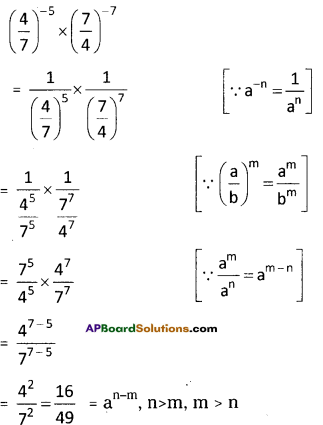
Simplify and give reasons [latex]\left(\frac{4}{7}\right)^{-5} \times\left(\frac{7}{4}\right)^{-7}[/latex]
Solution:
AP Board 8th Class Maths Solutions Chapter 4 Exponents and Powers Ex 4.1 12

AP Board 8th Class Maths Solutions Chapter 3 Construction of Quadrilaterals Ex 3.3

AP State Syllabus AP Board 8th Class Maths Solutions Chapter 3 Construction of Quadrilaterals Ex 3.3 Textbook Questions and Answers.

AP State Syllabus 8th Class Maths Solutions 3rd Lesson Construction of Quadrilaterals Exercise 3.3

AP Board 8th Class Maths Solutions Chapter 3 Construction of Quadrilaterals Ex 3.3

Construct the quadrilateral with the measurements given below :

Question a).
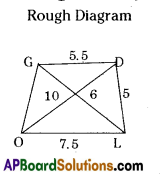
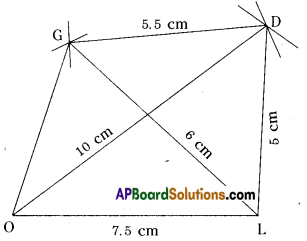
Quadrilateral GOLD: OL = 7.5 cm, GL = 6 cm, LD = 5 cm, DG = 5.5 cm and OD = 10 cm.
(Ex 3.3, Page No. 72)
Solution:
In a quadrilateral GOLD, Rough Diagram
OL = 7.5 cm, GL = 6 cm
LD = 5 cm, DG = 5.5 cm, OD = 10 cm
AP Board 8th Class Maths Solutions Chapter 3 Construction of Quadrilaterals Ex 3.3 2
AP Board 8th Class Maths Solutions Chapter 3 Construction of Quadrilaterals Ex 3.3 1

Construction Steps:

  1. Draw a line segment [latex]\overline{OL}[/latex] equal to radius 7.5 cm.
  2. With the centres O, L draw arcs with radius 10 cm and 5 cm respectively. These two arcs meet at point ‘D’.
  3. With the centres L, D draw arcs equal to 6 cm and 5.5 cm respectively. These two arcs meet at point ‘G’.
  4. Join O, G and L, G. Also join O, D and L, D and G, D.
  5. ∴ The required quadrilateral GOLD is formed.

AP Board 8th Class Maths Solutions Chapter 3 Construction of Quadrilaterals Ex 3.3

Question b).
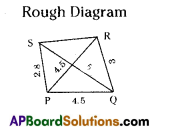
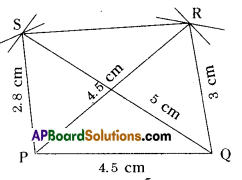
Quadrilateral PQRS: PQ = 4.2 cm, QR = 3 cm, PS = 2.8 cm, PR = 4.5 cm and QS = 5 cm.
Solution:
AP Board 8th Class Maths Solutions Chapter 3 Construction of Quadrilaterals Ex 3.3 3
AP Board 8th Class Maths Solutions Chapter 3 Construction of Quadrilaterals Ex 3.3 4
In a quadrilateral PQRS
PQ = 4.2 cm PS = 2.8 cm
QR = 3 cm PR = 4.5 cm
QS = 5 cm

AP Board 8th Class Maths Solutions Chapter 3 Construction of Quadrilaterals Ex 3.3

Construction Steps:

  1. Draw a line segment [latex]\overline{P Q}[/latex] with radius 4.2 cm.
  2. With the centres P, Q draw arcs equal to the radius 4.5 cm, 3 cm respectively. These two arcs meet at point R’. Join P, R and Q, R.
  3. With the centres Q, P draw arcs equal to the radii 5 cm and 2.8 cm respectively. These two arcs meet at point ‘S’.
  4. Join P, S and Q, S and S, R.
  5. ∴ The required PQRS quadrilateral is formed.

AP Board 8th Class Maths Solutions Chapter 3 Construction of Quadrilaterals Ex 3.2

AP State Syllabus AP Board 8th Class Maths Solutions Chapter 3 Construction of Quadrilaterals Ex 3.2 Textbook Questions and Answers.

AP State Syllabus 8th Class Maths Solutions 3rd Lesson Construction of Quadrilaterals Exercise 3.2

AP Board 8th Class Maths Solutions Chapter 3 Construction of Quadrilaterals Ex 3.2

Construct quadrilateral with the measurements given below:

Question (a).
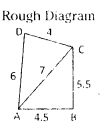
Quadrilateral ABCD with AB = 4.5 cm, BC = 5.5 cm, CD = 4 cm, AD = 6 cm andAC= 7cm
Solution:
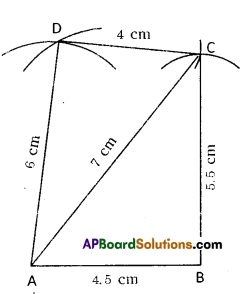
In Quadrilateral ABCD with AB = 4.5 cm, BC = 5.5 cm, CD = 4 cm, AD = 6 cm and AC = 7 cm.
AP Board 8th Class Maths Solutions Chapter 3 Construction of Quadrilaterals Ex 3.2 1(i)
AP Board 8th Class Maths Solutions Chapter 3 Construction of Quadrilaterals Ex 3.2 1

Construction Steps:

  1. Draw a line segment [latex]\overline{\mathrm{AB}}[/latex] with radius 4.5 cms.
  2. With the centres A, B draw arcs equal to 7 cm and 5.5 cm respectively. The intersection of these two arcs keep as ‘C’.
  3. Join A, C and B, C.
  4. With centres C, A draw arcs equal to 4 cm, 6 cm respectively. These intersecting point is keep as ’D’.
    Join D, C and A, D.
  5. ∴ The required quadrilateral ABCD is formed.

AP Board 8th Class Maths Solutions Chapter 3 Construction of Quadrilaterals Ex 3.2

Question (b).
Quadrilateral PQRS with PQ = 3.5 cm, QR = 4 cm, RS = 5 cm, PS = 4.5 cm and QS= 6.5 cm
Solution:
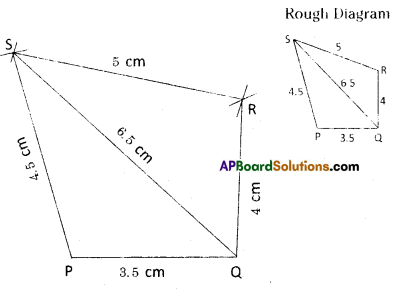
In a quadrilateral PQRS,
PQ = 3.5 cm, QR = 4 cm, RS = 5 cm,
PS – 4.5 cm, QS = 6.5 cm
AP Board 8th Class Maths Solutions Chapter 3 Construction of Quadrilaterals Ex 3.2 2

Construction Steps:

  1. Draw a line segment [latex]\overline{\mathrm{PQ}}[/latex] with radius 3.5 cm.
  2. With the centres P, Q draw arcs equal to 4.5 cm and 6.5 cm respectively.
  3. These two arcs meet at point ‘S’.
  4. With the centres S, Q draw arcs with radius 5 cm, 4 cm respectively. These two arcs intersected at point ‘R’.
  5. Join P, S; Q, S; S, R and Q, R.
  6. ∴ The required quadrilateral PQRS is formed.

Question (c).
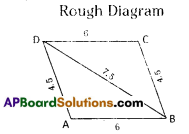
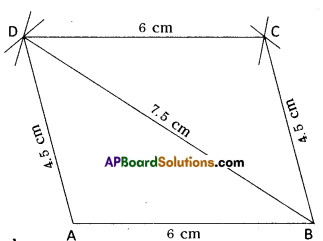
Parallelogram ABCD with AB = 6cm, CD = 4.5 cm and BD = 7.5 cm
Solution:
In a parallelogram ABCD; AB = 6 cm, BC = 4.5 cm, BD = 7.5 cm
AB = CD (;cm
BC = AD = 4.5 cm
BD = 7.5 cm
AP Board 8th Class Maths Solutions Chapter 3 Construction of Quadrilaterals Ex 3.2 3
AP Board 8th Class Maths Solutions Chapter 3 Construction of Quadrilaterals Ex 3.2 4

Construction Steps:

  1. Draw a line segment [latex]\overline{\mathrm{AB}}[/latex] with radius 6 cms.
  2. With the centres A, B draw arcs with radius 4.5 cm, 7.5 cm respectively. These two arcs meet at point ‘D’.
  3. With the centres D, B draw arcs with radius 6 cm, 4.5 cm respectively. These two arcs meet at point ‘C’.
  4. Join A, D and B, C and D, C and B, D.
  5. ∴ The required parallelogram ABCD is formed.

AP Board 8th Class Maths Solutions Chapter 3 Construction of Quadrilaterals Ex 3.2

Question (d).
Rhombus NICE with NI = 4 cm and IE = 5.6 cm
Solution:
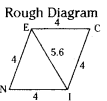
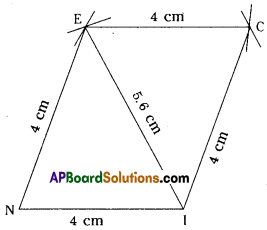
In a rhombus NI = IC = CE = NE = 4 cm, IE = 5.6 cm
AP Board 8th Class Maths Solutions Chapter 3 Construction of Quadrilaterals Ex 3.2 5
AP Board 8th Class Maths Solutions Chapter 3 Construction of Quadrilaterals Ex 3.2 6

Construction Steps:

  1. Draw a line segment [latex]\overline{\mathrm{NI}}[/latex] with radius 4 cm.
  2. With the centres N, I draw two arcs with radius 4 cm, 5.6 cm respectively. These two arcs meet at point E’.
  3. With the centres E, I draw arcs with radius 4 cm. These two arcs meet at point ‘C’.
  4. Join N, E and I, E. Also join E, C and I, C.
  5. .’. The required rhombus NICE is formed.

AP Board 8th Class Maths Solutions Chapter 1 Rational Numbers Ex 1.3

AP State Syllabus AP Board 8th Class Maths Solutions Chapter 1 Rational Numbers Ex 1.3 Textbook Questions and Answers.

AP State Syllabus 8th Class Maths Solutions 1st Lesson Rational Numbers Exercise 1.3

AP Board 8th Class Maths Solutions Chapter 1 Rational Numbers Ex 1.3

Question 1.
Express each of the following decimal in the [latex]\frac{p}{q}[/latex] form.
(i) 0.57 (ii) 0.176 (iii) 1.00001 (iv) 25.125
Solution:
(i) 0.57 = [latex]\frac{57}{100}[/latex] (∵ two digits are there after the decimal poing)
(ii) 0.176 = [latex]\frac{176}{1000}[/latex]
(iii) 1.00001 = [latex]\frac{100001}{100000}[/latex]
(iv) 25.125 = [latex]\frac{25125}{1000}[/latex]

Question 2.
Express each of the following decimals in the rational form [latex]\frac{p}{q}[/latex]
(1) [latex]0 . \overline{9}[/latex]
(ii) [latex]0 . \overline{57}[/latex]
(iii) [latex]0 .7 \overline{29}[/latex]
(iv) [latex]12.2 \overline{8}[/latex]
Solution:
(i) [latex]0 . \overline{9}[/latex]
Let x = [latex]0 . \overline{9}[/latex]
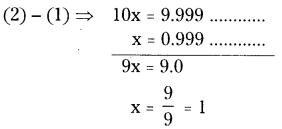
⇒ x = 0.999 ………………. (1)
Here periodicity is 1. So, equation (1) should be multiplied both sides with
= 10 × x = 10 × 0.999
10 x = 9.999 ………….. (2)
AP Board 8th Class Maths Solutions Chapter 1 Rational Numbers Ex 1.3 1
[latex]0 . \overline{9}[/latex] = 1

AP Board 8th Class Maths Solutions Chapter 1 Rational Numbers Ex 1.3

Second Method:
[latex]0 . \overline{9}=0+\overline{9}=0+\frac{9}{9}[/latex]
= 0 + 1 = 1

(ii) [latex]0 . \overline{57}[/latex]
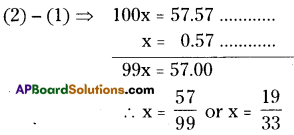
x = [latex]0 . \overline{57}[/latex] ⇒ x = 0.5757…………(1)
Here periodicity is 2. So, we should multiply with 100
⇒ 100 × x = 100 x 0.5757 …………..
100 × =57.57 ……………………. (2)
AP Board 8th Class Maths Solutions Chapter 1 Rational Numbers Ex 1.3 2

(iii) [latex]0 .7 \overline{29}[/latex]
x = [latex]0 .7 \overline{29}[/latex]
x = [latex]0 .7 \overline{29}[/latex] ⇒ x = 0.7979…………(1)
Here periodicity is 2. So, equation (1) should multiply with 100
⇒ 100 × x = 100 × 0.72929 …………..
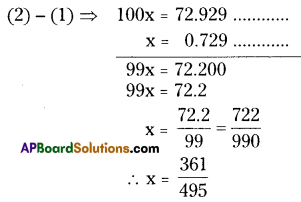
100 × = 72.929 …………………… (2)
AP Board 8th Class Maths Solutions Chapter 1 Rational Numbers Ex 1.3 3

AP Board 8th Class Maths Solutions Chapter 1 Rational Numbers Ex 1.3

(iv) [latex]12.2 \overline{8}[/latex]
x = (iv) [latex]12.2 \overline{8}[/latex]
⇒ x = 12.288 ………..(1)
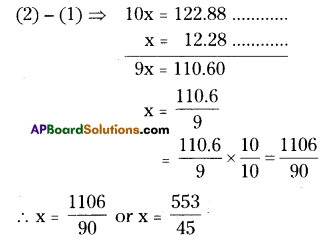
Here periodicity is 1. So, equation (1) should multiply with 10
⇒ 100 × x = 100 × 12.288 …………..
10 x = 122.888 …………………… (2)
AP Board 8th Class Maths Solutions Chapter 1 Rational Numbers Ex 1.3 4

Question 3.
Find(x + y) ÷ (x – y) if
(i) x = [latex]\frac{5}{2}[/latex], y = [latex]-\frac{3}{4}[/latex]
(ii) x = [latex]\frac{1}{4}[/latex], y = [latex]\frac{3}{2}[/latex]
Solution:
If x = [latex]\frac{5}{2}[/latex], y = [latex]-\frac{3}{4}[/latex] then
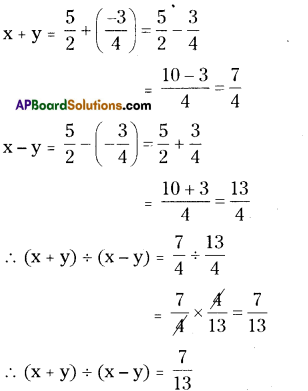
AP Board 8th Class Maths Solutions Chapter 1 Rational Numbers Ex 1.3 5

ii) x = [latex]\frac{1}{4}[/latex], y = [latex]\frac{3}{2}[/latex]
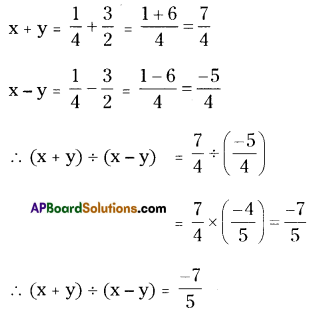
AP Board 8th Class Maths Solutions Chapter 1 Rational Numbers Ex 1.3 6

AP Board 8th Class Maths Solutions Chapter 1 Rational Numbers Ex 1.3

Question 4.
Divide the sum of [latex]-\frac{13}{5}[/latex] and [latex]\frac{12}{7}[/latex] by the product of [latex]-\frac{13}{7}[/latex] and [latex]-\frac{1}{2}[/latex]
Solution:
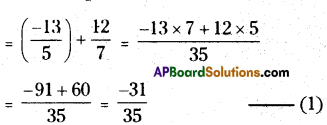
Sum of [latex]-\frac{13}{5}[/latex] and [latex]\frac{12}{7}[/latex]
AP Board 8th Class Maths Solutions Chapter 1 Rational Numbers Ex 1.3 7
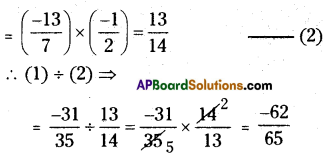
the product of [latex]-\frac{13}{7}[/latex] and [latex]-\frac{1}{2}[/latex]
AP Board 8th Class Maths Solutions Chapter 1 Rational Numbers Ex 1.3 8

Question 5.
If [latex]\frac{2}{5}[/latex] of a number exceeds [latex]\frac{1}{7}[/latex] of the same number by 36. Find the number.
Solution:
Let the number be ‘x’ say.
[latex]\frac{2}{5}[/latex] part of x = [latex]\frac{2}{5}[/latex] × x = [latex]\frac{2x}{5}[/latex]
[latex]\frac{1}{7}[/latex] part of x = [latex]\frac{1}{7}[/latex] × x = [latex]\frac{x}{7}[/latex]
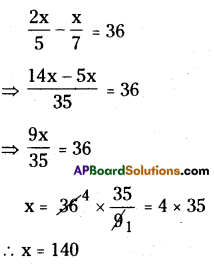
∴ According to the sum,
AP Board 8th Class Maths Solutions Chapter 1 Rational Numbers Ex 1.3 9

Question 6.
Two pieces of lengths 2[latex]\frac{2}{5}[/latex] m and 3[latex]\frac{3}{10}[/latex] mare cut off from a rope 11 m long. What is the length of the remaining rope?
Soltuion:
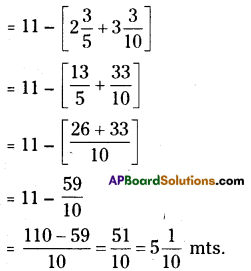
The length of the remaining rope
AP Board 8th Class Maths Solutions Chapter 1 Rational Numbers Ex 1.3 10
∴ The length of remaining rope
= 5[latex]\frac{1}{10}[/latex] mts.

AP Board 8th Class Maths Solutions Chapter 1 Rational Numbers Ex 1.3

Question 7.
The cost of 7[latex]\frac{2}{3}[/latex] meters of cloth is ₹12[latex]\frac{3}{4}[/latex] . Find the cost per metre.
Solution:
The cost of 7[latex]\frac{2}{3}[/latex] mts ([latex]\frac{23}{3}[/latex] mts ) of cloth
= ₹ [latex]12 \frac{3}{4}[/latex] = ₹ [latex]\frac{51}{4}[/latex]
∴ The cost of 1m cloth
= [latex]\frac{51}{4} \div \frac{23}{3}=\frac{51}{4} \times \frac{3}{23}=\frac{153}{92}[/latex] = ₹ 1.66

Question 8.
Find the area of a rectangular park which is 18[latex]\frac{3}{5}[/latex]m long and 8[latex]\frac{2}{3}[/latex] in broad.
Solution:
The length of the rectangular park
= 18[latex]\frac{3}{5}[/latex]m = [latex]\frac{93}{5}[/latex]
Its width / breath = 8[latex]\frac{2}{3}[/latex] m = [latex]\frac{26}{3}[/latex] m
∴ Area of the rectangular park
(A) = l × b
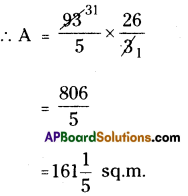
AP Board 8th Class Maths Solutions Chapter 1 Rational Numbers Ex 1.3 11

Question 9.
What number should [latex]-\frac{33}{16}[/latex] be divided by to get [latex]-\frac{11}{4}[/latex]
Solution:
Let the dividing number be ‘x’ say.
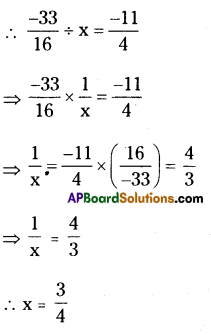
AP Board 8th Class Maths Solutions Chapter 1 Rational Numbers Ex 1.3 12

AP Board 8th Class Maths Solutions Chapter 1 Rational Numbers Ex 1.3

Question 10.
If 36 trousers of equal sizes can be stitched with 64 meters of cloth. What is the length of the cloth required for each trouser?
Solution:
36 trousers of equal sizes can he stitched with 64 mts of cloth, then the length of the cloth ¡s required for each trouser
= 64 ÷ 36
= [latex]\frac{64}{36}=\frac{16}{9}[/latex] = 1 [latex]\frac{7}{9}[/latex]

AP Board 8th Class Maths Solutions Chapter 1 Rational Numbers Ex 1.3

Question 11.
When the repeating decimal 0.363636 …. is written in simplest fractional form[latex]\frac{p}{q}[/latex] , find the sum p+ q.
Solution:
x = 0.363636………………………….. (1)
Here periodicity is ‘2’. So, equation (1) should be multiplied both sides with 100.
⇒ 100 × x = 100 × 0.363636 …………..
100 x = 36.3636 ………..(2)
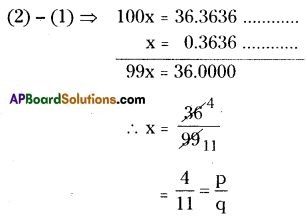
AP Board 8th Class Maths Solutions Chapter 1 Rational Numbers Ex 1.3 13

AP Board 8th Class Maths Solutions Chapter 1 Rational Numbers Ex 1.2

AP State Syllabus AP Board 8th Class Maths Solutions Chapter 1 Rational Numbers Ex 1.2 Textbook Questions and Answers.

AP State Syllabus 8th Class Maths Solutions 1st Lesson Rational Numbers Exercise 1.2

AP Board 8th Class Maths Solutions Chapter 1 Rational Numbers Ex 1.2

Question 1.
Represent these numbers on the number line.
(i) [latex]\frac{9}{7}[/latex]
(ii) [latex]-\frac{7}{5}[/latex]
Solution:
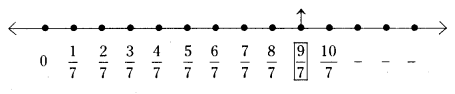
(i) [latex]\frac{9}{7}[/latex]
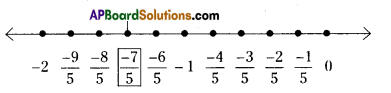
AP Board 8th Class Maths Solutions Chapter 1 Rational Numbers Ex 1.2 Q1
(ii) [latex]-\frac{7}{5}[/latex]
AP Board 8th Class Maths Solutions Chapter 1 Rational Numbers Ex 1.2 Q1- 1

Question 2.
Represent [latex]-\frac{2}{13}, \frac{5}{13}, \frac{-9}{13}[/latex] on the number line.
Solution:
AP Board 8th Class Maths Solutions Chapter 1 Rational Numbers Ex 1.2 Q2

AP Board 8th Class Maths Solutions Chapter 1 Rational Numbers Ex 1.2

Question 3.
Write five rational numbers which are smaller than [latex]\frac{5}{6}[/latex]
Solution:
The rational number which are less than
[latex]\frac{5}{6}=\left\{\frac{4}{6}, \frac{3}{6}, \frac{2}{6}, \frac{1}{6}, \frac{0}{6}, \frac{-1}{6}, \frac{-2}{6} \ldots \ldots .\right\}[/latex]

Question 4.
Find 12 rational numbers between -1 and 2.
Solution:

Question 5.
Find a rational number between [latex]\frac{2}{3}[/latex] and [latex]\frac{3}{4}[/latex]
[Hint : First write the rational numbers with equal denominators.]
Solution:
The given rational numbers are [latex]\frac{2}{3}[/latex] and [latex]\frac{3}{4}[/latex]
[latex]\frac{2}{3} \times \frac{4}{4}=\frac{8}{12}, \frac{3}{4} \times \frac{3}{3}=\frac{9}{12}[/latex]
The rational numbers between [latex]\frac{8}{12}, \frac{9}{12}[/latex] is
[latex]\frac{\left(\frac{8}{12}+\frac{9}{12}\right)}{2}=\frac{\frac{17}{12}}{2}=\frac{17}{24}[/latex]
(∵ the rational number between a, b is [latex]\frac{a+b}{2}[/latex] )
∴ the rational number between [latex]\frac{2}{3}[/latex] and [latex]\frac{3}{4}[/latex] is [latex]\frac{17}{24}[/latex]

AP Board 8th Class Maths Solutions Chapter 1 Rational Numbers Ex 1.2

Question 6.
Find ten rational numbers between [latex]-\frac{3}{4}[/latex] and [latex]\frac{5}{6}[/latex]
Solution:
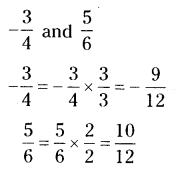
AP Board 8th Class Maths Solutions Chapter 1 Rational Numbers Ex 1.2 Q6
The 10 rational numbers between [latex]-\frac{9}{12}[/latex] and [latex]\frac{10}{12}[/latex] are
AP Board 8th Class Maths Solutions Chapter 1 Rational Numbers Ex 1.2 Q6 - 1
∴ We can select any 10 rational numbers from the above number line.

AP Board 8th Class Maths Solutions Chapter 1 Rational Numbers Ex 1.1

AP State Syllabus AP Board 8th Class Maths Solutions Chapter 1 Rational Numbers Ex 1.1 Textbook Questions and Answers.

AP State Syllabus 8th Class Maths Solutions 1st Lesson Rational Numbers Exercise 1.1

AP Board 8th Class Maths Solutions Chapter 1 Rational Numbers Ex 1.1

Question 1.
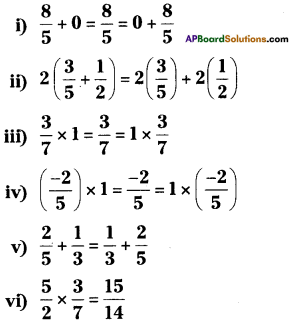
Name the properly Involved in the following examples.
AP Board 8th Class Maths Solutions Chapter 1 Rational Numbers Ex 1.1 1
vii) 7a + (-7) = 0
viii) x + [latex]\frac{1}{x}[/latex] = 1(x ≠ 0)
ix) (2 x x) + (2 x 6) = 2 x (x + 6)
Solution:
i) Additive identity
ii) Distributive law
iii) Multiplicative identity
iv) Multiplicative identity
v) Commutative law of addition
vi) Closure law in multiplication
vii) Additive inverse
viii) Multiplicative inverse
ix) Distributive

AP Board 8th Class Maths Solutions Chapter 1 Rational Numbers Ex 1.1

Question 2.
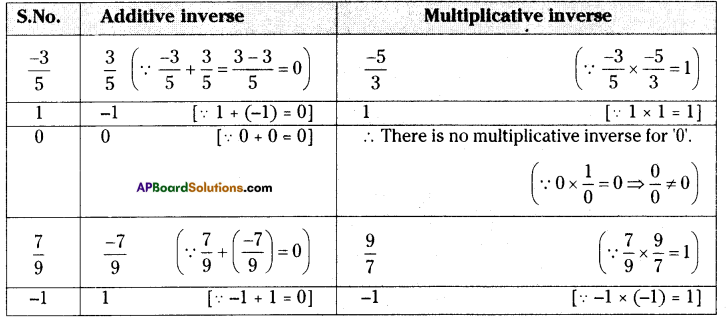
Write the additive and the multiplicative inverses of the following.
i) [latex]\frac{-3}{5}[/latex]
ii) 1
iii) 0
iv) [latex]\frac{7}{9}[/latex]
v) -1
Solution:
AP Board 8th Class Maths Solutions Chapter 1 Rational Numbers Ex 1.1 2

Question 3.
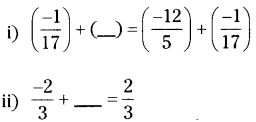
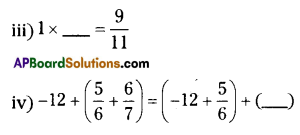
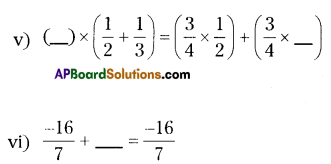
Fill in the blanks
AP Board 8th Class Maths Solutions Chapter 1 Rational Numbers Ex 1.1 3
AP Board 8th Class Maths Solutions Chapter 1 Rational Numbers Ex 1.1 4
AP Board 8th Class Maths Solutions Chapter 1 Rational Numbers Ex 1.1 5
Solution:
i) [latex]\left(\frac{-12}{5}\right)[/latex]
ii) [latex]\left(\frac{4}{3}\right)[/latex]
iii) [latex]\left(\frac{9}{11}\right)[/latex]
iv) [latex]\left(\frac{6}{7}\right)[/latex]
v) [latex]\left(\frac{3}{4}, \frac{1}{3}\right)[/latex]
vi) 0

AP Board 8th Class Maths Solutions Chapter 1 Rational Numbers Ex 1.1

Question 4.
Multiply [latex]\frac{2}{11}[/latex] by the reciprocal of [latex]\frac{-5}{14}[/latex]
Solution:
The reciprocal of [latex]\frac{-5}{14}[/latex] is [latex]\frac{-14}{5}[/latex]
( ∵ [latex]\left(\frac{-5}{14}\right) \times\left(\frac{-14}{5}\right)=1[/latex] )
∴ The product of [latex]\frac{2}{11}[/latex] and [latex]\frac{-14}{5}[/latex] is
[latex]\frac{2}{11} \times\left(\frac{-14}{5}\right)=\frac{-28}{55}[/latex]

Question 5.
Which properties can be used computing [latex]\frac{2}{5} \times\left(5 \times \frac{7}{6}\right)+\frac{1}{3} \times\left(3 \times \frac{4}{11}\right)[/latex]
Solution:
The following properties are involved in the product of
[latex]\frac{2}{5} \times\left(5 \times \frac{7}{6}\right)+\frac{1}{3} \times\left(3 \times \frac{4}{11}\right)[/latex]
i) Multiplicative associative property.
ii) Multiplicative inverse.
iii) Multiplicative identity.
iv) Closure with addition

Question 6.
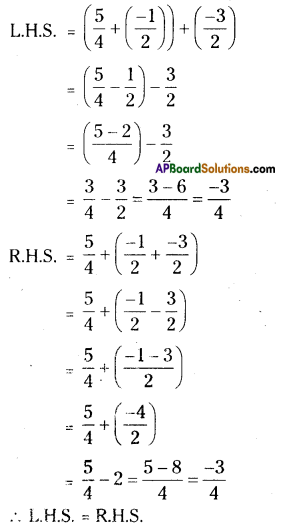
Verify the following
[latex]\left(\frac{5}{4}+\frac{-1}{2}\right)+\frac{-3}{2}=\frac{5}{4}+\left(\frac{-1}{2}+\frac{-3}{2}\right)[/latex]
Solution:
AP Board 8th Class Maths Solutions Chapter 1 Rational Numbers Ex 1.1 6

AP Board 8th Class Maths Solutions Chapter 1 Rational Numbers Ex 1.1

Question 7.
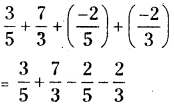
Evaluate [latex]\frac{3}{5}+\frac{7}{3}+\left(\frac{-2}{5}\right)+\left(\frac{-2}{3}\right)[/latex] after rearrangement.
Solution:
AP Board 8th Class Maths Solutions Chapter 1 Rational Numbers Ex 1.1 7
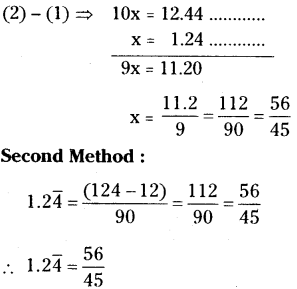
Let x = [latex]1.2 \overline{4}[/latex]
⇒ x = 1.244……. …………………(1)
Here periodicity of equation (1) is 1. So
it should be multiplied by 10 on both
sides.
⇒ 10 x x = 10 x 1.244
10x = 12.44 …………..(2)
AP Board 8th Class Maths Solutions Chapter 1 Rational Numbers Ex 1.1 8

AP Board 8th Class Maths Solutions Chapter 1 Rational Numbers Ex 1.1

Question 8.
Subtract
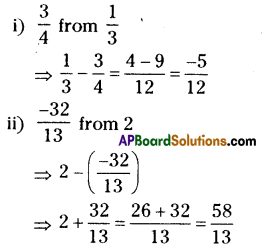
(i) [latex]\frac{3}{4}[/latex] from [latex]\frac{1}{3}[/latex]
(ii) [latex]\frac{-32}{13}[/latex] from 2
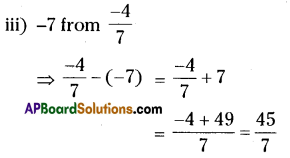
(iii) -7 from [latex]\frac{-4}{7}[/latex]
Solution:
AP Board 8th Class Maths Solutions Chapter 1 Rational Numbers Ex 1.1 9
AP Board 8th Class Maths Solutions Chapter 1 Rational Numbers Ex 1.1 10

Question 9.
What numbers should be added to [latex]\frac{-5}{8}[/latex] so as to get [latex]\frac{-3}{2}[/latex] ?
Solution:
Let the number to be add ‘x’ say
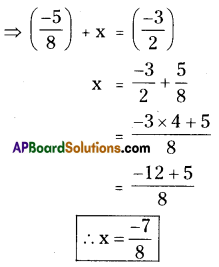
AP Board 8th Class Maths Solutions Chapter 1 Rational Numbers Ex 1.1 11
∴ [latex]\frac{-7}{8}[/latex] should be added to [latex]\frac{-5}{8}[/latex] then we will get [latex]\frac{-3}{2}[/latex]

Question 10.
The sum of two rational numbers is 8 If one of the numbers is [latex]\frac{-5}{6}[/latex] find the other.
Let the second number be ‘x’ say
⇒ [latex]x+\left(\frac{-5}{6}\right)=8[/latex]
⇒[latex]8+\frac{5}{6}=\frac{48+5}{6}=\frac{53}{6}[/latex]
∴ The other number (x) = [latex]\frac{53}{6}[/latex]

Question 11.
Is subtraction associative in rational numbers? Explain with an example.
Solution:
Let [latex]\frac{1}{2}, \frac{3}{4}, \frac{-5}{4}[/latex] are any 3 rational numbers.
Associative property under subtraction
a – (b – c) = (a – b) – c
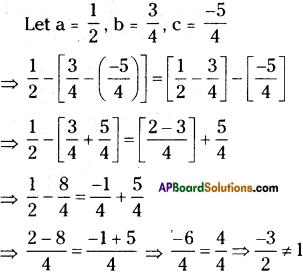
AP Board 8th Class Maths Solutions Chapter 1 Rational Numbers Ex 1.1 12
∴ L.H.S. ≠ R.H.S.
∴ a – (b – c) ≠ (a – b) – c
∴ Subtraction is not an associative in rational numbers.

AP Board 8th Class Maths Solutions Chapter 1 Rational Numbers Ex 1.1

Question 12.
Verify that – (-x) = x for
(i) x = [latex]\frac{2}{15}[/latex]
(ii) x = [latex]\frac{-13}{15}[/latex]
Solution:
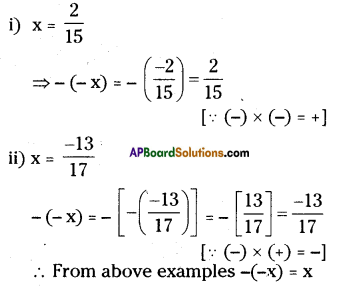
AP Board 8th Class Maths Solutions Chapter 1 Rational Numbers Ex 1.1 13

Question 13.
Write-
(i) The set of numbers which do not have any additive identity
(ii) The rational number that does not have any reciprocal
(iii) The reciprocal of a negative rational number.
Solution:
i) Set of natural numbers ’N’ doesn’t possesses the number ‘0’.
ii) The rational number ‘0’ has no multiplicative inverse.
[ ∵ 1/0 is not defined]
iii) The reciprocal of a negative rational number is a negative rational number.
Ex : Reciprocal of [latex]\frac{-2}{5}=\frac{-5}{2}[/latex]

AP Board 9th Class Maths Solutions Chapter 15 Proofs in Mathematics InText Questions

AP State Syllabus AP Board 9th Class Maths Solutions Chapter 15 Proofs in Mathematics InText Questions and Answers.

AP State Syllabus 9th Class Maths Solutions 15th Lesson Proofs in Mathematics InText Questions

AP Board 9th Class Maths Solutions Chapter 15 Proofs in Mathematics InText Questions

Do This

Question
Make 5 more sentences and check whether they are statements or not ? * Give reasons. [Page No. 311]
Solution:
1) 9 is a prime number – False
This is a statement because we can judge the truthness of this sentence. Clearly it is a false statement as 9 has factors other than 1 and 9, hence it is a composite number.
2) x is less than 5 – can’t say True or False
This is not a statement. The truthness can t be verified unless the value of x is known. Hence it is a sentence only.
3) 3 + 5 = 8 – True
The above sentence is a statement. It is a true statement as 5 + 3 = 8.
4) Sum of two odd numbers is even – True
The above sentence can be verified as a true sentence by taking ex¬amples like 3 + 5 = 8, 5 + 7 = 12 etc. Hence it is a true statement.
5) [latex]\frac{\mathrm{X}}{2}[/latex] +3 = 9- can’t say True or False.
The above sentence is not a state¬ment. Its truthness can’t be
verified without the value of x.

AP Board 9th Class Maths Solutions Chapter 15 Proofs in Mathematics InText Questions

Try This

1. 3 is a prime number.
2. Product of two odd integers is even.
3. For any real number x; 4x T x = 5x
4. The earth has one moon.
5. Ramu is a good driver.
6. Bhaskara has written a book “Leelavathi ”.
7. All even numbers are composite.
8. A rhombus is a square.
9. x > 7.
10. 4 and 5 are relative primes.
11. Silver fish is made of silver.
12. Humans are meant to rule the earth.
13. For any real number .v. 2x > x.
14. Havana is the capital of Cuba.

Question
Which of the above statements can be tested by giving counter example ?
[Page No. 312]
Solution:
Statements 2, 7, 8, 13 can be tested by giving counter examples 2) Product of two odd integers is even. Counter example.
2) Product of two odd integers 3 and 5 is 3×5 = 15 is not an even number.
7) All even numbers are composite. Counter example : 2 is an even prime.
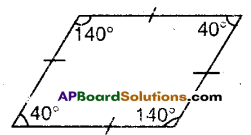
8) A rhombus is a square.
AP Board 9th Class Maths Solutions Chapter 15 Proofs in Mathematics InText Questions 1
Counter example: (40°, 140°, 40°. 140°) is a rhombus.
13) For anyx; 2x > x
Counter example : for x = -3:
2x = 2(-3) = – 6
here -6 < – 3

AP Board 9th Class Maths Solutions Chapter 15 Proofs in Mathematics InText Questionsb

Try This

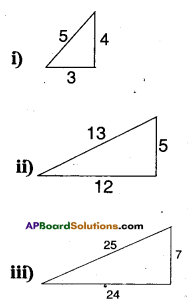
Envied by the popularity of Pythagoras, his younger brother claimed a different relation between the sides of a right angled triangles. [Page No. 319]
AP Board 9th Class Maths Solutions Chapter 15 Proofs in Mathematics InText Questions 2

Liethagoras Theorem: In any right angled triangle the square of the smallest side equals the sum of the other sides. Check this conjecture, whether It is right or wrong.
Solution:
This conjecture is true for the above
triangles.
i) 32 5 + 4 ⇒ 9 = 5 + 4
ii) 52 = 25 = 12 + 13
iii) 72 = 49 = 24 + 25
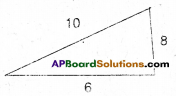
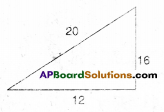
But, when the smallest side happens to be an even integer the conectiire may not hods good.
Eg: 1) 62 = 36 ≠ 10 + 8
AP Board 9th Class Maths Solutions Chapter 15 Proofs in Mathematics InText Questions 3
ii) 122 = 144 ≠ 20 + 16
AP Board 9th Class Maths Solutions Chapter 15 Proofs in Mathematics InText Questions 4

AP Board 9th Class Maths Solutions Chapter 14 Probability InText Questions

AP State Syllabus AP Board 9th Class Maths Solutions Chapter 14 Probability InText Questions and Answers.

AP State Syllabus 9th Class Maths Solutions 14th Lesson Probability InText Questions

AP Board 9th Class Maths Solutions Chapter 14 Probability InText Questions

Do This

Question 1.
Observe the table given in the previous page (Textbook Page No. 293) and give some other example for each term. [Page No. 294]
Solution:
Certain : Independence day on 15th Aug.
More likely : When a die is thrown, the chance of getting a number less than or equal to 5. Equally likely : When a coin is tossed, getting a head.
Less likely : When a die is thrown, the chance of getting neither prime nor composite. Impossible : When a die is thrown, getting a negative number.

Question 2.
Classify the following statements into the categories less likely, equally . likely, more likely. [Page No. 294]
AP Board 9th Class Maths Solutions Chapter 14 Probability InText Questions 1
a) Rolling a die and getting a number 5 on the top face.
b) Getting a cold wave in your village in the month of November.
c) India winning the next soccer (foot ball) world cup.
d) Getting a tail or head when a coin is tossed.
e) You buy a lottery ticket and win the jackpot.
Solution:
a) less likely
b) more likely
c) less likely
d) equally likely
e) more likely

AP Board 9th Class Maths Solutions Chapter 14 Probability InText Questions

Try These

Question 1.
If you try to start a scooter, what are the possible outcomes ? [Page No. 295]
Solution:
[Starts], [Doesn’t start]

Question 2.
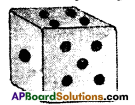
When you roll a die, what are the six possible outcomes ? [Page No. 295]
Solution:
1, 2, 3, 4, 5 and 6.

Question 3.
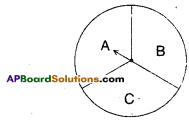
When you spin the wheel shown, what are the possible outcomes ? (Outcomes here means the possible sector where the pointer stops) [Page No.295]
AP Board 9th Class Maths Solutions Chapter 14 Probability InText Questions 2
Solution:
A, B and C.

Question 4.
You have ajar with five identical balls of different colours. [White, Red, Blue, Grey and Yellow] and you have to pick up (draw) a ball without looking at it. List the possible outcomes you get. [Page No. 295]
AP Board 9th Class Maths Solutions Chapter 14 Probability InText Questions 3
Solution:
White ball, Red ball, Blue ball. Grey ball and Yellow ball.

AP Board 9th Class Maths Solutions Chapter 14 Probability InText Questions

Think, Discuss and Write

AP Board 9th Class Maths Solutions Chapter 14 Probability InText Questions 4

In rolling a die [Page No. 295]

Question
Does the first player have a greater chance of getting a six on the top face ?
Solution:
No. The chance of getting 6 on the top face is independent of the turn of the player.

Question
Would the player who played after him have a lesser chance of getting a six on the top face?
Solution:
No.

AP Board 9th Class Maths Solutions Chapter 14 Probability InText Questions

Question
Suppose the second player got a six on the top face. Does it mean that the third player would not have a chance of getting a six on the top face ?
Solution:
No. The third player may or may not get six on the top face. It is indepen¬dent of 2nd player’s outcome.

Do This

Question
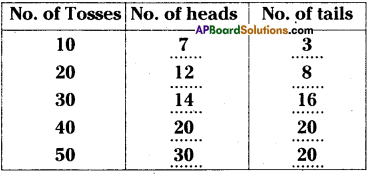
Toss a coin for number of times as shown in the table. And record your findings in the table [Page No. 296]
Solution:
AP Board 9th Class Maths Solutions Chapter 14 Probability InText Questions 5

Question
What hapens if you increase the num- her of tosses more and more.
Solution:
If you increase the number of tosses more and more they are equally likely chances to get a head or a tail.
Note : This could also be done by the students with a die, roll it for large number of times and observe!

AP Board 9th Class Maths Solutions Chapter 14 Probability InText Questions

Do This

If three coins are tossed simulta¬neously : [Page No. 299]

a) Write all possible outcomes.
Solution:
HHH, HHT, HTH, THH, HTT, THT, TTH, TTT, total 8 outcomes.

b) Number of possible outcomes.
Solution:
8

c) Find the probability of getting at least one head, (getting one or more than one head)
Solution:
P = [latex]\frac{\text { favourable outcomes }}{\text { total outcomes }}=\frac{7}{8}[/latex]

d) Find the probability of getting at most two heads, (getting two or less than two heads)
Solution:
P = [latex]\frac{\text { favourable outcomes }}{\text { total outcomes }}=\frac{7}{8}[/latex]

AP Board 9th Class Maths Solutions Chapter 14 Probability InText Questions

e) Find the probability of getting no tails.
Solution:
P = [latex]\frac{\text { favourable outcomes }}{\text { total outcomes }}=\frac{1}{8}[/latex]

Try This

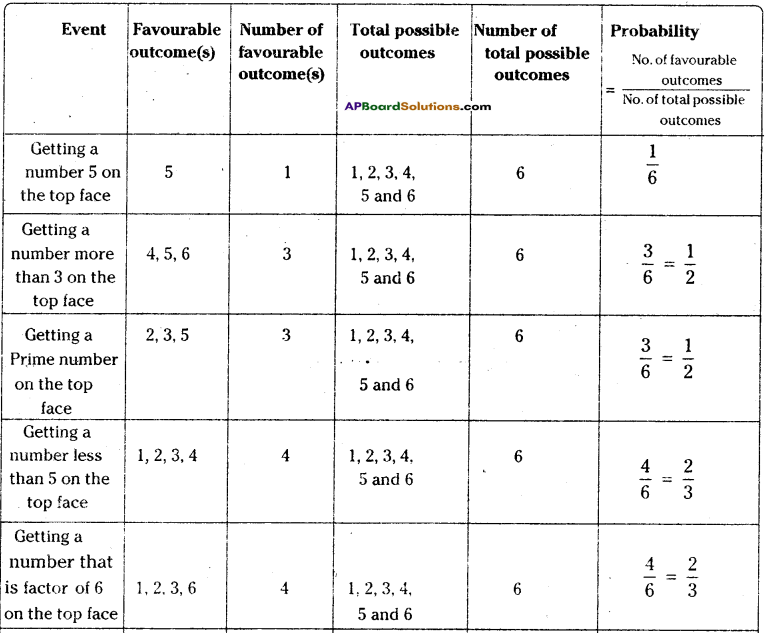
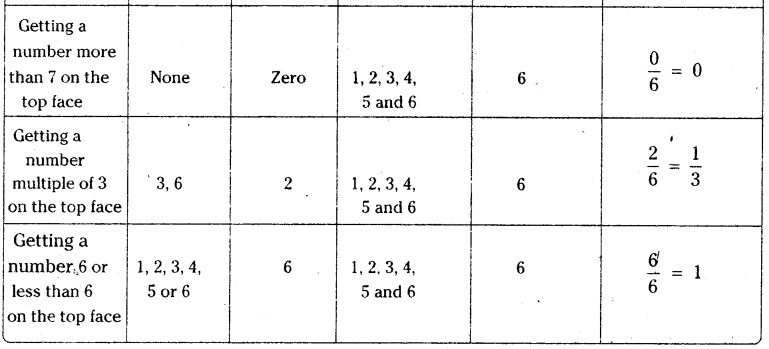
Find the probability of each event when a die is rolled once. [Page No. 300]
AP Board 9th Class Maths Solutions Chapter 14 Probability InText Questions 6 AP Board 9th Class Maths Solutions Chapter 14 Probability InText Questions 7

Try These

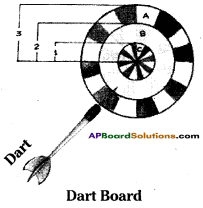
From the figure given below [Page No. 306]
AP Board 9th Class Maths Solutions Chapter 14 Probability InText Questions 9

Question 1.
Find the probability of the dart hit¬ting the board in the circular region B. (i.e., ring B)
Solution:
Area of innermost ‘C’ circle = πr2
= π x 12 = π sq. units.
Area of the middle ‘B’ circle
= π (22 – 12) = π (4 – 1) = 3π sq.units.
Area of the outermost ’A’ circle
= π (32 – 22) = π (9 – 4) = 5π sq.units.
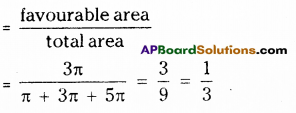
Probability of hitting the circle B
AP Board 9th Class Maths Solutions Chapter 14 Probability InText Questions 8

AP Board 9th Class Maths Solutions Chapter 14 Probability InText Questions

Question 2.
Without calculating, write the percent¬age of probability of the dart hitting the board in circular region ‘C’ (Le., ring C).
Solution:
[latex]\frac{1}{9}[/latex] x 100% = 11[latex]\frac{1}{9}[/latex]