AP Board 7th Class Maths Notes Chapter 3 Simple Equations

Students can go through AP Board 7th Class Maths Notes Chapter 3 Simple Equations to understand and remember the concepts easily.

AP State Board Syllabus 7th Class Maths Notes Chapter 3 Simple Equations

→ Simple equations help in solving various problems in daily life.
Eg: After 5 years Ramesh’s age is 15 years. What is his present age?
Solution. Let Ramesh’s present age be x years
After 5 years Ramesh’s age = x + 5
By problem, x + 5 = 15
x = 15 – 5 = 10 years
∴ Ramesh’s present age = 10 years

→ To balance an equation
a) Same number can be added on both sides.
b) Same number can be subtracted from both sides.
c) Multiply both sides with same number.
d) Divide both sides with same number.
So that the equality remains unaltered.

AP Board 7th Class Maths Notes Chapter 3 Simple Equations

→ An equation remains same if the L.H.S and R.H.S are interchanged.

→ To solve a simple equation we transform term from one side to another.
While transforming term from one side to another
‘+’ quantity becomes ‘-‘ quantity
‘-‘ quantity becomes ‘+’ quantity
‘×’ quantity becomes ‘÷’ quantity
‘÷’ quantity becomes ‘×’ quantity
(i.e.) when the terms are transposed they get opposite signs and the term which multiplies one side, divides the other side.

AP Board 7th Class Maths Notes Chapter 2 Fractions, Decimals and Rational numbers

Students can go through AP Board 7th Class Maths Notes Chapter 2 Fractions, Decimals and Rational numbers to understand and remember the concepts easily.

AP State Board Syllabus 7th Class Maths Notes Chapter 2 Fractions, Decimals and Rational numbers

→ A proper fraction is a fraction that represents a part of a whole i.e., a fraction in which numerator is less than the denominator is called a proper fraction.
Eg: [latex]\frac{1}{2}[/latex], [latex]\frac{1}{3}[/latex], [latex]\frac{2}{3}[/latex], [latex]\frac{5}{6}[/latex], [latex]\frac{8}{13}[/latex],….. etc

→ An improper fraction is a fraction that represents a whole or more than a whole i.e., a fraction in which the numerator is more than or equal to the denominator is called an improper fraction.
Eg: [latex]\frac{5}{3}[/latex], [latex]\frac{4}{3}[/latex], [latex]\frac{8}{7}[/latex], [latex]\frac{11}{5}[/latex], ….. etc

AP Board 7th Class Maths Notes Chapter 2 Fractions, Decimals and Rational numbers

→ Fractions can be represented pictorially.
Eg:
AP Board 7th Class Maths Notes Chapter 2 Fractions, Decimals and Rational numbers 1

→ Like fractions can be compared by their numerators.

→ Unlike fractions can be compared by converting them into like fractions.

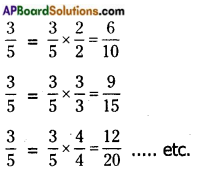
→ An equivalent fraction of a given fraction can be obtained by multiplying its numerator and denominator by same number.
Eg: Equivalent fraction for [latex]\frac{3}{5}[/latex] is
AP Board 7th Class Maths Notes Chapter 2 Fractions, Decimals and Rational numbers 2

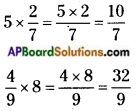
→ To multiply a fraction with a whole number; we take the product of the numerator and the whole number as the new numerator, keeping the denominator the same.
Eg:
AP Board 7th Class Maths Notes Chapter 2 Fractions, Decimals and Rational numbers 3

→ Product of the fractions = [latex]\frac{\text { Product of Numerators }}{\text { Product of Denominators }}[/latex]
Eg: [latex]\frac{5}{3}[/latex] × [latex]\frac{4}{7}[/latex] = [latex]\frac{20}{21}[/latex]

→ In mathematical computation ‘of’ means multiplication.
Eg: [latex]\frac{1}{3}[/latex] of 24 = [latex]\frac{1}{3}[/latex] × 24 = 8

AP Board 7th Class Maths Notes Chapter 2 Fractions, Decimals and Rational numbers

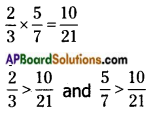
→ The product of two proper fractions is less than each of the fraction in multiplication.
Eg:
AP Board 7th Class Maths Notes Chapter 2 Fractions, Decimals and Rational numbers 4

→ The product of a proper and improper fraction is less than the improper fraction and greater than the proper fraction.
Eg: [latex]\frac{3}{4}[/latex] × [latex]\frac{7}{5}[/latex] = [latex]\frac{21}{20}[/latex]
Here [latex]\frac{3}{4}[/latex] < [latex]\frac{21}{20}[/latex] and [latex]\frac{7}{5}[/latex] > [latex]\frac{21}{20}[/latex]

→ The product of two improper fractions is greater than each of the fractions.
Eg: [latex]\frac{7}{5}[/latex] × [latex]\frac{3}{2}[/latex] = [latex]\frac{21}{20}[/latex]
Here [latex]\frac{7}{5}[/latex] < [latex]\frac{21}{10}[/latex] and [latex]\frac{3}{2}[/latex] < [latex]\frac{21}{20}[/latex]

→ To divide a whole number with a fraction; multiply the whole number by the reciprocal of the given fraction and vice versa.
Eg:
AP Board 7th Class Maths Notes Chapter 2 Fractions, Decimals and Rational numbers 5

→ To divide one fraction by another, multiply the first fraction with the reciprocal of 2nd fraction.
Eg: [latex]\frac{3}{5}[/latex] ÷ [latex]\frac{5}{8}[/latex] = [latex]\frac{3}{5}[/latex] × [latex]\frac{8}{5}[/latex]

→ To multiply a decimal by 10,100,1000,, we move the decimal point in the number to the right side as many places as there are zeros in the numbers 10, 100, 1000 ……
Eg:
1.125 × 10 = 11.25
1.125 × 100 = 112.5
1.125 × 1000 = 1125
1.255 × 10,000 = 12,550

→ To multiply two decimal numbers.
i) multiply them as whole numbers.
ii) count the total number of digits in decimal places and add them.
iii) place the decimal point in the product by counting the sum of digits from its right most place.
Eg: 6.25 × 3.14
i) 625 × 314 = 196250
ii) sum of the number of digits in decimal places = 2 + 2 = 4
iii) 19.6250

AP Board 7th Class Maths Notes Chapter 2 Fractions, Decimals and Rational numbers

→ To divide a decimal number by numbers like 10,100,1000, …… etc. we shift the decimal point in the decimal number to the left by as many places as there are zeros in 10, 100,1000 etc.
Eg: 435.873 ÷ 10 = 43.5873
4551.3 ÷ 100 = 45.513
8374.2 ÷ 1000 = 8.3742
24.82 ÷ 1000 = 0.02482

→ To divide a decimal number by a whole number
i) divide them as whole numbers
ii) place the decimal point in the quotient as in the decimal number.
Eg: 86.5 ÷ 5
i) 865 ÷ 5 = 173
ii) 17.3
To divide a decimal number by another,
i) shift the decimal to the right by equal number of places in both to convert the denominator to a whole number.
ii) divide them as in above
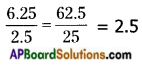
Eg: 6.25 ÷ 2.5

→ The numbers in the form [latex]\frac{p}{q}[/latex] where p, q are integers and q ≠ 0 are called rational numbers.

→ The set of rational numbers is represented by Q.

→ Q includes all integers, positive fractional numbers and negative fractional numbers.

→ All rational numbers can be represented on a number line.

AP Board 7th Class Maths Notes Chapter 1 Integers

Students can go through AP Board 7th Class Maths Notes Chapter 1 Integers to understand and remember the concepts easily.

AP State Board Syllabus 7th Class Maths Notes Chapter 1 Integers

→ Number System:
Natural Numbers:
a) Counting numbers 1, 2, 3, 4, 5, 6, …… are called natural numbers.
b) The set of all natural numbers can be represented by N = {1, 2, 3, 4, 5, ……}

→ Whole Numbers:
a) If we include ‘O’ among the natural numbers, then the numbers 0, 1, 2, 3, 4, 5, …… are called whole numbers.
b) The set of whole numbers can be represented by W = {0, 1, 2, 3, ……}
c) Clearly, every natural number is a whole number but ‘O’ is a whole number which is not a natural number.

AP Board 7th Class Maths Notes Chapter 1 Integers

→ Integers:
a) All counting numbers and their negatives including zero are known as integers.
b) The set of integers can be represented by Z or I = {……, -4, -3, -2,-1, 0, 1, 2, 3, 4, ……}

  • Positive Integers:
    The set I+ = {1, 2, 3, 4, ……} is the set of all positive integers. Clearly positive integers and natural numbers are same.
  • Negative Integers:
    The set I = {-1, -2, -3, ……} is the set of all negative integers. ‘0’ is neither positive nor negative.
  • Non-Negative Integers:
    The set {0, 1, 2, 3, ……} is the set of all non-negative integers.

→ Properties of integers:
For any three integers a, b, c
i) a + b is also an integer – closure property w.r.t addition.
ii) a – b is also an integer – closure property w.r.t subtraction.
iii) a . b is also an integer – closure property w.r.t multiplication.
iv) a + b = b + a – commutative law w.r.t addition. ‘
v) a . b = b . a – commutative law w.r.t multiplication.
vi) a + (b + c) = (a + b) + c – associative law w.r.t addition.
a . (b . c) = (a . b). c – associative law w.r.t multiplication.
vii) a + 0 = 0 + a = a – identity w.r.t addition.
viii) a . 1 = 1 . a = a – identity w.r.t multiplication.
ix) a.(b + c) = a.b + a.c – distributive property.
x) a ÷ 0 is not defined
a ÷ 1 = a
0 ÷ a = 0 (a ≠ 0)

AP Board 7th Class Maths Notes Chapter 1 Integers

→ On a number line when you add a positive integer you move right side on the number line; and if a negative integer is added you move to the left side on the number line.

→ On the number line if you subtract a positive integer you move to the left side and if you subtract a negative integer you move to the right side.

→ Product of any two positive integers or any two negative integers is always a positive integer.

→ Product of a positive integer and a negative integer is always a negative integer (i.e.,) two integers with opposite signs always give a negative product.

→ Product of even number of negative integers is always a positive integer.

→ Product of odd number of negative integers is always a negative integer.

AP State Board 7th Class Maths Notes

Students can go through Andhra Pradesh SCERT AP State Board Syllabus 7th Class Maths Notes Pdf in English Medium and Telugu Medium to understand and remember the concepts easily. Besides, with our AP State 7th Class Maths Notes students can have a complete revision of the subject effectively while focusing on the important chapters and topics. Students can also read AP Board 7th Class Maths Solutions for exam preparation.

AP State Board Syllabus 7th Class Maths Notes

These AP State Board Syllabus 7th Class Maths Notes provide an extra edge and help students to boost their self-confidence before appearing for their final examinations.

AP Board 9th Class Maths Notes Chapter 15 Proofs in Mathematics

Students can go through AP Board 9th Class Maths Notes Chapter 15 Proofs in Mathematics to understand and remember the concepts easily.

AP State Board Syllabus 9th Class Maths Notes Chapter 15 Proofs in Mathematics

→ The sentences that can be judged on some criteria, no matter by what process for their being true or false are statements.

→ Mathematical statements are of a distinct nature from general statements. They cannot be proved or justified by getting evidence while they can be disproved by finding a counter example.

→ Making mathematical statements through observing patterns and thinking of the rules that may define such patterns.
A hypothesis is a statement of idea which gives an explanation to a sense of observation.

AP Board 9th Class Maths Notes Chapter 15 Proofs in Mathematics

→ A process which can establish the truth of a mathematical statement based purely on logical arguments is called a mathematical proof.

→ Axioms are statements which are assumed to be true without proof.

→ A conjecture is a statement we believe is true based on our mathematical intuition, but which we are yet to prove.

→ A mathematical statement whose truth has been established or proved is called a theorem.

→ The prime logical method in proving a mathematical statement is deductive reasoning.

→ A proof is made up of a successive sequence of mathematical statements.

→ Beginning with given (Hypothesis) of the theorem and arrive at the conclusion by means of a chain of logical steps is mostly followed to prove theorems.

AP Board 9th Class Maths Notes Chapter 15 Proofs in Mathematics

→ The proof in which, we start with the assumption contrary to the conclusion and arriving at a contradiction to the hypothesis is another way that we establish the original conclusion is true is another type of deductive reasoning.

→ The logical tool used in the establishment of the truth of an un-ambiguous statement is called deductive reasoning.

→ The reasoning which is based on examining of variety of cases or sets of data discovering pattern and forming conclusion is called Inductive reasoning.

AP Board 9th Class Maths Notes Chapter 14 Probability

Students can go through AP Board 9th Class Maths Notes Chapter 14 Probability to understand and remember the concepts easily.

AP State Board Syllabus 9th Class Maths Notes Chapter 14 Probability

→ If in an experiment all the possible outcomes are known in advance and none of the outcomes can be predicted with certainty, then such an experiment is called a random experiment.
Eg: Tossing a coin; throwing a die, drawing a card from deck of cards.

→ The possible outcomes of a trial are called events.

→ Events are said to be equally likely if there is no reason to expect any one in preference to other. Thus equally likely events mean outcome is as likely to occur as any other outcome.

AP Board 9th Class Maths Notes Chapter 14 Probability

→ To measure the chance of its happening numerically we classify them as follows.

→ Certain: Something that must happen

→ More likely: Something that would occur with great chance

→ Equally likely: Something that have the same chance of occurring

→ Less likely: Something that would occur with less chance

→ Impossible: Something that cannot happen

→ Probability of an event = [latex]\frac{\text { Number of favourable outcomes for the event }}{\text { Number of total possible outcomes }}[/latex]

AP Board 9th Class Maths Notes Chapter 12 Circles

Students can go through AP Board 9th Class Maths Notes Chapter 12 Circles to understand and remember the concepts easily.

AP State Board Syllabus 9th Class Maths Notes Chapter 12 Circles

→ A collection of all points in a plane which are at a fixed distance from a fixed point in the sapie plane is called a circle. The fixed point is called the centre and the fixed distance is called the radius of the circle.

→ A line segment joining any two points on the circle is called a chord.

→ The longest of all chords which passes through the centre is called a diameter.

→ Circles with same radii are called congruent circles.

→ Circles with same centre and different radii are called concentric circles.

AP Board 9th Class Maths Notes Chapter 12 Circles

→ Diameter of a circle divides it into two semi-circles.

→ The part between any two points on the circle is called an arc.

→ The area enclosed by a chord and an arc is called a segment. If the arc is a minor arc then it is called the minor segment and if the arc is major arc then it is called the major segment.

→ The area enclosed by an arc and the two radii joining the end points of the arc with centre is called a sector.

→ Equal chords of a circle subtend equal angles at the centre.

→ Angles in the same segment are equal.

→ An angle in a semi circle is a right angle.

→ If the angles subtended by two chords at the centre are equal, then the chords are congruent.

→ The perpendicular from the centre of a circle to a chord bisects the chords. The converse is also true.

→ There is exactly one circle that passes through three non-collinear points.

→ The circle passing through the three vertices of a triangle is called a circumcircle.

→ Equal chords are at equal distance from the centre of the circle, conversely chords at equidistant from the centre of the circle are equal in length.

→ Angle subtended by an arc at the centre of the circle is twice the angle subtended by it at any other point on the circle.

AP Board 9th Class Maths Notes Chapter 12 Circles

→ If the angle subtended by an arc at a point on the remaining part of the circle is 90°, then the arc is a semi circle.

→ If a line segment joining two points subtends same angles at two other points lying on the same side of the line segment, the four points lie on the circle.

→ The sum of pairs of opposite angles of a cyclic quadrilateral are supplementary.

AP Board 9th Class Maths Notes Chapter 11 Areas

Students can go through AP Board 9th Class Maths Notes Chapter 11 Areas to understand and remember the concepts easily.

AP State Board Syllabus 9th Class Maths Notes Chapter 11 Areas

→ The part of a plane enclosed by a simple closed figure is called a planar region corresponding to that figure.

→ The magnitude of a planar region is its area.

→ The unit area is the area enclosed by a unit square i.e. a square of side 1 unit.

→ Area is always expressed in square units.

→ The areas of two congruent figures are equal.

→ Converse of the above is not true, i.e., if two figures have same area, they need not be congruent.

→ The area of a whole figure is equal to sum of the areas of finite parts of it.

AP Board 9th Class Maths Notes Chapter 11 Areas

→ Area of a rectangle is equal to the product of its length and breadth.

→ Area of a parallelogram is the product of a side and its corresponding altitude.

→ Parallelograms on the same base and between same parallels are equal in area.

→ If a parallelogram and a triangle lie on a same base and between same parallels, then the area of the triangle is half the area of parallelogram.

→ Triangles between same base and between same parallels are equal in area.

AP Board 9th Class Maths Notes Chapter 10 Surface Areas and Volumes

Students can go through AP Board 9th Class Maths Notes Chapter 10 Surface Areas and Volumes to understand and remember the concepts easily.

AP State Board Syllabus 9th Class Maths Notes Chapter 10 Surface Areas and Volumes

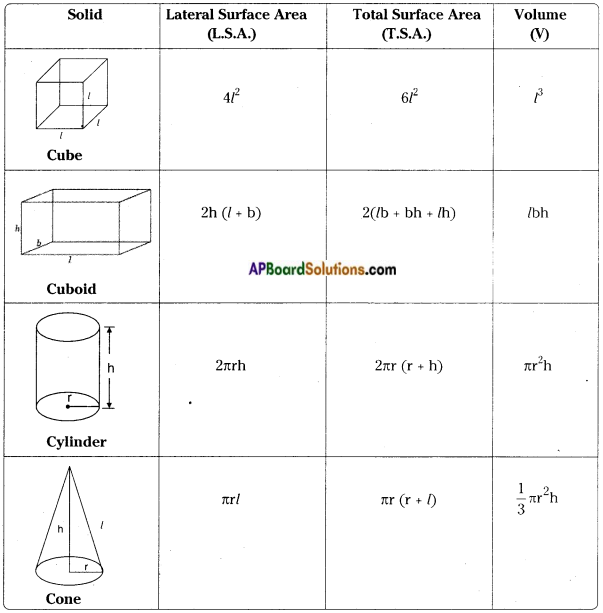
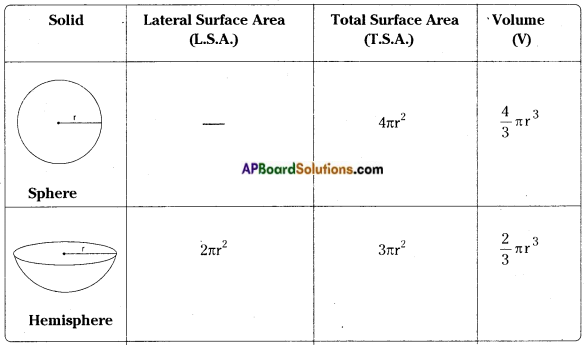
→ Cuboid and cube may be treated as regular prisms having six faces.
AP Board 9th Class Maths Notes Chapter 10 Surface Areas and Volumes 1
AP Board 9th Class Maths Notes Chapter 10 Surface Areas and Volumes 2

AP Board 9th Class Maths Notes Chapter 10 Surface Areas and Volumes

→ Solids whose lateral surfaces are parallelograms are called prisms,

→ Solids whole lateral surfaces are triangles are called pyramids.

→ Cube and cuboid are also prisms.

→ Volume of a pyramid = [latex]\frac{1}{3}[/latex] Area of the base × height
= [latex]\frac{1}{3}[/latex] of the volume of right prism.

AP Board 9th Class Maths Notes Chapter 9 Statistics

Students can go through AP Board 9th Class Maths Notes Chapter 9 Statistics to understand and remember the concepts easily.

AP State Board Syllabus 9th Class Maths Notes Chapter 9 Statistics

→ The facts or figures which are numerical or otherwise collected with a definite purpose are called data.

→ Statistics is the branch of mathematics which studies about the data and its meaning.

→ The information collected by the investigator with a definite objective is called primary data.

→ The information collected from a source, which had already been recorded lay from registers is called secondary data.

→ Data exists in raw form.

AP Board 9th Class Maths Notes Chapter 9 Statistics

→ Data is classified into groups to make the study easy.

→ The difference between the minimum and maximum values of a data is called the range of the given data.

→ The table showing the actual observations with their frequencies is called ungrouped frequency distribution table or table of weighted observations.

→ Presenting the data in groups with their frequencies is called a grouped frequency distribution table.

→ Mean, Median and Mode are called the measures of central tendency.
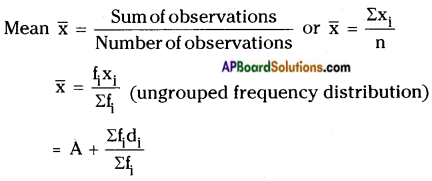
AP Board 9th Class Maths Notes Chapter 9 Statistics 1
(Deviation method: ∑fidi – sum of the deviations, A – assumed mean and ∑fi – sum of the frequencies)
→ Median is the middle observation of a data, when arranged in either ascending/ descending order.

→ When number of observations ‘n’ is odd, the median is [latex]\left(\frac{n+1}{2}\right)^{th}[/latex] observation.

→ When number of observations ‘n’ is even, the median is [latex]\left(\frac{n}{2}\right)^{th}[/latex] the average of [latex]\left(\frac{n}{2}+1\right)^{th}[/latex] observations.

AP Board 9th Class Maths Notes Chapter 9 Statistics

→ Median divides the data into two groups of equal number, one part comprising all values greater and the other comprising all values less than median.

→ Mode is the value of the observation which occurs most frequently, i.e., an observation with the maximum frequency is called mode.

→ If each of the observation is added or multiplied by same quantity, the measure of central tendency also changes accordingly.

AP Board 9th Class Maths Notes Chapter 8 Quadrilaterals

Students can go through AP Board 9th Class Maths Notes Chapter 8 Quadrilaterals to understand and remember the concepts easily.

AP State Board Syllabus 9th Class Maths Notes Chapter 8 Quadrilaterals

→ A quadrilateral is a simple closed figure bounded by four line segments.

→ The line segments joining any two opposite vertices are called diagonals.

→ The sum of the four interior angles of a quadrilateral is 360° or four right angles.

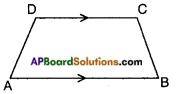
→ A quadrilateral in which one pair of opposite sides are parallel is called a trapezium.
AP Board 9th Class Maths Notes Chapter 8 Quadrilaterals 1

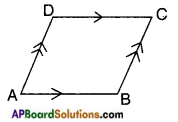
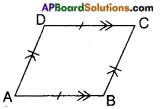
→ A quadrilateral in which both pairs of opposite sides are parallel is called a parallelogram.
AP Board 9th Class Maths Notes Chapter 8 Quadrilaterals 2

→ A parallelogram in which the adjacent sides are equal is called a rhombus.
AP Board 9th Class Maths Notes Chapter 8 Quadrilaterals 3

AP Board 9th Class Maths Notes Chapter 8 Quadrilaterals

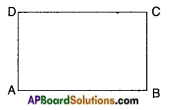
→ A parallelogram in which one angle is right angle is called a rectangle.
AP Board 9th Class Maths Notes Chapter 8 Quadrilaterals 4

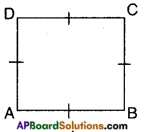
→ A parallelogram in which adjacent sides are equal and one angle is right angle is called a square.
AP Board 9th Class Maths Notes Chapter 8 Quadrilaterals 5

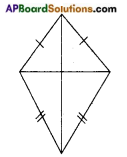
→ A quadrilateral in which the two pairs of adjacent sides are equal is called a ‘kite’.
AP Board 9th Class Maths Notes Chapter 8 Quadrilaterals 6

→ In, a parallelogram

  • diagonals bisect each other.
  • adjacent/consecutive angles are supplementary.
  • opposite angles are equal.
  • both pairs of opposite sides are equal.
  • diagonal divides the parallelogram into two congruent triangles.

→ In a rhombus, diagonals bisect each other at right angles and the diagonals are unequal.

→ In a square diagonals are equal and bisect each other at right angles.

→ In a rectangle diagonals are equal and bisect each other.

AP Board 9th Class Maths Notes Chapter 8 Quadrilaterals

→ The line segment joining the mid points of two side of a triangle is parallel to third side and also half of it.

→ The line drawn through the mid point of one side of a triangle and parallel to another side will bisect the third side.

→ The intercepts made by the transversal on three or more parallel lines are equal to one another.

AP Board 9th Class Maths Notes Chapter 7 Triangles

Students can go through AP Board 9th Class Maths Notes Chapter 7 Triangles to understand and remember the concepts easily.

AP State Board Syllabus 9th Class Maths Notes Chapter 7 Triangles

→ Two line segments are congruent if they have equal length.

→ Two squares are congruent if they have same side.

→ Squares that have same measure of diagonals are also congruent.

→ Two triangles are congruent if they cover each other exactly.

→ If two triangles are congruent then Corresponding Parts of Congruent Triangles (CPCT) are equal.

→ Two triangles are congruent if two sides and the included angle of one triangle are equal to the two sides and included angle of the other triangle (S.A.S. congruence rule).

→ Two triangles are congruent, if two angles and the included side of one triangle are equal to two angles and the included side of the other triangle (A.S.A. congruence rule).

→ Two triangles are congruent if any two pairs of angles and one pair of corresponding sides are equal (A.A.S.).

AP Board 9th Class Maths Notes Chapter 7 Triangles

→ Angles opposite equal sides of a triangle are equal.

→ The sides opposite to equal angles of a triangle are equal.

→ If three sides of one triangle are respectively equal to the corresponding three sides of another triangle, then the two triangles are congruent (SSS).

→ If in two right triangles the hypotenuse and one side of one triangle are equal to the hypotenuse and one side of the another triangle, then the two triangles are congruent (RHS).

→ In a triangle, of the two sides, side opposite to greater angle is greater.

→ Sum of any two sides of a triangle is greater than the third side.