AP Board 8th Class Maths Notes Chapter 2 Linear Equations in One Variable

Students can go through AP Board 8th Class Maths Notes Chapter 2 Linear Equations in One Variable to understand and remember the concepts easily.

AP State Board Syllabus 8th Class Maths Notes Chapter 2 Linear Equations in One Variable

→ An algebraic equation is equality of algebraic expressions involving variables and constants.

→ If the degree of an equation is one then it is called a linear equation.

→ If a linear equation has only one variable then it is called a linear equation in one variable or simple equation. ‘

AP Board 8th Class Maths Notes Chapter 2 Linear Equations in One Variable

→ The value which when substituted for the variable in the given equation makes L.H.S. = R.H.S. is called a solution or root of the given equation.

→ Just as numbers, variables can also be transposed from one side of the equation to the other side.
Note: When we transpose terms
‘+’ quantity becomes ’-‘ quantity,
‘-‘ quantity becomes ‘+’ quantity.
‘×’ quantity becomes ‘÷’ quantity.
‘÷’ quantity becomes ‘×’ quantity.
Also
Also,
(+) × (+) = +
(+) × (-) = –
(-) × (+) = –
(-) × (-) = +
AP Board 8th Class Maths Notes Chapter 1 Rational Numbers

Students can go through AP Board 8th Class Maths Notes Chapter 1 Rational Numbers to understand and remember the concepts easily.

AP State Board Syllabus 8th Class Maths Notes Chapter 1 Rational Numbers

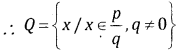
→ The numbers which are expressed in the form of [latex]\frac{p}{q}[/latex] where p and q are integers and q ≠ 0, are called “Rational Numbers” which are denoted by the letter ‘Q’.
AP Board 8th Class Maths Notes Chapter 1 Rational Numbers 3

→ Rational numbers are closed under the operations of addition, subtraction and multiplication.

→ Rational numbers are not closed on division.

AP Board 8th Class Maths Notes Chapter 1 Rational Numbers

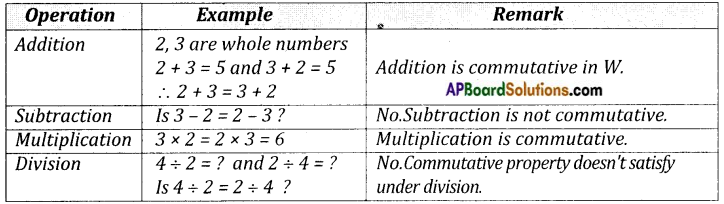
→ Whole numbers:
AP Board 8th Class Maths Notes Chapter 1 Rational Numbers 1

→ Whole numbers:
AP Board 8th Class Maths Notes Chapter 1 Rational Numbers 2

→ The additive inverse of a is – a. (∵ a + (-a) = 0)
AP Board 8th Class Maths Notes Chapter 1 Rational Numbers

→ The multiplicative inverse of a is [latex]\frac{1}{a}[/latex]. (∵ a × [latex]\frac{1}{a}[/latex] = 1)

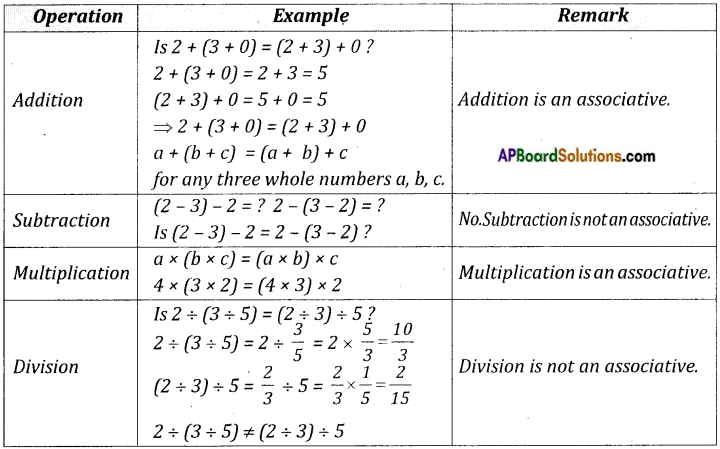
→ The operations addition and multiplications are

  1. Commutative for rational numbers.
  2. Associative for rational numbers.

→ ‘0’ is the additive identity for rational number.

→ ‘1’ is the multiplicative identity for rational number.

→ A rational number and its additive inverse are opposite in their sign.

→ The multiplicative inverse of a rational number is its reciprocal.

→ Distributivity of rational numbers a, b and c is a(b + c) = ab + ac and a(b – c) = ab – ac.
→ Rational numbers can be represented on a number line.

→ There are infinite number of rational numbers between any two given rational numbers.

AP Board 8th Class Maths Notes Chapter 1 Rational Numbers

→ The concept of mean help us to find rational numbers between any two rational numbers.

→ The decimal representation of rational numbers is either in the form of terminating decimal or non-terminating recurring decimals.

AP Board 8th Class Biology Important Questions Chapter 11 Why Do We Fall Ill

AP State Syllabus AP Board 8th Class Biology Important Questions Chapter 11 Why Do We Fall Ill

AP State Syllabus 8th Class Biology Important Questions 10th Lesson Why Do We Fall Ill

8th Class Biology 10th Lesson Why Do We Fall Ill 1 Mark Important Questions and Answers

Question 1.
What is health?
Answer:
Health is a state of physical, mental and social well – being.

Question 2.
On what factors the health of an individual depends?
Answer:
The health of an individual is dependent on his or her physical surroundings and his / her economic status.

Question 3.
What is a disease ?
Answer:
Disease is actually self – explanatory. In other words, literally means being uncomfortable.

Question 4.
What is necessary for individual health ?
Answer:
Social equality and harmony are necessary for individual health.

AP Board 8th Class Biology Important Questions Chapter 11 Why Do We Fall Ill

Question 5.
What will happen if there is a disease ?
Answer:
When there is a disease, either the functioning or the appearance of one or more systems of the body will change for the worse.

Question 6.
What are acute diseases ?
Answer:
Some diseases last for only very short periods of time and these are called acute diseases.

Question 7.
What are chronic diseases ?
Answer:
Chronic diseases have very drastic, long – term effects on people’s health as compared to acute diseases.

Question 8.
What is the cause of a disease ?
Answer:
Lack of good nourishment may be the cause of a disease.

Question 9.
What are infectious diseases ?
Answer:
Diseases where microbes are the immediate causes are called infectious diseases.

Question 10.
Which bacteria is responsible for peptic ulcers ?
Answer:
Helicobacter pylori is responsible for peptic ulcers.

Question 11.
Name the organisms that cause diseases.
Answer:
Organisms that cause diseases are virus, bacteria, fungi, protozoans and worms.

AP Board 8th Class Biology Important Questions Chapter 11 Why Do We Fall Ill

Question 12.
Name the diseases caused by bacteria.
Answer:
Typhoid, cholera, tuberculosis and anthrax are caused by bacteria.

Question 13.
What diseases are caused by protozoans ?
Answer:
Protozoans cause malaria and kalaazar.

Question 14.
What are communicable diseases ?
Answer:
Diseases that spread from an infected person to other person by many microbial agents are called communicable diseases.

Question 15.
What is the function of our immune system ?
Answer:
In our body, the immune system fight and kill the disease causing organisms that enter into our body and defend us from diseases.

Question 16.
What are vectors ?
Answer:
Many diseases transmitted by other animals. These animals carry the infecting agents from a sick person to a healthy person. Such animals are called vectors. Ex: Mosquitoes.

AP Board 8th Class Biology Important Questions Chapter 11 Why Do We Fall Ill

Question 17.
Name the diseases caused by mosquitoes.
Answer:
Encephalitis or brain fever, filaria or elephantiasismalaria, dengue etc., are caused by mosquitoes.

Question 18.
Name the disease that causes physical contact.
Answer:
AIDS disease is caused by physical contact.

Question 19.
How do we kill microbes?
Answer:
By using antibacterial and anti – viral medicines we can kill microbes and also there are drugs that kill protozoa such as malarial parasite.

Question 20.
Why making anti – viral medicines is harder than making antibacterial medicines ?
Answer:
Because viruses have few biochemical mechanisms of their own.

Question 21.
What are infectious diseases?
Answer:
Diseases where microbes are the immediate causes are called infectious diseases.

AP Board 8th Class Biology Important Questions Chapter 11 Why Do We Fall Ill

Question 22.
What are symptoms?
Answer:
Some characteristic signs or indications that appear during sickness can help us to identify the sickness are called symptoms!

Question 23.
What is manifestation?
The appearance of the symptoms of a disease is called manifestation of the disease.

Question 24.
What is immunization?
Answer:
The creation of immunity usually against a particular disease, especially treatment by vaccination of an organism for the purpose of making it immune to a particular disease.

Question 25.
What are the different means by which infectious diseases are spread?
Answer:
Infectious diseases are spread through contaminated air, water, food and vectors like mosquitoes, flies, cockroaches, snails and even lies.

Question 26.
What are the vaccines available for preventing infectious diseases?
Answer:
There are vaccines against tetanus, diphtheria, whooping cough, measles, polio and many others.

AP Board 8th Class Biology Important Questions Chapter 11 Why Do We Fall Ill

Question 27.
Who discover vaccine for small pox for the first time?
Answer:
An English physician named Edward Jenner discovered vaccine forsmall pox for the first time.

Question 28.
Why are we normally advised to take bland and nourishing food when we are sick?
Answer:
When we fall sick our normal body functions will be affected and the digestion becomes slow, so it is advised to take bland and nourishing food.

Question 29.
What is needed to be healthy?
Answer:
Proper and sufficient nourishment and clean surroundings and food helps lis to be healthy.

Question 30.
Name the diseases that do not spread.
Answer:
Non – infectious diseases like cancer, high blood pressure do not spread.

8th Class Biology 10th Lesson Why Do We Fall Ill 2 Marks Important Questions and Answers

AP Board 8th Class Biology Important Questions Chapter 11 Why Do We Fall Ill

Question 1.
What are the diseases caused by bacteria in Man?
Answer:

  1. Cholera
  2. Typhoid
  3. Diptheria
  4. Whooping cough
  5. Tetanus
  6. Tuberculosis
  7. Leprosy

Question 2.
Name the diseases caused by viruses in man.
Answer:

  1. Small pox
  2. Chicken pox
  3. Measles
  4. Mumps
  5. Poliomelitis

Question 3.
What are the diseases caused by Protozoans in Man?
Answer:

  1. Malaria
  2. Kala Azar
  3. Amoebic Desentry

8th Class Biology 10th Lesson Why Do We Fall Ill 4 Marks Important Questions and Answers

AP Board 8th Class Biology Important Questions Chapter 11 Why Do We Fall Ill

Question 1.
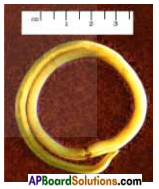
Draw the picture of SARS VIRUS in your scrap book and write the size of SARS VIRUS.
Answer:
Picture of SARS VIRUS
AP Board 8th Class Biology Important Questions Chapter 11 Why Do We Fall Ill 1
The size of SARS VIRUS is 500 nano metres, which is half a micrometre, which is one thousandth of a millimetre.

Question 2.
Draw the picture of staphylococci bacteria. In what way it affect the health of people?
Answer:
Staphylococci Bacteria
AP Board 8th Class Biology Important Questions Chapter 11 Why Do We Fall Ill 2
Staphylocoecci bacteria cause acne.

Question 3.
Draw a picture showing an adult round worm and answer the given questions:
a) What is the scientific name of round worm?
b) Where does it live in human beings?
Answer:
Round Worm
AP Board 8th Class Biology Important Questions Chapter 11 Why Do We Fall Ill 3
a) The Scientific name of Round Worm is Ascaris lumbricoides.
b) It stays in the small intestine of human beings.

AP Board 8th Class Biology Important Questions Chapter 11 Why Do We Fall Ill

Question 4.
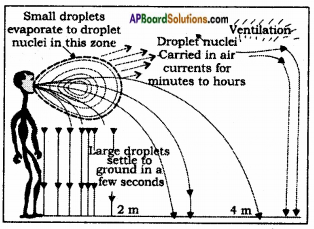
Draw a picture showing the air borne diseases will spread in the air.
Answer:
Spread of air borne diseases
AP Board 8th Class Biology Important Questions Chapter 11 Why Do We Fall Ill 4

Question 5.
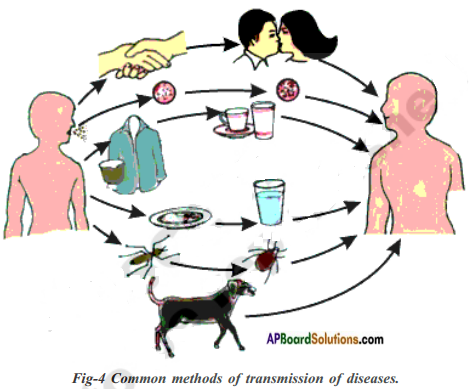
Draw a flow chart which shows common methods of transmission of diseases. How the animals transmit diseases? Explain.
Answer:
AP Board 8th Class Biology Important Questions Chapter 11 Why Do We Fall Ill 5
We lie in an environment that is full of many other creatures apart from us. It is inevitable that many diseases will be transmitted by other animals.
These animals carry the infecting agents from a sick person to another potential host. These animals are intermediates and are called vectors.
The commonest vectors are mosquitoes. The female mosquitoes need highly nutri¬tious food in the form of blood in order to be able to lay mature eggs. In this way they can transfer diseases from person to person.

AP Board 8th Class Biology Important Questions Chapter 11 Why Do We Fall Ill

Question 6.
How does death occurs in AIDS patients?
Answer:

  1. In HIV infection, the virus goes to the immune system and damage its function.
  2. The body can no longer fight off with even minor infections.
  3. Even mild cold becomes Pneumonia. Thus ultimately these infections kill the people suffering from HIV – AIDS.

8th Class Biology 10th Lesson Why Do We Fall Ill Important Questions and Answers

Question 1.
Prepare a pamphlet to aware people to maintain a hygienic surrounding.
Answer:
Pamphlet
“Prevention is better than cure”. So, it is better for us to prevent diseases rather than treatment. You should keep our surroundings clean and hygienic wash your hands with soap or handwash lotion thoroughly before consuming food. Wash your hands with soap after defecation. You should consume your food only when it is hot. Do exercises daily to keep you fit and healthy. Try to cultivate good habits which keep you healthy always. Use mosquito nets to avoid mosquito bites.
“SWACH BHARAT – SWASTH BHARAT”.

AP Board 8th Class Biology Important Questions Chapter 10 Not For Drinking-Not For Breathing

AP State Syllabus AP Board 8th Class Biology Important Questions Chapter 10 Not For Drinking-Not For Breathing

AP State Syllabus 8th Class Biology Important Questions 10th Lesson Not For Drinking-Not For Breathing

8th Class Biology 10th Lesson Not For Drinking-Not For Breathing 1 Mark Important Questions and Answers

Question 1.
Which department issues the pollution under control certificate?
Answer:
The pollution check up centre issues the certificate.

Question 2.
For how much time is it valid?
Answer:
It is valid for six months.

Question 3.
For which types of vehicles has it been issued?
Answer:
All types of vehicles like motor bike, scooter, car, bus, lorry etc.

AP Board 8th Class Biology Important Questions Chapter 10 Not For Drinking-Not For Breathing

Question 4.
What is emission test?
Answer:
The test conducting of the gases releasing from the vehicle is called emission test.

Question 5.
What components are tested in the pollution check up centre?
Answer:
Carbon dioxide, carbon monoxide, nitrogen, hydrocarbons, sulphur dioxide etc.

Question 6.
What will happen if harmful microorganisms or substances enter your body? How do you feel?
Answer:
If harmful microorganism enter the body the normal functioning of the body will be disrupted or disturbed. We feel sick.

Question 7.
What is the effect of rapid increase in the number of vehicles?
Answer:
With the number of vehicles increase, the pollution also increases, which causes air pollution.

Question 8.
What is pollution?
Answer:
Anything that is harmful to the environment is called pollution.

AP Board 8th Class Biology Important Questions Chapter 10 Not For Drinking-Not For Breathing

Question 9.
When do all the living organisms with in the environment will be healthy and thriving?
Answer:
When everything is working the way it should be all the living organisms with the environment including humans are healthy and thriving.

Question 10.
Name the diseases caused by air pollution.
Answer:
Diseases of the respiratory system like lung cancer, Asthma etc.

Question 11.
What do our elders talk about the environment?
Answer:
Our elders talk about the blue sky, clean water and fresh air that was available in their times.

Question 12.
What is our environment made up of?
Answer:
The environment is made up of systems, cycles and specialized relationships between living and non – living elements.

Question 13.
Name some substances which impact the health of our earth.
Answer:
Litter, car exhaust, motor oil, used tires, smoke, chemicals, disposed computer, mobile phone material etc., all of these can have an instant or a gradual impact on the health of our earth.

Question 14.
What are the four major gases in the air?
Answer:
The four major gases are nitrogen, oxygen, argon and carbondioxide.

AP Board 8th Class Biology Important Questions Chapter 10 Not For Drinking-Not For Breathing

Question 15.
Which is the essential element for survival of all living organisms?
Answer:
The atmosphere contains 21 % of oxygen which is essential for survival of all living organisms.

Question 16.
How is carbon dioxide important?
Answer:
Carbon dioxide which is 0.033% is essential for the process of photosynthesis in plants.

Question 17.
What is air pollution?
Answer:
The contamination of air by impurities which may have harmful impacts on the living organisms and the non-living components of the environment is called air pollution.

Question 18.
What are pollutants?
Answer:
Pollutants are the substances which contaminate the environment.

Question 19.
Name the main pollutants in the atmosphere.
Answer:
Suspended particulate matter, carbondioxide, carbon monoxide, oxides of sulphur and nitrogen CFCs and heavy metals.

AP Board 8th Class Biology Important Questions Chapter 10 Not For Drinking-Not For Breathing

Question 20.
Name the natural disasters in the world.
Answer:
The natural disasters in the world are volcanic eruptions, forest fires and sand storms which leads to air pollution.

Question 21.
What is the problem with airborne pollutants?
Answer:
The problem with airborne – pollutants is the way winds criss – cross the globe, picking up pollutants and carrying them all over the world. Air pollution is not just a local concern.

Question 22.
What pollutants are released by forest fires?
Answer:
Forest fires release carbon particles (ash) into the air and pollute the air.

Question 23.
What gas is released from decay of organic matter?
Answer:
Decay of organic matter releases Ammonia gas into air.

Question 24.
What gas is released from decay of organic matter lying under water?
Answer:
Decay of organic matter lying under water releases Methane gas as air pollution.

Question 25.
How do pollen grains pollute the air?
Answer:
Pollen grains released by plants remain floating in the air and pollute it.

AP Board 8th Class Biology Important Questions Chapter 10 Not For Drinking-Not For Breathing

Question 26.
What gases are produced by burning fuels?
Answer:
Burning fuels pollute the air by producing carbon – monoxide, sulphur dioxide, smoke, soot and ash.

Question 27.
What gases are emitted by vehicles?
Answer:
Sulphur dioxide, nitrogen dioxide, carbon monoxide, unburnt hydrocarbons, lead compounds and soot.

Question 28.
Name the polluted areas and the factories present in that area.
Answer:

  1. Prakasam district – Granite factory
  2. Macharla – Cement factory
  3. Piduguralla – Lime stone

Question 29.
Name various industries that pollute the air.
Answer:
Granite, lime, cement factories pollute the air by releasing sulphur dioxide, nitrous oxide, chlorine fly ash, dust, asbestos dust etc.

Question 30.
How local people are suffering living near Parawada and Krishnapatnam Thermal Power Plants?
Answer:
The Thermal power plants release fly ash, sulphur dioxide and radio active substances into air, water and land, local people are suffering from lung cancer and skin allergies.

AP Board 8th Class Biology Important Questions Chapter 10 Not For Drinking-Not For Breathing

Question 31.
What are the problems face by the people living near the granite factory?
Answer:
The people living near the granite factory are facing several health problems like respiratory bronchitis and asthma.

Question 32.
How are Nuclear power plants dangerous?
Answer:
The two problems of Nuclear power plants are radio active waste and melt downs.

Question 33.
What are melt downs?
Answer:
Melt downs are caused by too much heat in the power plant. During melt down the power plant makes more Radio active pollution.

Question 34.
How do power plants release power?
Answer:
Power plants produce power by using water, coal and gas.

Question 35.
How do Nuclear power plants produce power?
Answer:
By using Radio active elements like uranium.

AP Board 8th Class Biology Important Questions Chapter 10 Not For Drinking-Not For Breathing

Question 36.
How agriculture pollutes land and water?
Answer:
Use of fertilizers and pesticides in agriculture pollutes not only air but also land and water.

Question 37.
What is the result of deforestation?
Answer:
The destruction of forests and woods is called deforestation. It has resulted in the reduction of indigenous forests.

Question 38.
If forests reduce what would happen?
Answer:
If forests reduce the level of carbondioxide increases resulting to global warming.

Question 39.
In which devices chloro flouro carbons are used?
Answer:
Chloro flouro carbons (CFC) are used in refrigerators, Air Conditioners and aerosol sprays. CFC pollutes air by depleting the ozone layer.

Question 40.
How is mining cause pollution?
Answer:
Mining of coal and stone releases coal dust and stone dust that cause air pollution.

AP Board 8th Class Biology Important Questions Chapter 10 Not For Drinking-Not For Breathing

Question 41.
Why do the currently cars and buses not allowed to drive to the Taj Mahal?
Answer:
The motor vehicles and the Industries located in and around Agra for rubber processing, chemicals oil refinery of Mathura, iron foundries have been responsible for the colour change of Taj Mahal from white to yellow.

Question 42.
What did the Archeological department of lndia declared towards Taj Mahal?
Answer:
The Archeological department declared that 2[latex]\frac{1}{2}[/latex] km around Taj Mahal is no drive zone.

Question 43.
What is the unforgettable tragedy of Bhopal?
Answer:
On second December 1984 about 3000 human beings died, about 5000 were paralized in just one night at Bhopal.

Question 44.
What is the reason for the tragedy at Bhopal?
Answer:
The reason for this is the leakage of Methyl isocynate into the air from an insecticide factory managed by union carbide.

Question 45.
What are the affects caused by air pollution?
Answer:
Air pollution causes certain diseases including shortness of breath, sore throat, chest pain, nausea, asthma, bronchitis and lung cancer.

AP Board 8th Class Biology Important Questions Chapter 10 Not For Drinking-Not For Breathing

Question 46.
How is like the air pollution?
Answer:
Air pollution is like a slow poison.

Question 47.
How to reduce air pollution from industries?
Answer:
Install electrostatic precipitators in the chimney of industries.

Question 48.
How to reduce pollution from vehicles?
Answer:
Reduce vehicular emission by using non-polluting fuels like CNG.

Question 49.
What is Vanamahotsav?
Answer:
We can protect plants and trees. On the day of Vanamahotsav lakhs of trees are planted in July every year.

Question 50.
Name one of the most polluted area in India.
Answer:
Patancheru, a suburban mandal in Medak district is a major industrial hub of the state is one of the most polluted area in India.

Question 51.
How are the villages badly affected by pollution?
Answer:
They are affected with some diseases like cancer, respiratory diseases and heart diseases by poisons in air, water and on land.

Question 52.
What is water pollution?
Answer:
The contamination of water with unwanted and harmful substances such as sewage, toxic chemicals, industrial waste etc., is called water pollution.

AP Board 8th Class Biology Important Questions Chapter 10 Not For Drinking-Not For Breathing

Question 53.
What is the character of normal water?
Answer:
Normal water is colourless without any smell or any unwanted substances. Water which is suitable for drinking is called potable water.

Question 54.
How Musi river got polluted?
Answer:
The people living near Musi throw large quantities of garbage, unwanted sewage, industrial waste, dead bodies, polythene bags, hot water and statues of deities and many other materials and made the river polluted.

Question 55.
What is definite source of pollution?
Answer:
Definite source of pollution is due to discharges from a single source, such as industrial site.

Question 56.
What is Biodegradable waste?
Answer:
Biodegradable waste consists of mainly human and animal waste.

Question 57.
How do plant nutrients pollute water?
Answer:
Phosphates sand nitrates – chemical fertilizers from agriculture run – off due to rain and industrial waste enter into water through sewage and pollute the water.

AP Board 8th Class Biology Important Questions Chapter 10 Not For Drinking-Not For Breathing

Question 58.
How is heat polluting water?
Answer:
As water, temperature increases, the amount of dissolved oxygen decreases. So thermal pollution often reduces the aquatic life diversity in water.

Question 59.
How is water polluted by sediment?
Answer:
Sediment pollution is formed by the sources such as constructional, agricultural, logging, flooding and city runoff.

Question 60.
What is Eutrophication?
Answer:
The enrichment of water by nutrients leading to excessive plant growth and duplication of oxygen is known as Eutrophication.

Question 61.
How is fluorine hazardous substance to ground water?
Answer:
Fluorine mixed in ground water cause dangerous disease called fluorosis.

Question 62.
What are 3R’s principles?
Answer:
The 3R’s principles are Reduce the usage of the materials, Reuse them for secondary purpose and Recycle the material again and again.

AP Board 8th Class Biology Important Questions Chapter 10 Not For Drinking-Not For Breathing

Question 63.
How should we maintain natural resources?
Answer:
We should keep the natural resources clean and healthy not only for us but also future generations.

8th Class Biology 10th Lesson Not For Drinking-Not For Breathing 2 Marks Important Questions and Answers

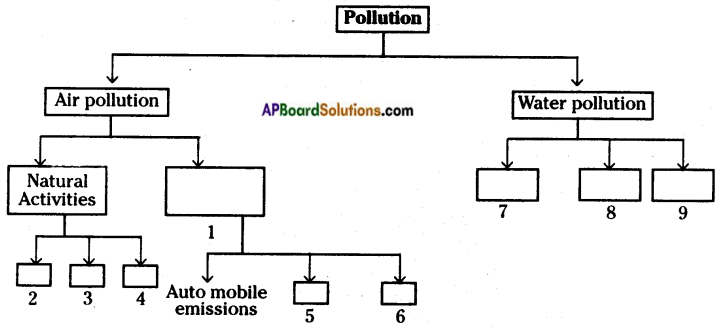
Question 1.
Complete this flow chart.
AP Board 8th Class Biology Important Questions Chapter 9 Production and Management of Food From Animals 2
Answer:

  1. Human activities
  2. Volcanic eruptions
  3. Forest fires
  4. Sand cyclones
  5. CFCs
  6. Mining
  7. Sewage
  8. Industrial effluents
  9. Toxic chemicals

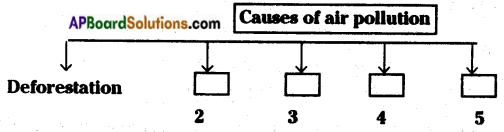
Question 2.
Complete this flow chart.
AP Board 8th Class Biology Important Questions Chapter 9 Production and Management of Food From Animals 3
Answer:
2) Industrial emissions
3) Atomic power plant radiation
4) Automobile exhausts
5) Fly ash

AP Board 8th Class Biology Important Questions Chapter 10 Not For Drinking-Not For Breathing

Question 3.
Heat can be a source of pollution ? How does it effect the aquatic life?
Answer:

  1. As the water temperature increases, the amount of dissolved oxygen decreases.
  2. Fish and plants require certain temperature and oxygen levels to survive.
  3. So, thermal pollution often reduces the aquatic life diversity in the water.

8th Class Biology 10th Lesson Not For Drinking-Not For Breathing 4 Marks Important Questions and Answers

Question 1.
“It is much better to worship Ganesh Idol made of clay than Idol of Plaster of Paris” – said Kavitha. How do you support her ? How do you appreciate her attitude?
Answer:

  1. I appreciate Kavitha’s attitude towards pollution free society.
  2. ‘Plaster of Paris’ idol consists of different harmful chemicals. During “Nimajjanam” these are immersed in different water bodies which leads to water pollution.
  3. Worshipping idols made with clay is eco-friendly.
  4. Hence, I appreciate her environmental concern and eco-friendly nature.

Question 2.
Prepare some slogans which create awareness among people on air pollution.
Answer:

  1. Stop pollution – Save life
  2. Polluting water – Ending our lives
  3. Save the nature – Nature will save you
  4. Live and let live.
  5. Nature is for humans need – Not for his greed.
  6. Solar energy – Forever energy

AP Board 8th Class Biology Important Questions Chapter 10 Not For Drinking-Not For Breathing

Question 3.
What are the industries that cause water pollution?
Answer:

  1. Textile industries
  2. Chemical industries
  3. Leather industries
  4. Pesticide industries
  5. Paint factories
  6. Fertilizer industries – are causing water pollution.

8th Class Biology 10th Lesson Not For Drinking-Not For Breathing Important Questions and Answers

Question 1.
Natural resources are the divine gift for us by nature. We can use these resources in a meaningful way which helps us. If we destroy these resources human life will become an unsolvable puzzle. We should keep these resources clean and healthy not only for us but also for future generation.
Read the above paragraph and answer the questions given below.
a) How should we use our natural resources?
b) What would happen if we use natural resources injudiciously?
Answer:
a) We should use the natural resources discriminately. They are the gifts of nature. For example we should minimise the usage of fossil fuels and encourage the usage of alternative energy sources like solar energy and wind energy. We should use CNG in place of diesel and petrol in vehicles to restore fossil fuels for longer periods.
b) Man’s life on earth turns into a mysterious puzzle. Life is not possible for us.

Question 2.
Observe the above diagram and answer the following questions:

  1. What does the diagram represent?
  2. Which gas is more in quantity in the given picture?
  3. What will happen if the percentage of carbon dioxide will increase in the atmosphere?
  4. When can you say that carbon dioxide is not a pollutant?

Answer:

  1. The above diagram tell us about the percentage of different gases present in our atmosphere.
  2. Nitrogen.
  3. The increase in CO2 levels results in the increasing temperatures on the earth. As a result the glaciers in the polar region melt and rise in sea levels occur. It leads to submergence of many cities of the shore.
  4. If CO2 levels are below 0.03%, then it is considered as non – pollutant.

AP Board 8th Class Biology Important Questions Chapter 10 Not For Drinking-Not For Breathing

Question 3.
Read the following passage and answer the questions.
Here are two main sources of water pollution; definite sources and non-definite sources. Definite source pollution is due to discharges from a single source, such as an industrial site. It includes factories, waste water treatment facilities, septic systems, and other sources that are clearly discharging pollutants into water sources. Non definite-source pollution involves many small sources that combine to cause significant pollution. For instance, the movement of rain or irrigation water over land picks up pollutants such as fertilizers, herbicides and insecticides carries them into rivers, lakes, reservoirs, coastal waters, or groundwater. Non-definite sources are more difficult to identify, as they cannot be traced back to a particular location. Landfills can also be a non-definite source of pollution, if substances leach from the landfill into water supplies.
a) Which sources of water pollution are difficult to identify?
b) What are definite sources of water pollution? Give two examples.
Answer:
a) Non-definite
b) Definite source pollution is due to discharge from a single source such as an industrial site. Examples are factories, waste water treatment plants etc.

AP Board 8th Class Biology Important Questions Chapter 9 Production and Management of Food From Animals

AP State Syllabus AP Board 8th Class Biology Important Questions Chapter 9 Production and Management of Food From Animals

AP State Syllabus 8th Class Biology Important Questions 9th Lesson Production and Management of Food From Animals

8th Class Biology 9th Lesson Production and Management of Food From Animals 1 Mark Important Questions and Answers

Question 1.
From where do we obtain food?
Answer:
We obtain food from plants and animals.

Question 2.
What are the food items that are obtained from animals?
Answer:
We obtain milk, meat and eggs from animals.

Question 3.
What is animal husbandry?
Answer:
Providing food, shelter, protection and breeding of animals is called animal husbandry.

AP Board 8th Class Biology Important Questions Chapter 9 Production and Management of Food From Animals

Question 4.
How did man use animals since long time?
Answer:
Since long time, man used animals not only for obtaining food but also for agriculture, transportation etc.

Question 5.
Why did early man domesticate only some of the animals?
Answer:
The early man domesticated only some of the animals which provide him food, clothing and the animals which are helpful for agriculture and transportation.

Question 6.
In what way the animals are useful to us?
Answer:
Buffalo and cow give us milk, hens give us eggs and meat, goats and sheep provide us meat, ox, bulls, donkeys are useful for agriculture and transportation.

Question 7.
What do farmers believe in our country?
Answer:
In our country farmers believe that animal husbandry is part and parcel of agriculture.

Question 8.
Name the animals that domesticate by the people living in rural areas.
Answer:
People living in rural areas domesticate animals like cows, buffaloes, bullocks, goats, sheep, pigs, hens, etc.

Question 9.
What is the important issue in Animal husbandry?
Answer:
Supplying of nutritious food, accommodating clear and hygienic shelters for animals is important issue in animal husbandry.

AP Board 8th Class Biology Important Questions Chapter 9 Production and Management of Food From Animals

Question 10.
Where do people rear their cattle in the village?
Answer:
Generally villagers send their cattle to rear at the places where grass is easily available.

Question 11.
Where do farmers keep their cattle?
Answer:
Farmers keep their cattle in the sheds.

Question 12.
Name the agricultural practices done by using bullocks and he-buffaloes.
Answer:
Ploughing and levelling the field farmers use bullocks and he-buffaloes.

Question 13.
How do cattle rearers protect their cattle?
Answer:
Cattle rearers make fences in the fields at off crop seasons.

Question 14.
How is the milk production effected?
Answer:
Milk production is effected by viral and bacterial diseases.

Question 15.
In rainy season how are cattle protected from mosquitoes?
Answer:
Cattle can be protected by covering mosquito nets.

Question 16.
Who will provide treatment and health care for cattle?
Answer:
Veterinary doctor will provide treatment and health care for cattle.

AP Board 8th Class Biology Important Questions Chapter 9 Production and Management of Food From Animals

Question 17.
Name the dangerous disease in cows and buffaloes.
Answer:
Galikuntu is a common and dangerous disease in cows and buffaloes.

Question 18.
From which disease sheep and goats will suffer?
Answer:
Sheep and goats will suffer from worm infections (Nattala Vyadhi)

Question 19.
How do our government treats milk production?
Answer:
Our Government treats milk production as an industry.

Question 20.
How much milk is given by traditional species of cows?
Answer:
2 to 5 litres of milk per day.

Question 21.
How much milk is given by murra species?
Answer:
Murra species give up to 8 litres of milk per day.

Question 22.
Name the traditional varieties of cows.
Answer:
Haryana, Jaferabad, Nagapuri are the traditional varieties which give good quantity of milk.

Question 23.
Name the foreign varieties of cows.
Answer:
Jersy (England) and Holstein (Denmark).

Question 24.
What is the milk yield from foreign varieties?
Answer:
They give 8 to 20 litres of milk.

AP Board 8th Class Biology Important Questions Chapter 9 Production and Management of Food From Animals

Question 25.
What is pasteurization?
Answer:
The destruction of disease producing organisms present in the milk. In this process milk is heated at 62° temperature and cooled below 10°C.

Question 26.
In which months milk production is high?
Answer:
In the months of October and November milk production is high.

Question 27.
Who is the father of white revolution?
Answer:
Prof. J.K. Korian is the father of white revolution in India.

Question 28.
How is milk secreted?
Answer:
Milk is secreted from the mammary glands of animals.

Question 29.
Why do people in our country decorate their cattle during festivals?
Answer:
People believe that cattle are part and parcel of our culture. They treat them as their family members. So they decorate their cattle.

Question 30.
Why do some persons collect bones of dead animals?
Answer:
because bones are used in fertilizer industry.

AP Board 8th Class Biology Important Questions Chapter 9 Production and Management of Food From Animals

Question 31.
What is the use of leather of animals?
Answer:
Leather of cattle is used in the leather industry.

Question 32.
What is Biogas? How is it produced?
Answer:
Biogas is produced from the wastes from cattle, home etc. As this is produced biologically, this gas is called biogas used for domestic purposes.

Question 33.
What are Broilers and layers?
Answer:
Broilers are the hens reared for meat and layers are the hens reared for eggs in poultry.

Question 34.
Name some local variety of poultry varieties.
Answer:
Aseel, Kadaknath, Chittagang, Longshan, Bursa are the pure local varieties.

Question 35.
What is a poultry?
Answer:
Production and rearing of hens on a large scale is called poultry.

Question 36.
In which place India is occupied in production of eggs?
Answer:
India achieved 4th position in the world by producing 41.06 million eggs per annum.

AP Board 8th Class Biology Important Questions Chapter 9 Production and Management of Food From Animals

Question 37.
Name the foreign varieties of hens giving meat.
Answer:
New Hampshire, White plymouth, Rhode island red, while leg horn and Anoka.

Question 38.
What are the major practices in food production?
Answer:
Animal husbandry, poultry, fish culture, bee culture etc., are the major practices in food production.

Question 39.
In which months the egg prices are high?
Answer:
During January to April, egg prices are high.

Question 40.
Why egg prices are more in January to April?
Answer:
This is because of most of the eggs are used for hatching.

Question 41.
What is the temperature for hatchability of eggs?
Answer:
Hatchability of eggs is generally influenced by 37°C to 38°C temperature.

Question 42.
Write a slogan on nutritional Egg.
Answer:
“If you want to be healthy person eat egg every day”.

Question 43.
Name the traditional variety meant for fighting.
Answer:
Aseel (Berisa Kodi) is the Indian traditional variety meant for fighting.

Question 44.
How is hatching done in our rural areas?
Answer:
Our rural areas, the practitioner hatch eggs by placing them under broody hen.

AP Board 8th Class Biology Important Questions Chapter 9 Production and Management of Food From Animals

Question 45.
What is the weight of Emu bird?
Answer:
The weight of Emu bird is nearly 50 kg.

Question 46.
What is the life span of natural wild varieties?
Answer:
Natural wild varieties grow fully in 5 to 6 years.

Question 47.
What is the life span of broilers?
Answer:
Broilers grow fully in just 6 to 8 weeks.

Question 48.
What is Apiculture?
Answer:
Culture of honey bees (apis) is called Apiculture.

Question 49.
What is the use of honey bee production?
Answer:
Development of apiculture is not only for honey production but also very much useful for crop pollination.

Question 50.
Which insects are the best pollinators?
Answer:
Honey bees are the best pollinators of many agricultural crops.

Question 51.
How much honey is produced by Indian honey bee?
Answer:
Indian honey bee produces 3 – 10 kg of honey.

AP Board 8th Class Biology Important Questions Chapter 9 Production and Management of Food From Animals

Question 52.
Which honey bee is produces more honey?
Answer:
European honey bee produces 25 – 30 kgs of honey per annum.

Question 53.
Name the honey bees present in honey bee colony.
Answer:
A honey bee colony consists of one queen bee, several thousands of workers and few hundreds of drones.

Question 54.
What is the primary function of a queen bee?
Answer:
The primary function of a queen bee is to lay eggs.

Question 55.
What is the life span of a queen bee?
Answer:
The life span of queen bee is two-three years.

Question 56.
What are worker bees?
Answer:
The sterile females are called worker bees in the hive.

Question 57.
What is the function of worker bees?
Answer:
They attend to indoor duties during first three weeks of their lives such as secretion of royal jelly feeding of the brood, collecting nectar, pollen and water.

Question 58.
Name the plants that are sources of nectar.
Answer:
Fruit trees like citrus, apple, guava, tamarind, cultivated fields, crops like mustard, gingelly, wheat, cotton, sunflower.

AP Board 8th Class Biology Important Questions Chapter 9 Production and Management of Food From Animals

Question 59.
What are the other products of Apiculture?
Answer:
Bee venom and bee wax are the other products of Apiculture.

Question 60.
How is bee venom used?
Answer:
Bee venom is used for the preparation of “Apistincture” used in homeopathic treatment.

Question 61.
What are the uses of bee wax?
Answer:
The uses of bee wax are production of polish cream, nail polish etc.

Question 62.
Name the parts present in a artificial bee hive.
Answer:
It consists of floor board, brood chamber, super chamber, top cover, inner cover, frames and entrance rod.

Question 63.
Name the pests and predators that attack honey bee colonies.
Answer:
Wax moths, wasps, rubber flies, dragon flies attack honey colonies. King crow, Bee eater are more harmful.

Question 64.
How are fish important for us?
Answer:
Fish constitute an important and rich sources of high quality animal protein.

Question 65.
What are the inland water areas?
Answer:
Rivers, fresh water and brackish water lakes, reservoirs, tanks, ponds, swamps etc., are the inland water areas.

AP Board 8th Class Biology Important Questions Chapter 9 Production and Management of Food From Animals

Question 66.
Name the crustacean fishery.
Answer:
Prawns, lobsters and crabs together constitute the crustacean fishery.

Question 67.
Name the local varieties offish.
Answer:
Murrel (Korramenu), Katla (jalla), Katrana (bochalu), rohu (mosu), seer (vanjram) are the local varieties.

Question 68.
Name the marine fish varieties.
Answer:
Macerel, tuna, saradines are the marine fish varieties.

Question 69.
What are mechanized fishing?
Answer:
Fishermen catch fish by using machines is called mechanized fishing.

Question 70.
Name some marine fishes which are of high economic value.
Answer:
Mullets, Bhetki and peral spots, shel fishes such as prawns mussels and oysters as well as sea weed.

Question 71.
What are estuaries?
Answer:
Brackish water resources where sea water and fresh water mix together are called estuaries.

AP Board 8th Class Biology Important Questions Chapter 9 Production and Management of Food From Animals

Question 72.
What is the reason for growing fish in paddy fields?
Answer:
The reason for this is increasing use of inorganic fertilizers and insecticides in paddy fields.

8th Class Biology 9th Lesson Production and Management of Food From Animals 2 Marks Important Questions and Answers

Question 1.
How do you appreciate the role of poultry to meet the food needs of the present day increasing population ?
Answer:

  1. The world is facing the problem of over growth in population.
  2. To meet the increasing population food needs, poultry is the best suitable option.
  3. So billion hens are reared world wide for eggs and chicken.
  4. India achieved 4th position in the world by producing 41.06 million eggs per annum.
  5. India is placed in 5th position in the production of 1000 million kgs of chicken per year.
  6. Hence, I appreciate the poultry, in fulfilling the food needs of the society.

Question 2.
“Fish has high nutrition values” said Shravya. Do you support Shravya? Why?
Answer:

  1. The meat of fish contains 15-25% of proteins. Hence they are the rich sources of proteins.
  2. The meat of fish has vitamins like A and D.
  3. Fishes are the sources for very important fatty acids and unsaturated fatty acids which are very vital in our body’s metabolic activities.
  4. Meat of fish can be easily digested. It helps in the growth and development.

AP Board 8th Class Biology Important Questions Chapter 9 Production and Management of Food From Animals

Question 3.
Name the three Indian Major fresh water crops grown in fish culture.
Answer:

  1. Rohu – Labeo rohita:
  2. Boche – Catla catla
  3. Erramosu – Cirrhinus mrigala are the three Indian major crop fishes.

8th Class Biology 9th Lesson Production and Management of Food From Animals 4 Marks Important Questions and Answers

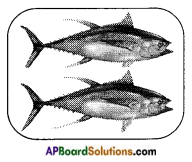
Question 1.
This fish is called Tuna. Collect information about availability catching and marketing of this particular fish.
AP Board 8th Class Biology Important Questions Chapter 9 Production and Management of Food From Animals 1
Answer:
Availability:
English: Big eye Tuna
Latin: Thunnus obesus
size + weight: Average today about 40 -180 c.m. about 1, 4-130 Kg.
Biggest Angled Fish: 197, 3 kg, 236 cm, Peru, 1957 Russel Lee
Maturity: Size 105 cm, weight 25 Kg., age 3 – 4 years
Maximum: Size 230 c.m., Weight 210 Kg., Age 15 years
Catching: 21% Eastern Pacific
38% Western Pacific
22% Indian Ocean
19% Atlantic Ocean
Catching Methods: Longlining, Purse seining and pole-and-line (by-catch)
Share of all Tuna: 2011 about 10% – 398.000 m.t
Main Production: Thailand, Philippines, Indonesia, Mexico, Venezuela, Ecuador, Colombia, Spain, Italy.
Life cyle: About 7-8
Major Markets: Japan (Sashimi)
Populr Product: Fresh (Whole fish)
Forms: Fresh Fillets (Sashimi)

AP Board 8th Class Biology Important Questions Chapter 9 Production and Management of Food From Animals

Question 2.
Write a note on different methods used to store the fish in your area.
Answer:

  1. The fish caught should be preserved in chilled conditions.
  2. After catching the fish, gut is removed. Before transportation, fishes are thoroughly washed in clean and chlorinated waters.
  3. They are perceived in insulated ice boxes with alternate layers of crushed ice and fishes in 1 : 1 proportion.
  4. Preservation can also be done by
    a) Drying b) Salting c) Smoking d) Canning methods
  5. Before canning, harmful bacteria like clostridum botulinum must be destroyed.
  6. Cold storage facility and vans with refrigerated chamber have improved the storage and transport of fish.

Question 3.
Visit a poultry farm of your village. Collect the diseases of poultry and their preventive control measures. Prepare them in theform of a table.
Answer:

Diseases in Poultry birds Casual organism Precautionary control measures
Fowl cholera Bacteria Vaccination for fowl cholera is must.
Salmonellasis Bacteria Antibiotics with sulphur and vaccines.
Coryza Bacteria Sulfa drugs and antibiotics are necessary.
Fowl fox Virus They should be separated from the farm.
Ranikhet Virus Fowls should be separated from the farm and treatment should be given separately.

AP Board 8th Class Biology Important Questions Chapter 9 Production and Management of Food From Animals

Question 4.
Write some diseases of tamed animals.
Answer:

  1. Galikuntu is a common and dangerous diseases occur in cows and buffaloes.
  2. Sheep and goats suffer from worm infections (Nattala vyadhi).
  3. Some parasitic diseases cause damage to liver and intestine of tamed animals.
  4. Viral and bacterial diseases also effect on milk production of cows and buffaloes.
    These are some examples for diseases in domestic animals.

8th Class Biology 9th Lesson Production and Management of Food From Animals Important Questions and Answers

Question 1.
How are the microorganisms like bacteria killed and how can the milk be preserved at milk chilling centres?
Answer:

  1. Pasteurization of milk ensures the destruction of disease producing organisms present in milk.
  2. In this process, milk is heated at 72°C for 30 minutes.
  3. Prior to this, the milk was being cooled to below 10°C.
  4. This process was invented by Louis Pasteur.

Question 2.
Dung is used as biofuel. You know that it is an accessory product. Write about such accessory products produced in animal husbandry.
Answer:
1. The supplimentary products produced from animal husbandry are meat, dung, leather, bones, horns, etc,
2. Animal husbandry is also contributing to different industries like

  1. Dairy industry: Milk and milk products are produced.
  2. Slaughter houses: Production of meat.
  3. Leather industry: Tanning of leather and making shoes, belts and suitcases, etc.
  4. Fertilizer industry : Bones of cattle are used in the production of chemical fertilizers.
  5. Bio gas industry: Cattle dung is used in the production of biogas.
  6. Toys industry: The horns of cattle are used to make toys and ornamental items.

AP Board 8th Class Biology Important Questions Chapter 8 Production and Management of Food From Plants

AP State Syllabus AP Board 8th Class Biology Important Questions Chapter 8 Production and Management of Food From Plants

AP State Syllabus 8th Class Biology Important Questions 8th Lesson Production and Management of Food From Plants

8th Class Biology 8th Lesson Production and Management of Food From Plants 1 Mark Important Questions and Answers

Question 1.
What is Agriculture?
Answer:
The process of growing crops is called Agriculture.

Question 2.
What are long term crops ? What are short term crops?
Answer:
The crops which take 180 days or more for harvesting are called long term crops.
Ex: jowar, red gram etc.
The crops which takes 100 days for harvesting are called short term crops.
Ex: green gram, black gram etc.

Question 3.
What are Kharif crops?
Answer:
The crops grown in the rainy season are termed as Kharif. It starts from June to October.

AP Board 8th Class Biology Important Questions Chapter 8 Production and Management of Food From Plants

Question 4.
What are Rabi crops?
Answer:
The crops grown in winter season are called Rabi. It starts from November to April.

Question 5.
When was rice cultivated?
Answer:
Rice was cultivated in the late Mesolithic period (9000 – 8000 BC) and in the Harappa cultivation (2,300 BC).

Question 6.
In which places Rice is grown as Kharif and Rabi?
Answer:
It is grown as a Kharif or a Rabi crop from Rajasthan to Arunachal Pradesh and from Kerala to Jammu and Kashmir.

Question 7.
What are the requirements for growing of paddy?
Answer:
Nature of the soil, humidity, rainfall, temperature.

Question 8.
Name the festivals that farmers celebrate.
Answer:
The sowing and transplanting is Akshaya Trithiya and harvesting associated with Pongal and Onam.

AP Board 8th Class Biology Important Questions Chapter 8 Production and Management of Food From Plants

Question 9.
Name the activities that involve at the cultivation of paddy.
Answer:

  1. Preparing the soil
  2. Sowing the seeds
  3. Applying manure
  4. Facilitate water (irrigation)
  5. Weeding
  6. Crop harvesting
  7. Storage.

Question 10.
What do farmers do to prepare the soil?
Answer:
Ploughing is done with a wooden plough and levelling will be done by using a soil plank being pulled by a pair of bullocks.

Question 11.
What is the scientific name of paddy?
Answer:
Oryza sativa which was named by Linnaeus.

Question 12.
What is the traditional good variety of rice?
Answer:
Molagolukulu is the traditional good variety which is grown in coastal areas of Nellore.

Question 13.
Name some traditional varieties of rice.
Answer:
Amrita sari, Bangaru Teega, Kolleti Kusuma, Potti Basangi, Sona Masuri.

Question 14.
Why do farmers do medication before sowing seeds?
Answer:
Medication is done to keep seeds away from the harmful microorganisms like bacteria, fungus etc.

AP Board 8th Class Biology Important Questions Chapter 8 Production and Management of Food From Plants

Question 15.
What is broadcasting method?
Answer:
The method of dispersing seeds by sprinkling is called broadcasting method.

Question 16.
What is transplantation?
Answer:
When the plants grow to certain height, farmers pick out the seedlings from the plot and make bundles. These plants are sown in proper distances. This is called transplantation. (Naru etlu)

Question 17.
What is a paddy planter?
Answer:
A paddy planter is useful for farmers those who cultivate paddy in large areas, to maintain proper distance sowing the seedlings.

Question 18.
Name some pests that attack rice plants.
Answer:
Moth caterpillars, paddy beetles and their larva, paddy grasshoppers and aphids.

Question 19.
What are the appliances used to spray pesticides?
Answer:
Sprayers and dusters.

Question 20.
Name the crops that are affected by fungus.
Answer:
Wheat, paddy and sugarcane are generally affected by fungus.

AP Board 8th Class Biology Important Questions Chapter 8 Production and Management of Food From Plants

Question 21.
Name the fungal disease in groundnut.
Answer:
Groundnut is attacked by a fungal disease called Tikka disease.

Question 22.
What are the symptoms of tikka disease?
Answer:
All leaves of the affected plant have powdery spots. The whole plant becomes wilted.

Question 23.
Name some diseases that affect lemon tree.
Answer:
Viral diseases, bacterial diseases, leaf miner, citrus butterfly and fungal diseases.

Question 24.
How can the pests will be controlled?
Answer:
A farmer removes the affected leaves from the plant and put them in a dump and covers with soil to control the pests.

Question 25.
How can you identify that the plant is affected by fungus?
Answer:
A fungal infection is usually seen as white, black, yellow, brown spots or a fluffy or powdery coating on leaves.

Question 26.
Name some garden pesticides.
Answer:
Garden pesticides are derived from plants like neem, tobacco and chrysanthemum are less dangerous to other living things.

AP Board 8th Class Biology Important Questions Chapter 8 Production and Management of Food From Plants

Question 27.
Name some organic synthetic pesticides.
Answer:
The organic synthetic pesticides commonly used are DDT (Dichloro diphenyl trichloro ethane) BHC (Benzene Hexa Chloride), Chlordane, Endrin, Aldrin, Endosulfan and Diazinon.

Question 28.
Who wrote a book on the dangers of pesticides?
Answer:
In 1960 Rachael Carson wrote a book called ‘silent spring’ in which she wrote the dangers of pesticides.

Question 29.
How are biofertilizers formed?
Answer:
Biofertilizers are formed by decomposing plant and animal wastes.

Question 30.
Why do farmers add manure to the soil?
Answer:
If the farmer grows same type of crops in the same field every year the nutrients of the soil decrease crops do not give good yield. So, farmers add manure for healthy growth of plants.

Question 31.
Name some chemical fertilizers.
Answer:
Urea, D.A.R, superphosphate, potash,which are enriched with nitrogen, phosphorous and potash.

Question 32.
What is irrigation?
Answer:
The process of watering crop plants in the field is known as irrigation.

AP Board 8th Class Biology Important Questions Chapter 8 Production and Management of Food From Plants

Question 33.
What is furrow irrigation?
Answer:
The water is allowed to enter the field through channels or furrows made between two rows of crop is furrow irrigation.

Question 34.
What is basin irrigation?
Answer:
In this method of irrigation the field is just filled with water as in the case of paddy. Canals, tanks and wells are the water sources. Farmers dig small canals from tank to fields to supply water.

Question 35.
Why is water logging harmful?
Answer:
Water logging is harmful because it does not allow the roots to breathe.

Question 36.
What is drip irrigation method?
Answer:
This method is employed when the availability of water is poor. The water reaches the plants drop by drop.

Question 37.
Why should the weeds be removed?
Answer:
The weeds compete with the primary crops for nutrients, water and light and the prime plants may not grow. Hence weeds should be removed.

Question 38.
What is harvesting?
Answer:
Collecting grains from the crop by cutting the matured plant is called harvesting.

Question 39.
Why is storage of grain is an important task?
Answer:
We do not consume the entire crop at a time. They can be damage by fungi, pests, rats and bacteria. To over come this problem farmers dry the grains in sun and store the grain in jute bags, metallic and bamboo bins.

AP Board 8th Class Biology Important Questions Chapter 8 Production and Management of Food From Plants

Question 40.
What is global grain?
Answer:
Rice is the prime, most essential and important staple food crop. It is also called global grain as it is grown all countries in the world.

8th Class Biology 8th Lesson Production and Management of Food From Plants 2 Marks Important Questions and Answers

Question 1.
What is a paddy planter? What is its use?
Answer:

  1. Paddy planter is the latest machine used for sowing the seedlings.
  2. It is useful for large scale cultivation of paddy.
  3. It is easy to maintain proper distance sowing the seedlings.
  4. Paddy planter is a device which save both time and money to the farmer.

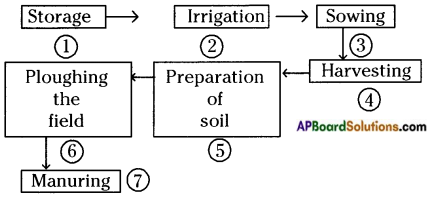
Question 2.
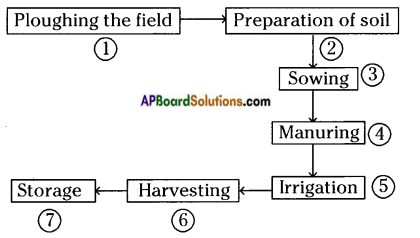
Arrange the sequence of events in the cultivation of paddy crop.
AP Board 8th Class Biology Important Chapter 8 Production and Management of Food From Plants 1
Answer:
AP Board 8th Class Biology Important Chapter 8 Production and Management of Food From Plants 2

Question 3.
Give different methods of irrigating a crop in the field.
Answer:

  1. Lift irrigation
  2. Swinging basket
  3. Water wheel
  4. Tube well
  5. Sprinkler
  6. Drip irrigation

AP Board 8th Class Biology Important Questions Chapter 8 Production and Management of Food From Plants

Question 4.
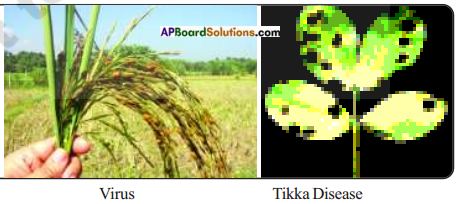
Draw and write the names of diseases that affect plants.
AP Board 8th Class Biology Important Chapter 8 Production and Management of Food From Plants 3
Answer:

  1. Virus in rice plant
  2. Tikka disease in groundnut

Question 5.
What are the advantages of ploughing in summer?
Answer:

  1. It improves the air circulation.
  2. Replacing the soil layers.
  3. Reduce the weeds and diseases.
  4. It improves the soil health.
  5. Roots are easy to penetrate in to the soil.

8th Class Biology 8th Lesson Production and Management of Food From Plants 4 Marks Important Questions and Answers

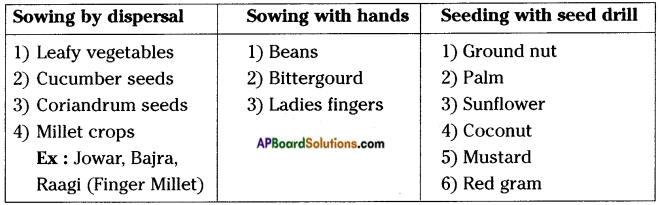
Question 1.
Collect the information from farmers about different crops and their sowing methods.
Answer:
AP Board 8th Class Biology Important Questions Chapter 7 Different Ecosystems 8

AP Board 8th Class Biology Important Questions Chapter 8 Production and Management of Food From Plants

Question 2.
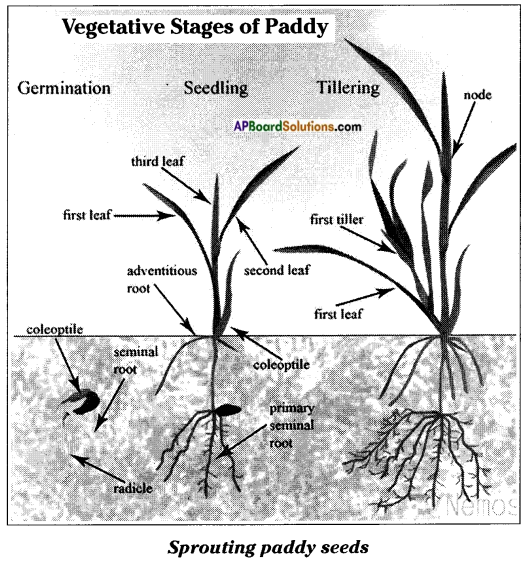
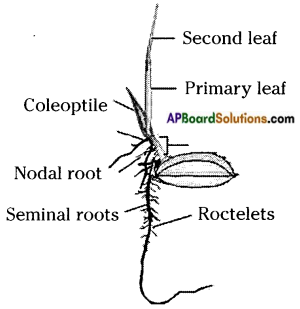
Draw and label the diagram of sprouting paddy seeds.
Answer:
AP Board 8th Class Biology Important Questions Chapter 7 Different Ecosystems 9

Question 3.
Take some paddy grains and soak them in water for one day. Take them into watch glass and sow them in soil. After that observe the radicle and plumule with the help of hand lens and draw the picture of it.
Answer:
AP Board 8th Class Biology Important Questions Chapter 7 Different Ecosystems 10

8th Class Biology 8th Lesson Production and Management of Food From Plants Important Questions and Answers

Question 1.
Give two examples of plants that grow with transplanting (Natlu veyadam).
Answer:
Paddy, wheat, chilli.

AP Board 8th Class Biology Important Questions Chapter 8 Production and Management of Food From Plants

Question 2.
A farmer cultivated cotton crop in his field. He did not get sufficient yield. Guess any four causes for it.
Answer:

  1. The crops grown in the rainy season are termed as “Kharif”.
  2. Kharif season is from June to October.
  3. Examples for Kharif crops are paddy, sugarcane, jowar and turmeric, etc.
  4. The crops that are grown only in winter season are called Rabi crops.
  5. Rabi season is from October to March.
  6. Examples for Rabi crops are wheat, maize, coriandrum, fenugram, barli, etc.

Question 3.
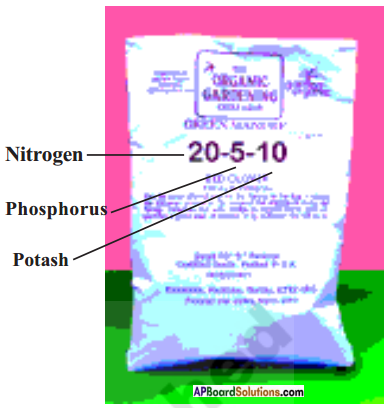
Look at the picture and answer the following questions.
AP Board 8th Class Biology Important Questions Chapter 7 Different Ecosystems 11
a) Which type of fertilizer is this?
b) What are the chemicals present in this?
c) What does 20-5-10 indicates?
d) Is it profit or loss by using this type of fertilizers? Why?
Answer:
a) Chemical fertilizer
b) Nitrogen (N), Phosphorus (P), Potash (K)
c) 20% of Nitrogen
5% of Phosphorus
10% of Potash
d) If we use chemical fertilizers for a longer period, soil health will be damaged. So, we should not use chemical fertilizers.

AP Board 8th Class Biology Important Questions Chapter 8 Production and Management of Food From Plants

Question 4.
Study the following table and answer the questions.

Name of the plant disease Causative Microorganism Mode of Transmission
Tobacco mosaic Virus Insects
Red rot of sugarcane Fungi Air, seedlings
Citrus canker Bacteria Air
Tikka disease of groundnut Fungi Air, seeds

a) What are the diseases caused by fungi in plants?
b) What are the diseases Transmitted through air?
c) Which microorganisms cause Tikka disease of groundnut?
d) How virus transmit mosaic disease in tobacco?
Answer:
a) Red rot of sugarcane, Tikka disease of groundnut.
b) Red rot of sugarcane, citrus canker, Tikka disease of groundnut.
c) Fungus.
d) Through insects.

Question 5.
What is the similarity between sprinklers and drip irrigation?
Answer:
Sprinklers and drip – irrigation techniques are used in low water available soils. They are very useful for the farmers who are cultivating crops in dry lands. These are called as “micro – irrigation methods”.

AP Board 8th Class Biology Important Questions Chapter 7 Different Ecosystems

AP State Syllabus AP Board 8th Class Biology Important Questions Chapter 7 Different Ecosystems

AP State Syllabus 8th Class Biology Important Questions 7th Lesson Different Ecosystems

8th Class Biology 7th Lesson Different Ecosystems 1 Mark Important Questions and Answers

Question 1.
Who coined the word ecosystem at first?
Answer:
The word ecosystem was coined by a British Botanist A.G. Tansley in 1935.

Question 2.
What are the different terms used for environment?
Answer:
The different terms are habitat, biome, ecological systems.

Question 3.
What do we call the small level of ecosystem?
Answer:
The small level of ecosystem is called habitat.

AP Board 8th Class Biology Important Questions Chapter 7 Different Ecosystems

Question 4.
What do we call the larger level of ecosystem?
Answer:
The larger level of ecosystem is called Biome.

Question 5.
What do we study in an ecosystem?
Answer:
In ecosystem we study about the changes occuring in the habitat like organisms moving away from the habitat or entering the habitat.

Question 6.
How is an ecosystem made up of?
Answer:
An ecosystem is made up of groups of living organisms and their environment.

Question 7.
Name the biotic and the abiotic components.
Answer:
The living things like plants,animals and microorganisms are known as biotic components. Soil, water, sunlight, air, etc. are known as abiotic components.

Question 8.
What type of relationship is seen in an ecosystem?
Answer:
There is a feeding relationship between plants and animals.

Question 9.
How do plants and animals depend on one another?
Answer:
There is an interdependence between plants and animals for space, reproduction, shelter etc.

AP Board 8th Class Biology Important Questions Chapter 7 Different Ecosystems

Question 10.
From where do all living things derive energy?
Answer:
All living things derive energy from sun.

Question 11.
Why are decomposers called recyclers?
Answer:
Decomposers return nutrients to the soil by decompose the dead plants and animals for the plants to use, as the cycle begins again, so they are called recyclers.

Question 12.
Where does the food web start from?
Answer:
The food web starts from the Producers.

Question 13.
What happens when plants and animals die in a food web?
Answer:
When plants and animals die in a food web, they are decayed and decomposed by decomposers like bacteria and fungi.

Question 14.
How do the changes take place in an ecosystem?
Answer:
Powerful storms, tsunami etc., destroy ecosystem and the changes take place in an ecosystem.

Question 15.
What are mangroves?
Answer:
Mangroves are one of the most productive ecosystems, deriving nourishment from terrestrial fresh water and tidal salt water.

AP Board 8th Class Biology Important Questions Chapter 7 Different Ecosystems

Question 16.
Where do mangroves grow?
Answer:
Mangrove forests grow in back waters low depth areas of sea shores.

Question 17.
Where is Coringa Mangrove situated?
Answer:
Coringa Mangrove is situated South of Kakinada Bay and is about 150 km South of Visakhapatnam.

Question 18.
From which rivers C&ringa mangrove receives water?
Answer:
Coringa mangrove receives fresh water from Coringa river and Gaderu river, tributories of Gautami Godavari river.

Question 19.
Name the producers present in Coringa mangrove.
Answer:
Mangrove, spirogyra, euglena, oscilatoria, blue green algae, ulothrix etc.

Question 20.
Name the consumers present in Coringa.
Answer:
Shrimp, crab, hydra, protozoans, mussel, snails, turtle, daphnia, brittle word, tube worm, etc.

Question 21.
Name the decomposers present in Coringa.
Answer:
Detritus feeding bacteria etc.

AP Board 8th Class Biology Important Questions Chapter 7 Different Ecosystems

Question 22.
In what conditions a living community lives?
Answer:
A living community lives in an environment which supplies its materials and energy requirements and provides other living conditions.

Question 23.
What is ecosystem?
Answer:
The living community together with the physical environment forms an interacting system called the ecosystem.

Question 24.
How much place is occupied by the desert on land?
Answer:
The desert occupy about 11% of the land and occur in the regions with an average rainfall of less than 23 mm per year.

Question 25.
What type of producers can be seen in deserts?
Answer:
The shrubs, bushes, grasses and some trees.

Question 26.
Why do cacti have succulent stems?
Answer:
They store water in their stems to be used during the time of water scarcity.

Question 27.
Which organisms capture energy from sun?
Answer:
The energy from the sun is captured by plants and is stored in the form of potential energy in food stuffs.

Question 28.
What are the first trophic level in the ecosystem?
Answer:
Plants are the producers and represent the first trophic level in the ecosystem.

AP Board 8th Class Biology Important Questions Chapter 7 Different Ecosystems

Question 29.
What does the food chain consist of?
Answer:
The food chain consists of four steps – the producers, primary consumers, secondary consumers and tertiary consumers.

Question 30.
What are consumers? Give examples.
Answer:
The organisms which eat other living things and get their energy from them are called consumers. Ex: Animals.

Question 31.
What are decomposers? Give examples.
Answer:
The organisms which feed on wastes, debris of plants and animals or on their remains after they die. Ex : Microorganisms.

Question 32.
What is a food web?
Answer:
A food web consists of several inter linked food chains and each organism in a food web will be a member of more than one food chain.

Question 33.
What are producers? Give examples,
Answer:
Plants are the only organisms capable of carrying out photosynthesis and producing food to all living organisms in any ecosystem. For this reason plants are called Producers.

8th Class Biology 7th Lesson Different Ecosystems 2 Marks Important Questions and Answers

Question 1.
Complete this flow chart.
AP Board 8th Class Biology Important Questions Chapter 7 Different Ecosystems 1
Answer:

  1. Terrestrial
  2. Aquatic
  3. Aquarium, Terrarium, Spaceship
  4. Grassland ecosystem
  5. Forest Ecosystem
  6. Desert ecosystem
  7. Fresh water ecosystem
  8. Marine water ecosystem
  9. Mangrove ecosystem

AP Board 8th Class Biology Important Questions Chapter 7 Different Ecosystems

Question 2.
What is the significance of mangrove ecosystem?
Answer:

  1. Mangroves serve as important breeding grounds for a variety of commercially important organisms.
  2. They also serve as protective areas for endangered species.
    Example: Coringa Mangrove Is situated South of Kakinada and is about 150 Km South of Vizag.

8th Class Biology 7th Lesson Different Ecosystems 4 Marks Important Questions and Answers

Question 1.
“The Sun is the malm source of energy for all laving things on earth”. How?
Answer:

  1. All the organisms in an ecosystem derive energy from food to live.
  2. Plants trap the solar energy through photosynthesis. They convert the light energy into chemical energy.
  3. Animals do not get energy directly from Sun. Many animals eat plants, however which use Sunlight to make food.
  4. Carnivores do not eat plants still depend on the energy of the sunlight as they eat other plant eaters.

Question 2.
Draw and label the plants and animals present in the food web in Coringa Ecosystem.
Answer:
Diagram of the food web in Coringa Ecosystem.
AP Board 8th Class Biology Important Questions Chapter 7 Different Ecosystems 2

AP Board 8th Class Biology Important Questions Chapter 7 Different Ecosystems

Question 3.
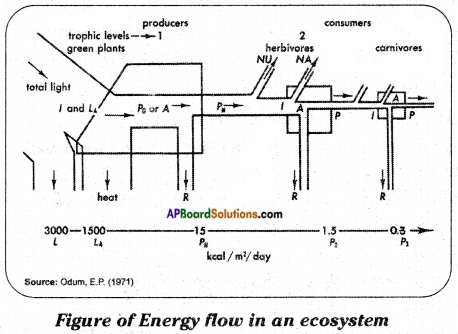
Draw the diagram showing figure of energy flow in an ecosystem. (Annexure)
Answer:
Energy flow in an ecosystem.
AP Board 8th Class Biology Important Questions Chapter 7 Different Ecosystems 3

Question 4.
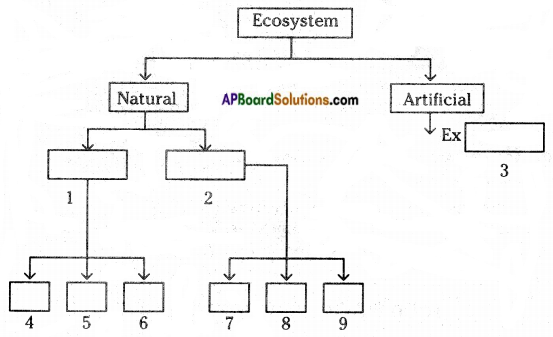
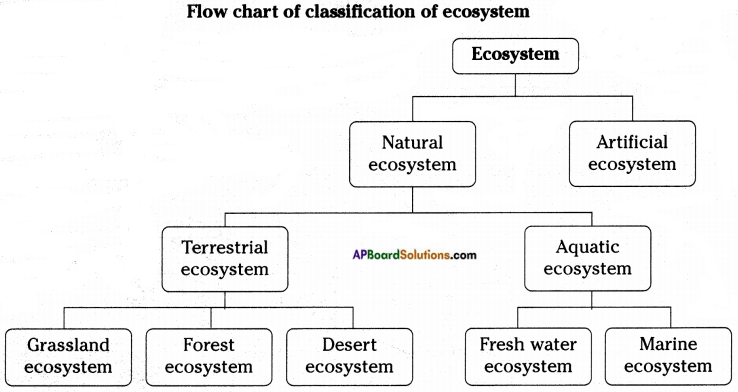
Classify the ecosystem on different basis. (OR)
Draw the flow chart showing different types of ecosystems. Who coined the term ecosystem?
Answer:

  1. Ecosystem can vary from a small plant to a dense forest. Ecologists classified ecosystem on different basis.
  2. Some such classifications are – artificial and natural temporary and permanent.
  3. Due to Abiotic factors, different ecosystems develop in different ways.

Flow chart of classification of ecosystem
AP Board 8th Class Biology Important Questions Chapter 7 Different Ecosystems 3
The term “Ecosystem” was coined by A.G. Tansley.

AP Board 8th Class Biology Important Questions Chapter 7 Different Ecosystems

Question 5.
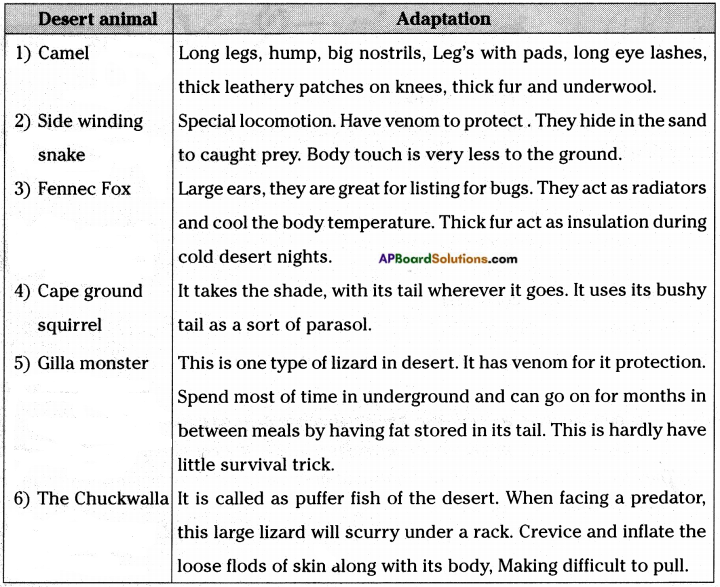
Prepare a table what are the adaptations of the desert animal take the data from your school library.
Answer:
AP Board 8th Class Biology Important Questions Chapter 7 Different Ecosystems 5

Question 6.
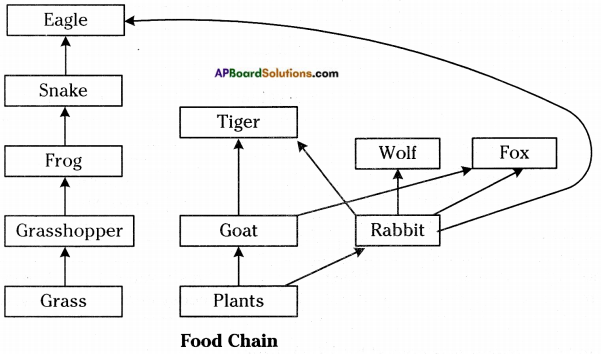
Construct the food web with the following.
Grass → Plants → Grasshopper → Frog → Snake → Eagle → Goaf → Fox → Tiger → Wolf → Rabit.
Answer:
AP Board 8th Class Biology Important Questions Chapter 7 Different Ecosystems 6

8th Class Biology 7th Lesson Different Ecosystems Important Questions and Answers

Question 1.
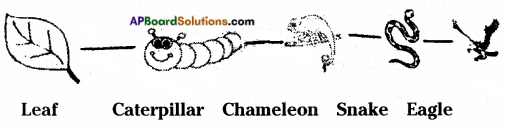
AP Board 8th Class Biology Important Questions Chapter 7 Different Ecosystems 7
Shown here is a food chain, classify each organism in the food chain as producer, primary consumer, secondary consumer or tertiary consumer.
Answer:
In the above food chain

  1. Leaf – producer
  2. Catterpillar – primary consumer
  3. Chameleon – secondary consumer
  4. Snake – tertiary consumer
  5. Eagle – top carnivore

AP Board 8th Class Biology Important Questions Chapter 7 Different Ecosystems

Question 2.
Read the following paragraph and answer the questions given below.
Several plants, algae, etc. use sunlight to make their own food are called producers. Consumers feed on producers to get energy. The last level is made of decomposers. They feed on wastes, debris of plants and animals or on their remains after they die. They are called Recyclers also.

  1. Which are the producers in the food web? Why are they called producers?
  2. What are consumers? Give some examples.
  3. What are recyclers? Why are they called so? Give some examples.
  4. How many levels should be there in a food chain? What are they?

Answer:

  1. Algae and plants are the producers in the given food web. They convert the solar energy into chemical energy through a process called photosynthesis.
  2. The animals which feed on these producers (plants) are called primary consumers. Ex : Deer, Grasshopper, Rabbit.
  3. Saprophytic bacteria and fungi are act as decomposers. They feed on dead plants and animals. They decompose these dead bodies and convert them into minerals. So, they are called ‘reproducers’.
  4. Food chain consists of 4 trophic levels.
    They are 1) producers 2) primary consumers 3) secondary consumers and 4) tertiary consumers.

Question 3.
The desert occupy about 17% of the land and occur in the regions with an average rainfall of less than 23 mm per year. Due to extremes of temperature, the species composition of desert ecosystem is much varied and typical.
a) Which type of adaptations do desert animals have?
b) Write the adaptations in the desert plants.
c) Why the camel is called ship of the desert?
d) In deserts variations of animals is very less. Why?
Answer:
a) They have adaptations to prevent water loss from extreme temperatures.
b) Xerophytic plants do not have stomata. So, they prevent water loss.
c) Camel is called “desert ship” because it has so many adaptations to travel in desert.
d) Due to extremes of temperature, the species composition of desert ecosystem is varied and typical.

AP Board 8th Class Biology Important Questions Chapter 6 Biodiversity and its Conservation

AP State Syllabus AP Board 8th Class Biology Important Questions Chapter 6 Biodiversity and its Conservation

AP State Syllabus 8th Class Biology Important Questions 6th Lesson Biodiversity and its Conservation

8th Class Biology 6th Lesson Biodiversity and its Conservation 1 Mark Important Questions and Answers

Question 1.
What are Biosphere Reserves?
Answer:
Forests are Biosphere Reserves.

Question 2.
What is biodiversity?
Answer:
The variety and variability seen in plants and animals is called Biodiversity.

Question 3.
What are Endemic species?
Answer:
The plant or animal species of a particular area (zone), region or country is called endemic species.

AP Board 8th Class Biology Important Questions Chapter 6 Biodiversity and its Conservation

Question 4.
What do you understand by Extinct?
Answer:
Species of plants and animals that have vanished from earth forever are called Extinct.

Question 5.
What do you understand the word Endangered?
Answer:
Plants and animal species that are on the verge of becoming extinct are called Endangered.

Question 6.
What is a Red Data Book?
Answer:
The book published by IUWC that contains the details of Endangered and Extinct species is called Red Data Book.

Question 7.
What do you see in National Parks?
Answer:
Conservation of wild life along with environment is seen in National Parks.

Question 8.
What is a sanctuary?
Answer:
A sanctuary is a place where conservation of wild life mostly birds takes place.

Question 9.
Give an example of a sanctuary.
Answer:
Krishna Sanctuary, Krishna & Guntur.

Question 10.
What is migration?
Answer:
Movement of birds for nestling from one region to another region is called migration.

Question 11.
Name the society for conservation of nature in London.
Answer:
International Union for Conservation of Nature and the Zoological Society of London.

AP Board 8th Class Biology Important Questions Chapter 6 Biodiversity and its Conservation

Question 12.
Name the most threatened bird found in Palanadu Bird Sanctuary.
Answer:
Great Indian Bustard found in Pallanadu Bird Sanctuary.

Question 13.
Before 60 – 70 years what was the situation of the forests ofRampachodavaram?
Answer:
It was an abode for wild animals like tigers, leopards, deers etc.

Question 14.
What is the present situation of the forests ofRampachodavaram?
Answer:
Forest area was cleared and so several organisms started disappearing.

Question 15.
Why should we conserve a small insect like a bee or a butterfly?
Answer:
Most of the flowers get pollinated through bees and butterflies. So they should be conserved.

Question 16.
Why is the number of butterflies decreasing?
Answer:
The insects are decreasing due to spraying of pesticides and insecticides on crop plants.

Question 17.
How can ‘project tiger’ help to save wild life?
Answer:
This project helped to increase the number of tigers and to save tiger from the brink of extinction.

AP Board 8th Class Biology Important Questions Chapter 6 Biodiversity and its Conservation

Question 18.
How is the project tiger achieved?
Answer:
The success of the project was achieved by enforcement of strict anti poaching measures and scientific conservation practices.

Question 19.
While saving tiger, why should it’s food web also be protected?
Answer:
The tiger depends for food on the deer and many other herbivores. If the tiger disappears, the deer and other herbivores will increase and that would affect the flora of the area.

8th Class Biology 6th Lesson Biodiversity and its Conservation 2 Marks Important Questions and Answers

Question 1.
What are the conservation methods do you suggest to protect the most threatened species?
Answer:

  1. Taking measures to protect their natural habitats.
  2. Creating awareness at community levels.
  3. Strict implementation of National Wild life Protection Act, would help these species.
  4. Prohibition of human activities in their habitats.

Question 2.
What are endemic species? Give some examples.
Answer:
Plants or animal species found restricted to a particular area of a country are called Endemic Species.
Ex: Broad tailed Grass bird, Peacock, Malabar Parakeet, Black Buck etc.

AP Board 8th Class Biology Important Questions Chapter 6 Biodiversity and its Conservation

8th Class Biology 6th Lesson Biodiversity and its Conservation 4 Marks Important Questions and Answers

Question 1.
Collect the pictures of the following endangered species of plants and animals and paste them in your scrap book and write their names below the pictures.
Answer:
AP Board 8th Class Biology Important Questions Chapter 6 Biodiversity and its Conservation 1

Question 2.
How do we depend on forests?
Answer:

  1. Forests play a key role in maintenance of ecological balance.
  2. Forests absorbs a large amount of Carbondioxide and Particulate Matter (CPM) and keep the air clean. They serve as lungs of our earth.
  3. Forests are the natural sources of a variety of timber yielding plants and forests products like cane, resins, lac, fruits, nuts and honey.
  4. Forests provide us with cool breeze which helps in the rainfall.
  5. They are the natural habitats for wild animals they serve as biosphere reserves.

AP Board 8th Class Biology Important Questions Chapter 6 Biodiversity and its Conservation

Question 3.
What steps do you take to stop deforestation?
Answer:

  1. We should stop cutting of forests for farming and industrial purpose.
  2. Planting trees like Tamarind, Amla, Tangedu, Subabul, Bamboo in rural areas.
  3. Measures should be taken to conserve soil moisture by constructing checkdams and bundhs.
  4. Measures should be taken to improve forest productivity by planting fruit and nut bearing plants.
  5. Measures should be taken reforestation in order to maintain sustainability of forests.

8th Class Biology 6th Lesson Biodiversity and its Conservation Important Questions and Answers

Question 1.
List any four medicinal plants and their uses.
Answer:
The following are the some of the medicinal plants of our area and their use.

  1. Neem – Antiseptic
  2. Garlic – Used for lowering cholestrol and blood pressure.
  3. Ginger – Used to ease nausea and motion sickness.
  4. Feverfew – Used to treat fevers.

Question 2.
Match the following and answer the following question.
1) Endangered species              a) Hyderabad Pigeon
2) Endemic species                    b) Dinosaur
3) Invasive species                     c) Kiwi
4) Extinct species                       d) Spotted chital deer
e) Crow
Answer:
1 – d
2 – c
3 – a
4 – b
Question.
What is a Red Data Book?
Answer:
The book published by IUWC that contains the details of Endangered and Extinct species is called Red Data Book.

Question 3.
What is migration? Give some examples for migratory birds.
Answer:

  1. Moving of birds in flocks from one region to another for getting shelter and food is called as “migration”.
  2. Examples for migrating birds are great spotted wood pecker, coaltit, pelicon, black – tailed godwits, plover, etc.

AP Board 8th Class Biology Important Questions Chapter 6 Biodiversity and its Conservation

Question 4.
Read the following paragraph.
Sometimes at night we see birds flying in groups. These birds which do not have permanent nestlings and join into small flocks and move from one region to other for food and shelter called as ‘Migration’ and such birds are called Migratory birds. During the rainy season most of the birds from far away places migrate to Kolleru and Pulicat lakes of our state. They build their nests on the trees in the nearby villages. Due to the cut down of trees, less number of birds are coming to here.
Answer the following questions.
a) What are Migratory birds ? Why do they migrate one place to another?
b) What are the reasons for less number of birds migrating to India?
Answer:
a) The birds which are moving in flocks from one region to other for food and shelter are called “migrating birds”.
b) Due to cutting down of trees in the villages near the lakes, birds are facing scarcity of their nesting habitats.

Question 5.
What measures are to be taken to save paper?
Answer:

  1. We should always use recycled paper.
  2. Use paper only if we need.
  3. We should use electronic transfer methods for our daily transactions.
    Ex: Paying of electricity bills, filling of online application but not paper application.

Question 6.
Study the following para and answer the questions.
Did you get the same number and types of birds every day ? Was there any sudden variation in a particular season ? Did you notice any new type of bird population in any season ? Discuss with your friends about the effect of the presence of such a population. Why do these birds move from one place to another ? Sometimes at night we see birds flying in groups. Where do they fly? Think. Sometimes some birds live in the same habitat throughout the year. Other birds which don’t have permanent nestlings and join into small flocks and move from one region to the other for food and shelter (nesting habits) called as ‘Migration’ and such birds are called as ‘migratory birds ’. During rainy season most of the birds from far away places migrate to Kolleru and Pulicat lakes of our State. They build their nests on the trees in the nearby villages also. In the olden days people believed that these migrated birds are divine ones. But nowadays most of the trees are getting cut down. There is hardly any place for birds to build their nests.
a) What does the above information says?
b) What you say the birds come to our places from distant places?
c) What should we do for the birds to migrate to our place?
d) Name some migratory birds.
Answer:
a) Affects of deforestation on bird migration in Kolleru.
(Or)
Loss of bird habitats due to cutting down of trees in Kolleru.
b) Bird migration.
c) 1) Avoid cutting of trees in lake areas strictly.
2) We should strictly monitor the increased human activities in all lake areas.
d) Great spotted wood pecker, pelicans, coaltit, Siberian cranes.

AP Board 8th Class Biology Important Questions Chapter 6 Biodiversity and its Conservation

Question 7.
What are the effects of deforestation?
Answer:

  1. Change in rainfall pattern.
  2. Increase in green house gases.
  3. Loss of wild life habitats.
  4. Increase in soil erosion.
  5. Massive floods.
  6. Global warming.
  7. Droughts.

AP Board 8th Class Biology Important Questions Chapter 5 Attaining the Age of Adolescence

AP State Syllabus AP Board 8th Class Biology Important Questions Chapter 5 Attaining the Age of Adolescence

AP State Syllabus 8th Class Biology Important Questions 5th Lesson Attaining the Age of Adolescence

8th Class Biology 5th Lesson Attaining the Age of Adolescence 1 Mark Important Questions and Answers

Question 1.
What is adolescence period ?
Answer:
The age between 13-19 years is called adolescence.

Question 2.
In which period growth takes place?
Answer:
Growth takes place in adolescence period.

Question 3.
When does growth in height stop?
Answer:
Growth stops in boys at the age of 18, in girls at the age of 17.

AP Board 8th Class Biology Important Questions Chapter 5 Attaining the Age of Adolescence

Question 4.
Who do grow faster?
Answer:
Girls grow faster than the boys.

Question 5.
What is Adam’s apple?
Answer:
A partial growth of larynx.

Question 6.
Why is the Adam’s apple formed?
Answer:
The Adam’s apple is formed due to elongation of the thyroid cartilage, which protrudes out in front of the neck.

Question 7.
Name the secondary sexual characters in boys.
Answer:
Facial hair, moustaches and beard.

Question 8.
What are primary sexual characters?
Answer:
The sex organs by which children are identified as boys and girls at birth represent primary sexual characters.

Question 9.
What is reproduction?
Answer:
Reproduction is the most important process for continuation of human race.

Question 10.
What is the age for the production of gametes?
Answer:
Mostly in between 11-15 years.

AP Board 8th Class Biology Important Questions Chapter 5 Attaining the Age of Adolescence

Question 11.
What is menarche?
Answer:
The first menstrual cycle begins at adolescence and is termed as menarche.

Question 12.
What is menopause?
Answer:
At 45 – 50 years of age, the menstrual cycle stops. This is termed as menopause.

Question 13.
When does menstruation occur?
Answer:
Menstruation occurs once in about 28 – 30 days.

Question 14.
What is child marriage?
Answer:
Child marriage is a social evil which causes unwanted damage to the lives of children.

Question 15.
What is the legal age for marriage?
Answer:
The legal age for marriage is 18 years for girls and 21 years for boys.

Question 16.
What is the first and foremost duty of every adult?
Answer:
The first and foremost duty of every adult is to prepare oneself to reveal to the adolescent the secretes of nature and the natural course of life as it is Adolescent queries must never go unwanted.

AP Board 8th Class Biology Important Questions Chapter 5 Attaining the Age of Adolescence

Question 17.
What is the function of endocrine glands?
Answer:
They help in the regulation of the functioning of the human body.

Question 18.
What do endocrine glands release?
Answer:
They release some chemicals (called hormones) directly into the blood.

Question 19.
What is the other name for endocrine glands?
Answer:
Ductless glands as they do not have ducts.

Question 20.
What is the name of the male hormone?
Answer:
The male hormone is ‘Testosterone’.

Question 21.
What is the hormone begin to produce in girls?
Answer:
In girls, the female hormone ‘estrogen’ begins to produce in adolescence.

Question 22.
What is the name of the milk secreting glands?
Answer:
Mammary glands.

AP Board 8th Class Biology Important Questions Chapter 5 Attaining the Age of Adolescence

Question 23.
Which hormone controls emotions?
Answer:
Adrenalin hormone secreted by Adrenal gland.

Question 24.
Why do the hunger levels are high in adolescents?
Answer:
At this stage there is rapid growth and development.

Question 25.
How do young boys and girls keep the body fit and healthy?
Answer:
All young boys and girls should take a walk, exercise and play outdoor games.

Question 26.
Why are endocrine glands called ductless glands? Name them.
Answer:
Since they do not have specialized ducts, endocrine glands are called ductless glands. Ex : Pituitary gland, Thyroid gland, Adrenal gland etc.

Question 27.
Why do adolescents generally prefer to eat chips, snacks etc?
Answer:
The growth rate in adolescents is in high rate. Because of this reason they feel hungry and they prefer to eat chips, snacks etc.

Question 28.
Why is it not good to eat junk foods?
Answer:
Eating junk foods regularly may cause problems like obesity, mouth and stomach ulcerations, increase in blood sugar levels and blood pressure etc. So adolescents must say no to junk foods.

AP Board 8th Class Biology Important Questions Chapter 5 Attaining the Age of Adolescence

Question 29.
What are the factors involved in, to reach proper height?
Answer:
It is influenced primarily by heredity and also environmental factors such as proper nurishment and regular exercise.

Question 30.
Nowadays reaching age of adolescence in girls become reduced – support your answer.
Answer:
Nowadays reaching age of adolescence in girls become reduced . Some observations explain that it is because of polluted food materials such as estrogen present milk. This fact may also effect the boys and delay the reach of reproductive phase.

Question 31.
What is a balanced diet?
Answer:
The diet which includes proteins,carbohydrates, fats and vitamins in require proportions is called a balanced diet.

8th Class Biology 5th Lesson Attaining the Age of Adolescence 2 Marks Important Questions and Answers

Question 1.
What is menstrual cycle? When does it begin? What happens during this period?
Answer:
Menstrual cycle:

  1. The cycle of changes takes place in the female reproductive system is called menstrual cycle. It occurs once in 28 to 30 days.
  2. It is termed as “menarche”.
  3. The first menstrual cycle begins at around 10-12 years of age and lasts till the age of 45 – 50 years.

AP Board 8th Class Biology Important Questions Chapter 5 Attaining the Age of Adolescence

Question 2.
Why is child marriage a social sin? Give reason.
Answer:

  1. As per child marriage restriant act 1978, the maximum age for marriage is 21 years for females and 23 years for males.
  2. A female whose age is less than 21 years is not physically or mentally developed.
  3. Because of anatomical immaturity, she is not in a condition to either to lead a married life or to have children.
  4. Marriage at lower age for girls becomes a greater risk both for the girl and the child.
  5. Hence child marriage is a social sin, it should be avoided.

Question 3.
What are endocrine glands? What do they release?
Answer:
Endocrine Glands:

  1. The glands which help in the regulation of the functioning of the human body are called endocrine glands.
  2. They release some chemicals directly into the blood which are called hormones.

Question 4.
What are the functions of Endocrine hormones?
Answer:
Functions of Endocrine Hormones:

  1. They control the sugar levels, salt and sodium levels in the blood.
  2. They control water levels of the body.
  3. They play an important role in development of the reproductive system.
  4. The hormones control the physical changes during adolescence, puberty, pregnancy, menopause etc.

Question 5.
How is physical exercise good for young boys and girls?
Answer:

  1. Walking and playing in fresh air keeps the body fit and healthy.
  2. All young boys and girls should take a walk, exercise and play out door games.
  3. The physical activity leads to conditions of better health, sound sleep and there by mental peace.
  4. It promotes happiness in day to day life.

AP Board 8th Class Biology Important Questions Chapter 5 Attaining the Age of Adolescence

Question 6.
What is growth? How does it take place?
Answer:

  1. Growth is one of the characters in human beings.
  2. They grow in size over a period of time till the size and shape of the adult is achieved.
  3. Growth occurs by addition of new materials to the cells in the body.
  4. Thus we grow to certain height for certain time only.
  5. These changes takes place in adolescence at maximum pace.

Question 7.
Why are children in adolescence in confusion state?
Answer:
Children in adolescence are in confusion because they grow from childhood to adolescence. They have lot of stress due to changes in the body and are unable to decide whether they belong to adulthood or childhood.

Question 8.
In what way the kind of discrimination is harmful for girls and women during the period of menstural cycle?
Answer:

  1. Some sections of people in our society believe that during the period of menstruation women are untouchable.
  2. During this time girls may be restricted from taking bath, cooking food or going to school.
  3. By separation of the girls in that particular period, it would be known to all, and the girl may feel shy, unable to move freely with others.
  4. She becomes dull in studies.

Question 9.
What should be done at the time of pimples and acne?
Answer:

  1. Do not scratch the pimples.
  2. Wash your face regularly with a mild soap.
  3. Use luke warm water to wash pimples and acne.
  4. Never get worried of pimples and acne because stress and strain may help them to increase.

AP Board 8th Class Biology Important Questions Chapter 5 Attaining the Age of Adolescence

Question 10.
Write how child marriages cause damage to her health. (OR)
Child marriage is a social evil. What problems would occur due to early marriage?
Answer:

  1. Teenage mothers are not prepared mentally for motherhood.
  2. Early marriage and motherhood cause health problems in the mother and child.
  3. It also curtails employment opportunities for the young woman and may cause mental agony as she is not ready for responsibilities of motherhood.

8th Class Biology 5th Lesson Attaining the Age of Adolescence 4 Marks Important Questions and Answers

Question 1.
How do you understand that you have reached the age of adolescence?
Answer:

  1. Moustaches growing on upper lip.
  2. Change in voice.
  3. External hair grows under armpits.
  4. Taking care of face by applying powder and combining hair frequently.
  5. Feeling shy when talking with opposite sex.
  6. Interested to play with opposite sex.
  7. Showing restlessness while parents suggest to do something.

Question 2.
Is it apt to believe in the myth of keeping away women untouchable during the period of menstrual cycle?
Answer:

  1. In olden days it was believed that the women during their menstrual period were kept aside and were also forced to stay in huts built in out skirts of the village.
  2. In those days the women are the home makers and are not job holders.
  3. They have leisure to follow all the restrictions.
  4. And also there is scientific reason that during menstrual cycle, a woman need rest completely.
  5. They believed that it can be strictly followed by exposing it is a myth.
  6. So it was followed as restriction.

Question 3.
To make future in a right way an adolescent need to know more about adolescence. Do you agree?
Answer:

  1. Attraction towards opposite sex is a normal response.
  2. Full of zealous acts and urge to find reasons of several things around.
  3. Emotional state at all the time and get new thoughts for the life activities.
  4. Behave in a different as compared to what they did during childhood with peers and elders.
  5. More independent in nature and very self conscious.
  6. Feel insecure while trying to adjust to the changes in the body and the mind.
  7. They need a lot of attention, love and care as well as answer to all their queries regarding their body and self development.

AP Board 8th Class Biology Important Questions Chapter 5 Attaining the Age of Adolescence

Question 4.
Consuming Gutkha, Cigarettes, Cigar, Beedi, Khaini has become a social evil – Is it true ?
Answer:
Yes. It is true.

  1. A number of addicted people at the age of 15 or below is 57.57 lakhs (68%) in Andhra Pradesh.
  2. When they reach 30 years of age their internal organ system becomes damaged, and this leads to severe problems.
  3. Sometimes, may cause death also.
  4. It is dangerous alarm in our country.
  5. So adolescents should be aware of healthy habits.

Question 5.
Draw and write short notes on Adam’s apple.
Answer:
Adam’s apple:

  1. The Adam’s apple is actually a partial growth of our voice box or larynx.
  2. The larynx is made up of nine cartilages, one of which is the largest, called thyroid cartilage.
    AP Board 8th Class Biology Important Questions Chapter 5 Attaining the Age of Adolescence 1
  3. Due to the elongation of the thyroid cartilage the Adam’s apple is formed. It protrudes out in front of the
  4. This is caused mainly by male hormone testosterone during adolescence.
  5. As a result muscles or chords attached to the cartilage get loosened and thickened.
  6. When air passes through these chords a hoarse sound is produced.
  7. This is the reason for distrubance in voice in the stage of adolescence. At the end of this stage voice get perfect.

AP Board 8th Class Biology Important Questions Chapter 5 Attaining the Age of Adolescence

Question 6.
Draw and label the diagram of position of some endocrine glands in the human body.
Answer:
AP Board 8th Class Biology Important Questions Chapter 5 Attaining the Age of Adolescence 2

Question 7.
Adoloscence is the energetic state. What health and good habits you want to develop?
(OR)
What hygienic steps you would follow as an adolescent to keep yourself clean and healthy?
Answer:
Adolescence is the energetic stage. It is the age when growth and development takes place at faster rate. They need good nutrition support. That is why they have to plant to take balanced diet with fruits, milk, egg and iron rich foods. They must say no to junk foods. Cleanliness is more important in this stage to avoid several bacterial, fungal infections. So it would better to take bath twice in a day. Air body parts and inner wears should be washed with fat rich soaps. No to creams, liquids etc. Girls should take special care of cleanliness during the time of menstrual cycle. Making use of disposable napkins may reduce chance of infections. All young ones should take a walk, exercise and play outdoor games. The physical activity leads to conditions of better health. Better to sleep early and awake early in the morning is a good sleeping habit. Think positive is good keep confidence and free from stress. Better to consult your parent, teacher or a doctor to clear the doubts and mental stress. And say no to drugs, alcohol and other stress relievers. Peers don’t have much knowledge in these problems, so better to take advices from parents and teachers. Practicing of different life skills makes an adolescent free from all hazards and become a good citizen.

8th Class Biology 5th Lesson Attaining the Age of Adolescence Important Questions and Answers

Question 1.
1) What is the name of the following picture?
2) In which stage this is developed?
3) In whom, this organ will develop more? What will happen?
4) Which cartilage elongation this will form?
Answer:
1) Adam’s apple.
2) Adam’s apple develops during adolescence in boys.
3) Because of this, the voice in boys become coarse.
4) It is formed due to the growth of thyroid cartilage.

AP Board 8th Class Biology Important Questions Chapter 5 Attaining the Age of Adolescence

Question 2.
Observe the following table and answer the following questions.

Gland Hormone Effect
Testes Testosterone Release of sperm, secondary sexual characters in male
Ovaries Estrogen Release of ovum, menstruation, secondary sexual characters in female
Pituitary Pituitary hormones like growth hormone, follicle stimulating hormone (FSH) Leutinizing hormone (LH) Brings about general growth, stimulates other endocrine glands. FSH directs estrogen for formation of ovum or eggs in uterus of females, while in males directs testosterone to stimulate sperm sacs to produce sperms. LH causes the egg to burst out and flow into the fallopian tubes
Adrenal Adrenalin Controls emotions

1) Which hormone released at the time of anger?
2) Which gland release the testosterone hormone?
3) Which hormone controls the other endocrine glands?
4) Which hormones causes the secondary sexual characters in males and females?
Answer:
1) Adrenalin
2) Testes
3) Growth hormone
4) Testosterone, Estrogen

Question 3.
To know more details about given picture what questions do you ask your biology teacher?
AP Board 8th Class Biology Important Questions Chapter 5 Attaining the Age of Adolescence 1
Answer:

  1. Name the structure shown in the above figure.
  2. How does this structure grow?
  3. In whom can you observe this structure?
  4. What changes do you observe in boys after the development of Adam’s apple?

Question 4.
Correct the statements and if necessary rewrite.
a) To observe nucleus and cell organelles clearly staining is not necessary.
b) Cell wall controls cell functions.
Answer:
a) To observe nucleus and other cell organelles, staining is very essential.
b) Cell wall provides mechanical strength to the cell. It protects the plant cell from external shocks.

AP Board 8th Class Biology Important Questions Chapter 5 Attaining the Age of Adolescence

Question 5.
Based on the information given in the table, answer the following questions.

Gland Hormone Effect
Testes Testosterone Release of sperm
Secondary sexual characters in male
Ovaries Estrogen Progesterone Release of ovum, menstruation
Adrenal Adrenaline Controls emotions
Pituitary Growth hormone Effects on growth

a) Where did the sperms produced? Which hormone is responsible for it?
b) Which hormone controls emotions?
c) What are the functions of the hormones produced by ovaries?
d) Why should we call some glands as endocrine glands?
Answer:
a) Sperm is produced by Testes. Testosterone is responsible for the production of sperm.
b) Adrenalin
c) Release of ovum, menstruation, and secondary sexual characters in female.
d) Endocrine glands do not have ducts to release their secretions. They directly release hormones into blood. Hence they are called ‘endocrine glands’.

Question 6.
Mallika was 15 years old. Her parents decided to get her married. Is this correct?
Answer:

  1. The decision taken by the parents of Mallika is wrong.
  2. In our country the legal age for marriage is 18 years for girls and 21 years for boys.
  3. Teenage mothers are not prepared mentally or physically for motherhood.
  4. Early marriage and motherhood cause health problems for the mother and the child.
  5. It also curtails employment opportunities for the young woman and may cause mental agony as she is not ready for responsibilities of motherhood.

Question 7.
Read the following passage and answer the questions.
In females, the reproductive phase of life begins usually around 10-12 years of age and generally lasts till the age of approximately 45-50 years. On the onset of adolescence, the ova begins to mature. One ovum matures and is released by one of the ovaries once in about 28 to 30 days. During this period the wall of the uterus becomes thick so as to receive a fertilized egg and this results in pregnancy. If fertilization does not occur, the released egg and thickened lining of the uterus along with its blood vessels are shed off. This causes bleeding in women which is called ‘Menstruation ’.
i) In humans, what is the age at which menstrual cycle is generally observed ?
ii) What happens during menstruation
Answer:
i) 10 or 12 years to 45 – 50 years.
ii) During this period, the wall of the uterus becomes thick so as to receive a fertilized egg and this results in pregnancy. If fertilization does not occur, the released egg and thickened lining of the uterus along with it’s blood vessels are shed off. This causes bleeding in women which is called “Menstruation”.

AP Board 8th Class Biology Important Questions Chapter 5 Attaining the Age of Adolescence

Question 8.
Match the following.
Group -1                                                         Group – II
A) Adrenalin                                            1) General growth
B) FSH                                                     2) Secondary sexual characters
C) Estrogen                                             3) Sends egg into fallopian tube
D) Growth Hormone                               4) Directs testosterone to produce sperms
5) Controls emotion
Answer:
A – 5
B – 4
C – 2
D – 1

AP Board 8th Class Biology Important Questions Chapter 4 Reproduction in Animals

AP State Syllabus AP Board 8th Class Biology Important Questions Chapter 4 Reproduction in Animals

AP State Syllabus 8th Class Biology Important Questions 4th Lesson Reproduction in Animals

8th Class Biology 4th Lesson Reproduction in Animals 1 Mark Important Questions and Answers

Question 1.
What is meant by external fertilization?
Answer:
The process of fertilization that occurs outside of an organism is called External Fertilization. E.g.: Frog, Fish, Star fish etc.

Question 2.
What is meant by Internal Fertilization?
Answer:
The process of fertilization that takes place inside the body of females is called Internal Fertilization. E.g.: Animals, Human beings.

AP Board 8th Class Biology Important Questions Chapter 4 Reproduction in Animals

Question 3.
Which are called Viviparous animals?
Answer:
Animals which give birth to their offsprings are called Viviparous animals. E.g.: Animals, human beings.

Question 4.
What are oviparous animals?
Answer:
Animals which lay eggs are called oviparous animals.
E.g. Hen, Duck, Pigeon etc.

Question 5.
Which is formed by the fusion of male and female gametes?
Answer:
Zygote is formed by the fusion of male and female gametes.

Question 6.
Which gamete is that has a tail and travel to fuse with female gamete?
Answer:
Male gamete or sperm or spermatozoa. The structure of sperm has a head, a middle piece and a tail.

8th Class Biology 4th Lesson Reproduction in Animals 2 Marks Important Questions and Answers

Question 1.
Complete this flow chart.
AP Board 8th Class Biology Important Questions Chapter 4 Reproduction in Animals 3
Answer:
1 – Testes
2 – Sperms
3 – Ovary
4 – Ovum
5 – Embryo
6 – Foetus

AP Board 8th Class Biology Important Questions Chapter 4 Reproduction in Animals

Question 2.
What is meant by cloning if Who invented this?
Answer:

  1. Cloning is the reproduction of an exact copy of the cell, any other living part or complete organism from somatic cells.
  2. Cloning of an animal was successfully performed for the first time by lan Wilmut in Scotland.

8th Class Biology 4th Lesson Reproduction in Animals 4 Marks Important Questions and Answers

Question 1.
Complete the cross word puzzle using the hints given below.
Across:
1. The process of the fusion of the gametes.
6. The type of fertilization in hen.
7. The term used for bulges observed on the sides of the body of Hydra.
8. Eggs are produced here.
Down:
2. Sperms are produced in these male reproductive organs.
3. Another term for the fertilized egg.
4. These animals lay eggs.
5. A type of fission
AP Board 8th Class Biology Important Questions Chapter 4 Reproduction in Animals 1
Answer:
AP Board 8th Class Biology Important Questions Chapter 4 Reproduction in Animals 2

AP Board 8th Class Biology Important Questions Chapter 4 Reproduction in Animals

Question 2.
Write a note on “test tube babies”.
Answer:

  1. The babies who born through IVF (In Vitro Fertilization) technique are called “Test tube babies”.
  2. In some women, oviducts are blocked due to some reasons. In these cases fertilization will not takes place. Doctors collect freshly released egg and sperms and keep them for few hours.
  3. In case, fertilization occurs, the zygote is allowed to develop for about a week and then it is placed in the mother’s uterus.
  4. Babies born through this technique are called ‘Test tube babies’ which does not mean babies growing in test tubes.

8th Class Biology 4th Lesson Reproduction in Animals Important Questions and Answers

Question 1.
What are Oviparous and Viviparous animals ? Write their characters and give some examples.
Answer:

  1. The animals giving birth to their off springs are called Viviparous animals.
  2. The animals which lay eggs are called Oviparous animals.
  3. Viviparous animals have epidermal hair on their skin and external ears. Examples are cow, elephant, dog, etc.
  4. Oviparous animals do not have epidermal hair or external ears. Examples are fish, frog, crow, peacock, snake, lizard etc.

Question 2.
Kshitija found a fish like larva and put it in an aquarium supposing it as a fish. What would she find after some days?
Answer:

  1. Kshitija had brought tadpole larva, which looks like a fish. It was the larva of the frog.
  2. After somedays, this tadpole larva undergoes metamorphosis and develops into a frog.
  3. Hence, Kshitija would observe a frog in place of tadpole larva after some days in the aquarium.

Question 3.
You want to clarify some doubts about test tube babies what questions do you ask the doctor?
Answer:

  1. Where do test tube babies born?
  2. What differences may we find between normally born baby and a test tube baby?
  3. What problems will test tube babies face in their life?
  4. Why people have so many doubts about test tube babies?

Question 4.
Draw a neat labelled diagram of a human sperm. Fill the following table:

Name of the organ Function
Tail
Mitochondria
Head
Middle piece

Answer:

AP Board 8th Class Biology Important Questions Chapter 4 Reproduction in Animals 4

Name of the part Function
Tail Helps in the movements of the sperm.
Mitochondria Releases energy for the movements of the sperm cell and also provides energy for the penetration of sperm into Ovum.
Head Helps in the process of fertilization.
Middle piece It is the site of mitochondria which are the power houses of the cell.

Question 5.
Latha draw the following flow chart of Human reproduction like this. Is it correct or not.
If not, draw a correct one.
AP Board 8th Class Biology Important Questions Chapter 4 Reproduction in Animals 5
Answer:
AP Board 8th Class Biology Important Questions Chapter 4 Reproduction in Animals 6

Question 6.
What are the differences you observed in the reproduction of Amoeba and frog?
Answer:

Reproduction in Amoeba Reproduction in Frog
1. Asexual mode of reproduction takes place in Amoeba. 1. Sexual mode of reproduction takes place ts Frog.
2. Fusion of garnets will not occur. 2. Fusion of garnets takes place.
3. Through binary fission or multiple fission (during unfavourable condi­tions) daughter amoebas are formed. 3. Through external fertilization, many offsprings will take birth in water.
4. Daughter amoebas formed during binary fission, completely resemble their mother. 4. Offsprings formed exhibit variations.
5. Mother Amoeba will extinct sifter binary fission. 5. Mother frog will not extinct after external fertilization.

Question 7.
Write the apparatus used in the project work of observing the life cycle of frog.
Answer:
To conduct this project we need,

  1. Wide mouth transparent bottle/tube
  2. Transparent glass
  3. Dropper
  4. Petridish
  5. Some pebbles
  6. Magnifying glass

Question 8.
Fill in the blanks with the correct terms.
The main male reproductive organs are A and in females are B. A and B release some cells respectively known as C and D. The fusion of C and D is known as E. E results in the formation of F. F gradually develops into a G and finally becomes a H.
Answer:
The main male reproductive organs are Testes and in females are Ovary. Testes and Ovary release some cells respectively known as Sperm cells and Ova. The fusion of Sperm cells and Ova is known as Fertilization. Fertilization results in the formation of Zygote. Zygote gradually develops into a Embryo and finally becomes a Foetus.

Question 9.
Observe this diagram and answer the questions.
AP Board 8th Class Biology Important Questions Chapter 4 Reproduction in Animals 7
a) The diagram belongs to which system?
b) Write the A, B, C in the above diagram.
c) What produces the “B” part?
d) What is function of Part “A”?
Answer:
a) Male reproductive system in human beings.
b) A – Seminal ducts B – Testes C – Penis
c) Sperm cells
d) This duct connects each testes to the urethra. They transport sperms into the penis.

Question 10.
Look at the picture and answer the questions.
AP Board 8th Class Biology Important Questions Chapter 4 Reproduction in Animals 8
a) Which system does the picture belong to?
b) What is “A”? What is produced here?
c) What is “B”?
d) What happens when fallopian tubes are closed?
Answer:
a) Female reproductive system in human beings.
b) Ovary
c) Uterus
d) Fertilization will not take place.

Question 11.
What happens to a female body when ovulation stops forever?
Answer:
a) If ovulation stops in females, menstrual changes do not occur in female body. This stage is known as ‘menopause’.
b) As ovum is not released, there is no chance of pregnancy in this stage.

Question 12.
Label the parts of female reproductive system and answer the following questions.
AP Board 8th Class Biology Important Questions Chapter 4 Reproduction in Animals 9
a) In which part of the female reproductive system does fertilization occur?
b) What is the function of the part labelled as 2?
Answer:
Labelled parts :

  1. Fallopian Tube
  2. Ovary
  3. Uterus
  4. Fallopian tube
  5. Releasing ova

AP Board 8th Class Biology Important Questions Chapter 3 Story of Microorganisms 2

AP State Syllabus AP Board 8th Class Biology Important Questions Chapter 3 Story of Microorganisms 2

AP State Syllabus 8th Class Biology Important Questions 3rd Lesson Story of Microorganisms 2

8th Class Biology 3rd Lesson Story of Microorganisms 2 1 Mark Important Questions and Answers

Question 1.
What are antibodies?
Answer:
Whenever a disease causing microorganisms enter in our body, it produces some de¬fenders to fight against them, these are called antibodies.

Question 2.
Which one is better to take antibiotics or vaccines?
Answer:
Vaccines are better than antibiotics when the disease is prevented by vaccine.
Ex: Tuberculosis, Tetanus, etc.

AP Board 8th Class Biology Important Questions Chapter 3 Story of Microorganisms 2

Question 3.
What questions do you ask on role of mosquitoes and houseflies in spreading the diseases like Malaria and Swine flu?
Answer:

  1. How can we be safe, without affected by malaria and typhoid?
  2. Which organisms spread diseases like malaria and typhoid?

Question 4.
What is ‘Triple Antigen Vaccine’?
Answer:
D.P.T vaccine which prevents

  1. Diptheria
  2. Pertusis (Wooping cough)
  3. Tetanus

Question 5.
What is Tet – vac?
Answer:
Tet – vac is the vaccine that is used to prevent Tetanus.

Question 6.
What is M.M.R vaccine?
Answer:
M.M.R is the vaccine that prevents the

  1. Measles
  2. Mumps
  3. Rubella

Question 7.
Name the vaccine that prevents T.B.
Answer:
B.C.G (Bacillus Cardio Gram)

Question 8.
What is the mode of transmission of Dengue disease?
Answer:
Aedes Mosquitoes spread Dengue disease.

8th Class Biology 3rd Lesson Story of Microorganisms 2 2 Marks Important Questions and Answers

Question 1.
Mention different questions to know about antibiotics.
Answer:

  1. What are antibiotics?
  2. In which year penicillin was announced as antibiotic?
  3. Can antibiotics destroy the viruses?
  4. Write different types of antibiotics.

Question 2.
Prepare different questions to know the importance of vaccines.
Answer:

  1. Name the scientist who invented vaccines first.
  2. What type of materials used for preparation of vaccines?
  3. Name the vaccine which is used to prevent rabies.
  4. Name the disease which is eradicated by vaccine.

AP Board 8th Class Biology Important Questions Chapter 3 Story of Microorganisms 2

Question 3.
Ask different questions about the significance of microbes.
Answer:

  1. Name different nitrogen fixing microbes.
  2. Can all microbes useful to mankind?
  3. What will happen if vaccines are not invented?
  4. Write about significance of microbes.

Question 4.
Make a sketch of Nostoc.
Answer:
AP Board 8th Class Biology Important Questions Chapter 3 Story of Microorganisms II 1

Question 5.
How is preservation of food helps us?
Answer:

  1. Preservation prevents spoilage of food.
  2. It helps us to store food for a longer time without spoilage.
  3. Variety of food items may be available in off seasons also.

8th Class Biology 3rd Lesson Story of Microorganisms 2 4 Marks Important Questions and Answers

Question 1.
Which one is better to take antibiotics or vaccines? Why?
Answer:
Antibiotics are small molecules or compounds that are effective in treating infections caused by organisms such as bacteria, fungi and protozoa. Some antibiotics act by killing the bacteria while others prevent the bacteria from multiplying, leaving your own immune system to ‘mop them up’.
Vaccines are dead or inactivated organisms or compounds that are used to provide immunity to a particular infection or disease.
Vaccines are used to prevent infection, particularly viral infections. Vaccines are produced from portions of viruses or viruses that are rendered harmless.
The killed or modified virus is introduced into the body where it stimulates part of the body’s natural defenses against infection without causing the illness itself.
Because of this, if the body is exposed to the specific virus in the future, it will recognize it and can fight the infection off much more quickly and effectively, meaning that you don’t succumb to the illness.
Hence vaccines are better than antibiotics when the disease is prevented by vaccine. Ex: Tuberculosis, Tetanus, etc.

AP Board 8th Class Biology Important Questions Chapter 3 Story of Microorganisms 2

Question 2.
Refrigerator helps us in saving health and money. Can you explain?
Answer:
Food and drink, being organic in origin, does not last forever. Shortly after food is bought or prepared it will begin to spoil, quickly becoming inedible through the effects of bacteria. By lowering the temperature of the food through refrigeration, you can slow or even temporarily halt the effects of bacteria, making the food stay edible longer.we can also transport fruits vegetables and other food items up to long distances by using refrigerators. Refrigerator is more useful to keep vaccines and medicines for long time. Hence we can save money and as well as health.

Question 3.
Take root nodules of any pulse or leguminous plants crush on a slide, and draw a rough sketches of what you observe under microscope.
Answer:
AP Board 8th Class Biology Important Questions Chapter 3 Story of Microorganisms II 2

Question 4.
Can you give some important key points you noticed that scientists followed in their inventions and discoveries?
Answer:
Invention of microscope is most important one to find out microorganisms. Basing on this several inventions were made, which break the unsolved problems since 400 years. This credit goes to Antonie van Leeuwenhoek who invented single lens powerful microscope, which could magnify the object 300 times. His curiosity and skill of making powerful lenses were the secrets of this invention of powerful microscope.
Dr. Alexander Flemming observed some fungi were preventing the growth of bacteria in his experiments. He separated the substances released by the fungus and tested it on some other disease causing bacteria. This substance also killed many other diseases causing bacteria and named it as Pencillin. The discovery of pencillin paved the way to the discovery of many antibiotics like streptomycin, erythromycin etc.
After several attempts Ross suddenly realized that he used the wrong species of mosquitoes in his experiments. His assistant brought larvae, which hatched to several dappled winged mosquitoes. Delighted with this capture Ross identified Anopheles mosquito is the host for malarial parasite.

AP Board 8th Class Biology Important Questions Chapter 3 Story of Microorganisms 2

Question 5.
Which invention is most important one related to microorganisms? Can you explain the reasons why it is so important?
Answer:
Invention of microscope is most important one to find out microorganisms. Basing on this several inventions were made, which break the unsolved problems since 400 years. This credit goes to Antonie van Leeuwenhoek who invented single lens powerful microscope, which could magnify the object 300 times. His curiosity and skill of making powerful lenses were the secrets of this invention of powerful microscope. Later several microbes were identified by using microscopes. This provides a good source to recognize several diseases and treatment by vaccines and antibiotics.

Question 6.
What are antibodies? When do they develop? How they help us?
Answer:
Whenever a disease causing microorganisms enter in our body, it produces some defenders to fight against them, these are called antibodies. The lymphocytes of white blood cells develop antibodies against to the antigen of pathogen. Antibodies fight the disease causing microorganisms and make resistant to particular strains. Antibodies are used by the immune system to identify and neutralize foreign objects such as viruses and bacteria.

Question 7.
If there are no microorganisms on the earth what will happen?
Answer:
Microorganisms are present everywhere, they are to be found in air, water, soil within the bodies of animals and plants. Some microorganisms are very useful and help us in many ways while some of them are harmful. Microorganisms are most essential to maintain inorganic and organic cycles, to give freshness to the nature by degrading waste organic matter and as well as to fight against harmful microorganisms. Hence no life will be sustained in the nature if there are no microorganisms on the earth.

AP Board 8th Class Biology Important Questions Chapter 3 Story of Microorganisms 2

Question 8.
Prepare a table showing some of plant diseases, causative microorganisms and mode of transmission.
Answer:

Name of the plant disease Causative microorganisms Mode of transmission
1. Citrus canker Bacteria, Xanthomonoss citri Air
2. Red rot of sugarcane Fungi Air, seedlings
3. Tikka disease of groundnut Fungi Air, seeds
4. Tobacco mosaic Virus Insects
5. Smut disease of rice Fungus Air

Question 9.
If there are no microorganisms on the earth what will happen?
Answer:

  1. If micro organisms are not present on earth the earth will be full of dead organisms and plants.
  2. The plants can not fix the atmospheric nitrogen in the soil.
  3. We can not get fermented products.
  4. The life becomes impossible on the earth.

8th Class Biology 3rd Lesson Story of Microorganisms 2 Important Questions and Answers

Question 1.
Many people to. a colony are suffering from ‘Cholera’. What do you think could be the reason?
Answer:

  1. The main reasons for the spread of cholera is consumption of contaminated food and water. House flies rapidly spread this disease among people.
  2. I would imagine that people were not following personal hygienic practices before consuming food and water.
  3. Perhaps people might not be keeping their surroundings clean and hygienic.
  4. Perhaps the people might have poor sanitary conditions.

Question 2.
Suggest any two methods of fish preservation.
Answer:

  1. Drying
  2. Smoking
  3. Canning
  4. Chilling

AP Board 8th Class Biology Important Questions Chapter 3 Story of Microorganisms 2

Question 3.
What is symbiosis? Give two examples for it.
Answer:

  1. In Greek language, symbiosis means “living together”.
  2. Symbiosis is any type of a close and long term biological interaction between two different biological organisms in which both are benefited.
  3. Examples for symbiotic relationship is Rhizobium. Rhizobium bacteria is living in the root nodules of legume plants.
  4. Rhizobium fixes the atmospheric nitrogen in the form of nitrates which are very essential for the growth of plants. Inturn legume plants provide shelter for Rhizobium. Here, both are benefited.
  5. Another example for symbiosis is Lichens. Here, we can see the symbiotic relationship between Algae and Fungi.

Question 4.
In an experiment if we keep the dosa dough in Bacillus free chamber, what changes can you observe in the dosa dough after one day?
Answer:

  1. Fermentation of dosa dough will not take place.
  2. The volume of the dosa dough will not increase and it will not turn into spongy texture.

Question 5.
Classify the given below microorganisms into useful and harmful microorganisms.
Plasmodium, Lactobacillus, Rhizobium, Pencillium, Yeast, Virus.
Answer:
Useful microorganisms:

  1. Lacto bacillus
  2. Rhizobium
  3. Pencillium
  4. Yeast

Harmful microorganisms:

  1. Plasmodium
  2. Virus.

AP Board 8th Class Biology Important Questions Chapter 3 Story of Microorganisms 2

Question 6.
What will happen if we add butter milk to chilled milk?
Answer:
If we add a few drops of butter milk to chilled milk 1) the milk will not turn into curd. It is because, cold milk won’t provide the conditions to grow lactobacillus. Hence, curd will not be formed.

Question 7.
If you are going to conduct a quiz on micro-organisms, what type of questions do you prepare for the quiz programme?
Answer:

  1. Can you name the scientist who discovered the pencillin?
  2. Name the bacteria that converts the milk into curd.
  3. Can you name the food items that can be preserved through pasteurisation?
  4. Can you name the microorganism which is very helpful in the preparation of alcohol?

Question 8.
What is the name of the nitrogen fixation bacteria in the root nodules?
Answer:
Rhizobium

Question 9.
What precautions do you take to avoid diseases?
Answer:

  1. We should consume boiled, purified water and healthy food daily.
  2. Keep our surroundings neat and clean.
  3. We should take vaccines to prevent different diseases.
  4. We should practice personal hygiene and good sanitary habits.

Question 10.
Defecation in open areas spreads micro-organisms easily. Write some slogans to conduct a rally to protect us from micro-organisms.
Answer:

  1. Keep your country clean by keeping your area clean.
  2. Stop being so open….. else everything is broken.
  3. Use a toilet. Don’t let anything spoil it,
  4. Use a toilet – to achieve Swach Bharath.

AP Board 8th Class Biology Important Questions Chapter 3 Story of Microorganisms 2

Question 11.
Draw a table of microorganisms and its diseases.
Microorganisms : Virus, Bacteria, Protozoa, Arthropods.
Disease: Scabies, Malaria, Polio, Typhoid.
Answer:

Microorganism Disease
1. Virus Polio
2. Bacteria Typhoid
3. Protozoa Malaria
4. Arthropods Scabies

Question 12.
Why is the idly or dosa batter prepared one day before?
Answer:
If we prepare idly or dosa batter one day before, fermentation occurs in it, carbondioxide gas fill the batter increasing it’s volume and makes it spongy.

Question 13.
Read the following passage and answer the following questions.
When an infected person sneezes or coughs, the pathogens enter the air. When this air containing pathogens enters into the body of a healthy person, it may cause cold. These type of diseases which spread from infected people to healthy ones are known as “communicable diseases”. These get spread through air, water, food or through physical contact of infected person or through insects like houseflies and mosquitoes. Common cold, conjunctivitis, typhoid, smallpox, chickenpox, swine flu, tuberculosis are some examples of communicable diseases. Some insects and animals carry diseases causing microorganisms. They are called as ‘vectors’. The microorganism ‘plasmodium’causes malaria. The female Anopheles mosquito carries plasmodium and thus is a vector. Mosquitoes are vectors for other diseases as well. By controlling mosquitoes, we can prevent dis¬eases caused by them. Mosquitoes breed in stagnant water. We should be careful not to let water collect anywhere in our surroundings, including left over waste pots, waste flower pots, tyres, bowls etc.
a) What are communicable diseases? Give examples.
b) What are vectors?
c) Name the vector which spreads malaria.
d) How do you prevent spread of malaria?
Answer:
a) The diseases which spread from infected people to healthy ones are known as “communicable diseases”.
Eg: Conjuctivitis, Common cold, Smallpox, Rubella, Typhoid, etc…
b) The insects and animals which carry disease causing microorganisms are called as “vectors”.
c) Female Anopheles mosquito.
d) By controlling mosquito population.

AP Board 8th Class Biology Important Questions Chapter 3 Story of Microorganisms 1

AP State Syllabus AP Board 8th Class Biology Important Questions Chapter 3 Story of Microorganisms 1

AP State Syllabus 8th Class Biology Important Questions 3rd Lesson Story of Microorganisms 1

8th Class Biology 3rd Lesson Story of Microorganisms 1 1 Mark Important Questions and Answers

Question 1.
What are microorganisms?
Answer:
Some organisms can be seen only with the help of a microscope. Such organisms are called ‘microorganisms’.

Question 2.
Where can we find microorganisms?
Answer:
Microorganisms can found in air, water, soil and all living organisms.

AP Board 8th Class Biology Important Questions Chapter 3 Story of Microorganisms 1

Question 3.
Write the names of some groups of microorganisms.
Answer:
Bacteria, fungi, protozoa, algae are some of the groups of microorganisms.

Question 4.
What is meant by arthropods?
Answer:
Arthropods are joint legged organisms which causes the diseases like scabies.

Question 5.
Write the names of diseases which are caused by bacteria.
Answer:
Diseases like typhoid, tuberculosis (T.B.) and septicemia (blood poisoning) are caused by bacteria.

Question 6.
Mention the diseases caused by protozoans.
Answer:
Malaria, Amoebiasis, Kala Azar, Sleeping bickness are some of the diseases caused by protozoans.

AP Board 8th Class Biology Important Questions Chapter 3 Story of Microorganisms 1

Question 7.
How do we classify the groups of microorganisms?
Answer:
Basing upon the cell structure and mode of living we can classify the microbes into 6 groups.

  1. Bacteria,
  2. Algae,
  3. Fungi,
  4. Protozoans,
  5. Micro orthropods and
  6. Viruses.

Question 8.
What are the uses of yeast?
Answer:

  1. Yeast cells are frequently used in the fermentation process of sugars.
  2. Yeast is used in the preparation of cakes and buns in bakeries.

Question 9.
What is a “bread mould”?
Answer:
Rhizopus

Question 10.
Aspergillus reproduction takes place through a special structures. What are they?
Answer:
Conidiospores.

8th Class Biology 3rd Lesson Story of Microorganisms 1 2 Marks Important Questions and Answers

Question 1.
Prepare a model of any micro arthropod.
Answer:
AP Board 8th Class Biology Important Questions Chapter 3 Story of Microorganisms I 1

AP Board 8th Class Biology Important Questions Chapter 3 Story of Microorganisms 1

Question 2.
What is Pencillin? Who discovered this?
Answer:

  1. ‘Antibacterium’ is prepared from a fungi called Pencillium notatum. This is called Pencillin.
  2. Pencillin was discovered by Dr. Alexander Flemming.

Question 3.
How do you culture protozoa?
Answer:

  1. Soak hay in pond water taken in a dish.
  2. Add rice powder or ‘Gangi’ to this solution.
  3. Keep the dish undisturbed for 3 – 4 days.
  4. You can observe several protozoans in this hay decoction.

Question 4.
How can you observe algae in your laboratory?
Answer:

  1. Take 2-3 drops of greenish pond water on a slide.
  2. Spread the scrapings having small stringe like bodies on the slide.
  3. Cover it with a cover slip and observe it under microscope.
  4. You can see algae like spirogyra, spirulina and ceratium.

Question 5.
How Microbiology helps in identifying diseases and their prevention?
Answer:

  1. Microbiology plays a very vital important role in identifying the cause of diseases by the discovery of several microorganisms.
  2. Microbiology helps in the preparation of diseases caused by microorganisms by the discovery of their transmission methods.

8th Class Biology 3rd Lesson Story of Microorganisms 1 4 Marks Important Questions and Answers

Question 1.
Collect different pictures of micro arthropods.
Answer:
AP Board 8th Class Biology Important Questions Chapter 3 Story of Microorganisms I 2

AP Board 8th Class Biology Important Questions Chapter 3 Story of Microorganisms 1

Question 2.
Make sketches of bacterial cell.
Answer:
AP Board 8th Class Biology Important Questions Chapter 3 Story of Microorganisms I 3

Question 3.
How can you grow protozoa practically in your school? Explain.
Answer:
To grow protozoa, soak hay in pond water to prepare a decoction of hay. After 3-4 days take one or two drops of hay or grass decoction and observe it under microscope. We can see different protozoans like amoeba, paramecium etc.
AP Board 8th Class Biology Important Questions Chapter 3 Story of Microorganisms I 4

Question 4.
Identify the following diagram and Label parts.
Answer:
AP Board 8th Class Biology Important Questions Chapter 3 Story of Microorganisms I 5

Question 5.
How do you appreciate the fact that some of the bacteria are useful to human?
Answer:
At birth, a baby’s digestive system is a sterile, undiscovered continent. Within minutes, microbes have started pouring in from every direction. They come from the birth canal, from the mother’s breast milk, from the fingertips of nurses and the lips of happy relatives.
There are also innumerable colonies of E. coli in biotechnology and microbiology labs around the world. Everyday pharmaceutical companies manipulate E. coli to produce human-growth hormone, insulin, vitamins, and even the rennet used to make cheese. Biologists use E. coli to map metabolic pathways. Scientists are even using E. coli try to understand why we age and die.
Nitro bacter, ammonifying bacteria etc., are more useful for decompositions and fixing of Nitrogen in the plants and soil.

AP Board 8th Class Biology Important Questions Chapter 3 Story of Microorganisms 1

Question 6.
Explain how microorganisms are important for maintaining of healthy soil and biodiversity.
Answer:
The soil is home to a large proportion of the world’s biodiversity. The top eight inches of soil of one acre area may contain as much as five and half tons of bacteria and fungi.
Soil organisms breakdown organic matter, making nutrients available for uptake by plants and other organisms. A gram of garden soil contains around one million fungi, such as yeasts and moulds. Bacteria and fungi play key roles in maintaining a healthy soil. They act as decomposers that break down organic materials to produce detritus and other breakdown products. Soil detritivores, like earthworms, ingest detritus and decompose it.

Question 7.
Collect the information about useful microorganisms from your school library.
Answer:

Name of the microorganism Utility
Yeast(Fungus) Production of alcohol fermented foods like Idli, Dosa etc………..
Pencillium notatum (Fungus) Preparation of antibiotics
Nostoc, Anabina, Azatobactor Fixation of atmospheric nitrogen.
Spirulina Preparation of medicines
Lactobacillus Preparation of curd, cheese, buttermilk.

Question 8.
How do you appreciate the role of decomposers in the earth?
Answer:

  1. Microorganisms are the decomposers of the earth.
  2. They decompose the organic matter from plant parts and dead animals. They enrich the soil with organic matter again.
  3. Thus, they maintain the soil fertility and eliminate the wastes from the earth.
  4. I appreciate the role played by decomposers in scavenging the earth by decomposing the organic matter of dead bodies.

AP Board 8th Class Biology Important Questions Chapter 3 Story of Microorganisms 1

Question 9.
What are ‘bio – fertilizers’? How are they useful?
Answer:

  1. Microorganisms like Bacteria, Fungi which decompose the fallen plant parts, dung and vegetable peelings into simple chemical compounds.
  2. They form ‘useful manure’ to the plants since this manure is formed naturally from biological activity of microorganisms, they are called ‘bio – fertilizers’.
  3. Farmers are benefited economically. They don’t need chemical fertilizers to increase the soil fertility. Hence, Bio – fertilizers are considered as “friends of farmers”.