AP 10th Class Maths Bits Chapter 6 Progressions with Answers

Practice the AP 10th Class Maths Bits with Answers Chapter 6 Progressions on a regular basis so that you can attempt exams with utmost confidence.

AP State Syllabus 10th Class Maths Bits 6th Lesson Progressions with Answers

Question 1.
Which term of the G.P. [latex]\frac{1}{3}, \frac{1}{9}, \frac{1}{27},[/latex] …………………… is [latex]\frac{1}{2187}[/latex]
A) 5th
B) 6th
C) 7th
D) 8th
Answer:
C) 7th

Question 2.
The 21st term of an A.P., whose first two terms are -3 and 4 is …………………
A) 143
B) -143
C) 137
D) 17
Answer:
C) 137

AP 10th Class Maths Bits Chapter 6 Progressions with Answers

Question 3.
The common difference of an A.P. for which a18 – a14 = 32 is ……………..
A) 8
B) -8
C) -4
D) 4
Answer:
A) 8

Question 4.
In an A.P., if a = 1, an = 20 and Sn = 399, then n = ………………
A) 19
B) 42
C) 28
D) 38
Answer:
D) 38

Question 5.
Which term of G.P. 3, 3√3,9, …………….. equals to 243?
A) 6
B) 7
C) 8
D) 9
Answer:
B) 7

Question 6.
If x, x + 2, x + 6 are three consecutive terms in G.P, find the value of ‘x’.
A) 3
C) 2
B) 4
D) 1
Answer:
D) 1

Question 7.
If an = [latex]\frac{n(n+3)}{n+2}[/latex] , then find a17 = ………………….
A) [latex]\frac{340}{20}[/latex]
B) [latex]\frac{341}{19}[/latex]
C) [latex]\frac{340}{19}[/latex]
D) [latex]\frac{341}{20}[/latex]
Answer:
C) [latex]\frac{340}{19}[/latex]

Question 8.
A famous book written by ancient mathematician Aryabhatta is …………………
A) Arya Tharkam
B) Aryabhatteeyam
C) Siddhantha Siromani
D) Karana Kuthuhalam
Answer:
B) Aryabhatteeyam

Question 9.
The sum of first 100 natural numbers is ………………….
A) 4050
B) 4500
C) 5500
D) 5050
Answer:
D) 5050

AP 10th Class Maths Bits Chapter 6 Progressions with Answers

Question 10.
If a, b, c are in G.P., then b = ……………….
A) ac
B) [latex]\sqrt{\mathrm{ac}}[/latex]
C) [latex]\frac{a+c}{2}[/latex]
D) a2c2
Answer:
B) [latex]\sqrt{\mathrm{ac}}[/latex]

Question 11.
Which term of the A.P -18, -16, -14, …………………. is first positive term ?
A) t9
B) t10
C) t11
D) t12
Answer:
C) t11

Question 12.
If 16, x, 36 are in G.P. then x =
A) 24
B) 26
C) 28
D) 30
Answer:
A) 24

Question 13.
The next term of the A.P(a + 3d),(a + d). (a – d), ………………….. is
A) a + 2d
B) a – 2d
C) a – 4d
D) a – 3d
Answer:
D) a – 3d

Question 14.
In an A.P the nth term an is ………………….
A) an = a + (n – 1)d
B) d + (n – 1)a
C) a + d
D) [latex]\frac{(n-1)}{d}[/latex] + a
Answer:
A) an = a + (n – 1)d

Question 15.
In a G.P. the 3rd term is 24 and 6th term is 192 then 10th term is …………………….
A) 2062
B) 3072
C) 4072
D) 1072
Answer:
B) 3072

Question 16.
In a G.P. aP + Q = m,a P – Q = n then
aP= …………………..
A) mn
B) [latex]\sqrt{m n}[/latex]
C) [latex]\frac{\mathrm{mn}}{2}[/latex]
D) [latex]\frac{\mathrm{m}}{2}[/latex]
Answer:
B) [latex]\sqrt{m n}[/latex]

AP 10th Class Maths Bits Chapter 6 Progressions with Answers

Question 17.
If an = [latex]\frac{n(n+1)(2 n+1)}{6}[/latex] then a6 = ……………….
A) ±1
B) n(n + 1)
C) 55
D) 91
Answer:
D) 91

Question 18.
If the sum of first ‘n’ terms of an A.P. 2, 5, 8, ………………… is equal to the sum of first n
terms of the A.P. 57, 59, 61, …………………… then ‘n’ is equal to …………………..
A) 110
C) 112
B) 111
D) 113
Answer:
B) 111

Question 19.
If p, q, r are in A.P. and x, y, z in G.P., then Xq – r × Yr – p × Zp – q is equal to …………………..
A) p + q + r
B) x × y × z
C) 1
D) px + qy + rz
Answer:
C) 1

Question 20.
In an A.P., pth term is q and qth term is p, then its common difference is ………………….
A) 1
B) -1
C) 2
D) -2
Answer:
B) -1

Question 21.
The next term of √2, √8, √18, √32, …………………. is …………………..
A) [latex]\sqrt{34}[/latex]
B) [latex]\sqrt{38}[/latex]
C) [latex]\sqrt{42}[/latex]
D) [latex]\sqrt{50}[/latex]
Answer:
D) [latex]\sqrt{50}[/latex]

Question 22.
The common difference of an AP in which a25 – a12 = -52 is ………………….
A) 4
B) -4
C) -3
D) 3
Answer:
B) -4

Question 23.
What will be the value of x if 8x + 4 , 6x – 2 and 2x + 7 are in arithmetic progression?
A) [latex]\frac{-15}{2}[/latex]
B) [latex]\frac{15}{2}[/latex]
C) 15
D) -15
Answer:
B) [latex]\frac{15}{2}[/latex]

AP 10th Class Maths Bits Chapter 6 Progressions with Answers

Question 24.
The nth term of an arithmetic progression is -11 while sum of the first n terms is 66, when its first term is 22 then the value of n is
A) 12
B) 13
C) 14
D) 15
Answer:
A) 12

Question 25.
If the first and fifth term’s sum is 10, then the third term of an arithmetic progression is………………
A) 3
B) 1
C) 5
D) 2
Answer:
C) 5

Question 26.
If the 10th term of the sequence [latex]\sqrt{3}, \sqrt{12}, \sqrt{27}[/latex] ……………..is [latex]\sqrt{3 n^{2}}[/latex] then the value of [latex]\frac{\mathbf{n}}{2}[/latex] is ………………..
A) 3
B) √3
C) 5
D) √5
Answer:
C) 5

Question 27.
If the product of five numbers in GP is 1024, then the middle number is
A) 8
B) 4
C) 2
D) None
Answer:
B) 4

Question 28.
If the second term of a GP is 2 and the sum of infinite terms is 8, then the first term is
A) 8
B) 6
C) 4
D) 3
Answer:
B) 6

Question 29.
If a, b and c are in AP and also in GP, then
A) a = b ≠ c
B) a ≠ b = c
C) a ≠ b ≠ c
D) a = b = c
Answer:
A) a = b ≠ c

Question 30.
The least value of n for which 1 + 2 + 22 + ……………….. (n terms) is greater than 1000 is
A) 7
B) 8
C) 9
D) 10
Answer:
D) 10

AP 10th Class Maths Bits Chapter 6 Progressions with Answers

Question 31.
The number of numbers between 100 and 1000 which are divisible by 7 is
A) 7
B) 128
C) 132
D) None
Answer:
B) 128

Question 32.
Which is the three digit number divisible by 7 ?
A) 100
B) 133
C) 137
D) 143
Answer:
B) 133

Question 33.
The 6th term in the GP 2, 8, 32, ……………….. is
A) 512
B) 128
C) 2048
D) 256
Answer:
C) 2048

Question 34.
1 + 1 + 1 + ………….. n terms =
A) [latex]\frac{\mathrm{n}}{2}[/latex]
B) [latex]\frac{\mathrm{n}-1}{2}[/latex]
C) n
D) [latex]\frac{n+1}{2}[/latex]
Answer:
C) n

Question 35.
1 + 3 + 6 + 10 + …………………. n terms =
A) [latex]\frac{n(n+1)(n+2)}{4}[/latex]
B) [latex]\frac{n(n+1)(n+2)}{8}[/latex]
C) [latex]\frac{n(n+1)(n+2)}{6}[/latex]
D) None
Answer:
C) [latex]\frac{n(n+1)(n+2)}{6}[/latex]

Question 36.
How many two-digit numbers are divisible by 6 ?
A) 12
B) 15
C) 10
D) 17
Answer:
B) 15

Question 37.
If the 2nd term of an AP is 4 and the 6th term is 16, then its 11th term is
A) 29
B) 33
C) 34
D) 31
Answer:
A) 29

AP 10th Class Maths Bits Chapter 6 Progressions with Answers

Question 38.
Which term of the AP 24, 21, 18,……………. is the first negative ?
A) 10th
B) 8th
C) 7th
D) 6th
Answer:
C) 7th

Question 39.
If a = 2 and d = 2, then S15 =
A) 220
B) 230
C) 240
D) 245
Answer:
C) 240

Question 40.
The nth term of a Geometric Progression is an = arn – 1, where ‘ r ‘ represents
A) Common difference
B) Common ratio
C) First term
D) Radius
Answer:
B) Common ratio

Question 41.
If the nth term of an A.P. is an = 3 + 2n, then the common difference d is ……………………
A) 2
B) 3
C) 4
D) 5
Answer:
A) 2

Question 42.
The common difference of the AP, x – y, x, x + y,………… is ……………….
A) x
B) y
C) – x
D) -y
Answer:
B) y

Question 43.
Common difference of an Arithmetic Progression, whose 3rd term is 5 and 7th term is 9, is
A) 1
B) 2
C) 3
D) 4
Answer:
A) 1

Question 44.
If (i) -1.0, -1.5, -2.0, -2.5, …………………. and (ii) -1,-3, -9, -27,…………….. are two progressions, then which of them is a Geometric Progression ?
A) (i) only
B) (ii) only
C) (i) and (ii) both
D) None of them
Answer:
B) (ii) only

AP 10th Class Maths Bits Chapter 6 Progressions with Answers

Question 45.
If nth term of a series is [latex]\frac{3 n-4}{7}[/latex], then 6th term =
A) [latex]\frac{15}{7}[/latex]
B) 1
C) 2
D) [latex]\frac{18}{7}[/latex]
Answer:
C) 2

Question 46.
If nth term of a series is [latex][/latex] then 7th term =
A) [latex]\frac{73}{90}[/latex]
B) [latex]\frac{5}{9}[/latex]
C) [latex]\frac{49}{9}[/latex]
D) [latex]\frac{7}{9}[/latex]
Answer:
B) [latex]\frac{5}{9}[/latex]

Question 47.
Which of the following is an A.P ?
A) 1 + 8 +27 + ……………….
B) 1 + 4 + 9 + ……………….
C) 1 – 2 + 3 – 4 + …………….
D) 1 + 2 + 3 + ……………
Answer:
D) 1 + 2 + 3 + ……………

Question 48.
10th term of 4 + 6 + 8 + ………….. is
A) 26
B) 18
C) 22
D) 20
Answer:
C) 22

Question 49.
27th term of 5, 14, 23, ……………… is
A) 900
B) 101
C) 100
D) 239
Answer:
D) 239

Question 50.
12th term of the series 5, 14, 23, ……………. is
A) 900
B) 104
C) 239
D) 100
Answer:
B) 104

AP 10th Class Maths Bits Chapter 6 Progressions with Answers

Question 51.
18th term of 13, 8, 3, -2, ……………….. is
A) -32
B) -72
C) 32
D) -57
Answer:
B) -72

Question 52.
Common difference of x + [latex]\frac{4 x}{3}+\frac{5 x}{3}[/latex] + 2x + ……………… is
A) [latex]\frac{x}{3}[/latex]
B) [latex]\frac{1}{3}[/latex]
C) x
D) [latex]\frac{2 x}{3}[/latex]
Answer:
A) [latex]\frac{x}{3}[/latex]

Question 53.
The common difference of the A.P 13, 8, 3, -2, …………… is
A) 10
B) 4
C) 5
D) -5
Answer:
D) -5

Question 54.
If a = -1, d = -3 in an A.P, then 12th term is
A) 17
B) -23
C) -34
D) -17
Answer:
C) -34

Question 55.
If the first term of an A.P is -2 and common difference is -5, then 12th term is
A) -32
B) 32
C) -57
D) 34
Answer:
C) -57

Question 56.
If nth term of an A.P is [latex]\frac{5 n-4}{7}[/latex] then common difference is
A) [latex]\frac{-4}{7}[/latex]
B) [latex]\frac{5}{7}[/latex]
C) [latex]\frac{1}{7}[/latex]
D) [latex]\frac{3}{7}[/latex]
Answer:
B) [latex]\frac{5}{7}[/latex]

Question 57.
In an A.P if 8th term is 23 and 102nd term is 305, then common difference is
A) 5
B) 2
C) 1
D) 3
Answer:
D) 3

AP 10th Class Maths Bits Chapter 6 Progressions with Answers

Question 58.
In an A.P. if first term is 4,9th term is 20, then 15th term is
A) 32
B) 36
C) 16
D) 18
Answer:
A) 32

Question 59.
In an A.P if third term is 7 and seventh term is 15, then first term is
A) 2
B) 0
C) 5
D) 3
Answer:
D) 3

Question 60.
In an A.P, if 16th term is 47 and 31st term is 92, then 27th term is
A) 86
B) 120
C) 80
D) 116
Answer:
C) 80

Question 61.
In an A.P, if 7 times of 7th term is equal to 11 times of 11th term, then 18th term is
A) 7
B) 0
C) 11
D) 18
Answer:
B) 0

Question 62.
If 3rd term of an A.P is 11 and 15th term is 59, then 24th term is
A) 89
B) 95
C) 109
D) 79
Answer:
B) 95

Question 63.
If 10th term of an A.P is 0 and 42nd term is -32, then nth term is ………………
A) 10 – n
B) 8 – n
C) 11 – n
D) 9 – n
Answer:
A) 10 – n

Question 64.
Sum of 20 terms of 3 + 5 + 7 + 9 + ………………. is
A) 440
B) 220
C) 410
D) 460
Answer:
A) 440

AP 10th Class Maths Bits Chapter 6 Progressions with Answers

Question 65.
How many terms are to be added to make the sum 52 in the series (-8) + (-6) + (-4) + ……………… ?
A) 31
B) 13
C) 3
D) 12
Answer:
B) 13

Question 66.
In an A.P. if common difference is 2, sum of n terms is 49,7th term is 13, then n = ………………
A) 7
B) 0
C) 13
D) 5
Answer:
A) 7

Question 67.
If the nth term of an A.P, is 2n + 5, its first term is
A) 0
B) 7
C) 2
D) 4
Answer:
B) 7

Question 68.
How many numbers are divisible by 9 in between 1 and 1000 ?
A) 100
B) 101
C) 110
D) 111
Answer:
B) 101

Question 69.
The number of odd numbers between 1,100 that are divisible by 5 is
A) 15
B) 5
C) 10
D) 11
Answer:
C) 10

Question 70.
If the sum of three numbers which are in A.P is 27 and the product of first and last is 77, then the numbers are
A) 7, 10,11
B) 7, 9, 11
C) 6, 9, 12
D) 8, 9, 10
Answer:
B) 7, 9, 11

Question 71.
If the sum of three numbers which are in A.P is 15 and the sum of the squares of the extremes is 58, then those numbers are
A) 3, 6, 9
B) 3, 5, 7
C) 2, 5, 8
D) 2, 6, 7
Answer:
B) 3, 5, 7

AP 10th Class Maths Bits Chapter 6 Progressions with Answers

Question 72.
If the sum of four numbers in A.P is 24 and the sum of their squares 164, then those numbers are
A) 3, 5, 7, 9
B) 3, 4, 5, 6
Q 1, 4, 7,11
D) 2, 4, 6,12
Answer:
A) 3, 5, 7, 9

Question 73.
If the sum of the series 24, 20, 16, …………… is 60, then the number of terms is
A) 13
B) 25
C) 3
D) 25
Answer:
C) 3

Question 74.
72 + 70 + 68 + ……………. + 40=
A) 952
B) 1852
C) 1052
D) 1252
Answer:
A) 952

Question 75.
If d = 2 and 8th term of an A.P is 15, then the sum of 15 terms is ………………
A) [latex]\frac{225}{2}[/latex]
B) 0
C) 15
D) 225
Answer:
D) 225

Question 76.
If the sum of n terms of an A.P is 4n2 + 5n, then common difference is
A) 8
B) 0
C) 4
D) 6
Answer:
A) 8

Question 77.
If 5th term of a G.P is 32 and common ratio 2, then the sum of 14 terms is
A) 32, 766
B) 16, 388
C) 64, 432
D) 30,746
Answer:
A) 32, 766

AP 10th Class Maths Bits Chapter 6 Progressions with Answers

Question 78.
The sum of even numbers between 100, 200 is
A) 7650
B) 6750
C) 5670
D) 7350
Answer:
D) 7350

Question 79.
Arithmetic mean of [latex]\frac{1}{2}[/latex] and [latex]\frac{1}{3}[/latex] is
A) [latex]\frac{12}{5}[/latex]
B) [latex]\frac{6}{5}[/latex]
C) [latex]\frac{5}{12}[/latex]
D) [latex]\frac{5}{6}[/latex]
Answer:
C) [latex]\frac{5}{12}[/latex]

Question 80.
One of the four A.M’s between 3, 23 is ………………..
A) 15
B) 6
C) 21
D) 8
Answer:
A) 15

Question 81.
The product of two numbers is 91 and their arithmetic mean is 10 then the two numbers are
A) 14,6
B) 13, 7
C) 10, 10
D) 12, 8
Answer:
B) 13, 7

Question 82.
Sum of 10 arithmetic means between 3, 10 is
A) 65
B) 130
C) 0
D) 60
Answer:
A) 65

Question 83.
Sum of 4 arithmetic means between 3 and 23 is
A) 69
B) 48
C) 52
D) 50
Answer:
C) 52

Question 84.
Sum of first 100 odd numbers is
A) 10,000
B) 100
C) 1000
D) 1,00,000
Answer:
A) 10,000

AP 10th Class Maths Bits Chapter 6 Progressions with Answers

Question 85.
12 + 22 + 32 + +1002 = ……………….
A) (5050)2
B) 42925
C) 5050
D) 5500
Answer:
D) 5500

Question 86.
Sum to ‘n’ terms of 1, 8, 27, 64, ……………
A) [latex]\frac{n^{2}(n+1)}{4}[/latex]
B) [latex]\frac{n^{2}(n+1)^{2}}{4}[/latex]
C) [latex]\frac{n(n+1)}{2}[/latex]
D) [latex]\frac{n(n+1)(2 n+1)}{6}[/latex]
Answer:
B) [latex]\frac{n^{2}(n+1)^{2}}{4}[/latex]

Question 87.
Sum to ‘n’ terms of 3.5 + 4.7 + 5.9 + …………………
A) [latex]\frac{n(n+1)(n-3)}{12}[/latex]
B) [latex]\frac{n\left(4 n^{2}+27 n+59\right)}{6}[/latex]
C) [latex]\frac{n\left(25 n^{2}+65 n+2\right)}{12}[/latex]
D) [latex]\frac{n\left(25 n^{2}+65 n+2\right)}{6}[/latex]
Answer:
B) [latex]\frac{n\left(4 n^{2}+27 n+59\right)}{6}[/latex]

Question 88.
(1) + (1 + 3) + (1 + 3 + 5) + to ‘n’ terms = ……………….
A) [latex]\frac{n(n-1)(2 n-1)}{24}[/latex]
B) [latex]\frac{n(n+1)(2 n-1)}{12}[/latex]
C) [latex]\frac{n(n+1)(2 n+1)}{6}[/latex]
D) [latex]\frac{n(n+1)(2 n+1)}{24}[/latex]
Answer:
C) [latex]\frac{n(n+1)(2 n+1)}{6}[/latex]

Question 89.
Which of the following geometric pro-gressions has the common ratio as 2?
A) [latex]\sqrt{2}, \sqrt{6}, \sqrt{18}[/latex] , ……………….
B) [latex]\sqrt{3}, \sqrt{6}, \sqrt{12}[/latex] , ……………….
C) [latex]\sqrt{5}, \sqrt{15}, \sqrt{45}[/latex] , ……………….
D) [latex]\sqrt{7}, \sqrt{21}, \sqrt{63}[/latex] , ……………….
Answer:
B) [latex]\sqrt{3}, \sqrt{6}, \sqrt{12}[/latex] , ……………….

Question 90.
[latex]\frac{1^{2}}{3}+\frac{1^{2}+2^{2}}{5}+\frac{1^{2}+2^{2}+3^{2}}{7}[/latex] + ………… n terms =
A) [latex]\frac{n(n+1)(n+2)}{12}[/latex]
B) [latex]\frac{n(n+1)(n+2)}{24}[/latex]
C) [latex]\frac{n(n+1)(n+2)}{6}[/latex]
D) [latex]\frac{n(n+1)(n+2)}{18}[/latex]
Answer:
D) [latex]\frac{n(n+1)(n+2)}{18}[/latex]

AP 10th Class Maths Bits Chapter 6 Progressions with Answers

Question 91.
Sum of first n terms of 1.4 + 4.7 + 7.10 + 10.13 + ……………… is
A) Σn2 – 4Σn + n
B) 9Σn2 – 3Σn – 2n
C) Σn2 – 3Σn + 4
D) 9Σn2 – 3Σn – 2
Answer:
B) 9Σn2 – 3Σn – 2n

Question 92.
The nth term of the series 1.3 + 3.5 + 5.7 + …………….. is
A) 1 – 4n
B) n2 + 4
C) 4n2 – 1
D) 4n2 + 1
Answer:
C) 4n2 – 1

Question 93.
nth [latex]\frac{5}{1.2}+\frac{7}{2.3} \cdot \frac{1}{3}+\frac{9}{3.4} \cdot \frac{1}{3^{2}}[/latex] + [latex]\frac{11}{4.5} \cdot \frac{1}{3^{3}}[/latex] term of the series
A) [latex]\frac{2 n+4}{n(n+1)} \cdot \frac{1}{3^{n}}[/latex]
B) [latex]\frac{2 n+3}{n(n+1)} \cdot \frac{1}{3^{n+1}}[/latex]
C) [latex]\frac{2 n+3}{n(n+1)} \cdot \frac{1}{3^{n}}[/latex]
D) [latex]\frac{2 n+3}{n(n+1)} \cdot \frac{1}{3^{n-1}}[/latex]
Answer:
D) [latex]\frac{2 n+3}{n(n+1)} \cdot \frac{1}{3^{n-1}}[/latex]

Question 94.
Sum to n terms of 1.2.3 + 2.3.4 + 3.4.5 + ……………… is .
A) [latex]\frac{n(n+1)(n+2)(n+3)}{6}[/latex]
B) [latex]\frac{n(n+1)(n+2)}{2}[/latex]
C) [latex]\frac{n(n+1)(n+2)(n+3)}{4}[/latex]
D) [latex]\frac{n(n+1)(n+2)(n+3)}{8}[/latex]
Answer:
C) [latex]\frac{n(n+1)(n+2)(n+3)}{4}[/latex]

Question 95.
[latex]\frac{1+2+3+\ldots \ldots+n}{1+3+5+\ldots \ldots+(2 n-1)}[/latex] =
A) [latex]\frac{(\mathrm{n}+1)}{2 \mathrm{n}}[/latex]
B) [latex]\frac{2}{\mathrm{n}}[/latex]
C) [latex]\frac{\mathrm{n}}{2}[/latex]
D) [latex]\frac{(\mathrm{n}-1)}{2}[/latex]
Answer:
A) [latex]\frac{(\mathrm{n}+1)}{2 \mathrm{n}}[/latex]

Question 96.
If the common difference of an A.P is 1 and 6th term is [latex]\frac{\left(4 \cos ^{2} \alpha+1\right)}{\cos ^{2} \alpha}[/latex], then first term is
A) cot2α
B) cosec2α
C) tan2α
D) sec2α
Answer:
C) tan2α

Question 97.
Sum of n terms of + ……………. is
A) [latex]\frac{(2 n+1)}{n}[/latex]
B) [latex]\frac{n}{(2 n+1)}[/latex]
C) [latex]\frac{n+1}{n}[/latex]
D) [latex]\frac{\mathrm{n}}{(\mathrm{n}+1)}[/latex]
Answer:
D) [latex]\frac{\mathrm{n}}{(\mathrm{n}+1)}[/latex]

AP 10th Class Maths Bits Chapter 6 Progressions with Answers

Question 98.
Sum of n terms of 1 + 4 + 13 + 40 + ……………… is
A) [latex]\frac{\left(3^{n+1}+2 n-3\right)}{4}[/latex]
B) [latex]\frac{\left(3^{n+1}-2 n-3\right)}{4}[/latex]
C) [latex]\frac{\left(3^{n+1}-2 n+3\right)}{4}[/latex]
D) [latex]\frac{\left(3^{n+1}+2 n+3\right)}{4}[/latex]
Answer:
B) [latex]\frac{\left(3^{n+1}-2 n-3\right)}{4}[/latex]

Question 99.
Sum of n terms of 2.3 + 3.4 + 4.5 + ………………. is
A) [latex]\frac{n\left(n^{2}+6 n+11\right)}{3}[/latex]
B) [latex]\frac{n\left(n^{2}-6 n-11\right)}{3}[/latex]
C) [latex]\frac{n\left(n^{2}-6 n+11\right)}{3}[/latex]
D) [latex]\frac{n\left(n^{2}+6 n-11\right)}{3}[/latex]
Answer:
A) [latex]\frac{n\left(n^{2}+6 n+11\right)}{3}[/latex]

Question 100.
If 2nd term of a G.P is 24 and 5th term is 81, then first term is
A) 16
B) 20
C) [latex]\frac{3}{2}[/latex]
D) 3
Answer:
A) 16

Question 101.
The common ratio of 2 + [latex]\frac{2}{3}+\frac{2}{9}+\frac{2}{27}[/latex]+ …………….. is
A) [latex]\frac{1}{2}[/latex]
B) 2
C) 3
D) [latex]\frac{1}{3}[/latex]
Answer:
D) [latex]\frac{1}{3}[/latex]

Question 102.
If the sum of three numbers in G.P is 21 and their product is 216, then the numbers are
A) 5, 7,9
B) 3, 6, 12
C) 2, 4, 8
D) 4, 8, 6
Answer:
B) 3, 6, 12

Question 103.
If the product of five numbers in G.P is 1024, then the middle number is
A) 2
B) 8
C) 4
D) 16
Answer:
C) 4

Question 104.
Sum of 20 terms of 3 + 6 + 12 + ……………. is
A) 3(219 – 1)
B) 3(220 – 1)
C) 3(219 -1)/2
D) [latex][/latex]
Answer:
B) 3(220 – 1)

AP 10th Class Maths Bits Chapter 6 Progressions with Answers

Question 105.
1 + [latex]\frac{1}{2}+\frac{1}{4}+\frac{1}{8}[/latex] + ……………. n terms =
A) 3
B) 2
C) [latex]\frac{1}{2}[/latex]
D) 1
Answer:
B) 2

Question 106.
1 + 2 + 22 + 23 + …………. n terms =
A) 2n – 1
B) 1
C) 2n – 1 – 1
D) 2
Answer:
A) 2n – 1

Question 107.
If 5th term of a G.P is 32 and common ratio 2, then the sum of 14 terms is
A) 64,432
B) 16,383
C) 32,766
D) 8,194
Answer:
C) 32,766

Question 108.
The value of 0.234 is
A) [latex]\frac{232}{990}[/latex]
B) [latex]\frac{234}{1000}[/latex]
C) [latex]\frac{232}{1000}[/latex]
D) [latex]\frac{234}{990}[/latex]
Answer:
A) [latex]\frac{232}{990}[/latex]

Question 109.
The common ratio of the series 3 – 6 + 12 – 24 + 48 ……………. is
A) [latex]\frac{1}{2}[/latex]
B) -2
C) -3
D) 3
Answer:
B) -2

Question 110.
If x, 2x + 2, 3x + 3 are in G.P. then 4th term is
A) -27
B) 13.5
C) 27
D) -13.5
Answer:
D) -13.5

AP 10th Class Maths Bits Chapter 6 Progressions with Answers

Question 111.
The 12th term of a G.P. whose first term is [latex]\frac{1}{8}[/latex] and second term is [latex]\frac{1}{2}[/latex] is
A) 411
B) 2 × 411
C) 2 × 49
D) 2 × 410
Answer:
C) 2 × 49

Question 112.
The sum to n – terms of the series (1 – x) + (2 + x2) + (3 – x3) + ……………
A) [latex]\frac{n(n+1)}{2}+\frac{x\left(1-x^{n}\right)}{1-x}[/latex]
B) [latex]\frac{2}{n(n+1)}-\frac{1-x}{x\left(1-x^{n}\right)}[/latex]
C) [latex]\frac{n(n-1)}{2}-\frac{x\left(1-x^{n}\right)}{1-x}[/latex]
D) [latex]\frac{n(n+1)}{2}-\frac{x\left(1-x^{n}\right)}{1-x}[/latex]
Answer:
D) [latex]\frac{n(n+1)}{2}-\frac{x\left(1-x^{n}\right)}{1-x}[/latex]

Question 113.
The seventh term in the sequence 1, [latex]\frac{-1}{2}, \frac{1}{4}[/latex], ………………..
A) [latex]\frac{1}{64}[/latex]
B) [latex]\frac{-1}{8}[/latex]
C) [latex]\frac{1}{16}[/latex]
D) [latex]\frac{-1}{32}[/latex]
Answer:
A) [latex]\frac{1}{64}[/latex]

Question 114.
If x, 2x + 2, 3x + 3, are in G.P. then the fourth term is ……………….
A) -13.5
B) -27
C) 27
D) 13.5
Answer:
A) -13.5

Question 115.
The common ratio of G.P.
1 – [latex]\frac{1}{3}+\frac{1}{9}-\frac{1}{27}[/latex] + ……………. is
A) -3
B) [latex]\frac{-1}{3}[/latex]
C) 3
D) [latex]\frac{1}{3}[/latex]
Answer:
B) [latex]\frac{-1}{3}[/latex]

Question 116.
1 + (0.04) + (0.04)2 + ………………. ∞ =
A) [latex]\frac{24}{25}[/latex]
B) 1
C) 0.04
D) [latex]\frac{25}{24}[/latex]
Answer:
D) [latex]\frac{25}{24}[/latex]

Question 117.
If |x| < 1,y = x – x2 + x2 – x? + ……………… ∞,then the value of x in terms of y is
A) [latex]\frac{1-y}{y}[/latex]
B) [latex]\frac{y}{1-y}[/latex]
C) [latex]\frac{y}{y+1}[/latex]
D) [latex]\frac{\mathrm{y}}{\mathrm{y}-1}[/latex]
Answer:
B) [latex]\frac{y}{1-y}[/latex]

AP 10th Class Maths Bits Chapter 6 Progressions with Answers

Question 118.
Coefficient of x2 in (x + 1) (x + 2) (x + 3) (x + 4) (x + 5) is ………………..
A) 20
B) 6
C) 15
D) 12
Answer:
D) 12

Question 119.
[latex]\frac{1}{2}+\frac{1}{4}+\frac{1}{8}+\frac{1}{16}[/latex] + ……………… = x,
[latex]\frac{1}{3}+\frac{1}{9}+\frac{1}{21}+\frac{1}{81}[/latex] + y, then
A) x2 = y
B) 2x + 4y = 4
C) x = y
D) x + y = 0
Answer:
B) 2x + 4y = 4

Question 120.
The sum to infinity of [latex]\frac{1}{7}+\frac{2}{7^{2}}+\frac{1}{7^{3}}+\frac{2}{7^{4}}[/latex] + ……………. is
A) [latex]\frac{5}{48}[/latex]
B) [latex]\frac{7}{24}[/latex]
C) [latex]\frac{3}{16}[/latex]
D) [latex]\frac{1}{5}[/latex]
Answer:
C) [latex]\frac{3}{16}[/latex]

Question 121.
The least value of n so that 1 + 3+ 32 + 33 + ………….. n terms is greater than 2000 is …………….
A) 8
B) 7
C) 9
D) 6
Answer:
A) 8

Question 122.
The greatest value of n so that 1 + 5 + 52 + 53 + …………. n terms is less than 4321 is ………………..
A) 7
B) 6
C) 9
D) 8
Answer:
B) 6

Question 123.
7 + 77 + 777 + ………………….. n terms =
A) [latex]\frac{7\left(10^{\mathrm{n}}-1\right)}{81}-\frac{7 \mathrm{n}}{9}[/latex]
B) 7(10n – 1) – [latex]\frac{7 \mathrm{n}}{9}[/latex]
C) [latex]\frac{70\left(10^{\mathrm{n}}-1\right)}{81}-\frac{7 \mathrm{n}}{9}[/latex]
D) 70 (10n – 1) – [latex]\frac{7 \mathrm{n}}{9}[/latex]
Answer:
C) [latex]\frac{70\left(10^{\mathrm{n}}-1\right)}{81}-\frac{7 \mathrm{n}}{9}[/latex]

Question 124.
The sum to n terms of the series 0.5 + 0.55 + 0.555 + …………………… is
A) [latex]\frac{5 n}{9}-\frac{5}{81}\left(1-\frac{1}{10^{n}}\right)[/latex]
B) [latex]\frac{5 n}{9}+\frac{5}{81}\left(1+\frac{1}{10^{n}}\right)[/latex]
C) [latex]\frac{5 n}{9}-\frac{5}{81}\left(\frac{1}{10^{n}}-1\right)[/latex]
D) [latex]\frac{5 n}{9}+\frac{5}{81}\left(1-\frac{1}{10^{n}}\right)[/latex]
Answer:
A) [latex]\frac{5 n}{9}-\frac{5}{81}\left(1-\frac{1}{10^{n}}\right)[/latex]

Question 125.
If the sum of the three numbers in a G.P is 26 and the sum of products taken two at a time is 156, then the numbers are
A) 1, 4, 16
B) 2, 6, 18
C) 1, 5, 25
D) 1, 8, 64
Answer:
B) 2, 6, 18

AP 10th Class Maths Bits Chapter 6 Progressions with Answers

Question 126.
If the sum of three numbers in G.P is [latex]\frac{7}{64}[/latex] and the product of the extremes is [latex]\frac{21}{1024}[/latex] then the numbers are
A) [latex]\frac{1}{81}, \frac{1}{16}, \frac{1}{32}[/latex]
B) 16, 32, 64
C) [latex]\frac{1}{64}, \frac{1}{32}, \frac{1}{16}[/latex]
D) [latex]\frac{1}{16}, \frac{1}{64}, \frac{1}{32}[/latex]
Answer:
C) [latex]\frac{1}{64}, \frac{1}{32}, \frac{1}{16}[/latex]

Question 127.
If pth,qth,rth terms of a G.Pare a, b, c then Σ(q – r) log a =
A) 0
B) 1
C) abc
D) pqr
Answer:
A) 0

Question 128.
If there are 3 geometric means between 4 and 64 then the common ratio is
A) 12
B) 15
C) 4
D) 16
Answer:
C) 4

Question 129.
Geometric mean of 6 and 24 is
A) 13
B) 30
C) 12
D) 15
Answer:
C) 12

Question 130.
One of the 5 geometric means 1 between [latex]\frac {1}{3}[/latex] and 243 is
A) 81
B) 80
C) 79
D) 82
Answer:
A) 81

Question 131.
If the A.M and G.M of two numbers are 13 and 12 respectively then the two numbers are
A) 10, 18
B) 12, 18
C) 8, 18
D) 8, 12
Answer:
C) 8, 18

Question 132.
If the arithmetic mean of two numbers is 10 and geometric mean is 6, then the numbers are
A) 1, 19
B) 2, 18
C) 3, 17
D) 3, 18
Answer:
B) 2, 18

Question 133.
Which of the following series is an arithmetic progression ?
A) 2, 4, 6, 8,
B) 1, 2, 4, 8,
C) 4, 9, 16, 25,
D) 3, 9, 12, 18,
Answer:
D) 3, 9, 12, 18,

AP 10th Class Maths Bits Chapter 6 Progressions with Answers

Question 134.
Which term of the A.P. 5, 2, -1, ……………….. is -22 ?
A) 11
B) 8
C) 9
D) 10
Answer:
D) 10

Question 135.
Which term of 7 + 11 +15 + ………………. is 67?
A) 20
B) 6
C) 16
D) 10
Answer:
B) 6

Question 136.
Which series is equal to [latex]\frac{n(n+1)}{2}[/latex] ?
A) 13 + 23 + 33 + + n3
B) 1.2 + 2.3 + 3.4 + + n(n + 1)
C) 1 + 2 + 3+ ……+ n
D) 12 + 22 + 32 + ……………… + n2
Answer:
C) 1 + 2 + 3+ ……+ n

Question 137.
Which term of 0.0004 + 0.02 + 0.1 + ……………… is 12 ?
A) 7
B) 5
C) 8
D) 6
Answer:
D) 6

Question 138.
Which term of 2 – [latex]\frac{1}{\sqrt{2}}+\frac{1}{4}[/latex] – [latex]\frac{1}{32}[/latex] ……………… is ?
A) 8
B) 7
C) 5
D) 6
Answer:
C) 5

Question 139.
nth term of 4 + 9 + 14 + …………….. is
A) 5n +1
B) 4n – 1
C) 5n – 1
D) 4n + 1
Answer:
C) 5n – 1

Question 140.
If x, y, z are in A.P, then 2y =
A) [latex]\sqrt{\mathrm{XZ}}[/latex]
B) xz
C) x + z
D) x – z
Answer:
C) x + z

AP 10th Class Maths Bits Chapter 6 Progressions with Answers

Question 141.
The ratio of the sums of m arithmatic means and n arithmetic means between two numbers is
A) n : m
B) 2m – 1 : 2n – 1
C) m : n
D) 2m + 1, 2n + 1
Answer:
C) m : n

Question 142.
If the ratio of sum of n terms in two A.P is 2n : n + 1, then the ratio of 8th terms is …………….
A) 8 : 13
B) 15 : 8
C) 5 : 17
D) 8 : 17
Answer:
B) 15 : 8

Question 143.
Arithmetic mean of a and b is
A) [latex]\sqrt{a b}[/latex]
B) [latex]\frac{2}{a+b}[/latex]
C) [latex]\frac{a+b}{2}[/latex]
D) a + b
Answer:
C) [latex]\frac{a+b}{2}[/latex]

Question 144.
If S1, S2, S3 are the sums of first n natural numbers, their squares and their cubes respectively, then S3(1 + 8S1) =
A) 9S22
B) S22
C) 9S2
D) 9S2
Answer:
A) 9S22

Question 145.
If a, b, c are in G.P., then
A) c = ab
B) a = bc
C) b2 = ac
D) b = ac
Answer:
C) b2 = ac

Question 146.
The series (n – 1), (n – 2), (n – 3), ……………… is a type of
A) A.P
B) G.P
C) May be both
D) None
Answer:
A) A.P

Question 147.
If nth term of a series is 3n, then the sum of n terms =
A) 3(3n – 1 – 1)
B) [latex]\frac{3\left(3^{n-1}-1\right)}{2}[/latex]
C) 3(3n – 1)
D) [latex]\frac{3\left(3^{n}-1\right)}{2}[/latex]
Answer:
D) [latex]\frac{3\left(3^{n}-1\right)}{2}[/latex]

AP 10th Class Maths Bits Chapter 6 Progressions with Answers

Question 148.
If nth term of series is 2n + n, then sum of n terms =
A) [latex]\frac{2\left(2^{\mathrm{n}}-1\right)+\mathrm{n}(\mathrm{n}+1)}{2}[/latex]
B) n(2n – 1) + n(n + 1)
C) [latex]\frac{2\left(2^{n}-1\right)}{2}+\frac{n(n+1)}{2}[/latex]
D) n(2n + 1) + n(n – 1)
Answer:
A) [latex]\frac{2\left(2^{\mathrm{n}}-1\right)+\mathrm{n}(\mathrm{n}+1)}{2}[/latex]

Question 149.
nth term of -3 + 6 – 12 + 24 – 48 + …………… is
A) 2.3n – 1
B) 3.2n + 1
C) (-1)n – 1. 3.2n – 1
D) (-1)n. 3.2n – 1
Answer:
C) (-1)n – 1. 3.2n – 1

Question 150.
If a, b, c are in geometric progression then [latex]\frac{a}{b}[/latex] =
A) [late]\frac{c}{b}[/latex]
B) [latex]\frac{b}{c}[/latex]
C) [latex]\frac{\mathrm{b}}{\mathrm{a}}[/latex]
D) [latex]\frac{\mathrm{a}}{\mathrm{c}}[/latex]
Answer:
B) [latex]\frac{b}{c}[/latex]

Question 151.
[latex]\frac{x}{2}+\frac{x}{4}+\frac{x}{8}[/latex] + ……………….. ∞ =
A) 2x
B) [latex]\frac{x}{2}[/latex]
C) x
D) [latex]\frac{2 x}{2}[/latex]
Answer:
C) x

Question 152.
If g1, g2, g3 are three geometric means between two positive numbers a, b then g1g3 =
A) g2
B) g22
C) 2g2
D) 2g22
Answer:
B) g22

Question 153.
If g1, g2, g3 are geometric means between m, n then
A) mn = g32
B) mn = g1. g2
C) mn = g22
D) mn = g12
Answer:
C) mn = g22

Question 154.
An employee got Rs. 200 per month in his 11th year service and got ₹495 per month in his 24th year service. If his monthly salary is in A.P., then what is his initial salary ? What is his incriment ?
A) ₹150, ₹ 20
B) ₹ 200, ₹ 10
C) ₹ 300,₹ 10
D) ₹ 150,₹ 15
Answer:
D) ₹ 150,₹ 15

AP 10th Class Maths Bits Chapter 6 Progressions with Answers

Question 155.
If n arithmetic means are inserted between a and b, then the common difference is ……………….
A) [latex]\frac{a+b}{n+1}[/latex]
B) [latex]\frac{n+1}{b+a}[/latex]
C) [latex]\frac{n+1}{b-a}[/latex]
D) [latex]\frac{b-a}{n+1}[/latex]
Answer:
D) [latex]\frac{b-a}{n+1}[/latex]

Question 156.
Sum of the terms 1, 2, 3, 4, ………….. n is
A) [latex]\frac{\mathrm{n}(\mathrm{n}+1)^{2}}{2}[/latex]
B) [latex]\frac{n^{2}(n+1)}{2}[/latex]
C) [latex]\frac{n(n+1)}{2}[/latex]
D) [latex]\frac{\mathrm{n}(\mathrm{n}-1)}{2}[/latex]
Answer:
C) [latex]\frac{n(n+1)}{2}[/latex]

Question 157.
Sum to n terms of 12 + 32 + 52 + …………….. is
A) [latex]\frac{n\left(n^{2}-4\right)}{6}[/latex]
B) [latex]\frac{\mathrm{n}(4 n-1)}{6}[/latex]
C) [latex]\frac{n\left(n^{2}-4\right)}{3}[/latex]
D) [latex]\frac{n\left(4 n^{2}-1\right)}{3}[/latex]
Answer:
D) [latex]\frac{n\left(4 n^{2}-1\right)}{3}[/latex]

Question 158.
12 + 1 + 22 + 2 + 32 + 3 + 42 + 4 + …………………… + n2 + n =
A) [latex]\frac{n(n+1)(n+2)}{3}[/latex]
B) [latex]\frac{n(n+1)}{2}[/latex]
C) [latex]\frac{n(n+1)(n+2)(n+3)}{4}[/latex]
D) [latex]\left[\frac{n(n+1)}{2}\right]^{2}[/latex]
Answer:
A) [latex]\frac{n(n+1)(n+2)}{3}[/latex]

Question 159.
1, 4, 9, 16, ………………. sum to ‘n’ terms =
A) [latex]\frac{n^{2}(n+1)^{2}}{4}[/latex]
B) [latex]\frac{n(n+1)(2 n+1)}{6}[/latex]
C) [latex]\frac{(\mathrm{n}+1)(2 \mathrm{n}+1)}{3}[/latex]
D) [latex]\frac{\mathrm{n}(\mathrm{n}+1)}{2}[/latex]
Answer:
B) [latex]\frac{n(n+1)(2 n+1)}{6}[/latex]

Question 160.
Sum to ‘n’ terms of 23 + 43 + 63 + ……………. is
A) 4n2 (n + 1)2
B) 4n2(n – 1)2
C) 2n2(n + 1)2
D) n2 (n + 1)2
Answer:
C) 2n2(n + 1)2

AP 10th Class Maths Bits Chapter 6 Progressions with Answers

Question 161.
Sum to n terms of 1.2 + 2.3 + 3.4 + …………….. is
A) [latex]\frac{n(n-1)(n+2)}{3}[/latex]
B) [latex]\frac{n(n+1)(n+2)}{3}[/latex]
C) [latex]\frac{n(n+1)(n+2)}{2}[/latex]
D) [latex]\frac{n(n-1)(n+2)}{6}[/latex]
Answer:
B) [latex]\frac{n(n+1)(n+2)}{3}[/latex]
AP 10th Class Maths Bits Chapter 5 Quadratic Equations with Answers

Practice the AP 10th Class Maths Bits with Answers Chapter 5 Quadratic Equations on a regular basis so that you can attempt exams with utmost confidence.

AP State Syllabus 10th Class Maths Bits 5th Lesson Quadratic Equations with Answers

Question 1.
If sin α, cos α are roots of the equation ax2 + bx + c = 0, then ………………
A) a2 + b2 – 2ac = 0
B) (a + c)2 = b2 + c2
C) a2 – b2 + 2ac = 0
D) (a + c)2 = b2 – c2
Answer:
D) (a + c)2 = b2 – c2

Question 2.
If px2 + qx + r = 0 has equal roots , then r = ……………….
A) [latex]\frac{\mathrm{q}^{2}}{2 \mathrm{p}}[/latex]
B) [latex]\frac{\mathrm{q}}{2 \mathrm{p}}[/latex]
C) [latex]\frac{-q^{2}}{4 p}[/latex]
D) [latex]\frac{q^{2}}{4 p}[/latex]
Answer:
D) [latex]\frac{q^{2}}{4 p}[/latex]

AP 10th Class Maths Bits Chapter 5 Quadratic Equations with Answers

Question 3.
If the equations x2 + bx + c = 0, x2 + cx + b = 0 [b ≠ c] have a common root, then …………………
A) b + c = 0
B) b + c = 1
C) b + c + 1 = 0
D) None of these
Answer:
C) b + c + 1 = 0

Question 4.
The roots of x – [latex]\frac{3}{x}[/latex] = 2 are
A) 3, 2
B) 3,-2
C) 3, 1
D) 3, – 1
Answer:
D) 3, – 1

Question 5.
The roots of the quadratic equation 2x2 -2√2x + 1 = 0 are ……………….
A) √2, [latex]\frac{1}{\sqrt{2}}[/latex]
B) [latex]\frac{1}{2}, \frac{1}{2}[/latex]
C) [latex]\frac{1}{\sqrt{2}}, \frac{1}{\sqrt{2}}[/latex]
D) √2, √2
Answer:
C) [latex]\frac{1}{\sqrt{2}}, \frac{1}{\sqrt{2}}[/latex]

Question 6.
If α, β are the roots of x2 + 2x + 5 = 0 then [latex]\frac{\alpha}{\beta}+\frac{\beta}{\alpha}[/latex] =
A) [latex]\frac{6}{5}[/latex]
B) [latex]\frac{4}{5}[/latex]
C) [latex]-\frac{6}{5}[/latex]
D) [latex]-\frac{4}{5}[/latex]
Answer:
C) [latex]-\frac{6}{5}[/latex]

Question 7.
If the roots of a(b – c)x2 + b(c – a) x + c(a – b) = 0 are equal, then a, b, c are in
A) AP
B) GP
C) HP
D) None
Answer:
C) HP

Question 8.
The roots of are [latex]\frac{1}{x+4}-\frac{1}{x-7}=\frac{11}{30}[/latex]
A) -1, 2
B) 1, 2
C) 1, -2
D) -1, -2
Answer:
B) 1, 2

Question 9.
If A is the solution set of x2 – 5x + 6 = 0 and B is the solution set of x – [latex]\sqrt{3 x-6}=[/latex] = 2, then A ∩ B =
A) Φ
B) A
C) B
D) {2}
Answer:
D) {2}

Question 10.
If the sum of the squares of the roots of x2 + px – 3 = 0 is 10, then p =
A) ± 2
B) ± 3
C) ± 5
D) ± 6
Answer:
A) ± 2

AP 10th Class Maths Bits Chapter 5 Quadratic Equations with Answers

Question 11.
If one root of x2 – 8x + 13 = 0 is 4 + √3,then the other root is …………….
A) 2 + √3
B) 2 – √3
C) -4 + √3
D) 4 – √3
Answer:
D) 4 – √3

Question 12.
If α and β are the roots of a quadratic a P equation x2 – px + q = 0, then [latex]\frac{\alpha}{\beta}+\frac{\beta}{\alpha}[/latex] =
A) [latex]\frac{p^{2}-2 q}{q}[/latex]
B) [latex]\frac{p^{2}+2 q}{q}[/latex]
C) [latex]\frac{p^{2}-q}{q}[/latex]
D) [latex]\frac{p^{2}+q}{q}[/latex]
Answer:
D) [latex]\frac{p^{2}+q}{q}[/latex]

Question 13.
If x = [latex]\sqrt{3+\sqrt{3+\sqrt{3+\ldots \ldots \infty} \infty}}[/latex] then
A) x2 – x + 3 = 0
B) x2 + x + 3 = 0
C) x2 – x – 3 = 0
D) x2 + x – 3 = 0
Answer:
C) x2– x – 3 = 0

Question 14.
If the difference of two numbers is 5 and their product is 84, then the numbers
A) 14, 6
B) 12, 7
C) 21, 4
D) 14, 9
Answer:
B) 12, 7

Question 15.
[latex]\sqrt{6+\sqrt{6+\sqrt{6+\ldots \ldots \infty} \infty}}[/latex] =
A) 1
B) 2
C) 3
D) 4
Answer:
C) 3

Question 16.
If x + [latex]\frac{1}{x}[/latex] = 2, then x2 + [latex]\frac{1}{x^{2}}[/latex] =
A) 0
B) 2
C) 4
D) 8
Answer:
B) 2

Question 17.
The discriminant of the quadratic equation ax2 + bx + c = 0is
A) b2 – 4ac
B) a2 – 4bc
C) c2 – 4ab
D) None
Answer:
A) b2 – 4ac

AP 10th Class Maths Bits Chapter 5 Quadratic Equations with Answers

Question 18.
A ball is thrown vertically upward from the ground. The distance s in t seconds is given by s = 4t2 + t – 3. After how many seconds does the ball come to rest?
A) 2s
B) 1s
C) [latex]\frac{3}{4}[/latex]s
D) [latex]\frac{4}{3}[/latex]s
Answer:
A) 2s

Question 19.
The product of the roots of √2x2 – 10x + 5√2 = 0 is
A) 5√2
B) 5
C) 2√5
D) 2
Answer:
A) 5√2

Question 20.
The discriminant of [latex]\sqrt{x^{2}-5 x-1}[/latex] = 2 is
A) 21
B) 23
C) 27
D) 45
Answer:
C) 27

Question 21.
The equation x2 + x + 1 = 0 has
A) real equal roots
B) no real roots
C) real and unequal roots
D) All of the above a
Answer:
B) no real roots

Question 22.
If [latex]\frac{\mathbf{x}}{\mathbf{a}-\mathbf{b}}=\frac{\mathbf{a}}{\mathbf{x}-\mathbf{b}}[/latex] then x = …………….
A) (b – a), -a
B) (b – a), [latex]\frac{1}{a}[/latex]
C) (a – b), b2
D) (b – a), a
Answer:
D) (b – a), a

Question 23.
The discriminant of the equation x2 + 4x + 2 = 0 is ……………….
A) 8
B) -8
C) 10
D) 4
Answer:
A) 8

Question 24.
The discriminant of the equation px2 + qx + r = 0 is …………………..
A) q2 + 4pr
B) q2 – 4pr
C) p2 – 4qr
D) r2 – 4pq
Answer:
B) q2 – 4pr

AP 10th Class Maths Bits Chapter 5 Quadratic Equations with Answers

Question 25.
The degree of a quadratic equation is
A) 1
B) 0
C) 2
D) 3
Answer:
C) 2

Question 26.
In a quadratic equation ax2 + bx + c = 0, if b2 – 4ac > 0, then the roots are ……………….
A) real arid distinct
B) real and equal
C) imaginary
D) none
Answer:
A) real arid distinct

Question 27.
A quadratic equation, whose roots are 2 + √3 and 2 – √3 = ……………….
A) x2 – x – 4 = 0
B) x2 – 4x + 1 = 0
C) x2 + 4x + 3 = 0
D) x2 + x – 3 = 0
Answer:
B) x2 – 4x + 1 = 0

Question 28.
The adjacent diagram indicates …………………
AP 10th Class Maths Bits Chapter 5 Quadratic Equations with Answers 1
A) b2 – 4ac >0
B) b2 – 4ac = 0
C) b2 – 4ac < 0
D) None of the given
Answer:
A) b2 – 4ac >0

Question 29.
If [latex]\sqrt{x}+\frac{58}{\sqrt{x}}[/latex] = 31, then x =
A) 529
B) 933
C) 729
D) 841
Answer:
D) 841

Question 30.
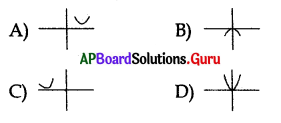
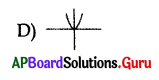
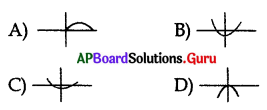
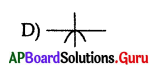
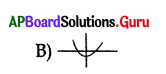
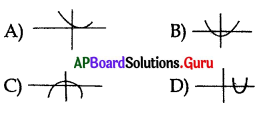
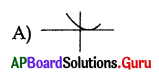
Which one of the following figures shows the quadratic equation
ax2 + bx + c = 0 (a ≠ 0) having distinct roots ?
AP 10th Class Maths Bits Chapter 5 Quadratic Equations with Answers 2
Answer:
AP 10th Class Maths Bits Chapter 5 Quadratic Equations with Answers 3

Question 31.
If 1 is a common root of ax2 + ax + 2 = 0 and x2 + x + b = 0, then a. b = ………………
A) 2
B) -2
C) 3
D) -3
Answer:
A) 2

AP 10th Class Maths Bits Chapter 5 Quadratic Equations with Answers

Question 32.
Find the zeros of the quadratic polynomial x2 – 5x – 14.
A) (+7,-2)
B) (-7,-2)
C) (-7, +2)
D) (7, 2)
Answer:
A) (+7,-2)

Question 33.
If one root of the quadratic equation x2 – 4x + 1 = 0 is 2 + √3, then the other
root is ……………………
A) 7 + √3
B) 7 – 4√3
C) 1 + √3
D) 2 – √3
Answer:
D) 2 – √3

Question 34.
If α, β are the roots of x2 – 10x + 9 = 0, then | α – β|=
A) 9
B) 8
C) -10
D) 10
Answer:
B) 8

Question 35.
The number of diagonals in a polygon having ‘n’ sides is ………………..
A) [latex]\frac{n(n+1)}{2}[/latex]
B) [latex]\frac{n(n-1)}{2}[/latex]
C) [latex]\frac{n(n-3)}{2}[/latex]
D) [latex]\frac{n(n+3)}{2}[/latex]
Answer:
C) [latex]\frac{n(n-3)}{2}[/latex]

Question 36.
If x2– px + q = 0(p,q ∈ Rand p ≠ 0,q ≠ 0) has distinct real roots, then………………
A) p2 < 4q
B) p2 > 4q
C) p2 = 4q
D) p2 + 4q = 0
Answer:
B) p2 > 4q

Question 37.
If 5 is a root of x2 – (K – 1)x + 10 = 0, then the value of K is
A) -8
B) 7
C) 8
D) 12
Answer:
C) 8

AP 10th Class Maths Bits Chapter 5 Quadratic Equations with Answers

Question 38.
Sum of the roots of x2 – 16 = 0 is
A) [latex]\frac{1}{16}[/latex]
B) 1
C) 0
D) 16
Answer:
C) 0

Question 39.
The sum of squares of the roots of x2 + 8x + 15 = 0 is …………………
A) 30
B) 34
C) 40
D) 44
Answer:
B) 34

Question 40.
The value of [latex]\sqrt{2+\sqrt{2+\sqrt{2+\ldots \ldots \ldots}}}[/latex] is……………….
A) 3
B) 4
C) 2
D) 8
Answer:
C) 2

Question 41.
The roots of (b – c) x2 + (c – a) x + (a – b) = 0 are equal and kb = a + c, then the value of k is………………..
A) 1
B) 2
C) 3
D) 4
Answer:
B) 2

Question 42.
The roots of x – [latex]\frac{3}{x}[/latex] = 2 are
A) 1, 3
B) 3, -1
C) 2, 2
D) 1, 2
Answer:
B) 3, -1

Question 43.
If one root of 3x2 + 2x + k = 0 is the reciprocal of the other, then the value of
k is
A) 3
B) -3
C) 2
D) 6
Answer:
A) 3

Question 44.
If the roots of 2x2 + kx + 3 = 0 are real and equal, then the value of k is
A) ± 2√6
B) ± 6√2
C) ± 4
D) ± 5
Answer:
C) ± 4

AP 10th Class Maths Bits Chapter 5 Quadratic Equations with Answers

Question 45.
The quadratic equation px2 + qx + r = 0 has imaginary roots, if ………………
A) q2 > 4 pr
B) q2 < 4 pr
C) q2 = 4 pr
D) p = q + r
Answer:
B) q2 < 4 pr

Question 46.
Which of the following is a quadratic equation ?
A) x3 – 6x2 + 2x -1 = 0
B) x2 + [latex]\frac{1}{x^{2}}[/latex] = 2
C) x + [latex]\frac{1}{x}[/latex] = 3
D) (x + 1) (x + 2) (x + 3) = 0
Answer:
C) x + [latex]\frac{1}{x}[/latex] = 3

Question 47.
The roots of the quadratic equation x2 – 5x + 6 = 0 are ………………..
A) -2, 3
B) -2, -3
C) 2, -3
D) 2, 3
Answer:
D) 2, 3

Question 48.
The roots of the quadratic equation x2 – 2x + 1 = 0 are
A) -1, -1
B) 1, -1
C) 1, 1
D) 2, 2
Answer:
C) 1, 1

Question 49.
The roots of the quadratic equation 3(x + 3)2 = 48 are
A) 1, 7
B) 1, -7
C) -1, 7
D) -1, -7
Answer:
B) 1, -7

Question 50.
The roots of x2 – 2x – (r2 – 1) = 0 are
A) 1 – r, r + 1
B) 1, r
C) 1 – r, r
D) 1 – r, -r – 1
Answer:
A) 1 – r, r + 1

Question 51.
If 3 is a solution of 3x2 + (k -1) x + 9 = 0, then k =
A) 13
B) 11
C) -11
D) -13
Answer:
C) -11

AP 10th Class Maths Bits Chapter 5 Quadratic Equations with Answers

Question 52.
The roots of the quadratic equation [latex]\frac{x^{2}-8}{x^{2}+20}=\frac{1}{2}[/latex] are ………………….
A) ± 2
B) ± 4
C) ± 3
D) ± 6
Answer:
D) ± 6

Question 53.
If x2 + 2kx + 4 = 0 has a root x = 2, then ‘ the value of k is
A) 2
B) -2
C) -1
D) -4
Answer:
B) -2

Question 54.
The roots of the quadratic equation (3x – 2) (2x + 1) = 0 are
A) [latex]\frac{2}{3}, \frac{-1}{2}[/latex]
B) [latex]\frac{-2}{3}, \frac{-1}{2}[/latex]
C) [latex]\frac{-2}{3}, \frac{1}{2}[/latex]
D) [latex]\frac{2}{3}, \frac{1}{2}[/latex]
Answer:
A) [latex]\frac{2}{3}, \frac{-1}{2}[/latex]

Question 55.
The roots of the quadratic equation (√3x – √2) (√3x – √2) = 0 are
A) [latex]\frac{\sqrt{2}}{\sqrt{3}}, \frac{\sqrt{2}}{\sqrt{3}}[/latex]
B) [latex]\frac{-\sqrt{2}}{\sqrt{3}}, \frac{-\sqrt{2}}{\sqrt{3}}[/latex]
C) [latex]\frac{\sqrt{2}}{\sqrt{3}}, \frac{-\sqrt{2}}{\sqrt{3}}[/latex]
D) [latex]\frac{-\sqrt{2}}{\sqrt{3}}, \frac{\sqrt{2}}{\sqrt{3}}[/latex]
Answer:
A) [latex]\frac{\sqrt{2}}{\sqrt{3}}, \frac{\sqrt{2}}{\sqrt{3}}[/latex]

Question 56.
If [latex]\frac {1}{2}[/latex] is a root of the equation x2 + kx – [latex]\frac {5}{4}[/latex] = 0 then the value of k is
A) [latex]\frac {1}{2}[/latex]
B) [latex]\frac {1}{4}[/latex]
C) 2
D) -2
Answer:
C) 2

Question 57.
The roots of the quadratic equation [latex]\frac{x}{a}=\frac{a}{x}[/latex] are
A) a, – a
B) -a2, a2
C) -a, -a
D) a, a
Answer:
A) a, – a

AP 10th Class Maths Bits Chapter 5 Quadratic Equations with Answers

Question 58.
The roots of the quadratic equation [latex]\frac{x^{2}}{a^{2}-b^{2}}=\frac{a+b}{a-b}[/latex] are
A) ± a
B) a, b
C) ± (a + b)
D) ± b
Answer:
C) ± (a + b)

Question 59.
The roots of the quadratic equation [latex]\frac{11}{3+x}[/latex] = 4(3 – x)are
A) ± 2
B) ± [latex]\frac{5}{2}[/latex]
C)± [latex]\frac{1}{5}[/latex]
D) ± 5
Answer:
A) ± 2

Question 60.
The roots of the quadratic equation [latex]\frac{9}{x^{2}-27}=\frac{25}{x^{2}-11}[/latex] are
A) ± 6
C) ± 3
B) ± 4
D) ± 5
Answer:
A) ± 6

Question 61.
The roots of the quadratic equation x2 + 7x = 0 are
A) 0, 7
B) 7, -7
C) -7, -7
D) 0, -7
Answer:
D) 0, -7

Question 62.
If (x + 4) (x – 4) = 9, then the values of x are
A) ± [latex]\frac {1}{2}[/latex]
B) ± 5
C) [latex]\frac{1}{5}, \frac{1}{5}[/latex]
D) 5, 5
Answer:
B) ± 5

Question 63.
The roots of the quadratic equation (2x + b + a) (2x + b – a) = 0 are
A) [latex]\frac{a-b}{2}, \frac{a-b}{2}[/latex]
B) [latex]\frac{a+b}{2}, \frac{a+b}{2}[/latex]
C) [latex]-\frac{a+b}{2}, \frac{a-b}{2}[/latex]
D) [latex]\frac{a+b}{2}, \frac{a-b}{2}[/latex]
Answer:
C) [latex]-\frac{a+b}{2}, \frac{a-b}{2}[/latex]

Question 64.
The roots of the equation [latex]\sqrt{2 x^{2}+9}[/latex] = 9 are
A) x = 0
B) x = ± 6
C) x = 6
D) x = -6
Answer:
B) x = ± 6

Question 65.
The value of k for which 3 is a root of the equation kx2 – 7x + 3 = 0 is
A) -3
B) 3
C) 2
D) -2
Answer:
C) 2

AP 10th Class Maths Bits Chapter 5 Quadratic Equations with Answers

Question 66.
The two roots of a quadratic equation are 2 and – 1. The equation is
A) x2 + x + 2 = 0
B) x2 – 2x + 2 = 0
C) x2 + 2x – 2 = 0
D) x2 – x – 2 = 0
Answer:
D) x2 – x – 2 = 0

Question 67.
Which constant must be added and subtracted to solve the quadratic equation 9x2 + 3x – 8 = 0 by the method of completing the square ?
A) [latex]\frac {1}{36}[/latex]
B) [latex]\frac {9}{64}[/latex]
C) [latex]\frac {1}{3}[/latex]
D) [latex]\frac {1}{4}[/latex]
Answer:
D) [latex]\frac {1}{4}[/latex]

Question 68.
If the sum of the roots of the quadratic equation 3x2 + (2k + 1) x – (k + 5) = 0 is equal to the product of the roots, then the value of k is
A) 3
B) 5
C) 4
D) 2
Answer:
C) 4

Question 69.
The quadratic equation whose one root is 3 + √5 is
A) x2 – 6x – 4 = 0
B)x2 + 6x + 4 = 0
C) x2 – 6x + 4 = 0
D) x2 + 6x + 5 = 0
Answer:
C) x2 – 6x + 4 = 0

Question 70.
If the two roots of the two quadratic equations x2 + mx + 1 = 0 and ax2 + bx + a = 0 are common, then the value of m is
A) [latex]\frac{a}{b}[/latex]
B) b
C) [latex]\frac{b}{a}[/latex]
D) ab
Answer:
C) [latex]\frac{b}{a}[/latex]

Question 71.
The roots of the quadratic equation x2 + 8x + 7 = 0 are
A) 1, 7
B) -1, -7
C) -1, 7
D) 1, -7
Answer:
B) -1, -7

Question 72.
The value of k for which roots of the quadratic equation kx2 + 2x + 3 = 0 are equal is …………………..
A) [latex]\frac{1}{3}[/latex]
B) -3
C) [latex]\frac{-1}{3}[/latex]
D) 3
Answer:
A) [latex]\frac{1}{3}[/latex]
AP 10th Class Maths Bits Chapter 5 Quadratic Equations with Answers

Question 73.
If the roots of the equation 12x2 + mx + 5 = 0 are real and equal then m is equal to
A) 4[latex]\sqrt{15}[/latex]
B) 2[latex]\sqrt{15}[/latex]
C) 8[latex]\sqrt{15}[/latex]
D) 10√5
Answer:
A) 4[latex]\sqrt{15}[/latex]

Question 74.
If the roots of the quadratic equation x2 + px + 16 = 0 are equal then the value of pis
A) ± 7
B) ± 6
C) ± 8
D) ± 9
Answer:
C) ± 8

Question 75.
Which of the following equations has the equal roots ?
A) 6x2 – x – 2 = 0
B) x2 – 8x + 16 = 0
C) 10x – [latex]\frac{1}{x}[/latex] = 3
D) x2 + 6x + 5 = 0
Answer:
B) x2 – 8x + 16 = 0

Question 76.
Discriminant of the quadratic equation 2x2 + x – 8 = 0 is
A) 65
B) -15
C) -127
D) 15
Answer:
A) 65

Question 77.
The discriminant of x2 + 5x + 5 = 0 is
A) [latex]\frac{-5}{2}[/latex]
B) [latex]\frac{5}{2}[/latex]
C) – 5
D) 5
Answer:
D) 5

Question 78.
The value (s) of k such that the equation kx2 + 6x + k = 0 has equal roots is ………………..
A) ± 3
B) ± 6
C)-6 and 3
D) 9
Answer:
A) ± 3

Question 79.
If the discriminant of the equation 6x2 – bx + 2 = 0 is 1, then the value of ‘b’ is
A) ± 7
B)± √7
C) -7
D) 7
Answer:
A) ± 7

AP 10th Class Maths Bits Chapter 5 Quadratic Equations with Answers

Question 80.
The discriminant of the quadratic equation 7√3x2 + 10x – √3 = 0 is :
A) [latex]\frac{-10}{7 \sqrt{3}}[/latex]
B) 142
C) 184
D) 26
Answer:
C) 184

Question 81.
Discriminant of the quadratic equation 2x2 + x – 8 = 0 is
A) -65
B) 65
C) -127
D) -15
Answer:
B) 65

Question 82.
The roots of (x2 – 3x + 2) (x) (x – 4) = 0 are
A) 0 and 4
B) 0, 1, 2 and 4
C) 4
D) 1, 2 and 4
Answer:
B) 0, 1, 2 and 4

Question 83.
The difference of the roots of x2 – 7x – 9 = 0 is
A) [latex]\sqrt{85}[/latex]
B) 7
C) -9
D) 8
Answer:
A) [latex]\sqrt{85}[/latex]

Question 84.
The equation [latex]\sqrt{x+10}-\frac{6}{\sqrt{x+10}}[/latex] = 5 has
A) an extraneous root between -5 and -1
B) two extraneous roots
C) an extraneous root between -10 and -6
D) a real root between 20 and 25
Answer:
C) an extraneous root between -10 and -6

Question 85.
If log10(x2 – 3x + 6) = 1, then the value of x is
A) 4 or -1
B) 4 only
C) 10 or 2
D) 4 or -2
Answer:
A) 4 or -1

Question 86.
If y = x + [latex][/latex] then x4 + x3 – 4x2 + x + 1 = 0 becomes
A) x2(y2 + y – 6) = 0
B) x2(y2 + y – 3) = 0
C) x2(y2 + y – 4) = 0
D) x2(y2 + y – 2) = 0
Answer:
A) x2(y2 + y – 6) = 0

Question 87.
The roots of the equations [latex]2 \sqrt{x}+2 x^{\frac{1}{2}}[/latex] = 5 can be found by solving
A) 4x2 – 25x -4 = 0
B) 4x2 – 17x + 4 = 0
C) 4x2 – 25x + 4 = 0
D) 4x2 – 17x -4 = 0
Answer:
B) 4x2 – 17x + 4 = 0

AP 10th Class Maths Bits Chapter 5 Quadratic Equations with Answers

Question 88.
The values of ’k’ for which the equation 2x2 – kx + x + 8 = 0 will have real and
equal roots are …………………
A) 9 and -7
B)-9 and 7
C) only 9
D) only -7
Answer:
A) 9 and -7

Question 89.
Two numbers whose sum is 6 and the absolute value of whose difference is 8 are the roots of the equation
A) x2 – 6x + 8 = 0
B) x2 – 6x – 7 = 0
C) x2 – 6x + 7 = 0
D) x2 + 6x – 8 = 0
Answer:
B) x2 – 6x – 7 = 0

Question 90.
If a and b are the roots of x2 – px + q = 0, then a2 + b2 =…………………
A) p2 + 2q
B) p2 – q2
C) p2 – 2q
D) p2 + q2
Answer:
C) p2 – 2q

Question 91.
The solution of [latex]\sqrt{5 x-1}+\sqrt{x-1}[/latex] = 2 is
A) x = 2
B) x = 2, x = 1
C) x = 1
D) x = 1, x = 4
Answer:
C) x = 1

Question 92.
The’ roots of [latex]\frac{15}{x^{2}-4}-\frac{2}{x-2}[/latex] = = 1 are………………
A) -3 and 5
B) 3 only
C) -5 and 3
D) -5 only
Answer:
C) -5 and 3

Question 93.
In the equation 2x2 – hx + 2k = 0, the sum of the roots is 4 and the product of the roots is -3. Then h and k have the values ………………… respectively.
A) 8 and -3
B) 8 and 6
C) 4 and -3
D) -3 and 8
Answer:
A) 8 and -3

Question 94.
If [latex]\sqrt{x-1}-\sqrt{x+1}[/latex] + 1 = 0, then 4x equal to
A) 0
B) 1 [latex]\frac{1}{4}[/latex]
C) 5
D) 4[latex]\sqrt{-1}[/latex]
Answer:
C) 5

AP 10th Class Maths Bits Chapter 5 Quadratic Equations with Answers

Question 95.
The number of roots satisfying the equation [latex]\sqrt{5-x}=x \sqrt{5-x}[/latex] – x is/are
A) 2
B) 3
C) 1
D) unlimited
Answer:
B) 3

Question 96.
If α and β are the roots of the quadratic equation x2 + px + 12 = 0 with the condition α – β = 1, then the value of ‘p’ is
A) 7 or -7
B) 1
C) -7
D) 7
Answer:
A) 7 or -7

Question 97.
The coefficient of x in the quadratic equation x2 + px + q = 0 was taken as 17 in the place of 13 and its roots were found to be-2 and-15. The roots of the original equation are
A) 3 or -10
B) -3 or 10
C) -3 or -10
D) 3 or 10
Answer:
C) -3 or -10

Question 98.
The roots of [latex]\sqrt{2 x-3}+\sqrt{3 x-5}-\sqrt{5 x-6}[/latex] = 0 are
A) 2 or [latex]\frac{7}{6}[/latex]
B) 2 only
C) [latex]\frac{7}{6}[/latex] only
D) 2 and [latex]\frac{7}{6}[/latex]
Answer:
A) 2 or [latex]\frac{7}{6}[/latex]

Question 99.
If one of roots of x2 + ax + 4 = 0 is twice the other root, then the value of ‘a’ is
A) 8√2
B) √2
C) -3√2
D) -2√2
Answer:
C) -3√2

Question 100.
If the roots of the equation
(a – b)x2 + (b – c) x + (c – a) = 0 are equal, then
A) 2b = a + c
B) 2c = a + b
C) 2a = b + c
D) 2a = b – c
Answer:
C) 2a = b + c

Question 101.
If a = b = c, then the roots of the equa-tion (x – a) (x – b) + (x – b)(x – c) +
(x – c) (x – a) = 0 are
A) imaginary
B) real and equal
C) real and unequal
D) real
Answer:
B) real and equal

AP 10th Class Maths Bits Chapter 5 Quadratic Equations with Answers

Question 102.
If the sum of the roots of the quadratic equation 3x2 + (2k + 1) x – (k + 5) = 0 is equal to the product of the roots, then the value of ‘k’ is
A) 0
B) 1
C) -4
D) 4
Answer:
D) 4

Question 103.
For a quadratic equation, 3 + √5 is one root. The other root must be
A) 3 + √5
B) 3 – √5
C) 3 + 2√5
D) 3 – 2√5
Answer:
B) 3 – √5

Question 104.
If one root of the equation ax2 + bx + c = 0 is three times the other, then …………………
A) b2 = 16ac
B) 3b2 = 16ac
C) 2b2 = 9ac
D) b2 = ac
Answer:
B) 3b2 = 16ac

Question 105.
The root of the quadratic equation 3x2 – kx + 14 = 0 are in the ratio 7 : 6 then k = ………………….
A) 12
B) -3
C) 1
D) 13
Answer:
D) 13

Question 106.
If α, β are the roots of the equation x2 – px + q = 0, then the quadratic equation whose roots are [latex]\frac{\alpha}{\beta}[/latex] and [latex]\frac{\boldsymbol{\beta}}{\alpha}[/latex] is ……………………
A) qx2 + (2q – p2) x + q = 0
B) qx2 – px + 1 = 0
C) qx2 + (p2 – 2q) x + q = 0
D) qx2 – px – 1 = 0
Answer:
A) qx2 + (2q – p2) x + q = 0

Question 107.
Find the value of k, if the expression x2 + kx + 1 is factorizable into two linear factors ………………
A) either k ≥ 2 or k ≤ -2
B) k ≥ 2
C) k ≤ -2
D) neither k ≥ 2 nor k ≤ – 2
Answer:
A) either k ≥ 2 or k ≤ -2

Question 108.
The product of two consecutive odd numbers is 143. The numbers are
A) 13 and 15
B) 11 and 13
C) -11 and 13
D) -13 and 15
Answer:
B) 11 and 13

AP 10th Class Maths Bits Chapter 5 Quadratic Equations with Answers

Question 109.
The perimeter of a rectangular room is 34m and the length of a diagonal is 13m. The dimensions of the room are …………………..
A) 17m and 7m
B) 12m and 5m
C) 9m and 2m
D) 15m and 2m
Answer:
B) 12m and 5m

Question 110.
If x2 + 4ax + 3 = 0 and 2x2 + 3ax – 9 = 0 have a common root, then the value of ‘a’is ……………………
A) 1
B) ± 3
C) ± 1
D) -3
Answer:
C) ± 1

Question 111.
The product of two consecutive natural numbers is 600. The numbers are …………………….
A) 35, 36
B) 16, 25
C) 26, 25
D) 24, 25
Answer:
D) 24, 25

Question 112.
The roots of the quadratic equation x2 – 5x + 6 = 0 are
A) 3, -2
B) -3, 2
C) 2, 3
D) -2, -3
Answer:
C) 2, 3

Question 113.
If the roots of a quadratic equation are equal, then
A) b2 = 4ac
B) b2 – 4ac < 0
C) b2 – 4ac > 0
D) b2 – 4ac = 0
Answer:
A) b2 = 4ac

Question 114.
The roots of the quadratic equation abx2 – (a + b) x + 1 are
A) a + b, a – b
B) [latex]\frac{1}{a}, \frac{1}{b}[/latex]
C) a, b
D) [latex]\frac{1}{a+b}, \frac{1}{a-b}[/latex]
Answer:
B) [latex]\frac{1}{a}, \frac{1}{b}[/latex]

Question 115.
If α, β be the roots of the quadratic equation x2 – 2x + 1 = 0, then the quadratic equation whose roots are α + β and αβ is ………………
A) x2 – 2x – 1 = 0
B) x2 + 2x + 1 = 0
C) x2 + 2x -1 = 0
D) x2 – 2x + 1 = 0
Answer:
D) x2 – 2x + 1 = 0

AP 10th Class Maths Bits Chapter 5 Quadratic Equations with Answers

Question 116.
The roots of the equation x + [latex][/latex] = 5[latex][/latex] are
A) 5, -5
B) 5, [latex]\frac{1}{5}[/latex]
C) -5, -5
D) 5, 5
Answer:
B) 5, [latex]\frac{1}{5}[/latex]

Question 117.
Which of the following is not a quadratic equation ?
A) x (2x + 3) = x2 + 1
B) (x – 2)2 + 1 = 2x – 3
C) x(x + 1) + 8 = (x + 2) (x – 2)
D) (x + 2)3 = x3 – 4
Answer:
C) x(x + 1) + 8 = (x + 2) (x – 2)

Question 118.
Is – √5x2 + 6x + 3 = 0 a quadratic equation ?
A) Yes
B) No
C) can’t say
D) It is a linear equation
Answer:
A) Yes

Question 119.
Which of the following equation has [latex]\frac {1}{5}[/latex] as a root ?
A) 2x2 – 7x + 6 = 0
B) 35x2 – 2x – 1 = 0
C) 35x2 + 12x + 1 = 0
D) 10x2 – 3x – 1 = 0
Answer:
B) 35x2 – 2x – 1 = 0

Question 120.
If x = 1 is a common root of the equations ax2 + ax + 3 = 0 and x2 + x + b = 0, then the value of ab is :
A) 3
B) 6
C) 3.5
D) -3
Answer:
A) 3

Question 121.
Which of the following equations has the sum of roots as 3 ?
A) 2x2 – 3x + 6 = 0
B) 3x2 – 3x + 3 = 0
C) √2 x2-[latex]\frac{3}{\sqrt{2}}[/latex]x + = 0
D) -x2 + 3x – 3 = 0
Answer:
D) -x2 + 3x – 3 = 0

Question 122.
Which constant should be added and substracted to solve the quadratic equation 4x2 – √3x – 5 = 0 by the method of completing the square?
A) [latex]\frac{3}{16}[/latex]
B) [latex]\frac{\sqrt{3}}{4}[/latex]
C) [latex]\frac{9}{16}[/latex]
D) [latex]\frac{3}{4}[/latex]
Answer:
A) [latex]\frac{3}{16}[/latex]

AP 10th Class Maths Bits Chapter 5 Quadratic Equations with Answers

Question 123.
Which of the following equations has the product of its roots as 4 ?
A) x2 + 4x – 4 = 0
B) x2 + 4x + 4 = 0
C) x2 + 4x – 24 = 0
D) -x2 + 4x + 4 = 0
Answer:
B) x2 + 4x + 4 = 0

Question 124.
ax2 + bx + c = 0, a > 0,b = 0, c > 0 has;
A) Two equal roots
B) One real root
C) Two distinct real roots
D) No real roots
Answer:
D) No real roots

Question 125.
If the equation x2 – 4x + a = 0 has no real roots, then
A) a ≤ 4
B) a < 2
C) a < 4 D) a > 4
Answer:
D) a > 4

Question 126.
If the discriminant of the quadratic equation ax2 + bx + c = 0, then the roots of the equation
A) are irrational and equal
B) are rational and equal
C) do not exist and real
D) are real and equal
Answer:
D) are real and equal

Question 127.
The least value of ax2 + bx + c (a > 0) is
A) [latex]\frac{-b}{2 a}[/latex]
B) [latex]\frac{4 a^{2}-b^{2}}{4 a}[/latex]
C) [latex]\frac{4 a^{2}+b^{2}}{4 a}[/latex]
D) none of the above
Answer:
B) [latex]\frac{4 a^{2}-b^{2}}{4 a}[/latex]

Question 128.
The equation x + [latex]\sqrt{x-2}[/latex] = 4 has
A) two real roots
B) two imaginary roots
C) one real root
D) one real and one imaginary root
Answer:
C) one real root

Question 129.
If one root of the equation a(b – c) x2 + b(c – a) x + c(a – b) = 0 is 1, then the other root is
A) [latex]\frac{a(b-c)}{c(a-b)}[/latex]
B) [latex]\frac{a(b-c)}{b(c-a)}[/latex]
C) [latex]\frac{c(a-b)}{a(b-c)}[/latex]
D) [latex]\frac{b(c-a)}{a(b-c)}[/latex]
Answer:
C) [latex]\frac{c(a-b)}{a(b-c)}[/latex]

Question 130.
The roots of the equation x2 + 2√3 x + 3 = 0 are
A) rational and equal
B) real and equal
C) rational and unequal
D) imaginary
Answer:
B) real and equal

AP 10th Class Maths Bits Chapter 5 Quadratic Equations with Answers

Question 131.
The roots of the equation ax2 + bx + c = 0 will be reciprocal if
A) a = bc
B) b = c
C) a = b
D) c = a
Answer:
D) c = a

Question 132.
The discriminant of ax2 – 2√2 x + c = 0 with a, c and real constants is zero. The roots must be
A) rational and equal
B) real and equal
C) imaginary
D) equal and integral
Answer:
B) real and equal

Question 133.
The equation [latex]\sqrt{x+4}-\sqrt{x-3}[/latex] + 1 = 0 has
A) one real root
B) two imaginary roots
C) no root
D) one real and one imaginary root
Answer:
C) no root

Question 134.
The sum of the reciprocals of the roots of the equation x2 + px + q = 0 is
A) [latex]\frac{q}{p}[/latex]
B) [latex]\frac{-\mathrm{p}}{\mathrm{q}}[/latex]
C) [latex]\frac{-\mathrm{q}}{\mathrm{p}}[/latex]
D) [latex]\frac{\mathrm{p}}{\mathrm{q}}[/latex]
Answer:
D) [latex]\frac{\mathrm{p}}{\mathrm{q}}[/latex]

Question 135.
The equation [latex]x-\frac{7}{x-3}=3-\frac{7}{x-3}[/latex] has
A) no roots
B) infinitely many roots
C) one integral root
D) two real roots
Answer:
A) no roots

Question 136.
If [latex]\frac{b}{x-a}=\frac{x+a}{b}[/latex] then the value of x in terms of a and b is
A) [latex]\sqrt{a^{2}+b^{2}}[/latex]
B) [latex]\pm \sqrt{a^{2}+b^{2}}[/latex]
C) [latex]-\sqrt{a^{2}+b^{2}}[/latex]
D) [latex]\pm \sqrt{a^{2}-b^{2}}[/latex]
Answer:
B) [latex]\pm \sqrt{a^{2}+b^{2}}[/latex]

Question 137.
The standard form of a quadratic equation is
A) ax + b = 0, a ≠ 0
B) ax2 + bx + c = 0, a ≠ 0
C) ax3 + bx2 + cx + d = 0, a ≠ 0
D) ax4 + bx3 + cx2 + dx + e = 0, a ≠ 0.
Answer:
B) ax2 + bx + c = 0, a ≠ 0

AP 10th Class Maths Bits Chapter 5 Quadratic Equations with Answers

Question 138.
Which of the following is a quadratic equation?
A) (x – 2) (x + 1) = (x – 1) (x + 3)
B) x4 – 1 = 0
C) (x + 1)2 = 2(x – 3)
D) x2 + 3x + 1 = (x – 2)2
Answer:
C) (x + 1)2 = 2(x – 3)

Question 139.
A cottage industry produces a certain number of toys in a day. The cost of production of each toy was found to be 55 rupees. On a particular day, the total cost of production was ? 750. Represent this situation in the form of a quadratic equation.
A) x (55 – x) = 750
B) 55x = 750
C) x(x – 55) = 750
D) x (x + 55) = 750
Answer:
A) x (55 – x) = 750

Question 140.
The sum of the squares of two consecutive natural numbers is 25. Represent this situation in the form of a quadratic equation.
A) x2 + (x + 1)2 + 25 = 0
B) x2 – (x + 1)2 = 25
C) x2 + (x + 1)2 = 25
D) (x + 1)2 – x2 = 25
Answer:
C) x2 + (x + 1)2 = 25

Question 141.
If one root of the two quadratic equations x2 + ax + b = 0 and x2 + bx + a = 0 is common, then
A) a + b = -1
B) ab = -1
C) ab = 1
D) a + b = 1
Answer:
A) a + b = -1

Question 142.
The condition that both the roots of the two quadratic equations
a1x2 + b1x + c1 = 0 and a2x2 + b2x + c2 = 0 are common is
A) a1a2 + b1b2 + c1c2 = 0
B) a12 + b12 + c12 = a22 + b22 + c22
C) [latex]\frac{a_{1}}{a_{2}}=\frac{b_{1}}{b_{2}}=\frac{c_{1}}{c_{2}}[/latex]
D) a1 + b1 + c1 = a2 + b2 + c2
Answer:
C) [latex]\frac{a_{1}}{a_{2}}=\frac{b_{1}}{b_{2}}=\frac{c_{1}}{c_{2}}[/latex]

Question 143.
If x = [latex]\sqrt{1+\sqrt{1+\sqrt{1+\ldots \ldots \ldots . .}}}[/latex] , then
A) 1 < x < 2
B) x = 1
C) 0 < x < 1
D) x is infinite
Answer:
A) 1 < x < 2

Question 144.
If [latex][/latex] has roots which are numerically equal but of opposite signs, the value of ‘m’ must be
A) [latex]\frac{a+b}{a-b}[/latex]
B) 0
C) 1
D) [latex]\frac{a-b}{a+b}[/latex]
Answer:
D) [latex]\frac{a-b}{a+b}[/latex]

AP 10th Class Maths Bits Chapter 5 Quadratic Equations with Answers

Question 145.
Two consecutive positive integers differ by
A) 3
B) 4
C) 2
D) 1
Answer:
D) 1

Question 146.
The sum of a number and its reciprocal is [latex]\frac {5}{2}[/latex] . Represent this, situation in the form of a quadratic equation.
A) x -[latex]\frac{1}{x}=\frac{5}{2}[/latex]
B) x +[latex]\frac{1}{x}=\frac{5}{2}[/latex]
C) x +[latex]\sqrt{x}=\frac{5}{2}[/latex]
D) x2[latex]\frac{1}{x^{2}}=\frac{5}{2}[/latex]
Answer:
B) x +[latex]\frac{1}{x}=\frac{5}{2}[/latex]

Question 147.
Two consecutive even integers are
A) x, x + 1
B) x, 2x
C) x, x – 1
D) x, x + 2
Answer:
D) x, x + 2

Question 148.
Two consecutive positive integers are
A) x, x – 2
B) x, x + 1
C) x, x + 2
D) x, 2x
Answer:
B) x, x + 1

Question 149.
John and Jivanti together have 45 marbles. Both of them lost 5 marbles each and the product of the number of marbles they have now is 124. Represent this situation in the form of quadratic equation.
A) (x – 5) (x – 40) = 124
B) (x + 5) (40 + x) + 124 = 0
C) (x – 5) (40 – x) = 124
D) (5 + x) (40 – x) = 124
Answer:
C) (x – 5) (40 – x) = 124

Question 150.
What is the condition that one root of the quadratic equation ax2 + bx + c is reciprocal of the other ?
A) a = b
B) b = c
C) a = c
D) a + b + c = 0
Answer:
C) a = c

Question 151.
If the roots of the quadratic equation ax2 + bx + c are sinα and cosα, then
A) a2 + b2 = c2
B) b2 – 2ac = a2
C) b2 + 2ac = a2
D) a22 – 2bc = b2
Answer:
B) b2 – 2ac = a2

Question 152.
If the difference of the roots of the quadratic equation x2 – ax + b is 1, then
A) a2 – 4b = -1
B) a2 – 4b = 4
C) a2 – 4b = 1
D) a2 – 4b = 0
Answer:
C) a2 – 4b = 1

AP 10th Class Maths Bits Chapter 5 Quadratic Equations with Answers

Question 153.
The value of c for which the equation ax2 + bx + c = 0 has equal roots is
A) [latex]\frac{\mathrm{b}^{2}}{4 \mathrm{a}}[/latex]
B) [latex]\frac{a^{2}}{b}[/latex]
C) [latex]\frac{a^{2}}{4 b}[/latex]
D) [latex]\frac{\mathrm{b}^{2}}{\mathrm{a}}[/latex]
Answer:
A) [latex]\frac{\mathrm{b}^{2}}{4 \mathrm{a}}[/latex]

Question 154.
The roots of the equation x2 – 2x = 0 can be obtained graphically by finding the abscissa of the points of intersection of each of the following pairs of equations except ………………….
A) y = x,y = x – 2
B) y = x2 – 2x + 1, y = 1
C) y = x2,y = 2x
D) y = x2 – 2x, y = 0
Answer:
A) y = x,y = x – 2

Question 155.
If in applying the quadratic f ormula to a quadratic equation f(x) = ax2 + bx + c = 0 it happens that c = [latex][/latex]. Then the graph of y = f(x) will certainly …………….
A) have a minimum
B) be a tangent to the Y – axis
C) have a maximum
D) be a tangent to X-axis
Answer:
D) be a tangent to X-axis

Question 156.
In the equation [latex][/latex] the roots are equal when
A) m = 0
B) m = [latex]\frac {1}{2}[/latex]
C) m = -[latex]\frac {1}{2}[/latex]
D) m = 1
Answer:
C) m = -[latex]\frac {1}{2}[/latex]

Question 157.
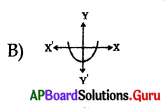
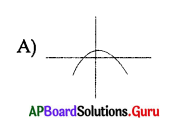
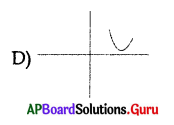
If b2 – 4ac > 0 the graph may be …………………
AP 10th Class Maths Bits Chapter 5 Quadratic Equations with Answers 4
Answer:
AP 10th Class Maths Bits Chapter 5 Quadratic Equations with Answers 5

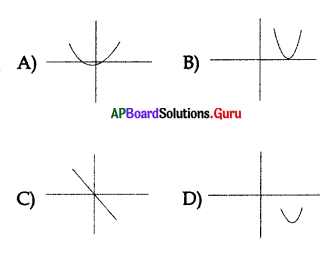
Question 158.
If b2 = 4ac then the graph may be
AP 10th Class Maths Bits Chapter 5 Quadratic Equations with Answers 6
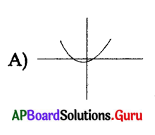
Answer:
AP 10th Class Maths Bits Chapter 5 Quadratic Equations with Answers 7

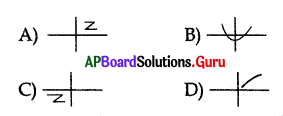
Question 159.
The graph of a linear polynomial may be
AP 10th Class Maths Bits Chapter 5 Quadratic Equations with Answers 8
Answer:
AP 10th Class Maths Bits Chapter 5 Quadratic Equations with Answers 9

AP 10th Class Maths Bits Chapter 5 Quadratic Equations with Answers

Question 160.
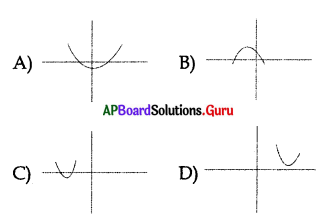
Identify parabola among the following graphs.
AP 10th Class Maths Bits Chapter 5 Quadratic Equations with Answers 10
Answer:
AP 10th Class Maths Bits Chapter 5 Quadratic Equations with Answers 11

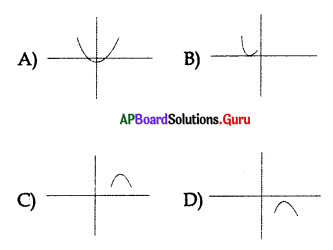
Question 161.
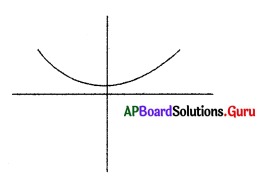
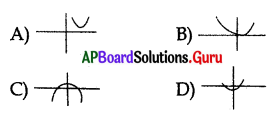
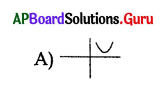
If a quadratic equation have no real roots then the graph may be ………………
AP 10th Class Maths Bits Chapter 5 Quadratic Equations with Answers 12
Answer:
AP 10th Class Maths Bits Chapter 5 Quadratic Equations with Answers 13

Question 162.
If the graph of ax2 + bx + c = 0, a ≠ 0 never intersects X axis then the number of real zeroes are ………………..
A) 2
B) 0
C) 3
D) 4
Answer:
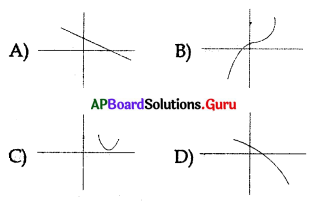
B) 0

Question 163.
From the graph given below the nature of roots are ………………….
AP 10th Class Maths Bits Chapter 5 Quadratic Equations with Answers 14
A) Real and equal
B) Real and not equal
C) Not real
D) 10, 11
Answer:
C) Not real

AP 10th Class Maths Bits Chapter 4 Pair of Linear Equations in Two Variables with Answers

Practice the AP 10th Class Maths Bits with Answers Chapter 4 Pair of Linear Equations in Two Variables on a regular basis so that you can attempt exams with utmost confidence.

AP State Syllabus 10th Class Maths Bits 4th Lesson Pair of Linear Equations in Two Variables with Answers

Question 1.
The slope of the line passing through (2, 3) and (4, 7) is ………………….
A) 2
B) [latex]\frac{5}{6}[/latex]
C) 4
D) 1
Answer:
A) 2

Question 2.
The value of P for which the pair of equations 2Px + 3y = 7, 2x + y = 6 has exactly one solution.
A) 3
B) Any real number except 3
C) Any real number
D) For no real P the system has solution
Answer:
B) Any real number except 3

AP 10th Class Maths Bits Chapter 4 Pair of Linear Equations in Two Variables with Answers

Question 3.
If 2x + 3y = 17; 2x + 2 – 3y +1 = 5, then (x, y) is…………………..
A) (3, 2)
B) (2, 3)
C) (-2, 3)
D) (3, -2)
Answer:
A) (3, 2)

Question 4.
The value of k for which the system of equations (3k + 1) x + 3y – 2 = 0 and (k2 + 1) x + (k – 2) y – 5 = 0 has no solution is…………………
A) 1
B) 2
C) -1
D) -2
Answer:
C) -1

Question 5.
The solution of the equations [latex]\frac{x+y}{x y}[/latex] = 2 and [latex]\left\{2, \frac{-1}{4}\right\}[/latex] = 6 is …………………..
A) [latex]\left\{\frac{-1}{2}, 4\right\}[/latex]
B) [latex]\left\{2, \frac{-1}{4}\right\}[/latex]
C) [latex]\left\{\frac{-1}{2}, \frac{-1}{4}\right\}[/latex]
D) [latex]\left\{\frac{-1}{2}, \frac{1}{4}\right\}[/latex]
Answer:
D) [latex]\left\{\frac{-1}{2}, \frac{1}{4}\right\}[/latex]

Question 6.
The larger of two supplementary angles exceeds the smaller by 18°. The angles are ………………..
A) 80°, 100°
B) 81°, 99°
C) 82°, 98°
D) 83°, 97°
Answer:
B) 81°, 99°

Question 7.
If [latex][/latex] = 2 and [latex][/latex] = – 1,then ………………..
A) x = 2, y = 3
B) x = 4, y = 9
C) x = 2, y = 9
D) x = 4, y = 3
Answer:
B) x = 4, y = 9

Question 8.
The value of k for which the pair of equations 3x + 4y + 2 = 0 and 9x + 12y + k = 0 represent coincident lines is ……………..
A) 2
B) 3
C) 6
D) 12
Answer:
C) 6

Question 9.
If 2x + 3y = 31, 2x + 2 – 3y + 1 = 5, then …………………
A) x = 3, y = 2
B) x = 3,y = 4
C) x = 2, y = 3
D) x = 4, y = 3
Answer:
C) x = 2, y = 3

AP 10th Class Maths Bits Chapter 4 Pair of Linear Equations in Two Variables with Answers

Question 10.
The point of intersection of the lines 2x + 3y – 5 = 0 and 3x – 4y + 1=0 lies in which quadrant ?
A) I
B) II
C) III
D) IV
Answer:
A) I

Question 11.
If the perimeter of a rectangular room is 34 and the length of the diagonal is 13, then the dimensions of the room are …………………
A) 7, 6
B) 11, 6
C) 12, 5
D) 12, 6
Answer:
C) 12, 5

Question 12.
If 9x + 11y = 51 and 11x + 9y = 49, then x = …………………….
A) -1
B) -2
C) 1
D) 2
Answer:
D) 2

Question 13.
If the pair of equations a1x + b1y + c1= 0 and a2 x + b2y + c2 = 0 has unique solution, then ………………
A) [latex]\frac{a_{1}}{a_{2}}=\frac{b_{1}}{b_{2}}[/latex]
B) [latex]\frac{a_{1}}{a_{2}} \neq \frac{b_{1}}{b_{2}}[/latex]
C) [latex]\frac{b_{1}}{b_{2}} \neq \frac{c_{1}}{c_{2}}[/latex]
D) [latex]\frac{b_{1}}{b_{2}}=\frac{c_{1}}{c_{2}}[/latex]
Answer:
B) [latex]\frac{a_{1}}{a_{2}} \neq \frac{b_{1}}{b_{2}}[/latex]

Question 14.
The solution of the equations √3x – √7y = 0 and √8x + √3y = 0 is ……………………
A) x = 3, y = 7
B) x = 8, y = 3
C) x = 0, y = 1
D) x = 0, y = 0
Answer:
D) x = 0, y = 0

Question 15.
If twice the age of A is added to B’s age, the sum is 45 and if twice the age of B is added to A’s age, the sum is 30. Then the age of B is ………………
A) 20
B) 5
C) 10
D) 30
Answer:
B) 5

Question 16.
3 pens and 5 pencils together cost ₹ 35, whereas 5 pens and 3 pencils together cost ₹ 37. The cost of a pencil is …………………
A) ₹ 5
B) ₹ 3
C) ₹ 4
D) ₹ 6
Answer:
C) ₹ 4

AP 10th Class Maths Bits Chapter 4 Pair of Linear Equations in Two Variables with Answers

Question 17.
Which of the following is a solution for the equation 2(x + 3) = 18 ?
A) 6
B) 5
C) 21
D) 13
Answer:
A) 6

Question 18.
If 3x + 4y – k = 0 and 6x + 8y – 4 = 0 are coincident lines, then the value of k is ………………
A) 3
B) 4
C) 6
D) 2
Answer:
D) 2

Question 19.
If y = 3, then the value of ‘x’ satisfying the equation [latex]\frac{5}{x}+\frac{3}{y}[/latex] = 6 is ……………….
A) 3
B) [latex]\frac{1}{3}[/latex]
C) [latex]-\frac{1}{3}[/latex]
D) 1
Answer:
D) 1

Question 20.
Which one of the following is NOT a linear equation?
A) 5x + 4 = y + 3
B) x + 2y = y2 – x
C) 3 – x = y2 + 4
D) x + y = 0
Answer:
C) 3 – x = y2 + 4

Question 21.
“Book” is an example of ……………….
A) prism
B) circle
C) cone
D) cuboid
Answer:
D) cuboid

Question 22.
The value of x which satisfies the equation 2x – (4 – x) = 5 – x is …………………..
A) 4.5
B) 3
C) 2.25
D) 0.5
Answer:
C) 2.25

Question 23.
If [latex]\frac{10}{x+y}+\frac{2}{x-y}[/latex] = 4 and [latex]\frac{15}{x+y}-\frac{5}{x-y}[/latex] = -2 then
A) x = 3, y = 2
B) x = 3, y = -2
C) x = -3, y = 2
D) x = -3, y = -2
Answer:
A) x = 3, y = 2

AP 10th Class Maths Bits Chapter 4 Pair of Linear Equations in Two Variables with Answers

Question 24.
The point of intersection of the lines x = 2016 and y = 2017 is …………………
A) (2017, 2016)
B) (0, 2017)
C) (2016, 0)
D) (2016, 2017)
Answer:
D) (2016, 2017)

Question 25.
Which of the following equations has the solution of (2, -3) ?
A) 2x – 3y = 10
B) 2x + 3y = -13
C) 2x – 3y = 13
D) 2x + 3y = 13
Answer:
C) 2x – 3y = 13

Question 26.
The point of intersection of the line y = ax + b with X – axis is ……………………
A) [latex]\left(-\frac{b}{a}, 0\right)[/latex]
B) [latex]\left(\frac{\mathrm{b}}{\mathrm{a}}, 0\right)[/latex]
C) [latex]\left(0, \frac{\mathrm{b}}{\mathrm{a}}\right)[/latex]
D) [latex]\left(0,-\frac{\mathrm{b}}{\mathrm{a}}\right)[/latex]
Answer:
A) [latex]\left(-\frac{b}{a}, 0\right)[/latex]

Question 27.
The value of x, which satisfies 2(x – 1) – (1 – x) = 2x + 3 is ………………..
A) 2
B) 4
C) 6
D) 8
Answer:
C) 6

Question 28.
The value of y when [latex]\frac{x+y}{x y}[/latex] = 2, [latex]\frac{x-y}{x y}[/latex] = 6 is …………………
A) [latex]\frac{1}{4}[/latex]
B) [latex]\frac{-1}{2}[/latex]
C) [latex]\frac{-1}{4}[/latex]
D) [latex]\frac{1}{3}[/latex]
Answer:
A) [latex]\frac{1}{4}[/latex]

Question 29.
Which of the following is inconsistent equation to 2x + 3y – 5 = 0 ?
A) 4x – 6y – 11 = 0
B) 2x + y = 5
C) x + 3y = 5
D) 4x + 6y – 11 = 0
Answer:
D) 4x + 6y – 11 = 0

Question 30.
Which of the following is not a linear equation ?
A) 5 + 4x = y + 3
B) x + 2y = y – x
C) 3 – x = y2 + 4
D) x + y = 0
Answer:
C) 3 – x = y2 + 4

AP 10th Class Maths Bits Chapter 4 Pair of Linear Equations in Two Variables with Answers

Question 31.
The solution set {x, y} of the system of equations x – 2y = 0 and 3x + 4y = 10 is
A) {2, 4}
B) {4, 2}
C) {1, 2}
D){2, 1}
Answer:
D){2, 1}

Question 32.
The two lines 3x + 2y – 80 = 0 and 4x + 3y -110 = 0 are
A) coincident lines
B) parallel lines
C) intersecting lines
D) None
Answer:
C) intersecting lines

Question 33.
The perimeter of a rectangular plot is 32 m. If the length l is increased by 2 m and the breadth b is decreased by 1m, the area of the plot remains the same. Then the values of l and b are respectively.
A) 6m, 10m
B) 10m, 6m
C) 10m, 10m
D) 6m, 6m
Answer:
B) 10m, 6m

Question 34.
Which of the following equations is a linear equation ?
A) 5 + 4x2 = y + 3
B)x + 2y = y2 – x
C) 3 – x = y + 4
D) x2 + y = 0
Answer:
C) 3 – x = y + 4

Question 35.
4y2 – 5y + 1 is ……………………
A) Linear polynomial.
B) Cubic polynomial.
C) Constant polynomial.
D) Quadratic polynomial.
Answer:
D) Quadratic polynomial.

Question 36.
Which of the following is a linear equation ?
A) 5 + 4x = y + 3
B) x + 2y = y – x2
C) 3 – x = y2 + 4
D) x2 + y = 0
Answer:
A) 5 + 4x = y + 3

Question 37.
Solution for the equations √8 x + √7 y = 0 and √6 x + √10 y = 0 is …………………
A) x = 3, y = 5
B) x = 7, y = 11
C) x = 1, y = 1
D) x = 0, y = 0
Answer:
D) x = 0, y = 0

AP 10th Class Maths Bits Chapter 4 Pair of Linear Equations in Two Variables with Answers

Question 38.
If the system of equations 4x + py = 21 and px – 2y = 15 has unique solution, then which of the following could be the value of p ?
a) 103
b) 105
c) 192
d) 197
A) Both (a) and (b)
B) Both (c) and (d)
C) (a), (b) and (d)
D) All of the above
Answer:
D) All of the above

Question 39.
The semi perimeter of a triangle exceeds each of its side by 5, 3 and 2 respectively. What is the perimeter of the triangle?
A) 10
B) 20
C) 15
D) 12
Answer:
B) 20

Question 40.
For what value of k do the equation 3(k – 1) x + 4y = 24 and 15x + 20y = 8 (k + 13) have infinite solutions ?
A) 4
B) 2
C) 1
D) 3
Answer:
B) 2

Question 41.
If the system of equations 2x – 3y = 3 and – 4x + qy = p is inconsistent, which of the following cannot be the value of p?
A) -36
B) -18
C) -24
D) -12
Answer:
D) -12

Question 42.
If 173x + 197y = 149 and 197x + 173y = 221, then find (x,y)
A) (2, -1)
B) (2, 1)
C) (-2, -1)
D)(-2, 1)
Answer:
A) (2, -1)

Question 43.
If an ordered pair satisfying the equations 2x – 3y = 18 and 4x – y = 16 also satisfies the equation 5x-py-23 = 0, then find the value of ‘p’.
A) 2
B) 5
C) 4
D) 1
Answer:
A) 2

Question 44.
In a fraction, if the numerator is decreased by 1 and the denominator is increased by 1. Then the fraction 1 becomes [latex]\frac {1}{2}[/latex]. Instead, if the numerator is increased by 1 and the denominator is decreased by 1. Then the fraction 4 becomes [latex]\frac {4}{5}[/latex]. Find the numerator of the fraction.
A) 2
B) 7
C) 4
D) 10
Answer:
B) 7

AP 10th Class Maths Bits Chapter 4 Pair of Linear Equations in Two Variables with Answers

Question 45.
If a1x + b1y + c1 = 0 and a2x + b2y + c2 = 0 re such that a1, b1, c1 a2 b2 and c2 are consecutive integers in the same order then find the values of x and y.
A) -1, -2
B) 1, -2
C) -1, 2
D) 1, 2
Answer:
B) 1, -2

Question 46.
If the ordered pair (sinθ, cosθ) satisfies the system of equations
mx + ny + a + b = a-b and tvx + my + 2b = 0, then find the value of ‘θ’ where 0 ≤ θ ≤, 90° (m ≠ n)
A) 50°
B) 45°
C) 90°
D) 30°
Answer:
B) 45°

Question 47.
If we increase the length by 2 units and the breadth by 2 units, then the area of rectangle is increased by 54 square units. Find the perimeter of the rectangle (in units).
A) 50
B) 60
C) 58
D) 68
Answer:
A) 50

Question 48.
A two-digit number is formed by either subtracting 17 from nine times the sum of the digits or by adding 21 to 13 times the difference of the digits. Find the number.
A) 73
B) 79
C) 81
D) 92
Answer:
A) 73

Question 49.
If 3|x| + 5|y| = 8 and 7|x| — 3|y| = 48, then find the value of x + y.
A) -5
B) 5
C) -4
D) The value does not exist
Answer:
D) The value does not exist

Question 50.
A, B, C and D share a certain amount amongst themselves. 6 sees that the other three get 3 times what he himself gets C sees that the other three get 4 times what he gets, while D sees that the other three get 5 times what he gets. If the sum of the largest and smallest shares is 99, then what is the sum of the other two shares ?
A) 81
B) 62
C) 92
D) 78
Answer:
A) 81

Question 51.
The total cost of six books, five pencils and seven sharpeners is Rs. 115 and that of eight books, ten pencils and fourteen sharpeners is Rs. 190. Then which of the following article’s cost can be found uniquely
A) Pencil
B) Book
C) Sharpener
D) Cannot say
Answer:
B) Book

AP 10th Class Maths Bits Chapter 4 Pair of Linear Equations in Two Variables with Answers

Question 52.
Swathi starts her job with certain monthly salary and earns a fixed increment every year. If her salary was Rs. 22500 per month after 6 years of service as Rs. 30000 per month after 11 years of service. Find her salary after 8 years of service (in Rs.).
A) 25500
B) 29500
C) 25000
D) 22343
Answer:
A) 25500

Question 53.
If a fraction becomes 2 when 9 is added to its numerator and 1 when 2 is subtracted from its denominator then the fraction is ………………….
A) [latex]\frac{6}{8}[/latex]
B) [latex]\frac{7}{9}[/latex]
C) [latex]\frac{5}{7}[/latex]
D) [latex]\frac{4}{7}[/latex]
Answer:
C) [latex]\frac{5}{7}[/latex]

Question 54.
The values of ‘x’ and ‘y’ if [latex]\frac{5}{y}-\frac{2}{x}=\frac{7}{6}[/latex] and [latex]\frac{36}{x}-\frac{24}{y}[/latex] = 1 is …………………..
A) x = 4, y = 3
B) x = -4, y = 3
C) x = -4, y = -3
D) x = 4, y = -3
Answer:
A) x = 4, y = 3

Question 55.
A certain number of two digits is four times the sum of the digits. If 9 is added to the number the digits in the number are reversed, then the number is …………………
A) 13
B) 23
C) 12
D) 14
Answer:
C) 12

Question 56.
Six years ago a man was three times as old as his son. In 6 year’s time, he will be twice as old as his son. Then their present ages are
A) 30, 15
B) 40, 20
C) 42, 18
D) 41, 19
Answer:
C) 42, 18

Question 57.
The total salary of 15 men and 8 women is Rs. 3050. The difference of salaries of 5 women and 3 men is Rs. 50. The sum of the salaries of 3 men and 3 women is …………………
A) Rs. 900
B) Rs. 850
C) Rs. 750
D) Rs. 1000
Answer:
B) Rs. 850

AP 10th Class Maths Bits Chapter 4 Pair of Linear Equations in Two Variables with Answers

Question 58.
If the sum of two numbers is 41 and their product is 400. Then the numbers are ………………
A) 40, 10
B) 20, 20
C) 25, 16
D) 28, 13
Answer:
C) 25, 16

Question 59.
A is twice as old as B, ten years ago. If A was four times as old as B, their present ages are ………………….
A) 24 and 12
B) 30 and 15
C) 32 and 16
D) 20 and 10
Answer:
B) 30 and 15

Question 60.
If one quarter of the sum of two numbers 1 is 14[latex]\frac {1}{2}[/latex], their difference is 5, then the numbers are ………………….
A) 23, 30
B) 33, 45
C) 23, 33
D) 25, 35
Answer:
C) 23, 33

Question 61.
If x = 2p – 3q, y = p + 2q and z = q – 3p then x2 + y2 + z2 + 2yz + 2zx + 2xy is …………………..
A) 0
B) 1
C) xyz
D) pqr
Answer:
A) 0

Question 62.
The sum of the digits of a two-digit number is 5. If the digit obtained by increasing the digit in ten’s place by unity is one-eighth of the number, then the number is ……………….
A) less than 30
B) lies between 30 and 40
C) more than 37
D) lies between 40 and 50
Answer:
B) lies between 30 and 40

Question 63.
There is a group of cows and chickens. If the number of legs was 14 more than twice the number of heads, then the number of cows is ……………………
A) 5
B) 8
C) 7
D) 4
Answer:
C) 7

Question 64.
If a + b + c = 0 then the value of [latex][/latex] is
A) 0
B) 1
C) 2
D) 3
Answer:
D) 3

AP 10th Class Maths Bits Chapter 4 Pair of Linear Equations in Two Variables with Answers

Question 65.
The middle digit of number between 100 and 1000 is zero and the sum of the other digits is 11. If the digits are reversed, the number so formed exceeds the original number by 495, then the number is ………………..
A) 405
B) 408
C) 308
D) 309
Answer:
C) 308

Question 66.
A labourer was engaged for 30 days on the condition that he will be paid Rs. 35 for each day he works and will be fined Rs. 10 for each day he is absent. If he earned Rs. 735 in total, then the number of days he worked is ……………………….
A) 21
B) 22
C) 25
D) 23
Answer:
D) 23

Question 67.
For what value of k, the system of equations x + 2y = 3, 5x + ky + 7 = 0 has unique solution ?
A) k = 10
B) All real values except 10
C) All natural numbers except 10
D) Does not exist
Answer:
B) All real values except 10

Question 68.
The ratio of two numbers is 3 : 8 and their difference is 115. The largest number is ……………….
A) 115
B) 69
C) 184
D) 240
Answer:
C) 184

Question 69.
The solution of the system of equations 2x + 3y + 5 = 0 and 3x – 2y – 12 = 0 is …………………
A) x = -3, y = 2
B) x = 2, y = -3
C) x = 3, y = -2
D) x = -2, y = 3
Answer:
B) x = 2, y = -3

Question 70.
The solution of the system of equations [latex][/latex] = 6 and [latex][/latex] + 3 = 0
(where x ≠ 0, y ≠ 0) is ………………….
A) x = 1, y = 2
B) x = -1, y = -2
C) x = 1, y = -2
D) x = -1, y = 2
Answer:
A) x = 1, y = 2

Question 71.
For what value of k, the system of equations kx – y = 2, 6x – 2y – 3 has infinitely many solutions ?
A) k = 2
B) k = 3
C) k = 1
D) Does not exists
Answer:
D) Does not exists

AP 10th Class Maths Bits Chapter 4 Pair of Linear Equations in Two Variables with Answers

Question 72.
When simple interest is charged a certain principle amounts to Rs. 7400 in 4 years and Rs. 9200 in 7 years. Then the rate of interest is …………………….
A) 6%
B) 18%
C) 14%
D) 12%
Answer:
D) 12%

Question 73.
The age of a woman is four times the age of her daughter. Five years hence, the age of the women will be three times the age of her daughter. The present age of daughter is …………………
A) 40 years
B) 19 years
C) 18 years
D) 20 years
Answer:
B) 19 years

Question 74.
If x, y and y – [latex]\frac{1}{x}[/latex] are not zero, then [latex]\frac{x-\frac{1}{y}}{y-\frac{1}{x}}[/latex] equals to ………………….
A) 1
B) [latex]\frac{\mathrm{x}}{\mathrm{y}}[/latex]
C) [latex]\frac{\mathrm{y}}{\mathrm{x}}[/latex]
D) [latex]\frac{x}{y}-\frac{y}{x}[/latex]
Answer:
B) [latex]\frac{\mathrm{x}}{\mathrm{y}}[/latex]

Question 75.
The solution of [latex]\sqrt{5 x-1}+\sqrt{x-1}[/latex] = 2 is ………………….
A) x = 5
B) x = [latex]\frac{2}{3}[/latex]
C) x = 3
D) x = 1
Answer:
D) x = 1

Question 76.
If [latex]\frac{x}{b}=\frac{y}{a}[/latex], bx + ay = a2 + b2, then the values of (x, y) are ……………….
A) (a, b)
B) (a, -b)
C) (b, -a)
D) (b, a)
Answer:
D) (b, a)

Question 77.
The coordinates of the points where the lines 3x – y = 5, 6x – y = 10 meet the Y – axis ……………….
A) (0, -5), (0, -10)
B) (-5, 0), (-10, 0)
C) (-5, 0), (0, – 10)
D) (0, -5) (0,10)
Answer:
A) (0, -5), (0, -10)

AP 10th Class Maths Bits Chapter 4 Pair of Linear Equations in Two Variables with Answers

Question 78.
A toy train crosses 210m and 122m long tunnels in 25 and 17 seconds respectively. The length of the train is…………………
A) 11m
B) 65 m
C) 332 m
D) 88 m
Answer:
B) 65 m

Question 79.
Two numbers are such that their difference, their sum and their product are to one another is 1 : 7 : 24. The product of two numbers is
A) 12
B) 24
C) 48
D) 96
Answer:
B) 24

Question 80.
The solution of the system of equations given by [latex]\frac{x+y-8}{2}[/latex] = [latex]\frac{x+2 y-14}{3}[/latex] = [latex]\frac{3 x+y-12}{11}[/latex]is ……………………
A) x = 3, y = 8
B) x = 4, y = 4
C) x = 2, y = 6
D) x = 6, y = 8
Answer:
C) x = 2, y = 6

Question 81.
The denominator of a rational number is greater than its numerator by 3. If 3 is
subtracted from the numerator and 2 is added to the denominator the new number becomes [latex]\frac {1}{5}[/latex]. Then the original number was ………………….
A) [latex]\frac {7}{11}[/latex]
B) [latex]\frac {3}{5}[/latex]
C) [latex]\frac {5}{8}[/latex]
D) [latex]\frac {4}{7}[/latex]
Answer:
C) [latex]\frac {5}{8}[/latex]

Question 82.
For what value of p does the system of equations 2x – py = 0,3x + 4y = 0 has non zero solution ?
A) p = -6
B) p = [latex]\frac{-8}{3}[/latex]
C) p = [latex]\frac{-2}{3}[/latex]
D) p = 6
Answer:
B) p = [latex]\frac{-8}{3}[/latex]

Question 83.
For what value of p will the system of equations 3x + y = 1, (2p – 1)x + (p – 1) y = (2p + 1) has no solution ?
A) p = 2
B) p ≠ 2
C) p = -2
D) p ≠ -2
Answer:
A) p = 2

Question 84.
The income of P and Q are in the ratio 3:2 and expenses are in the ratio 5:3. If both save Rs. 200, what is the income of P?
A) Rs. 700
B) Rs. 1000
C) Rs. 1400
D) Rs. 1200
Answer:
D) Rs. 1200

AP 10th Class Maths Bits Chapter 4 Pair of Linear Equations in Two Variables with Answers

Question 85.
The sum of the digits of a two digit number is 8. If the digits are reversed, the number is decreased by 54. Find the number.
A) 62
B) 80
C) 71
D) 53
Answer:
C) 71

Question 86.
The ratio between a two-digit number and the sum of digits of that number is 4 : 1. If the digit in the unit place is 3 more than the digit in the tenth place what is that number ?
A) 63
B) 49
C) 86
D) 92
Answer:
A) 63

Question 87.
If (p, p) is the solution of system of equations ax + by + (t – s) = 0 and bx + ay + (s – r) = 0, (a ≠ b) then which of the following must be true ?
A) 2s = r + t
B) r + s + t = 0
C) 2r = s + t
D) 2t = r + s
Answer:
A) 2s = r + t

Question 88.
If the system of equations 4x – 5y = 6 and -12x + ay = b is inconsistent. Which of the following cannot be the value of b?
A) -20
B) -9
C) -7
D) -18
Answer:
D) -18

Question 89.
The present age of father is three times as old as his son. 5 years ago, the father was four times as old as his son. After 5 years fatherer’s age will be ………………….
A) 30 years more than the son’s age
B) 25 years more than the son’s age
C) 32 years more than the son’s age
D) Three times the son’s age
Answer:
A) 30 years more than the son’s age

Question 90.
If x men can do a piece of work in y days, in how many days will z men do the same work ?
A) [latex]\frac{\mathrm{xy}}{\mathrm{y}}[/latex]
B) [latex]\frac{x y}{z}[/latex]
C) [latex]\frac{\mathrm{yz}}{\mathrm{x}}[/latex]
D) XYZ
Answer:
C) [latex]\frac{\mathrm{yz}}{\mathrm{x}}[/latex]

Question 91.
In ΔABC if ∠A = x°,∠B = 3x°, ∠C = y° and 3y – 5x = 30 then ΔABC is ……………………..
A) a right angled triangle
B) an isosceles triangle
C) an equilateral triangle
D) a right angled isosceles triangle
Answer:
A) a right angled triangle

AP 10th Class Maths Bits Chapter 4 Pair of Linear Equations in Two Variables with Answers

Question 92.
For the equations 5x – 6y = 2 and 10x = 12y + 7 ………………..
A) There is no solution
B) There exists unique solution
C) There are two solutions
D) There are infinite solutions
Answer:
A) There is no solution

Question 93.
Which of the following system of equations has unique solution ?
A) 3x + y = 2, 6x + 2y = 3
B) 2x – 5y = 3,6x – 15y = 9
C) x – 2y = 3, 3x – 2y = 1
D) 2x – 5y = 7, 6x + 15y = 3
Answer:
C) x – 2y = 3, 3x – 2y = 1

Question 94.
The coordinates of the point where the line 2(x – 3) = y – 8 meet the X – axis ………………
A) (3, 0)
B) (2, 0)
C) (-1, 0)
D)(-2, 0)
Answer:
C) (-1, 0)

Question 95.
For what values of a and b will be equations 2x + 3y = 7, (a – b) x + (a + b)y = (3a + b – 2) represent coincident lines ?
A) a = -5, b = 1
B) a = 5, b = 1
C) a = -5, b = -1
D) a = 5, b = -1
Answer:
B) a = 5, b = 1

Question 96.
The solution for the system of equations 2x – 3y + 4xy = 0 and 6x + 5y – 2xy = 0 is ……………………
A) x = 0, y = 0
B) x = 1, y = -2
C) Both A & B
D) x = -1,y = 2
Answer:
C) Both A & B

Question 97.
If the pair of linear equations x – y = 1, x + ky = 5 has a unique solution x = 2, y = 1 then the value of k is …………………..
A) -2
B) 3
C) 2
D) 4
Answer:
B) 3

AP 10th Class Maths Bits Chapter 4 Pair of Linear Equations in Two Variables with Answers

Question 98.
If 9x + 2 = 240 + 9x, then the value of “x” is ……………….
A) 0.1
B) 0.2
C) 0.5
D) 0.3
Answer:
C) 0.5

Question 99.
Given b ≠ a, the fractions [latex]\frac{a x+b}{c x+d}[/latex] and [latex]\frac{\mathbf{b}}{\mathbf{d}}[/latex] are unequal if …………………..
A) a = c = 1 and x ≠ 0
B) a = b = 0
C) a = c = 0
D) x = 0
Answer:
D) x = 0

Question 100.
The equation [latex]\sqrt{x+4}-\sqrt{x-3}[/latex] + 1 = 0 has ………………..
A) no root
B) one real root
C) one real root and one imaginary root
D) two imaginary roots
Answer:
A) no root

Question 101.
Which of the following system of equations is consistent ?
A) 3x – y = 1, 6x – 2y = 5
B) 4x + 6y – 7 = 0, 12x + 18y – 21 = 0
C) 4x + 9y = 14, 9x + 8y = 14 .
D) 4x + 12y = 16, 9x + 9y = 14
Answer:
B) 4x + 6y – 7 = 0, 12x + 18y – 21 = 0

Question 102.
A mother said to her son “The sum of our present ages is twice my age 12 years ago and 9 years hence, the sum of our ages will be thrice my age 14 years ago”. What is her son’s present age ? (in years)
A) 18
B) 14
C) 12
D) 10
Answer:
C) 12

Question 103.
Ram has 18 coins in the denominations of Rs.1, Rs. 2 and Rs.5. If their total value is Rs. 54 and the number of Rs. 2 coins are greater than of Rs. 5 coins. Then find the number of Rs. 1 coins with him.
A) 3
B) 1
C) 2
D 5
Answer:
A) 3

Question 104.
Ram, Shyam,Tarun and Varun together had a total amount of Rs. 240 with them. Ram had half of the total amount with the others. Shyam had one-third of the total amount with the others. Tarun had one-fourth of the total mount with the others. Find the amount with Tarun (in Rs.).
A) 78
B) 69
C) 52
D) 92
Answer:
C) 52

AP 10th Class Maths Bits Chapter 4 Pair of Linear Equations in Two Variables with Answers

Question 105.
A sum of Rs. 400 was distributed among the students of a class. Each boy received Rs. 8 and each girl received Rs. 4. If each girl had received Rs. 10, then each boy would have received Rs. 5. Find the total number of students of the class.
A) 10
B) 20
C) 60
D) 40
Answer:
C) 60

Question 106.
Ramu had 13 notes in the denominations of Rs. 10, Rs. 50 and Rs. 100. The total value of the notes with him was Rs. 830. He had more of Rs. 100 notes than that of Rs. 50 notes with him. Find the number of Rs. 10 notes with him.
A) 9
B) 5
C) 3
D) 7
Answer:
C) 3

Question 107.
Dheeraj has twice as many sisters as he has brothers. If Deepa, Dheeraj’s sister has the same number of brothers as she has sisters, then Deepa has how many brothers ?
A) 3
B) 5
C) 7
D) 9
Answer:
A) 3

Question 108.
The general form of the linear equation in two variables x, y is ……………….
A) ax + by + c = 0, a ≠ 0
B) ax + by + c = 0, | a | + | b | = 0
C) ax + by + c = 0, | a | + | b | ≠ 0
D) ax + by + c = 0, a ≠ 0, b ≠ 0
Answer:
C) ax + by + c = 0, | a | + | b | ≠ 0

Question 109.
If the sum of two numbers is 640 and their difference is 280. Then the numbers are ………………..
A) 140, 500
B) 180, 460
C) 130, 510
D) 150, 490
Answer:
B) 180, 460

Question 110.
The value of ‘m’ in the pair of equations 4x + my + 9 = 0; 3x + 4y + 8 = 0 to have unique solution is ………………….
A) m ≠ 16
B) m ≠ 15
C) m ≠ [latex]\frac{16}{3}[/latex]
D) m ≠ [latex]\frac{15}{4}[/latex]
Answer:
C) m ≠ [latex]\frac{16}{3}[/latex]

Question 111.
A two-digit number is formed by either subtracting 17 from nine times the sum of the digits or by adding 21 to 13 times the difference of the digits. Find the number.
A) 37
B) 73
C) 75
D) 57
Answer:
B) 73

AP 10th Class Maths Bits Chapter 4 Pair of Linear Equations in Two Variables with Answers

Question 112.
The sum of two numbers is 20 and their product is 64. Then one of the number is ………………..
A) 14
B) 16
C) 42
D) 43
Answer:
B) 16

Question 113.
If the ratio of boys to girls in a class is B arid the ratio of girls to boys in G then B + G is …………………..
A) greater than 1 or equal to 1
B) greater than 1
C) less than 1
D) equal to 1
Answer:
D) equal to 1

Question 114.
The LCM of two numbers is 630 and their HCF is 9. If the sum of the numbers is 153. Their difference is ……………….
A) 81
B) 27
C) 49
D) 92
Answer:
B) 27

Question 115.
Mallesh has some cows and some hens in his shed. The total number of legs is 92 and the total number of heads is 29. Find the number of cows in his shed.
A) 19
B) 17
C) 14
D) 12
Answer:
B) 17

Question 116.
A three digit number abc is 459 more than the sum of its digits. What is the sum of the 2 digit number ab and the 1 digit number a ?
A) 51
B) 61
C) 71
D) 81
Answer:
A) 51

Question 117.
An examination consists of 100 questions. Two marks are awarded for every correct option. If one mark is deducted for every wrong option and half mark is deducted for every question left. Then a person scores 135. Instead, if half mark is deducted for every wrong option and one mark is deducted for every question left, then the person scores 133. Find the number of questions left unattempted by the person.
A) 13
B) 14
C) 19
D) 15
Answer:
B) 14

Question 118.
Total cost of 14 pens and 21 books is Rs. 130 and the total cost of 6 pens and p books is Rs. 90. Which of the following cannot be the value of p ?
A) 4
B) 6
C) 10
D) 9
Answer:
D) 9

AP 10th Class Maths Bits Chapter 4 Pair of Linear Equations in Two Variables with Answers

Question 119.
The sum of the speeds of a boat in still water and the speed the current is 10 kmph. If the boat takes 40% of the time to travel downstream when compared to that upstream. Then find the difference of the speeds of the boat when travelling upstream and down stream.
A) 4 kmph
B) 6 kmph
C) 8 kmph
D) 5 kmph
Answer:
B) 6 kmph

Question 120.
A told B, “When I was old as you are now, then your age was four years less than half of my present age.” If the sum of the present ages of A and B is 61 years, what is B’s present age ? (in years)
A) 30
B) 25
C) 35
D) 9
Answer:
B) 25

Question 121.
Swaroop can row 16km downstream and 8km upstream in 6 hours. He can row 6km upstream and 24km downstream in 6 hours. Find the speed of Swaroop in still water.
A) 14 kmph
B) 5 kmph
C) 10 kmph
D) 12 kmph
Answer:
B) 5 kmph

Question 122.
If a room is x meters long, y meters broad and z meters high. Then find how many square meters of carpet will be required for the floor and how many square meters of paper for the walls ?
A) xy and 2xy + 2yz
B) xy and 2xz + 2yz
C) xy and 2xy
D) xy and 2xy + 2xz
Answer:
B) xy and 2xz + 2yz

Question 123.
If 15 cups of tea and 17 cups of coffee together cost Rs. 241 and 25 cups of tea and 13 cups of coffee together cost Rs. 279. Then the price of each cup respectively are …………….
A) Rs. 7and Rs. 8
B) Rs. 8 and Rs. 9
C) Rs. 8 and Rs. 10
D) Rs. 6 and Rs. 8
Answer:
A) Rs. 7and Rs. 8

Question 124.
If 1 is added to the denominator of a fraction, the fraction becomes [latex]\frac {1}{2}[/latex] .If 1 is added to the numerator of the fraction, the fraction becomes 1. Then the fraction is
A) [latex]\frac {3}{4}[/latex]
B) [latex]\frac {4}{5}[/latex]
C) [latex]\frac {1}{2}[/latex]
D) [latex]\frac {2}{3}[/latex]
Answer:
D) [latex]\frac {2}{3}[/latex]

Question 125.
If x ≠ 0, [latex][/latex] = y2 and [latex][/latex] = 4y then x equals to ……………..
A) 8
B) 16
C) 128
D) 64
Answer:
C) 128

AP 10th Class Maths Bits Chapter 4 Pair of Linear Equations in Two Variables with Answers

Question 126.
3 men and 6 boys can finish a piece of work in 3 days, while 2 men and 5 boys can finish it in 4 days. Then time taken by one boy alone to finish the work is ………………
A) 18 days
B) 36 days
C) 24 days
D) 28 days
Answer:
B) 36 days

Question 127.
Divide 62 into two parts such that fourth part of the first and two-fifth part of the second are in the ratio 2 : 3.
A) 24, 38
B) 32, 30
C) 16, 48
D) 40, 28
Answer:
B) 32, 30

Question 128.
The sum of salaries of A and B are Rs. 2100. A spends 80% of his salary and B spends 70%, if their savings are now in the proportion of 4 : 3 what is the salary of A ?
A) Rs. 700
B) Rs. 1000
C) Rs. 1400
D) Rs. 1200
Answer:
C) Rs. 1400

Question 129.
The income of P and Q are in the ratio 3 : 2 and expenses are in the ratio 5:3. If both save Rs. 400 what is the income of P ?
A) Rs. 700
B) Rs. 1000
C) Rs. 1400
D) Rs. 2400
Answer:
D) Rs. 2400

Question 130.
If the units and tens place of a digit number are x and y respectively then the number will be ………………….
A) 10x + y
B) 10y + x
C) xy
D) yx
Answer:
B) 10y + x

AP 10th Class Maths Bits Chapter 4 Pair of Linear Equations in Two Variables with Answers

Question 131.
Identify parallel lines.
AP 10th Class Maths Bits Chapter 4 Pair of Linear Equations in Two Variables with Answers 1
Answer:
AP 10th Class Maths Bits Chapter 4 Pair of Linear Equations in Two Variables with Answers 2

Question 132.
Which of the following line is passing through (0, 0) ?
AP 10th Class Maths Bits Chapter 4 Pair of Linear Equations in Two Variables with Answers 3
Answer:
AP 10th Class Maths Bits Chapter 4 Pair of Linear Equations in Two Variables with Answers 4

Question 133.
The graph of ax + by + c = 0, may be
AP 10th Class Maths Bits Chapter 4 Pair of Linear Equations in Two Variables with Answers 5
Answer:
AP 10th Class Maths Bits Chapter 4 Pair of Linear Equations in Two Variables with Answers 6

Question 134.
Which of the following are coincident lines?
AP 10th Class Maths Bits Chapter 4 Pair of Linear Equations in Two Variables with Answers 7
Answer:
AP 10th Class Maths Bits Chapter 4 Pair of Linear Equations in Two Variables with Answers 8

Question 135.
The solution of two linear equations lies in Q1. This can be represented graphically as ………………
AP 10th Class Maths Bits Chapter 4 Pair of Linear Equations in Two Variables with Answers 9
Answer:
AP 10th Class Maths Bits Chapter 4 Pair of Linear Equations in Two Variables with Answers 10

Question 136.
Two lines have no solution. The graphical representation can be taken as ………………….
AP 10th Class Maths Bits Chapter 4 Pair of Linear Equations in Two Variables with Answers 11
Answer:
AP 10th Class Maths Bits Chapter 4 Pair of Linear Equations in Two Variables with Answers 12

AP 10th Class Maths Bits Chapter 4 Pair of Linear Equations in Two Variables with Answers

Question 137.
Angle between two lines is zero they may be represented as ………………
AP 10th Class Maths Bits Chapter 4 Pair of Linear Equations in Two Variables with Answers 13
Answer:
AP 10th Class Maths Bits Chapter 4 Pair of Linear Equations in Two Variables with Answers 14

Question 138.
If the pair of equations 2x + 3y + k = 0, 6x+9y + 3 = 0 having infinite solutions, the value of ‘k’ is ……………………
B) 3
C) 0
D) 1
Answer:
D) 1

AP 10th Class Maths Bits Chapter 3 Polynomials with Answers

Practice the AP 10th Class Maths Bits with Answers Chapter 3 Polynomials on a regular basis so that you can attempt exams with utmost confidence.

AP State Syllabus 10th Class Maths Bits 3rd Lesson Polynomials with Answers

Question 1.
Zero of the polynomial (3x – 1) is ………………
A) 3
B) 0
C) [latex]\frac{1}{3}[/latex]
D) 1
Answer:
C) [latex]\frac{1}{3}[/latex]

Question 2.
The zeroes of the polynomial (shown in the graph) are
AP 10th Class Maths Bits Chapter 3 Polynomials with Answers 1
A) 2, 0
B) 0,-2
C) -2, 2
D) 0, 0
Answer:
C) -2, 2

AP 10th Class Maths Bits Chapter 3 Polynomials with Answers

Question 3.
The remainder of 3x3 – 2x2 + x + 2 when divided by 3x + 1 is
A) [latex]\frac{4}{3}[/latex]
B) [latex]\frac{3}{4}[/latex]
C) -[latex]\frac{4}{3}[/latex]
D) None
Answer:
A) [latex]\frac{4}{3}[/latex]

Question 4.
If α, β, are the roots of 5x2 + 5x + 6 = 0, then (1 + α) (1 + β) =
A) ) -[latex]\frac{4}{3}[/latex]
B) ) [latex]\frac{3}{5}[/latex]
C) ) [latex]\frac{6}{5}[/latex]
D) ) -[latex]\frac{6}{5}[/latex]
Answer:
C) ) [latex]\frac{6}{5}[/latex]

Question 5.
If two zeroes of the polynomial x3 – 5x2 + 6x are 2 and 3, then the third zero is
A) 0
B) 5
C) 6
D) 1
Answer:
A) 0

Question 6.
If ‘4’ is one of the zeroes of p(x) = x2 + kx – 8, then the value of k = ………………
A) 1
B) -1
C) 2
D) -2
Answer:
D) -2

Question 7.
If the roots of x2 + 6x + 5 = 0 are α and β, then α + β = ………………..
A) 5
B) -6
C) 6
D) -1
Answer:
B) -6

Question 8.
If α, β are the zeroes of x2 + x + 1, then [latex]\frac{1}{\alpha}+\frac{1}{\beta}[/latex] = ……………………
A) 1
B) -1
C) 2
D) -2
Answer:
B) -1

Question 9.
The degree of the polynomial
√2 X2– 3X + 1 = …………………..
A) √2
B) 3
C) 1
D) 2
Answer:
D) 2

AP 10th Class Maths Bits Chapter 3 Polynomials with Answers

Question 10.
If one zero of the polynomial f (x) = 5x2 + 13x + k is reciprocal of the , other, then the value of k = …………………..
A) 13
B) 5
C) -5
D) – [latex]\frac{13}{5}[/latex]
Answer:
B) 5

Question 11.
A quadratic polynomial, the sum of whose zeroes is zero and one zero is 4, is ………………..
A) x2 – 16
B) x2 + 16
C) x2 – 4
D) x2 + 4
Answer:
A) x2 – 16

Question 12.
Sum of zeroes of a polynomial x3 – 2x2 + 3x – 4 is ……………….
A) -2
B) 2
C) 1
D) 4
Answer:
B) 2

Question 13.
The number of zeroes of the polynomial whose graph is given below:
AP 10th Class Maths Bits Chapter 3 Polynomials with Answers 2
A) 0
B) 1
C) 2
D) 3
Answer:
D) 3

Question 14.
The graph represented by y = x is …………………
AP 10th Class Maths Bits Chapter 3 Polynomials with Answers 3
Answer:
AP 10th Class Maths Bits Chapter 3 Polynomials with Answers 4

Question 15.
AP 10th Class Maths Bits Chapter 3 Polynomials with Answers 5 Number of zeroes can be identified by the adjacent figure.
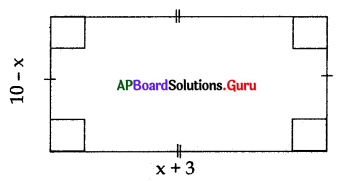
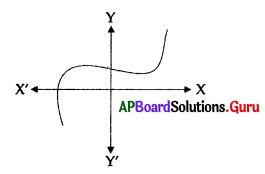
A) 0
B) 1
C) 2
D) 3
Answer:
D) 3

Question 16.
If α and β are the zeroes of the polynomial p(x) = 3x2 – x – 4, then αβ = ………………..
A) [latex]\frac{1}{3}[/latex]
B) -[latex]\frac{1}{3}[/latex]
C) [latex]\frac{4}{3}[/latex]
D) -[latex]\frac{4}{3}[/latex]
Answer:
D) -[latex]\frac{4}{3}[/latex]

AP 10th Class Maths Bits Chapter 3 Polynomials with Answers

Question 17.
If p(x) = 5x7 – 6x5 + 7x – 6, then the degree of p (x) is …………….
A) 0
B) 1
C) 5
D) 7
Answer:
D) 7

Question 18.
A factor of x3 – 3x2 + x + 1 is
A) x + 1
B) 2x – 1
C) 2x + 1
D) x – 1
Answer:
D) x – 1

Question 19.
The length of a rectangular dining hall is twice of its breadth. If x represents the breadth of the hall and its area is 5 sq. units, then the polynomial equation which represents the situation is
A) 5x2 – 2 = 0
B) 2x2 – 5 = 0
C) x2 – 25 = 0
D) None
Answer:
B) 2x2 – 5 = 0

Question 20.
The sum of the zeros of the polynomial p(x) = x2 + 7x + 10 is
A) 7
B) -7
C) 10
D) -10
Answer:
B) -7

Question 21.
If p(x) = 2x2 + 3x – 5, then p(2) =
A) 2
B) 9
C) 0
D) -5
Answer:
B) 9

Question 22.
If p (x) = 3x – k and p (1) = 0 then k =
A) 3
B) -3
C) -1
D) +1
Answer:
A) 3

Question 23.
The value of (x – √3)(x + √3) = ………………..
A) x2 + 3
B) x2 – 3
C) x + 9
D) x – 9
Answer:
B) x2 – 3

AP 10th Class Maths Bits Chapter 3 Polynomials with Answers

Question 24.
If α and β are the two zeroes of a polynomial x2 – 5x + 6 then the value of [latex]\frac{1}{a^{2}}+\frac{1}{\beta^{2}}[/latex] is ……………….
A) [latex]\frac{13}{36}[/latex]
B) [latex]\frac{17}{36}[/latex]
C) [latex]\frac{19}{36}[/latex]
D) [latex]\frac{23}{36}[/latex]
Answer:
A) [latex]\frac{13}{36}[/latex]

Question 25.
If α, β are the two zeroes of the polynomial f(x) = x2 – p (x +1) – c, then (α + 1)(β + 1) = …………………
A) c – 1
B) 1 – c
C) c
D) 1 + c
Answer:
B) 1 – c

Question 26.
If α and β are the roots of ax2 + bx + c = 0, then α3 + β3 =
A) [latex]\frac{3 a b c-b^{3}}{a^{3}}[/latex]
B) [latex]\frac{3 a b c-b^{3}}{c^{3}}[/latex]
C) [latex]\frac{b^{2}-3 a b c}{a^{3}}[/latex]
D) [latex]\frac{b^{2}-3 a b c}{c^{3}}[/latex]
Answer:
A) [latex]\frac{3 a b c-b^{3}}{a^{3}}[/latex]

Question 27.
The equation whose roots are obtained by adding 1 to those of 2x2 + 3x + 5 = 0 is
A) 2x2 – x – 4 = 0
B) 2x2 + x – 4 = 0
C) 2x22 – x + 4 = 0
D) None
Answer:
C) 2x22 – x + 4 = 0

Question 28.
If x + 1, x + 2 are two factors of x3 + 3x2 -2αx + β, then values of α + β is ……………………
A) – 1
B) 1
C) -2
D) 2
Answer:
A) – 1

Question 29.
If α, β are zeroes of the polynomial
ax2 + bx + c, then the value of [latex]\frac{1}{\alpha}+\frac{1}{\beta}[/latex] is…………………
A) [latex]\frac{-b}{a c}[/latex]
B) b = ac
C) [latex]\frac{-b}{c}[/latex]
D) [latex]-\sqrt{\frac{b}{a c}}[/latex]
Answer:
C) [latex]\frac{-b}{c}[/latex]

Question 30.
The value of ‘K’ for which 2x4 + 3x3 + 2Kx2 + 3x + 6 is exactly divisible by x + 2?
A) 1
B) -1
C) 2
D) -2
Answer:
B) -1

AP 10th Class Maths Bits Chapter 3 Polynomials with Answers

Question 31.
The degree of the polynomial 5x7 – 6x5 + 7x – 6 is
A) 4
B) 5
C) 6
D) 7
Answer:
D) 7

Question 32.
The zero of the linear polynomial px + q is ………………..
A) [latex]-\frac{q}{p}[/latex]
B) [latex]\frac{\mathrm{p}}{\mathrm{q}}[/latex]
C) [latex]-\frac{p}{q}[/latex]
D) q
Answer:
A) [latex]-\frac{q}{p}[/latex]

Question 33.
The quadratic polynomial, whose zeroes are 2 and 3, is
A) x2 – 5x – 6
B) x2 + 5x – 6
C) x2 – 5x + 6
D) x2 + 5x + 6
Answer:
C) x2 – 5x + 6

Question 34.
Which of the following is a polynomial with only one zero ?
A) p(x) = 2x2 – 3x + 4
B) p(x) = x2 – 2x + 1
C) p(x) = 2x + 3
D) p(x) = 5
Answer:
C) p(x) = 2x + 3

Question 35.
Observe the given rectangular figure, then its area in polynomial function is …………………..
AP 10th Class Maths Bits Chapter 3 Polynomials with Answers 6
A) A(x) = x2 + 7x + 30
B) A(x) = – x2 + 7x + 30
C) A(x) = x2 – 7x + 30
D) A (x) = -x2 – 7x + 30
Answer:
B) A(x) = – x2 + 7x + 30

Question 36.
For the expression f(x) = x3 + ax2 + bx + c if f(1) = f(2) = 0 and f(4) = f(0). Find the values of a, b, c.
A) a = -8, b = -20, c = 12
B) a = 9, b = -20, c = -12
C) a = -9, b = 20, c = -12
D) a = -8, b =. 20, c = -12
Answer:
C) a = -9, b = 20, c = -12

Question 37.
If (x4 + ax3 – 7x2 – 8x + b) is completely divisible by (x2 + 5x + 6). Then the values of a and b are ……………………..
A) a = 2, b = 8
B) a = -2, b = 6
C) a = 2, b = 12
D) a = 2, b = 14
Answer:
C) a = 2, b = 12

AP 10th Class Maths Bits Chapter 3 Polynomials with Answers

Question 38.
x3 + 2X2 + ax + b is exactly divisible by (x2 – 1). The values of a and b is ………………
A) a = -1, b = 2
B) a = 1, b = -2
C) a = 1, b = 2
D) a = -1, b = -2
Answer:
D) a = -1, b = -2

Question 39.
Find the remainder when x4 + 15x3 + 6x2 – 12x + 3 is divided by x + 2 ? ………………….
A) -53
B) 53
C) -52
D) 52
Answer:
A) -53

Question 40.
If x2 + x -1 is a factor of x4 + px3 + qx2 – 1 then the values of p and q can be …………………
A) 2, 1
B) -2, -1
C) -1,-2
D) 1, -2
Answer:
A) 2, 1

Question 41.
If the zeroes of the rational expression (ax + b) (3x + 2) are [latex]\frac{-2}{3}[/latex] and [latex]\frac{1}{2}[/latex] then a + b = …………………..
A) -1
B) 0
C) -b
D) 1
Answer:
C) -b

Question 42.
Simplify [latex]\frac{x+1}{x-1}+\frac{x-1}{x+1}-\frac{2 x^{2}-2}{x^{2}+1}[/latex]
A) [latex]\frac{4 x^{4}+2}{x^{4}-1}[/latex]
B) [latex]\frac{8 x^{2}}{x^{4}-1}[/latex]
C) [latex]\frac{4 x^{2}}{x^{4}-1}[/latex]
D) 1
Answer:
B) [latex]\frac{8 x^{2}}{x^{4}-1}[/latex]

Question 43.
Find f(4),f(-5),f (3.2) if f (x) = 6.2x2 – 4x3 + 4.28 ………………
A) f(4) = -152.53, f(-5) = 659.28, f(3.2) = 63.304
B) f(4) = -152.52, f(-5) = -659.28, f(3.2) = 63.304
C) f(4) = -152.52, f(-5) = 659.28, f(3.2) = -63.304
D) f(4) = -152.52, f(-5) = 659.27, f(3.2) = -63.304
Answer:
C) f(4) = -152.52, f(-5) = 659.28, f(3.2) = -63.304

Question 44.
The product of x3 + 2x2 – 3x + 4 and 2x2 – 5x + 1 is …………………
A) 2x5 – x4 – 15x3 + 25x2 – 23x + 4
B) 2x5 – x4 – 15x3 + 25x2 – 23x – 4
C) 2x5 – x4 – 15x3 – 25x2 – 23x – 4
D) 2x5 – x4 – 15x3 – 23x – 4
Answer:
A) 2x5 – x4 – 15x3 + 25x2 – 23x + 4

AP 10th Class Maths Bits Chapter 3 Polynomials with Answers

Question 45.
If A = [latex]\frac{x-1}{x+1}[/latex] then 2A – [latex]\frac{1}{2 A}[/latex] = ……………….
A) [latex]\frac{3 x^{2}-10 x-3}{2\left(x^{2}-1\right)}[/latex]
B) [latex]\frac{3 x^{2}-10 x+3}{2\left(x^{2}-1\right)}[/latex]
C) [latex]\frac{3 x^{2}+10 x+3}{2\left(x^{2}-1\right)}[/latex]
D) [latex]\frac{3 x^{2}-10 x+1}{x^{2}-1}[/latex]
Answer:
B) [latex]\frac{3 x^{2}-10 x+3}{2\left(x^{2}-1\right)}[/latex]

Question 46.
If P = [latex]\frac{x+1}{x-1}[/latex] and Q = [latex]\frac{x-1}{x+1}[/latex] then P2 + Q2 – 2PQ = …………………..
A) [latex]\frac{4 x^{4}+8 x^{2}+4}{x^{4}-2 x+1}[/latex]
B) [latex]\frac{4 x^{2}}{x^{4}+2 x^{2}+1}[/latex]
C) [latex]\frac{16 x^{2}}{x^{4}-2 x^{2}+1}[/latex]
D) [latex]\frac{8 x^{2}}{x^{4}-2 x^{2}+1}[/latex]
Answer:
C) [latex]\frac{16 x^{2}}{x^{4}-2 x^{2}+1}[/latex]

Question 47.
The rational expression A = [latex]\left(\frac{x+1}{x-1}-\frac{x-1}{x+1}-\frac{4 x}{x^{2}+1}\right)[/latex] is multiplied with the additive inverse of B = [latex]\frac{1-x^{4}}{4 x}[/latex] to get C, then C = ……………..
A) 2
B) [latex]\frac{2 x}{x^{4}-1}[/latex]
C) [latex]\frac{32 x^{2}}{x^{4}-1}[/latex]
D) 1
Answer:
A) 2

Question 48.
The product of additive inverse of [latex]\frac{x^{2}-1}{2 x}[/latex] and [latex]\frac{x^{2}-4}{3-x}[/latex] is …………………….
A) x2 + x – 6
B) x2 – x – 6
C) x2 – 5x + 6
D) x2 + 5x + 6
Answer:
A) x2 + x – 6

Question 49.
If (x – 1) and (x + 3) are the factors of x3 + 3x2 – x – 3 then the other factor is …………………
A) x + 1
B) x – 3
C) x + 2
D) x – 1
Answer:
A) x + 1

Question 50.
A rational expression whose numerator is a quadratic polynomial with zeroes, 1 and 2 and whose denominator is monomial with zero 3 is ………………….
A) [latex]\frac{x^{2}+x-2}{x+3}[/latex]
B) [latex]\frac{x^{2}-x-2}{x+3}[/latex]
C) [latex]\frac{x^{2}+x-2}{x-3}[/latex]
D) [latex]\frac{x^{2}-x-2}{x-3}[/latex]
Answer:
D) [latex]\frac{x^{2}-x-2}{x-3}[/latex]

Question 51.
Simplify [latex]\frac{\left(a^{2}-b^{2}\right)^{3}+\left(b^{2}-c^{2}\right)^{3}+\left(c^{2}-a^{2}\right)^{3}}{(a-b)^{3}+(b-c)^{3}+(c-a)^{3}}[/latex]
A) 1
B) 3(a + b) (b + c) (c + a)
C) (a + b) (b + c) (c + a)
D) 2(a + b) (b + c) (c + a)
Answer:
C) (a + b) (b + c) (c + a)

AP 10th Class Maths Bits Chapter 3 Polynomials with Answers

Question 52.
Find “a” and “b” in order that x3 – 6x2 + ax + b may be exactly divisible by x2 – 3x + 2.
A) a = 11, b = -5
B) a = 11, b = 6
C) a = 11, b = -6
D) a = -11, b = -5
Answer:
B) a = 11, b = 6

Question 53.
If g(x) = x6 + 3x4 – 24x2 + 3 find g(1), g(2) and g(3).
A) g(1) = -12, g(2) = 19, g(3) = 759
B) g(1) = 12, g(2) = 19, g(3) = 758
C) g(1) = -12, g(2) = -19, g(3) = -759
D) g(1) = -12, g(2) = -19, g(3) = 759
Answer:
A) g(1) = -12, g(2) = 19, g(3) = 759

Question 54.
If the zeroes of the rational expression (3x + 2a) (2x + 1) are [latex]\frac{-1}{2}[/latex] and [latex]\frac{\mathbf{b}}{3}[/latex] then the value of a is ……………………..
A) [latex]\frac{-b}{3}[/latex]
B) [latex]\frac{-b}{2}[/latex]
C) [latex]\frac{-2 b}{3}[/latex]
D) [latex]\frac{2 b}{3}[/latex]
Answer:
B) [latex]\frac{-b}{2}[/latex]

Question 55.
If ‘a’ and ‘b’ are unequal and x2 + ax + b and x2 + bx + a have a common factor, then a + b = ……………………
A) -1
B) 1
C) 0
D) 2
Answer:
A) -1

Question 56.
Find the quadratic polynomial in x, which when divided by (x – 1) (x – 2) and (x – 3) leaves remainders of 11, 22 and 37 …………………….
A) 2x2 + 5x + 4
B) 2x2 – 5x – 3
C) 3x2 – 5x + 4
D) 2x2 – 5x + 4
Answer:
A) 2x2 + 5x + 4

Question 57.
The sum of [latex]\left(\frac{x-1}{x+1}\right)[/latex] and its reciprocal is ……………………
A) [latex]\frac{x^{2}+1}{x^{2}-1}[/latex]
B) [latex]\frac{2\left(x^{2}+1\right)}{x^{2}-1}[/latex]
C) [latex]\frac{x^{2}-1}{x^{2}+1}[/latex]
D) [latex]\frac{2\left(x^{2}-1\right)}{x^{2}+1}[/latex]
Answer:
B) [latex]\frac{2\left(x^{2}+1\right)}{x^{2}-1}[/latex]

Question 58.
The value of 6a + 11b if x3 – 6x2 + ax + b is exactly divisible by (x2 – 3x + 2) is ………………………
A) 0
B) 66
C) 132
D) 1
Answer:
A) 0

AP 10th Class Maths Bits Chapter 3 Polynomials with Answers

Question 59.
If 4x4 -(a – 1) x3 + ax2 – 6x – 1 is divisible by 2x – 1, the value of a …………………..
A) 28
B) 29
C) 27
D) 26
Answer:
B) 29

Question 60.
If f(x) = x2 + 5x + p and g(x) = x2 + 3x + q have a common factor then (p – q)2 = ………………….
A) 2(3p – 5q)
B) 5p – 3q
C) 3p – 5q
D) 2(5p – 3q)
Answer:
A) 2(3p – 5q)

Question 61.
If (x – 4) is the HCF of p(x) = x2 – nx -12 and q(x) =x2 – mx – 8 then the simplest form of [latex]\frac{p(x)}{q(x)}[/latex] is …………………
A) [latex]\frac{x+2}{x+3}[/latex]
B) [latex]\frac{x+3}{x-2}[/latex]
C) [latex]\frac{x+3}{x+2}[/latex]
D) [latex]\frac{x-2}{x-3}[/latex]
Answer:
B) [latex]\frac{x+3}{x-2}[/latex]

Question 62.
Simplify [latex]\frac{x^{2}-(y-2 z)^{2}}{x-y+2 z}[/latex] + [latex]\frac{y^{2}-(2 x-z)^{2}}{y+2 x-z}[/latex] + [latex]\frac{z^{2}-(x-2 y)^{2}}{z-x+2 y}[/latex] is ……………………
A) 1
B) x + y + z
C) 0
D) x – y – z
Answer:
C) 0

Question 63.
If P= [latex]\frac{1+2 x}{1-2 x}[/latex] and Q = [latex]\frac{1-2 x}{1+2 x}[/latex] then [latex]\frac{P-Q}{P+Q}[/latex] = ………………..
A) [latex]-\frac{4 x}{1+4 x^{2}}[/latex]
B) [latex]\frac{1+4 x^{2}}{4 x}[/latex]
C) [latex]\frac{-(1+4 x)^{2}}{4 x}[/latex]
D) [latex]\frac{4 x}{1+4 x^{2}}[/latex]
Answer:
A) [latex]-\frac{4 x}{1+4 x^{2}}[/latex]

Question 64.
If α, β,γ are the zeroes of 3x3 – 5x2 – 11x – 3 then α + β + γ = ……………….
A) [latex]\frac{-5}{3}[/latex]
B) [latex]\frac{5}{3}[/latex]
C) [latex]\frac{-11}{3}[/latex]
D) 1
Answer:
B) [latex]\frac{5}{3}[/latex]

Question 65.
If x4 – 2x3 + 3x2 – mx + 5 is exactly divisible by (x – 3) then m = …………………
A) [latex]\frac{-40}{3}[/latex]
B) [latex]\frac{6}{40}[/latex]
C) -40
D) 40
Answer:
D) 40

AP 10th Class Maths Bits Chapter 3 Polynomials with Answers

Question 66.
Find the values of “a” and “b” so that (x + 2) and (x – 1) may be factors of x3 + 10x2 + ax + b.
A) a = 7,b = -18
B) a = 7, b = -17
C) a = 7, b = -15
D) a = 7, b = 17
Answer:
A) a = 7,b = -18

Question 67.
Simplify [latex]\frac{(x+y)^{2}-z^{2}}{(x+y+z)^{2}}[/latex] ÷ [latex]\left\{\frac{(x-z)^{2}-y^{2}}{x^{2}+x y+z x} \div \frac{(x-y)^{2}-z^{2}}{x^{2}-x y-z x}\right\}[/latex] …………………….
A) [latex]\frac{1}{x+y+z}[/latex]
B) 1
C) x + y + z
D) 2
Answer:
B) 1

Question 68.
The expression 2x3 + ax2 + bx – 2 leaves a remainder 7 and 0 when divided by (2x – 3) and (x + 2). Find the values of a and b.
A) a = 3, b = -3
B) a = -3, b = -3
C) a = -3, b = 3
D) a = 3, b = 3
Answer:
A) a = 3, b = -3

Question 69.
Find the value of k if the expressions
p(x) = kx3 + 4x2 + 3x – 4 and
q(x) = x3 – 4x + k leave the same remainder when divided by (x – 3)
A) k = -1
B) k = 4
C) k = 3
D) k = -2
Answer:
A) k = -1

Question 70.
If a + c + e = 0 and b + d = 0 then ax4 + bx3 + cx2 + dx + e is exactly divisible by ……………………….
A) x + 1
B) x – 1
C) (x + 1) and (x – 1)
D) (x + 2) and (x – 2)
Answer:
C) (x + 1) and (x – 1)

Question 71.
Simplify [latex]\frac{1}{1+x+x^{2}}[/latex] – [latex]\frac{1}{1-x+x^{2}}[/latex] + [latex]\frac{2 x}{1+x^{2}+x^{4}}[/latex] ………………
A) [latex]\frac{1}{1+x^{2}+x^{4}}[/latex]
B) 0
C) [latex]\frac{-1}{1+x^{2}+x^{4}}[/latex]
D) [latex]\frac{2 x-3}{1+x^{2}+x^{4}}[/latex]
Answer:
B) 0

Question 72.
What should be subtracted from x3 – 2x2 + 4x + 1 to get 1 ? ( )
A) x3 – 2x2 + 4x + 1
B) x3 + 2x2 + 4x + 1
C) x3 – 2x2 + 4x
D) x3 – 2x2 + 4x -1
Answer:
C) x3 – 2x2 + 4x

AP 10th Class Maths Bits Chapter 3 Polynomials with Answers

Question 73.
What should be subtracted from [latex]\frac{7 x}{x^{2}-x-12}[/latex] to get [latex]\frac{3}{x+3}[/latex] ?
A) [latex]\frac{1}{x-4}[/latex]
B) [latex]\frac{2}{x-4}[/latex]
C) [latex]\frac{4}{x-4}[/latex]
D) [latex]\frac{5}{x+4}[/latex]
Answer:
C) [latex]\frac{4}{x-4}[/latex]

Question 74.
If ax2 + 2a2x + b3 is divisible by (x + a) then …………………..
A) a2 + ab + b2 = 0
B) a = b
C) either a = b or a2 + ab + b2 = 0
D) neither a = b nor a2 + ab + b2 = 0
Answer:
C) either a = b or a2 + ab + b2 = 0

Question 75.
Which of the following expressions is a rational expression ?
A) [latex]\frac{5 x^{2}-\sqrt{6} x+7}{x+3}[/latex]
B) [latex]\frac{\sqrt{2} x^{2}-4 \sqrt{x}+5}{x-\sqrt{2}}[/latex]
C) x3 – √3x2 + √5x – 11
D) [latex]\frac{x^{2}+3}{2 \sqrt{x}-1}[/latex]
Answer:
C) x3 – √3x2 + √5x – 11

Question 76.
Express x – [latex]\frac{1}{x}[/latex] as a rational expression,
A) [latex]\frac{x^{2}-1}{x}[/latex]
B) [latex]\frac{1-x^{2}}{x}[/latex]
C) [latex]\frac{1-x}{x}[/latex]
D) [latex]\frac{x-1}{x}[/latex]
Answer:
A) [latex]\frac{x^{2}-1}{x}[/latex]

Question 77.
Which of the following expressions is a polynomial ?
A) 3x2 -2√5x + 7
B) [latex]\frac{x^{3}-2 x+1}{2 x+5}[/latex]
C) [latex]\frac{x^{2}-5 x+6}{x-3}[/latex]
D) [latex]\frac{x^{2}-2 x+1}{2 x+7}[/latex]
Answer:
C) [latex]\frac{x^{2}-5 x+6}{x-3}[/latex]

Question 78.
How much is a2 + 2ab + b2 more than a2 – 2ab + b2 ?
A) -4ab
B) 4ab
C) 6ab
D) -3ab
Answer:
B) 4ab

Question 79.
Which of the following is true ?
A) The sum of two rational expressions is always a rational expression
B) [latex]\frac{p(x)}{q(x)}[/latex] is in its lowest terms if LCM [p(x), q(x)] = 1.
C) The difference of two rational expressions is always a rational expression.
D) Reciprocal of [latex]\frac{-2 x}{x^{2}-1}[/latex] is [latex]\frac{x^{2}-1}{2 x}[/latex]
Answer:
A) The sum of two rational expressions is always a rational expression

AP 10th Class Maths Bits Chapter 3 Polynomials with Answers

Question 80.
Simplify [latex]\frac{a^{2}-(b-c)^{2}}{(a+c)^{2}-b^{2}}+\frac{b^{2}-(a-c)^{2}}{(a+b)^{2}-c^{2}}[/latex] + [latex]\frac{c^{2}-(a-b)^{2}}{(b+c)^{2}-a^{2}}[/latex]
A) a + b + c
B) [latex]\frac{1}{a+b+c}[/latex]
C) 1
D) 0
Answer:
C) 1

Question 81.
What should be subtracted from [latex]\left(\frac{2 x^{2}+2 x-7}{x^{2}+x-6}\right)[/latex] to get [latex]\left(\frac{x-1}{x+2}\right)[/latex]
A) [latex]\frac{x-2}{x-3}[/latex]
B) [latex]\frac{x+2}{x+3}[/latex]
C) [latex]\frac{x+2}{x-3}[/latex]
D) [latex]\frac{x-2}{x+3}[/latex]
Answer:
B) [latex]\frac{x+2}{x+3}[/latex]

Question 82.
The rational expression [latex][/latex] in lowest term is ……………………..
A) [latex]\frac{x-2}{y}[/latex]
B) [latex]\frac{x+1}{y}[/latex]
C) [latex]\frac{x+1}{x y}[/latex]
D) [latex]\frac{x-2}{y}[/latex]
Answer:
D) [latex]\frac{x-2}{y}[/latex]

Question 83.
The expression [latex]\frac{1}{1-x}-\frac{1}{1+x}-\frac{x^{3}}{1-x}+\frac{x^{2}}{1+x}[/latex] in lowest term is ……………………..
A) x2 + 2x
B) x2 – 2x
C) x2 + 2
D) 2x + 1
Answer:
A) x2 + 2x

Question 84.
Simplify [latex]\frac{81 x^{4}-16 x^{2}+32 x-16}{9 x^{2}-4 x+4}[/latex]
A) 9x2 – 2x – 8
B) 9x2 + 2x – 8
C) 9x2 – 4x – 4
D) 9x2 + 4x – 4
Answer:
D) 9x2 + 4x – 4

Question 85.
What should be added to [latex]\frac{1}{x^{2}-7 x+12}[/latex] to get [latex]\frac{2}{x^{2}-6 x+8}[/latex]
A)[latex]\frac{1}{x^{2}-5 x+6}[/latex]
B) [latex]\frac{-1}{x^{2}+5 x-6}[/latex]
C) [latex]\frac{4}{(x+3)(x+2)}[/latex]
D) [latex]\frac{2}{(x+3)(x-2)}[/latex]
Answer:
A)[latex]\frac{1}{x^{2}-5 x+6}[/latex]

Question 86.
Express [latex]\frac{2 x^{3}-54}{x^{3}+3 x^{2}+9 x}[/latex] in lowest terms
A) [latex]\frac{2 x-6}{x}[/latex]
B) [latex]\frac{2(x-4)}{x^{2}}[/latex]
C) [latex]\frac{2(4-x)}{x}[/latex]
D) [latex]\frac{6-2 x}{x}[/latex]
Answer:
A) [latex]\frac{2 x-6}{x}[/latex]

Question 87.
What should be added to [latex]\frac{4 x}{x^{2}-1}[/latex] to get [latex]\frac{x+1}{x-1}[/latex] ?
A) [latex]\frac{x-1}{x^{2}-1}[/latex]
B) [latex]\frac{x-1}{x+1}[/latex]
C) [latex]\frac{x^{2}-1}{x+1}[/latex]
D) [latex]\frac{x^{2}+1}{x+1}[/latex]
Answer:
B) [latex]\frac{x-1}{x+1}[/latex]

AP 10th Class Maths Bits Chapter 3 Polynomials with Answers

Question 88.
xn – y is divisible by (x – y) when n is ………………….
A) a prime number
B) an odd number
C) an even number
D) a natural number
Answer:
D) a natural number

Question 89.
Express [latex]\frac{\left(x^{3}+y^{3}+z^{3}-3 x y z\right)}{\left(x^{2}+y^{2}+z^{2}-x y-y z-z x\right)}[/latex] in lowest terms.
A) x + y + z
B) x + y- z
C) x – y + z
D) x – y – z
Answer:
A) x + y + z

Question 90.
Which of the following algebraic expressions are not polynomials ?
1) x3 + 2x3 + √7x + 4
2) 5x2 + √4x – 11
3) [latex]\frac{x^{3}+3 x^{2}-8 x+11}{4 x \sqrt{x}-3 x+3}[/latex]
4) [latex]\frac{x^{3}+3 x^{2}-6 x+13}{x^{2}+1}[/latex]
A) 1, 2 and 3
B) 1 and 3
C) 2 and 3
D) 1 and 4
Answer:
C) 2 and 3

Question 91.
Simplify [latex]\frac{x+2}{x-2}+\frac{x-2}{x+2}-\frac{3 x^{2}-3}{x^{2}+4}[/latex]
A)[latex]-\frac{x^{4}-21 x^{2}+20}{x^{4}-16}[/latex]
B) [latex]\frac{x^{4}+31 x^{2}+20}{x^{4}-16}[/latex]
C) [latex]\frac{x^{4}+31 x^{2}+20}{x^{4}-16}[/latex]
D) [latex]\frac{-x^{4}+31 x^{2}+20}{x^{4}-16}[/latex]
Answer:
D) [latex]\frac{-x^{4}+31 x^{2}+20}{x^{4}-16}[/latex]

Question 92.
What should be added to [latex]\frac{2}{x^{2}+x-6}[/latex] get [latex]\frac{-4 x}{\left(x^{2}-4\right)\left(x^{2}-9\right)}[/latex]
A) [latex]\frac{-2}{x^{2}-x-6}[/latex]
B) [latex]\frac{4 x}{x^{2}+x+6}[/latex]
C) [latex]\frac{-3}{x^{2}+x+6}[/latex]
D) [latex]\frac{4}{x^{2}-x-6}[/latex]
Answer:
A) [latex]\frac{-2}{x^{2}-x-6}[/latex]

Question 93.
Simplify [latex]\frac{3 x+2}{x^{2}-16}+\frac{x-5}{(x+y)^{2}}[/latex]
A)[latex]\frac{4 x^{2}+5 x+28}{x^{3}+4 x^{2}+16 x-64}[/latex]
B) [latex]\frac{4 x^{2}+5 x+28}{x^{3}-4 x^{2}-16 x-64}[/latex]
C) [latex]\frac{4 x^{2}+5 x-28}{x^{3}-4 x^{2}-16 x-64}[/latex]
D) [latex]\frac{4 x^{2}+5 x+28}{x^{3}+4 x^{2}-16 x-64}[/latex]
Answer:
D) [latex]\frac{4 x^{2}+5 x+28}{x^{3}+4 x^{2}-16 x-64}[/latex]

Question 94.
The additive inverse of 3x – 4 + [latex]\frac{x}{2 x-1}[/latex] is …………………
A) -3x + 4 + [latex]\frac{x}{2 x-1}[/latex]
B) -3x + 4 – [latex]\frac{x}{1-2 x}[/latex]
C) -3x + 4 – [latex]\frac{x}{2 x-1}[/latex]
D) -3x + 4 – [latex]\frac{x}{2 x+1}[/latex]
Answer:
C) -3x + 4 – [latex]\frac{x}{2 x-1}[/latex]

AP 10th Class Maths Bits Chapter 3 Polynomials with Answers

Question 95.
Which of the following is not a quadratic polynomial?
A) (x – 2) (x + 2) – (x2 + 5x)
B) 1 – (x2 – 2x)
C) x2 – 5x – 6
D) x2 + 5x + 6
Answer:
A) (x – 2) (x + 2) – (x2 + 5x)

Question 96.
Which of the following polynomials is in standard form ?
A) 24x3 – 14x2 – 39x + 20
B) 20 – 39x – 14x2 + 24x3
C) 24x3 – 39x – 14x2 + 20
D) 24x3 – 39x – 14x2 + 28x3
Answer:
A) 24x3 – 14x2 – 39x + 20

Question 97.
Which of the following is not a zero of the polynomial x3 – 6x2 + 11x – 6?
A) 1
B) 2
C) 3
D) 0
Answer:
D) 0

Question 98.
The graph of y = ax2 + bx + c is called
A) line
B) axis
C) polynomial
D) parabola
Answer:
D) parabola

Question 99.
Which of the following is not a polynomial?
A) [latex]x^{\frac{3}{4}}[/latex] – 7x + 4
B) x4 – 3x + 2
C) 2 – 3y + 6y2 – 2y3
D) 5x2 – 6x + 3
Answer:
A) [latex]x^{\frac{3}{4}}[/latex] – 7x + 4

Question 100.
For the polynomials p(x) and q(x)
A) LCM and HCF are not equal
B) Cannot be determined
C) LCM and HCF are equal
D) Can be determined
Answer:
C) LCM and HCF are equal

Question 101.
xn + yn is divisible by (x + y) when ‘n’ is ……………….
A) a natural number
B) a prime number
C) an odd number
D) an even number
Answer:
C) an odd number

AP 10th Class Maths Bits Chapter 3 Polynomials with Answers

Question 102.
A linear polynomial from the following is ………………………
A) ax + b
B) bx2 + c
C) ax3 + bx2 + cx + e
D) ax2 + bx + c
Answer:
A) ax + b

Question 103.
No. of zeroes of (x – 3)2 is ………………..
A) 4
B) 2
C) 3
D) 1
Answer:
D) 1

Question 104.
The polynomial 2x – 1 cuts X axis at ……………….
A) (-2, 0)
B) (0, 1)
C ([latex]\frac {1}{2}[/latex] , 0)
D)(-3, 0)
Answer:
C ([latex]\frac {1}{2}[/latex] , 0)

Question 105.
Number of zeroes of x2 – 7x + 12 is ……………….
A) 4
B) 7
C) 2
D) 1
Answer:
C) 2

Question 106.
The product of two consecutive numbers is 56. Find ……………….
A) -8, -7
B) 8, -7
C) -8, 7
D) 8, 7
Answer:
A) -8, -7

Question 107.
If we divide 36x2 – 12x + 1- 49y2 by 6x + 7y -1, then the quotient is ………………
A) 6x + 1 + 7y
B) 6x – 1 – 7y
C) 6x + 2 + 7y
D) -6x -1 – 7y
Answer:
B) 6x – 1 – 7y

AP 10th Class Maths Bits Chapter 3 Polynomials with Answers

Question 108.
The zeroes of ax2 + bx + c; a ≠ 0 is ………………
A) x = [latex]\frac{-b \pm \sqrt{b^{2}-4 a c}}{2 a}[/latex]
B) x = [latex]\frac{b-\sqrt{b^{2}-a c}}{2}[/latex]
C) x = [latex]\frac{-a-\sqrt{b^{2}-4}}{a}[/latex]
D) x = [latex]\frac{-b-\sqrt{a^{2}-b}}{2}[/latex]
Answer:
A) x = [latex]\frac{-b \pm \sqrt{b^{2}-4 a c}}{2 a}[/latex]

Question 109.
If the polynomial has only one zero its cuts X axis at ……………………. point.
A) 4
B) 2
C) 3
D) 1
Answer:
D) 1

Question 110.
Maximum number toots of a cubic polynomial is …………………
A) 2
B) 4
C) 3
D) 5
Answer:
C) 3

Question 111.
[latex]\frac{1}{x^{2}+1}[/latex] is a …………………..
A) Polynomial
B) Binomial
C) Multinomial
D) 0
Answer:
C) Multinomial

Question 112.
For the graph of y = p(x) given below where p(x) is the polynomial, the number of zeroes of p(x) is ………………..
AP 10th Class Maths Bits Chapter 3 Polynomials with Answers 7
A) 0
B) 3
C) 2
D) 1
Answer:
D) 1

Question 113.
Which of the following graph represents a straight line ?
AP 10th Class Maths Bits Chapter 3 Polynomials with Answers 8
Answer:
AP 10th Class Maths Bits Chapter 3 Polynomials with Answers 9

Question 114.
How many zeroes are there for the polynomial from the given graph ?
AP 10th Class Maths Bits Chapter 3 Polynomials with Answers 10
A) 4
B) 3
C) 1
D) 2
Answer:
B) 3

Question 115.
The graph of y = x2 may be ………………….
AP 10th Class Maths Bits Chapter 3 Polynomials with Answers 11
Answer:
AP 10th Class Maths Bits Chapter 3 Polynomials with Answers 12

AP 10th Class Maths Bits Chapter 3 Polynomials with Answers

Question 116.
If the polynomial has no real zeroes then the graph can be represented as ………………
AP 10th Class Maths Bits Chapter 3 Polynomials with Answers 13
Answer:
AP 10th Class Maths Bits Chapter 3 Polynomials with Answers 14

Question 117.
-x2 = y can be represented as …………………..
AP 10th Class Maths Bits Chapter 3 Polynomials with Answers 15
Answer:
AP 10th Class Maths Bits Chapter 3 Polynomials with Answers 16

Question 118.
Which of the following is a parabola
AP 10th Class Maths Bits Chapter 3 Polynomials with Answers 17
Answer:
AP 10th Class Maths Bits Chapter 3 Polynomials with Answers 18

Question 119.
If the quadratic polynomial has only one zero the graph may be ……………..
AP 10th Class Maths Bits Chapter 3 Polynomials with Answers 19
Answer:
AP 10th Class Maths Bits Chapter 3 Polynomials with Answers 20

AP 10th Class Maths Bits Chapter 2 Sets with Answers

Practice the AP 10th Class Maths Bits with Answers Chapter 2 Sets on a regular basis so that you can attempt exams with utmost confidence.

AP State Syllabus 10th Class Maths Bits 2nd Lesson Sets with Answers

Question 1.
From the Venn diagram, A ∪ B = …………….
AP 10th Class Maths Bits Chapter 2 Sets with Answers 1
A) {5, 6}
B) {5, 6, 7, 8}
C) Φ
D) {7,8}
Answer:
B) {5, 6, 7, 8}

Question 2.
If A ⊆ B, then which one of following is false ?
A) A – B = A
B) B – A ≠ Φ
C) A ∪ B = B
D) A ∩ B = A
Answer:
B) B – A ≠ Φ

AP 10th Class Maths Bits Chapter 2 Sets with Answers

Question 3.
If A ⊂ B, then A ∩ B = ……………….
A) A
B) B
C) Φ
D) µ
Answer:
A) A

Question 4.
The number of subsets of a set is 16, then the set has …………………. elements.
A) 1
B) 2
C) 3
D) 4
Answer:
D) 4

Question 5.
{x: x is a prime number and a divisor of 6} =…………………..
A) {1, 2, 3, 6}
B) {1, 2, 3}
C) {2, 3}
D) {2, 3, 6}
Answer:
C) {2, 3}

Question 6.
Number of subsets of the set A = {1, 2, 3, 4} is ………………
A) 4
B) 8
C) 12
D) 16
Answer:
D) 16

Question 7.
If A = {x : x is a letter in the word HEADMASTER}; then its Roster form is ……………………
A) A = {h, e, a, d, m, a, s, t, e, r}
B) A = {h, e, a, d, m, s, t, r}
C) A = {h, e, a, d, m, s, t, e, r}
D) A = {h, e, a, d, m, a, s, t, r}
Answer:
B) A = {h, e, a, d, m, s, t, r}

Question 8.
The following Venn diagram indicates ………………
AP 10th Class Maths Bits Chapter 2 Sets with Answers 2
A) A ⊂ B
B) B ⊂ A
C) A, B are disjoint sets
D) µ ⊂ B
Answer:
A) A ⊂ B

Question 9.
If n(A) = 12 and n(A ∩ B) = 5, then find n(A – B) = …………………
A) 4
B) 7
C) 17
D) 0
Answer:
B) 7

AP 10th Class Maths Bits Chapter 2 Sets with Answers

Question 10.
If A ⊂ B then (A ∪ B) – A = ……………………..
A) B
B) Φ
C) A
D) B – A
Answer:
D) B – A

Question 11.
If A ⊂ B and B ⊂ C then ……………………
A) A ⊂ C
B) C ⊂ A
C) A = C
D) B = A
Answer:
A) A ⊂ C

Question 12.
If A = {x/x∈N and 1 < x < 6}, then n(A) =
A) 6
B) 5
C) 4
D) 2
Answer:
C) 4

Question 13.
S = [latex]\left\{3, \pi, \sqrt{2},-5,3+\sqrt{7}, \frac{2}{7}\right\}[/latex]. Which of the following is a sub-set of ‘S’ containing all irrational numbers ?
A) [latex]\left\{3, \pi, \frac{2}{7},-5,3+\sqrt{7}\right\}[/latex]
B) [latex]\{3+\sqrt{7}, \sqrt{2}, \pi\}[/latex]
C) [latex]\{3, \pi, \sqrt{2}\}[/latex]
D) [latex]\left\{3,-5, \frac{2}{7}\right\}[/latex]
Answer:
B) [latex]\{3+\sqrt{7}, \sqrt{2}, \pi\}[/latex]

Question 14.
The symbol for an empty set is
A) : :
B) Φ
C) :Φ:
D) A or B
Answer:
B) Φ

Question 15.
If A ∩ B = Φ, then the sets A, B are
A) equal sets
B) sub sets
C) disjoint sets
D) equivalent sets
Answer:
C) disjoint sets

Question 16.
If A = {1, 2, 3, 4, 5} and B = {4, 5, 6, 7], then A – B =
A) {4, 5}
B) {6,7}
C) {1, 2, 3}
D) {1, 2, 3, 4, 5, 6, 7}
Answer:
C) {1, 2, 3}

AP 10th Class Maths Bits Chapter 2 Sets with Answers

Question 17.
Among the following, a null set is (where N is the set of natural numbers)
A) {x : x < 5 and x ∈ N)
B) {x : x2 = 4, x ∈ N}
C) {x : x2 + 1 = 0 x ∈ N}
D) {x : x is even prime}
Answer:
C) {x : x2 + 1 = 0 x ∈ N}

Question 18.
If A ⊂ B, then A – B =
A) B
B) Φ
C) A
D) B – A
Answer:
B) Φ

Question 19.
If A = {1, 2, 3, 4, 5, 6}, B = {4, 5, 6, 7, 8}, C = {4, 5, 6}, then A ∩ B =
A) A
B) B
C) C
D) None
Answer:
C) C

Question 20.
If A and B are subsets of a universal set μ, then A ∩ Bc =
A) A – B
B) A∪B
C) Φ
D) μ
Answer:
A) A – B

Question 21.
If n(A) = 15, n(B) = 10, n(A ∩ B) = 5, then n(A ∪ B) =
A) 5
B) 15
C) 20
D) 25
Answer:
C) 20

Question 22.
If A ⊂ B and B ⊂ C, then (A ∩ B) ∪ C =
A) Φ
B) A
C) B
D) C
Answer:
D) C

Question 23.
If A = {x/x∈N, 3 ≤ x ≤ 6}, then A =
A) {3, 4, 5}
B) {3, 4, 5, 6}
C) {4, 5}
D) {4, 5, 6}
Answer:
B) {3, 4, 5, 6}

AP 10th Class Maths Bits Chapter 2 Sets with Answers

Question 24.
If A = [x/x is an even natural number less than 12} and B = {x/x is a prime number less than 12}, then A∩B=
A) {2, 4, 6, 8, 10}
B) {2, 3, 5, 7}
C) Φ
D) {2}
Answer:
D) {2}

Question 25.
The set builder form of the set [latex]\left\{1, \frac{2}{7}, \frac{3}{17}, \frac{4}{31}, \frac{5}{49}\right\}[/latex] is …………………
A) [latex]\left\{\frac{x}{x^{2}-1} / x \in N ; x \leq 5\right\}[/latex]
B) [latex]\left\{\frac{x}{2 x^{2}-1} / x \in N ; x<5\right\}[/latex]
C) [latex]\left\{\frac{x}{2 x^{2}-1} / x \in N ; x \leq 5\right\}[/latex]
D) [latex]\left\{\frac{x}{x^{3}-1} / x \in N ; x \leq 5\right\}[/latex]
Answer:
C) [latex]\left\{\frac{x}{2 x^{2}-1} / x \in N ; x \leq 5\right\}[/latex]

Question 26.
If A and B are two sets then (A – B) ∩ (B – A) =
A) A
B) B
C) A Δ B
D) Φ
Answer:
D) Φ

Question 27.
The following Venn-diagram design represented by C equals to
AP 10th Class Maths Bits Chapter 2 Sets with Answers 3
A) {1, 2, 5, 6}
B) {6, 5}
C) {4, 5, 6, 7}
D) {2, 5, 6}
Answer:
C) {4, 5, 6, 7}

Question 28.
The shaded area in the figure is
IM4
A) A ∩ (B ∪ C)
B) A ∩ (B ∩ C)
C) A ∪ (B ∩ C)
D) A ∪ (B ∪ C)
Answer:
A) A ∩ (B ∪ C)

Question 29.
If A is a subset of B, then A – B = ………………..
A) A
B) B
C) B – A
D) Φ
Answer:
D) Φ

Question 30.
Set builder form of {1, 3, 5, 7…. 19}
A) {x/x is odd number and x ≤ 19}
B) {2x/x ∈ N,x ≤ 1}
C) {x + 2/x ∈ N}
D) {x/x is even number and x > 19}
Answer:
A) {x/x is odd number and x ≤ 19}

Question 31.
Which one of the following sets are equal?
A) A = {1, 0}; B = {a, b}
B) C = {0, a}; D = {b, 0}
C) E = {4, 8, 12}; F = {8, 12, 4}
D) G = {2, 5}; H = {5, 2, 1}
Answer:
C) E = {4, 8, 12}; F = {8, 12, 4}

AP 10th Class Maths Bits Chapter 2 Sets with Answers

Question 32.
The symbol for “implies” is ……………….
A) ⇒
B) ⇔
AP 10th Class Maths Bits Chapter 2 Sets with Answers 5
D) ∃
Answer:
A) ⇒

Question 33.
Two sets A and B are said to be disjoint, if ………………….
A) A ∪ B = Φ
B) A – B = Φ
C) B – A = Φ
D) A ∩ B = Φ
Answer:
D) A ∩ B = Φ

Question 34.
In Venn diagram given below:
AP 10th Class Maths Bits Chapter 2 Sets with Answers 6
A) A ∪ B = Φ
B) A ∪ B = μ
C) A ∩ B = μ
D) A ∩ B = Φ
Answer:
D) A ∩ B = Φ

Question 35.
Set A = {F, L, W, O} which of the following is not a set-builder form for set A ?
A) {x : x is a letter from the word ‘FOLLOW’}
B) {x:x is a letter from the word’FLOW’}
C) {x: x is a letter from the word ‘WOLF’}
D) {x: x is a letter from the word ‘SLOW’}
Answer:
D) {x: x is a letter from the word ‘SLOW’}

Question 36.
If A = {1, 2, 2, 1, 3, 4, 3, 4}, then n(A) =
A) 8
B) 0
C) 4
D) 20
Answer:
C) 4

Question 37.
A = Set of divisors of 3, B = Set of divisors of 6, C = Set of divisors of 2, then
A) A ⊆ C
B) C ⊆ B
C) B ⊆ A
D) A ⊆ B
Answer:
C) B ⊆ A

AP 10th Class Maths Bits Chapter 2 Sets with Answers

Question 38.
If A = {1, 2, 3} , then the number of elements in p(A) is
A) 6
B) 3
C) 8
D) 0
Answer:
C) 8

Question 39.
If n(A) = 5, then n[p(A)] =
A) 0
B) 5
C) 32
D) 25
Answer:
C) 32

Question 40.
If A is any set such that n[p(A)] = 64, then n(A) =
A) 6
B) 16
C) 32
D) 8
Answer:
A) 6

Question 41.
If p(A) contains 128 elements, then the number of elements in A is
A) 32
B) 7
C) 16
D) 64
Answer:
B) 7

Question 42.
If A = {1, 2, 3}, B = {2, 3, 4}, then A ∪ B =
A) {4}
B) {2, 3}
C) {1, 2, 3, 4}
D) {1}
Answer:
C) {1, 2, 3, 4}

Question 43.
If A = {1, 2, 3}, B = {2, 3, 4}, then A ∩ B =
A) {1, 2, 3, 4}
B) {4}
C) {1}
D) {2, 3}
Answer:
D) {2, 3}

Question 44.
If A = {1, 2, 3, 4}, B = {2, 4, 6, 8}, C = {3, 4, 5, 8}, then A∩B∩C =
A) {4}
B) {2, 4}
C) μ
D) Φ
Answer:
A) {4}

AP 10th Class Maths Bits Chapter 2 Sets with Answers

Question 45.
If A = {x : x is a factor of 15}, B = |x : x is a factor of 18}, then A∩B =
A) {1, 3}
B) {1, 3, 5, 15}
C) {1, 2, 3, 6, 9, 18}
D) {5, 15}
Answer:
A) {1, 3}

Question 46.
If A = {1, 2, 3}, B = {2, 3, 4}, then A – B =
A) {4}
B) {1}
C) {2, 3}
D) {1, 2, 3, 4}
Answer:
B) {1}

Question 47.
If A = {1,2, 3}, B = {2, 3,4}, then B – A =
A) {1, 2, 3, 4}
B) {2, 3}
C) {4}
D) {1}
Answer:
C) {4}

Question 48.
If A = {1, 2, 3, 4}, B = {2, 4, 6, 8}, C = {3, 4, 5, 8}, then A – (B ∪ C) =
A) {1}
B) μ
C) A
D) Φ
Answer:
A) {1}

Question 49.
If A = {3, 5, 7, 9, 4}, B = {1, 3, 5}, C = {2, 4, 6, 7} then A – (B ∩ C) =
A) C
B) A
C) B
D) Φ
Answer:
B) A

Question 50.
If A = {3, 5, 7, 9}, B = {1, 3, 5}, μ = {1, 2, 3, 4, 5 , 7, 9} then (A ∪ B)’ =
A) {2, 4, 6, 8}
B) {1, 2, 4, 7, 9}
C) Φ
D) {2, 4}
Answer:
D) {2, 4}

Question 51.
If μ = {1, 2, 3, 4, 5, 6, 7, 8} A = {1, 2, 4, 5, 6} then A’ =
A) {3, 7}
B) {3, 7, 8}
C) {7, 8}
D) {5, 6, 8}
Answer:
B) {3, 7, 8}

AP 10th Class Maths Bits Chapter 2 Sets with Answers

Question 52.
If n(A) = 20, n(B) = 44, n(A ∪ B) = 51, then n(A ∩ B) =
A) 24
B) 22
C) 13
D) 39
Answer:
C) 13

Question 53.
If n(A) = 20, n(B) = 44 , n(A ∩ B) = 13 then n(A ∪ B) =
A) 24
B) 51
C) 22
D) 59
Answer:
B) 51

Question 54.
If n(A) = 35, n(B) = 25, n(A ∪ B) = 45, then n(A ∩ B) =
A) 20
B) 25
C) 10
D) 15
Answer:
D) 15

Question 55.
If n(A) = 37, n(B) = x, n(A ∪ B) = 52, n(A ∩ B) = 8, then x =
A) 23
B) 15
C) 29
D) 44
Answer:
A) 23

Question 56.
If A ⊆ B , n(A) = 21 , n(B) = 41, then n(A ∪ B)=
A) 62
B) 41
C) 21
D) 20
Answer:
B) 41

Question 57.
If A ⊆ B, n(A) = 25, n(B) = 35, then n(A ∩ B) =
A) 60
B) 25
C) 10
D) 35
Answer:
D) 35

Question 58.
If n(A) = 12, n(B) = 16, n(C) = 21,
n(A ∩ B) = 5, n(A ∩ C) = 8,
n(B ∩ C) = 12, n(A ∩ B ∩ C) = 3, then n(A ∪ B ∪ C) =
A) 27
B) 34
C) 31
D) 59
Answer:
A) 27

AP 10th Class Maths Bits Chapter 2 Sets with Answers

Question 59.
If A = {prime numbers} , B = {even numbers}, then n(A ∩ B) =
A) Φ
B) 2
C) 1
D) 0
Answer:
C) 1

Question 60.
90 students take Mathematics, 72 take Science in a class of 120 students. If 10 take neither Mathematics nor Science then the number of students take both the subjects is
A) 110
B) 100
C) 52
D) 162
Answer:
C) 52

Question 61.
Let μ = all triangles , A = all isosceles triangles, B = all equilateral triangles, C = all right angle triangles, then the angles belongs to the set A∩C is
A) 90°, 30°, 60°
B) 90°, 45°, 45°
C) 60°, 60°, 60°
D) 50°, 60°, 70°
Answer:
B) 90°, 45°, 45°

Question 62.
In a school of 214 students 134 takes tea, 134 takes coffee. Then how many takes only tea or coffee
A) 170
B) 180
C) 54
D) 160
Answer:
D) 160

Question 63.
Which of the following is an empty set?
A) {0}
B) The set of all even prime numbers
C) The set of all natural numbers less than 1
D) {Φ}
Answer:
C) The set of all natural numbers less than 1

Question 64.
If A = {1, 2, 3, 4}, B = {x, y, z, w} then A and B are
A) Empty sets
B) Equal sets
G) Complementary sets
D) Equivalent sets
Answer:
D) Equivalent sets

Question 65.
Which of the following is not a set ?
A) The collection of all intelligent boys in a class
B) The collection of all boys of age greater than 10 years
C) The collection of all boys of height less than 100 cms
D) The collection of all girls in a class
Answer:
A) The collection of all intelligent boys in a class

Question 66.
Which of the following is an infinite set?
A) The set of all natural numbers from 1 to 1 crore
B) The set of all multiples of 5
C) The set of all natural numbers less than 100
D) The set of all divisors of 240
Answer:
B) The set of all multiples of 5

AP 10th Class Maths Bits Chapter 2 Sets with Answers

Question 67.
Which of the following is not a subset of {2, 3, 5, 7} ?
A) {3, 5}
B) {2, 3, 5}
C) {3, 5, 7}
D){1, 3, 5}
Answer:
D){1, 3, 5}

Question 68.
If n(A) = 8, n(B) = 5, then
A) A ⊆ B
B) B ⊆ A
C) There exists three elements in A which are not in B
D) A ⊇ B
Answer:
D) A ⊇ B

Question 69.
Which of the following sets has only one subset ?
A) {0, 1}
B) {0}
C) {1}
D) { }
Answer:
A) {0, 1}

Question 70.
Two sets A and B are disjoint sets, if and only if
A) A ∩ B = B
B) A – B = A
C) A – B = Φ
D) A ∪ B = Φ
Answer:
B) A – B = A

Question 71.
If A and B are disjoint, then A ∩ (B ∩ C) =
A) μ
B) A
C) Φ
D) B
Answer:
C) Φ

Question 72.
If A ⊂ B, then A ∪ B=
A) A
B) μ
C) Φ
D) B
Answer:
D) B

Question 73.
If A ⊂ B, then A ∩ B =
A) Φ
B) A
C) μ
D) B
Answer:
B) A

AP 10th Class Maths Bits Chapter 2 Sets with Answers

Question 74.
A is a set . Which of the following is false? ‘
A) A ∩ A = A
B) A ∪ A = A
C) A ∩ Φ = A
D) A ∪ Φ = A
Answer:
C) A ∩ Φ = A

Question 75.
If A = {Rectangles}, B = {Rhombuses}, then A ∪ B =
A) {Rhombuses}
B) {Rectangles}
C) {Squares}
D) {Triangles}
Answer:
B) {Rectangles}

Question 76.
If A = {Rhombuses}, B = {Rectangles}, then A ∩ B =
A) {Parallelograms}
B) {Rhombuses}
C) {Squares}
D) {Rectangles}
Answer:
C) {Squares}

Question 77.
If A “{Equilateral triangles}, B = {Right angled triangles} and C = {Isosceles triangles}, then
A) A ∩ C = Φ
B) A ∩ B = Φ
C) B ∩ C = Φ
D) None
Answer:
D) None

Question 78.
If l,s are two straight lines and l ∩ s = Φ then l and s are
A) parallel
B) coincide
C) perpendicular
D) similar
Answer:
A) parallel

Question 79.
Which of the following is correct? :
A) (A ∪ B)’ = A’ ∩ B’
B) (A ∪ B)’=A ∪ B
C) (A ∪ B)’ = A’ ∩ B
D) (A ∪ B)’ = A ∪ B’
Answer:
A) (A ∪ B)’ = A’ ∩ B’

Question 80.
Which of the following is false ?
A) A ∩ A’= Φ
B) A ∩ Φ = Φ
C) A ∩ μ = μ
D) A ∩ A = A
Answer:
C) A ∩ μ = μ

AP 10th Class Maths Bits Chapter 2 Sets with Answers

Question 81.
If A ⊆ B, then
A) B1 ⊆ A1
B) B ⊆ A1
C) A ⊆ B1
D) A1 ⊆ B1
Answer:
A) B1 ⊆ A1

Question 82.
If A ∪ B = Φ then
A) A = Φ or B = Φ
B) A = Φ
C) A = Φ and B = Φ
D) B = Φ
Answer:
C) A = Φ and B = Φ

Question 83.
If (A – B) ⊆ (B – A) then
A) B ⊆ A
B) A ∪ B = C
C) A – B = B – A
D) A ⊆ B
Answer:
D) A ⊆ B

Question 84.
If A, B are two sets then which of the following is false ?
A) A – (A – B) = A ∩ B
B) A – B’ = A ∩ B
C) A ⊂ B ⇒ B’ ⊆ A’
D) A – B = B- A
Answer:
D) A – B = B- A

Question 85.
If n(A) = 8, n(B) = 5 then minimum number of elements in A ∪ B is …………….
A) 9
B) 8
C) 13
D) 5
Answer:
B) 8

Question 86.
Let p be the set of all prime numbers between 0 and 100 then cordinality of p is ………………..
A) 50
B) 101
C) 25
D) 24
Answer:
C) 25

Question 87.
If A = {2, 3, 4, 5}, B ={3, 4, 5}, C – {2, 5} then which of the following is null set?
A) B ∩ C
B) A – B
C) (B ∩ C) – A
D) B – C
Answer:
C) (B ∩ C) – A

AP 10th Class Maths Bits Chapter 2 Sets with Answers

Question 88.
An object of a set is called
A) element
B) subject
C) number
D) alphabet
Answer:
A) element

Question 89.
{x: x ∈ N, x lies between 5 and 12} =
A) {5, 6, ……………. 12}
B) {6, 8, 10}
C) {5, 12}
D) {6, 7, 8, 9, 10, 11}
Answer:
D) {6, 7, 8, 9, 10, 11}

Question 90.
Empty set is
A) Not exist
B) Unique
C) Infinite
D) Unique if it exists
Answer:
B) Unique

Question 91.
The number of elements in the empty set is
A) 1
B) 0
C) ∞
D) Φ
Answer:
B) 0

Question 92.
If n(A) represents the number of elements in the set A, the number of proper subsets of A are
A) 2 × n
B) 2n – 1
C) n × A
D) 2n
Answer:
B) 2n – 1

Question 93.
A ∪ B =
A) {x : x ∉ A or x ∈ B}
B) {x : x ∈ A or x ∈ B}
C) {x : x ∈ A, x ∈ B}
D) {x : x ∈ A or x ∉ B}
Answer:
B) {x : x ∈ A or x ∈ B}

Question 94.
A ∩ B =
A) {x : x ∈ A or x ∈ B}
B) {x : x ∉ A or x ∈ B}
C) {x : x ∈ A, x ∈ B}
D) {x : x ∈ A or x ∉ B}
Answer:
C) {x : x ∈ A, x ∈ B}

AP 10th Class Maths Bits Chapter 2 Sets with Answers

Question 95.
If A and B are disjoint, then A ∩ B
A) μ
B) A
C) B
D) Φ
Answer:
D) Φ

Question 96.
A ∩ Φ =
A) Φ
B) A
C) Ac
D) μ
Answer:
A) Φ

Question 97.
A ∪ Φ =
A) μ
B) A
C) Ac
D) Φ
Answer:
B) A

Question 98.
Identity of union of sets is
A) 0
B) μ
C) A
D) Φ
Answer:
D) Φ

Question 99.
Identity of intersection of sets is
A) μ
B) A
C) 0
D) Φ
Answer:
A) μ

Question 100.
If x ∉ A ∪ B, then
A) x ∉ A, x ∉ B
B) x ∈ A ,x ∉ B
C) x ∉ A or x ∉ B
D) x ∈ A, x ∈ B
Answer:
C) x ∉ A or x ∉ B

Question 101.
A ∪ ( B ∩ C) =
A) (A ∪ B) ∪ (A ∩ C)
B) A ∩ (B ∪ C)
C) (A ∪ B) ∩ (A ∪ C)
D) (A ∪ B) ∩ C
Answer:
C) (A ∪ B) ∩ (A ∪ C)

AP 10th Class Maths Bits Chapter 2 Sets with Answers

Question 102.
A ∩ (B ∪ C)
A) (A ∪ B) ∩ (A ∩ C)
B) A ∪ (B ∩ C)
C) (A ∩ B) ∪ C
D) (A ∩ B) ∪ (A ∩ C)
Answer:
D) (A ∩ B) ∪ (A ∩ C)

Question 103.
If AB ∩ CD = Φ, BC ∩ CD = Φ, then ABCD is
A) Rhombus
B) Trapezium
C) Parallelogram
D) Quadrilateral
Answer:
C) Parallelogram

Question 104.
Which of the following sets is finite ?
A) The set of straight lines passing through a point
B) Set of prime numbers
C) Set of even prime numbers
D) Set of multiples of 12
Answer:
C) Set of even prime numbers

Question 105.
If AB ∩ CD ≠ Φ, BC ∩ CD = Φ , then ABCD is
A) Parallelogram
B) Quadrilateral
C) Rhombus
D) Trapezium
Answer:
D) Trapezium

Question 106.
If AB = CD, BC ∪ AD = Φ, then ABCD is
A) Rhombus
B) Square
C) Parallelogram
D) Trapezium
Answer:
C) Parallelogram

Question 107.
B – A =
A) {x : x ∉ A, x ∈ B}
B) {x : x ∈ A, x ∈ B}
C) {x : x ∈ A, or x ∈ B}
D) {x : x ∈ A, x ∉ B}
Answer:
A) {x : x ∉ A, x ∈ B}

Question 108.
Complement of μ is
A) A
B) 0
C) μ
D) Φ
Answer:
D) Φ

AP 10th Class Maths Bits Chapter 2 Sets with Answers

Question 109.
A Δ B =
A) A – (A – B)
B) (A – B) ∩ (B – A)
C) (A – B) Δ (B – A)
D) (A – B) ∪ (B – A)
Answer:
D) (A – B) ∪ (B – A)

Question 110.
If A = {1, 2, 3, 4, 5}, B = {0, 2, 4, 6, 8} then A Δ B =
A) {0, 6, 8}
B) {2, 4}
C) {0, 1, 3, 5, 6, 8}
D) {1, 3, 5}
Answer:
C) {0, 1, 3, 5, 6, 8}

Question 111.
(A ∪ B) – (A ∩ B) =
A) A Δ B
B) A – B
C) A × B
D) B – A
Answer:
A) A Δ B

Question 112.
Complement of Φ is
A) 0
B) μ
C) Φ
D) A
Answer:
B) μ

Question 113.
μ’ = Φ is
A) Idempotent law
B) De-Morgan’s law
C) Complement law
D) Identity law
Answer:
C) Complement law

Question 114.
(A – B) ∩ (B – A) =
A) A ∪ B
B)A ∩ B
C) μ
D) Φ
Answer:
D) Φ

Question 115.
A De-Morgan’s law is
A) A ∪ B = B ∪ A
B) A – (B ∩ C) = (A – B) ∪ (A – C)
C) A ∪ (B ∪ C) = (A ∪ B) ∪ C
D) A ∩ (B ∪ C) = (A ∩ B) ∪ (A ∩ C)
Answer:
B) A – (B ∩ C) = (A – B) ∪ (A – C)

AP 10th Class Maths Bits Chapter 2 Sets with Answers

Question 116.
A – (B ∪ C) =
A) (A – B) ∩ C
B) (A – B) ∪ ( A – C)
C) (A – B) ∩ (A – C)
D) (A – B) ∪ C
Answer:
C) (A – B) ∩ (A – C)

Question 117.
Set (A’)’ is equal to
A) {x / x ∉ μ, x ∉ A }
B) {x / x ∉ A, x ∈ μ}
C) {x / x ∈ μ, x ∈ A}
D) {x/x ∈ A,x ∉ μ}
Answer:
C) {x / x ∈ μ, x ∈ A}

Question 118.
(X ∪ Y)’
A) X’ ∩ Y’
B) X’ ∪ Y
C) X’ ∪ Y’
D) X ∪ Y’
Answer:
A) X’ ∩ Y’

Question 119.
(A ∩ B)’ =
A) A’ ∩ B
B) A’ ∪ B’
C) A’ ∩ B’
D) A ∩ B’
Answer:
B) A’ ∪ B’

Question 120.
(A – B) ∪ (B – A)
A) A1 ∪ B1
B) (A ∩ B) – (A ∪ B)
C) A1 ∩ B1
D) (A ∪ B) – (A ∩ B)
Answer:
D) (A ∪ B) – (A ∩ B)

Question 121.
(A – C) ∩ (B – C) =
A) A ∩ B
B) (A ∩ B) – C
C) (A ∪ B) – C
D) A
Answer:
B) (A ∩ B) – C

Question 122.
A – (A – B) =
A) A ∪ B
B) B
C) A
D) A ∩ B
Answer:
D) A ∩ B

AP 10th Class Maths Bits Chapter 2 Sets with Answers

Question 123.
(A ∪ B’) ∩ B =
A) A
B) A’ ∪ B’
C) A ∩ B
D) A’ ∩ B’
Answer:
C) A ∩ B

Question 124.
A ∪ B is equivalent to
A) [latex](\overline{B-A})[/latex]
B) [latex](\overline{\overline{\mathrm{A}}-\overline{\mathrm{B}}})[/latex]
C) [latex](\overline{B-\bar{A}})[/latex]
D) [latex](\overline{A-B})[/latex]
Answer:
A) [latex](\overline{B-A})[/latex]

Question 125.
If (A ∪ B) ∩ B’ = A then
A) A ∪ B = μ
B) A ∩ B = Φ
C) B ⊆ A
D) A ⊆ B
Answer:
B) A ∩ B = Φ

Question 126.
If x ∉ A ∩ B then
A) x ∉ A and x ∉ B
B) x ∉ A and x ∉ B
C) x ∉ A or x ∉ B
D) x ∈ A or x ∈ B
Answer:
C) x ∉ A or x ∉ B

Question 127.
Dual of the statement “A -(B ∪ C) = (A – B) ∩ (A – C)” is
A) A – (B ∩ C) = (A – B) ∪ (A – C)
B) A – (B ∩ C) = (A – B) ∩ (A – C)
C) A – (B ∪ C) = (A – B) ∪ (A – C)
D) A – (B ∪ C) = (A – B) ∩ (A – C)
Answer:
A) A – (B ∩ C) = (A – B) ∪ (A – C)

Question 128.
Dual of the statement” (A ∩ B) ∪ (A ∩ [latex]\overline{\mathbf{B}}[/latex]) = A ∩ μ” is ……………….
A) (A ∪ B) ∪ (A ∪ [latex]\overline{\mathbf{B}}[/latex]) = A ∪ Φ
B) (A ∪ B) ∪ (A ∪ [latex]\overline{\mathbf{B}}[/latex]) = A ∪ Φ
C) (A ∪ B) ∪ (A ∪ [latex]\overline{\mathbf{B}}[/latex]) = A ∪ μ
D) (A ∩ B) ∩ (A ∩ [latex]\overline{\mathbf{B}}[/latex]) = A ∪ Φ
Answer:
A) (A ∪ B) ∪ (A ∪ [latex]\overline{\mathbf{B}}[/latex]) = A ∪ Φ

Question 129.
If A ∪ B = A ∪ C and A ∩ B = A ∩ C then
A) A = B = C
B) B = C
C) A = C
D) A = B
Answer:
B) B = C

AP 10th Class Maths Bits Chapter 2 Sets with Answers

Question 130.
If A Δ B = Φ then
A) A = B
B) A ≠ B
C) A = B = Φ
D) A ∩ B = Φ
Answer:
A) A = B

Question 131.
If A, B be two sets and x ∉ A ∪ B then
A) x ∈ A or x ∈ B
B) x ∉ A or x ∉ B
C) x ∉ A and x ∉ B
D) x ∉ A and x ∈ B
Answer:
C) x ∉ A and x ∉ B

Question 132.
The set of all even natural numbers less than 10 is
A) {0, 2, 4, 6, 8, 10}
B) {2, 4, 6, 8}
C){0, 0}
D) {0, 2, 4, 6, 8}
Answer:
B) {2, 4, 6, 8}

Question 133.
The set of all real numbers is
A) Infinite set
B) Φ
C) Finite set
D) Equal set
Answer:
A) Infinite set

Question 134.
If A ∪ B = Φ, then
A) A ≠ Φ, B ≠ Φ
B) A = Φ , B = Φ
C) A = Φ,B ≠ Φ
D) A ≠ Φ B = Φ
Answer:
B) A = Φ , B = Φ

Question 135.
In a class 16 students read Mathematics, 17 read General Science and 6 both (of these). The number of students in the class which read either Mathematics or General Science is
Answer:
A) 10
B) 27
C) 6
D) 11
Answer:
B) 27

Question 136.
There are 27 students take Chemistry, 22 take Physics, 7 take both then the ratio between takes only Physics and Chemistry is
A) 4 : 5
B) 3 : 4
C) 4 : 3
D) 5 : 4
Answer:
C) 4 : 3

Question 137.
In a group of 15, 8 speaks Telugu, 9 speaks Hindi, 3 speaks neither. The number of persons speaks both languages is
A) 6
B) 7
C) 8
D) 5
Answer:
D) 5

AP 10th Class Maths Bits Chapter 2 Sets with Answers

Question 138.
In a class of 26 students, 8 takes tea but not coffee and 16 take tea then number of students who take coffee but not tea is
A) 10
B) 8
C) 16
D) 18
Answer:
A) 10

Question 139.
The symbol used for ‘belongs to’ is
A) ∉
B) ⊆
C) ⊂
D) ∈
Answer:
D) ∈

Question 140.
If every element of A is in B, then
A) A ↔ B
B) B ⊆ A
C) A ⊆ B
D) A = B
Answer:
C) A ⊆ B

Question 141.
The shaded area in the figure is
IM7
A) B – A
B) A ∩ B
c) A – B
D) A Δ B
Answer:
D) A Δ B

Question 142.
The shaded area in the figure is
AP 10th Class Maths Bits Chapter 2 Sets with Answers 8
A) A – B
B) A ∩ B
C) A Δ B
D) B – A
Answer:
A) A – B

Question 143.
The shaded area in the figure is
AP 10th Class Maths Bits Chapter 2 Sets with Answers 9
A) A ∩ B
B) A’ ∩ B’
C) A’ ∪ B’
D) A ∪ B
Answer:
B) A’ ∩ B’

Question 144.
The Venn Diagram by A ⊆ B is
AP 10th Class Maths Bits Chapter 2 Sets with Answers 10
Answer:
AP 10th Class Maths Bits Chapter 2 Sets with Answers 11

AP 10th Class Maths Bits Chapter 2 Sets with Answers

Question 145.
The shaded area in the figure is
AP 10th Class Maths Bits Chapter 2 Sets with Answers 12
A) A ∪ (B ∩ C)
B) A – (B ∩ C)
C) A ∩ (B ∪ C)
D) A – (B ∪ C)
Answer:
D) A – (B ∪ C)

Question 146.
The “Venn Diagram “represents (A ∪ B) is .
AP 10th Class Maths Bits Chapter 2 Sets with Answers 13
Answer:
AP 10th Class Maths Bits Chapter 2 Sets with Answers 14

Question 147.
Which of the following Venn Diagram represents (A – B) ?
AP 10th Class Maths Bits Chapter 2 Sets with Answers 15
Answer:
AP 10th Class Maths Bits Chapter 2 Sets with Answers 16

Question 148.
The region representing A only is
AP 10th Class Maths Bits Chapter 2 Sets with Answers 17
A) 1, 2
B) 2, 3
C) 1
D) 3
Answer:
C) 1

Question 149.
The region representing B – A is
A) 2, 3
B) 3
C) 1, 2
D) 1
Answer:
B) 3

Question 150.
The region representing A Δ B is
A) 1, 3
B) 1
C) 3
D) 1, 2
Answer:
A) 1, 3

Question 151.
The region representing (A ∪ B)’ is
A) 1, 2, 3
B) 2
C) 4
D) 1, 3, 4
Answer:
C) 4

Question 152.
The region representing (A ∩ B)’ is
AP 10th Class Maths Bits Chapter 2 Sets with Answers 18
A) 1, 2, 3
B) 4
C) 2
D) 1, 3, 4
Answer:
D) 1, 3, 4

AP 10th Class Maths Bits Chapter 2 Sets with Answers

Question 153.
In the above figure, the region represented by A is
A) 1, 2, 3
B) 1, 4, 6, 7
C) 2, 4, 5, 7
D) 1
Answer:
B) 1, 4, 6, 7

Question 154.
In the above figure, the region represented by (A ∩ B) ∩ C is
A) 4, 5, 6, 7
B) 4, 5, 6
C) 7
D) 4, 6, 7
Answer:
C) 7

Question 155.
The region represented by(A ∪ B ∪ C)’ is
A) 7
B) 8
C) 1, 2, 3, 4, 5, 6, 7
D) 7, 8
Answer:
C) 1, 2, 3, 4, 5, 6, 7

AP 9th Class Physical Science Bits Chapter 7 Reflection of Light at Curved Surfaces with Answers

Practice the AP 9th Class Physical Science Bits with Answers Chapter 7 Reflection of Light at Curved Surfaces on a regular basis so that you can attempt exams with utmost confidence.

AP State Syllabus 9th Class Physical Science Bits 7th Lesson Reflection of Light at Curved Surfaces with Answers

Question 1.
Magnification m = …………………
A) [latex]\frac{\mathrm{v}}{\mathrm{u}}[/latex]
B) [latex]\frac{\mathrm{u}}{\mathrm{v}}[/latex]
C) [latex]\frac{\mathrm{h}_{\mathrm{o}}}{\mathrm{h}_{\mathrm{i}}}[/latex]
D) [latex]\frac{\mathrm{h}_{\mathrm{i}}}{\mathrm{h}_{\mathrm{o}}}[/latex]
Answer:
D) [latex]\frac{\mathrm{h}_{\mathrm{i}}}{\mathrm{h}_{\mathrm{o}}}[/latex]

Question 2.
A ray which seems to be travelling through the focus of a convex mirror passes ……………….. after reflection.
A) parallel to the axis
B) along the same path in opposite direction
C) through F
D) through C
Answer:
A) parallel to the axis

AP 9th Class Physical Science Bits Chapter 7 Reflection of Light at Curved Surfaces

Question 3.
Magnification of a convex mirror is
A) = 1
B) < 1 C) > 1
D) All of the above
Answer:
B) < 1

Question 4.
Dentist uses ……………… to observe teeth.
A) concave mirror
B) concave lens
C) convex mirror
D) plane mirror
Answer:
A) concave mirror

Question 5.
The magnification of an object placed at a distance of 6 cm in front of a concave mirror is -3. It means ……………………..
A) The image is formed at a distance of 2 cm in front of the mirror
B) The image is formed at a distance of 2 cm in the mirror
C) The image is formed at a distance of 18 cm in front of the mirror
D) The image is formed at a distance of 18 cm in the mirror
Answer:
C) The image is formed at a distance of 18 cm in front of the mirror

Question 6.
Where should we keep the object to get a large, virtual image with concave mirror ?
A) at ‘F’
B) at ‘C’
C) beyond ‘C’
D) between F and P
Answer:
D) between F and P

Question 7.
The mirror which is bent inwards is called …………………. mirror.
A) Plane
B) Concave
C) Convex
D) None of these
Answer:
B) Concave

Question 8.
The mirror which is bent outwards is called ………………. mirror.
A) Concave
B) Convex
C) Plane
D) None of these
Answer:
B) Convex

Question 9.
Concave mirror is part of …………………
A) Cone
B) Cylinder
C) Cuboid
D) Sphere
Answer:
D) Sphere

AP 9th Class Physical Science Bits Chapter 7 Reflection of Light at Curved Surfaces

Question 10.
The centre of mirror is called ……………………
A) Centre of curvature
B) Vertex
C) Radius of curvature
D) Focus
Answer:
B) Vertex

Question 11.
The rays coming from object parallel to concave mirror will converge at …………………..
A) Focus
B) Vertex
C) Centre of curvature
D) Radius of curvature
Answer:
A) Focus

Question 12.
When object is placed between mirror and focus, the image is …………………….
A) Same size
B) Diminished
C) Highly diminished
D) Enlarged
Answer:
D) Enlarged

Question 13.
When an object is placed on centre of curvature the size of image is ………………..
A) Same size
B) Diminished
C) Highly diminished
D) Enlarged
Answer:
A) Same size

Question 14.
For a concave mirror, the focal length is ………………….
A) Positive
B) Negative
C) Zero
D) None of these
Answer:
A) Positive

Question 15.
The scientist who used mirrors to burn ships was ………………..
A) Newton
B) Fermat
C) Archimedes
D) Pascal
Answer:
C) Archimedes

Question 16.
……………… mirror is used in solar cookers.
A) Plane
B) Convex
C) Concave
D) None of these
Answer:
C) Concave

AP 9th Class Physical Science Bits Chapter 7 Reflection of Light at Curved Surfaces

Question 17.
The light ray which passes through ………………. will reflect in the same path from a spherical mirror.
A) Focus
B) Vertex
C) Centre of curvature
D) None of these
Answer:
C) Centre of curvature

Question 18.
The rear view mirror used in vehicles is
A) Plane
B) Convex
C) Concave
D) None of these
Answer:
B) Convex

Question 19.
A radius drawn from the centre of the circle to point on the circle will be ………………… to the tangent to that point on the circle.
A) parallel
B) perpendicular
C) equal
D) none of these
Answer:
B) perpendicular

Question 20.
Radius of curvature = …………… × focal length
A) 3
B) 4
C) 2
D) 5
Answer:
C) 2

Question 21.
The radius of curvature of a concave mirror is 30 cm. If the object placed at 10 cm from the mirror, then the image is
A) Magnified real image
B) Diminished real image
C) Diminished virtual image
D) Magnified virtual image
Answer:
D) Magnified virtual image

Question 22.
Which of the following images cannot be caught on the screen ?
A) Real
B) Virtual
C) Lateral inversion
D) None of these
Answer:
B) Virtual

Question 23.
Which of the following mirrors is used by dentists ?
A) Concave
B) Convex
C) Bi-concave
D) Bi-convex
Answer:
A) Concave

AP 9th Class Physical Science Bits Chapter 7 Reflection of Light at Curved Surfaces

Question 24.
Mirror formula
A) [latex]\frac{1}{\mathrm{f}}=\frac{1}{\mathrm{u}}+\frac{1}{\mathrm{v}}[/latex]
B) [latex]\frac{1}{\mathrm{f}}=\frac{1}{\mathrm{u}}-\frac{1}{\mathrm{v}}[/latex]
C) [latex]\frac{1}{\mathrm{f}}=\frac{\mathrm{v}}{\mathrm{u}}[/latex]
D) [latex]\frac{1}{\mathrm{f}}=-\frac{\mathrm{u}}{\mathrm{v}}[/latex]
Answer:
A) [latex]\frac{1}{\mathrm{f}}=\frac{1}{\mathrm{u}}+\frac{1}{\mathrm{v}}[/latex]

Question 25.
When parallel rays are incident on a concave mirror, on reflection they meet at the ……………….
A) Pole
B) Centre of curvature
C) Focus
D) None of these
Answer:
C) Focus

Question 26.
Which of the following is the formula of magnification ?
A) [latex]\frac{\mathrm{v}}{\mathrm{u}}[/latex]
B) [latex]\frac{\mathrm{u}}{\mathrm{v}}[/latex]
C) [latex]\frac{\mathrm{v}}{-\mathrm{u}}[/latex]
D) [latex]\frac{-\mathrm{u}}{\mathrm{v}}[/latex]
Answer:
B) [latex]\frac{\mathrm{u}}{\mathrm{v}}[/latex]

Question 27.
Where is the image formed, when the object is placed between mirror and focus ?
A) Behind the mirror
B) At infinity
C) Beyond C
D) On C
Answer:
A) Behind the mirror

Question 28.
Which type of mirrors are used in headlights of the vehicles ?
A) Concave
B) Convex
C) Bi-concave
D) Bi-convex
Answer:
A) Concave

Question 29.
Which mirrors are used in many vehicles as rear view mirrors and window glasses of a car ?
A) Concave
B) Convex
C) Bi-concave
D) Bi-convex
Answer:
B) Convex

Question 30.
For which mirrors the magnification is always same ?
A) Concave mirror
B) Convex mirror
C) Plane mirror
D) All
Answer:
C) Plane mirror

AP 9th Class Physical Science Bits Chapter 7 Reflection of Light at Curved Surfaces

Question 31.
The shaving mirror, dentist’s mirror work on, when the object is …………………..
A) at centre of curvature
B) between centre of curvature and focus
C) at focus or focal point
D) between focus and pole
Answer:
D) between focus and pole

Question 32.
The angle of incidence is the angle between
A) The incident ray and surface of the mirror
B) The reflected ray and surface of the mirror
C) The normal to the surface and incident ray
D) The normal to the surface and reflected ray
Answer:
C) The normal to the surface and incident ray

Question 33.
f = [latex]\frac{\mathbf{R}}{\mathbf{2}}[/latex] is valid
A) For convex mirrors only
B) For concave mirrors only
C) Both convex and concave mirrors
D) Neither convex nor concave mirrors
Answer:
C) Both convex and concave mirrors

Question 34.
A ray of light is incident on a concave mirror. If it is parallel to the principal axis, the reflected ray will ………………..
A) Pass through the focus
B) Pass through centre of curvature
C) Pass through pole
D) Retrace its path
Answer:
A) Pass through the focus

Question 35.
If an incident ray passes through the centre of curvature of a spherical mirror, the reflected ray will ………………….
A) Pass through focus
B) Pass through centre of curvature
C) Pass through pole
D) Retrace its path
Answer:
D) Retrace its path

Question 36.
A diverging mirror is …………………
A) A plane mirror
B) Convex mirror
C) Concave mirror
D) A shaving mirror
Answer:
B) Convex mirror

Question 37.
Light always selects the path which takes the least time to travel. This was first given by ………………..
A) Fermat
B) Newton
C) Robert Hook
D) Huygen’s
Answer:
A) Fermat

AP 9th Class Physical Science Bits Chapter 7 Reflection of Light at Curved Surfaces

Question 38.
The magnification of mirror is negative, the image is
A) Smaller than the object
B) Larger than the object
C) Erect
D) Inverted
Answer:
D) Inverted

Question 39.
No matter how far you stand from a mirror, your image appears erect. The mirror is likely to be
A) Concave only
B) Plane only
C) Convex only
D) Either plane at Convex
Answer:
D) Either plane at Convex

Question 40.
In the following which is the formula for magnification for mirror ?
A) m = [latex]\frac{\mathrm{v}}{\mathrm{u}}[/latex]
B) m = [latex]\frac{\mathrm{h}_{\mathrm{i}}}{\mathrm{h}_{\mathrm{o}}}[/latex]
C) m = [latex]\frac{-\mathrm{v}}{\mathrm{u}}[/latex]
D) Both B and C
Answer:
D) Both B and C

Question 41.
The image of an object formed by a plane mirror is ………………………..
A) virtual
B) real
C) diminished
D) upside-down
Answer:
A) virtual

Question 42.
Magnification produced by a convex mirror is always ……………………..
A) more than 1
B) less than 1
C) equal to 1
D) more or less than 1
Answer:
B) less than 1

Question 43.
In order to obtain a magnification of ‘-2’ with a concave mirror the object should be placed ……………………
A) between pole and focus
B) between focus and centre of curvature
C) at the centre of curvature
D) beyond the centre of curvature
Answer:
B) between focus and centre of curvature

Question 44.
Focal length of plane mirror is ………………………
A) zero
B) infinity
C) negative
D) positive
Answer:
B) infinity

AP 9th Class Physical Science Bits Chapter 7 Reflection of Light at Curved Surfaces

Question 45.
In case of concave mirror, the minimum distance between a real object and its real image is …………………..
A) f
B) 2f
C) 4f
D) zero
Answer:
D) zero

Question 46.
A real, inverted and equal in size image is formed by ……………….
A) A plane mirror
B) A convex mirror
C) A concave mirror
D) A spherical mirror
Answer:
C) A concave mirror

Question 47.
A ray of light is incident on a concave mirror if it is parallel to the principal axis, the reflected ray will ………………………
A) retrace its path
B) pass through the pole
C) pass through the centre of curvature
D) pass through the focus
Answer:
D) pass through the focus

Question 48.
The image formed by a concave mirror is virtual, erect and magnified. The position of object is ………………….
A) at focus
B) between focus and centre of curvature
C) at pole
D) between pole and focus
Answer:
D) between pole and focus

Question 49.
The radius of curvature and focal length of a concave mirror are ……………………
A) zero
B) negative
C) positive
D) infinity
Answer:
B) negative

Question 50.
Match the following.

Column – I Column – II
1. Concave a) Rear-view mirror in vehicles
2. Convex mirror always b) Virtual images
3. Plane mirror c) Light passes through
4. Glass plate d) Real and virtual images

A) 1 → a, 2 → b, 3 → c, 4 → d
B) 1 → b, 2 → c, 3 → d, 4 → a
C) 1 → c, 2 → d, 3 → a, 4 → b
D) 1 → d, 2 → a, 3 → b, 4 → c
Answer:
D) 1 → d, 2 → a, 3 → b, 4 → c

Question 51.
A mirror forms a virtual image of a real object ………………..
A) It must be a concave mirror
B) It must be a plane mirror
C) It must be a convex mirror
D) It may be any of the mirrors mentioned above.
Answer:
D) It may be any of the mirrors mentioned above.

AP 9th Class Physical Science Bits Chapter 7 Reflection of Light at Curved Surfaces

Question 52.
The real image formed by a concave mirror is larger than the object when the object is ………………………..
A) at a distance equal to radius of curvature
B) at a distance less than the focal length
C) between focus and centre of curvature
D) at a distance greater than radius of curvature
Answer:
C) between focus and centre of curvature

Question 53.
The mirror which can form a magnified image of an object is ……………………
A) convex mirror
B) plane mirror
C) concave mirror
D) both convex and concave mirrors
Answer:
C) concave mirror

Question 54.
All the distances in case of spherical mirror are measured in relation to …………………….
A) The focus of the mirror
B) The image to the object
C) Object to image
D) The pole of the mirror
Answer:
D) The pole of the mirror

Question 55.
In a convex spherical mirror, reflection of light takes place at ………………….
A) a flat surface
B) a bent-in surface
C) a bulging out surface
D) an uneven surface
Answer:
C) a bulging out surface

Question 56.
The minimum distance of an object from concave mirror for which the mirror forms real image is (let T be the focal length of concave mirror)
A) f
B) 2f
C) 4f
D) zero
Answer:
A) f

Question 57.
The focal length of a spherical mirror of radius of curvature 30 cm is …………………..
A) 10 cm
B) 15 cm
C) 20 cm
D) 30 cm
Answer:
B) 15 cm

Question 58.
The image formed by a concave mirror is observed to be virtual, erect and larger than the object. Where should be the position of the object ?
A) Between the pole of the mirror and its principal focus
B) Beyond the centre of curvature
C) At the centre of curvature
D) Between the principal focus and the centre of curvature
Answer:
A) Between the pole of the mirror and its principal focus

AP 9th Class Physical Science Bits Chapter 7 Reflection of Light at Curved Surfaces

Question 59.
The properties of image when a real object is kept in between focus and centre of curvature of a concave mirror ……………………
A) Size of image is greater than size of object
B) Image is inverted
C) Image is real
D) All the above
Answer:
D) All the above

Question 60.
A real image
A) is formed when reflected rays do not actually meet but appear to diverge from a point
B) can’t be obtained on a screen
C) can be obtained on a screen
D) is always erect
Answer:
C) can be obtained on a screen

Question 61.
The image of a bright object is brought on a screen with the help of a concave mirror. If the upper half of the concave mirror is covered, the effect on the image will be
A) its size becomes half
B) image disappears
C) brightness reduced
D) image changes position
Answer:
C) brightness reduced

Question 62.
The relation between the radius of curvature ‘R’ and focal length of a concave mirror is
A) f = 2R
B) f = R
C) [latex]\frac{\mathbf{R}}{\mathbf{2}}[/latex]
D) [latex]\frac{\mathbf{R}}{\mathbf{4}}[/latex]
Answer:
C) [latex]\frac{\mathbf{R}}{\mathbf{2}}[/latex]

Question 63.
A ray of light strikes the concave mirror parallel to principal axis. After reflection from the mirror
A) it passes to the centre of curvature of the mirror
B) it passes through the focus of the mirror
C) it is sent back along the same direction
D) none of the above options
Answer:
B) it passes through the focus of the mirror

Question 64.
An object of size 2.5 cm is kept perpendicular to the principal axis of a concave mirror. The distance of the object from the pole of the mirror equals the radius of curvature of mirror. The size of the image formed is
A) 5.0 cm
B) 3.5 cm
C) 2.5 cm
D) 1.25 cm
Answer:
C) 2.5 cm

Question 65.
An object is kept at the centre of curvature of a concave mirror, the distance between the pole of the mirror and the image
A) equal to ‘f’
B) between ‘f’ and ‘2f’
C) greater than 2f
D) equal to ‘2f’
Answer:
D) equal to ‘2f’

AP 9th Class Physical Science Bits Chapter 7 Reflection of Light at Curved Surfaces

Question 66.
For doing the experiment it is advisable to use a piece of wood or hard cardboard in the place of paper. Because
A) Paper is costlier
B) White sheet of paper is not easily available
C) When sun rays from a distant object are focused on a sheet of paper, it may start burning
D) None of the above reasons
Answer:
C) When sun rays from a distant object are focused on a sheet of paper, it may start burning

Question 67.
The relation between u, v and f for a spherical mirror using New Cartesian convention is
A) v – u = f
B) [latex]\frac{1}{v}-\frac{1}{u}=\frac{1}{f}[/latex]
C) [latex]\frac{1}{v}+\frac{1}{u}=\frac{1}{f}[/latex]
D) v + u = f
Answer:
C) [latex]\frac{1}{v}+\frac{1}{u}=\frac{1}{f}[/latex]

Question 68.
Image formed by a convex mirror is always,
A) real and magnified
B) real and small
C) virtual and magnified
D) virtual and diminished
Answer:
D) virtual and diminished

Question 69.
A virtual, erect and magnified image is formed by a concave mirror when the object is
A) at focus
B) between focus and centre of curvature
C) beyond centre of curvature
D) between pole and focus
Answer:
D) between pole and focus

Question 70.
S.I unit of linear magnification is
A) m
B) m-1
C) m2
D) no unit
Answer:
D) no unit

Question 71.
The mirror which has a wider field of view is
A) convex mirror
B) concave mirror
C) plane mirror
D) none of above
Answer:
A) convex mirror

Question 72.
The imaginary line passing through the centre of curvature and the pole of the mirror is called
A) principal axis
B) radius of curvature
C) focal plane
D) focal length
Answer:
A) principal axis

AP 9th Class Physical Science Bits Chapter 7 Reflection of Light at Curved Surfaces

Question 73.
A mirror which forms a virtual image only for some particular position of the object with respect to the mirror is a
A) plane mirror
B) convex mirror
C) concave mirror
D) none of above
Answer:
C) concave mirror

Question 74.
A strip is cut from a hollow glass sphere and is treated from outside so that reflection of light takes place from hollow inner side, such a mirror is called a
A) plane mirror
B) convex mirror
C) concave mirror
D) none of above
Answer:
C) concave mirror

Question 75.
The distance between the two opposite points on circular boundary of a mirror is called its
A) focal length
B) radius of curvature
C) aperture
D) principal axis
Answer:
C) aperture

Question 76.
A strip is cut from a hollow glass sphere and hollow inner surface is treated in such a way that the reflection of light takes place from the outer surface. Such a mirror is called a
A) convex mirror
B) concave mirror
C) plane mirror
D) none of above
Answer:
A) convex mirror

Question 77.
The image of a distant object is obtained on a screen by using a concave mirror. The focal length of the concave mirror can be determined by measuring the distance between
A) the object and the screen
B) the mirror and the screen
C) the object and the mirror
D) A & B both
Answer:
B) the mirror and the screen

Question 78.
A student obtained a blurred image of an object on a screen by using a concave mirror. In order to obtain a sharp image on the screen, he will have to shift the mirror
A) towards the screen
B) away from the screen
C) far away from the screen
D) either away from or towards, the screen depending upon the position of object
Answer:
D) either away from or towards, the screen depending upon the position of object

Question 79.
In solar devices, the energy is concentrated into a small area using
A) plane mirror
B) concave mirror
C) parabolic mirror
D) parabolic or concave mirror
Answer:
D) parabolic or concave mirror

AP 9th Class Physical Science Bits Chapter 7 Reflection of Light at Curved Surfaces

Question 80.
From which point all the distances are measured in case of a concave mirror?
A) pole
B) centre of curvature
C) focus
D) any of above
Answer:
A) pole

Question 81.
Parallel rays from a distant pole incident on a concave mirror form a sharp image on the screen placed at the focus of the mirror the image will be
A) real & inverted
B) real & erect
C) virtual & inverted
D) virtual & erect
Answer:
A) real & inverted

Question 82.
For positive magnification produced by a concave mirror, the position of the object should be
A) between pole and focus
B) at the centre of curvature
C) at the focus
D) at infinity
Answer:
A) between pole and focus

Question 83.
The point at which principal axis is perpendicular to the reflecting surface of concave mirror is called
A) centre of curvature
B) focus
C) pole
D) none of the above
Answer:
C) pole

Question 84.
In case of concave mirror magnification for the real image is
A) negative
B) positive
C) neither negative nor positive
D) either positive or negative
Answer:
A) negative

Question 85.
The position of the object for which magnification produced by concave mirror is 1, will be,
A) at focus
B) between focus and pole
C) centre of curvature
D) infinity
Answer:
C) centre of curvature

Question 86.
The image formed by a concave mirror is real. The position of the screen should be
A) on the same side of the object between focus and infinity
B) behind the mirror
C) on the same side of the object between pole and focus
D) any of above three
Answer:
A) on the same side of the object between focus and infinity

AP 9th Class Physical Science Bits Chapter 7 Reflection of Light at Curved Surfaces

Question 87.
Assertion (A) : Light forms shadow.
Reason (R) : Light always travels in a straight line.
A) ‘A’ and ‘R’ are correct and ‘A’ is supported by ‘R’
B) ‘A’ and ‘R’ are correct, but ‘A’ is not supported by ‘R’
C) ‘A’ is correct, but ‘R’ is incorrect
D) ‘R’ is correct, but ‘A’ is incorrect
Answer:
A) ‘A’ and ‘R’ are correct and ‘A’ is supported by ‘R’

Question 88.
Assertion (A1) :When parallel rays are incident on a concave mirror, on reflection they meet at the focus.
Assertion (A2 :We get an image with a concave mirror at the focus every time.
A) A1 is correct, but A2 is wrong.
B) A1 is wrong, but A2 is correct.
C) Both A1 and A2 are correct.
D) Both A1 and A2 are wrong.
Answer:
A) A1 is correct, but A2 is wrong.

Question 89.
Assertion (A) rDentists use convex mirrors.
Reason (R) : Convex mirrors enlarge the image when the object is held close to the mirror.
A) ‘A’ is correct, but ‘R’ is wrong.
B) ‘A’ is wrong, but ‘R’ is correct.
C) Both ‘A’ and ‘R’ are correct.
D) Both ‘A’ and ‘R’ are wrong.
Answer:
D) Both ‘A’ and ‘R’ are wrong.

Question 90.
If an object is placed at C on the principal axis in front of a concave mirror, the position of the image is ……………..
A) at infinity
B) between F and C
C) at C
D) beyond C
Answer:
C) at C

Question 91.
We get a diminished image with a concave mirror when the object is placed …………………
A) at F
B) between the pole and F
C) at C
D) beyond C
Answer:
D) beyond C

Question 92.
We get a virtual image in a concave mirror when the object is placed …………………
A) at F
B) between the pole and F
C) at C
D) beyond C
Answer:
B) between the pole and F

Question 93.
A teacher held a pencil close to a spherical mirror and asked four students W, X, Y and Z to predict the nature of the mirror with the help of the image formed in the mirror. The image was erect and enlarged.
The four students identified it as follows :
W – Convex in nature
X – Concave in nature
Y – Plane mirror
Z – Plano-concave mirror
The correct statement was given by ……………….
A) W
B) X
C) Y
D) Z
Answer:
B) X

AP 9th Class Physical Science Bits Chapter 7 Reflection of Light at Curved Surfaces

Question 94.
We get a virtual image with a concave mirror when the object is placed between
A) vertex and focus
B) focus and centre of curvature
C) on centre of curvature
D) beyond centre of curvature
Answer:
A) vertex and focus

Question 95.
No matter how far you stand from a mirror, your image appears erect. The mirror is likely to be
A) Plane
B) Concave
C) Convex
D) Either plane or convex
Answer:
D) Either plane or convex

Question 96.
The magnification is always 1 for the following mirror
A) Convex mirror
B) Concave mirror
C) Plane mirror
D) None of these
Answer:
C) Plane mirror

Question 97.
The mirror for which the magnification is always less than 1.
A) convex mirror
B) concave mirror
C) plane mirror
D) none of these
Answer:
A) convex mirror

Question 98.
The image formed due to a concave mirror is highly enlarged with the object placed
A) At pole
B) Beyond centre of curvature
C) At centre of curvature
D) At focus
Answer:
D) At focus

Question 99.
A concave mirror forms a point sized image for a object at
A) Focus
B) Infinity
C) Beyond centre of curvature
D) Centre of curvature
Answer:
B) Infinity

Question 100.
The mirror which always give diminished image is
A) Plane mirror
B) Convex mirror
C) Concave mirror
D) None of these
Answer:
B) Convex mirror

AP 9th Class Physical Science Bits Chapter 7 Reflection of Light at Curved Surfaces

Question 101.
Which of the following mirrors is used by Archimedes to burn the ships?
A) Bi-concave
B) Bi-convex
C) Concave
D) Convex
Answer:
C) Concave

Question 102.
Where is the object placed, on principal axis of a concave mirror to get the image at infinity ?
A) Between P and F
B) On focal point
C) Between F and C
D) Beyond C
Answer:
B) On focal point

Question 103.
Where is the object placed to get a virtual image in front of concave mirror?
A) Between mirror and F
B) On focal point
C) Between F and C
D) On C
Answer:
A) Between mirror and F

Question 104.
Where is the object placed to get a same size of image and is inverted ?
A) Between P and F
B) On F
C) Between F and C
D) On C
Answer:
D) On C

Question 105.
When parallel rays are incident on a concave mirror on reflection they meet at the
A) Pole
B) Radius of curvature
C) Focus
D) None of these
Answer:
C) Focus

Question 106.
A concave mirror has a focal length of 25 cm. A person wants to see his face in this mirror. At what distance should the person stand ?
A) 40 cm
B) 30 cm
C) 20 cm
D) 25 cm
Answer:
C) 20 cm

Question 107.
A student observed the image of an object placed in front of a plane mirror. He wrote the properties of the image of an object. Which of the following is wrong ?
A) Image is virtual and erect.
B) The size of the image is equal to size of the object.
C) Image is laterally inverted.
D) Distance of the image behind the mirror is greater than the distance of the object from the mirror.
Answer:
D) Distance of the image behind the mirror is greater than the distance of the object from the mirror.

AP 9th Class Physical Science Bits Chapter 7 Reflection of Light at Curved Surfaces

Question 108.
To get an image larger than the object, one can use
A) Convex mirror
B) Concave mirror
C) Plane mirror
D) Both convex and concave mirrors
Answer:
B) Concave mirror

Question 109.
If the magnification of a mirror is greater than 1, then the mirror is
A) Concave mirror
B) Convex mirror
C) Plane mirror
D) None of the above
Answer:
A) Concave mirror

Question 110.
Magnification has a plus sign, then the image is ………………….
A) Virtual and erect
B) Real and erect
C) Real and inverted
D) At infinity
Answer:
A) Virtual and erect

Question 111.
What type of image is formed on a cinema screen ?
A) virtual
B) real
C) both types
D) none of the above
Answer:
B) real

Question 112.
A real object is placed between pole and principal focus of a convex mirror. The image produced is
A) virtual, diminished and inverted
B) virtual, magnified and upright
C) virtual, diminished and upright
D) real, diminished and inverted
Answer:
B) virtual, magnified and upright

Question 113.
Mirror used by dental surgeon is
A) concave
B) convex
C) plane
D) both concave and convex
Answer:
A) concave

Question 114.
Which of the following mirrors is used in search light reflector ?
A) concave
B) convex
C) plane
D) any of above
Answer:
A) concave

AP 9th Class Physical Science Bits Chapter 7 Reflection of Light at Curved Surfaces

Question 115.
Your school laboratory has one large window, to find the focal length of a concave mirror using one of the walls as the screen, the experiment may be formed
A) near the wall opposite to the window
B) on the same wall as the window
C) on the wall adjacent to the window
D) only on the table as per the laboratory arrangement
Answer:
B) on the same wall as the window

Question 116.
AP 9th Class Physical Science Bits Chapter 7 Reflection of Light at Curved Surfaces 1
Predict the image.
AP 9th Class Physical Science Bits Chapter 7 Reflection of Light at Curved Surfaces 2
Answer:
AP 9th Class Physical Science Bits Chapter 7 Reflection of Light at Curved Surfaces 3

Question 117.
Here 4 mirrors are given with same radius. Which one has the highest focal length among them if the focal length of the ‘A’ = 10 cm?
AP 9th Class Physical Science Bits Chapter 7 Reflection of Light at Curved Surfaces 4
A) D
B) B
C) C
D) fs’ of all are equal
Answer:
D) fs’ of all are equal

Question 118.
A student experimented by using a concave mirror with focal length 10 cm. But accidentally, it slipped off his hands and is broken. He did experiment with larger piece of that mirror. The focal length obtained in his experiment is ………………..
A) 5 cm
B) 10 cm
C) 15 cm
D) 20 cm
Answer:
B) 10 cm

Question 119.
A mirror always forms an erected, diminished and virtual image for an object placed at different positions. The observations noted by student are, as follows.
I) It is a concave mirror.
II) Magnification of that image is always less than one (m < 1).
III) The mirror can be used as rear view mirror.
The correct observations are
A) I, II
B) II, III
C) I, III
D) I, II, III
Answer:
B) II, III

Question 120.
A concave mirror of focal length ‘f’ produces an image ‘n’ times the size of the object. If the image is real, then the distance’d’ of the object from the mirror is
A) [latex]\frac{(n+1) f}{n}[/latex]
B) (n + 1) f
C) (n – 1) f
D) [latex]\frac{(n-1) f}{n}[/latex]
Answer:
A) [latex]\frac{(n+1) f}{n}[/latex]

Question 121.
A spherical mirror and a thin spherical lens have each a focal length of – 15 cm. The mirror and the lens are likely to be ……………….
A) both are convex
B) both are concave
C) the mirror is convex but the lens are concave
D) the mirror is concave and the lens are convex
Answer:
B) both are concave

AP 9th Class Physical Science Bits Chapter 7 Reflection of Light at Curved Surfaces

Question 122.
A teacher held a pencil close to a spherical mirror and asked four students P, Q, R, S to predict the nature of the mirror with the help of the image formed in the mirror. The image was erect and enlarged. The four students identified it as follows :
P – convex in nature
Q – concave in nature
R – plane mirror
S – plane concave mirror
The correct statement is of ………………..
A) P
B) Q
C) R
D) S
Answer:
B) Q

Question 123.
The angle of incidence between the plane of a mirror and light ray is 45°. The angle of reflection is …………………
A) 45°
B) 30°
C) 90°
D) 60°
Answer:
A) 45°

Question 124.
The image of a distant object is obtained on a screen by using a concave mirror. The focal length of the mirror can be determined by measuring the distance between
A) The object and the screen
B) The object and the mirror
C) The mirror and the screen as that between the object and the screen
D) The mirror and the screen
Answer:
D) The mirror and the screen

Question 125.
A ray of light is incident on a plane mirror making an angle of 90° with the mirror surface. The angle of reflection for this ray of light will be ………………….
A) 45°
B) 90°
C) 0°
D) 60°
Answer:
C) 0°

Question 126.
To get an image larger than object one can use …………………
A) A concave mirror but not a convex mirror
B) A convex mirror but not a concave mirror
C) A plane mirror
D) Either a convex mirror or a concave mirror
Answer:
A) A concave mirror but not a convex mirror

Question 127.
If the object is placed at focus of a concave mirror, the image is formed at ………………
A) focus
B) infinity
C) between ‘F and ‘O’
D) centre of curvature
Answer:
B) infinity

Question 128.
Salmon has to perform the experiment of finding the focal length of a given concave mirror by using a distant object. Which of the following ‘setups’ will he choose apart from the mirror and screen provided ?
A) a mirror holder, and a scale
B) a mirror holder, a screen holder and a scale
C) a screen holder and a scale
D) a mirror holder and a screen holder
Answer:
B) a mirror holder, a screen holder and a scale

AP 9th Class Physical Science Bits Chapter 7 Reflection of Light at Curved Surfaces

Question 129.
Find the focal length of a spherical mirror when the radius of curvature is 20 cm.
A) 10 cm
B) 20 cm
C) 30 cm
D) 40 cm
Answer:
A) 10 cm

Question 130.
AP 9th Class Physical Science Bits Chapter 7 Reflection of Light at Curved Surfaces 5
This figure shows that
1. Mirror is convex.
2. Mirror is concave.
3. It forms virtual image.
4. It forms real image.
A) 1 and 2 correct
B) 1 and 3 correct
C) 2 and 3 correct
D) 2 and 4 correct
Answer:
B) 1 and 3 correct

Question 131.

Situation Mirror Place of an object
1. Convex Between F & mirror
2. Concave Between F & mirror
3. Concave Between F & C
4. Concave Beyond C
5. Convex Between F & C

In which situation inverted image is formed ?
A) 1
B) 2 & 5
C) 2, 3 & 4
D) 3 & 4
Answer:
D) 3 & 4

Question 132.
AP 9th Class Physical Science Bits Chapter 7 Reflection of Light at Curved Surfaces 6
Which situation does not occur ?
A) AA
B) BA
C) CA
D) D
Answer:
C) CA

Question 133.

Situation Mirror Magnification
A Plane > 1
B Concave > 1
C Convex < 1
D Concave < 1

Which situation does not take place ?
A) A
B) B
C)C
D) D
Answer:
A) A

Question 134.
Magnification of the image in the given figure is ………….
AP 9th Class Physical Science Bits Chapter 7 Reflection of Light at Curved Surfaces 7
A) M = -1
B) M = 1
C) M = 0
D) M > 1
Answer:
A) M = -1

Question 135.
The angle of reflection in the given figure is
AP 9th Class Physical Science Bits Chapter 7 Reflection of Light at Curved Surfaces 8
A) 90°
B) 60°
C) 0°
D) 30°
Answer:
C) 0°

AP 9th Class Physical Science Bits Chapter 7 Reflection of Light at Curved Surfaces

AP 9th Class Physical Science Bits Chapter 7 Reflection of Light at Curved Surfaces 9
Question 136.
Generally which part is not indicated on the axis for ray diagrams.
A) A
B) B
C) C
D) D
Answer:
D) D

Question 137.
Correct mark of the focal point is
AP 9th Class Physical Science Bits Chapter 7 Reflection of Light at Curved Surfaces 10
A) A
B) B
C) C
D) D
Answer:
B) B

Question 138.
Which one is the lable of the normal?
AP 9th Class Physical Science Bits Chapter 7 Reflection of Light at Curved Surfaces 11
A) n
B) m
C) l
D) not in the figure
Answer:
C) l

Question 139.
Convex mirror is used as ………………..
A) Shaving mirror
B) Focusing mirror
C) Rear-view mirror
D) Vehicle head-lights reflector
Answer:
C) Rear-view mirror

Question 140.
The adjoining figure shows a concave mirror with its principal axis passing through points O, F and X.
AP 9th Class Physical Science Bits Chapter 7 Reflection of Light at Curved Surfaces 12
D istance OF is equal to the distance FX = focal length ‘f’. The point X on the principal axis is called
A) focus of the mirror
B) optical centre of the mirror
C) centre of curvature of the mirror
D) none of the above
Answer:
C) centre of curvature of the mirror

Question 141.
A ray of light PQ parallel, is incident at the point Q on the mirror as shown in the figure. The ray after suffering reflection from the mirror passes through the point.
AP 9th Class Physical Science Bits Chapter 7 Reflection of Light at Curved Surfaces 13
A) C
B) F
C) that lies between ’O’ and ‘F’
D) that lies between C and F
Answer:
B) F

Question 142.
In the experiment to find the focal length of a concave mirror, a graph is drawn between ‘V’ and ‘U’. The graph looks like
AP 9th Class Physical Science Bits Chapter 7 Reflection of Light at Curved Surfaces 14
Answer:

AP 9th Class Physical Science Bits Chapter 7 Reflection of Light at Curved Surfaces

Question 143.
Out of the following, the best way to do the experiment for finding the focal length of a concave mirror by obtaining the image of distant object is to
A) keep both the mirror and the screen in suitable stands with screen put in front of the mirror.
B) keep both the mirror and the screen in suitable stands with screen put behind the mirror.
C) hold the mirror in hand and keep the screen in a stand behind the mirror.
D) hold the mirror in a stand and hold the screen in hand infront of the mirror.
Answer:
A) keep both the mirror and the screen in suitable stands with screen put in front of the mirror.

Question 144.
The mirror used by ENT specialists is
A) plane
B) concave
C) convex
D) none of these
Answer:
B) concave

Question 145.
In torches, search-lights and head-lights of vehicles, the bulb is placed ………………
A) between the pole and the focus of the reflector.
B) at the focus of the reflector.
C) at the centre of curvature of the reflector.
D) between the focus and the centre of curvature of the reflector.
Answer:
B) at the focus of the reflector.

Question 146.
Which of the following mirror is used as rear view mirror ?
A) Concave
B) Convex
C) Plane
D) Combination of concave and convex
Answer:
B) Convex

Question 147.
When light gets reflected from a curved surface, if the angle of incidence is 30° then what about the angle of reflection ?
A) 150°
B) 30°
C) 45°
D) 60°
Answer:
B) 30°

Question 148.
An object of size 7 cm is placed at 27 cm in front of a concave mirror of focal length 18 cm. Find the image distance.
A) 54 m
B) – 54 m
C) – 54 cm
D) 54 cm
Answer:
C) – 54 cm

Question 149.
An object of size 7 cm is placed at 27 cm in front of a concave mirror of focal length (f) = 18 cm. Find the size of the image.
A) 21 cm
B) 21 m
C) – 21 cm
D) – 21 m
Answer:
C) – 21 cm

Question 150.
What is the radius of curvature of mirror if focal length is 20 cm ?
A) 20 cm
B) 40 cm
C) 60 cm
D) 80 cm
Answer:
B) 40 cm

AP 9th Class Physical Science Bits Chapter 7 Reflection of Light at Curved Surfaces

Question 151.
A concave mirror is made by cutting a portion of a hollow glass sphere of radius 24cm. Find the focal length of the mirror.
A) 12 cm
B) 18 cm
C) 24 cm
D) 6 cm
Answer:
A) 12 cm

Question 152.
Looking into a mirror one finds his image long and thin; the mirror is ………………….
A) parabolic
B) concave
C) convex
D) cylindrical
Answer:
D) cylindrical

Question 153.
Which of the following is not related to a concave mirror ?
A) Rearview mirror
B) Shaving mirror
C) Vehicle head light reflector
D) TV dish antenna
Answer:
A) Rearview mirror

Question 154.
The phenomenon of the following diagram is due to ……………… of light.
AP 9th Class Physical Science Bits Chapter 7 Reflection of Light at Curved Surfaces 16
A) Refraction
B) Reflection
C) T.I.R
D) Dispersion
Answer:
B) Reflection

Question 155.
If the incident ray of light passes through the principal focus of a concave mirror as shown in the diagram, the reflected ray will ……………………
AP 9th Class Physical Science Bits Chapter 7 Reflection of Light at Curved Surfaces 17
A) pass through the pole
B) pass through the centre of curvature
C) be parallel to the principal axis
D) pass through the focus
Answer:
C) be parallel to the principal axis

Question 156.
Which of the following diagrams depicts correctly the image formation of a distant object ?
AP 9th Class Physical Science Bits Chapter 7 Reflection of Light at Curved Surfaces 18
Answer:
AP 9th Class Physical Science Bits Chapter 7 Reflection of Light at Curved Surfaces 19

Question 157.
A student focused the image of a distant object on the screen, as shown in the figure by using a device ‘X’. The device X could be
AP 9th Class Physical Science Bits Chapter 7 Reflection of Light at Curved Surfaces 20
A) plane mirror
B) concave mirror
C) convex mirror
D) convex lens
Answer:
B) concave mirror

AP 9th Class Physical Science Bits Chapter 7 Reflection of Light at Curved Surfaces

Question 158.
‘CD’ is an image of an object AB formed by an optical device X. Identify X.
AP 9th Class Physical Science Bits Chapter 7 Reflection of Light at Curved Surfaces 21
A) concave lens
B) convex lens
C) concave mirror
D) convex mirror
Answer:
C) concave mirror

AP 9th Class Physical Science Bits Chapter 4 Atoms and Molecules with Answers

Practice the AP 9th Class Physical Science Bits with Answers Chapter 4 Atoms and Molecules on a regular basis so that you can attempt exams with utmost confidence.

AP State Syllabus 9th Class Physical Science Bits 4th Lesson Atoms and Molecules with Answers

Question 1.
When the particles of a substance contain only one type of atoms, that substance is called a / an
A) molecule
B) element
C) compound
D) atom
Answer:
B) element

Question 2.
Combination of atoms of same elements is known as
A) molecule
B) element
C) compound
D) atom
Answer:
A) molecule

AP 9th Class Physical Science Bits Chapter 4 Atoms and Molecules

Question 3.
If atoms of different elements combine then ………………. is formed.
A) molecule
B) element
C) compound
D) atom
Answer:
C) compound

Question 4.
Symbol of potassium
A) Pb
B) Na
C) Fe
D) K
Answer:
D) K

Question 5.
The other name of tungsten
A) Natrium
B) Kalium
C) Wolfram
D) Cuprum
Answer:
C) Wolfram

Question 6.
Correct method of representing a symbol
A) BE
B) he
C) al
D) Cr
Answer:
D) Cr

Question 7.
Which of the following is octatomic ?
A) nitrogen
B) oxygen
C) carbon
D) sulphur
Answer:
D) sulphur

Question 8.
The valency of sulphate is
A) 2 –
B) 2 +
C) 3 –
D) 3 +
Answer:
A) 2 –

Question 9.
In NH4Cl, the cation is
A) Cl
B) NH4
C) NH4Cl
D) None
Answer:
B) NH4

AP 9th Class Physical Science Bits Chapter 4 Atoms and Molecules

Question 10.
Chemical formula of aluminium sulphate is
A) Al2SO4
B) (Al2)2(SO4)3
C) Al2(SO4)3
D) AlSO4
Answer:
C) Al2(SO4)3

Question 11.
Molecular mass of H2SO4 is
A) 98 u
B) 89 u
C) 49 u
D) 106 u
Answer:
A) 98 u

Question 12.
Molar mass of 1.5055 × 10²³ number of calcium atoms
A) 20 gm
B) 40 gm
C) 10 gm
D) 30 gm
Answer:
C) 10 gm

Question 13.
Convert into moles : 8 gm of Mg.
A) 0.3
B) 3
C) 2
D) 0.2
Answer:
A) 0.3

Question 14.
Among the following which element has more number of atoms ?
A) Sulphur
B) Calcium
C) Nitrogen
D) Carbon
Answer:
D) Carbon

Question 15.
“Mass is neither created nor destroyed during a chemical reaction”. This is
known as ………………..
A) Law of constant proportions
B) Law of multiple proportions
C) Law of conservation of mass
D) Law of conservation of energy
Answer:
C) Law of conservation of mass

Question 16.
Dalton proposed atomic theory based on ………………………
A) Law of conservation of mass
B) Law of constant proportions
C) Both A & B
D) Neither A nor B
Answer:
C) Both A & B

AP 9th Class Physical Science Bits Chapter 4 Atoms and Molecules

Question 17.
According to Dalton atom is ………………….. particle.
A) indivisible
B) tiny
C) both A & B
D) none of these
Answer:
C) both A & B

Question 18.
The word (atom) is derived from a Greek word “atomio” means ………………….
A) indivisible
B) divisible
C) both A & B
D) none of these
Answer:
A) indivisible

Question 19.
……………….. are the building blocks of all matter.
A) Atoms
B) Molecules
C) Elements
D) Compounds
Answer:
A) Atoms

Question 20.
Latin word for water is………………..
A) hydro
B) oxy
C) helios
D) none of these
Answer:
A) hydro

Question 21.
Latin word for acid is ………………….
A) hydro
B) oxy
C) helios
D) atomio
Answer:
B) oxy

Question 22.
Symbol of Beryllium is …………………
A) Ba
B) Be
C) Br
D) B
Answer:
B) Be

Question 23.
Symbol for nitrogen is ………………….
A) Ni
B) Na
C) N
D) No
Answer:
C) N

AP 9th Class Physical Science Bits Chapter 4 Atoms and Molecules

Question 24.
Symbol for gold …………………
A) G
B) Ga
C) Ge
D) Au
Answer:
D) Au

Question 25.
Cl2 is the formula for ………………………..
A) Chlorine
B) Cadmium
C) Chromium
D) Calcium
Answer:
A) Chlorine

Question 26.
We are protected by shielding the earth from some harmful rays of the sun by ……………….
A) atmosphere
B) ozone layer
C) clouds
D) sky
Answer:
B) ozone layer

Question 27.
The number of atoms constituting a molecule is known as its …………………….
A) valency
B) atomicity
C) atomic number
D) mass number
Answer:
B) atomicity

Question 28.
The atomicity of sodium is ……………….
A) 1
B) 2
C) 3
D) 4
Answer:
A) 1

Question 29.
The combining capacity of one atom with another atom is its ……………………
A) valency
B) atomicity
C) atomic number
D) mass number
Answer:
A) valency

Question 30.
Valency of Argon is ……………………
A) 0
B) 1
C) 2
D) 3
Answer:
A) 0

AP 9th Class Physical Science Bits Chapter 4 Atoms and Molecules

Question 31.
Valency of Carbon is ……………………
A) 1
B) 2
C) 3
D) 4
Answer:
D) 4

Question 32.
A positively charged ion is called …………………
A) radical
B) anion
C) cation
D) complex ion
Answer:
C) cation

Question 33.
A negatively charged ion is called …………………
A) radical
B) anion
C) cation
D) multiple ion
Answer:
B) anion

Question 34.
In NH4OH the anion is ………………..
A) OH
B) NH4+
C) NH3+
D) NH+
Answer:
A) OH

Question 35.
Standard reference for measuring atomic masses of other elements is
A) atomic mass of carbon – 12
B) atomic mass of carbon – 14
C) atomic mass of oxygen – 16
D) atomic mass of oxygen – 18
Answer:
A) atomic mass of carbon – 12

Question 36.
The number of times one atom of given element is heavier than 1/12th part of atomic mass of carbon – 12 is called as ……………..
A) valency
B) atomicity
C) atomic mass
D) atomic number
Answer:
C) atomic mass

Question 37.
Atomic mass of Magnesium is …………………..
A) 8
B) 10
C) 12
D) 24
Answer:
D) 24

AP 9th Class Physical Science Bits Chapter 4 Atoms and Molecules

Question 38.
Formula of silver nitrate …………………
A) AgNO2
B) AgSO4
C) AgNO3
D) Ag(NO3)2
Answer:
C) AgNO3

Question 39.
Molecular mass of sodium carbonate is ………………… U.
A) 108
B) 104
C) 110
D) 106
Answer:
D) 106

Question 40.
Avogadro constant NA = ……………….
A) 6.022 × 10²⁰
B) 6.022 × 10²¹
C) 6.022 × 10²²
D) 6.022 × 10²³
Answer:
D) 6.022 × 10²³

Question 41.
Molar mass of water = ………………….. U.
A) 16
B) 18
C) 20
D) 22
Answer:
B) 18

Question 42.
Number of particles present in 32 g of oxygen molecule are ……………………
A) 6.022 × 10²⁰
B) 3.011 × 10²³
C) 6.022 × 10²²
D) 6.022 × 10²³
Answer:
D) 6.022 × 10²³

Question 43.
Number of moles of 22g of carbon dioxide is ………………….
A) 1
B) 0.25
C) 0.75
D) 0.5
Answer:
D) 0.5

Question 44.
The valency of Copper in Cu2O is …………………
A) + 1
B) + 2
C) + 3
D) – 1
Answer:
A) + 1

Question 45.
Number of particles in 7.75 g of phosphorous is …………………
A) 6.022 × 10²³
B) 3.011 × 10²³
C) 1.5055 × 10²³
D) 6.022 × 10²²
Answer:
C) 1.5055 × 10²³

AP 9th Class Physical Science Bits Chapter 4 Atoms and Molecules

Question 46.
Symbol of nitrate is ………………
A) NO3
B) NO2
C) N3-
D) N
Answer:
A) NO3

Question 47.
Statement – I : The symbol of chloride Ion is Cl.
Statement – II : The symbol of ammonium ion is 4+.
A) Both the statements are true.
B) Statement – I is true and statement – II is false.
C) Statement -I is false and statement – II is true.
D) Both the statements are false.
Answer:
A) Both the statements are true.

Question 48.
Symbol of sodium ion is ………………..
A) Na
B) Na2+
C) Na3+
D) Na+
Answer:
D) Na+

Question 49.
Match the following.

a) Calcium nitrate i) HNO3
b) Nitric acid ii) (NH4)3PO4
c) Ammonium chloride iii) Ca(NO3)2
d) Ammonium phosphate iv) NH4Cl

A) a → iii, b→ i, c → iv, d → ii
B) a → i, b → ii, c → iii, d → iv
C) a → ii, b → iii, c → iv, d → i
D) a → iv, b → i, c → ii, d → iii
Answer:
A) a → iii, b→ i, c → iv, d → ii

Question 50.
The formula of Aluminium Carbonate is ……………………
A) AlCO3
B) Al2CO3
C) Al2(CO3 )3
D) Al(CO3)2
Answer:
C) Al2(CO3 )3

Question 51.
The symbol of Zinc ion is ……………….
A) Zn
B) Zn+
C) Zn2+
D) Zn3+
Answer:
C) Zn2+

Question 52.
Which of the following statement is not given by Dalton ?
Statement (A) : If mass was to be conserved, then all elements must be made up of extremely small particles.
Statement (B) : If law of constant proportion is to be followed, the particles of same substance be either same or different.
A) A only
B) B only
C) both A & B
D) none
Answer:
B) B only

AP 9th Class Physical Science Bits Chapter 4 Atoms and Molecules

Question 53.
Who is correct ?
Srinu : Elements are made up of atoms.
Mohan : Atoms are made up of elements.
A) Srinu
B) Mohan
C) Both
D) Neither Srinu nor Mohan
Answer:
A) Srinu

Question 54.
Assertion (A) : The atomic mass of magnesium is 24.
Reason (R) : Magnesium atom is 24 times heavier than that of 1 /12 of mass of carbon.
A) A and R are true, A is supported by R
B) A and R are true, A is not supported by R
C) A and R are false
D) A is true but R is false
Answer:
A) A and R are true, A is supported by R

Question 55.
Assertion (A) : Atomic mass has no units.
Reason (R) : Atomic mass is an expression of ratio.
A) A and R are true, A is supported by R
B) A and R are true, A is not supported by R
C) A and R are false
D) A is true but R is false
Answer:
A) A and R are true, A is supported by R

Question 56.
An iron rod changed into iron oxide by rusting. Guess how the weights before and after rusting of the iron rod are changed,
if a = weight of the iron rod
b = weight of the iron oxide
A) a > b
B) b > a
C) a = b
D) we cannot say
Answer:
C) a = b

Question 57.
In the experiment of “To prove law of conservation of mass”, Manoj found that weight of ‘Mg’ in a closed test tube is not equal to the weight of ‘MgO’ after burning.
The reason may be
A) ‘Law of conservation of mass’ is not applicable to some chemical changes.
B) Some gas was escaped in this experiment.
C) He was used simple balance to weight.
D) Above all
Answer:
B) Some gas was escaped in this experiment.

Question 58.
CO : 1 : 1 :: CO2 : ………………… ?
A) 1 : 1
B) 2 : 1
C) 1 : 2
D) 2 : 3
Answer:
C) 1 : 2

Question 59.
Molecules in water is H2O, then molecules in the Hydrogen is
A) H
B) H2
C) A or B
D) No molecules
Answer:
B) H2

AP 9th Class Physical Science Bits Chapter 4 Atoms and Molecules

Question 60.
Why did symbol of copper taken as ‘Cu’ ?
A) Latin name of copper is cuprum.
B) Original spelling of copper is cupper.
C) Symbols of all metals should be taken in two letters.
D) Above all
Answer:
A) Latin name of copper is cuprum.

Question 61.
Statement (A) : Symbol of carbon is ‘C’ whereas symbol of calcium is ‘Ca’.
Reason (R) : Eventhough carbon and calcium have ‘C’ as its initial, carbon occurs first in periodic table. So, its symbol was taken as ‘C’ and calcium symbol was taken as ‘Ca’.
A) Both A and R are true
B) Both A and R are false
C) A is true but R is false
D) A is false but R is true
Answer:
A) Both A and R are true

Question 62.
Generally all inert gases like He, Ne, Ar, Kr, Xe are available as monoatomic elements.
Guess the reason.
A) They are more reactive
B) Their valency is zero
C) Their valency is less than 8
D) They are unstable
Answer:
B) Their valency is zero

Question 63.
If ‘x-1‘ and Na’x’, then ‘x’ may be
A) carbon
B) cromium
C) chlorine
D) copper
Answer:
C) chlorine

Question 64.
The valencies of ‘Mg’ and ‘O’ are ………………… respectively in MgO.
A) 1, 1
B) 2, 2
C) 1, 2
D) 2, 1
Answer:
B) 2, 2

Question 65.
‘X2 Y’, ‘X’ H ‘Y’, ‘X’ OH
Guess X and Y.
A) X = Na ; Y = OH
B) X = Na ; Y = CO3
C) X = CO3 ; Y = Zn
D) X = Zn ; Y = CO3
Answer:
B) X = Na ; Y = CO3

Question 66.
By using Ag+ Cl, Na+, OH
How many substances can be formed?
A) 2
B) 3
C) 4
D) 6
Answer:
C) 4

Question 67.
Molar mass of molecule x = 2 gr
Molar mass of molecule y = 32 gr
Molar mass of molecule x2 y = 18 gr Predict x and y.
A) x = H2 ; y = O2
B) x = O2 ; y = H2
C) x = H2; y = Cl2
D) x = Cl2 ; y = H2
Answer:
A) x = H2 ; y = O2

AP 9th Class Physical Science Bits Chapter 4 Atoms and Molecules

Question 68.
No. of molecules in 44 grams of CO2 is equal to
A) no. of molecules in 18 gr of H2O
B) no. of molecules in 2 grams of H2
C) no. of molecules in 32 grams of O2
D) any one of the above
Answer:
D) any one of the above

Question 69.
AP 9th Class Physical Science Bits Chapter 4 Atoms and Molecules 1
To prove ‘conservation of the mass’, what should be weight ?
A) weight of lead nitrate
B) weight of potassium iodide
C) weight of lead iodide and potassium nitrate
D) above all
Answer:
D) above all

Question 70.
In the above given experiment, this precaution must be taken
A) put the cork tightly
B) measure components accurately
C) while measuring leave the apparatus freely
D) above all
Answer:
D) above all

Question 71.
Law of conservation of mass was proposed by
A) Antoine Lavoisier
B) Joseph L. Proust
C) John Dalton
D) Landolt
Answer:
A) Antoine Lavoisier

Question 72.
Law of conservation of mass was experimentally verified by
A) Antoine Lavoisier
B) Joseph L. Proust
C) John Dalton
D) Landolt
Answer:
D) Landolt

Question 73.
Law of constant proportions was proposed by
A) Antoine Lavoisier
B) Joseph L. Proust
C) John Dalton
D) Landolt
Answer:
B) Joseph L. Proust

Question 74.
What is the original name of Kanada, an Indian sage, who proposed anu and paraman I ?
A) Vaishesika Sutra
B) Rishi
C) Kasyapa
D) Bhaskara
Answer:
C) Kasyapa

AP 9th Class Physical Science Bits Chapter 4 Atoms and Molecules

Question 75.
Initial letter of an element written in capitals should represent that a particular element. This was proposed by
A) John Dalton
B) Landolt
C) John Berzelius
D) Wilhelm Ostwald
Answer:
C) John Berzelius

Question 76.
The word ‘mole’ was first introduced by
A) John Berzelius
B) Wilhelm Ostwald
C) John Dalton
D) Avogadro
Answer:
B) Wilhelm Ostwald

Question 77.
Number of particles present in 9 grams of aluminium
A) 2.007 × 10²³
B) 3.011 × 10²³
C) 18.066 × 10²³
D) 6.022 × 10²³
Answer:
A) 2.007 × 10²³

Question 78.
Father of modern chemistry is ………………….
A) Levoisier
B) Proust
C) Dalton
D) Landolt
Answer:
A) Levoisier

Question 79.
Greek name of sun is ………………
A) hydro
B) oxy
C) helios
D) atomio
Answer:
C) helios

Question 80.
The latin name of Mercury is
A) Aurum
B) Cupsum
C) Kalium
D) Hydragyrum
Answer:
D) Hydragyrum

Question 81.
AP 9th Class Physical Science Bits Chapter 4 Atoms and Molecules 2
From the table particularly we can prove that
A) Law of conservation of mass
B) Law of constant proportions
C) Law of conservation of energy
D) Above all
Answer:
B) Law of constant proportions

AP 9th Class Physical Science Bits Chapter 4 Atoms and Molecules

Question 82.
AP 9th Class Physical Science Bits Chapter 4 Atoms and Molecules 3
The missing symbol is
A) Ch
B) Ce
C) Cl
D) Chl
Answer:
C) Cl

Question 83.
AP 9th Class Physical Science Bits Chapter 4 Atoms and Molecules 4
x, y, z are ………………, ………………., …………….. respectively.
A) Sodium, Ag, Kalium
B) Kalium, Sodium, Ag
C) Ag, Sodium, Kalium
D) Ag, Kalium, Sodium
Answer:
A) Sodium, Ag, Kalium

Question 84.
AP 9th Class Physical Science Bits Chapter 4 Atoms and Molecules 5 From the given substance, select the wrong statement.
A) It is a molecule of oxygen
B) It has two elements
C) It contains two oxygen atoms
D) It is not a compound
Answer:
B) It has two elements

Question 85.
AP 9th Class Physical Science Bits Chapter 4 Atoms and Molecules 6
The formula of magnesium chloride is
A) MgCl2
B) Mg2Cl
C) MgCl
D) Mg2Cl2
Answer:
A) MgCl2

Question 86.
AP 9th Class Physical Science Bits Chapter 4 Atoms and Molecules 7
From the given data single molecule of water is
A) ‘a’
B) ‘b’
C) ‘a’ and ‘b’
D) neither ‘a’ nor ‘b’
Answer:
D) neither ‘a’ nor ‘b’

Question 87.
AP 9th Class Physical Science Bits Chapter 4 Atoms and Molecules 8 By using this, select the wrong statement.
A) The atomicity of water molecule is 6.
B) Water molecule contains 3 atoms.
C) The above indicates 2 molecules of water.
D) It is not exists because of unstable.
Answer:
A) The atomicity of water molecule is 6.

AP 9th Class Physical Science Bits Chapter 4 Atoms and Molecules

Question 88.
AP 9th Class Physical Science Bits Chapter 4 Atoms and Molecules 9
x, y, z are ………………., ………………, ……………….. respectively.
A) O8, S3, diatomic
B) S8, C3, monoatomic
C) S8, O3, diatomic
D) S8, O3, diatomic
Answer:
C) S8, O3, diatomic

Question 89.
AP 9th Class Physical Science Bits Chapter 4 Atoms and Molecules 10
a, b, c are ……………., ………………., ……………… (respectively)
A) NaCl, Na2NO3, MgOH
B) NaCl2, NaNO3, Mg(OH)2
C) NaCl, NaNO3, MgOH
D) NaCl, NaNO3, Mg(OH)2
Answer:
D) NaCl, NaNO3, Mg(OH)2

Question 90.
Find the odd one according to their net charge of ion.
A) Hydrogen, sodium, potassium
B) Magnesium, calcium, zinc
C) Aluminium, iron, silver
D) Ammonium, copper, silver
Answer:
C) Aluminium, iron, silver

Question 91.
Antoine Lavoisier is appreciable because,
A) He proposed the law of conservation of mass.
B) He is the father of modern chemistry.
C) He proposed the law of constant proportions.
D) A and B
Answer:
D) A and B

Question 92.
Atomic mass can be measured accurately by using this device.
A) Mass spectrometer
B) Light spectrometer
C) Electronic balance
D) None
Answer:
A) Mass spectrometer

Question 93.
No. of atoms in 16 g of oxygen.
A) 6.022 × 10²³
B) 3.011 × 10²³
C) 12.044 × 10²³
D) None
Answer:
A) 6.022 × 10²³

Question 94.
In a soda water there is 44 grams of CO2 is mixed with 18 grams of water. The no. of molecules of H2CO3 (soda water) is
A) 6.022 × 10²³
B) 3.011 × 10²³
C) 12.044 × 10²³
D) None
Answer:
A) 6.022 × 10²³

AP 9th Class Physical Science Bits Chapter 4 Atoms and Molecules

Question 95.
Avogadro is appreciable, because he found that one mole of any substance contains …………….. molecules.
A) 6.2 × 10²²
B) 6.4 × 10¹⁹
C) 6.02 × 10²³
D) Countless
Answer:
C) 6.02 × 10²³

Question 96.
The great mole concept was introduced by ……………….. and he is appreciable.
A) Avogadro
B) Ostwald
C) Dalton
D) Lavoisier
Answer:
B) Ostwald

Question 97.
‘Washing soda’ is the common name of
A) Na2CO3
B) NaHCO3
C) Na2SO4
D) Na3PO4
Answer:
A) Na2CO3

Question 98.
Match the following.

a) Copper i) Aurum
b) Potassium ii) Cuprum
c) Gold iii) Kalium
d) Silver iv) Argentum

A) a → iii, b → iv, c → i, d → ii
B) a → ii, b → iii, c → i, d → iv
C) a → i, b → ii, c → iii, d → iv
D) a → iv, b → i, c → ii, d → iii
Answer:
B) a → ii, b → iii, c → i, d → iv

Question 99.
Based on atomicity match Set – A with Set – B :

Set – A Set – B
P. Monoatomic x. Fluorine
Q. Diatomic y. Helium
R. Triatomic z. Ozone

A) P – y, Q – x, R – z
B) P – y, Q – z, R – x
C) P – z, Q – y, R – x
D) P – z, Q – x, R – y
Answer:
A) P – y, Q – x, R – z

Question 100.
The correct order in the activity to observe law of conservation of mass is
P. Take 100 ml of silver nitrate solution in a chemical flask and 5 ml of sodium chloride in a test tube.
Q. Due to reaction between these two white precipitate will form.
R. Add sodium chloride solution to silver nitrate solution.
S. Weight the two and record the sum of their weights.
T. After reaction weigh it again and it will be equal to the previous reading.
A) P, R, S, Q, T
B) P, S, R, Q, T
C) P, S, Q, R, T
D) P, S, R, T, Q
Answer:
A) P, R, S, Q, T

Question 101.
Uma : Mass is neither created nor destroyed during a chemical reaction. Rama : Matter is conserved in a chemical reaction.
A) Uma is correct, Rama is incorrect.
B) Bot Uma and Rama are correct.
C) Both Uma and Rama are incorrect.
D) Uma is incorrect, Rama is correct.
Answer:
A) Uma is correct, Rama is incorrect.

AP 9th Class Physical Science Bits Chapter 4 Atoms and Molecules

Question 102.
AP 9th Class Physical Science Bits Chapter 4 Atoms and Molecules 11 : Sodium carbonate : : Al2(SO4)3 : Aluminium sulphate
A) NaCO3
B) Na2(CO3)2
C) Na2(CO3)2
D) Na2CO3
Answer:
D) Na2CO3

Question 103.
David : By transfer of electrons atoms – can attain octet
Dravid : By sharing of electrons atoms – can attain octet
A) David incorrect, Dravid correct.
B) Both David and Dravid are incorrect.
C) Both David and Dravid are correct.
D) David correct, Dravid incorrect.
Answer:
C) Both David and Dravid are correct.

Question 104.
A given chemical substance always contains the same elements combined in a fixed proportion by mass. Guess the compounds formed in the ratio of 1 : 1 and 1 : 2 by Carbon and Oxygen.
A) CO2, CO
B) CO, CO3
C) CO2, CO3
D) CO, CO2
Answer:
D) CO, CO2

Question 105.
A neutral metal atom becomes dipositive ion by loosing two”electrons. In the same way a neutral non-metal atom becomes uni-negative ion by gaining one electron. The formula of a compound which is formed by these two ions is
A) m2
B) m2x1
C) m2x3
D) m2x2
Answer:
D) m2x2

Question 106.
We can test the law of conservation of mass by the reaction between barium chloride and sodium sulphate. While doing the experiment, one of the precautions you have taken is
A) Reactants should be taken in solid state.
B) Cork was not fitted while the reaction is taking place.
C) Common balance is used to weigh the substances.
D) Flask was tilted and swirled for the mixing of two solutions.
Answer:
D) Flask was tilted and swirled for the mixing of two solutions.

Question 107.
The apparatus which is not required in the experiment mentioned in question number (8) is
A) Test tube
B) Beaker
C) Stand
D) Conical flask
Answer:
B) Beaker

AP 9th Class Physical Science Bits Chapter 4 Atoms and Molecules 12
Observe the following flow chart and answer 10 & 11 questions.
Question 108.
Based on the above flow chart, generalised statement is
P : In any substance the no. of particles in one mole is constant.
Q : Irrespective of quantity of a matter, the no. of atoms or molecules in it is constant.
R : There is no relation between the mole and the substance.
A) Q only
B) P and Q
C) R only
D) P only
Answer:
A) Q only

AP 9th Class Physical Science Bits Chapter 4 Atoms and Molecules

Question 109.
hi the above flow chart, the number 6.022 × 10²³ is
A) Avogadro number (N)
B) Mass number (A)
C) Atomic number (Z)
D) Atomic mass unit (amu)
Answer:
A) Avogadro number (N)

Question 110.
AP 9th Class Physical Science Bits Chapter 4 Atoms and Molecules 13
Wrongly labelled part in the above diagram is
A) Test tube
B) Measuring jar
C) Rubber cork
D) Spring balance
Answer:
A) Test tube

Question 111.
The molecular mass of a substance is the sum of the atomic masses of all the atoms in a molecule of the substance. If the atomic masses of hydrogen, sulphur and oxygen are 1, 32, 16 successively then the molecular mass of sulphuric acid is
A) 98 U
B) 49 U
C) 97 U
D) 89 U
Answer:
A) 98 U

Question 112.
Some symbols of elements are based on their English names. Some other are based on their Latin names. Which of the following elements have symbols based on Latin names ?
i) Sodium
ii) Neon
iii) Gold
iv) Argon
A) (i) and (iii)
B) (i) and (iv)
C) (ii) and (iv)
D) (i) and (ii)
Answer:
A) (i) and (iii)

Question 113.
No. of molecules present in 18 grams of H2O
A) 6.02 × 10²²
B) 6.02 × 10²³
C) 6.02 × 1032
D) 6.02 × 1035
Answer:
B) 6.02 × 10²³

Question 114.
If valency of Mg is ‘+2’ and valency of Sulphate (SO4) is ‘-2’, then the formula of compound formed by these
A) Mg2SO4
B) Mg (SO4)2
C) MgSO4
D) Mg3(SO4)2
Answer:
A) Mg2SO4

Question 115.
Homogeneous molecule from the following
A) H2O
B) N2
C) N2O3
D) FeSO4
Answer:
B) N2

AP 9th Class Physical Science Bits Chapter 4 Atoms and Molecules

Question 116.
How many moles are contained in 180 grams of water ?
A) 100
B) 10
C) 180
D) 18
Answer:
B) 10

Question 117.
What is the valency of silver ?
A) 1
B) 2
C) 3
D) 4
Answer:
A) 1

Question 118.
The Common name of Hydrogen Monoxide is
A) Water
B) Salt
C) Washing Soda
D) Baking Soda
Answer:
A) Water

Question 119.
Valencies of nitrogen and hydrogen are 3 and 1 respectively. The formula of ammonia molecule formed by these
two atoms
A) NH3
B) NH4
C) N3H
D) N4H
Answer:
A) NH3

Question 120.
P : The atmoicity of Oxygen is 3
Q : The formula of ozone is O3.
A) P – correct, Q – incorrect
B) P – incorrect, Q – correct
C) Both P & Q incorrect
D) Both P & Q correct
Answer:
D) Both P & Q correct

Question 121.
One of the precautions to be taken in the conduction of experiment on law of conservation of mass is
A) Test tube should not be tilted
B) Test tube should be tilted
C) Test tube should be immersed in the conical flask
D) Test tube should be kept outside the conical flask
Answer:
B) Test tube should be tilted

Question 122.
Ornaments that we wear contains ………………… metal
A) Mercury
B) Sodium
C) Calcium
D) Gold
Answer:
D) Gold

AP 9th Class Physical Science Bits Chapter 4 Atoms and Molecules

Question 123.
The latin name of the element Tungsten is
A) Aurum
B) Plumbum
C) Kalium
D) Wolfram
Answer:
D) Wolfram

Question 124.
Molecular formula of Ozone is ………………….
A) O3
B) O2
C) O
D) O8
Answer:
A) O3

Question 125.
Matching

i) Sodium bi-carbonate x) Na2CO3
ii) Sodium Carbonate y) NaOH
iii) Sddium Hydroxide z) NaHCO3

A) i – y, ii – x, iii – z
B) i – z, ii – x, iii – y
C) i – y, ii – z, iii – x
D) i – z, ii – y, iii – x
Answer:
B) i – z, ii – x, iii – y

AP 9th Class Physical Science Bits Chapter 12 Units and Graphs with Answers

Practice the AP 9th Class Physical Science Bits with Answers Chapter 12 Units and Graphs on a regular basis so that you can attempt exams with utmost confidence.

AP State Syllabus 9th Class Physical Science Bits 12th Lesson Units and Graphs with Answers

Question 1.
Units of a physical quantity should be placed
A) before the magnitude
B) after the magnitude
C) above the magnitude
D) below the magnitude
Answer:
B) after the magnitude

Question 2.
Which of the following is not a fundamental quantity ?
A) light intensity
B) length
C) pressure
D) mass
Answer:
C) pressure

AP 9th Class Physical Science Bits Chapter 12 Units and Graphs

Question 3.
Units of temperature in SI system
A) °C
B) Kelvin
C) Calorie
D) A (or) B
Answer:
B) Kelvin

Question 4.
SI system means
A) Standard International Measures
B) State Implement Units
C) International System of Units
D) International Standards of Measurements
Answer:
C) International System of Units

Question 5.
Seconds are the units belongs to
A) CGS system
B) MKS system
C) SI system
D) Above all
Answer:
D) Above all

Question 6.
Match the following.
a) Electricity i) mol
b) Light intensity ii) candela
c) Quantity of substance iii) ampere
A) a – iii, b – ii, c – i
B) a – i, b – ii, c – iii
C) a – i, b – iii, c – ii
D) a – ii, b – iii, c – i
Answer:
A) a – iii, b – ii, c – i

Question 7.
In the derivation of units of pressure which of the following base units are used ?
a) meter
b) kilogram
c) second
A) a & c
B) b & c
C) a & b
D) a, b & c
Answer:
D) a, b & c

Question 8.
1 pico meter =
A) 10-9 meters
B) 10-8 meters
C) 10-12 meters
D) 10-10 meters
Answer:
C) 10-12 meters

Question 9.
Which of the following is incorrect ?
A) 10-9 m = 1 nanometer
B) 10-6 m = 1 micrometer
C) 10-3 m = 1 kilometer
D) None of the above
Answer:
C) 10-3 m = 1 kilometer

AP 9th Class Physical Science Bits Chapter 12 Units and Graphs

Question 10.
5 × 10⁻³ km – 0.005 km
In the above data conversion factor is
A) 5
B) 10-3
C) 0.005
D) 5 × 10⁻³
Answer:
B) 10-3

Question 11.
To convert km/hr into m/s we should multiply m/s with
A) [latex]\frac{5}{18}[/latex]
B) [latex]\frac{18}{5}[/latex]
C) [latex]\frac{9}{5}[/latex]
D) [latex]\frac{5}{9}[/latex]
Answer:
A) [latex]\frac{5}{18}[/latex]

Question 12.
Velocity = 10 cm/s. Velocity in SI system is
A) 0.1 m/s
B) 0.01 m/s
C) 1 m/s
D) 103 m/s
Answer:
A) 0.1 m/s

Question 13.
Which of the following is correct presentation of units ?
A) 2 Kg
B) 2kg
C) 2 kg
D) 2 kgs
Answer:
C) 2 kg

Question 14.
Which of the following is not correct?
A) 4 joules
B) 4 j
C) 4 J
D) None
Answer:
B) 4 j

Question 15.
Which of the following is correct ?
A) MW
B) kW
C) Watts
D) K.W
Answer:
A) MW

Question 16.
Pramila calculated oscillations of a pendulum by fixing length of thread at 1 m, 2 m, 3 m, ………………
From the data independent variable is
A) no. of oscillations
B) length
C) time
D) mass of bob
Answer:
B) length

AP 9th Class Physical Science Bits Chapter 12 Units and Graphs

Question 17.
The range of 1, 1.1, 0.5, 1.6, 1.01, 1.5 is
A) 1.1
B) 0.5
C) 1.01
D) 0.1
Answer:
A) 1.1

Question 18.
If the range is 12 and no. of grids on x – axis is 24, then the scale on x – axis is
A) 2
B) 6
C) 0.5
D) 1
Answer:
C) 0.5

Question 19.
Vertical axis and horizontal axis are
A) x – axis, y – axis
B) y – axis, x – axis
C) x – axis, x – axis
D) y – axis, y – axis
Answer:
B) y – axis, x – axis

Question 20.
The graph of velocity and time of a free fall body is
A) curved line graph
B) straight line graph
C) A or B
D) Bar graph
Answer:
B) straight line graph

Question 21.
Slope of s – t graph shows
A) Speed
B) Velocity
C) Acceleration
D) Position
Answer:
B) Velocity

Question 22.
Slope of v – t graph shows
A) Speed
B) Velocity
C) Acceleration
D) Displacement
Answer:
C) Acceleration

Question 23.
Area of v – t graph shows
A) Speed
B) Velocity
C) Acceleration
D) Displacement
Answer:
D) Displacement

AP 9th Class Physical Science Bits Chapter 12 Units and Graphs

Question 24.
Area of a – t graph shows
A) Speed
B) Velocity
C) Position
D) Displacement
Answer:
B) Velocity

Question 25.
The graph of elongation of a spring and mass attached to spring is in the shape of
A) Straight line passing through the origin
B) Straight line parallel to the x – axis
C) Straight line parallel to the y – axis
D) Curved line
Answer:
A) Straight line passing through the origin

Question 26.
F ∝ [latex]\frac{1}{\mathbf{d}^{2}}[/latex] .The graph of F – d is
A) straight line
B) parabolic
C) irregular
D) A or B
Answer:
B) parabolic

Question 27.
a) y is inversely proportion to x.
b) y is proportional to the square of x.
c) y is proportional to the square root of x.
AP 9th Class Physical Science Bits Chapter 12 Units and Graphs 1
Match the graphs.
A) a – i, b – ii, c – iii
B) a – ii, b – iii, c – i
C) a – iii, b – i, c – ii
D) a – iii, b – ii, c – i
Answer:
A) a – i, b – ii, c – iii

Question 28.
Area of the graph of force and time is
A) pressure
B) displacement
C) impulse
D) none
Answer:
C) impulse

Question 29.
Graph of Hooke’s law is in the shape of
A) straight line passing through origin
B) straight line parallel to the x – axis
C) straight line parallel to the y – axis
D) curved line
Answer:
A) straight line passing through origin

AP 9th Class Physical Science Bits Chapter 12 Units and Graphs

Question 30.
AP 9th Class Physical Science Bits Chapter 12 Units and Graphs 2
Latent heat of fusion of ice shows
A) AB
B) BC
C) CD
D) DE
Answer:
B) BC

AP 9th Class Physical Science Bits Chapter 6 Chemical Reactions and Equations with Answers

Practice the AP 9th Class Physical Science Bits with Answers Chapter 6 Chemical Reactions and Equations on a regular basis so that you can attempt exams with utmost confidence.

AP State Syllabus 9th Class Physical Science Bits 6th Lesson Chemical Reactions and Equations with Answers

Question 1.
C6H12O6 → C2H5OH + CO2 is ………………. chemical reaction.
A) combination
B) decomposition
C) displacement
D) double decomposition
Answer:
B) decomposition

Question 2.
BaCl2 + Na2SO4 → BaSO4 + 2 NaCl represents ……………….
i) Decomposition reaction
ii) Displacement reaction
iii) Precipitation reaction
iv) Double displacement reaction
A) Only (i)
B) (ii) & (iii)
C) (iii) & (iv)
D) Only (iv)
Answer:
C) (iii) & (iv)

AP 9th Class Physical Science Bits Chapter 6 Chemical Reactions and Equations

Question 3.
AP 9th Class Physical Science Bits Chapter 6 Chemical Reactions and Equations 1
The above reactions are examples for …………………
A) Chemical combination
B) Chemical decomposition
C) Chemical displacement
D) Double displacement
Answer:
B) Chemical decomposition

Question 4.
The compound which emits Crimson Red colour flame is ………………..
A) Strontium chloride.
B) Cupric chloride.
C) Calcium chloride.
D) Sodium chloride.
Answer:
A) Strontium chloride.

Question 5.
The iron nail dipped in Copper Sulphate solution becomes brown and the blue colour of the Copper Sulphate solution fades. Which type of reaction is this ?
A) Chemical combination
B) Chemical decomposition
C) Double decomposition
D) Displacement
Answer:
D) Displacement

Question 6.
2PbO + C → 2Pb + CO2 is an example of
A) Oxidation reaction
B) Reduction reaction
C) Redox reaction
D) Corrosion reaction
Answer:
C) Redox reaction

Question 7.
Avogadro’s number among the following is
A) 6.02 × 10²³
B) 6.02 × 1032
C) 6.02 × 1033
D) 6.02 × 10²²
Answer:
A) 6.02 × 10²³

Question 8.
Burning of magnesium crackers is a reaction of ………………….
A) reduction
B) cracking
C) oxidation
D) galvanizing
Answer:
C) oxidation

Question 9.
Zn + 2 HCl → ZnCl2 + H2 is an example for …………………..
A) Chemical combination
B) Chemical decomposition
C) Chemical displacement
D) Chemical double displacement
Answer:
C) Chemical displacement

AP 9th Class Physical Science Bits Chapter 6 Chemical Reactions and Equations

Question 10.
The reaction that takes place when quicklime is added to water is ………………..
A) displacement reaction
B) gas liberating reaction
C) heat liberating reaction
D) combustion reaction
Answer:
C) heat liberating reaction

Question 11.
Number of moles of Oxygen needed to produce 4 moles of water on reacting with 4 moles of Hydrogen gas is ………………….
A) 1 mole
B) 2 moles
C) 3 moles
D) 4 moles
Answer:
B) 2 moles

Question 12.
The balanced chemical equation of AP 9th Class Physical Science Bits Chapter 6 Chemical Reactions and Equations 2 is …………………….
AP 9th Class Physical Science Bits Chapter 6 Chemical Reactions and Equations 3
Answer:
AP 9th Class Physical Science Bits Chapter 6 Chemical Reactions and Equations 4

Question 13.
The balanced chemical equation, among the following, is …………………..
A) NaOH + Zn → NaZnO2 + H2
B) 2NaOH + Zn → Na2ZnO2 + H2
C) 2NaOH + 2Zn → 2NaZnO2 + H2
D) NaOH + 2Zn → NaZn2O2 + H2
Answer:
B) 2NaOH + Zn → Na2ZnO2 + H2

Question 14.
An oxidation reaction involves addition of ……………………
A) oxygen only
B) hydrogen only
C) oxygen or removal of hydrogen
D) hydrogen or removal of oxygen
Answer:
C) oxygen or removal of hydrogen

Question 15.
An arrow pointing downwards in a chemical reaction shows ……………….
A) Evolution of gas
B) Formation of precipitate
C) Oxidation
D) Displacement
Answer:
B) Formation of precipitate

Question 16.
CaO reacts with water to form ………………….
A) CaCO3
B) Ca(OH)2
C) CaCl2
D) Ca(NO3)2
Answer:
B) Ca(OH)2

AP 9th Class Physical Science Bits Chapter 6 Chemical Reactions and Equations

Question 17.
Ammonia is formed by the reaction of gases …………………
A) H2 and O2
B) N2 and O2
C) N2 and H2
D) H2 and He
Answer:
C) N2 and H2

Question 18.
The reaction Zn + H2SO4 → ZnSO4 + H2 represents ………………. reaction.
A) combination
B) double displacement
C) displacement
D) decomposition
Answer:
C) displacement

Question 19.
A solution of potassium iodide reacts with lead nitrate to give …………………
A) KNO3
B) PbI2
C) A and B
D) PbO
Answer:
C) A and B

Question 20.
The reaction of lead nitrate with dil. HCl represents ……………..
A) combination
B) decomposition
C) displacement
D) double decomposition
Answer:
D) double decomposition

Question 21.
A solution of sodium carbonate reacts with Ca(OH)2 to give ……………….
A) CaCO3
B) NaOH
C) Both A and B
D) CaO
Answer:
C) Both A and B

Question 22.
Which reaction is a reversible reaction ?
A) S + O2 → SO2
B) PCl5 ⇌ PCl3 + Cl2
C) 2 Na + Cl2 → 2 NaCl
D) CaC03 → CaO + CO2
Answer:
B) PCl5 ⇌ PCl3 + Cl2

Question 23.
The reaction between Br2 and KI is a …………………. reaction.
A) combination
B) decomposition
C) displacement
D) double decomposition
Answer:
C) displacement

AP 9th Class Physical Science Bits Chapter 6 Chemical Reactions and Equations

Question 24.
Due to which of the following enzymes, the surface of the fruit changes the colour on cutting ?
A) amylase
B) tyrosinase
C) lipase
D) peptidase
Answer:
B) tyrosinase

Question 25.
Which of the following vitamins prevents the spoilage of food ?
A) A
B) K
C) C
D) D
Answer:
C) C

Question 26.
NaCl(aq) + AgNO3(aq) → AgCl↓(s) + NaNO3(aq)
Which type of reaction does the above equation show ?
A) combination reaction
B) decomposition reaction
C) displacement reaction
D) double displacement reaction
Answer:
D) double displacement reaction

Question 27.
To prevent which of the following reactions nitrogen gas is filled in chips flush bags ?
A) oxidation
B) reduction
C) corrosion
D) combustion
Answer:
A) oxidation

Question 28.
Which of the following is formed, when magnesium burns in air ?
A) White coloured magnesium oxide
B) Black coloured magnesium oxide
C) Yellow coloured magnesium oxide
D) Red coloured magnesium oxide
Answer:
A) White coloured magnesium oxide

Question 29.
CuO + H2 → Cu + H2O. In this reaction, which one is reduced ?
A) CuO
B) H2
C) H2O
D) CU
Answer:
A) CuO

Question 30.
When corrosion of silver occurs black coating appears. The black coating indicates ……………….
A) silver sulphate
B) silver oxide
C) sliver sulphide
D) sliver chloride
Answer:
C) sliver sulphide

AP 9th Class Physical Science Bits Chapter 6 Chemical Reactions and Equations

Question 31.
CaO + H2O → Ca(OH)2 → + Q (heat energy) The above reaction is an example of ……………….
A) combination
B) decomposition
C) displacement
D) double displacement
Answer:
A) combination

Question 32.
Zn + 2HCl → ZnCl2 + H2
The above reaction is an example of ………………..
A) combination
B) decomposition
C) displacement
D) double displacement
Answer:
C) displacement

Question 33.
When some metals are exposed to moisture, acids, etc. they tarnish due to formation of respective metal oxide on their surface. This process is called
A) reduction
B) combustion
C) corrosion
D) rancidity
Answer:
C) corrosion

Question 34.
Rising of dough with yeast depends on ……………… of sugars to carbon dioxide and water.
A) rancidity
B) corrosion
C) reduction
D) oxidation
Answer:
D) oxidation

Question 35.
By using which of the following one, we can calculate the number of molecules and atoms of different substances from the equation
A) Molar mass & unified
B) Avagadro’s number
C) Both A and B
D) A Only
Answer:
D) A Only

Question 36.
Which of the following one is hard and does not rust ?
A) iron
B) copper
C) stainless steel
D) none of these
Answer:
C) stainless steel

Question 37.
To slow down which of the following, we keep the food in air tight containers ?
A) corrosion
B) oxidation
C) reduction
D) combustion
Answer:
B) oxidation

AP 9th Class Physical Science Bits Chapter 6 Chemical Reactions and Equations

Question 38.
Corrosion is a / an …………………… reaction.
A) Oxidation
B) Reduction
C) Redox
D) None of these
Answer:
A) Oxidation

Question 39.
Precipitate in a reaction is indicated by which arrow mark ?
A) →
B) ↑
C) ↓
D) ←
Answer:
C) ↓

Question 40.
Calcium hydroxide is a ………………….. solution.
A) Acidic
B) Basic
C) Neutral
D) Amphoteric
Answer:
B) Basic

Question 41.
A balanced equation contains
A) Equal number of moles of reactants and products
B) Equal number of molecules of reactants and products
C) Equal number of atoms of different elements on reactant side and product side
D) All the above
Answer:
C) Equal number of atoms of different elements on reactant side and product side

Question 42.
Unbalanced equation is called
A) Basic equation
B) Skeleton equation
C) Stoichiometric equation
D) Fundamental equation
Answer:
B) Skeleton equation

Question 43.
A chemical equation which contains the same number of atoms of different elements on reactant side and product side is
A) Skeleton equation
B) Balanced equation
C) Unbalanced equation
D) Any one of the above
Answer:
B) Balanced equation

Question 44.
Metals displace hydrogen gas from dilute acids. This is an example for
A) combination reaction
B) decomposition reaction
C) displacement reaction
D) double decomposition reaction
Answer:
C) displacement reaction

AP 9th Class Physical Science Bits Chapter 6 Chemical Reactions and Equations

Question 45.
When iron nail dipped in CuSO4 the nail becomes brown due to
A) deposition of copper on iron
B) dissolution of iron
C) reduction of iron
D) oxidation of Cu
Answer:
A) deposition of copper on iron

Question 46.
Which of the following combinations is wrong ?
A) 2N2O → 2N2+ O2 – decomposition
B) Ca + 2H2O → Ca(OH)2 – combination
C) Zn + 2 HCl → ZnCl2 + H2 – double decomposition
D) Zn + H2SO4 → ZnSO4 + H2 – displacement
Answer:
C) Zn + 2 HCl → ZnCl2 + H2 – double decomposition

Question 47.
Why does moist Cl2 act as bleaching agent ?
A) In presence of water, Cl2 gives nascent hydrogen.
B) In presence of water, Cl2 gives nascent oxygen.
C) Moist Cl2 imparts colour to the substance.
D) Moist chlorine liberates nascent chlorine.
Answer:
B) In presence of water, Cl2 gives nascent oxygen.

Question 48.
The reagent used to remove the colour of the matter is called
A) chlorinating reagent
B) oxidising agent
C) bleaching agent
D) reducing agent
Answer:
C) bleaching agent

Question 49.
Match the following.
Oxide – Colour
A) MgO a) White
B) PbO b) Yellow
C) CuO c) Black
D) CaO d) Colourless
A) 1 – a, 2 – b, 3 – c, 4 – d
B) 1 – a, 2 – b, 3 – d, 4 – c
C) 1 – d, 2 – c, 3 – b, 4 – a
D) 1 – d, 2 – c, 3 – a, 4 – b
Answer:
A) 1 – a, 2 – b, 3 – c, 4 – d

Question 50.
AP 9th Class Physical Science Bits Chapter 6 Chemical Reactions and Equations 5
Ca(OH)2 + CO2 → Y + H2O
The X and Y are
A) CaCO3, Ca(OH)2
B) Ca(HCO3)2, CaCO3
C) CaCO3, Ca(HCO3)2
D) CaCO3, CaCO3
Answer:
D) CaCO3, CaCO3

Question 51.
Which of the following statements is wrong ?
A) Conversion of milk into curd is a chemical change.
B) Addition of water to quick lime liberates heat energy.
C) Addition of aqueous Na2SO4 to aqueous BaCl2 forms clear solution.
D) Calcium oxide produces colourless solution when dissolved in water.
Answer:
C) Addition of aqueous Na2SO4 to aqueous BaCl2 forms clear solution.

Question 52.
Match the following :

a) combination reaction A) 2 AgNO3 + Na2CrO4 → Ag2CrO4 + 2NaNO3
b) decomposition reaction B) 2NH3 → N2 + 3H2
c) displacement reaction C) C2H4 + H2O → C2H6O
d) double displacement reaction D) Fe2O3 + 3CO → 2Fe + 3CO2

A) 1 – a, 2 – b, 3 – c, 4 – d
B) 1 – d, 2 – b, 3 – a, 4 – c
C) 1 – b, 2 – d, 3 – c, 4 – a
D) 1 – d, 2 – c, 3 – b, 4 – a
Answer:
B) 1 – d, 2 – b, 3 – a, 4 – c

AP 9th Class Physical Science Bits Chapter 6 Chemical Reactions and Equations

Question 53.
Rancidity means
A) Improve the quality of food
B) Improve the preservation of food
C) Spoilage of food by oxidation
D) Any one of the above
Answer:
C) Spoilage of food by oxidation

Question 54.
The number of molecules present in 1g of hydrogen
A) 6 × 10²³
B) 3 × 10²³
C) 1 × 10²³
D) 2 × 10²³
Answer:
B) 3 × 10²³

Question 55.
Which of the following is not an exothermic reaction?
A) C + O2 → CO2
B) CaO + H2O → Ca(OH)2
C) N2 + O2 → 2NO
D) CH4 + 2O2 → CO2 + 2H2O
Answer:
C) N2 + O2 → 2NO

Question 56.
Which of the following statements is / are true?
A) Molecular mass is expressed in unified mass (U).
B) 22.4 l of any gas at STP contains 6.023 × 10²³ molecules.
C) 28 g of N2 at STP occupies 22.4 litres of volume.
D) All are correct.
Answer:
D) All are correct.

Question 57.
Heating of which of the following compounds gives acidic and basic oxide ?
A) Pb(NO3)2
B) AgCl
C) CaCO3
D) All the above
Answer:
C) CaCO3

Question 58.
Choose double displacement reaction ………………….
A) X + YZ → XZ + Y
B) X + Y → XY
C) XYZ → XY + Z
D) XY + AB → AX + BY
Answer:
D) XY + AB → AX + BY

Question 59.
Which is not true in a balanced equation ?
A) Number of atoms of different elements on both sides are equal.
B) Mass of both sides are equal.
C) Number of charged ions on both sides are equal.
D) Total charges on both sides are equal.
Answer:
C) Number of charged ions on both sides are equal.

AP 9th Class Physical Science Bits Chapter 6 Chemical Reactions and Equations

Question 60.
Which of the following is an example of displacement reaction ?
A) N2 + 3H2 → 2NH3
B) 2KClO3 → 2KCl + 3O2
C) Zn + 2HCl → ZnCl2 + H2
D) 2H2 → O2 → 2H2O
Answer:
C) Zn + 2HCl → ZnCl2 + H2

Question 61.
Which is true about oxidation ?
A) It involves loss of electrons.
B) It involves addition of oxygen.
C) It involves removal of hydrogen.
D) All are true.
Answer:
D) All are true.

Question 62.
In the equation CuO + H2 → Cu + H2O, the substance reduced is ………………
A) H2
B) CU
C) CuO
D) H2O
Answer:
C) CuO

Question 63.
Which of the statements about the reaction given below are incorrect ?
2 PbO(s) + C(s) → 2Pb(s) + CO2(g)
1) Lead is getting reduced. ( )
2) CO2 is getting oxidised.
3) C is getting oxidised.
4) Pbo is getting reduced.
A) 1 and 2
B) 1 and 3
C) 1, 2, and 3
D) all
Answer:
B) 1 and 3

Question 64.
Silver chloride is mainly used in ……………….
A) In cooking special items
B) In black and white photography
C) A’ and ‘B’
D) In coloured photography
Answer:
B) In black and white photography

Question 65.
Which of the following is not a redox reaction ?
A) AgNO3 + NaCl → AgCl + NaNO3
B) CuO + H2 → Cu + H2O
C) Mg + Cl2 → MgCl2
D) MnO2 + 4 HCl → MnCl2 + 2H2O + 2Cl2
Answer:
A) AgNO3 + NaCl → AgCl + NaNO3

Question 66.
In which of the following, heat energy will be evolved ?
A) Burning of L.P.G.
B) Electrolysis of water
C) Dissolution of ammonium chloride in water
D) Decomposition of silver bromide in the presence of sunlight
Answer:
A) Burning of L.P.G.

Question 67.
When copper vessels are kept over a period of time, these get coated with a green surface. This is due to ………………
1) Oxidation of copper
2) Corrosion of copper
3) Reduction of copper
4) Hydrolysis of copper
A) 1, 2
B) 3, 4
C) 1, 4
D) 2, 4
Answer:
A) 1, 2

AP 9th Class Physical Science Bits Chapter 6 Chemical Reactions and Equations

Question 68.
The chemical formula of ferric oxide is ………………..
A) Fe2O
B) Fe2O3
C) FeO
D) FeO2
Answer:
B) Fe2O3

Question 69.
Which information is not conveyed by a balanced chemical equation ?
A) Symbols and formulae of all the substances involved in a particular reaction
B) Number of atoms / molecules of the reactants and products involved
C) Physical states of reactants and products
D) Whether a particular reaction is actually possible or not
Answer:
D) Whether a particular reaction is actually possible or not

Question 70.
Which of the following are combination reactions ………………….
1) 2KClO4 → 2KCl + 4O2
2) MgO + H2O → Mg(OH)2
3) 4Al + 3O2 → 2Al2O3
4) Zn + FeSO4 → ZnSO4 + Fe
A) 2, 4
B) 1, 3
C) 3
D) 2, 3
Answer:
D) 2, 3

Question 71.
Which among the following are double displacement reactions ?
1) Pb + CuCl2 → PbCl2 + Cu
2) Na2SO4 + BaCl2 → BaSO4 + 2NaCl
3) C + O2 = CO2
4) CH4 + 2O2 → CO2 + 2H2O
A) 1, 2
B) 2
C) 1, 4
D) 2, 4
Answer:
B) 2

Question 72.
Which of the following is not an exothermic reaction ? …………………
1) C + O2 → CO2
2) N2 + O2 → 2NO
3) CaCO3 → CaO + CO2
4) HCl(aq) + NaOH(aq) → NaCl(aq) + H2O(l)
A) 2
B) 2, 3
C) 1
D) 1, 4
Answer:
B) 2, 3

Question 73.
AP 9th Class Physical Science Bits Chapter 6 Chemical Reactions and Equations 6
A) brown, grey
B) blue, brown
C) green, brown
D) blue, grey
Answer:
C) green, brown

Question 74.
What is the wrong in the following equation ?
AP 9th Class Physical Science Bits Chapter 6 Chemical Reactions and Equations 7 it can be corrected as
AP 9th Class Physical Science Bits Chapter 6 Chemical Reactions and Equations 8
Answer:
AP 9th Class Physical Science Bits Chapter 6 Chemical Reactions and Equations 9

AP 9th Class Physical Science Bits Chapter 6 Chemical Reactions and Equations

Question 75.
The following reaction is an example of a …………………
4NH3(g) + 5O2(aq) → 4NO(g) + 6H2O(l)
1) Displacement reaction
2) Combination reaction
3) Redox reaction
4) Neutralisation reaction
A) 2, 3
B) 3, 4
C) 1, 3
D) 1, 4
Answer:
A) 2, 3

Question 76.
In the reaction :
Zn + FeSO4 → ZnSO4 + Fe
A) Zn and Fe are both oxidised
B) Fe gets oxidised
C) Zn gets oxidised
D) Zn is an oxidising agent
Answer:
C) Zn gets oxidised

Question 77.
Which of the following are endothermic processes ? …………………….
1) Dilution of sulphuric acid
2) Sublimation of dry ice
3) Condensation of water vapour
4) Evaporation of water
A) 3
B) 1, 3
C) 2
D) 2, 4
Answer:
D) 2, 4

Question 78.
Chemical reactions which occur in presence of sunlight are called ………………. reactions.
A) Thermal
B) Electrolysis
C) Photo chemical
D) Light
Answer:
C) Photo chemical

Question 79.
Barium chloride on reacting with ammonium sulphate forms barium sulphate and ammonium chloride. Which of the following correctly represents the type of reaction involved ?
1) displacement reaction
2) precipitation reaction
3) combination reaction
4) double displacement reaction
A) 4
B) 1
C) 2
D) 2, 4
Answer:
D) 2, 4

Question 80.
Which of the following are exothermic processes ?
1) Reaction of water with quick lime
2) Dilution of an acid
3) Evaporation of water
4) Sublimation of camphor (crystals)
A) 1, 2
B) 3, 4
C) 2, 3
D) 1, 4
Answer:
A) 1, 2

Question 81.
Which of the following is not a balanced equation ?
A) Fe + Cl2 → FeCl3
B) Zn + S → ZnS
C) Mg + CuSO4 → MgSO4 + Cu
D) NaOH + HCl → NaCl + H2O
Answer:
A) Fe + Cl2 → FeCl3

AP 9th Class Physical Science Bits Chapter 6 Chemical Reactions and Equations

Question 82.
Assertion (A) :
CaO + H2O → Ca(OH)2 is a chemical change.
Reason (R) : The original substance does not loss their characteristic properties in chemical change.
A) Both ‘A’ and ‘R’ are correct and ‘R’ supports ‘A’.
B) Both ‘A’ and ‘R’ are correct but ‘R’ does not support ‘A’.
C) ‘A’ is correct but ‘R’ is incorrect.
D) Both ‘A’ and ‘R’ are incorrect.
Answer:
C) ‘A’ is correct but ‘R’ is incorrect.

Question 83.
Assertion (A) : The number of atoms of each element before and after reaction must be the same.
Reason (R) : Law of conservation of mass is followed by every chemical reaction.
A) Both ‘A’ and ‘R’ are correct and ‘A’ is supported by ‘R’.
B) Both ‘A’ and ‘R’ are correct, but ‘A’ is not supported by ‘R’.
C) ‘A’ is correct, but ‘R’ is incorrect.
D) ‘A’ is incorrect, but ‘R’ is correct.
Answer:
A) Both ‘A’ and ‘R’ are correct and ‘A’ is supported by ‘R’.

Question 84.
Assertion (A) : All the chemical equations must be balanced.
Reason (R) : Atoms are either created or destroyed in chemical reaction.
A) Both ‘A’ and ‘R’ are correct and ‘A’ is supported by ‘R’.
B) Both ‘A’ and ‘R’ are correct, but ‘A’ is not supported by ‘R’.
C) ‘A’ is correct, but ‘R’ is incorrect.
D) ‘A’ is incorrect, but ‘R’ is correct.
Answer:
C) ‘A’ is correct, but ‘R’ is incorrect.

Question 85.
Assertion (A) :
2C3H8 + 10O2 → 6CO2 + 8H2O is not a balanced equation.
Reason (R) : The coefficients are not the smallest whole numbers.
A) Both ‘A’ and ‘R’ are correct and ‘A’ is supported by ‘R’.
B) Both ‘A’ and ‘R’ are correct, but ‘A’ is not supported by ‘R’.
C) ‘A’ is correct, but ‘R’ is incorrect.
D) ‘A’ is incorrect, but ‘R’ is correct.
Answer:
A) Both ‘A’ and ‘R’ are correct and ‘A’ is supported by ‘R’.

Question 86.
Assertion (A) : All the decomposition reactions are endothermic.
Reason (R) : Decomposition reactions require energy in the form of heat, light or electricity.
A) Both ‘A’ and ‘R’ are correct and ‘A’ is supported by ‘R’.
B) Both ‘A’ and ‘R’ are correct, but ‘A’ is not supported by ‘R’
C) ‘A’ is correct, but ‘R’ is incorrect.
D) ‘A’ is incorrect, but ‘R’ is correct.
Answer:
A) Both ‘A’ and ‘R’ are correct and ‘A’ is supported by ‘R’.

Question 87.
Assertion (A) : The element zinc has displaced hydrogen from hydrochloric acid.
Reason (R): Generally metals which are less active than hydrogen displaces it from an acid.
A) Both ‘A’ and ‘R’ are correct and ‘A’ is supported by ‘R’.
B) Both ‘A’ and ‘R’ are correct, but ‘A’ is not supported by ‘R’.
C) ‘A’ is correct, but ‘R’ is incorrect.
D) ‘A’ is incorrect, but ‘R’ is correct.
Answer:
C) ‘A’ is correct, but ‘R’ is incorrect.

AP 9th Class Physical Science Bits Chapter 6 Chemical Reactions and Equations

Question 88.
Assertion (A) : Fe + CuSO4 → FeSO4 + Cu.
Reason (R) : Copper is more reactive than iron.
A) Both ‘A’ and ‘R’ are correct and ‘A’ is supported by ‘R’.
B) Both ‘A’ and ‘R’ are correct, but ‘A’ is not supported by ‘R’.
C) ‘A’ is correct, but ‘R’ is incorrect.
D) ‘A’ is incorrect, but ‘R’ is correct.
Answer:
C) ‘A’ is correct, but ‘R’ is incorrect.

Question 89.
Assertion (A) : Oxidation take place in metals only.
Assertion (B) : Corrosion is an oxidation process.
A) A and B are correct.
B) A is correct, B is incorrect.
C) A is incorrect, B is correct.
D) Both A and B are incorrect.
Answer:
C) A is incorrect, B is correct.

Question 90.
Assertion (A) : Chips packets are filled with Vitamin ‘C’ and Vitamin ‘E’.
Reason (R) : Vitamin ‘C’ and Vitamin ‘E’ prevents oxidation.
A) ‘A’, ‘R’ are correct, A is supported by ‘R’.
B) ‘A’, ‘R’ are correct, A is not supported by ‘R’.
C) ‘A’ is correct, ‘R’ is incorrect.
D) ‘A’ is incorrect, ‘R’ is correct.
Answer:
D) ‘A’ is incorrect, ‘R’ is correct.

Question 91.
Select the correct option given below.
a) Chemical combination is always endothermic.
b) Chemical decomposition is always exothermic.
A) ‘a’ and ‘b’ are correct.
B) ‘a’ is correct and ‘b’ is incorrect.
C) ‘a’ is incorrect and ‘b’ is correct.
D) both ‘a’ and ‘b’ are incorrect.
Answer:
D) both ‘a’ and ‘b’ are incorrect.

Question 92.
Which of the following is true in a completed chemical reaction ?
A) The total mass of the products > total mass of the reactants.
B) The total mass of the products < total mass of the reactants.
C) The total mass of the products = total mass of the reactants.
D) The total mass of the products × total mass of the reactants = 0.
Answer:
C) The total mass of the products = total mass of the reactants.

Question 93.
x KClO3 → y KCl + z O2. The respective values of x, y, z are ………………….
A) 1, 2, 3
B) 3, 3, 2
C) 2, 2, 3
D) 2, 2, 2
Answer:
C) 2, 2, 3

Question 94.
A neutralization reaction is a ………………. reaction.
A) decomposition
B) displacement
C) combination
D) double displacement
Answer:
D) double displacement

AP 9th Class Physical Science Bits Chapter 6 Chemical Reactions and Equations

Question 95.
In which of the following reactions is there only one reactant ?
A) combination
B) decomposition
C) displacement
D) double displacement
Answer:
A) combination

Question 96.
In a decomposition reaction of CuCO3 which one is formed ?
A) CO2
B) O2
C) H2
D) N2
Answer:
A) CO2

Question 97.
The gas liberated when zinc carbonate decomposes is …………………
A) Cl2
B) CO2
C) O2
D) NO2
Answer:
B) CO2

Question 98.
Zinc displaces the following gas from sulphuric acid ………………
A) O2
B) CO2
C) NO2
D) H2
Answer:
D) H2

Question 99.
Which of the following gases puts off the matchstick when calcium carbonate is heated ?
A) H2
B) O2
C) CO2
D) NO2
Answer:
C) CO2

Question 100.
Which of the following gases indicates the brown fumes liberating in the boiling tube, when lead nitrate is heated?
A) H2
B) O2
C) CO2
D) NO2
Answer:
D) NO2

Question 101.
Which of the following precipitates is formed, on mixing lead nitrate [Pb(NO3)2] with potassium iodide [KI]?
A) Brown coloured PbI2
B) Green coloured PbI2
C) Blue coloured PbI2
D) Yellow coloured PbI2
Answer:
D) Yellow coloured PbI2

AP 9th Class Physical Science Bits Chapter 6 Chemical Reactions and Equations

Question 102.
When corrosion of copper occurs, green coating appears on copper. The green coating indicates
A) Cu
B) Cu2O
C) CuO
D) CuO2
Answer:
C) CuO

Question 103.
A substance is in light yellow colour. If we put it in sunlight, it changes into grey colour. What is the substance ?
A) Lead iodide
B) Potassium iodide
C) Silver bromide
D) HCl
Answer:
C) Silver bromide

Question 104.
x H2 + y O2 > z H2O. The values of
x, y, z are
A) x = 1, y = 1, z = 1
B) x = 2, y = 1, z = 2
C) x = 2, y = 2, z = 2
D) x = 2, y = 1, z = 1
Answer:
B) x = 2, y = 1, z = 2

Question 105.
Which of the following is not a double decomposition reaction ?
A) Pb(NO3)2 + 2 KI → PbI2 + 2KNO3
B) NaCl + AgNO3 → AgCl + NaNO3
C) Na2SO4 + BaCl2 → BaSO4 + 2NaCl
D) Fe + CuSO4 → FeSO4 + Cu
Answer:
D) Fe + CuSO4 → FeSO4 + Cu

Question 106.
Why are food materials packed in air tight containers ?
A) To preserve the nutrients
B) To prevent the spoilage by oxidation
C) To prevent the spoilage by reduction
D) To improve the taste
Answer:
B) To prevent the spoilage by oxidation

Question 107.
Heating of Pb(NO3)2 gives two gases ‘X’ and ‘Y’ The colour of X and Y is
A) X = Colourless, Y = Colourless
B) X = Red, Y = Brown
C) X = Brown, Y = Colourless
D) X = Green, Y = Yellow
Answer:
C) X = Brown, Y = Colourless

AP 9th Class Physical Science Bits Chapter 6 Chemical Reactions and Equations

Question 108.
In electrolysis of water experiment, the ratio of volumes of oxygen and hydrogen gases evolved is ………………….
A) 1 : 2
B) 2 : 1
C) 1 : 1
D) 3 : 1
Answer:
A) 1 : 2

Question 109.
The process of preparing slaked lime by adding water to quicklime is this type of chemical reaction.
A) Decomposition reaction
B) Exothermic reaction
C) Endothermic reaction
D) Displacement reaction
Answer:
B) Exothermic reaction

Question 110.
If the gas liberated in an experiment allows the burning splinter to continue burning more brightly in its presence, the gas is ………………….
A) oxygen
B) nitrogen
C) hydrogen
D) carbon dioxide
Answer:
A) oxygen

Question 111.
Solutions of Copper sulphate, Iron sulphate and Sodium sulphate are marked as X, Y and Z respectively. Few pieces of Aluminium are added to each solution.
In which solutions, change will be observed ?
A) X and Y
B) Y and Z
C) X and Z
D) X, Y and Z
Answer:
A) X and Y

Question 112.
When a small piece of zinc metal is added to a solution of copper sulphate and on heating the products formed are ………………
A) CuO
B) ZnSO4 + Cu
C) ZnO
D) H2
Answer:
B) ZnSO4 + Cu

Question 113.
Which of the following precipitates is formed on mixing sodium sulphate with barium chloride solution?
A) White precipitate of barium sulphate
B) Black precipitate of barium sulphate
C) Yellow precipitate of barium sulphate
D) Red precipitate of barium sulphate
Answer:
A) White precipitate of barium sulphate

Question 114.
Which of the following is the colour of hydrous copper sulphate (CuSO4) ?
A) Red
B) White
C) Yellow
D) Blue
Answer:
D) Blue

AP 9th Class Physical Science Bits Chapter 6 Chemical Reactions and Equations

Question 115.
When dilute hydrochloric acid is added to iron filings
A) hydrogen gas and iron chloride are formed
B) chlorine gas and iron hydroxide are formed
C) no reaction takes place
D) iron salt and water are produced
Answer:
A) hydrogen gas and iron chloride are formed

Question 116.
Which of the following metals fails to evolve hydrogen gas with dilute HCl? ………………….
A) Iron
B) Aluminium
C) Zinc
D) Copper
Answer:
D) Copper

Question 117.
In the electrolysis of water, anode
A) has positive charge
B) is connected to negative terminal of battery
C) is neutral
D) has negative charge
Answer:
A) has positive charge

Question 118.
A student takes about 2 ml ethanoic acid in a dry test tube and adds a pinch of sodium hydrogen carbonate to it. He reports the following observations
1) Immediately a colourless and odourless gas evolves with a brisk effervescence
2) The gas turns lime water to milky when passed through it.
3) The gas burns with an explosion when a burning splinter is brought near to it.
4) The gas extinguishes the burning splinter that is brought near to it
A) 1, 2, 3
B) 2, 3, 4
C) 3, 4, 1
D) 1, 2, 4
Answer:
D) 1, 2, 4

Question 119.
Copper is more reactive than silver. This is explained as
Cu + AgNO3(aq) → CuO(NO3)2(aq) + 2Ag. It reveals
A) It displaces silver from silver nitrate thus giving shining appearance on top
B) It decomposes silver from silver nitrate giving no appearance change
C) Both A’ and ‘B’ sometimes
D) Not explained
Answer:
A) It displaces silver from silver nitrate thus giving shining appearance on top

Question 120.
The correct observation made by the student after putting clean pieces of iron in the test tube containing zinc sulphate is as shown in figure :
AP 9th Class Physical Science Bits Chapter 6 Chemical Reactions and Equations 10
A) Solution becomes colourless and zinc gets deposited on iron
B) Solution becomes green and zinc gets deposited on iron
C) Iron pieces get dissolved in the solution making it green
D) No reaction is observed
Answer:
D) No reaction is observed

Question 121.
A student added dilute HCl to a test tube containing Zn granules and made following observations ?
1) The Zn surface became dull and black
2) A gas evolved which burnt with a pop sound
3) The solution remained colourless
A) 1, 2
B) 2, 3
C) 2, 3
D) all?
Answer:
B) 2, 3

AP 9th Class Physical Science Bits Chapter 6 Chemical Reactions and Equations

Question 122.
Assertion (A) : Heat is released on reaction of water with CaO,
Reason (R) : It is an exothermic reaction.
A) Both (A), (R) are correct, Assertion supports Reason.
B) Both (A), (R) are correct, Assertion does not support Reason.
C) (A) is correct, (R) is wrong.
D) (A) is wrong, (R) is correct.
Answer:
A) Both (A), (R) are correct, Assertion supports Reason.

Question 123.
AP 9th Class Physical Science Bits Chapter 6 Chemical Reactions and Equations 11
‘X’ indicates
A) Salt
B) Metal
C) Non-metal
D) Base
Answer:
B) Metal

Question 124.
AP 9th Class Physical Science Bits Chapter 6 Chemical Reactions and Equations 12
Identify the wrong in the figure.
A) Chemicals used
B) Place of burner
C) Direction of gas
D) Position of the corks
Answer:
C) Direction of gas

Question 125.
AP 9th Class Physical Science Bits Chapter 6 Chemical Reactions and Equations 13
Pb(NO3)2 KI
What does ‘X’ indicate ?
A) PbK
B) PbI2
C) PbKI(NO3)2
D) NO3Pb
Answer:
B) PbI2

Question 126.
AP 9th Class Physical Science Bits Chapter 6 Chemical Reactions and Equations 14 Label ‘X’ and ‘Y’
A) O2, H2
B) Cl2, O2
C) H2, O2
D) O2, Cl2
Answer:
A) O2, H2

Question 127.
A balanced chemical equation is appreciable because, it gives
A) mass – mass relationship
B) mass – volume relationship
C) volume – volume relationship
D) above all
Answer:
D) above all

Question 128.
6CO2 + 6H2O → C6H12O6 + 6O2. This reaction is appreciable, because it gives us
A) sunlight
B) chlorophyll
C) glucose
D) heat
Answer:
C) glucose

AP 9th Class Physical Science Bits Chapter 6 Chemical Reactions and Equations

Question 129.
Vitamin ‘C’ and Vitamin ‘E’ are appreciable because, they can prevent
A) Rancidity
B) Alloying
C) Reduction
D) Above all
Answer:
A) Rancidity

Question 130.
We should appreciate alloys, because they
A) do not corrode
B) have hardness
C) have strength
D) above all
Answer:
D) above all

Question 131.
Which of the following is an oxidation process observed in daily life ?
A) Black coating on silver
B) Formation of green compound on copper
C) Fermentation
D) All the above
Answer:
D) All the above

Question 132.
Chemically rust is
A) only ferric oxide
B) hydrated ferric oxide
C) hydrated cuprous oxide
D) hydrated ferrous oxide
Answer:
B) hydrated ferric oxide

Question 133.
Identify methods for prevention of rusting from the following.
1) By applying oils and greases on surfaces
2) By paint coating on surfaces
3) By galvanisation
4) By keeping the iron articles in air
A) 1, 2
B) 1, 2, 3
C) 4
D) 2, 4
Answer:
B) 1, 2, 3

Question 134.
Rancidity is ……………….. reaction.
A) Reduction
B) Oxidation
C) Redox
D) Double displacement
Answer:
B) Oxidation

Question 135.
Stainless steel is an alloy of iron with elements like ………………
A) Cu, Ni, Cr
B) C, Ni, Cr
C) Fe, C, Cr
D) Fe, Ni, Cr
Answer:
B) C, Ni, Cr

AP 9th Class Physical Science Bits Chapter 6 Chemical Reactions and Equations

Question 136.
Which of the following gases can be used for storage of fresh sample of an oil for a long time ?
1) Carbon dioxide
2) Helium
3) Nitrogen
4) Oxygen
A) 1 or 4
B) 3 or 4
C) 2 or 3
D) 1 or 2
Answer:
C) 2 or 3

Question 137.
Coating of thin layer of zinc on metal surface is called …………………..
A) Galvanizing
B) Zinc coating
C) Corrosion
D) Rusting
Answer:
A) Galvanizing

Question 138.
Three beakers labelled as A, B and C each containing 25 ml of water were taken. A small amount of NaOH, an hydrous CuSO4, and NaCl were added to the beakers A, B and C respectively. It was observed that there was an increase in temperature of solution, contained in beakers A and B, where as in beaker C, the temperature of the
solutions falls. Which one of the following statements is / are correct ?
1) In beakers ‘A’ and ‘B’, exothermic process has occurred
2) In beakers ‘A’ and ‘B’, endothermic process has occurred
3) In beaker ‘C’, exothermic process has occurred
4) In beaker ‘C’, endothermic process has occurred
A) 2
B) 2, 3
C) 1, 4
D) 1
Answer:
C) 1, 4

Question 139.
Quick lime reacts vigorously with water releasing a large amount of heat. Which type of reaction is this ?
1) Precipitation reaction
2) Combination reaction
3) Decomposition reaction
4) Exothermic reaction
A) 1, 2
B) 2, 3
C) 2, 4
D) 4
Answer:
C) 2, 4

Question 140.
What is the difference among the following chemical combination reactions ?
1) 2H2 + O2 → 2H2O
2) 2CO + O2 → 2CO2
3) NH3 + HCl → NH4Cl
A) In reactants of first equation both are elements.
B) In reactants of second equation one is compound and other one is element.
C) In equation three both the reactants are compounds.
D) All are correct.
Answer:
D) All are correct.

AP 9th Class Physical Science Bits Chapter 10 Work and Energy with Answers

Practice the AP 9th Class Physical Science Bits with Answers Chapter 10 Work and Energy on a regular basis so that you can attempt exams with utmost confidence.

AP State Syllabus 9th Class Physical Science Bits 10th Lesson Work and Energy with Answers

Question 1.
The conditions need to be satisfied in order to say that work has been done are
A) a force should act on the object
B) the object must be displaced
C) both A and B
D) no condition is required
Answer:
C) both A and B

Question 2.
Work is ………………. quantity.
A) vector
B) scalar
C) unit less
D) can’t say
Answer:
B) scalar

AP 9th Class Physical Science Bits Chapter 10 Work and Energy

Question 3.
The formula W = Fs is used in only ………………. motion of the object.
A) circular
B) oscillatory
C) translatory
D) trajectory
Answer:
C) translatory

Question 4.
If positive work is done on a system, its energy
A) decreases
B) increases
C) becomes zero
D) remains same
Answer:
B) increases

Question 5.
The kinetic energy of an object depends on
A) mass
B) speed
C) gravitational force
D) none
Answer:
C) gravitational force

Question 6.
The potential energy of an object increases with its
A) height or position
B) mass
C) velocity
D) none
Answer:
A) height or position

Question 7.
The sum of kinetic energy and the potential energy of an object is called its
A) total energy
B) mechanical energy
C) system of energy
D) energy conservation
Answer:
B) mechanical energy

Question 8.
Rate of doing work or rate of transfer of energy is
A) work
B) energy
C) power
D) time
Answer:
C) power

Question 9.
The measure of speed of the work done is
A) power
B) energy
C) work
D) time
Answer:
A) power

AP 9th Class Physical Science Bits Chapter 10 Work and Energy

Question 10.
The capacity to do a work is called
A) energy
B) power
C) work
D) strength
Answer:
A) energy

Question 11.
Work is equal to the product of ……………….. and …………………
A) force, time
B) force, displacement
C) force, velocity
D) force, acceleration
Answer:
B) force, displacement

Question 12.
Among these which is a scalar quantity ………………..
A) velocity
B) acceleration
C) momentum
D) work
Answer:
D) work

Question 13.
S.I. Unit of work is ………………….
A) Erg
B) Joule
D) Pascal
C) Newton
Answer:
B) Joule

Question 14.
1 N – m is equal to ……………….
A) Erg
B) Newton
C) Pascal
D) Joule
Answer:
D) Joule

Question 15.
In case of a vertically up thrown body, the speed of the body while moving up ……………….
A) increases
B) decreases
C) no change
D) both A & B
Answer:
B) decreases

Question 16.
If work has positive value, the body on which the work has been done would energy.
A) gain
B) lose
C) no change in
D) none of these
Answer:
A) gain

AP 9th Class Physical Science Bits Chapter 10 Work and Energy

Question 17.
If work has negative value, the body on which the work has been done would ………………. energy.
A) gain
B) lose
C) without change
D) none of these
Answer:
B) lose

Question 18.
The capacity of doing work by an object depends on ………………. and of the object which is doing work.
A) position, state
B) length, breadth
C) area, volume
D) pressure, density
Answer:
A) position, state

Question 19.
When work is done, energy will be ……………… from one object to other.
A) transferred
B) lost
C) gained
D) none of these
Answer:
A) transferred

Question 20.
The biggest natural and primary source of energy for us is the ………………….
A) Moon
B) Jupiter
C) Sun
D) Mars
Answer:
C) Sun

Question 21.
The energy possessed by an object due to its motion is called ……………… energy.
A) potential
B) kinetic
C) mechanical
D) electrical
Answer:
B) kinetic

Question 22.
The numerical expression for kinetic energy is K.E. = ………………….
A) [latex]\frac{1}{2}[/latex] mv
B) [latex]\frac{1}{2}[/latex] mv2
C) [latex]\frac{\mathrm{mv}^{2}}{\mathrm{r}}[/latex]
D) [latex]\frac{1}{2}[/latex]m2v
Answer:
B) [latex]\frac{1}{2}[/latex] mv2

Question 23.
P.E. = …………………
A) [latex]\frac{1}{2}[/latex] mv2
B)[latex]\frac{1}{2}[/latex] mv
C) mgh
D) [latex]\frac{\mathrm{mg}}{\mathrm{h}}[/latex]
Answer:
C) mgh

AP 9th Class Physical Science Bits Chapter 10 Work and Energy

Question 24.
In an iron box ……………….. energy converts into ………………… energy.
A) electrical, sound
B) electrical, magnetic
C) electrical, heat
D) electrical, light
Answer:
C) electrical, heat

Question 25.
Power = ……………….
A) [latex]\frac{\text { Work }}{\text { Time }}[/latex]
B) [latex]\frac{\text { Time }}{\text { Work }}[/latex]
C) Work × Time
D) None of these
Answer:
A) [latex]\frac{\text { Work }}{\text { Time }}[/latex]

Question 26.
The unit of power is ……………….
A) Erg
B) Joule/sec.
C) Watt
D) Both B & C
Answer:
D) Both B & C

Question 27.
Kinetic energy of an object increases with its ………………..
A) acceleration
B) speed
C) volume
D) density
Answer:
B) speed

Question 28.
If the displacement of the object is in the direction opposite to the direction of force applied, then the work done is ………………….
A) positive
B) negative
C) 0
D) none of these
Answer:
B) negative

Question 29.
Work (W) = ………………..
A) F / s
B) F × s
C) s / F
D) none of these
Answer:
B) F × s

Question 30.
The capacity to do work is called …………………
A) power
B) work
C) energy
D) force
Answer:
C) energy

AP 9th Class Physical Science Bits Chapter 10 Work and Energy

Question 31.
Mechanical energy = ……………….
A) PE + KE
B) PE / KE
C) KE / PE
D) PE – KE
Answer:
A) PE + KE

Question 32.
1 Watt = ………………..
A) 1 erg/s
B) 1 J/s
C) 1 Newton/ sec
D) 1 Newton . sec
Answer:
B) 1 J/s

Question 33.
Work done by gravitational force on a freely falling body ………………..
A) negative
B) 0
C) positive
D) both A & C
Answer:
C) positive

Question 34.
Work done by friction on a body moving on plain ground ………………….
A) positive
B) negative
C) 0
D) none of these
Answer:
B) negative

Question 35.
Work done by a porter standing with luggage on his head is …………………….
A) positive
B) negative
C) 0
D) none of these
Answer:
C) 0

Question 36.
When a ball is moving on plain ground, the work done by the frictional force on the ball is
A) positive
B) negative
C) zero
D) undefined
Answer:
B) negative

Question 37.
A boy pushes wall. The work done by the boy is
A) positive
B) negative
C) zero
D) undefined
Answer:
C) zero

AP 9th Class Physical Science Bits Chapter 10 Work and Energy

Question 38.
Human beings or machines need ………………to do work.
A) energy
B) food
C) petrol
D) fuel
Answer:
A) energy

Question 39.
Work is said to be done in the following case
A) Rangaiah is pushing a huge rock but he fail to move it
B) Seetha is pulling a toy car
C) Priyanka is working hard for her examinations
D) A porter is waiting on the platform of a railway station with luggage on his head.
Answer:
B) Seetha is pulling a toy car

Question 40.
The energy possessed by a wounded spring in a toy car is
A) kinetic energy
B) spring energy
C) muscular energy
D) potential energy
Answer:
D) potential energy

Question 41.
The energy possessed by a running athlete is
A) potential energy
B) kinetic energy
C) muscular energy
D) food energy
Answer:
B) kinetic energy

Question 42.
Energy possessed by the blowing wind is ………………….. energy.
A) potential
B) mechanical
C) kinetic
D) magnetic
Answer:
C) kinetic

Question 43.
The energy possessed by a body due to its height or position is ………………… energy.
A) potential
B) kinetic
C) mechanical
D) muscular
Answer:
A) potential

Question 44.
The sum of the kinetic energy and the potential energy of an object is called its ……………………. energy.
A) muscular
B) electric
C) magnetic
D) mechanical
Answer:
D) mechanical

AP 9th Class Physical Science Bits Chapter 10 Work and Energy

Question 45.
The total mechanical energy of an aeroplane at rest is ………………….
A) mgh
B) [latex]\frac{1}{2}[/latex] mv2
C) zero
D) cannot say
Answer:
C) zero

Question 46.
In fuels like petroleum, coal, etc ……………… energy is stored in them.
A) physical
B) electrical
C) magnetical
D) chemical
Answer:
D) chemical

Question 47.
Ratio of doing work or rate of transfer of energy is defined as ……………….
A) work
B) power
C) capacity
D) impulse
Answer:
B) power

Question 48.
In case of a freely falling body ……………… energy is gradually converted into …………………. energy at a certain height ‘h’.
A) potential, kinetic
B) kinetic, potential
C) kinetic, kinetic
D) potential, potential
Answer:
A) potential, kinetic

Question 49.
The water stored in overhead tanks, possesses ………………. energy.
A) mechanical
B) kinetic
C) potential
D) chemical
Answer:
C) potential

Question 50
…………….. energy is used by plants for preparing their food.
A) Potential
B) Kinetic
C) Mechanical
D) Solar
Answer:
D) Solar

Question 51.
Work done by force applied by hands of a man swimming in a pond is ………………
A) negative
B) positive
C) 0
D) none of these
Answer:
A) negative

AP 9th Class Physical Science Bits Chapter 10 Work and Energy

Question 52.
Energy of running water is ……………….. energy.
A) potential
B) kinetic
C) mechanical
D) none of these
Answer:
B) kinetic

Question 53.
Energy of a raised hammer is ……………… energy.
A) potential
B) kinetic
C) mechanical
D) magnetic
Answer:
A) potential

Question 54.
‘Work’has
A) Only direction, no magnitude
B) Only magnitude, no direction
C) Both magnitude and direction
D) No magnitude, no direction
Answer:
B) Only magnitude, no direction

Question 55.
Power is defined as
P) rate of doing work
Q) rate of transfer of energy
R) sum of kinetic and potential energy
A) P only
B) Q and R
C) P and Q
D) P, Q and R
Answer:
C) P and Q

Question 56.
When speed of the ball is doubled its kinetic energy is
A) Remains same
B) Gets doubled
C) Becomes half
D) Becomes 4 times
Answer:
D) Becomes 4 times

AP 9th Class Physical Science Bits Chapter 10 Work and Energy

Question 57.
Chaitanya performs 300J of work in 5 minutes. The power delivered by her is
A) 60 W
B) [latex]\frac{1}{60}[/latex] W
C) 1 W
D) 0 W
Answer:
C) 1 W

AP 9th Class Physical Science Bits Chapter 11 Sound with Answers

Practice the AP 9th Class Physical Science Bits with Answers Chapter 11 Sound on a regular basis so that you can attempt exams with utmost confidence.

AP State Syllabus 9th Class Physical Science Bits 11th Lesson Sound with Answers

Question 1.
Sound travels in the air in the form of
A) pulses
B) corpuscules
C) waves
D) particles
Answer:
C) waves

Question 2.
Longitudinal waves involves change in …………………. of the medicine.
A) density
B) shape
C) velocity
D) temperature
Answer:
A) density

AP 9th Class Physical Science Bits Chapter 11 Sound

Question 3.
Transverse waves involves change in ………………. of the medium.
A) density
B) shape
C) velocity
D) temperature
Answer:
B) shape

Question 4.
Longitudinal wave of the following is
A) light wave
B) water wave
C) sound wave
D) none
Answer:
C) sound wave

Question 5.
The maximum disturbance of particles in the medium on either side of mean position is called
A) wavelength
B) frequency
C) wave speed
D) amplitude
Answer:
D) amplitude

Question 6.
The time taken for one oscillation is called
A) frequency
B) time period
C) wavelength
D) wave speed
Answer:
B) time period

Question 7.
The matter or the substance through which sound is transmitted is called the …………………
A) object
B) medium
C) substance
D) quantity
Answer:
B) medium

Question 8.
The distance between two consecutive compressions is ……………….
A) speed
B) wavelength
C) frequency
D) time period
Answer:
B) wavelength

Question 9.
When a sound wave travels in air …………….. and ……………… of air at a place varies.
A) volume, density
B) pressure, volume
C) density, pressure
D) frequency, speed
Answer:
C) density, pressure

AP 9th Class Physical Science Bits Chapter 11 Sound

Question 10.
The regions where the density and pressure of particles is high are called as …………………
A) crusts
B) troughs
C) compressions
D) rarefactions
Answer:
C) compressions

Question 11.
The regions where the density and pressure of particles is low are called as ………………….
A) crusts
B) troughs
C) compressions
D) rarefactions
Answer:
D) rarefactions

Question 12.
Sound waves are ……………….. waves.
A) stationary
B) longitudinal
C) transverse
D) electromagnetic
Answer:
B) longitudinal

Question 13.
If the particles of the medium vibrate along the direction of wave, then the wave is called a …………………..
A) longitudinal
B) transverse
C) stationary
D) electromagnetic
Answer:
A) longitudinal

Question 14.
The unit of wavelength in S.l. system is …………………..
A) metre
B) hertz
C) decibel
D) m/s
Answer:
A) metre

Question 15.
The unit of frequency of wave is ………………….
A) metre
B) hertz
C) decibel
D) second
Answer:
B) hertz

Question 16.
Relation between time period (T) and frequency (υ) is …………………..
A) T = [latex]\frac{1}{υ}[/latex]
B) υ = [latex]\frac{1}{\mathrm{~T}}[/latex]
C) υ = T
D) Both A & B
Answer:
D) Both A & B

Question 17.
Relation between speed of sound, frequency and wavelength is ………………
A) v = λυ
B) υ = vλ
C) λ = vυ
D) λvυ = 1
Answer:
A) v = λυ

AP 9th Class Physical Science Bits Chapter 11 Sound

Question 18.
Speed of sound in water at 20°C = …………………
A) 330 m/s
B) 5500 m/s
C) 1484 m/s
D) 220 m/s
Answer:
C) 1484 m/s

Question 19.
Speed of sound in air at 20°C is ……………….
A) 343.2 m/s
B) 1236 km/hr
C) 330 m/s
D) Both A & B
Answer:
D) Both A & B

Question 20.
Pitch of sound depends on …………….
A) frequency
B) amplitude
C) wavelength
D) none of these
Answer:
A) frequency

Question 21.
Loudness of sound depends on …………………..
A) frequency
B) amplitude
C) wavelength
D) none of these
Answer:
B) amplitude

Question 22.
Reflection of sound will be better on ………………. surface than …………….. surface.
A) smooth, rough
B) rough, smooth
C) inclined, inverted
D) straight, inclined
Answer:
B) rough, smooth

Question 23.
SONAR stands for …………………..
A) Sonographic Navigation And Ranging
B) Sonographic Notation And Rating
C) Sound Notation And Rating
D) Sound Navigation And Rating
Answer:
A) Sonographic Navigation And Ranging

Question 24.
Region of low dense particles ………………….
A) compression
B) rarefaction
C) crust
D) trough
Answer:
B) rarefaction

AP 9th Class Physical Science Bits Chapter 11 Sound

Question 25.
Region of high dense particles is ………………
A) compression
B) rarefaction
C) crust
D) trough
Answer:
A) compression

Question 26.
Number of oscillations in one second is called ……………………
A) wavelength
B) frequency
C) time period
D) amplitude
Answer:
B) frequency

Question 27.
Maximum variation in the density is ………………
A) wavelength
B) frequency
C) time period
D) amplitude
Answer:
D) amplitude

Question 28.
Distance between two consecutive compressions is …………………..
A) wavelength
B) frequency
C) time period
D) amplitude
Answer:
A) wavelength

Question 29.
Sound is produced by
A) any body
B) vibrating body
C) a body in motion
D) bodies having different shapes
Answer:
B) vibrating body

Question 30.
The characteristic of sound which distinguishes between a shrill sound and a growling sound is
A) pitch
B) loudness
C) quality
D) amplitude
Answer:
A) pitch

Question 31.
Loudness of sound is measured in
A) Hertz
B) Meters
C) Decibels
D) Seconds
Answer:
C) Decibels

AP 9th Class Physical Science Bits Chapter 11 Sound

Question 32.
The audible range of frequency for an average person is
A) 20 Hz – 200 Hz
B) 20 Hz – 20 kHz
C) 2 kHz – 20 kHz
D) 2000 Hz – 200 kHz
Answer:
B) 20 Hz – 20 kHz

Question 33.
The loudness of sound is considered normal if it is between ………………
A) 50 dB to 60 dB
B) 80 dB
C) 20 dB
D) more than 120 dB
Answer:
A) 50 dB to 60 dB

Question 34.
The decibel level of jet engine taking off is ……………..
A) 80 dB
B) 100 dB
C) 120 dB
D) 60 dB
Answer:
C) 120 dB

Question 35.
Statement – I : If frequency of sound is less than 20 Hz, then they are called infrasonic sounds.
Statement – II : If frequency of sound is more than 20 Hz, then they are called infrasonic sounds.
A) Both the statements I & II are true.
B) Statement -1 is true and statement -II is false.
C) Statement -1 is false and statement – II is true.
D) Both the statements I & II are false.
Answer:
A) Both the statements I & II are true.

Question 36.
Quality of a musical note depends on ……………….
A) instrument
B) wavelength
C) frequency
D) wave form
Answer:
D) wave form

Question 37.
Sound of frequency less than 20 Hz is known as …………….. sound.
A) infrasonic
B) ultrasonic
C) echo
D) reverberation
Answer:
A) infrasonic

AP 9th Class Physical Science Bits Chapter 11 Sound

Question 38.
Sound of frequency greater than 20 kHz is known as ………………..
A) infrasonic
B) ultrasonic
C) echo
D) audible range
Answer:
B) ultrasonic

Question 39.
The sounds heard by bat is upto …………….
A) 50 KHz
B) 25 KHz
C) 100 KHz
D) 5 KHz
Answer:
C) 100 KHz

Question 40.
The maximum limit sounds heard by dog is ………………….
A) 50 KHz
B) 25 KHz
C) 100 KHz
D) 5 KHz
Answer:
A) 50 KHz

Question 41.
The unit for intensity of sound is ……………….
A) hertz
B) metre
C) m/s
D) decibel
Answer:
D) decibel

Question 42.
Adjacent picture is one of application of
AP 9th Class Physical Science Bits Chapter 11 Sound 1
A) Sound
B) Ultrasound
C) SONAR
D) All
Answer:
B) Ultrasound

Question 43.
Adjacent picture represent the phenomenon of
AP 9th Class Physical Science Bits Chapter 11 Sound 2
A) Sound
B) Ultrasound
C) SONAR
D) All
Answer:
C) SONAR

Question 44.
Echo is a reflected sound, reaches our ear, after direct sound in
A) lessthan 0.1s
B) more than 0.1s
C) exactly at 0.1s
D) any time
Answer:
B) more than 0.1s

AP 9th Class Physical Science Bits Chapter 11 Sound

Question 45.
Using ultrasounds in the imaging of organs like liver, uterus, etc. is called as
A) radiography
B) echography
C) ultrasonography
D) magnetic resonance imaging
Answer:
C) ultrasonography

Question 46.
The location of under water objects can be determined by using
A) SONAR
B) Ultrasound
C) X-ray
D) Light waves
Answer:
A) SONAR

Question 47.
A tabla and a guitar are played at a time. We can identify the sound from which instrument it is coming by the character of
A) pitch
B) loudness
C) quality
D) wave speed
Answer:
C) quality

Question 48.
If the particles of the medium vibrate perpendicular to the direction of wave, then the wave is called a …………………
A) longitudinal
B) transverse
C) stationary
D) electromagnetic
Answer:
B) transverse

Question 49.
As age increases, the audible range of frequency of sound …………………
A) increases
B) decreases
C) both A & B
D) none of these
Answer:
B) decreases

Question 50.
While using SONAR, ……………….. can be utilised to determine the shape and size of the object.
A) refraction from various positions
B) reflection from various angles
C) both A & B
D) none of these
Answer:
B) reflection from various angles

Question 51.
Which of the following is not a characteristic of musical sound ?
A) Wavelength
B) Pitch
C) Loudness
D) Quality
Answer:
C) Loudness

Question 52.
Sound travels in a medium means
A) The medium travels
B) The particles of the medium travels
C) The sound travels
D) The disturbance travels
Answer:
D) The disturbance travels

AP 9th Class Physical Science Bits Chapter 11 Sound

Question 53.
AP 9th Class Physical Science Bits Chapter 11 Sound 3
Which Note has more pitch?
A) Sa
B) re
C) ga
D) ma
Answer:
D) ma

Question 54
Identify the wrong pair among the following.
A) (Pitch, Frequency)
B) (Echo, Refraction)
C) (Quality, Waveform)
D) (Loudness, Amplitude)
Answer:
B) (Echo, Refraction)

Question 55.
Assume that the atmosphere is absent on earth, then the velocity of the sound wave in this situation is
A) 3 × 10⁸ ms-1
B) 331.2 ms-1
C) 3 × 10⁻⁸ ms-1
D) doesn’t propagate
Answer:
D) doesn’t propagate

AP 9th Class Physical Science Bits Chapter 8 Gravitation with Answers

Practice the AP 9th Class Physical Science Bits with Answers Chapter 8 Gravitation on a regular basis so that you can attempt exams with utmost confidence.

AP State Syllabus 9th Class Physical Science Bits 8th Lesson Gravitation with Answers

Question 1.
In a uniform circular motion ………………… is constant.
A) speed
B) force
C) gravitation
D) weight
Answer:
A) speed

Question 2.
Which of the following quantity always changes in a uniform circular motion ?
A) direction of gravitation
B) direction of velocity
C) mass of the object
D) none
Answer:
B) direction of velocity

AP 9th Class Physical Science Bits Chapter 8 Gravitation

Question 3.
When a body is in uniform circular motion …………… force acts on it.
A) gravitational force
B) centrifugal force
C) centripetal force
D) normal force
Answer:
C) centripetal force

Question 4.
Centripetal force acts
A) towards the centre of the circle
B) away from the centre of the circle
C) in a tangential direction
D) along the circular path
Answer:
A) towards the centre of the circle

Question 5.
Acceleration due to gravity is independent of
A) speed of the object
B) gravitational force on the object
C) mass of the object
D) mass of the earth
Answer:
C) mass of the object

Question 6.
Which of the following quantities remain constant in the planetory motion as seen from the sun
A) speed
B) angular speed
C) kinetic energy
D) angular momentum
Answer:
D) angular momentum

Question 7.
A stone is released from an elevator going up with an acceleration a, the acceleration of the stone after release
A) a upwards
B) (g – A) upwards
C) (g – A) downwards
D) g downwards
Answer:
D) g downwards

Question 8.
Relation between ‘g’ and ‘G’ is
A) g = G
B) g = GM/R2
C) G = gM/R2
D) GR2 = gM
Answer:
B) g = GM/R2

Question 9.
The point where total weight appears to act is called
A) centre of gravity
B) centre of equilibrium
C) mid point
D) equilibrium point
Answer:
A) centre of gravity

AP 9th Class Physical Science Bits Chapter 8 Gravitation

Question 10.
If the line through the centre of gravity falls inside the base of the object, then the object will be
A) weightless
B) unstable
C) stable
D) freely falling
Answer:
C) stable

Question 11.
If the line through the centre of gravity falls out side the base of the object, then the object will be
A) weightless
B) unstable
C) stable
D) freely falling
Answer:
B) unstable

Question 12.
The motion of a body with constant speed in circular path is known as ……………
A) circular motion
B) rotatory motion
C) uniform circular motion
D) none of these
Answer:
C) uniform circular motion

Question 13.
In uniform circular motion …………………….. is constant.
A) speed
B) velocity
C) acceleration
D) momentum
Answer:
A) speed

Question 14.
The acceleration which can change only the direction of velocity of a body is called ………………..
A) retardation
B) deceleration
C) negative acceleration
D) centripetal acceleration
Answer:
D) centripetal acceleration

Question 15.
The net force which can change only the direction of the velocity of a body is called ……………………
A) gravitational force
B) frictional force
C) centripetal force
D) electrical force
Answer:
C) centripetal force

Question 16.
The direction of centripetal force is ……………….. the centre of the circle.
A) towards
B) away
C) left side of
D) right side of
Answer:
A) towards

AP 9th Class Physical Science Bits Chapter 8 Gravitation

Question 17.
Motion of moon around the earth is …………………. motion.
A) vibrational
B) circular
C) rotational
D) uniform circular
Answer:
D) uniform circular

Question 18.
The moon takes ………………….. for a complete revolution around the earth.
A) 25 days
B) 27.3 days
C) 30 days
D) 35 days
Answer:
B) 27.3 days

Question 19.
Acceleration due to gravity is independent of …………………….. of the object.
A) mass
B) volume
C) weight
D) density
Answer:
A) mass

Question 20.
The average position of weight distribution is simply the ……………………
A) centre of velocity
B) centre of momentum
C) centre of gravity
D) centre of acceleration
Answer:
C) centre of gravity

Question 21.
The location of ……………………… is important for stability.
A) centre of velocity
B) centre of curvature
C) centre of momentum
D) centre of gravity
Answer:
D) centre of gravity

Question 22.
Gravitational force can be called …………………….
A) contact force
B) non-contacting force
C) force at a distance
D) both B & C
Answer:
D) both B & C

Question 23.
Two particles of same mass ‘m’ go round a circle of radius ‘r’ under the action of their mutual gravitational attraction. The speed of each particle is ……………………
A) [latex]\sqrt{\frac{\mathrm{GM}}{\mathrm{r}^{2}}}[/latex]
B) [latex]\sqrt{\frac{\mathrm{GMm}}{\mathrm{r}}}[/latex]
C) [latex]\sqrt{\frac{\mathrm{GM}}{4 \mathrm{r}}}[/latex]
D) [latex]\sqrt{\frac{\mathrm{GM}^{2}}{\mathrm{r}}}[/latex]
Answer:
C) [latex]\sqrt{\frac{\mathrm{GM}}{4 \mathrm{r}}}[/latex]

AP 9th Class Physical Science Bits Chapter 8 Gravitation

Question 24.
Centripetal acceleration ……………..
A) [latex]\frac{\mathrm{v}}{\mathrm{r}}[/latex]
B) [latex]\frac{\mathrm{v}^{2}}{\mathrm{r}}[/latex]
C) [latex]\frac{\mathrm{v}^{2}}{\mathrm{r}^{2}}[/latex]
D) [latex]\frac{\mathrm{v}}{\mathrm{r}^{3}}[/latex]
Answer:
B) [latex]\frac{\mathrm{v}^{2}}{\mathrm{r}}[/latex]

Question 25.
Centripetal force ………………
A) [latex]\frac{\mathrm{mv}}{\mathrm{R}}[/latex]
B) [latex]\frac{\mathrm{mv}^{2}}{\mathrm{R}^{3}}[/latex]
C) [latex]\frac{\mathrm{mv}^{2}}{\mathrm{R}}[/latex]
D) [latex]\frac{\mathrm{m}^{2} \mathrm{v}}{\mathrm{R}}[/latex]
Answer:
C) [latex]\frac{\mathrm{mv}^{2}}{\mathrm{R}}[/latex]

Question 26.
Time period of a body moving around a body of radius R, with velocity v is …………………
A) T = [latex]\frac{2 \pi \mathrm{R}}{\mathrm{v}}[/latex]
B) T = [latex]\frac{\mathrm{v}}{2 \pi \mathrm{R}}[/latex]
C) T = [latex]\frac{2 \pi \mathrm{v}}{\mathrm{R}}[/latex]
D) T= [latex]\frac{1}{2 \pi R v}[/latex]
Answer:
A) T = [latex]\frac{2 \pi \mathrm{R}}{\mathrm{v}}[/latex]

Question 27.
Relation between force of attraction and distance between two objects is …………………
A) F ∝ [latex]\frac{1}{\mathrm{R}}[/latex]
B) F ∝ [latex]\frac{1}{\mathrm{R}^{2}}[/latex]
C) F ∝ [latex]\frac{1}{\mathrm{R}^{3}}[/latex]
D) F ∝R
Answer:
B) F ∝ [latex]\frac{1}{\mathrm{R}^{2}}[/latex]

Question 28.
According to universal gravitational law, F =
A) [latex]\frac{\mathrm{GMm}}{\mathrm{R}^{2}}[/latex]
B) [latex]\frac{\mathrm{GMm}^{2}}{\mathrm{R}^{2}}[/latex]
C) [latex]\frac{\mathrm{GM}^{2} \mathrm{~m}}{\mathrm{R}^{2}}[/latex]
D) [latex]\frac{\mathrm{GMm}}{\mathrm{R}^{3}}[/latex]
Answer:
A) [latex]\frac{\mathrm{GMm}}{\mathrm{R}^{2}}[/latex]

Question 29.
Relation between time period of a satellite and radius of the planet ………………….
A) T2 ∝ R3
B) T ∝ R2
C) T2 ∝ R2
D) T3 ∝ R3
Answer:
A) T2 ∝ R3

Question 30.
For a vertically projected body, a =
A) + g
B) g2
C) – g
D) None of these
Answer:
C) – g

AP 9th Class Physical Science Bits Chapter 8 Gravitation

Question 31.
Force F = ………………….
A) ma2
B) m2a
C) ma
D) m3a2
Answer:
C) ma

Question 32.
For a freely falling body, a = ……………….
A) – g
B) + g2
C) + g3
D) + g
Answer:
D) + g

Question 33.
Which of the following statement is true ?
Statement 1 : Velocity and acceleration of a body in a uniform circular motion are perpendicular to each other.
Statement 2 : The direction of the acceleration of a body in uniform circular motion is always towards its centre.
A) 1
B) 2
C) 1 and 2
D) None
Answer:
C) 1 and 2

Question 34.
Assessment (A) : The net force which change only the direction of the velocity of a body is called centripetal force.
Reason (R) : Centripetal force exists only in uniform circular motion.
A) A and R are true
B) A and R are false
C) A is true but R is false
D) A is false but R is true
Answer:
A) A and R are true

Question 35.
Which of the following is true ?
1) Earth attracts moon and it is gravitational.
2) The gravitational force acts as a centripetal force and makes the moon revolve around the earth in uniform circular motion.
A) 1
B) 2
C) 1 and 2
D) None
Answer:
D) None

Question 36.
1) Force of gravitation acts between any two bodies in the universe.
2) Force of gravitation acts between objects nearer to earth and earth only.
3) Fgravity = G[latex]\frac{\mathbf{M}_{1} \mathbf{M}_{2}}{\mathbf{d}^{2}}[/latex]
4) G = 6.67 x 10⁻¹¹ Nm2 Kg-2
The wrong statement in the above is
A) 1
B) 2
C) 3
D) 2 and 4
Answer:
B) 2

Question 37.
A body has constant speed while rotating in a circular path. Its direction of velocity
A) constant
B) changes
C) A or B
D) 0
Answer:
B) changes

AP 9th Class Physical Science Bits Chapter 8 Gravitation

Question 38.
AP 9th Class Physical Science Bits Chapter 8 Gravitation 1
If ΔV is decreases, then the path of the body is
A) in circular motion
B) in polygon motion
C) in spherical motion
D) none
Answer:
A) in circular motion

Question 39.
Once while Sir Isaac Newton was sitting under a tree, an apple fell to the ground. Then some questions arose in his mind. Which questions would be those ?
a) Why did the apple fall to the ground ?
b) Does the apple eatable ?
c) What is the colour of the apple ?
d) What makes the apple to move ?
A) a
B) b and c
C) a and d
D) All
Answer:
C) a and d

Question 40.
What will happen if the distance of a body from the centre of the earth increases ?
A) Force of gravity increases
B) Force of gravity decreases
C) Force of gravity does not change
D) None
Answer:
B) Force of gravity decreases

Question 41.
If there is an attraction force between all objects why do a man not feel himself gravitating towards massive building ?
A) The attraction force between man and earth is greater than that of man and a building.
B) The attraction force between man and earth is less than that of man and a building.
C) The attraction force between man and earth is equal to attraction force between man and a building.
D) None
Answer:
A) The attraction force between man and earth is greater than that of man and a building.

Question 42.
An apple falls because of the gravitational attraction of earth. The gravitational attraction of apple on the earth is …………………. to gravitational force of attraction of earth on the apple.
A) greater than
B) less than
C) equal
D) greater than or equal
Answer:
C) equal

Question 43.
The direction of “g” is ………………….
A) towards sky
B) towards earth
C) horizontal to the earth
D) no direction
Answer:
B) towards earth

Question 44.
If there is no gravity your weight becomes
A) equal to your mass
B) zero
C) more than your mass
D) less than your mass
Answer:
B) zero

AP 9th Class Physical Science Bits Chapter 8 Gravitation

Question 45.
AP 9th Class Physical Science Bits Chapter 8 Gravitation 2
What will happen to the scale ?
a) It will fall down.
b) It will not fall down.
A) a
B) b
C) a or b
D) we cannot say
Answer:
B) b

Question 46.
When do you feel weightlessness ?
A) While climbing a tree.
B) While falling freely from a tree.
C) While walking on a road.
D) While running on a sand.
Answer:
B) While falling freely from a tree.

Question 47.
If a paper and a book are dropped from same height at a time, they will reach the ground at same time
A) if their masses are equal
B) if there were no air resistance
C) if there is no gravitation
D) not possible
Answer:
B) if there were no air resistance

Question 48.
The gravitational force of attraction between two bodies is F1. If the mass of each body is doubled and the distance between them is halved then the gravitational force between them is F2. Then
A) F1 = F2
B) F2 = 4F1
C) F2 = 8F1
D) F2 = 16F1
Answer:
D) F2 = 16F1

Question 49.
Weight of a body on the surface of the earth is W. Then weight of the same body on the surface of a planet whose mass is double that of the earth and radius thrice that of the earth is
A) [latex]\frac{9 \mathrm{~W}}{2}[/latex]
B) 18 W
C) [latex]\frac{2 \mathrm{~W}}{3}[/latex]
D) [latex]\frac{2 \mathrm{~W}}{9}[/latex]
Answer:
D) [latex]\frac{2 \mathrm{~W}}{9}[/latex]

Question 50.
Take an electric motor and fix a disc to the shaft of the electric motor. Place a small wooden block and switch on the motor. Wooden block speed is constant. The path of the wooden block is
A) linear
B) circular
C) uniform circular
D) zig zag
Answer:
C) uniform circular

Question 51.
The apparatus to measure weight of a body is
A) simple balance
B) spring balance
C) electronic balance
D) above all
Answer:
B) spring balance

AP 9th Class Physical Science Bits Chapter 8 Gravitation

Question 52.
The time period of a satellite (T) moving around the earth surface depends on
A) mass of the satellite
B) mass of the earth
C) radius of the satellite
D) radius of the earth
Answer:
D) radius of the earth

Question 53.
Weight of a freely falling body is
A) equal to ‘g’
B) equal to ‘mg’
C) zero
D) equal to ‘mg + G’
Answer:
C) zero

Question 54.
The acceleration produced due to gravitational force of the earth near the surface, is called ……………………
A) acceleration due to gravity
B) retardation
C) deceleration
D) acceleration due to object
Answer:
A) acceleration due to gravity

Question 55.
The force due to gravity upon an object is known as its ………………
A) frictional force
B) gravitational force
C) weight force
D) both B & C
Answer:
D) both B & C

Question 56.
The value of universal gravitational constant is found by ………………….
A) Henry Cavendish
B) Berzelius
C) Avagadro
D) Boyle
Answer:
A) Henry Cavendish

Question 57.
Acceleration of moon towards earth is
A) 0.27 cm/s2
B)1.63 m/s2
C) 9.8 m/s2
D) 27.4 m/s2
Answer:
A) 0.27 cm/s2

Question 58.
Acceleration of bodies on earth surface is
A) 981 m/s2
B) 981 cm/s2
C) 9.81 cm/s2
D) 0.98 cm/s2
Answer:
B) 981 cm/s2

AP 9th Class Physical Science Bits Chapter 8 Gravitation

Question 59.
Radius of earth is …………………..
A) 6.4 × 10⁶ km
B) 6.4 × 10⁶ m
C) 6.4 × 106 cm
D) 6.4 × 106 mm
Answer:
B) 6.4 × 10⁶ m

Question 60.
Time period of moon around the earth
A) 2.73 days
B) 27.3 days
C) 273 days
D) 2730 days
Answer:
B) 27.3 days

Question 61.
Universal gravitational constant G =
A) 6.67 × 10⁻¹¹ Nm2kg-2
B) 6.67 × 10⁻¹¹ N2m2kg-2
C) 6.67 × 10⁻¹¹ N2mkg-2
D) 6.67 × 10⁻¹¹ Nm2kg2
Answer:
A) 6.67 × 10⁻¹¹ Nm2kg-2

Question 62.
Mass of earth is
A) 6 × 10²² kg
B) 6 × 1024 kg
C) 6 × 10²⁰ kg
D) 6 × 1026 kg
Answer:
B) 6 × 1024 kg

Question 63.
Distance of moon from the centre of earth is ………………….. cm.
A) 3.844 × 10¹⁰
B) 3.844 × 10⁶
C) 3.844 × 10⁵
D) 3.844 × 10⁴
Answer:
A) 3.844 × 10¹⁰

Question 64.
FC [latex]\frac{\mathbf{m v}^{2}}{\mathbf{R}}[/latex] is given. Here what is v ?
A) speed of a particle
B) weight of a particle
C) velocity of a particle
D) momentum of a particle
Answer:
C) velocity of a particle

Question 65.

set A set B
v = u + at a
s = ut + [latex]\frac{1}{2}[/latex] at2 h = [latex]\frac{\mathrm{gt}^{2}}{2}[/latex]
v2 – u2 = 2as b


  • Set A are the equations of uniform accelerated motion.
  • Set B are the equations of a free fall body. Then a & b are

A) v = -gt, v2 = -2gh
B) v = gt, v2 = 2.gh
C) v = g – t, v2 – g2 = 2h
D) A or B
Answer:
B) v = gt, v2 = 2.gh

AP 9th Class Physical Science Bits Chapter 8 Gravitation

Question 66.
If 1 kg body weights 1.2 N and 2 kg body weights 2.4 N on a planet. Then the acceleration due to gravity on that planet is
A) 9.8 m/s2
B) 2 m/s2
C) 2.1 m/s
D) 1.2 m/s2
Answer:
D) 1.2 m/s2

Question 67.
On observing the given figure, tell the theory explained by
AP 9th Class Physical Science Bits Chapter 8 Gravitation 3
A) Rutherford
B) Newton
C) Bohr
D) None
Answer:
B) Newton

Question 68.
Name of the theory explained in the above figure.

A) Acceleration
B) Universal law of Gravitation
C) Direction of ‘g’
D) None
Answer:
B) Universal law of Gravitation

Question 69.
AP 9th Class Physical Science Bits Chapter 8 Gravitation 4
Draw the change in velocity in this diagram.
AP 9th Class Physical Science Bits Chapter 8 Gravitation 5
Answer:
AP 9th Class Physical Science Bits Chapter 8 Gravitation 6

Question 70.
AP 9th Class Physical Science Bits Chapter 8 Gravitation 7
A body in the uniform circular motion then the parts 1 and 2 represents
A) Time, Velocity
B) Speed, Velocity
C) Velocity, Acceleration
D) Acceleration, Velocity
Answer:
C) Velocity, Acceleration

Question 71.
AP 9th Class Physical Science Bits Chapter 8 Gravitation 8 Correct position of the centre of gravity located to the given object.
AP 9th Class Physical Science Bits Chapter 8 Gravitation 9
Answer:
AP 9th Class Physical Science Bits Chapter 8 Gravitation 10

Question 72.
Weight vector to the given diagram is
AP 9th Class Physical Science Bits Chapter 8 Gravitation 11
AP 9th Class Physical Science Bits Chapter 8 Gravitation 12
Answer:
AP 9th Class Physical Science Bits Chapter 8 Gravitation 13

Question 73.
The attraction force between two masses of 400 kg and 800 kg are with the distance of 400 meters apart is
A) G
B) 2G
C) G2
D) [latex]\frac{\mathrm{G}}{2}[/latex]
Answer:
B) 2G

AP 9th Class Physical Science Bits Chapter 8 Gravitation

Question 74.
A body is projected vertically up. The distance covered in its last second of upward motion if g = 10 m/s2 is
A) 10 m
B) 2 m
C) 5 m
D) 0 m
Answer:
C) 5 m

Question 75.
The time taken, by the body projected vertically up with a speed of 20 m/s to return back to the ground is (g = 10 m/s2)
A) 4 sec
B) 2 sec
C) 40 sec
D) 20 sec
Answer:
A) 4 sec

Question 76.
Which of the following is easier to carry ?
A) Two buckets with same amount of water with both hands
B) One bucket with water with one hand
C) Both A or B
D) Two buckets with different amount of water with both hands
Answer:
A) Two buckets with same amount of water with both hands

Question 77.
A person sitting in a satellite feels weightlessness because
A) the earth does not attract the objects in a satellite.
B) the normal force by the chair on the person balances the earth’s attraction.
C) the normal force is zero.
D) the person in satellite is not accelerated.
Answer:
C) the normal force is zero.

Question 78.
From the top of a building 9 m high, water drops are falling at equal intervals of time, such that when the first drop reaches the ground, the fourth drop is just ready to fall. The distances between the successive drops in meters at that instance is
A) 1, 3, 5
B) 5, 3, 1
C) 1, 4, 9
D) 9, 4, 1
Answer:
B) 5, 3, 1

Question 79.
Weight of 3 kg body is
A) 3 N
B) 3.2 N
C) 29.4 N
D) 19.6 N
Answer:
C) 29.4 N

Question 80.
Gravitational force between two bodies exists
A) when they are in contact only
B) when they are not in contact only
C) any of the above two cases
D) none of these
Answer:
C) any of the above two cases

AP 9th Class Physical Science Bits Chapter 8 Gravitation

Question 81.
When a stone moves up, its speed ……………………..
A) increases
B) decreases
C) does not change
D) none of these
Answer:
B) decreases

Question 82.
When a body is freely suspended, the weight is evidenced by ………………………
A) gravitational force
B) normal force
C) tension
D) none of these
Answer:
C) tension

Question 83.
When a body falls freely then it experiences …………………….
A) weight
B) mass
C) weightlessness
D) none of these
Answer:
C) weightlessness

Question 84.
Gravitational force between any two bodies is always ………………… type only.
A) attractive
B) repulsive
C) both
D) none of these
Answer:
A) attractive

Question 85.
The time period of a satellite depends on the …………………. of the planet.
A) diameter
B) radius
C) mass of satellite
D) both A & B
Answer:
D) both A & B

Question 86.
In uniform circular motion, which of the following is/are correct
i) Net force can change only the direction of the velocity of the body
ii) Net force is always directed towards the centre
iii) Net force is called centripetal force
A) i, ii
B) ii, iii
C) i, iii
D) i, ii, iii
Answer:
D) i, ii, iii

Question 87.
The direction of acceleration in uniform circular motion is
A) Tangential
B) Towards centre
C) Away from centre
D) No direction
Answer:
B) Towards centre

AP 9th Class Physical Science Bits Chapter 8 Gravitation

Question 88.
When we move away from the surface of the earth, the acceleration due to gravity value
A) Decreases
B)Increases
C) Remains the same
D) Zero
Answer:
A) Decreases

Question 89.
Assertion (A) : weight of an object is less on moon then earth
Reason (R): earth is heavier than moon
A) Both A and R are correct, R is the correct explanation of A
B) Both A and R are correct, R is not the correct explanation of A
C) A is correct, R is not correct
D) A is not correct, R is correct
Answer:
B) Both A and R are correct, R is not the correct explanation of A

Question 90.
Correct order of following options to make a meaningful experiment is
P) Suspend the object from one point, draw vertical line
Q) Centre of gravity lies where two lines intersect
R) Take a India map made of steel
S) Suspend the object from some other point, draw vertical line
A) P, Q, R, S
B) R, S, P, Q
C) R, P, S, Q
D) Q, R, P, S
Answer:
C) R, P, S, Q

Question 91.
What is initial velocity of freely falling body ?
A) 9.8 m/s
B) 8.9 m/s
C) 0 m/s
D) 10 m/s
Answer:
C) 0 m/s

Question 92.
What is the direction of acceleration due to gravity ?
A) Always downwards
B) Always upwards
C) Some times downwards and some times upwards
D) In the direction of object motion
Answer:
A) Always downwards

Question 93.
Assertion : 10kg body weight 98N Reason : weight W – m$
A) Both A and R are correct and R support A
B) Both A and R are correct and R does not support A
C) A correct, R incorrect
D) A in correct, R – correct
Answer:
A) Both A and R are correct and R support A

AP 9th Class Physical Science Bits Chapter 8 Gravitation

Question 94.
When a stone and a leaf were dropped from same height in your classroom, then the observation is
A) Both will reach the ground in same time
B) Because of air resistance stone will reach the ground first.
C) Leaf will reach the ground first
D) Both will not reach the ground
Answer:
B) Because of air resistance stone will reach the ground first.