AP Board 9th Class Maths Solutions Chapter 4 Lines and Angles Ex 4.1

AP State Syllabus AP Board 9th Class Maths Solutions Chapter 4 Lines and Angles Ex 4.1 Textbook Questions and Answers.

AP State Syllabus 9th Class Maths Solutions 4th Lesson Lines and Angles Exercise 4.1

Question 1.
In the given figure, name:
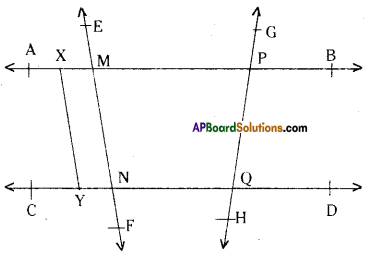
AP Board 9th Class Maths Solutions Chapter 4 Lines and Angles Ex 4.1 1
i) Any six points
Solution:
A, B, C, D, P, Q, M, N etc.

AP Board 9th Class Maths Solutions Chapter 4 Lines and Angles Ex 4.1

ii) Any five line segments
Solution:
[latex]\overline{\mathrm{AX}}, \overline{\mathrm{XM}}, \overline{\mathrm{MP}}, \overline{\mathrm{PB}}, \overline{\mathrm{MN}}, \overline{\mathrm{PQ}}, \overline{\mathrm{AB}} \ldots \ldots[/latex] etc.

iii) Any four rays
Solution:
[latex]\overline{\mathrm{MA}}, \overline{\mathrm{PA}}, \overline{\mathrm{PB}}, \overline{\mathrm{NC}}, \overline{\mathrm{QD}} \ldots \ldots[/latex] etc.

iv) Any four lines
Solution:
[latex]\overline{\mathrm{MA}}, \overline{\mathrm{PA}}, \overline{\mathrm{PB}}, \overline{\mathrm{NC}}, \overline{\mathrm{QD}} \ldots \ldots[/latex]

v) Any four collinear points
Solution:
A, X, M, P and B are collinear points on the line [latex]\overline{\mathrm{AB}}[/latex].

Question 2.
Observe the following figures and identify the type of angles in them.
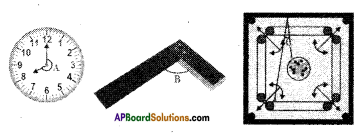
AP Board 9th Class Maths Solutions Chapter 4 Lines and Angles Ex 4.1 2
Solution:
∠A – reflex angle
∠B – right angle
∠C – acute angle

AP Board 9th Class Maths Solutions Chapter 4 Lines and Angles Ex 4.1

Question 3.
State whether the following state¬ments are true or false
i) A ray has no end point.
ii) Line [latex]\overline{\mathrm{AB}}[/latex] is the same as line [latex]\overline{\mathrm{BA}}[/latex]
iii) A ray [latex]\overline{\mathrm{AB}}[/latex] is same as the ray [latex]\overline{\mathrm{BA}}[/latex]
iv) A line has a definite length.
v) A plane, has length and breadth but no thickness.
vii) Two lines may intersect in two points.
viii) Two intersecting lines cannot both be parallel to the same line.
Solution:
i) A ray has no end point. – False
ii) Line [latex]\overline{\mathrm{AB}}[/latex] is the same as line [latex]\overline{\mathrm{BA}}[/latex] – True
iii) A ray [latex]\overline{\mathrm{AB}}[/latex] is same as the ray [latex]\overline{\mathrm{BA}}[/latex] – False
iv) A line has a definite length. – False
v) A plane, has length and breadth but no thickness. – True
vi) Two distinct points always determine a unique line. – True
vii) Two lines may intersect in two points. – False
viii) Two intersecting lines cannot both be parallel to the same line. – True

AP Board 9th Class Maths Solutions Chapter 4 Lines and Angles Ex 4.1

Question 4.
What is the angle between two hands of a clock when the lime in the clock
is
a) 9 ‘o clock
b) 6 ‘o clock
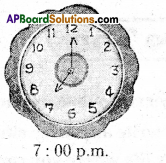
c) 7 ; 00 p.m.
Solution:
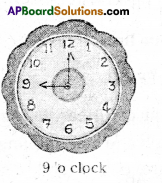
AP Board 9th Class Maths Solutions Chapter 4 Lines and Angles Ex 4.1 3
a) 12 hours = = 360°
1 hour = [latex]\frac{360^{\circ}}{12}[/latex] = 30°
∴Angle between hands when the time is 9 o clock = 3 x 30 = 90

b)
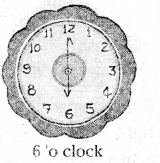
AP Board 9th Class Maths Solutions Chapter 4 Lines and Angles Ex 4.1 4
Angle between hands = 6 x 30° = 180°

AP Board 9th Class Maths Solutions Chapter 4 Lines and Angles Ex 4.1

c)
AP Board 9th Class Maths Solutions Chapter 4 Lines and Angles Ex 4.1 5
Angle between hands = 7 x 30° = 210°

AP Board 9th Class Maths Solutions Chapter 3 The Elements of Geometry Ex 3.1

AP State Syllabus AP Board 9th Class Maths Solutions Chapter 3 The Elements of Geometry Ex 3.1 Textbook Questions and Answers.

AP State Syllabus 9th Class Maths Solutions 3rd Lesson The Elements of Geometry Exercise 3.1

Question 1.
Answer the following:
i) How many dimensions a solid has ?
Solution:
A solid has three dimensions namely length, breadth and height or depth.

ii) How many books are there in Euclid’s Elements ?
Solution:
There are 13 volumes in Euclid’s elements.

AP Board 9th Class Maths Solutions Chapter 3 The Elements of Geometry Ex 3.1

iii) Write the number of faces of a cube and cuboid.
Solution:
Cube : 6 faces
Cuboid : 6 faces

iv) What is the sum of interior angles of a triangle ?
Solution:
The sum of interior angles of a triangle is 180°.

v) Write three undefined terms of geometry.
Solution:
Point, line and plane are three undefined terms in geometry.

Question 2.
State whether the following statements are true or false. Also give reasons for your answers.
a) Only one line can pass through a given point
b) All right angles are equal
c) Circles with same radii are equal
d) A finite line can be extended on its both sides endlessly to get a straight line
AP Board 9th Class Maths Solutions Chapter 3 The Elements of Geometry Ex 3.1 1
e) From figure AB > AC
Solution:
a) Only one line can pass through a given point – False.
Reason : (Since, infinitely many lines can pass through a given point)
b) All right angles are equal – True.
c) Circles with same radii are equal – True.
d) A finite line can be extended on its both sides endlessly to get a straight line – True.
e) From figure AB > AC – True.

AP Board 9th Class Maths Solutions Chapter 3 The Elements of Geometry Ex 3.1

Question 3.
In the figure given below, show that the length AH > AB + BC + CD.
AP Board 9th Class Maths Solutions Chapter 3 The Elements of Geometry Ex 3.1 2
Solution:
Given a line [latex]\stackrel{\leftrightarrow}{\mathrm{AH}}[/latex]
To prove AH > AB + BC + CD
From the figure AB + BC + CD = AD
AD is a part of whole AH.
From Euclid’s axiom whole is greater than part.
∴ AH > AD
⇒ AH > AB + BC + CD

Question 4.
If a point Q lies between two points P and R such PQ = QR, prove that PQ = [latex]\frac{1}{2}[/latex]PR.
AP Board 9th Class Maths Solutions Chapter 3 The Elements of Geometry Ex 3.1 3
Let PR be a given line.
Given that PQ = QR
i. e., Q is a point on PR.
⇒ PQ + QR = PR
⇒ PQ + PQ = PR [∵ PQ = QR]
⇒ 2PQ = PR
⇒ PQ = [latex]\frac{1}{2}[/latex] PR
Hence proved.

AP Board 9th Class Maths Solutions Chapter 3 The Elements of Geometry Ex 3.1

Question 5.
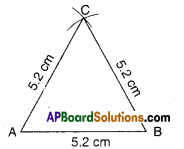
Draw an equilateral triangle whose sides are 5.2 cm
Soluton:
Step – 1 : Draw a line segment AB of length 5.2 cm. *
Step – 2 : Draw an arc of radius 5.2 cm with centre A.
Step – 3 : Draw an arc of radius 5.2 cm with centre B.
Step – 4 : Two arcs intersect at C; join C to A and B.
AP Board 9th Class Maths Solutions Chapter 3 The Elements of Geometry Ex 3.1 4
Δ ABC is the required triangle.

Question 6.
What is a conjecture? Give an example for it.
Solution:
Mathematical statements which are neither proved nor disproved are called conjectures. Mathematical discoveries often start out as conjectures. This may be an educated guess based on observations.
Eg : Every even number greater than 4 can be written as sum of two primes. This example is called Gold Bach Conjecture

Question 7.
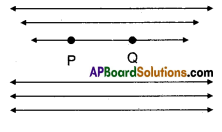
Mark two points P and Q. Draw a line through P and Q. Now how many lines are parallel to PQ, can you draw ?
Solution:
AP Board 9th Class Maths Solutions Chapter 3 The Elements of Geometry Ex 3.1 5
Infinitely many lines parallel to PQ can be drawn.

Question 8.
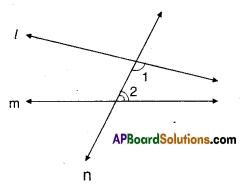
In the figure given below, a line n falls on lines / and m such that the sum of the interior angles 1 and 2 is less than 180°, then what can you say about lines l and m ?
AP Board 9th Class Maths Solutions Chapter 3 The Elements of Geometry Ex 3.1 6
Solution:
Given : l, m and n are lines, n is a transversal.
∠1 < 90°
∠2 < 90°
If the lines l and m are produced on the side where angles 1 and 2 are formed, they intersect at one point.

AP Board 9th Class Maths Solutions Chapter 3 The Elements of Geometry Ex 3.1

Question 9.
In the figure given below, if ∠1 = ∠3, ∠2 = ∠4 and ∠3 = ∠4 write the rela-tion between ∠1 and ∠2 using Euclid’s postulate.
AP Board 9th Class Maths Solutions Chapter 3 The Elements of Geometry Ex 3.1 7
Solution :
Given : ∠1 = ∠3
∠3 = ∠4
∠2 = ∠4
∴∠1 = ∠2

∵Both ∠1 and ∠2 are equal to ∠4. (By Euclid’s axiom things which are equal to same things are equal to one another).

AP Board 9th Class Maths Solutions Chapter 3 The Elements of Geometry Ex 3.1

Question 10.
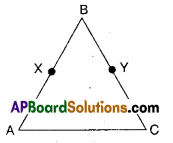
In the figure given below, we have BX = [latex]\frac{1}{2}[/latex] AB, BY= [latex]\frac{1}{2}[/latex] BC and AB = BC. Show that BX = BY.
AP Board 9th Class Maths Solutions Chapter 3 The Elements of Geometry Ex 3.1 8
Solution:
Given : BX = [latex]\frac{1}{2}[/latex] AB
BY = [latex]\frac{1}{2}[/latex]BC
AB = BC
To prove : BX = BY
Proof: Given AB = BC [ ∵ By Euclid’s axiom things which are halves of the same things are equal to one another]
[latex]\frac{1}{2}[/latex] AB = [latex]\frac{1}{2}[/latex] BC
BX = BY
Hence proved.

AP Board 9th Class Maths Solutions Chapter 6 Linear Equation in Two Variables Ex 6.1

AP State Syllabus AP Board 9th Class Maths Solutions Chapter 6 Linear Equation in Two Variables Ex 6.1 Textbook Questions and Answers.

AP State Syllabus 9th Class Maths Solutions 6th Lesson Linear Equation in Two Variables Exercise 6.1

Question 1.
Express the following linear equations in the form of ax + by + c = 0 and indicate the values of a, b and c in each case.
i) 8x + 5y – 3 = 0
Solution:
8x + 5y – 3 = 0
⇒ 8x + 5y + (- 3) = 0
Here a = 8, b = 5 and c = – 3

ii) 28x – 35y = – 7
Solution:
28x – 35y = – 7
⇒ 28x + (- 35) y + 7 = 0
Here a = 28, b = – 35 and c = 7

AP Board 9th Class Maths Solutions Chapter 6 Linear Equation in Two Variables Ex 6.1

iii) 93x = 12- 15y
Solution:
93x = 12 – 15y
⇒ 93x + 15y -12 = 0
⇒ 93x + 15y + (- 12) = 0
Here a = 93, b = 15 and c = – 12

iv) 2x = – 5y
Solution:
2x = – 5y
⇒ 2x + 5y = 0
Here a = 2, b = 5 and c = 0

v) [latex]\frac{x}{3}+\frac{y}{4}=7[/latex]
Solution:
[latex]\frac{x}{3}+\frac{y}{4}=7[/latex]
⇒ [latex]\frac{x}{3}+\frac{y}{4}-7=0[/latex]
⇒[latex]\frac{4 x+3 y-84}{12}=0[/latex]
⇒ 4x + 3y – 84 = 0
Here a = 4, b = 3 and c = – 84

vi) y = [latex]-\frac{3}{2} x[/latex]
Solution:
y = [latex]-\frac{3}{2} x[/latex]
⇒ 2y = -3x
⇒ 3x + 2y = 0
Here a = 3, b = 2 and c = 0

AP Board 9th Class Maths Solutions Chapter 6 Linear Equation in Two Variables Ex 6.1

vii) 3x + 5y = 12
Solution:
3x + 5y = 12
⇒ 3x + 5y + (- 12) = 0
Here a = 3, b = 5 and c = – 12

Question 2.
Write each of the following in the form of ax + by + c = 0 and find the values of a, b and c.
i) 2x = 5
Solution:
2x – 5 = 0
a = 2
b = 0
c = -5

ii) y – 2 = 0
Solution:
y – 2 = 0
a = 0
b = 1
c = – 2

iii) [latex]\frac{y}{7}[/latex] = 3
Solution:
[latex]\frac{y}{7}[/latex] = 3
y = 21
y – 21 = 0
a = 0
b = 1
c = -21

AP Board 9th Class Maths Solutions Chapter 6 Linear Equation in Two Variables Ex 6.1

iv) x = [latex]-\frac{14}{13}[/latex]
x = [latex]-\frac{14}{3}[/latex]
⇒ 13x = – 14
⇒ 13x + 14 = 0
a = 13
b = 0
c = 14

Question 3.
Express the following statements as a linear equation in two variables,
i)The sum of two numbers is 34.
Solution:
x + y = 34; x, y are any two numbers ⇒ x + y – 34 = 0

ii) The cost of a ball pen is ?5 less than half the cost of a fountain pen.
Solution:
Let the cost of a fountain pen = x
Let the cost of ball pen = y
Then y = x – 5 or x – y – 5 = 0

AP Board 9th Class Maths Solutions Chapter 6 Linear Equation in Two Variables Ex 6.1

iii) Bhargavi got 10 more marks than double of the marks of Sindhu. |l M)
Solution:
Let Sindhu’s marks = x
Bhargavi’s marks = y
Then by problem y = 2x + 10 or 2x – y + 10 = 0

iv) The cost of a pencil is ₹2 and one ball point pen costs ₹15. Sheela pays ₹100 for the pencils and pens she purchased.
Solution:
Giver: that cost of a pencil = ₹2
Cost of a ball point pen = ₹15
Let the number of pencils purchased = x
Let the number of pens purchased = y
Then the total cost of x – pencils = 2x
Then the total cost of y – pens = 15y
By problem 2x + 15y = 100

AP Board 9th Class Maths Solutions Chapter 2 Polynomials and Factorisation Ex 2.5

AP State Syllabus AP Board 9th Class Maths Solutions Chapter 2 Polynomials and Factorisation Ex 2.5 Textbook Questions and Answers.

AP State Syllabus 9th Class Maths Solutions 2nd Lesson Polynomials and Factorisation Exercise 2.5

Question 1.
Use suitable identities to find the following products.
i) (x + 5) (x + 2)
Solution:
(x + 5) (x + 2)
= x2 + (5 + 2)x + 5 x 2
[ ∵ (x + a) (x + b) = x2 + (a + b) x + ab]
= x2 + 7x + 10

AP Board 9th Class Maths Solutions Chapter 2 Polynomials and Factorisation Ex 2.5

ii) (x – 5) (x – 5)
Solution:
(x – 5) (x – 5)
= (x – 5)2 = x2 – 2(x) (5) + 52
[ ∵(x – y)2 = x2 – 2xy + y2]
= x2 – 10x + 25

iii) (3x + 2) (3x – 2)
Solution:
(3x + 2) (3x – 2) = (3x)2 – (2)2
[∵ (x + y) (x – y) =x2 – y2]
= 9x2 – 4

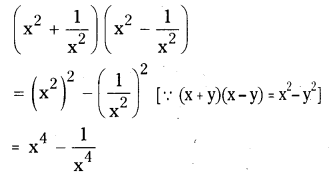
iv) [latex]\left(x^{2}+\frac{1}{x^{2}}\right)\left(x^{2}-\frac{1}{x^{2}}\right)[/latex]
Solution:
AP Board 9th Class Maths Solutions Chapter 2 Polynomials and Factorisation Ex 2.5 1(i)

AP Board 9th Class Maths Solutions Chapter 2 Polynomials and Factorisation Ex 2.5

v) (1 + x) (1 + x)
Solution:
(1 + x) (1 + x)
= (1 + x)2 = 12 + 2 (1) (x) + x2
[∵(x + y)2 = x2 + 2xy + y2]
= 1 + 2x + x2

Question 2.
Evaluate the following products with¬out actual multiplication.
i) 101 x 99
Solution:
101 x 99
= (100 + 1) (100 – 1)
= 1002 – 12
= 10000 – 1
= 9999

ii) 999 x 999
Solution:
999 x 999
= 9992
= (1000 – 1)2
= 10002 – 2 x (1000) x 1 + 12
= 1000000-2000 + 1
= 998001

AP Board 9th Class Maths Solutions Chapter 2 Polynomials and Factorisation Ex 2.5

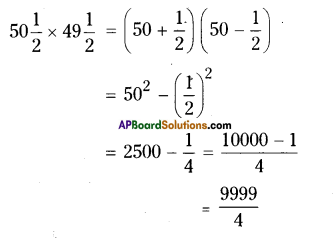
iii) [latex]50 \frac{1}{2} \times 49 \frac{1}{2}[/latex]
Solution:
AP Board 9th Class Maths Solutions Chapter 2 Polynomials and Factorisation Ex 2.5 1

iv) 501 x 501
Solution:
501 x 501
= (500 + 1) (500 + 1)
= (500 + 1)2
= 5002 + 2 x (500) x 1 + 12
= 250000 + 1000 + 1 = 251001

v) 30.5 x 29.5 = (30 + 0.5) (30 – 0.5)
= 302 – (0.5)2
= 900 – 0.25
= 899.75

Question 3.
Factorise the following using appro-priate identities.
i) 16x2 + 24xy + 9y2
Solution:
16x2 + 24xy + 9y2
= (4x)2 + 2 (4x) (3y) + (3y)2
= (4x + 3y)2 = (4x + 3y) (4x + 3y)
[ ∵ (x + y)2 = x2 + 2xy + y2]

ii) 4y2 – 4y + 1
Solution:
4y2 – 4y + 1
= (2y)2 – 2 (2y) (1) + (1)2
[ ∵ (x -y)2 = x2 – 2xy + y2]
= (2y -1)2 = (2y – 1) (2y-1)

AP Board 9th Class Maths Solutions Chapter 2 Polynomials and Factorisation Ex 2.5

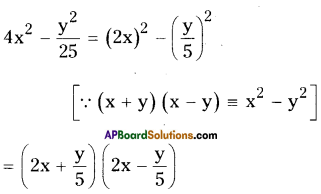
iii) [latex]4 x^{2}-\frac{y^{2}}{25}[/latex]
Solution:
AP Board 9th Class Maths Solutions Chapter 2 Polynomials and Factorisation Ex 2.5 2

iv) 18a2 – 50
Solution:
18a2 – 50 = 2 (9a2 – 25)
= 2[(3a)2 – (5)2]
[ ∵ x2 – y2 = (x + y) (x – y)]
= 2 (3a + 5) (3a – 5)

v) x2 + 5x + 6
Solution:
x2 + 5x + 6 = x2 + (3 + 2) x + 3 x 2
[ ∵ (x + a) (x + b) = x2 + (a + b) x + a . b]
= (x + 3) (x + 2)

vi) 3p2 – 24p + 36
Solution:
3p2 – 24p + 36
= 3[p2 – 8p + 12]
= 3[p2 + (- 6 – 2)p + (- 6) (- 2)]
[ ∵ (x + a) (x + b) = x2 + (a + b) x + ab]
= 3 (p – 6) (p – 2)

Question 4.
Expand each of the following, using suitable identities.
i) (x + 2y + 4z)2
(x + 2y + 4z)2 = (x)2 + (2y)2 + (4z)2 + 2(x) (2y) + 2 (2y) (4z) + 2 (4z) (x)
[ ∵ (x + y + z)2 = x2 + y2 + z2 + 2xy + 2yz + 2zx]
= x2 + 4y2 + 16z2 + 4xy + 16yz + 8zx

AP Board 9th Class Maths Solutions Chapter 2 Polynomials and Factorisation Ex 2.5

ii) (2a – 3b)3
Solution:
(2a – 3b)3 = (2a)3 – 3 (2a)2 (3b) + 3 (2a) (3b)2 – (3b)3
[ ∵ (a – b)3 = a3 – 3a2b + 3ab2 – b3]
= 8a3 – 3(4a2) (3b) + 3 (2a) (9b2) – 27b3
= 8a3 – 36a2b + 54ab2-27b3
(or)
∵ (a – b)3 = a3 – b3– 3ab (a – b)]
= (2a)3 – (3b)3 – 3(2a) (3b) (2a – 3b)
= 8a3 – 27b3 – 18ab (2a – 3b)

iii) (- 2a + 5b – 3c)2
Solution:
(- 2a + 5b – 3c)2
= (- 2a)2 + (5b)2 + (- 3c)2 + 2 (- 2a) (5b) + 2 (5b) (- 3c) + 2 (- 3c) (- 2a)
= 4a2 + 25b2 + 9c2 – 20ab – 30bc + 12ca
[ ∵ (x + y + z)2 = x2 + y2 + z2 + 2xy +2yz +2za]

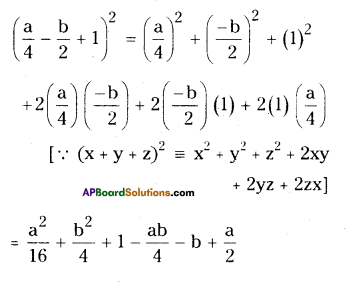
iv) [latex]\left[\frac{a}{4}-\frac{b}{2}+1\right]^{2}[/latex]
Solution:
AP Board 9th Class Maths Solutions Chapter 2 Polynomials and Factorisation Ex 2.5 3

v) (p + 1)3
Solution:
(p + 1)3
= (P)3 + 3 (p)2 (1) + 3 (p) (1)2 + (1)3
[ ∵ (x + y)3 = x3 + 3x2y + 3xy2 + y3]
= p3 + 3p2 + 3p + 1

AP Board 9th Class Maths Solutions Chapter 2 Polynomials and Factorisation Ex 2.5

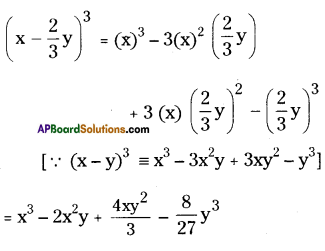
vi) [latex]\left(x-\frac{2}{3} y\right)^{3}[/latex]
Solution:
AP Board 9th Class Maths Solutions Chapter 2 Polynomials and Factorisation Ex 2.5 4

Question 5.
Factorise
i) 25x2 + 16y2 + 4z2 – 40xy + 16yz – 20xz
Solution:
25x2 + 16y2 + 4z2 – 40xy + 16yz – 20xz
= (5x)2 + (- 4y)2 + (- 2z)2 + 2(5x) (- 4y) + 2 (- 4y) (- 2z) + 2 (- 2z) (5x)
= (5x – 4y – 2z)2 = (- 5x + 4y +, 2z)2

ii) 9a2 + 4b2 + 16c2 + 12ab – 16bc – 24ca
Solution:
9a2 + 4b2 + 16c2 + 12ab – 16bc -24ca
= (3a)2 + (2b)2 + (- 4c)2+ 2 (3a) (2b) + 2 (2b) (- 4c) + 2(- 4c) (3a)
= (3a + 2b – 4c)2

Question 6.
If a + b + c = 9 and ab + be + ca = 26, find a2 + b2 + c2.
Solution:
Given that a + b + c = 9
Squaring on both sides,
(a + b + c)2 = 92
⇒ a2+ b2 + c2+ 2 (ab + be + ca) = 81 ⇒ a2 + b2 + c2 = 81 – 2 (ab + be + ca)
(by problem)
= 81 – 2 x 26
= 81 – 52 = 29

AP Board 9th Class Maths Solutions Chapter 2 Polynomials and Factorisation Ex 2.5

Question 7.
Evaluate the following by using suit¬able identities. m EachgM)
i) (99)3
Solution:
(99)2 = (100 – 1)3
= 1003 – 3 (100)2 (1) + 3 (100) (1)2 – 13
[ ∵ (x – y)3 = x3 – 3x2y + 3xy2 + y3]
= 1000000 – 30000 + 300 – 1
= 970299

ii) (102)3
Solution:
(102)3 = (100 + 2)3
= 1003 + 3 (100)2 (2) + 3 (100) (2)2 + 23
[ ∵ (x + y)3 = x3 + 3x2y + 3xy2 + y3]
= 1000000 + 60000 + 1200 + 8
= 1061208

iii) (998)3
Solution:
(998)3 =(1000 – 2)3
[ ∵ (x – y)3 = x3 – 3x2y + 3xy2 – y3] = 10003– 3(1000)2(2) + 3(1000)(2)2– 23
= 1000000000 – 6000000 + 12000 – 8
= 994011992

iv) (1001)3
Solution:
(1001)3 = (1000 + 1)3 .
[ ∵ (x + y)3 = x3 + 3x2y + 3xy2 + y3] = 10003 + 3(1000)2(1) + 3(1000) (1)2 + 13
= 1000000000 + 3000000 + 3000 + 1
= 1003003001

AP Board 9th Class Maths Solutions Chapter 2 Polynomials and Factorisation Ex 2.5

Question 8.
Factorise each of the following.
i) 8a3 + b3 + 12a2 b + 6ab2
Solution:
8a3 + b3 + 12a2 b + 6ab2
= (2a)3 + (b)3 + 3 (2a)2 (b) + 3 (2a) (b)2
= (2a + b)3

ii) 8a3 – b3 – 12a2 b + 6ab2
Solution:
8a3 – b3 – 12a2 b + 6ab2
= (2a)3 – (b)3 – 3 (2a)2 (b) + 3 (2a) (b)2
= (2a – b)3

iii) 1 – 64a3 -12a + 48a2
Solution:
1 – 64a3 – 12a + 48a2
= (1)3 – (4a)3 – 3(1)2 (4a) + 3(1) (4a)2
= (1 – 4a)3

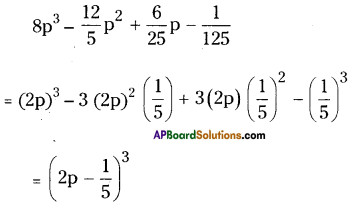
iv) [latex]8 p^{3}-\frac{12}{5} p^{2}+\frac{6}{25} p-\frac{1}{125}[/latex]
Solution:
AP Board 9th Class Maths Solutions Chapter 2 Polynomials and Factorisation Ex 2.5 5

AP Board 9th Class Maths Solutions Chapter 2 Polynomials and Factorisation Ex 2.5

Question 9.
Verify i) x3 + y3 = (x + y) (x2 – xy + y2);
ii) x3 – y3 = (x – y) (x2 + xy + y2)
Using some non-zero positive integers and check by actual multiplication. Can you
call these as identities ?
i) x3 + y3 = (x + y) (x2 – xy + y2)
Solution:
Given x3 + y3 = (x + y) (x2 – xy + y2)
L.H.S = x3 + y3
R.H.S = (x + y) (x2 – xy + y2)
= x (x2 – xy + y2) + y (x2 – xy + y2)
= x3 -x2y + xy2 + x2y – xy2 + y3
= x3 + y3
= L.H.S
∴ L.H.S = R.H.S

Take x = 3, y = 2
L.H.S = 33 + 23 = 27 + 8 = 35
R.H.S = (3 + 2) (32 – 3 x 2 + 22)
= 5 x (9 – 6 + 4)
= 5 x 7 = 35
∴ L.H.S = R.H.S

ii) x3 – y3 = (x – y) (x2 + xy + y2)
Solution:
Given that x3 – y3 = (x – y) (x2 + xy + y2)
L.H.S = x3 – y3
R.H.S = (x – y) (x2 + xy + y2)
= x (x2 + xy + y2) – y (x2 + xy + y2)
= x3 + x2y + xy2 – x2y – xy2 – y3
= x3 – y3= L.H.S

AP Board 9th Class Maths Solutions Chapter 2 Polynomials and Factorisation Ex 2.5

L.H.S = 33 – 23 = 27 – 8 = 19
R.H.S = (3 – 2) (32 + 3 x 2 + 22)
= 1 x (9 + 6 + 4)
= 1 x 19 = 19
∴ L.H.S = R.H.S
We can call the above two expressions as identities

Question 10.
Factorise by using the above results (identities).
i) 27a3 + 64b3
Solution:
27a3+ 64b3 = (3a)3 + (4b)3
= (3a + 4b) {(3a)2 – (3a) (4b) + (4b)2}
= (3a + 4b) (9a2 – 12ab + 16b2)

ii) 343y3 – 1000
Solution:
343y3 – 1000 = (7y)3 – (10)3
= (7y – 10) [(7y)2 + (7y) (10) + (10)2]
= (7y – 10) (49y2 + 70y + 100)

AP Board 9th Class Maths Solutions Chapter 2 Polynomials and Factorisation Ex 2.5

Question 11.
Factorise 27x3 + y3 + z3 – 9xyz using identity.
Solution:
Given 27x3 + y3 + z3 – 9xyz
= (3x)3 + (y)3 + (z)3 – 3 (3x) (y) (z)
= (3x + y + z)
[(3x)2 + y2 + z2 – (3x) (y) – (y) (z) – (z) (3x)]
[ ∵ (x3 + y3 + z3 – 3xyz = (x + y + z) (x2 + y2 + z2– xy – yz – zx)
= (3x + y + z) (9x2 + y2 + z2 – 3xy – yz – 3xz)

Question 12.
Verify that x3+ y3 + z3 – 3xyz = 1/2 (x + y + z) [(x – y)2 + (y – z)2 + (z – x)2 ]
(OR)
Verify that
p3 + q3 + r3 – 3pqr = 1/2 (p + q + r)
[(p – q)2 + (q – r)2 + (r – p)2]
Solution:
Given x3+ y3 + z3 – 3xyz = 1/2 (x + y + z) [(x – y)2 + (y – z)2 + (z – x)2 ]
R-H.S = 1/2 (x + y + z) [(x – y)2 + (y – z)2+ (z – x)2]
= 1/2 (x + y + z) [x2 + y2 – 2xy + y2 + z2 – 2yz + z2 + x2 – 2xz]
= 1/2 (x + y + z) [2x2 + 2y2 + 2z2 – 2xy – 2yz – 2zx]
= 1/2 (x + y + z) (2) [x2 + y2 + z2 – xy – yz – zx]
= (x + y + z) (x2 + y2 + z2 – xy – yz – zx)
= L.H.S
Hence proved.

AP Board 9th Class Maths Solutions Chapter 2 Polynomials and Factorisation Ex 2.5

Question 13.
If x + y + z = 0, show that x3 + y3 + z3 = 3xyz
Solution:
Given x + y + z = 0
To prove x3 + y3 + z3 = 3xyz
We have an identity
(x + y + z) (x2 + y2 + z2 – xy – yz – zx)
= x3 + y3 + z3 – 3xyz
Substituting x + y + z = 0in the above equation, we get
0 x (x2 + y2 + z2 -xy-yz-zx)
= x3 + y3 + z3 – 3xyz
⇒ x3 + y3 + z3 – 3xyz = 0
⇒ x3 + y3 + z3 = 3xyz

Question 14.
Without actual calculating the cubes, find the value of each of the following.
i) (- 10)3 + 73 + 33
Solution:
Given (-10)3 + 73 + 33
Sum of the bases = -10 + 7 + 3 = = 0
∴ (- 10)3 + 73 + 33
= 3 (- 10) x (7) x 3
= -630
[ ∵ x + y + z = 0 then x3 + y3 + z3 = 3xyz]

ii) (28)3 + (- 15)3 + (- 13)3
Solution:
Given (28)3 + (- 15)3+ (- 13)3
Sum of the bases = 28 + (- 15) + (- 13) = 0
∴ (28)3 + (- 15)3 + (- 13)3
= 3 x 28 x (- 15) x (- 13)
= 16380

AP Board 9th Class Maths Solutions Chapter 2 Polynomials and Factorisation Ex 2.5

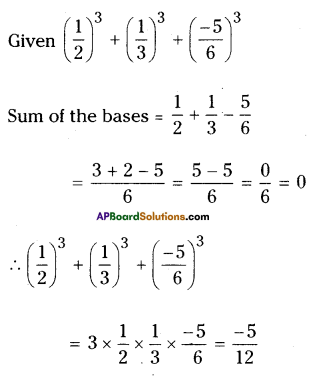
iii) [latex]\left(\frac{1}{2}\right)^{3}+\left(\frac{1}{3}\right)^{3}-\left(\frac{5}{6}\right)^{3}[/latex] read it as [latex]\left(\frac{1}{2}\right)^{3}+\left(\frac{1}{3}\right)^{3}+\left(\frac{-5}{6}\right)^{3}[/latex]
Solution:
AP Board 9th Class Maths Solutions Chapter 2 Polynomials and Factorisation Ex 2.5 6

iv) (0.2)3 – (0.3)3 + (0.1)3
Solution:
Given that (0.2)3 – (0.3)3 + (0.1)3
= (0.2)3 + (- 0.3)3 + (0.1)3
Sum of the bases = 0.2 – 0.3 + 0.1 = 0
∴ (0.2)3 + (-0.3)3 + (0.1)3
= 3 x (0.2) (- 0.3) (0.1)
= -0.018

AP Board 9th Class Maths Solutions Chapter 2 Polynomials and Factorisation Ex 2.5

Question 15.
Give possible expressions for the length and breadth of the rectangle whose area is given by
i) 4a2 + 4a – 3
Given that area = 4a2 + 4a – 3
= 4a2 + 6a – 2a – 3
= 2a (2a + 3) – 1 (2a + 3)
= (2a – 1) (2a + 3)
∴ Length = (2a + 3); breadth = (2a – 1).

ii) 25a2 – 35a + 12
Solution:
Given that area = 25a2 – 35a +12
= 25a2 – 20a – 15a + 12
= 5a (5a – 4) – 3 (5a – 4)
= (5a – 4) (5a – 3)
∴ (5a – 4) (5a – 3) are the length and breadth.

Question 16.
What are the possible polynomial expressions for the dimensions of the cuboids whose volumes are given below ?
i) 3x3 – 12x
Solution:
Volume = 3x3 – 12x
= 3x (x2 – 4)
= 3x (x + 2) (x – 2) are the dimensions.

AP Board 9th Class Maths Solutions Chapter 2 Polynomials and Factorisation Ex 2.5

ii) 12y2 + 8y – 20
Solution:
Given that volume = 12y2 + 8y – 20
= 4 (3y2 + 2y – 5)
= 4 [3y2 + 5y – 3y – 5]
= 4 [y (3y + 5) – 1 (3y + 5)]
= 4 (3y + 5) (y – 1)
Hence 4, (3y + 5) and (y – 1) are the dimensions.

Question 17.
Show that if 2 (a2 + b2 ) = (a + b)2 then a = b
Solution:
Given that 2 (a2 + b2 ) = (a + b)2
To prove a = b
As 2 (a2 + b2 ) = (a + b)2
We have
2a2 + 2b2 = a2 + 2ab + b2
2a2 – a2 + 2b2 – b2 = 2ab
a2 + b2 = 2ab
This is possible only when a = b
∴ a = b

AP Board 9th Class Maths Solutions Chapter 5 Co-Ordinate Geometry Ex 5.3

AP State Syllabus AP Board 9th Class Maths Solutions Chapter 5 Co-Ordinate Geometry Ex 5.3 Textbook Questions and Answers.

AP State Syllabus 9th Class Maths Solutions 5th Lesson Co-Ordinate Geometry Exercise 5.3

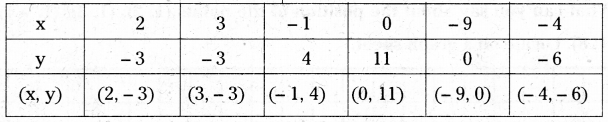
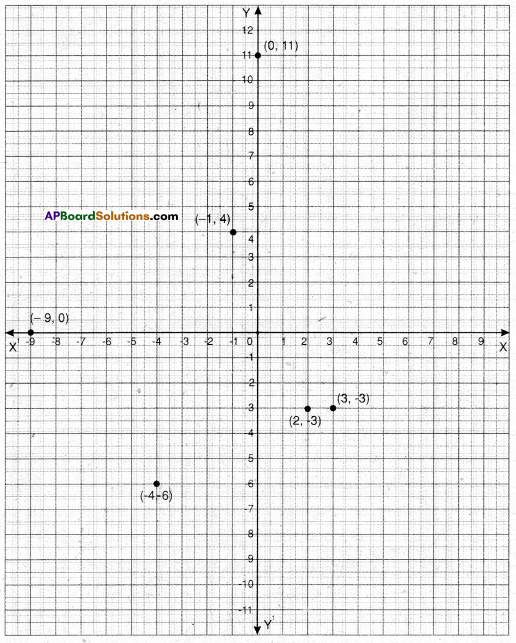
Question 1.
Plot the following points on the Cartesian plane whose x, y co-ordinates are given.
AP Board 9th Class Maths Solutions Chapter 5 Co-Ordinate Geometry Ex 5.3 1
Solution:
AP Board 9th Class Maths Solutions Chapter 5 Co-Ordinate Geometry Ex 5.3 1 (i)
AP Board 9th Class Maths Solutions Chapter 5 Co-Ordinate Geometry Ex 5.3 2

AP Board 9th Class Maths Solutions Chapter 5 Co-Ordinate Geometry Ex 5.3

Question 2.
Are the positions of (5, -8) and (-8, 5) Is same ? JustIfy your answer.
Solution:
The positions of (5, -8) and (-8, 5) are not same. They are two distinct points. (5, -8) lies at a distance of 5 units from Y – axis and 8 units from X – axis on down side of the origin. So it lies in Q4. Where as (- 8, 5) lies in Q2. The point is at a distance of 8 units from Y – axis on left side of the origin and 5 units from X – axis.

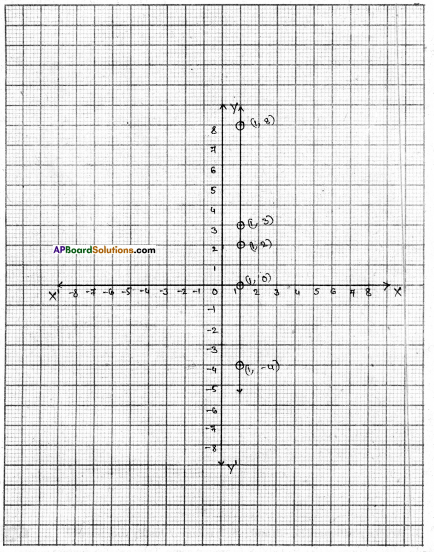
Question 3.
What can you say about the position of the points (1, 2), (1, 3), (1, – 4), (1, 0) and (1, 8), Locate on a graph sheet.
Solution:
AP Board 9th Class Maths Solutions Chapter 5 Co-Ordinate Geometry Ex 5.3 3
All the given points lie on a line parallel to Y-axis at a distance of 1 cm.

Question 4.
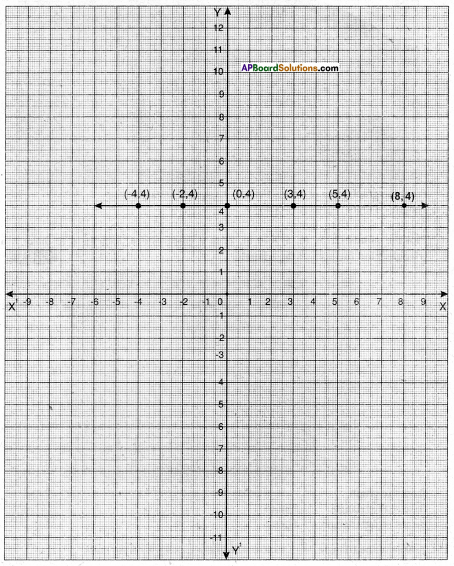
What can you say about the position of the points (5, 4), (8, 4), (3, 4), (0, 4), (-4, 4), (-2,4)? Locate the points on a graph sheet and justify your answer.
Solution:
The points (5, 4), (8, 4), (3, 4), (0, 4), (- 4, 4) and (- 2, 4) all lie on a line parallel to X-axis at a distance of 4-units from it.
AP Board 9th Class Maths Solutions Chapter 5 Co-Ordinate Geometry Ex 5.3 4

AP Board 9th Class Maths Solutions Chapter 5 Co-Ordinate Geometry Ex 5.3

Question 5.
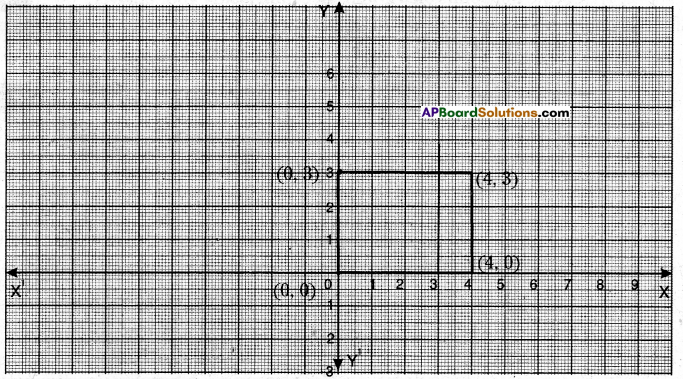
Plot the points (0, 3), (4, 3), (3, 4) (4, 0) in graph sheet. Join the points with straight lines to make a rectangle. Find the area of the rectangle.
Solution:
AP Board 9th Class Maths Solutions Chapter 5 Co-Ordinate Geometry Ex 5.3 5
From the graph, area of the rectangle =12 square units (OR)
Length = 4 units ; breadth = 3 units
A = l/b = 4 × 3 = 12 sq. units.

Question 6.
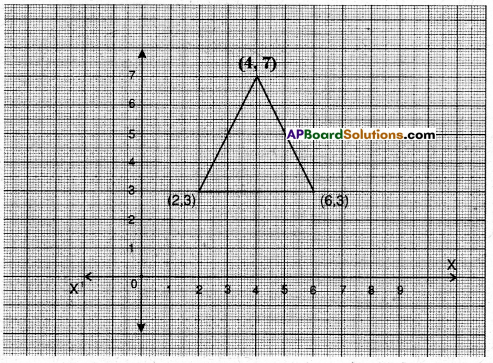
Plot the points (2, 3), (6, 3) and (4, 7) in a graph sheet. Join them to make it a triangle. Find the area of the triangle.
Solution:
AP Board 9th Class Maths Solutions Chapter 5 Co-Ordinate Geometry Ex 5.3 6
From the graph
Base of the triangle = 4 units
Height of the triangle = 4 units
∴ Area of the triangle = [latex]\frac{1}{2}[/latex] × base × height = [latex]\frac{1}{2}[/latex] × 4 × 4 = 8sq. units.

AP Board 9th Class Maths Solutions Chapter 5 Co-Ordinate Geometry Ex 5.3

Question 7.
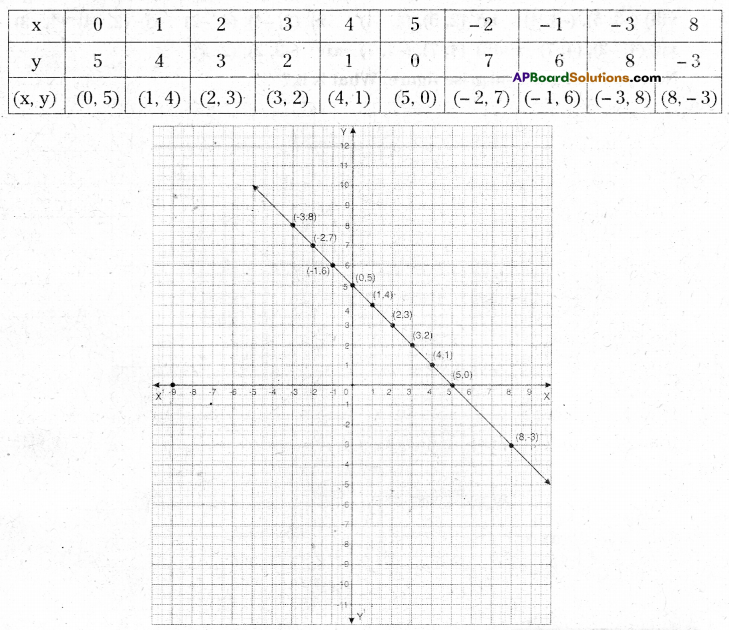
Plot at least six points in a graph sheet, each having the sum of its co-ordinates equal to 5. [Hint: (- 2, 7), (1, 4)………….]
Solution:
Given that (x co-ordinate) + (y co-ordinate) = 5
Let the points be
AP Board 9th Class Maths Solutions Chapter 5 Co-Ordinate Geometry Ex 5.3 7

Question 8.
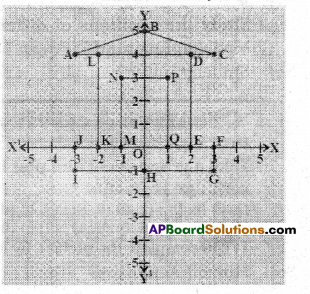
Look at the graph. Write the co-ordinates of the points
A, B, C, D, E, F. G. H, 1, J, K, L, M, N, O, P and Q.
AP Board 9th Class Maths Solutions Chapter 5 Co-Ordinate Geometry Ex 5.3 8
Solution:
A(- 3, 4) ; B(0, 5) : C (3, 4) ; D (2, 4) ; E (2, 0) ;
F (3, 0) ; G (3, – 1) ; H (0, – 1) ; I (- 3, – 1) ;
J (- 3, 0) ; K (- 2, 0) ; L (- 2, 4) ; M (- 1, 0) ;
N (-1, 3); O (0, 0) ; P (1. 3) and Q (1, 0)

AP Board 9th Class Maths Solutions Chapter 5 Co-Ordinate Geometry Ex 5.3

Question 9.
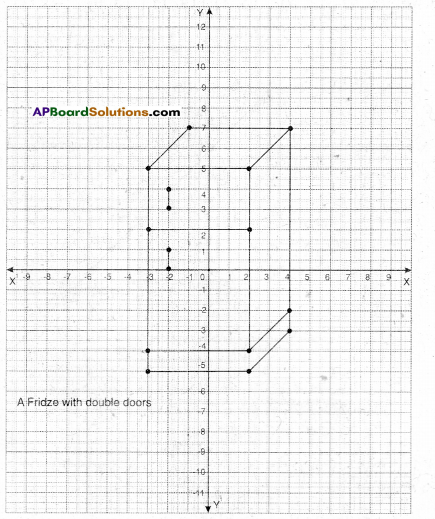
In a graph sheet plot each pair of points, join them by line segments.
i) (2, 5), (4, 7)
ii) (-3, 5) (-1,7)
iii) (-3, -4), (2, -4)
iv) (-3, -5) (2, -5)
v) (4, -2), (4, -3)
vi) (-2, 4), (-2, 3)
vii) (-2, 1), (-2, 0)
Now join the following pairs of points by straight line segments, in the same graph.
viii) (-3, 5), (-3, 4)
ix) (2, 5), (2, -4)
x) (2, -4), (4, -2)
xi) (2, -4), (4, -3)
xii) (4, -2), (4, 7)
xiii) (4, 7), (-1, 7)
xiv) (-3, 2), (2, 2)
Now you will get a surprise figure. What is it ?
Solution:
AP Board 9th Class Maths Solutions Chapter 5 Co-Ordinate Geometry Ex 5.3 9

AP Board 9th Class Maths Solutions

AP Board 9th Class Maths Solutions Chapter 5 Co-Ordinate Geometry Ex 5.2

AP State Syllabus AP Board 9th Class Maths Solutions Chapter 5 Co-Ordinate Geometry Ex 5.2 Textbook Questions and Answers.

AP State Syllabus 9th Class Maths Solutions 5th Lesson Co-Ordinate Geometry Exercise 5.2

Question 1.
Write the quadrant in which the following points lie.
i) (- 2, 3)
ii) (5, – 3)
iii) (4, 2)
iv) (- 7, – 6)
v) (0, 8)
vi) (3, 0)
vii) (-4,0)
viii) (0, – 6)
Solution:
i) (- 2, 3) – Q2 (second quadrant)
ii) (5, – 3) – Q4 (fourth quadrant)
iii) (4, 2) – Q1 (Iirst quadrant)
iv) (- 7, – 6) – Q3 (third quadrant)
v) (0, 8) – on Y-axis
vi) (3, 0) – on X-axis
vii) (-4,0) – on X’ – axis
viii) (0, – 6) – on Y’: axis

AP Board 9th Class Maths Solutions Chapter 5 Co-Ordinate Geometry Ex 5.2

Question 2.
Write the abscissae and ordinates of the following points.
i)(4,-8)
ii)(-5,3)
iii)(0,0)
iv)(5, 0)
v)(0, -8)
Note: Plural of abscissa is abscissae.
Solution:

Point abscissa ordinate
i) (4, – 8) 4 -8
ii)  (-5, 3) -5 3
iii) (0,0) 0 0
iv) (5,0) 5 0
v) (0,-8) . 0 -8

AP Board 9th Class Maths Solutions Chapter 5 Co-Ordinate Geometry Ex 5.2

Question 3.
Which of the following points lie on the axes ? Also name the axis.
i) (-5,-8)
ii) (0, 13)
iii) (4, – 2)
iv) (- 2,0)
v) (0, – 8)
vi) (7,0)
vii) (0,0)
Solution:
The points (ii) (0,13) ; (v) (0,- 8) lie on Y – axis.
The points (iv) (- 2, 0), (vi) (7, 0) lie on X – axis.
The point (vii) (0, 0) lie on both X – axis and Y – axis.
The points (i) (- 5, – 8); (iii) (4, – 2) do not lie on any axis.

Question 4.
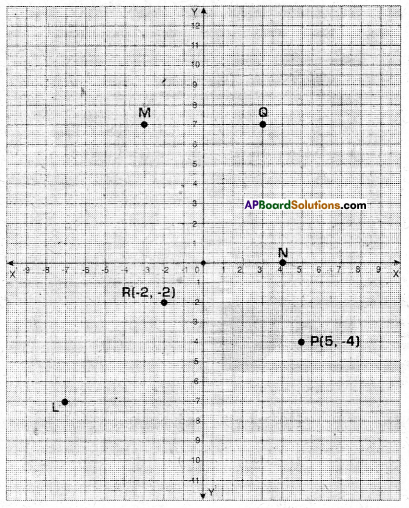
Write the following based on the graph.
i) The ordinate of L
ii) The ordinate of Q
iii) The point denoted by (- 2,-2)
iv) The point denoted by (5, – 4)
v) The abscissa of N
vi) The abscissa of M
AP Board 9th Class Maths Solutions Chapter 5 Co-Ordinate Geometry Ex 5.2 1
Solution:
i) – 7
ii) 7
iii) The point ’R’
iv) The point P
v) 4
vi) – 3

AP Board 9th Class Maths Solutions Chapter 5 Co-Ordinate Geometry Ex 5.2

Question 5.
State true or false and write correct statement.
i) In the Cartesian plane the horizon-tal line is called Y – axis, if) in the Cartesian plane, the vertical line is called Y – axis.
iii) The point which lies on both the axes is called origin.
iv) The point (2, – 3) lies in the third quadrant.
v) (-5, -8) lies in the fourth quadrant.
vi) The point (- x, – y) lies in the first quadrant where x < 0; y < 0.
Solution:
i) False
Correct statement: In the Cartesian plane the horizontal line is called X – axis.
ii) True
iii) True
iv) False
Correct statement: The point (2, -3) lies in the fourth quadrant.
v) False
Correct statement: (- 5, – 8) lies in the third quadrant.
vi) True

AP Board 9th Class Maths Solutions Chapter 5 Co-Ordinate Geometry Ex 5.2

Question 6.
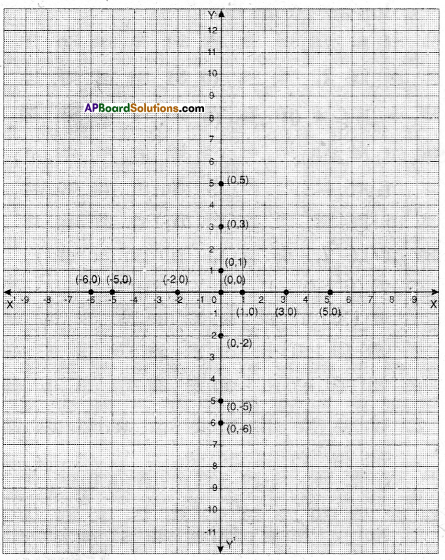
Plot the following ordered pairs on a graph sheet. What do you observe ?
i) (1, 0), (3, 0), (- 2, 0), (- 5, 0), (0, 0), (5, 0), (- 6, 0)
ii) (0, 1), (0, 3), (0, – 2), (0, – 5), (0, 0), (0,5), (0,-6)
Solution:
i) All points lie on X – axis,
ii) All points lie on Y – axis.
AP Board 9th Class Maths Solutions Chapter 5 Co-Ordinate Geometry Ex 5.2 2

AP Board 9th Class Maths Solutions Chapter 5 Co-Ordinate Geometry Ex 5.1

AP State Syllabus AP Board 9th Class Maths Solutions Chapter 5 Co-Ordinate Geometry Ex 5.1 Textbook Questions and Answers.

AP State Syllabus 9th Class Maths Solutions 5th Lesson Co-Ordinate Geometry Exercise 5.1

Question 1.
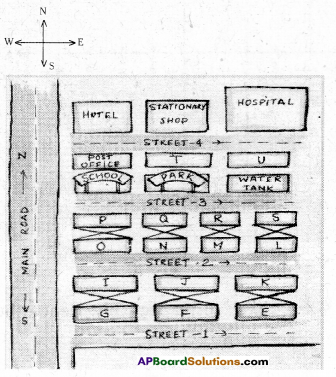
In a locality, there is a main road along North – South direction. The map is given below. With the help of the picture answer the following questions.
AP Board 9th Class Maths Solutions Chapter 5 Co-Ordinate Geometry Ex 5.1
i) What is the 3rd object on the left side in street no. 3 while going in east direction ?
ii) Find the name of the 2nd house which is on right side of street 2 while going in east direction.
iii) Locate the position of Mr. K’s house.
iv) How do you describe the position of the post office ?
v) How do you describe the location of the hospital ?
Solution:
i) Water tank
ii) Mr. J’s house
iii) In street No. 2, 3rd house on right side.
iv) In street No. 4, the first house on right side.
v) In street No. 4, the last house on left side.

AP Board 9th Class Maths Solutions Chapter 4 Lines and Angles Ex 4.4

AP State Syllabus AP Board 9th Class Maths Solutions Chapter 4 Lines and Angles Ex 4.4 Textbook Questions and Answers.

AP State Syllabus 9th Class Maths Solutions 4th Lesson Lines and Angles Exercise 4.4

Question 1.
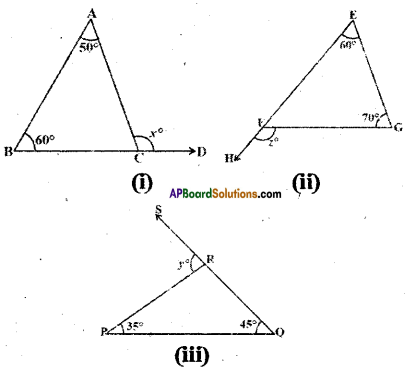
In the given triangles, find out ∠x, ∠y and ∠z
AP Board 9th Class Maths Solutions Chapter 4 Lines and Angles Ex 4.4 1
Solution:
In fig(i)
x° = 50° + 60°
(∵ exterior angle is equal to sum of the opposite interior angles)
∴ x= 110°
In fig (ii)
z° = 60° + 70°
(∵ exterior angle is equal to sum of the opposite interior angles)
∴ z = 130°

In fig (iii)
y° = 35° + 45° = 80°
(∵ exterior angle is equal to sum of the opposite interior angles)

AP Board 9th Class Maths Solutions Chapter 4 Lines and Angles Ex 4.4

Question 2.
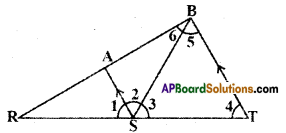
In the given figure AS // BT; ∠4 = ∠5, [latex]\overline{\mathbf{S B}}[/latex] bisects ∠AST. Find the measure of ∠1.
AP Board 9th Class Maths Solutions Chapter 4 Lines and Angles Ex 4.4 2
Solution:
Given AS // BT
∠4 = ∠5 and SB bisects ∠AST.
∴ By problem
∠2 = ∠3 …………..(1)
For the lines AS // BT
∠2 = ∠5 ( ∵alternate interior angles)
∴ In ΔBST
∠3 = ∠5 = ∠4
Hence ΔBST is equilateral triangle and each of its angle is equal to 60°.
∴∠3 = ∠2 = 60° [by eq. (1)]
Now ∠1 + ∠2 + ∠3 = 180°
∠1 + 60° + 60° = 180°
[ ∵ angles at a point on a line]
∴∠1 = 180° – 120° = 60°

Question 3.
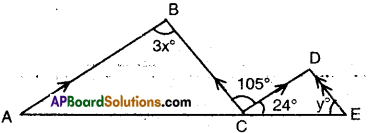
In the given figure AB // CD; BC // DE then find the values of x and y.
AP Board 9th Class Maths Solutions Chapter 4 Lines and Angles Ex 4.4 3
Solution:
Given that AB // CD and BC // DE.
∴ 3x = 105° (∵ alternate interior angles for AB // CD)
x = [latex]\frac { 105° }{ 3 }[/latex] = 35°
Also BC // DE
∴∠D = 105°
(∵ alternate interior angles)
Now in ΔCDE
24° + 105° + y = 180°
(∵ angle sum property)
∴ y = 180° – 129° = 51°

AP Board 9th Class Maths Solutions Chapter 4 Lines and Angles Ex 4.4

Question 4.
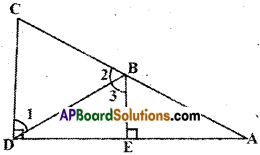
In the given figure BE ⊥ DA and CD ⊥ DA then prove that m∠1 = m∠3.
AP Board 9th Class Maths Solutions Chapter 4 Lines and Angles Ex 4.4 4
Solution:
Given that CD ⊥ DA and BE ⊥ DA.
⇒ Two lines CD and BE are perpendicular to the same line DA.
⇒ CD // BE (or)
∠D =∠E ⇒ CD // BE
(∵ corresponding angles for CD and BE and DA are transversal)
Now m∠1 = m∠3
(∵alternate interior angles for the lines CD // BE ; DB are transversal)
Hence proved.

Question 5.
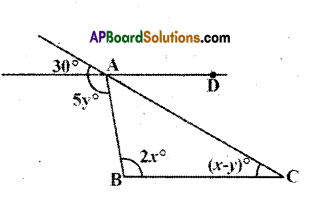
Find the values of x, y for which lines AD and BC become parallel.
AP Board 9th Class Maths Solutions Chapter 4 Lines and Angles Ex 4.4 5
Solution:
For the lines AD and BC to be parallel x – y = 30° (corresponding angles) ……… (1)
2x = 5y ………….(2)
(∵ alternate interior angles)
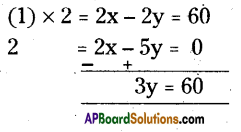
Solving (1) & (2)
AP Board 9th Class Maths Solutions Chapter 4 Lines and Angles Ex 4.4 6
y = [latex]\frac{60}{3}[/latex] = 20°
Substituting y = 20° in eq. (1)
x – 20° = 30°
⇒ x = 50°
∴ x = 50° and y = 20°

AP Board 9th Class Maths Solutions Chapter 4 Lines and Angles Ex 4.4

Question 6.
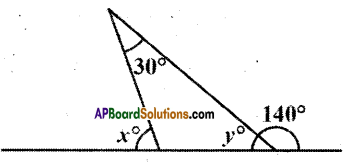
Find the values of x and y in the figure.
AP Board 9th Class Maths Solutions Chapter 4 Lines and Angles Ex 4.4 7
Solution:
From the figure y + 140° = 180°
(∵ linear pair of angles)
∴ y = 180° – 140° = 40°
And x° = 30° + y°
(∵ exterior angle = sum of the opposite interior angles)
x° = 30° + 40° = 70°

Question 7.
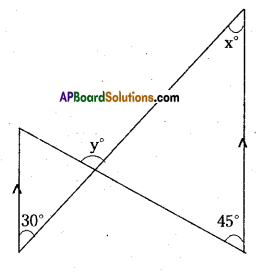
In the given figure segments shown by arrow heads are parallel. Find the values of x and y.
AP Board 9th Class Maths Solutions Chapter 4 Lines and Angles Ex 4.4 8
Solution:
From the figure
x° = 30° (∵ alternate interior angles)
y° = 45° + x° (∵ exterior angles of a triangle = sum of opp. interior angles)
y = 45° + 30° – 75°

Question 8.
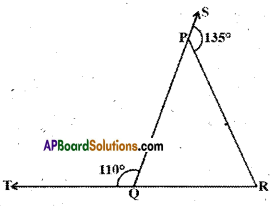
In the given figure sides QP and RQ of ∠PQR are produced to points S and T respectively. If ∠SPR = 135° and ∠PQT = 110°, find ∠PRQ.
AP Board 9th Class Maths Solutions Chapter 4 Lines and Angles Ex 4.4 9
Solution:
Given that ∠SPR = 135° and ∠PQT =110°
From the figure
∠SPR + ∠RPQ = 180°
∠PQT + ∠PQR = 180°
[∵ linear pair of angles]
⇒ ∠RPQ = 180° – ∠SPR
= 180° – 135° = 45°
⇒ ∠PQR = 180° – ∠PQT
= 180°-110° = 70°
Now in APQR
∠RPQ + ∠PQR + ∠PRQ = 180°
[∵ angle sum property]
∴ 45° + ’70° + ∠PRQ = 180°
∴ ∠PRQ = 180°-115° = 65°

AP Board 9th Class Maths Solutions Chapter 4 Lines and Angles Ex 4.4

Question 9.
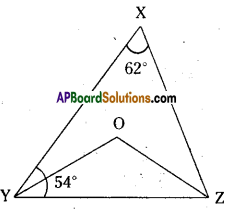
In the given figure ∠X = 62° ; ∠XYZ = 54°. In ΔXYZ. If YO and ZO are the bisectors of ∠XYZ and ∠XZY respec-tively find ∠OZY and ∠YOZ.
AP Board 9th Class Maths Solutions Chapter 4 Lines and Angles Ex 4.4 10
Solution:
Given that ∠X = 62° and ∠Y = 54°
YO arid ZO are bisectors of ∠Y and ∠Z.
In ΔXYZ
∠X + ∠XYZ + ∠XZY = 180° .
62° + 54° + ∠XZY = 180°
=> ∠XZY = 180°- 116° = 64°
Also in Δ????OYZ
∠OYZ = 1/2 ∠XYZ = 1/2 x 54° = 27°
(∵ YO is bisector of ∠XYZ)
∠OZY = 1/2 ∠XZY = 1/2 x 64° = 32
(∵ OZ is bisector of ∠XYZ)
And ∠OYZ + ∠OZY + ∠YOZ = 180°
(∵ angle sum property, ΔOYZ)
⇒ 27 + 32° + ∠YOZ = 180°
⇒ ∠YOZ = 180° – 59° = 121°

Question 10.
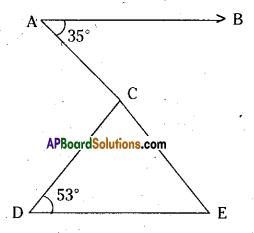
In the given figure if AB // DE, ∠BAC = 35° and ∠CDE = 53°, find ∠DCE.
AP Board 9th Class Maths Solutions Chapter 4 Lines and Angles Ex 4.4 11
Solution:
Given that AB // DE, ∠CDE = 53°;
∠BAC = 35°
Now ∠E = 35°
( ∵ alternate interior angles)
Now in ∆CDE
∠C + ∠D + ∠E = 180°
(∵angle sum property, ACDE)
∴ ∠DCE + 53° + 35° = 180°
⇒ ∠DCE = 180° – 88° = 92°

AP Board 9th Class Maths Solutions Chapter 4 Lines and Angles Ex 4.4

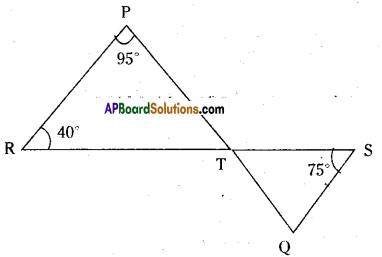
Question 11.
In the given figure if line segments PQ and RS intersect at point T, such that∠PRT = 40°, ∠RPT = 95° and ∠TSQ = 75°, find ∠SQT.
AP Board 9th Class Maths Solutions Chapter 4 Lines and Angles Ex 4.4 12
Solution:
Given that ∠PRT = 40°; ∠RPT = 95°;
∠TSQ = 75°
In ∆PRT ∠P + ∠R + ∠PTR = 180°
(∵angle sum property)
95° + 40° + ∠PTR = 180°
⇒ ∠PTR = 180° – 135° = 45°
Now ∠PTR = ∠STQ
(∵ vertically opposite angles)
In ΔSTQ ∠S + ∠Q + ∠STQ = 180°
(∵ angle sum property)
75° + ∠SQT + 45° = 180°
∴ ∠SQT = 180° – 120° = 60°

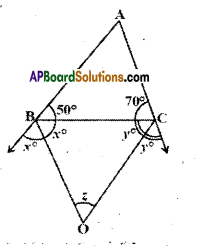
Question 12.
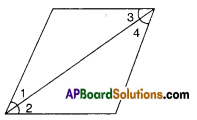
In the given figure, ABC is a triangle in which ∠B = 50° and ∠C = 70°. Sides AB and AC are produced. If ∠ is the measure of angle between the bisec¬tors of the exterior angles so formed, then find ‘z’.
AP Board 9th Class Maths Solutions Chapter 4 Lines and Angles Ex 4.4 13
Solution:
Given that ∠B = 50°; ∠C = 70°
Angle between bisectors of exterior angles B and C is ∠.
From the figure
50° + 2x = 180°
70° + 2y = 180°
(∵ linear pair of angles)
∴ 2x= 180°-50°
2x= 130°
x = [latex]\frac{130}{2}[/latex]
= 65°

2y= 180°-70°
2y= 110°
x = [latex]\frac{110°}{2}[/latex]
= 55°

Now in ΔBOC
x + y + ∠ = 180° (∵ angle sum property)
65° + 55° + ∠ = 180°
z = 180° -120° = 60°

AP Board 9th Class Maths Solutions Chapter 4 Lines and Angles Ex 4.4

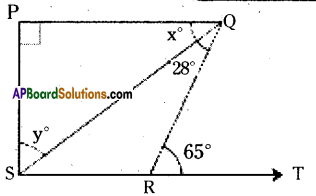
Question 13.
In the given figure if PQ ⊥ PS; PQ // SR, ∠SQR = 28° and ∠QRT = 65°, then find the values of x and y.
AP Board 9th Class Maths Solutions Chapter 4 Lines and Angles Ex 4.4 14
Solution:
Given that PQ ⊥ PS ; PQ // SR
∠SQR = 28°, ∠QRT = 65°
From the figure
∠QSR = x° (∵ alt. int. angles for the lines PQ // SR)
Also 65° = x + 28° (∵ ext. angles = sum of the opp. interior angles)
∴ x° = 65° – 28° = 37°
And x° + y° = 90°
[ ∵ PQ ⊥ PS and PQ // SR. ⇒ ∠P = ∠S]
37° + y = 90°
∴ y = 90° – 37° = 53°

Question 14.
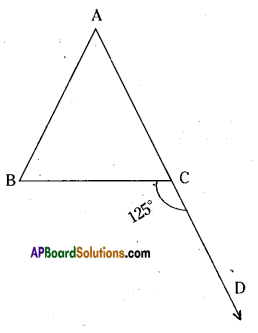
In the given figure ΔABC side AC has been produced to D. ∠BCD = 125° and ∠A: ∠B = 2:3, find the measure of ∠A and ∠B

AP Board 9th Class Maths Solutions Chapter 4 Lines and Angles Ex 4.4 15
Solution:
Given that ∠BCD = 125°
∠A : ∠B = 2 : 3
Sum of the terms of the ratio
∠A : ∠B = 2 + 3 = 5
We know that ∠A + ∠B = ∠BCD
(∵ exterior angles of triangle is equal to sum of its opp. interior angles)
∴ ∠A = [latex]\frac{2}{5}[/latex] x 125° = 50°
∠B = [latex]\frac{3}{5}[/latex] x 125° = 75°

Question 15.
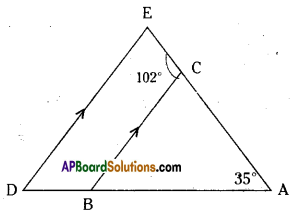
In the given figure, it is given that, BC // DE, ∠BAC = 35° and ∠BCE = 102°. Find the measure of 0 ∠BCA i0 ∠ADE and iii) ∠CED.
AP Board 9th Class Maths Solutions Chapter 4 Lines and Angles Ex 4.4 16
Solution:
Given that BC // DE ; ∠BAC = 35°;
∠BCE = 102°

i) From the figure
102° + ∠BCA = 180°
(∵ linear pair of angles)
∴ ∠BCA = 180° – 102° = 78°

AP Board 9th Class Maths Solutions Chapter 4 Lines and Angles Ex 4.4

ii) ∠ADE + ∠CBD = 180°
(∵ interior angles on the same side of the transversal)
∠ADE + (78° + 35°) = 180°
(∵ ∠CBD = ∠BAC + ∠BCA)
∴ ∠ADE = 180° – 113° = 67°

iii) From the figure .
∠CED = ∠BCA = 78°
(∵ corresponding angles)

Question 16.
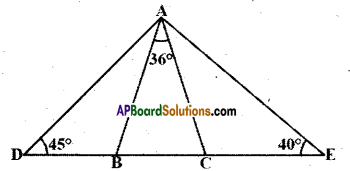
In the given figure, it is given that AB = AC; ∠BAC = 36°; ∠ADB = 45° and ∠AEC = 40°. Find i) ∠ABC
i) ∠ACB iii) ∠DAB iv) ∠EAC.
AP Board 9th Class Maths Solutions Chapter 4 Lines and Angles Ex 4.4 17
Solution:
Given that AB = AC; ∠BAC = 36°,
∠ADB = 45°, ∠AEC = 40°
(i) & (ii)
In ∆ABC ; AB = AC
⇒ ∠ABC = ∠ ACB
And 36° + ∠ABC + ∠ACB = 180°
(∵ angle sum property)
∴ ∠ABC = [latex]\frac{180^{\circ}-36^{\circ}}{2}=\frac{144^{\circ}}{2}=72^{\circ}[/latex]
∠ACB = 72°

iii) From the figure
∠ABD + ∠ABC = 180°
∠ABD = 180° – 72° = 1086
In ΔABD
∠DAB + ∠ABD + ∠D = 180°
∠DAB + 108° + 45° = 180°
∠DAB = 180° – 153° = 27°

AP Board 9th Class Maths Solutions Chapter 4 Lines and Angles Ex 4.4

iv) In ΔADE
∠D + ∠A + ∠E = 180°
45° + ∠A + 40° = 180°
⇒ ∠A = 180° -85° = 95°
But ∠A = ∠DAB + 36° + ∠EAC
95° = 27°, + 36° + ∠EAC
∴ ∠EAC = 95° – 63° = 32°

Question 17.
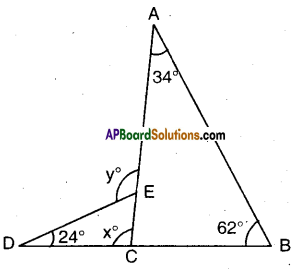
Using information given in the figure, calculate the values of x and y.
AP Board 9th Class Maths Solutions Chapter 4 Lines and Angles Ex 4.4 18
Solution:
From the figure In ∆ACB
34° + 62° + ∠ACB = 180°
(∵ angle sum property)
∴ ∠ACB = 180° – 96° = 84° .
And x + ∠ACB = 180°
(∵ linear pair of angles) .
∴ x + 84° = 180°
x = 180°-84° = 96°
(OR)
x = 34° + 62° = 96°
( ∵ x is exterior angle, ∆ABC)
y = 24° + x°
= 24° + 96° = 120°
(∵ y is exterior angle, ∆DCE)

AP Board 9th Class Maths Solutions Chapter 2 Polynomials and Factorisation Ex 2.4

AP State Syllabus AP Board 9th Class Maths Solutions Chapter 2 Polynomials and Factorisation Ex 2.4 Textbook Questions and Answers.

AP State Syllabus 9th Class Maths Solutions 2nd Lesson Polynomials and Factorisation Exercise 2.4

Question 1.
Determine which of the following polynomials has (x + 1) as a factor.
i) x3 – x2 – x + 1
Solution:
f(- 1) = (- 1)3 – (- 1)2 – (- 1) + 1
= -1 – 1 + 1 + 1 = 0
∴ (x + 1) is a factor.

AP Board 9th Class Maths Solutions Chapter 2 Polynomials and Factorisation Ex 2.4

ii) x4 -x3 +x2 – x + 1
Solution:
f(- 1) = (- 1)4 – (- 1)3 + (- 1)2 – (- 1) + 1
= 1 + 1 + 1 + 1 + 1= 5
∴ (x + 1) is not a factor.

iii) x4 + 2x3 + 2x2 + x + 1
Solution:
f(- 1) = (-1)4 + 2 (- 1)3 + 2 (- 1)2 + (-1) + 1
= 1 – 2 + 2 – 1 + 1 = 1
∴ (x + 1) is not a factor.

iv) x3 – x2 – (3 – √3)x + √3
Solution:
f(- 1) = (- 1)3 – (- 1)2 – (3 – √3)(-1) + √3
= – 1 – 1 + 3 – √3 + √3 = 1
∴ (x + 1) is not a factor.

Question 2.
Use the factor theorem to determine whether g(x) is a factor of f(x) in each of the following cases:
i) f(x) = 5x3 + x2 – 5x – 1; g(x) = x + 1
[Factor theorem : If f(x) is a polynomial; f(a) = 0 then (x – a) is a factor of f(x); a ∈ R]
Solution:
g(x) = x+ 1 = x- a say
∴ a = – 1
f(a) = f(- 1) = 5 (- 1)3 + (- 1)2 – 5 (- 1) – 1
= -5 + 1 + 5 – 1 = 0
∴ x + 1 is a factor of f(x).

AP Board 9th Class Maths Solutions Chapter 2 Polynomials and Factorisation Ex 2.4

ii) f(x) = x3 + 3x2 + 3x + 1; g(x) = x + 1
Solution:
g(x) = x + 1 = x – a
∴ a = – 1
f(a) = f(- 1) = (- 1)3 + 3 (- 1)2 + 3(-1) + 1
= -1 + 3 – 3 + 1 =0
∴ f(x) is a factor of g(x).

iii) f(x) = x3 – 4x2 + x + 6;
g(x) = x – 2
Solution:
g(x) = x- 2 = x- a
∴ a = 2
f(a) = f(2) = 23 – 4(2)2 + 2 + 6
= 8 – 16 + 2 + 6 = 0
∴ g(x) is a factor of f(x).

AP Board 9th Class Maths Solutions Chapter 2 Polynomials and Factorisation Ex 2.4

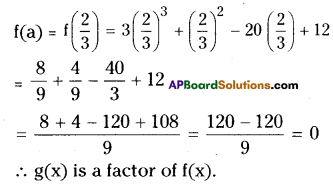
iv) f(x) = 3x3+ x2 – 20x +12; g(x) = 3x – 2
Solution:
g(x) = 3x – 2 = [latex]x-\frac{2}{3}[/latex] = x – a
∴ a = 2/3

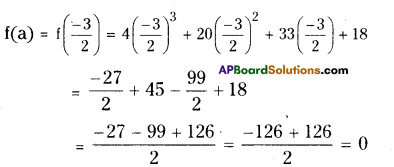
v) f(x) = 4x3+ 20x2+ 33x + 18; g(x) = 2x + 3
Solution:
g(x) = 2x + 3 = x + [latex]\frac{3}{2}=[/latex] = x – a
∴ a = -3/2
AP Board 9th Class Maths Solutions Chapter 2 Polynomials and Factorisation Ex 2.4 2
∴ g(x) is a factor of f(x).

AP Board 9th Class Maths Solutions Chapter 2 Polynomials and Factorisation Ex 2.4

Question 3.
Show that (x – 2), (x + 3) and (x – 4) are factors of x3 – 3x2 – 10x + 24.
Solution:
Given f(x) = x3 – 3x2 – 10x + 24
To check whether (x – 2), (x + 3) and (x – 4) are factors of f(x), let f(2), f(- 3) and f(4)
f(2) = 23 – 3(2)2 – 10(2) + 24
= 8- 12-20 + 24 = 0
∴ (x – 2) is a factor of f(x).

f(- 3) = (- 3)3 – 3(- 3)2– 10(- 3) + 24
= – 27 – 27 + 30 + 24 = 0
∴ (x + 3) is a factor of f(x).

f(4) = (4)3 – 3 (4)2 – 10 (4) + 24
= 64 – 48 – 40 + 24
= 88 – 88
= 0
∴ (x – 4) is a factor of f(x).

Question 4.
Show that (x + 4), (x – 3) and (x – 7) are factors of x3 – 6x2 – 19x + 84.
Solution:
Let f(x) = x3 – 6x2 – 19x + 84
To verify whether (x + 4), (x – 3) and (x – 7) are factors of f(x) we use factor theorem.

Let f(- 4), f(3) and f(7)
f(- 4) = (- 4)3 – 6 (- 4)2 – 19 (- 4) + 84
= -64 – 96 + 76 + 84
= 0 .
∴ (x + 4) is a factor of f(x).

f(3) = 33 – 6(3)2 – 19(3) + 84
= 27 – 54 – 57 + 84
= 0
∴ (x – 3) is a factor of f(x).

AP Board 9th Class Maths Solutions Chapter 2 Polynomials and Factorisation Ex 2.4

f(7) = 73 – 6(7)2 – 19(7) + 84
= 343 – 294 – 133 + 84
= 427 – 427
= 0
∴ (x – 7) is a factor of f(x).

Question 5.
If both (x – 2) and [latex]\left(x-\frac{1}{2}\right)[/latex] of px2 + 5x + r, show that p = r.
Solution:
Let f(x) = px2+ 5x + r
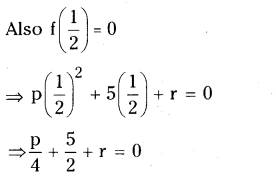
As (x – 2) and [latex]\left(x-\frac{1}{2}\right)[/latex] are factor of f(x), we have f(2) = 0 and f(1/2) = 0
∴ f(2) = p(2)2 + 5(2) + r
= 4p + 10 + r = 0
= 4p + r
= – 10 ………………(1)
AP Board 9th Class Maths Solutions Chapter 2 Polynomials and Factorisation Ex 2.4 3
⇒ p + 10 + 4r = 0
⇒ p + 4r = – 10 ………………. (2)
From (1) and (2);
4p + r = p + 4r
4p – p = 4r – r
3p = 3r
∴ P = r

AP Board 9th Class Maths Solutions Chapter 2 Polynomials and Factorisation Ex 2.4

Question 6.
If (x2 – 1) is a factor of ax4 + bx3 + cx2 + dx + e, show that a + c + e = b + d = 0.
Solution:
Let f(x) = ax4 + bx3 + cx2 + dx + e
As (x – 1) is a factor of f(x) we have
x2 – 1 = (x + 1) (x – 1) hence f(1) = 0 and f(-1) = 0
f(1) = a + b + c + d + e = 0 ……………. (1)
and f(-1) = a- b + c- d + e = 0
⇒ a + c + e = b + d
Substitute this value in equation (1)
a + c + e + b + d=0
b + d + b + d=0
2 (b + d) = 0
⇒ b + d = 0
∴ a + c + e = b + d = 0

AP Board 9th Class Maths Solutions Chapter 2 Polynomials and Factorisation Ex 2.4

Question 7.
Factorise
i) x3 – 2x2 – x + 2
Solution:
Let f(x) = x3 – 2x2 – x + 2
By trial, we find f(l) = 13 – 2(1)2 – 1 + 2
= 1 – 2 – 1 + 2
= 0 .
∴ (x – 1) is a factor of f(x).
[by factor theorem]
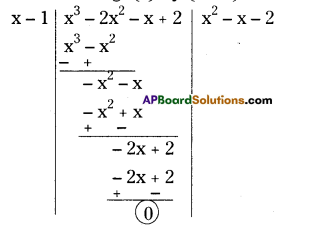
Now dividing f(x) by (x – 1).
AP Board 9th Class Maths Solutions Chapter 2 Polynomials and Factorisation Ex 2.4 4
f(x) = (x – 1) (x2 – x – 2)
= (x – 1) [x2 – 2x + x- 2]
= (x – 1) [x (x – 2) + 1 (x – 2)]
= (x – 1) (x – 2) (x + 1)

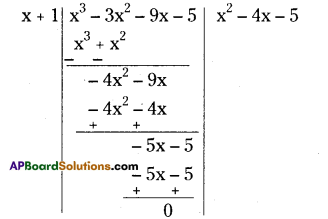
ii) x3 – 3x2 – 9x – 5
Solution:
Let f(x) = x3 – 3x2 – 9x – 5By trial,
f(- 1) = (- 1)3 – 3(- 1)2 – 9(- 1) – 5
=-1 – 3 + 9 – 5
=0
∴ (x + 1) is a factor of f(x).
[ ∵ by factor theorem]
Now dividing f(x) by (x + 1).
AP Board 9th Class Maths Solutions Chapter 2 Polynomials and Factorisation Ex 2.4 5
f(x)=(x + 1)(x2 – 4x – 5)
But x2– 4x – 5 = x2 – 5x + x – 5
= x (x – 5) + 1 (x – 5)
=(x – 5)(x + 1)
∴ f(x)=(x + 1)(x + 1)(x – 5)

AP Board 9th Class Maths Solutions Chapter 2 Polynomials and Factorisation Ex 2.4

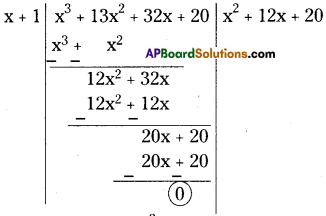
iii) x3 + 13x2 + 32x + 20
Solution:
Let f(x) = x3 + 13x2 + 32x + 20
Let f(- 1)
= (- 1)3 + 13 (- 1)2 + 32 (- 1) + 20
= – 1 + 13 – 32 + 20 = 33 – 33 = 0
∴ (x + 1) is a factor of f(x).
[ ∵ by factor theorem] Now dividing f(x) by (x + 1).
AP Board 9th Class Maths Solutions Chapter 2 Polynomials and Factorisation Ex 2.4 6

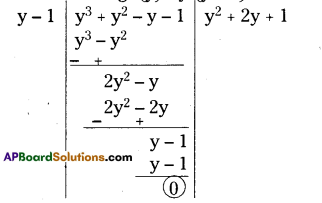
iv) y3 + y2 – y – 1
Let f(y) = y3 + y2 – y – 1
f(1) = 13+ 12– 1 – 1 = 0
(y – 1) is a factor of f(y).
Now dividing f(y) by (y – 1).
AP Board 9th Class Maths Solutions Chapter 2 Polynomials and Factorisation Ex 2.4 7

∴ f(x) = (x + 1)(x2 + 12x + 20)
But (x2 + 12x + 20) = x2+ 10x + 2x + 20
=x(x + 10)+2(x + 10)
=(x + 10)(x + 2)
∴f(x) = (x + 1)(x + 2)(x + 10)

AP Board 9th Class Maths Solutions Chapter 2 Polynomials and Factorisation Ex 2.4

Question 8.
If ax2 + bx + c and bx2 + ax + c have a common factor x + 1 then show that c = 0 and a = b.
Solution:
Let f(x) = ax2 + bx + c and g(x) = bx2 + ax + c given that (x + 1) is a common factor for both f(x) and g(x).
∴ f(-1) = g(- 1)
⇒a(- 1)2 + b(- 1) + c
= b(- 1)2 + a (- 1) + c
⇒ a – b + c = b – a + c
⇒ a + a = b + b
⇒ 2a = 2b
⇒ a = b
Also f(- 1) = a – b + c = 0
⇒ b – b + c = 0
⇒ c = 0

Question 9.
If x2 – x – 6 and x2 + 3x – 18 have a common factor x – a then find the value of a.
Solution:
Let f(x) = x2 – x – 6 and
g(x) = x2 + 3x – 18
Given that (x – a) is a factor of both f(x) and g(x).
f(a) = g(a) = 0
⇒ a2 – a – 6 = a2 + 3a – 18
⇒ – 4a = – 18 + 6
⇒ – 4a = – 12
∴ a = 3

AP Board 9th Class Maths Solutions Chapter 2 Polynomials and Factorisation Ex 2.4

Question 10.
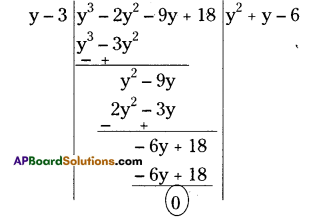
If (y – 3) is a factor of y3– 2y2– 9y + 18, then find the other two factors.
Solution:
Let f(y) = y3– 2y2 – 9y + 18
Given that (y – 3) is a factor of f(y).
Dividing f(y) by (y – 3)
AP Board 9th Class Maths Solutions Chapter 2 Polynomials and Factorisation Ex 2.4 8
∴ f(y) = (y – 3) (y + y – 6)
But y2 + y – 6
= y2 + 3y – 2y – 6
= y (y + 3) – 2 (y + 3)
= (y + 3) (y – 2)
∴ f(y) = (y – 2)(y – 3)(y + 3)
The other two factors are (y – 2) and (y + 3).

AP Board 9th Class Maths Solutions Chapter 1 Real Numbers Ex 1.4

AP State Syllabus AP Board 9th Class Maths Solutions Chapter 1 Real Numbers Ex 1.3 Textbook Questions and Answers.

AP State Syllabus 9th Class Maths Solutions 1st Lesson Real Numbers Exercise 1.4

Question 1.
Simple the following expressions.
i) (5 + √7) (2 + √5)
Solution:
(5 + √7) (2 + √5)
= 10 + 5√5 + 2√7 + √35

ii) (5 + √5) (5 – √5)
Solution:
(5 + √5) (5 – √5)
= 52 + (√5)2
= 25 – 5 = 20

AP Board 9th Class Maths Solutions Chapter 1 Real Numbers Ex 1.4

(iii) (√3 + √7)2
Solution:
(√3 + √7)2
= (√3)2 + (√7)2 + 2(√3)(√7)
= 3 + 7 + 2√21
= 10 + 2√21

iv) (√11 – √7) (√11 + √7)
= (√11)2 – (√7)2
= 11 – 7 = 4

Question 2.
Classify the following numbers as rational or irrational.
i) 5 – √3
ii) √3 + √2
iii) (√2 – 2)2
iv) [latex]\frac{2 \sqrt{7}}{7 \sqrt{7}}[/latex]
v) 2π
vii) (2 +√2) (2 – √2)
Solution:
i) 5 – √3 – irrational
ii) √3 + √2 – irrational
iii) (√2 – 2)2 – irrational
iv) [latex]\frac{2 \sqrt{7}}{7 \sqrt{7}}[/latex] – rational
v) 2π – Transcendental number. (not irrational)
vi) [latex]\frac{1}{\sqrt{3}}[/latex]- irrational
vii) (2 +√2) (2 – √2) – rational

AP Board 9th Class Maths Solutions Chapter 1 Real Numbers Ex 1.4

Question 3.
In the following equations, find whether variables x, y, z etc., represents rational or irrational numbers.
i) x2 = 7
ii) y2 = 16
iii) z2 = 0.02
iv) u2 = [latex]\frac{17}{4}[/latex]
v) w2 = 27
vi) t4 = 256
Solution:
i) x2 = 7
⇒ x = √7 is an irrational number.
ii) y2 = 16 ⇒ y = 4 is a rational number.
iii) z2 = 0.02 ⇒ z = [latex]\sqrt{0.02}[/latex] is an irrational number.
iv) u2 = [latex]\frac{17}{4}[/latex] ⇒ x = [latex]\frac{\sqrt{17}}{2}[/latex] is an irrational number.
v) w2 = 27 ⇒ w = [latex]3 \sqrt{3}[/latex] an irrational number.
vi) t4 = 256 ⇒ t2 = [latex]\sqrt{256}[/latex] = 16
⇒ t = [latex]\sqrt{16}[/latex] = 4 is a rational number

Qeustion 4.
The ratio of circumference to the diameter of a circle c/d is represented by π. But we say that π is an irrational number. Why?

Question 5.
Rationalise the denominators of the following.
i) [latex]\frac{1}{3+\sqrt{2}}[/latex]
Solution:
AP Board 9th Class Maths Solutions Chapter 1 Real Numbers Ex 1.4 1

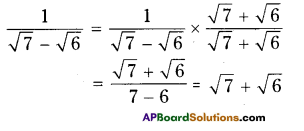
ii) [latex]\frac{1}{\sqrt{7}-\sqrt{6}}[/latex]
Solution:
AP Board 9th Class Maths Solutions Chapter 1 Real Numbers Ex 1.4 2

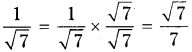
iii) [latex]\frac{1}{\sqrt{7}}[/latex]
Solution:
AP Board 9th Class Maths Solutions Chapter 1 Real Numbers Ex 1.4 3

AP Board 9th Class Maths Solutions Chapter 1 Real Numbers Ex 1.4

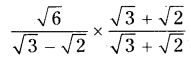
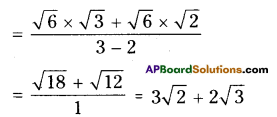
iv) [latex]\frac{\sqrt{6}}{\sqrt{3}-\sqrt{2}}[/latex]
Solution:
AP Board 9th Class Maths Solutions Chapter 1 Real Numbers Ex 1.4 4
AP Board 9th Class Maths Solutions Chapter 1 Real Numbers Ex 1.4 5

Question 6.
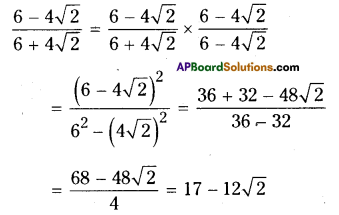
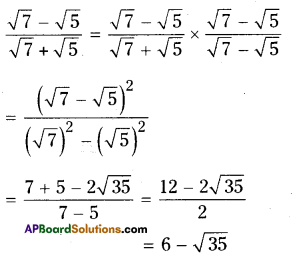
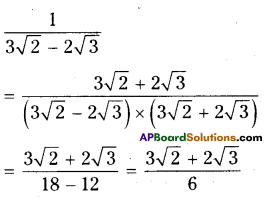
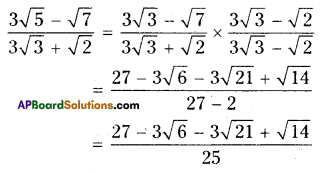
Simplify each of the following by rationalising the denominator.
i) [latex]\frac{6-4 \sqrt{2}}{6+4 \sqrt{2}}[/latex]
Solution:
AP Board 9th Class Maths Solutions Chapter 1 Real Numbers Ex 1.4 6

ii) [latex]\frac{\sqrt{7}-\sqrt{5}}{\sqrt{7}+\sqrt{5}}[/latex]
Solution:
AP Board 9th Class Maths Solutions Chapter 1 Real Numbers Ex 1.4 7

iii) [latex]\frac{1}{3 \sqrt{2}-2 \sqrt{3}}[/latex]
Solution:
AP Board 9th Class Maths Solutions Chapter 1 Real Numbers Ex 1.4 8

iv) [latex]\frac{3 \sqrt{5}-\sqrt{7}}{3 \sqrt{3}+\sqrt{2}}[/latex]
Solution:
AP Board 9th Class Maths Solutions Chapter 1 Real Numbers Ex 1.4 9

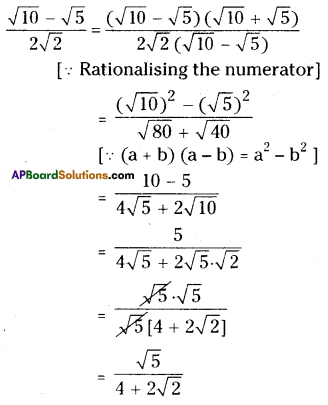
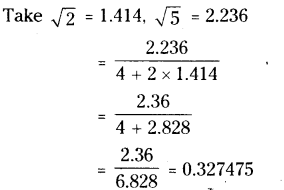
Question 7.
Find the value of [latex]\frac{\sqrt{10}-\sqrt{5}}{2 \sqrt{2}}[/latex] upto three decimal places. (take [latex]\sqrt{2}[/latex] = 1.414, [latex]\sqrt{3}[/latex] = 1.732 and [latex]\sqrt{5}[/latex] = 2.236).
Solution:
AP Board 9th Class Maths Solutions Chapter 1 Real Numbers Ex 1.4 9 (i)
AP Board 9th Class Maths Solutions Chapter 1 Real Numbers Ex 1.4 10

AP Board 9th Class Maths Solutions Chapter 1 Real Numbers Ex 1.4

Question 8.
Find
i) 641/6
Solution:
= (26)1/6
= 6

ii) 321/5
Solution:
321/5
= (25)1/5
= 2

iii) 6251/4
6251/5
= (54)1/4
= 5

iv) 163/2
Solution:
163/2
= (42)3/2

v) 2432/5
Solution:
2432/5
= (35)2/5

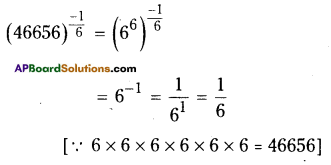
vi) (46656)-1/6
Solution:
AP Board 9th Class Maths Solutions Chapter 1 Real Numbers Ex 1.4 11

AP Board 9th Class Maths Solutions Chapter 1 Real Numbers Ex 1.4

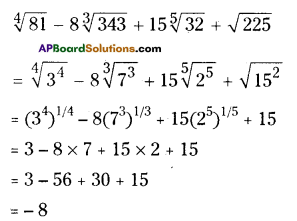
Question 9.
Simplify [latex]\sqrt[4]{81}-8 \sqrt[3]{343}+15 \sqrt[5]{32}+\sqrt{225}[/latex]
Solution:
AP Board 9th Class Maths Solutions Chapter 1 Real Numbers Ex 1.4 12

Question 10.
If ‘a’ and ‘b’ are rational numbers, find the values of a and b in each of the following equations.
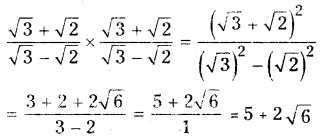
i) [latex]\frac{\sqrt{3}+\sqrt{2}}{\sqrt{3}-\sqrt{2}}=\mathbf{a}+\mathbf{b} \sqrt{6}[/latex]
Solution:
Given that [latex]\frac{\sqrt{3}+\sqrt{2}}{\sqrt{3}-\sqrt{2}}=\mathbf{a}+\mathbf{b} \sqrt{6}[/latex]
Rationalising the denominator we get
AP Board 9th Class Maths Solutions Chapter 1 Real Numbers Ex 1.4 12(i)
Comparing 5 + 2√6 with a + b√6
We have a = 5 and b = 2

AP Board 9th Class Maths Solutions Chapter 1 Real Numbers Ex 1.4

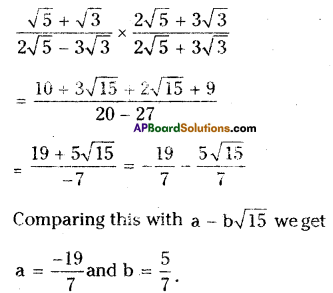
ii) [latex]\frac{\sqrt{5}+\sqrt{3}}{2 \sqrt{5}-3 \sqrt{3}}=a-b \sqrt{15}[/latex]
Solution:
Given that [latex]\frac{\sqrt{5}+\sqrt{3}}{2 \sqrt{5}-3 \sqrt{3}}=a-b \sqrt{15}[/latex]
Rationalising the denominator we get
AP Board 9th Class Maths Solutions Chapter 1 Real Numbers Ex 1.4 13

AP Board 9th Class Maths Solutions

AP Board 9th Class Maths Solutions Chapter 1 Real Numbers Ex 1.3

AP State Syllabus AP Board 9th Class Maths Solutions Chapter 1 Real Numbers Ex 1.3 Textbook Questions and Answers.

AP State Syllabus 9th Class Maths Solutions 1st Lesson Real Numbers Exercise 1.3

Question 1.
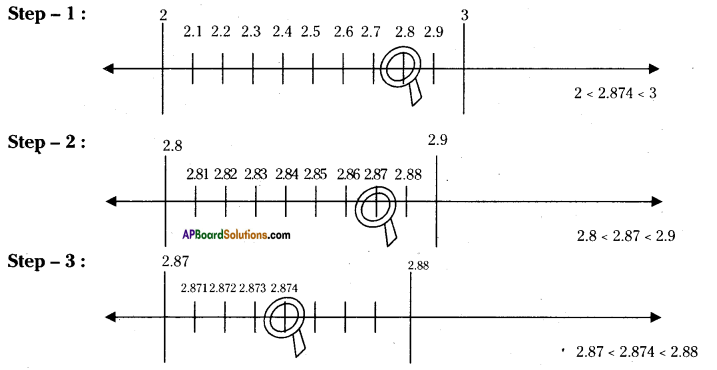
Visualise [latex]2.8 \overline{74}[/latex] on the number line, using successive magnification.
Solution:
AP Board 9th Class Maths Solutions Chapter 1 Real Numbers Ex 1.3 1

AP Board 9th Class Maths Solutions Chapter 1 Real Numbers Ex 1.2

Question 2.
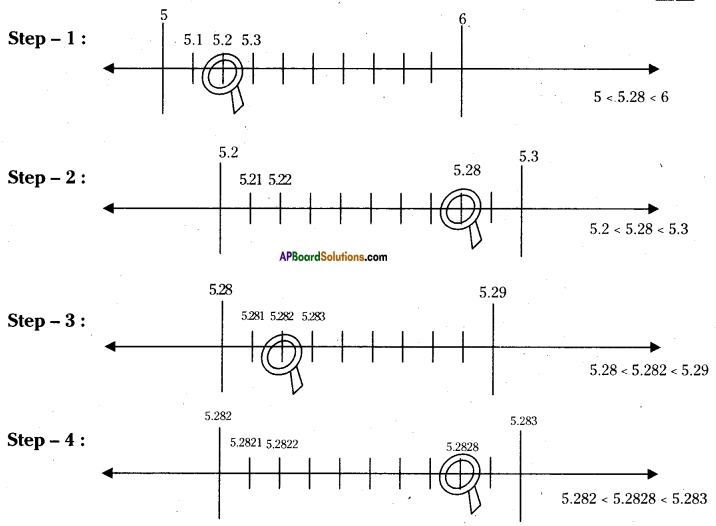
Visualise [latex]5 . \overline{28}[/latex] on the number line, upto 3 decimal places.
Solution:
AP Board 9th Class Maths Solutions Chapter 1 Real Numbers Ex 1.3 2

AP Board 9th Class Maths Solutions Chapter 1 Real Numbers Ex 1.2

AP State Syllabus AP Board 9th Class Maths Solutions Chapter 1 Real Numbers Ex 1.2 Textbook Questions and Answers.

AP State Syllabus 9th Class Maths Solutions 1st Lesson Real Numbers Exercise 1.2

Question 1.
Classify the following numbers as rational or irrational.
i) [latex]\sqrt{27}[/latex]
ii) [latex]\sqrt{441}[/latex]
iii) 30.232342345
iv) 7.484848
v) 11.2132435465
vi) 0.3030030003
Solution:
i) [latex]\sqrt{27}[/latex] – irrational number
ii) [latex]\sqrt{441}[/latex] = 21 – rational
iii) 30.232342345 – irrational number
iv) 7.484848 – rational number
v) 11.2132435465 – irrational number
vi) 0.3030030003 – irrational number

AP Board 9th Class Maths Solutions Chapter 1 Real Numbers Ex 1.2

Question 2.
Explain with an example how irrational numbers differ from rational numbers ?
Solution:
Irrational numbers can’t be expressed in [latex]\frac { p }{ q }[/latex] form where p and q are integers and q ≠ 0.
E.g.[latex]\sqrt{2}, \sqrt{3} ; \sqrt{5}, \sqrt{7}[/latex] etc.
Where as a rational can be expressed in [latex]\frac { p }{ q }[/latex] form
E.g. :- -3 = [latex]\frac { -3 }{ 1 }[/latex] and [latex]\frac { 5 }{ 4 }[/latex] etc.

Question 3.
Find an irrational number between [latex]\frac { 5 }{ 7 }[/latex] and [latex]\frac { 7 }{ 9 }[/latex]. How many more there may be ?
Solution :
The decimal forms of [latex]\frac { 5 }{ 7 }[/latex] and [latex]\frac { 7 }{ 9 }[/latex] are
[latex]\frac{5}{7}=0 . \overline{714285} \ldots ., \frac{7}{9}=0.7777 \ldots \ldots=0 . \overline{7}[/latex]
∴ An irrational between [latex]\frac { 5 }{ 7 }[/latex] and [latex]\frac { 7 }{ 9 }[/latex] is 0.727543…………
There are infinitely many irrational numbers between [latex]\frac { 5 }{ 7 }[/latex] and [latex]\frac { 7 }{ 9 }[/latex].

Question 4.
Find two irrational numbers between 0.7 and 0.77.
Solution:
Two irrational numbers between 0.7 and 0.77 can take the form
0.70101100111000111…………. and 0.70200200022……………

Question 5.
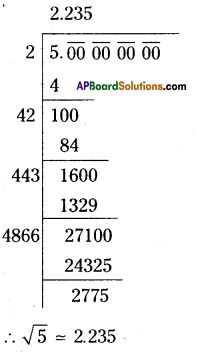
Find the value of √5 uPto 3 decimal places.
Solution:
AP Board 9th Class Maths Solutions Chapter 1 Real Numbers Ex 1.2 1
[√5 is not exactly equal to 2.2350679………….. as shown ¡n calculators]

AP Board 9th Class Maths Solutions Chapter 1 Real Numbers Ex 1.2

Question 6.
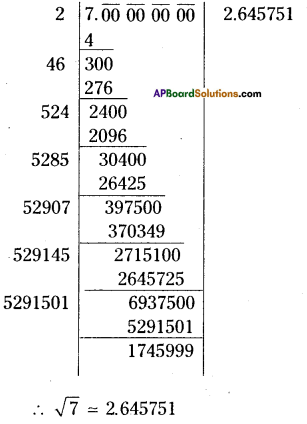
Find the value of √7 upto six decimal places by long division method.
Solution:
AP Board 9th Class Maths Solutions Chapter 1 Real Numbers Ex 1.2 2

Question 7.
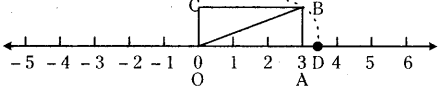
Locate [latex]\sqrt{\mathrm{10}}[/latex] on number line.
AP Board 9th Class Maths Solutions Chapter 1 Real Numbers Ex 1.2 3
Step – 1 : Draw a number line.
Step – 2 : Draw a rectangle OABC at zero with measures 3 x 1. i.e., length 3 units and breadth 1 unit.
Step – 3 : Draw the diagonal OB.
Step – 4 : Draw an arc with centre ‘O’ and radius OB which cuts the number line at D.
Step – 5 : ‘D’ represents [latex]\sqrt{\mathrm{10}}[latex] on the number line.

AP Board 9th Class Maths Solutions Chapter 1 Real Numbers Ex 1.2

Question 8.
Find atleast two irrational numbers between 2 and 3.
Solution:
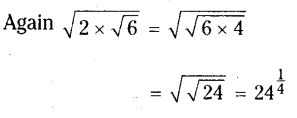
An irrational number between a and b is Tab [latex]\sqrt{\mathrm{ab}}[/latex] unless ab is a perfect square.
∴ Irrational number between 2 and 3 is √6
AP Board 9th Class Maths Solutions Chapter 1 Real Numbers Ex 1.2 4
∴ Required irrational numbers are 61/2, 241/4

Method – II:
Irrational numbers between 2 and 3 are of the form 2.12111231234………….. and 3.13113111311113…….

AP Board 9th Class Maths Solutions Chapter 1 Real Numbers Ex 1.2

Question 9.
State whether the following statements are true or false. Justify your answers.
Solution:

  1. Every irrational number is a real number – True (since real numbers consist of rational numbers and irrational numbers)
  2. Every rational number is a real number – True (same as above)
  3. Every rational number need not be a rational number – False (since all rational numbers are real numbers).
  4. [latex]\sqrt{n}[/latex] is not irrational if n is a perfect square – True. (since by definition of an irrational number).
  5. [latex]\sqrt{n}[/latex] is irrational if n is not a perfect square – True. (same as above)
  6. All real numbers are irrational – False (since real numbers consist of rational