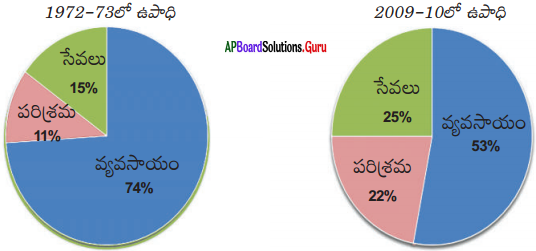
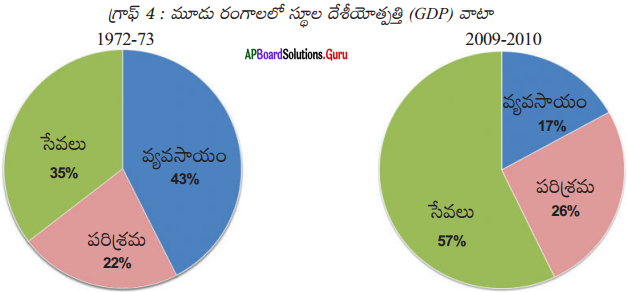
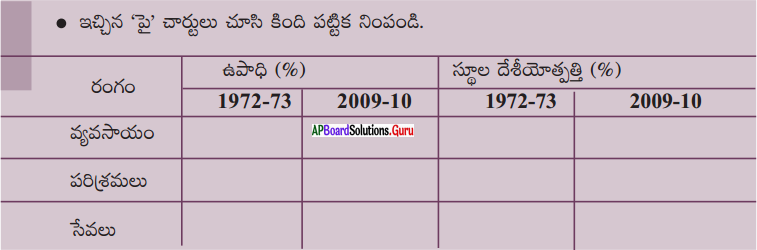
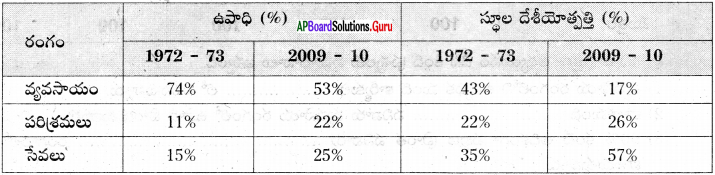
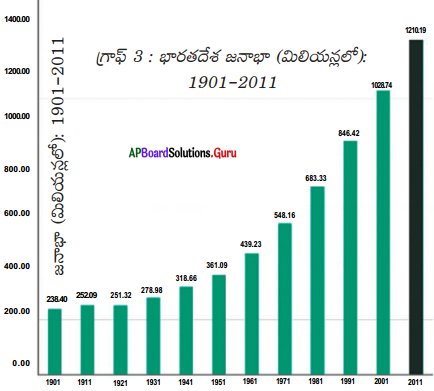
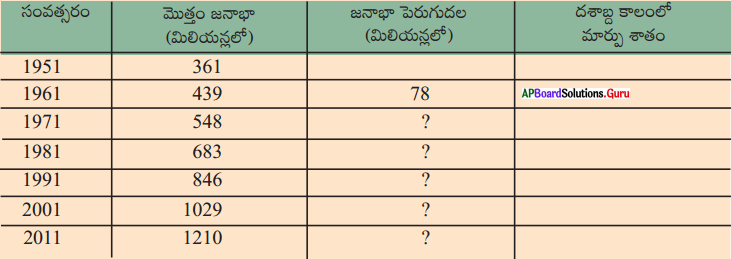
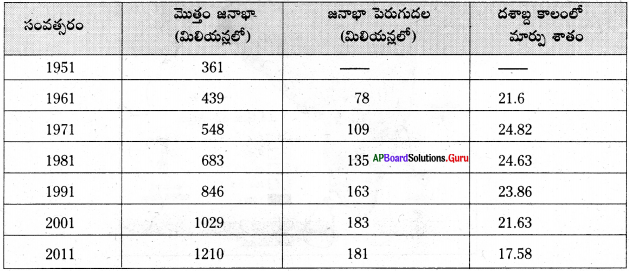
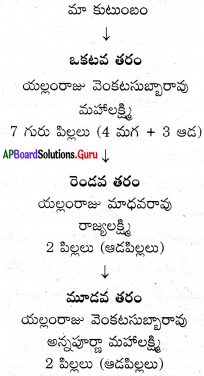
AP Board 10th Class Social Solutions Chapter 7 ప్రజలు – నివాస ప్రాంతాలు

SCERT AP 10th Class Social Study Material Pdf 7th Lesson ప్రజలు – నివాస ప్రాంతాలు Textbook Questions and Answers.

AP State Syllabus 10th Class Social Solutions 7th Lesson ప్రజలు – నివాస ప్రాంతాలు

10th Class Social Studies 7th Lesson ప్రజలు – నివాస ప్రాంతాలు Textbook Questions and Answers

Improve your learning (మీ అభ్యసనాన్ని మెరుగుపడుచుకోండి)

ప్రశ్న 1.
నివాసప్రాంతం అంటే ఏమిటి? (AS1)
జవాబు:
ఒక ప్రదేశంలో మన నివాస స్థలాన్ని, మన జీవితాలను ఏర్పరచుకున్న పద్దతినే నివాసప్రాంతం అంటాం. ఇది మనం నివసించే, పనిచేసే భౌగోళిక ప్రదేశం. నివాస ప్రాంతంలో విద్య, మతపర, వాణిజ్యం వంటి విభిన్న కార్యకలాపాలు ఉంటాయి.

ప్రశ్న 2.
స్థిర నివాసం ఏర్పాటు చేసుకోవటంతో మానవ జీవనశైలి ఎలా మారింది? (AS1)
(లేదా)
స్థిర జీవనం వల్ల మానవ జీవనశైలిలో వచ్చిన మార్పులను వివరించండి.
జవాబు:
స్థిర నివాసం ఏర్పాటు చేసుకోవటంతో మానవ జీవనశైలిలో అనేక మార్పులు వచ్చాయి. ఆహారం సంపాదించుకోడానికి వాళ్లు చాలాదూరం తిరగాల్సిన పని తప్పింది. ఇప్పుడు ఎక్కువ కాలం ఉండడానికి వీలు కావడంతో స్థిర నివాసం ఏర్పాటు చేసుకున్నారు. వీరు ఆహార ఉత్పత్తికి, వ్యవసాయానికి పూనుకున్నారు. ప్రకృతి రీతులను బాగా అర్థం చేసుకోగలిగారు. ఆకాశంలో గ్రహాల కదలికలు వంటివి గమనించడానికి వీరికి తీరిక దొరికింది. జనాభా కూడా పెరిగింది. రవాణా సౌకర్యాలు విస్తరించాయి.

AP Board 10th Class Social Solutions Chapter 7 ప్రజలు – నివాస ప్రాంతాలు

ప్రశ్న 3.
ప్రదేశం, పరిస్థితి అంశాలను నిర్వచించండి. మీరు ఉంటున్న ప్రాంతం నుంచి ఒక్కొక్క ఉదాహరణ ఇవ్వండి. (AS1)
జవాబు:
ప్రదేశం ఒక ప్రాంత లక్షణాలను తెలియజేస్తుంది. మెట్టపల్లాలు, సముద్రానికి ఎంత ఎత్తులో ఉందో, నీటి వనరులు, నేల రకాలు, భద్రత, ప్రకృతి శక్తుల నుండి రక్షణ వంటివి ప్రదేశం కిందకి వస్తాయి. విశాఖపట్టణాన్ని ఉదాహరణగా తీసుకుంటే ఇది బంగాళాఖాతం తీరంలో ఉంది. సహజ ఓడరేవు, విమానాశ్రయం, రైల్వేస్టేషన్, బస్ స్టేషన్ వంటి అన్ని సదుపాయాలు ఉన్నాయి. ప్రభుత్వ, ప్రైవేటు రంగాలలో ఉన్నత విద్య, వైద్య సదుపాయాలున్నాయి. పరిస్థితి : ప్రాంతాలు ఒంటరిగా ఉండవు. ఏదో ఒక విధంగా ఇతర ప్రాంతాలతో సంబంధం ఉంటుంది. పరిస్థితి ఇతర ప్రాంతాలతో గల సంబంధాలను తెలియజేస్తుంది.

విశాఖపట్నం నుండి అన్ని ప్రాంతాలకు బస్సు, రైలు, విమాన, నౌకా సదుపాయాలున్నాయి.

ప్రశ్న 4.
వివిధ ప్రాంతాలను భారతదేశ జనాభా గణన విభాగం ఎలా నిర్వచిస్తోంది ? పరిమాణం, ఇతర అంశాల రీత్యా వాటిని ఎలా వ్యవస్థీకరిస్తోంది? (AS1)
జవాబు:
భారత జనాభా గణన విభాగం కొన్ని ప్రామాణికాల ఆధారంగా నివాసప్రాంతాలను వర్గీకరిస్తుంది.

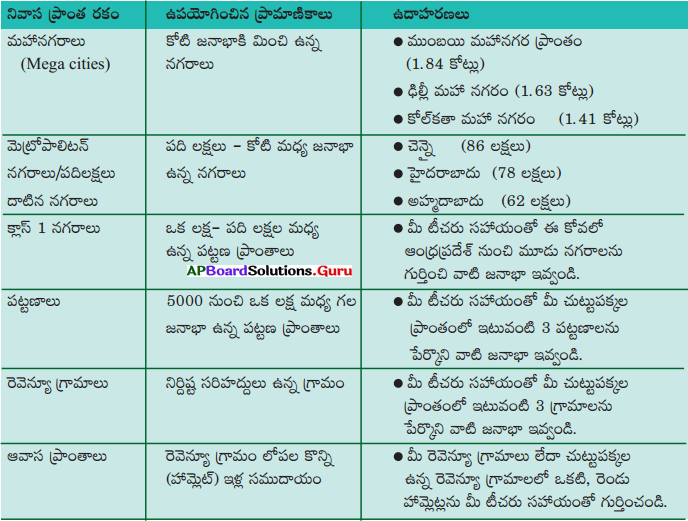
నివాస ప్రాంత రకం ఉపయోగించిన ప్రామాణికాలు ఉదాహరణలు
మహానగరాలు కోటి జనాభాకి మించి ఉన్న నగరాలు * ముంబై మహానగర ప్రాంతం (1.84 కోట్లు)
* ఢిల్లీ మహానగరం (1.63 కోట్లు)
* కోల్‌కతా మహానగరం (1.41 కోట్లు)
మెట్రోపాలిటన్ నగరాలు/పదిలక్షలు దాటిన నగరాలు పది లక్షలు – కోటి మధ్య జనాభా ఉన్న నగరాలు * చెన్నై (86 లక్షలు) నగరాలు/పదిలక్షలు .
* హైదరాబాదు (78 లక్షలు) దాటిన నగరాలు
* అహ్మదాబాదు (62 లక్షలు)
క్లాసు 1 నగరాలు ఒక లక్ష – పది లక్షల మధ్య పట్టణ ప్రాంతాలు * విశాఖపట్టణం (2.03 మిలియన్లు) ఉన్న
* తిరుపతి (0.46 మిలియన్లు)
* వరంగల్ (0.76 మిలియన్లు)
పట్టణాలు 5000 నుంచి ఒక లక్ష మధ్య గల * ప్రొద్దుటూరు (1,50,309)
* తెనాలి (1,53,756)
* సిద్దిపేట (61,809)
రెవెన్యూ గ్రామాలు నిర్దిష్ట సరిహద్దులు ఉన్న గ్రామం * పెదకాకాని (18,947)
* కొల్లూరు (16,025)
* బండారుపల్లి (4,863)
ఆవాస ప్రాంతాలు రెవెన్యూ గ్రామం (హామ్లెట్) లోపల కొన్ని ఇళ్ల సముదాయం * గోసాలపురం తండా (1570)

AP Board 10th Class Social Solutions Chapter 7 ప్రజలు – నివాస ప్రాంతాలు

ప్రశ్న 5.
విమానాశ్రయ నగరం అంటే ఏమిటి ? దాని నిర్మాణ స్వరూపం ఏమిటి? (AS1)
జవాబు:
భారతదేశంతో సహా అనేక దేశాలలో కొత్త రకపు నివాస ప్రాంతాలు ఏర్పడుతున్నాయి. ఈ నివాస ప్రాంతాలు పెద్ద పెద్ద విమానాశ్రయాల చుట్టూ ఏర్పడుతున్నాయి. అందుకనే వీటిని విమానాశ్రయ నగరాలు (లేదా ఏరోట్రిపోలిస్) అంటున్నారు.

విమానాశ్రయ నగరాలలో విమానాశ్రయమే ఒక నగరంగా పనిచేస్తుంది. అనేక సదుపాయాలు (హోటళ్లు, దుకాణాలు, వినోదం, ఆహారం, వ్యాపార సమావేశ సదుపాయాల వంటివి) అక్కడ కల్పిస్తారు. ఇతర ప్రాంతాల నుంచి ప్రజలు విమానాలలో వచ్చి తమకు అవసరమైన వాళ్లతో అక్కడే వ్యవహారాలు పూర్తి చేసుకుని తిరిగి విమానాల్లో వెళ్లిపోతారు. ట్రాఫిక్ వంటి సమస్యలు ఏమీ లేకుండా నగరంలోని సదుపాయాలన్నింటినీ పొందుతారు.
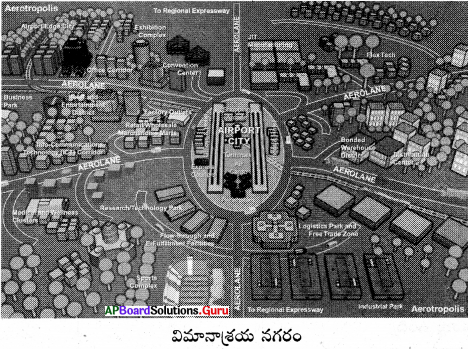
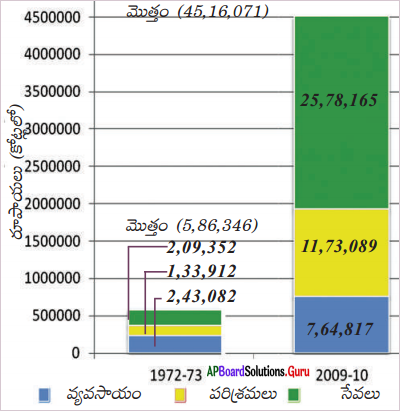
AP Board 10th Class Social Solutions Chapter 7 ప్రజలు – నివాస ప్రాంతాలు 1

10th Class Social Studies 7th Lesson ప్రజలు – నివాస ప్రాంతాలు InText Questions and Answers

10th Class Social Textbook Page No.98

ప్రశ్న 1.
విమానాశ్రయ నగర కేంద్రం ఏమిటి?
జవాబు:
పెద్ద పెద్ద విమానాశ్రయాల చుట్టూ కొత్తగా ఏర్పడే నగరాన్ని విమానాశ్రయ నగర కేంద్రం అంటారు.

10th Class Social Textbook Page No.98

ప్రశ్న 2.
విమానాశ్రయ నగర కేంద్రంలో, లేదా దాని దగ్గర ఉండే రెండు సదుపాయాలను పేర్కొనండి.
జవాబు:
విమానాశ్రయ నగర కేంద్రంలో ఉండే సదుపాయాలు :

  1. హోటళ్లు
  2. వ్యాపార సమావేశ సదుపాయాలు

10th Class Social Textbook Page No.100

ప్రశ్న 3.
మొహుదా గ్రామ ప్రజలు ఏ విషయం పట్ల ఆందోళన చెందుతున్నారు?
జవాబు:
తమ గ్రామం వద్ద చెత్త శుద్ధి కార్మాగారాన్ని ఏర్పాటు చేయడం వల్ల మొహుదా గ్రామస్థులు ఆందోళన చెందుతున్నారు.

AP Board 10th Class Social Solutions Chapter 7 ప్రజలు – నివాస ప్రాంతాలు

10th Class Social Textbook Page No.100

ప్రశ్న 4.
చెత్త శుద్ధి కర్మాగారం వల్ల ఎంత మంది ప్రజలు, పశువులు ప్రభావితం కానున్నారు?
జవాబు:
మొహుదా గ్రామం వద్ద చెత్త శుద్ధి కర్మాగారాన్ని ఏర్పాటుచేస్తే ఆ ప్రాంతంలోని 30,000 మంది ప్రజలే కాకుండా 10,000 పశువులు కూడా ప్రభావితం అవుతాయి.

10th Class Social Textbook Page No.100

ప్రశ్న 5.
సర్వే నివేదిక ప్రకారం బరంపురం ఎంత ఘన వ్యర్థ పదార్థాలను ఉత్పత్తి చేసింది?
జవాబు:
2009 లో నిర్వహించిన ఒక సర్వే ప్రకారం బరంపురంలో ప్రతిరోజు 150 టన్నుల ఘన వ్యర్థపదార్థాలు ఉత్పన్నం అవుతాయి.

10th Class Social Textbook Page No.100

ప్రశ్న 6.
బరంపురం నగరపాలక సంస్థ అధికారులు “గత మూడు సంవత్సరాలలో ఉత్పత్తి అవుతున్న చెత్త పెరిగి ఉండవచ్చని” అంటున్నారు. వీళ్ల అభిప్రాయంతో మీరు ఏకీభవిస్తున్నారా, లేదా ? మీ కారణాలు పేర్కొనండి.
జవాబు:
అవును, బరంపురం నగరపాలక సంస్థ అధికారులతో ఏకీభవిస్తున్నాను. నగర ప్రజల జీవనశైలి మారుతూ ఉండటంతో ఘన వ్యర్థ పదార్థాలు కూడా పెరగవచ్చు.

AP Board 10th Class Social Solutions Chapter 7 ప్రజలు – నివాస ప్రాంతాలు

10th Class Social Textbook Page No.94

ప్రశ్న 7.
నిలువు వరుస ‘అ’లో ఒక ప్రదేశం యొక్క అంశాలు ఉన్నాయి. ‘ఆ’ నిలువు వరసలో అది ప్రదేశానికి సంబంధించిన అంశమో, పరిస్థితికి సంబంధించిన అంశమో రాయండి. అది పరిస్థితికి సంబంధించిన అంశమైతే ‘ఇ’ నిలువు వరసలో దీని ప్రభావం ఎలా ఉంటుందో రాయండి.

1. బంకమట్టి నేల
2. వర్షపాతం చాలా ఎక్కువ.
3. దాని ప్రధానమైన మార్కెట్టు తీరానికి 45 కిలోమీటర్ల దూరంలో ఉంది.
4. నేల చాలా తక్కువ వాలు కలిగి ఉంటుంది.
5. అది ప్రధాన రైలు మార్గంలో ఉంది.
6. ఆసుపత్రి లేదు.
7. వ్యవసాయ భూములు ఎక్కువ.
8. మొబైల్ టవర్లతో అన్ని ప్రదేశాలతో
సంబంధం కలిగి ఉంది.
9. నది నుండి పది నిమిషాలు నడవాలి.
10. ఒక వడ్ల మిల్లు ఉంది.

జవాబు:

1. బంకమట్టి నేల ప్రదేశం ఇటుక, కుండల తయారీకి అనుకూలం.
2. వర్షపాతం చాలా ఎక్కువ. ప్రదేశం ప్రదేశం పంటలు పండవు, నీటి సమస్య ఉండును.
3. దాని ప్రధానమైన మార్కెట్టు తీరానికి 45 కిలోమీటర్ల దూరంలో ఉంది. పరిస్థితి
4. నేల చాలా తక్కువ వాలు కలిగి ఉంటుంది. ప్రదేశం పంటలకు అనుకూలం. ఇండ్ల నిర్మాణానికి అనుకూలం.
5. అది ప్రధాన రైలు మార్గంలో ఉంది. పరిస్థితి అనుకూలమైనది.
6. ఆసుపత్రి లేదు. ప్రదేశం అనుకూలం కాదు.
7. వ్యవసాయ భూములు ఎక్కువ. ప్రదేశం జనాభా ఎక్కువగా ఉంటారు.
8. మొబైల్ టవర్లతో అన్ని ప్రదేశాలతో
సంబంధం కలిగి ఉంది.
పరిస్థితి అనుకూలమైనది.
9. నది నుండి పది నిమిషాలు నడవాలి. పరిస్థితి అనుకూలమైనది.
10. ఒక వడ్ల మిల్లు ఉంది. ప్రదేశం అనుకూలమైనది.

10th Class Social Textbook Page No.94

క్షేత్ర పరిశీలన :

ప్రశ్న 8.
మీరు గీసిన పటంలో గుర్తించిన ఉత్పత్తి ప్రదేశాలలో (వ్యవసాయ క్షేత్రాలు, కర్మాగారాలు, కార్యాలయాలు, దుకాణాలు, గనులు వంటివి) ఒకటి, రెండింటిని సందర్శించండి. వాళ్లకి కావలసిన ముడిసరుకులు/ఉత్పాదకాలు ఎక్కడి నుంచి వస్తాయో, ఉత్పత్తి చేసిన సరుకులు ఎక్కడ అమ్ముతారో తెలుసుకోండి. ఏ ముడిసరుకులు మీ నివాస ప్రాంతం నుంచి , వస్తాయి ? అదే విధంగా ఉత్పత్తి చేసిన సరుకులను మీ నివాస ప్రాంతంలోనే అమ్ముతున్నారో లేక ఇతర ప్రాంతాలకు పంపిస్తున్నారో (ఇతర ప్రాంతాలకు పంపిస్తున్నట్లయితే, ఎక్కడికి పంపిస్తున్నారో) తెలుసుకోండి. ఇక్కడ ఉత్పత్తి ఎందుకు చేపట్టారు?
1) ఈ ప్రాంతంలో ఉత్పత్తిని ప్రభావితం చేసిన ఆ ప్రదేశం అంశాలకు ఉదాహరణలు ఇవ్వండి.
జవాబు:
ఇచ్చట వ్యవసాయ క్షేత్రాలు సారవంతమైనవి. నదీ ప్రవాహంతో వచ్చి ఒండ్రుమట్టితో చక్కని వరి, పెసర, జనుము, నువ్వులు పండుతాయి. నదీ తీర ప్రాంతం కావడంతో కాలువల ద్వారా సాగునీరు అందుతుంది. నదిలో నీరు లేనపుడు తక్కువ లోతులోనే బోరుబావులకు నీరు లభ్యమౌతుంది.

2) ఈ ప్రాంతంలో ఉత్పత్తిని ప్రభావితం చేసిన పరిస్థితి అంశాలకు ఉదాహరణలు ఇవ్వండి.
జవాబు:
గ్రామంలో వ్యవసాయేతర వృత్తులవారు, సమీప పట్టణ వ్యాపారులు వచ్చి పంటలను కొనుగోలు చేస్తారు. సమీప పట్టణానికి రహదారి సౌకర్యం ఉండటంతో రైతులే స్వయంగా పంటలను తీసుకొనిపోయి అమ్ముకొనే సదుపాయం కలదు. వేసవికాలంలో పండే కూరగాయలకు మార్కెట్ సౌకర్యం కలదు.

3) ఉత్పత్తిని ఆ ప్రాంత చరిత్ర ఎలా ప్రభావితం చేసింది?
జవాబు:
వ్యవసాయ క్షేత్రాలు, మార్కెట్ ఒకే జిల్లాలోనివి కావడం.

AP Board 10th Class Social Solutions Chapter 7 ప్రజలు – నివాస ప్రాంతాలు

10th Class Social Textbook Page No.95

ప్రశ్న 9.
మీ ప్రాంతాన్ని పరిగణనలోకి తీసుకోండి…….

ఒక ప్రాంతం ఎంత పెద్దగా ఉంటే అక్కడ అన్ని ఎక్కువ సేవలు లభ్యం అవుతాయి. ఉదాహరణకు విద్య సదుపాయాలను తీసుకోండి. దీని ద్వారా పెద్ద ప్రదేశాలలో (అంటే పై స్థాయిలో ఉన్న ప్రాంతాలలో) ప్రత్యేక సేవలు విరివిగా లభ్యమవడాన్ని గమనించవచ్చు.
1) మీ ప్రాంతంలో ఏ స్థాయి వరకు విద్యా సదుపాయం ఉంది ? ఉదా : ప్రాథమిక, ఉన్నత, ఇంటర్మీడియట్, కళాశాల విద్య (డిగ్రీ, పీజి).
జవాబు:
ఉన్నత పాఠశాల విద్య

2) మీ ఊరిలో ఉన్న సదుపాయానికి మించి మీరు చదువు కొనసాగించదలుచుకుంటే మీరు ఎక్కడికి వెళ్లవలసి వస్తుంది?
జవాబు:
సమీప పట్టణానికి,

3) మీ ప్రాంతంలో ఎటువంటి వృత్తి విద్యా కోర్సులు ఉన్నాయి? ఉదా : ఇంజినీరింగ్, మెడిసిన్, కామర్స్, సాంకేతిక డిప్లామా వంటివి.
జవాబు:
మా గ్రామానికి 10 కి.మీ. పరిధిలో ఇంజనీరింగ్, మెడిసిన్, పాలిటెక్నిక్, కామర్స్ కోర్సులు అందుబాటులో ఉన్నాయి.

4) మీకు వేరే వృత్తి విద్యలో ఆసక్తి ఉంటే మీరు ఎక్కడికి వెళ్లవలసి ఉంటుంది?
జవాబు:
సమీప పట్టణానికి.

10th Class Social Textbook Page No.98

ప్రశ్న 10.
ఈ అధ్యాయం కోసం మీరు అధ్యయనం చేసిన ప్రదేశానికి దగ్గరలో విమానాశ్రయ నగరం ఏర్పడిందని ఊహించుకోండి. అప్పుడు ఆ ప్రాంత స్థలంలో వచ్చే మూడు మార్పులను పేర్కొనండి. అదే విధంగా ఆ ప్రాంత పరిస్థితులలో వచ్చే మూడు మార్పులను పేర్కొనండి.
జవాబు:
విమానాశ్రయ నగరం ఏర్పడితే వచ్చే మార్పులు :
ఎ) ఆ ప్రాంత స్థలంలో :

  1. గదులు అద్దెకిచ్చే హోటళ్లు, టాక్సీలు వెలుస్తాయి.
  2. వ్యాపారవేత్తలు, అధికారులు సమావేశాలు నిర్వహించేందుకు సమావేశ మందిరాలు నిర్మితమవుతాయి.
  3. అంతర్జాలం (Internet) వంటి సదుపాయాలతో కేస్లు కూడా వెలుస్తాయి.

బి) ఆ ప్రాంత పరిస్థితిలో మార్పులు :

  1. సమీప నగరానికి చక్కని రహదారులు వేస్తారు.
  2. రవాణా సౌకర్యం సమకూర్చుతారు.
  3. కమ్యూనికేషన్ వ్యవస్థ మెరుగుపడుతుంది.

AP Board 10th Class Social Solutions Chapter 7 ప్రజలు – నివాస ప్రాంతాలు

10th Class Social Textbook Page No.100

ప్రశ్న 11.
చెత్త శుద్ధి కర్మాగారాన్ని నెలకొల్పటానికి గుర్తించిన ఇతర ప్రదేశం ఏది ? దానిని ఎందుకు ఉపయోగించుకోలేదు?
జవాబు:
అంతకు ముందు ఈ చెత్త శుద్ధి కర్మాగారాన్ని నగర శివార్లలోని చందానియా కొండపైన ఏర్పాటు చేయాలని ప్రతిపాదించారు. అయితే ఈ ప్రాంతం అటవీ భూమి కిందకి వస్తుందని గుర్తించారు. దీనిని ముందుగా రెవెన్యూశాఖకు, ఆ తరువాత బరంపురం నగరపాలక సంస్థకు బదిలీ చేయవలసి రావటంతో ఈ ప్రతిపాదన విరమించారు.

10th Class Social Textbook Page No.88

క్షేత్ర పని

ప్రశ్న 12.
మీ ఊరు, పట్టణం లేదా నగరాన్ని పరిశీలించండి. ఇంతకుముందు నేర్చుకున్న పద్ధతుల ఆధారంగా ఎంపిక చేసిన ఒక చిన్న ప్రాంతం పటం గీయండి. మీ పటంలో ఈ కింద సూచించినవి ఉండాలి.
రోడ్లు, ఇళ్లు, బజారు, దుకాణాలు, వాగులు, మురికి కాలవలు, ఆసుపత్రి, పాఠశాల, బస్టాండ్, రైల్వే స్టేషన్ వంటి కొన్ని ప్రదేశాలు.
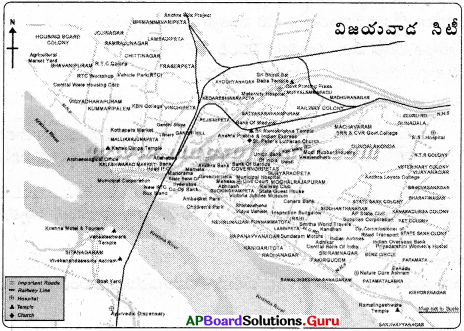
AP Board 10th Class Social Solutions Chapter 7 ప్రజలు – నివాస ప్రాంతాలు 2

1) ప్రజా సౌకర్య ప్రదేశాలు అధికశాతం ప్రజలకు వీలుగా ఉండే ప్రదేశంలో ఉన్నాయా?
జవాబు:
ప్రజా సౌకర్యాలు అధికశాతం ప్రజలకు వీలుగా ఉండే ప్రదేశంలో లేవు. గ్రామాలు, పట్టణాలు విస్తరించడంతో ప్రభుత్వ భూమి లభ్యమైన చోట ముఖ్యంగా గ్రామం చివరిలో లేదా ప్రారంభంలో వీటిని నిర్మిస్తున్నారు. ప్రధానంగా ప్రాథమిక ఆరోగ్య కేంద్రాలు, ఆసుపత్రులు, విద్యాలయాలు ప్రజలు చేరుకోలేనంత దూరంలో నిర్మిస్తున్నారు.

2) స్థానిక బజారులను కనుగొనడంలో ఏమైనా పద్దతి ఉందా?
జవాబు:
స్థానిక బజారులను గుర్తించడంలో ప్రత్యేక పద్ధతులు ఏమీ లేవు. ఇవి స్థానికులకు, పరిసర గ్రామస్థులకు సుపరిచయమైనవి అయినందున వీటి ఉనికిని చాటే నామ ఫలకాలు (Name Boards) లేవు. మార్కెట్ల స్థలంలో మాత్రం వాటి పేర్లుంటాయి.
ఉదా : రైతు బజారు, పొట్టి శ్రీరాములు మార్కెట్, పూర్ణా మార్కెట్.

3) ఇళ్లు గుంపులుగా ఉన్నాయా? వాటికి, ప్రధాన రహదారులకు మధ్య అనుసంధానం ఉందా?
జవాబు:
ఇళ్లు గుంపులుగా కాక వరుసలలోనే ఉన్నాయి. వీటికి, ప్రధాన రహదారులకు మధ్య అనుసంధానం కలదు.

4) ఎంపిక చేసిన ప్రాంతంలోని ప్రజలతో మాట్లాడి గత 20 సంవత్సరాలలో చోటుచేసుకున్న మార్పులు, వాటికి గల కారణాలు తెలుసుకోండి.
జవాబు:
గత 20 సంవత్సరాలలో మార్పులు – కారణాలు :
గత 20 సంవత్సరాలలో గ్రామాలు, పట్టణాలు బాగా విస్తరించాయి. గ్రామ, పట్టణ శివారులలో కాలనీలు, వాంబే గృహసముదాయాలు, ఇందిరమ్మ ఇండ్ల కాలనీలు, హౌసింగ్ బోర్డు కాలనీలు విపరీతంగా పెరిగాయి. పట్టణ ప్రాంతాలలో సమీప గ్రామాలు కలసిపోయేంతగా విస్తరించాయి. పంచాయతీలకు నేరుగా కేంద్రప్రభుత్వ నిధులు రావడంతో బురదమయమైన రహదారులన్నీ సిమెంటు రోడ్లుగా మారాయి. గ్రామీణ ప్రాంతంలో కూడా కాలువల నిర్మాణం చేయడంతో రోడ్లపై నీరు నిలువ ఉండకపోవటం వల్ల శుభ్రంగా కనిపిస్తున్నాయి. అనేక గ్రామాలను పట్టణాలతో కలుపుతూ తారు రోడ్లు నిర్మించడంతో గ్రామాలు పట్టణాలతో అనుసంధానించబడ్డాయి.

5) ఉండవలసిన సదుపాయాలు ఏవి లేవు?
జవాబు:
గ్రామీణ ప్రాంతాలలో రక్షిత మంచినీటి పథకాలు నెలకొల్పినా, పలు గ్రామాల్లో అవి అనేక కారణాలతో పనిచేయడం లేదు. వీధి కొళాయిలనేర్పాటు చేసి ఇంటింటికి శుభ్రమైన తాగునీటి సదుపాయం కల్పించాలి.

పాఠశాలలు, ఆరోగ్య కేంద్రాలు, అంగన్‌వాడీ కేంద్రాలు, ప్రభుత్వ కార్యాలయాల వద్ద మరుగుదొడ్లు నిర్మించి వాటిని ఉపయోగించే స్థితిలో ఉంచాలి. గ్రామీణ ప్రాంతంలో ఇండ్లలో ప్రభుత్వ సహాయంతో నిర్మించిన మరుగుదొడ్లు అత్యధిక నిరుపయోగంగా ఉన్నందున బహిరంగ మలవిసర్జన కొనసాగుతుంది.

నిర్మించిన రహదారులు సకాలంలో మరమ్మతులు లేక పాడైపోతున్నాయి. ఆరోగ్య కేంద్రాలు, ఆసుపత్రులలో డాక్టర్ల సంఖ్య పెంచాలి. మందులు అందుబాటులోకి తేవాలి.

AP Board 10th Class Social Solutions Chapter 7 ప్రజలు – నివాస ప్రాంతాలు

10th Class Social Textbook Page No.89

ప్రశ్న 13.
పోలికలు, తేడాలు పేర్కొనండి. పై సమాచారం ఆధారంగా సంచార, స్థిర జీవన శైలులలోని పోలికలు, తేడాలు పేర్కొనండి. మీరు ఎన్ని అంశాలు గుర్తించగలిగారో చూడండి. (ఇక్కడ పట్టిక సరిపోకపోతే మరొక పట్టిక తయారుచేయండి).
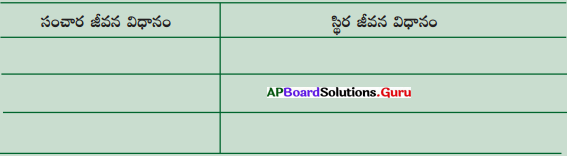
AP Board 10th Class Social Solutions Chapter 7 ప్రజలు – నివాస ప్రాంతాలు 3
జవాబు:

సంచార జీవన విధానం స్థిర జీవన విధానం
1) తొలి మానవులు వేట, సేకరణ ద్వారా ఆహారాన్ని సమకూర్చుకొనేవారు. 1) వ్యవసాయం, పశుపోషణ ద్వారా ఆహారాన్ని సమకూర్చుకుంటున్నారు.
2) ఆహార సేకరణకు, వేటకు సంచార జీవనం సాగించేవారు. 2) స్థిర నివాసం ఏర్పాటు చేసుకొని జీవనం సాగిస్తున్నారు.
3) మొదట రాళ్లను ఆయుధాలుగా చేసుకొని వేటాడేవారు. 3) వేట అవసరం తక్కువ. అవసరమైతే ఆధునిక ఆయుధాలు వాడుతున్నారు.
4) వారికి వ్యవసాయం తెలియదు. 4) వ్యవసాయమే అధిక జనాభాకు జీవనాధారం.
5) గుహలలో, చెట్టు తొర్రలలో నివసించేవారు. 5) ఇండ్లు నిర్మించుకొని వాటిల్లో నివసిస్తున్నారు.
6) జంతు చర్మాలను, చెట్ల బెరడులను ధరించేవారు. 6) వస్త్రాలు ధరిస్తున్నారు.
7) కుటుంబ వ్యవస్థ లేదు. 7) కుటుంబ వ్యవస్థీ ప్రధానమైనది.
8) మానవుడు ఎక్కువ సమయం ఆహార సేకరణ, వేటలో గడిపేవాడు. 8) శాస్త్ర, సాంకేతిక అభివృద్ధి వైపు దృష్టి పెట్టే విశ్రాంతి లభించింది.
9) వీరు ఎటువంటి కళాత్మకమైన అంశాలను నేర్వలేదు. 9) వీరు కళాత్మక దృష్టితో గృహాలు, దేవాలయాలు మొ||నవి నిర్మించారు.
10) వీరికి రాతరాయటం తెలియకపోయినా భాష నేర్చా రు. 10) వీరు రాతని నేర్చారు. పన్ను విధానాలు వ్యాపారం మొ||నవి నేర్చారు.

10th Class Social Textbook Page No.92

ప్రశ్న 14.
మీరు నివసించే ప్రాంతాన్ని గత 10 సంవత్సరాల నుండి ఏ ఏ కారకాలు ప్రభావితం చేశాయో కనుక్కోండి.
జవాబు:

  1. జనాభా పెరగడంతో కుటుంబాల సంఖ్య, ఇండ్ల సంఖ్య పెరిగాయి.
  2. దీంతో గ్రామాలు, పట్టణాలు విస్తరించాయి.
  3. బీదవారు ప్రభుత్వ స్థలాలు, చెరువు గర్భాలు, నదీ తీరాలలో ఇండ్ల నిర్మాణం చేయడంతో అధిక వర్షాలు, వరదల సమయాల్లో ముంపునకు గురవుతున్నాయి.
  4. కాలనీలు విస్తరించడంతో మౌలిక సదుపాయాల కల్పనలో పాలకవర్గాలు విఫలమవుతున్నాయి.
  5. పాఠశాలలు, ఆసుపత్రులను గ్రామాలకు దూరంగా నిర్మిస్తున్నారు.
  6. బోరుబావులు, నందనూతులు పెరగడంతో భూగర్భజలాలు త్వరితంగా అంతరించిపోతున్నాయి.
  7. ప్లాస్టిక్ వాడకం విపరీతంగా పెరిగిపోయి, ఇవి భూమి పై పొరలను ఆక్రమించడం వల్ల నీరు భూమిలో ఇంకడం లేదు.
  8. ఉపాధి కోసం గ్రామాల నుండి పట్టణాలకు, బహుళ పంటలు పండే ప్రాంతాలకు వలసలు ఎక్కువైపోయాయి.

AP Board 10th Class Social Solutions Chapter 7 ప్రజలు – నివాస ప్రాంతాలు

10th Class Social Textbook Page No.93

ప్రశ్న 15.
క్రింది పట్టికను పరిశీలించండి.
విశాఖపట్టణం జనాభా

సంవత్సరం జనాభా మార్పు శాతంలో
1901 40,892
1911 43,414 +6.2%
1921 44,711 +3.0%
1931 57,303 +28.2%
1941 70,243 +22.6%
1951 1,08,042 +53.8%
1961 2,11,190 +95.5%
1971 3,63,467 +72.1%
1981 6,03,630 +66.1%
1991 7,52,031 +24.6%
2001 13,45,938 +78.97%
2011 20,35,690 +51.2%

విశాఖపట్టణ జనాభా మార్పు :
1) పైన ఇచ్చిన జనాభా వివరాలలో అన్ని దశకాల గణాంకాలు ఉన్నాయా ? ఒకవేళ లేకపోతే ఏ దశకం గణాంకాలు ఇక్కడ లేవు?
జవాబు:
విశాఖపట్టణం జనాభా వివరాలలో 1901 నుండి 2011 వరకు అన్ని దశాబ్దాల గణాంకాలు ఉన్నాయి.

2) ఏ దశకం నుంచి ఏ దశకానికి జనాభా పెరుగుదల (శాతంలో) అత్యధికంగా ఉంది?
జవాబు:
1951-1961 దశకంలో విశాఖపట్టణం జనాభా 95.5% అత్యధిక శాతం పెరిగింది.
(సూచన : 93వ పేజీలో పట్టిక 2 లో 1991 – 2001 మధ్య 123% పెరిగినట్లు తప్పుగా ముద్రించారు. వాస్తవంగా ఇది 78.97% మాత్రమే.)

3) ఏ దశకం నుంచి ఏ దశకానికి జనాభా పెరుగుదల (శాతంలో) అతి తక్కువగా ఉంది?
జవాబు:
1911-1921 దశకానికి జనాభా పెరుగుదల (3 శాతం) అతి తక్కువగా ఉంది.

4) 1901-2011 విశాఖపట్టణం జనాభాకి లైన్ గ్రాఫ్ తయారుచేయండి. జనాభా సంఖ్యలో ఏ మార్పులను మీరు పరిశీలించారు?
జవాబు:
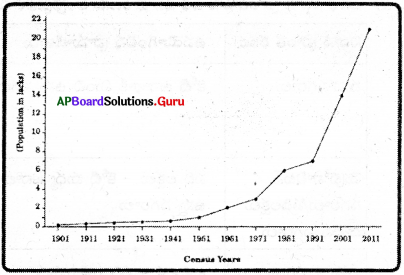
AP Board 10th Class Social Solutions Chapter 7 ప్రజలు – నివాస ప్రాంతాలు 4
గ్రాఫ్ విశ్లేషణ : 1961 వరకు క్రమేపీ పెరుగుతున్న విశాఖపట్నం జనాభా 1991 వరకు పెరుగుదల శాతం తగ్గుతూ వచ్చింది. అయితే 1991-2001 మధ్యకాలంలో జనాభా పెరుగుదల శాతం పెరిగినా 2001-2011లో పెరుగుదల శాతం తగ్గింది. పెరుగుదల శాతాలను పక్కకు పెడితే గత దశాబ్దంలో జనాభా అత్యధికంగా 6.89, 752 మంది పెరిగారు. దీనికి ఇతర ప్రాంతాల నుండి వలసలు ఎక్కువ కావడమే ప్రధాన కారణం.

10th Class Social Textbook Page No.95

• అట్లాస్ పని :
ప్రశ్న 16.
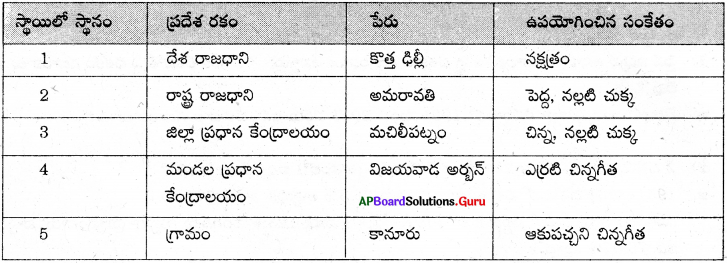
మీ అట్లాస్ లో భారతదేశ పటాన్ని చూడండి. వివిధ ప్రదేశాలను వివిధ ఆకృతులు, పరిమాణాలు ఉన్న గుర్తులతో సూచించటాన్ని గమనించండి. ఉదా : దేశ రాజధాని, రాష్ట్ర రాజధాని, ఇతర నగరాలు మొదలైనవి. వివిధ సంకేతాలను ఉపయోగించి ఎన్ని స్థాయిలను చూపించారు ? చిన్న చిన్న గ్రామాలను అట్లాస్లో చూపించారా ? మీరు సొంతంగా ఒక పట్టిక తయారు చేసి ప్రదేశాలను స్థాయిని బట్టి పై నుంచి కిందికి (అవరోహణ) క్రమంలో పేర్కొనండి. ఇక్కడ ఒక పట్టిక ఉదాహరణగా ఇచ్చాం. అందులో రెండు ప్రదేశాలు ఉన్నాయి. ఇతర ప్రదేశాలు ఇచ్చి వివరాలను నింపండి.
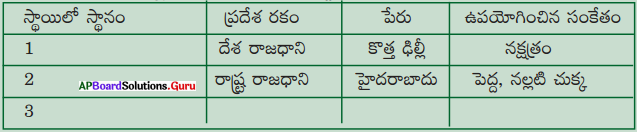
AP Board 10th Class Social Solutions Chapter 7 ప్రజలు – నివాస ప్రాంతాలు 5
జవాబు:
AP Board 10th Class Social Solutions Chapter 7 ప్రజలు – నివాస ప్రాంతాలు 6

10th Class Social Textbook Page No.96

ప్రశ్న 17.
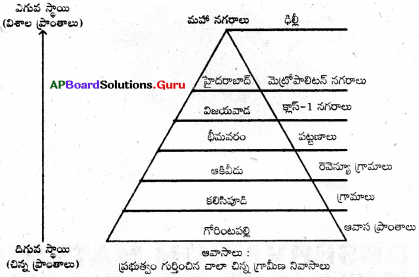
పాఠ్యపుస్తకం 97వ పేజీలో ఇవ్వబడిన పిరమిడ్ లోని కింది భాగం భారతదేశ జనాభా గణన ప్రకారం అతిచిన్న నివాసప్రాంతాలను సూచిస్తుంది. పైభాగం అతి పెద్ద నివాసప్రాంతాలను సూచిస్తుంది. క్రింది ఉన్న ఖాళీలను నింపండి.
1) ఒక ప్రత్యేక నివాసప్రాంత స్థాయికి ఇచ్చిన పేరు (రెండు ఉదాహరణలు ఉన్నాయి).
2) వివిధ నివాస ప్రాంతాలకు ఒక ఉదాహరణను ఆంధ్రప్రదేశ్ నుంచి పేర్కొనండి. (మహా నగరాలవి కాకుండా. ఎందుకు?)
AP Board 10th Class Social Solutions Chapter 7 ప్రజలు – నివాస ప్రాంతాలు 7

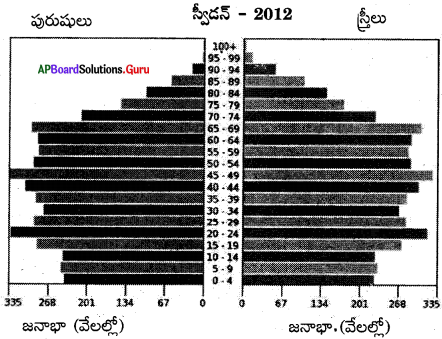
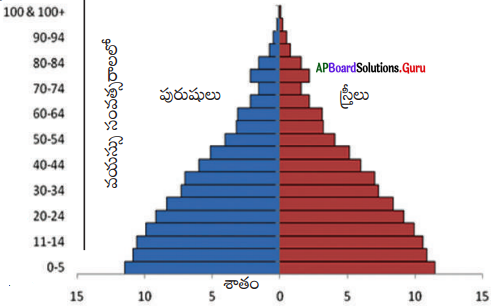
4) నివాస ప్రాంతాలను కేవలం జనాభా ఆధారంగానే వర్గీకరించాలా? ఆలోచించండి. ఇతర విధానాలు ఏమైనా ఉన్నాయా? మీ టీచరుతో చర్చించి అటువంటి వర్గీకరణకు ప్రామాణికాలను గుర్తించంది.
జవాబు:
1)
AP Board 10th Class Social Solutions Chapter 7 ప్రజలు – నివాస ప్రాంతాలు 8
2) ఆంధ్రప్రదేశ్ నుండి విజయవాడ ఒక నివాస ప్రాంతం. కారణం, ఆంధ్రప్రదేశ్ లో మహానగరము లేనందున.
3) నేను కలిసిపూడిలో నివసిస్తున్నాను. ఆకివీడు జిల్లాపరిషత్ ఉన్నత పాఠశాలలో 10వ తరగతి చదువుతున్నాను. కలిసిపూడి మా స్వగ్రామము. నాకు తెలిసిన వాటిలో ఆకివీడులోని జిల్లాపరిషత్ పాఠశాల మంచిది.
4) నివాస ప్రాంతాల వర్గీకరణ జనాభా ప్రాతిపదికన జరుగుతుంది. మరియు ఈ వర్గీకరణ సౌలభ్యాలు, చారిత్రక విషయాలపై ఆధారపడుతుంది.

10th Class Social Textbook Page No.98

ప్రశ్న 18.
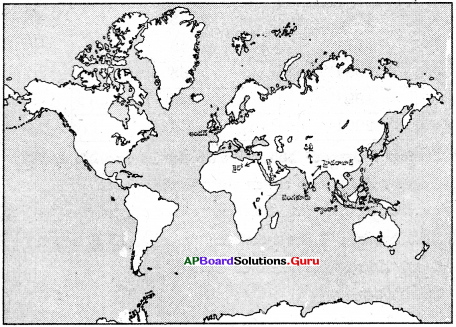
ప్రపంచ పటంలో పక్కన ఉదాహరణగా ఇచ్చిన నగరాలను గుర్తించండి. విమానాశ్రయాలు, దేశాల పేర్లను కూడా పటంలో వేరు వేరుగా రాయండి. దీనివల్ల ఏవి దేశాలో, ఏవి నగరాలో, ఏవి విమానాశ్రయాలో గుర్తించటం తేలిక అవుతుంది.
జవాబు:

  1. బెంగళూరు అంతర్జాతీయ విమానాశ్రయం
  2. ఇందిరాగాంధీ అంతర్జాతీయ విమానాశ్రయం (ఢిల్లీ)
  3. రాజీవ్ గాంధీ అంతర్జాతీయ విమానాశ్రయం (హైదరాబాదు)
  4. సువర్ణభూమి అంతర్జాతీయ విమానాశ్రయం (బ్యాంకాక్, థాయ్ లాండ్)
  5. దుబాయి అంతర్జాతీయ విమానాశ్రయం (దుబాయి, యుఎఇ)
  6. కైరో అంతర్జాతీయ విమానాశ్రయం (కైరో, ఈజిప్టు )
  7. లండన్ హీఛీ అంతర్జాతీయ విమానాశ్రయం (లండన్, యుకె)
AP Board 10th Class Social Solutions Chapter 7 ప్రజలు – నివాస ప్రాంతాలు 9

10th Class Social Textbook Page No.100

ప్రశ్న 19.
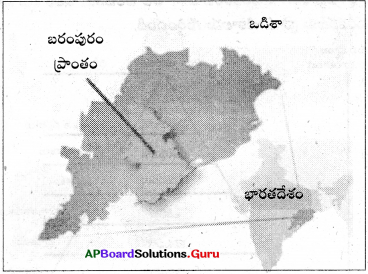
మీ అట్లాసు ఉపయోగించి బరంపురాన్ని గుర్తించండి.
జవాబు:
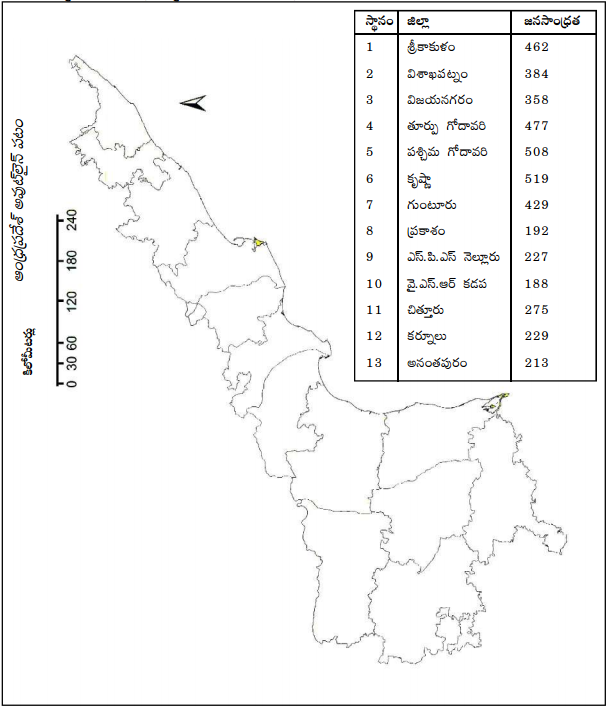
AP Board 10th Class Social Solutions Chapter 7 ప్రజలు – నివాస ప్రాంతాలు 10

AP Board 7th Class Science Solutions 10th Lesson Changes Around Us

SCERT AP 7th Class Science Study Material Pdf 10th Lesson Changes Around Us Textbook Questions and Answers.

AP State Syllabus 7th Class Science 10th Lesson Questions and Answers Changes Around Us

7th Class Science 10th Lesson Changes Around Us Textbook Questions and Answers

Improve Your Learning

I. Fill in the blanks.

1. Changes in which new substances are formed are called ______ changes.
2. Magnesium + Oxygen → ______
3. Milk converted to curd is ______ change.
4. Rusting of iron is protected by ______ process.
Answer:
1. Chemical
2. Magnesium Oxide
3. Chemical
4. Galvanisation

II. Choose the correct answer.

1. When a woolen yarn is knitted to get a sweater, the change can be described as
a) Physical change
b) Chemical change
c) Endothermic reaction
d) Exothermic reaction
Answer:
a) Physical change

2. The chemical chancre among the following is ______
a) Water to clouds
b) GroWth of a tree
c) Cow dung to bio gas
d) Ice to water
Answer:
b) GroWth of a tree

3. Which is an example of a periodic change?
a) Earth quake
b) Formation of rainbow
c) Occurrence of tides in sea
d) Showering of rain
Answer:
c) Occurrence of tides in sea

AP Board 7th Class Science Solutions 10th Lesson Changes Around Us

4. Photosynthesis by green plant is a
a) Physical change
b) Chemical change
c) Reversible change
d) None of the above
Answer:
b) Chemical change

III. Matching.

Group – A Group – B
A) Growing hair 1. Chemical change
B) Breaking Mirror 2. Acetic Acid
C) Galvanisation 3. Slow change
D) Vinegar 4. Physical change
E) Atmospheric pollution 5. Depositing zinc on iron metal
6. Fast change

Answer:

Group – A Group – B
A) Growing hair 3. Slow change
B) Breaking Mirror 4. Physical change
C) Galvanisation 5. Depositing zinc on iron metal
D) Vinegar 2. Acetic Acid
E) Atmospheric pollution 1. Chemical change

IV. Answer the following questions.

Question 1.
Distinguish physical and chemical changes.
Answer:

Physical Changes Chemical Changes
1) No new substances are formed. 1) During this new substances are formed.
2) The chemical properties of a sub-stance do not change. 2) The chemical properties of a substance changes.
3) It is temporary and reversible in nature. 3) It is permanent and irreversible change.
4) Change in the properties such as colour, shape and size of a sub-stance occurs. 4) A colour change may take place and sound may be produced. Heat or light may be ab¬sorbed or released.

Question 2.
When a candle is burnt, what type of changes takes place? Give another example of the similar process.
Answer:

  1. When a candle is burnt both physical and chemical changes take place.
  2. Burning of candle giving heat and light and reducing its size is a chemical change.
  3. The wax melted during burning again condenses to solid wax is a physical change.
  4. Part of the candle burnt is a permanent change and it cannot be reversed.
  5. Due to the burning of the candle, carbon dioxide and water vapour are produced.

Examples:

  1. Burning of LPG in our kitchen.
  2. Liquid state of LPG in the cylinder is converted into gaseous state when comes out This is a physical change.
  3. When LPG burns in air heat is produced, this is a chemical change.

Question 3.
Define crystallization.
Answer:
The process of separating a soluble solid from the solution by heating or evaporating is called crystallization.

Question 4.
Guess the consequences of burning crackers during festivals and celebrations.
Answer:

  1. Firing crackers during festivals and celebrations increase the concentration of dust and pollutants in the air.
  2. The dust particles get settled on the surrounding surfaces which are packed with chemicals like copper, zinc, sodium and magnesium. They cause damage to paintings.
  3. The quality of ambient air will be decreased drastically.
  4. Firing of crackers causes lot of sound pollution.
  5. The oxides of sulphur pollute the air and causes lung diseases to human beings.
  6. The increase in levels of air pollutants cause acid rains, corrosion of objects and decrease in visibility.

Question 5.
Prove experimentally chemical change is a permanent change.
Answer:
AP Board 7th Class Science Solutions Chapter 10 Changes Around Us
Aim : To prove chemical change is a permanent change.

Materials required :
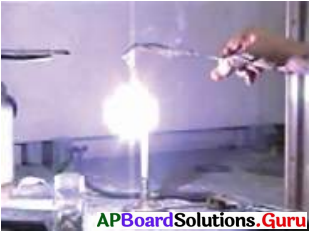
Magnesium ribbon, water, match box, bunsen flame.

Procedure:
1) Take a small piece of Magnesium ribbon.

2) Burn it on a flame we will find brilliant white dazzling light leaving a powdery substance behind.

3) This is because when magnesium burns in the presence of oxygen, it forms magnesium oxide in the form of powdered ash. This is a new substance.
Magnesium + Oxygen → Magnesium Oxide (new substance)
This is a permanent change.

4) Now, take a small quantity of Magnesium oxide and mix it with a small quantity of water and dissolve it.
Magnesium Oxide + Water → Magnesium Hydroxide (new substance)
This is also a permanent change.
Here also another new substance is formed.

5) By testing this new substance with blue and red litmus papers. Red litmus turns blue. Then Magnesium Hydroxide is a base.

Inference :
Changes that occur with the formation of new substance with different chemical Coposition or transformation of a substance into another substance with the evolution or absorption of heat; or light energy are termed as chemical changes. These are permanent changes.

AP Board 7th Class Science Solutions 10th Lesson Changes Around Us

Question 6.
Guess the reasons for increase of plastic pollution.
Answer:
Main reasons for increase of plastic pollution :

  1. Rising human population and their needs, people depend on plastic.
  2. The food industry which packs everything on plastic.
  3. Increase in usage of plastic bottles and container caps.
  4. Indiscriminate usage of plastic bags and carriers.
  5. Over usage of plastic straws and stirrers.
  6. Lack of proper management of plastic waste.
  7. Unawareness among the public about the hazardous affects of plastic wastes.
  8. People are not following the 3’Rs (Recycle – Reduce – Reuse) method to reduce plastic wastes.

Question 7.
How can you appreciate the role of periodic changes in nature?
Answer:

  1. Changes that are repeating at regular intervals of time are called as periodic changes.
  2. Formation of day and night, for every 12 hours the sun rise and the sun set are repeating.
  3. Seasons like summer, rainy, winter and spring occur every year at regular intervals.
  4. The full moon and new moon repeats every month.
  5. Heart beat of human beings takes place periodically.
  6. Low and high tides in sea are periodic.
  7. All these changes are periodically taking place in nature.
  8. They provide us all comforts to live on this earth. I appreciate these periodic changes in nature for providing a happy life on this earth.
  9. Without these changes in environment, life of us would become impossible.

Question 8.
Suggest some methods to prevent rusting of iron articles.
Answer:

  1. The problem of rusting of iron and other metal articles is common experience in almost every home.
  2. It spoils beautiful articles and makes them look ugly.
  3. The following are some of the ways to prevent the rusting of iron.
    a) Do not allow the iron articles to come in direct contact with Oxygen in the air, water or both.
    b) Apply a coat of paint or grease on an iron article.

Question 9.
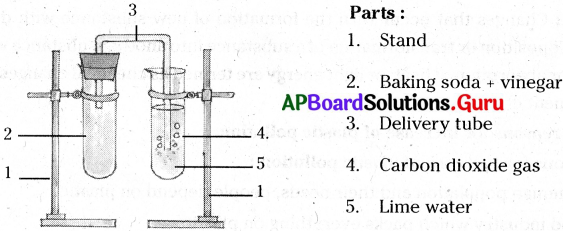
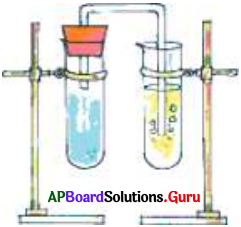
Ravi prepared carbon-dioxide using baking soda and vinegar. Carbon-dioxide changed lime water into milky white. Represent this experiment in a diagram with labelling.
Answer:
AP Board 7th Class Science Solutions 10th Lesson Changes Around Us 1
Preparation of carbon dioxide

7th Class Science 10th Lesson Changes Around Us InText Questions and Answers

7th Class Science Textbook Page No. 54

Question 1.
What change do you observe after removing mehandi applied on your palms?
Answer:
The hands get red colour after removing mehandi.

Question 2.
Can we clear the printed letters on paper. Why?
Answer:
No, it is a permanent change.

AP Board 7th Class Science Solutions 10th Lesson Changes Around Us

Question 3.
Water dispenser gives hot, normal and cold water. Is this natural or man made?
Answer:
Man-made.

7th Class Science Textbook Page No. 55

Question 4.
What is change?
Answer:
An act or process through which something becomes different.

Question 5.
How do we know that something has changed?
Answer:
By observing the changes in shape, size, colour and chemical properties.

Question 6.
What are the possible reasons for that change?
Answer:
They may be because of physical or chemical changes.

Question 7.
Is there any involvement of human beings?
Answer:
No, these are natural changes.

7th Class Science Textbook Page No. 56

Question 8.
Is there any change in its shape?
Answer:
Yes, it’s size will increase.

Question 9.
How does it happen?
Answer:
The air blown into the balloon occupies the space and the balloon becomes bigger in size. ,

Question 10.
Is it by itself or by anybody else?
Answer:
It is a man made change.

AP Board 7th Class Science Solutions 10th Lesson Changes Around Us

Question 11.
So what type of change it is?
Answer:
This is a man made change.

Question 12.
How much time they require?
Answer:
They require longer periods. It is a slow process.

7th Class Science Textbook Page No. 57

Question 13.
Have you ever noticed the following changes in our daily life?
Answer:
Yes. It is also a reversible change.

7th Class Science Textbook Page No. 58

Question 14.
Do the formed substance differs from original substance?
Answer:
Yes. The formed new substance is completely different.

Question 15.
Can we get original substance by reversing the conditions?
Answer:
No.

7th Class Science Textbook Page No. 50

Question 16.
Have you seen large crystals of sugar (Missrf) or crystal salt?
Answer:
Yes.

Question 17.
Do you know how we get these crystals?
Answer:
Yes. We get them through crystallization.

Question 18.
Have you ever observed the formation of small sugar crystals on sweets like Jilebi and badushah, which are kept aside for a long period?
Answer:
Yes.

AP Board 7th Class Science Solutions 10th Lesson Changes Around Us

Question 19.
What is the reason for this?
Answer:
It is because of crystallization.

Question 20.
What changes do you notice at the end?
Answer:
We notice the formation of large size crystals of sugar at the bottom of the beaker.

Question 21.
Do you find any crystals in the solution?
Answer:
No, we will find the crystals at the bottom of the beaker.

Question 22.
What type of change it is?
Answer:
It is a physical change.

7th Class Science Textbook Page No. 62

Question 23.
In Which cases new substances are formed?
Answer:
In chemical changes, we get new substance.

Question 24.
Have you observed rusting of iron, curdling of milk?
Answer:
Yes, I observed many times.

Question 25.
Do we get the same substance after change? Is the change is temporary or permanent?
Answer:
No, it is a permanent change.

Question 26.
Does the ash formed look like Magnesium ribbon?
Answer:
No.

Question 27.
Do you think the magnesium ribbon and the ash have the same composition?
Answer:
No

Question 28.
What do you observe?
Answer:
We get Magnesium Hydroxide.

AP Board 7th Class Science Solutions 10th Lesson Changes Around Us

Question 29.
Do you observe any change in the state of the substance?
Answer:
It is in liquid state (from solid state)

Question 30.
Is it an acid or base?
Answer:
Base.

7th Class Science Textbook Page No. 63

Question 31.
Did you observe iron nails, iron gates, iron benches or pieces of iron left in the open ground for a long time?
Answer:
Yes.

Question 32.
Did you observe any change in colour?
Answer:
We can observe a brown colour layer on the surface of iron articles.

Question 33.
How can we protect the iron articles from rusting?
Answer:
Through a process called Galvanization.

7th Class Science Textbook Page No. 64

Question 34.
Are there any other ways by which rusting of iron can be prevented?
Answer:
When the iron articles are coated with metals like chromium or zinc, we can prevent them from rusting.

Question 35.
Have you observed the handles of bicycles, metal rims of bicycle and motor cycles?
Answer:
Yes.

Question 36.
Do these articles rust? If not why?
Answer:
No, because they are coated with zinc or chromium.

Question 37.
What changes do you notice?
Answer:
We can notice a brown layer on their outer surface.

Question 38.
Can you prevent the browning of cut vegetables and fruits?
Answer:
Yes.

Question 39.
Have you observed your mother keeping the cut potatoes or brinjals in cold water?
Answer:
Yes.

7th Class Science Textbook Page No. 65

Question 40.
In which fruit or vegetable do you notice change in colour?
Answer:
In Apple, Brinjal and Potato.

Question 41.
Why does this change occurs?
Answer:
Because some vegetables and fruits react with oxygen in the air when they cut. Due to this oxidation process, brown layer is formed on the surface of these fruits and vegetables.

Think & Respond

Question 1.
When food gets spoiled, it produces a foul smell. Shall we call this change as a chemical change?
Answer:
When food gets spoiled by micro organisms, it produces a foul smell. By the action of the enzymes released by these microbes, the components of the food undergo chemical changes. Due to this, the food emits foul smell. It is a permanent change and irreversible in nature.

AP Board 7th Class Science Solutions 10th Lesson Changes Around Us

Question 2.
You know that plants produce their food by a process called photosynthesis. Can we call photosynthesis a chemical change?
Answer:
Photosynthesis is a chemical change. Here, carbondioxide is reduced to glucose. In this process oxygen is evolved. It is a permanent and irreversible change. New substance are formed.

Question 3.
Do all the materials react with oxygen in the air?
Answer:
No.

Question 4.
Observe Gold and Silver. You wear them in the form of ornaments. Even if they get exposed to air for long time, they do not change their colour. Why?
Answer:
Metals like gold and silver, even if they are exposed to air for a long time, they do not change colour or get rusted.

It means that they are resistant to corrosion which is the reason why we use them in making ornaments.

Activities and Projects

Question 1.
Collect information on the process of artificial ripening of fruits in fruit market and discuss whether it is useful or harmful.
Answer:

  1. Calcium carbide more commonly known as “masala” is used for artificial ripening of fruits. It is very harmful to health.
  2. Calcium carbide is a carcinogenic agent.
  3. The most important precaution to avoid eating such artificially ripened fruits is to go in for fruits and vegetables which are not unseasonal.
  4. Always wash the vegetables and fruits properly before consuming.

Question 2.
When you burn a piece of wood different changes take place analyse the following. Predict possible changes and list them all.
a) Are there any physical changes among them?
b) How many forms of energy are released in the change?
c) What chemical changes do you notice?
d) Explain briefly why these occur.
Answer:
a) No physical changes is observed.
b) The energy is released in the form of heat sound and light energy.
c) When a piece of wood is burnt a new material is formed (ash). We also notice change in shape and size of new materials (powder). This type of change which leads to form new substance is called chemical changes.
d) Wood turns into carbondioxide and ash
Carbon (Wood) + Oxygen (Air) → CO2 + Ash

Activities

Activity – 1

Question 1.
What changes do you observe, When a balloon is blown?
Answer:
Change in the shape of balloon is done by blowing air into it. This is a man made change. When we left off the air from it, it returns to its normal shape. This is a physical change and reversible one.

Activity – 2

Question 2.
Observe the changes mentioned in the following table and complete it.

Change Time taken
shorter/longer duration
Type of change
Fast/ Slow
1. Digestion of food
2. Burning a small candle
3. Occurrence of lightening
4. Construction of Dam
5. Rusting of iron

Answer:

Change Time taken
shorter/longer duration
Type of change
Fast/ Slow
1. Digestion of food Longer duration Slow
2. Burning a small candle Shorter Fast
3. Occurrence of lightening Shorter Fast
4. Construction of Dam Longer duration Slow
5. Rusting of iron Longer duration Slow

Activity – 3

Question 3.
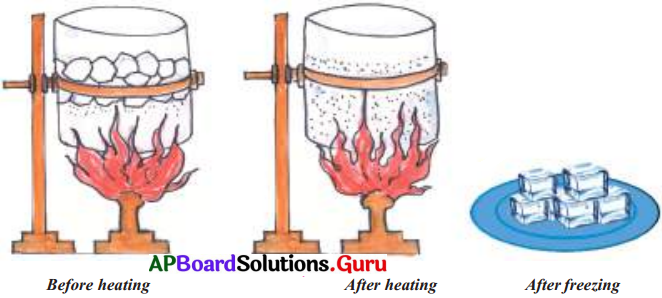
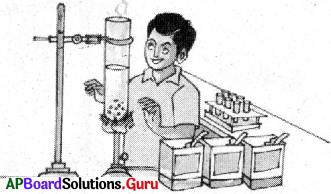
What changes do you notice when few pieces of ice in a beaker are heated? What do you mean by a physical change? Before heating After heating After freezing
Answer:
AP Board 7th Class Science Solutions 10th Lesson Changes Around Us 2

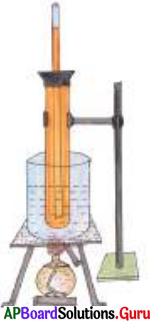
  1. Take few pieces of ice in a beaker and heat them on burner as shown in the figure.
  2. We notice that ice slowly melts and becomes water and on further heating it changes to steam.
  3. If we reduce the temperature, the water vapour changes back to water and when temperature is further reduced it changes to ice.
  4. In the above activity we notice the change of the state of ice to water and to vapour but the substance, water, remains the same.
  5. Changes of this type where no new substance is formed are known as physical changes.
  6. When a material undergoes a change in shape, size, colour or state it is called a Physical Change.
  7. Generally, no new substance is formed in a physical change.

Activity – 4

Question 4.
Describe how do you perform the activity to observe the reaction of vinegar with baking soda?
Answer:
AP Board 7th Class Science Solutions 10th Lesson Changes Around Us 3

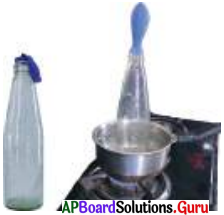
  1. First set up the apparatus as shown in Fig.
  2. Take a teaspoon of vinegar (acetic acid) in a test tube and add a pinch of baking soda (Sodium bicarbonate) to it.
  3. You observe bubbles coming out with a hissing sound. Pass this gas through freshly prepared Limewater (Calcium Hydroxide).
  4. Limewater changes to milky white showing that the gas sent into the test tube is Carbon dioxide.
  5. Vinegar + Baking Soda → Sodium acetate + Carbon dioxide + Water
  6. Carbon dioxide + Lime Water → Calcium Carbonate + Water
  7. In these reactions the new substances like Carbon dioxide and Calcium Carbonate are formed. Hence it is a chemical change.
  8. When a material undergoes a change in its composition it is called a chemical change.

AP Board 7th Class Science Solutions 10th Lesson Changes Around Us

Activity – 5

Question 5.
Write the approximate time after which they repeat.

Natural Period of time of repetetion (Approximate)
1. Change of day and night Every 12 hours
2. Withering of leaves
3. Rising of the pole star
4. Change of Seasons
5. Appearance of full moon

Answer:

Natural Period of time of repetetion (Approximate)
1. Change of day and night Every 12 hours
2. Withering of leaves 1 year
3. Rising of the pole star 24 hours
4. Change of Seasons 1 year
5. Appearance of full moon 30 days

Activity – 6

Question 6.
How do you produce large size of sugar crystals ? What type of change is it?
Answer:
AP Board 7th Class Science Solutions 10th Lesson Changes Around Us 4

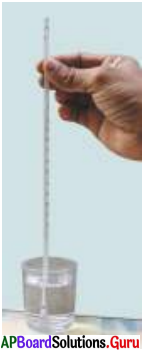
  1. Take a big size test tube. Fill half of it with water. Add some sugar to it and stir it.
  2. Keep adding sugar and stirring until saturation is attained.
  3. Then heat this sugar solution and add some more sugar to it while stirring continuously.
  4. Continue adding sugar till no more sugar can be dissolved in it.
  5. Now filter the solution and allow it cool for half an hour.
  6. We notice formation of large size crystals of sugar at the bottom of the beaker. Thus the small granules of sugar added changed into large size sugar crystals.
  7. This is a physical change.

Activity – 7

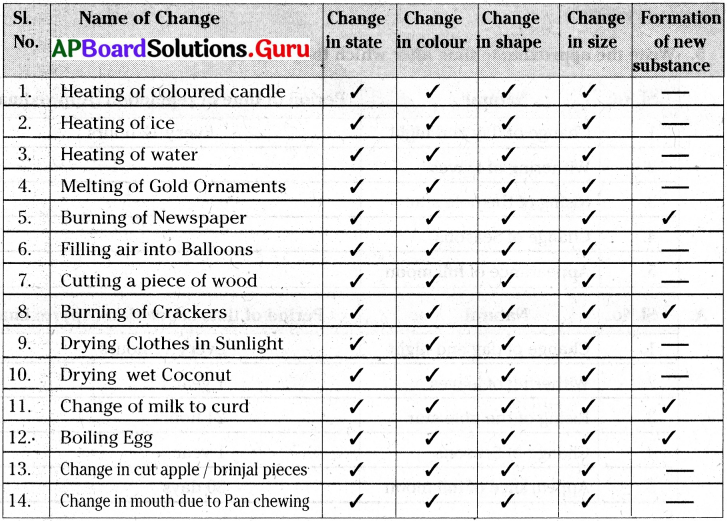
Question 7.
Some changes are given in the table. Write possible changes you notice for each case and put (✓) in the appropriate column.
Answer:
AP Board 7th Class Science Solutions 10th Lesson Changes Around Us 5

1) In the above activity we notice that only in some examples like burning of paper, burning of crackers, change of milk to curd, boiling of egg, etc., a new substance is formed.

2) But in other examples of changes we notice an change in state or colour or size or shape etc but the substance remains same and no new substance is formed.

Activity – 9

Question 9.
Complete the following table.

Name of the Fruit Whether turned brown or not
Yes No
1. Apple
2. Brinjal
3. Potato
4. Tomato
5. Cucumber
6. Mango

Answer:

Name of the Fruit Whether turned brown or not
Yes No
1. Apple
2. Brinjal
3. Potato
4. Tomato
5. Cucumber
6. Mango

Some fruits and vegetables when cut, react with oxygen in the air. The process of reaction with oxygen is called oxidation. Due to this process brown layer is formed on the surface of fruits and vegetables.

AP Board 10th Class Social Solutions Chapter 4 భారతదేశ శీతోష్ణస్థితి

SCERT AP 10th Class Social Study Material Pdf 4th Lesson భారతదేశ శీతోష్ణస్థితి Textbook Questions and Answers.

AP State Syllabus 10th Class Social Solutions 4th Lesson భారతదేశ శీతోష్ణస్థితి

10th Class Social Studies 4th Lesson భారతదేశ శీతోష్ణస్థితి Textbook Questions and Answers

Improve your learning (మీ అభ్యసనాన్ని మెరుగుపడుచుకోండి)

ప్రశ్న 1.
కింది వాక్యాలు చదివి అవి వాతావరణానికి లేదా శీతోష్ణస్థితికి, ఏ అంశానికి ఉదాహరణో చెప్పండి.
అ) హిమాలయాల్లోని అనేక మంచుపర్వతాలు గత కొద్ది సంవత్సరాలలో కరిగిపోయాయి.
ఆ) గత కొన్ని దశాబ్దాలలో విదర్భ ప్రాంతంలో కరవులు ఎక్కువగా సంభవించాయి. (AS1)
జవాబు:
ఈ రెండూ వాతావరణానికి ఉదాహరణలు.

ప్రశ్న 2.
కింది వాటిని జతపరచండి. అవసరమైతే పటాలను చూడండి. (ఒకటి కంటే ఎక్కువ సరైన సమాధానాలు ఉండవచ్చు) (AS5)
అ) తిరువనంతపురం భూమధ్యరేఖకు దూరంగా ఉండి శీతాకాలంలో ఉష్ణోగ్రతలు తక్కువగా ఉంటాయి.
ఆ) గ్యాంక్ భూమధ్యరేఖకు దగ్గరగా ఉంది, కాని సముద్రానికి దగ్గరగా లేదు, వర్షపాతం తక్కువ.
ఇ) అనంతపురం సముద్రానికి దగ్గరగా ఉంది, శీతోష్ణస్థితిపై సముద్ర ప్రభావం ఎక్కువ.
జవాబు:
అ) తిరువనంత పురం : సముద్రానికి దగ్గరగా ఉంది, శీతోష్ణస్థితిపై సముద్ర ప్రభావం ఎక్కువ.
ఆ) గ్యాంగ్ టక్ : భూమధ్యరేఖకు దూరంగా ఉండి శీతాకాలంలో ఉష్ణోగ్రతలు తక్కువగా ఉంటాయి.
ఇ) అనంతపురం : భూమధ్య రేఖకు దగ్గరగా ఉంది, కాని సముద్రానికి దగ్గరగా లేదు, వర్షపాతం తక్కువ.

AP Board 10th Class Social Solutions Chapter 4 భారతదేశ శీతోష్ణస్థితి

ప్రశ్న 3.
భారతదేశ శీతోష్ణస్థితిని ప్రభావితం చేసే అంశాలను వివరించండి. (AS1)
జవాబు:
శీతోష్ణస్థితిని ప్రభావితం చేసే వాటిని శీతోష్ణస్థితి కారకాలు అంటారు. అవి.

  1. అక్షాంశం
  2. భూమికి – నీటికి మధ్య గల సంబంధం
  3. భౌగోళిక స్వరూపం
  4. ఉపరితల గాలి ప్రసరణ.

1) అక్షాంశం లేదా భూమధ్యరేఖ నుంచి దూరం :
భారతదేశంలో దక్షిణాది ప్రాంతం భూమధ్యరేఖకి దగ్గరగా ఉష్ణమండలంలో ఉంది. ఈ కారణంగా ఈ ప్రాంతంలో సగటు ఉష్ణోగ్రతలు ఉత్తర ప్రాంతం కంటే ఎక్కువగా ఉంటాయి. కన్యాకుమారిలోని శీతోష్ణస్థితి భోపాల్ లేదా ఢిల్లీ శీతోష్ణస్థితి కంటే భిన్నంగా ఉండటానికి శీతోష్ణస్థితి భోపాల్ లేదా ఢిల్లీ శీతోష్ణస్థితి కంటే భిన్నంగా ఉండటానికి ఇది ఒక కారణం. భారతదేశం సుమారుగా 8° ఉత్తర -37° ఉత్తర రేఖాంశాల మధ్య ఉంది. భారతదేశాన్ని కర్కట రేఖ ఇంచుమించు రెండు సమభాగాలుగా చేస్తుంది. కర్కటరేఖకు దక్షిణ ప్రాంతం ఉష్ణమండలంలో ఉంది. కర్కటరేఖ ఉత్తర ప్రాంతం సమశీతోష్ణ మండలంలో ఉంది.

2) భూమికి – నీటికి గల సంబంధం :
దక్షిణ ప్రాంతంలోని అధిక భాగం సుదీర్ఘ కోస్తా తీరం వల్ల సముద్రపు ప్రభావానికి గురవుతుంది. దీనివల్ల పగలు, రాత్రుల ఉష్ణోగ్రతలలో, అదే విధంగా వేసవి, శీతాకాలాల ఉష్ణోగ్రతలలో అంతగా తేడా ఉండదు. దీనిని “సమ శీతోష్ణస్థితి” అంటారు. ఒకే అక్షాంశం మీద సముద్రం నుంచి దూరంగా ఒకే ఎత్తులో ఉన్న ప్రదేశాలను పోలిస్తే సముద్ర ప్రభావం ఏమిటో బాగా తెలుస్తుంది.

3) భౌగోళిక స్వరూపం :
సముద్ర మట్టం నుండి ఎత్తుకి వెళుతున్న కొద్ది ఉష్ణోగ్రత తగ్గుతుంది. కాబట్టి మైదాన ప్రాంతాల కంటే కొండలు, పర్వతాల మీద ఉష్ణోగ్రత తక్కువగా ఉంటుంది.

4) వాతావరణంలో ఉపరితల గాలి ప్రసరణ :
భారతదేశ శీతోష్ణస్థితి ఉపరితల వాయు ప్రవాహాల వల్ల కూడా ప్రభావితం అవుతుంది. ఈ ప్రవాహాలను “జెట్ ప్రవాహం ” అంటారు. నేల నుంచి 12,000 మీటర్ల ఎత్తులో సన్నటి మేఖలలో వేగంగా ప్రవహించేగాలులు ఇవి. ఈ గాలుల వేగం గంటకి వేసవిలో 110 కిలోమీటర్లు. శీతాకాలంలో 184 కిలోమీటర్లు మధ్య ఉంటుంది. 25° ఉత్తర అక్షాంశం వద్ద తూర్పు జెట్ ప్రవాహం ఏర్పడుతుంది. ఇటువంటి జెట్ ప్రవాహం వల్ల చుట్టూ ఉన్న ఉష్ణోగ్రత చల్లబడుతుంది. తూర్పు జెట్ స్లీం యొక్క చల్లబరిచే ప్రక్రియ వల్ల అక్కడ ఉన్న మేఘాలు వర్షిస్తాయి.

ప్రశ్న 4.
కొండ ప్రాంతాలలోని, ఎడారులలోని శీతోష్ణస్థితులను ప్రభావితం చేసే అంశాలను వివరించండి. (AS1)
జవాబు:
కొండ ప్రాంతాలు : సాధారణంగా సముద్ర మట్టం నుండి పైకి వెళ్ళే కొద్దీ ఉష్ణోగ్రత తగ్గుతుంది. ప్రతి 1000మీ|| ఎత్తుకి పోయేకొలదీ 6°C ఉష్ణోగ్రత తగ్గుతుంది. కాబట్టి కొండ ప్రాంతాలలో ఉష్ణోగ్రత తక్కువగా ఉంటుంది. ఎడారి ప్రాంతాలు : ఎడారి ప్రాంతాలు ఎక్కువ ఉష్ణోగ్రతతోనూ, తక్కువ వర్షపాతంతోనూ ఉంటాయి. ఇవి భూమధ్య రేఖకి దగ్గరగా ఉంటాయి. వీటికి అవతలవైపున అధిక పీడన ప్రాంతాలు ఉంటాయి. ఈ రెండు ప్రాంతాల మధ్య జరిగే గాలుల ప్రసరణ ఇక్కడి వాతావరణంలో అనిశ్చితిని ఏర్పరుస్తుంది.

AP Board 10th Class Social Solutions Chapter 4 భారతదేశ శీతోష్ణస్థితి

ప్రశ్న 5.
భూగోళం వేడెక్కడంలో మానవుని పాత్రను తెలపండి. (AS4)
జవాబు:
అనేక మానవజనిత కారణాల వలన భూమి వేడెక్కడం, భౌమ్య వ్యవస్థ యొక్క ఉష్ణ ప్రసరణలో అనేక మార్పులకు కారణమవుతుంది. మనం మండించే ఇంధనాల వలన విడుదలయ్యే CO, దీనికి ముఖ్యకారణం. అడవులను నరికివేత
మరో కారణం. పారిశ్రామిక విప్లవం తరువాత భూమి అతి త్వరగా వేడెక్కడానికి కారణం మానవుడే.

ప్రశ్న 6.
AGW విషయంలో అభివృద్ధి చెందిన, అభివృద్ధి చెందుతున్న దేశాల మధ్య ఉన్న అభిప్రాయ భేదాలేమిటి? (AS1)
జవాబు:
ముఖ్యంగా “అభివృద్ధి చెందిన” (ప్రధానంగా పాశ్చాత్య పారిశ్రామిక, ఆర్థికంగా బాగా అభివృద్ధి చెందిన) దేశాలు “అభివృద్ధి చెందుతున్న” (అంతగా పారిశ్రామికీకరణ చెందని) దేశాల మధ్య విభేదాలు తల ఎత్తాయి. వాతావరణంలోని హరితగృహ వాయువులను పెంచే బొగ్గు వినియోగం, ఇతర కార్యకలాపాలను అభివృద్ధి చెందుతున్న దేశాలు తగ్గించుకోవాలని అభివృద్ధి చెందిన దేశాలు అంటున్నాయి. శిలాజ ఇంధనాల వినియోగం ద్వారానే ఆ దేశాలు అభివృద్ధి చెందాయన్నది ప్రస్తుతం అభివృద్ధి చెందుతున్న దేశాల వాదన. శిలాజ ఇంధనాలు (ప్రధానంగా బొగ్గు) వినియోగించకపోతే తమ ఆర్థిక ప్రగతి తీవ్రంగా కుంటుపడుతుందని అభివృద్ధి చెందుతున్న దేశాలు అంటున్నాయి. అభివృద్ధి చెందుతున్న దేశాలు ప్రగతిని సాధించటానికి ప్రత్యామ్నాయాలను చూపడంలో అభివృద్ధి చెందిన దేశాలు తమ వంతు పాత్ర పోషించాలని ఇవి కోరుతున్నాయి.

ప్రశ్న 7.
భూగోళం వేడెక్కడంలో శీతోష్ణస్థితిలో మార్పులు ఏ విధంగా కారణమవుతాయి? భూగోళం వేడెక్కడాన్ని తగ్గించడానికి కొన్ని చర్యలను సూచించండి. (AS4)
జవాబు:

  1. మానవజనిత కారణాల వలన భూమి వేడెక్కడం, భౌమ్యవ్యవస్థ యొక్క ఉష్ణ ప్రసరణలో అనేక మార్పులకు కారణమవుతోంది.
  2. భూగోళం వేగంగా వేడెక్కడం వల్ల ఈ వ్యవస్థ అస్తవ్యస్తమవుతోంది.
  3. ఉష్ణ పునః ప్రసరణ గందరగోళం కావటంతో వాతావరణ, శీతోష్ణస్థితుల సరళిలో మార్పులు వస్తాయి. స్వల్పకాలిక (వాతావరణ) మార్పులు ఒకదానికొకటి తోడై దీర్ఘకాలికంగా (శీతోష్ణస్థితిలో) మారతాయి.

AP Board 10th Class Social Solutions Chapter 4 భారతదేశ శీతోష్ణస్థితి

ప్రశ్న 8.
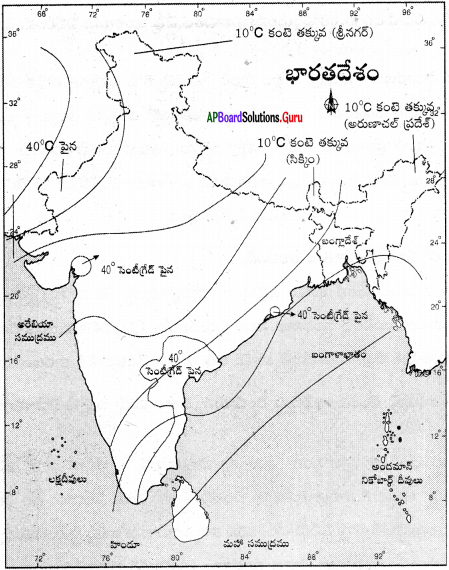
భారతదేశ భౌగోళిక పటంలో కింది వానిని గుర్తించండి. (AS5)
i) 40° సెం.గ్రే. కన్నా ఎక్కువ సంవత్సర సగటు ఉష్ణోగ్రతను నమోదు చేసిన ప్రాంతాలు.
ii) 10° సెం.గ్రే, కన్నా తక్కువ సంవత్సర సగటు ఉష్ణోగ్రతను నమోదు చేసిన ప్రాంతాలు.
iii) భారతదేశంపై వీచే నైరుతి ఋతుపవనాల దిశమార్గం.
జవాబు:
AP Board 10th Class Social Solutions Chapter 4 భారతదేశ శీతోష్ణస్థితి 1

ప్రశ్న 9.
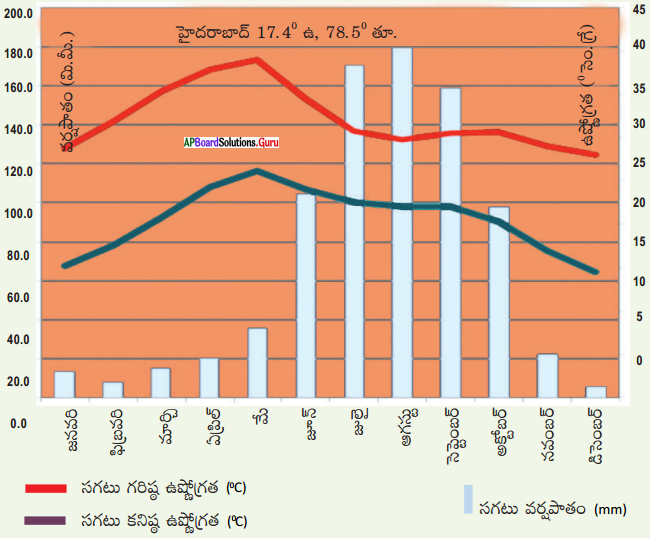
కింది కైమోగ్రాఫ్ ను పరిశీలించి ప్రశ్నలకు జవాబులు రాయండి.
i) ఏ నెలలో అత్యధిక వర్షపాతం నమోదయ్యింది?
ii) ఏ నెలలలో అత్యల్ప, అత్యధిక ఉష్ణోగ్రతలు నమోదయ్యా యి?
iii) జూన్, అక్టోబర్ మధ్య గరిష్ట వర్షపాతం ఎందుకు సంభవిస్తుంది?
iv) మార్చి, మే నెలల మధ్య అత్యధిక ఆ ఉష్ణోగ్రత ఎందుకు ఉంటుంది?
v) ఉష్ణోగ్రత, వర్షపాతాలలో మార్పులకు కారణమయ్యే భౌగోళిక అంశాలను పేర్కొనండి.
AP Board 10th Class Social Solutions Chapter 4 భారతదేశ శీతోష్ణస్థితి 2
జవాబు:
i) ఆగష్టు
ii) డిశంబరు – మే
iii) ఋతుపవన కాలం
iv) సూర్యపుటం అధికంగా ఉంది.
v) సముద్ర మట్టానికి ఎత్తులో ఉంది.

10th Class Social Studies 4th Lesson భారతదేశ శీతోష్ణస్థితి InText Questions and Answers

10th Class Social Textbook Page No.44

ప్రశ్న 1.
44వ పేజీలో ఇచ్చిన వార్తాకథనం లాంటివే మరికొన్ని వార్తాకథనాలను సేకరించండి.
జవాబు:
స్వయం అభ్యాసం.

10th Class Social Textbook Page No.46

ప్రశ్న 2.
లెహ్ లో బాగా వేడిగా, బాగా చలిగా ఉండే నెలలు ఏవి?
జవాబు:
వేడినెల – జూన్ ; చలిగా ఉండే నెల – డిశంబరు

AP Board 10th Class Social Solutions Chapter 4 భారతదేశ శీతోష్ణస్థితి

10th Class Social Textbook Page No.46

ప్రశ్న 3.
చెన్నెలో వర్షాకాల నెలలను గుర్తించండి. దీనిని జైపూర్ తో పోలిస్తే ఏవిధంగా భిన్నమైనది?
జవాబు:
చెన్నైలో వర్షాకాల నెలలు – జూన్ – ఆగష్టు, సెప్టెంబర్ – నవంబర్.
జైపూర్‌లో వర్షాకాల నెలలు – జూన్ – ఆగష్టు

10th Class Social Textbook Page No.48

ప్రశ్న 4.
సిమ్లా, ఢిల్లీలు వేరు వేరు అక్షాంశాల మీద ఉన్నాయా ? మీ అట్లాసు చూసి చెప్పండి. వేసవిలో ఢిల్లీ కంటే సిమ్లాలో చల్లగా ఉంటుందా?
జవాబు:
సిమ్లా 31°611″ ఉ అక్షాంశంపై ఉన్నది. ఢిల్లీ, సిమ్లా వేర్వేరు అక్షాంశాలపై ఉన్నాయి. (3° తేడా) కాని సిమ్లా, ఢిల్లీ కన్నా చల్లగా ఉండటానికి కారణం అది బాగా ఎత్తైన ప్రాంతంలో ఉండటమే.

10th Class Social Textbook Page No.49

ప్రశ్న 5.
ఆంధ్రప్రదేశ్ లో జనవరిలో సగటు ఉష్ణోగ్రతల పరిధి ఏమిటి ?
జవాబు:
ఆంధ్రప్రదేశ్ లో జనవరిలో సగటు ఉష్ణోగ్రతల పరిధి 15°C – 28°C.

AP Board 10th Class Social Solutions Chapter 4 భారతదేశ శీతోష్ణస్థితి

10th Class Social Textbook Page No.49

ప్రశ్న 6.
మీ అట్లాను ఉపయోగించి 15° సెం ఉష్ణోగ్రత ఉండే కొన్ని ప్రదేశాలను గుర్తించంది.
జవాబు:
అరుణాచల్ ప్రదేశ్, ఉత్తరప్రదేశ్

10th Class Social Textbook Page No.49

ప్రశ్న 7.
సగటు ఉష్ణోగ్రతలు 25° సెం ఉండే ప్రాంతాలకు దగ్గరగా 200 సెం ఉష్ణోగ్రత ఉండే చిన్న వృత్తాకార ప్రాంతం ఉంది. ఇది ఎలా సాధ్యం?
జవాబు:
ఆ ప్రాంతం ఎత్తైన కొండలపై నుండటంవలన అది సాధ్యం.

10th Class Social Textbook Page No.54

ప్రశ్న 8.
అడవుల నిర్మూలన అంటే ఏమిటి?
జవాబు:
మానవులు తమ అవసరాలకు పెద్ద పెద్ద అడవులను నరకడము అటవీ ప్రాంతాలను నాశనం చేయటము మొదలైన వాటిని “అడవుల నిర్మూలన” అంటారు.

10th Class Social Textbook Page No.54

ప్రశ్న 9.
భూగోళం వేడెక్కటాన్ని ప్రభావితం చేసే ఇతర మానవ కార్యకలాపాలు ఏమిటి?
జవాబు:
భూగోళం వేడెక్కటాన్ని ప్రభావితం చేసే ఇతర మానవ కార్యకలాపాలు :

  1. ఇంధన వనరులని మండించడం
  2. అడవుల నరికివేత

10th Class Social Textbook Page No.55

ప్రశ్న 10.
లక్షలాదిమంది ప్రభావితమైతే అప్పుడు ఆ పరిస్థితులను ఎట్లా ఎదుర్కోగలమో ఊహించండి. పునరావాసానికి వీళ్లకు భూమి ఎక్కడ దొరుకుతుంది?
జవాబు:
ఇది చాలా కష్టసాధ్యమైన పని. లక్షలాది మందికి భూమి, ఉద్యోగాలు దొరకటం దుర్లభం.

10th Class Social Textbook Page No.46

ప్రశ్న 11.
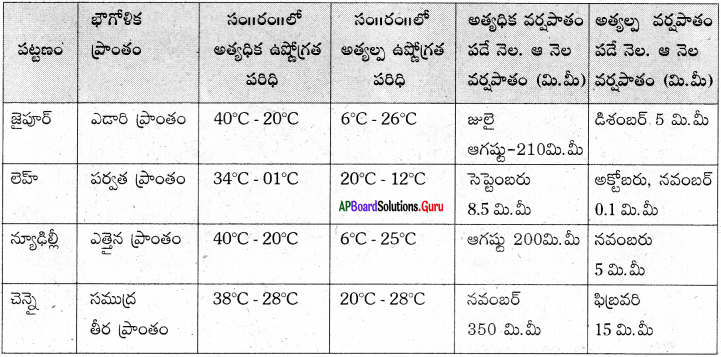
పై పట్టిక (పట్టిక కొరకు ఈ పుస్తకంలోని పేజీ నెం. 115 చూడండి.) లోని ఉష్ణోగ్రతల పరిధి ఆధారంగా లెహ్ కంటే జైపూర్ వేడిగా ఉంటుందని చెప్పవచ్చా? మీ సమాధానానికి వివరణ ఇవ్వండి.
జవాబు:
జైపూర్ లెహ్ కంటే వేడిగా ఉంటుంది. కారణాలు :

  1. జైపూర్ కంటే లెహ్ అధిక ఎత్తులో ఉన్నది.
  2. జైపూరు వాతావరణంపై థార్ ఎడారి ప్రభావం ఉన్నది.

AP Board 10th Class Social Solutions Chapter 4 భారతదేశ శీతోష్ణస్థితి

10th Class Social Textbook Page No.46

ప్రశ్న 12.
ఢిల్లీ, చెన్నెల శీతోష్ణ స్థితులను పోల్చండి. వాటిల్లో తేడాలు ఏమిటి?
జవాబు:

  1. ఢిల్లీలో వేసవి, చలికాలాల మధ్య, వర్షపాతాల మధ్య అనేక మార్పులున్నాయి. ఢిల్లీ వాతావరణాన్ని, హిమాలయాలు, థార్ ఎడారి ప్రభావితం చేస్తున్నాయి.
  2. చెన్నె వాతావరణంను సముద్రం ప్రభావితం చేయుచున్నది.

10th Class Social Textbook Page No.46

ప్రశ్న 13.
లెహ్ లో వర్షపాత తీరును జాగ్రత్తగా పరిశీలించండి. మిగిలిన ప్రాంతాలకు దీనికీ మధ్య తేడా ఏమిటి? మీ అట్లాసు సహాయంతో ఇదే వర్షపాత తీరును కనపరిచే ప్రపంచంలోని ఇతర ప్రాంతాలను గుర్తించండి.
జవాబు:
లెహ్ మంచు ఎడారి వాతావరణంను కలిగి ఉన్నది. ఇక్కడ చలికాలం దుర్భరంగా ఉంటుంది. చలికాలంలో ఇక్కడ మంచు పొడిగా కురుస్తుంది. ఇక్కడి సంవత్సర సగటు వర్షపాతం 102 mm మాత్రమే లెహ్లా ఎత్తైన ప్రాంతాలలో ఉన్న ప్రాంతాలు ఈ విధమైన వర్షపాతాన్ని కలిగి ఉంటాయి.

10th Class Social Textbook Page No.47

ప్రశ్న 14.
గ్లోబుని ఉపయోగించి ఇంతకు ముందు చదివింది మళ్లీ మననం చేసుకోండి. వివిధ అక్షాంశాల వద్ద సూర్య కిరణాల కోణాలలో ఏ తేడా ఉంటుంది? దీని ప్రభావం ఎలా ఉంటుంది?
జవాబు:
వివిధ అక్షాంశాల వద్ద సూర్య కిరణాల కోణాలలో తేడా – దాని ప్రభావం :

  1. భూమి యొక్క అక్షం 2372° వాలి ఉండటం.
  2. ఈ అక్షం భూపరిభ్రమణ మార్గాన్ని నిర్దేశిస్తుంది.
  3. దీని మూలంగా భూమిపై ఋతువులు ఏర్పడతాయి.

10th Class Social Textbook Page No.48

ప్రశ్న 15.
మీ అట్లాను ఉపయోగించి ముంబయి, నాగపూర్‌లో శీతాకాలం, వేసవికాలాల ఉష్ణోగ్రతలను పోల్చండి. వాటిల్లో పోలికలు ఏమిటి, తేడాలు ఏమిటి? సముద్రం నుంచి దూరాన్ని ఇది ఎలా తెలియచేస్తుంది?
జవాబు:

ముంబయి నాగపూర్‌లలో సగటు ఉష్ణోగ్రతలు
జనవరి 24°C – 21°C
ఫిబ్రవరి 25°C – 23°C
మార్చి 27°C – 28°C
ఏప్రిల్ 29°C – 33°C
మే 31°C – 35°C
జూన్ 29°C – 32°C
జూలై 28°C – 30°C
ఆగష్టు 23°C – 30°C
సెప్టెంబరు 28°C – 32°C
అక్టోబరు 29°C – 32°C
నవంబరు 28°C – 30°C
డిశంబరు 26°C – 28°C

సంవత్సరం పొడవునా రెండు ప్రాంతాలలో ఉష్ణోగ్రతలు వేర్వేరుగా ఉన్నాయి. అయితే సగటు ఉష్ణోగ్రత చాలా వరకు – దగ్గరగా పోలి ఉన్నది. ఇది మనకు సముద్ర తీరాన్నుండి దూరాన్ని తెలియజేస్తుంది.

AP Board 10th Class Social Solutions Chapter 4 భారతదేశ శీతోష్ణస్థితి

10th Class Social Textbook Page No.48

ప్రశ్న 16.
క్లైమోగ్రాఫీలను ఉపయోగించి జైపూర్, చెన్నైల మధ్య ఉష్ణోగ్రతలలో తేడాలను వివరించండి.
జవాబు:
తేడాలు :

జైపూర్ చెన్నె
1) ఇది సముద్ర తీరానికి దూరంగా ఉన్నది. 1) ఇది సముద్ర తీరంలో ఉన్నది.
2) ఈ ప్రాంతంపై థార్ ఎడారి ప్రభావం కలదు. 2) ఈ ప్రాంతంపై ఏ ఎడారి ప్రభావాలు లేవు.

10th Class Social Textbook Page No.48

ప్రశ్న 17.
వేసవి కాలంలో కోల్‌కతాతో పోలిస్తే డార్జిలింగ్ లో వాతావరణం ఆహ్లాదకరంగా ఎందుకు ఉంటుంది?
జవాబు:
కలకత్తా సముద్ర మట్టానికి 6 మీటర్ల ఎత్తులో ఉండగా, డార్జిలింగ్ 2,645మీ|| ఎత్తులో ఉన్నది. రెండూ ఒకే ప్రాంతంలో ఉన్నప్పటికీ డార్జిలింగ్ ఎత్తైన ప్రాంతంలో ఉండటం వలన తక్కువ ఉష్ణోగ్రతలుండి కలకత్తా కన్నా ఆహ్లాదకరంగా ఉంటుంది.

10th Class Social Textbook Page No.54

ప్రశ్న 18.
ఇది కేవలం అటవీ ప్రాంతాలలోనే జరుగుతుందా ? మీ ప్రాంతాంలో అడవి లేకపోయినా సరే ఏం జరుగుతోంది?
జవాబు:
అడవుల నిర్మూలను ఒక అటవీ ప్రాంతంలోనే గాక పారిశ్రామిక ప్రాంతాలలోనూ, గనుల వద్ద, నగరాలలోనూ జరుగుతున్నది. మానవజాతికి అడవుల ఉనికి అత్యంత ఆవశ్యకం, ఒకప్పుడు 60% భూమి అడవులతో కప్పబడి ఉండేది. నాగరికత, పట్టణీకరణ అడవులను అంతరించిపోయేలా చేశాయి. అడవులు, చెట్లు లేకపోతే మనకి ప్రాణవాయువు ఉండదు. అధికంగా వరదలు వచ్చే అవకాశాలుంటాయి. ‘జలచక్రం’ కుంటుపడుతుంది. ప్రస్తుతం మా ప్రాంతంలో ఈ విధంగానే జరుగుతోంది.

AP Board 10th Class Social Solutions Chapter 4 భారతదేశ శీతోష్ణస్థితి

10th Class Social Textbook Page No.54

ప్రశ్న 19.
భూగోళం వేడెక్కటాన్ని అడవులు అంతరించిపోవటం ఏ విధంగా ప్రభావితం చేస్తుంది? (విజ్ఞానశాస్త్రం తరగతిలో కిరణజన్య సంయోగక్రియ గురించి చదివింది గుర్తుకు తెచ్చుకోండి.)
జవాబు:
అడవుల నిర్మూలన → కొద్ది చెట్లు → ఎక్కువగా CO2 → గ్రీన్ హౌస్ వాయువుల పై ప్రభావం – భూగోళం వేడెక్కడం. అడవులలోని చెట్లు కిరణజన్య సంయోగ క్రియ ద్వారా CO2 ను తీసుకుని O2 ను విడుదల చేస్తాయి. వీటిని నరకడం మూలంగా వాతావరణంలో CO2 పెరిగిపోతుంది. దీని మూలంగా భూగోళం వేడెక్కుతుంది.

10th Class Social Textbook Page No.45

ప్రశ్న 20.
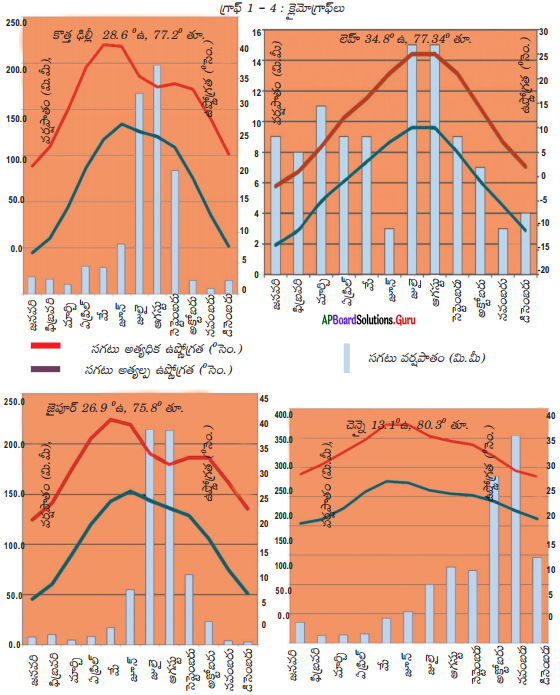
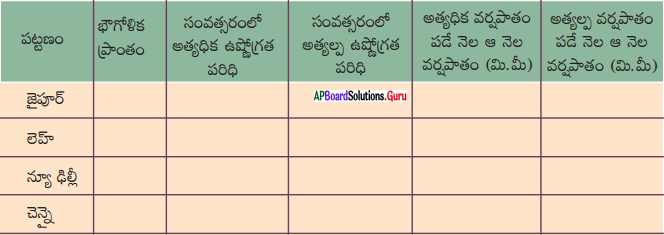
దేశంలోని వివిధ ప్రాంతాలలో ఉష్ణోగ్రత, వర్షపాతాలలో తేడా ఉందని కింది క్లెమోగ్రాలు తెలియచేస్తున్నాయి. మీ అట్లాసు చూసి కింది ప్రాంతాలు ఏ భౌగోళిక ప్రదేశంలో ఉన్నాయో తెలుసుకోండి. కింది పటాలను చదివి, తరువాత పేజీలోని పట్టిక నింపండి.
AP Board 10th Class Social Solutions Chapter 4 భారతదేశ శీతోష్ణస్థితి 3
AP Board 10th Class Social Solutions Chapter 4 భారతదేశ శీతోష్ణస్థితి 4
ఉష్ణోగ్రతా వ్యాప్తి అత్యధికం నుండి అత్యల్పం
జవాబు:
AP Board 10th Class Social Solutions Chapter 4 భారతదేశ శీతోష్ణస్థితి 5

10th Class Social Textbook Page No.50

ప్రశ్న 21.
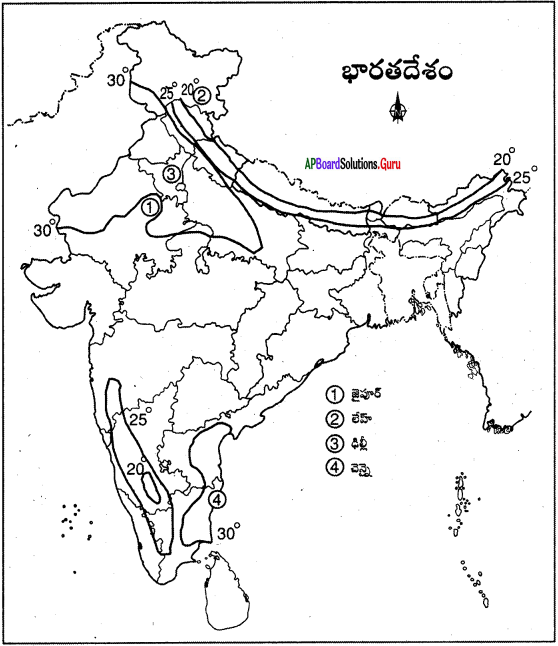
ఇంతకు ముందు ఇచ్చిన కైమోగ్రాఫ్ (4.1 – 4.4) ఆధారంగా నాలుగు పట్టణాలలో మే నెలలో సగటు ఉష్ణోగ్రతలు తెలుసుకుని వాటిని పై పటంలో గుర్తించండి.
జవాబు:
AP Board 10th Class Social Solutions Chapter 4 భారతదేశ శీతోష్ణస్థితి 6

AP Board 7th Class Science Solutions 3rd Lesson Nutrition in Organisms

SCERT AP 7th Class Science Study Material Pdf 3rd Lesson Nutrition in Organisms Textbook Questions and Answers.

AP State Syllabus 7th Class Science 3rd Lesson Questions and Answers Nutrition in Organisms

7th Class Science 3rd Lesson Nutrition in Organisms Textbook Questions and Answers

Improve Your Learning

I. Fill in the blanks.

1. During the photosynthesis ________ gas is released.
2. The tiny pores present on the surface of the leaves are __________
3. ____________ is the outermost layer of teeth.
Answer:
1. oxygen
2. stomata
3. Enamel

II. Choose the correct answer.

1. Muscular tubular structure that connects pharynx with Stomach
a) Duodenum
b) Buccal cavity
c) Oesophagus
d) Rectum
Answer:
c) Oesophagus

2. Non insectivorous plant,
a) Drosera
b) Nepenthes
c) Utricularia
d) Dodder
Answer:
d) Dodder

AP Board 7th Class Science Solutions 3rd Lesson Nutrition in Organisms

3. The green colour pigment in the leaf
a) chloroplast
b) stomata
c) chlorophyll
d) all the above
Answer:
c) chlorophyll

III. Matching

A) Autotrophs 1. Mushroom
B) Saprophytes 2. Mango plant
C) Parasite 3. Food vacuole
D) Holozoic 4. Intestinal worms
E) Amoeba 5. Man
6. Egestion

Answer:

A) Autotrophs 2. Mango plant
B) Saprophytes 1. Mushroom
C) Parasite 4. Intestinal worms
D) Holozoic 5. Man
E) Amoeba 3. Food vacuole

IV. Answer the following questions.

Question 1.
Distinguish between autotrophic and heterotrophic nutrition.
Answer:

Autotrophic nutrition Heterotrophic nutrition
1. The mode of nutrition in which organisms make food by them selves is called autotrophic nutrition 1. The mode of nutrition in which organisms depend on other organisms for food is called Heterotrophic nutrition
2. Organisms that perform autotro phic nutrition are called autotrophs. 2. Organisms that perform heterotrophic nutrition are called heterotrophs.
3. They need carbon dioxide, water and sunlight to prepare their own food. 3. They don’t need these materials as they feed on other organisms for food.
4. They are green in colour due to the presence of a colouring pigment called chlorophyll. 4. They don’t have chlorophyll.
5. Ex: Plants 5. Ex: Animals

Question 2.
What is Photosynthesis? Write its word equation.
Answer:
The process by which green plants make their own food from carbon dioxide and water by using light energy in the presence of chlorophyll is called Photosynthesis.
AP Board 7th Class Science Solutions 3rd Lesson Nutrition in Organisms 1a

Question 3.
Describe different types of teeth and their functions.
Answer:
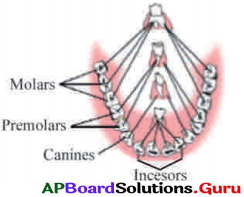
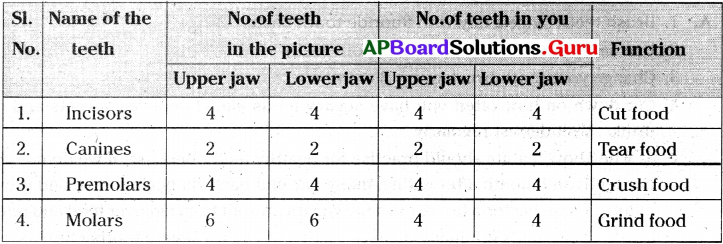
There are four different types of teeth in our human beings.
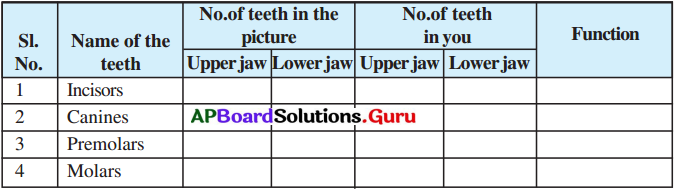
AP Board 7th Class Science Solutions 3rd Lesson Nutrition in Organisms 2
1. Incisors :
The four front teeth in both the upper and lower jaws are called incisors. Thus there are eight incisors in the oral cavity. They have sharp incisal edge. Their primary function is to cut food.

2. Canines :
They are behind and adjacent to the lateral incisors on both the jaws. There are four canines in the oral cavity. They have single sharpcusp. Their main function is to tear food.

3. Premolars :
These teeth are located behind and adjacent to the canines. There are two premolars on the upper jaw and also two premolars on the lower jaw on either side of the mouth. Thus there are eight premolars in the oral cavity.These teeth can have 3-4 cusps. They are designed to crush food.

4. Molars :
The most posterior teeth in the mouth are the molars. There are 12 molars in the permanent dentition.They have broader and flatter surfaces with 4-5 cusps. They are designed to grind food.

Question 4.
What happens if leaves of a green plant are coated with green paint?
Answer:

  1. If the leaves of a green plant are coated with green paint, then stomata present on the surface of the leaf will get blocked.
  2. As a result exchange of gases will be affected.
  3. So, plant may not get sufficient amount of carbon dioxide for photosynthesis and oxygen for respiration.
  4. oreover, paint over the leaf prevents the reaching of sunlight to the leaf.
  5. As a result plant will not be able to perform photosynthesis and respiration, gradually it leads to its death.

Question 5.
What questions will you ask a doctor to know about gastritis?
Answer:

  1. What is gastritis?
  2. What are the reasons for gastritis?
  3. How can it be prevented?
  4. Is there any relation between gastritis and life style?
  5. Are there any home remedies to get relief from gastritis?
  6. What is the treatment for gastritis?

AP Board 7th Class Science Solutions 3rd Lesson Nutrition in Organisms

Question 6.
How can you prove that the leaves other than green also carry out photo synthesis? (Activity – 2)
Answer:
Aim: To know whether leaves other than green perform photosynthesis or not.

What you need:
Red or brown coloured leaves, dropper; test tube, iodine solution, water.

What to do:
Take few Red or brown coloured leaves, add few drops of water and mash them to make a paste, collect the extract by squeezing the paste (pulp). Take 5-6 drops of this extract into a test tube. Also add two drops of iodine solution. Note your observations.

What do you see:
The colour of the leaf extract turns blue black.

What do you learn:
This shows the presence of starch in the leaves, confirming that red or brown coloured leaves also perform photosynthesis.

These non-green leaves also have chlorophyll. The large amount of red, brown and other pigments mask the green colour. So photosynthesis takes place in these leaves also.

Question 7.
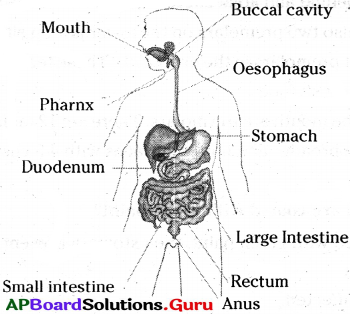
Draw a neat labelled diagram of human digestive system.
Answer:
AP Board 7th Class Science Solutions 3rd Lesson Nutrition in Organisms 3

Question 8.
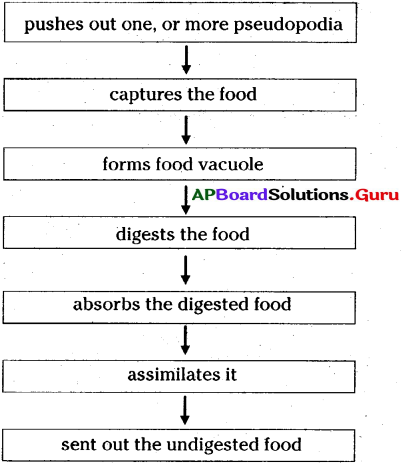
Draw a flow chart showing nutrition in amoeba.
Answer:
AP Board 7th Class Science Solutions 3rd Lesson Nutrition in Organisms 4

Question 9.
How will you appreciate the role of saprophytes in cleaning of the earth surface?
Answer:

  1. Saprophytes grow on dead and decaying matter.
  2. They secrete digestive juices on it, convert it into a solution and then absorb the nutrients from it.
  3. During this process they decompose them and mix them with the soil.
  4. In this Way they help in cleaning the earth surface by removing the dead and decaying matter.
  5. This process help in recycling the nutrients too.
  6. Thus they are doing a great service to the entire living world.

Question 10.
What precautions will you take to keep your digestive system healthy?
Answer:
To keep my digestive system healthy, I will

  1. take simple and balanced diet
  2. drink sufficient quantity of water.
  3. brush my teeth regularly.
  4. prefer natural foods.
  5. avoid Junk foods and cool drinks.
  6. never smoke.
  7. never consume alcohol.
  8. never chew tobacco and tobacco products.
  9. do moderate exercises regularly.
  10. take fibre rich food.

7th Class Science 3rd Lesson Nutrition in Organisms InText Questions and Answers

7th Class Science Textbook Page No. 37

Question 1.
My mother prepares food for me. Who prepares food for animals?
Answer:

  1. Animals cannot make food.
  2. They depend on other plants and animals for food.

Question 2.
How do animals get their food?
Answer:
Animals get their food from plants and animals.

AP Board 7th Class Science Solutions 3rd Lesson Nutrition in Organisms

Question 3.
Plant is a living thing. What is the food for it?
Answer:
Plants also need food, such as glucose, carbohydrates, minerals etc.

Question 4.
How do they get their food?
Answer:

  1. Plants prepare their food by using photosynthesis.
  2. Some plants get their food from other plants and animals.

Question 5.
What is the food for mushrooms?
Answer:
Mushrooms get their food from dead and decaying matter.

Question 6.
Even you might have got the same doubts?
Answer:
Yes.

Question 7.
Is the nutrition in plants same as in animals?
Answer:
No.

Question 8.
We eat food daily. But plants are not eating food then how are they living?
Answer:
Plants are able to live as they make their food themselves.

7th Class Science Textbook Page No. 38

Question 9.
How can the green plants prepare their own food?
Answer:
Green plants make their own food from carbon dioxide and water by using light energy in the presence of chlorophyll. This process is called photosynthesis.

7th Class Science Textbook Page No. 39

Question 10.
In which part of the plant, does photosynthesis takes place?
Answer:
The synthesis of food occurs in all green parts of plant body. For Ex : leaves.

Question 11.
How do the raw materials required for photosynthesis reach there?
Answer:

  1. Plants get carbon dioxide from air through stomata in leaves.
  2. Water obsorbed by the roots are transported to the leaves through the stem.
  3. Chlorophyll captures the energy of the sunlight.

AP Board 7th Class Science Solutions 3rd Lesson Nutrition in Organisms

Question 12.
Do they perform photosynthesis?
Answer:
Yes, the plants with red and brown coloured leaves make their food in the process of photosynthesis.

7th Class Science Textbook Page No. 40

Question 13.
What is the importance of sunlight in photosynthesis?
Answer:

  1. Sunlight is the source of energy in the process of photosynthesis.
  2. The solar energy is captured by the leaves and stored in the plant in the form of food.
  3. If there is no sunlight starch cannot be prepared in plants.

Question 14.
Plants get water from the soil through their roots. How does this water reach the leaves from the roots? What path does it follow?
Answer:

  1. Water absorbed by the roots are transported to the leaves through the stem.
  2. It follows the path from roots to leaves via stem.

7th Class Science Textbook Page No. 41

Question 15.
How do carbondioxide enters the leaves?
Answer:
Carbondioxide from air is entered the leaves through stomata which are present in the surface of the leaf.

Question 16.
How do oxygen comes out of the leaves?
Answer:
Through the stomata, oxygen produced in photosynthesis goes out of the leaves.

Question 17.
Where do these substances (starch, fats and proteins) come from?
Answer:
Plants produce sugar first, which is converted to starch and then other compounds like fats and proteins.

7th Class Science Textbook Page No. 42

Question 18.
There are some plants which do not have chlorophyll. How do they get their food?
Answer:

  1. Organisms which do not have chlorophyll, cannot synthesis their food. They are heterotrophs.
  2. Heterotrophic nutrition is of different types basing on how they obtain their food from other organisms.
  3. Some plants depends on dead and decaying matter and some on other plants.

Question 19.
How do they (mushrooms) get their food?
Answer:

  1. Mushrooms grow on dead and decaying matter.
  2. They secrete digestive juices on it convert it into a solution and then absorb the nutrients from it.
  3. This type of nutrition is called saprophytic nutrition.

Question 20.
A rat died at Pullaiah’s house. What happens to the body after few days? Do you find any traces of its body after a month? Where did that body go?
Answer:

  1. Saprotrophs like fungi and bacteria will grow on the dead body of the rat, after a few days.
  2. We cannot find any traces (except strong bones) of the dead body of rat, after a month.
  3. The decomposed body of the rat is mixed with the soil.

Question 21.
How does Cuscuta survive? From where does it get nutrition?
Answer:

  1. Cuscuta take readymade food from the plant on which it is climbing.
  2. It develops special roots called haustoria, which penetrate into the tissues of the host plant and absorb food materials from them.

7th Class Science Textbook Page No. 43

Question 22.
How do animals take their food?
Answer:

  1. Animals obtain their food from other organisms.
    Ex : Cow eats grass, cat drinks milk, dog eats meat.
  2. They take the food in the form of solid or liquid.

Question 23.
Where do they digest it?
Answer:

  1. Animals take food into the body for digestion.
  2. Digestion occurs inside the body.

7th Class Science Textbook Page No. 44

Question 24.
What do you understand from Sabiha observations?
Answer:
Holozoic nutrition is the mode of heterotrophic nutrition in which the food is taken in solid or liquid form from the outside and is digested inside the body.

AP Board 7th Class Science Solutions 3rd Lesson Nutrition in Organisms

Question 25.
How do Amoeba takes its food?
Answer:

  1. Amoeba has many small bubbles – like vacuoles in its cytoplasm.
  2. Amoeba pushes out one or more finger – like projections called pseudopodia for movement and capture of food.
  3. Food vacuole forms around the captured food.
  4. Food get digested in it, absorbed into the cytoplasm and assimilates.
  5. Finally, undigested food is sent out by opening this vacuole out at the body surface.

Question 26.
Is the nutrition in human beings also holozoic?
Answer:
Yes. The nutrition in human beings also holozoic.

7th Class Science Textbook Page No. 45

Question 27.
Have you ever wondered what happens to the food inside the body?
Answer:
Seeing the food that went into the body being digested, I was very surprised.

Question 28.
Do you have any structures like vacuole in our body?
Answer:
No.

Question 29.
Where do the food eaten by us go?
Answer:

  1. We take food in the form of solids or liquids.
  2. It goes to the digestive system, which is consisting of the alimentary canal and digestive glands.
  3. Food get’s digested in the digestive system.
  4. Digested food is absorbed by the blood.
  5. Blood transports digestive food to different parts of the body for assimilation.
  6. Undigested food will be ejected out of the body.

Question 30.
What change does the food undergo inside the mouth?
Answer:

  1. We chew the food with the teeth and break it down mechanically into small pieces.
  2. Carbohydrates are digested in the mouth.
  3. Food also mixed with saliva and thrown into the stomach.

7th Class Science Textbook Page No. 46

Question 31.
How many kinds of teeth could you find?
Answer:
Four types of teeth.

Question 32.
Which teeth do you use for biting and cutting and which one for tearing?
Answer:

  1. Teeth which are located at front side of the mouth are used for biting and cutting. (These are called incisors.)
  2. Canines are used for tearing, which are located behind incisors.

Question 33.
Have you noticed formation of new teeth in the mouth of small children? Do all the teeth, wfiich sprouted first, remain forever?
Answer:

  1. Yes. f have noticed that the formation of new teeth in the mouth of small children.
  2. The teeth which sprouted first do not remain forever.

AP Board 7th Class Science Solutions 3rd Lesson Nutrition in Organisms

Question 34.
Do you know how does tooth decay happens?
Answer:
When food remains stuck in teeth, bacteria feed on them. As a result, lactic acid is produced, which causes the destruction of enamel and it leaves toothache.

7th Class Science Textbook Page No. 47

Question 35.
How does acid come into contact with teeth?
Answer:
When food remains stuck in teeth, bacteria feed on them. Bacteria produce lactic acid. This acid come to contact with teeth.

Question 36.
Do you now realise the importance of cleaning your teeth after food?
Answer:
Yes. It is very important. If we do not clean odr teeth properly after food, some food material will stuck in between teeth and causes tooth decay.

Think & Respond

7th Class Science Textbook Page No. 39

Question 1.
Testing tiie starch in the leaf directly with iodine had certain problems. To obtain results successfully think and discuss regarding this with your teacher.
Answer:

  1. Leaves are green in colour.
  2. When iodine solution is put on a leaf, it should turn blue if starch is present.
  3. However, the green colour of the leaf disguises the blue colour.
  4. More over cuticle present on the leaf hardly allows the iodine to reach he starch present in side the leaf.

7th Class Science Textbook Page No. 47

Question 2.
Which habit should be practised for the health of teeth? Why?
Answer:

  1. Brush teeth twice a day with fluoride tooth paste.
  2. Use dental floss to clean between your teeth.
  3. Change your tooth brush every 3 months.
  4. Cut down on how often you have sugary foods like chocolates, sweets and cool drinks. Visit dentist regularly.

The above habits should practise for healthy teeth. Because, if we do not clean our teeth and mouth after eating, many harmful bacteria begin to live and grow in mouth. These bacteria breakdown the sugars present from left over food and release acids. These acids gradually damage teeth and causes severe toothache.

Activities and Projects

Question 1.
Designer leaves making select any broad-leaved potte d plant. Cut a card board with a design of your choice and seal the selected leaf with the card board. Let the plant stand under the sun for a week then remove the card board. You will get designer leaves plant. Try to make more leaves with designs and display your plant but don’t forget to present your writeup.
Answer:
AP Board 7th Class Science Solutions 3rd Lesson Nutrition in Organisms 5
I have selected a potted plant with broad leaves.

I cut a design of my name first letter on a card board.

I sealed the selected leaf with the card board.

I kept this plant under the sun for a week.

Then I remove card board.

I surprised to see the design of my name first letter on the leaf.

AP Board 7th Class Science Solutions 3rd Lesson Nutrition in Organisms

Question 2.
Collect small plants, or the branches or other parts of big plants from your locality and classify them into autotrophs, parasites, saprophytes and symbionts. With the help of your teacher, preserve them in the form of specimens in the biology laboratory of your school.
Answer:
I have collected the following plants and classified them in to following categories.

Autotrophs:
Neem, mango, hibiscus, Paddy

Parasites:
Cuscuta, loranthus.

Saprophytes:
Mush rooms, Moulds Symbionts: Red gram, beans,

I preserved these specimens in the biology laboratory of our school.

Activities

Activity – 1

Question 1.
Fill the following table basing on your own observations and information collected from elders.
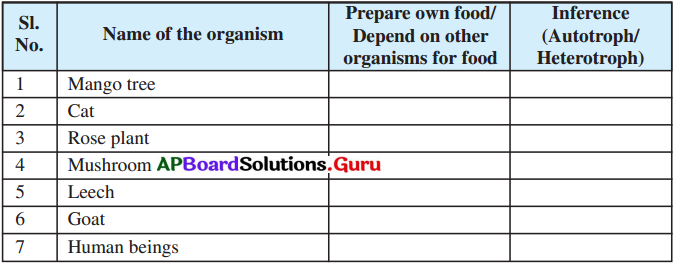
AP Board 7th Class Science Solutions 3rd Lesson Nutrition in Organisms 6

Answer:

Name of the organism Prepare own food/ Depend on other organisms for food Inference (Autotroph/ Heterotroph)
1. Mango tree Prepares own food Autotroph
2. Cat Depends on other organisms Heterotroph
3. Rose plant Prepares own food Autotroph
4. Mushroom Depends on other organisms Heterotroph
5. Leech Depends on other organisms Heterotroph
6. Goat Depends on other organisms Heterotroph
7. Human beings Depends on other organisms Heterotroph

→ Are all plants Autotrophs?
Answer:
No.

→ What kind of nutrition is seen in mushrooms?
Answer:
Heterotrophic nutrition (Saphrophytic).

→ What kind of nutrition is seen in animals?
Answer:
Heterotrophic (Parasitic, Holozoic).

7th Class Science Textbook Page No : 38 (Autotrophic Nutrition – Photosynthesis)

Question 2.
Anu said plants also prepare their food same as we prepare boiled rice.
Comparative table prepared by her was given below. Study the table and answer the questions.

Preparation of Boiled Rice Preparation of food by green plants
Raw materials Rice, Water Carbon dioxide, water
Source of energy Fire from stove Sunlight
Happens in Vessel/cooker Chloroplast in green parts
Finally forms Boiled rice Glucose/Carbohydrates

→ What are the raw materials required for the preparation of food by green plants?
Answer:
Carbondioxide, water.

→ Which gas is taken by plants during this process?
Answer:
Carbondioxide.

→ Name the food material formed in plants?
Answer:
Glucose / Carbohydrates.

→ What do you conclude from the above information?
Answer:
Plants prepare their own food.

Activity – 3

Question 3.
How do you prove that the sunlight is essential for photosynthesis?
Answer:
Aim: To know the importance of light in photosynthesis.

What you need :
Two potted plants, dropper, test tube, iodine solution, water.

What to do:
Take two potted plants of the same kind. Keep one in the dark (or in a black box) for 72 hours and the other in the sunlight. Perform iodine test with the Leaf extracts of both the plants as you did in activity-2. Note your observations.

What do you see :
The colour of the leaf extract of first plant does not change. The colour of the leaf extract of second plant turns blue black.

What do you learn :
This shows the presence of starch in the leaves of plant kept in the sunlight indicating the occurrence of photosynthesis. There is no starch in the leaves of the plant kept in the dark. This confirms that sunlight is essential for photosynthesis.

AP Board 7th Class Science Solutions 3rd Lesson Nutrition in Organisms

Activity – 4

Question 4.
How do you conduct an activity to show the saprotrophic nutrition in bread moulds?
Answer:
Aim:
To observe the saprotrophic nutrition ih bread mould.

What you need:
Piece of bread, water, a container and a hand lens.

What to do:
Take a piece of Bread, in a container. Sprinkle some water and close the container. Open the container after few days and observe. (Use mask and gloves while doing this activity).

What do you see:
You will see cotton-like threads spread on the piece of bread and bread size is decreased.

What do you learn:
These thread-like structures are some sort of plants called Fungi. They don’t have chlorophyll so they obtain their food from dead and decaying matter.

Activity – 5

Question 5.
Wash your hands. Look into the mirror and count your teeth. Use your index finger to feel the teeth. How many kinds of teeth could you find? Take a piece of an apple, sugar cane or bread and eat it. Which teeth do you use for biting and cutting and which one for tearing?
AP Board 7th Class Science Solutions 3rd Lesson Nutrition in Organisms 2

Also find out the ones that are used for chewing and grinding? Compare your observations with the given picture and fill the table.
AP Board 7th Class Science Solutions 3rd Lesson Nutrition in Organisms 7

(Note: The picture of teeth on lower jaw was given here. The number and type of teeth on the upper jaw is same as on the lower jaw.)
AP Board 7th Class Science Solutions 3rd Lesson Nutrition in Organisms 8

→ What do you find?
Answer:
I found different types of teeth in my mouth.

→ How many teeth do you have? Is it equal to the number given in the picture?
Answer:
I have 28 teeth. No, in the figure there are 32 teeth. But 1 have only 28 teeth.

→ Which teeth are absent?
Answer:
I have no (wisdom teeth). 4 molars are absent in my mouth.

AP Board 7th Class Science Solutions 3rd Lesson Nutrition in Organisms

Activity – 6

Question 6.
How does acid damage our teeth? Prove with an activity.
Answer:
Aim : To know the process of tooth decay.

What you need :
Marbles, dilute hydrochloric acid and test tube.

What to do:
Put a few small pieces of marble in dilute hydrochloric acid. Examine after awhile.

What do you see :
Acid reacts with marble and dissolves it.

What do you learn :
The enamel, which is a calcium compound, reacts with acid and gets destroyed in the same way a marble reacts with hydrochloric acid.

When food remains stuck in teeth, bacteria feed on them. As a result, lactic acid is produced, which causes the destruction of enamel.

AP Board 7th Class Science Solutions 7th Lesson Reproduction in Plants

SCERT AP 7th Class Science Study Material Pdf 7th Lesson Reproduction in Plants Textbook Questions and Answers.

AP State Syllabus 7th Class Science 7th Lesson Questions and Answers Reproduction in Plants

7th Class Science 7th Lesson Reproduction in Plants Textbook Questions and Answers

Improve Your Learning

I. Fill in the blanks.

1. Hibiscus propagated by _______ .
2. The male reproductive part in a flower is _______ .
3. The lower swollen part in gynoecium is _______ .
Answer:
1. stem
2. Stamens dr Androecium
3. Ovary

II. Choose the correct answer.

1. The plant which reproduces through leaves is
a) Bryophyllum
b) Rose
c) Hydrilla
d) Balsam
Answer:
a) Bryophyllum

2. The reproductive part in a plant is
a) Root
b) Stem
c) Leaf
d) Flower
Answer:
d) Flower

AP Board 7th Class Science Solutions 7th Lesson Reproduction in Plants

3. The agents of pollination are
a) Air
b) Water
c) Insects
d) All the above
Answer:
d) All the above

III. Matching

A) Potato 1. Stem cuttings
B) Bryophyllum 2. Seeds
C) Sugarcane 3. Leaves
D) Neem tree 4. Eyes
E) Banana 5. Anther
6. Suckers

Answer:

A) Potato 4. Eyes
B) Bryophyllum 3. Leaves
C) Sugarcane 1. Stem cuttings
D) Neem tree 2. Seeds
E) Banana 6. Suckers

IV. Answer the following questions.

Question 1.
Identify whether the sentences below are true or not. Correct the statements which are not true
a) The flowers in pumpkin are unisexual.
b) Seeds are formed in asexual reproduction.
c) Generally, roses are propagated through seeds.
Answer:
a) The flowers in pumpkin are unisexual. This statement is true.

b) Seeds are formed in asexual reproduction. This statement is false. Seeds are formed in sexual reproduction.

c) Generally, roses are propagated through seeds. This statement also false. Generally, rose plants are propagated through a vegetative propagation method called stem cuttings.

Question 2.
What do you call the transfer of pollen grains to the stigma? Explain its types with the help of labelled diagrams.
Answer:

  1. The process of transferring pollen grains from the anther to stigma is known as POLLINATION.
  2. If the pollen grains are transferred from the anther of a flower to stigma of the same flower, is known as SELF POLLINATION.
  3. If the transfer of pollen grains takes place from the anther of one flower to the stigma of another flower, it is called CROSS POLLINATION.

AP Board 7th Class Science Solutions 7th Lesson Reproduction in Plants 1

Question 3.
Can plants produce new plants without the seeds? Explain those methods with the help of examples.
Answer:

  1. Yes, Some plants can produce new plants without seeds. This method of reproduction without formation of seeds is called asexual reproduction.
  2. In some plants asexual reproduction occurs through some vegetative parts like stem, roots and leaf. Such a propagation is called vegetative propagation.
  3. When the banana plants grow, a small new plant rises from the base of mother plant. Such small plants are called suckers (pilakulu). If we separate them and plant, they grow as new plants.
  4. If we cut the sugarcane stem into pieces with at least one node and plant it in the soil. After few days new plants will develop from the nodes.
  5. In Jasmine and chrysanthemum plants, small new plants arise from the underground stem of the mature parent plant. They are called layers. If these are separated from the parental plant and plant them in soil they grow into a new plants.
  6. If we cut the mint twigs with nodes and sow them in soil, they develops roots and give the crop.
  7. Potatoes have notches on them called eyes. If they are cut and plant in the suitable soil they gives rise to new potato plants.
  8. In addition to these natural vegetative propagation methods, some artificial vegetative propagation methods such as stem cuttings, layering and grafting are also helpful to grow new plants with out seeds.

AP Board 7th Class Science Solutions 7th Lesson Reproduction in Plants

Question 4.
What happens if the pollen of mango flower reaches the stigma of guava flower?
Answer:

  1. If the pollen of mango flower reaches the stigma of guava flower, fertilization does not occur.
  2. Fertilization occurs freely between the individuals of the same specious (type).
  3. But mango and guava plants belong to two different specious.
  4. So, there will be no fertilization and formation of new plants.

Question 5.
If all the honeybees in nature become extinct. Imagine, what will be the consequences.
Answer:

  1. Honeybees visit the flowers in search of nectar.
  2. When insects come in contact with a flower, the pollen grains stick to their legs and wings.
  3. Then insects visit another flower, the pollen fall on its slimy stigma.
  4. Thus they play key role in pollination, intern helps in fertilization and formation of seeds.
  5. If all the honey bees in nature become extinct, the fertilization in plants will reduce tremendously.
  6. This results in the extinction of several specious of plants.
  7. Agricultural productivity also will reduce to a great extent.
  8. So we should stop indiscriminate use of chemical pesticides and protect honey bees.

Question 6.
What are the materials required, procedure and precautions taken by you in the lab activity conducted to study the parts of Datura flower?
Answer:
AIM: To observe the parts of a flower.

Material required:
Two datura flowers, new blade, magnifying glass, pencil. Procedure: Hold a datura flower by its stalk and observe its external features. Now draw the diagram of that flower in the box given below. Note down your observations. Now cut the second datura flower vertically into two equal parts from bottom to top. Check that all parts are cut into two equal halves. Observe and draw the internal view.

Precautions:
We should be careful while cutting the flower as the new blade is sharp and may cause injury. We should not inhale the pollen as it may cause allergy.
AP Board 7th Class Science Solutions 7th Lesson Reproduction in Plants 2

Question 7.
Draw the diagram of a complete flower and label the parts.
Answer:
AP Board 7th Class Science Solutions 7th Lesson Reproduction in Plants 3

Question 8.
Rahul goes to a field trip with his classmates, he tries to catch an insect on a flower. Do you support this?
Answer:

  1. No, I never support Rahul.
  2. Insects on the flowers helps in pollination and there by fertilization.
  3. Catching and killing such insects effects the fertilization.
  4. This leads to decrease the productivity of plants.
  5. This hampers the propagation of that plants also.
  6. All the organisms on this planet have the equal right live.
  7. Killing of other organisms just for fun is a cruel act Which leads to imbalance in the nature.
  8. “Live and let live” should be out motive.

AP Board 7th Class Science Solutions 7th Lesson Reproduction in Plants

Question 9.
Venkat, lives in a city. He maintains a roof garden at the top of his six storied building. The ridge gourd creeper bears plenty of flowers. But the flower do not grow into ridge gourds. Can you give him any suggestions to get ridge gourds?
Answer:

  1. Flowers should pollinate and fertilize to form fruits.
  2. Flowers on the ridge guard plant are unisexual flowers.
  3. So, self-pollination is not possible.
  4. For Cross pollination pollinating agents such as insects are required.
  5. To allow the insects, if there is any net surrounding the plants, those should be removed.
  6. Should not spray harmful chemicals on plants.
  7. Along with ridge guard, other attractive flowers having nectar should be grown in the roof garden.
  8. As a last trial do artificial pollination. (Transfer the pollen from male flower to the stigma of the female flower.)

Question 10.
Draw the various methods of Artificial propagations on a chart and exhibit in your classroom.
Answer:
AP Board 7th Class Science Solutions 7th Lesson Reproduction in Plants 4

7th Class Science 7th Lesson Reproduction in Plants InText Questions and Answers

7th Class Science Textbook Page No. 2

Question 1.
Can we grow all plants by planting their stems?
Answer:
No, we cannot grow all the plants by planting their stems.

Question 2.
How do new plants grow from the stems?
Answer:
New plants grow from the stems with some vegetative propagation methods.

7th Class Science Textbook Page No. 3

Question 3.
Have you ever seen seeds in Banana?
Answer:
In general we never found seeds in most of the hybrid banana varities. In certain varities of banana we can find small seeds. But in the wild varities we can find large sized seeds.

Question 4.
Have you ever seen seeds in Jasmine?
Answer:
Yes, I have seen seeds in Jasmine plants. Jasmine plants give long fruits from their flowers. These fruits contain seeds.

AP Board 7th Class Science Solutions 7th Lesson Reproduction in Plants

Question 5.
Did you observe how the Hibiscus plant propagate?
Answer:
Hibiscus plant propagate by means of stem cuttings.

7th Class Science Textbook Page No. 6

Question 6.
What would your mother have done to grow a basil / tulasi plant in your house?
Answer:
My mother sow the seeds of basil / tulasi in soil to grow the basil plant.

Question 7.
She might have put some seeds in the soil. Isn’t it?
Answer:
Yes. She would sow some seeds in the soil to get new plants.

7th Class Science Textbook Page No. 7

Question 8.
Which part of the plant form the fruit?
Answer:
Flower form the fruit.

7th Class Science Textbook Page No. 9

Question 9.
Do bitter gourd flower have whorls?
Answer:
No, bitter gourd flower has only three whorls. Either androecium or gynoecium are absent in them.

7th Class Science Textbook Page No. 11

Question 10.
Do you know which part of the flower will develop into a fruit?
Answer:

  1. Ovary develop into fruits.
  2. Ovules develop into seeds.

7th Class Science Textbook Page No. 12

Question 11.
Think, what changes will take place in the flower after fertilization?
Answer:

  1. After fertilization, the ovary ripens and turns into fruit. ’
  2. The remaining floral parts will fall off.
  3. The ovules become the seeds.

7th Class Science Textbook Page No. 13

Question 12.
In which cup we observe healthy plants?
Answer:
The second cup contains healthy plants.

AP Board 7th Class Science Solutions 7th Lesson Reproduction in Plants

Question 13.
If all the seeds of a plant fall at the same place, how do the baby plants grow?
Answer:

  1. Baby plants will suffer from deficiency of nutrients, water and place.
  2. Their growth will be stunted.

Question 14.
Will they get sufficient place, nutrients, water to grow? What will happen if plants grow in such conditions?
Answer:

  1. Plants will not have enough space to grow freely.
  2. They will not get adequate amounts of nutrients and water.
  3. They do not obtain healthy growth.

Question 15.
Do you have any idea that how plant overcome this situation?
Answer:

  1. To overcome this problem, plants adopt different methods to disperse their seeds.
  2. Seed dispersal takes place with the help of various agents.

Think & Respond

7th Class Science Textbook Page No. 12

AP Board 7th Class Science Solutions 7th Lesson Reproduction in Plants 9

Question 1.
Why do some plants produce small and numerous seeds?
Answer:

  1. All the seeds of a fruit should be able to germinate to produce new plants. Actually, it does not happen in nature.
  2. All the seeds don’t germinate, some will germinate but die before their maturity. Some of the seeds never germinate.
  3. To over come all these problems, plants produce a large number of seeds.

Question 2.
Why do some seeds have wings?
Answer:

  1. This type of winged seeds are dispersed by wind.
  2. These wings help the seeds to move easily by winds to settle in a suitable place to germinate.

Question 3.
Why are some seeds with more fibre?
Answer:

  1. Fibres make seeds light weight and help in floating.
  2. These seeds dispersed through water for longer distance.
    Ex : Coconut.

AP Board 7th Class Science Solutions 7th Lesson Reproduction in Plants

Question 4.
Why do some pods of dry fruits explode?
Answer:

  1. Some pods of dry fruits explode is a mechanical reaction.
  2. In such way that they scatter the seeds all around.
  3. In this way they dispersal the seeds.

Question 5.
Why do some seeds have hairs?
Answer:

  1. Hairs help the seeds to travel in air.
  2. Long haired seeds are travel long distances in air.
  3. In that way seeds are settle at a suitable place to germinate.
    Ex : Calotropis.

Question 6.
Why are many fruits sweet and fleshy?
Answer:

  1. Animals, birds and human beings eat these fruits and the seeds are thrown away.
  2. Like that way, seeds will be dispersed to different places.
  3. For the purpose of reproduction many fruits are sweet and fleshy,

Question 7.
Why do some seeds-have hooks?
Answer:

  1. Seeds have hooks and thorns, help them to stick to the animals
  2. So they travel one place to another place. Ex : Xanthium, urena, grass.

Question 8.
Why are some seeds heavy and round?
Answer:

  1. Seeds that are heavy and round are dispersal by water.
  2. They fall into the bottom of water
  3. They carried by the flow of water for long distances.
    Ex : Seeds of Lotus.

Question 9.
Why are some seeds are delicate and small?
Answer:

  1. This type of seeds are dispersed through winds
  2. They are delicate, small, light in weight and hairy.
  3. These qualities enable them to travel with the mind and settle at a suitable place to germinate

Activities and Projects

Question 1.
Collect information from elders, internet or your school library regarding the method of vegetative propagation in Onion, Garlic, Ginger, Gladioli, Sweet potato, Bryophyllum, Begonia.
AP Board 7th Class Science Solutions 7th Lesson Reproduction in Plants 5
Answer:

Plant Method of vegetative propagation
1. Onion New plants grow from bulbs.
2. Garlic Individual garlic cloves are planted and they each produce a bulb.
3. Ginger New plants are propagated through rhizomes.
4. Gladioli New plants are propagated through corms (modified stems).
5. Sweet potato New plants grow from modified roots.
6. Bryophyllum New plants grow from the buds on the leaves (Epiphyllons buds)
7. Begonia New plants grow from buds on the leaves (Epiphyllons buds)

Question 2.
Grow a plant using seeds and exhibit in the classroom record its growth.
Answer:

Activities

Activity – 1

Question 1.
Discuss with your friends and teachers and fill the table given below with ‘Yes’ or ‘No’ options. Answer the questions given below.

Name of the plant Reproduce through seeds Reproduce without seeds
1. Jasmine (malli) Yes Yes
2. Tamarind (chinta) Yes No
3. Curry leaf (Karivepaaku) Yes Yes
4. Banana (Arati) Yes Yes
5. Coriander (kottimeera) Yes No
6. Drumsticks (munaga) Yes No

i) Which plants are reproduce through seeds?
ii) Which plants are reproduce without seeds?
iii) Which plants are reproduce by both means?
Answer:
i) Tamarind, Coriander, Drumsticks plants repr oduce through seeds.
ii) Jasmine, Curry leaf, Banana plants reproduce without seeds.
iii) Jasmine, Curry leaf and some Banana plants reproduce by both means.

AP Board 7th Class Science Solutions 7th Lesson Reproduction in Plants

Activity – 2

Sheet For Lab Activity
Student Name : _____________________________________________
Date : _____________________________________________
AIM: To observe the parts of a flower.
Material required:
Two datura flowers, new blade, magnifying glass, pencil.

Procedure :
Hold a datura flower by its stalk and observe its external features. Now draw the diagram of that flower in the box given below. Note down your observations.
Parts of the flower :
AP Board 7th Class Science Solutions 7th Lesson Reproduction in Plants 3
External parts :
SEPALS:
Colour : Green Petal
Shape : Round tubular
Number : 5
Are they United/Separate ? United PETALS:
Colour : White
Shape v : Round tubular
Number : 5
Are they United/Separate? United

Procedure:
Cut the second datura flower vertically into two equal parts from bottom to top. Check that all parts are cut into two equal halves. Observe and draw the internal view.

AP Board 7th Class Science Solutions 7th Lesson Reproduction in Plants 6
Internal parts:
ANDROECIUM:
Colour : White
Shape : Thin filamentous
Number : 5
Are they United/Separate?
Separate
GYNOECIUM: Style
Colour : Light Yellow
Shape : Long tube like
. swollen at the base Ovary
Number : 1-Ovary – style – stigma
Are they United/Separate ? Separate Gynoecium

Activity – 3

Question 3.
Collect different varieties of flowers from your school garden. Take each flower and count the parts in it. Record the details in the given table.
AP Board 7th Class Science Solutions 7th Lesson Reproduction in Plants 7
i) Which flowers have all four whorls?
ii) Mention the flowers in which one or two whorls are missing.
iii) Write the whorl \ whorls which are missing.
Answer:
i) Lady’s fingers, Hibiscus and Datura flowers have all the four whorls.
ii) In Pumpkin, Bauhinia, Ipomea flowers one or two whorls are missing.
iii) Either androecium or gynoecium are missing.

Give examples for complete flowers …………………, ………………………, ………………….
Hibiscus, Datura etc.

Give examples for incomplete flowers …………………., …………………
Pumpkin, Ridge gourd, etc.

Activity – 4

Question 4.
Collect flowers of hibiscus, papaya, ridge gourd and some other flowers. Fill the table given below by observing the androecium and gynoecium.
AP Board 7th Class Science Solutions 7th Lesson Reproduction in Plants 8
i) In which plants either androecium or gynoecium is present?
ii) In which plants both androecium and gynoecium are present in the same flower?
iii) In which plant both androecium and gynoecium are present separately in different flowers of the same plant?
iv) In which plant both androecium and gynoecium are present in different flowers of different plants?
Answer:
i) Papaya, Ridge gourd, Bitter gourd
ii) Hibiscus, Datura.
iii) Ridge gourd, Bitter gourd
iv) Papaya

Activity – 5

Question 5.
How do you prove that seed dispersal is necessary for plants?
Answer:

  1. Take two cups with soil.
  2. Take handful of mustard seeds in the first cup and only four mustard seeds in the second cup.
  3. Pour equal amount of water daily and observe them regularly for 15 days.

Observations:

  1. Numerous plants germinated in the first cup. They have not enough space to grow freely. They are also not getting sufficient nutrients and water to grow. The plants present in the first cup are not healthy.
  2. In the second cup, the four mustard seeds germinated into new plants. They have enough space, water and nutrients to grow. They are healthy.

Inference:
All the plants try to spread their seeds to distant places to increase the chances of survival and propagation. So, they adopt different methods to disperse their seeds. It occurs with the help of different agents.

AP Board 7th Class Science Solutions 7th Lesson Reproduction in Plants

PROJECT : Page No. 13

Question 6.
Now Collect information about various agents of seed dispersal from internet, your school library or by observing your surroundings. Make a Scrap book with pictures and your illustrations. And fill the below table with at least three examples each.

Agents of dispersal Name of the seeds/fruit
Wind Calotropis. Milk weed, Dandelion, Maple
Water Coconut, Lotus, Water Lily
Animals Guava, Tomato, Seeds of grass plants
Bird Neem, Thorn apple, Cucumber, Achyranthus
Man Sugarcane, Wheat, Pulses
Any other Bhendi, Mustard, Kanakambaram

AP Board 7th Class Science Solutions 9th Lesson Heat, Temperature and Climate

SCERT AP 7th Class Science Study Material Pdf 9th Lesson Heat, Temperature and Climate Textbook Questions and Answers.

AP State Syllabus 7th Class Science 9th Lesson Questions and Answers Heat, Temperature and Climate

7th Class Science 9th Lesson Heat, Temperature and Climate Textbook Questions and Answers

Improve Your Learning

I. Fill in the blanks.

1. Doctor uses ______ thermometer to measure the human body temperature.
2. The best liquid for thermometer is _____
3. The force applied by air on any surface in contact is called ______
4. The average weather pattern taken over a long time is called the _____ of the place
5. The amount of water vapour present in the air is called _____
Answer:
1. clinical
2. mercury
3. air pressure
4. climate
5. humidity

II. Choose the correct answer.

1. A student observe day-to-day conditions of the atmosphere on three consecutive days and recorded his observations. She wants to show the data using a graph. Which graph is suitable for her?
a) climate graph
b) weather graph
c) temperature
d) humidity graph
Answer:
b) weather graph

2. Conduction of heat takes place in
a) metals
b) liquids
c) gases
d) air
Answer:
a) metals

3. Average human body temperature is
a) 0°C
b) 20°C
c) 37°C
d) 100°C
Answer:
c) 37°C

AP Board 7th Class Science Solutions 9th Lesson Heat, Temperature and Climate

4. Number of divisions in Fahrenheit scale
a) 180
b) 100
c) 50
d) 200
Answer:
a) 180

III. Matching.

A) Melting point of ice 1. mercury
B) Precipitate 2. barometer
C) Air pressure 3. 100°C
D) Boiling point of water 4. 0°C
E) Metal used in thermometer 5. rain gauge
6. alcohol

Answer:

A) Melting point of ice 4. 0°C
B) Precipitate 5. rain gauge
C) Air pressure 2. barometer
D) Boiling point of water 3. 100°C
E) Metal used in thermometer 1. mercury

IV. Answer the following questions.

Questions 1.
What are similarities and differences between the laboratory thermometer and the clinical thermometer?
Answer:

Laboratory thermometer Clinical thermometer
Differences:
1. Laboratory Thermometer is used in school labs, industries etc. to measure temperature. 1. Clinical Thermometer is used in hospitals to measure the temperature of the human body.
2. It has nd kink that prevents the mercury from flowing back into the bulb. 2. It has a kink that prevents the mercury from flowing back into the bulb.
3. Level of liquid may rise or fall after taking reading. 3. Level of liquid not changes after taking reading.
4. It has reading from -10 to 110° C (may vary) 4. It has reading from 35-42T & 95-108°F (may vary)
5. It is used to measure the tempera-ture of substances, weather etc. 5. It is used to measure the temperature of human body.
6. It is longer in size. 6. It is shorter in size.
7. It can measure higher temperatures. 7. It can measure lower temperatures
Similarities:
1. This is used to measure the temperature. 1. This is used to measure the temperature.
2. This is worked on the principle of expansion of substances by heat. 2. This is worked on the principle of expansion of substances by heat.
3. It is made with glass and has a bulb. 3. It is made with glass and has a bulb.

Question 2.
Draw the diagram of a clinical thermometer and label its parts.
Answer:
AP Board 7th Class Science Solutions 9th Lesson Heat, Temperature and Climate 1

Question 3.
Give two examples for conductors and insulators each.
Answer:
Example for conductors:
Aluminum, iron and copper etc.

Example for insulators:
Water, air, clothes, glass, cork, plastic, wood etc.

Question 4.
Buchhanna thinks that the concepts • weather and climate are the same. Do you agree with him? Justify your answer.
Answer:
I do not agree the Buchhanna’s statement.

  1. The day-to-day variations in the components like temperature, humidity, rainfall, wind speed are called weather. But, the average weather pattern taken over a long period, say 25 years or more is called the climate of the place.
  2. Weather keeps on changing and changes are very fast too. But, climate of a place remains unchanged for a long period Of time.
  3. Rapid changes occur in weather. But no rapid changes occur in climate.
  4. Weather affects our daily life. But climate affects our lifestyle.
  5. Weather gives the information about atmospheric conditions in a specific area and time. But, climate gives for a long time of period.

Hence, weather and climate are not the same.

Question 5.
Prepare two questions for a questionnaire for “farmers on climate change”.
Answer:
a) What type of climate changes do you observe in last ten years?
b) What changes have been made in the cultivation of crops due to climate changes?

Question 6.
Give two precautions to be taken while using a clinical thermometer?
Answer:

  1. Wash the thermometer with water or an antiseptic solution before and after use.
  2. Before use, the level of mercury should be less than 35°C, otherwise shake it.
  3. Don’t touch the bulb while taking reading.
  4. Handle the thermometer carefully, because it is a glass ware.
  5. Take the reading after increasing of the mercury level is stopped.

AP Board 7th Class Science Solutions 9th Lesson Heat, Temperature and Climate

Question 7.
Define conduction. Explain the process of transfer of heat by conduction with your own examples.
Answer:
1) The process of transfer of heat from hotter to colder end through the conductor is called conduction. This mode of transfer of heat happens more in solid conductors.

2) Example 1:
It takes some time for the heat to reach the end of the spatula placed in the cooking vessel. The heat from cooking vessel transfers to the end of the spatula gradually. This type of heat transfer is called conduction.

3) Example 2:
The edges of the steel plate with burning coal burn our hand while holding it. Here the heat transfers from the middle of the plate to the edges gradually.

4) Example 3:
If we put a needle by holding it in the candle flame, it causes burn to our hand. It is due to conduction of heat.

Question 8.
What are the measuring components of weather and explain about them?
Answer:
Maximum and minimum temperature of a day, air pressure, rainfall, wind speed and humidity are called measuring components of weather.

1) Maximum and minimum temperature of a day:
Maximum and minimum tempera-ture of a day are the highest and lowest temperature recorded respectively during a day. Six’s maximum and minimum thermometer is one of the meteorological in-struments used to measure maximum (highest) and minimum (lowest) temperatures of a place in a day.

2) Air pressure:
The force applied by air on any surface in contact is called “air pres-sure”. Air pressure is measured in height of mercury level in centimeters and it is measured with a barometer.

3) Rainfall:
The amount of water falling in rajn within a given time and area is called Rain fall. Rainfall is measured in millimeters by using a rain gauge.

4) Wind speed:
Wind move is caused by difference in the air pressure in two places. The speed of wind can be measured using a device called an anemometer.

5) Humidity:
The water vapour present in the air is called humidity Hygrometer is used to measure humidity in air and it is expressed in grams per cubic meter.

Question 9.
Explain an activity to show that “air experts pressure”?
Answer:
AP Board 7th Class Science Solutions 9th Lesson Heat, Temperature and Climate 2

  1. Take an empty bottle and a balloon.
  2. Insert the balloon into the bottle.
  3. Stretch the balloons over the opening of the bottle as shown in the figure.
  4. Now try to blow air into the balloon inside the bottle.
  5. But it is not easy to blow air when it is inside the bottle.
  6. There is some force inside the bottle stopping you to do so.
  7. This is because the force applied by the air inside the bottle.
  8. The force applied by air on any surface in contact is called “air pressure”.

Question 10.
Explain the construction and working of six’s maximum and minimum thermometer?
Answer:

  1. Six’s maximum and minimum thermometer is one of the Meteorological instruments used to measure maximum (highest) and minimum (lowest) temperatures of a place in a day.
  2. James Six invented this thermometer in 1780.
  3. It has a cylindrical ‘Bulb A’, and ‘Bulb B’ connected through a ‘U-shaped tube’ con-taining mercury.
  4. Bulb A contains alcohol, and bulb B c’ontains alcohol and its vapours.
  5. When the temperature increases, the alcohol in the bulb A expands and pushes the mercury in the U tube, this makes indicator N to move up.
  6. This indicates the maximum temperature of the day.
  7. When the temperature decreases, alcohol in the bulb A contracts and pulls the mercury back. This makes indicator M to move up.
    AP Board 7th Class Science Solutions 9th Lesson Heat, Temperature and Climate 3
  8. This indicates the minimum temperature of the day.
  9. After taking readings the indicators M and N are brought to their original places by using a magnet.

7th Class Science 9th Lesson Heat, Temperature and Climate InText Questions and Answers

7th Class Science Textbook Page No. 35

Question 1.
Mention the terms used in the conversation?
Answer:
Heat, cold, weather, temperature, minimum temperature.

Question 2.
What is the difference between Heat and Temperature?
Answer:
Heat flows from a body of high temperature to a body of low temperature . The degree of hotness or coldness is called temperature.

AP Board 7th Class Science Solutions 9th Lesson Heat, Temperature and Climate

Question 3.
What is meant by climate of a place?
Answer:
The average weather pattern taken over a long period, say 25 years or more, is called the climate of a place.

Question 4.
Which form of energy help us to cook rice?
Answer:
Heat energy.

Question 5.
Which energy turns the water into vapour, while boiling?.
Answer:
Heat energy.

Question 6.
Why do you feel the heat when you hold a cup of warm milk to drink?
Answer:
We feel hot when heat energy flows from milk to our body. Here we gain heat energy from milk.

Question 7.
Why do you feel cool when you drink a glass of lassi?
Answer:
We feel cool, when heat energy flows from our body to lassi. Here, we lose heat energy.

7th Class Science Textbook Page No. 36

Question 8.
What determines the direction of heat flow?
Answer:
Heat flows from a body of higher temperature to a body of lower temperature. This direction is determined by temperature.

Question 9.
Have you heard about temperature, when you suffer from fever?
Answer:
Yes, I have.

Question 10.
What is temperature?
Answer:
The degree of hotness or coldness is called temperature.

Question 11.
What are the differences between heat and temperature?
Answer:

Heat Temperature
1. Heat is a form of energy It is the degrees of hotness or coldness.
2. It is measured in joules It is measured in kelvin
3. It has the ability to do work. It can be used to measure the degree of heat.
4. It flows from hotter bodies to colder bodies. It increases with increase of heat and decreases with decrease of heat.

7th Class Science Textbook Page No. 37

Question 12.
Why are cooking utensils made of metals while their handles are made of plastic or wood?
Answer:

  1. Some materials allow heat through them, this property is called conductivity.
  2. We use metals to make cooking vessels because they allow heat through them.
  3. We use material which do not allow heat to pass through as handles.
  4. So, cooking utensils made of metals while their handles are made of plastic or wood.

7th Class Science Textbook Page No. 38

Question 13.
How does conductors transfer heat energy through them?
Answer:
Heat is transferred in the conductors from one end to another end by the mode of conduction.

Question 14.
How does water transfer heat energy from one place to another?
Answer:
Water transfers heat energy in the mode of convection.

Question 15.
How is heat energy transferred from the Sun to the Earth?
Answer:
Heat energy transferred from the Sun to the Earth in the mode of radiation.

AP Board 7th Class Science Solutions 9th Lesson Heat, Temperature and Climate

Question 16.
Many times, Karthik observed that the handle of the spoon becomes hot when it is left for some time in hot oil, hot curry, hot tea or hot milk. Can you guess why does it happen? What is this process called?
Answer:
This is because heat is transferred from one end to another end by the mode of conduction.

7th Class Science Textbook Page No. 39

Question 17.
We know, water is a poor conductor of heat. But, when we heat water on a stove to take a bath, how does the surface of the water get heated?
Answer:
This happens due to the transfer of heat by a mode called convection.

7th Class Science Textbook Page No. 40

Question 18.
What happens if there is no medium (solid, liquid, gaseous substances) to transfer heat between two objects or two places?
Answer:
Heat transfers in the form of waves from one place to another, if there is no medium like solid, liquid, gas.

Question 19.
Recollect the conversation between the three friends Rafi, John, and Satyanarayana at the fire place and can you guess how does the heat energy transfer from the fire place to their bodies?
Answer:
This is because of heat transfer in the form of waves from one place to another.

Question 20.
How does a thermal scanner work, without being in contact with the human body?
Answer:
The thermal scanner receives the heat in the form of radiation to measure our body temperature.

Question 21.
Which instrument can control the transfer of heat (loss of heat)?
Answer:
Thermos flask can control the transfer of heat (loss of heat) and retain hotness of tea for a few hours.

Question 22.
How can we use Thermos flask to stop all modes of heat transfer?
(OR)
Do you know how Thermos flask works?
Answer:

  1. Thermos flask has a two layered glass container and the air between these layers is removed to create a vacuum.
  2. The inner silver coating protects the contents (tea, coffee, milk) poured in the flask from losing heat through radiation.
  3. As there is no medium between the walls of the flask. Neither conduction nor con-vection of heat takes place.
  4. As a result, heat is not transferred outside the flask so it is retained inside the flask for a few hours.

7th Class Science Textbook Page No. 41

Question 23.
Is it possible to keep the hotness of tea in flask forever?
Answer:
No, gradually a little amount of heat is lost from the lid by convection currents and a small amount of heat by conduction through the glass. Therefore, the tea does not retain heat for a long time or forever.

Question 24.
What changes can we observe in the size of material when it transfers heat energy?
Answer:
We can observe enlarging in the size of material when it transfers heat energy. This is due to increase in the energy of particles present in the substance.

Question 25.
Why are small gaps left between rails in railway tracks?
Answer:

  1. Particles of substances occupy more space when they get heated.
  2. In the hot days rails of the railway tracks enlarge (expand) due to heat energy.
  3. It causes damage to the rails.
  4. So, small gaps are left between rails in railway tracks.

Question 26.
What change occurs to the level of mercury in thermometer when it is kept in the mouth of a person suffering from fever?
Answer:
The level of mercury in thermometer increases when it is kept in the mouth of a person suffering from fever. This is due to expansion of mercury on heating.

AP Board 7th Class Science Solutions 9th Lesson Heat, Temperature and Climate

Question 27.
Why does puri swell when it is put in hot oil?
Answer:
Puri swells when it is put in hot oil, because water in the substance is expanded in the hot oil.

Question 28.
What happens when you heat a piece of metal?
Answer:
When you heat a piece of metal it expands on heating.

Question 29.
Is there any change in the shape and size of a metal?
Answer:
Yes, shape and size changes in the expansion on heating a metal.

7th Class Science Textbook Page No. 42

Question 30.
Do the liquids also expand on heating as solids?
Answer:
Yes

Question 31.
Do gases also expand on heating like solids and liquids?
Answer:
Yes

Question 32.
What happens when air is heated?
Answer:
Gases (Air) expands on heating and occupies more space.

7th Class Science Textbook Page No. 43

Question 33.
How can we use expansion of liquids?
Answer:
We can make devices like thermometers by using the property of expansion of liquids on heating.

Question 34.
What device we use to measure the temperature of a substance and how it works?
Answer:
Thermometers are used to measure temperature, this works on the expansion of liquids (mercury).

Thermometer – roleplay (personification)
AP Board 7th Class Science Solutions 9th Lesson Heat, Temperature and Climate 19

Question 35.
How are you?
Answer:
I am fine.

Question 36.
Do you know me?
Answer:
Yes, I know you. You are a thermometer.

Question 37.
Have you ever seen me?
Answer:
Yes, I have seen in my home and hospital.

Question 38.
Try to recall how I look like?
Answer:
You are made of a narrow glass tube with thick walls which is closed at one end and You have a bulb of mercury or alcohol on the other end.

Question 39.
Do you know why mercury or alcohol is used in me?
Answer:
Mercury and alcohol have the best properties to measure temperature.

7th Class Science Textbook Page No. 44

Question 40.
Do you ever observe any marks on Alcohol thermometer? Can you guess what are they?
Answer:
Yes, I observed. Those marks are called scales.

7th Class Science Textbook Page No. 45

Question 41.
How can we use laboratory and clinical thermometers?
Answer:
Using of a laboratory thermometer:

  1. Place the mercury bulb of the thermometer in a liquid, so that the bulb immerses in it.
  2. Wait for some time till the mercury level shows a constant reading.
  3. And take the reading at the level of the mercury.

Using of a clinical thermometer:

  1. Wash the clinical thermometer properly with an antiseptic solution.
  2. To lower the mercury level, hold the thermometer firmly and give some jerks.
  3. Ensure that it falls below 35 °C.
  4. Now place the bulb of the thermometer under your friend’s tongue.
  5. After one or two minutes, take the thermometer out and note the reading.
  6. This is your body temperature.
  7. Don’t hold the thermometer by the bulb while reading it.

7th Class Science Textbook Page No. 46

Question 42.
What is your friend’s body temperature?
Answer:
98.4°F. (write your friend’s body temperature)

AP Board 7th Class Science Solutions 9th Lesson Heat, Temperature and Climate

Question 43.
Why are armpit or part below tongue selected to record temperature?
Answer:
The clinical thermometer is used to determine the temperature of the interior of the body. The part under the tongue is the most accessible area to get accurate interior temperature. So, temperature is taken underneath the tongue. But it is difficult and inconvenient for kids to hold the thermometer under their tongue. So armpit will be used for kids to take body temperature, even though it is not accurate.

Question 44.
Can you tell why smoke always rises up?
Answer:
Smoke and hot air moves up because it expands and becomes lighter.

Question 45.
Why do we have ventilators and exhaust fans on the upper parts of the wall?
Answer:
Smoke and hot air moves up because it expands and becomes lighter. That’s why we have ventilators and exhaust fans on the upper parts of the wall to exhaust hot air and smoke from a room.

Question 46.
What happens at a place, where air expands and rises up?
Answer:
When air expands and rises up it creates a low pressure area.

Question 47.
Who occupies that place which is vacated by hot air?
Answer:
The air high pressure from surrounding to move and occupy that place.

Question 48.
What makes the cooler air come into that place?
Answer:
Low air pressure.

7th Class Science Textbook Page No. 47

Question 49.
Have you ever seen high speed winds blowing over the roofs of houses?
Answer:
Yes.

Question 50.
Is there any relation between these components and the weather of a place?
Answer:
The measurements of components like wind speed, rainfall, temperature etc. in a certain-time and location is called weather.

Question 51.
Do we have any other components of this kind?
Answer:
Yes, humidity is the other components of this kind.

7th Class Science Textbook Page No. 48

Question 52.
Where does this evaporated water go?
Answer:
All the evaporated water from different water bodies go into air.

Question 53.
Do you know what we call this evaporated water present in air ?
Answer:
This water vapour present in the air is called humidity.

Question 54.
What is the role of humidity in sunstroke?
Answer:

  1. Evaporation of sweat from our body makes us cool to maintain our body temperature.
  2. In summer, the humidity of air is high.
  3. Due to high humidity and temperature, it becomes difficult to evaporate the sweat from our body to cool it down.
  4. But still our body losses water.
  5. High temperatures, along with humidity sometimes may cause heat stroke or sunstroke.

7th Class Science Textbook Page No. 49

Question 55.
Do all the days have the same values of components of weather?
Answer:
No. All are not the same on all days. This causes variations in atmospheric conditions.

Question 56.
How can we get information of weather at a place?
Answer:
We can get details of weather from weather reports and you can see these symbols on television, newspapers and in weather forecasting.

Question 57.
Have you ever seen the symbols shown in the figure?
Answer:
Yes, I saw it in TV and newspapers.

7th Class Science Textbook Page No. 50

Question 58.
How can we present these components of weather, more effectively?
Answer:
We present these components of weather; more effectively by tabulating these values and by drawing these graph.

Question 59.
Do the climate of a place changes like weather?
Answer:
The climate of a place does not change like weather. Climate of a place remains unchanged for a long period of time.

AP Board 7th Class Science Solutions 9th Lesson Heat, Temperature and Climate

Question 60.
What are the measuring components of climate?
Answer:
Temperature, air pressure, rainfall, wind speed and humidity are the measuring components of climate.

Question 61.
Is weather and climate are one and the same?
Answer:
Not the same.

7th Class Science Textbook Page No. 51

Question 62.
What happens if the components of climate changes abnormally?
Answer:
The abnormal variation in the components of climate is called climate change. These variations may affect all parts of the world.

Think & Respond

7th Class Science Textbook Page No. 38

Question 1.
When two ice cubes are placed on wood and aluminium objects with same size which ice cube will melt faster, why?
Answer:

  1. The ice cube placed on the aluminium object will melt faster.
  2. Because of aluminium is a good conductor of heat.
  3. Transfer of heat takes place quickly.
  4. But wood is a poor conductor of heat and transfer of heat takes place slowly.

Question 2.
Why do animals that live in colder regions have more fur and thick fat layer under the skin?
Answer:

  1. Animals that live in colder areas have to protect their bodies against extremely cold environmental conditions.
  2. Their bodies cannot withstand such cold climates.
  3. So, they have thick white fur on their body.
  4. This provides an additional layer over their skin.
  5. Thick white fur acts as insulator of heat and stops the heat transfer from body to outside and vice versa.
  6. Animals in colder regions have thick layers of fat, because fat acts as an insulator and doesn’t let their body heat escape, which helps them survive in such extreme temperatures.

Question 3.
Why do we wear woolen clothes in winter?
Answer:
As wool is a very good insulator and a poor conductor of heat, woolen clothes keep the body warm and protect it from the cold winds.

Question 4.
Why do most of the desert animals live in burrows (inside soil)?
Answer:
Reptiles, insects and most of the desert animals live in burrows below the surface of the soil or sand to escape the high temperatures at the desert surface.

7th Class Science Textbook Page. No. 39

Question 5.
Why are the Upper layers of water in a pond or a lake hotter than the lower layers during the hot summer?
Answer:

  1. The heat from the sun is reached to the Upper layers of the lakes first.
  2. We know that heat transfers in convectional mode in water. .
  3. Convectional currents take more time to reach the lower layers as there are in deep.
  4. This means it takes more time to transfer of heat to the bottom of the lake or pond.
  5. The water of the surface layer is evaporated by absorbing heat and does not heat up quickly.
  6. As a result heat does not reach the lower layers of the lake. It is another reason.

7th Class Science Textbook Page No. 41

Question 6.
Why the electric power lines (wires) are held loose on poles?
Answer:

  1. Wire is made up of metal. So, it expands on heating and contracts on cooling.
  2. If the wire is fixed tightly with maximum tension between two poles, may cut due to contraction on cooling conditions in winter,
  3. So, the electric power lines (wires) are held loose on poles to minimize the tension in the wires.

AP Board 7th Class Science Solutions 9th Lesson Heat, Temperature and Climate

Question 7.
Why are rollers kept under the beams of metal bridges?
Answer:

  1. Roller supports are commonly located at one end of long bridges.
  2. This allows the bridge structure to expand and contract with temperature changes and prevents damage.

DO THIS (Page No. 49)

Collect the information about symbols of the weather report and display them in
the classroom.
Answer:

Activities and Projects

Question 1.
Prepare a report by collecting different types of materials in your surroundings and classify them into good and poor conductors based on their conductivity.
Answer:
AP Board 7th Class Science Solutions 9th Lesson Heat, Temperature and Climate 4

Question 2.
Visit a veterinary doctor and find out the normal body temperature of domestic animals and birds.
Answer:
AP Board 7th Class Science Solutions 9th Lesson Heat, Temperature and Climate 5

Question 3.
Visit the nearby Tahsildar office or meteorological department office and observe different instruments which are used to measure components and record your ob-servations.
Answer:

Instrument Measuring component
1. A thermometer air temperature
2. A barometer atmospheric pressure
3. An anemometer wind speed and the direction the wind is blowing
4. A hygrometer the relative humidity at a location
5. A ceilometer determine the height of a cloud base and the aerosol con-centration within the atmosphere.
6. Adisdrometer the drop size distribution and velocity of falling hydrometers.
7. Rain gauges the precipitation which falls at any point on the Earth’s landmass.

Question 4.
Measure the body temperature of atleast 10 of your Mends and prepare a report.
Answer:

Question 5.
Note down maximum and minimum temperature of five consecutive days from today by using 6 minimum and maximum thermometer.
Answer:

Activities

Activity – 1

Question 1.
How do you prove that heat is a form of energy?
(OR)
Write an activity to explain the heat concept.
Answer:
AP Board 7th Class Science Solutions 9th Lesson Heat, Temperature and Climate 6

  1. Take a glass bottle and a one-rupee coin.
  2. Wet the mouth of the bottle and place a coin on it.
  3. Rub your hands together to produce heat.
  4. Now place them around the bottle.
  5. Observe the coin. It moves.
  6. Reason:- the movement in the coin is caused by heat supplied to the bottle from your hands.
  7. Conclusion:-So, we can say heat is a form of energy.

Activity – 2

Question 2.
How do you show the degree of hotness or coldness through an activity?
(OR)
write an activity to understand the concept of temperature.
Answer:

  1. Take some Iuke-warm water in one glass and hot water (which you can bear) in another glass.
  2. Touch them and feel the hotness of both.
  3. Take a glass of cool water and cubes of ice in another glass.
    AP Board 7th Class Science Solutions 9th Lesson Heat, Temperature and Climate 7
  4. Touch them feel the coldness of both.
  5. You will feel hot water is hotter than Luke warm water and ice is cooler than cool water.
  6. The variations of hotness, coldness can be termed as degree of hotness and coldness.
  7. The degrees of hotness or coldness is called “Temperature”.

Activity – 3

Question 3.
Write an activity to understand the thermal conductivity.
(OR)
Write an activity to prove that the good conductors allow the heat to pass through them and insulators do not.
Answer:
AP Board 7th Class Science Solutions 9th Lesson Heat, Temperature and Climate 8

  1. Take a glass beaker and pour some hot water in it. mmmd
  2. Now dip a metal spoon, plastic spoon, wooden stick, glass rod, and long iron nail into it as shown in the figure.
  3. Wait for few minutes and touch each and every object.
  4. Fill in the table given below.
Objects that allows heat Objects that do not allow heat
Metal spoon Plastic spoon
Long iron nail Wooden stick
Glass rod K

From this activity, you will know that good conductors allow the heat to pass through them and insulators do not.

Activity – 4

Question 4.
Write an activity to show that heat is transferred from one end to another end by the mode of conduction.
(OR)
Write an activity to show the conduction in metals.
Answer:
AP Board 7th Class Science Solutions 9th Lesson Heat, Temperature and Climate 9

  1. Take a metal spoon and fix four pins with candle wax on it at equal distances from each other.
  2. Now place one end of this spoon with pins in a flame of candle holding the other end of it with a piece of cloth.
  3. Observe for a while. Record your observations.
  4. You will observe the dropping of pins one after another from the flame end of the spoon.
  5. This is due to the transfer of heat from the end kept in the flame (hotter end) towards your hand (colder end) through a spoon (metal).
  6. This process of transfer of heat from hotter to colder end through the conductor is called conduction. This mode of transfer of heat happens more in solid conductors.

AP Board 7th Class Science Solutions 9th Lesson Heat, Temperature and Climate

Activity – 5

Question 5.
How can you prove that heat is transmitted by mode of convection in liquids.
(OR)
Write an activity to show the convection in liquids.
Answer:
Aim: To demonstrate the convection of heat in liquids.

What you need:
Round bottomed flask, stand, water, potassium permanganate, straw, candle / spirit lamp.

How to do:

  1. Take a round bottomed flask and fix it to a stand.
  2. Now fill this flask with water.
  3. Wait for some time till this water remains still.
  4. Gently place some crystals of potassium permanganate in the bottom of the flask by using a straw.
  5. Now slowly, heat the flask with a lighted candle or spirit lamp and observe carefully.

AP Board 7th Class Science Solutions 9th Lesson Heat, Temperature and Climate 10
What you see:

  1. After a few minutes the crystals of potassium permanganate dissolve in water and the coloured water will move up.
  2. This is because the water at the bottom gets heated and expanded.
  3. Therefore, water becomes light and moves to the top.
  4. From the top, cool water comes down through the sides of the flask because it is heavier than hot water.
  5. This process will continue further.
  6. So, heat gets transferred from one place (bottom) to another place (top).

What you learn:

This process of transfer of heat from source of heat to surface by the motion of particles is called “convection of heat”. Here heat is transferred by means of currents called convectional currents. In liquids and gases heat is transmitted by mode of convection of heat.

Activity – 6

Question 6.
How can you prove that solid expands on heating and contracts on cooling?
Answer:
AP Board 7th Class Science Solutions 9th Lesson Heat, Temperature and Climate 11

  1. Take two blocks of wood of same heights.
  2. Take a cycle spoke.
  3. Fix one end of the rod to a wooden block with the help of plastic tape, so that it will not move.
  4. Place the free end of the cycle spoke on another wooden block.
  5. Take a needle and poke straw to it.
  6. Place this needle between the spoke and wooden block.
  7. Place 4 or 5 candles or divas under the metal rod between the blocks and light them.
  8. Observe the straw carefully.
  9. You will observe movement in the straw. The needle rolls on the second block of wood because of the expansion of the cycle spoke.
  10. Now remove the candles or divas and observe.
  11. If we remove the candles the needle rolls back causing movement in the straw oppo-site to the previous motion.
  12. From this activity we can say solid expands on heating and contracts on cooling.

Activity – 7

Question 7.
How can you prove that liquids expands on heating?
Answer:
AP Board 7th Class Science Solutions 9th Lesson Heat, Temperature and Climate 12

  1. Take test tube and fill it with coloured water.
  2. Fix a capillary tube through a rubber cork and mark the level of water on the tube.
  3. Now put test tube in hot water and observe the level of water in tube.
  4. Observe the difference in the level of water after heating.
  5. You will observe raising in the level of water in the tube while heating
  6. Stop heating and observe change in the level of water again.
  7. The level of water in the tube lowering while cooling.
  8. From this you can say that liquids expands on heating and contracts on cooling. (You can use injection bottle instead of test tube and empty refill instead of capilary tube.)

Activity – 8

Question 8.
How can you prove that air expands on heating? What happens when air is heated? Explain with an activity. |i
Answer:
AP Board 7th Class Science Solutions 9th Lesson Heat, Temperature and Climate 13

  1. Take a bottle with a small neck.
  2. Attach a balloon at the neck of the bottle.
  3. Place the bottle in a vessel containing water.
  4. Heat the vessel and observe the size of the balloon care* fully.
  5. You observe that the balloon will get inflated, because the air inside the bottle gets heated up and expands.
  6. Now stop heating the bottle and remove it from hot water.
  7. If needed keep it in cold water and observe the size of the balloon.
  8. On cooling, you will observe deflation of the balloon.
  9. Here air contracts on losing heat.
  10. This activity concludes Gases (Air) expands on heating and occupies more space.
  11. They contracts on cooling and occupy less space.

AP Board 7th Class Science Solutions 9th Lesson Heat, Temperature and Climate

Activity – 9

Question 9.
How can we use laboratory thermometers? Explain with an activity.
Answer:
AP Board 7th Class Science Solutions 9th Lesson Heat, Temperature and Climate 14

  1. Take two bowls.
  2. Take cold water in one bowl and hot water in another bowl.
  3. Place the mercury bulb of the thermometer in cold water so that the bulb immerses in it.
  4. Wait for some time till the mercury level shows a constant reading.
  5. Note down that reading.
  6. Now place the thermometer in hot water and note down the tern- perature reading.
  7. Note down the temperature of the given cold water.
  8. Note down the temperature of the given hot water.

Activity – 10

Question 10.
How to use a clinical thermometer? Explain with an activity.
Answer:
AP Board 7th Class Science Solutions 9th Lesson Heat, Temperature and Climate 15

  1. Wash the clinical thermometer properly with an antiseptic solution.
  2. To lower the mercury level, hold the thermometer firmly and give some jerks.
  3. Ensure that it falls below 35°C.
  4. Now place the bulb of the thermometer under your friend’s tongue.
  5. After one or two minutes, take the thermometer out and note the reading.
  6. This is your body temperature.
  7. Don’t hold the thermometer by the bulb while reading it.
  8. Note down the body temperature your friend.
  9. The normal temperature of the human body is 37°C or 98.4°F.

Activity – 11

Question 11.
How can you explain with an activity, that “On heating, the air expands” occupying more space and becomes lighter?
(OR)
What happens to the air on heating? Explain with an activity.
Answer:
AP Board 7th Class Science Solutions 9th Lesson Heat, Temperature and Climate 16

  1. Take two empty paper cups of the same size.
  2. Take a broomstick.
  3. Hang the two cups in the inverted position from the two ends of the broomstick using thread.
  4. Tie a piece of thread in the middle of the stick. Hold the stick by the thread, like a weighing balance.
  5. Put a burning candle below one of the cups as shown in the figure and observe what happens.
  6. We notice that the cup above the candle flame moves up.
  7. As you already know the phenomenon of convection of heat, the same phenomenon works in air.
  8. Here the air above the candle gets heated up, becomes lighter and rises up.
  9. This rising air pushes the paper cup.
  10. On the other hand, the air under the second paper cup remains the same.
  11. So, we say that “On heating, the air expands” occupying more space and becomes lighter.

Activity – 13

Question 13.
How do you show that the moving air creates low pressure with an activity?
Answer:
AP Board 7th Class Science Solutions 9th Lesson Heat, Temperature and Climate 17

  1. Take a glass and keep a postcard on it.
  2. Wave your notebook above the post card to displace the air just above the postcard.
  3. Observe the post card.
  4. When we move our note book, there is a movement of air.
  5. The moving air creates low pressure.
  6. Hence the postcard lifts up due to the higher pressure on the card from air inside the glass.

Activity – 14

Question 14.
Collect the weather reports of any place (near your village) of the last 7 days from a newspaper or television. Record the information in the table given below.
AP Board 7th Class Science Solutions 9th Lesson Heat, Temperature and Climate 18

Answer the following questions.
1. What are the measuring components of weather?
Answer:
Maximum and minimum temperature of a day, air pressure, rainfall, wind speed and humidity are called measuring components of weather.

2. What is your observations? Do all the days have the same values of components of weather?
Answer:
1 observe that, some components in the table may be the same for some days. But, all are not the same on all days. This, causes variations in atmospheric conditions.

AP Board 7th Class Science Solutions 9th Lesson Heat, Temperature and Climate

Activity – 15

Question 15.
Classify the following sentences and write in the table given below.
1) It keeps on changing.
2) Typical weather in a region for a long period of time.
3) It affects our lifestyle.
4) It remains constant for 25 years or more.
5) It affects our daily life.

Weather Climate
1. It keeps on changing. Typical weather in a region for a long period of time.
2. Atmospheric conditions in specific area and time. It affects our lifestyle.
3. It affects our daily life. It remains constant for 25 years or more.

AP Board 10th Class Social Solutions Chapter 3 ఉత్పత్తి, ఉపాధి

SCERT AP 10th Class Social Study Material Pdf 3rd Lesson ఉత్పత్తి, ఉపాధి Textbook Questions and Answers.

AP State Syllabus 10th Class Social Solutions 3rd Lesson ఉత్పత్తి, ఉపాధి

10th Class Social Studies 3rd Lesson ఉత్పత్తి, ఉపాధి Textbook Questions and Answers

Improve your learning (మీ అభ్యసనాన్ని మెరుగుపడుచుకోండి)

ప్రశ్న 1.
బ్రాకెట్టులో ఇచ్చిన వాటి నుంచి సరైన వాటితో ఖాళీలు పూరించండి. (AS1)
i) ఉత్పత్తితో సమానంగా సేవారంగంలో ఉపాధి ……… (పెరిగింది / పెరగలేదు)
ii) ……………….. రంగంలోని కార్మికులు వస్తువులను ఉత్పత్తి చెయ్యరు. (సేవా / వ్యవసాయం)
iii) …………… రంగంలోని అధిక శాతం కార్మికులకు ఉద్యోగ భద్రత ఉంది. (వ్యవస్థీకృత / అవ్యవస్థీకృత)
iv) భారతదేశంలోని కార్మికులలో ………………. శాతం అవ్యవస్థీకృత రంగంలో పని చేస్తున్నారు. (ఎక్కువ / తక్కువ)
v) పత్తి …………………. ఉత్పత్తి, గుడ్డ ……………….. ఉత్పత్తి. (సహజ / పారిశ్రామిక)
జవాబు:
i) పెరగలేదు.
ii) సేవా
iii) వ్యవస్థీకృత
iv) ఎక్కువ
v) సహజ, పారిశ్రామిక

ప్రశ్న 2.
సరైన సమాధానాన్ని ఎంచుకోండి. (AS1)
అ) ఎక్కువగా సహజ ప్రక్రియలను ఉపయోగించుకుని ……………….. రంగంలో వస్తువులు ఉత్పత్తి చేస్తారు.
i) ప్రాథమిక
ii) ద్వితీయ
iii) తృతీయ
iv) సమాచార సాంకేతిక
జవాబు:
i) ప్రాథమిక

ఆ) స్థూల దేశీయోత్పత్తి అనేది ఒక సంవత్సరంలో ఉత్పత్తి చేసిన ……………. మొత్తం విలువ.
i) అన్ని వస్తువులు, సేవలు
ii) అన్ని అంతిమ వస్తువులు, సేవల
iii) అన్ని మాధ్యమిక వస్తువులు, సేవల
iv) అన్ని అంతిమ, మాధ్యమిక వస్తువులు, సేవల
జవాబు:
ii) అన్ని అంతిమ వస్తువులు, సేవల

ఇ) 2009-10 స్థూల దేశీయోత్పత్తిలో సేవా రంగం వాటా ………….
i) 20-30 శాతం మధ్య
ii) 30-40 శాతం మధ్య
iii) 50-60 శాతం మధ్య
iv) 70 శాతం
జవాబు:
iii) 50-60 శాతం మధ్య

AP Board 10th Class Social Solutions Chapter 3 ఉత్పత్తి, ఉపాధి

ప్రశ్న 3.
వేరుగా ఉన్నదానిని గుర్తించండి, కారణం చెప్పండి. (AS1)
i) టీచరు, డాక్టరు, కూరగాయలు అమ్మే వ్యక్తి, న్యాయవాది.
ii) పోస్టుమాన్, చెప్పులుకుట్టే వ్యక్తి, సైనికుడు, పోలీసు కానిస్టేబులు.
జవాబు:
1) కూరగాయలు అమ్మే వ్యక్తి:
– మిగతా మూడు విద్యావంతులైన, నైపుణ్యం కల వృత్తులు చేస్తున్నవారు.
– వీరు సేవా రంగానికి చెందినవారు.

ii) చెప్పులు కుట్టే వ్యక్తి : ఇతను ప్రైవేటు రంగంలో పనిచేస్తున్నాడు.

ప్రశ్న 4.
ఆర్థిక కార్యకలాపాలను ప్రాథమిక, ద్వితీయ, తృతీయ రంగాలుగా విభజించటం ఉపయోగకరమేనా ఎందుకో వివరించండి. (AS1)
(లేదా)
ఆర్థిక కార్యకలాపాలను ప్రాథమిక, ద్వితీయ, తృతీయ రంగాలుగా విభజించటం ఉపయోగకరమేనా? ఏవేని రెండు ఉపయోగాలు తెల్పుము.
జవాబు:

  1. ఆర్థిక కార్యకలాపాలను ప్రాథమిక (వ్యవసాయ), ద్వితీయ (పరిశ్రమలు), తృతీయ (సేవా) రంగాలుగా విభజించడం ఉపయోగకరమే.
  2. జాతీయాదాయం, తలసరి ఆదాయం మొదలగునటువంటివి గణించటానికి సులభంగా ఉంటుంది.
  3. ఏ రంగంలో ఎంత ఉత్పత్తి, ఉపాధి జరిగిందో తెలుసుకోవచ్చు. దానికనుగుణంగా అభివృద్ధి ప్రణాళికలను రూపొందించవచ్చును.
  4. సౌకర్యాల ఏర్పాటుకు, అభివృద్ధి చర్యలు చేపట్టుటకు ఇది ఉపయోగపడుతుంది.
  5. ఆదాయ, సంపద పంపిణీల్లో అసమానతలను తెలుసుకోవచ్చు. వాటిని రూపుమాపడానికి తగిన చర్యలు తీసుకోవచ్చు.
  6. జాతీయ ఉత్పత్తిలోని ఈ అంశాలు ఆర్థిక వ్యవస్థ నిర్మాణాన్ని తెలియచేస్తుంది. దేశంలోని ఆర్ధిక స్థితిగతులను తెలుసుకోవచ్చు.
  7. జాతీయ విధానాల రూపకల్పనకు, ప్రజల జీవన ప్రమాణస్థాయి తెలుసుకొనుటకు, మెరుగుపర్చుటకు.

ప్రశ్న 5.
ఈ అధ్యాయంలో మనం చూసిన ప్రతి రంగంలో స్థూల జాతీయోత్పత్తిలోనూ, ఉపాధిలోనూ దృష్టి ఎందుకు కేంద్రీకరించాలి? ఇంకా పరిశీలించాల్సిన ఇతర అంశాలు ఏమైనా ఉన్నాయా? చర్చించండి. (AS4)
జవాబు:

  1. ఆర్థిక వ్యవస్థ (దేశం) అభివృద్ధి పథంలో ఉందో లేదో తెలుసుకొనుటకుగాను స్థూల జాతీయోత్పత్తిలోనూ, ఉపాధిలోనూ దృష్టి కేంద్రీకరించాలి. ఇంకా
  2. ప్రజల యొక్క జీవన ప్రమాణ స్థాయి తెలుసుకొనుటకు, అభివృద్ధిపరచుటకు
  3. అభివృద్ధి ప్రణాళికలను వ్యూహాలను రూపొందించుటకు, ప్రణాళికల్లో ఏ రంగానికి ప్రాధాన్యతనివ్వాలో నిర్ణయించుటకు.
  4. పేదరికం, నిరుద్యోగ స్థాయిలు తెలుసుకొనుటకు, వాటిని రూపుమాపుటకు.
  5. సమన్యాయ పంపిణీ కోసం (జాతీయాదాయం), సమతౌల్య అభివృద్ధి సాధించుటకు,
  6. అన్ని రంగాలలో స్వయం సమృద్ధి సాధించుటకు ; ఉత్పత్తి, ఉపాధిపై దృష్టి పెట్టాలి.

ఇతర అంశాలు:

  1. సాంకేతిక, వైజ్ఞానిక నైపుణ్యం
  2. ఆధునిక సమాచార, ప్రసార అభివృద్ధి
  3. ఎగుమతులు, దిగుమతులు
  4. ప్రాంతీయాభివృద్ధి
  5. విద్య, వైద్యం, విద్యుత్, రవాణా, త్రాగునీరు, సాగునీరు మొదలయిన అవస్థాపన సౌకర్యాలు.

AP Board 10th Class Social Solutions Chapter 3 ఉత్పత్తి, ఉపాధి

ప్రశ్న 6.
సేవా రంగం ఇతర రంగాలకంటే ఎలా భిన్నమైనది? కొన్ని ఉదాహరణలతో వివరించండి. (AS1)
జవాబు:
సేవా రంగం ఇతర రెండు రంగాల కంటే భిన్నమైనది.

  1. దేశ సామాజిక, ఆర్థికాభివృద్ధికి సేవల రంగం ప్రాణవాయువులాంటిది.
  2. ఒక ఆర్థిక వ్యవస్థకు ప్రాథమిక, ద్వితీయ రంగాలు పుష్టినిస్తే, సేవల రంగం ఆధునికీకరణ చేస్తుంది.
  3. ఇతర రంగాలలాగా నేరుగా వస్తువులను తయారుచేయకుండా వస్తువుల ఉత్పత్తికి, ప్రజలకు అవసరమైన సేవలు మాత్రమే ఈ రంగం అందిస్తుంది.
    ఉదా : వస్తువులు, ప్రయాణీకులను రవాణా చేయటం.
  4. సేవారంగం ఇతర రంగాల అభివృద్ధికి పరిపూరక రంగంగా పనిచేస్తూ ఉంటుంది.
    ఉదా : ఉత్పత్తి పెరుగుదలకు అవసరమైన అవస్థాపనా సౌకర్యాలను సేవా రంగం అందిస్తుంది.
  5. వ్యవసాయ రంగం అభివృద్ధి చెందాలంటే సాగునీరు, విద్యుత్తు, పరపతి, రవాణా సౌకర్యాలు, రసాయనిక ఎరువులు మొదలయిన సేవలు అవసరం.
  6. పరిశ్రమల రంగం అభివృద్ధి చెందాలంటే యంత్ర పరికరాలు, విద్యుత్ (శక్తి వనరులు), బీమా సౌకర్యాలు, రవాణా, మార్కెట్ సౌకర్యాలు, బ్యాంకులు మొదలయిన సేవలు అవసరం.
  7. మిగతా రెండు రంగాల కంటే ఈ రంగం విశ్వవ్యాప్తంగా అతి పెద్ద రంగంగా అభివృద్ధి చెందుతుంది.
  8. మిగతా రెండు రంగాల కంటే ఈ రంగం ఎక్కువ భాగం ఉపాధిని, ఉత్పత్తిని కలిగిస్తోంది.

ప్రశ్న 7.
అల్ప ఉపాధి అంటే ఏమి అర్థం చేసుకున్నారు ? పట్టణ, గ్రామీణ ప్రాంతాల నుంచి ఒక్కొక్క ఉదాహరణతో వివరించండి. (AS1)
జవాబు:

  1. ఎవరికీ తమ పూర్తి సామర్థ్యానికి తగినట్లుగా మరియు తగినంతగా పని దొరకని స్థితిని అల్ప ఉపాధి అనవచ్చును. తక్కువ ఉత్పాదకత గల వ్యవసాయ, సేవల రంగంలో పనిచేస్తున్న శ్రామికులను “అల్ప ఉద్యోగులు” అంటారు. కనపడని ఈ రకమైన అల్ప ఉపాధినే “ప్రచ్ఛన్న నిరుద్యోగం” అంటారు.
  2. సిరిపురం గ్రామంలోని సాంబయ్య అనే రైతుకు 5 ఎకరాల వర్షాధార భూమి ఉంది. మిరప, ప్రత్తి, మొక్కజొన్న వంటి పంటలు పండిస్తాడు. కుటుంబంలోని ‘6’ గురు సభ్యులు సంవత్సరమంతా అందులోనే పనిచేస్తారు. కారణం వాళ్ళకు చెయ్యటానికి వేరే పనిలేదు. వారి శ్రమ విభజింపబడుతోంది. అందరూ ఏదో ఒక పని చేస్తున్నారు కానీ ఎవరికీ పూర్తి పని లేదు. ఈ కుటుంబంలోని ఇద్దరి ముగ్గురు వేరే పనికి వెళ్ళిన ఉత్పత్తి తగ్గదు.
  3. పట్టణ ప్రాంతంలో సేవా రంగంలో రోజుకూలీ కోసం వెతుక్కునేవాళ్లు వేలాదిగా ఉన్నారు. రంగులు వేయటం, నీటి పైపుల పని, మరమ్మతులు చేయటం వంటి పనులు చేస్తారు. వీళ్లల్లో చాలామందికి ప్రతిరోజూ పని దొరకదు.

ప్రశ్న 8.
అవ్యవస్థీకృత రంగంలోని కార్మికులకు ఈ కింది అంశాలలో రక్షణ కావాలి. (AS1)
కూలీ, భద్రత, వైద్యం : ఉదాహరణలతో వివరించండి. –
జవాబు:
అవ్యవస్థీకృతరంగంలో చిన్నచిన్న సంస్థలు అక్కడక్కడా ఉంటాయి. ఇవి సాధారణంగా ప్రభుత్వ నియంత్రణలో ఉండవు. నియమ నిబంధనలు ఉంటాయి కానీ వాటిని అనుసరించరు. స్వయం ఉపాధి పొందే చిన్నచిన్న (మరమ్మతులు) పనులు చేసేవారు కూడా కష్టంగానే జీవితం వెల్లబుచ్చాల్సి వస్తుంది. అందుకని అవ్యవస్థీకృత రంగంలోని కార్మికులకు కూలీ, భద్రత, వైద్యం మొదలగు వాటిల్లో రక్షణ కల్పించాలి.

1) కూలి :
అవ్యవస్థీకృత రంగంలోని కార్మికులకు జీతం తక్కువగా ఉంటుంది, పని ఎక్కువ, వేతనం తక్కువ, ఆర్జిత సెలవు, సెలవులు, అనారోగ్యమప్పుడు సెలవులు వంటివి ఉండవు. వ్యవసాయ కూలీలు భవన నిర్మాణ కూలీలు అధికశాతం మంది చాలా తక్కువ వేతనానికి పనిచేస్తున్నారు. వీళ్లు తరచు దోపిడికి గురవుతుంటారు, వీళ్లకు న్యాయమైన – వేతనం చెల్లించబడదు. సంపాదన తక్కువ అది క్రమం తప్పకుండా ఉండదు.

ఈ రంగంలోని కార్మికుల జీవన ప్రమాణాలు మెరుగు పడాలంటే, వీరి యొక్క కొనుగోలు శక్తి పెరగాలన్నా, ఆర్థిక, సామాజిక అభివృద్ధి పొందాలన్నా వీరికి రక్షణ, మద్దతు అవసరం.

2) భద్రత :
అవ్యవస్థీకృత రంగంలోని కార్మికులకు ఉద్యోగ భద్రత ఉండదు, అలాగే జీవితానికి భద్రత ఉండదు. ఏ కారణం లేకుండా ఉద్యోగస్తులను మానుకోమనవచ్చు. పని తక్కువగా ఉండే కాలాల్లో కొంతమందిని పని మానిపించవచ్చు. మారుతున్న మార్కెటు పరిస్థితి, ఉపాధి కల్పిస్తున్న వాళ్ల మానసిక స్థాయిపై ఆధారపడి ఉంటుంది. మరింత పని అవసరంతో పాటు అవ్యవస్థీకృత రంగంలోని కార్మికులకు రక్షణ, మద్దతు అవసరం.

3) వైద్యం :
అవ్యవస్థీకృత రంగంలోని కార్మికులకు వైద్య ప్రయోజనాలు అందవు, అనారోగ్యమప్పుడు సెలవులు వంటివి కూడా ఉండవు. అనారోగ్యం పాలైతే వారి కుటుంబ జీవనం దుర్భరంగా మారుతుంది. కనుక ఖచ్చితంగా వీరికి జీవితబీమా, ఆరోగ్యబీమా మొదలయినటువంటి సౌకర్యాలు కల్పించాలి. అప్పుడే వారి కుటుంబాలకు, వారికి రక్షణ ఉంటుంది.

AP Board 10th Class Social Solutions Chapter 3 ఉత్పత్తి, ఉపాధి

ప్రశ్న 9.
అహ్మదాబాదు నగరంలో జరిపిన అధ్యయనంలో 15 లక్షలమంది కార్మికులు ఉండగా అందులో 11 లక్షలమంది అవ్యవస్థీకృత రంగంలో పని చేస్తున్నారని తెలిసింది. ఆ సంవత్సరం (1997-98)లో నగరం మొత్తం ఆదాయం 6000 కోట్ల రూపాయలు. అందులో వ్యవస్థీకృత రంగం వాటా 3200 కోట్ల రూపాయలు. ఈ గణాంకాలను ఒక పట్టిక రూపంలో ఇవ్వండి. పట్టణంలో మరింత ఉపాధి కల్పించే మార్గాలు ఏమిటి?
జవాబు:
అహ్మదాబాదు నగరంలో వ్యవస్థీకృత, అవ్యవస్థీకృత రంగాల వాటాలు (1997-98) :

రంగం ఉద్యోగస్తులు ఆదాయం (కోట్లలో)
వ్యవస్థీకృత 4,00,000 ₹ 3200/-
అవ్యవస్థీకృత 11,00,000 ₹2800/-
మొత్తం 15,00,000 ₹ 6000/-

పట్టణంలో మరింత ఉపాధి కల్పించే మార్గాలు :

  1. ప్రభుత్వం వివిధ పథకాలను, ప్రణాళికలను రూపొందించి అమలుచేయడం.
    ఉదా : TRVSEM, SHG లు
  2. స్వయం ఉపాధి పొందేవారికి ఆర్థిక మరియు ఇతరత్ర సహాయమందించడం.
    ఉదా : పన్నుల మినహాయింపు
  3. చిన్న, మధ్యతరహా పరిశ్రమలకు ప్రోత్సాహమందించాలి.
    ఉదా : సులభ లైసెన్సింగ్ విధానం, పరపతి సౌకర్యం కల్పించటం.
  4. విద్యావిధానం, మానవ వనరులను అభివృద్ధిపర్చే విధంగా ఉండాలి.
    ఉదా : వృత్తి విద్యా కళాశాలల ఏర్పాటు.
  5. అవ్యవస్థీకృత రంగంలోని కార్మికులకు రక్షణ, మద్దతు కల్పించాలి.
    ఉదా : కనీస వేతనాల చట్టం అమలుచేయటం.

ప్రశ్న 10.
మన రాష్ట్రంలో వివిధ ప్రదేశాలలో వ్యవస్థీకృత, అవ్యవస్థీకృత రంగాలలో ఉపాధి అవకాశాల గురించి క్రింది పట్టికలో రాయండి. (AS3)

ప్రాంతం వ్యవస్థీకృత ఉపాధి అవకాశాలు అవ్యవస్థీకృత ఉపాధి అవకాశాలు
1. ఉత్తరాంధ్ర
2. దక్షిణ కోస్తా
3. రాయలసీమ

జవాబు:

ప్రాంతం వ్యవస్థీకృత ఉపాధి అవకాశాలు అవ్యవస్థీకృత ఉపాధి అవకాశాలు
1. ఉత్తరాంధ్ర 1. ప్రభుత్వ రంగంలో రవాణా, వైద్యం విద్య ఆరోగ్యం మొదలైనవి.
2. ప్రైవేటు రంగంలో
1. వ్యవసాయ రంగం
2. మత్స్య పరిశ్రమ
3. చేతి వృత్తులు
4. పారిశ్రామిక రంగం
2. దక్షిణ కోస్తా 1. ప్రభుత్వ రంగంలో
2. ప్రైవేటు రంగంలో
1. వ్యవసాయ రంగం
2. మత్స్య పరిశ్రమ
3. చేతి వృత్తులు
4. పారిశ్రామిక రంగం
5. నిర్మాణ రంగం
3. రాయలసీమ 1. ప్రభుత్వ రంగంలో
2. ప్రైవేటు రంగంలో
1. వ్యవసాయ రంగం
2. చేతి వృత్తులు

10th Class Social Studies 3rd Lesson ఉత్పత్తి, ఉపాధి InText Questions and Answers

10th Class Social Textbook Page No.28

ప్రశ్న 1.
దిగువ తెలిపిన వివిధ వృత్తుల వారిని వ్యవసాయం, పరిశ్రమ, సేవా రంగాల కింద వర్గీకరించండి. మీ వర్గీకరణకు కారణాలు ఇవ్వండి.

వృత్తి వర్గీకరణ
బట్టలు కుట్టేవారు
బుట్టలు అల్లేవారు
పూల సాగు చేసేవారు
పాలు అమ్మేవారు
చేపలు పట్టేవారు
మత బోధకులు / పూజారులు
ఉత్తరాలు బట్వాడా చేసే కొరియర్
అగ్గిపెట్టెల కర్మాగారంలో పనిచేసేవారు
వడ్డీ వ్యాపారి
తోటమాలి
కుండలు చేసేవారు
తేనెటీగలను పెంచేవారు
వ్యోమగామి
కాల్ సెంటర్ ఉద్యోగులు

జవాబు:

వృత్తి వర్గీకరణ
బట్టలు కుట్టేవారు సేవా రంగం
బుట్టలు అల్లేవారు పరిశ్రమల రంగం (కుటీర పరిశ్రమ)
పూల సాగు చేసేవారు వ్యవసాయ రంగం
పాలు అమ్మేవారు వ్యవసాయ రంగం
చేపలు పట్టేవారు వ్యవసాయ రంగం
మత బోధకులు / పూజారులు సేవా రంగం
ఉత్తరాలు బట్వాడా చేసే కొరియర్ సేవా రంగం
అగ్గిపెట్టెల కర్మాగారంలో పనిచేసేవారు పరిశ్రమల రంగం
వడ్డీ వ్యాపారి సేవా రంగం
తోటమాలి వ్యవసాయ రంగం
కుండలు చేసేవారు పరిశ్రమల రంగం (కుటీర పరిశ్రమ)
తేనెటీగలను పెంచేవారు వ్యవసాయ రంగం
వ్యోమగామి సేవా రంగం
కాల్ సెంటర్ ఉద్యోగులు సేవా రంగం

AP Board 10th Class Social Solutions Chapter 3 ఉత్పత్తి, ఉపాధి

10th Class Social Textbook Page No.29

ప్రశ్న 2.
కింది పట్టిక భారతదేశంలో 1972-73 లోనూ, తిరిగి 2009-10 అంటే 37 ఏళ్ల తర్వాత ఏ రంగంలో ఎంతమంది ఉపాధి పొందుతున్నారో తెలియచేస్తుంది.
AP Board 10th Class Social Solutions Chapter 3 ఉత్పత్తి, ఉపాధి 1
(అ) పై పట్టిక ద్వారా మీరు గమనించిన ప్రధాన మార్పులు ఏమిటి?
జవాబు:
1972-73 నుండి 2009-10 సం||ల మధ్య (దాదాపు 37 సం||లు) ఉపాధిలో వచ్చిన మార్పులు

  1. వ్యవసాయ రంగంలో ఉపాధి పొందుతున్నవారి శాతం 21% తగ్గింది.
  2. పరిశ్రమ రంగంలో ఉపాధి పొందుతున్నవారి శాతం 11% పెరిగింది.
  3. సేవల రంగంలో ఉపాధి పొందుతున్నవారి శాతం 10% పెరిగింది.
  4. ప్రాథమిక రంగం (వ్యవసాయ రంగం) లో ఉపాధి శాతం తగ్గటం, ద్వితీయ (పరిశ్రమ) తృతీయ (సేవల) రంగాలు అభివృద్ధి చెందటం ఆర్థికాభివృద్ధి సూచికగా చెప్పవచ్చు.

ఆ) ఇంతకుముందు మీరు చదివిన దాని ఆధారంగా ఈ మార్పులకు కారణాలు ఏమిటో చర్చించండి.
జవాబు:
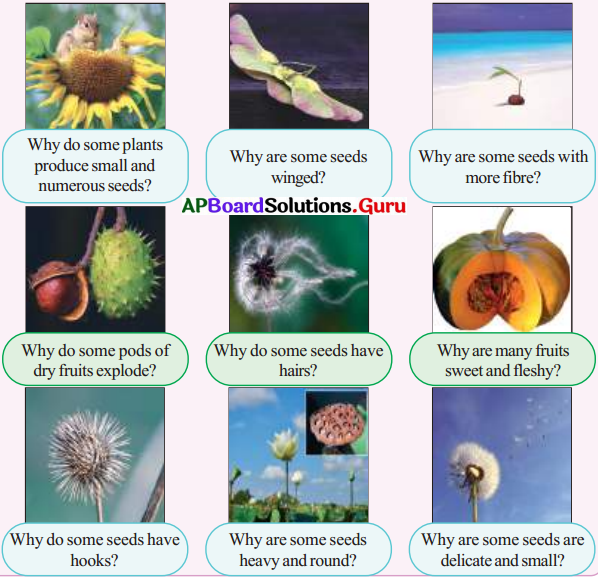
ఈ మార్పులకు కారణాలు :

  1.  పారిశ్రామిక విప్లవం ద్వారా పరిశ్రమ అభివృద్ధి చెందడం వలన ఆ రంగంలో ఉపాధి పెరిగింది.
  2. ఉత్పత్తి పెరగడం, మార్కెట్స్ పెరగడం, వ్యాపారం, వాణిజ్యం పెరగడం (రవాణా పెరగడం) వలన సేవారంగంలో ఉపాధి పెరిగింది.
  3. ప్రభుత్వ విధానాలు (1991 పారిశ్రామిక విధానం, గ్లోబలైజేషన్ మొదలగునవి) ప్రణాళికలు కూడా ఈ మార్పుకు దోహదం చేశాయి.
  4. పెరుగుతున్న వైజ్ఞానిక, సాంకేతిక సమాచార వ్యవస్థ సేవారంగంలో ఎంతోమందికి ఉపాధి కల్పిస్తుంది.

10th Class Social Textbook Page No.29

ప్రశ్న 3.
ఈ దిగువ చిత్రాలను పరిశీలించి అవి ఏ రంగాలకు చెందినవో పేర్కొనండి.
AP Board 10th Class Social Solutions Chapter 3 ఉత్పత్తి, ఉపాధి 2
జవాబు:

  1. వ్యవసాయ రంగం
  2. (గనులు) ప్రాథమిక రంగం
  3. సేవల రంగం
  4. పారిశ్రామిక రంగం

10th Class Social Textbook Page No.30

ప్రశ్న 4.
ఈ కింది గ్రాఫ్ రెండు వేరు వేరు సంవత్సరాలు, 1972-73, 2009-10 లకు భారతదేశ స్థూల దేశీయోత్పత్తి విలువను చూపిస్తుంది. సంవత్సరాలలో మొత్తం ఉత్పత్తి పెరిగిన తీరును మీరు చూడవచ్చు.
AP Board 10th Class Social Solutions Chapter 3 ఉత్పత్తి, ఉపాధి 3
గ్రాఫ్ : వ్యవసాయం, పరిశ్రమలు, సేవా రంగాల వారీగా స్థూల దేశీయోత్పత్తి
గ్రాఫ్ ను చూసి కింది ప్రశ్నలకు జవాబులివ్వండి :
(1) 1972-78లో అధిక ఉత్పత్తి ఉన్న రంగం ఏది?
జవాబు:
1972-73లో వ్యవసాయం రంగం అధిక ఉత్పత్తి కలిగి ఉన్నది. మొత్తం GDP 5,86,346 కోట్లలో వ్యవసాయరంగం 2,43,082 కోట్లు కలిగి ఉంది.

(2) 2009-10 లో అధిక ఉత్పత్తి ఉన్న రంగం ఏది?
జవాబు:
2009-10 లో సేవా రంగం అధిక ఉత్పత్తి కలిగి ఉన్నది. మొత్తం GDP 45,16,071 కోటలో సేవా రంగం 26,78,165 కోట్లు మిగిలిన వ్యవసాయ రంగం 7,64,817 కోట్లు మరియు పరిశ్రమల రంగం 11,73,089 కోట్లు వాటా కలిగి ఉన్నాయి.

(3) 1972-73, 2009-10 సంవత్సరాల మధ్య భారతదేశంలో మొత్తం వస్తువులు, సేవల ఉత్పత్తి సుమారుగా …….. రెట్లు పెరిగింది.
జవాబు:
8 రెట్లు పెరిగింది.

10th Class Social Textbook Page No.31

ప్రశ్న 5.
ప్రతి దశలో మొత్తం వస్తువుల విలువ :
మొదటి దశ (రైస్ మిల్లర్‌కు రైతు వడ్లు అమ్మడం) రూ. 2500
రెండవ దశ (మాటలు యజమానికి ఊక, బియ్యం అమ్మడం) రూ. 3600
మూడవ దశ (ఇడ్లీ, దోశలు అమ్మడం) రూ. 5000
– చర్చించండి : ఉత్పత్తి అయిన మొత్తం వస్తువుల విలువను తెలుసుకోటానికి వీటన్నిటి మొత్తాన్ని జోడించాలా?
జవాబు:
అవసరం లేదు. ఉత్పత్తి అయిన మొత్తం వస్తువుల విలువను తెలుసుకోటానికి వీటన్నిటి మొత్తాన్ని జోడించనవసరం లేదు.

  • అంతిమ వస్తు ధరలో (విలువలో) ఆ వస్తువు తయారీలో వాడిన మాధ్యమిక వస్తువుల విలువ కలిసి ఉంటుంది.
  • అలా కనక జోడిస్తే ఆ వస్తువు ధరను రెండుసార్లు లెక్కించినట్లవుతుంది.
  • పై ఉదాహరణలో వడ్లు, బియ్యం, ఊక అనేవి మాధ్యమిక వస్తువులు, ఇడ్లీ, దోశ అనేవి అంత్య వస్తువులు.
  • ప్రతి దశలో ఉత్పత్తిదారులు ఉత్పాదకాలు తయారుచేసినవారికి మొత్తం విలువ చెల్లించారు.

AP Board 10th Class Social Solutions Chapter 3 ఉత్పత్తి, ఉపాధి

10th Class Social Textbook Page No.31

ప్రశ్న 6.
పై ఉదాహరణలో వడ్లు, బియ్యం మధ్య దశలోని ఉత్పాదకాలు కాగా, ఇడ్లీ, దోశ వంటివి తుది ఉత్పాదకాలు. మనం నిత్యజీవితంలో ఉపయోగించే కొన్ని వస్తువులను దిగువ సూచించడమైనది. వాటికి ఎదురుగా ఆయా వస్తువుల మధ్య దశ ఉత్పాదకాలను రాయండి.

తుది ఉత్పాదకాలు మధ్యదశ ఉత్పాదకాలు
నోటు పుస్తకం
కారు
కంప్యూటర్

జవాబు:

తుది ఉత్పాదకాలు మధ్యదశ ఉత్పాదకాలు
నోటు పుస్తకం కాగితపు గుజ్జు, కాగితం, కార్డ్ బోర్డు, బంక, పిన్నులు
కారు టైర్లు, లైట్స్, మెటల్ షీట్స్, రంగులు, సీట్లు, పెట్రోలు/డీసెల్
కంప్యూటర్ సిలికాన్ చిప్స్, మానిటర్, కేబుల్స్, సాఫ్ట్ వేర్స్, సర్క్యుట్స్

10th Class Social Textbook Page No.32

ప్రశ్న 7.
మొదటి దశ (రైస్ మిల్లర్ కు రైతు వడ్లు అమ్మటం) = రూ. 2500 లోంచి కొనుగోలు చేసిన ఉత్పాదకాల విలువ ‘0’ రూపాయలు తీసేస్తే, జోడించిన విలువ 2500 రూపాయలు
రెండవ దశ (మాటలు యజమానికి ఊక, బియ్యం అమ్మటం) = రూ. 3600 లోంచి కొనుగోలు చేసిన ఉత్పాదకాల విలువ 2500 తీసేస్తే, జోడించిన విలువ 1100 రూపాయలు
మూడవ దశ (ఇడ్లీ, దోశల అమ్మకం) = రూ. 5000 లోంచి కొనుగోలు చేసిన విలువ 3600 తీసేస్తే, జోడించిన విలువ 1400 రూపాయలు.
ప్రతి దశలోనూ జోడించిన విలువ = 2500+ 1100 + 1400 = 5000
చర్చించండి : రెండు పద్ధతులలోనూ ఒకే సమాధానం ఎందుకు వచ్చింది?
జవాబు:

  1. ప్రతి దశలోనూ జోడించిన విలువ = (2500 + 1100 + 1400) = 5000
  2. అంతిమ వస్తువు ధర (దోశ ధర) = 5000. రెండు పద్ధతుల్లోను ఒకే సమాధానం వచ్చింది. కారణం
  3. జోడించిన విలువలు మాత్రమే లెక్కించడం వలన (మాధ్యమిక వస్తువులు జోడించిన విలువ)
  4. మొదటి పద్ధతిలో అంత్య వస్తువు (ఇడ్లీ) లోనే ఇవి అన్నీ ఇమిడి ఉంటాయి.
  5. రెండు పద్ధతుల్లో అంతిమ వస్తువుల విలువ ఒక్కటే కాబట్టి,
  6. రెండు పద్ధతుల్లోనూ ఒకే సమాధానం వచ్చింది.

AP Board 10th Class Social Solutions Chapter 3 ఉత్పత్తి, ఉపాధి

10th Class Social Textbook Page No.32

ప్రశ్న 8.
కింది పట్టికలో స్థూల జాతీయోత్పత్తి విలువ ఇవ్వబడింది. 2010-2011 సంవత్సరానికి లెక్కించిన విధంగా స్థూల దేశీయోత్పత్తి పెరుగుదల రేటును మిగతా సంవత్సరాలకు గణించండి.
AP Board 10th Class Social Solutions Chapter 3 ఉత్పత్తి, ఉపాధి 4
జవాబు:
AP Board 10th Class Social Solutions Chapter 3 ఉత్పత్తి, ఉపాధి 5

10th Class Social Textbook Page No.34

ప్రశ్న 9.
వ్యాపారం, టళ్లు, రవాణా, ప్రసారాలకు కొన్ని ఉదాహరణలు పేర్కొనండి.
జవాబు:

  1. వివిధ రకాల వస్తువులు అమ్మే అన్నీ రకాల దుకాణాలు, ఎగుమతులు దిగుమతులు, సూపర్ మార్కెట్లు, మాల్స్
  2. చిన్న హెూటళ్ల నుండి స్టార్ హోటళ్లు దాకా.
  3. రోడ్డు, రైల్వే, విమానయాన, ఓడల ద్వారా రవాణా ఈ కోవ కిందకి వస్తాయి.
  4. రేడియో, టి.వి., వార్తాపత్రికలు, వివిధ మాస వార పత్రికలు, ఇంటర్నెట్ సౌకర్యం, టెలికమ్యూనికేషన్స్ (టెలిఫోన్, సెల్ ఫోన్) ఉపగ్రహ సాంకేతికత మొదలగునవి.

10th Class Social Textbook Page No.35

ప్రశ్న 10.
పట్టిక : భారతదేశంలో పరిశ్రమలవారీగా కార్మికుల వివరాలు, 2009-2010 (%)
AP Board 10th Class Social Solutions Chapter 3 ఉత్పత్తి, ఉపాధి 6
పట్టికని జాగ్రత్తగా అధ్యయనం చేసి కింది ప్రశ్నలకు సమాధానాలు ఇవ్వండి.
1) వ్యవసాయ రంగంలోని అత్యధిక మంది కార్మికులు ………………………… లో నివసిస్తున్నారు.
2) చాలామంది ………………………. పనివారు వ్యవసాయ రంగంలో ఉపాధి పొందుతున్నారు.
3) 90% కంటే అధికంగా పట్టణ ప్రాంత పనివారు ……………., ……………… రంగాలలో ఉపాధి పొందుతున్నారు.
4) స్త్రీ, పురుషుల నిష్పత్తి పోలిస్తే స్త్రీలు ………………., ………………….. రంగాలలో కొద్ది శాతం మాత్రమే ఉపాధి పొందుతున్నారు.
జవాబు:
1) గ్రామప్రాంతం
2) మహిళ (స్త్రీ)
3) పారిశ్రామిక, సేవా
4) పారిశ్రామిక, సేవా

10th Class Social Textbook Page No.36 & 37

ప్రశ్న 11.
‘పై’ చార్టు : మూడు రంగాలలో ఉపాధి వాటా
AP Board 10th Class Social Solutions Chapter 3 ఉత్పత్తి, ఉపాధి 8 AP Board 10th Class Social Solutions Chapter 3 ఉత్పత్తి, ఉపాధి 9 AP Board 10th Class Social Solutions Chapter 3 ఉత్పత్తి, ఉపాధి 10
జవాబు:
AP Board 10th Class Social Solutions Chapter 3 ఉత్పత్తి, ఉపాధి 11

AP Board 7th Class Science Solutions 6th Lesson Electricity

SCERT AP 7th Class Science Study Material Pdf 6th Lesson Electricity Textbook Questions and Answers.

AP State Syllabus 7th Class Science 6th Lesson Questions and Answers Electricity

7th Class Science 6th Lesson Electricity Textbook Questions and Answers

Improve Your Learning

I. Fill in the blanks.

1. Longer line in the symbol for a cell represents its ____ terminal and the shorter line represents ____ terminal.
2. Iron box works based on ____ effect of electric current.
3. The symbol for open switch is _______ .
4. The combination of two or more cells is called a ____
5. Expand MCB ____
Answer:
1. Positive, Negative
2. heat
3. AP Board 7th Class Science Solutions 6th Lesson Electricity 1
4. battery
5. Miniature Circuit Breaker

II. Choose the correct answer.

1. When cells are connected in series, it has
a) Single loop connection
b) Two loops
c) Many loops
d) None
Answer:
a) Single loop connection

2. Four bulbs are connected in parallel. When one bulb is removed then the remaining bulbs are
a) Put off
b) Continuously glowing
c) Blinking
d) None
Answer:
b) Continuously glowing

3. Statement 1: Generation of heat due to electric current is known Magnetic effect of electricity.
Statement 2 : An electromagnet works on magnetic effect of Electricity.
a) Both statements are true.
b) Both statements are false.
c) Statement 1 is true, Statement 2 is false.
d) Statement 1 is false, Statement 2 is true.
Answer:
d) Statement 1 is false, Statement 2 is true.

AP Board 7th Class Science Solutions 6th Lesson Electricity

4. Ramu’s house has five 60W bulbs. If they used all the bulbs for 5 hours. Then the power consumed by him
AP Board 7th Class Science Solutions 6th Lesson Electricity 2
a) 1500 KWH
b) 0.3 KWH
c) 70 KWH
d) 1.5 KWH
Answer:
d) 1.5 KWH

5. Which of the following works on the basis of heating effect of electric current?
a) Electric Crane
b) Electric Lift
c) Escalator
d) Hair drier
Answer:
d) Hair drier

III.Matching

A) MCB 1. Safety device used in electric current
B) Fuse 2. Two or more cells joined together
C) Battery 3. Compact Fluorescent Lamp
D) Cell k 4. Miniature Circuit Breaker
E) CFL 5. Converts chemical energy into electrical energy
6. Useful for opening and closing circuit

Answer:

A) MCB 4. Miniature Circuit Breaker
B) Fuse 1. Safety device used in electric current
C) Battery 2. Two or more cells joined together
D) Cell k 5. Converts chemical energy into electrical energy
E) CFL 3. Compact Fluorescent Lamp

IV. Answer the following questions.

Question 1.
Why are bulbs in series put off when a bulb is removed from it?
Answer:

  1. In series connection electricity has only one path.
  2. If a bulb is removed from the series connection of bulbs, the circuit becomes open.
  3. So, remaining bulbs are put off as the circuit open.

Question 2.
Read the following riddles and answer them.
1. I am used to close-or open the circuit. Who am I?
2. I will give you light. Who am I?
3. I convert chemical energy into electrical energy. Who am I?
4. Without me you cannot connect the electrical components. Who am I?
Answer:

  1. Switch
  2. Bulb
  3. Cell
  4. Connecting wires

Question 3.
Give examples for electric appliances which work on the property of heat effect of electricity.
Answer:
Examples for electric appliances which work on the property of heat effect of electricity:

  1. Electric heater
  2. Electric iron box
  3. Soldering gun
  4. Electric kettle
  5. Electric rice cooker

AP Board 7th Class Science Solutions 6th Lesson Electricity

Question 4.
A cell, 5 bulbs and a switch are connected in a circuit but bulbs are not glowing. Write the possible reasons for this.
Answer:
Possible reasons:

  1. May be connected a dysfunctional or less voltage cell.
  2. May be switch in off position.
  3. Wires may be cut any where or not properly connected.
  4. At least one of the bulbs may be damaged (If they are connected in series).
  5. All the bulbs may be damaged. (If they are connected in parallel)

Question 5.
Describe the process to prepare an electromagnet.
Answer:
1) Take an iron nail.
2) Wound the insulated copper wire tightly around the nail.
3) Connect the two ends of the coiled copper wire to a battery and a switch in series connection.
4) AP Board 7th Class Science Solutions 6th Lesson Electricity 3
5) Place some pins near the iron nail.
6) Now switch on the circuit.
7) Observe that all pins cling to the end of the iron nail.
8) This indicates coiled copper wire around nail acts as magnet when electricity passes through it.
9) It means the coiled copper wire around the nail acts as an electromagnet.
10) Now switch off the circuit.
11) Observe that all pins fall from the iron nail.
12) Hence, we can say that the coiled copper wire does not act as a magnet when no electricity passes through the circuit.

Question 6.
Draw the symbols for the following.
A) Bulb
B) Cell
C) Battery
D) Open Switch
Answer:
AP Board 7th Class Science Solutions 6th Lesson Electricity 3

Question 7.
Draw a circuit diagram of electrical components in a sequence by using cell, bulb, switch is off mode and connecting wires.
Answer:
AP Board 7th Class Science Solutions 6th Lesson Electricity 4

Question 8.
How do you appreciate the role of magnetic effect and heating effect in our daily life?
Answer:

  1. The production of heat due to the flow of electricity through a wire is called heating effect of electricity.
  2. We are using many home appliances like electric iron boxes, electric cookers, electric heaters, geysers, hair dryers which work on the principle of heating effects of electricity.
  3. The above said home appliances contain heating elements which produce heat.
  4. The production of magnetic force due to the flow of electricity through a wire is called magnetic effect of electricity.
  5. Loud speakers, MRI machines, generators, metal detectors, mobile phones, mixer grinders, electric fans, electric bells, electric motors etc.; work based on the magnetic effect of electricity.
  6. In this, way, heating and magnetic, effects of electricity are used in medical, automobile, industrial, agricultural etc., fields and also in homes.
  7. The devices and home appliances have made our lives more comfortable.
  8. Hence, I appreciate the role of magnetic effect and heating effect^ in our daily life.

Question 9.
Prepare some slogans to create awareness on wastage of electricity.
Answer:

  1. Save electricity – Save money.
  2. Turn off the lights, before leaving.
  3. Today’s wastage is tomorrow’s shortage.
  4. The less you burn, the more you earn.
  5. Save power – Save nation.
  6. Be polite – turn off the light.
  7. When the sun is bright – say no to tube light.
  8. Energy is precious – use 5 star appliances.
  9. Leave filament bulbs – Use LED’S
  10. Less consumption of power – Leads more comforts in future.

Question 10.
Suggest first aid when a person suffers electric shock.
Answer:
First aid for electric shock :

  1. If the shock is severe and the person is unconscious, give mouth to mouth artificial respiration.
  2. Sometimes heart beat ceases, at that time keep your palms on his chest and press down and release until the heart beat is recovered. This is called Cardio Pulmonary Resuscitation (CPR).
  3. Immediately take him to the hospital.

7th Class Science 6th Lesson Electricity InText Questions and Answers

7th Class Science Textbook Page No. 83

Observe the picture carefully.
AP Board 7th Class Science Solutions 6th Lesson Electricity 12

Question 1.
What are the electric devices you find in the above picture?
Answer:
1) Bulb 2) Fan 3) TV.

Question 2.
List out the electric devices used in your homes.
Answer:
1) TV 2) Fans 3) CFL bulbs 4) LED bulbs 5) Tube light (LED) 6) Music system 7) Chargers 8) Refrigerator 9) Electric geyser 10) Vapourizer 11) Iron box 12) Calling bell 13) Mixie 14) Wet grinder 15) AC 16) Motor pump 17) Mosquito repellent.

7th Class Science Textbook Page No. 84

Question 3.
Why does a bulb glow when we switch it ON?
Answer:
When we switched ON the bulb electricity flows through the wire and makes the bulb to glow.

Question 4.
What do you observe inside the cell?
Answer:

  1. Carbon rod with a metal cap.
  2. Carbon powder.
  3. Ammonium chloride paste.

Question 5.
Can we make a cell of our own?
Answer:
Yes, we can make a cell by using a zinc plate, copper plate, a small bulb, connecting wires, lemon or orange, crocodile clips.

7th Class Science Textbook Page No. 85

AP Board 7th Class Science Solutions 6th Lesson Electricity 13
Question 6.
Do you know the type of cell is used in wrist watch?
Answer:
Button cells are used is wrist watches.

Question 7.
How many types of electric cells shown above are known to you?
Answer:
I know the dry cells, lithium cells, button cells and alkaline cells.

Question 8.
Where do we used dry cells?
Answer:
In our daily life we use dry cells in torch lights, wall clocks, radios etc.

7th Class Science Textbook Page No. 86

Question 9.
Does a bulb glow when switch is in off position? Why?
Answer:
When the switch is in off position, bulb does not glow. Because the circuit is opened.

7th Class Science Textbook Page No. 87

Question 10.
Among all these bulbs which bulb consumes less electricity?
Answer:

  1. We can observe star symbols (power saving star rating) are marked on electrical appliances.
  2. The number of stars on them indicates the energy efficiency of that device.
  3. The electrical appliance with more stars consumes less electricity.
  4. LED bulbs are more energy savers than other bulbs.

AP Board 7th Class Science Solutions 6th Lesson Electricity

Question 11.
Is there any protection provided for electric devices in our house?
Answer:
Yes. The fuse is used to protect the electric devices in our house.

Question 12.
If there is a power failure only in your house. What do you check first?
Answer:
We will check the fuse first.

Question 13.
Have you seen the electric device shown in the figure. Where is it used?
Answer:
AP Board 7th Class Science Solutions 6th Lesson Electricity 14

  1. The electrical devices shown in the figure are fuses.
  2. Fuses are used at meter board to protect the devices from excess flow of electricity.

Question 14.
Is there any other safety device which can be used as a fuse?
Answer:
Yes, MCB can be used as a fuse.

7th Class Science Textbook Page No. 88

AP Board 7th Class Science Solutions 6th Lesson Electricity 15
Question 15.
Have you ever seen this component?
Answer:
Yes, I saw it. It is a MCB.

Question 16.
Which is a better safety device, electric fuse or MCB?
Answer:
MCB is better, when compared to electric fuse. There is no need to change it often. But wire in electric fuse has to be changed whenever it melts.

Question 17.
Do you know how to show the connections of the electric components in a circuit?
Answer:
Yes. We can show the connections of the electric components in a circuit by its symbols.

Question 18.
What electric components do you find in the figure?
Answer:
AP Board 7th Class Science Solutions 6th Lesson Electricity 16
1) Switch 2) Bulb 3) Wire 4) Battery.

Question 19.
Is it possible to draw realistic electric components every time? Why?
Answer:

  1. Drawing circuit diagrams with realistic components is difficult.
  2. If the circuit is a bigger one with several components it is much more difficult.
  3. To overcome this, standardized symbols of electric components are used to draw the circuit diagrams.

7th Class Science Textbook Page No. 89

Question 20.
Isn’t it so easy to draw like this?
Answer:
It is easy to draw a circuit by using symbols of electric components than realistic components. .

Question 21.
What difference do you find between circuit diagrams A and B?
AP Board 7th Class Science Solutions 6th Lesson Electricity 17
Answer:

  1. We observe that the bulb in circuit ‘A’ is not glowing and in circuit ‘B’ it is glowing.
  2. We can also see the switch is in OFF mode in circuit diagram A and it is in ON mode in circuit diagram B.
  3. Circuit diagram ‘A’ represents open circuit, where as circuit diagram ’B’ represents closed circuit.

7th Class Science Textbook Page No. 90

Question 22.
Is it possible to connect more than one bulb or one cell in an electric circuit?
Answer:
Yes, it is possible.

Question 23.
What happens if we connect more bulbs or cells in an electric circuit?
Answer:

  1. There are two ways to connect more bulbs or cells in an electric circuit they are parallel and series connections.
  2. In parallel connection electricity has more than one path where as in series connection only one path.
  3. If the number of cells are connected in series the brightness of the bulbs enhanced where as in series the brightness of bulb remains same.

Question 24.
Have you observed a large number of bulbs used in decorations of marriage functions, festivals etc.?
Answer:

  1. Yes, I have observed a large number of bulbs used in decorations of marriage functions, festivals etc.
  2. All the bulbs are connected one after one that means in series.

AP Board 7th Class Science Solutions 6th Lesson Electricity

Question 25.
What happens when we connect two cells and two bulbs in the same path?
Answer:

  1. If we connect two cells and two bulbs in the same path, it is called series connection.
  2. The brightness of the bulbs increased.

7th Class Science Textbook Page No. 92

Question 26.
Where can we observe these type of connections? (Series & Parallel)
Answer:

  1. We can use series connection of cells in torch light, toys, remotes, wall clocks,radio etc.
  2. We can use parallel connection of cells for a long – lasting battery life.

Question 27.
Do you know how several electric devices are connected in your home? Did you observe any pattern in their connections?
Answer:
If All the electric devices in our house are connected in parallel.

7th Class Science Textbook Page No. 93

Question 28.
Where can we observe these types of connection?
Answer:
We use series connection of bulbs for decoration purpose, parallel connection of bulbs in house hold connections.

7th Class Science Textbook Page No. 94

Question 29.
Naime the electrical devices used to produce heat?
Answer:
Electric iron box, electric heater, geyser, grills, electric cooker etc. are the electrical devices used to produced heat.

Question 30.
Have you ever used an iron box to iron your clothes? How does it produce heat?
Answer:

  1. Electric iron box contains the coil of wire (filament) which produce heat, when electricity passed through it.
  2. It is called heating effect of electricity.

AP Board 7th Class Science Solutions 6th Lesson Electricity

Question 31.
Which electric appliances work on the principle of heating effect of electricity?
Answer:
1) Electric stove, 2) Electric room heater, 3) Electric iron box, 4) Electric kettle, 5) Electric cooker, 6) Water heater, 7) Geyser, 8) Hair dryer, etc. are working on the principle of heating effect of electricity.

7th Class Science Textbook Page No. 95

Question 32.
1) How does a fan work?
2) What makes the fan to rotate?
3) What is the principle involved in it?
Answer:

  1. Fan works on the principle of magnetic effect of electricity.
  2. The magnetic force, which is produced due to the flow of electricity through a wire (coil) makes the fah to rotate.
  3. The principle, magnetic effect of electricity is involved in it.

7th Class Science Textbook Page No. 96

Question 33.
Which electric appliances work on the principle of magnetic effect of electricity?
Answer:
1) Electric fan, 2) Electric bell, 3) Electric motor, 4) Loud speaker, 5) MRI machines, 6) Generators, 7) Metal detectors, 8) Mobile phones, 9) Mixer grinders, etc. work on the principle of magnetic effect of electricity.

Question 34.
Have you seen the electric meter in your house? What do you find in the meter?
Answer:
I find reading of consumed electricity in units.

Question 35.
What does the term ‘one unit’ mean?
Answer:
1 unit = 1000 watt = 1 K.W.H.

Question 36.
How is the usage of electricity measured?
Answer:
Usage of electricity is measured in KWH (unit).

7th Class Science Textbook Page No. 98

Question 37.
What is an electric shock and when does it occur?
Answer:

  1. An electric shock occurs when a person comes into contact with an electrical source.
  2. Electricity flows through a portion of the body causing a shock.

Think & Respond

7th Class Science Textbook Page No. 85

Question 1.
Now a days we are using rechargeable torchlights, bulbs, mobile phones and fens. Think and discuss with your classmates about the working of these electric devices and the cells used in diem.
Answer:

  1. A cell is made up of three parts, a cathode, an anode and an electrolyte (a chemical).
  2. A cell works by connecting its stored chemical energy, into electrical power
  3. One the electrolyte of the cell is used up it doesn’t work further in non – rechargeable cells (Alkaline cells).
  4. Electrons (negative charges) travel from an anode to a cathode until the anode is considered empty or dead.
  5. A rechargeable cell, a charger can reverse the electron flow again to restore at the anode. This is called charging.
  6. This reversing process depends upon the electrolyte used in the cell.
  7. Normal cells do not contain such type of electrolytes to reverse the charge.
  8. But, the cells like NiMH (Nickel – Metal Hydride), Lithium – ion are capable of reversing the charge when charged it for number of times.
  9. This type of rechargeable batteries are used in rechargeable torch lights, bulbs, mobile phones and fans.

7th Class Science Textbook Page No. 92

Question 2.
a) What happens if more cells are connected in a series?
b) Is there any restriction on the number of cells in a circuit for a given bulb?
Answer:
a) If more cells are connected in a series, voltage increases in the circuit. That means the strength of the current in the circuit increases.

b) When we will join lot of cells in a circuit, then the bulb will not be able to handle the large amount of energy supplied to it. Hence, the bulb may damage.

7th Class Science Textbook Page No. 95

Question 3.
Do all home appliances produce heat when electricity passes through them?
Answer:

  1. Yes, all home appliances produce heat when electricity passes through them.
  2. But the amount of heat produced depends on the material of conductor, such as length, thickness and nature of it.

7th Class Science Textbook Page No. 96

Question 4.
Is it possible to create permanent magnets using the magnetic property of electric current? Think and discuss with your classmates and make notes on this.
Answer:

  1. Electromagnets are not permanent magnets because they lose the property of magnetism when the circuit is open.
  2. A permanent magnet has a magnetic field all the time unless it is heated.
  3. But electromagnet doesn’t retain its magnetism all the time, without current.

AP Board 7th Class Science Solutions 6th Lesson Electricity

7th Class Science Textbook Page No. 98

Question 6.
Why don’t we use wet stick to push away a person when he get electric shock? Think and discuss with your friends.
Answer:

  1. Wet stick contains some amount of water throughout it.
  2. Water is a good conductor of electricity (ofcourse, pure water does not pass current).
  3. If we touch the person to push away from the electric wire, the current passes through the water into our body.
  4. It causes to get electric shock to us also.
  5. So, we should not use wet stick to push away a person when he get electric shock.
  6. We should use dry stick only to do that.

Activities and Projects

Question 1.
Collect any manual of electric equipment. Read the information in detail and answer the following questions.
A) When was it manufactured and how long can we use it?
B) How many stars are given to it?
C) Is it working on the basis of magnetic or heating effect?
Answer:
I Read the manual of a washing machine.
A) It was manufactured on 8<sup>th</sup> March 2020.
B) It was given 5 stars.
C) It is working on the bases of both magnetic effect (motor) and heating effect (in built heater).

Question 2.
Find out the electric meter readings for 3 months in your house. Record your observations. Ask your teacher about how electricity bill is paid.
Answer:
AP Board 7th Class Science Solutions 6th Lesson Electricity 5

Question 3.
Make a pamphlet on “Save electricity, don’t waste it”. Display it on the wall magazine?
Answer:
AP Board 7th Class Science Solutions 6th Lesson Electricity 6

Question 4.
Collect last month’s electricity bills from your friends or neighbours houses and record the data. Advise them to change their ordinary bulbs with CFL bulbs. Again collect the electricity bilis of next month and observe the differences between the two bills. Discuss your observations with your friends and suggest better bulb.
Answer:
Observation sheet (Student Activity).
AP Board 7th Class Science Solutions 6th Lesson Electricity 7
Conclusion :
After replacing ordinary bulbs with CFL/LED bulbs the consumption of electricity is reduced and Bill amount is saved.

Question 5.
If anyone around you has suffered an electric shock, collect the information along with their feelings and know about CPR. Record your observations in your note book and discuss with your friends.
Answer:
Observation sheet (Student Activity).
AP Board 7th Class Science Solutions 6th Lesson Electricity 8

Activities

Activity – 1

Question 1.
If you open a dry cell, what do you observe?
(OR)
What do you observe inside the cell?
(OR)
Explain the structure of a cell with an activity.
(OR)
Describe the constru-ction of a dry cell.
(OR)
Describe the various components in a dry cell and their functions.
Answer:
AP Board 7th Class Science Solutions 6th Lesson Electricity 9

  1. Take a cell used in torch light and open it with the help of your teacher.
  2. The cell consists of a container made of zinc metal. The container works as the negative terminal (- ve).
  3. A carbon rod with a metal cap works as a positive terminal 0 ve>
  4. The positive and negative terminals are called electrodes.
  5. The carbon rod is surrounded by a mixture of carbon powder and a chemical called ammonium chloride. This mixture acts as an electrolyte.
  6. The cell is sealed from the top.

Activity – 2

Question 2.
How do you make an own cell?
(OR)
Can you make a cell? If you can write the procedure.
(OR)
Write the procedure of making a cell using lemon.
Answer:
Material required: Zinc plate, Copper Plate, A small bulb or LED, Connecting wires and Lemon or Orange, crocodile clips-4.

Procedure:
Take a Lemon and insert a Zinc plate and a Copper plate into it as shown in the fig. These plates act as electrodes and the juice inside the fruit acts as electrolyte. Connect two terminals of the bulb to zinc and copper plates using connecting wires.
AP Board 7th Class Science Solutions 6th Lesson Electricity

We observe that the bulb will glow as electricity was produced using chemical energy present in the lemon.

Activity – 3

Question 3.
Write an activity two observe the brightness of bulb in the following situations.
1) One cell and one bulb.
2) Two cells in series and one bulb.
3) Two cells in parallel and one bulb.
(OR)
How is the brightness of a bulb when it connected to a circuit with cells which are connected i) in series and ii) in parallel? Explain with an activity.
Answer:
Situation-1
Material required :
Dry cell -1, Small bulb-1 (torch light bulb or LED), Switch and Connecting wire.
AP Board 7th Class Science Solutions 6th Lesson Electricity 4

Procedure:
Take a dry cell, small bulb or LED and a switch. Connect them in a simple circuit using copper wire as shown in given fig. Switch ON and observe the brightness of light. ,

Situation-2 (Cells connected in series) :
Material required :
Dry cells -2, Small bulb-1 (torch light bulb or LED), Switch and Copper wire.
AP Board 7th Class Science Solutions Chapter 6 విద్యుత్ 9

Procedure:
Take two dry cells, small bulb and a switch. Connect them using a copper wire as shown in the fig. Switch ON and observe the brightness of light. Remove one cell and observe the condition of bulb.

Situation-3 (Cells connected in parallel) :
AP Board 7th Class Science Solutions Chapter 6 విద్యుత్ 10
Material required :
Dry cells -2, Small bulb -1 (torch light bulb or LED), Switch and Copper wire.

Procedure:
Take two electric cells small bulb or LED and switch. Connect them using copper wire as shown in fig.

Switch ON and observe the brightness of bulb.Remove one cell and observe the condition of bulb.Record your observations in the above three situations in the given table.
AP Board 7th Class Science Solutions 6th Lesson Electricity 10

From the table, if a number of cells are connected in series the brightness of the bulb isenhanced. If one of the cells is removed, the circuit becomes open and the bulb will not glow.If a number of cells are connected in parallel the brightness of the bulb remains same. Evenlf one of the cells is removed, the circuit remains same and the bulb will glow as usual.

Activity – 4

Question 4.
Write an activity to show the brightness of the bulbs when two bulbs are connected in series and in parallel.
Answer:
Situation-1
Materials required:
Dry cell -1, Small bulb-1 (torch light bulb or LED), Switch and Connecting wire.

Procedure :
Take a dry cell, small bulb or LED and switch.Connect them in a simple circuit using copper wireas shown fig.. Switch ON and observe the brightness of light.
AP Board 7th Class Science Solutions 6th Lesson Electricity 4

Situation-2 (Bulbs connected in series):
Materials required:
Electric cell -1, Small bulbs -2 (torch light bulb or LED), Switch and Copper wire.

Procedure :
Take two small bulbs or LED’s, cell and switch.
AP Board 7th Class Science Solutions Chapter 6 Electricity

Connect them using copper wire as shown in fig. Switch ON and observe the brightness of the bulbs. Remove one bulb and observe the condition of another bulb.

Situation-3 (Bulbs connected in Parallel):
Materials required:
Electric cell -1, small bulb -2 (torch light), Switch, Copper wire.
AP Board 7th Class Science Solutions Chapter 6 Electricity

Procedure:
Take two small bulbs, a cell and a switch.Connect them using copper wire as shown in fig. Switch ON and observe the brightness of the bulbs.

Remove one bulb and observe the condition of another bulb.
AP Board 7th Class Science Solutions 6th Lesson Electricity 11

From the table,if a number of bulbs are connected in series the brightness of the bulb is reduced. If one of the bulbs is removed or broken, the circuit becomes open and the second bulb will not glow. If the number of bulbs are connected in parallel the brightness of the bulb remains same. Even if one of the bulb Is removed or broken, the circuit remains same and the bulb will glow as usual, but the battery drains faster.

Activity – 5

Question 5.
Write an activity to know about beating effect of electric current.
(OR)
What happens if Garment is passed through a Nichrome wire? Explain with an activity.
(OR)
How do von show the heating effect of electricity through an activity?
Answer:
Materials required:
Electric cell, switch. Iron nails-2, wooden board, connecting wires, 10 cm of Nichrome wire.

Procedure :
Construct a circuit using electric cell, switch, connecting wires and iron nails in series connection. Insert the iron nails in the wooden board. Keep the switch in OFF position. Take Nichrome wire and tie it between the iron nails as shown in fig.
AP Board 7th Class Science Solutions Chapter 6 Electricity

Observations :
Now switch ON the circuit for one minute, and switch it OFF. Now, touch the Nichrome wire, (don’t hold Nichrome wire for a long time.) You will observe that the Nichrome wire gets heated up when electricity passed through it. The production of heat due to the flow7 of electricity through a wire is called Heating Effect of Electricity.

AP Board 7th Class Science Solutions 6th Lesson Electricity

Activity – 6

Question 6.
Write an activity to know about magnetic effect of electric current.
(OR)
How do you make an electromagnet?
(OR)
How do you prepare an electromagnet?
Answer:
Material required:
Battery, Switch Iron nail (nearly 8 cm). Insulated copper wire (50 cm) and small pins.

Procedure:
Take an iron nail and wound the insulated copper wire tightly around the nail. This iron aaS works as a coil. The two ends of the coiled copper wire are connected to a battery and a switch in series connection as shown in fig. (Switch roast be in OFF position. Place some pins near the iron nail and switch ON the circuit.

We observe that, when we switched, on the circuit, all pins ding to the end of the iron nail. This indicates coiled copper wire around nail acts as magnet when electricity passes through it. It means the coiled copper wire around the nail acts as an electromagnet.
AP Board 7th Class Science Solutions 6th Lesson Electricity 3

When we switched off the circuit, immediately all the pins fall from the iron naS. This indicates that coiled copper wire does not act as a magnet when no electricity7 passes through the circuit

Magnetic effects produced in a coil due to the passing of electricity in the coil is called magnetic effects of electricity.

AP Board 10th Class Social Solutions Chapter 6 ప్రజలు

SCERT AP 10th Class Social Study Material Pdf 6th Lesson ప్రజలు Textbook Questions and Answers.

AP State Syllabus 10th Class Social Solutions 6th Lesson ప్రజలు

10th Class Social Studies 6th Lesson ప్రజలు Textbook Questions and Answers

Improve your learning (మీ అభ్యసనాన్ని మెరుగుపడుచుకోండి)

ప్రశ్న 1.
తప్పు వాక్యాలను గుర్తించి వాటిని సరిచేయండి. (AS1)
అ) ప్రతి పది సంవత్సరాలకు జనాభా గణన చేపడతారు.
ఆ) జనాభాలోని పెద్దవాళ్లలో ఆడవాళ్ల సంఖ్యను లింగ నిష్పత్తి తెలియజేస్తుంది.
ఇ) వయస్సును బట్టి జనాభా విస్తరణను వయస్సు సమూహం తెలియజేస్తుంది.
ఈ) కొండ ప్రాంతాలలోని వాతావరణాన్ని ప్రజలు ఇష్టపడతారు కాబట్టి అక్కడ జనాభా సాంద్రత ఎక్కువ.
జవాబు:
అ) ఒప్పు
ఆ) జనాభాలోని ఆడవాళ్ల సంఖ్యను లింగ నిష్పత్తి తెలియజేస్తుంది. ఇ) ఒప్పు
ఈ) కొండ ప్రాంతాలలోని వాతావరణాన్ని ప్రజలు ఇష్టపడరు కాబట్టి అక్కడ జనసాంద్రత తక్కువ.

ప్రశ్న 2.
దిగువ పట్టిక ఆధారంగా కింద ఉన్న ప్రశ్నలకు సమాధానాలు ఇవ్వండి. (AS3)
AP Board 10th Class Social Solutions Chapter 6 ప్రజలు
ఎ) ప్రపంచ జనాభా మొదటిసారి రెట్టింపు కావటానికి సుమారుగా ఎన్ని శతాబ్దాలు పట్టిందో తెలుసుకోండి.
జవాబు:
ప్రపంచ జనాభా రెట్టింపు కావడానికి సుమారు మూడు శతాబ్దాలు పట్టింది.

బి) ఇంతకు ముందు తరగతులలో మీరు వలస పాలన గురించి చదివారు. పట్టిక చూసి 1800 నాటికి ఏ ఖండాలలో జనాభా తగ్గిందో తెలుసుకోండి.
జవాబు:
1800 సం|| నాటికి ఓషియానియాలో జనాభా తగ్గింది.

సి) ఏ ఖండంలో ఎక్కువ కాలంపాటు అధిక జనాభా ఉంది?
జవాబు:
ఆసియా ఖండంలో ఎక్కువ కాలంపాటు అధిక జనాభా ఉంది.

డి) భవిష్యత్తులో జనాభా గణనీయంగా తగ్గనున్న ఖండం ఏదైనా ఉందా?
జవాబు:
భవిష్యత్తులో ఉత్తర అమెరికా ఖండంలో జనాభా గణనీయంగా తగ్గనుంది.

AP Board 10th Class Social Solutions Chapter 6 ప్రజలు

ప్రశ్న 3.
లింగ నిష్పత్తి చాలా ఎక్కువగాని, లేదా చాలా తక్కువగాని ఉంటే సమాజంపై పడే ప్రభావాలను పేర్కొనండి. (AS4)
జవాబు:

  1. లింగ నిష్పత్తి చాలా ఎక్కువగాని, తక్కువగాని ఉంటే సామాజికంగా చాలా తేడా వస్తుంది.
    ఉదా : కాలేజీల విద్యార్థుల సంఖ్య.
  2. ఈ నిష్పత్తి సంపద పంపిణీని, అధికార హోదాలను, ఎగ్జిక్యూటివ్ స్థాయిని, ప్రభుత్వ పని గంటలను అన్నింటినీ ప్రభావితం చేస్తుంది.
  3. ఈ నిష్పత్తి నేర రేటును కూడా ప్రభావితం చేస్తుంది.
  4. స్త్రీల సంఖ్య మరీ తక్కువగా ఉంటే సాధారణ పురుషులకు వివాహం జరగటం కష్టమవుతుంది. అన్ని రకాలుగా ముందున్న వారినే స్త్రీలు భర్తలుగా ఎంచుకునే అవకాశం ఉంటుంది.
  5. లింగ నిష్పత్తిలో అసమానతలు జనన రేటును ప్రభావితం చేస్తాయి.

ప్రశ్న 4.
భారతదేశ అక్షరాస్యతను ఇతర దేశాలతో పోల్చండి : (AS1)
బ్రెజిల్, శ్రీలంక, దక్షిణ ఆఫ్రికా, నేపాల్, బంగ్లాదేశ్, నార్వే, చిలి, ఇండోనేషియా.
ఎటువంటి సారూప్యాలు, తేడాలు మీరు గమనించారు?
జవాబు:

  1. భారతదేశ అక్షరాస్యత శాతం : 74.04% (82.1% – 65.5%)
  2. బ్రెజిల్ : 90.04% (90.1% – 90.7%)
  3. చిలీ : 98.6% (98.6% – 98.5%)
  4. బంగ్లాదేశ్ : 57.7% (62% – 53.4%)
  5. ఇండోనేషియా : 90.4% (94% – 86.8%)
  6. నార్వే : 100% (100% – 100%)
  7. నేపాల్ : 66% (75.1% – 57.4%)
  8. శ్రీలంక : 91.2% (92.6% – 90%)
  9. దక్షిణ ఆఫ్రికా : 93% . (93.9% – 92.2%)

పోలికలు మరియు భేదాలు :

  1. దాదాపు అన్ని ఆసియా దేశాలు సమాన అక్షరాస్యతా రేటును కలిగి ఉన్నాయి. ఒకటి రెండు దేశాలలో మాత్రము యివి తక్కువగా ఉన్నాయి.
  2. పురుషుల అక్షరాస్యత శాతం బ్రెజిల్, నార్వేలలో తప్ప మిగతా దేశాలలో అధికంగానే ఉంది.
  3. స్త్రీ, పురుషుల అక్షరాస్యత శాతం మధ్య తేడా భారతదేశం, నేపాల్ లో అధికంగా ఉంది.
  4. ఒక్క నార్వే మాత్రం 100% అక్షరాస్యతను సాధించింది.

ప్రశ్న 5.
ఆంధ్రప్రదేశ్ లోని ఏ ప్రాంతాలలో జన సాంద్రత ఎక్కువగా ఉంది, దానికి కారణాలు ఏమిటి? (AS1)
జవాబు:
ఆంధ్రప్రదేశ్ లోని కృష్ణాజిల్లా 519, పశ్చిమ గోదావరి 508, తూర్పు గోదావరి 477, గుంటూరు 429 జనసాంద్రతలతో మొదటి నాలుగు స్థానాలలో ఉన్నాయి.

కృష్ణా, ఉభయగోదావరి, గుంటూరు జిల్లాలలో అధిక జనసాంద్రతకు గల కారణాలు :
ఎ) కృష్ణా, గోదావరి నదీ పరీవాహక ప్రాంతంలో ఉండటం వలన వ్యవసాయానికి అనుకూలత.
బి) వ్యవసాయాధారిత పరిశ్రమలు వృద్ధి.
సి) వ్యవసాయ అనుబంధ పరిశ్రమలు, ఉపాధి అవకాశాలు.

AP Board 10th Class Social Solutions Chapter 6 ప్రజలు

ప్రశ్న 6.
జనాభా పెరుగుదల, జనాభా మార్పు మధ్య తేడాలను పేర్కొనండి. (AS1)
జవాబు:

  1. జనాభా పెరుగుదల జననాల, మరణాల రేటుపై ఆధారపడి ఉంటుంది. జనగణన కాలంనాటి జనాభా మరియు దశాబ్దం క్రిందటి జనగణన కాలంనాటి జనాభాల తేడానే “జనాభా పెరుగుదల” అంటాం.
  2. జనాభా మార్పు అనేది వలసల ప్రాధాన్యత గల అంశం.
  3. జనాభా మార్పు = (జననాల సంఖ్య + ఆ ప్రాంతం / దేశంలోని వలస వచ్చిన వారి సంఖ్య) – (మరణాల సంఖ్య + ఆ ప్రాంతం / దేశం నుండి బయటకు వలస వెళ్ళిన వారి సంఖ్య)
  4. జనాభా పెరుగుదల దేశం మొత్తానికి దశాబ్దానికోసారి లెక్కిస్తాం.
  5. జనాభా మార్పు నిరంతర ప్రక్రియ. . ఉదాహరణకు కోస్తాంధ్రలోని కొన్ని ప్రాంతాలలో వర్షాధార భూములు గల ప్రాంత కూలీలు వ్యవసాయ పనులు లేనపుడు బహుళపంటలు వేసే ప్రాంతాలకు వలసపోతారు.
  6. సాగర తీరప్రాంత మత్స్యకారులు చేపలవేట నిషేధకాలంలో వీరావల్ వంటి ప్రాంతాలకు వలసపోతారు.
  7. ఇవి కాలానుగుణ వలసలు. కాగా ఉపాధి కోసం శాశ్వతంగా పట్టణాలకు వలసలు పోయే కుటుంబాలెన్నో !
  8. ఈ రకంగా వలసల వలన ఓ ప్రాంతంలో జనసాంద్రత తగ్గి, మరో ప్రాంతంలో జనసాంద్రత పెరుగుతుంది. అయితే ఈ జనాభా మార్పు జనాభా పెరుగుదలను ప్రభావితం చేయలేదు.
  9. అంతర్జాతీయ శాశ్వత వలసలు మాత్రమే జనాభా పెరుగుదలపై ప్రభావితం చూపుతాయి.

ప్రశ్న 7.
క్రింద ఇచ్చిన స్వీడన్, కెన్యా, మెక్సికో దేశాల వయస్సు సమూహాన్ని పోల్చండి. (AS3)
AP Board 10th Class Social Solutions Chapter 6 ప్రజలు 2 AP Board 10th Class Social Solutions Chapter 6 ప్రజలు 3
జవాబు:
AP Board 10th Class Social Solutions Chapter 6 ప్రజలు 4
ఎ) ఈ దేశాల్లో జనాభా పెరుగుదల ఎలా ఉంటుంది?
బి) ఏ దేశాల జనాభా ఇంకా తగ్గవచ్చు?
సి) అన్ని దేశాలలో లింగ నిష్పత్తి సమతుల్యంగా ఉందా?
డి) ఈ దేశాల కుటుంబ సంక్షేమ పథకాలు ఏమై ఉండవచ్చు?
జవాబు:
ఎ) స్వీడన్లో జనాభా పెరుగుదల అధిక హెచ్చు తగ్గులతో ఉంది.
కెన్యా, మెక్సికోలలో జనాభా పెరుగుదల నిదానంగా ఒక పద్ధతిలో ఉన్నది.

బి) స్వీడన్

సి) స్వీడన్లో లింగ నిష్పత్తి – 980 పురుషులు 1000 స్త్రీలు
కెన్యాలో లింగ నిష్పత్తి – 1000 పురుషులు/1000 స్త్రీలు
మెక్సికోలో లింగ నిష్పత్తి – 960 పురుషులు 1000 స్త్రీలు

డి) ఈ 3 దేశాలలోకెల్లా కెన్యాలో కుటుంబ సంక్షేమ పథకాలు చక్కగా నిర్వహించబడుతున్నాయి.

AP Board 10th Class Social Solutions Chapter 6 ప్రజలు

ప్రశ్న 8.
పటం పని (AS5)
అ) రాష్ట్రాలను సూచించే భారతదేశ పటంలో 2011 జనాభా గణాంకాల ఆధారంగా అయిదు స్థాయిలలో జనాభా సాంద్రతను సూచించండి.

స్థాయి – I:
1) ఉత్తరప్రదేశ్ – 199,581,477 (16.49%)
2) మహారాష్ట్ర – 112,372,972 (9.28%) 12 (9.28%)
3) బీహార్ – 103,804,637 (8.58%)
4) పశ్చిమబెంగాల్ – 91,374,736 (7.55%)
5) ఆంధ్రప్రదేశ్ – 49,368,776 (4.07%)
6) తెలంగాణ – 35,286,757 (2.91%)
7) మధ్య ప్రదేశ్ – 72,597,565 (6.00%)
8) తమిళనాడు – 72,138,958 (5.96%)

స్థాయి – II :
9) రాజస్థాన్ – 68,621,012 (5.67%)
10) కర్ణాటక – 61,130,704 (5.05%)
11) గుజరాత్ – 60,383,628 (5.00%)
12) ఒడిశా – 41,947,358 (3.47%)
13) కేరళ – 33,387,677 (2.76%)
14) జార్ఖండ్ – 32,966,238 (2.72%)
15) అసోం – 31,169,272 (2.58%)
16) పంజాబు – 27,704,236 (2.30%)
17) ఛత్తీస్ గఢ్ – 25,540,196 (2.11%)
18) హర్యా నా – 25,353,081 (2.09%)

స్థాయి – III :
19) జమ్ము , కాశ్మీర్ – 12,548, 926 (1.04%)
20) ఉత్తరాఖండ్ – 10,116,752 (0.84%)
21) హిమాచల్ ప్రదేశ్ – 6,856,509 (0.57%)

స్థాయి – IV:
22) త్రిపుర – 3,671,032 (0.30%)
23) మేఘాలయ – 2,964,007 (0.24%)
24) మణిపూర్ – 2,721,756 (0.22%)
25) నాగాలాండ్ – 1,980,602 (0.16%)
26) గోవా – 1,457,723 (0.12%)
27) అరుణాచల్ ప్రదేశ్ – 1,382,611 (0.11%)
28) మిజోరాం – 1,091,014 (0.09%)

స్థాయి – V:
29), సిక్కిం – 607, 6881 (0.05%)
30) ఢిల్లీ – 16,753,235 (1.38%) (NCT)
31) పుదుచ్చేరి – 1,244,464 (0.10%)(UTI)
32) చండీఘర్ – 1,054,686 (0.09%) (UTI)
33) అండమాన్,నికోబార్ దీవులు – 379,944 (0.03%)(UTI)
34) దా ద్రా నగర్ హవేలి – 342,853 (0.03%)(UTI)
35) డామన్, డయ్యు – 242,911 (0.02%)(UTI)
36) లక్షద్వీప్ – 64,429 (0.01%)(UTI)
AP Board 10th Class Social Solutions Chapter 6 ప్రజలు 5

ఆ) జిల్లాలను సూచించే ఆంధ్రప్రదేశ్ పటంలో చుక్కల పద్ధతిని ఉపయోగించి (ఒక చుక్క పదివేల జనాభాను సూచిస్తుంది) జనాభా విస్తరణను చూపించండి.
జవాబు:
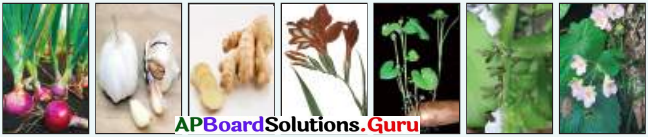
  1. చిత్తూరు – 4,170, 468 = [417]
  2. అనంతపురం : 4,083,315 = [408]
  3. కడప – 2,884,524 = [288]
  4. కర్నూలు – 4,046,601 = [405]
  5. నెల్లూరు – 2,966,082 = [297]
  6. ప్రకాశం – 3,392,764 = [339]
  7. గుంటూరు : 4,889,230 = [489]
  8. కృష్ణ – 4,529,009 = [453]
  9. తూర్పు గోదావరి – 5,151,549 = [515]
  10. పశిమ గోదావరి – 3,934,782 = [393]
  11. విశాఖపట్నం – 4,288,113 = [429]
  12. శ్రీకాకుళం – 2,699,471 = [270]
  13. విజయనగరం – 2,342,868 = [234]

AP Board 10th Class Social Solutions Chapter 6 ప్రజలు 6
గమనిక : విద్యార్ధులు పట్టికలోని బ్రాకెట్లలో చూపిన విధంగా చుక్కలను ఆయా జిల్లాలలో పెట్టవలయును.

10th Class Social Studies 6th Lesson ప్రజలు InText Questions and Answers

10th Class Social Textbook Page No.71

ప్రశ్న 1.
మీ చుట్టుప్రక్కల గల వేరు వేరు జీవనోపాధులు, ఆదాయాలు ఉన్న వ్యక్తులతో మాట్లాడండి. ఎంతమంది పిల్లలు ఉండటం సరైనదో వాళ్లని అడగండి.
జవాబు:
మా చుట్టుప్రక్కల గల వేరు వేరు జీవనోపాధులు, ఆదాయాలు ఉండే వ్యక్తులతో మాట్లాడగా ఒకరు లేదా ఇద్దరు సంతానం సరియైనదని అభిప్రాయపడ్డారు.

10th Class Social Textbook Page No.76

ప్రశ్న 2.
పై చదువులకు మగపిల్లలతో సమానంగా ఆడపిల్లలకు అవకాశాలు లభిస్తున్నాయా?
జవాబు:
పై చదువులకు మగపిల్లలతో సమానంగా ఆడపిల్లలకు అవకాశాలు లభిస్తున్నాయి. కానీ తల్లిదండ్రుల వైఖరి కారణంగా కొద్దిమంది ఆడపిల్లలు మాత్రమే ఉన్నతవిద్య నభ్యసించగలుగుతున్నారు.

AP Board 10th Class Social Solutions Chapter 6 ప్రజలు

10th Class Social Textbook Page No.76

ప్రశ్న 3.
పెళ్లిన మహిళలకు ఇంటి బయట పని చేయటానికి, ప్రయాణాలు చేయటానికి అవకాశాలు ఉన్నాయా?
జవాబు:
పెళైన మహిళలకు ఇంటి, బయట పనిచేయడానికి, ప్రయాణాలు చేయడానికి అవకాశాలున్నాయి. అయితే సరియైన రక్షణ లేకపోవడం, పనిచేసే ప్రదేశాలలో మరుగుదొడ్లు వంటి కనీస సదుపాయాలు లేకపోవటం వంటి సమస్యలు ఎదుర్కొంటున్నారు.

10th Class Social Textbook Page No.76

ప్రశ్న 4.
మహిళలు వారి పుట్టింటితో సంబంధాలు పెట్టుకోకూడదా? వాళ్లకు ఆస్తులపై హక్కు ఉండకూడదా? భద్రత ఉండకూడదా?
జవాబు:
మహిళలు వారి పుట్టింటితో సంబంధాలు పెట్టుకోవచ్చు. వారికి ఆస్తులపై చట్టపరంగా హక్కులున్నాయి. భద్రత తప్పనిసరిగా ఉండాలి.

10th Class Social Textbook Page No.76

ప్రశ్న 5.
మీ ప్రాంతంలో మగ పిల్లలను ఎక్కువగా కోరుకుంటారా?
జవాబు:
మా ప్రాంతంలో మగ పిల్లలను, ఆడపిల్లలను ఇద్దరినీ కోరుకుంటారు. అయితే మగసంతానం తప్పనిసరి అని భావిస్తారు. అయితే క్రమేపీ ఈ అభిప్రాయాల్లో మార్పు వస్తుంది. ఆడైనా, మగైనా ఇద్దరు చాలు అనే భావన ఎక్కువ మందిలో ఉంది.

10th Class Social Textbook Page No.77

ప్రశ్న 6.
మీ ఊళ్ళో, పట్టణంలో నిరక్షరాస్యులు ఉన్నారేమో తెలుసుకోండి. మీ సర్వే ఏం చెపుతోంది?
జవాబు:
మా గ్రామంలో నిరక్షరాస్యులున్నారు. మేం చేసిన సర్వే కూడా ఈ విషయాన్నే తెలిపింది. విద్యాహక్కు చట్టం వచ్చిన తరువాత శతశాతం నమోదు, నిలకడను చూడవచ్చు. అయితే వయోజనులైన నిరక్షరాస్యులు వారికి ఏర్పాటుచేసిన అక్షరభారత కేంద్రాలను పూర్తిగా సద్వినియోగపరచుకోవడం లేదు.

10th Class Social Textbook Page No.81

ప్రశ్న 7.
ఫెర్టిలిటీ శాతం 2 కి దగ్గరగా ఉంటే ఏమిటి అర్థం ? చర్చించండి.
జవాబు:
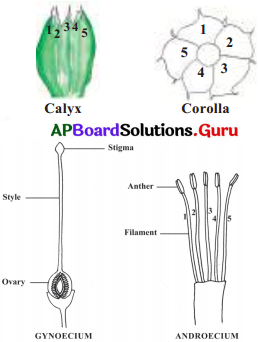
ఫెర్టిలిటీ శాతం 2 కి దగ్గరగా ఉంటే జంటలు ఇద్దరు పిల్లలను కనాలని కోరుకుంటున్నారని అర్ధం.

10th Class Social Textbook Page No.81

ప్రశ్న 8.
మీరు బృందాలలో చేసిన సర్వేలో 45 సంవత్సరాలు పైబడిన మొత్తం మహిళల సంఖ్య, వారి పిల్లల సంఖ్య తెలుసుకోండి. మీ సర్వేలో సగటున ప్రతి మహిళకు ఎంత మంది పిల్లలు ఉన్నారు?
జవాబు:
ఇద్దరు

AP Board 10th Class Social Solutions Chapter 6 ప్రజలు

10th Class Social Textbook Page No.81

ప్రశ్న 9.
పిల్లల విషయంలో ఉమేర్ సింగ్ ని ఏ అంశాలు ప్రభావితం చేశాయి ? అతని కూతురు కూడా అలాగే ఆలోచిస్తోందా?
జవాబు:
ఉమేర్ సింగ్ కు అబ్బాయి కావాలనే కోరిక వలన సంతానం ఆరుకు చేరింది. అతని కూతురు తండ్రిలా కాకుండా ముగ్గురు పిల్లలను మాత్రమే కావాలనుకుంది.

10th Class Social Textbook Page No.82

ప్రశ్న 10.
ఏ సంవత్సరం నాటికి ఊరిలోని భూమి అంతా సాగులోకి వచ్చింది?
జవాబు:
1950 నాటికి ఊరిలోని భూమి అంతా సాగులోకి వచ్చింది.

10th Class Social Textbook Page No.71

ప్రశ్న 11.
మీ ప్రాంతంలో, ఊరిలో, దేశమంతటిలో ఉంటున్న ప్రజలకు సంబంధించిన సమాచారాన్ని ఎలా సేకరిస్తారో, నమోదు చేస్తారో మీరు ఎప్పుడైనా ఆలోచించారా ? జనగణనలో తమ అనుభవాలను చెప్పమని మీ టీచరుని అడగండి.
జవాబు:
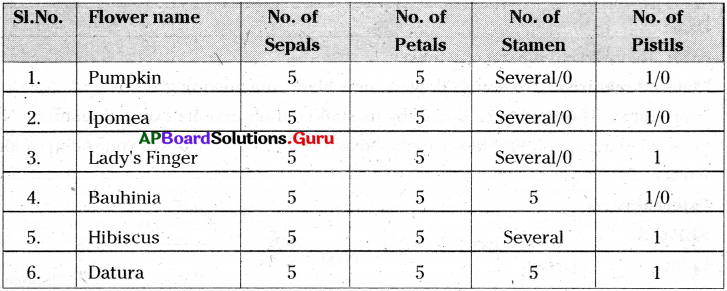
భారతదేశంలో ప్రతి పది సంవత్సరాలకోసారి జనాభాను సేకరిస్తారు. జనాభా సేకరణకు ఒక ఏడాది ముందు మే నెలలో ఆవాస ప్రాంతాల గుర్తింపు, నివాసాలు, కుటుంబాలు గుర్తించటం వాటి వివరాలు నమోదుచేస్తారు. వీటి చిత్తుపటాలను రూపొందిస్తారు. ఇంటింటికి వెళ్ళి ప్రతి వ్యక్తి పూర్తి వివరాలు మరుసటి సంవత్సరం ఫిబ్రవరిలో వివరంగా సేకరించి నమోదుచేస్తారు.

10th Class Social Textbook Page No.73

ప్రశ్న 12.
కుటుంబాన్ని ఎలా నిర్వచిస్తారు ? ఎవరెవరిని కుటుంబం కింద పరిగణిస్తారు?
జవాబు:
కుటుంబాలు 2 రకాలు :

1) సాధారణ కుటుంబాలు :
ఒకే ప్రాంగణంలో నివసిస్తూ ఉమ్మడిగా వంట చేసుకొనే సభ్యులను కుటుంబంగా పేర్కొంటాం. కుటుంబంలోని వారు అనగా తల్లి, తండ్రి, కుమారులు, కుమార్తెలు, తాత, నాన్నమ్మతో పాటు కుటుంబంలోని వారందరినీ కుటుంబ సభ్యులుగానే పరిగణిస్తారు.

2) సంస్థాగత కుటుంబాలు :
బంధుత్వాలు లేకపోయినా ఉమ్మడిగా వండిన వంటను తినేవారు, ఒకే ప్రాంగణంలో నివసించేవారిని “సంస్థాగత కుటుంబాలు” అంటాం.
ఉదా :
వసతి గృహాలు, జైలు మొ||నవి.

10th Class Social Textbook Page No.73

ప్రశ్న 13.
విద్యకు ఎటువంటి వర్గీకరణను ఉపయోగిస్తారు? ఉదాహరణకు : 6 సంవత్సరాలలోపు పిల్లలు, పాఠశాల/కళాశాలలో చదువుతున్నారు, తరగతి…..; బడిలో ఉండాలి కాని పేరు నమోదు కాలేదు. ……. తరగతి వరకు చదివారు; బడికి అసలు వెళ్లలేదు.
జవాబు:
విద్య – వర్గీకరణ : 6-14 సం||ల పిల్లల వర్గీకరణ :

  1. పేరు
  2. వయస్సు
  3. పాఠశాల పేరు
  4. తరగతి
  5. పాఠశాలలో నమోదు కాకపోతే కారణం
  6. బడిలో చేరి మానివేస్తే కారణం ఏడో తరగతిలో మానివేశాడు
  7. ప్రత్యామ్నాయ పాఠశాలల్లో చేరుటకు (ఉదా : RBC/ KG స్కూల్సు) సిద్ధమా?

AP Board 10th Class Social Solutions Chapter 6 ప్రజలు

10th Class Social Textbook Page No.73

ప్రశ్న 14.
వృత్తికి ఎటువంటి వర్గీకరణను ఉపయోగిస్తారు?
ఉదాహరణలు : గృహిణి, విద్యార్థి, ……….. స్వయం ఉపాధి, ఉద్యోగం, నిరుద్యోగి, పదవీ విరమణ, వృద్ధులు.
జవాబు:
వృత్తి – వర్గీకరణ : గృహిణి | వ్యవసాయం / విద్యార్థి / శ్రామికుడు / వ్యవసాయ కూలీ / ఉద్యోగి / నిరుద్యోగి / వ్యాపారం / స్వయం ఉపాధి / ఆస్తిపై వచ్చే అద్దెలు / వడ్డీలతో పోషణ ………….

సర్వే తరువాత :
ఎ) సర్వే చేసిన కుటుంబాలలోని మనుషుల లెక్కను చూపించటానికి ప్రతి బృందమూ కింద చూపిన విధంగా పట్టిక తయారుచేయాలి:

పురుషులు స్త్రీలు మొత్తం జనాభా

జవాబు:

పురుషులు స్త్రీలు మొత్తం జనాభా
330 315 645

బి) మీ బృందంలో స్త్రీ : పురుషుల నిష్పత్తి ఏమిటి? వివిధ బృందాలలో ఈ నిష్పత్తిలో తేడా ఉందా? చర్చించండి.
6 – 14 సంవత్సరాల పిల్లలకు :
AP Board 10th Class Social Solutions Chapter 6 ప్రజలు 7
జవాబు:
6 – 14 సంవత్సరాల పిల్లలకు : (156 మంది)
AP Board 10th Class Social Solutions Chapter 6 ప్రజలు 8

సి) అన్ని బృందాలకు కలిపి మొత్తం పిల్లల్లో అసలు బడిలో చేరనివాళ్లు, బడి మానేసినవాళ్ల శాతం ఎంత? దీనికి కారణాలు ఏమిటి?
జవాబు:
అన్ని బృందాలకు కలిపి మొత్తం పిల్లల్లో అసలు బడిలో చేరనివాళ్లు, బడి మానేసినవాళ్ల శాతం = 8%

కారణాలు:

  1. తల్లిదండ్రుల ఆర్థిక పరిస్థితి
  2. వారి మూఢ నమ్మకాలు
  3. బోధనా పద్ధతులు మరియు
  4. ఆంగ్లం, గణితం వంటి సబ్జెక్టులు మొదలగునవి.

డి) 20 సంవత్సరాలు పైబడిన వాళ్ళల్లో బడిలో గడిపిన సగటు సంవత్సరాలు ఎంత? వివరాలు తెలుసుకోండి. ఈ సమాచారం ఉపయోగకరంగా ఉందా?
జవాబు:
20 సంవత్సరాలు పైబడినవాళ్ళల్లో బడిలో గడిపిన సగటు సంవత్సరాలు 12 సంవత్సరాలు.
ఈ సమాచారం ప్రతి వ్యక్తి పాఠశాల, కళాశాల విద్య గురించి అంచనా వేయడానికి ఉపకరిస్తుంది.

ఇ) 15-59 సంవత్సరాల వాళ్లకు :

వృత్తి సంఖ్య శాతం
స్వయం ఉపాధి
గృహిణి
ఉద్యో గి
నిరుద్యో గి
విద్యార్థి
మొత్తం

మీ నమూనా గణనలో ‘పనిచేస్తున్న వారు’, ‘ఇతరులపై ఆధారపడేవారు’ అనే అంశాలను ఏ విధంగా వర్గీకరిస్తారు?
జవాబు:

వృత్తి సంఖ్య శాతం
స్వయం ఉపాధి 92 19%
గృహిణి 196 40%
ఉద్యో గి 846 17%
నిరుద్యో గి 38 8%
విద్యార్థి 81 16%
మొత్తం 491 100%

10th Class Social Textbook Page No.74

ప్రశ్న 15.
క్రింది గ్రాఫ్ ను పరిశీలించండి.
AP Board 10th Class Social Solutions Chapter 6 ప్రజలు 9-1
భారతదేశ జనాభా పిరమిడ్, 2011
పైన ఇచ్చిన జనాభా పిరమిడ్ ఆధారంగా జనాభాలో పిల్లల శాతం ఎంతో ఉజ్జాయింపుగా లెక్కగట్టండి.
జవాబు:
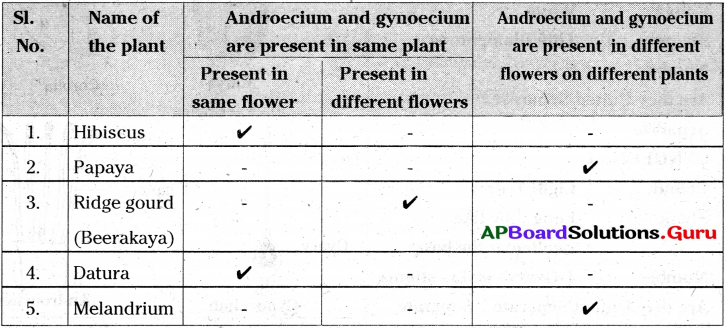
పిల్లల శాతం – 31%
పురుషులు – 190,075,426
స్త్రీలు – 172,799,553

10th Class Social Textbook Page No.74

ప్రశ్న 16.
మీరు చేసిన సర్వే ఆధారంగా ప్రతి బృందం పట్టికలో కింది వివరాలను పొందుపరచాలి. వయస్సు, ప్రజల సంఖ్య, పిల్లలు, పనిచేస్తున్నవాళ్లు, వృద్ధులు.
జవాబు:

పిల్లలు (0-6) 12
బడి ఈడు పిల్లలు (6-14) 15
పనిచేస్తున్నవారు 20
వృద్ధులు 25

AP Board 10th Class Social Solutions Chapter 6 ప్రజలు

10th Class Social Textbook Page No.77

ప్రశ్న 17.
మీ సర్వేలో కనుగొన్న శ్రామికులను, జనాభా గణనలో నమోదైన వివిధ పనుల వారితో పోల్చండి.
జవాబు:
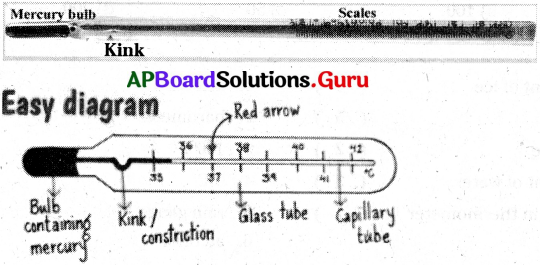
సర్వేలో కనుగొన్న శ్రామికులు ఒక ప్రాంతంలో గల పరిమిత రంగాలకు చెందినవారు ఉంటారు. జనాభా గణనలో నమోదైన శ్రామికులు దేశంలోని అన్ని రంగాలకు చెందినవారు ఉంటారు.

10th Class Social Textbook Page No.79

ప్రశ్న 18.
కింది విదేశాలకు సంబంధించిన రెండు పోస్టర్లు ఇవ్వబడ్డాయి. వాటిలో ఇవ్వబడిన సందేశాన్ని ఊహించగలరా? ఇటువంటి పోస్టర్లను భారతదేశంలో ఎప్పుడైనా చూశారా? చర్చించండి.
AP Board 10th Class Social Solutions Chapter 6 ప్రజలు 10
జవాబు:
మొదటి పోస్టర్ :
బిడ్డ ఆడైనా, మగైనా సమానమే అనే భావనను చెబుతుంది.

రెండో పోస్టర్ :
మొదటి అపరిమిత సంతానం వల్ల పడే ఇబ్బందులను, కొరతను తెలియజేస్తున్నది. రెండవది పరిమిత సంతానం ద్వారా పిల్లల భవిష్యత్తును ఉన్నతంగా తీర్చిదిద్దవచ్చు. దుస్తులు, విద్య వైద్య సదుపాయాలు కల్పించవచ్చు అనేది తెలుస్తున్నది.

10th Class Social Textbook Page No.81

ప్రశ్న 19.
ఇటీవల పెళ్లి జరిగి ఇంకా పిల్లలు లేని దంపతులతో మాట్లాడండి. వాళ్లు ఎంత మంది పిల్లల్ని కనాలనుకుంటున్నారు? దానికి కారణాలు ఏమిటి?
జవాబు:
ఇటీవల పెళ్లి జరిగి ఇంకా పిల్లలు లేని దంపతులలో ఎక్కువ మంది ఒకరు లేదా ఇద్దరు పిల్లలను మాత్రమే కనాలను కుంటున్నారు. పరిమిత సంతానమైతే వారిని చక్కగా పెంచి మంచి భవిష్యత్తు అందివ్వవచ్చును అని భావిస్తున్నారు.

10th Class Social Textbook Page No.82

ప్రశ్న 20.
పెరుగుతున్న కుటుంబ పరిమాణానికి భూమి ఉన్నవాళ్లు ఎలా స్పందించారు?
జవాబు:
వర్షాధారమైన తన భూమిలో మరిన్ని పంటలు (బహుళ పంటలు) పండించటానికి బోరుబావులు త్రవ్వించి ఉత్పత్తిని పెంచారు. వ్యవసాయం లేని రోజులలో ఇతర పనులకు కూడా వెళ్లేవారు.

10th Class Social Textbook Page No.82

ప్రశ్న 21.
కుటుంబ పరిమాణం పెరిగినప్పుడు గోవిందులాంటి చిన్న రైతులు ఎలా స్పందించారు? బోరుబావిలో సాగునీరు ఎంతవరకు ఉపయోగపడింది?
జవాబు:
కుటుంబ పరిమాణం పెరిగినపుడు గోవిందు లాంటి చిన్నరైతులు ప్రత్యామ్నాయాలు ఆలోచించారు. వర్షాధార భూములలో బోరుబావులు త్రవ్వడం ద్వారా సాగునీటి సౌకర్యం పొందారు. బహుళ పంటలను పండించి ఆదాయాన్ని పెంచుకున్నారు. ఖాళీ సమయాల్లో ఇతర పనులకు వెళ్లి ఆదాయం పెంచుకున్నారు.

AP Board 10th Class Social Solutions Chapter 6 ప్రజలు

10th Class Social Textbook Page No.71

ప్రశ్న 22.
నమూనా సేకరణ, జన గణన ద్వారా సమాచారం సేకరించటంలో తేడాలు ఏమిటి ? కొన్ని ఉదాహరణలతో చర్చించండి.
జవాబు:
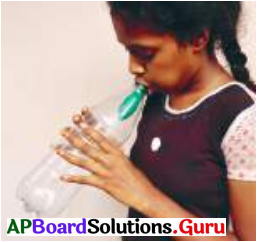
నమూనా సేకరణ, జన గణన ద్వారా సమాచారం సేకరించటంలో తేడాలు :

నమూనా సేకరణ ద్వారా జన గణన ద్వారా
1) సేకరించిన సమాచారం ఎంపికచేసిన ప్రాంతానికే పరిమితం. 1) దేశం మొత్తానికి సంబంధించింది.
2) ఒక ప్రాంతానికి చెందిన నమూనా సేకరణ సులభం. 2) జన గణన ద్వారా సమాచార సేకరణ సంక్లిష్టమైనది.
3) నమూనా సేకరణలో సమాచార సేకరణ కొన్ని అంశాలకే పరిమితం. ఉదా : ఆ ప్రాంతంలోని వారందరూ వ్యవసాయ కూలీలే కావచ్చు. 3) అన్ని అంశాలపై సమాచార సేకరణకు వీలుంటుంది. అన్ని వర్గాల ప్రజలకు సంబంధించిన సమాచారం సేకరిస్తాం.
4) దీనికి కొద్దిమంది సిబ్బంది చాలును. 4) లక్షల సంఖ్యలో సిబ్బంది అవసరం అవుతారు.
5) ఆర్థిక ఖర్చు పరిమితం. 5) జనగణనకు కోట్లాది రూపాయలు ఖర్చవుతాయి.

సర్వే నిర్వహణ

10th Class Social Textbook Page No.72

ప్రశ్న 23.
ఇద్దరు లేదా ముగ్గురు విద్యార్థులు గల సర్వే నిర్వహణ బృందం తమ ప్రాంతంలోని 10 కుటుంబాల నుంచి సమాచారాన్ని సేకరించాలి. సర్వేకు ఉపయోగించాల్సిన పత్రం కింద ఉంది.
• ప్రతి బృందం కింద ఇచ్చిన పట్టికను పూరించాలి.
• అన్ని బృందాల పట్టికల ఆధారంగా ప్రశ్నలను తరగతి గదిలో చర్చించాలి.
AP Board 10th Class Social Solutions Chapter 6 ప్రజలు 11
జవాబు:
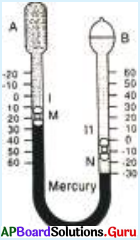
విద్యార్థి ఈ కృత్యాన్ని స్వయంగా నిర్వహించాలి.

సర్వే చేయటానికి ముందు:
• సర్వే ఫారంలో ఉపయోగించిన పదాలన్నింటిని అందరూ ఒకే రకంగా అర్థం చేసుకోటానికి తరగతి గదిలో చర్చించాలి. లేకపోతే సర్వే చేసేటప్పుడు గందరగోళం ఏర్పడి ఒక బృందం ఫలితాలను మరొక బృందంతో పోల్చటం కష్టమౌతుంది. మీ ఉపాధ్యాయుని సహాయంతో ఈ కింది పదాల గురించి చర్చించండి.

10th Class Social Textbook Page No.77

ప్రశ్న 24.
అభివృద్ధిని అక్షరాస్యత ఎలా ప్రభావితం చేస్తుంది? చర్చించండి.
జవాబు:

అభివృద్ధిని అక్షరాస్యత ప్రభావితం చేసే అంశాలు.

  1. అక్షరాస్యులు మూఢ నమ్మకాలను వదలి శాస్త్రీయంగా ఆలోచిస్తారు.
  2. వ్యవసాయ/వస్తూత్పత్తిలో నూతన విధానాలను అవలంబించి జాతీయ ఉత్పత్తిని పెంచెదరు.
  3. అధిక ఆదాయాన్ని పొంది జాతీయ ఆదాయాన్ని పెంచుతారు.
  4. ఉత్తమ పౌరులుగా బాధ్యతలను నిర్వర్తించగలరు.
  5. ఉత్తమ సమాజ రూపకల్పనకు కృషి చేస్తారు.
  6. తమ పిల్లలను ఉత్తమ పౌరులుగా తీర్చిదిద్దుతారు.
  7. వృత్తిని దైవంగా భావించి ఇతరులకు ఆదర్శంగా ఉంటారు.
  8. నూతన పరికరాలు / విధానాలు కనుగొనేందుకు దోహదపడతారు.

AP Board 10th Class Social Solutions Chapter 6 ప్రజలు

10th Class Social Textbook Page No.77

ప్రశ్న 25.
వ్యవసాయ భూమిని సాగుచేసే వ్యక్తికి, వ్యవసాయ కూలీకి మధ్య గల తేడాలేమిటి?
జవాబు:
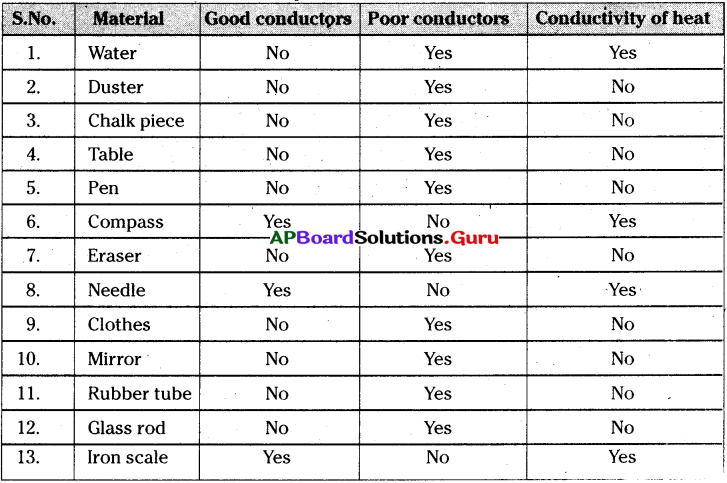
వ్యవసాయ భూమి సాగుచేసే వ్యక్తి వ్యవసాయ కూలీ
1) తాను పండించే పంటపై ఆధారపడతాడు. 1) లభించే కూలీపై ఆధారపడతాడు.
2) సమాజంలో గౌరవం ఉంటుంది. 2) సాధారణ వ్యక్తిగా జీవిస్తాడు.
3) ఆదాయం ఎక్కువ. 3) ఆదాయం పరిమితం.
4) ఆదాయంలో కొంత మిగులు ఉంటుంది. 4) పరిమిత ఆదాయంతో కుటుంబ పోషణ అంతంత మాత్రంగా ఉంటుంది.
5) ఆదాయానికి కొంత మేర హోదా / పరపతి ఉంటాయి. 5) పని దొరుకుతుందో లేదో అనే చింతన ఉంటుంది.
6) పంట పండుతుందో లేదో అనే భయం ఉంటుంది. 6) రిస్కు ఉండదు.
7) వ్యవసాయభూమి సాగుచేస్తూనే విరామకాలంలో ఏదైనా వృత్తి, వ్యాపారం చేయవచ్చు. 7) వ్యవసాయపనులు లేనప్పుడు ఇతర పనులకు వెళతారు.

10th Class Social Textbook Page No.78

ప్రశ్న 26.
క్రింది (ను పరిశీలించండి.
AP Board 10th Class Social Solutions Chapter 6 ప్రజలు 12
i) పైన ఇచ్చిన ను పరిశీలించి ఏ దశాబ్ద కాలంలో జనాభా తగ్గిందో చెప్పండి.
జవాబు:
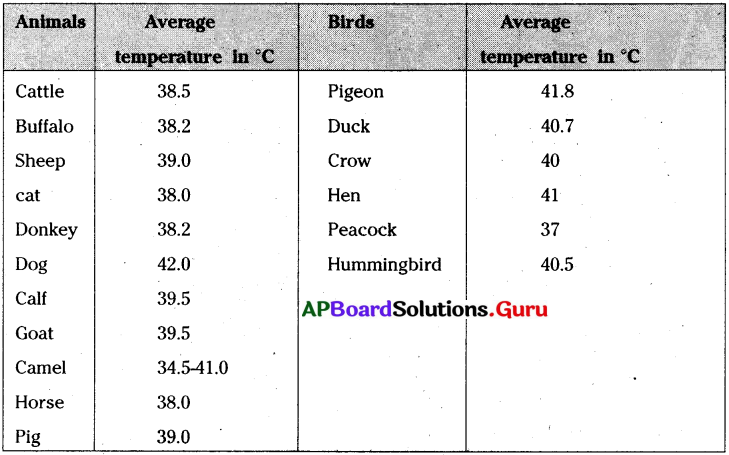
1911-1921 దశాబ్దంలో జనాభా తగ్గింది.

ii) ఏ సంవత్సరం నుంచి జనాభా నిరంతరంగా పెరుగుతోంది?
జవాబు:
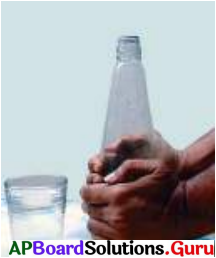
1921 సంవత్సరం నుండి జనాభా నిరంతరంగా పెరుగుతోంది.

iii) భారతదేశానికి స్వాతంత్ర్యం వచ్చిన తరువాత జనాభా వేగంగా పెరగటానికి కారణాలు ఏమై ఉండవచ్చు?
జవాబు:
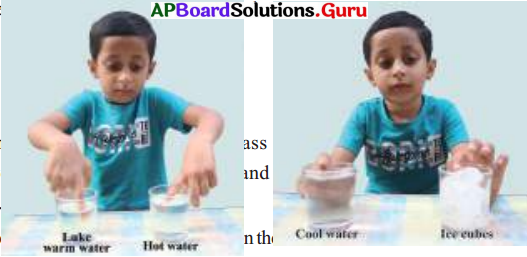
భారతదేశానికి స్వాతంత్ర్యం వచ్చిన తరువాత కరవు, సహాయం, ఆహారధాన్యాల తరలింపు, చౌకధరల దుకాణాలు, ప్రజాస్వామ్యంలో ప్రజలు చురుకుగా పాల్గొనడం వంటి వాటి వల్ల కరవుల ప్రభావం తగ్గిపోయింది. అదే విధంగా కర, ప్లేగు, కొంతవరకు మలేరియా వంటి అంటురోగాలను నియంత్రించగలిగారు. అనేక రోగాలకు కలుషిత నీరు, ఇరుకు ఇళ్లల్లో ఉండటం, పారిశుద్ధ్య లోపం వంటివి ప్రధాన కారణాలు. ఈ రోగాలను ఎదుర్కోవాలంటే మెరుగైన పారిశుద్ధ్యం, శుభ్రమైన నీళ్లు, పోషకాహారం అందించాలని అందరూ గుర్తించసాగి ఆ దిశగా అనేక చర్యలు చేపట్టారు. ఆ తరువాత వైద్యరంగంలో పురోగమనం వల్ల ప్రత్యేకించి టీకాలు, యాంటిబయాటిక్స్ వల్ల మెరుగైన ఆరోగ్యం సాధ్యమయ్యింది. 1900తో పోలిస్తే మరణాల శాతం గణనీయంగా తగ్గింది. జననాల శాతం ఎక్కువగా ఉండటానికి తగ్గుతున్న మరణాల శాతం తోడై జనాభా వేగంగా పెరగసాగింది.

10th Class Social Textbook Page No.80

ప్రశ్న 27.
భారతదేశ జనాభా పెరుగుదల స్వరూపం, శాతం, ఖాళీలను పూరించండి.
AP Board 10th Class Social Solutions Chapter 6 ప్రజలు 13
జవాబు:

AP Board 10th Class Social Solutions Chapter 6 ప్రజలు 14

10th Class Social Textbook Page No.81

ప్రశ్న 28.
మీ కుటుంబంలో మూడు తరాలపాటు ప్రతి మహిళకు ఎంతమంది సంతానమో తెలుసుకోండి. మీకు ఎటువంటి మార్పులు కనపడ్డాయి?
జవాబు:
AP Board 10th Class Social Solutions Chapter 6 ప్రజలు 15
రెండవ తరంలోనే కుటుంబ నియంత్రణ పాటించడం నేను గమనించాను. కనుక ప్రస్తుతం పెరుగుదల శాతం తగ్గుతోంది.

10th Class Social Textbook Page No.82

ప్రశ్న 29.
కింద ఉన్న భారతీయ పటాన్ని చూడండి. భారతదేశ భౌగోళిక స్వరూపానికి, జనాభా సాంద్రతకు మధ్య ఏమైనా సంబంధం ఉందేమో చూడండి. దేశంలోని ప్రధాన నగరాలను గుర్తించగలరా? నగరాలలోని అధిక జనాభా సాంద్రతను ఎలా వివరిస్తారు?
AP Board 10th Class Social Solutions Chapter 6 ప్రజలు 16
జవాబు:
దేశంలోని ప్రధాన నగరాలను గుర్తించగలం.
సూచికలో చూపిన సూచనల ఆధారంగా నగరాలలోని అధిక జనసాంద్రతను వివరించగలం.

  1. భూమి సహజ స్వరూపాన్ని భౌగోళిక స్వరూపం అంటాం. చదరపు కిలోమీటరుకు సగటున నివసించే ప్రజలను జనసాంద్రత అంటాం.
  2. బాగా పంటలు పండే ప్రాంతాలు, పారిశ్రామికవాడలైన ‘గంగా-సింధు మైదానం’ లో జనసాంద్రత ఎక్కువ.
  3. థార్ ఎడారి ప్రాంతం ప్రజల జీవనానికి ఏమాత్రం అనుకూలంగా లేనందున అచ్చట జనసాంద్రత అత్యల్పం.
  4. తూర్పు, పశ్చిమ తీరప్రాంతాలలో వర్షపాతం ఎక్కువ. పంటలు బాగుగా పండును. అందుచే ఈ ప్రాంతాలలో జనసాంద్రత ఎక్కువ.
  5. హిమాలయ పర్వత ప్రాంతం సుందరమైనదైనప్పటికీ ఈ ప్రాంతం ఎప్పుడూ మంచుచే కప్పబడియుండుటచే జన జీవనానికి అనుకూలంగా ఉండదు. అందుచే ఇచ్చట జనసాంద్రత తక్కువ.
  6. ఈశాన్య భారతదేశం కొండలతో నిండియున్నందున జనసాంద్రత తక్కువ.

10th Class Social Textbook Page No.83

ప్రశ్న 30.
ఈ క్రింది పటమును పరిశీలించండి.
AP Board 10th Class Social Solutions Chapter 6 ప్రజలు 17
ఇక్కడ 2011కి ఆంధ్రప్రదేశ్ జన సాంద్రత గణాంకాలు ఉన్నాయి. జిల్లాలు ఉన్న ఆంధ్రప్రదేశ్ పటంలో వివిధ జన సాంద్రత స్థాయిలను సూచించండి.
అధిక జన సాంద్రత ఉన్న ఒక జిల్లాను తక్కువ సాంద్రత ఉన్న మరొక జిల్లాతో కింది అంశాలలో పోల్చండి.

అ) భూ ఉపరితలం, వ్యవసాయ అభివృద్ధికి అవకాశాలు.
ఆ) ఆ ప్రాంతంలో వ్యవసాయ చరిత్ర – భూమి, నీరు, ఇతర సహజ వనరుల వినియోగం.
ఇ) ఆ ప్రాంతం నుంచి, ఆ ప్రాంతంలోకి వలసలు, దీనికి కారణాలు.
జవాబు:
అ) అధికం – కృష్ణా
అల్పం – వై.యస్.ఆర్. కడప

అ)
AP Board 10th Class Social Solutions Chapter 6 ప్రజలు 18

ఇ) 1) వై.యస్.ఆర్. కడప జిల్లాకు వలసలు దాదాపు శూన్యం .
2) విద్య ఉద్యోగాల నిమిత్తం వై.యస్. ఆర్. కడప నుండి వలస వెళుతున్నారు.
3) విద్య, ఉద్యోగాల నిమిత్తం కృష్ణాజిల్లా నుండి మరియు కృష్ణాజిల్లాకు వలస వెళుతున్నారు.
AP Board 10th Class Social Solutions Chapter 6 ప్రజలు 19

AP Board 7th Class Science Solutions 2nd Lesson Nature of Substances

SCERT AP 7th Class Science Study Material Pdf 2nd Lesson Nature of Substances Textbook Questions and Answers.

AP State Syllabus 7th Class Science 2nd Lesson Questions and Answers Nature of Substances

7th Class Science 2nd Lesson Nature of Substances Textbook Questions and Answers

Improve Your Learning

I. Fill in the blanks.

1. Taste of an acid is ______ .
2. The pH of a substance is 0. It indicates that the substance is ______ in nature.
3. Blue litmus paper turns ______ colour in tamarind solution.
4. The nature of an antacid is ______
5. Acid + base → ______ + ______
Answer:
1. sour
2. acidic
3. red
4. basic
5. salt + water

II. Choose the correct answer.

1. Colour of Turmeric solution in acids
a) Blue
b) Red
c) Purple
d) No change
Answer:
d) No change

2. Example to an acid.
a) Vinegar
b) Baking soda
c) Caustic soda
d) None
Answer:
a) Vinegar

3. Main component of soap is
a) An Acid
b) A base
c) a & b
d) None
Answer:
b) A base

AP Board 7th Class Science Solutions 2nd Lesson Nature of Substances

4. If you add baking soda to lemon juice ______ gas will release.
a) Hydrogen
b) Oxygen
c) Carbon Dioxide
d) Sulphur Dioxide

5. To treat acidic nature of the soil, farmers add ______ to his agricultural field.
a) lemon juice
b) calcium oxide
c) sodium chloride
d) sulphur dioxide
Answer:
b) calcium oxide

III. Matching

A) Battery 1. Preservation
B) Soap 2. Calcium carbonate
C) Acetic acid 3. Sulphuric acid
D) Hibiscus 4. Synthetic indicator
E) Egg shell 5. Sodium hydroxide
6. Natural indicator

Answer:

A) Battery 3. Sulphuric acid
B) Soap 5. Sodium hydroxide
C) Acetic acid 1. Preservation
D) Hibiscus 6. Natural indicator
E) Egg shell 2. Calcium carbonate

IV. Answer the following questions.

Question 1.
Write differences between acids and bases.
Answer:

Acids Bases
1) Acids are sour to taste 1) Bases are bitter to taste
2) They are not slippery to touch. 2) They are slippery to touch
3) Blue litmus turns red in acids. 3) Red litmus turns blue in bases.
4) Methyl orange turns red in acids. 4) Methyl orange turns yellow in bases.
5) Phenolphthalein does not change its colour in acids. 5) Phenolphthalein turns pink in bases.
6) Acids turns into pink on adding hibiscus indicator. 6) Bases turns green on adding hibiscus indicator
7) pH of acids is less than 7. 7) pH of bases is more than 7.
8) Acids react with metals and release hydrogen gas. 8) Bases like sodium hydroxide react with metals and releases hydrogen gas along with salt.

Question 2.
Give examples to different types of acid and base indicators.
Answer:
Substances which are used to test acids or bases are called acid base indicators. There are many types of indicators, some of them are

  1. Natural indicators
  2. Synthetic indicators
  3. Olfactory indicators
  4. Universal indicators.

1) Natural indicators:
Indicators obtained from natural sources are called as Natural indicators. Ex: litmus, turmeric, hibiscus, red cabbage etc.

2) Synthetic indicators:
An indicator prepared from artificial sources is known as Syn-thetic indicator. We use many synthetic indicators like methyl orange, phenolphtha-lein, in our laboratory.

3) Olfactory indicators:
Substances which change their smell when mixed with acid or base are known as olfactory indicators. Ex: onion, vanilla and clove oil.

4) Universal indicators:
It is a mixture of different indicators. It shows different colours in different solutions, “universal indicator” contains thymol blue, methyl red, bromothymol blue and phenolphthalein.

Question 3.
One substance is slippery to touch and bitter in taste, another substance is sour in taste. If you add both, which substances will form?
Answer:

  1. Substance that is slippery to touch and bitter in taste is Base.
  2. Substance that is sour in taste is Acid.
  3. When acids react with base neutralisation reaction takes place.
  4. Salt and water will form in neutralisation reaction.
    Acid + Base → Salt + Water

AP Board 7th Class Science Solutions 2nd Lesson Nature of Substances

Question 4.
Guess, How do you test acetic acid, if there is no availability of indicators?
Answer:

  1. Acetic acid is a colour less liquid with pungent smell and sour taste.
  2. It is used in preservation of pickles and other food substances as it is sour.
  3. So, It can be identify by testing its smell and taste.

Question 5.
Anitha’s mother was filled mango pickle in a ceramic jar and stored, so many doubts were arisen her mind. What would be those doubts?
Answer:

  1. Why do pickles store only in ceramic jars?
  2. What materials are used in making ceramic jars?
  3. What will happen if pickles are stored in metal containers?
  4. Sometimes pickles spoil quickly. Why?
  5. Do all pickles contain oil?
  6. Why is it not suggestable to use aluminium spoons for pickles?

Question 6.
To conduct a neutralization reaction, what materials are required?
Answer:
Materials required to conduct a neutralization reaction are dilute hydrochloric acid (any acid), Sodium hydroxide solution (any base), Phenolphthalein indicator, Conical flask, Dropper.

Question 7.
Draw a neat diagram of arrangement of apparatus to conduct an activity that acid reacts with metal and liberates hydrogen gas.
Answer:
AP Board 7th Class Science Solutions 2nd Lesson Nature of Substances 2

Question 8.
How do you appreciate the role of bases in helping of the persons suffering from acidity problems?
Answer:

  1. Our stomach produces gastric juice with hydrochloric acid.
  2. It helps us in digestion of food.
  3. But sometimes secretion of excess acid causes acidity or indigestion.
  4. It leaves a burning sensation and pain in the stomach.
  5. Antacids help us to get relief from acidity.
  6. Antacids contain bases, eg: aluminum hydroxide, milk of magnesia.
  7. The bases in the antacids neutralize gastric juice and give us relief.
  8. Thus bases do a great help to the persons suffering from acidity problems.

Question 9.
What measures do you follow to prevent acid rains?
Answer:
Air pollution is a major cause of acid rains. So acid rains can be prevented by controlling the air pollution. To control air pollution

  1. Reduce the usage of personal vehicles.
  2. Reduce the usage of fossil fuels.
  3. Encourage the usage of alternative sources of energy.
  4. Use electric vehicles.
  5. Use solar energy.
  6. Minimize use of fire and fire products.
  7. Treat and purify the industrial emissions before letting in to air.
  8. Plantation and reforestation should be done as much as possible.

7th Class Science 2nd Lesson Nature of Substances InText Questions and Answers

7th Class Science Textbook Page No. 20

Question 1.
Name any other substance which tastes like tamarind?
Answer:
Lemon juice is another substance which has sour taste like tamarind.

Question 2.
Why are tamarind and lemon juice sour in taste?
Answer:
Substances like tamarind and lemon contain some substances which give sour taste. These type of substances with sour taste are known as acids.

7th Class Science Textbook Page No. 21

Question 3.
What do you observe when an acid is poured on the bathroom floor?
Answer:
Generally, hydrochloric acid is used for bathroom cleaning. It liberates thick fumes and pungent smell when poured on the floor.

Question 4.
Have you seen batteries being used in vehicles? Which chemical is used in batteries?
Answer:
Sulphuric acid is used in batteries.

Question 5.
Have you ever drunk a soda or a cool drink?
Answer:
Yes. It contain carbonic acids.

AP Board 7th Class Science Solutions 2nd Lesson Nature of Substances

Question 6.
Which substances do you use to wash your hands and clean your teeth?
Answer:
We use soap to wash our hands and for bathing. We use tooth paste to clean our teeth.

Question 7.
What are the chemicals present in soap and tooth paste?
Answer:
Soap and tooth paste contain bases.

7th Class Science Textbook Page No. 22

Question 8.
See the main components on the tooth paste tube. What chemicals names do you find?
Answer:
Calcium carbonate, aluminium hydroxide and sodium bicarbonate etc.

Question 9.
Is there any substance other than an acid and a base? Discuss with your Mends.
Answer:
The substance which is neither an acid nor a base is known as neutral substance. Pure water is a neutral substance.

Question 10.
List out some acids, bases and neutral substances available in your house.
Answer:
Acids:
Vinegar, lemon juice, tomato juice, bathroom cleaner (hydrochloric acid), cool drinks, curd, etc.

Bases :
Bath soap, cloth soap, baking soda, tooth paste, dish wash liquid etc.

Neutral: Water

7th Class Science Textbook Page No. 23

Question 11.
Is it possible to test all the acids and bases simply by tasting or touching them?
Answer:

  1. Not possible.
  2. Some acids like hydrochloric acid, sulphuric acid etc. are very harmful and strong acids. We cannot test them by touch or taste.

Question 12.
In such cases, how can we test them whether they are acids or bases?
Answer:
By using acid base indicators.

Question 13.
What are the different types of indicators?
Answer:
There are many types of indicators, some of them are

  1. Natural indicators
  2. Synthetic indicators
  3. Olfactory indicators
  4. Universal indicators.

7th Class Science Textbook Page No. 24

Question 14.
Can we use any flower as an indicator?
Answer:
We can use hibiscus flowers as an indicator. We can also use Indigofera tinctoria (Neeli chettu) flowers as indicator.

7th Class Science Textbook Page No. 26

Question 15.
Why it is so? What makes the hydrochloric acid dangerous than vinegar?
Answer:

  1. Hydrochloric is an strong acid whereas vinegar is a weak acid.
  2. pH of hydrochloric is very less than that of vinegar.

Question 16.
How can we measure the strength of an acid or a base?
Answer:
Strength of acid or base solutions is measured in pH scale.

7th Class Science Textbook Page No. 27

Question 17.
What happens when a metal piece is dropped in an acid?
Answer:
If you drop a metal piece in an acid it reacts with acid and releases hydrogen gas.

7th Class Science Textbook Page No. 28

Question 18.
Pickles are not stored in aluminium or steel or copper vessels. Why?
Answer:

  1. Pickles contain acids.
  2. These acids react with metal containers and releases toxic substances.
  3. So, we should not store them in metal containers.
  4. Generally, they are stored in ceramic or glass containers which are not react.

Question 19.
What will happen when metals are placed in bases?
Answer:
Bases like sodium hydroxide react with metals and release hydrogen gas.

7th Class Science Textbook Page No. 29

Question 20.
What will happen if we mix an acid and a base?
Answer:
If we add an acid to a base, they neutralize each other.

7th Class Science Textbook Page No. 30

Question 21.
How is acidity caused? What is the remedy for it?
Answer:

  1. Excess secretion of gastric juice (hydrochloric acrd) in the stomach causes acidity problems.
  2. Antacids help the patients to get relief from acidity.

AP Board 7th Class Science Solutions 2nd Lesson Nature of Substances

Question 22.
What are antacids?
Answer:
Antacids are bases. They neutralize the gastric juice in the stomach.

7th Class Science Textbook Page No. 31

Question 23.
How can you help the farmers in finding out whether their agriculture fields are acidic or basic?
Answer:
We can help the farmers by testing the soil in their fields.

Activities and Projects

1. Prepare different greeting cards by using indicators.
Answer:
AP Board 7th Class Science Solutions 2nd Lesson Nature of Substances 3
I had prepared a greeting card using turmeric indicator.

I took a white card board and cut it in the shape of a greeting card.

Applied turmeric paste on it and allowed to dry.

I draw designs and wrote wishes on it with soap water using a point brush.

It turns in to reddish brown.

Thus, I prepared greeting card using indicator.

Question 2.
Prepare beetroot indicator and test some acids and bases. Write a report.
Answer:
I have crushed beetroot and collected its juice.

This juice is filtered and used as an acid-base indicator.

When acids are added to this indicator there is no change in colour.

But when bases are added to this, it changed its colour from dark red to yellow. With this I concluded that the beetroot indicator is used to test the bases.

Test with beetroot indicator

Solution Colour changes into yellow
1. Lemon juice
2. Glass cleaner
3. Water
4. Sodium hydroxide
5. Potassium hydroxide
6. Hydrochloric acid

Question 3.
Visit various agricultural fields and collect soils samples. Do the soil test. Make a report.
Answer:
I have visit nearest agricultural fields and collected soil from the fields. I took 10 g of soil from each sample in a beaker and added 500 ml of water to it. I stirred it well and filtered the solution. Then tested the filtered solution with a pH paper and tabulated the results. I gave suggestions to the farmers to neutralize their soils basing on the results.
AP Board 7th Class Science Solutions 2nd Lesson Nature of Substances 4

Activities

Activity – 1

Question 1.
Taste some substances in our house and identify their nature through taste from your previous experiences. Fill the findings in the table.
AP Board 7th Class Science Solutions 2nd Lesson Nature of Substances 5
Answer:

Substance Taste Acid/Not An Acid
1. Tomato juice sour acid
2. Sugar sweet not an acid
3. Curd sour acid
4. Raw mango sour acid
5. Table salt salt not an acid
6. Amla (usiri) sour acid
7. Orange juice sour acid

→ Which substances have sour taste in the above table? Why?
Answer:
Tomato juice, curd, raw mango, amla and orange juice have sour taste, because they contain acids. . .

Activity – 2

Question 2.
Take a soap into your palm and add some water. Now rub with another palm.
→ How do you feel while rubbing?
Answer:
You can feel the slippery nature of the soap.

Repeat this activity with tooth paste now. Observe your feeling.

Tooth paste is also slippery in nature.

These substances contain slippery chemicals they are called Bases. Bases are slip¬pery in nature and also bitter to taste.

Activity – 3

Question 3.
Take a table spoon of turmeric powder in a plate. Add little water and make it into a paste. Take a white paper and apply the paste over it on both sides and let it dry. After drying, cut the paper into strips. Now turmeric paper strips are ready for use as indicator.
→ What is the colour of these strips?
Answer:
They are yellow in colour.
Testing with turmeric indicator

  1. Take soap solution in a plate. Dip one turmeric paper strip in the soap solution.
  2. Take it out and observe the colour of the strip.
  3. Repeat the activity with lime water and lemon juice.

→ Do you observe any change in colour of tumeric strips?
Note your observations in the table.
Answer:

Substance Observed colour change
Soap solution Reddish brown
Lime solution Reddish brown
Lemon juice No change

The colour of turmeric strip will change into reddish brown in soap water and lime water, but its colour will not change in lemon juice.

Test with hibiscus indicator :
Take lemon juice, soda water, lime water, glucose solution, sugar solution, soap water etc.into test tubes. Add sufficient amount of hibiscus indicator in each test tube.Observe the change in the colour of the substance and record in the table.

Name of the Substance Observed colour change
1. Lemon juice Changed to pink
2. Soda water Changed to pink
3. Lime water Changed to green            .
4. Glucose solution No Change
5. Sugar solution No Change
6. Soap water Changed to green

7th Class Science Textbook Page No. 24

Question 4.
How do you prove that hibiscus could be used as an acid base indicator?
(OR)
How do you prepare a hibiscus indicator?
Answer:

  1. Take some hibiscus (china rose or mandara) petals.
  2. Take warm water into a beaker and place the petals in the beaker.
  3. Keep it until the water has completely turned into violet colour.
  4. Filter the solution with a strainer.
  5. Now hibiscus indicator is ready to test.

Test with indicator:

  1. Take lemon juice, soda water, lime water, glucose solution, sugar solution, soap water etc. into test tubes.
  2. Add sufficient amount of hibiscus indicator in each test tube.
  3. Observe the change in the colour of the substance and record in the table.
Name of the substances Observed colour change
1. Lemon juice pink
2. Soda water pink
3. Lime water green
4. Glucose solution no change
5. Sugar solution no change
6. Soap water green

Conclusion :
In acids and bases the hibiscus indicator changes its colour. Hence, it can used as an acid base indicator.

AP Board 7th Class Science Solutions 2nd Lesson Nature of Substances

Lab Activity – 1

Question 5.
Test the given solution with different indicators and prepare a report.
(OR)
How do you test different indicators change their colours in different solutions?
Answer:
1) Take the solutions a) Dilute hydrochloric acid b) Sodium hydroxide c) Acetic acid d) Salt solution e) Sugar solution f) Soap solution in test tubes.

2) Test them with a) Red litmus b) Blue litmus c) Methyl orange d) Phenolphthalein indicators.
Table
AP Board 7th Class Science Solutions 2nd Lesson Nature of Substances 6
3) Blue litmus turns red in acids.
4) Red litmus turns blue in bases.
5) Methyl orange turns red in acids and yellow in bases.
6) Phenolphthalein turns pink in bases, but does not change its colour in acids.
7) In neutral substances all the above indicators do not change their colour.

Activity – 4

Question 6.
How do you find the strength and nature of the following substances?
1) Dilute hydrochloric acid
2) Vinegar
3) Water
4) Sodium hydroxide
5) Ammonium hydroxide.
Answer:
Take dilute hydrochloric acid, vinegar, water, sodium hydroxide and ammonium hydroxide in test tubes.;Now take universal indicator and add 2 drops in each test tube. You can observe that the solutions in the test tubes change into different colours. Now compare these colours with pH colour chart which was given on the indicator bottle.
Try to find pH values or the strengths Of acids and bases based on the colours they show and write them in the table.
Table
AP Board 7th Class Science Solutions 2nd Lesson Nature of Substances 7

Lab Activity – 2

Question 7.
How do you prove that the acid reacts with metals and produces hydrogen gas?
Answer:
Aim: Acid Reacts with metals and produces hydrogen gas.

Materials required:
Conical flask, hydrochloric acid, zinc pieces, incense stick, match box.

Procedure:
Take 5g of zinc metal pieces in a conical flask. Pour 20 ml of dilute hydrochloric acid into it. Now, observe what happens. The zinc pieces reacted with the hydrochloric acid and releases a gas.

How can we identify this gas?
Test for hydrogen gas :
Now, introduce a incense stick into mouth of the conical flask. The flame of incense stick will put off with a pop sound. This is a test for hydrogen gas. Hydrochloric acid reacts with zinc metal and forms zinc chloride, releases hydrogen gas. This reaction can be written as a word equation,
Zinc+hydrochloric acid → zinc chloride+hydrogen

Conclusion:
Hence, we can conclude that acids react with metals and release hydrogen gas.

Activity – 5

Question 8.
How do you prove that bases react with metal and releases hydrogen gas ?
Answer:
Aim: Base reacts with metal and produces hydrogen gas.

Material required :
Conical flask, sodium hydroxide solution, zinc pieces, incense stick.

Procedure:

  1. Take 5gr of zinc metal pieces in a conical flask,
  2. Pour 20 ml of sodium hydroxide solution in it.
  3. Heat the conical flask.

Observation :
The zinc pieces reacts with base and releases gas.

Test for hydrogen gas :

  1. Now, introduce a incense stick into the mouth of the conical flask.
  2. The flame of incense stick will put off with a pop sound.
  3. This is a test for hydrogen gas.

Conclusion :
Bases react with metals and produce hydrogen gas.
Note : All bases do not react with metals.

AP Board 7th Class Science Solutions 2nd Lesson Nature of Substances

Activity – 6

Question 9.
How do you prove that the carbon dioxide gas releases when an egg shell reacts with an acid?
(OR)
What happens when egg shells are dipped in an acid? How do you prove it?
Answer:
Take some crushed egg shells in a test tube and pour dilute Hydrochloric acid until the egg shells completely sink. Egg shell is made of calcium carbonate. Bring a burning match stick near the mouth of test tube.

The gas that put off the burning match stick is carbon dioxide. It was released by the action of acid with calcium carbonate.

Activity – 7

Question 10.
How do you perform a neutralization reaction in your lab?
Answer:

  1. Take sodium hydroxide solution in a conical flask and observe its colour. Now add 2-3 drops of phenolphthalein indicator to it.
  2. Now observe the colour. It is pink in colour.
  3. Using a dropper add dilute hydrochloric acid drop by drop to this solution and stir gently.
  4. Continue adding of the acid, till the pink colour disappears.
  5. The solution now is no more basic as it was neutralized by acid.
  6. We know that the colour of phenolphthalein indicator is pink in bases and colourless in acids and neutral substance.
    AP Board 7th Class Science Solutions 2nd Lesson Nature of Substances 8
  7. The substances are salt and water because acids react with bases to form salts and water,
  8. Neutralization is a chemical reaction where acid and base reacts with each other to forms salt and water.
  9. Word equation of the above reaction is
    Hydrochloric acid + sodium hydroxide → Sodium chloride + water
  10. Now add one or more drops of hydrochloric acid to the solution. The pink colour disappears, as it has again become acidic.
  11. We can conclude that acids react with bases to produce salt and water.

Activity – 8

Question 11.
How do you test soil of agricultural field?
Answer:
Visit nearest agricultural fields and collect soil from the fields.

Take 10 g of soil in a beaker. Add 500 ml of water to it and stir well. Filter the solution. Now test the filtered solution with universal indicator or a pH paper and check your results.

Field pH Nature of the soil
Field -1 6 Slightly acidic
Field -2 7 Neutral
Field -3 8 Slightly basic

AP Board 10th Class Social Solutions Chapter 11 ఆహార భద్రత

SCERT AP 10th Class Social Study Material Pdf 11th Lesson ఆహార భద్రత Textbook Questions and Answers.

AP State Syllabus 10th Class Social Solutions 11th Lesson ఆహార భద్రత

10th Class Social Studies 11th Lesson ఆహార భద్రత Textbook Questions and Answers

Improve your learning (మీ అభ్యసనాన్ని మెరుగుపడుచుకోండి)

ప్రశ్న 1.
తప్పు వాక్యాలను సరి చేయండి. (AS1)
* ఆహార భద్రత సాధించటానికి ఆహార ఉత్పత్తిని మాత్రమే పెంచితే సరిపోతుంది.
* ఆహార భద్రత సాధించటానికి ఒకే పంటసాగును ప్రోత్సహించాలి.
* తక్కువ ఆదాయం ఉన్న ప్రజలలో తక్కువ కాలరీల వినియోగం ఎక్కువగా ఉంటుంది.
* ఆహార భద్రతను సాధించటంలో చట్ట సభల ప్రాధాన్యత ఎక్కువ.
* పిల్లల్లో పోషకాహార లోపాన్ని సరిచెయ్యటానికి ప్రజా పంపిణీ వ్యవస్థను ఉపయోగించవచ్చు.
జవాబు:

  • ఆహార భద్రత సాధించటానికి ఆహార ఉత్పత్తి ఒక్కటే పెంచితే సరిపోదు; ఉత్పత్తితో పాటు ఆహార ధాన్యాల లభ్యతా, ఆహార అందుబాటు కూడా ముఖ్యం.
  • ఆహార భద్రత సాధించటానికి ఒకే పంటసాగును కాక ఇతర పంటల దిగుబడి కూడా పెంచేలా ప్రోత్సహించాలి. ఉదాహరణకు వరి, గోధుమలతో పాటు జొన్న, నూనెగింజల దిగుబడులు కూడా పెరుగుతున్నాయి.
  • తక్కువ ఆదాయం ఉన్న ప్రజలలో ‘తక్కువ కాలరీల వినియోగం’ ఉంటుంది. తక్కువ ఆదాయం ఉన్న (పేద) ప్రజలకు కొనుగోలు శక్తి తక్కువ ఉంటుంది. ఆహార ధాన్యాల కొనుగోలు, వినియోగం తక్కువ ఉంటుంది. ఆ ఆహారం వల్ల వారు పొందే కాలరీలు కూడా సహజంగా తక్కువగానే ఉంటాయి.
  • ఆహార భద్రతను సాధించటంలో చట్ట సభలతో పాటు న్యాయస్థానాల ప్రాధాన్యత కూడా ఎక్కువగానే ఉంది. ఉదాహరణకు మధ్యాహ్న భోజన పథకం అమలుపై న్యాయ వ్యవస్థ ఆదేశాలు.
  • పిల్లల్లో పోషకాహార లోపాన్ని సరిచెయ్యటానికి ప్రజాపంపిణీ వ్యవస్థ కంటే ఎక్కువగా అంగన్‌వాడీలు (ICDS), మధ్యాహ్న భోజన పథకమును ఉపయోగిస్తున్నారు.

ప్రశ్న 2.
గ్రామీణ ప్రాంతాలలో కాలరీల వినియోగం గత కొద్ది కాలంగా ……. 2004-05 లో తలసరి సగటు కాలరీల వినియోగం అవసరమైన దానికంటే ….. ఉంది. పట్టణ ప్రాంతంలో ఉంటున్న వ్యక్తికి రోజుకు కనీసం 2100 కాలరీలు అవసరం. పటణ ప్రాంతంలో 2004-05 లో కాలరీల అవసరం, వినియోగం మధ్య అంతరం ……… (AS1)
జవాబు:
తగ్గుతోంది. తక్కువగా, పెరిగింది.

AP Board 10th Class Social Solutions Chapter 11 ఆహార భద్రత

ప్రశ్న 3.
ప్రకృతి వైపరీత్యం వల్ల ఒక సంవత్సరం ఆహార ధాన్యాల ఉత్పత్తి తగ్గిందని అనుకుందాం. ఆ సంవత్సరంలో ఆహార ధాన్యాల లభ్యత పెరగటానికి ప్రభుత్వం ఏ చర్యలు తీసుకోవాలి? (AS4)
(లేదా)
ఆహార ధాన్యాల ఉత్పత్తి తగ్గినపుడు, ఆహార ధాన్యాల లభ్యత పెరగడానికి ప్రభుత్వం ఏ చర్యలు తీసుకోవాలని నీవు అనుకుంటున్నావు?
జవాబు:
ఆహార ధాన్యాల లభ్యత పెరగటానికి ప్రభుత్వం తీసుకోవలసిన చర్యలు :

  1. ఆహార ధాన్యాల లభ్యత పెంచటానికి ‘దిగుమతులు’ ఒక ముఖ్య మార్గం.
  2. ఆహార లభ్యతను పెంచటానికి ప్రభుత్వ నిల్వల (బఫర్ నిల్వలు)’ ను ఉపయోగించుకోవటం మరో ముఖ్యమైన మార్గం. (FCI ధాన్యాగారాలలోని నిల్వలను ఉపయోగించుకోవాలి.)
  3. ఇతర ప్రత్యామ్నాయ ఆహార పదార్థాల లభ్యతను అందుబాటులోకి తేవాలి.
  4. నల్ల బజారు (Black Market), అక్రమ నిల్వలను అరికట్టాలి.
  5. ఎగుమతులను నిషేధించుట మరియు అవసరమైన ఆంక్షలు విధించుట. (ధరలను అదుపులో ఉంచాలి.)
  6. తర్వాతి సంవత్సరంలో మంచి దిగుబడులు సాధించటానికి అవసరమైన చర్యలు చేపట్టడం చేయాలి.
    ఉదా : హరిత విప్లవం

ప్రశ్న 4.
బరువు తక్కువగా ఉండటానికి, ఆహార అందుబాటుకు మధ్య గల సంబంధాన్ని తెలియజేయటానికి మీ ప్రాంతం నుంచి ఒక ఊహాజనిత ఉదాహరణను ఇవ్వండి. జ. సరిపడా ఆహారం ఉంటే ఎవరూ ఉండవలసిన దానికంటే తక్కువ బరువు కానీ, తక్కువ ఎత్తుగానీ ఉండరు. దీనికి ఉదాహరణ, మా గ్రామం ప్రాంతంలోని సంఘటన. (AS4)
జవాబు:

  1. మా ప్రాంతంలోని ప్రజా వైద్యశాలకు తక్కువ బరువు ఉన్న రోగులు ప్రతిరోజు పెద్ద సంఖ్యలో వస్తారు.
  2. అక్కడి డాక్టరు ఈ పరిస్థితిని వివరించారు.
  3. కుటుంబానికి నెలకు రేషను దుకాణం ద్వారా లభించే ఆహార ధాన్యాలు అయిదుగురు ఉన్న కుటుంబంలో 11 రోజులకు సరిపోతాయి.
  4. మిగిలిన రోజులకు వాళ్లు తాము పండించిన ఆహారంపైన లేదా మార్కెట్లో కొన్న దానిపైన ఆధారపడాలి.
  5. వ్యవసాయ కూలీల, ఆదాయంలో ఎక్కువ భాగం ఇంటి అద్దె, కరెంటు ఇతరత్రా అవసరాలకు ఖర్చు అయిపోతుంది. కాబట్టి వీరు రిటైల్ మార్కెట్లో ఆహారధాన్యాల కొనుగోలు చేయలేకపోతున్నారు.
  6. ఈ విధంగా సరిపడినంత ఆహారం తీసుకోలేకపోతున్నారు, కనుక వీరు తీవ్ర శక్తి లోపం (BMI-18.5) కలిగి ఉన్నారు. (తక్కువ బరువు సమస్య తీవ్రంగా ఉంది.)
  7. అధిక శాతం ప్రజలు వారికి కావల్సిన దానికంటే తక్కువ కాలరీలు తీసుకుంటున్నారు, కారణం పేదరికం వల్ల ఆహారం అందుబాటులో లేకపోవడమేనని నేను గుర్తించాను.

AP Board 10th Class Social Solutions Chapter 11 ఆహార భద్రత

ప్రశ్న 5.
వారం రోజుల మీ కుటుంబ ఆహార అలవాట్లను విశ్లేషించండి. దాంట్లోని పోషకాలను వివరించటానికి ఒక పట్టిక తయారుచెయ్యండి.
జవాబు:
విద్యార్థులు స్వయంగా చేయగలరు.
ఆధారం:
AP Board 10th Class Social Solutions Chapter 11 ఆహార భద్రత 1

ప్రశ్న 6.
ఆహార ఉత్పత్తి పెరగటానికి, ఆహార భద్రతకు మధ్యగల సంబంధాన్ని వివరించండి. (AS1)
(లేదా)
ఆహార ఉత్పత్తి, ఆహార భద్రతల మధ్య సంబంధాన్ని వివరించుము.
జవాబు:
ఆహార ఉత్పత్తి పెరగటానికి, ఆహార భద్రతకు మధ్య అవినాభావ సంబంధముందని చెప్పవచ్చు.

  1. రోజువారీ కనీస ఆహార అవసరాలు తీర్చటానికి సరిపడేటంత ఆహార పదార్థాల ఉత్పత్తి కచ్చితంగా ఉండటం ఆహార భద్రతకు ముఖ్యమైన అవసరం.
  2. ఆహార ఉత్పత్తి పెరిగినట్లయితే దేశంలో తలసరి సగటు ఆహార ధాన్యాల లభ్యత పెరుగుతుంది.
  3. ఆహార లభ్యత పెరిగినట్లయితే ప్రజలకు ఆహారం అందుబాటులో ఉంటుంది.
  4. ఆహారం అందుబాటులో ఉంటే ఆహార భద్రత సాధించినట్లే.
  5. ఆహార ఉత్పత్తి పెరిగితే బఫర్ నిల్వలు పెరుగుతాయి; ప్రజాపంపిణీ వ్యవస్థ సమర్థంగా పని చేస్తుంది, కొనుగోలు శక్తి తద్వారా వినియోగించే స్థితి పెరుగుతుంది. పోషకాహార స్థాయి పెరుగుతుంది. ఈ విధంగా ఆహార భద్రత సమర్ధవంతంగా కల్పించవచ్చు.

ప్రశ్న 7.
“ప్రజాపంపిణీ వ్యవస్థ ప్రజలకు ఆహార భద్రత ఉండేలా చూడగలదు.” ఈ వ్యాఖ్యానానికి మద్దతుగా వాదనలు పేర్కొనండి. (AS1)
(లేదా)
“ప్రజా పంపిణీ వ్యవస్థ ప్రజలకు ఆహార భద్రత ఉండేలా చూడగలదనే” వాక్యాన్ని ఎలా సమర్థించగలవు?
జవాబు:

  1. ప్రజాపంపిణీ వ్యవస్థలో చౌక ధరల దుకాణాలు ప్రధానమయినవి. నిత్యావసర వస్తువులను తక్కువ ధరకు అందించేవి చౌకధరల దుకాణాలు.
  2. భారతదేశంలో ఆహారధాన్యాలు అందుబాటులో ఉండటానికి, ప్రజలకు చౌకధరల దుకాణాలు ఎంతో ముఖ్యమైనవి.
  3. చౌకధరల దుకాణాల నుంచి కొనుగోలు చేసే ఆహారధాన్యాలు, వాళ్ళ మొత్తం ఆహార ధాన్యాల వినియోగంలో ఎక్కువ శాతమే ఉంది.
  4. అన్ని వర్గాల ప్రజలకు, అన్ని రకాల నిత్యావసర వస్తువులను కొనుగోలు చేసే శక్తి పెంచుటకుగాను (ధరల యంత్రాంగం ద్వారా) ధరలను అదుపులో ఉంచుతుంది. తద్వారా ఆహార పదార్థాల అందుబాటు గుణాత్మకంగాను, పరిమాణాత్మకం గాను పెరుగుతుంది.
  5. పేదలకు, అత్యంత పేదలకు సబ్సిడీ ధరకు ఆహార ధాన్యాలను సరఫరా చేస్తూ (PDS ద్వారా) వారికి ఆహార భద్రత కల్పిస్తుంది.
  6. గ్రామీణ ప్రాంతాల్లో అత్యధికంగా 75 శాతానికి, పట్టణ జనాభాలో 50 శాతానికి ప్రజాపంపిణీ వ్యవస్థ నుంచి ఆహార ధాన్యాలను కొనుగోలు చేసే హక్కు ఉంది.

ప్రశ్న 8.
AP Board 10th Class Social Solutions Chapter 11 ఆహార భద్రత 2
ఆహార భద్రత గురించి పై పోస్టరు ఏమి తెలియజేస్తున్నది? (AS1)
జవాబు:
ఆహార భద్రత గురించి పై పోస్టరు మనలో ప్రతి ఏడుగురిలో ఒకరు ఆకలితో నిద్రపోతున్నారని, ఇంక ఇలా ఉండాల్సిన అవసరం లేదని తెలియచేస్తోంది. ఆ ఒక్కరూ కూడా ఆహారాన్ని తీసుకొని హాయిగా నిద్రిస్తారని తెలియచేస్తోంది.

ప్రశ్న 9.
ఆహార భద్రత గురించి ఇటువంటిదే ఒక పోస్టరు తయారుచెయ్యండి. (AS6)
జవాబు:
ఆధారం:
AP Board 10th Class Social Solutions Chapter 11 ఆహార భద్రత 3 AP Board 10th Class Social Solutions Chapter 11 ఆహార భద్రత 4

10th Class Social Studies 11th Lesson ఆహార భద్రత InText Questions and Answers

10th Class Social Textbook Page No.147

ప్రశ్న 1.
కింది వాక్యాలను చదివి హెక్టారుకు వరి, గోధుమల దిగుబడులు ఎలా ఉన్నాయో వివరించండి.
…………….., ……….. పంటల దిగుబడులు వరి, గోధుమలతో పోలిస్తే ఎప్పుడూ తక్కువగానే ఉన్నాయి. అయితే ఇటీవల కాలంలో ఈ పంటల దిగుబడులు మెల్లగా పెరుగుతున్నాయి.
జవాబు:
జొన్న, నూనెగింజలు.

10th Class Social Textbook Page No.147

ప్రశ్న 2.
దీర్ఘకాలం పాటు వరి, గోధుమ దిగుబడులు గణనీయంగా పెరగటానికి ఏ అంశాలు దోహదం చేశాయి?
జవాబు:
దీర్ఘకాలం పాటు వరి, గోధుమ దిగుబడులు గణనీయంగా పెరగటానికి దోహదం చేసిన అంశాలు

  • మేలు జాతి, సంకర జాతి విత్తనాలు వాడటం (ఉదా : ‘SRI’ వరి)
  • నాణ్యమైన పురుగు మందులు వాడుట ద్వారా సస్యరక్షణ చేపట్టడం.
  • విస్తృతంగా రసాయన ఎరువులను వాడటం. (ఉదా : పొటాషియం, నైట్రోజన్ ఎరువులు)
  • సాగునీటి వసతులను విస్తరించటం. (ఉదా : కాలువలు, గొట్టపు బావుల తవ్వకం)
  • విత్తుటకు, దున్నుటకు, పంట కోత మొ||న వాటికి యంత్రాల వాడకం. (ఉదా : ట్రాక్టర్, కంబైన్డ్ హార్వెస్టర్)

AP Board 10th Class Social Solutions Chapter 11 ఆహార భద్రత

10th Class Social Textbook Page No.152

ప్రశ్న 3.
దేశంలో అధిక శాతం ప్రజలకు ఆహార ధాన్యాలు అందుబాటులో లేని నేపథ్యంలో స్వల్ప ఆదాయం కోసం ఆహార ధాన్యాలను ఎగుమతి చెయ్యటం సరైనదేనా?
జవాబు:
సరియైన విధానం కాదు, దేశంలో అధిక ప్రజలకు ఆహార ధాన్యాలు అందుబాటులో లేని నేపథ్యంలో స్వల్ప ఆదాయం కోసం ఆహార ధాన్యాలను ఎగుమతి చెయ్యడం సరికాదు.

  • ఎగుమతులు పెరిగినట్లయితే ఆహార ధాన్యాల ధరలు పెరిగి, పేదలకు ఆహార అందుబాటు ఇంకా దూరమవుతుంది.
  • ఆహార ధాన్యాల నిల్వలు పెంచకుండా, ఎగుమతులు చేసినట్లయితే PDS ద్వారా పంపిణీకి ధాన్యాల కొరత ఏర్పడుతుంది.
  • కరవుకాటకాలు, ఇతర ప్రకృతి విపత్తులు సంభవించినట్లయితే ఆహార ధాన్యాల దిగుబడి తగ్గుతుంది, లభ్యత, అందుబాటు కూడా తక్కువగా ఉంటుంది. ఇలాంటి సమయాల్లో అవసరమైతే ఆహార ధాన్యాలను దిగుమతి చేసుకోవాలి.

10th Class Social Textbook Page No.152

ప్రశ్న 4.
క్రింది రేఖాచిత్రపటాన్ని పరిశీలించండి.
రేఖాచిత్రపటం : 2009-10 లో బియ్యం, గోధుమల కొనుగోళ్ళలో రేషను దుకాణాల నుంచి కొన్న శాతం
AP Board 10th Class Social Solutions Chapter 11 ఆహార భద్రత 5
ఖాళీలను పూరించండి :
అఖిల భారతానికి ప్రజల మొత్తం వినియోగంలో …….. (1)……… శాతం బియ్యం , ……… (2)…….. శాతం గోధుమ చౌక ధరల దుకాణాల నుంచి కొనుగోలు చేస్తారు. దీని అర్థం ప్రజలు తమ ఆహార ధాన్యాల అవసరంలో అధిక భాగం …. (3)…… నుంచి కొనుక్కోవాలి. అయితే …… (4)…………….. (5)…….. రాష్ట్రాలలో పరిస్థితి బాగుంది. …… (6)…….. ……(7)……… …. (8)……. రాష్ట్రాలలో ప్రజాపంపిణీ వ్యవస్థ ప్రజల ఆహార ధాన్యాల అవసరాలను నామమాత్రంగా తీరుస్తోంది.
జవాబు:

  1. 39,
  2. 28,
  3. రిటైల్ మార్కెట్,
  4. తమిళనాడు,
  5. ఉమ్మడి ఆంధ్రప్రదేశ్
  6. బీహార్,
  7. రాజస్థాన్,
  8. పంజాబ్.

AP Board 10th Class Social Solutions Chapter 11 ఆహార భద్రత

10th Class Social Textbook Page No.155

ప్రశ్న 5.
బడిలో చేరే వయస్సు రాని పిల్లలకు పోషకాహార శాస్త్రజ్ఞులు మూడు చార్జులను ఉపయోగిస్తారు. ఈ మూడు వేరు వేరు సూచికలు మనకు పిల్లల పోషకాహార స్థాయికి సంబంధించి పూర్తి వివరాలను అందిస్తాయి. వాటిని కింద ఇచ్చాం.
AP Board 10th Class Social Solutions Chapter 11 ఆహార భద్రత 6
జవాబు:
AP Board 10th Class Social Solutions Chapter 11 ఆహార భద్రత 7

10th Class Social Textbook Page No.155

ప్రశ్న 6.
ఈ గణాంకాల నుంచి ఎటువంటి నిర్ధారణలకు వస్తారు ? ఒక పేరా రాయండి.
జవాబు:
ఈ గణాంకాల నుంచి నిర్ధారణలకు వచ్చిన అంశాలు :

  • 45% మంది పిల్లలు వయస్సుకు తగ్గ బరువు ఉండటం లేదు.
  • 41% మంది పిల్లలు వయస్సుకు తగ్గ ఎత్తు లేరు.
  • 21% మంది పిల్లలు ఎత్తుకు తగ్గ బరువు లేరు. అంటే సరైన BMI కలిగి లేరు.
  • ఎక్కువ మంది పిల్లలు పోషకాహార లోపం కలిగి ఉన్నారు.
  • చాలా మంది పిల్లల్లో వ్యాధినిరోధక శక్తి తక్కువగా ఉంది.
  • అంగన్‌వాడీ (ICDS) లాంటి పథకాలు సమర్థంగా అమలు అయ్యేలా చూడాలి.

AP Board 10th Class Social Solutions Chapter 11 ఆహార భద్రత

10th Class Social Textbook Page No.146

ప్రశ్న 7.
పాఠం 9 (రాంపురం : గ్రామ ఆర్థిక వ్యవస్థ) లోని “భూమి, ఇతర సహజ వనరులు” అనే భాగాన్ని మళ్ళీ చదవండి. భూమి నుంచి పంట ఉత్పత్తి పెంచటానికి ఏ ఏ విధానాలు ఉన్నాయి?
జవాబు:
గత కొద్ది దశాబ్దాలుగా సాగు కింద ఉన్న భూమి ఇంచుమించు స్థిరంగా ఉందని మనకు తెలుసు, కాబట్టి భూమి నుంచి పంట ఉత్పత్తి పెంచటం ముఖ్యం.

  • హెక్టారుకు లభించే పంట దిగుబడిని పెంచటానికి అవసరమైన ఉత్పాదకాలను (ఉదా : HYV విత్తనాలు) సక్రమంగా వినియోగించుకోవాలి.
  • సాగునీటి వసతులను (సక్రమ జల నిర్వహణ ద్వారా) పెంచటం. అయితే ఈ కీలక వనరు. అందరికీ అందేలా పంచుకునే పద్ధతిలో వినియోగించాలి. (ఉదా : గొట్టపు బావులు త్రవ్వడం).
  • వర్షాభావ పంట రకాలను స్థానిక పరిస్థితులకు అనుగుణంగా విత్తటం, వర్షపు నీటిని నిల్వ చేయటం, పంట మార్పిడి వంటి పద్ధతుల ద్వారా దిగుబడులు పెంచాలి.
  • సరియైన ‘సస్య రక్షణ’ చర్యలు చేపట్టాలి. ఉదా : నాణ్యమైన పురుగు మందులు వాడుట.
  • అవసరమైన మేర ‘ఎరువుల వాడకం చేపట్టడం. ఉదా : రసాయన, సేంద్రియ ఎరువులను వాడుట.
  • నేల సారాన్ని పెంచి, దిగుబడులను పెంచే బహుళ పంటల నమూనాను అనుసరించాలి. అంటే ఒకే పంట పొలంలో – గోధుమ, సజ్జ, బంగాళదుంప మొ||న పంటలను ఒకేసారి పండించటం.
  • కంబైన్డ్ హార్వెస్టర్ లాంటి ఆధునిక యంత్రాలను వాడుట ద్వారా పంటకాలము ఆదా అవుతుంది. నూర్పిడి సమయంలో జరిగే ధాన్యాల వృథాను తగ్గిస్తుంది.

10th Class Social Textbook Page No.146

ప్రశ్న 8.
ఇవ్వబడిన రేఖాచిత్ర పటమును పరిశీలించి ఖాళీలను పూరించండి (ప్రతి బిందువు దగ్గర కచ్చితమైన విలువను తెలుసుకోటానికి ‘వై’ అక్షం మీది స్కేలుని ఉపయోగించండి).
AP Board 10th Class Social Solutions Chapter 11 ఆహార భద్రత 8

ఆహారధాన్యాల ఉత్పత్తి 1970-71 నుండి ……(1)…… కు పెరిగింది. వరి ఉత్పత్తి 1970-71 నాటి 40 మిలియన్ టన్నుల నుండి 2010-11 నాటికి ….. (2)…… మిలియన్ టన్నులకు పెరిగింది. ఈ 40 ఏళ్ల కాలంలో ఉత్పత్తి వేగంగా పెరిగిన మరొక ముఖ్యమైన ఆహారపంట …. (3)…… . వరి, గోధుమలతో పోలిస్తే 1970-2011 కాలంలో …..(4)……. ఉత్పత్తి పెరగలేదు. దీనికి కారణం …. (5)……. అయి ఉండవచ్చు.
జవాబు:
1) 2010-11 వరకు
2) 95 3 ) గోధుమ
4) జొన్న, నూనె గింజలు
5) i) ప్రాధాన్యతనివ్వకపోవడం,
ii) వర్షాధార పంటలు కావడం,

10th Class Social Textbook Page No.147

ప్రశ్న 9.
జొన్న దిగుబడులను పెంచటంపై దృష్టి ఎందుకు పెట్టాలి? చర్చించండి.
జవాబు:
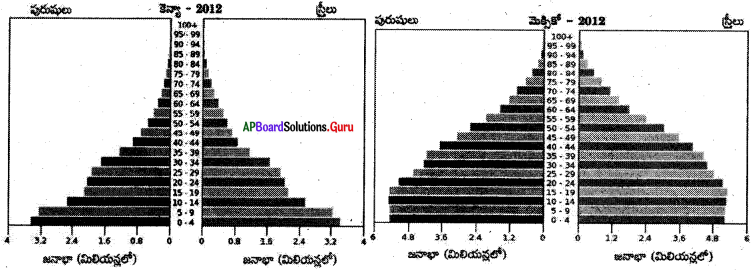
జొన్న దిగుబడులను పెంచటంపై దృష్టి ఎందుకు పెట్టాలంటే –

  • జొన్నను మంచి పోషక ధాన్యంగా వ్యవహరిస్తున్నారు.
  • జొన్న పంటను వర్షాధార ప్రాంతాలలో కూడా సాగుచేయవచ్చు.
  • నేల, ఇతర సహజ వనరులు అంతరించిపోకుండా, క్షీణతకు గురికాకుండా చూడటానికి.
  • ఆహార భద్రత, ఆహారధాన్యాల అందుబాటు పెంచుటకు.
  • పురుగు మందులు, రసాయన ఎరువులు ఎక్కువగా వాడనవసరం లేదు.
  • సాగునీటి లభ్యత తక్కువగా ఉన్న ప్రాంతాలలో కూడా జొన్న పంటను పండించవచ్చు.
  • జొన్నలకు మార్కెట్ కూడా బాగా ఉంది. లక్షలాది ప్రజల ప్రధాన ఆహారం జొన్న.

10th Class Social Textbook Page No.148

ప్రశ్న 10.
1971కి చూపించిన విధంగా, 1991, 2011 సంవత్సరాలకు తలసరి సగటు ఆహార ధాన్యాల అందుబాటును లెక్కగట్టండి.
AP Board 10th Class Social Solutions Chapter 11 ఆహార భద్రత 9
గమనిక : 1 టన్ను = 1000 కిలోలు; 1 కిలో = 1000 గ్రాములు; # = మిలియన్ టన్నులు

* మీరు లెక్కించిన దాని ఆధారంగా ఖాళీలను పూరించండి : 1971 నుంచి 1991 నాటికి తలసరి ఆహారధాన్యాల లభ్యత ………….. (పెరిగింది/తగ్గింది), కానీ 2011లో ఇది ……………. (ఎక్కువ | తక్కువగా) ఉంది. ఇటీవల దశాబ్దాలలో జనాభావృద్ధిలో తగ్గుదల ఉన్నప్పటికీ ఇలా జరిగింది. భవిష్యత్తులో ఆహారధాన్యాల లభ్యత పెరగటానికి ప్రభుత్వం. ………………. చర్యలు చేపట్టాలి.
జవాబు:
AP Board 10th Class Social Solutions Chapter 11 ఆహార భద్రత 10
గమనిక : 1 టన్ను = 1000 కిలోలు; 1 కిలో = 1000 గ్రాములు; # = మిలియన్ టన్నులు.

మీరు లెక్కించిన దాని ఆధారంగా ఖాళీలను పూరించండి : 1971 నుంచి 1991 నాటికి తలసరి ఆహారధాన్యాల లభ్యత పెరిగింది (పెరిగింది/తగ్గింది), కానీ 2011లో ఇది తక్కువగా (ఎక్కువ తక్కువగా) ఉంది. ఇటీవల దశాబ్దాలలో జనాభావృద్ధిలో తగ్గుదల ఉన్నప్పటికీ ఇలా జరిగింది. భవిష్యత్తులో ఆహారధాన్యాల లభ్యత పెరగటానికి ప్రభుత్వం ఉత్పత్తి పెంచటం, , దిగుమతులు పెంచటం లాంటి చర్యలు చేపట్టాలి.

10th Class Social Textbook Page No.150

ప్రశ్న 11.
వ్యవసాయ వైవిధ్యీకరణకు సంబంధించిన పదాలు, వాక్యాల కింద గీత గీసి భారతీయ రైతులకు ఇది ఎందుకు అవసరమో వివరించండి.
జవాబు:
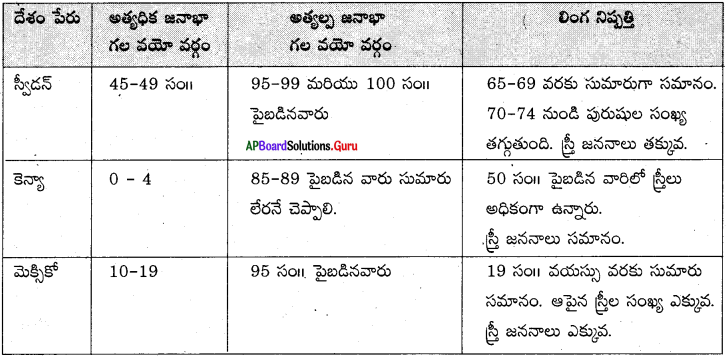
భారతీయ రైతులకు వ్యవసాయ వైవిధ్యీకరణ అవసరం; ఎందుకంటే,

  • భారతీయ రైతులు ఎక్కువ శాతం మంది చిన్న, సన్నకారు రైతులే.
  • ఎక్కువ మంది పేద రైతులే, వారి ఆదాయం పెరగాలంటే ఇది అవసరం.
  • అధిక దిగుబడులు పొందడానికి,
  • భారతదేశంలో వ్యవసాయం ఋతుపవనాలపై ఆధారపడి ఉంది కనుక వర్షాభావ కాలంలో, వర్షాభావ ప్రాంతంలో ఈ విధమైన వ్యవసాయం ఎంతో అవసరం.
  • అల్ప ఉపాధి, ప్రచ్ఛన్న నిరుద్యోగిత నివారణకు కూడా ఇది ఎంతో అవసరం.
  • అల్ప ఆదాయ సన్న, చిన్నకారు రైతులకు ఆహార భద్రత కల్పించుటకు.

AP Board 10th Class Social Solutions Chapter 11 ఆహార భద్రత

10th Class Social Textbook Page No.150

ప్రశ్న 12.
మీ గ్రామంలో లేదా మీకు తెలిసిన గ్రామంలో వ్యవసాయ వైవిధ్యీకరణను వివరించండి.
జవాబు:
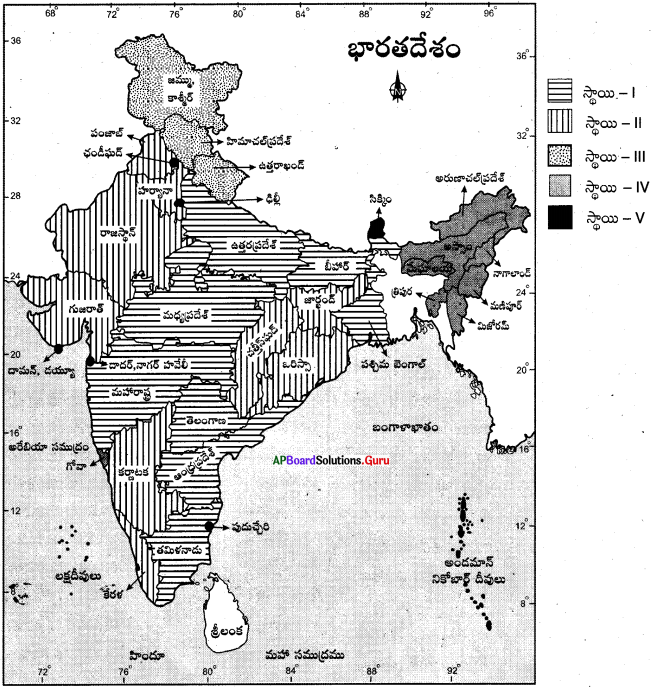
నాకు తెలిసిన ‘బేతపూడి’ గ్రామంలోని వ్యవసాయ వైవిధ్యీకరణ గురించి వివరిస్తాను.

  • ఈ గ్రామంలోని అన్ని భూములకు సాగునీటి వసతులు (కాలువలు లేదా బోరుబావులు) ఉన్నాయి.
  • ఈ గ్రామంలో వ్యవసాయ పెట్టుబడులకుగాను ఋణసౌకర్యం అందించుటకు బ్యాంక్ సౌకర్యం కలదు.
  • ఆధునిక వ్యవసాయ పద్ధతులను ఉపయోగిస్తున్నారు. సాంకేతిక విజ్ఞానం చాలా బాగుంది.
  • వరి, జొన్న, మొక్కజొన్న, మినుము, పెసర వంటి ఆహార ధాన్యాలతోపాటు ప్రత్తి, మిరప వంటి వాణిజ్య పంటలు సాగుచేస్తున్నారు.
  • పంటల మధ్య కాలంలో కూరగాయలు పండిస్తున్నారు. బెండ, వంగ, దోస, టమోట పండిస్తున్నారు.
  • అంతర్ పంటలుగా ‘కందులు’ (కందిపప్పు) ను పండిస్తున్నారు.
  • దాదాపుగా అందరికి 2-3 గేదెలు ఉన్నాయి. పాడి పరిశ్రమ బాగా అభివృద్ధి చెందింది.
  • గ్రామంలో 4 కంబైన్డ్ హార్వెస్టర్లు, దాదాపు 16 ట్రాక్టర్లు ఉన్నాయి. వ్యవసాయ యాంత్రీకరణ జరిగింది.
  • వివిధ మార్కెట్ల సమాచారం అందుబాటులో ఉంటుంది. మెరుగైన రవాణా సౌకర్యాలు కలిగి ఉన్నది.
    సూచన : విద్యార్థులు తాము చూసిన గ్రామం గురించి స్వయంగా రాయగలరు.

10th Class Social Textbook Page No.150

ప్రశ్న 13.
ఎనిమిదవ తరగతిలోని ప్రజా పంపిణీ వ్యవస్థపై చర్చను గుర్తుకు తెచ్చుకోండి. ప్రజాపంపిణీ వ్యవస్థకు, ప్రజల ఆహార భద్రతకు గల సంబంధం ఏమిటి?
(లేదా)
భారతదేశ దక్షిణాది రాష్ట్రాలలో ప్రజా పంపిణీ వ్యవస్థ బాగుందని అధ్యయనాలు వెల్లడి చేస్తున్నాయి. ఇది ప్రజా పంపిణి వ్యవస్థను అందరికి వర్తింపచేసిన రాష్ట్రాలు కావటము గమనించవలసిన విషయం. ఇవి అందరికి తక్కువ ధరలలో ఆహార ధాన్యాలను అందించాయి. ఇందుకు విరుద్ధంగా ఇతర రాష్ట్రాలు పేదవాళ్ళను గుర్తించి ఆహార ధాన్యాలను పేదలకు, పేదలు కాని వాళ్ళకు వేరు వేరు ధరలకు అమ్మాయి. పేదలలో కూడ అత్యంత పేదలకు కూడ వేరే హక్కులు ఉన్నాయి. వాళ్ళకు అందించే మోతాదు వేరు.
ప్రజాపంపిణీ వ్యవస్థకు, ప్రజల ఆహార భద్రతకు మధ్య గల సంబంధాన్ని వివరించండి.
జవాబు:
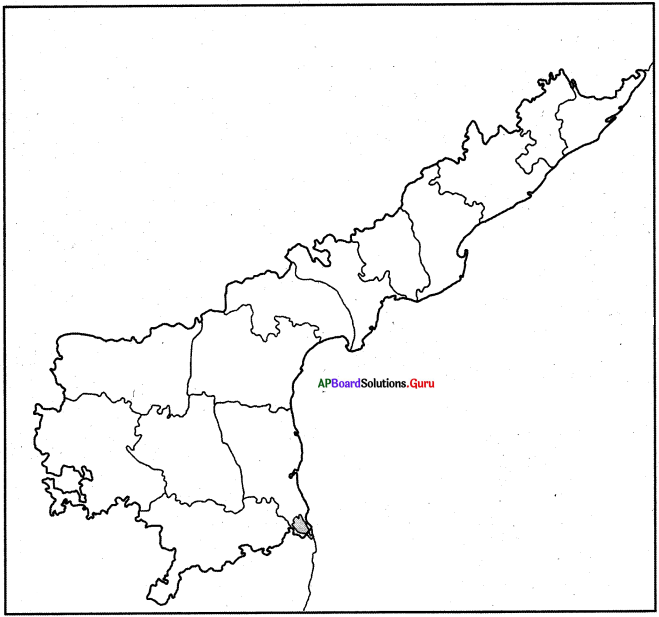
ప్రజాపంపిణీ వ్యవస్థ (PDS)కు, ప్రజల ఆహార భద్రతకు ఎంతో దగ్గరి సంబంధముంది.

  • ప్రజాపంపిణీ వ్యవస్థలో చౌకధరల దుకాణాలు ఎంతో ముఖ్యమైనవి.
  • పేదలకు, అత్యంత పేదలకు సబ్సిడి ధరకు నిత్యావసర వస్తువులను సరఫరా చేస్తూ ఆహార పదార్థాల అందుబాటుకు తద్వారా ఆహారభద్రతకు PDS ఎంతో తోడ్పడుతుంది.
  • వివిధ పథకాలు (మధ్యాహ్న భోజన పథకం, MNREP, FFW, AAY, ICDS మొ||నవి) ద్వారా పేద ప్రజలకు ఆహార ధాన్యాలను పంపిణీ చేస్తూ ఆహారం అందుబాటులోకి తెస్తుంది.
  • ధరలను అదుపులో ఉంచుట ద్వారా అల్ప ఆదాయ వర్గాల కొనుగోలు శక్తి పెరుగుతుంది. తద్వారా ఆహార ధాన్యాల అందుబాటు పరిమాణాత్మకంగా, గుణాత్మకంగా పెరుగుతుంది.

AP Board 10th Class Social Solutions Chapter 11 ఆహార భద్రత

10th Class Social Textbook Page No.153

ప్రశ్న 14.
సమర్థంగా పనిచేసే అంగన్‌వాడీ కేంద్రం ఈ పరిస్థితిని ఎలా సరిదిద్దగలదు ? చర్చించండి.
జవాబు:

మన దేశంలో మొత్తం మీద 16% పిల్లల్లో బరువు చాలా తక్కువగా ఉన్న తీవ్ర పరిస్థితి ఉంది. మొత్తంగా 45% పిల్లలు తక్కువ బరువు ఉన్నారు. 1-3 సం||రాల పిల్లలతో పోలిస్తే, 3-5 సం||రాల పిల్లల్లో ఇది చాలా ఎక్కువగా ఉంది. సమరంగా పనిచేసే అంగన్‌వాడీ కేంద్రం ఈ పరిస్తితిని చాలా వరకు సరిదిద్దగలదు.

  • అంగన్‌వాడీల్లో 1-5 సం||రాల పిల్లలు ఎక్కువగా ఉంటారు, వీరు శిక్షణ పొందిన ఆయాల సంరక్షణలో ఉంటారు.
  • ప్రభుత్వం పౌష్టికాహారం (పోషకాహారం)ను అంగన్‌వాడీల ద్వారానే సరఫరా చేస్తుంది.
  • పిల్లల యొక్క ఎత్తు, బరువులను ఎప్పటికప్పుడు పరీక్షించి, తగుచర్యలు తీసుకుంటారు.
  • పిల్లలకు అవసరమైన వైద్య, ఆరోగ్య సూచనలు అందించబడతాయి, వ్యాక్సినేషన్ ఉంటుంది.
  • ఆహ్లాదకరమైన, పరిశుభ్రమైన వాతావరణం ఉండటం వలన పిల్లల ఎదుగుదల చక్కగా ఉంటుంది.
  • అంగన్‌వాడీ కేంద్రంలో సరఫరా చేయు గ్రుడ్లు, ప్రోటీన్స్ (సోయాబీన్స్ పొడి), సమతౌల్య ఆహారం పొడి మొ||నవి పిల్లల ఎదుగుదలకు, అభివృద్ధికి ఎంతో తోడ్పడతాయి.

AP Board 7th Class Science Solutions 8th Lesson Wonders of Light

SCERT AP 7th Class Science Study Material Pdf 8th Lesson Wonders of Light Textbook Questions and Answers.

AP State Syllabus 7th Class Science 8th Lesson Questions and Answers Wonders of Light

7th Class Science 8th Lesson Wonders of Light Textbook Questions and Answers

Improve Your Learning

I. Fill in the blanks.

1. Image formed by convex mirror is erect, small and _______
2. Infinite number of images are formed between two mirrors if they are kept at an angle of _______
3. Dentists use _______ mirror to see inner parts of teeth.
4. Image that cannot be obtained on screen is______
Answer:
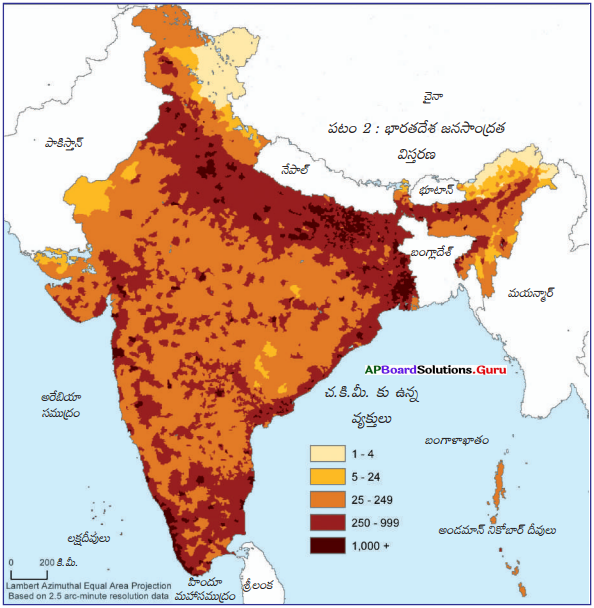
1. virtual
2. 0°
3. concave
4. virtual

II. Choose the correct answer.

1. In periscope, the angle between two plane mirrors is
a) 0°
b) 30°
c) 45°
d) 60°
Answer:
a) 0°

2. If two plane mirrors are kept at an angle of 180° between them. Then the number of
a) 1
b) 2
c) 3
d) 4
Answer:
a) 1

3. Which of the following is not the property of image formed by a plane mirror?
a) Same size
b) Real
c) Lateral inversion
d) Erect
Answer:
b) Real

4. If a light ray falls on plane mirror along the direction of normal, then the angle of reflection will be
a) 90°
b) 45°
c) 0°
d) 180°
Answer:
a) 90°

AP Board 7th Class Science Solutions 8th Lesson Wonders of Light

5. Which form clear image among the following?
a) Paper
b) Cloth
c) Card board
d) Plane mirror
Answer:
d) Plane mirror

III. Match the following.

A) Reflections from Ice pieces 1. Regular reflection
B) Reflections from still water 2. Irregular reflection
C) Reflectors in head lights 3. Blue light
D) Rear view mirrors 4. Concave mirror
E) Light which causes damage to retina 5. Yellow light
6. Convex mirror

Answer:

A) Reflections from Ice pieces 2. Irregular reflection
B) Reflections from still water 1. Regular reflection
C) Reflectors in head lights 4. Concave mirror
D) Rear view mirrors 6. Convex mirror
E) Light which causes damage to retina 3. Blue light

IV. Answer the following questions.

Question 1.
What is reflection of light? Explain with an example.
Answer:

  1. The process of bouncing back of light rays into the same medium after falling on a smooth or rough surface from the light source is called “reflection of light”.
    Example:
  2. Take a plane mirror and stand in front of a building in open space during the day. Let the sunlight falls on the mirror. Now rotate the mirror in such a way that a spot of light falls on the wall of building.
  3. In the above activity, light rays fall on the mirror bounced back. This process of bouncing back of light rays in the same medium after hitting the surface of an object is called reflection.

Question 2.
Write the laws of reflection of light.
Answer:
There are two laws of reflection :

  1. First law of reflection : Angle of incidence is equal to angle of reflection.
  2. Second law of reflection : The incident ray, reflected ray and normal to the surface are present in the same plane. Incident and reflected rays are on either side of normal.

Question 3.
Why should we keep the mirror strips in the Periscope parallel to each other? What happens if they are not parallel?
Answer:

  1. We should keep the mirror strips in the Periscope parallel to each other. The image of an object formed on the first mirror reflects exactly on the second mirror and then we can see the image. It is possible when the mirror strips in the Periscope parallel to each other.
  2. If they are not parallel, the image of an object formed on the first mirror does not reflects on the second mirror and we cannot see the image through the second mirror.

AP Board 7th Class Science Solutions 8th Lesson Wonders of Light

Question 4.
What precautions do you take while getting the image of burning candle using a mirror?
Answer:

  1. Keep the candle as its flame is in the line of the mirror.
  2. Keep the mirror as its plane opposite to the screen.
  3. Do the experiment in a dark room.
  4. Take care while handling the candle with flame.

Question 5.
Write the properties of images formed by concave mirror.
Answer:
The properties of images formed by concave mirror.

  1. It can form both real and virtual images.
  2. It produces erect and inverted images
  3. It also produces small same size and bigger images depending on the position of object in front of it.

Question 6.
Draw the diagram show regular reflection and diffused reflection of light.
Answer:
AP Board 7th Class Science Solutions 8th Lesson Wonders of Light 1

Question 7.
Where do you find multiple images formed by plane mirrors in your day-to-day life?
Answer:

  1. In sweet shops mirrors are arranged in such a way that multiple images of sweets can appear.
  2. In saloon and beauty parlours mirrors are arranged in such a way that the customers can view his images in all directions.
  3. In bathrooms and dressing rooms also, we can observe multiple images.
  4. In Kaleidoscope we can observe multiple images.

Question 8.
Where do you find irregular reflections in your daily life?
Answer:
We can find irregular reflections on unpolished marbles floors, scratched steel vessels, broken mobile screens, disturbed water surfaces, and on the rough surfaces of plastic sheets, metal sheets, etc.

Question 9.
Write the applications of spherical mirrors in daily life.
Answer:
Applications of concave mirrors:

  1. Concave mirrors are used by ENT doctors as Head Mirrors.
  2. Dentists also use concave mirrors to get a bigger image of the teeth.
  3. Eye specialist using a special instrument called Ophthalmoscope. It is fitted with a concave mirror having a small hole near its center.
  4. Concave mirrors are used to reflectors in a torch light or the headlights of vehicles.
  5. These are used in microscopes.

Applications of convex mirrors:

  1. Convex mirrors are used as Rear-view mirrors in vehicles.
  2. Convex mirrors are also used at the junctions of roads.
  3. Convex mirrors are used at ATM machines.
  4. Convex mirrors are used for security purpose at factories, offices, etc.

7th Class Science 8th Lesson Wonders of Light InText Questions and Answers

7th Class Science Textbook Page No. 16

Question 1.
What do you observe in the picture? Mention the different objects in the scenery.
AP Board 7th Class Science Solutions 8th Lesson Wonders of Light 24
Answer:
Trees, river, hills, rainbow, steps, boat, a boy, a girl, butterfly, water, plants, wooden bridge.

Question 2.
Can we see all these objects during night time?
Answer:
No, we cannot see all these objects during night time.

7th Class Science Textbook Page No. 17

Question 3.
Where does the light come from?
Answer:
Light comes from different objects called sources of light.
Ex : Sun, candle, tubelight.

AP Board 7th Class Science Solutions 8th Lesson Wonders of Light

Question 4.
Name some sources of light around you.
Answer:
Sun, candle, tubelight, bulb, torch light, match box etc .

Question 5.
Do these sources release light on their own?
Answer:
Sources like sun, stars emit light on their own.
Sources like bulb, torch light, candle do not emit light on their own.

Question 6.
Can you give some other examples for natural sources of light?
Answer:
The moon, stars and the sun.

Question 7.
Do you know how this light travel from the source?
Answer:
Actually, light is not a single ray, but a bundle of rays- This bundle of light rays are called beam of light rays. .

Question 8.
What do we call the path of light?
Answer:
The direction or path along which light travels is called a ray of light.

7th Class Science Textbook Page No. 18

Question 9.
How are we able to see the objects?
Answer:
The light fall on the objects and reflects and reach to our eye.

Question 10.
Is only light enough to see the objects around us?
Answer:
Yes, light is enough, but reflected light should reach our eye.

7th Class Science Textbook Page No. 19

Question 11.
In the activity-2, is there any reflection from the reflected light?
Answer:
Yes, there is reflection from the reflected light.

7th Class Science Textbook Page No. 23

Question 12.
We are able to see our image in the mirror. Can we catch our image bn screen?
Answer:
No. We cannot catch our image on screep.

7th Class Science Textbook Page No. 24

Question 13.
Are the images formed by plane mirrors real or virtual?
Answer:
Plane mirror forms virtual image.

Question 14.
Have you observed the arrangement of plane mirrors in a sweet shop? How many images did you find?
Answer:
Yes, I have observed the arrangement of plane mirrors in a sweet shop. So many images are formed.

7th Class Science Textbook Page No. 25

Question 15.
How many images are formed when the angle between two mirrors is zero?
Answer:
Number of images (n) = (360°/θ) – 1= ∞ , from the formula, we can find infinite number of images are formed. –

7th Class Science Textbook Page No. 26

Question 16.
Have you ever seen your image in rearview mirror of your father’s, motor cycle?
Answer:
Yes.

Question 17.
Is it same as the image seen in the mirror of your dressing table?
Answer:
No

Question 18.
What difference did you observe?
Answer:
Image is small in and closure.

Question 19.
What may be the reason for the difference?
Answer:
May be shape of the surface of the mirror.

AP Board 7th Class Science Solutions 8th Lesson Wonders of Light

Question 20.
Touch the surface of the rearview mirror. Is it same as plane mirror?
Answer:
No. It is not same as plane mirror. It is in curved in shape.

7th Class Science Textbook Page No. 28

Question 21.
Do you know the use of spherical mirrors in your daily life?
Answer:
Concave mirrors are used by dentists, ophthalmologists, ENT doctors and also in head lights of vehicles. Convex mirrors are used as rear view mirrors in vehicles and safety mirrors at curved roads.

7th Class Science Textbook Page No. 29

Question 22.
Have you ever observed the surface of reflection in a torch light or the headlights of vehicles?
Answer:
Yes, they are spherical in shape.

7th Class Science Textbook Page No. 30

Question 23.
Can you recognize the mirrors used beside the drivers in vehicles?
Answer:
These are convex mirrors.

Question 24.
Can you now recognize the characteristics of image from rear view mirror?
Answer:
Erect, virtual and smaller images are formed.

Question 25.
Do all the objects reflect the light rays falling on it?
Answer:
No.

Question 26.
Do you know why did paper burnt with a magnifying glass?
Answer:
The paper burned as the magnifying glass concentrated the sun’s rays at one place on the paper.

AP Board 7th Class Science Solutions 8th Lesson Wonders of Light

Question 27.
Doesthe magnifying glass reflect the light falling on it?
Answer:
No.

Think & Respond

7th Class Science Textbook Page No. 23

Question 1.
Deepak saw a vehicle on the road. He was surprised to see that the word AP Board 7th Class Science Solutions 8th Lesson Wonders of Light 25 on it. What was that word? Why was it written in a strange manner?
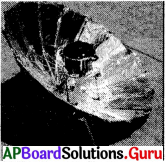
Answer:

  1. The word is AMBULANCE.
  2. AMBULANCES are emergency vehicles.
    It is important to give way to ambulances.

The drivers can see the rear coming vehicles through the rear view mirror of the vehicles. Objects and letters appear in reverse means in left right inversion in mirrors. So letters in the wf>rd AMBULANCE also appear in reverse and cannot understand the word to the drivers.

If the word is written in reverse (as in mirror image) on the ambulance, it appears normally and readably. Drivers can read the word AMBULANCE and give a way to ambulance immediately.

Activities and Projects

Question 1.
Large sized concave mirrors are used to focus sun rays in solar cookers and solar heaters.Make a solar cooker of your own by using this principle and exhibit in your school science fair.
Answer:
AP Board 7th Class Science Solutions 8th Lesson Wonders of Light 2
Making of solar cooker :

  1. A concave mirror focuses parallel sun rays at the focal point of the mirror.
  2. So with a small concave mirror .we can heat up and burn paper.
  3. In the same way make a big concave mirror to heat up a vessel.
  4. Make a wooden/ iron frame in the shape of TV dish.
  5. Cut acrylic mirror sheets into 8 or 12 pieces in the shape of isosceles triangles with a height equal to the radius of dish antenna.
  6. The bases of 8 or 12 triangles together make the circumference of the dish.
  7. Stick the triangle mirrors to the dish.
  8. Our solar heater/cooker is ready.
  9. Arrange it so that concave part faces sun.
  10. Find its focal point and place a vessel at that point.
  11. It will get heated. We can even cook rice in that vessel.

Question 2.
Prepare a report by collecting data on the uses of spherical mirrors.
Answer:
Spherical mirrors are two types : They are 1) concave mirror 2) convex mirror.

1) Concave mirror :
Concave mirrors have a smooth curved surface inwards. Light rays are converged at one point by a Concave mirror. Real and virtual images can form the concave mirror.

The applications of concave mirror in our daily life :
Dentists :
Concave mirrors are used by dentists in the examination of teeth.

ENT doctors:
These are used by ENT doctors to examine the body parts.

Shaving mirrors :
During shaving, the concave mirror forms an enlarged and erect image of the face when the mirror is held closer to the face.

Optical instruments:
Ophthalmoscope concave mirrors are used in optical instruments such as Ophthalmoscope.

Astronomical telescopes:
These are used in telescopes and other devices. Headlights : Concave mirrors are widely used in headlights of automobiles and motor vehicles, torchlights, railway engines, etc. as reflectors. The light source is placed at the focus of the mirror, so after reflecting the light rays travel over a huge distance as parallel light beams of high intensity.

Solar cookers :
Concave mirrors are also used in solar cookers. Concave mirrors are also used in satellite dishes, electronic microscope, visual bomb detectors, etc.

2) Convex mirror .
Convex mirrors have a smooth curved surface outwards. Light rays are diverged at one point by a Convex mirror. Only virtual images can form the convex mirror.

The applications of convex mirror in our daily life.

Rear-view mirrors:
These are convex mirrors. These mirrors form images of objects spread over a large area. So, these help the driver to see the traffic behind them. Hence these are used as Rear-view mirrors.

Road safety:
Convey mirrors kept at the corners of curved roads to avoid accidents. Convex mirrors form images of vehicles on both sides of curved road. These mirrors are also used at the mnctions of roads.

AP Board 7th Class Science Solutions 8th Lesson Wonders of Light

Question 3.
Make a list of objects in your school and home, that works like a mirror. Make a report why they work like that.
Answer:

  1. Plane mirror : It has plane surface. So it reflects the light.
  2. Water surface : It has plane surface, when it was stable. So it reflects the light.
  3. Tiles of floor : It has plane surface. So it reflects the light.
  4. Almara : It was painted and has a smooth plane. So it reflects the light.
  5. Steel plate : It has a smooth plane. So it reflects the light.
  6. Concave and convex mirrors : It has plane surface. So it reflects the light.
  7. Computer screen : It has plane surface. So it reflects the light.
  8. Steel spoon : It has plane surface. So it reflects the light.

Question 4.
Take an empty tooth paste box and two mirror strips of required size and make a periscope.
Answer:
Collect the following materials to make your own periscope.

  1. Empty tooth paste box, two mirror strips, scale, pencil, blade, gum.
  2. Take an empty tooth paste box.
  3. Close the ends and draw two squares at both the ends by using scale and pencil.
  4. Draw diagonals to the square boxes, such that the two diagonals facing each other.
  5. Make two slits with the help of blade along the diagonals.
  6. Make sure that the size of mirror should be equal to the length of slits.
  7. Fix the mirror strips in the slits in such a way that reflecting surfaces of mirror strips face pach other.
  8. Fix the mirror strips firmly to the box by using gum.
  9. Cut out two windows on the narrow sides such that the windows should open directly on the reflecting surfaces of the mirror strips. Now the Periscope is ready.

Activities

Activity – 1

Question 1.
Write an activity to show the following type of light rays,
i) Parallel beam of light rays
ii) Converging beam of light rays
iii) Diverging beam of light rays
Answer:
i) Parallel beam of light rays:
Light rays which travel parallel to each other are called Parallel beam of light rays. To understand about parallel beam of light rays observe situation 1.
AP Board 7th Class Science Solutions 8th Lesson Wonders of Light 3

Situation-1 :

  1. Take a plank and cardboard.
  2. Make small slits on cardboard.
  3. Keep the cardboard on the plank perpendicular to it.
  4. Keep it in sunlight during afternoon as shown in figure.
  5. The light rays from the sun fall on the cardboard and passed through the slits.
  6. We can observe that the light rays are travelling parallel to each other. These are called parallel beam of light rays.

ii) Converging beam of light rays :
“Light rays which travel from different directions to meet at a point are called as Converging beam of light rays”.
To know clearly about converging beam let us observe situation 2.
AP Board 7th Class Science Solutions 8th Lesson Wonders of Light 4

Situation-2 :

  1. Recall the above situation.
  2. Arrange an acrylic mirror in the path of light rays as shown in the figure.
  3. The light rays meet at a point after bouncing back from the mirror. These are called converging beam of light rays.

iii) Diverging beam of light rays :
“Light rays which travel from a source moving in different directions are called as Diverging beam of light rays.” To understand about diverging beam, let us observe situation 3.
AP Board 7th Class Science Solutions 8th Lesson Wonders of Light 5

Situation-3 :

  1. In the above situation, arrange the acrylic mirror in the path of light rays as shown in the figure.
  2. After bouncing back from the mirror light rays travel in different directions

AP Board 7th Class Science Solutions 8th Lesson Wonders of Light

Activity – 2

Question 2.
Write an activity to Understand the reflection of light.
Answer:
“The process of bouncing back of light rays into the same medium after falling on a smooth or rough surface from the light source is called “reflection of light”. Let us understand this phenomenon with the following activity.
AP Board 7th Class Science Solutions 8th Lesson Wonders of Light 6

  1. Take a torch and enter into a dark room.
  2. Observe the objects in darkness. We cannot see any object.
  3. Switch on the torch and focus it on the objects. We can see the objects.
  4. Keep a card board between your eyes and object.
  5. Now try to see the objects. We cannot see any object. ,
  6. From the above activity we can conclude that objects are visible only when light falls on the objects and bounces back to the eye.

Activity – 3

Question 3.
Write an activity to understand the reflection of light.
Answer:
AP Board 7th Class Science Solutions 8th Lesson Wonders of Light 7

  1. Take a plane mirror and stand infront of a building in open space during the day.
  2. Let the sunlight falls on the mirror.
  3. Now, rotate the mirror in such away that a spot of light falls on the wall of building.
  4. Light rays from the sun fall on the mirror and bounced back. The spot of Light on the wall is the image of sun.
  5. In this activity, light rays fall on the mirror and bounced back.
  6. This process of bouncing back of light rays in the same medium after hitting the surface of an object is called reflection.

Activity – 4

Question 4.
Write an activity to understand the regular reflection and irregular reflection of light.
Answer:
Reflection from a smooth and shiny surface is called regular reflection.

Reflection from an irregular or uneven surface is called irregular reflection or diffused reflection.

Let us understand these from the activity below.

1) Focus the light from a source on the objects mentioned in the given table and try to get the image of the objects.

2) Record your observations in the table given.

Object Nature of surface of the object (Smooth and shiny/ Smooth but not shiny/ rough) Observation (Clear image is formed/image is formed but not clear/ No image is formed)
1. Plane mirror Smooth and shiny Clear image
2. New steel plate Smooth and shiny Clear image/ but not clear
3. Card board Rough No image
4. Thermocol sheet Rough No image
5. Cloth Rough No image
6. Paper Rough No image

3) From the above table it is clear that light reflects regularly from a smooth and shiny surface and irregularly from an uneven surface.

4) Reflection from a smooth and shiny surface is called regular reflection.

5) Clear images are formed in case of regular reflection.

6) Reflection from an irregular or uneven surface is called irregular reflection or diffused reflection. Images are not clear or sometimes cannot form the images at all in case of irregular reflection.

AP Board 7th Class Science Solutions 8th Lesson Wonders of Light

Activity – 5

Question 5.
How can you verify the laws of reflection?
Answer:

  1. Take a White paper and spread it on a drawing board or cardboard.
  2. Draw a straight-line AB at the center of paper by a pencil.
  3. Mark a point O at the center of AB.
    AP Board 7th Class Science Solutions 8th Lesson Wonders of Light 8
  4. At the point ‘O’ draw a perpendicular line ON to AB.
  5. ON is called normal to the surface.
  6. ake a protractor and place it on white paper in such a way that the zero edge of the protractor coincides with the point O on AB as shown in figure.
  7. Mark different angles starting from 10° to 80° on both sides of ON.
  8. Now place a plane mirror on the line AB with the help of two clips such that the surface of the plane mirror is perpendicular to the surface of the white paper.
  9. Take a laser pointer and focus it on plane mirror at ‘O’ making an angle of 40° with the line ON.
  10. Observe the reflected ray from the mirror.
    Angle of incidence Angle of reflection
    1. 20° 20°
    2. 40° 40°
    3. 60° 80°
    4. 80° 80°
  11. The angle made by incident ray with the normal ON is called angle of incidence i.
  12. The angle made by the reflected ray with the normal is called the angle of reflection r.
  13. Focus laser pointer at different angles of incidence.
  14. Observe the angles of reflection in each case and tabulate the values.

From the above observations you can conclude that the angle of incidence is always equal to angle of reflection.
(OR)
AP Board 7th Class Science Solutions 8th Lesson Wonders of Light 10
This is the first law of reflection.
1) From the above activity you can also observe that Incident ray, reflected ray and normal are present in the same plane and incident, reflected rays are on either side of normal.
AP Board 7th Class Science Solutions 8th Lesson Wonders of Light 9

2) The incident ray, reflected ray and normal to the surface are present in the same plane and incident, reflected rays are on either side of normal.
This is the second law of reflection.

Activity – 6

Question 6.
How can you verify the following characteristics of image by plane mirror?
1) Object distance is equal to image distance.
2) Size of the object is equal to size of the image.
Answer:
Let us verify the above characteristics by the following activity.
1) Take a chess board.
2) Fix a plane mirror vertically at the one end of the chess board as shown in the figure. Place a sharpener on one of the square boxes on the chess board.
3) You can see the image of sharpener in the mirror.
AP Board 7th Class Science Solutions 8th Lesson Wonders of Light 11
4) Count the number of square boxes between the mirror and the sharpener. At the same time count the number of square boxes between the mirror and the image of sharpener. The number of square boxes equal in both the cases.
Conclusion 1:

5) From the above activity you can conclude that the distance of the object from the mirror is equal to the distance of image from the mirror.

6) The distance of the object from the mirror is called object distance. The distance of the image from the mirror is called image distance.

7) In the above activity observe the size of object [sharpener] and image.

8) You will find that the size of image and object are equal.

Conclusion 2:
From the above activity you can conclude that the size of the object is equal to size of the image.

Activity – 7

Question 7.
How can you verify the following characteristic of image by plane mirror?
Laterally inverted image is formed, (left and right alternates)
Answer:
AP Board 7th Class Science Solutions 8th Lesson Wonders of Light 12

  1. Stand in infront of a plane mirror and raise your right hand.
  2. Observe the image formed in the mirror.
  3. Now lower the right hand and raise the left hand.
  4. Observe the changes you noticed in the image.
  5. Your right hand appears left and left hand appears right in the image.
  6. Such a shift of lateral side of images in opposite direction is called lateral inversion.

Conclusion:
So images formed by plane mirrors undergo lateral inversion

Activity – 8

Question 8.
How can you verify the following characteristics of image by plane mirror?
* The image formed is always virtual and erect.
Answer:
AP Board 7th Class Science Solutions 8th Lesson Wonders of Light 13

  1. Place a burning candle infront of the plane mirror.
  2. Observe the image of burning candle in the mirror.
  3. Now place a white paper behind the candle.
  4. Try to get the image of candle on paper.
  5. If your answer is ‘YES’, such type of image which we get on screen is called real image.
  6. If your answer is ‘NO’, such type of image which cannot get it on screen is called virtual image. •
  7. Plane mirror forms only virtual image.
  8. In the above activity, the image of burning candle is erected.
  9. We can see the erect image of the object in the mirror.

Conclusion:
Thus, we can conclude that plane mirrors form virtual and erect image.

AP Board 7th Class Science Solutions 8th Lesson Wonders of Light

Activity – 9

Question 9.
Write an activity to understand the relation between the arrangement of mirror and number of images.
(OR)
Derive a formula for number of images formed between two mirrors.
Answer:
AP Board 7th Class Science Solutions 8th Lesson Wonders of Light 14

  1. Take a drawing board, spread a white sheet on it.
  2. Draw a semicircle on the white sheet.
  3. Mark the angles from 0° to 180° with the help of protractor.
  4. Take two plane mirrors of same size join them with cellophane tape as shown in the figure.
  5. Keep the mirrors on the semicircle such that the angle between the mirrors is 120° .
  6. Now bring a burning candle in between the mirrors.
  7. Observe the number of images formed by the two Mirrors.
  8. Change the angles between the mirrors from 120° to 90°, 60°, 45°, and 30° respectively.
  9. Observe the number of images formed in each position. Tabulate your observation.

AP Board 7th Class Science Solutions 8th Lesson Wonders of Light 15
AP Board 7th Class Science Solutions 8th Lesson Wonders of Light 16
In this way we. can derive the formula to find out the number of images formed between two mirrors.

Number of images (n) = (360°/θ) -1 where 0 is the angle between the mirrors

Activity – 10

Question 10.

How do you make a Royal Road in a Shoe Box by using plane mirror?
(OR)
How do you prepare a Fancy item by using the phenomena of multiple reflections of plane mirrors?
Answer:
AP Board 7th Class Science Solutions 8th Lesson Wonders of Light 17

  1. Fix two plane mirrors on the opposite sides of a shoe box with their reflecting surfaces facing each other.
  2. Draw a road on the bottom of shoe box between the mirrors.
  3. Arrange two LED street lights on both sides of road.
  4. Make a small hole on mirror side of shoe box and scrape off a little of colour coating from the mirror on that place.
    Observe the scenery inside the box through this hole.
  5. Light rays from the LED fall on the first mirror and then continuously undergone multiple reflections.
  6. That’s why we see a long road With full of LED lights.

Activity – 11

Question 11.
How do you make a periscope by using plane mirrors?
(OR)
Make your own periscope.
Answer:
Required materials:
Empty Incense stick box [Agarbatt(box], two mirror strips, scale, pencil, blade, gum.
AP Board 7th Class Science Solutions 8th Lesson Wonders of Light 18

Procedure:

  1. Take an empty Incense stick box.
  2. Close the ends and draw two squares at both the ends by using scale and pencil.
  3. Draw diagonals to the square boxes, such that the two di-agonals facing each other.
  4. Make two slits with the help of blade along the diagonals.
  5. Make sure that the size of mirror should be equal to the length of slits.
  6. Fix the mirror strips in the slits in such a way that reflecting surfaces of mirror strips face each other.
  7. Fix the mirror strips firmly to the box by using gum.
  8. Cut out two windows on the narrow sides such that the windows should open directly on the reflecting surfaces of the mirror strips as shown in figure.
  9. Now your Periscope is ready.
  10. You can use this to see the objects outside the room through the window while hiding yourself in the room

AP Board 7th Class Science Solutions 8th Lesson Wonders of Light 19

Activity – 12

Question 12.
Write an activity to understand different shapes of spherical mirrors.
Answer:
AP Board 7th Class Science Solutions 8th Lesson Wonders of Light 20
1) Take a stainless-steel serving spoon.
2) Look into it by bringing the outer bulged side of the spoon near your face.
3) Do you see your image in it? (Yes)
4) Did you observe any difference in image from what you see in plane mirror? (Yes)
AP Board 7th Class Science Solutions 8th Lesson Wonders of Light 21
10) Try to increase the distance of the spoon from your face.
11) Here the surface of the spoon act as a mirror but the surface is not plain.
12) The outer surface of the spoon is curved out like the outer surface of a sphere.
13) The inner surface of the spoon is like the part of inner surface of a sphere.
14) These mirrors are the parts of spheres. So these kinds of mirrors are called spherical mirrors.
AP Board 7th Class Science Solutions 8th Lesson Wonders of Light 22

Spherical mirrors are of two types :

  1. Convex mirrors (Reflecting surface bent outward)
  2. Concave mirrors (Reflecting surface bent inward)

Activity – 13

Question 13.
Characteristics of image formed by a concave mirror.
Take a ‘V’ shaped wooden stand. Keep a concave mirror on it. Place a lighted candle at a distance of about 50 cm in front of the mirror. Try to get clear image of the candle flame on a white screen or white paper by moving the screen towards and away from the mirror. Make sure that the screen is not placed in between burning candle and mirror.
AP Board 7th Class Science Solutions Chapter 8 కాంతితో అద్భుతాలు 22

Place the lighted candle at different distances in front of the mirror by moving it towards the mirror. Try to get clear image on screen at each position. Note your obser-vation in the table given below.
Answer:
AP Board 7th Class Science Solutions 8th Lesson Wonders of Light 23
From the above table you can conclude that a concave mirror can form real and virtual images, erect and inverted images, smaller, same size and bigger images depending on the position of object in front of it.