AP Board 8th Class Maths Solutions Chapter 14 ఉపరితల వైశాల్యము మరియు ఘనపరిమాణం (ఘనము-దీర్ఘఘనము) InText Questions

AP SCERT 8th Class Maths Textbook Solutions Chapter 14 ఉపరితల వైశాల్యము మరియు ఘనపరిమాణం (ఘనము-దీర్ఘఘనము) InText Questions and Answers.

AP State Syllabus 8th Class Maths Solutions 14th Lesson ఉపరితల వైశాల్యము మరియు ఘనపరిమాణం InText Questions

ఇవి చేయండి

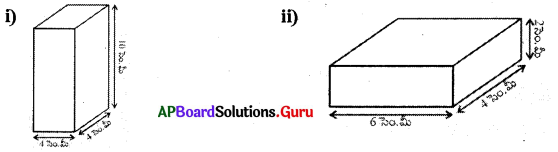
1. ఈ క్రింది దీర్ఘఘనముల యొక్క సంపూర్ణతల వైశాల్యమును కనుగొనుము. (పేజీ నెం. 298)
AP Board 8th Class Maths Solutions Chapter 14 ఉపరితల వైశాల్యము మరియు ఘనపరిమాణం (ఘనము-దీర్ఘఘనము) InText Questions 1
సాధన.
(i) l = 4 సెం.మీ., b = 4 సెం.మీ., h = 10 సెం.మీ.
దీర్ఘఘనం యొక్క సంపూర్ణతల వైశాల్యం = 2 (lb + bh + lh)
= 2(4 × 4 + 4 × 10 + 4 × 10)
= 2(16 + 40 + 40)
= 2 × 96 = 192 చ.సెం.మీ.
(ii) l = 6 సెం.మీ., b = 4 సెం.మీ., h = 2 సెం.మీ.
దీర్ఘ ఘనం యొక్క సంపూర్ణతల వైశాల్యం = 2 (lb + bh + lh)
= 2 (6 × 4 + 4 × 2+ 6 × 2)
= 2 (24 + 8 + 12)
= 2 × 44 = 88 చ.సెం.మీ.

AP Board 8th Class Maths Solutions Chapter 14 ఉపరితల వైశాల్యము మరియు ఘనపరిమాణం (ఘనము-దీర్ఘఘనము) InText Questions

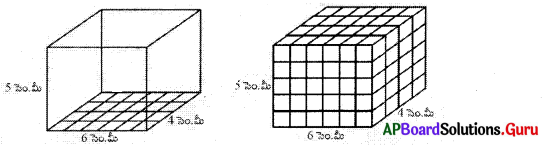
2. 6 సెం.మీ., 4 సెం.మీ. మరియు 5 సెం.మీ. కొలతలుగా గల దీర్ఘఘనము యొక్క ఘనపరిమాణమును కనుక్కోండి. (పేజీ నెం. 305)
AP Board 8th Class Maths Solutions Chapter 14 ఉపరితల వైశాల్యము మరియు ఘనపరిమాణం (ఘనము-దీర్ఘఘనము) InText Questions 2
ఒక ఘనపు భుజము సెం.మీ. గా గల ప్రమాణ ఘనములను దీర్ఘఘనము పొడవు వెంబడి పేర్చుము. దీని కొరకు మనకు ఎన్ని ఘనములు అవసరము ? 6 ప్రమాణ ఘనములు అవసరము. వెడల్పు వెంబడి ఎన్ని ప్రమాణు ఘనములు పేర్చవచ్చు ? 4 ప్రమాణ ఘనములు దీనికి గల కారణము దీర్ఘ ఘనము యొక్క వెడల్పు 4 సెం.మీ. అనగా ఒక పారలో 6 × 4 ప్రమాణ ఘనములు ఉంటాయి.

దీర్ఘ ఘనములో ప్రమాణ ఘనములు అమర్చే పొరలు ఎన్ని ? 5 పొరలు అనగా దీర్ఘఘనము యొక్క ఎత్తు 5 సెం.మీ. ప్రతి పౌర 6 × 4 ఘనములు కలవు. కావున 5 పొరలలో 6 × 4 × 5 ప్రమాణ సమఘనాల దిమ్మలు ఉంటాయి. అనగా l × b × hకు సమానం.
పై చర్చ దీర్ఘఘనము యొక్క ఘనపరిమాణమునకు సూత్రము నిచ్చును.
దీర్ఘఘన ఘనపరిమాణము = పొడవు × వెడల్పు × ఎత్తు
సాధన.
6 సెం.మీ., 4 సెం.మీ. మరియు 5 సెం.మీ. కొలతలు గల దీర్ఘ ఘనం యొక్క ఘనపరిమాణం
V= lbh ⇒ V = 6 × 4 × 5 ⇒ V = 120 సెం.మీ3

3. 64 ప్రమాణ ఘనములను ఉపయోగించి మీరు ఏర్పరచగల దీర్ఘఘనములు ఎన్ని ? ప్రతీ అమరిక యొక్క సంపూర్ణతల వైశాల్యము కనుక్కోండి. సమాన ఘనపరిమాణము కలిగిన ఘనముల యొక్క ప్రక్కతల వైశాల్యములు సమానమేనా ? (పేజీ నెం. 306)
సాధన.
64 ప్రమాణ ఘనములను ఉపయోగించి మీరు ఏర్పరచగల దీర్ఘఘనాల సంఖ్య
64 = 1 × 64 ……….. (1)
= 2 × 32 ………………… (2)
= 4 × 16 ………………….. (3)
ఈ విధంగా 3 విధాలుగా దీర్ఘఘనాలను ఏర్పర్చవచ్చు.
1. l = 64 సెం.మీ. , b = 1 సెం.మీ., h = 1 సెం.మీ.
దీర్ఘఘనం యొక్క సంపూర్ణతల వైశాల్యము = 2 (lb+ bh + lh)
= 2(64 × 1 + 1 × 1 + 1 × 64)
= 2 (64 + 1 + 64) = 2 × 129 = 258 చ.యూ.

2. l = 32 సెం.మీ., b = 2 సెం.మీ., h = 1 సెం.మీ.
A = 2 (lb + bh + lh)
= 2 (32 × 2 + 2 × 1 + 32 × 1)
= 2 (64 + 2 + 32)
= 2 × 98 = 196 చ.యూ.

3. l = 16 సెం.మీ., b = 4 సెం.మీ., h = 1 సెం.మీ.
A = 2(lb+ bh + lh)
= 2(16 × 4 + 4 × 1 + 16 × 1)
= 2 (64 + 4 + 16)
= 2 × 84 = 168 చ.యూ.

AP Board 8th Class Maths Solutions Chapter 14 ఉపరితల వైశాల్యము మరియు ఘనపరిమాణం (ఘనము-దీర్ఘఘనము) InText Questions

ప్రయత్నించండి

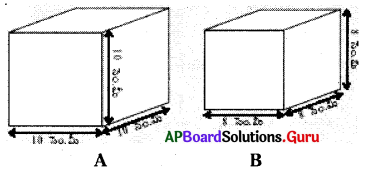
1. (i) సమ ఘనము ‘A’ యొక్క సంపూర్ణతల వైశాల్యం మరియు ‘B’ యొక్క ప్రక్కతల వైశాల్యము కనుగొనండి. (పేజీ నెం. 300)
AP Board 8th Class Maths Solutions Chapter 14 ఉపరితల వైశాల్యము మరియు ఘనపరిమాణం (ఘనము-దీర్ఘఘనము) InText Questions 3
సాధన.
a = 10 సెం.మీ.
పటం A యొక్క సంపూర్ణతల వైశాల్యము = 6a2
= 6 × (10)2
= 6 × 100 = 600 చ.సెం.మీ.
పటం B యొక్క ప్రక్కతల వైశాల్యము = 4a2
= 4 × (8)2 [∵ a = 8 సెం.మీ. ]
= 4 × 64 = 256 చ.సెం.మీ.

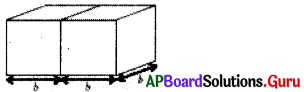
(ii) ‘b’ భుజముగా గల రెండు సమఘనములు పటములో చూపిన విధముగా జతచేయబడి దీర్ఘఘనమును ఏర్పరిస్తే, ఆ దీర్ఘఘనము యొక్క సంపూర్ణతల వైశాల్యము ఎంత ?
AP Board 8th Class Maths Solutions Chapter 14 ఉపరితల వైశాల్యము మరియు ఘనపరిమాణం (ఘనము-దీర్ఘఘనము) InText Questions 4
సాధన.
ప్రక్క దీర్ఘఘనం యొక్క సంపూర్ణతల వైశాల్యం = 2 (lb + bh + lh)
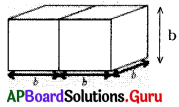
AP Board 8th Class Maths Solutions Chapter 14 ఉపరితల వైశాల్యము మరియు ఘనపరిమాణం (ఘనము-దీర్ఘఘనము) InText Questions 5
= 2(2b × b + b × b + 2b × b)
= 2(2b2 + b2 + 2b2)
= 2(5b2) = 10b2 చ.యూ.

AP Board 8th Class Maths Solutions Chapter 14 ఉపరితల వైశాల్యము మరియు ఘనపరిమాణం (ఘనము-దీర్ఘఘనము) InText Questions

(iii) సమాన భుజము పొడవు గల 12 సమఘనములు ఏ విధముగా జతచేయడము వలన అత్యల్ప సంపూర్ణతల వైశాల్యము కలిగిన దీర్ఘ ఘనము ఏర్పడుతుందో వివరింపుము.

AP Board 8th Class Maths Solutions Chapter 14 ఉపరితల వైశాల్యము మరియు ఘనపరిమాణం (ఘనము-దీర్ఘఘనము) InText Questions 6
సాధన.
12 సమఘనాలను ఒకదాని ప్రక్క ఒకటి లేదా ఒకదానిపై ఒకటి అమర్చుట ద్వారా అత్యల్ప సంపూర్ణతల వైశాల్యం సంభవించదు.
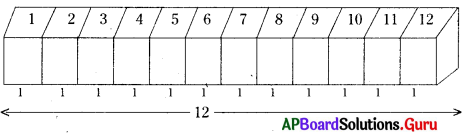
AP Board 8th Class Maths Solutions Chapter 14 ఉపరితల వైశాల్యము మరియు ఘనపరిమాణం (ఘనము-దీర్ఘఘనము) InText Questions 7
∴ A = 2(lb + bh + lh)
= 2(12 × 1 + 1 × 1 + 12 × 1)
= 2(12 + 1 + 12)
= 2 × 25 = 50 చ.యూ
కానీ, 3 సమఘనాలపై నాలుగు వరుసలుగా అమర్చుట ద్వారా అత్యల్ప సంపూర్ణతల వైశాల్యం పొందవచ్చు.
∴ A = 2(lb+ bh + lh)
= 2(3 × 1 + 1 × 4 + 3 × 4) (∵ l = 3; b = 1; h = 4)
= 2(3 + 4 + 12) = 2 × 19 = 38 చ.యూ.

(iv) 4 × 4 × 4 కొలతలు గల ఒక సమఘనము రంగు వేయబడినది. ఆ ఘనము 64 సమఘనములుగా విభజింప బడినది. అయితే
(a) ఒక ముఖము మాత్రమే రంగు వేయబడినది. ఘనములు ఎన్ని ?
(b) రెండు ముఖములు రంగు వేయబడిన ఘనములు ఎన్ని ?
(c) మూడు ముఖములు రంగు వేయబడిన ఘనములు ఎన్ని ?
(d) ఏ ముఖము కూడ రంగు వేయబడని ఘనములు ఎన్ని ?
సాధన.
4 × 4 × 4 సమఘనం 64 సమఘనాలుగా విభజింపబడిన ఒక్కొక్క
సమఘనం యొక్క భుజం పొడవు = 1 యూ.
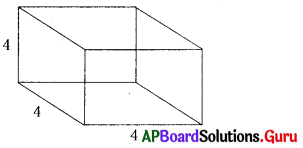
AP Board 8th Class Maths Solutions Chapter 14 ఉపరితల వైశాల్యము మరియు ఘనపరిమాణం (ఘనము-దీర్ఘఘనము) InText Questions 8
[∵ [latex]\frac{4 \times 4 \times 4}{64}[/latex] = 1]
(a) ఒక ముఖము మాత్రమే రంగు వేయబడిన (a = 4) సమఘనాల సంఖ్య = 6(a – 2)2 = 6(4 – 2)2 = 6 × 4 = 24
(b) రెండు ముఖాలు రంగు వేయబడిన సమఘనాల సంఖ్య = 12(a – 2) = 12(4 – 2) = 24
(c) మూడు ముఖాలు రంగు వేయబడిన సమఘనాల సంఖ్య 4 × a = 4 × 2 = 8
(d) ఏ ముఖం కూడా రంగు వేయబడని సమఘనాల సంఖ్య = (a – 2)3 = (4 – 2)3 = (2)3 = 8

AP Board 8th Class Maths Solutions Chapter 14 ఉపరితల వైశాల్యము మరియు ఘనపరిమాణం (ఘనము-దీర్ఘఘనము) InText Questions

ఆలోచించి, చర్చించి వ్రాయండి

1. దీర్ఘఘనం సంపూర్ణతల వైశాల్యము = ప్రకృతల వైశాల్యము + 2 × భూవైశాల్యము అని మీరు చెప్పగలరా ? (పేజీ నెం. 299)
AP Board 8th Class Maths Solutions Chapter 14 ఉపరితల వైశాల్యము మరియు ఘనపరిమాణం (ఘనము-దీర్ఘఘనము) InText Questions 9
సాధన.
దీర్ఘఘనం సంపూర్ణతల వైశాల్యం = ప్రక్కతల వైశాల్యం + 2 × భూవైశాల్యం
= 2h(l + b) + 2 × lb
= 2lh +2bh +2lb
= 2(lb + bh + lh)
∴ దీర్ఘఘనం సంపూర్ణతల వైశాల్యం = ప్రక్కతల వైశాల్యం + 2 × భూవైశాల్యం అని చెప్పగలం.

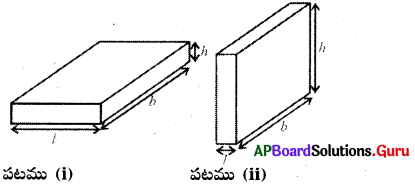
2. పటము (i)లో చూపిన దీర్ఘఘనము భంగిమను పటము (ii)లో లాగ మార్చిన వాటి ప్రక్కతల వైశాల్యాలు సమానంగా ఉంటాయా ?
సాధన.
దీర్ఘఘనం యొక్క భంగిమను ఏ విధంగా మార్చినా దాని ప్రక్కతల వైశాల్యములు సమానంగా ఉండవు.

AP Board 8th Class Maths Solutions Chapter 14 ఉపరితల వైశాల్యము మరియు ఘనపరిమాణం (ఘనము-దీర్ఘఘనము) InText Questions

3. పొడవు (i), వెడల్పు (b), ఎత్తు (h) ల కొలతలు సమానముగా గల దీర్ఘఘనపు పటమును గీచి దాని ప్రక్కతల వైశాల్యము మరియు సంపూర్ణతల వైశాల్యములకు సూత్రము రాబట్టుము.
సాధన.
దీర్ఘఘనం యొక్క ప్రక్కతల వైశాల్యం
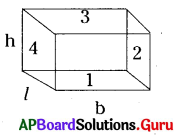
AP Board 8th Class Maths Solutions Chapter 14 ఉపరితల వైశాల్యము మరియు ఘనపరిమాణం (ఘనము-దీర్ఘఘనము) InText Questions 10
= 4 × ప్రక్కతల వైశాల్యము
= 2 (l × h) + 2 × (b × h) (1 + 2 + 3 + 4 తలాలు)
= 2h (l + b) చ.యూ. (1 = 3, 4 = 2)
దీర్ఘ ఘనం యొక్క సంపూర్ణతల వైశాల్యం = 4 × ప్రక్కతల వైశాల్యం + పైన, క్రింది తలాల వైశాల్యం
= 2h (l + b) + 2(lb)
= 2lh + 2bh + 2lb
= 2(lb + bh + lh) చ.యూ.
AP Board 8th Class Maths Solutions Chapter 14 ఉపరితల వైశాల్యము మరియు ఘనపరిమాణం (ఘనము-దీర్ఘఘనము) Ex 14.2

AP SCERT 8th Class Maths Textbook Solutions Chapter 14 ఉపరితల వైశాల్యము మరియు ఘనపరిమాణం Ex 14.2 Textbook Exercise Questions and Answers.

AP State Syllabus 8th Class Maths Solutions 14th Lesson ఉపరితల వైశాల్యము మరియు ఘనపరిమాణం Exercise 14.2

ప్రశ్న 1.
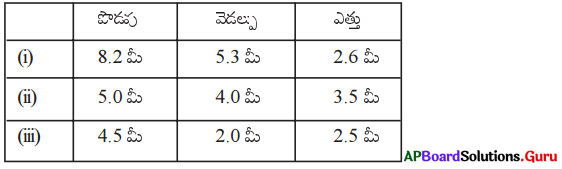
ఈ క్రింది కొలతలు కలిగిన దీర్ఘఘనము యొక్క ఘనపరిమాణమును కనుగొనుము.
AP Board 8th Class Maths Solutions Chapter 14 ఉపరితల వైశాల్యము మరియు ఘనపరిమాణం (ఘనము-దీర్ఘఘనము) Ex 14.2 1
సాధన.

పొడవు వెడల్పు ఎత్తు ఘనపరిమాణము (V) = lbh
1. 8.2 మీ 5.3 మీ 2.6 మీ V = 8.2 × 5.3 × 2.6 = 112.99 ఘ.మీ.
2. 5.0  మీ 4.0 మీ 3.5 మీ V = 5 × 4 × 3.5 = 70 ఘ.మీ.
3. 4.5  మీ 2.0  మీ 2.5 మీ V = 4.5 × 2 × 2.5 = 22.5 ఘ.మీ.

AP Board 8th Class Maths Solutions Chapter 14 ఉపరితల వైశాల్యము మరియు ఘనపరిమాణం (ఘనము-దీర్ఘఘనము) Ex 14.2

ప్రశ్న 2.
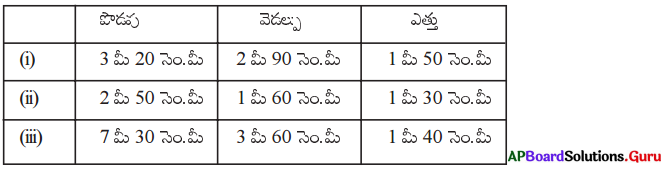
ఈ క్రింది కొలతలు కలిగిన బ్యాంకు యొక్క సామర్థ్యమును ఘనపు మీటర్లు మరియు లీటర్లలో కనుగొనుము.
AP Board 8th Class Maths Solutions Chapter 14 ఉపరితల వైశాల్యము మరియు ఘనపరిమాణం (ఘనము-దీర్ఘఘనము) Ex 14.2 2
సాధన.

పొడవు వెడల్పు ఎత్తు ఘనపరిమాణము (V) = lbh
1. 3 మీ 20 సెం.మీ. 2 మీ 90 సెం.మీ. 1 మీ 50 సెం.మీ. V = 3.20 × 2.90 × 1.50 = 13.92 ఘ.మీ. = 13.92 × 1000 = 13920 లీ
2. 2 మీ 50 సెం.మీ. 1 మీ 60 సెం.మీ. 1 మీ 30 సెం.మీ. V = 2.5 × 1.6 × 1.3  = 5.2 ఘ.మీ. = 5.2 × 1000 = 5200 లీ
3. 7  మీ 30 సెం.మీ. 3 మీ 60 సెం.మీ. 1 మీ 40 సెం.మీ. V = 7.3 × 3.6 × 1.4 = 36.792 ఘ.మీ. = 36.792 × 1000 = 36792 లీ

ప్రశ్న 3.
ఒక సమఘనము యొక్క భుజమును సగము చేస్తే దాని ఘనపరిమాణము తగ్గుతుందా ? మారినచో ఎంత తగ్గును?
సాధన.
సమఘనం యొక్క భుజం (s) = a యూ. అనుకొనుము సమఘనం యొక్క ఘన పరిమాణం
(V1) = (s)3 = a × a × a = a3
భుజాన్ని సగం చేయగా, 5 – 2
∴ సమఘనం యొక్క ఘనపరిమాణం
V2 = (s)3 = ([latex]\frac {a}{2}[/latex])3 = [latex]\frac {a3}{8}[/latex]
V2 = [latex]\frac {V}{8}[/latex] లీక V1 = 8V2
∴ సమఘనం యొక్క ముజాన్ని సగం చేయగా దాని ఘనపరిమాణం ఆసలు ఘనపరిమాణంలో [latex]\frac {1}{8}[/latex] వ వంతు తగ్గును.

AP Board 8th Class Maths Solutions Chapter 14 ఉపరితల వైశాల్యము మరియు ఘనపరిమాణం (ఘనము-దీర్ఘఘనము) Ex 14.2

ప్రశ్న 4.
ఈ క్రింది కొలతలు భుజంగా కలిగిన సమఘనముల యొక్క ఘనపరిమాణము కనుక్కోండి.
(i) 6.4 సెం.మీ. (ii) 1.3 మీ. (iii) 1.6 మీ.
సాధన.
సమఘన ఘనపరిమాణం (V) = a3

భుజం సమఘనం ఘనపరిమాణం (V) = a3
1. a = 6.4 సెం.మీ. V = (6.4)3; = 6.4 × 6.4 × 6.4 = 262.144 ఘ. సెం.మీ.
2. a = 1.3 సెం.మీ. V = (1.3)3; = 1.3 × 1.3 × 1.3 = 2.197 ఘ. మీ.
3. a = 1.6 సెం.మీ. V = (1.6)3; = 1.6 × 1.6 × 1.6 = 4.096 ఘ. మీ.

ప్రశ్న 5.
8 మీ. × 22.5 సెం.మీ. × 6 మీ. కొలతలుగా గల ఒక గోడను నిర్మించుటకు 25 సెం.మీ. × 11.25 సెం.మీ. × 6 సెం.మీ. కొలతలుగా గల ఇటుకలెన్ని అవసరము?
సాధన.
8 మీ. × 22.5 సెం.మీ. × 6 మీ కొలతలు గల గోడ ఘనపరిమాణం (V1) = l1 b1 h1
= 8మీ × 22.5 సెం.మీ. × 6 మీ
= 800 × 22.5 × 600 సెం.మీ.
25 సెం.మీ. × 11.25 సెం.మీ. × 6 సెం.మీ.లు కొలతలుగా గల ఇటుక ఘనపరిమాణం (V2) = l2 b2 h2
= 25 × 11.25 × 6
∴ కావలసిన ఇటుకల సంఖ్య
= [latex]\frac{\mathrm{V}_{1}}{\mathrm{~V}_{2}}=\frac{800^{32} \times 22.5^{2} \times 600^{100}}{25_{1} \times 11.25_{1} \times 6_{1}}[/latex]
= 32 × 2 × 100 = 6400

AP Board 8th Class Maths Solutions Chapter 14 ఉపరితల వైశాల్యము మరియు ఘనపరిమాణం (ఘనము-దీర్ఘఘనము) Ex 14.2

ప్రశ్న 6.
25 సెం.మీ. పొడవు, 16 సెం.మీ. వెడల్పు మరియు 8 సెం.మీ. ఎత్తు కొలతలుగా గల దీర్ఘమన ఘనపరిమాణము, ప్రతీ భుజము 16 సెం.మీ.గా గల సమఘనము ఘనపరిమాణముతో ఎంత తేడా కలదు?
సాధన.
l = 25 సెం.మీ., b = 15 సెం.మీ., h = 8 సెం.మీ.
∴ దీర్ఘఘనం యొక్క ఘనపరిమాణం (V1) = lbh
⇒ V1 = 25 × 15 × 8 = 3000 సెం.మీ.
సమఘనం యొక్క ఘనపరిమాణం (V2) = s3
⇒ V2 = (16)3 = 16 × 16 × 16 = 4096 ఘ. సెం.మీ.
∴ V2 – V1 = 4096 – 3000 = 1096 ఘ. సెం.మీ.
∴ సమఘనం, దీర్ఘఘనాల పరిమాణాల మధ్య తేడా 1096 ఘ. సెం.మీ. ఉండును.

ప్రశ్న 7.
1సెం.మీ. మందము కలిగిన చెక్కతో 5 సెం.మీ. × 4 సెం.మీ. × 7 సెం.మీ. కొలతలు కలిగిన మూతగల పెట్టెను తయారుచేయడానికి ఎంత ఘనపరిమాణము గల చెక్క అవసరము?
సాధన.
బయటి కొలతలు 5 సెం.మీ. × 4 సెం.మీ × 7 సెం.మీ
గల చెక్క పెట్టి ఘనపరిమాణం V1 = l × b × h
V1 = 5 × 4 × 7
V1 = 140 ఘ. సెం.మీ
లోపలి కొలతలు = l – 2w, b – 2w, h – 2w
= (5 – 2 × 1), (4 – 2 × 1), (7 – 2 × 1)
= (5 – 2), (4 – 2), (7 – 2)
= 3 సెం.మీ., 2 సెం.మీ., 5 సెం.మీ.
∴ 3 సెం.మీ., 2 సెం.మీ., 5 సెం.మీ.లతో ఏర్పడు చెక్క పెట్టె ఘనపరిమాణం
(V2) = (l – 2w) (b – 2w) (h – 2w)
= 3 × 2 × 5
= 30 ఘ, సెం.మీ.
∴ కావలసిన చెక్క పెట్టి తయారుచేయుటకు అవసరమగు చెక్క ఘనపరిమాణం
= V1 – V2 = 140 – 30 = 110 ఘ. సెం.మీ.

ప్రశ్న 8.
20 సెం.మీ. × 18 సెం.మీ. × 16 సెం.మీ. కొలతలుగా గల దీర్ఘఘనం నుండి 4 సెం.మీ. భుజంగా గల ఎన్ని సమఘనములను ఏర్పరచవచ్చు?
సాధన.
20 సెం.మీ. × 18 సెం.మీ. × 16 సెం.మీ.
కొలతలుగా గల దీర్ఘఘన ఘనపరిమాణం . V1 = lbh
∴ V1 = 20 × 18 × 16
4 సెం.మీ. భుజంగా గల సమఘన ఘనపరిమాణం
⇒ V2 = (s)3 = 4 × 4 × 4
∴ కావలసిన సమఘనాల సంఖ్య
= [latex]\frac{\mathrm{V}_{1}}{\mathrm{~V}_{2}}=\frac{26^{5} \times 18 \times 16}{A \times A \times A}[/latex] = 90

AP Board 8th Class Maths Solutions Chapter 14 ఉపరితల వైశాల్యము మరియు ఘనపరిమాణం (ఘనము-దీర్ఘఘనము) Ex 14.2

ప్రశ్న 9.
12 సెం.మీ. × 9 సెం.మీ. × 6 సెం.మీ. కొలతలుగా గల దీర్ఘఘనం నుండి 4 సెం.మీ. × 3 సెం.మీ. × 2 సెం.మీ. కొలతలుగా గల దీర్ఘఘనాలను ఎన్నింటిని తయారుచేయవచ్చు?
సాధన.
12 సెం.మీ. × 9 సెం.మీ. × 6 సెం.మీ. కొలతలుగా గల దీర్ఘఘన ఘనపరిమాణం
V1 = l1 × b1 × h1 = 12 × 9 × 6
4 సెం.మీ. × 3 సెం.మీ. × 2 సెం.మీ. కొలతలుగా గల దీర్ఘఘన ఘనపరిమాణం
V2 = l2 × b2 × h2 = 4 × 3 × 2
∴ కావలసిన సమఘనాల సంఖ్య
= [latex]\frac{V_{1}}{V_{2}}=\frac{12^{3} \times 9 \times 6}{A_{1} \times \beta^{\prime} \times 2}[/latex] = 27

ప్రశ్న 10.
దీర్ఘఘనాకృతిలో ఉన్న ఒక పాత్ర 30 సెం.మీ. పొడవు, 25 సెం.మీ. వెడల్పు కలిగియున్నది. దానిలో 4.5 లీటర్ల నీటిని నింపుటకు ఎంత ఎత్తును కలిగి ఉండాలి?
సాధన.
దీర్ఘఘనాకార పాత్ర పొడవు (l) = 30 సెం.మీ.
వెడల్పు (b) = 25 సెం.మీ.
ఎత్తు (h) = ?
దీర్ఘఘనాకార పాత్రలో నీటి పరిమాణం (ఘనపరిమాణం) = 4.5 లీటర్లు
= 4.5 x 1000 ఘ. సెం.మీ.
= 4500 ఘ. సెం.మీ.
∴ l × b × h = 45000
⇒ 30 × 25 × h = 4500
⇒ h = [latex]\frac {4500}{30 × 25}[/latex]
∴ h = 6 సెం.మీ

AP Board 8th Class Maths Solutions Chapter 14 ఉపరితల వైశాల్యము మరియు ఘనపరిమాణం (ఘనము-దీర్ఘఘనము) Ex 14.1

AP SCERT 8th Class Maths Textbook Solutions Chapter 14 ఉపరితల వైశాల్యము మరియు ఘనపరిమాణం (ఘనము-దీర్ఘఘనము) Ex 14.11 Textbook Exercise Questions and Answers.

AP State Syllabus 8th Class Maths Solutions 14th Lesson ఉపరితల వైశాల్యము మరియు ఘనపరిమాణం Exercise 14.1

ప్రశ్న 1.
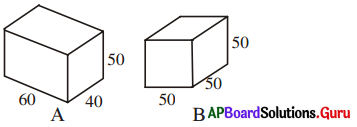
పటములో చూపిన విధముగా రెండు దీర్ఘఘనాకృతి పెట్టెలు ఇవ్వబడ్డాయి. ఏ పెట్టెను తయారు చేయడానికి తక్కువ పరిమాణపు సామాగ్రి అవసరమవుతుంది?
AP Board 8th Class Maths Solutions Chapter 14 ఉపరితల వైశాల్యము మరియు ఘనపరిమాణం (ఘనము-దీర్ఘఘనము) Ex 14.1 1
సాధన.
దీర్ఘఘనం యొక్క ఘనపరిమాణం
(V1) = lbh
= 60 × 40 × 50
V1 = 1,20,000 ష్మణమూ.
సమఘనం యొక్క ఘనపరిమాణం
V2 = (a)3
= (50)3 = 50 × 50 × 50
V2 = 1,25,000 ఘ.యూ.
∴ V1 < V2
∴ మొదటి దీర్ఘఘనాన్ని తయారుచేయుటకు తక్కువ పరిమాణపు సామాగ్రి అవసరం.

AP Board 8th Class Maths Solutions Chapter 14 ఉపరితల వైశాల్యము మరియు ఘనపరిమాణం (ఘనము-దీర్ఘఘనము) Ex 14.1

ప్రశ్న 2.
600 చ.సెం.మీ. సంపూర్ణతల వైశాల్యం గల సమఘనం యొక్క భుజం పొడవును కనుక్కోండి..
సాధన.
సమఘనం యొక్క సంపూర్ణతల వైశాల్యం = 6a2
⇒ 6a2 = 600
a2 = [latex]\frac {600}{6}[/latex] = 100
a2 = 100
a = [latex]\sqrt{100}[/latex] = 10
∴ సమఘనం యొక్క భుజం (a) = 10 సెం.మీ.

ప్రశ్న 3.
ప్రమీల 1 మీ. × 2 మీ. × 1.5 మీ. కొలతలు గల ఒక పెట్టెకు రంగు వేసింది. పెట్టె యొక్క పై ముఖము, అడుగు ముఖమును మినహాయించి మిగిలిన ముఖముల వైశాల్యముల మొత్తము ఎంత ?
సాధన.
దీర్ఘఘనము యొక్క పై మరియు అడుగు ముఖాలు కాకుండా మిగిలిన ముఖాల యొక్క మొత్తం వైశాల్యం దాని ప్రక్కతల వైశాల్యానికి సమానం అవుతుంది.
l = 1 మీ., b = 2 మీ., h = 1.5 మీ.
A= 2h (l + b)
= 2 × 1.5 (1 + 2)
= 3 × 3 = 9 ఘ.మీ.

AP Board 8th Class Maths Solutions Chapter 14 ఉపరితల వైశాల్యము మరియు ఘనపరిమాణం (ఘనము-దీర్ఘఘనము) Ex 14.1

ప్రశ్న 4.
20 సెం.మీ. × 15 సెం.మీ. × 12 సెం.మీ కొలతలుగా గల దీర్ఘఘనమునకు రంగు వేయుటకు చదరపు సెంటీ మీటరునకు 5 పైసలు చొప్పున ఎంత ఖర్చు అగును?
సాధన.
l = 20 సెం.మీ., b + 15 సెం.మీ., h = 12 సెం.మీ.
∴ దీర్ఘఘనం యొక్క సంపూర్ణతల వైశాల్యం
A = 2(lb+ bh + lh)
= 2(20 × 15 + 15 × 12+ 20 × 12)
= 2(300 + 180 + 240)
= 2 × 720
= 1440 చ, సెం.మీ.
1 సెం.మీ.నకు 5 పైసలు వంతున 1440 చ సెం.మీ,
దీర్ఘఘనానికి రంగు వేయుటకు అగు ఖర్చు
= 1440 × 5 పై
= 7200 పై
= రూ. = [latex]\frac {7200}{100}[/latex] = రూ. 72

AP Board 8th Class Maths Solutions Chapter 15 సంఖ్యలతో ఆడుకుందాం InText Questions

AP SCERT 8th Class Maths Textbook Solutions Chapter 15 సంఖ్యలతో ఆడుకుందాం InText Questions and Answers.

AP State Syllabus 8th Class Maths Solutions 15th Lesson సంఖ్యలతో ఆడుకుందాం InText Questions

ఇవి చేయండి

1. ఈ కింది సంఖ్యలలో దిగువ గీత గీయబడిన అంకెల యొక్క స్థాన విలువలు రాయండి. (పేజీ నెం. 312)
(i) 29879
(ii) 10344
(iii) 98725
సాధన.
(i) 29879
8 యొక్క స్థాన విలువ = 8 × 100 – 800
2 యొక్క స్థాన విలువ – 2 × 10,000 = 20,000
(ii) 10344
4 యొక్క స్థాన విలువ = 4 × 1 = 4
3 యొక్క స్థాన విలువ = 3 × 100 = 300
(iii) 98725
5 యొక్క స్థాన విలువ = 5 × 1 = 5
8 యొక్క స్థాన విలువ = 8 × 1000 = 8,000

AP Board 8th Class Maths Solutions Chapter 15 సంఖ్యలతో ఆడుకుందాం InText Questions

2. కింది సంఖ్యలను విస్తరణ రూపంలో వ్రాయండి. (పేజీ నెం. 313)
(i) 65
(ii) 74
(iii) 153
(iv) 612
సాధన.
సంఖ్య – విస్తరణ రూపం
(i) 65 = 60 + 5 = (6 × 101) + (5 × 100)
(ii) 74 = 70 + 4 = (7 × 101) + (4 × 100)
(iii) 153 = 100 + 500 + 3 = (1 × 10²) + (5 × 101) + (3 × 100)
(iv) 612 = 600 + 10 + 2 = (6 × 10²) + (1 × 101) + (2 × 100)

3. కింది సంఖ్యల విస్తరణ రూపాల్ని, సాధారణ రూపంలోకి మార్చండి. (పేజీ నెం. 313)
(i) 10 × 9 + 4
(ii) 100 × 7 + 10 × 4 + 3
సాధన.
విస్తరణ రూపం – సాధారణ రూపం
(i) 10 × 9 + 4 = 90 + 4 = 94
(ii) 100 × 7 + 10 × 4 + 3 = 700 + 400 + 3 = 743

4. కింది ఖాళీలు పూరించండి. (పేజీ నెం. 313)
సాధన.
(i) 100 × 3 + 10 × _______ + 7 = 357 (5)
(ii) 100 × 4 + 10 × 5 + 1 = _______ (451)
(iii) 100 × _______ + 10 × 3 + 7 = 737 (7)
(iv) 100 × _______ + 10 × q + r = [latex]\overline{\mathrm{pqr}}[/latex] (p)
(v) 100 × x + 10 × y + z = _________ ([latex]\overline{\mathrm{xyz}}[/latex])

AP Board 8th Class Maths Solutions Chapter 15 సంఖ్యలతో ఆడుకుందాం InText Questions

5. దిగువ 82తో ప్రారంభించి సహజసంఖ్యలను వెనుకకు 1 వరకు వ్రాయగా వచ్చు సంఖ్య ఇవ్వబడినది. మీకు ఇది తెలుసా? (పేజీ నెం. 313)
82818079787776757473727170696867666564636261605958575655545352515049484746454443424140393837363534333231302928272625242322212019181716151413
ఇందులో ఎన్ని అంకెలున్నాయి ? ఇంత పెద్దదయిన ఇది ప్రధాన సంఖ్యయో !
సాధన.
ఇందు అంకెల సంఖ్య 155

6. కింది సంఖ్యల యొక్క కారణాంకాలన్నింటిని వ్రాయండి. (పేజీ నెం. 314)
సాధన.
(a) 24 = 1, 2, 3, 4, 6, 8, 12,24
(b) 15 = 1, 3, 5, 15
(c) 21= 1, 3, 7, 21
(d) 27 = 1, 3, 9, 27
(e) 12= 1, 2, 3, 4, 6, 12
(f) 20 = 1, 2, 4, 5, 10, 20
(g) 18 = 1, 2, 3, 6, 9, 18
(h) 23 = 1, 23
(i) 36 = 1, 2, 3, 4, 6, 9, 12, 18, 36

7. కింది సంఖ్యల యొక్క మొదటి 5 గుణిజాలు వ్రాయండి. (పేజీ నెం. 314)
(a) 5
(b) 8
(c) 9
సాధన.
(a) 5 = 5, 10, 15, 20, 25
(b) 8 = 8, 16, 24, 32, 40
(c) 9 = 9, 18, 27, 36, 45

AP Board 8th Class Maths Solutions Chapter 15 సంఖ్యలతో ఆడుకుందాం InText Questions

8. కింది సంఖ్యలను ప్రధాన కారణాంకాల లబ్ధంగా వ్రాయండి. (పేజీ నెం. 314)
(a) 72
(b) 158
(c) 243
సాధన.
(a) 72 = 2 × 2 × 2 × 3 × 3
(b) 158 = 2 × 79
(c) 243 = 7 × 7 × 7

9. కింది సంఖ్యలు 10 తో నిశ్శేషముగా భాగింపబడునో, లేదో తెలపండి. (పేజీ నెం. 315)
(a) 3860
(b) 234
(c) 1200
(d) 103
(e) 10 + 280 + 20
సాధన.
(a) 3860, (c) 1200, (d) 103 = 1000, (e) 10 + 280 + 20 = 310ల నుండి (a), (c), (d), (e)లు 10చే నిశ్శేషంగా భాగింపబడును.
[∵ పై సంఖ్యలలో ఒకట్ల స్థానంలోని అంకె సున్న]
(b) 234, 10 చే భాగింపబడదు.
[∵ 234లో ఒకట్ల స్థానంలోని అంకె ‘0’ కాదు. కావున ఇది 10చే భాగింపబడదు. ]

10. కింది సంఖ్యలు 10 తో నిశ్శేషముగా భాగింపబడునో లేదో తెలపంది. (పేజీ నెం. 315)
(a) 1010
(b) 210
(c) 103 + 101
సాధన.
a) 1010 = 10000000000
b) 210 = 1024
c) 103 + 101 = 1000 + 10 = 1010
పై సంఖ్యలలో a, c లు 10 చే నిశ్శేషంగా భాగింపబడును.
b 10చే నిశ్శేషంగా భాగింపబడదు.
ఎందుకనగా 1024లో ఒకట్ల స్థానంలోని అంకె “సున్న” కాదు.

AP Board 8th Class Maths Solutions Chapter 15 సంఖ్యలతో ఆడుకుందాం InText Questions

11. కింది సంఖ్యలు 5 చే నిశ్శేషముగా భాగింపబడునో లేదో తెలపండి. (పేజీ నెం. 315)
(a) 205
(b) 4560
(c) 402
(d) 105
(e) 235785
సాధన.
ఒక సంఖ్య ‘5’చే నిశ్శేషంగా భాగింపబడవలెనన్న ఆ సంఖ్యలోని ఒకట్ల స్థానంలోని అంకె ‘0’ లేక ‘5’ అయి ఉండవలెను.
(a) 205 (d) 105 (e) 235785 సంఖ్యలలోని ఒకట్ల స్థానంలోని అంకె ‘5’ కావునా ఇవి ‘5’చే నిశ్శేషంగా భాగింపబడును.
(b) 4560 లో ఒకట్ల స్థానంలోని అంకె ‘O’ కావున ఇది (5’చే నిశ్శేషంగా భాగింపబడుతుంది.
(c) 402 యొక్క ఒకట్ల స్థానంలోని అంకె ‘2’ కావున ఇది ‘5’చే భాగింపబడదు.

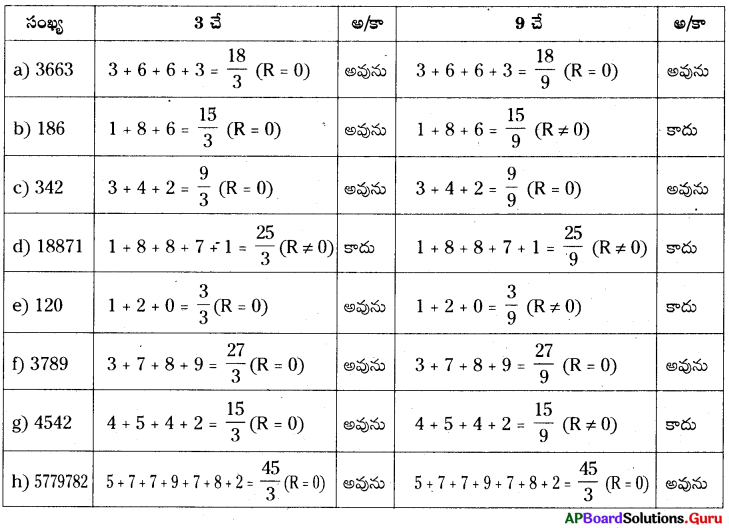
12. కింది సంఖ్యలు 3 లేక 9 లేక రెండింటితోను నిశ్శేషముగా భాగింపబడునో, లేదో భాజనీయతా నియమముల ఆధారంగా తెలపండి. (పేజీ నెం. 318)
(a) 3663
(b) 186
(c) 342
(d) 18871
(e) 120
(f) 3789
(g) 4542
(h) 5779782
సాధన.
AP Board 8th Class Maths Solutions Chapter 15 సంఖ్యలతో ఆడుకుందాం InText Questions 1

AP Board 8th Class Maths Solutions Chapter 15 సంఖ్యలతో ఆడుకుందాం InText Questions

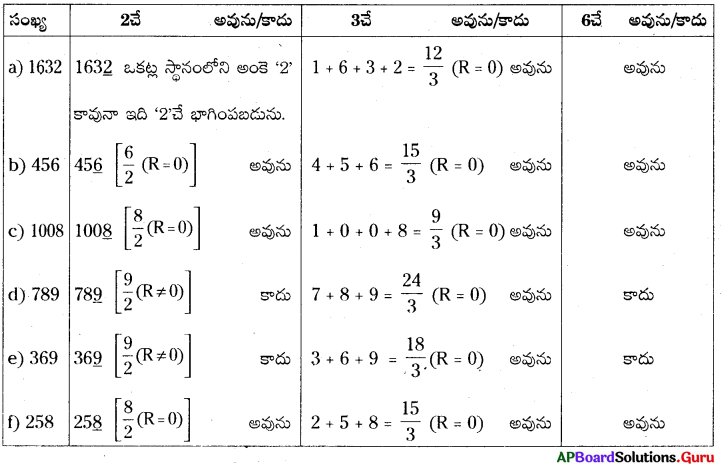
13. కింది సంఖ్యలు ‘6’ తో నిశ్శేషముగా భాగింపబడునో లేదో తెలపండి.
(a) 1632
(b) 456
(c) 1008
(d) 789
(e) 369
(f) 258
సాధన.
AP Board 8th Class Maths Solutions Chapter 15 సంఖ్యలతో ఆడుకుందాం InText Questions 2

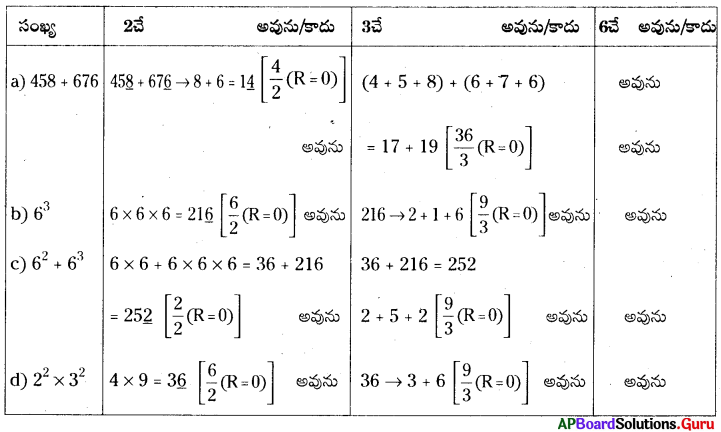
14. కింది సంఖ్యలు ‘6’చే నిశ్శేషముగా భాగింపబడునో, లేదో తెలపండి.
(a) 458 + 676
(b) 63
(c) 62 + 63
(d) 22 × 32
సాధన.
AP Board 8th Class Maths Solutions Chapter 15 సంఖ్యలతో ఆడుకుందాం InText Questions 3

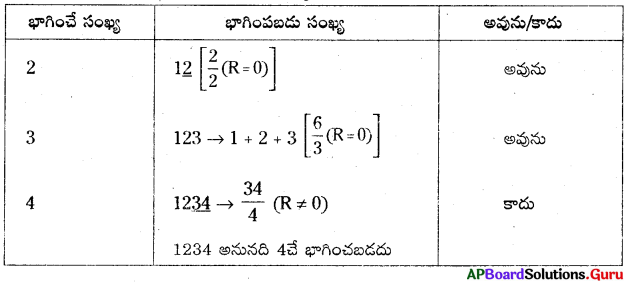
15. 1, 2, 3, 4, 5, 6, 7, 8, 9 అంకెలతో, మొదటి రెండంకెలతో ఏర్పడు సంఖ్య 2చే భాగించబడునట్లు, మొదటి మూడంకెలచే ఏర్పడు సంఖ్య 3చే భాగించబడునట్లు, మొదటి నాలుగంకెలచే ఏర్పడు సంఖ్య 4చే భాగించబడునట్లు మరియు ఇదే క్రమము 9 అంకెల వరకు కొనసాగించగలుగు సంఖ్యను తయారుచేయగలదా? సాధన. 123654987 క్రమపు సంఖ్య సమస్యకు సాధనగా కనిపిస్తుంది. పరీక్షించి సరిచూడండి.
సాధన.
AP Board 8th Class Maths Solutions Chapter 15 సంఖ్యలతో ఆడుకుందాం InText Questions 4
కావున ఈ సంఖ్యను 9 వరకు కొనసాగించలేము.
→ 123654987
2 : 12 → [latex]\frac {2}{2}[/latex](R = 0) 2 చే భాగింపబడును.
3 : 123 → 1 + 2 + 3 → [latex]\frac {6}{3}[/latex](R = 0) అవును
4 : 1236 → [latex]\frac {36}{4}[/latex](R = 0) అవును
5 : 12365 → [latex]\frac {5}{5}[/latex](R = 0) అవును
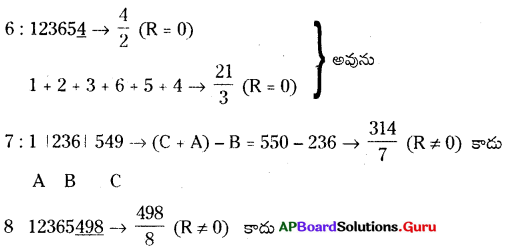
AP Board 8th Class Maths Solutions Chapter 15 సంఖ్యలతో ఆడుకుందాం InText Questions 5
9 123654987 → 1 + 2 + 3 + 6 + 5 + 4 + 9 + 8 + 7 → [latex]\frac {45}{9}[/latex](R = 0) అవును
∴ 123654987 క్రమపు సంఖ్యలోని మొదటి రెండంకెలు 2తోను, మొదటి మూడంకెలు 3తోను. ఈ విధంగా చివరి
వరకు అన్ని సందర్భాలలో భాగింపబడుట లేదు.

AP Board 8th Class Maths Solutions Chapter 15 సంఖ్యలతో ఆడుకుందాం InText Questions

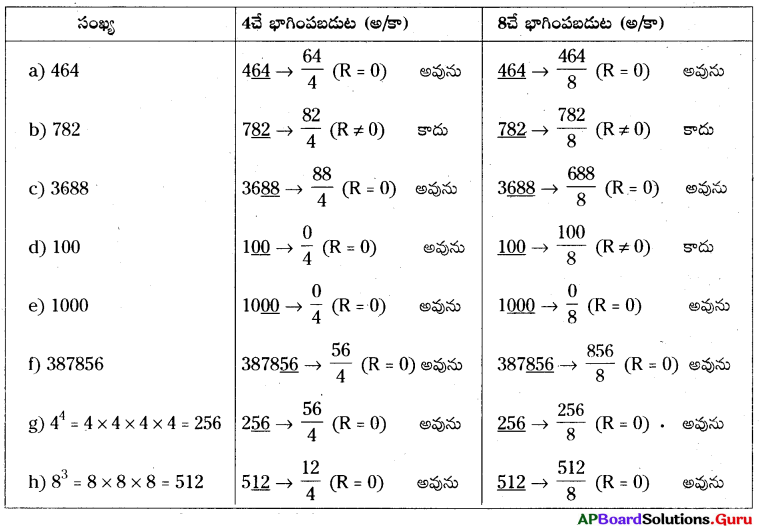
16. కింది సంఖ్యలు 4 లేక 8 లేక రెండింటితోను భాగింపబడునో, లేదో భాజనీయతా నియమం ప్రకారం తెలపండి.
(a) 464 (b) 782 (c) 3688 (d) 100 (e) 1000 (f) 387856 (g) 44 (h) 83 (పేజీ నెం. 321)
సాధన.
ఒక సంఖ్య 4చే భాగింపబడవలెనన్న ఆ సంఖ్యలోని చివరి రెండంకెలు ‘4’చే నిశ్శేషంగా భాగింపబడవలెను.
ఒక సంఖ్య ‘8’చే భాగింపబడవలెనన్న ఆ సంఖ్యలోని చివరి మూడంకెలు ‘8’చే నిశ్శేషంగా భాగింపబడవలెను.
AP Board 8th Class Maths Solutions Chapter 15 సంఖ్యలతో ఆడుకుందాం InText Questions 6

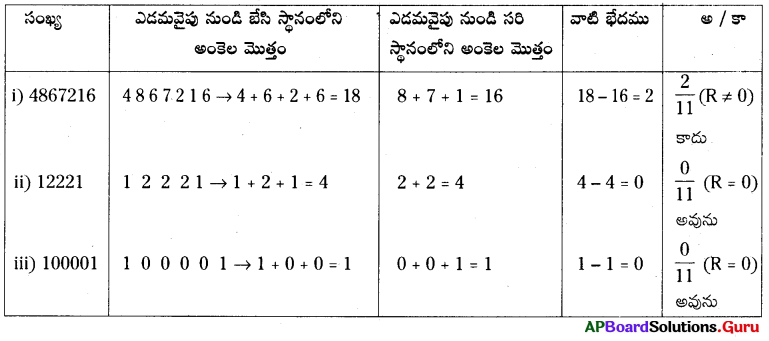
17. కింది సంఖ్యలు, 11చే భాగింపబడునో లేదో భాజనీయతా నియమము ద్వారా కనుక్కోండి. (పేజీ నెం. 323)
(i) 4867216 (ii) 12221 (iii) 100001
సాధన.
ఒక సంఖ్య ’11’చే భాగింపబడవలెనన్న “ఆ సంఖ్య యొక్క సరి స్థానాలలోని అంకెల మొత్తం మరియు బేసి స్థానాలలోని అంకెల మొత్తాల భేదం 11 యొక్క గుణిజం లేదా ‘0’ అయి ఉండవలెను.
AP Board 8th Class Maths Solutions Chapter 15 సంఖ్యలతో ఆడుకుందాం InText Questions 7

18. వివిధ సంఖ్యల జతలు తీసుకుని వాటికి పై నాలుగు నియమములు సరి చూడండి. (పేజీ నెం. 325)
సాధన.
(a) ‘a’ అను సంఖ్య ‘b’ చే భాగింపబడిన అది ‘b’ యొక్క అన్ని కారణాంకములచే భాగింపబడును.
ఉదా : 36 యొక్క కారణాంకం 18
18 యొక్క కారణాంకాలు = 1, 2, 3, 6, 9, 18
కావున 36, 18 యొక్క అన్ని కారణాంకాలచే భాగింపబడును.
(b) ‘a’, ‘b’ లు పరస్పర ప్రధానసంఖ్యలైనపుడు a మరియు b చే భాగించబడు సంఖ్య a × b తో కూడా భాగింపబడును.
ఉదా : 60 ఒక సంఖ్య. ఇది 3, 4 లచే భాగింపబడును. మరియు 3 × 4 = 12 చే కూడా 60 భాగింపబడును.
(c) “రెండు సంఖ్యలు, వేరువేరుగా మూడవ సంఖ్యతో భాగింపబడుచున్నచో, వాటి మొత్తం కూడా మూడవ సంఖ్యతో భాగింపబడును. ఉదా : ఏవైనా రెండు సంఖ్యలు 18, 9లు తీసుకొందాం. 18, 9 లు 3చే భాగింపబడును. నాటి మొత్తము 18 + 9 = 27 కూడా ‘3’ చే భాగింపబడును.
(d) “రెండు సంఖ్యలు, వేరువేరుగా మూడవ సంఖ్యతో భాగింపబడినట్లయితే, వాటి భేదం కూడా మూడవ సంఖ్యచే భాగింపబడును”.
ఉదా : 25, 30 లు ఏవేని రెండు సంఖ్యలు అనుకొనుము. ఇవి ‘5’ చే భాగింపబడును. వాటి భేదం 30 – 25 = 5 కూడా ‘5’ చే భాగింపబడును.

AP Board 8th Class Maths Solutions Chapter 15 సంఖ్యలతో ఆడుకుందాం InText Questions

19. 144, 12 చే భాగించబడును. 144, 12 యొక్క అన్ని కారణాంకములచే భాగింపబడునో, లేదో పరిశీలించండి. (పేజీ నెం. 325)
సాధన.
12 యొక్క కారణాంకాలు = 1, 2, 3, 4, 6, 12
∴ 144, 12 యొక్క అన్ని కారణాంకాలచే భాగింపబడును.

20. 23 + 24 + 25, 2తో భాగింపబడునో లేదో తెలపండి. వివరించండి. (పేజీ నెం. 325)
సాధన.
23 + 24 + 25 = 8 + 16 + 32 = 56. ఒక సరి సంఖ్య కావునా ఇది ‘2 చే భాగింపబడును.

21. 33 – 32, 3 తో భాగింపబడునో లేదో తెలపండి. వివరించండి. (పేజీ నెం. 325)
సాధన.
33 – 32 = 27 – 9 = 18 → 1 + 8 = → [latex]\frac {9}{3}[/latex] (R = 0) కావున ఇది ‘3’చే భాగింపబడును.

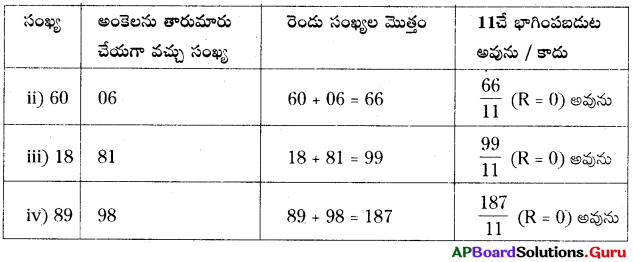
22. రాజు తలచుకున్న సంఖ్యకు బదులుగా కింది సంఖ్యలు తీసుకుని ఫలితమును సరి చూడండి.. (పేజీ నెం. 328)
(i) 37 (ii) 60 (iii) 18 (iv) 89
సాధన.
(i) 37 సంఖ్యలోని అంకెలను తారుమారు చేయగా వచ్చు సంఖ్య = 73
∴ 37 + 73 → [latex]\frac {110}{11}[/latex] (R = 0) కావున ఇది ’11’చే భాగింపబడుతుంది.
AP Board 8th Class Maths Solutions Chapter 15 సంఖ్యలతో ఆడుకుందాం InText Questions 8

23. ఒక క్రికెట్ టీమ్ నందు 11 మంది ఆటగాళ్ళు కలరు. క్రికెట్ బోర్డు వారికి 10x + y టీ షర్ట్స్ కొనుగోలు చేసింది. తిరిగి బోర్డ్ 10y + x టీ షర్ట్స్ కొనుగోలు చేసింది. మొత్తం టీ షర్ట్స్ అందరికీ సమంగా పంచితే, ఎన్ని టీ షర్ట్స్ మిగులుతాయి? ఒక్కొక్కరికి ఎన్ని టీ షర్ట్స్ వస్తాయి? (పేజీ నెం. 328)
సాధన.
టీమ్ నందు గల ఆటగాళ్ళ సంఖ్య = 11
మొదట కొనుగోలు చేసిన టీ షర్ట్స్ సంఖ్య = 10x + y
రెండవసారి కొనుగోలు చేసిన టీ షర్ట్స్ సంఖ్య = 10y + x
∴ మొత్తం టీ షర్ట్స్ సంఖ్య = (10x + y) + (10y + x)
= 11x + 11y
∴ 11x + 11y = 11(x + y) టీ షర్టులను 11 మందికి సమంగా పంచగా ఒక్కొక్కరికి లభించు టీషర్ట్స్
= [latex]\frac{11(x+y)}{11}[/latex] = (x + y)
∴ మిగిలిన టీ షర్టుల సంఖ్య = కొనుగోలు చేసిన టీషర్ట్స్ సంఖ్య – 11 × (ఒక్కొక్కరికి లభించు టీషర్ట్స్ సంఖ్య)
= 11 (x + y) – 11 (x + y) = 0

AP Board 8th Class Maths Solutions Chapter 15 సంఖ్యలతో ఆడుకుందాం InText Questions

24. ఒక బుట్టలో 10a + b (a ≠ 0 మరియు a > b) పండ్లు కలవు. అందు 10b + a పండ్లు కుళ్ళినవి. మిగిలిన పండ్లను 9మందికి సమానంగా పంచగలమా ? ఒక్కొక్కరికి ఎన్ని పండ్లు వస్తాయి? (పేజీ నెం. 328)
సాధన.
ఒక బుట్టలో గల పండ్ల సంఖ్య = 10a + b
ఆ బుట్టలో కుళ్ళిన పండ్ల సంఖ్య = 10b + a
ఆ బుట్టలో మిగిలిన మంచి పండ్ల సంఖ్య = (10a + b) – (10b + a)
= 10a + b – 10b – a
= 9a – 9b = 9(a – b)
∴ 9(a – b) పండ్లను 9 మందికి సమానంగా పంచగలము.
∴ 9(a – b) పండ్లను 9 మందికి సమానంగా పంచగా ఒక్కొక్కరికి వచ్చు పండ్ల సంఖ్య = 9(a – b) + 9 = (a – b)

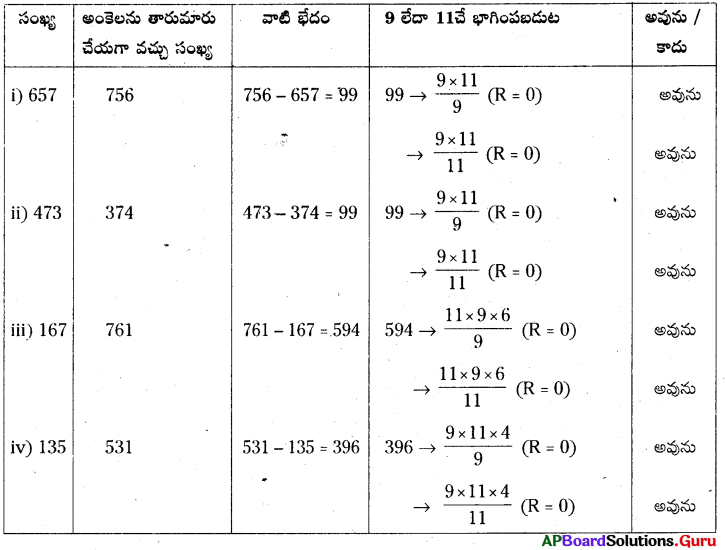
25. పై పజిల్ నందు కింది అంకెలు తీసుకుని పరిశీలించండి. (పేజీ నెం. 329)
(i) 657 (ii) 473 (iii) 167 (iv) 135
సాధన.
AP Board 8th Class Maths Solutions Chapter 15 సంఖ్యలతో ఆడుకుందాం InText Questions 9

26. 21358AB, 99 తో భాగింపబడిన A, B విలువలు కనుక్కోండి. (పేజీ నెం. 331)
సాధన.
21358AB, 99 చే భాగింపబడవలెనన్న అది ‘9’చే మరియు ’11’చే భాగింపబడవలెను.
21358AB, 9చే భాగింపబడవలెనన్న ఆ సంఖ్యలోని అంకెల మొత్తం 9చే భాగింపబడవలెను.
∴ 2 + 1 + 3 + 5 + 8 + A + B = (9 × 3) = 27 అనుకొనుము.
A + B = 27 – 19 = 8 ⇒ A + B = 8 ………………. (1)
21358AB, ’11’ చే భాగింపబడవలెనన్న ఆ సంఖ్యలోని బేసి స్థానాలలోని అంకెల మొత్తం నుండి సరి స్థానాలలోని అంకెల మొత్తాన్ని తీసివేయగా వచ్చిన దానిని ’11’ నిశ్శేషంగా భాగించవలెను.
2 1 3 5 8 A B
⇒ (2 + 3 + 8 + B) – (1 + 5 + A) = 11 × 1 అనుకొనుము.
⇒ 13 + B – 6 – A = 11
⇒ B – A = 11 – 7 = 4 ………………. (2)
(1), (2) ల నుండి A = 2, B = 6
∴ 21358AB = 2135826, 99 చే నిశ్శేషంగా భాగింపబడును.

AP Board 8th Class Maths Solutions Chapter 15 సంఖ్యలతో ఆడుకుందాం InText Questions

27. 4AB8, వరుసగా 2, 3, 4, 6, 8, 9 లచే భాగింపబడిన A, B విలువలు కనుగొనుము. (పేజీ నెం. 331)
సాధన.
ఇచ్చిన సంఖ్య 4AE → [latex]\frac {8}{2}[/latex] (R = 0) కావున ఇది ‘2’ చే భాగింపబడుతుంది.
4AB8 → ‘3’చే భాగింపబడవలెనన్న సంఖ్యలోని అంకెల మొత్తం 3 యొక్క గుణిజం కావలెను.
∴ 4 + A + B + 8 = 3 లేదా 6 లేదా 9/12/15/18
∴ A + B + 12 = 3/6/9/12/15/18 ………………. (1)
4AB8 → [latex]\frac {B8}{4}[/latex] ⇒ B = 2, 4, 6, 8 కావలెను …………………………. (2)
4AB8 → [latex]\frac {AB8}{8}[/latex] ⇒ AB = 12, 16, 24, 28, 32, 36, …….
4ABB8 → ‘9’చే భాగింపబడవలెనన్న ఆ సంఖ్యలోని అంకెల మొత్తం 9 యొక్క గుణిజం కావలెను.
∴ 4 + A + B + 8 = 9, 18, 27 ……
A + B + 12 = 9, 18, 27, ……. ………………….(3)
(1), (3) ల నుండి A + B + 12 = 9 లేదా 18 తీసుకోనగా
A + B + 12 = 9 అయిన A + B = – 3
∴ ఇది సరైనది కాదు
A + B + 12 = 18 అయిన
⇒ A + B = 18 – 12 = 6
∴ A + B = 6
A = 4, B = 2 అయిన
4AB8 = 4428
→ [latex]\frac {428}{8}[/latex](R ≠ 0)
∴ A = 2, B = 4
(లేదా)
A = 2, B = 4 అయిన
4AB8 = 4248
→ [latex]\frac {248}{8}[/latex] (R = 0)

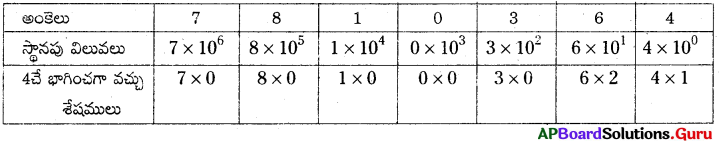
28. పై పద్ధతి ఉపయోగించి, 7810364 సంఖ్య, 4చే భాగింపబడుతుందో, లేదో పరిశీలించండి. (పేజీ నెం. 333)
సాధన.
ఇచ్చిన సంఖ్య = 7810364
AP Board 8th Class Maths Solutions Chapter 15 సంఖ్యలతో ఆడుకుందాం InText Questions 10
స్థానవిలువల శేషములను, ఆ సంఖ్య అంకెలతో గుణించగా వచ్చు లబ్దాల మొత్తం = 0 + 0 + 0 + 0 + () + 12 + 4
→ [latex]\frac {16}{4}[/latex](R = 0)
∴ 7810364, 4 చే భాగింపబడును.

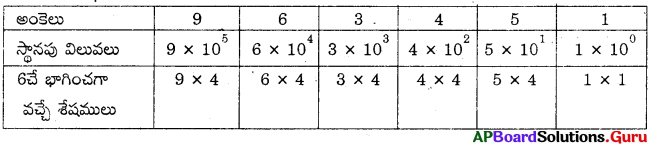
29. పై పద్ధతి ఉపయోగించి 963451, 6తో భాగింపబడుతుందో, లేదో పరిశీలించండి. (పేజీ నెం. 333)
సాధన.
ఇచ్చిన సంఖ్య = 963451
AP Board 8th Class Maths Solutions Chapter 15 సంఖ్యలతో ఆడుకుందాం InText Questions 11
స్థాన విలువల శేషములను, ఆ సంఖ్య అంకెలతో గుణించగా వచ్చు లబ్దాల మొత్తం
= 36 + 24 + 12 + 16 + 20 + 1 → [latex]\frac {109}{6}[/latex] (R ≠ 0)
∴ 963451. 6 చే భాగింపబడదు.

AP Board 8th Class Maths Solutions Chapter 15 సంఖ్యలతో ఆడుకుందాం InText Questions

ప్రయత్నించండి

ప్రశ్న 1.
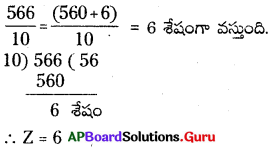
56Z అను సంఖ్య 10 తో భాగించిన వచ్చు శేషము 6. అయితే Z యొక్క విలువ కనుక్కోండి. (పేజీ నెం. 315)
సాధన.
56Z అను సంఖ్యలో Z = 0, 1, 2, 3, 4, …….. 9 గా తీసుకొనవలెను.
10చే భాగించగా శేషం ‘6’ రావలెనన్న Z = 6 ను తీసుకొనగా
AP Board 8th Class Maths Solutions Chapter 15 సంఖ్యలతో ఆడుకుందాం InText Questions 11.1

ప్రశ్న 2.
4B ను 5 తో భాగించిన ‘1’ శేషము వచ్చును. అయిన Bకు ఏయే విలువలు ఉండవచ్చును ? (పేజీ నెం. 316)
సాధన.
4B ను 5చే భాగించగా శేషం ‘1’ రావలెనన్న B = {0, 1, 2, 3, …….. 9} నుండి అనగా 40, 41, 42, 43, 44, 45, 46, ……, 49ల నుండి 41, 46 ను తీసుకొనిన ఇవి ‘5’చే భాగించగా శేషం ‘1’ని ఇస్తాయి. ∴ B = {1, 6}

AP Board 8th Class Maths Solutions Chapter 15 సంఖ్యలతో ఆడుకుందాం InText Questions

ప్రశ్న 3.
76C ను 5 తో భాగించిన ‘2’ శేషము వచ్చును. అయిన Cకు ఏయే విలువలు ఉండవచ్చును ? (పేజీ నెం. 316)
సాధన.
76C ను 5 చే భాగించగా శేషం ‘2’ వచ్చుటకు C = {0, 1, ……. 9} నుండి C = 2, 7 గా తీసుకొనిన 762, 767 లు 5చే భాగించిన శేషం ‘2’ను ఇస్తాయి. ∴ C = {2,7}

ప్రశ్న 4.
“ఒక సంఖ్య 10 తో నిశ్శేషముగా భాగింపబడిన, 5తో కూడా నిశ్శేషముగా భాగింపబడుతుంది” ఈ వాక్యము సత్యమో/ అసత్యమో తెలపండి.
దానికి తగు కారణము తెలపండి. (పేజీ నెం. 316)
సాధన.
ఇచ్చిన వాక్యం సత్యం. ఎందుకంటే ఒక సంఖ్య ’10’చే నిశ్శేషంగా భాగింపబడవలెనన్న దాని ఒకట్ల స్థానంలోని అంకె ‘0’ (సున్న) అయి ఉండవలెను.

అదేవిధంగా ఒక సంఖ్య ‘5’చే భాగింపబడవలెనన్న ఆ సంఖ్య యొక్క ఒకట్ల స్థానంలో 0 లేదా 5 ఉండాలి.
∴ 10చే భాగింపబడే ప్రతి సంఖ్య, 5చే కూడా భాగింపబడుతుంది.

ప్రశ్న 5.
“ఒక సంఖ్య 5తో నిశ్శేషముగా భాగింపబడిన, 10తో కూడా నిశ్శేషముగా భాగింపబడుతుంది” ఈ వాక్యము సత్యమో/ – అసత్యమో తెలపండి. దానికి తగు కారణము తెలపండి. (పేజీ నెం. 316)
సాధన.
ఇచ్చిన వాక్యం అసత్యం. ఎందుకంటే ఒక సంఖ్య 5 చే భాగింపబడవలెనన్న దాని ఒకట్ల స్థానంలోని అంకె ‘0’ (సున్న) గాని, 5 గాని ఉండవలెను. కాని 10చే భాగింపబడవలెనన్న దాని ఒకట్ల స్థానంలోని అంకే ‘0’ (సున్న) మాత్రమే అయి ఉండవలెను.
∴ 5 చే భాగింపబడే ప్రతి సంఖ్య 10 చే భాగింపబడదు.

AP Board 8th Class Maths Solutions Chapter 15 సంఖ్యలతో ఆడుకుందాం InText Questions

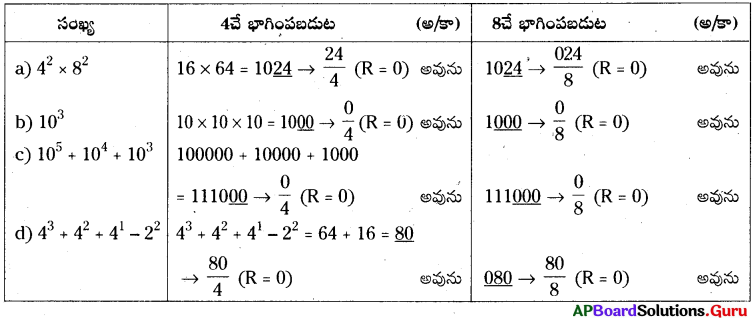
6. కింది సంఖ్యలు 4 లేక 8 లేక రెండింటితోను భాగింపబడునో లేదో తెలపండి. (పేజీ నెం. 321)
(a) 42 × 82
(b) 103
(c) 105 + 104 + 103
(d) 43 + 42 + 41 – 22
సాధన.
AP Board 8th Class Maths Solutions Chapter 15 సంఖ్యలతో ఆడుకుందాం InText Questions 12

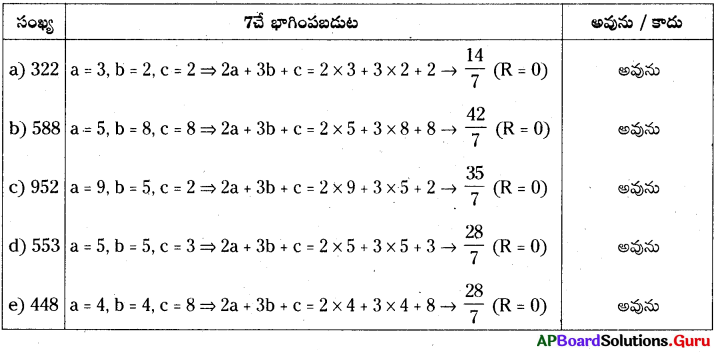
7. కింది సంఖ్యలు 7చే భాగించబడుతాయా ? పరీక్షించండి. (పేజీ నెం. 322)
(a) 322 (b) 588 (c) 952 (d) 553 (e) 448
సూచన : ఒక మూడంకెల సంఖ్య ‘7’ చే భాగింపబడవలెనన్న (2a + 3b + C) ‘7’ చే భాగింపబడవలెను.
సాధన.
AP Board 8th Class Maths Solutions Chapter 15 సంఖ్యలతో ఆడుకుందాం InText Questions 13
∴ పై సంఖ్యలన్నియూ ‘7’చే నిశ్శేషంగా భాగింపబడును.

AP Board 8th Class Maths Solutions Chapter 15 సంఖ్యలతో ఆడుకుందాం InText Questions

8. నాలుగంకెల సంఖ్యను సాధారణ రూపంలో తీసుకొని ‘7తో భాజనీయతా నియమాన్ని తయారుచేయండి. (పేజీ నెం. 322)
సాధన.
నాలుగంకెల సంఖ్య abcd అనుకొనుము.
AP Board 8th Class Maths Solutions Chapter 15 సంఖ్యలతో ఆడుకుందాం InText Questions 14
∴ ఒక నాలుగు అంకెల సంఖ్య ‘7’చే భాగింపబడవలెనన్న, (6a + 2b + 3c + d) అనేది ‘7’ చే భాగింపబడవలెను.

9. 3192, 7 యొక్క గుణకము “నీ నియమముతో” సరిచూడండి. (పేజీ నెం. 322)
సాధన.
ఇచ్చిన సంఖ్య → 3192 ⇒ a = 3, b = 1, c = 9, d = 2
6a + 2b + 3c + d = 6 × 3 + 2 × 1 + 3 × 9 + 2
= 18 + 2 + 27 + 2 = 49 → [latex]\frac {49}{7}[/latex] (R= 0)
∴ 3192 నా నియమం ప్రకారం ‘7’చే భాగింపబడును.

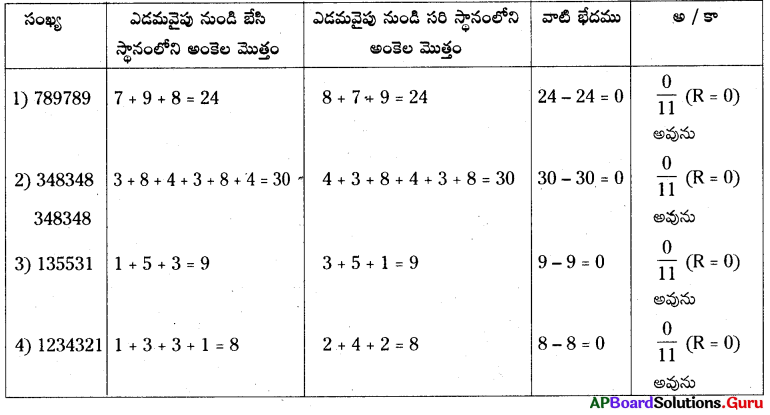
10. (1) 789789, 11చే భాగింపబడునో, లేదో పరిశీలించండి. (పేజీ నెం. 323)
(2) 348348348348, 11చే భాగింపబడునో, లేదో పరిశీలించండి.
(3) 135531 ఒక సరి పాలిండ్రోమ్ సంఖ్య. ఈ సంఖ్య 11చే భాగింపబడునో, లేదో తెలపండి.
(4) 1234321, 11చే భాగింపబడుతుందో, లేదో తెలపండి.
సాధన.
AP Board 8th Class Maths Solutions Chapter 15 సంఖ్యలతో ఆడుకుందాం InText Questions 15

11. 1576 × 1577 × 1578 తో ఏర్పడు సంఖ్య 3తో భాగింపబడునో, లేదో కారణముతో తెలపండి. (పేజీ నెం. 325)
సాధన.
ఇచ్చిన సంఖ్య = 1576 × 1577 × 1578
ఏ మూడు వరుస సంఖ్యల లబ్దమైనా ‘3’చే భాగింపబడుతుంది.
ఉదా : 4 × 5 × 6 = 120 → [latex]\frac {120}{3}[/latex] (R = 0)
∴ 1576 × 1577 × 1578 లు మూడు వరుస సంఖ్యలు కావున వాని లబ్ధం ‘3’చే భాగింపబడుతుంది.

AP Board 8th Class Maths Solutions Chapter 15 సంఖ్యలతో ఆడుకుందాం InText Questions

12. పై పద్ధతి ద్వారా, 10 అంకెలు కల పెద్ద సంఖ్యను వ్రాసి 11 యొక్క భాజనీయతా సూత్రము సరిచూడండి. (పేజీ నెం. 326)
సాధన.
10 అంకెల పెద్ద సంఖ్య = 9,99,99,99,999
D C B A
∴ 9 / 999 / 999 / 999
⇒ B + D = 9 + 999 = 1008
A + C = 999 + 999 = 1998
∴ (A + C) – (B + D) = 990 → [latex]\frac {990}{11}[/latex] (R = 0)
∴ ఈ భాజనీయతా సూత్రము ద్వారా “10 అంకెల పెద్ద సంఖ్య ’11’చే నిశ్శేషంగా భాగింపబడుతుంది” అని నిరూపించగలం.

13. ఒక మూడు అంకెల సంఖ్యను తీసుకుని, దాని యొక్క అంకెల అమరిక మార్చుతూ (ABC, BCA, CAB అగునట్లు) మూడు సంఖ్యలను తయారుచేయండి. ఆ మూడు సంఖ్యలను కలిపి, వచ్చు ఫలితము ఏయే సంఖ్యలతో భాగింపబడునో పరిశీలించండి. (పేజీ నెం. 329)
సాధన.
AP Board 8th Class Maths Solutions Chapter 15 సంఖ్యలతో ఆడుకుందాం InText Questions 16

14. YE × ME = TTT అయిన Y + E + M + T ల మొత్తం కనుగొనుము. (పేజీ నెం. 332)
(సూచన : TTT = 100T + 10T + T = T(111) = T(37 × 3))
సాధన.
TTT = 100T + 10 T + T
= T(111) = T(37 × 3)
∴ YE × ME = T(37 × 3)
∴ T = {1, 2, 3, ….. 9}
కాని T = {3, 6, 9} అనునవి 3 యొక్క గుణిజాలు

∴ T(37 × 3) = 3(111), 6(111), 9(111) 3 భాగించబడును.
∴ YE × ME = 333 / 666 / 999
∴ YE × ME = 999 = 27 × 37
∴ Y = 2, M = 3, E = 7, T = 3
∴ Y + E + M + T = 2 + 7 + 3 + 3 = 15

AP Board 8th Class Maths Solutions Chapter 15 సంఖ్యలతో ఆడుకుందాం InText Questions

15. 88 వస్తువుల ఖరీదు A733B అయిన A, B విలువలు కనుక్కోండి. (పేజీ నెం. 332)
సాధన.
A733B, 88 చే భాగింపబడవలెనన్న ఆ సంఖ్య 8 × 11 చే భాగింపబడవలెను.
ఒక సంఖ్య ’11’ చే భాగింపబడవలేనన్న బేసి స్థానాలలోని అంకెల మొత్తం, సరి స్థానాలలోని అంకెల మొత్తాల మధ్య గల భేదం ‘0’ లేదా 11చే భాగింపబడవలెను.
A 7 3 3 B ⇒ (A + 3 + B) – (7 + 3) = 0
⇒ A + B = 7
A733B, 8 చే భాగింపబడవలెనన్న చివరి మూడంకెలు 8చే భాగింపబడవలెను.
A733B ⇒ [latex]\frac {33B}{8}[/latex]
∴ B = 6 [∵ [latex]\frac {336}{8}[/latex] (R = 0)]
∴ A + B = 7 నుండి B = 6 అయిన
A + 6 = 7 ⇒ A = 7 – 6 = 1
∴ A = 1, B = 6

16. 456456456456 అను సంఖ్య 7, 11 మరియు 13తో కూడా భాగింపబడునో లేదో ప్రయత్నించి చూడండి. (పేజీ నెం. 334)
సాధన.
ఇచ్చిన సంఖ్య = 456456456456
456456456456 = 456 (1001001001) = 456 × (7 × 11 × 13) × (1000001)
∴ 456456456456 అను సంఖ్య 7, 11 మరియు 13 చే భాగింపబడుతుంది.

ఆలోచించి, చర్చించి వ్రాయండి

1. ఒక సంఖ్య 5 మరియు 2 చే భాగింపబడునపుడు వచ్చు శేషములు వరుసగా 3 మరియు 1 అయిన ఆ సంఖ్య యొక్క ఒకట్ల స్థానములోని అంకెను కనుగొనుము. (పేజీ నెం. 316)
సాధన.
ఒక సంఖ్య 5 మరియు 2 చే భాగింపబడునపుడు శేషములు 3 మరియు 1 అయిన అందలి ఒకట్ల స్థానంలోని అంకె 3. ఉదా : [latex]\frac {13}{5}[/latex] ⇒ 3 శేషం [latex]\frac {13}{2}[/latex] ⇒ 1 శేషం
[latex]\frac {23}{5}[/latex] ⇒ 3 శేషం [latex]\frac {23}{2}[/latex] ⇒ 1 శేషం

AP Board 8th Class Maths Solutions Chapter 15 సంఖ్యలతో ఆడుకుందాం InText Questions

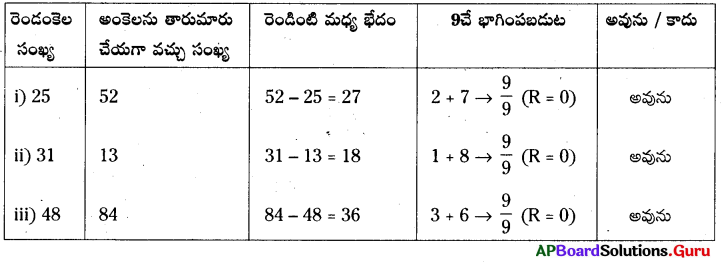
2. ఒక రెండంకెల సంఖ్యను తీసుకుని వాటి అంకెలను తారుమారు చేసి వ్రాయండి. వచ్చిన సంఖ్యలలో పెద్ద సంఖ్య నుండి చిన్న సంఖ్యను తీసివేయండి. వచ్చిన ఫలితము ఎల్లప్పుడూ 9తో భాగింపబడునా? (పేజీ నెం. 328)
సాధన.
AP Board 8th Class Maths Solutions Chapter 15 సంఖ్యలతో ఆడుకుందాం InText Questions 17
∴ ఫలితము ఎల్లప్పుడూ 9తో భాగింపబడుతుంది.

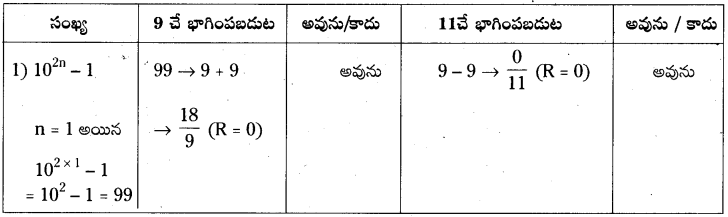
3. (1) 102n – 1, 9 మరియు 11 చే భాగింపబడునని చెప్పగలమా ? వివరించండి.
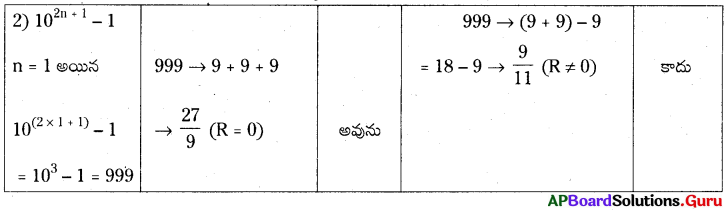
(2) 102n + 1 – 1, 11 చే భాగింపబడునో, లేదో పరిశీలించండి. (పేజీ నెం. 333)
సాధన.
AP Board 8th Class Maths Solutions Chapter 15 సంఖ్యలతో ఆడుకుందాం InText Questions 18
AP Board 8th Class Maths Solutions Chapter 15 సంఖ్యలతో ఆడుకుందాం InText Questions 19

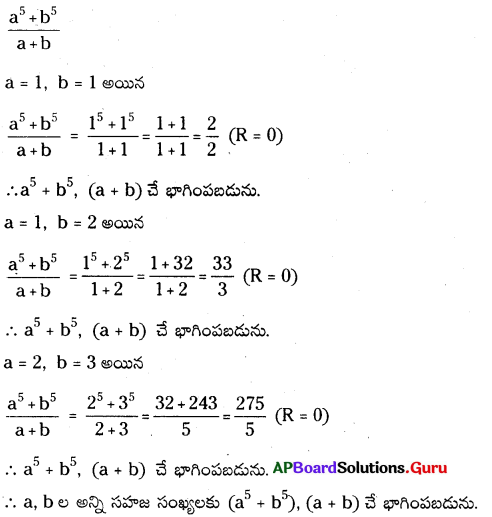
4. a5 + b5, (a + b) తో భాగింపబడుతుందో లేదో a, b విలువలు ఏవైనా సహజ సంఖ్యలుగా తీసుకుని ప్రయత్నించండి. (పేజీ. నెం. 334)
సాధన.
AP Board 8th Class Maths Solutions Chapter 15 సంఖ్యలతో ఆడుకుందాం InText Questions 20

AP Board 8th Class Maths Solutions Chapter 15 సంఖ్యలతో ఆడుకుందాం InText Questions

5. (a2n + 1 + b2n + 1), (a + b) తో భాగింపబడునని చెప్పగలమా? (పేజీ నెం. 334)
సాధన.
AP Board 8th Class Maths Solutions Chapter 15 సంఖ్యలతో ఆడుకుందాం InText Questions 21
∴ a2n + 1 + b2n + 1 అనునది n యొక్క అన్ని విలువలకు (a + b) చే భాగింపబడుతుంది.

AP 7th Class Science Bits Chapter 12 Soil and Water with Answers

Practice the AP 7th Class Science Bits with Answers Chapter 12 Soil and Water on a regular basis so that you can attempt exams with utmost confidence.

AP 7th Class Science Bits Chapter 12 Soil and Water with Answers

I. Multiple Choice Questions

Choose the correct answer and write its letters in the brackets.

1. This is a good habitat for many small organisms.
A) Soil
B) Air
C) Water
D) Fire
Answer:
A) Soil

2. Which of the following soil is used for making utensils and pottery?
A) Shadu soil
B) Multani soil
C) China clay
D) Sandy soil
Answer:
C) China clay

3. Which of the following soil is use in cosmetics?
A) Shadu soil
B) Multani soil
C) Terracotta soil
D) China clay
Answer:
B) Multani soil

4. Which of the following soil is used for making toys and idols?
A) Shadu soil
B) Multani soil
C) Terracotta soil
D) China clay
Answer:
A) Shadu soil

5. The forming process of soil is known as
A) Pedology
B) Weathering
C) Pedogenesis
D) Sedimentation
Answer:
B) Weathering

6. Dead and decayed organic matter that mixes with soil is called …………
A) Soil profile
B) Horizons
C) Humus
D) Particles
Answer:
C) Humus

AP 7th Class Science Bits Chapter 12 Soil and Water with Answers

7. The sequence of horizontal and various components, layers of soil at a place is known as
A) Soil profile
B) Horizons
C) Humus
D) Particles
Answer:
A) Soil profile

8. This type of soil ball can be easily made into a cylinder and a ring.
A) Sandy soil
B) Loamy soil
C) Clayey soil
D) All of the above
Answer:
C) Clayey soil

9. AP 7th Class Science Bits Chapter 12 Soil and Water with Answers 3 This figure shows
A) Sandy soil
B) Loamy soil
C) Clayey soil
D) All of the above
Answer:
B) Loamy soil

10. Which of the following soil is well aerated and drains quickly?
A) Deltaic alluvial soil
B) Sandy soil
C) Loamy soil
D) Clayey soil
Answer:
B) Sandy soil

11. Deltaic alluvial soil is found in the following districts.
A) Krishna and Nellore
B) East and West Godavari
C) Prakasam and Kurnool
D) Visakhapatnam and Vijayanagaram
Answer:
B) East and West Godavari

12. Black soil is found in the following districts
A) Krishna and Nellore
B) East and West Godavari
C) Prakasam and Kurnool
D) Visakhapatnam and Vijayanagaram
Answer:
A) Krishna and Nellore

13. The percentage of ground and surface water is
A) 1%
B) 2%
C) 3%
D) 97%
Answer:
A) 1%

AP 7th Class Science Bits Chapter 12 Soil and Water with Answers

14. The percentage of fresh water is
A) 1%
B) 2%
C) 3%
D) 97%
Answer:
C) 3%

15. The percentage of marine water is
A) 1%
B) 2%
C) 3%
D) 97%
Answer:
D) 97%

16. The process of entry of water into the ground is
A) Ground water
B) Percolation
C) Infiltration
D) Water table
Answer:
C) Infiltration

17. The absorption and downward movement of water through the soil layers is
A) Ground water
B) Percolation
C) Infiltration
D) Water table
Answer:
B) Percolation

18. The wells, tube wells and hand pumps get water present in the
A) Infiltrations
B) Water tables
C) Aquifers
D) Soil profiles
Answer:
C) Aquifers

19. Adding chemicals to bind with impurities in water, forming heavy particles is
A) Coagulation
B) Sedimentation
C) Filtration
D) Disinfection
Answer:
A) Coagulation

20. Adding chlorine or bleaching powder to kill disease causing micro organisms is
A) Coagulation
B) Sedimentation
C) Filtration
D) Disinfection
Answer:
D) Disinfection

AP 7th Class Science Bits Chapter 12 Soil and Water with Answers

21. Digudu Bavulu is an example for this conservation of water resources.
A) Recharge
B) Reuse
C) Revive
D) Reduce
Answer:
C) Revive

22. Percolation tanks, check dams and contour trenches help to this conservation of water resources
A) Recharge
B) Reuse
C) Revive
D) Reduce
Answer:
C) Revive

23. Drip irrigation is an example for this conservation of water resources.
A) Recharge
B) Reuse
C) Revive
D) Reduce
Answer:
D) Reduce

24. Assertion (A) : Soils can be classified on the basis of proportions of particles of various sizes present in them.
Reason (R) : In loamy soil the proportion of large and fine particles is almost same.
A) Both A’ and ‘R’ are true and ‘R’ is the correct explanation of ‘A’.
B) Both A’ and ‘R’ are true but ‘R’ is not the correct explanation of A’.
C) ‘A’ is true but ‘R’ is false.
D) ’A’ is false but ‘R’ is true.
Answer:
B) Both A’ and ‘R’ are true but ‘R’ is not the correct explanation of A’.

25. Assertion (A) : Soil is formed by weathering of rocks.
Reason (R) : The process of breaking down of rocks by the action of wind, water, sun and climate is called weathering.
A) Both A’ and ’R’ are true and ‘R’ is the correct explanation of ‘A’.
B) Both ‘A’ and ‘R’ are true but ‘R’ is not the correct explanation of ‘A’.
C) ‘A’ is true but ’R’ isdalse.
D) ’A’ is false but ‘R’ is true.
Answer:
A) Both A’ and ’R’ are true and ‘R’ is the correct explanation of ‘A’.

AP 7th Class Science Bits Chapter 12 Soil and Water with Answers

26. Statement (i) : Paddy and sugar cane grow very well in sandy soil.
Statement (ii) : Capacity to hold water is much in sandy soil than clayey soil.
Statement (iii) : Clayey soil has poor air circulation.
A) Statement (i) and (iii) are incorrect while (ii) is correct.
B) Statement (i) and (ii) are incorrect while (iii) is correct.
C) All statements are correct.
D) All statements are incorrect.
Answer:
B) Statement (i) and (ii) are incorrect while (iii) is correct.

27. Assertion (A) : Cleaning of water is a process of removing pollutants before it enters a water body.
Reason (R) : The process of cleaning of water and removal of pollutants from it is called “sewage treatment”.
A) Both ‘A’ and ‘R’ are true and ‘R’ is the correct explanation of ‘A’.
B) Both A’ and ‘R’ are true but ‘R’ is not the correct explanation of A’.
C) ‘A’ is true but ‘R’ is false.
D) A’ is false but ‘R’ is true.
Answer:
B) Both A’ and ‘R’ are true but ‘R’ is not the correct explanation of A’.

28. World water day is on
A) 22nd March
B) 20th March
C) 22nd April
D) 20th April
Answer:
A) 22nd March

29. Micro organisms in water cause the disease.
A) Cold
B) Fever
C) Body Pains
D) Cholera
Answer:
D) Cholera

30. Chemical used to disinfect water.
A) Oxygen
B) Chlorine
C) Fluorine
D) Nitrogen
Answer:
B) Chlorine

31. Essential for metabolic activity.
A) CO<sub>2</sub>
B) Rain
C) Water
D) Minerals
Answer:
C) Water

32. Chlorine passing into water is called
A) Aeration
B) Chlorination
C) Purification
D) Filteration
Answer:
B) Chlorination

AP 7th Class Science Bits Chapter 12 Soil and Water with Answers

33. Pumping of water into air for purification is called
A) Chlorination
B) Purification
C) Aeration
D) Filteration
Answer:
C) Aeration

34. Which of the following is the top most layer of soil?
A) “O” Horizon
B) “R” Horizon
C) “A” Horizon
D) “B” Horizon
Answer:
A) “O” Horizon

35. Waste water released by different users are collectively called
A) Mud
B) Sewage
C) Sludge
D) None of these
Answer:
B) Sewage

36. Sewage contain
A) suspended impurities
B) dissolved impurities
C) disease causing bacteria
D) all of these
Answer:
D) all of these

37. The process involved in treatment of sewage water
A) physical process
B) chemical process
C) biological process
D) all of these
Answer:
D) all of these

38. Which gas kills harmful disease causing organisms in waste water?
A) Fluorine
B) Chlorine
C) Oxygen
D) Bromine
Answer:
B) Chlorine

39. How much percentage of precipitated water exist in glaciers?
A) 1%
B) 2%
C) 3%
D) 7%
Answer:
B) 2%

40. Sita collects the water that used after cleaning rice, dal and vegetables in the kitchen and uses it to water the garden. This can be called ___
A) Stagnation of water
B) Reuse of water
C) Storing of water
D) Recovering of water
Answer:
B) Reuse of water

41. Soil is a good
A) habitat
B) material
C) source for plant
D) living place for snails
Answer:
A) habitat

AP 7th Class Science Bits Chapter 12 Soil and Water with Answers

42. Soil contains
A) Waste material
B) Humidity
C) Rocks
D) Minerals
Answer:
D) Minerals

43. This soil layer is made up of humus
A) R Horizon
B) A Horizon
C) B Horizon
D) C Horizon
Answer:
B) A Horizon

44. Soil is formed from
A) Rocks
B) Sand
C) Clay
D) Pebbles
Answer:
A) Rocks

45. Percolation rate of water is highest in
A) Rocky soil
B) Black soil
C) Sandy soil
D) Clayey soil
Answer:
C) Sandy soil

46. Percolation rate of water is lowest in
A) Black soil
B) Sandy soil
C) Clayey soil
D) All the above
Answer:
C) Clayey soil

47. Water holding capacity of soil depends on
A) Soil type
B) Rain
C) Place
D) None
Answer:
A) Soil type

48. Below the ‘O’ Horizon and above the ‘B’ Horizon this is found
A) B Horizon
B) A Horizon
C) C Horizon
D) R Horizon
Answer:
B) A Horizon

49. Percolation rate is highest in
A) Sandy soil
B) Clayey
C) Loamy
D) All
Answer:
A) Sandy soil

50. Removal of top soil by wind, water is called
A) soil profile
B) soil fertility
C) percolation
D) soil erosion
Answer:
D) soil erosion

AP 7th Class Science Bits Chapter 12 Soil and Water with Answers

51. Wheat, gram, and paddy are grown In
A) Sandy soil
B) Black soil
C) Clayey and loamy
D) All
Answer:
C) Clayey and loamy

52. This is called regolith
A) R Horizon
B) C Horizon
C) A Horizon
D) O Horizon
Answer:
B) C Horizon

53. This is called sub soil
A) B Horizon
B) C Horizon
C) R Horizon
D) O Horizon
Answer:
A) B Horizon

54. Study of soil is called
A) Morphology
B) Pedology
C) Biology
D) Ecology
Answer:
B) Pedology

55. Cotton is grown in
A) sandy
B) clayey
C) sandy loam
D) heavy loam
Answer:
C) sandy loam

56. The factors responsible for soil erosion
A) wind
B) water
C) deforestation
D) all of these
Answer:
D) all of these

57. It is also called top soil
A) A-horizon
B) B-horizon
C) C-horizon
D) R-horizon
Answer:
A) A-horizon

58. Animals plants and microbes activities are more in this horizon
A) A-horizon
B) R-horizon
C) C-horizon
D) 0-horizon
Answer:
A) A-horizon

59. The right sequence of horizons of the soil from top to bottom is
A) A, B, C, O, R
B) O, A, B, C, R
C) C, A, B, O, R
D) R, C, B, A, O
Answer:
B) O, A, B, C, R

AP 7th Class Science Bits Chapter 12 Soil and Water with Answers

60. Read the statements:
P : Water percolation rate is more to sandy soil.
Q : Water percolation rate is more to loamy soil.
A) Only P is correct
B) Only Q is correct
C) P & Q are correct
D) P & Q are wrong
Answer:
A) Only P is correct

II. Fill in the mlanks

1. The scientific study of soil is called …………….. .
2. The upper most layer of earth’s crust is …………….. .
3. The pleasant smell after the rain is known as …………….. .
4. The substance responsible for petrichor scent is …………….. .
5. Geosmin is produced by …………….. .
6. The breakdown of parent rock into small particles by the action of wind, water, heat and climate is known as …………….. .
7. The process of formation of soil from weathering is known as …………….. .
8. Natural weathering takes a time period of …………….. .
9. Dead and decayed organic matter that mixes with soil is called …………….. .
10. The factors that contribute to soil composition are called …………….. .
11. The science dealing with the influence of soil on organisms, especially on plants is called …………….. .
12. In soil profile, bed rock is present in …………….. horizon.
13. In soil profile, surface litter is present in …………….. horizon
14. …………….. horizon consists of broken rocks with very little organic matter.
15. …………….. soil is less aerated and water held longer.
16. …………….. soil has good aeration, water held but drains slowly.
17. …………….. soil is well aerated and drains quickly.
18. The ratio of the mass of water held in the soil is called …………….. .
19. Paddy is grown in …………….. soil.
20. Cotton is grown in …………….. soil.
21. Cashew is grown in …………….. soil.
22. …………….. is very useful to the farmers to know about the current health of the farm’s soil and how to improve it.
23. Preventing the degradation of soil is known as …………….. .
24. The loss of fertile top soil due to heavy winds and floods is known as …………….. .
25. Water action decade is …………….. .
26. The process of entry of water into the ground is called …………….. .
27. The upper level at which water stands in the ground is called …………….. .
28. The percentage of water present in seas and oceans is …………….. .
29. The percentage of fresh water present on earth is …………….. .
30. The wells, tube wells and hand pumps get water from …………….. .
31. Indiscriminate digging of bore wells leads to …………….. .
32. During purification of water, …………….. chemicals are used for disinfection.
33. Percolation tanks, check dams and contour trenches are helpful in …………….. .
34. Digudu Bavulu are very helpful in …………….. .
35. Best method to prevent soil erosion is …………….. .
Answer:

  1. Pedology
  2. soil
  3. petrichor scent
  4. geosmin
  5. the spores of Actinomycetes
  6. weathering
  7. Pedogenesis
  8. 500 -1000 years
  9. Humus
  10. edaphic factors
  11. Edaphology
  12. R
  13. O
  14. C
  15. Clayey
  16. Loamy
  17. Sandy
  18. moisture content
  19. clayey
  20. black
  21. sandy
  22. Soil testing
  23. soil conservation
  24. Soil erosion
  25. 2018-2028
  26. infiltration
  27. Water table
  28. 97%
  29. 3% only
  30. Aquifer
  31. depletion of ground water table
  32. chlorine and bleaching powder
  33. recharge ground water
  34. reviving of ground water
  35. planting trees

III. Match the following.

1.

Group – A Group – B
1. Weathering a) Pedology
2. Sandy soil b) Water held longer
3. Clayey soil c) Good aeration water drains slowly
4. Loamy soil d) Water drains quickly
5. Soil Science e) Formation of soil

Answer:

Group – A Group – B
1. Weathering e) Formation of soil
2. Sandy soil d) Water drains quickly
3. Clayey soil b) Water held longer
4. Loamy soil c) Good aeration water drains slowly
5. Soil Science a) Pedology

2.

Group – A Group – B
1. O Horizon a) Bed rock
2. A Horizon b) Regolith zone
3. B Horizon c) Sub soil
4. C Horizon d) Top soil
5. R Horizon e) Surface litter

Answer:

Group – A Group – B
1. O Horizon e) Surface litter
2. A Horizon d) Top soil
3. B Horizon c) Sub soil
4. C Horizon b) Regolith zone
5. R Horizon a) Bed rock

3.

Group – A Group – B
1. Geosmin a) Dead and decayed organic matter
2. Check dam b) 500 -1000 years
3. Weathering c) Formation of soil
4. Pedo genesis d) Water Conservation
5. Humus e) Actinomycetes

Answer:

Group – A Group – B
1. Geosmin e) Actinomycetes
2. Check dam d) Water Conservation
3. Weathering b) 500 -1000 years
4. Pedo genesis c) Formation of soil
5. Humus a) Dead and decayed organic matter

4.

Group – A Group – B
1. Percolation a) Forming heavy particles
2. Soil erosion b) Drop in rainfall
3. Deforestation c) Chlorine, bleaching
4. Disinfection d) Loss of top soil
5. Coagulation e) Downward movement of water

Answer:

Group – A Group – B
1. Percolation e) Downward movement of water
2. Soil erosion d) Loss of top soil
3. Deforestation b) Drop in rainfall
4. Disinfection c) Chlorine, bleaching
5. Coagulation a) Forming heavy particles

5.

Group – A Group – B
1. Recharge a) Soil health
2. Reuse b) Digudu Bavulu
3. Revive c) Drip irrigation
4. Reduce d) Treated sewage
5. Soil testing e) Checkdams and percolation tanks

Answer:

Group – A Group – B
1. Recharge e) Checkdams and percolation tanks
2. Reuse d) Treated sewage
3. Revive b) Digudu Bavulu
4. Reduce c) Drip irrigation
5. Soil testing a) Soil health

AP 7th Class Science Bits Chapter 11 Fibres and Fabrics with Answers

Practice the AP 7th Class Science Bits with Answers Chapter 11 Fibres and Fabrics on a regular basis so that you can attempt exams with utmost confidence.

AP 7th Class Science Bits Chapter 11 Fibres and Fabrics with Answers

I. Multiple Choice Questions

Choose the correct answer and write its letters in the brackets.

1. Wool and silk fabrics are derived from
A) plants
B) animals
C) chemical
D) plants and animals
Answer:
B) animals

2. Which of the following is the common vafriety reared for meat and wool in Andhra Pradesh and Telangana and Karnataka?
A) Marino
B) Deccani
C) Angora
D) Cashmere
Answer:
B) Deccani

3. Which is the main source of wool production in Andhra Pradesh?
A) Sheep
B) Goat
C) Camel
D) Rabbit
Answer:
A) Sheep

4. Which gives luxurious wool in India?
A) Marino
B) Deccani
C) Angora
D) Cashmere
Answer:
D) Cashmere

AP 7th Class Science Bits Chapter 11 Fibres and Fabrics with Answers

5. Which is used to make wool?
A) Long hair
B) Outer long hair
C) Fleece
D) All of the above
Answer:
C) Fleece

6. How many stages are there in the process involved in manufacturing of woolen threads?
A) 4 stages
B) 5 stages
C) 6 stages
D) 8 stages
Answer:
C) 6 stages

7. Removing fleece of animal along with the outer thin layer of skin is called
A) Shearing
B) Scouring
C) Carding
D) Combing
Answer:
A) Shearing

8. The process of wrapping the fleece between the two surfaces to make the fibre into a fluffy roll is called ……………….
A) Shearing
B) Scouring
C) Carding
D) Combing
Answer:
C) Carding

9. Process of winding together the fibres to form a yarn is called ………………
A) Dyeing
B) Sorting
C) Carding
D) Spinning
Answer:
D) Spinning

10. Which stages is important of silkmoth for obtaining silk?
A) Egg
B) Larva
C) Pupa
D) Imago
Answer:
B) Larva

11. These are called silk worms.
A) Silk moths
B) Caterpillars
C) Imagoes
D) Pupas
Answer:
B) Caterpillars

12. Larva undergo changes and turns into an adult moth after
A) 10 days
B) 30 – 35 days
C) 10 – 12 days
D) 15 – 20 days
Answer:
C) 10 – 12 days

AP 7th Class Science Bits Chapter 11 Fibres and Fabrics with Answers

13. The place of Andhra Pradesh in the production of silk in the country is
A) First
B) Second
C) Third
D) Tifth
Answer:
B) Second

14. How much yarn can be yield by one cocoon?
A) 100 – 500 meters
B) 500 – 1000 meters
C) 500 – 1500 meters
D) 500 – 2000 meters
Answer:
C) 500 – 1500 meters

15. Which of the following is not a silk city in India?
A) Ramanagara
B) Surat
C) Pochampalli
D) Dharmagiri
Answer:
D) Dharmagiri

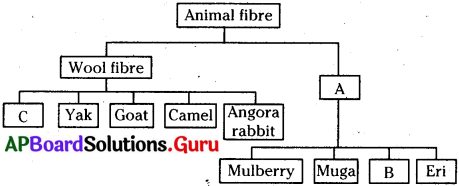
→ Look at the following flow chart and answer the questions 16 to 18.
AP 7th Class Science Bits Chapter 11 Fibres and Fabrics with Answers 1

16. Which of the following correctly represents A,B and C respectively?
A) A – Cotton fibre, B – Silk worm, C – Woolly dog
B) A – Jute fibre, B – Cocoon, C – Silk moth
C) A – Silk fibre, B – Tasar, C – Sheep
D) A – Synthetic fibre, B – Khadi, C – Sheep
Answer:
C) A – Silk fibre, B – Tasar, C – Sheep

17. Which of the following is not an application of ‘A’?
A) Clothing
B) Interior decoration
C) Painting
D) Construction
Answer:
D) Construction

18. Which of the following is related to ‘C’?
A) Angora
B) Marino
C) Mohair
D) Cashmere
Answer:
B) Marino

19. Assertion (A) : Scouring is the process of washing sheared fleece in hot water, detergent and alkali in tank
Reason (R) : Scouring removes dirt, grass and grease
A) Both A and R are true and R is the correct explanation of A.
B) Both A and R are true but R is not the correct explanation of A.
C) A is true but R is false.
D) A is false but R is true.
Answer:
A) Both A and R are true and R is the correct explanation of A.

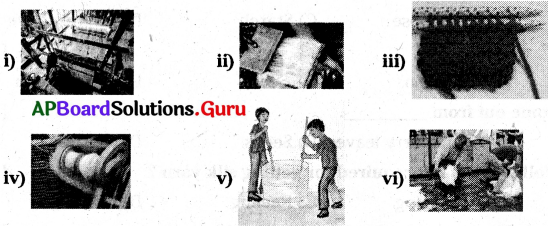
20. Look at the figures given below. These figures show different steps in the production of wool A number from (I) to (vi) is written in each block. Find the correct order of figures.
AP 7th Class Science Bits Chapter 11 Fibres and Fabrics with Answers 2
A) (vi), (ii), (iv), (v), (iii), (i)
B) (vi), (v), (ii), (iv), (iii), (i)
C) (v), (vi), (iii), (ii), (iv), (i)
D) (vi), (iii), (ii), (iv), (i), (v)
Answer:
B) (vi), (v), (ii), (iv), (iii), (i)

21. A female moth lays around …………… of eggs.
A) tens
B) hundreds
C) thousands
D) lakhs
Answer:
B) hundreds

22. The cocoons have to be stiffled to kill …………… inside.
A) Eggs
B) Larva
C) Pupa
D) The worm
Answer:
B) Larva

23. Food for silk worms.
A) Mulberry leaves
B) Mango leaves
C) Coconut leaves
D) Jasmine leaves
Answer:
A) Mulberry leaves

AP 7th Class Science Bits Chapter 11 Fibres and Fabrics with Answers

24. The hair of animals collectively called
A) Fur
B) Skin
C) Fibre
D) None
Answer:
A) Fur

25. Fleece of sheep is removed from its body during …………… season.
A) Winter
B) Summer
C) Rainy
D) Spring
Answer:
D) Spring

26. After washing, …………… is passed over the wool to make it softer.
A) Steam
B) Grease
C) Cool air
D) Hot air
Answer:
C) Cool air

27. Silk is mainly
A) Carbohydrate
B) Worms
C) Protein
D) Cocoon
Answer:
C) Protein

28. The capsule like structure formed is known as ……………
A) Embryo
B) Larvae
C) Seeds
D) Cocoon
Answer:
D) Cocoon

29. Moths are also called ……………
A) Bombyx mori
B) Insects
C) Butterfly
D) Honey bee
Answer:
A) Bombyx mori

30. ………….. district is a silk city of Andhra Pradesh.
A) Guntur
B) Anantapuram
C) Kurnool
D) Krishna
Answer:
B) Anantapuram

31. Caterpillars feed bv leaves.
A) Grass
B) Leaves
C) Cocoon
D) Mulberry leaves
Answer:
D) Mulberry leaves

32. Chandrikalu means …………… .
A) Cane frames
B) Glass tubs
C) Cocoons
D) Mulberry huts
Answer:
A) Cane frames

33. Pupa stops eating after
A) 25 – 30 days
B) 30 – 35 days
C) 40 days
D) 10-12 days
Answer:
B) 30 – 35 days

34. Caterpillar secretes …………… substance.
A) Fibre
B) Cellulose
C) Starch
D) All the above
Answer:
A) Fibre

35. “Pattu kayalu” means
A) Silk worm
B) Cocoon
C) Seeds
D) Chandrikalu
Answer:
B) Cocoon

AP 7th Class Science Bits Chapter 11 Fibres and Fabrics with Answers

36. Adult moths come out from ……………
A) Eggs
B) Mulberry leaves
C) Seeds
D) Cocoon
Answer:
D) Cocoon

37. Which of the following is not required for getting silk yarn?
A) Weaving
B) Spinning
C) Reeling
D) Knitting
Answer:
C) Reeling

38. Special machines like reelers and twisters are used in ……………
A) Reeling
B) Spinning
C) Knitting
D) Weaving
Answer:
A) Reeling

39. Good quality of wool is given by ……………
A) Angora goat
B) Merino sheep
C) Lama
D) Camels
Answer:
B) Merino sheep

40. Rough and coarse hair is produced by
A) Goat
B) Sheep
C) Camel
D) Rabbit
Answer:
C) Camel

41. Scouring means removing of
A) Dust
B) Grease
C) Dirt
D) All of these
Answer:
D) All of these

42. The correct order is
1) Egg 2) Pupa 3) Adult 4) larva
A) 1, 2, 4, 3
B) 1, 4, 2, 3
C) 1, 3, 2, 4
D) 1, 4, 3, 2
Answer:
B) 1, 4, 2, 3

43. ‘Grinages’ are
A) Seed centers
B) Larva centers
C) Adult centers
D) Silk centers
Answer:
A) Seed centers

44. ‘Bombyx mori’ is a
A) Honey bee
B) Warsp
C) Housefly
D) Silk moth
Answer:
D) Silk moth

45. Killing of the silk moth larva’s is called
A) Reeling
B) Yarn
C) Stiffling
D) Silk
Answer:
C) Stiffling

46. The stiffling process takes place at
A) Reeling centers
B) Grinages
C) Chandrikalu
D) Horsely Hills
Answer:
A) Reeling centers

47. AP 7th Class Science Bits Chapter 11 Fibres and Fabrics with Answers 3 The process in the picture is
A) Stiffling
B) Reeling
C) Warping
D) Feeding
Answer:
A) Stiffling

48. AP 7th Class Science Bits Chapter 11 Fibres and Fabrics with Answers 4 The equipment show in the figure is
A) Cacoon
B) Chandrikalu
C) Reeling
D) Woven
Answer:
B) Chandrikalu

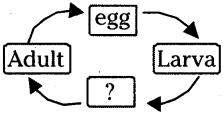
49. Fill the blank in the life cycle of silk moth
AP 7th Class Science Bits Chapter 11 Fibres and Fabrics with Answers 5
A) Pupa
B) Laren
C) Silk moth
D) Housefly
Answer:
A) Pupa

50. The country that used the silk for first time
A) India
B) China
C) Japan
D) America
Answer:
B) China

AP 7th Class Science Bits Chapter 11 Fibres and Fabrics with Answers

51. 1) Dyeing 2) Sorting 3) Scouring 4) Shearing
The correct order is
A) 4, 3, 2, 1
B) 2, 3, 4, 1
C) 4, 3, 1, 2
D) 3, 4, 2, 1
Answer:
B) 2, 3, 4, 1

52. Removing the colour of wool is
A) Bleaching
B) Sorting
C) Spinning
D) Scouring
Answer:
A) Bleaching

53. Making threads of yarn is
A) Spinning
B) Carding
C) Dyeing
D) Sorting
Answer:
A) Spinning

54. Which city is called silk city in our State?
A) Venkatagiri
B) Dharmavaram
C) Madanapalli
D) Hartuman Junction
Answer:
B) Dharmavaram

55. The first stage in making of woollen clothes.
A) Scouring
B) Sorting
C) Shearing
D) Bleaching
Answer:
C) Shearing

56. Fill the blank in the flow chart with the given answer.
AP 7th Class Science Bits Chapter 11 Fibres and Fabrics with Answers 6
A) Stiffling
B) Moths
C) Reeling
D) Chilakalu
Answer:
A) Stiffling

57. Material present in silk thread
A) Protein
B) Fat
C) Carbohydrate
D) Cellulose
Answer:
A) Protein

58. If you went to silk showroom to know the quality of silk, what type of exact question do you ask?
A) How do you decide the cost?
B) Do they have good durability?
C) How silk is prepared with?
D) How many types of silks are there?
Answer:
B) Do they have good durability?

59. In summer season what type of clothes do you wear?
A) Cotton, light colour
B) Woolen, Silk
C) Cotton, dark colour
D) Silk, Woolen
Answer:
A) Cotton, light colour

AP 7th Class Science Bits Chapter 11 Fibres and Fabrics with Answers

60. Animal fibre : protein :: plant fibre : ………….
A) Fat
B) Protein
C) Carbohydrate
D) Mineral
Answer:
C) Carbohydrate

61. Which of the following shows the correct sequence of processes in making woolen fabric?
A) Shearing – scouring – sorting – dyeing – combing – spinning
B) Scouring – spinning – combing – shearing – sorting – dyeing
C) Sorting – scouring – shearing – combing – spinning – dyeing
D) Shearing – dying – combing – spinning – scouring – sorting
Answer:
A) Shearing – scouring – sorting – dyeing – combing – spinning

62. Name the stages of silkworm weavers buy from sericulture industury.
A) Larva
B) Pupa
C) Eggs
D) Moth
Answer:
B) Pupa

63. Identify the process that helps to store the cocoons for a long time.
A) Boiling
B) Stiffling
C) Reeling
D) Weaving
Answer:
A) Boiling

64. The sericulture units present in Guntur district are at
A) Pedakakani
B) Bollapalli
C) Tadikonda
D) All the above
Answer:
D) All the above

65. Antheraea mylitta is a
A) Wild silk moth
B) Goat
C) Sheep
D) Camel
Answer:
A) Wild silk moth

66. Which of the following is the quality of animal fibres?
A) More water absorbants
B) Protein based
C) Burns slowly but not continuously
D) All the above
Answer:
D) All the above

67. Acrylic is used to make
A) Sweaters
B) Shawls
C) Blankets
D) AIL the above
Answer:
D) AIL the above

AP 7th Class Science Bits Chapter 11 Fibres and Fabrics with Answers

68. Which of the following is not made from chemicals?
A) Polyester
B) Terelene
C) Rayon
D) None
Answer:
C) Rayon

69. Fabrics made from this fibres does not get wrinkles easily …….
A) Acrylic
B) Rayon
C) Polyester
D) Nylon
Answer:
C) Polyester

70. Ropes for parachute are made from
A) Acrylic
B) Rayon
C) Nylon
D) Polyester
Answer:
C) Nylon

71. Which fabric is used to make sarees?
A) Nylon
B) Polyester
C) Terelene
D) Acrylic
Answer:
C) Terelene

II. Fill in the blanks

1. ……………….. goat is famous for wool.
2. ……………….. is the goat variety which give luxurious wool in India.
3. ……………….. animal shed their hair every year which has similar properties to wool.
4. Camels are reared in ……………….. states.
5. Camels are reared for ……………….. .
6. Yaks are found in ……………….. of India.
7. ……………….. breed of rabbit’s fur is used to make colourful coats.
8. The first step in the processing of fibres into wool is ……………….. .
9. Shearing is generally done during ……………….. season.
10. ……………….. is used for scouring of wool.
11. We get colourful woolen clothes by the process of ……………….. .
12. The process of wrapping the fleece between the two surfaces to make the fibres into a fluffy roll is called ……………….. .
13. ……………….. village is famous for quality woolen carpets in Kurnool district.
14. Cocoons are also known as ……………….. .
15. In four stages of silk moth ……………….. stage is important for obtaining silk.
16. Silk worms prefer to eat ……………….. .
17. The larvae are kept in specialized cane structures called ……………….. .
18. The process of killing larvae inside cocoon by putting them in steam is known as ……………….. .
19. The process of extracting threads from cocoon is called ……………….. .
20. The scientific name of silkworm is ……………….. .
21. W.H.O refers to ……………….. .
22. Animal fibres are dissolved in ……………….. .
23. ……………….. chemical is present in toilet cleaners, disinfectants and cloth whiteness.
24. ……………….. are kept in the clothes to protect them from insects.
25. ……………….. protein is present ip wool fibres.
26. ……………….. protein is present in silk fibres.
27. Rearing of silk worms for getting silk is known as ……………….. .
28. Masks made of ……………….. avoid skin allergies and itching caused by longtime usage.
29. WHO recommends a ……………….. layered cotton fabric mask to protect ourselves from ……………….. .
30. We buy woolen clothes specially for ……………….. .
Answer:
1. Angora
2. Kashmere
3. Camel
4. Rajasthan, Haryana and Gujarath
5. milk, meat and wool
6. Ladhak
7. Angora
8. shearing
9. Spring
10. detergent
11. dyeing
12. Carding
13. Parla
14. Pattukaayalu
15. Larva
16. Mulberry leaves
17. Chandrikalu
18. stiffling
19. Reeling
20. Bombyx mori
21. World Health Organization
22. Chlorine bleach
23. Sodium hypochlorite
24. ball of phenopthalene
25. Keratin
26. Fibroin
27. Sericulture
28. natural fabric
29. three, COVID -19
30. winter

III. Match the following.

1. Group-A Group – B 1. Tasar silk 2. Stiffling 3. Reeling 4. Marino 5. Angora a) Wool yielding sheep b) Wool yielding goat c) Wool yeilding camel d) Extracting silk threads e) Killing the larvae by steaming f) Arjuna and Sal trees
Answer:

2. Group – A Group – B 1. Acrylic [ 1 a) Sarees and terelene , 2. Rayon [ ] b) Doesn’t get wrinkless 3. Nylon [ ] c) Ropes for parachute 4. Polyester [ ] d) Artificial silk 5. Terelene [ ] e) Sweaters and shawls f) Rain coats
Answer:

3. Group – A Group – B 1. Rolling [ ] a) Sodium hypochlorite 2. Phenopthalene [ ] b) Wood pulp 3. Synthetic fibre [ ] c) Silk 4. Natural fibres [ 1 d) Acrylic 5. Rayon [ 1 e) Protection of clothes f) Silk sarees
Answer:

4. Group – A Group – B 1. Cashmere [ ] a) South America 2. Marino [ ] b) Jammu and Kashmir 3. Yak [ ] c) Rajasthan 4. Camel [ ] d) Ladhak 5. Lama [ ] e) Australia f) South Africa
Answer:

5. Group – A Group – B 1. Silk city in A.P. [ 1 a) Ramanagara 2. Silk city in T.S. [ ] b) Chanderi 3. Silk city in Karnataka [ ] c) Pochampalli 4. Silk city in Tamil Nadu [ ] d) Surat , 5. Silk city in Madhya Pradesh *. [. ] e) Dharmavaram f) Kanchipuram
Answer:

AP 7th Class Science Bits Chapter 10 Changes Around Us with Answers

Practice the AP 7th Class Science Bits with Answers Chapter 10 Changes Around Us on a regular basis so that you can attempt exams with utmost confidence.

AP 7th Class Science Bits Chapter 10 Changes Around Us with Answers

I. Multiple Choice Questions

Choose the correct answer and write its letters in the brackets.

1. Change in the shape of the balloon is done by blowing air into it. This is a……
A) manmade change
B) natural change
C) chemical change
D) periodic change.
Answer:
A) manmade change

2. Which of the following is not a man made-change?
A) preparation of bricks
B) making of paper
C) weaving of clothes
D) growing of nails
Answer:
D) growing of nails

AP 7th Class Science Bits Chapter 10 Changes Around Us with Answers

3. Which of the following is not a fast change?
A) burning of paper
B) firing of crackers
C) making of a cake
D) spinning of a top
Answer:
C) making of a cake

4. The change happens in less time is.
A) slow change
B) fast change
C) periodic change
D) non periodic change.
Answer:
B) fast change

5. Which of the following is not reversible?
A) Weight suspended from a spring
B) Water changed to water vapour
C) Inflating of a balloon
D) Burning of a coal
Answer:
D) Burning of a coal

6. On …………… ice converts to water
A) heating
B) cooling
C) freezing
D) evaporating
Answer:
A) heating

7. some changes we cannot regain the original substance, these are.
A) manmade change
B) natural change
C) irreversible change
D) reversible change
Answer:
C) irreversible change

8. Limewater
A) Calcium Hydroxide
B) Sodium hydroxide
C) Potassium hydroxide
D) Carbonic acid
Answer:
A) Calcium Hydroxide

9. Which of the following is an irreversible change?
A) burning of wood
B) burning of Diwali crackers
C) ripening of fruits
D) all
Answer:
D) all

10. Which gas is released when lemon juice reacts with baking soda?
A) oxygen
B) carbon dioxide
C) nitrogen
D)water vapour
Answer:
B) carbon dioxide

AP 7th Class Science Bits Chapter 10 Changes Around Us with Answers

11. These changes are repeating at regular intervals of time.
A) slow change
B) fast change
C) periodic change
D) non periodic change.
Answer:
C) periodic change

12. Changes which do not occur at regular intervals of time and which cannot be predicted are called
A) slow change
B) fast change
C) periodic change
D) non periodic change
Answer:
D) non periodic change

13. Crystallization requires
A) heating
B) cooling
C) evaporating
D) A or C
Answer:
A) heating

14. In crystallization….
A) no new substances are formed.
B) new substances are formed.
C) no heating is required
D) none
Answer:
A) no new substances are formed.

15. Crystallization is
A) chemical change
B) physical change
C) periodic change
D) non periodic change
Answer:
B) physical change

16. Choose correct answer.
S: Crystallization is a Physical Change.
R: In crystallization no new substances are formed.
A) S and R are correct.
B) S and R are incorrect.
C) S is correct and R is incorrect.
D) S is incorrect and R is correct.
Answer:
A) S and R are correct.

17. Which change takes place when ice cube melts?
A) colour
B) phase
C) chemical
D) all
Answer:
B) phase

18. When a piece of gold is melted?
A) no new substances are formed.
B) new substances are formed.
C) chemical composition changes
D) none
Answer:
A) no new substances are formed.

AP 7th Class Science Bits Chapter 10 Changes Around Us with Answers

19. When a piece of gold is melted, its chemical composition in the Solid form and also in the liquid form.
A) changes
B) varies
C) remains same
D) different
Answer:
C) remains same

20. In physical change ……….. changes.
A) shape
B) colour
C) size
D) all
Answer:
D) all

21. It is not a characteristic of a physical change…
A) No new substances are formed
B) Temporary and reversible in nature.
C) The chemical properties of a substance do not change.
D) It is a periodic change.
Answer:
D) It is a periodic change.

22. In curdling of milk is
A) a physical change
B) reversible change
C) chemical change
D) temporary change
Answer:
C) chemical change

23. When magnesium burns in the presence of oxygen, it forms magnesium oxide
A) magnesium oxide
B) magnesium chloride
C) carbon dioxide
D) none
Answer:
A) magnesium oxide

24. Magnesium Hydroxide is…..
A) an acid
B) a base
C) a neutral
D) none
Answer:
B) a base

AP 7th Class Science Bits Chapter 10 Changes Around Us with Answers

25. Characteristic of a chemical change
A) During chemical change new substances are formed.
B) It is a permanent change and irreversible in nature.
C) Chemical composition of the substance changes.
D) All
Answer:
D) All

26. In chemical change which is not happens.
A) Heat, light may be released or absorbed.
B) A colour change may take place and sound may be produced.
C) Original substances may be formed on reversing the process
D) None
Answer:
C) Original substances may be formed on reversing the process

27. Rusting of iron requires
A) moisture
B) air
C) both
D) none
Answer:
C) both

28. Rust is…
A) iron oxide
B) calcium chloride
C) iron peroxide
D) above all
Answer:
A) iron oxide

29. Oxidization is observed in
A) iron articles
B) apples
C) brinjal
D) none
Answer:
D) none

30. Which of the following is used to prevent browning of the outer surface of the potato and brinjal?
A) cold water
B) lemon juice
C) ascorbic acid
D) above all
Answer:
D) above all

31. Which of the following is used in galvanizing?
A) zinc
B) chromium
C) A & C
D) none
Answer:
C) A & C

32. This process of deposition of a layer of zinc on iron is called
A) oxidation
B) galvanization
C) crystallization
D) none
Answer:
B) galvanization

33. Due to this process of brown layer is formed on the surface of fruits and vegetables.
A) oxidation
B) galvanization
C) crystallization
D) none
Answer:
A) oxidation

34. Which of the following is a useful change?
A) global warming
B) acid rain
C) plastic decomposition
D) fermentation
Answer:
D) fermentation

35. Which of the following occurs due to drastic increase in the emission of carbon dioxide by the burning of fossil fuels
A) global warming
B) floods
C) earth quakes
D) fermentation
Answer:
A) global warming

36. Ice converting to water, water converting to steam are ………. changes.
A) reversible
B) chemical
C) periodic
D) all
Answer:
A) reversible

37. Ripening of fruits is ………….. change.
A) reversible
B) physical
C) periodic
D) irreversible
Answer:
D) irreversible

38. The change occurs only in Size, colour and shape of the substance and no change in chemical composition are called ………….. changes
A) chemical
B) physical
C) periodic
D) irreversible
Answer:
B) physical

39. ………. change occurs with the formation of new substance in different chemical composition.
A) Reversible
B) Physical
C) Periodic
D) Chemical
Answer:
D) Chemical

AP 7th Class Science Bits Chapter 10 Changes Around Us with Answers

40. The process of depositihg zinc on iron metals is called
A) oxidation
B) galvanization
C) rusting
D) crystallization
Answer:
B) galvanization

II. Fill in the blanks.

1. The changes which were taken place by the involvement of human beings are called ………………. change.
2. Changes which occur in ………………. duration of time are called fast changes.
3. Changes which takes longer duration of time to happen are called ………………. Change.
4. Changing of vegetable to curry : slow reaction:: changing of acid into vapour ………………. .
5. On ………………. water converts to ice.
6. The changes in which the formed substance can be converted into their ………………. are called reversible changes.
7. ………………. changes Limewater into milky white.
8. Vinegar + Baking Soda → Sodium acetate + ………………. + water
9. ………………. + Lime water → Calcium carbonate + water
10. Changes in which we cannot get the original substance by reversing the experimental conditions are called ………………. Changes.
11. ………………. changes are repeating at regular intervals of time .
12. The process of separating a soluble solid from the solution by heating or evaporating is called ………………. .
13. A ………………. is usually temporary and reversible in nature.
14. The substances which undergo change in colour or state or size or shape are ………………. .
15. When a Magnesium ribbon burns it gives ………………. light leaving a powdery substance behind.
16. ………………. + Water → Magnesium Hydroxide
17. Changes that occur with the formation of new substance with different chemical composition or transformation of a substance into another substance with the evolution or absorption of heat or light energy are termed as ………………. .
18. Iron + Oxygen (from air) + Water → ……………….
19. Apply a coat of paint or grease on iron articles. Prevents ………………. .
20. To prevent iron articles from coming contact with oxygen in air and water, a layer of another metal like ………………. is coated on them.
21. The process of deposition of a layer of zinc on iron is called ………………. .
22. Browning is not only observed on iron articles but also on cut fruits and ………………. .
23. Rubbing of the surface of cut fruits with ………………. to avoid from browning.
24. The process of reaction with ………………. is called oxidation.
25. ………………. waste is a widely recognized source of pollution.
26. ………………. gases are produced when fossil fuels such as coal and oil are burned in power station, factories and homes.
27. Oil spills occur when ………………. is released into the environment.
28. Formation of day and night, occurrence of seasons are ………………. changes.
29. Curding of milk : useful changes :: ………………. : harmful change.
Answer:

  1. 1. man-made
  2. short
  3. slow
  4. fast reaction
  5. cooling
  6. original substance
  7. Carbon dioxide
  8. carbon dioxide
  9. Carbon dioxide
  10. irreversible
  11. periodic changes
  12. crystallization
  13. physical change
  14. physical changes
  15. brilliant white dazzling
  16. Magnesium Oxide
  17. chemical change
  18. rust (Iron oxide)
  19. rusting of iron
  20. chromium or zinc
  21. Galvanization
  22. vegetables
  23. juices of citrus fruits
  24. oxygen
  25. Plastic
  26. Acidic
  27. liquid petroleum
  28. periodic
  29. global warming

III. Match the following.

1.

Group – A Group – B
1) Ripening of fruit a) physical change
2) Burning of a dry leaf b) chemical change
3) Melting of ice c) periodic change
4) Day and nights d) fast change

Answer:

Group – A Group – B
1) Ripening of fruit b) chemical change
2) Burning of a dry leaf d) fast change
3) Melting of ice a) physical change
4) Day and nights c) periodic change

2.

Group – A Group – B
1) Carbon dioxide a) galvanizing
2) Oxygen b) crystallization
3) Zinc c) global warming
4) sugar d) oxidation

Answer:

Group – A Group – B
1) Carbon dioxide c) global warming
2) Oxygen d) oxidation
3) Zinc a) galvanizing
4) sugar b) crystallization

3.

Group – A Group – B
1) browning of vegetables a) vinegar
2) browning of iron b) dazzling light
3) formation of crystal c) galvanization
4) burning of magnesium d) crystallization

Answer:

Group – A Group – B
1) browning of vegetables a) vinegar
2) browning of iron c) galvanization
3) formation of crystal d) crystallization
4) burning of magnesium b) dazzling light

4.

Group – A Group – B
1) more time a) physical change
2) less time b) chemical change
3) time period c) periodic change
4) reversible d) fast change
5) new substances e) slow change

Answer:

Group – A Group – B
1) more time e) slow change
2) less time d) fast change
3) time period b) chemical change
4) reversible c) periodic change
5) new substances a) physical change

5.

Group – A Group – B
1) Zinc a) Chemical changes
2) Formation of Magnesium oxide b) Natural changes
3) Belum Caves c) Periodic changes
4) Changes in seasons d) Oxidation
5) Photosynthesis e) Galvanisation
f) Crystallization

Answer:

Group – A Group – B
1) Zinc e) Galvanisation
2) Formation of Magnesium oxide d) Oxidation
3) Belum Caves b) Natural changes
4) Changes in seasons c) Periodic changes
5) Photosynthesis a) Chemical changes

AP 7th Class Science Bits Chapter 9 Heat, Temperature and Climate with Answers

Practice the AP 7th Class Science Bits with Answers Chapter 9 Heat, Temperature and Climate on a regular basis so that you can attempt exams with utmost confidence.

AP 7th Class Science Bits Chapter 9 Heat, Temperature and Climate with Answers

I. Multiple Choice Questions

Choose the correct answer and write its letters in the brackets.

1. It is a form of energy that flows from a hotter body to a cooler body.
A) Heat
B) Light
C) Sound
D) Electricity
Answer:
A) Heat

2. When heat energy flows from our body to Lassi. Here,
A) Lassi loss Heat energy
B) Body lose heat energy
C) Body gain heat energy
D) A and C
Answer:
B) Body lose heat energy

3. Joules are units of
A) Humidity
B) Climate
C) Heat
D) Air pressure
Answer:
C) Heat

AP 7th Class Science Bits Chapter 9 Heat, Temperature and Climate with Answers

4. The degree of hotness or coldness is called ………..
A) Humidity
B) Temperature
C) Heat
D) Air pressure
Answer:
D) Air pressure

5. Temperature is measured in…….
A) Degrees of Celsius
B) Degrees of Fahrenheit
C) Kelvin
D) All
Answer:
D) All

6. The SI unit of temperature is ………….
A) Degrees of Celsius
B) Degrees of Fahrenheit
C) Kelvin
D) All
Answer:
C) Kelvin

7. Kelvin is written as
A) °C
B) °F
C) °K
D) K
Answer:
D) K

8. Which is correct?
i) Heat is the degrees of hotness or coldness.
ii) Heat is measured in joules
A) i only
B) ii only
C) both i & ii
D) both are incorrect
Answer:
B) ii only

9. Cooking utensils are made of ………..
A) conductors
B) insulators
C) fuels
D) none of the above
Answer:
A) conductors

10. Handles of cooking vessels are made of …………….
A) conductors
B) insulators
C) fuels
D) none of the above
Answer:
B) insulators

11. A: Metals are used to make cooking vessels.
R: Metals allow heat through them.
Which is correct?
A) A & R are correct and R supports A
B) A & R are correct but R does not support A
C) A is correct but R is wrong
D) R is Correct but A is wrong
Answer:
A) A & R are correct and R supports A

12. The ability of a material to conduct heat is called …………..
A) Thermal conductivity
B) Thermal resistivity
C) Thermometer
D) None
Answer:
A) Thermal conductivity

13. It is not a good conductor.
A) Copper
B) Steel
C) Plastic
D) Cast iron
Answer:
C) Plastic

AP 7th Class Science Bits Chapter 9 Heat, Temperature and Climate with Answers

14. Insulator is….
A) Water
B) Glass
C) Plastic
D) All
Answer:
D) All

15. Heat cannot pass in the mode of
A) Conduction
B) Convection of heat
C) Radiation of heat
D) None
Answer:
D) None

16. In which heat is transferred from one end to another end by the mode of conduction.
A) Steel spoon
B) Water
C) A and B
D) Sun to earth
Answer:
A) Steel spoon

17. This mode of transfer of heat happens more in solid conductors
A) Conduction
B) Convection of heat
C) Radiation of heat
D) None
Answer:
A) Conduction

18. This process of transfer of heat from source of heat to surface by the motion of particles
A) Conduction
B) Convection of heat
C) Radiation of heat
D) all
Answer:
B) Convection of heat

19. This is not a medium of heat energy.
A) Solid
B) Liquid
C) Gas
D) None
Answer:
D) None

20. This mode of transfer of heat doesn’t require any media.
A) Conduction
B) Convection of heat
C) Radiation of heat
D) All
Answer:
C) Radiation of heat

21. The process of transfer of heat in the form of waves is called
A) Conduction
B) Convection of heat
C) Radiation of heat
D) All
Answer:
C) Radiation of heat

22. Which instrument can control the transfer of heat (loss of heat)?
A) Thermos flask
B) Thermometer
C) Thermal scanner
D) All
Answer:
A) Thermos flask

AP 7th Class Science Bits Chapter 9 Heat, Temperature and Climate with Answers

23. The flask retains hot inside the flask for
A) a few hours
B) ever
C) never
D) a few weeks.
Answer:
A) a few hours

24. Thermos flask was invented by
A) Sir James cook
B) Sir James Chadwick
C) Sir James Dewar
D) Sir James watts
Answer:
C) Sir James Dewar

25. Which of the following expands on heating and contracts on cooling?
A) Solid
B) Liquid
C) Gas
D) All
Answer:
D) All

26. Air on cooling
A) contracts
B) occupy less space.
C) expand
D) A and B
Answer:
D) A and B

27. Warm air is lighten than cold air. This property of air is used in
A) hot air balloons
B) kites
C) rockets
D) all
Answer:
A) hot air balloons

28. Thermometer contains bulb of
A) mercury
B) alcohol
C) A or B
D) silver
Answer:
C) A or B

29. Mercury is a in room temperature.
A) solid
B) liquid
C) gas
D) all
Answer:
A) solid

30. This is not a property of the mercury .
A) Its expansion is uniform.
B) It is a good conductor of heat.
C) It easily sticks to the sides of glass tube.
D) It has a high boiling point.
Answer:
C) It easily sticks to the sides of glass tube.

AP 7th Class Science Bits Chapter 9 Heat, Temperature and Climate with Answers

31. The boiling point and a freezing point of the mercury are
A) -39°C and 357°C
B) 357°C and-39°C
C)100°C and 0°C
D) none
Answer:
B) 357°C and-39°C

32. A: The freezing point of alcohol is more than -100°C.
R: Alcohol can be used to measure very low temperatures.
A) A & R are correct and R supports A
B) A & R are correct but R does not support A
C) A is correct but R is wrong
D) R is correct but A is wrong
Answer:
D) R is correct but A is wrong

33. Number of divisions in Fahrenheit scale is
A) 100
B) 212
C) 180
D) 32
Answer:
C) 180

34. Number of divisions in Kelvin scale is
A) 100
B) 212
C) 180
D) 32
Answer:
A) 100

35. Number of divisions in Celsius scale is
A) 100
B) 212
C) 180
D) 32
Answer:
A) 100

36. Which prevents the mercury from flowing back into the bulb in clinical thermometer.
A) Capillary
B) Kink
C) Bulb
D) Magnet
Answer:
B) Kink

37. Laboratory thermometer can measure higher temperatures than clinical thermometer because, it has
A) long bulb
B) long stem
C) short bulb
D) short stem
Answer:
B) long stem

38. This thermometer can work without Mercury.
A) Six max and min thermometer
B) Digital Thermometer
C) Clinical thermometer
D)All
Answer:
B) Digital Thermometer

39. Who invented Six’s maximum and minimum thermometer in 1780?
A) Sir James cook
B) James watt
C) Sir James Dewar
D) James Six
Answer:
D) James Six

AP 7th Class Science Bits Chapter 9 Heat, Temperature and Climate with Answers

40. The correct order is
i) After one or two minutes, take the thermometer out and note the reading,
ii) Place the bulb of the thermometer under your friend’s tongue.
iii) Wash the clinical thermometer properly with an antiseptic solution.
iv) To lower the mercury level, hold the thermometer firmly and give some jerks.
A) iv, ii, i, iii
B) iv, iii, ii, i
C) iii, iv, ii, i
D) ii, iii, iv, i
Answer:
C) iii, iv, ii, i

41. The normal temperature of the human body is
A) 37°C
B) 98.4°F
C) 310K
D) all
Answer:
D) all

42. Ventilators are working on
A) Air expands on heating
B) Air contracts on heating
C) Metal expands on heating
D) Air contracts on cooling
Answer:
A) Air expands on heating

43. Which is used to measure the air pressure?
A) Hygrometer
B) Thermometer
C) Barometer
D) Rain gauge
Answer:
C) Barometer

44. A: If roofs were weak, they could be lifted and blown away.
R: The moving air creates high pressure.
A) A & R are correct and R supports A
B) A & R are correct but R does not support A
C) A is correct but R is wrong
D) R is correct but A is wrong
Answer:
C) A is correct but R is wrong

45. Rain fall is measured with a
A) hygrometer
B) thermometer
C) barometer
D) rain gauge
Answer:
D) rain gauge

46. This is not a measuring component of weather
A) humidity
B) temperature
C) wind speed
D) none
Answer:
D) none

47. Humidity is measured in
A) g/cubic meter
B) mm/cubic meter
C) °C
D) m/°C
Answer:
A) g/cubic meter

48. In summer, the humidity of air is
A) low
B) high
C) no change
D) zero
Answer:
B) high

49. High temperatures, along with humidity sometimes may cause
A) kwashiorkor
B) beriberi
C) corona
D) sunstroke
Answer:
D) sunstroke

50. It gives the information about atmospheric conditions in a specific area and time.
A) Weather
B) Climate
C) A and B
D) None
Answer:
A) Weather

51. This deals with a long period.
A) Weather
B) Climate
C) A and B
D) None
Answer:
B) Climate

52. It affects our lifestyle
A) Weather
B) Climate
C) A and B
D) None
Answer:
B) Climate

AP 7th Class Science Bits Chapter 9 Heat, Temperature and Climate with Answers

53. Which phenomenon measures atmospheric conditions in a specific area and time?
A) Weather
B) Climate
C) A and B
D) None
Answer:
A) Weather

II. Fill in the blanks

1. Heat is a form of energy that flows from a ………………. body to a ………………. body.
2. Heat is measured in ………………. with calorimeter
3. Heat flows from a body of high temperature to a body of low temperature. This direction is determined by ………………. .
4. The degree of ………………. is called ‘temperature’.
5. Degree of Celsius is written as ………………. .
6. Degree of Fahrenheit is written as ………………. .
7. Some materials allow heat through them, this property is called ………………. .
8. Water, air, clothes, glass, cork, plastic, wood etc. are some examples of ………………. .
9. This process of transfer of heat from hotter to colder end through the conductor’ is called ………………. .
10. The contact which transfers heat by any mode is called ………………. .
11. Water is a ………………. of heat.
12. Heat is transferred by means of ………………. called convectional currents.
13. The materials which help in transfer of heat from one place to another are called ………………. .
14. Sun’s heat transfers to earth in the form of ………………. .
15. The thermal scanner receives the heat in the form of ………………. to measure our body temperature.
16. The inner ………………. in thermos flask protects the contents (tea, coffee, milk) poured in the flask from losing heat through radiation.
17. As there is ………………. between the walls of the flask; neither conduction nor convection of heat takes place.
18. Particles of substances occupies ………………. space when they get heated.
19. Small gaps left between rails in railway tracks, because metal ………………. on heat
20. ………………. are used to measure temperature.
21. The principle involved in working of a thermometer is ………………. .
22. The melting point of ice is ………………. °C
23. The melting point of ice and boiling point of water in Fahrenheit are ………………. .
24. The melting point of ice and boiling point of water in SI units are ………………. .
25. The formula to convert Celsius to Kelvin is ………………. .
26. The formula to convert Celsius to Fahrenheit is ………………. .
27. ………………. is used in hospitals to measure the temperature of the human body.
28. Clinical Thermometer has a ………………. that prevents the mercury from flowing back into the bulb when it was taken out of the patient’s mouth.
29. After taking readings in six max and min thermometer the indicators I<sub>2</sub> and I<sub>1</sub> are brought to their original places by using ………………. .
30. The normal temperature of the human body is ………………. .
31. Smoke and hot air moves up because it ………………. on heating and becomes lighter.
32. The force applied by air oh any surface in contact is called ………………. .
33. The air pressure becomes ………………. when it is compressed.
34. When air expands and raises up it creates ………………. .
35. ………………. drives the air high pressure from surrounding to move and occupy that place.
36. Air pressure is measured in height of ………………. level in centimeters
37. ………………. is measured in millimeters by using a rain gauge.
38. The water vapour present in the air is called ………………. .
39. ………………. is used to measure humidity in air and it is expressed in grams per cubic meter.
40. Evaporation of ………………. from our body makes us cool to maintain our body temperature.
41. The day-to-day variations in the components like temperature, humidity, rainfall, wind speed are called ………………. .
42. ………………. forecasting is the application of science and technology to predict the conditions of the atmosphere using components of weather for a given location and time.
43. It is easier to know about weather with the help of ………………. than tables.
44. ………………. study and work on weather and record weather every day.
45. The average weather pattern taken over a long period, say 25 years or more, is called the ………………. of the place.
46. Expansion of IMD is ………………. .
47. The abnormal variation in the components of climate is called ………………. .
Answer:

  1. hotter, cooler
  2. Joules or calories
  3. temperature
  4. hotness or coldness
  5. °C
  6. °F
  7. conductivity
  8. insulators
  9. conduction
  10. Thermal contact
  11. poor conductor
  12. currents
  13. medium
  14. radiation
  15. radiation
  16. silver coating
  17. no medium or vacuum
  18. more
  19. expand
  20. Thermometers
  21. expansion of liquids on heating
  22. 0
  23. 32°F, 212°F
  24. 273K, 373K
  25. K °C + 273
  26. AP 7th Class Science Bits Chapter 9 Heat, Temperature and Climate with Answers 10
  27. Clinical Thermometer
  28. kink
  29. a magnet
  30. 37°C or 98.4°F
  31. expands
  32. air pressure
  33. more
  34. low pressure
  35. Low pressure
  36. mercury
  37. Rainfall
  38. Humidity
  39. Hygrometer
  40. Sweat
  41. weather
  42. Weather
  43. graphs
  44. Meteorologists
  45. Climate
  46. Indian Meteorological Department
  47. climate change

III. Match the following

1.

Group – A Group – B
1) heat a) cm of mercury level
2) temperature b) Kelvin
3) air pressure c) mm
4) rain fall d) Joule

Answer:

Group – A Group – B
1) heat d) Joule
2) temperature b) Kelvin
3) air pressure a) cm of mercury level
4) rain fall c) mm

2.

Group – A Group – B
1) humidity a) barometer
2) temperature b) hygrometer
3) air pressure c) rain gauge
4) rainfall d) thermometer

Answer:

Group – A Group – B
1) humidity b) hygrometer
2) temperature d) thermometer
3) air pressure a) barometer
4) rainfall c) rain gauge

3.

Group – A Group – B
1) water a) radiation
2) heat b) convection
3) metal c) expansion
4) vacuum d) conduction

Answer:

Group – A Group – B
1) water b) convection
2) heat c) expansion
3) metal d) conduction
4) vacuum a) radiation

4.

Group – A Group – B
1) nail a) clinical thermometer
2) cloth b) lab thermometer
3) mercury c) conductor
4) alcohol d) insulator

Answer:

Group – A Group – B
1) nail c) conductor
2) cloth d) insulator
3) mercury a) clinical thermometer
4) alcohol b) lab thermometer

5.

Group – A Group – B
1) weather a) low pressure
2) climate b) long period
3) wind c) water vapour
4) humidity d) rapid change

Answer:

Group – A Group – B
1) weather d) rapid change
2) climate b) long period
3) wind a) low pressure
4) humidity c) water vapour

6.

Group – A Group – B
1) gas expansion a) alcohol thermometer
2) liquid expansion b) parachute
3) solid expansion c) railway rails
4) gas contraction d) LPG cylinder

Answer:

Group – A Group – B
1) gas expansion b) parachute
2) liquid expansion a) alcohol thermometer
3) solid expansion c) railway rails
4) gas contraction d) LPG cylinder

7.

Group – A Group – B
1) Kelvin a) °F
2) Fahrenheit b) K
3) Celsius c) J
4) Heat d) °c

Answer:

Group – A Group – B
1) Kelvin b) K
2) Fahrenheit a) °F
3) Celsius d) °c
4) Heat c) J

AP 7th Class Science Bits Chapter 8 Wonders of Light with Answers

Practice the AP 7th Class Science Bits with Answers Chapter 8 Wonders of Light on a regular basis so that you can attempt exams with utmost confidence.

AP 7th Class Science Bits Chapter 8 Wonders of Light with Answers

I. Multiple Choice Questions

Choose the correct answer and write its letters in the brackets.

1. This is not a natural source of light.
A) sun
B) stars
C) moon
D) none
Answer:
C) moon

2. Example to human involvement is needed to release light
A) sun
B) stars
C) candle
D) none
Answer:
C) candle

3. Light rays which travel from a source moving in different directions are called as of light rays.
A) parallel
B) converge
C) diverge
D) B and C
Answer:
C) diverge

4. Which of the following does not give regular reflection?
A) mirror
B) cloth
C) new steel plate
D) polished marble
Answer:
B) cloth

5. In case of irregular reflection images cure
A) not clear
B) cannot form
C) clear
D) A & B
Answer:
D) A & B

AP 7th Class Science Bits Chapter 8 Wonders of Light with Answers

6. These are in the same plane.
i. The incident ray
ii. normal to the surface
iii. The reflected ray
A) i,ii
B) i,iii
C) ii, iii
D) i,ii,iii
Answer:
D) i,ii,iii

7. Angle between normal and the incident ray
A) angle of incidence
B) angle of reflection
C) angle of vision
D) A & B
Answer:
A) angle of incidence

8. Which of the following is not a characteristic of the image of the plane mirror?
A) Object distance is equal to image distance.
B) Size of the object is equal to size of the image.
C) The image formed is always real and erect.
D) Laterally inverted image is formed.
Answer:
C) The image formed is always real and erect.

9. The distance of the object from the mirror is …………….. the distance of image from the mirror.
A) is equal to
B) is greater than to
C) is less than to
D) A & C
Answer:
A) is equal to

10. The size of image is not equal to that of the object in any situation.
A) plane mirror
B) convex mirror
C) concave mirror
D) none
Answer:
B) convex mirror

11. The distance of the image from the mirror is called
A) Image distance
B) Object distance
C) Normal
D) None
Answer:
A) Image distance

12. This type of image can catch on the screen
A) real
B) virtual
C) both
D) none
Answer:
A) real

AP 7th Class Science Bits Chapter 8 Wonders of Light with Answers

13. Image formed by a plane mirror
A) erect & real
B) inverted & virtual
C) erect & virtual
D) inverted & real
Answer:
C) erect & virtual

14. No. of images formed when the angle between two plane mirrors is 60°
A) 4
B) 5
C) 6
D) 7
Answer:
B) 5

15. No. of images formed when the angle between two plane mirrors is 90°
A) 4
B) 2
C) 1
D) 3
Answer:
D) 3

16. No. of images formed when the angle between two plane mirrors is 0°
A) infinity
B) 5
C) 6
D) 0
Answer:
A) infinity

17. No. of images formed is 1, then the angle between two plane mirrors is
A) 0°
B) 90°
C) 180°
D) 360°
Answer:
C) 180°

18. The instrument which is used in submarines to see the objects or persons above the water level.
A) microscope
B) telescope
C) kaleidoscope
D) periscope
Answer:
D) periscope

AP 7th Class Science Bits Chapter 8 Wonders of Light with Answers

19. Angle between two plane mirrors in periscope is
A) 0°
B) 90°
C) 180°
D) 360°
Answer:
A) 0°

20. The steel spoon can act as …
A) plane mirror
B) convex mirror
C) concave mirror
D) B & C
Answer:
D) B & C

21. The mirror forms all types of images
A) plane mirror
B) convex mirror
C) concave mirror
D) B & C
Answer:
C) concave mirror

22. The mirror is used as rear view mirror
A) plane mirror
B) convex mirror
C) concave mirror
D) B & C
Answer:
B) convex mirror

23. Which rule we should follow to protect eyes while watching TV or computer?
A) 20-20-20
B) 40-4-40
C) 10-10-10
D) 12-12-12
Answer:
A) 20-20-20

24. Which light is not dangerous to our eye?
A) yellow
B) red
C) blue
D) violet
Answer:
A) yellow

AP 7th Class Science Bits Chapter 8 Wonders of Light with Answers

25. Which colour of light is composition of all colours?
A) yellow
B) red
C) blue
D) white
Answer:
D) white

II. Fill in the blanks

1. Light is a form of ………………. that helps us to see all the things around us.
2. Light comes from different objects called ………………. .
3. Objects that emit light are known as ………………. .
4. Sources that release light artificially [with human involvement] are called ………………. sources of light or artificial sources of light.
5. ………………. source emit light on their own.
6. The direction or path along which light travels is called ………………. .
7. The straight line indicates the of light and arrow mark indicates the ………………. of light from the source.
8. A bundle of light rays are called ………………. of light rays.
9. Light rays which travel parallel to each other are called ………………. of light rays.
10. Light rays which travel from different directions to meet at a point are called as ………………. of light rays.
11. Light rays which travel from a source moving in different directions are called as ………………. of light rays.
12. The process of bouncing back of light rays into the same medium after falling on a smooth or rotigh surface from the light source is called ………………. .
13. Objects are visible only when ………………. falls on the objects and bounces back to the eye.
14. Light rays from the sun fall on the mirror and bounced back and formed a spot of light on the wall. It is the image of ………………. .
15. The light rays that fall on the objects are called ………………. .
16. The light rays that bounce back from the objects are called ………………. .
17. Reflection from a ………………. surface is called regular reflection.
18. Reflection from an irregular or uneven surface is called ………………. reflection.
19. Clear images are formed in case of ………………. reflection.
20. Angle of ………………. is equal to Angle of reflection.
21. Incident and reflected rays are on either side of ………………. .
22. The angle made by incident ray with the normal is called ………………. .
23. The angle made by the reflected ray with the ………………. is called the angle of reflection.
24. The distance of the object from the mirror is called ………………. .
25. The distance of the image from the is called image distance.
26. When you are eating food with right hand it appears to be eating with left hand. This characteristic is called ………………. .
27. The image which cannot catch on the screen is called ………………. .
28. Plane mirror forms ………………. image.
29. The relation between number of images formed and the angle between two plane mirrors is ………………. .
30 . ………………. is an instrument used in submarines to see the objects or persons above the water level.
31. ………………. mirror reflect the light in different directions.
32. ………………. mirror reflect the light to one point.
33. A ………………. mirror forms real and virtual images, erect and inverted images, smaller, same size and bigger images depending on the position of object infront of it.
34. Ophthalmoscope is fitted with a ………………. mirror having a small hole near its center.
35. Dentists also use ………………. mirrors to get a bigger image of the teeth.
36. ………………. mirrors are used in head lights of the vehicles.
37. A piece of glass or any other transparent material with curved sides is called ………………. .
38. Lens which is thick in center and thin at the edges is called ………………. lens.
39. Lens which is thin in the centre and thick at the edges is called ………………. lens.
40. ………………. light has been proven effective in protecting retina than blue light which causes damage to retina.
41. Splitting of white light into seven colours is called ………………. .
Answer:

  1. energy
  2. sources of light
  3. sources of light
  4. man made
  5. natural
  6. a ray of light
  7. path, direction
  8. beam
  9. parallel beam
  10. Converging beam
  11. Diverging beam
  12. reflection of light
  13. Light
  14. sun
  15. incident rays
  16. reflected rays
  17. smooth and shiny
  18. irregular or diffused
  19. regular
  20. incidence
  21. normal
  22. angle of incidence
  23. normal
  24. object distance
  25. mirror
  26. lateral inversion
  27. virtual image
  28. virtual
  29. 360°/θ -1
  30. periscope
  31. convex
  32. concave
  33. concave
  34. concave
  35. concave
  36. concave
  37. a lens
  38. convex
  39. concave
  40. Yellow
  41. dispersion

III. Match the following

1.

Group – A Group – B
1) Natural source a. cloth
2) Artificial source b. steel plate
3) Regular reflection c. star
4) Irregular reflection d. candle

Answer:

Group – A Group – B
1) Natural source c. star
2) Artificial source d. candle
3) Regular reflection b. steel plate
4) Irregular reflection a. cloth

2.

Group – A Group – B
1) Convex mirror a. make up
2) Concave mirror b. ENT doctor
3) Plane mirror c. magnifier
4) Convex lens d. rear view

Answer:

Group – A Group – B
1) Convex mirror d. rear view
2) Concave mirror b. ENT doctor
3) Plane mirror a. make up
4) Convex lens c. magnifier

3.

Group – A Group – B
1) Periscope a. concave mirror
2) Ophthalmoscope b. convex mirror
3) Road safety c. convex lens
4) Telescope d. plane mirror

Answer:

Group – A Group – B
1) Periscope d. plane mirror
2) Ophthalmoscope a. concave mirror
3) Road safety b. convex mirror
4) Telescope c. convex lens

4.

Group – A Group – B
1) Convex mirror a. inwards curve
2) Concave mirror b. outwards curve
3) Plane mirror c. thick at middle
4) Convex lens d. plane surface
5) Concave lens e. thin at middle

Answer:

Group – A Group – B
1) Convex mirror b. outwards curve
2) Concave mirror a. inwards curve
3) Plane mirror d. plane surface
4) Convex lens c. thick at middle
5) Concave lens e. thin at middle

5.

Group – A Group – B
1) Virtual image a. pass through one point
2) Real image b. bundle of rays
3) Ray c. caught on the screen
4) Beam d. seen in the mirror
5) Converging e. path of light

Answer:

Group – A Group – B
1) Virtual image d. seen in the mirror
2) Real image c. caught on the screen
3) Ray e. path of light
4) Beam b. bundle of rays
5) Converging a. pass through one point

6.

Group – A Group – B
1) Incident angle a. perpendicular line to surface
2) Reflecting angle b. angle of incidence angle of reflection
3) Normal c. angle between normal and reflected ray
4) First law of reflection d. normal, incident ray, reflected ray are in one plane
5) Second law of reflection e. angle between normal and incident ray

Answer:

Group – A Group – B
1) Incident angle e. angle between normal and incident ray
2) Reflecting angle c. angle between normal and reflected ray
3) Normal a. perpendicular line to surface
4) First law of reflection b. angle of incidence angle of reflection
5) Second law of reflection d. normal, incident ray, reflected ray are in one plane

7.

Group – A Group – B
1) Convex mirror a. converges
2) Concave mirror b. diverges
3) Plane mirror c. parallel rays
4) Sun d. irregular reflection
5) Thermocol sheet e. regular reflection

Answer:

Group – A Group – B
1) Convex mirror b. diverges
2) Concave mirror a. converges
3) Plane mirror e. regular reflection
4) Sun c. parallel rays
5) Thermocol sheet d. irregular reflection

AP 7th Class Science Bits Chapter 7 Reproduction in Plants with Answers

Practice the AP 7th Class Science Bits with Answers Chapter 7 Reproduction in Plants on a regular basis so that you can attempt exams with utmost confidence.

AP 7th Class Science Bits Chapter 7 Reproduction in Plants with Answers

I. Multiple Choice Questions

Choose the correct answer and write its letters in the brackets.

1. Seeds are related to
A) stem
B) root
C) flower
D) leaf
Answer:
C) flower

2. Sugarcane propagates through
A) nodes
B) leaf
C) root
D)suckers
Answer:
A) nodes

3. Ground layering is seen in
A) Jasmine
B) Bougainvillea
C) Strawberry
D) All
Answer:
D) All

4. Which one is formed from layering branch?
A) Roots
B) Leaves
C) Nodes
D) Fruits
Answer:
A) Roots

5. The rooted plant in grafting is called as
A) Scion
B) Stock
C) Node
D) Cutting
Answer:
B) Stock

AP 7th Class Science Bits Chapter 7 Reproduction in Plants with Answers

6. In grafting which have desirable characters
A) Scion
B) Stock
C) Root
D) Leaf
AnsA) Scionwer:

7. AP 7th Class Science Bits Chapter 7 Reproduction in Plants with Answers 3 This symbol represents
A) Female
B) Male
C) Both
D) Flower
Answer:
B) Male

8. AP 7th Class Science Bits Chapter 7 Reproduction in Plants with Answers 4 This symbol represents
A) Male
B) Female
C) Both
D) Pollination
Answer:
B) Female

9. AP 7th Class Science Bits Chapter 7 Reproduction in Plants with Answers 5 This diagram indicates
A) Pistil
B) Corolla
C) Stamens
D) Sepals
Answer:
A) Pistil

10. How many whorls that the complete flower has
A) 2
B) 3
C) 4
D) 5
Answer:
C) 4

11. Complete flowers also called as
A) Male flower
B) Female flower
C) Unisexual flower
D) Bisexual flower
Answer:
D) Bisexual flower

AP 7th Class Science Bits Chapter 7 Reproduction in Plants with Answers

12. Ipomea have
A) Unisexual flower
B) Bisexual flower
C) Male flower
D) Female flower
Answer:
B) Bisexual flower

13. The zygote develops into
A) Embryo
B) Fruit
C) Flower
D) Stem
Answer:
A) Embryo

14. Which of the flower colour change after fertilization?
A) Mango
B) Rose
C) Cotton
D) Neam
Answer:
C) Cotton

15. Seeds compitect for
A) Soil
B) water
C) light
D) All
Answer:
D) All

16. Which process makes life immortal?
A) Reproduction
B) Digesion
C) Respiration
D) Circulation
Answer:
A) Reproduction

17. Transfer of pollen to stigma is
A) Pollination
B) Fertilization
C) Germination
D) Growth
Answer:
A) Pollination

18. Assertion (A) : A stamen has 2 parts.
Reason (R) : Filament and anther are parts of a stamen.
A) Both ’A’ and R’ are true and R’ is the correct explanation of ‘A’.
B) Both A’ and ‘R’ are true but ‘R’ is not the correct explanation of ‘A‘.
C) ‘A’ is true but R’ is false.
D) A’ is false but ‘R’ is true.
Answer:
A) Both ’A’ and R’ are true and R’ is the correct explanation of ‘A’.

AP 7th Class Science Bits Chapter 7 Reproduction in Plants with Answers

19. Assertion (A) : Parts of pistil are anther and filament.
Reason (R) : Bisexual flowers are those which contain both stamen ahd pistil.
A) Both ‘A’ and ‘R’ are true and ‘R’ is the correct explanation of ‘A’.
B) Both ‘A’ and ‘R’ are true but ‘R’ is. not the correct explanation of ‘A’.
C) ‘A’ is true but ‘R’ is false.
D) ‘A’ is false but ‘R’ is true.
Answer:
D) ‘A’ is false but ‘R’ is true.

20. Assertion (A) : A flower may either have a male or a female part.
Reason (R) : A flower having both male and female parts is called bisexual flower.
A) Both A’ and ‘R’ are true and ‘R’ is the correct explanation of ‘A’.
B) Both ‘A’ and ‘R’ are true but ‘R’ is not the correct explanation of ‘A’.
C) ‘A’ is true but ‘R’ is false.
D) ‘A’ is false but ‘R’ is true.
Answer:
B) Both ‘A’ and ‘R’ are true but ‘R’ is not the correct explanation of ‘A’.

21. Statement (I): After fertilization the ovary becomes the fruit and ovules the seeds.
Statement (ii) : Study of pollen grains is called polynology.
A) Statement (i) is correct while statement (ii) is incorrect.
B) Statement (ii is correct while statement (i) is correct.
C) Both statements are correct.
D) Both statements are incorrect.
Answer:
C) Both statements are correct.

22. It is the seat on which the parts of a flower are present.
A) Corolla
B) Thalamus
C) Calyx
D) Androecium
Answer:
B) Thalamus

23. It has funnel shape.
A) Corolla
B) Sepals
C) Calyx
D) Thalamus
Answer:
A) Corolla

24. This is the male part of the flower.
A) Gynoecium
B) Androecium
C) Petals
D) Sepals
Answer:
B) Androecium

25. This is the female part of a flower.
A) Petals
B) Calyx
C) Gynoecium
D) Androecium
Answer:
C) Gynoecium

26. An example for unisexual flower.
A) Bittergourd
B) Datura
C) Ipomea
D) Hibiscus
Answer:
A) Bittergourd

AP 7th Class Science Bits Chapter 7 Reproduction in Plants with Answers

27. This is a bisexual flower.
A) Papaya
B) Cucumber
C) Bottlegourd
D) Hibiscus
Answer:
D) Hibiscus

28. The fleshy base to which all the floral parts are attached to is
A) Pedicel
B) Sepals
C) Thalamus
D) Petals
Answer:
C) Thalamus

29. The pollen grains are found in
A) Ovule
B) Anthers
C) Ovary
D) Stigma
Answer:
B) Anthers

30. The number of stamens present in Datura :
A) 5
B) 3
C) 6
D) 10
Answer:
A) 5

31. Ovules develop into :
A) flowers
B) plants
C) leaf
D) seeds
Answer:
D) seeds

32. The pollen grains contain
A) male garnets
B) female garnets
C) filaments
D) Stigma
Answer:
A) male garnets

AP 7th Class Science Bits Chapter 7 Reproduction in Plants with Answers

33. It is a …………… AP 7th Class Science Bits Chapter 7 Reproduction in Plants with Answers 6
A) Unisexual flower
B) Bisexual flower
C) Female flower
D) Male flower
Answer:
C) Female flower

34. In which type of flower this part is present?
A) Male flower
B) Bisexual flower
C) Both A & B
D) None of these
Answer:
C) Both A & B

35. Identify the part of flower
A) Stamen
B) Pistil
C) Petals
D) Sepals
Answer:
A) Stamen

36. Identify the part of flower.
A) Stamen
B) Pistil
C) Petals
D) Sepals
Answer:
B) Pistil

37. It shows that
A) T.S of flower
B) L.S of flower
C) T.S of stem
D) T.S of root
Answer:
B) L.S of flower

AP 7th Class Science Bits Chapter 7 Reproduction in Plants with Answers

38. Pollen grains are formed from
A) Stamen
B) Pistil
C) Ovary
D) Sepals
Answer:
A) Stamen

39. In the pollination what is transfer from anther to stigma?
A) Ovule
B) Zygote
C) Seed
D) Pollengrain
Answer:
D) Pollengrain

40. Agents of pollination
A) Birds
B)Insects
C) Air
D) All of these
Answer:
D) All of these

41. New plants grow from the following part of a plant is not a vegetative reproduction
A) Root
B) Stem
C) Leaf
D) Flower
Answer:
D) Flower

42. This develops as fruit.
A) Ovary
B) Ovule
C) Petals
D) Flower
Answer:
A) Ovary

43. Ovules develop into
A) fruit
B) seed
C) flower
D) plant
Answer:
B) seed

44. Dispersal of this seed is by water.
A) Coconut
B) Soap nut
C) Neem
D) Milk weed
Answer:
A) Coconut

45. Dispersal of calotropis is through
A) Water
B) Animals
C) Wind
D) Humans
Answer:
C) Wind

46. These seeds are dispersed by animals.
A) Fleshy fruits
B) Coconut
C) Neem
D) Balsam
Answer:
A) Fleshy fruits

47. Neem seed is dispersed to other places by
A) Animals
B) Human beings
C) Birds
D) Water
Answer:
C) Birds

48. Dispersal by bursting of these fruits is done.
A) Neem
B) Coconut
C) Fleshy fruits
D) Bhendi
Answer:
D) Bhendi

AP 7th Class Science Bits Chapter 7 Reproduction in Plants with Answers

49. People transferred these seeds across the globe.
A) Coconut
B) Neem
C) Soap nut
D) Sugarcane
Answer:
D) Sugarcane

50. Among the following dispersal of seed occurs through wind in
A) Coconut
B) Lotus
C) Milkweed
D) Mango
Answer:
C) Milkweed

51. Seeds of Lotus travel by
A) Birds
B) Insects
C) Animals
D) Water
Answer:
D) Water

52. These are carried by birds
A) Maple
B) Milkweed
C) Lotus
D) Neem
Answer:
D) Neem

53. On drying the pod explodes releases seeds with great force in
A) Mustard
B) Sugarcane
C) Pears
D) Tomato
Answer:
A) Mustard

54. These seeds are dispersal through
A) Water
B) Wind
C) Animals
D) Birds
Answer:
B) Wind

AP 7th Class Science Bits Chapter 7 Reproduction in Plants with Answers

55. These seeds are dispersal through
A) Wind
B) Water
C) Animals
D) Birds
Answer:
B) Water

56. Seeds of sweet and fleshy fruits can dispersal through
A) Human beings
B) Birds
C) Animals
D) All of these
Answer:
C) Animals

57. Seed dispersal is essential for survival of
A) Plants
B) Animals
C) Birds
D) Human beings
Answer:
A) Plants

58. Cotton seeds have the following structures
A) Wing like outer growths
B) Hooks
C) Hairy parts
D) Thorns
Answer:
C) Hairy parts

59. The following seeds dispersal through human beings
A) Bhendi
B) Coconut
C) Tomato
D) Cotton
Answer:
C) Tomato

60. Identify the wrong statement.
A) All the seeds of a fruit should be able to germinate
B) Some seeds germinate but plants die before maturation
C) Some seeds never germinate
D) All seeds do not germinate
Answer:
A) All the seeds of a fruit should be able to germinate

61. This seed is dispersed by
A) Water
B) Air
C) Animals
D) Bursting
Answer:
C) Animals

AP 7th Class Science Bits Chapter 7 Reproduction in Plants with Answers

62. Dispersal of seeds by bursting of fruits happens in
A) Sugarcane
B) Coconut
C) Lotus
D) Ladies finger
Answer:
D) Ladies finger

II. Fill in the blanks.

1. The propagation of Banana is through ………………………. .
2. The propagation of sugarcane is done by planting ………………………. .
3. Mint is propagated through ………………………. .
4. In potatoes, ………………………. are used for propagation.
5. In onions ………………………. are used for propagation.
6. Example for rhizome is ………………………. .
7. Example for corm is ………………………. .
8. Example for stem cutting is ………………………. .
9. Examples for ground layering are ………………………. .
10. Artificial propagation method used for getting plants with desired characters is ………………………. .
11. Sepals of a flower collectively called as ………………………. .
12. Petals of a flower are are collectively known as ………………………. .
13. Calyx is present in ………………………. whorl.
14. Corolla is present in ………………………. whori.
15. The male reproductive part of the flower is ………………………. .
16. The female reproductive part of the flower is ………………………. .
17. Androecium consists of ………………………. .
18. Gynoecium consists of ………………………. .
19. Androecium is present in ………………………. whorl of the flower.
20. Gynoecium is present in ………………………. whorl of the flower.
21. The smooth yellow coloured powder in anther is called ………………………. .
22. Transferring pollen from anther to stigma of the same flower is
23. Transferring of pollen grains from anther of one flower to stigma of another flower is known as ……………….. .
24. When pollen grains fall on stigma is ………………………. formed.
25. The fusion of pollen grains with ovules in ovary is known as ………………………. .
26. Fertilization results in the formation of ………………………. .
27. After fertilization, ovary ripes and turn into a ………………………. .
28. After fertilization, ovules turn into ………………………. .
29. Seeds with wings are carried away by ………………………. .
30. Example for seed dispersal through water is ………………………. .
31. Seeds of calotropis dispersed with the help of ………………………. .
32. Seeds of fleshy fruits are dispersed through ………………………. .
33. Seeds having hooks are dispersed with the help of ………………………. .
34. Neem seeds are dispersed with the help of ………………………. .
35. Seeds having hairs dispersed through ………………………. .
36. Dispersal of seed take place by bursting of fruits can be seen in ………………………. .
37. Lotus seeds are dispersed through ………………………. .
38. In Mustard, seeds dispersal takes place through ………………………. .
39. Seeds dispersed through aeroplanes and ships are ………………………. .
40. Flower shown in the picture is ………………………. .
41. Grafting technique is used in the plants like ………………………. for getting desired characters.
Answer:

  1. suckers
  2. nodes of sugarcane
  3. cut the twigs with nodes and sow them
  4. eyes
  5. Bulb
  6. Ginger
  7. colocasia
  8. rose
  9. Jasmine, Jaji
  10. grafting
  11. Calyx
  12. Corolla
  13. 1st
  14. 2nd
  15. Androecium
  16. Gynoecium
  17. Stamens
  18. Ovary with style and stigma
  19. 3rd
  20. 4th
  21. pollen grains
  22. Self – pollination
  23. cross – pollination
  24. pollen tube
  25. fertilization
  26. zygote
  27. fruit
  28. seeds
  29. wind
  30. coconut, louts
  31. wind
  32. animals, birds and man
  33. animals
  34. birds
  35. wind
  36. bhendi, balsam
  37. water
  38. bursting mechanism
  39. pulses, wheat, paddy
  40. Unisexual flower (or) incomplete flower
  41. mango, guava etc.

III. Match the following

1.

Group – A Group – B
1. Datura a) Bursting Mechanism
2. Cucumber b) Gynoecium
3. Papaya c) Androecium
4. Stamen d) Male and female flowers are on different plants.
5. Pistil e) Male and female flowers are on same plant.
f) Complete flower

Answer:

Group – A Group – B
1. Datura f) Complete flower
2. Cucumber e) Male and female flowers are on same plant.
3. Papaya d) Male and female flowers are on different plants.
4. Stamen c) Androecium
5. Pistil b) Gynoecium

2.

Group – A Group – B
1. Fertilization a) Birds
2. Calotropis b) Water dispersal
3. Coconut c) Animals
4. Seeds of grass d) Wind dispersal
5. Neem e) Zygote
f) Bursting mechanism

Answer:

Group – A Group – B
1. Fertilization e) Zygote
2. Calotropis d) Wind dispersal
3. Coconut b) Water dispersal
4. Seeds of grass c) Animals
5. Neem a) Birds

3.

Group – A Group – B
1. Ovary a) Wind dispersal
2. Ovules b) Bursting mechanism
3. Anther c) Nodes
4. Maple d) Pollengrain
5. Balsam e) Seeds
f) Fruit

Answer:

Group – A Group – B
1. Ovary f) Fruit
2. Ovules e) Seeds
3. Anther d) Pollengrain
4. Maple a) Wind dispersal
5. Balsam b) Bursting mechanism

4.

Group – A Group – B
1. Suckers a) Nodes
2. Rhizome b) Colocasia
3. Bulb c) Potato
4. Eyes d) Onion
5. Corm e) Ginger
f) Banana

Answer:

Group – A Group – B
1. Suckers f) Banana
2. Rhizome e) Ginger
3. Bulb d) Onion
4. Eyes c) Potato
5. Corm b) Colocasia

5.

Group – A Group – B
1. Sugar cane a) Suckers
2. Seeds of Drumsticks b) Bursting mechanism
3. Seeds of Xanthium c) Man
4. Seeds of Custard apple d) Animals
5. Seeds of Lady’s finger e) Wind
f) Nodes

Answer:

Group – A Group – B
1. Sugar cane f) Nodes
2. Seeds of Drumsticks e) Wind
3. Seeds of Xanthium d) Animals
4. Seeds of Custard apple c) Man
5. Seeds of Lady’s finger b) Bursting mechanism

6.

Group – A Group – B
1. Rose a) Buds on leaf
2. Jasmine b) Rhizome
3. Mango c) Suckers
4. Chrysanthemum d) Grafting
5. Turmeric e) Layering
f) Stem cutting

Answer:

Group – A Group – B
1. Rose f) Stem cutting
2. Jasmine e) Layering
3. Mango d) Grafting
4. Chrysanthemum c) Suckers
5. Turmeric b) Rhizome

AP 7th Class Science Bits Chapter 6 Electricity with Answers

Practice the AP 7th Class Science Bits with Answers Chapter 6 Electricity on a regular basis so that you can attempt exams with utmost confidence.

AP 7th Class Science Bits Chapter 6 Electricity with Answers

I. Multiple Choice Questions

1. The positive electrode in a cell is called
A) Electrolyte
B) Anode
C) Cathode
D) Filament
Answer:
B) Anode

2. Which of the following converts chemical energy into electrical energy?
A) Cell
B) Bulb
C) Fan
D) Switch
Answer:
A) Cell

3. The container of a dry cell works as
A) Anode
B) Cathode
C) Electrolyte
D) None
Answer:
B) Cathode

AP 7th Class Science Bits Chapter 6 Electricity with Answers

4. A carbon rod with a metal cap in a cell works as
A) Anode
B) Cathode
C) Electrolyte
D) None
Answer:
A) Anode

5. Generally the chemical used in a dry cell is
A) Copper sulphate
B) Sodium chloride
C) Ammonium chloride
D) Potassium hydride
Answer:
C) Ammonium chloride

6. The lemon juice in a cell is acts as a
A) Anode
B) Cathode
C) Electrolyte
D) None
Answer:
C) Electrolyte

7. Dry cell is not used in
A) Torch light
B) Wall clock
C) Radio
D) Mobiles
Answer:
D) Mobiles

8. Assertion (A) : Dry cell is easy to move any where.
Reason (R) : Dry cell consists of also electrolyte in dried form.
A) A and R are correct and R is a correct reason to A
B) A and R are correct but R is not a correct reason to A
C) A is correct but R is incorrect
D) A is incorrect but R is correct
Answer:
A) A and R are correct and R is a correct reason to A

9. Generally, button cells are used in
A) Torch lights
B) Mobile phones
C) Wrist watches
D) Vehicles
Answer:
C) Wrist watches

10. 1) When switch is in ‘off position the circuit is a closed.
2) When switch is in’off position the bulb does not glow.
A) 1 is correct
B) 2 is correct
C) 1 and 2 are correct
D) 1 and 2 are wrong
Answer:
B) 2 is correct

AP 7th Class Science Bits Chapter 6 Electricity with Answers

11. Which of the following consumes more power than others?
A) Incandescent bulb
B) Fluorescent bulb
C) CFL
D) LED
Answer:
A) Incandescent bulb

12. Fuse wire is made of
A) Low melting point wire
B) High melting point wire
C) No melting point wire
D) A or B
Answer:
A) Low melting point wire

13. Which of the follow device prodect the electrical home appliances?
A) Fuse
B) MCB
C) A and B
D) Filament
Answer:
C) A and B

14. A siaifsie decftfc circuit amwBlmg of
A) a battery
B) a bulb
C) a switch
D) above all
Answer:
D) above all

15. AP 7th Class Science Bits Chapter 6 Electricity with Answers 17 This is the symbol of
A) a cell
B) a battery
C) two switches
D) fuse
Answer:
B) a battery

16. AP 7th Class Science Bits Chapter 6 Electricity with Answers 1 This symbol represents
A) a cell
B) an open switch
C) a closed switch
D) an open cell
Answer:
B) an open switch

17. WMADftefofloif mg represents a glowing bulb?
AP 7th Class Science Bits Chapter 6 Electricity with Answers 18
Answer:
A

18. On series connection has
A) Only two paths
B) Only one path
C) More than one path
D) None
Answer:
B) Only one path

AP 7th Class Science Bits Chapter 6 Electricity with Answers

19. If a number of cells are connected in series the brightness of the bulb is
A) Enhanced
B) Reduced
C) As usual
D) A or B
Answer:
A) Enhanced

20. If a number of cells are connected in parallel the brightness of the bulb is
A) Enhanced
B) Reduced
C) As usual
D) A or B
Answer:
C) As usual

21. In which connection one of the cells are removed the circuit does not open?
A) Series
B) Parallel
C) A and B
D) None
Answer:
B) Parallel

AP 7th Class Science Bits Chapter 6 Electricity with Answers

22. If a number of bulbs are connected in series the brightness of the bulb is
A) Enhanced
B) Reduced
C) Sanafe issmre
D) Aor B
Answer:
B) Reduced

23. If a number of bulbs are connected in parallel the brightness of the bulb is
A) Enhanced
B) Reduced
C) Remains same
D)A or B
Answer:
C) Remains same

24. Household devices are connected in
A) Series
B) Parallel
C) A or B
D) None
Answer:
B) Parallel

25. Which of the following gives light by glowing in Bulbs?
A) Nichrome
B) Tungsten
C) Alnico
D) Copper
Answer:
B) Tungsten

26. Generally filament in iron boxes are made up of
A) Nichrome
B) Tungsten
C) Alnico
D) Copper
Answer:
A) Nichrome

27. The devices which acts as magnets when electricity passes through them
A) Electric kettles
B) Electric heaters
C) Electromagnets
D) MCB
Answer:
C) Electromagnets

AP 7th Class Science Bits Chapter 6 Electricity with Answers

28. Which of the following works on principle of magnetic effect of electricity?
A) Electric rice cooker
B) Thermometer
C) Electric bell
D) Electric bulb
Answer:
C) Electric bell

29. Which of the following is required to make an electromagnet?
A) Coiled copper wire
B) Nail
C) Electricity
D) Above all
Answer:
D) Above all

30. Which of the following property can levitate a magnetic object?
A) Heat effect of electricity
B) light effect of electricity
C) Chemical effect of electricity
D) Magnetic effect erf etedtricity
Answer:
D) Magnetic effect erf etedtricity

31. Electromagnets are
A) permanent magnets
B) temporary msassets
C) not the magnets
D) bad conductors
Answer:
A) permanent magnets

32. 1 kilo watt =
A) 1000 watts
B) 100 watts
C) 1/1000 watts
D) 1/100 watts
Answer:
A) 1000 watts

33. 1 unit of electricity means
A) 1 WH
B) 1 KWH
C) 1000 KWH
D) 1/1000 KWH
Answer:
B) 1 KWH

34. Immediate action to be tacken when an electric shock occurs is
A) pouring erf water
B) danger with the device
C) Cut off power supply
D) Expiry date of the device
Answer:
C) Cut off power supply

AP 7th Class Science Bits Chapter 6 Electricity with Answers

35. AP 7th Class Science Bits Chapter 6 Electricity with Answers 7 Indicates
A) Power saving erf the device
B) Danger with the device
C) Quality erf the device
D) Expiry date of the device
Answer:
C) Quality erf the device

II. Fill in the blanks

1. …………………. is a device used to generate electricity
2. The chemical componesrf that conducts electricity is called …………………. .
3. The negative electrode is called …………………. .
4. The …………………. electrode is called anode.
5. A cell converts the …………………. energy into …………………. energy.
6. The positive and negative terminals are called …………………. .
7. A group of …………………. is called a battery.
8. When switch is in ‘ON’ mode, the circuit is …………………. .
9. An ordinary bulb gives …………………. and …………………. .
10. CFL means …………………. .
11. LED means …………………. .
12. The electrical appliance with more stars consumes …………………. electricity.
13. …………………. protects home appliances from the excess of electricity flows through them.
14. Generally, fuse wire made of …………………. melting point.
15. MCB means …………………. .
16. …………………. is better, when compared to electric fuse.
17. A …………………. is a graphical representation of an electrical circuit.
18. The electrical symbol of fuse is …………………. .
19. In …………………. connection of cells life of battery increases.
20. Nichrome wire gets …………………. when electricity passed through it.
21. The production of …………………. due to the flow of electricity through a wire is called heating effect of electricity.
22. Household electricity is measured in …………………. .
23. 1 …………………. = 1000 watts.
24. KWH means …………………. .
25. A …………………. occurs when a person comes into contact with an electrical source.
26. Electricity flows through a portion of the body causing a
27. CPR means …………………. .
28. ISI means …………………. .
29. ISI mark ensures …………………. of the appliances.
Answer:

  1. A cell
  2. Electrolyte
  3. Cathode
  4. positive
  5. chemical, electrical
  6. electrodes
  7. cells
  8. closed
  9. heat, light
  10. Compact Fluorescent Lamp
  11. Light Emitting Diode
  12. less
  13. Fuse
  14. Low
  15. Miniature Circuit Breaker
  16. MCB
  17. circuit diagram
  18. AP 7th Class Science Bits Chapter 6 Electricity with Answers 19
  19. parallel
  20. heated up
  21. heat
  22. KWH or units
  23. kilo watt
  24. kilo watt hour
  25. Electric
  26. shock
  27. Cardio Pulmonary Resuscitation
  28. Indian Standards Institutions
  29. quality

III. Match the following

1.

Group – A Group – B
A) Electrolyte 1) Copper
B) Electrode 2) Nichrome
C) Filament 3) Ammonium chloride
D) Connecting wire 4) Carbon rod
E) Cell 5) Lithium – ion

Answer:

Group – A Group – B
A) Electrolyte 3) Ammonium chloride
B) Electrode 4) Carbon rod
C) Filament 2) Nichrome
D) Connecting wire 1) Copper
E) Cell 5) Lithium – ion

2.

Group – A Group – B
A) Dry cell 1) Bikes
B) Lithium cell 2) Wrist watches
C) Button cell 3) Torches
D) Alkaline cell 4) Mobiles

Answer:

Group – A Group – B
A) Dry cell 3) Torches
B) Lithium cell 4) Mobiles
C) Button cell 2) Wrist watches
D) Alkaline cell 1) Bikes

3.

Group – A Group – B
A) Cell 1) Protects home appliances
B) Bulb 2) Opens or closes circuits
C) Fuse 3) Produces light
D) Switch 4) Produces electricity
E) Iron box 5) Produces heat
F) Cranes 6) Produce magnetism

Answer:

Group – A Group – B
A) Cell 4) Produces electricity
B) Bulb 3) Produces light
C) Fuse 1) Protects home appliances
D) Switch 2) Opens or closes circuits
E) Iron box 5) Produces heat
F) Cranes 6) Produce magnetism

4.
AP 7th Class Science Bits Chapter 6 Electricity with Answers 20
Answer:
A – 7, B – 3, C – 1, D – 5, E – 6, F – 2, G – 4.

AP 7th Class Science Bits Chapter 5 Motion and Time with Answers

Practice the AP 7th Class Science Bits with Answers Chapter 5 Motion and Time on a regular basis so that you can attempt exams with utmost confidence.

AP 7th Class Science Bits Chapter 5 Motion and Time with Answers

I. Multiple Choice Questions

1. The number of satellites launched in a single rocket and created a world record by ISRO.
A) 20
B) 104
C) 99
D) 100
Answer:
B) 104

2. SDSC – SHAR is located in
A) Chittoor
B) Nellore
C) Ananthapur
D) Guntur
Answer:
B) Nellore

AP 7th Class Science Bits Chapter 5 Motion and Time with Answers

3. The use of Rocket
A) to launch a space cratt
B) to launch a satellite
C) to shoot a missile
D) all
Answer:
D) all

4. The man made object around the earth is
A) Moon
B) Artificial satellite
C) Comet
D) Meteor
Answer:
B) Artificial satellite

5. An object is said to be in motion if……….
A) it changes its position with respect to its surroundings.
B) it does not changes its position with respect to its surroundings.
C) it changes the position of its particles with in the object.
D) till the above
Answer:
A) it changes its position with respect to its surroundings.

AP 7th Class Science Bits Chapter 5 Motion and Time with Answers

6. Force is required
A) to change the object from rest into motion
B) to change its direction
C) to change from motion to rest
D) all the above
Answer:
D) all the above

7. The total length of the path travelled by an object between two places is called….
A) Displacement
B) Speed
C) Distance
D) Track
Answer:
C) Distance

8. S.I units of distance is
A) Centimeter
B) Metre
C) Kilometre
D) Miles
Answer:
B) Metre

9. Hie shortest distance between two places along the straight-line path is called…
A) Displacement
B) Speed
C) Distance
D) Track
Answer:
A) Displacement

10. The basic unit of time is.
A) Minute
B) Second
C) Hour
D) All the above
Answer:
B) Second

11. Find the correct statement
i) 365 days is a year
ii) 100 year is a decade
A) both are correct
B) i only correct
C) ii only correct
D) both are wrong
Answer:
B) i only correct

AP 7th Class Science Bits Chapter 5 Motion and Time with Answers

12. These are used to measure shorter time intervals between two events accurately.
A) Wall clock
B) Sand clock
C) Stop clocks
D) Water clock
Answer:
C) Stop clocks

13. The time taken by the earth to complete one revolution around the sun.
A) Day
B) Month
C) Year
D) Hour
Answer:
C) Year

14. A mean solar day contains
A) 24 days
B) Year
C) 24 minutes
D) 24 hours
Answer:
D) 24 hours

15. If all points of a moving object move through the same distance in same direction, then the motion is said to be.
A) Translator motion
B) Rotatory motion
C) Oscillatory motion
D) All the above
Answer:
A) Translator motion

16. Find the odd one
A) coconut falling from a tree
B) movement of lift
C) motion of light rays
D) movement of body of snake
Answer:
D) movement of body of snake

17. If all the parts of a moving body follow a curved path with respect to a fixed centre or axis of rotation, it is said to be in …..
A) Translatory motion
B) Rotatory motion
C) Oscillatory motion
D) All the above
Answer:
B) Rotatory motion

18. Which of the following is not in rotatory motion?
A) Fan
B) Top
C) Cycle chain
D) Cycle wheel
Answer:
C) Cycle chain

19. Motion of cycle tyre
A) Translatory motion
B) Rotatory motion
C) Oscillatory motion
D) A & B
Answer:
C) Oscillatory motion

20. Sewing machine wheel :Rotatory motion :: Sewing machine needle : ?
A) Translatory motion
B) Rotatory motion
C) Oscillatory motion
D) All the above
Answer:
C) Oscillatory motion

21. The ’to and fro’ motion of an object about a fixed point that always following the samepath is called
A) Translatory motion
B) Rotatory motion
C) Circulatory motion
D) Oscillatory motion
Answer:
D) Oscillatory motion

AP 7th Class Science Bits Chapter 5 Motion and Time with Answers

22. In this motion, the direction of motion of the objects changes alternatively along the same path about a fixed point.
A) Translatory motion
B) Rotatory motion
C) Oscillatory motion
D) None of these
Answer:
C) Oscillatory motion

23. Uniform motion : Minute hand in a wall clock:: Non uniform motion: ?
A) Movement of butterfly
B) Revolution of Earth
C) A train going at a steady speed
D) The blades of a fan
Answer:
A) Movement of butterfly

24. What we need to know to decide whether{he motion is slow or fast?
A) distance covered
B) time taken
C) direction of motion
D) A & B
Answer:
A) distance covered

25. Odometer shows……
A) Speed of the vehicle
B) Distance travelled by the vehicle
C) Direction of the vehicle
D) A & B
Answer:
B) Distance travelled by the vehicle

26. The Speedometer shows
A) Speed of the vehicle
B) distance travelled by the vehicle
C) Direction of the vehicle
D) A & B
Answer:
A) Speed of the vehicle

27. The Speedometer shows the speed in……
A) m/s
B) km/s
C) m/h
D) km/h
Answer:
D) km/h

28. At a particular instant of time, we can find speed of a vehicle using
A) Odometer
B) Barometer
C) Speedometer
D) Both A & C
Answer:
C) Speedometer

29. 1 Km/h = ?
A) 5/60 m/s
B) 5/18 m/s
C) 60/5 m/s
D) 18/5 m/s
Answer:
B) 5/18 m/s

AP 7th Class Science Bits Chapter 5 Motion and Time with Answers

30. Satish Dhawan Space Centre (SDSC – SHAR) is located in this district
A) SPSR Nellore
B) Guntur
C) Chittoor
D) East godavari
Answer:
A) SPSR Nellore

II. Fill in the blanks

1. The ……………… by an object in a given interval of time can helps to decide whether it is faster or slower.
2. ……………… of an object can be defined as the distance travelled by it in a unit time.
3. Present chairman of iSRO ……………… .
4. ……………… are the devices that produce force or push to move an object forward into the space.
5. The movement of rocket is in a ……………… motion.
6. The movement of artificial satellites is in ……………… motion.
7. An object is said to be in ……………… if it changes its position with respect to its surroundings.
8. An object is said to be at ……………… if there is no change in its position with respect to its surroundings.
9. ……………… makes an object to move or tendio move.
10. The total length of the path travelled by an object between two places is called ……………… .
11. The basic unit of distance is ……………… .
12. S.I units of distance is ……………… .
13. The length of the straight-line path which is the shortest distance between two places is called ……………… .
14. The measurable period between two incidents is called ……………… .
15. The basic unit’of time is ……………… .
16. 1 minute = ……………… seconds
17. 10 years : 1 ………………
18. ……………… arA the most common time measuring devices.
19. ……………… are used to measure shorter time intervals between two events accurately.
20. The time between one new moon to the next is ……………… .
21. If all points of a moving object move through the same distance in same direction, then the motion is said to be ……………… .
22. If a body in translatory motion moves along a straight line then the motion is called ……………… .
23. If a body in translatory motion move along a curved path then the motion is called ……………… .
24. The motion of light rays is ……………… .
25. The movement of body of snake is in ……………… motion.
26. If all the parts of a moving body follow a curved path with respect to a fixed centre or axis of rotation, it is said to be in ……………… .
27. The imaginary line passing through the fixed centre is called ……………… .
28. ……………… is a special type of rotatory motidn, where the distance between the object and the axis of rotation remains fixed.
29. The to and fro’ motion of an object about a fixed point that always following the same path is called ……………… .
30. If a body covers equal distances in equal intervals of time, it is said to be in ……………… .
31. If a body covers unequal distances in equal intervals of time, it is said to be in ……………… .
32. The distance travelled by an object in a unit time is called ……………… .
33. ……………… shows the distance travelled by a vehicle.
34. At a particular instant of time, we can find speed of a vehicle using ……………… .
35. 1 Km / h = ……………… m/s
36. In a distance time graph, distance is usually plotted along ……………… axis, while time is usually plotted along
37. If the distance-time graph is a straight line, it indicates that the object is moving with ……………… .
38. From the distance-time graph we can find the ……………… of object.
39. Indian Space Research Organization, formed in ……………… .
40. ISRO maintains ……………… satellite for fast and reliable communication.
41. ISRO maintains remote sensing IRS satellites for ……………… .
42. On 18th June 2016 ISRO launched ……………… satellites in a single vehicle.
43. On 15th February 2017 ISRO launched ……………… satellites in a single rocket.
44. Satish Dhawan Space Centre (SDSC – SHAR) is located in ……………… .
Answer:

  1. distance travelled
  2. Speed
  3. K. Sivan
  4. Rockets
  5. translatory
  6. rotatory
  7. motion
  8. rest
  9. Force
  10. distance
  11. centimeter
  12. metre
  13. displacement
  14. time.
  15. second
  16. 60
  17. decade
  18. Clocks /watches
  19. Stop clocks
  20. month
  21. translatory motion
  22. rectilinear motion
  23. curvilinear motion.
  24. rectilinear motion
  25. curvilinear
  26. rotatory motion.
  27. axis of rotation motion
  28. Circular motion
  29. oscillatory or vibratory
  30. uniform motion
  31. non-uniform motion
  32. Speed
  33. Odometer
  34. speedometer
  35. 5/18
  36. Y-axis or the vertical, X-axis or the horizontal
  37. a constant speed
  38. speed
  39. 1969
  40. INSAT
  41. earth observation
  42. 20
  43. 104
  44. Sriharikota

III. Match the following

1.

Group – A Group – B
A) Tree 1) Oscillatory motion
B) Butterfly 2) Curvilinear motion chine
C) Needle of a sewing ma 3) Rotatory motion
D) Light ray 4) Rectilinear motion
E) Wheel of a machine 5) Rest

Answer:

Group – A Group – B
A) Tree 5) Rest
B) Butterfly 2) Curvilinear motion chine
C) Needle of a sewing ma 1) Oscillatory motion
D) Light ray 4) Rectilinear motion
E) Wheel of a machine 3) Rotatory motion

2.

Group – A Group – B
A) Force 1) The total length of the path travelled
B) Distance 2) The distance travelled by an object in a  unit time.
C) Displacement 3) Cause of Motion
D) Time 4) Motion in a fixed path
E) Speed 5) The length of the straight-line path.
6) The measurable period between two incidents.

Answer:

Group – A Group – B
A) Force 3) Cause of Motion
B) Distance 1) The total length of the path travelled
C) Displacement 5) The length of the straight-line path.
D) Time 6) The measurable period between two incidents.
E) Speed 2) The distance travelled by an object in a  unit time.

3.

Group – A Group – B
A) Curvilinear motion 1) Motion of strings of veena
B) Non-uniform motion 2) Motion of a snake
C) Oscillatory motion 3) Motion of light ray
D) Rotatory motion 4) Movement of minutes hand in a clock
E) Rectilinear motion 5) Directional motion
6) Motion of butterfly in a graden

Answer:

Group – A Group – B
A) Curvilinear motion 2) Motion of a snake
B) Non-uniform motion 6) Motion of butterfly in a graden
C) Oscillatory motion 1) Motion of strings of veena
D) Rotatory motion 4) Movement of minutes hand in a clock
E) Rectilinear motion 3) Motion of light ray

4.

Group – A Group – B
A) Speedometer 1) Meters/Second
B) Odometer 2) Direction of the vehicle
C) Speed 3) Distance travelled
D) Time 4) Centimetres
E) Distance 5) Speed of a vehicle
6) Seconds

Answer:

Group – A Group – B
A) Speedometer 5) Speed of a vehicle
B) Odometer 3) Distance travelled
C) Speed 1) Meters/Second
D) Time 6) Seconds
E) Distance 4) Centimetres