AP Inter 1st Year Sanskrit Study Material Pdf | Intermediate 1st Year Sanskrit Textbook Solutions

Telangana & Andhra Pradesh BIEAP TS AP Intermediate Inter 1st Year Sanskrit Study Material Textbook Solutions Guide Questions and Answers PDF Free Download, TS AP Inter 1st Year Sanskrit Blue Print Weightage 2022-2023, Telugu Academy Intermediate 1st Year Sanskrit Textbook Pdf Download are part of AP Inter 1st Year Study Material Pdf.

Students can also read the AP Inter 1st Year Sanskrit Syllabus & AP Inter 1st Year Sanskrit Important Questions for exam preparation.

AP Intermediate 1st Year Sanskrit Study Material Pdf Download | Jr Inter 1st Year Sanskrit Textbook Solutions

Inter 1st Year Sanskrit Poems पद्यभागः

Inter 1st Year Sanskrit Textbook Lessons गद्यभागः

Inter 1st Year Sanskrit Non-Detailed उपवाचकम्

Inter 1st Year Sanskrit Grammar

Intermediate 1st Year Sanskrit Grammar Pdf

Intermediate 1st Year Sanskrit Syllabus

AP Inter 1st Year Sanskrit Syllabus
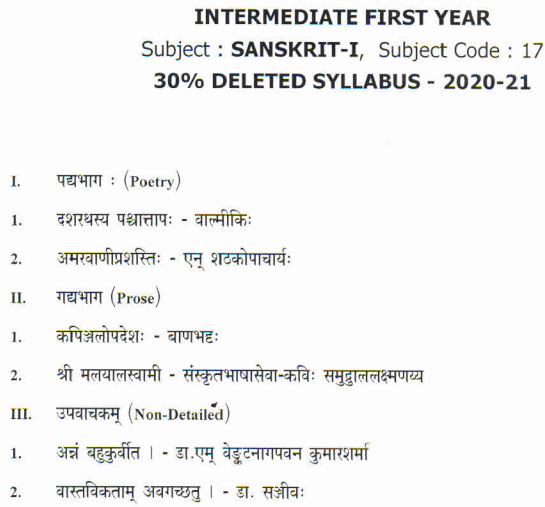
AP Inter 1st Year Sanskrit Syllabus

We hope that this Telangana & Andhra Pradesh BIEAP TS AP Intermediate Inter 1st Year Sanskrit Study Material Textbook PDF Download 2022-2023 helps the student to come out successful with flying colors in this examination. This Jr Inter 1st Year Sanskrit Study Material will help students to gain the right knowledge to tackle any type of questions that can be asked during the exams.
AP Inter 1st Year English Study Material Pdf | Intermediate 1st Year English Textbook Solutions

Telangana & Andhra Pradesh BIEAP TS AP Intermediate Inter 1st Year English Study Material Textbook Solutions Guide Questions and Answers PDF Free Download, TS AP Inter 1st Year English Blue Print Weightage 2022-2023, Telugu Academy Intermediate 1st Year English Textbook Pdf Download are part of AP Inter 1st Year Study Material Pdf.

Students can also read the AP Inter 1st Year English Syllabus & AP Inter 1st Year English Important Questions for exam preparation.

AP Intermediate 1st Year English Study Material Pdf Download | Jr Inter 1st Year English Textbook Solutions

Inter 1st Year English Textbook Lessons Prose

Inter 1st Year English Poems Poetry

Extensive Reading (Non-Detailed)

Inter 1st Year English Grammar

Intermediate 1st Year English Grammar Pdf

Inter 1st Year English Communication Skills

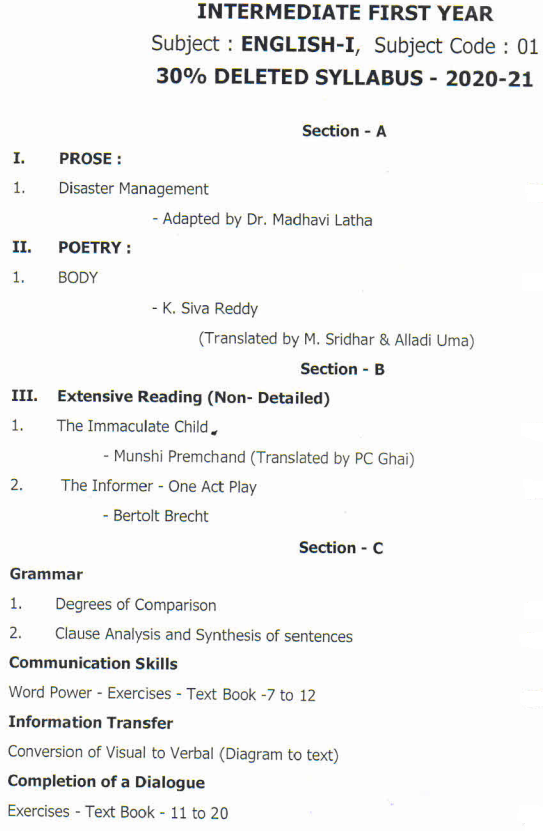
Intermediate 1st Year English Syllabus

AP Inter 1st Year English Syllabus

AP Inter 1st Year English Syllabus

We hope that this Telangana & Andhra Pradesh BIEAP TS AP Intermediate Inter 1st Year English Study Material Textbook PDF Download 2022-2023 helps the student to come out successful with flying colors in this examination. This Jr Inter 1st Year English Study Material will help students to gain the right knowledge to tackle any type of questions that can be asked during the exams.
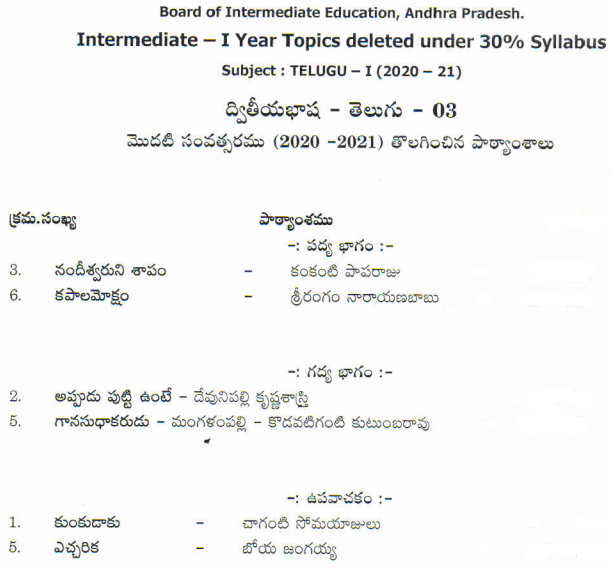
AP Inter 1st Year Telugu Study Material Pdf | Intermediate 1st Year Telugu Textbook Solutions

Telangana & Andhra Pradesh BIEAP TS AP Intermediate Inter 1st Year Telugu Study Material Textbook Solutions Guide Questions and Answers PDF Free Download, TS AP Inter 1st Year Telugu Blue Print Weightage 2022-2023, Telugu Academy Intermediate 1st Year Telugu Textbook Pdf Download are part of AP Inter 1st Year Study Material Pdf.

Students can also read the AP Inter 1st Year Telugu Syllabus & AP Inter 1st Year Telugu Important Questions for exam preparation.

AP Intermediate 1st Year Telugu Study Material Pdf Download | Jr Inter 1st Year Telugu Textbook Solutions

Inter 1st Year Telugu Poems పద్య భాగం

Inter 1st Year Telugu Textbook Lessons గద్య భాగం

Inter 1st Year Telugu Non-Detailed ఉపవాచకం కథా నందనం

Inter 1st Year Telugu Grammar

Intermediate 1st Year Telugu Grammar Pdf

Intermediate 1st Year Telugu Syllabus

AP Inter 1st Year Telugu Syllabus

AP Inter 1st Year Telugu Syllabus

We hope that this Telangana & Andhra Pradesh BIEAP TS AP Intermediate Inter 1st Year Telugu Study Material Textbook PDF Download 2022-2023 helps the student to come out successful with flying colors in this examination. This Jr Inter 1st Year Telugu Study Material will help students to gain the right knowledge to tackle any type of questions that can be asked during the exams.
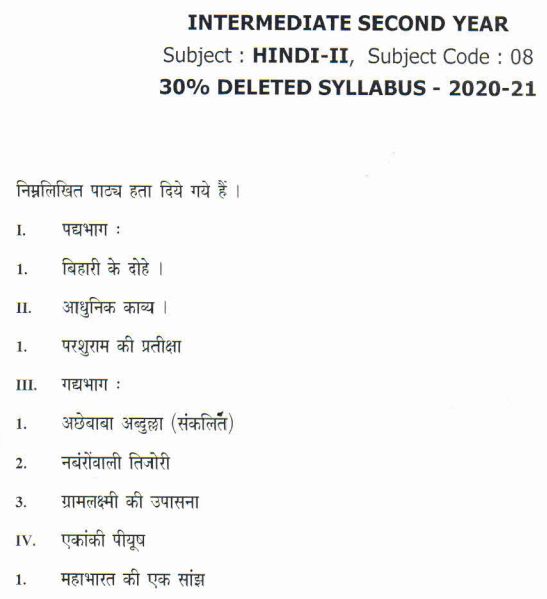
AP Inter 2nd Year Hindi Study Material Pdf | Intermediate 2nd Year Hindi Textbook Solutions

Telangana & Andhra Pradesh BIEAP TS AP Intermediate Inter 2nd Year Hindi Study Material Textbook Solutions Guide Questions and Answers PDF Free Download, TS AP Inter 2nd Year Hindi Blue Print Weightage 2022-2023, Telugu Academy Intermediate 2nd Year Hindi Textbook Pdf Download are part of AP Inter 2nd Year Study Material Pdf.

Students can also read the AP Inter 2nd Year Hindi Syllabus & AP Inter 2nd Year Hindi Important Questions for exam preparation.

AP Intermediate 2nd Year Hindi Study Material Pdf Download | Sr Inter 2nd Year Hindi Textbook Solutions

Inter 2nd Year Hindi Poems पद्य भाग

Inter 2nd Year Hindi Textbook Lessons गद्य भाग

Inter 2nd Year Hindi Non-Detailed एकांकी पीयूष

Inter 2nd Year Hindi Grammar

Intermediate 2nd Year Hindi Grammar Pdf

Intermediate 2nd Year Hindi Syllabus

AP Inter 2nd Year Hindi Syllabus

AP Inter 2nd Year Hindi Syllabus

We hope that this Telangana & Andhra Pradesh BIEAP TS AP Intermediate Inter 2nd Year Hindi Study Material Textbook PDF Download 2022-2023 helps the student to come out successful with flying colors in this examination. This Sr Inter 2nd Year Hindi Study Material will help students to gain the right knowledge to tackle any type of questions that can be asked during the exams.
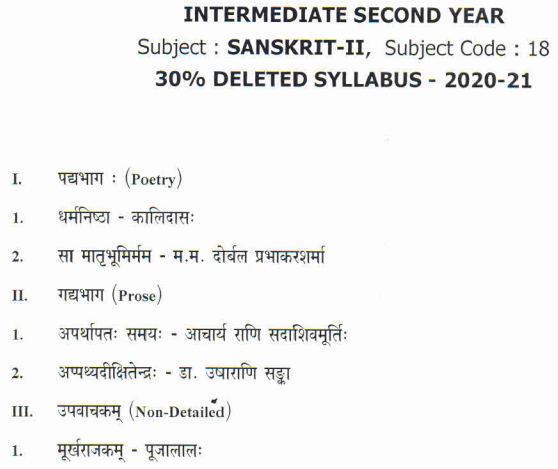
AP Inter 2nd Year Sanskrit Study Material Pdf | Intermediate 2nd Year Sanskrit Textbook Solutions

Telangana & Andhra Pradesh BIEAP TS AP Intermediate Inter 2nd Year Sanskrit Study Material Textbook Solutions Guide Questions and Answers PDF Free Download, TS AP Inter 2nd Year Sanskrit Blue Print Weightage 2022-2023, Telugu Academy Intermediate 2nd Year Sanskrit Textbook Pdf Download are part of AP Inter 2nd Year Study Material Pdf.

Students can also read the AP Inter 2nd Year Sanskrit Syllabus & AP Inter 2nd Year Sanskrit Important Questions for exam preparation.

AP Intermediate 2nd Year Sanskrit Study Material Pdf Download | Sr Inter 2nd Year Sanskrit Textbook Solutions

Inter 2nd Year Sanskrit Poems पद्यभागः

Inter 2nd Year Sanskrit Textbook Lessons गद्यभागः

Inter 2nd Year Sanskrit Non-Detailed उपवाचकम्

Inter 2nd Year Sanskrit शेमुषीपरीक्षा

Inter 2nd Year Sanskrit Grammar

Intermediate 2nd Year Sanskrit Grammar Pdf

Intermediate 2nd Year Sanskrit Syllabus

AP Inter 2nd Year Sanskrit Syllabus

AP Inter 2nd Year Sanskrit Syllabus

We hope that this Telangana & Andhra Pradesh BIEAP TS AP Intermediate Inter 2nd Year Sanskrit Study Material Textbook PDF Download 2022-2023 helps the student to come out successful with flying colors in this examination. This Sr Inter 2nd Year Sanskrit Study Material will help students to gain the right knowledge to tackle any type of questions that can be asked during the exams.
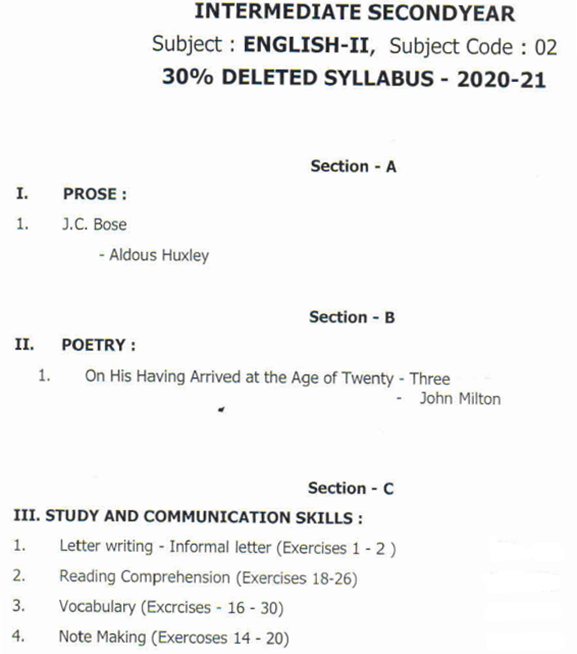
AP Inter 2nd Year English Study Material Pdf | Intermediate 2nd Year English Textbook Solutions

Telangana & Andhra Pradesh BIEAP TS AP Intermediate Inter 2nd Year English Study Material Textbook Solutions Guide Questions and Answers PDF Free Download, TS AP Inter 2nd Year English Blue Print Weightage 2022-2023, Telugu Academy Intermediate 2nd Year English Textbook Pdf Download are part of AP Inter 2nd Year Study Material Pdf.

Students can also read the AP Inter 2nd Year English Syllabus & AP Inter 2nd Year English Important Questions for exam preparation.

AP Intermediate 2nd Year English Study Material Pdf Download | Sr Inter 2nd Year English Textbook Solutions

Inter 2nd Year English Textbook Lessons Prose

Inter 2nd Year English Poems Poetry

Non-Detailed

Inter 2nd Year English Grammar

Intermediate 2nd Year English Grammar Pdf

Intermediate 2nd Year English Syllabus

AP Inter 2nd Year English Syllabus

AP Inter 2nd Year English Syllabus

We hope that this Telangana & Andhra Pradesh BIEAP TS AP Intermediate Inter 2nd Year English Study Material Textbook PDF Download 2022-2023 helps the student to come out successful with flying colors in this examination. This Sr Inter 2nd Year English Study Material will help students to gain the right knowledge to tackle any type of questions that can be asked during the exams.

AP Inter 2nd Year Telugu Study Material Pdf | Intermediate 2nd Year Telugu Textbook Solutions

Telangana & Andhra Pradesh BIEAP TS AP Intermediate Inter 2nd Year Telugu Study Material Textbook Solutions Guide Questions and Answers PDF Free Download, TS AP Inter 2nd Year Telugu Blue Print Weightage 2022-2023, Telugu Academy Intermediate 2nd Year Telugu Textbook Pdf Download are part of AP Inter 2nd Year Study Material Pdf.

Students can also read the AP Inter 2nd Year Telugu Syllabus & AP Inter 2nd Year Telugu Important Questions for exam preparation.

AP Intermediate 2nd Year Telugu Study Material Pdf Download | Sr Inter 2nd Year Telugu Textbook Solutions

Inter 2nd Year Telugu Poems పద్య భాగం

Inter 2nd Year Telugu Textbook Lessons గద్య భాగం

Inter 2nd Year Telugu Non-Detailed ఉపవాచకం నందిని

Inter 2nd Year Telugu Grammar

Intermediate 2nd Year Telugu Grammar Pdf

Intermediate 2nd Year Telugu Syllabus

AP Inter 2nd Year Telugu Syllabus

AP Inter 2nd Year Telugu Syllabus

We hope that this Telangana & Andhra Pradesh BIEAP TS AP Intermediate Inter 2nd Year Telugu Study Material Textbook PDF Download 2022-2023 helps the student to come out successful with flying colors in this examination. This Sr Inter 2nd Year Telugu Study Material will help students to gain the right knowledge to tackle any type of questions that can be asked during the exams.
AP Inter 2nd Year Accountancy Study Material Chapter 10 Accounts from Incomplete Records

Andhra Pradesh BIEAP AP Inter 2nd Year Accountancy Study Material 10th Lesson Accounts from Incomplete Records Textbook Questions and Answers.

AP Inter 2nd Year Accountancy Study Material 10th Lesson Accounts from Incomplete Records

Short Answer Questions

Question 1.
What is meant by accounts from Incomplete records?
Answer:
Accounting records that are not strictly kept according to the double entry system are known as accounts from incomplete records. It simply means the principles of the double entry system are not being followed for all transactions.

Question 2.
Define accounts from Incomplete records.
Answer:
Definition: According to R.N. Carter, a single entry cannot be termed as a system, as it is hot based on any scientific system like a double entry system, for this purpose, a single entry is nowadays known as the preparation of accounts from incomplete records.

AP Inter 2nd Year Accountancy Study Material Chapter 10 Accounts from Incomplete Records

Question 3.
What are the uses of Incomplete records?
Answer:
Uses of accounts from incomplete records:

  • Single entry is a simple method of recording transactions.
  • It is less expensive when compared to the double-entry system of bookkeeping.
  • It is mainly suitable for small business concerns with a limited number of transactions.
  • It is very easy to follow, a person without any adequate knowledge of the principles of accounting can understand it.
  • Ascertainment of profit or loss is very easy.

Question 4.
Write briefly the salient features of Incomplete records.
Answer:
Features of accounts from incomplete records:

  • It is not a systematic method of recording transactions.
  • It is very common to keep only personal accounts.
  • It avoids real and nominal accounts.
  • It is very common to keep a cashbook to record cash receipts and cash payments.
  • This system lacks uniformity as it differs from firm to firm.
  • It is most suitable and used by sole traders and partnership concerns.

Question 5.
Give two main differences between a statement of affairs and a balance sheet.
Answer:
The following are the differences between a Statement of Affairs and a Balance Sheet.

Basis Statement of Affairs Balance Sheet
1. Purpose It shows the financial position as well as finding out capital in ascertaining profit/loss. It shows the financial position on a particular date.
2. Source It is prepared from ledger balances and partly from other particulars and estimates etc. It is prepared from balances only.
3. Accounting Method It is prepared when accounts are prepared under a single entry. It is prepared when accounts are maintained double-entry system.
4. Reliability It is not regarded as reliable as it is based partly on accounts and partly on other information. It is reliable as it is based on actual figures.
5. Capital Account Capital is the excess of assets over liabilities. Capital is taken from the ledger.
6. Trail Balance Trail balance is not prepared. Trail balance is prepared.
7. Omission In this statement, omission assets and liabilities cannot be tracked. Any omission of an asset or liability can be easily traced as the total will not agree.

Question 6.
How to ascertain profit under Incomplete records?
Answer:
Under a single-entry system, net profit is ascertained by calculating capital at the end and capital at the beginning by preparing two statements of affairs. Then the capital at the end will be added by drawings during the year and subtracting additional capital brought in. The difference between the adjusted capital and capital at the beginning is either a net profit or a net loss.

AP Inter 2nd Year Accountancy Study Material Chapter 10 Accounts from Incomplete Records

Question 7.
Write in brief the limitations of Incomplete records of bookkeeping.
Answer:
The following are the limitations of accounts from incomplete records.

  • It is not a scientific method of accounting because it does not record the two-fold aspect of each transaction.
  • No trail balance can be prepared as it does not record the duel aspect of each transaction, so, the arithmetical accuracy of the books cannot be checked.
  • In the absence of nominal accounts, trading and profit and loss account cannot be prepared.
  • In the absence of real accounts, it is not possible to know the exact financial position of the business.
  • An internal check is not possible, so the possibility of fraud or misappropriation is greater in the case of a single entry.
  • Accounts prepared under a single entry do not inspire confidence in outsiders.
  • It is difficult to ascertain the value of a business, specifically goodwill if the owner wishes to sell his business.

Question 8.
Write any differences between the double-entry system and the single-entry system.
Answer:
The following are the differences between a double-entry system and a single-entry system.

Basis Double Entry System Single Entry System
1. Type It is a perfect and complete system of bookkeeping. It is an incomplete system and a crude method.
2. Nature This system is scientific and follows certain accounting principles. This system is unscientific and does not follow accounting principles.
3. Two Aspects Both the debit and credit aspects of each transaction are recorded. Both aspects are not recorded.
4. Records It provides complete and detailed records of the business. It does not provide complete and detailed records of the business.
5. Accounts In this, all types of accounts, namely personal, real and nominal accounts are maintained. In this, personal accounts are maintained except the cashbook. Real and nominal accounts are ignored.
6. Trail Balance The arithmetical accuracy of accounts can be checked by preparing a trial balance. Trail balance cannot be prepared to check the arithmetical accuracy.
7. Ascertainment of Profit Profit can be ascertained by preparing trading and profit and loss a/c. The difference between capital at the beginning and end is treated as profit.
8. Cost Relatively it is more expensive. Relatively it is less expensive.
9. Suitability It is suitable for all types of business organisations. It is suitable for only small business concerns.
10. Errors Errors can be easily detected and rectified. Errors cannot be detected and rectified.
11. True Financial Position The balance sheet can be prepared to know the true and fair financial position. The balance sheet cannot be prepared and only a statement of affairs can be prepared to know the financial position in a rough manner.

Textual Exercises

Question 1.
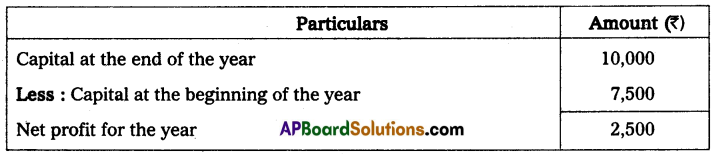
From the following find the profit earned by a trader.
Capital at the beginning of the year – ₹ 7,500
Capital at the end of the year – ₹ 10,000
Solution:
Statement of Profit or Loss
AP Inter 2nd Year Accountancy Study Material Chapter 10 Accounts from Incomplete Records Textual Exercises Q1

Question 2.
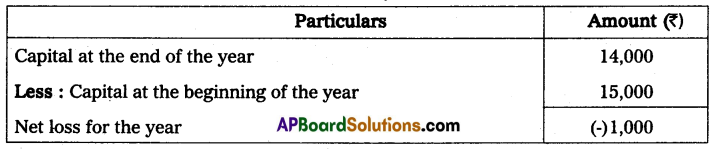
Calculate the profit or loss of a concern
Capital at the beginning of the year – ₹ 15,000
Capital at the end of the year – ₹ 14,000
Solution:
Statement of Profit or Loss
AP Inter 2nd Year Accountancy Study Material Chapter 10 Accounts from Incomplete Records Textual Exercises Q2

AP Inter 2nd Year Accountancy Study Material Chapter 10 Accounts from Incomplete Records

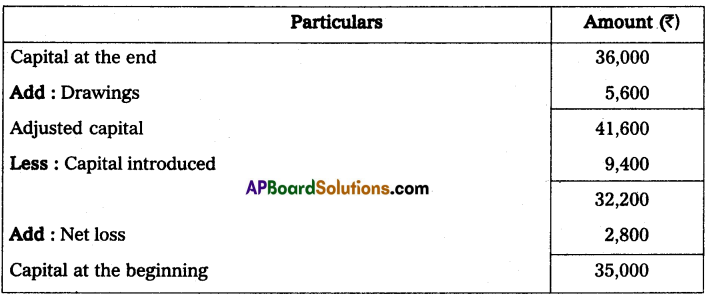
Question 3.
Calculate the missing figure
Capital at the beginning – ?
Capital at the end – ₹ 36,000
Capital introduced – ₹ 9,400
Drawings – ₹ 5,600
Loss – ₹ 2,800
Solution:
AP Inter 2nd Year Accountancy Study Material Chapter 10 Accounts from Incomplete Records Textual Exercises Q3

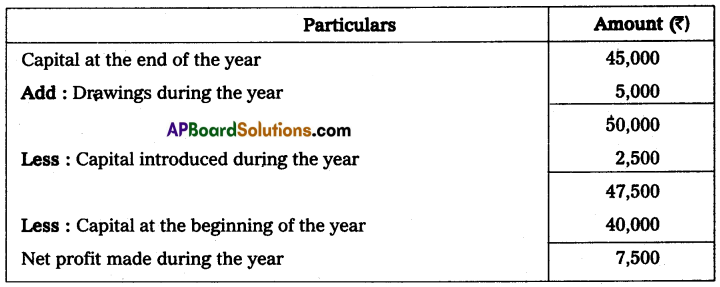
Question 4.
Find out the profit from the following data:
Capital at the beginning of the year – ₹ 40,000
Capital at the end of the year – ₹ 45,000
Drawings during the year – ₹ 5,000
Capital introduced during the year – ₹ 2,500
Solution:
Statement showing Profit or Loss
AP Inter 2nd Year Accountancy Study Material Chapter 10 Accounts from Incomplete Records Textual Exercises Q4

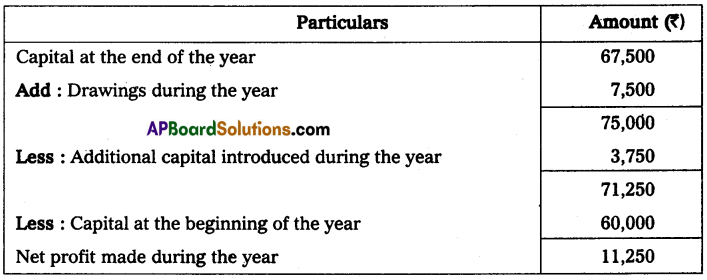
Question 5.
Find out the profit from the following data:
Capital at the beginning of the year – ₹ 60,000
Capital at the end of the year – ₹ 67,500
Drawings during the year – ₹ 7,500
Additional capital introduced during the year – ₹ 3,750
Solution:
Statement showing Profit or Loss
AP Inter 2nd Year Accountancy Study Material Chapter 10 Accounts from Incomplete Records Textual Exercises Q5

Question 6.
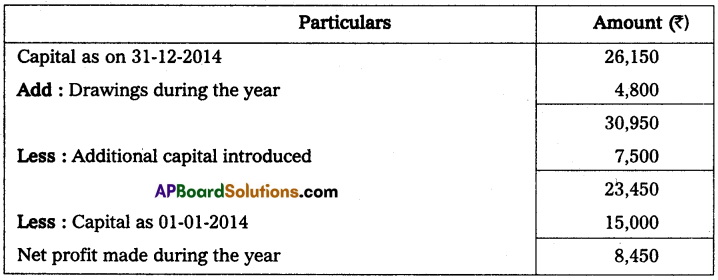
Ascertain profit earned by a trader who keeps these books under a single entry system.
(i) Excess of assets over liabilities as of 31-12-2014 – ₹ 26,150
(ii) Additional capital introduced during the year – ₹ 7,500
(iii) Drawings during the year – ₹ 4,800
(iv) Capital as on 01-01-2014 – ₹ 15,000
Solution:
Statement showing Profit or Loss
AP Inter 2nd Year Accountancy Study Material Chapter 10 Accounts from Incomplete Records Textual Exercises Q6

AP Inter 2nd Year Accountancy Study Material Chapter 10 Accounts from Incomplete Records

Question 7.
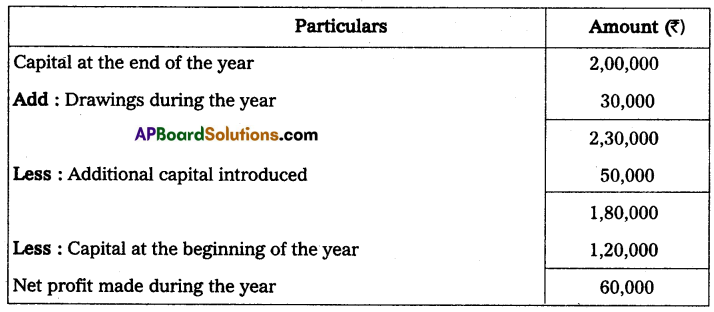
Following the information given below prepare this statement of profit or loss.
(i) Capital at the end of the year – ₹ 2,00,000
(ii) Capital at the beginning of the year – ₹ 1,20,000
(iii) Drawings made during the period – ₹ 30,000
(iv) Additional capital introduced – ₹ 50,000
Solution:
Statement showing Profit or Loss
AP Inter 2nd Year Accountancy Study Material Chapter 10 Accounts from Incomplete Records Textual Exercises Q7

Question 8.
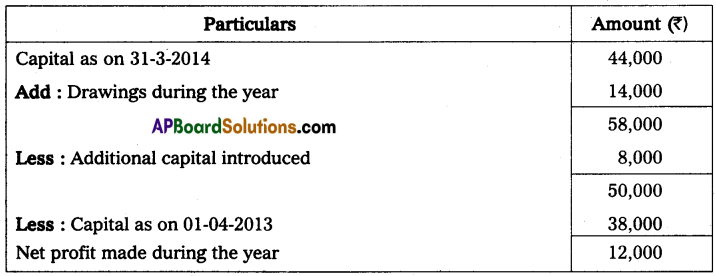
Mr. Gopal maintains his books on single entry method he was given the following information:
Capital on 01-04-2013 – ₹ 38,000
Capital on 31-3-2014 – ₹ 44,000
Drawings during the year – ₹ 14,000
Additional capital introduced during the year – ₹ 8,000
You are required to calculate profit or loss.
Solution:
Statement showing Profit or Loss
AP Inter 2nd Year Accountancy Study Material Chapter 10 Accounts from Incomplete Records Textual Exercises Q8

Question 9.
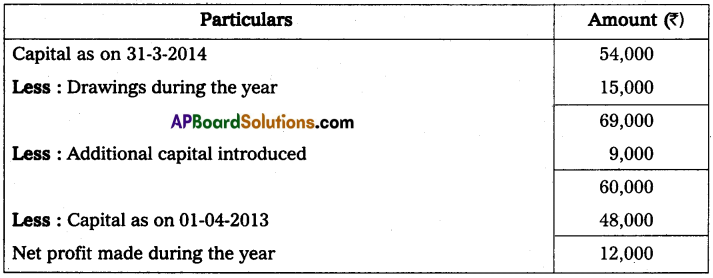
Mr. Jeevan maintains his books in the single entry system he gives the following information.
Capital on 01-04-2013 – ₹ 48,000
Drawings dining the year – ₹ 15,000
Capital as on 31-03-2014 – ₹ 54,000
Additional capital introduced during the year – ₹ 9,000
You are requested to prepare a statement of profit or loss for the 31-03-2014
Solution:
Statement showing Profit or Loss
AP Inter 2nd Year Accountancy Study Material Chapter 10 Accounts from Incomplete Records Textual Exercises Q9

Question 10.
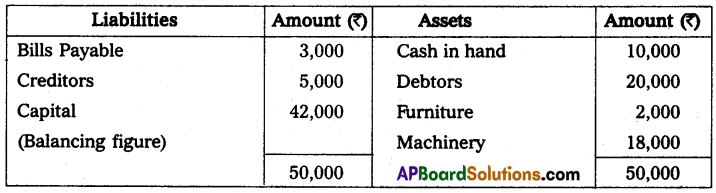
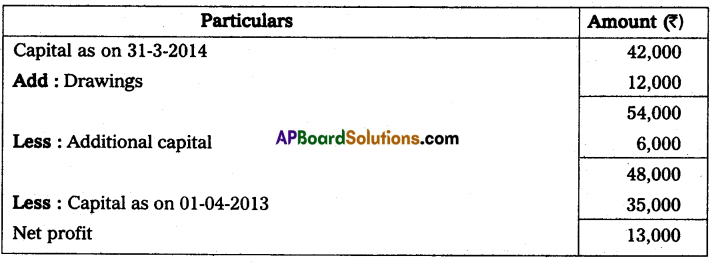
Mr. Ramesh commenced business on 1st April 2013 with a capital of ₹ 35,000. On 31st March 2014, his position was as follows.
Furniture – ₹ 2,000
Cash in hand – ₹ 10,000
Machinery – ₹ 18,000
Creditors – ₹ 5,000
Debtors – ₹ 20,000
Bills Payable – ₹ 3,000
During the year he withdrew ₹ 12,000 for his personal use and introduced additional capital ₹ 6,000 to find out the profit or loss made by Mr. Ramesh during the year.
Solution:
Statement of Affairs as of 31st March 2014
AP Inter 2nd Year Accountancy Study Material Chapter 10 Accounts from Incomplete Records Textual Exercises Q10
Statement showing Profit or Loss
AP Inter 2nd Year Accountancy Study Material Chapter 10 Accounts from Incomplete Records Textual Exercises Q10.1

AP Inter 2nd Year Accountancy Study Material Chapter 10 Accounts from Incomplete Records

Question 11.
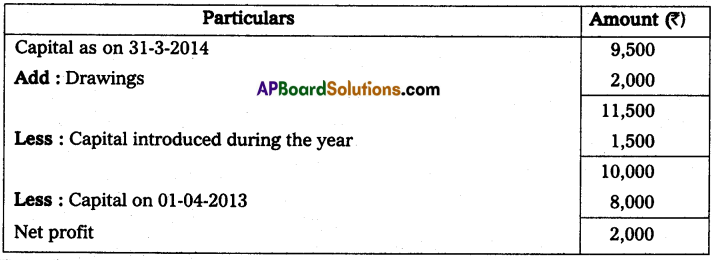
Mr. Harsha maintains his books on single-entry systems he gives you the following information.
Capital on 01-04-2013 – ₹ 8,000
Capital on 31-03-2014 – ₹ 9,500
Drawings for the year – ₹ 2,000
Capital introduced during the year – ₹ 1,500
You are required to calculate the profit that Harsha earned.
Solution:
Statement showing Profit or Loss
AP Inter 2nd Year Accountancy Study Material Chapter 10 Accounts from Incomplete Records Textual Exercises Q11

Question 12
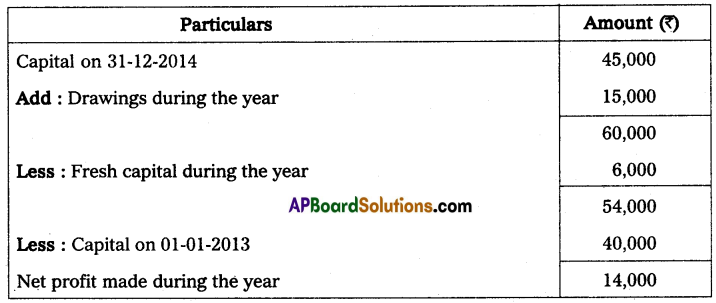
Mr. Ganesh maintains his books on single entry method. He gives you the following information.
Capital on 01-01-2013 – ₹ 40,000
Drawings during the year – ₹ 15,000
Capital on 31-12-2014 – ₹ 45,000
Fresh capital during the year – ₹ 6,000
Prepare the statement of profit or loss.
Solution:
Statement showing Profit or Loss
AP Inter 2nd Year Accountancy Study Material Chapter 10 Accounts from Incomplete Records Textual Exercises Q12

Question 13.
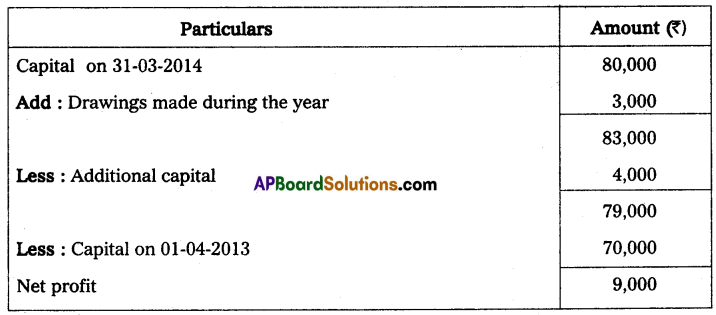
Mr. X keeps books in the single-entry system. Find the profit from the following particulars.
Capital on 31-03-2014 – ₹ 80,000
Capital on 1-04-2013 – ₹ 70,000
Additional capital as of 2013-2014 – ₹ 4,000
Drawings made during the year – ₹ 3,000
Solution:
Statement showing Profit or Loss
AP Inter 2nd Year Accountancy Study Material Chapter 10 Accounts from Incomplete Records Textual Exercises Q13

Question 14.
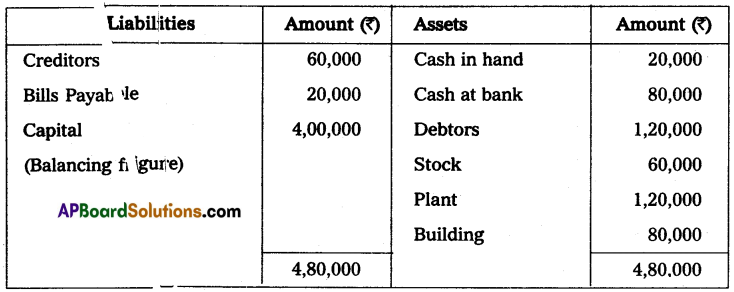
From the following details, ascertain Raju’s capital as of 01-01-2014.
Cash in hand – ₹ 20,000
Building- ₹ 80,000
Cash at Bank – ₹ 80,000
Plant – ₹ 1,20,000
Debtors – ₹ 1,20,000
Creditors – ₹ 60,000
Stock – ₹ 60,000
Bills Payable – ₹ 20,000
Solution:
Statement of Affairs as on 1-1-2014
AP Inter 2nd Year Accountancy Study Material Chapter 10 Accounts from Incomplete Records Textual Exercises Q14

AP Inter 2nd Year Accountancy Study Material Chapter 10 Accounts from Incomplete Records

Question 15.
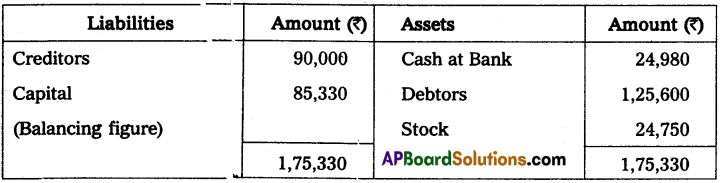
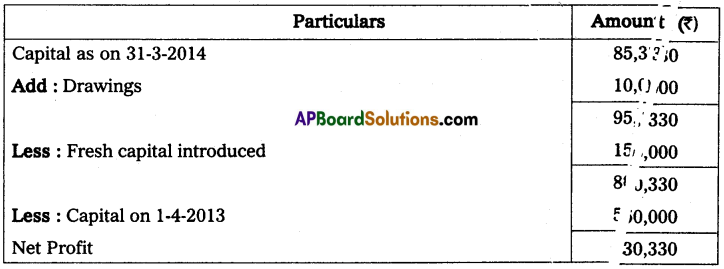
Mr. Mehta started his readymade garments business on April 1, 2013, with a capital of ₹ 50,000. He did not maintain his books according to the double entry system. During the year he introduced fresh capital of ₹ 15,000. He withdrew ₹ 10,000 for personal use. On March 31, 2014, his assets and liabilities were as follows:
Total creditors ₹ 90,000; Total debtors ₹ 1,25,600; Stock ₹ 24,750; Cash at bank ₹ 24,980.
Calculate the profit or loss made by Mr. Mehta during the first year of his business using the statement of affairs method.
Solution:
Statement of Affairs as of 31st March 2014
AP Inter 2nd Year Accountancy Study Material Chapter 10 Accounts from Incomplete Records Textual Exercises Q15
Statement showing Profit or Loss
AP Inter 2nd Year Accountancy Study Material Chapter 10 Accounts from Incomplete Records Textual Exercises Q15.1

Question 16.
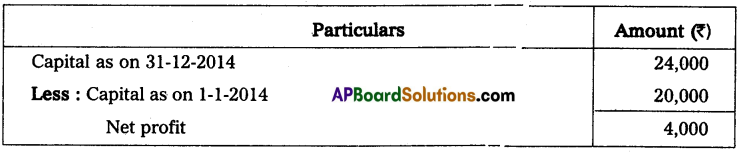
Mr. J. Keeps his books by a single entry. He started the business on 1st January 2014 with ₹ 20,000 on 31st December 2014 his position was as under.
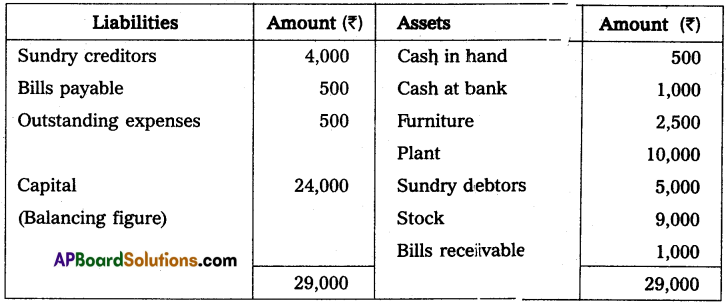
Assets: Cash in hand ₹ 500; Cash at bank ₹ 1,000; Furniture ₹ 2,500; Plant ₹ 10,000; Sundry debtors ₹ 5,000; Stock ₹ 9,000 and Bills receivables ₹ 1,000.
Liabilities: Sunday creditors ₹ 4,000; Bills payable ₹ 500 and Outstanding expenses ₹ 500. Ascertain the profit or loss made by J.
Solution:
Statement of Affairs as on 31-12-2014
AP Inter 2nd Year Accountancy Study Material Chapter 10 Accounts from Incomplete Records Textual Exercises Q16
Statement showing Profit or Loss
AP Inter 2nd Year Accountancy Study Material Chapter 10 Accounts from Incomplete Records Textual Exercises Q16.1

Question 17.
Mr. Ravikumar keeps his books on single entry his position on 31st December 2013 was as follows:
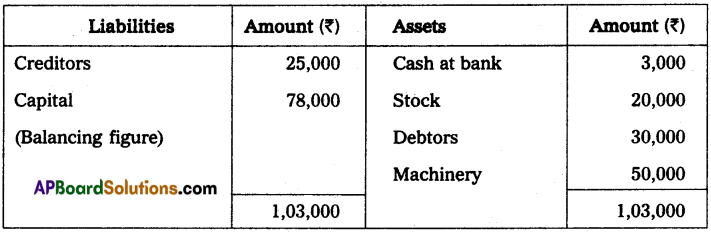
Cash at bank ₹ 3,000, Stock ₹ 20,000; Debtors ₹ 30,000, Machinery ₹ 50,000 and Creditors ₹ 25,000. His position
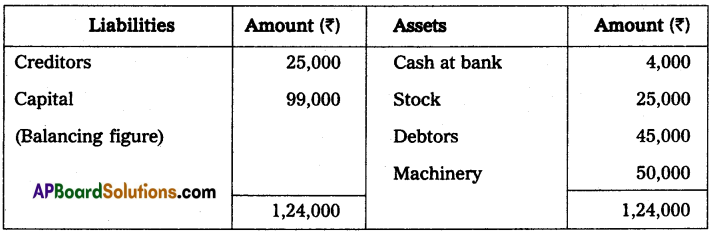
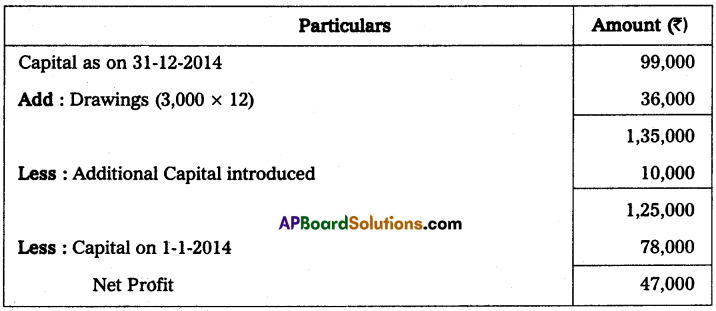
on 31st December 2014 was as follows. Cash at bank ₹ 4,000; Stock ₹ 25,000; Debtors ₹ 45,000; Machinery ₹ 50,000 and Creditors ₹ 25,000. During the year he introduced ₹ 10,000 as further capital and withdrew from business ₹ 3,000 per month.
From the above information ascertain the profit or loss made by Mr. Ravikumar for the year ended 31st December 2014.
Note: Drawings ₹ 3,000 per month, per year 36,000 (3,000 × 12 months)
Solution:
Statement of Affairs as on 31-12-2013
AP Inter 2nd Year Accountancy Study Material Chapter 10 Accounts from Incomplete Records Textual Exercises Q17
Statement of Affairs as on 31-12-2014
AP Inter 2nd Year Accountancy Study Material Chapter 10 Accounts from Incomplete Records Textual Exercises Q17.1
Statement showing Profit or Loss
AP Inter 2nd Year Accountancy Study Material Chapter 10 Accounts from Incomplete Records Textual Exercises Q17.2

Question 18.
From the following particulars prepare a statement of profit and loss for the year ended 31st December 2014.
AP Inter 2nd Year Accountancy Study Material Chapter 10 Accounts from Incomplete Records Textual Exercises Q18
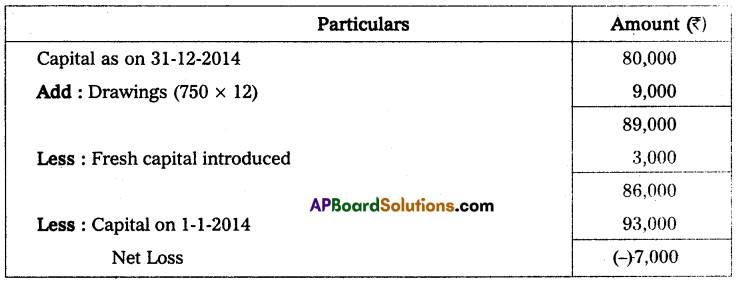
The proprietor drew at the rate of ₹ 750 per month he introduced ₹ 3,000 as fresh capital.
Solution:
Statement of Affairs as on 1-1-2014
AP Inter 2nd Year Accountancy Study Material Chapter 10 Accounts from Incomplete Records Textual Exercises Q18.1
Statement of Affairs as on 31-12-2014
AP Inter 2nd Year Accountancy Study Material Chapter 10 Accounts from Incomplete Records Textual Exercises Q18.2
Statement showing Profit or Loss
AP Inter 2nd Year Accountancy Study Material Chapter 10 Accounts from Incomplete Records Textual Exercises Q18.3

AP Inter 2nd Year Accountancy Study Material Chapter 10 Accounts from Incomplete Records

Question 19.
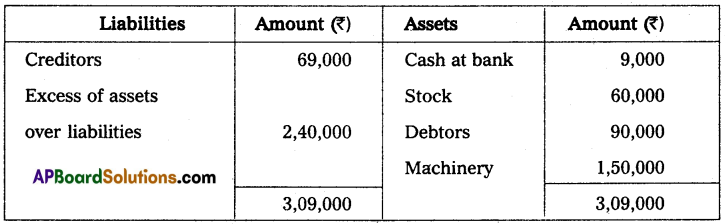
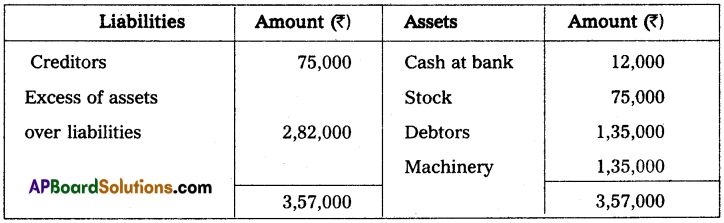
A Trader keeps his books by the single entry method. His position on 31st December 2013 is as follows. Cash at bank ₹ 9,000, Stock ₹ 60,000 Debtors ₹ 90,000, Machinery ₹ 1,50,000 and creditors ₹ 69,000. His position on 31st December 2014 was as follows. Cash at bank ₹ 12,000, Stock ₹ 75,000, Debtors ₹ 1,35,000, Machinery ₹ 1,35,000 and Creditors ₹ 75,000.
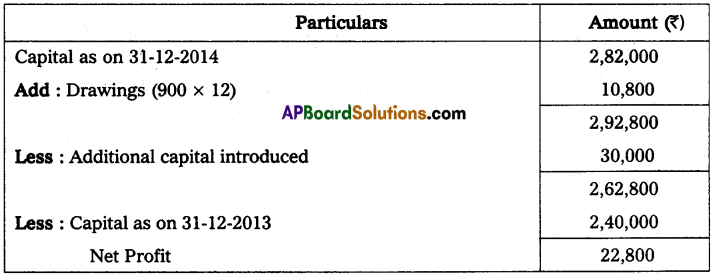
During the year the trader introduced ₹ 30,000 as further capital in the business and withdrew ₹ 900 per month. From the above, you are required to ascertain the profit or loss made by the trader for the year ended 31-12-2014.
Solution:
Statement of Affairs as on 31-12-2013
AP Inter 2nd Year Accountancy Study Material Chapter 10 Accounts from Incomplete Records Textual Exercises Q19
Statement of Affairs as on 31-12-2014
AP Inter 2nd Year Accountancy Study Material Chapter 10 Accounts from Incomplete Records Textual Exercises Q19.1
Statement showing Profit or Loss
AP Inter 2nd Year Accountancy Study Material Chapter 10 Accounts from Incomplete Records Textual Exercises Q19.2

Question 20.
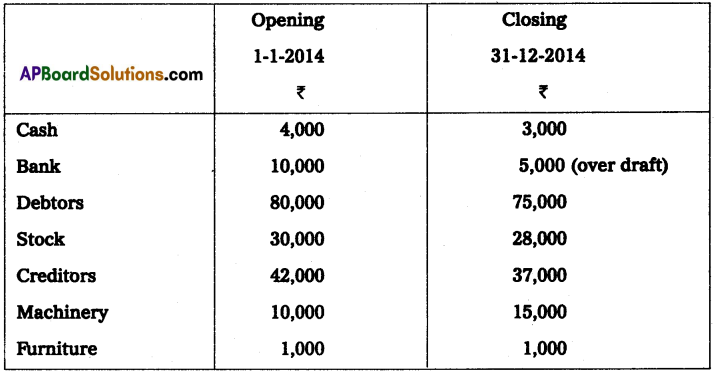
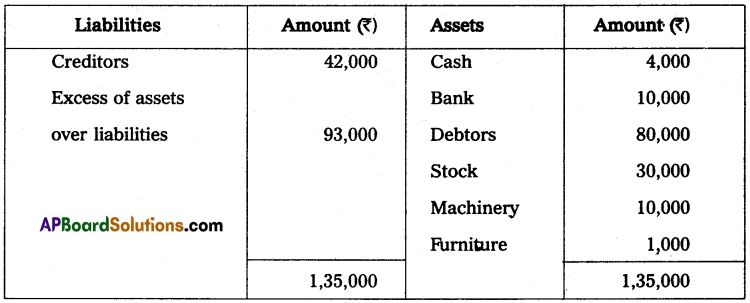
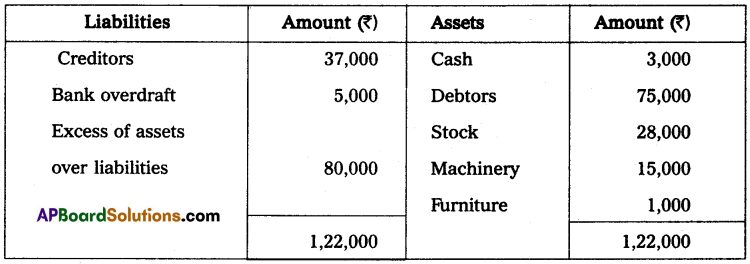
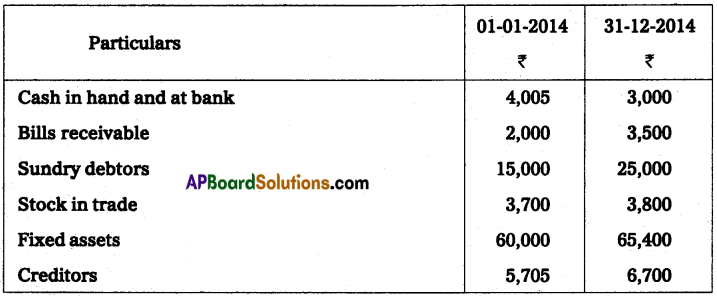
The assets and liabilities of Mr. well on 01-01-14 and 31-12-2014 were as follows.
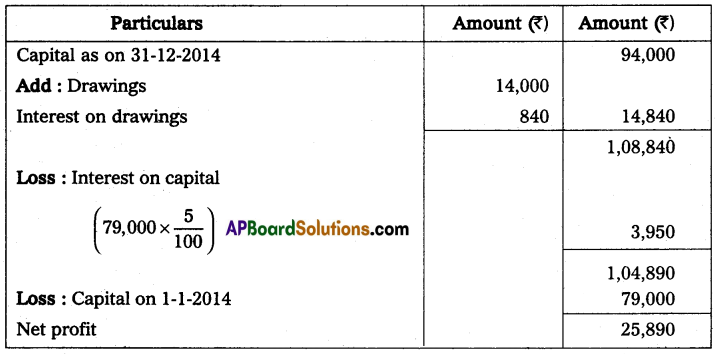
AP Inter 2nd Year Accountancy Study Material Chapter 10 Accounts from Incomplete Records Textual Exercises Q20
Calculate the profit after charging interest on capital in the beginning at 5 percent per annum after providing interest on drawings at 6 percent. Drawings were ₹ 14,000
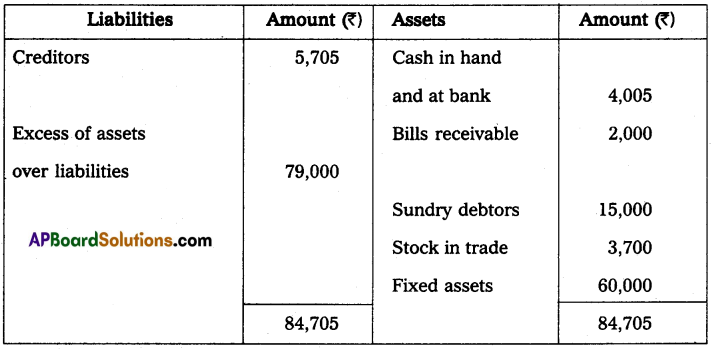
Solution:
Statement of Affairs as on 1-1-2014
AP Inter 2nd Year Accountancy Study Material Chapter 10 Accounts from Incomplete Records Textual Exercises Q20.1
Statement of Affairs as on 31-12-2014
AP Inter 2nd Year Accountancy Study Material Chapter 10 Accounts from Incomplete Records Textual Exercises Q20.2
Statement showing Profit or Loss
AP Inter 2nd Year Accountancy Study Material Chapter 10 Accounts from Incomplete Records Textual Exercises Q20.3

Question 21.
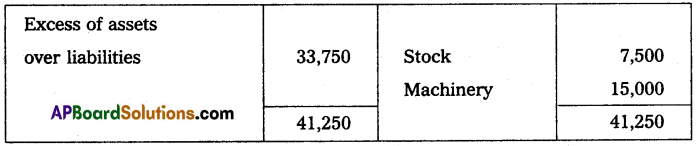
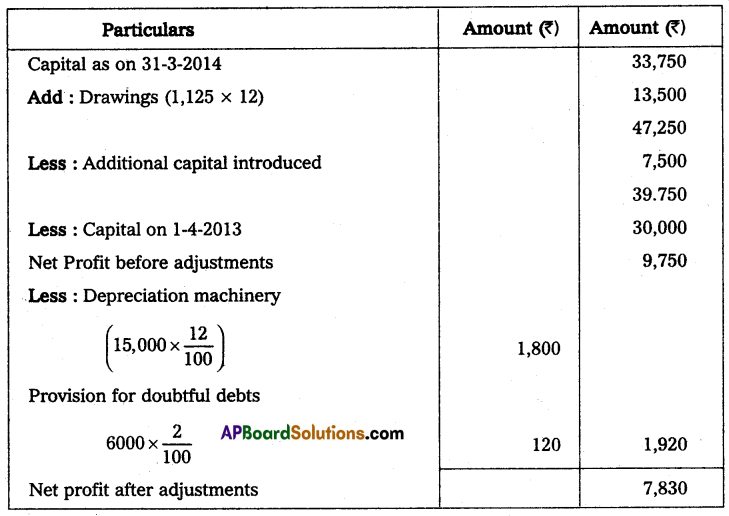
Mr. Vijay starts his business with ₹ 30,000 in cash as his capital on 1st April 2013, At the end of the year, his position was as follows. Creditors ₹ 7,500; Debtors ₹ 6,000; Cash at Bank ₹ 12,750; Stock ₹ 7,500; and Machinery ₹ 15,000. During the year he withdrew ₹ 1,125 every month. On 1st October 2013, he introduced a further capital of ₹ 7,500. You are required to ascertain the profit or loss made by him during the year after considering the following adjustments. Machinery was to depreciate at 12% and a reserve of 2% was to be raised against Debtors; Also prepare a statement of affairs on 31 March 2014.
Solution:
Statement of Affairs as on 31-3-2014
AP Inter 2nd Year Accountancy Study Material Chapter 10 Accounts from Incomplete Records Textual Exercises Q21
AP Inter 2nd Year Accountancy Study Material Chapter 10 Accounts from Incomplete Records Textual Exercises Q21.1
Statement showing Profit or Loss
AP Inter 2nd Year Accountancy Study Material Chapter 10 Accounts from Incomplete Records Textual Exercises Q21.2

Question 22.
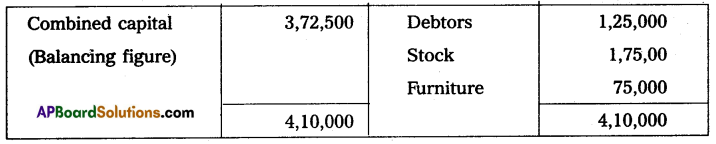
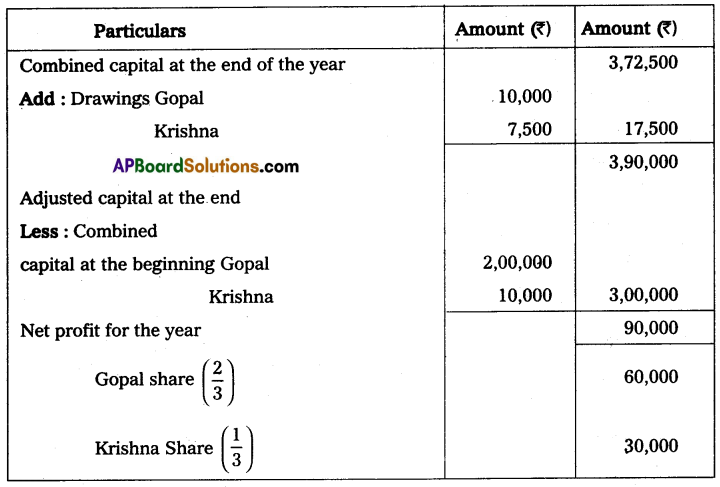
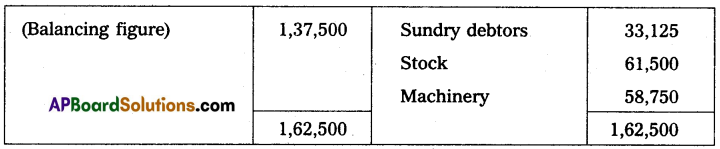
Gopal and Krishna kept their books of accounts under a single entry system. Their capital accounts on 1st April 2013 show a balance of ₹ 2,00,000 and ₹ 1,00,000 respectively. The net profits are to be shared as Gopal 2/3 and Krishna 1/3. During the year they have withdrawn ₹ 10,000 and ₹ 7,500. On March 2014 their assets and liabilities were as follows. Assets: Furniture ₹ 75,000; Stock ₹ 1,75,000; Debtors ₹ 1,25,000; Bills receivable ₹ 25,000; Cash at bank ₹ 10,000.
Liabilities: Sundry creditors ₹ 25,000; Bills payable ₹ 12,500.
Prepare a statement of affairs on 31st March 2014 and calculate the divisible profits of the partners.
Solution:
Statement of Affairs as on 31-3-2014
AP Inter 2nd Year Accountancy Study Material Chapter 10 Accounts from Incomplete Records Textual Exercises Q22
AP Inter 2nd Year Accountancy Study Material Chapter 10 Accounts from Incomplete Records Textual Exercises Q22.1
Statement of profit or loss for the year ending 31-3-2014
AP Inter 2nd Year Accountancy Study Material Chapter 10 Accounts from Incomplete Records Textual Exercises Q22.2

AP Inter 2nd Year Accountancy Study Material Chapter 10 Accounts from Incomplete Records

Question 23.
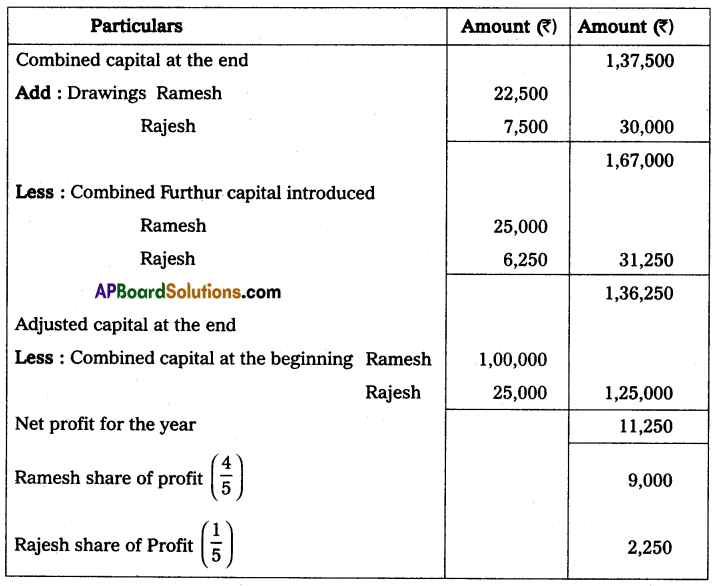
Ramesh and Rajesh are partners sharing the profit and losses in the ratio of 4 : 1 on 31st March 2013, their capital accounts show a credit balance of ₹ 1,00,000 and ₹ 25,000 respectively. During the year they introduced a fresh capital of ₹ 25,000 and ₹ 6,250 respectively. Also, they have withdrawn ₹ 1,875 and ₹ 625 each month respectively for their personal use. On 31st March 2014. Their business position was as follows:
Assets: Machinery ₹ 58,750; Stock ₹ 61,500; Sundry debtors ₹ 33,125; Bills receivable ₹ 5,375; Cash in hand ₹ 3,750.
Liabilities: Sundry creditors ₹ 25,000. You are asked to prepare a statement of affairs and statement of profit on 31st March 2014 and calculate the divisible profits or losses of the partners.
Solution:
Statement of Affairs as of 31st March 2014
AP Inter 2nd Year Accountancy Study Material Chapter 10 Accounts from Incomplete Records Textual Exercises Q23
AP Inter 2nd Year Accountancy Study Material Chapter 10 Accounts from Incomplete Records Textual Exercises Q23.1
Statement showing profit or loss for the year 2014
AP Inter 2nd Year Accountancy Study Material Chapter 10 Accounts from Incomplete Records Textual Exercises Q23.2

Question 24.
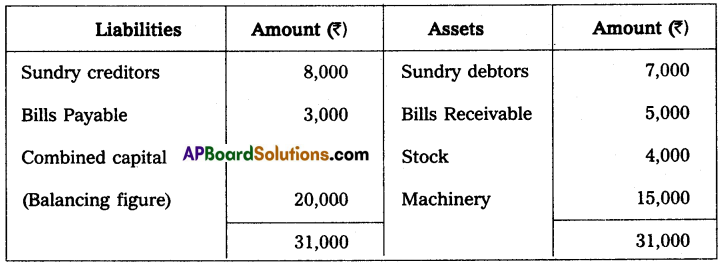
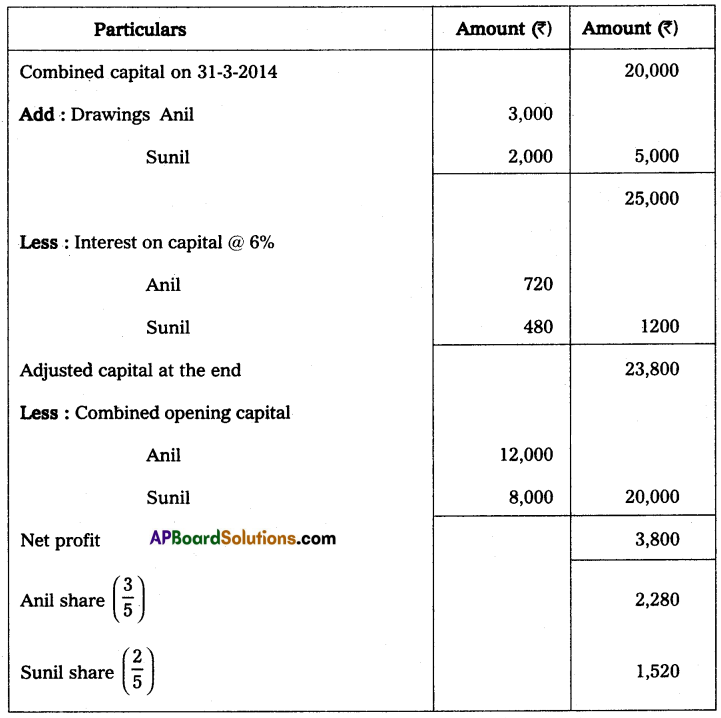
Anil and Sunil are partners sharing the profit and losses in the ratio of 3 : 2 on 31 March 2013, their capital accounts show a credit balance of ₹ 12,000 and ₹ 8,000 respectively. On 31st March 2014, their business position was as follows.
Assets: Machinery ₹ 15,000; Stock ₹ 4,000; Bills Receivables ₹ 5,000; Sundry debtors ₹ 7,000;
Liabilities: Sundry creditors ₹ 8,000; Bills payable ₹ 3,000.
You are required to prepare a profit and loss statement of affairs as of the date after taking into the following.
(a) Drawings made during the year by Anil ₹ 3,000, Sunil ₹ 2,000.
(b) Interest on capital is to be allowed at 6%.
Solution:
Statement of Affairs as on 31-3-2014
AP Inter 2nd Year Accountancy Study Material Chapter 10 Accounts from Incomplete Records Textual Exercises Q24
Statement showing profit or loss for the year ended 31st March 2014
AP Inter 2nd Year Accountancy Study Material Chapter 10 Accounts from Incomplete Records Textual Exercises Q24.1

Textual Examples

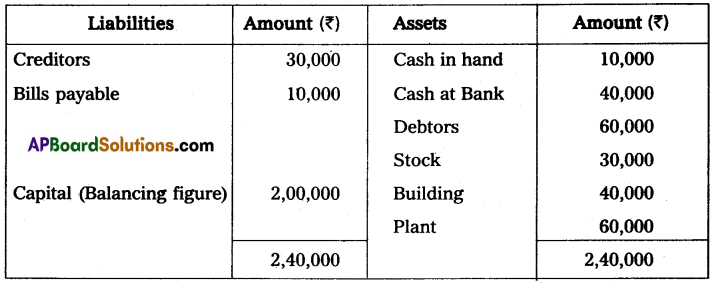
Question 1.
From the following information prepare the statement of affairs and find out the capital at the beginning.
Cash in Hand – ₹ 10,000
Cash in Bank – ₹ 40,000
Debtors – ₹ 60,000
Stock – ₹ 30,000
Building – ₹ 40,000
Plant – ₹ 60,000
Creditors – ₹ 30,000
Bills payable – ₹ 10,000
Solution:
Statement of affairs at the beginning
AP Inter 2nd Year Accountancy Study Material Chapter 10 Accounts from Incomplete Records Textual Examples Q1

AP Inter 2nd Year Accountancy Study Material Chapter 10 Accounts from Incomplete Records

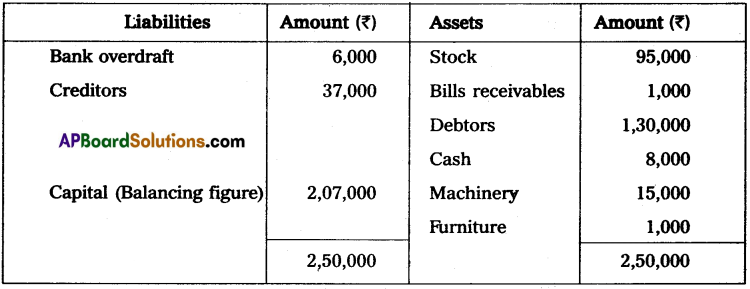
Question 2.
Prepare a statement of affairs from the following information and find out the capital at the end of the year.
Stock – ₹ 95,000
Debtors – ₹ 1,30,000
Cash – ₹ 8,000
Bills receivables – ₹ 1,000
Bank overdraft – ₹ 6,000
Creditors – ₹ 37,000
Machinery – ₹ 15,000
Furniture – ₹ 1,000
Solution:
Statement of affairs at the end of the year
AP Inter 2nd Year Accountancy Study Material Chapter 10 Accounts from Incomplete Records Textual Examples Q2

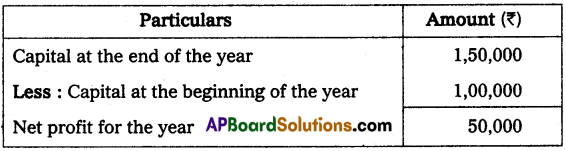
Question 3.
From the following information compute the net profit of a trader under a single entry.
Capital at the beginning of the year – ₹ 1,00000
Capital at the end of the year – ₹ 1,50,000
Solution:
AP Inter 2nd Year Accountancy Study Material Chapter 10 Accounts from Incomplete Records Textual Examples Q3

Question 4.
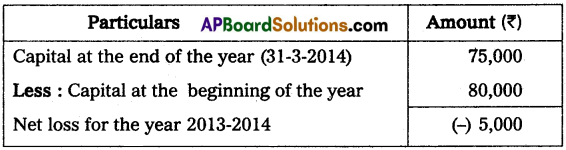
Compute the net profit for the year ending 31-03-2014 from the information given below.
Capital as of 1-4-2013 – ₹ 80,000
Capital as on 31-3-2014 – ₹ 75,000
Solution:
Statement of profits or loss
AP Inter 2nd Year Accountancy Study Material Chapter 10 Accounts from Incomplete Records Textual Examples Q4

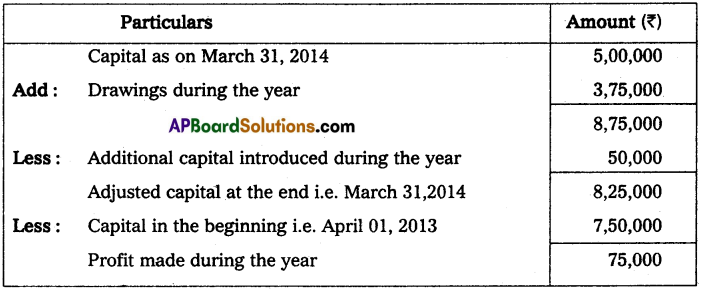
Question 5.
The following information is given below to prepare the statement of profit or loss.
Capital at the beginning of the year, i.e., April 01, 2013 – ₹ 7,50,000
Capital at the end of the year, i.e., March 31, 2014 – ₹ 5,00,000
Capital brought in by the proprietor during the year – ₹ 50,000
Withdrawals by the proprietor during the year – ₹ 3,75,000
Solution:
Statement of profit or loss for the year ended on March 31, 2014
AP Inter 2nd Year Accountancy Study Material Chapter 10 Accounts from Incomplete Records Textual Examples Q5

AP Inter 2nd Year Accountancy Study Material Chapter 10 Accounts from Incomplete Records

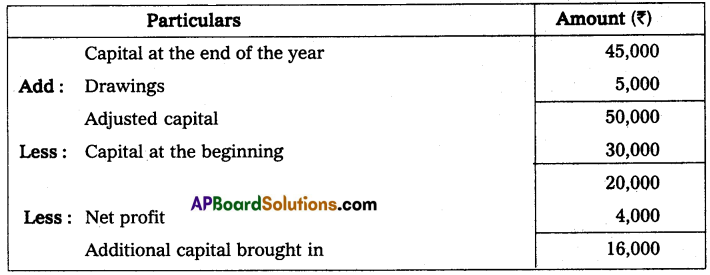
Question 6.
Find out the missing value.
Capital at the beginning of the year – ₹ 30,000
Capital at the end of the year – ₹ 45,000
Drawings – ₹ 5,000
Profit – ₹ 4,000
Additional capital brought in?
Solution:
AP Inter 2nd Year Accountancy Study Material Chapter 10 Accounts from Incomplete Records Textual Examples Q6

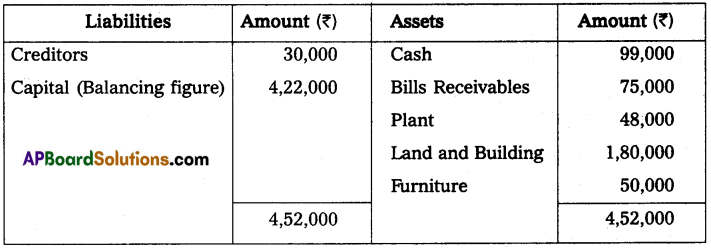
Question 7.
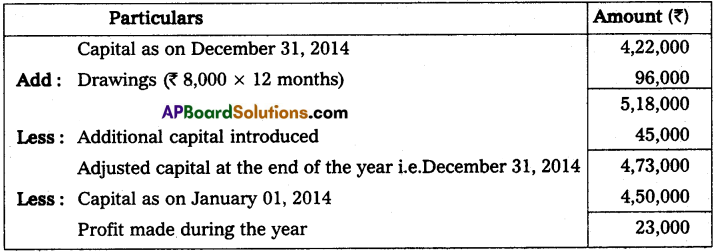
Gopal started his business on January 01, 2014, with a capital of ₹ 4,50,000 on December 31, 2014, his position was as under.
Cash – ₹ 99,000
Bills Receivables – ₹ 75,000
Plant – ₹ 48,000
Land and Building – ₹ 1,80,000
Furniture – ₹ 50,000
Creditors – ₹ 30,000
He owned ₹ 45,000 from his friend Sukumar on that date. He withdrew ₹ 8000 per month for his household purposes. Ascertain his profit or loss for this year ended December 31, 2014.
Solution:
Books of Mr. Gopal’s Statement of affairs as on December 31, 2014
AP Inter 2nd Year Accountancy Study Material Chapter 10 Accounts from Incomplete Records Textual Examples Q7
Statement of profit or loss for the year ended December 31, 2014
AP Inter 2nd Year Accountancy Study Material Chapter 10 Accounts from Incomplete Records Textual Examples Q7.1
Note: Drawing per month (₹ 8,000 × 12 = ₹ 96,000).

Question 8.
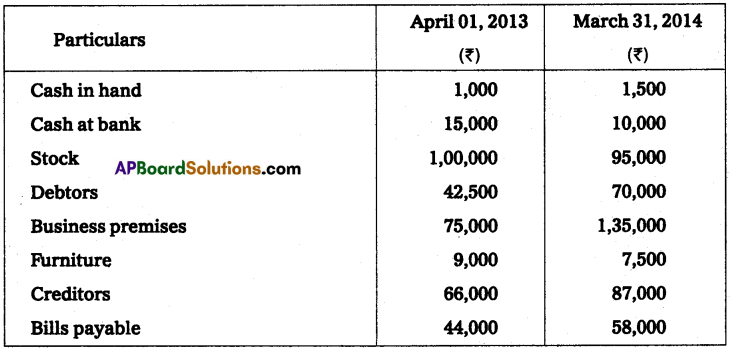
Mr. Ashok keeps his books on incomplete records following information is given below.
AP Inter 2nd Year Accountancy Study Material Chapter 10 Accounts from Incomplete Records Textual Examples Q8
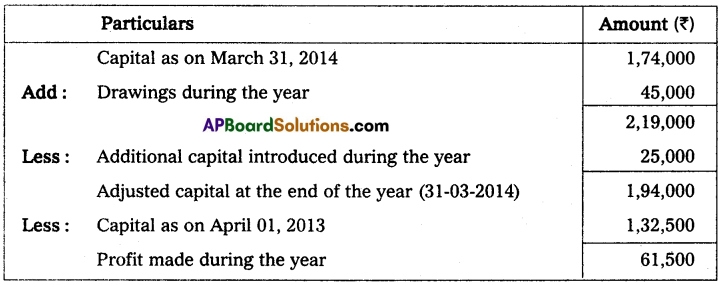
During the year he withdrew ₹ 45,000 and introduced ₹ 25,000 as further capital in the business to compute the profit or loss of the business.
Solution:
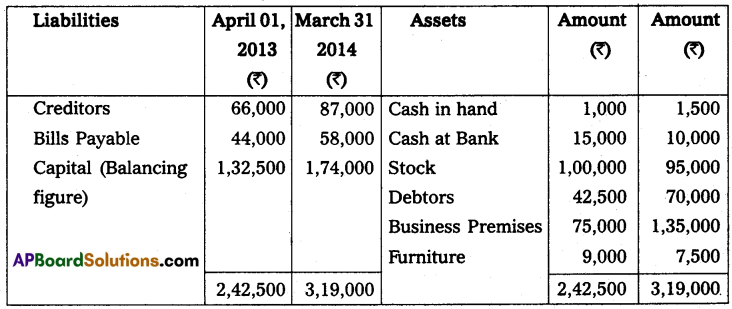
Books of Mr. Ashok Statement of affairs as on April 01, 2013, and as on March 31, 2014
AP Inter 2nd Year Accountancy Study Material Chapter 10 Accounts from Incomplete Records Textual Examples Q8.1
Statement of profit or loss for the year ended on March 31, 2014
AP Inter 2nd Year Accountancy Study Material Chapter 10 Accounts from Incomplete Records Textual Examples Q8.2

AP Inter 2nd Year Accountancy Study Material Chapter 10 Accounts from Incomplete Records

Question 9.
Mr. Shankar keeps his books under single-entry system and the following information is available from his records.
AP Inter 2nd Year Accountancy Study Material Chapter 10 Accounts from Incomplete Records Textual Examples Q9
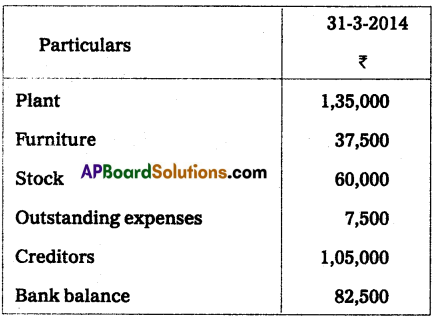
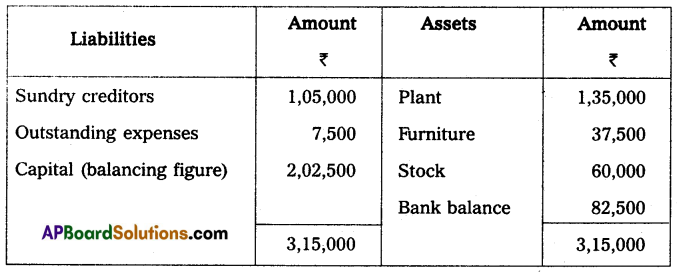
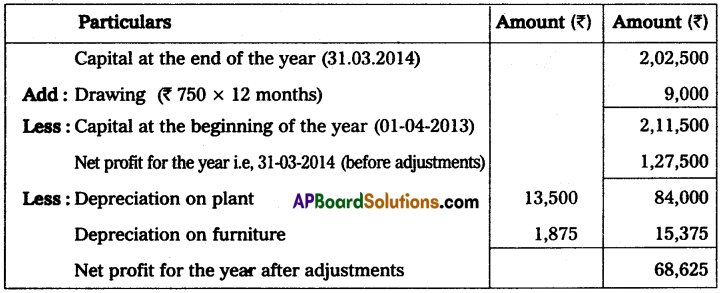
Shankar commenced business on 1st April 2013 with a capital of ₹ 1,27,000. During the year he withdrew ₹ 750 per month for his personal use. Charge depreciation on the plant at 10% and on furniture at 5% you are required to prepare a statement showing profit or loss for the year ended 31-3-2014.
Solution:
Statement of affairs as of 31-03-2014 (Before adjustments)
AP Inter 2nd Year Accountancy Study Material Chapter 10 Accounts from Incomplete Records Textual Examples Q9.1
Statement of profit or loss for the year ended 31-03-2014
AP Inter 2nd Year Accountancy Study Material Chapter 10 Accounts from Incomplete Records Textual Examples Q9.2

Question 10.
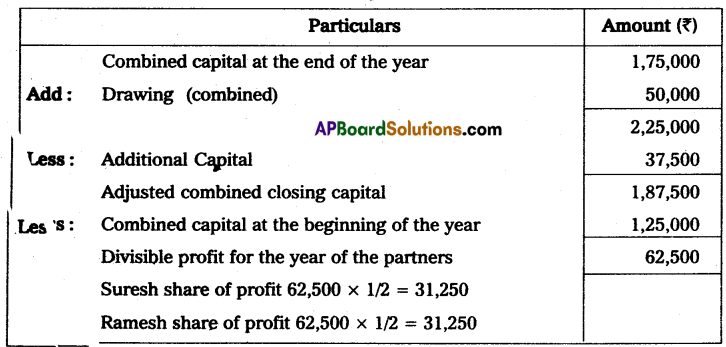
Suresh and Ramesh are equal partners in a business in which the books of accounts are kept by a single-entry system. Their combined capital stood at the beginning of the year at ₹ 1,25,000 and the combined capital at the end of the year stood at ₹ 1,75,000. During the year they have withdrawn ₹ 50,000 equally for their personal use and introduced ₹ 37,500 as fresh capital. Compute the profit for the year by preparing a statement of profit.
Solution:
Statement showing Profit or Loss
AP Inter 2nd Year Accountancy Study Material Chapter 10 Accounts from Incomplete Records Textual Examples Q10

AP Inter 2nd Year Accountancy Study Material Chapter 10 Accounts from Incomplete Records

Question 11.
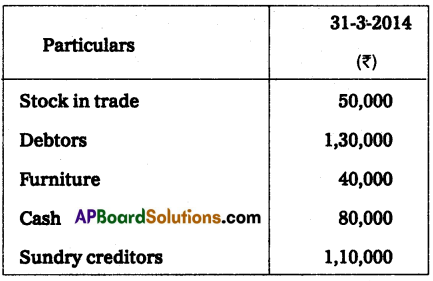
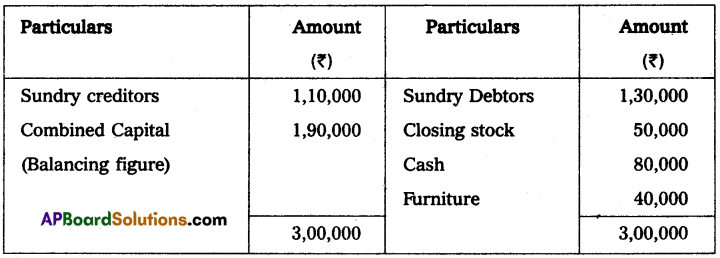
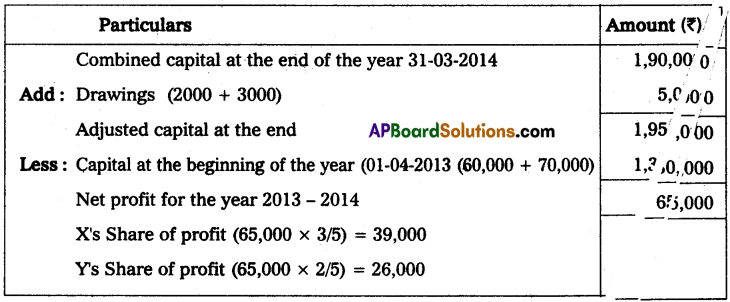
X and Y are partners sharing profits and losses in the ratio of 3 : 2 who keep their books on a single entry system on 1st April 2013. Their capital accounts show a balance of ₹ 60,000 and 70,000 respectively. During the year they have withdrawn ₹ 2,000 and ₹ 3,000 for their personal use. Find out the capitals at the end of the year. Also, calculate the divisible profit for the year ending 31-03-2014.
AP Inter 2nd Year Accountancy Study Material Chapter 10 Accounts from Incomplete Records Textual Examples Q11
Solution:
Statement of affairs as on 31-03-2014
AP Inter 2nd Year Accountancy Study Material Chapter 10 Accounts from Incomplete Records Textual Examples Q11.1
Statement of Profit or Loss as on 31-03-2014
AP Inter 2nd Year Accountancy Study Material Chapter 10 Accounts from Incomplete Records Textual Examples Q11.2

AP Inter 2nd Year Accountancy Study Material Chapter 9 Computerised Accounting System

Andhra Pradesh BIEAP AP Inter 2nd Year Accountancy Study Material 9th Lesson Computerised Accounting System Textbook Questions and Answers.

AP Inter 2nd Year Accountancy Study Material 9th Lesson Computerised Accounting System

Essay Questions

Question 1.
Define a computerised accounting system. Distinguish between a manual and computerised accounting system.
Answer:
Computerised accounting is a system of accounting in which one can use computers and different accounting software for a digital record of each transaction. The aim of both manual and computerised accounting is to record, classify and summarise accounting transactions. But the following are the differences between manual accounting and computerised accounting.

Differences between manual and computerised accounting systems

Basis Manual Accounting Computerised Accounting
1. Definition Manual accounting system in which we keep a physical register of journals and a ledger for keeping the records of each transaction. In this system of accounting, we use computers and different accounting software for a digital record of each transaction.
2. Calculation In manual accounting, all calculations of adding and subtracting are done manually. For example, to find the balance of any ledger account, we will calculate the debit and credit sides, and then we will find the difference for showing the balance. In computerised accounting, our duty is to record the transactions manually in the database. All the calculations are done by computer System we need not calculate each accounts balance. It is calculated automatically by computerised accounting system.
3. Ledger Accounts In manual accounting, we check the journal and then transfer figures to related accounts’ debit or credit side through manual posting. Computerised accounting system will automatically process the system and will make all the accounts, and ledgers because we have pass voucher entries under its respected ledger account.
4. Trail Balance In this system of accounting, we have to collect information on the balances of all accounts in our ledger. On this basis, we have to prepare a trial balance. Our computerising accounting system will produce a trial balance automatically.
5. Adjustment Entries Record Both adjustment journal entries and its posting in the ledger accounts will be done manually one by one. Only adjustment entries will pass in the computerised accounting system, post in the ledger accounts will be done automatically.
6. Financial Statements We have to make the financial statements manually by carefully transferring trial balance figures in the income statement and balance sheet. We need not prepare financial statements manually. Financial statements will become automatic. It will also change after each voucher entry in the system. This facility is not available in the manual accounting system.

Question 2.
Discuss the advantages of computerised accounting system over a manual accounting system.
Answer:
Computerised accounting offers the following advantages.
1. Speed: Accounting data is processed faster by using a computerised accounting system than it is achieved through manual efforts.

2. Accuracy: The possibility of error is eliminated in a computerised accounting system because the primary accounting data is entered for all the subsequent usage and the process is preparing the accounting reports.

3. Reliability: The computer system is well-adapted to performing repetitive operations. They are immune to tiredness, boredom, or fatigue. As a result, computers are highly reliable compared to human beings.

4. Up-to-date information: The accounting records, in a computerised accounting system, is updated automatically as and when accounting data is entered and stored. Therefore, the latest information pertaining to discounts gets reflected when accounting reports are produced and printed.

5. Real-time user interface: Most automated accounting systems are interlinked through a network of computers. This facilitates the availability of information to various users at the same time on a real-time basis (That is spontaneous).

6. Automated Document Production: Most computerised accounting systems have standardised, user-defined formats of accounting reports that are generated automatically. The accounting reports such as cash books, trail balances, and statements of accounts are obtained just by the click of a mouse in a computerised accounting environment.

7. Scalability: In a computerised accounting system, the requirement of additional manpower is confined to data entry operators for strong additional vouchers. The additional cost of processing additional transactions is almost negligible. As a result, computerised accounting systems are highly scalable.

8. Legibility: The data displayed on the computer monitor is legible. This is because the characters (alphabets, numerals, etc.) are typewritten using standard fonts. This helps in avoiding errors caused by untidy written figures in a manual accounting system.

9. Efficiency: The computer-based accounting systems ensure better use of resources and time. This brings about efficiency in generating decisions, useful information, and reports.

10. Quality reports: The inbuilt checks and untouchable features of data handling facilitate hygienic and true accounting reports that are highly objective and can be relied upon.

11. MIS Reports: The computerised accounting system facilitate the real-time production of management information reports, which will help management to monitor and control the business effectively. Debtors analysis would indicate the possibilities of defaults and also the concentration of debt and its impact on the balance sheet.

12. Storage retrieval: The computerised accounting system allows the users to store data in a manner that does not require a large amount of physical space. This is because the accounting data is stored in hard disks, pen drives, CD/DVD-ROMS, and floppies that occupy a fraction of physical space.

13. Motivation and employees’ interest: The computer system requires specialised training of staff, which makes them feel more valued. This motivates them to develop an interest in the job.

AP Inter 2nd Year Accountancy Study Material Chapter 9 Computerised Accounting System

Question 3.
Explain the limitations of the computerised accounting system.
Answer:
The following are the limitations of the computerised accounting system.
1. Cost of training: The sophisticated computerised accounting packages generally require specialised staff personnel. As a result, a huge training cost is incurred to understand the use of hardware and software on a continuous basis because newer types of hardware and software are acquired to ensure efficient and effective use of computerised accounting systems.
2. Staff opposition: Whenever the accounting system is computerised, there is a significant degree of resistance from the existing staff, partly because of the fear that they shall be made redundant and largely because of the perception that they shall be less important to the organisation.

3. Disruption: The accounting processes suffer a significant loss of work time when an organisation switches over to computerised accounting system. This is due to changes in the working environment that requires accounting staff to adapt to new systems and procedures.
4. System failure: The danger of the system crashing due to hardware failures and the subsequent loss of work is a serious limitation of computerised accounting system. However, providing backup arrangements can initially check unanticipated errors. Since the computers lack capability to judge, they cannot defect the unanticipated errors as human being commit. This is because the software defect and check errors are a set of programmes for known and anticipated errors.
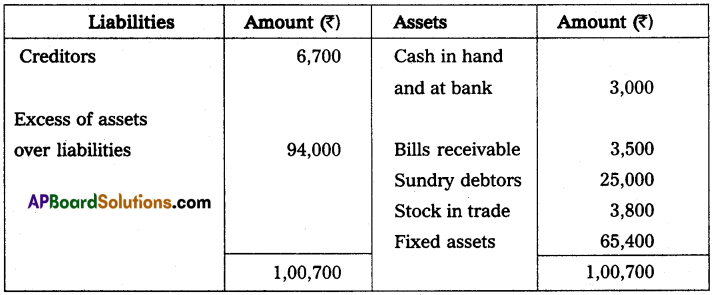
5. Breaches of security: Computer-related crimes are difficult to defect as any alteration of data may go unnoticed. The alteration of records in a manual accounting system is easily detected at first sight. Fraud and embezzlement are usually committed on a computerised accounting system by altering the data or programmes. Hacking passwords or user rights may change accounting records. This is achieved by tapping telecommunications lines, wiretapping, or decoding programmes. Also, the people responsible for tampering with data cannot be located.

6. Ill-effects on health: The extensive use of computers system may lead to the development of various health problems: bad backs, eyestrain, muscular pains, etc. This effects adversely the working efficiency of accounting staff on one hand and increased medical expenditure on such staff on the other software damage and failure may occur due to attacks by viruses. This is of particular relevance to accounting systems that extensively use internet facilities for their online operations. No foolproof solutions are available as of now to tackle the menaces of attacks on software by a virus.

Question 4.
Explain the various categories of accounting packages.
Answer:
Every computerised accounting system is implemented to perform the accounting activity of recording and storing accounting data and generating reports as per the requirements of the user. From this perspective, the accounting packages are classified into the following categories.

1. Ready-to-use: Ready-to-use accounting software is suited to organisations running small conventional businesses where the frequency or volume of accounting transactions is very low. This is because the cost of installation is generally low and the number of users is limited. Ready-to-use software is relatively easier to learn and people (accountant) adaptability is very high. This also implies that the level of secrecy is relatively low and software is prone to data fraud. The training needs are simple and sometimes the supplier of software offers the training of the software for free. However, this software offers little scope for linking to other information systems.
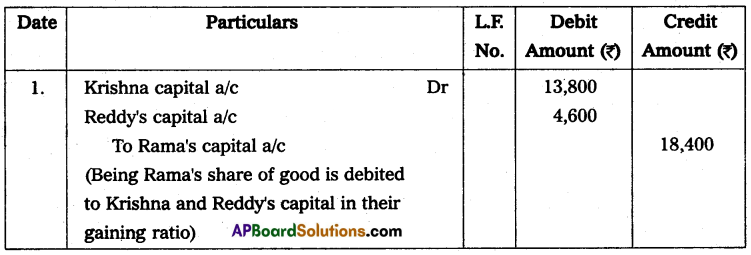
2. Customised: Accounting software may be customized to meet the special requirement of the user. Standardised accounting software available in the market may not suit or fulfill user requirements. For example, standardised accounting software may contain the sales voucher and inventory status as separate options. However, when the user requires that inventory status be updated immediately upon entry of the sales voucher and report to be printed, the software needs to be customised.
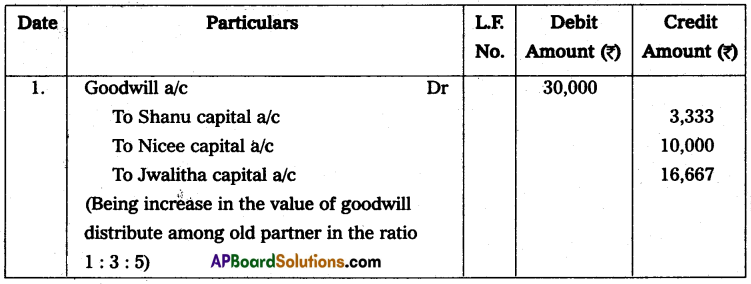
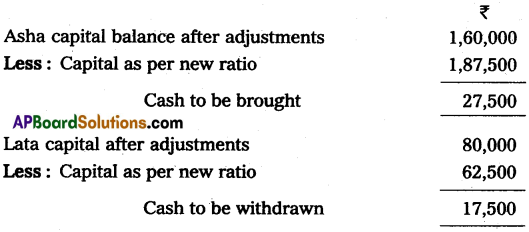
Customised software is suitable for large and medium businesses and can be linked to other information systems. The cost of installation and maintenance is relatively high because of the high cost to be paid to the vendor for customisation. The customisation includes modification and addition to the software contents, provision for the specified number of users and their authentication, etc. Secrecy of data and software can be better maintained in customised software. Since the need to train the software use is important, the training costs are therefore high.

3. Tailored: This accounting software is generally tailored in large business organisations with multi-users and geographically scattered locations. This software requires specialised training for the users. The tailored software is designed to meet the specific requirements of the users and form an important part of the organizational MIS. The secrecy and authenticity checks and robust in such softwares and they offer high flexibility in terms of the number of users.

Very Short Answer Questions

Question 1.
What is computerised accounting?
Answer:
Computerised accounting is a system of accounting in which one can use computers and different accounting software for a digital record of each transaction.

AP Inter 2nd Year Accountancy Study Material Chapter 9 Computerised Accounting System

Question 2.
What is MIS?
Answer:
The computerised accounting system facilitates the real-time production of management information reports, which will help management to monitor and control. The business effectively. Debtors analysis indicates the possibilities of bad debts and also the concentration of debt and its impact on the balance sheet.

Question 3.
Ready to use accounting software.
Answer:
Ready-to-use accounting software is suited to organisations running small/conventional businesses when the frequency or volume of accounting transactions is very low. This is because the cost of installation is generally low and the number of users is limited.

Question 4.
Customised accounting software.
Answer:
Accounting software may be customised to meet the special requirement of the user. For example, standardised accounting software may contain the sales voucher and inventory status as separate options. However, when the user requires that inventory status be updated immediately upon entry of sales voucher and report be printed, the software needs to be customised.

AP Inter 2nd Year Accountancy Study Material Chapter 9 Computerised Accounting System

Question 5.
Tailored accounting software.
Answer:
Accounting software is generally tailored to large business organisations with multi-users and geographically scattered locations. This software requires specialised training for the users. The tailored software is designed to meet the specific requirements of the users and forms an important part of the organisational MIS.

AP Inter 2nd Year Accountancy Study Material Chapter 8 Company Accounts

Andhra Pradesh BIEAP AP Inter 2nd Year Accountancy Study Material 8th Lesson Company Accounts Textbook Questions and Answers.

AP Inter 2nd Year Accountancy Study Material 8th Lesson Company Accounts

Essay Questions

Question 1.
Explain the categories of share capital.
Answer:
From the accounting point of view the share capital of the company can be classified as follows:
1. Authorised capital: Authorised capital is the amount of share capital that a company is authorized to issue to the public by the memorandum of association. It is also called nominal or registered capital.

2. Issued capital: Issued capital is that part of authorised capital which is actually issued to the public for subscription. A company may issue its entire authorised capital or may issue in parts from time to time as per the needs of the company.

3. Subscribed capital: It is that part of the issued capital which has been actually subscribed by the public. This capital can be equal to or less than the issued capital.

4. Called-up capital: It is that part of the subscribed capital which is called up by the company to pay on the allotted shares. The company may decide to call the entire amount or part of the face value of shares.

5. Paid-up capital: That part of the called-up capital has been actually paid by the shareholders.

6. Reserve capital: A company may reserve a portion of its uncalled capital to be called only in the event of winding up of the company. Such an uncalled amount is called the reserve capital of the company.

AP Inter 2nd Year Accountancy Study Material Chapter 8 Company Accounts

Question 2.
Explain the classes of shares.
Answer:
Shares refer to the units into which the total share capital of the company is divided. Thus, a share is a fractional part of the share capital and forms the bases of ownership interest in the company. The persons who contribute money through shares are all called shareholders.

As per section, 86 of the Companies Act a company can issue two types of shares 1. Preference shares, 2. Equity shares.

1. Preference shares: According to section, 85 of the Companies Act, 1956, a preference share is one that fulfills the following two conditions.

  • That it carries a preferential right to dividend, to be paid as a fixed amount or an amount calculated by a fixed rate of the nominal value of each share before any dividend is paid to the equity shareholders.
  • With respect to the capital, it carries or will carry, on the winding up of the company, the preferential right to the repayment of capital before anything is paid to equity shareholders.

2. Equity shares: Equity shares are also called ordinary shares. According to section 85 of the Companies Act, of 1956, an equity share is a share that is not a preference share. In other words, shares that do not enjoy any preferential right in the payment of dividends or repayment of capital are called as equity shares. The equity shareholders are entitled to share the distributable profits of the company after satisfying the dividend rights of preference shareholders. The dividend on equity shares is not fixed and it varies from time to time depending upon the profits available for distribution.

Question 3.
Explain the types of issues of shares.
Answer:
A salient feature of the share capital of a company is that the amount on its shares can be gradually collected in easy installments spread over a period of time depending upon its growing financial requirement. The first installment is collected along with the application and is known as application money. The second installment is termed allotment money and the remaining money is collected in installments are termed a first call, second call, and final call. The word final is suffixed to the last installment. However, this in no way prevents a company from calling the full amount on shares right at the time of application.

Short Answer Questions

Question 1.
What is authorised capital?
Answer:
Authorised capital is the amount of share capital that a company is authorised to issue to the public by the memorandum of association. It is also called Nominal or Registered capital.

Question 2.
What is a preference share?
Answer:
A preference share is a share that carries preferential rights regarding the payment of dividends by a fixed rate and repayment of capital at the time of winding up the company.

AP Inter 2nd Year Accountancy Study Material Chapter 8 Company Accounts

Question 3.
What is an Equity share?
Answer:
Equity shares are also called ordinary shares. According to section 85 of the Companies Act, of 1956 an equity share is a share that is not a preference share. In other words, shares that do not enjoy any preferential right in the payment of dividend or repayment of capital is called equity share.

Question 4.
Explain the issue of shares at par.
Answer:
When a company issues its shares at their face value, the shares are known to have been issued at par.
Ex: The face value of the share is ₹ 100 and it is issued for ₹ 100.

Question 5.
Explain the issue of shares at a premium.
Answer:
When a company issues its shares at a price than the face value, it is said to have been issued at a premium. The money collected more than the face value is called the premium.
Ex: If the face value of a share is ₹ 100 and it is issued for ₹ 110.

Question 6.
Explain the issue of shares at a discount.
Answer:
When the company issues its shares at a price less than the face value, it is said to be an issue at a discount. The difference between the face value and the issue price is called ‘Discount’.
Ex: If the face value of the share is ₹ 100 and it is issued at ₹ 90.

Textual Exercises

Question 1.
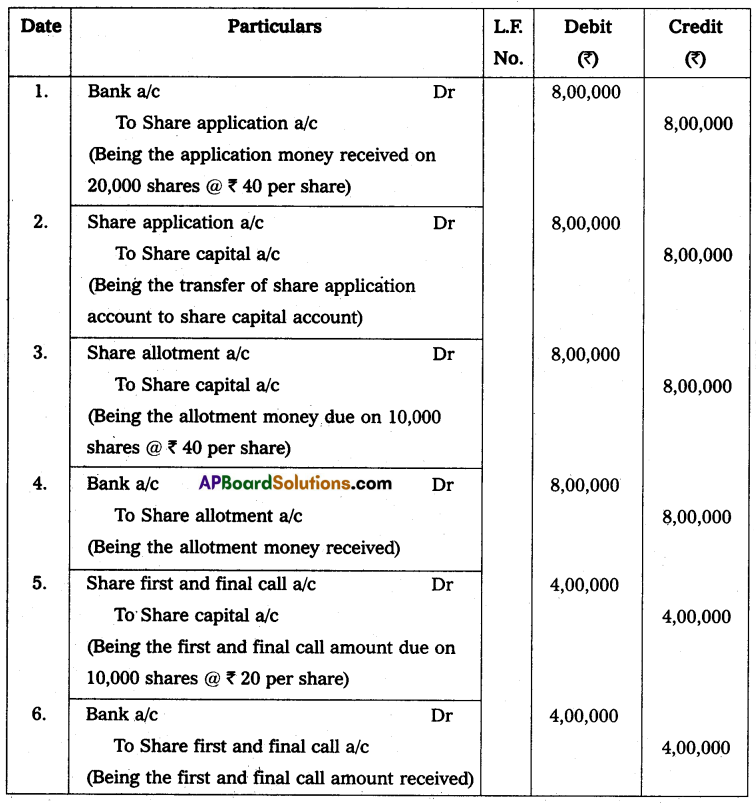
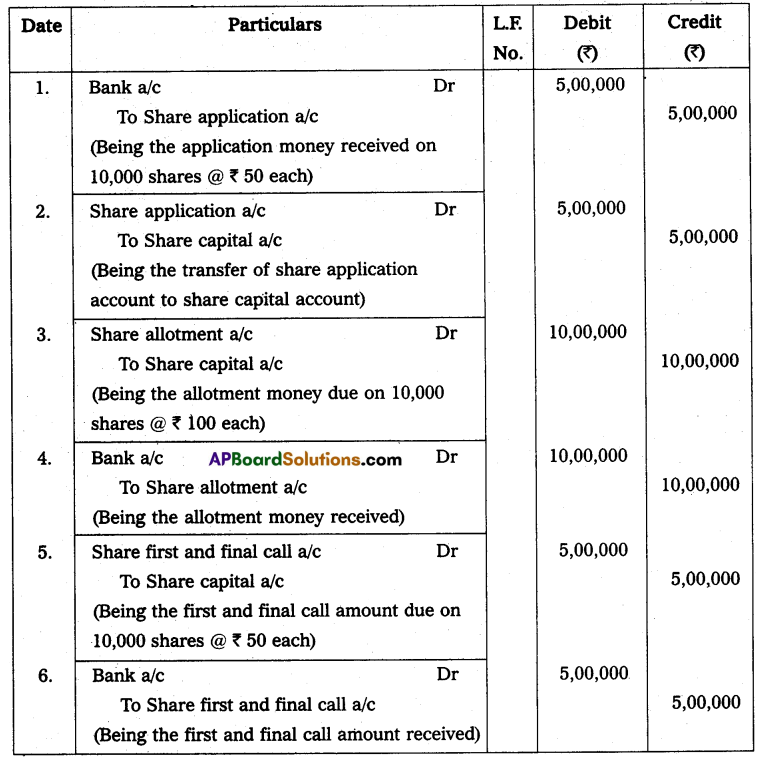
Dhana Ltd. issued 20,000 shares of ₹ 100 each for the subscription. Payable at ₹ 40 per share on application, ₹ 40 per share on the allotment, and the balance ₹ 20 on the first and final call. All the amounts were duly received. Make journal entries in the books of the company.
Solution:
Journal entries in the books
AP Inter 2nd Year Accountancy Study Material Chapter 8 Company Accounts Textual Exercise Q1

Question 2.
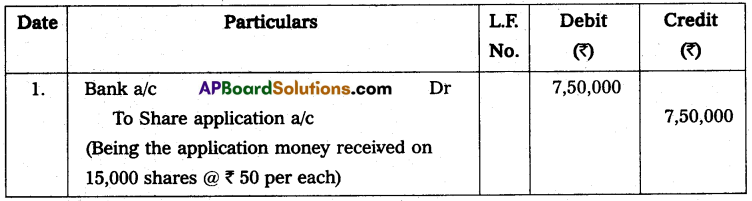
Charan Ltd. decided to issue 10,000 shares of ₹ 200 each for the subscription. Payable at ₹ 50 per share on application, ₹ 100 per share on the allotment, and the balance ₹ 50 on the first and final call. All the money was duly received. Write journal entries in the books of the company.
Solution:
Journal entries in the books of Charan Ltd.
AP Inter 2nd Year Accountancy Study Material Chapter 8 Company Accounts Textual Exercise Q2

AP Inter 2nd Year Accountancy Study Material Chapter 8 Company Accounts

Question 3.
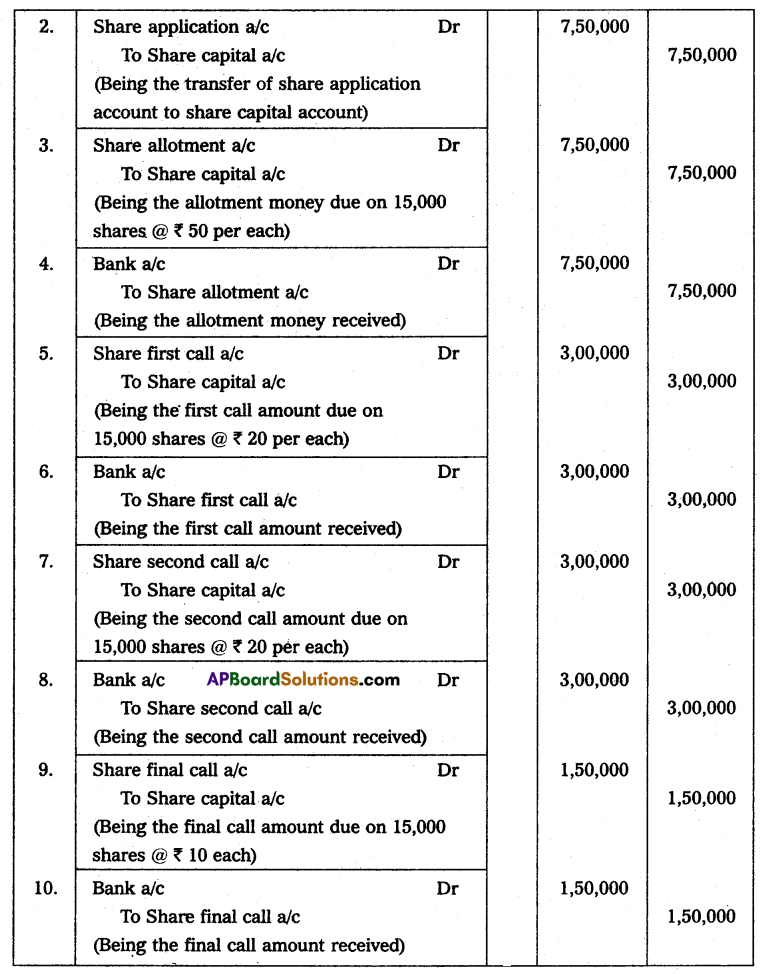
Gayatri cloths Ltd. issued 15,000 shares of ₹ 150 each, payable at ₹ 50 per share on the application, ₹ 50 per share on the allotment, and the balance of ₹ 20 on the first call, ₹ 20 on the second call, and ₹ 10 final calls. All the money was duly received. Prepare journal entries in the books of the company.
Solution:
Journal entries in the books of Gayatri Cloths Ltd.
AP Inter 2nd Year Accountancy Study Material Chapter 8 Company Accounts Textual Exercise Q3
AP Inter 2nd Year Accountancy Study Material Chapter 8 Company Accounts Textual Exercise Q3.1

Question 4.
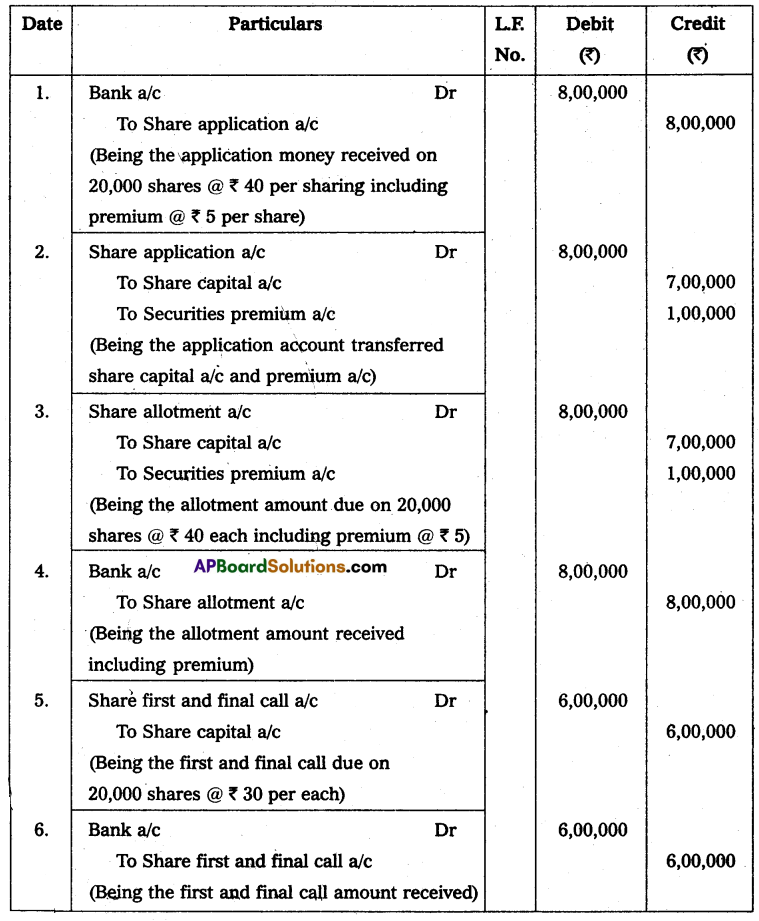
Jayaram Furniture’s Ltd. issued 20,000shares of ₹ 100 each at a premium of ₹ 10 per share payable as follows, on application ₹ 40 (including premium per share), on allotment ₹ 40 (including premium ₹ 5 per share) the remaining balance ₹ 30 on first and final call, the Issue was hilly subscribed. All the money was duly received. Make the Journal entries in the books of the company.
Solution:
Journal entries in the books of Jayaram Furniture Ltd.
AP Inter 2nd Year Accountancy Study Material Chapter 8 Company Accounts Textual Exercise Q4

Question 5.
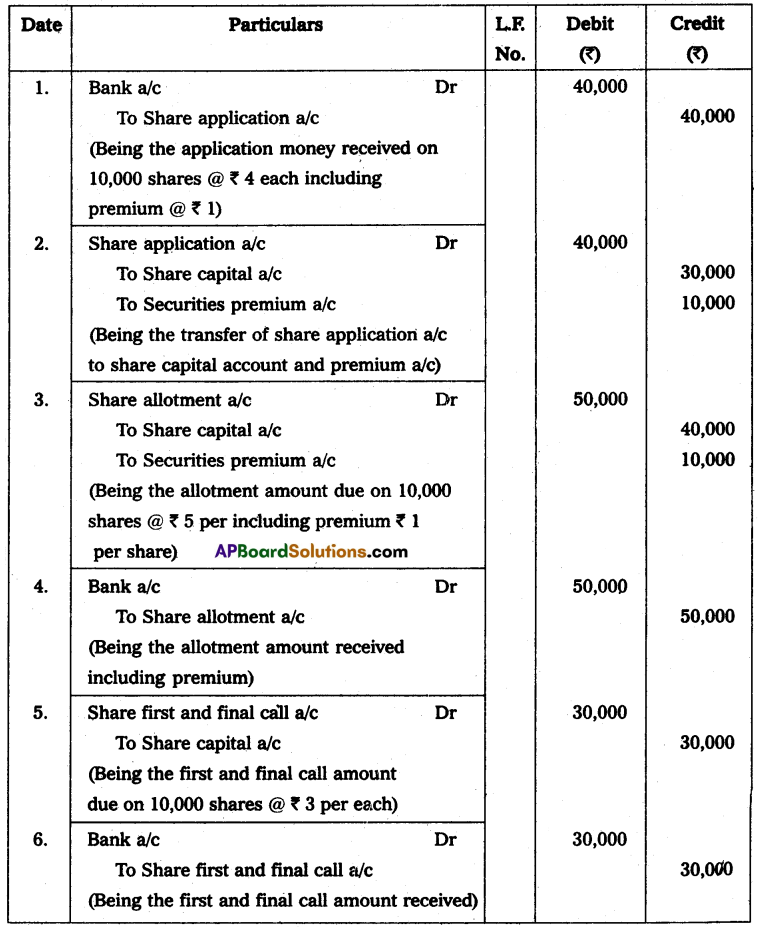
Anusha Ltd. has an authorized capital of ₹ 1,00,00,000 in shares of 10 each issued 10,000 at a premium of ₹ 2 per share payable at ₹ 4 on application (including premium ₹ 1 per share), ₹ 5 on the allotment (including premium ₹ 1 per share) the remaining balance is ₹ 3 on first and final call, the issue was fully subscribed. All the money was duly received. Prepare the Journal entries in the books of the company.
Solution:
Journal entries in the books of Anusha Ltd.
AP Inter 2nd Year Accountancy Study Material Chapter 8 Company Accounts Textual Exercise Q5

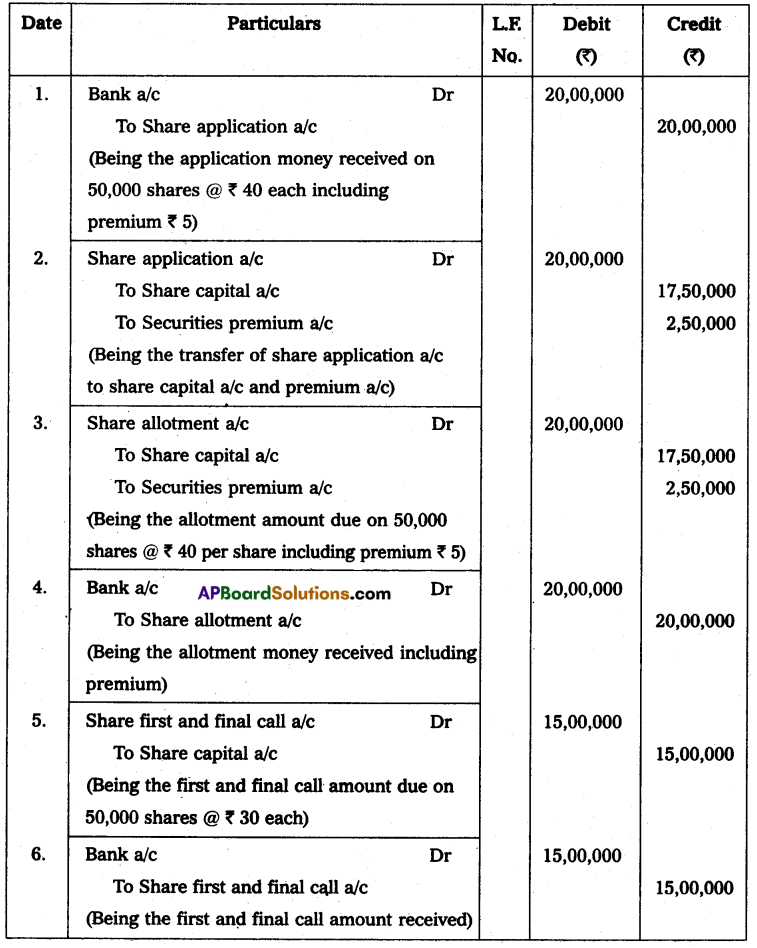
Question 6.
Karthik Ltd. issued 50,000 shares of ₹ 100 at a premium of ₹ 10 per share, payable at ₹ 40 on the application including premium ₹ 5 per share), ₹ 40 on allotment 0ncluding a premium of ₹ 5 per share) the remaining balance of ₹ 30 on the first and final call, the issue was fully subscribed. All the money was duly received. Record the Journal entries in the books of the company.
Solution:
Journal entries in the books of Karthik Ltd.
AP Inter 2nd Year Accountancy Study Material Chapter 8 Company Accounts Textual Exercise Q6

AP Inter 2nd Year Accountancy Study Material Chapter 8 Company Accounts

Question 7.
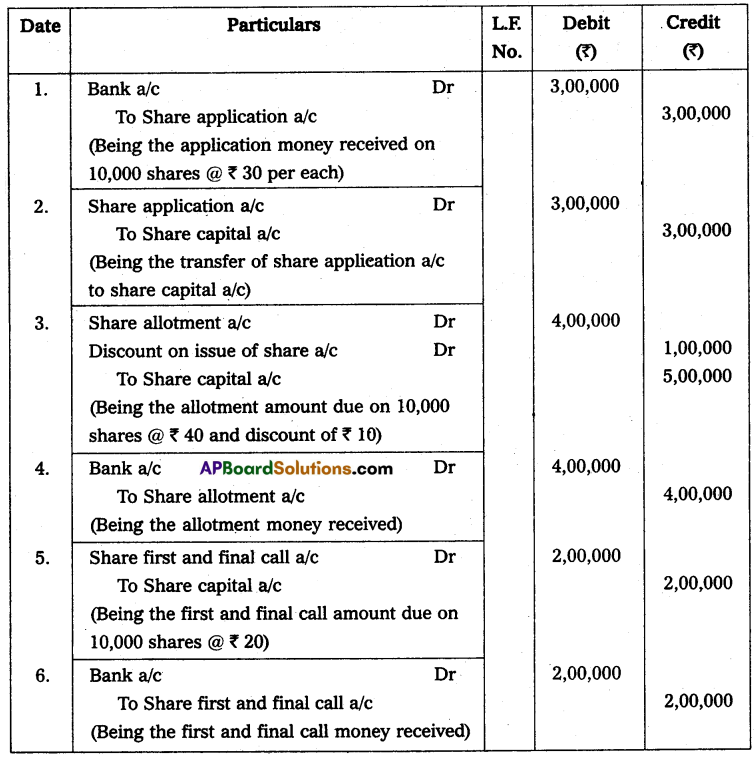
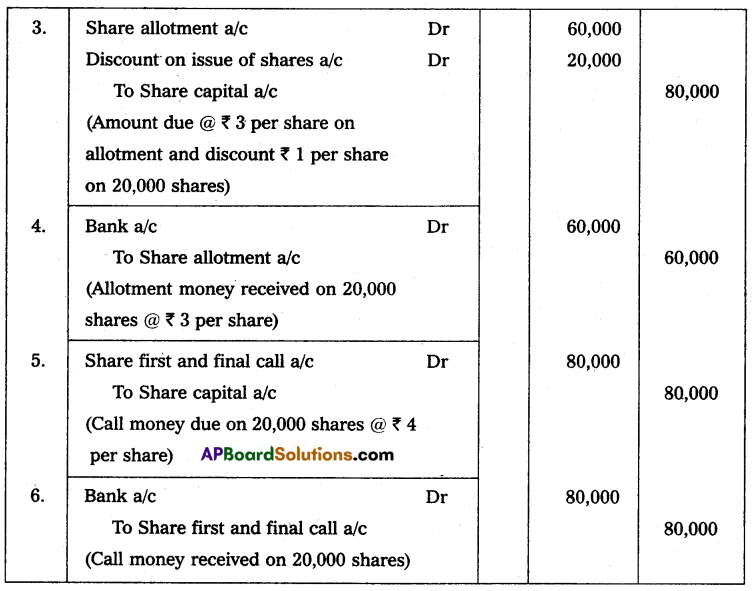
Padmavati Ltd. issued to the public for the subscription of 10,000 shares of ₹ 100 each at a discount of 10% per share, payable at ₹ 30 on application, ₹ 40 on the allotment, and ₹ 20 on the first and final call, the issue was fully subscribed. All the money was duly received. Write the Journal entries in the books of the company.
Solution:
Journal entries in the books of Padmavathi Ltd.
AP Inter 2nd Year Accountancy Study Material Chapter 8 Company Accounts Textual Exercise Q7

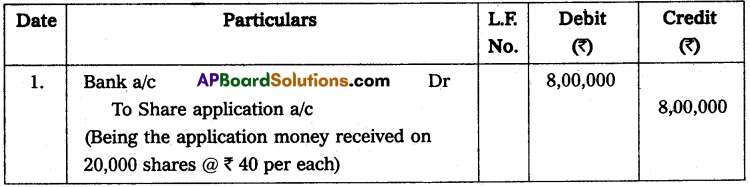
Question 8.
Abishek Ltd. issued 20,000 shares of ₹ 100 each at a discount of 10% per share, the shares were payable at ₹ 40 on application, ₹ 30 on the allotment, and ₹ 20 on the first and final call, the issue was fully subscribed. All the money was duly received. Record the Journal entries in the books of the company.
Solution:
Journal entries in the books of Abishek Ltd.
AP Inter 2nd Year Accountancy Study Material Chapter 8 Company Accounts Textual Exercise Q8
AP Inter 2nd Year Accountancy Study Material Chapter 8 Company Accounts Textual Exercise Q8.1

Question 9.
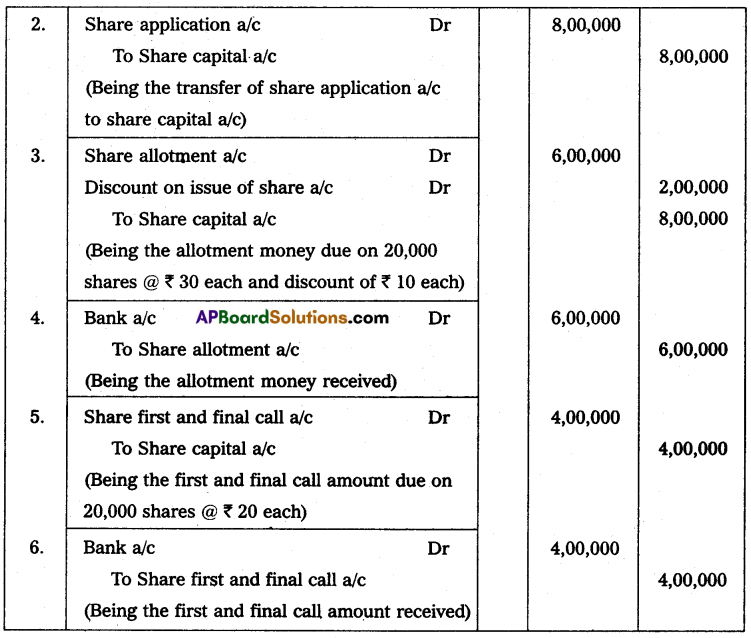
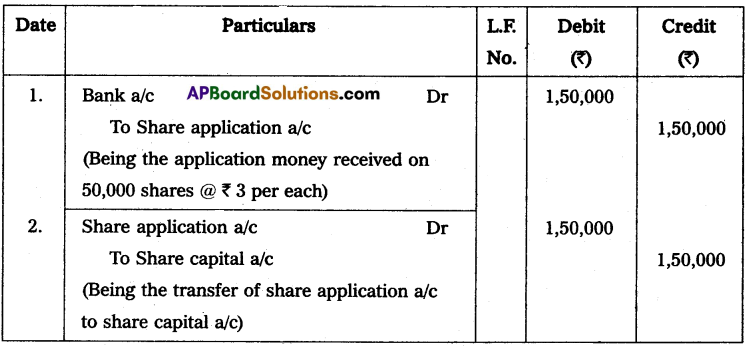
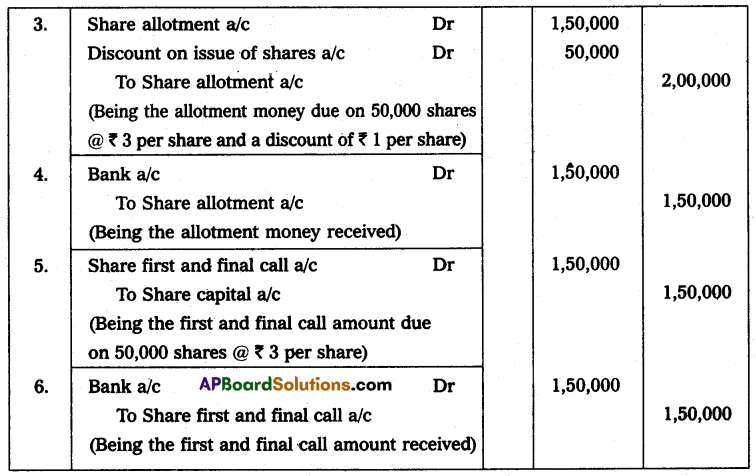
Venkat Ltd. issued 50,000 shares of ₹ 10 each at a discount of 10% per share, the shares were payable at ₹ 3 on application, ₹ 3 on an allotment, and ₹ 3 on the first and final call, and the issue was fully subscribed. All the money was duly received. Give Journal entries in the books of the company.
Solution:
Journal entries in the books of Venkat Ltd.
AP Inter 2nd Year Accountancy Study Material Chapter 8 Company Accounts Textual Exercise Q9
AP Inter 2nd Year Accountancy Study Material Chapter 8 Company Accounts Textual Exercise Q9.1

Textual Examples

Question 1.
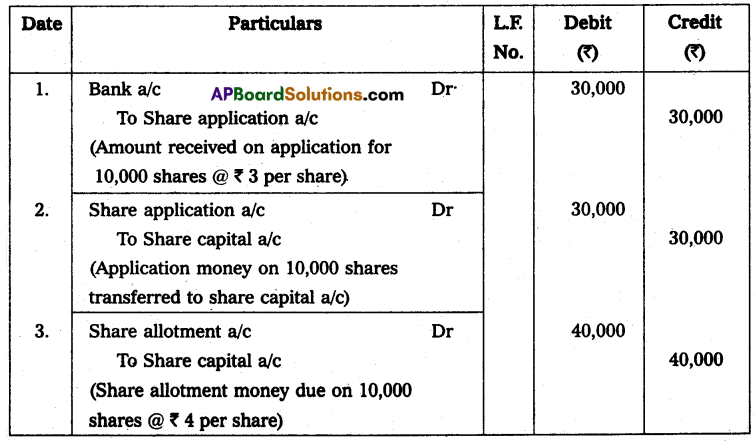
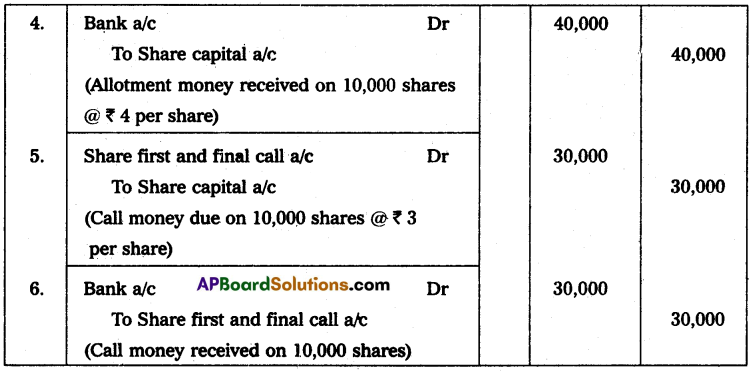
Pavithra Ltd. issued 10,000 shares of ₹ 10 each for the subscription. Payable at ₹ 3 per share on application, ₹ 4 per share on the allotment, and the balance on the first and final call. All the amounts were duly received. Make journal entries in the books of the company.
Solution:
Books of Pavithra Ltd. Journal
AP Inter 2nd Year Accountancy Study Material Chapter 8 Company Accounts Textual Example Q1
AP Inter 2nd Year Accountancy Study Material Chapter 8 Company Accounts Textual Example Q1.1

AP Inter 2nd Year Accountancy Study Material Chapter 8 Company Accounts

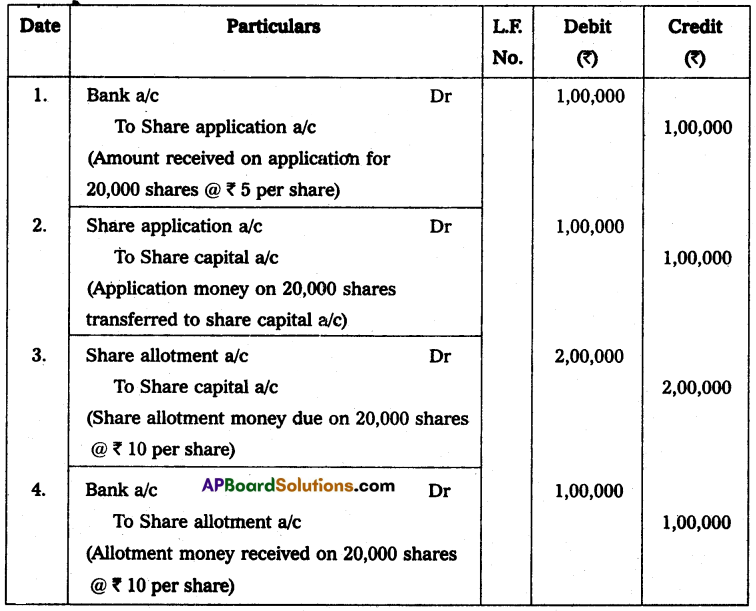
Question 2.
Bhavani Ltd. issued 20,000 shares of ₹ 20 each to the public for subscription as follows, payable ₹ 5 on application, ₹ 10 on the allotment, and the remaining balance on the first and final call.
Give the Journal entries in the books of the company.
Solution:
Books of Bhavani Ltd. Journal
AP Inter 2nd Year Accountancy Study Material Chapter 8 Company Accounts Textual Example Q2
AP Inter 2nd Year Accountancy Study Material Chapter 8 Company Accounts Textual Example Q2.1

Question 3.
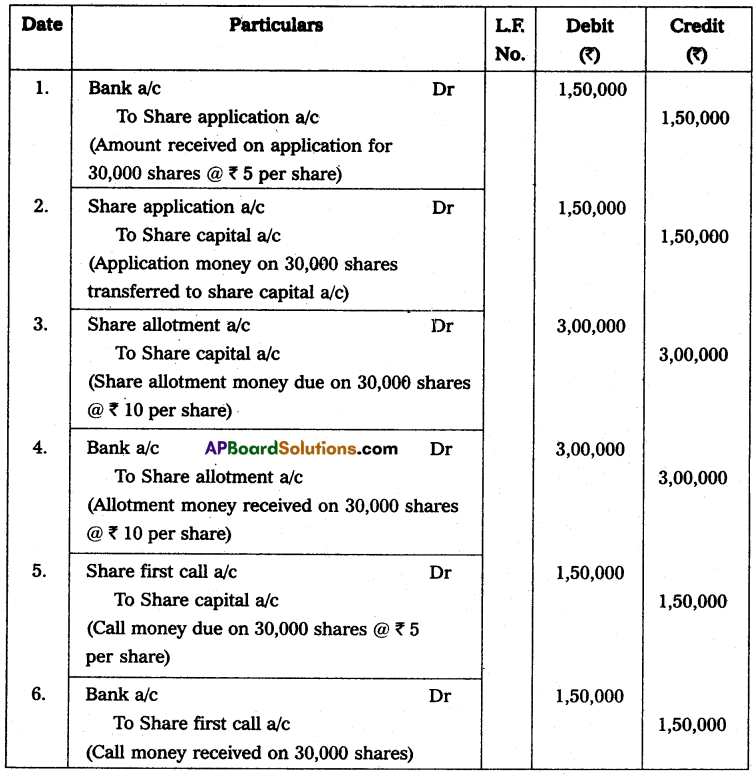
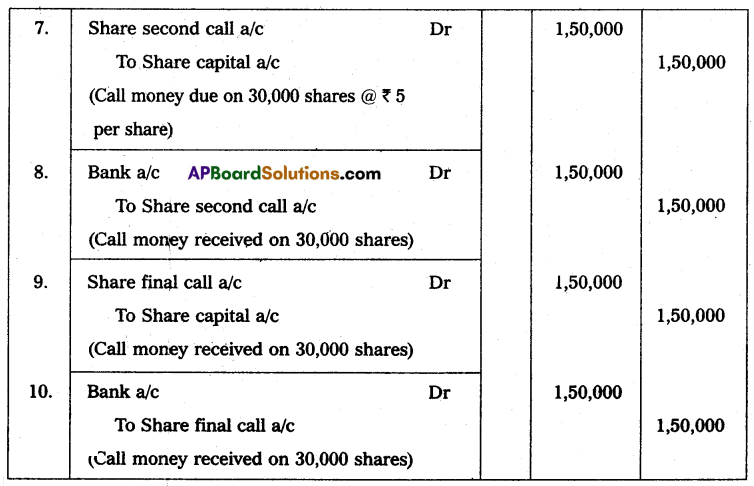
Siva Ltd. issued 30,000 shares of ₹ 30 each to the public for subscription as follows, payable ₹ 5 on application, ₹ 10 on the allotment, and the remaining balance on the first call ₹ 5, second call ₹ 5, and final call ₹ 5. Give the journal entries in the books of the company.
Solution:
Books of Siva Ltd. Journal
AP Inter 2nd Year Accountancy Study Material Chapter 8 Company Accounts Textual Example Q3
AP Inter 2nd Year Accountancy Study Material Chapter 8 Company Accounts Textual Example Q3.1

Question 4.
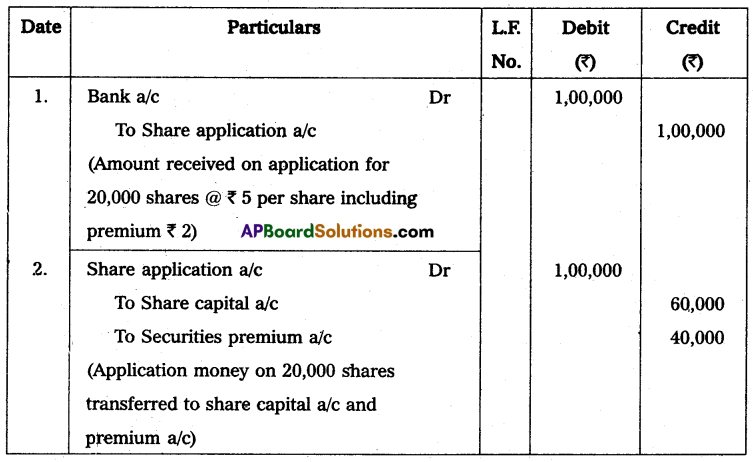
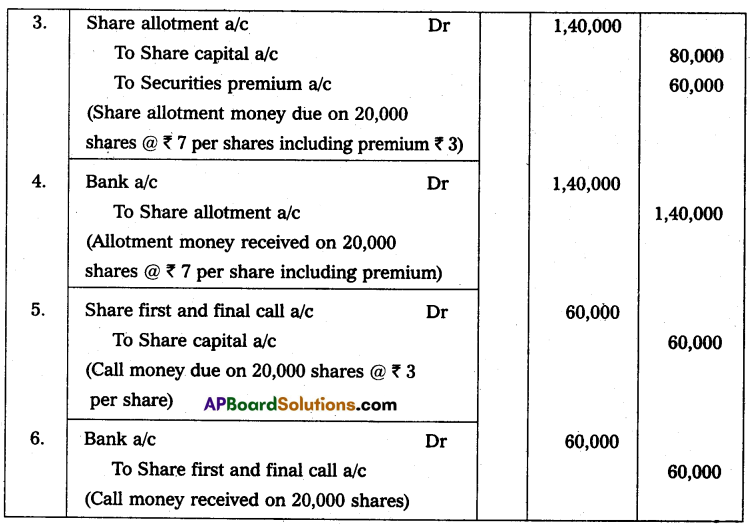
Sarojanamma Ltd. issued 20,000 shares of ₹ 10 each at a premium of ₹ 5 per share, payable as follows, on application, ₹ 5 (including ₹ 2 premium) per share, on allotment ₹ 7 (including premium ₹ 3) per share, and the balance on first and final call ₹ 3. Applications were received for 20,000 shares and allotment was made to all, to make journal entries.
Solution:
Books of Sarojanamma Ltd. Journal
AP Inter 2nd Year Accountancy Study Material Chapter 8 Company Accounts Textual Example Q4
AP Inter 2nd Year Accountancy Study Material Chapter 8 Company Accounts Textual Example Q4.1

AP Inter 2nd Year Accountancy Study Material Chapter 8 Company Accounts

Question 5.
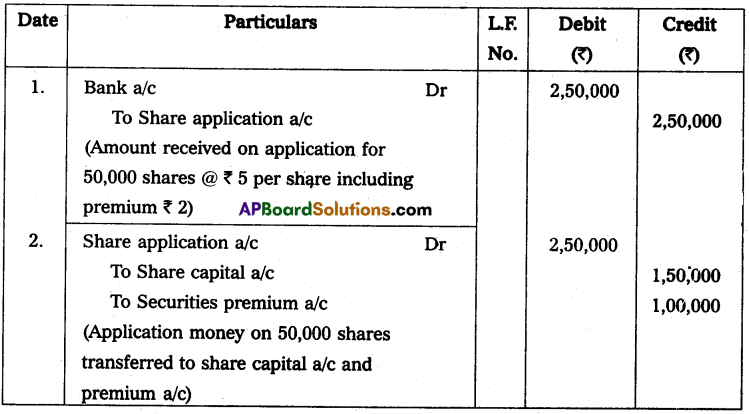
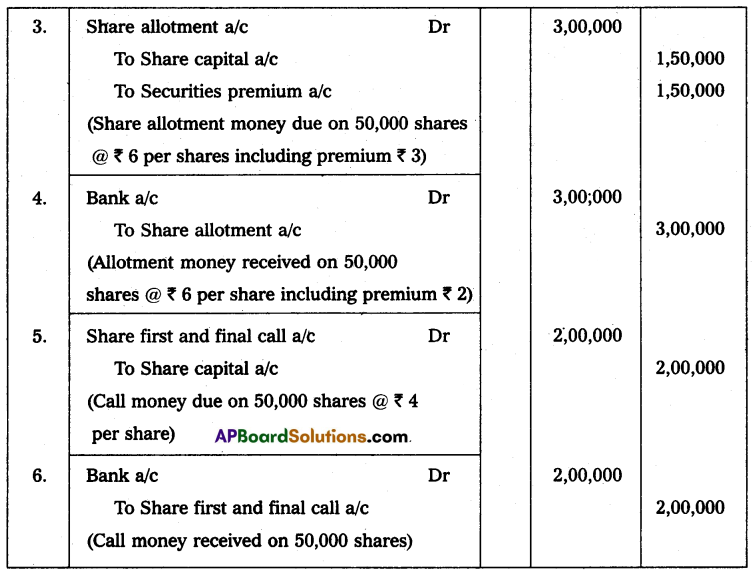
Ramaiah Ltd. issued 50,000 shares of ₹ 10 each at a premium of ₹ 5 per share, payable as follows, on application ₹ 5 (including premium ₹ 2) per share, on allotment ₹ 6 (including premium ₹ 3) per share, the remaining balance ₹ 4 on first and final call, the issue was fully subscribed. All the money was duly received. Make Journal entries.
Solution:
Books of Ramaiah Ltd. Journal
AP Inter 2nd Year Accountancy Study Material Chapter 8 Company Accounts Textual Example Q5
AP Inter 2nd Year Accountancy Study Material Chapter 8 Company Accounts Textual Example Q5.1

Question 6.
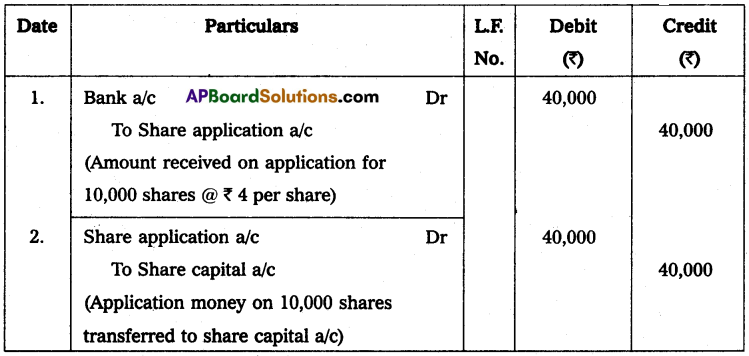
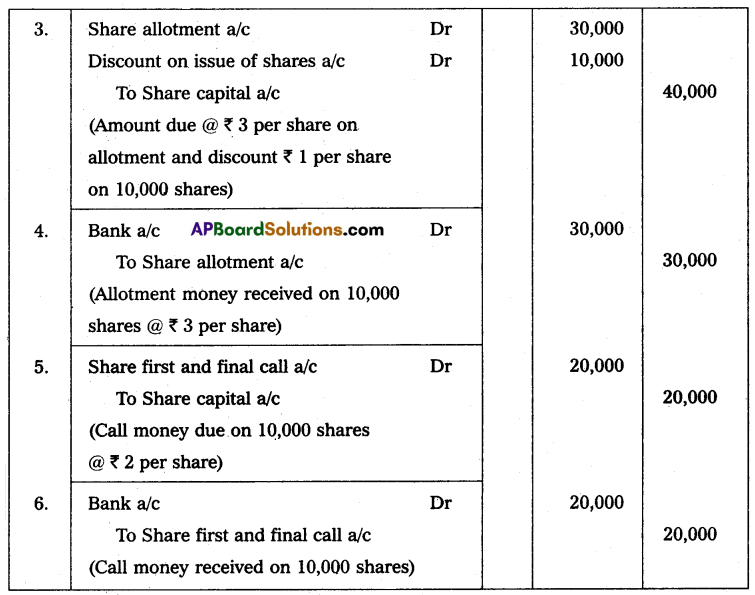
Suguna Motors Ltd. issued to the public for the subscription of 10,000 shares of ₹ 10 each at a discount of 10% per share, payable at ₹ 4 on the application, ₹ 3 on the allotment, and ₹ 2 on the first and final call, the issue was fully subscribed. All the money was duly received. Write the Journal entries in the books of Suguna Motors Ltd.
Solution:
In the books of Suguna Motors Ltd. Journal Entries
AP Inter 2nd Year Accountancy Study Material Chapter 8 Company Accounts Textual Example Q6
AP Inter 2nd Year Accountancy Study Material Chapter 8 Company Accounts Textual Example Q6.1

AP Inter 2nd Year Accountancy Study Material Chapter 8 Company Accounts

Question 7.
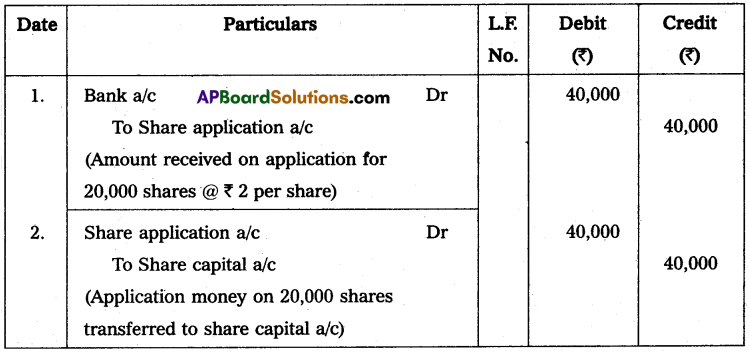
Ravi Tractor Ltd. issued to the public for the subscription of 20,000 shares of ₹ 10 each at a discount of 10% per share, payable at ₹ 2 on application, ₹ 3 on the allotment, and ₹ 4 on the first and final call, the issue was fully subscribed. All the money was duly received. Prepare the Journal entries in the books of the company.
Solution:
In the books of Ravi Tractor Ltd. Journal Entries
AP Inter 2nd Year Accountancy Study Material Chapter 8 Company Accounts Textual Example Q7
AP Inter 2nd Year Accountancy Study Material Chapter 8 Company Accounts Textual Example Q7.1

AP Inter 2nd Year Accountancy Study Material Chapter 7 Retirement / Death of a Partner

Andhra Pradesh BIEAP AP Inter 2nd Year Accountancy Study Material 7th Lesson Retirement / Death of a Partner Textbook Questions and Answers.

AP Inter 2nd Year Accountancy Study Material 7th Lesson Retirement / Death of a Partner

Very Short Answer Questions

Question 1.
What is meant by the retirement of a partner?
Answer:
A partner who opts to retire from an existing partnership firm is called ‘Retirement of a partner.

Question 2.
What do you understand by a Gaining ratio?
Answer:
The ratio in which the share of the retiring partner is taken over by other partners is called the ‘Gaining ratio’. To calculate the new profit sharing ratio, the share of profit of the retiring partner taken over by each continuing partner is added to his respective share of profit before the retirement of the outgoing partner.
Gaining ratio = New ratio – Old ratio

Question 3.
What are the adjustments required for the retirement or death of a partner?
Answer:
On the retirement or death of a partner, the existing partnership deed comes to an end and in its place, a new partnership deed needs to be framed whereby the remaining partners continue to do their business on changed terms and conditions. There is not much difference in accounting at the time of retirement or in the event of death. In both cases, we are required to determine the amount due to the retiring partner (in case of retirement) and to the legal representatives (in case of deceased partner) after making necessary adjustments in respect of goodwill, revaluation of assets and liabilities, and transfer of accumulated profits and losses. In addition to the above, the new profit-sharing ratio of the remaining partners and the gaining ratio is to be computed.

AP Inter 2nd Year Accountancy Study Material Chapter 7 Retirement / Death of a Partner

Question 4.
How is the account of the deceased partner settled?
Answer:
The deceased partner’s capital account is credited with the balance of capital at the beginning of the year, interest on capital, the share of profit on revaluation of assets and liabilities, the share of undistributed profits, the share of profit to the date of death, and his share of goodwill. The account is debited with drawings to the date of death, interest on drawings, and the balance is transferred to the executor’s account of the deceased partner.

Question 5.
Explain the modes of payment to the retiring partner.
Answer:
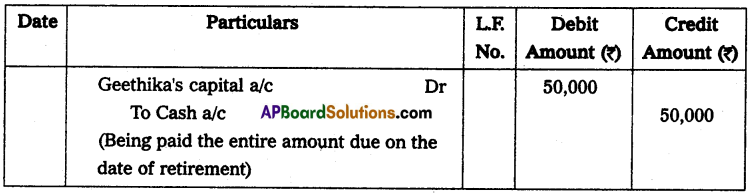
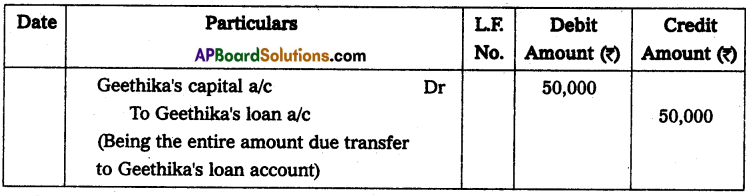
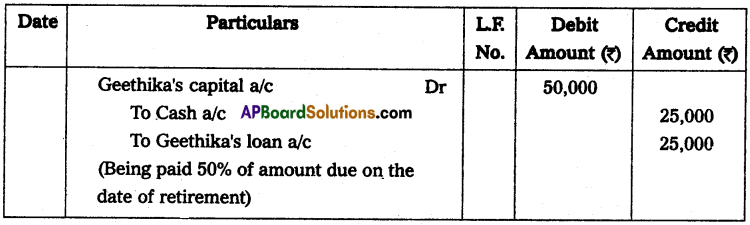
The outgoing partner’s account is settled as per the terms of the partnership deed i.e., in lumpsum immediately or in various installments with or without interest. In the absence of any agreement section 37 of the Indian Partnership Act, 1932 is applicable, which states that the outgoing partner has an option to receive either 6% interest till the date of payment or such share of profits that have been earned with his money (based on capital ratio). If the firm is not in a position to make payment immediately, the amount due is transferred to the retiring partner’s loan account.

Textual Exercises

Question 1.
Madhu, Nehra, and Tina are partners sharing profits in the ratio of 5 : 3 : 2. Calculate the new profit sharing ratio if
1. Madhu retires
2. Nehra retires
3. Tina retires
Solution:
1. New profit sharing ratio, if Madhu retires 3 : 2.
2. New profit sharing ratio, if Nehra retires 5 : 2.
3. New profit sharing ratio, if Tina retires 5 : 3.

Question 2.
Hari, Prasad, and Anwar are partners sharing profits in the ratio of 3 : 2 : 1. Hari retires and his share is taken up by Prasad and Anwar in the ratio of 3 : 2. Calculate the new profit sharing ratio.
Solution:
Old ratio of Hari, Prasad, Anwar = 3 : 2 : 1
Gaining ratio on the retirement of Hari = 3 : 2
New share of continuing partner = Old share + Acquired share from retiring partner
Prasad gets [latex]\frac{3}{5}[/latex] of Hari share = [latex]\frac{3}{5} \times \frac{3}{6}=\frac{9}{30}[/latex]
New share = [latex]\frac{2}{6}+\frac{9}{30}=\frac{10+9}{30}=\frac{19}{30}[/latex]
Anwar gets [latex]\frac{2}{5}[/latex] of Hari share = [latex]\frac{2}{5} \times \frac{3}{6}=\frac{6}{30}[/latex]
New share = [latex]\frac{1}{6}+\frac{6}{30}=\frac{5+6}{30}=\frac{11}{30}[/latex]
∴ New profit sharing ratio = 19 : 11.

Question 3.
Ranjana, Sadhna, and Kamana are partners sharing profits in the ratio 4 : 3 : 2. Ranjana retires, and Sadhna and Kamana decided to share future profits in the ratio of 5 : 3. Calculate the Gaining Ratio.
Solution:
Old profit sharing ratio = 4 : 3 : 2
New ratio = 5 : 3
Sadhna gaining ratio = New ratio – Old ratio
= [latex]\frac{5}{8}-\frac{3}{9}=\frac{45-24}{72}=\frac{21}{72}[/latex]
Kamana gaining ratio = [latex]\frac{3}{8}-\frac{2}{9}=\frac{27-16}{72}=\frac{11}{72}[/latex]
Gaining ratio = 21 : 11

Question 4.
Murali, Naveen, and Omprakash are partners sharing profits in the ratio of 3 : 4 : 1. Murali retires and surrenders 2/3rd of his share in favour of Naveen and the remaining share in favour of Omprakash. Calculate new profit sharing and the gaining ratio of the remaining partners.
Solution:
Naveen gets [latex]\frac{2}{3}[/latex] of Murali share = [latex]\frac{2}{3} \times \frac{3}{8}=\frac{6}{24}[/latex]
Omprakash gets [latex]\frac{1}{3}[/latex] of Murali share = [latex]\frac{1}{3} \times \frac{3}{8}=\frac{3}{24}[/latex]
Naveen new share = [latex]\frac{4}{8}+\frac{6}{24}=\frac{12+6}{24}=\frac{18}{24}[/latex]
Omprakash new share = [latex]\frac{1}{8}+\frac{3}{24}=\frac{3+3}{24}=\frac{6}{24}[/latex]
New gaining ratio = 18 : 6 = 3 : 1
Gaining ratio = New ratio – Old ratio
Naveen = [latex]\frac{3}{4}-\frac{4}{8}=\frac{6-4}{8}=\frac{2}{8}[/latex]
Omprakash = [latex]\frac{1}{4}-\frac{1}{8}=\frac{2-1}{8}=\frac{1}{8}[/latex]
Gaining ratio = 2 : 1

AP Inter 2nd Year Accountancy Study Material Chapter 7 Retirement / Death of a Partner

Question 5.
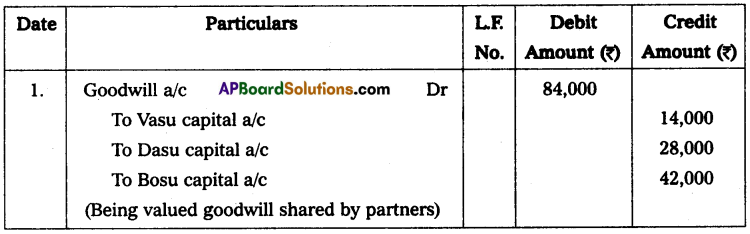
Vasu, Dasu, and Bosu are partners sharing profits in the ratio of 1 : 2 : 3. Dasu retires and at the time of retirement, goodwill is valued at ₹ 84,000. Vasu and Bosu decided to share future profits in the ratio of 2 : 1. Record the necessary journal entries.
Solution:
Journal Entry
AP Inter 2nd Year Accountancy Study Material Chapter 7 Retirement Death of a Partner Textual Exercise Q5

Question 6.
Rama, Krishna, and Reddy are partners in a firm sharing profits and losses in the ratio of 2 : 2 : 1. On Rama’s retirement, the goodwill of the firm is valued at ₹ 46,000. Krishna and Reddy decided to share future profits equally. Record the necessary journal entry for the treatment of goodwill without opening a’ Goodwill Account’.
Solution:
Old ratio = 2 : 2 : 1
New ratio =1 : 1
Krishna gaining ratio = New ratio – Old ratio
= [latex]\frac{1}{2}-\frac{2}{5} \text { (or) } \frac{5}{10}-\frac{4}{10}=\frac{1}{10}[/latex]
Reddy’s gaining ratio = [latex]\frac{1}{2}-\frac{1}{5}=\frac{5}{10}-\frac{2}{10}=\frac{3}{10}[/latex] = 1 : 3
Journal Entry
AP Inter 2nd Year Accountancy Study Material Chapter 7 Retirement Death of a Partner Textual Exercise Q6

Question 7.
Shanu, Nicee, and Jwalitha are partners sharing profits in the ratio of 1 : 3 : 5. Goodwill is appearing in the books at a value of ₹ 60,000. Nicee retires and goodwill is valued at ₹ 90,000. Shanu and Jwalitha decided to share future profits equally. Record necessary journal entries.
Solution:
Journal Entry
AP Inter 2nd Year Accountancy Study Material Chapter 7 Retirement Death of a Partner Textual Exercise Q7

Question 8.
Asha, Deepa, and Lata are partners in the firm sharing profits in the ratio of 3 : 2 : 1. Deepa retires. After making all adjustments relating to revaluation, goodwill and accumulated profit, etc., the capital accounts of Asha and Lata showed a credit balance of ₹ 1,60,000 and ₹ 80,000 respectively. It was decided to adjust the capitals of Asha and Lata in their new profit-sharing ratio. They decided that the requirement of capital is ₹ 2,50,000. You are required to calculate the new capitals of the partners and record necessary journal entries for bringing in or withdrawing of the necessary amounts involved.
Solution:
New profit sharing ratio = 3 : 1
Total capital = 2,50,000
Asha capital = 2,50,000 × [latex]\frac{3}{4}[/latex] = ₹ 1,87,500
Lata capital = 2,50,000 × [latex]\frac{3}{4}[/latex] = ₹ 62,500
AP Inter 2nd Year Accountancy Study Material Chapter 7 Retirement Death of a Partner Textual Exercise Q8
AP Inter 2nd Year Accountancy Study Material Chapter 7 Retirement Death of a Partner Textual Exercise Q8.1

Question 9.
A, B and C are partners in a firm. B retires from the firm on 1st Jan 2015. On the date of his retirement ₹ 55,000 were due to him. It was decided that the payment will be done in 3 equal yearly installments together with interest @ 10% p.a. on the unpaid balance. Prepare necessary entries.
Solution:
B’s Loan a/c
AP Inter 2nd Year Accountancy Study Material Chapter 7 Retirement Death of a Partner Textual Exercise Q9

Question 10.
The Balance Sheet of Mohit, Neeraj, and Sohan who are partners in firm sharing profits according to their capitals as on March 31, 2015, was as under:
AP Inter 2nd Year Accountancy Study Material Chapter 7 Retirement Death of a Partner Textual Exercise Q10
On that date, Neeraj decided to retire from the firm and was paid for his share in the firm subject to the following:
1. Buildings to be appreciated by 20%.
2. Provision for Bad debts to be increased to 15% on Debtors.
3. Machinery to be depreciated by 20%.
Prepare necessary accounts and a new Balance Sheet after retirement.
Solution:
AP Inter 2nd Year Accountancy Study Material Chapter 7 Retirement Death of a Partner Textual Exercise Q10.1
AP Inter 2nd Year Accountancy Study Material Chapter 7 Retirement Death of a Partner Textual Exercise Q10.2
AP Inter 2nd Year Accountancy Study Material Chapter 7 Retirement Death of a Partner Textual Exercise Q10.3

AP Inter 2nd Year Accountancy Study Material Chapter 7 Retirement / Death of a Partner

Question 11.
Siva, Rama, and Krishna were partners in firm sharing profits in the ratio of 2 : 2 : 1. Their Balance Sheet as on March 31, 2015, was as follows:
AP Inter 2nd Year Accountancy Study Material Chapter 7 Retirement Death of a Partner Textual Exercise Q11
Rama retired on March 31, 2015, on the following terms:
(i) Goodwill of the firm was valued at ₹ 70,000 and was not to appear in the books.
(ii) Bad debts amounting to ₹ 2,000 were to be written off.
(iii) Patents were considered valueless.
Prepare Revaluation Account, Partner’s Capital Accounts, and the Balance Sheet.
Solution:
AP Inter 2nd Year Accountancy Study Material Chapter 7 Retirement Death of a Partner Textual Exercise Q11.1
AP Inter 2nd Year Accountancy Study Material Chapter 7 Retirement Death of a Partner Textual Exercise Q11.2
AP Inter 2nd Year Accountancy Study Material Chapter 7 Retirement Death of a Partner Textual Exercise Q11.3

Question 12.
Radha, Krishna, and Satya were in partnership sharing profit and losses in the ratio of 4 : 2 : 1. On April 1, 2015, Krishna retires from the firm. On that date, their Balance Sheet was as follows:
AP Inter 2nd Year Accountancy Study Material Chapter 7 Retirement Death of a Partner Textual Exercise Q12
The terms were:
(a) Goodwill of the firm was valued at ₹ 13,000.
(b) Expenses owing to be brought down to ₹ 3,750.
(c) Machinery and Loose Tools are to be valued at 10% less than their book value.
(d) Factory premises are to be revalued at ₹ 24,300.
Prepare:
1. Revaluation account
2. Partner’s capital accounts and
3. Balance sheet of the firm after the retirement of Krishna
Solution:
AP Inter 2nd Year Accountancy Study Material Chapter 7 Retirement Death of a Partner Textual Exercise Q12.1
AP Inter 2nd Year Accountancy Study Material Chapter 7 Retirement Death of a Partner Textual Exercise Q12.2
AP Inter 2nd Year Accountancy Study Material Chapter 7 Retirement Death of a Partner Textual Exercise Q12.3

Question 13.
Suresh, Naresh, and Ramesh are partners sharing profits in the ratio of 3 : 2 : 1. Naresh retired from the firm due to his illness. On that date the Balance Sheet of the firm was as follows:
Books of Suresh, Naresh, and Ramesh Balance Sheet as on March 31, 2015.
AP Inter 2nd Year Accountancy Study Material Chapter 7 Retirement Death of a Partner Textual Exercise Q13
AP Inter 2nd Year Accountancy Study Material Chapter 7 Retirement Death of a Partner Textual Exercise Q13.1
Additional information:
(i) Premises have appreciated by 20%, stock depreciated by 10%, and provision for doubtful debts was to be made 5% on debtors.
(ii) Goodwill of the firm valued at ₹ 42,000.
(iii) ₹ 46,000 from Naresh’s capital account be transferred to his loan account and the balance be paid through the bank.
(iv) New profit sharing ratio of Suresh and Ramesh is decided to be 5 : 1.
Give the necessary ledger accounts and balance sheet of the firm after Naresh’s retirement.
Solution:
AP Inter 2nd Year Accountancy Study Material Chapter 7 Retirement Death of a Partner Textual Exercise Q13.2
AP Inter 2nd Year Accountancy Study Material Chapter 7 Retirement Death of a Partner Textual Exercise Q13.3
AP Inter 2nd Year Accountancy Study Material Chapter 7 Retirement Death of a Partner Textual Exercise Q13.4

AP Inter 2nd Year Accountancy Study Material Chapter 7 Retirement / Death of a Partner

Question 14.
R, S, and T were carrying on business in partnership sharing profits in the ratio of 3 : 2 : 1 respectively. On March 31, 2015, the Balance Sheet of the firm stood as follows:
AP Inter 2nd Year Accountancy Study Material Chapter 7 Retirement Death of a Partner Textual Exercise Q14
S retired on the above-mentioned date on the following terms:
(a) Buildings to be appreciated by ₹ 8,800.
(b) Provision for doubtful debts to be made @ 5% on debtors.
(c) Goodwill of the firm to be valued at ₹ 9,000.
(d) ₹ 5,000 to be paid to S immediately and the balance due to him is to be treated as a loan carrying interest @ 6% per annum.
Prepare the balance sheet of the reconstituted firm.
Solution:
AP Inter 2nd Year Accountancy Study Material Chapter 7 Retirement Death of a Partner Textual Exercise Q14.1
AP Inter 2nd Year Accountancy Study Material Chapter 7 Retirement Death of a Partner Textual Exercise Q14.2
AP Inter 2nd Year Accountancy Study Material Chapter 7 Retirement Death of a Partner Textual Exercise Q14.3

Question 15.
The balance sheet of A, B, and C who were sharing the profits in proportion to their capitals stood on March 31, 2015.
Balance Sheet as on March 31, 2015
AP Inter 2nd Year Accountancy Study Material Chapter 7 Retirement Death of a Partner Textual Exercise Q15
B retired on the date of the Balance Sheet and the following adjustments were to be made:
(a) Stock was depreciated by 10%.
(b) Factory building was appreciated by 12%.
(c) Provision for doubtful debts to be created upto 5%.
(d) Provision for legal charges to be made at Rs. 265.
(e) The goodwill of the firm is to be fixed at Rs. 10,000.
(f) The capital of the new firm is to be fixed at Rs. 30,000.
The continuing partners decide to keep their capitals in the new profit sharing ratio of 3 : 2. Work out the final balances in the capital accounts of the firm, and the amounts to be brought in and/or withdrawn by A and C to make their capitals proportionate to the new profit sharing ratio.
Solution:
AP Inter 2nd Year Accountancy Study Material Chapter 7 Retirement Death of a Partner Textual Exercise Q15.1
AP Inter 2nd Year Accountancy Study Material Chapter 7 Retirement Death of a Partner Textual Exercise Q15.2
Note: Capital of the new firm = ₹ 30,000
A’s capital should according to his share = [latex]\frac{3}{5}[/latex] × 30,000 = ₹ 18,000
C’s capital = [latex]\frac{3}{5}[/latex] × 30,000 = ₹ 12,000
AP Inter 2nd Year Accountancy Study Material Chapter 7 Retirement Death of a Partner Textual Exercise Q15.3
AP Inter 2nd Year Accountancy Study Material Chapter 7 Retirement Death of a Partner Textual Exercise Q15.4

Question 16.
N, S, and B are partners in firm sharing profits and losses in the ratio of 3 : 1 : 2. The Balance Sheet on April 1, 2015, was as follows:
AP Inter 2nd Year Accountancy Study Material Chapter 7 Retirement Death of a Partner Textual Exercise Q16
B retires from the business and the partners agree to the following:
(a) Freehold premises and stock are to be appreciated by 20% and 15% respectively.
(b) Machinery and furniture are to be depreciated by 10% and 7% respectively.
(c) Bad debts reserve is to be increased to ₹ 1,500.
(d) Goodwill is valued at ₹ 21,000 on B’s retirement.
(e) The continuing partners have decided to adjust their capitals in their new profit-sharing ratio after the retirement of B. The capital requirement to continue the firm is ₹ 72,000. Surplus/deficit, if any, in their capital accounts will be adjusted.
Prepare necessary ledger accounts and draw the Balance Sheet of the reconstituted firm.
Solution:
AP Inter 2nd Year Accountancy Study Material Chapter 7 Retirement Death of a Partner Textual Exercise Q16.1
AP Inter 2nd Year Accountancy Study Material Chapter 7 Retirement Death of a Partner Textual Exercise Q16.2
Note: Total capital of the firm = ₹ 72,000
The profit sharing ratio of N and S is 3 : 1
Capital of N = 72,000 × [latex]\frac{3}{4}[/latex] = ₹ 54,000
Capital of S = 72,000 × [latex]\frac{1}{4}[/latex] = ₹ 18,000
AP Inter 2nd Year Accountancy Study Material Chapter 7 Retirement Death of a Partner Textual Exercise Q16.3
AP Inter 2nd Year Accountancy Study Material Chapter 7 Retirement Death of a Partner Textual Exercise Q16.4
AP Inter 2nd Year Accountancy Study Material Chapter 7 Retirement Death of a Partner Textual Exercise Q16.5

AP Inter 2nd Year Accountancy Study Material Chapter 7 Retirement / Death of a Partner

Question 17.
On December 31, 2014, the Balance Sheet of P, Q, and R showed as under:
AP Inter 2nd Year Accountancy Study Material Chapter 7 Retirement Death of a Partner Textual Exercise Q17
The partnership deed provides that the profit be shared to the ratio of 2 : 1 : 1 and that in the event of the death of a partner, his executors are entitled to be paid out.
(a) The capital of his credit at the date of the last Balance Sheet.
(b) His proportion of reserves at the date of the last Balance Sheet.
(c) His proportion of profits to the date of death is based on the average profits of the last three completed years.
(d) By way of goodwill, his proportion of the total profits for the three preceding years.
The net profits for the last three years were:
2012 – 16,000; 2013 – 16,000; 2014 – 15,400.
R died on April 1, 2015. He had withdrawn ₹ 5,000 to the date of his death.
Prepare R’s Capital Account that of his executors.
Solution:
Working Notes:
(i) Share of profits (upto the date of death)
AP Inter 2nd Year Accountancy Study Material Chapter 7 Retirement Death of a Partner Textual Exercise Q17.1
Average profits = [latex]\frac{47,400}{3}[/latex] = ₹ 15,800
Share of profit upto 1st April 2015 = 15,800 × [latex]\frac{1}{4} \times \frac{3}{12}[/latex] = ₹ 988

(ii) Goodwill:
Total profits = ₹ 47,400
Average profits = [latex]\frac{47,400}{3}[/latex] = ₹ 15,800
R share of goodwill = 15,800 × [latex]\frac{1}{4}[/latex] = ₹ 3,950
AP Inter 2nd Year Accountancy Study Material Chapter 7 Retirement Death of a Partner Textual Exercise Q17.2

Question 18.
Following is the Balance Sheet of P, Q, and R as on March 31, 2014.
AP Inter 2nd Year Accountancy Study Material Chapter 7 Retirement Death of a Partner Textual Exercise Q18
Q died on June 30, 2014. Under the terms of the partnership deed, the executors of a deceased partner were entitled to:
(a) Amount standing to the credit of the Partner’s Capital account.
(b) Interest on capital at 5% per annum.
(c) Share of goodwill on the basis of twice the average of the past three year’s profit.
(d) Share of profit from the closing date of the last financial year to the date of death on the basis of last year’s profit.
Profits for the year ending on March 31, 2012, 2013, and 2014 were ₹ 12,000; ₹ 16,000, and ₹ 14,000 respectively. Profits were shared in the ratio of capital.
Pass the necessary journal entries and draw up Q’s capital account to be rendered to his executor.
Solution:
Working Notes:
(i) Interest on capital = 20,000 × [latex]\frac{5}{100} \times \frac{3}{12}[/latex] = ₹ 250
(ii) Goodwill:
3 years profits = 12,000 + 16,000 + 14,000 = ₹ 42,000
Average profits = [latex]\frac{42,000}{3}[/latex] = ₹ 14,000
Goodwill = 2 × 14,000 = ₹ 28,000
Share of goodwill = 28,000 × [latex]\frac{2}{7}[/latex] = ₹ 8,000
Share of profit:
Profit of 2014 = 14,000 × [latex]\frac{2}{7} \times \frac{3}{12}[/latex] = ₹ 1,000
Share in reserve = 16,000 × [latex]\frac{2}{7}[/latex] = ₹ 4,571
AP Inter 2nd Year Accountancy Study Material Chapter 7 Retirement Death of a Partner Textual Exercise Q18.1
AP Inter 2nd Year Accountancy Study Material Chapter 7 Retirement Death of a Partner Textual Exercise Q18.2

Textual Examples

Question 1.
Naveen, Suresh, and Tarun are partners sharing profits and losses in the ratio of 5 : 3 : 2. Tarun retires from the firm, and his share was acquired by Naveen and Tarun in the ratio of 2 : 1. In such a case, calculate the new profit sharing ratio.
Solution:
The old ratio of Naveen, Suresh, and Tarun = 5 : 3 : 2
Gaining ratio of Naveen and Suresh after the retirement of Tarun = 2 : 1
New share of continuing partner = Old share + Acquired share from the outgoing partner
Share acquired by Naveen = [latex]\frac{2}{10} \times \frac{2}{3}=\frac{4}{30}[/latex]
Naveen’s new share = [latex]\frac{5}{10}+\frac{4}{30}=\frac{15+4}{30}=\frac{19}{30}[/latex]
Share acquired by Suresh = [latex]\frac{2}{10} \times \frac{1}{3}=\frac{2}{30}[/latex]
Suresh’s new share = [latex]\frac{3}{10}+\frac{2}{30}=\frac{9+2}{30}=\frac{11}{30}[/latex]
New ratio = [latex]\frac{19}{30}: \frac{11}{30}[/latex]
Thus, the new profit sharing ratio of Naveen and Suresh will be = 19 : 11.

AP Inter 2nd Year Accountancy Study Material Chapter 7 Retirement / Death of a Partner

Question 2.
Anil, Dinesh, and Ganga are partners sharing profits in the ratio of 6 : 5 : 4. Dinesh retires. Anil and Ganga decide to share the profits of the new firm in the ratio of 3 : 2. Calculate the gaining ratio.
Solution:
The old ratio of all partners = 6 : 5 : 4
New ratio of continuing partners = 3 : 2
Gaining share of continuing partners = New share – Old share
Ami’s gaining share = [latex]\frac{3}{5}-\frac{6}{15}=\frac{9-6}{15}=\frac{3}{15}[/latex]
Ganga’s gaining share = [latex]\frac{2}{5}-\frac{4}{15}=\frac{6-4}{15}=\frac{2}{15}[/latex]
Gaining ratio = [latex]\frac{3}{15}: \frac{2}{15}[/latex]
Thus, the gaining ratio of Anil and Ganga = 3 : 2

Question 3.
M, I, and G are partners sharing profits and losses in the ratio of 2 : 2 : 1 respectively. On March 31, 2015, their Balance Sheet was as under:
AP Inter 2nd Year Accountancy Study Material Chapter 7 Retirement Death of a Partner Textual Examples Q3
AP Inter 2nd Year Accountancy Study Material Chapter 7 Retirement Death of a Partner Textual Examples Q3.1
G retires on the above date. It was agreed that Machinery is valued at ₹ 1,40,000; Patents at ₹ 40,000; and Buildings at ₹ 1,25,000. Record the necessary journal entries and prepare the Revaluation Account.
Solution:
AP Inter 2nd Year Accountancy Study Material Chapter 7 Retirement Death of a Partner Textual Examples Q3.2
AP Inter 2nd Year Accountancy Study Material Chapter 7 Retirement Death of a Partner Textual Examples Q3.3

Question 4.
A, B, and Care partners in firm share profits in the ratio of 3 : 2 : 1. B retires. The goodwill of the firm is valued at ₹ 60,000 and the remaining partner A and C continue to share profits in the ratio of 3 : 1. Pass the journal entries under various alternatives:
(a) If goodwill is raised at full value and retained in books.
(b) If goodwill is raised at full value and written off immediately.
(c) If goodwill is raised to the extent of retiring partner’s share and written off immediately.
(d) If goodwill is not after in the firm’s books at all.
Solution:
(a) If goodwill is raised at full value and retained in books.
AP Inter 2nd Year Accountancy Study Material Chapter 7 Retirement Death of a Partner Textual Examples Q4
(b) If goodwill is raised at full value and written off immediately.
AP Inter 2nd Year Accountancy Study Material Chapter 7 Retirement Death of a Partner Textual Examples Q4.1
(c) If goodwill is raised to the extent of retiring partner’s share and written off immediately.
AP Inter 2nd Year Accountancy Study Material Chapter 7 Retirement Death of a Partner Textual Examples Q4.2
(d) If goodwill is not after in the firm’s book at all.
AP Inter 2nd Year Accountancy Study Material Chapter 7 Retirement Death of a Partner Textual Examples Q4.3
Working Notes:
Calculation of gaining ratio:
Old ratio of all partners = 3 : 2 : 1
New ratio of continuing ratio = 3 : 1
Gaining share of continuing partners = New share – Old share
A’s gaining share = [latex]\frac{3}{4}-\frac{3}{6}=\frac{9-6}{12}=\frac{3}{12}[/latex]
C’s gaining share = [latex]\frac{1}{4}-\frac{1}{6}=\frac{3-2}{12}=\frac{1}{12}[/latex]
Gaining ratio = [latex]\frac{3}{12}: \frac{1}{12}[/latex]
Thus, the gaining ratio of A and C = 3 : 1

AP Inter 2nd Year Accountancy Study Material Chapter 7 Retirement / Death of a Partner

Question 5.
D, P, and R are partners sharing profits in the ratio of 5 : 3 : 2. Goodwill appears in the books at a value of ₹ 20,000. P retires from the business. Pass the necessary journal entries in the following cases:
(a) On the day of P’s retirement, goodwill is valued at ₹ 24,000 and
(b) At the time of retirement goodwill is valued ₹ 18,000.
Solution:
(a) On the day of P’s retirement, goodwill is valued at ₹ 24,000.
AP Inter 2nd Year Accountancy Study Material Chapter 7 Retirement Death of a Partner Textual Examples Q5
(b) At the time of retirement goodwill is valued ₹ 18,000.
AP Inter 2nd Year Accountancy Study Material Chapter 7 Retirement Death of a Partner Textual Examples Q5.1

Question 6.
John, Sundar, and Rao are partners in the firm sharing profits in the ratio of 2 : 1 : 1. John retired from the firm, and Sundar and Rao decided that the capital of the new firm will be fixed at ₹ 1,20,000. The capital accounts of Sundarand Rao show a credit balance of ₹ 82,000 and ₹ 41,000 respectively after making all the adjustments. Calculate the actual cash to be paid off or to be brought in by the continuing partners and pass the necessary journal entries.
Solution:
The new profit sharing ratio between Sundar and Rao = 2 : 1
Total capital of the firm = ₹ 1,20,000
New capital based on new ratio of Sundar = 1,20,000 × [latex]\frac{2}{3}[/latex] = ₹ 80,000
Existing capital (after adjustments) = ₹ 82,000
Cash to be paid off = ₹ 2,000
New capital based on new ratio of Rao = 1,20,000 × [latex]\frac{1}{3}[/latex] = ₹ 40,000
Existing capital (after adjustments) = ₹ 41,000
Cash to be paid off = ₹ 1,000
Journal entries in the books of Sundar and Rao
AP Inter 2nd Year Accountancy Study Material Chapter 7 Retirement Death of a Partner Textual Examples Q6

Question 7.
Geethika, Rishitha, and Pravalika are partners in a firm. Geethika retires from the firm. On her date of retirement, ₹ 50,000 becomes due to her.
Prepare necessary entries in the following cases:
1. When payment is made immediately;
2. When payment is not made immediately;
3. When they agree to pay 50% immediately.
Solution:
1. When payment is made immediately.
AP Inter 2nd Year Accountancy Study Material Chapter 7 Retirement Death of a Partner Textual Examples Q7
2. When payment is not made immediately.
AP Inter 2nd Year Accountancy Study Material Chapter 7 Retirement Death of a Partner Textual Examples Q7.1
3. When they agree to pay 50% immediately.
AP Inter 2nd Year Accountancy Study Material Chapter 7 Retirement Death of a Partner Textual Examples Q7.2

AP Inter 2nd Year Accountancy Study Material Chapter 7 Retirement / Death of a Partner

Question 8.
X, Y, and Z were partners in firm sharing profits in 3 : 2 : 1 ratio. On 31.3.2015, Z retires from the firm. On the date of Z’s retirement the balance sheet of the firm was as follows:
AP Inter 2nd Year Accountancy Study Material Chapter 7 Retirement Death of a Partner Textual Examples Q8
On Z’s retirement, it was agreed that;
(i) Premises will be appreciated by 5% and furniture will be appreciated by ₹ 2,000.
(ii) Stock will be depreciated by 10%.
(iii) Provision for bad debts was to be made at 10% on debtors.
(iv) Goodwill of the firm is valued at ₹ 48,000.
(v) Z’s amount will be paid by cheque.
Prepare Revaluation a/c, Partner’s capital a/cs and New Balance Sheet.
Solution:
AP Inter 2nd Year Accountancy Study Material Chapter 7 Retirement Death of a Partner Textual Examples Q8.1
AP Inter 2nd Year Accountancy Study Material Chapter 7 Retirement Death of a Partner Textual Examples Q8.2

Question 9.
Sai, Suresh, and Naresh were sharing profits in the ratio of 2 : 3 : 5. Balance sheet of Sai, Suresh, and Naresh has on March 31, 2015.
AP Inter 2nd Year Accountancy Study Material Chapter 7 Retirement Death of a Partner Textual Examples Q9
Suresh retires on the above date and the following adjustments are agreed upon his retirement.
1. Stock was valued at ₹ 1,80,000.
2. Furniture and fittings were valued at ₹ 90,000.
3. An amount of ₹ 12,000 was doubtful and a provision for the same was required.
4. Goodwill of the firm was valued at ₹ 2,00,000.
5. Suresh was paid ₹ 40,000 immediately on retirement and the balance was transferred to his loan account.
6. Sai and Naresh were to share future profits in the ratio of 3 : 2.
Prepare the Revaluation account, Capital account, and Balance Sheet of the Reconstituted firm.
Solution:
AP Inter 2nd Year Accountancy Study Material Chapter 7 Retirement Death of a Partner Textual Examples Q9.1
AP Inter 2nd Year Accountancy Study Material Chapter 7 Retirement Death of a Partner Textual Examples Q9.2
AP Inter 2nd Year Accountancy Study Material Chapter 7 Retirement Death of a Partner Textual Examples Q9.3

Question 10.
B, C, and D were partners in the firm sharing profits in the ratio of 5 : 4 : 1. the profit of the firm for the year ending on March 31, 2014, was ₹ 1,00,000. C dies on June 30, 2014. Calculate C’s share of profit and pass journal entry.
Solution:
Profit for the period from April 1 to June 30, 2014, shall be calculated as follows:
Total profit for the year ending on 31st March 2014 = ₹ 1,00,000
C’s share of profit = Preceding year’s profit × Proportionate period × Share of a deceased partner
= ₹ 1,00,000 × [latex]\frac{3}{12} \times \frac{4}{10}[/latex]
= ₹ 10,000
The journal entry will be recorded as follows:
AP Inter 2nd Year Accountancy Study Material Chapter 7 Retirement Death of a Partner Textual Examples Q10

Question 11.
Anil, Bhanu, and Chandu were partners in firm sharing profits in the ratio of 5 : 3 : 2. On March 31, 2014, their Balance Sheet was as under:
AP Inter 2nd Year Accountancy Study Material Chapter 7 Retirement Death of a Partner Textual Examples Q11
Anil died on October 1, 2014. it was agreed between his executors and the remaining partners that:
(a) Goodwill to be valued at 2[latex]\frac{1}{2}[/latex] years’ purchase of the average profits of the previous four years which were:
2010-11 – ₹ 13,000
2011-12 – ₹ 12,000
2012-13 – ₹ 20,000
2013-14 – ₹ 15,000
(b) Patents be valued at ₹ 8,000; Machinery at ₹ 28,000; and Building at ₹ 25,000.
(c) Profit for the year 2014-15 to be taken as having accrued at the same rate as that of the previous year.
(d) Interest on capital provided at 10% p.a.
(e) Half of the amount due to Anil is to be paid immediately.
Prepare Anil’s capital account and Anil’s executor’s account as on October 1, 2014.
Solution:
AP Inter 2nd Year Accountancy Study Material Chapter 7 Retirement Death of a Partner Textual Examples Q11.1
Working Notes:
1. Goodwill = Average Profit × 2[latex]\frac{1}{2}[/latex] year’s purchase
Average profit for 4 years = ₹ 60,000 ÷ 4 = ₹ 15,000
Goodwill = 15,000 × [latex]\frac{5}{2}[/latex] = ₹ 37,500
Anil’s share of goodwill = 37,500 × [latex]\frac{5}{10}[/latex] = ₹ 18,750
This goodwill amount will adjust with 3 : 2 ratio between Bhanu and Chandu.

2. Profit from the date of last balance sheet to date of death (April 1, 2014, to October 1, 2014) = 6 months.
Profit for 6 months = ₹ 15,000 × [latex]\frac{6}{12}[/latex] = ₹ 7,500
Anil’s share of profit = ₹ 7,500 × [latex]\frac{5}{10}[/latex] = ₹ 3,750

3. Interest on Anil’s capital (April 1, 2014 to October 1, 2014) = ₹ 30,000 × [latex]\frac{10}{100} \times \frac{6}{12}[/latex] = ₹ 1,500

AP Inter 2nd Year Accountancy Study Material Chapter 7 Retirement / Death of a Partner

Question 12.
You are given the Balance Sheet of Mohit, Sohan, and Rahul who are partners sharing profits in the ratio of 2 : 2 : 1, as on March 31, 2014.
AP Inter 2nd Year Accountancy Study Material Chapter 7 Retirement Death of a Partner Textual Examples Q12
Sohan died on June 15, 2014. According to the Deed, his legal representatives are entitled to:
(a) Balance in the capital account.
(b) Share of goodwill valued on the basis of thrice the average of the past 4 years’ profits.
(c) Share in profits up to the date of death on the basis of average profits for the past 4 years.
(d) Interest on capital account @ 12% p.a.
Profits for the year ending on March 31 of 2011, 2012, 2013 and 2014 were ₹ 15,000, ₹ 17,000, ₹ 19,000 and ₹ 13,000 respectively.
Mobit and Rahul continued as partners by taking over Sohan’s share equally. Work out the amount payable to Sohan’s legal representatives.
Solution:
AP Inter 2nd Year Accountancy Study Material Chapter 7 Retirement Death of a Partner Textual Examples Q12.1
Working Notes:
1. Goodwill = Average Profit × 3 year’s purchase
Average profit for 4 years = ₹ 64,000 ÷ 4 = ₹ 16,000
Goodwill = ₹ 16,000 × 3 = ₹ 48,000
Sohan’ share of goodwill = 48,000 × [latex]\frac{2}{5}[/latex] = ₹ 19,200

2. Profit from the date of last balance sheet to date of death (April 1, 2014, to June 15, 2014) = 2[latex]\frac{1}{2}[/latex] months.
Profit for 2[latex]\frac{1}{2}[/latex] months = ₹ 16,000 × [latex]\frac{2.5}{12}[/latex] = ₹ 3,333
Sohan’s share of profit = ₹ 3,333 × [latex]\frac{2}{5}[/latex] = ₹ 1,333

3. Interest on Sohan’s capital (April 1, 2014) to June 15, 2014) = ₹ 25,000 × [latex]\frac{12}{100} \times \frac{2.5}{12}[/latex] = ₹ 625

AP Inter 2nd Year Accountancy Study Material Chapter 6 Admission of a Partner

Andhra Pradesh BIEAP AP Inter 2nd Year Accountancy Study Material 6th Lesson Admission of a Partner Textbook Questions and Answers.

AP Inter 2nd Year Accountancy Study Material 6th Lesson Admission of a Partner

Very Short Answer Questions

Question 1.
What are the aspects that need adjustment at the time of admission of a new partner?
Answer:
When a new partner is admitted to the firm the agreement among the existing partners terminates and a new agreement will come into force.
The following adjustments must be made at the time of admission.

  • New profit sharing ratio.
  • Revaluation of assets and liabilities.
  • Distribution of accumulated reserves, profits/losses.
  • Treatment of goodwill.
  • Adjustment of partners’ capitals.

Question 2.
Sacrificing Ratio
Answer:
The ratio in which the old partners agree to sacrifice their share of profit in favour of the incoming partner is called sacrificing ratio.
Sacrificing Ratio = Old share of Profit – New share of Profit.

Question 3.
Revaluation Account
Answer:
For the purpose of revaluation of assets and liabilities at the time of admission of a new partner, an account called a revaluation account is opened. It is a nominal account. The account is credited with all increases in the value of assets and decreases in the value of liabilities. Similarly, it is debited with a decrease in the value of assets and an increase in the value of liabilities. The balance of this account is again or lost on revaluation which is transferred to the old partners’ capital accounts in the old profit sharing ratio.

AP Inter 2nd Year Accountancy Study Material Chapter 6 Admission of a Partner

Question 4.
Goodwill
Answer:
Over a period of time, a well-established business develops the advantage of a good name and reputation which helps the business to earn more profits. The monetary value is called goodwill. It is regarded as an intangible asset. So, goodwill is the value of the reputation of a firm in respect of profits expected in the future over and above normal profits.

Question 5.
What are the methods of goodwill valuation?
Answer:
The important methods of valuation of Goodwill are:
1. Average profits method: Under this method, the goodwill is valued at an agreed number of years of the purchase of the average profits of the past few years.
Goodwill = Average profit × No. of years purchase

2. Super profit method: Super profit is the profit earned by the business in excess of the usual profit goodwill is valued by multiplying the super profit by the number of years purchased.

3. Capitalisation method: Under capitalisation method, the capitalized value of the business is determined by capitalizing the average profits by the normal rate of return. Out of the value so determined, the value of net assets/ capital employed is deducted, and the balance amount is the value of goodwill.

Textual Problems

Question 1.
M and N are partners sharing profit and losses in the 1 : 2 ratio. They have decided to admit ‘O’ by giving him 1/4th share in future profits. Calculate the New profit sharing ratio.
Solution:
If we assume the total share is 1
The new partners share is a [latex]\frac{1}{4}[/latex]
Remaining share = 1 – [latex]\frac{1}{4}[/latex] = [latex]\frac{3}{4}[/latex]
Old Ratio = 1 : 2
New Share = Rest of the share × old ratio
M new share = [latex]\frac{3}{4} \times \frac{1}{3}=\frac{3}{12}[/latex]
N new share = [latex]\frac{3}{4} \times \frac{2}{3}=\frac{6}{12}[/latex]
O’s Share = [latex]\frac{1}{4}[/latex] or [latex]\frac{3}{12}[/latex]
New Share = 1 : 2 : 1

Question 2.
P & Q are partners sharing in the ratio of 2 : 3. They admit R for 1/4th share and he gets this share equally from P & Q. Calculate the new ratio.
Solution:
New partner R share [latex]\frac{1}{4}[/latex]
He gets this equally from P and Q. That is [latex]\frac{1}{4} \times \frac{1}{2}=\frac{1}{8}[/latex]
Old Ratio = 2 : 3
New Share = Old share – Sacrificing ratio
P = [latex]\frac{2}{5}-\frac{1}{8}=\frac{16}{40}-\frac{5}{40}=\frac{11}{40}[/latex]
Q = [latex]\frac{3}{5}-\frac{1}{8}=\frac{24}{40}-\frac{5}{40}=\frac{19}{40}[/latex]
R = [latex]\frac{1}{4}[/latex] or [latex]\frac{10}{40}[/latex]

Question 3.
X and Y share profits and losses in the Ratio of 4 : 3, they admit Z with 3/7th share; which he gets 2/7th from X and 1/7th from Y. What is the new profit sharing ratio?
Solution:
New partner Z’s share = [latex]\frac{3}{7}[/latex] (This acquired [latex]\frac{2}{7}[/latex] from X and [latex]\frac{1}{7}[/latex] from Y)
Old ratio = 4 : 3
New share = Old share – Sacrificing ratio
X = [latex]\frac{4}{7}-\frac{2}{7}=\frac{2}{7}[/latex]
Y = [latex]\frac{3}{7}-\frac{1}{7}=\frac{2}{7}[/latex]
Z = [latex]\frac{3}{7}[/latex]

AP Inter 2nd Year Accountancy Study Material Chapter 6 Admission of a Partner

Question 4.
A & B are partners sharing in the ratio of 3 : 2. C is admitted and he gets 3/20th from A and 1/20th from B. Calculate the new ratio.
Solution:
C’s share = [latex]\frac{4}{20}[/latex] (Acquires [latex]\frac{3}{20}[/latex] from A, [latex]\frac{1}{20}[/latex] from B)
Old ratio = 3 : 2
New share = Old share – Sacrificing ratio
A = [latex]\frac{3}{5}-\frac{3}{20} \text { or } \frac{12}{20}-\frac{3}{20}=\frac{9}{20}[/latex]
B = [latex]\frac{2}{5}-\frac{1}{20} \text { or } \frac{8}{20}-\frac{1}{20}=\frac{7}{20}[/latex]
C = [latex]\frac{4}{20}[/latex]
New ratio = 9 : 7 : 4

Question 5.
X & Y are partners who share profits in the ratio of 5 : 3. Z the new partner gets 1/5 of X’s share and 1/3rd of Y’s share. Calculate the new ratio.
Solution:
Z gets [latex]\frac{1}{5}[/latex] share from X and [latex]\frac{1}{3}[/latex] share from Y
Old ratio = 5 : 3
New ratio = Old ratio – Sacrificing ratio
X share = [latex]\frac{5}{8}-\frac{1}{5} \text { or } \frac{25}{40}-\frac{8}{40}=\frac{17}{40}[/latex]
Y share = [latex]\frac{3}{8}-\frac{1}{3}=\frac{9}{24}-\frac{8}{24}=\frac{1}{24}[/latex]
Z share = [latex]\frac{1}{5}+\frac{1}{3} \text { or } \frac{3}{15}+\frac{5}{15}=\frac{8}{15}[/latex]

Question 6.
If Tarun and Nisha are partners sharing profits in the ratio of 5 : 3. What will be their sacrificing ratio if Rahul is admitted for 1/8 share of profit in the firm?
Solution:
Rahul share = [latex]\frac{1}{8}[/latex]
Remaining share = 1 – [latex]\frac{1}{8}[/latex] = [latex]\frac{7}{8}[/latex]
New ratio:
Tarun = [latex]\frac{7}{8} \times \frac{5}{8}=\frac{35}{64}[/latex]
Nisha = [latex]\frac{7}{8} \times \frac{3}{8}=\frac{21}{64}[/latex]
Rahul [latex]\frac{1}{8}[/latex] or [latex]\frac{8}{64}[/latex]
Sacrificing ratio = Old ratio – New ratio
Tarun = [latex]\frac{5}{8}-\frac{35}{64} \text { or } \frac{40}{64}-\frac{35}{64}=\frac{5}{64}[/latex]
Nisha = [latex]\frac{3}{8}-\frac{21}{64}=\frac{24}{64}-\frac{21}{24}=\frac{3}{24}[/latex]
So Sacrificing ratio = 5 : 3

Question 7.
Amar and Bahadur are partners in firm sharing profits in the ratio of 5 : 2. They admitted Mary as a new partner for 1/4 share. The new profit sharing ratio of the partners will be 2 : 1 : 1. Calculate their sacrificing ratio.
Solution:
Old ratio = 5 : 2
New ratio = 2 : 1 : 1
Amar old ratio = [latex]\frac{5}{7}[/latex]
Amar new ratio = [latex]\frac{2}{4}[/latex]
Sacrificing ratio = old ratio – new ratio
Amar = [latex]\frac{5}{7}-\frac{2}{4}=\frac{20-14}{18}=\frac{6}{28}[/latex]
Bahadur = [latex]\frac{2}{7}-\frac{1}{4}=\frac{8-7}{28}=\frac{1}{28}[/latex]
∴ So sacrificing ratio = 6 : 1

AP Inter 2nd Year Accountancy Study Material Chapter 6 Admission of a Partner

Question 8.
Vijay and Sanjay are partners in the firm sharing profits and losses in the ratio of 1 : 2. They decide to admit Ajay into partnership with 1/4 share in profits. Ajay brings in ₹ 30,000 for capital and ₹ 15,000 for goodwill. Give necessary journal entries,
(a) When the amount of goodwill is retained in the business.
(b) When the amount of goodwill is fully withdrawn.
(c) When 50% of the amount of goodwill is withdrawn.
Solution:
(a) When the amount of goodwill is retained in the business.
AP Inter 2nd Year Accountancy Study Material Chapter 6 Admission of a Partner Textual Exercises Q8
(b) When the amount of goodwill is fully withdrawn
AP Inter 2nd Year Accountancy Study Material Chapter 6 Admission of a Partner Textual Exercises Q8.1
(c) When 50% of the amount of goodwill is withdrawn
AP Inter 2nd Year Accountancy Study Material Chapter 6 Admission of a Partner Textual Exercises Q8.2

Question 9.
A and B are partners sharing profits and losses equally. They admit C into partnership and the new ratio is fixed as 4 : 3 : 2. C is unable to bring anything for goodwill but brings ₹ 25,000 as capital. Goodwill of the firm is valued at ₹ 18,000. Give the necessary journal entries assuming that the partners do not want goodwill to appear on the Balance Sheet.
Solution:
AP Inter 2nd Year Accountancy Study Material Chapter 6 Admission of a Partner Textual Exercises Q9

Question 10.
Rahul and Gandhi are partners sharing profit in the ratio of 4 : 5. On 1st April 2015, they admit Sonia as a new partner for 1/6 share in profits. On that date, the balance sheet of the firm shows a balance of ₹ 60,000 in general reserve and a debit balance of Profit and Loss A/c of ₹ 25,000.
Make the necessary journal entries.
Solution:
AP Inter 2nd Year Accountancy Study Material Chapter 6 Admission of a Partner Textual Exercises Q10

Question 11.
A & B are equal partners in a firm. They decide to admit C as a new partner for 1/5th share in profit. On the date of admission the balance sheet of the firm was as follows:
AP Inter 2nd Year Accountancy Study Material Chapter 6 Admission of a Partner Textual Exercises Q11
The terms of the agreement on C’s admission were as follows:
(a) Building will be valued at ₹ 65,000 and machinery at ₹ 20,000
(b) Creditors included ₹ 1,000 no longer payable.
Pass necessary Journal entries for revaluation of assets and liabilities.
Solution:
AP Inter 2nd Year Accountancy Study Material Chapter 6 Admission of a Partner Textual Exercises Q11.1
AP Inter 2nd Year Accountancy Study Material Chapter 6 Admission of a Partner Textual Exercises Q11.2

AP Inter 2nd Year Accountancy Study Material Chapter 6 Admission of a Partner

Question 12.
Kama and Balaram are partners sharing profit and losses in the ratio of 4 : 1. Their Balance Sheet was as follows:
Balance Sheet of Kama and Balaram as of December 31st, 2014
AP Inter 2nd Year Accountancy Study Material Chapter 6 Admission of a Partner Textual Exercises Q12
Nikhil is admitted as a partner and assets are revalued and liabilities reassessed as follows:
(i) Create a Provision for doubtful debt on debtors at ₹ 800
(ii) Building and investment are appreciated by 10%.
(iii) Machinery is deprecated at 5%
(iv) Creditors were overestimated by ₹ 500
Make journal entries and Prepare a revaluation account before the admission of Nikhil.
Solution:
AP Inter 2nd Year Accountancy Study Material Chapter 6 Admission of a Partner Textual Exercises Q12.1
AP Inter 2nd Year Accountancy Study Material Chapter 6 Admission of a Partner Textual Exercises Q12.2

Question 13.
Balance Sheet of A and B as on 31.03.2014
AP Inter 2nd Year Accountancy Study Material Chapter 6 Admission of a Partner Textual Exercises Q13
The other terms of the agreement on C’s admission were as follows:
(i) C will bring ₹ 12,000 for his share of capital.
(ii) Building will be valued at ₹ 1,85,000 and Machinery at ₹ 40,000
(iii) A provision of 6% will be created for debtors with bad debts.
Prepare Revaluation Account and Partners Capital Accounts.
Solution:
AP Inter 2nd Year Accountancy Study Material Chapter 6 Admission of a Partner Textual Exercises Q13.1

Question 14.
The following is the balance sheet of Ram and Shyam, who are sharing profit as 2/3 and 1/3 on 31st March 2014.
AP Inter 2nd Year Accountancy Study Material Chapter 6 Admission of a Partner Textual Exercises Q14
They agree to admit Mohan into partnership on the following terms:
(a) Mohan was to be given 1/3 share in the profit and to bring ₹ 7,500 as his capital and ₹ 3,000 as his share of goodwill.
(b) That the value of stock and plant & Machinery was to be reduced by 5%.
(c) That a reserve of 10% was to be created in respect of Sundry Debtors.
(d) The buildings were to be depreciated by 10%.
Pass Journal Entries and necessary Accounts.
Solution:
AP Inter 2nd Year Accountancy Study Material Chapter 6 Admission of a Partner Textual Exercises Q14.1
AP Inter 2nd Year Accountancy Study Material Chapter 6 Admission of a Partner Textual Exercises Q14.2
AP Inter 2nd Year Accountancy Study Material Chapter 6 Admission of a Partner Textual Exercises Q14.3

AP Inter 2nd Year Accountancy Study Material Chapter 6 Admission of a Partner

Question 15.
A and B are partners in a firm, sharing profits and losses in the ratio of 5 : 3, on 31st December 2014 their Balance sheet was as under:
AP Inter 2nd Year Accountancy Study Material Chapter 6 Admission of a Partner Textual Exercises Q15
On the above date they decided to admit C as a partner on the following terms:
(a) C will bring ₹ 90,000 as his capital and ₹ 24,000 for his share of goodwill for 1/4th share in the profit.
(b) Machinery is to be valued at ₹ 1,50,000, stock ₹ 1,00,000, and provision for bad debts of ₹ 10,000 is to be created.
Prepare Revaluation A/c, partners’ capital A/c and new Balance Sheet.
Solution:
AP Inter 2nd Year Accountancy Study Material Chapter 6 Admission of a Partner Textual Exercises Q15.1
AP Inter 2nd Year Accountancy Study Material Chapter 6 Admission of a Partner Textual Exercises Q15.2
AP Inter 2nd Year Accountancy Study Material Chapter 6 Admission of a Partner Textual Exercises Q15.3

Question 16.
Rashmi and Pooja are partners in a firm. They share profits and losses in the ratio of 2 : 1. They admit Santoshi into a partnership firm on the condition that she will bring ₹ 1,50,000 for capital and she will be given 1/3 share in future profits. At the time of admission on the Balance Sheet of Rashmi and Pooja was as under.
AP Inter 2nd Year Accountancy Study Material Chapter 6 Admission of a Partner Textual Exercises Q16
It was decided to:
(a) Revaluate stock at ₹ 45,000.
(b) Depreciate furniture by 10% and machinery by 5%.
(c) Make provision of ₹ 3,000 on sundry debtors for doubtful debts.
Prepare Revaluation Accounts, Partners Capital Accounts, and Balance Sheet of the new firm.
Solution:
AP Inter 2nd Year Accountancy Study Material Chapter 6 Admission of a Partner Textual Exercises Q16.1
AP Inter 2nd Year Accountancy Study Material Chapter 6 Admission of a Partner Textual Exercises Q16.2
AP Inter 2nd Year Accountancy Study Material Chapter 6 Admission of a Partner Textual Exercises Q16.3

AP Inter 2nd Year Accountancy Study Material Chapter 6 Admission of a Partner

Question 17.
Venu & Venkat are partners in a business sharing profits and losses equally. Their Balance Sheet on 31-3-2014 stood as under;
AP Inter 2nd Year Accountancy Study Material Chapter 6 Admission of a Partner Textual Exercises Q17
They decided to admit Naidu into the firm on 1st April 2014 on the following terms and conditions:
(a) Naidu has to pay ₹ 1,25,000/- for 1/4 share in future profits.
(b) Naidu has to pay ₹ 38,000/- for goodwill.
(c) Plant and Machinery to be depreciated by 10%.
(d) Buildings to be appreciated by 20%.
(e) 5% reserve for doubt full debts to be created on debtors.
Prepare necessary accounts in the books of the firm after admission of Naidu with the new Balance Sheet.
Solution:
AP Inter 2nd Year Accountancy Study Material Chapter 6 Admission of a Partner Textual Exercises Q17.1
AP Inter 2nd Year Accountancy Study Material Chapter 6 Admission of a Partner Textual Exercises Q17.2
AP Inter 2nd Year Accountancy Study Material Chapter 6 Admission of a Partner Textual Exercises Q17.3

Question 18.
Rao and Raju are carrying on business in a partnership, sharing profit & loss in the ratio of 2 : 3. Their Balance sheet as of 31-12-2014 was as under.
AP Inter 2nd Year Accountancy Study Material Chapter 6 Admission of a Partner Textual Exercises Q18
On that day they admitted Reddy into partnership and gave him 1/6th share in the future profits on the following terms.
(a) Reddy is to bring in ₹ 1,50,000 as his capital and ₹ 50,000 as goodwill, which sum is to remain in the business.
(b) Stock and furniture are to be reduced in value by 5%.
(c) Buildings are to be appreciated by ₹ 25,000.
(d) A provision of 5% to be created on sundry debtor for doubtful debts.
Write Journal entries to record the above arrangement and show the opening Balance sheet of the new firm.
Solution:
AP Inter 2nd Year Accountancy Study Material Chapter 6 Admission of a Partner Textual Exercises Q18.1
AP Inter 2nd Year Accountancy Study Material Chapter 6 Admission of a Partner Textual Exercises Q18.2
AP Inter 2nd Year Accountancy Study Material Chapter 6 Admission of a Partner Textual Exercises Q18.3
AP Inter 2nd Year Accountancy Study Material Chapter 6 Admission of a Partner Textual Exercises Q18.4
AP Inter 2nd Year Accountancy Study Material Chapter 6 Admission of a Partner Textual Exercises Q18.5

AP Inter 2nd Year Accountancy Study Material Chapter 6 Admission of a Partner

Question 19.
Bhanu and Prasad are partners sharing profit and losses in the ratio of 3 : 2 respectively. Their Balance Sheet as on March 31, 2015, was as under:
AP Inter 2nd Year Accountancy Study Material Chapter 6 Admission of a Partner Textual Exercises Q19
On that date they admit Deepak into a partnership for 1/3 share in future profit on the following terms:
(i) Furniture and stock are to be depreciated by 10%.
(ii) Building is appreciated by ₹ 20,000.
(iii) 5% provision is to be created on Debtors for doubtful debts.
(iv) Deepak is to bring in ₹ 50,000 as his capital and ₹ 30,000 as goodwill.
Make necessary Ledger Account and Balance Sheet of the new firm.
Solution:
AP Inter 2nd Year Accountancy Study Material Chapter 6 Admission of a Partner Textual Exercises Q19.1
AP Inter 2nd Year Accountancy Study Material Chapter 6 Admission of a Partner Textual Exercises Q19.2
AP Inter 2nd Year Accountancy Study Material Chapter 6 Admission of a Partner Textual Exercises Q19.3
AP Inter 2nd Year Accountancy Study Material Chapter 6 Admission of a Partner Textual Exercises Q19.4

Question 20.
The following is the Balance sheet of Arun and Tarun sharing profit and losses in the ratio of 2 : 1.
AP Inter 2nd Year Accountancy Study Material Chapter 6 Admission of a Partner Textual Exercises Q20
They agreed to admit Vanin into partnership on the following terms:
(i) Varun to pay ₹ 9,000 as Goodwill.
(ii) Varun brings ₹ 11,000 as Capital for 1/4 share of profit in the business.
(iii) Budding and furniture to be depreciated at 5%. Stock is reduced by ₹ 1,600 and Bad Debt Reserve ₹ 1,300 to be provided for.
Prepare necessary ledger accounts and balance sheets after admission.
Solution:
AP Inter 2nd Year Accountancy Study Material Chapter 6 Admission of a Partner Textual Exercises Q20.1
AP Inter 2nd Year Accountancy Study Material Chapter 6 Admission of a Partner Textual Exercises Q20.2
AP Inter 2nd Year Accountancy Study Material Chapter 6 Admission of a Partner Textual Exercises Q20.3
AP Inter 2nd Year Accountancy Study Material Chapter 6 Admission of a Partner Textual Exercises Q20.4

Question 21.
A and B are partners in the firm sharing profits in the ratio 2 : 1. C is admitted into the firm with 1/4 share in profits. He will bring in ₹ 30,000 as capital and the capitals of A and B are to be adjusted in the profit sharing ratio. The Balance Sheet of A and B as on March 31, 2014 (before C’s admission) was as under:
AP Inter 2nd Year Accountancy Study Material Chapter 6 Admission of a Partner Textual Exercises Q21
Other terms of the agreement are as under:
1. C will bring in ₹ 12,000 as his share of goodwill.
2. Building was valued at ₹ 45,000 and Machinery at ₹ 23,000
3. A provision for bad debts is to be created @ 6% on debtors.
4. The capital accounts of A and B are to adjust.
Record necessary journal entries, show necessary ledger accounts, and prepare a Balance Sheet after C’s admission.
Solution:
Calculation of New profit sharing ratio:
C’s share = [latex]\frac{1}{4}[/latex]
Remaining share = 1 – [latex]\frac{1}{4}[/latex] = [latex]\frac{3}{4}[/latex]
Old ratio = [latex]\frac{2}{3}: \frac{1}{3}[/latex]
New profit sharing ratio
A = [latex]\frac{2}{3} \times \frac{3}{4}=\frac{6}{12}[/latex]
B = [latex]\frac{1}{3} \times \frac{3}{4}=\frac{3}{12}[/latex]
C s share = [latex]\frac{1}{4} \text { or } \frac{3}{12}[/latex]
A’s Capital = [latex]\frac{2}{4} \times \frac{4}{1} \times 30,000[/latex] = 60,000
B’s Capital for [latex]\frac{1}{4}[/latex] share = 30,000
AP Inter 2nd Year Accountancy Study Material Chapter 6 Admission of a Partner Textual Exercises Q21.1
AP Inter 2nd Year Accountancy Study Material Chapter 6 Admission of a Partner Textual Exercises Q21.2
AP Inter 2nd Year Accountancy Study Material Chapter 6 Admission of a Partner Textual Exercises Q21.3
AP Inter 2nd Year Accountancy Study Material Chapter 6 Admission of a Partner Textual Exercises Q21.4

AP Inter 2nd Year Accountancy Study Material Chapter 6 Admission of a Partner

Question 22.
Ashish and Pankaj are partners sharing profit in the ratio of 5 : 2, their Balance sheet on March 31, 2015, was as follows:
AP Inter 2nd Year Accountancy Study Material Chapter 6 Admission of a Partner Textual Exercises Q22
They admitted Gurudeep into partnership on the following terms on March 31, 2015.
(a) New profit sharing ratio is agreed upon as 3 : 2 : 1.
(b) He will bring in ₹ 1,00,000 as his shared capital and ₹ 30,000 as his share of goodwill.
(c) Machinery is appreciated by 10%
(d) Stock is valued at ₹ 87,000.
(e) Creditors are unrecorded to the extent of ₹ 6,000
(f) A provision for doubtful debts is to be created by 4% on debtors.
Prepare the Revaluation account, Capital Accounts, Bank account, and Balance Sheet of the new firm after the admission of Gurdeep.
Solution:
AP Inter 2nd Year Accountancy Study Material Chapter 6 Admission of a Partner Textual Exercises Q22.1
AP Inter 2nd Year Accountancy Study Material Chapter 6 Admission of a Partner Textual Exercises Q22.2
AP Inter 2nd Year Accountancy Study Material Chapter 6 Admission of a Partner Textual Exercises Q22.3

Question 23.
The Balance Sheet of Sarath and Sindhu as of 31.12.2014 who are sharing profits and losses in the ratio of 4 : 1 is as follows:
AP Inter 2nd Year Accountancy Study Material Chapter 6 Admission of a Partner Textual Exercises Q23
They have agreed to admit Sameer under the following conditions:
(a) Sameer has to bring the capital of ₹ 2,00,000 for his 1/5th share of profits.
(b) Furniture and stock have to be depreciated by 10% and a reserve of 5% have to be created on debtors for bad and doubtful debts.
(c) Land and Buildings have to be appreciated by 20%.
(d) Goodwill has to be raised by ₹ 80,000.
Prepare necessary ledger A/c and the balance sheet of the new firm.
Solution:
AP Inter 2nd Year Accountancy Study Material Chapter 6 Admission of a Partner Textual Exercises Q23.1
AP Inter 2nd Year Accountancy Study Material Chapter 6 Admission of a Partner Textual Exercises Q23.2
AP Inter 2nd Year Accountancy Study Material Chapter 6 Admission of a Partner Textual Exercises Q23.3

Question 24.
Given below is the Balance Sheet of A and B, who are carrying on partnership business on 31.12.2014. A and B are sharing profits and losses in the ratio of 2 : 1.
AP Inter 2nd Year Accountancy Study Material Chapter 6 Admission of a Partner Textual Exercises Q24
C is admitted as a partner on the date of the balance sheet on the following terms:
(i) C will bring in ₹ 1,00,000 as his capital and ₹ 60,000 as his share of goodwill for 1/4 share in the profits.
(ii) Plant is to be appreciated to ₹ 1,20,000 and the value of buildings is to be appreciated by 10%.
(iii) Stock is found overvalued by ₹ 4,000.
(iv) A provision for bad and doubtful debts is to be created at 5% of debtors.
(v) Creditors were unrecorded to the extent of ₹ 1,000.
Pass the necessary journal entries, prepare the revaluation account and partners’ capital accounts, and show the Balance Sheet after the admission of C.
Solution:
AP Inter 2nd Year Accountancy Study Material Chapter 6 Admission of a Partner Textual Exercises Q24.1
AP Inter 2nd Year Accountancy Study Material Chapter 6 Admission of a Partner Textual Exercises Q24.2
AP Inter 2nd Year Accountancy Study Material Chapter 6 Admission of a Partner Textual Exercises Q24.3
AP Inter 2nd Year Accountancy Study Material Chapter 6 Admission of a Partner Textual Exercises Q24.4

AP Inter 2nd Year Accountancy Study Material Chapter 6 Admission of a Partner

Question 25.
Following is the Balance Sheet of Satyam and Murthi sharing profit as 3 : 2.
AP Inter 2nd Year Accountancy Study Material Chapter 6 Admission of a Partner Textual Exercises Q25
On admission of Tayaru for 1/6th share in the profit, it was decided that:
(i) Provision for doubtful debts to be increased by 1,500.
(ii) Value of land and buildings to be increased to 21,000.
(iii) Value of stock to be increased by 2,500.
(iv) The liability of the workmen’s compensation fund was determined to be 12,000.
(v) Tayaru brought in as her share of goodwill 10,000 in cash.
(vi) Tayaru was to bring further cash of 15,000 for her capital.
Prepare Revaluation AJc, Capital A/c, and the Balance Sheet of the new firm.
Solution:
AP Inter 2nd Year Accountancy Study Material Chapter 6 Admission of a Partner Textual Exercises Q25.1
AP Inter 2nd Year Accountancy Study Material Chapter 6 Admission of a Partner Textual Exercises Q25.2
AP Inter 2nd Year Accountancy Study Material Chapter 6 Admission of a Partner Textual Exercises Q25.3
AP Inter 2nd Year Accountancy Study Material Chapter 6 Admission of a Partner Textual Exercises Q25.4

Question 26.
Ramesh, Suresh, and Naresh are partners sharing profits and losses in the ratio of 1 : 2 : 3. On 31st March 2014, their Balance Sheet was as follows;
AP Inter 2nd Year Accountancy Study Material Chapter 6 Admission of a Partner Textual Exercises Q26
They admit Dinesh into partnership on the following terms:
(i) Furniture and Machinery to be depreciated by 5%.
(ii) Stock is evaluated at 48,000.
(iii) Outstanding rent amount to 1,880
(iv) Dinesh to bring 32,000 towards his capital for 1/6th share.
Prepare the Revaluation Account, Partners Capital Accounts, and Balance Sheet of the new firm.
Solution:
AP Inter 2nd Year Accountancy Study Material Chapter 6 Admission of a Partner Textual Exercises Q26.1
AP Inter 2nd Year Accountancy Study Material Chapter 6 Admission of a Partner Textual Exercises Q26.2
AP Inter 2nd Year Accountancy Study Material Chapter 6 Admission of a Partner Textual Exercises Q26.3
AP Inter 2nd Year Accountancy Study Material Chapter 6 Admission of a Partner Textual Exercises Q26.4

Question 27.
Ashish and Dattu were partners in the firm sharing profits in 3 : 2 ratio. On Jan 01, 2014, they admitted Vimal for 1/5 share in the profits. The Balance Sheet of Ashish and Dattu as on Jan. 01, 2014, was as follows:
AP Inter 2nd Year Accountancy Study Material Chapter 6 Admission of a Partner Textual Exercises Q27
It was agreed that:
(i) The value of Land and Buildings be increased by ₹ 15,000.
(ii) The value of the plant be increased by ₹ 10,000.
(iii) Goodwill of the firm be valued at ₹ 20,000
(iv) Vimal to bring in capital to the extent of 1/5th of the total capital of the new firm.
Record the necessary journal entries and prepare the Balance Sheet of the firm after Vimal’s admission.
Solution:
AP Inter 2nd Year Accountancy Study Material Chapter 6 Admission of a Partner Textual Exercises Q27.1
AP Inter 2nd Year Accountancy Study Material Chapter 6 Admission of a Partner Textual Exercises Q27.2
AP Inter 2nd Year Accountancy Study Material Chapter 6 Admission of a Partner Textual Exercises Q27.3
Note: Vimal is given a share of [latex]\frac{1}{5}[/latex].
The remaining share is 1 – [latex]\frac{1}{5}[/latex] = [latex]\frac{4}{5}[/latex]
The total capitals of Ashish and Dattu after adjustments for [latex]\frac{4}{5}[/latex] share = 1,60,000 (1,07,000 + 53,000)
The capital to be brought by Vimal for [latex]\frac{1}{5}[/latex] share = [latex]\frac{1}{5} \times \frac{5}{4} \times 1,60,000[/latex] = ₹ 40,000
AP Inter 2nd Year Accountancy Study Material Chapter 6 Admission of a Partner Textual Exercises Q27.4

AP Inter 2nd Year Accountancy Study Material Chapter 6 Admission of a Partner

Question 28.
The following was the Balance Sheet of Arun, Bhanu, and Charan sharing profits and losses in the ratio of 6 : 5 : 3 respectively.
AP Inter 2nd Year Accountancy Study Material Chapter 6 Admission of a Partner Textual Exercises Q28
They agreed to take Deepak into partnership and give him a share of 1/8 on the following terms:
(a) that Deepak should bring in ₹ 4,200 as goodwill and ₹ 7,000 as his Capital;
(b) that furniture be depreciated by 12%;
(c) that stock be depreciated by 10%;
(d) that a Reserve of 5% be created for doubtful debts;
(e) that the value of land and buildings having appreciated being brought upto ₹ 31,000;
(f) that after making the adjustments the capital accounts of the old partners be adjusted on the basis of the proportion of Deepak’s Capital to his share in the business, i.e., actual cash to be paid off, or brought in by the old partners as the case may be.
Prepare Necessary Accounts and the Opening Balance Sheet of the new firm.
Solution:
Old profit sharing ratio = [latex]\frac{6}{14}: \frac{5}{14}: \frac{3}{14}[/latex]
Share given to Deepak = [latex]\frac{1}{8}[/latex]
Remaining share = 1 – [latex]\frac{1}{8}[/latex] = [latex]\frac{7}{8}[/latex]
New profit sharing ratio
Arun = [latex]\frac{7}{8} \times \frac{6}{14}=\frac{42}{112}[/latex]
Babu = [latex]\frac{7}{8} \times \frac{5}{14}=\frac{35}{112}[/latex]
Charan = [latex]\frac{7}{8} \times \frac{3}{14}=\frac{21}{112}[/latex]
Deepak = [latex]\frac{1}{8} \text { or } \frac{14}{112}[/latex]
Total Ratio = 6 : 5 : 3 : 2
Arun capital = [latex]\frac{6}{16} \times \frac{16}{2} \times 7000[/latex] = 21,000
Babu capital = [latex]\frac{5}{16} \times \frac{16}{2} \times 7000[/latex] = 17,500
Charan capital = [latex]\frac{3}{16} \times \frac{16}{2} \times 7000[/latex] = 10,500
AP Inter 2nd Year Accountancy Study Material Chapter 6 Admission of a Partner Textual Exercises Q28.1
AP Inter 2nd Year Accountancy Study Material Chapter 6 Admission of a Partner Textual Exercises Q28.2
AP Inter 2nd Year Accountancy Study Material Chapter 6 Admission of a Partner Textual Exercises Q28.3
AP Inter 2nd Year Accountancy Study Material Chapter 6 Admission of a Partner Textual Exercises Q28.4

Textual Examples

Case 1: If the new partner share is given along with the old ratio

Question 1.
Anil and Vishal are partners sharing profits in the ratio of 3 : 2. They admitted Sumit as a new partner for 1/5 share in the future profits of the firm. Calculate the new profit sharing ratio of Anil, Vishal, and Sumit.
Solution:
If we assume the total share is 1
The new partner sumit’s share = [latex]\frac{1}{5}[/latex] share out of 1
Rest of the share = 1 – [latex]\frac{1}{5}[/latex] = [latex]\frac{4}{5}[/latex]
Old Ratio = 3 : 2
New Share = Rest of the share × old share
Anil’s new share = [latex]\frac{4}{5} \times \frac{3}{5}=\frac{12}{25}[/latex]
Vishal’s new share = [latex]\frac{4}{5} \times \frac{2}{5}=\frac{8}{25}[/latex]
New Ratio = [latex]\frac{12}{25}: \frac{8}{25}: \frac{1}{5}[/latex]
New profit sharing ratio of Anil, Vishal, and Sumit = 12 : 8 : 5

Case 2: If the new partner gets his share equally from the old partner

Question 2.
Akshay and Bharat are partners sharing profits in the ratio of 3 : 2. They admit Dinesh as a new partner for 1/5th share in the future profits of the firm which he gets equally from Akshay and Bharat. Calculate the new profit-sharing ratio of Akshay, Bharat, and Dinesh.
Solution:
New partner Dinesh’s share = [latex]\frac{1}{5}[/latex]
This is shared equally between Akshay and Bharat,
i.e., 1/2 of the Dinesh share = [latex]\frac{1}{5} \times \frac{1}{2}[/latex] = [latex]\frac{1}{10}[/latex] from each partner.
Old Ratio = 3 : 2
New share = Old share – Sacrificing share
Akshay’s new share = [latex]\frac{3}{5}-\frac{1}{10}=\frac{5}{10}[/latex]
Bharat’s new share = [latex]\frac{2}{5}-\frac{1}{10}=\frac{3}{10}[/latex]
New Ratio = [latex]\frac{5}{10}: \frac{3}{10}: \frac{1}{5}[/latex]
The new profit sharing ratio among Akshay, Bharat, and Dinesh will be 5 : 3 : 2

Case 3: If the profit share of a new partner takes a particular ratio from the old partner

Question 3.
Anusha and Nitu are partners sharing profits in the ratio of 3 : 2. They admitted Jyoti as a new partner for 3/10 shares, which she acquired 2/10 from Anusha and 1/10 from Nitu. Calculate the new profit-sharing ratio of Anusha, Nitu, and Jyoti.
Solution:
New partner Jyoti’s share = [latex]\frac{3}{10}[/latex] (this acquired 2/10 from Anusha and 1/10 from Nitu)
Old Ratio = 3 : 2
New share = Old share – Sacrificing share
Anusha’s new share = [latex]\frac{3}{5}-\frac{2}{10}=\frac{4}{10}[/latex]
Nitu’s new share = [latex]\frac{2}{5}-\frac{1}{10}=\frac{3}{10}[/latex]
The new ratio = [latex]\frac{4}{10}: \frac{3}{10}: \frac{3}{10}[/latex]
The new profit sharing ratio among Anusha, Nitu, and Jyoti will be 4 : 3 : 3.

AP Inter 2nd Year Accountancy Study Material Chapter 6 Admission of a Partner

Case 4: If the old partners sacrifice a particular proportion of their shares to a new partner

Question 4.
Ram and Shyam are partners in firm sharing profits in the ratio of 3 : 2. They admit Ganesh as a new partner. Ram surrenders 1/4 of his share and Shyam 1/3 of his share in favour of Ganesh. Calculate the new profit-sharing ratio of Ram, Shyam, and Ganesh.
Solution:
New partner Ganesh’s profit share = 1/4 of Ram’s share + 1/3 of Shyam’s share
= [latex]\frac{3}{5} \times \frac{1}{4}+\frac{2}{5} \times \frac{1}{3}[/latex]
= [latex]\frac{3}{20}+\frac{2}{15}[/latex]
= [latex]\frac{17}{60}[/latex]
Old Ratio = 3 : 2
Ram’s new share = Old Share – Scarifying Share
= [latex]\frac{3}{5}-\frac{3}{20}[/latex]
= [latex]\frac{9}{20}[/latex]
Shyam’s new share = [latex]\frac{2}{5}-\frac{2}{15}[/latex]
= [latex]\frac{4}{15}[/latex]
New ratio = [latex]\frac{9}{20}: \frac{4}{15}: \frac{17}{60}[/latex]
The new profit sharing ratio among Ram, Shyam, and Ganesh will be 27 : 16 : 17

Case 5: If the new partner share takes entire from one partner

Question 5.
Das and Sinha are partners in the firm sharing profits in 3 : 2 ratio. They admitted Pal as a new partner for 1/4 share in the profits, which he acquired wholly from Das. Determine the new profit-sharing ratio of the partners.
Solution:
New partner Pal’s share = [latex]\frac{1}{4}[/latex]
Das’s new share = [latex]\frac{3}{5}-\frac{1}{4}=\frac{7}{20}[/latex]
Sinha’s old and new share = [latex]\frac{2}{5}[/latex]
New ratio = [latex]\frac{7}{20}: \frac{2}{5}: \frac{1}{4}[/latex]
The new profit sharing ratio among Das, Sinha, and Pal will be 7 : 8 : 5

Question 6.
Rohit and Mohit are partners in firm sharing profits in the ratio of 5:3. They admit Sarma as a new partner for 1/7 share in the profit. The new profit sharing ratio will be 4 : 2 : 1. Calculate the sacrificing ratio of Rohit and Mohit.
Solution:
Rohit and Mohits’s old Ratio = 5 : 3
Rohit, Mohit, and Sarmas’ New Ratio = 4 : 2 : 1
Rohit’s old share = [latex]\frac{5}{8}[/latex]
Rohit’s new share = [latex]\frac{4}{7}[/latex]
Sacrifice share = Old Share of Profit – New Share of Profit
Rohit’s sacrifice share = [latex]\frac{5}{8}-\frac{4}{7}=\frac{3}{56}[/latex]
Mohit’s old share = [latex]\frac{3}{8}[/latex]
Mohit’s new share = [latex]\frac{2}{7}[/latex]
Mohit’s sacrifice share = [latex]\frac{3}{8}-\frac{2}{7}=\frac{5}{56}[/latex]
Sacrificing ratio = [latex]\frac{3}{56}: \frac{5}{56}[/latex]
Sacrificing ratio of Rohit and Mohit will be 3 : 5
Note: The old partner’s sacrificing ratio is equal to the old ratio if the new partner’s share is given along with the old ratio (i.e. case – I).

Question 7.
R and S are partners, sharing profits in the ratio of 1 : 2. T admits for 1/5 share. State the sacrificing ratio.
Solution:
If we assume the total share is 1
The new partner T’s share = [latex]\frac{1}{5}[/latex] share out of 1
Rest of the share = 1 – [latex]\frac{1}{5}[/latex] = [latex]\frac{4}{5}[/latex]
Old Ratio = 1 : 2
New Share = Rest of the share × old share
R’s new share = [latex]\frac{4}{5} \times \frac{1}{3}=\frac{4}{15}[/latex]
S’ s new share = [latex]\frac{4}{5} \times \frac{2}{3}=\frac{8}{15}[/latex]
Sacrifice share = Old Share of Profit – New Share of Profit
R’s sacrificing share = [latex]\frac{1}{3}-\frac{4}{15}=\frac{1}{15}[/latex]
S’s sacrificing share = [latex]\frac{2}{3}-\frac{8}{15}=\frac{2}{15}[/latex]
Sacrificing Ratio = [latex]\frac{1}{15}: \frac{2}{15}[/latex]
Sacrificing ratio of R and S = 1 : 2

AP Inter 2nd Year Accountancy Study Material Chapter 6 Admission of a Partner

Question 8.
Following is the Balance Sheet of Anusha and Pranusha sharing profit as 3 : 2.
AP Inter 2nd Year Accountancy Study Material Chapter 6 Admission of a Partner Textual Examples Q8
On admission of Tanusha for 1/6th share in the profit, it was decided that
(i) Provision for doubtful debts to be created by ₹ 1,500.
(ii) Value of land and building to be increased to ₹ 21,000.
(iii) Value of stock to be increased to ₹ 13,500.
(iv) Tanusha was to bring further cash of ₹ 15,000 for her capital.
Prepare Revaluation A/c and Capital Accounts.
Solution:
AP Inter 2nd Year Accountancy Study Material Chapter 6 Admission of a Partner Textual Examples Q8.1

Question 9.
Following is the Balance Sheet of A and B who share profits in the ratio of 3 : 2.
Balance Sheet of A and B as on April 1, 2015
AP Inter 2nd Year Accountancy Study Material Chapter 6 Admission of a Partner Textual Examples Q9
On that date C is admitted into the partnership on the following terms:
1. C is to bring in ₹ 15,000 as capital for 1/6 share.
2. The value of a stock is reduced by 10% while plant and machinery are appreciated by 10%.
3. Furniture is revalued at ₹ 9,000.
4. A provision for doubtful debts is to be created on sundry debtors at 5%.
5. Investment worth ₹ 1,000 and electricity bills outstanding ₹ 200 (not mentioned in the balance sheet) are to be taken into account.
6. A creditor of ₹ 100 is not likely to claim his money and is to be written off.
Record journal entries and prepare the Revaluation Account, Partners’ Capital Account, and New Balance Sheet of the firm.
Solution:
AP Inter 2nd Year Accountancy Study Material Chapter 6 Admission of a Partner Textual Examples Q9.1
AP Inter 2nd Year Accountancy Study Material Chapter 6 Admission of a Partner Textual Examples Q9.2
AP Inter 2nd Year Accountancy Study Material Chapter 6 Admission of a Partner Textual Examples Q9.3

Question 10.
Rajendra and Surendra are partners in a firm sharing profits in the ratio of 4 : 1. On April 1, 2015, they admit Narendra as a new partner. On that date, there was a balance of ₹ 20,000 in general reserve and a debit balance (loss) of ₹ 10,000 in the profit and loss account of the firm. Pass necessary journal entries regarding adjustment of accumulated profit or loss.
Solution:
Journals in the Books of Rajendra, Surendra and Narendra
AP Inter 2nd Year Accountancy Study Material Chapter 6 Admission of a Partner Textual Examples Q10

Question 11.
A & B are partners in a firm, sharing Profits and Loss in the ratio of 5 : 3. On 31 Dec 2014 their Balance Sheet was as under;
Balance Sheet as of 31st Dec 2014
AP Inter 2nd Year Accountancy Study Material Chapter 6 Admission of a Partner Textual Examples Q11
On the above date they decided to admit C as a new partner on the following terms;
(a) A, B, and C’s new profit sharing ratio will be 7 : 5 : 4
(b) C will bring ₹ 1,00,000 as his capital.
(c) Machine is to be valued at ₹ 1,50,000, Stock ₹ 1,00,000, and a provision for the doubtful debt of ₹ 10,000 is to be created.
Prepare Revaluation A/c, Partners’ Capital A/C, and new Balance Sheet of the firm.
Solution:
AP Inter 2nd Year Accountancy Study Material Chapter 6 Admission of a Partner Textual Examples Q11.1
AP Inter 2nd Year Accountancy Study Material Chapter 6 Admission of a Partner Textual Examples Q11.2

AP Inter 2nd Year Accountancy Study Material Chapter 6 Admission of a Partner

Question 12.
The profit for the five years of a firm are as follows – year 2009 ₹ 4,00,000; year 2010 ₹ 3,98,000; year 2011 ₹ 4,50,000; year 2012 ₹ 4,45,000 and year 2013 ₹ 5,00,000. Calculate goodwill of the firm on the basis of 4 years purchase of 5 years average profits.
Solution:
AP Inter 2nd Year Accountancy Study Material Chapter 6 Admission of a Partner Textual Examples Q12
= [latex]\frac{21,93,000}{5}[/latex]
= ₹ 4,38,600
Goodwill = Average Profit × No. of years’ purchase
= ₹ 4,38,600 × 4
= ₹ 17,54,400
2. Super Profit Method: Super Profit is the profit earned by the business that is in excess of the normal profit. Goodwill is determined by multiplying the super profit by the number of years’ purchase.
Normal Profit = Capital Employed × Normal Rate of Return /100.
Actual Profit = This is the profit earned by the firm during the year or it is also taken as the average of the last few years’ profit.
Super Profit = Actual Profit – Normal Profit.
Goodwill = Super Profit × No. of Years’ Purchase.

Question 13.
A firm earns a profit of ₹ 65,000 on a capital of ₹ 4,80,000 and the normal rate of return in a similar business is 10%. 3 years’ purchase value of super profit will be treated as goodwill.
Solution:
Normal Profit = Capital employed × Normal rate of return/100
= 4,80,000 × 10/100
= 48,000
Actual Profit = ₹ 65,000
Super Profit = Actual profit – Normal profit
= ₹ 65,000 – ₹ 48,000
= ₹ 17,000
Goodwill = Super Profit × No. of Years’ Purchase
= 17,000 × 3
= ₹ 51,000

Question 14.
A firm earned average profit during the last few years is ₹ 40,000 and the normal rate of return in a similar business is 10%. The total assets are ₹ 3,60,000 and outside liabilities are ₹ 50,000. Calculate the value of goodwill with the help of the Capitalisation of the Average profit method.
Solution:
Capital employed = Total assets – Outside liabilities
= ₹ 3,60,000 – ₹ 50,000
= ₹ 3,10,000
Capitalised value of average profit = Average Profit × 100 / Normal rate of profit
= ₹ 40,000 × 100 /10
= ₹ 4,00,000
Goodwill = Capitalised value – Capital employed
= ₹ 4,00,000 – ₹ 3,10,000
= ₹ 90,000

Question 15.
Sunil and Gavaskar are partners in the firm sharing profits and losses in the ratio of 5 : 3. Sachin is admitted to the firm for 1/5 share of profits. He is to bring in ₹ 20,000 as capital and ₹ 4,000 as bis share of goodwill. Give the necessary journal entries,
(a) When the amount of goodwill is retained in the business.
(b) When the amount of goodwill is hilly withdrawn.
(c) When 50% of the amount of goodwill is withdrawn.
Solution:
(a) When the amount of goodwill is retained in the business.
AP Inter 2nd Year Accountancy Study Material Chapter 6 Admission of a Partner Textual Examples Q15
(b) When the amount of goodwill is fully withdrawn.
AP Inter 2nd Year Accountancy Study Material Chapter 6 Admission of a Partner Textual Examples Q15.1
AP Inter 2nd Year Accountancy Study Material Chapter 6 Admission of a Partner Textual Examples Q15.2
(c) When 50% of the amount of goodwill is withdrawn.
AP Inter 2nd Year Accountancy Study Material Chapter 6 Admission of a Partner Textual Examples Q15.3

Question 16.
Srikant and Ramana are partners in the firm sharing profits and losses in the ratio of 3 : 2. They decide to admit Venkat into a partnership firm with 1/3 share in the profits. Venkat brings in ₹ 30,000 as his capital. On the date of admission, the goodwill has been valued at ₹ 24,000. Record the necessary journal entries in the books of the firm.
Solution:
AP Inter 2nd Year Accountancy Study Material Chapter 6 Admission of a Partner Textual Examples Q16

AP Inter 2nd Year Accountancy Study Material Chapter 6 Admission of a Partner

Question 17.
Dinesh and Ramesh are partners in the firm sharing profits and losses in the ratio of 3 : 2. They decided to admit Vasu as a partner with 1/5 share in the profits. Their Balance Sheet as on March 31, 2015, was as follows:
AP Inter 2nd Year Accountancy Study Material Chapter 6 Admission of a Partner Textual Examples Q17
It was also decided that:
1. The fixed assets should be valued at ₹ 3,31,000.
2. A provision of 5% on sundry debtors to be made for doubtful debts.
3. The value of stock be reduced to ₹ 1,12,000.
4. Vasu brings ₹ 75,000 as capital and ₹ 15,000 as Goodwill.
Prepare the revised Balance sheet of the firm after admission of the partner.
Solution:
AP Inter 2nd Year Accountancy Study Material Chapter 6 Admission of a Partner Textual Examples Q17.1
AP Inter 2nd Year Accountancy Study Material Chapter 6 Admission of a Partner Textual Examples Q17.2

Question 18.
M and N were partners in the firm sharing profits in 5 : 3 ratios. They admitted O as a new partner for 1/3rd share in the profits. O was to contribute ₹ 20,000 as his capital. The Balance Sheet of M and N as of 1.4.2015 was as follows:
AP Inter 2nd Year Accountancy Study Material Chapter 6 Admission of a Partner Textual Examples Q18
Other terms agreed upon were:
(i) Goodwill of the firm was valued at ₹ 12,000.
(ii) Land and buildings were to be valued at ₹ 35,000 and Plant and Machinery at ₹ 25,000.
(iii) The provision for doubtful debts was found to be in excess of ₹ 400.
(iv) A liability for ₹ 1,000 included in sundry creditors was not likely to arise.
Prepare the Revaluation Account, Partners’ Capital Accounts, and the Balance sheet of the new firm.
Solution:
AP Inter 2nd Year Accountancy Study Material Chapter 6 Admission of a Partner Textual Examples Q18.1
AP Inter 2nd Year Accountancy Study Material Chapter 6 Admission of a Partner Textual Examples Q18.2

Question 19.
A and B are partners in a firm who are sharing profits in the ratio of 2 : 1. C is admitted into the firm for 1/5 share in profits and he is to bring in cash of ₹ 40,000 amount as his capital. The capitals of other partners are to be adjusted according to the new partner. The capital of A and B after all adjustments are ₹ 1,00,000 and ₹ 70,000 respectively. Calculate the new capitals of A and B, and record the necessary journal entries.
Solution:
Calculation of new profit sharing ratio:
If we assume the total share is 1
The new partner C’s share = [latex]\frac{1}{5}[/latex] share out of 1
Rest of the share = 1 – [latex]\frac{1}{5}[/latex] = [latex]\frac{4}{5}[/latex]
A’s new share = [latex]\frac{4}{5} \times \frac{2}{3}=\frac{8}{15}[/latex]
B’s new share = [latex]\frac{4}{5} \times \frac{1}{3}=\frac{4}{15}[/latex]
New partner C’s capital for 1/5th share = 40,000
The total capital of the firm = 40,000 × [latex]\frac{5}{1}[/latex] = ₹ 2,00,000
A’s new capital = 2,00,000 × [latex]\frac{8}{15}[/latex] = ₹ 1,06,667
B’s new capital = 2,00,000 × [latex]\frac{4}{15}[/latex] = ₹ 53,333
Hence, a will bring in ₹ 6,667 (₹ 1,06,667 – ₹ 1,00,000)
B will withdraw ₹ 16,667 (₹ 70,000 – ₹ 53,333)
The journal entries in this regard will be recorded as follows:
AP Inter 2nd Year Accountancy Study Material Chapter 6 Admission of a Partner Textual Examples Q19
AP Inter 2nd Year Accountancy Study Material Chapter 6 Admission of a Partner Textual Examples Q19.1

AP Inter 2nd Year Accountancy Study Material Chapter 6 Admission of a Partner

Question 20.
A and B share profits in the proportions of 3/5 and 2/5. Their Balance Sheet on Dec. 31, 2014, was as follows:
AP Inter 2nd Year Accountancy Study Material Chapter 6 Admission of a Partner Textual Examples Q20
On that date C was admitted into partnership on the following terms:
(a) That C pays ₹ 10,000 as his capital and ₹ 5,000 as goodwill for his 1/6th share in profits.
(b) That stock and fixtures be reduced by 10% and 5% provision for doubtful debts be created on Sundry Debtors and Bills Receivables.
(c) That the value of land and buildings be appreciated by 20%.
Prepare necessary Accounts and the new Balance Sheet on the admission of C.
Solution:
AP Inter 2nd Year Accountancy Study Material Chapter 6 Admission of a Partner Textual Examples Q20.1
AP Inter 2nd Year Accountancy Study Material Chapter 6 Admission of a Partner Textual Examples Q20.2
AP Inter 2nd Year Accountancy Study Material Chapter 6 Admission of a Partner Textual Examples Q20.3

Question 21.
On 31st March 2014, the Balance sheet of P and Q shared profits in 3 : 2 ratio was as follows:
AP Inter 2nd Year Accountancy Study Material Chapter 6 Admission of a Partner Textual Examples Q21
On that date, R was admitted as a partner on the following conditions:
(a) R will get a 4/15th share of profits. R had to bring ₹ 60,000 as his capital.
(b) The assets would be revalued as under:
Sundry debtors at book value less 5% provision for bad debts. Stock at ₹ 40,000, plant and Machinery at ₹ 80,000.
Prepare Revaluation A/c, Partner’s Capital A/c, and the Balance Sheet of the new firm.
Solution:
AP Inter 2nd Year Accountancy Study Material Chapter 6 Admission of a Partner Textual Examples Q21.1
AP Inter 2nd Year Accountancy Study Material Chapter 6 Admission of a Partner Textual Examples Q21.2

AP Inter 2nd Year Accountancy Study Material Chapter 6 Admission of a Partner

Question 22.
Sanjay and Ramaswamy were partners in a firm sharing the profits in the ratio of 2 : 3. On 31-03-2015 they admitted Mehra as a new partner for 1/5th share in the profits. Their balance sheet was as follows:
AP Inter 2nd Year Accountancy Study Material Chapter 6 Admission of a Partner Textual Examples Q22
On Mehra’s admission, it was agreed that:
1. Mehra will bring ₹ 4,00,000 as his capital and ₹ 16,000 for his share of goodwill, half of which was withdrawn by Sanjay and Ramaswamy.
2. A provision of 5% for bad and doubtful debts was to be created.
3. A provision was to be made for outstanding telephone bills of ₹ 3,000.
4. Land and Buildings are valued at ₹ 3,50,000.
After the above adjustments prepare the necessary accounts and the new balance sheet.
Solution:
AP Inter 2nd Year Accountancy Study Material Chapter 6 Admission of a Partner Textual Examples Q22.1
AP Inter 2nd Year Accountancy Study Material Chapter 6 Admission of a Partner Textual Examples Q22.2