AP Board 8th Class Biology Important Questions Chapter 2 Cell: The Basic Unit of Life

AP State Syllabus AP Board 8th Class Biology Important Questions Chapter 2 Cell: The Basic Unit of Life

AP State Syllabus 8th Class Biology Important Questions 2nd Lesson Cell: The Basic Unit of Life

8th Class Biology 2nd Lesson Cell: The Basic Unit of Life 1 Mark Important Questions and Answers

Question 1.
Who discovered cell first time?
Answer:
It was the year 1665 Robert Hooke, a British scientist discovered the cell.

Question 2.
Which part of cell contains cell organelles?
Answer:
The jelly like substance between the nucleus and cell membrane is called cytoplasm. It is a heterogeneous material. It contains membrane bound structures called cell organelles.

AAP Board 8th Class Biology Important Questions Chapter 2 Cell: The Basic Unit of Life

Question 3.
What is the difference between cells in onion peel and cells in Spinach?
Answer:
Cells in onion peel arranged systematically with prominent nucleus. Cells in spinach are in different sizes and shapes without nucleus to perform nutrition.

Question 4.
Make different questions to know cells and cell organelles.
Answer:

  1. What are the structures present in the cells?
  2. Why cells are considered to be structural and functional unit of life?

Question 5.
Prepare different questions to know the discovery of cell.
Answer:

  1. In which year cell discovered?
  2. Name the scientist who observed cells.

Question 6.
What is staining?
Answer:
The process of using colouring agents in order to highlight particular areas in the cell is called staining.

AAP Board 8th Class Biology Important Questions Chapter 2 Cell: The Basic Unit of Life

Question 7.
What is ‘magnification’?
Answer:
Amount of increase in apparent size of a thing more time than its normal size to visualise is called magnification.

Question 8.
What are Unicellular Organisms? Give examples.
Answer:
The organisms survive its life with a single cell are called unicellular organisms.
Ex : Amoeba, Chlamydomonas, etc.

Question 9.
What is the meaning of ‘Cell’ in Latin?
Answer:
In Latin ‘cell’ means ‘A little room’.

8th Class Biology 2nd Lesson Cell: The Basic Unit of Life 2 Marks Important Questions and Answers

Question 1.
“Cell wall is essential in plant cells” – Why?
Answer:

  1. Cell wall gives mechanical strength.
  2. Without the cell wall, a plant can not stand errect.
  3. Cell wall helps the plant cells when they are turgid.

Question 2.
What is the significance of cover slip in your preparation of slides?
Answer:

  1. Cover slip protects the material under study from coming in contact with the lens of the microscope.
  2. It presses upon the material keeping it plane.

AAP Board 8th Class Biology Important Questions Chapter 2 Cell: The Basic Unit of Life

Question 3.
How do you appreciate the role of microscope in the study of cell?
Answer:

  1. The microscope is very useful instrument in the study of cells.
  2. Scientists use electron microscope for their study which can help to see upto a millionth of a meter.
  3. I will appreciate the role of microscope in the growth and development of science and human welfare.

8th Class Biology 2nd Lesson Cell: The Basic Unit of Life 4 Marks Important Questions and Answers

Question 1.
Observe the permanent slides of human body cells in your school. Collect the data in a tabular form.
Answer:

Name of the cell Shape of the cell Name of the parts
Muscle cell Spindle shaped, short, elongated Nucleus, cell membrane, cytoplasm.
RBC Concave on both sides, sometimes round Nucleus, cell membrane, cytoplasm.
Nerve cell Long having processes Nucleus, cell membrane, cytoplasm
White Blood Cell (WBC) Amoeboid shape Nucleus, cell membrane, cytoplasm, granules

AP Board 8th Class Social Studies Important Questions Chapter 5 Forests: Using and Protecting Them

AP State Syllabus AP Board 8th Class Social Studies Important Questions Chapter 5 Forests: Using and Protecting Them.

AP State Syllabus 8th Class Social Studies Important Questions 5th Lesson Forests: Using and Protecting Them

Question 1.
What is a forest?
Answer:
A large tract of land covered by trees is called a forest.

Question 2.
Name some conservative centres of medicinal plants.
Answer:

  1. Vali Sugriva Medicinal Plant Conservative Centre.
  2. Koringa Medicinal Plant Conservative Centre.
  3. Karthika Vanam.

These three are in East Godavari District.

AP Board 8th Class Social Studies Important Questions Chapter 5 Forests: Using and Protecting Them

Question 3.
“Every year about one hundred sq. kms of forests are lost in our state” – Is this a satisfactory situation?
Answer:
No, this is not a satisfactory situation. This affects our biodiversity, rainfall and soils etc. We can say this as critical condition.

Question 4.
Do you think it is possible for people to take care of forests and use them as well?
Answer:
It is possible. In present society many people are cultivating fruits and vegetables. They are protecting their gardens by selling the fruits and vegetables.

Question 5.
What would they have done if someone had tempted them to cut trees and sell them in the markets?
Answer:
They definitely oppose and reject the suggestion. Eg: All their festivals are related to trees. Mamidi panduga, Gongura panduga, Mutyalamma panduga etc. They may cut a branch or some else but not the trees. They don’t cut their home.

AP Board 8th Class Social Studies Important Questions Chapter 5 Forests: Using and Protecting Them

Question 6.
List all the causes for decline of forests in the last 200 years.
Answer:

  1. Agriculture
  2. Cattle rearing
  3. Mega projects
  4. Fires
  5. Logging
  6. Mangroves and shrimp farming
  7. Mining oil and gas.

Question 7.
How can you say that the ‘Podu’ cultivation is responsible for decline of forests?
Answer:
We can say that ‘Podu’ is responsible for decline of forests. The tribals left their traditional food, and depended on crops. So the land in forests is changed as agriculture land.

Question 8.
Why do you think the government thought that forest was not important for tribal people’s development ?
Answer:
I think that the government had lost its foresight and thought that forest was not important for tribal people’s development.

AP Board 8th Class Social Studies Important Questions Chapter 5 Forests: Using and Protecting Them

Question 9.
How is the implementation of Forest laws in your area?
Answer:
The implementation of Forest laws are somehow nominal.

Question 10.
A few children in a school participated in Vanamahotsavam programme and they planted some saplings. How do you respond to this ?
Answer:
I appreciate this action very much. The children’s participation in this brightens the future of the country. But they should take care of their plants till they grow.

Question 11.
Name some conservative centres of medicinal plants.
Answer:

  1. Vali Sugriva Medicinal Plant Conservative Centre.
  2. Koringa Medicinal Plant Conservative Centre.
  3. Karthika Vanam.

These three are in East Godavari District.

AP Board 8th Class Social Studies Important Questions Chapter 5 Forests: Using and Protecting Them

Question 12.
How is the implementation of Forest laws in your area? Though the laws are in vogue, the forests are disappearing day by day. What might be the reasons?
Answer:
The implementation of Forest laws are somehow nominal.
Reasons:
Mining people, rural people and others are misusing the forests. Lack of knowledge regarding forest protection might be one reason. The impurity in the politicians is also another cause. Some more reasons are also there.

Question 13.
Locate the following on the given India map.

  1. Alpines of Himalayas
  2. Kerala forests
  3. Srikakulam
  4. Anaimudi forests in western ghats
  5. Dandakaranyam

Answer:

AP Board 8th Class Social Studies Important Questions Chapter 5 Forests Using and Protecting Them 1

AP Board 8th Class Social Studies Important Questions Chapter 5 Forests: Using and Protecting Them

Question 14.
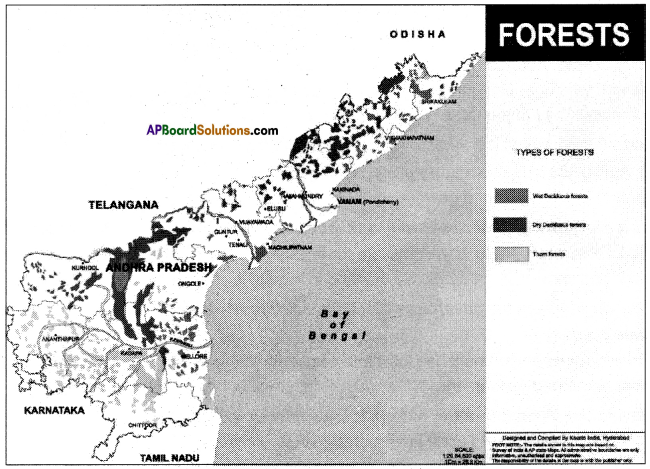
Observe the given map and answer the following questions.
AP Board 8th Class Social Studies Important Questions Chapter 5 Forests Using and Protecting Them 2
1. Where/On which side are more forests located?
Answer:
North side.

2. Which area belongs to Pondicherry?
Answer:
Yanam

3. Where are thorny forests?
Answer:
In Rayalaseema (more)

4. Is there any district without forests?
Answer:
No, each and every district has more or less forests.

AP Board 8th Class Social Studies Important Questions Chapter 5 Forests: Using and Protecting Them

AP Board 8th Class Social Studies Important Questions Chapter 4 The Polar Regions

AP State Syllabus AP Board 8th Class Social Studies Important Questions Chapter 4 The Polar Regions.

AP State Syllabus 8th Class Social Studies Important Questions 4th Lesson The Polar Regions

Question 1.
Which continent parts fail within this region?
Answer:
North America, Europe and some parts of Russia fall within this region.

Question 2.
What happens as we move away from the equator?
Answer:
Temperature falls when we move from the equator to the poles.

AP Board 8th Class Social Studies Important Questions Chapter 4 The Polar Regions

Question 3.
Who are called ‘Shamans’?
Answer:
The people skilled in performing rituals are called Shamans.

Question 4.
What is Polar region?
A. The region which lies near the poles is called the “polar region”.

Question 5.
What is Arctic Circle?
Answer:
The boundary of the polar region is known as the ‘Arctic Circle’.

AP Board 8th Class Social Studies Important Questions Chapter 4 The Polar Regions

Question 6.
What is called Tundra region?
Answer:
The northern part of the continents within the polar region is known as the Tundra.

Question 7.
What is the meaning of ‘Tundra’?
Answer:
Tundra means very cold.

Question 8.
What does the Eskimo religion show deep concern for?
Answer:
Eskimo religion shows deep concern for life, health, sickness, starvation and death.

Question 9.
What do all the Eskimos believe?
Answer:
All Eskimos groups believe in a supernatural power called Sila and spirits (such as Sedna, the goddess of life, health and food). They believe that people and animals have souls that live after death.

AP Board 8th Class Social Studies Important Questions Chapter 4 The Polar Regions

Question 10.
What is ‘taboo’?
Answer:
Taboo means forbidding certain actions, such as eating a particular kind of food.

Question 11.
When do the Eskimos celebrate ceremonies?
Answer:
They celebrate some major ceremonies, performed at birth and death or when hunting was very poor or very successful.

Question 12.
What do the ’Shamans’ do?
Answer:
Shamans use trances, drama and magic tricks in their performances.

Question 13.
What is called ‘Tundra Vegetation’?
Answer:
Tundra region is very cold. Since the tundra region gets very little sunlight, it has a unique type of vegetation known as the Tundra Vegetation.

AP Board 8th Class Social Studies Important Questions Chapter 4 The Polar Regions

Question 14.
What is called ‘Permafrost’?
Answer:
Due to the cold, the upper soil surface of the polar region is frozen into a rock-like state all through the year. This is called Permafrost.

Question 15.
Write about ‘Eskimos’.
Answer:
The most commonly accepted meaning of ‘Eskimo’ is “snowshoe-netter”. There are two main groups referred to as Eskimos : Inuit and Yupik. Inuit in their language means ‘the people’ or ‘the real people’. The Eskimos are descendants of Siberia, now a part of the Russia in northern Asia.

Question 16.
Who are called ‘Shamans’?
Answer:
The people skilled in performing rituals are called Shamans.

Question 17.
Match the following.
1) Kayak       ( ) A) The line where the land and sky meet.
2) Horizon    ( ) B) Boots
3) Taboo       ( ) C) Wooden boat
4) Mukluks   ( ) D) Language
5) Inupik       ( ) E) Ban
Answer:
1) C,
2) A,
3) E,
4) B,
5) D.

AP Board 8th Class Social Studies Important Questions Chapter 4 The Polar Regions

Question 18.
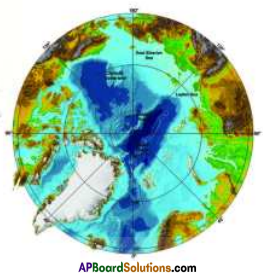
Observe the picture and write your opinion.
AP Board 8th Class Social Studies Important Questions Chapter 4 The Polar Regions 1
Answer:
This picture shows north polar region. The circles on this show latitudes and lines show longitudes. The place where the longitudes meet is called N pole. The southern tip of Greenland and about that is shown out of the globe. I think this is not correct. The earth is swollen at the equator and flat at the poles.

Question 19.
Praise the group life of Eskimos.
Answer:
Eskimos lead a group life. They lead a nomadic life. They share all their activities, food and shelters, and their joys, sorrows everything. They have such unity which we cannot see in the so-called civilized societies. Really we should praise it.

Question 20.
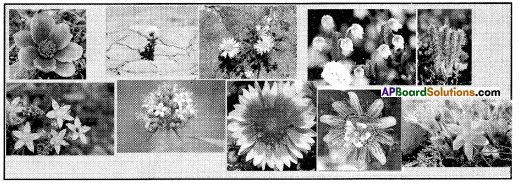
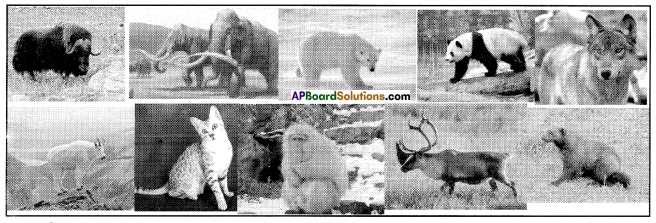
Collect the pictures or photographs of the flowers and animals of Tundra region and prepare an album.
Answer:
AP Board 8th Class Social Studies Important Questions Chapter 4 The Polar Regions 2
AP Board 8th Class Social Studies Important Questions Chapter 4 The Polar Regions 3

AP Board 8th Class Social Studies Important Questions Chapter 4 The Polar Regions

Question 21.
Conduct and furnish the details of an interview with an “Eskimo”.
Answer:
I: What is your good name?
E: Christopher.
I: What is your area?
E: Ours is northern region of Canada.
I: How many members are there in your family?
E: We are seven to eight members in our family but we live together with other families.
We are nearly 70 members in our group. We share each and everything.
I: Do you like your atmosphere?
E: Yes. I like it and I love it. This is my birth place. We don’t know any other climates. This snow, snow white, these lights, animals, our houses, our people, our traditions,
I like it.
I: If you have a chance to stay with us in our region, then what is your option ?
E: No, I don’t agree with this option. Definitely I will reject it. Because we live in nature
and we follow the law of nature. Our people who didn’t follow this rule, faced many problems. We are not fit for your regions. So I refuse this.
I: Thank you.
E: Thank you.

AP Board 8th Class Social Studies Important Questions Chapter 4 The Polar Regions

Question 22.
Read the following paragraphs and answer the questions given below.
AP Board 8th Class Social Studies Important Questions Chapter 4 The Polar Regions 1You have seen the north pole and south pole on the globe. The region which lies near the poles is called the “polar region”. Look at Map. It shows the north pole and its surrounding regions. The entire polar region has been shaded lightly. Notice the boundary of this region. This is known as the ‘Arctic Circle’.
The northern part of the continents within the polar region is known as the Tundra. Tundra means very cold. Since the Tundra region gets very little sunlight, it has a unique type of vegetation known as the ‘Tundra Vegetation’.
1. What is Polar region?
Answer:
The region which lies near the poles is called the “polar region”.

2. What is Arctic Circle?
Answer:
The boundary of the polar region is known as the ‘Arctic Circle’.

3. What is called Tundra region?
Answer:
The northern part of the continents within the polar region is known as the Tundra.

4. What is the meaning of ‘Tundra’?
Answer:
Tundra means very cold.

5. What is meant by ‘Tundra Vegetation’?
Answer:
The Tundra region gets very little sunlight, it has a unique type of vegetation known as the ‘Tundra Vegetation’.

AP Board 8th Class Social Studies Important Questions Chapter 4 The Polar Regions

Question 23.
Read the following para and answer the given questions.
Religious Beliefs
Eskimo religion shows deep concern for life, health, sickness, starvation and death. The Eskimos believe that spirits control these things. All Eskimos groups believe in a supernatural power called Sila and spirits (such as Sedna, the goddess of life, health and food). They believe that people and animals have souls that live after death. But each group has certain beliefs and rituals of its own. Each person, family or group has taboos or bans, forbidding certain actions, such as eating a particular kind of food. Each group has some major ceremonies ^ado-med at birth and death or when hunting is very poor or very successful. Shamans (people skilled in performing rituals) are believed to help establish and keep a contact with the spirit world. Shamans use trances, drama and magic tricks in their performances.
1. What does the Eskimo religion show deep concern for?
Answer:
Eskimo religion shows deep concern for life, health, sickness, starvation and death.

2. What do ali the Eskimos believe?
Answer:
All Eskimos groups believe in a supernatural power called Sila and spirits (such as Sedna, the goddess of life, health and food). They believe that people and animals have souls that live after death.

3. What is ‘taboo’?
Answer:
Taboo means forbidding certain actions, such as eating a particular kind of food.

4. When do they celebrate ceremonies?
Answer:
They celebrate some major ceremonies, performed at birth and death or when hunting was very poor or very successful.

5. What do the ‘Shamans’ do?
Answer:
Shamans use trances, drama and magic tricks in their performances.

AP Board 8th Class Social Studies Important Questions Chapter 4 The Polar Regions

Question 24.
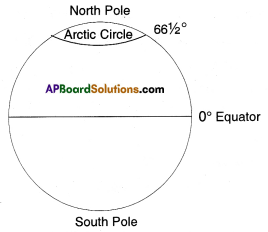
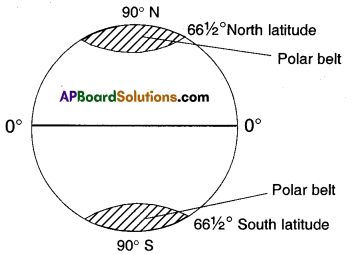
Draw the model of globe and identify Arctic Circle, poles and equator.
Answer:
AP Board 8th Class Social Studies Important Questions Chapter 4 The Polar Regions 4

Question 25.
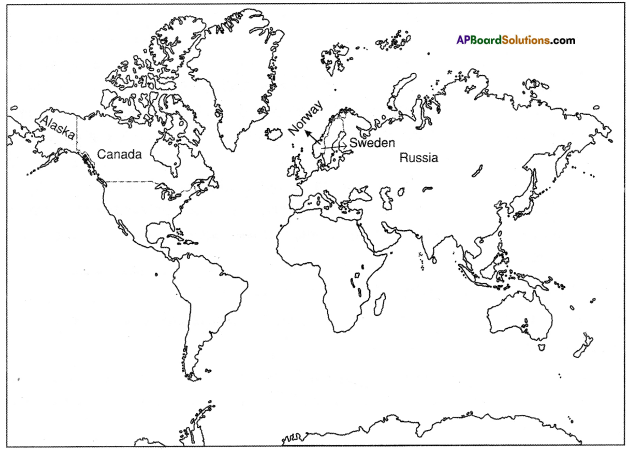
Locate any five countries which lie in polar region in the given world map.
Answer:
AP Board 8th Class Social Studies Important Questions Chapter 4 The Polar Regions 5

AP Board 8th Class Social Studies Important Questions Chapter 4 The Polar Regions

AP Board 8th Class Social Studies Important Questions Chapter 11A National Movement: The Early Phase 1885-1919

AP State Syllabus AP Board 8th Class Social Studies Important Questions Chapter 11A National Movement: The Early Phase 1885-1919.

AP State Syllabus 8th Class Social Studies Important Questions 11th Lesson National Movement: The Early Phase 1885-1919

Question 1.
What do you understand by Swadeshi?
Answer:
I understood Swadeshi ‘as goods produced in our own country’.

Question 2.
If authorities do not agree to the just requests of people, what do you think the people should do?
Answer:
The requests should be not only just but also legal. If the authorities do not agree, one should oppose them democratically and attain them.

AP Board 8th Class Social Studies Important Questions Chapter 11A National Movement: The Early Phase 1885-1919

Question 3.
What were the major areas of swadeshi’s impact?
Answer:

  1. Political
  2. Social
  3. Industrial
  4. Foreign trade
  5. Spiritual
  6. Business (National trade)
  7. Education
  8. Cultural
  9. Judicial.

Question 4.
What is meant by ‘Swaraj’?
Answer:
Swaraj means complete independence.

AP Board 8th Class Social Studies Important Questions Chapter 11A National Movement: The Early Phase 1885-1919

Question 5.
What is the slogan of Tilak?
Answer:
“Swaraj is my birthright and I shall have it”.

Question 6.
A few leaders like Gandhiji, Tilak, Subhash Chandra Bose, Bhagat Singh sacrified their lives for the sake of our nation.
What would have happened, if they did not do so?
Answer:
The British would have plundered our nation’s wealth more and more. The people of our country would have been suffered as slaves under the British rule and India would have become a very poor country.

Question 7.
Read the following passage and answer the questions.
In the next Congress session (1905), the extremist Nationalists led by Tilak, Bipin Chandra Pai and Lala Lajapat Rai were in favour of extending the movement to the rest of India and to demand for full fledged freedom or ‘Swaraj’. Bal Gangadhar Tilak gave the famous slogan, “Swaraj is my birthright and I shall have it.” They wanted to move away from the earlier strategy of submitting petitions to government to mobilising the masses against the British rule and forcing the British to give up and go. They called the earlier strategy as ‘mendicancy’ (or begging for alms). The old leaders, called ‘Moderate nationalists’.

1) Name any two extremists.
Answer:
Tilak, Bipin Chandrapal.

2) What is meant by ‘Swaraj’?
Answer:
Swaraj means complete independence.

3) What is the slogan of Tilak?
Answer:
Swaraj is my birthright and I shall have it.

4) How did they call the policy of moderates?
Answer:
They called it ‘mendicancy’.

5) What did the moderates do?
Answer:
The moderates tried with petitions.

AP Board 8th Class Social Studies Important Questions Chapter 11A National Movement: The Early Phase 1885-1919

Question 8.
Read the following passage and write a meaningful question.
In Class VII, you had read about the revolt of 1857 in which the soldiers, ordinary peasants, artisans and landlords and even princes joined the struggle against the British rule. While the movement was opposed to the British, it did not have any new vision of the country. It in fact wanted to restore the rule of the old kings and queens and also the same caste based society.
Answer:
“Why did the 1857 revolution fail?”

AP Board 8th Class Social Studies Important Questions Chapter 11A National Movement: The Early Phase 1885-1919

AP Board 8th Class Social Studies Important Questions Chapter 3 Earth Movements and Seasons

AP State Syllabus AP Board 8th Class Social Studies Important Questions Chapter 3 Earth Movements and Seasons.

AP State Syllabus 8th Class Social Studies Important Questions 3rd Lesson Earth Movements and Seasons

Question 1.
Can you relate what are the major seasons you have seen?
Answer:
The major seasons I have seen are Summer season, Rainy season and Winter season.

Question 2.
Write any two factors that influence the order of seasons.
Answer:
The factors are:
a) The spherical shape of the Earth and the curvature of its surface.
b) Daily rotation of the Earth on its own Axis.

AP Board 8th Class Social Studies Important Questions Chapter 3 Earth Movements and Seasons

Question 3.
From where can we see the axis of the earth?
Answer:
The axis of the earth is an imaginary line. We cannot see it.

Question 4.
What are the reasons behind the formation of seasons?
Answer:
Earth’s revolution and inclination of the axis are the reasons behind it.

Question 5.
What happens if there are no seasons?
Answer:
If there are no seasons, there will be no life on the earth.

Question 6.
Find out if Andhra Pradesh is in the Tropical Belt or in the Temperate Beit.
Answer:
Andhra Pradesh is extended between 18°N to 79°N latitude (approximately). It is in Tropical Belt.

AP Board 8th Class Social Studies Important Questions Chapter 3 Earth Movements and Seasons

Question 7.
Will the Sun shine directly on our heads in Andhra Pradesh during any month? If yes, in which month?
Answer:
The Sun’s rays fall straightly on Andhra Pradesh in the month of May.

Question 8.
Find out in which belt is Delhi and if it would receive snowfall in winters.
Answer:
Delhi is located between 28°22″ N. latitude and 28°54″ N. latitude. It is in Temperate Belt. It records low temperatures but there is no snowfall.

Question 9.
The earth is rotating daily in such a high speed. But why don’t we feel this?
Answer:
The earth is rotating in such a speed with all its – atmosphere, human, animal and plant kingdoms. So we don’t feel this.

AP Board 8th Class Social Studies Important Questions Chapter 3 Earth Movements and Seasons

Question 10.
Appreciate the rotation and revolution.
Answer:
The Earth is rotating and revolving since her birth without any rest. If it stops for a while, the life on the Earth may get disappeared. So a lot of thanks to Mother Earth.

Question 11.
Which season is important out of all the seasons?
Answer:
All the seasons are important. The existence of all the seasons only supports the life on the earth.

Question 12.
What are the factors that influence the order of seasons?
Answer:
The factors that influence the order of seasons are:

  1. The spherical shape of the Earth and the curvature of its surface.
  2. Daily rotation of the Earth on its own Axis.
  3. The tilt of the Axis of rotation compared to the plane on which the Earth moves.
  4. The Earth’s movement around the Sun once a year (revolution).

AP Board 8th Class Social Studies Important Questions Chapter 3 Earth Movements and Seasons

Question 13.
From where can we see the axis of the earth?
Answer:
The axis of the earth is an imaginary line. We cannot see it.

Question 14.
The earth is rotating daily in such a high speed. But why don’t we feel this?
Answer:
The earth is rotating in such a speed with all its – atmosphere, human, animal and plant kingdoms. So we don’t feel this.

Question 15.
Appreciate the rotation and revolution.
Answer:
The Earth is rotating and revolving since her birth without any rest. If it stops for a while, the life on the Earth may get disappeared. So a lot of thanks to Mother Earth.

Question 16.
Which season is important out of all the seasons?
Answer:
All the seasons are important. The existence of all the seasons only supports the life on the earth.

AP Board 8th Class Social Studies Important Questions Chapter 3 Earth Movements and Seasons

Question 17.
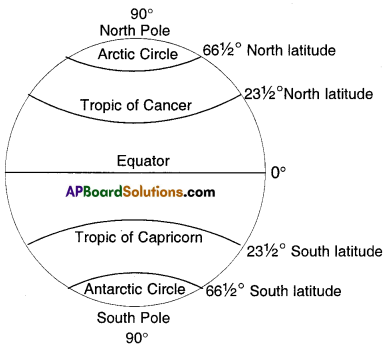
Draw the important latitudes.
Answer:
AP Board 8th Class Social Studies Important Questions Chapter 3 Earth Movements and Seasons 1

Question 18.
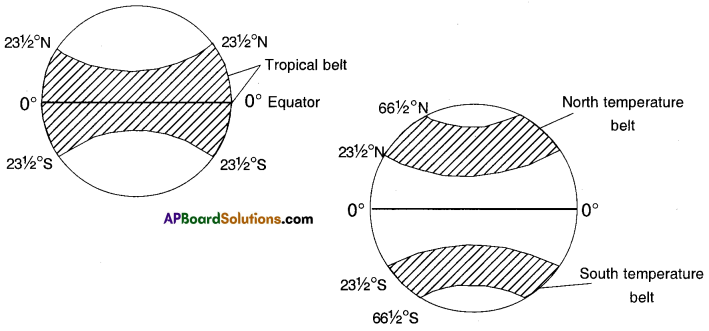
Draw the temperature belts on the earth.
Answer:
AP Board 8th Class Social Studies Important Questions Chapter 3 Earth Movements and Seasons 2
AP Board 8th Class Social Studies Important Questions Chapter 3 Earth Movements and Seasons 3

AP Board 8th Class Social Studies Important Questions Chapter 3 Earth Movements and Seasons

AP Board 8th Class Social Studies Important Questions Chapter 2 Energy from the Sun

AP State Syllabus AP Board 8th Class Social Studies Important Questions Chapter 2 Energy from the Sun.

AP State Syllabus 8th Class Social Studies Important Questions 2nd Lesson Energy from the Sun

Question 1.
What is meant by Insolation?
The radiation received on the surface of a body is called insolation.

Question 2.
What is meant by Radiation?
Answer:
When a body gives out energy it is called radiation.

Question 3.
What are the forms of sun’s energy?
Answer:
Light, heat, UV rays, radio waves and X-rays are the forms of sun’s energy.

AP Board 8th Class Social Studies Important Questions Chapter 2 Energy from the Sun

Question 4.
Arrange the following temperatures from the highest to the lowest:
12°C, -16°C, 29°C, 0°C, – 4°C.
Answer:
29°C, 12°C, 0°C, -4°C, – 16°C.

Question 5.
What will happen if the inversion occurs?
Answer:
When inversion occurs cold air underlies warmer air.

Question 6.
Give three possible explanations for the differences between the average temperatures in Thiruvananthapuram and Shimla in January.
Answer:
A) Tiruvananthapuram is situated on sea coast.
B) Shimla is on high altitude.
C) Tiruvananthapuram is near to the equator and Shimla is far away from the equator.

Question 7.
Between Bhopal, Delhi, Mumbai and Shimla, which two places show a similar temperature pattern? How can you explain the similarity between these two places?
Answer:
Bhopal and Delhi show a similar temperature pattern. This is because these two are far away from the sea.

AP Board 8th Class Social Studies Important Questions Chapter 2 Energy from the Sun

Question 8.
Which continents are there near to the equator?
Answer:
South America, Africa and Asia continents are there near to the equator.

Question 9.
Give reasons for ditference in temperature of a location:
a) height from sea level.
b) distance from the sea
c) distance from equator
d) all the above
e) some of the above
Answer: d

Question 10.
What is the relation between temperature and rainfall?
Answer:
The amount of rain in 2 places is determined by temperature differences between them.

Question 11.
How do we have variation in vegetation and animal life?
Answer:
Temperature and rainfall affect life in very critical ways. Plants and animals depend upon heat and water.
Only certain kinds of trees and plants will grow in hot regions and some other kinds will grow in cold regions and in very cold regions, nothing grows. Thus we have variation in vegetation and animal life.

AP Board 8th Class Social Studies Important Questions Chapter 2 Energy from the Sun

Question 12.
What are the forms of sun’s energy?
Answer:
Light, heat, UV rays, radio waves and X-rays are the forms of sun’s energy.

Question 13.
Which results in ‘Global Warming’?
Answer:
Some gases like CO2 prevent radiation of heat from the earth. CO2 in the atmosphere N increases due to increased use of diesel and petrol, cutting down of forests etc. If the CO2 proportion in the atmosphere increases, then less heat will be radiated causing increase in global temperature. This results in ‘Global Warming’.

Question 14.
Appreciate the ‘green houses’.
Answer:
Green houses are also called Glass houses. Green house is a building in which plants are grown. These are climate controlled. It works by taking sunlight and heating it up. This process is the conversion of solar energy to thermal energy. It gives plants both temperate heat and a good water source. The creation of green house is excellent.

Question 15.
What are the effects of ‘Global warming’?
Answer:
Global warming is the increase of Earth’s average surface temperature due to effect of green house gases, such as carbon dioxide emissions from burning fossil fuels or from deforestation.

AP Board 8th Class Social Studies Important Questions Chapter 2 Energy from the Sun

Question 16.
The sun is the primary source of energy. The trees are the factories which produce food from sunlight. Are we growing or cutting down such trees? Discuss the advantages of trees and our responsibility in growing them.
Answer:
We are cutting down trees more than we grow.
The advantages of Trees:

  1. Trees can reduce air temperature by blocking sunlight. Further cooling occurs when water evaporates from the leaf surface. The conversion of water to air vapour … a chemical process …. removes heat energy from the air.
  2. A tree can be a natural air conditioner.
  3. Trees absorb and block noise and reduce glare.
  4. Fallen treen leaves can reduce soil temperature and soil moisture loss.
  5. Trees create an ecosystem to provide habitat and food for birds and other animals.
  6. Trees absorb CO2 and potentially harmful gasses from the air and release O2.
  7. Trees help to reduce surface water runoff from storms, thus decreasing soil erosion and the accumulation of sediments in streams. They increase ground water recharge and reduce the number of potentially harmful chemicals transported to our streams.
  8. Dews and frosts are less under tree because less radiant heat is lost at night.

Question 17.
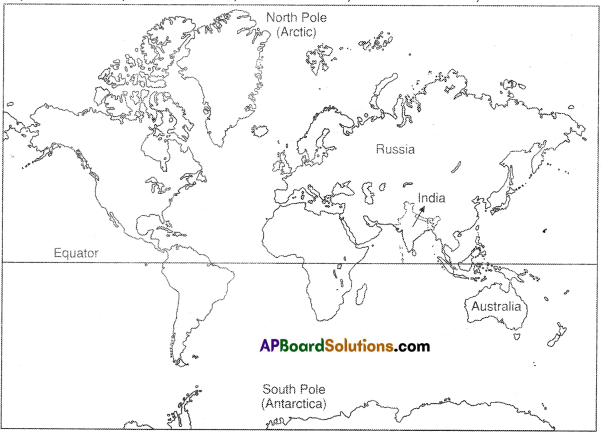
Locate the following in the given world map.

  1. Equator
  2. Poles
  3. Russia
  4. Australia 5)India

Answer:

AP Board 8th Class Social Studies Important Questions Chapter 2 Energy from the Sun 1

AP Board 8th Class Social Studies Important Questions Chapter 2 Energy from the Sun

Question 18.
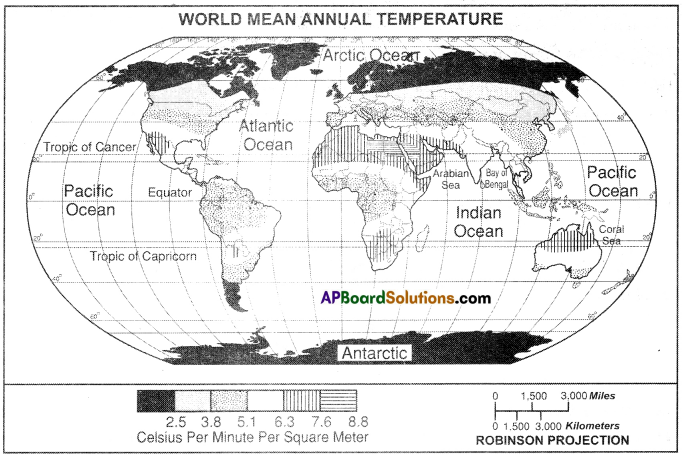
Observe the given map and answer the following questions.
AP Board 8th Class Social Studies Important Questions Chapter 2 Energy from the Sun 21. What is the line to south of equator?
Answer:
Tropic of Capricorn.

2. This is ……… Projection.
Answer:
Robinson

3. Which continents are there near to the equator?
Answer:
South America, Africa and Asia.

AP Board 8th Class Social Studies Important Questions Chapter 2 Energy from the Sun

Project
Observe some families in your village / locality and fill up the following table.

S.No. Name of the family head No.of electricity bulbs used Type Electricity bill (in rupees)
Bulb Tube CFL

Educate the families about the energy-saving measures and then conduct the same survey again after three month and compare the difference.
Answer:

S.No. Name of the family head No.of electricity bulbs used Type Electricity bill (in rupees)
Bulb Tube CFL
1. Malleswara Rao 10 4 4 2 1000 ₹
2. Subba Rao 9 3 4 2 1200 ₹
3. Sunil 10 4 4 2 800 ₹

Above families used more electricity bulbs especially tubes & bulbs. They are using very less CFL’s. By using more bulbs they get every month more electricity bill. That’s why, I explain to them about the importance of electricity, how we are wasting and our future generations will face the problems and I said, use more CFL’s to reduce the wastage of power & minimise the bill. After three months I went to their houses and saw the power bill really I admired because they reduce the power using and use CFL’s also. Due to this they save the power and get less electricity bill.

AP Board 8th Class Social Studies Important Questions Chapter 2 Energy from the Sun

AP Board 8th Class Social Studies Important Questions Chapter 10 Landlords and Tenants under the British and the Nizam

AP State Syllabus AP Board 8th Class Social Studies Important Questions Chapter 10 Landlords and Tenants under the British and the Nizam.

AP State Syllabus 8th Class Social Studies Important Questions 10th Lesson Landlords and Tenants under the British and the Nizam

Question 1.
Did the Zamindar own all the lands of the villages in the Mughal times?
Answer:
No. They owned some of the village lands. They had the power to collect revenue from the villagers. Rest of the land was owned by peasants and others.

AP Board 8th Class Social Studies Important Questions Chapter 10 Landlords and Tenants under the British and the Nizam

Question 2.
What did the Zamindars do for the Mughal government and what did they get in return?
Answer:
The Zamindars collected the revenue from the peasantry on behalf of Mughal emperors. In return they received a share of revenue collected. Sometimes they also had right to collect some small local taxes.

Question 3.
How would the changes have affected the position of the farmers who tilled the land for several generations?
Answer:

  1. This settlement inadvertently converted all the peasants into the tenants.
  2. Since rent collected was much higher than the revenue, the cultivators could not pay and sometimes deserted the lands. These were the affects.

Question 4.
What is the difference between revenue and rent?
Answer:
Revenue: Tax on land which is paid to the Zamindars or government.
Rent: Amount paid to the owners of the land for using and cultivating it.

AP Board 8th Class Social Studies Important Questions Chapter 10 Landlords and Tenants under the British and the Nizam

Question 5.
In what ways did the government invest in agriculture during the early British rule? Do you think it could have been done by farmers themselves?
Answer:

  1. The Britishers made necessary advances to the ryots to purchase seeds, implements, bullocks and to repair old wells or dig new ones,
  2. They constructed anicuts & canals. It could not have been done by farmers themselves.

Question 6.
How was a ‘dora’ different from an ordinary landlord?
Answer:
The large landlords were called Doras. They had a large retinue of servants and soldiers. Ordinary landlords were under the control of these ‘doras’. Landlords should follow the orders of ‘Doras’. This is the difference between them.

Question 7.
How do you think it was possible for the zamindars to keep increasing their incomes without increasing investment in the land?
Answer:
The prices of grains in the market rose and cultivation slowly expanded. So there was an increase in the income of Zamindars without increasing investment in the land.

AP Board 8th Class Social Studies Important Questions Chapter 10 Landlords and Tenants under the British and the Nizam

Question 8.
Who do you think would have benefited from the Ryotwari Settlement – the farmers, the landlords or the British? Give reasons.
Answer:
The landlords would have benefited from the Ryotwari settlement.
Reasons:

  1. There was an increase in the number of landlords in the Ryotwari area.
  2. They showed much interest in giving their lands on rents rather than cultivation.

Question 9.
Why do you think the ryots did not invest in improving agriculture or extending agriculture?
Answer:
The prices rose faster than the land revenue and the ryots found it more profitable to employ tenants to cultivate their lands and receive rent from them. So they did not invest in improving agriculture or extending agriculture.

Question 10.
Who ultimately profited from production for export market and why?
Answer:
Moneylenders profited ultimately from production for export market. They lent more and more money to farmers on high-interest rates and profited.

AP Board 8th Class Social Studies Important Questions Chapter 10 Landlords and Tenants under the British and the Nizam

Question 11.
Discuss the changes in the lives of traditional crafts persons and village artists.
Answer:
Traditional crafts persons are adding technology to their tradition. As the prices are high, there is no demand for their products. Village artists had enjoyed the encouragement of the Kings and Zamindars. Now they lack it. So their lives are in worse condition.

Question 12.
How are we paying the taxes nowadays?
Answer:
At present revenue is paid in the form of money.

Question 13.
Have you heard of any similar rapid rise or decline in prices of any agricultural produce in our own times? Find out about its impact on the farmers.
Answer:
In recent past, there was an increase in the prices of rice and red gram. Later they were reduced by the government. Peasants grew some crops thinking of high profits. If the demand fell, they would get losses that year.

AP Board 8th Class Social Studies Important Questions Chapter 10 Landlords and Tenants under the British and the Nizam

Question 14.
Why do you think the Zamindars kept the soldiers and small forts?
Answer:
Zamindars had some villages under their control. They were the mediators between the rulers and the ruled. They had much income also. So they lived in small forts.
To protect their people from thefts and attacks, to collect revenues they needed soldiers. So they maintained them.

Question 15.
Why did the high revenue rates prevent zamindars and farmers from improving agriculture?
Answer:
As they paid heavy rates of rents and revenue from their income, they were not able to improve agriculture. They used the remaining amounts for their household purposes.

Question 16.
During the freedom movement the Zamindars normally supported the British. Can you explain why?
Answer:
The policies of Zamindars created a gap between them and their people. They earned more assets in the British reign. So they normally supported the British during the freedom movement.

Question 17.
Who introduced the Permanent Settlement of Tax and when?
Answer:
Cornwallis introduced this in 1793.

AP Board 8th Class Social Studies Important Questions Chapter 10 Landlords and Tenants under the British and the Nizam

Question 18.
Why did the war in America lead to increase in prices of cotton in India?
Answer:
In 1861, there was Civil war in America and British factories turned to India for supply of cotton. As a result cotton prices soared high.

Question 19.
Why were famines caused under British rule? Do you think it was because of failure of rains or floods?
Answer:
The rains and floods caused one or two famines during the British rule. Most of the famines occurred due to their dictatorial rule. They exported food grains in the famines. They had no interference when the merchants created artificial scarcity by hoarding food grains. They didn’t work for the welfare of the people in India. So the famines were caused.

Question 20.
Write the names of any two peasant movements.
Answer:
The Deccan riots of 1860s, Rampa fituries, Moppila agitations etc.

AP Board 8th Class Social Studies Important Questions Chapter 10 Landlords and Tenants under the British and the Nizam

Question 21.
Match the following.
1) 1865/66 ( ) A) Dhawaleshwaram anicut
2) 1860      ( ) B) Anicut over the Krishna river at Vijayawada
3) 1793      ( ) C) Ganjam famine
4) f1849     ( ) D) Permanent settlement
5) 1854      ( ) E) The Deccan riots
Answer:
1) C
2) E
3) D
4) A
5) B

Question 22.
Imagine that you live in the ‘Ceded Districts’, find put about the Palegars who fought with the British.
Answer:
Many wars were broken out between Palegars and the British from 1798 to 1805. First war was fought between Veerapandya and the British in 1799. Second main war was fought between a group of Palegars and the British. After a long and expensive campaign the British finally defeated the revolting Palegars of whom many were beheaded and hanged while others were deported to the Andaman Islands. Of the Palegars who submitted to the British some of them granted Zamindari status, which had only tax collection rights and disarmed them completely.

AP Board 8th Class Social Studies Important Questions Chapter 10 Landlords and Tenants under the British and the Nizam

AP Board 8th Class Social Studies Important Questions Chapter 9 Public Health and the Government

AP State Syllabus AP Board 8th Class Social Studies Important Questions Chapter 9 Public Health and the Government.

AP State Syllabus 8th Class Social Studies Important Questions 9th Lesson Public Health and the Government

Question 1.
Why are children given food in the anganwadis?
Answer:
In Andhra Pradesh about 33% of children below 5 years of age were characterised as under weight. This is due to hunger and malnutrition. So the government decided to feed these children through Anganwadis.

AP Board 8th Class Social Studies Important Questions Chapter 9 Public Health and the Government

Question 2.
What problems do we face in private hospitals?
Answer:
Problems in private hospitals : We should pay more money here. Medicines also cost very high. Some may cause unnecessary tensions to the patient families.

Question 3.
What should be available in every village as part of the public health system?
Answer:
Asha worker, nutrition, immunisation facilities, weighing machine etc., should be available in every village as part of the public health system.

Question 4.
List some public health centres or hospitals near your place.
Answer:
We have public health centre in Vadali. In a short distance we have P.H.C. at Mudinepalli. We have a centre of R.M.P. in our village.

AP Board 8th Class Social Studies Important Questions Chapter 9 Public Health and the Government

Question 5.
Is the water you drink at school clean?
Answer:
Yes, the water at our school is clean.

Question 6.
In your opinion, what is one most important improvement that should be made for the mid-day meal being served at your school?
Answer:
The quality of rice should be changed. Better quality should be maintained.

Question 7.
Write any two reasons for doctors not accepting rural posting?
Answer:

  1. Rural backwardness,
  2. Lack of modern facilities.

AP Board 8th Class Social Studies Important Questions Chapter 9 Public Health and the Government

Question 8.
Why are people approaching private hospitals though the government hospitals are functioning?
Answer:
The state government is issuing ‘Aarogya Sri’ cards to people even though the government hospitals are functioning. The people also may take this as ideal.

Question 9.
Read the first paragraph under the heading ‘Basic Public Facilities’ (Textbook page No. 105) and answer the question:
Is there any provision of safe drinking water in your area? Explain.
Answer:
Ours is Singarayapalem village in Mudinepalli Mandal. We have two tanks in our village. Water in one tank is purified and lifted to another water tank. From there it is supplied to the whole village. So we are all protected from many diseases. Our Panchayat looks after all these works.

AP Board 8th Class Social Studies Important Questions Chapter 9 Public Health and the Government

Question 10.
1. Let us examine the situation through the AP Human Development Report, 2007 which states: “Freedom from hunger and malnutrition is a basic human right and a fundamental prerequisite for human and national development. Better nutrition means stronger Immunity systems, less illness and better health. According to the World Health Organisation (WHO), poor nutrition contributes to 1 out of 2 deaths (53 percent) associated with infectious diseases among children below five in developing countries. In Andhra Pradesh, about 33 per cent of children below 5 years of age were characterised as underweight. About 31 percent of women and 25 per cent of men are undernourished.”
Read the above para and prepare a question.
Answer:
“What is useful for the development of humankind?”

2. Why are people approaching private hospitals though the government hospitals are functioning ? Write your opinion on this issue.
Answer:
The state government is issuing ‘Aarogya Sri’ cards to people even though the government hospitals are functioning. The people also may take this as ideal.

AP Board 8th Class Social Studies Important Questions Chapter 9 Public Health and the Government

AP Board 8th Class Social Studies Important Questions Chapter 8 Impact of Technology on Livelihoods

AP State Syllabus AP Board 8th Class Social Studies Important Questions Chapter 8 Impact of Technology on Livelihoods.

AP State Syllabus 8th Class Social Studies Important Questions 8th Lesson Impact of Technology on Livelihoods

Question 1.
What happens when Combined Harvesters are used?
Answer:
Agricultural labourers lose the jobs of harvesting the crop, threshing and cleaning the grains from chaff when Combined Harvesters are used.

Question 2.
Why do farmers use Combined Harvesters?
Answer:
Due to excess benefits by using Combined Harvesters, the farmers are using these Combined Harvesters.

AP Board 8th Class Social Studies Important Questions Chapter 8 Impact of Technology on Livelihoods

Question 3.
What happened with the invention of steam engine?
Answer:
The steam engine changed many production processes in factories.

Question 4.
What is called an invention?
Answer:
When a new machine or method of production is created for the first time, it is called an invention.

Question 5.
Write the names of any two machines.
Answer:
X-ray machines and power looms.

Question 6.
What can we use instead of rubber?
Answer:
We can use plastic instead of rubber.

AP Board 8th Class Social Studies Important Questions Chapter 8 Impact of Technology on Livelihoods

Question 7.
Write any two advantages of Mobile phones.
Answer:

  1. They reduce the distances between people.
  2. Emergency messages can be conveyed within seconds.

Question 8.
Write any two disadvantages of Mobile phones.
Answer:

  1. They pollute the minds of children.
  2. They cause disturbance in the circulation of electro-magnetic waves of one’s body, who uses it.

Question 9.
What comes under service sectors? What is the technological change in it?
Answer:

  1. Services include activities that support agriculture and industries. All the trading activities are also services.
  2. Technological changes also affect service activities.
  3. Due to this there is a rapid change in communications. They are available at the lowest rates.

AP Board 8th Class Social Studies Important Questions Chapter 8 Impact of Technology on Livelihoods

Question 10.
Write any two advantages and two disadvantages of Mobile phones.
Answer:
Advantages:

  1. They reduce the distances between people.
  2. Emergency messages can be conveyed within seconds.

Disadvantages:

  1. They pollute the minds of children.
  2. They cause a disturbance in the circulation of electro-magnetic waves of one’s body, who uses it.

Question 11.
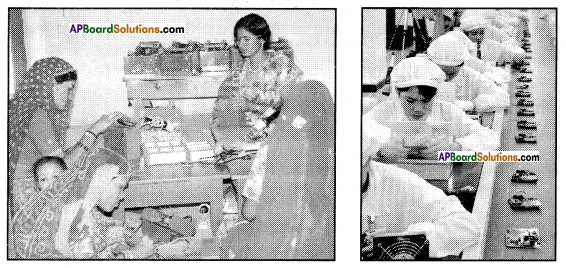
Appreciate the ladies ¡n the following figures.
AP Board 8th Class Social Studies Important Questions Chapter 8 Impact of Technology on Livelihoods 1
Answer:
The women in the left side picture are in their traditional dress and repairing community radio. They are caring their children also. They are very conscious in their work.
The women in the right side picture are like white flowers. They are also repairing Telephone assembly line. The way they sit discloses their dedication to the work.

AP Board 8th Class Social Studies Important Questions Chapter 8 Impact of Technology on Livelihoods

Question 12.
Observe the following table and answer the given questions.

State 1988 2009
Telangana & A.P. 5,29,000 1,24,700
Gujarat 24,000 3,900
Karnataka 1,03,000 40,500
Maharashtra 80,000 4,500
Madhya Pradesh 43,000 3,600
Punjab 22,000 300
Tamil Nadu 5,56,000 1,55,000

a) What was the change in Andhra Pradesh and Telangana?
Answer:
There was a decline in handloom units.

b) Of all the states, which had more decline?
Answer:
Punjab state.

c) Of all the states, which two states were having more units in 2009?
Answer:
Andhra Pradesh, Telangana and Tamilnadu

d) Where did most of the changes take place either in Northern India or in Southern India?
Answer:
In Northern India.

e) Which units is this table related to?
Answer:
This table is related to handloom units.

AP Board 8th Class Social Studies Important Questions Chapter 8 Impact of Technology on Livelihoods

Question 13.
Read the following passage and answer the questions.
The steam engine changed many production processes in factories. Later on with a new source of energy such as electricity, factories that we see them today emerged. When a new machine or method of production is created for the first time, it is called an invention. However, practical application of these ideas takes a long time and depends on many factors. These could be improvements to make the technology effective, reducing cost of new techniques, acceptance of a new way or product. Technical developments or technical improvements can be due to completely new types of machinery (X ray machines and power looms), or changes in the types of raw materials used (plastic instead of rubber), or reorganisation of production processes.

a) What happened with the invention of steam engine?
Answer:
The steam engine changed many production processes in factories.

b) Why were the factories emerged?
Answer:
New sources of energy such as electricity etc., emerged the factories.

c) What is called an invention?
Answer:
When a new machine or method of production is created for the first time,it is called an invention.

d) Write the names of any two machines.
Answer:
X-ray machines and powerlooms.

e) What can we use instead of rubber?
Answer:
We can use plastic instead of rubber.

AP Board 8th Class Social Studies Important Questions Chapter 8 Impact of Technology on Livelihoods

AP Board 8th Class Social Studies Important Questions Chapter 7 Money and Banking

AP State Syllabus AP Board 8th Class Social Studies Important Questions Chapter 7 Money and Banking.

AP State Syllabus 8th Class Social Studies Important Questions 7th Lesson Money and Banking

Question 1.
How do we usually exchange old clothes?
Answer:
We usually exchange old clothes with steel utensils. This depends mostly on the seller.

Question 2.
How do we usually exchange plastic & newspaper?
Answer:
We usually exchange these with onion traders. He gives 1 1/2 kg onions for 1 kg plastic or newspaper.

AP Board 8th Class Social Studies Important Questions Chapter 7 Money and Banking

Question 3.
How do we exchange hair?
Answer:
Money is offered for hair.

Question 4.
How do we exchange paddy?
Answer:
In our village paddy is exchanged for services rendered by washerman, barber etc.

Question 5.
Ask your parents how washermen, barbers, need kaavalikaru were paid for their work in villages and towns.
Answer:
Nowadays they are paid money only. But 15 years ago our parents paid them in the form of paddy.

Question 6.
When should one use fixed deposits for savings?
Answer:
The money invested in fixed deposits should not be withdrawn in the given period. Then only one can use fixed deposits for savings.

AP Board 8th Class Social Studies Important Questions Chapter 7 Money and Banking

Question 7.
If a very large number of account-holders do not wish to keep their money in the bank, how will it affect the bank’s working?
Answer:
This affects the reserves of a bank. The bank cannot lend loans to customers. This affects their income. As a result it is impossible to run a bank.

Question 8.
Suppose you need Rs. 2000. You fill a cheque and give it to your friend and send her to get the money in cash. What happens?
Answer:
Bankers reject this cheque. Bankers never give cash to the cheques. The sister should have an account in the branch. Then only she can withdraw the amount.

Question 9.
What are the names of some banks you know?
Answer:

  1. Kotak Mahindra,
  2. State Bank of India,
  3. Andhra Bank,
  4. Indian Bank.

Question 10.
Name some durable metals.
Answer:
Copper, bronze, silver and gold.

AP Board 8th Class Social Studies Important Questions Chapter 7 Money and Banking

Question 11.
Are all the problems solved with the invention of money?
Answer:
With the invention of money, some problems remained and new problems came up.

Question 12.
Why were metals preferred for use as money?
Answer:
Copper, bronze, silver and gold are durable, can be divided into parts and be carried around Since they were scarce they became acceptable by all. So the metals were preferred for use as money.

Question 13.
Do you think minting of coins was a good idea?
Answer:
Yes, I think so. But the quality and measurement should be perfect as per norms.

Question 14.
Why do banks ask for security while lending?
Answer:
There is no personal relation and identification between the bank people and their customers. If the bank people failed to recollect the debts, it leads to bankrupt. So banks ask for security while lending.

AP Board 8th Class Social Studies Important Questions Chapter 7 Money and Banking

Question 15.
What will happen if some borrowers do not repay the bank loan?
Answer:
The bank collects the loan from the guarantors or disposes the mortgage.
For e.g.: If any customer fails to repay the housing loan, the bank sells the house in auction. It takes the loan amount and gives the remaining amount to the customer.

Question 16.
What a crossed cheque?
Answer:
The cheque which is crossed as on the left side top of the cheque.

Question 17.
Fill in the blanks:
1. If we use ———– there will be no problem in exchanging commodities.
2. Exchange of goods and services with each other is called ———– system.
Answer:
1. money
2. barter

AP Board 8th Class Social Studies Important Questions Chapter 7 Money and Banking

Question 18.
Why do we save money in a bank?
Answer:
Money kept at home does not earn interest. But, money kept in a bank account does. If you keep money in the bank it wili grow.
In the villages, poor peoples incomes are irregular and unpredictable. You have to cope with a bad crop season, loss of employment, illness or death in the family. You also need money for marriages and festivals. Saving money in a bank account helps you smoothen your income.
Money is safe in bank, please check, if the bank in which you intend to keep your hard earned money is licensed, please do not share bank account details with anybody. Protecting your bank acount is as important as opening and using it.

Question 19.
How do we open a bank account for a Minor?
Answer:
A savings/fixed/recurring bank deposit account can be opened by a minor of any age through his/her natural or legally appointed guardian.
Minors above the age of 10 years are allowed to open and operate savings bank accounts independently, subject to bank’s risk management systems that are in place.
Additional banking facilities like internet banking, ATM / debit card, cheque book facility etc., are allowed. But minor accounts are not allowed to be overdrawn and should always remain in credit.

AP Board 8th Class Social Studies Important Questions Chapter 7 Money and Banking

Question 20.
Read the following paragraph and answer the following questions.
Over time, people preferred scarce and attractive metals as medium of exchange. Copper, bronze, silver and gold are durable, can be divided into parts and be carried around. Since they were scarce, they became acceptable by all. People could buy and sell with the assurance that the money they had in hand would be valuable and sought by others. They did not have to worry that their money might lose value as could happen with grains or cattle. However, some problems remained and new problems came up. For every exchange, the metal had to be weighed and later on traders were not sure about the quality of the metal. What one might get in exchange may not be pure gold or silver. After sometime, there was a serious problem of trust in the quality of metal that was used as money for exchange.
1. Name some durable metals.
Answer:
Copper, bronze, silver and gold

2. What was the assurance of the people?
Answer:
People could buy and sell with the assurance that the money they had in hand would be valuable and sought by others.

3. Why did the people not have to worry?
Answer:
They did not have to worry that their money might lose value as could happen with grains or cattle.

4. Are all the problems solved with the invention of money?
Answer:
With the invention of money, some problems remained and new problems came up.

5. People preferred scarce and attractive metals as
Answer:
Medium of exchange.

AP Board 8th Class Social Studies Important Questions Chapter 7 Money and Banking

Question 21.
Read the following paragraph and answer the following questions.
In many towns and cities representatives of all banks meet on each day to settle what each bank has to pay to the other and receive from the other. Cheques that have been verified are handed over to each other. One of the banks works as the Clearing Bank where all the banks have an account. The payments and receipts between banks are done by this Clearing Bank.

In the present system, all banks and most of their branches are linked by computers. All deposit holder accounts and their signatures can be accessed by the branches anywhere. Hence representatives don’t have to meet nor do banks have to send cheques to the outstation branches. The transaction between one bank and another is done through interlinked com-puters. This makes the whole system work faster and in an easier manner.

1. Who meet on each day?
Answer:
In many towns and cities representatives of all banks meet on each day.

2. What did they exchange?
Answer:
Cheques that have been verified are handed over to each other.

3. What is the work of Clearing Bank?
Answer:
The payments and receipts between banks are done by the Clearing Bank.

4. What is the novelty in the present system?
Answer:
In the present system all banks and most of their branches are linked by computers.

5. What is the result of this?
Answer:
This makes the whole system work faster and in an easier manner.

AP Board 8th Class Social Studies Important Questions Chapter 7 Money and Banking

Question 22.
Read the following passage and prepare two questions.
Paper money also has its defects. It will tear and get dirty. So there is an idea of using plastic material for notes. Plastic or polymer currency is easy to handle, more durable and forgery can be detected easily. It is water-proof and eco friendly (recycling is easy). From metal to paper and now probably paper to plastic.
Answer:

  1. What are the defects of paper money?
  2. What are the advantages of paper or polymer currency?

Question 23.
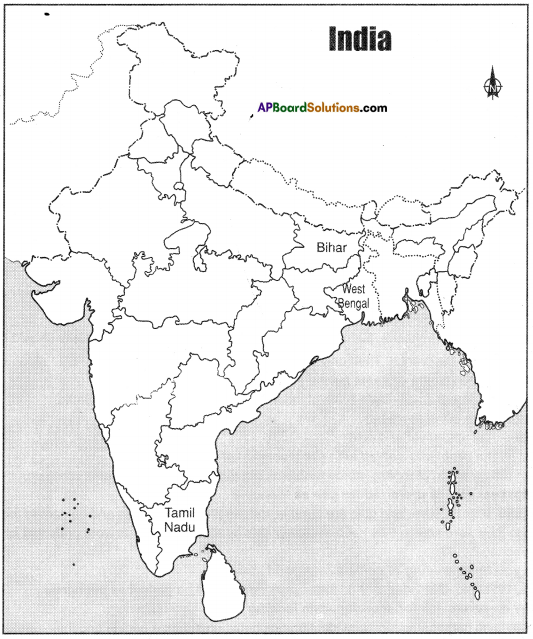
Locate any three places of early bankers of India in the given Indian map.
Answer:
AP Board 8th Class Social Studies Important Questions Chapter 7 Money and Banking 1

AP Board 8th Class Social Studies Important Questions Chapter 7 Money and Banking

Discussion
Invite the local postmaster/postman to your class and conduct the interaction on different saving schemes.
Answer:
Children: Good morning, Sir.
Postmaster: Good morning, Children.
Children: Sir, we want to know about different saving schemes in the post office.
Postmaster: For especially students some saving schemes are introduced in post offices to habituate the savings by children whenever they get pocket money without wastage, it is useful to them buy books in higher classes.
Children: Please Sir, explain such schemes.
Postmaster: Recurring deposit: This is one of the important saving scheme.
Children: Sir, how should we save money in this scheme?
Postmaster: Children this is monthly scheme. From above Rs.10 to how much we need we should save for a certain period of time.
Children: Sir, is there any other schemes.
Postmaster: Savings account.
Children: Sir, How should we maintain this?
Postmaster: Children, in this scheme we opened an account on our name and whenever we have surplus amount should deposit in our account.
Children: Sir, very interesting, is there any other schemes?
Postmaster: Sukanya scheme, this is for only girls.
Children: Sir, we have interest to know about more schemes.
Postmaster: Children, another scheme is also there, that is fixed deposit.
Children: Please, explain Sir.
Postmaster: In this scheme we will deposit our money for a certain period of time, like 1 year, 2 years, 3 years. But we will get interest on behalf of this deposit.
Children: Thank you Sir, today we know more valuablé information about saving schemes in the post office.

AP Board 8th Class Social Studies Important Questions Chapter 7 Money and Banking

AP Board 8th Class Social Studies Solutions Chapter 4 The Polar Regions

SCERT AP Board 8th Class Social Solutions 4th Lesson The Polar Regions Textbook Questions and Answers.

AP State Syllabus 8th Class Social Studies Solutions 4th Lesson The Polar Regions

8th Class Social Studies 4th Lesson The Polar Regions Textbook Questions and Answers

Improve your learning
Question 1.
Re-write the false statements with correct facts:
a) Animal body parts were used only in clothing.
Answer:
True: Animal body parts were used in food, construction of houses, clothes, and in making weapons.

b) Major part of the food includes vegetables.
Answer:
True: Major part of the food includes animal meat and fish.

c) Popular games amongst the people in Tundra are closely related to their daily lives.
Answer:
True

d) Contact with people from outside impacted their health.
Answer:
True

AP Board 8th Class Social Studies Solutions Chapter 4 The Polar Regions

Question 2.
Based on what you studied about equator regions in Class VII, how is polar region different?
Answer:

Equator region Polar region
1. This extends from 0° to 23[latex]\frac { 1 }{ 2 } [/latex]° North and South latitudes. 1. This extends from 66[latex]\frac { 1 }{ 2 } [/latex]° N latitude to 90°N.
2. The Sun’s rays fall straight on this region. 2. The Sun’s rays fall slantingly on this region.
3. This region has 3 main seasons. 3. This region has 2 main seasons.
4. Formation of day and night occurs in one day. 4. Formation of day and night occurs in one year.
5. The people of this region lead settled life. 5. The people of this region lead nomadic life.
6. They have contacts with rest of the world. 6. They have less contacts with rest of the world.

Question 3.
What are the ways in which life of people in Tundra are dependent on climate of the region? Describe in the context of following aspects:

Food Dress Travel Shelter

Answer:
Climate influences the people of the Tundra.

Food Dress Travel Shelter
Cereals and grains are not cultivated here due to frozen ice. They should lead their life with meat and fish. They cannot even cook the food. So they should eat raw meat. They store the food in the frozen ice. These people wear skins of animals and their fur. They should wear clothes from top of the head to bottom of the feet. They wear two piece dresses and and designed. They need vehicles which are wide in shape to travel in ice. So they travel on platform like vehi­cles called sledges. These are drawn by polar dogs. They use kayaks and umiyaks to travel in waters in summers. The land is covered with a layer of snow. Laying foundation is not possible. So they live in wooden tents covered with animal skins. And also they construct houses of ice blocks. They use ice blocks to sleep as cots.

AP Board 8th Class Social Studies Solutions Chapter 4 The Polar Regions

Question 4.
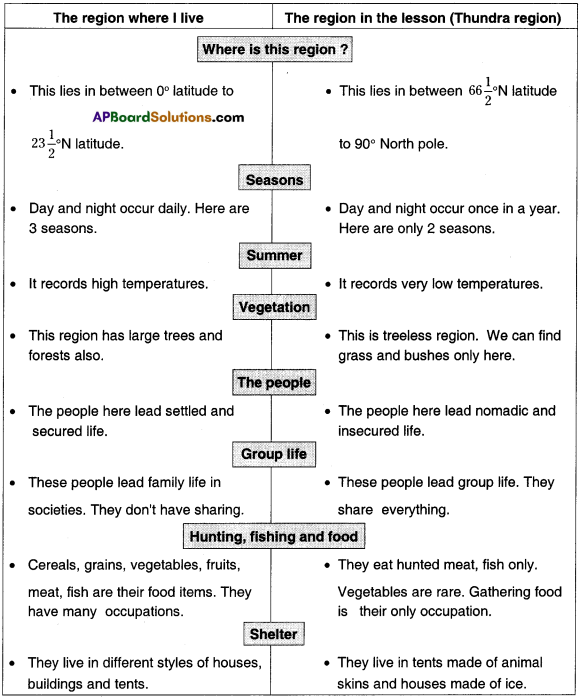
In this chapter there are many aspects that are very different from the place where you live. Look at the subheadings in this chapter and make a list of them. Now create a wall paper with illustrations and descriptions comparing life in your location with that in the Tundra.
Answer:
The comparison between the life of the people of N. polar region and that of the people of the equatorial region
AP Board 8th Class Social Studies Solutions Chapter 4 The Polar Regions 1AP Board 8th Class Social Studies Solutions Chapter 4 The Polar Regions 2

Question 5.
Imagine one entire day (24 hours) when the Sun does not set and another day when there is no Sun. What changes will you make in your daily lives ? Write a short note on them.
Answer:
When the Sun does not set: We should shut all the doors and windows of our house and make it dark to sleep. Rest of the day will be okay.
When there is no Sun: We should arrange lights probably flood lights to get light everywhere. Then we should perform our daily works.
This is possible for only one day.

AP Board 8th Class Social Studies Solutions Chapter 4 The Polar Regions

Question 6.
Find out the five living places of Eskimos in the world map
Answer:
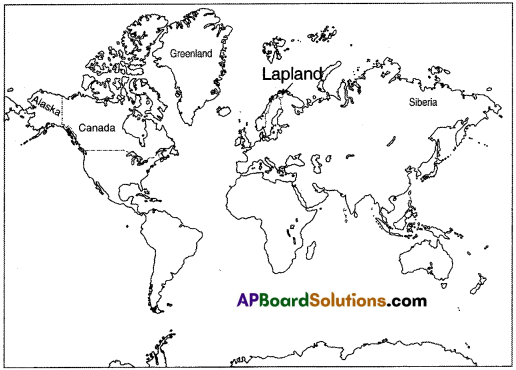
Greenland, Alaska, Canada, Siberia, Lapland are the five places shown in the below map.
AP Board 8th Class Social Studies Solutions Chapter 4 The Polar Regions 3

8th Class Social Studies 4th Lesson The Polar Regions InText Questions and Answers

Question 1.
Which continent parts fall within this region? (Textbook Page No. 40)
Answer:
North America, Europe and some parts of Russia fall within this region.

Question 2.
Try to recall what happens as we move away from the equator. (Textbook Page No. 40)
Answer:
Temperature falls when we move from the equator to the poles.

AP Board 8th Class Social Studies Solutions Chapter 4 The Polar Regions

Question 3.
Mention five points about the summer in Tundra. (Textbook Page No. 42)
Answer:

  1. The Sun begins to shine in the tundra around February-March. In the beginning the Sunsets within a short time.
  2. For almost three months from May to July, the Sun never sets.
  3. The Sun does not rise overhead. It just hovers a little above the horizon. So it is never very warm.
  4. Due to the relatively warm weather, some of the ice melts. The rivers, lakes melt and begin to flow.
  5. When summer approaches, many multi-coloured plants, lichens, grass, shrubs and berries sprout around.

Question 4.
Fill in the blanks : (Textbook Page No. 42)
1. The Sun does not appear during the month of November, December and January.
2. At this time, the water freezes and the plants cover with the snow.

Question 5.
How do the people of Tundra get light in winter ? (Textbook Page No. 42)
Answer:
There will be no sunlight during the winter in the polar region. At this time, the light of stars
falls on the ice, reflects, and fills the region with bright colourful lights. These are known as ‘Aurora Borialisis’. During winter they get light with these Aurora borialisis, oil and fat lamps.
In what ways are the resources available in their surroundings used for making houses? (Textbook Page No. 45)

  1. They use skins of animals and wood for tents.
  2. They use logs and whale ribs in building round houses.
  3. They form ice blocks (like bricks) and build domed houses.

Thus they use available resources in the surroundings.

AP Board 8th Class Social Studies Solutions Chapter 4 The Polar Regions

Question 6.
Did you see any tree in the pictures on the previous page? (Textbook Page No. 42)
Answer:
No. Grass and small bushes are visible in the pictures given.

Question 7.
Look at the pictures in this chapter (The Polar Region). How has that dress and hunting changed? (Textbook Page No. 48)
Answer:
The people of the earlier times wore raw skins of animals. They are too heavy. They use the horns of animals, harpoons, sharp edged instruments to hunt.
In the modern times they wore designed caps, dresses which are light in weight. Guns occupied the place of traditional weapons.

Question 8.
Why do you think people probably always did not live in the Tundra region? (Textbook Page No. 43)
Answer:
There are no seasons or seasonal differences in tundras. They have likely temperatures and seasons. They face nominal summers. So they cannot cultivate crops here. They have no tasty foods and different kinds of foods. During winters the whole region becomes dark, deserted and desolate. So they did not live here throughout the year.

AP Board 8th Class Social Studies Solutions Chapter 4 The Polar Regions

Question 9.
How is the house impacted by the climate? (Textbook Page No. 45)
Answer:
Their houses are called igloos. In summer, most Eskimos live in tents made of animal skins. In some areas, they made tents of wood and animal skins. They use logs and whale ribs also for this. They use stone slabs in some areas. Snow houses are made from blocks of packed snow, built into a dome. They build snow platforms for their sleep. As the area is covered with snow they cannot lay foundations and they cannot lead a settled life. Thus the house is impacted by the climate.

Question 10.
Do you think lives of people in Tundra have changed for better or worsened because of their interaction with outside world? Give reasons for your answer. (Textbook Page No. 48)
Answer:
The lives of people in Tundra have changed for better or worst both because of their interaction with the outside world.

The pattern of relations between the Eskimos and outsiders has been described as “boom and bust”. Waves of outsiders have brought brief periods of wealth, education, and employment. This was followed by periods of poverty and disorganisation. Peak periods have been those of whaling (1859 to 1910), the modern fur trade (1925 to about 1950), the building of military and defence bases (the mid-1950s), the building of urban centres (mid- 1960s), and oil exploration and development (the 1970s).

Each wave of activity has drawn the Eskimos into contact with different social and economic forces. The once isolated northlands have been opened up by air travel, highways, powerful modern ships, and satellite communications. These changes have produced great strains on the Eskimo way of life.

AP Board 8th Class Social Studies Important Questions Chapter 6 Minerals and Mining

AP State Syllabus AP Board 8th Class Social Studies Important Questions Chapter 6 Minerals and Mining.

AP State Syllabus 8th Class Social Studies Important Questions 6th Lesson Minerals and Mining

Question 1.
How has been the contribution of mining to economy identified in this chapter?
Answer:
India is underdeveloped country immediately after independence. These mines yield income to the government and also get royalty, when the mines were given to others. So I think this is the contribution of mining to economy.

Question 2.
What is the use of the stick in coal mines?
Answer:
The stick is used to check the blasted place in the mine by tapping.

AP Board 8th Class Social Studies Important Questions Chapter 6 Minerals and Mining

Question 3.
What is meant by SCCL?
Answer:
Singareni Collieries Company Limited.

Question 4.
Write about the quality of Barytes.
Answer:
Barytes available in the upper layers are of lower grade while those mined from depth are of higher grade. Quality is determined by the grain size of the stone.

Question 5.
How many kinds of minerals are there? What are they?
Answer:
Environmentalists differentiate minerals into two kinds of resources-renewable and non-renewable. Renewable resources are those which can be regenerated like wood.
Most minerals are non-renewable. There is only a limited amount of these available on the earth. If we finish them then there will not be any more of it. These are called non-renewable sources of energy, e.g.: gold, coal, petroleum.

AP Board 8th Class Social Studies Important Questions Chapter 6 Minerals and Mining

Question 6.
Match the following.
1) Bauxite     ( ) A) Non-conductors of electricity
2) Mica         ( ) B) Roof sheets
3) Chrome    ( ) C) Aluminium
4) Asbestos  ( ) D) Wash basin
5) Feldspar   ( ) E) Stainless steel
Answer:
1) C,
2) A,
3) E,
4) B,
5) D

Question 7.
Fili in the blanks:
1. Ten rings in Hollage indicates danger.
2. Narrow tunnel in mine is mine shaft.
3. Coal layer is called coal seam.
4. The coal drilling area is called face.
5. Coal is transported through conveyor belts.

Question 8.
Appreciate the mineral resources of Andhra Pradesh.
Answer:
Mineral Resources of Andhra Pradesh:
Andhra Pradesh is very rich in mineral resources. It is a large producer of granites of various colours, Kadapa stones, etc., used in buildings. It also produces limestone and dolomite used in cement industry. Northern districts have large coal deposits (Kothagudem in Godavari valley) while the Krishna Godavari basin has great potential for mineral oil and gas. AP is historically known for its famous diamond mines too and some of the largest diamonds in the world were found here.

AP Board 8th Class Social Studies Important Questions Chapter 6 Minerals and Mining

Question 9.
What are the sensitivities in obtaining minerals from mines?
Answer:
Most of the mining practices result in disturbing the surface area – it can mean cutting down forests, destroying fields and habitations, creating large pits or mounds. Mines also need large amounts of water to wash the minerals. This results in polluting the nearby rivers and water sources. This usually means that older use of the land cannot be continued and farmers or tribal people have to leave the land. Even people who live nearby face problems created by mining. At the same time mining employs a large number of people who come to live in nearby areas and build new townships. It thus provides livelihood for nearly ten lakh people in India and over one lakh people in Andhra Pradesh. The work of miners is also very hazardous, as they are constantly exposed to accidents besides breathing in poisonous substances which cause long term health damage.

Question 10.
What aspects of regulations in the mining by the government do you agree with? And why?
Answer:
If the government introduced sophisticated methods and technology instead of giving the mines on lease, I feel better.
The reasons are:

  1. The private people may not take the safety measures.
  2. Their attitudes may cause ‘0’ (zero) minerals to the future citizens.
  3. The right percentage of royalty may not reach the government properly.
  4. The unused mines may not be closed in view of expenditure.

So I support the government regulation only.

AP Board 8th Class Social Studies Important Questions Chapter 6 Minerals and Mining

Question 11.
Why is the SCCL interested in open cast?
Answer:
When compared to underground mines, the open casts are less expensive. Machines can be used widely in these. So SCCL is interested in open casts.

Question 12.
Why is the mining of atomic fuels in the hands of government?
Answer:
Atomic fuels are most valuable. We have less reserves of them. They play a key role in our safety. So they are in the hands of government.

Question 13.
Why should the residents of mining areas be rehabilitated?
Answer:
The residents of mining areas are the owners of those lands. The lands are confiscated from them by force. So they should be rehabilitated.

AP Board 8th Class Social Studies Important Questions Chapter 6 Minerals and Mining

Question 14.
Read a news report of 29 June 2009:

Sinqareni coal mines open wounds

By Our Correspondent
WARANGAL, June 28: Singareni Collieries Company Limited (SCCL) has decided to adopt Open Cast Mining (OCM), to meet the demand for coal. The decision could render 20,000 people homeless and affect 200 villages. The mines will also affect an estimated 3,000 hectares of forests.

“If the mining underground produces 1,500 tonnes of coal a day, open cast mines pro-duce 10,000 tonnes per day and obviously at a much lesser cost,” said a senior SCCL official.

While that is so, the open cast mining will displace thousands of families, destroy scores of habitations and cause loss of livelihood to locals. According to the company official, the company will pay compensatory afforestation charges and develop forests on an equal amount of land where it has lopped off the jungles. It will pay Rs. 4.38 to Rs. 10.43 lakh per hectare, he said. The local people also complained that due to these mines which dig up the earth and create huge artificial hills of loose earth, rivers and streams are getting choked and ground water is getting polluted and there is acute scarcity of even drinking water.

Now answer the following questions.
1. When was this news published?
Answer:
It was of 29-6-2009.

2. What is meant by SCCL?
Answer:
Singareni Collieries Company Limited.

3. What will happen with this decision?
Answer:
The decision could render 20,000 people homeless and affect 200 villages. The mines will also affect an estimated 3,000 hectares of forests.

4. Underground mines, open cast mines – which are profitable to the company?
Answer:
Opencast mines

5. What did the local people complain?
Answer:
The local people complained that due to these mines which dig up the earth and create huge artificial hills of loose earth, rivers and streams are getting choked and ground water is getting polluted and there is acute scarcity of even drinking water.

AP Board 8th Class Social Studies Important Questions Chapter 6 Minerals and Mining

Question 15.
Look at the mineral map of Andhra Pradesh and fill the table.
AP Board 8th Class Social Studies Important Questions Chapter 6 Minerals and Mining 1
Answer:

Mineral Districts
Barytes P.S.R. Nellore, Y.S.R Kadapa, Ongole.
Limestone Ananthapur, Y.S.R. Kadapa, Ongole, Kurnool, Vizianagaram, Guntur, West Godavari.
Granite Chittoor, Ongole, Krishna, Srikakulam, Vizianagaram.
Iron ore Y.S.R. Kadapa, Ananthapur, Ongole, Krishna.
Mica Nellore
Crude oil West Godavari

AP Board 8th Class Social Studies Important Questions Chapter 6 Minerals and Mining