AP 7th Class Telugu Important Questions Chapter 7 శిల్పి

These AP 7th Class Telugu Important Questions 7th Lesson శిల్పి will help students prepare well for the exams.

AP State Syllabus 7th Class Telugu 7th Lesson Important Questions and Answers శిల్పి

7th Class Telugu 7th Lesson శిల్పి Important Questions and Answers

I. అవగాహన – ప్రతిస్పందన

కింది షరిచిత గేయాన్ని చదివి, ఇవ్వబడిన ప్రశ్నలకు జవాబులు రాయండి.

1. సున్నితంబైన నీచేతి సుత్తెనుండి
బయలుపడె నెన్ని యెన్ని దేవస్థలములు
సార్థకము గాని యెన్ని పాషాణములకు
గలిగే నీనాడు పసుపు గుంకాల పూజ!
ప్రశ్నలు – జవాబులు:
అ) – చేతి సుత్తె ఎటువంటిది? ఆ చేయి ఎవరిది?
జవాబు:
చేతి సుత్తె సున్నితమైనది. ఆ చేయి శిల్పిది.

ఆ) శిల్పి సుత్తె నుండి ఏవి బయటకు వచ్చాయి?
జవాబు:
శిల్పి సుత్తి నుండి ఎన్నో ఎన్నో దేవస్థలాలు (దేవాలయాలు) బయటకు వచ్చాయి.

ఇ) వ్యర్ధమైన పాషాణములకు నేడు ఏమి లభించింది?
జవాబు:
సార్థకము కాని పాషాణాలకు, పసుపు కుంకుమల పూజ లభించింది.

ఈ) ఈ పద్య రచయిత ఎవరు? ఇది ఏ పాఠం లోనిది?
జవాబు:
ఈ పద్య రచయిత గుర్రం జాషువ. ఇది ‘శిల్పి’ పాఠంలోనిది.

AP 7th Class Telugu Important Questions Chapter 7 శిల్పి

2. “ప్రతిమలు రచించి యొక మహారాజు చరిత
వల్లెవేయింప గలవు చూపరులచేత;
గవనమునఁ జిత్రములు గూర్చు కవికి నీకుఁ
దారతమ్యంబు లే దబద్దంబు గాదు.
ప్రశ్నలు – జవాబులు:
అ) శిల్పి ప్రతిమను రూపుదిద్ది ఎవరి చరిత్రను చెప్పగలడు?
జవాబు:
శిల్పి ప్రతిమను రూపుదిద్ది, మహారాజు చరిత్రను చెప్పగలడు.

ఆ) కవనం చేసేది ఎవరు?
జవాబు:
కవనము చేసేది కవి.

ఇ) ఎవరెవరి మధ్య తారతమ్యం లేదు?
జవాబు:
కవికి, శిల్పికి మధ్య తారతమ్యం లేదు.

ఈ) ఈ పద్యం ఎవరి గొప్పతనాన్ని గురించి చెప్పింది?
జవాబు:
ఈ పద్యం శిల్పి గొప్పతనాన్ని చెపుతోంది.

3. ఱాల నిద్రించు ప్రతిమల మేలుకొలిపి
యులిని సోకించి బయటికిఁ బిలిచినావు;
వెలికి రానేర్చి నీ పేరు నిలపకున్నె
శాశ్వతుడ వోయి నీవు నిశ్చయముగాను.
ప్రశ్నలు – జవాబులు:
అ) ‘శాశ్వతుడవోయి నీవు’ – ఆ శాశ్వతుడు ఎవరు?
జవాబు:
శిల్పి శాశ్వతుడు. అంటే చిరంజీవి.

ఆ) ప్రతిమలు ఎక్కడ ఉంటాయి?
జవాబు:
ప్రతిమలు రాళ్ళల్లో నిద్రిస్తూ ఉంటాయి.

ఇ) శిల్పి నిద్రించే ప్రతిమలను ఏమి చేస్తాడు?
జవాబు:
శిల్పి నిద్రించే ప్రతిమలను మేలుకొలుపుతాడు.

ఈ) శిల్పి ప్రతిమలను ఎలా బయటికి పిలుస్తాడు?
జవాబు:
శిల్పి తన ఉలిని రాళ్ళకు సోకించి, ప్రతిమలను బయటకు పిలుస్తాడు.

4. “కవికలంబున గల యలంకార రచన
కలదు కలదోయి శిల్పి, నీ యులిముఖమున;
గాకపోయినఁ బెను జాతికంబములకు
గుసుమవల్లరు లేరీతి గ్రుచ్చినావు?
ప్రశ్నలు – జవాబులు :
అ) కవి కలంలో ఏముంది?
జవాబు:
కవి కలంలో అలంకార రచన ఉంది.

ఆ) కవి వద్ద గల అలంకార రచన, శిల్పి వద్ద ఎక్కడ ఉంటుంది?
జవాబు:
కవి కలంలోని అలంకార రచన, శిల్పి ఉలి ముఖంలో ఉంది.

ఇ) శిల్పి దేనికి కుసుమవల్లరులు గ్రుచ్చాడు?
జవాబు:
ఱాతి కంబములకు శిల్పి కుసుమవల్లరులు గ్రుచ్చాడు.

ఈ) “పూలగుత్తులు ఎలా గుచ్చావు.” అనే భావం గల పంక్తి ఏది?
జవాబు:
‘కుసుమ వల్లరు లేరీతి గ్రుచ్చినావు” అనే పంక్తి, పై భావాన్ని ఇస్తుంది.

AP 7th Class Telugu Important Questions Chapter 7 శిల్పి

5. ఈ కింది పరిచిత పద్యాన్ని చదివి ఇచ్చిన ప్రశ్నలకు జవాబులు రాయండి.
ప్రతిమలు రచించి యొక మహారాజు చరిత
వల్లెవేయింపగలవు చూపరులచేత;
గవనమునఁ జిత్రములు గూర్చు కవికి నీకుఁ
దారతమ్యంబు లే దబద్దంబు గాదు.
ప్రశ్నలు – జవాబులు:
1. ప్రతిమలు రచించి శిల్పి ఎవరి చరితను చెప్పగలడు?
జవాబు:
మహారాజు చరిత్ర చెప్పగలడు.

2. శిల్పి చూపరుల చేత ఏమి చేయించగలడు?
జవాబు:
రాజు చరిత్రను (శిల్పాన్ని చూడగానే) చూపరులు చెప్పగలరు.

3. శిల్పికి, ఎవరికి తారతమ్యం లేదు?
జవాబు:
శిల్పికి, కవికి తారతమ్యం లేదు.

4. ఈ పద్యం ఆధారంగా ఒక ప్రశ్నను తయారు చెయ్యండి..
జవాబు:
ఈ పద్యం ఎవరి గొప్పతనాన్ని గురించి చెప్పింది?

ఈ క్రింది అపరిచిత పద్యాలను చదివి, ఇవ్వబడిన ప్రశ్నలకు జవాబులు రాయండి.

1. రూపించి పలికి బొంకకు
ప్రాపగు చుట్టంబు కెగ్గు పలుకకు మదిల
గోపించు రాజుఁ గొల్వకు
పాపపు దేశంబు సొరకు, పదిలము సుమతీ !
ప్రశ్నలు :
అ) ఎప్పుడు అబద్దమాడకూడదు?
జవాబు:
రూఢి చేసి మాట్లాడిన తరువాత అబద్ద మాడకూడదు.

ఆ) ఎవరికి కీడు చేయకూడదు?
జవాబు:
సహాయముగా ఉండెడి బంధువులకు కీడు చేయ కూడదు.

ఇ) ఎటువంటి రాజును సేవింపకూడదు?
జవాబు:
కోపించే రాజును సేవింపకూడదు.

ఈ) ఎటువంటి దేశానికి వెళ్ళకూడదు?
జవాబు:
పాపాత్ములుండే దేశానికి వెళ్ళకూడదు.

AP 7th Class Telugu Important Questions Chapter 7 శిల్పి

2. అన్ని దానములను నన్నదానమె గొప్ప
కన్నతల్లి కంటె ఘనము లేదు.
ఎన్న గురుని కన్న నెక్కుడు లేదయా
విశ్వదాభిరామ ! వినుర వేమ !
ప్రశ్నలు:
అ) దానములన్నింటి కన్నా ఏ దానము గొప్పది?
జవాబు:
దానములన్నింటి కన్నా అన్నదానమే గొప్పది.

ఆ) ఎవరి కంటే మించినది లేదు?
జవాబు:
కన్నతల్లి కంటే మించినది లేదు.

ఇ) ఎవరికన్న మించిన వ్యక్తి లేడు?
జవాబు:
గురువు కంటే మించిన వ్యక్తి లేడు.

ఈ) ఈ పద్యము ఏ శతకములోనిది?
జవాబు:
ఈ పద్యము వేమన శతకములోనిది.

3. చెప్పకు చేసిన మేలు నొ
కప్పు డుయినఁ గాని దాని హర్షింపరుగా
గొప్పలు చెప్పిన నదియును
దప్పేయని చిత్తమందు దలఁపు కుమారీ !
ప్రశ్నలు :
అ) ఏమి చెప్పరాదు?
జవాబు:
చేసిన మేలు పరులకు చెప్పరాదు.

ఆ) చెప్పిన ఏమగును?
జవాబు:
అలా చెప్పిన ఎవరూ సంతోషించరు.

ఇ) ఏమి చెప్పకూడదు?
జవాబు:
గొప్పలు చెప్పకూడదు.

ఈ) గొప్పలు చెప్పటం వలన ఏమి జరుగును?
జవాబు:
చేసిన పుణ్యము అంతయూ ‘పోవును.

AP 7th Class Telugu Important Questions Chapter 7 శిల్పి

4. అల్పుడెపుడు పల్కు నాడంబరముగాను
సజ్జనుండు పల్కు చల్లగాను
కంచుమ్రోగునట్లు కనకంబు మ్రోగునా
విశ్వదాభిరామ ! వినుర వేమ !
ప్రశ్నలు:
అ) దుష్టుడు ఎలా మాట్లాడతాడు?
జవాబు:
దుష్టుడు ఆడంబరంగా, ఆర్భాటంగా మాట్లాడుతాడు.

ఆ) ఎవరి పల్కు చల్లగా ఉంటుంది?
జవాబు:
మంచివాని పలుకు చల్లగా ఉంటుంది.

ఇ) కంచు ఎలా మోగుతుంది?
జవాబు:
కంచు ఖంగున మ్రోగుతుంది.

ఈ) బంగారం ఎలా మ్రోగదు?
జవాబు:
కంచులా బంగారం ఖంగున మ్రోగదు.

AP 7th Class Telugu Important Questions Chapter 7 శిల్పి

5. క్రింది అపరిచిత గద్యాన్ని చదివి, ఇవ్వబడిన ప్రశ్నలకు జవాబులు రాయండి.

చిత్రలేఖనము, సంగీతము, శిల్పం, నృత్యం, కవిత్వం వంటివి లలితకళలు. భావం మనస్సుకు హత్తుకొనే రకంగా బొమ్మను గీయడం చిత్రలేఖనం. వీనులవిందుగా ఉండే గానకళ సంగీతం. మనలను కదలకుండా అనేక భావాలను మనసుకు అందించే కళ శిల్పకళ. రాగ, తాళ, లయలకు తగిన విధంగా అభినయం చేయడం నృత్యకళ. ఒక భావాన్ని సూటిగా చెప్పకుండా మాటల వెనుక మరుగుపరచి మనసుకు ఉల్లాసం కలిగించే విధంగా పదాలను కూర్చి చెప్పేదే కవిత్వం.
ప్రశ్నలు:
1. వేటిని లలిత కళలు అంటారు?
జవాబు:
చిత్రలేఖనం, సంగీతం, శిల్పం, నృత్యం, కవిత్వం వంటివి లలిత కళలు.

2. కవిత్వం ప్రత్యేకత ఏమిటో తెల్పండి.
జవాబు:
మనసుకు ఉల్లాసం కల్గించే మాటలు.

3. వీనులవిందుగా ఉండే కళ ఏది?
జవాబు:
గానకళ సంగీతం

4. పై పేరా ఆధారంగా ఒక ప్రశ్న తయారు చేయండి.
జవాబు:
రాగ, తాళ, లయలకు తగినట్లు అభినయం చేయడం ఏ కళ?

6. ఈ కింది లేఖను చదివి ఇవ్వబడిన ప్రశ్నలకు జవాబులు రాయండి.
జవాబు:

పెదపాడు,
10-04-2018.

ప్రియ మిత్రుడు త్రివేదికి,

నీ మిత్రుడు గంగాధర్ రాయునది. ఉభయకుశలోపరి. నేను ఈ మధ్యన సంక్రాంతి సెలవులలో మా బంధువుల ఇంటికి నంద్యాల వెళ్ళాను. అక్కడ బెలుంగుహలు చూశాను. సాధారణంగా గుహలు భూ ఉపరితలంపై కొండలలో ఉంటాయి. కానీ, విచిత్రం ! ఈ గుహలు భూ అట్టడుగు పొరల్లో ఏర్పడ్డాయి. మేము గుహల దగ్గరకు వెళ్ళాక అక్కడ ఉన్న గైడ్ గుహలలోనకు దింపి ఆ గుహలు ఎలా ఏర్పడ్డాయో, వాటి విశిష్టతను వివరించాడు. ప్రకృతి సిద్ధంగా ఏర్పడిన గుహలేమో చాలా అందంగా ఉన్నాయి. వాటి సందర్శనం నాకు అద్భుతమైన అనుభూతిని అందించింది. నువ్వేమన్నా సెలవుల్లో చూస్తే రాయి.

ఇట్లు
నీ మిత్రుడు,
కె. గంగాధర్,
7వ తరగతి.

చిరునామా :
జి. త్రివేది,
7వ తరగతి, జి.ప. ఉ. పాఠశాల;
వీరవల్లి, హనుమాన్ జంక్షన్ మండలం, కృష్ణా జిల్లా.

ప్రశ్నలు:
1. పై లేఖ ఎవరు ఎవరికి రాశారు?
జవాబు:
గంగాధర్ త్రివేదికి రాశారు.

2. బెలుంగుహలు ఎక్కడ ఏర్పడ్డాయి?
జవాబు:
నంద్యా లలో

3. సందర్శనం అంటే నీవేమనుకుంటున్నావు?
జవాబు:
‘సమ్యక్ దర్శనం’ సందర్శనం. అంటే చక్కగా చూడటం. ప్రతిదీ ఆస్వాదిస్తూ, ఆనందిస్తూ చూడటమే సందర్శనం.

4. పై లేఖ ఆధారంగా ఒక ప్రశ్న తయారు చేయండి.
జవాబు:
గుహల విశిష్టత వివరించినదెవరు?

7th Class Telugu 7th Lesson శిల్పి 1 Mark Bits

1. ప్రతి మనిషికి ఏదో ఒక అంశంలో ప్రజ్ఞ ఉంటుంది. (అర్థాన్ని గుర్తించండి)
ఎ) కవిత
బి) ప్రతిభ
సి) అందం
డి) బంధం
జవాబు:
బి) ప్రతిభ

2. భారతదేశ స్వాతంత్ర్యోద్యమంలో ఎందరో తమ ప్రాణాలను అర్పించారు. (సంధి విడదీయండి)
ఎ) స్వా + తంత్ర + ఉద్యమం
బి) స్వాతం + ఉద్యమం
సి) స్వాతంత్ర్య + ఉద్యమం
డి) స్వతంత్ర + ఉద్యమం
జవాబు:
సి) స్వాతంత్ర్య + ఉద్యమం

AP 7th Class Telugu Important Questions Chapter 7 శిల్పి

3. దేవాలయానికి వెళితే పున్నెం వస్తుందని భక్తుల నమ్మకం. (ప్రకృతిని గుర్తించండి)
ఎ) పాపం
బి) బస్సు
సి) పుణ్యం
డి) వాన
జవాబు:
సి) పుణ్యం

4. పూర్వ కవులలో రవీంద్రుడు గొప్పవాడు (సంధిని గుర్తించండి)
ఎ) గుణసంధి
బి) వృద్ధి సంధి
సి) యణాదేశసంధి
డి) సవర్ణదీర్ఘసంధి
జవాబు:
డి) సవర్ణదీర్ఘసంధి

5. పేదలకు సహాయం చేయడం పున్నెం (ప్రకృతి పదం గుర్తించండి)
ఎ) పున్నం
బి) పున్నమి
సి) పుణ్యం
డి) పున్నామం
జవాబు:
సి) పుణ్యం

6. “అకారమునకు ఇ, ఉ, ఋ అనే అక్షరాలు పరమైతే క్రమంగా ఏ, ఓ, ఆర్ లు ఆదేశంగా వస్తాయి.” ఇది ఏ సంధి సూత్రం?
ఎ) సవర్ణదీర్ఘ సంధి
బి) యణాదేశ సంధి
సి) గుణ సంధి
డి) వృద్ధి సంధి
జవాబు:
సి) గుణ సంధి

7. భయద సింహముల తలలు (అర్ధాన్ని గుర్తించండి)
ఎ) సంతోషం కలిగించే
బి) వికారం కలిగించే
సి) భయం కలిగించే
డి) అభయాన్నిచ్చే
జవాబు:
సి) భయం కలిగించే

AP 7th Class Telugu Important Questions Chapter 7 శిల్పి

8. పరోపకారం చేయుట అలవాటు చేసుకోవాలి. (విడదీయండి)
ఎ) పరు + ఉపకారం
బి) పరా + ఉపకారం
సి) పర + ఊపకారం
డి) పర + ఉపకారం
జవాబు:
డి) పర + ఉపకారం

III. భాషాంశాలు

పదాలు – అర్థాలు :
సూచన : ఈ కింది వాక్యాలలో గీత గీసిన పదాల అర్థం గుర్తించండి.

9. చేపల పాషాణము లందు శిల్పి జీవకళ నిలు గలడు.
ఎ) ఉలి
బి) బండరాయి
సి) చెక్కడం
డి) శిల్పి
జవాబు:
బి) బండరాయి

10. హరిత్తులు నీ బొమ్మల చెంత ముగ్ధగతి నందున్.
ఎ) ఏనుగులు
బి) శిలలు
సి) గుహలు
డి) సింహాలు
జవాబు:
డి) సింహాలు

11. శిల్పి కంఠీరవం ప్రజ్ఞ అసామాన్యము.
ఎ) పులి
బి) వ్యాఘ్రము
సి) సింహం
డి) ఏనుగు
జవాబు:
సి) సింహం

12. దేవుడికి కుసుమముల మాల సమర్పించాలి.
ఎ) పూవు
బి) తామర పుష్పము
సి) పద్మము
డి) రత్నము
జవాబు:
ఎ) పూవు

13. వసుధపై ధర్మం ఉండాలి.
ఎ) బంధి
బి) వారధి
సి) భూమి
డి) తరంగిణి
జవాబు:
సి) భూమి

AP 7th Class Telugu Important Questions Chapter 7 శిల్పి

14. సింహం గహ్వరంలో ఉంది.
ఎ) సదనం
బి) గృహం
సి) గేహం
డి) గుహ
జవాబు:
డి) గుహ

15. లతా వల్లరి పై మరువం ఉంది.
ఎ) తీగ
బి) కొమ్మ
సి) పత్రం
డి) కుసుమం
జవాబు:
ఎ) తీగ

16. పడతి వంద్యురాలు.
ఎ) ధరణి
బి) స్త్రీ
సి) చెలిమి
డి) కలిమి
జవాబు:
బి) స్త్రీ

17. చిత్తం నిర్మలంగా ఉండాలి.
ఎ) ఉషస్సు
బి) ప్రేయస్సు
సి) వచస్సు
డి) మనస్సు
జవాబు:
డి) మనస్సు

18. సత్యాన్ని తలంచి పలకాలి.
ఎ) మందంగా
బి) త్వరగా
సి) ఆలోచించి
డి) గమనంగా
జవాబు:
సి) ఆలోచించి

పర్యాయపదాలు :
సూచన : క్రింద గీత గీసిన పదాలకు పర్యాయపదాలను గుర్తించండి.

19. శిలలపై చెక్కిన శిల్పాలే దేవాలయాలు అయ్యాయి.
ఎ) పాషాణము, ఉలి
బి) రాయి, సుత్తి
సి) రాయి, పాషాణము
డి) సుత్తి, శిల
జవాబు:
సి) రాయి, పాషాణము

AP 7th Class Telugu Important Questions Chapter 7 శిల్పి

20. మలచినాడవు భయద సింహముల తలలు.
ఎ) కంఠీరవము, సింగము
బి) మృగరాజు, గజము
సి) పులి, సింహము.
డి) మృగేంద్రము, శ్వాపదము
జవాబు:
ఎ) కంఠీరవము, సింగము

21. లేమితో భరింపరాదు.
ఎ) ధనం, సంపద
బి) పేదరికం, దారిద్ర్యం
సి) చాతుర్యం, లేక
డి) శిల, ఛాయ
జవాబు:
బి) పేదరికం, దారిద్ర్యం

22. తారతమ్యం చూపవద్దు.
ఎ) అందరం, ఆనందం
బి) ఆహ్లాదం, ఆయుర్దాయం
సి) తేడా, భేదం
డి) ఆనందం, అకృతం
జవాబు:
సి) తేడా, భేదం

23. తలపై పూలు ధరించాలి.
ఎ) సునిత, ప్రణయ
బి) మమత, సమత
సి) సురవి, ప్రణవి
డి) శిరస్సు, మస్తకం
జవాబు:
డి) శిరస్సు, మస్తకం

24. ప్రతిమను పూజించాలి.
ఎ) నైపుణ్యం, నాశనం
బి) విగ్రహం, ప్రతిచ్చాయ
సి) కుసుమం, కాసారం
డి) విషాదం, విచారం
జవాబు:
బి) విగ్రహం, ప్రతిచ్చాయ

AP 7th Class Telugu Important Questions Chapter 7 శిల్పి

25. సింహం విహరించింది.
ఎ) పుండరీకం, వృషభం
బి) శృగాలం, చిహ్నం
సి) జలధి, మయూరం
డి) కేసరి, పంచాస్యం
జవాబు:
డి) కేసరి, పంచాస్యం

26. వసుధపై రత్నరాశులు ఉన్నాయి.
ఎ) సర్వంసహ, ధాత
బి) ధరణి, సరి
సి) పటలి, జటిల
డి) భూమి, మేదిని
జవాబు:
డి) భూమి, మేదిని

ప్రకృతి – వికృతులు :

27. సింగం బావిలో తన మొహాన్ని చూసుకుంది – గీత గీసిన పదం ప్రకృతిని గుర్తించండి.
ఎ) మృగము
బి) సింగము
సి) సింహము
డి) కంఠీరవము
జవాబు:
సి) సింహము

28. ఱాతి కంబములపై కుసుమవల్లరులు గ్రుచ్చావు మతి గీత గీసిన పదానికి ప్రకృతిని గుర్తించండి.
ఎ) తంబము
బి) కంభం
సి) స్తంభము
డి) తంబము
జవాబు:
సి) స్తంభము

29. దేవేంద్రుడు అప్సరసల నాట్యం తిలకిస్తున్నాడు – గీత గీసిన పదానికి వికృతిని గుర్తించండి.
ఎ) అప్సరస
బి) అచ్చర
సి) అప్సర
డి) అత్సర
జవాబు:
బి) అచ్చర

AP 7th Class Telugu Important Questions Chapter 7 శిల్పి

30. నేను చిత్రము చూస్తున్నాను – గీత గీసిన పదానికి వికృతిని గుర్తించండి.
ఎ) చిత్తరువు
బి) చిత్రం
సి) చిత్తరం
డి) విచిత్రం
జవాబు:
ఎ) చిత్తరువు

31. ప్రజ్ఞ ప్రదర్శించాలి – గీత గీసిన పదానికి వికృతి పదం గుర్తించండి.
ఎ) ప్రజన
బి) పగ్గె
సి) ప్రెజన్
డి) ప్రజన్
జవాబు:
బి) పగ్గి

32. దవీయంగా ఉన్నాను – గీత గీసిన పదానికి వికృతి పదం గుర్తించండి.
ఎ) దావ
బి) దీవి
సి) దవ్వు
డి) దేవ
జవాబు:
సి) దవ్వు

33. స్థలంలో నేను ఉన్నాను – గీత గీసిన పదానికి వికృతి పదం గుర్తించండి.
ఎ) తేరం
బి) తల
సి) తీరం
డి) తాలం
జవాబు:
బి) తల

AP 7th Class Telugu Important Questions Chapter 7 శిల్పి

34. అందరు విద్య నేర్వాలి – గీత గీసిన పదానికి వికృతి పదం ఏది?
ఎ) విద్దె
బి) విదెయ
సి) విదియ
డి) వదియ
జవాబు:
ఎ) విద్దె

35. మొగము కడగాలి – గీత గీసిన పదానికి ప్రకృతి పదం గుర్తించండి.
ఎ) మగము
బి) మఖము
సి) ముఖము
డి) మొఖము
జవాబు:
సి) ముఖము

36. సంతసం వెల్లివిరియాలి – గీత గీసిన పదానికి ప్రకృతి పదం గుర్తించండి.
ఎ) షంతోషం
బి) సంతోషం
సి) సంబరం
డి) సంతోసం
జవాబు:
బి) సంతోషం

వ్యతిరేకపదాలు
సూచన : ఈ కింది వాక్యాలలో గీత గీసిన పదానికి వ్యతిరేకపదాన్ని గుర్తించండి.

37. నీ లేమి తలంచి కంటతడి పెట్టున్.
ఎ) బలిమి
బి) కలిమి
సి) చెలిమి
డి) తాలిమి
జవాబు:
బి) కలిమి

38. తారతమ్యంబు లేదు అబద్దంబు గాదు.
ఎ) కల్ల
బి) నిజము
సి) అసత్యం
డి) నిశ్శబ్దం
జవాబు:
బి) నిజము

39. బాల నిద్రించు ప్రతిమల మేలుకొలిపి.
ఎ) నిద్రించి
బి) లేపి
సి) జోకొట్టి
డి) నిద్రపుచ్చి
జవాబు:
డి) నిద్రపుచ్చి

40. శాశ్వతుడవోయి నీవు నిశ్చయముగాను.
ఎ) అస్థిరుడు
బి) అశాశ్వతం
సి) అశాశ్వతుడు
డి) నిశ్చితుడు
జవాబు:
సి) అశాశ్వతుడు

41. ప్రజలంతా సంతోషం పొందాలి.
ఎ) విశ్రాంతి
బి) విరామం
సి) వినోదం
డి) విచారం
జవాబు:
డి) విచారం

AP 7th Class Telugu Important Questions Chapter 7 శిల్పి

42. ఎత్తుగా చెట్టు ఉంది.
ఎ) కాఫారు
బి) పల్లం
సి) మధ్యమం
డి) కింద
జవాబు:
బి) పల్లం

43. స్వాతంత్ర్యం పొందాలి.
ఎ) పారంపర్యం
బి) పరమార్థం
సి) పారతంత్ర్యం
డి) దుశ్చర్యం
జవాబు:
బి) పరమార్థం

44. సమాజానికి దూరంగా ఉన్నారు.
ఎ) దగ్గర
బి) దుర్గతి
సి) దురంతం
డి) దుర్నీతీ
జవాబు:
ఎ) దగ్గర

45. జనాభాల్లో వెలుగు నిండాలి.
ఎ) ప్రకాశం
బి) చీకటి
సి) ప్రతాపం
డి) పౌరుషం
జవాబు:
బి) చీకటి

46. ప్రజలు శాంతిని కోరాలి.
ఎ) అనుశాంతి
బి) నిశాంతి
సి) ప్రశాంతి
డి) అశాంతి
జవాబు:
డి) అశాంతి

సంధులు:

47. ‘మహేంద్రుడు’ – గీత గీసిన పదం ఏ సంధి?
ఎ) సవర్ణదీర్ఘ సంధి
బి) అత్వసంధి
సి) గుణసంధి
డి) యణాదేశ సంధి
జవాబు:
సి) గుణసంధి

AP 7th Class Telugu Important Questions Chapter 7 శిల్పి

48. విశ్వామిత్రుడు మహర్షి దశరథుని వద్దకు వచ్చాడు – గీత గీసిన పదం విడదీయండి.
ఎ) మహ + ర్షి
బి) మహా + రిషి
సి) మహా + ఋషి
డి) మహ + ఋషి
జవాబు:
సి) మహా + ఋషి

49. ‘కిరీటాకృతి‘ – పదాన్ని విడదీయండి.
ఎ) కిరీట + అకృతి
బి) కిరీట + ఆకృతి
సి) కిరీటా + కృతి
డి) కిరీ + టాకృతి
జవాబు:
బి) కిరీట + ఆకృతి

50. రాజేంద్రుడు రాజ్యం పాలించాడు – గీత గీసిన పదం ఏ సంధి?
ఎ) సవర్ణదీర్ఘ సంధి
బి) వృద్ధి సంధి
సి) యణాదేశ సంధి
డి) గుణసంధి
జవాబు:
డి) గుణసంధి

51. భక్తులు రామేశ్వరం వెళ్ళారు – గీత గీసిన పదం విడదీయండి.
ఎ) రామ + ఈశ్వరం
బి) రామ + ఈశ్వరం
సి) రామే + శ్వరం
డి) రామే + ఈశ్వరం
జవాబు:
బి) రామ + ఈశ్వరం

52. సంధుల్లో గుణాలు అనగా
ఎ) ఆ, ఈ, ఏ
బి) ఇ, ఉ, ఋ
సి) ఈ, ఐ, వి
డి) ఏ, ఓ, అర్
జవాబు:
డి) ఏ, ఓ, అర్

53. స్వాతంత్ర్యోద్యమం ఘనంగా జరిగింది – ఇది ఏ సంధి?
ఎ) ఇత్వసంధి
బి) గుణసంధి
సి) త్రికసంధి
డి) అత్వసంధి
జవాబు:
బి) గుణసంధి

AP 7th Class Telugu Important Questions Chapter 7 శిల్పి

54. రాతియందు ఉన్నది – ఇది ఏ సంధి?
ఎ) యడాగమసంధి
బి) త్రికసంధి
సి) ఉత్వసంధి
డి) ఇత్వసంధి
జవాబు:
ఎ) యడాగమసంధి

సమాసాలు :

55. ‘పసుపు గుంకాలతో పూజించాము’ – గీత గీసిన పదం సమాసం పేరు గుర్తించండి.
ఎ) ద్విగు సమాసం
బి) ద్వంద్వ సమాసం
సి) అవ్యయీభావ సమాసం
డి) బహుబ్లీహి సమాసం
జవాబు:
బి) ద్వంద్వ సమాసం

56. ‘విద్యానిధి’ – సమాసానికి విగ్రహవాక్యాన్ని గుర్తించండి.
ఎ) విద్య చేత నిధి
బి) విద్య వలన నిధి
సి) విద్యల యందు నిధి
డి) విద్యకు నిధి
జవాబు:
సి) విద్యల యందు నిధి

57. పూర్వపదార్థ ప్రాధాన్యం గల సమాసం ఏది?
ఎ) తత్పురుష
బి) అవ్యయీ భావం
సి) బహువ్రీహి
డి) కర్మధారయం
జవాబు:
బి) అవ్యయీ భావం

58. క్రింది వానిలో షష్ఠీ తత్పురుషకు ఉదాహరణను గుర్తించండి.
ఎ) కవికలము
బి) విద్యారంభం
సి) ఆంధ్రశ్రీ
డి) తల్లిదండ్రులు
జవాబు:
ఎ) కవికలము

59. కిరీటాకృతి మనోహరం – గీత గీసిన పదానికి విగ్రహవాక్యం గుర్తించండి.
ఎ) కిరీటం కొరకు ఆకృతి
బి) కిరీటమైన ఆకృతి
సి) కిరీటము యొక్క ఆకృతి
డి) కిరీటంతో ఆకృతి
జవాబు:
సి) కిరీటము యొక్క ఆకృతి

60. గహ్వరముల యొక్క శ్రేణి – దీనిలో సమాసపదం ఏది?
ఎ) గహ్వయ శ్రేణి
బి) శ్రేణీ గహ్వరం
సి) శ్రేణీయ గహ్వరం
డి) గహ్వర శ్రేణి
జవాబు:
డి) గహ్వర శ్రేణి

AP 7th Class Telugu Important Questions Chapter 7 శిల్పి

61. ఉలిముఖం నయన మనోహరంగా ఉంది – గీత గీసిన పదం ఏ సమాసం?
ఎ) చతుర్డీ తత్పురుష
బి) షష్ఠీ తత్పురుష
సి) అవ్యయీభావము
డి) పంచమీ తత్పురుష
జవాబు:
బి) షష్ఠీ తత్పురుష

62. శిల్పజగము – ఇది ఏ సమాసం?
ఎ) కర్మధారయం
బి) అవ్యయీభావం
సి) షష్ఠీ తత్పురుష
డి) చతుర్థి తత్పురుష
జవాబు:
సి) షష్ఠీ తత్పురుష

వాక్య ప్రయోగాలు :

63. నగరం అందంగా ఉంది – దీనికి వ్యతిరేకార్థక వాక్యం గుర్తించండి.
ఎ) నగరం అందంగా ఉండవచ్చు
బి) నగరం అందంగా ఉండకూడదు
సి) నగరం అందంగా లేదు
డి) నగరం అందంగా ఉండితీరాలి
జవాబు:
సి) నగరం అందంగా లేదు

64. అర్జునుడు యుద్ధం చేసినాడు – ఇది ఏ రకమైన వాక్యం?
ఎ) తద్ధర్మార్థక వాక్యం
బి) అభ్యర్థక వాక్యం
సి) నిషేధార్థక వాక్యం
డి) సామర్థ్యార్థక వాక్యం
జవాబు:
డి) సామర్థ్యార్థక వాక్యం

65. పాలు తెలగా ఉండును – ఇది ఏ రకమైన వాక్యం?
ఎ) హేత్వర్థక వాక్యం
బి) తద్ధర్మార్థక వాక్యం
సి) కర్మణ్యర్థక వాక్యం
డి) అభ్యర్థక వాక్యం
జవాబు:
బి) తద్ధర్మార్థక వాక్యం

66. చేదర్థకం అనగా
ఎ) భవిష్యత్కాల అసమాపక క్రియ
బి) వర్తమానకాల సమాపక క్రియ
సి) భవిష్యత్కాల సమాపక క్రియ
డి) భూతకాల అసమాపక క్రియ
జవాబు:
ఎ) భవిష్యత్కాల అసమాపక క్రియ

AP 7th Class Telugu Important Questions Chapter 7 శిల్పి

67. బాగా చదివితే మార్కులు వస్తాయి – ఇది ఏ రకమైన వాక్యం?
ఎ) అభ్యర్థకం
బి) చేదర్థకం
సి) ధాత్వర్థకం
డి) శత్రర్థకం
జవాబు:
బి) చేదర్థకం

68. అమ్మ అన్నం వండి నిద్రపోయింది – ఇది ఏరకమైన వాక్యం?
ఎ) తుమున్నరక వాక్యం
బి) సంయుక్త వాక్యం
సి) సంక్లిష్ట వాక్యం
డి) కర్మణి వాక్యం
జవాబు:
సి) సంక్లిష్ట వాక్యం

69. దయతో నన్ను అనుమతించండి – ఇది ఏ రకమైన వాక్యం?
ఎ) నిశ్చయార్థకం
బి) ఆత్మర్థకం
సి) నిషేధార్థకం
డి) ప్రార్థనార్థకం
జవాబు:
డి) ప్రార్థనార్థకం

70. క్రింది వాటిలో ప్రథమా విభక్తి ప్రత్యయం గుర్తించండి.
ఎ) కి
బి) వు
సి) వలన
డి) ని
జవాబు:
బి) వు

విభక్తి ప్రత్యయాలు – భాషాభాగాలు – పురుషలు :

71. అందు, న – ఇవి ఏ విభక్తి ప్రత్యయాలు?
ఎ) ద్వితీయ
బి) సప్తమీ
సి) చతుర్డీ
డి) సంభావన ప్రథమ
జవాబు:
బి) సప్తమీ

72. వారు అల్లరి చేశారు – గీత గీసిన పదం ఏ భాషాభాగం?
ఎ) ప్రత్యయం
బి) నామవాచకం
సి) క్రియ
డి) విశేషణం
జవాబు:
సి) క్రియ

AP 7th Class Telugu Important Questions Chapter 7 శిల్పి

73. పవిత్ర ఆశయంతో మెలగాలి – గీత గీసిన పదం ఏ భాషాభాగం?
ఎ) అవ్యయం
బి) విశేషణం
సి) నామవాచకం
డి) క్రియ
జవాబు:
బి) విశేషణం

74. నేను ఉన్నంత కాలం – గీత గీసిన పదం ఏ పురుషకు చెందినది?
ఎ) ప్రథమ పురుష
బి) అధమ పురుష
సి) మధ్యమ పురుష
డి) ఉత్తమ పురుష
జవాబు:
డి) ఉత్తమ పురుష

75. క్రింది వానిలో మధ్యమ పురుషకు చెందిన పదం గుర్తించండి.
ఎ) నేను
బి) ఆమె
సి) నీవు
డి) వారు
జవాబు:
సి) నీవు

76. రాముడు శిల్పం చెక్కాడు – గీత గీసిన పదం ఏ భాషాభాగం?
ఎ) నామవాచకం
బి) సర్వనామం
సి) క్రియ
డి) విశేషణం
జవాబు:
ఎ) నామవాచకం

AP 7th Class Telugu Important Questions Chapter 7 శిల్పి

సొంతవాక్యాలు :
సూచన : క్రింది పదాలను ఉపయోగించి సొంత వాక్యాలు రాయండి.

77. కంటతడి పెట్టు : తమ్ముడికి జ్వరం వచ్చిందని, అమ్మ కంట తడి పెట్టింది.
78. సార్థకము : మంచి ర్యాంకు సాధించడంతో నా ప్రయత్నం సార్థకమయ్యింది.
79. చూచేవారు : పేదలను చక్కగా చూచేవారు కనువైనారు.
80. దేవాలయాలు : మన దేవాలయాలు ఆధ్యాత్మిక కేంద్రాలుగా నిలుస్తాయి.
81. ఏడవడం : ఆపదలు వచ్చినపుడు ఏడవడం సహజం.
82. ప్రతిమలు : శిల్పులు చెక్కిన ప్రతిమలు నయన – మనోహరంగా ఉన్నాయి.
83. పాషాణం : మహాత్ముల హృదయాలు దుఃఖంతో పాషాణంగా మారతాయి.
84. చిరంజీవిత్వం : ప్రాచీన శిల్పాల్లో చిరంజీవిత్వం కన్పిస్తుంది.
85. మదం : మూర్ఖులు మదంతో విర్రవీగుతారు.
86. వసుధ : వసుధపై ధర్మం చిరకాలం నిలిచి ఉండాలి.
87. తారతమ్యాలు : ప్రజల మధ్య తారతమ్య భేదాలు ఉండకూడదు.
88. కుసుమం : సుగంధ కుసుమాన్ని స్త్రీలు తలపై ధరిస్తారు.

AP 8th Class Physical Science Bits Chapter 4 Synthetic Fibres and Plastics with Answers

Practice the AP 8th Class Physical Science Bits with Answers Chapter 4 Synthetic Fibres and Plastics on a regular basis so that you can attempt exams with utmost confidence.

AP State Syllabus 8th Class Physical Science Bits 4th Lesson Synthetic Fibres and Plastics with Answers

Choose the correct answer.

Question 1.
………….. is not a natural fibre.
A) cotton
B) silk
C) wool
D) nylon
Answer:
D) nylon

Question 2.
………… is not a synthetic fibre.
A) polyester
B) cotton
C) nylon
D) acrylic
Answer:
B) cotton

AP 8th Class Physical Science Bits Chapter 4 Synthetic Fibres and Plastics with Answers

Question 3.
Synthetic fibres are made of
A) polymers
B) monomers
C) both A & B
D) none of these
Answer:
A) polymers

Question 4.
………….. is a synthetic fibre, prepared from coal, water and air.
A) nylon
B) rayon
C) acrylic
D) polyester
Answer:
A) nylon

Question 5.
………… is used in making parachutes.
A) Rayon
B) Nylon
C) Plastic
D) None of these
Answer:
B) Nylon

Question 6.
The combination of two or more fibres is called
A) blending
B) bleeding
C) moulding
D) melting
Answer:
A) blending

AP 8th Class Physical Science Bits Chapter 4 Synthetic Fibres and Plastics with Answers

Question 7.
…………. are poor conductors of heat and electricity.
A) Gold
B) Silver
C) Copper
D) Plastics
Answer:
D) Plastics

Question 8.
Rayon is prepared by
A) Coal
B) Oxygen
C) Fibre
D) Cellulose
Answer:
D) Cellulose

Question 9.
Labels on clothes are used because…
A) Required by law
B) To identify fabric content
C) Both A and B
D) They do not decompose
Answer:
C) Both A and B

Question 10.
The material which is not decomposed by natural process is called
A) Non-biodegradable material
B) Biodegradable material
C) Polyester
D) Nylon
Answer:
A) Non-biodegradable material

AP 8th Class Physical Science Bits Chapter 4 Synthetic Fibres and Plastics with Answers

Question 11.
Which is a Natural fibre among the following?
A) Rayon
B) Nylon
C) Polyester
D) Silk
Answer:
D) Silk

Question 12.
………… is called fake fur.
A) Polyester
B) Nylon
C) Acrylic
D) Rayon
Answer:
C) Acrylic

Question 13.
Terylene is mixed with ………… to make terricot.
A) wool
B) silk
C) cotton
D) none of these
Answer:
C) cotton

Question 14.
PET bottles belongs to …………… plastic material.
A) Code 1
B) Code 2
C) Code 3
D) Code 4
Answer:
A) Code 1

AP 8th Class Physical Science Bits Chapter 4 Synthetic Fibres and Plastics with Answers

Question 15.
…………… fibre is as strong as steel.
A) Rayon
B) Nylon
C) Polyester
D) Acrylic
Answer:
B) Nylon

Question 16.
The full form of PVC is
A) Poly Vinyl Chloride
B) Phenyl Vinyl Chloride
C) Poly Vinyl Chlorate
D) Poly Vinyl Chloric acid
Answer:
A) Poly Vinyl Chloride

Question 17.
The fibres which are obtained from plant and animal source are called
A) Artificial fibres
B) Synthetic fibres
C) Natural fibres
D) None of these
Answer:
C) Natural fibres

Question 18.
The fibres which are obtained from petroleum are called
i) artificial fibres
ii) synthetic fibres
iii) natural fibres
iv) man made fibres
A) i only
B) ii only
C) iii only
D) i, ii and iv
Answer:
D) i, ii and iv

AP 8th Class Physical Science Bits Chapter 4 Synthetic Fibres and Plastics with Answers

Question 19.
………….. contain carbon, oxygen and nitrogen.
A) Polyester
B) Poly Vinyl Chloride
C) Polyethene
D) Polyamides
Answer:
D) Polyamides

Question 20.
……………. helps us to reduce the limitations of both fibres.
A) blending
B) moulding
C) melting
D) boiling
Answer:
A) blending

Question 21.
…………… is wrinkle free.
A) Wool
B) Cotton
C) Polyester
D) Silk
Answer:
C) Polyester

Question 22.
Example of thermosetting plastic is
A) Bakelite
B) Melamine
C) Polyethene
D) Both A & B
Answer:
D) Both A & B

AP 8th Class Physical Science Bits Chapter 4 Synthetic Fibres and Plastics with Answers

Question 23.
Example of thermoplastic is
A) Bakelite
B) Polyethene
C) PVC
D) Both B & C
Answer:
D) Both B & C

Question 24.
Food material are
A) biodegradable
B) non-biodegradable
C) both
D) none
Answer:
A) biodegradable

Question 25.
Plastic is a
A) biodegradable
B) non-biodegradable
C) both
D) none
Answer:
B) non-biodegradable

Question 26.
Popular dress material is
A) silk
B) wool
C) cotton
D) polyester
Answer:
D) polyester

AP 8th Class Physical Science Bits Chapter 4 Synthetic Fibres and Plastics with Answers

Question 27.
Artificial silk among these is
A) nylon
B) acrylic
C) rayon
D) silk
Answer:
C) rayon

Question 28.
This fibre is stronger than any other fibre
A) rayon
B) polyester
C) acrylic
D) nylon
Answer:
D) nylon

Question 29.
Which of the following is not a natural fibre?
A) Cotton
B) Wool
C) Jute
D) None
Answer:
D) None

Question 30.
Silk : animal:: nylon : ?
A) plant
B) animal
C) petrochemical
D) A or B
Answer:
C) petrochemical

AP 8th Class Physical Science Bits Chapter 4 Synthetic Fibres and Plastics with Answers

Question 31.
The correct order is
A) monomer → fibre polymer
B) polymer → monomer → fibre
C) monomer → polymer → fibre
D) none
Answer:
C) monomer → polymer → fibre

Question 32.
This is obtained from coal.
A) Nylon
B) Rayon
C) Acrylic
D) Polyester
Answer:
A) Nylon

Question 33.
The first artificial silk fibre factory in India was established in
A) Gujarath
B) Delhi
C) Kerala
D) Kolkata
Answer:
C) Kerala

Question 34.
Synthetic fibre obtained from plants is
A) nylon
B) rayon
C) acrylic
D) above all
Answer:
B) rayon

AP 8th Class Physical Science Bits Chapter 4 Synthetic Fibres and Plastics with Answers

Question 35.
Assertion (A): Rayon is a natural fibre.
Reason (R): Rayon is prepared by using wood pulp.
A) A and R are true, R supports A
B) A and R are true, R does not support A
C) A is true, R is false
D) Both A and R are false
Answer:
B) A and R are true, R does not support A

Question 36.
Match the following.
a) Polyester — 1) Poly amides (hexa methylene diamine and adipic acid)
b) Acrylic — 2) Terephtharic acid, di- methyl ether and di-hydric alcohol
c) Nylon — 3) Coal, air, water, oil, limestone
A) a – 2, b – 3, c -1
B) a – 2, b -1, c – 3
C) a -1, b – 2, c – 3
D) a -1, b – 3, c – 2
Answer:
A) a – 2, b – 3, c -1

Question 37.
PET means
A) Poly Ethylene Terapthalate
B) Poly Engine Truck
C) Perfect Energy Treatment
D) Power Energy Train
Answer:
A) Poly Ethylene Terapthalate

Question 38.
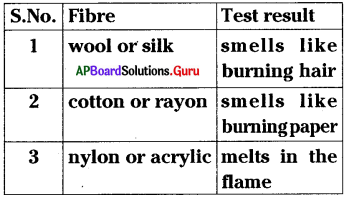
‘X’ is fibre. It gives smell like burning of paper in burning test and it is an artificial fibre. ‘X’ may be
A) cotton
B) rayon
C) nylon
D) acrylic
Answer:
B) rayon

AP 8th Class Physical Science Bits Chapter 4 Synthetic Fibres and Plastics with Answers

Question 39.
What will happen, if parachutes made with cotton?
A) Air escapes from the holes of cloth
B) Water is absorbs by the cloth
C) Heavy weight to carry
D) Above all
Answer:
D) Above all

Question 40.
A cloth merchant sells silk clothes very cheaply. You may guess the reason as the cloth made with
A) nylon
B) acrylic
C) rayon
D) polyester
Answer:
C) rayon

Question 41.
In dry cleaning shops, they dry cleans the clothes by
A) water
B) soap
C) tetra chloro ethylene
D) alchohol
Answer:
C) tetra chloro ethylene

Question 42.
If we bum PET bottle, the result may be
A) softened
B) not softened
C) cannot be bended
D) A and C
Answer:
A) softened

AP 8th Class Physical Science Bits Chapter 4 Synthetic Fibres and Plastics with Answers

Question 43.
This method is very easy to identify both polyester and cotton yam
A) burning test
B) visual inspection
C) weighing test
D) cutting test
Answer:
B) visual inspection

Question 44.
In a lab, while doing flame test to examine plastics, this precaution should be taken
A) wear mask to nose
B) use pair of tongs
C) do the test with by keep distance
D) above all
Answer:
D) above all

Question 45.
Hot pin test is used to test
A) bakelite
B) melamine
C) nylon
D) metal
Answer:
A) bakelite

AP 8th Class Physical Science Bits Chapter 4 Synthetic Fibres and Plastics with Answers

Question 46.
In a hot pin test on a substance, the given observations were done by a student
a) Hot pin did not penetrate
b) It left a purple bun mark
c) It gave the acidic smell
Then the conclusion is the, substance is made with
A) melamine
B) bakelite
C) nylon
D) thermoplastic
Answer:
B) bakelite

Question 47.
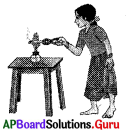
Which test is conducting in the given picture?
AP 8th Class Physical Science Bits Chapter 4 Synthetic Fibres and Plastics with Answers 1
A) Plastic test
B) Flame test
C) Polymer test
D) None
Answer:
B) Flame test

Question 48.
The first rayon factory in India was established in …………. in 1946.
A) AP
B) Tamil Nadu
C) Kerala
D) MP
Answer:
C) Kerala

Question 49.
The creator of first manmade plastic is
A) Alexander Grahambell
B) Alexander Parkes
C) Alexander Dumas
D) Alexander Phillip
Answer:
B) Alexander Parkes

AP 8th Class Physical Science Bits Chapter 4 Synthetic Fibres and Plastics with Answers

Question 50.
Thermoplastics are invented by
A) Hermann Staudinger
B) Marconi
C) J.L. Baird
D) Einstein
Answer:
A) Hermann Staudinger

Question 51.
………….. is considered as the father of the present plastics industry.
A) Dr. Baekeland
B) C.V. Raman
C) J.C. Bose
D) Blaise Pascal
Answer:
A) Dr. Baekeland

Question 52.
Polymers are long chain molecules was demonstrated by
A) Staudinger
B) Baekeland
C) Parkes
D) Baumann
Answer:
A) Staudinger

Question 53.
Which of the above not suitable to prepare aprons?
AP 8th Class Physical Science Bits Chapter 4 Synthetic Fibres and Plastics with Answers 2
A) wool
B) cotton
C) nylon
D) rayon
Answer:
C) nylon

AP 8th Class Physical Science Bits Chapter 4 Synthetic Fibres and Plastics with Answers

Question 54.
The given data belongs to

  • it was first fully processed synthetic fibre.
  • it became popular in second world war.
  • it is prepared from coal, water and air.

A) Acrylic
B) Nylon
C) Rayon
D) Polyester
Answer:
B) Nylon

Question 55.
AP 8th Class Physical Science Bits Chapter 4 Synthetic Fibres and Plastics with Answers 3
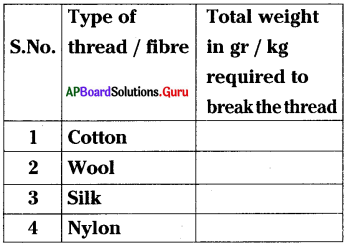
In one lab activity the observations obtained are 600 gr, 1600 gr, 500 gr, 400 gr.
If you fill these observations in the given table, S.No. 4 filled with
A) 600 gr
B) 1600gr
C) 500 gr
D) 400 gr
Answer:
B) 1600gr

Question 56.
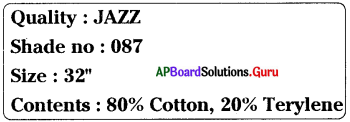
The given label was found on a garment.
AP 8th Class Physical Science Bits Chapter 4 Synthetic Fibres and Plastics with Answers 4
The cloth is made with
A) natural fibre
B) synthetic fibre
C) both A and B
D) none
Answer:
C) both A and B

AP 8th Class Physical Science Bits Chapter 4 Synthetic Fibres and Plastics with Answers

Question 57.
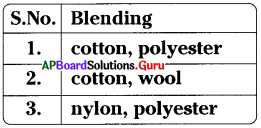
AP 8th Class Physical Science Bits Chapter 4 Synthetic Fibres and Plastics with Answers 5
Which of the above blending fibre gives both wrinkle free and water absorbant?
A) 1
B) 2
C) 3
D) 1 and 3
Answer:
A) 1

Question 58.
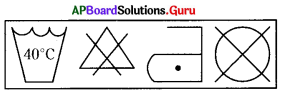
AP 8th Class Physical Science Bits Chapter 4 Synthetic Fibres and Plastics with Answers 6
From the data the give pictures shows
AP 8th Class Physical Science Bits Chapter 4 Synthetic Fibres and Plastics with Answers 7
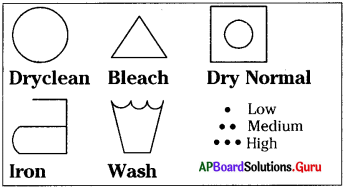
A) Wash with 40°C water, do not bleach
B) Iron with low heat, do not dry clean
C) Dry normal, wash with care
D) A and B
Answer:
D) A and B

Question 59.
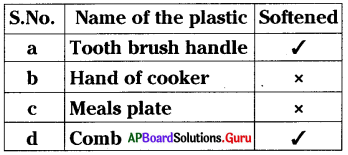
In a flame test the result obtained is
AP 8th Class Physical Science Bits Chapter 4 Synthetic Fibres and Plastics with Answers 8
Which of the above are made with thermosetting plastics?
A) a, d
B) b, c
C) a, b
D) c, d
Answer:
B) b, c

AP 8th Class Physical Science Bits Chapter 4 Synthetic Fibres and Plastics with Answers

Question 60.
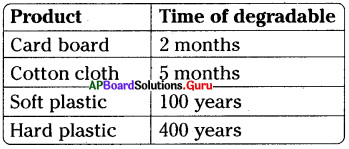
AP 8th Class Physical Science Bits Chapter 4 Synthetic Fibres and Plastics with Answers 9
From the table which is better to use for parcels?
A) Card boards
B) Soft plastic
C) Hard plastic
D) Cotton cloth
Answer:
A) Card boards

Question 61.
From the table (above) which is degradable easily?
A) cotton
B) soft plastic
C) card board
D) A and C
Answer:
D) A and C

Question 62.
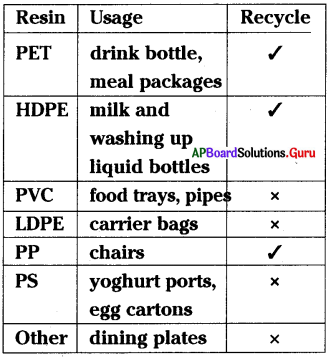
AP 8th Class Physical Science Bits Chapter 4 Synthetic Fibres and Plastics with Answers 10
From the given table, which are usable?
A) PVC, LDPE, PS
B) LDPE, HDPE, PET
C) PET, HDPE
D) None
Answer:
C) PET, HDPE

AP 8th Class Physical Science Bits Chapter 4 Synthetic Fibres and Plastics with Answers

Question 63.
If we use plastics to convert electricity it is
A) reuse
B) recycle
C) recover
D) reduce
Answer:
C) recover

Question 64.
New articles made with plastic wastage is
A) reuse
B) recycle
C) recover
D) reduce
Answer:
B) recycle

Question 65.
‘Use and throw’ encourages
A) Reduce plastics
B) Recover plastics
C) Reuse plastics
D) None
Answer:
D) None

Question 66.
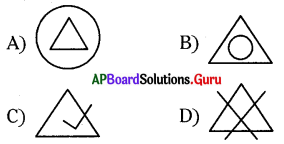
If the symbol of bleach is AP 8th Class Physical Science Bits Chapter 4 Synthetic Fibres and Plastics with Answers 11, then symbol of do not bleach is
AP 8th Class Physical Science Bits Chapter 4 Synthetic Fibres and Plastics with Answers 12
Answer:
D)

AP 8th Class Physical Science Bits Chapter 4 Synthetic Fibres and Plastics with Answers

Question 67.
The diagram of resin of polyvinyl chloride is
AP 8th Class Physical Science Bits Chapter 4 Synthetic Fibres and Plastics with Answers 13
Answer:
C)

Question 68.
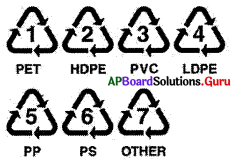
AP 8th Class Physical Science Bits Chapter 4 Synthetic Fibres and Plastics with Answers 14
The given codes are belongs to
A) laundry codes
B) resin codes
C) blending codes
D) fibre codes
Answer:
B) resin codes

Question 69.
The combination of one or more of resins represented by
AP 8th Class Physical Science Bits Chapter 4 Synthetic Fibres and Plastics with Answers 15
Answer:
D)

Question 70.
AP 8th Class Physical Science Bits Chapter 4 Synthetic Fibres and Plastics with Answers 16
The figure shows
A) linear arrangement of monomers
B) cross-linked arrangements of monomers
C) circular arrangement of monomers
D) square arrangement of monomers
Answer:
A) linear arrangement of monomers

AP 8th Class Physical Science Bits Chapter 4 Synthetic Fibres and Plastics with Answers

Question 71.
AP 8th Class Physical Science Bits Chapter 4 Synthetic Fibres and Plastics with Answers 17
The figure indicates
A) Reuse
B) Recycle
C) Recover
D) Return
Answer:
B) Recycle

Question 72.
The symbol AP 8th Class Physical Science Bits Chapter 4 Synthetic Fibres and Plastics with Answers 18 represents …………
A) PET
B) HDPE
C) LDPE
D) Others
Answer:
C) LDPE

Question 73.
The given fibres make us very comfortable in different situations and seasons like winter, summer, sweating, etc.
A) synthetic fibres
B) natural fibres
C) blended fibres
D) strong fibres
Answer:
C) blended fibres

Question 74.
“Synthetic fibres saves the nature” the best reason is
A) man does not depend on animals for fibre
B) man does not depend on factories for fibres
C) man does not depend on plants for fibres
D) A and C
Answer:
D) A and C

AP 8th Class Physical Science Bits Chapter 4 Synthetic Fibres and Plastics with Answers

Question 75.
Very useful ‘fake fur’ is
A) nylon
B) polyester
C) acrylic
D) rayon
Answer:
C) acrylic

Question 76.
If fire catches to a person, which of the following is better to use to cover over him and to put off fire.
A) nylon cloth
B) cotton cloth
C) polyester cloth
D) acrylic cloth
Answer:
B) cotton cloth

Question 77.
The given fibres revolutionalized the fabric industry and changed the costume culture
A) polyester
B) silk
C) nylon
D) acrylic
Answer:
A) polyester

Question 78.
Which of the following saves the nature by controlling the usage of wood?
A) Polyester
B) Plastic
C) Metal
D) Glass
Answer:
B) Plastic

AP 8th Class Physical Science Bits Chapter 4 Synthetic Fibres and Plastics with Answers

Question 79.
Creator of first plastic is
A) Parkesine
B) Rayon
C) Bakeland
D) None
Answer:
A) Parkesine

Question 80.
Father of plastic is
A) Parkesine
B) Herman standinger
C) Bakeland
D) Rayon
Answer:
C) Bakeland

Question 81.
This action is harmful to animals like cows
A) Throwing of food with polythene covers
B) Throwing of plastic covers in drainages
C) Both A and B
D) Using of polythene bags in homes
Answer:
A) Throwing of food with polythene covers

Question 82.
The main reasons to avoid plastic is / are
A) It is degradable
B) It is very useful to save trees
C) It leaves harmful gases on burning
D) Above all
Answer:
C) It leaves harmful gases on burning

AP 8th Class Physical Science Bits Chapter 4 Synthetic Fibres and Plastics with Answers

Question 83.
………… is the only synthetic fibre obtained from plant’s cellulose.
A) Nylon
B) Plastic
C) Rayon
D) None
Answer:
C) Rayon

Question 84.
All the winterwear nowadays is made of a synthetic fibre called
A) plastic
B) acrylic
C) nylon
D) none
Answer:
B) acrylic

Question 85.
Acrylic is generally called
A) fake fur
B) good fur
C) fibre wood
D) none
Answer:
A) fake fur

Question 86.
The handles of utensils are made up of
A) bakelite
B) melamine
C) aluminium
D) gold
Answer:
A) bakelite

AP 8th Class Physical Science Bits Chapter 4 Synthetic Fibres and Plastics with Answers

Question 87.
Electrical switches are made of
A) Melamine
B) Nylon
C) Bakelite
D) Rayon
Answer:
C) Bakelite

Question 88.
T.V. cabinets are made by
A) Bakelite
B) Nylon
C) Rayon
D) Melamine
Answer:
D) Melamine

Question 89.
Rock climbers use …………. climb mountains.
A) Rayon
B) Acrylic
C) Nylon
D) Polyethene
Answer:
C) Nylon

Question 90.
………….. is often mixed with cotton to make terricot and with wool to give terriwool.
A) Polyester
B) Nylon
C) Acrylic
D) Terylene
Answer:
D) Terylene

AP 8th Class Physical Science Bits Chapter 4 Synthetic Fibres and Plastics with Answers

Question 91.
Choose the correct answer.
1. Code 1 — a) HDPE
2. Code 2 — b) PVC
3. Code 3 — c) PET
A) 1-c, 2-a, 3-b
B) 1-b, 2-c, 3-a
C) 1-c, 2-b, 3-a
D) 1-b, 2-a, 3-c
Answer:
A) 1-c, 2-a, 3-b

Question 92.
Choose the correct answer.
1. Code 4 — a) PP
2. Code 5 — b) PS
3. Code 6 — d) LDPE
A) 1-b, 2-a, 3-c
B) 1-c, 2-a, 3-b
C) 1-c, 2-b, 3-a
D) 1-b, 2-c, 3-a
Answer:
B) 1-c, 2-a, 3-b

Question 93.
Kitchenware is made of …………
A) nylon
B) bakelite
C) melamine
D) polyester
Answer:
C) melamine

Question 94.
We are using plastic everywhere, because plastics
A) will not corrode easily
B) is very light, strong and cheaper
C) is water resistant
D) above all
Answer:
D) above all

AP 8th Class Physical Science Bits Chapter 4 Synthetic Fibres and Plastics with Answers

Question 95.
Polythene is combination …………… of monomus.
A) 1
B) 2
C) 3
D) many
Answer:
D) many

Question 96.
Synthetic fibres are synthesized from raw material called
A) steel
B) metals
C) glass
D) petroleum
Answer:
D) petroleum

Question 97.
Like synthetic fibre, plastics also ………….
A) monomer
B) dimer
C) trimer
D) polymer
Answer:
D) polymer

Question 98.
A silk fibre’s smooth surface absorbs light.
A) yes
B) no
C) can’t say
D) none of these
Answer:
A) yes

AP 8th Class Physical Science Bits Chapter 4 Synthetic Fibres and Plastics with Answers

Question 99.
Choose correct matching option.
Group – A — Group – B
1. Thermosetting — a) Plastic plastics
2. Thermoplastic — b) Bakelite
3. Biodegradable — c) Acrylic
4. Non-biodegradable — d) Food
5. Artificial wool — e) Polyethene
A) 1 – b, 2 – e, 3 – d, 4 – a, 5 – c
B) 1 – a, 2 – b, 3 – c, 4 – d, 5 – e
C) 1 – b, 2 – c, 3 – d, 4 – e, 5 – a
D) 1 – c, 2 – d, 3 – e, 4 – a, 5 – b
Answer:
A) 1 – b, 2 – e, 3 – d, 4 – a, 5 – c

Question 100.
Ropes of nylon fibre can be used as nets for fishing due to
A) elastic property
B) light weight property
C) water proof property
D) above all
Answer:
D) above all

Question 101.
These fibres absorbs water
A) nylon
B) rayon
C) polyester
D) above all
Answer:
B) rayon

Question 102.
Strong, elastic, light weight, water proof and cheaply available ropes are
A) nylon ropes
B) jute ropes
C) cotton ropes
D) rayon ropes
Answer:
A) nylon ropes

AP 8th Class Physical Science Bits Chapter 4 Synthetic Fibres and Plastics with Answers

Question 103.
Sanitary product diaper is made with
A) nylon
B) cotton
C) rayon
D) wool
Answer:
C) rayon

Question 104.
Ropes of parachutes not made with rayon because
A) rayon absorbs water
B) rayon catches fire
C) rayon is more cost
D) above all
Answer:
A) rayon absorbs water

Question 105.
Generally umbrellas are made with
A) nylon
B) rayon
C) cotton
D) acrylic
Answer:
A) nylon

Question 106.
Handles of kitchen ware made with
A) thermo plastics
B) thermosetting plastic
C) both
D) nylon
Answer:
B) thermosetting plastic

AP 8th Class Physical Science Bits Chapter 4 Synthetic Fibres and Plastics with Answers

Question 107.
Assertion (A): Bakelite is used for making handles of various cooking utensils.
Reason (R): Bakelite is good conductor of heat and electricity.
A) A and R are true and R supports A
B) A and R are true and R does not support A
C) A is true but R is false
D) A is false but R is true
Answer:
C) A is true but R is false

Question 108.
AP 8th Class Physical Science Bits Chapter 4 Synthetic Fibres and Plastics with Answers 19
The given articles are made with
A) Bakelite
B) Melamine
C) Nylon
D) PET
Answer:
A) Bakelite

Question 109.
AP 8th Class Physical Science Bits Chapter 4 Synthetic Fibres and Plastics with Answers 20
The given articles are made with
A) Bakelite
B) Melamine
C) Nylon
D) PET
Answer:
B) Melamine

Question 110.
Which of the following is not a synthetic fibre?
A) Acrylic
B) Nylon
C) Wool
D) Polyster
Answer:
C) Wool

AP 8th Class Physical Science Bits Chapter 4 Synthetic Fibres and Plastics with Answers

Question 111.
1) Rayon is also called cellulose fibre
2) Acrylic is also called fake fur Choose the correct answer.
A) 1 – True, 2 – True
B) 1 – True, 2 – False
C) 1 – False, 2 – True
D) 1 – False, 2 – False
Answer:
A) 1 – True, 2 – True

Question 112.
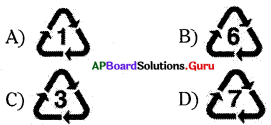
The resin identification code that indicates (HDPE) High Density Polyethylene is
AP 8th Class Physical Science Bits Chapter 4 Synthetic Fibres and Plastics with Answers 21
AP 8th Class Physical Science Bits Chapter 4 Synthetic Fibres and Plastics with Answers 22
Answer:
B)

Question 113.
P: Nylon is the first synthetic fibre.
Q: Nylon is thermosetting plastic.
A) P – true, Q – true
B) P – true, Q – false
C) P – false, Q – true
D) P – false, Q – false
Answer:
B) P – true, Q – false

Question 114.
A plastic piece is burnt on spirit lamp by holding it with a holder. The plastic piece was softened and melted. What do we determine by this activity ?
A) The recyclable plastic
B) biodegradable plastic
C) Thermo Plastic
D) All of the above
Answer:
C) Thermo Plastic

AP 8th Class Physical Science Bits Chapter 4 Synthetic Fibres and Plastics with Answers

Question 115.
What are the steps taken by you by knowing the impacts of improper use of plastics on environment?
i) will reduce the utilization of plastic
ii) Plastic wastage is sent to waste management industries
iii) I suggest only recyclable plastic
iv)I will nature the people aware on impact of plastic on environment
A) ii and iii only true
B) iii and iv only true
C) i, ii, iii and iv true
D) i and ii only true
Answer:
C) i, ii, iii and iv true

Question 116.
What is the suggestion made by you to your mother while she is cooking by knowing differences between natural and synthetic fibres ?
A) I suggest her to wear polyster made clothes.
B) I suggest her to wear Acrylic made clothes.
C) I suggest her to wear cotton made clothes.
D) I suggest her to wear Nylon made clothes.
Answer:
C) I suggest her to wear cotton made clothes.

Question 117.
Symbol below indicates
AP 8th Class Physical Science Bits Chapter 4 Synthetic Fibres and Plastics with Answers 23
A) Reuse of plastic
B) Recover of plastic
C) Recycle of plastic
D) Reduce of plastic
Answer:
C) Recycle of plastic

AP 8th Class Physical Science Bits Chapter 4 Synthetic Fibres and Plastics with Answers

Question 118.
Abhishek wanted to know what are thermoplastics and thermosetting plastics, materials in his home. He was testing small pieces of plastic materials by heating on spirit lamp. Which precaution will he take during the experiment?
A) Wears Nylon clothes
B) Covers his nose and mouth with mask
C) Keeps close to spirit lamp
D) Sample plastic holds with hands
Answer:
B) Covers his nose and mouth with mask

Question 119.
Suneetha tested tensional strength of wool, cotton, silk and Nylon, whose having same measurements. Which of the following fibre more strength?
A) Cotton
B) Nylon
C) Wool
D) Silk
Answer:
B) Nylon

Question 120.
Match the fibres given in Set I with their properties in Set II.
Set I — Set II
i) Nylon — a) Fake fur
ii) Rayon — b) Natural fibre
iii) Acrylic — c) Artificial silk
iv) WooI — d)First processed synthetic fibre
A) i – c, ii – a, iii – d, iv – b
B) i – d, ii – c, iii – a, iv – b
C) i – b, ii – a, iii – c, iv – d
D) i – a, ii – d, iii – b, iv – c
Answer:
B) i – d, ii – c, iii – a, iv – b

Question 121.
“Yaswanth tested the yarn of different fibres. He observed that the yarn melts in the flame.” Predict which fibre melts in flame.
A) Cotton or Rayon
B) Nylon (or) Acrylic
C) None
D) Wool or silk
Answer:
B) Nylon (or) Acrylic

AP 8th Class Physical Science Bits Chapter 4 Synthetic Fibres and Plastics with Answers

Question 122.
Your father brings water pipe from market. You observed symbol on it. Which type of plastic is used to make it?
AP 8th Class Physical Science Bits Chapter 4 Synthetic Fibres and Plastics with Answers 24
A) PET
B) PS
C) PVC
D) HDPE
Answer:
C) PVC

Question 123.
Identify the characteristics of Nylon.
i) Nylon fibre is strong
ii) Elastic
iii) Light weight
iv) Absorb water
A) i, ii and iii only true
B) ii and iii only true
C) iii and iv only true
D) i and ii only true
Answer:
A) i, ii and iii only true

Question 124.
P: Thermoplastic which will soften when heated
Q: Thermosetting plastics are not re- mouldable
A) P is True and Q is False
B) P & Q are False
C) P is False & Q is True
D) P and Q are True
Answer:
D) P and Q are True

AP 8th Class Physical Science Bits Chapter 4 Synthetic Fibres and Plastics with Answers

Question 125.
Which of the following is the closest reason for preserving acids in plastic bottles?
A) plastic is very light
B) plastics are non-reactive
C) plastic is strong
D) plastics are cheaper than metals
Answer:
B) plastics are non-reactive

Question 126.
Which of the following is a thermo-setting plastic?
i) Bakelite
ii) Melamine
iii) Polythene
iv) PVC
A) ii and iii only true
B) i and iii only true
C) i and ii only true
D) i and iv only true
Answer:
C) i and ii only true

(127 – 128)

Type of Fibres Character
Nylon Strong & Doesn’t absorb water
Cotton Absorbs water
Wool Heat Resistant

From above information answer these
Question 127.
Which clothes do you wear in summer?
A) Cotton made
B) Wool made
C) Polyester clothes
D) Nylon made
Answer:
A) Cotton made

AP 8th Class Physical Science Bits Chapter 4 Synthetic Fibres and Plastics with Answers

Question 128.
Why nylon is used to make parachute?
A) Nylon is attractive fibre
B) Nylon is strong
C) Nylon is soft
D) Nylon creates static electricity
Answer:
B) Nylon is strong

Question 129.
Nylon : Synthetic fibre :: …………….. : Cellulose fibre
A) Rayon
B) Acrylic
C) Polyester
D) Silk
Answer:
A) Rayon

Question 130.
Which of the following is/are thermosetting plastic?
i) HDPE
ii) LDPE
iii) Bakelite
iv) Melamine
A) Only (iii)
B) (i) & (ii)
C) (iii) & (iv)
D) Only (iv)
Answer:
C) (iii) & (iv)

Question 131.
“Universal recycling symbol is chasing arrows. Inside the arrows there will be a number that indicates the polymer”. If a synthetic material is said to be recycled, the code in the icon would be
A) Code – 4
B) Code – 2
C) Code – 5
D) Code – 3
Answer:
B) Code – 2

AP 8th Class Physical Science Bits Chapter 4 Synthetic Fibres and Plastics with Answers

Question 132.
Shobhan planned to visit Kashmir along with his parents. What types of clothes would he buy to his parents?
A) Silk
B) Cotton
C) Wool
D) Polyester
Answer:
C) Wool

Question 133.
Which of these statements about acrylic is wrong?
A) It become commercially available from 1941
B) It is made from a combination of coal, air, water, oil and limestone
C) Acrylic is more expensive than natural wool
D) It is commonly known as fake fur
Answer:
C) Acrylic is more expensive than natural wool

Question 134.
In “Identification of fibres – Burning test” activity what are the precautions to be taken.
A) Yarn should be burnt by maintaining a minimum distance to the flame
B) Yarn should not be burnt by keeping them in hands
C) We should not smell the smoke
D) All the above
Answer:
D) All the above

Question 135.
Which types of clothing is MOST suitable for wearing in very cold hill station?
A) Loose silk clothes
B) Thick woollen clothes
C) Tight polyester clothes
D) Thin cotton clothes
Answer:
B) Thick woollen clothes

AP 8th Class Physical Science Bits Chapter 4 Synthetic Fibres and Plastics with Answers

Question 136.
Which of the following is known as ar-tificial silk?
A) Rayon
B) Acrylic
C) Nylon
D) Wool
Answer:
A) Rayon

Question 137.
Plastics which moulded once cannot be softened by heating are called
A) PET
B) Biodegradable plastics
C) Thermoplastics
D) Thermosetting plastics
Answer:
D) Thermosetting plastics

AP 8th Class Physical Science Bits Chapter 2 Friction with Answers

Practice the AP 8th Class Physical Science Bits with Answers Chapter 2 Friction on a regular basis so that you can attempt exams with utmost confidence.

AP State Syllabus 8th Class Physical Science Bits 2nd Lesson Friction with Answers

Choose the correct answer.

Question 1.
The frictional force exerted by fluids is called
A) rolling friction
B) sliding friction
C) drag
D) normal force
Answer:
C) drag

Question 2.
The unit of force is
A) metre
B) km
C) kilogram-weight
D) joule
Answer:
C) kilogram-weight

AP 8th Class Physical Science Bits Chapter 2 Friction with Answers

Question 3.
Friction is proportional to
A) normal force
B) force
C) mass
D) none of these
Answer:
A) normal force

Question 4.
………… reduce the frictions.
A) Lubricants
B) Drag
C) Mass
D) None of these
Answer:
A) Lubricants

Question 5.
The change in the length of a spring is …………. to the applied force.
A) Indirect proportional
B) Equal
C) Direct proportional
D) Not depends on the force
Answer:
C) Direct proportional

Question 6.
When the speed of the body moving in a straight line changes continuously then the body acquires
A) Acceleration
B) Speed
C) Velocity
D) Displacement
Answer:
A) Acceleration

Question 7.
The bodies of birds and Ashes must have evolved to shapes which would make them not to loose much energy in overcoming …………. friction.
A) Rolling friction
B) Static friction
C) Sliding friction
D) Fluid friction
Answer:
D) Fluid friction

AP 8th Class Physical Science Bits Chapter 2 Friction with Answers

Question 8.
Which of the following friction has self adjusting force?
A) Sliding friction
B) Static friction
C) Rolling friction
D) Fluid friction
Answer:
B) Static friction

Question 9.
Friction is independent of
A) Nature of surface
B) Normal force
C) Irregularities in surface
D) Area of contact
Answer:
D) Area of contact

Question 10.
To overcome friction …………… are used in machinery.
A) dynamo
B) motor
C) wires
D) ball bearings
Answer:
D) ball bearings

Question 11.
Friction produces
A) light
B)sound
C) heat
D) none of these
Answer:
C) heat

AP 8th Class Physical Science Bits Chapter 2 Friction with Answers

Question 12.
The friction exerted by moving body is called
A) static friction
B) sliding friction
C) rolling friction
D) drag
Answer:
B) sliding friction

Question 13.
The friction acting on the body which is at rest is
A) sliding friction
B) static friction
C) rolling friction
D) drag
Answer:
B) static friction

Question 14.
The friction exerted by fluid is called
A) static friction
B) sliding friction
C) rolling friction
D) drag
Answer:
C) rolling friction

Question 15.
The friction which is least among all the frictions
A) static friction
B) sliding friction
C) rolling friction
D) drag
Answer:
C) rolling friction

Question 16.
The force which opposes the relative motion of two surfaces of the bodies which are in contact is called
A) muscular force
B) frictional force
C) gravitational force
D) magnetic force
Answer:
B) frictional force

AP 8th Class Physical Science Bits Chapter 2 Friction with Answers

Question 17.
…………. friction is self adjusting force.
A) Static
B) Sliding
C) Rolling
D) Both A & B
Answer:
A) Static

Question 18.
When applied force is …………… than the limit of the static friction than the body starts to move. ( )
A) less
B) more
C) equal
D) none of these
Answer:
B) more

Question 19.
Friction is caused by the ………….. on the two surfaces which are in contact, i) smoothness ii) irregularities
iii) roughness iv) cleanliness
A) i and iv
B) ii and iii
C) iii and iv
D) all the above
Answer:
B) ii and iii

Question 20.
Because of friction …………. of surfaces increases.
A) density
B) volume
C) temperature
D) pressure
Answer:
C) temperature

AP 8th Class Physical Science Bits Chapter 2 Friction with Answers

Question 21.
When one body rolls over the surface of another body, the friction offered is called ………….
A) static friction
B) sliding friction
C) drag
D) rolling friction
Answer:
D) rolling friction

Question 22.
……………. and ……………. are called fluids.
A) Liquids, gases
B) Solids, liquids
C) Solids, gases
D) Solids, moltens
Answer:
A) Liquids, gases

Question 23.
The length of the spring is proportional to ………..
A) size of the spring
B) thickness of spring
C) volumed spring
D) the applied force
Answer:
D) the applied force

Question 24.
Choose suitable option for matching.
Group-A — Group-B
1. Static friction — a) Drag
2. Sliding friction — b) Object at rest
3. Rolling friction — c) Nature of surface
4. Fluid friction — d) Object in motion
5. Friction — e) Ball bearings
A) 1 – a, 2 – b, 3 – c, 4 – d, 5 – e
B) 1 – b, 2 – d, 3 – e, 4 – a, 5 – c
C) 1 – b, 2 – c, 3 – d, 4 – e, 5 – a
D) 1 – d, 2 – e, 3 – a, 4 – b, 5 – c
Answer:
B) 1 – b, 2 – d, 3 – e, 4 – a, 5 – c

AP 8th Class Physical Science Bits Chapter 2 Friction with Answers

Question 25.
Choose suitable option for matching.
Group – A — Group – B
1. Lubricants — a) Increases friction
2. Normal force — b) Friction is independent
3. Area of contact — c) Decreases the friction
4. Friction — d) To overcome fluid pressure
5. Shape of birds — e) Produces heat
A) 1 – c, 2 – a, 3 – b, 4 – e, 5 – d
B) 1 – a, 2 – b, 3 – c, 4 – d, 5 – e
C) 1 – b, 2 – c, 3 – d, 4 – e, 5 – a
D) 1 – d, 2 – e, 3 – a, 4 – b, 5 – c
Answer:
A) 1 – c, 2 – a, 3 – b, 4 – e, 5 – d

Question 26.
If we rub our hands, heat is generated by
A) static friction
B) sliding friction
C) rolling friction
D) drag
Answer:
B) sliding friction

Question 27.
a) When the surface of one objectmoves relative to the surface of another object, static friction exerts,
b) When surfaces of the objects are at rest, sliding friction exerts.
A) a is true
B) b is true
C) both a and b are true
D) both a and b are false
Answer:
D) both a and b are false

Question 28.
Assertion (A): The force of friction is greater if a rough surface is involved.
Reason (R): Rough surface contains a large number of irregularities.
A) A and R are true, R supports A
B) A and R are false
C) A and R are true, R does not support A
D) A is true, but R is false
Answer:
A) A and R are true, R supports A

AP 8th Class Physical Science Bits Chapter 2 Friction with Answers

Question 29.
The substances which reduce friction are called as
A) paints
B) lubricants
C) alloys
D) grippers
Answer:
B) lubricants

Question 30.
Friction is not depends upon
A) nature of surface
B) normal force
C) area of contact
D) A and B
Answer:
D) A and B

Question 31.
If there is no heat shield covering over the space craft shuttle, it will
A) fall
B) burn
C) escape
D) rotate
Answer:
B) burn

Question 32.
Opposite to acceleration is
A) deceleration
B) retardation
C) negative acceleration
D) all of these
Answer:
D) all of these

AP 8th Class Physical Science Bits Chapter 2 Friction with Answers

Question 33.
If you push a ball which is in the rest on a ground, then its speed
A) first increases, then decreases
B) first increases, then remains constant
C) first decreases, then increases
D) first decreases, then come to rest
Answer:
A) first increases, then decreases

Question 34.
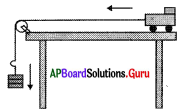
If we increases weights, the direction of motion of block on the trolley is
AP 8th Class Physical Science Bits Chapter 2 Friction with Answers 1
A) towards left side
B) towards right side
C) upwards
D) downwards
Answer:
B) towards right side

Question 35.
In which of the following surface a ball move fastly?
A) Covered with grass
B) Covered with hard cement
C) Covered with sand
D) Covered with saw dust
Answer:
B) Covered with hard cement

Question 36.
If you increase normal force, then
A) friction force increases
B) friction force decreases
C) no change in the frictional force
D) we cannot say
Answer:
A) friction force increases

AP 8th Class Physical Science Bits Chapter 2 Friction with Answers

Question 37.
A push or a pull is called
A) force
B) friction
C) acceleration
D) velocity
Answer:
A) force

Question 38.
……………. is friction comes into play when surface of one object moves relative to the other surface of another object
A) Static friction
B) Sliding friction
C) Rolling friction
D) None of these
Answer:
B) Sliding friction

Question 39.
The friction which comes to play when surfaces of the objects are at rest relative to each other
A) static friction
B) sliding friction
C) rolling friction
D) none of these
Answer:
A) static friction

Question 40.
In the given below frictions, which friction is self adjusting force?
A) sliding friction
B) static friction
C) rolling friction
D) fluid friction
Answer:
B) static friction

AP 8th Class Physical Science Bits Chapter 2 Friction with Answers

Question 41.
Adjacent experiment represents
AP 8th Class Physical Science Bits Chapter 2 Friction with Answers 2
A) Understanding the nature of friction and the concept of static friction
B) Observing variation of friction
C) Effect of area of contact of frictional area
D) None of the above
Answer:
A) Understanding the nature of friction and the concept of static friction

Question 42.
Adjacent activity is example for
AP 8th Class Physical Science Bits Chapter 2 Friction with Answers 3
A) Produce of heat by friction
B) Reduce of friction
C) Effect of rollers of friction
D) None
Answer:
A) Produce of heat by friction

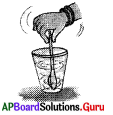
Question 43.
Adjacent activity represents
AP 8th Class Physical Science Bits Chapter 2 Friction with Answers 4
A) Produce of heat by friction
B) Reduce of friction
C) Effect of rollers of friction
D) Observing fluid friction
Answer:
D) Observing fluid friction

AP 8th Class Physical Science Bits Chapter 2 Friction with Answers

Question 44.
Push a heavy box with a small force. It does not move. Now gradually increase the force, the box till does not move. From this experiment your conclusion is
A) force increases, friction increases
B) force increases, friction decreases
C) force increases, no change in friction
D) none of the above
Answer:
A) force increases, friction increases

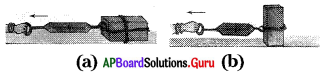
Question 45.
From this experiment the conclusion is
AP 8th Class Physical Science Bits Chapter 2 Friction with Answers 5
A) Friction force at ‘a’ > friction force at ’b’
B) Friction force at ’a’ < friction force at ‘b’
C) Friction force at a’ = friction force at ‘b’
D) None of the above
Answer: C) Friction force at a’ = friction force at ‘b’

Question 46.
To prove that the frictional force is independent of the area of contact, the required materials and apparatus are
A) weighing machine, brick, thread
B) spring balance, brick, thread
C) spring balances
D) inclined plane, spring balance
Answer:
B) spring balance, brick, thread

AP 8th Class Physical Science Bits Chapter 2 Friction with Answers

Question 47.
Pull one brick with a spring balance (Reading – 1)
Pull two bricks with a spring balance (Reading – 2) A) 1 > 2
B) 2 > 1
C) 1 = 2
D) 2 >1
Answer:
B) 2 > 1

Question 48.
How do you prove that friction produces heat?
A) By rubbing your palms against each other
B) By striking a match stick against a rough surface
C) By putting iron rod in the sunlight
D) A or B
Answer:
B) By striking a match stick against a rough surface

Question 49.
Which of the following is wrong statement?
A) Friction is reduceble
B) Static friction gives movement to a body
C) Solids do not exert drag
D) Above all
Answer:
B) Static friction gives movement to a body

Question 50.
This figure indicates free body diagram
AP 8th Class Physical Science Bits Chapter 2 Friction with Answers 6
A) a moving car
B) a car in a rest
C) A or B
D) A monkey hanging to a branch of tree
Answer:
C) A or B

AP 8th Class Physical Science Bits Chapter 2 Friction with Answers

Question 51.
AP 8th Class Physical Science Bits Chapter 2 Friction with Answers 7
Drag is not observed in
A) a
B) b
C) c
D) d
Answer:
D) d

Question 52.
AP 8th Class Physical Science Bits Chapter 2 Friction with Answers 8
From the above data match the following.
a) static friction
b) rolling friction
c) sliding friction
A) A-b, B-c, C-a
B) A-c, B-b, C-a
C) A-a, B-b, C-c
D) A-b, B-a, C-c
Answer:
A) A-b, B-c, C-a

Question 53.
The change in the length of the spring is ………… to the applied force.
A) indirect proportional
B) equal
C) direct proportional
D) not depends on the force
Answer:
C) direct proportional

Question 54.
Adjacent figure represents
AP 8th Class Physical Science Bits Chapter 2 Friction with Answers 9
A) pushing a heavy box
B) rubbing a box
C) opening a box
D) friction of a box
Answer:
A) pushing a heavy box

AP 8th Class Physical Science Bits Chapter 2 Friction with Answers

Question 55.
Which of the following diagram indicates rolling friction?
AP 8th Class Physical Science Bits Chapter 2 Friction with Answers 10
Answer:
A)

Question 56.
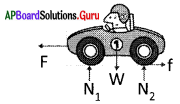
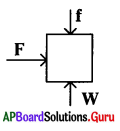
The wrong in diagram is
AP 8th Class Physical Science Bits Chapter 2 Friction with Answers 11
A) F
B) W
C) f
D) f and W
Answer:
D) f and W

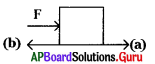
Question 57.
Directions of ‘a’, ‘b’ refers as
AP 8th Class Physical Science Bits Chapter 2 Friction with Answers 12
A) weight (a), friction (b)
B) friction (a), weight (b)
C) friction (b), movement (a)
D) movement (a), friction (b)
Answer:
D) movement (a), friction (b)

Question 58.
Friction is said to be a Mend, because it helps
A) to walk on a road
B) to hear a sound
C) to sea a book
D) to think a problem
Answer:
A) to walk on a road

AP 8th Class Physical Science Bits Chapter 2 Friction with Answers

Question 59.
Which of the following play major role to avoid corrosion due to Motion?
A) Paints
B) Lubricants
C) Alloys
D) Galvanizing
Answer:
B) Lubricants

Question 60.
“Don’t throw over the roads, they may cause slip” is applicable to
A) bananas
B) oils
C) sand
D) above all
Answer:
D) above all

Question 61.
This gives to birds and fishes to overcome from drag.
A) Colour of the body
B) Shape of the body
C) Mass of the body
D) Above all
Answer:
B) Shape of the body

Question 62.
Which of the following is correct?
A) Friction is good
B) Friction is evil
C) Both
D) None
Answer:
C) Both

Question 63.
The Mction exerted by a rolling body is
A) static friction
B) sliding friction
C) rolling friction
D) none of these
Answer:
C) rolling friction

AP 8th Class Physical Science Bits Chapter 2 Friction with Answers

Question 64.
………… is responsible for over heating and wearing out of moving parts.
A) Normal force
B) Friction
C) Tension
D) Gravitational force
Answer:
B) Friction

Question 65.
Gymnasts apply which material on their hands to increase Motion for better grip?
A) oil
B) soaps
C) coarse substance
D) water
Answer:
C) coarse substance

Question 66.
Which of the following is easy to push?
A) A brick in horizontal position
B) A brick in vertical position
C) Both are equal to push
D) We cannot say
Answer:
C) Both are equal to push

Question 67.
In railway station, Ranga put one box in his head and Ramu put two boxes in his head of same weight.
The normal force exerts more on
A) Ranga
B) Ramu
C) Both are equal
D) No normal force acts on them
Answer:
B) Ramu

AP 8th Class Physical Science Bits Chapter 2 Friction with Answers

Question 68.
It is difficulty to walk on slippery surfaces, because there exists
A) less friction
B) more friction
C) less area of surface
D) more area of surface
Answer:
A) less friction

Question 69.
Which of the given daily activity linked with Mctional force?
A) Fin a nail into the wall
B) Apply brakes to stop a vehicle
C) Hold a pencil to write
D) Above all
Answer:
D) Above all

Question 70.
Which of the above linked with less Motion?
AP 8th Class Physical Science Bits Chapter 2 Friction with Answers 13
A) a, d
B) a, b, c
C) d
D) None
Answer:
C) d

Question 71.
More friction requires in the given systems.
A) Tyres of vehicles and road
B) Machinery wheels
C) Pen and hand
D) Above all
Answer:
D) Above all

Question 72.
In this games/sports less Motion is required
A) pole jump
B) carrom board
C) running
D) wrestling
Answer:
B) carrom board

AP 8th Class Physical Science Bits Chapter 2 Friction with Answers

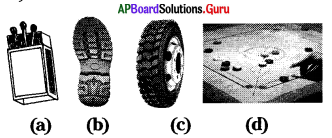
Question 73.
More rough surfaces are observed in
A) bottom of the shoe
B) pattern of the tyre
C) foot path
D) above all
Answer:
D) above all

Question 74.
Ravi observed holes in a flexi banners.
They prevents
A) drag friction
B) static friction
C) sliding friction
D) rolling friction
Answer:
A) drag friction

Question 75.
AP 8th Class Physical Science Bits Chapter 2 Friction with Answers 14
The body is not moving, then the Motion is
A) 30 N (→)
B) 30 N (←)
C) 50 N (→)
D) 50 N(←)
Answer:
A) 30 N (→)

Question 76.
Portars use Thalapaga (bundle of cloth) (turban) on their heads while carrying luggage this provides
A) more friction
B) less friction
C) more pressure
D) less pressure
Answer:
D) less pressure

AP 8th Class Physical Science Bits Chapter 2 Friction with Answers

Question 77.
To reduce Motion between rotating shafts of machine tools, we use
A) Carbon powder
B) Sand
C) Powder
D) Ball bearings
Answer:
D) Ball bearings

Question 78.
Which of the following ways to reduce Mction in daily life?
A) Using lubricants
B) Using ball bearing
C) Polishing the planes
D) All the above
Answer:
D) All the above

Question 79.
The purpose of Powder while playing carroms is
A) to decrease friction
B) to increase friction
C) either to decrease or to increase of friction
D) keep the friction as constant
Answer:
A) to decrease friction

Question 80.
Situations:
i. Flying bird in the air
ii. Swimming fish in the water
iii. Moving aeroplane in the sky
Which of the above feels fluid friction?
A) only (i)
B) only (ii)
C) only (i) and (ii)
D) (i), (ii) and (iii)
Answer:
D) (i), (ii) and (iii)

AP 8th Class Physical Science Bits Chapter 2 Friction with Answers

Question 81.
Ganesh is cycling. After moving some distance he suddenly stopped cycling. Then bicycle gradually slowed down and Anally come to rest. Now predict the reason behind that
i) Frictional force between earth and wheels of the bicycle
ii) Frictional force between Air and bicycle
iii) Frictional force between bicycle and Ganesh
A) ii and iii only True
B) i and iii only True
C) i, ii and iii are True
D) i and ii only True
Answer:
D) i and ii only True

Question 82.
Assertion (A): A ball is moving fast on smooth surface than rough surface even you apply same force on it.
Reason (R): Force of friction is greater on a rough surface.
A) Both Assertion and Reason are correct and “R” is wrong explanation for “A”.
B) Assertion is correct and Reason is incorrect.
C) Both Assertion and Reasons are wrong.
D) Both Assertion and Reasons are correct and “R” is correct explanation for Assertion.
Answer:
D) Both Assertion and Reasons are correct and “R” is correct explanation for Assertion.

Question 83.
Assertion (A): Rollers are fitted to suitcase to pull easily.
Reason (R): It is always difficult to roll a body than to slide it over a surface.
A) Both Assertion and Reason are correct and Reason is wrong explanation.
B) Assertion is correct, Reason is incorrect.
C) Both Assertion and Reasons are incorrect.
D) Both Assertion and Reasons are correct and Reason is correct explanation.
Answer:
B) Assertion is correct, Reason is incorrect.

Question 84.
Why are Aeroplanes constructed as shown in figure?
AP 8th Class Physical Science Bits Chapter 2 Friction with Answers 15
A) To overcome fluid friction
B) To overcome rolling friction
C) To overcome static friction
D) To overcome sliding friction
Answer:
A) To overcome fluid friction

AP 8th Class Physical Science Bits Chapter 2 Friction with Answers

Question 85.
Which experiment do you perform on friction from the following equipments? Trolley, Weights, Weight hangers, Pulley, Inextensible string and table.
A) Friction is proportional to the normal force
B) To understand nature of friction and the concept of static friction
C) Effect of roughness on frictional force
D) Frictional force is independent of the area of contact
Answer:
B) To understand nature of friction and the concept of static friction

Question 86.
You wanted to know effect of roughness on frictional force. Which of the following material is not needed for your experiment?
A) Inclined plane
B) Rough cloth
C) Stop watch
D) Ball
Answer:
C) Stop watch

Question 87.
Frictional force on a object in a fluid depends on
A) Shape of the object
B) Nature of the fluid
C) All of the above
D) Speed with respect to fluid
Answer:
C) All of the above

Question 88.
“Aravind observed that heat is produced when he rubbed his palms.” The type of friction of acting here is
A) Static friction
B) Rolling friction
C) Fluid friction
D) Sliding friction
Answer:
D) Sliding friction

AP 8th Class Physical Science Bits Chapter 2 Friction with Answers

Question 89.
Which of the following is incorrect in the case of friction?
A) Frictional force is dependent of the area of contact.
B) Friction is proportional to the normal force.
C) Friction opposes the relative motion between two surfaces in contact.
D) Friction opposes the motion of a body.
Answer:
A) Frictional force is dependent of the area of contact.

Question 90.
“To reduce the friction we use solid, liquid and Gaseous state lubricants”. Which lubricant is used in Electric motor to reduce friction ?
A) Ball – bearing
B) Powder
C) All of the above
D) Grease
Answer:
D) Grease

Question 91.
Why are you appreciating Heat shield?
A) Heat shield can turn space craft attractively
B) Heat shield can make space craft light weight.
C) Heat shield reduces speed of the space craft.
D) Heat shield reduces heat produced by friction
Answer:
D) Heat shield reduces heat produced by friction

(92 – 93) Irregularities on the surfaces lock into one another when we attempt to move on any surface. We have to apply a force to over come interlocking. On rough surfaces in which a large number of irregularities exist. So the force of friction is greater if a rough surface is involved.
Question 92.
Above information tells us about ………..
A) Pressure
B) Friction
C) Time
D) Mass
Answer:
B) Friction

AP 8th Class Physical Science Bits Chapter 2 Friction with Answers

Question 93.
What would you generalise from the above information?
A) Friction decreases with increasing roughness
B) Friction is independent of Roughness
C) All surfaces have same friction
D) Friction increases with increasing roughness
Answer:
D) Friction increases with increasing roughness

Question 94.
Uma: Friction depends on the nature of the surface.
Usha: Friction is independent of area of contact,
A) Uma is correct, Usha is incorrect
B) Uma is incorrect, Usha is correct
C) Both Uma and Usha are correct
D) Both Uma and Usha are incorrect
Answer:
C) Both Uma and Usha are correct

Question 95.
A boy slides a marble, coin, matchbox and eraser. Which of the following objects moves dead slowly on the inclined plane?
A) Marble
B) Coin
C) Matchbox
D) Eraser
Answer:
C) Matchbox

AP 8th Class Physical Science Bits Chapter 2 Friction with Answers

Question 96.
In what direction does frictional force act when a body moves on the surface of another body?
A) In the direction of motion
B) In the direction opposite to motion
C) Perpendicular to direction of motion
D) Frictional force does not have direction
Answer:
B) In the direction opposite to motion

Question 97.
The fish swim easily in water because by
A) More energy
B) Streamlined shape
C) Both (A) and (B)
D) None of the above
Answer:
B) Streamlined shape

Question 98.
Hypothesis: The sole of shoe’s grave is to provide better grip on the floor.
Reason: Friction is caused by the irregularities on the two surface those are in contact.
A) Hypothesis is correct. Reason is correct explanation of hypothesis.
B) Hypothesis is correct. Reason is not correct explanation of hypothesis
C) Hypothesis is not correct and reasons are correct
D) Both hypothesis and reasons are not correct
Answer:
A) Hypothesis is correct. Reason is correct explanation of hypothesis.

Question 99.
A car toy is dropped on four inclined planes made up of with different materials. On which incline plane the car travels more distance?
A) Cemented surface
B) Mud surface
C) Marble surface
D) Brick surface
Answer:
C) Marble surface

AP 8th Class Physical Science Bits Chapter 2 Friction with Answers

Question 100.
It is difficult to walk on polished floor because friction between our feet and floor is
A) Increased
B) Reduced
C) Same
D) None of these
Answer:
B) Reduced

Question 101.
Toy car released with the same initial speed will travel farthest on
A) Muddy surface
B) Polished marble surface
C) Cemented surface
D) Brick surface
Answer:
B) Polished marble surface

Question 102.
Friction occurs due to?
A) Smoothness of the surfaces in contact
B) The gravitation force exerted by Earth on surfaces
C) Irregularities of the surfaces in contact
D) The attraction between charged bodies in contact
Answer:
C) Irregularities of the surfaces in contact

Question 103.
Relative to the surface, the direction of the friction is always
A) In the direction of motion of the object
B) Opposite to direction of the motion of the object
C) Perpendicular to direction of the motion of the object
D) No relation between direction of the motion and friction
Answer:
B) Opposite to direction of the motion of the object

AP 8th Class Physical Science Bits Chapter 2 Friction with Answers

Question 104.
Which of the following represents the correct sequence of types of friction arranged on based on their strength or magnitude?
A) Static friction < sliding friction < rolling friction
B) Rolling friction < sliding friction < static friction
C) Sliding friction < rolling friction < static friction
D) Rolling friction < static friction < sliding friction
Answer:
B) Rolling friction < sliding friction < static friction

Question 105.
Friction is independent of
A) Area of contact
B) Nature of the surface
C) Nature of the body
D) All of the above
Answer:
A) Area of contact

AP 8th Class Physical Science Bits Chapter 3 Matter Around Us with Answers

Practice the AP 8th Class Physical Science Bits with Answers Chapter 3 Matter Around Us on a regular basis so that you can attempt exams with utmost confidence.

AP State Syllabus 8th Class Physical Science Bits 3rd Lesson Matter Around Us with Answers

Choose the correct answer.

Question 1.
Which of the following is more compressible ?
A) wood
B) air
C) water
D) sponge
Answer:
B) air

Question 2.
Powdered salt is a
A) solid
B) liquid
C) gas
D) none
Answer:
A) solid

AP 8th Class Physical Science Bits Chapter 3 Matter Around Us with Answers

Question 3.
Rate of diffusion is high in
A) ink drop
B) KMnO4 solution
C) oxygen
D) KMnO4 crystal
Answer:
C) oxygen

Question 4.
Which of the following is true in case of particles of matter ?
A) tiny
B) have space between them
C) have force of attraction between them
D) all the above
Answer:
D) all the above

Question 5.
The reason for high rate of diffusion in gas is
A) higher speed of gas particles
B) greater space between gas particles
C) both A and B
D) none
Answer:
C) both A and B

Question 6.
The melting point depends on
A) space among its particles
B) force of attraction among its particles
C) shape of the substance
D) state of the substance
Answer:
B) force of attraction among its particles

AP 8th Class Physical Science Bits Chapter 3 Matter Around Us with Answers

Question 7.
Evaporation is influenced by
A) surface area
B) humidity
C) wind speed
D) all
Answer:
D) all

Question 8.
Matter occupies ……………. and has …………….
A) length, mass
B) space, mass
C) mass, space
D) none of these
Answer:
B) space, mass

Question 9.
The state of matter which have a defi-nite shape and a fixed volume is …………

A) solids
B) liquids
C) gas
D) none of these
Answer:
A) solids

Question 10.
The state of matter which get the shape of container is ………..
A) solid
B) liquid
C) gas
D) plasma
Answer:
B) liquid

AP 8th Class Physical Science Bits Chapter 3 Matter Around Us with Answers

Question 11.
Liquids can flow easily from one place to another. So they are called …………
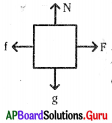
A) rigid substances
B) floaters
C) fluids
D) volatile
Answer:
C) fluids

Question 12.
………….. have no fixed shape, but have a fixed volume.
A) Solid
B) Liquid
C) Gases
D) Plasma
Answer:
B) Liquid

Question 13.
CNG stands for ………
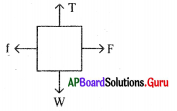
A) Central Natural Gas
B) Central Nano Gas
C) Compressed Natural Gas
D) Conditional Natural Gas
Answer:
C) Compressed Natural Gas

Question 14.
…………. neither have a fixed shape nor volume.
A) Solids
B) Liquids
C) Gases
D) None of these
Answer:
C) Gases

AP 8th Class Physical Science Bits Chapter 3 Matter Around Us with Answers

Question 15.
Decrease in the volume of same quan-tity of gas under pressure is known as ……..
A) compressibility
B) rigidity
C) expansion
D) contraction
Answer:
A) compressibility

Question 16.
LPG stands for ………….
A) Litre Petroleum Gas
B) Longitudinal Petroleum Gas
C) Latitudinal Petroleum Gas
D) Liquefied Petroleum Gas
Answer:
D) Liquefied Petroleum Gas

Question 17.
…………. are highly compressible.
A) Liquids
B) Gases
C) Solids
D) Both A & B
Answer:
B) Gases

Question 18.
The movement of air, vapours of scent and smoke is known as ………..
A) diffusion
B) compressibility
C) rigidity
D) evaporation
Answer:
A) diffusion

AP 8th Class Physical Science Bits Chapter 3 Matter Around Us with Answers

Question 19.
The rate of diffusion is higher for ……..
A) solids
B) liquids
C) gases
D) none of these
Answer:
C) gases

Question 20.
All matter is made up of …….
A) very large particles
B) large particles
C) small particles
D) tiny particles
Answer:
D) tiny particles

Question 21.
Particles of matter have some …………. between them.
A) weight
B) mass
C) space
D) volume
Answer:
C) space

Question 22.
On dissolving solid in liquid, ………… particles enter into space between the …………. particles.
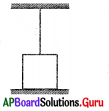
A) solid, liquid
B) liquid, liquid
C) liquid, solid
D) solid, solid
Answer:
A) solid, liquid

AP 8th Class Physical Science Bits Chapter 3 Matter Around Us with Answers

Question 23.
Particles of matter have ………….. between them that keeps the particles together.
A) force of repulsion
B) force of attraction
C) both
D) none of these
Answer:
B) force of attraction

Question 24.
Diffusion is possible only when the particles of matter …………
A) are stationary
B) move continuously
C) both
D) none of these
Answer:
B) move continuously

Question 25.
Space between the particles is very high in ………..
A) solid
B) liquid
C) gas
D) none of these
Answer:
C) gas

Question 26.
Rate of diffusion of gases is very high ………. because and ……….. of gas particles.
A) lower’speed, least space
B) higher speed, least space
C) higher speed, greater space
D) lower speed, greater space
Answer:
C) higher speed, greater space

AP 8th Class Physical Science Bits Chapter 3 Matter Around Us with Answers

Question 27.
Volume of water shinks between ……………
A) 0°C to 4°C
B) 50°C to 100°C
C) 60°C to 70°C
D) 100°C to 120°C
Answer:
A) 0°C to 4°C

Question 28.
The temperature at which solid melts to become a liquid is called ……..
A) boiling point
B) melting point
C) sublimation point
D) freezing point
Answer:
B) melting point

Question 29.
The process of melting is called …………..
A) evaporation
B) fusion
C) boiling
D) sublimation
Answer:
B) fusion

Question 30.
The melting point of substance depends ………….. on among the particles.
A) force of attraction
B) force to repulsion
C) both A & B
D) none of these
Answer:
A) force of attraction

AP 8th Class Physical Science Bits Chapter 3 Matter Around Us with Answers

Question 31.
As the force of attraction among the particles increases the melting point ………….
A) increases
B) decreases
C) does not change
D) none of these
Answer:
A) increases

Question 32.
The amount of heat energy that is required to overcome the attractive force among the particles to change the state is given by ………… of the substance.
A) specific heat
B) heat capacity
C) latent heat
D) none of these
Answer:
C) latent heat

Question 33.
The temperature at which liquid starts boiling at the atmospheric pressure is known as its ………….
A) boiling point
B) melting point
C) freezing point
D) sublimation point
Answer:
A) boiling point

Question 34.
Statement -1: Matter can change its state by changing temperature.
Statement – II: Matter can change its state by changing pressure.
A) Both statements -1 & II are true.
B) Statement -1 is true and statement – II is false.
C) Statement -1 is false and statement – II is true.
D) Both statements -1 & II are false.
Answer:
A) Both statements -1 & II are true.

AP 8th Class Physical Science Bits Chapter 3 Matter Around Us with Answers

Question 35.
300 K is equal to ……….. °C.
A) 37
B) 17
C) 27
D) 47
Answer:
C) 27

Question 36.
The phenomena of change of liquid into vapours at any temperature be-low its boiling point is called ………..
A) evaporation
B) sublimation
C) boiling
D) melting
Answer:
A) evaporation

Question 37.
As the surface area increases, the rate of evaporation ……………
A) increases
B) decreases
C) does not change
D) none of these
Answer:
A) increases

Question 38.
……………. is a surface phenomena.
A) Boiling
B) Melting
C) Evaporation
D) Sublimation
Answer:
C) Evaporation

AP 8th Class Physical Science Bits Chapter 3 Matter Around Us with Answers

Question 39.
…………….. is bulk phenomena.
A) Boiling
B) Evaporation
C) Condensation
D) None of these
Answer:
A) Boiling

Question 40.
Assertion (A): Salt crystal is not solid. Reason (R) : Shape of the salt crystals is depending on the shape of the container.
A) A’ and ‘R’ are true and ’R’ is a cor-rect explanation of A’
B) A’ and ‘R’ are true and ‘R’ is not a correct explanation of A’
C) A’ is false and ‘R’ is true
D) A’ and ‘R’ are false
Answer:
D) A’ and ‘R’ are false

Question 41.
Assertion (A) : Smell of petrol can identify from some distance. Reason (R) : Solids diffuse in liquid.
A) A and ‘R’ are true and ‘R’ is a cor-rect explanation of A’
B) A’ and ’R’ are true and ‘R’ is not a correct explanation of A’
C) A’ is false and ‘R’ is true
D) A’ and ‘R’ are false
Answer:
B) A’ and ’R’ are true and ‘R’ is not a correct explanation of A’

Question 42.
Which of the following statement is true ?
A. During respiration oxygen diffuses from lungs into blood.
B. During respiration carbon dioxide diffuses from blood to lungs.
A) A only
B) B only
C) A and B
D) None
Answer:
C) A and B

AP 8th Class Physical Science Bits Chapter 3 Matter Around Us with Answers

Question 43.
Who is correct ?
Sailaja : NH3 diffuses faster than HCl.
Lalitha: HCl diffuses faster than NH3.
A) Sailaja
B) Lalitha
C) Both
D) None
Answer:
A) Sailaja

Question 44.
Which of the following is a false state-ment?
A) There exists space between particles in gases.
B) Particles of matter attracts each other.
C) Particles of solids are bigger than that of gas particles.
D) None
Answer:
C) Particles of solids are bigger than that of gas particles.

Question 45.
Match the following:
1) Water – KMnO4 crystals — a) solid diffuses in liquid
2) Air – SO2 gas — b) gas diffuses in gas
3) Petrol – Kerosene — c) liquid diffuses in liquid
A) 1-a, 2-b, 3-c
B) 1-b, 2-a, 3-c
C) 1-a, 2-c, 3-b
D) 1-b, 2-c, 3-a
Answer:
A) 1-a, 2-b, 3-c

Question 46.
Which of the following statement is true ?
Poomima : Solids, liquids and gases diffuse into liquids.
Sheshu : Rate of diffusion of gases is higher than that of liquids or solids.
A) Poornima
B) Sheshu
C) A and B
D) None
Answer:
C) A and B

AP 8th Class Physical Science Bits Chapter 3 Matter Around Us with Answers

Question 47.
Assertion (A) : Rate of diffusion of gases is higher than that of liquids or solids.
Reason (RA): There is a greater space between gas particles in gases.
Reason (RB): Speed of gas particles in gas is more than that of liquids or solids.
Correct Reason to Assertion is / are
A) R1
B) R2
C) R1 and R2
D) Neither R1 nor R2
Answer:
C) R1 and R2

Question 48.
Assertion (A): Particles in water at 0°C have more energy as compared to particles in ice at the same temperature.
Reason (R): The particles in water release heat energy during the pro¬cess of conversion from ice to liquid.
A) A is true and R is false
B) A is false and R is true
C) Both A and R are true
D) Both A and R are false
Answer:
A) A is true and R is false

Question 49.
Which of the following statement is true ?
A) Chaitanya : Water can change into watervapour without reaching its boiling point.
B) Subbayya : Ice can change into water without reaching its melting point.
A) A
B) B
C) A and B
D) Neither A nor B
Answer:
A) A

Question 50.
Milk : Liquid :: Curd : …………..
A) Solid
B) Liquid
C) Gas
D) Plasma
Answer:
A) Solid

AP 8th Class Physical Science Bits Chapter 3 Matter Around Us with Answers

Question 51.
By the given conversation guess the substance ’A’.
Srilatha : Does ‘A’ possess fixed volume?
Susheela: Yes.
Srilatha : Does ‘A’ possess fixed shape?
Susheela: No.
A) Solid
B) Liquid
C) Gas
D) ‘B’ or ’C
Answer:
B) Liquid

Question 52.
Guess the shape of the water, if it spills on a floor is
A) circle
B) line
C) triangular
D) we cannot say
Answer:
D) we cannot say

Question 53.
One litre of water can fill in cylinder A and two litres of water can fill in cylinder B. Then two litres of gas can fill in
A) cylinder A
B) cylinder B
C) both ‘A’ and ‘B’
D) not possible
Answer:
C) both ‘A’ and ‘B’

Question 54.
State of the water at 274 K is
A) liquid
B) solid
C) vapour
D) we cannot say
Answer:
A) liquid

AP 8th Class Physical Science Bits Chapter 3 Matter Around Us with Answers

Question 55.
In a cloudy day wet clothes do not dry quickly – because
A) more surface area
B) high wind speed
C) high humidity
D) above all
Answer:
C) high humidity

Question 56.
The force of attraction between the particles of ………….. is strong.
A) liquid
B) gas
C) solid
D) none
Answer:
C) solid

Question 57.
The process of conversion of solid into liquid is
A) fusion
B) diffusion
C) boiling
D) changing
Answer:
A) fusion

Question 58.
Oxygen and Carbon dioxide from atmosphere diffuse and dissolve in wa-ter is essential for survival of ………..
A) human beings
B) land animals
C) birds
D) aquatic animals
Answer:
D) aquatic animals

AP 8th Class Physical Science Bits Chapter 3 Matter Around Us with Answers

Question 59.
Among ammonia and hydrogen chloride which gas travels faster?
A) Ammonia
B) Hydrogen chloride
C) Both travel with same speed
D) None of these
Answer:
A) Ammonia

Question 60.
Hydrochloric acid and Ammonia react together and form a white substance called ………
A) Ammonium hydride
B) Ammonium hydroxide
C) Ammonium chloride
D) Nitric acid
Answer:
C) Ammonium chloride

Question 61.
When we heat a substance the particles gain additional ………….
A) density
B) mass
C) energy
D) none of these
Answer:
C) energy

Question 62.
Particles of water at 0°C have …………. energy than the particles in ice at the same temperature.
A) more
B) less
C) same
D) none of these
Answer:
A) more

AP 8th Class Physical Science Bits Chapter 3 Matter Around Us with Answers

Question 63.
Generally, the given instrument is not suitable to measure solids.
A) Simple balance
B) Measuring jar
C) Spring balance
D) None
Answer:
B) Measuring jar

Question 64.
Take water into a syringe, close the hole at the nosil and push the piston. By this experiment you can conclude that
A) Liquids are compressible
B) Liquids are not compressible
C) Liquids contain space between their particles
D) Liquids do not contain space between their particles
Answer:
B) Liquids are not compressible

Question 65.
Take some ice cubes in a beaker. Insert a thermometer. Heat the beaker continuously upto changed into water. The reading in thermometer
A) Increases continuously
B) Decreases continuously
C) First increases then decreases
D) Increases then remains constant
Answer:
D) Increases then remains constant

AP 8th Class Physical Science Bits Chapter 3 Matter Around Us with Answers

Question 66.
These substances are required to prove that the speed of diffusion is different for different substances.
A) Test tube, potassium permanganate, water
B) Flask, copper sulphate, water
C) Long glass tube, cotton, HCl, NH3
D) Long glass tube, CuSO4 Sol., ZnSO4 Sol.
Answer:
C) Long glass tube, cotton, HCl, NH3

Question 67.
To prove the effect of surface area on evaporation we need
A) water, test tube, conical flask
B) water, test tube, China dish
C) water, China dish, saucer
D) water, petrol, test tubes
Answer:
B) water, test tube, China dish

Question 68.
What do you to change a substance from gas state to liquid state ?
A) By giving heat
B) By cooling
C) By increasing pressure
D) By decreasing pressure
A) A or C
B) B or C
C) A or D
D) B or D
Answer:
D) B or D

Question 69.
The gas that diffuses from lungs into blood is ………….
A) oxygen
B) carbon dioxide
C) water vapour
D) hydrogen
Answer:
A) oxygen

AP 8th Class Physical Science Bits Chapter 3 Matter Around Us with Answers

Question 70.
The gas that diffuses from blood into lungs is …………
A) oxygen
B) carbon dioxide
C) water vapour
D) hydrogen
Answer:
B) carbon dioxide

Question 71.
Boiling point of water ……….
A) 0°C
B) 100°C
C) 373 K
D) Both B & C
Answer:
D) Both B & C

Question 72.
Solid carbon dioxide is known as …………

A) wet ice
B) dry ice
C) ice
D) liquid ice
Answer:
B) dry ice

Question 73.
The amount of water vapour present in air is called ………..
A) pressure
B) sweating
C) humidity
D) evaporation
Answer:
C) humidity

AP 8th Class Physical Science Bits Chapter 3 Matter Around Us with Answers

Question 74.
As the humidity increases, the rate of evaporation ………….
A) increases
B) decreases
C) does not change
D) none of these
Answer:
B) decreases

Question 75.
As the wind speed increases, the rate of evaporation …………

A) decreases
B) increases
C) does not change
D) none of these
Answer:
B) increases

Question 76.
Water, milk, oil, stone, wood, rain-bow, book, clouds, smoke.
Which of the above is odd one ?
A) clouds
B) rainbow
C) water
D) smoke
Answer:
B) rainbow

Question 77.
AP 8th Class Physical Science Bits Chapter 3 Matter Around Us with Answers 1
From the above table, x, y and z are ……………. respectively.
A) solid, liquid, gas
B) solid, gas, liquid
C) liquid, solid, gas
D) liquid, gas, solid
Answer:
A) solid, liquid, gas

AP 8th Class Physical Science Bits Chapter 3 Matter Around Us with Answers

Question 78.
AP 8th Class Physical Science Bits Chapter 3 Matter Around Us with Answers 2
The boiling and melting points of the given substance ‘X’ are
A) 10°C, 80°C
B) 80°C, 10°C
C) 80°C, – 10°C
D) -10°C, 80°C
Answer:
B) 80°C, 10°C

Question 79.
A is liquid
B is solid
C is gas
Which of the above has both fixed shape and volume?
A) A
B) B
C) C
D) A and B
Answer:
B) B

Question 80.
H2O at 0°C – State (A)
H20 at 100°C – State (B)
H20 at 80°C – State (C)
Which state is solid state ?
A) State (A)
B) State (B)
C) State (C)
D) None
Answer:
D) None

AP 8th Class Physical Science Bits Chapter 3 Matter Around Us with Answers

Question 81.
(1) Wood, (2) Water, (3) Kerosene → Set 1
Which of the above evaporates quickly ?
A) Cl)
B) (2)
C) (3)
D) (2) and (3)
Answer:
C) (3)

Question 82.
In the given figure, identify the name of the material used in the dropper.
AP 8th Class Physical Science Bits Chapter 3 Matter Around Us with Answers 3
A) Blue ink
B) Red ink
C) Potassium permanganate
D) All
Answer:
D) All

Question 83.
What information does the given figure shows?
AP 8th Class Physical Science Bits Chapter 3 Matter Around Us with Answers 4
A) Arrangement of particles in solids
B) Arrangement of particles in liquids
C) Arrangement of particles in gases
D) All the above
Answer:
D) All the above

AP 8th Class Physical Science Bits Chapter 3 Matter Around Us with Answers

Question 84.
Which type of activity does the given figure represents?
AP 8th Class Physical Science Bits Chapter 3 Matter Around Us with Answers 5
A) Effect of temperature on change of state
B) Changes of matter
C) Diffusion of two gases
D) None
Answer:
A) Effect of temperature on change of state

Question 85.
AP 8th Class Physical Science Bits Chapter 3 Matter Around Us with Answers 6
Label the parts a and b as …………, ………….. is correct.
A) HCl, NH3
B) NH3, HCl
C) HCl, Cl2
D) Cl2, HCl
Answer:
B) NH3, HCl

Question 86.
AP 8th Class Physical Science Bits Chapter 3 Matter Around Us with Answers 7
‘x’ is a substance with same volume. Hence ‘x’ can be labelled as
A) liquid
B) gas
C) A or B
D) solid
Answer:
A) liquid

AP 8th Class Physical Science Bits Chapter 3 Matter Around Us with Answers

Question 87.
AP 8th Class Physical Science Bits Chapter 3 Matter Around Us with Answers 8
If you draw figure ’C’, how do you draw?
AP 8th Class Physical Science Bits Chapter 3 Matter Around Us with Answers 9
Answer:
C)

Question 88.
AP 8th Class Physical Science Bits Chapter 3 Matter Around Us with Answers 10
Identify the solid state.
A) AB
B) BC
C) CD
D) DE
Answer:
A) AB

Question 89.
Sweating gives cooling while
A) condensing
B) evaporating
C) both A and B
D) boiling
Answer:
B) evaporating

Question 90.
LPG cylinders are very appreciable because,
A) LPG has no fixed shape
B) LPG has fixed volume
C) LPG is compressible
D) LPG is not compressible
Answer:
C) LPG is compressible

AP 8th Class Physical Science Bits Chapter 3 Matter Around Us with Answers

Question 91.
We store water in earthen pots in winter because,
A) pots contain tiny holes and evaporates water.
B) pots contain tiny holes and condensate water.
C) pots obsorb heat.
D) water absorb heat.
Answer:
A) pots contain tiny holes and evaporates water.

Question 92.
If humidity increases, then rate of evaporation of sweating over the body
A) increases
B) decreases
C) A or B
D) first increases and then decreases
Answer:
B) decreases

Question 93.
If the body temperature of a man is 34°C, it equals to
A) 34 K
B) 239 K
C) 234 K
D) 307 K
Answer:
D) 307 K

Question 94.
We prefer to sip hot tea with a saucer than a cup, because, saucer provides ………….. than a cup.
A) less volume
B) more volume
C) more surface area
D) less surface area
Answer:
C) more surface area

AP 8th Class Physical Science Bits Chapter 3 Matter Around Us with Answers

Question 95.
Steam produces more severe burns than boiled water, because steam contains energy of ……………. more than that of boiled water.
A) latent heat of fusion
B) latent heat of vapourisation
C) latent heat of melting
D) above all
Answer:
B) latent heat of vapourisation

Question 96.
We can observe water droplets on the outer surface of a glass containing ice cold water. Because
A) evaporation of ice – water in the glass.
B) evaporation of water vapour in the air.
C) condensation of ice cold water in the glass.
D) condensation of water vapour in the air.
Answer:
D) condensation of water vapour in the air.

Question 97.
Cotton clothes give comfort in summer. Because, they can support ……………. of the sweating.
A) condensation
B) evaporation
C) melting
D) above all
Answer:
B) evaporation

Question 98.
Rubber band is a
A) solid
B) liquid
C) gas
D) none
Answer:
A) solid

AP 8th Class Physical Science Bits Chapter 3 Matter Around Us with Answers

Question 99.
Sponge is a
A) solid
B) liquid
C) gas
D) none
Answer:
A) solid

Question 100.
Clothes can dry faster on
A) windy day
B) rainy day
C) sunny day
D) drier
Answer:
C) sunny day

Question 101.
Feeling cooler after sweating is an experience of
A) melting
B) boiling
C) sublimation
D) evaporation
Answer:
D) evaporation

Question 102.
For a given substance, in which state of matter is the space between its constituent particles the maximum?
A) In solid state
B) In liquid state
C) In gaseous state
D) Depends on the type of substance
Answer:
C) In gaseous state

AP 8th Class Physical Science Bits Chapter 3 Matter Around Us with Answers

Question 103.
During phase change the temperature of the substance
A) Keeps decreasing
B) Keeps increasing
C) Remains constant
D) First increases and then decreases
Answer:
C) Remains constant

AP 8th Class Physical Science Bits Chapter 1 Force with Answers

Practice the AP 8th Class Physical Science Bits with Answers Chapter 1 Force on a regular basis so that you can attempt exams with utmost confidence.

AP State Syllabus 8th Class Physical Science Bits 1st Lesson Force with Answers

Choose the correct answer.

Question 1.
The S.I. unit of force is
A) Pascal
B) Newton
C) Square metre
D) Tesla
Answer:
B) Newton

Question 2.
The resisting force to movement of an object is called
A) friction
B) magnetic force
C) tension
D) normal force
Answer:
A) friction

AP 8th Class Physical Science Bits Chapter 1 Force with Answers

Question 3.
………… force acts on the suspended body along the string.
A) Friction
B) Tension
C) Magnetic force
D) Muscular force
Answer:
B) Tension

Question 4.
The forces exerted by a charged body on another charged or uncharged body is known as
A) Electrostatic force
B) Friction
C) Tension
D) Normal force
Answer:
A) Electrostatic force

Question 5.
When the object is in non-uniform motion, it is said to be in
A) displacement
B) momentum
C) acceleration
D) weight
Answer:
C) acceleration

Question 6.
The force that a solid surface exerts on any object in the normal direction is called
A) Muscular force
B) Normal Force
C) Tension force
D) Magnetic force
Answer:
B) Normal Force

AP 8th Class Physical Science Bits Chapter 1 Force with Answers

Question 7.
Which of the following statements is correct about a force?
A) It can be seen but it can’t be felt.
B) It is needed to start an object moving.
C) It can change the shape of an object.
D) It can make moving object stop.
Answer:
A) It can be seen but it can’t be felt.

Question 8.
Pressure can be increased by
A) Increasing both the area and the force.
B) Decreasing the area and increasing the force.
C) Increasing the area and decreasing the force.
D) Decreasing both the area and the force.
Answer:
B) Decreasing the area and increasing the force.

Question 9.
Pressure varies with force (F) as (provided area is same)
A) F
B) [latex]\frac{1}{F}[/latex]
C) F2
D) [latex]\frac{1}{\mathrm{~F}^{2}}[/latex]
Answer:
A) F

Question 10.
An action that involves pushing force is
A) Dragging a bag on a floor.
B) Kicking a ball.
C) Lifting a book from a table.
D) Lifting a pen off a table.
Answer:
B) Kicking a ball.

AP 8th Class Physical Science Bits Chapter 1 Force with Answers

Question 11.
Pressure depends on and
A) Mass, Force
B) Mass, Volume
C) Force, Area
D) Force, Volume
Answer:
C) Force, Area

Question 12.
Force has ………. as well as ………
A) mass, weight
B) magnitude, direction
C) mass, action
D) action, reaction
Answer:
B) magnitude, direction

Question 13.
Pressure exerted by a sharp needle on a surface is
A) More than the pressure exerted by a blunt needle.
B) Less than the pressure exerted by a blunt needle.
C) Equal to the pressure exerted by a blunt needle.
D) None of these.
Answer:
A) More than the pressure exerted by a blunt needle.

Question 14.
A force can change ……… of a body.
A) shape
B) direction
C) speed
D) all the above
Answer:
D) all the above

AP 8th Class Physical Science Bits Chapter 1 Force with Answers

Question 15.
The force acting on unit area of a surface is called
A) momentum
B) density
C) pressure
D) velocity
Answer:
C) pressure

Question 16.
The unit of force in S.I. system is
i) Kg ms-2
ii) Newton
iii) Pascal
iv) Kg ms-1
A) Both i and ii
B) iii and iv
C) i and iii
D) i and iv
Answer:
A) Both i and ii

Question 17.
The unit of pressure in S.I. system is
A) Newton
B) Pascal
C) Ampere
D) Henry
Answer:
B) Pascal

Question 18.
Pressure = …………
A) Force
B) Force x area
C) Area / force
D) Force / area
Answer:
D) Force / area

AP 8th Class Physical Science Bits Chapter 1 Force with Answers

Question 19.
The force of attraction between any two objects having mass is
A) frictional
B) muscular
C) gravitational
D) magnetic
Answer:
C) gravitational

Question 20.
For the body at rest, the net force is …………
A) ma
B) not equal to zero
C) 0
D) none of these
Answer:
C) 0

Question 21.
For the body at motion, the net force is
A) ma
B) o
C) not equal to zero
D) none of these
Answer:
C) not equal to zero

Question 22.
If the area is less, then the value of pressure
A) less
B) more
C) does not change
D) none of these
Answer:
B) more

AP 8th Class Physical Science Bits Chapter 1 Force with Answers

Question 23.
The force acting in normal direction is
A) gravitational force
B) magnetic force
C) muscular force
D) normal force
Answer:
D) normal force

Question 24.
The force exerted by using our body muscles is
A) muscular force
B) magnetic force
C) gravitational force
D) normal force
Answer:
A) muscular force

Question 25.
Choose correct matching option:
Group – A — Group – B
1. Gravitational force — a) Horse pulling a cart
2. Frictional force — b) Iron nails attracted
3. Electrostatic force — c) Fruit falling from a tree
4. Magnetic force — d) Heat is generated
5. Muscular — e) Bits of paper are raised
A) 1 – c, 2 – d, 3 – e, 4 – b, 5 – a
B) 1 – a, 2 – b, 3 – c, 4 – d, 5 – e
C) 1 – e, 2 – c, 3 – d, 4 – a, 5 – b
D) 1 – e, 2 – d, 3 – a, 4 – b, 5 – c
Answer:
A) 1 – c, 2 – d, 3 – e, 4 – b, 5 – a

Question 26.
Choose correct matching option:
Group – A — Group – B
1. Force responsible for attraction between two objects. — a) Weight
2. Force by which the Earth, the Moon and other massive large objects attracts another object. — b) Mass
3. Force applied by muscles of our body. — c) Newton
4. Force exerted by a surface as an object moves across it. — d) Muscular
5. The amount of substance contained in an object. — e) Magnetic
6. Units of force. — f) Gravitational
7. Force due to earth is called — g) Frictional
A) 1 – e, 2 – f, 3 – d, 4 – g, 5 – b, 6 – c, 7 – a
B) 1 – a, 2 – b, 3 – c, 4 – d, 5 – e, 6 – f, 7 – g
C) 1 – b, 2 – c, 3 – d, 4 – e, 5 – f, 6 – g, 7 – a
D) 1 – c, 2 – d, 3 – e, 4 – f, 5 – g, 6 – a, 7 – b
Answer:
A) 1 – e, 2 – f, 3 – d, 4 – g, 5 – b, 6 – c, 7 – a

AP 8th Class Physical Science Bits Chapter 1 Force with Answers

Question 27.
The resistance to the movement of a body over the surface of another is
A) force
B) friction
C) workdone
D) energy
Answer:
B) friction

Question 28.
The direction of friction and the direction of motion are always
A) same
B) opposite
C) A or B
D) we cannot say
Answer:
B) opposite

Question 29.
Direction and magnitude are fixed for
A) normal force
B) frictional force
C) tension force
D) gravitational force due to earth
Answer:
D) gravitational force due to earth

Question 30.
The force acts between a charged balloon and piece of papers
A) magnetic
B) gravitational
C) contact
D) electrostatic
Answer:
D) electrostatic

AP 8th Class Physical Science Bits Chapter 1 Force with Answers

Question 31.
The gravitational force acts between
A) you and your friend
B) you and earth
C) you and moon
D) above all
Answer:
D) above all

Question 32.
We can differentiate ‘contact force’ and ‘field force’ by
A) magnitude
B) direction
C) distance of contact
D) above all
Answer:
C) distance of contact

Question 33.
Net force is zero, when an object is in
A) uniform motion
B) rest
C) A and B
D) uniform acceleration
Answer:
C) A and B

Question 34.
Which of the following is wrong?
A) Force can change the direction of an object
B) Force can change the shape of an object
C) Force can change the speed of an object
D) Force can change the mass of an object
Answer:
D) Force can change the mass of an object

AP 8th Class Physical Science Bits Chapter 1 Force with Answers

Question 35.
Normal force is applicable only when the given force is exist.
A) gravitational
B) frictional
C) both A and B
D) none
Answer:
A) gravitational

Question 36.
Match it.
a) Changes the speed of an object — i) hitting a ball projected by a bowler
b) Changes the shape of an object — ii) making a ship with a paper
c) Changes the direction of an object — iii) applying brakes for a moving car
A) a – iii, b – ii, c – i
B) a – i, b – ii, c – iii
C) a – iii, b – i, c – ii
D) a – ii, b – i, c – iii
Answer:
A) a – iii, b – ii, c – i

Question 37.
Which of the following is a correct statement?
A) A car is in rest, no forces acting on it.
B) A car is in rest, net force acting on it is zero.
C) A car is in non-uniform motion, net force acting on it is zero.
D) None
Answer:
B) A car is in rest, net force acting on it is zero.

Question 38.
Assertion (A): Magnetic force is a field force.
Reason (R): A magnet can attract or repel another magnet with zero magnitude.
A) A and R are true
B) A and R are false
C) A is true, but R is false
D) A is false, but R is true
Answer:
C) A is true, but R is false

AP 8th Class Physical Science Bits Chapter 1 Force with Answers

Question 39.
Take two balloons inflate them. Rub both with your hair. Bring them to closer to each other. Then they
A) repels
B) attracts
C) no change
D) we cannot say anything
Answer:
A) repels

Question 40.
An apple is falling from a tree. The forces acting on it
A) drag
B) gravitational
C) normal
D) above all
Answer:
D) above all

Question 41.
A free falling body can stop by using
A) gravitational force
B) frictional force
C) normal force
D) any of the given
Answer:
C) normal force

Question 42.
Which of the following force is exists anywhere in the universe?
A) Gravitational force
B) Magnetic force
C) Normal force
D) Above all
Answer:
A) Gravitational force

AP 8th Class Physical Science Bits Chapter 1 Force with Answers

Question 43.
What will happen, if you apply more force on a moving body?
A) Increases its speed
B) Decreases its speed
C) A or B
D) A and B
Answer:
C) A or B

Question 44.
Which one of these is not a contact force?
A) Muscular force
B) Frictional force
C) Normal force
D) Magnetic force
Answer:
D) Magnetic force

Question 45.
Let the forces F1 and F2 act on the table in opposite directions, F1 > F2 , the Fnet = …………….
A) F1 – F2
B) F2 + F2
C) 0
D) 2F2 – F1
Answer:
A) F1 – F2

Question 46.
Which of the following statements about force is incorrect?
A) A force can change the mass of an object.
B) A force can change the speed (or) direction.
C) A force can change the shape and size of an object.
D) Forces can stop a moving object.
Answer:
A) A force can change the mass of an object.

AP 8th Class Physical Science Bits Chapter 1 Force with Answers

Question 47.
Which of the following statements is incorrect?
A) Friction helps us to twist an object.
B) Friction is a force that opposes motion.
C) Objects have weight because of frictional force between them and the Earth.
D) More friction is produced between rough surfaces than between smooth surfaces.
Answer:
C) Objects have weight because of frictional force between them and the Earth.

Question 48.
Which of the following statements is correct about force of gravity?
A) The larger the mass, the greater is gravity.
B) Force of gravity is commonly called weight.
C) It makes the moon go around the earth.
D) The larger the weight of an object, greater is the gravity.
Answer:
C) It makes the moon go around the earth.

Question 49.
What will happen if a compass placed near a bar magnet?
A) Compass needle moves by muscular force.
B) Compass needle moves by gravitational force.
C) Compass needle moves by frictional force.
D) Compass needle moves by magnetic force.
Answer:
D) Compass needle moves by magnetic force.

Question 50.
What happens if a boy through a stone?
A) Some muscles will expend
B) Some muscles will contract
C) Both A and B
D) Some muscles will dislocate
Answer:
C) Both A and B

AP 8th Class Physical Science Bits Chapter 1 Force with Answers

Question 51.
A book on a table is in rest. Then the magnitude of the given force is zero.
A) Normal
B) Frictional
C) Gravitational
D) None
Answer:
B) Frictional

Question 52.
What will happen if thread is broken?
AP 8th Class Physical Science Bits Chapter 1 Force with Answers 1
A) Force of tension > Force of gravity
B) Force of friction > Force of gravity
C) Force of tension < Force of gravity
D) Force of gravity = Force of tension
Answer:
C) Force of tension < Force of gravity

Question 53.
No. of forces acting on acting on the block ‘B’ is
AP 8th Class Physical Science Bits Chapter 1 Force with Answers 2
A) 1
B) 2
C) 3
D) 4
Answer:
B) 2

AP 8th Class Physical Science Bits Chapter 1 Force with Answers

Question 54.
A push or a pull is called
A) friction
B) pressure
C) force
D) none of these
Answer:
C) force

Question 55.
Erasing involves
A) a push
B) a pull
C) both
D) none of these
Answer:
C) both

Question 56.
Hoisting a flag is related to
A) push
B) pull
C) push and pull both
D) pressure
Answer:
B) pull

Question 57.
A person is pulling water from well.
Which type of force it is?
A) Muscular force
B) Magnetic force
C) Friction force
D) Electrostatic force
Answer:
A) Muscular force

AP 8th Class Physical Science Bits Chapter 1 Force with Answers

Question 58.
With the increase in the weight of an object the pressure.
A) Increases
B) Decreases
C) Is not affected
D) None
Answer:
A) Increases

Question 59.
Read and study the given actions carefully and answer correctly to “Where the friction is useful”……………
I) Striking a match stick
II) Writing with a pencil
III) Pushing a cupboard from one room to another.
IV) Sharpening a knife.
A) I and II only
B) I and III only
C) I, II and IV only
D) All of the above
Answer:
C) I, II and IV only

Question 60.
In the given experiment which type of force is represented?
AP 8th Class Physical Science Bits Chapter 1 Force with Answers 3
A) Magnetic
B) Electrostatic
C) Gravitational
D) Tension
Answer:
A) Magnetic

AP 8th Class Physical Science Bits Chapter 1 Force with Answers

Question 61.
AP 8th Class Physical Science Bits Chapter 1 Force with Answers 4
From the given activity your conclusion is
a) friction depends on smoothness of the surface of an object.
b) friction depends on smoothness of the inclined plane.
A) a only
B) b only
C) a and b only
D) a or b only
Answer:
C) a and b only

Question 62.
The apparatus required to find a limiting force of a thread.
A) Simple balance
B) Spring balance
C) Electronic balance
D) None
Answer:
B) Spring balance

Question 63.
How do yon show to at force can change the shape of an object?
A) Squeezing a sponge with hand
B) Squeezing an iron block with hand
C) Throwing a ball
D) Stopping a ball
Answer:
A) Squeezing a sponge with hand

AP 8th Class Physical Science Bits Chapter 1 Force with Answers

Question 64.
From this experiment, you can conclude that
AP 8th Class Physical Science Bits Chapter 1 Force with Answers 5
A) the surface area is smaller, the pressure will be greater.
B) the surface area is greater, the pressure will be greater.
C) the surface area is smaller, the pressure remains same.
D) none
Answer:
A) the surface area is smaller, the pressure will be greater.

Question 65.
From the given figure, the force which is pulling the cart is
AP 8th Class Physical Science Bits Chapter 1 Force with Answers 6
A) contact force
B) force at a distance
C) muscular force
D) A and C
Answer:
D) A and C

Question 66.
From the given diagram, you may noticed that F pair of forces acting in opposite directions are
AP 8th Class Physical Science Bits Chapter 1 Force with Answers 7
a) Normal force and frictional force
b) Normal force and gravitational force
c) Frictional force and external force
d) Normal force and external force
e) Frictional force and gravitational force
A) a, b
B) b, c
C) c, d
D) d, e
Answer:
B) b, c

AP 8th Class Physical Science Bits Chapter 1 Force with Answers

Question 67.
In the given diagram, field force is
AP 8th Class Physical Science Bits Chapter 1 Force with Answers 8
A) f
B) T
C) F
D) W
Answer:
D) W

Question 68.
The forces acting in the given system are
AP 8th Class Physical Science Bits Chapter 1 Force with Answers 9
A) Tension and gravitational
B) Tension and frictional
C) Tension, frictional, gravitational
D) Tension or gravitational
Answer:
A) Tension and gravitational

Question 69.
Wrongly mentioned in the table is

Force Exerts
a Magnetic Around the magnet
b Electrostatic Around the charge
c Gravitational Around the earth

A) a
B) b
C) c
D) None
Answer:
C) c

Question 70.
The force of a field is greater at
AP 8th Class Physical Science Bits Chapter 1 Force with Answers 10
A) a
B) b
C) c
D) All are equal
Answer:
A) a

AP 8th Class Physical Science Bits Chapter 1 Force with Answers

Question 71.
The net force is

Force Magnitude Direction
F 40 N Towards east
f 20 N Towards west
T 30 N Towards up
W 30 N Towards down

A) 20 N – Towards east
B) 40 N – Towards west
C) 20 N – Towards down
D) None
Answer:
A) 20 N – Towards east

Question 72.
The forces acting on the body are
AP 8th Class Physical Science Bits Chapter 1 Force with Answers 11
A) +F1, +F2, -F3, +F4
B) -F1 + F2, -F3, +F4
C) +F1, -F2, -F3, -F4
D) +F1, -F2, -F3, +F4
Answer:
C) +F1, -F2, -F3, -F4

Question 73.
AP 8th Class Physical Science Bits Chapter 1 Force with Answers 12
The body moves in the direction of the given arrow mark
A) →
B) ←
C) ↓
D) ↑
Answer:
A) →

Question 74.
Study the above diagram. Why the given object does not move?
AP 8th Class Physical Science Bits Chapter 1 Force with Answers 13
A) Force – A > Force – B
B) Force – B > Force – A
C) both forces are equal.
D) both forces are acting in opposite directions.
Answer:
C) both forces are equal.

AP 8th Class Physical Science Bits Chapter 1 Force with Answers

Question 75.
Siri wants to hit some pins in a balloon game as shown in the figure. To do so, where she should apply a force on the balloon?
AP 8th Class Physical Science Bits Chapter 1 Force with Answers 14
A) I
B) II
C) III
D) IV
Answer:
B) II

Question 76.
Study the figure given below. At which point, the pressure is greater?
AP 8th Class Physical Science Bits Chapter 1 Force with Answers 15
A) I
B) II
C) III
D) IV
Answer:
C) III

Question 77.
AP 8th Class Physical Science Bits Chapter 1 Force with Answers 16
From the above diagram
The force exerted by one rubber band is F. Then the net force acting on your finger when four rubber bands are used is
A) F
B) 2F
C) 3F
D) 4F
Answer:
D) 4F

Question 78.
The diagram which showing all the forces acting on object at a particular instant is
A) Free body diagram
B) Free fall diagram
C) Free object diagram
D) None of these
Answer:
A) Free body diagram

AP 8th Class Physical Science Bits Chapter 1 Force with Answers

Question 79.
Name the type of force you observed in the figure.
AP 8th Class Physical Science Bits Chapter 1 Force with Answers 17
A) Magnetic force
B) Gravitational force
C) Electrostatic force
D) Tension
Answer:
D) Tension

Question 80.
AP 8th Class Physical Science Bits Chapter 1 Force with Answers 18
The part ‘a’ is
A) S
B) N
C) P
D) G
Answer:
B) N

Question 81.
The direction of force can be represented by
A) →
B) ←
C) ↑
D) Any one of the above
Answer:
D) Any one of the above

Question 82.
If draw a diagram for the given data it looks like

Force Direction
A Push Towards Left
B Puli Towards Right
C Tension Towards Up
D Gravity Towards Down

AP 8th Class Physical Science Bits Chapter 1 Force with Answers 19
Answer:
A)

AP 8th Class Physical Science Bits Chapter 1 Force with Answers

Question 83.
The free body diagram of a moving aeroplane is
AP 8th Class Physical Science Bits Chapter 1 Force with Answers 20
Answer:
C)

Question 84.
AP 8th Class Physical Science Bits Chapter 1 Force with Answers 21
Directions of normal forces labelled at
A) a, b
B) c, d
C) c
D) a, c
Answer:
A) a, b

Question 85.
AP 8th Class Physical Science Bits Chapter 1 Force with Answers 22
The wrongly mentioned part is
A) a
B) b
C) c
D) d
Answer:
B) b

Question 86.
The air which is important to us is not escaping from the Earth. This is because of
A) Normal force
B) Electrostatic force
C) Gravitational force
D) Above all
Answer:
C) Gravitational force

Question 87.
This force plays great role to do work play specially for human beings.
A) Electrostatic force
B) Muscular force
C) Tension force
D) Magnetic force
Answer:
B) Muscular force

AP 8th Class Physical Science Bits Chapter 1 Force with Answers

Question 88.
Oldage people seek help because they loss their
A) muscular force
B) frictional force
C) gravitational force
D) above all
Answer:
A) muscular force

Question 89.
A situation for effect of force leads to a permanent change In shape of object is
A) Stretching Rubber band
B) Squeezing sponge
C) Spring
D) Breaking glass
Answer:
D) Breaking glass

Question 90.
Which of the following actions involves both pulling and pushing forces?
A) Typing a letter
B) Closing a door
C) Squeezing tooth paste out of a tube
D) Wringing a wet towel
Answer:
D) Wringing a wet towel

Question 91.
A disadvantage of friction is
A) It creates heat inside a car engine.
B) It prevents us from slipping when we walk.
C) It allows us to hold things.
D) It allows us to write.
Answer:
A) It creates heat inside a car engine.

Question 92.
A sharp knife can cut food much more easily because
A) It produces greater pressure on the food.
B) It produces greater force than blunt knife.
C) Its mass is less as the blade is thinner.
D) Friction between the blade and food is reduced.
Answer:
A) It produces greater pressure on the food.

AP 8th Class Physical Science Bits Chapter 1 Force with Answers

Question 93.
Play carrom board with your friend. Does the coin move in the same direction in each case?
A) No
B) Yes
C) Some times
D) None of these
Answer:
A) No

Question 94.
Praveen is unable to lift a box off the ground. The force that make it difficult to do so is ………..
I) Friction
II) Gravity
III) The Weight of the box
IV) The weight of the Praveen
A) I and II only
B) I and III only
C) II and III only
D) III and IV only
Answer:
C) II and III only

AP 8th Class Physical Science Bits Chapter 1 Force with Answers

Question 95.
Like poles of ………… magnet each other.
A) attract
B) repel
C) both
D) none of these
Answer:
B) repel

Question 96.
Unlike poles of ………… magnet each other.
A) attract
B) repel
C) both
D) none of these
Answer:
A) attract

Question 97.
AP 8th Class Physical Science Bits Chapter 1 Force with Answers 23
The body moves with
A) 20 N; →
B) 60 N; →
C) 20 N; ←
D) 60 N; ←
Answer:
A) 20 N; →

Question 98.
Stretching of a rubber band with two hands, exerts
A) different magnitudes of forces with opposite directions.
B) Same magnitude of forces with same directions.
C) Different magnitude of forces with same directions.
D) Same magnitude of forces with opposite directions.
Answer:
A) different magnitudes of forces with opposite directions.

AP 8th Class Physical Science Bits Chapter 1 Force with Answers

Question 99.
The car is moving in the direction of
AP 8th Class Physical Science Bits Chapter 1 Force with Answers 24
A) Left
B) Right
C) Up
D) None
Answer:
D) None

Question 100.
Knife is made with
A) Less surface area
B) More surface area
C) Less surface area of contact
D) More surface area of contact
Answer:
C) Less surface area of contact

Question 101.
Assertion (A): A boy pushes the tyre again and again with a stick to increase its speed.
If the net force acts in the direction of motion, the speed of an object moving with constant speed also increase.
A) A and R are true, R supports A
B) A and R are true, R doesn’t support A
C) A and R are false
D) A is true and R is false
Answer:
A) A and R are true, R supports A

Question 102.
Needles has a sharp tip, because
A) Effective pressure is more due to smaller area of contact
B) Effective pressure is less due to smaller area of contact
C) Effective pressure is more due to larger area of contact
D) Effective pressure is less due to larger area of contact
Answer:
A) Effective pressure is more due to smaller area of contact

AP 8th Class Physical Science Bits Chapter 1 Force with Answers

Question 103.
Comb your dry hair, bring the comb near small pieces of paper. Force you observed is
A) magnetic force
B) electrostatic force
C) gravitational force
D) normal force
Answer:
B) electrostatic force

Question 104.
A monkey hangs stationary at the end of the vertical vine. The forces acting on the monkey is/are
A) gravitational and normal
B) gravitational and friction
C) gravitational and tension
D) gravitational, friction and tension
Answer:
A) gravitational and normal

AP 7th Class Science Bits Chapter 17 Changes Around Us with Answers

Practice the AP 7th Class Science Bits with Answers Chapter 17 Changes Around Us on a regular basis so that you can attempt exams with utmost confidence.

AP State Syllabus 7th Class Science Bits 17th Lesson Changes Around Us with Answers

Choose the correct answer.

Question 1.
Rust is
A) Iron
B) Oxygen
C) Water
D) Iron Oxide
Answer:
D) Iron Oxide

Question 2.
Depositing one metal on another metal is
A) Physical change
B) Rusting
C) Galvanisation
D) None
Answer:
C) Galvanisation

AP 7th Class Science Bits Chapter 17 Changes Around Us with Answers

Question 3.
This metal is generally used for Galvanisation.
A) Magnesium
B) Zinc
C) Iron
D) Aluminium
Answer:
B) Zinc

Question 4.
……………… prevents the outer surface of potato from colouring.
A) Grease
B) Paint
C) Cold water
D) Zinc
Answer:
C) Cold water

Question 5.
Ascorbic acid is
A) Vitamin A
B) Vitamin B
C) Vitamin D
D) Vitamin C
Answer:
D) Vitamin C

Question 6.
Magnesium Hydroxide is
A) Acidic
B) Salt
C) Basic
D) Neutral
Answer:
C) Basic

AP 7th Class Science Bits Chapter 17 Changes Around Us with Answers

Question 7.
Lime water changes to milky is a
A) Physical change
B) Chemical change
C) Slow change
D) Speed change
Answer:
B) Chemical change

Question 8.
Ripening of fruits is a
A) Chemical change
B) Physical change
C) Natural change
D) All the above
Answer:
A) Chemical change

Question 9.
Action of heat on paraffin wax is
A) permanent
B) physical change
C) chemical change
D) none of the above
Answer:
B) physical change

Question 10.
In a physical change
A) change in composition
B) energy is released
C) energy is absorbed
D) no change in composition
Answer:
D) no change in composition

AP 7th Class Science Bits Chapter 17 Changes Around Us with Answers

Question 11.
Burning of sulphur in air is
A) physical change
B) temporary change
C) chemical change
D) not possible
Answer:
C) chemical change

Question 12.
The colour of magnesium oxide is
A) Red
B) White
C) Yellow
D) Green
Answer:
B) White

Question 13.
Rusting of iron is
A) chemical change
B) temporary change
C) physical change
D) not possible
Answer:
A) chemical change

Question 14.
Physical change is
A) permanent
B) temporary
C) both A & B
D) none
Answer:
B) temporary

AP 7th Class Science Bits Chapter 17 Changes Around Us with Answers

Question 15.
Melting of wax is
A) physical change
B) chemical change
C) both A & B
D) none
Answer:
A) physical change

Question 16.
The chemical name of lime is
A) calcium
B) calcium oxide
C) calcium hydroxide
D) calcium hydride
Answer:
C) calcium hydroxide

Question 17.
Gas absorbed by white wash on the wall is
A) oxygen
B) carbondioixide
C) carbon monoxide
D) none
Answer:
B) carbondioixide

Question 18.
S + O2
A) So
B) S2O
C) SO4
D) SO2
Answer:
D) SO2

AP 7th Class Science Bits Chapter 17 Changes Around Us with Answers

Question 19.
Through this image we can understand that
AP 7th Class Science Bits Chapter 17 Changes Around Us with Answers 1
A) water can available in 3 states.
B) on heating ice turns into water.
C) water can change its state from one to another.
D) All of these
Answer:
D) All of these

Question 20.
The experiment in this image can write as following equation
AP 7th Class Science Bits Chapter 17 Changes Around Us with Answers 2
A) vinegar + baking soda → carbondioxide + other substances
B) copper sulphate + iron → iron sulphate + copper
C) magnesium + oxygen → megnesium oxide
D) magnesium oxide + water → magnesium hydroxide
Answer:
C) magnesium + oxygen → megnesium oxide

Question 21.
In this experiment nail turns into
AP 7th Class Science Bits Chapter 17 Changes Around Us with Answers 3
A) blue colour
B) green colour
C) brown colour
D) white colour
Answer:
C) brown colour

AP 7th Class Science Bits Chapter 17 Changes Around Us with Answers

Question 22.
In this experiment the colour of water turns as follows
AP 7th Class Science Bits Chapter 17 Changes Around Us with Answers 4
A) From blue to green
B) From green to blue
C) From blue to brown
D) From green to red
Answer:
A) From blue to green

Question 23.
In this experiment which gas is produced
AP 7th Class Science Bits Chapter 17 Changes Around Us with Answers 5
A) oxygen
B) carbondioxide
C) hydrogen
D) nitrogen
Answer:
B) carbondioxide

Question 24.
In this experiment what are the liquids in the first, and second test tubes?
AP 7th Class Science Bits Chapter 17 Changes Around Us with Answers 6
A) Acid and Base
B) Base and Acid
C) Acid and Acid
D) Base and Base
Answer:
A) Acid and Base

AP 7th Class Science Bits Chapter 17 Changes Around Us with Answers

Question 25.
In this picture what changes do you observe?
AP 7th Class Science Bits Chapter 17 Changes Around Us with Answers 7
A) Chemical change
B) Permanent change
C) Both A & B
D) Physical change
Answer:
C) Both A & B

Question 26.
What is the experiment in this diagram?
AP 7th Class Science Bits Chapter 17 Changes Around Us with Answers 8
A) Crystallization
B) Galvanisation
C) Corrosion
D) Rust
Answer:
A) Crystallization

Question 27.
In the physical change, change occurs in
A) shape of substance
B) size of substance
C) colour of substance
D) all of these
Answer:
D) all of these

Question 28.
In which change new substance is formed
A) Physical
B) Chemical
C) Biological
D) Both A & B
Answer:
B) Chemical

AP 7th Class Science Bits Chapter 17 Changes Around Us with Answers

Question 29.
In a change the following may be produce
A) light
B) heat
C) sound
D) all of these
Answer:
D) all of these

Question 30.
Through crystallization we can separate
A) a soluble solid from the solution.
B) an insoluble solid from the solution.
C) a soluble liquid from the solution.
D) an insoluble liquid from the solution.
Answer:
A) a soluble solid from the solution.

Question 31.
In the Galvanisation process which metal is used for depositing on iron.
A) Copper
B) Gold
C) Mercury
D) Zinc
Answer:
D) Zinc

Question 32.
Ice melts in to water, it is a
A) physical change
B) Reversible change
C) Slow change
D) All of these
Answer:
D) All of these

AP 7th Class Science Bits Chapter 17 Changes Around Us with Answers

Question 33.
The end product of this experiment
AP 7th Class Science Bits Chapter 17 Changes Around Us with Answers 9
A) Zinc oxide
B) Copper sulphate
C) Magnesium oxide
D) Magnesium hydroxide
Answer:
D) Magnesium hydroxide

Question 34.
The liquid taken in this beaker is
AP 7th Class Science Bits Chapter 17 Changes Around Us with Answers 10
A) Copper sulphate
B) Magnesium oxide
C) Vinegar
D) Lime water
Answer:
A) Copper sulphate

Question 35.
When turmeric is added with lime water it turns into colour
A) yellow colour
B) white colour
C) red colour
D) green colour
Answer:
C) red colour

AP 7th Class Science Bits Chapter 17 Changes Around Us with Answers

Question 36.
The rust is chemically
A) Magnesium oxide
B) Iron oxide
C) Zinc oxide
D) Calcium oxide
Answer:
B) Iron oxide

Question 37.
Which substance is responsible for rusting?
A) Air
B) Water
C) Colour
D) Gas
Answer:
B) Water

Question 38.
Through galvanisation we can protect
A) Iron
B) Zinc
C) Copper
D) Gold
Answer:
A) Iron

Question 39.
When your mother cuts the brinjals, it turns into brownish. To avoid this we should
A) Put into salt water
B) Put into lemon water
C) Vinegar mixed water
D) All of the above
Answer:
D) All of the above

AP 7th Class Science Bits Chapter 17 Changes Around Us with Answers

Question 40.
The process of depositing a metal on other metal is called
A) Chlorination
B) Galvanisation
C) Oxidation
D) Ventilation
Answer:
B) Galvanisation

Question 41.
Which of these substances is formed when we burn Magnesium ribbon?
A) Magnesium Oxide
B) Magnesium Chloride
C) Magnesium Sulphate
D) Mangenese Oxide
Answer:
A) Magnesium Oxide

Question 42.
Carbon dioxide + Lime water → ________ + Water.
A) Calcium carbonate
B) Calcium chloride
C) Carbon chloride
D) Carbon monoxide
Answer:
A) Calcium carbonate

AP 7th Class Science Bits Chapter 17 Changes Around Us with Answers

Question 43.
The process of depositing zinc metal on iron is called ________
A) Crystallization
B) Galvanisation
C) Sublimation
D) Rusting
Answer:
B) Galvanisation

AP 7th Class Science Bits Chapter 16 Forest: Our Life with Answers

Practice the AP 7th Class Science Bits with Answers Chapter 16 Forest: Our Life on a regular basis so that you can attempt exams with utmost confidence.

AP State Syllabus 7th Class Science Bits 16th Lesson Forest: Our Life with Answers

Choose the correct answer.

Question 1.
Which of the following is an animal product?
A) Gum
B)Rubber
C) Honey
D) Fruits
Answer:
C) Honey

Question 2.
Which one of the following is the role of forests?
A) Provide food, shelter, water and medicines
B) Prevent soil erosion
C) Pevent flood
D) All the above
Answer:
D) All the above

AP 7th Class Science Bits Chapter 16 Forest: Our Life with Answers

Question 3.
Forests help in causing ?
A) Floods
B) Rains
C) Heat
D) None
Answer:
B) Rains

Question 4.
Forests keep the surrounding.
A) Hot
B) Dirty
C) Happy
D) Cool
Answer:
D) Cool

Question 5.
Forests provide habitat to
A) Wild life
B) Animals
C) Micro organism
D) All people
Answer:
A) Wild life

Question 6.
Salmanders are found in the forest area of
A) Adilabad District
B) Kurnool District
C) Visakhapatnam District
D) Chittoor District
Answer:
B) Kurnool District

AP 7th Class Science Bits Chapter 16 Forest: Our Life with Answers

Question 7.
Karthika vanam is related to
A) Social forestry
B) Common village
C) Festival
D) All the above
Answer:
A) Social forestry

Question 8.
Lungs of earth are
A) Wild animals
B) Domestic animals
C) Forests
D) Rivers
Answer:
C) Forests

Question 9.
Bunds along edges of plantations helps to conserve
A) Forests
B) Soil moisture
C) Harm trees
D) Wild animals
Answer:
B) Soil moisture

Question 10.
Chipko movement was started by
A) Sunder Lai Bahuguna
B) Mahatma Gandhi
C) Satyajit Ray
D) Swami Vivekanda
Answer:
A) Sunder Lai Bahuguna

AP 7th Class Science Bits Chapter 16 Forest: Our Life with Answers

Question 11.
Identify the forest
AP 7th Class Science Bits Chapter 16 Forest Our Life with Answers 1
A) Alpine forest
B) Equatorial forest
C) Scrub jungle
D) Mangroove forest
Answer:
B) Equatorial forest

Question 12.
Identify the forest
AP 7th Class Science Bits Chapter 16 Forest Our Life with Answers 2
A) Alpine forest
B) Equatorial forest
C) Scrub jungle
D) Mangroove forest
Answer:
A) Alpine forest

Question 13.
Identify the tribal man
AP 7th Class Science Bits Chapter 16 Forest Our Life with Answers 3
A) Lambadi
B) Early man
C) Chenchu
D) Koya
Answer:
C) Chenchu

AP 7th Class Science Bits Chapter 16 Forest: Our Life with Answers

Question 14.
Reason for this incident
AP 7th Class Science Bits Chapter 16 Forest Our Life with Answers 4
A) Deforestation
B) Scarcity of food and water
C) Decrease of forest area
D) All of these
Answer:
D) All of these

Question 15.
It is a good habitat for plants and animals
A) ocean
B) river
C) forest
D) grass land
Answer:
C) forest

Question 16.
Destroying forests poses threat to life of
A) Animals
B) Plants
C) Human beings
D) All of these
Answer:
D) All of these

Question 17.
These animals live in Visakhapa tnam Dist. forest area.
A) Tigers, Chinkaras
B) Jackal, Chimpanzees
C) Tigers, Chimpanzees
D) Elephants, Monkeys
Answer:
C) Tigers, Chimpanzees

AP 7th Class Science Bits Chapter 16 Forest: Our Life with Answers

Question 18.
Bunds along edges of plantations help to conserve
A) Forests
B) Soil moisture
C) Mountains
D) Wild animals
Answer:
B) Soil moisture

Question 19.
Pecentage of forests in geographical area of our country
A) 19.3%
B) 17.3%
C) 23.3%
D) 27.3%
Answer:
A) 19.3%

Question 20.
This is not a forest product
A) Honey
B) Fruits
C) Oils
D) Minerals
Answer:
D) Minerals

Question 21.
Find out the wrong statement
A) If a plant affected by a disease, the whole forest area destroyed.
B) They provide habitat to wild life.
C) They keep the surrounding cool.
D) They help to control soil erosion.
Answer:
A) If a plant affected by a disease, the whole forest area destroyed.

AP 7th Class Science Bits Chapter 16 Forest: Our Life with Answers

Question 22.
Amrithadevi sacrificed their lives to protect the following trees
A) Teak
B) Rosewood
C) Kejari
D) Khazoor
Answer:
C) Kejari

Question 23.
In our state social forestry is well known as
A) Karthikavanam
B) Nandanavanam
C) Amruthavanam
D) Asokhavanam
Answer:
A) Karthikavanam

Question 24.
The following is a natrual home for wild animals
A) Zoo
B) Sanctuary
C) National park
D) Forest
Answer:
D) Forest

Question 25.
Which of the following are called “Lungs of Earth”?
A) Hills
B) Mountains
C) Deserts
D) Forests
Answer:
D) Forests

AP 7th Class Science Bits Chapter 16 Forest: Our Life with Answers

Question 26.
In order to protect the forest we have to
A) Cut the trees
B) Establish the industries
C) Plantation in waste lands
D) Burn the forests
Answer:
C) Plantation in waste lands

Question 27.
What will happen if forests are cut down at a very fast rate for timber and other needs ?
A) The population of wild animals will increase
B) There will be changes in the’climate
C) Pollution reduces
D) Rainfall increases
Answer:
B) There will be changes in the’climate

Question 28.
Which of the following can be used to effectively overcome deforestation ?
A) Weeding
B) Gardening
C) Social forestry
D) Jhoom farming
Answer:
C) Social forestry

AP 7th Class Science Bits Chapter 15 Soil: Our Life with Answers

Practice the AP 7th Class Science Bits with Answers Chapter 15 Soil: Our Life on a regular basis so that you can attempt exams with utmost confidence.

AP State Syllabus 7th Class Science Bits 15th Lesson Soil: Our Life with Answers

Choose the correct answer.

Question 1.
We should use clay idols and celebrate festivals in
A) villages
B) cities
C) an ecofriendly way
D) a happy environment.
Answer:
C) an ecofriendly way

Question 2.
Chemical colours of idols damage our
A) faith
B) culture
C) goal
D) environment
Answer:
D) environment

AP 7th Class Science Bits Chapter 15 Soil: Our Life with Answers

Question 3.
Soil is a good
A) habitat
B) material
C) source for plant
D) living place for snails
Answer:
A) habitat

Question 4.
Soil contains
A) Waste material
B) Humidity
C) Rocks
D) Minerals
Answer:
D) Minerals

Question 5.
This soil layer is made up of humus
A) R Horizon
B) A Horizon
C) B Horizon
D) C Horizon
Answer:
B) A Horizon

AP 7th Class Science Bits Chapter 15 Soil: Our Life with Answers

Question 6.
Soil is formed from
A) Rocks
B) Sand
C) Clay
D) Pebbles
Answer:
A) Rocks

Question 7.
Castor can be grown in
A) Black soil
B) Sandy soil
C) Red soil
D) All the soils
Answer:
C) Red soil

Question 8.
Percolation rate of water is highest in
A) Rocky soil
B) Black soil
C) Sandy soil
D) Clayey soil
Answer:
C) Sandy soil

Question 9.
Percolation rate of water is lowest in
A) Black soil
B) Sandy soil
C) Clayey soil
D) All the above
Answer:
C) Clayey soil

AP 7th Class Science Bits Chapter 15 Soil: Our Life with Answers

Question 10.
Water holding capacity of soil depends on
A) Soil type
B) Rain
C) Place
D) None
Answer:
A) Soil type

Question 11.
Below the ‘O’ Horizon and above the ‘E’ Horizon this is found
A) B Horizon
B) A Horizon
C) E Horizon
D) R Horizon
Answer:
B) A Horizon

Question 12.
Percolation rate is highest in
A) Sandy soil
B) Clay
C) Loam
D) All
Answer:
A) Sandy soil

Question 13.
Removal of top soil by wind, water is called
A) soil profile
B) soil fertility
C) percolation
D) soil erosion
Answer:
D) soil erosion

AP 7th Class Science Bits Chapter 15 Soil: Our Life with Answers

Question 14.
Wheat, gram, and paddy are grown in
A) Sandy soil
B) Black soil
C) Clay and loam
D) All
Answer:
C) Clay and loam

Question 15.
Water holding capacity of soil depends on
A) soil erosion
B) soil type
C) fertility
D) conservation
Answer:
B) soil type

Question 16.
This is called regolith
A) R Horizon
B) C Horizon
C) A Horizon
D) O Horizon
Answer:
B) C Horizon

Question 17.
This is called sub soil
A) B Horizon
B) E Horizon
C) R Horizon
D) O Horizon
Answer:
A) B Horizon

AP 7th Class Science Bits Chapter 15 Soil: Our Life with Answers

Question 18.
Study of soil is called
A) Morphology
B) Pedology
C) Biology
D) Ecology
Answer:
B) Pedology

Question 19.
Before constructing multistoreyed buildings, bridges and dams engineers test the ……..
A) soil profile
B) mineral deposits
C) bedrock
D) rainfall
Answer:
A) soil profile

Question 20.
Rotation of crops retains
A) soil profile
B) soil erosion
C) soil fertility
D) humus
Answer:
C) soil fertility

Question 21.
These vessels are made up of
AP 7th Class Science Bits Chapter 15 Soil Our Life with Answers 1
A) Steel
B) Wood
C) Clay
D) Copper
Answer:
C) Clay

AP 7th Class Science Bits Chapter 15 Soil: Our Life with Answers

Question 22.
Clay loam and sand are types of
A) minerals
B) metals
C) soil
D) stones
Answer:
C) soil

Question 23.
Clay and loam are suitable for growing
A) wheat
B) gram
C) paddy
D) all of these
Answer:
D) all of these

Question 24.
Cotton is grown in
A) sandy
B) clay
C) sandy loam
D) heavy loam
Answer:
C) sandy loam

Question 25.
The factors responsible for soil erosion
A) wind
B) water
C) deforestation
D) all of these
Answer:
D) all of these

AP 7th Class Science Bits Chapter 15 Soil: Our Life with Answers

Question 26.
Large size particles are present in this soil
A) sandy soil
B) clay soil
C) loam
D) heavy loam
Answer:
A) sandy soil

Question 27.
It is also called top soil
A) A-horizon
B) B-horizon
C) C-horizon
D) R-horizon
Answer:
A) A-horizon

Question 28.
Animals plants and microbes activities are more in this horizon
A) A-horizon
B) E-horizon
C) C-horizon
D) O-horizon
Answer:
A) A-horizon

Question 29.
The right sequence of horizons of the soil from top to bottom is
A) A, B, C, E, O, R
B) O, A, E, B, C, R
C) C, A, B, O, R, E
D) R, C, B, E, A, O
Answer:
B) O, A, E, B, C, R

AP 7th Class Science Bits Chapter 15 Soil: Our Life with Answers

Question 30.
Making pots by using soil is called
A) Bidri
B) Kalamkari
C) Pottary
D) None of these
Answer:
C) Pottary

Question 31.
Through this experiment what can we find out?
AP 7th Class Science Bits Chapter 15 Soil Our Life with Answers 2
A) Soil erosion
B) Soil profile
C) Soil fertility
D) Percolation rate of soil
Answer:
D) Percolation rate of soil

Question 32.
The following is a soil conservation method
A) Planting trees
B) Crop rotation
C) Growing grass plants
D) All of these
Answer:
D) All of these

Question 33.
What happens if same type of crop is cultivated in same soil every year?
A) Soil fertility increases
B) Soil fertility decreases
C) No change
D) None of the above
Answer:
B) Soil fertility decreases

AP 7th Class Science Bits Chapter 15 Soil: Our Life with Answers

Question 34.
Read the statements:
P : Water percolation rate is more to sandy soil.
Q : Water percolation rate is more to loamy soil.
A) Only P is correct
B) Only Q is correct
C) P & Q are correct
D) P & Q are wrong
Answer:
A) Only P is correct

Question 35.
Which of the following is the topmost layer of soil?
A) “O” Horizon
B) “E” Horizon
C) “A” Horizon
D) “B” Horizon
Answer:
A) “O” Horizon

AP 7th Class Science Bits Chapter 14 Water – Too Little To Waste with Answers

Practice the AP 7th Class Science Bits with Answers Chapter 14 Water – Too Little To Waste on a regular basis so that you can attempt exams with utmost confidence.

AP State Syllabus 7th Class Science Bits 14th Lesson Water – Too Little To Waste with Answers

Choose the correct answer.

Question 1.
Worlds water day is on
A) 22nd March
B) 20th March
C) 22nd April
D) 20th April
Answer:
A) 22nd March

Question 2.
Percentage of fresh water available on the globe
A) 97%
B) 20%
C) 10%
D) 1%
Answer:
D) 1%

AP 7th Class Science Bits Chapter 14 Water – Too Little To Waste with Answers

Question 3.
………… alter the natural flow of rivers leading to water scarcity.
A) Rains
B) Dams
C) Bridges
D) None
Answer:
B) Dams

Question 4.
Organic impurities present in waste water
A) Pesticides
B) Nitrates
C) Phosphates
D) Metals
Answer:
A) Pesticides

Question 5.
Inorganic impurities present in waste water
A) Pesticides
B) Oil
C) Urea
D) Phosphates
Answer:
D) Phosphates

Question 6.
Dried sludge is used as
A) Waste material
B) Manure
C) Cattle food
D) Fuel
Answer:
B) Manure

AP 7th Class Science Bits Chapter 14 Water – Too Little To Waste with Answers

Question 7.
Bacteria in water cause the disease.
A) Cold
B) Fever
C) Body Pains
D) Cholera
Answer:
D) Cholera

Question 8.
Chemical used to disinfect water.
A) Oxygen
B) Chlorine
C) Fluorine
D) Nitrogen
Answer:
B) Chlorine

Question 9.
Essential for metabolic activity
A) CO2
B) Rain
C) Water
D) Minerals
Answer:
C) Water

Question 10.
………… present in the water cause diseases.
A) Dust
B) Microbes
C) Dirt
D) Salts
Answer:
B) Microbes

AP 7th Class Science Bits Chapter 14 Water – Too Little To Waste with Answers

Question 11.
Water let out from atomic reactors is fatal to
A) Jungle life
B) Hill beings
C) Marine life
D) Human life
Answer:
C) Marine life

Question 12.
Agro industry use excessive
A) Fungicides
B) Water
C) Labour
D) Money
Answer:
A) Fungicides

Question 13.
Chlorine passing into water is called
A) Aeration
B) Chlorination
C) Purification
D) Filteration
Answer:
B) Chlorination

Question 14.
Pumping of water into air for purification is called
A) Chlorination
B) Purification
C) Aeration
D) Filteration
Answer:
C) Aeration

AP 7th Class Science Bits Chapter 14 Water – Too Little To Waste with Answers

Question 15.
Vegetable waste is a
A) Inorganic Impurity
B) Organic Impurity
C) Microbes
D) None
Answer:
B) Organic Impurity

Question 16.
Nallavally is the oldest Vana Samrakshana Samithi of which district?
A) Khammam
B) Krishna
C) Karimnagar
D) Medak
Answer:
D) Medak

Question 17.
The picture indicates that
AP 7th Class Science Bits Chapter 14 Water – Too Little To Waste with Answers 1
A) Water pollution
B) Floods
C) Water scarcity
D) Rain
Answer:
C) Water scarcity

Question 18.
Identify the structure.
AP 7th Class Science Bits Chapter 14 Water – Too Little To Waste with Answers 2
A) Sludge tank
B) Seawage tank
C) Bar screens
D) Grit
Answer:
C) Bar screens

AP 7th Class Science Bits Chapter 14 Water – Too Little To Waste with Answers

Question 19.
Identify this. This is a
AP 7th Class Science Bits Chapter 14 Water – Too Little To Waste with Answers 3
A) Petrol tank
B) Water tank
C) Milk tank
D) Septic tank
Answer:
D) Septic tank

Question 20.
Waste water released by different users are collectively called
A) Mud
B) Sewage
C) Sludge
D) None of these
Answer:
B) Sewage

Question 21.
Sewage contain
A) suspended impurities
B) dissolved impurities
C) disease causing bacteria
D) all of these
Answer:
D) all of these

Question 22.
The process involved in treatment of waste water
A) physical process
B) chemical process
C) biological process
D) all of these
Answer:
D) all of these

AP 7th Class Science Bits Chapter 14 Water – Too Little To Waste with Answers

Question 23.
Which gas kills harmful disease causing organisms in waste water?
A) Fluorine
B) Chlorine
C) Oxygen
D) Bromine
Answer:
B) Chlorine

Question 24.
Microbes of cholera and typhoid grow more in
A) river water
B) tank water
C) well water
D) pond water
Answer:
C) well water

Question 25.
How much percentage of fresh water exist in glaciers?
A) 1%
B) 2%
C) 3%
D) 7%
Answer:
B) 2%

Question 26.
Activated sludge contain the following percentage of water
A) 1%
B) 2%
C) 97%
D) 100%
Answer:
C) 97%

AP 7th Class Science Bits Chapter 14 Water – Too Little To Waste with Answers

Question 27.
Cleaning of water is a process of removing
A) harmful organisms
B) harmful impurities
C) dissolved & suspended impurities
D) All of these
Answer:
D) All of these

Question 28.
Dried sludge is used as
A) manure
B) pesticide
C) water purifier
D) detergent
Answer:
A) manure

Question 29.
Pumping of water into air for purification is called
A) chlorination
B) purification
C) aeration
D) filtration
Answer:
C) aeration

Question 30.
Which of the component is essential for metabolic activity?
A) carbon dioxide
B) rain
C) water
D) minerals
Answer:
C) water

AP 7th Class Science Bits Chapter 14 Water – Too Little To Waste with Answers

Question 31.
It is an example of organic impurities
A) Human faces
B) Nitrates
C) Bacteria
D) Microbes
Answer:
A) Human faces

Question 32.
The following is an organic impurity came from agriculture industry
A) Urea
B) Pesticides
C) Herbicides
D) All of these
Answer:
D) All of these

Question 33.
The instrument used to remove oil and grease in sludge is
A) Scraper
B) Skimmer
C) Floater
D) Bar screen
Answer:
B) Skimmer

Question 34.
The following is a water conservation construction
A) Percolation tank
B) Contour trench
C) Check dam
D) All of these
Answer:
D) All of these

AP 7th Class Science Bits Chapter 14 Water – Too Little To Waste with Answers

Question 35.
The following is a rainfed crop
A) Jowar
B) Redgram
C) Green gram
D) All of these
Answer:
D) All of these

Question 36.
Inorganic pollutants in sewage are
A) Nitrates
B) Phosphates
C) Metals
D) All the above
Answer:
D) All the above

Question 37.
World water day is observed on every year from 2005.
A) 22nd March
B) 22nd December
C) 20th June
D) 2nd May
Answer:
A) 22nd March

AP 7th Class Science Bits Chapter 14 Water – Too Little To Waste with Answers

Question 38.
Sita collects the water that used after cleaning rice, dal and vegetables in the kitchen and uses it to water the garden. This can be called
A) Stagnation of water
B) Reuse of water
C) Storing of water
D) Recovering of water
Answer:
B) Reuse of water

AP 7th Class Science Bits Chapter 13 Seed Dispersal with Answers

Practice the AP 7th Class Science Bits with Answers Chapter 13 Seed Dispersal on a regular basis so that you can attempt exams with utmost confidence.

AP State Syllabus 7th Class Science Bits 13th Lesson Seed Dispersal with Answers

Choose the correct answer.

Question 1.
This develops as fruit.
A) Ovary
B) Ovule
C) Petals
D) Flower
Answer:
A) Ovary

Question 2.
Ovules develop into
A) fruit
B) seed
C) flower
D) plant
Answer:
B) seed

AP 7th Class Science Bits Chapter 13 Seed Dispersal with Answers

Question 3.
Dispersal of this seed is by water.
A) Coconut
B) Soap nut
C) Neem
D) Milk weed
Answer:
D) Milk weed

Question 4.
Dispersal of caltropis is through
A) Water
B) Animals
C) Wind
D) Humans
Answer:
C) Wind

Question 5.
These seeds are dispersed by animals.
A) Fleshy fruits
B) Coconut
C) Neem
D) Balsam
Answer:
A) Fleshy fruits

Question 6.
Neem seed is dispersed to other places by
A) Animals
B) Human beings
C) Birds
D) Water
Answer:
C) Birds

AP 7th Class Science Bits Chapter 13 Seed Dispersal with Answers

Question 7.
Dispersal by bursting of these fruits is done.
A) Neem
B) Coconut
C) Fleshy fruits
D) Bhendi
Answer:
D) Bhendi

Question 8.
People transferred these seeds across the globe.
A) Coconut
B) Neem
C) Soap nut
D) Sugarcane
Answer:
D) Sugarcane

Question 9.
Among the following dispersal of seed occurs through wind in
A) Coconut
B) Lotus
C) Milkweed
D) Mango
Answer:
C) Milkweed

Question 10.
Seeds of Lotus travel by
A) Birds
B) Insects
C) Animals
D) Water
Answer:
D) Water

AP 7th Class Science Bits Chapter 13 Seed Dispersal with Answers

Question 11.
These are carried by birds
A) Maple
B) Milkweed
C) Lotus
D) Neem
Answer:
D) Neem

Question 12.
On drying the pod explodes releases seeds with great force in
A) Mustard
C) Pears
B) Sugarcane
D) Tomato
Answer:
A) Mustard

Question 13.
Native of India
A) Potato
B) Sugarcane
C) Cauliflower
D) Pear
Answer:
B) Sugarcane

Question 14.
Who lefts the seeds of Tomatoes in India?
A) Americans
B) Europeans
C) Japanese
D) All
Answer:
B) Europeans

AP 7th Class Science Bits Chapter 13 Seed Dispersal with Answers

Question 15.
Among the following this have a single seed
A) Brinjal
B) Guava
C) Bhendi
D) Mango
Answer:
D) Mango

Question 16.
Among the following this have a large number of seeds
A) Mango
B) Neem
C) Coconut
D) Tomato
Answer:
D) Tomato

Question 17.
These seeds are dispersal through
AP 7th Class Science Bits Chapter 13 Seed Dispersal with Answers 1
A) Water
B) Wind
C) Animals
D) Birds
Answer:
B) Wind

Question 18.
These seeds are dispersal through
AP 7th Class Science Bits Chapter 13 Seed Dispersal with Answers 2
A) Wind
B) Water
C) Animals
D) Birds
Answer:
C) Animals

AP 7th Class Science Bits Chapter 13 Seed Dispersal with Answers

Question 19.
In this picture the animal hide the nuts in
AP 7th Class Science Bits Chapter 13 Seed Dispersal with Answers 3
A) Nest
B) Tree
C) Underground
D) Under the bark
Answer:
C) Underground

Question 20.
Seeds of fleshy fruits can dispersal through
A) Human beings
B) Birds
C) Animals
D) All of these
Answer:
C) Animals

Question 21.
In mustard plant seeds can dispersal through
A) Wind
B) Bursting mechanism
C) Water
D) Animals
Answer:
B) Bursting mechanism

Question 22.
Seed dispersal is essential for survival of
A) Plants
B) Animals
C) Birds
D) Human beings
Answer:
A) Plants

AP 7th Class Science Bits Chapter 13 Seed Dispersal with Answers

Question 23.
Cotton seeds have the following structures
A) Wing like outer growths
B) Hooks
C) Hairy parts
D) Thorns
Answer:
C) Hairy parts

Question 24.
Mustard plant produces seeds more than the following
A) 100
B) 1000
C) 10,000
D) 1,00,000
Answer:
C) 10,000

Question 25.
Seeds of lotus dispersal through
A) Birds
B) Animals
C ) Wind
D) Water
Answer:
D) Water

Question 26.
This is an example for
AP 7th Class Science Bits Chapter 13 Seed Dispersal with Answers 4
A) growing plants without soil
B) hanging gardens
C) seed dispersal
D) wall gardening
Answer:
C) seed dispersal

AP 7th Class Science Bits Chapter 13 Seed Dispersal with Answers

Question 27.
Plants can compete for the following
A) Air
B) Water
C) Minerals
D) All of these
Answer:
D) All of these

Question 28.
The following seeds dispersal through human beings
A) Bhendi
B) Coconut
C) Tomato
D) Cotton
Answer:
C) Tomato

Question 29.
Identify the wrong statement.
A) All the seeds of a fruit should be able to germinate
B) Some seeds germinate but plants die before maturation
C) Some seeds never germinate
D) All seeds do not germinate
Answer:
A) All the seeds of a fruit should be able to germinate

Question 30.
Some plants having bursting mechanism of fruits for dispersal of seeds in such plants fruit is called
A) Fleshy fruit
B) Capsule
C) Light weight fruit
D) None of these
Answer:
B) Capsule

AP 7th Class Science Bits Chapter 13 Seed Dispersal with Answers

Question 31.
Neem fruits are dispersal by
A) Crows
B) Bulbuls
C) Mynas
D) All of these
Answer:
D) All of these

Question 32.
These are carried by birds
A) Maple
B) Milkweed
C) Lotus
D) Neem
Answer:
D) Neem

Question 33.
The seeds in this image are
AP 7th Class Science Bits Chapter 13 Seed Dispersal with Answers 5
A) Light weight
B) Float on water
C) Filled with air & empty spaces
D) All of these
Answer:
D) All of these

Question 34.
This seed is dispersed by
AP 7th Class Science Bits Chapter 13 Seed Dispersal with Answers 6
A) Water
B) Air
C) Animals
D) Bursting
Answer:
C) Animals

AP 7th Class Science Bits Chapter 13 Seed Dispersal with Answers

Question 35.
Which of these seeds are dispersed by the wind?
A) Coconut
B) Caltropis
C) Lotus
D) Pedalium (palleru)
Answer:
B) Caltropis

Question 36.
Dispersal of seeds by bursting of fruits happens in
A) Sugarcane
B) Coconut
C) Lotus
D) Ladies’ finger
Answer:
D) Ladies’ finger

AP 7th Class Science Bits Chapter 12 Reproduction in Plants with Answers

Practice the AP 7th Class Science Bits with Answers Chapter 12 Reproduction in Plants on a regular basis so that you can attempt exams with utmost confidence.

AP State Syllabus 7th Class Science Bits 12th Lesson Reproduction in Plants with Answers

Choose the correct answer.

Question 1.
It is the seat on which the parts of a flower are present.
A) Corolla
B) Thalamus
C) Calyx
D) Androecium
Answer:
B) Thalamus

Question 2.
It has funnel shape.
A) Corolla
B) Sepals
C) Calyx
D) Thalamus
Answer:
A) Corolla

AP 7th Class Science Bits Chapter 12 Reproduction in Plants with Answers

Question 3.
The most attractive part of a plant is
A) roots
B) leaves
C) flowers
D) fruits
Answer:
C) flowers

Question 4.
This is the male part of the flower.
A) Gynoecium
B) Androecium
C) Petals
D) Sepals
Answer:
B) Androecium

Question 5.
This is the female part of a flower.
A) Petals
B) Calyx
C) Gynoecium
D) Androecium
Answer:
C) Gynoecium

Question 6.
An example for unisexual flower.
A) Bittergourd
B) Datura
C) Ipomea
D) Hibiscus
Answer:
A) Bittergourd

AP 7th Class Science Bits Chapter 12 Reproduction in Plants with Answers

Question 7.
This is a bisexual flower.
A) Papaya
B) Cucumber
C) Bottlegourd
D) Hibiscus
Answer:
D) Hibiscus

Question 8.
This sucks nectar from flowers.
A) Man
B) Animal
C) Butterfly
D) Any one
Answer:
C) Butterfly

Question 9.
New plants grow from buds on the leaf of the plant.
A) Potato
B) Sugarcane
C) Bryophyllum
D) Carrot
Answer:
C) Bryophyllum

Question 10.
New plants grow from the modified root of the plant.
A) Dhalia
B) Potato
C) Onion
D) Mint
Answer:
A) Dhalia

AP 7th Class Science Bits Chapter 12 Reproduction in Plants with Answers

Question 11.
The fleshy base to which all the floral parts are attached to is
A) Pedicel
B) Sepals
C) Thalamus
D) Petals
Answer:
C) Thalamus

Question 12.
The pollen grains are found in
A) Ovule
B) Anthers
C) Ovary
D) Stigma
Answer:
B) Anthers

Question 13.
The number of stamens present in Datura:
A) 5
B) 3
C) 6
D) 10
Answer:
A) 5

Question 14.
Ovules develop into:
A) flowers
B) plants
C) leaf
D) seeds
Answer:
D) seeds

AP 7th Class Science Bits Chapter 12 Reproduction in Plants with Answers

Question 15.
The pollen grains contain:
A) male garnets
B) female garnets
C) filaments
D) none
Answer:
A) male garnets

Question 16.
Vegetative propagation in plantain is by:
A) leaf
B) tuberous stem
C) root
D) fruit
Answer:
B) tuberous stem

Question 17.
The stem of a ginger develops into a new plant if a piece of it is cut along with
A) Scale leaves
B) Nodes
C) Bud
D) Roots
Answer:
C) Bud

Question 18.
An example for vegetative propa¬gation through leaves:
A) Ginger
B) Begonia
C) Plantain
D) Grass
Answer:
B) Begonia

AP 7th Class Science Bits Chapter 12 Reproduction in Plants with Answers

Question 19.
An example for vegetative propa¬gation through stem:
A) Plantain
B) Begonia
C) Bryophyllum
D) Ginger
Answer:
D) Ginger

Question 20.
In curry leaf plant vegetative propagation occurs through.
A) leaf
B) roots
C) stem
D) nodes
Answer:
B) roots

Question 21.
It is a …………
AP 7th Class Science Bits Chapter 12 Reproduction in Plants with Answers 1
A) Unisexual flower
B) Bisexual flower
C) Female flower
D) Male flower
Answer:
B) Bisexual flower

Question 22.
In which type of flower this part is present
AP 7th Class Science Bits Chapter 12 Reproduction in Plants with Answers 2
A) Male flower
B) Bisexual flower
C) Both A & B
D) None of these
Answer:
C) Both A & B

AP 7th Class Science Bits Chapter 12 Reproduction in Plants with Answers

Question 23.
Identify the part of flower.
AP 7th Class Science Bits Chapter 12 Reproduction in Plants with Answers 3
A) Stamen
B) Pistil
C) Petals
D) Sepals
Answer:
A) Stamen

Question 24.
Identify the part of flower.
AP 7th Class Science Bits Chapter 12 Reproduction in Plants with Answers 4
A) Stamen
B) Pistil
C) Petals
D) Sepals
Answer:
B) Pistil

Question 25.
It shows that
AP 7th Class Science Bits Chapter 12 Reproduction in Plants with Answers 5
A) T.S of flower
B) L.S of flower
C) T.S of stem
D) T.S of root
Answer:
B) L.S of flower

Question 26.
Pollen grains are formed from
A) Stamen
B) Pistil
C) Ovary
D) Sepals
Answer:
A) Stamen

AP 7th Class Science Bits Chapter 12 Reproduction in Plants with Answers

Question 27.
Which type of reproduction is this?
AP 7th Class Science Bits Chapter 12 Reproduction in Plants with Answers 6
A) Sexual reproduction
B) Budding
C) Sporulation
D) Vegetative reproduction
Answer:
D) Vegetative reproduction

Question 28.
Identify the reproduction method in this picture.
AP 7th Class Science Bits Chapter 12 Reproduction in Plants with Answers 7
A) Sexual reproduction
B) Sporulation
C) Budding
D) None of these
Answer:
C) Budding

Question 29.
What are the plants that you have observed in this picture?
AP 7th Class Science Bits Chapter 12 Reproduction in Plants with Answers 8
A) Yeast
B) Bread mould
C) Bryophyllum
D) Tamarind
Answer:
A) Yeast

AP 7th Class Science Bits Chapter 12 Reproduction in Plants with Answers

Question 30.
In the pollination what is transfer from anther to stigma?
A) Ovule
B) Zygote
C) Seed
D) Pollengrain
Answer:
D) Pollengrain

Question 31.
The following called fertilization
A) Fusion of male and female parts
B) Fusion of stamen and style
C) Fusion of sepals and petals
D) Fusion of ovule and ovary
Answer:
A) Fusion of male and female parts

Question 32.
Which protects the flower at bud stage?
A) Stamen
B) Stigma
C) Petals
D) Sepals
Answer:
D) Sepals

Question 33.
Potato is a modified
A) Leaf
B) Flower
C) Stem
D) Root
Answer:
C) Stem

AP 7th Class Science Bits Chapter 12 Reproduction in Plants with Answers

Question 34.
Agents of pollination
A) Birds
B) Insects
C) Air
D) All of these
Answer:
D) All of these

Question 35.
How many stamens are present in this flower?
AP 7th Class Science Bits Chapter 12 Reproduction in Plants with Answers 9
A) 2
B) 3
C) 4
D) 5
Answer:
D) 5

Question 36.
What do you observe in the figure?
AP 7th Class Science Bits Chapter 12 Reproduction in Plants with Answers 10
A) Eyes
B) Nose
C) Mouth
D) Ears
Answer:
A) Eyes

Question 37.
New plants grow from the following part of a plant is not a vegetative reproduction
A) Root
B) Stem
C) Leaf
D) Flower
Answer:
D) Flower

AP 7th Class Science Bits Chapter 12 Reproduction in Plants with Answers

Question 38.
Bryophyllum can propogate through the following part of the plant
A) Root
B) Stem
C) Leaf
D) Flower
Answer:
C) Leaf

Question 39.
In this plant, new plants grows from bulbs
A) Onion
B) Sweet potato
C) Sugarcane
D) Mint
Answer:
A) Onion

Question 40.
Identify the right Matching.
1) Bread mould — a) Eyes
2) Yeast — b) Spores
3) Potato — c) Budding
A) 1 – b, 2 – c, 3 – a
B) 1 – c, 2 – b, 3 – a
C) 1 -c, 2, a, 3-b
D) 1 – a, 2 – b, 3 – c
Answer:
A) 1 – b, 2 – c, 3 – a

AP 7th Class Science Bits Chapter 12 Reproduction in Plants with Answers

Question 41.
Which of the following are unisexual flowers?
A) Ridge gourd
B) Bitter gourd
C) Bottle gourd
D) All the above
Answer:
D) All the above

Question 42.
Potato: eye:: Bryophllum:.
A) Leaves
B) Stem
C) Root
D) Flower
Answer:
A) Leaves

Question 43.
Teacher asked Ramesh to observe small depressions on surface of a potato. What do you infer in this observation?
A) To study the modification in potato
B) To measure the dimentions of potato
C) To study vegetative reproduction in potato
D) To know the method of preservation of potato
Answer:
C) To study vegetative reproduction in potato

AP 7th Class Science Bits Chapter 12 Reproduction in Plants with Answers

Question 44.
“Florets ” is the chief characteristic of this plant
A) Neem
B) Mango
C) Papaya
D) Sunflower
Answer:
D) Sunflower

AP 7th Class Science Bits Chapter 11 Respiration in Organisms with Answers

Practice the AP 7th Class Science Bits with Answers Chapter 11 Respiration in Organisms on a regular basis so that you can attempt exams with utmost confidence.

AP State Syllabus 7th Class Science Bits 11th Lesson Respiration in Organisms with Answers

Choose the correct answer.

Question 1.
The process of breathing in air is called
A) Inspiration
B) Expiration
C) Respiration
D) All the above
Answer:
A) Inspiration

Question 2.
The process of breathing out air is called
A) Respiration
B) Expiration
C) Breathing
D) None
Answer:
B) Expiration

AP 7th Class Science Bits Chapter 11 Respiration in Organisms with Answers

Question 3.
Plants use this gas during respiration
A) Nitrogen
B) Carbondioxide
C) Oxygen
D) All the above
Answer:
C) Oxygen

Question 4.
The process of breathing in and out is called
A) Inspiration
B) Expiration
C) Inspiration and expiration
D) None of these
Answer:
C) Inspiration and expiration

Question 5.
Breathing rate is
A) Number of times we breath per minute
B) Number of times we breath per second
C) Number of times we breath per hour
D) Number of times we breath per 10 minutes
Answer:
A) Number of times we breath per minute

Question 6.
Expiration rate after exercises
A) Increase
B) Decrease
C) Normal
D) Either increse or decrese
Answer:
A) Increase

AP 7th Class Science Bits Chapter 11 Respiration in Organisms with Answers

Question 7.
Human breath is misty during
A) Summer mornings
B) Summer evenings
C) Winter mornings
D) Rainy days
Answer:
C) Winter mornings

Question 8.
Fixed gas is
A) Oxygen
B) Helium
C) Chlorine
D) Carbon dioxide
Answer:
D) Carbon dioxide

Question 9.
Lime stone reacts with acids give
A) Carbon dioxide
B) Oxygen
C) Helium
D) Chlorine
Answer:
A) Carbon dioxide

Question 10.
Fixed gas was named by
A) Joseph Black
B) Von Helmont
C) Joseph Priestley
D) Lavoiser
Answer:
A) Joseph Black

AP 7th Class Science Bits Chapter 11 Respiration in Organisms with Answers

Question 11.
Gases were first identified by
A) Von Helmont
B) Joseph Priestley
C) Joseph Black
D) Lavoiser
Answer:
A) Von Helmont

Question 12.
Oxygen was named by
A) Von Helmont
B) Joseph Priestley
C) Joseph Black
D) Lavoiser
Answer:
D) Lavoiser

Question 13.
He is the first to move the different kinds of air
A) Von Helmont
B) Joseph Priestley
C) Joseph Black
D) Lavoiser
Answer:
B) Joseph Priestley

Question 14.
Gills are the respiratory organs in
A) Cockroach
B) Butterfly
C) Fish
D) Frog
Answer:
C) Fish

AP 7th Class Science Bits Chapter 11 Respiration in Organisms with Answers

Question 15.
Lime water turns into milky white by
A) Oxygen
B) Carbon dioxide
C) Chlorine
D) Hydrogen
Answer:
B) Carbon dioxide

Question 16.
Gills are the respiratory organs in
A) Tadpole larvae
B) Frog
C) Cockroach
D) Butterfly
Answer:
A) Tadpole larvae

Question 17.
Frog respires through ………… in summer and winter.
A) Gills
B) Lungs
C) Skin
D) Trachea
Answer:
C) Skin

Question 18.
Small minute openings on the surface of stem are
A) Stomata
B) Spiracles
C) Lenticels
D) Nostrils
Answer:
C) Lenticels

AP 7th Class Science Bits Chapter 11 Respiration in Organisms with Answers

Question 19.
Small minute openings on either side of cockroach body are
A) Stomata
B) Spiracles
C) Lenticels
D) Nostrils
Answer:
B) Spiracles

Question 20.
Earthworm respires through
A) Skin
B) Trachea
C) Gills
D) Lungs
Answer:
A) Skin

Question 21.
Tracheal respiration is present in
A) Frog
B) Cockroach
C) Fish
D) Earthworm
Answer:
B) Cockroach

Question 22.
What are they doing in this picture?
AP 7th Class Science Bits Chapter 11 Respiration in Organisms with Answers 1
A) Watching time
B) Counting heart beat
C) Counting breath
D) None of these
Answer:
C) Counting breath

AP 7th Class Science Bits Chapter 11 Respiration in Organisms with Answers

Question 23.
What do you observe in this picture?
AP 7th Class Science Bits Chapter 11 Respiration in Organisms with Answers 2
A) Frog eating food
B) Frog digestive system
C) Frog respiratory system
D) Frog resproductive system
Answer:
C) Frog respiratory system

Question 24.
Through this picture we can prove that
AP 7th Class Science Bits Chapter 11 Respiration in Organisms with Answers 3
A) photosynthesis
B) respiration in plants
C) transpiration in plants
D) absorption of roots
Answer:
B) respiration in plants

Question 25.
In this picture what gas the fish inhale?
AP 7th Class Science Bits Chapter 11 Respiration in Organisms with Answers 4
A) Water
B) Carbondioxide
C) Hydrogen
D) Oxygen
Answer:
D) Oxygen

Question 26.
Name the respiratory parts in this organism.
AP 7th Class Science Bits Chapter 11 Respiration in Organisms with Answers 5
A) Trache
B) Gills
C) Skin
D) Lungs
Answer:
A) Trache

AP 7th Class Science Bits Chapter 11 Respiration in Organisms with Answers

Question 27.
In the following, one cannot be a respiratory organ.
A) Trachea
B) Lungs
C) Skin
D) Heart
Answer:
D) Heart

Question 28.
What are the parts which helps in respiration of plants?
A) Stomata
B) Lenticles
C) Both A & B
D) Leaves
Answer:
C) Both A & B

Question 29.
Find out the respiratory organ in this organism.
AP 7th Class Science Bits Chapter 11 Respiration in Organisms with Answers 6
A) Lungs
B) Trachea
C) Gills
D) Skin
Answer:
D) Skin

Question 30.
Which gas is very less quantity in inhaled air?
A) Oxygen
B) Carbondioxide
C) Nitrogen
D) Hydrogen
Answer:
B) Carbondioxide

AP 7th Class Science Bits Chapter 11 Respiration in Organisms with Answers

Question 31.
Exhaled air does not contain the following gas.
A) Oxygen
B) Carbondioxide
C) Nitrogen
D) Hydrogen
Answer:
A) Oxygen

Question 32.
Respiratory organs in frog tadpoles are
A) Lungs
B) Skin
C) Gills
D) Trachea
Answer:
C) Gills

Question 33.
The respiratory organ in frog life history
A) Skin
B) Lungs
C) Gills
D) All of these
Answer:
D) All of these

Question 34.
It is called fixed gas
A) Oxygen
B) Carbondioxide
C) Hydrogen
D) Nitrogen
Answer:
B) Carbondioxide

AP 7th Class Science Bits Chapter 11 Respiration in Organisms with Answers

Question 35.
Gases exchange take place in this process.
A) Breathing
B) Circulation
C) Respiration
D) Digestion
Answer:
C) Respiration

Question 36.
In this experiment what indicator do we added?
AP 7th Class Science Bits Chapter 11 Respiration in Organisms with Answers 7
A) Phenolphthalein
B) Methyl Orange
C) Methylene Blue
D) Saprahin
Answer:
A) Phenolphthalein

Question 37.
Who done the experiments on mint sprig with burning candle?
A) Von Helmont
B) Joseph Black
C) Joseph Priestley
D) Lavoiser
Answer:
C) Joseph Priestley

AP 7th Class Science Bits Chapter 11 Respiration in Organisms with Answers

Question 38.
Match the following.
1) Fish — a) Skin
2) Frog — b) Gills
3) Cockroach — c) Trachea
A) 1 – a, 2 – b, 3 – c
B) 1 – b, 2 – c, 3 – a
C) 1 – b, 2, a, 3 – c
D) 1 – c, 2 – b, 3 – a
Answer:
C) 1 – b, 2, a, 3 – c

Question 39.
Spiracles are the respiratory organs of ………….
A) Fish
B) Frog
C) Cockroach
D) Leech
Answer:
C) Cockroach