AP Board 9th Class Social Studies Solutions Chapter 19 Expansion of Democracy

SCERT AP Board 9th Class Social Solutions 19th Lesson Expansion of Democracy Textbook Questions and Answers.

AP State Syllabus 9th Class Social Studies Solutions 19th Expansion of Democracy

9th Class Social Studies 19th Lesson Expansion of Democracy Textbook Questions and Answers

Improve Your Learning

Question 1.
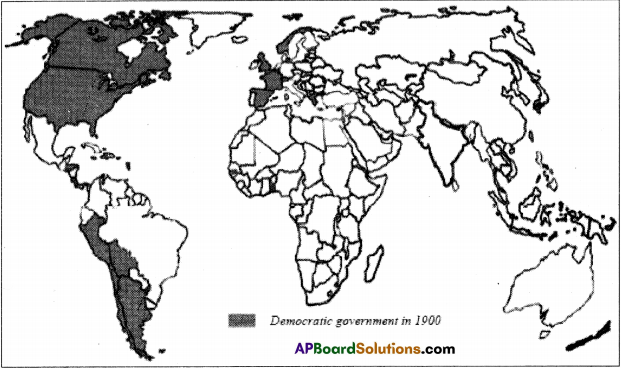
Map 1: Democratic Governments in 1900 – 1950
AP Board 9th Class Social Studies Solutions Chapter 19 Expansion of Democracy 1

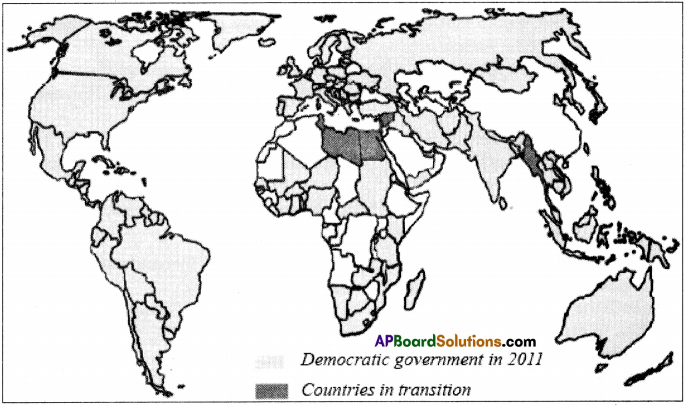
Map 2 : Democratic Governments in 2011
AP Board 9th Class Social Studies Solutions Chapter 19 Expansion of Democracy 2

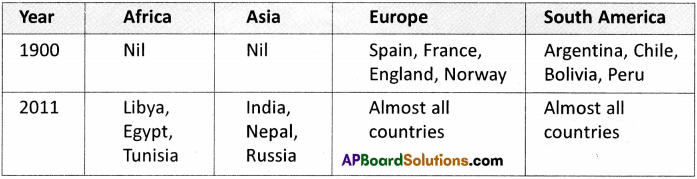
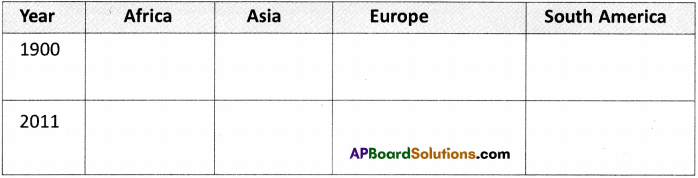
a) On the basis of these maps, identify up to three countries (in some cases you won’t find three countries) that were democratic in these continents for the given years and make a table as given.
AP Board 9th Class Social Studies Solutions Chapter 19 Expansion of Democracy 3
Answer:
AP Board 9th Class Social Studies Solutions Chapter 19 Expansion of Democracy 4

b) identify some African countries with democracy in 2011.
Answer:
Egypt, Libya, Tunisia are countries which got independence in and around 2011.

c) Make a list of big countries that were not democratic in 2011.
Answer:
1) Asian countries :
China, Kazakhstan, Turkmenistan, Saudi Arabia, etc.

2) African countries :
Algeria, Ethiopia, Chad, Zaire, Morocco, Mauritania, Angola, etc.

The above countries were not democratic in 2011.

AP Board Solutions

Question 2.
Read the maps again and think about the following points.
a) Based on the maps, can we say that the Twentieth century was a significant era for the spread of democracy?
Answer:

  1. At the beginning of the 20th century only few countries of Europe and America were independent, e.g.: Spain, France, England, Norway, Argentina, Chile, Bolivia and Peru, the USA, Canada, Alasca.
  2. After World War II almost all countries fought against colonial powers and got independence.
  3. Though there are still some non-democratic countries, we can call 20th century as an era of democracy.

b) During the early 20 century, democracy was mostly in the continents like Europe and Americas. While in certain continents like Africa and Asia there were almost no democratic countries.

c) Even today there are certain areas that have not established democratic governments such as Saudi Arabia and Ethiopia.

Question 3.
Most countries often claim themselves to be democratic by conducting elections. How did this occur in the context of Myanmar and Libya?
Answer:

  1. Both the countries Myanmar and Libya claim themselves as independent and democratic.
  2. But in practical view, they are not democratic countries.
  3. Unlike democratic countries –
    a) They did not allow multi-party elections and one party usually ruled for several years.
    b) Even they did not allow free elections.
    c) Sometimes they did not allow the elected representatives to form governments.
    Ex : NLD, led by Suu Kyi got 80% seats, was not allowed to form government.
    d) They did not allow freedom of expression or freedom to form organizations, or freedom to protest against government.

Both the countries did not have any conditions for a democracy to flourish. Hence they cannot claim themselves to be democratic by conducting elections.

Question 4.
Why do you think the rulers try to control the media? Do you know how is media controlled in your area?
Answer:

  • Mass Media is powerful weapon which can make or break any governments.
  • Restrictions on media helps them to remain in power.
  • Hence the rulers always try to control the media.
  • So many times in India too government censors certain news. This generally happens without the notice of common man.

AP Board Solutions

Question 5.
Write an imaginary dialogue between a person from Libya and Myanmar comparing the events and struggle for democracy in their respective countries.
Answer:
Person from Libya : Hai, I am xxxx, as I have already told you the monarchy is over thrown in our country.
Person from Myanmar : Yes, I came to know about that who is ruling your country now.
Libya : Gaddafi has taken control of our country. What about your country.
Myanmar : In 1962, the government was overthrown and ‘Ne Win’ military rule is going on.
Libya : First of all we thought he could rule us. He laid foundation for development. What is your country’s position?
Myanmar : Under military rule, our country did not make any progress.
Libya : UNO is supporting our people’s to demands.
Myanmar : Other countries are also showing sympathy us.
Libya : We protested against.
Myanmar : Suu Kyi is in house arrest she played good role.
Libya : Gaddafi is overthrown in 2012. O.K. Bye.
Myanmar : We got new government in 2012. Bye.

Question 6.
How do literacy and mass education help for the functioning of democracy?
(OR)
How do the literacy help for the effective functioning of democracy?
Answer:

  • Literacy and education play an important role in the development of individual and society.
  • Knowledge liberates citizens from ignorance.
  • Any society needs a vigilant, conscious, and informed public for the successful functioning of the democracy.
  • Education enables people to think critically, rationally, and scientifically.
  • The right to vote can be properly exercised when voter can read newspapers, follow national and international developments, and participate in democratic process effectively.
    Hence the proper functioning of democracy always depends on the literacy and mass education.

AP Board Solutions

Question 7.
What is the difference between democracy and dictatorship?
Answer:
Differences between democracy and dictatorship :

Democracy Dictatorship
1. Democracy is a political system in which sovereignty vests with people. 1. Dictatorship is a political system in which sovereignty vests in one single person’s hands.
2. Free and fair elections are necessary for the successful running of the democracy. 2. Dictatorship does not require elections.
3. Democracy operates on the recognition of dissent. 3. Right of disagreement is not recognized.
4. Public opinion has important place in democracy. 4. Pubic opinion is not taken into consideration.
5. A high degree of social and economic equality is also essential for true democracy. 5. Dictatorship leads to concentration of power and wealth in few hands.

Question 8.
What is the role played by Aung San Suu Kyi in fighting for democracy in Myanmar?
Answer:

  • Aung San Suu Kyi, daughter of Aung San who took the lead in staging protest against the military rule.
  • Suu kyi fought for reforms in Burma.
  • She established a new political party “National League for Democracy (NLD) and won majority (80%) of the seats even though she was in prison.
  • Suu Kyi was released from house arrest after the elections of 2010.
  • She questioned on the malpractices of elections.
  • In 2011 Suu Kyi’s ‘NLD’ contested in the elections and have won 43 out of 45 parliamentary seats that were vacant.
  • The freeing of Suu Kyi and the successful participation of NLD in elections are considered the beginning of democracy in Burma.

Question 9.
Read the last paragraph of this chapter and answer the question.

Today, it is increasingly becoming clear to the people that democracy which respects the freedom and rights of all people may be the best way to solve some of the complex problems the countries face. Today, a new kind of democracy is being forged across the world in which even the poorest and the most vulnerable people will have a voice and will be able to influence policies and ensure justice and peace for all.

What is a new kind of democracy?
Answer:

  1. The poorest and the most vulnerable people will have a voice.
  2. The poorest will be able to influence the policies.
  3. The new kind of democracy will ensure justice and peace for all.

AP Board Solutions

Question 10.
Read the newspapers and note down any news regarding the struggle for democracy in Libya or Egypt or any other country. Prepare a file of such news clippings and display them in the classroom.
Answer:
Struggle for democracy in Libya :
A few months ago the National Transitional Council (NTC), which has governed Libya since the first few weeks of the revolt in 2011, announced that the assembly would not draft the constitution itself but instead appoint a 60-member committee to draft it. The members of this committee were supposed to be chosen from outside the assembly and represent the country’s three geographic regions of Libya – Tripolitania, Cyrenaica, and Fezzan — in equal numbers. Yet, a few weeks ago, the NTC changed policy again at the last moment, declaring that the members of the constitutional committee would not be appointed by the assembly but directly elected by the people, though it’s not clear when. Confused? So are Libyans.

There are rumors in Libya that most members of the NTC are not happy about the idea of dissolving the institution and going back home. It’s just a rumor, but the group’s decision to revoke constitution-writing powers from the new assembly is making people suspicious, and that’s the point. The NTC likely fears too much power going to Islamists, who are notoriously less friendly toward the NTC than are other groups. We can’t know the NTC’s motivations for sure, but their recent moves diminished the power of the new assembly, which they may have feared would be dominated by Islamists, who swept national elections in neighboring Tunisia and Egypt. A more democratic Libya would re¬ject the NTC’s odd rule-changing and reinstate the elected assembly’s power to write the constitution. After all, this is what Libyans voted for. So should the same Western powers that supported the Libyan revolt.

Libya has come a long way since Gaddafi’s fall, but it still hasn’t been able to solve two major security problems: the armed militias that still roam the country and the state’s deteriorating control of its national borders. Fortunately, this is where new assembly can step in, finding agreement among the various parties and militias and forming a govern-ment, one that is as inclusive as possible, to administer and rebuild Libya. The interna-tional community can help, including by training and equipping the police and security forces, both of which were devastated by the recent conflict.

A successful election is just the start of dealing with one of Libya’s most important challenges right now: national unity. Regional and local claims and jockeying for power threaten to undermine the legitimacy of and support for the national government. A few thousand inhabitants of the eastern provinces care calling for a federalist state, if not of outward secession. While this is definitely a minority position, it is a very dangerous one because it could easily, at the administration’s first real difficulty, split the government and the people, thus slowing or even reversing Libya’s progress toward stability. Most Libyans, as well as the interested Western nations, are rightly happy with Libya’s progress toward becoming a stable, unified, democratic state. But if they want that progress to continue, they’ll all have to work together.

9th Class Social Studies 19th Lesson Expansion of Democracy InText Questions and Answers

Question 1.
What kind of problems do you think these pose for establishing democratic government? (Text Book Page No. 235)
Answer:

  • Bringing democratic participation of all the people under conditions of tribalism, normalism, illiteracy, and restrictions on women was difficult.
  • Encouraging participation of common people in public affairs through peoples councils and elected Peoples Assembly in the centre in also difficult.

Question 2.
Even though the people had benefited much from the Gaddafi government, why do you think they rose in rebellion against it? (Text Book Page No. 237)
Answer:

  • The government of Gaddafi was not ready to trust these democratic bodies.
  • “Revolutionary Councils” were appointed.
  • The democratic bodies had to implement the decisions of these non-elected leaders.
  • The RCC used brute armed force to arrest, torture, and kill political opponents.
  • There was no freedom of press and no one could start any trade union or other associations.
  • The civic amenities were deplorable.
    Hence rebellions rose against the government of Gaddafi.

AP Board Solutions

Question 3.
Even though the Gaddafi government claimed to be a democratic government, what aspects of democracy were absent? What aspects of democratic government were present in it? (Text Book Page No. 237)
Answer:
Aspects of democracy absent in the government of Gaddafi:

  1. Democratic bodies had to implement the decisions of non-elected leaders.
  2. Freedom of press, freedom to form trade unions and associations were prohibited.
  3. No political parties were allowed to function in Libya.
  4. This led to concentration of power and wealth in the hands of few.

Aspects of democracy present in the government of Gaddafi :

  1. Free universal education was provided.
  2. Free medical care for all was also provided.
  3. Oil profits were distributed to all the citizens.
  4. Subsidised housing schemes were introduced.
  5. Women were given with equal opportunities and status in the society.

Question 4.
Why are civil liberties important for democracy? Explain in the context of Libyan experience. (Text Book Page No. 237)
Answer:

  • “Liberty” is one of the aspects of democracy.
  • Civil liberties include liberty of thought, speech, expression, faith, belief and worship.
  • These “liberties” were missing in Libya.
  • Liberty of expression was brutally crushed.
  • The RCC was also very intolerant of criticism and opposition.
  • People were not at liberty to express their discontent.
    Thus lack of civil liberties led to the downfall of the government of Gaddafi in Libya.

AP Board Solutions

Question 5.
Why do you think democracy was not able to establish itself in Burma after its independence? (Text Book Page No. 240)
Answer:

  • Burma became independent just 5 months after Indian independence.
  • It appeared that Burma too would emerge as a democratic republic.
  • However, the Burmese did not have a united political party to lead them at the time.
  • Burma consisted of a large number of small states and ethnic linguistic regions.
  • Aung San, the leader of the nationalist movement and the leader of the ethnic group was assassinated.
  • Burmese military began its slow advance into the ethnic states to rule by force.
  • They were illiterate, no able leader, no power to fight with military, etc., were the reasons for the failure to establish democracy in Burma.
  • Finally, in 1962, the elected government was overthrown by a coup, and army “General Ne Win” took over the charge of the country.

Question 6.
Why do you think democracy was not able to establish itself in Libya after its independence? (Text Book Page No. 240)
Answer:

  • Libya got its independence in 1951 and the power was transferred to king Idris.
  • In the year 1969 under the leadership of Gaddafi monarchy was abolished and the country was declared as the “Socialist Libyan Arab Republic”.
  • But the people were concerned about their own tribe and its honour than about the welfare of the people.
  • Most of the people were poor nomadic animal herders who were also illiterates.
  • Women were confined to purdah and were not allowed to participate in public activities.
  • On top of this the government of Gaddafi was not ready to trust the bodies of democracy. Hence the democratic participation of all people under these conditions was difficult.

Question 7.
How did students and youth play an important role in bringing democracy to both Libya and Burma? (Text Book Page No. 240)
Answer:

  • People from across the country began to interact through internet and mobile phones to share their misery.
  • Use of internet and Facebook helped them to get the support of the people all over the world.
  • The youth and people started protesting against delay in the building of houses and political corruption.
  • In Burma, the students took the lead in staging protest against the military rule. Finally military power was overthrown in both the countries and democracies are established.

Question 8.
What similarities of events do you find in the description of events in Libya and Burma? (Text Book Page No. 240)
Answer:

  • In both the countries, students, youth and people participated in the protest movements.
  • Use of mobiles and internet and social networking sites like Facebooks were common.
  • “UNO” supported both the countries and declared Libya as “No fly zone” and ordered for a referendum in Burma.
  • Economic sanctions were imposed on both the countries.
  • In both the countries the protest was to overthrow the military regime and establish a democratic form of government.
  • Lastly both the countries successfully conducted elections in a fair way and elected their new leader.

AP Board Solutions

Question 9.
Underline the statements that are related to political party and voting in both Libya and Burma. (Text Book Page No. 240)
Answer:
a) Libya

  1. RCC – Revolutionary Command Council.
  2. Election – 2012 new government sworn in on Nov. 2012. Over 100 political parties participated and 200 representatives were elected.

b) Burma

  1. 1951, 56 and 60 elections were held.
  2. 1990 elections – NLD party established by Suu Kyi.
  3. 2010 elections were held.
  4. In 2011 ‘NLD’ won 43 out of 45 seats.

Question 10.
Track the changes that you may have heard about Libya and Burma during the year 2012 and write it. (Text Book Page No. 240)
Changes in Libya :

  1. In 2012 the National Transitional Council (NTC) handed overthe powerto Libya’s newly elected Parliament the General National Congress (GNC).
    The Congress appointed a Prime Minister Ali Zidan, who formed an interim government.

Changes in Burma :
Burma’s Pro-democracy leader Aung San Suu Kyi greeted supporters from her vehicle during her election campaign in Aung Pan in the southern Shan State of Burma (Myanmar) on March 1, 2012.

Question 11.
Dictators try to control press and TV media. Do you know other ways of sharing information and ideas between people? (Text Book Page No. 237)
Answer:

  • Mobile phone occupies the first place in sharing information and ideas.
  • ‘Fax’ is one of the ways of sending message from one place to another.
  • Today internets are available everywhere.
  • We can send e-mails to exchange information and ideas.
  • Social networking sites play important role in sharing informations.
    Ex : Facebook, Twitter, etc.

AP Board Solutions

Question 12.
The Tunisian struggle began with the death of one trader. The struggle gained strength largely through the use of social networking websites like Facebook. Why do you think it is not easy for governments to control them? (Text Book Page No. 237)
Answer:

  • Technology has changed much.
  • For development, every country has to work on internet.
  • Computer have become a part of our life.
  • Hence it is difficult to control social networking websites.

Question 13.
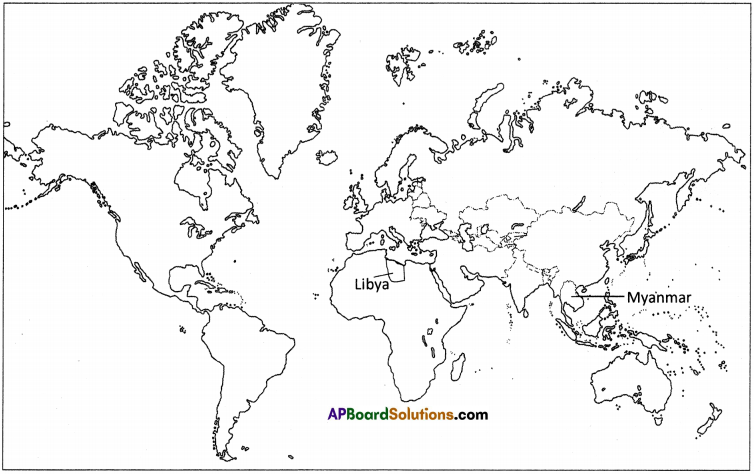
Locate “Libya” and “Myanmar” in the world map. Which continents are they located on? (Text Book Page No. 234)
Answer:
Libya is in Africa continent.
Myanmar is in Asia continent.
AP Board 9th Class Social Studies Solutions Chapter 19 Expansion of Democracy 5

AP Board 9th Class Social Studies Solutions Chapter 18 Impact of Colonialism in India

SCERT AP Board 9th Class Social Solutions 18th Lesson Impact of Colonialism in India Textbook Questions and Answers.

AP State Syllabus 9th Class Social Studies Solutions 18th Impact of Colonialism in India

9th Class Social Studies 18th Lesson Impact of Colonialism in India Textbook Questions and Answers

Improve Your Learning

Question 1.
How did people use the forests before the rule of the British? Why was there less danger of the forests being fully destroyed in those days?
Answer:

  • The adivasis used forests for hunting, gathering tubers, fruits, flowers and herbs and for gazing their cattle.
  • They cut wood, cleared the land to cultivate crops.
  • They cut trees to build their homes etc.
  • They did not blindly cut large tracts of forests but only small patches.
  • They cut only old trees and allowed new trees to grow.
    Therefore there was less danger of the forests being fully destroyed in those days.

AP Board Solutions

Question 2.
Against whom did the adivasis revolt? In what ways did they demonstrate their anger and protest? Give some examples.
Answer:

  • The Adivasis revolted against the police department, the forest department and the moneylenders.
  • During the protests they would burn down many police stations, posts of the forest department and houses of the moneylenders.
  • In many places they would set fire to the entire jungle.
  • The revolt of Santhals of Jharkhand in 1856, the Koya revolt of A.P. in 1880 and 1922, the revolt of the Maria and Muria of Bastar in 1910, etc. were some of the revolts of adivasis.

Question 3.
How were the revolts of the adivasis suppressed by the British?
Answer:

  • In most of the revolts the leaders were arrested and were kept behind bars,
    e.g.: Birsa Munda died in prison in 1900.
  • The leaders were traped and shot dead by the Britishers,
    e.g.: Sita Rama Raju of A.P.
  • The Adivasis were armed only with bows and arrows.
  • They could not stand before the gun-bearing British army.
    e.g. : In a fierce battle 15000 Santhals were killed and their revolt was finally suppressed.

Question 4.
Make a timeline to show when adivasi protests occurred in different parts of India.
Answer:

Adivasi Protests
1. Santhal adivasi revolt Jharkhand 1856
2. Koya adivasi revolt Andhra Pradesh 1880 and 1922
3. Maria and Muria adivasis revolt Bastar 1910
4. Munda adivasi revolt Chhotanagapur Plateau (Now in Jharkhand) Between 1874 and 1901

Question 5.
What problems did the Indian industrialists have with the British government?
Answer:
The problems of the Indian industrialists during the British government were –

  1. The British government had levied a special tax on cloth made by Indian weavers in order to help the cloth industry of Britain.
  2. The British government refused to levy the similar tax on the British cloth.
  3. Later the government levied a 3 /2% tax on the British goods and the same tax was levied on the cloth made in India too.
  4. With this the British government made it clear that it would protect mainly the interests of the British factories.

Question 6.
During British rule, why was it easier for the European companies rather than Indian companies to set up industries? Give a few reasons.
Answer:

  • Indian industry had got a little help from the British government.
  • A very large number of factories, banks, ships etc., were in the hands of Europeans, not in the hands of Indians.
  • British industries had easy access to all types of officers and authorities of the British government, whereas Indians never had such reach.
  • All the foreign trade was in the hands of European companies, hence, they had no shortage of funds.

Question 7.
Labour laws were first made for child labourers, then for women and lastly for men. Why were these laws made in this order?
Answer:

  • The first Factory Act in 1881 made rules especially for the welfare of the children.
  • As the children are tender hence the first priority was given for the welfare and regularized their working hours and children below 7 years were restricted to work in factories.
  • In 1891, laws were made in the interest of women labour as they are sensitive when compared with men.
  • Lastly in 1911, the working hours of men were regularised.

AP Board Solutions

Question 8.
How could education affect industrial development ? Discuss in the class.
Answer:

  • Industrial development needs a lot of educational workers and officers at all levels.
    We need lot of technicians, scientists, engineers, management personnels, lot of support system etc.
    Previously lack of “technical know how” led to the establishment of factories with foreign collaboration
    Now due to education affect, we are technically skillful and can establish industries without any foreign collaboration.

Question 9.
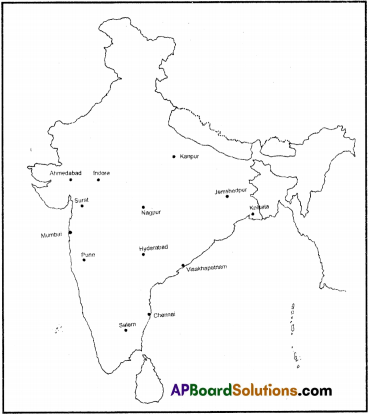
Identify the large industrial cities on outline map of India during 20th century.
AP Board 9th Class Social Studies Solutions Chapter 18 Impact of Colonialism in India 1
Answer:

  1. Mumbai
  2. Ahmedabad
  3. Chennai
  4. Jamshedpur
  5. Kanpur
  6. Kolkata
  7. Hyderabad
  8. Surat
  9. Visakhapatnam
  10. Pune
  11. Nagpur
  12. Indore
  13. Salem

Question 10.
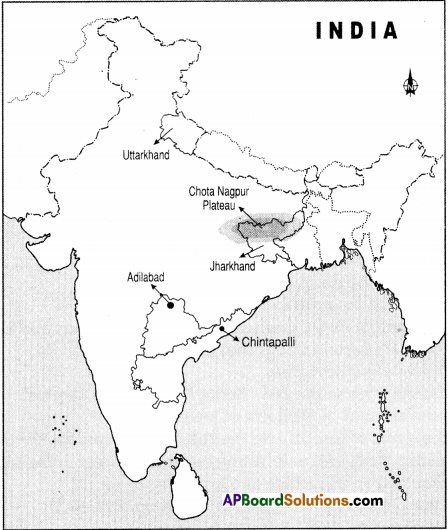
Find out where each of these adivasi struggles took place, and mark their locations on a map of India.
Answer:

  1. Jharkhand
  2. Chotanagpur Plateau
  3. Uttarkhand
  4. Chintapalli
  5. Adilabad

AP Board 9th Class Social Studies Solutions Chapter 18 Impact of Colonialism in India 2

Question 11.
Read the para under the title ‘Adivasi Revolts’ on page 222 and comment on it.
Adivasi Revolts :
We have seen how the conditions of the adivasi farmers who lived in the jungle worsened in British times. The Baiga, Muria, Gond and Bhil tribes of Madhya Pradeshand Chattisgarh, the Koya, Reddy, and Kolam tribes of Andhra Pradesh and the Saora adivasis of Orissa, were all no longer able to practice their old form of cultivation. They were having to become labourers for either the Forest Department or for contractors. Or they were becoming bonded labourers for moneylenders or farmers who had come from outside.
Answer:

  1. As soon as the British took over Eastern India, tribal revolts broke out to challenge the alien rule.
  2. In the early years of colonization, no other community in India offered such heroic resistance to British rule or faced such tragic consequences as did the numerous Adivasi communities.
  3. As punishment for Adivasi resistance to British rule, ‘The Criminal Tribes Act’ was passed by the British Government in 1871.
  4. As the freedom movement widened, it drew adivasis into all aspects of the struggle.

Question 12.
Visit an office of the Forest Department and interview the official on how forest could be preserved and wisely used by both industries and local people.
Answer:
Interview with Forest Ofiicer :
Student (S) : “Good Morning Sir, tell us about your eduction.”
Forest Officer (F.O) : “I was a village man. After completing my graduation, I appeared for the APPSC. Later I got selected and trained at Dehardun. I was appointed in forests in East Godavari Dist.
Student : Sir, elaborate upon your works as a Forest Officer.”
Forest Officer : “My work involved preservation of forest. As a Forest Officer it is my duty to safeguard the forests. Today, the world’s demand for timber and paper continues to grow. As we lose the forest, we also lose the habitat for many species, including human tribes.”
Student : “What precautions should we take to preserve the forests ?”
Forest Officer : 1. The government should ban the import of illegally logged timber.
2. The people should use less paper and wood.
3. People should invest in forest communities.
Student : “How can the forests be used wisely by both industries and local people ?”
Forest Officer : “Fine, there are certain things that everyone of us can do.
1. We should plant new trees.
2. We should practise the 3Rs. ‘Reduce, Reuse and Recycle’.
Reduce the amount of products of trees.
Reuse the items of forests, use the recycling process for some items.
3. Harvesting trees to create young regrowing forest in the place of cut forests.
4. We should keep all wildlife in our minds.
Student : “Thank you Sir, you gave us good information. Bye, sir”
Forest Officer : “Very good my boy. God bless you.”

AP Board Solutions

Question 13.
Visit a nearby factory in your area find out its history how has the technology changed, where do the workers come from, try and talk to the employers and some workers to get their views.
Answer:
We have visited Sri Padmavathi Polymers.
Sri K. Chalapathi Rao and Sri C.V. Narasimha Rao are the partners of this factory. The factory was established in the year 2007. There are 50 employees in this factory. They are manufacturers and suppliers of Thermocol Boxes like EPS box, Apple box, Fish box, etc.

They import the thermocol balls from some other country. They heat these balls and mould them in different shapes.

The employers are present in the factory when we visit it. We met Smt. Subhadra, Accountant there. They are very happy to work there. They said that the facilities arranged by the authorities were well. There are shift duties in the factory. Women workers work during the day time only. The salary structures are also fine. They have eight working hours a day. We observe the surroundings in the factory. They are neat and clean. They grow plants for fresh air.

9th Class Social Studies 18th Lesson Impact of Colonialism in India InText Questions and Answers

Question 1.
Discuss what “Protected market” means. (Text Book Page No. 225)
ANswer:

  • “Protected Market” is the policy according to which goods made in a specific area be protected from foreign goods.
  • Protection is given to the indigeneous goods by levying tax on imports. Thereby free incoming of imports is restricted to protect local markets.
  • Indian markets were not protected during the British rule.

Question 2.
The Indians demanded that a tax be imposed on British goods coming to India.
1) Do you think this was a fair demand? (Text Book Page No. 225)
2) Should the government have treated British and Indian industries equally?
Answer:

  1. Yes, Indians’ demand of taxing the British goods coming to India was a fair demand.
  2. Yes, the government should have treated British and Indian industries equally.

Question 3.
Why did a rapid development take place in Indian industry during the First World War? (Text Book Page No. 226)
Answer:

  • During the First World War, the import of foreign goods into India fell sharply.
  • Cargo ships were diverted to war related duties, and hence there was a shortage of ships.
  • The factories of Europe produced things needed for the war.
  • So under these circumstances, the factories in India started selling their goods in greater quantities.
  • Enthused by these heavy sales there was a rapid development of industries.

Question 4.
What industries were established in India during British rule? (Text Book Page No. 227)
Answer:

  • From 1850 onwards, machine based industries had begun to set up in India.
  • The biggest industry was the spinning and weaving of textiles.
  • The jute industry also developed during this peirod.
  • The greatest example of the achievements of Indian industrialists was the setting up of a steel factory at Jamshedpur in 1907.

Question 5.
What were the difficulties in the development of Indian industries at the time of Independence? (Text Book Page No. 227)
Answer:

  • Tax levied on foreign goods was not adequate to protect our industries or goods.
  • The British government did not pay adequate attention to develop the resources and facilities such as coal and iron and railway, roadways and electricity.
  • Indian industrialists had to buy machines from abroad and they did not start in India.
  • Educated workers like scientists, engineers and technicians were not available in India.
  • Hence we depended on foreigners for “technical know how”.
  • The above were the difficulties in the development of Indian industries at the time of independence.

AP Board Solutions

Question 6.
In the early days of factories in India : (Text Book Page No. 229)
a) What were the rules regarding work and rest for labourers?
b) What were the rules regarding payment of wages ?
c) For what reasons would there be cuts and reductions in the labourers’ wages?
Answer:
a) Rules regarding work and rest for labourers :

  1. Once the work began, there was no question of stopping.
  2. There was no fixed time break even for meals.
  3. Taking out 15-20 minutes from their work and would eat their meal.
  4. The working atmosphere was unhygienic and would pass in the heat, humidity, noise, dust and suffocation of the mill.
  5. The work would stop at sunset, when it would impossible to see.

b) Rules regarding payment of wages :

  1. Wages were given in proportion to the amount of goods produced.
  2. The owners laid the condition that “as much as you make, so much will you be paid”.
  3. The labourers were not able to get any fixed income each month.
  4. At the end of the month, the owners would not even pay the full payment. They would keep some amount till the end of the next week so that the worker would not leave the work.

c) Reasons for cuts and reductions in the wages :

  1. There were plenty of fines.
  2. The owners would fine the labourers
    a) if they came late,
    b) if the cloth spoilt,
    c) if the owner thought the labourer did not work sincerely.
  3. These fines were deducted from the month’s wages.

Question 7.
Why did labourers go on strikes? (Text Book Page No. 230)
Answer:

  1. Labourers struggled against their oppressive working conditions.
  2. They went on strike for fixed incomes and other facilities such as –
    a) regulation of working hours
    b) improvement of their working conditions
    c) weekly break and leave
    d) regarding employment of children

AP Board Solutions

Question 8.
Why were strikes used instead of any other action? (Text Book Page No. 230)
Answer:

  • During strikes all workers would participate.
  • Due to that the work would stop and the production would come down.
  • One day strike would lead to lakhs of rupees loss to all industrialists.
  • Hence strikes were used instead of any other work.

Question 9.
Why did the educated people of India not pay much attention to the interests of factory labourers in the beginning? (Text Book Page No. 231)
Answer:

  • In the beginning most of the educated people of India paid no need to the problems of the labourers.
    They believed that if laws were made in the interests of the labourers, industries would not be able to develop in India.

Question 10.
How would the labour laws have affected the industrialists? (Text Book Page No. 231)
Answer:

  • The industrialists were forced to give a break of half an hour after every six hours of work.
  • The working hours of men, women and children were regularised.
  • The mill production came down.
  • The expenses of the owners increased.
  • They were forced to improve the working conditions of the workers.

Question 11.
The British industrialists were against the development of factories in India, yet they took the side of Indian labourers. Why? (Text Book Page No. 231)
Answer:

  • If fixed incomes and facilities were provided, the mill production would come down and the expenses of the owners would go up.
  • Then the goods produced in the factories would be more expensive.
  • Then the goods from Britain would be sold easily.
  • The development of Indian industries would come to a standstill.
    Thus the British industrialists were just pretending to show concern for the welfare of the Indian labourers.

Question 12.
Below what age could children not be employed as labourers in British times? (Text Book Page No. 231)
Answer:

  • According to the Factory Act of 1881, children below the age of 7 were not allowed to work in the factories.
  • According to the Factory Act of 1891, children below the age of 9 were not allowed to work in the factories.

Question 13.
According to the labour laws what was the maximum number of hours that children, women and men could be expected to work? (Text Book Page No. 231)
Answer:

  • According to the Factory Act of 1881, the children’s working hours were reduced to 9 hours a day.
  • According to the Factory Act of 1891, the women labourers cannot be made to work more than 11 hours a day.
  • The men labourers cannot be made to work for more than 12 hours every day as per the Factory Act of 1911.

AP Board Solutions

Question 14.
Which were the two main labourers’ unions to be formed in India during British times? (Text Book Page No. 231)
Answer:

  • Girni Kamgar Union was formed with the help of labourers of Mumbai.
  • The Mazdoor Mahazan was formed in Ahmedabad under the influence of Gandhiji.

Question 15.
In which year were you born? Mark it on this time line. Also mark the births of your parents and some grandparents or other old relatives you can find out about. (Text Book Page No. 231)
Answer:
I was born on ……………. . My father was born on ……………. . My mother was born on ……………. . My grand father was born on My grand mother was born on ……………. .

Question 16.
Find out whether any of the people whose births you marked were affected by the labour laws. (Text Book Page No. 231)
Answer:
My grandfather was affected by labour law. He worked in a sugar factory. So he obtained many benefits by labour law. Working hours duration, medical, housing etc., facilities were obtained.

Question 17.
Underline four sentences that represent the situation of adivasis and their use of forests before British rule. (Text Book Page No. 220)
Answer:

  • Before British rule adivasis and villagers living in and near forests got many things they needed for their daily lives from the forests.
  • They were the owners of the forests.
  • They used the forests for hunting, gathering tubers, fruits,flowers and herbs and for grazing their cattle.
  • They cut wood to build their homes and to make implements. They took things for their personal use.

AP Board Solutions

Question 18.
Have you seen old wooden sleepers used in railway tracks ? What are they being replaced with today? Discuss why this replacement is taking place. (Text Book Page No. 221)
Answer:
Yes, I have seen wooden sleepers in railway tracks when I was very young. They are replaced by concrete sleepers today. Interest in concrete rail road ties increased after World War – II following advances in the design, quality and production of pre-stressed concrete. Concrete ties were cheaper and easier to obtain than timber and better able to carry higher axle weights and sustain higher speeds. Concrete sleepers have a longer service life and require less maintenance than timber due to their greater weight which helps them remain in the correct position longer.

Problems with wood ties include rot, splitting, insect infestation, plate-cutting, etc. In addition to these, the government wanted to reduce the burden on the forests.

So the concrete sleepers are introduced and replaced the wooden sleepers.

Question 19.
What do the present laws set as minimum age, below which children cannot be employed as labourers? (Text Book Page No. 231)
Answer:
According to the recent factory acts no child below 14 years of age can be employed as labour in factories or coalmines or any other jobs.

Question 20.
Why is a union or labourers’ organization important for labourers? Discuss. (Text Book Page No. 233)
Answer:

  • Any union or organizations fight for the common cause of all workers.
  • They fight for the right of the workers.
  • They protect the workers from the harassment of owners.
  • They also fight for the hike in salaries and compensation for accident deaths, etc.


AP Board 9th Class Physical Science Solutions Chapter 12 Units and Graphs

AP State Syllabus AP Board 9th Class Physical Science Solutions Chapter 12 Units and Graphs Textbook Questions and Answers.

AP State Syllabus 9th Class Physical Science Solutions 12th Lesson Units and Graphs at Curved Surfaces

9th Class Physical Science 12th Lesson Units and Graphs Textbook Questions and Answers

Improve Your Learning

9th Class Physical Science 12th Lesson Units and Graphs 1 Mark Questions and Answers

Question 1.
What is Unit?
Answer:
A unit is a standard measure used for comparing measurements.

Question 2.
Why do we use different units for different items?
Answer:
Depending on the quantities of material the units may be expressed.

AP Board 9th Class Physical Science Solutions Chapter 12 Units and Graphs

Question 3.
Write fundamental quantities in MKS system.
Answer:
Mass (m), Length (l) and Time (t).

Question 4.
What are fundamental quantities?
Answer:
Fundamental quantities are those physical quantities that cannot be expressed in terms of other quantities.

Question 5.
What is fundamental unit?
Answer:
Units used to express fundamental quantities are called fundamental units.

Question 6.
Write fundamental units in MKS system.
Answer:
Meter, Kilogram and Second.

Question 7.
What is CGS system?
Centimeter, Grams and Seconds.

Question 8.
What is SI system? When was it introduced?
Answer:
SI system means International System of units. It was introduced in 1971.

AP Board 9th Class Physical Science Solutions Chapter 12 Units and Graphs

Question 9.
List the fundamental quantities that are added to SI system.
Answer:
Electricity, light intensity, quantity of substance, temperature and plane angle.

Question 10.
What is difference between MKS and SI systems?
Answer:

  • MKS system has only three fundamental quantities. Those are length, mass and time.
  • SI system has eight fundamental quantities. Those are length, mass, time, electricity, light intensity, quantity of substance, temperature, plane angle.

Question 11.
What is derived quantity?
Answer:
The quantities that are obtained by combining fundamental quantities either by multiplication or division or both operations are called derived quantities.

Question 12.
What are derived units?
Answer:
The derived units of measurement derived from the fundamental units.

AP Board 9th Class Physical Science Solutions Chapter 12 Units and Graphs

Question 13.
Write derived units of area and volume.
Derived units of area = m²
Derived units of volume = m³

Question 14.
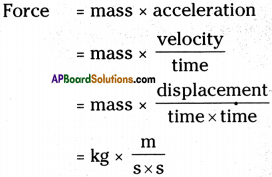
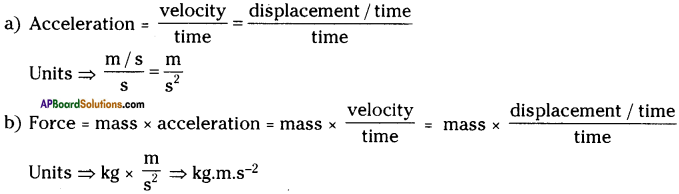
What are the fundamental units are used to express the units of Force?
Answer:
AP Board 9th Class Physical Science Solutions Chapter 12 Units and Graphs 1
Hence fundamental units used to express force are kg, m, s.

Question 15.
Which conversion factor is used to convert kilometers into meter?
Answer:
1000.

Question 16.
Which conversion factor is used to convert meters into kilometers?
Answer:
10-3.

Question 17.
Write conversion factor to convert km/hr into m/s.
Answer:
[latex]\frac{5}{18}[/latex]

Question 18.
Write some units of measurements expressed in the name of scientists.
Answer:
Newton (N), Pascal (Pa), Joule (J), Watt (W), etc.

Question 19.
What is graph?
Answer:
A pictorial form of representation that shows the relation between two quantities can be called a graph.

Question 20.
What are independent and dependent variables?
Answer:
Independent variables are controlled by us. Whereas dependent variables are changed due to the change in dependent variable.

Question 21.
Which variable is taken on x – axis?
Answer:
Independent variable.

Question 22.
What are grids on graph paper?
Answer:
On a graph paper, there are thick as well as fine vertical and horizontal lines. These intersecting lines form squares or grids.

Question 23.
What is Range?
Answer:
Range = highest value – lowest value.

AP Board 9th Class Physical Science Solutions Chapter 12 Units and Graphs

Question 24.
What is scaling?
Answer:
Pointing of the values in the table on x – axis and y – axis is called scaling.

Question 25.
What is scale?
Answer:
The interval taken pointing values on axis is called scale.

Question 26.
How do you find x – axis scale?
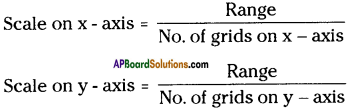
Answer:
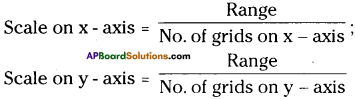
AP Board 9th Class Physical Science Solutions Chapter 12 Units and Graphs 2

Question 27.
What is curved line graph?
Answer:
If a graph is in curved shape, then it is curved line graph.

Question 28.
What is Hooke’s law?
Answer:
The elongation of the spring is proportional to the applied mass within the elastic limit of the spring.

Question 29.
What is slope of the straight line graph?
Answer:
AP Board 9th Class Physical Science Solutions Chapter 12 Units and Graphs 3

Question 30.
What is slope of a graph?
Answer:
The tan value of the angle at x – axis is the slope of a graph.
tan θ = [latex]\frac{\Delta \mathrm{y} }{\Delta \mathrm{x}}[/latex]

Question 31.
What is area of a graph?
Answer:
The product of the physical quantity of y – axis and x – axis may explain another physical quantity. Hence, it is said to be area of the graph.

Question 32.
What does slope indicate to the graph of displacement and time?
Answer:
Velocity.

AP Board 9th Class Physical Science Solutions Chapter 12 Units and Graphs

Question 33.
What does area of the graph of acceleration Vs time indicate?
Answer:
AP Board 9th Class Physical Science Solutions Chapter 12 Units and Graphs 4

Question 34.
Predict shape of the graph if you plot a graph by taking time on x – axis and velocity of a free fall body on y – axis.
Answer:
Straight line.

Question 35.
Guess the shape of the graph if you plot a graph of time and distance covered by a bus.
Answer:
Curved graph.

Question 36.
Rithvik wrote ‘3 kgs of sugar’ on the black board. Correct him by asking a question.
Answer:
Is it correct to mention kg in plural form while writing units?

Question 37.
Karthik got a doubt by seeing ‘3 newtons’ on the black board. What would be it?
Answer:
Which quantity is measured in newtons ?

Question 38.
What are the materials / apparatus required to prove Hooke’s law?
Answer:

  1. Spring,
  2. Weights,
  3. Scale,
  4. Stand.

Question 39.
Area, volume, density, mass
a) Write any one fundamental quantity from the above data.
b) Write any one derived quantity from the above data.
Answer:
a) mass.
b) volume.

AP Board 9th Class Physical Science Solutions Chapter 12 Units and Graphs

Question 40.
‘Dheeraj counted distance travelled by him for every 10 min.’
From the above data write independent and dependent variables.
Answer:
Time (min) is independent variable distance is dependent variable.

Question 41.
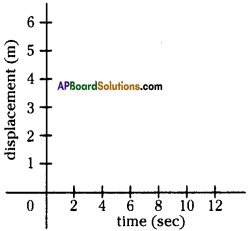
AP Board 9th Class Physical Science Solutions Chapter 12 Units and Graphs 5
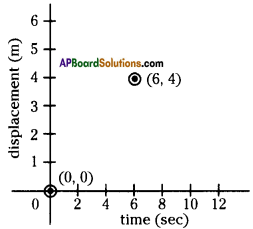
Plot the data points (6, 4) and (0, 0) in the above graph.
Answer:
AP Board 9th Class Physical Science Solutions Chapter 12 Units and Graphs 6

Question 42.
How do you remember scientists through units of measurements?
Answer:
Some units are expressed in the names of the scientists like newton, joule, etc. When we use these units, scientists are remember once again.

Question 43.
What is the use of graph?
Answer:

  • We can solve so many problems by using graphs.
  • We can know the relation between two physical quantities through graphs.

Question 44.
Calculate the Range of 5, 7, 3, 8, 18, 4, 2, 6.
Answer:
Range = highest value – lowest value
= 18-2 = 16.

Question 45.
If the range is 10 and no. of grids horizontally is 20. How can you take scale X-axis?
Answer:
AP Board 9th Class Physical Science Solutions Chapter 12 Units and Graphs 7
2) I will take 0.5,1,1.5, 2, 2.5,3,3.5, 4, 4.5, 10 on the X-axis. As a scale on x-axis.

Question 46.
How slope of displacement Vs time graph is useful?
Answer:
We can calculate velocity by calculating slope of line in displacement Vs time graph.

Question 47.
How area of velocity Vs time graph is useful?
Answer:
Area of velocity Vs time graph is useful to find the position of the object.

Question 48.
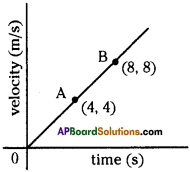
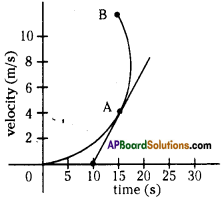
AP Board 9th Class Physical Science Solutions Chapter 12 Units and Graphs 8
What is the acceleration at ‘B’?
Answer:
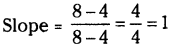
AP Board 9th Class Physical Science Solutions Chapter 12 Units and Graphs 10
Acceleration is 1 m/s².

Question 49.
AP Board 9th Class Physical Science Solutions Chapter 12 Units and Graphs 9
Find the acceleration at ‘A’.
Answer:
AP Board 9th Class Physical Science Solutions Chapter 12 Units and Graphs 11

Question 50.
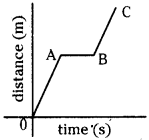
AP Board 9th Class Physical Science Solutions Chapter 12 Units and Graphs 12
How much distance is travelled by the object from A to B in the graph?
Answer:
Zero.

9th Class Physical Science 12th Lesson Units and Graphs 2 Marks Questions and Answers

Question 1.
What is a unit? Where it be placed?
Answer:

  • A unit is a standard measure used for comparing measurements.
  • Unit should be placed right side of the magnitude of every physical quantity. For eg : 2 kg, 7 m.

Question 2.
Differentiate fundamental quantities and derived quantities.
Answer:

Fundamental quantity Derived quantity
1) Fundamental quantities are those physical quantities that cannot be expressed in terms of other quantities. 1) The quantities that are obtained by combining fundamental quantities either by multiplication or division or both are called derived quantities.
2) These are independent. 2) These are dependent.
3) Eg : Mass, length, time. 3) Eg : Area, density, force.

Question 3.
Derive units of density.
Answer:
AP Board 9th Class Physical Science Solutions Chapter 12 Units and Graphs 13

Question 4.
Write different system of measurements.
Answer:

  1. FPS : Foot, Pound, Second.
  2. CGS : Centimeter, Gram, Second.
  3. MKS : Meter, Kilogram, Second.
  4. SI : Meter, Kilogram, Second, Ampere, Candela, Mole, Kelvin, Radian.

Question 5.
Derive units to the given physical quantities.
Answer:
AP Board 9th Class Physical Science Solutions Chapter 12 Units and Graphs 14

Question 6.
Which of the following are correct? Why?
Answer:
A) m/s
B) m/s/s
C) m-s²
D) 10.kgs
E) Pascal
F) joule
Answer:
A) and F) only are correct
B) two solidus are used – wrong.
C) line break is used – wrong.
D) ‘•’ and plural of kg are used – wrong.
E) capital letter used (P) – wrong.

AP Board 9th Class Physical Science Solutions Chapter 12 Units and Graphs

Question 7.
Write correct form of units in the following.
(j) DB
(ii) mhz
(iii) 20 – m
(iv) kg.m-s-2
Answer:
(i) dB
(ii) MHz
(iii) 20 m
(iv) Kg.m.s-2

Question 8.
How do you expect the shape of the given graphs?
(a) a ∝ b
(b) a ∝ [latex]\frac{1}{\mathbf{b}}[/latex]
Answer:
a) It may be straight line graph.
b) It may be curved line graph.

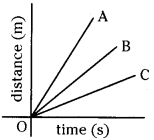
Question 9.
From the graph,
a) What is indicated by slopes of the lines OA, OB, OC?
b) Which line shows high speed than other lines? Why?
AP Board 9th Class Physical Science Solutions Chapter 12 Units and Graphs 15
Answer:
a) Slopes of the lines indicate speeds of the objects.
b) OA shows high speed than other lines.
Because it has high slope than others.

Question 10.
AP Board 9th Class Physical Science Solutions Chapter 12 Units and Graphs 16
a) Which is independent variable?
b) Which is dependent variable?
c) Predict how the graph is.
d) Find the range on Y – axis.
Answer:
a) Mass
b) Weight
c) It may be in straight line.
d) On Y – axis, values are 98, 196, 294, 392, 490.
Range = 490 – 98 = 392

Question 11.
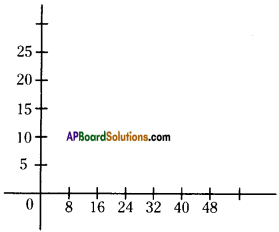
Plot the given data points on the given graph paper and join the dots.
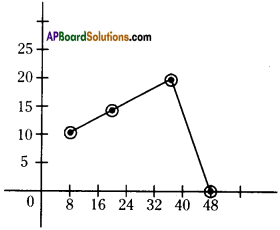
Data points : (8, 10) (20, 15) (40, 22.5) (48, 0)
AP Board 9th Class Physical Science Solutions Chapter 12 Units and Graphs 17
Answer:
AP Board 9th Class Physical Science Solutions Chapter 12 Units and Graphs 18

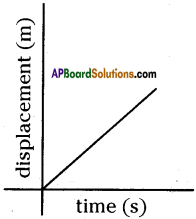
Question 12.
Draw a graph roughly to show uniform velocity of a body.
Answer:
AP Board 9th Class Physical Science Solutions Chapter 12 Units and Graphs 19

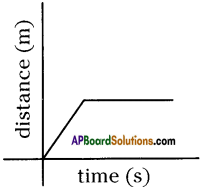
Question 13.
Draw a graph that shows a body without movement after travelling sometime.
Answer:
AP Board 9th Class Physical Science Solutions Chapter 12 Units and Graphs 20

Question 14.
How do you appreciate the role of graphs in solving problems?
Answer:

  • Graphs can be used to compare different physical quantities like time- displacement, time-velocity, pressure-volume, etc. and helps in solve the problems.
  • Graphs are very useful to find the path of an object which is in motion and it is easy to calculate velocity, acceleration, position, etc. at particular time and particular point of the object.
  • Graphs are very useful minimum, maximum values of some physical quantities. For example to find minimum deviation of a prism graphs are very useful.
  • In this way graphs are appreciable for their role in solving problems.

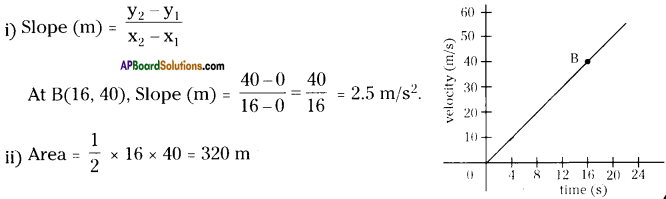
Question 15.
From the given graph find the slope and area at point B.
Answer:
AP Board 9th Class Physical Science Solutions Chapter 12 Units and Graphs 21

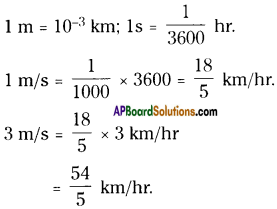
Question 16.
Convert 3 m/s into km/hr.
Answer:
AP Board 9th Class Physical Science Solutions Chapter 12 Units and Graphs 22

Question 17.
A ball of 100 g mass is thrown with initial velocity of 0.01 km/s. What is its momentum at that time?
Answer:
Momentum = mass × velocity
Here, mass of the ball = 100 gr = 100 × [latex]\frac{1}{100}[/latex] kg ⇒ m = 0.1 kg
Velocity of the ball = 0.01 km/s = 0.01 × 1000 m/s ⇒ v = 10 m/s
Momentum of the ball = mxv = 0.1 × 10 kg.m/s = 1 kg.m/s

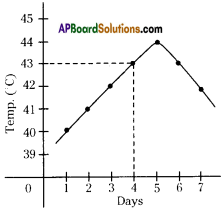
Question 18.
AP Board 9th Class Physical Science Solutions Chapter 12 Units and Graphs 23
Find the temperature on Day – 4 by using graph.
Answer:
AP Board 9th Class Physical Science Solutions Chapter 12 Units and Graphs 24
From the graph the temperature on day – 4 is 43°C.

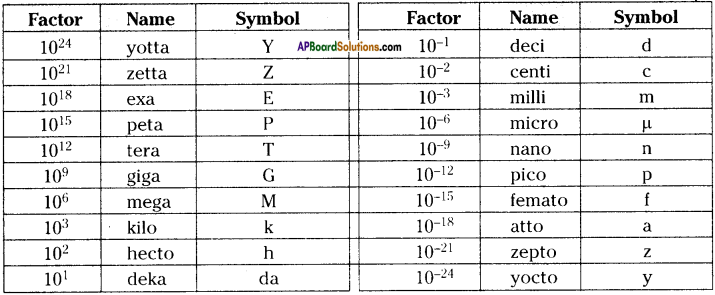
Question 19.
Observe table and answer the following.
AP Board 9th Class Physical Science Solutions Chapter 12 Units and Graphs 25
i) 12 cm = …………. m
ii) 2 nm = …………. cm
Answer:
i) 12 cm = 12 × 10-2 m
ii) 2 nm = 2 × 10⁻⁷ cm
[From the table 1 nanometer = 10-9 m; 1 centimeter = 10-2 m.
1 nanometer to centimeter conversion factor = 10-9-(-2) = 10-7.]

Question 20.
Find the conversion factors
a) Picometers to Meters
b) Gigabytes to Kilobytes.
Answwr:
From the above table,
a) 1 picometer = 10-12 m; 1 meter = 10° m
Conversion factor to convert picometers to meters = 10-12-(-0) = 10-12 m

b) 1 GB = 109 bytes ; 1 KB = 10³ bytes
Conversion factor to convert GB to KB = 109-3 = 106 bytes.

AP Board 9th Class Physical Science Solutions Chapter 12 Units and Graphs

Question 21.
Find the conversion factors
a) Megawatts to Kilowatts
b) Kilowatts to Megawatts.
Answer:
From the above table,
a) 1 Megawatt = 106 watts; 1 Kilowatt = 10³ watts
Conversion factor MW to KW = 106-3 = 10³ W

b) 1 KW = 10³ W and 1 MW = 106 W
Conversion factor KW to MW = 103-6 = 10-3 W

9th Class Physical Science 12th Lesson Units and Graphs 4 Marks Questions and Answers

Question 1.
Write any four rules of writing units of measurements.
Answer:
1) Values are written as a number followed by a space and a unit symbol.
eg : 24 kg, 2 cm, 5 s.

2) Symbols for derived units formed by multiplication are joined with a dot or a space.
eg : 30 N.m, 30 N.m

3) Symbols are mathematical entities, not abbreviations. So, do not have an appended period / full stop.
eg : 4 kg is correct, but 4 k.g. is incorrect.

4) All symbols for units are written in lowercase.
eg : m, s, kg, etc.

5) Symbols derived from the name of a person use uppercase letter for shortform.
eg : Pa, N, W, etc.

Question 2.
Write steps in the construction of a graph, to the given data in a tabular form.
Answer:

  • Take a graph paper. Draw x – axis and y – axis on it.
  • Identify independent variable and dependent variable from the data given in the table. Generally independent variables are decided by us, whereas dependent variables are changed due to the change in independent variable. Take independent variable on x – axis and dependent variable on y – axis.
  • Calculate range for values taken on x – axis as well as y – axis, by using the formula. Range = highest value – lowest value.
  • Determine the scale to be taken on x – axis and y-axis by calculating, range/no. of grids on axis. And mark the scale on the axes.
  • Write names of the physical quantity which is taken on the axis. For eg : time (s), distance (m).
  • Write the data points from the data given in the table such as (x1 y1) (x2 y2)
  • Label the data points in the graph paper by put a dot where the corresponding horizontal and vertical line intersects of a data point.
  • Joint the dots in the graph paper.

Question 3.
Fill the given table with suitable answers.
AP Board 9th Class Physical Science Solutions Chapter 12 Units and Graphs 26
Answer:
a) N/m²
b) Pa [pascal]
c) s-1
d) Force
e) m.kg.s-2
f) m² . kg . s-2
g) J/s (or) [latex]\frac{N.m}{s}[/latex]
h) W [watt]

Question 4.
Fill the table with suitable answers.

Derived quantity Relation with base and derived quantities Unit
Area  
Volume
Density
Speed
Velocity
Acceleration
Work
Momentum

Answer:

Derived quantity Relation with base and derived quantities Unit
Area length × breadth m2
Volume length × width × height m3
Density mass / volume kg m-3
Speed distance / time m s-1
Velocity displacement / time m s-1
Acceleration change in velocity / time m s-2
Work force × distance kg m2 s-2
Momentum mass × velocity kg.m.s-1

Question 5.
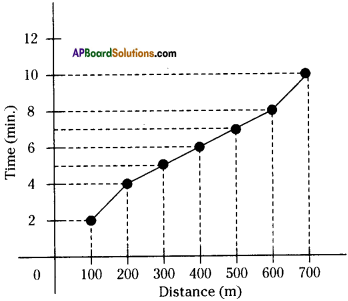
AP Board 9th Class Physical Science Solutions Chapter 12 Units and Graphs 27
1) Who took rest while travelling?
2) After 100 min., what is the positions of Padma and Bhavani?
3) Whose speed is uniform?
4) What is the speed of Bhavani?
Answer:

  1. Padma
  2. Padma at 700 meters and Bhavani at 600 meters from the beginning point.
  3. Speed of Bhavani is uniform.
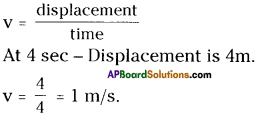
  4. [latex]\frac{600}{100}[/latex]m/min. = 6 m/min.

Question 6.
AP Board 9th Class Physical Science Solutions Chapter 12 Units and Graphs 28
a) Which physical quantity is taken as independent variable?
b) What is the scale on x – axis?
c) What is the scale on y – axis?
d) How the graph is?
Answer:
a) Distance
b) 1 cm = 100 m
c) 1 cm = 2 min.
d) It is a curved line graph.

Question 7.
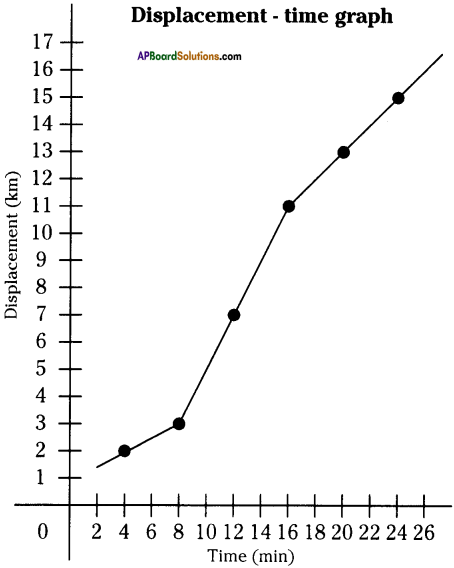
Draw a graph to the given data.
AP Board 9th Class Physical Science Solutions Chapter 12 Units and Graphs 29
Answer:
1) Draw x – axis and y – axis on a graph paper.
2) Here time is independent variable and displacement is dependent variable. So, take time on x – axis and displacement on y – axis.

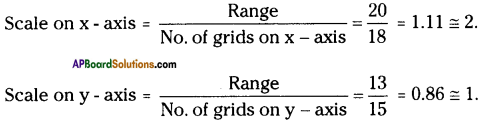
3) Calculate the ranges of values on x – axis and y – axis.
Range on x – axis = 24 – 4 = 20
Range on y – axis = 15-2 = 13

4) Estimate scale on x – axis and y – axis.
AP Board 9th Class Physical Science Solutions Chapter 12 Units and Graphs 30
So, scale on x – axis 1 cm = 2 min.
Scale on y – axis 1 cm = 1 km.
Mark the scales on x and y – axis.

5) Write time (min) at x – axis and displacement (km) at y – axis.

6) Write data points or data values as (4, 2) (8, 3) (12, 7) (16, 11) (20, 13) (24, 15).

7) Plot the above data points in the graph paper with dots.

8) Join the data points.
AP Board 9th Class Physical Science Solutions Chapter 12 Units and Graphs 31

Question 8.
Draw velocity – time graph to the given table.
AP Board 9th Class Physical Science Solutions Chapter 12 Units and Graphs 32
Answer:
1) Draw x – axis and y – axis on a graph paper.
2) Here time is independent variable and velocity is dependent variable. So, take time on x – axis and velocity on y – axis.

3) Calculate the ranges of values on x – axis and y – axis.
Range on x – axis = 180 – 20 = 160
Range on y – axis = 20 – 5 = 15

4) Estimate scale on x – axis and y – axis.
AP Board 9th Class Physical Science Solutions Chapter 12 Units and Graphs 33
Take scale as 1 cm = 8 s on x – axis.
1 cm = 1 m/s on y – axis.

5) Write time (s) at x – axis, velocity (m/s) on y – axis.

6) Write data points as (20, 5), (40, 10), (60, 15) (80, 20) (100, 20), (120, 20) (140, 20) (160, 20) (180, 15).

7) Plot the data points in the graph paper with dots.

8) Join the dots.
AP Board 9th Class Physical Science Solutions Chapter 12 Units and Graphs 34

Question 9.
Show that i) v = u + at, ii) s = ut + ½ at² in graphical method.
Answer:
AP Board 9th Class Physical Science Solutions Chapter 12 Units and Graphs 35
1) Graph is plotted with time on x – axis and velocity on y – axis.

2) According to the above graph,
Velocity of the object at “t” value ”0″ = u
Velocity of the object at “t” value “t” = v

3) Difference between the time intervals = v – u

4) From the graph, x1 = 0, x2 = t, y1 = u, y2 = v
AP Board 9th Class Physical Science Solutions Chapter 12 Units and Graphs 36

5) We know that slope refers acceleration to the velocity – time graph.
Hence acceleration (a) = [latex]\frac{\mathrm{v}-\mathrm{u}}{\mathrm{t}}[/latex] ⇒ v – u = at ⇒ v = u + at ………… (1)

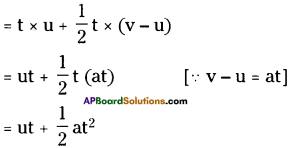
6) The area between the two straight lines drawn at u, v gives displacement of the object. The area of graph is in the shape of trapezium. It has a rectangle and a triangle.

7) Area of the graph = area of rectangle (ABCD) + area of triangle (DCE)
AP Board 9th Class Physical Science Solutions Chapter 12 Units and Graphs 37

8) We know that area of the graph of velocity – time gives displacement(s).

Question 10.
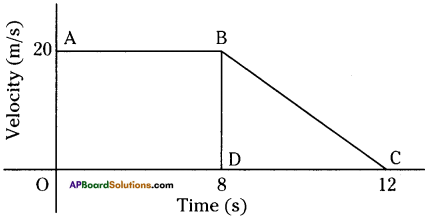
Observe the following graph and calculate displacement of the object in 12 sec.
AP Board 9th Class Physical Science Solutions Chapter 12 Units and Graphs 38
Answer:
1) Displacement (s) = Area of the graph = Area of ABDO rectangle + BDC triangle.
2) Area of the rectangle ABDO = 8 × 20 = 160.
3) Area of the triangle BDC = ½ × 20 × (12 – 8)
= ½ × 20 × 4 = 40.
4) Displacement (s) = 160 + 40 = 200 m.
5) Hence, displacement of the object in 12 sec. = 200 m.

Question 11.
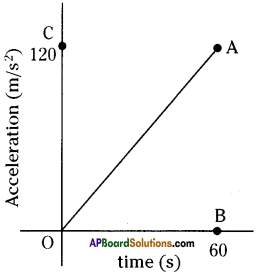
Find the velocity from the graph at A.
AP Board 9th Class Physical Science Solutions Chapter 12 Units and Graphs 39
Answer:

  1. We know that area of the graph of acceleration – time gives velocity (v).
  2. Join the line AB.
  3. Velocity (v) = Area of ΔABO = ½ × 60 × 120 = 3600 m/s.

Question 12.
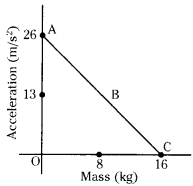
Find the force at point ‘B’.
AP Board 9th Class Physical Science Solutions Chapter 12 Units and Graphs 40
Answer:
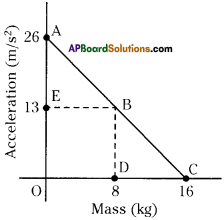
AP Board 9th Class Physical Science Solutions Chapter 12 Units and Graphs 41
We know that
Force= Area of trapezium ABDO.
= Area of triangle AEB + Area of rectangle EODB
AP Board 9th Class Physical Science Solutions Chapter 12 Units and Graphs 42

Question 13.
Using the following data. Draw displacement time graph.
AP Board 9th Class Physical Science Solutions Chapter 12 Units and Graphs 43
Using above graph, what is the average velocity in First “4” Seconds
Answer:
Average velocity in first “4” seconds
AP Board 9th Class Physical Science Solutions Chapter 12 Units and Graphs 44

9th Class Physical Science 12th Lesson Units and Graphs InText Questions and Answers

9th Class Physical Science Textbook Page No. 205

Question 1.
Which is bigger, 2 kg or 100 gr?
Answer:
2 kg.

Question 2.
What would be Rasheeda’s answer?
Answer:
2 kg.

Question 3.
If Rasheeda asked the shop keeper to give 2 sugar, 100 tea powder, can he be able to weigh the items? Why?
Answer:
No, the shop keeper cannot weigh. Because there is no measuring terms (units) to weigh.

Question 4.
Can you name the units of time? What are they?
Answer:
Second, minutes, hours, etc.

Question 5.
Why are they (different units to measure a physical quantity) required?
Answer:
Depending upon the quantity, different units to measure are required.

AP Board 9th Class Physical Science Solutions Chapter 12 Units and Graphs

Question 6.
Can we express the mass of chalk in kilogram?
Answer:
It is difficult to measure directly in kilograms.

9th Class Physical Science Textbook Page No. 206

Question 7.
Why do we use different units for different items?
Answer:
Depending on the quantities of material the units may be expressed.

Question 8.
Why are these called fundamental quantities?
Answer:
These (length, mass, time, etc.) are independent quantities, cannot be expressed in terms of other quantities.

Question 9.
What fundamental quantities are there in the table?
Answer:
Length, mass, time electricity, light intensity, quantity of substance, temperature, plane angle.

Question 10.
What similarities have you noticed in MKS and SI systems?
Answer:
Length, mass, time are common in MKS and SI systems.

AP Board 9th Class Physical Science Solutions Chapter 12 Units and Graphs

Question 11.
How do you find the area of the book?
Answer:
By multiplying length and breadth of the book.

Question 12.
What measurements are required to express area?
Answer:
Length and breadth.

9th Class Physical Science Textbook Page No. 208

Question 13.
How can you convert kilometers into meters?
Answer:
We can convert kilometers into meters by multiplying meters with conversion factor 1000.

9th Class Physical Science Textbook Page No. 211

Question 14.
What is the length of each side (of square grid)?
Answer:
1 cm.

Question 15.
What is the distance between the adjacent thin lines?
Answer:
1 mm.

Question 16.
Which axis is time plotted on and which axis represents distance?
Answer:
Time is plotted on x – axis, y – axis represents distance.

Question 17.
How are these (numbers on x – axis) interpreted?
Answer:
By calculating range of the values of data on x – axis.

AP Board 9th Class Physical Science Solutions Chapter 12 Units and Graphs

Question 18.
What is the difference between the highest and the lowest values?
Answer:
40-5 = 35.

9th Class Physical Science Textbook Page No. 212

Question 19.
What is the advantage of knowing the range of values?
Answer:
If the graph is plotted with the help of calculated values of range, the graph is uniformly distributed through the graph paper and has a correct shape. Otherwise, it will be either too big or too small and will not be any help for analysis.

Question 20.
How to identify values on x-axis and y-axis?
Answer:
By determine the scale.

Question 21.
How to determine scale?
Answer:
AP Board 9th Class Physical Science Solutions Chapter 12 Units and Graphs 56

Question 22.
Which values of distance in the table are equal to the values marked on y-axis?
Answer:
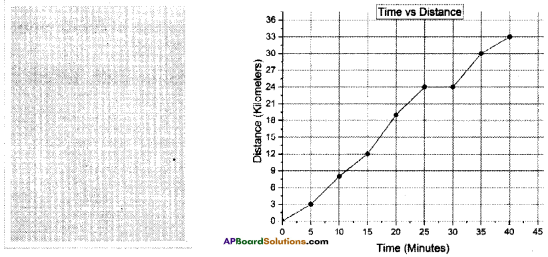
3, 12, 24, 24, 30, 33.

9th Class Physical Science Textbook Page No. 213

Question 23.
What is the shape of the line in the graph?
Answer:
It is curved line.

Question 24.
Did you notice any elongation of the spring?
Answer:
Yes, I noticed elongation of the spring.

AP Board 9th Class Physical Science Solutions Chapter 12 Units and Graphs

Question 25.
How much was the elongation?
Answer:
Some extend. It can be calculated by difference in the lengths of the spring.

9th Class Physical Science Textbook Page No. 214

Question 26.
Can you identify the independent and the dependent variables?
Answer:
Mass is independent variable and elongation of the spring is dependent variable.

9th Class Physical Science Textbook Page No. 215

Question 27.
At what point plunger cannot move forward.
Answer:
It is depending upon conditions of the experiment.

Question 28.
Do you experience any pressure with air?
Answer:
Yes.

9th Class Physical Science Textbook Page No. 217

Question 29.
Let us say what is the slope of x – axis?
Answer:
Slope of the x – axis is zero.

9th Class Physical Science Textbook Page No. 218

Question 30.
What does the ratio explains the physical quantities on the y – axis and x – axis?
Answer:
AP Board 9th Class Physical Science Solutions Chapter 12 Units and Graphs 57
The ratio explains the physical quantities on the y – axis and x – axis is velocity.

Question 31.
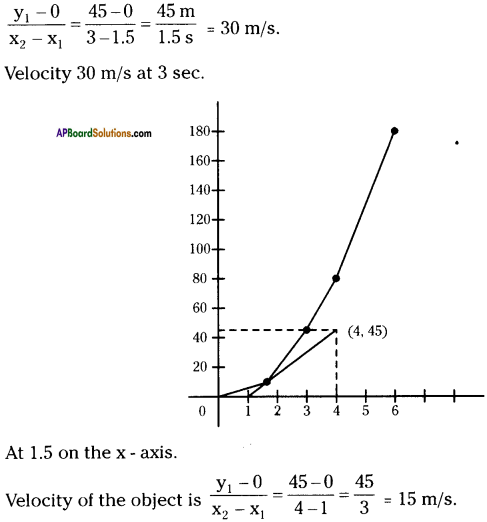
What is the velocity of the object at 1.5 seconds of time?
Answer:
AP Board 9th Class Physical Science Solutions Chapter 12 Units and Graphs 58

9th Class Physical Science Textbook Page No. 207

Question 32.
Is litre a fundamental unit or a derived unit?
Answer:
One litre is the volume of a cube with 10 cm sides. (10 cm × 10 cm × 10 cm)
(or) 1 L = 10-3
Hence, litre is a derived unit.

9th Class Physical Science 12th Lesson Units and Graphs Activities

Activity – 1

Question 1.
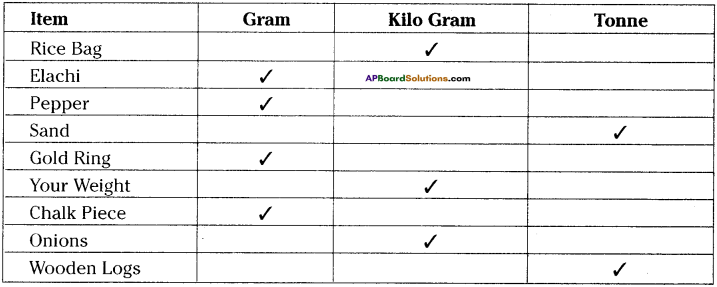
You have noticed that different units are used to measure different materials. Based on your past experience fill in the table with suitable units of measurements used in general, put a tick mark.
AP Board 9th Class Physical Science Solutions Chapter 12 Units and Graphs 45

Activity – 2 Derived Quantities – Derived Units

Question 2.
1) Let us measure the surface area of your book using a scale.
2) Measure the length and breadth of the book.
3) Area of the book can be obtained by multiplying length and breadth.
4) Length = ……………………..
5) Breadth = ……………………
Is area of fundamental quantity?
Answer:
No.

Which fundamental quantity is used to derive area?
Answer:
Length.

From the activity, we can say area is a derived quantity, which is obtained by multiplication of length and breadth which are fundamental quantities.

Activity 3

Question 3.
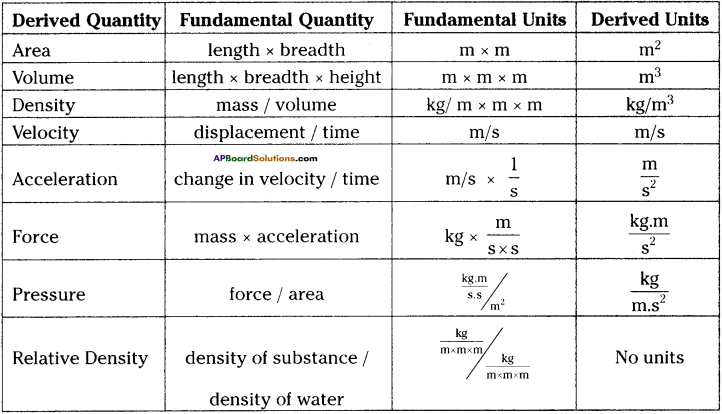
Let us observe the given table and try to find out fundamental and derived units for the given information.
AP Board 9th Class Physical Science Solutions Chapter 12 Units and Graphs 46
1) Which derived units are obtained by the multiplication of fundamental units?
Answer:
Area, volume

2) Which units are derived from only the fundamental quantity length?
Answer:
Area, volume

3) Which derived quantity has no units?
Answer:
Relative density

AP Board 9th Class Physical Science Solutions Chapter 12 Units and Graphs

4) What are the fundamental units of volume?
Answer:
Length

5) What quantities are derived from time?
Answer:

  1. Velocity
  2. Acceleration
  3. Force
  4. Pressure

Activity – 4

Question 4.
Draw a curved line graph to the given table.
Answer:
1) Anitha travels to her grandmother’s village by car.
2) She observed the Odometer (the instrument that measures the distance travelled) fitted in the car.
3) She recorded the reading shown by the odometer once every 5 minutes for 40 minutes.
4) Look at the table prepared by Anitha.
AP Board 9th Class Physical Science Solutions Chapter 12 Units and Graphs 47
5) ‘We show the relation between two quantities using a graph.
6) Here time is independent variable and distance is dependent variable.
7) The steps in the construction of a graph

i) Draw x – axis and y – axis on a graph paper.
Plot time on x – axis as it is independent variable whereas distance on y – axis as it is dependent variable.

ii) Find the range on x – axis
Range on x – axis = highest value – lowest value = 40 – 5 = 35 Find the range on y – axis
Range on y – axis = highest value – lowest value = 33 – 3 = 30

iii) Determine the scale
AP Board 9th Class Physical Science Solutions Chapter 12 Units and Graphs 48

iv) Names on the axis
Write time (min.) on x – axis.
Write distance (km) on y – axis.

v) Write the data points from the table.
(0, 0), (5, 3), (10, 8), (15, 12), (20, 19), (25, 24), (30, 24), (35, 30), (40, 33).

vi) Labelling of data points :
Label above data points with dots where vertical and horizontal lines are intersect to the respective data points.

vii) Join the dots.
AP Board 9th Class Physical Science Solutions Chapter 12 Units and Graphs 49

What is the shape of the line graph?
Answer:
It is curved in shape.

Activity 5

Question 5.
Draw a straight line graph to the given table.
AP Board 9th Class Physical Science Solutions Chapter 12 Units and Graphs 50
Answer:

  • Take a spring / rubber band.
  • Measure the length of the spring with a scale.
  • Fix the spring to the stand.
  • Suspend the weight to the second end of the spring.
  • Now, again measure the length of the spring.
  • Calculate the elongation.
  •  This way, keep on changing the weights and measure the elongation of the spring with scale.

Record the readings in the table.
AP Board 9th Class Physical Science Solutions Chapter 12 Units and Graphs 51

9) Here mass (gm) is independent variable and elongation is dependent variable.
10) Plot the graph.
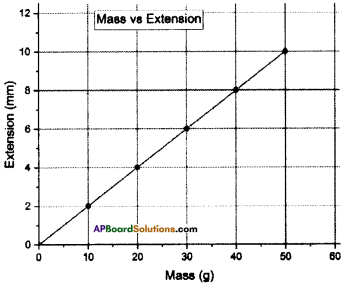
AP Board 9th Class Physical Science Solutions Chapter 12 Units and Graphs 52

1. Which quantity is taken on the x-axis ? In what units it was expressed? Why was it taken on the x-axis?
Answer:

  1. Mass is taken on the x – axis.
  2. It was expressed in grams.
  3. Mass is independent variable, so it was taken on the x – axis.

2. Which quantity is taken on the y-axis? In what units it was expressed? Can this be called an independent variable?
Answer:

  1. Elongation of the spring was taken on the y – axis.
  2. It was expressed in millimeters.
  3. It cannot be called as independent variable, because the values of elongation are obtained in the experiment.

3. The value of range on the x – axis
Answer:
Range = 50 – 0 = 50

4. The value of range on the y-axis
Answer:
Rang = 10 – 0 = 10

5. Scale on the x-axis
Answer:
10

6. Scale on the y-axis
Answer:
2

7. Data values on the x-axis
Answer:
0, 10, 20, 30, 40, 50.

8. Data values on the y-axis
Answer:
0, 2, 4, 6, 8, 10.

9. What is the shape of the line that joined the intersecting points?
Answer:
Straight line.

10. What does the slope of a curve tell us?
Answer:
Relation between mass and extension of the spring.

11. What is the reason for the elongation of the spring?
Answer:
Due to mass suspension to the spring.

12. What relation did you notice between the mass and elongation of spring?
Answer:
Elongation is directly proportional to mass.

AP Board 9th Class Physical Science Solutions Chapter 12 Units and Graphs

13. Wliat could be the relation between the two quantities when the graph is a straight line?
Answer:
It could be directly proportional.

14. Based on the graph, which of the following sentences are correct?
a) If mass increases the elongation of spring increases.
b) If mass decreases the elongation of spring increases.
c) Even if mass increases, there will be no change in the elongation of the spring.
Answer:
a), b) are correct.

Activity – 6

Question 6.
Plot a graph showing inversely proportional measurements.
Answer:

  1. Take a 50 ml syringe.
  2. Fill the syringe with air by pulling a plunger.
  3. To avoid escape of air from syringe close the nozzle of syringe with your finger.
  4. Now push (apply the force) the plunger slowly.
  5. While you are pushing the plunger you may experience more pressure with the decrease of volume of air in syringe, hence you need to apply more force on plunger.
  6. Let us find out the relation between the pressure and volume of air.
  7. Observe the following data table.

AP Board 9th Class Physical Science Solutions Chapter 12 Units and Graphs 53

Physical Quantity on x – axis
Answer:
Pressure

Physical Quantity on y – axis
Answer:
Volume

What is the independent variable?
Answer:
Pressure

What is the dependent variable?
Answer:
Volume

What is the range of values on vertical axis?
Answer:
Range = 50 – 18.7 = 31.3

What is range of values on horizontal axis?
Answer:
Range = 3.2 – 1.2 = 2

What is the shape of the graph?
Answer:
Curved in shape (Parabolic).

What relation you noticed between two physical quantities based on data points in the graph?
Answer:
I have noticed that there is decrease in volume with increase of pressure. Hence these two quantities said to be inversely proportional.

Activity – 7

Question 7.
Observe the following graphs and write your analysis in the given table.
AP Board 9th Class Physical Science Solutions Chapter 12 Units and Graphs 54 AP Board 9th Class Physical Science Solutions Chapter 12 Units and Graphs 55

AP Board 9th Class Social Studies Solutions Chapter 4 Atmosphere

SCERT AP Board 9th Class Social Solutions 4th Lesson Atmosphere Textbook Questions and Answers.

AP State Syllabus 9th Class Social Studies Solutions 4th Lesson Atmosphere

9th Class Social Studies 4th Lesson Atmosphere Textbook Questions and Answers

Improve Your Learning

Question 1.
Explain the composition of the atmosphere.
Answer:

  • The atmosphere is a sea of gases surrounding the Earth.
  • There are many gases in the atmosphere.
  • Of all the gases in the atmosphere oxygen (21%) and nitrogen (78%) dominate.
  • Other gases are in very small percentages, these include argon, neon, carbon dioxide (0.03%), methane, ammonia, ozone, etc.
  • Water vapour accounts for about 0.4% by volume over the whole atmosphere.
  • Apart from these gases the atmosphere also has the fine dust particles called particulates.

AP Board Solutions

Question 2.
Discuss the structure of the atmosphere along with a diagram.
Answer:
On the basis of the chemical composition the atmosphere is divided into two broad layers. They are -1) Homosphere II) Heterosphere
I) Homosphere : This layer is characterized by uniformity in composition of gases like
Nitrogen, Oxygen, Orgon and Carbondioxide. It consists of the three thermal layers such as Troposphere, Stratosphere and Mesosphere. It extends up to the height of 90 kms.

A) Troposphere :
i) It is the lower most of layers of the atmosphere.
ii) It extends to a height of 8 kms near the poles and about 18 kms at the equator.
iii) It contains 75% of the total gaseous mass of the atmosphere.
iv) The entire weather phenomenon happens in this layer.
v) The life is present in this layer.

B) Stratosphere :
i) This layer extends up to a height of 50 kms.
ii) This layer is free from clouds and associated weather phenomenon.
iii) These conditions are most ideal for flying jet aircrafts.
iv) This layer contains Ozone layer.

C) Mesosphere :
i) It extends up to a height of 80 kms.
ii) Meteorites burn up as they enter this layer from the space.
iii) The temperature starts decreasing with the increase in altitude.

II) Heterosphere : Because of its heterogenous composition this layer is called heterosphere. This layer is above 90 kms of the atmosphere. It has two thermal layers called Thermosphere and Exosphere.
A) Thermosphere:
i) It extends up to 400 kms.
ii) Here the temperature rises rapidly with increase in height.
iii) It contains electrically charged particles known as ions. Hence this layer is called Ionosphere.
iv) Radio waves are reflected back to the earth through this layer.
v) It is also known as ‘Ionosphere’.

B) Exosphere :
i) The upper most layer of the atmosphere.
ii) Very little is known about this layer.
AP Board 9th Class Social Studies Solutions Chapter 4 Atmosphere 1

Question 3.
Differentiate weather and climate.
(OR)
Write the differences between weather and climate?
Answer:

  • The difference between weather and climate is a measure of time.
  • Weather is what conditions of the atmosphere are over a short period of time and climate is how the atmosphere “behaves” over relatively long period of time.
  • Weather is basically the way the atmosphere is behaving, mainly with respect to its effects upon life and human activities.
  • Whereas climate is the description of the long-term pattern of weather in a particular area.
  • In most places weather can change from minute to minute, hour to hour, day-to-day and season-to-season. Whereas the climate is the average of weather overtime and space.
  • In short, climate is what we expect whether a hot summer or a cool winter and weather is what you get or experience at present.

AP Board Solutions

Question 4.
Compare and contrast convectional and orographic rainfall.
Answer:
Comparison between convectional and orographic rainfall:
1) Both types of rainfall are caused by vertical ascent of heated air.
Contrast between convectional and orographic rainfall :

  1. While orographic rainfall is caused when the mountain forces the air to rise over mountain or the elevation in its path; the convectional rainfall occurs when moisture over the heated ground becomes warmer than the surrounding air.
  2. While convectional rainfall is common on summer days in interior part of the continents the orographic rainfall occurs in the windward sides of mountains.
  3. While the orographic rain occurs in the mountainous regions, the convectional rain takes place in the equatorial regions.

Question 5.
Describe the distribution of world rainfall.
Answer:

  • Between the latitudes 10° and 30° N and S of the equator, due to the trade winds, rainfall is heavier on the eastern coasts, and decreases towards the West.
  • Between the latitudes 40° and 60° N and S of the equator due to the westerlies, the rainfall is heavy on the west coast, and goes decreases towards the East.
  • Low pressure areas, especially around the equator receiver high rainfall than high pressure areas.
  • The rainfall is more over the oceans than on the continent.
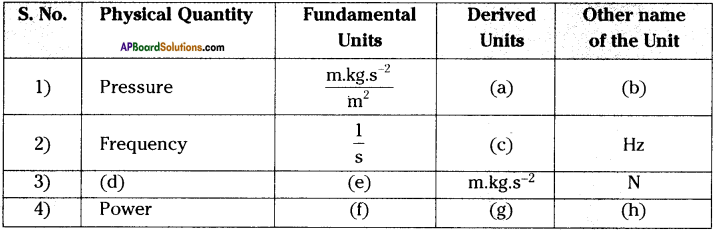
Question 6.
How do climatic changes influence the human life?
Answer:
Due to climatic changes the following changes are taking place.

  1. The climatic changes led to the emergence of large scale environmental hazards such as global warming, increase of green house gases etc.
  2. Development of planet’s flora and fauna is mainly due to climatic changes.
  3. Globally the average sea level has risen by 17 cm in the 20th century.
  4. Climatic changes are affecting food habits and culture of the people of any area.
  5. Due to global warming both the Greenland and Antarctic ice sheets have lost significant amounts of ice.
  6. Thus the climatic changes are influencing human life significantly.

Question 7.
Explain relative humidity.
Answer:

  • The amount of water vapour present in the atmosphere is called humidity.
  • Relative humidity is the ratio between the maximum water vapour that the air can hold at a given temperature and pressure and the actual amount of water vapour it holds at any given time.
  • For example, at 20°C temperature air can contain 80 gms of water vapour per cubic meter. If the actual water vapour present is 40 gms, the relative humidity is 50%.
  • If the atmosphere has 100% relative humidity, it is known as saturation level.
  • Relative humidity decreases with increase of temperature and decrease of water vapour,
  • In high humidity, our sweat doesn’t cool us because it cannot evaporate.
  • In low humidity we feel more thirsty.

Question 8.
Why does the amount of water vapour decrease rapidly with altitude?
Answer:
The water vapour is attracted towards the surface or close to the surface due to the gravitational pull of the earth. Hence the amount of water vapour decreases with altitude.

AP Board Solutions

Question 9.
What is Coriolis effect ? And explain its effects.
(OR)

“Vasco da Gama found the sea route to India using winds to power his ships. Europeans established colonial states in various parts of the world through the wind power”.

What is Coriolis effect and how does it influence the wind system?
Answer:
1. Because of the impact of Earth’s rotation on its own axis, the winds move slightly to the right in the northern hemisphere, and to the left in the southern hemisphere. This effect is called Coriolis effect.
2.
AP Board 9th Class Social Studies Solutions Chapter 4 Atmosphere 2
3. At the equator the Coriolis effect is ‘O’ and at the poles it is maximum.

The most important effects of Coriolis force are :
a) The deflection of winds and currents in the ocean.
b) It has significant effect on planes and missiles also.
c) In the northern hemisphere these winds move to the right and in the southern hemisphere to the left. This usually creates the westerly winds moving from the subtropical areas to the poles.
d) The Coriolis effect also affects the movement of ocean currents.

Question 10.
Identify the given local winds in the world map.
a) Chinook
b) Loo
c) Simoon
d) Yoma
e) Norwester
f) Mistral
g) Puna
h) Pampero
Answer:
AP Board 9th Class Social Studies Solutions Chapter 4 Atmosphere 3

Question 11.
Read the para under the title “Effects of Planetary Winds” on page 43 and comment on it.
Effects of Planetary Winds: You would have noted that the pressure and wind systems are actually a result of the impact of Lithosphere and Hydrosphere on Atmosphere. These winds play a crucial role in transporting heat and moisture across the world. That is why no part of the world gets too cold or too hot for life to survive. Had there been no atmosphere (as on the Moon) it would have got intolerably hot in day time or in the tropics and intolerably cold at night or in the Polar regions. However, these winds do not distribute heat or moisture uniformly – which is why we have some parts of the earth quite hot, some parts cooler and some parts with high rainfall and some which are deserts.
Answer:
Planetary winds are winds that are created in the different Global circulation cells.

  1. Polar Easterlies – blow from pole to 60°
  2. Prevailing Westerlies – blow from 60° to 30°
  3. Trade Winds – blow from 30° to 0°

These winds transport heat and moisture across the world. But the winds do not distribute heat or moisture uniformly.

AP Board Solutions

Question 12.
Collect weather information covered by media such as newspapers, TV, Radio, etc. to understand weather phenomena.
Answer:
Weather information of major cities of India on 8, April 2020.

Delhi 47°C Afternoon, Thu 17:04
Jabalpur 50°C Afternoon, Thu 17:04
Chennai 41°C Afternoon, Thu 17:04
Banglore 45°C Afternoon, Thu 17:04
Ahmadabad sere Afternoon, Thu 17:04
Allahabad 39°C Afternoon, Thu 17:04
Pune 34°C Afternoon, Thu 17:04
Poona 25°C Afternoon, Thu 17:04
Haora 33°C Afternoon, Thu 17:04
Surat 32°C Afternoon, Thu 17:04
Madras 41°C Afternoon, Thu 17:04
Calcutta 34°C Afternoon, Thu 17:04
Solapur 40°C Afternoon, Thu 17:04
Muzaffarpur 50°C Afternoon, Thu 17:04
Bulandshahr 37°C Afternoon, Thu 17:04
Ghaziabad 46°C Afternoon, Thu 17:04
Jaipur 37°C Afternoon, Thu 17:04
Kanpur 48°C Afternoon, Thu 17:04
Lucknow 38°C Afternoon, Thu 17:04
M 0 Ranchi 49°C Afternoon, Thu 17:04
Nagpur 53°C Afternoon, Thu 17:04
Visakhapatnam 32°C Afternoon, Thu 17:04
Guwahati 26°C Afternoon, Thu 17:04
Chittoor 46°C Afternoon, Thu 17:04
Indore 37°C Afternoon, Thu 17:04
Coimbatore Peelamedu 35°C Afternoon, Thu 17:04
Kalya n 35°C Afternoon, Thu 17:04
Patna 39°C Afternoon, Thu 17:04
Kozhikode 30°C Afternoon, Thu 17:04
Gwalior 37°C Afternoon, Thu 17:04
Jamnagar 42°C Afternoon, Thu 17:04
Vadodara 38°C Afternoon, Thu 17:04
Mahesana 36°C Afternoon, Thu 17:04
Akola 41°C Afternoon, Thy 17:04
Bhopal 39°C Afternoon, Thu 17:04
Ludhiana 47°C Afternoon, Thu 17:04
Aurangabad 51°C Afternoon, Thu 17:04
Agra 37°C Afternoon, Thu 17:04
Cochin 39°C Afternoon, Thu 17:04
Benares 39°C Afternoon, Thu 17:04

Question 13.
Collect the newspapers from July to December and note down the news related to extreme rainfall in different parts of country.
Answer:
Average annual rainfall of the states of India

State Meteorological Divisions Average annual rainfall (mm)
Andaman and Nicobar Islands Andaman and Nicobar Islands 2,967
Arunachal Pradesh Arunachal Pradesh 2,782
Assom Assom and Meghalaya 2,818
Meghalaya Assom and Meghalaya 2,818
Nagaland Nagaland, Manipur, Mizoram and Tripura 1,881
Manipur Nagaland, Manipur, Mizoram and Tripura 1,881
Mizoram Nagaland, Manipur, Mizoram and Tripura 1,881
Tripura Nagaland, Manipur, Mizoram and Tripura 1,881
West Bengal Sub-Himalayan West Bengal and Sikkim

Gangetic West Bengal

2,739

1,439

Sikkim Sub-Himalayan West Bengal and Sikkim 2,739
Odisha Odisha 1,489
Bihar Bihar Plateau 1,326
Bihar Plains 1,186
Uttar Pradesh Uttar Pradesh 1,025
Plain of West Uttar Pradesh 896
Hills of West Uttar Pradesh 1,667
Haryana Haryana, Chandigarh and Delhi 617
Delhi Haryana, Chandigarh and Delhi 617
Chandigarh Haryana, Chandigarh and Delhi 617
Punjab Punjab 649
Himachal Pradesh Himachal Pradesh 1,251
Jammu and Kashmir Jammu and Kashmir 1,011
Rajasthan West Rajasthan 313
East Rajasthan 675
Madhya Pradesh Madhya Pradesh 1,017
East Madhya Pradesh 1,338
Gujarat Gujarat region 1,107
Saurashtra and Kachchh 578
Goa Konkan and Goa 3,005
Maharashtra Madhya Maharashtra 901
Marathwada 882
Vidarbha 1,034
Andhra Pradesh Coastal Andhra Pradesh 1,094
Rayalaseema 680
Tamilnadu Tamilnadu and Pondicherry 998
Pondicherry Tamilnadu and Pondicherry 998
Karnataka Coastal Karnataka 3,456
North Interior Karnataka 731
South Interior Karnataka 1,126
Kerala Kerala 3,055
Telangana Telangana 961

9th Class Social Studies 4th Lesson Atmosphere InText Questions and Answers

Question 1.
List out some of the ways in which particulates in the atmosphere are beneficial and harmful to us. (Text Book Page No. 37)
Answer:
1. The fine dust particles present in the atmosphere are called particulates.

2. Particulates may come from natural processes such as sand storms over deserts and natural forest fires and from human activity such as burning forests, burning petroleum and industrial emissions.

3) Benefits of particulates :
a) The particulates can change atmospheric conditions that may be beneficial to life on Earth.
b) The particulates in the atmosphere cause the bright colour of the sunrise or sunset.
c) The particulates help rainfall and hailstones to fall.

4) Harmful effects of particulates :
a) They cause problems by altering temperature and rainfall patterns.
b) They can make it difficult for people to breathe.
c) They can make it difficult for the plants to breathe and photosynthesise.

AP Board Solutions

Question 2.
In which layer is the life present? (Text Book Page No. 39)
Answer:
In troposphere the life is present. The suitable conditions that make life possible in the troposphere are :

  1. The troposphere is the lower most layer of the atmosphere.
  2. It contains about 75% of the total gaseous mass of the atmosphere and practically all the moisture and dust particles.
  3. The entire weather phenomenon happens in this sphere.
  4. Condensation, evaporation, precipitation, rainfall, cyclones etc., occur in this layer.

Question 3.
About which layer do we have very less knowledge? (Text Book Page No. 39)
Answer:

  • Exosphere is the upper most layer of the atmosphere.
  • This is the highest layer.
  • Very less is known about it.

AP Board Solutions

Question 4.
Which layer of the atmosphere is ideal for flying jet aircrafts? Why? (Text Book Page No. 39)
Answer:

  • Stratosphere is ideal for flying jet aircrafts.
  • Because this layer is almost free from clouds and associated weather phenomenon.
  • These conditions are most ideal for flying jet aircrafts in this layer.

Question 5.
Our skin dries up more during winters. Why?
Answer:

  • Water vapour (i.e., the humidity) is a very important component in the atmosphere.
  • The relative humidity plays a large role in determining our comfort level.
  • If the relative humidity is 100 percent, we feel much hotter than the actual temperature indicates because our skin, sweat does not evaporate at all.
  • If the humidity is low, our skin and mucous membranes are dry.
  • As a result of low humidity, we’ll have chapped lips, dry and itchy skin, and a dry sore throat when we wake up in the morning.
  • Low humidity also dries the plants and furniture.

Question 6.
Observe the following figure and describe from which pressure belt to which pressure belt are the Westerlies, trade winds and polar Easterlies are blowing.
AP Board 9th Class Social Studies Solutions Chapter 4 Atmosphere 4
Answer:

  • The Westerlies blow from subtropical high pressure belts to sub polar low pressure belts in both the hemispheres.
  • The trade winds blow from sub tropical high pressure belt to equatorial IQW pressure belt.
  • Polar Easterlies blow from polar high pressure belt to polar low pressure belt.

Question 7.
What will happen if water vapour is not present in air?
Answer:
1. The condensation of water vapour to the liquid or ice phase is responsible for clouds, rain, snow and other precipitations.

If water vapour is not present in the atmosphere, clouds, rains, snow will not occur. If there is no rain, life will not be possible on earth.

2. Water vapour is one of the green house gases. Green house gases play a major role in determining the balance of between the amount of radiation entering the Earth’s surface and the amount of radiation leaving the Earth’s surface.

The green house effect keeps the Earth’s surface about 33°C warmer thair-it would otherwise be.

Question 8.
Why is atmosphere important for us?
Answer:

  • We breathe in oxygen which is one of the components of atmosphere.
  • We breathe out carbon dioxide, which in turn is taken in by plants in their respiration.
  • The atmosphere prevents harmful rays of the sun from reaching us.
  • The green plants take in carbon dioxide, use sunlight and water to photosynthesise and we get delicious fruits, vegetables, and grains from them.
  • These give us proteins, carbohydrates, sugars, fats, minerals and other nutrients that we need.
  • The atmospheric winds transport water from the oceans deep into the continents in the form of rain.
  • Atmospheric winds erode rocks and are responsible for the formation of many kinds of soils with whose fertility we grow many kinds of crops.
  • Atmosphere helps in cooling monsoon rains.
  • Atmosphere helps in diffusion of perfumes and helps in the travelling of sound waves.
  • Thus we can say atmosphere is important for us.

AP Board Solutions

Question 9.
Can you imagine why life is not possible on the Moon? (Text Book Page No. 37)
Answer:

  • Life is not possible on the Moon because the Moon has no atmosphere.
  • On Moon we don’t have atmospheric pressure without which we cannot live.
  • Because of lack of atmosphere we don’t have any protection from ultra violet raditation.
  • Because of the lack of magnetosphere, we will be frequently bombarded by the charged particles.
  • There is no water on the Moon which is the first and foremost requirement for the life.
  • For all the above reasons life is not possible on the Moon.


AP Board 9th Class Social Studies Solutions Chapter 13 Democratic and Nationalist Revolutions 17th and 18th Centuries

SCERT AP Board 9th Class Social Solutions 13th Lesson Democratic and Nationalist Revolutions 17th and 18th Centuries Textbook Questions and Answers.

AP State Syllabus 9th Class Social Studies Solutions 13th Democratic and Nationalist Revolutions 17th and 18th Centuries

9th Class Social Studies 13th Lesson Democratic and Nationalist Revolutions 17th and 18th Centuries Textbook Questions and Answers

Improve Your Learning

Question 1.
Identify the name of the country in the context of following statement: (UK, USA and France)
1) revolution where parliament system was established
2) country where king continues to play some role even after revolution
3) country that had to war against another in order to establish its democracy
4) The bill of rights was adopted
5) Overthrow of the monarchy was led by the peasants
6) Declaration of Rights of Man and Citizen was adopted
Answer:

  1. UK
  2. UK
  3. USA
  4. USA
  5. France
  6. France

Question 2.
What were the main ideas of social thinkers, which were significant to the establishment of new forms of governments? How did they gain popularity?
Answer:

  • Philosophers such as John Locke and Rousseau envisaged a society based on freedom and equal laws and opportunities for all.
  • Locke in his “Two Treatises of Government” advocated theory of Natural rights and opposed the doctrine of the divine and absolute right of the monarch.
  • Rousseau carried the idea forward and laid foundation for democracy in his book “The Social Contract”.
  • Montesquieu, in his book “The Spirit of Laws” proposed a division of power between the legislature, the executive and the judiciary.
  • Voltair advocated restricted powers.
  • Thomas Jefferson advocated to fight for the political rights of the people.
  • These ideas were discussed in salons and coffee-houses.
  • Spread among the people through books.
  • These ideas were read aloud in groups to benefit those who could not read and write.

AP Board Solutions

Question 3.
Describe the circumstances leading to the outbreak of revolutionary protest in France.
Answer:
The French Revolution is an important political revolution in the world. It has laid foundation for democracy and human rights. The following are the circumstances that led to the outbreak of the French Revolution.
1. Social causes:

  1. The French society was divided into three estates.
  2. The members of the first two estates, that is, the clergy and the aristocracy, enjoyed certain privileges and were exempted from paying taxes.
  3. The burden of taxes was borne by the third estate alone. This problem was compounded by failure of crops.

2. Political causes :

  1. In 1774, Louis XVI ascended the throne of France.
  2. He was quite inefficient and was influenced by his wife.
  3. The influence of nobles and priests also had bad effect on the administration.

3. Growth of Middle class :

  1. The eighteenth century witnessed the emergence of new social groups, collectively termed the middle class.
  2. This group of the third estate became powerful due to their access to education and new ideas.
  3. They believed that no group in the society should be privileged by birth.

4. Intellectual causes :
The third estate was influenced by the philosophical thoughts of Locke, Rousseau, etc.

5. Summoning of Estate General :

  1. Long years of war had drained the financial resources of France.
  2. To increase the taxes to meet the expenses, in 1789, summoned the Estates General.
  3. Summoning of Estate General was the immediate causes of the French Revolution.

Question 4.
Which groups of French society benefited from the revolution? Which groups were forced to relinquish power? Which sections of society would have been disappointed with the outcome of the revolution?
Answer:

  • The third estate, i.e. landless labour, small peasants, middle class were benefited as their rights were recognized.
  • The privileges enjoyed by the members of the first two estates were abolished.
  • Hence the first two estates, i.e. the clergy and the aristocracy were disappointed with the outcome of the revolution.

Question 5.
After completing the chapter on Fundamental Rights, draw up a list of the democratic rights that we enjoy today whose origins could be traced back to the French Revolution.
Answer:
The origins of the following democratic rights we enjoy today were traced to the French Revolution.

  1. Liberty
  2. Equality
  3. Right to participate in the formation of Legislature and Executive
  4. Rule of law
  5. Freedom of expression
  6. Right to property.

AP Board Solutions

Question 6.
Would you agree with the view that the message of Universal Rights was beset with contradictions? Explain.
Answer:

  • Yes. The message of Universal Rights was beset with contradictions.
  • Contradiction was evident as regards women. Women did not enjoy the same political rights nor were their wages equal to men.
  • The French revolution has been the symbol of liberty, equality and fraternity but later the French became the conquerers instead of liberators.
  • And it was the direct contradiction of the terms.
  • Slave trade, the most inhuman practice was yet another blatant contradiction.

Question 7.
What made the American colonists to raise the slogan ‘No Taxation without Representation’?
(OR)
How did you understand the slogan ‘No Taxation without Representation?
Answer:

  • The English Parliament assumed powers to make laws for the American states but the people of those states did not vote for the Parliament.
  • American colonies were taxed heavily by the British Government.
  • The Parliament often passed laws that favoured English traders at the cost of the people of the colonies.
  • The American colonies therefore raised the slogan “No Taxation without Representation”.

AP Board Solutions

Question 8.
What do understand by middle class ? How did it emerge in Europe?
(OR)
‘The eighteenth century witnessed the emergence of new social groups collectively termed the middle class’ – Explain about the emergence of middle class in Europe.
Answer:

  • Within the Third Estate, a group of people had access to education and new ideas and became prosperous.
  • They earned their wealth through expanding means of overseas trade and from the manufacture of goods such as woollen and silk textiles.
  • This new social group was collectively termed as middle class.

Question 9.
Locate England, France, Prussia, Spain and Austria on the map of Europe.
Answer:
AP Board 9th Class Social Studies Solutions Chapter 13 Democratic and Nationalist Revolutions 17th and 18th Centuries 1

Question 10.
How do you understand women’s role in French Revolution
Answer:
Women’s role in French Revolution : From the very beginning women were active participants in the events which brought about so many important changes in French society. They hoped that their involvement would pressurise the revolutionary govern¬ment to introduce measures to improve their lives. Most women of the Third Estate had to work for a living. They worked as seamstresses or laundresses, sold flowers, fruits and vegetables at the market, or were employed as domestic servants in the houses of prosperous people. Most women did not have access to education or job training.

In order to discuss and voice their interests women started their own political clubs and newspapers. About sixty women’s clubs came up in different French cities. The Society of Revolutionary and Republican Women was the most famous of them. One of their main demands was that women enjoy the same political rights as men. They demanded the right to vote, to be elected to the Assembly and to hold political office.

During the Reign of Terror, the new government issued laws ordering closure of women’s clubs and banning their political activities. Many prominent women were arrested and a number of them executed. It was finally in 1946 that women in France won the right to vote.

Question 11.
Read the paragraph under the title “The Reign of Terror” of page 169 and comment on it.

The Reign of Terror
The period from 1793 to 1794 is referred to as the Reign of Terror. Robespierre followed a policy of severe control and punishment. All those whom he saw as being ‘enemies’ of the republic – ex-nobles and clergy, members of other political parties, even members of his own party who did not agree with his methods – were arrested, imprisoned and then
tried by a revolutionary tribunal. If the court found them ‘guilty’ they were guillotined. Robespierre’s government issued laws placing a maximum ceiling on wages and prices. Meat and bread were rationed. Peasants were forced to transport their grain to the cities and sell it at prices fixed by the government. The use of more expensive white flour was forbidden. All citizens were required to eat the pain d’egalite (equality bread), a loaf made of whole wheat. Churches were shut down and their buildings converted into barracks or offices. Robespierre pursued his policies so relentlessly that even his supporters began to demand moderation. Finally, he was convicted by a court in July 1794, arrested and on the next day sent to the guillotine.

Answer:
The Reign of Terror:
In the autumn of 1793, Robespierre and the Jacobins focused on addressing economic and political threats within France. What began as a proactive approach to reclaiming the nation quickly turned bloody as the government instituted its infamous campaign against internal opposition known as the reign of terror.

Beginning in September, Robespierre, under the auspicious of the committee of public safety, began pointing an accusing finger at any one whose beliefs seemed to be counter revolutionary – citizens who had committed no crime but merely had social or political agendas that varied too much from Robespierre. The committee targeted even those who shared many Jacobin views but were perceived as just slightly too radical or conservative. A rash of executions ensured in Paris and soon spread to smaller towns and rural areas.

During the nine-month period that followed, anywhere from 15,000 to 50,000 French citizens were beheaded at the guillotine. Even longtime associates of Robespierre such as Georges Danton, who had helped orchestrate the Jacobin rise to power, fell victim to the paranoia. When Danton wavered in his conviction, questioned Robespierre increasingly. The lives were on the edge of a blade.

AP Board Solutions

Question 12.
Learn something more about the different personalities who played an important role in American and French revolution. Which of them impresses you the most and why? Write a paragraph on him/ her.
Answer:

  1. Jacques – Pierre Brissot
  2. Charles de Calonne
  3. Lazare carnot
  4. Marquis de Lafayatte
  5. Jacques Necker
  6. Maximillian Robespierre
  7. Emmanuel – Joseph Sieyes
  8. Thomas Jafferson

These are all participated and played an important role in French and America revolu-tions. But I like more Marquis de Lafayatte. Why because he participated in American and French Revolutions both.

Marquis de Lafayette :
Lafayate was one of the generals of Louis XVI. Born in a noble family of France, he displayed great qualities of courage and adventure on various occassions. He was also known for his political acumen. He was sent to America during American war of Independence. He helped George Washington in defeating England. While he was in America, he was deeply influenced by the drafting of a constitution and the grant of declaration of rights. On his return from America, he was elected to the estate general and participated in the French Revolution.

Jacques – Pierre Brissot:
A member of the Legislative Assembly and National Conven¬tion who held a moderate stance and believed in the idea of a constitutional monarchy.

Charles de calonne :
The controller general of finance appointed by king Louis XVI after Jacques Necker was forced out of office in 1781.

Lazare carnot :
A French soldier appointed by the committee of public society to help reorganise the failing war effort against Austria and Prussia.

Jacques Necker:
He was appointed as a genera! of finance in the late 1770s.

Maximilien Robespierre :
A brilliant political factician and leader of the radical Jacobins in the National Assembly.

Emmanuel-Joseph Sieyes :
A liberal member of the clergy, supporter of the third estate and author of the fiery 1789 pamphlet “What is the Third Estate”?

9th Class Social Studies 13th Lesson Democratic and Nationalist Revolutions 17th and 18th Centuries InText Questions and Answers

Question 1.
What was the effect of the Civil war on the king and the people of the England? (Text Book Page No. 161)
Answer:

  • A civil war lasted in England for five years.
  • Ultimately, Charles, I was defeated and executed in 1649.
  • After Glorious Revolution in 1688, the powers of the king were restricted. Thus the Parliament’s supremacy was established.
  • After a consistent struggle, the right to vote was gradually extended to all adults by 1928.

AP Board Solutions

Question 2.
(Look at the chart on P.No. 166) Which groups of French society would have gained from the Constitution of 1791? Which groups would have had reason to be dissatisfied? (Text Book Page No. 168)
Answer:

  • The Third Estate and the newly developed middle class were benefited from the revolution.
  • They got equal rights with other social groups. They were given right to vote.
  • They were given the rights such as right to live, freedom of speech, freedom of opinion and equality before law.
  • Common tax is levied. It must be assessed equally on all citizens in proportion to their means. Thus the burden of taxes on common people was removed.
  • The clergy the nobles and the king were forced to relinquish their powers and privileges.
  • The Declaration of Rights of Man and Citizen declared that no group or individual may exercise authority that does not come from the people. With this the clergy and the nobles were deprived of their special rights and privileges.
  • The new Constitution limited the powers of the monarch. Thus the king had to relinquish the powers of his autocracy. The powers concentrated in the hands of one person, were now separated and assigned to different institutions – the legislature, executive and Judiciary.
  • According to the Declaration of Rights the common tax is levied. It must be assessed equally on all citizens in proportion to their means. Thus the clergy and the nobles lost their privilege and were forced to pay the taxes.

Question 3.
Fill in the blank boxes in the figure below with appropriate terms from among the following: (Text Book Page No. 163)
1) Food riots
2) Social unrest
3) Increase number of death
4) Rising food prices
5) Weaker bodies.
Answer:
AP Board 9th Class Social Studies Solutions Chapter 13 Democratic and Nationalist Revolutions 17th and 18th Centuries 2

Question 4.
Write an imaginary dialogue between persons from a king’s party and parliamentary party in our context. (Text Book Page No. 161)
Answer:
Parliamentary Party :
The parliament had now a better army in so much that if the Earl of Essex had immediately followed the king of Oxford, not yet well fortified, he might in all likelihood have taken it. For he could not want either men or ammunition. Whereof the city of London, which was wholly at the parliments devotion, had store enough.

Kings’ Party :
I cannot judge that. But this is manifest, considering the estate the king was in at his first marching from York, when he had neither money nor men nor arms enough to put them in hope of victory, that this year, take it altogether, was very prosperous.

AP Board Solutions

Question 5.
Imagine the impact of the events of France on neighbouring countries such as Prussia, Austria-Hungary or Spain, all of which were absolute monarchies. How would the kings, traders, peasants, nobles or members of the clergy have reacted to the news of what was happening in France? (Text Book Page No. 168)
Answer:

  • It is said that whenever France sneezes Europe catches cold.
  • After the great French Revolution of 1789, France was acknowledged the leader of the progressive opinion in Europe.
  • The 1830 revolution raised national spirit in the countries like Belgium, Germany, Italy, Spain, Portugal, and Poland. They led the movements for achieving National Independence.
  • The rising tide of revolution in different countries became the cause of fear among the autocrat rulers. They joined to check the spread of the revolution.
  • The main gift of French Revolution was the ideas of Liberty, Equality, and Fraternity.
  • It ended the dominance of the theory of the divine right of kingship.
  • It give death blow to social status by birth. The clergy and nobles lost their supremacy, dominance over polity and other sections of society.
  • The clergy and the noble were devoid of their privileges in society.
  • The Third Estate and the middle class were relieved from serfdom and the burden of over taxation.


AP Board 9th Class Social Studies Solutions Chapter 10 Prices and Cost of Living

SCERT AP Board 9th Class Social Solutions 10th Lesson Prices and Cost of Living Textbook Questions and Answers.

AP State Syllabus 9th Class Social Studies Solutions 10th Lesson Prices and Cost of Living

9th Class Social Studies 10th Lesson Prices and Cost of Living Textbook Questions and Answers

Improve Your Learning

Question 1.
Why is there a need to regulate prices?
Answer:

  • Trades main aim is to earn profit, raise prices of many goods and particularly essential items by illegal ways.
  • If there is no increase in wage for workers who are also consumers in the market, they cannot buy the goods.
  • When these goods happen to be essentials such as wheat, rice, milk etc., this creates problem for the people.
  • This necessitates the need for regulation of traders to regulate prices.

Question 2.
How are prices fixed by a seller/producer?
Answer:

  • The traditional economic theories of pricing were based on the demand and the supply.
  • In general the prices are fixed on the basis of full average cost of production per unit plus a margin of normal profit or some satisfactory margin of profit.
  • Producer sells the goods to the seller.
  • Seller in turn adds his profits and fixes the prices.

AP Board Solutions

Question 3.
Differentiate the cost of living from the standard of living.
Answer:

Cost of Living Standard of Living
1. The total costs of all goods and services purchased in a family for a specific period is the cost of living of the family. 1. The quality of life that the people enjoy is the standard of living of the people.
2. Inflation and cost of living are positively related. 2. Inflation and standard of living are inversely related.
3. That means if inflation increases, the cost of living too increases. 3. That means if inflation increases, the standard of living decreases.

Question 4.
Who is affected the most by increase in cost of living? Why?
Answer:

  • People with fixed incomes, such as pensioners, daily wage earners, manual workers, small vendors, workers in small enterprises and in private low income jobs etc., are badly affected by increase in cost of living.
  • These people’s income does not increase when there is inflation.

Question 5.
Which groups can get higher incomes whenever there is inflation?
Answer:
Not everyone is affected by rising prices. For some groups this rise in price levels is compensated. They are –

  1. People working in central and state government offices and in some organizations get an additional payment called “Dearness Allowance” whenever prices rise. Therefore their income increases, along with inflation.
  2. People doing business activities recover the higher cost of living by increasing the prices of goods they sell.
  3. People providing services such as lawyers, doctors etc., increase their fees when prices increase.
  4. Extremely rich people and those working in corporate sector are less affected by rising prices.

AP Board Solutions

Question 6.
How is Wholesale Price Index different from Consumer Price Indices?
Answer:
Change in price is measured with the help of a statistical device referred to as “Price Index”. Price Index is of two types. They are –

  1. Consumer Price Index
  2. Wholesale Price Index
The Consumer Price Index The Wholesale Price Index
1. The CPI measures only changes in prices of a few selected consumer goods at retail price. 1. The Wholesale Price Index includes all goods and changes in their wholesale rates.
2. Different CPIs are published by government. 2. There is only one wholesale price index.
3. The CPIs are used to calculate the DA to be paid for government employees. 3. The inflation is generally measured on the basis of changes in WPI.

Question 7.
How is food inflation different from Consumer Price Indices?
Answer:

  • CPI measures only changes in prices of a few selected consumer goods at a retail price.
  • Different CPIs are published by the government.
  • Whereas FPI (Food Price Index) is used to estimate rise in prices of food items called food inflation.
  • The FPI consists wholesale price of food materials such as rice, wheat, pulses, vegetables, sugar, milk, eggs, meat, fish, and manufactured food materials such as edible oils.

AP Board Solutions

Question 8.
What are the uses of the CPI?
Answer:
The CPIs are used to calculate the DA to be paid for government employees, to revise legal wage rates as part of Indian government laws and also to estimate the number of poor in India.

Question 9.
List of five problems with measuring CPI.
(OR)
Write any five issues that are considered while measuring CPI.
Answer:

  • There are thousands of goods and services in the economy.
  • Only selected consumer goods and changes in these goods are taken by the government to calculate CPI.
  • Both quality and quantity of goods consumed keeps varying from time to time.
  • Difficult to calculate CPI as the price levels vary from state to state.
  • Even food habits keep varying among people.

AP Board Solutions

Question 10.
How is Administrative Price Mechanism (APM) different from Minimum Support Price (MSP)?
Answer:

Administrative Price Mechanism Minimum Support Price
1. Under APM, a price is fixed and it is mandatory for the traders to sell their goods at that price level in the market. 1. A minimum support price is a price at which the farmers can sell their grain to the government.
2. It is compulsory for traders to follow the APM. 2. It is not compulsory for farmers to sell their goods at MSP
3. It helps in preventing hoarding and keeps the prices of essential commo­dities within reasonable levels. 3. It helps the farmers to gain their  of cost cultivation plus a minimum profit  on the production

Question 11.
Read sixth paragraph under the heading ‘Role of Government in Regulating Prices’ and answer the question.

For preventing hoarding and keeping the prices of essential commodities within reasonable levels, and to facilitate their availability, the government fixes the prices and makes it mandatory for the traders to sell goods in the market at those price levels. Those who do not follow stipulated price levels are penalised by government through various laws. Goods such as kerosene, diesel, Liquid Petroleum Gas, Compressed Natural Gas and Piped Natural Gas are examples of goods whose prices are partly or solely subsidised by the government and sold under Administrative Price Mechanism.

How does the APM affect the government revenue? Discuss.
Answer:

  • Goods like Kerosene, Diesel, LPG, CNG and piped Natural Gas are subsidised by the government. .
  • Under subsidised scheme the government purchases the goods at high prices and sells them at low prices.
  • The loss is the subsidy and the. government bears the loss.
  • Government is now 3% of its expenditure on subsidies.

Question 12.
Take any five goods or services used by your family and construct a Consumer Price Index for your family based on these five goods/services.
AP Board 9th Class Social Studies Solutions Chapter 10 Prices and Cost of Living 1
Answer:
AP Board 9th Class Social Studies Solutions Chapter 10 Prices and Cost of Living 2

Question 13.
Write True or False against the statement given below.
1) Inflation increases the standard of living of the people. [ ]
2) Value of money is shown by changes in its purchasing power. [ ]
3) Change in cost of living does not affect the standard of living of pensioners [ ]
4) Central Government workers are compensated for inflation by rise in DA. [ ]
5) WPI measures changes in the price level of only consumer goods. [ ]
Answer:

  1. False
  2. True
  3. False
  4. True
  5. False

Question 14.
The following table shows the wholesale Price Indices of Industrial Goods. Prepare a line diagram answer the questions that follow.
AP Board 9th Class Social Studies Solutions Chapter 10 Prices and Cost of Living 3
Answer:
AP Board 9th Class Social Studies Solutions Chapter 10 Prices and Cost of Living 4
1.Which commodity’s price rose steeply over the years?
Answer:
Cement prices rose steeply.

2. What could be the reasons for a slow rise in the price of cotton cloth and fertilizers?
Answer:

  • Demand of cotton is stable and price level are also stable.
  • Government gives subsidies to the fertilizers. Hence prices are slowly increasing.

Question 15.
Write a letter to your Tehsildar on proper maintenance of Public Distribution System by indicating your suggestions.
Answer:

To
The Tehsildar,
Kaikalur Mandal,
KAIKALUR.From,
A.M. Bindu Madhavi,
IX Class, Harsha Public School,
Singh Nagar, Kaikaluru.Sir,
We reside in Singh Nagar in Kaikalur near Mahalakshmi temple. Our ration shop number is 107/52. As we are white card holders, we are eligible for rice and other provisions. We are receiving the ration very late.

The rice supplied is spoiled and wet. And we receive rice in less quantity also. We gave complaint many times to local authorities but invain. So kindly look into the matter otherwise our food security right will be violated. This is for your kind information and necessary favourable action.
Thanking you Sir,

Yours faithfully
A.M. Bindu Madhavi,
IX standard.

9th Class Social Studies 10th Lesson Prices and Cost of Living InText Questions and Answers

Question 1.
Price of Cotton and Rice (per quintal) during 2005-2011
AP Board 9th Class Social Studies Solutions Chapter 10 Prices and Cost of Living 5
(i) Calculate the index numbers of rice and cotton by assuming 2005-06 as the base year.
(ii) Draw a line diagram showing index number of rice and cotton. Keep the years in x-axis and index numbers on the y-axis. Discuss how the line goes up over the years. (Text Book Page No. 123)
Answer:
(i) Index numbers of rice
The value: of the index = 100; Original index value is = 600; In 2005-06 = [latex]\frac{600}{600}[/latex] × 100 = 100%
AP Board 9th Class Social Studies Solutions Chapter 10 Prices and Cost of Living 6
ii)
AP Board 9th Class Social Studies Solutions Chapter 10 Prices and Cost of Living 7

There is a slight increase in rice from 2005-06 to 2006-07 and from here there is huge increase up to 2010-2011. Incase of cotton, from 2005-06 to 2006-08 there is a slight increase and from 2007-08 to 2008-09 there is a huge increase and from 2008-09 to 2010-11 the price is constant.

AP Board Solutions

Question 2.
Tomorrow is Teacher’s Day. Your class students give you Rs.200 and send you to the market to buy some sweets and biscuits to celebrate this day with your teachers. When you go to the shop, you find that the price of a sweet packet is Rs. 60, and a biscuit packet is Rs. 20. If you buy 2 sweets packets, how many biscuit packets can you buy ? How much should you pay ? (Text Book Page No. 121)
Answer:
If we buy 2 sweet packets:
The cost of two sweet packets = 2 × 60 = 120
Remaining Amount = 200 – 120 = 80
No. of Biscuit packets we can buy = [latex]\frac{80}{20}[/latex] = 4
Total Amount we paid = 200

Question 3.
Why did you buy such few packets? (Text Book Page No. 121)
Answer:
Prices of the goods have gone up and for the same amount of money i.e., Rs. 200/- we can buy lesser amounts of these commodities.

Question 4.
Suppose your classmates asked you to buy 5 packets of both sweets and biscuits this year also. How much would you have to pay then? (Text Book Page No. 121)
Answer:
For 5 packets sweets (5 × 60) = Rs. 300
For 5 packets biscuits (5 × 20) = Rs. 100
Total amount you pay = Rs. 400

AP Board Solutions

Question 5.
How much more do you have to pay compared to last year? (Text Book Page No. 121)
Answer:
Total amount this year spent = Rs. 400
Total amount last year spent = Rs. 200
Excess amount paid = Rs. 200

Question 6.
Recent price increases : (Text Book Page No. 126)
During 2009-12, prices of many essential goods went up. You can see this from the following figures. Look at the figure carefully and answer the questions that follow.
AP Board 9th Class Social Studies Solutions Chapter 10 Prices and Cost of Living 8
1) If a family was buying rice for Rs. 20 a kg in 2005-06, how much would if have to pay in 2011?
2) In which years did the price of pulses increased considerably?
3) What is the percentage increase in the price of cotton?
4) Which commodity price has been more or less stable?
Answer:

  1. Rs. 32 a kg
  2. 2010 -11
  3. Insufficient information
  4. Edible oils


AP Board 9th Class Social Studies Solutions Chapter 9 Credit in the Financial System

SCERT AP Board 9th Class Social Solutions 9th Lesson Credit in the Financial System Textbook Questions and Answers.

AP State Syllabus 9th Class Social Studies Solutions 9th Lesson Credit in the Financial System

9th Class Social Studies 9th Lesson Credit in the Financial System Textbook Questions and Answers

Improve Your Learning

Question 1.
Most of the credit needs of the poor households are met from informal sources. The dependence of richer households on informal credit is less. Do you agree? Use the data given in page 114 to support your answer.
Answer”

  • Yes. Most of the credit needs of the poor households are met from informal sources. And the dependence of richer households on informal credit is less. The following statistical data proves that.
  • As per All-India Debt and Investment Survey 2003,
    a) 85% of the credit needs of the poor households are met from informal sources.
    b) Whereas only 10% of the rich households loans are from informal source.

AP Board Solutions

Question 2.
How are the high interest rates on loans harmful?
Answer:

  • Getting loans at high interest rates means a larger part of the earning of the borrowers is used to repay the loans.
  • So the borrowers will have less income left for themselves.
  • In certain cases, the high interest rate of borrowing can mean that the amount to be repaid is greater than the income of the borrower.
  • The debt will be increasing day by day.
  • High interest rates and increasing debt sometimes make the farmers depressed and in some cases force them to commit suicides.

Question 3.
What is the basic idea behind the SHGs for the poor? Explain in your own words.
Answer:

  • The idea behind selfhelp groups is to organize rural poor, especially women into small groups and pool their savings.
  • To help the poor households to get loans at cheaper rates and without difficulty.
  • To create self-employment opportunities for the members e.g.: For buying seeds, fertilizers, raw materials, for acquiring assets like sewing machines, hand-looms, cattle, etc.
  • These groups are meant to make women financially self-reliant.
  • These groups aim to save rural poor section from the traps of moneylenders who charge high interest rates.

Question 4.
Talk to a banker and find out what are the purposes for which people in urban areas generally take loans?
Answer:
Generally, urban people take loans for the following purposes. There is a huge demand for loans for various economic activities.

  1. To construct a house or to buy a flat.
  2. To conduct family functions like marriages, deliveries of sisters, etc.
  3. To purchase household appliances like, fridges, TV, washing machines, furnitures, air conditioners etc.
  4. To buy vehicles like scooters and cars etc.
  5. Sometimes they want to establish a business or dream to start a small scale industry for which they may go for a loan.
  6. Sometimes they take loans to meet the medical expenses of the family members and dependents.

AP Board Solutions

Question 5.
What is the difference between the bank loans and through SHG?
Answer:

Loans through the banks Loans through the SHGs
1. Bank loans require proper documents and collateral. 1. Collateral usually kept by banks is not necessary.
2. Banks sanction loans to all sections of people. 2. SHGs generally sanction loans to rural poor, especially women.
3. Loans are generally sanctioned in the name of the individuals. 3. SHGs sanction loans in the name of the group.
4. Bank loans are generally for many purposes. 4. These loans are meant to create self-employment opportunities for the members.
5. Recovery of the loan is difficult in case if the individual fails to repay the loan. 5. All the group members are jointly responsible for the repayment of the loan. Hence recovery of the loan is easy.

Question 6.
Read the paragraph 3rd under the heading of ‘Self Help Group for the Poor’ and answer the question. How are SHGs working in your area?

In recent years, government and Non Government Organisations (NGOs) have tried out some newer ways of providing loans to the poor. The idea is to organise rural poor, in particular women, into small Self Help Groups (SHGs) and pool (collect) their savings. A typical SHG has 15-20 members, usually belonging to one neighbourhood, who meet and save regularly. Saving per member varies from Rs. 25 to Rs. 100 or more, depending on the ability of the people to save. Members can take small loans from the group itself to meet their needs. The group charges interest on these loans but this is still less than what the moneylender charges.

(OR)
“Self Help, Groups play a vital role in the women empowerment. They not only provide economic support but also help in eradicating poverty”. Explain the work of a self help group in your village.
Answer:
The working of SHGs in our area :

  1. There are 10 to 11 SHGs in our village.
  2. All are registered. They voluntarily coming together to save regular small savings of money, mutually agreeing to contribute to a common fund and to meet their emergency needs on the basis of mutual help.
  3. They pool their resources to become financially stable, taking loans from the money collected by that group and by making everybody in that group self-employed.
  4. They borrow loans from banks and repay it back regularly.
  5. An economically poor individual gains strength as a part of a group.

Question 7.
What are the services rendered by the banks in fulfilling the needs of farmers?
Answer:

  • Short-term loans to farmers for raising crops, i.e. crop loans.
  • Medium and long term loans to farmers for agriculture and allied activities.
  • Loans to farmers for pre-harvest and post-harvest activities.
  • Loans to farmers upto 25 lakh against pledge/hypothication of agriculture produce.
  • Export credit to corporates, partnership figures, and institutions engaged in agriculture.
  • Loans for purchase of agricultures land.
  • Loans to distressed farmers indebted to non-institutional lenders.
  • Bank loans to PACS, FSS, LAMPS, etc.
  • Loans to farmers under Kisan credit card scheme.
  • Export credit to farmers for exporting their own farm produce.
  • Loans to allied activities to agriculture.

AP Board Solutions

Question 8.
Is there any incident of farmers committing suicide in your area? If so, find out reasons and make a report, discuss in the classroom by adding a few newspaper clippings related to this issue.
Answer:
Yes. Recently an incident happened at Atmakur village in Anantapur district. There was a 53-year-old farmer in the village. He was a well-respected farmer. He cultivated cotton. He expanded the small plot he owned by leasing adjoining land. The money was never abundant, but he managed to arrange matches and festive wedding ceremonies for his two sisters, and then his daughters. His sons were sent to school.

And then, his crop failed – heavy rains washed it out two years ago, drought withered his fields the next. He was defeated not just by insurmountable loans but by the humiliation he felt about the unpaid debt. So he committed suicide.

Farmers work from early morning till late night. They wait an entire year to harvest a crop, despite all uncertainty. Most of the farmers are not getting MSP (Minimum Support Price). They are tied to the traders and middlemen who are dealing in agricultural inputs. This depresses the price that farmers are to get for their output. It is time the government implemented the schemes for the welfare of the farmers.

9th Class Social Studies 9th Lesson Credit in the Financial System InText Questions and Answers

Question 1.
Why do lenders ask for collateral while lending? (Text Book Page No. 109)
Answer:

  • Collateral is an asset that the borrower owns and uses this as a guarantee to a lender.
  • It is a security or guarantee to a lender until the loan is repaid.
  • If the borrower fails to repay the ioan, the lender has the right ot sell the asset or collateral to obtain payment.

Question 2.
How does the demand for collateral affect poor person’s capacity to borrow? (Text Book Page No. 109)
Answer:

  • Bank loans require collateral.
  • Absence of collateral is one of the major reasons which prevent the poor from getting bank loans.
  • In such cases, they approach the moneylenders.
  • However, the moneylenders charge high interest rates.
  • Finally the poor may be pushed into a situation from which recovery is very difficult.
  • Hence the demand for collateral against loans may force the poor to approach informal sources.

AP Board Solutions

Question 3.
What are the differences between formal and informal sources of credit? (Text Book Page No. 114)
Answer:

Formal Sources of Credit Informal Sources of Credit
1. Banks and cooperatives are the formal sources of credit. 1. Moneylenders, traders, employers, relatives and friends, etc. are the informal sources of credit.
2. The formal credit providers follow certain rules and regulations framed by government and in particular, the RBI. 2. The informal money lenders do not follow such government rules. They evolve their own procedure.
3. The formal credit providers have to follow certain expectation of government. 3. These people will not have to reach to the expectations of the government.
4. Rate of interest in the formal source of credit is generally low or reasonable. 4. Whereas most of the informal lenders charge exorbitant rates, i.e. high interest rates.
5. Banks and cooperatives demand collateral against loans. 5. Collateral against loans is not necessary for most of the loans.
6. Formal credit providers cannot use any illegal ways to collect the loan amount. 6. Informal providers use many coercive and illegal ways to collect the loan amount.

Question 4.
Why should credit at reasonable rates be available for all? (Text Book Page No. 114)
Answer:

  • Higher cost of borrowing means a larger part of the earnings of the borrowers is used to repay the loan.
  • In such cases, the amount to be repaid is greater than the income of the borrower.
  • This could lead to increasing debt.
  • High interest rates are hurdles for those who want to establish an enterprise.
  • For these reasons, banks and cooperative societies need to lend more at reasonable rates.

Question 5.
Why are demand deposits considered as money? (Text Book Page No. 105)
Answer:

  • The demand deposits can be withdrawn on demand.
  • The demand deposits possess the essential characteristics of money that is a medium of exchange.
  • Since demand deposits are accepted widely as a means of payment, along with currency, they constitute money in the modern economy.

AP Board Solutions

Question 6.
The deposits kept at the bank are also insured by the government? Find out the details. (Text Book Page No. 1o5)
Answer:

  • All the commercial banks pay premium to insure the deposits.
  • The deposits of the individuals, only to an extent of one lakh, will be issued by the banks.

Question 7.
Do you think fixed deposits that people keep with banks will easily work like money? Discuss. (Text Book Page No. 105)
Answer:
Since one can withdraw money in cash or make payments by cheque it makes these deposits work like any other form of money such as currency notes.

Question 8.
Tick the correct option(s): (Text Book Page No. 110)
(a) Over the years, Rama’s debt

  1. will rise, (✓)
  2. will remain constant.
  3. will decline.

(b) Arun is one of the few persons to take a bank loan. One reason for this is

  1. He is an educated person.
  2. Banks demand collateral which everyone cannot provide, (✓)
  3. Interest rate on bank loans is same as the interest rate charged by the traders.
  4. There is no documentation work required for getting bank loan.

AP Board Solutions

Question 9.
Talk to some people to find out the credit arrangements that exist in your area. Record your conversation. Are there any differences in the terms of credit? (Text Book Page No. 111)
Answer:
Credit arrangements in our area :

  1. Banks
  2. Gold loans by Gold shop
  3. Moneylenders
  4. Finance organizations, etc.

All the terms of credit are one and the same in all the sources except banks. In Banks, getting a loan is tough. But the interest rate, repayment mode, etc. are flexible.

Question 10.
Some SHG groups charge very high interest rates for loans to its members? Is this fair? Discuss. (Text Book Page No. 115)
Answer:
No, it is not fair. The SHGs are formed to help the poor. If it charges high interest rates, the same problem of access to credit arises. So it is not fair. The interest rate should be reasonable as bank’s.

Question 11.
Read the two different credit scenarios of Alisha and Swapna and fill in the following table. (Text Book Page No. 108)
Answer:

Alisha Swapna
Why did they need credit? He is a shoe manufacturer. To complete the production of 3000 pairs of shoes, he needed a loan. She takes a loan from the moneylender to meet the expenses of cultivation.
What was the risk? Risk is very low. Risk is high as agriculture is a gambling on monsoons.
What was the outcome? Completed the production on time and made good profits. The failure of the crop made loan repayment impossible. She has fallen in debt-trap.

Question 12.
Supposing, Alisha continues to get orders from traders. What would be his position after 6 years? (Text Book Page No. 108)
Answer:

  • Financially he may come to a position.
  • For next order, he may not borrow loan.
  • There is a possibility of establishing small scale industry.
  • There is a possibility of employment for others also.

AP Board Solutions

Question 13.
What are the reasons that make Swapna’s situation so risky? Discuss the following factors: role of moneylenders and climate. (Text Book Page No. 108)
Answer:
1. Pesticides :
Due to low quality of pesticides, the farmers undergo losses. They are deceived many times in this matter.

2. Role of Moneylenders :
Moneylenders lend loans on high rate of interest and there will be a restriction to the farmers to sell the crop production for low price to them only. And they will sell production on higher rates. So moneylenders are benefited from both sides.

3. Climate :
Indian farmers depend on monsoon type of climate. They gamble on monsoon. If sufficient rainfall occurs, farmer will go for better situation. And in case of insufficient rainfall – drought may occur. This leads to worst situation.
So, we can guess that pesticides, role of moneylenders, and climate make Swapna’s situation so risky.

Question 14.
Fill in the blanks choosing the correct option from the brackets : (Text Book Page No. 109)
While taking a loan, borrowers look for easy terms of credit. This means ________ (1) (low/high) interest rate, ________ (2) (easy / tough) conditions for repayment, ________ (3) (less/more) collateral and documentation requirements.
Answer:

  1. low
  2. easy
  3. less

Question 15.
Fill the following details for Sivakami, Arun, Rama, and Vasu. (Text Book Page No. 111)
Answer:
AP Board 9th Class Social Studies Solutions Chapter 9 Credit in the Financial System 1

Question 16.
List the different sources of credit in the above examples. (Text Book Page No. 110)
Answer:

  1. Bank loans
  2. Cooperative loans
  3. Moneylenders
  4. Relatives
  5. Traders
  6. The land owners
  7. The employers, etc.

Question 17.
Underline the various uses of credit in the above passage. (Text Book Page No. 110)
Answer:

  • Loan for the construction of a house.
  • Loan for completing the production of any kind.
  • To meet the expenses of cultivation.
  • To meet the expenses on sudden illnesses or functions in the family.
  • Sometimes to meet the daily expenses.

Question 18.
How is a loan to an SHG member different from an individual ioan by a bank? (Text Book Page No. 115)
Answer:
SHG loans are group loans and individual loans are personal loans.

AP Board Solutions

Question 19.
Talk to someone who has taken a bank ioan. What was the purpose and how did she approach the bank? (Text Book Page No. 107)
Answer:
I have conducted an interview with Miss B.P.P.S. Lalitha. She has borrowed an education loan from the SBI, Ongole.
1. She has approached nearest branch of ……………… bank.

2. She has submitted previous education records, father’s income certificate, admission details for the ……………. course, details about the course and job opportunity after the completion.

3. With the above details, she approached Education loan officer. After verifying all the papers he sanctioned the loan. She has to repay the loan amount after completion of her education (immediately after 6 months).

Question 20.
Interview a bank manager. What are the loans that they have given? Are there any activities for which they would not give loans? (Text Book Page No. 107)
Answer:
I have interviewed the bank manager of Andhra Bank, Sai Nagar, Nellore.
The loans they gave are :

  1. Personal loans!’
  2. Housing loans
  3. Education loans
  4. Vehicle loans
  5. Mortgage loans
  6. Gold loans
  7. SHG loans and
  8. Business loans, etc.

Other activities:

  1. Maintains relations with the customers.
  2. Helping the small entrepreneurs by giving suggestions.
  3. Acquiring deposits
  4. Promoting and marketing the branch and its products.
  5. Meeting with customers and resolving any problems or complaints.
  6. Ensuring there is a high level of customer service.
  7. Monitoring sales targets and
  8. Reporting to head office.

AP Board Solutions

Question 21.
People also require credit for consumption and to manage many socio-cultural aspects. Marriages require a huge expenditure on both bride and groom which compel families to borrow. Do you think there are other reasons for people borrowinjnTionevinvour area? Find out from your parents and teachers and discuss in the class. (Text Book Page No. 109)
Answer:
Reasons for people borrowing :
1) Life cycle needs :
Such as wedding, funerals child birth, education, house building, widowhood, and old age.

2) Personal emergencies:
Such as sickness, injury, unemployment, theft, harassment of dwellings.

3) Disasters:
Such as fires, floods, cyclones, and man-made events like war or bulldozing of dwellings.

4) Investment opportunities:
Expanding a business, buying land or equipment, improving housing, securing a job (which often requires paying a large bribe), etc.

Question 22.
The following table shows how urban families borrow from two sources in 2003 (in percentage). Read the table carefully and fill in the blanks in the passage given. (Text Book Page No. 113)
AP Board 9th Class Social Studies Solutions Chapter 9 Credit in the Financial System 2
Source : India’s Debit and Investment Survey – 2003 by N.S.S. conducted R.E.P. 501, December 2005.
The table above Shows the share of formal and informal sources for people living in urban areas. The people include both rich and poor households. You can see that ….(1)….per cent of the credit needs of the poor households are met from informal sources. Formal sources of credit account for only ..(2)…per cent. Compare this with the rich households. What do you find? Only ..(3)….percent of their loans are from informal sources, while ..(4)…per cent is from formal sources. You would find a similar pattern in rural areas.
Answer:

  1. 85%
  2. 15%
  3. 10%
  4. 90%

Question 23.
Find out: What is the role of a federation of SHG groups? (Text Book Page No. 115)
Answer:
i) Federations have been providing a number of services to SHGs and individual members.
ii) These could be grouped into 4 categories.

  1. Institutional development
  2. Financial intermediation
  3. Livelihood enhancement or business development services and
  4. Social intermediation

Question 24.
What would happen if all the depositors went to ask for their money at the same time? (Text Book Page No. 1o7)
Answer:

  • All commercial banks deposit certain percent of their deposits with the Reserve Bank of India.
  • Next, advances loans to customers.
  • Keeps only 15% of their deposits as cash.
  • If all the depositors want their money back, there will not be any liquid cash with the bank.
  • When banks are unable to pay cash, then immediately people’s trust on the bank is lost.

AP Board Solutions

Question 25.
Apart from banks people keep deposits in other institutions such as housing societies, companies, post office schemes, etc. Discuss how is that different from bank deposits? (Text Book Page No. 1o7)
Answer:

  • In bank deposits, there will be security for the cash as the banks work under the norms of the RBI. Post office also offers good security. Other than post office and banks, the security for deposits is less.
  • There will not be any locking period for the banks. Whereas in societies and other companies, there will be locking period.
  • Premature cancellation is possible with the bank deposits which is not possible for other deposits.

Question 26.
Should there be a supervisor such as the Reserve Bank of India that looks into the loan activities of informal lenders? Why would its task be quite difficult? (Text Book Page No. 114)
Answer:

  • Due to vast geographical conditions and diversified cultures the Reserve Bank of India cannot check or supervise informal credit.
  • Most of the transactions are on oral agreement between the borrower and the lender.
  • There will not be any registered transaction. Most of the cases a lot of black money is involved.
    Hence it is difficult for the RBI to supervise informal credit.

Question 27.
Can everyone get credit at a cheap rate? Who can get? (Text Book Page No. 11o)
Answer:

  • No, everyone cannot get loan at cheap rates.
  • Only priority sector, like agriculture, animal husbandary, poultry, etc. gets loan at cheaper rates.
  • Banks have to extend 40% of their loans to priority sector.

AP Board Solutions

Question 28.
Do you think that the low share of formal sector credit for poorer households has been one of the factors for farmer distress in Andhra Pradesh? Discuss. (Text Book Page No. 114)
Answer:

  • Absence of collateral is one of the major reason which prevents the poor from getting formal loans.
  • Informal lenders know the borrowers personally. Hence they give loans but charge very high interest rates.
  • High interest rates charged by informal loans and crop failures, etc. are the reasons for distress of farmers in Andhra Pradesh.


AP Board 9th Class Social Studies Solutions Chapter 12 Changing Cultural Traditions in Europe 1300-1800

SCERT AP Board 9th Class Social Solutions 12th Lesson Changing Cultural Traditions in Europe 1300-1800 Textbook Questions and Answers.

AP State Syllabus 9th Class Social Studies Solutions 12th Changing Cultural Traditions in Europe 1300-1800

9th Class Social Studies 12th Lesson Changing Cultural Traditions in Europe 1300-1800 Textbook Questions and Answers

Improve Your Learning

Question 1.
Discussion on Renaissance in this chapter was mostly in the context of __________ (England/Italy/France/Germany).
Answer:
Italy

Question 2.
Write a sentence or phrase about the changes in ideas listed below during Renaissance.
Answer:
a. Humanists :
from religious interests to individual interests.

b. Books :
from hand made to printed books.

c. Paintings :
from religious to realistic.

d. Human beings :
from religious bonds to rational thoughts.

e. Women:
from limited public life to started aspiring for freedom and equality of status.

AP Board Solutions

Question 3.
How did printing of the Bible influence the ideas about God and Church?
Answer:

  • A major achievement of the reformists was to translate the Bible into the popular languages of the people.
  • Printing Bible in large quantities made it available to all people.
  • Previously the Bible was only in Latin which ordinary people did not understand.
  • Translation of the Bible helped the common people to understand the teachings of the sacred book.
  • The ideas of reformation took hold of many people in Germany, Holland, France, and England.
  • In all these states people with diverse faith emerged and theystartedinterpretingChristianity.
  • Thus the influence and power of the Roman Catholic Church declined.
  • Later, the Catholic Church itself did not escape the impact of these ideas, and began to reform itself from within.

Question 4.
Compare the modern Italian towns with that of the medieval towns. Do you notice any changes in their present names?
Answer:

Medieval towns Present names
1. Roma Rome
2. Spoleto San Marino
3. Brixia Breslia
4. Comum Como
5. Felsina Bologna
6. Olbia Olbia
7. Pisae Pisa
8. Milano Milan

I observed many changes in the names

Question 5.
Which elements of Greek and Roman culture were revived in the fourteenth and fifteenth centuries?
Answer:

  • A new humanist culture had flourished in Italian towns.
  • Individualism developed. That means the ability of human beings to know and decide for themselves increased.
  • Several Nation States came to be established. Two of these – Florence and Venice were republic.
  • After downfall of Constantinople in 1453 A.D., many Greek scholars fled to Italy. This paved a path for the revival of ancient Greek literature.
  • Visual arts like painting and sculpture took the form of “realism”.
  • People studied the ruins of old Roman buildings to revive the old Roman style.
  • This inspired a new style in architecture, which was actually a revival of imperial Roman style, now called “classical”.
  • The ideals of Reformation took hold of many people. Interpretation of Christianity emerged. Thus the monopoly of the Catholic Church was for ever broken.
  • Scientific outlook developed.

Question 6.
Why were Italian towns the first to experience the ideas of humanism?
Answer:

  • In 1453, Constantinople was overthrown, and the Turkish or Ottoman Empire took the place of the Eastern Roman Empire.
  • Many of the educated men who spoke Greek fled to Italy for safety.
  • Some of them brought their Greek books with them.
  • This increased interest among Italians in the ancient Greek literature.
  • The literature of the ancient Greek had reflected an interest in life.
  • Later, students of the ancient Greek literature, which dealt with the nature and interest of man, were called Humanists.
  • Thus humanism started in Italy and then spread to other European states.

AP Board Solutions

Question 7.
What were the features of humanist thought?
(OR)
‘Humanist culture means the ideas of modern man who is not under the control of church’. Write about the features of humanist thoughts.
Answer:

  • A new “humanist” culture had flowered in Italian towns.
  • It was characterised by a new belief-that man, as an individual was capable of making his own decisions and developing his skills.
  • Another important feature of humanist culture was a weakening of the control of religion over human life.
  • Humanists considered the acquisition of power and wealth as desirable and not something to be avoided.
  • Humanist scholars began attacking the corruption of priests and questioning the need for a priesthood and its interpretation of Christianity.
  • The humanist members of the Church called on Christians to practise religion in the way laid down in the ancient texts of their religion, discarding unnecessary rituals.

Question 8.
The following graph indicates the increase in book production. What can you tell about it?
(OR)
Write about Book Production based on below Graph.
AP Board 9th Class Social Studies Solutions Chapter 12 Changing Cultural Traditions in Europe 1300-1800 1
Answer:

  • The books printed increased rapidly.
  • During 15th century only a few books were printed.
  • People developed the habit of reading.
  • Thus ideas, opinions and information moved more rapidly than ever before.
  • They acted as good mass media.

Question 9.
Do you agree with the following statement: “Printed books continue to dominate our lives.” Give reasons for your answer.
(OR)
“The mastery of the technology of printing was the greatest revolution of the sixteenth century”. Explain how the invention of the Printing machine affected the human lives?
Answer:

  • “Gutenberg” invented printing press.
  • The Bible was translated into all languages.
  • Books like “Utopia”, Praise of Folly”, “Divine Comedy”, etc. changed the society and paved way for the great Reformation Movement.
  • Students did not have to depend solely on lectures – notes.
  • Cultural diffusion has taken place due to the availability of books.
  • Hence we can say “Printed books continue to dominate our lives”.

AP Board Solutions

Question 10.
Write an account of how the world appeared different to seventeenth century Europeans.
Answer:

  • The ideas of reformation took hold of many people and the monopoly of the Roman Catholic Church was for ever broken.
  • The few people who were interested, started investigating the world in which they lived.
  • Scientific attitudes developed.
  • Theirs was a radically new view of human beings as free and rational agents.
  • Faith in religious books and priests decreased.
  • Faith in the ability of human beings to know and decide for themselves increased.
  • They showed interest in reading good literature.
  • Europeans were strongly attracted to material wealth, power and glory.
  • Self interests developed.
  • Many of the scientific inventions took place and people started exploring the world and discovered sea routes to different continents.

Question 11.
Mention the outstanding features of the renaissance architecture. Explain why.
Answer:

  • During Renaissance, a new style in architecture, which was actually a rival of the imperial Roman style, emerged.
  • They used tall pillars, arches, and domes in buildings and decorated buildings with paintings, sculptures and reliefs.
  • Another remarkable change was that from this time, artists were known individually, by name, not as members of a group or a guild as earlier.

Question 12.
Observe the map 2 given in the page 156 and locate the geographical explorations on the world outline map.
AP Board 9th Class Social Studies Solutions Chapter 12 Changing Cultural Traditions in Europe 1300-1800 2
Answer:
Self exercise
AP Board 9th Class Social Studies Solutions Chapter 12 Changing Cultural Traditions in Europe 1300-1800 3

Question 13.
Read the para 4 of Page No. 151 and comment on it.

The new ideal of individuality and citizenship excluded women. Men from aristocratic families dominated public life and were the decision-makers in their families. They educated their sons to take their place in family businesses or in public life, at times sending their younger sons to join the Church. Although their dowries were invested in the family businesses, women generally had no say in how their husbands should run their business. Often, marriages were intended to strengthen business alliances. If an adequate dowry could not be arranged, daughters were sometimes sent to convents to live the life of a nun. Obviously, the public role of women was limited and they were looked upon as keepers of the households.

Answer:
Women in the middle ages occupied a number of different social roles. Women in the middle ages, a European history from around the 5th century to the 15th century, held the position of wife, mother, peasant, artisan, and nun, as well as some important leadership roles, such as abbess or queen regnant. The very concept of “woman” changed in a number of ways during the middle ages and several forces influenced their role during the period.

Question 14.
Collect pictures of great Renaissance artists and prepare an album.
Answer:
AP Board 9th Class Social Studies Solutions Chapter 12 Changing Cultural Traditions in Europe 1300-1800 4

Question 15.
Prepare a play on the debate between Galileo and a priest who did not believe that the earth went around the sun.
Answer:
Priest : “Hi ! What is this instrument ?”
Galileo : “Ho I This is a telescope.”
Priest : “What is the use of this instrument ?”
Galileo : “This is useful in observing the celestial bodies, their motion and their, shapes, etc.”
Priest : “There is nothing to know about them. The earth we live is flat and it is in the centre of the universe. We, the priests, are direct descendants of god and everyone should listen to our words. Bible is the only holy book.”
Galileo : “I am very sorry to say that all your words are wrong. Now, it is time to know the truth. The earth is round. It is a planet in the solar system and it revolves round the sun. Human beings on the earth are all equal.”
Priest : “Don’t say like that. You are too wrong. You should apologise for these words.
Otherwise you will be punished by the church.”
Galileo : “I don’t care, I am ready to face my trouble. The earth is moving – moving – moving.”

Question 16.
Study the various ways in which we use products of the printing press today and pre¬pare a detailed report.
Answer:
We use printing press in all spheres of our life.

  1. Books
  2. Greeting cards
  3. Bill books
  4. Novels, others, etc.

9th Class Social Studies 12th Lesson Changing Cultural Traditions in Europe 1300-1800 InText Questions and Answers

Question 1.
You have read about the zamindari system and vetti in Hyderabad state in class VIII. Compare it with ‘serfdom’ in Europe. (Text Book Page No. 145)
Answer:

  • Both the systems exploited the labourer.
  • Both the classes were the lowest in all social classes.
  • The condition of serfs was more better than that of vetti.

AP Board Solutions

Question 2.
Who were the humanists and what did they teach? (Text Book Page No. 147)
Answer:

  • Students of the ancient Greek literature, which dealt with the nature and interests of man, were called Humanists.
  • Humanism taught a new belief – that man, as an individual was capable of making his own decisions and developing his skills.
  • Humanism taught to pursue pleasure, seek wealth and comfort and also act in self interest.
  • Humanists began attacking the corruption among clergy.
  • Humanists questioned the need for a priesthood and its interpretation of Christianity.

Question 3.
In what way do you think women of those times have benefited from studying Greek and Roman books? (Text Book Page No. 152)
Answer:

  • The women were able to question the scholars that “Were women incapable of achiev¬ing the qualities of humanist scholars ?”
  • They were able to criticise political systems openly.
  • They were inivited to give orations at the universities.
    Thus the women have benefited from studying Greek and Roman books.

Question 4.
What were the issues on which the Protestants criticised Catholic Church? (Text Book Page No. 154)
A.nswer:
The Church was criticised on the following grounds :

  1. It dominated the religious and cultural life of people in medieval times.
  2. The Catholic priests of Roman Catholic Church began to lead a luxurious life and they were criticised for their rich and luxurious life.
  3. Erasmus criticised some of the beliefs of the Church, which he said, were based on superstitions.
  4. Church had become an institution marked by greed, extorting money at will from ordinary people.
  5. Sale of indulge certificates to free the buyer from the burden of sin, was also criticised.

AP Board Solutions

Question 5.
Do you see any similarity between the Bhakti movement in India and the Protestant movement ? Do you also see any differences between the two of them? (Text Book Page No. 154)
Answer:

Bhakti Movement Protestant Movement
1. Bhakti movement was a religious movement of Medieval India. 1. The Protestant movement was a religious movement of Medieval Europe.
2. The ritualistic styles of Bhakti were given up. 2. Emphasis was given to discard unneces sary rituals.
3. Sanskrit books were translated into local languages. 3. The Bible was also translated into popu­lar languages of the people.
4. Domination of Brahmins was questioned and emphasis was given to equality. 4. Domination of priests and Nobles was criticised.
5. Some of the dominating preaches of Bhakti were Ramanand, Chaitanya, Guru Nanak, etc. 5. Martin Luther, Ulrich Zwingli and Jean Calvin propagated Protestant movement.
6. “Ramacharitha Manas”, Akbar Nama, etc. books were published. 6. “Praise of Folly”, “Utopia”, Divine Comedy, etc. were some books that influenced people.

Question 6.
Who were the Renaissance scientists, and how did each of them contribute to science? (Text Book Page No. 155)
(OR)
Who were the chief Renaissance scientists, and what work did each of them contribute to science?
Answer:
1) Andreas Vesalius (1514-64) :
He was a Belgian and a professor of medicine at the university of Padua. He was the first to dissect human body. This was the beginning of the modern physiology.

2) William Harvey (1628):
Harvey discovered the blood circulation in human body after making careful experiments.

3) Isaac Newton :
Sir Newton propounded the theory of gravitational force. He proved that all heavenly bodies moved according to the law of gravitation. In 1687, Newton’s Principia Mathematica was published.

4) Roger Bacon :
He was a serious searcher for truth. He performed some experiments with metals and chemicals and probably had a crude microscope.

5) Nicolaus Copernicus (1473 -1543):
He built an observatory from which he patiently studied the heavens. Copernicus claimed that the earth is one of a number of planets that revolve around the sun.

6) Galileo (1564 – 1642) :
Galileo invented a telescope. This aided in the study of astronomy. He supported Copernicus and proved that the sun is the centre of the universe. Galileo also discovered certain laws of pendulum. He also proved that the heavy and light objects fall at the same speed.

Question 7.
How do you think trade helps in the development of towns? (Text Book Page No. 145)
Answer:

  • The people involved in trade will settle in towns because they need transport facilities.
  • The working class also settles in the towns to market their products.
  • The foreign traders also reach the towns mostly port towns to do their business.
    So I think the trade helps in the development of towns.

AP Board Solutions

Question 8.
In the view of Burckhardt, which of these would be associated with modern view and which would be medieval view? (Text Book Page No. 145)
i) Faith in the ability of human beings to know and decide for themselves
ii) Faith in the Religious books and priests
iii) Faith in divine revelation
iv) Faith in human reason
Answer:
i) Modern view
ii) Medieval view
iii) Medieval view
iv) Modern view

Question 9.
There was no printing press in India during the same period. Let us suppose Krishna Devaraya wrote a book. How do you think it would have reached scholars in different parts of India? (Text Book Page No. 150)
Answer:
The hand written books would have reached scholars in different parts of India.

Question 10.
What do you think would have been the reaction of kings and priests to the printing press? Would they have welcomed it or would they have been worried by it? (Text Book Page No. 150)
Answer:
They have been worried by it.
Reason : The common man was under the control of church in all the matters. The inven¬tion of printing press enabled the common man to know the the Bible. This was a great damage to the kings and priests. So they have been worried by it.

Question 11.
Locate Republics and three court cities on the outline map of Italy. (Text Book Page No. 146)
Answer:
AP Board 9th Class Social Studies Solutions Chapter 12 Changing Cultural Traditions in Europe 1300-1800 5
Some Republics : Venice, Florence, Sicily
Court Cities : Rome, Padua, Mantua, Venice, Bologna and Genoa

Question 12.
Read the following map and prepare a list of explorations of sea routes. (Text Book Page No. 157)
AP Board 9th Class Social Studies Solutions Chapter 12 Changing Cultural Traditions in Europe 1300-1800 6
Answer:

  1. 1492-1504 – Christopher Columbus reaches America looking for a sea route to the Indies; discovering various lands and islands and establishing a colony on Hispaniola.
  2. 1498 – Vasco da Gama sails around Africa from Portugal reaching India and establishing trade routes.
  3. 1499-1504 – Amerigo Vespucci explores New World.
  4. 1519-1522 – Ferdinand Magellan’s ships circumnavigate the world.
  5. 1488 – Sails around the southernmost tip of Africa, reaching Indian Ocean from the Atlantic; It was only on the return voyage that he discovered the Cape of Good Hope.

AP Board Solutions

Question 13.
Do you think there is a greater possibility of knowing new ideas and trying out new things in towns rather than villages ? Discuss. (Text Book Page No. 145)
Answer:
1) Many people, who are efficient, from all spheres reach towns to prove themselves. There are many chances to interact with many people.
So I think there is a greater possibility of knowing more and trying out new things in towns rather than villages.

Question 14.
Describe the different scientific elements in the work of sixteenth century Italian artists. (Text Book Page No. 149)
Answer:

  • Artists wanted “perfectly proportioned men and women” in their sculptures.
  • They took the help of scientists to reach perfection.
  • Painters knowledge of geometry and changing quality of light helped them to acquire a three dimensional quality.
  • Many artists like Leonardo da Vinci studied human anatomy so as to make their paintings and sculpture realistic, e.g : The statue The Pieta by Michelangelo.
  • Thus, anatomy, geometry, physics as well as a strong sense of beauty, gave a new quality to Italian art.

AP Board Solutions

Question 15.
The Renaissance was considered a New Age, because people considered it proper to pursue pleasure, seek wealth and comfort and also act in seif-interest. This was in contrast to teachings of religions that one should not act in self-interest and forsake comfort and wealth. Do you agree with this view point of the Renaissance humanists? (Text Book Page No. 151)
Answer:
I agree with this view point of the Renaissance humanists.
Self-interest, self-growth etc., lead human beings to moral lives. The humanists were against the exploitation. So I agree with them.

AP Board 9th Class Social Studies Solutions Chapter 14 Democratic and Nationalist Revolutions 19th Century

SCERT AP Board 9th Class Social Solutions 14th Lesson Democratic and Nationalist Revolutions 19th Century Textbook Questions and Answers.

AP State Syllabus 9th Class Social Studies Solutions 14th Democratic and Nationalist Revolutions 19th Century

9th Class Social Studies 14th Lesson Democratic and Nationalist Revolutions 19th Century Textbook Questions and Answers

Improve Your Learning

Question 1.
Choose the correct options.
a) Democraticand nationalist movements assumed that a nation has a ___________ ; (shared history; shared culture; shared economy; all the above; none of the abovd)
b) Jacobin clubs were established in different countries by ___________ (peasants; royalty; middle class; army)
c) During the mid 18th century the land was owned by ___________ and cultivated by ___________ (middle class, army, aristocrats, tenants)
Answer:
a) All the above
b) army
c) aristocrats, tenants.

AP Board Solutions

Question 2.
After readingabout mid-eighteenth century Europe, what similarities or differences amongst people existed in the context of: language, ethnicity, trade practices.
Answer:

  • Within the territories of the empire there lived diverse people.
  • In the Alpine regions the aristocracy were predominently German – speaking.
  • In Lombardy and Venetia people spoke Italy.
  • In Galicia people spoke Polish.
  • Bohemians, Slovaks, Slovens, Croats and Roumans were certain ethnic groups.
  • The majority of the population was made up of the peasantry.
  • Vast estates were there and they were cultivated by serfs.
  • Trade and industry developed, commercial classesemergedduetothesedevelopments.
  • A group of new middle class emerged due to the access to education and new ideas.

Question 3.
Do you agree with the statement: “when the emergence of nation states, the dominance of Aristocracy declined and middle class increased”. Give reasons.
Answer:

  • Europe witnessed growth of industrial production and trade.
  • This led to the growth of towns and the emergence of commercial classes whose existence was based on production for the markets.
  • In its wake, new social groups came into being, (a working-class population and middle classes.)
  • They had access to education and new ideas.
  • It was among them that ideas of national unity and the abolition of aristocratic privileges gained popularity.
  • There after the dominance of Aristocracy declined and middle class increased.

AP Board Solutions

Question 4.
Write an imaginary dialogue between Mazzini and any of the Indian nationalist you have studied.
Answer:
Mazzini : We can’t form a nation state through talks, lectures, and discussions. We should do something.
Indian Nationalist : We can’t achieve freedom by revolutions and violent movements. We can’t achieve the unity of the nation. Time will decide it.
Mazzini : How long is this procrastination? We can achieve the unity through revolutionary organizations and secret fightings.
Indian Nationalist : It takes time for the people to get awareness. Nationality is strengthened when change comes in people.
Mazzine : We have to create the atmosphere of war. We should put an end to the monarchical and despotic rule.
Indian Nationalist : There is a way for that ………. We have to wait for some more time.
Mazzini : The situation will get worst if we still wait …………
Indian Nationalist : You know how French revolution was possible and what results it got.
Mazzini : The circumstances then were different.
Indian Nationalist : Agitations will not show solutions.
Mazzini : We have to decide soon. The flames of revolution should be lit in young people.

Question 5.
Mark sentences that describe conservatives and liberals. Try to identify examples in our contemporary context.
Answer:

Conservatives Liberals
1. Conservatives are political philosophers who believe in preserving of traditional institutions like, church, monarchy etc. 1. Liberals are political philosophers who believe in the freedom of the individuals.
2. Conservatives stress on the streng­thening of the autocratic monarchies. 2. Liberals insist on a constitution and representative government through Parliament.
3. They believe in the preserving of the privileges of the church. 3. They stand for the end of privileges of the church.
4. They believe in a dynamic economy with certain restrictions. 4. They stand for the development of free trade and market and the abolishment of restrictions.
5. Ex : Vatican City in Rome ruled by Pope. 5. Ex: India.

Question 6.
Draw a table to show the differences and similarities in the nation building process of France, Germany and Italy.
Answer:

France Germany Italy
1. Revolutionswereledby liberal nationalists espe­cially middleclassesand commercial classes. 1. Prussia, under the chief ministership of Bismark, took on the leadership for national unfication. 1. Italian princely state of “Sardinia” took on the leadership.
2. Reform Party leader “Theirs”, and social­ist party leader “Louis Blanc” etc., are the leaders involved. 2. Germany unification was a one man ship i.e., Otto von Bismarck with his policy “Blood and Iron” achieved the unification. 2. Mazzini, a Philosopher, Gari-baldi, a sailor, Cavour, the chief minister and Victor Emmanuel II the ruler were involved in nation building process.
3. People and leaders revolted against the kings and overthrown them. 3. Bismark waged three wars, one with Denmark, second with Austria and finally with France, to achieve unification. 3. There were five stages in the unification of Italy. The Southern states were united with the support of the local people.
4. CharlesX was replaced by Louis Philippe in 1830. Louis Philippe was overthrown and a republic was estab­lished which was tem­porary. 4. In January 1871, the Prus­sian king, William I, was pro­claimed as German Em­peror. 4. Victor Emmanuel II was proclaimed king of united Italy.

Question 7.
Explain what is meant by 1848 revolution of liberals. What were the political, social and economic ideas supported by the liberals?
Answer:
1848 revolt occurred duringthe period of Louis Philippe. Ideas of Socialism, Liberalism and Nationalism were increasing and finally resulted as Revolution of 1848. This revolution was led by liberal nationalists belonging to the educated middle-class and members of the commercial middle classes.
The ideas supported by the liberals were –

  1. All the parties opposed monarchy as the king grew more and more reactionary and conservative.
  2. Liberals raised their voice against the corruption of the government’s officials.
  3. Work to every citizen was the demand of the socialistic party.
  4. Reform Party leader ‘Theirs’ demanded extension of the suffrage and limitation of royal power.
    Not finding any other alternative Louis Philippe abdicated the throne and fled away to England. In 1848, Liberals took control of France and abolished monarchy.

AP Board Solutions

Question 8.
Briefly trace the process of Germany unification.
(OR)
Describe the unification of Germany.
Answer:

  • Nationalist feeling wide spread among middle class Germans.
  • They tried to unite the different regions of the Germany in 1848.
  • But it was oppressed by the combined forces of the monarchy and the military.
  • Later Prussia took on the leadership for national unification.
  • Its Chief Minister Otto von Bismarck, was the architect of this process.
  • He carried out this with the help of the Prussian army and bureaucracy.
  • He waged three wars in seven years.
    a) War with Denmark
    b) Austro – Prussian war
    c) Franco – Prussian war
  • Unification of Germany was accomplished by 1871.
  • In January 1871, the Prussian king, William -1, was proclaimed German Emperor in a ceremony held at Versailles.

Question 9.
Locate some changes on Europe map drawn up by the Vienna Congress.
Answer:
AP Board 9th Class Social Studies Solutions Chapter 14 Democratic and Nationalist Revolutions 19th Century 1

Question 10.
Read the last para of page 178 and comment on it.

The 1830s were years of great economic hardship in Europe. The first half of the nineteenth century saw an enormous increase in population all over Europe. In most countries there were more seekers of jobs than employment. Population from rural areas migrated to the cities to live in overcrowded slums. Small producers in towns were often faced with stiff competition from imports of cheap machine-made goods from England, where industrialisation was more advanced than on the continent. This was especially so in textile production, which was carried out mainly in homes or small workshops and was only partly mechanised. In those regions of Europe where the aristocracy still enjoyed power, peasants struggled under the burden of feudal dues and obligations.
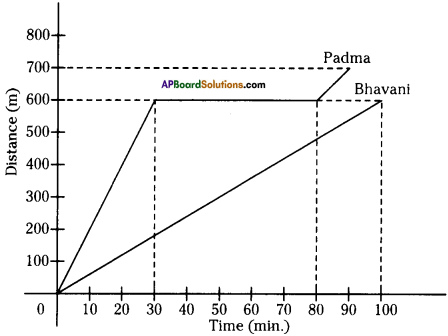
Answer:

  • Increasing economic hardship during the 1830s.
  • Widespread unemployment, urban congestion, competition flow, machine made goods from England, Feudal dues, rising food prices, failed crops.
  • Popular revolt in France in 1848 resulted in Louis Philippe fleeing, France declared a republic with voting for all men above – 21 and national workshops for more employment.

  • Very critical conditions were prevailed.

AP Board Solutions

Question 11.
Compare the map of Europe of mid 18th century (1815) with that of the present map of Europe and note down the changes you find, in a note book.
Answer:
AP Board 9th Class Social Studies Solutions Chapter 14 Democratic and Nationalist Revolutions 19th Century 2
The Congress of Vienna was held in order to draw up a plan to alter Europe politically and territorially so as to prevent the extensive expansion of any one great power, such as that Napoleon had brought about. To main¬tain the balance of power and establish a old regimes and to pacify the situations Vienna congress divided the different regions of Europe were brought under the power of different strongholds of Europe.

Later on, when the nations like Italy and Germany took up the ideas of Nationalism and moved for unification, they defeated those powers, which were being ruled by the other European powers. As a result of this, the structure of Europe, established by the congress of Vienna, got redrawn, and the present day Europe is established.
AP Board 9th Class Social Studies Solutions Chapter 14 Democratic and Nationalist Revolutions 19th Century 3

9th Class Social Studies 14th Lesson Democratic and Nationalist Revolutions 19th Century InText Questions and Answers

Question 1.
In what ways do you think Napoleon’s conquests would have helped in the emergence of nationalism in those countries? (Text Book Page No. 174)
Answer:

  • Napoleon formed a new political union under French patronage and called it “confederation of the Rhine”.
  • He had abolished 112 small states and merged them into a bigger nation.
  • As a result the complicated political map of Germany was made easy.
  • These confederations raised the feeling of the nationalism in those countries.

Question 2.
How did nationalism and the idea of the nation-state emerge? (Text Book Page No. 174)
Answer:

  • A nation state was one in which the majority of its citizens came to develop a sense of common identity and shared common history.
  • This commonness did not exist from time immemorial, it was forged through struggles, through the actions of leaders and the common man.
  • The French revolution gave the term “nation” its modern meaning.
  • A nation is not the territory but the people who make it.
  • The French revolution gave the meaning of sovereignty that the people constituting the nation are the source of all power and authority.
  • Government is answerable to its people.
    All these ideals led to the formation of the nation -states.

Question 3.
Discuss the importance of language and popular traditions in the creation of national identity. (Text Book Page No. 174)
Answer:

  • Language and popular traditions are important in the creation of national identity.
  • National identity means people feeling that they belong to a nation irrespective of their caste, religion, colour etc.
  • The language makes people identify themselves as a one race or a nation.
  • Also the popular traditions such as Roman culture and tradition etc., easily attracted the people and strengthened the national integrity.

AP Board Solutions

Question 4.
Explain why Charles X and Louis Philippe fled from france. (Text Book Page No. 180)
Answer:

  • Revolutions means transformation of ideas and thoughts.
  • Sometimes this transformations became violent and may lead to the execution of the king and queen.
    Ex : Charles X and Louis X VI
  • In orderto avoid such kind of situations Charles X and Louis Philippe fled from France.

Question 5.
Describe the caricature. How does it represent the relationship between Bismarck and the elected deputies of parliament? What interpretation of democratic processes is the artist trying to convey? (Text Book Page No. 181)
AP Board 9th Class Social Studies Solutions Chapter 14 Democratic and Nationalist Revolutions 19th Century 4
Answer:
Bismarck’s dominance over the elected deputies of the Parliament is shown in the caricature. He followed ‘Blood and iron’ policy. He firmly believed that this policy only could achieve the unification of Germany but not the songs, speeches and festivals.

Question 6.
In what ways do you think the old kingdoms prevented the growth of trade and industry? (Text Book Page No. 176)
Answer:

  • There was no free trade and there were lot of state-imposed restrictions.
  • A merchant had to pass through so many customs barriers and pay a customs duty of about 5% at each customs officers.
  • Due to these conditions, the growth of trade and industry was prevented in the old kingdom.

Question 7.
In what ways would liberal democracy have helped to develop trade and industry in those countries? (Text Book Page No. 176)
Answer:

  • Liberal democracy stood for the freedom of markets.
  • It also insisted on the abolition of state-imposed restrictions.
  • Through the above measures, the liberal democracy have helped to develop trade and industry in their countries.

Question 8.
Do you think our country has a liberal democratic political system ? Give your reasons. (Text Book Page No. 176)
Answer:

  • In India supreme power rests with the people.
  • India is a republic country.
  • Everyone is equal before law.
  • Every citizen of 18 years and above has the right to vote.
  • Any citizen is eligible to contest for any political office.
    Hence we can say India has liberal democratic political system.

AP Board Solutions

Question 9.
Why do you think conservatism needs to curb freedom to express ones opinion and criticise? (Text Book Page No. 176)
Answer:

  • Conservatism is the dominance of society by an aristocracy. It is incompatible with democracy, prosperity and civilization in general.
  • The conservatives did not tolerate criticism and dissent, and sought to curb activities that questioned the legitimacy of autocratic governments.
  • They imposed censorship laws to control the ideas of liberty and freedom associated with the French Revolution.

Question 10.
What is the caricaturist trying to depict? (Text Book Page No. 177)
AP Board 9th Class Social Studies Solutions Chapter 14 Democratic and Nationalist Revolutions 19th Century 5
Answer:
The caricaturist is trying to depict the thoughts of Jacobin clubs and the discontentment among people on the freedom of speech.

Question 11.
Indian nationalists also sought to revive and give importance to folk arts in India. Why do you think they thought this was important?
Answer:

  • Our Indian nationalists sought to revive and give importance to folk arts in India.
  • This was done to carry the message to large audience who were mostly illiterate.
  • Another reason to use folk art was to revive our ancient national spirit.

Question 10.
Do you think Italy became a true nation state with its unification under King Emmanuel II? Give your reasons.
Answer:
No, because the unification of Italy was only made territorially. The much of the Italian population was illiterate. They had no idea of nationalist ideology. The peasant masses in Southern Italy had never heard of Italia. Hence, we can say that Italy did not become a true nation state.

AP Board Solutions

Question 11.
Hold a debate in the class between those who agree with conservatism and those who agree with liberal democracy on what is best for the welfare and development of people in Europe or in India.
Answer:
Conservatism means supporting monarchy. The conservatives wanted to protect traditional institutions of state and society like the monarchy, the church, social hierarchies, property and family. They supported the modernisation initiated by Napoleon.

In monarchy, the king is the final. It he is good administrator, the people under him will be benefited. Otherwise they will suffer a lot.

Liberal democracy means the representative of the people rules the country for the will and wish of the people only. Without the concern of the people, he may not have whole right to take any action. The people have the power to remove him from the power when he goes wrong. Hence the government itself is people’s. Thus, democracy is the best form of government.
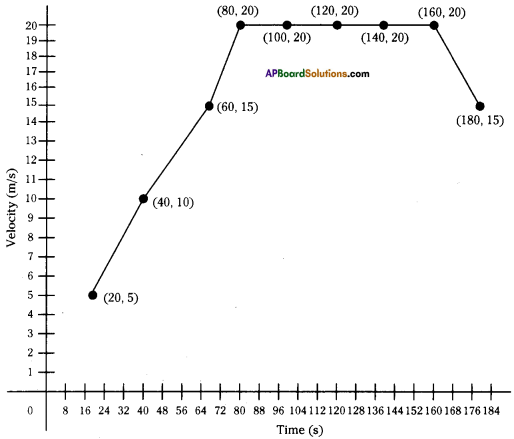
AP Board 9th Class Social Studies Solutions Chapter 8 Service Activities in India

SCERT AP Board 9th Class Social Solutions 8th Lesson Service Activities in India Textbook Questions and Answers.

AP State Syllabus 9th Class Social Studies Solutions 8th Lesson Service Activities in India

9th Class Social Studies 8th Lesson Service Activities in India Textbook Questions and Answers

Improve Your Learning

Question 1.
What is meant by the term “service activities”?
Answer:
1. Services rendered by different people in a specified activity are known as service activities.
E.g.: a) Teachers’ Services.
b) Health and Medical Services rendered by doctors and para-medical staff.
c) Services of people working in army, navy, and airforce.
d) Financial activities of banks and insurance companies.
e) Trading activities, etc.
All the above services can be termed as Service Activities.
2. Service activities do not produce any tangible commodity like paddy or cloth.
3. Service activities here refer to ‘the nature of work” done.
4. “Service activities” in this context of work does not mean something that is done “free of cost” or “out of love or devotion.”
5. All the above people earn money by rendering these “service activities.” This is their livelihood.
6. These service activities are required for agriculture and industrial activities.

AP Board Solutions

Question 2.
List five service activities and give your reasons why they are not be considered as either agricultural or industrial activities.
Answer:
1. Health and Medical Services :
A doctor examines patients, prescribes medicines and monitors their progress. Other para-medical staff help doctors.

2. Trade :
Goods whether agriculture or manufacture goods are to be transported to distributors. Distributors in turn supply goods to wholesaler who in turn supplies them to retailers. And consumers purchase from the retailer. These are trading activities.

3) Financial Services :
Banks issue loans to all farmers and entrepreneurs and facilitate agriculture and industrial activities. Insurance companies insure goods against risk.

4) Defence :
Activities and people who work in all the armed forces like army, navy, and airforce.

5) Personal Services :
Workers who do domestic work, laundry, cleaning, dyeing, hair dressing, etc.

a) In all the above examples we can see that services are rendered.
b) Nothing new is produced here. In agriculture, we produce some crop and in industrial activity, we work upon raw materials and convert them into finished goods. Here in the above examples, nothing tangible is produced.
c) The above examples are special kind of activities that help agriculture and industry and also provide a lot of service that people require.
So we cannot consider the service activities as either agricultural or industrial activities.

Question 3.
How can service activities help in the overall development of a country?
Answer:

  • Overall development of a country depends on developmental initiatives involving setting up of many establishments like educational institutions, hospitals, etc.
  • Other developmental activities include provision of infrastructure facilities such as transportation, telecommunications, banks, insurance services, and other services like trading, book keeping, and public administration.
  • All these activities are service activities that help agriculture and industry and facilitate overall development of our country.

Question 4.
How are agricultural and industrial activities related to services?
Answer:
Agricultural and industrial activities need the services of various sectors.

  1. Transportation helps in assembling raw material from the mines to industrial spots and to carry finished goods from industry to markets.
  2. Road and other services to transport finished products.
  3. Marketing services.
  4. Import and export services.
  5. Storage services like godowns.
  6. Financial services like banking loan and insurance services.
  7. Health and education services.
  8. Communication system, information technology.

AP Board Solutions

Question 5.
‘The growth of service sector is sustainable and can make India as a rich country.’ Do you agree with this statement? Elaborate.
Answer:

  • There is a lot of change in technology and by exporting our services i.e., “BPOs” or “Outsourcing” we are earning foreign exchange.
  • Service Sector constitutes one-fourth of the jobs people do in India.
  • 90.5 lakhs and 25.3 lakhs of people are involved in community, social, personal services, and transport and communications respectively.
  • So many jobs are available for educated people in service sector.
  • Due to the development of telecommunications and information technology, the world has become a global village.
  • Due to the establishment of Multinational Companies, we are getting projects from foreign countries.
  • The standard of living of the people has been increased for the last two decades. Hence the growth of service sector is sustainable and can make India a rich country.

Question 6.
Why are service sector activities becoming important?
Answer:

  • Service sector activities include all the services like Banking and Finance, Trade and Commerce, Transport and Communications, Health, Education, Personal services, etc.
  • Service sector activities do special kind of activities that help agriculture and industry and provide a lot of services that people require.
  • Provision of education and health fulfils the aim of social welfare.
  • Trade and commerce help in bringing buyers and sellers together.
  • Transportation is necessary forthe movement of men and material from one place to another.
  • The development of telecommunications has cut the geographical boundaries and helps in globalization.
  • They provide information about new markets and products.
  • They are considered as means of modernization.
  • They provide employment opportunities and are very useful in rising the standard of living of the people.
    Due to the above reasons the service sector activities are becoming important.
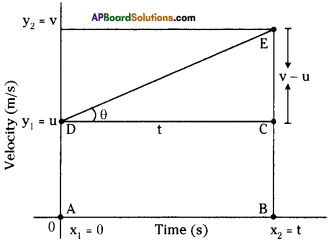
Question 7.

Service activities cannot expand beyond a level unless agriculture and industries. Explain.
Answer:

  • Development of a country is always measured on production of goods and services.
  • Increase in production is possible only through the development of agriculture sector and industrial sector.
  • Service activities are necessary to modernize agriculture and industrial sector.
  • Development services without increase in production is a waste.
  • Hence service activities cannot expand beyond a level unless agriculture and industries develop.
  • In fact, all three sectors should go hand in hand.

AP Board Solutions

Question 8.
How can service sector reduce educated unemployment in India?
Answer:

  • There has been tremendous change in the communication technology which has opened a wide range of jobs for educated people.
  • Business Process Outsourcing (BPO) has brought in new kinds of employment opportunities.
  • They provide services to people located across the globe using telecommunication links.
  • The entertainment industry creates jobs to work in various print media firms, cable television channels.
  • We see number of internet cafes and telephone booths in most of the cities and towns.
  • The advertising industry has also brought new job opportunities.
  • Many new jobs are available in Banking and insurance sectors.
    Hence service sector can reduce educated unemployment in our country.

Question 9.
Is there any migration of labourers from your area? Find out the reasons for the migration.
Answer:
Yes, there is migration of labourers from our village.

Reasons for migration :

  1. People migrate from rural areas mainly due to insufficient employment opportuni¬ties, inadequate income available in rural employment.
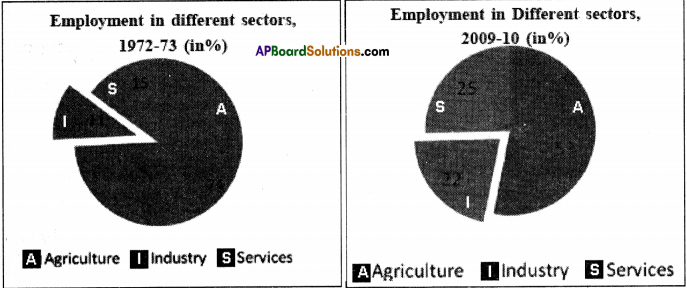
  2. People also migrate with the expectation of higher incomes and more opportunities for family members and may be better services.
  3. For some people from rural areas moving to cities and towns, to work in industry and other services activities have been recognised as a natural response to increase their income and for better family prospects.

Question 10.
Read the 9th paragraph of this chapter ‘Working people engaged’ and answer the following.

Working people engaged in service activities do not produce a commodity, like that in agriculture or in industry. They do special kind of activities that help agriculture and industry and also provide a lot of service that people require. Another example is the banking and finance related service activities required by people and business organisations. You have read about this in Class VIII chapter “Money and Banking”. Similarly there are the cell phone, internet and all other types of telecommunication service providers.

What are the service activities required for agriculture and industries?
Answer:

  • Banks and other financial institutions finance agriculture and industrial activities by lending funds.
  • Transportation services help in the development of the agriculture sector through effective distribution of food grains and perishable goods from the producing areas to the markets without interruption.
  • Transportation helps in the distribution of raw materials to the industrial units.
  • Service sector activities provide information about new markets and products.
  • A variety of trading activities like distributors, wholesalers, and retailers also constitute a major segment of service activities.
  • These activities help bring buyers and sellers together.
  • Proper power supply to various industrial units facilitates industrial growth.

Question 11.
Observe the map given in the (text) page 104. Locate the software technology parks of our country in the India outline map.
Answer:
Students Activity

AP Board Solutions

Question 12.
Discuss with any seven people who identify with the sector they are employed in. Write a brief note or design a poster about their work. What relationship do you see between their employment and place of residence?

Name of the person Nature of work done Agriculture/Industry/Services

Explain your reason for the classification.
Answer:

Name of the person Nature of work done Agriculture/Industry/Services
“X” Works in steel plant Industry
“Y” Carpenter Services
“Z” Landlord Agriculture
“A” Works in telephone exchange Services
“B” Teacher Services
“C” Goldsmith Services
“D” Works in the land of others Agriculture
“E” Match box making Industry

1) Primary sector :
This includes those activities that are undertaken by directly using natural resources, e.g.: Cultivation of paddy. This is known as primary sector because it forms the base of subsequent products that are made from it. This sector is also called Agriculture and Related sector.

2) Secondary sector :
This sector covers those activities in which natural and primary products are changed into other forms through ways of manufacturing.
e.g.: manufacturing paper from bamboo. This sector is also known as industrial sector.

3) Tertiary sector :
This sector includes those activities that help in the development of the primary and secondary sectors, e.g.: railways. Since they provide services to help the production, this sector is also called service sector.

9th Class Social Studies 8th Lesson Service Activities in India InText Questions and Answers

Question 1.
There are eight categories of service activities given below. Some details are filled in, others are left out. Fill in the blank ones after discussing with your teacher. (Text Book Page No. 97 & 98)
Answer:
1. Education:
Institutions – schools, colleges, universities, technical institutions come under this category. This means those who are working in these institutions such as teachers, all the administrative staff and their activities constitute services.

2. Health and Medical Services :
Primary health centres. General hospitals. Old aae homes, etc.

3. Trade :
A variety of selling activities both wholesale and retail that we see around. National and International business, etc.

4. Public Administration :
Public services under village and town panchayats, state and central governments come under this category. Examples: people who work in police stations, workers of various other government departments such as village administrative officers, revenue inspectors, tehsildars, Collectors, those who work in all kinds of courts, assistants, clerks, accountants, typists, peons, drivers etc.

5. Defence :
Activities and people who work in all the armed forces like army, navy and air force.

6. Financial activities :
Banks and different saving schemes, postal, life insurance, etc.

7. Personal Services :
Workers who do domestic work, laundry, cleaning, dyeing services, hair dressing, running beauty parlours, tailoring shops, photo, and video studios.

8. Activities such as:
People working in entertainment and information technology industry – production of films, TV serials, those working in media, newspapers, television channels, and advertisement agencies are also included in services.

AP Board Solutions

Question 2.
What do you think about Foreign Direct investment {FDI} in Retailing Activities? Can government do anything to address this issue? (Text Book Page No. 101)

  • In my opinion, there will be gainers and losers from FDI in retail.
  • Overall gains will outweigh to losses.
  • In course of time the losess too will benefit.
  • It was opined that large and medium sized farmers will initially benefit the most, while the small farmers or landless labour will be the losers.
  • However, the purchases by the big super markets will increase demand for agricultural products, which in turn will expand agricultural out put, and increase demand for labour.
  • This will increase agricultural wages in the long run.

To set right this issue, the government has to take following steps.

  1. Best storage facilities also should be provided by the govt.
  2. Govt should take measures that market will not go in the hands of few people.
  3. Govt must keep Foreign Direct Investment under its control.

Question 3.
Who, in your opinion should set up new medical institutions – privatesectoror government? Why? (Text Book Page No. 102)
Answer:
The following organizations shall be eligible to apply for permission to set up a medical college.

  1. A state govt. / union territory.
  2. A university
  3. An autonomous body promoted by central and state governments.
  4. A society registered under the Societies Registation Act, 1860.
  5. A public religious or charitable trust registered under the Trust Act, 1882.
  6. Companies registered under Company Act.

I think that the government should set up new medical institutions.

Reason:
Because it is not easy to any private sector persons to satisfy the norms of the Medical Counsil of India.

AP Board Solutions

Question 4.
The following table shows the number of workers (in lakhs) employed in different service activities in large enterprises in 1991 and 2010. Read the table carefully and answer the questions that follow. (Text Book Page No. 100)
AP Board 9th Class Social Studies Solutions Chapter 8 Service Activities in India 2

a) Which service activity gave maximum employment in 2010?
Answer:
Community, social and personal services gave maximum employment.
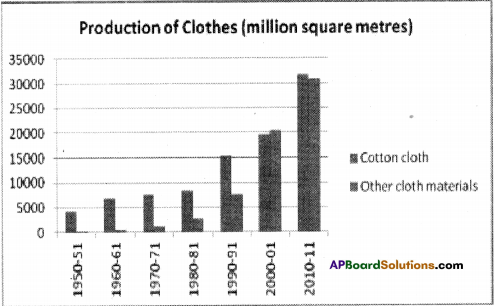
b) Has the number of government jobs increased or decreased over the years?
Answer:
The number of government jobs has been drecreased from 136 lakhs in 1991 to 131.6 lakhs in 2010.

c) What kind of jobs has government generated the most during this period?
Answer:
The jobs in finance, insurance, and real estate have been increased from 11.9 lakhs to 14.1 lakhs for the last 20 years.

d) What kind of jobs were people able to get in the private service activities?
Answer:
People were able to get private jobs in all service sector activities like trading, transportation, finance and personal services.

e) Are there any differences between jobs provided by the government and private employers? Discuss.
Answer:
a) The number of job opportunities in the private sector has been increased from 20.9 lakhs in 1991 to 43.7 lakhs in 2010.
b) The salaries of the private jobs are good but the employees are expected to work very long hours.
c) Government jobs have security whereas private jobs do not give any security to their employees.

Question 5.
Talk to some retail shop owners in your neighbourhood. Discuss their opinions on foreign retailing shops in your class. (Text Book Page No. 102)
Owner of shop – 1 : “Traders and kirana store owners are not fully prepared to face foreign retailers.”
Owne^sfiop – 2’/ “6ur shops are safe. Our customers will not visit those shops.”
Owner of shop – 3 : “The customer will get the knowledge of quality of the provisions. Those shops are maintaining least quality things.”
– We discussed all these points in the classroom.

Question 6.
What is your opinion on foreign companies setting up retail shops in India? How do you think that they generate employment in India? (Text Book Page No. 102)
Answer:

  • Foreign direct investment will definetly help the farmers in long run.
  • It is argued that there will be loss of jobs in traditional, smaller retail sector.
  • However, the purchases by the big supermarkets will increase demand for agricultural products, which in turn will expand agricultural output, which in turn may increase demand for labour.
  • This will increase wages in the long run.

AP Board Solutions

Question 7.
Prepare a table with two columns and list out the advantages and disadvantages of allowing foreign company retail stores in India. (Text Book Page No. 102)
Answer:

Advantages Disadvantages
1. Foreign direct investment will increase demand for farm products. 1. The small farmers and landless labour will be the losers.
2. Basing on demand the production of farm goods will be increased. 2. FDIs will influence the farmers and may buy produce at low costs.
3. Better storage facilities will be provided. 3. They will not invest much on storage facilities but charge high rates for storage.
4. Better storage facilities will minimise waste of farm produce. 4. There will be loss of jobs in traditional and small retail sectors.
5. Farmers will be saved from the traps of moneylenders. 5. The foreign companies will sooner or later misuse – their power to buy in large quantities.

Question 8.
Why is it necessary to establish more medical institutions in India? (Text Book Page No. 102)
Answer:

  • The government of India recognizes ‘Health for all’ as a national goal.
  • The medical education and health care in India are facing serious challenges in content and competencies.
  • There is a need to balance for more medical colleges with the maintenance and improvement of quality standards.
  • There are disparities between different states and rural/urban areas with regard to access to basic medical services and quality health care.
    To overcome all these problems, it is necessary to establish more medical institutions in India.


AP Board 9th Class Social Studies Solutions Chapter 11 The Government Budget and Taxation

SCERT AP Board 9th Class Social Solutions 11th Lesson The Government Budget and Taxation Textbook Questions and Answers.

AP State Syllabus 9th Class Social Studies Solutions 11th The Government Budget and Taxation

9th Class Social Studies 11th Lesson The Government Budget and Taxation Textbook Questions and Answers

Improve Your Learning

Question 1.
Why does the government need a budget? Why does the budget talk of taxes?
Answer:

  • In most modern societies, the government is responsible for a number of crucial functions.
  • These include the more traditional functions like defending the country, maintaining law and order, the provision of public facilities, establishment of factories, and other developmental and welfare activities.
  • Revenues are necessary to finance the expenditures of the government.
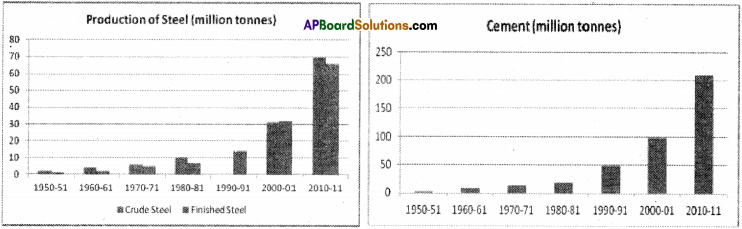
  • In order to steamline the income and expenditure, every government prepares a budget for each financial year.
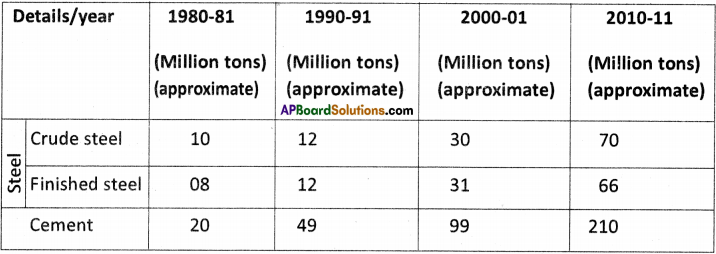
  • Deficit, between expenditure and revenue, will usually be filled by imposing additional taxes.
  • Hence the budget always talks of taxes.

Question 2.
What is the difference between income tax and excise duty?
Answer:

Income Tax Excise Duty
1. Income tax is levied on annual personal incomes of individuals. 1. Excise duty is levied on the production or manufacture of goods.
2. Income tax is a direct tax. 2. Excise duty is an indirect tax.
3. The tax burden will be on the same person on whom the tax is levied. 3. Excise duty is charged from the factory itself but the burden is shifted to those who buy the goods.
4. Income tax does not affect the prices of goods. 4. These taxes raise the overall prices of goods.

Question 3.
Match the following.

Group – A Group – B
1. Excise duty a) levied on the yearly incomes of the individuals
2. Sales tax b) levied on the yearly profits of the companies and business establishments
3. Customs duty c) levied on the production or manufacture of goods
4. Income tax d) levied when goods are sold
5. Corporate tax e) levied on goods brought from abroad

Answer:

Group – A Group – B
1. Excise duty c) levied on the production or manufacture of goods
2. Sales tax d) levied when goods are sold
3. Customs duty e) levied on goods brought from abroad
4. Income tax a) levied on the yearly incomes of the individuals
5. Corporate tax b) levied on the yearly profits of the companies and business establishments

Question 4.
You are expected to pay taxes on steel, matches, clocks, cloth, iron ; a tax increase on which of these would affect the prices of other commodities the most and why?
Answer:
The taxes on iron and steel increase or affect the cost of other goods because they are intermediate goods.

AP Board Solutions

Question 5.
Ordinary food items, such as grain, pulses, oil are used by all. Then why is it said that imposing tax on them will have a greater effect on the poor?
Answer:

  • Ordinary food items, such as grains, pulses, oil, etc., are goods that are essentials,
  • The poor spend almost all of their income on these goods.
  • Hence imposing tax on them will have a greater effect on the poor.

Question 6.
A group of four friends decided to stay together by contributing money towards the rent of a house. The rent was rupees 2000 per month.
• How could this be shared among them?
• We also know that two of them earned Rs. 3000 rupees per month and the other two Rs. 7000 per month. Is there some other way of sharing the cost so that each one of them feels the same pinch?
• Which way of sharing would you prefer and why?
Answer:
1. One method of sharing the rent is the distribution of the rent equally among all the four members. Then each one has to pay Rs. 500/- (i.e. 2000/4 = 500).

2. Another method of sharing is that everyone has to pay 10% of their earnings as rent. In that case –
a) Two of them whose income is Rs. 3000/-
have to pay 10% of 3000/- = 300/- each.
b) Two of them whose income is Rs. 7000/-
have to pay 10% of 7000/- = 700/- each.

In my opinion 2nd method of sharing is the best as low income people are paying the lower share whereas high income people are paying the higher share of rent.

Question 7.
Tax on income or tax on commodities. Which of the two affects the rich more and which affects the poor more? Explain with reasons.
Answer:

  • Tax on income is a direct tax. According to the rules of income tax, those with higher incomes have to pay greater part in tax.
  • Those who are less well-off pay not only lower taxes but a smaller proportion of their income as taxes.
  • Hence tax on income affects the rich more.
  • Tax on commodities is an indirect tax.
  • Whether rich or poor, everyone has to pay the same amount of tax when they buy commodities.
  • The tax on commodities does not distinguish between the rich and the poor.
  • Hence tax on commodities affects the poor more.

AP Board Solutions

Question 8.
How would VAT reduce the evasion of taxes on goods?
Answer:

  • All producers and traders will have to keep genuine record of their sale and purchase.
  • Everyone has to keep proper records and ask for bills for purchase.
  • It is only on this basis they can show the tax already paid on cost of inputs.
  • The tax inspectors will be able to match records of the seller and purchaser for verification.
  • These records and verifications in VAT reduce the evasion of taxes on goods.

Question 9.
What is the difference between Excise duty and Customs duty?
Answer:

Excise Duty Customs Duty
1. Excise duty is charged from the factory itself. It as levied on the production or manufacture of good. 1. Customs duty is levied on goods brought from abroad.
2. Taxing certain goods raise overall prices. 2. Only machines or raw materials which are imported and taxed raise the overall prices of that good.

Question 10.
Is there any hike in the bus fares recently? If so, try to know the reasons for it.
Answer:
1) It was directly related to the fact that there was a hike in the price of petroleum (product both petrol) and diesel. As price for petrol and diesel has increased nearly 45 times past 2 – 3 months it has come around with a difference of approximately 4 Rs. per liter.
2) So, as to balance this gap and the loss incurred by this the bus fare had been hiked by 40 paisa per kilometer.

Question 11.
Read the paragraph under the heading ‘Direct Taxes’ (Income Tax is charged only for…) and answer the following :

Income tax is charged on personal income of individuals. There can be a variety of sources of individual incomes like wages, salaries, and pensions. An Individual-can also earn interest income on money that is kept in banks. A person might, also get rent.on properties that he own like house rent. All these are considered as incomes on which taxes have to be paid. Income tax is charged only for those who earn above a certain amount. This is charged as a percentage of the income earned. Those who earn a higher income have to pay a greater proportion of their income as tax.

Why do high income earners pay more tax?
Answer:

  • What kind of tax we follow depends on the values that the society as a whole holds.
  • Many societies feel that it is not fair that a few people have lakhs of rupees, while others do not have enough to eat.
  • The poor or the low income group cannot meet their daily expenses.
  • Then why should tax be imposed on them?
  • The poor should not feel the pinch of tax.
  • Hence collection of more tax from the higher income group is justifiable.

AP Board Solutions

Question 12.
What is the effect of black money on our economy?
Answer:

  • Black money circulation in the parallel economy is a big menace to the economy.
  • It is also a cause of big loss in the tax-revenues for the government. As such it needs to be curbed.
  • Its elimination will benefit the economy in more than one way. It will also generate more revenues for the government.

Question 13.
Bring a few wrappers of soaps, toothpastes, tablet strips or any other things of daily use which contain MRP Discuss the rate mentioned and the rate at which they are so!d. Talk about the profit that the retailer gets.
AP Board 9th Class Social Studies Solutions Chapter 11 The Government Budget and Taxation 1
Answer:
Please scan the some of the wrappers of Biscuits, toothpaste, soaps, etc. with MF The MRP that are printed on the wrappers are fixed by the manufactures. The Manufactures incude the cost of production, tax, VAT, commissions, transportation cost and profits etc. From them retailer bought the goods on wholesale and he mix up again transportation cost, tax, vat and his profit. In that retailer get more profits because he bought the good with low cost he sold more cost. Again he mix up the VAT & Tax also profit to him.

9th Class Social Studies 11th Lesson The Government Budget and Taxation InText Questions and Answers

Question 1.
Can you guess from where does the government get money for pubficfacilitiesand other activities? (Text Book Page No. 132)
Answer:
Government raises the revenue required to meet expenditure. The following are the types of revenue of government.

  1. 1) Taxation –
    a) Direct taxation,
    b) Indirect taxation
  2. Charging for services directly provided to the public.
  3. Profits from state-owned enterprises.
  4. Borrowings from domestic markets and international sources.

Question 2.

Cost of manufacturing including profit of the manufacturer Rs.
10,000
Excise Tax 1,200
Cost of Transport, Storage 1,000
Profit to the Retail Traders 1,000 1
Sales tax 1,650
Price for the consumer 14,850

In the example of the TV, what proportion of the cost of the TV did the consumer pay as tax? (Text Book Page No. 136)
Answer:
12% of the cost of the TV is charged as tax. The consumer pays Rs. 1,200 by way of tax.

AP Board Solutions

Question 3.
Fill in: (Text Book Page No. 138)
The purchases by Tara, Sajida and Preeti show __________ tax rates across goods. (same/different)
Answer:
different (same/different)
Can you guess why this should be so?
In case of Tara VAT = 5% of 5,000 = Rs. 250
In case of Sajida VAT = 12.5% of 9,165 = Rs. 1,146
In case of Preeti VAT = 0 (No VAT on LPG) = Rs. 0

Question 4.
You might think it would be fair for everyone to pay the same amount of tax. Consider the following three prople : (Text Book Page No. 139)
AP Board 9th Class Social Studies Solutions Chapter 11 The Government Budget and Taxation 2
Would it really be fair if each of the three people has to pay the same amount? If Jyoti cannot even afford to feed her children properly, is it fair for her to pay 50 rupees as tax?
Answer:

  • According to the rules of income tax, those with higher incomes have to pay greater part in tax.
  • Those with less well-off pay have to pay lower taxes.
  • In the above example, Jyothi, Asif, and Nithesh are paying same tax of Rs. 50/- though their incomes vary a lot. Hence this type of taxation is not fair.

Question 5.
You might think it would be more fair to ask each person to pay a certain pecentage of what they earn as tax. Supposing everyone paid 10% in taxes, calculate how much each person would pay? (Text Book Page No. 139)

Person Earning per month (in Rupees) Tax as fixed amount per month (in Rupees)
Jyoti 1500
Asif 8000
Nithesh 30,000

Would this be fair? Still Jyoti may not have enough to live. Asif may not have enough for repairing of his house. But Nithesh would have plenty of money for all basic necessities even if he had to pay 20% of his income as taxes.
Answer:

  • Tax rate is same for all people i.e. 10%.
  • So Jyothi has to pay 10% of 1500 i.e., Rs. 150/-
  • Asif has to pay 10% of 8000 i.e., Rs. 800/-
  • Nithesh has to pay 10% of 30000 i.e., Rs. 3000/-
    This is not fair. This is against the progressive taxation which insists that the rate of tax has to be increased when income increases.
    Hence charging 20% of tax on Nithesh is quite fair.

AP Board Solutions

Question 6.
To make taxes more fair you might then say only the people earning more than a certain amount say Rs. 7000 per month have to pay taxes. You might also say that the richest people should pay greater proportion of their earnings as taxes. For example

If you earn (in Rupees) You will pay as tax
Less than 7000 0%
7001 to. 15000 10%
15,001 to 25,000 20%
More than 25,000 30%

Calculate how much each person will pay. (Text Book Page No. 139)

Person Earning per month (in Rupees) Tax as fixed amount per month (in Rupees)
Jyoti 1000
Asif 6000
Nithesh 20,000

Would this be fair?
Answer:

  • As per the above rule, people below Rs. 7000/- income are exempted from taxation.
  • Hence Jyothi and Asif need not have to pay taxes.
  • Nithesh’s income is Rs. 20,000/-
  • As per table he has to pay 20% of tax.
  • Tax to be paid by Nithesh = 20,000 x 20/100 = 4000/-
    This type of taxation is called progressive taxation. The tax rate increases as income increases.

The above taxation satisfies the principle that the richest people should pay greater portion of their earnings as taxes.

Hence this method is the fair way of taxation.

Question 7.
With the help of this pie chart, answer the following questions.
Expenditure of the Government (Center and States), in 2011-12
AP Board 9th Class Social Studies Solutions Chapter 11 The Government Budget and Taxation 3
In 2011-12 the government spent around Rs.23,00,000 crores.
1. Calculate the expenditure of the government on food subsidy. (Text Book Page No. 133 & 134)
Answer:
Total government expenditure = 23,00,000 crores
Share of food subsidy = 3%
Total food subsidy = 23,00,000 × 3/100 = 69,000 crores.

2. Discuss on what all was this money spent and the purpose for this?
Answer:

  • The government has assumed responsibility for supply of essential commodities like wheat, rice, sugar, edible oils and kerosene etc.
  • The prices of goods sold through Public Distribution System (PDS) are less than ‘ that of the market price and the difference in price – is borne by the government.
  • So the government spends 69,000 crores on-food subsidy.

AP Board Solutions

Question 8.
Relate some of the expenditure in the pie-chart to the roles played by the government. (Text Book Page No. 134)
Answer:
Roles of government and expenditure spent

1. Defence 7%
2. Railways, transport and communication 6%
3. Education, etc. 12%
4. Health and sanitation 4%
5. Housing and urban development 3%
6. Rural development (e.g. NREGA) 4%
7. Power, irrigation and flood control 6%
8. Fertilizer subsidy 2%
9. Administration 8%
10. Pensions 7%
11. Interest payment 17%
12. Food security 3%
13. Others 21%
Total expenditure 100%

Question 9.
Collect and list out some details of government expenditure from reading the newspapers of your region. (Text Book Page No. 132)
Answer:

  • Government expenditure is also known as public expenditure.
  • From the point of view of development, public expenditure is classified as
    1. Development expenditure
    2. Non-development expenditure.
  • From the point of view of creation of capital assets, public expenditure is classified as
    1. Revenue expenditure
    2. Capital expenditure
Revenue Expenditure Capital expenditure
1. General Administration 1. Construction of irrigation projects
2. Defence (Daily expences) 2. Establishment of basic industries, power projects
3. Maintenance of schools, hospitals, roads, pensions etc. 3. Construction of National highways etc.

Question 10.
If the tax on iron is increased, what other things will this affect? Give some examples. (Text Book Page No. 136)
(OR)
Explain the example given in below picture. Write the relationship between indirect taxes and consumers.
AP Board 9th Class Social Studies Solutions Chapter 11 The Government Budget and Taxation 4
Answer:

  • If the price of iron is increased it will directly affect the price of steel.
  • Increase in the price of steel leads to increase in the prices of steel sheets and steel pipes.
  • Increase in steel sheets will lead to increase in steel almirah and increase in price of steel pipes leads to increase in the prices of cycles and the chain goes on.

Question 11.
We read about some of the major taxes collected by the government. Fill the table from the information given below. Income Tax: 12%; Corporation Tax: 24%; Customs Duty: 10%; Excise Duties: 16%; Service Taxes: 5%; Sales Tax: 23%; Other Indirect Taxes: 10%. (Text Book Page No. 141)

Taxes Percentage of Total Tax
Direct Taxes 36%
Indirect Taxes
Total taxes 100%

Answer:
Taxes Collected by the Government

Taxes Percentage of Total Tax
Direct Taxes 36%
Income tax 12%
Corporate Tax 24%
Indirect Taxes 64%
Customs duty 10%
Excise duty 16%
Service taxes 05%
Sales taxes 23%
Other taxes 10%
Total taxes 100%

1) Which kind of taxes generate more revenues for the government?
Answer:

  1. Indirect taxes generate more income. They contribute 64% of all the taxes.
  2. Corporate tax contributes 24% of th? taxes and.sales tax contributes 23% of the taxes.

AP Board Solutions

Question 12.
Kranti has an income of Rs. 1,75,000 per year and has to pay an income tax of Rs. 3000. Kamlesh’s annual income is Rs.3,00,000 and he has to pay an income tax of Rs.5,500.
a) Who pays more income tax? (Text Book Page No. 141)
b) Who has to pay a larger part of the income as tax?
c) In such a situation, the person with higher income is paying a _________
(smaller/greater/equai) part of the income as tax.
Answer:
a)

  1. Kranti pays 3% of her income as tax.
  2. Kamiesh’s pays 2.75% of her income as tax.
  3. When we take rate of tax into consideration, Kanti is paying high rate.
  4. When we consider the amount of tax paid Kamlesh pays more tax.

b) Kranti has to pay a larger part of the income as tax i.e. 3% when compared with Kamlesh who pays 2.75% as tax.

c) smaller

Question 12.
In your city/town/village, what are the roles that you have seen the government playing? Discuss. (Text Book Page No. 132)
Answer:

  1. Maintenance of law and order.
  2. Provision of education facilities.
  3. Looking after of health and sanitation.
  4. Construction of roads,, highways, dams, irrigation projects.
  5. Establishment of factories etc.

Question 13.
In the year 1947-48, the budget for independent India was only Rs. 197 crores. What could be the reasons for such an increase in the budget since then? (Text Book Page No. 134)
Answer:

  1. Increase in the cost of different goods.
  2. Increase of cost of exports.
  3. Decrease in the value of money.
  4. Change of roles played by government i.e., provision of subsidized fertilizers, food, development of infrastructure facilities etc.

AP Board Solutions

Question 13.
Why do you think has the Parliament been given power over the government’s budget? (Text Book Page No. 134)
Answer:

  • Our government is a representative form of government.
  • All the Parliament members are people’s representatives.
  • Hence they are given power, on behalf of the people, to talk on budget and to decide on budget. No tax is levied without Parliament’s approval.

Question 14.
Petrol, diesel, etc., are used to run vehicles, motor pumps, generator sets etc. What will happen if the tax on diesel and petrol goes up? (Text Book Page No. 135)
Answer:

  • Increase in the prices of diesel and petrol leads to the increase in the cost of transportation.
  • Which in turn rise the prices of important commodities.

Question 14.
What is your opinion about value added taxes? Discuss. (Text Book Page No. 138)
Answer:

  • The tax paid by the manufacturer under VAT system is smaller since she does not have to pay tax on inputs.
  • Non-payment of tax is expected to be more difficult.
    Due to above advantages, the VAT tax is to be levied.

Question 15.
If there are two people manufacturing the same goods and one of them evades paying taxes, what advantages could he/she get over the other? (Text Book Page No. 136)
Answer:
The margin of his/her profit may go up.

AP Board Solutions

Question 16.
There have been continuous attempts by the government to reduce fertiliser subsidy. This means that the government would no longer control the price of fertiliser. Farmers would have to buy fertilisers at higher market prices. At present, the government has to pay (compensate) the fertiliser producing companies for the losses that they make. Once fertiliser subsidy is removed, it is said this would make space for other important expenditures in the government budget. Some also argue that subsidised fertiliser does not benefit the small farmer but only encourages the large farmers to overuse it.
Imagine you are a farmer using fertilisers in farming, and you genuinely believe that the farmers need subsidized fertiliser. How would you argue your case? Write a
letter to the Finance Minister. (Text Book Page No. 134)
Answer:

Kankipadu
08-04-2020.

To
The Honourable Finance Minister,
Government of India,
New Delhi.
Sir,
My name is Parandhamaiah. I hail from a small village, near Vijayawada. I learnt from the newspaper that the government would no longer control the price of fertiliser. This news upset the small farmers like me. We, small farmers cannot afford the price of fertiliser without subsidy. Agriculture without fertiliser will not give a good yield. Fertiliser subsidies can be an instrument to increase productivity and thus help solve the food availability dimension of food security. Government has to give a helping hand to the small farmers like me.
Awaiting an early positive response,

Yours sincerely,
Parandhamaiah,
Kankipadu,
Krishna District.

AP Board 9th Class Social Studies Solutions Chapter 7 Industries in India

SCERT AP Board 9th Class Social Solutions 7th Lesson Industries in India Textbook Questions and Answers.

AP State Syllabus 9th Class Social Studies Solutions 7th Lesson Industries in India

9th Class Social Studies 7th Lesson Industries in India Textbook Questions and Answers

Improve Your Learning

Question 1.
Why government took up the responsibility to set up basic goods industries?
Answer:

  • Basic industries produce essential goods that can form a base to support a large variety of factories.
  • Huge amount of capital is required to set up basic goods industries.
  • Moreover it takes a long time to set up basic industries.
    E.g.: For setting up a power plant for production of electricity, it would require five to ten years.
  • Private industrial groups were not willing to invest in such industries.
  • Hence the Government took up the responsibility to set up basic goods industries.

AP Board Solutions

Question 2.
Why are industries located in specific areas?
Answer:

  • All factories need raw materials from which goods can be produced.
  • Transportation is needed to bring raw materials to factories and transfer finished goods from them.
  • So industries are located in specific areas where raw materials like minerals are available.
  • Industries are also concentrated where infrastructural facilities like transportation electricity, banking services, etc. are available.

Question 3.
What are the basic goods industries? How they are different from consumer goods industries?
Answer:

Basic Goods Industries Consumer Goods Industries
1. Factories producing essential goods necessary for industries are called basic goods industries.
E.g.: Machines, electricity, etc.
1. Factories producing goods which for direct consumption are called consumer goods.
E.g.: Soaps, Furniture, TVs, etc.
2. These goods are not for direct consumption. 2. These goods are directly consumed by consumers.
3. Basic industries produce essential goods that can farm a base to support a large variety of factories. 3. Consumer goods industries did not support any other industries.

Question 4.
Give a list of towns/areas in which some conventional mineral resources are found and ask students to identify then possible industries which can be set up.

Minerals/ Resources Towns/areas in which these resources are available List the kind of industries that can be set up in this area
1. Iron ore
2. Coal
3. Jute
4. Oil
5. Natural Gas
6. Forests
7. Manganese
8. Bauxite

Answer:

Minerals/ Resources Towns/areas in which these resources are available List the kind of industries that can be set up in this area
1. Iron ore 1. Singhbhum in Jarkhand
2. Mayurbhanj, Koenjhar in Odisha
3. Raipur and Bastar in Chattisgarh.
4. Bellary and Chikmaglur in Karnataka.
5. Salem in Tamilnadu
6. Khammam in Telangana and Rayalaseema in Andhra Pradesh.
7. Ratnagiri and Chanda in Maharashtra.
1. Iron and steel industry
2. Heavy machines
3. Tools
4. Weapons
5. Constructions and transport vehicles, etc.
6. Railway coaches, etc.
2. Coal Important coal fields are
1. Jharia, Chandrapura, Bokaro and Giridhi in Jarkhand.
2. Ranigunj and Asansal in West Bengal.
3. Singrauli and Korba in Madhya Pradesh.
4. Singareni in Telangana
1. Iron and steel industry
2. Thermal power industry
3. Used as fuel in so many other industries.
4. Largely used in railways.
3. Jute West Bengal, Assom, Bihar and Odisha. Jute industry is concentrated in West Bengal.
1. Jute textiles
2. Bag making
3. Carpet making
4. Door mats, etc.
4. Oil Gujarat, Assom, Bombay High Different types of industries.
5. Natural Gas 1. Cambay and Ankleshwar fields in Gujarat
2. Bombay High in Maharashtra.
Power industry
Fertilizer industry
Used as fuel
6. Forests Forests are found in Madhya Pradesh, Telangana, Andhra Pradesh, Odisha, Maharashtra, Arunachal Pradesh and Uttar Pradesh. Forests yield both softwood and hard wood.
Forest based industries are-
1. Paper (softwood trees)
2. Furniture
3. Timber
4. Soaps
5. Match boxes
6. Handicraft
7. Turpentine and
8. Railway sleepers
7. Manganese 1. Koenjhar, kalahandi, Mayurbhanj Sundarghar and Thalcher in Odisha.
2. Chitradurg, Shimoga, Chikmanglore, Bellary and Dharwad in Karnataka.
3. Bhalghat, Seori, Jabalpur in Madhya Pradesh.
4. Singhbum in Jarkhand.
5. Panchamahal in Gujarat.
6. Srikakulam and Visakhapatnam districts in Andhra Pradesh.
1. Iron and steel industry
2. Chemical industry
3. Bleaching powder
4. Electrical
5. Glass
6. Leather
7. Photography and
8. Metal industry
8. Bauxite 1. Palmau, Ranchi, Monghyr and Shahabad in Jarkhand.
2. Balaghat, Jabalpur, Bilaspur and Rajgarh in Madhya Pradesh.
3. Amreli and Kutch in Gujarat.
4. Belgaum in Karnataka.
5. Madurai, Nilgiris and Coimbatore in Tamilnadu.
6. Visakhapatnam in Andhra Pradesh
Used in Aluminium making which in turn used in aircraft, automobiles, ships, utensils, railways, photographic material and electrical goods industry.

Question 5.
Why government in 1990s allowed private industries in many areas which were earlier restricted only to government?
Answer:

  • Indian industry as a result of government’s control was not modernizing fast and was producing goods at high cost and not making technological improvement.
  • Government used to allocate a specifc amount every year to operate these industries.
  • It was expected that these industries become independent, generate revenue for the government.
  • But these government run factories continually require government assistance.
  • Their functioning was much below that was expected.
  • So, in the 1990s a new industrial policy was announced. Many activities which were earlier restricted only for the government are now allowed for the private industries.

AP Board Solutions

Question 6.
What is the impact of industrial development on employment generation?
Answer:

  • An important goal of industrial policies in India was to generate employment opportunities in industrial activities.
  • Raising the proportion of people employed in factories is also generally seen as an important indicator of economic development of a country.
  • Today nearly 2 lakh large factories and 3 crore small manufacturing units are operating in India.
  • These units employ nearly about one-fifth of India’s 460 million workers.
  • Number of employees generated in industrial section has increased from 11% in 1972-73 to 22 % in 2009-10.
  • But large industries began to replace workers with technology. More and more automation has taken place.
  • This has led to almost zero additional employment in large factrories.

Question 7.
What is the impact of industrial development on revenue?
Answer:

  • When goods made in factories and exported to other countries, we get revenue.
  • A few decades before, three-fourths of income from goods exported from manufacturing industries alone.
  • Even today, nearly two-third of goods exports is contributed by industries and particularly small industries.
  • Factory goods exported range from gems, jewellery, chemicals, cars, machinery, cashewnuts, etc.
  • The money or foreign exchange earned in this process enable us to import from other countries a large number of goods that we want from other countries.

Question 8.
“Industrial activities increase environmental problems” Discuss.
Answer:

  • The production process in industries involves the use of electricity and application of different chemicals.
  • In the course of production, these industries release a lot of other materials. They are causing pollution in the industrial locations.
  • The industrialization led to the indiscriminate exploitation of minerals, forests, soils, air, etc.
  • It leads to deforestation and damages the natural habitat of animals.
  • Underground water is being contaminated due to the release of wastes by the industries.
  • Some animals are endangered and some creatures have become extinct.
  • The depletion of ozone layer, pollution of water, air, soil has increased ecological problems.

Question 9.
Write a few slogans on the prevention of environment pollution.
Answer:

  • We were born to help the world, not to destroy it.
  • Only when the last tree has died, the last river has been poisoned and the last fish has been caught, will we realize that we cannot eat money?
  • Save the environment and you will save the life and future.
  • Hungry and the Earth will serve, Thirst and the seas will water I Do you still want to cut that all?
  • Man made global warming, the biggest scan in the history of mankind to fulfil his greediness? Understood this or nature will teach you.
  • Stop pollution – Stop global warming.

AP Board Solutions

Question 10.
Read the para 3 of page 83 and comment on it.

The electronics industrys covers a wide range of products from transistor sets to television, telephones, cellular telecom, pagers, telephone exchange, radars, computers and many other equipments required by the telecommunication industry. Bengaluru has emerged as the electronic capital of India. Other important centres for electronic goods are Mumbai, Delhi, Hyderabad, Pune, Chennai, Kolkata, Lucknow and Coimbatore. 18 software technology parks provide single window service and high data communication facility to software experts. A major impact of this industry has been on employment generation. Upto 31 March 2005, the IT industry employed over one million persons. This number is expected to increase eight-fold in the next 3 to 4 years. It is encouraging to know that 30 per cent of the people employed in this sector are women. This industry has been a major foreign exchange earner in the last two or three years ‘ because of its fast growing Business Processes Outsourcing (BPO) sector. The continuing growth in the hardware and software is the key to the success of IT industry in India.

Answer:
IT and electronics are the fast growing segments of Indian industry both in terms of production and exports. This sector is attracting considerable interest not only as a vast market but also as potential production base international companies.

In recent times, software development and IT enabled services have emerged as a niche opportunity for India in the global context.

The Government is taking all necessary steps to make India, a Global IT super power and a front runner in the age of information revolution. It earns a major share of foreign exchange.

Question 11.
Observe the map given on page 95 and locate the iron and steel plants in the India outline map.
AP Board 9th Class Social Studies Solutions Chapter 7 Industries in India 1
Answer:
AP Board 9th Class Social Studies Solutions Chapter 7 Industries in India 2

Question 12.
Select one agro-based and one mineral based industry in your area.
i) What are the raw materials they use?
ii) What are the other inputs in the process of manufacturing that involve transportation cost?
iii) Are these factories following environmental norms?
Answer:
1. Agro Based :
Nandini Foods.

2. Mineral Based :
Ramagundam Thermal Power Station

Agro Based Mineral Based
1. Raw material: Sugar, powders, chillies, tamarind, oil, etc. Coal, etc.
2. Inputs that involve transportation lost: raw materials, staff and finished goods to market. Raw materials, staff
3. Environmental Norms : Yes, upto some extent Yes, but the wastage is sent out into a canal.

9th Class Social Studies 7th Lesson Industries in India InText Questions and Answers

Question 1.
Can you make a list of products produced by factories for other factories? (Text Book Page No. 76)
Answer:

  1. Moulds
  2. Speakers
  3. Spare parts
  4. Tyres, Tubes, etc.

Question 2.
Have you seen machines used in a factory? Make a collage of different kinds of machines that are used. (Text Book Page No. 76)
Answer:
I have seen a welding factory.
Machines in the factory are :

  1. arc welding
  2. resistance welding
  3. laser welding
  4. electron bean welding
  5. stud welding
  6. orbital welding
  7. wave soldering
  8. hot dip brazing
  9. torch brazing
  10. indution brazing
  11. ultrasonic
  12. friction welding

Question 3.
Discuss what is meant by the word “basic”. What are the basic necessities for industries? (Text Book Page No. 76)
Answer:

  • “Basic” means the things that are basically necessary.
  • The basic necessities for setting up any industries are machines, electricity, minerals and ores and infrastructural facilities like transport, telephones, etc.

AP Board Solutions

Question 4.
At the time of independence what were the objectives that were desired to be achieved through industrialization? (Text Book Page No. 76)
Answer:

  • After 1947, India began many initiatives to promote industrial activities in the country.
  • Major objectives were – to become self-sufficient in meeting our needs and to make the country an industrially developed nation.

Question 5.
Where should the sugar and jaggery mills be ideally located? (Text Book Page No. 80)
Answer:
The sugar and jaggery mills should be ideally located near the crop grown areas.

Question 6.
Where would it be economically viable to set up the cement manufacturing units? (Text Book Page No. 82)
Answer:
Cement manufacturing units can be established near the areas where the raw materials are available in bulk.
Raw materials : Limestone, silica, alumina, gypsum, coal and electric power and transportation facilities.

Question 7.
Can you point out some examples of increase in production of goods that are used in the production of many products by different factories? (Text Book Page No. 90)
Answer:

  1. Steel
  2. Engines
  3. Cement
  4. Bricks
  5. Wood
  6. Glass
  7. Vegetables
  8. Cotton, etc.

AP Board Solutions

Question 8.
The industry has strategically located plants in Gujarat that have suitable access to the market in the Gulf countries. Find out where the plants are located in other states of India. Find their names. (Text Book Page No. 82)
Answer:

  1. Nirman Cements Ltd – Bihar.
  2. Grasim Cements Ltd – Madhya Pradesh
  3. Sagar Cements – Telangana
  4. The India Cements Ltd – Tamilnadu

Question 9.
Fill in the following table. For some industries, you may need to discuss with the teacher. (Text Book Page No. 84)

Industry States in which they are currently concentrated Why they are concentrated in those states?
Chemical Industry
Fertiliser Industry
Cement Industry
Automobiles Industry

Answer:

Industry States in which they are currently concentrated Why they are concentrated in those states?
Chemical Industry Gujarat Availability of raw material, skilled and unskilled labourers, electricity, water, financial assistance, transport facilities, etc.
Fertiliser Industry Maharashtra
Cement Industry Rajasthan, Telangana, A.P., M.P, Gujarat
Automobiles Industry Tamilnadu

Question 10.
Observe the following pie charts. (Text Book Page No. 87, 88)
AP Board 9th Class Social Studies Solutions Chapter 7 Industries in India 3
a) What are the differences in employment in the three kinds of economic activities that you notice from these pie charts?
Answer:

  • The employment generation in agricultural sector has been decreased from 74% in 1972-73 to 53% in 2009-10.
  • The employment generation in industrial sector has been increased from 11% in 1972-73 to 22% in 2009-10.
  • The employment generation in service sector has shown an increase of 10%.

b) What is the percentage of change in employment by industry?
Answer:
There is a 11% increase in employment generated by industry.

c) Did we expect to see a greater change in employment by industry that did not happen?
Answer:
1) Yes, we expected a greater change in employment by industry. But it did not happen.
2) Large industries began to replace workers with technology. More and more automation has taken place.
3) Hence it did not happen.

Question 11.
Look at the following Graph and answer the following question. (Text Book Page No. 89)
AP Board 9th Class Social Studies Solutions Chapter 7 Industries in India 4
What has been the increase in production of cloth over the past 30 years? What would be the impact of this? Discuss in your class. (Text Book Page No. 90)
Answer:
1. The production of cotton cloth was 8000 million square metres approximately in 1980-81. The production went up to 15000 million square metres by 1990-91, to 19000 million square metres by 2000-01. The production has been increased to 31000 million square metres approximately by 2010-11.

2. The production of other cloth material was approximately 2500 million square metres in 1980-81 and that went up to 7000 million square metres by 1990-91, to 20000 million square metres by 2000-01 and to 30000 million square metres approximately
by 2010-11.

AP Board Solutions

Question 12.
Refer the chart that shows the production of cement and steel construct a table to show the increase from 80-81 to present times. Discuss some positive and negative effect of this increase in production. (Text Book Page No. 90)
AP Board 9th Class Social Studies Solutions Chapter 7 Industries in India 5
Answer:
AP Board 9th Class Social Studies Solutions Chapter 7 Industries in India 6
The positive and negative effects of the increase in production :
1. The increase in the production of cement has positive impact on the development of our country. The infrastructural facilities like buildings, dams, roads etc., are increased due to the increase of production of cement.

2. Negative impact of cement production: The heating of limestone and clay may release mercury into the air which affects the health of the people and pollutes the ground water too.

Steel Production:
1. The increase in the production of steei has impact on the production of other goods, iike heavy tools and machines etc.

2. The steel factories release poisonous gases into the atmosphere and release waste into the streams causing air and water pollution.

Question 13.
Iron is the basic requirement for a large number of goods produced by various factories. Explain this with examples that you see around. (Text Book Page No. 76)
Answer:

  • Iron is used in making steel, machinery, tools and weapons.
  • Iron is also used in shipbuilding industry.
  • Iron is also used for many other purposes in constructions and transport.

Question 14.
Make a chart to show how petroleum is the basic requirement for a large number of products. (Text Book Page No. 76)
Answer:
Petroleum or crude oil is a naturally occurring liquid found in the earth. It is refined and used to make so many products. The byproducts are Petrol, Diesel, Kerosene, etc.
It is used in:

  1. Petrochemical industry
  2. Plastic making
  3. Lubricating oils
  4. Fertilizers
  5. Asphalt – which is used in road construction
  6. Pesticides
  7. Detergents
  8. Photographic film
  9. Artificial fibres, etc.

AP Board Solutions

Question 15.
Why is the per capita consumption of steel so low in India? (Text Book Page No. 81)
Answer:

  • India is the developing country, the process of development is a little bit slow than other developed countries.
  • Economy plays a vital role in the development of India economy is good but not best.
  • The steel industry has limited factories in our country.
  • The production is also limited. So the per capita consumption of steel is low in India.

Question 16.
Why did Mahatma Gandhi lay emphasis on spinning yarn and weaving khadi? (Text Book Page No. 79)
Answer:

  • To spend time usefully with some other work,
  • To fight against foreign cloths imported,
  • To encourage village industries,
  • To insist that everyone learn to do his own work like making the yarn for his cloth and
  • To lead a simple life and minimising the needs for living.

9th Class Social Studies 7th Lesson Industries in India Activity

Collect the wrappers of a tea packets and tooth paste. Read the wrappers carefully and try to relate to the question below. (Text Book Page No. 77)
Answer:
Student’s Activity

…………..(1)………….. can be considered as a product of agro based industry. …………..(2)………….. can be considered a product of mineral based industry.
Answer:
1) Tea,
2) Toothpaste

AP Board Solutions

Raw material for the tooth paste…………..(1)………….. and …………..(2)…………..
industry. That industry is called key or basic industry. Whereas the tooth paste is a consumer goods and the industry producing such goods is called consumer goods industry.
Answer:
1) Flouride,
2) Calcium

The ownership of industries could be lying with individuals or groups of individuals such as …………..(1)………….. (for the tea packets) and …………..(2)………….. (tooth paste). Such an industry is called a private sector industry whereas if the ownership belongs to the government, it will be called as public sector industry. Two examples of public sector industries are …………..(3)………….. and …………..(4)…………..
Answer:
1) Brookebond,
2) Dabur (Red),
3) Bharat Dynamics Ltd,
4) BHEL Ltd.

Some industries are also owned by large number of people who supply raw materials (milk/sugarcane) or supply their labour (coir) pool their resources to run them. Such industries are called cooperative industries.