AP Board 8th Class Social Studies Important Questions Chapter 11B National Movement: The Last Phase 1919-1947

AP State Syllabus AP Board 8th Class Social Studies Important Questions Chapter 11B National Movement: The Last Phase 1919-1947.

AP State Syllabus 8th Class Social Studies Important Questions 11th Lesson National Movement: The Last Phase 1919-1947

Question 1.
Do you think it is right to give the police such powers to suppress revolts?
Answer:
Terrorism and showing anger through demonstrations are two delicate issues. The police should recognize the tenderness and difference between these two. Then only it is right to give such powers.

Question 2.
“On August 23rd, 1945, Subhash Chandra Bose is reported to have lost his life in an air crash while going from Bangkok to Tokyo,”
Why is the death of Subhash Chandra Bose not confirmed?
Answer:
The death of Subhash Chandra Bose is a puzzle till today. Many people believe that he died on that day. The Indian government appointed 3 commissions on this issue. But it is not yet decided and confirmed.

AP Board 8th Class Social Studies Important Questions Chapter 11B National Movement: The Last Phase 1919-1947

Question 3.
Who was Subhash Chandra Bose?
Answer:
He was a Swarajist and a radical nationalist.

Question 4.
What is the meaning of ‘Azad Hind‘?
Answer:
Independent Bharath.

Question 5.
When was the Indian flag hoisted in Kohima?
Answer:
It was hoisted in March, 1944.

AP Board 8th Class Social Studies Important Questions Chapter 11B National Movement: The Last Phase 1919-1947

Question 6.
What are the names of two cities that affected with Atom Bombs in World War II?
Answer:
Hiroshima and Nagasaki are the two cities that affected with Atom Bombs in World War II.

Question 7.
Why do you think people were so much against such laws during the freedom movement?
Answer:

  1. Most of the police and higher officials were Britishers at that time.
  2. It was most difficult for the people to been the dictatorship.
  3. Introducing such laws at that time was like pouring ghee into the fire.

So they were against such laws.

Question 8.
Describe communalism and secularism.
Answer:
Communalism believes in the promotion of the interest of a particular religious community and not the general interests of all. It also believes that the state and government should be run keeping in mind the interest of that particular religious group. This is in contrast to nationalism which believes that the nation is above individual communities and represents the interests of all people including those who may not have any religion at all. This view is also called ‘Secular’ as it holds that the government should neither interfere in the affairs of a religion nor allow any religion to interfere with the government.

AP Board 8th Class Social Studies Important Questions Chapter 11B National Movement: The Last Phase 1919-1947

Question 9.
Write about Subhash Chandra Bose and INA.
Answer:
Subhash Chandra Bose had been a Swarajist and a radical nationalist. He organized the Indian National Army (INA) with the cooperation of Rash Bihari Bose in Burma and Andamans. The INA consisted of more than sixty thousand soldiers. He received the help of the Japanese in this fight. On 21 st October 1943, the provisional Government of Independent India (Azad Hind) was set up in Singapore. On March 18th, 1944 the INA crossed the frontiers of Burma and entered India with a slogan “Dilli Chalo” – (on to Delhi).
In March 1944, the Indian Flag was hoisted in Kohima. But with the change of fortunes in the war, the launching of a counter-offensive by the British in the winter of 1944-45 and the final defeat of Japan in the Second World War the INA movement collapsed. On August 23rd, 1945, Subhash Chandra Bose is reported to have lost his life in an air crash while going from Bangkok to Tokyo.

Question 10.
The radicals and radical organizations helped the freedom struggle to attain freedom. Explain it.
Answer:
The period after 1940 was characterised by intensive activities of radical organisations like the Communist party, trade unions, women’s organisations, kisan sabhas and dalit organisations. They mobilised the poor and marginalized peasants and workers, tribals and dalits not only against the British but also against the local exploiters like moneylenders, factory owners and upper caste landlords. They were keen that in the new independent India their interests should be properly represented and their long years of suffering should end and they should get equal rights and opportunities. The national movement which was till then dominated by upper class people gained a new dimension and energy which eventually helped to throw out the British rule.

AP Board 8th Class Social Studies Important Questions Chapter 11B National Movement: The Last Phase 1919-1947

Question 11.
Read the following passages and answer the questions.
Subhash Chandra Bose and INA
Subhash Chandra Bose had been a Swarajist and a radical nationalist. He organized the Indian National Army (INA) with the cooperation of Rash Bihari Bose in Burma and Andamans. The INA consisted of more than sixty thousand soldiers. He received the help of the Japanese in this fight. On 21st October 1943, the provisional Government of Independent India (Azad Hind) was set up in Singapore. On March 18th 1944 the INA crossed the frontiers of Burma and entered India with a slogan “Dilli Chalo” – (on to Delhi).
In March 1944, the Indian Flag was hoisted in Kohima. But with the change of fortunes in the war, the launching of a counter-offensive by the British in the winter of 1944-45 and the final defeat of Japan in the Second World War the INA movement collapsed.
1. Who was Subhash Chandra Bose?
Answer:
He was a Swarajist and a radical nationalist.

2. Whose cooperation was taken to organise INA?
Answer:
The cooperation of Rash Bihari Bose was taken.

3. Who helped Bose in this fight?
Answer:
Japan helped Bose in this fight.

4. What is the meaning of ‘Azad Hind’?
Answer:
Independent Bharath

5. When was the Indian flag hoisted in Kohima?
Answer:
It was hoisted in March, 1944.

AP Board 8th Class Social Studies Important Questions Chapter 11B National Movement: The Last Phase 1919-1947

Question 12.
Read the following passage and answer the questions.
Germany led by Hitler and his Nazi party wanted to gain control over the whole world and declared war on Britain, France, USSR, and other countries. USA joined on the side of England, France and USSR (called Allied Countries). Germany was supported by Japan and Italy. One of the worst wars in human history broke out in 1939 and lasted till 1945 when USSR’s armies captured Berlin and the USA dropped atom bomb over Hiroshima and Nagasaki in Japan. Most people who cherished the values of democracy and freedom op-posed Hitler and supported the Allied Countries in the war. However, in India it created a dilemma as Indians were at the same time fighting the British.
1. The party of Hitler was
Answer:
Nazi Party.

2. What were the Allied countries?
Answer:
England, France, Russia and USA.

3. Italy supported to
Answer:
Germany.

4. What are the names of two cities that affected with Atom Bombs?
Answer:
Hiroshima and Nagasaki.

5. Was Hitler a democratic personality or a dictator?
Answer:
Hitler was a dictator.

AP Board 8th Class Social Studies Important Questions Chapter 11B National Movement: The Last Phase 1919-1947

Question 13.
Collect the details of Bhagat Singh and write an essay on it.
Answer:

AP Board 8th Class Social Studies Important Questions Chapter 11B National Movement The Last Phase 1919-1947 1
Bhagat Singh ….
Born on 28-9-1907
Died on 23-3-1931
He was an Indian Nationalist and influential revolutionist.
He is often referred to as Shaheed. He was born in a Sikh family.
He studied European revolutions, movements and attached to anarchist and Marxist ideologies.
Seeking revenge for the death of Lala Lajapathi Roy at the hands of the police, Singh was involved in the assassination of British police officer John Saunders. Together with Bhatukeshwar Dutt, he undertook a successful effort to throw two bombs and leaflets inside the Central Legislative Assembly while shouting slogans of “Inquilab Zindabad”.

Subsequently, they volunteered to surrender and be arrested. Held on this charge he gained widespread national support. When he underwent a 116 day fast in jail, demanding equal rights for British and Indian political prisoners.
During this time, sufficient evidence was brought against him for a conviction in Saunders case.
A trial was orchestrated by a special tribunal and appeal at the Privy Council in England. He was convicted and subsequently hanged for his participation in the assassination of John Saunders.
He is one of the Heroes of our Nation.

AP Board 8th Class Social Studies Important Questions Chapter 11B National Movement: The Last Phase 1919-1947

Question 14.
The disparities between Hindu and Muslim ¡n our country were raised in 1906? Were they disappeared after independence? Write the reasons for your answers.
Answer:
No, they were not disappeared even after independence, those the present today also. Pak occupied Kashmir, Kargil war, Parliament attack, Mumbai attacks, Hyderabad attacks — Lumbini park, Gokulchat and Dilsukh Nagar reveal this issue.
Reasons:

  1. Because of partition of India associated with Pakistan.
  2. There was no way that the communal tensions were going to subside.
  3. Sensationalism I vote bank over humanism are also other reasons.

Question 15.
Why did World War — II create a dilemma in Indians?
Answer:
The countries in the world joined the two groups in the war.
The people who supported democratic ideas and opposed dictatorship fought against Hitler and supported the allied countries in war. But at the same time India was against the British n our country. So there was a dilemma.
AP Board 8th Class Social Studies Important Questions Chapter 11B National Movement: The Last Phase 1919-1947

AP Board 8th Class Social Studies Important Questions Chapter 20 Understanding Secularism

AP State Syllabus AP Board 8th Class Social Studies Important Questions Chapter 20 Understanding Secularism.

AP State Syllabus 8th Class Social Studies Important Questions 20th Lesson Understanding Secularism

Question 1.
In what way is Indian secularism different from that of other democratic countries?
Answer:
The governments of other democratic countries will not interfere in the religions of its people. But the Indian government interferes in the religious matters. Thus it is different from other democratic countries.

Question 2.
Can there be different views within the same religion?
Answer:
Yes. There can be different views within the same religion. Many religions in the world have different views.

AP Board 8th Class Social Studies Important Questions Chapter 20 Understanding Secularism

Question 3.
Will the government intervene if some religious group says that their religion allows them to practise infanticide? Give reasons for your answer.
Answer:
The government intervenes in this issue.
Reasons:

  1. In Indian secularism the state can intervene in religious affairs.
  2. This interference will be according to the ideals of the Constitution.

Question 4.
What are the three main schools of thoughts in Buddhism?
Answer:

  1. Theravada
  2. Mahayana
  3. Vajrayana

AP Board 8th Class Social Studies Important Questions Chapter 20 Understanding Secularism

Question 5.
Read the following passage and answer the questions that follow.
In February 2004, France passed a law banning students from wearing any conspicuous religious or political signs or symbols such as the Islamic headscarf, the Jewish skullcap, or large Christian crosses. This law has encountered a lot of resistance from immigrants who are mainly from the former French colonies of Algeria, Tunisia and Morocco. In the 1960s, France had faced a shortage of workers and, therefore, had provided visas for these immi
grants to come and work in the country. The daughters of these immigrants often wear headscaives while attending school. However, with the passing of this new law, they have been expelled from their schools for wearing headscatves.
1. What was the law?
Answer:
The law was to ban any conspicuous religious or political signs or symbols.

2. Who opposed the law?
Answer:
The immigrants of France opposed this.

3. When was the law passed?
Answer:
In February, 2004.

AP Board 8th Class Social Studies Important Questions Chapter 20 Understanding Secularism

Question 6.
Read the first two paras and prepare two questions on this.
The most important aspect of secularism is its separation of religion from State power. This is important for a country to function democratically. Almost all the countries of the world will have more than one religious group living in them. Within these religious groups, there will most likely be one group that is in a majority. If this majority religious group has access to State power, then it could quite easily use its power and financial resources to discriminate against and persecute the persons of other religions. This tyranny of the majority could result in the discrimination, coercion and at times, even the killing of religious minorities. The majority could quite easily prevent minorities from practising their religions. Any form of domination based on religion is in violation of the rights that a democratic society guarantees to each and every citizen, irrespective of their religion. Therefore, the tyranny of the majority and the violation of Fundamental Rights that can result from it is one reason why it is important to separate the State and religion in democratic societies.
Another reason that it is important to separate religion from the State in democratic soci-eties is because we also need to protect the freedom of individuals to exit from their religion, embrace another religion or have the freedom to interpret religious teachings differently.
Answer:
1. What is the most important aspect of secularism?
2. Who were in majority in India?

AP Board 8th Class Social Studies Important Questions Chapter 20 Understanding Secularism

AP Board 8th Class Social Studies Important Questions Chapter 19 Social and Religious Reform Movements

AP State Syllabus AP Board 8th Class Social Studies Important Questions Chapter 19 Social and Religious Reform Movements.

AP State Syllabus 8th Class Social Studies Important Questions 19th Lesson Social and Religious Reform Movements

Question 1.
Compare the efforts of Narayana Guru and Jyotiba Phule. What similarities do you see between them?
Answer:

  1. Both opposed caste system.
  2. Both established many schools.
  3. Both opposed the supremacy of Brahmins.

Question 2.
Recall the teachings of Buddha with regard to the caste system.
Answer:
Buddha preached that ‘All are equal’. He opposed caste and religious discriminations. He treated all his followers equal.

AP Board 8th Class Social Studies Important Questions Chapter 19 Social and Religious Reform Movements

Question 3.
What are the similarities in the approaches of Gandhiji and Ambedkar towards dalits?
Answer:

  1. Both worked for dalits.
  2. Both were the members of Congress Party.

Question 4.
Do you find any religious idea advocated by the above reformers which was not part of the Bhakti Movement?
Answer:
No. All the reformers advocated the religious ideas of the Bhakti Movement only.

Question 5.
Do you think dalits have equal access to temples, water sources and schools today? What problems do they still face?
Answer:
At present dalits have equal access to temples, water sources and schools. To say frankly they have equal access and reservations also. So we can say that there were no social problems to them.

AP Board 8th Class Social Studies Important Questions Chapter 19 Social and Religious Reform Movements

Question 6.
What did Ambedkar want to achieve through the temple entry movement?
Answer:
Ambedkar wanted to say that ‘All are equal before God and everyone has rights on God”.

Question 7.
Do you think today equal importance is given to the education of girls or do girls still face discrimination?
Answer:
Equal importance is given to girls education with boys. To be frank the girl enrolment is more than boys in some schools and colleges. But in some families girls face discrimination, mostly in some backward states.

Question 8.
What problems do girls face in getting educated which boys do not face?
Answer:

  1. Girls are not encouraged for higher education.
  2. Girls are not permitted to far off places for education.
  3. Some courses are only meant for boys.

AP Board 8th Class Social Studies Important Questions Chapter 19 Social and Religious Reform Movements

Question 9.
To what extent has the treatment of widows changed today?
Answer:
We can say that the attitude of the society is changed. Widows are treated equally with other women. Their elders are only arranging remarriages for them.

Question 10.
Do dalit girls and Muslim girls face special problems in education even today?
Answer:
Nowadays we seldom hear such a news from newspapers that dalit girls are facing some problems from others. They are also receiving education in classrooms along with others. Muslim girls also have separate schools. They are also studying without problems.

Question 11.
Who founded Brahmo Samaj in combined Andhra Pradesh?
Answer:
Veeresalingam founded Brahma Samaj in combined Andhra Pradesh.

AP Board 8th Class Social Studies Important Questions Chapter 19 Social and Religious Reform Movements

Question 12.
On what did Veeresalingam concentrate all his efforts and energies?
Answer:
Veerasalingam concentrated all his efforts and energies on the widow remarriage and abolition of child marriage.

Question 13.
Why was Veeresalingam called ‘Gadya Tikkana’?
Answer:
He was called ‘Gadya Tikkana’ for his writings in prose.

Question 14.
How would the feeling that the dalits were the orginal inhabitants of Telangana and Andhra have helped in boosting the confidence of the dalits?
Answer:
The feeling would raise the confidence in dalits. This confidence would strengthen them in fighting against the discrimination. That led them to their success.

Question 15.
Did all women get the right to vote in independent India?
Answer:
Yes, all women get the right to vote in independent India.
AP Board 8th Class Social Studies Important Questions Chapter 19 Social and Religious Reform Movements

Question 16.
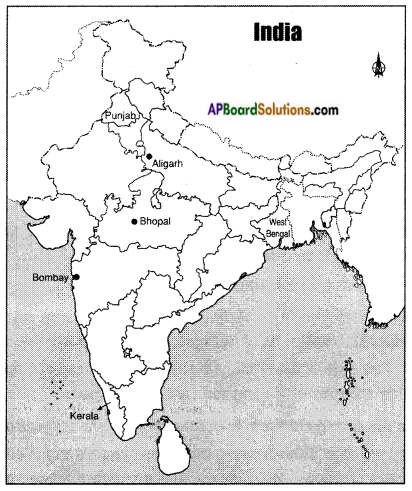
Locate the following in the given India Map.

  1. West Bengal
  2. Punjab
  3. Bombay
  4. Aligarh
  5. Bhopal
  6. Kerala

Answer:
AP Board 8th Class Social Studies Important Questions Chapter 19 Social and Religious Reform Movements 1

AP Board 8th Class Social Studies Important Questions Chapter 19 Social and Religious Reform Movements

AP Board 8th Class Physical Science Solutions Chapter 7 Coal and Petroleum

AP State Syllabus AP Board 8th Class Physical Science Solutions Chapter 7 Coal and Petroleum Textbook Questions and Answers.

AP State Syllabus 8th Class Physical Science Solutions 7th Lesson Coal and Petroleum

8th Class Physical Science 7th Lesson Coal and Petroleum Textbook Questions and Answers

Improve Your Learning

Question 1.
Complete the given analogy.
i) Coal : ExhaustIble :: ———– : InexhaustIble
ii) Coaltar : ———– :: Coke : Manufacture of steel
iii) Petrochemicals : Plastic :: CNG : ———–
iv) Carbondioxide: Global warming :: ———– : Nausea
Answer:
i) Coal : ExhaustIble :: Solar energy : InexhaustIble
ii) Coaltar : Paints :: Coke : Manufacture of steel
iii) Petrochemicals : Plastic :: CNG : Fertilizer
iv) Carbondioxide: Global warming :: Heavy metals : Nausea

AP Board 8th Class Physical Science Solutions Chapter 7 Coal and Petroleum

Question 2.
Match the following.
Group – A                                                Group – B
i) Natural resource                    ( )          a) Carbonisation
ii) Coal                                       ( )          b) Plastic chair
iii) Petrochemical product         ( )          c) Krishna and Godavari delta
iv) Natural gas                           ( )          d) Plankton
v) Petroleum                              ( )          e) Water
Answer:
i) e
ii) a
iii) b
iv) c
v) d

Question 3.
Multiple Choice Questions:
i) Which one of the following is less polluting fuel?
a) Natural Gas
b) Coal
c) Kerosene
d) Petrol
Answer:
ii) a

ii) The main constituent of coal is
a) Carbon
b) Oxygen
c) Air
d) Water
Answer:
iii) b

iii) Which one of the following material is used for making shoe polish?
a) Paraffin wax
b) Petrol
c) Diesel
d) Lubricating oil
Answer:
i) a

AP Board 8th Class Physical Science Solutions Chapter 7 Coal and Petroleum

Question 4.
Fill in the blanks.
i) …………… was used in manufacture of steel. (Coke)
ii) The biproduct of coal used in synthetic dyes and paints is ………………. (coal tar)
iii) Coal was formed in areas where large amounts of ………………. was buried under the earth. (forests)
iv) ………………… gas which causes climate change and global warming. (Carbon dioxide)

Question 5.
Name the petroleum products is used for roads surfacing.
Answer:
A petroleum product of bitumen is used for roads surfacing in place of coal tar these days.

Question 6.
Explain the process of formation of petroleum in Earth. (OR)
Explain the process of formation of petroleum in the Earth.
Answer:
Petroleum was formed from the remains of tiny organisms called plankton that were found in the bottom of seas and oceans. Plankton have tiny droplets of oil inside their bodies.
As these organisms died, their bodies settled at the bottom of the sea or ocean and got covered with layers of sand and clay. Over millions of years, due to absence of air, high temperature and high pressure these dead organisms transformed into petroleum.

Question 7.
Project Work:
Compare a CNG run vehicle with that of a diesel run vehicle. What difference do you notice in both cases with respect to pollutants released, level of pollution and cost of fuel? Prepare a report on your findings. You can take the help of a driver to make a report on your observation.
Answer:

Name of the fuel Cost of the fuel as on today Pollutants liberated
Diesel/Petrol Rs. 52.97/ Rs. 72.14 per litre Carbon monoxide, carbon dioxide, hydro carbons, sulphur dioxide
CNG Rs. 49 per kg Carbon dioxide, sulphur dioxide, nitrous oxide

AP Board 8th Class Physical Science Solutions Chapter 7 Coal and Petroleum

Question 8.
Project Work:
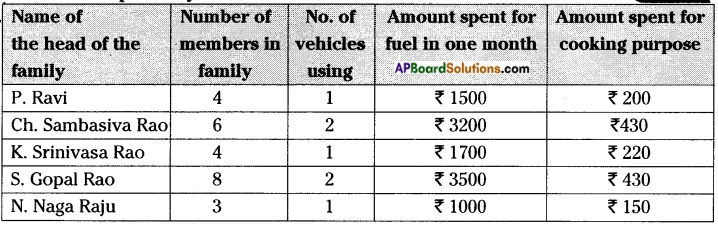
Choose five families of your neighbourhood, collect the information about the measures that they adopt to conserve energy resources in transport and cooking.
Make a report on your observation.
Answer:
AP Board 8th Class Physical Science Solutions Chapter 7 Coal and Petroleum 1
The precautionary methods taken by them to conserve energy resources in transport and cooking.
In transport:

  1. They do not using their motor vehicles for travelling smaller distances.
  2. They are completing small distances by walk or by bicycle.
  3. They are regularly servicing their vehicles.
  4. They are regularly changing the engine oil of the vehicle.
  5. They are travelling at prescribed speed and not applying brakes unnecessarily which increase the milage.

In cooking:

  1. They are using cookers.
  2. Not preparing to many fries which can increase the fuel consumption.
  3. Regularly cleaning the burners of gas stove.
  4. Cooking the food with sufficient water.

Question 9.
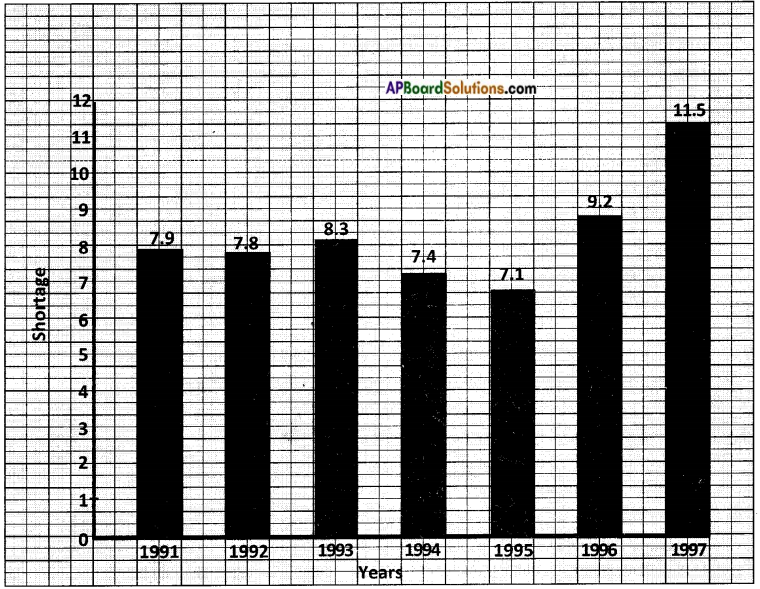
The following table shows the total power shortage percentage in India from 1991-1997. Show the data in the form of a bar graph taking shortage percentage for the years on the Y-axis and the years on the X-axis.

S.No. Year Shortage (%)
1 1991 7.9
2 1992 7.8
3 1993 8.3
4 1994 7.4
5 1995 7.1
6 1996 9.2
7 1997 11.5

a) Is the shortage percentage of power increasing or decreasing?
Answer:
The power shortage not followed a regular trend. It decreased from 1991 to 1992 and then increased in 1993 and then decreased upto 1995 and then increased upto 1997 from the table given.
AP Board 8th Class Physical Science Solutions Chapter 7 Coal and Petroleum 2

AP Board 8th Class Physical Science Solutions Chapter 7 Coal and Petroleum

b) If shortage percentage of power increases year by year, how will it affect on human life? Explain.
Answer:
The effect of shortage percentage of power on human life:
Agriculture: Agriculture mainly depends on electric power for water supply. If there is no sufficient power is available then the yield of food material decreases.
Industry: Industries mainly run with electric power. If electric power is not sufficient then it is major set back for their production.
Economy: Economy drastically affected by shortage of power which will also effects the economic status of people.
Health: Shortage of power also affects the health of people because many cured by operations which required power.
Science and Technology : The growth of science and technology completely get damage due to lack of power because they are mainly depend on power.
So shortage of power drastically affect human life.

Question 10.
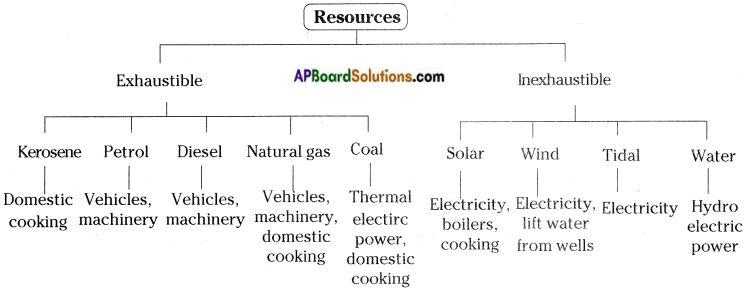
Draw a flow chart showing exhaustible and inexhaustible resources and their use.
Answer:
AP Board 8th Class Physical Science Solutions Chapter 7 Coal and Petroleum 3

Question 11.
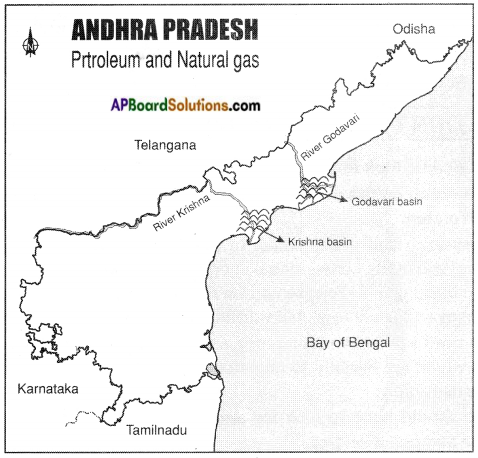
Collect the information about place were we get coal, petroleum and natural gas in Andhra Pradesh and mark the places on outline map of Andhra Pradesh.
Answer:
Coal: Coal is not available in Andhra Pradesh.
Petroleum and Natural Gas: These reserves are spread over in Krishna and Godavari basins of our state.
AP Board 8th Class Physical Science Solutions Chapter 7 Coal and Petroleum 4

Question 12.
How do you appreciate the efforts of human beings to discover an alternate energy source like coal and petroleum for their daily use?
Answer:
Earlier people used kiln using wood for cooking food and for travelling they used horses and bullock carts. There was no electricity so their life was miserable. The wood they were using produced lot of pollution. So they required a fuel not only for cooking but also travelling long distances.
In 19th century the use of coal as fuel was the major thing in development of human beings. Steam engine which used coal was invented during industrial revolution. Later electricity was produced from coal. During this period the steam engine was used to power everything from cloth looms to vehicles on land and water.
The petroleum was started as fuel in 1859 then it was used everywhere in the world because it was better fuel than coal and less pollutant. So people were using petroleum products for their needs that is for cooking, transport and machinery, etc. So discovery of using coal and petroleum as fuel changes the life of human beings. So we should have to appreciate human being for their discovery of an alternative energy source like coal and petroleum for their daily use.

AP Board 8th Class Physical Science Solutions Chapter 7 Coal and Petroleum

Question 13.
Harshith said to his father, “Daddy we can save more fuel by using bicycle instead of bike for going to nearby places”. How do you appreciate Harshith’s comment?
Answer:
I would appreciate Harshith for his comment. We are wasting a lot of fuel for travelling near by places which can be covered either by bicycle or by walk. If we do like this a lot of fuel is consumed. Consuming fuel is producing fuel. So I thoroughly appreciate Harshith for his comment.

Question 14.
Why should people look for alternative sources of fossil fuel? (OR)
Write your opinion on the necessity of discovering an alternate energy sources to coal and petroleum.
Answer:
The entire research and development in the field of sourced energy shows that at present rate of use of the conventional energy sources like fossil fuels will not last for long and also burning fuels release carbon dioxide a green house gas, which causes a climate changes and leads to global warming.
Coal fired power plants emit mercury, selenium, arsenic, lead in addition to green house gases which are harmful to human health and environment and availability of coal decreasing rapidly.
So people should have to look for alternative sources of fossil fuels which are inexhaustible and pollution free.

Question 15.
Assume that you are a driver, what measures do you take to save petrol and diesel?
Answer:

  1. I will thoroughly check whether the engine of the vehicle properly working or not otherwise the vehicle consume more fuel and also release poisonous gases.
  2. I will thoroughly check the air in the tyres.
  3. I did not unnecessarily apply brakes which will consume more fuel.
  4. I will replace engine oils for every two or three months.
  5. I will run the vehicle in prescribed speed which will increase the milage.
  6. I did not allow overload in the vehicle.

Question 16.
“Crude oil and refined fuel when spills into the sea from tanker of ships by accident”. Discuss the consequences of this on environment.
Answer:
Crude oil and refined fuel spills into sea from tanker of ships by accident causes a damage to natural system and kill sea birds, mammals, shell fish and other organisms due to lack of dissolved oxygen in water as oil is less denser than water it floats on water and forming a layer called oil slink and oxygen does not enters into the water.

AP Board 8th Class Physical Science Solutions Chapter 7 Coal and Petroleum

Question 17.
“The use of CNG and LPG as fuels for automobiles helps us to minimize air pollution and maintains ecological balance.” Do you agree with this statement? If yes explain.
Answer:
Yes, I will agree with the statement. CNG and LPG are completely combustible. CNG is less polluting and it is cleaner fuel releasing small quantity of harmful gases. Similarly LPG is also releases few polluting gases. CNG and LPG does not release hydrocarbons. They only release carbon dioxide and small quantities of sulphur dioxide and nitrous oxide. So using CNG and LPG as fuels for automobiles help us to minimize air pollution and maintains ecological balance.

8th Class Physical Science 7th Lesson Coal and Petroleum InText Questions and Answers

8th Class Physical Science Textbook Page No. 105

Question 1.
How is biodiversity affected by excessive use of fossil fuels?
Answer:
Biodiversity affected by excessive use of fossil fuels:

  1. Burning fuels releases carbon dioxide a green house gas, which causes climate changes and leads to global warming.
  2. Coal fired power plants emits mercury, selenium, arsenic, lead in addition to green house gases which is harmful to human health and environment.
  3. Many paints made from petroleum and heavy metals release toxic products into air. These toxic products cause a variety of health problems including heart, lungs damage, nausea and dizziness.
    So these are harmful effects of excessive use of fossil fuels on biodiversity.

8th Class Physical Science 7th Lesson Coal and Petroleum Activities

Activity – 1

Question 1.
Identifying articles and materials used for various purposes.
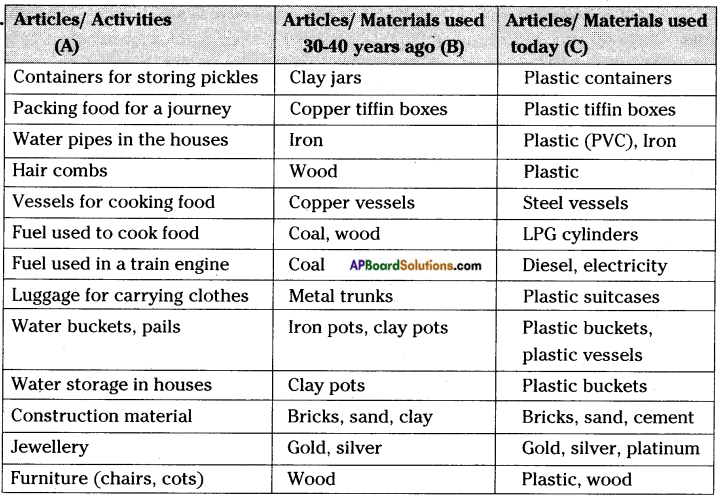
Have a look at table. Column A gives the names of some activities and items. Ask your grandparents or other older people about the names of the materials then used for the items given in column A, and write them in column B. Then in column C, write the names of materials being used at present.
Answer:
AP Board 8th Class Physical Science Solutions Chapter 7 Coal and Petroleum 5
From activity 1, you have a long list of materials. Some of them like wood, metals (Iron, Silver, Gold etc) were used ten years, fifty years even hundred years ago. Do your grand parents remember using plastic when they were young?
Now think and wirte the answers:
a) How many of these materials were available 10 years ago?
Answer:
Plastic, iron, gold and silver articles were available 10 years ago.

AP Board 8th Class Physical Science Solutions Chapter 7 Coal and Petroleum

b) How many of these materials were available 50 years ago?
Answer:
The articles made up of wood, iron, silver, gold are available 50 years ago and also articles made up of clay. There is no plastic articles.

c) How many of these materials were available 100 years ago?
Answer:
The articles made up of clay, wood, iron, silver, gold were available 100 years ago.

Activity – 2

Question 2.
List out the natural resources which are limited and which are abundant arid record in table.
Answer:

Resources abundant Solar energy, wind energy, tidal energy, biomass enery, water
Resources limited Coal, petroleum, natural gas

a) What will happen if fossil fuel like coal and petroleum are completely exhausted?
Answer:

  1. There would be no fuel for cooking.
  2. There would be no fuel for transport.
  3. There would be no fuel for running machinery.
  4. There would be no fuel for producing electricity.
    So life on earth become miserable.

b) What would be our future energy resources?
Answer:
The future energy resources are hydro electric power, solar energy, wind energy, tidal energy, geothermal energy, Ocean Thermal Energy Conversion (OTEC), biomass energy.

c) Are the fossil fuel resources available plenty to meet the future energy needs?
Answer:
No, a survey gives an information that about 2015 the world people would consume half of total reserves of petroleum. Coal also exhaustible resource. We can meet our needs with coal for another 250 – 300 years at the current rate of use.

d) What actions required to meet the future energy needs?
Answer:

  1. Do not waste fuel for unnecessary activities.
  2. The energy should be properly utilized and the wastage should be minimized.
  3. Usage of bicycle in place of motor vehicles for small distances.
  4. Using road transport vehicles for travelling larger distances which will minimize fuel consumption.
  5. The engine of a vehicle thoroughly serviced in order to minimize fuel consumption.
  6. Alternative sources like solar energy, wind energy, tidal energy more utilized.

AP Board 8th Class Physical Science Solutions Chapter 7 Coal and Petroleum

Activity – 3

Question 3.
Identifying various uses of petroleum.
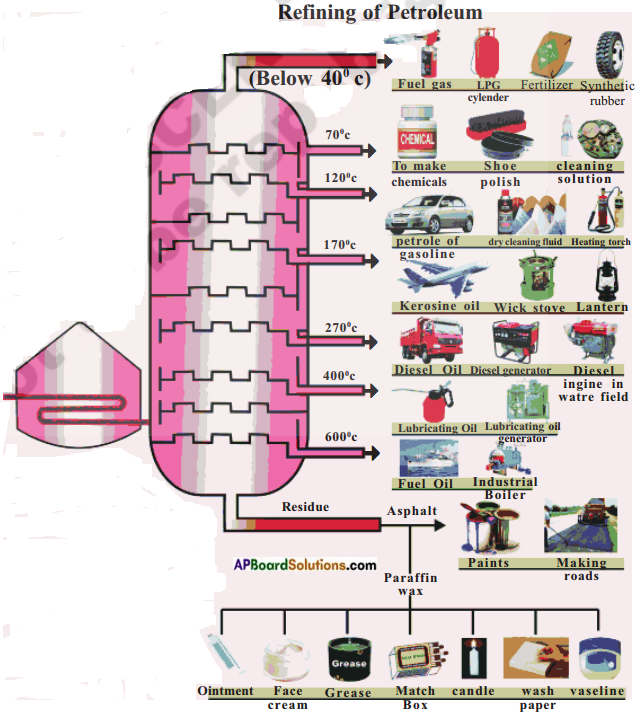
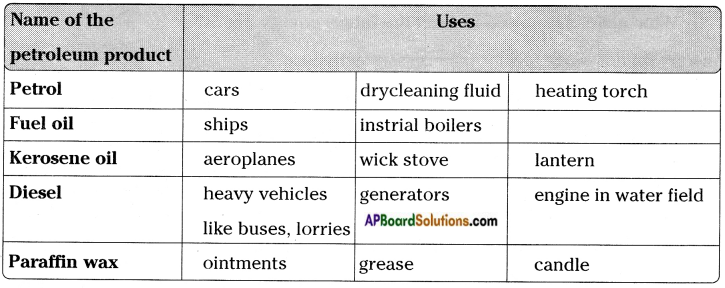
Look at the figure and find the other uses of petroleum and its products. Fill in the table.
AP Board 8th Class Physical Science Solutions Chapter 7 Coal and Petroleum 6
Answer:
AP Board 8th Class Physical Science Solutions Chapter 7 Coal and Petroleum 7

Activity – 4

Question 4.
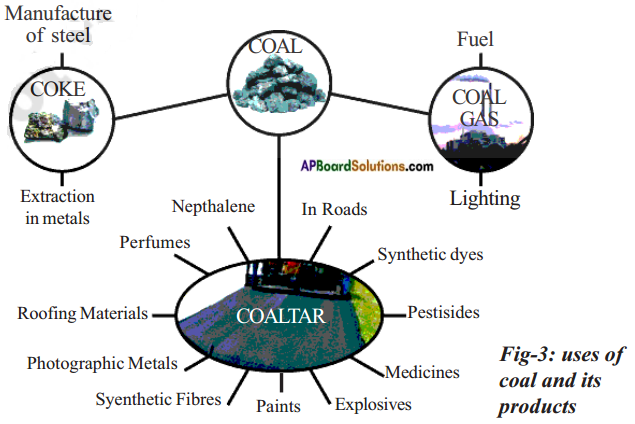
Identifying uses of coal products:
AP Board 8th Class Physical Science Solutions Chapter 7 Coal and Petroleum 8
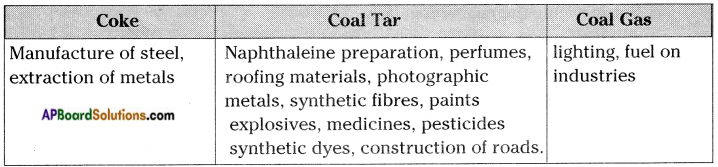
Observe the above picture and list out the uses of coal products in the following table. You can collect more information by the discussion with elders and with your friends.
Answer:
AP Board 8th Class Physical Science Solutions Chapter 7 Coal and Petroleum 9

AP Board 8th Class Physical Science Solutions Chapter 7 Coal and Petroleum

Lab Activity

Conduct an experiment to show that when we heat high quality coal, a gas evolves which can be burnt. (OR)
What are the materials required to demonstrate “burning of coal”? Draw the diagram of the experimental setup. (OR)
How do you prove a high quality coal on heating produces a burning gas?
Answer:
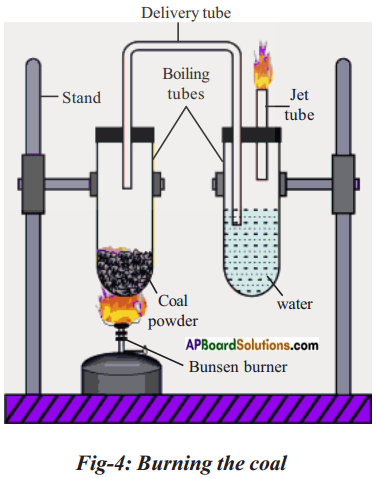
Aim: To show that when we heat high quality of coal a gas evolves which can burn. Material required : Two boiling tubes, rubber corks, iron stands, delivery tube, jet tube, bunsen burner.
Procedure: Take a spoon of powdered coal into a hard boiling tube and fix it to a stand as shown in figure. Close the test tube with a rubber cork and connect it to another.
boiling tube which is partially filled with water and has fixed to other stand, with the help of ‘U’ shaped delivery tube. Arrange a jet tube to the cork of second boiling tube. Heat the boiling tube containing coal strongly with the help of bunsen burner.
AP Board 8th Class Physical Science Solutions Chapter 7 Coal and Petroleum 10
We may notice that brownish black vapours evolved in the first boiling tube. These vapours are passed through water in the second boiling tube. Colourless gas bubbles evolve from the water. If we burn the gas that is evolving through the jet tube we can witness a bright flame at the nozzle. This shows when we heat high quality coal a gas evolves which can burn.

Activity – 5

Question 5.
Group discussion on misuse of fuel resources and its consequences.
Discuss in small groups how fuel resources are being misused in our daily life while doing various activities like
a) transportation, b) cooking and c) industrial use.
Answer:
Misuse of fuel in transportation:

  1. Do not stopping the engine at traffic signals.
  2. Running the vehicle with more speed than prescribed speed.
  3. Unnecessarily using brakes.
  4. Not servicing the engine regularly.
  5. Not changing the engine oil regularly.
  6. Not filling air in the tyres regularly.
  7. Carrying overload in the vehicle.
  8. Using vehicles for smaller distances.

Misuse of fuel in cooking:

  1. Not stopping the burners when the cooking is over.
  2. Using more water than required which will consume more fuel.
  3. Not checking the burners regularly whether they are any dust particles which will lead more consumption of fuel.
  4. Preparing more fries which required more fuel.

Misuse of fuel in industries:

  1. Machinery is not properly working.
  2. Any flaws in the machinery.
  3. Not doing regularly maintenance of machinery.
  4. Lubricants are not used properly.

AP Board 8th Class Physical Science Solutions Chapter 7 Coal and Petroleum

a) What are the consequences of misuse of fuels?
Answer:

  1. Fossil fuels like coal and petroleum are completely exhausted.
  2. Misuse also leads to environmental pollution due to release of harmful gases like carbon monoxide.

b) What methods could you suggest to prevent the misuse of fuels?
Answer:
In transportation:

  1. Drive at a constant and moderate speed as far as possible.
  2. Switch off the engine at traffic lights or at a place where you have to wait.
  3. Ensure correct tyre pressure.
  4. Ensure regular maintenance of the vehicle.

In cooking:

  1. Stop the burners when the cooking is over.
  2. Use sufficient water for cooking.
  3. Do not prepare more frying food.
  4. Ensure regular maintenance of the gas stove.

In industry:

  1. Correct the flaws in the machinery.
  2. Ensure regular maintenance of machinery.
  3. Lubricants are used whenever necessary.

AP Board 8th Class Physical Science Solutions Chapter 1 Force

AP State Syllabus AP Board 8th Class Physical Science Solutions Chapter 1 Force Textbook Questions and Answers.

AP State Syllabus 8th Class Physical Science Solutions 1st Lesson Force

8th Class Physical Science 1st Lesson Force Textbook Questions and Answers

Improve Your Learning

Question 1.
What is a force? What changes can be produced by a force?
Answer:
Force: A push or a pull of an object is called a force.
Changes produced by a force:

  1. A force can change the state of motion of an object.
  2. A force can change the shape of an object.

Question 2.
State an example for a situation mentioned below in which a force:
a) Changes the speed of an object.
b) Changes the shape of an object.
c) Changes the direction of an object.
Answer:
a) Force changes the speed of an object:
A ball at rest begins to move when a force is applied on it that shows force changes the speed of an object.
b) Force changes the shape of an object:
Take a plastic or metal scale placed between two bricks and put some weight at the centre of the scale. We observe that force changes its shape.
c) Force changes the direction of an object:
Kick a moving football with some angle then we can observe the change in the direction of football.

AP Board 8th Class Physical Science Solutions Chapter 1 Force

Question 3.
How can you differentiate between a contact force and a force at a distance?
(OR)
Distinguish between a contact force and a force at a distance.
Answer:

Contact force A force at a distance
1. Force which results when there is a direct physical contact between two interacting objects is known as contact force. 1. The force which occurs without any physical contact between two objects is known as a force at a distance or field force.
2. The two objects have direct contact. 2. No contact.
3. For example, the tyres of a bicycle has direct contact with the surface of the road. 3. For example, the attraction of two magnets.

Question 4.
Give two examples each for a contact force and a force at a distance.
Answer:
Contact force:
e.g.: 1) Muscular force 2) Frictional force Force at a distance:
e.g.: 1) Magnetic force 2) Electrostatic force

Question 5.
Detect the errors in the following statement and rewrite it making necessary corrections.
“Because the car is at rest, no forces are acting on it.”
Answer:
The object is said to be at rest when no forces are acting on it or net force acting on it is zero. So the statement should be corrected like this “Because the car is at rest, no forces are acting on it or net force on the car is zero.”

Question 6.
Why do tools meant for cutting always have sharp edges?
Answer:
The tools meant for cutting have sharp edges because of smaller contact area they exerts more pressure on objects and cutting of objects are easy.

Question 7.
Objects change their state of motion due to the net force acting on them. Do you agree with this statement ? Discuss with examples.
Answer:
Yes, we can agree with this statement. Net force can increase or decrease the speed of an object. Force can also change the direction of an object.
Hence we conclude that net force can change the state of motion of an object.
Some examples:

  1. If we kick the ball it will move from state of rest.
  2. If we stop the running ball it will come to state of rest.
  3. If we through a ball on the ground it will come to rest after sometime due to gravitational force acting on it.
  4. If we pull the chair, it will move due to muscular force acting on it.

AP Board 8th Class Physical Science Solutions Chapter 1 Force

Question 8.
When you push a heavy object, it doesn’t move. Explain the reason in terms of net force.
Answer:
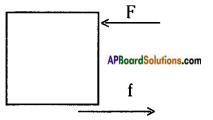
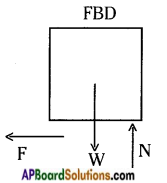
AP Board 8th Class Physical Science Solutions Chapter 1 Force 1
When we apply force on a heavy object it has to overcome frictional force in order to move. If the force applied is less than the frictional force then the net force (f – F) is insufficient to move the object.

Question 9.
Find net forces from the following diagrams:
AP Board 8th Class Physical Science Solutions Chapter 1 Force 2
Answer:
a) Net force is 6N along horizontal direction towards right.
b) Net force is zero.
c) Net force is 14N along horizontal direction towards right.
d) Net force is 1 N upwards in vertical direction.

Question 10.
Imagine that friction has disappeared from the earth. What will happen? Explain.
Answer:
If friction has disappeared from the earth then

  1. we cannot walk or run.
  2. we will not have any cars or bicycles because all of them move due to friction.
  3. no building could be constructed.
  4. carpenters will not able to smoothen surfaces.
  5. we could not fix nail on the wall.
  6. it will not possible to write with pen or pencil.
  7. we will not able to hold any appliances such as hammer, soap, etc.

AP Board 8th Class Physical Science Solutions Chapter 1 Force

Question 11.
Karthik is observing the live telecast of a one day cricket match. He noticed motion of a roller on the pitch during lunch break. He thought about various forces acting on the roller and the net force when it is in motion. Many questions arose in his mind regarding the direction of the net force. Can you guess what would be those questions?
Answer:

  1. Why there is no motion for roller in vertical direction?
  2. What are the forces acting in the vertical direction?
  3. What are the forces acting in the horizontal direction?
  4. Why there is motion in the horizontal direction for roller?

Question 12.
a) Take two identical straws and suspend one of them freely. Rub the other straw with a piece of paper. Bring the rubbed end of the straw near the suspended one. What do you observe from this activity? Can you tell which type of force is it?
b) Comb your dry hair. Bring the comb near small pieces of paper. What do you observe? Explain.
Answer:
a) The rubbed end of the straw attracts the suspend straw when it is brought near to it. The reason is that when the straw is rubbed with a paper, it acquires an electrostatic charge on its surface and the suspended straw near it acquires opposite charge.
b) When we comb dry hair and bring small pieces of paper they are attracted by comb the reason is when we comb dry hair, it acquires electrostatic charge and paper pieces brought near to it acquire opposite charge there by they are attracted by comb.

Question 13.
Collect pictures from various sources like internet, magazines, newspapers, etc. to illustrate contact forces, forces and prepare a scrap book.
Answer:
AP Board 8th Class Physical Science Solutions Chapter 1 Force 3

Question 14.
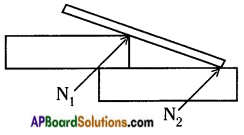
A stick is placed on steps as shown in the figure. Draw normal forces on the stick.
AP Board 8th Class Physical Science Solutions Chapter 1 Force 4
Answer:
AP Board 8th Class Physical Science Solutions Chapter 1 Force 5

Question 15.
A monkey hangs stationary at the end of the vertical vine. What forces act on the monkey
Answer:
a) The weight of the monkey downward direction.
b) The normal force by branch upward direction.
c) The frictional force exerted by branch along the horizontal direction.

AP Board 8th Class Physical Science Solutions Chapter 1 Force

Question 16.
If you push on a heavy box which is at rest, you must exert some force to start its motion. However, once the box is sliding, you can apply a lesser force to maintain that motion. Why?
Answer:
When the box is sliding, the contact points on its surface do not get enough time to lock in to the contact points on the floor. So friction is less when compared with box at rest so we required to apply lesser force to maintain motion.

Question 17.
How do you increase the pressure by keeping
(a) area unchanged and (b) force unchanged?
Answer:
Pressure P = hdg. So pressure can be depend on height of air column, density of air and acceleration due to gravity.
So pressure can be increased by increasing length of air column at a particular place and for a particular gas.

Question 18.
Design and conduct experiments to test few ways how friction may be reduced.
Answer:
Friction is due to the roughness of surfaces. It can be reduced by the following methods.
– By polishing the rough surface.
– By applying lubricants like oil and grease to the surfaces.
– By spreading powder on the rough surface like carromboard.
– By using soap and detergent solutions, etc.
Experiment: The rusted pulley makes a rattling noise. Apply some oil in between the wheel and axle. The sound is reduced and now it works smoothly.

Question 19.
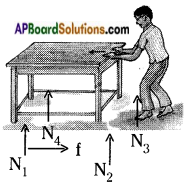
Observe the figure and find in which direction the force of friction acts. Also indicate the normal forces and their directions.
AP Board 8th Class Physical Science Solutions Chapter 1 Force 6
Answer:
AP Board 8th Class Physical Science Solutions Chapter 1 Force 7
f: force of friction
N1, N2, N3, N4 are normal forces.

AP Board 8th Class Physical Science Solutions Chapter 1 Force

Question 20.
A man is standing still on a level floor. What forces act on him? Draw a free body diagram (FBD) to show all forces acting on him.
Answer:
The forces acting on the man:
AP Board 8th Class Physical Science Solutions Chapter 1 Force 7
Along vertical direction:

  1. Weight of the man or gravitational force acting vertically downwards.
  2. Normal force or reaction applied by the floor vertically up.

Along horizontal direction:
Frictional force applied by the floor on the man.

Question 21.
How do you appreciate the role of friction in facilitating our various activities?
Answer:
Every motion that occurs on earth depends upon friction. For example, we are unable to walk if there is no friction and we cannot write with a pen and we cannot construct a building and there should be no vehicles without friction.
So without friction there is no motion on earth. So friction is required for better living of human beings.

8th Class Physical Science 1st Lesson Force InText Questions and Answers

8th Class Physical Science Textbook Page No. 3

Question 1.
When an object slips off your hand, it always falls down. What pulls it down?
Answer:
Gravitational force.

Question 2.
If you roll a ball on a level ground, it slows down and after sometime it will come to a stop. What makes the ball stop?
Answer:
Frictional force acting between floor and ball.

Question 3.
What forces acting on objects, change their state or state of motion?
Answer:
Contact force and force at a distance.

Question 4.
Why does the needle of a magnetic compass move when we place a bar magnet near to it?
Answer:
A force at a distance or field force acts on the needle. So, the needle of a magnetic compass moves when we place a bar magnet near it.

AP Board 8th Class Physical Science Solutions Chapter 1 Force

Question 5.
Why does the toothpaste come out when we press the tube?
Answer:
A contact force acts between our hand and tube. So, the toothpaste comes out when we press it.

Question 6.
Have you observe the difference between the force applied by a magnet on the needle of a compass and the force you applied on the tube?
Answer:
First one is force at a distance and the second one is contact force.

8th Class Physical Science Textbook Page No. 4

Question 7.
If a pen slips off from our hands it falls down to the floor.
a) Why does the pen fall down ?
b) What is the force which pulls the pen down ?
Answer:
a) Due to increase of gravitational pull of the earth than the normal force,
b) Gravitational pull of the earth.

Question 8.
If we keep the pen on a table, it does not fall down. Why ?
Answer:
As the normal force and gravitational pull of the earth are equal, it does not fall down.

Question 9.
a) Why does a stone thrown up into the sky fall back to the earth?
b) Why do rivers flow down to the sea?
c) How does the earth hold the atmosphere?
d) Is there any force pulling the objects towards earth?
Answer:
For all the above questions, the answer is ‘due to gravitational pull of the earth on the nearer bodies of the earth’.

8th Class Physical Science Textbook Page No. 6

Question 10.
In all the actions that we perform in our daily life like brushing, bathing, eating, writing, driving and walking ; we have to exert a force. Do you know from where the force comes?
Answer:
The force comes from our muscles.

8th Class Physical Science Textbook Page No. 8

Question 11.
Did you ever experience slipping on a floor? What conditions caused you to slip?
Answer:
Yes, it was due to less friction between my foot and floor.

AP Board 8th Class Physical Science Solutions Chapter 1 Force

Question 12.
Did you experience slipping while you are walking on wet mud ? Why do most of road accidents happen during rainy days?
Answer:
Yes, in the wet mud the friction is very less and wet mud acts as a lubricant between our feet and floor. During rainy season the mud or road will be wet and as mentioned above the friction will be less, so most accidents happen.

Question 13.
Would it be possible to drive a car if there were no friction between the tyres and the road?
Answer:
No, we can’t stop the car as there is no friction in case of no friction between the tyres of car and the road. We can drive, but the car would not get any control.

Question 14.
Place your science book on the table. Is it in a state of rest?
Answer:
Yes.

8th Class Physical Science Textbook Page No. 9

Question 15.
What is the state of the stone?
Answer:
At rest.

Question 16.
What forces are acting on it?
Answer:
Tension and gravitational pull of the earth.

Question 17.
What will happen if the thread is broken?
Answer:
The gravitational pull of the earth increases and the stone falls down.

AP Board 8th Class Physical Science Solutions Chapter 1 Force

Question 18.
What do we call this force ? (the force supporting the stone)
Answer:
Tension.

8th Class Physical Science Textbook Page No. 13

Question 19.
You might have seen children playing with a rubber tyre by pushing it with a stick.
They push the tyre again and again with the stick to increase its speed,
a) Do you understand why the speed of the tyre increases whenever it is pushed by the stick?
Answer:
With every push they are applying a little more force on the moving tyre in the direction of motion. Hence the speed of the tyre increases continuously.
b) Give some more examples where the object speeds up or slows down or a change may occur in its direction of motion, when we exert a force on it?
Answer:
If wind blows in the direction of motion of bicycle the speed of bicycle increases. If wind blows in the opposite direction of motion of bicycle the speed of bicycle decreases.

Think and Discuss

8th Class Physical Science Textbook Page No. 5

Question 1.
A cricket ball of mass’m’ is thrown upward with some initial speed. If the air resistance is neglected, what forces are acting on the ball when it reaches (a) half its maximum height and (b) its maximum height?
Answer:
The forces which are acting on the ball thrown vertically upward:
a) At half of its maximum height:

  1. The remaining force which acts vertically upwards (some force that we applied is utilized in reaching half of maximum height).
  2. The gravitational force downwards.

b) At maximum height:
Gravitational force acts downward direction (The applied force is completely utilized in reaching maximum height).

8th Class Physical Science Textbook Page No. 6

AP Board 8th Class Physical Science Solutions Chapter 1 Force

Question 2.
Two identical bars, one which is steel and the other a magnet, are painted with the same colour. How can you tell which one is the magnet using only these two bars? (don’t break the bars)
Answer:
The bar which attracts the other bar is magnet. The other bar is magnetic material that is steel.

8th Class Physical Science Textbook Page No. 8

Question 3.
A book placed on a table is at rest. Is the force of friction acting on it or not ? Explain.
Answer:
Friction is caused by the irregularities on the two surfaces in contact. Even those surfaces which appear very smooth have large number of minute irregularities on them. Irregularities on the two surfaces lock into one another. So a book placed on a table is at rest experiences frictional force.

8th Class Physical Science Textbook Page No. 10

Question 4.
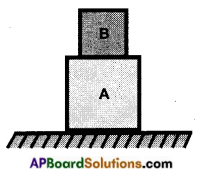
A system of two bodies A and B are placed as shown in figure. How many forces are acting on A and B respectively?
Answer:
AP Board 8th Class Physical Science Solutions Chapter 1 Force 9
On A

  1. Normal force exerts by floor vertically upwards.
  2. Weight of A vertically downwards.
  3. Frictional force exerts floor along horizontal direction.

On B

  1. Normal force exerted by surface of A vertically upwards.
  2. Weight of B vertically downwards.
  3. Frictional force exerts by surface of A along horizontal direction.

Question 5.
Why is it necessary to separate contact force into a normal force and frictional force? Give at least two reasons.
Answer:
Reasons:

  1. In order to know what are the forces acting on the object.
  2. To know the net force acting on the body.
  3. To know the direction of motion of an object.

8th Class Physical Science Textbook Page No. 12

AP Board 8th Class Physical Science Solutions Chapter 1 Force

Question 6.
Play arm wrestling with your Mend. How can you explain the winning of the game by using the concept of net force?
Answer:
The person we exerts more muscular force tends to win.

Question 7.
Name the forces acting on arm and their direction while playing the game. Try to draw FBD for this situation.
Answer:
The muscular force, normal force and weight (gravitational force).
AP Board 8th Class Physical Science Solutions Chapter 1 Force 10

8th Class Physical Science Textbook Page No. 15

Question 8.
Does pressure have direction? Explain.
Answer:
Pressure exerts in all directions. So there is no specified direction for pressure. So we does not consider pressure has direction i.e., it has only magnitude but not direction. So it is a scalar quantity.

8th Class Physical Science 1st Lesson Force Activities

Activity – 1

Question 1.
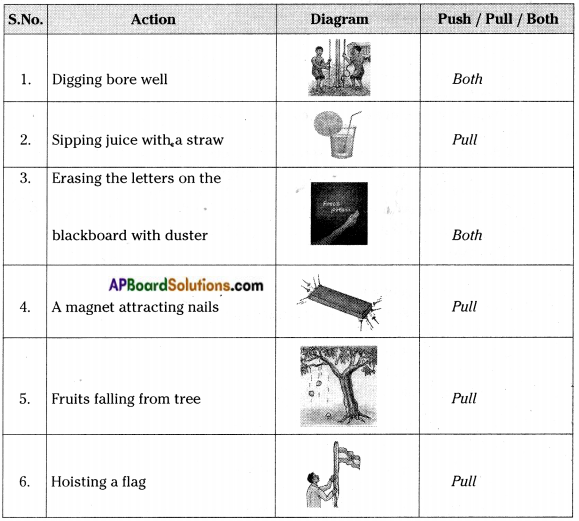
Identifying push or puli:
Write push or pull in the blank boxes given below. If you feel that the action involves both push and pull, write both in the boxes.
Answer:
AP Board 8th Class Physical Science Solutions Chapter 1 Force 11
a) List three more activities where we exert force which appears as a push.
Answer:

  1. Pushing a repaired car.
  2. A football player taking a penalty kick.
  3. A cricket ball hit by a batsman.

b) List three more activities where we exert a force as a pull.
Answer:

  1. Drawing bucket of water from a well.
  2. Opening a drawer.
  3. In a game of tug of war, two teams pull the rope in the opposite directions.

c) State three actions which involve both push and pull.
Answer:

  1. Moving a book front or back on a table.
  2. Opening or shutting a door.
  3. Cleaning the floor with a cloth.

d) Shall we call the effort done on an object by means of pushing or pulling as a force exerted on the object?
Answer:
Yes, it is called force.

e) When an object slips off your hand, it always falls down. What pulls it down?
Answer:
Gravitational force.

AP Board 8th Class Physical Science Solutions Chapter 1 Force

f) If you roll a ball on a level ground, it slows down and after sometime it will come to a stop. What makes the bail stop?
Answer:
Frictional force acting between floor and ball.

g) What forces acting on objects, change their state or state of motion?
Answer:
Contact force and force at a distance.
Types of forces:

h) Why does the needle of a magnetic compass move when we place a bar magnet near it?
Answer:
Due to magnetic force of magnet.

i) Why does the toothpaste come out when we press the tube?
Answer:
Due to muscular force applied by us on toothpaste.

j) Have you observe the difference between the force applied by a magnet on the needle of a compass and the force you applied on the tube?
Answer:
First one is force at a distance and the second one is contact force.

Activity – 2

Question 2.
Observing the magnetic force :
Take a sewing needle. Rub it with a bar magnet several times always moving the magnet in the same direction.
a) Does the needle get magnetised?
Answer:
Yes. Identify south and north pole of the magnetised needle. Pin a red coloured foam ball to South pole and white ball to North pole of the needle, then drop it in a bowl of water it floats.
Make another needle in the same way. Float both the needles side by side such that like ends facing each other.

b) What happens to the needles? How do they move?
Answer:
They repel each other. They move backwards to each other.

c) Now place the needles in such a way that unlike ends face each other. How do they push or pull each other?
Answer:
They pull each other that means they are attracted.

d) What is this pull or push between two poles called?
Answer:
Magnetic force.

Activity – 3

Question 3.
Observing electrostatic forces :
Take a balloon. Inflate it and tie up the open end. Now cut a paper into small pieces and place them on floor. Rub the balloon with a paper and using the balloon near the pieces of the paper.
a) Are the bits of paper pulled towards the balloon?
Answer:
Yes, the bits of papers pulled towards balloon.

b) Why does the balloon pull or attracts the pieces of paper?
Answer:
When the balloon is rubbed with a paper it acquires charge and it induces opposite charge which brought near to it. So the pieces of paper are attracted by balloon.

c) Try to use pepper and salt in the place of pieces of paper. What do you observe?
Answer:
They do not attracted by the balloon.
Gravitational force: It is our common experience that if a pen slips off from our hands it falls down to the floor.

d) Why does the pen fall down?
Answer:
Some force is acting in downward direction.

e) What is the force which pulls the pen down?
Answer:
Gravitational force exerted by the earth.

f) If we keep the same pen on a table, it does not fall down. Why?
Answer:
The gravitational force exerted by earth is balanced by normal force between pen and surface of the table.

g) Why does a stone thrown up into the sky fall back to the earth?
Answer:
Due to gravitational pull.

AP Board 8th Class Physical Science Solutions Chapter 1 Force

h) Why do the rivers flow down to the sea?
Answer:
Due to gravitational force exerted by earth.

i) How does the earth hold the atmosphere?
Answer:
Due to gravitational force exerted by earth.

j) Is there any force pulling the objects towards earth?
Answer:
The force exerted by earth is gravitational force.

k) Where does gravitational force exists?
Answer:
The gravitational force exists everywhere in the universe between the objects having masses.

Activity – 4

Question 4.
Visualizing magnetic field:
AP Board 8th Class Physical Science Solutions Chapter 1 Force 12
Take a bar magnet and place it on a table. Place a thick white paper over it.
On the paper, sprinkle fine powder of iron as shown in the figure. Tab the table or the paper gently with pen/pencil.
a) Do you find the pattern of iron filings there?
Answer:
Yes.

b) Rotate the magnet in different directions and do the same. How has the pattern changed?
Answer:
In different directions that we will observe different patterns.

c) Why the iron filings set pattern around magnet?
Answer:
Iron filings set themselves in a pattern because of magnetic field created by the magnet.

d) What is the space around the magnet called?
Answer:
The space around magnet where its influence can be detected is called magnetic field.

AP Board 8th Class Physical Science Solutions Chapter 1 Force

Activity – 5

Question 5.
Preparing a list of examples for muscular force:
List at least ten activities where we apply muscular force to perform various tasks in table.
Answer:

List of activities where we exert force
Lowering a basket
Lifting a bucket from a well
Pushing a car
Pulling a cow
Opening a drawer
Opening or shutting a door
Hitting a cricket ball with a bat
Playing badminton
Digging a bore well
Raising a flag

Activity – 6

Question 6.
Observing the changes in any muscle while working:
Do you feel your muscle get tightened while performing a physical activity? What could be the reason for it?
Answer:
Take a dumbbell and lift it in different ways and observe while doing this exercise which muscle is going to be shortened.
The term muscles refer to multiple bundles of muscle cells held together. Muscles are normally arranged in such a way that, as one group of muscles contract or shortens, another group relaxes or expands. So we feel the muscles get tightened while performing any physical activity.
Force of friction:
When you roll a ball on a level ground it invariably stops after sometime.
a) Why does the ball stop?
Answer:
Due to some opposing force.

b) Is there any hidden force which brings it to stop?
Answer:
Frictional force between floor and ball.

c) If you stop peddling your bicycle on a level road you observe that its speed decreases gradually. Why does the speed of bicycle decrease gradually? Is there any force acting on it which tends to reduce its speed?
Answer:
The speed of bicycle decreases gradually due to some opposing force. The force is frictional force between road and tyre.

AP Board 8th Class Physical Science Solutions Chapter 1 Force

Activity – 7

Question 7.
Observing the motion of a ball on different surfaces.
Try to roll a ball on different surfaces like carpet, rough roads, smooth floor, etc. On which surface does the ball roll farther ?
Answer:
On the smooth floor it roll farther the reason is the force of resistance to the motion seems to be more on the rough surfaces than on the smooth surfaces.

Activity – 8

Question 8.
Observing the motion of objects on an inclined plane:
Take a tray. Place a small ice cube, eraser and a rupee coin to stay on a line at one end of the tray. Now slowly lift this end of the tray as shown below.
AP Board 8th Class Physical Science Solutions Chapter 1 Force 13
a) What do you observe?
Answer:
The three objects tends to slide downwards.

b) Which of these three objects slides down first? Why?
Answer:
Ice cube rolls first because the melting of ice takes place
and water acts as lubricant and decrease the frictional force.

c) Do all objects experience the same resistance to motion? If not why?
Answer:
No, all of them does not experience same resistance in motion because the irregularities present in the surfaces of the objects are different.

d) Which of the objects experiences more resistance to motion? Why?
Answer:
The eraser experiences more frictional force due to more normal force exerted on the surface of eraser.

AP Board 8th Class Physical Science Solutions Chapter 1 Force

e) Why the change in resistance experienced by the objects though they all slide down on the same plane?
Answer:
The frictional force depends on nature of surface. So different surfaces exerts differed frictional forces, therefore there is a change in resistance.

f) Did you ever experience slipping on a floor?
Answer:
Yes.

g) What conditions caused you to slip?
Answer:
When we walk on a smooth floor.

h) Did you experience slipping while you are walking on wet mud?
Answer:
Yes.

i) Why do most road accidents happen during rainy days?
Answer:
Rain water acts as lubricant which decrease the frictional force between tyre and road thereby vehicles slip more due to that accidents occur more on rainy days.

j) Would it be possible to drive a car if there were no friction between the tyres of car and the road?
Answer:
No, it is not possible.
Normal force:

k) Place your science book on the table. Is it in a state of rest?
Answer:
Yes.

l) Is there any force acting on that book?
Answer:
Yes.

m) Imagine that the table has disappeared suddenly by magic. What will happen then?
Answer:
The book will fall down due to gravitational pull of the earth.

n) When a book is lying on the table, the gravity pulls the book down all the time but it does not fall down. Why?
Answer:
It is supported by the table.

o) What is the force which supports against gravity by pushing it upward called?
Answer:
The force that a solid force exerts on any object in the normal direction is called the normal force.
Tension:
As shown in the figure a stone is suspended with the help of a thread and its free end is tied to the ceiling.

p) What is the state of the stone?
Answer:
The stone is at the state of rest.

q) What are the forces acting on it?
Answer:
Gravitational force acts downwards and the force exerted by string acts upwards.

AP Board 8th Class Physical Science Solutions Chapter 1 Force

r) What will happen if the thread is broken?
Answer:
The stone will fall downwards due to gravitational pull.

s) For a stone tied to the thread there exists a force which supports the stone against gavity by pulling upwards. What do we call this force?
Answer:
AP Board 8th Class Physical Science Solutions Chapter 1 Force 14
It is called tension.

t) What is tension?
Answer:
When we stretch a rope or a thread the tightness of rope or thread is called tension. Tension is a contact force.

Lab Activity

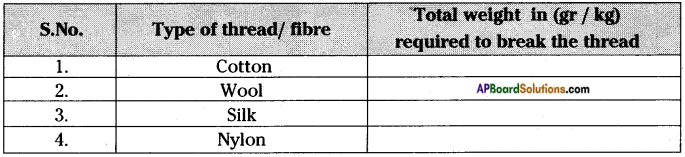
Write an activity to measure limiting force beared by a thread:
(OR)
Conduct an experiment to find the limiting force that can be borne by different threads.
Answer:
Aim: To find the limiting force that can be borne by a thread.
Material used: Spring balance, weights, light threads, weight hanger.
Procedure:
i) Arrange the system as shown in figure. Put some small weights like 50 gm on the weight hanger and note the readings of the spring balance. Now, add some more weights to the hanger and note the readings of spring balance. Do the same till the thread is broken.
AP Board 8th Class Physical Science Solutions Chapter 1 Force 15
ii) Separate the whole system from the ceiling, and tie the thread to weight hanger and now slowly pull up the whole system with your hand when there is a small weight on the hanger.
Note down the readings of the balance when the thread is broken that give limiting force beared by a thread.

a) What do you observe from the readings when it pulled up and released to move down?
Answer:
We will observe from the readings that another force is worked on this system when it is pulled up and released move down.

b) Is the thread broken when the whole system is pulled quickly up?
Answer:
No, the thread is not broken when the whole system is pulled quickly up.

AP Board 8th Class Physical Science Solutions Chapter 1 Force

Net force:
a) What are the forces acting on an object placed on a floor?
Answer:
Gravitational force (vertically down) and normal force (vertically up).

b) Do you observe any change in the state of rest of that object, because of these forces and why?
Answer:
No, because these forces acting on the object are equal and opposite in direction. Hence there is no change in its state.

c) What is the net force acting on object in this case?
Answer:
Zero.
Imagine that the same object is kept in a lift which is accelerating.

d) How many forces are acting on this object?
Answer:
Weight of the object (vertically down) and accelerating force (vertically up).

e) Is the net force acting on the object zero? Why?
Answer:
No, it is not equal to zero because the object is moving upward with non-uniform motion.

Activity – 9

Question 9.
Effects of net force acting on a table :
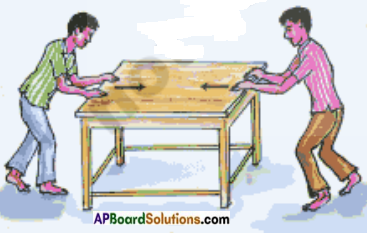
a) Try to push a heavy wooden table. Is it hard to push ?
Answer:
Yes.

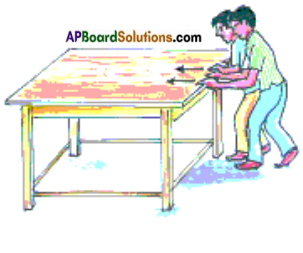
b) Ask your Mend to help in pushing the table in the same direction, as shown in the figure. Do you find it easier to move the table now? Why?
AP Board 8th Class Physical Science Solutions Chapter 1 Force 16
Answer:
Yes, because both of us applying force in the same direction on the table. So resultant applied force increases so it is easier to move the table.

c) Now ask your Mend to push the table from the opposite side as shown in the figure.
AP Board 8th Class Physical Science Solutions Chapter 1 Force 17
Does it move ? If it moves, then in which direction does it move?
Answer:
If both of us apply same force with equal magnitude the table does not move.
If it moves, it moves in the direction where there is larger force is applied.

AP Board 8th Class Physical Science Solutions Chapter 1 Force

d) If we apply two unequal forces F1, F2 applied in the same direction and opposite direction (F1 > F2) then what is the net force ?
AP Board 8th Class Physical Science Solutions Chapter 1 Force 18
Answer:
AP Board 8th Class Physical Science Solutions Chapter 1 Force 19
If F1, F2 act in same direction, net force = F1 + F2
If F1, F2 act in opposite direction, net force = F1 + (-F2) = F1 – F2

Activity – 10

Question 10.
Effects of stretched rubber bands on fingers:
Take a rubber band, stretch it using your fingers. When you stretch the rubber band it exerts force on your fingers and you feel the force of pull on your fingers.
a) What happens if you add one more similar rubber band around your fingers and stretch both together to the same length ? Do you feel the combination of two bands exerts a larger force than that of one?
Answer:
Yes, the net force is the combination of two forces. So they exerts larger force.

b) Let us say the force exerted by one rubber band is F units and the force exerted by the second rubber band is also F units. Then what will be the net force of two rubber bands?
Answer:
Net force (Fnet) = F + F
= 2F units

c) What is the net force acting on your finger when three, four, etc. rubber bands are used?
Answer:
If three rubber bands are used the net force = F + F + F = 3F
If four rubber bands are used the net force = F + F + F + F = 4F

How to calculate net force from free body diagrams:
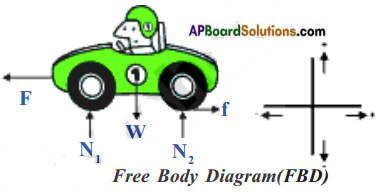
Let a car moving with non-uniform speed along a road.
What are the forces acting on the car? What is the net force acting along the vertical direction? What is the net force acting along horizontal direction? Draw all the relevant forces acting on the body by using free body diagram.
Choose a coordinate system with X and Y axis in figure. Sign convention is to be taken along X and Y directions. Add forces algebraically with sign conventions along X and Y axis respectively.
Answer:
AP Board 8th Class Physical Science Solutions Chapter 1 Force 20
The forces acting on the car are, shown in FBD (Free body diagram).
They are Force applied by the engine = F
Friction applied by road = f
Normal forces are N1 and N2.
Gravitational force (Fg) = W
∴ Net force along X – direction,
Fnet, x = f – F
(∵ They act in opposite direction)
Net force along Y – direction,
Fnet, y = (N1 + N2) – W
(∵ They act in opposite direction)

AP Board 8th Class Physical Science Solutions Chapter 1 Force

Activity – 11

Question 11.
Effect of force on the direction of motion and state of the body:
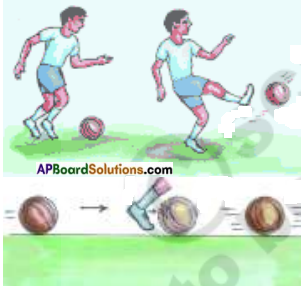
Place a football on the ground. The ball will remain in the state of rest unless someone kicks the ball.
AP Board 8th Class Physical Science Solutions Chapter 1 Force 21
a) Kick the ball what happens? Does the ball start moving?
Answer:
Yes, the ball start moving

b) Kick the moving ball again in the same direction.
What will be the result?
Answer:
The speed of the ball increases.

c) Place your hand or leg against the ball. Does the ball stop ?
Answer:
Yes. You might have seen children playing with a rubber tyre by pushing it with a stick. They push the tyre again and again with the stick to increase its speed.

d) Do you understand why the speed of the tyre increases whenever it is pushed by the stick?
Answer:
With every push they are applying a little more force on the moving tyre in the direction of motion. Hence speed of the tyre increases continuously.

e) What happens if net force acts opposite to the motion of an object ?
Answer:
The net force acts opposite to the direction of motion of an object then it either slows down the object or brings it to a stop.

f) Give some more examples where the object speeds up or slows down or a change may occur in its direction of motion, when we exert a force on it?
Answer:
If wind blows in the direction of motion of bicycle, the speed of bicycle increases. If wind blows in the opposite direction of motion of bicycle, the speed of bicycle decreases.

Activity – 12

Question 12.
Effects of net force on direction of moving object:
AP Board 8th Class Physical Science Solutions Chapter 1 Force 22
a) Hit a carrom coin with the striker. Ask your friends to do the same. Does the coin move in the same direction in each case ?
If not why?
Answer:
No, you can observe that when you hit the coin with the striker not only does the coin changes its direction, but the striker changes its direction too.

b) What might be the cause of that?
Answer:
The net force makes a stationary object move and also changes the speed and direction of moving object.

c) Does the force change only the state of motion ? Are there any other effects of force?
Answer:
No, the force changes the direction.

AP Board 8th Class Physical Science Solutions Chapter 1 Force

Activity – 13

Question 13.
Effects of force on the shape of an object:
In the given table some situations are given in the first column showing how the force is applied on an object. Observe the shape of the objects carefully before and after applying the force. Mark T for temporary change and ‘P’ for permanent change.
Answer:

Action of force Change in shape (temporary / permanent)
Stretching rubber band Temporary
Squeezing sponge Temporary
Tearing paper Permanent
Crushing plastic bottle Permanent
Making chapathi Permanent
Breaking glass Permanent

Activity – 14

Question 14.
Change in effect of force with area of contact:
a) Take a pencil. Just push its rounded end on your palm. Now push from the other side of the pencil gently so that the sharp end is on your palm. What difference did you experience? Why?
Answer:
It applies more force when sharp end touches the palm.

b) Why do the porters place turbans (talapaga) on their head when they have to carry heavy loads?
Answer:
The reason is, they are increasing surface area there by they are decreasing the force applied by object.

c) Why do school bags and shopping bags have broad straps as handles?
Answer:
As the surface area increases the force applied by object decreases.

d) Have you ever wondered why the lorries carrying loads have a large number of broader tyres?
Answer:
The effect of force depends on the area of contact on which the force is acting. When the area of contact is more then the force acting is less. So lorries have a large number of broader tyres to carry heavy loads.

Activity – 15

AP Board 8th Class Physical Science Solutions Chapter 1 Force

Question 15.
Identifying effects of force:
Take two trays. Fill both the trays with lime powder or fine sand. Now take two rectangular bricks of equal mass and similar shape. Keep one brick vertically in one tray and the other brick horizontally in the second tray.
a) Do both bricks sink to the same depth in lime powder? If not why?
Answer:
No, both does not sink to the same depth. The brick standing vertically sink deeper in lime powder than the brick standing horizontally The reason is the contact area or surface area on which force is acting is smaller and hence pressure exerted by the brick is more.

b) Why does the sharper side of a knife cuts more easily than a blunt side of it?
Answer:
A sharper side of knife has a smaller contact area. Therefore sharper side of knife exerts more pressure than the blunt side.

AP Board 8th Class Social Studies Important Questions Chapter 18 Rights Approach to Development

AP State Syllabus AP Board 8th Class Social Studies Important Questions Chapter 18 Rights Approach to Development.

AP State Syllabus 8th Class Social Studies Important Questions 18th Lesson Rights Approach to Development

Question 1.
What would give the poor people like Pavan and his mother a life with dignity?
Answer:
“Work hard – Lead the life”.
This only gives them a life with dignity.

Question 2.
Whose duty is it to ensure that Pa van and his mother are able to live a life of dignity and freedom?
Answer:
It is the duty of the society and the government to ensure that Pavan and his mother are able to live a life of dignity and freedom.

AP Board 8th Class Social Studies Important Questions Chapter 18 Rights Approach to Development

Question 3.
What are the arguments of people in “disclosing the information?”
Answer:
Their arguments are as follows.

  1. Information is crucial to the human development, and democratic rights. People can participate in government and ensure just development only if they have sufficient information in the form of official documents.
  2. Information will make governments more accountable in their functioning. It is possible to monitor the functioning and check possibility of corrupt practices. Information is crucial to the survival of the poor.
  3. In a situation where information has to be made public, arbitrary decisions by the elected representatives or the officials can be controlled.

Question 4.
How did the movement begin for disclosing information?
Answer:
A group of people in Rajasthan, organised themselves under the banner of Mazdoor Kisan Shakti Sangathan (MKSS) and demanded information. There was no legal provision to get the details of information as mentioned in the above paragraph from government to the people. Initially, these documents were collected with the help of officials. People evaluated these documents through public meetings. Soon officials began to resist the idea of disclosing the information. This led to a people’s movement.

AP Board 8th Class Social Studies Important Questions Chapter 18 Rights Approach to Development

Question 5.
Write about six main points of RTE.
Answer:
Right of Children to Free and Compulsory Education (RTE) Act, 2009
The RTE Act is meant for providing free and Compulsory Education to all Children in the age group of 6 – 14 years and came into force from 1st April 2010.
Important provisions of RTE Act

  • Ensure availability of schools within the reach of the children.
  • Improve School infrastructure facilities.
  • Enroll children in the class appropriate to his / her age.
  • Children have a right to receive special training in order to be at par with other children.
  • Providing appropriate facilities for the education of children with special needs on par with other children.
  • No child shall be liable to pay any kind of fee or charges or expenses which may prevent him or her from pursuing and completing the elementary education. No test for admitting the children in schools.

Question 6.
Comment this figure.
AP Board 8th Class Social Studies Important Questions Chapter 18 Rights Approach to Development 1
Answer:
There is an old lady in this picture. She belongs to a poor family. All the vessels are empty. We can see the rice in a vessel in a small quantity. The woman is also very weak due to lack of food. It is because of monsoon failure. She is a victim of famine.

AP Board 8th Class Social Studies Important Questions Chapter 18 Rights Approach to Development

Question 7.
Read the following passages and answer the given questions.
Answer:
Pavan is a boy of about 13 years, who lives with his mother. He lives in a temple town visited by a large number of pilgrims. Pavan stands outside the temple gate and begs the pilgrims for food by falling at their feet. Sometime, some of them give him stale left over food from their tiffin boxes. Sometimes, he carries heavy bags for them and is paid a small amount.

His mother works in a house as domestic help. She works almost for twelve hours everyday, through out the month. She is constantly ordered about by her employers including young children. She is given left over food after everyone else has eaten. She is not allowed to sit before the employers, and has to always talk to them meekly. She is often insulted for some minor errors or delays and has to fight back her tears and anger lest she be thrown out of job.
1) How old is Pavan?
Answer:
He is 13 years old.

2) Why do the people give Pavan some money?
Answer:
Sometimes he lifts heavy bags for them. So they give Pavan some small amount.

3) What does his mother do?
Answer:
She works in a house as domestic help.

4) Try to write any two of her problems.
Answer:

  1. She is not allowed to sit before the employers.
  2. She is often insulted for some minor errors.

5) Why does Pavan fall at their feet?
Answer:
To create pity and sympathy in the minds of pilgrims for money.

AP Board 8th Class Social Studies Important Questions Chapter 18 Rights Approach to Development

Question 8.
Read the following passage and answer the given questions.
JAN SUNVAYI: MKSS used to conduct meetings, called ‘jan sunvayi’ (or people’s hearings). It is true that many people cannot read the government documents themselves. But every person in a village would like to know what the documents say. Thus, these were read out and explained. A muster roll would give names of people for whom wages were paid for making a hand-pump. The villagers can identify if the people mentioned in the muster roll were present during those days or were migrants, or if they were paid the amount stated in the document. This would bring out the corrupt in practices. Through these events people brought in necessary action. Officials were also given opportunity to defend and talk about the details given in the documents. The district administration and panchayat officials also participated in these meetings. When corruption was identified, criminal cases were registered against the concerned persons.

1) What is the meaning of ‘Jan Sunvayi’?
Answer:
It means people’s hearings.

2) Why do they read out the documents?
Answer:
Many people cannot read the government documents, so they read out.

3) What is a muster roll?
Answer:
It is an attendance register.

4) What did they do through these events?
Answer:
Through these events they brought in necessary action.

5) When did they register criminal cases?
Answer:
When corruption was identified, they registered criminal cases.

AP Board 8th Class Social Studies Important Questions Chapter 18 Rights Approach to Development

AP Board 8th Class Biology Solutions Chapter 1 What is Science?

AP State Syllabus AP Board 8th Class Biology Solutions Chapter 1 What is Science Textbook Questions and Answers.

AP State Syllabus 8th Class Biology Solutions 1st Lesson What is Science

8th Class Biology 1st Lesson What is Science Textbook Questions and Answers

Improve Your Learning

Question 1.
What is Science?
Answer:
Science:

  1. Science is the concerted human effort to understand the history of the natural world how the natural world works, with observable physical evidence.
  2. Science is an organized study of knowledge which is based on experimentation.
  3. Science is a tool for searching truths of nature.
  4. Science is the way of exploring the world.

AP Board 8th Class Biology Solutions Chapter 1 What is Science

Question 2.
What are scientific methods ? Write the steps involved in a scientist’s work.
Answer:
Scientific Methods:

  1. Scientists solve a problem or answer a question by using organized ways. They are called “Scientific Methods”.
  2. The following are the steps involved in a scientific work.
    a) Step -1 : Ask questions.
    b) Step – 2 : Form hypothesis.
    c) Step – 3 : Plan experiments.
    d) Step – 4 : Conduct experiments.
    e) Step – 5 : Draw conclusions.

Question 3.
What is the way to find out solutions for the problems in scientific way?
Answer:
To find out solutions for the problems in scientific way we need to follow a sequential order. So we go through the following.

  1. Identifying problem : Let us identify any problems from your surroundings.
    Ex: The bulb did not lit in the room.
  2. Making hypothesis: List out different solutions which your think for the identifying problem.
    Ex: De filament, fuse failure, switch problem, wire problem.
  3. Collecting information: To solve the identifying problem collect material, apparatus, Information, persons.
    Ex: Collect material like tester, screwdriver, wooden scale, wires, insulation tape, table and blade.
  4. Data analysis: Arrange the collected data or information to conduct experiment.
  5. Experimentation: To prove selecting hypothesis conduct experiment.
    Ex: Observe filament of the bulb.
  6. Result analysis: Analyzing the results to find out the solution for the problem based on the results you need to select another hypothesis to prove.
    Ex: Filament of the bulb is good in condition so we need to observe fuse.
  7. Generalisation: Based on the experiment and its results explain the solution for the problem.
    Ex: Fuse is damaged so the bulb not glow, so we need to replace the fuse.

AP Board 8th Class Biology Solutions Chapter 1 What is Science

Question 4.
During investigation in science, name some rules to be followed for the safety.
Answer:

  1. Think ahead: Study the steps of the investigation, so you know what to expect.
  2. Be neat: Keep your work area clean.
  3. Oops!: If you should spill or break something or get cut, tell your teacher right away.
  4. Watch your eyes: Wear safety goggles anytime you are directed to do so.
  5. Yuck!: Never eat or drink anything during a scientific activity.
  6. Protect yourself from shocks: Be especially careful if an electric appliance is used. Be sure that electric cords are in a safe place where you can’t trip over them. Don’t ever pull a plug out an outlet by pulling on the cord.
  7. Keep it clean: Always clean up when you have finished.

Question 5.
If you plan a test to find out how much water different brands of paper towels absorb, write down the steps of the experiment.
Answer:

  1. Pour 1 liter of water into each of three beakers.
  2. Put a towel from each of the three brands into a different beaker for 10 seconds.
  3. Pull the towel out of the water, and let it drain back into the beaker for 5 seconds.
  4. Measure the amount of water left in each beaker.
  5. The towel put in the beaker in which less amount of water is left absorbs more water.

Question 6.
Collect information about scientists and their works and prepare a chart and paste it in your classroom.
Answer:
AP Board 8th Class Biology Solutions Chapter 1 What is Science 1

AP Board 8th Class Biology Solutions Chapter 1 What is Science

Question 7.
What are process skills ?
Answer:
Observe, compare, classify are the process skills.

  1. Observe – Use the senses to learn about objects and events.
  2. Compare – Identify characteristics of things or events to find out how they are alike and different.
  3. Classify – Group or organize objects or events in categories based on specific characteristics.

Question 8.
Read the following.
Answer:
Endemic Species:
AP Board 8th Class Biology Solutions Chapter 1 What is Science 2
You may find that these animals are specifically found in certain regions of the world.
You are also aware of the fact that many plants and animals are widely distributed throughout the world. But some species of plants and animals are found restricted to some areas only. Plants or animal species found restricted to a particular area of a country are called Endemic Species.
Now answer the following questions.
a) Name an Endemic Species of our State.
Answer:
Tiger, Peacock and Crane.

b) You may notice that Kangaroo is endemic to Australia and Kiwi to New Zealand. Can you tell which among the above picures represent an endemic species of India ?
Answer:
Peacock and Tiger.

c) Name some other endemic species of India.
Answer:
Indian Lion, Indian Wolf, Great Indian bustard bill.

AP Board 8th Class Biology Solutions Chapter 1 What is Science

Question 9.
Reading the following poster.
AP Board 8th Class Biology Solutions Chapter 1 What is Science 3
Answer:
Biotic Components:
Producers – Mangrove, spirogyra, euglena, oscillatoria, blue green algae, ulothrix, etc.
Consumers – Shrimp, crab, hydra, protozoans, mussel, snails, turtle, daphnia, brittle word, tube worm, etc.
Decomposers – Detritus feeding bacteria, etc.
Abiotic components – Salt and fresh water, air, sunlight, soil, etc.

Question 10.
What is Generalisation? Give an example.
Answer:
Based on the experiment and its results explaining the solution for the problem is called Generalisation.
Example:

a) The bulb did not light in the room.
b) Identify the problem that may be defilament, fuse failure, switch problem, wire problem.
c) Then take tester, screwdriver, wooden scale, wires, insulation tape, table and blade.
d) Observe the filament of the bulb.
e) If the filament of the bulb is good, then observe fuse.
f) As the fuse is damaged, we need to replace the fuse.

Based on this, the bulb did not lit in the room because the fuse is damaged. This is the generalisation in the above experiment.

AP Board 8th Class Biology Solutions Chapter 1 What is Science

Question 11.
What are the different types of writings used by scientists to describe what they are doing or learning?
Answer:

  1. Informative writing, Narrative writing, Expressive writing, Persuasive writing are used by the Scientists.
  2. In informative writing, scientists describe the observation, inferences and their conclusion.
  3. In narrative writing the scientists describe about something, give examples or tell a story.
  4. In expressive writing, they may write letters, poems, or songs.
  5. In persuasive writing they write letters about important issues in science and also write about what they have learned about science which helps others to understand about their thinking.

Question 12.
How do scientists use numbers in their investigations?
Answer:

  1. Measuring, interpreting data, using number sense are few methods used by scientists in their investigations.
  2. Scientists make accurate measurements by using different measuring instruments like thermometer clocks, timers, rules, a spring scale, beakers, balance and other containers to measure liquids.
  3. Scientists collect, organize, display and interpret data by using tables, charts and graphs.
  4. Scientists compare and order numbers, compute with numbers shown on graphs and read the scales on thermometers, measuring cups, beakers and other tools.
  5. Good scientists apply their maths skills to help them display and interpret the data they collect.

Question 13.
What is Hypothesis? What are variables?
Answer:

  1. Making a statement about an expected outcome is called Hypothesis.
  2. Variables are factors that can affect the outcome of the investigation.

AP Board 8th Class Biology Solutions Chapter 1 What is Science

Question 14.
What do the following persons do?
a) A geologist
b) A chemist
c) A biologist
d) An ecologist
e) A climatologist
Answer:
a) A geologist examines the distribution of fossils and makes observations to find patterns in natural phenomena.
b) A chemist observes the rate of a chemical reaction at a variety of temperatures.
c) A biologist observes the reaction of a particular tissue to various stimulants.
d) An ecologist observes the territorial behaviours of different animals and birds.
e) A climatologist collects data from weather balloons and makes observations basing on it.

AP Board 8th Class Social Studies Important Questions Chapter 17 Understanding Poverty

AP State Syllabus AP Board 8th Class Social Studies Important Questions Chapter 17 Understanding Poverty.

AP State Syllabus 8th Class Social Studies Important Questions 17th Lesson Understanding Poverty

Question 1.
What is the average calorie intake of persons in the top quarter in the country?
Answer:
The average calorie intake of persons in the top quarter in the country is 2521.

Question 2.
By what percentage does the calorie intake of persons in the bottom quarter fall short of the daily calorie standard?
Answer:
23% of the calorie intake of persons in the bottom quarter fall short of the daily calorie standard.

AP Board 8th Class Social Studies Important Questions Chapter 17 Understanding Poverty

Question 3.
Do you find any relationship between economic background of person and his/her nutritional status?
Answer:
Yes, I find the relationship between economic background of person and his/her nutritional status. If the economic standard is less, the nutritional status is also low and vice versa.

Question 4.
What do you think can be done such that Ramachari and his family get two square meals a day?
Answer:
Ramachari should also go to the nearest town with his wife for daily works. Then only he and his family can get two square meals a day.

Question 5.
How would you describe the exchange between Ramachari and the farmers in the village?
Answer:
I discribe the exchange between Ramachari and the farmers in the village as follows:
“One for all and all for one”.

AP Board 8th Class Social Studies Important Questions Chapter 17 Understanding Poverty

Question 6.
Why do you think the MNREGA places priority on provision of irrigation facility to land owned by households belonging to the SCs and STs?
Answer:
The government sanctioned some funds for the development of SCs and STs from many years. These funds were remained unused. So these are used for irrigation and drinking water facilities to them only. With this they feel self-reliance.

Question 7.
Why do you think the calorie intakes of the people are so low?
Answer:
As they have low earnings, they cannot purchase costly foods which have high calories. They cannot eat and cannot work. So they.are habituated to eat stomachful of food, e.g.: Rice & chutney / rice & curry or rice & sambar.
So they are taking so low calories.

AP Board 8th Class Social Studies Important Questions Chapter 17 Understanding Poverty

Question 8.
Do you think the poor will be served better now with new policy? Provide reasons in favour of your answer.
Answer:
I think that the poor will be served better now with new policy.
Reasons:

  1. The government takes back the white cards from ineligibles.
  2. So the provisions are supplied only to the poor and the poorest.

Question 9.
Ration shops are also called fair price shops. Can you guess why?
Answer:
The provisions in ration shops are available at low prices when compared to open market. So they are called fair price shops.

Question 10.
Why are people without employment also often without assets, such as land, cattle, shops etc.?
Answer:
The people those who have no employment cannot save their earnings. Without savings they cannot purchase assets. So they do not have assets.

AP Board 8th Class Social Studies Important Questions Chapter 17 Understanding Poverty

Question 11.
Read the paragraph under the heading ‘Why Poverty? How can it be eliminated?’ and answer the following: What are the other reasons for poverty?
Answer:
The other reasons for poverty:

  1. Big families
  2. Only one person works hard in the family while all others eat.
  3. Lack of chances according to their capacity or eligibility.
  4. Less wages / salaries.

Question 12.
Give your comments on the given picture.
AP Board 8th Class Social Studies Important Questions Chapter 17 Understanding Poverty 1Answer:
This picture belongs to ‘Mid day meals scheme’. The girls are the beneficiaries of this scheme. In some poor families, children are not provided nutrious food and they are often suffered from hunger. The children studying in government schools, especially from such families will get benefited by this scheme. Undernourished children do not grow as quickly as healthy children. They will feel hard to study, work or otherwise perform physical activities. Mentally, they may develop more slowly. Keeping all these in view, the government is implementing Mid-day meal scheme for the well-being of the children belonging to poor families.

AP Board 8th Class Social Studies Important Questions Chapter 17 Understanding Poverty

Question 13.
Observe the graph and answer the following questions.
AP Board 8th Class Social Studies Important Questions Chapter 17 Understanding Poverty 2
1. Who are taking more calories?
Answer:
The rich

2. What is the difference between the top quarter and second quarter in calories?
Answer:
621 calories.

3. Who are taking least calories?
Answer:
The bottom quarter

4. What do you understand by observing this picture?
Answer:
Economic standard dictates the nutrition status.

Question 14.
Activity: One way to find out if adults are undernourished is to calculate what Nutrition Scientists call Body Mass Index (BMI). This is easy to calculate. Measure the weight of the person in kgs. Then measure the height in metres. Divide the weight by the square of the height. If this figure is less than 18.5 then the person would be considered undernourished. However, if this BMI is more than 25, then a person is overweight. Do remember that this criterion is not applicable to growing children.
Let each student in the class find out the weight and height of three adult persons of different economic backgrounds like office workers, servants, business person etc. Collect the data from all the students and make a combined table. Calculate their BMI.
Answer:

S.No. Years of Age M/F Their work Height
(inches)
Weight
(kgs.)
BMI
1. 35 M Labourer 165 57 20.94 Normal
2. 42 M Labourer 161 61 30.68 Fat
3. 28 F Labourer 163 50 18.82 Normal
4. 37 M Worker 168 56 19.84 Thin
5. 40 M Worker 157 52 21.1 Normal
6. 42 F Worker 161 56 21.6 Normal
7. 54 M Business person 158 66 26.44 Fat
8. 46 M Business person 170 71 24.57 Fat
9. 32 F Business person 157 68 27.59 Fat

AP Board 8th Class Social Studies Important Questions Chapter 17 Understanding Poverty

Question 15.
Read the following passage and answer the given questions.
The poorest families are issued Antyodaya cards. Next, the people whose situations are slightly better but still can be considered poor are issued BPL (Below Poverty Line) cards. The remaining families are issued APL (Above Poverty Line) cards.
Quantities and prices of ration given to each cardholder are different. For example, the Antyodaya cardholders are entitled to get 35 kgs of foodgrains (rice and wheat) per month per family. The BPL cardholders in Andhra Prasdesh can receive 4 kgs of foodgrains per head not exceeding 20 kgs per family. The Annapurna Scheme card holders who are the poorest of the poor (Indigent senior citizens) get 10 kgs of rice free of cost.
1. Who are issued Antyodaya cards?
Answer:
The poorest families.

2. Which colour cards are issued to BPL families?
Answer:
White cards.

3. What is meant by BPL?
Answer:
Below Poverty Line.

4. How much food grains can receive the BPL card holders in Andhra Pradesh?
Answer:
4 kgs of food grains per head.

5. Who are the Annapurna scheme card holders?
Answer:
The poorest of the poor (Indigent senior citizens).

AP Board 8th Class Social Studies Important Questions Chapter 17 Understanding Poverty

AP Board 8th Class Biology Solutions Chapter 1 విజ్ఞానశాస్త్రం అంటే ఏమిటి?

SCERT AP 8th Class Biology Study Material Pdf 1st Lesson విజ్ఞానశాస్త్రం అంటే ఏమిటి? Textbook Questions and Answers.

AP State Syllabus 8th Class Biology 1st Lesson Questions and Answers విజ్ఞానశాస్త్రం అంటే ఏమిటి?

8th Class Biology 1st Lesson విజ్ఞానశాస్త్రం అంటే ఏమిటి? Textbook Questions and Answers

I. విషయావగాహన

ప్రశ్న 1.
విజ్ఞానశాస్త్రం అందించిన కొన్ని ఆధునిక ఫలితాలు తెలపండి.
జవాబు:

  • విజ్ఞానశాస్త్రం మానవుని సుఖమయ జీవనానికి అనేక వస్తువులు, వసతులు అందించినది.
  • కంప్యూటర్లు, మొబైల్ ఫోన్లు, ఇంటర్నెట్, అంతరిక్ష నౌకలు, సంకరజాతి ఆహారధాన్యాలు, రొబోటిక్స్, వైద్యం ఈ కోవలోనికి వస్తాయి.

ప్రశ్న 2.
విజ్ఞానశాస్త్రం అంటే ఏమిటి ?
జవాబు:
మనచుట్టూ ఉన్న ప్రాకృతిక ప్రపంచం ఎలా పనిచేస్తుందో తెలుసుకోవడానికి దాని పూర్వాపరాలను అవగాహన చేసుకోవడానికీ అందుబాటులో ఉన్న సౌకర్యాలతో, ఆధారాలతో మనం చేసే ప్రయత్నాలను అన్నింటినీ కలిపి విజ్ఞానశాస్త్రం (Science) అంటారు.

ప్రశ్న 3.
చాలా సందర్భాలలో శాస్త్రవేత్తలు ఇంతకు ముందు కనుగొన్న అంశాల మీదనే తిరిగి ప్రయోగాలు చేస్తుంటారు. ఇలా ఎందుకు చేస్తుంటారు ? ఉదహరించండి.
జవాబు:

  • కొత్త ఆలోచనలను పరీక్షించుకోవడానికి ప్రయత్నించడం లేదా పాత భావనలను తోసిపుచ్చడం ద్వారా కొత్త విషయాలను కనుగొనవచ్చు.
  • దీనివల్ల శాస్త్రవేత్తలు విజ్ఞానశాస్త్ర చరిత్రలో స్థానం సంపాదించిన వారవుతారు.
  • ఇలా కనుగొన్న నూతన భావనలు మన ఆలోచనా విధానాన్ని మార్చేస్తాయి.
  • ఉదాహరణకు నెప్ట్యూనను మనం ఇంతకాలం వరకు గ్రహంగా గుర్తించాం కాని నూతన పరిశోధనలు అది గ్రహం కాదని నిర్ధారించాయి.
  • అలాగే కడుపులో అల్సర్లకు ఆహారపు అలవాట్లు, వ్యాకులత కారణమని అనుకుంటుండేవాళ్ళం. కానీ దీనికి బ్యాక్టీరియా కారణమని నేడు కనుగొన్నారు.

AP Board 8th Class Biology Solutions Chapter 1 విజ్ఞానశాస్త్రం అంటే ఏమిటి?

ప్రశ్న 4.
శాస్త్రవేత్తలకు సమాజం బోలెడన్ని వనరులను ఎందుకు సమకూర్చుతుంది ?
జవాబు:

  • శాస్త్రవేత్తల పరిశోధనలు సామాన్య మానవులు మంచి జీవితం గడపటానికి దోహదం చేస్తాయి.
  • సమాజం ఎదుర్కొంటున్న అనేక సమస్యలకు శాస్త్రవేత్తలు పరిష్కారం చూపుతారు.
  • శాస్త్ర ఆవిష్కరణలు మానవ జీవితాన్ని మరింత సుఖమయం చేస్తాయి.
  • శాస్త్ర పరిశోధనలు మానవ జీవితాన్ని ఆధునీకరిస్తాయి.

అందుచేత సమాజం శాస్త్రవేత్తలకు వనరులను సమకూర్చుతుంది.

ప్రశ్న 5.
శాస్త్రవేత్తలు సమాజం కోసం తమ జీవితాలను త్యాగం చేయటానికి ప్రేరేపించే అంశం ఏమిటి ?
జవాబు:

  • శాస్త్రవేత్తలు ప్రజల జీవన విధానం మెరుగుపర్చాలనే తపన కలిగి ఉంటారు.
  • సమస్యను పరిష్కరించటం వలన శాస్త్రవేత్తలు తృప్తి పొందుతారు.
  • సాధారణంగా శాస్త్రవేత్తలు అన్వేషణ దృక్పథం కలిగి ఉంటారు. వారు పనిలో ఆనందం పొందుతారు.
  • దీని వలన వారు పరిశోధనల కొరకు జీవితాలను త్యాగం చేయగలరు.

ప్రశ్న 6.
ప్రజల ఆర్థిక స్థితిగతులను అభివృద్ధి చేయటంలో శాస్త్రవేత్తల పాత్ర ఏమిటి ?
జవాబు:
ప్రజల ఆర్థిక స్థితిగతులను అభివృద్ధి చేయడం. దీని కోసం చాలామంది శాస్త్రవేత్తలు ప్రకృతి వనరులైన పెట్రోలియం, ఖనిజాలను కనుగొనడం లేదా పునరుత్పత్తి చేయడంలో సరైన, సమర్థవంతమైన మార్గాల కోసం అన్వేషిస్తారు. వృక్ష శాస్త్రవేత్తలు కొత్త జాతుల పంటలు, పండ్ల మొక్కలు కనుగొనడం ద్వారా తక్కువ ధరల్లో పోషకాహారం అందించి ఆరోగ్యవంతమైన జాతిని రూపొందించడానికి ప్రయత్నిస్తారు.

ప్రశ్న 7.
ఈ కింది పదాలను నిర్వచించండి.
ఎ) శాస్త్రీయ పద్ధతి
బి) శాస్త్రీయ ప్రక్రియా నైపుణ్యాలు
సి) విజ్ఞాన శాస్త్రం
జవాబు:
ఎ) శాస్త్రీయ పద్ధతి : శాస్త్రవేత్తలు గుర్తించిన సమస్యలకు, ప్రశ్నలకు కొన్ని క్రమపద్ధతులు వినియోగిస్తారు. వీటినే శాస్త్రీయ పద్ధతులు అంటారు.
బి) శాస్త్రీయ ప్రక్రియా నైపుణ్యాలు : శాస్త్రీయ పద్ధతిలో వాడే ప్రణాళికను అర్థం చేసుకోవడానికి కొన్ని నైపుణ్యాలు అవసరం. వీటిని శాస్త్రీయ ప్రక్రియా నైపుణ్యాలు అంటారు.
ఉదా : సేకరణ, నిర్వహణ, విశ్లేషణ మొదలగునవి.
సి) విజ్ఞాన శాస్త్రం : ప్రకృతిలో దాగివున్న రహస్యాలను, నిజాలను, కారణాలను తెలుసుకోవడానికి ఉపయోగపడే చక్కటి, స్పష్టమైన మార్గాన్ని ‘విజ్ఞాన శాస్త్రం’ అంటారు.

AP Board 8th Class Biology Solutions Chapter 1 విజ్ఞానశాస్త్రం అంటే ఏమిటి?

ప్రశ్న 8.
శాస్త్రీయ పద్ధతిలో వున్న సోపానాలను పేర్కొనండి.
జవాబు:
శాస్త్రీయ పద్ధతిలో ఈ క్రింది సోపానాలు కలవు. అవి

  • ప్రశ్నించటం
  • పరికల్పన చేయటం
  • ప్రణాళిక చేయటం
  • ప్రయోగం నిర్వహించటం
  • ఫలితాలను ప్రదర్శించటం

ప్రశ్న 9.
శాస్త్రీయ పద్ధతిలోని సోపానాలను ఉదాహరణలతో వివరించండి.
జవాబు:

సోపానాలు వివరణ ఉదాహరణ
1. పరిశీలన వస్తువు, సంఘటనలను గురించి నేర్చు కోవడంలో జ్ఞానేంద్రియాలను వాడటం. ఉదా : విత్తనాలు నేలలో మొలకెత్తుతాయి.  కానీ ఏ నేల విత్తనాలు మొలకెత్తటానికి అనుకూలం?
2. పరికల్పన ఒక సమస్యకు సమాధానాలు ఊహించటం తోట నేలలో గింజలు బాగా మొలకెత్తుతాయని అనుకొంటున్నాను.
3. ప్రయోగం కోసం ప్రణాళిక పరికల్పనను నిరూపించటానికి ప్రయోగ విధానాన్ని రూపొందించుకోవటం. మూడు వేరు వేరు నేలలలో ఒకే రకం విత్తనాలు నాటి, పరిశీలించాలి.
4. ప్రయోగ నిర్వహణ ప్రణాళిక ప్రకారం చరరాశులను నియంత్రిస్తూ ప్రయోగం చేయటం. ఫలితాలను నమోదుచేయటం. మూడు కుండీలలో వేరు వేరు మట్టి తీసుకొని విత్తనాలు నాటి, నీరు పోశాను. 21 రోజుల తరువాత అన్ని మొక్కల పొడవు కొలిచాను.
5. నిర్ధారించటం ప్రయోగ ఫలిత సమాచారాన్ని విశ్లేషించి పరికల్పన సరైనదా కాదా అని నిర్ణయించడం. ప్రయోగంలో ఇసుకమట్టి, తోట మట్టిలో మొక్కలు బాగా పెరిగాయి. బంకమట్టిలో విత్తనాలు మొలకెత్తలేదు.

AP Board 8th Class Biology Solutions Chapter 1 విజ్ఞానశాస్త్రం అంటే ఏమిటి?

ప్రశ్న 10.
నీకు తెలిసిన ఏవైనా ఐదు ప్రక్రియా నైపుణ్యాలు రాయండి.
జవాబు:
శాస్త్రీయ పద్ధతిలో వాడే కొన్ని పనులే ప్రక్రియా నైపుణ్యాలు. అవి :

  • కొలవటం
  • సేకరించటం
  • నమోదు చేయటం
  • ప్రదర్శించటం
  • ఊహించటం

ప్రశ్న 11.
పరికల్పన అనగానేమి?
జవాబు:
పరీక్షించటానికి వీలున్న సాధ్యమయ్యే సమాధానాన్ని పరికల్పన అంటారు.
ఉదా : బండి ఆగిపోయినపుడు పెట్రోలు అయిపోయి ఉండవచ్చు అని భావించుట.

ప్రశ్న 12.
‘చరరాశులు’ అనగానేమి?
జవాబు:
‘పరిశోధనా ఫలితాన్ని ప్రభావితంచేసే అంశాలను చరరాశులు అంటారు. చరరాశులన్ని నియంత్రించటం వలన కచ్చితమైన ఫలితాలు పొందవచ్చు.

ప్రశ్న 13.
అన్వేషణా పద్ధతిలోని సోపానాలను ఉదాహరణతో వివరించండి.
జవాబు:
సమస్యను పరిష్కరించటంలో పాటించే క్రమమైన పద్ధతులను అన్వేషణా పద్ధతి అంటారు. దీనిలో ఈ క్రింది సోపానాలు ఉంటాయి.

సోపానము ఉదాహరణ
1. సమస్యను గుర్తించటం గదిలో లైటు వెలగకపోవటం
2. పరికల్పనలు చేయటం
  • ఫ్యూజ్ పోయి ఉండవచ్చు.
  • ఫిలమెంట్ కాలిపోయి ఉండవచ్చు.
  • స్విచ్ సరిగ్గా పనిచేయకపోవడం వల్ల
  • వైర్లు ఊడిపోవటం వల్ల
3. సమాచారాన్ని సేకరించటం టెస్టర్, స్మూడైవర్, ఇన్సులేషన్, టేప్, కరెంట్ తీగలు, బ్లేడు, చెక్కస్కేలు, సేకరించుకోవటం
4. సమాచారాన్ని విశ్లేషించటం సేకరించిన వస్తువులను ప్రయోగాలకు, పరిశీలనకు అమర్చుకోవటం
5. ప్రయోగాలు చేయటం
  • ఫిలమెంట్ పరిశీలించటం
  • ఫ్యూజ్ పరిశీలించటం
6. ఫలితాల విశ్లేషణ ఫిలమెంట్ కాలిపోలేదు బాగానే ఉంది కాబట్టి ఫ్యూజ్ పరిశీలించాలి. ఫ్యూజ్ వైరు తెగిపోయి ఉంది. కాబట్టి ఫ్యూజ్ తీగను మార్చాలి. తీగను మార్చినపుడు బల్బు వెలిగింది.
7. నిర్ధారణకు రావటం ఫ్యూజ్ పోవటం వలన బల్బు వెలగలేదు.

AP Board 8th Class Biology Solutions Chapter 1 విజ్ఞానశాస్త్రం అంటే ఏమిటి?

II. ప్రశ్నించటం, పరికల్పన చేయటం

ప్రశ్న 1.
ప్రభుత్వం శాస్త్రవేత్తలకు బోలెడన్ని వనరులు ఇచ్చి ప్రజలు ఎదుర్కొంటున్న సమస్యలకు పరిష్కారం చూపాలని అడగటం సమంజసమేనా ? వివరించండి.
జవాబు:

  • ప్రజల జీవన విధానాన్ని మెరుగుపరచటానికి ప్రతి శాస్త్రవేత్త తపిస్తాడు.
  • దీని కోసం వారు తమ జీవితాలను సైతం త్యాగం చేస్తారు.
  • దీని ద్వారా అనేక కొత్త అంశాలు కనుగొనబడ్డాయి.
  • దీనితో ప్రజల స్థితిగతులు మెరుగుపడ్డాయి.
  • ఈ పరిశోధనా ఫలితాలు మానవాళి ఉన్నతికి చాలా ఉపయోగపడతాయి.
  • ఆహార ఉత్పత్తి అభివృద్ధి, జన్యు సమాచారం, సునామీ, తుపానులను ముందే గ్రహించే అవకాశం కలిగింది.
  • అందువల్ల ప్రభుత్వం శాస్త్రవేత్తలకు వనరులను అందించటం సమంజసమే అని నా అభిప్రాయం.

ప్రశ్న 2.
కార్ల్ పాపర్ మాటల్లో “సరిదిద్దబడ్డ తప్పుల చరిత్రనే సైన్స్” అంటారు. దీనిని నీవు ఎలా సమర్ధిస్తావు ?
జవాబు:

  • విజ్ఞానశాస్త్రం నిత్య నూతనంగా ఉంటుంది.
  • ఈ రోజు ఆవిష్కరణ రేపటి కొత్త ఆలోచనలకు పునాది అవుతుంది.
  • ఏ శాస్త్రవేత్త కూడా ఇదే అసలు పరిష్కారం అని భావించరు.
  • దీని కన్నా మంచి ‘సౌకర్యం’ మరింత సౌలభ్యంగా ఉంటుందనుకుంటారు.
  • ప్రస్తుత పరిశోధనలో తప్పులు సరిచేసుకుంటూ మంచి ఫలితం కోసం ప్రయత్నం చేస్తారు.
    ఉదా : 19వ శతాబ్దం మొదట్లో బస్సు గరిష్ఠ వేగం గంటకు 20 కి.మీ. నుండి 30 కి.మీ. మాత్రమే. కానీ ఇప్పుడు వొల్వో బస్సు వేగం గంటకు 300 నుండి 360 కి.మీ. ఇది శాస్త్ర ప్రగతికి మంచి ఉదాహరణ.
  • బస్సు ఇంజనులో ఉన్న చిన్న చిన్న సమస్యలను సరిచేసుకుంటూ ఈనాటి బస్సులను అభివృద్ధి చేసారు.
  • అందువల్ల నేను కార్ల్ పాపర్ మాటలను సమర్ధిస్తాను.

ప్రశ్న 3.
వివిధ శాస్త్రవేత్తలు చేసే పనులు, వారి పేర్లు తెలుసుకోవటానికి ఎటువంటి ప్రశ్నలు అడుగుతారు ?
1. ఖగోళ శాస్త్రవేత్త అని ఎవరిని అంటారు ?
జవాబు:
ఆకాశంలోని నక్షత్రాలు, గ్రహాల సమాచారం తెలిపేవారు.

2. భూగర్భ శాస్త్రవేత్త అని ఎవరిని అంటారు ?
జవాబు:
శిలాజాలు, ఖనిజాలు గురించి చెప్పేవారు.

3. జీవుల ప్రవర్తన గురించి ఎవరు అధ్యయనం చేస్తారు ?
జవాబు:
పర్యావరణ శాస్త్రవేత్త

AP Board 8th Class Biology Solutions Chapter 1 విజ్ఞానశాస్త్రం అంటే ఏమిటి?

ప్రశ్న 4.
ఈ కింద ఇవ్వబడిన శాస్త్ర విభాగాన్ని చదివి, అవి పరిశీలించే అంశాలు రాయండి.

వ.సం. శాస్త్ర విభాగం పరిశీలించే అంశం
1. వృక్షశాస్త్రం
2. సిస్మాలజీ
3. శిలాజ శాస్త్రం
4. మానవ శాస్త్రం
5. శరీర ధర్మశాస్త్రం
6. వాతావరణ శాస్త్రం

జవాబు:

వ.సం. శాస్త్ర విభాగం పరిశీలించే అంశం
1. వృక్షశాస్త్రం మొక్కల నిర్మాణం, పెరుగుదల వ్యాధులు మొ॥
2. సిస్మాలజీ భూకంపాల గురించి
3. శిలాజ శాస్త్రం వృక్ష, జంతు సంబంధ శిలల గురించి చెప్పేది.
4. మానవ శాస్త్రం ప్రాచీన, ఆధునిక మానవుల జీవన విధానాలు.
5. శరీర ధర్మశాస్త్రం జీవుల శరీర నిర్మాణాలు, అవి పని చేసే విధానాలు.
6. వాతావరణ శాస్త్రం వాతావరణంలోని గతులు-మార్పులు గురించి తెలిపేది.

AP Board 8th Class Biology Solutions Chapter 1 విజ్ఞానశాస్త్రం అంటే ఏమిటి?

III. ప్రయోగాలు, క్షేత్ర పరిశీలనలు

ప్రశ్న 1.
చరిత రాయి ఆకృతి పరిమాణంలో మార్పునకు గల కారణాలు ఎలా కనుగొన్నది ?
జవాబు:

  • చరిత మూడు రాళ్ళను సేకరించింది.
  • వాటి ద్రవ్యరాశులను కొలిచింది.
  • ఈ రాళ్లను నీరు, ఇసుక గల గ్లాసులో ఉంచింది.
  • రోజూ ఒకసారి ఊపుతూ ఒక వారం రోజుల పాటు చేసింది.
  • వారం తర్వాత ఆమె రాళ్లు, ఇసుక, జాడి ద్రవ్యరాశులను కొలిచింది. వచ్చిన సమాచారాన్ని విశ్లేషించింది.
  • రాళ్లు ఇసుకతో రుద్దడం వల్ల అవి పెచ్చులుగా విడిపోతాయని నిర్ధారించింది.

ప్రశ్న 2.
‘స్విచ్’ పనిచేసే విధానాన్ని నీవు ఎలా తెలుసుకొంటావు ?
జవాబు:

  • బ్యాటరీ, తీగెలు, బల్బుతో ఒక విద్యుత్ వలయం ఏర్పర్చాను.
  • ఒక డ్రాయింగ్ బోర్డుమీద రెండు డ్రాయింగ్ పిన్నులు గుచ్చి దానికి విద్యుత్ తీగలు కలిపాను.
  • రెండు పిన్నుల మధ్య లోహపు తీగె ఉంచినపుడు వలయం పూర్తిఅయి బల్బు వెలిగింది.
  • లోహపు తీగెను తీసినపుడు వలయం తెరుచుకొని బల్బు ఆరిపోయింది.
  • బల్బును ఆర్పటానికి, వెలిగించటానికి లోహపుతీగె స్విచ్ లా పనిచేసింది.

ప్రశ్న 3.
ఏ తువ్వాలు ఎక్కువ నీటిని పీల్చుకుంటుందో ఎలా నిర్ధారిస్తావు ?
జవాబు:

  • ఈ ప్రయోగానికి నేను మూడు రకాల టవల్స్ ఎన్నుకొన్నాను.
  • మూడు బీకర్లు తీసుకొని, ఒక్కొక్కదానిలో ఒక లీటరు నీరు పోశాను.
  • మూడు రకాల టవలను వేరు వేరు బీకర్లలో 10 సెకండ్ల పాటు ఉంచాను.
  • నీటి నుండి టవలను తీసి ప్రక్కన ఉంచాను.
  • బీకరులో మిగిలిన నీటిని గమనిస్తే ఏ టవల్ ఎక్కువ నీటిని పీల్చుకున్నదో అర్థమైనది.

AP Board 8th Class Biology Solutions Chapter 1 విజ్ఞానశాస్త్రం అంటే ఏమిటి?

ప్రశ్న 4.
మీ ఇంటిలోని వంటగదిలో ఉన్న ఆలుగడ్డను వారం రోజులు పరిశీలించి, నీ పరిశీలనలను నమోదు చేయండి.
జవాబు:

పరిశీలన
మొదటి రోజు
  1. ఆలుగడ్డపై అక్కడక్కడ గుంతలు ఉన్నాయి.
  2. వాటి లోపల లేత ఆకుపచ్చ రంగులో మొగ్గలు ఉన్నాయి.
రెండవ రోజు అక్కడక్కడా మొగ్గలు నెమ్మదిగా పెరుగుతుండటం గమనించాను.
నాల్గవ రోజు గుంతల్లా వున్న భాగాల నుంచి సన్నని కాడ మరియు చిన్న చిన్న ఆకులు రావటం గమనించాను.
ఉపాధ్యాయుడు : గుంతలున్న భాగాన్ని కోసి మరలా నాటితే ఏమవుతుందో చూడండి !
ఎనిమిదవ రోజు అది కొత్త మొక్కగా అభివృద్ధి చెందిందని గమనించాను.
“వీటిని కాండ మొగ్గలు” అంటారు. ఇవి రూపాంతరం చెందాయి.

ప్రశ్న 5.
మీ గ్రామ జనాభా వివరాలు సేకరించి కమ్మీ చిత్రాల ద్వారా దానిని ప్రదర్శించండి.
జవాబు:
AP Board 8th Class Biology Solutions Chapter 1 విజ్ఞానశాస్త్రం అంటే ఏమిటి 1
పురుషులు – 1700
స్త్రీలు – 1400
పిల్లలు – 700
వృద్ధులు – 500
మైనారిటీలు – 600

AP Board 8th Class Biology Solutions Chapter 1 విజ్ఞానశాస్త్రం అంటే ఏమిటి?

IV. సమాచార సేకరణ నైపుణ్యాలు, ప్రాజెక్ట్ పనులు

ప్రశ్న 1.
మీ బడిలోని ప్రయోగశాలను చూసి దానిలో మీరు తీసుకున్న భద్రతా వివరాలు రాయండి.
జవాబు:

  • మా పాఠశాలలో ఉన్న ప్రయోగశాలను మా సైన్సు ఉపాధ్యాయులు నిర్వహిస్తారు.
  • పెద్ద హాలు వంటి నిర్మాణంలో సగం జీవశాస్త్ర సంబంధ నమూనాలు, చార్టులు మొ॥నవి, రెండవ సగంలో భౌతిక, రసాయన శాస్త్రానికి సంబంధించిన పరికరాలు ఉన్నాయి.
  • భద్రత పరంగా మా ప్రయోగశాల సురక్షితమైనది. ఎందుకంటే –
  • ప్రయోగశాలలో నీటి సౌకర్యం ఉంది. దీనితో ప్రయోగ అనంతరం చేతులు, పరికరాలు శుభ్రంగా కడుక్కోవచ్చు.
  • తగిన సంఖ్యలో పెద్ద కిటికీలు ఉన్నాయి. దీని ద్వారా తగిన గాలి, వెలుతురు ప్రయోగశాలలో ఉంటుంది.
  • ప్రయోగశాలలో మేమందరం క్రమశిక్షణతో, నిశ్శబ్దంగా ఉంటాం.
  • మా సైన్సు మాష్టారి అనుమతి లేనిదే ఏమీ ముట్టుకోము. ఇది భద్రత పరంగా ఎంతో ముఖ్యం.
  • ప్రయోగ సమయంలో మా ఉపాధ్యాయులు చెప్పిన భద్రతా సూత్రాలు తప్పక పాటిస్తాం.
  • తలుపులు, కిటికీలు బయటకు తెరుచుకునేలా మా ప్రధానోపాధ్యాయులు జాగ్రత్త తీసుకున్నారు.

దీనివల్ల ఏదైనా అనుకోని సంఘటన జరిగితే మేమందరం సురక్షితంగా బయటపడవచ్చు.

ప్రశ్న 2.
నీ స్నేహితులు శాస్త్ర విషయాలు చదివేటప్పుడు ఎదుర్కొనే సమస్యలపై ప్రాజెక్టు పనిని చేయండి.
జవాబు:
సమస్య : లలిత్, అభయ్ లు శాస్త్ర విషయాలు చదివేటప్పుడు కొన్ని సమస్యలు ఎదుర్కొంటున్నారు. అవి :

  1. అవగాహన త్వరగా జరగటంలేదు.
  2. శాస్త్రీయ పదాలు గుర్తుండటం లేదు.

దీనిపై వారు వారి మిత్రుడు శ్రావణ్ ను సంప్రదించారు.

ప్రాథమిక సమాచారం :
AP Board 8th Class Biology Solutions Chapter 1 విజ్ఞానశాస్త్రం అంటే ఏమిటి 2

దీన్ని విశ్లేషించి ఈ కింది సూచనలు చేశారు.

  1. ఇచ్చిన అంశాన్ని బిగ్గరగా చదవటం.
  2. దానిలోని శాస్త్రీయ పదాలను 5 లేదా 10సార్లు (imposition) రాయటం.

పై విధంగా 10 రోజులు సాధన తరువాత ద్వితీయ సమాచారం సేకరించడమైనది.
AP Board 8th Class Biology Solutions Chapter 1 విజ్ఞానశాస్త్రం అంటే ఏమిటి 3

AP Board 8th Class Biology Solutions Chapter 1 విజ్ఞానశాస్త్రం అంటే ఏమిటి?

ప్రశ్న 3.
ప్రక్క ‘బార్ గ్రాఫ్’ ను పరిశీలించి మీరు గ్రహించిన సమాచారం తెలపండి.
AP Board 8th Class Biology Solutions Chapter 1 విజ్ఞానశాస్త్రం అంటే ఏమిటి 4
జవాబు:

  • ఈ బార్ గ్రాఫ్. వివిధ దేశాలలోని పాల ఉత్పత్తిని తెలుపుతుంది.
  • పాల ఉత్పత్తిలో ఇజ్రాయెల్ అగ్రస్థానంలో ఉంది.
  • ఇజ్రాయెల్ తరువాత, అమెరికా, జపాన్ ద్వితీయ, తృతీయ స్థానాలలో కొనసాగుతున్నాయి.
  • పాల ఉత్పత్తిలో భారతదేశం గణనీయంగా వెనుకబడి ఉంది.

ప్రశ్న 4.
ప్రక్క గ్రాఫ్ నుండి నీవు గమనించిన అంశాలు ఏమిటి?
AP Board 8th Class Biology Solutions Chapter 1 విజ్ఞానశాస్త్రం అంటే ఏమిటి 5
జవాబు:

  • పై చార్టు వివిధ జంతువుల పాల వినియోగం తెలుపుతుంది.
  • మనం, ఆవులు, గేదెలు, గొర్రెలు, గాడిదలు, ఒంటెల గేదెలు నుండి పాలు వినియోగిస్తున్నాం.
  • పాల వినియోగంలో అధిక శాతం ఆవుల నుండి లభిస్తుంది.
  • ఆవుల తరువాత, గేదెల పాల ‘మీద మనం అధికంగా ఆధారపడ్డాము.
  • గొర్రె, ఒంటె పాలను తక్కువ మంది జనాభా వినియోగిస్తున్నారు.

V. బొమ్మలు గీయడం, నమూనాలు తయారుచేయడం

ప్రశ్న 1.
పరిశోధనా ప్రణాళికలోని సోపానాలను ప్రవాహ పటం ద్వారా చూపుము.
జవాబు:
AP Board 8th Class Biology Solutions Chapter 1 విజ్ఞానశాస్త్రం అంటే ఏమిటి 6

AP Board 8th Class Biology Solutions Chapter 1 విజ్ఞానశాస్త్రం అంటే ఏమిటి?

VI. అభినందించటం, సౌందర్యాత్మక స్పృహ కలిగి ఉండటం, విలువలు పాటించడం

ప్రశ్న 1.
శాస్త్రవేత్తల కృషిని మీరు చదివినప్పుడు ఎలాంటి అనుభూతి పొందారు ?
జవాబు:

  • శాస్త్రవేత్తలు ప్రకృతిని పరిశీలించి, వాటిని నమోదు చేసి, విశ్లేషించి ప్రకృతి నియమాలను విపులంగా అర్థం చేసుకుంటారు.
  • ఈ క్రమంలో ఎన్నో నూతన ఆవిష్కరణలు చేస్తారు.
  • అవి మానవాళికి వారి జీవన విధానం మెరుగుపరచుకోవటానికి ఎంతో దోహదపడుతుందని అర్థం అయినప్పుడు, ఎంతో సంతోషం, ఉత్తేజంగా అనిపిస్తుంది.
  • కానీ ఈ అన్వేషణలో వారు తమ జీవితాలను ప్రయోగశాలలకే అంకితం చేస్తారు. వారి త్యాగం వెల కట్టలేనిది.
  • ఉదా : ఐన్ స్టీన్ ను అతని వ్యక్తిగత వైద్యుడు పరీక్షించి “మీరు బాగా అలసిపోతున్నారు. కాబట్టి మీ మనసుకు హాయి అనిపించే ప్రదేశానికి వెళ్ళండి” అని చెప్తే, ఐన్ స్టీన్ మరలా తన ప్రయోగశాలకే వెళ్ళాడు. దీనిని చదివినప్పుడు శాస్త్రవేత్తలు పడే శ్రమ, తపన అర్థం అవుతుంది. మనం కూడా భవిష్యత్తులో మంచి శాస్త్రవేత్త అవుదామని అనిపిస్తుంది.

ప్రశ్న 2.
శాస్త్రాభివృద్ధి మానవ జీవితంలో తెచ్చిన మార్పులను నీవు ఎలా అభినందిస్తావు ?
జవాబు:

  • అనాగరికంగా, ఆదిమానవుడులా సంచరించే మానవుడు శాస్త్ర విజ్ఞానం వలన ఆధునిక మానవుడుగా అవతరించాడు.
  • నిప్పును కనుగొని ప్రకృతి శక్తులను తన చేతులలోనికి తీసుకోవటం ప్రారంభించాడు.
  • తరువాత కనుగొన్న చక్రం మానవ జీవితాన్ని ప్రగతి బాటన నడిపింది.
  • దీని వలన రోడ్డు రవాణా సౌకర్యాలు ప్రారంభమయ్యాయి.
  • ఆధునిక ఆవిష్కరణలో కంప్యూటర్ ఒక అద్భుత పరికరం.
  • ఇది ఇంటర్నెట్ ద్వారా ప్రపంచాన్ని కుగ్రామంగా మార్చింది.
  • రోదసి యాత్రలు, మానవ పరిధిని భూగోళం దాటించాయి.
  • నేడు మనం వాడుతున్న అన్ని పరికరాలూ శాస్త్ర విజ్ఞానం వల్లనే లభించాయి.

ఈ సౌకర్యవంత జీవనానికి శాస్త్రరంగాన్ని అభినందిద్దాము.

AP Board 8th Class Biology Solutions Chapter 1 విజ్ఞానశాస్త్రం అంటే ఏమిటి?

VII. నిజజీవిత వినియోగం, జీవ వైవిధ్యం పట్ల సానుభూతి కలిగి ఉండటం

ప్రశ్న 1.
నిజ జీవితంలో నీకు పనికి వస్తున్న శాస్త్ర విజ్ఞాన విషయాలను, వస్తువులను పట్టిక రూపంలో రాయండి.
జవాబు:

వ.సం. వస్తువు పేరు తెలుసుకోదగిన అంశం
1. ఉల్లిగడ్డ
  • కాండం రూపాంతరం
  • పొరను పరిశీలించి కణాలను పరిశీలించవచ్చు.
2. కరివేపాకు వేరు మొగ్గలకు ఉదాహరణ
3. నిమ్మరసం
  • ‘ఆమ్లం’ను గుర్తించటానికి
  • లిట్మస్ పరీక్షకు
4. బెలూన్లు గాలి అన్నివైపులా ఒత్తిడిని సమంగా కలిగిస్తుందని తెలుసుకోవటం.
5. అగ్గిపుల్లలు నానబెట్టి, పొరలు తీసి సూక్ష్మదర్శిని సాయంతో కణాల అన్వేషణ

ప్రశ్న 2.
సైన్సు ప్రయోగశాలలో పాటించే జాగ్రత్తలు ఏమిటి ?
జవాబు:
పాటించాల్సిన జాగ్రత్తలు :

  1. ముందుగా ఆలోచించండి : పరిశోధనలోని సోపానాలను అధ్యయనం చేయటం వలన మీరు ఏమి ఆశిస్తున్నారో తెలుసుకోవచ్చు. మీరు ఏవైనా ప్రశ్నలను అడగాలనుకుంటే ఉపాధ్యాయుడిని అడగండి. మీకు చూపించిన భద్రత గుర్తులను బాగా అవగాహన చేసుకోండి.
  2. శుభ్రంగా ఉండండి : మీరు పనిచేసే ప్రాంతం శుభ్రంగా ఉంచండి. మీకు పొడవైన వెంట్రుకలుంటే వెనుకకు నెట్టండి. ముందుకు పడకుండా చూసుకోండి. పొడవైన చొక్కా చేతులను మడుచుకోండి. లేకపోతే ప్రయోగం నిర్వహించేటప్పుడు జుట్టు లేదా చొక్కా చేతులు తగిలి పదార్థాలు ఒలికిపోవచ్చు.
  3. అడగండి : మీరు ఏదైనా పారేయాలన్నా, పగలగొట్టాలన్నా, కత్తిరించాలన్నా మీ ఉపాధ్యాయునికి తప్పని సరిగా చెప్పండి.
  4. మీ కళ్ళు జాగ్రత్త : భద్రతనిచ్చే కళ్లజోళ్లను వాడండి. మీ కళ్ళలో ఏమైనా పడితే మీ ఉపాధ్యాయునికి వెంటనే చెప్పండి.
  5. రుచి చూడవద్దు : సైన్స్ కృత్యాలు నిర్వహించేటప్పుడు మీ ఉపాధ్యాయుని అనుమతి లేకుండా ఏ పదార్థాన్ని త్రాగకండి, తినకండి.
  6. షాక్ నుండి దూరంగా ఉండండి : విద్యుత్ పరికరాలు ఉపయోగించేటప్పుడు జాగ్రత్త పడండి. విద్యుత్ పరికరాలను భద్రంగా ఉంచండి. విద్యుత్ ప్రవాహానికి ఆటంకం కలగకుండా ప్లగ్గులు, వైర్లు ఉపయోగించండి. ప్లగ్గులు పెట్టేటప్పుడు, తీసేటప్పుడు జాగ్రత్తగా ఉండండి.
  7. శుభ్రంగా ఉంచండి : పని ముగించిన వెంటనే ప్రయోగ బల్లను శుభ్రంగా ఉంచండి. అన్ని వస్తువులు ఎక్కడివి అక్కడ సర్ది పెట్టండి. మీరు పనిచేసే ప్రాంతాన్ని తుడవండి. మీ చేతులు కడుక్కోండి.

AP Board 8th Class Physical Science Solutions Chapter 4 Synthetic Fibres and Plastics

AP State Syllabus AP Board 8th Class Physical Science Solutions Chapter 4 Synthetic Fibres and Plastics Textbook Questions and Answers.

AP State Syllabus 8th Class Physical Science Solutions 4th Lesson Synthetic Fibres and Plastics

8th Class Physical Science 4th Lesson Synthetic Fibres and Plastics Textbook Questions and Answers

Improve Your Learning

Question 1.
Explain why some fibres are called synthetic.
Answer:
Unlike natural fibres, synthetic fibres are made from petroleum based chemicals or petrochemicals. Petrochemicals are subjected to various chemical processes to obtain synthetic fibres. Due to this they are called artificial fibres or synthetic fibres.

AP Board 8th Class Physical Science Solutions Chapter 4 Synthetic Fibres and Plastics

Question 2.
Give reasons why plastic containers are used as storage devices.
Answer:
Plastic containers are used as storage devices because

  1. They are non-reactive: Metals like iron get rusted when they left exposed to moisture and air. But plastic do not react with water and air. So they are not corroded easily.
  2. Plastic is light, strong and durable: Plastics are very strong, light and durable can be moulded into different shapes.
  3. Lower price: Plastics have relatively lower price when compared with metals.

Question 3.
Classify following materials which can be, cannot be recycled.
Plastic toys, electrical switches, plastic chairs, ball point pens, plastic containers, cooker handles, plastic bottles, carry bags, tumblers, tooth brush, plastic chapels, plastic plates, plastic buckets.
Answer:

Plastic toys –        recycled
Plastic chairs –        recycled
Ball point pens –        not recycled
Tooth brush –        not recycled
Cooker handles –        not recycled
Plastic containers –        recycled
Plastic bottles –        recycled
Carry bags –        not recycled
Tumblers –        recycled
Electrical switches –        not recycled
Plastic chapels –        recycled
Plastic plates –        not recycled
Plastic buckets –        recycled

Question 4.
If electric switches are made by thermoplastics what would happen?
Answer:
Thermoplastics are become soft on heating and they can change their shape. Heat developed due to electricity may change the shape of switches and they become soft whereas thermosetting plastics once moulded does not change their shape and they comparatively bad conductors of heat and electricity than thermoplastics. So thermo-plastics are not preferable in making of electrical switches.

Question 5.
Thermoplastics are ecofriendly than thermosetting plastics. What do you say? Why?
Answer:
Yes, they are ecofriendly when compared with thermosetting plastics. The reason is plastics are non-biodegradable material. Land filling of plastic and burning of plastic in incenerators are the ways of disposal of plastic. These two ways are harmful to environment. The better method is recycling of plastic. Which is possible with only thermoplastics and thermosetting plastics cannot be recycled. Therefore we consider thermoplastics as ecofriendly.

Question 6.
Explain the following.
a) Blending
b) Biodegradable
c) Recycling
d) Decomposition
Answer:
a) Blending: Any synthetic fibre can be combined with two or more other fibres is called blending. Natural and synthetic fibres are often blended for preparing better fabric.
When first fibre is blended with second fabric it gives us a blended fabric which possess the best quality of both.
Eg: We know cotton wearing is comfortable and polyester is wrinkle free. When cotton and polyester blend the end result of fabric formed is comfortable and wrinkle free.

b) Biodegradable: A material which is easily decomposed by natural process is called biodegradable. Eg: Vegetables, fruits, paper, cotton, clothes, woolen clothes, etc.

c) Recycling: Recycling is a process of conversion of broken plastic material into new plastic products.

d) Decomposition: Certain materials can break down in to smaller fragments in the presence of water, sunlight and oxygen. These fragments get further broken down by bacteria. This is called decomposition.

AP Board 8th Class Physical Science Solutions Chapter 4 Synthetic Fibres and Plastics

Question 7.
Match the following.
Group – A                              Group – B
1. Polyester        ( )          A) Kitchenware
2. PET                 ( )          B) Artificial silk
3. Rayon             ( )          C) Many monomers
4. Nylon             ( )          D) Electric switches
5. Melamine       ( )          E) Code 1
6. Polyethene     ( )          F) Popular dress material
7. Bakelite          ( )          G) Stronger than any fiber
Answer:
1) F
2) E
3) B
4) G
5) A
6) C
7) D

Question 8.
Fill in the blanks.
i) Synthetic fibres are called as …………….. fibres.
ii) Synthetic fibres are synthesized from raw material called ……………. .
iii) Like synthetic fibre, plastic also ……………… .
iv) Clothing labels are
A) Required by law
B) Identify fabric content
C) Both A and B
D) None of the above
v) Rayon is made of
A) Coal
B) Oxygen
C) Flax
D) Cellulose
vi) A silk fibre’s smooth surface absorbs light
A) Yes
B) No
C) Can’t say
Answer:
i) artificial
ii) petrochemicals
iii) Polymer
iv) B) Identify fabric content
v) D) Cellulose
vi) B) No

Question 9.
Where do we use the process of recycling? How is it useful? Give examples.
Answer:
The process of recycling is useful for plastic which are non-biodegradable material. The broken plastic material articles collected from the households and send it for recycling. From this recycled plastic new products are prepared after giving it a proper treatment.
e.g.: Pet bottles, plastic carry bags, coffee cups, egg boxes.

AP Board 8th Class Physical Science Solutions Chapter 4 Synthetic Fibres and Plastics

Question 10.
Prepare a table of various synthetic fibers which are used to make household articles from them.
Answer:

Synthetic fibre Household item
Nylon It is used in most hosiery articles such as stockings. Also tooth brush bristles, ropes, tents, sarees, socks, car seat belts, sleeping bags, curtains, carpets, fishing nets, etc.
Synthetic fibre Bead necklace, paper clip, paper clip, chain, etc.
Rayon It is used to prepare sarees, bed sheets, carpets, fashion and home furnishings, sanitary products, diapers and bandages and lints for dressing wounds, etc.
Acrylic It is used in knitted apparels such as fleece, socks, sportswear and sweaters.
It is also used in craft yarns, upholstery fabrics, carpets, luggage awnings and vehicle covers, etc.
Polyesters Polyester is used to make dresses, PET bottles, utensils, fibres, wires etc.
Polyesters Polyester is made by reacting dicarboxylic acid with dihydric alco­hol.
Nylon Nylon is made of chemical units called polyamides (carbon, oxygen, nitrogen)
Rayon The cellulose collected from plants is treated with sodium hydrox­ide, carbon disulphide and into dilute sulphuric acid.
Acrylic It is made from the combination of coal, air, water, oil and limestone.


Question 11.
Explain the differences between the thermoplastics and thermosetting plastics with the help of a diagram explaining in terms of arrangements of monomers.
Answer:
AP Board 8th Class Physical Science Solutions Chapter 4 Synthetic Fibres and Plastics 1

Question 12.
Introduction of synthetic fibres in the textile industry brought revolutionary change across the world in the dressing patterns irrespective of culture and customs. How do you appreciate this?
Answer:
Synthetic fibres are used everywhere in the world due to their specific characteristics that is they are durable, less expensive, readily available, affordable and are easy for maintenance. So they are decreasing the boundaries of races. So synthetic fibres are one of the factor which make the people unite irrespective of culture and costumes.

Question 13.
How synthetic fibres changed our everyday life?
Answer:
Synthetic fibres are more comfortable and wrinkle free. They does not shrinks. They exists in different colours. They are less expensive. They absorb less water and dry at a faster rate. They exists in different designs. They are durable and readily available. Different synthetic fibre clothes are available for different seasons. Now synthetic fibres are essential part of our life. So synthetic fibres changed our life.

AP Board 8th Class Physical Science Solutions Chapter 4 Synthetic Fibres and Plastics

Question 14.
Nibha wants to buy clothes to parents for winter wear. What type of clothes would you suggest? Specify reasons.
Answer:
We would suggest clothes made of acrylic. The reason is it is affordable and accessible. It is cheap and easily available. It has all the characteristics of wool so considered as artificial wool. So it is preferable to wear clothes made of acrylic in winter.

Question 15.
If plastic is not properly disposed, what could be the consequences?
Answer:
Plastics take several years to decompose. Slow decomposition of plastics causes environment pollution. The polythene bags thrown around are responsible for clogging drains. The animals in urban areas are dying due to eating of polythene bags containing food material. They not only posed a great threat to nature and environment but also to the human race itself. The burning process of plastic is also very slow and cannot be burnt completely. The process of burning release a lot of poisonous fumes in to air causing air pollution. So plastics should be properly disposed that is recycling process is used.

Question 16.
Indiscriminate usage of plastic is a serious threat to bio-diversity. What are the efforts of government and non-government organization in this regard?
Answer:
Efforts of government and non-government organisation:

  1. Andhra Pradesh based NGO’s drawing court attention that 30 – 60 kg of plastic bags recovered from the stomache of cows.
  2. Private institutions in Kozikode, Kerala fighted against plastic wastes and their consequences on environment.
  3. Government has burned plastic carry bags less than 40 microns.
  4. Many non-government organisations are giving publicity about the harmful effects of plastics. They are encouraging people to use bags made of cotton.
  5. Various non-government organisations are collecting plastics from households and send it for recycling.
  6. Government is planning to solid plastic waste into resources such as electricity, heat, compost.

Question 17.
Take hair, wool, silk, paper, cotton thread, piece of plastic, thread of sweater, piece of rope and carefully conduct a flame test. Based on smell and type of melting classify them as natural or artificial fibres.
Answer:
If they burn with black deposit of carbon then the fibres are natural. If they melt they are artificial fibres.

Fibre Natural / Artificial
1. Hair Natural
2. Wool Natural
3. Silk Natural
4. Paper Natural
5. Cotton thread Natural
6. Piece of plastic Artificial
7. Thread of sweater Natural
8. Piece of rope (Plastic) Artificial

AP Board 8th Class Physical Science Solutions Chapter 4 Synthetic Fibres and Plastics

Question 18.
Prepare a chart which can explain recycling codes, full name and acronym of plastic and its usage for various household articles, recycled or not, if recycled what will be made from that?
Answer:
Recycle code symbols:
AP Board 8th Class Physical Science Solutions Chapter 4 Synthetic Fibres and Plastics 2
AP Board 8th Class Physical Science Solutions Chapter 4 Synthetic Fibres and Plastics 3

8th Class Physical Science 4th Lesson Synthetic Fibres and Plastics InText Questions and Answers

8th Class Physical Science Textbook Page No. 45

Question 1.
Are all of our clothes made of natural fibres?
Answer:
No, there are two types of fibres. They are natural fibres and synthetic fibres. Nowadays we make up artificial fibres from natural fibres by adding petroleum products.

8th Class Physical Science Textbook Page No. 46

Question 2.
What do you know about synthetic fibres? How are they manufactured?
Answer:
The artificial fibres obtained from plant or animal source are called synthetic fibres. They are made by the raw materials obtained from petroleum, e.g.: Polyester, nylon and acrylic.

AP Board 8th Class Physical Science Solutions Chapter 4 Synthetic Fibres and Plastics

Question 3.
What does polymer mean?
Answer:
The word polymer was derived from Greek. Poly means many and mer means part/unit.

8th Class Physical Science Textbook Page No. 53

Question 4.
Why are soft drinks stored in PET bottles?
Answer:
Soft drinks are carbonated so they are stored in PET bottles which are non-reactive with carbonated drinks.

Think and Discuss

8th Class Physical Science Textbook Page No. 46

Question 1.
What made the human beings to search for the alternative for natural fibres?
Answer:
Human beings used to wear clothes made by natural fibres like cotton, wool, silk, etc.
They do not have uniform thickness, they are costly, less durable, not readily avail¬able, they are not wrinkle free, they do not have water proof, they are not lustrous. So in order to avoid these advantages of natural fibres human beings made search for alternative for natural fibres.

Question 2.
Which fibre source is not exhaustible? Why?
Answer:
Natural fibre source is not exhaustible because they are made from plants and animals. Where as artificial fibres are made from petrochemicals which are exhaustible.

8th Class Physical Science Textbook Page No. 47

Question 3.
How synthetic fibres evolved to the present position?
Answer:
Synthetic fibres are cheap, durable, readily available, wrinkle free, they are affordable and easy maintenance made them to evolve the present position.

8th Class Physical Science Textbook Page No. 49

Question 4.
If we use cotton cloth and cotton ropes in preparing a parachute, what will happen?
Answer:
Cotton thread does not resist to higher weights. So the rope breaks. So it is not preferable to use cotton cloth and cotton rope in preparing parachutes.

Question 5.
Traditionally fishermen used cotton nets. Now they are using nylon nets. What is the advantage of using nylon nets?
Answer:
Cotton does not resist to higher weight and it is not strong. It is easily breakable with small weights. So nowadays fisherman are using nets which are made of nylon which resist to higher weights and are strong.

AP Board 8th Class Physical Science Solutions Chapter 4 Synthetic Fibres and Plastics

Question 6.
Nylon sarees are much better than the cotton sarees. It is better to use only nylon sarees. Do you agree with this ? Why?
Answer:
Nylon fibre is strong, elastic and light weight. Cloth made of nylon are lustrous and easy to wash. Nylon does not absorb water. So in general nylon clothes are better than cotton clothes but it has some limitations that is static electricity is easily created in nylon fabric. It also easily catches to fire and nylon clothes stick to human body so we should not wear nylon clothes while cooking, welding or working near a fire or using heavy machineries. So wearing nylon sarees always is not preferable.

8th Class Physical Science Textbook Page No. 50

Question 7.
What characteristics make rayon better than natural silk?
Answer:
Artificial rayon is cheaper than silk and can be woven like silk fibre. It can be dyed in a wide variety of colours. So artificial rayon is better than natural silk.

Question 8.
If you want to purchase a doormat made of synthetic fibre, which synthetic fibre doormat will you select? Why?
Answer:
We would prefer nylon for door mats because it is strong, elastic, cheap, easy to wash, does not absorb water and lustrous.

Question 9.
If sanitary diapers and bandages are made up of nylon, what will happen?
Answer:
Nylon fibres are strong. So they are difficult to cut. So they are not preferable for sanitory diapers and bandages.

8th Class Physical Science Textbook Page No. 51

Question 10.
Which type of blended fabrics do you find more comfortable in winter? Why?
Answer:
We would find terriwool are more comfortable in winter. The reason is terriwool is similar to wool so protect us from cold.

Question 11.
The fabrics namely natural, synthetic and blended are available for garments. Which fabrics will you prefer to wear for rare occasions like functions and in routine? Why?
Answer:
We will prefer to wear blended fabric in rare occasions like functions because it possess best qualities of natural and artificial fibre. Generally we will prefer artificial fibre because it is cheap, durable and easily available.

8th Class Physical Science Textbook Page No. 52

Question 12.
Which fabric do you prefer? Natural or synthetic? Why? Discuss comparatively.
Answer:
We would prefer synthetic clothes generally because they are durable, less expensive, readily available, affordable, they absorb less water and dry at faster rate, they are lustrous and they are easy for maintenance. But we would not prefer for synthetic clothes for those who are working in the kitchens and laboratories. The reason is synthetic fibres are easily catch fire and the fabric melts and sticks to the body of the person who wears it.

AP Board 8th Class Physical Science Solutions Chapter 4 Synthetic Fibres and Plastics

Question 13.
What is the difference between washing of clothes at home and washing by dry cleaning at laundary?
Answer:
At home for washing of clothes we use detergent or washing powder and water. Whereas dry cleaning is the process conducted in the absence of water for those clothes which should not be washed with water. So in laundry dry cleaning is carried out by using organic liquids like petrol, benzene, acetone, etc.

8th Class Physical Science Textbook Page No. 57

Question 14.
Certain fry pans are said to be non-stick. What made them as non-stick?
Answer:
Teflon is special plastic on which oil and water do not stick. It is used for non-stick coating on cookwares.

Question 15.
Firemen wear dress which does not catch fire. What type of fabric it is made of?
Answer:
Melamine is a plastic which is fire resistable and flame resistant is used to make the dress of firemen.

8th Class Physical Science 4th Lesson Synthetic Fibres and Plastics Activities

Activity – 1

Question 1.
Identify household articles made up of natural and synthetic fibres.
Identify the articles around you in your surroundings and write their names against relevant category in the table.
Answer:

Source Articles
1. Natural fibres from plants Cotton saree, dresses, curtains, kerchiefs.
2. Natural fibres from animals Silk clothes, Woolen clothes.
3. Synthetic fibres Nylon clothes, rayon clothes, polyester clothes, plastic chairs, plastic carry bags, electric switches, plastic bottles, T.V. cabi­nets, etc.

Activity – 2

Question 2.
Beads and paper clips pattern.
Take a few paper clips and join together as shown. Observe the pattern of clips.
AP Board 8th Class Physical Science Solutions Chapter 4 Synthetic Fibres and Plastics 4
a) Do you find any similarity between the pattern of beads in necklace and the pattern of paper clips in the chain.
Answer:
Yes, each unit of paper clips or beads can be joined together to form a long chain structure.

b) What happens if small unit of chemical substance is combined together?
Answer:
It forms a large unit of polymer.

c) How does we obtain synthetic fibres?
Answer:
Synthetic fibres are obtained from polymers.

d) What are the source of synthetic fibres?
Answer:
Petrochemicals.

AP Board 8th Class Physical Science Solutions Chapter 4 Synthetic Fibres and Plastics

Activity – 3

Question 3.
Identifying fibres – burning test
You can do a fibre burning test. Unravel several wrap and weft yarns. Using tweezers hold the yarn to the edge of a flame. Observe, the changes.
a) If it smells like burning hair, what is the yam is wool or silk?
Answer:
It is wool or silk.

b) If it smells like burning paper, what is the yam?
Answer:
The yarn may be cotton or rayon.

c) If the yam melts in the flame, what is the yam?
Answer:
The yarn is synthetic fibre such as nylon and acrylic.

Activity – 4

Question 4.
How strong is nylon?
AP Board 8th Class Physical Science Solutions Chapter 4 Synthetic Fibres and Plastics 5
Take an iron stand with a clamp. Take cotton, wool, nylon and silk thread about 50 cm in length. Tie cotton thread to stand so that it hangs freely from it. At the free end, attach a pan so that a weight can be placed on it. Add weight starting from 10 grams one by one till the thread breaks down. Note down the total weight required to break the thread. Repeat the same activity with threads of wool, silk and nylon.
AP Board 8th Class Physical Science Solutions Chapter 4 Synthetic Fibres and Plastics 8

a) Arrange the thread in the order of increasing strength.
Answer:
Cotton < Wool < Silk < Nylon

b) Do you know that if you compare nylon thread with a steel wire of same thickness, nylon will be as strong as steel wire?
Answer:
Yes, it is the strongest man made fibre.

AP Board 8th Class Physical Science Solutions Chapter 4 Synthetic Fibres and Plastics

Activity – 5

Question 5.
Why do we combine fibres?
a) Whenever you buy clothes or ready made garments observe the brand label. What do you notice?
Answer:
There is some information about cloth is written on the brand label.

b) What do you see?
Answer:
We can see quality, shade no, width, contents and wash care of the cloth.

c) What is the percentage of fibres?
Answer:
40% polyester and 60% cotton.

d) Why do we combine fibres? What is the process called?
Answer:
We would combine two fabrics to get a fabric which has best qualities of both. This process is called blending.

Activity – 6

Question 6.
How can you say a bottle is PET bottle?
Collect different kinds of water bottles of your classmates and look at them carefully.
a) Do you observe any triangle shaped symbol at the bottom of the bottle or on the brand label of the sticker?
Answer:
Yes.

b) What number is marked at the center of the triangle?
Answer:
I had observed number 5.

c) If code no. is 1 what it indicates?
Answer:
It indicates PET bottle.

Activity – 7

Question 7.
Identification of various articles with recycling codes.
Collect bottles of soft drinks (500 ml or more), bottles of juice and containers of fruit jam, Ketchup, shampoo, coffee powder and try to look for the triangle. You can also go to the near by shop and request the shopkeeper show you the bottle.
a) What are these codes?
Answer:
These are recycling codes of various types of plastic material.

b) What is the use of these codes?
Answer:
We can identify what kind of material is used for the preparation of article by seeing the code at the bottom of the article.

c) Are all bottles found with codes?
Answer:
Yes, all bottles have codes.

d) What code is observed for soft drinks and juices?
Answer:
We can observe code T marked in the middle of triangle.

e) What about Boost or Boumavita bottles?
Answer:
We can observe code 5 marked in the middle of triangle which tells us the bottle is made up of polypropylene.

AP Board 8th Class Physical Science Solutions Chapter 4 Synthetic Fibres and Plastics

Activity – 8

Question 8.
Types of plastics.
Let us take two bottles made up of plastic. One is PP bottle and another ordinary (PET) Pour some hot water in both.
AP Board 8th Class Physical Science Solutions Chapter 4 Synthetic Fibres and Plastics 6
What do you notice?
Answer:
The ordinary bottle get deformed.

a) What is the code of the deformed bottle?
Answer:
Code No. 2.

b) What is the name given to plastics which are deformed easily on heating?
Answer:
Thermoplastics.

c) What is the name given to plastics which are molded once can’t be s heating?
Answer:
Thermosetting plastics.

d) Can you tell Topper ware is thermosetting plastic or thermo plastic?
Answer:
Thermosetting plastic.

Lab Activity

Identify whether given plastic material is thermoplastic or thermosetting plastic by using flame test. (OR)
Conduct a flame test to identify thermoplastics and thermosetting plastics. (OR)
You are given a comb, tooth brush handles, plastic bucket, handle of utensil, Electric switch, piece of melamine of meals plate and coffee mug. Explain how can you identify which object is a thermoplastic or thermosetting plastic through an activity.
Answer:
Aim: Identifying thermoplastics and thermosetting plastics by flame test.
Material required: Pair of tongs, spirit lamp, samples of plastics (pieces of comb, tooth brush handle, plastic bucket, handle of utensil, electric switch, piece of melamine of meals plate and coffee mug).
Procedure:

  1. Take a spirit lamp and light it.
  2. Clamp one piece of plastic sample say piece of tooth brush with tong.
    AP Board 8th Class Physical Science Solutions Chapter 4 Synthetic Fibres and Plastics 7
  3. Place the sample on spirit lamp flame.
  4. Observe the changes during the burning of sample.
  5. Note your observations like, whether sample is being softened or burnt with smell or become hard, etc.
  6. Repeat the procedure with other samples.
  7. Record your observations sample wise in the table.
    Name of the plastic sample Softened / burnt with burning smell and become hard Thermoplastic/ Thermosetting plastic
    Tooth brush handle Softened Thermoplastic
    Comb Softened Thermoplastic
    Piece of bucket Softened Thermoplastic
    Handles of utensil Burn with burning smell and become hard Thermosetting plastic
    Electric switch Burn with burning smell and become hard Thermosetting plastic
    Meals plate Softened Thermoplastic
    Coffee mug Softened Thermoplastic

AP Board 8th Class Physical Science Solutions Chapter 4 Synthetic Fibres and Plastics

Activity – 9

Question 9.
Biodegradable – Non-biodegradable:
Let’s take peels of fruits and vegetables, left over food stuff, waste paper, cotton cloth and plastic bag. Keep this material in a pit. Open the pit after some days and list the material which remain a long time and those that disappear quickly.

Type of waste Approximate time to disappear Change
1. Peels of fruits and vegetables 1 to 2 weeks degradable
2. Left over food stuff 1 to 2 weeks degradable
3. Waste paper 10 to 30 days degradable
4. Cotton cloth 2 to 5 months degradable
5. Plastic bag Several years non-degradable

a) What is the name given to certain material which can be break down into smaller fragments in the presence of water, sun light and oxygen and by bacteria?
Answer:
Biodegradable.

b) What do we call the material which are not decomposed by natural process?
Answer:
Non biodegradable.

AP Board 8th Class Physical Science Solutions Chapter 6 Sound

AP State Syllabus AP Board 8th Class Physical Science Solutions Chapter 6 Sound Textbook Questions and Answers.

AP State Syllabus 8th Class Physical Science Solutions 6th Lesson Sound

8th Class Physical Science 6th Lesson Sound Textbook Questions and Answers

Improve Your Learning

Question 1.
Fill in the blanks with suitable words.
a) The to and fro motion of a body from its mean position is called ……… .
b) Number of vibrations per second is called ………. .
c) The intensity of sound can be measured in ……… .
d) Sound cannot travel in ………. .
e) Vibrating bodies produce ………. .
f) The maximum displacement of a body from its mean position is called ……… .
Answer:
a) vibration
b) frequency
c) Decibel
d) vacuum
e) sound
f) amplitude

AP Board 8th Class Physical Science Solutions Chapter 6 Sound

Question 2.
A normal human being can listen to sounds with frequency from …….. to ……. vibrations per sec.
Answer:
20, 20000

Question 3.
How will you differentiate the amplitude and frequency of different sounds? Give two suitable examples from your daily life.
Answer:
The pitch of a sound depends upon sound whereas intensity of sound depends upon amplitude.
If we are hearing a loud sound that means it has greater amplitude.
If we are hearing a feeble sound that means it has least amplitude.
If the shrillness of sound is less then the frequency of the sound is less.
If the shrillness of sound is more then the frequency of the sound is more.
Examples for daily life:
Frequency:

  1. The shrillness of adult women is more than adult men because of greater frequency associated with vocal cords.
  2. The different sounds produced by whistle and drum are due to difference in frequencies.
  3. Amplitude:
    1. The difference in sound produced by lawnmower and car horn due to difference in their amplitude.
    2. The sound produced by crackers during Diwali is due to greater amplitude.

Question 4.
Write any three musical instruments that you know and explain how they produce sound? (OR)
Write any four musical instruments known to you and explain how do they produce sound.
Answer:
The three musical instruments are:

  1. Veena: This instrument contain strings of different thickness fixed on hollow wooden boards, with different tensions. When a string of certain thickness fixed under certain tension is vibrated which changing vibrating lengths different sounds are produced.
  2. Mridangam: It is in cylindrical shape and it containing membranes fixed with different tensions on the two sides. When it is vibrated by hand or by sticks at different places produce different sounds.
  3. Flute: It has a cylindrical tube open at both ends. It is provided with holes in a row on its surface. By blowing air through it, while changing the length of air column, different sounds are produced.

AP Board 8th Class Physical Science Solutions Chapter 6 Sound

Question 5.
The sounds of crickets (insects) make us close our ears. Why?
Answer:
The sounds of crickets are shrill creaking which make us to close our ears.

Question 6.
Robert observed a musical instrument producing sound. But he didn’t find any vibration of any part of that instrument. This observation raised many questions in his mind. Can you guess what are the questions raised in his mind? Write them.
(OR)
Latha observed a musical instrument producing sound. But she did not find any vibration of any part of that instrument. This observation raised many questions in her mind. Guess the questions raised in her mind and write any two of them.
Answer:

  1. How does the instrument produce sound?
  2. Whether an object produce sound without any vibration?
  3. If it is producing vibration why do we unable to felt it?
  4. Does sound has energy?

Question 7.
“Vibrations in a body produce sounds”. How do you prove it?
Answer:
Put a hack-saw blade in between a table and brick as shown in figure and press it and leave it abruptly. It produces sound and we observe hack-saw blade is vibrating. Which proves a vibrating body produces sound.
AP Board 8th Class Physical Science Solutions Chapter 6 Sound 1

Question 8.
Can parrots speak? Discuss with your Mends and collect information.
Answer:
Yes, parrots can speak. But parrot do not have vocal cords, so sound is accomplished by expelling air across the mouth of the bifurcated trachea. Different sounds are produced by changing the depth and shape of trachea. So talking or speaking of parrots are really whistling in different variation. Parrots speak without understanding words.

AP Board 8th Class Physical Science Solutions Chapter 6 Sound

Question 9.
Collect the photographs of local musicians and exhibit them in your class.
Answer:
AP Board 8th Class Physical Science Solutions Chapter 6 Sound 2

Question 10.
Collect photographs showing various situations of sound pollution and prepare a scrap book.
Answer:
AP Board 8th Class Physical Science Solutions Chapter 6 Sound 3
AP Board 8th Class Physical Science Solutions Chapter 6 Sound 4
AP Board 8th Class Physical Science Solutions Chapter 6 Sound 5

Question 11.
Zakir said “vibrations produce sound. And sound produces vibrations. This is how we hear every sound”. Establish that the given statement is true with relevant examples from your surroundings.
Answer:
Examples for vibrations produce sound :

  1. Fix a rubber band tightly on an empty match box. Pluck the rubber band and keeping it near to our ear we can hear sound that shows vibrating object produce sound.
  2. A vibrating hack-saw blade placed between a table and brick produces sound. Which is also an example for vibrating body produces sound.

Examples for sound produces vibration:

  1. Sound produced by supersonic planes vibrates the wall of buildings and glass windows due to which we can observe the cracks on the walls or breakage of windows.
  2. Take a cell phone and playing music with high volume in a plastic bottle. Close the mouth of bottle with a balloon using rubber band and place sugar crystals above the bottle. We can observe the vibrations of sugar crystals.

AP Board 8th Class Physical Science Solutions Chapter 6 Sound

Question 12.
Make different musical instruments using local available materials and exhibit them in your class.
Answer:

  1. Jalatarang: Take 4 to 5 metal or glass bowls or tumblers. Fill them with water in increasing order. Strike gently each bowl or tumbler with a spoon. We can produce different musical sounds. So it acts as Jalatarang.
  2. Two note flute: Get a jug or bottle. Cut a smaller than finger sized hole in the bottom of the bottle / jug. Blow across the hole that is already in the top of the jug/ bottle until you get a clear note. Cover and uncover the hole on the bottom with your finger. You can also try tilting your head down and up to make the note sharp or flat.
  3. Drum: Get a plastic paint barrel. Put it on the ground between your feet or in the crook of your elbow. Play it like a drum.
  4. Guitar: Take empty shoe box and cut a circle in the middle. Cut six rubber bands so that they can be stretched out to their full length. Press brass fastners into the shoe box placing six on the top and six on the bottom of the box. Stretch out the rubber band, one at time, tying them onto the fastners. Cut a paper roll in half and slide in underneath the rubber bands below the hole. Which will act as guitar.

Question 13.
Explain why we are not able to hear the explosions taking place in the sun.
Answer:
Sound wave cannot travel in vacuum (meaning space). In order to hear sound waves it must required medium. So we are not able to hear explosions happening in the sun.

Question 14.
Write any two slogans to reduce sound pollution.
Answer:
Slogans to reduce sound pollution:

  1. The more you make noise. The faster you lose your voice.
  2. Noise an evil. You help doing it, it gives you a reward making you a deaf.

Question 15.
Write your suggestions about reducing sound pollution.
Answer:

  1. Attach silencers to bikes and other machines to reduce sounds.
  2. Manufacture machines that work with less noise.
  3. During the use of TV and taperecorder tune down volume of sound.
  4. Plant trees to reduce sound pollution.
  5. Community laws must. Silence zones near school/colleges, hospitals, etc.
  6. Noise producing industries, airports, bus and transport terminals and railway stations to sighted far from living places.

AP Board 8th Class Physical Science Solutions Chapter 6 Sound

Question 16.
How does sound pollution effects bio – diversity? Explain.
Answer:
Slogans to reduce sound pollution:

  1. The more you make noise. The faster you lose your voice.
  2. Noise an evil. You help doing it, it gives you a reward making you a deaf.

Effects of sound pollution on bio-diversity:

  1. The first harmful effect is loss of hearing.
  2. It also leads to several health related problems, e.g: Sleeplessness, hypertension, increase in blood pressure, etc.
  3. It effects the mental health of people.
  4. In animals, noise can increase the risk of death by altering predator or prey detection and avoidance, interfere with reproduction and navigation and contribute to permanent hearing loss.
  5. Noise pollution causes poor quality of crops.
  6. Under water animals such as whales and dolphins too experience discomfort due to noise pollution caused by submarines, shipping companies and sonars. Cuttle fish and octopus suffer serious damage from noise pollution.

8th Class Physical Science 6th Lesson Sound InText Questions and Answers

Think and Discuss

8th Class Physical Science Textbook Page No. 86

Question 1.
What is the effect of humidity on quality of sound propagation? Is there any difference in propagation of sound in air during the summer and winter seasons? Discuss with your Mends.
Answer:
With increase in humidity, density of air decreases. So with rise in humidity velocity of sound increases.
This is why sound travels in humid air (rainy season or winter) than in dry air (summer) at the same temperature.

8th Class Physical Science Textbook Page No. 87

AP Board 8th Class Physical Science Solutions Chapter 6 Sound

Question 2.
“Vibrations produce sound and sound produces vibrations”. Which is true in this? Discuss.
Answer:
Yes, it is true. We already know a vibrating object produce sound. Sound is a mechanical wave that can produce vibration. (Mechanical waves have ability to vibrate an object)

Question 3.
“Our ear has the three media through which sound propagates.” Discuss with your Mends as to whether the above statement is true.
Answer:
Yes, it propagates through three media. The first media is external ear, the second media is middle ear, the last media is inner ear.

8th Class Physical Science 6th Lesson Sound Activities

Activity – 1

Question 1.
Listening to sound and predicting its source:
Let us sit quietly for a while and listen to sounds of objects, animals. Prepare a list of sounds that we hear and the sources from which they might have originated. Write them in the table.
Answer:

Sound heard Source of sound
Feeble barking Dog from some distance
Bell ringing School bell
Music Radio / TV
Noise Students in a classroom
Horn Bike / car
Whistle A student has produced sound from his / her mouth

Activity – 2

Question 2.
Identifying different sounds:
Make a student to stand at the blackboard such that his face is turned towards the blackboard and ask other student in the class to make different sounds. The student at the board should tabulate the sounds he heard and sources of those sounds as shown in the table.

Sound heard Way of producing sound
Gala Gala A few stones rattling in a metal box
Eela (whistling sound) A student has produced the sound from her/his mouth
Tapa Tapa Someone one striking the table tab with a scale
Taka Taka Someone thumping the ground with shoes
DabaDaba Someone knocking at the door
Paka Paka Someone is laughing

a) How does the student at the blackboard guess the source of sound without actually seeing the source?
Answer:
Student has identified the variations in sound by listening.

b) How do objects produce sound?
Answer:
When we vibrating the objects, they produce sound.

AP Board 8th Class Physical Science Solutions Chapter 6 Sound

c) What happens when objects made of metals are hit by a hammer or fall down from a height on a concrete floor ?
Answer:
When objects made of metals are hit by hammer from a height, they produce sound.

d) How does a flute or a whistle produce sound?
Answer:
Vibration of air column produce sound in flute or whistle.

e) How would you feel if you touch a body while it is producing sound?
Answer:
My body is vibrating when I touch a body (or object) while it is producing sound.

Activity – 3

Question 3.
Vibrating body produces sound:
Take a brass bell (bell used in Pooja room or in your school).
Ring the bell and listen to the sound carefully. Now hold the bell tightly with your hand as shown in figure and ring it again.
AP Board 8th Class Physical Science Solutions Chapter 6 Sound 6
a) Do you hear sound from the bell ?
Answer:
Yes, but slightly.

b) Is there any change in the sound produced in the two situations?
Answer:
Yes, in the second case the sound is feeble.

c) What do your hands feel when bell is ringing?
Answer:
The hand vibrates.

d) Remove your hand and ring it again. Do you hear a different sound? Why?
Answer:
Due to the vibrations are transmitted to hand and bell is not properly vibrating so it produces a feeble sound. Once the hand is removed bell rings properly and sound become louder and different.
Let us do following activities:

e) Fix a rubber band tightly on an empty matchbox. Pluck the rubber band and keep it close to your ear. Do you hear any sound? Do you feel any vibration in your hands?
Answer:
Yes, I heard a sound. I felt the vibration.

AP Board 8th Class Physical Science Solutions Chapter 6 Sound

f) Blow air into papers of your notebook. What happens? Does the action produce any sound? Do you find any vibrations in the note book?
(OR)
If you blow air into papers of your notebook, sound will be produced. Write your observation in this activity.
Answer:
Yes, it produce sound and I found vibrations in the notebook.

g) Fill a plate with water and let the water settle. Strike the rim of the plate with a spoon as shown in figure. What do you observe? What do you hear? Where do you find vibrations in this case?
AP Board 8th Class Physical Science Solutions Chapter 6 Sound 7
Answer:
I heard a sound. The vibrations are found in plate as well as in water.

h) Put a hack-saw blade in between a table and a brick as shown in the figure and press it and leave it abruptly. What happens? Does it produce sound? What is the state of the hacksaw blade while it is producing sound?
AP Board 8th Class Physical Science Solutions Chapter 6 Sound 17
Answer:
Yes, it produces sound. The blade is vibrating.

i) What have you observed while doing the above activities?
Answer:
All of them produced sound.

j) What changes took place in those objects?
Answer:
These objects are vibrate while producing sound.
But there are certain instruments which producing sound though we cannot see any vibrations in the instruments like in flute and clarinet etc.

k) How do they produce sound?
Answer:
They are producing sound due to vibration of air column.

l) Is it possible to produces sound without vibration?
Answer:
No, it is not possible to produce sound without vibration.

m) Does every vibrating body produce sound?
Answer:
Yes, every vibrating body produce sound.

n) Does sound has energy?
Answer:
Yes, sound has energy.

AP Board 8th Class Physical Science Solutions Chapter 6 Sound

Activity – 4

Question 4.
Sound has energy: (OR)
Suggest an activity to prove “sound has energy”.
Take a plastic bottle and a cell phone. Cut the top of the bottle so that it looks like a glass. Play songs on the mobile phone in high volume and place it in the bottle. Close the mouth of bottle with a balloon using rubber band so that it covers the bottle as shown in the figure and stretch it tightly so as to behave like a diaphragm. Place some sugar crystals or small size of sand particles on the balloon diaphragm and observe the movement of particles. Do the same activity after removing the phone from the bottle.
AP Board 8th Class Physical Science Solutions Chapter 6 Sound 8A
a) What do you notice?
Answer:
When there is no cell phone inside the bottle, sand particles on diaphragm remain stationary. While the cell phone playing songs inside the bottle, the diaphragm vibrates which can be seen through dancing of sand particles. The sound produced by cell phone inside the bottle is responsible for these vibrations. Thus sound has energy to make sand particles vibrate on the diaphragm.
Musical instruments:
You might have observed many musical instruments like Tabala, Flute, Harmonium and Guitar. The sounds produced by these instruments are distinct. It is easy for us to identify which sound is coming from which instrument.

b) How do they produce sound?
Answer:
They produce sound due to vibration.

c) Why there is a difference between the sounds produced by various musical instruments?
Answer:
The mode of vibration is different.

d) Which part of these instruments is responsible for production of sound?
Answer:
Different parts for different instruments:

Name of instrument Vibrating part of it
Tabala Membrane, air inside hollow body
Veena String fixed on hollow wooden board
Flute Air columns
Clarinet Air columns
Guitar String fixed on hollow wooden board
Mridangam Membrane, air inside hollow body

e) Can you name the instrument for which more than one part is responsible for the production of sound?
Answer:
Tabala, Mridangam.

AP Board 8th Class Physical Science Solutions Chapter 6 Sound

f) How do you compare the production of sound in a flute and sound produced in a water tap when it is turned on, just before the water flows out of it.
Answer:
Both are same process. They produce sounds due to vibrating air columns.

Activity – 5

Question 5.
Producing a sound that resembles sound of rainfall:
Start clapping with fore finger on left hand palm, add the middle finger and clap again, then ring finger and lastly small finger successively and reverse the process gradually. If all the students in your class do it simultaneously the sounds produced would resemble the on set and stopping of rainfall.

Activity – 6

Question 6.
Observing the changes in sound:
Take 4 or 5 metal glass bowls or tumblers. Fill them with water in decreasing order. Strike gently each bowl or tumbler with a spoon.
AP Board 8th Class Physical Science Solutions Chapter 6 Sound 9
a) What do you hear?
Answer:
We can hear a musical sound. This is a jalatarang.
Fill the bowls or tumblers with equal amounts of water, strike each ball like in above case and listen the sound.

b) What difference do you notice in the sound produced?
Answer:
It does not produce musical note in this case.

c) Why is there variation in the sound produced due to change in the water level of a bowl?
Answer:
The change is due to change in air columns. That is sounds are produced by the vibrating bodies and air passes through orifices of the instrument.

AP Board 8th Class Physical Science Solutions Chapter 6 Sound

Activity – 7

Question 7.
Observing the movements of vocal cords during speech :
Ask a friend to raise his neck up. Stretch a chocolate wrapper across his mouth and ask him to blow air on the wrapper forcibly. Observe the changes in movement at his throat. Ask him to blow again slowly and observe the difference in movements.
a) What changes do you observe in the movements at the throat on the two occasions?
Answer:
During the first trial the voice box gets tensed and produces high sound while during the second trial it is close to normal position of throat and produces lower sound. The sound produced in the above activity is due to a combination of vibrations produced in the wrapper and the vocal cord.
Propagation of sound:
Sound needs a medium to propagate:
The sound produced by the school bell will be heard by all of us irrespective of whether we are in a room opposite to the bell or in a room at the back of the bell. Obviously, the sound produced by the school bell travels in all directions and reaches us, propagating through the air present between source of the sound and our ears. That is the air surrounding us act as a medium which allows the sound to pass through it.

b) Does sound travel only in air?
Answer:
No, it will travel in other media.

c) Does it travel in any other gaseous medium?
Answer:
Yes, it will travel in any other gaseous medium.

d) Does sound also travel in other media like solids and liquids?
Answer:
Yes, it will travel.

Activity – 8

Question 8.
Observing sound propagation in solids:
Strike one end of the table with a pen and ask your friend to listen to the sound produced keeping her ear touching the table at other end and also ask her to listen to the sound by lifting her head slightly from the table. Ask your friend what difference she noticed while hearing the sounds when her ears were away from the table and touching the table.
AP Board 8th Class Physical Science Solutions Chapter 6 Sound 10
Take a metal or wooden strip. Strike it at one end and ask your friend to hear the sound by keeping his ears at the other end of the strip. Ask your friend what difference he noticed while hearing the sounds when his ears are away from the strip and touching the strip.
AP Board 8th Class Physical Science Solutions Chapter 6 Sound 11
a) Do you know how to make a toy telephone using tea cups?
Answer:
Take two paper-cups. Make small holes at the bottom of these cups. The holes should be very small so that only a thin string can pass through them. Take a long string. Make sure that the string does not have any knots in it. Push the string through the hole in one of the cups. Fix the string by putting a knot at the end. Similarly fix the string to the other cup. Our phone is ready.
AP Board 8th Class Physical Science Solutions Chapter 6 Sound 12
You and your friend can communicate with this phone now. Stand away from each other so that the string is tightly held. One of you can speak in the cup while the other can listen by putting the cup on his ear.

b) Are you able to hear the sound?
Answer:
Yes, we can hear the sound.

c) What is a medium between you and your Mend which is responsible for propagation of sound?
Answer:
The medium is thread.
In the above activities you observed that sound travels in solid medium like wood, metal, thread, etc.

AP Board 8th Class Physical Science Solutions Chapter 6 Sound

Activity – 9

Question 9.
Propagation of sound through liquids:
Take a bucket fill it with water. Take two stones and strike them against each other keeping your hands inside the water. Ask your friend to listen to the sound by keeping his / her ears touching walls of the bucket.
AP Board 8th Class Physical Science Solutions Chapter 6 Sound 13
Ask your friend about the difference between sounds produced by striking the stones against each other in water and striking them in air.
Thus the conclusion is that sound propagates through matter in all the three states – solid, liquid and gas.
a) Does sound travel in liquids?
Answer:
Yes, sound can travel in liquids.

b) Can we hear the sound produced in water?
Answer:
Yes, we can hear.

Activity – 10

Question 10.
Does the sound travel if there is no medium?
Take a water tumbler or a glass made of plastic or glass. Make sure that the tumbler or the glass is dry. It should be long enough to accommodate a cell phone vertically. Place a cell phone small in size in the glass and play the ring tone of the mobile. Listen to the ringtone and its volume level. Cover the glass with a small plate and again listen to the ringtone and note the difference in volume of the sound.
AP Board 8th Class Physical Science Solutions Chapter 6 Sound 14
Now suck the air from the glass keeping it close to your mouth. If you suck air quickly the rim of the glass will stick around your mouth due to air lock. Listen to the volume of the ringtone at this stage. And also ask your friend to listen to the sound for comparing variation in its volume.
a) Is there any change in the volume of sound observed by you or your Mend?
Answer:
When the tumbler is covered with a plate, the volume reduces but you can hear the ringtone. As we start sucking more and more we can notice that the volume decreases gradually. If the air is sucked completely, you will not hear the sound at all. But practically it is not so easy.
This activity gives an idea about need of a medium for propagation of sound.

Lab Activity – 1

Question 11.
Conduct an experiment to know the relationship between the intensity of sound produced by a body and the vibration of the body.
Answer:
Aim: To know the relation between the intensity of sound produced by a body and the vibrations of the body.
Materials required: Wooden table, 30 cm metal scale or nearly 30 cm hack-saw blade and a brick.
Procedure:
Place the blade/scale on the table, with 10cm of the blade on the surface of the table and rest of it in air. Keep a heavy brick on one end of the 10 cm blade/ scale kept on table.
AP Board 8th Class Physical Science Solutions Chapter 6 Sound 15
Vibrate the blade gently and observe the vibrations and simultaneously listen to the sounds. Repeat the same 2-3 times and record observations in the table shown below.
Vibrate the blade using greater force. Observe the vibrations and listen to the sound. Repeat this for 2-3 times and record your observations in the table shown below.

Force Vibrations of the. blade / scale Intensity of sound
Small 50 Less
Large 50 More

a) When do you hear a loud sound?
Answer:
When we applied large force we heard a loud sound.

b) When do you hear a feeble sound?
Answer:
When we applied less force we heard a feeble sound.

c) What difference do you notice in vibrations of blade / scale during loud and feeble sounds?
Answer:
During loud sound the amplitude of vibration is more and for feeble sound the amplitude is less.

d) What difference do you find in amplitude of vibration for a feeble and a loud sound in the above experiment?
Answer:
For a loud sound the amplitude is more and for a feeble sound the amplitude is less.

AP Board 8th Class Physical Science Solutions Chapter 6 Sound

Lab Activity – 2

Question 12.
Explain identification of pitch or shrillness of sound with the help of an activity.
(OR)
What are the characteristics of sound? Explain the procedure to identity the pitch of sound.
Answer:
Chardcteristics sound are 1) Loudness 2) Pitch 3) Quality.
Aim: Identifying pitch or shrillness of a sound.
Materials required: A wooden table, two hack-saw blades or metal scales of 30cm length and a brick.
Procedure:
Place the first blade/scale on the table, with 10cm portion of the blade on the table and rest of it in air. Keep a brick as weight on the 10 cm portion of the blade/scale kept on the table. Vibrations of hack-saw blades
Place the second blade/scale on the table (see that the gap between these two blades is 10cm), with 25cm on the table and 5cm in air. Keep a brick as weight on the scale/blade.
AP Board 8th Class Physical Science Solutions Chapter 6 Sound 16
Vibrate both blades with same force. Observe the vibrations and listen to the sounds produced.
Repeat the same 2-3 times and record observations in the table showed below.

Blade length in air Vibrations Sound
Blade 1 : 20cm 50 Less shrillness
Blade 2 : 5cm 90 More shrillness

a) What difference do you notice in number of vibrations of two blades?
Answer: The number of vibrations in 5 cm blade is more.

b) What difference do you notice in the quality of sound produced by them?
Answer:
The sound produced by 5 cm blade is more shrill when compared to that of 20 cm blade.


AP Board 8th Class Social Studies Important Questions Chapter 16 Abolition of Zamindari System

AP State Syllabus AP Board 8th Class Social Studies Important Questions Chapter 16 Abolition of Zamindari System.

AP State Syllabus 8th Class Social Studies Important Questions 16th Lesson Abolition of Zamindari System

Question 1.
While the slogan Land to the Tiller meant that the tenant will get the land, what will happen to the landless agricultural worker, who works for wages?
Answer:
The conditions of the tenants were somehow improved. But the conditions of the landless agricultural workers remain the same. They are still in the same poverty.

AP Board 8th Class Social Studies Important Questions Chapter 16 Abolition of Zamindari System

Question 2.
Some people feel that the land reform laws only tried to help the landlords. Do you agree with them?
Answer:
Yes, I agree with them.
Giving compensation to the zamindars, continuing them as owners of the Khudkasht etc., reveal this.

Question 3.
Do you think there was any other way of giving gainful employment to the rural poor?
Answer:
At present there are many ways of giving gainful employment. But there were less opportunities at that time. The British destroyed the occupational system of India. The people lost all their chances of employment. So I think there were no other ways.

AP Board 8th Class Social Studies Important Questions Chapter 16 Abolition of Zamindari System

Question 4.
How many acres of land does a family of four persons need to get a decent living in your area? (Give the figures separately for both irrigated and unirrigated land.)
Answer:
A family of four persons needs 8 acres of irrigated land and 30 acres of dry land to get a decent living in our area.

Question 5.
To what extent did the landless service castes benefit from these reforms?
Answer:
They were not benefited in any way from these reforms.

Question 6.
Why did the Land Ceiling Act become necessary?
Answer:
Many Acts after independence have not changed the ownership of lands in India. It changed Zamindars as landlords, landlords as big farmers. But it did nothing to the common poor.
The ownership of the land was only a few hands. So the Land Ceiling Act became necessary.

AP Board 8th Class Social Studies Important Questions Chapter 16 Abolition of Zamindari System

Question 7.
Why was the end to vetti important for all kinds of peasants?
Answer:
‘Vetti’ is a black spot for humanity. Many struggles were led against this. So the end of it was important for all kinds of peasants.

Question 8.
Is vettis prevalent still in your region ? If it is there, prepare a report?
Answer:
No, at present vetti is not prevalent in my region. But it is not completely abolished from our society still in some villages the poor people who are taken money from land lords for their needs, they are unable to repay that, due to this they are working in their lands as bounded labourers.

Question 9.
Why do you think the spirit of Bhoodan did not help to end landlordism and get land to the tiller?
Answer:
In this movement the landlords should donate their land with their own interest. This kind of humanity was not in them. Some of them donated only ‘Banjar’ and ‘Porambok’ lands only instead of cultivated land. 90% of the fertile lands were remained with the landlords. So the movement did not help to end landlordism and get land to the tiller.

AP Board 8th Class Social Studies Important Questions Chapter 16 Abolition of Zamindari System