AP 10th Class Biology Bits Chapter 2 Respiration with Answers

Practice the AP 10th Class Biology Bits with Answers Chapter 2 Respiration on a regular basis so that you can attempt exams with utmost confidence.

AP State Syllabus 10th Class Biology Bits 2nd Lesson Respiration with Answers

Concept – 1 : Introduction

Question 1.
The term “respiration” is derived from ……………….
A) Greek
B) English
C) Latin
D) Germany
Answer:
C) Latin

Question 2.
The term respiration came into use, a century after the word ……………….. was used, way back in the 14th century.
A) Breathing
B) Nutrition
C) Inhalation
D) Exhalation
Answer:
A) Breathing

AP 10th Class Biology Bits Chapter 2 Respiration

Question 3.
Oxygen was discovered by …………………….
A) Joseph Priestley
B) Lavoisier
C) Engelmann
D) Von Sachs
Answer:
B) Lavoisier

Question 4.
In which period O2 is considered to be a consuming gas ?
A) Before Alexander
B) At the time of Lavoisier
C) After Lavoisier
D) Before Lavoisier
Answer:
B) At the time of Lavoisier

Question 5.
Fixed air = CO2 : : Vitiated gas = ……………………… ?
A) Hydrogen
B) Nitrogen
C) Oxygen
D) Carbonate
Answer:
C) Oxygen

Question 6.
Which of the following scientists found that the air that we breathe out precipitated lime water ?
A) Lavoisier
B) Priestley
C) Ingenhouz
D) Pelletier
Answer:
A) Lavoisier

Question 7.
Fixed air means :
A) Oxygen
B) Carbon dioxide
C) Nitrogen
D) Argon
Answer:
B) Carbon dioxide

Question 8.
The life process that leads to fine utilization of food is :
A) Photosynthesis
B) Respiration
C) Digestion
D) Nutrition
Answer:
B) Respiration

Question 9.
The gas which was called “fixed air” dining the period of “Lavoisier”
A) Hydrogen
B) Carbon dioxide
C) Oxygen
D) Nitrogen
Answer:
B) Carbon dioxide

AP 10th Class Biology Bits Chapter 2 Respiration

Question 10.
“Human Physiology” was written by ……………….. in mid 19th century.
A) John Daper
B) John Howard
C) John Curie
D) John Dalton
Answer:
A) John Daper

Concept – 2 : Events/Steps in Respiration

Question 11.
The muscular flap like valve that prevents entry of food into respiratory tract
A) Tongue
B) Pharynx
C) Tricuspid valve
D) Epiglottis
Answer:
D) Epiglottis

Question 12.
The structure that channalises the air into lungs
A) Alveolus
B) Nasal cavity
C) Bronchus
D) Trachea
Answer:
D) Trachea

Question 13.
Arrange the following in order.
1. Pharynx
2. Larynx
3. Alveolus
4. Bronchus

A) 1, 2, 3, 4
B) 1, 3, 4, 2
C) 1, 2, 4, 3
D) 2, 1, 4, 3
Answer:
C) 1, 2, 4, 3

Question 14.
Consider the following statements.
a) Vibration of vocal cords generate voice
b) Exhaled air creates vibrations at vocal cords
A) Both a and b are true
B) a is true, b is false
C) a is false, b is true
D) Both a and b are false
Answer:
A) Both a and b are true

Question 15
Consider the following statements.
a) Temperature of inhaled air is regulated to the body temperature in nasal cavities.
b) The inhaled air becomes moist.
A) Both a and b are true
B) a is true, b is false
C) a is false, b is true
D) Both a and b are false
Answer:
A) Both a and b are true

Question 16.
The structural and functional units that participate in the gaseous exchange of
lungs are ………………….
A) Bronchus
B) Bronchioles
C) Alveoli
D) Dendrites
Answer:
C) Alveoli

AP 10th Class Biology Bits Chapter 2 Respiration

Question 17.
Pharynx opens into the trachea through:
A) glottis
B) larynx
C) palate
D) epiglottis
Answer:
D) epiglottis

Question 18.
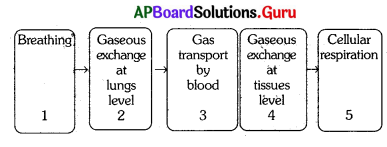
AP 10th Class Biology Bits Chapter 2 Respiration 1
Arrange the flow chart in a proper way.
A) 1, 2, 4, 5, 3
B) 3, 4, 5, 1, 2
C) 1, 5, 4, 3, 2
D) 1, 2, 3, 4, 5
Answer:
D) 1, 2, 3, 4, 5

Question 19.
Choose the correct pathway
A) Nostrils → Pharynx → Trachea → Blood
B) Blood → Nostrils → Nasal cavity → Pharynx → Trachea
C) Larynx → Trachea → Bronchioles → Nostrils
D) Nostrils → Pharynx → Larynx → Trachea → Alveolus
Answer:
D) Nostrils → Pharynx → Larynx → Trachea → Alveolus

Question 20.
The structure of the respiratory system that filters the air:
A) Pharynx
B) Larynx
C) Nasal cavity
D) Bronchiole
Answer:
C) Nasal cavity

Question 21.
The floor of the chest cavity is :
A) Sternum
B) Spinal cord
C) Ribs
D) Diaphragm
Answer:
D) Diaphragm

Question 22.
Vocal cords are located in…………………..
A) pharynx
B) larynx
C) nasal cavity
D) trachea
Answer:
B) larynx

Question 23.
If the alveoli of our lungs are spread out, they will cover an area of nearly
A) 60 m2
B) 160 m2
C) 80 m2
D) 100 m2
Answer:
B) 160 m2

AP 10th Class Biology Bits Chapter 2 Respiration

Question 24.
What happens if moisture is not present in the respiratory path ?
A) Dust particles will not be removed
B) Air reaches the lungs without get moistened during summer
C) Air reaches the lungs without get moistened during winter
D) All the above
Answer:
A) Dust particles will not be removed

Question 25.
From nasal cavity, the air goes into pharynx. After pharynx the track is divided into two passages. Those are ………………… , ……………….
1) Stomach, duodenum
2) Trachea, digestive canal
3) Larynx, epiglottis
A) 1 only
B) 1 and 2
C) 2 only
D) 1 and 3
Answer:
C) 2 only

Question 26.
Due to vibration of vocal cords sounds are produced. These sounds are produced during …………………..
A) Inhalation
B) Expiration
C) Contraction
D) Relaxation
Answer:
B) Expiration

Question 27.
We will find vocal cords in
A) larynx
B) pharynx
C) nasal cavity
D) trachea
Answer:
A) larynx

Question 28.
The structural and functional units of the Lung are……………………
A) alveoli
B) bronchi
C) bronchioles
D) air spaces
Answer:
A) alveoli

Question 29.
Which of the following is correct ?
A) The diaphragm contracts – volume of chest cavity increased
B) The diaphragm contracts – volume of chest cavity decreased
C) The diaphragm expands – volume of chest cavity increased
D) The diaphragm expands – volume of chest cavity decreased
Answer:
A) The diaphragm contracts – volume of chest cavity increased

Question 30.
The membrane that protects the lungs:
A) Meninges
B) Pericardium
C) Pleura
D) B and C
Answer:
C) Pleura

AP 10th Class Biology Bits Chapter 2 Respiration

Question 31.
“For the survival of mankind expiration and inspiration are must” It is …………………..
A) true
B) false
C) incorrect Explanation
D) may be or may not be
Answer:
A) true

Question 32.
When pressure is exerted on lungs, the following one occurs.
A) inspiration
B) chest cavity increases
C) expiration
D) chest cavity decreases
Answer:
C) expiration

Question 33.
Which of the following statement correctly describes the lungs ?
A) They are not of same size and are spongy in nature.
B) The right lung is slightly smaller for making space for the heart.
C) A fluid filled between two membranes of lungs called interstitial fluid.
D) They are of uniform size and hard in nature.
Answer:
A) They are not of same size and are spongy in nature.

Question 34.
When air is blown from mouth into a test tube containing lime water, the lime water turned milky. This shows that exhaled air consists of:
A) Oxygen
B) Nitrogen
C) Water vapour
D) Carbon dioxide
Answer:
D) Carbon dioxide

Question 35.
Read the following statement.
i) Chlorophyll pigments influence photosynthesis
ii) Haemoglobin as well as chldrbphyll pigments involve in respiration
A) Statement (i) is wrong; statement (ii) is correct
B) Both statements (i) & (ii) are correct
C) Statement (i) is correct; statement (ii) is wrong
D) Both statements (i) & (ii) are wrong.
Answer:
B) Both statements (i) & (ii) are correct

Question 36.
Arrange the below given stages/events of respiration in the correct order :
i) Transport of air by blood
ii) Exchange of air in tissues
iii) Exchange of gases in lungs
iv) Cellular respiration
A) iii → ii → iv → i
B) iii → i → iv → ii
C) iii → i → ii → iv
D) iii → iv → i → ii
Answer:
C) iii → i → ii → iv

Question 37.
During respiration the composition of this gas remains same.
A) Oxygen
B) CO2
C) Water vapour
D) Nitrogen
Answer:
D) Nitrogen

AP 10th Class Biology Bits Chapter 2 Respiration

Question 38.
Which of the choices below is not a functional process performed by the respiratory system ?
A) Pulmonary ventilation
B) Transport of respiratory gases
C) External respiration .
D) Pulmonary respiration
Answer:
B) Transport of respiratory gases

Question 39.
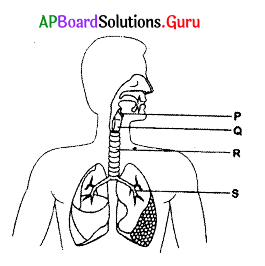
AP 10th Class Biology Bits Chapter 2 Respiration 2
The correct labelling of P, Q, R and S in the above diagram is:
A) P – Epiglottis, Q – Larynx, R – Trachea, S – Bronchioles
B) P – Larynx, Q – Epiglottis, R – Bronchioles, S – Trachea
C) P – Trachea, Q – Epiglottis, R – Larynx, S – Bronchioles
D) P – Bronchioles, Q – Larynx, R – Trachea , S – Epiglottis
Answer:
A) P – Epiglottis, Q – Larynx, R – Trachea, S – Bronchioles

Question 40.
The correct order of parts in the given flow chart are :
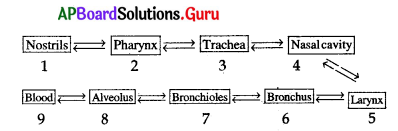
AP 10th Class Biology Bits Chapter 2 Respiration 3
A) 1, 2, 4, 5, 3, 6, 7, 8, 9
B) 1, 4, 2, 5, 3, 6, 7, 8, 9
C) 1, 4, 3, 2, 5, 6, 7, 8, 9
D) 1, 3, 4, 2, 5, 6, 7, 8,9
Answer:
B) 1, 4, 2, 5, 3, 6, 7, 8, 9

Concept – 3 : Cellular Respiration

Question 41.
Assertion : Breathing slows down under resting stage
Reason : Rate of breathing rises on vigorous exercise
A) Both A and R are true
B) ,A is true, R is false
C) A is false, R is true
D) Both A and R are false
Answer:
A) Both A and R are true

Question 42.
After undergoing strenuous exercise ……………… deficiency occurs.
A) Energy
B) Oxygen
C) Mass
D) CO2
Answer:
B) Oxygen

Question 43.
Ethanol : anaerobic respiration : : CO2 + H2O : ……………………..
A) aerobic respiration
B) anaerobic respiration
C) fermentation
D) sublimation
Answer:
A) aerobic respiration

Question 44.
Gaseous exchange takes place within the lungs by a process called:
A) osmosis
B) diffusion
C) both A and B
D) none of these
Answer:
C) both A and B

AP 10th Class Biology Bits Chapter 2 Respiration

Question 45.
Carbon dioxide is usually transported in the blood as :
A) bicarbonate
B) carbonate
Q calcium carbonate
D) sodium
Answer:
A) bicarbonate

Question 46.
Cellular respiration in prokaryotic cells occurs within :
A) cytoplasm
B) nucleus
C) mitochondria
D) both A and B
Answer:
D) both A and B

Question 47.
Haemoglobin has the binding capacity with ……………….
A) O2
B) SO2
C) NO2
D) PO4
Answer:
A) O2

Question 48.
Agents present in exhaled air:
A) CO2, O2
B) O2, water vapour
C) CO2, water vapour
D) Water vapour
Answer:
C) CO2, water vapour

Question 49.

Column – I Column – II
i) Pyruvate p) Alveoli
ii) ATP q) 7200, calories
iii) Gaseous exchange r) 3 carbon compound

A) i – p, ii – q, iii – r
B) i – q, ii – r, iii – p
C) i – r, ii – p, iii – q
D) i – r, ii – q, iii – p
Answer:
D) i – r, ii – q, iii – p

Question 50.
Energy currency is the name of this and it is formed due to
A) ATP – Digestion
B) NADP – Respiration
C) ATP – Glycolysis
D) NADP – Glycolysis
Answer:
C) ATP – Glycolysis

Question 51.
In ATP, the energy is stored in the form of these bonds.
A) Oxide
B) Carbonate
C) Phosphate
D) Bicarbonate
Answer:
C) Phosphate

AP 10th Class Biology Bits Chapter 2 Respiration

Question 52.
The energy value of a single ATP molecule is…………………..
A) 2700 calories
B) 7200 calories
C) 32 calories
D) 52 calories
Answer:
B) 7200 calories

Question 53.
Reason for muscular pain is …………………
A) accumulation of glucose
B) increase of oxygen in muscles
C) accumulation of lactic acid
D) accumulation of ethanol
Answer:
C) accumulation of lactic acid

Question 54.
Find the reason for slow breathing in walking compared to running fast
A) Variation in inhalation and exhalation .
B) Supply of O2 and removal of CO2
C) Tension and stress at rest and running
D) Variation in contraction and relaxation of lungs at rest and run fast
Answer:
D) Variation in contraction and relaxation of lungs at rest and run fast

Question 55.
Anaerobic respiration is seen in
A) Prokaryotes
B) Eukaryotes
C) Organelle
D) Chest
Answer:
A) Prokaryotes

Question 56.
Mode of respiration in Eukaryotes ……………….
A) Anaerobic respiration
B) Aerobic respiration
C) Pulmonary respiration
D) Buccal cavity respiration
Answer:
B) Aerobic respiration

Question 57.
Fermentation is …………………
A) Aerobic respiration
B) Cellular respiration
C) External respiration
D) Anaerobic respiration
Answer:
D) Anaerobic respiration

Question 58.
Strenuous exercise produces ……………….. in muscles.
A) Pyruvate
B) Lactic acid
C) Ethanol
D) Energy
Answer:
B) Lactic acid

AP 10th Class Biology Bits Chapter 2 Respiration

Question 59.
Glucose → Pyruvate → Lactic acid + Less energy
A) Mitochondria
B) Muscles
C) Yeast
D) Fungi
Answer:
B) Muscles

Question 60.
Glucose → Pyruvate → Ethanol + Less energy
A) Virus
B) Muscles
C) Yeast
D) B & C
Answer:
C) Yeast

Question 61.
Strenuous exercise causes
A) CO2 consumption
B) oxygen debt
C) CO2 debt
D) more active
Answer:
B) oxygen debt

Question 62.
During jogging body temperature rises. Why?
A) Due to over sweating
B) Temperature increases due to over exercise
C) To regain strength with CO2
D) Over consumption and loss of glucose in the body
Answer:
D) Over consumption and loss of glucose in the body

Question 63.
You have long breath when you are tired. Why ?
A) To reduce tiredness
B) To increase tiredness
C) To regain glucose
D) To repay O2
Answer:
D) To repay O2

Question 64.
Energy is stored in
A) nucleus
B) mitochondria
C) ribosomes
D) cell wall
Answer:
B) mitochondria

Question 65.
A person is hiking on a mountain. His breathing rate is increasing while he is walking up hill. The reason is …………………
1) oxygen levels are generally less as we move uphill
2) our muscles have to use more oxygen while walking up
3) oxygen levels are more on mountains
4) our muscles have to use less oxygen
A) 1 only
B) 1 and 2
C) 1 and 4
D) 4 only
Answer:
B) 1 and 2

AP 10th Class Biology Bits Chapter 2 Respiration

Question 66.
The percentage of carbon dioxide in exhaled air is ……………………..
A) 44
B) 4.4
C) 0.4
D) 0.04
Answer:
B) 4.4

Question 67.
Muscular pain is caused due to accumulation of………………….
A) Lactic acid
B) Citric acid
C) Tartaric acid
D) Nitric acid
Answer:
A) Lactic acid

Question 68.
The end products of aerobic respiration are ………………….
A) Lactic acid + Energy
B) Ethanol + CO2 + Energy
C) Lactic acid + Ethanol + Energy
D) CO2 + Water + Energy
Answer:
D) CO2 + Water + Energy

Question 69.
The percentage of oxygen in inhaled air is
A) 13%
B) 16%
C) 21%
D) 18%
Answer:
C) 21%

Question 70.
Find out the labelled part of mitochondria indicated with (?) mark.
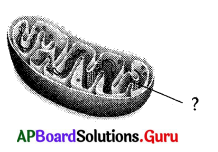
AP 10th Class Biology Bits Chapter 2 Respiration 4
A) Inner membrane
B) Cristae
C) Lamellae
D) Thylakoid
Answer:
B) Cristae

Question 71.
C6H12O6 + 6O2 → 6H2O + Energy Fill up the following equation.
A) 6CO2
B) C6H12O6
C) 6O2
D) 12CO2
Answer:
A) 6CO2

Question 72.
The following flow chart describes the break down of glucose by various pathways.
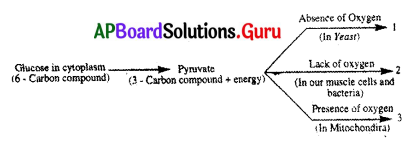
AP 10th Class Biology Bits Chapter 2 Respiration 5
What are the products formed at the places marked 1, 2 and 3 respectively ?
A) 1 – ethanol + CO2 + energy, 2 – lactic acid + energy, 3 – CO2 + energy
B) 1 – ethanol + CO2 + energy, 2 – lactic acid + energy, 3 – CO2 + H2O + energy
C) 1 – ethanol + energy, 2 – lactic acid + CO2, 3 – CO2 + H2O + energy
D) 1 – CO2 + energy, 2 – lactic acid only, 3 – H2O + energy
Answer:
B) 1 – ethanol + CO2 + energy, 2 – lactic acid + energy, 3 – CO2 + H2O + energy

AP 10th Class Biology Bits Chapter 2 Respiration

Concept – 4 : Fermentation

Question 73.
What deficiency takes place when vigorous exercise or work is done ?
A) CO2 deficiency
B) Oxygen deficiency
C) N2 deficiency .
D) Lactic acid deficiency
Answer:
B) Oxygen deficiency

Question 74.
Four students a, b, c and d, made the records given below.
“Observing changes during combustion of sugar”.

Student X Y
a

b

c

d

Glucose

Alcohol

Lime water

Glucose

Alcohol

Glucose

Iodine

Lime water

AP 10th Class Biology Bits Chapter 2 Respiration 6
Find out the student who noted correctly.
A) a
B) a, b
C) c ,a, d
D) d
Answer:
D) d

Question 75.
Vasu said that Ethanol is released in fermentation. Bose said that fermentation is the process of anaerobic respiration.
A) Both are wrong
B) Both are correct
C) Vasu is correct
D) Bose is correct
Answer:
B) Both are correct

Question 76
……………….. is formed in the mixture of glucose and yeast in the absence of O2.
A) Special smell
B) Ethane
C) Methane
D) Ethanol with specific smell
Answer:
D) Ethanol with specific smell

Question 77.
Find the odd one out.
A) Ethanol
B) Lactic acid
C) Yeast
D) Saliva
Answer:
D) Saliva

Question 78.
The solution used to identify the presence of oxygen in Anaerobic respiration experiment is
A) Diazene green
B) Potassium hydroxide
C) Betadin
D) the rod containing Sulphur
Answer:
A) Diazene green

Question 79.
Find the correct statement.
A) When we send yeast cells into sugar solution ethanol is formed.
B) When we send yeast cells into sugar solution in absence of O2 ethanol is formed.
C) Yeast + sugar solution + lactic acid results in the formation of ethanol.
D) When we send yeast into sugar solution with CO2 ethanol is formed.
Answer:
B) When we send yeast cells into sugar solution in absence of O2 ethanol is formed.

AP 10th Class Biology Bits Chapter 2 Respiration

Question 80.
The below given experimental set up indicates a phenomenon that helps us to:
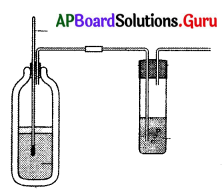
AP 10th Class Biology Bits Chapter 2 Respiration 7
A) test the production of CO2 and heat under aerobic respiration
B) test the production of CO2 under anaerobic respiration
C) test the production of heat under anaerobic respiration
D) both B and C
Answer:
D) both B and C

Question 81.
In the anaerobic respiration experiment, the blue dye diazine green (Janus Green-B) turns to which colour when the supply of oxygen around it is short?
A) Red
B) Pink
C) Yellow
D) Orange
Answer:
B) Pink

Question 82.
To remove dissolved oxygen from glucose solution by heating-the time taken ……………….
A) an horn
B) a minute
C) a second
D) two hours
Answer:
B) a minute

Question 83.
Ethanol can be separated from sugar – yeast solution by this method.
A) Freezing
B) Filtration
C) Fractional distillation
D) Cooling
Answer:
C) Fractional distillation

Question 84.
Identify the kind of respiration with the following end products.
i) C2H5OH and CO2
ii) CO2 and H2O
iii) Lactic acid
A) i – Alcoholic fermentation, ii – Lactic acid fermentation, iii – Aerobic respiration
B) i -Aerobic respiration, ii – Alcoholic fermentation, iii-Lactic acid fermentation
C) i – Alcoholic fermentation, ii – Aerobic respiration, iii – Lactic acid fermentation
D) All the above
Answer:
A) i – Alcoholic fermentation, ii – Lactic acid fermentation, iii – Aerobic respiration

Concept – 5 : Respiration Versus Combustion :

Question 85.
Name the person who told “Respiration is similar to combustion”
1. Robinson
2. Lavoisier
A) 1
B) 2
C) 1 & 2
D) Both are false
Answer:
C) 1 & 2

Question 86.
Combustion of glucose gives
A) CO2, H2O, energy
B) C6H12O6, O2 energy
C) CO2, O2, water
D) CO2, C6H12O6, energy
Answer:
A) CO2, H2O, energy

Question 87.
Practising yoga asanas help us
A) to get more gases
B) to get more O2
C) to get more CO2
D) to get more N2
Answer:
B) to get more O2

AP 10th Class Biology Bits Chapter 2 Respiration

Question 88.
Living animals and plants usually produce energy in the form of ………………….
A) gases
B) water
C) solid
D) heat
Answer:
D) heat

Question 89.
To liberate energy glucose must be ……………………. in the laboratory.
A) cooled at low temperature
B) burnt at high temperature
C) burnt at low temperature
D) B or C
Answer:
B) burnt at high temperature

Concept – 6 Evolution of Gaseous Exchange in Animals

Question 90.
Match the following.

1. Grass hopper a) Gills
2. Prawn b) Trachea
3. Frog c) Skin

A) 1 – c, 2 – b, 3 – a
B) 1 – a, 2 – c, 3 – b
C) 1 – b, 2 – c, 3 – a
D) 1 – b, 2 – a, 3 – c
Answer:
D) 1 – b, 2 – a, 3 – c

Question 91.
Find out the wrong pair.
A) Man – Lungs
B) Fish – Gills
C) Frog – Gills
D) Hydra – Body cavity
Answer:
C) Frog – Gills

Question 92.
Find out the organism which respire through skin, lungs ………………..
A) Fish
B) Earth worm
C) Snake
D) Frog
Answer:
D) Frog

Question 93.
Crocodiles and dolphins respire with
A) lungs
B) skin
C) gills
D) tuber
Answer:
A) lungs

Question 94.
Fish in the aquarium respires through
A) gills
B) lungs
C) air tubes
D) skin
Answer:
A) gills

Question 95.
Respiratory organs in insects
A) gills
B) trachea
C) skin
D) lungs
Answer:
B) trachea

AP 10th Class Biology Bits Chapter 2 Respiration

Question 96.
Respiratory organs in earthworm
A) skin
B) trachea
C) lungs
D) gills
Answer:
A) skin

Question 97.
Respiratory organs in man
A) skin
B) trachea
C) lungs
D) gills
Answer:
C) lungs

Question 98.
Respiration in Amoeba occurs by
A) trachea
B) diffusion
C) gills
D) lungs
Answer:
B) diffusion

Question 99.
Skin has no respiratory role in this organism. Identify it.
A) Earthworm
B) Lizard
C) Frog
D) Salamander
Answer:
B) Lizard

Question 100.
Branchial respiration is found in IAS
A) Cockroach
B) Fish
C) Frog
D) Birds
Answer:
B) Fish

Concept – 7 : Respiration in Stomata

Question 101.
The reason for entry of air into stomata.
A) Entry of more CO2
B) More density outside of stomata
C) Density of more CO2
D) Density of more O2
Answer:
D) Density of more O2

Question 102.
What will happen to plants if rate of respiration is more than photosyn¬thesis?
A) Live long but can’t store carbohydrates
B) Plant dies
C) Plant grows rapidly
D) Growth reduces due to hungry
Answer:
A) Live long but can’t store carbohydrates

AP 10th Class Biology Bits Chapter 2 Respiration

Question 103.
These plants grow in Eustaries and respire with roots
A) Seedless plants
B) Mangrove plants
C) Gliricidia plants
D) Monocots
Answer:
B) Mangrove plants

Question 104.
The parts which are present on the surface of roots to respire.
A) Aerial roots
B) Lenticels
C) Air spaces
D) Stomata
Answer:
A) Aerial roots

Question 105.
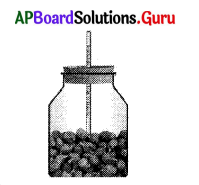
Vamsi conducted the experiment shown in the diagram. The temperature in thermometer rises.
AP 10th Class Biology Bits Chapter 2 Respiration 8
Aim of this experiment is ………………….
A) CO2 is evolved during germination.
B) Heat is evolved during respiration.
C) Alcohol is evolved during respiration.
D) CO2 is evolved dining respiration.
Answer:
B) Heat is evolved during respiration.

Question 106.
Observe the following a and b statements.
a) Plants which grow in moist and wet soil do not grow properly.
b) Mangrove plants respire with aerial roots formed above the soil.
A) a and b both are true
B) a is true, b is false
C) a is false b is true
D) a and b both are false
Answer:
A) a and b both are true

Question 107.
The rate of transpiration is more in the following days of atmosphere.
A) Cold, humid
B) Hot, humid, dry
C) Hot, humid
D) Hot, dry, air
Answer:
D) Hot, dry, air

Question 108.
Identify the part which is present in the plants for respiration.
A) Stomata
B) Lenticels
C) Aerial roots
D) All
Answer:
D) All

Question 109.
What is the purpose of ‘p’ in the given experiment ?
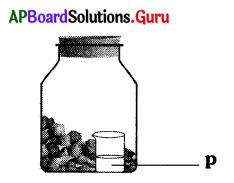
AP 10th Class Biology Bits Chapter 2 Respiration 9
A) To test the presence of oxygen
B) To test the evolution of carbon dioxide
C) To test the evolution of heat
D) To test the anabolic activity
Answer:
B) To test the evolution of carbon dioxide

AP 10th Class Biology Bits Chapter 2 Respiration

Question 110.
Plants that possess pneumatophores or respiratory roots are………………………..
A) Mangrove plants
B) Xerophytic plants
C) Hydrophytic plants
D) Mesophytic plants
Answer:
A) Mangrove plants

Question 111.
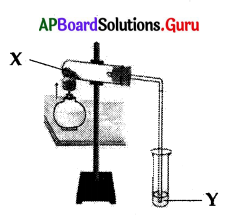
An experimental setup is given here to show CO2 is evolved in respiration. What do X and Y represent ?
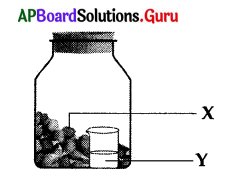
AP 10th Class Biology Bits Chapter 2 Respiration 10
A) X – Sprouted seeds, Y – Lime water
B) X – Dry seeds, Y – Lime water
C) X – Dry seeds, Y – KOH solution
D) X – Sprouted seeds Y – KOH solution
Answer:
A) X – Sprouted seeds, Y – Lime water

Concept – 8 : Photosynthesis versus Respiration

Question 112.
Respiration is a catabolic process because of
A) breakdown of complex food molecules
B) conversion of light energy
C) synthesis of chemical energy
D) energy storage
Answer:
A) breakdown of complex food molecules

Question 113.
(CH2O)n + O2 → CO2 + H2O + Energy
What does this equation indicate?
A) Photosynthesis
B) Excretion
C) Respiration
D) Fermentation
Answer:
C) Respiration

Question 114.
Factors influencing rate of respiration
A) O2
B) Temperature
C) Light
D) A & B
Answer:
D) A & B

Question 115.
The following process is essential for plant’s metabolism
A) Photosynthesis
B) Respiration
C) Excretion
D) A & B
Answer:
D) A & B

Question 116.
The only process which gives energy for all metabolic activities ………………….
A) Photosynthesis
B) Cellular respiration
C) Combustion
D) Fermentation
Answer:
B) Cellular respiration

AP 10th Class Biology Bits Chapter 2 Respiration

Question 117.
Observe the following equation and find out the correct answer for “?”.
(CH2O)n + O2 → CO2 + H2O + ?
A) Energy is not released
B) Energy is not oxidised
C) More energy is released
D) Ethyl Alcohol is formed with small amount energy
Answer:
C) More energy is released

Question 118.
In cells ………………… will be utilised and CO2, water, energy will be released.
A) CO2
B) Nitrogen
C) Oxygen
D) Hydrogen
Answer:
C) Oxygen

Question 119.
Anaerobic respiration is seen in
A) Prokaryotes
B) Eukaryotes
C) Organelle
D) Chest
Answer:
A) Prokaryotes

Question 120.
Photosynthesis and respiration both are called ………………….
A) Anabolic activities
B) Catabolic activities
C) Combustion activities
D) Metabolic activities
Answer:
D) Metabolic activities

Question 121.
Respiration in plants is different from animals in such a way that :
A) all the parts of plant perform respiration individually
B) there is a little transport of gases from one part of the plant to the other
C) the respiration in plants occurs’at a slower rate
D) all the above
Answer:
D) all the above

Question 122.
Find the correct pair:
A) Photosynthesis – Anabolic process
B) Respiration – Catabolic process
C) Pyruvate – 6 carbon compound
D) Both A and B
Answer:
D) Both A and B

AP 10th Class Biology Bits Chapter 2 Respiration

Question 123.
Choose the correct one :
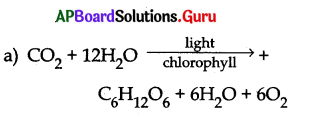
AP 10th Class Biology Bits Chapter 2 Respiration 11
b) C6H12O6 + 6O2 → 6CO2 + 6H2O + Energy
A) (a) is photosynthesis (b) is respiration
B) (b) is respiration (a) is photosynthesis
C) (a) & (b) both photosynthesis
D) (a) & (b) both respiration
Answer:
A) (a) is photosynthesis (b) is respiration
AP 10th Class Biology Bits Chapter 1 Nutrition with Answers

Practice the AP 10th Class Biology Bits with Answers Chapter 1 Nutrition on a regular basis so that you can attempt exams with utmost confidence.

AP State Syllabus 10th Class Biology Bits 1st Lesson Nutrition with Answers

Concept – 1 : Introduction – Autotrophic Nutrition

Question 1.
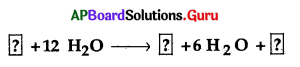
Fill the equation correctly.
AP 10th Class Biology Bits Chapter 1 Nutrition 1
A) CO2,C2H5OH,6O2
B) 6 CO2,12 H2O, C6 H12 06
C) 6 CO2, C6 H12O6 , O2
D) 6 CO2, C6 H12O6,6 O2
Answer:
D) 6 CO2, C6 H12O6,6 O2

Question 2.
Van Neil worked on …………………..
A) Purple sulphur bacteria
B) Hydrilla
C) Chloroplast
D) Paramoecium
Answer:
A) Purple sulphur bacteria

AP 10th Class Biology Bits Chapter 1 Nutrition

Question 3.
Famous photosynthesis equation was proposed by which scientist ?
A) Arnon
B) Hill
C) C . B . Van Neil
D) Jackson
Answer:
C) C . B . Van Neil

Question 4.
In autotrophs the energy is stored as ………………….
A) Fats
B) Proteins
C) Glycogen
D) Carbohydrates
Answer:
D) Carbohydrates

Question 5.
Who opined when each molecule of carbohydrate is formed, one molecule of water and one molecule of oxygen are also produced during photosynthesis?
A) C.B. Van Neil
B) Von Sachs
C) Caventou
D) Pelletier
Answer:
A) C.B. Van Neil

Question 6.
Instead of H2O purple sulphur bacteria use …………….. as a starting material.
A) H2S
B) Hydrogen
C) Chlorine gas
D) CO2
Answer:
A) H2S

Question 7.
‘X’ is photosynthetic bacteria which uses hydrogen sulphide instead of water. Which element is released during the photosynthesis of this bacteria ?
A) O2
B) Sulphur
C) H2
D) All of the above
Answer:
B) Sulphur

Question 8.
Which part of the plant takes in carbon dioxide from the air for photosynthesis?
A) Root hair
B) Stomata
C) Leaf veins
D) Sepals
Answer:
B) Stomata

Question 9.
One of the following is not useful for the autotrophs during synthesis of chemical substances by utilising light energy.
A) Oxygen
B) Carbon dioxide
C) Stomata
D) Water
Answer:
A) Oxygen

AP 10th Class Biology Bits Chapter 1 Nutrition

Question 10.
From which of the following, the oxygen is released in plants during photosynthesis?
A) Glucose
B) Water
C) CO2
D) Chlorophyll
Answer:
B) Water

Question 11.
One of the following did not reveal that growth of plant is influenced by photosynthesis?
A) Van Helmont
B) Ingenhousz
C) Engleman
D) Mohl
Answer:
A) Van Helmont

Question 12.
Which of the following does not occur in photosynthesis ?
A) Conversion of light energy to chemical energy
B) Reduction of carbon dioxide to carbohydrates
C) Oxidation of carbon to carbon dioxide
D) Chlorophyll absorbs photons
Answer:
C) Oxidation of carbon to carbon dioxide

Question 13.
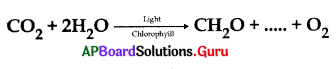
Find the missing product in the equation.
AP 10th Class Biology Bits Chapter 1 Nutrition 2
A) CO2
B) H2O
C) C6H12O6
D) 6 SO2
Answer:
B) H2O

Question 14.
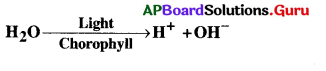
Reason for calling Hill reaction as light reaction
A) Break down of water molecule by light
B) Break down of chlorophyll atom by light
C) Conversion of Hydrogen ions of water tp Hydroxyl ions
D) Water is formed by combination of Hydrogen and Hydroxyl ions
Answer:
A) Break down of water molecule by light

Question 15.
Autotrophic organisms:
A) depend on other organisms for food
B) hunt for the food
C) synthesize their own food
D) cannot synthesize their food
Answer:
C) synthesize their own food

Question 16.
Find out the false statement from the following:
A) Energy is required for metabolic activities
B) Organisms grow along with time
C) Transportation of molecules do not occur in cells
D) Organisms construct their body on their own
Answer:
C) Transportation of molecules do not occur in cells

AP 10th Class Biology Bits Chapter 1 Nutrition

Question 17.
The proper order of conducting experiment to test the starch in leaves.
1) Selection of a potted plant.
2) Pouring iodine drops on the leaf that is kept in petri dish.
3) Taking methylated spirit into the test tube.
4) Heating the leaf in test tube for removal of chlorophyll.
A) 4, 3, 1, 2
B) 4, 1, 3, 2
C) 1, 3, 2, 4
D) 1, 3, 4, 2
Answer:
D) 1, 3, 4, 2

Question 18.
………… detected the point of maximum rate of photosynthesis.
A) Engelman
B) Eastman
C) Arnon
D) Neils Bohr
Answer:
A) Engelman

Question 19.
We use ganji (boiled rice water) for conducting action of ……………….. in the digestive system.
A) pepsin
B) mucin
C) saliva
D) lipase
Answer:
C) saliva

Question 20.
To test for the presence of carbohydrates in whedt flour the following are mixed.
A) First saliva next iodine
B) First saliva next xyline
C) First iodine next saliva
D) First xyline next iodine
Answer:
C) First iodine next saliva

Question 21
No oxygen is liberated in purple sulphur bacteria during photosynthesis. This is
because they use:
A) H2O as starting material
B) H2S as starting material
C) CO2 as starting material
D) Photosynthesis is a chemical process
Answer:
B) H2S as starting material

Question 22.
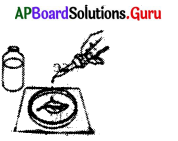
The following picture depicts
AP 10th Class Biology Bits Chapter 1 Nutrition 3
A) Starch test
B) Protein test
C) Test for fats
D) Test for oils
Answer:
A) Starch test

Concept – 2 : Factors Essential for photosynthesis

Question 23.
Why we use KOH in a bottle in the experiment to iknow CO2 is necessary for photosynthesis?
A) To absorb chlorophyll in leaves
B) To absorb air in bottle
C) To absorb C02 in bottle
D) To absorb water vapour in the bottle
Answer:
C) To absorb CO2 in bottle

AP 10th Class Biology Bits Chapter 1 Nutrition

Question 24.
a : Chloroplasts convert simple inorganic substances into complex organic compounds.
b : Light energy is required for synthesis of carbohydrates.
A) Both a and b are true
B) a is correct, b is wrong
C) b is correct, a is wrong
D) Both a and b are wrong
Answer:
A) Both a and b are true

Question 25.
In Mohl’s half-leaf, experiment, which part becomes bluish black for starch test?
A) Total leaf
B) Leaf part in the bottle
C) Leaf part outside the bottle
D) Venation of the leaf
Answer:
C) Leaf part outside the bottle

Question 26.
The solution, which is useful to decolorise a leaf.
A) Water
B) Iodine
C) KOH solution
D) Alcohol
Answer:
D) Alcohol

Question 27.
A plant is kept in dark cupboard for about forty eight hours before conducting any experiment on photosynthesis in order to :
A) remove chlorophyll from leaves
B) remove starch from leaves
C) ensure that no photosynthesis occurred
D) ensure that leaves are free from the starch.
Answer:
B) remove starch from leaves

Question 28.
What chemical is used to know the presence of starch in leaves?
A) Methylated spirit
B) Iodine
C) Methylated spirit, Iodine
D) Methylene blue
Answer:
B) Iodine

Question 29.
Mohl’s half leaf experiment shows ………………. is essential for photosynthesis.
A) O2
B) CO2
C) N2
D) Mg
Answer:
B) CO2

Question 30.
To test the importance of CO2 Mohl used……………… solution.
A) O2
B)COOH
C) K2SO4
D) KOH
Answer:
D) KOH

AP 10th Class Biology Bits Chapter 1 Nutrition

Question 31.
In Mohl’s half leaf experiment, the part of the leaf inside the flask does not become blue- black after adding iodine drops. It is because :
A) starch formation does not take place in that part
B) CO2 is absent inside the flask
C) light entering into the flask has more intensity
D) both A and B
Answer:
D) both A and B

Question 32.
AP 10th Class Biology Bits Chapter 1 Nutrition 4 Given leaf is tested through Mohl’s experiment. The dark coloured part shows the presence of ……………….
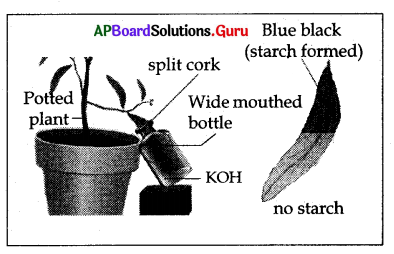
A) CO2
B) KOH
C) Starch
D) Sugar
Answer:
C) Starch

Question 33.
Sneha wants to know one of the factors of photosynthesis. She arranged total apparatus as shown in figure to conduct the experiment. This shows ………………….
AP 10th Class Biology Bits Chapter 1 Nutrition 5
A) Light is essential for photosynthesis.
B) CO2 is essential for photosynthesis.
C) O2 is released during photosynthesis.
D) Chloroplasts are essential for photosynthesis.
Answer:
B) CO2 is essential for photosynthesis.

Concept – 3 : Light and Photosynthesis

Question 34.
The scientist who discovered that photosynthesis occurs only in the green parts of the plants
A) Engelman
B) Ingenhousz
C) Robert Hill
D) Kelvin
Answer:
B) Ingenhousz

Question 35.
The extract obtained by Pelletier and Caventou is ……………………
A) Colour pigments
B) Chlorophyll
C) Xanthophyll
D) Keratine
Answer:
B) Chlorophyll

Question 36.
Energy change takes place in photosynthesis …………………
A) Conversion of light energy to heat energy
B) Conversion of light energy to chemical energy
C) Conversion of light energy to electrical energy
D) Conversion of heat energy to chemical energy
Answer:
B) Conversion of light energy to chemical energy

Question 37.
The gas released by hydrilla twigs is …………………. . It burns the incense sticks with
glowing flames.
A) O2
B) CO2
C) CO
D) O3
Answer:
A) O2

AP 10th Class Biology Bits Chapter 1 Nutrition

Question 38.
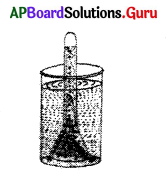
Identify the right sequence of events of Hydrilla experiment.
1) Invert the funnel in the beaker of water.
2) Insert Hydrilla plant twigs in the funnel.
3) Insert the test tube filled with water over the funnel.
4) Fill water in the beaker.
A) 4, 2, 1, 3
B) 1, 2, 3, 4
C) 2, 1, 4, 3
D) 3, 4, 1, 2
Answer:
C) 2, 1, 4, 3

Question 39.
The figure below represents an experimental set up to study a physiological process in plants. Which of the following is being studied ?
AP 10th Class Biology Bits Chapter 1 Nutrition 6
A) Excretion
B) Respiration
C) Photosynthesis
D) Transportation
Answer:
C) Photosynthesis

Question 40.
AP 10th Class Biology Bits Chapter 1 Nutrition 7 The picture of leaf shows ………………. experiment of photosynthesis.
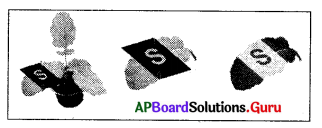
A) Mohl’s
B) Light screen
C) KOH
D) Hydrilla plant
Answer:
B) Light screen

Question 41.
Observe the picture. If iodine is used on the leaf ………………….
AP 10th Class Biology Bits Chapter 1 Nutrition 8
A) formation of deep blue colour at the non-light falling region.
B) formation of deep blue colour at the light falling region.
C) formation of deep blue colour on both light falling and non-light falling regions.
D) no colour formation on both regions.
Answer:
B) formation of deep blue colour at the light falling region.

Question 42.
AP 10th Class Biology Bits Chapter 1 Nutrition 9 The covered portion did not change into blue because ………………..
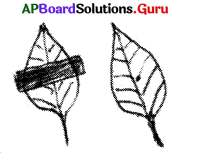
A) it does not receive CO2
B) it does not receive water
C) it does not receive light
D) it does not have chlorophyll
Answer:
C) it does not receive light

Question 43.
The figure given here is for performing an experiment on photosynthesis. What do you conclude from this experiment?
AP 10th Class Biology Bits Chapter 1 Nutrition 10
A) It proves that chloroplast is necessary for the manufacture of starch.
B) It proves that water is .necessary for the manufacture of starch.
C) It proves that carbon dioxide is necessary for the manufacture of starch
D) It proves that light is necessary for the manufacture of starch.
Answer:
D) It proves that light is necessary for the manufacture of starch.

Concept – 4 : Chlorophyll and Photosynthesis

Question 44.
Element present in Chlorophyll:
A) Magnesium
B) Ferrous
C) Manganese
D) Calcium
Answer:
A) Magnesium

AP 10th Class Biology Bits Chapter 1 Nutrition

Question 45.
The scientists who discovered chlorophyll are…………………
A) Joseph Priestley and Gregor Mendel
B) Lavoisier and Pelln
C) C .B . Van Neil and Julius Von Sachs
D) Pelletier and Caventou
Answer:
D) Pelletier and Caventou

Question 46.
Which of the following materials is /are synthesized by plants ?
A) Starch
B) Cellulose
C) Lipid
D) All
Answer:
D) All

Question 47.
The scientist who observed that chlorophyll in plants is not spread throughout the entire cell ………………
A) Van Neil
B) Van Dammy
C) Von Sachs
D) Von Rose
Answer:
C) Von Sachs

Question 48.
Number of chloroplasts in ground tissue of cell are……………………
A) 30 – 190
B) 40 – 100
C) 20 – 30
D) 40 – 720
Answer:
B) 40 – 100

Question 49.
Need of green chlorophyll pigmented molecules in leaves is
A) break down of water molecule into Hydrogen and Oxygen
B) to release green light
C) to trap solar energy
D) to trap electric energy
Answer:
C) to trap solar energy

Question 50.
The closing and opening of stomata depends on ………………
A) Oxygen
B) Water in guard cells
C) Temperature
D) Concentration of CO2
Answer:
B) Water in guard cells

Question 51.
Photosynthesis takes place in chlorophylls and produce glucose and carbohydrates.
What will happen if chlorophyll is absent ?
A) Production of Carbohydrates
B) Plant dies
C) Plant grows more
D) All
Answer:
B) Plant dies

AP 10th Class Biology Bits Chapter 1 Nutrition

Question 52.
These are the end products, of photosynthesis:
A) carbon dioxide, water, sucrose
B) glucose, water and oxygen
C) glucose, carbon dioxide, air
D) sucrose, water and oxygen
Answer:
B) glucose, water and oxygen

Question 53.
Light reactions are different from dark reactions in such a way that :
A) they are light independent
B) they occur in stroma of chloroplast
C) they occur in grana of chloroplast
D) they do not facilitate photolysis event
Answer:
C) they occur in grana of chloroplast

Question 54.
ATP and NADPH are :
A) reactants of light reactions
B) end products of light reactions
C) intermediate products of light reactions
D) precursors for light reactions
Answer:
B) end products of light reactions

Question 55.
In plants, exchange of gases takes place through:
A) Stomata
B) Palisade tissue
C) Spongy tissue
D) Midrib
Answer:
A) Stomata

Question 56.
How many pigment molecules are grouped as light harvesting complex or photosynthetic unit in each granum ?
A) 150 to 200
B) 250 to 300
C) 250 to 400
D) 350 to 500
Answer:
C) 250 to 400

Question 57.
If chloropyll is absent in leaves, plants cannot synthesize ………………..
A) Starch
B) Glucose
C) A & B
D) Cellulose
Answer:
C) A & B

Question 58.
The important factors of photosynthesis are
A) light, CO2, chlorophyll and temperature
B) light, chlorophyll, water and temperature
C) light, CO2, water and chlorophyll
D) water, chlorophyll, temperature and CO2
Answer:
C) light, CO2, water and chlorophyll

AP 10th Class Biology Bits Chapter 1 Nutrition

Question 59.
Chloroplasts present in large numbers in the cells (around 40 – 100) of plant tissue like the :
A) stomatal guard cells
B) ground tissue
C) both A and B
D) none of these
Answer:
C) both A and B

Question 60.
i) Light energy is converted into chemical energy.
ii) Photolysis of water,
iii) Reduction of CO2 and formation of glucose.
Where do all the above mentioned reactions occur?
A) Mitochondria
B) Ribosomes
C) Chloroplast
D) Lysosomes
Answer:
C) Chloroplast

Question 61.
Ram has forgot to label the part P. Identify it from the following.
AP 10th Class Biology Bits Chapter 1 Nutrition 11
A) Stomata
B) Chloroplast
C) Mesophyll
D) Starch grain
Answer:
A) Stomata

Question 62.
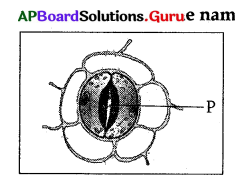
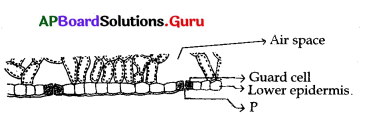
Below figure is a part of the epidermis of the leaf. What is the name of P ?
AP 10th Class Biology Bits Chapter 1 Nutrition 12
A) Cell
B) Spongy cell
C) Xylem cell
D) Guard cell
Answer:
D) Guard cell

Question 63.
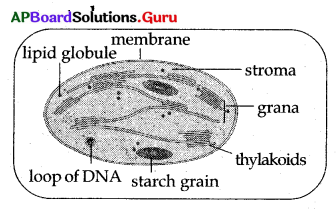
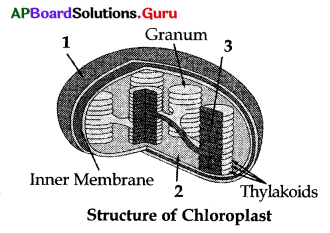
This is the picture of chloroplast. Identify the part in which light reaction takes place.
AP 10th Class Biology Bits Chapter 1 Nutrition 13
A) Stroma
B) Grana
C) Starch grain
D) Lipid globule
Answer:
B) Grana

Question 64.
Parts 1, 2 and 3 in the below given diagram indicate :
AP 10th Class Biology Bits Chapter 1 Nutrition 14
A) 1 – Outer membrane, 2 – Stroma, 3 – Grana
B) 1 – Grana, 2 – Stroma, 3 – Outer membrane
C) 1 – Stroma, 3 – Grana, 2 – Outer membrane
D) 1 – Stroma, 2 – Grana, 3 – Outer membrane
Answer:
A) 1 – Outer membrane, 2 – Stroma, 3 – Grana

Question 65.
1. Chlorophyll is similar to the haemoglobin of blood.
2. Haemoglobin has iron while chlorophyll has magnesium.
A) 1 is correct, 2 is wrong
B) 1 is wrong, 2 is correct
C) 1, 2 both are correct
D) 1, 2 both are wrong
Answer:
C) 1, 2 both are correct

Concept – 5 : Mechanism of Photosynthesis

Question 66.
End products of light dependent reaction is/are
A) C6H12O6
B) CO2
C) O2, ATP, NADPH
D) H2O
Answer:
C) O2, ATP, NADPH

AP 10th Class Biology Bits Chapter 1 Nutrition

Question 67.
This shows remarkable effect on photosynthesis:
A) Temperature
B) Humidity
C) Intensity of light
D) All of these
Answer:
C) Intensity of light

Question 68.
The end product of dark reaction is ……………………
A) PGA
B) CO2
C) Ribulose biphosphate
D) C6H12O6
Answer:
D) C6H12O6

Question 69.
ATP, NADPH2 are utilized in …………………
A) light reaction
B) excretion
C) dark reaction
D) respiration
Answer:
C) dark reaction

Question 70.
The rate of photosynthesis is NOT affected by this factor
A) Light intensity
B) Humidity
C) Temperature
D) Carbon dioxide concentration
Answer:
B) Humidity

Question 71.
AP 10th Class Biology Bits Chapter 1 Nutrition 15 belongs to …………………….
A) Fermentation
B) Dark phase
C) Hill’s reaction
D) Mold’s half leaf experiment
Answer:
C) Hill’s reaction

Question 72.
Which of these are required for autotrophic nutrition ?
A) Water, CO2
B) Chlorophyll
C) Sunlight
D) All
Answer:
D) All

Question 73.
This process doesn’t take place, if a plant is kept in dark room.
A) Respiration
B) Reproduction
C) Photosynthesis
D) Water transportation
Answer:
C) Photosynthesis

AP 10th Class Biology Bits Chapter 1 Nutrition

Question 74.
Site of light reaction
A) Grana of chloroplasts
B) Stroma of chloroplasts
C) Mitochondria
D) Golgi complex
Answer:
A) Grana of chloroplasts

Question 75.
How are H+ ions obtained in the given reaction ?
NADP + H+ → NADPH
A) Through dark reaction
B) Through light reaction
C) Through sunlight
D) Through rain
Answer:
B) Through light reaction

Question 76.
Assimilatory powers of light reaction …………………..
A) ATP, NADPH
B) H2O,O
C) CO2, ATP
D) CO2, NADPH
Answer:
A) ATP, NADPH

Question 77.
Correct order of the products that are synthesised by plants.
A) Glucose, starch, cellulose
B) Glucose, proteins, lipids, starch, cellulose
C) Proteins, lipids, cellulose, starch, glucose
D) Glucose, vitamins, lipids and alkaloids
Answer:
A) Glucose, starch, cellulose

Question 78.
Photosynthesis process determines the production of carbohydrates but not
A) Carbohydrates are intermediate products in photosynthesis
B) Glucose which is formed in photosynthesis immediately converted to carbohydrates
C) Carbohydrates dissolve in water
D) Glucose is not tested.
Answer:
B) Glucose which is formed in photosynthesis immediately converted to carbohydrates

Question 79.
The special intermediate compound of dark reaction:
A) RUBP
B) Glucose
C) Citric acid
D) Starch
Answer:
A) RUBP

Question 80.
What happens, if green plants are not there on earth ?
A) Living organisms will not get O2
B) Living organisms will not get CO2
C) Living organisms will not get N2
D) All the above
Answer:
A) Living organisms will not get O2

AP 10th Class Biology Bits Chapter 1 Nutrition

Question 81.
The important factors of photosynthesis are ……………..
A) Light, CO2, Chlorophyll, Temperature
B) Light, Water, Chlorophyll, Temperature
C) Light, Temperature, Chlorophyll, CO2
D) Light, Water, Chlorophyll, CO2
Answer:
D) Light, Water, Chlorophyll, CO2

Concept – 6 : Heterotrophic Nutrition

Question 82.
Cuscuta plant absorbs food through
A) Haustoria
B) Stem
C) Root
D) Flower
Answer:
A) Haustoria

Question 83.
Example for saprophyte
A) Mushroom
B) Louse
C) Paramoecium
D) Owl
Answer:
A) Mushroom

Question 84.
Example for with highly branched digestive system.
A) Jelly fish
B) Ascaris
C) Fasciola hepatrica
D) Star fish
Answer:
C) Fasciola hepatrica

Question 85.
The Cuscuta belongs to this family.
A) Malvaceae
B) Solanaceae
C) Convolvulaceae
D) Fabaceae
Answer:
C) Convolvulaceae

Question 86.
Amoeba takes the food through……………………
A) Nucleus
B) Pseudopodia
C) Vacuole
D) Cytoplasm
Answer:
B) Pseudopodia

Question 87.
In single celled animals the food is taken by
A) the entire body surface
B) mouth
C) teeth
D) vacuoles
Answer:
A) the entire body surface

AP 10th Class Biology Bits Chapter 1 Nutrition

Question 88.
Which of the following organisms takes food by parasitic nutrition ?
A) Yeast
B) Mushroom
C) Cuscuta
D) Amoeba
Answer:
C) Cuscuta

Question 89.
The site of ingestion of food in paramoecium
A) Pseudopodia
B) Flagella
C) Cytostome
D) Nucleus
Answer:
C) Cytostome

Question 90.
The mode of food intake in Amoeba is …………………
A) Dialysis
B) Cytokinesis
C) Phagocytosis
D) Amoebiosis
Answer:
C) Phagocytosis

Question 91.
Pick up the correct option for “Dodder.”
1) Genus Cuscuta
2) It is leafless
3) Twining plant
4) Microscopic
5) Parasitic in nature
6) Family is Convolvulaceae
A) 1, 2, 3, 5, 6
B) 1, 3, 4, 5, 6
C) 1, 3, 4, 5
D) 1, 2, 3, 4, 5, 6
Answer:
A) 1, 2, 3, 5, 6

Question 92.
Example for parasite :
A) Cuscuta
B) Lice
C) Leech
D) All
Answer:
D) All

Question 93.
Example for parastic plant
A) Cuscuta
B) Hibiscus
C) Bitter gourd
D) Jasmine
Answer:
A) Cuscuta

Question 94.
Water is drawn through the haustoria from the host plant’s
A) xylem
B) leaves
C) phloem
D) nodules
Answer:
A) xylem

AP 10th Class Biology Bits Chapter 1 Nutrition

Question 95.
The dodder contains ……………….. amount of chlorophyll.
A) less
B) more
C) moderate
D) zero
Answer:
A) less

Question 96.
Food movement in paramoecium is facilitated by
A) cilia
B) cytostome
C) flagella
D) pseudopodia
Answer:
A) cilia

Question 97.
In which colour do you find the slender, string like stems of the Dodder?
A) Yellow
B) Orange
C) Pink
D) All the above
Answer:
D) All the above

Question 98.
Animals cannot synthesize the following.
(i) Carbohydrates
(ii) Cellulose
(iii) Lipid
(iv) Protein
A) i only
B) i, ii only
C) iii only
D) iii, iv only
Answer:
B) i, ii only

Question 99.
When ‘Dodder’ plant is fully grown it obtains food through part (ii) only after development of part (i). What are (i) and (ii)?
A) (i) leaves (ii) haustoria
B) (i) haustoria (ii) anchoring roots
C) (i) anchoring roots (ii) haustoria
D) (i) leaves (ii) anchoring roots Observe the diagram
Answer:
C) (i) anchoring roots (ii) haustoria

Question 100.
Observe the diagram AP 10th Class Biology Bits Chapter 1 Nutrition 16…………………… is occurring in ampeba.
A) Nutrition
B) Elimination
C) Excretion
D) A or B
Answer:
A) Nutrition

Question 101.
The dodder seed germinates forming
A) anchoring root
B) slender stem
C) haustoria
D) hanging leaves
Answer:
A) anchoring root

AP 10th Class Biology Bits Chapter 1 Nutrition

Question 102.
Root like structures in cuscuta that penetrate the tissue of a host plant to absorb food is ………………
A) Dodder
B) Haustoria
C) Legume roots
D) Aerial roots
Answer:
B) Haustoria

Concept – 7 : Nutrition in Human Beings

Question 103.
The digestive juice without enzyme is
A) Gastric juice
B) Pancreatic juice
C) Intestinal juice
D) Bile juice
Answer:
D) Bile juice

Question 104.
Emulsification of the fats in human body occurs in …………………
A) small intestine
B) liver
C) pancreas
D) stomach
Answer:
B) liver

Question 105.
Enzyme that helps in fat metabolism
A) Trypsin
B) Lipase
C) Ptyaline
D) Pepsin
Answer:
B) Lipase

Question 106.
Identify the correct order of digestion process.
A) Digestion → ingestion → absorption → defecation
B) Ingestion → absorption → digestion → defecation
C) Ingestion → digestion → absorption → defecation
D) Ingestion → defecation → digestion → absorption
Answer:
C) Ingestion → digestion → absorption → defecation

Question 107.
The surface area in the small intestine is increased due to ………………
A) Villi
B) Mucous glands
C) Cilia
D) Cristae
Answer:
A) Villi

AP 10th Class Biology Bits Chapter 1 Nutrition

Question 108.
In man, where does the digestive process end ?
A) Oesophagus
B) Small intestine
C) Stomach
D) Large intestine
Answer:
D) Large intestine

Question 109.
The part in which the digestive process starts in man ……………………
A) Stomach
B) Oesophagus
C) Mouth
D) Small intestine
Answer:
C) Mouth

Question 110.
In alimentary canal, where do the proteins get digested at first ?
A) Small intestine
B) Oesophagus
C) Mouth
D) Stomach
Answer:
D) Stomach

Question 111.
Which of the following helps in protecting the walls of stomach from Hydrochloric acid ?
A) Pepsin
B) Mucus
C) Saliva
D) Bile Juice
Answer:
B) Mucus

Question 112.
The part of food pipe which collects bile juice from liver is …………………..
A) Oesophagus
B) Small intestine
C) Duodenum
D) Large intestine
Answer:
C) Duodenum

Question 113.
The following processes do not occur due to the lack of secretion of bile juice.
i) Splitting of proteins
ii) Formation of glucose
iil) Emulsification of fats
iv) Formation of glycerine
A) i, ii
B) ii only
C) ii, iii, iv
D) iii only
Answer:
D) iii only

Question 114.
Find out the ascending order for digestion of food in the alimentary canal.
i) Mastication
ii) Contraction of muscles
iii) Peristaltic movements
iv) Emulsification of fats
A) i, ii, iii, iv
B) i, iii, ii, iv
C) i, iv, iii, ii
D) iv, iii, ii, i
Answer:
A) i, ii, iii, iv

AP 10th Class Biology Bits Chapter 1 Nutrition

Question 115.
Emulsification in digestive system is due to the presence of
A) Saliva
B) Gastric juice
C) Pepsin
D) Bile juice
Answer:
D) Bile juice

Question 116.
The length of small intestine in human being is ………………
A) 4.5 m
B) 1.5 m
C) 3.5 m
D) 6.5 m
Answer:
D) 6.5 m

Question 117.
Which of the following can be digested by the enzymes present in pancreatic juice?
A) Proteins and carbohydrates only
B) Proteins and fats only
C) Fats and carbohydrates only
D) Proteins, fats and carbohydrates
Answer:
D) Proteins, fats and carbohydrates

Question 118.
The enzyme which mixes up with food in alimentary canal at first is ………………..
A) Pepsin
B) Trypsin
C) Salivary Amylase
D) Glycogen
Answer:
C) Salivary Amylase

Question 119.
Acid present in Gastric juice
A) Sulphuric Acid
B) Hydrochloric Acid
C) Nitric acid
D) Phosphoric acid
Answer:
B) Hydrochloric Acid

Question 120.
The process of convertingfats into small globule like forms by the bile juice secreted from liver is :
A) mastication
B) emulsification
C) desertification
D) lipogenesis
Answer:
B) emulsification

Question 121.
Which of the following enzymes is secreted into stomach ?
A) Sucrase
B) Lipase
C) Trypsin
D) Pepsin
Answer:
D) Pepsin

Question 122.
The function of sphincter is to :
A) prevent materials from moving backward
B) allow materials to move from one segment to another
C) regulate the opening of the passage
D) all the above
Answer:
D) all the above

AP 10th Class Biology Bits Chapter 1 Nutrition

Question 123.
Digestion of carbohydrates does not takes place in stomach. This is due to:
A) their hardness
B) the absence of enzymes that act on them
C) presence of more acids
D) the inactivation of pepsin
Answer:
B) the absence of enzymes that act on them

Question 124.
Complete digestion of food molecules occurs in :
A) stomach
B) small intestine
C) large intestine
D) buccal cavity
Answer:
B) small intestine

Question 125.
The first enzyme that mixes with food in the digestive system is :
A) Pepsin
B) Ptyalin
C) Lipase
D) Trypsin
Answer:
B) Ptyalin

Question 126.
Food in the form of a soft slimy substance where some proteins and carbohydrates have already been broken down is called :
A) chyme
B) bile
C) succus entericus
D) bolus
Answer:
A) chyme

Question 127.
Ramu is suffering from vomitings and nausea. What happened to him ?
A) Suffering from indigestion
B) Liver loses capacity of digestion due to excess intake of fats
C) Liver becomes weak due to less fats
D) Ramu consumes raw leafy secretions
Answer:
B) Liver loses capacity of digestion due to excess intake of fats

Question 128.
If salivary amylase is absent, which of the following process gets affected badly?
A) Conversion of proteins to amino acids.
B) Conversion of carbohydrates to glucose.
C) Conversion of fats to fatty acids.
D) Formation of ulcers.
Answer:
B) Conversion of carbohydrates to glucose.

AP 10th Class Biology Bits Chapter 1 Nutrition

Question 129.
a : Bile juice doesn’t have enzymes.
b : Emulsification of fats is done by bile juice.
A) Both a and b are true
B) a true, b false
C) b true, a false
D) a, b both are false
Answer:
A) Both a and b are true

Question 130.
If this is absent in saliva, swallowing food Will be difficult
A) Amylase
B) Pepsin
C) Protein
D) Mucin
Answer:
D) Mucin

Question 131.
Find out wrong pair.
A) Saliva – Ptyalin
B) Pancreatic juice – Amylase
C) Gastric juice – Lipase
D) Intestinal juice – Peptidase
Answer:
C) Gastric juice – Lipase

Question 132.
Excessive intake of fats causes
A) Nausea
B) Vomiting
C) Digestion
D) A and B
Answer:
D) A and B

Question 133.
Find out wrong pair.
A) Saliva – Ptyalin
B) Pancreatic juice – Amylase
C) Gastric juice – Lipase
D) Intestinal juice – Peptidase
Answer:
C) Gastric juice – Lipase

Question 134.
Which of the following is the correct statement regarding bile ?
A) It is secreted by bile duct and stored in liver.
B) It is secreted by gall bladder and stored in liver.
C) It is secreted by liver and stored in bile duct.
D) It is secreted by liver and stored in gall bladder.
Answer:
D) It is secreted by liver and stored in gall bladder.

Question 135.
These people suffer from intestinal ulcers.
(i) Restless employees
(ii) Political leaders
(iii) Overtime TV viewers
(iv) Time to time meals consumers
A) i only
B) iii only
C) i, ii
D) iii, iv
Answer:
A) i only

Question 136.
Reasons for formation of ulcers in stomach
A) Improper food intake
B) Stress and strain
C) Bacteria
D) All
Answer:
D) All

AP 10th Class Biology Bits Chapter 1 Nutrition

Question 137.
One of the following is not a good habit related to digestion
A) Having balanced meals
B) Taking more junk foods
C) Thoroughly masticating the food
D) Drinking more water
Answer:
B) Taking more junk foods

Question 138.
These play a key role in nutrition
A) Assimilation
B) Expulsion of wastes
C) Regular exercises
D) A and B
Answer:
D) A and B

Question 139.
Thoroughly masticating food enables easy ………………
A) constipation
B) digestion
C) circulation
D) A and B
Answer:
D) A and B

Question 140.
Pepsin : Proteins :: Lipase :………………
A) Carbohydrates
B) Fats
C) Vitamins
D) Sucrose
Answer:
B) Fats

Concept – 8 : Diseases due to Malnutrition

Question 141.
Very poor muscle development, swollen legs, fluffy face, diarrhoea and dry skin are the symptoms of this disease
A) Kwashiorkor
B) Marasmus
C) Obesity
D) Pellagra
Answer:
A) Kwashiorkor

Question 142.
Protein deficiency among children causes
A) Kwashiorkor
B) Obesity
C) Marasmus
D) Edema
Answer:
A) Kwashiorkor

Question 143.
Reasons for Marasmus
A) Protein deficiency
B) Protein, Calorie deficiency
C) Calorie deficiency
D) Excessive calories
Answer:
B) Protein, Calorie deficiency

AP 10th Class Biology Bits Chapter 1 Nutrition

Question 144.
Obesity occurs due to one of the following.
A) Ghrelin
B) Leptin
C) junk foods
D) Nutrigyne
Answer:
C) junk foods

Question 145.
Deficiency of both proteins and calories in children causes:
A) Kwashiorkor
B) Obesity
C) Marasmus
D) Goitre
Answer:
C) Marasmus

Question 146.
If we consume more junk foods we may suffer from ………………….
A) Obesity
B) Kwashiorkor
C) Marasmus
D) Jaundice
Answer:
A) Obesity

Question 147.
Observe the below statements.
(i) Protein deficiehcy in diet leads to Kwashiorkor disease.
(ii) Deficiency of only calories leads to Marasmus disease.
A) (i) and (ii) are true
B) (i) true but (ii) false
C) (i) false but (ii) true
D) (i) and (ii) both false
Answer:
B) (i) true but (ii) false

Question 148.
Balu is unable to walk during nights in darkness. His skin is also becoming scaly. What will be the cause for his above problems?
A) Deficiency of Vitamin – A
B) Protein diet deficiency
C) Deficiency of Vitamin – D
D) Deficiency of calories
Answer:
A) Deficiency of Vitamin – A

Question 149.
Over intake of cholesterol containing food causes ……………… that is seen in many people throughout the world.
A) Obesity
B) Asthma
C) Bronchitis
D) Marasmus
Answer:
A) Obesity

Question 150.
Slum areas are the places in which generally we see the children suffering from malnutritious diseases such as …………………
A) Kwashiorkor
B) Marasmus
C) Obesity
D) A and B
Answer:
D) A and B

AP 10th Class Biology Bits Chapter 1 Nutrition

Question 151.
I am a disease. I come to the people who have the habit of overeating and excess of energy intake. Who am I ?
A) Kwashiorkor
B) Marasmus
C) Obesity
D) Pellagra
Answer:
C) Obesity

Question 152.
The reasons for malnutrition in our country are:
A) Poor health, will – full starvation
B) Lack of awareness of nutritional habits
C) Socio economic factors
D) All the above
Answer:
D) All the above

Question 153.
Which of the following is not a characteristic symptom of Marasmus ?
A) Accumulation of water in the intercellular spaces
B) Less developed muscles
C) Dry skin
D) Diarrhoea
Answer:
A) Accumulation of water in the intercellular spaces

Question 154.
Obese children may face which of the following health problems in future?
A) Diabetes
B) Heart problems
C) Digestive problems
D) All the above
Answer:
D) All the above

Question 155.
Generally this disease occurs when there is immediate second pregnancy or repeated child births
A) Marasmus
B) Kwashiorkor
C) Obesity
D) Anaemia
Answer:
A) Marasmus

Question 156.
Rich fibrous containing food may reduce the impact of ……………… , one of the health hazards.
A) Obesity
B) Kwashiorkor
C) Marasmus
D) Haemophilia
Answer:
A) Obesity

Question 157.
Nitya likes to eat sour tasty fruits. Then the vitamin she obtains is
A) Pantothenic acid
B) Ascorbic acid
C) Hydrochloric acid
D) Pyridoxin
Answer:
B) Ascorbic acid

AP 10th Class Biology Bits Chapter 1 Nutrition

Concept – 9 : Nutrition-Vitamins

Question 158.
This vitamin is not available in any kind of food material, only digestive tract fauna can synthesize it
A) B6
B) B2
C) Vit – D
D) B12
Answer:
D) B12

Question 159.
Deficiency of this vitamin leads to Rickets
A) Tocoferol
B) Calciferol
C) Retinol
D) Riboflavin
Answer:
B) Calciferol

Question 160.
Scurvy: Ascorbic acid :: Pellagra: ……………….
A) Niacin
B) Biotin
C) Retinol
D) Folic acid
Answer:
B) Biotin

Question 161.
B6 vitamin is also called ……………….
A) Pyridoxin
B) Niacin
C) Folic acid y
D) Pantothenic acid
Answer:
A) Pyridoxin

Question 162.
This vitamin is NOT soluble in the water.
A) Riboflavin
B) Pyridoxine
C) Ascorbic acid
D) Calciferol
Answer:
D) Calciferol

Question 163.
This vitamin is synthesized by bacteria present in the intestine .
A) Cyanocobahriine
B) Niacin
C) Folic acid
D) Biotin
Answer:
A) Cyanocobahriine

Question 164.
What symptoms do you observe in the disease caused due to the deficiency of vitamin-A ?
A) No vision in dim light
B) Lack of appetite
C) Can’t see bright light
D) Loose motions
Answer:
A) No vision in dim light

Question 165.
One of the following is not a vitamin deficiency disease.
A) Beri Beri
B) Diabetes
C) Anaemia
D) Rickets
Answer:
B) Diabetes

AP 10th Class Biology Bits Chapter 1 Nutrition

Question 166.
Identify the correct pair.
A) Thiamine – Anemia
B) Niacin – Glossitis
C) Folic acid – Pellagra
D) Calciferol – Rickets
Answer:
D) Calciferol – Rickets

Question 167.
Identify the correct one.
Cyanocobalamine : B12 :: Niacin : ………………….
A) B6
B) B3
C) B2
D) B1
Answer:
B) B3

Question 168.
Deficiency of folk acid causes
A) Anaemia
B) Pellagra
C) Glossitis
D) Rickets
Answer:
A) Anaemia

Question 169.
Beri-Beri is caused due to the deficiency of …………………
A) Riboflavin
B) Niacin
C) Thiamin
D) Folic acid
Answer:
C) Thiamin

Question 170.
Pellagra is caused due to the deficiency of
A) Pyridoxine
B) Cyanocobalamin
C) Biotin
D) Niacin
Answer:
D) Niacin

Question 171.
One of the following is not a water soluble vitamin
A) Phylloquinone
B) Ascorbic acid
C) Folic acid
D) Pyridoxine
Answer:
A) Phylloquinone

Question 172.
One of the following is not a fat soluble vitamin
A) Phylloquinone
B) Calciferol
C) Biotin
D) Retinol
Answer:
B) Calciferol

AP 10th Class Biology Bits Chapter 1 Nutrition

Question 173.
Loss of leucocytes is due to the deficiency of ………………….
A) Cyanocobalamin
B) Folic acid
C) Biotin
D) Retinol
Answer:
B) Folic acid

Question 174.
The vitamin that is synthesized by bacteria
A) Biotin
B) Phylloquinone
C) Cyanocobalamin
D) Tocoferol
Answer:
C) Cyanocobalamin

Question 175.
Fatigue, muscle pains etc., are due to the deficiency of
A) Biotin
B) Folic acid
C) Niacin
D) Tocoferol
Answer:
A) Biotin

Question 176.
The vitamin obtained from guava, amla, citrus etc.
A) Ascorbic acid
B) Aspartic acid
C) Abscisic acid
D) Oxalic acid
Answer:
A) Ascorbic acid

Question 177.
The vitamin present in carrot
A) Vitamin – B6
B) Vitamin – A
C) Vitamin – C
D) Vitamin – D
Answer:
B) Vitamin – A

Question 178.
Night blindness, cataract, cornea failure etc disorders are caused due to the deficiency of
A) Vitamin – C
B) Vitamin – B12
C) Vitamin – A
D) Vitamin – D
Answer:
C) Vitamin – A

Question 179.
The vitamin that is obtained from cod liver oil
A) Vitamins – C & E
B) Vitamins – A & D
C) Vitamins – E & K
D) Vitamins – D & B
Answer:
B) Vitamins – A & D

AP 10th Class Biology Bits Chapter 1 Nutrition

Question 180.
Anti sterility vitamin
A) Vitamin – E
B) Vitamin – B6
C) Vitamin – K
D) Vitamin – C
Answer:
A) Vitamin – E

Question 181.
Loss of coagulation of Mood is due to the deficiency of ………………..
A) Vitamin – K
B) Vitamin – C
C) Vitamin – E
D) Vitamin – A
Answer:
A) Vitamin – K

Question 182.
Knock knees and bow legs are caused due to the deficiency of ……………………..
A) Vitamin – K
B) Vitamin – E
C) Vitamin – D
D) Vitamin – A
Answer:
C) Vitamin – D

Question 183.
Glossitis is caused due to the deficiency of:
A) B1
B) B2
C) B3
D) B6
Answer:
B) B2

Question 184.
Which of the following is correct pair ?
A) Thiamine – Glossitis
B) Niacin – Pellagra
C) Pyridoxine – Scurvy
D) Biotin – Scurvy
Answer:
B) Niacin – Pellagra

Question 185.
Find out who I am.
I am a vitamin.
Healing of bounds, fracture of bones don’t take place in the absence of me.
I am in vegetables, citrus fruits, and in germinating seeds.
A) Retinol
B) Niacin
C) Folic Acid
D) Ascorbic Acid
Answer:
D) Ascorbic Acid

Question 186.
The vitamin (s) that is / are stored by liver is / are :
A) Vitamin D
B) Vitamin A
C) Vitamin B12
D) Ail the above
Answer:
A) Vitamin D

AP 10th Class Biology Bits Chapter 1 Nutrition

Question 187.
Which of the following statement(s) is /are not correct about vitamins?
A) They are organic substances.
B) They are required in small quantities by our body.
C) They are classified into two groups.
D) They are energy providing nutrients.
Answer:
D) They are energy providing nutrients.

Question 188.
A boy from uneducated area is suffering from ulceration in the mouth. It is due to the deficiency of …………………….. vitamin
A) B6
B)B1
QB12
D)B2
Answer:
D)B2

Question 189.
Kiran said that ‘Glossitis’ is caused due to deficiency of ‘Riboflavin’. Sunil said that ‘Retinol’ is related to eyes.
A) Kiran is correct
B) Sunil is correct
C) Both are correct
D) Both are wrong
Answer:
C) Both are correct

Question 190.
………………. is the cheapest food material that is easily available in our areas, it reduces the deficiency of vitamin C.
A) Mango
B) Papaya
C) Banana
D) Citrus
Answer:
D) Citrus

Question 191.
Gopi got an injury while playing Kabaddi. It took a long time for blood clotting. This may be due to the deficiency of:
A) Vitamin A
B) Vitamin B
C) Vitamin C
D) Vitamin K
Answer:
D) Vitamin K

Question 192.
Tocoferol is the another name for ……………………..
A) Vitamin E
B) Vitamin C
C) Vitamin K
D) Vitamin B6
Answer:
A) Vitamin E

Question 193.
Match the following and identify the answer.

Name of the vitamin Deficiency disease
a. Thiamin (B1)

b. Citric acid (C)

c. Retinol (A)

1. Scurvy

2. Night blindness

3. Beri Beri

A) (a – 3), (b – 1), (c – 2)
B) (a – 1), (b – 2), (c – 3)
C) (a – 2), (b – 3), (c – 1)
D) (a – 3), (c – 1), (b – 2)
Answer:
A) (a – 3), (b – 1), (c – 2)

AP 10th Class Biology Bits Chapter 1 Nutrition

Question 194.
We get this vitamin from morning sun rays.
A) Vitamin E
B) Vitamin C
C) Vitamin K
D) Vitamin D
Answer:
D) Vitamin D

Question 195.
Vitamin – B12 causes
A) Photophobia
B) Pernicious anaemia
C) Rickets
D) Scurvy
Answer:
B) Pernicious anaemia

AP 10th Class Physical Science Bits Chapter 9 Electric Current with Answers

Practice the AP 10th Class Physical Science Bits with Answers Chapter 9 Electric Current on a regular basis so that you can attempt exams with utmost confidence.

AP State Syllabus 10th Class Physical Science Bits 9th Lesson Electric Current with Answers

CONCEPT – 1 : Electric Current, Potential Difference & emf

Question 1.
What type of charge flows through an electric wire when it is connected in an electric circuit ?
A) positive
B) negative
C) either
D) neither
Answer:
B) negative

Question 2.
Which of the following phenomena is an evidence for the motion of charge in daily life situations ?
A) Formation of rainbow in the sky
B) Formation of mirages
C) Lightning between two clouds
D) None
Answer:
C) Lightning between two clouds

AP 10th Class Physical Science Bits Chapter 9 Electric Current

Question 3.
Which of the following situations makes the bulb glows ?
A) When we connect the ends of copper wire to the terminals of the battery through the bulb and switch to make a complete circuit and switch on the circuit
B) When we connect the copper wire, bulb and switch to make a complete circuit and switch on the circuit.
C) When we connect the nylon wire to the terminals of the battery through the bulb and switch to make complete circuit and switch on the circuit.
D) none.
Answer:
A) When we connect the ends of copper wire to the terminals of the battery through the bulb and switch to make a complete circuit and switch on the circuit

Question 4.
In an electric cell
A) chemical energy converts into electrical energy
B) mechanical energy converts into electrical energy
C) electrical energy converts into mechanical energy
D) electrical energy converts into chemical energy
Answer:
A) chemical energy converts into electrical energy

Question 5.
Statement X : The material which transfers energy from battery to the bulb is called conductor
Statement Y : The material which cannot transfer energy from battery to the bulb is called insulator.
A) Both statements are true
B) Both statements are false
C) X is true, Y is false
D) X is false, Y is true
Answer:
A) Both statements are true

Question 6.
Name the scientist who proposed that metal conductors contain a large number of free electrons.
A) Drude
B) Loreritz
C) Both Drude & Lorentz
D) Ohm
Answer:
C) Both Drude & Lorentz

Question 7.
The arrangement of the positive ions in a metal conductor is called ……………………
A) free electrons
B) bounded electrons
C) lattice
D) none
Answer:
C) lattice

Question 8.
The net charge flowing through a crosssection of a conductor in unit time is …………………. when the conductor is in open circuit.
A) electric current
B) one ampere
C) onecoloumb
D) zero
Answer:
D) zero

Question 9.
Which of the following statement is false?
A) When the electrons are in ordered motion, there will be a net charge crossing through any cross-section of the conductor.
B) When the electrons are in random motion, there will be no net charge crossing through any cross section of the conductor.
C) The positive ions of the metal conductor are fixed in their location.
D) The positive ions of the metal conductor are in motion.
Answer:
D) The positive ions of the metal conductor are in motion.

AP 10th Class Physical Science Bits Chapter 9 Electric Current

Question 10.
Which of the following statements is not correct ?
A) Electric current is ordered motion of charges.
B) The amount of charge crossing any cross section of the conductor in one second is called electric current.
C) The amount of one coloumb charge crossing any cross section of the conductor in one second is called one ampere
D) Electric current is random motion of free electrons in a conductor.
Answer:
D) Electric current is random motion of free electrons in a conductor.

Question 11.
The equation for an electric current is ……………….
A) I = [latex]\frac{\mathrm{Q}}{\mathrm{t}}[/latex]
B) I = Q × t
C) I = [latex]\frac{t}{Q}[/latex]
D) I = [latex]\frac{\mathrm{Q}}{\mathrm{t}^{2}}[/latex]
Answer:
A) I = [latex]\frac{\mathrm{Q}}{\mathrm{t}}[/latex]

Question 12.
The S.I unit of electric current is …………………
A) volt
B) ampere
C) oersted
D) ohm
Answer:
B) ampere

Question 13.
1 coloumb /1 second = ………………….
A) one volt
B) one ohm
C) one ampere
D) one watt
Answer:
C) one ampere

Question 14.
Statement X : The free electrons in the conductor are accelerated by the electric field and move in a direction opposite to the direction of the electric field.
Statement Y : The free electrons in the conductor are accelerated by the electric field and move in a direction parallel to the direction of the electric field.
A) Both statements are true
B) Both statements are false
C) X is true, Y is false
D) X is false, Y is true
Answer:
C) X is true, Y is false

Question 15.
Electrons in the conductor move with a constant average speed. This speed is called ………………….
A) drift speed
B) drift velocity
C) either A or B
D) neither A nor B
Answer:
C) either A or B

Question 16.
The magnitude of electric charge is ……………………….
A) 1.602 × 10¹⁹ C
B) 1.602 × 10⁻¹⁹C
C) 8.5 × 1028C
D) 7 × 10⁻⁵C
Answer:
B) 1.602 × 10⁻¹⁹C

AP 10th Class Physical Science Bits Chapter 9 Electric Current

Question 17.
The S.I unit of an electric charge is ………………..
A) coloumb
B) ampere
C) volt
D) second
Answer:
A) coloumb

Question 18.
Statement X : The conventional direction of electric current is from positive terminal of a cell to the negative terminal through the outer circuit.
Statement Y : The actual direction of electric current is from negative terminal of a cell to the positive terminal through the outer circuit.
A) Both statements are true
B) Both statements are false
C) X is true, Y is false
D) X is false, Y is true
Answer:
A) Both statements are true

Question 19.
Match the following.

1) Electric current (I) a) It
2) Average drift speed (Vd) b) I/nqA
3) Electric charge (Q) c) nqAvd

A) 1 → a, 2 → b, 3 → c
B) 1 → b, 2 → c, 3 → a
C) 1 → c, 2 → b, 3 → a
D) 1 → c, 2 → a, 3 → b
Answer:
C) 1 → c, 2 → b, 3 → a

Question 20.
Calculate the drift speed of an electron in a copper wire carrying a current of 1 A and cross sectional area A = 10-6m2 [n = 8.5 × 1028 m-3]
A) 0.07 cm/s
B) 0.07 m/s
C) 7 x 10⁻⁵m/s
D) Both B and C
Answer:
D) Both B and C

Question 21.
Electric current can be measured by …………………
A) a voltmeter
B) an ammeter
C) a cell
D) a resistor
Answer:
B) an ammeter

Question 22.
An ammeter is always connected in ……………… to the circuit
A) series
B) parallel
C) both series (or) parallel
D) none
Answer:
A) series

Question 23.
The amount of work done in moving a unit charge from one point to the other point in an electric circuit is called …………………..
A) potential difference
B) voltage
C) both A and B
D) wattage
Answer:
C) both A and B

Question 24.
The equation for potential difference is ………………….
A) [latex]\frac{\mathrm{W}}{\mathrm{q}}[/latex]
B) V = Wq
C) V = W ÷ q
D) V = W + q
Answer:
A) [latex]\frac{\mathrm{W}}{\mathrm{q}}[/latex]

AP 10th Class Physical Science Bits Chapter 9 Electric Current

Question 25.
The S.I unit of potential difference is ………………….
A) ampere
B) ohm
C) coloumb
D) volt
Answer:
D) volt

Question 26.
1 Joule /1 Coloumb = ……………………….
A) 1 ampere
B) 1 ohm
C) one volt
D) one coloumb
Answer:
C) one volt

Question 27.
Statement X : In case of metal conductors there will be only motion of negative charges.
Statement Y : In case of liquid conductors there will be only motion of positive charges.
A) Both statements are true
B) Both statements are false
C) X is true, Y is false
D) X is false, Y is true
Answer:
C) X is true, Y is false

Question 28.
Electrons move in this direction ………………….
A) higher potential to lower potential
B) lower potential to higher potential
C) higher temperature to lower temperature
D) lower temperature to higher temperature
Answer:
B) lower potential to higher potential

Question 29.
The potential difference between two points separated by a distance l in a conductor wire by the electric force on a free charge ‘q’ is …………………….
A) V= [latex]\frac{\mathrm{F}}{l \mathrm{q}}[/latex]
B) V = [latex]=\frac{l q}{F}[/latex]
C) V = [latex]\frac{\text { F.l }}{\mathrm{q}}[/latex]
D) none
Answer:
C) V = [latex]\frac{\text { F.l }}{\mathrm{q}}[/latex]

Question 30.
The potential difference is measured by an instrument called ……………………
A) voltmeter
B) ammeter
C) ohm-meter
D) galvanometer
Answer:
A) voltmeter

Question 31.
The voltmeter is always connected in ………………….. across the two points where the potential difference to be measured.
A) series
B) parallel
C) either
D) neither
Answer:
B) parallel

AP 10th Class Physical Science Bits Chapter 9 Electric Current

Question 32.
Statement X : The voltmeter is always connected in parallel and it has a high resistance so that it takes negligible current from the circuit
Statement Y : The ammeter is always connected in series and it has a low resistance so that it may not change the current flowing in the circuit.
A) Both statements are true
B) Both statements are false
C) X is true, Y is false
D) X is false, Y is true
Answer:
A) Both statements are true

Question 33.
The e.m.f of a” battery is measured by an instrument called
A) ammeter
B) ohm-meter
C) voltmeter
D) galvanometer
Answer:
C) voltmeter

Question 34.
If a charge q is moving against an electric force Fe through a distance “d” between the terminals of a battery then the em/is ……………………..
A) Fe.dq
B) Fe/dq
C)Fed/q
D)Feq/d
Answer:
C)Fed/q

Question 35.
The quantity which has SI unit as coloumb is ……………………..
A) Electric current
B) Electric capacitance
C) Electric charge
D) Electric potential
Answer:
C) Electric charge

Question 36.
A charge is moved from a point A to point B. The work done to move an unit charge during this process is called ……………………
A) potential at A
B) potential at B
C) potential difference between A and B
D) current from A to B
Answer:
C) potential difference between A and B

CONCEPT – II : Ohm’s law, Factors affecting the resistance of a material and series, parallel connection of resistors :

Question 37.
The potential difference between the ends of a conductor is directly proportional to the electric current passing through it at constant temperature. This law is known as …………….
A) Ohm’s law
B) Joule’s law
C) Power’s law
D) Faraday’s law
Answer:
A) Ohm’s law

AP 10th Class Physical Science Bits Chapter 9 Electric Current

Question 38.
Which of the following is an equation for Ohm’s law ?
A) V = IR
B) I = [latex]\frac{\mathrm{V}}{\mathrm{R}}[/latex]
C) R = [latex]\frac{\mathrm{V}}{\mathrm{I}}[/latex]
D) All
Answer:
D) All

Question 39.
The S.I unit of resistance is ……………………
A) volt
B) ohm
C) ampere
D) coloumb
Answer:
B) ohm

Question 40.
1 volt/1 ampere = ………………….
A) 1 coloumb
B) 1 joule
C) 1 watt
D) 1 ohm
Answer:
D) 1 ohm

Question 41.
The ratio of potential difference to current is ………………….
A) voltage
B) specific resistance
C) current
D) resistance
Answer:
D) resistance

Question 42.
Statement X: The materials which obey Ohm’s law are called ohmic materials.
Statement Y : The materials which do not obey ohm’s law are called non-ohmic conductors.
A) Both statements are true
B) Both statements are false
C) X is true, Y is false
D) X is false, Y is true
Answer:
A) Both statements are true

Question 43.
Ohm’s law is valid for …………………. conductors provided the temperature and other physical conditions remain constant.
A) gaseous
B) semiconductors
C) metal
D) none
Answer:
C) metal

Question 44.
Which of the following is a non-ohmic conductor?
A) germanium
B) silicon
C) LED
D) All
Answer:
D) All

AP 10th Class Physical Science Bits Chapter 9 Electric Current

Question 45.
Electrical resistance of a conductor was first determined by
A) Coloumb
B) Faraday
C) George simon Ohm
D) Ampere
Answer:
C) George simon Ohm

Question 46.
The V-I graph for a metal conductor will be …………………. when provided the temperature
and other physical conditions remain constant
A) non-linear
B) linear
C) parabola
D) curved graph
Answer:
B) linear

Question 47.
Which of the following V-I graph represents ohmic conductor ……………………….

Answer:
AP 10th Class Physical Science Bits Chapter 9 Electric Current 2

Question 48.
The substance having infinitely high electrical resistance is called ………………..
A) conductor
B) resistor
C) super conductor
D) insulator
Answer:
D) insulator

Question 49.
Keeping the potential difference constant, the resistance of a circuit is doubled. The current will become
A) double
B) half
C) one-fourth
D) four-times
Answer:
B) half

Question 50.
Keeping the p.d constant, the resistance of a circuit is halved. The current will become
A) one-fourth
B) four times
C) half
D) double
Answer:
D) double

Question 51.
The p.d across a 3 Ω resistor is 6 V. The current flowing in the resistor will be ……………………..
A) [latex]\frac{1}{2}[/latex]A
B) 3A
C) 2A
D) 6A
Answer:
C) 2A

AP 10th Class Physical Science Bits Chapter 9 Electric Current

Question 52.
When a 4 Ω resistor is connected across the terminal of a 12 V battery, the number of coloumbs passing through the resistor per second is …………………..
A) 0.3
B) 8
C) 3
D) 12
Answer:
C) 3

Question 53.
Find the resistance of a wire from the V-I graph
AP 10th Class Physical Science Bits Chapter 9 Electric Current 3
A) 10 Ω
B) 20 Ω
C) 30 Ω
D) 1 Ω
Answer:
A) 10 Ω

Question 54.
Find the current passing through the wire when p.d across a wire is 5 V from the V-I graph
A) 0.3 A
B) 0.1 A
C) 0.5 A
D) 5 A
Answer:
C) 0.5 A

Question 55.
Find the potential difference across a wire when the current passing through a wire is 0.8
A) 5 V
B) 8 V
C) 6 V
D) not defined
Answer:
B) 8 V

Question 56.
The above V-I graph represents …………………. conductor.
A) semi
B) gaseous
C) metallic
D) not defined
Answer:
C) metallic

Question 57.
Statement X : The obstruction to the motion of free electrons in a conductor is called resistance of the conductor.
Statement Y : The material which offers resistance to the motion of electrons is called resistor.
A) Both statements are true
B) Both statements are false
C) X is true, Y is false
D) X is false, Y is true
Answer:
A) Both statements are true

Question 58.
The V-I graph of two conductors of resistances and R2 are shown by A and B in the figure. Which is having greater resistance.
AP 10th Class Physical Science Bits Chapter 9 Electric Current 4
A) R1
B, R2
C) R1 = R2
D) not defined
Answer:
A) R1

AP 10th Class Physical Science Bits Chapter 9 Electric Current

Question 59.
Match the following.

Current in ampere Effect
1) 0.001 a) It does not affect the functioning of organs
2) 0.00024 b) Can be felt
3) 0.005 c) It can affect the functioning of heart
4) 0.07 d) It is painful

A) 1 → a, 2 → b, 3 → c, 4 → d
B) 1 → d, 2 → c, 3 → b,4 → a
C) 1 → b, 2 → a, 3 → d, 4 → c
D) 1 → b, 2 → a, 3 → c, 4 → d
Answer:
C) 1 → b, 2 → a, 3 → d, 4 → c

Question 60.
A bird does not get an electric shock when it stands on a high voltage single wire because
A) the body of a bird is an electric insulator
B) the current that passes through the body of a bird does not affect the organs inside the body.
C) there is no potential difference between the legs of a bird
D) none
Answer:
C) there is no potential difference between the legs of a bird

Question 61.
Statement X : The disturbance of the functioning of organs inside the human body is felt as electric shock Statement Y : The skin offers more resistance than the organs inside the human body.
A) Both statements are true
B) Both statements are false
C) X is true, Y is false
D) X is false, Y is true
Answer:
A) Both statements are true

Question 62.
The electric shock felt by a human body depends on ………………..
A) potential difference
B) electric current
C) resistance
D) all
Answer:
D) all

Question 63.
The electrical resistance of a conductor depends on …………………….
a) temperature of the conductor
b) nature of the material of the conductor
c) length of the conductor
d) area of cross-section of the conductor
A) onlyb
B) a, b and c
C) b, c and d
D) a, b, c and d
Answer:
D) a, b, c and d

Question 64.
The value of a resistance of a bulb …………………. when the temperature of a filament in a bulb increases for providing constant potential difference
A) increases
B) decreases
C) does not depend on temperature
D) none
Answer:
A) increases

Question 65.
The resistance of a conductor …………………. when the length of a conductor increased for providing constant temperature and cross-sectional area.
A) decreases
B) increases
C) remains same
D) none
Answer:
B) increases

Question 66.
Statement X : The resistance of a conductor is directly proportional to its length at constant temperature and cross sectional area
Statement Y : A long wire has more resistance than a short wire made by the same material and cross – sectional area
A) Both statements are true
B) Both statements are false
C) X is true, Y is false
D) X is false, Y is true
Answer:
A) Both statements are true

AP 10th Class Physical Science Bits Chapter 9 Electric Current

Question 67.
When the length of a wire is doubled, its resistance for same cross-sectional area
A) halved
B) four-times
C) one-fourth
D) doubled
Answer:
D) doubled

Question 68.
The resistance of a conductor ………………….. when the area of cross section of a conductor increased for same length and temperature
A) increases
B) decreases
C) remains same
D) none
Answer:
B) decreases

Question 69.
A thick wire has a ………………… resistance than a thin wire
A) low
B) high
C) equal
D) zero
Answer:
A) low

Question 70.
Statement X : The resistance of a conductor is inversely proportional to its cross sectional area.
Statement Y : The resistance of a wire is inversely proportional to the square of its diameter.
A) Both statements are true
B) Both statements are false
C) X is true, Y is false
D) X is false, Y is true
Answer:
A) Both statements are true

Question 71.
If the diameter of a resistance wire is halved then its resistance becomes ………………………….
A) four times
B) half
C) one-fourth
D) two times
Answer:
A) four times

Question 72.
The resistance per unit length of a unit cross sectional area of the material is called …………………… of the material.
A) resistivity
B) specific resistance
C) both A and B
D) none
Answer:
C) both A and B

Question 73.
The S-I unit of resistivity is ……………………
A) ohm
B) meter
C) ohm-meter
D) ohm/meter
Answer:
C) ohm-meter

Question 74.
Statement X : The specific resistance of the conductor depends on the nature of the material, and temperature of the material.
Statement Y : The resistance of the material depends on the nature of the material, temperature and geometrical factors of the material.
A) Both statements are true
B) Both statements are false
C) X is true, Y is false
D) X is false, Y is true
Answer:
A) Both statements are true

AP 10th Class Physical Science Bits Chapter 9 Electric Current

Question 75.
Which of the following metal conductors has least resistivity value?
A) copper
B) silver
C) tungsten
D) Nichrome
Answer:
B) silver

Question 76.
Statement X : The materials with very low resistivity behave as good conductors.
Statements Y : The materials with very high resistivity behave as insulators.
A) Both statements are true
B) Both statements are false
C) X is true, Y is false
D) X is false, Y is true
Answer:
B) Both statements are false

Question 77.
Which of the following statement is false.
A) The values of resistivity of alloys are 30 – 100 times larger
B) The values of resistivity of alloys are smaller than those of metals
C) Alloys are use in the heating elements such as electric irons, toasters etc
D) Alloys don’t oxidise easily
Answer:
B) The values of resistivity of alloys are smaller than those of metals

Question 78.
Which materials are used to make diodes, transistors and integrated circuits?
A) Conductors
B) Insulators
C) Semiconductors
D) None
Answer:
C) Semiconductors

Question 79.
A wire of length lm and radius 0.1 mm has a resistance of 100 Ω. The resistivity of the material is ………………….
A) 3.14 × 10⁶ Ω – m
B) 3.14 × 10⁻⁶ Ω – m
C) 3.14 Ω – m
D) 3.14 × 10⁻⁸ Ω – m
Answer:
B) 3.14 × 10⁻⁶ Ω – m

Question 80.
A uniform wire of resistance 100 Ω is melted and recast into wire of length double that of the original. The resistance of the new wire is ……………………..
A) 400 Ω
B) 200 Ω
C) 100 Ω
D) 300 Ω
Answer:
A) 400 Ω

Question 81.
Statement X: The sum of the individual resistances is equal to their equivalent resistance when the resistors are connected in series.
Statement Y : The same electrical current passes through all the resistors connected in series.
A) Both statements are true
B) Both statements are false
C) X is true, Y is false
D) X is false, Y is true.
Answer:
A) Both statements are true

Question 82.
Statement X : The equivalent resistance of a series combination is greater than any of its component resistors.
Statement Y : When one of the resistors in series breaks down the circuit becomes open and flow of current can not take place in the circuit.
A) Both statements are true
B) Both statements are false
C) X is true, Y is false
D) X is false, Y is true.
Answer:

AP 10th Class Physical Science Bits Chapter 9 Electric Current

Question 83.
Statement X : When resistances are connected in parallel the reciprocal of equivalent resistance is equal to the sum of reciprocal of their individual resistances.
Statement Y : In parallel combination of resistors the potential difference across all the resistors is same.
A) Both statements are true
B) Both statements are false
C) X is true, Y is false
D) X is false, Y is true.
Answer:
A) Both statements are true

Question 84.
The effective resistance of parallel combination is ………………… than that of any one of them.
A) greater
B) equal
C) less
D) none
Answer:
C) less

Question 85.
Three resistors of values 2 Ω, 4 Ω, 6 Ω are connected in series. The equivalent resistance of combination of resistors is …………………….
A) 10 Ω
B) 6 Ω
C) 1 Ω
D) 12 Ω
Answer:
D) 12 Ω

Question 86.
Three resistors of values 2 Ω, 4 Ω, 6 Ω are connected in parallel. The equivalent resistance of combination of resistors is …………………
A) 6 Ω
B) 1 Ω
C) 1.09 Ω
D) 12 Ω
Answer:
C) 1.09 Ω

Question 87.
A uniform wire of resistance 50 Ω is cut into five equal parts. These parts are now connected in parallel. Then the equivalent resistance of the combination is …………………….
A) 2 Ω
B) 12 Ω
C) 250 Ω
D) 6250 Ω
Answer:
A) 2 Ω

Question 88.
The graph between potential difference (X – axis) and current (Y – axis) for an iron spoke at constant temperature gives a ……………………
A) straight line parallel to X – axis
B) straight line parallel to Y – axis
C) straight line passing through the origin
D) curved line
Answer:
C) straight line passing through the origin

Question 89.
Two resistors of values x and x/2 are connected in parallel combination. Their effective resistance is ………………….
A) [latex]\frac{x}{3}[/latex]
B) [latex]\frac{3}{x}[/latex]
C) [latex]\frac{3 x}{2}[/latex]
D) [latex]\frac{x^{2}}{2}[/latex]
Answer:
A) [latex]\frac{x}{3}[/latex]

Question 90.
A 100 Ω resistance is cut into five equal parts and are connected in parallel. The
equivalent resistance is …………………..
A) 20 Ω
B) 100 Ω
C) 4 Ω
D) 5 Ω
Answer:
C) 4 Ω

AP 10th Class Physical Science Bits Chapter 9 Electric Current

Question 91.
If the length and diameter of a conductor both are halved, the resistance of the conductor becomes …………………….
A) 4 times
B) doubled
C) does not change
D) halved
Answer:
D) halved

Question 92.
In case of non-ohmic material, the V-I graph is ……………………
AP 10th Class Physical Science Bits Chapter 9 Electric Current 5
Answer:
AP 10th Class Physical Science Bits Chapter 9 Electric Current 6

Question 93.
Two resistors are connected in ……………….. then same current flows through two resistors.
A) series
B) parallel
C) series and parallel
D) none
Answer:
A) series

Question 94.
Three resistors 2 Ω, 3 Ω and R Ω are connected in series to a battery of voltage 20 V. If the current through the circuit is 1 ampere then the value of R is ………………… ohm.
A) 5
B) 10
C) 15
D) 25
Answer:
C) 15

Question 95.
Three resistors each of value 3 Ω are connected, in parallel combination. Their equivalent resistance is …………………….
A) 9 Ω
B) 1 Ω
C) 0.33 Ω
D) 1.5 Ω
Answer:
B) 1 Ω

Question 96.
At constant temperature the ratio of potential difference to current is not constant for the following …………………….
A) iron
B) copper
C) light emitting diode
D) aluminium
Answer:
C) light emitting diode

Question 97.
If the potential difference in a circuit is 240 V and the resistance is 60 Ω then the current flowing through the circuit is …………………….
A) 300 A
B) 180 A
C) 0.25 A
D) 4 A
Answer:
A) 300 A

Question 98.
Three resistors of resistances 3 Ω, 4 Ω and 6 Ω are connected in parallel. The combination is connected to a battery of 8 V. The current in the circuit is ……………………
A) 4 A
B) 3 A
C) 6 A
D) 8 A
Answer:
C) 6 A

AP 10th Class Physical Science Bits Chapter 9 Electric Current

Question 99.
Which one of the following material has high resistivity
A) silicon
B) wet wood
C) glass
D) rubber
Answer:
D) rubber

Question 100.
The equivalent resistance is 8 Ω when two resistances are connected in series and 1.5 Ω when they are connected in parallel then the values of these resistances is ……………………….
A) 2, 0.75
B) 6, 0.75
C) 0.75, 0.75
D) 2, 6
Answer:
D) 2, 6

Question 101.
Read the following two statements and pick the correct answer
a) Semi conductors obey the Ohm’s law.
b) Metallic conductors obey the Ohm’s law.
A) only a is true
B) only b is true
C) both a and b are true
D) both a and b are false.
Answer:
B) only b is true

Question 102.
Which among the following materials have their resistivity of the order of 1014 to 1016 Ω – m
A) conductors
B) semiconductors
C) insulators
D) all
Answer:
C) insulators

Question 103.
Which one among the following statements is true ?
A) Resistance of a conductor is independent of it’s length
B) Resistance of a conductor is directly proportional to its length
C) Resistance of a conductor is inversely proportional to its length
D) Resistance of a conductor is indepen-dent of its temperature.
Answer:
B) Resistance of a conductor is directly proportional to its length

Question 104.
Volt per ampere is called
A) watt
B) coloumb
C) farad
D) ohm
Answer:
D) ohm

Question 105.
Which among the following quantities has the unit ohm-meter
A) Resistance
B) Resistivity
C) Charge
D) Potential
Answer:
B) Resistivity

Question 106.
Which among the material has greater resistivity at room temperature ?
A) Iron
B) Glass
C) Gold
D) Germanium
Answer:
B) Glass

AP 10th Class Physical Science Bits Chapter 9 Electric Current

Question 107.
Three resistors each of 6 Ω are connected in the form of a triangle. The resistance across any two corners of the triangle is
A) 0.25 Ω
B) 6 Ω
C) 4 Ω
D) 18 Ω
Answer:
C) 4 Ω

Question 108.
A potential difference of 40 V is maintained across a conductor of resistance 20 Ω at constant temperature. The current passing through it is in amperes …………………..
A) 0.05
B) 80
C) 20
D) 2
Answer:
D) 2

Question 109.
Statement X : R1, R2 and R3 resistors are connected in series. The equivalent resistance R = R1 + R2 + R3.
Statement Y : R1, R2 and R3 resistors are connected in parallel. The reciprocal of equivalent resistance [latex]\frac{1}{\mathbf{R}}=\frac{1}{\mathbf{R}_{1}}+\frac{1}{\mathbf{R}_{2}}+\frac{1}{\mathbf{R}_{3}}[/latex]
A) Both statements are true
B) Both statements are false
C) X is true, Y is false
D) X is false, Y is true.
Answer:
A) Both statements are true

CONCEPT – 3 : Kirchhoff’s laws and Electric power

Question 110.
Which of following laws are called Kirchhoff’s laws ?
A) Junction law
B) Loop law
C) Both A and B
D) None
Answer:
C) Both A and B

Question 111.
Which of the following Kirchhoff’s law is based on the conservation of charge?
A) Junction law
B) Loop law
C) Both A and B
D) None
Answer:
A) Junction law

Question 112.
Which of the following Kirchhoff’s law is based on the conservation of energy?
A) Junction law
B) Loop law
C) Both A and B
D) None
Answer:
B) Loop law

Question 113.
Statement X : At any Junction point in a circuit where the current divides the sum of the currents into the junction must equal the sum of the currents leaving the junction.
Statement Y : The algebraic sum of the increases and decreases in potential differences across various components of a closed circuit loop must be zero.
A) Both statements are true
B) Both statements are false
C) X is true, Y is false
D) X is false, Y is true.
Answer:
A) Both statements are true

Question 114.
Statement X : According to Junction law there is no accumulation of electric charges at any junction point in a circuit.
Statement Y : According to Loop law the algebraic sum of changes in potential differences is equal to zero when we have completely traversed the circuit loop.
A) Both statements are true
B) Both statements are false
C) X is true, Y is false
D) X is false, Y is true.
Answer:
A) Both statements are true

AP 10th Class Physical Science Bits Chapter 9 Electric Current

Question 115.
Statement X : emf of a battery is taken as positive when we move from negative terminal to positive terminal across the battery in a closed circuit loop.
Statement Y : emf of a battery is taken as positive when we move from positive terminal to negative terminal across the battery in a closed circuit loop.
A) Both statements are true
B) Both statements are false
C) X is true, Y is false
D) X is false, Y is true.
Answer:
C) X is true, Y is false

Question 116.
Statement X : The potential difference across the resistor is taken as negative when we move along the direction of electric current in a closed circuit.
Statement Y : The potential difference across the resistor is taken as positive when we move against the direction of electric current in a closed circuit.
A) Both statements are true
B) Both statements are false
C) X is true, Y is false
D) X is false, Y is true.
Answer:
A) Both statements are true

Question 117.
Apply Kirchhoff’s Junction law and find i3 value of the following figure.
AP 10th Class Physical Science Bits Chapter 9 Electric Current 7
A) 19 A
B) 5 A
C) 2 A
D) 1 A
Answer:
B) 5 A

Question 118.
Read the following statement and indicate which law states that “There is no accumulation of electric charge at any junction in an electric circuit.”
A) Kirchhoff’s Junction law
B) Kirchhoff’s Loop law
C) Ohm’s law
D) Coloumb’s law
Answer:
A) Kirchhoff’s Junction law

Question 119.
In the figure the potential at A is ……………………. when the potential at B is zero.
AP 10th Class Physical Science Bits Chapter 9 Electric Current 8
A) 5 V
B) 7 V
C) 2 V
D) 0V
Answer:
B) 7 V

Question 120.
According to Kirchhoff’s laws which of the following equation is correct from the figure ?
AP 10th Class Physical Science Bits Chapter 9 Electric Current 9
A) For the loop ACDBA
-V2 + I2R2 – I1R1 + V1 = 0
B) For the loop EFDCE
-(I1 + I2)R3 – I2R2 + V2 = 0
C) For the loop EFBAE
-(I1 + I2)R3 – I1R1+ V1 = 0
D) All of the above
Answer:
D) All of the above

Question 121.
Consider the following statements.
X : In series connection the same current flows through each element.
Y : In parallel connection the same potential difference gets applied across each element.
A) Both X and Y are correct
B) X is correct but Y is wrong
C) X is wrong but Y is correct
D) Both X and Y are wrong
Answer:
A) Both X and Y are correct

AP 10th Class Physical Science Bits Chapter 9 Electric Current

Question 122.
The equation for electric power is …………………….
A) P = VI
B) P = I2R
C) P = V2/R
D) All
Answer:
D) All

Question 123.
1 Volt × 1 Ampere = ………………….
A) 1 – watt
B) 1 – volt
C) 1 – ampere
D) 1 – ohm
Answer:
A) 1 – watt

Question 124.
The S.I unit of electric power is ………………………
A) watt
B) kilo watt
C) kilo watt hour
D) watt hour
Answer:
A) watt

Question 125.
The kilo watt hour is the unit of ……………………..
A) electric power
B) electrical energy
C) electrical current
D) none
Answer:
B) electrical energy

Question 126.
1 KWH = ……………………
A) 36 × 106 J
B) 3.6 × 10⁵ J
C) 3.6 × 10⁶ J
D) 36 × 10 5J
Answer:
C) 3.6 × 10⁶ J

Question 127.
The current in the wire depends …………………..
A) only on the potential difference applied
B) only on the resistance of the wire
C) on both of them
D) none of them
Answer:
C) on both of them
Question 128.
The power delivered by a battery of emf 10 V is 10 W. Then the current delivered
by the battery is …………………
A) 10 A
B) 1 A
C) 100 A
D) 0.1 A
Answer:
B) 1 A

AP 10th Class Physical Science Bits Chapter 9 Electric Current

Question 129.
Observe the circuit. The power consumed by the resistor R2 is P. The power consumed by the resistor R2 when the resistor R1 is removed from the circuit is …………………. (take R1 = R2)
AP 10th Class Physical Science Bits Chapter 9 Electric Current 10
A) 2P
B) P/2
C) P
D) 4P
Answer:
B) P/2

Question 130.
Which of the following is correct regarding electricity
A) P = [latex]\frac{\mathrm{V}^{2}}{\mathrm{R}}[/latex]
B) P = [latex]\frac{\mathrm{I}^{2}}{\mathrm{R}}[/latex]
C) P = V2R
D) P = VIR
Answer:
A) P = [latex]\frac{\mathrm{V}^{2}}{\mathrm{R}}[/latex]

Question 131.
A bulb is marked 70 W and 210 V. The resistance is ………………….
A) 210 Ω
B) 70 Ω
C) 280 Ω
D) 630 Ω
Answer:
D) 630 Ω

Question 132.
An electric bulb is marked 40 W and 120 V. It means that in one second it converts …………………….
A) 120 J of electric energy into heat or light
B) 40 J of electric energy into heat or light
C) 160 J of electric energy into heat or light
D) 3 J of electric energy into heat or light
Answer:
B) 40 J of electric energy into heat or light

Question 133.
A bulb of resistance 200 Ω is connected to a 10 V battery. The power consumption is ……………………
A) 2 W
B) 20 W
C) 0.5 W
D) 0.05 W
Answer:
C) 0.5 W

Question 134.
Which of the following is used to prevent damages due to overloading to the household circuit ?
A) switch
B) fuse
C) resistance
D) all
Answer:
B) fuse

Question 135.
The unit generally used for power consumption is …………………..
A) kilo watt
B) volt
C) ampere
D) ohm
Answer:
A) kilo watt

Question 136.
In an electric circuit fuse is connected in …………………..
A) series to neutral wire
B) series to live wire
C) parallel to neutral wire
D) parallel to live wire
Answer:
B) series to live wire

AP 10th Class Physical Science Bits Chapter 9 Electric Current

Question 137.
An electric bulb of 360 Ω resistance is connected to a 6 V battery. The power consumption is ………………………
A) 0.1 W
B) 3 W
C) 3W
D) 20 W
Answer:
A) 0.1 W

Question 138.
If V is the voltage, R is the resistance and I is the current then the equation for electric power is …………………….
A) [latex]\frac{\mathrm{V}^{2}}{\mathrm{R}}[/latex]
B) IR2
C) V2R
D) [latex]\frac{\mathrm{V}}{\mathrm{I}}[/latex]
Answer:
A) [latex]\frac{\mathrm{V}^{2}}{\mathrm{R}}[/latex]

Question 139.
Overloading of household circuit means …………………..
A) Increasing the number of electric appliances consuming power more than 4.8 KW
B) The household circuits draw the current from mains more than 20 A
C) The household circuits draw the current from mains more than 40 A
D) Both A and B
Answer:
D) Both A and B

Question 140.
In an experiment verification of Ohm’s law following observations are obtained.
AP 10th Class Physical Science Bits Chapter 9 Electric Current 11
Choose the correct statement from the following.
A) V = 1.25 V when I = 0.5A
B) I = 0.3A when V = 0.75 A
C) Resistance in circuit is 2.5 £2
D) All
Answer:
D) All

Question 141.
Two bulbs have ratings 100 W, 220 V and 60 W, 220 V. Which of the following statement is true.
A) Two bulbs have same resistance
B) The bulb 100 W has greater resistance than 60 W
C) The bulb 60 W has greater resistance than 100 W.
D) None
Answer:
C) The bulb 60 W has greater resistance than 100 W.

Question 142.
A house has 3 tube lights and two fans. Each tube light draws 40 W and each fan draws 80 W. On the average all the tube lights and fan work 5 hours every day. Find the electrical energy consumed in 30 days.
A) 1 KWH
B) 2 KWH
C) 52 KWH
D) 52000 KWH
Answer:
C) 52 KWH

AP 10th Class Physical Science Bits Chapter 9 Electric Current

Question 143.
Which of the following statement is incorrect
A) All the electrical devices of our home are connected in parallel connection.
B) The fuse consists of a thin wire of low melting point.
C) To prevent damages due to overloading we connect an electric fuse wire in series in the electric circuit.
D) The fuse wire consists of a thick wire of high melting point.
Answer:
D) The fuse wire consists of a thick wire of high melting point.

AP 10th Class Physical Science Bits Chapter 5 Human Eye and Colourful World with Answers

Practice the AP 10th Class Physical Science Bits with Answers Chapter 5 Human Eye and Colourful World on a regular basis so that you can attempt exams with utmost confidence.

AP State Syllabus 10th Class Physical Science Bits 5th Lesson Human Eye and Colourful World with Answers

CONCEPT – I : (Structure Of human Eye)

Question 1.
The value of “least distance of distinct vision” for young adult human being is ………………
A) 25 cm
B) 5 cm
C) 50 cm
D) infinity
Answer:
A) 25 cm

Question 2.
The value of “least distance of distinct vision” at young age i.e below 10 years ……………….
A) 25 cm
B) 0 cm
C) infinity
D) 7 to 8 cm
Answer:
D) 7 to 8 cm

AP 10th Class Physical Science Bits Chapter 5 Human Eye and Colourful World

Question 3.
The value of “least distance of distinct vision” at old age ………………..
A) 25 cm
B) infinity
C) 7 to 8 cm
D) 1 to 2 m
Answer:
D) 1 to 2 m

Question 4.
Statement X : The value of least distance of distinct vision varies from person to person and with age.
Statement Y : At young age (i.e below 10 years) the value of least distance of distinct vision is as close as 7to 8 cm due to the muscles around the eye are strong and flexible and can bear more strain.
A) Both X and Y are true
B) Both X and Y are false
C) X is true, Y is false
D) X is false, Y is true
Answer:
A) Both X and Y are true

Question 5.
Statement X : The value of least distance of distinct vision does not change with age.
Statement Y : In old age the muscles cannot sustain more strain hence the value of least distance of distinct vision shifts to a larger value.
A) Both X and Y are true
B) Both X and Y are false
C) X is true, Y is false
D) X is false, Y is true
Answer:
D) X is false, Y is true

Question 6.
The range of vision for a young adult with normal vision ……………………..
A) 0 to 25 cm
B) 25 cm to 200 cm
C) 25 cm to infinity
D) zero to infinity
Answer:
C) 25 cm to infinity

Question 7.
The angle of vision for a healthy human being is……………….
A) 60°
B) 70°
C) 80°
D) 180°
Answer:
A) 60°

Question 8.
The maximum angle at which we are able to see the whole object is called ……………….
A) persistance of vision
B) angle of vision
C) least distance of distinct vision
D) none
Answer:
B) angle of vision

Question 9.
Statement X : The value of least distance of distinct vision varies from person to person and with age.
Statement Y : The angle of vision varies from person to person and with age.
A) Both X and Y are true
B) Both X and Y are false
C) X is true, Y is false
D) X is false, Y is true
Answer:
A) Both X and Y are true

AP 10th Class Physical Science Bits Chapter 5 Human Eye and Colourful World

Question 10.
If the angle of vision is more than 60° then you can see ………………….
A) the whole object
B) only the part of the object
C) both A and B
D) none
Answer:
B) only the part of the object

Question 11.
The minimum distance from the eye at which the eye can see the objects clearly and distinctly without any strain is called …………………
A) the maximum distance of distinct vision
B) the average distance of distinct vision
C) the least distance of distinct vision
D) none
Answer:
C) the least distance of distinct vision

Question 12.
The far point of human eye with normal vision lies at ………………..
A) 25 cm
B) 20 cm
C) 0 cm
D) infinity
Answer:
D) infinity

Question 13.
Name the front part of the eye.
A) cornea
B) iris
C) aqueous humour
D) pupil
Answer:
A) cornea

Question 14.
Name the coloured part that we see in an eye.
A) cornea
B) iris
C) ciliary muscles
D) pupil
Answer:
B) iris

Question 15.
Name the part of the eye which controls the amount of light entering the eye.
A) cornea
B) iris
C) pupil
D) retina
Answer:
B) iris

Question 16.
Name the liquid between the cornea and eye lens of the eye.
A) pupil
B) vitreous humour
C) aqueous humour
D) iris
Answer:
A) pupil

Question 17.
Name the part of the eye which is a hole in the middle of the iris …………………
A) eye lens
B) retina
C) iris
D) pupil
Answer:
C) iris

AP 10th Class Physical Science Bits Chapter 5 Human Eye and Colourful World

Question 18.
Name the part of the eye that appears black.
A) eye lens
B) retina
C) iris
D) pupil
Answer:
D) pupil

Question 19.
The size of the pupil in low light condition …………………
A) increases
B) decreases
C) remains same
D) none
Answer:
D) none

Question 20.
The size of the pupil in the case of bright (or) excess light condition ………………….
A) increases
B) decreases
C) remains same
D) none
Answer:
A) increases

Question 21.
The size of the pupil …………….. when you entered into a cinema hall.
A) increases
B) decreases
C) remains same
D) none
Answer:
B) decreases

Question 22.
…………….. lens is present in the human eye.
A) Concave
B) Convex
C) Both
D) None
Answer:
A) Concave

Question 23.
The human eye forms the image of an object at its ……………………
A) cornea
B) iris
C) retina
D) eyeball
Answer:
C) retina

Question 24.
The distance between the eye lens and retina is …………………..
A) 2.25 cm
B) 2.27 cm
C) 2.5 cm
D) 5 cm
Answer:
C) 2.5 cm

Question 25.
Statement X : The image distance is fixed which is formed by eye lens.
Statement Y : The image formed on our retina is upside down.
A) Both statements are true
B) Both statements are false
C) X is true, Y is false
D) Y is false, Y is true
Answer:
A) Both statements are true

AP 10th Class Physical Science Bits Chapter 5 Human Eye and Colourful World

Question 26.
The change in focal length of an eye lens is caused by the action of the ………………..
A) pupil
B) retina
C) ciliary muscles
D) iris
Answer:
C) ciliary muscles

Question 27.
When the eye is focused on a closer object the focal length of the eye lens ………………..
A) increases
B) decreases
C) remains same
D) none
Answer:
B) decreases

Question 28.
When the eye is focused on a distant object the focal length of the eye lens …………………….
A) increases
B) decreases
C) remains same
D) none
Answer:
A) increases

Question 29.
The term “accommodation” as applied to the eye, refers to its ability to …………………..
A) control the light intensity falling on the retina.
B) vary the distance between eye lens and retina.
G) erect the inverted image on the retina.
D) change the focal length of the lens.
Answer:
D) change the focal length of the lens.

Question 30.
Statement X : The.focal length of the eye lens has maximum when the eye is focused on a distant object to focus the image.
Statement Y : The focal length of the eye lens has maximum when the eye is focused ‘ on a closer object to focus the image.
A) Both statements are true
B) Both statements are false
C) X is true, Y is false
D) X is false, Y is.true
Answer:
A) Both statements are true

Question 31.
Statement X : When the eye is focused on a closer object the ciliary muscles are strained and focal length of the eye lens increases.
Statement Y : When the eye is focused on a distant object the ciliary muscles are relaxed and focal length of the eye lens|decreases.
A) Both statements are true
B) Both statements are false
C) X is true, Y is false
D) X is false, Y is true
Answer:
B) Both statements are false

Question 32.
Refraction of light in the eye occurs at …………………..
A) only the lens
B) only the cornea
C) both the cornea and lens
D) none
Answer:
A) only the lens

AP 10th Class Physical Science Bits Chapter 5 Human Eye and Colourful World

Question 33.
Statement X : The eye lens forms a real and inverted image of an object on the retina.
Statement Y : The eye lens forms a virtual and erect image of an object on the retina.
A) Both statements are true
B) Both statements are false
C) X is true, Y is false
D) X is false, Y is true
Answer:
C) X is true, Y is false

Question 34.
The range of focal length of an eye lens is…………………..
A) 0 to ∝
B) 2.25 to 2.50 cm
C) 2.27 to 2.50 cm
D) 0 to 25
Answer:
C) 2.27 to 2.50 cm

Question 35.
The value of focal length of the eye lens when an object is at infinity is ………………………
A) 2.50 cm
B) 2.25 cm
C) 2.27 cm
D) can’t find
Answer:
A) 2.50 cm

Question 36.
The value of focal length of the eye lens when an object is placed at a distance of least distance of distinct vision is …………………….
A) 2.50 cm
B) 2.25 cm
C) 2.27 cm
D) 25cm
Answer:
C) 2.27 cm

Question 37.
The value of focal length of the eye lens when the object is between infinity and the point of least distance of distinct vision is ……………………
A) greater than 2.5 cm
B) less than 2.27 cm
C) greater than 25 cm
D) between 2.27 cm to 2.50 cm
Answer:
D) between 2.27 cm to 2.50 cm

Question 38.
The ability of eye – lens to change its focal length is called…………………..
A) power of lens
B) accommodation of lens
C) co-ordination of lens
D) none
Answer:
B) accommodation of lens

Question 39.
The part of the eye sensitive to light is ……………………….
A) retina
B) pupil
C) ciliary muscles
D) cornea
Answer:
A) retina

AP 10th Class Physical Science Bits Chapter 5 Human Eye and Colourful World

Question 40.
The cells preseritiri the retina of an eye which identify the colour of an object are ……………………
A) rods
B) cones
C) both rods arid cones
D) none
Answer:
B) cones

Question 41.
The cells present in the retina of an eye which are sensitive to intensity of light are……………….
A) rods
B) cones
C) both rods and cones
D) none
Answer:
A) rods

Question 42.
The light signals are transmitted to the brain through ……………………….
A) eye lens
B) pupil
C) retina
D) optic nerves
Answer:
D) optic nerves

Question 43.
The function of the rods of the retina is to ……………………
A) adjust focal length of the eye lens
B) enable pupil to expand or contract to receive light
C) identify the intensity of light
D) identify the colour of light
Answer:
C) identify the intensity of light

Question 44.
The maximum and minimum focal lengths of the eye lens respectively are ………………….
A) 2 cm, 1cm
B) 2.25 cm, 1.5 cm
C) 2.5 cm, 2.27 cm
D) 25 cm, 2.27 cm
Answer:
C) 2.5 cm, 2.27 cm

Question 45.
Select the incorrect statement of the following.
A) The least distance of distinct vision at below 10 years age is 7- 8 cm
B) The least distance of distinct vision in old age is 1 m or even more
C) If angle of vision is above 60° then we can see only the part of the object
D) Angle of vision and least distance of distinct vision are same for all persons
Answer:
D) Angle of vision and least distance of distinct vision are same for all persons

Question 46.
Which part of human eye is called “Variable aperture”?
A) retina
B) cornea
C) pupil
D) lens
Answer:
C) pupil

Question 47.
For any position of an object in front of the human eye the image distance is fixed at ………………………
A) 1 cm
B) 1.5 cm
C) 2.5 cm
D) 0.25 cm
Answer:
C) 2.5 cm

AP 10th Class Physical Science Bits Chapter 5 Human Eye and Colourful World

Question 48.
Which of the following changes takes place when you walk out of bright sunshine into a poorly light room ?
A) The pupil becomes larger
B) The lens becomes thicker
C) The ciliary muscles relax
D) The pupil becomes smaller
Answer:
D) The pupil becomes smaller

Question 49.
When objects at different distances are seen by the eye one of the following remains constant.
A) focal length of the human eye lens
B) object distance from eye lens
C) the radii of curvature of eye lens
D) image distance from eye lens
Answer:
D) image distance from eye lens

Question 50.
Which part of the human eye contains “rods” and “cones” to receive the light signals?
A) cornea
B) iris
C) pupil
D) retina
Answer:
D) retina
Question 51.
For any position of the object in front of the human eye the image distance is ………………
A) 25 cm
B) 5 cm
C) 2.5 cm
D) 1 cm
Answer:
C) 2.5 cm

CONCEPT – II : Defects Of Visions – Their Corrections

Question 52.
Which of the following is common defect of vision ?
A) Myopia
B) Hypermetropia
C) Presbyopia
D) All
Answer:
D) All

Question 53.
Some people can not see ob j ects at long distances but can see nearby objects clearly. This type of defect in vision is called ………………..
A) myopia
B) near sightedness
C) both A and B
D) hypermetropia
Answer:
C) both A and B

Question 54.
Some people can not see ob j ects at near distances but can see distant objects clearly. This type of defect in vision is called………………..
A) hypermetropia
B) long sightedness
C) both A and B
D) myopia
Answer:
C) both A and B

Question 55.
The maximum focal length of the myopia eye is …………………
A) 2.5 cm
B) less than 2.5 cm
C) more than 2.5 cm
D) 22.7 cm
Answer:
B) less than 2.5 cm

AP 10th Class Physical Science Bits Chapter 5 Human Eye and Colourful World

Question 56.
The minimum focal length of the hypermetropic eye is ……………….
A) 2.27cm
B) lessthan 2.27 cm
C) greaterthan 2.27 cm
D) 2.5 cm
Answer:
C) greaterthan 2.27 cm

Question 57.
The point of maximum distance at which the eye lens can form an image on the retina is called
A) far point
B) near point
C) focal point
D) pupil
Answer:
A) far point

Question 58.
For normal vision the far point is ……………….
A) 25 cm
B) 2.5 cm
C) 0
D) at infinity
Answer:
D) at infinity

Question 59.
For myopic eye the far point lies ………………………
A) at 25 cm
B) between 25 cm and infinity
C) lessthan 25 cm
D) at infinity
Answer:
B) between 25 cm and infinity

Question 60.
For hypermetropic eye the far point lies …………………..
A) at 25 cm
B) at lessthan 25 cm
C) at infinity
D) at zero
Answer:
C) at infinity

Question 61.
The defect in which people can not see objects beyond far point is called …………………
A) myopia
B) hypermetropia
C) presbyopia
D) none
Answer:
A) myopia

Question 62.
The point of minimum distance at which the eye lens cap form an image on the retina is called ……………………..
A) far point
B) near point
C) focal point
D) pupil
Answer:
B) near point

AP 10th Class Physical Science Bits Chapter 5 Human Eye and Colourful World

Question 63.
The defect in which people can not see objects between near point and point of least distance of distinct vision is called …………………….
A) myopia
B) hypermetropia
C) presbyopia
D) none
Answer:
B) hypermetropia

Question 64.
Statement X : In myopia people can not see objects beyond far point.
Statement Y : In hypermetropia people can see objects beyond near point.
A) Both statements are true
B) Both statements are false
C) X is true, Y is false
D) X is false, Y is true
Answer:
A) Both statements are true

Question 65.
For a myopic eye the image is formed ………………. when the object is placed beyond the far point.
A) at retina
B) before the retina
C) beyond the retina
D) none
Answer:
B) before the retina

Question 66.
For a hypermetropic eye the image is formed……………., when the object is placed between near point and point of least distance of distinct vision.
A) at retina
B) before the retina
C) beyond the retina
D) none
Answer:
C) beyond the retina

Question 67.
Myopia can be corrected by using …………………….
A) concave lens
B) convex lens
C) bi focal lens
D) concave mirror
Answer:
A) concave lens

Question 68.
Hypermetropia can be corrected by using ………………….
A) concave lens
B) convex lens
C) bi focal lens
D) convex mirror
Answer:
B) convex lens

AP 10th Class Physical Science Bits Chapter 5 Human Eye and Colourful World

Question 69.
Which of the following ray diagram is correct for myopia defect ?
AP 10th Class Physical Science Bits Chapter 5 Human Eye and Colourful World 1
D) all
Answer:
D) all

Question 70.
Which of the following ray diagram is correct for hypermetropia defect.
AP 10th Class Physical Science Bits Chapter 5 Human Eye and Colourful World 2
D) All
Answer:
D) All

Question 71.
The focal length of the lens to be used to correct myopia when the far point distance is “d” cm.
A) f = 25d/ (d – 25)
B) f = -d
C) f = (d – 25)/ 25d
D) f = [latex]\frac{1}{\mathrm{~d}}[/latex]
Answer:
B) f = -d

Question 72.
The focal length of the lens to be used to correct hypermetropia when the near point distance is “d” cm.
A) f = 25d/ (d – 25)
B) f = -d
C) f = (d-25)/ 25d
D) f = [latex]\frac{1}{\mathrm{~d}}[/latex]
Answer:
A) f = 25d/ (d – 25)

Question 73.
The ability of accommodation of the eye usually decreases with ageing. This type of defect in vision is called ………………….
A) myopia
B) hypermetropia
C) cataract
D) presbyopia
Answer:
D) presbyopia

Question 74.
A person suffering from myopia and hypermetropia uses ………………. lens.
A) convex
B) concave
C) bifocal
D) cylindrical
Answer:
C) bifocal

Question 75.
Statement X : Bifocal lens has concave lens at its upper portion and convex lens ‘at its lower portion.
Statement Y : Bifocal lens has convex lens at its upper portion and concave lens at its lower portion.
A) Both statements are true
B) Both statements are false
C) X is true, Y is false
D) X is false, Y is true
Answer:
C) X is true, Y is false

Question 76.
Presbyopia can be corrected by using ………………… lens.
A) convex
B) concave
C) bifocal
D) cylindrical
Answer:
C) bifocal

AP 10th Class Physical Science Bits Chapter 5 Human Eye and Colourful World

Question 77.
The degree of convergence or divergence of light rays that can be achieved by a lens is called …………………..
A) accommodation
B) power
C) focal length
D) none
Answer:
C) focal length

Question 78.
The reciprocal of focal length of a lens is called ……………………….
A) accommodation
B) power
C) focal length
D) radius of curvature
Answer:
B) power

Question 79.
The unit of power is ………………………
A) diopter
B) meter
C) centimetre
D) 1/diopter
Answer:
A) diopter

Question 80.
See figure, parallel rays of light fall on eye and they converge before the retina. It represents a certain defect in the eye. To correct it …………….. lens is used.
AP 10th Class Physical Science Bits Chapter 5 Human Eye and Colourful World 3
A) bi convex
B) biconcave
C) convex (or) cbncave
D) concavo – convex
Answer:
B) biconcave

Question 81.
Doctor tested the eyes of Raj Kumar and identified that he had hypermetropia. The distance of near point is 50 cm. The power of the lens suggested by the doctor to him is ……………………..
A) -2D
B) + 1D
C) – 1D
D) + 2D
Answer:
D) + 2D

Question 82.
In case of eye defect called “myopia” image is formed ………………………
A) after retina
B) before retina
C) on retina
D) none
Answer:
B) before retina

Question 83.
If a person uses a lens of -2.5 D power, then the focal length of the lens is ……………………
A) 40 cm
B) 50 cm
C) -40 cm
D) -50 cm
Answer:
C) -40 cm

Question 84.
Find the focal length of the lens if the power of the lens is – 2D
A) 49 cm
B) 50 cm
C) 52.5 cm
D) 55 cm
Answer:
B) 50 cm

AP 10th Class Physical Science Bits Chapter 5 Human Eye and Colourful World

Question 85.
A doctor advised to use 4D lens. The focal length of the lens is ……………………..
A) 25cm
B) 400cm
C) 4 cm
D) 40 cm
Answer:
A) 25cm

Question 86.
Which of the following statements is correct ?
A) A person with hypermetropia can see near by objects clearly
B) A person with myopia can see near by objects clearly
C) A person with hypermetropia can not see distant objects clearly
D) A person with myopia can see distant objects clearly
Answer:
B) A person with myopia can see near by objects clearly

Question 87.
If far point of a long sighted person is ‘x’. The focal length of the lens he has to use is …………………..
A) [latex]\frac{25 x}{x-25}[/latex]
B) [latex]\frac{25 x}{x+25}[/latex]
C) [latex]\frac{x-25}{25 x}[/latex]
D) [latex]\frac{x+25}{25 x}[/latex]
Answer:
A) [latex]\frac{25 x}{x-25}[/latex]

Question 88.
The minimum focal length of eye lens for the person of hypermetropia is greater than …………………
A) 2.27 cm
B) 2.5 cm
C) 2.5 m
D) 2.27 m
Answer:
A) 2.27 cm

Question 89.
A doctor has advised to use 2.5D lens. The focal length of the lens is …………………..
A) 40 cm
B) 250 cm
C) 2.5 cm
D) 50 cm
Answer:
A) 40 cm

Question 90.
Ramu can read a book perfectly well but cannot read the writing on black board unless he sits on the front row in class. Name the defect he has …………………..
A) myopia
B) hypermetropia
C) presbyopia
D) astigmatism
Answer:
A) myopia

Question 91.
A man can read the number of a distant bus clearly but he finds difficulty in reading a book. The defect of vision he has is …………………….
A) myopia
B) hypermetropia
C) presbyopia
D) astigmatism
Answer:
B) hypermetropia

AP 10th Class Physical Science Bits Chapter 5 Human Eye and Colourful World

Question 92.
A student sitting in the last row of the class room is not able to read clearly the writing on the black board. Name the defect he is suffering from.
A) myopia
B) hypermetropia
C) presbyopia
D) astigmatism
Answer:
A) myopia

Question 93.
A doctor has advised to use + 1D and + 1.5D lens for his left eye and right eye respectively of a patient. What type of defect he has …………………..
A) short – sightedness
B) long-sightedness
C) cataract
D) presbyopia
Answer:
B) long-sightedness

Question 94.
A student sitting on the last bench in the class cannot read the writing on the black board clearly but he can read the book lying on his desk clearly. Which of the following statements is correct about the student ?
A) The near point of his eyes has receded away
B) The near point of his eyes has, come closer to him
C) The far point of his eyes has receded away
D) The far point of his eyes has come closer to him
Answer:
D) The far point of his eyes has come closer to him

Question 95.
Far point of a person is 5 m. In order to have normal vision what kind of spectacles should he use ?
A) Concave lens with focal length 5 m
B) Concave lens with focal length 10 m
C) Convex lens with focal length 5 m
D) Convex lens with focal length 2.5 m
Answer:
A) Concave lens with focal length 5 m

CONCEPT – III : Dispersion and scattering of light

Question 96.
A transparent medium separated from – the surrounding medium by atleast two plane surfaces which are inclined at a . certain angle in such a way that light incident on one of the plane surfaces emerges from the other plane surface is called ……………………..
A) a rectangular glass slab
B) a prism
C) a mirror
D) a lens
Answer:
B) a prism

Question 97.
Which of the following statements is false?
A) The angle between the two rectangular plane surfaces of a prism is called the angle of the prism.
B) The angle between the emergent ray and normal is called the angle of emergence.
C) The angle between the emergent ray and incident ray is called angle of deviation.
D) The angle between the incident ray and refracted ray is called angle of deviation.
Answer:
D) The angle between the incident ray and refracted ray is called angle of deviation.

Question 98.
Identify correctly marked angles from the figure.
AP 10th Class Physical Science Bits Chapter 5 Human Eye and Colourful World 4
A) only i
B) i and e
C) i, e and d
D) none
Answer:
C) i, e and d

AP 10th Class Physical Science Bits Chapter 5 Human Eye and Colourful World

Question 99.
A ray of light falls on one of the lateral surface of an equilateral prism placed on the horizontal surface of a table as shown in figure. For minimum deviation of ray which of the following is true?
AP 10th Class Physical Science Bits Chapter 5 Human Eye and Colourful World 5
A) PQ is horizontal
B) QR is horizontal
C) RS is horizontal
D) Either PQ or RS is horizontal
Answer:
B) QR is horizontal

Question 100.
A ray of light incident with 45° on one of the lateral surface of an equilateral prism placed on the horizontal surface of a table. Find the minimum deviation produced by a prism.
A) 45°
B) 30°
C) 60°
D) 90°
Answer:
B) 30°
Question 101.
Find angle of a glass prism from the graph.
AP 10th Class Physical Science Bits Chapter 5 Human Eye and Colourful World 6
A) 30°
B) 45°
C) 60°
D) 90°
Answer:
C) 60°

Question 102.
Statement X : For minimum angle of deviation the angle of incidence is equal to angle of emergence.
Statement Y : For minimum angle of deviation the incidentray is parallel to the emergent ray.
A) Both statements are true
B) Both statements are false
C) X is true, Y is false
D) X is false, Y is true
Answer:
A) Both statements are true

Question 103.
The relation among angle of incidence (i1) angle of emergence (i1) angle of deviation (d) and angle of prism (A)
A) A + i1 = d + i2
B) A – d = i1 + i2
C) A + d = i1 + i2
D) A + d = i1 – i2
Answer:
C) A + d = i1 + i2

Question 104.
The formula for the refractive index of the prism …………………..
AP 10th Class Physical Science Bits Chapter 5 Human Eye and Colourful World 7
D) n = sin (A + D) / sin A
Answer:
AP 10th Class Physical Science Bits Chapter 5 Human Eye and Colourful World 8

Question 105.
A prism with an angle A = 60° produces an angle of minimum deviation of 30°. Find the refractive index of the prism.
A) √3
B) [latex]\frac{1}{\sqrt{2}}[/latex]
C) √2
D) 2
Answer:
C) √2

Question 106.
The value of angle of deviation produced by a prism …………………….
A) increases with increase in the value of angle of incidence
B) increases with increase in the value of wavelength of incident
C) decreases first and then increases with increase in the angle of incidence
D) increases first and then decreases with increase in the angle of incidence
Answer:
C) decreases first and then increases with increase in the angle of incidence

AP 10th Class Physical Science Bits Chapter 5 Human Eye and Colourful World

Question 107.
The splitting of white light into different colours is called…………
A) dispersion
B) scattering
C) refraction
D) total internal reflection
Answer:
A) dispersion

Question 108.
The colour of white light which suffers the maximum bending on passing through a glass prism is …………………….
A) red
B) yellow
C) green
D) violet
Answer:
D) violet

Question 109.
The colour of white light which suffers the minimum refraction on passing through a glass prism is …………………
A) red
B) yellow
C) orange
D) violet
Answer:
A) red

Question 110.
In the spectrum of white light the two colours appearing at the ends are ………………
A) red, violet
B) green, yellow
C) blue, red
D) red, orange
Answer:
A) red, violet

Question 111.
Statement X : The speed of light is constant in vacuum for all colours.
Statement Y : The speed of light is constant in medium for all colours.
A) Both statements are true
B) Both statements are false
C) X is true, Y is false
D) X is false, Y is true
Answer:
C) X is true, Y is false

Question 112.
Statement X : The refractive index of medium depends on wavelength of light.
Statement Y : The refractive index decreases with an increase in wavelength.
A) Both statements are true
B) Both statements are false
C) X is true, Y is false
D) X is false, Y is true
Answer:
A) Both statements are true

Question 113.
Which of the following colour of white light has least Wavelength ?
A) Red
B) Violet
C) Indigo
D) Blue
Answer:
B) Violet

AP 10th Class Physical Science Bits Chapter 5 Human Eye and Colourful World

Question 114.
Which of the following colour of white light has maximum wavelength ?
A) Green
B) Orange
C) Violet
D) Red
Answer:
D) Red

Question 115.
The relation between wavelength and deviation is ……………………
A) wavelength ∝ deviation
B) wavelength ∝ [latex]\frac{1}{\text { deviation }}[/latex]
C) wavelength = deviation
D) none
Answer:
B) wavelength ∝ [latex]\frac{1}{\text { deviation }}[/latex]

Question 116.
The relation between the speed of a wave (υ), wavelength and (λ) frequency
(f) is ……………………
A) f = υ λ
B) υ = f λ
C) λ = f υ
D) λ = [latex]\frac{f}{v}[/latex]
Answer:
B) υ = f λ

Question 117.
The number of waves leaving the source per second is called …………………..
A) frequency
B) wavelength
C) speed of the wave
D) none
Answer:
A) frequency

Question 118.
Which of the following does not change due to refraction ?
A) Wavelength
B) Speed of the wave
C) Frequency
D) None
Answer:
C) Frequency

Question 119.
Statement X : Speed of the wave increases with increase in , wavelength of light.
Statement Y : Frequency does not change due to refraction.
A) Both statements are true
B) Both statements are false
C) X is true, Y is false
D) X is false, Y is true
Answer:
A) Both statements are true

Question 120.
Bright rainbow can be observed when the angle between incoming and outgoing light ray in a rain drop is …………………
A) 42°
B) 0° to 40°
C) 40°
D) 0° to 42°
Answer:
D) 0° to 42°

AP 10th Class Physical Science Bits Chapter 5 Human Eye and Colourful World

Question 121.
The red colour in a rainbow will be seen when the angle between a beam of sunlight and light sent back by a raindrop ………………….
A) 42°
B) 0° to 40°
C) 40°
D) 0° to 42°
Answer:
A) 42°

Question 122.
The violet colour in a rainbow will be seen when the angle between a beam of sunlight and light sent back by a raindrop ……………….
A) 42°
B) 40°
C) 0° to 42°
D) 0° to 40°
Answer:
B) 40°

Question 123.
If we look at the raindrops dispersing sunlight at an angle between 40° and 42° ………………..
A) we can observe only violet
B) we can observe only red
C) we can observe VIBGYOR
D) we can observe VIBG only
Answer:
C) we can observe VIBGYOR

Question 124.
The light dispersed by the rain drops appears as a bow because ……………………
A) all drops that disperse the light towards us lie in the shape of bow
B) all drops that disperse the light towards us lie in the shape of cone with our eye as tip
C) all drops that disperse the light towards us lie in the shape of circle.
D) none
Answer:
B) all drops that disperse the light towards us lie in the shape of cone with our eye as tip

Question 125.
Rainbow contains ………………………
A) red colour on the outermost layer
B) violet colour on the outermost layer
C) red colour on the innermost layer
D) yellow colour on the outermost layer
Answer:
A) red colour on the outermost layer

Question 126.
Statement X : A rainbow is always formed in a direction opposite to that of the sun.
Statement Y : A rainbow is produced by the dispersion of white sunlight by rain drop in the atmosphere.
A) Both statement are true
B) Both statement are false
C) X is true, Y is false
D) X is false, Y is true
Answer:
A) Both statement are true

Question 127.
Which one of the following phenomena of light are involved in the formation of a rainbow?
A) refraction, dispersion
B) refraction, dispersion and total internal reflection
C) reflection, refraction and dispersion
D) dispersion, scattering and total internal reflection
Answer:
B) refraction, dispersion and total internal reflection

AP 10th Class Physical Science Bits Chapter 5 Human Eye and Colourful World

Question 128.
In prism experiment the i – d curve looks like ………………………
A) straight line
B) circle
C) parabola
D) elipse
Answer:
C) parabola

Question 129.
The splitting of white light into different colours is called …………………..
A) dispersion
B) scattering
C) refraction
D) reflection
Answer:
A) dispersion

Question 130.
Light is a/an ……………………….
A) longitudinal wave
B) stationary wave
C) electromagnetic wave
D) none
Answer:
C) electromagnetic wave

Question 131.
What happens to refractive index of a medium when wavelength of incident light ray increases?
A) Decreases
B) Increases
C) Becomes zero
D) Becomes infinity
Answer:
A) Decreases

Question 132.
The reason for low angle of deviation for red colour in dispersion of light is due to its …………………
A) low refractive index
B) high refractive index
C) low wavelength
D) frequency
Answer:
A) low refractive index

Question 133.
The formation of rainbow in the sky is due to the dispersion of sunlight by ………………….
A) clouds
B) water droplets
C) air molecules
D) water in the sea
Answer:
B) water droplets

Question 134.
Read the following two statements and choose the correct answer.
a) Red colour has the shortest wavelength.
b) Formation of rainbow is an example for dispersion.
A) only (a) is true
B) only (b) is true
C) (a) is false; (b) is true
D) both (a) and (b) are false
Answer:
C) (a) is false; (b) is true

Question 135.
The process of re-emission of absorbed light in all directions with different intensities by atoms or molecules is called………………..
A) scattering of light
B) dispersion of light
C) refraction of light
D) reflection of light
Answer:
A) scattering of light

AP 10th Class Physical Science Bits Chapter 5 Human Eye and Colourful World

Question 136.
A small particle will scatter light of ……………. wavelength better.
A) large
B) shorter
C) medium
D) none
Answer:
B) shorter

Question 137.
Statement X : The intensity of scattered light varies with angle of scattering.
Statement Y : The intensity of scattered light is maximum at 90° of angle of scattering.
A) Both statements are true
B) Both statements are false
C) X is true, Y is false
D) X is false, Y is true
Answer:
A) Both statements are true

Question 138.
The blue colour of the sky is due to ……………………
A) refraction of light
B) dispersion of light
C) diffraction of light
D) scattering of light
Answer:
D) scattering of light

Question 139.
The sky appears blue because some of the blue component of sunlight is scattered by
A) gas molecules present in air
B) dust particles present in air
C) water droplets suspended in air
D) soot particles present in air
Answer:
A) gas molecules present in air

Question 140.
Which of the following molecules are responsible for the sky appearing blue
A) N2
B) O2
C) H2O
D) Both A and B
Answer:
D) Both A and B

Question 141.
The scientific work of C.V. Raman is on
A) dispersion of light
B) total internal reflection of light
C) defects of vision
D) scattering of light
Answer:
D) scattering of light

Question 142.
The red colour of the sun at the time of sunrise and sunset is because
A) red colour is least scattered
B) blue colour is least scattered
C) red colour is most scattered
D) blue colour is most scattered
Answer:
A) red colour is least scattered

Question 143.
Assertion (A) : Blue colour of the sky is due to scattering of light.
Reason (R) : Blue colour has shortest wavelength among all colours of white light.
A) Both A and R are true
B) Both A and R are false
C) A is true but R is false
D) A is false but R is true
Answer:
C) A is true but R is false

AP 10th Class Physical Science Bits Chapter 5 Human Eye and Colourful World

Question 144.
Assertion (A) : The refractive index of a prism depends only on the kind of a glass which is made of and the colour of light.
Reason (R) : The refractive index of a prism depends on the refracting angle of a prism and the angle of minimum deviation.
A) Both A and R are true
B) Both A and R are false
C) A is true but R is false
D) A is false but R is true
Answer:
C) A is true but R is false

Question 145.
Which of the following statements is incorrect ?
A) The sun does not appear red during noon hours because the distance travelled by the sun rays in the atmosphere is less than that compared to morning and evening hours.
B) The sun appears red during sunrise and sunset because except red colour, all colours scatter more and vanish before they reach our eye.
C) Speed of light is constant in vacuum for all colours.
D) Speed of light is constant when it has passed through medium for all colotus.
Answer:
D) Speed of light is constant when it has passed through medium for all colotus.

AP 10th Class Physical Science Bits Chapter 4 Refraction of Light at Curved Surfaces with Answers

Practice the AP 10th Class Physical Science Bits with Answers Chapter 4 Refraction of Light at Curved Surfaces on a regular basis so that you can attempt exams with utmost confidence.

AP State Syllabus 10th Class Physical Science Bits 4th Lesson Refraction of Light at Curved Surfaces with Answers

CONCEPT – I : Refraction of Light at A Single Curved Surface

Question 1.
What happens to a ray that travels along the principal axis, strikes a convex surface and passes from rarer to denser medium ?
A) The ray deviates from its path
B) The ray does not deviate from its path
C) The ray bends towards the normal after refraction
D) The ray bends away from the normal after refraction
Answer:
B) The ray does not deviate from its path

Question 2.
What happens to a ray that travels along the principal axis, strikes a concave surface and passes from rarer to denser medium?
A) The ray deviates from its path
B) The ray does not deviate from its path
C) The ray bends towards the normal after refraction
D) The ray bends away from the normal after refraction
Answer:
B) The ray does not deviate from its path

AP 10th Class Physical Science Bits Chapter 4 Refraction of Light at Curved Surfaces

Question 3.
What happens to a ray that travels through the centre of curvature of a single curved surface ?
A) The ray deviates from its path
B) The ray does not deviate from its path
C) The ray bends towafds the normal
D) The ray bends away from the normal
Answer:
B) The ray does not deviate from its path

Question 4.
The refracted ray …………….. when a ray travelling parallel to the principal axis, strikes a convex surface and passes from rarer to denser medium
A) moves towards the principal axis
B) moves away from the principal axis
C) moves parallel to the principal axis
D) moves along the normal
Answer:
A) moves towards the principal axis

Question 5.
The refracted ray ………………. when a ray travelling parallel to the principal axis, strikes a convex surface and passes from denser medium to rarer medium
A) moves towards the principal axis
B) moves away from the principal axis
C) moves parallel to the principal axis
D) moves along the normal
Answer:
B) moves away from the principal axis

Question 6.
The refracted ray ………………. when a ray travelling parallel to the principal axis, strikes a concave surface and passes from rarer medium to denser medium
A) moves towards the principal axis
B) moves away from the principal axis
C) moves parallel to the principal axis
D) moves along the normal
Answer:
B) moves away from the principal axis

Question 7.
The refracted ray ……………… when a ray travelling parallel to the principal axis, strikes a concave surface and passes from denser medium to rarer medium
A) moves towards the principal axis
B) moves away from the principal axis
C) moves parallel to the principal axis
D) moves along the normal
Answer:
A) moves towards the principal axis

Question 8.
Trace out the correct diagram from the following.
AP 10th Class Physical Science Bits Chapter 4 Refraction of Light at Curved Surfaces 1
Answer:
AP 10th Class Physical Science Bits Chapter 4 Refraction of Light at Curved Surfaces 2

Question 9.
Trace out the correct diagram from the following.
AP 10th Class Physical Science Bits Chapter 4 Refraction of Light at Curved Surfaces 3
Answer:
AP 10th Class Physical Science Bits Chapter 4 Refraction of Light at Curved Surfaces 4

AP 10th Class Physical Science Bits Chapter 4 Refraction of Light at Curved Surfaces

Question 10.
Trace out the correct diagram from the following.
AP 10th Class Physical Science Bits Chapter 4 Refraction of Light at Curved Surfaces 5
Answer:
AP 10th Class Physical Science Bits Chapter 4 Refraction of Light at Curved Surfaces 6

Question 11.
Trace out the correct diagram from the following. When a ray of light travels parallel to the principal axis
AP 10th Class Physical Science Bits Chapter 4 Refraction of Light at Curved Surfaces 7
Answer:
AP 10th Class Physical Science Bits Chapter 4 Refraction of Light at Curved Surfaces 8

Question 12.
Trace out the correct diagram from the following when a ray of light travels parallel to the principal, axis.
AP 10th Class Physical Science Bits Chapter 4 Refraction of Light at Curved Surfaces 9
Answer:
AP 10th Class Physical Science Bits Chapter 4 Refraction of Light at Curved Surfaces 10

Question 13.
Trace out the correct diagram from the following when a ray of light travels parallel to the principal axis.
AP 10th Class Physical Science Bits Chapter 4 Refraction of Light at Curved Surfaces 11
Answer:
AP 10th Class Physical Science Bits Chapter 4 Refraction of Light at Curved Surfaces 12

Question 14.
The formula used when a light ray enters a medium with refractive index n2 from a medium with refractive index n1 at curved surface with a radius of Curvature R is
AP 10th Class Physical Science Bits Chapter 4 Refraction of Light at Curved Surfaces 13
Answer:
AP 10th Class Physical Science Bits Chapter 4 Refraction of Light at Curved Surfaces 14

Question 15.
The formula used when a light ray enters a medium with refractive index n2 from a medium with refractive index n1 at plane surface is
AP 10th Class Physical Science Bits Chapter 4 Refraction of Light at Curved Surfaces 15
Answer:
C) [latex]\frac{n_{2}}{v}=\frac{n_{1}}{u}[/latex]

Question 16.
A bird is flying down vertically to wards the surface of water in a pond with constant speed. There is a fish inside the water. If the fish is exactly vertically below the bird, then the bird will appear
to the fish to be
a) farther away than its actual distance
b) closer than its actual distance
c) moving faster than its actual speed
d) moving slower than its actual speed
Which of the above options are true?
A) only (a)
B) (a) and (c)
C) (a) and (d)
D) (b) and (d)
Answer:
B) (a) and (c)

Question 17.
A person is standing on the bank of a river. A fish inside water will see the person to be
A) taller
B) shorter
C) original height
D) none
Answer:
A) taller

AP 10th Class Physical Science Bits Chapter 4 Refraction of Light at Curved Surfaces

Question 18.
A transparent sphere of radius R and refractive index n is kept in Air.At what distance from the surface of the sphere should a point object be placed on the principal axis so as to form a real image at the same distance from the second surface of the sphere?
A) [latex]\frac{\mathrm{n}-1}{\mathrm{R}}[/latex]
B) (n – 1).R
C)R+(n – 1)
D)R/n – 1
Answer:
D)R/n – 1

Question 19.
A lemon kept in a glass of water appears to be bigger than its actual size. This is due to ……….
A) reflection
B) refraction
C) total internal reflection
D) dispersion
Answer:
B) refraction

Question 20.
A curved surface of radius of curvature R is separating the two media of refractive indices n1 and n2. If u and υ are object and image distances respectively, then the relation is
AP 10th Class Physical Science Bits Chapter 4 Refraction of Light at Curved Surfaces 16
Answer:
AP 10th Class Physical Science Bits Chapter 4 Refraction of Light at Curved Surfaces 17

CONCEPT – II : Refraction of Light Through “Lenses”

Question 21.
A transparent material is bounded by two surfaces of which one (or) both – surfaces are spherical is called …………………….
A) glass slab
B) mirror
C) prism
D) lens
Answer:
D) lens

Question 22.
A lens has ……………… curved surfaces.
A) one
B) two
C) A and B
D) zero
Answer:
C) A and B

Question 23.
A lens which has thick at the middle and thinner at the edges is called ……………………
A) bi convex lens
B) bi concave lens
C) piano – concave lens
D) micro lens
Answer:
A) bi convex lens

Question 24.
A lens is bounded by two spherical surfaces, thin at the middle and thicker at the edges is called …………………..
A) bi convex lens
B) bi concave lens
C) piano – concave lens
D) piano – convex lens
Answer:
B) bi concave lens

AP 10th Class Physical Science Bits Chapter 4 Refraction of Light at Curved Surfaces

Question 25.
Match the following.
AP 10th Class Physical Science Bits Chapter 4 Refraction of Light at Curved Surfaces 18
A) 1 → p,2 → q,3 → r,4 → s
B) 1 → s,2 → r,3 → q,4 → p
C) 1 → r,2 → s,3 → q,4 → p
D) 1 → r, 2 → s,3 → p,4 → q
Answer:
C) 1 → r,2 → s,3 → q,4 → p

Question 26.
Identify the concavo – convex lens from the following.
AP 10th Class Physical Science Bits Chapter 4 Refraction of Light at Curved Surfaces 19
Answer:
AP 10th Class Physical Science Bits Chapter 4 Refraction of Light at Curved Surfaces 20

Question 27.
The midpoint of a thin lens is called …………………
A) focus
B) centre of curvature
C) optic centre
D) none
Answer:
C) optic centre

Question 28.
The line joining the centre of curvatures of a lens is called …………………….
A) focal length
B) radius of curvature
C) principal axis
D) prime axis
Answer:
C) principal axis

Question 29.
The distance between the focal point and optic centre is called …………………
A) focal length
B) radius of curvature
C) principal axis
D) focus
Answer:
A) focal length

Question 30.
The refracted rays of a parallel beam of light when they are incident on a lens ………………….
A) converges
B) diverges
C) both
D) none
Answer:
C) both

Question 31.
Which of the following symbol is used to represent convex lens for drawing ray diagrams related to lens ?
AP 10th Class Physical Science Bits Chapter 4 Refraction of Light at Curved Surfaces 21
Answer:
AP 10th Class Physical Science Bits Chapter 4 Refraction of Light at Curved Surfaces 22

AP 10th Class Physical Science Bits Chapter 4 Refraction of Light at Curved Surfaces

Question 32.
Which of the following symbol is used to represent concave lens for drawing ray diagrams related to lens ?
AP 10th Class Physical Science Bits Chapter 4 Refraction of Light at Curved Surfaces 23
Answer:
AP 10th Class Physical Science Bits Chapter 4 Refraction of Light at Curved Surfaces 24

Question 33.
The ray passing through the ……………… of the lens is not deviated.
A) optic centre
B) focus
C) centre of curvature
D) none
Answer:
A) optic centre

Question 34.
Which of the ray does not deviate while passing through the lens ?
A) The ray parallel to the principal axis
B) The ray passing along the principal axis
C) The ray passing through the focus
D) none
Answer:
B) The ray passing along the principal axis

Question 35.
Statement X : Any ray passing along the principal axis is undeviated.
Statement Y; Any ray passing through the optic centre is undeviated.
A) X and Y are true
B) X and Y ape false
C) X is true, Y is false
D) X is false, Y is true
Answer:
A) X and Y are true

Question 36.
Which of the following ray diagram is correct?
AP 10th Class Physical Science Bits Chapter 4 Refraction of Light at Curved Surfaces 25
Answer:
AP 10th Class Physical Science Bits Chapter 4 Refraction of Light at Curved Surfaces 26

Question 37.
Which of the following ray diagram is correct ?
AP 10th Class Physical Science Bits Chapter 4 Refraction of Light at Curved Surfaces 27
Answer:
AP 10th Class Physical Science Bits Chapter 4 Refraction of Light at Curved Surfaces 28

AP 10th Class Physical Science Bits Chapter 4 Refraction of Light at Curved Surfaces

Question 38.
The rays which are travelling parallel to the principal axis of a convex lens are ……………….
A) converge at focus
B) converge at centre of curvature
C) appear to diverge from the focus
D) none
Answer:
A) converge at focus

Question 39.
The refracted rays ………………. when they are pass through the focus of a lens.
A) travel parallel to the principal axis
B) meet at focus
C) meet at centre of curvature
D) none
Answer:
A) travel parallel to the principal axis

Question 40.
Which of the following ray diagrams is correct ?
AP 10th Class Physical Science Bits Chapter 4 Refraction of Light at Curved Surfaces 29
Answer:
AP 10th Class Physical Science Bits Chapter 4 Refraction of Light at Curved Surfaces 30

Question 41.
What happens when parallel rays of light fall on a lens making some angle with the principal axis ?
A) The rays converge at focus
B) The rays appear to diverge from the focus
C) Both A and B
D) The rays Converge at a point lying on the focal plane
Answer:
D) The rays Converge at a point lying on the focal plane

Question 42.
The plane perpendicular to the principal axis at the focus is called ………………….
A) Y – axis
B) focal plane
C) nodal plane
D) horizontal plane
Answer:
B) focal plane

Question 43.
What type of rays fall on the lens when the object is placed at infinity ?
A) parallel rays
B) convergent rays
G) divergent rays
D) none
Answer:
A) parallel rays

Question 44.
Which one of the following materials cannot be used to make a lens ?
A) water
B) glass
C) plastic
D) clay
Answer:
D) clay

Question 45.
For a concave lens when object is placed at infinity then the position of the image is …………………..
A) at focus
B) between F and 2F
C) at 2F
D) beyond 2F
Answer:
A) at focus

AP 10th Class Physical Science Bits Chapter 4 Refraction of Light at Curved Surfaces

Question 46.
For a convex lens when object is placed beyond C2 then the position of the image is ………………….
A) at F1
B) between F1 and C1
C) at C1
D) beyond C1
Answer:
B) between F1 and C1

Question 47.
For a convex lens when object is placed at C2 then the position of the image is …………………….
A) at F1
B) between F1 and C1
C) at C1
D) beyond C1
Answer:
C) at C1

Question 48.
For a convex lens when object is placed between C1 and F2 then the position of the image is …………………
A) at F1
B) between F1 and C1
C) at C1
D) beyond C1
Answer:
D) beyond C1

Question 49.
For a convex lens when object is placed at F2 then the position of the image is
A) at F1
B) at infinity
C) beyond C1
D) same side of the lens
Answer:
B) at infinity

Question 50.
For a convex lens when object is placed between focal point and optic centre then the position of the image is …………………
A) at infinity
B) at focus
C) same side of the lens
D) at centre of curvature
Answer:
C) same side of the lens

Question 51.
For a convex lens where should an object be placed so as to obtain its virtual, erect and magnified image ?
A) at infinity
B) atfocus
C) at centre of curvature
D) between focus and optic centre
Answer:
D) between focus and optic centre

Question 52.
Where should an object be placed in order to use a convex lens as a magnifying glass ………………….
A) at infinity
B) at focus
C) within the focal length
D) at centre of curvature
Answer:
C) within the focal length

AP 10th Class Physical Science Bits Chapter 4 Refraction of Light at Curved Surfaces

Question 53.
Where should an object be placed in front of a convex lens so as the image is formed at infinity?
A) at focus
B) between focus and centre of curvature
C) beyond centre of curvature
D) at centre of curvature
Answer:
A) at focus

Question 54.
Where should an object be placed in front of a convex lens so as to obtain its real, inverted and magnified image?
A) at focus
B) at centre of curvature
C) beyond centre of curvature
D) between focus and centre of curvature
Answer:
D) between focus and centre of curvature

Question 55.
For what position of an object a real, inverted and same size of image is formed by a convex lens ………………………….
A) at focus
B) at centre of curvature
C) at infinity
D) beyond centre of curvature
Answer:
B) at centre of curvature

Question 56.
For what position of an object a real, diminished image is formed by a convex lens.
A) at centre of curvature
B) at focus
C) between focus and centre of curvature
D) beyond centre of curvature
Answer:
D) beyond centre of curvature

Question 57.
For what position of an object a highly diminished size of image is formed at a focus of convex lens.
A) at focus
B) at centre of curvature
C) beyond centre of curvature
D) at infinity
Answer:
D) at infinity

Question 58.
An object is placed at the following distances from a convex lens of focal length 20 cm. Now match the following.

Object distance Nature of the image
1) 60 cm a) real and same size of the object
2) 40 cm b) real and magnified image
3) 30 cm c) virtual and magnified image
4) 10 cm d) real and diminished

A) 1 → a, 2 → b, 3 → c, 4 → d
B) 1 → d, 2 → c, 3 → b, 4 → a
C) 1 → b, 2 → a, 3 → b, 4 → c
D) 1 → d, 2 → a, 3 → b, 4 → c
Answer:
D) 1 → d, 2 → a, 3 → b, 4 → c

Question 59.
If the object is moved towards a convex lens the size of its real image ……………….
A) decreases
B) increases
C) remains the same
D) first decreases and then increases
Answer:
B) increases

AP 10th Class Physical Science Bits Chapter 4 Refraction of Light at Curved Surfaces

Question 60.
A real image formed by a convex lens is always …………………
A) smaller than the object
B) bigger than the object
C) same size as the object
D) none
Answer:
D) none

Question 61.
A real image formed by a convex lens is always …………………..
A) on the same side of the lens as the object
B) on the other side of the lens as the object
C) erect
D) none
Answer:
B) on the other side of the lens as the object

Question 62.
An image formed by a convex lens is………………..
A) always virtual
B) always real
C) may be real and virtual
D) always diminished
Answer:
C) may be real and virtual

Question 63.
A virtual image formed by a convex lens is ………………………
A) erect
B) magnified
C) on the same side of the lens as the object
D) all
Answer:
D) all

Question 64.
The watch repairer uses a ……………….. lens to see tiny parts of watch.
A) convex lens
B) concave lens
C) both
D) none
Answer:
A) convex lens

Question 65.
………………. lens are used in making microscopes.
A) Convex lens
B) Concave lens
C) Plane
D) None
Answer:
A) Convex lens

Question 66.
The minimum possible distance between an object and the real image formed by a convex lens is equal to …………………….
A) zero
B) focal length
C) radius of curvature
D) infinity
Answer:
A) zero

Question 67.
The maximum possible distance between an object and the real image formed by a convex lens is equal to ………………….
A) zero
B) focal length
C) radius of curvature
D) infinity
Answer:
D) infinity

AP 10th Class Physical Science Bits Chapter 4 Refraction of Light at Curved Surfaces

Question 68.
For what position of an obj ect a virtual, erect and diminished image is formed by a concave lens.
A) at focus
B) within the focal length
C) beyond centre of curvature
D) at any position
Answer:
D) at any position

Question 69.
A concave lens always forms a ………………
A) virtual image
B) erect image
C) diminished image
D) all
Answer:
D) all

Question 70.
The position of the image formed by a concave lens when the object is placed anywhere between optic centre and infinity is
A) at infinity
B) between optic centre and focus
C) at centre of curvature
D) at focus
Answer:
B) between optic centre and focus

Question 71.
The position of the image formed by a concave lens when the object is placed at infinity is …………………
A) at focus
B) at infinity
C) at centre of curvature
D) between optic centre and focus
Answer:
A) at focus

Question 72.
The nature of the image formed by a concave lens when the object is placed in front of it.
A) virtual
B) erect
C) diminished
D) all
Answer:
D) all

Question 73.
The minimum possible distance between an object and the image formed by a concave lens is ……………………….
A) equal to focal length
B) less than the focal length
C) infinity
D) zero
Answer:
B) less than the focal length

Question 74.
The maximum possible distance between an object and theimage formed by a concave lens is …………………….
A) equal to focal length
B) less than the focal length
C) zero
D) infinity
Answer:
D) infinity

AP 10th Class Physical Science Bits Chapter 4 Refraction of Light at Curved Surfaces

Question 75.
…………….. are used in wide angle spyhole in doors.
A) Concave lens
B) Convex lens
C) Concave mirror
D) Convex mirror
Answer:
A) Concave lens

Question 76.
The size of the image formed by a convex lens is same as that of the object when the object is placed ……………………..
A) at the centre of the curvature
B) between the centre of curvature and focus
C) beyond the centre of curvature
D) between focus and centre of curvature
Answer:
A) at the centre of the curvature

Question 77.
The lens which is thin at the middle on both sides and thicker at the edges is …………………….
A) bi – convex
B) concave – convex
C) plano-concave
D) bi concave
Answer:
D) bi concave

Question 78.
Convex lens is used in the making of microscopes because ………………………
A) it gives diminished image
B) it gives magnified virtual image same side of the object
C) it gives real image behind the screen
D) it gives magnified image opposite side of the lens
Answer:
B) it gives magnified virtual image same side of the object

Question 79.
The lens which can form real and virtual image in air is …………………..
A) bi convex
B) bi concave
C) plano concave
D) plano convex
Answer:
A) bi convex

Question 80.
Every lens has …………….. focal points.
A) one
B) two
C) three
D) infinity
Answer:
B) two

Question 81.
In which one amongthe following cases the convex lens does not give a real image?
A) When the object is placed between the focal point and optic centre
B) When the object is placed beyond the centre of curvature
C) When the object is placed between the centre of curvature and focal point
D) When the object is placed on the centre of curvature
Answer:
A) When the object is placed between the focal point and optic centre

AP 10th Class Physical Science Bits Chapter 4 Refraction of Light at Curved Surfaces

Question 82.
Irrespective of the position of the ob j ect on the principal axis a concave lens gives an image of nature …………………
A) real, inverted
B) real, erect
C) virtual, inverted
D) virtual, erect
Answer:
D) virtual, erect

Question 83.
The midpoint of a thin lens is called
A) focus
B) optic centre
C) centre of curvature
D) principal centre
Answer:
B) optic centre

Question 84.
The distance between two focal points of a thin lens having focal length f is ………………
A) f
B) [latex]\frac{\mathrm{f}}{2}[/latex]
C) 2f
D) infinity
Answer:
C) 2f

Question 85.
Read the following two statements related to lens and pick the correct answer.
a) Any ray passing along the principal axis undeviated
b) Araypassingparalleltotheprincipal axis converge at the focus or appear to diverge from the focus.
A) only (a) is true
B) only (b) is true
C) both (a) and (b) are false
D) both (a) and (b) are true
Answer:
D) both (a) and (b) are true

Question 86.
Which one of the following is not the characteristic feature of the image formed when the object is placed at 2F1 of the convex lens ?
A) Image is at 2F2
B) Real image
C) Size of the object and image are same
D) Erect image
Answer:
D) Erect image

Question 87.
An object is placed as shown in the figure. The image is formed at
AP 10th Class Physical Science Bits Chapter 4 Refraction of Light at Curved Surfaces 31
A) beyond C2
B) beyond C1
C) at C1
D) at infinity
Answer:

AP 10th Class Physical Science Bits Chapter 4 Refraction of Light at Curved Surfaces

Question 88.
A virtual erect image is formed when an object is placed on the principal axis of a convex lens ………………….
A) beyond the centre of curvature
B) at the centre of curvature
C) between centre of curvature and infinity
D) between focal point and optic centre
Answer:
D) between focal point and optic centre

CONCEPT – III : Lens formula – Lens Mark’s Formula

Question 89.
Which of the following is a lens formula?
A) [latex]\frac{1}{f}=\frac{1}{v}-\frac{1}{u}[/latex]
B) [latex]\frac{1}{\mathrm{f}}=\frac{1}{\mathrm{v}}+\frac{1}{\mathrm{u}}[/latex]
C) [latex]\frac{1}{v}=\frac{1}{f}-\frac{1}{u}[/latex]
D) [latex]\frac{1}{u}=\frac{1}{v}+\frac{1}{f}[/latex]
Answer:
A) [latex]\frac{1}{f}=\frac{1}{v}-\frac{1}{u}[/latex]

Question 90.
Which of the followingis a lens maker’s formula?
AP 10th Class Physical Science Bits Chapter 4 Refraction of Light at Curved Surfaces 32
Answer:
AP 10th Class Physical Science Bits Chapter 4 Refraction of Light at Curved Surfaces 33

Question 91.
The focal length of the lens …………………
A) does not depend upon the surrounding medium
B) depends upon the surrounding medium
C) depends on object distance
D) depends on image distance
Answer:
B) depends upon the surrounding medium

Question 92.
The focal length of the lens ……………. in water
A) decreases
B) increases
C) remains the same
D) first decreases and then increases
Answer:
B) increases

Question 93.
Statement X: The Convex lens behaves as a converging lens if it is kept in a medium with refractive index less than the refractive index of the lens.
Statement Y: The convex lens behaves as a diverging lens if it is kept in a medium with refractive index more than the refractive index of the lens.
A) Both statements are true
B) Both statements are false
C) X is true, Y is false
D) X is false, Y is true
Answer:
B) Both statements are false

Question 94.
An air bubble in water behaves like a ……………………
A) converging lens
B) diverging lens
C) convex lens
D) none
Answer:
B) diverging lens

AP 10th Class Physical Science Bits Chapter 4 Refraction of Light at Curved Surfaces

Question 95.
The focal length of double concave lens kept in air with two spherical surfaces of radii R1 = 30 cm and R2 = 60 cm
A) 40 cm
B) – 40 cm
C) 20 cm
D) – 20 cm
Answer:
B) – 40 cm

Question 96.
Assertion (A): A person standing on the land appears taller than his actual height to a fish inside a pond
Reason (R): Light bends away from the normal as it enters air from water.
A) Both A and R are true and R is the correct explanation of A
B) Both A and R are true and R is not the correct explanation of A
C) A is true but R is false
D) Both A and R are false
E) A is false but R is true
Answer:
B) Both A and R are true and R is not the correct explanation of A

Question 97.
A double convex lens has two surfaces of equal radii “R” and refractive index n = 1.5. The focal length is …………………..
A) -R
B) +R
C) O
D) [latex]\frac{1}{2}[/latex]
Answer:
B) +R

Question 98.
The refractive index of the glass which is symmetrical convergent lens if its focal length is equal to the radius of curvature of its surface ………………..
A) 1
B) [latex]\frac{2}{3}[/latex]
C) [latex]\frac{3}{2}[/latex]
D) [latex]\frac{-3}{2}[/latex]
Answer:
C) [latex]\frac{3}{2}[/latex]

Question 99.
The radii of curvature of a double convex lens are 10 cm and 10 cm. Its refractive index is 1.5. The focal length is ……………….
A) 10 cm
B) 0.1 cm
C) 0.01 cm
D) zero
Answer:
A) 10 cm

Question 100.
The number of images formed by a lens made up of three different material is ………………..
A) 1
B) 2
C) 3
D) 4
Answer:
C) 3

Question 101.
When a lens of focal length f is cut in to two equal halves perpendicular to principal axis, then the focal length of each part of the lens is ………………
A) remains same
B) double
C) halved
D) None of these
Answer:
B) double

AP 10th Class Physical Science Bits Chapter 4 Refraction of Light at Curved Surfaces

Question 102.
The focal length of the piano – convex lens is 2R. Its radius of curvature is R then the refractive index of the material used is ………………
A) 2
B) 1.5
C) [latex]\frac{1}{2}[/latex]
D) 1
Answer:
B) 1.5

Question 103.
Focal length of the piano – convex lens is ………………… when its radius of curvature is R and n is refractive index of the lens.
A) [latex]\frac{-R}{n-1}[/latex]
B) [latex]\frac{\mathrm{n}-1}{\mathrm{R}}[/latex]
C) [latex]\frac{\mathrm{R}}{\mathrm{n}-1}[/latex]
D) [latex]\frac{\mathrm{n}-1}{-\mathrm{R}}[/latex]
Answer:
C) [latex]\frac{\mathrm{R}}{\mathrm{n}-1}[/latex]

Question 104.
Pick the correct answer from the following two statements.
a) Focal length of a lens depends on the surrounding medium
b) Focal length of a lens changes with the object distance
A) both, (a) and (b) are true
B) both (a) and (b) are false
C) only (a) is true
D) only (b) is true
Answer:
C) only (a) is true

Question 105.
If 40 cm each is the object and image distance respectively for a convex lens then the focal length is ……………………
A) 80 cm
B) 40 cm
C) 20 cm
D) 25 cm
Answer:
C) 20 cm

Question 106.
AP 10th Class Physical Science Bits Chapter 4 Refraction of Light at Curved Surfaces 34 Name of the lens shown in the figure is ……………..
A) bi convex lens
B) bi concave lens
C) concavo – convex lens
D) piano – convex lens
Answer:
B) bi concave lens

Question 107.
If a convex lens has its ob j ect and image distance equal (say x) the focal length is equal to …………………
A) x
B) [latex]\frac{x}{2}[/latex]
C) [latex]\frac{2}{x}[/latex]
D) 0
Answer:
B) [latex]\frac{x}{2}[/latex]

Question 108.
If the image distance of a convex lens of focal length 25 cm is 75 cm then the object distance is ……………………
A) -37.5 cm
B) 37.5 cm
C) 50 cm
D) -50 cm
Answer:
A) -37.5 cm

AP 10th Class Physical Science Bits Chapter 4 Refraction of Light at Curved Surfaces

Question 109.
An image is formed at a distance of 60 cm from the centre of a convex lens when the object distance
is 30 cm. The focal length of the lens is ……………….
A) 90 cm
B) 20 cm
C) 2 cm
D) 0.05 cm
Answer:
B) 20 cm

Question 110.
An image is formed at distance of 30 cm from the centre of convex lens of focal length 15 cm. The distance of the object is ………………..
A) 2 cm
B) 15 cm
C) 30 cm
D) 45 cm
Answer:
C) 30 cm

Question 111.
Air bubble in water behaves like a diverging lens because ……………………
A) refractive index of air is less than the refractive index of water
B) air bubble is spherical
C) air bubble is not a perfect sphere
D) None of these
Answer:
A) refractive index of air is less than the refractive index of water

Question 112.
A magnifying glass forms ……………….
A) a real and diminished image
B) a real and magnified image
C) a virtual and magnified image
D) a virtual and diminished image
Answer:
C) a virtual and magnified image

Question 113.
Among the following cases the image formed by a convex lens is real.
A) f < u < 2f
B) 2f < u < ∝
C) at 2f
D) all
Answer:
D) all

Question 114.
Among the following cases the image formed by a convex lens is not real.
A) 0 < u < f
B) f < u < 2f
C) 2f < u < ∝
D) at 2f
Answer:
A) 0 < u < f

Question 115.
A convex lens of focal length 20 cm is cut into two halves along principal axis then focal length of each part will be …………………
A) 20 cm
B) 10 cm
C) 40 cm
D) 60 cm
Answer:
A) 20 cm

Question 116.
A convex lens of focal length 20 cm is cut into two halves perpendicular to the principal axis then focal length of each part will be ……………….
A) 20 cm
B) 10 cm
C) 40 cm
D) 60 cm
Answer:
C) 40 cm

AP 10th Class Physical Science Bits Chapter 4 Refraction of Light at Curved Surfaces

Question 117.
We can’t discuss the size and nature of the image formed while using a convex lens, when the
object is placed ………………………
A) in between F and C
B) at F
C) between F and optic centre
D) beyond 2F
Answer:
B) at F

Question 118.
For a given spherical lens the paraxial rays …………………
A) may converge at focus
B) may diverge from focus
C) do not deviate from their path
D) both A and B
Answer:
D) both A and B

Question 119.
Suppose you are inside the water in a swimming pool near an edge. A friend is standing on the edge. Then your friend will appear
A) taller than his actual height
B) shorter than his actual height
C) actual height
D) both A and B
Answer:
A) taller than his actual height

Question 120.
Which of the following is true?
A) The distance of virtual image is always greater than the object distance for convex lens.
B) The distance of virtual image is not greater them the object distance for convex lens.
C) Convex lens always forms a real image
D) Convex lens always forms a virtual image
Answer:
A) The distance of virtual image is always greater than the object distance for convex lens.

AP 10th Class Physical Science Bits Chapter 3 Refraction of Light at Plane Surfaces

Practice the AP 10th Class Physical Science Bits with Answers Chapter 3 Refraction of Light at Plane Surfaces on a regular basis so that you can attempt exams with utmost confidence.

AP State Syllabus 10th Class Physical Science Bits 3rd Lesson Refraction of Light at Plane Surfaces with Answers

CONCEPT – I : Refraction – Refractive index

Question 1.
The phenomenon of changing direction of light at interface of the two media when it travels from one medium to another obliquely is called ………………
A) Reflection
B) Refraction
C) Total Internal Reflection
D) Diffraction
Answer:
B) Refraction

Question 2.
If v2 < v1 then medium 2 is said to be ……………… with respect ot medium 1.
AP 10th Class Physical Science Bits Chapter 3 Refraction of Light at Plane Surfaces 1
A) denser
B) rarer
C) both
D) neither
Answer:
A) denser

AP 10th Class Physical Science Bits Chapter 3 Refraction of Light at Plane Surfaces

Question 3.
The relation between the angle of incidence and the angle of refraction is ……………….. [from the above figure]
A) i = r
B) i > r
C) i < r D) i ≤ r Answer: B) i > r

Question 4.
During refraction …………….. at the interface of two media.
A) the speed of light does not change
B) the speed of light changes
C) frequency of light changes
D) All
Answer:
B) the speed of light changes

Question 5.
Statement x: When light ray travels from a rarer medium to denser medium the refracted ray bends towards normal.
Statement y: When light ray travels from a rarer medium to denser medium the angle of refraction is less than the angle of incidence.
A) x and y are true
B) x and y are false
C) x is true, y is false
D) x is false, y is true
Answer:
A) x and y are true

Question 6.
The extent of the change in direction that takes place when a light ray propagates through one medium to another medium is called ……………..
A) Refraction
B) Refractive index
C) Total internal reflection
D) None
Answer:
B) Refractive index

Question 7.
The speed of light in vacuum is ……………………
A) 3, 00, 000 kms-1
B) 3 × 10⁵ kms-1
C) 3 × 10⁸ ms-1
D) all
Answer:
D) all

Question 8.
The ratio of speed of light in vacuum to speed of light in that medium is called …………………
A) critical angle
B) refractive index
C) absolute refractive index
D) both B and C
Answer:
D) both B and C

Question 9.
Statement x: Refractive index gives us an idea of how fast or how slow light travels in a medium.
Statement y: The speed .of light in a medium is low, when refractive index of medium is high.
A) x and y are true
B) x and y are false
C) x is true, y is false
D) x is false, y is true
Answer:
A) x and y are true

AP 10th Class Physical Science Bits Chapter 3 Refraction of Light at Plane Surfaces

Question 10.
Absolute refractive index n =
A) [latex]\frac{c}{\mathrm{v}}[/latex]
B) [latex]\frac{v}{\mathrm{c}}[/latex]
C) v × c
D) v ÷ c
Answer:
A) [latex]\frac{c}{\mathrm{v}}[/latex]

Question 11.
Match the following.

Material medium Refractive index
a) Air p) 1.44
b) Ice q) 1.33
c) Water r) 131
d) Kerosene s) 1. 0003

A) a → p,b → q,c → r,d → s
B) a → q,b → r,c → s,d → p
C) a → s,b → r,c → p,d → q
D) a → s,b → r,c → q,d → p
Answer:
D) a → s,b → r,c → q,d → p

Question 12.
The refractive index of diamond is………………..
A) 2. 42
B) 24. 4
C) 1
D) 1. 42
Answer:
A) 2. 42

Question 13.
Statement x: The refractive index of the kerosene is greater than the refractive index of water.
Statement y: An optically denser medium may not possess greater mass density.
A) both x and y are true
B) both x and y are false
C) x is true, y is false
D) x is false, y is true
Answer:
A) both x and y are true

Question 14.
Which of the following is a dimension less quantity?
A) Refractive index
B) Relative refractive index
C) Both A and B
D) Speed of light
Answer:
C) Both A and B

Question 15.
If the refractive index of glass is [latex]\frac{3}{2}[/latex] then the speed of light in glass is
A) 3 × 10⁸ ms-1
B) 2 × 10⁸ ms-1
C) [latex]\frac{9}{2}[/latex] × 108 ms-1
D) [latex]\frac{3}{2}[/latex]
Answer:
B) 2 × 10⁸ ms-1

Question 16.
Refractive index of a medium depends on ………………..
A) nature of material
B) wavelength of light
C) both A and B
D) neither A nor B
Answer:
C) both A and B

AP 10th Class Physical Science Bits Chapter 3 Refraction of Light at Plane Surfaces

Question 17.
When light is going from one medium (other than vacuum or air) to another medium then the value of refractive index is called ……………..
A) absolute refractive index
B) relative refractive index
C) both A and B
D) neither A nor B
Answer:
B) relative refractive index

Question 18.
The ratio of speed of light in first medium to speed of light in second medium is called …………………..
A) absolute refractive index of first medium
B) refractive index of 2nd medium with respect to 1st medium
C) refractive index of 1st medium with respect to 2nd medium
D) all of the above
Answer:
B) refractive index of 2nd medium with respect to 1st medium

Question 19.
Relative refractive index n21 = ………………
A) [latex]\frac{n_{2}}{n_{1}}=\frac{v_{1}}{v_{2}}[/latex]
B) [latex]\frac{\mathrm{n}_{2}}{\mathrm{n}_{1}}=\frac{\mathrm{v}_{2}}{\mathrm{v}_{1}}[/latex]\frac{n_{1}}{n_{2}}=\frac{v_{1}}{v_{2}}
C) [latex]\frac{n_{1}}{n_{2}}=\frac{v_{1}}{v_{2}}[/latex]
D) [latex]\frac{\mathrm{c}}{\mathrm{v}}[/latex]
Answer:
A) [latex]\frac{n_{2}}{n_{1}}=\frac{v_{1}}{v_{2}}[/latex]

Question 20.
Which of the following is Snell’s law ?
A) n1 sin i = sin r/n2
B) n1/n2 = sin r/sin i
C) n2/n1 = sin r/sin i
D) n2 sin i = constant
Answer:
B) n1/n2 = sin r/sin i

Question 21.
Refractive index of glass relative to water is 9/8. The refractive index of water relative to glass is …………………
A) 8
B) 1.33
C) 1.5
D) 8/9
Answer:
D) 8/9

Question 22.
During refraction light follows ………………………..
A) Snell’s law
B) Archimedes law
C) Pascal’s law
D) Galilio’s law
Answer:
A) Snell’s law

Question 23.
Which of the following effect is not related to refraction ?
A) A coin kept at a bottom of vessel filled with water appears to be raised
B) A lemon kept in a glass of water appears to bigger than its size
C) A thick glass slab is placed over some printed letters, they appear raised when viewed through glass slab.
D) Formation of shadows.
Answer:
A) A coin kept at a bottom of vessel filled with water appears to be raised

Question 24.
Which of the following effect is not related to refraction ?
A) A pencil held obliquely and partly immersed in water appears to be bent at the water surface.
B) A pool of water appears to be less deep than it actually is.
C) The images formed by spherical mirrors.
D) The stars appear to twinkle on a clear night.
Answer:
C) The images formed by spherical mirrors.

AP 10th Class Physical Science Bits Chapter 3 Refraction of Light at Plane Surfaces

Question 25.
Which of the following diagram shows the ray of light refracted correctly ?
AP 10th Class Physical Science Bits Chapter 3 Refraction of Light at Plane Surfaces 2
Answer:
AP 10th Class Physical Science Bits Chapter 3 Refraction of Light at Plane Surfaces 3

Question 26.
The refractive indices of four substances P, Q, R and S are 1.50,1.36,1.77 and 1.31 respectively. The speed of light is the minimum in the substance.
A) S
B) R
C) Q
D) P
Answer:
B) R

Question 27.
The refractive indices of four materials P, Q, R and S are 1.33,1.31,1.44 and 1.52 respectively. When the light rays pass from air into these materials, they refract the maximum in …………………
A) P
B) Q
C) R
D) S
Answer:
D) S

Question 28.
The refractive index of glass for light going from aif’to glass is [latex]\frac{3}{2}[/latex]. The refractive index of air for light going from glass to air ………………….
A) 1
B) [latex]\frac{3}{2}[/latex]
C) [latex]\frac{4}{6}[/latex]
D) [latex]\frac{5}{2}[/latex]
Answer:
C) [latex]\frac{4}{6}[/latex]

Question 29.
The refractive index of glass with respect to air is [latex]\frac{3}{2}[/latex] and the refractive
index of water with respect to air is [latex]\frac{3}{2}[/latex] . The refractive index of glass with
respect to-water will be
A) [latex]\frac{3}{2}[/latex]
B) [latex]\frac{3}{4}[/latex]
C) [latex]\frac{9}{8}[/latex]
D) [latex]\frac{8}{9}[/latex]
Answer:
C) [latex]\frac{9}{8}[/latex]

Question 30.
A light ray incident on curved surface travelling from rarer medium to denser medium bends ………………….. the normal.
A) towards
B) away from
C) parallel to
D) none
Answer:
A) towards

Question 31.
If i and r be the angles of incidence and refraction respectively, when the light ray travels from glass to air, then
A) i = r
B) i >r
C) i < r
D) none
Answer:
C) i < r

AP 10th Class Physical Science Bits Chapter 3 Refraction of Light at Plane Surfaces

Question 32.
If the refractive index of transparent material is [latex]\frac{3}{2}[/latex]the speed of light in that
medium (in ip/s) is ……………………..
A) 4.5 × 10⁸
B) 4.5 × 10¹⁰
C) 2 × 10⁸
D) 2 × 10¹⁰
Answer:
C) 2 × 10⁸

Question 33.
When light enters from air to a medium “X” its speed becomes 2 Answer: 108 ms-1, then refractive index of the medium ‘X’ is …………………
A) 2
B) 3
C) 1.5
D) 1
Answer:
C) 1.5

Question 34.
If n is the refractive index of a medium and v is the velocity of light in that medium, then which one of the following statements is correct ?
A) If n is low, v is low
B) If n is high, v is low
C) n = v for all media
D) n and v are independent of each other
Answer:
B) If n is high, v is low

Question 35.
The angle of refraction of a light ray is the angle between …………………
A) incident ray and refracted ray
B) refracted ray and interface separating the two media
C) normal ray and incident ray
D) normal ray and refracted ray
Answer:
D) normal ray and refracted ray

Question 36.
The extent of the change in the direction that takes place when a light ray travels from one medium to another is given by………………..
A) critical angle
B) focal length
C) refractive index
D) focal power
Answer:
C) refractive index

Question 37.
The refractive index of a material is 1. If the speed of light in vacuum is 3 × 10⁸ ms-1 then the speed of light in that material is ………………..
A) 0.3 × 10⁸ m/s
B) 3 × 10⁸ m/s
C) 4 × 10⁸ m/s
D) 108 m/s
Answer:
B) 3 × 10⁸ m/s

Question 38.
Speed of light is almost half of the vacuum in which of the following ?
A) Air
B) Water
C) Glass
D) Kerosene
Answer:
C) Glass

AP 10th Class Physical Science Bits Chapter 3 Refraction of Light at Plane Surfaces

Question 39.
Kerosene is optically ………………than water
A) rarer
B) denser
C) dilute
D) higher
Answer:
B) denser

Question 40.
In which of the following case a light ray does not deviate from its path at the interface of two media ?
A) It is incident normally
B) Refractive indices of two media is same
C) It is incident obliquely
D) Both A and B
Answer:
D) Both A and B

Question 41.
A diamond shines more than a glass piece cut to the same shape due to………..
a) refractive index of the diamond is high than the glass piece
b) critical angle of diamond is low than the glass piece
c) critical angle of diamond is high than the glass piece
d) refractive index of the diamond is low than the glass piece
A) a and b
B) c and d
C) a and c
D) b and d
Answer:
A) a and b

Question 42.
Ramu poured some glycerine into the glass vessel and then poured water up to the brim. He kept the quartz glass red into the vessel while doing an activity. When he see the glass rod from the sides of the glass vessel, he can see the ………………….
A) only submerged part of the glass rod into the glycerine
B) only submerged part of the glass rod into the water
C) total length of the glass rod into the vessel
D) none
Answer:
B) only submerged part of the glass rod into the water

Question 43.
nair = 1, c = 30° (glass – air) the n for glass is ………………………
A) 0
B) 1
C) 2
D) 3
Answer:
C) 2

Question 44.
Speed of light in a medium is ………………. than in vacuum.
A) less
B) greater
C) equal
D) none
Answer:
A) less

Question 45.
Speed of light in vacuum is “c” and n = 3/2 then the speed of light in medium is ………………….
A) [latex]\frac{3 c}{2}[/latex]
B) [latex]\frac{2 c}{3}[/latex]
C) [latex]\frac{5 c}{7}[/latex]
D) [latex]\frac{7 c}{5}[/latex]
Answer:
B) [latex]\frac{2 c}{3}[/latex]

Question 46.
Refractive index of Benzene is …………………….
A) 1.53
B) 1.50
C) 1.47
D) 1.63
Answer:
B) 1.50

AP 10th Class Physical Science Bits Chapter 3 Refraction of Light at Plane Surfaces

Question 47.
Find the refractive index of the medium from the figure.
AP 10th Class Physical Science Bits Chapter 3 Refraction of Light at Plane Surfaces 4
A) 2
B) 1.414
C) [latex]\frac{1}{2 \sqrt{2}}[/latex]
D) [latex]\frac{1}{\sqrt{2}}[/latex]
Answer:
B) 1.414

CONCEPT – II : Total Internal Reflection

Question 48.
When the angle of incidence is greater than the critical angle the light ray is ! reflected into denser medium at inter face. This phenomenon is called ………………….
A) critical angle
B) reflection
C) refraction
D) total internal reflection
Answer:
D) total internal reflection

Question 49.
At critical angle of incidence the angle of refraction is ……………………..
A) 0°
B) 90°
C) 45°
D) 180°
Answer:
B) 90°

Question 50.
Total internal reflection takes place when the light ray travels from ………………………..
A) rarer to denser medium
B) rarer to rarer medium
C) denser to rarer medium
D) denser to denser medium
Answer:
C) denser to rarer medium

Question 51.
The angle of incidence at which the light ray travels from denser to rarer medium grazes the interface is called ……………………….
A) refracted angle
B) reflected angle
C) critical angle
D) supplementary angle
Answer:
C) critical angle

Question 52.
Which of the following conditions are needed to take “Total Internal Reflection”?
a) Light rays travel front denser to rarer medium
b) Light rays travel fromrarer to denser medium
c) Angle of incidence is greater than critical angle
d) Angle of incidence is smaller than < critical angle
A) only (a)
B) (a) and (c)
C) (b) and (d)
D) (a) and (d) Answer:
B) (a) and (c)

Question 53.
Statement x : Refractive index of air increases with height.
Statement y : Cooler air has greater refractive index than , hotter air.
A) x is true, y is false
B) x is false, y is true
C) Both are true
D) Both are false
Answer:
C) Both are true

AP 10th Class Physical Science Bits Chapter 3 Refraction of Light at Plane Surfaces

Question 54.
Statement x : If the temperature of air increases, the refractive index of air decreases.
Statement y : The refractive index of air does not depend on its temperature
A) Both are true
B) Both are false
C) x is true, y is false
D) x is false, y is true
Answer:
A) Both are true

Question 55.
The value of refractive index of a rock salt is ………………
A) 2. 52
B) 1.54
C) 2. 62
D) 1.42
Answer:
B) 1.54

Question 56.
The critical angle of a diamond is ……………..
A) 24.4°
B) 42.4°
C) 14.4°
D) 2.42°
Answer:
A) 24.4°

Question 57.
Which one of the following is not an application of total internal reflection ?
A) Shining of diamond
B) Optical fibre
C) Mirage
D) Blue colour of sky
Answer:
D) Blue colour of sky

Question 58.
In what condition ray grazes along die surface?
A) ∠i > ∠c
B) ∠i = ∠c
C) ∠i < ∠c
D) ∠i = 0
Answer:
B) ∠i = ∠c

Question 59.
A ball coated with lamp black put in a glass tank containing water appears shining due to …………………
A) refraction
B) diffraction
C) interference
D) total internal reflection
Answer:
D) total internal reflection

Question 60.
The refractive index and the critical angle of a medium are n and c respectively then
A) n = c
B) n = sin c
C) n = [latex]\frac{1}{\sin c}[/latex]
D) n = [latex]\frac{1}{\mathrm{c}}[/latex]
Answer:
C) n = [latex]\frac{1}{\sin c}[/latex]

AP 10th Class Physical Science Bits Chapter 3 Refraction of Light at Plane Surfaces

Question 61.
The absolute refractive index of water is. [latex]\frac{4}{3}[/latex]. The critical angle of water is
A) sinc = [latex]\frac{4}{3}[/latex]
B) c = sin-1( [latex]\frac{4}{3}[/latex])
C) c = sin-1 ([latex]\frac{3}{4}[/latex])
D) 0°
Answer:
C) c = sin-1 ([latex]\frac{3}{4}[/latex])

Question 62.
The absolute refractive index of a medium is 2. The critical angle for that medium ……………….
A) sin-1 = ([latex]\frac{1}{3}[/latex])
B) sin-1 (2/3)
C) sin-1([latex]\frac{1}{2}[/latex])
D) sin-1(3/2)
Answer:
C) sin-1([latex]\frac{1}{2}[/latex])

Question 63.
Statement X: If angle of incidence is less than critical angle refraction takes place.
Statement Y: If angle of incidence is greater than critical angle refraction does not take place. (AS 2)
A) Both statements are true
B) Both statements are false
C) Statement – X is true, statement – Y is false
D) Statement – X is false, statement – Y is true
Answer:
A) Both statements are true

Question 64.
As temperature of medium increases, the critical angle ………………..
A) increases
B) decreases
C) remains same
D) first increases then decreases
Answer:
A) increases

Question 65.
The refractive index of a material is 2, then the critical angle is ……………………..
A) sin-1(2)
B) sin-1([latex]\frac{1}{2}[/latex])
C) sin-1(√2)
D) sin-1([latex]\frac{1}{\sqrt{2}}[/latex])
Answer:
B) sin-1([latex]\frac{1}{2}[/latex])

Question 66.
The total internal reflection in a diamond makes it shine, because the critical angle of diamond is ……………….
A) very low
B) very high
C) exactly 45°
D) none
Answer:
A) very low

Question 67.
The main principle behind working of optical fibres is …………………..
A) total internal reflection
B) dispersion
C) refraction
D) reflection
Answer:
A) total internal reflection

AP 10th Class Physical Science Bits Chapter 3 Refraction of Light at Plane Surfaces

Question 68.
Choose the correct increasing order of substances water, ice, kerosene arranged based on their refractive index ………………….
A) ice, water, kerosene
B) ice, kerosene, water
C) water, ice, kerosene
D) water, kerosene, ice
Answer:
A) ice, water, kerosene

Question 69.
If n1 and n2 be the refractive Indices of denser ancfrarer media respectively and 1 c is the critical angle, then ………………..
A) sin c = [latex]\frac{n_{1}}{n_{2}}[/latex]
B) sin c = [latex]\frac{n_{2}}{n_{1}}[/latex]
C) sin c = [latex]\sqrt{\mathrm{n}_{2} / \mathrm{n}_{1}}[/latex]
D) sin c = [latex]\sqrt{\mathrm{n}_{1} / \mathrm{n}_{2}}[/latex]
Answer:
B) sin c = [latex]\frac{n_{2}}{n_{1}}[/latex]

Question 70.
A bunch of optical fibres causes a ……………………..
A) mirage
B) light pipe
C) cable
D) telescope
Answer:
B) light pipe

Question 71.
Refractive index of medium is directly proportional to ………………..
A) mass density of the medium
B) optical density of the medium
C) frequency of the light ray
D) all the above
Answer:
B) optical density of the medium

Question 72.
To see internal organs of the human body optical fibres are used in ……………….
A) physiotherapy
B) radiography
C) endoscopy
D) microscopy
Answer:
C) endoscopy

Question 73.
If critical angle of the medium is 60°, then the velocity of that medium is …………………..m/s
A) [latex]\frac{3}{2}[/latex] × 108
B) [latex]\frac{3 \sqrt{3}}{2}[/latex] × 108
C) [latex]\frac{2}{3}[/latex] × 108
D) 2√3 × 10⁸
Answer:
A) [latex]\frac{3}{2}[/latex] × 108

Question 74.
Relation between critical angles of water and glass is ………………..
A) cw < cg
B) cw = cg
C) cw > cg
D) Done
Answer:
C) cw > cg

AP 10th Class Physical Science Bits Chapter 3 Refraction of Light at Plane Surfaces

CONCEPT – III : Refraction Through A Glass slab

Question 75.
The light ray that falls perpendicular to one side of the glass slab surface comes out……………………..
A) with deviation
B) without any deviation
C) both A and B
D) can’t say
Answer:
B) without any deviation

Question 76.
When a glass slab is introduced in the path of a light ray the number of times the light ray undergoes refraction are ……………….
A) 2 times
B) 3 times
C) 4 times
D) 1 time
Answer:
A) 2 times

Question 77.
Refractive index of the glass slab =
A) [latex]\frac{\text { Thickness of the glass slab }}{\text { Vertical shift }}[/latex]
B) [latex]\frac{\text { Thickness of the glass slab }}{\text { Lateral shift }}[/latex]
C) [latex]\frac{\text { Thickness of the glass slab }}{\text { Thickness of the glass slab – verticalshift }}[/latex]
D) [latex]\frac{\text { Thickness of the glass slab }}{\text { Thickness of the slab – lateral shift }}[/latex]
Answer:
C) [latex]\frac{\text { Thickness of the glass slab }}{\text { Thickness of the glass slab – verticalshift }}[/latex]

Question 78.
The lateral displacement depends on ………………….
A) angle of incidence
B) thickness of the slab
C) both A and B
D) none
Answer:
C) both A and B

Question 79.
The angle between emergent ray and normal is called ………………
A) angle of incidence
B) angle of refraction
C) angle of emergence
D) normal
Answer:
C) angle of emergence

Question 80.
The perpendicular distance between the extended emergent ray and incident ray which are parallel is called
A) lateral shift
B) lateral image
C) object distance
D) none
Answer:
A) lateral shift

Question 81.
The lateral displacement between the incident and the emergent rays ………………… when the angle of incidence increases.
A) increases
B) decreases
C) remains same
D) does not depend on angle of incidence
A) lateral shift
Answer:
A) increases

AP 10th Class Physical Science Bits Chapter 3 Refraction of Light at Plane Surfaces

Question 82.
The lateral displacement between the incident and the emergent rays …………….., when the thickness of the glass slab increases
A) increases
B) decreases.
C) remains-same
D) none
Answer:
A) increases

Question 83.
The angle of deviation produced by the glass slab
A) 0°
B) 20°
C) 90°
D) depends on the angle formed by the light ray and normal to the slab
Answer:
A) 0°

Question 84.
Thickness of a glass slab is 3 cm and its refractive index is 2, then its vertical
shift is…………………
A) 1.5
B) 3.5
C) 2.5
D) 2
Answer:
A) 1.5

Question 85.
Thickness of a glass slab is 3 cm and vertical shift is 1.5, then its refractive index is ……………………..
A) 3
B) 2
C) 1.5
D) 2.5
Answer:
B) 2

Question 86.
The net deviation produced by a rectangular glass slab is …………………..
A) equal to angle of incidence
B) greater than angle of incidence
C) less than angle of incidence
D) zero always
Answer:
D) zero always

Question 87.
Raju is doing an experiment with the glass slab. He focussed the light towards the glass slab at an angle 30°. What would be tire angle of emergence?
A) 30°
B) 0°
C) 90°
D) >30°
Answer:
A) 30°

AP 10th Class Physical Science Bits Chapter 3 Refraction of Light at Plane Surfaces

Question 88.
In the diagram, identify the angles which are correctly marked ?
AP 10th Class Physical Science Bits Chapter 3 Refraction of Light at Plane Surfaces 5
A) ∠i and ∠r
B) ∠r and ∠e
C) ∠r and ∠e
D) ∠i, ∠r and ∠e
Answer:
A) ∠i and ∠r

Question 89.
Which of the following is correct from Hie above diagram ?
A) ∠i > ∠r
B) ∠r < ∠i
C) ∠i = ∠e
D) all
Answer:
D) all

Question 90.
If the incident ray falls normally on the surface of a glass slab then trace out the correct diagram ?
AP 10th Class Physical Science Bits Chapter 3 Refraction of Light at Plane Surfaces 6
Answer:
AP 10th Class Physical Science Bits Chapter 3 Refraction of Light at Plane Surfaces 7

Question 91
A ray of light falls normally on a glass slab. What is the angle of refraction ?
A) 0°
B) 90°
C) 45°
D) 180°
Answer:
A) 0°

Question 92.
A ray of light falls normally on a glass slab. What is the angle of emergence ?
A) 0°
B) 90°
C) 45°
D) 180°
Answer:
A) 0°

Question 93.
A ray of light falls obliquely on a glass slab. What is the angle of emergence ?
A) Greater than incident angle
B) Less than incident angle
C) Equal to incident angle
D) 0°
Answer:
C) Equal to incident angle

Question 94.
When a ray of light travels through glass slab. Which of the following is not true when it is incidentobliquely ?
A) Light ray bends towards the normal when it travels from air to glass.
B) Light ray bends away from the normal when it travels from glass to air
C) Incident ray and emergent ray lie along the same straight line.
D) Incident ray and emergent ray are not along the same straight line.
Answer:
D) Incident ray and emergent ray are not along the same straight line.

AP 10th Class Physical Science Bits Chapter 3 Refraction of Light at Plane Surfaces

Question 95.
Ramu placed a rectangular glass slab over printed letters. The letters appears while ………………. viewing through a glass slab.
A) away from its original position
B) nearer as its original position
C) as its original position
D) both A and B
Answer:
B) nearer as its original position

Question 96.
If the thickness’ of the glass slab increases then the refractive index of the glass slab …………………
A) decreases
B) increases
C) remains same
D) none
Answer:
C) remains same

Question 97.
If the vertical shiff produced by the glass slab increases then the refractive index of the glass slab ………………………
A) decreases
B) increases
C) remains same
D) none
Answer:
C) remains same

Question 98.
When the object is in denser medium’ and the observer is in rarer medium, the object should appear …………………..
A) closer than the original position
B) away from its original position
C) as its original position
D) both A and B
Answer:
A) closer than the original position

Question 99.
Shortest distance between incident and emergent ray is …………… of the glass slab.
A) Vertical shift
B) Lateral shift
C) Parallel shift
D) Real shift’
Answer:
B) Lateral shift

AP 10th Class Physical Science Bits Chapter 1 Heat with Answers

Practice the AP 10th Class Physical Science Bits with Answers Chapter 1 Heat on a regular basis so that you can attempt exams with utmost confidence.

AP State Syllabus 10th Class Physical Science Bits 1st Lesson Heat with Answers

CONCEPT – I : Heat – Temperature

Question 1.
If you touch a piece of wood and a piece of metal which were kept in the fridge for the same period of time then the result is
A) metal piece is colder than wooden piece
B) wooden piece is colder than metal piece
C) both are at same temperature
D) none
Answer:
A) metal piece is colder than wooden piece

Question 2.
Calorimetry is the measurement of
A) heat
B) temperature
C) pressure
D) mass
Answer:
A) heat

AP 10th Class Physical Science Bits Chapter 1 Heat

Question 3.
…………….. flows from a body at higher temperature to a body at lower temperature.
A) Temperature
B) Heat
C) Light
D) Electricity
Answer:
B) Heat

Question 4.
Heat energy will be transferred, when two bodies are placed in thermal contact which are at different temperatures
A) from a body at lower temperature to higher temperature
B) from a body at higher temperature to lower temperature
C) no transfer of heat energy takes place
D) both A and B are correct
Answer:
B) from a body at higher temperature to lower temperature

Question 5.
The degree of hotness or coldness is …………………
A) heat
B) temperature
C) evaporation
D) boiling
Answer:
B) temperature

Question 6.
Elow of heat energy between two bodies or systems requires …………………….
A) pressure difference
B) potential difference
C) temperature difference
D) all of these
Answer:
C) temperature difference

Question 7.
……………… is a measure of thermal equilibrium
A) Temperature
B) Heat
C) Mass
D) None
Answer:
A) Temperature

Question 8.
Three bodies A, B and C are in thermal equilibrium, the temperature of B is 45°C, then the temperature of C is
A) 45° C
B) 50° C
C) 40°C
D) any temperature
Answer:
A) 45° C

Question 9.
An object .A at 10°C and another object B at 10 K are kept in contact, then heat flows from
A) A to B
B) B to A
C) A to A
D) no heat transfer
Answer:
A) A to B

Question 10.
The difference in temperature of a body measured as 27°C. Its corresponding difference in Kelvin scale is ………………..
A) 27 K
B) 300 K
C) 246 K
D) 0 K
Answer:
A) 27 K

AP 10th Class Physical Science Bits Chapter 1 Heat

Question 11.
The temperature of a steel rod is 330 K. Its temperature in °C is ……………………..
A) 55° C
B) 59° C
C) 53° C
D) 57° C
Answer:
D) 57° C

Question 12.
Which of the following thermometer scale is also known as absolute scale of temperature?
A) Celsius scale
B) Fahrenheit scale
C) Kelvin scale
D) None
Answer:
C) Kelvin scale

Question 13.
Which one of the following temperature scales can not take negative ?
A) Celsius scale
B) Fahrenheit scale
C) Kelvin scale
D) None
Answer:
C) Kelvin scale

Question 14.
Temperature of a body is directly proportional to
A) potential energy
B) mass
C) density
D) average kinetic energy
Answer:
D) average kinetic energy

Question 15.
Different gases are at same temperature^ Which value remains same for all gases?
A) mass
B) heat
C) linear momentum
D) average kinetic energy
Answer:
D) average kinetic energy

Question 16.
Kinetic energy of molecules is more in
A) ice at 0°C
B) water at 0° C
C) water at 100° C
D) water vapour at 100° C
Answer:
D) water vapour at 100° C

Question 17.
For some change in temperature the amount of heat absorbed by a substance is directly proportional to …………………
A) mass
B) volume
C) both A and B
D) none
Answer:
A) mass

AP 10th Class Physical Science Bits Chapter 1 Heat

CONCEPT – II : Specific heat – Method of Mixtures

Question 18.
The amount bf heat requited to raise the temperature of the unit mass of the substance by one unit is called ………………….
A) latent heat
B) 1 Calorie
C) 1 Joule
D) specific heat
Answer:
D) specific heat

Question 19.
The degree of reluctance of a substance to change its temperature
A) latent heat
B) specific heat
C) kinetic energy
D) heat
Answer:
B) specific heat

Question 20.
The rise in temperature is high for a substance, if the maximum share of given heat energy is utilised for increasing its
A) rotational energy
B) potential energy
C) vibrational energy
D) linear kinetic energy
Answer:
D) linear kinetic energy

Question 21.
Internal energy of a system is
A) vibrational energy
B) linear kinetic energy
C) rotational and potential energy
D) all the above
Answer:
D) all the above

Question 22.
The substance with the highest specific heat is
A) mercury
B) gold
C) ice
D) water
Answer:
D) water

Question 23.
The substance with the lowest specific heat is
A) lead
B) mercury
C) kerosene oil
D) water
Answer:
A) lead

Question 24.
‘ Same amount of heat is supplied to two liquids A and B.
The liquid B shows greater rise in temperature. What can you say about the specific heat of B as compared to A?
A) Specific heat of B is less than that of A
B) Specific heat of B is greater than that of A
C) Can’t say
D) Specific heat of B is same as that of A
Answer:
A) Specific heat of B is less than that of A

AP 10th Class Physical Science Bits Chapter 1 Heat

Question 25.
Heat store houses on the earth
A) Trees
B) Mountains
C) Oceans
D) Coal
Answer:
C) Oceans

Question 26.
Which of the following is used as coolant?
A) ice
B) water
C) petrol
D) kerosene oil
Answer:
B) water

Question 27.
The S.I unit of specific heat is
A) Cal/g -°C
B) J/kg – K
C) Cal/kg -K
D) J/kg
Answer:
B) J/kg – K

Question 28.
The C.G.S unit of specific heat is
A) Cal/g- °C
B) Cal/kg – K
C) J/kg – K
D) Cal/kg – K
Answer:
A) Cal/g- °C

Question 29.
Specific heat S =
A) Q/Δt
B)Q Δt
C) Q/mΔt
D) mΔt/Q
Answer:
C) Q/mΔt

Question 30.
1 Cal/g -°C =
A) 4.2 × 10³J/kg – K
B) 4.2 × 10⁻³ J/kg – K
C) 4.2 J
D) 4.2 × 10⁶J/kg – K
Answer:
A) 4.2 × 10³J/kg – K

Question 31.
If the specific heat is low, the rate of rise or fall in temperature is ………………. for the same quantity of heat supplied.
A) low
B) more
C) equal
D) can’t say
Answer:
B) more

AP 10th Class Physical Science Bits Chapter 1 Heat

Question 32.
Which of the following equation is used to determine howmuch heat is needed to raise the temperature of a certain mass of the substance through certain degrees?
A) Q = mL
B) Q = m Δt
C) Q = mS Δt
D) Q = it
Answer:
C) Q = mS Δt

Question 33.
Regarding the specific heat of water which of the following is correct ?
a) Its value in S.I system is 4180 J/kg – K
b) It’s value in C.G.S. system is 1 Cal/g-°C
c) The amount of heat required to raise the temperature of unit mass of substance by one unit
d) Specific heat changes the temperature of the body.
A) a, b
B) a, b, c
C) a, b, c, d
D) only b
Answer:
C) a, b, c, d

Question 34.
Statement I : The amount of heat required to raise the temperature of unit mass of substance through 1 °C is known as specific heat of the substance.
Statement II: The amount of heat required to raise the temperature of 1 gm of water through 1°C is 1 calorie.
Which of the above statements is true?
A) Both are true
B) Both are false
C) Statement I is true and II is false
D) Statement I is false and II is true
Answer:
A) Both are true

Question 35.
Mercury is preferred as thermometric fluid because of its
A) high thermal conductivity
B) low specific heat capacity
C) uniform thermal expansion
D) all the above
Answer:
D) all the above

Question 36.
Net heat lost by the hot bodies = Net heat gained by the col d bodies (if heat is noi lost by any other process). This is known as
A) Principle of Pascal
B) Principle of Archimedes
C) Principle of method of mixtures
D) None
Answer:
C) Principle of method of mixtures

Question 37.
The temperature (T) of two samples of the same substance with masses m1 and m2 and temperatures T1 and T2 when added together is
A) [latex]\frac{\mathrm{m}_{1} \mathrm{~T}_{1}+\mathrm{m}_{2} \mathrm{~T}_{1}}{\mathrm{~m}_{1}+\mathrm{m}_{2}}[/latex]
B) [latex]\frac{\mathrm{m}_{1} \mathrm{~T}_{1}+\mathrm{m}_{2} \mathrm{~T}_{2}}{\mathrm{~m}_{1}+\mathrm{m}_{2}}[/latex]
C) [latex]\frac{m_{1} T_{1}+m_{2} T_{2}}{T_{1}+T_{2}}[/latex]
D) m1T1 = m2T2
Answer:
B) [latex]\frac{\mathrm{m}_{1} \mathrm{~T}_{1}+\mathrm{m}_{2} \mathrm{~T}_{2}}{\mathrm{~m}_{1}+\mathrm{m}_{2}}[/latex]

Question 38.
The temperature of mixture of equal quantities of water at 90°C and water at
60°C when added together is ………………….
A) 60° C
B) 70° C
C) more than 90° C
D) 75° C
Answer:
D) 75° C

AP 10th Class Physical Science Bits Chapter 1 Heat

Question 39.
The temperature of mixture of two samples of the same substance is 70°C. One of the samples of 100 ml at 90°C and the other sample at 60°C. Find the quantity of other sample
A) 100 ml
B) 200 ml
C) 300 ml
D) 400 ml
Answer:
B) 200 ml

Question 40.
127° C + 400 K + x = 1000 K. The value of x is …………………
A) 200 K
B) 273 K
C) 473 K
D) 800 K
Answer:
A) 200 K

Question 41.
Which among the following material has specific heat more than that of ice?
A) Water
B) Glass
C) Mercury
D) Copper
Answer:
A) Water

Question 42.
A person is not feeling hot or cold with surroundings then he is in the state of
A) thermal equilibrium
B) high temperature
C) low temperature
D) both high and low temperature
Answer:
A) thermal equilibrium

Question 43.
The amount of heat required to raise the temperature of 1 gm of water to 1°C is ………….. (in Jouls)
A) 4.186
B) 4. 286
C) 4.108
D) 4. 208
Answer:
A) 4.186

Question 44.
The substance that is having least specific heat from the following …………………
A) Zinc
B) Mercury
C) Water
D) Kerosene
Answer:
B) Mercury

Question 45.
The C.G.S unit of heat from the following is ……………………
A) Joule
B) Calorie
C) Kelvin
D) Celsius
Answer:
B) Calorie

AP 10th Class Physical Science Bits Chapter 1 Heat

Question 46.
The S.I unit of heat from the following is …………………….
A) Joule
B) Calorie
C) Kelvin
D) Celsius
Answer:
A) Joule

Question 47.
The S.I unit of temperature from the following is ………………………
A) Joule
B) Calorie
C) Kelvin
D) Celsius
Answer:
C) Kelvin

Question 48.
The final temperature of a mixture of 100g of water at 30°C temperature and 100g of water at 60°C temperature is ………………………
A) 45° C
B) 70° C
C) 90° C
D) 130° C
Answer:
A) 45° C

Question 49.
Specific heat of Cu is 0.095, iron 0.115, brass 0.092 and water 1. Which of the above can be heated quickly when they are kept in sunlight with same masses?
A) Iron
B) Brass
C) Copper
D) Water
Answer:
B) Brass

Question 50.
1 gm of water at 20°C is heated till its temperature raises to 21 °C. The amount of heat energy absorbed by the water is ………………..
A) 1 Joule
B) 1 calorie
C) 1 Kilo calorie
D) 2 Joule
Answer:
B) 1 calorie

Question 51.
1 kg of water at 300 K is heated till its temperature raises to 301K. The amount of heat energy absorbed by the water is …………………..
a) 1 Joule
b) 1 calorie
c) 1 K. calorie
d) 4180 J
A) a, b
B) a,c
C) c,d
D) a, c, d
Answer:
C) c,d

Question 52.
The heat energy required to raise the temperature of 20 kg of water from 25 °C to 75 °C is (in calories) …………………
A) 103
B) 104
C) 105
D) 106
Answer:
D) 106

AP 10th Class Physical Science Bits Chapter 1 Heat

Question 53.
The heat absorbed by the substance depends on
A) mass
B) temperature change
C) specific heat
D) all
Answer:
D) all

Question 54.
Evaporation of liquid takes place at the ………………..
A) bottom
B) middle
C) surface
D) edges only
Answer:
C) surface

Question 55.
Water is used in car radiators of engine as coolant because of ………………….
A) its density is more
B) high specific heat
C) high thermal conductivity
D) free availability
Answer:
B) high specific heat

CONCEPT – III : Changes of States

Question 56.
The process of escaping of molecules from the surface of a liquid at any temperature is called ……………………..
A) evaporation
B) condensation
C) boiling
D) melting
Answer:
A) evaporation

Question 57.
Evaporation is a ……………… process.
A) warming process
B) cooling process
C) A and B
D) none
Answer:
B) cooling process

Question 58.
Evaporation is a ………….. phenomenon.
A) bulk
B) hot
C) surface
D) none
Answer:
C) surface

Question 59.
The temperature of a system during evaporation
A) raises
B) remains same
C) falls
D) can’t say
Answer:
C) falls

Question 60.
Evaporation takes place at ………………. temperature
A) 100° C
B) 50° C
C) 28° C
D) any temperature
Answer:
D) any temperature

AP 10th Class Physical Science Bits Chapter 1 Heat

Question 61.
The phase change from liquid to gas that occurs at the surface of liquid at any temperature is called ………………………
A) freezing
B) melting
C) boiling
D) evaporation
Answer:
D) evaporation

Question 62.
If the surface of the liquid exposed to air the evaporation process takes place up to ………………….
A) full quantity of liquid evaporates
B) half of the quantity of liquid evaporates
C) [latex]\frac{1}{3}[/latex]of the quantity of liquid evaporates
D) some quantity of die liquid evaporates
Answer:
A) full quantity of liquid evaporates

Question 63.
Rate of evaporation of a liquid depends on ………………….
A) surface area
B) temperature
C) humidity
D) all
Answer:
D) all

Question 64.
Statement I : The rate of evaporation slows down as the water vapour increases in the air
Statement II : At a given temperature air can hold only fixed amount of water.
A) Statement I is correct, II is incorrect
B) Statement I is incorrect, II is correct
C) Both statements are correct
D) Both statements are incorrect
Answer:
C) Both statements are correct

Question 65.
A fan produces a feeling of comfort during hot season because……………….
A) fan provides cool air
B) it increases humidity
C) of the evaporation of sweat
D) fan cools the surrounding air
Answer:
C) of the evaporation of sweat

Question 66.
During phase change of a substance ……………………
A) temperature remains constant
B) temperature increases
C) temperature decreases
D) temperature may increase or decrease
Answer:
A) temperature remains constant

Question 67.
Among the following phenomenon the evaporation process involved in ……………………..
a) wet clothes dry in the air
b) the floor becomes dry after washing with water
c) sprinkling of the spirit on the skin gives coldness
d) we feel cooling while getting sweat
A) a and b
B) a, b and c
C) a, b, c and d
D) only a
Answer:
C) a, b, c and d

AP 10th Class Physical Science Bits Chapter 1 Heat

Question 68.
The rate of evaporation of the liquid is faster in ……………………
A) a cup
B) saucer
C) test tube
D) can’t say
Answer:
B) saucer

Question 69.
The reverse process of evaporation takes place in ……………………….
A) boiling
B) melting
C) freezing
D) condensation
Answer:
D) condensation

Question 70.
The phase change from gas to liquid is called …………………..
A) evaporation1
B) condensation
C) boiling
D) freezing
Answer:
B) condensation

Question 71.
Which of the following is a warming process?
A) evaporatipn
B) condensation
C) boiling
D) all
Answer:
B) condensation

Question 72.
The amount of water vapour present in air is called ………………….
A) boiling
B) pressure
C) humidity
D) heat
Answer:
C) humidity

Question 73.
The water droplets condensed on the surfaces of window – panes, flowers, grass etc are known as ……………………..
A) humidity
B) dew
C) fog
D) none
Answer:
B) dew

Question 74.
Condensed and floating water droplets in the air is called …………………..
A) dew
B) fog
C) ice
D) cloud
Answer:
B) fog

AP 10th Class Physical Science Bits Chapter 1 Heat

Question 75.
Dew and fog form due to
A) evaporation
B) melting
C) boiling
D) condensation
Answer:
D) condensation

Question 76.
Water droplets form on the outer surface of the glass tumbler filled with cold water due to
A) evaporation
B) condensation
C) boiling
D) melting
Answer:
B) condensation

Question 77.
Which of the following condensation restricts visibility in the surrounding air?
A) dew
B) fog
C) both
D) none
Answer:
B) fog

Question 78.
‘Which of the following phenomena are reverse of each other ?
A) melting & boiling
B) melting & evaporation
C) boiling & evaporation
D) evaporation & condensation
Answer:
D) evaporation & condensation

Question 79.
A person feels warm when he stays . inside the bathroom after bath because of ……………….
A) evaporation of water
B) condensation of water vapour
C) both A and B
D) neither A nor B.
Answer:
B) condensation of water vapour

Question 80.
Statement I : During evaporation the temperature of the evaporating liquid decreases.
Statement II: During condensation the temperature of the surrounding air increases
A) Both I and II are true
B) I is true, II is false
C) I is false, II is true
D) Both I and II are false
Answer:
A) Both I and II are true

Question 81.
The sultryness in summer days is due to
A) Melting
B) Evaporation
C) Condensation
D) Humidity
Answer:
D) Humidity

AP 10th Class Physical Science Bits Chapter 1 Heat

Question 82.
The liquid phase changes to gaseous phase at a constant temperature at a given pressure is called ………………………..
A) evaporation
B) melting
C) boiling
D) condensation
Answer:
C) boiling

Question 83.
The temperature of the liquid while boiling
A) remains constant
B) increases
C) decreases
D) can’t say
Answer:
A) remains constant

Question 84.
If heat is supplied to water continuously, the temperature of water …………………
A) increases continuously
B) decreases
C) increases continuously till it reaches 100° C
D) can’t say
Answer:
C) increases continuously till it reaches 100° C

Question 85.
The heat energy required to change 1gm of liquid to gas at constant temperature is called …………………..
A) specific heat
B) latent heat of vapourization
C) latent heat of fusion
D) calorie
Answer:
B) latent heat of vapourization

Question 86.
The latent heat of vapourization of liquid of “m”gm when the heat energy of “Q” calories is supplied to change its state from liquid to gas is ………………
A) m/Q
B) Q/m
C) Q × m
D) mS Δt
Answer:
B) Q/m

Question 87.
C.G.S unit of latent heat of vapourization is ……………….
A) cal/gm
B) gm/cal
C) calorie
D) cal/gm-°C
Answer:
A) cal/gm

Question 88.
S.I unit of latent heat of vapourization is ………………………
A) kg/J
B) J/Kg
C) J/kg – K
D) Joule
Answer:
B) J/Kg

AP 10th Class Physical Science Bits Chapter 1 Heat

Question 89.
1 cal/gm = ………………..
A) 1 J/Kg
B) 4.186 J
C) 4.186 × 10³ J/Kg
D) 4.186 × 10⁻³J/Kg
Answer:
C) 4.186 × 10³ J/Kg

Question 90.
The boiling point of water at 1 atm is ………………
A) 100° C
B) 540 cal/gm
C) 373 K
D) both A and C
Answer:
D) both A and C

Question 91.
The latent heat of vapourization of water is ………………..
A) 100° C
B) 80 cal/gm
C) 540 cal/gm
D) 373 K
Answer:
C) 540 cal/gm

Question 92.
The process in which solid phase changes to liquid phase at a constant temperature is called
A) boiling
B) melting
C) condensation
D) freezing
Answer:
B) melting

Question 93.
The melting point of an ice at 1 atm is
A) 0° C
B) 273 K
C) 100° C
D) both A and B
Answer:
A) 0° C

Question 94.
When ice melts its temperature ?
A) remains constant
B) increases
C) decreases
D) cannot say
Answer:
A) remains constant

Question 95.
The heat energy required to convert 1 gm of solid completely into liquid at a constant temperature is called ……………….
A) specific heat
B) 1 calorie
C) latent heat of fusion
D) latent heat of vapourization
Answer:
C) latent heat of fusion

AP 10th Class Physical Science Bits Chapter 1 Heat

Question 96.
The latent heat of fusion of ice is …………………
A) 80 cal/gm
B) 540 cal/gm
C) 0°C
D) 100° C
Answer:
A) 80 cal/gm

Question 97.
S.I unit of latent heat of fusion is
A) cal/ gm
B) J/Kg
C) J/Kg – K
D) cal/Kg – K
Answer:
B) J/Kg

Question 98.
C.G.S unit of latent heat of fusion is
A) cal/gm
B) J/kg
C) J/kg – K
D) cal/g – ° C
Answer:
A) cal/gm

Question 99.
How much heat energy is required to convert 1 gm of ice to liquid
A) 540 cal
B) 80 cal
C) 100 cal
D) 373 cal
Answer:
B) 80 cal

Question 100.
The latent heat of fusion of a solid ‘ substance of mass “m” is L. The required amount of heat to change solid phase to liquid phase is ……………… cal.
A) Q = mL
B) Q = mSΔt
C) 80
D) 540
Answer:
A) Q = mL

Question 101.
The amount of heat needed to change from ice to water at 0° C is 80 cal. Find the mass of the substance taken.
A) 100 g
B) 1 g
C) 80 g
D) 20 g
Answer:
B) 1 g

Question 102.
What will be the amount of heat required to convert 50g of water at 100°C to steam at 100° C ?
A) 5400 cal
B) 2,700 cal
C) 400 cal
D) 4000 cal
Answer:
B) 2,700 cal

AP 10th Class Physical Science Bits Chapter 1 Heat

Question 103.
What amount of ice can be melted by 4000 cal of heat ?
A) 20 g
B) 30 g
C)40g
D)50g
Answer:
D)50g

Question 104.
Calculate the amount of heat required to convert 5 gm of ice at 0° C to water at 100° C.
A) 900 cal
B) 400 cal
C) 500 cal
D) 100 cal
Answer:
A) 900 cal

Question 105.
Calculate the amount of heat required to convert 50 gm of water at 30° C to water at 100° C.
A) 3, 500 cal
B) 1725 cal
C) 2, 700 cal
D) 4000 cal
Answer:
A) 3, 500 cal

Question 106.
Calculate the amount of heat required to convert 100 g of ice at – 5° C to 0° C.
A) 350 cal
B) 250 cal
C) 400 cal
D) 2,700 cal
Answer:
B) 250 cal

Question 107.
The process in which the substance in liquid phase changes to solid phase is called ………………….
A) melting
B) boiling
C) freezing
D) condensation
Answer:
C) freezing

Question 108.
Freezing of water takes place at ………………
A) 100° C, 1 atm
B) 0° C, 1 atm
C) 80° C, 1 atm
D) 373 K, 1 atm
Answer:
B) 0° C, 1 atm

Question 109.
Statement I : The internal energy of water decreases during freezing.
Statement II : The heat energy given to the ice is totally utilized in breaking the bonds between the water molecules during melting.
A) both statements are correct
B) both statements are incorrect
C) I is correct but II is incorrect
D) I is incorrect but II is correct
Answer:
A) both statements are correct

AP 10th Class Physical Science Bits Chapter 1 Heat

Question 110.
When water freezes to form ice, its volume will
A) decrease
B) increase
C) remains same
D) can’t day
Answer:
B) increase

Question 111.
Ice floats on water because
A) density of ice is more then water
B) density of ice is less than water
C) densities of ice and water are equal
D) none
Answer:
B) density of ice is less than water

The graph shows the values of temperature, when 1 g of ice is heated till it becomes water vapour. Observe the graph and answer the following questions. (112 – 125)
AP 10th Class Physical Science Bits Chapter 1 Heat 1
Question 112.
At what temperature ice converts into water ?
A) 0°C
B) -20° C
C) 100°C
D) 50°C
Answer:
A) 0°C

Question 113.
At what temperature water converts into water vapour
A) 0° C
B) -20° C
C) 100° C
D) 50° C
Answer:
C) 100° C

Question 114.
What is the range of temperature of liquid water ?
A) -20° C to 0° C
B) 0° C to 100° C
C) -20° C to 100° C
D) 100°C to >100° C
Answer:
B) 0° C to 100° C

Question 115.
What is the range of temperature of solid ice ?
A) -20° C to 0° C
B) 0°Ctol00°C
C) -20° C to 100° C
D) any range
Answer:
A) -20° C to 0° C

Question 116.
Which part of the graph represents change of state from ice to water ?
A) [latex]\overline{\mathrm{BC}}[/latex]
B) [latex]\overline{\mathrm{AB}}[/latex]
C) [latex]\overline{\mathrm{CD}}[/latex]
D) [latex]\overline{\mathrm{DE}}[/latex]
Answer:
A) [latex]\overline{\mathrm{BC}}[/latex]

Question 117.
Which part of the graph represents change of state from water to water vapour ?
A) [latex]\overline{\mathrm{BC}}[/latex]
B) [latex]\overline{\mathrm{AB}}[/latex]
C) [latex]\overline{\mathrm{CD}}[/latex]
D) [latex]\overline{\mathrm{DE}}[/latex]
Answer:
D) [latex]\overline{\mathrm{DE}}[/latex]

AP 10th Class Physical Science Bits Chapter 1 Heat

Question 118.
Which part of the graph represents only temperature change but not phase change?
A) [latex]\overline{\mathrm{AB}}[/latex]
B) [latex]\overline{\mathrm{CD}}[/latex]
C) [latex]\overline{\mathrm{EF}}[/latex]
D) All
Answer:
D) All

Question 119.
Which part of the graph represents only phase change but not temperature change ?
A) [latex]\overline{\mathrm{BC}}[/latex]
B) [latex]\overline{\mathrm{DE}}[/latex]
C) [latex]\overline{\mathrm{EF}}[/latex]
D) both A and B
Answer:
D) both A and B

Question 120.
The temperature of ice at B
A) -20° C
B) 0° C
C) 100° C
D) 110° C
Answer:
B) 0° C

Question 121.
The temperature of water vapour at E
A) 0° C
B) -20° C 1
C) 100°C
D) more than 100° C
Answer:
C) 100°C

Question 122.
The physical state and temperature of an ice at D
A) liquid, 0° C
B) liquid, 100° C
C) ice,0°C
D) gas, 100° C
Answer:
B) liquid, 100° C

Question 123.
What is the state of ice at E ?
A) solid
B) liquid
C) vapour
D) sublimation
Answer:
C) vapour

Question 124.
What is the value of Q at B ?
A) 10 cal
B) 90 cal
C) 190 cal
D) 730 cal
Answer:
A) 10 cal

AP 10th Class Physical Science Bits Chapter 1 Heat

Question 125.
The amount of heat energy absorbed by ice at E
A) 10 cal
B) 90 cal
C) 190 cal
D) 730 cal
Answer:
D) 730 cal

Question 126.
Statement A: Heat is absorbed by a substance during melting and boiling
Statement A : Heat is released from a substance duringfreezing and liquification
A) A is true, B is false
B) A is false, B is true
C) Both are true
D) Both are false
Answer:
C) Both are true

Question 127.
During phase change of a substance ……………………
A) temperature remains constant
B) temperature increases
C) temperature decreases
D) temperature may increase or decrease
Answer:
A) temperature remains constant

Question 128.
X g of water is heated from y° C to z° C. The quantity of heat required in calories …………………….
A) x. ([latex]\frac{y}{z}[/latex])
B) x ([latex]\frac{z}{y}[/latex])
C) x(z – y)
D) x (z + y)
Answer:
C) x(z – y)

Question 129.
The liquid which expands during its change of state into solid state is ………………….
A) water
B) alcohol
C) mercury
D) liquid wax
Answer:
A) water

Question 130.
At this temperature water changes into gaseous state, (in Kelvin)
A) 100
B) 373
C) 273
D) 173
Answer:
B) 373

Question 131.
The boiling point of water might be less at this place.
A) Hyderabad
B) Ooty
C) Mumbai
D) Chennai
Answer:
B) Ooty

AP 10th Class Physical Science Bits Chapter 1 Heat

Question 132.
The heat energy required to raise the temperature of 20 kg of water from 25° C to 75° C.
A) 103 cal
B) 104 cal
C) 105 cal
D) 106 cal
Answer:
D) 106 cal

AP 10th Class Social Bits Chapter 17 The Making of Independent India’s Constitution with Answers

Practice the AP 10th Class Social Bits with Answers Chapter 17 The Making of Independent India’s Constitution on a regular basis so that you can attempt exams with utmost confidence.

AP State Syllabus 10th Class Social Bits 17th Lesson The Making of Independent India’s Constitution with Answers

Question 1.
India is a secular state because –
A) There is no state religion.
B) Citizen has the right to adopt and practise any religion.
C) No religion discrimination among citizens.
D) All the above.
Answer:
D) All the above.

Question 2.
The words “Secular and Socialist” are included in ………………..
A) Schedules
B) Parts
C) Preamble
D) Fundamental Rights
Answer:
C) Preamble

AP 10th Class Social Bits Chapter 17 The Making of Independent India’s Constitution with Answers

Question 3.
Who is the Drafting Committee Chairman of Indian Constitution?
A) Sardar Vallabhbhai Patel
B) Dr. B. R. Ambedkar
C) Dr. Rajendra Prasad
D) Dr. C. Rajagopalachari
Answer:
B) Dr. B. R. Ambedkar

Question 4.
According to India Act, 1935 the right to vote was given to ……………. people for provincial assemblies
A) 11%
B) 12%
C) 24%
D) 15%
Answer:
B) 12%

Question 5.
This is NOT correct with regard to the formation of Constituent Assembly.
A) 26 members were there from SCs.
B) 9 women members were there.
C) 93 members were elected from all the Princely States.
D) Members were elected through Universal Franchise.
Answer:
D) Members were elected through Universal Franchise.

Question 6.
In 1959 the first elections were held in Nepal under a new constitution issued by King
A) Rajendra
B) Gnanendra
C) Mahendra
D) Surendra
Answer:
C) Mahendra

Question 7.
The Congress party of Nepal, came to power in the elections held in the year
A) 1975
B) 1991
C) 2001
D) 1985
Answer:
B) 1991

Question 8.
In Nepal, Monarchy was abolished in the year
A) 1997
B) 2007
C) 2012
D) 2000
Answer:
B) 2007

Question 9.
Elections to the Constituent Assembly were held in the year
A) 1947
B) 1950
C) 1946
D) 1940
Answer:
C) 1946

Question 10.
Seats to each province and princely state were allotted by the
A) Government Mission
B) Nehru Mission
C) Cripps Mission
D) Cabinet Mission
Answer:
D) Cabinet Mission

AP 10th Class Social Bits Chapter 17 The Making of Independent India’s Constitution with Answers

Question 11.
The number of Scheduled Caste members in the Constituent Assembly was
A) 16
B) 36
C) 26
D) 20
Answer:
C) 26

Question 12.
Chairman of the Constituent Assembly
A) Patel
B) Dr. Rajendra Prasad
C) Nehru
D) Gandhi
Answer:
B) Dr. Rajendra Prasad

Question 13.
The Constitution was finally adopted on
A) 1st January 1947
B) 26th November 1949
C) 15th August 1947
D) 15th January 1950
Answer:
B) 26th November 1949

Question 14.
Find the incorrect matching
A) Supremacy of the central polity-Unitary Constitution
B) Dual polity – Dual system of government
C) Chief head of the executive – Indian president
D) Strategic posts – Civil servants
Answer:
C) Chief head of the executive – Indian president

Question 15.
Different states in a union may have different laws on marriage, diverse, banking and commence etc. This we can find in this form of government.
A) Unitary system
B) Federal system
C) Secular system
D) Single judiciary system
Answer:
B) Federal system

Question 16.
Amending the articles in the Constitution can be initiated only by the
A) Parliament
B) Assembly
C) Election
D) Court
Answer:
A) Parliament

Question 17.
The President of the Indian Union will be generally bound by the advice of his
A) Office
B) Vice – President
C) Councillors
D) Ministers
Answer:
D) Ministers

AP 10th Class Social Bits Chapter 17 The Making of Independent India’s Constitution with Answers

Question 18.
Regarding the President of Indian Union – which is incorrect ?
A) He rules the nation
B) He is the head of the nation
C) He represents the nation
D) He is the symbol of the nation
Answer:
A) He rules the nation

Question 19.
Which is not the basic feature of the Indian Constitution ?
A) Form of the government
B) Duality in laws and dual Judiciary
C) Sovereignty of the nation
D) Provisions for justice and welfare state
Answer:
B) Duality in laws and dual Judiciary

Question 20.
In which year Dr. B.R. Ambedkar presented the Draft Constitution before Constituent Assembly ?
A) 1947
B) 1950
C) 1949
D) 1948
Answer:
D) 1948

Question 21.
Which among the following is not a feature of Unitary Constitution ?
A) Rigid Constitution
B) Absence of subsidiary politics
C) The supremacy of the centre
D) Single citizenship
Answer:
A) Rigid Constitution

Question 22.
Who argued that Constitution was merely a copy of the 1935 Act ?
A) Damodar Swarup Seth
B) S.C. Banerjee
C) Promatha Ranjan
D) Maulana Hasrat Mohani
Answer:
D) Maulana Hasrat Mohani

Question 23.
Who define untouchability as any act committed in exercise of discrimination on grounds of religion, caste, or lawful vocation of life ?
A) S.C. Banerjee
B) K.M. Munshi
C) Sri Rohini Kumar Choudhary
D) D.S. Seth
Answer:
C) Sri Rohini Kumar Choudhary

Question 24.
From which country we borrowed directive principles of state policy ?
A) USA
B) U.K
C) USSR
D) Ireland
Answer:
D) Ireland

AP 10th Class Social Bits Chapter 17 The Making of Independent India’s Constitution with Answers

Question 25.
Which of the following is incorrect regarding the President of India?
A) Nominal executive
B) First citizen
C) Chief Head of Executive
D) Bound by the advice of his ministers
Answer:
C) Chief Head of Executive

Question 26.
Consider the following unitary features of Indian Constitution.
1. Distribution of powers between the centre and state.
2. Single citizenship.
3. Single integrated judiciary.
4. All India Services.
A) 1 & 2 only
B) 1 & 3 only
C) 2, 3 & 4 only
D) 1, 2 & 3 only
Answer:
C) 2, 3 & 4 only

Question 27.
The power of making laws on the concurrent list is given to
A) Central Government only
B) State Government only
C) Both Central & State Governments
D) Prime Minister
Answer:
A) Central Government only

Question 28.
In preamble of the constitution to whom the constitution was given ?
A) People
B) Prime Minister
C) President
D) Parliament
Answer:
A) People

Question 29.
The correct statement about the decisions regarding important issues of the country.
A) the decision is taken by only one person
B) the decision is taken by only rich persons
C) the decision is taken through lottery
D) the decision is taken through discussions.
Answer:
D) the decision is taken through discussions.

Question 30.
The total number of articles in the Draft Constitution of India is
A) 312
B) 313
C) 315
D) 314
Answer:
C) 315

Question 31.
The number of articles and schedules in the Draft Constitution were
A) 315 articles, 8 schedules
B) 440 articles, 12 schedules
C) 215 articles, 14 schedules
D) 210 articles, 8 schedules
Answer:
A) 315 articles, 8 schedules

Question 32.
The head of the Indian Union …………………
A) President
B) Vice-President
C) Chief Justice
D) P.M.
Answer:
A) President

AP 10th Class Social Bits Chapter 17 The Making of Independent India’s Constitution with Answers

Question 33.
The country which furnishes a close parallel to Indian system of judiciary
A) U.S.A.
B) U.S.S.R.
C) Canada
D) Japan
Answer:
C) Canada

Question 34.
The constituent assembly represents ‘the nation on a more throwing away the shell of its past political and possibly social structure andf ashioningfor itself a new garment in its own making’ was
told by
A) Dhirendranath Datta
B) Jawaharlal Nehru
C) Rohini Kumar Choudhary
D) M. K. Gandhi
Answer:
B) Jawaharlal Nehru

Question 35.
An example for concurrent list is ……………….
A) foreign policy
B) agriculture
C) postal services
D) marriage and divorce
Answer:
D) marriage and divorce

Question 36.
The main demand of the Communist party was
A) continuation of monarchy
B) less powers to monarchy
C) abolition of monarchy
D) military government
Answer:
C) abolition of monarchy

Question 37.
The Constitution of India was framed by
A) British’Monarchy
B) Indian Parliament
C) British Parliament
D) Constituent Assembly
Answer:
D) Constituent Assembly

Question 38.
After 14 August 1947 the constituent Assembly was ………………….
A) nullified
B) remained same
C) members from Pakistan joined it
D) members from Pakistan formed a separate constituent Assembly
Answer:
D) members from Pakistan formed a separate constituent Assembly

Question 39.
The Preamble to the Constitution of India declares India to be a
A) Sovereign, Democratic, Republic
B) Sovereign, Socialist, Secular, Democratic, Republic
C) Sovereign, Socialist, Democratic, Republic
D) Capitalist economy
Answer:
B) Sovereign, Socialist, Secular, Democratic, Republic

AP 10th Class Social Bits Chapter 17 The Making of Independent India’s Constitution with Answers

Question 40.
The Constitution of India is
A) flexible
B) partly flexible and partly rigid
C) rigid
D) federal
Answer:
B) partly flexible and partly rigid

Question 41.
India is a secular state because
A) there is no state religion.
B) no discrimination can be made among citizens on the basis of religion.
C) every citizen has the right to adopt and practise any religion.
D) all of the above.
Answer:
D) all of the above.

Question 42.
Which among the following is not a feature of the Indian Constitution ?
A) Parliamentary form of government
B) Double citizenship
C) Federal form of government
D) A written constitution
Answer:
B) Double citizenship

Question 43.
The term ‘gender’ is found in the Preamble of
A) Japan
B) Nepal
C) India
D) China
Answer:
B) Nepal

Question 44.
The term ‘desire peace for all times’ is found in the Preamble of
A) India
B) Japan
C) Nepal
D) Korea
Answer:
B) Japan

Question 45.
Find the odd one out
A) Indian constitution has remained same since its drafting
B) Indian constitution provides principles for ruling the country
C) Indian constitution adopts from experiences of freedom movement
D) Indian constitution adopts from already existing constitutions
Answer:
A) Indian constitution has remained same since its drafting

Question 46.
Identify the odd one with regard to the persons involvement in preparing Indian Constitution
A) M.A. Jinnah
B) K.M. Munshi
C) Alladi Krishna Swamy
D) B.R. Ambedkar
Answer:
A) M.A. Jinnah

Question 47.
Choose the correct one by arranging the following in sequence.
a) Abolition of autocracy in Nepal
b) Accepting Indian constitution
c) Formation of drafting committee
d) Implementation of constitution .
A) b, a, c, d
B) a, b, c, d
C) c, b, d, a
D) b, c, d, a
Answer:
C) c, b, d, a

AP 10th Class Social Bits Chapter 17 The Making of Independent India’s Constitution with Answers

Question 48.
With regard to the procedure of amending Constitution this is not correct:
A) Amending the articles in the Indian Constitution can be initiated only by the Parliament
B) It needs the approval of 213 members of Lok Sabha and Rajya Sabha
C) Some articles may be amended only by voting of total population
D) Some articles may be amended only after the acceptance from the State Legislatures
Answer:
C) Some articles may be amended only by voting of total population

Question 49.
i) Under the Presidential system of America, the President is the Chief head of the Executive
ii) The administration is vested in the President in American system
A) ‘i’ correct
B) ‘ii’ correct
C) ‘i’ , ‘ii’ both are wrong
D) ‘i’, ‘ii’ both are correct
Answer:
D) ‘i’, ‘ii’ both are correct

Question 50.
Who among the given persons, was not involved in the preparation of Indian Constitution?
A) Dr. B.R. Ambedkar
B) Sarojini Naidu
C) Motilal Nehru
D) Dr. Rajendra Prasad
Answer:
C) Motilal Nehru

Question 51.
The members with which Indian Constituent Assembly formed
A) 392
B) 192
C) 299
D) 200
Answer:
C) 299

Question 52.
The number of Constituent Assembly seats allotted to the Princely States was
A) 83
B) 93
C) 103
D) 123
Answer:
B) 93

Question 53.
The representatives of the Princely States were identified through
A) lottery system
B) consultation
C) election
D) family backround
Answer:
B) consultation

Question 54.
The percentage of members of the Indian National Congress party in the Constituent Assembly was
A) 39%
B) 89%
C) 69%
D) 29%
Answer:
C) 69%

AP 10th Class Social Bits Chapter 17 The Making of Independent India’s Constitution with Answers

Question 55.
The percentage of voters who participated in the election to the Constituent Assembly was
A) 25%
B) 10%
C) 75%
D) 50%
Answer:
B) 10%

Question 56.
The Drafting Committee was appointed on
A) 29th Aug 1947
B) 15th Aug 1947
C) 4th Nov 1948
D) 26th Jan 1947
Answer:
A) 29th Aug 1947

Question 57.
The number of amendments to our Constitution till 2013 is
A) 99
B) 89
C) 109
D) 79
Answer:
A) 99

Question 58.
Which of the following is not in the preamble?
A) Secular
B) Socialist
C) Federal
D) Sovereign
Answer:
C) Federal

Question 59.
The 29th state of India
A) Telangana
B) Arunachal Pradesh
C) Andhra Pradesh
D) Jharkhand
Answer:
A) Telangana

Question 60.
Identify the correct statement
i) Written Constitution – Taken from American Constitution
ii) Parliamentary Democracy – Taken from1; Britain
iii) Constitutional Amendment process – Taken from South Africa
iv) President’s duties/responsibilities – Taken from the Constitution of Ireland
A) i ,ii, iii and iv are true
B) iii and iv are true
C) i and ii are true
D) ii and iii are true
Answer:
A) i ,ii, iii and iv are true

Question 61.
Secular state means
A) a country which has official religion.
B) a country which has religious intolerance.
C) a country which is neutral in religious matters.
D) a country that bans religions.
Answer:
C) a country which is neutral in religious matters.

Question 62.
Fundamental duties of Indian Constitution were adopted from
A) America
B) France
C) Russia
D) China
Answer:
C) Russia

AP 10th Class Social Bits Chapter 17 The Making of Independent India’s Constitution with Answers

Question 63.
Federation means
A) State Government is powerful
B) Central Government is powerful
C) Dual polity
D) Unitary
Answer:
C) Dual polity

Question 64.
……………….emphasized that too much centralization of power takes towards fascist ideals.
A) D.S.Seth
B) Nehru
C) Gandhiji
D) Ambedkar
Answer:
B) Nehru

Question 65.
Which type of Government system does India follow ?
A) Presidential System
B) Parliamentary System
C) Central System
D) Monarchy System
Answer:
B) Parliamentary System

Question 66.
Constitutional amendment in India can be done only by the ……………..
A) Parliament
B) Supreme court
C) President
D) None of the above
Answer:
A) Parliament

Question 67.
Which among the following statements about the Draft Constitution was wrong?
A) Moulana Hasrath Mohani – It is merely a copy of 1935 Act
B) D.S. Seth – Will gradually towards facism.
C) A & B are correct
D) A & B are wrong
Answer:
C) A & B are correct

Question 68.
Which one of the following principles in Socialistic Government do you appreciate?
A) Equality
B) Dictator King
C) Religious State
D) Capitalism
Answer:
A) Equality

Question 69.
” there is a duty cast upon us and that is to bear the absentees in mind, to remember al ways that we are here not to function for one party or one group, but always to think of India as a whole and always to think of the welfare of the four hundred millions that comprise India.
Who made this statement
A) B.R. Ambedkar
B) K.M. Munshi
C) S.C. Banerjee
D) Jawaharlal Nehru
Answer:
D) Jawaharlal Nehru

AP 10th Class Social Bits Chapter 17 The Making of Independent India’s Constitution with Answers

Question 70.
The words those emphasised the values of Secularism and Socialism of the Preamble were ………………..
A) Directive Principles of State Policy.
B) Equality, Liberty, Justice.
C) Democracy and Republic.
D) Fundamental Rights
Answer:
B) Equality, Liberty, Justice.

Question 71.
Which Constitution gives definite powers to both Central and State governments ?
A) Evolved Constitution
B) Unitary Constitution
C) Federal Constitution
D) Written Constitution
Answer:
C) Federal Constitution

Question 72.
Which Constitution gives more powers to the government at the centre ?
A) Federal Constitution
B) Evolved Constitution
C) Unitary Constitution
D) Written Constitution
Answer:
C) Unitary Constitution

Question 73.
The central and state governments can make laws on
A) central list
B) concurrent list
C) state list
D) residuary list
Answer:
B) concurrent list

Question 74.
Who raise the doubt in the debate on the constritution that “But the natural consequence of centralising power by law will be that our country which has all along opposed Fascism – even today we claim to strongly oppose it – will gradually move towardsFascism…………….”
A) S.C. Banerjee
B) D.S. Seth
C) K.M. Munshi
D) Ambedkar
Answer:
B) D.S. Seth

Question 75.
The dual polity resembles the
A) England Constitution
B) Japan Constitution
C) Indian Constitution
D) American Constitution
Answer:
D) American Constitution

Question 76.
Who argued that members of CA were not elected by adult franchise?
A) Nehru
B) D.S.Seth
C) Ambedkar
D) S.CBanerjee
Answer:
B) D.S.Seth

Question 77.
In which popular case, Supreme Court said that certain provisions of Indian Constitution cannot be changed.
A) Shah bano case
B) Keshavananda Bharati case
C) Privy purses case
D) Banks nationalisation case
Answer:
B) Keshavananda Bharati case

AP 10th Class Social Bits Chapter 17 The Making of Independent India’s Constitution with Answers

Question 78.
Find out the false statement.
A) There was no unanimity of opinion on all provisions during CA debates
B) The makers of Constitution represented all the regions of the country
C) Supreme Court has said that basic features of Constitution cannot be amended.
D) Constitution does not provide certain provisions to amend articles in it.
Answer:
D) Constitution does not provide certain provisions to amend articles in it.

Question 79.
Under the Presidential System of USA, the chief head erf the country is
A) Secretary
B) Prime Minister
C) President
D) Council of ministers
Answer:
C) President

Question 80.
Among the following which is not a characteristic feature of Federalism ?
A) Written Constitution
B) Independent Judiciary
C) Division of Power
D) The Supremacy of the Central Polity
Answer:
D) The Supremacy of the Central Polity

Question 81.
Match the following regarding Nepal Constitution.

Group – A Group – B
I) 1959 a) Full pledged Constitution was announced
II) 1991 b) Abolition of monarchy
III) 2007 c) People continued struggle for democratic government, and led elections
IV) 2015 d) Elections conducted under King Mahendra

A) I – a, II – b, III – c, IV – d
B) I – d, II – c, III – b, IV – a
C) I – d, II – b, III – c, IV – a
D) I – c,II – d,III – a,IV – b
Answer:
B) I – d, II – c, III – b, IV – a

Question 82.
Find the incorrect set
A) Symbol of the nation – Indian president
B) Dual polity with a single citizenship – USA
C) Chief head of the executive – American President
D) Uniformity in fundamental laws – India
Answer:
C) Chief head of the executive – American President

Question 83.
“Untouchability in any form is to be abolished and the imposition of any disability only on that account shall be an offence”. These words are by –
A) Promotha Ranjan Thakur
B) S.C. Banerjee
C) D.S. Seth
D) Moulana Hasrat Mohani
Answer:
A) Promotha Ranjan Thakur

Question 84.
…………… is an important device to promote social justice.
A) Social liberty
B) Social equality
C) Reservations
D) Social freedom
Answer:
C) Reservations

AP 10th Class Social Bits Chapter 17 The Making of Independent India’s Constitution with Answers

Question 85.
The parliament in our system has immense power because
A) It is the supreme authority
B) It has representatives of the people
C) It has two Houses
D) It is law-making body
Answer:
B) It has representatives of the people

Question 86.
Which are responsible for implementing laws and running the Government ?
A) The executive
B) The legislative
C) The judiciary
D) None of these
Answer:
A) The executive

Question 87.
Constitutional cases are taken up by these courts ……………….
A) High Court and district sessions court
B) Supreme Court and district civil court
C) High Court and Supreme Court
D) Supreme Court, High Court and magistrate court
Answer:
C) High Court and Supreme Court

Question 88.
Match the following.

Group – A Group – B
1. Motilal Nehru a) Chairman of the Drafting Committee
2. B.R. Ambedkar b) President of the Constituent Assembly
3. Rajendra Prasad c) Prepared a Constitution for India in 1928.

A) 1 – a, 2 – b, 3 – c
B) 1 – c, 2 – b, 3 – a
C) 1 – c, 2 – a, 3 – b
D) 1 – b, 2 – c, 3 – a
Answer:
C) 1 – c, 2 – a, 3 – b

Question 89.
Match the following.

Group – A Group – B
1. President of India a) Similar to India British King
2. Double citizenship b) Reservations
3. Social justice c) US. A.

A) 1 – b, 2 – c, 3 – a
B) 1 – a, 2 – c, 3 – b
C) 1 – a, 2 – b, 3 – c
D) 1 – c, 2 – b, 3 – a
Answer:
B) 1 – a, 2 – c, 3 – b

★ Observe the table and answer questions
90 – 92.

26th Nov 1949 Constitution was adopted
26th Jan 1950 Constitution came into force

Question 90.
According to time line, Constitution came into implementation in India on …………………..
A) 26th January, 1950
B) 29th August, 1947
C) 26th Nov, 1949
D) 26th December 1946
Answer:
A) 26th January, 1950

Question 91.
The duration of time between approval and implementation of Constitution
A) 2 months
B) 3 Years
C) 2 Years, 11 months, 18 days
D) One year
Answer:
A) 2 months

AP 10th Class Social Bits Chapter 17 The Making of Independent India’s Constitution with Answers

Question 92.
i) India became a republic
ii) Constitution came into force on 26th January – 1950
A) ‘i’ is correct
B) i & ii are correct
C) i & ii are wrong
D) ‘ii’ is correct
Answer:
B) i & ii are correct

Question 93.
Vijaya of 10th Class prepared the list of admirable qualities of Indian Constitution. Pick up the right ones.
i) Biggest written Constitution
ii) Adopted virtues of worldwide Constitutions
iii) Available in regional languages
iv) Rigid and flexible
A) i, ii, iii, iv
B) i, ii, iii
C) i, ii and iv
D) i, ii only
Answer:
C) i, ii and iv

Observe the table and answer questions 94 – 96.
AP 10th Class Social Bits Chapter 17 The Making of Independent India’s Constitution with Answers 1
Question 94.
Based on the above graph, the following number of amendments were done to Constitution since its implementation.
A) 99
B) 22
C) 15
D) 100
Answer:
A) 99

Question 95.
Match the following

Group – A Group – B
1.1951 – 60 a) 17 amendments
2.1971 – 80 b) 16 amendments
3.1991 – 2000 c) 7 amendments
4. 2001 – 2013 d) 22 amendments

A) 1 – a, 2 – b, 3 – c, 4 – d
B) 1 – d, 2 – c, 3 – b, 4 – a
C) 1 – d, 2 – c, 3 – a, 4 – b
D) 1 – c, 2 – d, 3 – b, 4 – a
Answer:
D) 1 – c, 2 – d, 3 – b, 4 – a

Question 96.
In which decade/ decades more amendments were made ?
A) 1971 – 80
B) 1971 – 80,1981 – 1990
C) 1981 – 90
D) 1991 – 2000, 2001 – 2010
Answer:
B) 1971 – 80,1981 – 1990

Question 97.
The following one is appreciated in our Constitution
A) Monarchy
B) Emergency powers
C) Presidential form
D) Secularism
Answer:
D) Secularism

AP 10th Class Social Bits Chapter 17 The Making of Independent India’s Constitution with Answers

Question 98.
The President of India can do nothing contrary to the advice of ministers-this shows
A) The President is given more powers
B) The real powers lie with the people who elect their representatives
C) He is head as well as executive of the state
D) The President is supreme in everything
Answer:
B) The real powers lie with the people who elect their representatives

Question 99.
The Constitution of India had 99 amendments till 2013. This shows that
A) it represents the opinions and needs of people time to time
B) the Constitution is a weak one
C) it is a rigid one
D) the Constitution is not to be amended
Answer:
A) it represents the opinions and needs of people time to time

Question 100.
We should appreciate secularism because
A) it is neutral in religious matters
B) it treats all religions as official religions
C) it is against to any religion
D) All the above
Answer:
A) it is neutral in religious matters

Question 101.
The President of the Indian union will be generally bound by the advice of
A) his ministers
B) his secretaries
C) his assistants
D) bureaucrats
Answer:
A) his ministers

★ Read the para and answer the questions.
The makers of Indian Constitution confronted the fact that Indian society was ridden with inequality, injustice and deprivation and was victim of colonial policies which had exploited its economy.
Question 102.
A measure taken in our constitution to remove injustice and inequality
A) Encouraging industries
B) Reservations for scheduled castes and tribes
C) Cancellation of privy purses
D) Appointment of judges
Answer:
B) Reservations for scheduled castes and tribes

Question 103.
Find the incorrect set
A) Constitution was adopted – 26th January 1950
B) Elections to the Constituent Assembly 1946 July
C) First meeting of Constituent Assembly 9th December 1946
D) Drafting committee formation – 29th August 1947
Answer:
A) Constitution was adopted – 26th January 1950

Question 104.
Identify the wrong one
A) Parliamentary system – India
B) Japanese Constitution was adopted – 1948
C) First elections in Nepal – 1959
D) Presented the draft of the Constitution – 4/11/1948
Answer:
B) Japanese Constitution was adopted – 1948

AP 10th Class Social Bits Chapter 17 The Making of Independent India’s Constitution with Answers

Question 105.
Declaring Nepal as federal, democratic republican state upon duly abolishing the
A) Monarchy
B) Diarchy
C) President
D) Anarchy
Answer:
A) Monarchy

Question 106.
Conducting elections for every five years results in
A) Wastage of time of the public
B) More expenditure on elections
C) Concentration of power in single hand
D) No scope for the concentration of power in single person.
Answer:
D) No scope for the concentration of power in single person.

Question 107.
Which is the important provision facilitating social change in the Constitution ?
A) Directive principles of state policy
B) Reservation for SCs and STs
C) Supremacy of the majority religion group in politics
D) Ban on Religions and castes
Answer:
B) Reservation for SCs and STs

Question 108.
Maj or changes in the Constitution were made during 1970s. One of these is
A) Reservations for SCs and STs
B) Inclusion of words Secular, Socialist
C) Abolition of untouchability
D) Introduction of Federal system.
Answer:
B) Inclusion of words Secular, Socialist

Question 109.
Which committee allotted seats to each province and each princely state or group of states in the Indian constituent Assembly ?
A) Fazal Ali Commission
B) Cabinet Mission
C) INC
D) Cripps mission
Answer:
B) Cabinet Mission

Question 110.
Which is not the basic feature of Indian Constitution
A) Provisions for justice and welfare state
B) Capitalism
C) Form of the government
D) Duality in laws and dual judiciary
Answer:
B) Capitalism

AP 10th Class Social Bits Chapter 16 National Movement in India–Partition & Independence with Answers

Practice the AP 10th Class Social Bits with Answers Chapter 16 National Movement in India–Partition & Independence on a regular basis so that you can attempt exams with utmost confidence.

AP State Syllabus 10th Class Social Bits 16th Lesson National Movement in India–Partition & Independence with Answers

Question 1.
The organization wished to unite all the Hindus and overcame the divisions of caste and sect to reform their social life is ……………..
A) Indian National Army
B) Kerala Shastra Sahitya Parishad
C) Rastriya Swayamsevak Sangh
D) Youth Congress
Answer:
C) Rastriya Swayamsevak Sangh

Question 2.
Quit India Movement was started by Mahatpia Gandhi after the failure of these talks.
A) Cripps Mission
B) I – Round Table Conference
C) Gandhi – Irwin pact
D) II – Round Table Conference
Answer:
A) Cripps Mission

AP 10th Class Social Bits Chapter 16 National Movement in India–Partition & Independence with Answers

Question 3.
The Indian national leader, who appealed Hitler to prevent the war is ……………….
A) Sardar Vallabhbhai Patel
B) Subhash Chandra Bose
C) Mahatma Gandhi
D) Jawaharlal Nehru
Answer:
C) Mahatma Gandhi

Question 4.
Which of the following slogans relates to “Quit India Movement”?
A) Vandematharam
B) Do or Die
C) Chalo Delhi
D) Swadesi
Answer:
B) Do or Die

Question 5.
Who is the prominent national leader of Indian National Army ?
A) Jaya Prakash Narayan
B) Sardar Vallabh Bhai Patel
C) Subhash Chandra Bose
D) Dr. B.R.Ambedkar
Answer:
C) Subhash Chandra Bose

Question 6.
The Vice – President of India
A) Pranab Mukherji
B) Pratibha Patil
C) Venkaiah Naidu
D) Sumitra Mahajan
Answer:
C) Venkaiah Naidu

Question 7.
Before the adoption of the Quit India Resolution, the Indian National Congress turned down the proposal of
A) Linlithgow
B) Stafford Cripps
C) Wavell
D) Atlee
Answer:
D) Atlee

Question 8.
Who was the last Governor – General of India ?
A) M. K. Gandhi
B) Lord Mountbatten
C) Sardar Patel
D) Jawaharlal Nehru
Answer:
B) Lord Mountbatten

Question 9.
The Second World War ended in
A) 1942
B) 1945
C) 1940
D) 1941
Answer:
B) 1945

Question 10.
At the time of World War – II, Prime Minister of Britain was
A) Winston Churchill
B) Roosevelt
C) Mr. Attlee
D) William Bentic
Answer:
A) Winston Churchill

AP 10th Class Social Bits Chapter 16 National Movement in India–Partition & Independence with Answers

Question 11.
Indian National Army was formed by ………………
A) Jagadish Chandra Bose
B) Bhagat Singh
C) Col. Lakshmi
D) Subhash Chandra Bose
Answer:
D) Subhash Chandra Bose

Question 12.
‘San Jahan Se Achcha’ song was written by ……………….
A) Moulana Azad
B) Md. Ali Jinnah
C) Md. Iqbal
D) Tagore
Answer:
C) Md. Iqbal

Question 13.
The …………… and the Rashtriya Swamyam Sewak Sangh were engaged in an active mobilisation to unite Hindus.
A) INC
B) All India congress
D) INA
D) Hindu Mahasabha
Answer:
D) Hindu Mahasabha

Question 14.
The following political party called Second World War as people’s war
A) Republican Party
B) Congress
C) Communist Party of India
D) Swaraj Party
Answer:
C) Communist Party of India

Question 15.
Mahatma Gandhi is recognised as the prominent person of 20th century, because
A) he led civil disobedience movement
B) he led Quit India Movement
C) he was imprisoned many times during freedom movement.
D) he organized the world famous Free-dom movement on the principles of Non – violence and Satyagraha
Answer:
D) he organized the world famous Free-dom movement on the principles of Non – violence and Satyagraha

Question 16.
“If I am to die by tire bullet of a madman, I must do so smiling. There must be no anger within me. God must be in my heart, and on my lips”. Who spoke these words?
A) Subash Chandra Bose
B) Sallem – ula – khan
C) Bhagath Singh
D) Mahatma Gandhi
Answer:
D) Mahatma Gandhi

Question 17.
Which is the incorrect matching ?
A) Divide and Rule policy – Japan
B) NWFP-North West Frontier Province
C) Axis forces – Japan, Germany and Italy
D) Privy Purses – Pension funds for native princes of India till 1971
Answer:
A) Divide and Rule policy – Japan

AP 10th Class Social Bits Chapter 16 National Movement in India–Partition & Independence with Answers

Question 18.
British ruled over 200 years in India because of
A) Good rule
B) Domination on the world
C) Having armed forces
D) Divisions among the people
Answer:
D) Divisions among the people

Question 19.
The title Trdn man of India’ is given to Vallabh Bhai Patel in appreciation of his
A) Suppressing Pakistan in war
B) Differences with Nehru and Gandhi
C) Firm determination in annexing princely states into India.
D) Legal knowledge
Answer:
C) Firm determination in annexing princely states into India.

Question 20.
The Princely states were taken over and the princes were gwen pension funds called
A) Claim
B) Bonus
C) Compensation
D) Privy Purses
Answer:
D) Privy Purses

Question 21.
This princely state joined the Indian union after two years of 1947.
A) Junagadh
B) Kashmir
C) Hyderabad
D) All of these
Answer:
D) All of these

Question 22.
In the elections held in 1937 Congress won provinces
A) 11 out of 11
B) 10 out of 12
C) 9 out of 11
D) 8 out of 11
Answer:
D) 8 out of 11

Question 23.
Find the incorrect set.
A) Indian National Army (INA) – Subhash Chandra Bose
B) Muslim League founded for Muslims – 1909
C) Last British Viceroy in India – Lord Mountbatten
D) Separate electorates – 1909
Answer:
B) Muslim League founded for Muslims – 1909

Question 24.
Match the following.
1) Winston Churchill a) America
2) F.D. Roosevelt b) Britain
3) Mussolini c) Russia
4) Stalin d) Fascism
A) b, c, d, a
B) c, b, d, a
C) a, b, c, d
D) b, a, d, c
Answer:
D) b, a, d, c

AP 10th Class Social Bits Chapter 16 National Movement in India–Partition & Independence with Answers

Question 25.
Find the incorrect set.
A) The death of Gandhiji – 1948
B) Hunger strike of Royal Navy – 1946
C) Abolishment of Privy Purses – 1971
D) Cabinet mission – 1942
Answer:
D) Cabinet mission – 1942

Question 26.
The false statement about Tebhaga Movement.
A) This Movement was started in Telangana
B) State Kisan Sabha led this movement
C) Peasants demanded 2/3 share in crops
D) Small and large farmers participated in the movement
Answer:
A) This Movement was started in Telangana

Question 27.
In February 1947 Lord Wavell was replaced by
A) LinLithgo
B) Rajaji
C) Mountbatten
D) Minto
Answer:
C) Mountbatten

Question 28.
On which day the Muslim League passed a resolution on the formation of Pakistan?
A) 5th April, 1940
B) 26th March, 1941
C) 23rd March, 1940
D) 5th April, 1941
Answer:
C) 23rd March, 1940

Question 29.
Gandhiji was assassinated on
A) 3rd January, 1948
B) 13th January, 1948
C) 23rd January, 1948
D) 30th January, 1948
Answer:
D) 30th January, 1948

Question 30.
Gandhi visited this strife – torn place – in Bengal on 15.8.1947
A) Calcutta
B) Assam
C) Noahkhali
D) Sabarmati
Answer:
C) Noahkhali

Question 31.
From 1940 to 46, the League was able to convince Muslim masses for a separate nation. Among the following, which is not true ?
A) Secularism
B) That traders, businessmen and job seekers would have no competition from Hindus.
C) That peasants would not have the exploitation of Zamindars and money lenders
D) There would be freedom for the Muslim elite
Answer:
A) Secularism

AP 10th Class Social Bits Chapter 16 National Movement in India–Partition & Independence with Answers

Question 32.
In 1946, the guards of Royal Indian Navy came out on hunger strike in ……………………
A) Chennai
B) Calcutta
C) Bombay
D) Goa
Answer:
C) Bombay

Question 33.
The ………………. party in Britain was more willing to help Indians attain freedom.
A) Labour
B) Democratic
C) Conservative
D) Republican
Answer:
A) Labour

Question 34
…………….. is known as Frontier Gandhi.
A) Muhammad Ali Jinnah
B) Khan Abdul Ghaffar Khan
C) Moulana Abul Kalam Azad
D) AgaKhan
Answer:
B) Khan Abdul Ghaffar Khan

Question 35.
In March 1946, the British Cabinet sent a three member mission to Delhi. Which is related to it ?
i) To examine the League’s demand
ii) To suggest a suitable political frame work for a free India
iii) To declare independence to India
iv) To form a separate nation for Muslims
A) iii, iv
B) i, ii, iii
C) i, ii, iii, iv
D) i, ii
Answer:
D) i, ii

Question 36.
To form INA, Subash Chandra Bose took the prisoners of war from
A) Germany
B) Italy
C) Singapore
D) Japan
Answer:
D) Japan

Question 37.
Find the incorrect matching.
A) Divide and Rule – British policy
B) Winston Churchill – Labour Party
C) Hitler – Nazism
D) Mussolini – Fascism
Answer:
B) Winston Churchill – Labour Party

Question 38.
The revolt of peasants took place in Travancore in
A) Cochin
B) Pathanamthitta
C) Punnapra-Vayalar
D) Malappuram
Answer:
C) Punnapra-Vayalar

AP 10th Class Social Bits Chapter 16 National Movement in India–Partition & Independence with Answers

Question 39.
Find out the wrong statement
A) Eight of Eleven provinces Congress got victory in the elections of 1937.
B) According to the Government of India Act 1935, elections were held in 1937
C) The elected congress ministers resigned in 1939
D) All the people got right to vote.
Answer:
D) All the people got right to vote.

Question 40.
Prime Minister Winston Churchill of Britain belongs to this party
A) Labour party
B) Liberal party
C) Democratic party
D) Conservative party
Answer:
D) Conservative party

Question 41.
Find out the correct statement
A) The British were not willing to give India dominion status after World War-II
B) The conservatives were also willing to help Indians
C) The Labour party was willing to help Indians
D) The Congress did not demand to set up a National Government at the centre.
Answer:
C) The Labour party was willing to help Indians

Question 42.
Find out the wrong statement.
A) The Congress banned its members from taking membership in Muslim League
B) The Muslim League pointed out many issues and blamed Congress of – insensitivity
C) After 1937 elections Congress accepted to form a coalition govt, with the Muslim League.
D) From 1938 onwards Congress also banned membership in Hindu Mahasabha.
Answer:
C) After 1937 elections Congress accepted to form a coalition govt, with the Muslim League.

Question 43.
Match the following:

Column – I Column – II
i) The Government of Indian Act a) 1906
ii) Quit India Movement b) 1935
iii) Muslim League c) 16 Aug 1946
iv) Direct Action Day d) 1942

A) i – b, ii – d, iii – a, iv – c
B) i – b, ii – d, iii – c, iv – a
C) i – a, ii – d, iii – b, iv – c
D) i – b, ii – c, iii – a, iv – d
Answer:
A) i – b, ii – d, iii – a, iv – c

Question 44.
Find out the wrong statement regarding Royal Indian Navy
A) On 18th February 1946 the guards of the Royal Indian Navy came out on hunger strike.
B) The rebelling, men put up the tricolour, the crescent and the hammer and sickle flags jointly.
C) The strike committee demanded better food, equal pay for white and Indian sailors.
D) Subhash Chandra Bose was elected as the Royal Indian Navy’s head.
Answer:
D) Subhash Chandra Bose was elected as the Royal Indian Navy’s head.

Question 45.
Name the states that did not agree to sign the “Instrument of Accession with India”
A) Hyderabad, Kashmir, Punjab
B) Hyderabad, Junagadh, Punjab
C) Kashmir, Punjab, Junagadh
D) Hyderabad, Kashmir, Junagadh
Answer:
D) Hyderabad, Kashmir, Junagadh

AP 10th Class Social Bits Chapter 16 National Movement in India–Partition & Independence with Answers

Question 46.
What is the main purpose for sending Cabinet Mission to India in 1942 ?
A) To persuade Indians to support for World War – II
B) For the formation of Pakistan
C) To recommend a loose three tier confederation to free India
D) To announce freedom to India
Answer:
A) To persuade Indians to support for World War – II

Question 47.
Who led Tebhaga movement
A) Muslim League
B) Kisan Mukti Morcha
C) Workers Unions
D) Kisan Sabha
Answer:
D) Kisan Sabha

Question 48.
Nathuram Gadse was once a member of
A) Hindu Maha Sabha
B) Congress
C) Rastriya Sway am Sevak Sangh
D) Swaraf Party
Answer:
A) Hindu Maha Sabha

Question 49.
The Muslim League announced this day as ‘Direct Action Day’
A) 14th November, 1946
B) 16th March, 1947
C) 16th August, 1946
D) 14th August, 1947
Answer:
C) 16th August, 1946

Question 50.
This is not true regarding Tebhaga movement
A) It was an agitation of poor peasants
B) It began first in Telangana
C) The agitation demanded increase in the share of harvest
D) It was led by Kisan Sabha
Answer:
A) It was an agitation of poor peasants

Question 51.
In 1906, the Muslim Legue was first formed at this place
A) Lahore
B) Islamabad
C) Lucknow
D) Dhaka
Answer:
C) Lucknow

Question 52.
The name ‘Pakistan’ was coined by…………………..
A) Mohd. Iqal
B) Mohd. Ali Jinnah
C) Bhutto
D) Choudhary Rehmat Ali
Answer:
D) Choudhary Rehmat Ali

AP 10th Class Social Bits Chapter 16 National Movement in India–Partition & Independence with Answers

Question 53.
The Muslim League announced the ‘Direct Action’ to win the following demand.
A) Separate seats for Muslims in all councils
B) Absolute right to League for choosing all the Muslim members of Executive Council
C) Separate nation state of Pakistan
D) All the above
Answer:
C) Separate nation state of Pakistan

Question 54.
The Army formed with British soldiers, defeated and imprisoned by Japan in Burma and Malaya is known as ………………….
A) Indian National Army
B) England Army
C) Burma Army
D) Malaya Army
Answer:
A) Indian National Army

Question 55.
Which of the following statements is wrong ?
A) The government of India abolished privy purses in the year 1971
B) SardarVallabhai Patel was entrusted with the work of joining princely states into India
C) Gandhi did not agree with the plans of Subhash Chandra Bose in getting the support of Japan
D) When compared to the Labour Party, the Conservatives of England were more willing to help Indians get their freedom.
Answer:
D) When compared to the Labour Party, the Conservatives of England were more willing to help Indians get their freedom.

Question 56.
Who spoke of a need for a “North-West Indian Muslim State”?
A) Mohammed Iqbal
B) Mohammed Ali Jinnah
C) Rehmat Ali
D) MujbarRehman
Answer:
A) Mohammed Iqbal

Question 57.
Match the following

Group – A Group – B
1. Do or die a) Muslim League
2. Direct Action Day b) Subhash Chandra Bose
3. INA c) Quit India

A) 1 – c, 2 – a, 3 – b
B) 1 – a, 2 – c, 3 – b
C) 1 – c, 2 – b, 3 – a
D) 1 – b, 2 – c, 3 – a
Answer:
A) 1 – c, 2 – a, 3 – b

Question 58.
Match the following .

Group – A Group – B
1. Iron man of India a) Vallabh Bhai Patel
2. Father of India b) Churchill
3. Conservative Party P.M. c) Gandhi

A) 1 – c, 2 – b, 3 – a
B) 1 – a, 2 – c, 3 – b
C) 1- a, 2 – b, 3 – c
D) 1 – b, 2 – a, 3 – c
Answer:
A) 1 – c, 2 – b, 3 – a

AP 10th Class Social Bits Chapter 16 National Movement in India–Partition & Independence with Answers

Question 59.
The following was the cause for the resignations of Ministers of the Congress Party in October 1939.
A) Cabinet Mission was established
B) British objected to give full freedom
C) British forced Indians to support in World War
D) There was conflict between Congress leaders
Answer:
B) British objected to give full freedom

Question 60.
Royal Indian Navy rebellion was started in………………
A) 1945
B) 1943
C) 1942
D) 1946
Answer:
D) 1946

Question 61.
Which demand was NOT related to the Royal Indian Navy strike ?
A) Climatic condition
B) Behaviour of their British officers
C) Bad food
D) Equal salaries to all
Answer:
A) Climatic condition

Question 62.
The party which led a massive movement of farmers of the Telangana region in Hyderabad ………………………
A) KisanSabha
B) Communist Party
C) Bharatiya Janata Party
D) Congress Party.
Answer:
A) KisanSabha

★ Read the para and answer the questions.
After the failure of the Cripps Mission, Mahatma Gandhi decided to launch his third major movement against British rule. This was the “Quit India” campaign, which began in August 1942.
Question 63.
The main aim of Cripps Mission is
A) to try to give independence to India
B) to try and forge a compromise with Gandhi and the Congress Party
C) to accept Pakistan resolution
D) to stop World War.
Answer:
B) to try and forge a compromise with Gandhi and the Congress Party

Question 64.
Sir Stafford Cripps, who headed Cripps Mission was
A) an opposition member of Britain parliament
B) a lieutenant of Britain army
C) a socialist member
D) a minister of Churchill’s cabinet
Answer:
D) a minister of Churchill’s cabinet

Question 65.
The country that got independence on 14th August 1947 ………………..
AP 10th Class Social Bits Chapter 16 National Movement in India–Partition & Independence with Answers 1
A) 2 – China
B) 1 – Pakistan
C) 3 – Bhutan
D) 4 – Nepal
Answer:
B) 1 – Pakistan

AP 10th Class Social Bits Chapter 16 National Movement in India–Partition & Independence with Answers

Question 66.
This was called East Pakistan ………………..
AP 10th Class Social Bits Chapter 16 National Movement in India–Partition & Independence with Answers 2
A) 2 – Bangladesh
B) 1 – Pakistan
C) 3 – Nepal
D) 4 – Myanmar
Answer:
A) 2 – Bangladesh

Question 67.
Some countries are shown with numbers in the map.
The countries that have no reference in the freedom struggle of India
AP 10th Class Social Bits Chapter 16 National Movement in India–Partition & Independence with Answers 3
A) 1 & 2
B) 2 & 3
C) 1 & 3
D) 2 & 4
Answer:
C) 1 & 3

Question 68.
The place shown with’?’ had a reference to this …………………….
AP 10th Class Social Bits Chapter 16 National Movement in India–Partition & Independence with Answers 4
A) The capital of India in 1947
B) Riots took place here due to Direct Action by Muslim League in 1946
C) Gandhi visited this place on 15th Aug to bring peace
D) Gandhi started Salt Satyagraha from here
Answer:
B) Riots took place here due to Direct Action by Muslim League in 1946

Question 69.
Find odd one from the following
A) Moulana Azad – Muslim League
B) Cripps Mission – 1942
C) Mohammad Iqbal – Sare Jahan se
D) Rahmat Ali – Punjab Muslim student
Answer:
A) Moulana Azad – Muslim League

Question 70.
Find the incorrect set
A) Cripps Mission – 1942
B) Muslim league – 1909
C) Last British victory in India – Lord Mountbatten
D) INA – Subhash Chandra Bose
Answer:
B) Muslim league – 1909

Question 71.
Though the Indians who were soldiers of British army, joined INA and fought against British. The reason is ………………….
A) they were the war prisoners of Japan
B) they were given good financial support.
C) they wanted to free their motherland India
D) the British ordered them to act like enemies.
Answer:
C) they wanted to free their motherland India

Question 72.
The part shows in the map is
AP 10th Class Social Bits Chapter 16 National Movement in India–Partition & Independence with Answers 5
A) Delhi
B) Amritsar
C) Kolkalta
D) Ahmedabad
Answer:
A) Delhi

AP 10th Class Social Bits Chapter 16 National Movement in India–Partition & Independence with Answers

Question 73.
The …………….. farmers led a movement in Hyderabad to oppose the large land owners.
A) Champaran
B) Kheda
C) Telangana
D) Vayalar
Answer:
C) Telangana

Question 74.
The Government of India abolished the privy purse arid titles of princely families in the year …………………
A) 1970
B) 1972
Q 1975
D) 1971
Answer:
D) 1971

Question 75.
The task of integration of princely states was assigned to ……………….
A) Nehru
B) Raja Gopalachari
C) Sardar Vallabh Bhai Patel
D) Rajendra Prasad
Answer:
C) Sardar Vallabh Bhai Patel

Question 76.
The Iron Man of India’was the title of
A) Sardar Vallabh Bhai Patel
B) Bala Gangadhara Tilak
C) Mahatma Gandhi
D) Rajendra Prasad
Answer:
A) Sardar Vallabh Bhai Patel

Question 77.
What is NOT true with regard to Subhash Chandra Bose ?
A) Bose is the leader of Indian National Army
B) Gandhi did not agree with plan of Bose
C) The recruited soldiers of INA were soldiers of British Army captured by Japan
D) INA defeated British Army
Answer:
D) INA defeated British Army

Question 78.
Choose the correct order of the incidents as per time line
1. Cripps Mission
2. Assassination of Gandhi
3. Hunger strike by Royal Indian Navy
4. Quit India movement
A) 1, 4, 3, 2
B) 1, 2, 4, 3
C) 3, 1, 4, 2
D) 4, 1, 2, 3
Answer:
C) 3, 1, 4, 2

AP 10th Class Social Bits Chapter 16 National Movement in India–Partition & Independence with Answers

Question 79.
Mohammed Ali Jinnah actively participated in………………..
A) Muslim League
B) Swarajya party
C) Indian National Congress
D) Republican party
Answer:
A) Muslim League

Question 80.
Who became Viceroy in the place of Wavell ?
A) Atlee
B) Roosevelt
C) Mountbatten
D) Raja Gopala Chakravarthi
Answer:
C) Mountbatten

Question 81.
The main reason for the failure of talks between Stafford Cripps and the Congress Party:
A) The Congress Party demanded division of Indian Union
B) The Congress Party demanded post of Prime Minister in the Executive council
C) Communist party of India supported the British
D) The Congress Party demanded appointing an Indian as the defence member of Viceroy’s council.
Answer:
D) The Congress Party demanded appointing an Indian as the defence member of Viceroy’s council.

Question 82.
Who commented, “……………. that would not be ending imperialism. It would be creating another imperialism”, on the issue of Pakistan or the partition of India and the British actions.
A) Gandhi
B) B.R. Ambedkar
C) Subhash Chandra Bose
D) Jawaharlal Nehru
Answer:
B) B.R. Ambedkar

Question 83.
The Communist Party of India decided to support the British inWorid War II. The reason is
A) As Gandhiji was not ready to support Britain, the Communist Party supported the British
B) The Communist Party was alarmed at the attack on the Soviet Union by Nazis
C) The British offered good posts to Communist Party
D) The Communist Party was given assurance of freedom to India
Answer:
B) The Communist Party was alarmed at the attack on the Soviet Union by Nazis

Question 84.
The initial victories of Japan helped Indians
i) to smash out the myth of the racist superiority of die British
ii) to surrender to the British
A) i is correct
B) ii is correct
C) i & ii are co rrect
D) Both i & ii are wrong
Answer:
A) i is correct

Question 85.
Who was the President of Congress Party that held negotiations with Muslim League ?
A) Jawaharlal Nehru
B) Subhash Chandra Bose
C) Moulana Azad
D) Babu Rajendra Prasad
Answer:
C) Moulana Azad

Question 86.
Who argued that Hindus and Muslims were not people of two different nations hut part and parcel of one nation
A) Muslim League
B) The Congress Party
C) The Nazis
D) The British
Answer:
B) The Congress Party

AP 10th Class Social Bits Chapter 16 National Movement in India–Partition & Independence with Answers

Question 87.
The reason for all Congress ministers resigningfrom provincial governments in October 1939:
A) Not satisfied with the salaries paid to the ministers.
B) They wanted to fight in the World War II
C) The Congress Party was upset with the double standards and obstinacy of tite British
D) They were attracted by the ideology of facism.
Answer:
C) The Congress Party was upset with the double standards and obstinacy of tite British

Question 88.
“It is quite clear that you are today the one person in the world who can prevent a war …………….” who to Gandhi addicessed these words ?
A) The British Prime Minister Churchill
B) Adolf Hitler
C) Mussolini
D) MA Jinnah
Answer:
B) Adolf Hitler

AP 10th Class Social Bits Chapter 15 National Liberation Movements in the Colonies with Answers

Practice the AP 10th Class Social Bits with Answers Chapter 15 National Liberation Movements in the Colonies on a regular basis so that you can attempt exams with utmost confidence.

AP State Syllabus 10th Class Social Bits 15th Lesson National Liberation Movements in the Colonies with Answers

Question 1.
Which Chinese ruler thought that women should concentrate on chastity, appearance, speech and work only ?
A) SunYat – sen
B) Chiang Kai – shek
C) Mao Zedong
D) Chaw Yen – Le
Answer:
B) Chiang Kai – shek

Question 2.
The protest held in China for not surrendering Chinese territories seized by Japan is…………………..
A) May 1st movement
B) May 2nd movement
C) May 3rd movement
D) May 4th movement
Answer:
D) May 4th movement

AP 10th Class Social Bits Chapter 15 National Liberation Movements in the Colonies with Answers

Question 3.
The three principles of Sun Yat – sen are San, Min, Chui. Among these ‘Min’ means………………….
A) Democracy
B) Nationalism
C) Socialism
D) Monarchy
Answer:
A) Democracy

Question 4.
Communist Party of China was founded by ………………….
A) Ho Chi Minh
B) SunYat – sen
C) Chiang Kai – shek
D) Mao Zedong
Answer:
D) Mao Zedong

Question 5.
In the early 20th century China was ruled by
A) Hau dynasty
B) Manchu dynasty
C) Ming dynasty
D) Chi dynasty
Answer:
B) Manchu dynasty

Question 6.
The founder of Modern China is
A) Mao
B) Chiang Kai – shek
C) Sun Yat – sen
D) Ho Chi Minh
Answer:
C) Sun Yat – sen

Question 7.
Chiang Kaishek was the leader of
A) Kuomintang
B) CCP
C) Young Annam
D) NLF
Answer:
A) Kuomintang

Question 8.
Who overthrew the Bao Dai regime ?
A) Ngo Diem
B) Nguyen Anh
C) Phan Boi Chau
D) SunYat – sen
Answer:
A) Ngo Diem

Question 9.
In which famous battle were the French defeated in Vietnam ?
A) Nghe An
B) Ha Tirth
C) Dien Bien Phu
D) Phan Bei
Answer:
C) Dien Bien Phu

AP 10th Class Social Bits Chapter 15 National Liberation Movements in the Colonies with Answers

Question 10.
Sun Yat – sen’s ideas became the basis of the political philosophy of the
A) Kuomintang
B) Regional party
C) Communist Party of China
D) China liberation party
Answer:
A) Kuomintang

Question 11.
The People’s Republic of China was established in …………………
A) 1947
B) 1945
C) 1949
D) 1950
Answer:
C) 1949

Question 12.
Which of the following aspects of Sun Yat-sen’s personality do you appreciate?
A) Thought on China future.
B) Influenced by democratic idealism.
C) Worked out a programme of action on China problems.
D) All the above.
Answer:
D) All the above.

Question 13.
The ……………… made Communist Party of China a strong social base
A) Five Years Plans
B) Imperialism
C) Land reforms and Nationalisation
D) Manchu dynasty
Answer:
C) Land reforms and Nationalisation

Question 14.
According to Chiahg Kai – shek which is true ?
1) Chiang was a conservative and he encouraged women to have the four virtues
2) He thought that women’s roles should be limited to household
3) He also tried to suppress the trade union movements to encourage factory owners
A) Only 1 is true
B) Only 1, 3 are true
C) Only 2, 3 are true
D) 1, 2, 3 are true
Answer:
D) 1, 2, 3 are true

Question 15.
The CCP had been founded in 1921, soon after this revolution.
A) French Revolution
B) American Revolution
C) Russian Revolution
D) Glorious Revolution
Answer:
C) Russian Revolution

Question 16.
Which is related to Mao’s ideology ?
A) Basing his revolutionary programme on the peasantry
B) Based his revolutionary programme on the urban proletariat
C) He was a conservative and sought to impose military order in the country
D) He galvanised whole generation to attack old tradition
Answer:
A) Basing his revolutionary programme on the peasantry

Question 17.
He stressed the need for an independent government and army in China.
A) Sun Yat – sen
B) Chiang Kai – shek
C) Tung – Ming – Hui
D) Mao Zedong
Answer:
D) Mao Zedong

AP 10th Class Social Bits Chapter 15 National Liberation Movements in the Colonies with Answers

Question 18.
One of the three principles of Sun Yat – sen was ‘San’, which means
A) democracy
B) communism
C) socialism
D) nationalism
Answer:
D) nationalism

Question 19.
Arrange the following incidents in chronological order
i) May 4th China movement
ii) Establishment of Peking University
iii) End. of the Manchu dynasty Which is the correct order ?
A) i, ii, iii
B) iii, ii, i
C) iii, i, ii
D) ii, iii, i
Answer:
D) ii, iii, i

Question 20.
At the beginning of the 20th century, China was ruled by emperors of …………….. dynasty
A) Chou
B) Chui
C) Manchu
D) Ching
Answer:
C) Manchu

Question 21.
Which is the correct statement ?
1) Sun Yat – sen is regarded as the founder of modem China
2) He studied medicine but he was greatly concerned about the fate of modem China
3) He studied the problems of China and designed a programme of action.
A) Only 1 is true
B) Only 2, 3 are true
C) Only 2 is true
D) 1, 2, 3 are true
Answer:
D) 1, 2, 3 are true

Question 22.
Match the following.

1) San a) Democracy
2) Min b) Socialism
3) Chui c) Nationalism

A) 1 – b, 2 – c, 3 – a
B) 1 – c, 2 – a, 3 – b
C) 1 – c, 2 – b, 3 – a
D) 1 – a, 2 – c, 3 – b
Answer:
B) 1 – c, 2 – a, 3 – b

Question 23.
The ruler under which the republic established in 1911 in China was
A) Mao Zedong
B) Chou – eh – Lai
C) Sun Yat – sen
D) Chiang Kai – shek
Answer:
C) Sun Yat – sen

Question 24.
Find the incorrect set.
A) Mao Zedong – Communism
B) Chiang Kai – shek – Long March
C) Sun Yat – sen – Modem China
D) Peking University – 1902
Answer:
B) Chiang Kai – shek – Long March

Question 25.
The false statement about Ho Chi Minh
A) He ruled South Vietnam as President
B) Founder of Vietnamese Communist Party
C) He stayed in France and Russia
D) He effectively faced America in wars
Answer:
A) He ruled South Vietnam as President

AP 10th Class Social Bits Chapter 15 National Liberation Movements in the Colonies with Answers

Question 26.
“Xiao Shimin” means
A) Traders
B) Rural labours
C) Petty urbanites
D) Warlords
Answer:
C) Petty urbanites

Question 27.
This Chinese leader that wanted the militarization of the nation
A) Mao Zedong
B) Chiang Kai – shek
C) Sun Yat – sen
D) Manchu dynasty
Answer:
B) Chiang Kai – shek

Question 28.
Mao Zedong organized the peasants to fight for the abolition of
A) Casteism
B) Slavery
C) Landlordism
D) Communalism
Answer:
C) Landlordism

Question 29.
Ho Chi Minh was inspired by the militant demonstrations of ………………..
A) Terrorist Groups
B) African communist parties
C) Guerilla warriors
D) European communist parties
Answer:
D) European communist parties

Question 30.
May f ourth movement was burst in ……………… city of China.
A) Guangzhou
B) Shangai
C) Beijing
D) Shantou
Answer:
C) Beijing

Question 31
Sun Yat-sen programme was called
A) May fourth
B) Three principles
C) Four great needs
D) Equalising land
Answer:
B) Three principles

Question 32.
Who formed the Kuomintang ?
A) Sun Yat – sen
B) Mao Zedong
C) Mao Chin
D) Macaulay
Answer:
A) Sun Yat – sen

Question 33.
Arrange the incidents in suitable time order.
i) Peking university was established in China
ii) Japan invaded China.
iii) China Communist Party established
iv) Long March of China
A) i, ii, iii, iv
B) ii, iv, i, iii
C) i, iii, iv, ii
D) i, iii, ii, iv
Answer:
C) i, iii, iv, ii

AP 10th Class Social Bits Chapter 15 National Liberation Movements in the Colonies with Answers

Question 34.
Among the following, which is not related to Chiang Kai – shek ?
A) He launched military campaign to control warlords
B) He was a conservative
C) His ideas became the basis of the political philosophy of the Guomindang
D) He encouraged women to cultivate the four virtues of ‘chastity, appearance, speech and work.’
Answer:
C) His ideas became the basis of the political philosophy of the Guomindang

Question 35.
Who wanted the people to develop a “habit and instinct for unified behaviour” in China ?
A) Sun Yat – sen
B) Mao Zedong
C) Chiang Kai – shek
D) Ken Saro Wiwa
Answer:
C) Chiang Kai – shek

Question 36.
Long March was held in ……………
A) 1934 – 1935
B) 1924 – 1925
C) 1914 – 1915
D) 1944 – 1945
Answer:
A) 1934 – 1935

Question 37.
…………….. was a conservative and encouraged women to cultivate the four virtues.
A) Mao Zedong
B) Sun Yat – sen
C) Sun Sui
D) Chiang Kai – shek
Answer:
D) Chiang Kai – shek

Question 38.
Guomindang was forced to set up its government on the island of …………………
A) Philippines
B) Indonesia
C) Sakiline
D) Taiwan
Answer:
D) Taiwan

Question 39.
The regional military powers in China were called …………………….
A) lords
B) military lords
C) war lords
D) red army
Answer:
C) war lords

Question 40
……………. tried to impose a barbaric colonical militaristic rule over China between 1937 and 1945.
A) USA
B) USSR
C) Japan
D) Britain
Answer:
C) Japan

Question 41.
May 4th movement held in Beijing against the decisions of
A) Paris Treaty Principles
B) Sun Yat – sen decisions
C) Chiang Kai – shek’s decisions
D) Versailles Peace Conference
Answer:
D) Versailles Peace Conference

AP 10th Class Social Bits Chapter 15 National Liberation Movements in the Colonies with Answers

Question 42.
Chiang encouraged women to cultivate the four virtues of
A) Chastity, Appearance, Education and Work
B) Chastity, Appearance, Peace and Education
C) Chastity, Appearance, Speech and Work
D) Chastity, Appearance, Peace and Work
Answer:
C) Chastity, Appearance, Speech and Work

Question 43.
The Long March (1934 – 35) was journey of 6000 miles to …………………
A) Shangai
B) Beijing
C) Shanxi
D) Yanam
Answer:
C) Shanxi

Question 44.
Both Guomindang and CCP joined together to fight against
A) Germany
B) Korea
C) Japan
D) India
Answer:
C) Japan

Question 45.
Why did America want to involve in Vietnam war ?
A) To throw out French from Vietnam
B) To throw out Japan from Vietnam
C) To check communists gain power over Vietnam
D) All of the above
Answer:
C) To check communists gain power over Vietnam

Question 46.
Unification of Vietnam took place in the year:
A) 1974
B) 1965
C) 1975
D) 1980
Answer:
C) 1975

Question 47.
In mid 19th century Vietnam was under the direct rule of this country.
A) France
B) England
C) Germany
D) China
Answer:
A) France

Question 48.
The chemical sprayed by United States of America forces to destroy forests and fields in Vietnam is ………………
A) Agent Orange
B) Secret Agent
C) Agent Banana
D) Agent Apple
Answer:
A) Agent Orange

AP 10th Class Social Bits Chapter 15 National Liberation Movements in the Colonies with Answers

Question 49.
Ho Chi Minh belongs to the country of ………………….
A) North Vietnam
B) Brazil
C) Cuba
D) Bulgaria
Answer:
A) North Vietnam

Question 50.
‘Agent Orange’ is a …………………..
A) secret army
B) deadly bomb
C) plant killer
D) animal killer
Answer:
C) plant killer

Question 51.
Which country invaded Vietnam in 1940?
A) England
B) U.S.A
C) Japan
D) Korea
Answer:
C) Japan

Question 52.
The Vietnamese Communist Party was established by
A) Phan Boi Chau
B) Ho Chi Minh
C) Huynh Phu So
D) Phan Chu Trinh
Answer:
B) Ho Chi Minh

Question 53.
Indo-Chinese Communist party belongs to …………………
A) India
B) Nigeria
C) Vietnam
D) China
Answer:
C) Vietnam

Question 54.
Which of the following is not true with reference to the Vietnam War ?
i) USA failed to achieve its objectives during the war.
ii) USA used advanced technology so it won the war
iii) USA used all types of chemical weapons during war
iv) US got world support
A) i, ii
B) i, iv
C) i, ii, iii
D) All the above
Answer:
B) i, iv

Question 55.
Vietnam, a smallest country had revolted against America, the powerful country in the world, the main reason behind this …………………….
A) Fighting stuff of Vietnam peasants.
B) Americans under estimated the power of Vietnam
C) Protest against Vietnam in America
D) Nationalism, Patriotism among the people of Vietnam
Answer:
D) Nationalism, Patriotism among the people of Vietnam

AP 10th Class Social Bits Chapter 15 National Liberation Movements in the Colonies with Answers

Question 56.
Which of the following step was taken by the French in Vietnam to increase cultivation ?
i) It started building canals
ii) It started laying infrastructure projects
iii) Rail and port facilities were set up
iv) It started industrialization of IndoChina
A) Only (ii) and (iii)
B) Only (i) and (ii)
C) Only (i), (ii) and (iii)
D) All the mentioned above
Answer:
B) Only (i) and (ii)

Question 57.
“Only one third of the students in Vietnam were allowed to pass the school leaving examination”.
A) Vietnamese were very poor in studies
B) So that they could not qualify for the better paid jobs
C) Vietnamese were against higher education
D) Both A & B
Answer:
B) So that they could not qualify for the better paid jobs

Question 58.
The U.S. people opposed the intervention of U.S. Government in Vietnam War. This is appreciable because ……………….
A) The power of U.S. Government is shown
B) The humanity for others is shown
C) The power of communists shown
D) None
Answer:
B) The humanity for others is shown

Question 59.
Who wanted the people to develop a “habit and instinct for unified behaviour” in China ?
A) Sun Yat – sen
B) Chiang Kai – shek
C) Mao Zedong
D) Ken Saro Wiwa
Answer:
B) Chiang Kai – shek

Question 60.
French developed rail routes and canals in Vietnam. The reason is
A) Love upon its colony
B) To prove its greatness in Asia
C) To face Britain and Japan
D) To develop extensive trade opportunities.
Answer:
D) To develop extensive trade opportunities.

Question 61.
Who took power in the north Vietnam in 1954?
A) Communists (Ho Chi Minh)
B) Democrats
C) Liberals
D) The French
Answer:
A) Communists (Ho Chi Minh)

Question 62.
Saigon, the former capital of the Republic of Vietnam, was renamed as ………………..
A) Haiphong
B) Ho Chi Mirth City
C) Hanoi
D) Da Nang
Answer:
B) Ho Chi Mirth City

AP 10th Class Social Bits Chapter 15 National Liberation Movements in the Colonies with Answers

Question 63.
U.S.A conducted war on Vietnam ………………..
A) to dominate the world
B) to extract oil
C) Wanting resources
D) To check the spread of communism in Vietnam
Answer:
D) To check the spread of communism in Vietnam

Question 64.
The French colonical economy in Viet-nam was primarily based on
A) Rice cultivation
B) Rubber plantation
C) Both A and B
D) None of the above
Answer:
C) Both A and B

Question 65.
The following was not a feature of the colonial education policy in Vietnam?
A) Glorifying the French rule in the text books
B) Promoting the Vietnamese culture
C) Admitting students to pass school leaving examination
D) All are true
Answer:
B) Promoting the Vietnamese culture

Question 66.
Vietnam teachers taught the lessons
A) blindly following the curriculum
B) quietly modifying the lessons arising patriotic feeling
C) supported the French government
D) all the above
Answer:
B) quietly modifying the lessons arising patriotic feeling

Question 67.
What were the French citizens living in Vietnam called ?
A) Junkers
B) French
C) Colons
D) Igbos
Answer:
C) Colons

Question 68.
Which one of the following countries is not associated with Indo-China ?
A) Thailand
B) Laos
C) Vietnam
D) Cambodia
Answer:
A) Thailand

Question 69.
Nigeria became independent on 1st October
A) 1963
B) 1962
C) 1965
D) 1961
Answer:
A) 1963

Question 70.
Which of the following is the result of land reforms in China ?
A) Forming peasants associations
B) Middle – class peasants were able to dominate
C) A and B
D) None of these
Answer:
C) A and B

AP 10th Class Social Bits Chapter 15 National Liberation Movements in the Colonies with Answers

Question 71.
The south eastern part of Nigeria was dominated by …………….
A) Macaus
B) Igbos
C) Hausa Fulani
D) Yoruba
Answer:
B) Igbos

Question 72.
As a result of oil extraction in the Niger Delta, Nigerian common people ……………..
A) became very rich
B) were not benefitted much
C) got abundant employment opportunities
D) got economic independence
Answer:
B) were not benefitted much

Question 73.
Which of the following country is facing challenges of building democracy ?
A) Vietnam
B) Nigeria
C) America
D) China
Answer:
B) Nigeria

Question 74.
Match the following.

Group – A Group – B
1. Nigerian Youth Movement a) Nnamdi Azikiwe
2. Ken Saro Wiwa b) Human rights activist in Nigeria
3. Operation Ranch Hand c) US war with Vietnam

A) 1- b, 2 – c, 3 – a
B) 1 – a, 2 – b, 3 – c
C) 1 – c, 2 – a, 3 – b
D) 1 – b, 2 – a, 3 – c
Answer:
B) 1 – a, 2 – b, 3 – c

Question 75.

Group – A Group – B
1. Comintern a) KMT
2. May fourth movement b) China
3. Kuornintang c) Lenin

A) 1 – c, 2 – b, 3 – a
B) 1 – a, 2 – b, 3 – c
C) 1 – b, 2 – c, 3 – a
D) 1 – a, 2 – c, 3 – b
Answer:
A) 1 – c, 2 – b, 3 – a

Question 76.
Which of the following is a false statement ?
A) Sun Yat – sen : Nationalism, democracy, socialist ideas
B) Chiang Kai – shek : Made country into military State.
C) Mao Zedong : Peasant revolution
D) Ken Saro Wiwa : Leader of opposition in Nigeria
Answer:
D) Ken Saro Wiwa : Leader of opposition in Nigeria

Question 77.
Which of the following is not correct?
A) Napalm – a chemical which caused intense damage to humans
B) Agent Orange – which destroyed plants and trees
C) Dioxin – causing female deaths
D) Phosphorous bombs – destroyed many villages and decimated jungles
Answer:
C) Dioxin – causing female deaths

AP 10th Class Social Bits Chapter 15 National Liberation Movements in the Colonies with Answers

Question 78.
Right solution for Nigeria is………………….
A) Unity among local tribes
B) Establishing military rule ,
C) Lock out multinational companies
D) Sold resources
Answer:
A) Unity among local tribes

Question 79.
Find the incorrect set
A) South Eastern Nigeria – Yoruba tribe
B) Guomindang ‘Party – National People’s Party (KMT)
C) Northern Nigeria – Hausa – Fulani people
D) NLF – National Liberation Front (Vietnam)
Answer:
A) South Eastern Nigeria – Yoruba tribe

Question 80.
The false statement about Nigeria.
A) There were three tribal groups in Nigeria
B) Nigeria got independence in 1963
C) All the three tribal groups had good relations
D) Oil was discovered in Nigeria in 1950
Answer:
C) All the three tribal groups had good relations

Question 81.
Match the following.

1) Herbert Macaulay a) Founder of NYM
2) Nnamdi Azikiwe b) Founder of NNDP
3) Ken Saro Wiwa c) Civil fight
4) Bifarian War d) Environmentalist

A) a, b, c, d
B) b, c, d, a
C) d, b, a, c
D) b, a, d, c
Answer:
D) b, a, d, c

Question 82.
Which of the following parties does not belong to Nigeria ?
A) Northern People Congress
B) Party of Young Annam
C) Action Group
D) NNDP
Answer:
B) Party of Young Annam

Question 83.
After the attainment of independence, which of the following countries slipped into civil war and military rule ?
A) Vietnam
B) China
C) India
D) Nigeria
Answer:
D) Nigeria

Question 84.
Ken Saro Wiwa launched …………………. Movement.
A) Youth
B) Women
C) Socialist
D) Environmental
Answer:
D) Environmental

Question 85.
The Nigerian Youth Movement (NYM) was founded by
A) Kwame Nkrumah
B) Herbert Mecaulay
C) Ken Saro Wiwa
D) Nnamdi Azikiwe
Answer:
D) Nnamdi Azikiwe

AP 10th Class Social Bits Chapter 15 National Liberation Movements in the Colonies with Answers

Question 86.
Find the incorrect set.
A) Nigeria became independent – 1st, October, 1963
B) Vietnam united – 1975
C) Democratic Republic of Vietnam was formed – 1945
D) Peoples Republic of China was formed – 1950
Answer:
D) Peoples Republic of China was formed – 1950

Question 87.
Find the incorrect set about Nigeria.
A) Oil spillage – Major impact on the ecosystem
B) Democratic government – 1999
C) The first Nigerian political party – NYM
D) Dutch shell company – Rights over oil drilling
Answer:
C) The first Nigerian political party – NYM

Question 88.
Match the following.

Column – I Column – II
i) Herbert Macaulay a) Nigerian National Democratic Party
ii) Nnamdi , Azikiwe b) Nigerian Youth Movement
iii) Kwame Nkrumah c) Freedom fighter from Ghana
iv) Ken Saro Wiwa d) Environmentalist

A) i – a, ii – d, iii – b, iv – c
B) i – b, ii – c, iii – d, iv – a
C) i – d, ii – c, iii – b, iv – a
D) i – a, ii – b, iii – c, iv – d
Answer:
D) i – a, ii – b, iii – c, iv – d

Question 89.
Which country experienced chemical bomb attacks by U.S.A.?
AP 10th Class Social Bits Chapter 15 National Liberation Movements in the Colonies with Answers 1
A) Japan
B) Vietnam
C) Nigeria
D) Ivory Coast
Answer:
B) Vietnam

Question 90.
The map shown is
AP 10th Class Social Bits Chapter 15 National Liberation Movements in the Colonies with Answers 2
A) Algeria
B) Nigeria
C) Korea
D) Vietnam
Answer:
D) Vietnam

Question 91.
This is the map of Nigeria. The tribe that lives in ’A’ part.
AP 10th Class Social Bits Chapter 15 National Liberation Movements in the Colonies with Answers 3
A) Yoruba
B) Hausa – Fulani
C) Igbo
D) Eskimos
Answer:
B) Hausa – Fulani

Question 92.
The British decided one by one to hand over the colonies to natives. The reason is
A) The poor economy of the British
B) Low financial returns from the colonies
C) Strong nationalism expressed in colonial countries.
D) Heavy population
Answer:
C) Strong nationalism expressed in colonial countries.

AP 10th Class Social Bits Chapter 15 National Liberation Movements in the Colonies with Answers

Question 93.
Oil resources in Nigeria are concentrated in South West region. Igbos claim large share of petroleum profits. What is suitable solution for this ?
A) Oil profits should go to MNCs
B) More profits should go to the people of same region
C) Natural resources are the nation’s wealth so it should belong to entire nation.
D) Natural resources of a region should be used for the development of the same region.
Answer:
C) Natural resources are the nation’s wealth so it should belong to entire nation.

Question 94.
The following are some ethnic groups of Nigeria
A) Yoruba and Igbos
B) Santhals
C) Pigmies, Red Indians
D) Hausa – Fulani and Negroes.
Answer:
A) Yoruba and Igbos

Question 95.
Nigeria is in this continent
A) Asia
B) Africa
C) Europe
D) North America
Answer:
B) Africa

Question 96.
The person who played a key role in Pan Africanism.
A) Nnamdi Azikiwe
B) Macaulay
C) Kwame Nkrumah
D) Nelson Mandela
Answer:
C) Kwame Nkrumah

Question 97.
Most of the oil wells in Nigeria are owned by the
A) USA
B) Nigeria government
C) Multi National Companies
D) Nigeria National Party
Answer:
C) Multi National Companies

★ Read the below map and answer the questions 98 and 99.
AP 10th Class Social Bits Chapter 15 National Liberation Movements in the Colonies with Answers 4
Question 98.
The region shown with ‘a’ is predominant with
A) Christians
B) Britishers
C) Muslims
D) Pigmies
Answer:
C) Muslims

Question 99.
The region of Igbo people,is indicated by ………………
A) B
B) A
C) C
D) All the above
Answer:
C) C

Question 100.
Leader of NYM (Nigerian Movement) was ……………..
A) Azikiwe
B) Mao
C) Chinago
D) Ho – Chi – Minh
Answer:
A) Azikiwe

AP 10th Class Social Bits Chapter 15 National Liberation Movements in the Colonies with Answers

Question 101.
Which of the following in not a tribe of Nigeria ?
A) Igbo
B) Gondu
C) Hausa-Fulani
D) Yoruba
Answer:
B) Gondu

Question 102.
The most important natural resources of Nigeria ……………………….
A) coal mines
B) mica mines
C) agriculture
D) oil wells
Answer:
D) oil wells

Question 103.
Which of the following statement is false regarding Sun Yat – sen’s three principles ?
1) Nationalism – This meant over-throwing the Manchu dynasty which was seen as a foreign dynasty.
2) Democracy – Establishing demo-cratic government
3) Socialism – Controlling war lords
A) Only 1 is false
B) Only 2 is false
C) Only 3 is false
D) 1, 2,3 are false
Answer:
C) Only 3 is false

Question 104.
Which organisation fought for the uni-fication of Vietnam?
A) National Independence Front
B) National Liberation Front
C) National Concentration Camp
D) None of these
Answer:
B) National Liberation Front

Question 105.
When did Japan occupy Vietnam ?
A) 1920
B) 1949
C) 1940
D) 1905
Answer:
C) 1940

Question 106.
The French troops landed in Vietnam in
A) 1888
B) 1880
C) 1885
D) 1905
Answer:
C) 1885

Question 107.
Match the following
i) Sun Yet – sen – a) Environmentalist
ii) Ho – Chi – Minh – b) Founder of Modem China
iii) Ken – Saro – Wiwa – c) Long March
iv) Mao – Zedong d) Vietnam
A) i – a, ii – b, iii – c, iv – d
B) i – b, ii – d, iii – a, iv – c
C) i – b, ii – c, iii – a, iv – d
D) i – b, ii – a, iii – c, iv – d
Answer:
C) i – b, ii – c, iii – a, iv – d

Question 108.
The country appearing in the map was the colony of this European country.
AP 10th Class Social Bits Chapter 15 National Liberation Movements in the Colonies with Answers 5
A) Britain
B) Dutch
C) Germany
D) France
Answer:
D) France

AP 10th Class Social Bits Chapter 15 National Liberation Movements in the Colonies with Answers

Question 109.
The map of Nigeria is given below.
The Nigeria is inhabited by different tribal groups. Identify the tribes indi- * cated with a, b and c respectively
AP 10th Class Social Bits Chapter 15 National Liberation Movements in the Colonies with Answers 6
A) a – Hausa – Fulani, b- Igbo, c – Yoruba
B) a – Igbo b, – Hausa – Fulani, c – Yoruba
C) a – Hausa – Fulani, b – Yoruba, c -Igbo
D) a -Yoruba, b -Igbo, c – Hausa – Fulani
Answer:
B) a – Igbo b, – Hausa – Fulani, c – Yoruba

Question 110.
Why did the American people criticize their government in Vietnamese case ?
A) For helping Vietnam
B) For involving their citizens in the war
C) Hoping defeat of LISA
D) For using chemical weapons
Answer:
B) For involving their citizens in the war

Question 111.
Pan Africanism is
A) an idea promoting the unity of South Africa.
B) an idea promoting the unity of all countries of African continent.
C) an idea preaching the supremacy of Africans over other world.
D) a movement for protecting environment.
Answer:
B) an idea promoting the unity of all countries of African continent.

Question 112.
Choose the correct matching about
regional parties of Nigeria.
i) People’s Congress – a) North
ii) National Council – b) South West
iii) Action Groups – c) East
A) i – a, ii – b, iii – c
B) i – a, ii – c, iii – b
C) i – b, ii – a, iii – c
D) i – c, ii – a, iii – b
Answer:
B) i – a, ii – c, iii – b

Question 113.
Napalm is
A) an environment friendly fertiliser
B) atroopofU.S
C) a deadly bomb which causes intense damage to humans
D) a literacy project
Answer:
C) a deadly bomb which causes intense damage to humans

The British estahlished Iheir rule over the coastal areas in 1861. Educated Africans were excluded from the civil service, and African entrepreneurs were discriminated against. At the same time the colonial authorities depended upon promoting tribal chiefs and elite and allowing them greater control over their people.
Question 114.
The para tells
A) The divide and rule policy of Britain in the colonies
B) Encouragement given to all the people of Nigeria
C) Regional balancing
D) Pan Africanism
Answer:
A) The divide and rule policy of Britain in the colonies

Question 115.
Choose the correct order of the following incidents.
i) Chiang Kai – shek emerged as the leader of Guomindang
ii) Establishment of new democracy under CCP in China
iii) Long March by Mao Zedong
iv) Establishment of republic in China under Sun Yat -sen
A) i, iii, iv, ii
B) ii, iv, iii, i
C) iv, i, iii, ii
D) iii, iv, ii, i
Answer:
C) iv, i, iii, ii

AP 10th Class Social Bits Chapter 15 National Liberation Movements in the Colonies with Answers

Question 116.
The reasons for the failure of the Guomindang under Chiang Kai-shek
i) Restrictions on women freedom
ii) Suppressing trade union movement
iii) Encouraging democratic values
iv) Regulating capital and equalising land
A) i & ii
B) iii & iv
C) i & iii
D) i & iv
Answer:
A) i & ii

Question 117.
Though the Democratic Republic of Vietnam was formed in 1945, the French regained control. Who helped them ?
A) The emperor Bao – Bai
B) Ngo Dinh Diem
C) Sun Yat – sen
D) Nnamdi Azikiwe
Answer:
A) The emperor Bao – Bai

Question 118.
Of the following, which is not true after the defeat of French in Vietnam in 1954?
A) Peace negotiations were held in Geneva
B) The Vietnam was divided into north and south parts
C) Ho Chi Minh took power in the north of Vietnam
D) The south part was handed over to Ngo Dinh Diem
Answer:
D) The south part was handed over to Ngo Dinh Diem

Question 119.
The reason for the success of Ho Chi Minh in the North Vietnam
A) Land reforms
B) Good land revenue collections
C) Lands to landlords
D) Support of France and Japan
Answer:
A) Land reforms

Question 120.
Choose the correct order of events.
1) New era in Land reforms in Vietnam 1954
2) Ho Chi Minh becoming Chairman of the Democratic Republic of Vietnam
3) Unification of Vietnam
4) U.S.A. entering the war in Vietnam
A) 2, 1, 4, 3
B) 1, 3, 4, 2
C) 3, 2, 4, 1
D) 1, 2, 3, 4
Answer:
A) 2, 1, 4, 3

Question 121.
Choose the correct order of events.
1) Execution of Ken Saro Wiwa
2) Forming of NYM by Nnamdi Azikiwe
3) Establishment of British rule over coastal areas of Nigeria
4) Election of democratic government in Nigeria
A) 1, 2, 4, 3
B) 4, 1, 2, 3
C) 3, 1, 2, 4
D) 3, 2, 1, 4
Answer:
D) 3, 2, 1, 4

AP 10th Class Social Bits Chapter 14 The World Between Wars 1900-1950 Part 2 with Answers

Practice the AP 10th Class Social Bits with Answers Chapter 14 The World Between Wars 1900-1950 Part 2 on a regular basis so that you can attempt exams with utmost confidence.

AP State Syllabus 10th Class Social Bits 14th Lesson The World Between Wars 1900-1950 Part 2 with Answers

Question 1.
Find the correct statement.
1) Nicholas – II encouraged socialism in Russia
2) Russia emerged a modern power under the leadership of Stalin
3) Lenin constructed the Soviet Russia
A) All are true
B) 1, 2 true
C) 1 false
D) All are false
Answer:
C) 1 false

Question 2.
The false statement about Japan by the time of Second World War
A) Japan occupied East Asian countries
B) Japan was attacked by Atomic bombs
C) Japan had friendly relations with China
D) Japan aligned with Germany and Italy
Answer:
C) Japan had friendly relations with China

AP 10th Class Social Bits Chapter 14 The World Between Wars 1900-1950 Part 2 with Answers

Question 3.
‘For this earth is not allotted to arty one nor is it presented to anyone as a gift. These were the words of ………………….
A) MN Roy
B) Rabindranath Tagore
C) Pastor Niemoeller
D) Hitler
Answer:
D) Hitler

Question 4.
Which of the following country was not a part of socialist camp after World War – II?
A) USSR
B) China
C) Federal Republic of Germany
D) German Democratic Republic
Answer:
C) Federal Republic of Germany

Question 5.
Hjalmar Schacht was a great …………………
A) Army commander
B) Socialist
C) Economist
D) Poet
Answer:
C) Economist

Question 6.
In the World War -1, Russia fought against ……………………….
A) Britain, France
B) America
C) Germany
D) India
Answer:
C) Germany

Question 7.
What is the present name of Dutch East Indies ?
A) Indonesia
B) Cuba
C) Australia
D) East India
Answer:
A) Indonesia

Question 8.
“We do not consider it correct for the woman to interfere in the world of the man”. Whose opinion is this ?
A) Stalin
B) Churchill
C) Mussolini
D) Hitler
Answer:
D) Hitler

Question 9.
………………. were able to win the confidence of the Soviets.
A) Boers
B) Mensheviks
C) Bolsheviks
D) Colons
Answer:
C) Bolsheviks

Question 10.
Common people in Russia organised into councils called ………………….
A) Guilds
B) Units
C) Unions
D) Soviets
Answer:
D) Soviets

AP 10th Class Social Bits Chapter 14 The World Between Wars 1900-1950 Part 2 with Answers

Question 11.
Who argued that economic depression is an essential nature of capitalism ?
A) J.M. Keynes
B) Capitalists
C) Liberal Democrats
D) Marxist economists
Answer:
D) Marxist economists

Question 12.
Match the following:

Column – I Column – II
i) Rabindranath Tagore a) Animal Farm
ii) Manabendra Nath Roy b) Long live revolution
iii) Kirgiz Youth c) Played an imporant role in Comintern
iv) George Orwell d) It all seemed like the work of the Genii in Arabian Nights.

Which is the correct set?
A) i – d, ii – c, iii – b, iv – a
B) i – d, ii – b, iii – c, iv – a
C) i – c, ii – d, iii – b, iv – a
D) i – c, ii – b, iii – d, iv – a
Answer:
A) i – d, ii – c, iii – b, iv – a

Question 13.
Match the following regarding the police system in Germany at the time of Hitler.

Column – I Column – II
i) SA a) Security Service
ii) Gestapo b) Protection squad
iii) SS c) Secrete state police
iv) SD d) Storm Troopers

Which is the correct set?
A) i – a, ii – c, iii – b, iv – d
B) i – b, ii – c, iii – a, iv – d
C) i – d, ii – c, iii – b, iv – a
D) i – b, ii – c, iii – d, iv – a
Answer:
C) i – d, ii – c, iii – b, iv – a

Question 14.
“Moscow appears much less clean than the other European capitals ……………….. ” The above comment was made by
A) M.N. Roy
B) Maxim Ghorky
C) Jawaharlal Nehru
D) Rabindranath Tagore
Answer:
D) Rabindranath Tagore

Question 15.
Which of the following are true relating to the promises of Hitler?
1) Hitler promised to build a strong nation and undo the injustice of the Versailles Treaty
2) Hitler promised employment for those looking for work, and a secure future for the youth
3) He promised to weed out all foreign influences and resist all foreign ‘conspiracies’ against Germany.
A) 1 is true
B) 1 and 2 true
C) Only 2, 3 are true
D) 1, 2, 3 are true
Answer:
D) 1, 2, 3 are true

Question 16.
The last Tsar of Russian Empire was …………………..
A) Tsar Alexander – I
B) Tsar Nicholas – I
C) Tsar Alexander – II
D) Tsar Nicholas – II
Answer:
D) Tsar Nicholas – II

Question 17.
Which was not the work of Lenin in Russia?
A) Immediate and unconditional peace
B) Nationalisation of all land and its redistribution
C) Programme of collectivisation of agriculture
D) Nationalisation of all factories and banks
Answer:
C) Programme of collectivisation of agriculture

AP 10th Class Social Bits Chapter 14 The World Between Wars 1900-1950 Part 2 with Answers

Question 18.
After World War – II, many of the Nazi generals and leaders were captured and put trail in
A) Auschwitz trails
B) Berlin trails
C) Nuremberg trails
D) All of these
Answer:
C) Nuremberg trails

Question 19.
Among the following which is not true with regard to Enabling Act, 1933 ?
A) It gave Hitler all powers to sideline Parliament and rule by decree
B) All political parties and trade unions were banned expect for the Nazi Party and its affiliates
C) Established democratic rule in Germany
D) State established complete control , over the economy
Answer:
C) Established democratic rule in Germany

Question 20.
Germany’s ‘Genocidal war’ was against the following people.
A) Jews and political opponents
B) Gypsies and Polish civilians
C) Disabled Germans
D) All the above
Answer:
D) All the above

Question 21.
Find the incorrect set.
A) Vladimir Lenin – Russia
B) Construction of Steel Plant – Magnitogorsk
C) Councils of Common People – Soviets
D) Enabling Act, 1945
Answer:
D) Enabling Act, 1945

Question 22.
Which revolution occurred due to the diversion of food to the war front led to shortages in the cities?
A) Russian Revolution in 1905
B) Russian Revolution in 1917
C) American Revolution in 1783
D) French Revolution in 1789
Answer:
B) Russian Revolution in 1917

Question 23.
Bolsheviks were able to win the confidence of the Soviets because they took up the demand for ………………..
1) Nationalisation of all land
2) Control over prices
3) Nationalisation all factories
4) Nationalisation of all banks
A) only 1
B) 1, 2 only
C) 1, 3, 4 only
D) 1, 2, 3, 4
Answer:
D) 1, 2, 3, 4

Question 24.
Who played an important role in ‘Comintern’, an International Organisation led to promote Communist Revolution in the World ?
A) Rabindranath Tagore
B) Mao – Tse – Tung
C) Nehru
D) M.N. Roy
Answer:
D) M.N. Roy

AP 10th Class Social Bits Chapter 14 The World Between Wars 1900-1950 Part 2 with Answers

Question 25.
Marshall Plan is this type of plan.
A) Military Plan
B) Economic Plan
C) Social Plan
D) None of these
Answer:
B) Economic Plan

Question 26.
During the October revolution in Russia, who among the following led the Bolshevik Party ?
A) Stalin
B) Lenin
C) Kerensky
D) Trotskii
Answer:
B) Lenin

Question 27.
Which among the following was not true in the context of Second World War
A) The industries of USA were highly damaged
B) The; worst affected were the European countries
C) Colonial powers could no longer justify their colonial policies
D) USSR emerged as a champion of anti – colonial struggles
Answer:
A) The industries of USA were highly damaged

Question 28.
The First World War made the USA
A) an international debtor
B) a very powerful country
C) a very poor country
D) an international creditor
Answer:
D) an international creditor

Question 29.
John Maynard Keynes is a well-known …………………
A) Economist
B) Scientist
C) Philosopher
D) Physicist
Answer:
A) Economist

Question 30.
The Great Depression started in
A) France
B) Britain
C) USA
D) Germany
Answer:
C) USA

Question 31.
Which US President announced the policy ‘The New Deal’ ?
A) Bill Clinton
B) Winston Churchill
C) Franklin D. Roosevelt
D) Abraham Lincoln
Answer:
C) Franklin D. Roosevelt

AP 10th Class Social Bits Chapter 14 The World Between Wars 1900-1950 Part 2 with Answers

Question 32.
What does term Genocide mean ?
A) War between army and civilians
B) Protestors rally
C) Mass Murder of innocent people
D) War between nations
Answer:
C) Mass Murder of innocent people

Question 33.
What are two new powers emerged after World War II?
A) Japan, China
B) Germany, France
C) USA, U.S.S.R
D) UK, USA
Answer:
C) USA, U.S.S.R

Question 34.
How did Hitler die ?
A) Died in Battle of Stalingrad
B) Committed suicide
C) Executed by Allied Forces
D) Died of Leukaemia
Answer:
B) Committed suicide

Question 35.
This is NOT an effect of the Great Depression.
A) Increase in unemployment
B) Reduction of industrial production
C) Increase in employment
D) Youth took to criminal activities
Answer:
C) Increase in employment

Question 36.
The feature which is not related to Stalin among the following is
A) Collectivisation of agriculture
B) Introducing Five Year plans
C) Announcement of “The New Deal”
D) Rapid Industrialisation
Answer:
C) Announcement of “The New Deal”

Question 37.
Stalin succeeded Lenin in
A) 1926
B) 1924
C) 1928
D) 1922
Answer:
B) 1924

Question 38.
Choose the odd one.
A) Italy – Hitler
B) America – Roosevelt
C) Britain – Churchill
D) Russia – Lenin
Answer:
A) Italy – Hitler

AP 10th Class Social Bits Chapter 14 The World Between Wars 1900-1950 Part 2 with Answers

Question 39.
The correct order of following incidents.
1) The Great Depression
2) India getting freedom
3) Enabling Act
4) The civil war in Russia
A) 4, 1, 3, 2
B) 2, 3, 4, 1
C) 1, 3, 4, 2
D) 4, 3, 2, 1
Answer:
A) 4, 1, 3, 2

Question 40.
In this famous novel ‘Animal Farm’, George Orwell described…………………
A) how the ideals of Russian Revolution were compromised in USSR
B) how Russia was able to escape the effect of the Depression
C) how Russia achieved full employment for all its citizens
D) how the agricultural production developed in Russia,
Answer:
A) how the ideals of Russian Revolution were compromised in USSR

Question 41.
The central theme of the novel “Animal Farm”
A) Praising Socialism
B) Revealing greatness of Monarchy
C) Criticizing USA.
D) Faults of Socialist government
Answer:
D) Faults of Socialist government

Question 42.
Find the incorrect set.
A) Diet – Japan
B) Gestapo – Mussolini
C) Reichstag – Germany
D) Fascism – Italy
Answer:
B) Gestapo – Mussolini

Question 43.
“Holocaust” means ………………..
A) Unemployment
B) Industrial failure
C) Revolts of labour
D) Killing the Jews
Answer:
D) Killing the Jews

Question 44.
Which of the following countries was not occupied by Japan during World War – II?
A) Indonesia
B) Thailand
C) Burma
D) Mongolia
Answer:
D) Mongolia

Question 45.
Japan’s attack on Pearls Harbour forced this country to enter in the Second World War?
A) USA
B) France
C) Russia
D) England
Answer:
A) USA

Question 46.
Russia followed the Julian calendar till
A) 1st March, 1918
B) 1st April, 1918
C) 1st February, 1918
D) 1st Natm 1917
Answer:
C) 1st February, 1918

AP 10th Class Social Bits Chapter 14 The World Between Wars 1900-1950 Part 2 with Answers

Question 47.
“I cannot be the only one who is satiated when others are hungry.” Who said this ?
A) Lenin
B) Gorki
C) Stalin
D) Marfa Vasileva
Answer:
D) Marfa Vasileva

Question 48.
Which country among the following suffered least due to great depression ?
A) USSR
B) Britain
C) USA
D) Germany
Answer:
A) USSR

Question 49.
Wttiat is the basic cause for the struggle between the peasants and feudal lords in Russia?
A) Control over industries
B) Control over mines
C) Control over agriculture land
D) None of these
Answer:
C) Control over agriculture land

Question 50.
Why do you appreicate Hitler ?
A) For patriotism and discipline
B) For wonderful attracting speeches
C) For crushing the rivals cruelly
D) A & B
Answer:
D) A & B

Question 51.
USSR was able to escape the effect of the Depression because ……………….
a) It was not integrated with the international market.
b) It had a planned economy
c) It maintained collectivisation of agriculture
d) It maintained centralisation of political power
A) c,d only
B) a, c only
C) a, b only
D) b, c only
Answer:
C) a, b only

Question 52.
Famous Enabling Act, 1933 refers to …………………
A) Powers to arrest the political opponents
B) Strengthen the parliament in Germany
C) Special surveillance forces were created
D) Giving Hitler all powers to side line the Parliament
Answer:
D) Giving Hitler all powers to side line the Parliament

Question 53.
German Democratic Republic (GDR) came under the area of influence of which country ?
A) USA
B) France
Q Britain
D) USSR
Answer:
D) USSR

Question 54.
Lenin led the group in Russia during Russian revolution was ……………….
A) Mensheviks
B) Cadets
C) Octoberists
D) Bolsheviks
Answer:
D) Bolsheviks

AP 10th Class Social Bits Chapter 14 The World Between Wars 1900-1950 Part 2 with Answers

Question 55.
Which of these were called ‘Liberators from Nazi Rule’?
A) United States Marines
B) Soviet Forces
C) Royal Army Forces
D) Storm Troopers
Answer:
B) Soviet Forces

Question 56.
……………. was a resistance fighter in Germany.
A) Eric Hobsbawm
B) Hitler
C) Robert Lay
D) Pastor Niemoeller
Answer:
D) Pastor Niemoeller

Question 57.
The livelihood of most Russians was drawn from
A) Industrial work
B) Cattle rearing
C) Mining
D) Agriculture
Answer:
D) Agriculture

Question 58.
To whom Hitler assigned the responsibility of economic recovery of Germany ?
A) Head of the German Labour Front, Robert Lay
B) A writer, Andrei Sakarov
C) A writer, George Orwell
D) An economist, Hjalmar Schacht
Answer:
D) An economist, Hjalmar Schacht

Question 59.
The procession demanding ‘peace and bread’ in Russia took place on ………………
A) 18th March, 1917
B) 10th May 1917
C) 8th May, 1917
D) 8th March, 1917
Answer:
D) 8th March, 1917

Question 60.
Which sentences are correct relating to Russia?
1) The liberals and aristocrats who ruled Russia after Tsar decided to continue the war to preserve their honour.
2) Russian military was fatigued
3) The common people wanted the war
4) The common people organised the councils that were called Soviets
A) 1, 2 only
B) 2, 3 only
C) 1, 2, 4 only
D) 1, 2, 3 only
Answer:
C) 1, 2, 4 only

Question 61.
Last country to surrender during World War – II was ………………….
A) Germany
B) Italy
C) Japan
D) USA
Answer:
C) Japan

AP 10th Class Social Bits Chapter 14 The World Between Wars 1900-1950 Part 2 with Answers

Question 62.
Find the incorrect set.
A) Lenin – Collectivisation of agriculture
B) Bloody Sunday -1905, 9th January
C) The Civil War in Russia -1918 to 1920
D) Mussolini – Fascist Party in Italy
Answer:
A) Lenin – Collectivisation of agriculture

Question 63.
In 1917, though the Soviets seized power from the provisional government, full peace could not return. The reason is
A) A civil war led- by Russian monarchists and anti Communist Countries.
B) Bolsheviks did not support the Soviets.
C) China did not support the Soviets.
D) None of the above
Answer:
A) A civil war led- by Russian monarchists and anti Communist Countries.

Question 64.
Find the incorrect set.
A) Duma – National Assembly of Russia
B) Lenin – October Revolution
C) Reichstag – Parliamen t of USSR
D) Czars – Rulers of Russia
Answer:
C) Reichstag – Parliamen t of USSR

Question 65.
The third largest populous country in the world prior to World War -I was ……………
A) USA
B) India
C) Germany
D) Russia
Answer:
D) Russia

Question 66.
Which of the following titles is associated with the Russian rules ?
A) Emperor
B) Tsarc/zars
C) Kaisar
D) King
Answer:
B) Tsarc/zars

Question 67.
The Russian Parliament
A) Reichstag
B) Duma
C) House of Commons
D) National Assembly
Answer:
B) Duma

AP 10th Class Social Bits Chapter 14 The World Between Wars 1900-1950 Part 2 with Answers

Question 68.
Most significant result of the February revolution of Russia is
A) Suspension of Duma
B) Rights to all
C) Abdication of Tsar
D) Women’s participation
Answer:
C) Abdication of Tsar

Question 69.
World War-II began with German invasion of
A) Belgium
B) Poland
C) Austria
D) Czechoslovakia
Answer:
B) Poland

Question 70.
The international war tribunal was set up in
A) Vienna
B) Munich
C) Auschwitz
D) Nuremberg
Answer:
D) Nuremberg

Question 71.
Who among the following topped the list of undesirables ?
A) Jews
B) Blacks
C) Gypsies
D) Nordic Aryans
Answer:
A) Jews

Question 72.
Which of the following was the People’s car of Germany produced under statefunded work creation programme ?
A) Renault
B) Bently
C) Mercedes Benz
D) Volkswagen
Answer:
D) Volkswagen

Question 73.
In which of the following years did the Great Depression occur in the world ?
A) 1925 – 29
B) 1926 – 30
C) 1929 – 33
D) 1928 – 32
Answer:
C) 1929 – 33

Question 74.
Which of the following is the most important cause for the Great Depression ?
A) Agricultural over production leading to fall of prices in agricultural goods.
B) Decline in agricultural production.
C) Loss of employment leading to poverty.
D) Closure of Banks.
Answer:
A) Agricultural over production leading to fall of prices in agricultural goods.

AP 10th Class Social Bits Chapter 14 The World Between Wars 1900-1950 Part 2 with Answers

Question 75.
USSR began a programme of planned economic development with its ‘Five
Year Plan’ in year ……..
A) 1917
B) 1928
C) 1939
D) 1933
Answer:
B) 1928

Question 76.
The term “Collectivisation” was followed in USSR for
A) Collectin Weapons
B) Collecting People
C) Collective War
D) Collective Farming
Answer:
D) Collective Farming

Question 77.
Who was the ruler of Russia during the period of First World War ?
A) Tsar Vladimir Lenin
B) Tsar Nicholas II
C) Edmund Charles I
D) Tsar Nicholas I
Answer:
B) Tsar Nicholas II

Question 78.
What are the ‘Three R’s with reference to “The New Deal” ?
A) Racism, Revolution, Religion
B) Relief, Reform, Recovery
C) Rural, Reform, Revolution
D) Religion, Reform, Recovery
Answer:
B) Relief, Reform, Recovery

Question 79.
Who is the leader of Nazi party of Germany ?
A) Joseph Stalin
B) Christopher Columbus
C) Vladimir Putin
D) Adolph Hilter
Answer:
D) Adolph Hilter

Question 80.
What was the result of famous “Enabling Act” of 1933 in Germany ?
A) Dictatorship rule
B) Under colonial Rule
C) Economic policy
D) Independent Nation
Answer:
A) Dictatorship rule

Question 81.
What is “The Great Depression” ?
A) World economic inflation
B) Great War deaths
C) Hitler’s invasion on Poland
D) Mass murders of Jews
Answer:
A) World economic inflation

AP 10th Class Social Bits Chapter 14 The World Between Wars 1900-1950 Part 2 with Answers

Question 82.
Capitalists are people who believed in ……………..
A) Worker Rights
B) Profit and Private property
C) Social Justice of people
D) Sharing of property with labourers
Answer:
B) Profit and Private property

Question 83.
Majority of Russian population were …………………..
A) Agriculturists
B) Craftsman
C) Feudal lords
D) Industrial workers
Answer:
A) Agriculturists

Question 84.
What are Nuremberg Trails ?
A) Hitler’s Army Rally
B) March on Russia
C) Killing Centres
D) Trails on captured Nazi generals
Answer:
D) Trails on captured Nazi generals

Question 85.
Which were defeated in the famous “The battle of Stalingrad”?
A) Russian Soviets
B) Japan Troops
C) German Forces
D) Allied Forces
Answer:
C) German Forces

Question 86.
The five year plans were introduced in Russia by
A) Lenin
B) Gorki
C) Stalin
D) Kerensky
Answer:
C) Stalin

Question 87.
The Second World War started on
A) 1938 Jan. 5th
B) 1942 Mar. 15th
C) 1939 Sept. 3rd
D) 1945 Aug. 6th
Answer:

Question 88.
Japan entered the Second World War in ………………….
A) 1940
B) 1943
C) 1941
D) 1944
Answer:
C) 1941

AP 10th Class Social Bits Chapter 14 The World Between Wars 1900-1950 Part 2 with Answers

Question 89.
Match the following

Group – A Group – B
i) Nicholas II a) Pro-Tsarists
ii) The ‘Whites’ b) Tsar of Russia
iii) The ‘Reds’ c) Bolshevik

A) i – a, ii – b, iii – c
B) i – c, ii – b, iii – a
C) i – b, ii – a, iii – c
D) i – b, ii – c, iii – a
Answer:
C) i – b, ii – a, iii – c

Question 90.
Match the following

Group – A Group – B
i) Reichstag a) An economist
ii) D.Roosevelt b) German Parliament
iii) Hjalmar Schacht c) New Deal Policy

A) i – a, ii – b, iii – c
B) i – c, ii – a, iii – b
C) i – b, ii – a, iii – c
D) i – b, ii – c, iii – a
Answer:
D) i – b, ii – c, iii – a

Question 91.
Match the following.

Group – A Group – B
i) Five year plans a) Joseph Goebbels
ii) Propaganda b) Jews
iii) Victims of Holocaust c) Joseph Stali

A) i – a, ii – b, iii – c
B) i – c, ii – a, iii – b
C) i – c, ii – b, iii – a
D) i – b, ii – c, iii – a
Answer:
B) i – c, ii – a, iii – b

Question 92.
Which of the following is branch of Germany’s secret police force ?
A) Gestapo
B) Castopo
C) Starmpo
D) Troopers
Answer:
A) Gestapo

Question 93.
The Civil War lasted in Russia between ………………..
A) 1918 to 1925
B) 1917 to 1920
C) 1918 to 1923
D) 1917 to 1924
Answer:
B) 1917 to 1920

Question 94.
Who nationalized the Suez canal ?
A) Churchill
B) Abdul Nasser
C) George Washington
D) Bismark
Answer:
B) Abdul Nasser

Question 95.
Russian Revolution started in
A) 1917
B) 1971
C) 1927
D) 1924
Answer:
A) 1917

AP 10th Class Social Bits Chapter 14 The World Between Wars 1900-1950 Part 2 with Answers

★ Read the para and answer the questions 96 & 97.
Roosevelt who became (he President of US announced “the New Deal” which promised Relief to Ihe victims of depression, Reform of financial institutions and steps to ensure economic Recovery (The Three Rs) by undertaking large publicworks.

Question 96.
The New Deal policy was announced to check
A) World War I effects
B) Social security
C) World War II effects
D) The Great Depression
Answer:
D) The Great Depression

Question 97.
A reform taken under the New Deal policy
A) Closing of factories
B) Imports of food item
C) Undertaking large public works
D) Discouraging purchasing power
Answer:
C) Undertaking large public works

Question 98.
The map shows
AP 10th Class Social Bits Chapter 14 The World Between Wars 1900-1950 Part 2 with Answers 1
A) India
B) Australia
C) New zealand
D) Japan
Answer:
B) Australia

Question 99.
The country shown with shaded portion.
AP 10th Class Social Bits Chapter 14 The World Between Wars 1900-1950 Part 2 with Answers 2
A) Yugoslavia
B) Belgium
C) Poland
D) France
Answer:
C) Poland

Question 100.
The shaded portion shows
AP 10th Class Social Bits Chapter 14 The World Between Wars 1900-1950 Part 2 with Answers 3
A) Yugoslavia
B) Belgium
C) Poland
D) France
Answer:
D) France

Question 101.
What is the most significant result of March Revolution in Russia ?
A) End of World War
B) Women Empowerment
C) Abdication of Tsar
D) Suspension of Stalin
Answer:
C) Abdication of Tsar

Question 102.
The immediate cause for the Second World War was ………………….
A) Bombardment of Pearl Harbour by Japan
B) Hitler’s attack on Poland
C) Roosevelt’s New Deal Policy
D) The revengeous attitude of France
Answer:
B) Hitler’s attack on Poland

Question 103.
Which of the following activities by Hitler led to the World War ?
A) Declaration of establishment of racial superiority
B) Invading neighbouring countries
C) Arresting political rivals
D) All of these
Answer:
D) All of these

AP 10th Class Social Bits Chapter 14 The World Between Wars 1900-1950 Part 2 with Answers

Question 104.
These two pictures tell
AP 10th Class Social Bits Chapter 14 The World Between Wars 1900-1950 Part 2 with Answers 4
A) More wars to be fought
B) That war is expensive and deeply affects the people
C) War brings peace
D) Make more money declaring wars
Answer:
B) That war is expensive and deeply affects the people

Question 105.
The present president of Russia is
A) Vladmir Putin
B) Lenin
C) Antonio Gurette
D) Trump
Answer:
A) Vladmir Putin

Question 106.
Find the incorrect set
A) Famous enabling Act – 24th March 1933
B) Construction of steel plant – Magictogorsk
C) Counills of common people – Soviets
D) Vladimir Lenin – Germany
Answer:
D) Vladimir Lenin – Germany

Question 107.
At Lorenz telephone factory, the woman who single-handedly called for a successful strike was ……………….
A) Florence Owens
B) Marfa Vasileva
C) Dorothea Lange
D) Catherine
Answer:
B) Marfa Vasileva

Question 108.
The famous satire by George Orwell on the ideals of Russian revolution compromised in USSR is ……………….
A) Uniform
B) Animal Farm
C) Poultry Farm
D) Dairy Farm
Answer:
B) Animal Farm

Question 109.
Learning of Russian language by all races in Russia was made compulsory by ………………..
A) Tsar Alexander – II
B) Lenin
C) Tsar Peter
D) Nicholas – II
Answer:
D) Nicholas – II

Question 110.
Match the following :

1. Ferdinand A) Italy
2. Hitler B) China
3 Mussolini C) Germany
4. Sun-Yat-sen D) Austria

A) 1 – B, 2 – C, 3 – D, 4 – A
B) 1 – B, 2 – D, 3 – A, 4 – C
C) 1 – D, 2 – C, 3 – A, 4 – B
D) 1 – A, 2 – B, 3 – D, 4 – C
Answer:
C) 1 – D, 2 – C, 3 – A, 4 – B

AP 10th Class Social Bits Chapter 14 The World Between Wars 1900-1950 Part 2 with Answers

Question 111.
The Soviets in USSR are the councils of ………………..
A) Officers, Soldiers, Traders
B) Peasants, Workers, Soldiers
C) Landlords, Tenants, Teachers
D) Nobles, Kings, Landlords
Answer:
B) Peasants, Workers, Soldiers

Question 112.
This country was NOT a member in the League of Nations.
A) England
B) Italy
C) France
D) Germany
Answer:
D) Germany

Question 113.
The United States of America joined the Second World War on …………………
A) December 8th 1941
B) June 23rd 1941
C) June 22nd 1941
D) January 27th 1941
Answer:
A) December 8th 1941

Question 114.
What is the effect of Great Depression ?
A) poverty is high
B) unemployment is high
C) price becomes less
D) All of the above
Answer:
D) All of the above

Question 115.
The two new super powers emerged after the 2n World War on the world scene are …………………..
A) Britain and France
B) U.S.A. and Britain
C) U. S. A. and U. S. S. R.
D) U. S. S. R. and Germany
Answer:
C) U. S. A. and U. S. S. R.

Question 116.
Hitler was attracted to the teachings of one of the following.
A) Voltaire
B) Louis Blanc
C) Nietzche
D) Machiavelli
Answer:
C) Nietzche

Question 117.
In which of the following countries women conducted procession and demanded for peace and bread demanded for peace and bread
A) England
B) Germany
C) Russia
D) Italy
Answer:
C) Russia

AP 10th Class Social Bits Chapter 14 The World Between Wars 1900-1950 Part 2 with Answers

Question 118.
Who was not participated in “Yalta” conference ?
A) Churchil
B) Roosevelt
C) Lenin
D) Stalin
Answer:
C) Lenin

Question 119.
Fina out the right matching.
A) Hjalmar Schacht – Russia
B) Mussolini – Japan
C) Ken Saro Wiwa – Nigeria
D) Flo Chi Minh – Germany
Answer:
C) Ken Saro Wiwa – Nigeria

Look at the picture and answer the questions 120 & 121.
AP 10th Class Social Bits Chapter 14 The World Between Wars 1900-1950 Part 2 with Answers 5
Question 120.
The image shows
A) A New York citizen offering to sell his car due to loss in stock market
B) Women Protecting Jews
C) A poster from USSR saying ‘more metal-more bombs’ in World War II.
D) Agitation for jobs.
Answer:
C) A poster from USSR saying ‘more metal-more bombs’ in World War II.

Question 121.
Who is he ?
i) He used his undisputed power to build the economy of USSR.
ii) He became leader of the Communist
Party in 1924 in the USSR.
A) Lenin
B) Stalin
C) Putin
D) Gorbachev
Answer:
B) Stalin

Question 122.
Gestapo is a secret police group in which country ?
A) China
B) Germany
C) Italy
D) France
Answer:
B) Germany

Question 123.
Glasnost, Perestroika are ……………….
A) Names of Russian Presidents
B) Cities in Russia
C) Reforms introduced by Gorbachev
D) Nuclear bombs used during WW – II
Answer:
C) Reforms introduced by Gorbachev

Question 124.
By the ‘Enabling act7 this person became the Chancellor of Germany.
A) Lenin
B) Hitler
C) Mussolini
D) Stalin
Answer:
B) Hitler

Question 125.
The book written by Adolf Hitler was ……………..
A) Animal Farm
B) In Praise of Folly
C) Mein Kampf
D) The Tempest
Answer:
C) Mein Kampf

AP 10th Class Social Bits Chapter 14 The World Between Wars 1900-1950 Part 2 with Answers

Question 126.
Choose the odd one.
A) Britain – Churchill
B) America – Roosevelt
C) Italy – Hitler
D) Russia – Lenin
Answer:
C) Italy – Hitler

Question 127.
‘Auschwiz’ was a kind of killing centre where mass murders were done, was in this country.
A) Germany
B) Italy
C) Iran
D) Iraq
Answer:
A) Germany

Question 128.
This is not correct with regard to the New Deal Policy.
A) Roosevelt announced the policy
B) It comprises Three ‘R’s – Relief Reform and Recovery
C) It established a permanent system & universal retirement pensions
D) It was introduced in U.S.S.R
Answer:
D) It was introduced in U.S.S.R

Question 129.
The wrong pair in Russian history. Bloody Sunday – 1905
B) The Civil War – 1918 – 1920
C) Formation of Comintern – 1925
D) Beginning & collectivisation – 1929
Answer:
C) Formation of Comintern – 1925

Question 130.
Who said about Russians that they removed the mountain of ignorance and helplessness in a very few years.
A) M.K. Gandhi
B) Rabindranath Tagore
C) Hitler
D) Lenin
Answer:
B) Rabindranath Tagore

Question 131.
What was Zollvereion ?
A) A trade union
B) A religious custom
C) A social group
D) A custom union
Answer:
A) A trade union

Question 132.
Mussoline belonged to
A) France
B) Germany
C) Italy
D) Russia
Answer:
C) Italy

AP 10th Class Social Bits Chapter 14 The World Between Wars 1900-1950 Part 2 with Answers

Question 133.
To whom Hittler assigned the responsibility of economic recovery of Germany
A) An economist, Hjalmar Schacht
B) A writer Andrei Sakarov
C) A Writer, George orwell
D) Head of the German labor front, Robert lay
Answer:
A) An economist, Hjalmar Schacht

Question 134.
The Kirgiz is a tribe in
A) the USSR
B) the USA
C) Japan
D) Germany
Answer:
A) the USSR

Question 135.
The Marshall plan by U.S. A after World War II aimed at
A) annexing parts of Germany and Japan
B) To fund Germany and Japan which are on edge of economic collapse
C) To remove monarchy in Japan
D) To make Germany and Japan as their colonies
Answer:
B) To fund Germany and Japan which are on edge of economic collapse

Question 136.
This country is not part of Socialist Camp.
A) China
B) Russia
C) German Democratic Republic
D) Japan
Answer:
D) Japan

Question 137.
…………… was the capital of Germany
A) Warsaw
B) Madrid
C) Paris
D) Berlin
Answer:
D) Berlin

★ Read the following paragraph and answer the questions given below.
In such a situation Nazi party’s pro ; paganda stirred hopes of a better future. Hittler was its unquestioned leader. In1928, the Nazi party got no more than 2.6 percent votes in the Richstag – the German parliament. By 1932, it had become the largest party with 37 percent votes
Question 138.
What is the name of German parliament?
A) Diet
B) Representative Assembly
C) Federal Assembly
D) Reichstag
Answer:
D) Reichstag

AP 10th Class Social Bits Chapter 14 The World Between Wars 1900-1950 Part 2 with Answers

Question 139.
Which party established its strong hold , in Germany?
A) Labour Party
B) Nazi
C) Conservative Party
D) Bolsheiviks
Answer:
B) Nazi

Question 140.
AP 10th Class Social Bits Chapter 14 The World Between Wars 1900-1950 Part 2 with Answers 6
Choose the correct match.
A) 1 – Aleutian Island, 2 – Manchuria, 3 – Gilbert Islands, 4 – Taiwan
B) 1 – Gilbert Islands, 2 – Taiwan, 3 – Manchuria, 4 – Aleutian Island
C) 1 – Manchuria, 2 – Aleutian Island, 3 – Taiwan, 4 – Gilbert Islands
D) 1 – Taiwan, 2 – Gilbert Islands, 3 – Manchuria, 4 – Aleutian Island
Answer:
A) 1 – Aleutian Island, 2 – Manchuria, 3 – Gilbert Islands, 4 – Taiwan

AP 10th Class Social Bits Chapter 13 The World Between Wars 1900-1950 part 1 with Answers

Practice the AP 10th Class Social Bits with Answers Chapter 13 The World Between Wars 1900-1950 part 1 on a regular basis so that you can attempt exams with utmost confidence.

AP State Syllabus 10th Class Social Bits 13th Lesson The World Between Wars 1900-1950 part 1 with Answers

Question 1.
The Axis powers were led by
A) Austria
B) Italy
C) Japan
D) Germany
Answer:
D) Germany

Question 2.
These are the main reasons for World War?
A) Imperialism and league of Nations
B) Militarism and the Treaty of Versailles
C) Imperialism and Militarism
D) The Treaty of Versailles and the League of Nations
Answer:
C) Imperialism and Militarism

AP 10th Class Social Bits Chapter 13 The World Between Wars 1900-1950 part 1 with Answers

Question 3.
Hiroshima, Nagasaki cities belong to which country ?
A) Japan
B) America
C) Russia
D) China
Answer:
A) Japan

Question 4.
Which of the following is a Japan parliament ?
A) Duna
B) Reichstag
C) Diet
D) Bundstag
Answer:
C) Diet

Question 5.
Mussolini established the fascist party at a place called ………………….
A) London
B) Paris
C) Rome
D) Milan
Answer:
C) Rome

Question 6.
The conference on peace after the World War-I took place at ………………….
A) Vienna
B) Versailles
C) London
D) Berlin
Answer:
B) Versailles

Question 7.
Find out the correct statement.
A) The 21st century was a period of great expectations
B) Central powers won in World War-I
C) USA could not become a member as the US Congress refused to sanction the proposal of the President Wilson even though he was very active in the formation of League of Nations
D) International Women’s Suffragist movement, an organisation establi-shed in 1916.
Answer:
C) USA could not become a member as the US Congress refused to sanction the proposal of the President Wilson even though he was very active in the formation of League of Nations

Question 8.
In which of the following years British women acquired right to vote ?
A) 1915
B) 1918
C) 1919
D) 1921
Answer:
B) 1918

Question 9.
It is established to continue thepurpose of the League of Nations.
A) United Nations Organisation
B) World Bank
C) Capitalist group
D) Socialist group
Answer:
A) United Nations Organisation

AP 10th Class Social Bits Chapter 13 The World Between Wars 1900-1950 part 1 with Answers

Question 10.
Which country occupied Alsace and Lorraine Regions from France in 1871 ?
A) Britain
B) Italy
C) Russia
D) Germany
Answer:
D) Germany

Question 11.
The peace organisation prior to UNO was
A) SAARC
B) ASEAN
C) NAM
D) League of Nations
Answer:
D) League of Nations

Question 12.
Find the incorrect sentence
A) Period of first world war – 1914 to 1918
B) Formation of UNO – 24th October, 1945
C) International women’s suffragist movement -1914
D) Triple alliance – 1907
Answer:
D) Triple alliance – 1907

Question 13.
The port of Danzing belongs to this country.
A) Germany
B) Poland
C) Denmark
D) Belgium
Answer:
B) Poland

Question 14.
The important secret alliances during the two World Wars
1) Germany, Japan, Italy
2) Japan, Russia, Italy
3) Japan, Italy, China
4) England, France, Russia
A) 1, 2 True
B) 2, 4 True
C) 1, 4 True
D) 1, 3 True
Answer:
C) 1, 4 True

Question 15.
1) Germany signed on the Treaty of Versailles
2) Germany accepted the rule of Weimer
3) Nazis desired independent administration
A) 1 False
B) 2 False
C) 2 & 3 False
D) 1 & 3 False
Answer:
B) 2 False

Question 16.
The 20th century was a period of
A) Great expectations
B) Experiments
C) Dangerous developments
D) All of these
Answer:
D) All of these

Question 17.
Which of the following is incorrect set ?
A) Rise of Hitler in Germany – 1944
B) First World War – 1914 – 1918
C) Treaty of Versailles – 1919
D) Formation of UNO -1945
Answer:
A) Rise of Hitler in Germany – 1944

AP 10th Class Social Bits Chapter 13 The World Between Wars 1900-1950 part 1 with Answers

Question 18.
Which of the following statements is correct relating to Treaty of Versailles?
I) World War -I ended with the conference on peace at Versailles in 1918.
II) Germans thought the Treaty of Versailles was a diktat imposed on them.
A) I only
B) II only
C) I and II
D) None of these
Answer:
C) I and II

Question 19.
The Versailles is in ………………
A) Germany
B) France
C) Austria
D) Italy
Answer:
B) France

Question 20.
Triple alliance was led by
A) Italy
B) Austro-Hungary
C) Japan
D) Germany
Answer:
D) Germany

Question 21.
Which of the following is not one of the goals of United Nations organisation?
A) Establishing World Peace
B) Protecting Human Rights
C) Striving for the development of U.S.A
D) Promote Social Progress
Answer:
C) Striving for the development of U.S.A

Question 22.
Among the following find out the incorrect statement ?
A) At the beginning of 20th century, disparity across the world was, marked by the West and the Rest.
B) 20th century saw the rise of democracy and instances of dictatorship as well as making of new kingdoms.
C) After or during the First World War many countries changed over from monarchy rule to democracies.
D) Socialist societies wanted to build on the idea of equality and fraternity.
Answer:
B) 20th century saw the rise of democracy and instances of dictatorship as well as making of new kingdoms.

Question 23.
Find the incorrect set
A) 2nd World War – 1939 to 1945
B) Russian Revolution – 1917
C) Triple Entente – 1907
D) Rise of Hitler in Germany – 1923
Answer:
D) Rise of Hitler in Germany – 1923

Question 24.
The Ottoman empire was replaced by a democratic and secular state in ………………..
A) Yugoslavia
B) Afghanistan
C) Finland
D) Turkey
Answer:
D) Turkey

AP 10th Class Social Bits Chapter 13 The World Between Wars 1900-1950 part 1 with Answers

Question 25.
The regions occupied by Germany during World War – II are given below. Match them with years correctly.
i) Hungary and Rumania
ii) Bulgaria
iii) Yugoslavia and Greece
iv) Crete
v) Finland
a) June 1941
b) May 1941
c) April, 1941
d) March, 1941
e) November 1940
Which is the correct set
A) i – e, ii – d, iii – c, iv – b, v – a
B) i – a, ii – b, iii – c, iv – d, v – e
C) i – d, ii – c, iii – a, iv – b, v – e
D) i – b, ii – c, iii – a, iv – d, v – e
Answer:
A) i – e, ii – d, iii – c, iv – b, v – a

Question 26.
Weimar Republic was formed in which of the following country after World War -I?
A) Russia
B) America
C) Germany
D) Italy
Answer:
C) Germany

Question 27.
Statement (I): Ferdinand of Austria was murdered on 28th June 1914.
Statement (II): German tanks drove into Poland on 1st September 1939.
A) Statement – I is correct, statement – II is wrong.
B) Statement – I is.wrong, statement-II is correct.
C) Both statements are correct
D) Both statements are wrong.
Answer:
C) Both statements are correct

Question 28.
UN is a kind of world government. Based on which principle is it working?
a) Preserving peace
b) Upholding human rights
c) Respecting international law
d) Promoting social progress
A) a, b only
B) b, c only
C) a, b, c only
D) All the above
Answer:
D) All the above

Question 29.
In the phase “The West and the Rest” the West means
A) Newly independent countries
B) The countries which were exploited by the western countries
C) The countries which were experiencing economic growth
D) Newly industralised countries
Answer:
C) The countries which were experiencing economic growth

Question 30.
Arrange the following incidents in a chronological order
1) End of the First World War
2) Germany and the USSR entered into non aggression pact
3) Russian Revolution ‘
4) Russia became the USSR
A) 1, 2, 3, 4
B) 3, 1, 4, 2
C) 3, 2, 1, 4
D) 4, 3, 2,1
Answer:
B) 3, 1, 4, 2

Question 31.
The countries that were hot invited to the Treaty of Versailles were
A) England, Austria, Turkey, Italy
B) Russia, USA, Germany, France
C) Russia, Germany, Austria, Turkey
D) Japan, Italy, Germany, USA
Answer:
C) Russia, Germany, Austria, Turkey

AP 10th Class Social Bits Chapter 13 The World Between Wars 1900-1950 part 1 with Answers

Question 32.
The following is not appreciable regarding League of Nations
A) Took measures to establish peace after World War
B) Could not control the big powers for the reasons of own limitations.
C) Establishment of ICJ, WHO
D) Worked for eradicating malaria, trafficking of women
Answer:
B) Could not control the big powers for the reasons of own limitations.

Question 33.
The 20th century was called ‘The age of extremes’ by
A) Florence Owens
B) Eric Hobsbawm
C) Stalin
D) Kustodiev
Answer:
B) Eric Hobsbawm

Question 34.
Second World War started with the invasion of Germany on
A) Russia
B) Austria
C) France
D) Poland
Answer:
D) Poland

Question 35.
Archduke Franz Ferdinand belonged to
A) Serbia
B) Austria
C) Poland
D) Bulgaria
Answer:
B) Austria

Question 36.
The president of USA during World War -I
A) Thomson
B) Dulight D. Elsinhower
C) Woodrow Wilson
D) Cooldge
Answer:
C) Woodrow Wilson

Question 37.
The Head quarters of the UNO is in
A) Paris
B) Geneva
C) London
D) New York
Answer:
D) New York

Question 38.
Which of these countries are in Triple Entente group ?
A) Germany, Austria-Hungary, Italy
B) Russia, Austria-Hungary, Italy
C) USSR, USA, Italy
D) France, USSR, Great Britain
Answer:
D) France, USSR, Great Britain

AP 10th Class Social Bits Chapter 13 The World Between Wars 1900-1950 part 1 with Answers

Question 39.
The immediate cause of Second World War is ……………….
A) Aggressive Nationalism
B) Hitler’s invasion on Poland
C) Ferdinand’s murder
D) Secret Alliance
Answer:
B) Hitler’s invasion on Poland

Question 40.
Which of these countries are permanent members of UN?
A) France, UK, Germany, USA, India
B) France, China, USA, UK, Russia
C) USA, UK, Russia, Japan, Italy
D) USA, UK, Russia, France, Germany
Answer:
B) France, China, USA, UK, Russia

Question 41.
Hitler decided to attack U.S.S.R in the year
A) 1935
B) 1942
C) 1924
D) 1938
Answer:
B) 1942

Question 42.
When was USSR formed ?
A) 1918
B) 1917
C) 1924
D) 1939
Answer:
C) 1924

Question 43.
The following one was NOT the cause for the World Wars.
A) Militarism
B) Declaration of independence to all countries
C) Secret Alliances
D) Vengeful domination of Germany
Answer:
B) Declaration of independence to all countries

Question 44.
Which of the following countries is not a member of the Triple Alliance ?
A) Germany
B) Austria
C) France
D) Italy
Answer:
C) France

Question 45.
Which of the following organisations of the League of Nations have been functioning till today?
A) World Health Organisation
B) International Labour Organisation
C) International Court of Justice
D) All of these
Answer:
D) All of these

AP 10th Class Social Bits Chapter 13 The World Between Wars 1900-1950 part 1 with Answers

Question 46.
Eric Hobsbawm called 20th century as Age of Extremes for this reason
A) World Wars happened, huge loss to human life.
B) It experienced extreme war – peace efforts turning towards democracy, change in balance of powers.
C) Rise of Hitler, reasori for World War II.
D) All the above
Answer:
B) It experienced extreme war – peace efforts turning towards democracy, change in balance of powers.

Question 47.
What does this photograph explain?
AP 10th Class Social Bits Chapter 13 The World Between Wars 1900-1950 with Answers 1
A) The destitute pea pickers in California
B) The audience role in public place
C) Influence of Russian Socialism in older Europe
D) The life of peasants in India
Answer:
A) The destitute pea pickers in California

Question 48.
Find the incorrect set.
A) 1914 – First World War
B) 1946 – Establishment of UNO
C) 1919 – Establishment of League of Nations
D) 1918 – Vote power to women in Britain
Answer:
B) 1946 – Establishment of UNO

Question 49.
Which of the following is not the consequence of World War – II ?
A) 20 to 25 million people were killed
B) UNO was formed
C) Empires like Austria – Hungary, Russian, Ottoman and German came to an end
D) Ex-colonies rose to become independent nations
Answer:
C) Empires like Austria – Hungary, Russian, Ottoman and German came to an end

Question 50.
Which of the following statements is correct relating to League of Nations ?
I) Treaty of Versailles set up the League of Nations to prevent wars in the future.
II) US became the first member country in League of Nations.
A) I only true
B) II only true
C) Both I and II are true
D) Both I and II are false
Answer:
A) I only true

Question 51.
Which of the following is not a cause of World War – I?
A) Imperialism
B) Secret alliances
C) Militarism
D) Fear of socialism and USSR
Answer:
D) Fear of socialism and USSR

Question 52.
Among the following, which was not a long term factor of the World War – I ?
A) Imperialism
B) Murder of Ferdinand – I
C) Aggressive Nationalism
D) Militarism and Secret Alliance
Answer:
B) Murder of Ferdinand – I

Question 53.
This is not an example of aggressive nationalism.
A) Nazism
B) Communism
C) Fascism
D) Nazism and Fascism
Answer:
B) Communism

AP 10th Class Social Bits Chapter 13 The World Between Wars 1900-1950 part 1 with Answers

Question 54.
The first German Chancellor of united Germany was
A) William – I
B) William – I
C) Bismarck
D) Cavour
Answer:
C) Bismarck

Question 55.
Find the incorrect set.
A) Right to vote to British women – 1918
B) Non aggression pact between Germany and USSR – 1939
C) First World War – 1939 to 1945
D) Versailles Peace Conference -1919
Answer:
C) First World War – 1939 to 1945

Question 56.
In 1934 League of Nations had ……………. member countries
A) 58
B) 34
C) 43
D) 85
Answer:
A) 58

Question 57.
Which of the following is incorrect regarding ‘the age of extremes’ as per
Eric Hobsbawm?
A) Literacy levels and average life expectancy grew immensely
B) Women got their right to vote in this period.
C) Scientific knowledge rose to new heights unlocking the secrets of atom and life
D) New forms of art like movies did not emerge.
Answer:
D) New forms of art like movies did not emerge.

Question 58.
Find the incorrect set/statement.
A) Right to vote to British women – 1918
B) French alliance with Russia 1891
C) Facism began in Italy
D) Bismarck’s aliance with Austria – 1907
Answer:
D) Bismarck’s aliance with Austria – 1907

Question 59.
Which of the following events made USA to join the World War – II
A) Battle of Britain
B) Battle of Stalingrad
C) Attack on Pearl Harbour by Japan
D) Annexation of Austrian by Germany
Answer:
C) Attack on Pearl Harbour by Japan

Question 60.
The annual rally of Nazi party in Germany was held at
A) Berlin
B) Frankfurt
C) Nurnberg
D) Vienna
Answer:
C) Nurnberg

AP 10th Class Social Bits Chapter 13 The World Between Wars 1900-1950 part 1 with Answers

Question 61.
One of the ill effects of the ‘Great Depression
A) Over demand and rise in prices
B) Over demand and fall in prices
C) Decline in demand and rise in prices
D) Decline in demand and fall in prices
Answer:
D) Decline in demand and fall in prices

Question 62.
Adolf Hitler was a dictator in
A) Hungary
B) Germany
C) Italy
D) Sweden
Answer:
B) Germany

Question 63.
Which of these countries belongs to Triple Alliance ?
A) Germany
B) Great Britain
C) China
D) USA
Answer:
A) Germany

Question 64.
What is the Treaty that followed World War – I?
A) Treaty of Five Nations
B) Treaty of Boston
C) Treaty of Versailles
D) War Treaty of Allies
Answer:
C) Treaty of Versailles

Question 65.
In 1914 murder of ……………………. of Austria was one of the immediate provocation that led to First World War.
A) Sir Arthur Conan Doyle
B) Franklin D. Roosevelt
C) Adolf Hitler
D) Archduke Ferdinand
Answer:
D) Archduke Ferdinand

Question 66.
The following took place in 1919.
A) Treaty of Versailles
B) RTI Act originated
C) USSR was set up
D) Constitution was adopted in India
Answer:
A) Treaty of Versailles

Question 67.
The organisation, which has been set up and continuing for promoting worldpeace ………………..
A) United Nations Organisation
B) League of Nations
C) NATO
D) I.L.O
Answer:
A) United Nations Organisation

AP 10th Class Social Bits Chapter 13 The World Between Wars 1900-1950 part 1 with Answers

Question 68.
Before World War – II Poland had a defence pact with
A) Germany
B) Britain
C) Russia
D) China
Answer:
B) Britain

Question 69.
This logo belongs to
AP 10th Class Social Bits Chapter 13 The World Between Wars 1900-1950 with Answers 2
A) International Court of Justice
B) Statue of Liberty
C) Organisation on women’s suffragist movement
D) Universal Justice
Answer:
C) Organisation on women’s suffragist movement

Question 70.
After Second World War Ottoman Empire was replaced by
A) Democratic and secular state
B) Democratic and theocratic state
C) Democratic and socialist state
D) Democratic and military state
Answer:
A) Democratic and secular state

Question 71.
This was not a rival block during World Wars period.
A) Turkey, Germany, Austria
B) Germany, Austria, Hungary
C) Britain, France, Russia
D) Nigeria, Vietnam, Russia
Answer:
D) Nigeria, Vietnam, Russia

Question 72.
The Allies were not led by this ……………..
A) Britain
B) US
C) Germany
D) USSR
Answer:
C) Germany

Question 73.
This is not true with regard to World War – I
A) Austria declared war on Serbia as a citizen of Austria was murdered in Serbia
B) Allied powers like U.K, France came to the defence of Austria,
C) Germany supported Austria
D) Franz Ferdinand belonged to Austria
Answer:
A) Austria declared war on Serbia as a citizen of Austria was murdered in Serbia

Question 74.
The dissatisfaction for Germany over Peace at Versailles,
A) The Treaty of Versailles imposed some territorial penalties on Germany.
B) Germany was asked to retain the colonies of Africa but to retain Alsace and Lorrain.
C) Germany was asked to pull down its army strength.
D) Germany was asked not to have submarines.
Answer:

Question 75.
Find the correct matching
A) UNICEF-United Nations Educational, Scientific and Cultural Organis-ation
B) UNESCO-United Nations International Children’s Emergency Fund
C) Non – aggression pact between Germany and USSR – 1942.
D) The year of Great Depression -1929
Answer:
D) The year of Great Depression -1929

AP 10th Class Social Bits Chapter 13 The World Between Wars 1900-1950 part 1 with Answers

Question 76.
The suitable concept for the ‘pamphlet on world peace’ is
A) Eradication of Malaria
B) Eradication of Poverty
C) Ban on trafficking of women and children
D) Setting the disputes by peaceful negotiations
Answer:
D) Setting the disputes by peaceful negotiations

Question 77.
Which of the following is incorrect regarding right to vote to women ?
A) France – 1949
B) Britain – 1918
C) India – 1950
D) Switzerland – 1971
Answer:
A) France – 1949

Question 78.
Who came in support of Poland when Hitler invaded it in 1939
A) Britain and France
B) Japan and Austria
C) U.S.S.R and Britain
D) U.S.A
Answer:
A) Britain and France

Question 79.
Hilter invaded Poland as punishment for refusing to handover the port of ……………….
A) Keal
B) Kayak
C) Lothal
D) Danzig
Answer:
D) Danzig

Question 80.
This became a Weimer Republic after World War – I
A) Japan
B) Germany
C) Hungary
D) Turkey
Answer:
B) Germany

Question 81.
This is not the principle for forming U.N.O.
A) Preserving peace
B) Upholding human rights
C) Respecting international law
D) Creating markets for developed countries
Answer:
D) Creating markets for developed countries

Question 82.
Bismarck entered alliance with Italy in the year
A) 1879
B) 1881
C) 1882
D) 1878
Answer:
C) 1882

AP 10th Class Social Bits Chapter 13 The World Between Wars 1900-1950 part 1 with Answers

Question 83.
Bismark defeated France in the year
A) 1879
B) 1870
C) 1882
D) 1869
Answer:
B) 1870

Question 84.
The appeasement policy followed by western capitalist countries on Hitler
A) Supporting it against Soviet socialism
B) Encouraging it against Japan
C) Destroying the harbours of Germany
D) None of these
Answer:
C) Destroying the harbours of Germany

Question 85.
Mussolini belonged to
A) Germany
B) Italy
C) France
D) Russia
Answer:
B) Italy

Question 86.
League of Nations was formed in the year
A) 1885
B) 1920
C) 1918
D) 1905
Answer:
B) 1920

Question 87.
The period of World War I was…………….
A) 1939 – 1947
B) 1917 – 1939
C) 1939 – 1945
D) 1914 – 1918
Answer:
D) 1914 – 1918

Question 88.
Who was the leader of Nazi German force ?
A) Winston Churchill
B) Adolf Hitler
C) Joseph Stalin
D) Mussolini
Answer:
B) Adolf Hitler

Question 89.
The international organization formed immediately after World War – I was ……………..
A) World Bank
B) International Monetary Fund (I.M.F)
C) League of Nations
D) Asian Bank
Answer:
C) League of Nations

AP 10th Class Social Bits Chapter 13 The World Between Wars 1900-1950 part 1 with Answers

Question 90.
If a nation behaves aggressively with another country, the second country should ……………..
A) also behave agressively
B) show an attitude of give and take
C) try to solve the issue with political bilateral discussion
D) increase its weapons and army
Answer:
C) try to solve the issue with political bilateral discussion

Question 91.
How many countries participated in Versailles conference ?
A) 32
B) 37
C) 18
D) 25
Answer:
A) 32

★ Read the para and answer the question.
The same period saw the “Great Depression” causing massive unemployment and economic breakdown and two World Wars in which millions died and the lives of many more millions were dislocated.
Question 92.
The period of World Wars and the Great Depression
A) 1900 – 1915
B) 1900 – 1950
C) 1929 – 1960
D) 1850 – 1950
Answer:
B) 1900 – 1950

Graph showing Military expenditure
AP 10th Class Social Bits Chapter 13 The World Between Wars 1900-1950 with Answers 3

Question 93.
The Histograms in Graph shows ………………
A) Armament race in World War
B) Armament race during 1880 – 1914 of Great powers.
C) Germany’s Military expenditure
D) None of the above
Answer:
B) Armament race during 1880 – 1914 of Great powers.

Question 94.
Armaments were highest in the year ……………
A) 1910
B) 1880
C) 1914
D) 1890
Answer:
C) 1914

Question 95.
Which organisation prepared this graph?
A) Germany – Nazi Party
B) The Times Atlas of World History – London
C) Allied powers
D) Axis powers
Answer:
B) The Times Atlas of World History – London

Question 96.
How much increment can be noticed during 1880 – 1914 ?
A) 200 million pounds
B) 397 million pounds
C) 132 million pounds
D) 265 million pounds
Answer:
D) 265 million pounds

AP 10th Class Social Bits Chapter 13 The World Between Wars 1900-1950 part 1 with Answers

Look at the map and answer questions 97 – 100.
AP 10th Class Social Bits Chapter 13 The World Between Wars 1900-1950 with Answers 4
Question 97.
Name the country shown with shaded part.
A) Belarus
B) Poland
C) Ukraine
D) Romania
Answer:
B) Poland

Question 98.
No. ‘1′ shows
A) France
B) Germany
C) U.S.A
D) Italy
Answer:
B) Germany

Question 99.
What is the sea shown with No. ‘2’.
A) Red sea
B) Mediterranean sea
C) Baltic sea
D) Caspian sea
Answer:
C) Baltic sea

Question 100.
The immediate provocation for World War – I was the murder of Ferdinand. What is number represents his country
A) 1
B) 2
C) 3
D) 4
Answer:
D) 4