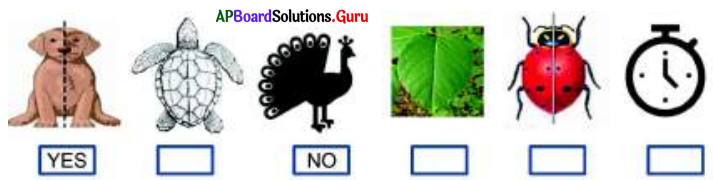
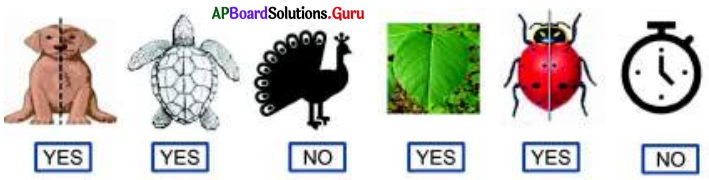
AP Board 7th Class Maths Solutions Chapter 11 Area of Plane Figures Ex 11.3

SCERT AP 7th Class Maths Solutions Pdf Chapter 11 Area of Plane Figures Ex 11.3 Textbook Exercise Questions and Answers.

AP State Syllabus 7th Class Maths Solutions 11th Lesson Area of Plane Figures Ex 11.3

Question 1.
The diameter of round table upper surface in Science lab is 70 cm. Find the area.
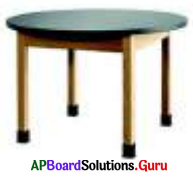
AP Board 7th Class Maths Solutions Chapter 11 Area of Plane Figures Ex 11.3 1
Answer:
Given diameter of table d = 70 cm
Radius of table r = [latex]\frac{\mathrm{d}}{2}[/latex] = [latex]\frac{70}{2}[/latex] = 35 cm
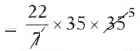
Area of the table = πr2
AP Board 7th Class Maths Solutions Chapter 11 Area of Plane Figures Ex 11.3 2
∴ Area of the round table = 3,850 sq.cm.

AP Board 7th Class Maths Solutions Chapter 11 Area of Plane Figures Ex 11.3

Question 2.
Radius of the circular shaped wall painting is 14 cm. Calculate the area of wall painting.
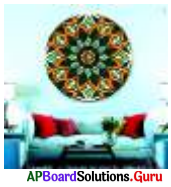
AP Board 7th Class Maths Solutions Chapter 11 Area of Plane Figures Ex 11.3 3
Answer:
Given radius of the wall painting
r = 14 cm
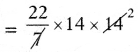
Area of the circle = πr2
= [latex]\frac{22}{7}[/latex] × 142
AP Board 7th Class Maths Solutions Chapter 11 Area of Plane Figures Ex 11.3 4
= 616
∴ Area of the wall painting = 616 sq.cm

Question 3.
If the area of circular shaped dart board is 1386 sq.cm. Find its radius and diameter.
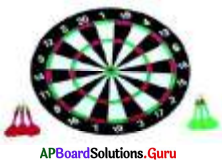
AP Board 7th Class Maths Solutions Chapter 11 Area of Plane Figures Ex 11.3 5
Answer:
Given the area of circular shaped dart board = 1386 sq.cm
Area of the circle = πr2 = 1386
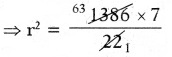
⇒ [latex]\frac{22}{7}[/latex] × r2 = 1386
⇒ 22 × r2 = 1386 × 7
AP Board 7th Class Maths Solutions Chapter 11 Area of Plane Figures Ex 11.3 6
⇒ r2 = 441 = 212
⇒ r2 = 212
∴ Radius of dart board r = 21 cm
Diameter of dart board d 2r
= 2 × 21
= 42 cm

AP Board 7th Class Maths Solutions Chapter 11 Area of Plane Figures Ex 11.3

Question 4.
Circumference of the circular shaped clock is 44 cm. Find the radius and surface area of the clock.
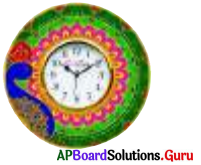
AP Board 7th Class Maths Solutions Chapter 11 Area of Plane Figures Ex 11.3 7
Answer:
Given the circumference of clock = 44 cm
⇒ 2πr = 44 cm
⇒ 2 × [latex]\frac{22}{7}[/latex] × r = 44
⇒ 44 × r = 44 × 7
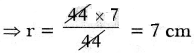
AP Board 7th Class Maths Solutions Chapter 11 Area of Plane Figures Ex 11.3 8
∴ Radius of the clock r = 7 cm
Surface area of the clock = πr2
= [latex]\frac{22}{7}[/latex] × 72
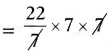
AP Board 7th Class Maths Solutions Chapter 11 Area of Plane Figures Ex 11.3 9
∴ Surface area of the clock = 154 sq.cm

AP Board 7th Class Maths Solutions Chapter 11 Area of Plane Figures Ex 11.3

Question 5.
The circumference of a circular shaped lawn in a park is 352 m. Find the area of the circular shaped lawn. If cost of grass per sq. m is ₹ 30, then find total cost of laying grass on lawn.
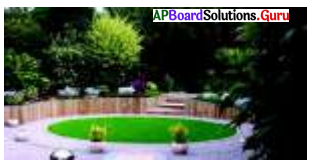
AP Board 7th Class Maths Solutions Chapter 11 Area of Plane Figures Ex 11.3 10
Answer:
Given the circumference of lawn = 352 m
⇒ 2πr = 352 m
⇒ 2 × [latex]\frac{22}{7}[/latex] × r = 352
⇒ 44r = 352 × 7 7
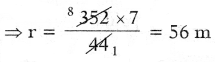
AP Board 7th Class Maths Solutions Chapter 11 Area of Plane Figures Ex 11.3 11
∴ Radius of the lawn r = 56 m
Area of the lawn = πr2
= [latex]\frac{22}{7}[/latex] × 562
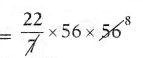
AP Board 7th Class Maths Solutions Chapter 11 Area of Plane Figures Ex 11.3 12
Area of the lawn = 9856 sq.m
Cost of grass per sq.m = ₹ 30
Cost of grass per 9856 sq.m = 9856 × 30
∴ Total cost of laying grass on lawn = ₹ 2,95,680
AP Board 7th Class Maths Solutions Chapter 11 Area of Plane Figures Ex 11.2

SCERT AP 7th Class Maths Solutions Pdf Chapter 11 Area of Plane Figures Ex 11.2 Textbook Exercise Questions and Answers.

AP State Syllabus 7th Class Maths Solutions 11th Lesson Area of Plane Figures Ex 11.2

Question 1.
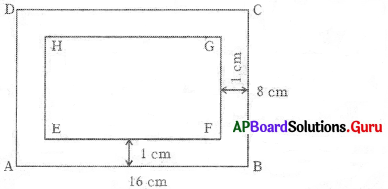
The length and breadth of the tablet are 16 cm, 8 cm respectively. It has a inner side black border of 1 cm width around the screen. Find the area of the black border.
Answer:
Given length of the tablet l = 16 cm
breadth b = 8 cm
Area of the tablet ABCD
= l × b
= 16 × 8
= 128 sq.cm
AP Board 7th Class Maths Solutions Chapter 11 Area of Plane Figures Ex 11.2 1
Width of border = 1 cm
Border running around the screen.
So, length of screen
l = 16 – 2 × width
= 16 – 2 × 1
= 16 – 2 = 14 cm
Breadth of screen
b = 8 – 2 × 1
= 8 – 2 = 6 cm
Area of the screen
= l × b
= 14 × 6
= 84 sq.cm
Area of the border = Area of the tablet – Area of screen
= 128 – 84
= 44 sq.cm
∴ Area of black border = 44 sq.cm.

AP Board 7th Class Maths Solutions Chapter 11 Area of Plane Figures Ex 11.2

Question 2.
Revanth has a rectangular lawn of length 45 m and breadth 20 m in his garden. He wants to do flooring 5 m along out-side the lawn for path. Find out the area of path. Find the cost of flooring at the rate ₹ 100 per sq.m.
Answer:
Given inner length of lawn l = 45 m
breadth b = 20 m
Inner area of lawn = l × b
= 45 × 20
= 900 sq.m
Width of the path = 5 m
Path is outside the lawn.
So, outer length of lawn
L = l + 2 × w
= 45 + 2 × 5
= 45 + 10 = 55 m
Breadth B = b + 2w
= 20 + 2 × 5
= 20 + 10 = 30 m
Outer area of lawn = l × b
= 55 × 30
= 1650 sq.m
Area of the path
= outer area – inner area
= 1650 – 900
= 750 sq.m.
Cost of flooring per sq.m = ₹ 100
∴ Cost of flooring per 750 sq.m
= 750 × 100 = ₹ 75,000/-

AP Board 7th Class Maths Solutions Chapter 11 Area of Plane Figures Ex 11.2

Question 3.
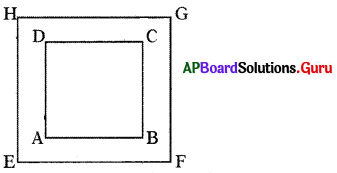
The surface of water pool is in the shape of a square whose side is 450 cm. Its exterior 20 cm width and the edge part is cemented along the side of the square. Find the area of that cemented part. Find cost for cementing if the rate is ₹ 15 per sq.cm.
Answer:
Given inner side of the pool (s) = 450 cm
Inner area of waterptool ABCD = s × s
= 450 × 450
= 202500 sq.cm
Width of the edge = 20 cm
AP Board 7th Class Maths Solutions Chapter 11 Area of Plane Figures Ex 11.2 2
Here path is running outside the pool.
So, outer side of the pool
(s) = s + 2 × w
= 450 + 2 × 20
= 450 + 40 = 490 cm
Outer area of waterpool EFGH
= s × s
= 490 × 490
= 2,40,100 sq.cm
Area of the edge
= Outer area – Inner area
= 240100 – 202500
Area of the path = 37,600 sq.cm
Cost of cementing per sq.cm = ₹ 15
∴ Cost of cementing per 37600 sq.cm
= 37,600 × 15
= ₹ 5,64,000

AP Board 7th Class Maths Solutions Chapter 11 Area of Plane Figures Ex 11.2

Question 4.
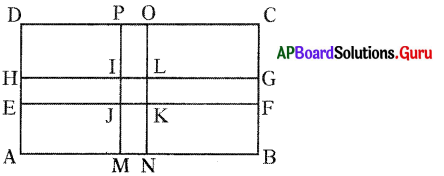
Two pathways parallel to the length and breadth have been constructed in the centre of the rectangular park whose length is 120 m and breadth is 90 m. If the width of each pathway is 15 m, find out expenditure of flooring on the pathway at the rate ₹ 80 per sq.m,

AP Board 7th Class Maths Solutions Chapter 11 Area of Plane Figures Ex 11.2 3
Answer:
In the figure ABCD is a rectangular park.
Length of ABCD = 120 m

Breadth of ABCD = 90 m
Width of path = 15 m
Area of EFGH = length × width
= 120 × 15
= 1800 sq.m
Area of MNOP = breadth × width
= 90 × 15
= 1350 sq.m
Area of common path = width × width
= 15 × 15
= 225 sq.m
AP Board 7th Class Maths Solutions Chapter 11 Area of Plane Figures Ex 11.2 4
Area of IJKL = 225 sq.m is included in both EFGH and MNOP paths. So, we subtract once.
Area of the path = Area of EFGH + Area of MNOP – Area of IJKL .
= 1800 + 1350 – 225
= 2925 sq.m
Cost of flooring per sq.m = ₹ 80
Cost of flooring per 2925 sq.m. = 2925 × 80
∴ Expenditure for path flooring = ₹ 2,34,000.

AP Board 7th Class Maths Solutions Chapter 11 Area of Plane Figures Ex 11.2

Question 5.
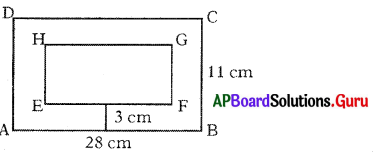
A photo frame of length 28 cm. and breadth 11 cm. has done decoration of 3 cm. along inside shown in the figure. Find the total area of decoration. If the cost of decoration is ₹ 2 per Sq.cm., find total cost of decoration.
Answer:
Given the length of frame ABCD = 28 cm
Breadth = 11 cm
Area of frame ABCD = l × b
= 28 × 11
= 308 sq.cm
Width of the decoration part = 3 cm
Decoration is tying inside the frame.
So, length of EFGH = l – 2 × width
= 28 – 2 × 3
= 28 – 6 = 22 cm
Breadth = b – 2 × width
= 11 – 2 × 3
= 11 – 6 = 5 cm
AP Board 7th Class Maths Solutions Chapter 11 Area of Plane Figures Ex 11.2 5
Area of frame EFGH = l × b
= 22 × 5
= 110 sq.cm
Area of the decoration part
= Area of ABCD – Area of EFGH
= 308 – 110
= 198 sq.cm
Cost of decoration per sq.cm = ₹ 2
Cost of decoration per 198 sq.cm = 198 × 2
∴ Total cost of decoration = ₹ 396.

AP Board 7th Class Maths Solutions Chapter 12 Symmetry InText Questions

SCERT AP 7th Class Maths Solutions Pdf Chapter 12 Symmetry InText Questions and Answers.

AP State Syllabus 7th Class Maths Solutions 12th Lesson Symmetry InText Questions

[Page No. 99]

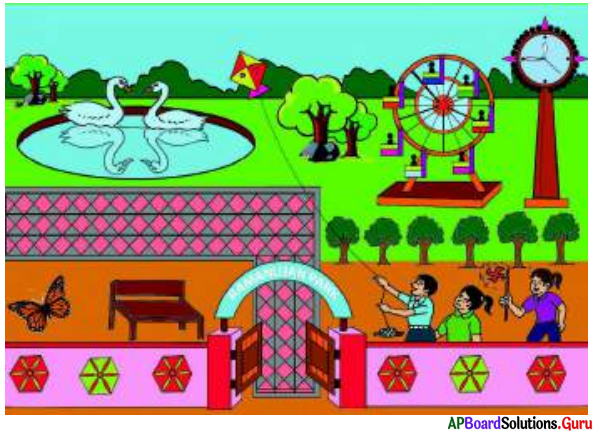
Look at the following picture and speak about what you have noticed regarding symmetry in the picture.
AP AP Board 7th Class Maths Solutions 12 Symmetry InText Questions 17th Class Maths Solutions 12 Symmetry InText Questions 1
Question 1.
What do you observe in this picture?
Ducks have symmetry.
Wall paintings have symmetry.
Butterfly has symmetry.
Clock tower and gaint wheels have symmetry.

Question 2.
Can you name the different shapes in picture?
Answer:
Hexagon, Circle, Rectangle, etc.

Question 3.
Which figures are looking attractive and beautiful? Why?
Answer:
Flooring, Gate arch and wall painting are beautiful as they have lines of symmetry.

AP Board 7th Class Maths Solutions Chapter 12 Symmetry InText Questions

Question 4.
Which figures are in symmetry?
Answer:
Ducks, wall paintings, gaint wheel and the clock tower have symmetry.

Question 5.
Can you draw line(s) of symmetry for them?
Answer:
Yes.

[Page No. 100]

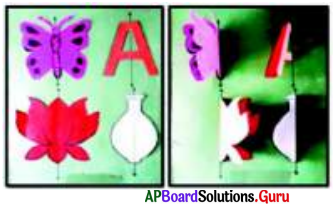
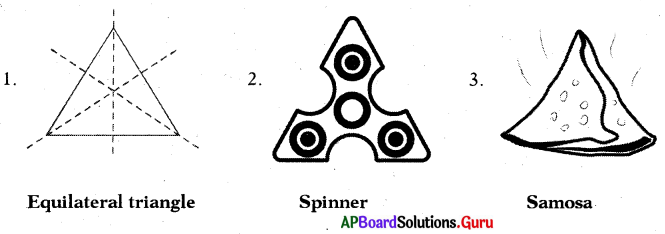
Look at the following figures. If we fold them exactly to their equal halves, one half of each figure exactly coincides with other half.
AP Board 7th Class Maths Solutions 12 Symmetry InText Questions 2
Question 1.
What do we call such figures?
Answer:
Symmetric figures or shapes.

Question 2.
What do we call the line along which we fold the figures so that, one half coincides with the other?
Answer:
Line of symmetry.

Let’s Explore [Page No.102]

Question 1.
Find relation between the number of sides of regular polygon and its lines of symmetry.
Answer:
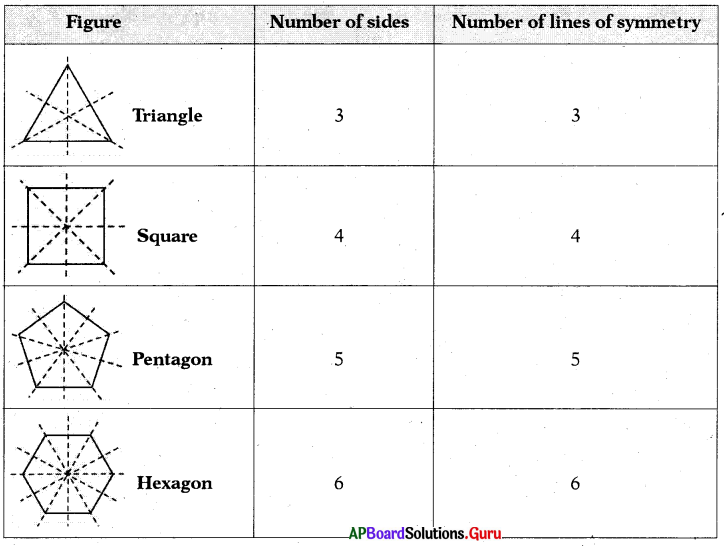
AP Board 7th Class Maths Solutions 12 Symmetry InText Questions 3
From the above table, we conclude that the number of sides of a regular polygon is equal to its number of lines of symmetry.

AP Board 7th Class Maths Solutions Chapter 12 Symmetry InText Questions

Question 2.
How many lines of symmetry can be drawn to a circle?
Answer:
Number of lines of symmetry can be drawn to a circle are infinite.

Let’s Think [Page No. 103]

Question 1.
Draw any three shapes basing on below sentences :
(i) no line of symmetry
Answer:
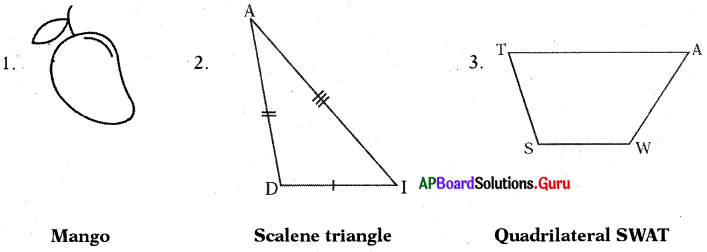
AP Board 7th Class Maths Solutions 12 Symmetry InText Questions 4

(ii) one line of symmetry
Answer:
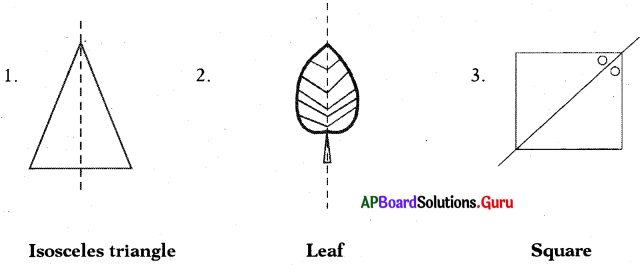
AP Board 7th Class Maths Solutions 12 Symmetry InText Questions 5

(iii) two lines of symmetry
Answer:
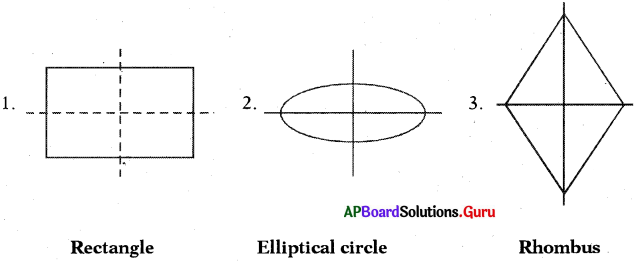
AP Board 7th Class Maths Solutions 12 Symmetry InText Questions 6

(iv) three lines of symmetry
Answer:
AP Board 7th Class Maths Solutions 12 Symmetry InText Questions 7

Check Your Progress [Page No. 105]

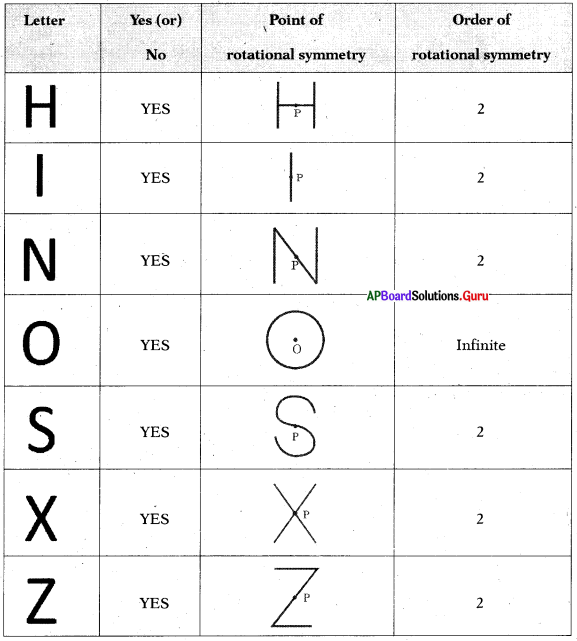
Find whether the following letters of the English alphabet have rotational symmetry or not. If yes, find the point of rotational symmetry (approximately), and also order of rotational symmetry.
AP Board 7th Class Maths Solutions 12 Symmetry InText Questions 8
Answer:
AP Board 7th Class Maths Solutions 12 Symmetry InText Questions 9

Check Your Progress [Page No. 107]

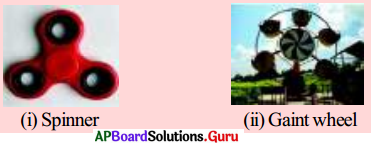
Look at the following pictures and write their angle of symmetry and order of symmetry.
AP Board 7th Class Maths Solutions 12 Symmetry InText Questions 10
Answer:
(i) Spinner: Angle of symmetry = 120°
Order of symmetry = 3

(ii) Gaint wheel : Angle of symmetry = 60°
Order of symmetry = 6

AP Board 7th Class Maths Solutions Chapter 12 Symmetry InText Questions

[Page No. 108]

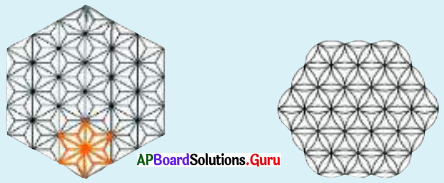
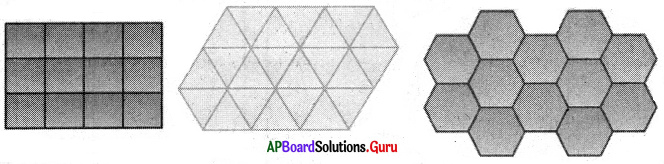
Tesselations: The majority of the objects what we use in daily life have atleast one type of symmetry. Most of the machine made products are symmetric.

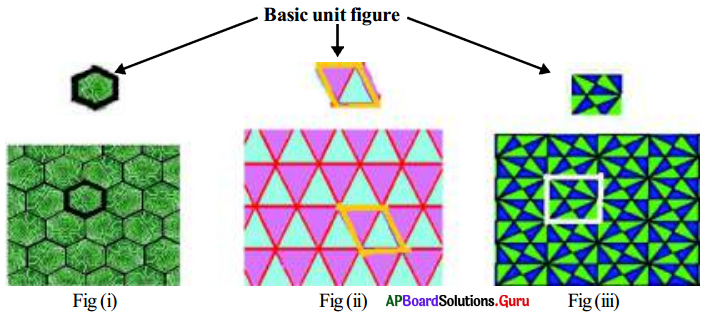
Observe these patterns :
AP Board 7th Class Maths Solutions 12 Symmetry InText Questions 11
(i) Where do you see these?
Answer:
We see these patterns in floor designs and fabric painting etc.

(ii) How these patterns are formed? Are they symmetric as whole?
Does the basic figure which is used to form the tessellations symmetric?
Answer:
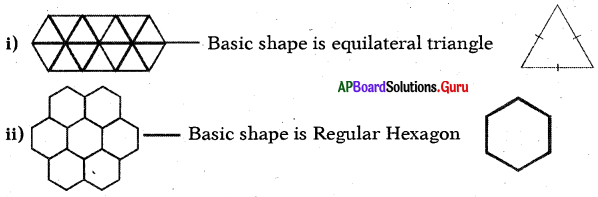
You can observe that only some patterns have symmetry as a whole as in fig(i) and (ii), through the basic figures/unit figures are symmetric. Observe the fig(iii). You may notice that the two shapes can observe as ‘Basic or unit figures’ which is square or hexagon used to draw tessellation.

Usually, these patterns are formed by arranging congruent figures side by side in all the directions to spread upon an area without any overlaps or gaps. This is called tessellation. This enhances the beauty of the diagrams.

Let’s Explore [Page No. 109]

Fill the following with different colours to get beautiful tessellation patterns.
AP Board 7th Class Maths Solutions 12 Symmetry InText Questions 12
Answer:
Not needed.
Student should colour it on his own.

Let’s Explore [Page No. 109]

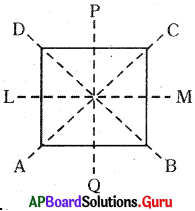
Construct a square having side 3cm. Draw all possible lines of symmetry. (Steps of construction is not necessary)
Answer:
AP Board 7th Class Maths Solutions 12 Symmetry InText Questions 13

  1. Let ▢ABCD be the square with side 3 cm.
  2. AC, BD, LM and PQ are lines of symmetry.

Examples:

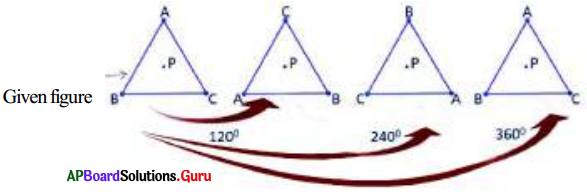
Question 1.
If an equilateral triangle ABC is rotated through 360° about the point of rotation ‘P’ (i.e., point of intersection of angle bisectors), it attains the original form three times upon rotation through 120°, 240° and 360° as shown below.
Answer:
AP Board 7th Class Maths Solutions 12 Symmetry InText Questions 14
Clearly, the above figure possesses a rotational symmetry of order 3.

AP Board 7th Class Maths Solutions Chapter 12 Symmetry InText Questions

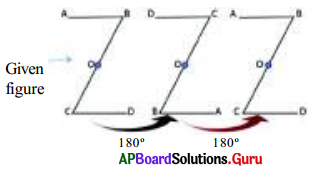
Question 2.
While rotating the following figure through 360° about the point ‘O’ (mid-point of BC), it attains the original form twice (upon rotation through 180° and 360°) as shown below.
Answer:
AP Board 7th Class Maths Solutions 12 Symmetry InText Questions 15
Clearly, the above given figure possesses a rotational symmetiy of order 2.

Question 3.
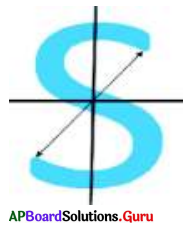
Check whether the letter ‘S’ has point symmetry.
AP Board 7th Class Maths Solutions 12 Symmetry InText Questions 16
Answer:
Yes, it has a point symmetry.
Because, in the given figure, we have
i) Every part of the letter has a matching part are at the same distance from the central point.
ii) The part of the alphabet and its matching part are in the opposite direction.

[Page No- 111]

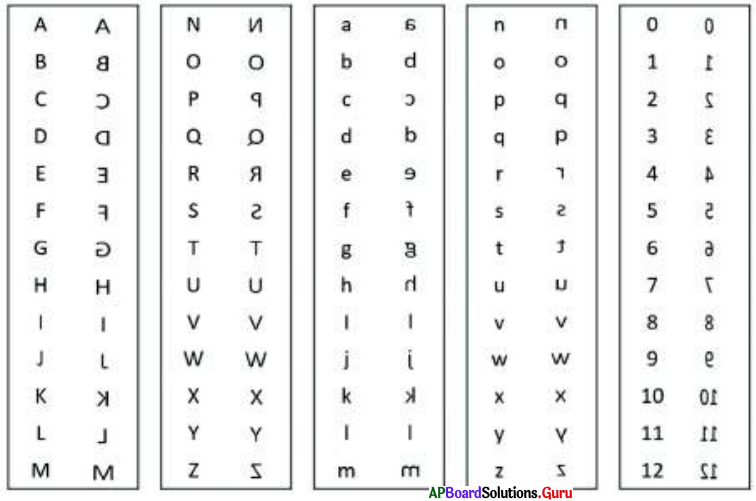
The image of an object as seen in a mirror is known as mirror image./In mirror image of an object, right side of the object appears at left side and vice versa. There are some objects whose mirror images are identical to the objects. For example, 11 capital English alphabets whose mirror images remain unchanged. They are A, H, I, M, O, T, U, V, W, X and Y.

Mirror Images of English Alphabets and some numbers :
AP Board 7th Class Maths Solutions 12 Symmetry InText Questions 17

Practice Questions [Page No. 112]

Choose the correct mirror image of the given words.

Question 1.
LATERAL
AP Board 7th Class Maths Solutions 12 Symmetry InText Questions 18
Answer:
(b)

Question 2.
QUANTITATIVE
AP Board 7th Class Maths Solutions 12 Symmetry InText Questions 19
Answer:
(d)

Question 3.
JUDGEMENT
AP Board 7th Class Maths Solutions 12 Symmetry InText Questions 20
Answer:
(c)

AP Board 7th Class Maths Solutions Chapter 12 Symmetry InText Questions

Question 4.
EMANATE
AP Board 7th Class Maths Solutions 12 Symmetry InText Questions 21
Answer:
(b)

Question 5.
KALINGA261B
AP Board 7th Class Maths Solutions 12 Symmetry InText Questions 22
Answer:
(d)

Question 6.
COLONIAL
AP Board 7th Class Maths Solutions 12 Symmetry InText Questions 23
Answer:
(d)

Question 7.
BR4AQ16HI
AP Board 7th Class Maths Solutions 12 Symmetry InText Questions 24
Answer:
(a)

Question 8.
R4E3N2U
AP Board 7th Class Maths Solutions 12 Symmetry InText Questions 25
Answer:
(c)

Question 9.
DL3N469F
AP Board 7th Class Maths Solutions 12 Symmetry InText Questions 26
Answer:
(b)

Question 40.
MIRROR
AP Board 7th Class Maths Solutions 12 Symmetry InText Questions 27
Answer:
(d)

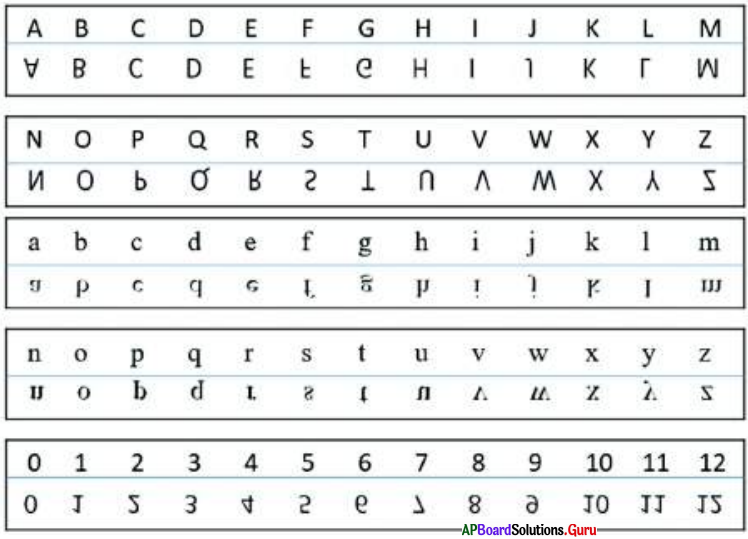
Water images [Page No. 112]

The reflection of an object as seen in water is known , as water image. The upper part of the object seen downward and vice-versa. There a re some objects whose water images are identical to the objects. For example, 9 cap ital English alphabets given below, whose water images remain unchanged. They ar e B, C, D, E, H, I, K, O and X.
AP Board 7th Class Maths Solutions 12 Symmetry InText Questions 28

AP Board 7th Class Maths Solutions Chapter 12 Symmetry InText Questions

Practice Questions [Page No. 113]

Choose the correct water image of the given words.

Question 1.
KICK
AP Board 7th Class Maths Solutions 12 Symmetry InText Questions 29
Answer:
(d)

Question 2.
UPKAR
AP Board 7th Class Maths Solutions 12 Symmetry InText Questions 30
Answer:
(a)

Question 3.
KID
AP Board 7th Class Maths Solutions 12 Symmetry InText Questions 31
Answer:
(b)

Question 4.
SUBHAM
AP Board 7th Class Maths Solutions 12 Symmetry InText Questions 32
Answer:
(c)

Question 5.
CHIDE
AP Board 7th Class Maths Solutions 12 Symmetry InText Questions 33
Answer:
(d)

Question 6.
HIKE
AP Board 7th Class Maths Solutions 12 Symmetry InText Questions 34
Answer:
(a)

Question 7.
COT5E
AP Board 7th Class Maths Solutions 12 Symmetry InText Questions 35
Answer:
(a)

AP Board 7th Class Maths Solutions Chapter 12 Symmetry InText Questions

Question 8.
ab45CD67
AP Board 7th Class Maths Solutions 12 Symmetry InText Questions 36
Answer:
(b)

Question 9.
abc
AP Board 7th Class Maths Solutions 12 Symmetry InText Questions 37
Answer:
(a)

Question 10.
01234
AP Board 7th Class Maths Solutions 12 Symmetry InText Questions 38
Answer:
(a)

Mirror image of the clock [Page No. 114]

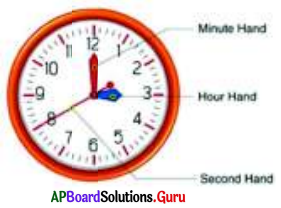
1. A clock is a device provided with three hands an hour hand, minute hand and second hand.
Hours hand also known as short hand and minutes hand is also known as long hand.
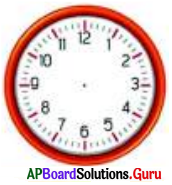
AP Board 7th Class Maths Solutions 12 Symmetry InText Questions 39

2. The face of the clock is divided into 12 equal divisions.
The angular space between any two consecutive divisions has further divided into five more divisions.
AP Board 7th Class Maths Solutions 12 Symmetry InText Questions 40
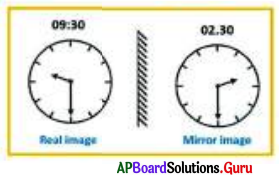
Let us observe the following images of a clocks and their mirror images :
Case I: To find the time in the mirror image subtract the actual time from 11 hours 60 minutes.
AP Board 7th Class Maths Solutions 12 Symmetry InText Questions 41
Example 1:
If actual time in clock is 9 hours 30 minutes then, what is’the time shown in mirror?
Answer:
11 hrs 60 min – 09 hrs 30 min – 2 hrs 30 min

AP Board 7th Class Maths Solutions Chapter 12 Symmetry InText Questions

Example 2 :
If actual time in clock is 7 hours, then what is the time shown in mirror?
Answer:
11 hrs 60 min – 07 hrs 00 min = 4 hrs 60 min = 5 hrs (1 hour — 60 minutes)

Case II : If the time in clock is between 12 hrs and 01 hr then to find the time in the mirror image subtract the actual time from 23 hr 60 min.
Example :
If actual time in clock is 12 hours T5 minutes, then what is the time shown in mirror?
Answer:
23 hrs 60 min — 12 hrs 15 min =11 hrs 45 min

Practice Questions [Page No. 114]

Choose the correct mirror image of the given words.

Question 1.
If actual time in dock is 06 hours 10 minutes, then what is the time shown in mirror?
(a) 3 hr:s 50 min
(b) 4 hrs 50 min
(c) 5 hrs 50 min
(d) 6 hrs 50 min
Answer:
(c) 5 hrs 50 min

Question 2.
If actual time in clock is 03 hours 54 minutes, then what is the time shown in mirror?
(a) 8 hrs 06 min
(b) 9 hrs 06 min
(c) 8 hrs 54 min
(d) 9 hrs 54 min
Answer:
(a) 8 hrs 06 min

Question 3.
If actual time in clock is 08 hours 26 minutes, then what is the time shown in mirror?
(a) 6 hrs 34 min
(b) 3 hrs 34 min
(c) 1 hr 34 min
(d) 3 hrs 36 min
Answer:
(b) 3 hrs 34 min

AP Board 7th Class Maths Solutions Chapter 12 Symmetry InText Questions

Question 4.
If actual! time in clock is 4 hours, then what is the time shown in mirror?
(a) 7 hrs
(b) 7 hrs 30 min
(c) 8 hrs
(d) 8 hrs 30 min
Answer:
(c) 8 hrs

Question 5.
If actual time in dock is 10’o clock, then what is the time shown in mirror?
(a) 2 hrs
(b) 3 hrs
(c) 4 hrs
(d) 5 hrs
Answer:
(a) 2 hrs

Question 6.
If the time shown in mirror is 10 hours 05 minutes, then what is the actual time in clock?
(a) 1 hrs 55 min
(b) 1 hrs 35 min
(c) 1 hrs 25 min
(d) 12 hrs 15 min
Answer:
(a) 1 hrs 55 min

Question 7.
If the time shown in mirror is 02 hours 47 minutes, then what is the actual time in clock?
(a) 6 hrs 13 min
(b) 7 hrs 13 min
(c) 8 hrs 13 min
(d) 9 hrs 13 min
Answer:
(d) 9 hrs 13 min

Question 8.
If actual time in clock is 11 hours 45 minutes, then what is the time shown in mirror?
(a) 1 hrs 15 min
(b) 3 hrs 15 min
(c) 6 hrs 15 min
(d) 12 hrs 15 min
Answer:
(d) 12 hrs 15 min

Question 9.
If actual time in clock is 12 hours 45 minutes, then what is the time shown in mirror?
(a) 9 hrs 15 min
(b) 10 hrs 15 min
(c) 11 hrs 15 min
(d) 12 hrs 15 min
Answer:
(c) 11 hrs 15 min

AP Board 7th Class Maths Solutions Chapter 12 Symmetry InText Questions

Question 10.
If actual time in clock is 12 hours 12 minutes, then what is the time shown in mirror?
(a) 11 hrs 42 min
(b) 11 hrs 48 min
(c) 10 hrs 48 min
(d) 12 hrs 42 min
Answer:
(b) 11 hrs 48 min

AP 7th Class Social Important Questions 4th Lesson Delhi Sultanate

These AP 7th Class Social Important Questions 4th Lesson Delhi Sultanate will help students prepare well for the exams.

AP Board 7th Class Social 4th Lesson Important Questions and Answers Delhi Sultanate

Question 1.
What is History?
Answer:
History is considered as the record of the past factual events.

Question 2.
Why do we study history?
Answer:
We have to study history as it reveals how the’people lived in that society, their rules and regulations, cultures and traditions in a chronological order i.e., from past to present.

Question 3.
What are the sources of history?
Answer:
The sources of history are classified into two categories.
They are :

  1. Archeological sources and
  2. Literary sources.

AP 7th Class Social Important Questions 4th Lesson Delhi Sultanate

Question 4.
Examples of Archeological sources.
Answer:
Coins, inscriptions, monuments, rock edicts etc.

Question 5.
Examples of Literary sources.
Answer:
Epics, poems, books etc.

Question 6.
Into how many periods Indian history divided?
Answer:
Indian history was divided into 3 parts ;

  1. Ancient history – up to 8th century C.E.
  2. Medieval history – 8th to 18th century C.E.
  3. Modern history – From 18th century C.E onwards….

Question 7.
Who is the first and last woman ruler of Delhi Sultanate?
Answer:
Razia Sultana

Question 8.
When did Prudhviraj Chauhan was defeated?
Answer:
Prudhvi Raj Chauhan was defeated by Md. Ghori in 1192 A.D.

Question 9.
What is the another name of Slave dynasty?
Answer:
Mamluk.

Question 10.
Who was the founder of Slave dynasty?
Answer:
Qutbuddin Aibak.

Question 11.
Who started the construction of Qutub Minar?
Answer:
Qutubuddin Aibak.

AP 7th Class Social Important Questions 4th Lesson Delhi Sultanate

Question 12.
Who completed the construction of Qutub Minar?
Answer:
Iltutmish.

Question 13.
When did Timur invaded India?
Answer:
1398 AD

Question 14.
Who introduced market reforms?
Answer:
Alauddin Khilji

Question 15.
Who was the famour leader of Mongols?
Answer:
Chengiz Khan.

Question 16.
Who is known as mad-man in Indian history?
Answer:
Muhammad-Bin-Tughlaq

Question 17.
Who introduced copper coins?
Answer:
Muhammad-Bin-Tughlaq.

Question 18.
Who was the founder of Sayyid Dynasty?
Answer:
KhizrKhan.

Question 19.
Who was the founder of Lodi Dynasty?
Answer:
Bahalul Lodi.

Question 20.
Who was supreme in all aspects of administration?
Answer:
The Sultan was supreme in all aspects of administration.

Question 21.
Who introduced Bandagan System?
Answer:
Iltutmish.

AP 7th Class Social Important Questions 4th Lesson Delhi Sultanate

Question 22.
Who were the famour scholars of Sultanate period?
Answer:
Alberuni, Amir Khusrav, Zia-ud-din-Barani.

AP Board 7th Class Social 4th Lesson 1 Mark Bits Questions and Answers Delhi Sultanate

I. Multiple Choice Questions

1. History means
A) Present events
B) Future events
C) Past events
D) None of the above
Answer:
C) Past events

2. Who was the founder of slave dynasty?
A) Aibak
B) Iltutmish
C) Sultana
D) Balban
Answer:
A) Aibak

3. Who was the founder of Khilji dynasty?
A) Alauddin Khilji
B) Mubarak Khilji
C) Jalaluddin Khilji
D) None of the above
Answer:
C) Jalaluddin Khilji

4. Who was the founder of Tughlaq dynasty?
A) Ghiyasuddin Tughlaq
B) Md Bin Tughlaq
C) Firoz shah Tughlaq
D) None of the above
Answer:
A) Ghiyasuddin Tughlaq

5. Who is the last ruler of Lodi dynasty?
A) Bahlul Lodi
B) Ibrahim Lodi
C) Kizar Khan
D) Nonfe of the above
Answer:
B) Ibrahim Lodi

6. Slave dynasty was established in
A) 1191 CE
B) 1206 CE
C) 1311 CE
D) 1208 CE
Answer:
B) 1206 CE

AP 7th Class Social Important Questions 4th Lesson Delhi Sultanate

7. The Slave dynasty came to an end during reign of
A) Razia Sultana
B) Qaiqubad
C) Balban
D) Iltutmish
Answer:
B) Qaiqubad

8. The first and last Muslim woman ruler
A) Razia Sultana
B) Rani Rudrama devi
C) Jhansi lakshmi bhai
D) None of the above
Answer:
A) Razia Sultana

9. The administrative period of Razia Sultana
A) 1100 to 1135 CE
B) 1200 to 1210 CE
C) 1236 to 1239 CE
D) 1249 to 1261 CE
Answer:
C) 1236 to 1239 CE

10. Jalaluddin Khilji was assassinated by
A) Md-Bin-Tughluq
B) Balban
C) Alauddin Khilji
D) Timur
Answer:
C) Alauddin Khilji

11. Who is the commander of Allauddin Khilji?
A) MalikKafur
B) Firoz Shan
C) Timur
D) Mubarak Shah
Answer:
A) MalikKafur

12. Alauddin Khilji was died in
A) 1306 CE
B) 1311 CE
C) 1316 CE
D) 1526 CE
Answer:
C) 1316 CE

13. Market reforms were introduced by
A) Ghiyasuddin Tughlaq
B) Jalaluddin Khilji
C) Allauddin Khilji
D) Timur
Answer:
C) Allauddin Khilji

14. Mongol empire was established in
A) 1202 CE
B) 1206 CE
C) 1210 CE
D) 1215 CE
Answer:
B) 1206 CE

AP 7th Class Social Important Questions 4th Lesson Delhi Sultanate

15. Who united the Mongols?
A) Chengiz Khan
B) Fazullah Khan
C) Mahammad Bin Tughlaq
D) Firoz Shah Tughlaq
Answer:
A) Chengiz Khan

16. He was proficient in philosophy, maths, astronomy etc., who is he?
A) Balban
B) Raziya Sultana
C) Muhammad Bin Tughlaq
D) Chengiz Khan
Answer:
C) Muhammad Bin Tughlaq

17. Muhammad Bin Tughlaq changed the capital from Delhi to
A) Devagiri
B) Patna
C) Amaravathi
D) Vijayanagar
Answer:
A) Devagiri

18. Who is the last ruler of Sayyid Dynasty?
A) KhizarKhan
B) AlamShah
C) Mubarak Shah
D) Muhammad Shah
Answer:
B) AlamShah

19. Timur invaded India in
A) 1206 CE
B) 1191 CE
C) 1398 CE
D) 1456 CE
Answer:
C) 1398 CE

20. Delhi Sultanate was divided into
A) Iqtas
B) States
C) Districts
D) Countries
Answer:
A) Iqtas

21. The tillers had to pay of their produce as land revenue
A) 1/4th
B) 1/3rd
C) 1/5th
D) 1/6th
Answer:
B) 1/3rd

22. Tanka means
A) Diamond
B) Platinum
C) Gold
D) Silver
Answer:
D) Silver

23. Jital means
A) Gold
B) Silver
C) Copper
D) Brass
Answer:
C) Copper

24. Tarikh Al – Hind was written by
A) Alberuni
B) Amir Khusrav
C) Abul Fazal
D) Surdas
Answer:
A) Alberuni

25. Tuti – e – Hind was written by
A) Abul Fazal
B) Amir Khusrav
C) Timur
D) Barani
Answer:
B) Amir Khusrav

AP 7th Class Social Important Questions 4th Lesson Delhi Sultanate

26. The First battle of Panipat was brokeout in
A) 1509 AD
B) 1526 AD
C) 1545 AD
D) 1551 AD
Answer:
B) 1526 AD

II. Intext – Bits – Fill in the Blanks

1. Tomar Rajputs built …………… and made it capital of their kingdom.
2. The Turkish invasions of India in the early …………… century.
3. Muhammad Ghori defeated Prithviraj Chauhan at Tarain …………… in C.E.
4. The Slave dynasty was established by …………… .
5. …………… was his (Qutbuddin Aibak) capital.
6. Iltutmish was succeeded by his daughter …………… .
7. …………… was the only woman ruler of Delhi Sultantate.
8. …………… was the founder of Khilji dynasty.
9. Jalaluddin Khilji was assasinated by …………… .
10. Allauddin Khilji recruited and organised a …………… .
11. Mangols conducted several invasions into India from …………… to …………… .
12. Mahammad bin Tughlaq and Firozshah Tughlaq were …………… rulers.
13. ……………, the ruler of Central Asia.
14. Muhammad bin Tughluq changed the capital from Delhi to …………… .
15. …………… the last ruler of Lodi dynasty.
16. Delhi Sultanate was divided into …………… .
17. The governors of Iqtas were called …………… .
18. Rank of Muqti was not …………… .
19. The Muslim Community had two branches, foreign and …………… .
20. …………… was the main occupation.
21. Qutub Minar was built in the premises of …………… .
22. Alai Darwaja was built by …………… .
23. The Timurs invasion in …………… CE.
Answer:

  1. Dhillika (or) Dhillikapura
  2. 11th
  3. 1192
  4. Qutubuddin
  5. Lahore
  6. Razia Sultana
  7. Raziya Sultana
  8. Jalaluddin Khilji
  9. Alauddin Khilji
  10. Standing Army
  11. 1221 CEto 1368 CE
  12. Prominent
  13. Timur
  14. Devagiri
  15. Ibrahim Lodi
  16. Iqtas (provinces)
  17. Muqtis
  18. hereditary
  19. local
  20. Agriculture
  21. Quwwat-ul-Islam Masjid
  22. Alauddin Khilji
  23. 1398 CE

III. Match the following

1.

Group-A Group-B
1. Balban A) Sayyid Dynasty
2. Alauddin Khilji B) Slave Dynasty
3. Firuz Shah Tughlaq C) Lodi Dynasty
4. KhizarKhan D) Khilji Dynasty
5. BahlulLodi E) Tughlaq Dynasty

Answer:

Group-A Group-B
1. Balban B) Slave Dynasty
2. Alauddin Khilji D) Khilji Dynasty
3. Firuz Shah Tughlaq E) Tughlaq Dynasty
4. KhizarKhan A) Sayyid Dynasty
5. BahlulLodi C) Lodi Dynasty

2.

Group-A Group-B
1. Qutub Minar A) The Parrot of India
2. Alai Darwaja B) Muhammad Ghazini
3. Alberuni C) Qutubuddin Aibaq
4. Amir Khusrav D) Alauddin Khilji

Answer:

Group-A Group-B
1. Qutub Minar C) Qutubuddin Aibaq
2. Alai Darwaja D) Alauddin Khilji
3. Alberuni B) Muhammad Ghazini
4. Amir Khusrav A) The Parrot of India

3.

Group-A Group-B
1. 1526 A) Panipat
2. 1398 B) Timur
3. Jital C) Copper Coin
4. Alberuni D) Ghazini
5. Amir Khusru E) The Parrot of India

Answer:

Group-A Group-B
1. 1526 A) Panipat
2. 1398 B) Timur
3. Jital C) Copper Coin
4. Alberuni D) Ghazini
5. Amir Khusru E) The Parrot of India

Do You Know?

7th Class Social Textbook Page No. 50

Periods in Indian History
Ancient History : Up to 8th Century C.E.
Medieval History : 8th to 18th Century C.E.
Modern History : 18th Century C.E. onwards

7th Class Social Textbook Page No. 52

Mamluk means Owned slave.

7th Class Social Textbook Page No. 53

Mongolians :
Mongolia was ruled over by several Nomads during the ancient times. Chengiz Khan united the Mongols and established the Mongol Empire in the year 1206 C.E. During the rule of Delhi Sultans, Mangols conducted several invasions into India from 1221 to 1368 C.E.

7th Class Social Textbook Page No. 55

AP 7th Class Social Important Questions 4th Lesson Delhi Sultanate 1
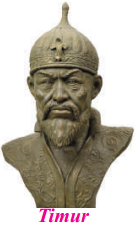
1398 A.D. – Timur invaded India and captured Delhi during the Tuglakan rule. It was a barbarous attack. Total country was plundered in the grip of terror Many constructions were destroyed. He plundered the wealth from India. It took nearly a century to reshape Delhi. These paved a way to Babur’s invasion on India and establishment of Mughal rule.

Chihalgani :
The administrative support system initiative by Iltutmish with the help of Turkish nobles. This was known as Turkan-I-Chahalagani or Chalisa. This helped to supress his opponent nobles.

7th Class Social Textbook Page No. 57

AP 7th Class Social Important Questions 4th Lesson Delhi Sultanate 2

7th Class Social Textbook Page No. 58

AP 7th Class Social Important Questions Chapter 4 ఢిల్లీ సుల్తానులు 5
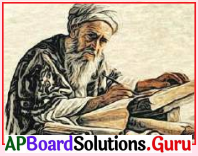
Alberuni, an Arabic and Persian scholar was patronized by Muhammad Ghazini. He learnt Sanskrit and translated some of its works into Arabic. He was impressed by the Upanishads and the Bhagavad-Gita. Tarikh Al-Hind (History of India) was written by him.

AP 7th Class Social Important Questions Chapter 4 ఢిల్లీ సుల్తానులు 6
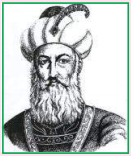
Amir Khusrau was a Persian poet and a great singer. He wrote many couplets and he was known as ‘Tuti-e-Hind’ (The Parrot of India).

AP 7th Class Social Important Questions 3rd Lesson Learning Through Maps

These AP 7th Class Social Important Questions 3rd Lesson Learning Through Maps will help students prepare well for the exams.

AP Board 7th Class Social 3rd Lesson Important Questions and Answers Learning Through Maps

Question 1.
What are the uses of maps?
Answer:
Maps make our travel easier and accurate iri guiding us.towards the destination. They help us to know the details of a place.

Question 2.
Who discovered America?
Answer:
Amerigo Vespucci discovered America.

Question 3.
Who discovered sea route to India?
Answer:
Vosco da gama discovered sea route to India in 1498 A.D.

AP 7th Class Social Important Questions 3rd Lesson Learning Through Maps

Question 4.
Define map.
Answer:
A map is a symbolic representation of selected characteristics of a place, usually drawn on a flat surface.

Question 5.
What do you mean by the term the scale of the map?
Answer:
The scale of the map is the ratio between the actual distance on the ground and the distance shown on the map. Ex : 1 cm : 10 kms.

Question 6.
Mention the types of scales.
Answer:

  1. Statement scale
  2. Graphical scale
  3. Representation function

Question 7.
What is conventional symbol?
Answer:
The various features shown on a map as symbols are represented by conventional signs or symbols used by the Survey of India.

Question 8.
Define Patterns.
Answer:
Patterns are special provisions used in the map to describe the variable information of a particular theme.

Question 9.
How are latitudes and longitudes useful in the map?
Answer:
They are also useful to guess the climate and local time of a place as a part of map reading. These provide the basic information in identifying the location of a place.

Question 10.
Classification of maps based on ………….
Answer:
Scale, theme and content in the map.

Question 11.
What are cardinal directions?
Answer:
North, East, West, South are four major directions. They are called cardinal directions.

AP 7th Class Social Important Questions 3rd Lesson Learning Through Maps

Question 12.
What are intermediate directions?
Answer:

  1. North – East
  2. North – West
  3. South – East
  4. South – West are the intermediate directions.

Question 13.
What are the elements of map?
Answer:

  1. Title
  2. Directions
  3. Scale
  4. Conventional symbols
  5. Colours
  6. Patterns

Question 14.
Name different types of maps.
Answer:

  1. Political Maps
  2. Physical maps ,
  3. Thematic map and
  4. Historical Maps

Question 15.
What does a political map shows?
Answer:
A political map shows the administrative units, neighbouring countries, boundaries, capitals etc.

Question 16.
What does a physical map show?
Answer:
A physical map shows the information about the physical features of a place like mountain ranges, hills, plateaus, plains, rivers, deserts, lakes, high lands etc.

Question 17.
What are Contour lines?
Answer:
The imaginary lines that connect the places of equal heights are known as Contour lines.

Question 18.
What are thematic maps?
Answer:
Maps that are prepared for a special purpose or on the theme are called thematic maps.

Question 19.
What are Historical maps?
Answer:
The map that shows historical details are known as historical maps.

AP 7th Class Social Important Questions 3rd Lesson Learning Through Maps

Question 20.
How many states and union territories are there in India?
Answer:
There are 28 states and 8 union territories.

AP Board 7th Class Social 3rd Lesson 1 Mark Bits Questions and Answers Learning Through Maps

I. Multiple Choice Questions

1. Who discovered America?
A) Amerigo Vespucci
b) Vasco da Gama
C) Alexander
D) Copernicus
Answer:
A) Amerigo Vespucci

2. Who discovered sea route to India?
A) Columbus
B) Magellan
C) Vasco da Gama
D) Amerigo vespucci
Answer:
C) Vasco da Gama

3. The first person who voyaged across the globe
A) Columbus
B) Magellan
C) Al ldrisi
D)None
Answer:
B) Magellan

4. In which year Vasco da Gama discovered sea route to India.
A) 1500 B.C
B) 1490 A.D.
C) 1498 A.D
D)1498 B.C
Answer:
C) 1498 A.D

5. Who used clay tablets as maps?
A) Indians
B) Americans
C) Sumerians, Babylonians
D) Portuguese
Answer:
C) Sumerians, Babylonians

AP 7th Class Social Important Questions 3rd Lesson Learning Through Maps

6. Who introduced latitudes 8t longitudes into map making?
A) The French
B) The Portuguese
C) The British
D) The Greeks
Answer:
D) The Greeks

7. Who introduced “Projection” method in map making?
A) Ptolemy
B) Herodotus
C) Gerardus Mercator
D) Hecataeus
Answer:
C) Gerardus Mercator

8. Who prepare the maps arranging from West to East?
A) The Greeks
B) The Portuguese
C) The French
D) The British
Answer:
A) The Greeks

9. Map makers are called ….
A) Stenographers
B) Cartographers
C) Photographers
D) Choreographers
Answer:
B) Cartographers

10. The area of India is …………..
A) 2.4 million sq.km
B) 3.4 million sq.km
C) 3.28 million sq.km
D) 4.5 million sq.km
Answer:
C) 3.28 million sq.km

AP 7th Class Social Important Questions 3rd Lesson Learning Through Maps

11. The Latitude extent of India is
A) 8°4′ to 37°6′ N
B) 9°5′ to 45°7′ N
C) 10°4‘ to 15°7′ N
D) 12°4’to 15°6’n
Answer:
A) 8°4′ to 37°6′ N

12. The longitude extent of India is
A) 68°7′ to 97°25′ E
B) 84°9′ to 95° 9′ E
C) 77° to 84° E
D) 80° to 84° E
Answer:
A) 68°7′ to 97°25′ E

13. According to area, India occupies place in the world.
A) 1st place
B) 2nd
C) 3rd
D) 7th
Answer:
D) 7th

14. The dark grey colour shows
A) MSL
B) Plains
C) Mountains
D) Plateaus
Answer:
C) Mountains

15. The blue shade shows
A) Waterbodies
B) Plains
C) Mountains
D) None
Answer:
A) Waterbodies

16. As per Height Green shade shows
A) Plateaus
B) Seas
C) Mountains
D) Plains
Answer:
D) Plains

17. ……. is a line joining the places with …………. equal heights.
A) Plain
B) Contour line
C) Hill
D) Plateau
Answer:
B) Contour line

18. Find the odd one out.
A) Title
B) Verbal scale
C) Linear scale
D) RF
Answer:
A) Title

19. AP 7th Class Social Important Questions 3rd Lesson Learning Through Maps 1 this is the conventional symbol of a
A) mile stone
B) mountain peak
C) well
D) church
Answer:
B) mountain peak

20. As per Height, Green colour is used for
A) mountains
B) plateaus
C) plains
D) valleys
Answer:
C) plains

AP 7th Class Social Important Questions 3rd Lesson Learning Through Maps

21. ‘……’ this comes under
A) Title
B) scale
C) symbol
D) District boundaries
Answer:
D) District boundaries

22. Population map comes under this category
A) Thematic map
B) Political map
C) Historical map
D) Physical map
Answer:
A) Thematic map

23. India is the largest country in the world.
A) 2nd
B) 4th
C) 6th
D) 7th
Answer:
D) 7th

24. Grid is the network of …………..
A) Latitudes
B) Longitudes
C) Both A & B
D) A Only
Answer:
C) Both A & B

25. The show capped mountains in Himalayas are colored with
A) white
B) yellow
C) blue
D) orange
Answer:
A) white

26. Contour lines are used to illustrate the …………… of a place.
A) topography
B) soil
C) vegetation
D) climate
Answer:
A) topography

AP 7th Class Social Important Questions 3rd Lesson Learning Through Maps

27. The map that shows the ruling area of Delhi Sultanate is known as
A) historical map
B) thematic map
C) political map
D) both B & C
Answer:
A) historical map

II. Fill in the Blanks

1. …………… and ……………. had a great contribution in map making.
2. ……………. and ……………. used clay tablets as maps.
3. ……………., ……………., ……………. prepared maps from arranging the places from West to East.
4. Greeks applied the concept of ……………. and ……………. in map making.
5. The efforts of ……………. were remarkable and widely used by Cartographers.
6. ……………. of the map says about the theme or subject of the map.
7. Map makers use ……………. to show their location in a map.
8. AP 7th Class Social Important Questions 3rd Lesson Learning Through Maps 2 this is the symbol of ……………. .
9. AP 7th Class Social Important Questions 3rd Lesson Learning Through Maps 3 this is the symbol of ……………. .
10. Yellow colour represents ……………. .
11. Orange colour represents ……………. .
12. Dark Green represents ……………. .
13. Light green colour represents ……………. .
14. White colour represents ……………. .
15. AP 7th Class Social Important Questions 3rd Lesson Learning Through Maps 4 These symbols are used for ……………. .
16. Maps are classified on the basis of ……………., …………….
17. India is the ……………. largest country in the world.
18. ……………. runs half way through the country.
19. The imaginary lines that connect the places of equal heights are known as …………….
20. India has ……………. states and ……………. union territories.
21. ……………. make our travel easier and accurate.
22. ……………. discovered America.
23. ……………. found sea route to India.
24. ……………. was the first person who voyaged across the globe.
25. ……………. collected information from the sailors and travelers in map making.
26. The Sumerians, Babylonians used ……………. tablets as maps.
27. The Greek map makers prepared maps from arranging the places from ……………. to ……………. .
28. ……………. applied the concept of latitudes and longitudes in map mapping.
29. Gerardus Mercator introduced a method called ……………. that brought a great change in map-making.
30. ……………. was the famous person and rendered his valuable services to the cartography.
Answer:
1. Sailors and travellers
2. Sumerians and Babylonians
3. Anaximander, Hacataeus, Herodotus
4. Latitudes and Longitudes
5. Ptolemy
6. Title
7. Symbols
8. Grave Yard
9. Mountain Peak
10. Plateaus
11. Height
12. Forest
13. Grass lands
14. Places where minerals are available.
15. particular concepts
16. Scale, theme and content
17. 7<sup>th</sup>
18. Tropic of Cancer
19. Contour Lines
20. 28 and 8
21. Maps
22. Columbus
23. Vasco Da Gama
24. Magellan
25. Cartographers
26. clay
27. West, East
28. Greeks
29. projection
30. Ptolemy

III. Matrch the following

1.

Group-A Group-B
1. Orange colour A) Water Bodies
2. Green colour B) Roads
3. Blue colour C) Heights
4. AP 7th Class Social Important Questions 3rd Lesson Learning Through Maps 5 This is the symbol of D) Plains
E) Wells

Answer:

Group-A Group-B
1. Orange colour C) Heights
2. Green colour D) Plains
3. Blue colour A) Water Bodies
4. AP 7th Class Social Important Questions 3rd Lesson Learning Through Maps 5 This is the symbol of E) Wells
2.

Group-A Group-B
1. Political map A) States, districts
2. Physical map B) Inscriptions
3. Thematic map C) Population
4. Historical map D) Mountains

Answer:

Group-A Group-B
1. Political map A) States, districts
2. Physical map D) Mountains
3. Thematic map C) Population
4. Historical map B) Inscriptions

3.

Group-A Group-B
1. Physical map A) India, rivers
2. Political map B) India, states
3. Thematic map C) India, population density
4. Historical map D) Asoka Empire

Answer:

Group-A Group-B
1. Physical map A) India, rivers
2. Political map B) India, states
3. Thematic map C) India, population density
4. Historical map D) Asoka Empire

4.

Group-A Group-B
1. Title A) Index
2. Columbus B) America
3. Vasco Da Gama C) India
4. Magellan D) World
5. Herodotus E) Map maker

Answer:

Group-A Group-B
1. Title A) Index
2. Columbus B) America
3. Vasco Da Gama C) India
4. Magellan D) World
5. Herodotus E) Map maker

Do You Know

7th Class Social Textbook Page No. 37

Mean Sea Level :
As the sea level across the Globe is more or less equal, the scientists observed the concept of Mean Sea Level. That means the average of’the sea level is the same. To measure the elevation of a place MSL is.taken as the base line.

7th Class Social Textbook Page No. 40

Grid :
It is the network of latitudes and longitudes. It helps to know the exact location of a place on the Globe. To read the information in a grid, latitude is observed first and then longitude.

7th Class Social Textbook Page No. 45

Topographical maps :
These maps show the detailed information of a place like relief, topography, agricultural lands, soils, rivers, settlements etc. These are prepared by using the conventional symbols and with detailed information.

AP 7th Class Social Important Questions 3rd Lesson Learning Through Maps

7th Class Social Textbook Page No. 46

Projection :
Projection means showing the shape and direcions of continents of spherical globe on to plain surface but with distractions of the shape and directions. The method of Projection was introduced by the Dutch Cartographer Gerardus Mercator.

AP Board 7th Class Maths Solutions Chapter 12 Symmetry Unit Exercise

SCERT AP 7th Class Maths Solutions Pdf Chapter 12 Symmetry Unit Exercise Questions and Answers.

AP State Syllabus 7th Class Maths Solutions 12th Lesson Symmetry Unit Exercise

Question 1.
Fill in the blanks.
(i) Afigure has _______ symmetry if there is a line about which the figure may be folded so that the two parts of the figure coincide.
Answer:
Line

(ii) A regular pentagon has _______ line of symmetry.
Answer:
Five

(iii) A figure has _______ symmetry if after a rotation through a certain angle. The figure looks exactly the same.
Answer:
Rotational

(iv) A _______ triangle has no lines of symmetry.
Answer:
Scalene

(v) Each regular polygon has as many lines of symmetry as it has _______
Answer:
Number of sides

(vi) The concept of line symmetry is closely related to _______ reflection.
Answer:
Mirror

(vii) The quadrilateral that has four lines of symmetry and order-four rotational symmetry is a _______
Answer:
Square

(viii) The angle of rotational symmetry for letter S is _______
Answer:
180°

(ix) A line segment is symmetrical about its _______
Answer:
Perpendicular bisector

(x) Station turns an object about a fixed point. The fixed point is called _______
Answer:
Point of rotation

AP Board 7th Class Maths Solutions Chapter 12 Symmetry Unit Exercise

(xi) Each of the letters H, N, S and Z has a rotational symmetry of order _______
Answer:
2

(xii) The line of symmetry of an isosceles triangle is it’s _______ from the vertex having the equal sides.
Answer:
Median/altitude/angular bisector

Question 2.
Cut the capital letters of English and paste them in your note book. Draw possible number of lines of symmetry for each of the letter.
(i) How many letters have no line of symmetry? What are thpy?
Answer:
10. They are F, G, J, L, N, P, Q, R, S, Z.

(ii) How many letters have one line of symmetry? What are they?
Answer:
12. They are A, B, C, D, E, K, M, T, U, V, W, Y.

(iii) How many letters have two lines of symmetry? What are they?
Answer:
3. They are H, I, X.

(iv) How many letters have more than two lines of symmetry? What are they?
Answer:
1. That is 0.

AP Board 7th Class Maths Solutions Chapter 12 Symmetry Unit Exercise

(v) Which of them have rotational symmetry? What are they?
Answer:
4. They are H, I, 0, X.

(vi) Which of them have point symmetry? What are they?
Answer:
7. They are H, I, N, 0, S, X, Z.

Question 3.
Draw some natural objects which have at least one line of symmetry.
Answer:
AP Board 7th Class Maths Solutions Chapter 12 Symmetry Unit Exercise 1

Question 4.
Draw three tessellations and expose the basic shapes used on your tessellation.
Answer:
AP Board 7th Class Maths Solutions Chapter 12 Symmetry Unit Exercise 2

AP Board 7th Class Maths Solutions Chapter 12 Symmetry Unit Exercise

Question 5.
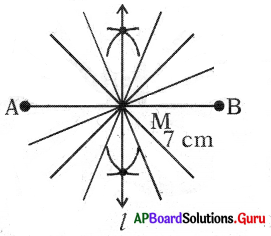
Construct a line segment of length 7cm. Draw possible line(s) of symmetry.
Answer:
AP Board 7th Class Maths Solutions Chapter 12 Symmetry Unit Exercise 3

  1. Let AB be a line segment of length 7 cm.
  2. Let M be the mid point of AB.
  3. Now any line through M is a line of symmetry.
  4. So, the line segment [latex]\widehat{\mathrm{AB}}[/latex] has infinite lines.

AP Board 7th Class Maths Solutions Chapter 12 Symmetry Ex 12.3

SCERT AP 7th Class Maths Solutions Pdf Chapter 12 Symmetry Ex 12.3 Textbook Exercise Questions and Answers.

AP State Syllabus 7th Class Maths Solutions 12th Lesson Symmetry Ex 12.3

Question 1.
Draw lines of symmetry for the following figures. Identify which of them have point symmetry. Is there any relation between lines of symmetry and point symmetry?
AP Board 7th Class Maths Solutions Chapter 12 Symmetry Ex 12.3 1
Answer:
AP Board 7th Class Maths Solutions Chapter 12 Symmetry Ex 12.3 2
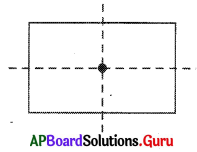
(i) Rectangle has point of symmetry.
Number of lines of symmetry = 2
Order of symmetry = 2
Lines of symmetry point or symmetry are same.

AP Board 7th Class Maths Solutions Chapter 12 Symmetry Ex 12.3 3
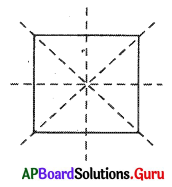
(ii) Square has a point of symmetry.
Number of lines of symmetry = 4
Order of symmetry = 4
Lines of symmetry, point of symmetry are same.

AP Board 7th Class Maths Solutions Chapter 12 Symmetry Ex 12.3 4
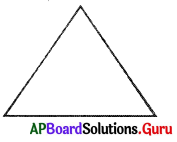
(iii) Triangle has no point of symmetry.

AP Board 7th Class Maths Solutions Chapter 12 Symmetry Ex 12.3 5
(iv) Regular hexagon has point of syrninetìy.
Number of lines of symmetry = 6
Order of symmetry = 6
Lines of symmetry point of symmetry are same.

AP Board 7th Class Maths Solutions Chapter 12 Symmetry Ex 12.3 6
(v) Pentagon has no point of symnetry

AP Board 7th Class Maths Solutions Chapter 12 Symmetry Ex 12.3

Question 2.
Identify which of the English alphabet have point symmetry in the following:
AP Board 7th Class Maths Solutions Chapter 12 Symmetry Ex 12.3 7
Answer:
AP Board 7th Class Maths Solutions Chapter 12 Symmetry Ex 12.3 8

AP Board 7th Class Maths Solutions Chapter 12 Symmetry Ex 12.2

SCERT AP 7th Class Maths Solutions Pdf Chapter 12 Symmetry Ex 12.2 Textbook Exercise Questions and Answers.

AP State Syllabus 7th Class Maths Solutions 12th Lesson Symmetry Ex 12.2

Question 1.
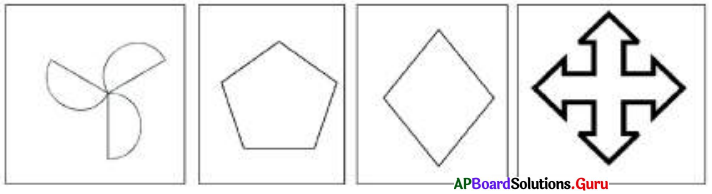
Which of the following shapes have line symmetry? Which have rotational symmetry?
AP Board 7th Class Maths Solutions Chapter 12 Symmetry Ex 12.2 1
Answer:
(a) Has no line of symmetry and rotational symmetry.
(b) Has line of symmetry and no rotational symmetry.
(c) Has line of symmetry and rotational symmetry.
(d) Has line of symmetry and rotational symmetry.

AP Board 7th Class Maths Solutions Chapter 12 Symmetry Ex 12.2

Question 2.
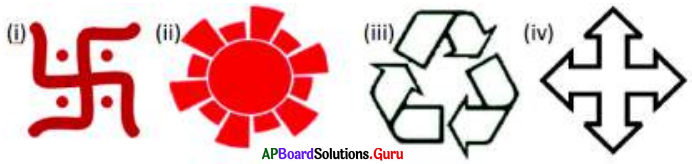
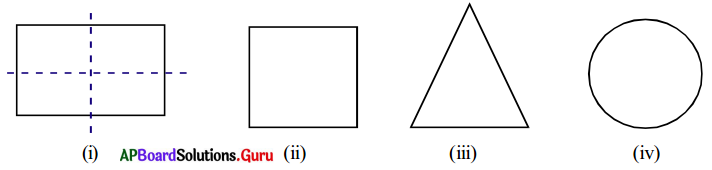
Determine the order of rotational symmetry in the figures given below.
AP Board 7th Class Maths Solutions Chapter 12 Symmetry Ex 12.2 2
Answer:
(i) The order of rotatiorlal symmetry of the figure is 4.
(ii) The order of rotational symmetry of the figure is 6.
(iii) The order of rotational symmetry of the figure is 3.
(iv) The order of rotational symmetry of the figure is 4.

Question 3.
Draw the 2 such figures which have line symmetry and rotational symmetry of order more than 1.
Answer:
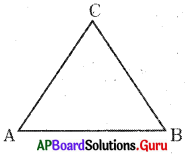
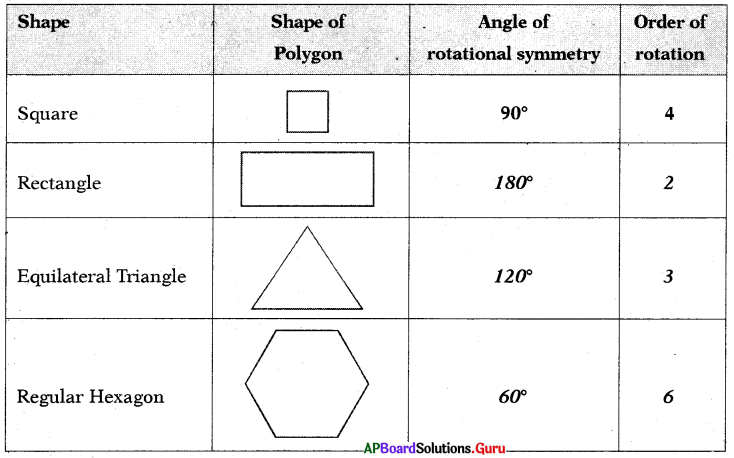
(a) Equilateral triangle has 3 lines of symmetry and rotational symmetry of order (3).
AP Board 7th Class Maths Solutions Chapter 12 Symmetry Ex 12.2 3
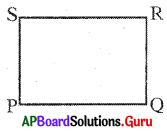
(b) Rectangle has 2 lines of symmetry and rotational symmetry of order (2).
AP Board 7th Class Maths Solutions Chapter 12 Symmetry Ex 12.2 4

Question 4.
Name the quadrilaterals which have both line symmetry and rotational symmetry of order more than 1.
Answer:
Rectangle, square and rhombus.

Question 5.
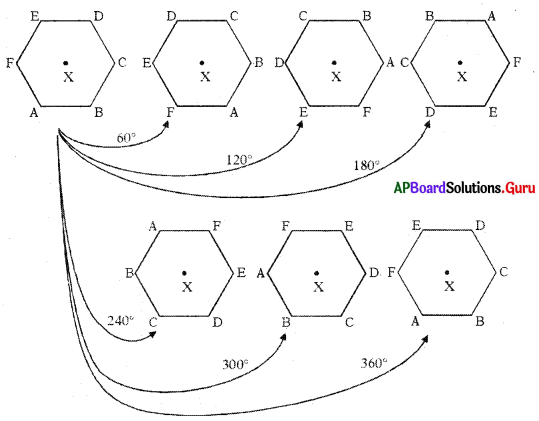
After rotating by 60° about its axis, a figure looks exactly the same as its original position. What other angles will this happen for the same figure?
Answer:
AP Board 7th Class Maths Solutions Chapter 12 Symmetry Ex 12.2 5

AP Board 7th Class Maths Solutions Chapter 12 Symmetry Ex 12.2

Question 6.
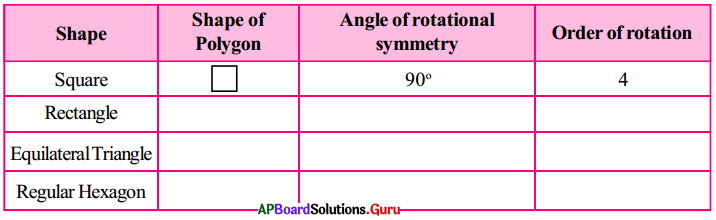
Fill in the blanks.
AP Board 7th Class Maths Solutions Chapter 12 Symmetry Ex 12.2 6
Answer:
AP Board 7th Class Maths Solutions Chapter 12 Symmetry Ex 12.2 7

AP Board 7th Class Maths Solutions Chapter 12 Symmetry Ex 12.1

SCERT AP 7th Class Maths Solutions Pdf Chapter 12 Symmetry Ex 12.1 Textbook Exercise Questions and Answers.

AP State Syllabus 7th Class Maths Solutions 12th Lesson Symmetry Ex 12.1

Question 1.
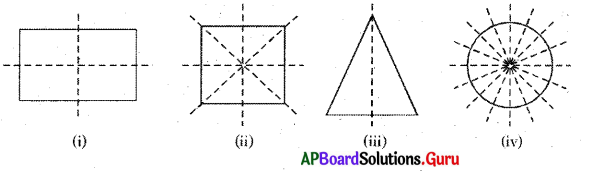
Draw the possible line(s) of symmetry for the following figures, as shown in Figure-(i).
AP Board 7th Class Maths Solutions Chapter 12 Symmetry Ex 12.1 1
Answer:
AP Board 7th Class Maths Solutions Chapter 12 Symmetry Ex 12.1 2

Question 2.
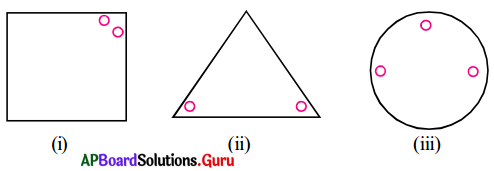
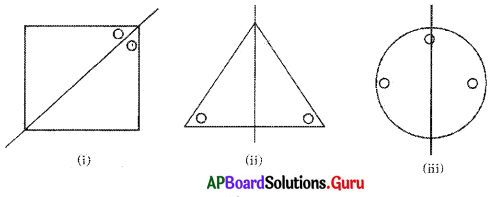
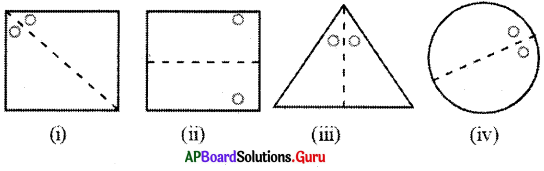
Observe the figures with punched holes and draw the axes of symmetry.
AP Board 7th Class Maths Solutions Chapter 12 Symmetry Ex 12.1 3
Answer:
AP Board 7th Class Maths Solutions Chapter 12 Symmetry Ex 12.1 4

AP Board 7th Class Maths Solutions Chapter 12 Symmetry Ex 12.1

Question 3.
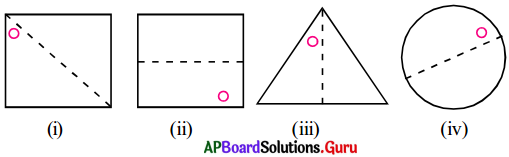
Mark the other dot to become the following dotted line in the picture as line symmetry.
AP Board 7th Class Maths Solutions Chapter 12 Symmetry Ex 12.1 5
Answer:
AP Board 7th Class Maths Solutions Chapter 12 Symmetry Ex 12.1 6

Question 4.
State the number of lines ofsyrnrnetry for the following figures and draw them.
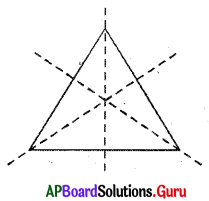
(i) An equilateral triangle
Answer:
AP Board 7th Class Maths Solutions Chapter 12 Symmetry Ex 12.1 7
Number of lines of symmetry for an equilateral triangle is 3.

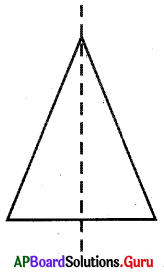
(ii) An isosceles triangle
Answer:
AP Board 7th Class Maths Solutions Chapter 12 Symmetry Ex 12.1 8
Number of lines of symmetry for an isosceles triangle is 1.
(It is the altitude on the unequal side)

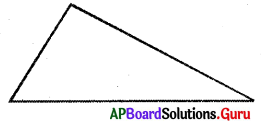
(iii) A scalene triangle
Answer:
AP Board 7th Class Maths Solutions Chapter 12 Symmetry Ex 12.1 9
We cannot draw the line of symmetry for scalene triangle.

Question 5.
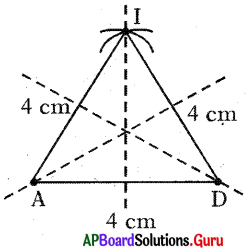
Construct an equilateral triangle with a length of side 4cm and draw all possible lines of symmetry (No need to write the steps of constructions).
Answer:
AP Board 7th Class Maths Solutions Chapter 12 Symmetry Ex 12.1 10
∆ADI is an equilateral triangle.
Number of lines of symmetry for an equilateral triangle is 3.

AP Board 7th Class Maths Solutions Chapter 12 Symmetry Ex 12.1

Question 6.
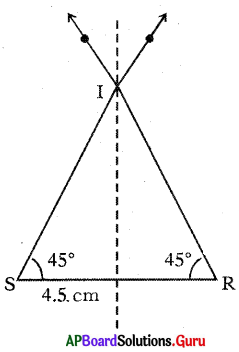
Construct the triangle with the base 4.5cm and base angle 45° each. Draw all possible lines of symmetry (No need to write the steps of constructions).
Answer:
AP Board 7th Class Maths Solutions Chapter 12 Symmetry Ex 12.1 11
∆SRI is an isosceles triangle.
Number of lines of symmetry for an isosceles triangle is 1.

AP Board 7th Class Maths Solutions Chapter 12 Symmetry Review Exercise

SCERT AP 7th Class Maths Solutions Pdf Chapter 12 Symmetry Review Exercise Questions and Answers.

AP State Syllabus 7th Class Maths Solutions 12th Lesson Symmetry Review Exercise

Question 1.
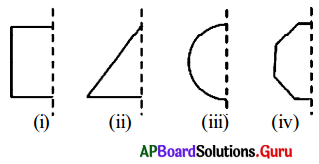
In the following figures, the mirror line (i.e., the line of symmetry) is given as a dotted line.
Complete each figire performing reflection in the dotted (mirror) line. (You might perhaps place a mirror along the dotted line and look into the mirror for the image).
AP Board 7th Class Maths Solutions Chapter 12 Symmetry Review Exercise 1
Answer:
AP Board 7th Class Maths Solutions Chapter 12 Symmetry Review Exercise 2

AP Board 7th Class Maths Solutions Chapter 12 Symmetry Review Exercise

Question 2.
Which of the following figures are having line symmetry? Write YES or NO in the given below the figure boxes.
AP Board 7th Class Maths Solutions Chapter 12 Symmetry Review Exercise 3
Answer:
AP Board 7th Class Maths Solutions Chapter 12 Symmetry Review Exercise 4

Question 3.
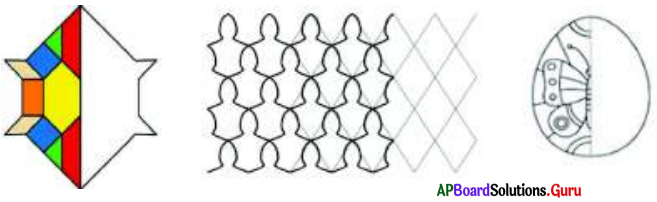
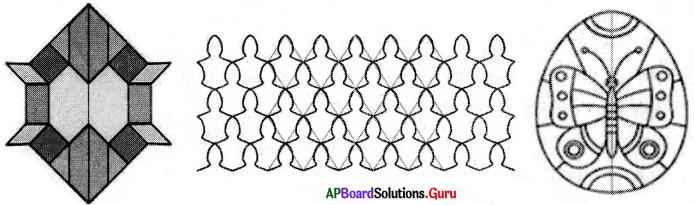
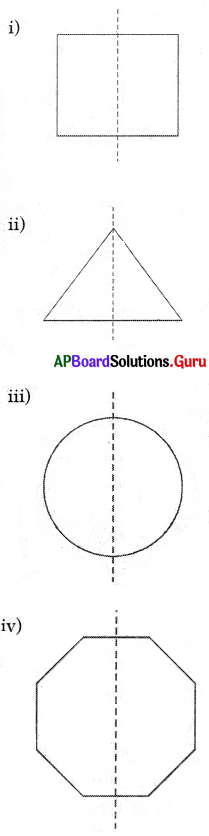
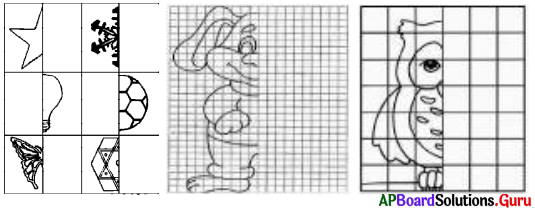
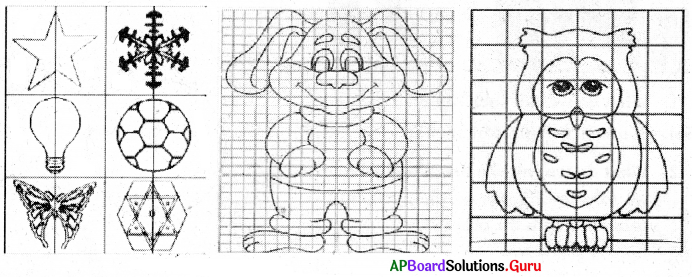
Draw the other half of each symmetrical shape for the following pictures.
AP Board 7th Class Maths Solutions Chapter 12 Symmetry Review Exercise 5
Answer:
AP Board 7th Class Maths Solutions Chapter 12 Symmetry Review Exercise 6

AP 7th Class Social Important Questions 2nd Lesson Forests

These AP 7th Class Social Important Questions 2nd Lesson Forests will help students prepare well for the exams.

AP Board 7th Class Social 2nd Lesson Important Questions and Answers Forests

Question 1.
How many climatic regions are there in the world?
Answer:
There are seven climatic regions in the world.

Question 2.
Write the names of climatic regions.
Answer:

  1. Equatorial climatic region
  2. The Savanna
  3. Desert Region
  4. Mediterranean climate
  5. Steppe climate
  6. Taiga
  7. Tundra Climate

Question 3.
Define the following terms : i) Flora ii) Fauna
Answer:
i) The term flora is used to denote plants of a particular region or period,
ii) The term fauna is used to denote the species of animals

Question 4.
Where are the Mangrove tidal forests found?
Answer:
The Mangrove tidal forests are found in the areas of coasts influenced by tides.

AP 7th Class Social Important Questions 2nd Lesson Forests

Question 5.
When do trees of the tropical deciduous forests shed their leaves?
Answer:
Trees of these forests shed their leaves in dry summer.

Question 6.
Name some of the commercially valuable trees that grow in the tropical deciduous forests.
Answer:
Teak, Sal, Bamboo, Rosewood, Sandalwood, etc.

Question 7.
Which type of vegetation grows in Thorny forests?
Answer:
Cactus, Acacia and thorny bushes grow in Thorny forests.

Question 8.
Give the location of Evergreen forests.
Answer:
The Evergreen forests are found in heavy rainfall areas of Western ghats, North Eastern states and Himalayan region.

Question 9.
What are the common animals found in the Montane forests?
Answer:
The common animals found in the Montane forests are Musk deer, Snow leopard, Wild sheep, etc.

Question 10.
Mention the wild life found in the Deciduous forests.
Answer:
The common animals found here are Deers, Hares, Elephants, Tigers, Leopards, Peacocks, etc. .

Question 11.
Define forest.
Answer:
A forest is a piece of land with many trees.

Question 12.
Write any tw« features of Tundra region.
Answer:

  1. Extremely coid climate
  2. Low biotic diversity

AP 7th Class Social Important Questions 2nd Lesson Forests

Question 13.
What does Taiga mean?
Answer:
A moist subarctic forest dominated by conifers.

Question 14.
How many types of forests are there in Andhra Pradesh?
Answer:
Forests in Andhra Pradesh are mainly divided into four types.

  1. Moist deciduous forests
  2. Dry deciduous forests
  3. Shrub forests
  4. Tidal forests

Question 15.
Where are the moist deciduous forests found in Andhra Pradesh?
Answer:
These forests spread over the agency areas of Srikakulam, Visakhapatnam and East Godavari.

Question 16.
What are the important trees in dry deciduous forests of Andhra Pradesh?
Answer:
Maddi, Teak, Billu, Egisa, Neem and Red Sandal trees, etc.

Question 17.
Where are the shrub forests found in Andhra Pradesh?
Answer:
These forests grown in YSR Kadapa, Kurnool, Anantapur and Chittoor districts.

Question 18.
Which are the important tribes of Andhra Pradesh?
Answer:
Bondo, Chenchus, Konda Reddies, Konda Savaras, etc.

Question 19.
In which year forest department was established by British govt, in India?
Answer:
Forest department was established by the British in 1864.

Question 20.
Define deforestation.
Answer:
Clearing of forests over a wide area is called deforestation.

Question 21.
Define social forestry.
Answer:
Social forestry is the managerpent and protection of forests and afforestation in barren and deforested lands, for the purpose of helping environment social and rural development.

AP 7th Class Social Important Questions 2nd Lesson Forests

Question 22.
Write the climate regions and type of Natural vegetation in them.
Answer:
The impact of climate on natural vegetation of the following regions.

Climatic regions Type of Natural vegetation
1. Equatorial regions Dense forests with tall trees.
2. Savannas The areas are turned from dense forests to wide grasslands.
3. Desert Regions Very less trees with thick barks and small leaves or no leaves at all.
4. Mediterranean climate Broad leaf evergreen trees are found here.
5. Steppe climate The natural vegetation is grass and scrub
6. Taiga Evergreen coniferous forest.
7. Tundra Climate Not support for the growth of trees.

AP Board 7th Class Social 2nd Lesson 1 Mark Bits Questions and Answers Forests

I. Multiple Choice Questions

1. There are ……………. climatic regions in the world.
A) 1
B) 4
C) 7
D) 5
Answer:
C) 7

2. Equatorial region dense forest is called as
A) Savannas
B) Selvas
C) Downs
D) Pampas
Answer:
B) Selvas

3. The tribals of Amazon basin
A) Pigmies
B) Gypsies
C) Red Indians
D) Bantus
Answer:
C) Red Indians

4. Which is the largest desert in the world?
A) Kalahari
B)Thar
C) Gobi
D) Sahara
Answer:
D) Sahara

5. What is the most important commercial activity in Taiga region?
A) Fur trading
B) Grass trading
C) Bark trading
D) Meat trading
Answer:
A) Fur trading

6. Forests are divided into …………….. types based on climate, rainfall and types of soils
A) 4
B) 6
C) 5
D) 3
Answer:
C) 5

7. Evergreen forests are located in
A) Himalayan Region
B) Peninsular plateau region
C) Coastal areas
D) All the above
Answer:
A) Himalayan Region

AP 7th Class Social Important Questions 2nd Lesson Forests

8. Lion – tailed macaques are in
A) Deciduous forest
B) Evergreen forest
C) Mangrove forest
D) Desert forest
Answer:
B) Evergreen forest

9. Sandal wood trees are in
A) Thorny forests
B) Montane forests
C) Deciduous forests
D) Evergreen forests
Answer:
C) Deciduous forests

10. Sundarbans are in
A) West Bengal
B) Goa
C) Uttar Pradesh
D) Haryana
Answer:
A) West Bengal

11. These are known as Swamp forests
A) Mangrove forests
B) Thorny forests
C) Deciduous forests
D) Montane forests
Answer:
A) Mangrove forests

12. Bramha Jamudu, Naga Jamudu are in
A) Montane forests
B) Thorn forests
C) Deciduous forest
D) Evergreen forests
Answer:
B) Thorn forests

13. Musk deer and Snow leopards are common in
A) Plateau region
B) Plain region
C) Desert region
D) Himalayan region
Answer:
D) Himalayan region

14. In which year National Forest Policy Act implemented?
A) 1988
B) 1980
C) 1952
D) 1956
Answer:
C) 1952

15. Which state has largest forest cover in India?
A) Andhra Pradesh
B) Jarkhand
C) Chhattisgarh
D) Madhya Pradesh
Answer:
D) Madhya Pradesh

AP 7th Class Social Important Questions 2nd Lesson Forests

16. Which state has lowest forest cover in India?
A) Punjab
B) Goa
C) Haryana
D) Asom
Answer:
C) Haryana

17. The area of India is
A) 3.28 m.sq
B) 2.38 m. sq
C) 4.05 m.sq
D) 5.37 m.sq
Answer:
C) Haryana

18. Which district has highest forest cover in Andhra Pradesh?
A) Krishna
B) Y.S.R. Kadapa
C) Nellore
D) Prakasam
Answer:
B) Y.S.R. Kadapa

19. Which district has lowest forest cover in Andhra Pradesh?
A) Krishna
B) Guntur
C) Kurnool
D) Anantapur
Answer:
A) Krishna

20. Which is the largest forest in Andhra Pradesh?
A) Seshachalam
B) Simhachalam
C) Nallamala
D) Yerramalla
Answer:
C) Nallamala

21. The coastal length of Andhra Pradesh is
A) 974 km
B) 1000 km
C) 978 km
D) 872 km
Answer:
A) 974 km

AP 7th Class Social Important Questions 2nd Lesson Forests

22. Forest department was established by British in
A) 1988
B) 1888
C) 1864
D) 1852
Answer:
C) 1864

23. How much % of forest area is required to maintain ecological balance ?
A) 20%
B) 33%
C) 28%
D) 53%
Answer:
B) 33%

24. Where is Royal Bengal Tigers found?
A) Mangrove forests
B) Montane forests
C) Thorn forests
D) Tropical evergreen forests
Answer:
A) Mangrove forests

AP 7th Class Social Important Questions 2nd Lesson Forests

25. Deciduous Forests grow in areas with rainfall between
A) 100 cm to 200 cm
B) 75 cm and 200 cm
C) 150 cm to 300 cm
D) 80 cm to 120 cm
Answer:
B) 75 cm and 200 cm

II. Intext – Bits – Fill in the Blanks

1. The equatorial forest is located between …………. and ……………. of equator.
2. The rainfall of Tropical climatic region is ……………..
3. Pigmies in ……………. basin.
4. The Savanna grasslands are located between ……………. and …………… of equator.
5. The livelihood of the Savanna grasslands people is ………………..
6. Natural vegetation of Sahara desert has ……………….
7. Olive, cork-oak trees are grown in ………….
8. Extensive agriculture is practiced in ……………… region.
9. The Tundra region stretch between and …………… and ……………… regions.
10. People of Tundra Climate are depending on ……………. for their food.
11. The temperature, rainfall, soil are the main factors determine the type of ……………. in an area.
12. Mahogany, ebony are in ………….. forests.
13. Rosewood, Sandalwood and Neem are in forests.
14. Total area under forest and tree cover in India is ………….. sq. km.
15. Andhra Pradesh has a forest cover area of ………….. sq.km.
16. The most important tree in Seshachalam forest is …………… .
17. Chenchu tribals are in …………. forest.
18. DST stands for …………….
19. OTFD stands for …………….
20. Forest Rights Act was passed in ……………… year.
21. Forest Conservation Act was passed in ……………
22. National Forest Policy was announced in …………….
23. Deforestation is the …………….. of trees in a large area.
24. Forest department was established by British in ……………
25. Mongoose, Eagle, are in ……………. forests of Andhra Pradesh.
26. Tumma, Balusu, Regu are found in …………… forests of Andhra Pradesh.
Answer:

  1. 5° and 10° North and South Latitudes
  2. 150 cm
  3. Congo
  4. 10° to 20° North and South Latitudes
  5. Cattle grazing
  6. Thick barks and small leaves or no leaves
  7. Mediterranean climate
  8. Steppe climate
  9. The Arctic and Polar
  10. fauna
  11. vegetation
  12. Evergreen
  13. Deciduous
  14. 8,07,276 sq.km
  15. 37,392 sq.km
  16. Red Sandalwood
  17. Nallamala
  18. Forest Dwelling Scheduled Tribes
  19. Other Traditional Forest Dwellers
  20. 2006
  21. 1980
  22. 1952
  23. Cutting
  24. 1864
  25. Tidal
  26. Shrub

III. Match the following

1.

Group-A Group-B
1. YSR Kadapa A) Shrub forests
2. East Godavari B) Deodar
3. Srikakulam C) Vegi, Egisa
4. Himalayan Region D) Jittegi & Sal

Answer:

Group-A Group-B
1. YSR Kadapa A) Shrub forests
2. East Godavari C) Vegi, Egisa
3. Srikakulam D) Jittegi & Sal
4. Himalayan Region B) Deodar

2.

Group-A Group-B
1. 5° to 10° N & S A) The Savannas
2. 10° to 20° N & S B) Taiga
3. 20° to 30° N & S C) Tundras
4. 55° to 70° N & S D) Desert region
5. Poles E) Equatorial

Answer:

Group-A Group-B
1. 5° to 10° N & S E) Equatorial
2. 10° to 20° N & S A) The Savannas
3. 20° to 30° N & S D) Desert region
4. 55° to 70° N & S B) Taiga
5. Poles C) Tundras

3. Andhra Pradesh.

Group-A Group-B
1. Forest cover A) Krishna
2. Coastal line B) YSR kadapa
3. Highest forest cover C) 22-94%
4. Lowest forest cover D) Visakhapatnam
5. Highest density of forest cover E) 974 kms.

Answer:

Group-A Group-B
1. Forest cover C) 22-94%
2. Coastal line E) 974 kms.
3. Highest forest cover B) YSR kadapa
4. Lowest forest cover A) Krishna
5. Highest density of forest cover D) Visakhapatnam

Do You Know?

7th Class Social Textbook Page No. 21

→ For administrative convenience, the Government of India divided forests into three types. They are:

  1. Reserved forests.
  2. Protected forests.
  3. Unclassified forests.

1. Reserved forests :
These are the forests where the activities like hunting, grazing etc. are prohibited and the rights of this land are reserved with the government.

2. Protected forests :
They are intended to protect certain species of flora and fauna. Excessive damage is not allowed here.

3. Unclassified forests :
No restrictions on collection of forest products for livelihood and grazing of cattle in these forests.

7th Class Social Textbook Page No. 23

According to Indian State Forest Report (ISFR) 2019.

Total area under forest and tree cover in India is 807,276 sq. km. That is 24.56% of the total area. In the global position of forest area, India ranks at 10.

7th Class Social Textbook Page No. 26

Red sandalwood is one of the rare species grown in Seshachalam forest in the districts of Kadapa and Chittoor. It has a prominent place in the economy in terms of production.

AP 7th Class Social Important Questions 2nd Lesson Forests 1
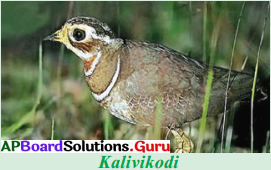
Kalivikodi that lives in Sree Lankamaleswara abhayaranyam in Kadapa district has been notified as rarest species by IUCN (International Union for Conservation of Nature and natural resources).

7th Class Social Textbook Page No. 27

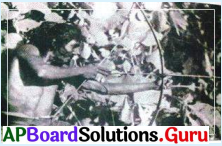
Chenchus are an aboriginal tribe whose traditional way of life is based on hunting and gathering. They speak Chenchu language. We can see them in Nallamala forest.
AP 7th Class Social Important Questions 2nd Lesson Forests 2

The British, who ruled India before independence, enacted two laws in 1864 and 1878 to establish the Forest Department and hand over control over the forests. The laws restricted the traditional/customary rights of the tribals and forest users by classifying forests as ‘reserved’ and ‘protected’ forests. Reserved forests where forests in which no one could enter. ‘Protected’ forests could be used by people; they could take head-loads of wood and,small forest produce for their own use and could graze their cattle.

But, here too, there were many restrictions over cutting trees, grazing more than the limit set by the Forest Department etc. The national forest policy 1988 declared that the primary task should be to associate the tribal people in the protection, regeneration and development of forests.

Now the Govt, of Andhra Pradesh has started Eco-tourism, initiative taking tip for the creation of new community-based Eco system centres and strengthening the existing eco-tourism centres by involving local tribes in Andhra Pradesh.

7th Class Social Textbook Page No. 29

Year Act / Incident
1894 The Forest Law
1950 Forest Festival
1952 National Forest Policy
1980 Forest Conservation Act
2006 Forest Rights Act