AP 9th Class Social Bits Chapter 13 Democratic and Nationalist Revolutions 17th and 18th Centuries with Answers

Practice the AP 9th Class Social Bits with Answers Chapter 13 Democratic and Nationalist Revolutions 17th and 18th Centuries on a regular basis so that you can attempt exams with utmost confidence.

AP State Syllabus 9th Class Social Bits 13th Lesson Democratic and Nationalist Revolutions 17th and 18th Centuries with Answers

Choose the correct answer.

Question 1.
………….. believed in the Divine Right of the kings.
A) Charles I
B) James I
C) William of Orange
D) None of these
Answer:
B) James I

Question 2.
The revolution which transferred supreme power from the King to the Parliament occurred in ……………..
A) France
B) England
C) U.S.A
D) Spain
Answer:
B) England

Question 3.
The transformation of supreme power from the King to the Parliament in ………….. was known as Glorious Revolution.
A) France
B) England
C) USA
D) Poland
Answer:
B) England

AP 9th Class Social Bits Chapter 13 Democratic and Nationalist Revolutions 17th and 18th Centuries with Answers

Question 4.
Americans won the War of Independence in ……………
A) 1781
B) 1783
C) 1775
D) 1779
Answer:
A) 1781

Question 5.
The American War of Independence came to an end with the Treaty of ………….
A) New York
B) London
C) Paris
D) Philadelphia
Answer:
C) Paris

Question 6.
The Treaty of Paris was held in ………….
A) 1775
B) 1781
C) 1783
D) 1789
Answer:
C) 1783

Question 7.
Which country gave military help to America in her war of independence?
A) Russia
B) Germany
C) Italy
D) France
Answer:
D) France

AP 9th Class Social Bits Chapter 13 Democratic and Nationalist Revolutions 17th and 18th Centuries with Answers

Question 8.
Who was the author of the Declaration of American Independence?
A) George Washington
B) Thomas Jefferson
C) Abraham Lincoln
D) Roosevelt
Answer:
B) Thomas Jefferson

Question 9.
Louis XVI ascended the throne of France in …………….
A) 1783
B) 1789
C) 1774
D) 1791
Answer:
C) 1774

Question 10.
The taxes collected by the church from the Third Estate were called
A) Livres
B) Tithes
C) Taille
D) None of these
Answer:
B) Tithes

Question 11.
Who proposed the government based on a social contract?
A) Locke
B) Rousseau
C) Montesque
D) Plato
Answer:
B) Rousseau

AP 9th Class Social Bits Chapter 13 Democratic and Nationalist Revolutions 17th and 18th Centuries with Answers

Question 12.
The author of the book “Government” was ………….
A) John Locke
B) Rousseau
C) Montesque
D) Aristotle
Answer:
A) John Locke

Question 13.
The author of the book ‘The Spirit of the Laws’ was …………..
A) John Locke
B) Rousseau
C) Montesque
D) Plato
Answer:
C) Montesque

Question 14.
The division of powers within the government was proposed by
A) John Locke
B) Voltair
C) Rousseau
D) Montesque
Answer:
D) Montesque

Question 15.
Who refuted the Doctrine of the divine and absolute right of the monarch?
A) Voltair
B) Rousseau
C) John Locke
D) Montesque
Answer:
C) John Locke

AP 9th Class Social Bits Chapter 13 Democratic and Nationalist Revolutions 17th and 18th Centuries with Answers

Question 16.
The king of France at the time of the French Revolution was …………….
A) Louis XV
B) Louis XIV
C) Louis Philip
D) Louis XVI
Answer:
D) Louis XVI

Question 17.
The agitated crowd destroyed the Bastille Fort in France on
A) June 14
B) May 14
C) July 14
D) August 14
Answer:
C) July 14

Question 18.
The Assembly of France passed a decree abolishing the feudal system on
A) July 14,1789
B) 4th July 1789
C) 14th August 1789
D) 4th August 1789
Answer:
D) 4th August 1789

Question 19.
The National Assembly completed the draft of the Constitution in …………..
A) 1789
B) 1791
C) 1783
D) 1795
Answer:
B) 1791

AP 9th Class Social Bits Chapter 13 Democratic and Nationalist Revolutions 17th and 18th Centuries with Answers

Question 20.
The convention, the newly elected assembly, abolished monarchy in France on
A) 21 September, 1791
B) 21 September 1792
C) 21 September, 1789
D) 21 September 1783
Answer:
B) 21 September 1792

Question 21.
The author of the book “The Social contract”
A) Rousseau
B) Thomas Hobbs
C) John Locke
D) Montesque
Answer:
A) Rousseau

Question 22.
“Glorious” (or) “Bloodless Revolution” was held in
A) India
B) England
C) France
D) Russia
Answer:
B) England

Question 23.
The period of long parliament of England from to
A) 1650 – 1670
B) 1600 – 1620
C) 1640 – 1660
D) 1600 – 1650
Answer:
C) 1640 – 1660

AP 9th Class Social Bits Chapter 13 Democratic and Nationalist Revolutions 17th and 18th Centuries with Answers

Question 24.
The name of the elected legislautre after French Revolution is
A) Republic
B) Tennis court
C) Directory
D) Convention
Answer:
D) Convention

Question 25.
Once upon a time the Roman Catholic Church power prevailed in the following ocuntry
A) France
B) Britain
C) Russia
D) Germany
Answer:
B) Britain

Question 26.
England became a Republic after the execution of
A) Tudor
B) Philippe
C) Charles -1
D) Louis
Answer:
C) Charles -1

Question 27.
In this country the Right to Vote was given only the who owned land and properties
A) Germany
B) Russia
C) France
D) England
Answer:
D) England

Question 28.
In England the Right to Vote was gradually extended to all in
A) 1928
B) 1905
C) 1919
D) 1850
Answer:
A) 1928

AP 9th Class Social Bits Chapter 13 Democratic and Nationalist Revolutions 17th and 18th Centuries with Answers

Question 29.
The American colonies therefore raised the slogan ” ………… without representation”. ( )
A) No freedom
B) No Taxation
C) No service
D) No revolution
Answer:
B) No Taxation

Question 30.
The colonisers who settled in America were belongs to the following country
A) America
B) Russia
C) England
D) France
Answer:
C) England

Question 31.
The Charles -1 was executed in
A) 1600
B) 1605
C) 1620
D) 1649
Answer:
D) 1649

Question 32.
The following countries were signed on the treaty of Paris (178C)
A) England, America
B) Spain, France
C) Portugal, England
D) Germany, America
Answer:
A) England, America

AP 9th Class Social Bits Chapter 13 Democratic and Nationalist Revolutions 17th and 18th Centuries with Answers

Question 33.
The author of “The declaration of American Independence” was
A) Rousseau
B) Thomas Jefferson
C) John lock
D) Montesque
Answer:
B) Thomas Jefferson

Question 34.
Where the head of the state is a democratic elected president not a monarch is called
A) Parliamentary system
B) Presidential system
C) Republic
D) Democratic system
Answer:
C) Republic

Question 35.
The war was held between king and parliament in England is called as
A) Civil war
B) Parliament war
C) World war
D) Revolutiion
Answer:
A) Civil war

Question 36.
In ………….. the national government of the USA adopted a Republic constitution.
A) 1774 A.D
B) 1789 A.D
C) 1773 A.D
D) 1705 A.D
Answer:
B) 1789 A.D

AP 9th Class Social Bits Chapter 13 Democratic and Nationalist Revolutions 17th and 18th Centuries with Answers

Question 37.
Since the Middle ages onwards the society of estates was a part of
A) Parliament
B) Slaves
C) Feudal system
D) None of these
Answer:
C) Feudal system

Question 38.
In French society these were paid tax
A) Government
B) First estate
C) Second estate
D) Third estate
Answer:
D) Third estate

Question 39.
In French society these people enjoyed special previleges
A) the clergy and the aristocracy
B) wealthy people
C) kings
D) lords
Answer:
A) the clergy and the aristocracy

Question 40.
A type of tax levied by the Church from the peasants in France is
A) Tax
B) Tithes
C) Taille
D) Livres
Answer:
B) Tithes

Question 41.
The following is a direct tax
A) Excise
B) Taille
C) Livers
D) None of these
Answer:
B) Taille

AP 9th Class Social Bits Chapter 13 Democratic and Nationalist Revolutions 17th and 18th Centuries with Answers

Question 42.
“Two treaties of Government” belongs to …..
A) Montesque
B) Flobbes
C) Rousseau
D) John Lock
Answer:
D) John Lock

Question 43.
France celebrating Independence day every year on
A) July 14
B) July 4
C) July 20
D) July 24
Answer:
A) July 14

Question 44.
The period from …………. to is referred to as the Reign of Terror.
A) 1780-90
B) 1770-80
C) 1760 – 65
D) 1793 – 94
Answer:
D) 1793 – 94

Question 45.
The full of Bastille fort was took place in
A) 1765
B) 1790
C) 1789
D) 1780
Answer:
C) 1789

AP 9th Class Social Bits Chapter 13 Democratic and Nationalist Revolutions 17th and 18th Centuries with Answers

Question 46.
The French women won the right to vote in
A) 1946
B) 1940
C) 1945
D) 1920
Answer:
A) 1946

Question 47.
What is the another name of French Assembly?
A) Senete
B) Congress
C) Taille
D) Estate general
Answer:
D) Estate general

Question 48.
The last (meeting) of Estate general was held in
A) 1614
B) 1650
C) 1655
D) 1660
Answer:
A) 1614

Question 49.
The following was the leader of Jocobin club
A) Montesque
B) Maximilien Robespierre
C) John Locke
D) Rousseau
Answer:
B) Maximilien Robespierre

AP 9th Class Social Bits Chapter 13 Democratic and Nationalist Revolutions 17th and 18th Centuries with Answers

Question 50.
The National Assembly of France completed the draft constitution in
A) 1789
B) 1791
C) 1763
D) 1765
Answer:
B) 1791

Question 51.
Death punishment in France was given by the following.
A) Taille
B) Execution
C) Guillotine
D) Electric shock
Answer:
C) Guillotine

Question 52.
The name of the conference hall of French Representatives is
A) Versailles
B) Tennis court
C) Palace
D) Country
Answer:
A) Versailles
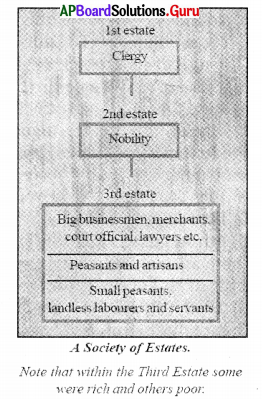
AP 9th Class Social Bits Chapter 13 Democratic and Nationalist Revolutions 17th and 18th Centuries with Answers 1
Question 53.
Estate -1 consist of
A) Nobles
B) Lawyers
C) Peasants
D) Clergy
Answer:
D) Clergy

AP 9th Class Social Bits Chapter 13 Democratic and Nationalist Revolutions 17th and 18th Centuries with Answers

Question 54.
The 2nd estate consist of
A) Nobles
B) Artisans
C) Clergy
D) Servants
Answer:
A) Nobles

Question 55.
Which estate has more people ?
A) 1st
B) 2nd
C) 3rd
D) 4th
Answer:
C) 3rd

Question 56.
The French society was divided into
A) 5 estates
B) 3 estates
C) 2 estates
D) 4 estates
Answer:
B) 3 estates
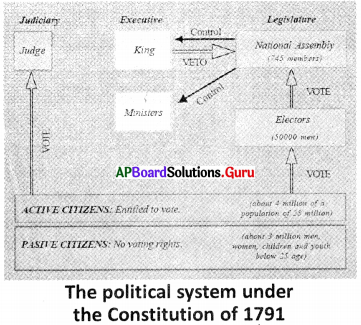
AP 9th Class Social Bits Chapter 13 Democratic and Nationalist Revolutions 17th and 18th Centuries with Answers 2
Question 57.
Who were entitled to vote?
A) Active citizens
B) Women
C) Old men
D) Children
Answer:
A) Active citizens

AP 9th Class Social Bits Chapter 13 Democratic and Nationalist Revolutions 17th and 18th Centuries with Answers

Question 58.
National Assembly consist of ……………. members.
A) 150
B) 745
C) 200
D) 820
Answer:
B) 745

Question 59.
Who have the Veto power?
A) Judge
B) King
C) Ministers
D) Voters
Answer:
B) King

Read the table and write the correct answers for the following questions.

Date and year Incident
1640-1660 – Long Parliament
1649 – Charles 1 executed
1688 -Glorious revolution
1783 -Treaty of Paris
1793-1794 -The Reign of Terror

Question 60.
The period of Long Parliament
A) 1793-1794
B) 1640-1660
C) 1680-1720
D) 1720-1760
Answer:
B) 1640-1660

Question 61.
Treaty of Paris was held in
A) 1789
B) 1763
C) 1783
D) 1777
Answer:
C) 1783

Question 62.
Who was the master of “Reign of Terror”?
A) Louis XVI
B) Louis XIV
C) Robespierre
D) Mary Antonette
Answer:
C) Robespierre

AP 9th Class Social Bits Chapter 13 Democratic and Nationalist Revolutions 17th and 18th Centuries with Answers

Question 63.
Who declared himself as an emperor of France?
A) Napoleon
B) Robespierre
C) Louis XIV
D) Louis XVI
Answer:
A) Napoleon

Question 64.
Charles I was executed in …………
A) 1688
B) 1649
C) 1783
D) 1788
Answer:
B) 1649

Question 65.
Glorious Revolution was held in …………
A) 1683
B) 1694
C) 1688
D) 1705
Answer:
C) 1688

Question 66.
Match the following.
Group – A — Group – B
1. Locke — A) The Declaration of Independence
2. Rousseau — B) Two Treatises of Government
3. Montesque — C) Social contract
4. Jefferson — D) The Spirit of the Laws
Answer:
1 – B
2 – C
3 – D
4 – A

AP 9th Class Social Bits Chapter 13 Democratic and Nationalist Revolutions 17th and 18th Centuries with Answers

Question 67.
Group – A — Group – B
1. Rousseau — A) The theory of natural rights
2. Locke — B) The theory of separation of powers
3. Montesque — C) The theory of restricted powers
4. Voltair — D) Fight for the political rights
5. Jefferson — E) Democracy
Answer:
1 – E
2 – A
3 – B
4 – C
5 – D

Question 68.
Group – A — Group – B
1. James 1 — A) 1640
2. Charles 1 — B) 1603
3. Long Parliament — C) 1783
4. The Declaration of Independence — D) 1776
5. Treaty of Paris — E) 1649
Answer:
1 – B
2 – E
3 – A
4 – D
5 – C

Question 69.
The book “The Spirit of Laws” was written by
A) Montesque
B) John Locke
C) Rousseau
D) Lenin
Answer:
A) Montesque

AP 9th Class Social Bits Chapter 13 Democratic and Nationalist Revolutions 17th and 18th Centuries with Answers

Question 70.
Arrange the incidents given below in the chronological order
1. French Revolution
2. England Glorious revolution
3. American Independence
A) 1, 2, 3
B) 3, 2, 1
C) 2, 3, 1
D) 2, 1, 3
Answer:
C) 2, 3, 1

Question 71.
The modern meaning of the term ‘nation’ given by French Revolution was:
A) Nation is the territory that the people belonging to it inhabit
B) Nation is the people themselves
C) Nation is the property of the King
D) Nation is its army
Answer:
A) Nation is the territory that the people belonging to it inhabit

Question 72.
An undemocratic aspect of the constitution made by French National Assem¬bly in 1791 was:
A) Limiting the powers of the monarch
B) Declaring rights to citizens
C) Vesting power to make laws in the National Assembly
D) Not giving voting right to women
Answer:
D) Not giving voting right to women

Question 73.
A) The Church did not extract its share of taxes called – Tithes
B) The direct Tax to pay Government – Taille
A) A & B are True
B) A & B are False
C) A False & B True
D) A True & B False
Answer:
C) A False & B True

AP 9th Class Social Bits Chapter 13 Democratic and Nationalist Revolutions 17th and 18th Centuries with Answers

Question 74.
Who wrote the Social Contract
A) John Locke
B) Montesquie
C) Rousseau
D) Erasmus
Answer:
C) Rousseau

Question 75.
The period of long parliament was
A) 1640-1660
B) 1620-1640
C) 1600-1620
D) 1610-1620
Answer:
A) 1640-1660

Question 76.
On-France was declared republic in which year.
A) 1793
B) 1791
C) 1794
D) 1792
Answer:
B) 1791

Question 77.
The transfer of supreme power to the parliament took place without shedding a drop of blood or firing a single shot Hence it is known as
A) Glorious Revolution
B) Blood hunt
C) Sipay Revolution
D) American Revolution
Answer:
A) Glorious Revolution

AP 9th Class Social Bits Chapter 13 Democratic and Nationalist Revolutions 17th and 18th Centuries with Answers

Question 78.
Tithes mean
A) A tax levied by the church, comprising one-third of the industrial produce
B) A tax levied by the church comprising one-third of the agriculture produce
C) A tax levied by the church comprising one-tenth of the agriculture produce
D) A tax levied by the church comprising one-tenth of the industrial produce
Answer:
C) A tax levied by the church comprising one-tenth of the agriculture produce

Question 79.
Identify the correct match.
A) The Reign of Terror – Nepoleon
B) The Spirit of Laws – Machiavelli
C) Livers – Unit of currency in France
D) Bloodless Revolution – American Revolution
Answer:
C) Livers – Unit of currency in France

Question 80.
Which revolution gave the idea “A nation is not the territory, that the people belonging to it inhabit”.
A) England Revolution
B) American Revolution
C) French Revolution
D) Russian Revolution
Answer:
C) French Revolution

Question 81.
The right outlined in the ‘Declaration of the Rights of Man and Citizen’ approved by the National Assembly of France on August 26, 1789, were NOT extended to
A) the clergy
B) The nobility
C) The commoners
D) The women
Answer:
D) The women

AP 9th Class Social Bits Chapter 13 Democratic and Nationalist Revolutions 17th and 18th Centuries with Answers

Question 82.
Identify the country in the context of statement given below:
1) Bill of rights which define citizen’s rights was adopted in 1791.
2) The country had to fight a civil war to establish democracy.
3) The country follow a federal system of government with clear separation of powers.
A) Germany
B) U.S.A.
C) Britain
D) France
Answer:
B) U.S.A.

Question 83.
From 1791 onwards political clubs became an important rallying point for people who wished to discuss government policies and plan their own forms of action. The most successful of these clubs was that of the Jacobians, whose leader later became the head of the government in the newly established Republic. Who was he?
A) Louis XVI
B) Maximilian Robespierre
C) Napoleon Bonaparte
D) Thomas Jefferson
Answer:
B) Maximilian Robespierre

Question 84.
Arrange the following historical events of France in chronological order.
1) The declaration of Rights of Man and Citizen
2) The execution of Louis – XVI and Marie Antoinette
3) The demolition of the fort of Bastille
4) The coronation of Napoleon as emperor of France
A) 3, 1, 2, 4
B) 2, 1, 3, 4
C) 3, 2, 1, 4
D) 4, 3, 2, 1
Answer:
A) 3, 1, 2, 4

Question 85.
Which of the following is a major decision taken by the long parliament which continued from 1640-1660 in England?
A) To control the despotism of the kings
B) To encourage revolution
C) To discourage revolution
D) To give absolute powers to king
Answer:
A) To control the despotism of the kings

AP 9th Class Social Bits Chapter 13 Democratic and Nationalist Revolutions 17th and 18th Centuries with Answers

Question 86.
‘No taxation without representation’ – is a slogan raised by
A) The British colonies in America
B) The American colonies in England
C) Third Estate people of France
D) 1 and 2 Estates people of France
Answer:
A) The British colonies in America

Question 87.
Which of the following is correctly matched?
1) Two treatises of Government – a) Montesquieu
2) The Spirit of laws – b) Niccolo Machiavelli
3) The Prince – c) John Lock
A) 1 – b, 2 – c, 3 – a
B) 1 – c, 2 – a, 3 – b
C) 1 – b, 2 – a, 3 – c
D) 1 – a, 2 – b, 3 – c
Answer:
B) 1 – c, 2 – a, 3 – b

Question 88.
The active citizens in France civilian group are
A) Who were entitled to vote
B) Who were not entitled to vote
C) Revolutionists
D) Members of Noble families
Answer:
A) Who were entitled to vote

Question 89.
“A nation is not a territory but the people themselves.”
Which of the following revolutions gave this modern meaning to the term “Nation”.
A) England revolution
B) French revolution
C) America revolution
D) Brazil revolution
Answer:
B) French revolution

AP 9th Class Social Bits Chapter 13 Democratic and Nationalist Revolutions 17th and 18th Centuries with Answers

Question 90.
Which of the following kings was called as the “citizen king”?
A) Charles-I
B) Charles-X
C) Charles – XVI
D) Louis Phillippe
Answer:
D) Louis Phillippe

Question 91.
Your opinion on the killing of political opponents in
A) It is a part of the administration.
B) Everyone should do like that.
C) I agree with it
D) I oppose it
Answer:
D) I oppose it

Question 92.
French society in the eighteenth century was divided into three estates, and only members of the third estate paid taxes. The society of estates was part of the feudal system. That dated back to the middle ages of France before 1789. Identify the related flow chart of the French society.
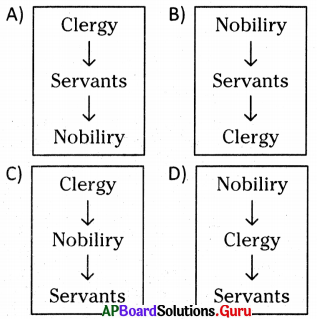
AP 9th Class Social Bits Chapter 13 Democratic and Nationalist Revolutions 17th and 18th Centuries with Answers 3
Answer:
C)

Question 93.
Fill the empty boxwiththe suitable word:
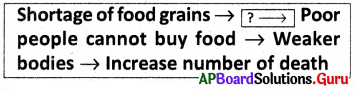
AP 9th Class Social Bits Chapter 13 Democratic and Nationalist Revolutions 17th and 18th Centuries with Answers 4
A) Spread of diseases
B) Rising food prices
C) Availability of Nutritional food
D) Social unrest
Answer:
B) Rising food prices

AP 9th Class Social Bits Chapter 13 Democratic and Nationalist Revolutions 17th and 18th Centuries with Answers

Observe the table and answer the questions 94 – 95:

Livres Unit of currency in France, dis­continued in 1794.
Clergy Group of persons invested with special functions in the church.
Tithes A tax levied by the church, comprising one-tenth of the agricultural produce.
Taille Tax to be paid directly to the state.
Nobles Rich landlords, king’s family members.

Question 94.
The currency of France before 1794:
A) Livres
B) All of these
C) Taille
D) Tithes
Answer:
A) Livres

Question 95.
The tax paid to the church:
A) Livres
B) All of these
C) Taille
D) Tithes
Answer:
D) Tithes

Question 96.
Who proposed a division of power within the government between the legislature, the executive and the judiciary, in The Spirit of the Laws, which we are following it in the present days?
A) Erasmus
B) Charles-I
C) Montesquieu
D) Rousseau
Answer:
D) Rousseau

AP 9th Class Social Bits Chapter 13 Democratic and Nationalist Revolutions 17th and 18th Centuries with Answers

Question 97.
Who prepared “The Declaration of Rights of Man and Citizen” are the base for the civil rights that we are enjoying today?
A) Mahatma Gandhi – Bharat
B) Abraham Lincoln – America
C) Thomas Moore – England
D) Thomas Jefferson – France
Answer:
D) Thomas Jefferson – France

Question 98.
The slogan ‘No Taxation Without Representation’ in 1774 was raised in this movement:
A) Indian independence movement
B) The French Revolution
C) American Independence
D) England – the glorious revolution
Answer:
C) American Independence

Question 99.
The supreme power was transferred to Parliament, without shedding a drop of blood or firing a single shot. This transformation therefore is known as ‘Glorious’ or ‘Bloodless Revolution’:
A) French Revolution
B) 1830 French Revolution
C) England Revolution
D) American Independence movement
Answer:
C) England Revolution

Question 100.
The French Revolution provided the Slogans to the World is:
A) Abolition of slavery
B) Liberty, Equality, Fraternity
C) Communism
D) Human Rights
Answer:
B) Liberty, Equality, Fraternity

AP 9th Class Social Bits Chapter 13 Democratic and Nationalist Revolutions 17th and 18th Centuries with Answers

Question 101.
The thing to be learnt from revolutions:
A) People should be loyal to the rulers.
B) Without revolution, no rights are available.
C) People should not revolt against rulers.
D) Pay taxes to the king timely and co-operate in the wars.
Answer:
B) Without revolution, no rights are available.

Question 102.
Identify the correct sentence.
sentences:
i) American colonies raised the slogan, ‘No taxation without representation’.
ii) ‘Statue of Columbia’ was replaced with ‘Statue of Liberty’ to symbolize USA.
A) Both are correct.
B) Both are wrong.
C) (i) Only
D) (ii) Only
Answer:
A) Both are correct.

Question 103.
Tax payers in French society :
A) The peasants
B) All of these
C) The clergy
D) The aristocracy
Answer:
A) The peasants

Question 104.
Arrange the incidents given below in the chronological order.
i) French Revolution
ii) Indian Independence
iii) England revolution
A) (i), (iii), (ii)
B) (iii), (i), (ii)
C) (i), (ii), (iii)
D) (ii), (iii), (i)
Answer:
B) (iii), (i), (ii)

AP 9th Class Social Bits Chapter 13 Democratic and Nationalist Revolutions 17th and 18th Centuries with Answers

Question 105.
Observe the given sentences:
The topic was associated with this:
i) Started their own political clubs and newspapers.
ii) One of their main demands was that they enjoy the political rights.
iii) They demanded the right to vote, to be elected to the Assembly and to hold political office.
A) Farmers in the Russian Revolution
B) The clergy in America
C) Women in the French Revolution
D) Landlords in the England Revolution
Answer:
C) Women in the French Revolution

Question 106.
According to James-l of Stuart dynasty, the absolute powers of the king were given by:
A) Parliament
B) Succession
C) God
D) People
Answer:
C) God

Question 107.
All those whom he saw as being ‘en-emies’ of the republic – who did not agree with his methods – were arrested, imprisoned and then tried by a revolu-tionary tribunal. If the court found them ‘guilty’ they were guillotined.
This information explained about:
A) Mussolini – Fascist rule
B) Stalin – Communism
C) Robespierre – The Reign of Terror
D) Hitler – nazi rule
Answer:
C) Robespierre – The Reign of Terror

Question 108.
The book, Social Contract was written by
A) Thomas Moore
B) Fredric Engles
C) Rousseau
D) Erasmus
Answer:
C) Rousseau

AP 9th Class Social Bits Chapter 13 Democratic and Nationalist Revolutions 17th and 18th Centuries with Answers

Question 109.
The members of the first two estates of French society, enjoyed certain privileges by birth. Your opinion on this:
A) This is incorrect. Every one is equal by birth.
B) It is natural that there lies some differ-ence between the rich and the poor.
C) This is acceptable because the members of those two estates are highly educated.
D) They can have some special rights because they are the clergy.
Answer:
A) This is incorrect. Every one is equal by birth.

Question 110.
What is your opinion on Women’s Role in the Revolution?
A) Women should not be participated in the revolutions.
B) I do not support National movements and revolutions.
C) No rights can be obtained without revolt.
D) Family should be affected by women’s struggles.
Answer:
C) No rights can be obtained without revolt.

Question 111.
In the Ancient, Medieval Europe the peasants were mostly ‘serfs’:
Find your comment on slavery:
A) At one stage, it is just that making the weaker people as slaves.
B) Slaves were needed to work in industries, mines and plantations.
C) If there were no slaves; the produc-tion would have stopped. So it was good.
D) Slavery was against the human rights.
Answer:
D) Slavery was against the human rights.

Question 112.
The first dear expression of Nationalism in Europe came with
A) The American Revolution
B) The French Revolution
C) The Russian Revolution
D) The Industrial Revolution
Answer:
B) The French Revolution

AP 9th Class Social Bits Chapter 13 Democratic and Nationalist Revolutions 17th and 18th Centuries with Answers

Question 113.
Which of the following declared that “all men are created equal and are endowed by Creator with certain Unalienable rights, including Life, Liberty and the pursuit of Happiness.”
A) The bill of Rights
B) The Declaration of Human Rights
C) The Declaration of Independence of America
D) The Constitution of India
Answer:
C) The Declaration of Independence of America

Question 114.
Consider the following statements regarding women’s suffrage movement.
1) Russia was the first country to grant women the Right to vote in 1917.
2) England granted the Right to vote to all women in 1928.
3) France granted the Right to vote to all women in 1791.
Which of the above statement(s) is (are) true?
A) 2 and 3
B) 1 and 2
C) 1 and 3
D) 1 ONLY
Answer:
B) 1 and 2

Question 115.
What is the significance of the Tennis Court Oath in French Revolution?
A) It led to a new constitution for France
B) It started the French Revolution
C) It was the beginning of the Reign of Terror
D) It marked the beginning of the rule of Napoleon
Answer:
A) It led to a new constitution for France

Question 116.
Identify the name of the country in the context of the following statements.
* Revolution where parliament system was established.
* Country where the king continues to play some role even after the revolution.
* The supreme power was transferred without shedding a drop of blood.
A) France
B) England
C) America
D) Italy
Answer:
B) England

AP 9th Class Social Bits Chapter 13 Democratic and Nationalist Revolutions 17th and 18th Centuries with Answers

Observe the flow chart. “The political system under the Constitution of 1971. In France” and answer questions 117 and 118.
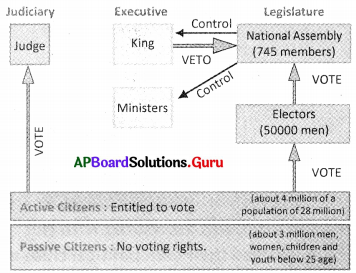
AP 9th Class Social Bits Chapter 13 Democratic and Nationalist Revolutions 17th and 18th Centuries with Answers 6

Question 117.
Which of the following correctly reflects the above political system?
A) Democracy
B) Monarchy
C) Republic
D) Constitutional Monarchy
Answer:
D) Constitutional Monarchy

Question 118.
Who had the power to reject the laws made by the National Assembly?
A) Electors
B) King
C) Judge
D) National Assembly
Answer:
B) King
AP 9th Class Social Bits Chapter 12 Changing Cultural Traditions in Europe 1300-1800 with Answers

Practice the AP 9th Class Social Bits with Answers Chapter 12 Changing Cultural Traditions in Europe 1300-1800 on a regular basis so that you can attempt exams with utmost confidence.

AP State Syllabus 9th Class Social Bits 12th Lesson Changing Cultural Traditions in Europe 1300-1800 with Answers

Choose the correct answer.

Question 1.
The author of the book “Principia Mathematics”
A) Newton
B) Donatello
C) Galileo
D) None of these
Answer:
A) Newton

Question 2.
Early modern period in European history is
A) 400 AD to 1300 AD
B) 1300 BC to 1800 BC
C) 1300 AD to 1800 AD
D) Upto 400 AD
Answer:
C) 1300 AD to 1800 AD

Question 3.
Members of church are called
A) Mullah
B) Poojari
C) Clergy
D) None of these
Answer:
C) Clergy

Question 4.
………….. was the first to dissect a human body.
A) Donatello
B) Vesalius
C) Erasmus
D) None of these
Answer:
B) Vesalius

AP 9th Class Social Bits Chapter 12 Changing Cultural Traditions in Europe 1300-1800 with Answers

Question 5.
The influence of science over art and painting is known as
A) Devotion
B) Revolution
C) Modern art
D) Realism
Answer:
D) Realism

Question 6.
Leonardo da Vinci means
A) Disciple of experiment
B) Disciple of God
C) Disciple of experience
D) None of these
Answer:
A) Disciple of experiment

Question 7.
The literature of the ancient ……………… had reflected an interest in life.
A) Greek
B) English
C) Roman
D) Parsi
Answer:
A) Greek

Question 8.
Serfdom was come to an end in England with the revolt of
A) Industrialists
B) Peasants
C) Labour
D) Proletariat
Answer:
B) Peasants

AP 9th Class Social Bits Chapter 12 Changing Cultural Traditions in Europe 1300-1800 with Answers

Question 9.
The famous writer Jacob Burckhardt belongs to the following country.
A) America
B) England
C) Switzerland
D) France
Answer:
C) Switzerland

Question 10.
The name of the book-The civilization of the Renaissance in Italy was written by
A) Rousseau
B) Jacob Burckhardt
C) Mazzini
D) Milton
Answer:
B) Jacob Burckhardt

Question 11.
In Feudalism, the political power is in the hands of
A) Kings
B) Religious heads (or) Priests
C) Peasants
D) Warrior – land lords
Answer:
D) Warrior – land lords

Question 12.
The famous “Monalisa” picture was painted by
A) Leonardo – da Vinci
B) Thomas More
C) Erasmus
D) Jacob
Answer:
A) Leonardo – da Vinci

AP 9th Class Social Bits Chapter 12 Changing Cultural Traditions in Europe 1300-1800 with Answers

Question 13.
The followers of Ignatius Loyola were called
A) Christians
B) Humanists
C) Soldiers
D) Jesuits
Answer:
D) Jesuits

Question 14.
The “Society of Jesus” was established by
A) Fedele
B) Jacob
C) Ignatius Loyola
D) Vesalius
Answer:
C) Ignatius Loyola

Question 15.
………… launched a campaign against the catholic church.
A) Marlin Luther king
B) Thomas more
C) Erasmus
D) Fedele
Answer:
A) Marlin Luther king

Question 16.
Earlier the Bible was only in language. Which ordinary people did not understand?
A) Greek
B) Latin
C) Parsee
D) English
Answer:
B) Latin

AP 9th Class Social Bits Chapter 12 Changing Cultural Traditions in Europe 1300-1800 with Answers

Question 17.
In 1453, Constantinople was captured by Ottoman
A) Turks
B) Romans
C) Britishers
D) Dutch
Answer:
A) Turks

Question 18.
Who was the first person to dissect a human body?
A) Erasmus
B) Andreas Vesalius
C) Jacob
D) Durer
Answer:
B) Andreas Vesalius

Question 19.
…………. made the voyage round the world.
A) Ferdinand Magellan
B) Columbus
C) Martin Luther
D) Jacob
Answer:
A) Ferdinand Magellan

Question 20.
…………….. and ……………… were invented by sailors to know the direction they were going and their location
A) camera
B) machine
C) the compass and the astrolabe
D) books
Answer:
C) the compass and the astrolabe

AP 9th Class Social Bits Chapter 12 Changing Cultural Traditions in Europe 1300-1800 with Answers

Question 21.
Niccolo Machiavelli wrote a book on politics for rulers was …………
A) Social contract
B) The spirit of laws
C) Utopia
D) The prince
Answer:
D) The prince

Question 22.
At the beginning in Europe the peasants were mostly
A) Business men
B) Landlords
C) Serfs
D) Farmers
Answer:
C) Serfs

Question 23.
The author of “utopia” was
A) Thomas More
B) Florence
C) Socratece
D) Plato
Answer:
A) Thomas More

Question 24.
…………. sailors (or) navigators played an important role in the geographical explorations.
A) America
B) England
C) Russia
D) Portugal & Spain
Answer:
D) Portugal & Spain

AP 9th Class Social Bits Chapter 12 Changing Cultural Traditions in Europe 1300-1800 with Answers

Question 25.
The humanist ideas extended to ………….. also.
A) Astrology
B) Architecture
C) Literature
D) Revolutions
Answer:
B) Architecture

Question 26.
During the Renaissance, the humanist scholars acquired the books from the Arabs and retranslated them into …………languages.
A) Arab
B) Spanish
C) Greek & Latin
D) English
Answer:
C) Greek & Latin

Question 27.
This man observed birds in flight, and designed a flying machine.
A) Write brothers
B) Leonardo da Vinci
C) Luther king
D) None of these
Answer:
B) Leonardo da Vinci

Question 28.
These preached that the purchase of “Indulgence certificates” would be freed from their “sins”
A) Clergies
B) Peasants
C) Labourers
D) Kings
Answer:
A) Clergies

AP 9th Class Social Bits Chapter 12 Changing Cultural Traditions in Europe 1300-1800 with Answers

Christopher Columbus determined to find new route to the east. He believed that the eastern shores of Asia lay across the dark Atlantic, and so he set out with three small ships to get there. After a long, dangerous voyage, Columbus reached land on an island on October 12, 1492. He thought he had reached the East Indies and called the natives, Indians. Amerigo Vespucci an Italian sailor, followed Columbus. He confirmed that the new world discovered (America) by Columbus was quite different from Asia.
Ferdinand Magellan a sailor of Spain made the voyage round the world with the help of Spanish King Charles I. He crossed the Atlantic, went around the southern tip of South America and sailing through the straits, he reached the Pacific Ocean and landed at the Islands of Philippines. This voyage was great landmark in the history of exploration of the sea routes.
Read the given para and answer the question numbers 29 – 33
Question 29.
Which island did Columbus want to discover?
A) East Indies
B) West Indies
C) Newzealand
D) Japan
Answer:
A) East Indies

Question 30.
What was the Island discovered by Columbus?
A) East Indies
B) West Indies
C) Australia
D) Madagascar
Answer:
B) West Indies

Question 31.
Magellan belongs to the following country
A) England
B) Spain
C) Portugal
D) Italy
Answer:
B) Spain

AP 9th Class Social Bits Chapter 12 Changing Cultural Traditions in Europe 1300-1800 with Answers

Question 32.
Who followed Columbus?
A) Columbus
B) Amerigo Vespucci
C) Vasco Da Gama
D) Copernicus
Answer:
B) Amerigo Vespucci

Question 33.
Amerigo Vespucci an ……….. sailor.
A) Italian
B) Spain
C) Portuguese
D) English
Answer:
A) Italian

Study the table and answer the questions given below.
The Sixteenth and Seventeenth Centuries: A Timeline

1516 Thomas More’s Utopia published
1517 Martin Luther writes the Ninety- Five Theses
1522 Luther translates the Bible into German
1525 Peasant uprising in Germany
1543 Andreas Vesalius writes on Anatomy
1559 Anglican Church established in England, with the king/queen as its head
1569 Gerhardus Mercator prepares cylindrical map of the earth
1582 Gregorian calendar introduced by Pope Gregory XIII
1628 William Harvery links the heart with blood circulation
1673 Academy of Sciences set up in Paris
1687 Isaac Newton’s Principia Mathematica published

Question 34.
Gregorian calendar was introduced by
A) Isaac Newton
B) William Harvey
C) Pope Gregory XIII
D) Vasco Da Gama
Answer:
C) Pope Gregory XIII

AP 9th Class Social Bits Chapter 12 Changing Cultural Traditions in Europe 1300-1800 with Answers

Question 35.
Who prepared cylindrical map of the earth?
A) Giotto
B) Raphael
C) Donatello
D) Gerhardus Mercator
Answer:
D) Gerhardus Mercator

Question 36.
The Bible was translated into German in
A) 1687
B) 1522
C) 1569
D) 1559
Answer:
B) 1522

Question 37.
Principia Mathematica was published in
A) 1582
B) 1628
C) 1687
D) 1673
Answer:
C) 1687

Question 38.
Academy of sciences was setup in
A) England
B) Italy
C) Rome
D) Paris
Answer:
D) Paris

AP 9th Class Social Bits Chapter 12 Changing Cultural Traditions in Europe 1300-1800 with Answers

Question 39.
The following person links the heart with blood circulation.
A) William Harvey
B) Andreas Vesalius
C) Raphael
B) Giotto
Answer:
A) William Harvey

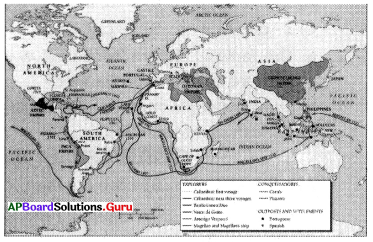
Observe the map and answer the questions given below it.
AP 9th Class Social Bits Chapter 12 Changing Cultural Traditions in Europe 1300-1800 with Answers 1
Question 40.
The discoverer of Brazil was
A) Magellan
B) Columbus
C) Pedro Alvares
D) Vasco Da Gama
Answer:
C) Pedro Alvares

Question 41.
Ferdinand Magellan worked for
A) Portuguese
B) Spain
C) Italy
D) England
Answer:
B) Spain

AP 9th Class Social Bits Chapter 12 Changing Cultural Traditions in Europe 1300-1800 with Answers

Question 42.
Who discovered sea route to India?
A) Amerigo Vespucci
B) Pedro
C) Magellan
D) Vasco Da Gama
Answer:
D) Vasco Da Gama

Question 43.
Bartholomev Diaz was a
A) Italian Explorer
B) Portuguese Explorer
C) Spanish Explorer
D) Italian Explorer
Answer:
B) Portuguese Explorer

Question 44.
The name Pacific ocean was given by
A) Erasmus
B) Plato
C) Magellan
D) Columbus
Answer:
C) Magellan

Question 45.
Match the following.
Group – A                                              Group – B
1. The Pieta                            ( )             A) Filippo Brunelleschi
2. Monalisa                            ( )             B) Isaac Newton
3. Duomo of Florence            ( )            C) Leonardo-da-Vinci
4. The Prince                          ( )             D) Michelangelo
5. Principia Mathematica       ( )             E) Machiavelli
Answer:
1) D
2) C
3) A
4) E
5) B

AP 9th Class Social Bits Chapter 12 Changing Cultural Traditions in Europe 1300-1800 with Answers

Question 46.
Match the following.
Group – A                               Group – B
1. Gutenberg              ( )         A) The Cape of Good Hope
2. Erasmus                  ( )         B) Germany
3. Galileo                    ( )         C) Holland
4. Diaz                        ( )         D) Portugal
5. Vasco-da-Gama      ( )         E) Italy
Answer:
1) B
2) C
3) E
4) A
5) D

Question 47.
Match the following:
1) Ancient Period a) 400 AD to 1300 AD
2) Medical Period b) 1300 AD to present
3) Modern Period c) Upto 400 AD
A) 1 – a, 2 – b, 3 – c
B) 1 – b, 2 – c, 3 – a
C) 1 – c, 2- b, 3 – a
D) 1 – c, 2 – a, 3 – b
Answer:
D) 1 – c, 2 – a, 3 – b

Question 48.
a. The famous picture ‘Monalisa’ was painted by Leonardo Da Vinci
b. Constantinople was occupied by the Turkish in the year 1453.
A) a & b are true
B) a & b are false
C) a true, b false
D) a false, b true
Answer:
A) a & b are true

Question 49.
World famous ‘Mona Lisa’ was painted by:
A) Michelangelo
B) Leonardo da vinci
C) Albercht Durer
D) Pikaso
Answer:
B) Leonardo da vinci

AP 9th Class Social Bits Chapter 12 Changing Cultural Traditions in Europe 1300-1800 with Answers

Question 50.
The thoughts of ‘medieval’ man were controlled by
A) Literature
B) Arts
C) Democracy
D) Religion
Answer:
D) Religion

Question 51.
The sea mariner who discovered the sea route to Indian in 1498 was:
A) Colombus
B) Pizaroo
C) Vasco Da Gama
D) Marco Polo
Answer:
C) Vasco Da Gama

Question 52.
Among the following languages in which Bible was published first
A) Sanskrit
B) English
C) French
D) Latin
Answer:
D) Latin

Question 53.
The trade routes between the West and East were closed with which city fell into the hands of the Turks in 1453?
A) Ankara
B) Constantinople
C) Alexandria
D) Rome
Answer:
B) Constantinople

AP 9th Class Social Bits Chapter 12 Changing Cultural Traditions in Europe 1300-1800 with Answers

Question 54.
Match the following.
1. Praise of folly A) Copernicus
2. Founder of society of Juses 1540 B) Erasmus
3. Proved that all planets revolved C) Jacob Burckhardt
4. The civilisation of the Renaissance in Italy D) Ignatius Loyola
A) B, D, A, C
B) B, A, C, D
C) C, D, B, A
D) B, C, A, D
Answer:
A) B, D, A, C

Question 55.
Who was signed name ‘disciple of experiment’?
A) Isaac Newton
B) Andreas Vesalius
C) Leonardo da vinci
D) William Harvey
Answer:
C) Leonardo da vinci

Question 56.
Who claimed that the earth is one of the number of planets that revolve around the sun?
A) Galileo
B) Copernicus
C) Ptolemy
D) Gerhardus Mercator
Answer:
B) Copernicus

Question 57.
The conquering of which city in C.E. 1453 forced the Europeans to find new sea trade routes to India?
A) Alexandria
B) Constantinople
C) Rome
D) London
Answer:
B) Constantinople

AP 9th Class Social Bits Chapter 12 Changing Cultural Traditions in Europe 1300-1800 with Answers

Question 58.
Humanism is an intellectual movement that had its origins in the European Renaissance. Which of these did humanism emphasize on?
A) Importance of life after death than life on the earth
B) Adherence to Christianity and the Church
C) The dignity and potential of the individual
D) Obedience to the king and government
Answer:
C) The dignity and potential of the individual

Question 59.
Which ancient civilization did the renaissance artists look to for inspiration?
A) Mayan
B) Aryan
C) Egypt
D) Greek
Answer:
D) Greek

Question 60.
Many educated Greek men fled to Italy because
A) Greeks wanted to occupy Italy
B) Constantinople was overthrown by Turkey
C) Greeks like the traditions of Italy
D) Italy first adopted humanism
Answer:
B) Constantinople was overthrown by Turkey

Question 61.
The sketch by Durer (Praying hands) gives us a sense of
A) Realism
B) Universalization
C) Italian culture in the sixteenth century
D) Culture of Greeks
Answer:
A) Realism

AP 9th Class Social Bits Chapter 12 Changing Cultural Traditions in Europe 1300-1800 with Answers

Question 62.
Leonardo Da Vinci signed his name as
A) Disciple of experiments
B) Man of experiments
C) Master of experiments
D) Worker of experiments
Answer:
A) Disciple of experiments

Question 63.
‘Even though the study of literature promises and offers no reward for women and no dignity, every woman ought to seek and embrace these studies’ – who said the above?
A) Isabella De Este
B) Cassandra Fedel
C) Mary Anteonette
D) Queen Elizabeth
Answer:
B) Cassandra Fedel

Question 64.
Identify the persons given in the table.

Columbus Ptolemy
Magellan Copernicus
Vascodagama Galileo

A) Sailors – Scientists
B) Sailors – Prime Ministers
C) Kings – Scientists
D) Kings – Sailors
Answer:
A) Sailors – Scientists

Question 65.
The division given in table is based on:

Section -1 Section – 2
Columbus James Watt
Vasco da Gama Stephenson
Amerigo Vespucci McAdam
Magellan Darby

A) Sailors – inventors
B) Sailors – kings
C) Kings – inventors
D) Inventors – sailors
Answer:
A) Sailors – inventors

AP 9th Class Social Bits Chapter 12 Changing Cultural Traditions in Europe 1300-1800 with Answers

Question 66.
In 1453, Constantinople was over-thrown, and this Empire took the place of the Eastern Roman Empire.
A) French Empire
B) Manchuria Empire
C) The Egyptian Empire
D) Turkish or Ottoman Empire
Answer:
D) Turkish or Ottoman Empire

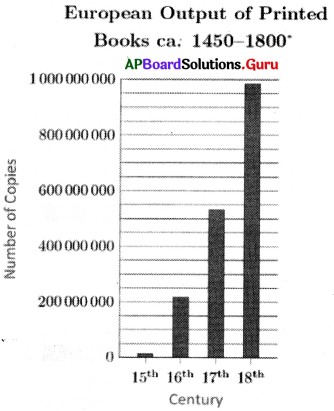
Observe the bar graph and answer the question 67-70:
AP 9th Class Social Bits Chapter 12 Changing Cultural Traditions in Europe 1300-1800 with Answers 2
Question 67.
The approximate no. books printed in the 17th century:
A) 55 crores
B) 60 crores
C) 20 crores
D) 40 crores
Answer:
A) 55 crores

Question 68.
The reason for the increase of printing books 18th century:
A) Global Expansion
B) All of these
C) Improved Technology
D) Improved Book reading attitude
Answer:
B) All of these

Question 69.
Who first developed paper and printing with blocks:
A) The Chinese
B) The Germans
C) The Japanese
D) The Indians
Answer:
A) The Chinese

AP 9th Class Social Bits Chapter 12 Changing Cultural Traditions in Europe 1300-1800 with Answers

Question 70.
This was the first book printed:
A) The Bhagavad Gita
B) The Bible
C) The Mahabharat
D) The Ramayana
Answer:
B) The Bible

Question 71.
The Holy Scripture of Christians:
A) The Bible
B) The Quran
C) The Ramayana
D) The Mahabharata
Answer:
A) The Bible

Observe the map and answer the questions 72 – 75.
AP 9th Class Social Bits Chapter 12 Changing Cultural Traditions in Europe 1300-1800 with Answers 3

Question 72.
Who was the first sailor to travel around the Earth?
A) Magellan
B) Vespucci
C) Vasco da Gama
D) Columbus
Answer:
A) Magellan

AP 9th Class Social Bits Chapter 12 Changing Cultural Traditions in Europe 1300-1800 with Answers

Question 73.
He was the first sailor who discovered America?
A) Magellan
B) Vespucci
C) Vasco da Gama
D) Columbus
Answer:
D) Columbus

Question 74.
Most of the sailors belong to this continent:
A) Africa
B) Europe
C) Asia
D) North America
Answer:
B) Europe

Question 75.
He was the first sailor who reached the Philippines and Indonesia:
A) Magellan
B) Vespucci
C) Vasco da Gama
D) Columbus
Answer:
A) Magellan

Question 76.
The navigators of these countries played an important part in the geographical explorations.
A) India – Pakistan
B) China – Japan
C) America – Russia
D) Portugal – Spain
Answer:
D) Portugal – Spain

AP 9th Class Social Bits Chapter 12 Changing Cultural Traditions in Europe 1300-1800 with Answers

Question 77.
In 1860 this item was emphasized by Jacob Burckhardt in the book ‘The Civilization of the Renaissance in Italy’.
A) Realism
B) Humanitarianism
C) Rebirth
D) Renaissance
Answer:
D) Renaissance

Question 78.
The changes that took place in the period of Renaissance :
1. Books were available to the common man also.
2. Weakening of the control of religion over human life.
3. People were attracted to material wealth, power and glory.
A) 1, 3 only
B) 1, 2 and 3
C) 1, 2 only
D) 2, 3 only
Answer:
B) 1, 2 and 3

Question 79.
Identify the painting of Leonardo da Vinci:
i) Mona Lisa ii) The Last Supper
A) (i) and (ii)
B) None of these
C) (i) only
D) (ii) only
Answer:
A) (i) and (ii)

Question 80.
The organization that had dominated the religious and cultural life of people in medieval times was
A) Feudalism
B) Science
C) State
D) Church
Answer:
D) Church

AP 9th Class Social Bits Chapter 12 Changing Cultural Traditions in Europe 1300-1800 with Answers

Question 81.
Venetian woman writer Fedele criticized the Republic in the following aspect/aspects:
A) For creating highly limited definition of freedom and For favouring the desires of men over those of women
B) None of these
C) For creating highly limited definition of freedom
D) For favouring the desires of men over those of women
Answer:
D) For favouring the desires of men over those of women

Question 82.
Martin Luther had not preached this in his campaign against the Catholic Church:
A) Complete faith in God.
B) Faith alone could guide them into right life and entry into heaven.
C) Priests are not necessary to establish relation with God.
D) Bible should be read in Latin only.
Answer:
C) Priests are not necessary to establish relation with God.

Question 83.
Who discovered the relation of heart with blood circulation?
A) Galileo
B) Copernicus
C) William Harvey
D) Roger Bacon
Answer:
C) William Harvey

Question 84.
If a heavy stone and a cotton ball are dropped from a height, which one falls with more speed ? Who proved this in his experiments from the Tower of Pisa?
A) Heavy stone – Gaiiieo
B) Both fall at the same speed – Galileo
C) Heavy stone – Copernicus
D) Cotton ball – Copernicus
Answer:
B) Both fall at the same speed – Galileo

AP 9th Class Social Bits Chapter 12 Changing Cultural Traditions in Europe 1300-1800 with Answers

Question 85.
Who invented the Paper first?
A) Chinese
B) British
C) Indians
D) Germans
Answer:
A) Chinese

Question 86.
The paint ‘Praying Hands’ was sketched by
AP 9th Class Social Bits Chapter 12 Changing Cultural Traditions in Europe 1300-1800 with Answers 4
A) Leonardo da Vinci
B) Michelangelo
C) Andreas Vesalius
D) Albrecht Durer
Answer:
D) Albrecht Durer

Question 87.
The theme of Praise of Folly written by Erasmus was:
A) Appreciation of Greek language and literature.
B) Importance of religious arts.
C) Criticism of the beliefs of the church, which were based on superstitions.
D) Discussion on life after death.
Answer:
C) Criticism of the beliefs of the church, which were based on superstitions.

Question 88.
Which of the following was the theory propagated by Nicolas Copernicus?
A) The sun, planets, and stars revolve around the earth.
B) The earth is one of the planets that revolves around the sun.
C) The moons of Jupiter revolve around it on an axis.
D) Heavy and light objects fall at the same speed when dropped from a height.
Answer:
B) The earth is one of the planet that revolves around the sun.

AP 9th Class Social Bits Chapter 12 Changing Cultural Traditions in Europe 1300-1800 with Answers

Question 89.
Which of the following is the most appropriate reason for European exploration of trade routes?
A) Find alternate fuel sources
B) Desire to control Constantinople
C) To industrialize the countries of the East
D) To find alternate trade routes
Answer:
D) To find alternate trade routes

Question 90.
One way Martin Luther, Ulrich Zwingii and John Calvings were similar is that they all were
A) French revolutionary leaders
B) Renaissance artists
C) Monarchs who opposed the Church
D) Reformation leaders
Answer:
D) Reformation leaders

Observe the timeline and answer the following questions 91 and 92.
AP 9th Class Social Bits Chapter 12 Changing Cultural Traditions in Europe 1300-1800 with Answers 5
Question 91.
Which period of European history is represented by this timeline?
A) Renaissance
B) Reformation
C) Industrial Revolution
D) German Unification
Answer:
B) Reformation

AP 9th Class Social Bits Chapter 12 Changing Cultural Traditions in Europe 1300-1800 with Answers

Question 92.
Which major event happened between 1510 and 1520 in Europe?
A) Erasmus Publishes Praise of Folly
B) Martin Luther Nails 95 Theses
C) Calvin Published Institutions of the Christian Religion
D) Council of Trent Meets in Italy
Answer:
B) Martin Luther Nails 95 Theses

Observe the map and answer questions 93 – 94.
AP 9th Class Social Bits Chapter 12 Changing Cultural Traditions in Europe 1300-1800 with Answers 6
Question 93.
Who was the first explorerto sail around the southern point of the continent of Africa?
A) Christopher Columbus
B) Bartolomeu Dias
C) Vasco Da Gamma
D) Ferdinand Magellan
Answer:
B) Bartolomeu Dias

Question 94.
Which of the following was the first country to establish colonies in the American continent?
A) France
B) England
C) Spain
D) Portugal
Answer:
B) England

Question 95.
Which of the following Empires was a South American Empire?
A) The Inca Empire
B) The Aztec Empire
C) The Ming Empire
D) The Ottoman Empire
Answer:
A) The Inca Empire

AP 9th Class Social Bits Chapter 12 Changing Cultural Traditions in Europe 1300-1800 with Answers

Question 96.
Vasco Da Gama travelled in his exploration around which of the following continent to reach india?
A) Australia
B) South America
C) North America
D) Africa
Answer:
D) Africa

AP 9th Class Social Bits Chapter 11 The Government Budget and Taxation with Answers

Practice the AP 9th Class Social Bits with Answers Chapter 11 The Government Budget and Taxation on a regular basis so that you can attempt exams with utmost confidence.

AP State Syllabus 9th Class Social Bits 11th Lesson The Government Budget and Taxation with Answers

Choose the correct answer.

Question 1.
An example of direct tax is
A) Customs duty
B) Excise duty
C) Income tax
D) Sales tax
Answer:
C) Income tax

Question 2.
An example of indirect tax is
A) Sales tax
B) Income tax
C) Corporate tax
D) Property tax
Answer:
A) Sales tax

AP 9th Class Social Bits Chapter 11 The Government Budget and Taxation with Answers

Question 3.
In 2011-12, the government spent …………. % on defence.
A) 7%
B) 12%
C) 4%
D) 3%
Answer:
A) 7%

Question 4.
………….. is a tax levied on goods brought from abroad.
A) Income
B) Sales
C) Corporate
D) Customs duty
Answer:
D) Customs duty

Question 5.
………….. tax is levied in the factory itself.
A) Sales
B) Customs duty
C) Excise
D) Corporate
Answer:
C) Excise

Question 6.
…………… is Union Finance Minister.
A) Manohar Parikar
B) Smriti Irani
C) M. Venkaiah Naidu
D) Nirmala Sitaraman
Answer:
D) Nirmala Sitaraman

AP 9th Class Social Bits Chapter 11 The Government Budget and Taxation with Answers

Question 7.
Finance minister of Andhra Pradesh is
A) Buggana Rajendranath
B) K. Acchem Naidu
C) P. Pulla Rao
D) K.E. Krishna Murthy
Answer:
A) Buggana Rajendranath

Question 8.
Railway budget is presented by
A) Union Finance Minister
B) Railway Minister
C) Union Home Minister
D) Prime Minister
Answer:
B) Railway Minister

Question 9.
Financial Year 2011-12 is
A) 1st Jan 2011 – 31st Dec. 2012
B) 1st April 2011 – 31st March 2012
C) 1st Jan 2011 – 31st Dec. 2011
D) 1st March 2011 – 31st March 2012
Answer:
B) 1st April 2011 – 31st March 2012

Question 10.
Expand VAT
A) Value Added Tax
B) Value Adhoc tax
C) Variation Added Tax
D) Variation Adhoc tax
Answer:
A) Value Added Tax

AP 9th Class Social Bits Chapter 11 The Government Budget and Taxation with Answers

Question 11.
………….. tax is evaded on a wide scale.
A) Excise
B) Income
C) Sales
D) Corporate
Answer:
C) Sales

Question 12.
Identify the odd one.
A) Retailor
B) Distributor
C) Wholesaler
D) Consumer
Answer:
D) Consumer

Question 13.
Tax levied on import is
A) Excise duty
B) Custom duty
C) Service tax
D) Corporate tax
Answer:
B) Custom duty

Question 14.
Goods produced attract …………… tax.
A) Excise duty
B) Custom duty
C) Service tax
D) Corporate tax
Answer:
A) Excise duty

AP 9th Class Social Bits Chapter 11 The Government Budget and Taxation with Answers

Question 15.
In 1997 …………… lakh individuals were assessed for income tax.
A) 141
B) 114
C) 144
D) 411
Answer:
B) 114

Question 16.
…………. is indirect tax.
A) Corporate tax
B) Income tax
C) VAT
D) Sales tax
Answer:
D) Sales tax

Question 17.
In 2011-12 ……………. % of total expenditure was on education and culture.
A) 12
B) 4
C) 8
D) 6
Answer:
A) 12

AP 9th Class Social Bits Chapter 11 The Government Budget and Taxation with Answers

Question 18.
……………. is not an organ of government.
A) Legislature
B) Executive
C) Judiciary
D) Revenue
Answer:
D) Revenue

Question 19.
Expand MRP
A) Minimum Retail Price
B) Maximum Retail Price
C) Maximum Real Price
D) Minimum Real Price
Answer:
B) Maximum Retail Price

Question 20.
…………… tax is charged personal income of individuals.
A) Corporate
B) Wealth
C) Income
D) Property
Answer:
C) Income

AP 9th Class Social Bits Chapter 11 The Government Budget and Taxation with Answers

Read the passage given below Answer the questions that follow.
Thus there are many ‘tax evaders’ and the black money, that is the money on which tax should have been paid but wasn’t, goes on accumulating. To get hold of this hoard of black money, the income tax department raids many people’s places. It has also tried to make the procedures more convenient for people to pay their own tax. Despite these efforts a large number of people do not pay income tax, or pay less than they should.

Question 21.
Name the department which raids on many people’s places.
A) ACB
B) CBI
C) Income Tax Department
D) ED
Answer:
C) Income Tax Department

Question 22.
From where does customs duty is collect?
A) Factories
B) Offices
C) Airports
D) Cinemas
Answer:
C) Airports

Question 23.
From where does sales tax is collect?
A) Traders
B) Bankers
C) Cine heroes
D) None of them
Answer:
A) Traders

AP 9th Class Social Bits Chapter 11 The Government Budget and Taxation with Answers

Read the table and answer the questions.
AP 9th Class Social Bits Chapter 11 The Government Budget and Taxation with Answers 1
Question 24.
How many types of taxes are there?
A) 2
B) 3
C) 4
D) 5
Answer:
A) 2

Question 25.
What is the percentage of excise duty?
A) 10%
B) 16%
C) 5%
D) 23%
Answer:
B) 16%

Question 26.
What kind of tax generate more revenue after corporation tax?
A) Service tax
B) Excise tax
C) Sales tax
D) Income tax
Answer:
C) Sales tax

Question 27.
The main source of revenue for the government is:
A) sales
B) loans
C) taxes
D) rents
Answer:
C) taxes

AP 9th Class Social Bits Chapter 11 The Government Budget and Taxation with Answers

Question 28.
2017 – 18 Union Budget presented in Loksabha on
A) February 28, 2017
B) March 1, 2017
C) February 15, 2017
D) February 1, 2017
Answer:
D) February 1, 2017

Question 29.
Budget means
A) Expenditure
B) Income
C) Balance of income and expenditure
D) Consumption
Answer:
C) Balance of income and expenditure

Question 30.
Excise duty is levied on
A) Distributor
B) Wholesaler
C) Retailer
D) Manufacturer
Answer:
D) Manufacturer

AP 9th Class Social Bits Chapter 11 The Government Budget and Taxation with Answers

Question 31.
Which of these is an indirect tax?
A) Wealth tax
B) Gift tax
C) Income tax
D) Goods and service tax
Answer:
D) Goods and service tax

AP 9th Class Social Bits Chapter 10 Prices and Cost of Living with Answers

Practice the AP 9th Class Social Bits with Answers Chapter 10 Prices and Cost of Living on a regular basis so that you can attempt exams with utmost confidence.

AP State Syllabus 9th Class Social Bits 10th Lesson Prices and Cost of Living with Answers

Choose the correct answer.

Question 1.
Receipts are shown on the …………… side in the budget.
A) left hand
B) right hand
C) top
D) bottom
Answer:
A) left hand

Question 2.
The people of income, should limit their consumption during inflation.
A) variable
B) fixed
C) both A & B
D) none of the above
Answer:
B) fixed

AP 9th Class Social Bits Chapter 10 Prices and Cost of Living with Answers

Question 3.
The inflation affects the …………. of the people.
A) mind
B) status
C) standard of living
D) none of these
Answer:
C) standard of living

Question 4.
D. A is paid to the ………….
A) daily labourers
B) agricultural labourers
C) private employees
D) government employees
Answer:
D) government employees

Question 5.
Extremely rich persons working in ……………. sector do not get affected by rising prices.
A) corporate
B) public
C) private
D) primary
Answer:
A) corporate

AP 9th Class Social Bits Chapter 10 Prices and Cost of Living with Answers

Question 6.
…………… numbers tell us about changes in the sum total of a set of items over time.
A) Roman
B) Index
C) Roll
D) All the above
Answer:
B) Index

Question 7.
………….. includes all goods.
A) CPI
B) FPI
C) WPI
D) None of the above
Answer:
C) WPI

Question 8.
Under …………….., the government has assumed responsibility for the supply of essential commodities.
A) FCI
B) CPI
C) WPI
D) PDS
Answer:
D) PDS

Question 9.
The apex body for all the banks in India
A) RBI
B) CBI
C) HSBC
D) KVB
Answer:
A) RBI

AP 9th Class Social Bits Chapter 10 Prices and Cost of Living with Answers

Question 10.
When there is rise in price of food materials, ………………. of such goods are banded.
A) imports
B) exports
C) production
D) none of the above
Answer:
B) exports

Question 11.
Continuous rise in prices over a period is
A) Budget
B) Inflation
C) Economy
D) Regulation
Answer:
B) Inflation

Question 12.
…………… refers to quantity of material goods/services to comfortable life.
A) Cost of Living
B) Lifestyle
C) Standard of living
D) Pricing
Answer:
C) Standard of living

Question 13.
Price level in Andhra Pradesh is com-pared with Karnataka using
A) Price Index
B) Cost Index
C) State Index
D) Budget Index
Answer:
A) Price Index

AP 9th Class Social Bits Chapter 10 Prices and Cost of Living with Answers

Question 14.
Expand WPI
A) Water Price Index
B) Wall Price Index
C) Wholesale Price Index
D) Wholesale Paper Index
Answer:
C) Wholesale Price Index

Question 15.
Expand CPI
A) Central Price Index
B) City Price Index
C) Consumer Paper Index
D) Consumer Price Index
Answer:
D) Consumer Price Index

Question 16.
Expand FPI
A) Food Price Index
B) Food Paper Index
C) Farm Price Index
D) Foreign Property Index
Answer:
A) Food Price Index

Question 17.
Inflation is measured on the basis of changes in
A) CPI
B) FPI
C) WPI
D) All Indices
Answer:
C) WPI

AP 9th Class Social Bits Chapter 10 Prices and Cost of Living with Answers

Question 18.
DA to be paid for government employees is calculated using
A) WPI
B) FPI
C) All Indices
D) CPI
Answer:
D) CPI

Question 19.
Minimum Support Price (MSP) is decided by ……………
A) Government
B) RBI
C) FCI
D) Producers
Answer:
A) Government

Question 20.
Expand PDS
A) People Distribution Scheme
B) Public Distribution Scheme
C) Public Division Scheme
D) People Division Scheme
Answer:
B) Public Distribution Scheme

AP 9th Class Social Bits Chapter 10 Prices and Cost of Living with Answers

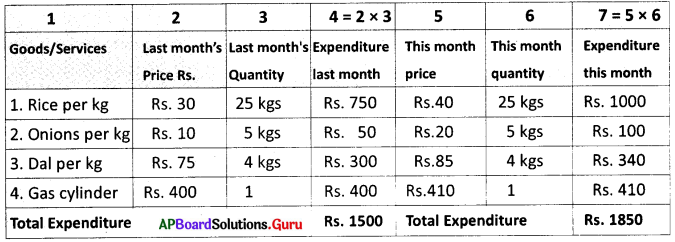
This is an example of how CPI can be constructed. Let us assume that your family buys rice, onions, dal, and gas cylinder.
AP 9th Class Social Bits Chapter 10 Prices and Cost of Living with Answers 1

Question 21.
How much more do we have to pay compared to last month?
A) Rs. 400
B) Rs. 350
C) Rs. 200
D) Rs. 100
Answer:
B) Rs. 350

Question 22.
What is the percentage of increase?
A) 44%
B) 50%
C) 23%
D) 16%
Answer:
C) 23%

Question 23.
Which of the following goods do not get the subsidy by the Government?
A) Food grains
B) LPG gas
C) Kerosene
D) Motor cycle
Answer:
D) Motor cycle

AP 9th Class Social Bits Chapter 10 Prices and Cost of Living with Answers

Question 24.
The ‘subsidies’ given by the government are meant to eradicate poverty. But these are misused. Suggest the deserved.
A) Rich people
B) MLAs & MPs
C) Poor people
D) None
Answer:
C) Poor people

Question 25.
Which of the following plays a crucial role in eradicating poverty?
A) School
B) Library
C) Police Stations
D) Banks
Answer:
A) School

Question 26.
Rising prices would not affect much on this group of people:
i) Corporate employees
ii) Agricultural labourers
iii) Extremely rich persons
A) i only
B) ii only
C) i and ii
D) i and iii
Answer:
D) i and iii

AP 9th Class Social Bits Chapter 10 Prices and Cost of Living with Answers

Question 27.
The food security of a nation mainly depends upon:
A) Technology sector
B) Industrial sector
C) Agriculture sector
D) Service sector
Answer:
C) Agriculture sector

AP 9th Class Social Bits Chapter 9 Credit in the Financial System with Answers

Practice the AP 9th Class Social Bits with Answers Chapter 9 Credit in the Financial System on a regular basis so that you can attempt exams with utmost confidence.

AP State Syllabus 9th Class Social Bits 9th Lesson Credit in the Financial System with Answers

Choose the correct answer.

Question 1.
One can withdraw money in cash or make payments by
A) Cheque
B) Promissory note
C) D.D
D) Ornaments
Answer:
A) Cheque

Question 2.
…………… acts as supervisory Bank.
A) CBI
B) RBI
C) SBI
D) BOI
Answer:
B) RBI

AP 9th Class Social Bits Chapter 9 Credit in the Financial System with Answers

Question 3.
Banks in India hold about ………….. % of their deposits as cash.
A) 20%
B) 10%
C) 15%
D) 25%
Answer:
C) 15%

Question 4.
Banks make use of the deposits to meet the requirements of the people
A) Personal
B) Financial
C) Loan
D) None of the above
Answer:
C) Loan

Question 5.
One of the major reasons for indebted¬ness is the need to borrow for ……………… requirements.
A) Medical
B) Educational
C) Cultural
D) None of the above
Answer:
A) Medical

Question 6.
In the areas, the demand for credit is for crop production.
A) Urban
B) Semi-urban
C) Rural
D) Tribal
Answer:
C) Rural

AP 9th Class Social Bits Chapter 9 Credit in the Financial System with Answers

Question 7.
Lenders may demand
A) Bribe
B) Interest
C) Both A & B
D) Collateral
Answer:
D) Collateral

Question 8.
An example for collateral
A) Livestock
B) Deposits
C) Vehicle
D) All of the above
Answer:
D) All of the above

Question 9.
Depending on the nature of the lender and the borrower, the ……………. of credit vary.
A) Terms
B) Interest
C) Amount
D) None of the above
Answer:
D) None of the above

Question 10.
Formal credit organisations in rural India
A) CBI
B) NABARD
C) Axis Bank
D) Micro finance organisations
Answer:
B) NABARD

AP 9th Class Social Bits Chapter 9 Credit in the Financial System with Answers

Question 11.
The ideal number of members in a SHG is
A) 15 – 20
B) 30 – 40
C) 20 – 30
D) 5 – 10
Answer:
A) 15 – 20

Question 12.
Banks are willing to lend to the poor women when organised in
A) Associations
B) SHGs
C) Partnerships
D) None of the above
Answer:
B) SHGs

Question 13.
Banks charge a interest rate on loans than what they offer on deposits.
A) Higher
B) Lower
C) Equal
D) Variable
Answer:
A) Higher

Question 14.
Primary source of income for banks is
A) RBI Help
B) Government Help
C) Difference of interest on loans and deposits
D) Fixed deposits
Answer:
C) Difference of interest on loans and deposits

AP 9th Class Social Bits Chapter 9 Credit in the Financial System with Answers

Question 15.
Credit from this/these is safe
A) Cooperatives
B) Banks
C) SHG
D) All the three
Answer:
D) All the three

Question 16.
………… is informal borrowing.
A) From the lender
B) From cooperative
C) From Bank
D) From SHG
Answer:
A) From the lender

Question 17.
……………. of rural credit is available from banks.
A) 1/6th
B) 1/5th
C) 1/4th
D) 2/5th
Answer:
A) 1/6th

Question 18.
Out of 14 crore farmers ………….. crore have loan accounts.
A) 3.5
B) 5.3
C) 9.8
D) 8.9
Answer:
B) 5.3

AP 9th Class Social Bits Chapter 9 Credit in the Financial System with Answers

Question 19.
Expand NGO
A) New Government Office
B) Non-Government Organization
C) Neo Government Organisation
D) National Government Office
Answer:
B) Non-Government Organization

Question 20.
Expand SHG
A) Self Help Group
B) Sure Help Group
C) Self Heal Group
D) Self Help Gang
Answer:
A) Self Help Group

Read the following text and answer the questions that follow.
The various types of loans can be conveniently grouped as formal sector loans and informal sector loans. Among the formal loans, the loans from banks and cooperatives, the informal loans include loans from moneylenders, traders, employers, relatives and friends,etc. You can see the various sources of credit to rural households in India. Out of every 100 rupee credit required by rural families, Rs.25 was available from commercial banks. Besides banks, the other major source of cheap credit in rural areas is the cooperative societies (or co-operatives). There are several types of co-operatives such as farmers’ co-operatives,weavers’ cooperatives, etc. You will also notice moneylenders are an important section of informal credit providers in India.
Question 21.
How many types of loans are there?
A) 4
B) 3
C) 2
D) 5
Answer:
C) 2

AP 9th Class Social Bits Chapter 9 Credit in the Financial System with Answers

Question 22.
From where do we get a formal loans?
A) Banks
B) Moneylenders
C) Financial companies
D) Friends
Answer:
A) Banks

Question 23.
Who provide informal loans
A) Moneylenders
B) Banks
C) Co-operatives
D) Friends
Answer:
A) Moneylenders

Study the table and answer the given questions.
AP 9th Class Social Bits Chapter 9 Credit in the Financial System with Answers 1
Question 24.
Who gets more loans informal credit?
A) Rich households
B) Poor households
C) Widows
D) Children
Answer:
A) Rich households

Question 25.
Which section of people get loans in informal credit?
A) Rich households
B) Poor households
C) Children
D) None
Answer:
B) Poor households

AP 9th Class Social Bits Chapter 9 Credit in the Financial System with Answers

Question 26.
How many types of credits are there?
A) 2
B) 3
C) 4
D) 5
Answer:
A) 2

AP 9th Class Social Bits Chapter 9 Credit in the Financial System with Answers 2
Question 27.
How much credit is taken by poor households?
A) 30%
B) 40%
C) 20%
D) 10%
Answer:
B) 40%

Question 28.
How much credit is taken by rich households?
A) 21%
B) 17%
C) 13%
D) 10%
Answer:
A) 21%

Question 29.
7% of credit is taken by
A) Poor households
B) Rich households
C) Well-off households
D) Households with few assets
Answer:
D) Households with few assets

AP 9th Class Social Bits Chapter 9 Credit in the Financial System with Answers

Question 30.
Who controls the circulation of money in India?
A) NABARD
B) NAFED
C) RBI
D) SBI
Answer:
C) RBI

Question 31.
Present R.B.I. Governer
A) D. Subba Rao
B) Raghu Ram Rajan
C) Urjit Patel
D) Sakthikanta Das
Answer:
D) Sakthikanta Das

Question 32.
Which of those is NOT a function of the Reserve Bank of India?
A) Accepting deposits from the general public
B) Printing and issuing of currency notes
C) Acting as an advisory body to the government on financial and economic policies
D) Acting as a custodian of the foreign reserves of the country
Answer:
A) Accepting deposits from the general public

AP 9th Class Social Bits Chapter 9 Credit in the Financial System with Answers

Question 33.
Sekhar has a savings account in a bank with an annual interest rate of 5%. If the inflation rate goes up to 7%, what will happen to the purchasing power of Sekhar’s savings?
A) It will increase
B) It will decrease
C) It will remain the same
D) Can’t say as the actual money in Sekhar’s account is not given
Answer:
B) It will decrease

AP 9th Class Social Bits Chapter 8 Service Activities in India with Answers

Practice the AP 9th Class Social Bits with Answers Chapter 8 Service Activities in India on a regular basis so that you can attempt exams with utmost confidence.

AP State Syllabus 9th Class Social Bits 8th Lesson Service Activities in India with Answers

Choose the correct answer.

Question 1.
Which one of the following is not a sub-sector of the tertiary sector?
A) Trade, hotels and restaurants
B) Small scale and cottage industries
C) Finance, insurance and real estate
D) Community, social and personal services
Answer:
B) Small scale and cottage industries

Question 2.
Which sector has gained more importance in last 30 years in India?
A) Primary
B) Secondary
C) Tertiary
D) All of the above
Answer:
C) Tertiary

AP 9th Class Social Bits Chapter 8 Service Activities in India with Answers

Question 3.
In any country, developmental initiatives involve setting up of many establishments.
A) Developing
B) Developed
C) Under developed
D) None of the above
Answer:
A) Developing

Question 4.
Since the early ………….. there has been tremendous change in the communica-tion technology.
A) 1980s
B) 1984s
C) 1993s
D) 1990s
Answer:
D) 1990s

Question 5.
Many IT companies were established in
A) Villages
B) Towns
C) Metropolitan cities
D) Cities
Answer:
C) Metropolitan cities

Question 6.
Due to changes in technology and stiff competition in industrial sector, many industries have diverted a major section of their activities to ……………….. sector.
A) Service
B) Primary
C) Small scale industries
D) None of the above
Answer:
A) Service

AP 9th Class Social Bits Chapter 8 Service Activities in India with Answers

Question 7.
Becoming ……………. has become dream of the youth.
A) Civil engineer
B) Software engineer
C) Mechanical engineer
D) Electrical engineer
Answer:
B) Software engineer

Question 8.
Fastest growing sector is
A) Agriculture
B) Industry
C) Service
D) None of these
Answer:
C) Service

Question 9.
India faces an acute shortage of skilled service professionals in …………….. sector.
A) Education
B) Bankin
C) Insurance
D) Health
Answer:
D) Health

Question 10.
We need more better quality
A) Roads
B) Railways
C) Airways
D) Water ways
Answer:
A) Roads

AP 9th Class Social Bits Chapter 8 Service Activities in India with Answers

Question 11.
Service sector is called otherwise as …………….. sector.
A) Primary
B) Secondary
C) Tertiary
D) Industrial
Answer:
C) Tertiary

Question 12.
‘Service’ refers
A) Nature of work done
B) Amount of work done
C) Cost of work done
D) No livelihood earned
Answer:
A) Nature of work done

Question 13.
Identify the odd one.
A) call centre
B) service
C) outsourcing
D) industry
Answer:
D) industry

Question 14.
Service sector produce
A) Goods
B) Commodities
C) No goods
D) Crops
Answer:
C) No goods

AP 9th Class Social Bits Chapter 8 Service Activities in India with Answers

Question 15.
Identify the odd one.
A) Air force
B) Police
C) Army
D) Navy
Answer:
B) Police

Question 16.
Identify the odd one.
A) clerk
B) accountant
C) typist
D) tailor
Answer:
D) tailor

Question 17.
Service sector jobs constitute ……….. of all jobs in India.
A) 1/4
B) 1/5
C) 1/3
D) 2/5
Answer:
A) 1/4

Question 18.
Since ………….. foreign companies can set up retail shops in india.
A) 1991
B) 1984
C) 2015
D) 2012
Answer:
D) 2012

AP 9th Class Social Bits Chapter 8 Service Activities in India with Answers

Question 19.
Expand FDI
A) Factory Direct Investment
B) Foreign Direct Investment
C) Factory Disinvestment Indicator
D) Foreign Disinvestment in India
Answer:
B) Foreign Direct Investment

Question 20.
Expand ANM
A) Auxiliary Nurse and Midwife
B) Ancilary Nurse Mentor
C) Anganwadi Nurse Midwife
D) Auxiliary Nurse Mentor
Answer:
A) Auxiliary Nurse and Midwife

Observe the map and answer the questions.
AP 9th Class Social Bits Chapter 8 Service Activities in India with Answers 1

Question 21.
Name the city of A.P, where software technology parks are located?
A) Vijayawada
B) Guntur
C) Ongole
D) Visakhapatnam
Answer:
D) Visakhapatnam

AP 9th Class Social Bits Chapter 8 Service Activities in India with Answers

Question 22.
Where is the software technology park is in North-east India
A) Imphal
B) Guwahati
C) Kohima
D) Agarthala
Answer:
B) Guwahati

Question 23.
In which state Noida is located?
A) Maharashtra
B) Uttar Pradesh
C) West Bengal
D) Kerala
Answer:
B) Uttar Pradesh

Question 24.
Which sector is the largest producer of employment in India today?
A) Agriculture
B) Industries
C) Service
D) Information Technology
Answer:
A) Agriculture

AP 9th Class Social Bits Chapter 8 Service Activities in India with Answers

Read the given map and answer the following questions from 25-28.
AP 9th Class Social Bits Chapter 8 Service Activities in India with Answers 2

Question 25.
The city which has software technology park in Gujarath
A) Pune
B) Jaipur
C) Gandhi Nagar
D) Bhuvaneshwar
Answer:
C) Gandhi Nagar

Question 26.
Which state does not have the software technology park ?
A) Rajasthan
B) Gujarath
C) Chattishgarh
D) Uttar Pradesh
Answer:
C) Chattishgarh

Question 27.
The city which has software technology park in Andhra Pradesh
A) Rajahmundry
B) Amaravathi
C) Tirupati
D) Visakhapatnam
Answer:
B) Amaravathi

Question 28.
Which software technology park is located in North East India?
A) Kolkata
B) Bhuvaneshwar
C) Guwahati
D) Indore
Answer:
C) Guwahati

AP 9th Class Social Bits Chapter 8 Service Activities in India with Answers

Question 29.
The primary sector of the economy extracts or harvests products from the earth. The primary sector includes the production of raw material and basic foods.
Which of the following activities is associated with the primary sector?
A) Pottery
B) Mining
C) Basked Weaving
D) Education
Answer:
B) Mining

Question 30.
The city that has emerged as the electronic capital of India is:
A) Pune
B) Hyderabad
C) Bengaluru
D) Chennai
B) Hyderabad
Answer:
C) Bengaluru

AP 9th Class Social Bits Chapter 7 Industries in India with Answers

Practice the AP 9th Class Social Bits with Answers Chapter 7 Industries in India on a regular basis so that you can attempt exams with utmost confidence.

AP State Syllabus 9th Class Social Bits 7th Lesson Industries in India with Answers

Choose the correct answer.

Question 1.
India began many initiatives to promote industrial activities after …………..
A) 1957
B) 1947
C) 1967
D) 1937
Answer:
B) 1947

Question 2.
Since independence, the electricity production has increased ………… times.
A) 50
B) 100
C) 150
D) 200
Answer:
B) 100

AP 9th Class Social Bits Chapter 7 Industries in India with Answers

Question 3.
Organised manufacturing units operating in India today
A) nearly 2 lakhs
B) nearly 5 lakhs
C) nearly 9 lakhs
D) nearly 10 lakhs
Answer:
A) nearly 2 lakhs

Question 4.
Yarn is obtained from
A) paddy
B) sugarcane
C) cotton
D) all of these
Answer:
C) cotton

Question 5.
Roads, transport, communication, etc. are called
A) Industrial sector
B) Agriculture sector
C) Infrastructure
D) All of these
Answer:
C) Infrastructure

Question 6.
Major producer of employment in the country is
A) Industry
B) Service sector
C) Agriculture
D) None of these
Answer:
C) Agriculture

AP 9th Class Social Bits Chapter 7 Industries in India with Answers

Question 7.
The industry that is not agro-based
A) Cement
B) Textile industry
C) Sugar industry
D) None of these
Answer:
A) Cement

Question 8.
The first oil mill was founded in
A) Delhi
B) Kolkata
C) Mumbai
D) Bengaluru
Answer:
C) Mumbai

Question 9.
Which of the following is not a basic industry?
A) transport
B) machine
C) electricity
D) chemical
Answer:
D) chemical

Question 10.
……………. industry occupies unique position in the Indian economy.
A) Automobile
B) Cement
C) Fertiliser
D) Textile
Answer:
D) Textile

AP 9th Class Social Bits Chapter 7 Industries in India with Answers

Question 11.
Today India has ……………. cotton and manmade fibre textile mills.
A) 1750
B) 960
C) 1600
D) 1200
Answer:
C) 1600

Question 12.
Identify the odd one
A) Spinning
B) Smelting
C) Ginning
D) Weaving
Answer:
C) Ginning

Question 13.
India exports yarn to ………..
A) Bangladesh
B) Japan
C) Pakistan
D) USA
Answer:
B) Japan

Question 14.
There are about ………….. jute mills in India.
A) 60
B) 80
C) 70
D) 90
Answer:
C) 70

AP 9th Class Social Bits Chapter 7 Industries in India with Answers

Question 15.
Leading Jute producer in India is
A) West Bengal
B) Odisha
C) Uttar Pradesh
D) Bihar
Answer:
A) West Bengal

Question 16.
Identify the odd one
A) Bagasse
B) Khandsari
C) White Sugar
D) Jaggery
Answer:
A) Bagasse

Question 17.
India ranks among crude steel producers worldwide.
A) 10th
B) 9th
C) 8th
D) 11th
Answer:
B) 9th

Question 18.
We entirely import element/compounds.
A) Phosphate
B) Nitrogen
C) Potash
D) Ammonium
Answer:
C) Potash

Question 19.
Fertiliser corporation of India Hazira is in ………..
A) Tamilnadu
B) Bihar
C) Uttar Pradesh
D) Gujarat
Answer:
D) Gujarat

AP 9th Class Social Bits Chapter 7 Industries in India with Answers

Question 20.
The first cement plant in India was set up in ………….
A) 1908 in Chennai
B) 1904 in Chennai
C) 1908 in Mumbai
D) 1904 in Mumbai
Answer:
B) 1904 in Chennai

Question 21.
………………. industry has experience quantum jump in 15 years.
A) Cement
B) Fertiliser
C) Chemical
D) Automobile
Answer:
D) Automobile

Question 22.
Expand BPO
A) Business Promotion Organisation
B) Business Processes Outsourcing
C) Business Processes Operations
D) Business Promotion Operations
Answer:
B) Business Processes Outsourcing

Question 23.
In India made new policy for industries.
A) 1980s
B) 2000s
C) 2010s
D) 1990s
Answer:
D) 1990s

AP 9th Class Social Bits Chapter 7 Industries in India with Answers

Question 24.
Largest exporter of Jute in the world is
A) India
B) Bangladesh
C) Pakistan
D) Italy
Answer:
B) Bangladesh

Study the table and answer the questions 25 – 27.

S.No. Mineral industries Mineral / agro based Location
1. Iron ore Iron & Steel Visakhapatnam
2. Limestone Cement Nalgonda
3. Bauxite Aluminium Vijayanagaram
4. Mica Electrical and Electrons BHEL, Hyderabad
5. Graphite Lead pencils Mumbai

Question 25.
Which raw material is required for the cement industry?
A) Aluminium
B) Lead
C) Zinc
D) Limestone
Answer:
D) Limestone

Question 26.
Graphite is used in …………
A) Pencils
B) Pens
C) Slates
D) Slate Pencils
Answer:
A) Pencils

AP 9th Class Social Bits Chapter 7 Industries in India with Answers

Question 27.
Which mineral is used in Electronics industry?
A) Gypsum
B) Limestone
C) Mica
D) Bauxite
Answer:
C) Mica

Observe the map and answer the questions given below.
AP 9th Class Social Bits Chapter 7 Industries in India with Answers 1

Question 28.
In which state Gurgaon and Panipat are located?
A) Haryana
B) Karnataka
C) Kerala
D) Assom
Answer:
A) Haryana

Question 29.
Name the south Indian state famous for silk textile.
A) Karnataka
B) Tamilnadu
C) Andhra Pradesh
D) Tripura
Answer:
A) Karnataka

AP 9th Class Social Bits Chapter 7 Industries in India with Answers

Question 30.
The city which is called the capital of electronics
A) Hyderabad
B) Bangalore
C) Delhi
D) Chennai
Answer:
B) Bangalore

Question 31.
Highest sugar producing state in India is
A) West Bengal
B) Uttar Pradesh
C) Gujarat
D) Andhra Pradesh
Answer:
B) Uttar Pradesh

Question 32.
Which of the following is Eco – Friendly?
A) Nylon
B) Polyester
C) Rayon
D) Jute
Answer:
D) Jute

Question 33.
The Industry that is not agro based
A) Tea Manufacturing
B) Iron & Steel
C) Sugar Industry
D) Jute Industry
Answer:
B) Iron & Steel

Question 34.
Raw material used in Aluminium
A) Copper
B) Zinc
C) Bauxite
D) Lead
Answer:
C) Bauxite

AP 9th Class Social Bits Chapter 7 Industries in India with Answers

Question 35.
Factor for concentrated Jute Textiles Industry in West Bengal
A) Inexpensive water transport
B) Proximity of the Jute producing areas
C) Port facilities
D) Above all
Answer:
D) Above all

Question 36.
India’s first cement industry was setup in
A) 1905-Mumbai
B) 1906-Chennai
C) 1904-Chennai
D) 1906-Mumbai
Answer:
C) 1904-Chennai

Question 37.
India stands in which place as a world producer of sugar
A) 4th
B) 3rd
C) 2nd
D) 6th
Answer:
C) 2nd

Question 38.
Identify the industry based on the features given below.
i) This is the basis for the second most important metallurgical industry in India.
ii) This metal is light and is resistanyo corrosion.
iii) This metal is used in manufacturing aircraft.
A) Iron and steel industry
B) Cement industry
C) Copper smelting industry
D) Aluminum & melting industry
Answer:
D) Aluminum & melting industry

AP 9th Class Social Bits Chapter 7 Industries in India with Answers

Question 39.
It is light resistant to corrosion good conductor of heat. It is used to manufacture aircraft utensils and wires.
The above sentences are relating to which of the following Metal?
A) Chromium
B) Aluminum
C) Phosphate
D) Manganese
Answer:
B) Aluminum

Question 40.
The largest producer of Jaggery in the world is:
A) India
B) China
C) Pakistan
D) Bangladesh
Answer:
A) India

Question 41.
The largest producer of raw Jute and Jute goods in the world :
A) Sri Lanka
B) Bangladesh
C) England
D) India
Answer:
B) Bangladesh

AP 9th Class Social Bits Chapter 7 Industries in India with Answers

Question 42.
Which among the following is a rising problem in the context of industrialization?
A) Lack of technology
B) Environmental pollution
C) Employment generation
D) Lack of investment
Answer:
B) Environmental pollution

Question 43.
A discussion class is goihg on an issue in 9th class.
Raju arguing “Industries are neces-sary for development of a country. It provides employment and production of different good which is useful to our daily life
Savithri said “Industries are necessary but it causing pollution and also decreasing natural resources. Industrilization many leads to capitalization too….” From the above, what is the main theme in their discussion?
A) Results at Industrial development.
B) Environmental pollution
C) Time and Value
D) Decreasing Natural resources
Answer:
A) Results at Industrial development.

Question 44.
“All of us must use jute products instead of synthetic products”.
A) Yes. We must use jute products because they are ecofriendly.
B) Yes. We must use jute products for the sake of farmers who cultivate jute.
C) We must use only synthetic products because they are cheap.
D) No. This is not correct.
Answer:
A) Yes. We must use jute products because they are ecofriendly.

AP 9th Class Social Bits Chapter 6 Agriculture in India with Answers

Practice the AP 9th Class Social Bits with Answers Chapter 6 Agriculture in India on a regular basis so that you can attempt exams with utmost confidence.

AP State Syllabus 9th Class Social Bits 6th Lesson Agriculture in India with Answers

Choose the correct answer.

Question 1.
Which one of the following describes a system of agriculture where a single crop is grown on a large scale?
A) Shifting Agriculture
B) Plantation Agriculture
C) Horticulture
D) Intensive Agriculture
Answer:
D) Intensive Agriculture

Question 2.
Which one of the following is a rabi crop?
A) Rice
B) Millets
C) Wheat
D) Cotton
Answer:
C) Wheat

AP 9th Class Social Bits Chapter 6 Agriculture in India with Answers

Question 3.
Which one of the following is a leguminous crop?
A) Pulses
B) Millets
C) Jowar
D) Sesamum
Answer:
A) Pulses

Question 4.
The largest producer of coffee in India is
A) Karnataka
B) Bihar
C) Assam
D) Punjab
Answer:
A) Karnataka

Question 5.
…………. is known as a golden fibre.
A) Cotton
B) Jute
C) Rubber
D) Mulberry
Answer:
B) Jute

Question 6.
An example of a beverage crop is
A) Rubber
B) Sugarcane
C) Coffee
D) Maize
Answer:
C) Coffee

Question 7.
This is not the character of commercial farming
A) Use of primitive tools
B) Use of HYV Seeds
C) Use of pesticides
D) Use of chemical fertilisers
Answer:
A) Use of primitive tools

AP 9th Class Social Bits Chapter 6 Agriculture in India with Answers

Question 8.
Identify the odd one based on farming.
A) Rice
B) Tea
C) Rubber
D) Sugarcane
Answer:
C) Rubber

Question 9.
Staple food of majority of the people in India is
A) Wheat
B) Maize
C) Rice
D) Millets
Answer:
C) Rice

Question 10.
…………….. is a coarse grain.
A) Wheat
B) Maize
C) Rice
D) Jowar
Answer:
D) Jowar

Question 11.
…………… is not a coarse grain.
A) Jowar
B) Maize
C) Bajra
D) Ragi
Answer:
B) Maize

Question 12.
……………. is the largest producer of oil seeds in the world.
A) Indonesia
B) West Indies
C) USA
D) India
Answer:
D) India

AP 9th Class Social Bits Chapter 6 Agriculture in India with Answers

Question 13.
India produces about of ………….. the world’s vegetables.
A) 2/5
B) 1/4
C) 2/5
D) 1/6
Answer:
D) 1/6

Question 14.
Rearing of silk worms is
A) Sericulture
B) Silkeulture
C) Epieulture
D) Monoculture
Answer:
A) Sericulture

Question 15.
Second phase of agriculture in India is from
A) 1947 -1965
B) 1950 -1965
C) 1966 -1990
D) post 1991
Answer:
C) 1966 -1990

Question 16.
84% of pulses in India are grown in
A) wet land areas
B) table land area
C) low land area
D) dry land area
Answer:
D) dry land area

Question 17.
Government took protective measures in agriculture prior to
A) 1971
B) 1981
C) 1991
D) 2001
Answer:
C) 1991

AP 9th Class Social Bits Chapter 6 Agriculture in India with Answers

Question 18.
………….. is the largest producer of Jowar in India.
A) Rajasthan
B) Maharashtra
C) Gujarath
D) Karnataka
Answer:
B) Maharashtra

Question 19.
…………………. is the largest producer of Groundnut in India.
A) Rajasthan
B) Gujarath
C) Maharashtra
D) Andhra Pradesh
Answer:
D) Andhra Pradesh

Question 20.
…………….. state is not a great producer of mangoes.
A) Kerala
B) Maharashtra
C) Andhra Pradesh
D) Uttar Pradesh
Answer:
D) Uttar Pradesh

Question 21.
…………….. is not practiced during ‘Zaid’ season.
A) Fodder
B) Cucumber
C) Barley
D) Watermelon
Answer:
C) Barley

Question 22.
Rice is a commercial crop in
A) Andhra Pradesh
B) Odisha
C) Tamilnadu
D) Haryana
Answer:
D) Haryana

Question 23.
Tea bushes require ………….., ………….., …………… climate all through the year.
A) Warm, moist, frost free
B) Warm, moist, frost
C) Cold, dry, frostfree
D) Warm, dry, frostfree
Answer:
A) Warm, moist, frost free

AP 9th Class Social Bits Chapter 6 Agriculture in India with Answers

A variety of food and non-food crops are grown in different parts of the coun-try depending upon the variations in soil, climate and cultivation practices. Major crops grown in India are paddy, wheat, millets, pulses, tea, coffee, sugarcane, oil seeds, cotton and jute, etc.
Read the text given and answer the questions.

Question 24.
Into how many types of crops are broadly divided?
A) 4
B) 2
C) 5
D) 6
Answer:
B) 2

Question 25.
Which of the following is a food crop?
A) Rice
B) Cotton
C) Sugarcane
D) Jute
Answer:
A) Rice

Question 26.
Which of the following is a non-food crop?
A) Paddy
B) Wheat
C) Cotton
D) Ragi
Answer:
C) Cotton

AP 9th Class Social Bits Chapter 6 Agriculture in India with Answers

Study the table and answer the questions given below it.

Grain Where it grow
Rice West Bengal, Bihar, Andhra Pradesh, etc.
Wheat Uttarakhand, Uttar Pradesh, Punjab
Jowar Maharashtra, Karnataka, Andhra Pradesh
Bajra Rajasthan
Maize Uttar Pradesh, Andhra Pradesh

Question 27.
In which state rice does not grow?
A) AP
B) Assom
C) West Bengal
D) Rajasthan
Answer:
D) Rajasthan

Question 28.
In which state Jowar grow?
A) U.P
B) Punjab
C) Uttarakhand
D) Maharashtra
Answer:
D) Maharashtra

Question 29.
In which state maize grow?
A) U.P
B) M.P
C) Gujarat
D) Kerala
Answer:
A) U.P

AP 9th Class Social Bits Chapter 6 Agriculture in India with Answers

Observe the map given and answer the following.
AP 9th Class Social Bits Chapter 6 Agriculture in India with Answers 1

Question 30.
Which state is the largest producer of sugarcane?
A) Uttar Pradesh
B) Maharashtra
C) Punjab
D) Nagaland
Answer:
B) Maharashtra

Question 31.
Which state is the largest producer of groundnut?
A) Andhra Pradesh
B) Kerala
C) Goa
D) Haryana
Answer:
A) Andhra Pradesh

Question 32.
Sesamum is a …………… crop.
A) Kharif
B) Rabi
C) Zaid
D) None
Answer:
A) Kharif

Question 33.
Choose the correct one.
1. Paddy is a Kharif crop
2. Wheat is a Zaid crop
A) 1 is true
B) 2 is true
C) 1 & 2 are true
D) None
Answer:
A) 1 is true

AP 9th Class Social Bits Chapter 6 Agriculture in India with Answers

Question 34.
Choose the wrong pair from given below.
A) Bhakra Nangal – Himachal Pradesh
B) Hirakud – Odisha
C) Damodar valley – West Bengal
D) Nagarjuna Sagar-Tamilnadu
Answer:
D) Nagarjuna Sagar-Tamilnadu

Question 35.
One among the below belongs to green revolution
A) HYVs
B) New Technical Methods
C) Irrigation facilities
D) Above all
Answer:
D) Above all

Question 36.
Who is not relate to the Government Administration?
A) Thahasildar (MRO)
B) Beauticians
C) Police
D) Collector
Answer:
B) Beauticians

Question 37.
Who decides the minimum support price for agricultural products ? .
A) Farmers
B) Mediators
C) Buyers
D) Government
Answer:
D) Government

AP 9th Class Social Bits Chapter 6 Agriculture in India with Answers

Examine the above given map and answer the 38 and 39 questions.
AP 9th Class Social Bits Chapter 6 Agriculture in India with Answers 2

Question 38.
Paddy is not a major crop in this South Indian state
A) Andhra Pradesh
B) Karnataka
C) Kerala
D) Tamilnadu
Answer:
B) Karnataka

Question 39.
Paddy is a major crop in one of the North Indian states
A) Jammu & Kashmir
B) Punjab
C) Rajasthan
D) Himachal Pradesh
Answer:
B) Punjab

Question 40.
Rubber crop needs high rainfall. So it grows well in region.
A) Equatorial
B) Tropical
C) Mediterranean
D) Tundra
Answer:
A) Equatorial

Question 41.
Which among the following is mainly a Kharif crop?
A) Paddy
B) Wheat
C) Barley
D) Gram
Answer:
A) Paddy

AP 9th Class Social Bits Chapter 6 Agriculture in India with Answers

Question 42.
This is not cropping season in India.
A) Rabi
B) Kharif
C) Zaid
D) Arabica
Answer:
D) Arabica

Question 43.
Choose the wrong pair from given below.
A) Coffee – Karnataka
B) Tea-Assom
C) Wheat-Andhra Pradesh
D) Rubber – Kerala
Answer:
C) Wheat-Andhra Pradesh

Question 44.
………………… are help in decomposition of plant and animal substances and turns them as organic matter.
A) Bacteria
B) Fungi
C) Both A and B
D) None of the above
Answer:
C) Both A and B

Question 45.
Choose the correct one
1) Wheat is a ‘RABI’ crop
2) Watermelon is ‘ZAID’ crop
A) 1 is true
B) 2 is true
C) 1 & 2 are true
D) 1 & 2 are false
Answer:
C) 1 & 2 are true

AP 9th Class Social Bits Chapter 6 Agriculture in India with Answers

Question 46.
Culturing of silk worms is known as
A) Apiculture
B) Horticulture
C) Sericulture
D) Aquaculture
Answer:
C) Sericulture

Question 47.
Original home of cotton Plant
A) Bangladesh
B) India
C) China
D) Italy
Answer:
B) India

Question 48.
High production in crops related to which revolution?
A) Blue Revolution
B) Green Revolution
C) Black Revolution
D) Red Revolution
Answer:
B) Green Revolution

Question 49.
Rearing of silk worms for the produc¬tion of silk is known as
A) Epiculture
B) Sericulture
C) Brown culture
D) Aqua culture
Answer:
B) Sericulture

AP 9th Class Social Bits Chapter 6 Agriculture in India with Answers

Question 50.
Which crop is known as the golden fibre?
A) Cotton
B) Jute
C) Rubber
D) Tea
Answer:
B) Jute

Question 51.
The percentage of irrigated land in the entire cultivable land in India is
A) 30%
B) 50%
C) 40%
D) 70%
Answer:
C) 40%

Question 52.
Which of the following is not a non-food crop?
A) Rubber
B) Cotton
C) Jute
D) Maize
Answer:
D) Maize

Question 53.
Which of the following practices can help in increasing crop production in dry land areas?
i) rainfall conservation
ii) afforestation
iii) mixed crop farming Choose the correct answer.
A) i and ii only
B) ii and iii only
C) i and iii only
D) All – i, ii and iii
Answer:
D) All – i, ii and iii

AP 9th Class Social Bits Chapter 6 Agriculture in India with Answers

Question 54.
Which of these Government of India schemes provides the farmers on-line trading platform for agricultural commodities?
A) National Agriculture Market (NAM)
B) Minimum Support Price (MSP)
C) Goods and Service Tax (GST)
D) Farmer Bazaars (FB)
Answer:
A) National Agriculture Market (NAM)

Question 55.
AP 9th Class Social Bits Chapter 6 Agriculture in India with Answers 3
How does the above image reflect in the context of Indian agriculture?
A) Small farmers hold more land than big land owners.
B) Land available for small farmers is very less.
C) The number of big land owners is more than small farmers.
D) Almost all of the agricultural land is available for small farmers.
Answer:
B) Land available for small farmers is very less.

Question 56.
Which of the following crops are NOT suitable for dry land agriculture?
A) Jute, Paddy
B) Ragi, Gram
C) Groundnut, Bajra
D) Jowar, Soyabean
Answer:
A) Jute, Paddy

AP 9th Class Social Bits Chapter 6 Agriculture in India with Answers

Question 57.
Which of the following is correctly matched?
a) Nagarjuna Sagar i) Himachal Pradesh
b) Bhakra – Nangai ii) Andhra Pradesh
c) Hirakud iii) Odisha
A) a – iii, b – ii, c – i
B) a – ii, b – i, c – iii
C) a – i, b – iii, c – ii
D) a – i, b – iii, c – ii
Answer:
B) a – ii, b – i, c – iii

Question 58.
Which of the following crop is related with the ‘Arabica’ variety?
A) Wheat
B) Tea
C) Coffee
D) Cotton
Answer:
C) Coffee

Question 59.
Which of the following States is declared as the first organic farming state of India
A) Andhra Pradesh
B) Sikkim
C) Assom
D) Kerala
Answer:
B) Sikkim

AP 9th Class Social Bits Chapter 6 Agriculture in India with Answers

Question 60.
A little over 40% of the total cultivable land in India is irrigated. Remaining lands drylands. Which of the following activity increases sustainable production in such dryland areas?
A) Digging many Borewells in that area
B) Increasing usage of pesticides
C) Conserving rainfall that the area receives
D) Extended use of chemical fertilizers
Answer:
C) Conserving rainfall that the area receives

Question 61.
Consider the following statements and find out which of them is / are true.
A) The minerals in organic fertilizers are slowly available to plants.
B) Chemical fertilizers reduce the fertility of the soil in course of time.
A) Only B is true
B) Both A and B are True
C) Both A and B are False
D) Only A is true
Answer:
B) Both A and B are True

Question 62.
Uttar Pradesh : Sugarcane :: ? : Rubber
A) Tamil Nadu
B) Kerala
C) Karnataka
D) Assam
Answer:
B) Kerala

Question 63.
The crop that is known as the ‘golden fiber’ is :
A) Silk
B) Jute
C) Hemp
D) Cotton
Answer:
B) Jute

AP 9th Class Social Bits Chapter 6 Agriculture in India with Answers

Question 64.
The important project which is under construction for the development of agriculture in Andhra Pradesh is:
A) Polavaram
B) Dummugudem
C) Ichampalli
D) Pranahitha-chevella
Answer:
A) Polavaram

Question 65.
Observer the picture given below.
AP 9th Class Social Bits Chapter 6 Agriculture in India with Answers 3
Which reality of Indian agriculture does the picture sav about?
A) Fall of prices
B) Uneven land distribution
C) The adverse impact of green revolution
D) Low yielding
Answer:
B) Uneven land distribution

Question 66.
The crop which is being extensively used both as food and fodder is:
A) Wheat
B) Maize
C) Ragi
D) Paddy
Answer:
B) Maize

AP 9th Class Social Bits Chapter 6 Agriculture in India with Answers

Question 67.
Instruction: Observe the following map and answer the questions from 67 to 71:
AP 9th Class Social Bits Chapter 6 Agriculture in India with Answers 4
The state that is denoted by C in the map is:
A) The largest producer of pulses
B) The largest producer of millets
C) The largest producer of paddy
D) The largest producer of groundnut
Answer:
C) The largest producer of paddy

Question 68.
With which letter is Andhra Pradesh denoted?
A) C
B) D
C) E
D) B
Answer:
B) D

Question 69.
True among the following regarding the state shown with ‘D’ is:
X : The largest sugarcane producer
Y : The largest wheat producer
A) Y only
B) Both X and Y
C) Neither X nor Y
D) X only
Answer:
B) Both X and Y

AP 9th Class Social Bits Chapter 6 Agriculture in India with Answers

Question 70.
The state that is denoted by E is a famous tea producer.
Find out the name of that state.
A) Tamil Nadu
B) Assam
C) West Bengal
D) Madhya Pradesh
Answer:
B) Assam

Question 71.
Which letter denotes the state of first cement factory?
A) C
B) B
C) A
D) D
Answer:
A) C

Question 72.
“Foreign trade in farm products was proved very much helpful to our farmers.”
A) No, it actually caused farmers income to fluctuate a lot. It helped no farmer in India.
B) It may be helpful for a few big farmers but many small farmers are not happy with that. Government has to be very careful in framing such policies.
C) It is the mistake of the farmers only, if they lose, They have to learn how to save.
D) Yes, it is true, Now all our farmers are happily exporting their products and gaining much profit.
Answer:
B) It may be helpful for a few big farmers but many small farmers are not happy with that. Government has to be very careful in framing such policies.

Question 73.
“Green revolution was very useful to India.”
A) No, it only damaged our agriculture sector.
B) It would be too early to judge the effect of green revolution now.
C) It helped India to become self sufficient in food grains but later it caused several environmental problems too.
D) Yes. It was very useful. It saved the nation from the problem of food shortage.
Answer:
C) It helped India to become self sufficient in food grains but later it caused several environmental problems too.

AP 9th Class Social Bits Chapter 6 Agriculture in India with Answers

Question 74.
“We have to think of as future generation about clean India, Swach Bharath.”
A) We should not bother about anything now except our studies and marks.
B) We have to avoid the use of plastic and to habituate growing plants and using toilets etc.
C) Since we are after all students, nothing can we do in this regard.
D) Yes, we have to aim at the cleanest nation.
Answer:
B) We have to avoid the use of plastic and to habituate growing plants and using toilets etc.

Question 75.
Which one among the following features does not relate to Indian agriculture?
A) Cultivation in small plots
B) Highest average yielding
C) Rain fed agriculture
D) Providing employment to majority of the workers.
Answer:
B) Highest average yielding

Question 76.
Which of the following crop requires high temperature, light rainfall, 210 frost – free days and bright sunshine.
A) Jute
B) Cotton
C) Tea
D) Coffee
Answer:
B) Cotton

Question 77.
Tea is a …………. crop.
A) Fiber Crop
B) Food Crop
C) Beverage Crop
D) Industrial Crop
Answer:
C) Beverage Crop

AP 9th Class Social Bits Chapter 6 Agriculture in India with Answers

Observe the map and answer the questions 78 and 79.
AP 9th Class Social Bits Chapter 6 Agriculture in India with Answers 5

Question 78.
Which of the following states are ma¬jor cotton producing states?
A) Kerala, Madhya Pradesh
B) West Bengal, Odissa
C) Rajasthan, Karnataka
D) Gujarat, Maharashtra
Answer:
D) Gujarat, Maharashtra

Question 79.
Which of the following states are major sugarcane producing states?
A) Himachal, Odissa
B) Uttar Pradesh, Karnataka
C) Rajasthan, Punjab
D) Madhya Pradesh, West Bengal
Answer:
B) Uttar Pradesh, Karnataka

Read the table carefully to answer questions 80, 81 and 82.
Number of Holding in India over the years
AP 9th Class Social Bits Chapter 6 Agriculture in India with Answers 6

Question 80.
Maximum number of operational land holdings in India is
A) Small
B) Medium
C) Large
D) Marginal
Answer:
A) Small

AP 9th Class Social Bits Chapter 6 Agriculture in India with Answers

Question 81.
What is the average size of small land holding in India?
A) Above 2 hectares
B) Between 1 to 2 hectares
C) Between 2 to 4 hectares
D) Above 10 hectares
Answer:
B) Between 1 to 2 hectares

Question 82.
Which of these can be concluded from the information given in the table?
A) The operational landholdings have more than doubled between 1970-71 and 2010-11.
B) Semi-medium holdings are the least in number in India.
C) The large operational landholdings have gradually decreased in India over the years.
D) Almost all of the agricultural land under cultivation is available for small farmers.
Answer:
C) The large operational landholdings have gradually decreased in India over the years.

AP 9th Class Social Bits Chapter 5 Biosphere with Answers

Practice the AP 9th Class Social Bits with Answers Chapter 5 Biosphere on a regular basis so that you can attempt exams with utmost confidence.

AP State Syllabus 9th Class Social Bits 5th Lesson Biosphere with Answers

Choose the correct answer.

Question 1.
The primary food producers are
A) animals
B) birds
C) plants
D) human beings
Answer:
C) plants

Question 2.
Animals which eat food produced by plants are called
A) Herbivores
B) Carnivores
C) Cannibals
D) Omnivores
Answer:
A) Herbivores

AP 9th Class Social Bits Chapter 5 Biosphere with Answers

Question 3.
The forests which occur in the region near the equator are called
A) Tropical Deciduous forests
B) Temperate Deciduous forests
C) Tropical Evergreen forests
D) Temperate Evergreen forests
Answer:
C) Tropical Evergreen forests

Question 4.
In which of the following forests do the hard wood trees such as rosewood, ebony and mahogany trees grow?
A) Tropical Deciduous forests
B) Tropical Evergreen forests
C) Temperate Evergreen forests
D) Temperate Deciduous forests
Answer:
B) Tropical Evergreen forests

Question 5.
The type of forests found in India are:
A) Tropical Evergreen forests
B) Tropical Deciduous forests
C) Temperate Deciduous forests
D) Tropical grasslands
Answer:
B) Tropical Deciduous forests

Question 6.
……………. are called the monsoon forests.
A) Tropical Deciduous forests
B) Tropical Evergreen forests
C) Temperate Evergreen forests
D) Temperate Deciduous forests
Answer:
A) Tropical Deciduous forests

Question 7.
………………. forests are commonly found along the eastern margin of the continents.
A) Temperate Evergreen
B) Temperate Deciduous
C) Tropical Deciduous
D) Tropical Evergreen
Answer:
A) Temperate Evergreen

AP 9th Class Social Bits Chapter 5 Biosphere with Answers

Question 8.
The east and the north-east margins of the continents are covered by
A) Coniferous forests
B) Tropical grasslands
C) Temperate grasslands
D) Mediterranean vegetation
Answer:
D) Mediterranean vegetation

Question 9.
Citrus fruits such as oranges, figs, olives and grapes are commonly cultivated in
A) Tropical Deciduous forests
B) Temperate Deciduous forests
C) Mediterranean vegetation
D) Coniferous forests
Answer:
C) Mediterranean vegetation

Question 10.
………….. are also called Taiga forests.
A) Mediterranean vegetation
B) Coniferous forests
C) Tundra vegetation
D) Thorny bushes
Answer:
B) Coniferous forests

Question 11.
…………… forests are found in the Himalayas in abundance.
A) Mediterranean
B) Temperate Deciduous
C) Temperate Evergreen
D) Coniferous
Answer:
D) Coniferous

Question 12.
The trees which are used to make pulp are found in the forests.
A) Temperate grasslands
B) Tropical grasslands
C) Coniferous forests
D) Thorny bushes
Answer:
C) Coniferous forests

AP 9th Class Social Bits Chapter 5 Biosphere with Answers

Question 13.
Any disturbance in life cycle is called
A) Green house effect
B) Global warming
C) Ecological crisis
D) None of these
Answer:
C) Ecological crisis

Question 14.
The source of chloro fluoro carbons is
A) Aerosols
B) Fossil fuels
C) Both A and B
D) None of these
Answer:
A) Aerosols

Question 15.
Following is not a herbivore
A) Elephant
B) Dog
C) Goat
D) Deer
Answer:
B) Dog

Question 16.
Identify the odd one based on ‘food chain’.
A) Dogs
B) Cats
C) Birds
D) Goats
Answer:
D) Goats

Question 17.
The effect of ‘diclofenac’ drug on vultures is
A) Kidney failure
B) Heart failure
C) Nervous breakdown
D) Respiration problem
Answer:
A) Kidney failure

AP 9th Class Social Bits Chapter 5 Biosphere with Answers

Question 18.
Thick canopies of closely spaced trees are found in
A) Tropical deciduous forests
B) Temperate evergreen forests
C) Tropical evergreen forests
D) Temperate deciduous forests
Answer:
C) Tropical evergreen forests

Question 19.
Forests in larger part of India are
A) Tropical deciduous forests
B) Temperate evergreen forests
C) Tropical evergreen forests
D) Temperate deciduous forests
Answer:
A) Tropical deciduous forests

Question 20.
Temperate evergreen forests are found in
A) India
B) Australia
C) South China
D) Congo
Answer:
C) South China

Question 21.
These trees are found in Himalayas in abundance
A) Coniferous
B) Rosewood
C) Sal
D) Eucalyptus
Answer:
A) Coniferous

AP 9th Class Social Bits Chapter 5 Biosphere with Answers

Question 22.
Tropical deserts are located in …………… margins of continents.
A) Eastern
B) Western
C) Southern
D) Northern
Answer:
B) Western

Question 23.
This does not cause ‘acid rain’.
A) Sulphuric Acid
B) Nitric Acid
C) Carbonic
D) Hydrochloric acid
Answer:
D) Hydrochloric acid

Question 24.
Kyoto protocal was made in
A) 2008
B) 2012
C) 1997
D) 1999
Answer:
C) 1997

Question 25.
Kyoto protocal aims to bring down the release of Green House Gases to less than
A) 2.5%
B) 5.2%
C) 1.8%
D) 4.8%
Answer:
B) 5.2%

AP 9th Class Social Bits Chapter 5 Biosphere with Answers

Question 26.
Shrub vegetation is found at
A) Equators
B) Deserts
C) Oceans
D) Temperate regions
Answer:
B) Deserts

Question 27.
Peasants and monals are found in
A) Tropical evergreen forests
B) Tropical deciduous forests
C) Temperate deciduous forests
D) Temperate evergreen forests
Answer:
C) Temperate deciduous forests

Question 28.
Present Union Minister for environ¬ment in India is
A) Prakash Javadekar
B) Manohar Parikar
C) Yaswanth Sinha
D) Arun Jaitley
Answer:
A) Prakash Javadekar

Question 29.
Natural vegetation is classified into broad categories.
A) 3
B) 4
C) 5
D) 6
Answer:
A) 3

AP 9th Class Social Bits Chapter 5 Biosphere with Answers

Question 30.
Savannah grasslands of Africa are ………… grasslands.
A) Thorny
B) Tropical
C) Temperate
D) None of these
Answer:
B) Tropical

Question 31.
Coniferous forests are also known as
A) Taiga
B) Deciduous
C) Evergreen forest
D) Temperate grasslands
Answer:
A) Taiga

Question 32.
Which of the following is hard wood ?
A) Oak
B) Eucalyptus
C) Sal
D) None of these
Answer:
C) Sal

Vultures feed upon dead animals like cattle. Vultures eating dead carcass used to be a common sight in villages and towns some twenty years ago. However, people started noticing that vultures have virtually disappeared and are sighted very rarely. Investigations suggest that farm¬ers use a particular chemical called Diclofenac to treat cattle. When the cattle die their flesh retains this chemical. When their flesh is consumed by vultures, diclofenac leads to kidney failure in them and they die within a week or so. In this way vultures have come very close to extinction.
Read the para given and answer the questions.

Question 33.
Who are the natural scavengers?
A) Reptiles
B) Vultures
C) Birds
D) Sea animals
Answer:
B) Vultures

AP 9th Class Social Bits Chapter 5 Biosphere with Answers

Question 34.
What is diclofenac?
A) Chemical for cattle
B) Chemical for humans
C) Chemical for snakes
D) None
Answer:
A) Chemical for cattle

Question 35.
Which living being is affected with diclofenac?
A) Buffalo
B) Dogs
C) Vulture
D) Snakes
Answer:
C) Vulture

See the picture and answer the bellow questions.

Question 36.
What is the name of the forest?
AP 9th Class Social Bits Chapter 5 Biosphere with Answers 1
A) Tropical deciduous
B) Tropical evergreen
C) Temperate deciduous
D) Temperate grass lands
Answer:
B) Tropical evergreen

AP 9th Class Social Bits Chapter 5 Biosphere with Answers

Question 37.
Where the Tropical evergreen forest is located?
A) Polar regions
B) Antarctica
C) Equator
D) None of these
Answer:
C) Equator

Question 38.
What is the other name of tropical evergreen forest?
A) Savannas
B) Tropical rain forest
C) Welds
D) Deciduous
Answer:
B) Tropical rain forest

Question 39.
Which tree is existed here?
A) ebony
B) sal
C) neem
D) shisham
Answer:
A) ebony

Match the following:

Question 40.
Group – A — Group – B
1) Tropical Evergreen forests — A) Taiga
2) Tropical Deciduous forests — B) Savannas
3) Coniferous forests — C) Tropical tain forests
4) Tropical grasslands — D) Steppes
5) Temperate grasslands — E) Monsoon forests
Answer:
1) C
2) E
3) A
4) B
5) D

AP 9th Class Social Bits Chapter 5 Biosphere with Answers

Question 41.
Group – A — Group – B
1) Tropical Evergreen forests — A) The eastern margins of the continents
2) Temperate Evergreen forests — B) The west and south-west margins of the continents
3) Mediterranean vegetation — C) Close to the tropics
4) Coniferous forests — D) Western margins of the continents
5) Thorny bushes — E) The Himalayas
Answer:
1) C
2) A
3) B
4) E
5) D

Question 42.
Life itself constitutes a sphere called “Biosphere”.
‘Bios’ is derived from …………….. word.
A) Greek
B) Arabic
C) English
D) Latin
Answer:
A) Greek

Question 43.
Which type of forests are found in the large parts of India?
A) Tropical Evergreen
B) Torpical Deciduous
C) Temperate Evergreen
D) Temperate Deciduous
Answer:
B) Torpical Deciduous

Question 44.
These vegetation familiar for soft wood
A) Tundra
B) Coniferrous
C) Mediterranean
D) Tropical Decidous
Answer:
B) Coniferrous

AP 9th Class Social Bits Chapter 5 Biosphere with Answers

Question 45.
If you want to see animal like silver fox, mink, polar bear in their natural habitat, which of the following forests isthebest?
A) Tropical grass lands
B) Coniferous forests
C) Evergreen forests
D) Tropical deciduous forests
Answer:
B) Coniferous forests

Question 46.
Which of the following is NOT a feature of the Mediterranean climate and vegetation?
A) Trees in this region have thick barks and wax coated leaves
B) Trees in this region shed their leaves in autumn season.
C) The region experiences hot dry summers and wet winter.
D) Citrus fruits such as oranges, figs, olives and grapes and cultivated in this region.
Answer:
B) Trees in this region shed their leaves in autumn season.

Question 47.
Some animals have thick fur and thick skin to protect themselves from cold. In which of the following vegetations can we find these type of animals?
A) Mediterranean
B) Evergreen
C) Tundra
D) Savannah
Answer:
C) Tundra

Question 48.
Why do trees in tropical decidious forests shed their leaves in the dry season?
A) To get manure
B) To conserve water
C) To grow more branches
D) To grow their roots
Answer:
B) To conserve water

AP 9th Class Social Bits Chapter 5 Biosphere with Answers

Question 49.
Read the following statements.
1) Found in the higher latitudes of Northern hemisphere and also in higher altitudes.
2) Tall and softwood trees -..these woods are useful for making pulp matchboxes and packing boxes.
3) Chir, Pine, Cedar are the important trees in these forests.
Which of the following forests is described above?
A) Mediterranean
B) Tundra
C) Coniferous
D) Evergreen
Answer:
C) Coniferous

Question 50.
The trees do not shed their leaves altogether in Tropical Evergreen Forests because:
A) The sunlight is not allowed there even in the day time.
B) There is no particular dry season.
C) Those trees are hard wood trees.
D) Those are situated at higher latitudes.
Answer:
A) The sunlight is not allowed there even in the day time.

Question 51.
Tropical deserts are located in the western margins of the continents because:
A) After raining in the East, the dry Western winds reach the west.
B) There are low pressure regions in the western margins qf the continents.
C) The rainfall is more over the oceans than on the continents.
D) After raining in the East, the dry trade winds reach the west.
Answer:
C) The rainfall is more over the oceans than on the continents.

Question 52.
Temperate zone : Steppes : : Tropical zone: ?
A) Savannahs
B) Pampas
C) Downs
D) Prairies
Answer:
A) Savannahs

AP 9th Class Social Bits Chapter 5 Biosphere with Answers

Question 53.
Chir, Pine, Cedar : Coniferous forests :: Rose wood, Ebony, Mahogany : ?
A) Deciduous forests
B) Mediterranean forests
C) Tundra forests
D) Evergreen forests
Answer:
D) Evergreen forests

Question 54.
The primary food producers on the Earth are:
A) Birds
B) Human beings
C) Animals
D) Plants
Answer:
D) Plants

Question 55.
“Today we are making even the oceans dumping ground for our plastic and other forms of waste.”
A) Yes, this is true. Human beings are not leaving the oceans too. They are polluting everything
B) Oceans are so big that they, cannot be polluted.
C) Any how we need not worry because we do not live on oceans.
D) This is only an exaggeration.
Answer:
A) Yes, this is true. Human beings are not leaving the oceans too. They are polluting everything

Question 56.
The main aim of Kyoto Protocol is
A) To prevent the spread of nuclear weapons.
B) To promote the usage of non-renew-able sources of energy
C) To prevent the pollution of the seas from ships
D) To bring down the release of Green House Gases
Answer:
D) To bring down the release of Green House Gases

AP 9th Class Social Bits Chapter 5 Biosphere with Answers

Question 57.
Given below are the characteristic features of a type of forests.
i) The rainfall is more than 200 cm per year
ii) The mean temperature is more than 20 degrees C
iii) The trees have broad leaves and form canopies
iv) Some tree species found are – rose-wood, ebony, fern etc.
A) Tropical Evergreen Forests
B) Temperate Deciduous Forests
C) Mediterranean Vegetation
D) Coniferous Forests
Answer:
A) Tropical Evergreen Forests

Question 58.
Which group of energy sources are ALL renewable sources?
A) Coal, hydel and natural gas
B) Solar, oil and nuclear
C) Wind, geothermal and tidal
D) Natural gas, solar and tidal
Answer:
D) Natural gas, solar and tidal

AP 9th Class Social Bits Chapter 4 Atmosphere with Answers

Practice the AP 9th Class Social Bits with Answers Chapter 4 Atmosphere on a regular basis so that you can attempt exams with utmost confidence.

AP State Syllabus 9th Class Social Bits 4th Lesson Atmosphere with Answers

Choose the correct answer.

Question 1.
………………. % of oxygen in the atmosphere is
A) 78%
B) 21%
C) 0.3%
D) 33%
Answer:
B) 21%

Question 2.
Which gas dominates in atmosphere by volume?
A) Oxygen
B) Carbon dioxide
C) Nitrogen
D) Argon
Answer:
C) Nitrogen

AP 9th Class Social Bits Chapter 4 Atmosphere with Answers

Question 3.
The volume of carbon dioxide in atmosphere is
A) 33%
B) 3.3%
C) 0.3%
D) 0.03%
Answer:
D) 0.03%

Question 4.
The volume of water vapour in the atmosphere is
A) 0.4%
B) 0.04%
C) 4%
D) 4.4%
Answer:
A) 0.4%

Question 5.
…………… layer is characterised by uniformity in composition of gases.
A) Heterosphere
B) Thermosphere
C) Homosphere
D) Troposphere
Answer:
C) Homosphere

Question 6.
Lowermost layer of the atmosphere is
A) Stratosphere
B) Mesosphere
C) Troposphere
D) Exosphere
Answer:
C) Troposphere

AP 9th Class Social Bits Chapter 4 Atmosphere with Answers

Question 7.
…………… layer is free from clouds.
A) Troposphere
B) Mesosphere
C) Stratosphere
D) Ionosphere
Answer:
C) Stratosphere

Question 8.
In which layer conditions are most ideal for flying jet aircrafts?
A) Troposphere
B) Mesosphere
C) Exosphere
D) Stratosphere
Answer:
D) Stratosphere

Question 9.
…………….. layer contains ozone layer.
A) Troposphere
B) Stratosphere
C) Mesosphere
D) Ionosphere
Answer:
B) Stratosphere

Question 10.
…………….. layer consists of electrically charged ions.
A) Troposphere
B) Mesosphere
C) Thermosphere
D) Exosphere
Answer:
C) Thermosphere

AP 9th Class Social Bits Chapter 4 Atmosphere with Answers

Question 11.
…………… is the highest layer in the atmosphere.
A) Mesosphere
B) Ionosphere
C) Troposphere
D) Exosphere
Answer:
D) Exosphere

Question 12.
The Coriolis effect is ‘O’ at the
A) Tropic of Cancer
B) Tropic of Capricorn
C) Equator
D) Poles
Answer:
C) Equator

Question 13.
Coriolis effect is maximum at the
A) Equator
B) Poles
C) Tropic of Cancer
D) Tropic of Capricorn
Answer:
B) Poles

Question 14.
The pressure and wind systems are actually the impact of
A) Lithosphere
B) Hydrosphere
C) Atmosphere
D) All the three
Answer:
D) All the three

AP 9th Class Social Bits Chapter 4 Atmosphere with Answers

Question 15.
Foehn – the hot winds blow along the northern slopes of the
A) Rockies
B) Andes
C) Alps
D) Himalayas
Answer:
C) Alps

Question 16.
Water vapour is a
A) liquid
B) solid
C) gas
D) plasma
Answer:
C) gas

Question 17.
Most gaseous matter of atmosphere is present in
A) Mesosphere
B) Thermosphere
C) Stratosphere
D) Troposphere
Answer:
D) Troposphere

Question 18.
Stratosphere contains ……………. layer.
A) Plasma
B) Ozone
C) Gas
D) None
Answer:
B) Ozone

Question 19.
…………………. is also called Ionosphere.
A) Thermosphere
B) Exosphere
C) Stratosphere
D) Mesosphere
Answer:
A) Thermosphere

AP 9th Class Social Bits Chapter 4 Atmosphere with Answers

Question 20.
Vascoda Gama, who invented sea route to India is from
A) Spain
B) Poland
C) France
D) Portugal
Answer:
D) Portugal

Question 21.
To form dew drops, relative humidity should be
A) 100%
B) 80%
C) 20%
D) 200%
Answer:
A) 100%

Question 22.
Rain bearing and vertical clouds are called as
A) Cirrus
B) Cumulus
C) Stratus
D) Nimbus
Answer:
D) Nimbus

Question 23.
Convectional rainfall is uncommon in
A) high latitudes
B) low latitudes
C) summer days
D) interior parts
Answer:
A) high latitudes

AP 9th Class Social Bits Chapter 4 Atmosphere with Answers

Question 24.
‘Cyclone’ is derived from ‘Kyklon’ in Greek |peans
A) blowing
B) revolving
C) raising
D) raining
Answer:
B) revolving

Question 25.
Between latitudes 100 and 300 N and S
A) heavy rain on eastern coast
B) heavy rain on western coast
C) no rain on eastern coast
D) no rain on western coast
Answer:
A) heavy rain on eastern coast

Question 26.
Identify the odd one
A) Norwester
B) Mistral
C) Simmon
D) Yoma
Answer:
B) Mistral

Question 27.
Identify the odd one
A) Chinook
B) Loo
C) Norwester
D) Puna
Answer:
D) Puna

Question 28.
Electrically charged particles present in
A) Exosphere
B) Thermosphere
C) Mesosphere
D) Stratosphere
Answer:
B) Thermosphere

AP 9th Class Social Bits Chapter 4 Atmosphere with Answers

Question 29.
Meteorites burn up in this layer
A) Exosphere
B) Thermosphere
C) Mesosphere
D) Stratosphere
Answer:
C) Mesosphere

Question 30.
Precipitation derived from ‘Praecipitatio’ of
A) Arabic
B) Greek
C) Hebrew
D) Latin
Answer:
D) Latin

Question 31.
The dust particles present in the air are called
A) particulates
B) water vapour
C) humidity
D) oxygen
Answer:
A) particulates

Question 32.
The average height of the troposphere is
A) 18 km
B) 8 km
C) 13 km
D) 16 km
Answer:
C) 13 km

AP 9th Class Social Bits Chapter 4 Atmosphere with Answers

Question 33.
Radio waves are reflected back to the earth from
A) the troposphere
B) the stratosphere
C) the exosphere
D) the thermosphere
Answer:
D) the thermosphere

Question 34.
If temperature increases, the air pressure
A) decreases
B) increases
C) stable
D) becomes zero
Answer:
A) decreases

Question 35.
If air moves in a slow pace, it is called
A) storm
B) gust
C) breeze
D) cyclone
Answer:
C) breeze

Question 36.
If air moves very fast and blows the things around, it is called
A) storm
B) gust
C) breeze
D) cyclone
Answer:
A) storm

AP 9th Class Social Bits Chapter 4 Atmosphere with Answers

Question 37.
The westerlies are an example of winds.
A) planetary winds
B) seasonal winds
C) cyclonic winds
D) local winds
Answer:
A) planetary winds

Question 38.
Monsoon is derived from the word Mausam.
A) Arabic
B) French
C) Latin
D) Greek
Answer:
A) Arabic

Question 39.
……………. is an example of hot wind.
A) Mistral
B) Puna
C) Pampero
D) Loo
Answer:
D) Loo

Question 40.
……………… is an example of hot local wind.
A) Chinook
B) Puna
C) Mistral
D) Pampero
AP 9th Class Social Bits Chapter 4 Atmosphere with Answers 1
Answer:
A) Chinook

Question 41.
The height of troposphere at equator is
A) 10 kms
B) 15 kms
C) 18 kms
D) 20 kms
Answer:
C) 18 kms

AP 9th Class Social Bits Chapter 4 Atmosphere with Answers

Question 42.
Jet aircrafts are flying in this sphere
A) Mesosphere
B) Thermosphere
C) Exosphere
D) Stratosphere
Answer:
D) Stratosphere

Question 43.
Stratosphere layer extends up to a height of ………….. kms.
A) 50
B) 60
C) 70
D) 90
Answer:
A) 50

Question 44.
Radio waves are transmitted in this sphere
A) Exosphere
B) Thermosphere
C) Troposphere
D) Mesosphere
Answer:
B) Thermosphere

Question 45.
All the weather changes that occurred in
AP 9th Class Social Bits Chapter 4 Atmosphere with Answers 2
A) Troposphere
B) Stratosphere
C) Ionosphere
D) Exosphere
Answer:
A) Troposphere

AP 9th Class Social Bits Chapter 4 Atmosphere with Answers

Question 46.
The westerlies are blowing towards
A) Sub-polar low-pressure belts
B) Equatorial low-pressure belts
C) Sub tropical high-pressure belts
D) None
Answer:
A) Sub-polar low-pressure belts

Question 47.
Trade winds are blowing towards the
A) Sub tropical high pressure belts
B) The equatorial doldrums
C) Sub polar low pressure belts
D) None
Answer:
B) The equatorial doldrums

Question 48.
The equatorial low pressure belts are also known as
A) ITCZ
B) IPEC
C) ISON
D) None
Answer:
A) ITCZ

AP 9th Class Social Bits Chapter 4 Atmosphere with Answers 3
Question 49.
What is the local wind name of Canada?
A) Simoon
B) Loo
C) Yoma
D) Chinook
Answer:
D) Chinook

AP 9th Class Social Bits Chapter 4 Atmosphere with Answers

Question 50.
Chinook is a …………. wind.
A) Hot
B) Cool
C) Moderate
D) None
Answer:
A) Hot

Question 51.
Simoon is the local wind of
A) Argentina
B) Saudi Arabia
C) Japan
D) Europe
Answer:
B) Saudi Arabia

Question 52.
Local wind of India is
A) Fohn
B) Mistral
C) Loo
D) Puna
Answer:
C) Loo

Question 53.
Norwester is the focal wind of
A) England
B) Newzealand
C) Australia
D) India
Answer:
B) Newzealand

AP 9th Class Social Bits Chapter 4 Atmosphere with Answers

Match the following.

Question 54.
Group – A — Group – B
1. Troposphere — A) Meteorites burn up
2. Stratosphere — B) Ions
3. Mesosphere — C) Uppermost layer
4. Thermosphere — D) Jet aircrafts
5. Exosphere — E) Weather phenomenon
Answer:
1) E
2) D
3) A
4) B
5) C

Question 55.
Group – A — Group – B
1. Wind — A) Short and fast burst
2. Breeze — B) Moves very fast and blows things around
3. Gust — C) High-speed winds
4. Storm — D) From high-pressure areas to low-pressure areas
5. Cyclone — E) Moves at a slow pace
Answer:
1) D
2) E
3) A
4) B
5) C

Question 56.
Group – A — Group – B
1. Chinook — A) From the Alps to the Mediterranean sea
2. Loo — B) Andes region
3. Mistral — C) Rocky mountains in the U.S.A
4. Puna — D) South America
5. Pampero — E) Plains of northern India
Answer:
1) C
2) E
3) A
4) B
5) D

AP 9th Class Social Bits Chapter 4 Atmosphere with Answers

Question 57.
Group – A — Group – B
1. Foehn — A) Causes sunstroke to people
2. Simoon — B) Japan
3. Yoma  — C) Europe
4. Norwester — D) Arabian desert
5. Loo  — E) New Zealand
Answer:
1) C
2) D
3) B
4) E
5) A

Question 58.
Group – A — Group – B
1. Cirrus clouds — A) Rain bearing, vertical clouds
2. Cumulus — B) At a lower level
3. Stratus — C) At a higher level
4. Nimbus — D) At middle level
Answer:
1) C
2) D
3) B
4) A

Question 59.
Match the foilowing
1) Troposphere a) Meteorites
2) Stratosphere b) Radio Waves
3) Mesophere c) Life
4) Thermosphere d) Jet aircrafts
A) 1 – a, 2 – b, 3 – c, 4 – d
B) 1 – c, 2 – d, 3 – a, 4 – b
C) 1 – b, 2 – c, 3 – d, 4 – a
D) 1 – d, 2 – c, 3 – b, 4 – a
Answer:
B) 1 – c, 2 – d, 3 – a, 4 – b

Question 60.
The activeness of South West monsoon in India is affected by:
A) El Nino only
B) La Nino only
C) Both El Nino and La Nino
D) None of these two
Answer:
A) El Nino only

AP 9th Class Social Bits Chapter 4 Atmosphere with Answers

Question 61.
Highest waterfall in the world is:
A) Jog Falls
B) Angel Falls
C) Niagara Falls
D) Victoria falls
Answer:
B) Angel Falls

Question 62.
The Greek ‘Pros’ means:
A) Rainfall
B) Mountain
C) Humidity
D) Wind
Answer:
B) Mountain

Question 63.
Stratosphere is most ideal for flying jet aircrafts because:
A) Entire weather phenomenon happens in this sphere
B) Clouds do not exist in this sphere
C) Electrically charged ions exist in this sphere
D) Meteorites burn up in this sphere
Answer:
B) Clouds do not exist in this sphere

Question 64.
The entire weather phenomenon happens in ………….. layer.
A) Mesosphere
B) Troposphere
C) Stratosphere
D) Exosphere
Answer:
B) Troposphere

AP 9th Class Social Bits Chapter 4 Atmosphere with Answers

Question 65.
Choose the wrong paid from given below,
A) Troposphere – Average Height -13 kms.
B) Stratosphere – Extends of 50 Kms.
C) Mesosphere-Extends up to 400 Kms.
D) Exosphere – Upper most layer.
Answer:
C) Mesosphere-Extends up to 400 Kms.

Question 66.
……………. wing helps in ripening grapes in Europe
A) Foehn
B) Chinook
C) pampero
D) Loo
Answer:
A) Foehn

Question 67.
The hot and dry winds blow in north India in the months of May and June.
A) Chinook
B) Loo
C) Simoon
D) Mistrol
Answer:
B) Loo

Question 68.
The winds that blow continuously and regularly above the world pressure belts are known as
A) Monsoon winds
B) Planetary winds
C) Local winds
D) Hot and dry winds
Answer:
B) Planetary winds

AP 9th Class Social Bits Chapter 4 Atmosphere with Answers

Question 69.
Why is the ozone layer important?
A) It increases crop yields and forest growth.
B) It protects living organisms from ultraviolet – B radiation from the Sun.
C) It controls air motion and prevents hurricanes from forming.
D) It slows down global warming.
Answer:
B) It protects living organisms from ultraviolet – B radiation from the Sun.

Question 70.
The coriolis effect is caused by
A) The rotation of the Earth around in the Sun
B) The rotation of Earth on its axis
C) The revolution of moon around the Earth
D) The Gravitational power of the Earth
Answer:
B) The rotation of Earth on its axis

Question 71.
Which of the following is an example of planetary wind?
A) Westerlies
B) South West monsoon
C) See breeze
D) Loo
Answer:
A) Westerlies

Question 72.
The recent floods due to the South West Monsoons mostly affected which of the following States?
A) Rajasthan
B) Andhra Pradesh
C) Kerala
D) Karnataka
Answer:
C) Kerala

AP 9th Class Social Bits Chapter 4 Atmosphere with Answers

Question 73.
The temperature increases with altitude in Stratosphere because:
A) It contains ions.
B) It contains transparent clouds.
C) It is not so far from the Earth.
D) The ozone layer that presents in it absorbs the ultraviolet rays of the sun.
Answer:
D) The ozone layer that presents in it absorbs the ultraviolet rays of the sun.

Question 74.
The rainfall in India occurs mainly due to:
A) Seasonal winds
B) Planetary winds
C) Cyclonic winds
D) Local winds
Answer:
A) Seasonal winds

Question 75.
Observe the picture given below.
AP 9th Class Social Bits Chapter 4 Atmosphere with Answers 3
What kind of rainfall is shown on the picture?
A) Orographic rainfall
B) Cyclonic rainfall
C) Only snowfall
D) Convectional rainfall
Answer:
A) Orographic rainfall

Question 76.
The central part of Deccan Plateau receives low rainfall because:
A) It is situated in rain shadow region
B) It contains less forest area
C) It is becoming a desert
D) It contains no ground water
Answer:
A) It is situated in rain shadow region

AP 9th Class Social Bits Chapter 4 Atmosphere with Answers

Question 77.
Find out the correct statement among the following regarding the rainfall across the globe:
A) Rainfall is heavier in deserts.
B) Low rainfall in equatorial regions.
C) Rainfall is more over the oceans that on the continents.
D) Heavy rains in the polar regions.
Answer:
C) Rainfall is more over the oceans that on the continents.

Instruction: Based on the information given below, answer the questions from 78 to 82.
AP 9th Class Social Bits Chapter 4 Atmosphere with Answers 5

Question 78.
If the high pressure region is denoted by A and low pressure region is denoted by B, then the winds:
A) Flow from B to A
B) Flow from A to A
C) Flow from B to B
D) Flow from A to B
Answer:
A) Flow from B to A

Question 79.
The winds that flow from West to East are called:
A) Western winds only
B) Either Eastern winds or western winds
C) Eastern and western winds
D) Eastern winds only
Answer:
A) Western winds only

Question 80.
The winds that blow from sub-tropical high pressure belt to equatorial low pressure belt are:
A) Eastern winds
B) Western winds
C) Trade winds
D) Polar winds
Answer:
C) Trade winds

AP 9th Class Social Bits Chapter 4 Atmosphere with Answers

Question 81.
Which among the following is called Inter-Tropical Convergence Zone?
A) Sub-polar low-pressure belt
B) Sub-tropical high pressure belt
C) Equatorial low-pressure belt
D) Polar high pressure belt
Answer:
C) Equatorial low-pressure belt

Question 82.
All the winds that are shown in the above picture are:
A) Monsoon winds
B) Planetary winds
C) Cyclonic winds
D) Local winds
Answer:
B) Planetary winds

Question 83.
Due to the Coriolis Effect, the winds slightly blow aside. These winds:
A) blow to the left in Northern hemi-sphere and to the right in Southern hemisphere.
B) blow to the right in both the Northern and Southern hemispheres.
C) blow to the left in both the Northern and Southern hemispheres.
D) blow to the right in Northern hemi-sphere and to the left in Southern hemisphere.
Answer:
D) blow to the right in Northern hemi-sphere and to the left in Southern hemisphere.

Question 84.
Which among the following is a false statement regarding El Nino and La Nino?
A. These are influencing South-West monsoons.
B. These are influencing Indian agriculture
C. These lead to the situations of droughts and floods.
D. These are caused by the changes of temperature in the Indian Ocean.
A) C, D
B) C
C) D
D) A, B
Answer:
C) D

AP 9th Class Social Bits Chapter 4 Atmosphere with Answers

Question 85.
We know very little till today about this layer of the atmosphere:
A) Mesosphere
B) Thermosphere
C) Exosphere
D) Stratosphere
Answer:
C) Exosphere

Question 86.
The hot winds which we face in our region in summer are:
A) Seasonal winds
B) Local winds
C) Cyclonic winds
D) Planetary winds
Answer:
B) Local winds

Question 87.
This is not a property of atmosphere:
A) Atmosphere has a specific shape
B) Atmosphere compresses
C) Atmosphere expands
D) Atmosphere is composed of many gases
Answer:
A) Atmosphere has a specific shape

Question 88.
Ozone depletion in the stratosphere will cause:
A) Forest fires
B) Increased incidence of skin cancer
C) Global warming
D) Extra-terrestrial hazards
Answer:
B) Increased incidence of skin cancer

AP 9th Class Social Bits Chapter 4 Atmosphere with Answers

Question 89.
Winds blowing from the sub-tropical High-Pressure belts to the equatorial Low-Pressure belts are called as
A) The westerlies
B) The polar easterlies
C) The seasonal winds
D) The trade winds
Answer:
D) The trade winds

Question 90.
Look at the diagram below.
AP 9th Class Social Bits Chapter 4 Atmosphere with Answers 6
Which location shown in the diagram could possibly a desert?
A) Location A
B) Location B
C) Location C
D) Location D
Answer:
D) Location D

Question 91.
Choose the planetary wind
A) South West Monsoon
B) Mistral
C) Loo
D) Westerlies
Answer:
D) Westerlies

AP 9th Class Social Bits Chapter 4 Atmosphere with Answers

Question 92.
Which graph does BEST show the general relationship between altitude and temperature in the troposphere?
AP 9th Class Social Bits Chapter 4 Atmosphere with Answers 7
Answer:
A)

AP 9th Class Social Bits Chapter 3 Hydrosphere with Answers

Practice the AP 9th Class Social Bits with Answers Chapter 3 Hydrosphere on a regular basis so that you can attempt exams with utmost confidence.

AP State Syllabus 9th Class Social Bits 3rd Lesson Hydrosphere with Answers

Choose the correct answer.

Question 1.
……………. is a cyclic resource.
A) Water
B) Air
C) Coal
D) Wind
Answer:
A) Water

Question 2.
Losing water vapour to the air by plants is called ……………
A) precipitation
B) condensation
C) transpiration
D) precipitation
Answer:
C) transpiration

AP 9th Class Social Bits Chapter 3 Hydrosphere with Answers

Question 3.
Forming tiny droplets and clouds by water vapour is called ……………
A) transpiration
B) condensation
C) evaporation
D) evapotranspiration
Answer:
B) condensation

Question 4.
……………. % of total water on the earth is saline ocean water.
A) 68.7%
B) 2.75%
C) 97.25%
D) 29.9%
Answer:
C) 97.25%

Question 5.
…………….. % of the total amount of fresh water on the earth is in lakes, reservoirs and river systems.
A) 29.9%
B) 68.7%
C) 0.26%
D) 2.75%
Answer:
C) 0.26%

Question 6.
Which ocean separates Asia and Oceania?
A) The Pacific ocean
B) The Atlantic ocean
C) The Indian ocean
D) The Antarctic ocean
Answer:
A) The Pacific ocean

AP 9th Class Social Bits Chapter 3 Hydrosphere with Answers

Question 7.
Which ocean separates America and Europe?
A) The Pacific ocean
B) The Atlantic ocean
C) The Indian ocean
D) The Antarctic ocean
Answer:
B) The Atlantic ocean

Question 8.
In which realm of the ocean are rock petroleum and natural gas found?
A) Continental slope
B) Continental shelf
C) Deep sea plain
D) Oceanic deeps
Answer:
B) Continental shelf

Question 9.
Chemical name of the common salt is
A) Hydrogen chloride
B) Sodium chloride
C) Potassium chloride
D) Aluminium chloride
Answer:
B) Sodium chloride

Question 10.
…………… is expressed as parts per thousand (PPT) or %°.
A) Salinity of ocean
B) Density of ocean
C) Temperature of oceans
D) Atmospheric pressure on oceans
Answer:
A) Salinity of ocean

AP 9th Class Social Bits Chapter 3 Hydrosphere with Answers

Question 11.
The average salinity of the oceans is …………..
A) 3.5%
B) 35%
C) 35%
D) 3.5%
Answer:
B) 35%

Question 12.
Of all the minerals dissolved in sea water Sodium Chloride or common salt constitutes
A) 35%
B) 3.5%
C) 2%
D) 77.8%
Answer:
D) 77.8%

Question 13.
River water contains ……………… % of sodium chloride.
A) 3.5%
B) 3%
C) 2%
D) 9.2%
Answer:
C) 2%

Question 14.
Which of the following consists the highest salinity?
A) Dead sea
B) Lake van
C) Baltic sea
D) Hudson Bay
Answer:
D) Hudson Bay

AP 9th Class Social Bits Chapter 3 Hydrosphere with Answers

Question 15.
Which of the following consists the lowest salinity?
A) Dead sea
B) Hudson Bay
C) Great Salt lake
D) Lake Van
Answer:
B) Hudson Bay

Question 16.
The line, joining the points in the ocean having the same degree of salinity
A) Isobar
B) Isohyets
C) Isohaline
D) Isobaths
Answer:
C) Isohaline

Question 17.
A line joining points on the sea bed at an equal vertical distance beneath the surface
A) Isobar
B) Isotherm
C) Isohyets
D) Isobaths
Answer:
D) Isobaths

Question 18.
The temperature at the foot of the ocean is
A) 29°C
B) -2°C
C) 1.8°C
D) 38°C
Answer:
C) 1.8°C

AP 9th Class Social Bits Chapter 3 Hydrosphere with Answers

Question 19.
First successful worldwide deep sea exploration was conducted with
A) Java
B) Naves
C) Horizon
D) Challenger
Answer:
D) Challenger

Question 20.
Largest continental shelf present in
A) Pacific ocean
B) Arctic ocean
C) Atlantic ocean
D) Indian ocean
Answer:
B) Arctic ocean

Question 21.
…………… occupies more ocean area.
A) Continental shelf
B) Continental slope
C) Deep sea plain
D) Trenches
Answer:
C) Deep sea plain

Question 22.
Oceanic temperature range is
A) -2°C to 29°C
B) 2°C to 29°C
C) -4°C to 35°C
D) Volatile
Answer:
A) -2°C to 29°C

AP 9th Class Social Bits Chapter 3 Hydrosphere with Answers

Question 23.
World’s deepest trench is
A) Java
B) Naves
C) Mariana
D) Banda Ache
Answer:
C) Mariana

Question 24.
Highest temperature is in ………….. sea.
A) Red
B) Dead
C) Baltic
D) Black
Answer:
A) Red

Question 25.
Submarine canyons are observed in
A) Trenches
B) Deep sea plain
C) Continental slope
D) Continental shelf
Answer:
C) Continental slope

Question 26.
Oceanic deeps so far discovered are
A) 55
B) 77
C) 75
D) 57
Answer:
D) 57

AP 9th Class Social Bits Chapter 3 Hydrosphere with Answers

Question 27.
Sodium Chloride constitutes % in oceanic waters.
A) 77.8%
B) 78.8%
C) 87.7%
D) 88.7%
Answer:
A) 77.8%

Question 28.
………….. are very significant in the study of plate movements?
A) Deep sea plains
B) Continental slopes
C) Continental shelves
D) Trenches
Answer:
D) Trenches

Question 29.
……………. % of pure water is present in underground.
A) 29.9
B) 1.4
C) 68.7
D) 67.8
Answer:
A) 29.9

Question 30.
Identify the odd one.
A) Sodium Chloride
B) Table Salt
C) Common Salt
D) Calcium Chloride
Answer:
D) Calcium Chloride

AP 9th Class Social Bits Chapter 3 Hydrosphere with Answers

Question 31.
…………. is the circulation of water in different forms.
A) Evaporation
B) Condensation
C) Hydrological cycle
D) Precipitation
Answer:
C) Hydrological cycle

Question 32.
Transporting water from the atmo¬sphere to the surface of the earth is
A) Evaporation
B) Precipitation
C) Transportation
D) Condensation
Answer:
B) Precipitation

Question 33.
…………… of water is saline ocean waters.
A) 97.25 %
B) 68.7 %
C) 29.9 %
D) 0.26 %
Answer:
A) 97.25 %

Question 34.
………………. ocean separates America from Europe and Africa.
A) The Pacific
B) The Atlantic
C) The Indian
D) The Arctic
Answer:
B) The Atlantic

AP 9th Class Social Bits Chapter 3 Hydrosphere with Answers

Question 35.
The single super Ocean was called
A) Panguea
B) Panthalsa
C) Tetheys
D) The Pacific
Answer:
B) Panthalsa

Question 36.
…………. are the flattest and smoothest regions of the world.
A) The Continental shelf
B) The Continental slope
C) Deep Sea plains
D) Oceanic deeps
Answer:
C) Deep Sea plains

Question 37.
Lowest salinity is found in ………….
A) Lake Van
B) Baltic Sea
C) Dead Sea
D) Great Salt Lake
Answer:
B) Baltic Sea

Rank Ocean Notes
1 The Pacific ocean Separates Asia and Oceania (Australia, New Zealand, Papua, New Guinea together) from the Americas.
2 The Atlantic ocean Separates America from Europe and Africa.
3 The Indian ocean Washes upon Southern Asia and separates Africa and Australia.
4 The Antarctic ocean Sometimes considered an extension of the Pacific, Atlantic and
(Southern ocean) Indian oceans which encircles Antarctica.
5 The Arctic ocean Sometimes considered a sea of the Atlantic, which covers much of the Arctic and washes upon North America and Eurasia.

Question 38.
Which is the largest ocean Among the following?
A) Atlantic
B) The Arctic
C) The Indian
D) The Pacific
Answer:
D) The Pacific

AP 9th Class Social Bits Chapter 3 Hydrosphere with Answers

Question 39.
Which ocean is considered as the extension of three important oceans?
A) The Pacific
B) The Antarctic
C) The Atlantic
D) The Indian
Answer:
B) The Antarctic

Question 40.
Which ocean separates America from Europe and Africa?
A) The Atlantic ocean
B) The Pacific ocean
C) The Indian ocean
D) The Antarctic ocean
Answer:
A) The Atlantic ocean

Question 41.
Which is the smallest ocean?
A) The Atlantic
B) The Arctic
C) The Antarctic
D) The Indian
Answer:
B) The Arctic

When compared to land the temperature in oceans does not show much variation. But these little variations show great impact. For example, the activeness of South West monsoon in India is affected by ‘El Nino’ and ‘La Nino’. These are the effects caused by the changes of temperature in The Pacific Ocean. The ocean temperature is influenced by lati¬tudes, winds, ocean currents, unequal distri¬bution of land and change of seasons.

Question 42.
Which wind is beneficial to India?
A) El Nino
B) La Nino
C) Ocean currents
D) None
Answer:
A) El Nino

AP 9th Class Social Bits Chapter 3 Hydrosphere with Answers

Question 43.
Global warming in Pacific Ocean was created by
A) El Nino
B) Cyclone
C) La Nino
D) None
Answer:
C) La Nino

Question 44.
Southwest monsoon in India is effected by
A) El Nino
B) La Nino
C) Ocean currents
D) None
Answer:
A) El Nino

Question 45.
The normal temperature of ocean water is
A) 3°C to 30°C
B) – 2°C to 29°C
C) – 4°C to 50°C
D) – 1°C to 18°C
Answer:
B) – 2°C to 29°C

Question 46.
The Highest salinity is in
A) Lake Van
B) Kolleru lake
C) Dal lake
D) Sambar lake
Answer:
A) Lake Van

AP 9th Class Social Bits Chapter 3 Hydrosphere with Answers

Question 47.
The lowest salinity is in
A) Great salt lake
B) Lake Van
C) Baltic sea
D) Red sea
Answer:
C) Baltic sea

Question 48.
The salinity of the Dead sea is
A) 330 %
B) 238 %
C) 220 %
D) 240 %
Answer:
B) 238 %

Question 49.
The highest temperature Red sea is
A) 29°C
B) 30°C
C) 38°C
D) 32°C
Answer:
C) 38°C

Observe the map given below and answer the questions that follow.
AP 9th Class Social Bits Chapter 3 Hydrosphere with Answers 1

Question 50.
One example of cold current
A) Brazil
B) Agulhas
C) Labrador
D) Norwegian
Answer:
C) Labrador

AP 9th Class Social Bits Chapter 3 Hydrosphere with Answers

Question 51.
One example of warm current
A) California
B) West wind drift
C) Benguela
D) Gulf stream
Answer:
D) Gulf stream

Question 52.
Find out the cold current of Indian ocean
A) Humboldt
B) Oyashio
C) Canary
D) West Australian
Answer:
D) West Australian

Question 53.
One warm current which is passing through Atlantic ocean
A) California
B) Gulf stream
C) Agulhas
D) None
Answer:
B) Gulf stream

AP 9th Class Social Bits Chapter 3 Hydrosphere with Answers

Match the following:

Question 54.
Group – A                                                          Group – B
1. Average salinity of oceans             ( )            A) Mariana
2. Highest salinity                              ( )            B) Hudson Bay
3. Lowest salinity                               ( )            C) PPT
4. Salinity is expressed as                  ( )            D) 35%
5. The deepest trench                       ( )             E) Lake Van
Answer:
1) D
2) E
3) B
4) C
5) A

Question 55.
Group – A                                    Group – B
1. The single super ocean  ( )      A) Transpiration
2. Isohaline                         ( )      B) Dandi march
3. Isobath                           ( )      C) The line that connects points on the sea bed at an equal vertical distance
4. Plants                             ( )      D) Panthalsa
5. Mahatma Gandhi           ( )      E) The line that connects the points with same degree of salinity.
Answer:
1) D
2) E
3) C
4) A
5) B

Question 56.
Ocean from South and North America.
A) Indian Ocean
B) Arctic Ocean
C) Mediterranean Sea
D) Pacific Ocean
Answer:
D) Pacific Ocean

Question 57.
The Ocean which contains lowest salinity
A) Baltic Sea
B) Arctic Ocean
C) Black Sea
D) Dead Sea
Answer:
A) Baltic Sea

AP 9th Class Social Bits Chapter 3 Hydrosphere with Answers

Question 58.
Which ocean separates North America and South America from Europe and Africa
A) Indian
B) Pacific
C) Arctic
D) Atlantic
Answer:
D) Atlantic

Question 59.
Regarding Ocean Currents which among the following is true?
A) Warm and Cold Currents flow towards the poles
B) Warm and Cold Currents flow towards the Equator
C) Warm Currents flow towards the poles and Cold Currents towards Equator
D) Warm Currents flow towards Equator and Cold Currents towards Poles
Answer:
C) Warm Currents flow towards the poles and Cold Currents towards Equator

Question 60.
Find the odd one out
A) Evaporation
B) Condensation
C) Salination
D) Precipitation
Answer:
C) Salination

Question 61.
The process in which vapour transform¬ing into tiny droplets and clouds is called
A) Condensation
B) Ground Water
C) Tides
D) None of the above
Answer:
A) Condensation

AP 9th Class Social Bits Chapter 3 Hydrosphere with Answers

Question 62.
Average salinity of the ocean water
A) 30%
B) 25%
C) 35%
D) 45%
Answer:
C) 35%

Question 63.
Given below are the processes involved in Evaporation.
1. Evaporation form sea
2. Precipitation
3. Transportation
4. Condensation
5. Run off
Which of the following is the correct order of processes starting with evaporation?
A) 1 – 2 – 3 – 4 – 5
B) 1 – 5 – 3 – 2 -4
C) 1 – 3 – 4 – 2 – 5
D) 1 – 3 – 2 – 5 – 4
Answer:
C) 1 – 3 – 4 – 2 – 5

Question 64.
Consider following statements.
1. Temperature of ocean water remains the same across the globe.
2. The change of temperature in The Pacific Ocean effects South – West monsoon in India.
3. Winds and ocean currents are influencing the ocean temperature.
Which of the statements given above is/are correct?
A) 1 and 2 only
B) 2 and 3 only
C) 1 only
D) 2 only
Answer:
B) 2 and 3 only

AP 9th Class Social Bits Chapter 3 Hydrosphere with Answers

Question 65.
On the planet earth, most of the fresh water exists as
A) Rivers and lakes
B) Ice and snow
C) Ground water
D) Moisture
Answer:
B) Ice and snow

Question 66.
The largest continental shelf of the world is in:
A) Atlantic Ocean
B) Indian Ocean
C) Arctic Ocean
D) Pacific Ocean
Answer:
C) Arctic Ocean

Instruction: Based on the information given below, answer the questions from 67 to 72:

Rank Ocean Notes
1 The Pacific ocean Separates Asia and Oceania (Australia, New Zealand, Papua, New Guinea together) from the Americas.
2. The Atlantic ocean Separates the America from Europe and Africa.
3. The Indian ocean Australia. Washes upon Southern Asia and separates Africa and
4. The Antarctic ocean Sometimes considered an extension of the Pacific, Atlantic and (Southern ocean) Indian oceans which encircles Antarctica.
5. The Arctic ocean Sometimes considered a sea of the Atlantic, which covers much of the Arctic and washes upon North America and Eurasia.

Question 67.
The continents that do not touch the Pacific Ocean are:
A) Europe, Africa
B) Asia, Australia
C) Antarctica only
D) North America, South America
Answer:
A) Europe, Africa

Question 68.
True statement among the following regarding the Atlantic Ocean is:
A : Eastern boundary of North America
B : Western boundary of Europe
A) B only
B) Both A and B
C) Neither A nor B
D) A only
Answer:
B) Both A and B

AP 9th Class Social Bits Chapter 3 Hydrosphere with Answers

Question 69.
Which among the following is called ‘Southern Ocean’?
A) Indian Ocean
B) Atlantic Ocean
C) Pacific Ocean
D) Antarctic Ocean
Answer:
D) Antarctic Ocean

Question 70.
Dharani went to Kanyakumari to see a beautiful Sunrise. Over which ocean does she see the Sunrise there?
A) Atlantic Ocean
B) Indian Ocean
C) Arctic Ocean
D) Pacific Ocean
Answer:
B) Indian Ocean

Question 71.
Which among the following countries does not include Oceania?
A) Philippines
B) Papua, New Guinea
C) New Zealand
D) Australia
Answer:
A) Philippines

Question 72.
The ocean which comes in last place when all the oceans are arranged in an order in terms of their size is:
A) Indian Ocean
B) Atlantic Ocean
C) Pacific Ocean
D) Arctic Ocean
Answer:
D) Arctic Ocean

AP 9th Class Social Bits Chapter 3 Hydrosphere with Answers

Question 73.
Sujatha had sprouted seeds, vegetables slices with same salt in her breakfast. In her lunch she had rice and fish curry. In which of the following contexts did Sujatha teacher use ocean products?
A) In lunch
B) In breakfast and in lunch
C) In breakfast, in Lunch and in journey
D) In breakfast
Answer:
B) In breakfast and in lunch

AP 9th Class Social Bits Chapter 2 The Natural Realms of the Earth with Answers

Practice the AP 9th Class Social Bits with Answers Chapter 2 The Natural Realms of the Earth on a regular basis so that you can attempt exams with utmost confidence.

AP State Syllabus 9th Class Social Bits 2nd Lesson The Natural Realms of the Earth with Answers

Choose the correct answer.

Question 1.
The solid crust or the hard top part of the Earth is called
A) Biosphere
B) Atmosphere
C) Lithosphere
D) Hydrosphere
Answer:
C) Lithosphere

Question 2.
The realm of is called the biosphere.
A) air
B) life
C) rocks
D) water
Answer:
B) life

AP 9th Class Social Bits Chapter 2 The Natural Realms of the Earth with Answers

Question 3.
Oceans and continents are
A) second order landforms
B) third order landforms
C) first order landforms
D) fourth order landforms
Answer:
C) first order landforms

Question 4.
Mountains, plains and plateaus are called
A) the first order landforms
B) second order landforms
C) the fourth order landforms
D) third order landforms
Answer:
B) second order landforms

Question 5.
……………. mountains were formed by the process of the Indian plate pushing into the Eurasian plate.
A) The Rockie mountains
B) The Andese range
C) The Himalaya
D) The Aravali hills
Answer:
C) The Himalaya

Question 6.
High number of earthquakes and volcanic activity occur generally around the ………..
A) the Indian ocean basin
B) the Atlantic ocean basin
C) the Pacific ocean basin
D) the Arctic ocean basin
Answer:
C) the Pacific ocean basin

AP 9th Class Social Bits Chapter 2 The Natural Realms of the Earth with Answers

Question 7.
The Mount Vesuvius is in
A) Japan
B) Italy
C) Philippines
D) Tanzania
Answer:
B) Italy

Question 8.
The highest waterfall in India
A) Victoria falls
B) Angel falls
C) Jog falls
D) Tugela falls
Answer:
C) Jog falls

Question 9.
Gorges are formed by the work of ………..
A) glaciers
B) winds
C) rivers
D) waves
Answer:
C) rivers

Question 10.
V – shaped valleys are formed by
A) rivers
B) glaciers
C) winds
D) waves
Answer:
A) rivers

AP 9th Class Social Bits Chapter 2 The Natural Realms of the Earth with Answers

Question 11.
Sand dunes are formed by the action of
A) glaciers
B) winds
C) waves
D) rivers
Answer:
B) winds

Question 12.
Which of the following activities is not the part of denudation?
A) Weathering
B) Erosion
C) Plucking
D) Deposition
Answer:
C) Plucking

Question 13.
The largest delta in the world is
A) the Krishna delta
B) the Godavari delta
C) the Indus delta
D) the Sunderbans
Answer:
D) the Sunderbans

Question 14.
U – shaped valleys are formed by
A) glaciers
B) rivers
C) winds
D) waves
Answer:
A) glaciers

AP 9th Class Social Bits Chapter 2 The Natural Realms of the Earth with Answers

Question 15.
Mushroom rock is the erosional form of rock caused by
A) winds
B) waves
C) rivers
D) glaciers
Answer:
A) winds

Question 16.
Loess are ………… in colour.
A) black
B) red
C) yellow
D) pink
Answer:
C) yellow

Question 17.
………… is the realm of water.
A) Biosphere
B) Hydrosphere
C) Lithosphere
D) Atmosphere
Answer:
B) Hydrosphere

Question 18.
Division of earth’s crust into oceans and continents is ………… order landform.
A) 2nd order
B) 3rd order
C) 1st order
D) 4th order
Answer:
C) 1st order

AP 9th Class Social Bits Chapter 2 The Natural Realms of the Earth with Answers

Question 19.
Plates float on the
A) Mantle
B) Crust
C) Core
D) Earth
Answer:
A) Mantle

Question 20.
…………. are the most earthquake prone areas.
A) Plates
B) Valley
C) Plate boundaries
D) Plains
Answer:
C) Plate boundaries

Question 21.
The molten material inside the eath is known as
A) Lava
B) Magma
C) Volcano
D) Plates
Answer:
B) Magma

Question 22.
The landforms formed due to wind and water are called ……………. landforms.
A) 1st order
B) 2nd order
C) 3rd order
D) 4th order
Answer:
C) 3rd order

AP 9th Class Social Bits Chapter 2 The Natural Realms of the Earth with Answers

Question 23.
The Grand Canyon is on river.
A) Ganga
B) Colarado
C) Amazon
D) Nile
Answer:
B) Colarado

Question 24.
The meander loop cuts off from the river and forms
A) Ox-bow lake
B) V-shapped valley
C) U-shapped valley
D) Delta
Answer:
A) Ox-bow lake

Question 25.
The highest waterfall in the world is
A) The Angel fall
B) The Nayagara
C) The Jog water fall
D) The Elephanta
Answer:
A) The Angel fall

Question 26.
The second highest waterfall is
A) The Jog fall
B) The Tugela fall
C) The Angel fall
D) The Nayagara
Answer:
B) The Tugela fall

AP 9th Class Social Bits Chapter 2 The Natural Realms of the Earth with Answers

Question 27.
The highest waterfall in India is
A) The Jog fall
B) The Tugela fall
C) The Angel fall
D) The Nayagara fall
Answer:
A) The Jog fall

Question 28.
…………. is the largest delta in the world.
A) The Cauvery delta
B) The Sunderban delta
C) The Krishna delta
D) The Godavari delta
Answer:
B) The Sunderban delta

Question 29.
Slow maving of mass of ice is called as
A) The glacier
B) The river
C) The waterfall
D) The meander
Answer:
A) The glacier

Question 30.
The gentle turns of the river are called as
A) The glaciers
B) The meanders
C) The waterfalls
D) Lake
Answer:
B) The meanders

AP 9th Class Social Bits Chapter 2 The Natural Realms of the Earth with Answers

Question 31.
The unstable hills of sand are called
A) The sand dunes
B) Loess
C) Inselberg
D) Mushroom rocks
Answer:
A) The sand dunes

Question 32.
The hard top of the earth is
A) Lithosphere
B) Biosphere
C) Hydrosphere
D) Atmosphere
Answer:
A) Lithosphere

Question 33.
Identify the odd one
A) Sea cliff
B) Stack
C) Inselberg
D) Sea Arch
Answer:
B) Stack

Question 34.
Identify the odd one
A) Moraines
B) U – shaped valleys
C) V – shaped valleys
D) Glaciers
Answer:
C) V – shaped valleys

AP 9th Class Social Bits Chapter 2 The Natural Realms of the Earth with Answers

Question 35.
Identify the odd one
A) Plunge pool
B) Canyon
C) Gorge
D) U – shaped valley
Answer:
D) U – shaped valley

Question 36.
Identify the odd one
A) Stack
B) Mushroom rock
C) Inselberg
D) Loess plain
Answer:
A) Stack

Question 37.
A head land cutting out into the sea is
A) Bay
B) Cape
C) Sea Arch
D) Sea Cliff
Answer:
B) Cape

Question 38.
A wide mouthed recess in the line of the coast is
A) Sea Arch
B) Sea Cliff
C) Bay
D) Cape
Answer:
C) Bay

AP 9th Class Social Bits Chapter 2 The Natural Realms of the Earth with Answers

Question 39.
………… are suitable for construction of dams.
A) Canyons
B) Waterfalls
C) Gorges
D) Plunge pools
Answer:
C) Gorges

Question 40.
A glacier erodes through a process called
A) Erosion
B) Abrasion
C) Weathering
D) Plucking
Answer:
B) Abrasion

Question 41.
About of the world’s land is made up of deserts.
A) 1/5th
B) 1/4th
C) 1/6th
D) 1/10th
Answer:
A) 1/5th

In some cases where the rocks are very hard, the river cuts a very narrow valley, the sides are so steep that ‘Gorges’ a re formed. The By son gorge in A.P. on the Godavari, Indus Gorge in Kashmir are examples of this. Another important erosion form is Canyon. A Canyon is characterized by steep like side slopes and may be as deep as a gorge. A gorge is almost equal in width at its top as well as its bottom. In contrast a canyon is wider at its top than at the bottom.
Read the para and answer the questions 42 – 44.

Question 42.
Indus Gorge is in
A) Himachal
B) Punjab
C) Kashmir
D) Delhi
Answer:
C) Kashmir

AP 9th Class Social Bits Chapter 2 The Natural Realms of the Earth with Answers

Question 43.
Byson Gorge is located on
A) Krishna River
B) Godavari River
C) Cauvery River
D) Penna River
Answer:
B) Godavari River

Question 44.
The Biggest Canyon in the world
A) Colarado
B) Zambezi
C) Amazon
D) None
Answer:
A) Colarado

Question 45.
1. Highest waterfall in the world is Angel falls – height is 979 mts, on river Churun, in Venezuela.
2. Second highest waterfall in the world is Tugela falls – height is 947 mts-on river Tugela, in South Africa.
3. Highest waterfall in India is Jog fall (or) Jerosoppa – height is 253 mts – on river Sharavathi, in Karnataka.

Read the data given and answer the questions that follow.
i) Highest waterfall in the world
A) Niagara
B) Katiki
C) Angel
D) Jog
Answer:
C) Angel

AP 9th Class Social Bits Chapter 2 The Natural Realms of the Earth with Answers

ii) The second highest waterfall in the world
A) Angel
B) Tugela
C) Jog
D) None
Answer:
B) Tugela

iii) The Highest waterfall in India
A) Jog
B) Angel
C) Tugela
D) Niagara
Answer:
A) Jog

iv) Jog waterfall is situated on ………… River.
A) Krishna
B) Sharavathi
C) Godavari
D) Narmada
Answer:
B) Sharavathi

v) The height of Tugela waterfall is
A) 900 mts
B) 1000 mts
C) 979 mts
D) 947 mts
Answer:
D) 947 mts

AP 9th Class Social Bits Chapter 2 The Natural Realms of the Earth with Answers

vi) What is the other name of Jog waterfall?
A) Jerosoppa
B) Jasmine
C) Churun
D) None
Answer:
A) Jerosoppa

vii) The height of Jog waterfall is
A) 1000 mts
B) 253 mts
C) 500 mts
D) 426 mts
Answer:
B) 253 mts

viii) What is the height of world’s heighest waterfall?
A) 979 mts
B) 947 mts
C) 253 mts
D) 500 mts
Answer:
A) 979 mts

Question 46.
When did earthquake occur in Nepal recently?
A) 21st August 2017
B) 20th April 2017
C) 19th April 2015
D) 15th April 2015
Answer:
A) 21st August 2017

AP 9th Class Social Bits Chapter 2 The Natural Realms of the Earth with Answers

Observe the given picture and answer the questions.
AP 9th Class Social Bits Chapter 2 The Natural Realms of the Earth with Answers 1

Question 47.
Nazca plate is located in
A) Atlantic ocean
B) Pacific ocean
C) Indian ocean
D) Southern ocean
Answer:
B) Pacific ocean

Match the following:

Question 48.
Eurasian plate is comes under
A) Europe & Asia
B) Europe & Africa
C) North America
D) South America
Answer:
A) Europe & Asia

Question 49.
Which is the smallest plate?
A) Eurasian
B) Pacific
C) Arabian
D) Indo-Australian
Answer:
C) Arabian

AP 9th Class Social Bits Chapter 2 The Natural Realms of the Earth with Answers

Question 50.
One example of fold mountains
A) Cacasus
B) Ural
C) Himalayas
D) None
Answer:
C) Himalayas

Question 51.
The following is not the benefit of volcanic eruption
A) fertile soil
B) most populous area
C) valuable minerals
D) large rivers
Answer:
D) large rivers

Question 52.
Group – A                                  Group – B
1) U-shaped valley         ( )        A) Winds
2) V-shaped valley         ( )        B) Waves
3) Mushroom rock         ( )        C) River
4) Sea arches                 ( )        D) Plants
5) Cracks or holes          ( )        E) Glacier
Answer:
1) E
2) C
3) A
4) B
5) D

AP 9th Class Social Bits Chapter 2 The Natural Realms of the Earth with Answers

Question 53.
Group – A                                 Group – B
1) Meanders               ( )          A) Rivers
2) Moraines                ( )          B) Delta
3) Inselberg                ( )          C) Turns like a snake
4) Δ                             ( )          D) Wind
5) Ox-bow lakes          ( )          E) Glacier
Answer:
1) C
2) E
3) D
4) B
5) A

Question 54.
Group – A                                 Group – B
1) Sunderbans           ( )           A) Sharavathi
2) Grand Canyon       ( )           B) Highest waterfall
3) Byson Gorge         ( )           C) Largest delta in the world
4) Jog falls                 ( )           D) Godavari
5) Angel waterfall      ( )           E) Colorado
Answer:
1) C
2) E
3) D
4) A
5) B

Question 55.
Group – A                                    Group – B
1) Mt. Vesuvius             ( )           A) Equador
2) Fujiyama                   ( )           B) Tanzania
3) Cotopaxi                   ( )           C) India
4) Narcondam              ( )           D) Japan
5) Kilimanjaro               ( )           E) Italy
Answer:
1) E
2) D
3) A
4) C
5) B

AP 9th Class Social Bits Chapter 2 The Natural Realms of the Earth with Answers

Question 56.
Example for second order land forms is
A) Pacific Ocean
B) Asia Continent
C) Himalayan mountains
D) Byson Gorge
Answer:
C) Himalayan mountains

Question 57.
Find out the odd one from the given below.
A) Fujiyama – Japan
B) Mount Vesuvius – Italy
C) Cotopaxi – Equador
D) Narcondem – Tanzania
Answer:
D) Narcondem – Tanzania

Question 58.
One of the land forms given below is formed by river flow
A) ‘V’ Shaped valleys
B) Delta
C) Both A & B
D) None of these
Answer:
C) Both A & B

Question 59.
Oceans and continents come under which order of land from
A) First
B) Fourth
C) Second
D) Third
Answer:
A) First

AP 9th Class Social Bits Chapter 2 The Natural Realms of the Earth with Answers

Question 60.
One of the land forms given below is formed by river flow
A) ‘V’ shaped valleys
B) Sand dunes
C) Moraines
D) None of the above
Answer:
A) ‘V’ shaped valleys

Question 61.
Match the following.
1) Land forms by water. A) Loess plains
2) Land forms by wind B) Delta
3) Land forms by Waves C) Sea arches
A) 1 – B, 2 – A, 3 – C
B) 1 – A, 2 – C, 3 – B
C) 1 – C, 2 – B, 3 – A
D) 1 – B, 2 – C, 3 – A
Answer:
A) 1 – B, 2 – A, 3 – C

Question 62.
Which of the following is the second order land form?
A) Continents
B) Seas
C) Mountains
D) Sand dunes
Answer:
C) Mountains

Question 63.
Fujiyama Volcanic mountain located in this country
A) France
B) Italy
C) Japan
D) India
Answer:
C) Japan

AP 9th Class Social Bits Chapter 2 The Natural Realms of the Earth with Answers

Question 64.
Indus gorge located in this state
A) West Bengal
B) Punjab
C) Himachal Pradesh
D) Jammu and Kashmir
Answer:
D) Jammu and Kashmir

Question 65.
Continental shelf a relatively flat part of the continent that is covered by seawater. It lies between the coast and the continental slope. In the figure below identify the number that indicates continental shelf.
AP 9th Class Social Bits Chapter 2 The Natural Realms of the Earth with Answers 2
A) 1
B) 2
C) 3
D) 4
Answer:
A) 1

Question 66.
Where are active volcanoes most likely to be found?
A) an area where a large river enters the ocean
B) At tectonic plate boundaries
C) Neat an area where an ocean touches the land
D) Near a low-lying area between mountain ranges and other higher lands.
Answer:
B) At tectonic plate boundaries

Question 67.
The formation of Himalayan mountain range is the result of collision of which of these two continental plates?
B) Indo – African Plates
C) Indo – Arabian Plates
D) Indo – Eurasian Plates
Answer:
D) Indo – Eurasian Plates

AP 9th Class Social Bits Chapter 2 The Natural Realms of the Earth with Answers

Question 68.
Andhra Pradesh lies in the Deccan Plateau. Which of the following was the cause of formation of the Deccan plateau?
A) Weathering of rock by the river
B) Sand deposits by the wind
C) Lava spills from volcanic eruptions
D) Landslides caused by earthquakes
Answer:
C) Lava spills from volcanic eruptions

Question 69.
Mushroom rocks are found in
AP 9th Class Social Bits Chapter 2 The Natural Realms of the Earth with Answers 3
A) Desert
B) Sea
C) Glaciers
D) River Valleys
Answer:
A) Desert

Question 70.
The shaping of landforms by wind and water is called ‘Third order Landforms’ by geographers.
Which of the following pairs contain only third order landforms?
A) Continents, Oceans
B) Continents, Mountains
C) Plateaus, Waterfall
D) Delta, Loessplain
Answer:
D) Delta, Loessplain

AP 9th Class Social Bits Chapter 2 The Natural Realms of the Earth with Answers

Observe the Map and answer the Q.No. 71-72
AP 9th Class Social Bits Chapter 2 The Natural Realms of the Earth with Answers 4

Question 71.
Which of the following continent is NOT connected with ‘The Pacific Ring of Fire’
A) South America
B) Asia
C) Africa
D) Australia
Answer:
C) Africa

Question 72.
Most of the active volcanoes are found in ‘Pacific Rim’ because it is in
A) Rivers basin
B) Tectonic plate boundaries
C) Deepest Oceans
D) Meeting point of Land and water
Answer:
B) Tectonic plate boundaries

Question 73.
Find out the wrong statement regarding the power of flowing water:
A) It can slowly wear away the rocks.
B) It can erode a mountain vertically
C) All are correct. There is no wrong statement.
D) It can erode the land
Answer:
C) All are correct. There is no wrong statement.

AP 9th Class Social Bits Chapter 2 The Natural Realms of the Earth with Answers

Question 74.
Observe the figure given below:
AP 9th Class Social Bits Chapter 2 The Natural Realms of the Earth with Answers 5
The ‘V’ – Shape landform shown in the figure forms due to the:
A) Work of wind
B) Work of rocks
C) Work of human beings
D) Work of water
Answer:
D) Work of water

Question 75.
Find out the correct order:
A) Formation of Rift Valley, Continental cracks, Formation of Ocean
B) Continental cracks, Formation of rift Valley, Formation of Ocean
C) Formation of Ocean, Formation of Rift Valley, Continental cracks
D) Continental cracks, Formation of Ocean, Formation of Rift valley
Answer:
B) Continental cracks, Formation of rift Valley, Formation of Ocean

Question 76.
Which among the following contains the newest Crust formed on the planet?
A) The Mid ocean ridges
B) Highest mountain surfaces
C) Deltas
D) Ocean floor
Answer:
A) The Mid ocean ridges

AP 9th Class Social Bits Chapter 2 The Natural Realms of the Earth with Answers

Question 77.
Geologists have found fossils of sea animals on the Himalayas. These fossils are there on the Himalayas because :
A) Himalayas are formed from sea.
B) Some of such fossils are worshipped in homes as ‘Salagramas’.
C) Himalayas are the highest Mountains.
D) They are formed on the Himalayas.
Answer:
A) Himalayas are formed from sea.

AP 9th Class Social Bits Chapter 2 The Natural Realms of the Earth with Answers

Question 78.
The plates are constantly being pushed. The formation of the mountains is the result of such movements only. Due to which one of the following movements were the Himalaya Mountains formed?
A) Because the Arabian plate pushed the Eurasian plate.
B) Because the Eurasian plate pushed the Indian plate.
C) Because the Arabian plate pushed the Indian plate.
D) Because Eurasian plate pushed the Arabian plate.
Answer:
B) Because the Eurasian plate pushed the Indian plate.

Question 79.
About three quarters of all active Volcanoes in the World, lie within the Pacific Rim because:
A) igneous rocks are found all the way around the Pacific basin.
B) plate boundaries are found all the way around the Pacific basin.
C) earthquakes occur all the way around the Pacific basin.
D) the Pacific Rim is called the pacific ring of fire.
Answer:
B) plate boundaries are found all the way around the Pacific basin.

Question 80.
Match the following in the context of the formation of third Order Landforms :
1. Valley a. Weathering
2. Carved Mountains b. Deposition
3. Delta c. Transportation
4. Sand dunes d. Erosion
A) 1 – b; 2 – c; 3 – d; 4 – a
B) 1 – d; 2 – a; 3 – b; 4 – c
C) 1 – a; 2 – b; 3 – d; 4 – c
D) 1 – a; 2 – b; 3 – c; 4 – d
Answer:
B) 1 – d; 2 – a; 3 – b; 4 – c

AP 9th Class Social Bits Chapter 2 The Natural Realms of the Earth with Answers

Question 81.
Which of the following statements best describes the tectonic plates that make up the Earth’s surface?
A) They have been moving for million of years but have come to a stop.
B) They remained static for millions of years but have started moving now.
C) They have continuously been moving for millions of years now.
D) These plates are static which do not move.
Answer:
C) They have continuously been moving for millions of years now.

Question 82.
Which landforms were most likely created by the eruption of volcanoes?
A) Plains
B) Mountains
C) Canyons
D) Deltas
Answer:
B) Mountains

Question 83.
Food mountains are formed due to
A) Collision of two continental plates
B) Convergence of two oceanic plates
C) Divergence or pulling away of two continental plates
D) Volcanic eruptions at the oceanic plate boundaries
Answer:
B) Convergence of two oceanic plates