AP 7th Class Science Bits Chapter 1 Food Components with Answers

Practice the AP 7th Class Science Bits with Answers Chapter 1 Food Components on a regular basis so that you can attempt exams with utmost confidence.

AP State Syllabus 7th Class Science Bits 1st Lesson Food Components with Answers

Choose the correct answer.

Question 1.
Food supplies
A) Energy
B) Strength
C) Everything
D) Heat
Answer:
A) Energy

Question 2.
Solution used for testing starch
A) Sodium hydroxide
B) Copper sulphate
C) Iodine
D) None
Answer:
C) Iodine

AP 7th Class Science Bits Chapter 1 Food Components with Answers

Question 3.
These are a kind of carbohydrates that our body fails to digest.
A) Rice
B) Wheat
C) Beverages
D) Roughages
Answer:
D) Roughages

Question 4.
This contains more water.
A) Brinjal
B) Onion
C) Melons
D) Lady’s finger
Answer:
C) Melons

Question 5.
This help the food to move easily in the digestive tract.
A) Milk
B) Curd
C) Oils
D) Water
Answer:
D) Water

Question 6.
Balanced diet is
A) Costly
B) Cheap
C) Not very costly
D) Not cheap
Answer:
C) Not very costly

AP 7th Class Science Bits Chapter 1 Food Components with Answers

Question 7.
This food causes damages to our digestive system
A) Junk food
B) Staple food
C) Ready made food
D) Salads
Answer:
A) Junk food

Question 8.
The founder of modern science of nutrition was
A) Franklin
B) Lind
C) Lavoisier
D) Jenner
Answer:
C) Lavoisier

Question 9.
‘Scurvy’ was discovered by
A) Lind
B) Lavoisier
C) Jenner
D) J.C. Bose
Answer:
A) Lind

Question 10.
This prevents constipation
A) Water
B) Dietary fibres
C) Fats
D) Proteins
Answer:
B) Dietary fibres

AP 7th Class Science Bits Chapter 1 Food Components with Answers

Question 11.
We need energy while sleeping to maintain
A) Breathe
B) Blood circulation
C) Heart beat
D) All the above
Answer:
D) All the above

Question 12.
Presence of starch is tested by using
A) Iodine
B) Calcium
C) Iron
D) Sodium
Answer:
A) Iodine

Question 13.
Dilute Iodine appears in ……….. colour.
A) Light yellow
B) Blue
C) Pink
D) Green
Answer:
A) Light yellow

Question 14.
In iodine test starch converts into ………… colour.
A) Light yellow
B) Blue
C) Pink
D) Green
Answer:
B) Blue

AP 7th Class Science Bits Chapter 1 Food Components with Answers

Question 15.
Carbohydrates are rich in
A) Rice
B) Wheat
C) Potatoes
D) All the above
Answer:
C) Potatoes

Question 16.
Change of colour to violet or purple confirms presence of
A) Carbohydrate
B) Fats
C) Proteins
D) Vitamins
Answer:
C) Proteins

Question 17.
Growing children need more
A) Starch
B) Proteins
C) Fats
D) Minerals
Answer:
B) Proteins

Question 18.
………… help in free bowel movement in the digestive tract.
A) Proteins
B) Vitamins
C) Fats
D) Roughage
Answer:
D) Roughage

AP 7th Class Science Bits Chapter 1 Food Components with Answers

Question 19.
Junk food causes damages to our ……….. system.
A) Respiratory
B) Digestive
C) Nervous
D) All the above
Answer:
B) Digestive

Question 20.
Scurvy is cured by eating
A) Fresh fruits
B) Meat
C) Egg
D) Rice
Answer:
A) Fresh fruits

Question 21.
Major component in the food is
A) Carbohydrates
B) Proteins
C) Fats
D) Vitamins
Answer:
A) Carbohydrates

Question 22.
Fibers are the sources from
A) Rice
B) Pulses
C) Vegetables & Fruits
D) Salts
Answer:
C) Vegetables & Fruits

AP 7th Class Science Bits Chapter 1 Food Components with Answers

Question 23.
One man suffering from constipation, which component is less in his food?
A) Carbohydrates
B) Proteins
C) Fats
D) Roughages
Answer:
D) Roughages

Question 24.
Iodine soluton is used in the test of
A) Starch
B) Glucose
C) Fats
D) Proteins
Answer:
A) Starch

Question 25.
The Iodine converts the colour of starch as
A) Red
B) Blue
C) Yellow
D) Green
Answer:
B) Blue

Question 26.
Paper translucent test is used for
A) Carbohydrates
B) Fats
C) Proteins
D) Minerals
Answer:
B) Fats

AP 7th Class Science Bits Chapter 1 Food Components with Answers

Question 27.
In the Proteins test we use
A) 2% Copper sulphate
B) 10% Sodium Hydroxide
C) 2% Copper oxide
D) Both A and B
Answer:
D) Both A and B

Question 28.
Which of the following is a good food item?
A) Milk
B) Rice
C) Potato
D) Apple
Answer:
A) Milk

Question 29.
The aim of the given experiment is
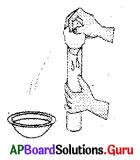
AP 7th Class Science Bits Chapter 1 Food Components with Answers 1
A) Need of water ih the body.
B) How the cotton moves?
C) How to close the glass pipe?
D) Filling the glass tube with cotton.
Answer:
A) Need of water ih the body.

Question 30.
It is good to wash the fruits in
A) Water
B) Salt water
C) Hot water
D) Cool water
Answer:
B) Salt water

AP 7th Class Science Bits Chapter 1 Food Components with Answers

Question 31.
Generally fruits peels contains
A) Carbohydrates
B) Proteins
C) Fibre
D) Minerals
Answer:
C) Fibre

Question 32.
Good water sources of fruit is
A) Apple
B) Guava
C) Water melon
D) Banana
Answer:
C) Water melon

Question 33.
Oil, ghee, butter are sources of
A) Carbohydrates
B) Proteins
C) Fats
D) Minerals
Answer:
C) Fats

Question 34.
Which of the following are very less amount in our food?
A) Proteins
B) Fats
C) Carbohydrates
D) Vitamins
Answer:
D) Vitamins

AP 7th Class Science Bits Chapter 1 Food Components with Answers

Question 35.
Food habits of people depend upon
A) Climate
B) Availability
C) Cultural practices
D) All
Answer:
D) All

Question 36.
Which of the following diseases is cured by food
A) Scurvy
B) Malaria
C) Fever
D) Heart enlarge
Answer:
A) Scurvy

Question 37.
The material your teacher added to solution of rice powder to prove the starch test is
A) Copper sulphate
B) Iodine solution
C) Megnisium Oxide
D) Blue litmus
Answer:
B) Iodine solution

Question 38.
Which of the following avoids constipation?
A) Proteins
B) Fibers
C) Carbohydrates
D) Salts
Answer:
B) Fibers

AP 7th Class Science Bits Chapter 1 Food Components with Answers

Question 39.
Kalyan wants to test the nutrients in the starch powder.
He added Iodine drops. What colour may he have observed in the test tube?
A) Blue or black
B) Violet
C) Yellow
D) No colour
Answer:
A) Blue or black

Question 40.
Match the following.
1) Fibres — a) energy giving
2) Proteins — b) avoid constipation
3) Carbohydrates — c) body building
Choose the right one.
A) 1 – a, 2 – b, 3 – c
B) 1 – b, 2 – c, 3 – a
C) 1 – c, 2, a, 3 – b
D) 1 – b, 2 – a, 3 – c
Answer:
B) 1 – b, 2 – c, 3 – a

Question 41.
For testing starch ………… solution is used.
A) Iodine
B) Chlorine
C) Alcohol
D) Copper sulphate
Answer:
A) Iodine

AP 7th Class Science Bits Chapter 1 Food Components with Answers

Question 42.
Identify the food component that should be consumed sparingly.
A) Cereals
B) Pulses
C) Ghee
D) Oil
Answer:
C) Ghee

Question 43.
Which of the following is the richest source of roughages?
A) Milk
B) Fish
C) Curd
D) Leafy vegetables
Answer:
D) Leafy vegetables

Question 44.
Identify the food component that helps in free bowel movement in the digestive tract.
A) Fat
B) Roughage
C) Vitamins
D) Minerals
Answer:
B) Roughage

AP 7th Class Science Bits Chapter 1 Food Components with Answers

Question 45.
The following food item is the RICHEST source of starch
A) Milk
B) Spinach/palak
C) Egg
D) Rice
Answer:
D) Rice


AP 9th Class Social Bits Chapter 24 Traffic Education with Answers

Practice the AP 9th Class Social Bits with Answers Chapter 24 Traffic Education on a regular basis so that you can attempt exams with utmost confidence.

AP State Syllabus 9th Class Social Bits 24th Lesson Traffic Education with Answers

Choose the correct answer.

Question 1.
When the red traffic Sight is on, the vehicles should stop
A) Inside the ‘stop’ line
B) In the cross walk
C) In the intersection
D) Outside the stop line
Answer:
D) Outside the stop line

Question 2.
When the yellow traffic light is on
A) It allows the vehicles to pass
B) The vehicles that have passed the stop line may continue to pass
C) It allows the vehicles to turn left
D) The vehicles should speed up and pass
Answer:
B) The vehicles that have passed the stop line may continue to pass

Question 3.
AP 9th Class Social Bits Chapter 24 Traffic Education with Answers 1
A) A mandatory sign
B) A cautionary sign
C) An informatory sign
D) All the above
Answer:
A) A mandatory sign

AP 9th Class Social Bits Chapter 24 Traffic Education with Answers

Question 4.
AP 9th Class Social Bits Chapter 24 Traffic Education with Answers 2
A) A mandatory sign
B) An informatory sign
C) A cautionary sign
D) None of the above
Answer:
B) An informatory sign

Question 5.
the sign in the picture means
AP 9th Class Social Bits Chapter 24 Traffic Education with Answers 3
A) A right turn
B) A detour
C) Right reverse bend
D) A sharp right curve
Answer:
C) Right reverse bend

Question 6.
The sign in the picture means ail vehicles are allowed only to
AP 9th Class Social Bits Chapter 24 Traffic Education with Answers 4
A) left hair pin bend
B) go on the right side
C) go on straight
D) turn left
Answer:
D) turn left

Question 7.
We should not enter where we see ……. sign.
A) Mandatory
B) No entry
C) Cautionary
D) Information
Answer:
B) No entry

AP 9th Class Social Bits Chapter 24 Traffic Education with Answers

Question 8.
Parking at are the main cause for traffic jams.
A) Zebra Crossing
B) No Parking
C) Footpath
D) None of the above
Answer:
B) No Parking

Question 9.
Temporary license is valid upto ……….. months.
A) 5
B) 4
C) 6
D) 8
Answer:
C) 6

Question 10.
Age limit for transport vehicle is ………. years.
A) 20
B) 18
C) 21
D) 25
Answer:
D) 25

Question 11.
Enable the officials to …………. the vehicle of the drunken.
A) stop
B) permit
C) seize
D) counselling
Answer:
C) seize

AP 9th Class Social Bits Chapter 24 Traffic Education with Answers

Question 12.
Temporary License is called as
A) Trial
B) Learner’s License
C) Pre-Learner
D) None of the above
Answer:
B) Learner’s License

Question 13.
After learner’s license, the permanent license will provide with the days of
A) 20 – 50
B) 30 – 60
C) 30 – 180
D) 100 – 200
Answer:
C) 30 – 180

Question 14.
It is an offence to drive a vehicle without
A) Driving licence
B) Aadhar card
C) Petrol
D) Pollution checking
Answer:
A) Driving licence

Question 15.
Which of the following is divide the road into two parts?
A) Zebra crossing
B) Y-junction
C) T – Junction
D) Divider
Answer:
D) Divider

AP 9th Class Social Bits Chapter 24 Traffic Education with Answers

Question 16.
India occupies place in the network of road ways
A) 1st
B) 3rd
C) 4th
D) 2nd
Answer:
D) 2nd

Question 17.
Always carry a ………… while walking at night time
A) signal
B) stick
C) torch
D) water
Answer:
C) torch

Question 18.
Don’t use the ………. in any form while walking / crossing
A) luggage
B) things
C) stick
D) mobile phone
Answer:
D) mobile phone

Question 19.
No person shall drive any motor vehicle unless it is
A) registered
B) licensed
C) covered
D) none of these
Answer:
A) registered

AP 9th Class Social Bits Chapter 24 Traffic Education with Answers

Question 20.
Two -wheeler vehicler wear a …………… for safe journey
A) helmet
B) seat belt
C) shoes
D) sweater
Answer:
A) helmet

Question 21.
Movement of any vehicle from one place to another place is called
A) traffic
B) transport
C) vehicle
D) counselling
Answer:
A) traffic

Question 22.
The width of the foot path is
A) 2 Mts
B) 4 Mts
C) 5 Mts
D) 10 Mts
Answer:
A) 2 Mts

Question 23.
Every driver use oniy less ………… emission vehicles.
A) Oxygen
B) Methane
C) Carbon monoxide
D) Hydrogen
Answer:
C) Carbon monoxide

AP 9th Class Social Bits Chapter 24 Traffic Education with Answers

Question 24.
Every driver must hold …………. license.
A) Xerox
B) Traffic
C) Agent
D) Currrent driving
Answer:
D) Currrent driving

Question 25.
Red circles indicates
A) Punishment
B) What should be done
C) What should not be done
D) Danger
Answer:
C) What should not be done

Question 26.
The symbol of cautionary signs is
A) Triangle
B) Rectangle
C) Square
D) Rombus
Answer:
A) Triangle

Question 27.
Which of the following are information signs?
A) Red circles
B) Triangle signs
C) Blue rectangle signs
D) Green square signs
Answer:
C) Blue rectangle signs

AP 9th Class Social Bits Chapter 24 Traffic Education with Answers

Question 28.
Helmet shows a
A) to stop
B) to go
C) safe journey
D) move the vehicle
Answer:
C) safe journey

Question 29.
Drunken drivers should pay penalty in the
A) Court
B) Police station
C) RTA office
D) None of the above
Answer:
A) Court

Question 30.
Must use …………. clothing at night when walking outside built up area
A) Reflective
B) White
C) Red
D) Dark
Answer:
A) Reflective

Question 31.
One of the road safety slogan is
A) Small family – Happy family
B) (letter) Word is the weapon
C) Live and let live
D) None of the above
Answer:
C) Live and let live

AP 9th Class Social Bits Chapter 24 Traffic Education with Answers

Question 32.
Learner’s license provide per a period of
A) 1 year
B) 1 month
C) 2 months
D) 6 months
Answer:
D) 6 months

Question 33.
How much will pay by a driver penality without the driving license is
A) 10 thousand
B) 5 thousand
C) 2 thousand
D) 200 rupees
Answer:
C) 2 thousand

Question 34.
How much penality will pay by a driver without vehicle registration is
A) Rs. 1000
B) Rs. 2000
C) Rs. 3000
D) Rs. 4000
Answer:
A) Rs. 1000

Question 35.
In 2012 total number of accidents in Hyderabad city was
A) 2247
B) 2577
C) 4000
D) 2162
Answer:
B) 2577

AP 9th Class Social Bits Chapter 24 Traffic Education with Answers

Question 36.
The main reason for traffic jam is
A) Animals
B) Birds
C) Illiterates
D) Not following the rules and regulations
Answer:
D) Not following the rules and regulations

Question 37.
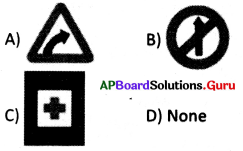
This is a cautionary sign
AP 9th Class Social Bits Chapter 24 Traffic Education with Answers 5
Answer:
A)

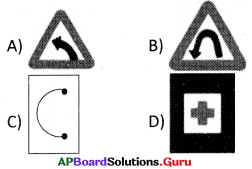
Question 38.
This is an information sign
AP 9th Class Social Bits Chapter 24 Traffic Education with Answers 6
Answer:
D)

Undoubtedly innovation of wheel created drastic change in transportation of goods as well as people. Due to increase of population, industrialisation, urbanisation and globalisation, there was a heavy increase of vehicular traffic. So systematic regulation is required to ensure free flow of traffic. Regulation is nothing but to ensure that every road user follow traffic rules. It is the respon-sibility of every end user of the road to follow traffic rules.
Read the para and answer the questions that follow.
Question 39.
What is the main reason for heavy increase of vehicular traffic?
A) Education
B) Tourism
C) Increase of population
D) None
Answer:
C) Increase of population

AP 9th Class Social Bits Chapter 24 Traffic Education with Answers

Question 40.
What is the responsibility of every road user?
A) Avoid the traffic rules
B) Bike racing
C) To follow traffic rules
D) Create inconvenient to others
Answer:
C) To follow traffic rules

Question 41.
What is required for free flow of traffic?
A) More people
B) Traffic lights
C) Systematic regulation
D) Over crowd
Answer:
C) Systematic regulation

Study the table and answer the following questions.

Age Cases Age Cases
00-05 24 50-55 207
05-10 58 55-60 138
10-15 40 60-65 113
15-20 152 65-70 57
20-25 345 70-75 49
25-30 380 75-80 13
30-35 254 80-85 12
35-40 294 85-90 0
40-45 226 90-95 0
45-50 215 95-100 0

Question 42.
Which age group do you find more cases?
A) 20-25
B) 25 – 30
C) 45 – 50
D) 60 – 70
Answer:
B) 25 – 30

Question 43.
How many cases are there in the age group of 0 – 05?
A) 215
B) 345
C) 24
D) 38
Answer:
C) 24

AP 9th Class Social Bits Chapter 24 Traffic Education with Answers

Question 44.
How many cases are there in the age group 40-45?
A) 226
B) 215
C) 152
D) 40
Answer:
A) 226

Question 45.
Without of these, govt, not allowed the two wheelers
A) Helmet
B) Seat Belt
C) Petrol
D) None
Answer:
A) Helmet

Question 46.
The four wheeler (car) use this one compulsory.
A) Seat belt
B) Helmet
C) Petrol
D) None
Answer:
A) Seat belt

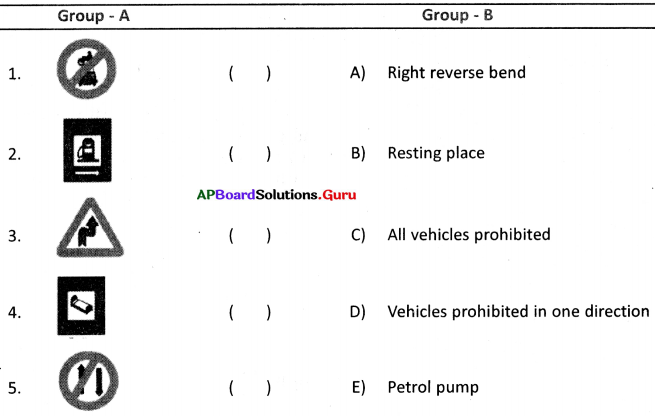
Question 47.
Match the following.
AP 9th Class Social Bits Chapter 24 Traffic Education with Answers 7
Answer:
1) C
2) E
3) A
4) B
5) D

AP 9th Class Social Bits Chapter 24 Traffic Education with Answers

Question 48.
The document which is not necessary to get Learners’ Lincence.
A) Ration card
B) Voter card
C) Aadhaar card
D) Credit card
Answer:
D) Credit card

Question 49.
The traffic signal shown here is:
AP 9th Class Social Bits Chapter 24 Traffic Education with Answers 8
A) Right hand curve
B) Right hair pin bend
C) Left hair pin bend
D) Right reverse bend
Answer:
D) Right reverse bend

Question 50.
In traffic signals “orange colour” indicate
A) Stop the vehicles
B) Ready to move the vehicles
C) Move the vehicles
D) Stop the vehicle transport
Answer:
B) Ready to move the vehicles

AP 9th Class Social Bits Chapter 24 Traffic Education with Answers

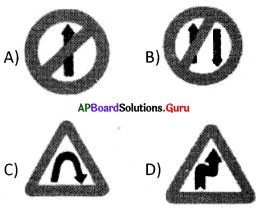
Question 51.
Which of these road signs indicates that vehicular traffic is prohibited in both the directions?
AP 9th Class Social Bits Chapter 24 Traffic Education with Answers 9
Answer:
B)

AP 9th Class Social Bits Chapter 23 Disaster Management with Answers

Practice the AP 9th Class Social Bits with Answers Chapter 23 Disaster Management on a regular basis so that you can attempt exams with utmost confidence.

AP State Syllabus 9th Class Social Bits 23rd Lesson Disaster Management with Answers

Choose the correct answer.

Question 1.
Mostly the disasters are caused because of human
A) negligence
B) intelligence
C) foolishness
D) none of the above
Answer:
A) negligence

Question 2.
…………. education is essential as any other basic skills of survival.
A) Basic
B) Road safety
C) Minimum
D) None of the above
Answer:
B) Road safety

Question 3.
Always walk on the ………….
A) roads
B) traffic islands
C) footpaths
D) zebra crossing
Answer:
C) footpaths

AP 9th Class Social Bits Chapter 23 Disaster Management with Answers

Question 4.
In case we see a victim in road accident, we may call ……… first.
A) 100
B) 104
C) 101
D) 108
Answer:
D) 108

Question 5.
The Bhagalpur district is in
A) Bihar
B) Assom
C) Odisha
D) Manipur
Answer:
A) Bihar

Question 6.
………….. is a phenomenon of combustion manifested in intense heat and light in the form of a glow.
A) Cyclone
B) Fire
C) Air
D) None of the above
Answer:
B) Fire

Question 7.
………….. can search the house much more quickly than you can.
A) Sportsmen
B) Women
C) Police
D) Fire fighters
Answer:
D) Fire fighters

AP 9th Class Social Bits Chapter 23 Disaster Management with Answers

Question 8.
There was bomb blast at ………….. in Hyderabad in 2013.
A) Ameerpet
B) Borabanda
C) Dilsukh Nagar
D) Lumbini
Answer:
C) Dilsukh Nagar

Question 9.
Mahatma preached
A) Truth and non-violence
B) Socialism
C) Welfare state
D) Terrorism
Answer:
A) Truth and non-violence

Question 10.
A safe place to cross the road is …………
A) Junction
B) Zebra crossing
C) Foot path
D) Road divider
Answer:
B) Zebra crossing

Question 11.
Pedestrains walk only on
A) → Mark
B) Junction
C) Foot path
D) Zebra crossing
Answer:
C) Foot path

AP 9th Class Social Bits Chapter 23 Disaster Management with Answers

Question 12.
At railway crossing pay attention to
A) Siron
B) Blue colour light
C) Yellow symbol
D) Signal
Answer:
D) Signal

Question 13.
At the time of fire accident make a phone call to ………. number
A) 101
B) 100
C) 200
D) 1100
Answer:
A) 101

Question 14.
………… has become common in certain areas of the world
A) Sports
B) Terrorism
C) Nationalism
D) Strikes
Answer:
B) Terrorism

Question 15.
…………. is necessary for every person to ride a vehicle.
A) Investment
B) Safety
C) Driving licence
D) Aadhar card
Answer:
C) Driving licence

AP 9th Class Social Bits Chapter 23 Disaster Management with Answers

Question 16.
The theme of the road safety week in 2006 was
A) Road safety and no accident
B) Save petrol – save money
C) Think and go
D) None of these
Answer:
A) Road safety and no accident

Question 17.
Air – India Flight was blown up on 23rd June 1985 by a
A) Technical problem
B) Pilot problem
C) Passengers
D) Bomb
Answer:
B) Pilot problem

Question 18.
What is the name of Air – India plane in 1985?
A) Kanishka -182
B)JamboJet
C) King fisher
D) Indigo blue
Answer:
A) Kanishka -182

Question 19.
The Kanishka – 182 plane was crashed into the
A) Indian ocean
B) Atlantic ocean
C) Pacific ocean
D) Arabian sea
Answer:
A) Indian ocean

AP 9th Class Social Bits Chapter 23 Disaster Management with Answers

Question 20.
In India ………. % of people were died in road accidents.
A) 20%
B) 50%
C) 13%
D) 15%
Answer:
D) 15%

Question 21.
Heat, fuel and oxygen are the three ingredients which cause a ………….
A) Road accident
B) Water accidents
C) Air accident
D) Fire accident
Answer:
D) Fire accident

Question 22.
Road safety week is observed in
A) March
B) June
C) January
D) April
Answer:
C) January

Question 23.
Motor cycle driver must wear a
A) Helmet
B) Seat belt
C) Shoes
D) Sweater
Answer:
A) Helmet

AP 9th Class Social Bits Chapter 23 Disaster Management with Answers

Question 24.
If you see the unkowned objects in the journey immediately you call to the police. The number is
A) 1000
B) 100
C) 101
D) 1100
Answer:
B) 100

Question 25.
Do not carry the ……….. objects while travelling in the train.
A) flammable
B) Stock
C) Secret
D) Valuable
Answer:
A) flammable

Question 26.
Do not use ……….. or ……….. up electric cables.
A) Worn, tape
B) Stock
C) Already used
D) None of the above
Answer:
A) Worn, tape

Question 27.
Terrorist attack was held in Hyderabad in 2013 at
A) Golkonda
B) Ameerpet
C) Chandini chowk
D) Dilsukh Nagar
Answer:
D) Dilsukh Nagar

AP 9th Class Social Bits Chapter 23 Disaster Management with Answers

Question 28.
If you see smoke or flames, you raise the
A) Alarm
B) Bell
C) Run away
D) Voice
Answer:
A) Alarm

Question 29.
The disasters that are caused because of human negligence or deliberately by an individual or a group can be termed as
A) Human – made
B) God – made
C) Nature – made
D) None of the above
Answer:
A) Human – made

Question 30.
Which of the following country has a largest network of Railways?
A) Nepal
B) Singapore
C) Maldieves
D) India
Answer:
D) India

Question 31.
Ulta Pool Bridge is in which district?
A) Bhagalpur
B) Nawada
C) Siwan
D) Gopal ganj
Answer:
A) Bhagalpur

AP 9th Class Social Bits Chapter 23 Disaster Management with Answers

Question 32.
If you see the road accident, you call to ………… number.
A) 101
B) 108
C) 100
D) 200
Answer:
B) 108

Question 33.
Don’t get ………… the signal barriers and cross them.
A) underneath
B) above the track
C) stand on the track
D) none of these
Answer:
A) underneath

Question 34.
Don’t stop the train on a or tunnel where evacuation is not possible.!
A) Road
B) Bridge
C) Turnings
D) Water
Answer:
B) Bridge

Question 35.
Most of the air accidents are occurred due to
A) passengers
B) technical problem
C) terrorism
D) bombs
Answer:
B) technical problem

AP 9th Class Social Bits Chapter 23 Disaster Management with Answers

Question 36.
This is the common in India like the world.
A) Natural calamities
B) Droughts
C) Murders
D) Terrorism
Answer:
D) Terrorism

Read the para given below and answer the question that follow.
In India about eighty thousand people are killed in road crashes every year which is thirteen percent of the total fatality all over the world. More than half of the people killed in traffic crashes are young people within the age group of 15-44 years who are often the bread winners of the family. In most of the cases crashes occur either due to carelessness, restlessness, over speed, violation of traffic rules, drunken driving, poor maintenance of the vehicle, bad weather conditions etc. All these add to the rising number of accidents and road fatalities. It has been estimated that in the year 2000 more than 3 percent of the Gross Domestic Product (GDP) was lost due to accidents. Hence, road safety education is as essential as any other basic skills of survival. The Road Safety Week is observed in January, every year throughout the country. The theme of the Road Safety Week in 2006 was ‘Road Safety and no Accident’.
Question 37.
How many people are loosing their lives every year in Road crashes?
A) 50, 000
B) 60, 000
C) 72, 000
D) 80, 000
Answer:
D) 80, 000

Question 38.
What is the age of bread winners of the family?
A) 10 – 15 years
B) 60 – 90 years
C) 15 – 44 years
D) None
Answer:
C) 15 – 44 years

AP 9th Class Social Bits Chapter 23 Disaster Management with Answers

Question 39.
What is the most essential thing for travellers?
A) Eduction
B) Health
C) Road safety education
D) Food
Answer:
C) Road safety education

Question 40.
What is the theme of Road safety week in 2006?
A) Provide education
B) Provide clothes
C) Control the over populoation
D) Road safety and no accidents
Answer:
D) Road safety and no accidents

The 150 year old shabby Ulta Pool bridge in Bhagalpur district of Bihar collapsed apparently due to poor maintenance and the Howrah-Jamalpur Super fast passenger train passing below the bridge killing at least 35 people on December 1st 2006.
Air India Flight 182 Kanishka was blown up mid-flight on 23 June 1985 by a bomb. The flight was on the first leg on its Montreal-London-Delhi-Bombay flight when it exploded off the coast of Ireland. The plane crashed into the Atlantic Ocean. All 307 passengers and 22 crew on board died.
The 2004 fire in a school in Kumbakonam, Tamilnadu sparketl off debates and arguments on the sqfety of schools in the country. 93 innocept lives were charred to death.
Question 41.
How many years ogo Ulta Pool bridge was built?
A) 100 years
B) 150 years
C) 200 years
D) 50 years
Answer:
B) 150 years

AP 9th Class Social Bits Chapter 23 Disaster Management with Answers

Question 42.
Where did Kanishka flight met its accident?
A) Indian Ocean
B) Pacific Ocean
C) The Atlantic Ocean
D) The Arabian Sea
Answer:
C) The Atlantic Ocean

Question 43.
When did Kumbakonam School fire tragedy takes place?
A) 2004
B) 2001
C) 2000
D) 2008
Answer:
A) 2004

Question 44.
In which incident 93 innocents lost their lives?
A) Kumbakonam school fire accident
B) Kanishka fight in accident
C) Bhopal gas tragedy
D) Ulta Pool bridge
Answer:
A) Kumbakonam school fire accident

AP 9th Class Social Bits Chapter 23 Disaster Management with Answers

Question 45.
Match the following.
Group – A — Group – B
1. Accidents — A) 2006
2. Road safety and no accident — B) 2004
3. Kanishka — C) Human made hazards
4. Kumbakonam — D) An Air India Flight
5. Ajmal Kasab — E) Terrorist
Answer:
1) C
2) A
3) D
4) B
5) E

Question 46.
What should not be done at the time of fire accident?
A) Raise the alarm
B) Call 101
C) Switch off the main switch board
D) Hide under a bed
Answer:
D) Hide under a bed

Question 47.
The Emergency phone number for fire services is:
A) 101
B) 102
C) 104
D) 108
Answer:
A) 101

Question 48.
In which group below are all disasters human induced disasters?
A) Earthquakes, Cyclones, accidents
B) Tsunamis, Land slides, Volcanoes eruption
C) Acts of terrorism, Fire accidents: Volcanoes eruption
D) Rail accidents, Fire accidents, Acts of terrorism
Answer:
D) Rail accidents, Fire accidents, Acts of terrorism

AP 9th Class Social Bits Chapter 23 Disaster Management with Answers

Question 49.
Which of the following should NOT be done in case of a fire accident?
A) Hiding in a cupboard or under a bed
B) Getting out of the building as soon as possible
C) Turning off the main electrical switchboard
D) Opening the outside window and call for help
Answer:
A) Hiding in a cupboard or under a bed

AP 9th Class Social Bits Chapter 22 Women Protection Acts with Answers

Practice the AP 9th Class Social Bits with Answers Chapter 22 Women Protection Acts on a regular basis so that you can attempt exams with utmost confidence.

AP State Syllabus 9th Class Social Bits 22nd Lesson Women Protection Acts with Answers

Choose the correct answer.
Question 1.
Girls are hesitating to go to
A) Schools
B) Offices
C) Temples
D) None of the above
Answer:
A) Schools

Question 2.
In 1989, the UNO proposed an international children charter on which countries have signed.
A) 120
B) 191
C) 171
D) 193
Answer:
B) 191

AP 9th Class Social Bits Chapter 22 Women Protection Acts with Answers

Question 3.
Below years of age is all children without gender discrimination.
A) 15
B) 16
C) 18
D) 13
Answer:
C) 18

Question 4.
Marriage age of a male
A) 15
B) 16
C) 18
D) 21
Answer:
D) 21

Question 5.
HelpLine 1800 425 2908 is known as Help Line.
A) Bhumika
B) Soundarya
C) Raasi
D) Archana
Answer:
A) Bhumika

Question 6.
Devadasi comes under
A) Activities against the law
B) Sexual Assault
C) Labourers
D) Sadistic pleasure
Answer:
B) Sexual Assault

AP 9th Class Social Bits Chapter 22 Women Protection Acts with Answers

Question 7.
The punishment to the brothel housekeepers (imprisonment) is
A) 1 – 2
B) 3 – 4
C) 2 – 3
D) 10
Answer:
C) 2 – 3

Question 8.
Our Constitution provides the right to live in a dignified manner to all the
A) Children
B) Women
C) Men
D) Citizens
Answer:
D) Citizens

Question 9.
Violence leads to more and more
A) violence
B) energy
C) control
D) none of the above
Answer:
A) violence

Question 10.
Humiliation comes under
A) Sexual abuse
B) Verbal and emotional abuse
C) Physical abuse
D) Mental abuse
Answer:
B) Verbal and emotional abuse

AP 9th Class Social Bits Chapter 22 Women Protection Acts with Answers

Question 11.
Before the law, all are
A) Different
B) Equal
C) Unequal
D) None of these
Answer:
B) Equal

Question 12.
The punishment for sexual assault and torturing is
A) 20 years
B) 10 years
C) 14 years
D) 5 years
Answer:
A) 20 years

Question 13.
The incharge to avoid child marriages at the village level is
A) Tehsildar
B) M.R.O
C) Panchayat secretary
D) Collector
Answer:
C) Panchayat secretary

Question 14.
Violation of children and women is in various forms.
A) Rights
B) Torture
C) Prostitution
D) None of these
Answer:
A) Rights

Question 15.
Who provide the free legal services?
A) Subordinate courts
B) Municiff courts
C) Lok Adalats
D) Judicial courts
Answer:
C) Lok Adalats

AP 9th Class Social Bits Chapter 22 Women Protection Acts with Answers

Question 16.
Verbal and emotional abuse comes under ……………. violence.
A) Torture
B) Domestic violence
C) Domestic information
D) Respect
Answer:
B) Domestic violence

Question 17.
Which of the following is a people’s court?
A) Sessions court
B) Taluka court
C) Municiff court
D) Lok Adalat
Answer:
D) Lok Adalat

Question 18.
Lok Adalats were established in
A) 1982
B) 1967
C) 1976
D) 1970
Answer:
C) 1976

Question 19.
The immoral trafficking act was implemented in
A) 1970
B) 1956
C) 1980
D) 1990
Answer:
B) 1956

Question 20.
How many countries were signed on International children charter?
A) 191
B) 150
C) 200
D) 193
Answer:
A) 191

AP 9th Class Social Bits Chapter 22 Women Protection Acts with Answers

Question 21.
Child marriage means, marriage was held below the age of
A) 21-18
B) 31 – 35
C) 56 – 50
D) None of these
Answer:
A) 21-18

Question 22.
What is the punishment of violation of Dowry Prohibition Act?
A) 5 years imprisonment 15 thousand rupees fine
B) 7 years imprisonment 20 thousand rupees fine
C) 10 years imprisonment 50 thousand fine
D) 2 years imprisonment 20 thousand fine
Answer:
A) 5 years imprisonment 15 thousand rupees fine

Question 23.
What is the punishment to the male person to the child marriage?
A) 2 years imprisoned, 1 lakh fine
B) 5 years imprisoned, 50,000 fine
C) 7 years imprisoned, 25,000 fine
D) 10 years imprisoned, 15,000 fine
Answer:
A) 2 years imprisoned, 1 lakh fine

Question 24.
Vetti comes under
A) Favourable to law
B) Against to the law
C) Immoral trafficking
D) None of these
Answer:
C) Immoral trafficking

AP 9th Class Social Bits Chapter 22 Women Protection Acts with Answers

Question 25.
President of India issued an ordinance to prevent sexual assault and abuse in
A) 2000
B) 2005
C) 2010
D) 2013
Answer:
D) 2013

Question 26.
There will be no punishment if the accused dies in struggle at the time of attack with acid on
A) Women
B) Men
C) Helper
D) Acid seller
Answer:
A) Women

Question 27.
Lok Adalats are established under the article of
A) 20 (D)
B) 39 (A)
C) 40 (B)
D) 16 (C)
Answer:
B) 39 (A)

Question 28.
One example of social and religious prostitution is
A) Sex worker
B) Child marriage
C) Jogini
D) Purdah system
Answer:
C) Jogini

AP 9th Class Social Bits Chapter 22 Women Protection Acts with Answers

Question 29.
Sexual assault means
A) Torture
B) House arrest
C) Murder
D) Forced prostitution
Answer:
D) Forced prostitution

Question 30.
Prohibition of child marriage act was implemented in
A) 2006
B) 2000
C) 2011
D) 2009
Answer:
A) 2006

Question 31.
The incharge to avoid the child marriage divisional level is
A) SI
B) MRO
C) RDO
D) CI
Answer:
C) RDO

Question 32.
Forcible prostitutes are called
A) Sex workers
B) Murderers
C) Anti social eliments
D) None of the above
Answer:
A) Sex workers

AP 9th Class Social Bits Chapter 22 Women Protection Acts with Answers

Question 33.
Use the women wealth comes under
A) Physical Abuse
B) Economic Abuse
C) Mental abuse
D) Verbal abuse
Answer:
B) Economic Abuse

Question 34.
Not allowing the women to job comes under
A) Economic Abuse
B) Physical Abuse
C) Mental Abuse
D) Sexual Abuse
Answer:
C) Mental Abuse

Question 35.
Tying up the children on camels and make them run for entertainment comes under
A) Sadistic pleasure
B) Economic Abuse
C) Physical Abuse
D) None of the above
Answer:
A) Sadistic pleasure

Question 36.
International children charter was proposed by
A) I.M.F
B) U.N.O
C) IBRD
D) WHO
Answer:
B) U.N.O

AP 9th Class Social Bits Chapter 22 Women Protection Acts with Answers

Question 37.
According to Beizing declaration the sex ratio is very low because
A) Marriage
B) Advertisements
C) Torture (or) Abuse
D) Laws
Answer:
C) Torture (or) Abuse

Question 38.
During the time of marriage parents present ……….. must be as per the law.
A) Offerings
B) Dowry
C) Gold
D) None of these
Answer:
A) Offerings

Question 39.
The children are sent to …………. after protecting them from immoral trafficking.
A) Bala Sadan
B) Welfare cetres
C) Protection centres
D) Schools
Answer:
A) Bala Sadan

Question 40.
Lok Adalat means
A) Judicial court
B) People’s court
C) Munciff court
D) Sub-ordinate court
Answer:
B) People’s court

AP 9th Class Social Bits Chapter 22 Women Protection Acts with Answers

Question 41.
After protecting the victims they should be presented before the
A) Police station
B) Court
C) Magistrate
D) Collector
Answer:
C) Magistrate

Question 42.
Without warrant the police officer shall investigate the ……….. case.
A) Domestic violence
B) Immoral trafficking
C) Rape
D) Murder
Answer:
B) Immoral trafficking

Question 43.
The main reason any child become a child labour is
A) Child marriages
B) Infant Mortality rate
C) Financial position
D) None of the above
Answer:
C) Financial position

Child means a person who, if a male, has not completed 21 years of age, and if a female, has not completed 18 years of age.
If a male person above 21 years con-tracts a child marriage shall be punish-able for two years imprisonment and/or a fine which may extend to Rs.l lakh. The same punishment will be given to person who performs, conducts or directs a Child Marriage under Child Marriage Act., 2006.
Question 44.
Child means
A) Below – 18 yrs
B) Below – 16 yrs
C) Below – 14 yrs
D) Below – 20 yrs
Answer:
A) Below – 18 yrs

AP 9th Class Social Bits Chapter 22 Women Protection Acts with Answers

Question 45.
What is the minimum age of marriage for girls?
A) 21 years
B) 18 years
C) 15 years
D) 13 years
Answer:
B) 18 years

Question 46.
What is the minimum age of marriage for boys
A) 31 years
B) 27 years
C) 21 years
D) 18 years
Answer:
C) 21 years

Question 47.
Child marriages Act was implemented in
A) 2002
B) 2007
C) 2005
D) 2006
Answer:
D) 2006

Incident / Name of the Act Year
1. Child marriages Act 2006
2. The Dowry prohibition Act 1961
3. The Immoral trafficking Act 1956

Question 48.
Who proposed International children charter?
A) UNO
B) ILO
C) FAO
D) IBRD
Answer:
A) UNO

AP 9th Class Social Bits Chapter 22 Women Protection Acts with Answers

Question 49.
Dowry prohibition Act was passed in
A) 1971
B) 1986
C) 1961
D) 1975
Answer:
C) 1961

Question 50.
Immoral trafficking Act was implemented in
A) 1956
B) 1963
C) 1970
D) 1980
Answer:
A) 1956

Question 51.
Match the following.
Group – A Group – B
1. Vetti — A) Physical abuse
2. Mathangi — B) Lok Adalat
3. The Dowry Prohibition Act — C) Labourers
4. Beating — D) Social and religious prostitution
5. Article 39 – A — E) 1961
Answer:
1) C
2) D
3) E
4) A
5) B

Question 52.
If you want to stop a child marriage in your area, which helpline would you call?
A) Bhoomika
B) 108
C) 104
D) BSNL
Answer:
A) Bhoomika

AP 9th Class Social Bits Chapter 22 Women Protection Acts with Answers

Question 53.
“Bhumika” help line belongs to
A) Complaints for Aadhar
B) Complaints against Dowry sytem
C) Stop the child marriages
D) Complaints for the land record
Answer:
C) Stop the child marriages

Question 54.
Which of the following is the misconception regarding domestic violence?
A) Domestic Violence starts slowly and it becomes a routine.
B) The violence free environment is the birth right of very woman.
C) Violence leads to more and more violence.
D) There is no way to get out of Domestic violence.
Answer:
D) There is no way to get out of Domestic violence.

AP 9th Class Social Bits Chapter 21 Human Rights and Fundamental Rights with Answers

Practice the AP 9th Class Social Bits with Answers Chapter 21 Human Rights and Fundamental Rights on a regular basis so that you can attempt exams with utmost confidence.

AP State Syllabus 9th Class Social Bits 21st Lesson Human Rights and Fundamental Rights with Answers

Choose the correct answer.

Question 1.
Which of the following is not a fundamental right?
A) Right to equality
B) Right to property
C) Right to freedom
D) Right against exploitation
Answer:
B) Right to property

Question 2.
The people of India do not have the following liberty
A) freedom of speech
B) freedom of expression
C) freedom to form unions
D) freedom to use microphones during festival
Answer:
C) freedom to form unions

AP 9th Class Social Bits Chapter 21 Human Rights and Fundamental Rights with Answers

Question 3.
………… protects us from arbitrary arrests.
A) Right to life
B) Right to freedom
C) Right to equality
D) Right to religious freedom
Answer:
A) Right to life

Question 4.
…………. right protects us from forced labour.
A) Right against exploitation
B) Right to life
C) Right to equality
D) Right to freedom
Answer:
A) Right against exploitation

Question 5.
National Human Rights Commission was established in
A) 1993
B) 1948
C) 1988
D) 1945
Answer:
A) 1993

Question 6.
Fundamental Rights may be modified through the …………
A) Parliament
B) Assembly
C) Law
D) Government
Answer:
A) Parliament

AP 9th Class Social Bits Chapter 21 Human Rights and Fundamental Rights with Answers

Question 7.
At present ………….. was included in fundamental rights.
A) Right to vote
B) Right to freedom
C) Right to education
D) Right to life
Answer:
C) Right to education

Question 8.
India is a secular country, that word mention in the ………..
A) Schedule
B) Constitution
C) Preamble
D) Parts
Answer:
C) Preamble

Question 9.
The constitution states, ‘no child below the age of ………….. shall be employed to work in any factory or mines or engaged in any other hazardous employment.
A) 10 years
B) 14 years
C) 9 years
D) 20 years
Answer:
B) 14 years

Question 10.
Under right against exploitation all forms of ” …………… are prohibited”.
A) works
B) anti social eliments
C) forced labours
D) cheating
Answer:
C) forced labours

AP 9th Class Social Bits Chapter 21 Human Rights and Fundamental Rights with Answers

Question 11.
Which of the following age children should get free and compulsory education?
A) 10-15 years
B) 0-14 years
C) 7-15 years
D) 6-14 years
Answer:
D) 6-14 years

Question 12.
The right to life does not include the right to
A) moral
B) die
C) bribes
D) take the law in our hands
Answer:
B) die

Question 13.
Even though emergency period, temporarily also this right is not suspended
A) Right to life
B) Right to education
C) Right to property
D) Right to freedom
Answer:
A) Right to life

Question 14.
Our free speech must not be
A) defamatory
B) bribe
C) cheating
D) none of the above
Answer:
A) defamatory

AP 9th Class Social Bits Chapter 21 Human Rights and Fundamental Rights with Answers

Question 15.
Movies are subject to review by the board.
A) trade
B) commerce
C) film
D) censor
Answer:
D) censor

Question 16.
Its practice in any form abolishes by constitution.
A) untouchability
B) prohibition
C) Riots
D) reservations
Answer:
A) untouchability

Question 17.
After the World Wars ………… was established with an objective to ensure that there are no more major wars in the globe
A) League of Nations
B) U.N.O
C) W.H.O
D) W.T.O
Answer:
B) U.N.O

Question 18.
The universal declaration of Human Rights was proposed by
A) W.H.O
B) U.N.O
C) IBRD
D) FAO
Answer:
B) U.N.O

AP 9th Class Social Bits Chapter 21 Human Rights and Fundamental Rights with Answers

Question 19.
The court can take cognizance of a violation of a fundamental right
A) Schedule
B) Writ
C) Sue motu
D) Hebeas
Answer:
C) Sue motu

Question 20.
Public Interest Litigation comes under …………. Right.
A) Right to freedom
B) Right to constitutional Remedies
C) Right to vote
D) Right to life
Answer:
B) Right to constitutional Remedies

Question 21.
Democracy safeguards not just the majority but also the
A) backward people
B) representatives
C) minorities
D) rich people
Answer:
C) minorities

Question 22.
These are also become significant in the democratic system.
A) Fundamental Rights
B) Directive principles
C) Fundamental Duties
D) All the above
Answer:
D) All the above

AP 9th Class Social Bits Chapter 21 Human Rights and Fundamental Rights with Answers

Question 23.
Which of these rights explained about movies?
A) Right to live
B) Right to freedom
C) Right to speech
D) Right to religious freedom
Answer:
C) Right to speech

Question 24.
Abolition of Sati comes under ………… Right.
A) Right to Religious freedom
B) Right to life
C) Right to freedom
D) All the above
Answer:
A) Right to Religious freedom

Question 25.
Fundamental rights find a place in part …………. of the constitution of India.
A) 2
B) 3
C) 4
D) 5
Answer:
B) 3

Question 26.
Writs are issued by courts to
A) High courts
B) People
C) Governments
D) Lower courts
Answer:
C) Governments

AP 9th Class Social Bits Chapter 21 Human Rights and Fundamental Rights with Answers

Question 27.
During the time of emergency are suspended.
A) Natural calamities
B) Fundamental rights
C) Right to life
D) All the above
Answer:
B) Fundamental rights

Question 28.
Respecting to National Anthem and National Flag is a
A) Fundamental duty
B) Fundamental Right
C) Freedom
D) Political right
Answer:
A) Fundamental duty

Question 29.
‘Swatch Bharath’ is followed by every citizen is a
A) Fundamental Right
B) Fundamental Duty
C) Revolution
D) Right to freedom
Answer:
B) Fundamental Duty

Question 30.
The tenure, of state Human Rights Commission Chairman is ………… years.
A) 5
B) 6
C) 7
D) 10
Answer:
A) 5

AP 9th Class Social Bits Chapter 21 Human Rights and Fundamental Rights with Answers

Question 31.
In Andhra Pradesh in which year Human Right Protection act was passed?
A) 1990
B) 1993
C) 1947
D) 1948
Answer:
B) 1993

Question 32.
National Human Rights Commission Chairman is appointed by
A) High court
B) Supreme court
C) President
D) Prime Minister
Answer:
C) President

Question 33.
State Human Rights Commission Chairman is appointed by
A) Governor
B) Chief Minister
C) Highcourt
D) Speaker
Answer:
A) Governor

Question 34.
Which of the following right is removed from fundamental rights?
A) Right to property
B) Right to life
C) Right to freedom
D) Right to speech
Answer:
A) Right to property

AP 9th Class Social Bits Chapter 21 Human Rights and Fundamental Rights with Answers

Question 35.
Freedom to form an associations or unions comes under ………… rights.
A) Right to freedom
B) Right to life
C) Right to religious freedom
D) Right to education
Answer:
A) Right to freedom

Question 36.
National Commission for protection of child rights was formed in
A) 2007
B) 2000
C) 1999
D) 1998
Answer:
A) 2007

Fundamental Rights find a place in Part 3 of the Constitution of India. These rights give people a protection from oppressive governments and place a duty on the government to uphold them. They are so important that if they are violated by thegovernment, any person has aright to approach the HighCourt or the Supreme Court directly without going to the lower courts for relief. Writ is an authority given to the court to issue directions to the government to protect and enforce any constitutional right. It is an inherent power given to the court. The court can sue motu (on its own motion) take cognizance of a violation of a fundamental right.
Question 37.
In which part of our Constitution Fundamental Rights are placed?
A) 4
B) 5
C) 3
D) 2
Answer:
C) 3

Question 38.
Which give protection to people?
A) Supreme court
B) Directive principles
C) Fundamental Rights
D) Duties
Answer:
C) Fundamental Rights

AP 9th Class Social Bits Chapter 21 Human Rights and Fundamental Rights with Answers

Question 39.
What is the inherent power of the court?
A) Writ
B) Couanento
C) Certiorari
D) Mandamus
Answer:
A) Writ

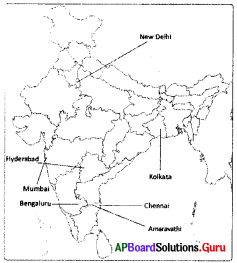
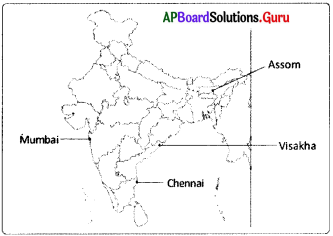
See the map given below and answer the questions.
AP 9th Class Social Bits Chapter 21 Human Rights and Fundamental Rights with Answers 1
A) New Delhi
B) Kolkata
C) Mumbai
D) Hyderabad
E) Bengaluru
F) Chennai
G) Amaravathi

Question 40.
The capital of Telangana state
A) Amaravathi
B) Bengaluru
C) Hyderabad
D) Kolkata
Answer:
C) Hyderabad

Question 41.
Supreme Court is located in
A) Bengaluru
B) Mumbai
C) Hydrabad
D) New Delhi
Answer:
D) New Delhi

Question 42.
Which city is called as electronic capital of India?
A) Bengaluru
B) Mumbai
C) Chennai
D) Kolkata
Answer:
A) Bengaluru

AP 9th Class Social Bits Chapter 21 Human Rights and Fundamental Rights with Answers

Question 43.
Match the following.
Group – A — Group – B
1. UDHR — A) 1945
2. NHRC — B) Right to life
3. UNO — C) Right against exploitation
4. Arbitrary arrest — D) 1948
5. Forced labour — E) 1993
Answer:
1) D
2) E
3) A
4) B
5) C

Question 44.
Which of the following freedom is not available to an Indian Citizen?
A) Freedom to criticise the Government
B) Freedom to participate in armed revolution
C) Freedom to start a movement to change the government
D) Freedom to oppose the central values of the constitution
Answer:
D) Freedom to oppose the central values of the constitution

Question 45.
True among the following regarding the Rights:
A) Rights are reasonable claims of per-sons
B) Everyone should respect other’s rights
C) Rights protected by law
D) All the above
Answer:
D) All the above

Question 46.
Expand the term PIL
A) Power Interest Litigation
B) Public Interest Litigation
C) Peoples Interest Litigation
D) Policy Interest Litigation
Answer:
B) Public Interest Litigation

AP 9th Class Social Bits Chapter 21 Human Rights and Fundamental Rights with Answers

Question 47.
Raju, a 10 year old boy works in a crack-ers factory. In this context, which of his right is violated?
i) Right to life ii) Right to education
A) i only
B) ii only
C) Both i and ii
D) No right is violated
Answer:
B) ii only

Question 48.
The power of the courts of law to take cognizance of the violation of a fundamental right on its own is called
A) A writ
B) A public interest litigation
C) Sue motu
D) Amendment
Answer:
C) Sue motu

AP 9th Class Social Bits Chapter 20 Democracy: An Evolving Idea with Answers

Practice the AP 9th Class Social Bits with Answers Chapter 20 Democracy: An Evolving Idea on a regular basis so that you can attempt exams with utmost confidence.

AP State Syllabus 9th Class Social Bits 20th Lesson Democracy: An Evolving Idea with Answers

Choose the correct answer.

Question 1.
In Libya the ultimate power lay with the …………..
A) RCC
B) NCC
C) NSS
D) RSS
Answer:
A) RCC

Question 2.
The elected government functionaries are answerable to the ……………
A) PM
B) People
C) President
D) Judiciary
Answer:
B) People

Question 3.
USA allowed white woman to vote in …………..
A) 1900
B) 1940
C) 1920
D) 1965
Answer:
C) 1920

AP 9th Class Social Bits Chapter 20 Democracy: An Evolving Idea with Answers

Question 4.
The first large country to be given universal voting rights was the …………..
A) USA
B) Sweden
C) Germany
D) USSR
Answer:
D) USSR

Question 5.
“In the much publicised elections for the President of USA in 2012 more than 40% people did not vote at all”
A) Inactive participation of citizen
B) That they have no voting right
C) That they don’t like the contestants
D) None of the above
Answer:
A) Inactive participation of citizen

Question 6.
Restriction on civil liberties helps ………… to remain in power.
A) leaders
B) governments
C) judiciary
D) all the above
Answer:
B) governments

Question 7.
True democracy cannot be attained unless there is social and economic equality along with ………… equality.
A) religious
B) gender
C) political
D) all the above
Answer:
C) political

AP 9th Class Social Bits Chapter 20 Democracy: An Evolving Idea with Answers

Question 8.
All ……………. governments need to abide by laws.
A) monarchial
B) dictatorial
C) oligarchial
D) democratic
Answer:
D) democratic

Question 9.
Democracies have successfully eliminated
A) conflicts among people
B) economic inequalities
C) idea of political inequality
D) differences of opinion about how marginalized sections are to be treated
Answer:
C) idea of political inequality

Question 10.
Which of the following does not lead to the spread of democracy?
A) Invasion by foreign countries
B) People’s desire for freedom
C) Struggle by the people
D) End of colonialism
Answer:
D) End of colonialism

Question 11.
A democratic government is a …………. government.
A) powerful
B) fruitful
C) repressive
D) legitimate
Answer:
D) legitimate

AP 9th Class Social Bits Chapter 20 Democracy: An Evolving Idea with Answers

Question 12.
What is the most basic outcome of democracy?
A) Singnicant decision making
B) Powerful repressive governance
C) Accountability of the citizens
D) None of these
Answer:
C) Accountability of the citizens

Question 13.
A democracy is alternative to the needs of ……..
A) men
B) women
C) all people
D) illiterates
Answer:
C) all people

Question 14.
Most societies across the world were historically ………… dominated societies.
A) female ( )
B) male and female
C) male
D) all the above
Answer:
C) male

Question 15.
Democracy means a system get the power from the people and have ………….. to the people.
A) Answerable
B) Rigid
C) Flexible
D) None of these
Answer:
A) Answerable

AP 9th Class Social Bits Chapter 20 Democracy: An Evolving Idea with Answers

Question 16.
In South of India, Sri Lanka is an Nation
A) Island
B) Peninsular
C) Enemy
D) Friendly
Answer:
A) Island

Question 17.
In Libya that ultimate power lay with
A) Command council
B) NLD
C) RCC
D) LDE
Answer:
C) RCC

Question 18.
The meaning of people’s rule means
A) Representatives
B) Soldiers
C) Citizens
D) All people who are adults
Answer:
D) All people who are adults

Question 19.
In USA ………… % of people did not vote in 2012 elections.
A) 60%
B) 10%
C) 40%
D) 20%
Answer:
C) 40%

AP 9th Class Social Bits Chapter 20 Democracy: An Evolving Idea with Answers

Question 20.
…………. is the best form of government in promoting dignity and freedom of the individual.
A) Socialism
B) Communism
C) Democracy
D) Dictatorship
Answer:
C) Democracy

Question 21.
How many members were elected to National people’s congress in China?
A) 1000
B) 2000
C) 1500
D) 3000
Answer:
D) 3000

Question 22.
Which of these party is in power in Mexico?
A) IRP
B) NMP
C) ANP
D) None of these
Answer:
A) IRP

Question 23.
Which of these party is in power in Zimbabwe?
A) National Zimbabwe
B) Zanu – PF
C) National Herald
D) National Awami
Answer:
B) Zanu – PF

AP 9th Class Social Bits Chapter 20 Democracy: An Evolving Idea with Answers

Question 24.
Which neighbouring country of India followed the Mazaritarianism?
A) Pakistan
B) China
C) Sri Lanka
D) Nepal
Answer:
C) Sri Lanka

Question 25.
Which of the following country is given importance to people’s feelings and interests.
A) Austria
B) Germany
C) France
D) Belgium
Answer:
D) Belgium

Question 26.
In Sri Lanka many families were forced to leave the country as
A) foreigners
B) refugees
C) slaves
D) none of these
Answer:
B) refugees

Question 27.
Which of the following country is allowed to contest in elections only one or two parties?
A) Pakistan
B) Mynmar
C) Sri Lanka
D) Bangladesh
Answer:
B) Mynmar

AP 9th Class Social Bits Chapter 20 Democracy: An Evolving Idea with Answers

Question 28.
What is the speciality of Democracy?
A) Laws
B) Scams
C) Elections
D) None of these
Answer:
C) Elections

Question 29.
Political equality means
A) Backwardness
B) Right to vote
C) Economic status
D) None of these
Answer:
B) Right to vote

Question 30.
In Fijji, only from the year ……….. elections an equal right to vote is been implemented
A) 2011
B) 2010
C) 2012
D) 2013
Answer:
D) 2013

Question 31.
At the beginning Right to Vote was given only to ……….
A) Rich people
B) Poor people
C) Women
D) All
Answer:
A) Rich people

AP 9th Class Social Bits Chapter 20 Democracy: An Evolving Idea with Answers

Question 32.
How many years only one party ruled in Russia
A) 10
B) 20
C) 50
D) 60
Answer:
D) 60

Question 33.
In China before contesting elections a candidate needs the approval of
A) Chinese Communist party
B) Chinese People’s party
C) Chinese Revolutionary party
D) Chinese Labour party
Answer:
A) Chinese Communist party

Question 34.
In which of the following country TV and Radio are under the control of government
A) India
B) Zimbabwe
C) China
D) Srilanka
Answer:
B) Zimbabwe

Question 35.
Some of the members of China are elected by
A) Labourers
B) Army
C) Revolutionaries
D) Govt, officials
Answer:
B) Army

AP 9th Class Social Bits Chapter 20 Democracy: An Evolving Idea with Answers

Question 36.
In which of the following country teachers are forced the parents vote for party?
A) ZANU – PF
B) INC-India
C) C.C.P – China
D) IRP-Mexico
Answer:
D) IRP-Mexico

USA allowed white woman to vote only in 1920. The discriminations against voting by Black citizens were removed only in 1965. The first nation to allow voting rights for all groups of people was New Zealand in 1893. The first large country to give universal voting rights was the USSR after the Russian Revolu-tion in 1917.
In Fiji, the electoral system is such that the vote of an indigenous Fiji has more value than that of an Indian-Fijian. Only from the year 2013 elections an equal right to vote is being implemented.
Read the given paragraph and answer the questions given blow.
Question 37.
…………… in which year USA allowed white women to vote?
A) 1920
B) 1918
C) 1914
D) 1917
Answer:
A) 1920

Question 38.
Name the first nation to allow voting rights for all groups of people
A) South Africa
B) Newzealand
C) Manchuria
D) Fiji
Answer:
B) Newzealand

Question 39.
In which year Fiji implemented equal voting value?
A) 2010
B) 2011
C) 2013
D) 2012
Answer:
C) 2013

AP 9th Class Social Bits Chapter 20 Democracy: An Evolving Idea with Answers

Question 40.
In which year Russia granted Universal Adult franchise?
A) 1919
B) 1918
C) 1917
D) 1922
Answer:
C) 1917

Observe the table and answer questions that follow.

Inequality of Incomes in Selected Countries
Country Share of National Income (%)
Top 20 Bottom 20
South Africa 64.8 2.9
Brazil 63.0 2.6
USA 50.0 4.0
UK 34.5 9.6
Denmark 34.5 9.6
Hungary 34.5 10.0

Question 41.
Which country has least difference?
A) USA
B) Hungary
C) Denmark
D) Brazil
Answer:
B) Hungary

AP 9th Class Social Bits Chapter 20 Democracy: An Evolving Idea with Answers

Question 42.
What is the difference in USA?
A) 46
B) 36
C) 26
D) 9
Answer:
A) 46

Question 43.
Which country has more inequality
A) India
B) South Africa
C) Hungary
D) Denmark
Answer:
B) South Africa

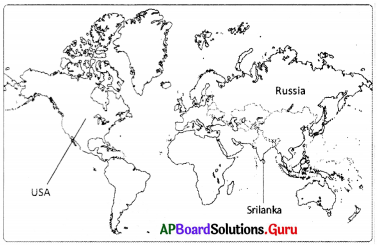
Study the map and answer the following questions.
AP 9th Class Social Bits Chapter 20 Democracy An Evolving Idea with Answers 1
Question 44.
Which country fight against LTTE?
A) India
B) England
C) SriLanka
D) America
Answer:
C) SriLanka

Question 45.
Brussels is the capital of
A) Belgium
B) Netherlands
C) Italy
D) Angola
Answer:
A) Belgium

AP 9th Class Social Bits Chapter 20 Democracy: An Evolving Idea with Answers

Question 46.
Socialist Revolution was held in
A) USA
B) England
C) Russia
D) France
Answer:
C) Russia

Question 47.
Match the following:
Group – A — Group – B
1. RCC — A) Inclusive
2. After Russian Revolution in 1917 — B) Libya
3. One party rule — C) Europe
4. Majoritarian — D) USSR
5. Belgium — E) Universal voting right
Answer:
1) B
2) E
3) D
4) A
5) C

Question 48.
Studies on political and social in equalities in democracy show that:
A) Democracy and development go together
B) In equalities exist in democracies.
C) In equalities do not exist under dictatorship
D) Dictatorship is betterthan democracy?
Answer:
B) In equalities exist in democracies.

Question 49.
The new constitution of Sri Lanka gave the foremost place to which religion?
A) Hinduism
B) Islam
C) Buddhism
D) Christianity
Answer:
C) Buddhism

AP 9th Class Social Bits Chapter 20 Democracy: An Evolving Idea with Answers

Question 50.
In which year Soviet Union was broke up?
A) 1917
B) 1991
C) 1919
D) 1971
Answer:
B) 1991

Question 51.
The first nation to allow voting rights for all groups
A) Soviet Russia
B) United States of America
C) England
D) Newzealand
Answer:
D) Newzealand

Question 52.
Which of these is the largest and most populous democratic country in the world?
A) China
B) India
C) Indonesia
D) USA
Answer:
B) India

Question 53.
Which of the following is correctly matched?
1) 1917 – a) Establishment of Communist Party of India
2) 1920 – b) Right to vote to British women
3) 1918 – c) Boishevick revolution is Russia
A) 1 – a, 2 – b, 3 – c
B) 1 – c, 2 – a, 3 – b
C) 1 – c, 2 – b, 3 – a
D) 1 – b, 2 – a, 3 – c
Answer:
B) 1 – c, 2 – a, 3 – b

AP 9th Class Social Bits Chapter 20 Democracy: An Evolving Idea with Answers

Question 54.
Present Prime Minister of India is
A) Ramanath Kovind
B) Chandrababu Naidu
C) Vekaiah Naidu
D) Narendra Modi
Answer:
D) Narendra Modi

Question 55.
For how many years ‘The right to vote’ was given in India?
A) 18
B) 21
C) 20
D) 19
Answer:
A) 18

AP 9th Class Social Bits Chapter 19 Expansion of Democracy with Answers

Practice the AP 9th Class Social Bits with Answers Chapter 19 Expansion of Democracy on a regular basis so that you can attempt exams with utmost confidence.

AP State Syllabus 9th Class Social Bits 19th Lesson Expansion of Democracy with Answers

Choose the correct answer.

Question 1.
The famous “Arab Spring” occurred in
A) 2010
B) 2011
C) 2012
D) 2002
Answer:
A) 2010

Question 2.
The leader of Myanmar’s ethnic group
A) Aung San
B) Ne Win
C) Idris
D) Gaddafi
Answer:
A) Aung San

AP 9th Class Social Bits Chapter 19 Expansion of Democracy with Answers

Question 3.
…………… took over the charge of Libya in 1969.
A) Idris
B) Ne Win
C) Gaddafi
D) Suu Kyi
Answer:
C) Gaddafi

Question 4.
………… was the party established by Suu Kyi.
A) MLD
B) RCC
C) CPI
D) None
Answer:
A) MLD

Question 5.
In ………….. military dictatorship and democratic rule kept coming in cycles.
A) Burma
B) Pakistan
C) India
D) Belgium
Answer:
B) Pakistan

Question 6.
In …………… USSR broke up as people demanded democracy.
A) 1900
B) 1917
C) 1947
D) 1991
Answer:
D) 1991

AP 9th Class Social Bits Chapter 19 Expansion of Democracy with Answers

Question 7.
…………… believed in the dictatorship of proletariat.
A) Capitalists
B) Communists
C) Democratics
D) None of these
Answer:
B) Communists

Question 8.
Arab Spring began in …………, a small country.
A) Egypt
B) Libya
C) Tunisia
D) Yemen
Answer:
C) Tunisia

Question 9.
The old name of Mynmar was
A) Thailand
B) Pakistan
C) Bangladesh
D) Burma
Answer:
D) Burma

Question 10.
Who was the leader of Burman group?
A) Abdul Rehman
B) Aung San
C) Rasud
D) Vakeel
Answer:
B) Aung San

AP 9th Class Social Bits Chapter 19 Expansion of Democracy with Answers

Question 11.
Burma got Independence in
A) 1947
B) 1950
C) 1960
D) 1952
Answer:
A) 1947

Question 12.
Like India, Burma was a colony of
A) Dutch
B) Portuguese
C) Britain
D) French
Answer:
C) Britain

Question 13.
Who was the Burman President in 2010?
A) Rehman
B) Abdul Nasser
C) Sheik Haseena
D) Thein Sein
Answer:
D) Thein Sein

Question 14.
…………. Rule was abolished in Burma in 2010
A) Kings
B) Dictatorship
C) Military Junta
D) Democratic
Answer:
C) Military Junta

AP 9th Class Social Bits Chapter 19 Expansion of Democracy with Answers

Question 15.
Communism was established in the world in ………… century.
A) 19th
B) 20th
C) 18th
D) 17th
Answer:
B) 20th

Question 16.
Suu Kyi was awarded Nobel Prize for peace in ………..
A) 1991
B) 2000
C) 1985
D) 1995
Answer:
A) 1991

Question 17.
Aung San Suu Kyi’s father Aung sain was a ……….
A) government official
B) king
C) dictator
D) Burman ethnic group leader
Answer:
D) Burman ethnic group leader

Question 18.
Which of these fight against military rule in Burma?
A) Abdul Rehman
B) Aung san Suu Kyi
C) Haseena
D) Rasud
Answer:
B) Aung san Suu Kyi

AP 9th Class Social Bits Chapter 19 Expansion of Democracy with Answers

Question 19.
Which country started the revolt for Democracy in Arab world?
A) Egypt
B) Pakistan
C) Oman
D) Dubai
Answer:
A) Egypt

Question 20.
In which year elections were held in Burma as per democracy?
A) 1990
B) 2011
C) 1991
D) 1950
Answer:
B) 2011

Question 21.
Libya got independence in
A) 1951
B) 1945
C) 1988
D) 1960
Answer:
A) 1951

Question 22.
In democratic elections which party won in Burma?
A) National Army
B) Awami League
C) National League for democracy
D) Burma National party
Answer:
C) National League for democracy

AP 9th Class Social Bits Chapter 19 Expansion of Democracy with Answers

Question 23.
After Britain, became democracy in Europe.
A) Netherlands
B) Spain
C) France
D) Italy
Answer:
D) Italy

Question 24.
Which is the poorest country in North Africa?
A) Equador
B) Egypt
C) Ghana
D) Libya
Answer:
D) Libya

Question 25.
Who announced Libya is a “no fly zone”?
A) UNO
B) WHO
C) UNICEF
D) IBRD
Answer:
A) UNO

Question 26.
Who came to power in 1969 in Libya?
A) Gadaffi
B) Rehman
C) Army
D) People
Answer:
A) Gadaffi

AP 9th Class Social Bits Chapter 19 Expansion of Democracy with Answers

Question 27.
In Libya, the average life expectation increase from under ………… years.
A) 50-75
B) 50-77
C) 50-65
D) 50-67
Answer:
B) 50-77

Question 28.
In Libya there is no chance for
A) Soldiers
B) Political parties
C) Government
D) Hospitals
Answer:
B) Political parties

Question 29.
The revolutions in 2010 in Arab world is called as
A) Arab spring
B) Arab struggle
C) Hizra
D) Government formation
Answer:
A) Arab spring

Question 30.
Under whose observation in Burma elections were held in democratic way?
A) League of Nations
B) U.N.O
C) NLD
D) Awamy League
Answer:
B) U.N.O

AP 9th Class Social Bits Chapter 19 Expansion of Democracy with Answers

Question 31.
Which of the following country became a communist in 1949?
A) Prussia
B) China
C) France
D) America
Answer:
B) China

Question 32.
Which of the following country in Europe established a parliamentary democracy?
A) Denmark
B) Austria
C) Poland
D) Germany
Answer:
C) Poland

Question 33.
Which of the following country supported to Libian revolutionaries?
A) Britain
B) France
C) Germany
D) America
Answer:
D) America

Question 34.
After Gaddafi in Libya, new government was formed by
A) Colnel Robert
B) Abbas
C) General Nuwin
D) None
Answer:
C) General Nuwin

AP 9th Class Social Bits Chapter 19 Expansion of Democracy with Answers

Question 35.
Who abolished the freedom of press in Libya?
A) Colnel Gaddafi
B) Rehman
C) Idris
D) Arshad
Answer:
A) Colnel Gaddafi

Question 36.
How many seats were occupied by Aung San party in 2011 elections?
A) 73
B) 63
C) 53
D) 43
Answer:
D) 43

Question 37.
Who worked for peace in Libya?
A) Hasan
B) Colnel Gaddafi
C) Rehman
D) Idris
Answer:
D) Idris

Question 38.
Libya became the richest country in the production of
A) Rawmaterial
B) Rubber
C) Oil resources
D) Crops
Answer:
C) Oil resources

AP 9th Class Social Bits Chapter 19 Expansion of Democracy with Answers

Question 39.
Which city is the centre of violent incidents in Libya?
A) Benghazi
B) Swan
C) Arova
D) None of these
Answer:
A) Benghazi

Question 40.
Who were the main revolutionaries in Libya?
A) Labourers
B) Kings
C) Lawyers
D) Common people
Answer:
C) Lawyers

Libya was a poor country of North Africa which had been colonised by Italy and became free after a long struggle in 1951. When it became independent, Italy transferred power to King Idris who ruled the country with the help of a few rich and powerful families.
The people mostly belonged to different tribes which depended upon agriculture and animal rearing in the deserts. In 1959 vast reserves of petroleum were found in Libya and a lot of wealth poured into the country from the sale of oil.
Read the paragraph and answer the Question that follow.
Question 41.
Who granted Independence to Libya?
A) England
B) France
C) Italy
D) Germany
Answer:
C) Italy

AP 9th Class Social Bits Chapter 19 Expansion of Democracy with Answers

Question 42.
In which year petroleum reserves are found?
A) 1960
B) 1959
C) 1961
D) 1958
Answer:
B) 1959

Question 43.
The main occupation of people of Libya is
A) Hunting
B) Weaving
C) Fishing
D) Agriculture
Answer:
D) Agriculture

Question 44.
To which part of Afria, Libya belongs?
A) East of Africa
B) North of Africa
C) West of Africa
D) South of Africa
Answer:
B) North of Africa

Study the table and answer the questions given below.

Burma Year
1. Became Independent 1948
2. Death of Aung san 1948
3. Coup in Burma 1962
4. Major protesta gainst army 1988

Question 45.
Who was the dictator of Libya?
A) Gaddafi
B) Aung San
C) Pedro
D) Newin
Answer:
A) Gaddafi

AP 9th Class Social Bits Chapter 19 Expansion of Democracy with Answers

Question 46.
Aung San was died in
A) 1947
B) 1948
C) 1950
D) 1951
Answer:
B) 1948

Question 47.
The old name of Myanmar
A) Sayam
B) Prussia
C) Burma
D) Afghan
Answer:
C) Burma

Question 48.
The President of Mexico is elected by the people for the term of years.
A) 4
B) 5
C) 6
D) 7
Answer:
C) 6

AP 9th Class Social Bits Chapter 19 Expansion of Democracy with Answers

Observe the map given above and answer the questions given below.
AP 9th Class Social Bits Chapter 19 Expansion of Democracy with Answers 1
Question 49.
In 1900 there was no Democratic Government in ……………. country,
A) India
B) USA
C) England
D) Norway
Answer:
A) India

Question 50.
In 1900 ………… country was under democratic government.
A) India
B) China
C) Japan
D) Chile
Answer:
D) Chile

Question 51.
The nation which was not influenced by ‘Arab Spring’:
A) Egpyt
B) Libya
C) Syria
D) North Korea
Answer:
A) Egpyt

AP 9th Class Social Bits Chapter 19 Expansion of Democracy with Answers

Question 52.
State any Democratic country in South America in 1900
A) Chile
B) France
C) India
D) Egypt
Answer:
A) Chile

Question 53.
State any Non Democratic country in Asia in 1900
A) Spain
B) Norway
C) China
D) U.S.A.
Answer:
C) China

Observe the above Map and answer the following questions (54-57)
AP 9th Class Social Bits Chapter 19 Expansion of Democracy with Answers 2
Question 54.
Which is the largest democratic country in Asia?
A) Russia
B) India
C) China
D) Japan
Answer:
B) India

Question 55.
A democratic country in Africa
A) Somalia
B) Mangolia
C) Ethopia
D) South Africa
Answer:
D) South Africa

AP 9th Class Social Bits Chapter 19 Expansion of Democracy with Answers

Question 56.
Which continent have less democratic countries?
A) Australia
B) North America
C) South America
D) Africa
Answer:
D) Africa

Question 57.
A democratic country in Europe
A) India
B) United States of America
C) Egypt
D) England
Answer:
D) England

Question 58.
Elected leaders or representatives do the day-to-day work of governing the country; they consider the issue, work to find solutions and pass laws and do all of the other things necessary to keep a country going. Citizens hold the ultimate power though because if they don’t like what the representatives are doing, they can vote in new ones. Name the form of government described above.
A) Direct Democracy
B) Autocracy
C) Dictatorship
D) Representative democracy
Answer:
D) Representative democracy

Question 59.
Which of the following freedoms is NOT available to an Indian citizen?
A) Freedom to criticize the government
B) Freedom to participate in the arrived revolution
C) Freedom to start a movement to change the government
D) Freedom to oppose the central values of the Constitution
Answer:
D) Freedom to oppose the central values of the Constitution

AP 9th Class Social Bits Chapter 19 Expansion of Democracy with Answers

Question 60.
Which of the following best describes a democracy?
A) A government run by the people
B) A government run by a single person
C) A government run by a powerful corporation
D) A government run by a small group of people
Answer:
A) A government run by the people

Question 61.
According to your opinion, people can freely express their opinions in this Government:
A) Feudalism
B) Democracy
C) Dictatorship
D) Monarchy
Answer:
B) Democracy

AP 9th Class Social Bits Chapter 18 Impact of Colonialism in India with Answers

Practice the AP 9th Class Social Bits with Answers Chapter 18 Impact of Colonialism in India on a regular basis so that you can attempt exams with utmost confidence.

AP State Syllabus 9th Class Social Bits 18th Lesson Impact of Colonialism in India with Answers

Choose the correct answer.

Question 1.
Which of the following was not an industrial city?
A) Mumbai
B) Ahmedabad
C) Kolkata
D) Visakhapatnam
Answer:
D) Visakhapatnam

Question 2.
The Santhal revolt occurred during
A) 1856
B) 1940
C) 1874
D) 1922
Answer:
A) 1856

AP 9th Class Social Bits Chapter 18 Impact of Colonialism in India with Answers

Question 3.
In …………… the electric bulbs began to be fitted in the mills.
A) 1890
B) 1880
C) 1820
D) 1885
Answer:
B) 1880

Question 4.
The first factory Act in 1881 specified the rules for the welfare of
A) the male
B) the female
C) the children
D) none
Answer:
C) the children

Question 5.
The Koya, Reddy and Kolam tribes belonged to
A) Madhya Pradesh
B) Odisha
C) Maharashtra
D) Andhra Pradesh
Answer:
D) Andhra Pradesh

Question 6.
The first factory Act was implemented in the year
A) 1881
B) 1850
C) 1947
D) 1950
Answer:
A) 1881

AP 9th Class Social Bits Chapter 18 Impact of Colonialism in India with Answers

Question 7.
Since 1850 ……………. Industries were established in India.
A) Agro-based
B) Machine based
C) Jute based
D) Cement based
Answer:
B) Machine based

Question 8.
The greatest achievements of Indian Industrialists was the setting up of a factory at Jamshedpur.
A) Textile
B) Jute
C) Steel
D) Cement
Answer:
C) Steel

Question 9.
Indian factories imports the machinery from
A) Japan
B) China
C) Europe
D) America
Answer:
C) Europe

Question 10.
The tribal cultivation is called as
A) Extensive
B) Intensive
C) Podu
D) Modern
Answer:
C) Podu

AP 9th Class Social Bits Chapter 18 Impact of Colonialism in India with Answers

Question 11.
If they had to sell some forest produce, it was only to buy
A) Sandal
B) Salt, iron
C) Tea
D) Tobacco
Answer:
B) Salt, iron

Question 12.
Those who cultivated land in the forests sometimes also paid
A) goods
B) money
C) taxes
D) share
Answer:
C) taxes

Question 13.
The union formed under the influence of Gandhiji was
A) Sabarmati union
B) Dandi union
C) Shramika union
D) Mazdoor Mahajan
Answer:
D) Mazdoor Mahajan

Question 14.
Which of following federation was formed during the British period?
A) FICCI
B) SAIL
C) NALCO
D) IFSI
Answer:
A) FICCI

AP 9th Class Social Bits Chapter 18 Impact of Colonialism in India with Answers

Question 15.
Nizam government collected taxes for grazing cattle and collecting firewood is
A) Kalasan
B) Bambram and Dupapetti
C) Non check
D) Balan
Answer:
B) Bambram and Dupapetti

Question 16.
The famous socialist labour union during the British period was
A) Peedan union
B) Labour union
C) Girni Kamgar union
D) Socialist union
Answer:
C) Girni Kamgar union

Question 17.
During the British period below years age children were not appointed in the factories work.
A) 9 years
B) 10 years
C) 15 years
D) 5 years
Answer:
A) 9 years

Question 18.
At present Indian government below age children are not allowed into the work.
A) 10 years
B) 15 years
C) 14 years
D) 16 years
Answer:
C) 14 years

AP 9th Class Social Bits Chapter 18 Impact of Colonialism in India with Answers

Question 19.
According to the present labour act women labourers cannot be made to work more than hours a day.
A) 7 hours
B) 11 hours
C) 10 hours
D) 12 hours
Answer:
B) 11 hours

Question 20.
The government would hold ……….. to sell the contracts for cutting forests.
A) Zamindars
B) Rent holders
C) Auction
D) Labourers
Answer:
C) Auction

Question 21.
Forest is under the control of forest department is called forest.
A) Reserve
B) Protected
C) Dense forest
D) All the above
Answer:
A) Reserve

Question 22.
In 1905, around lakh labourers were in the textile industry.
A) 1.5 lakh
B) 1 lak
C) 2.25 lakh
D) 4 lakhs
Answer:
C) 2.25 lakh

AP 9th Class Social Bits Chapter 18 Impact of Colonialism in India with Answers

Question 23.
During the First World War, the import of foreign goods into India fell sharply, due to
A) Drought
B) Famine
C) Lack of ships
D) Failure of crops
Answer:
C) Lack of ships

Question 24.
Each year almost ………… wooden sleepers were needed to lay the new railway lines
A) 10 crores
B) 2 crores
C) 1 lakh
D) 1 crore
Answer:
D) 1 crore

Question 25.
Who started the revolt against the Nizam’s rule?
A) Komaram Bheem
B) Hanumanthu
C) Seeta Rama Raju
D) Kancharla Gopanna
Answer:
A) Komaram Bheem

Question 26.
Find out name of the Komaram Bheem’s army
A) Tribal
B) Guerrilla
C) Siddha
D) Revolutionary
Answer:
B) Guerrilla

AP 9th Class Social Bits Chapter 18 Impact of Colonialism in India with Answers

Question 27.
Which message of Komaram Bheem was inspired the Adivasis?
A) Jal, Jangal, Jameen
B) Abhay
C) Ramadandu
D) Jal Kal bal
Answer:
A) Jal, Jangal, Jameen

Question 28.
Seeta Rama Raju was shot dead in the village of
A) Koyyur
B) Chintapaili
C) Bastav
D) Nallamalla
Answer:
A) Koyyur

Question 29.
The leader of Assam Rifles
A) Saunders
B) Raju
C) Bheem
D) Suri
Answer:
A) Saunders

Question 30.
In which year the first electric bulb was fit in Indian companies?
A) 1905
B) 1902
C) 1914
D) 1900
Answer:
C) 1914

AP 9th Class Social Bits Chapter 18 Impact of Colonialism in India with Answers

Question 31.
In which year, Balagangadhar Tilak exiled from India?
A) 1919
B) 1906
C) 1905
D) 1908
Answer:
D) 1908

Question 32.
Santhals a tribal people belongs to
A) Chotanagpur plateau
B) Jarkhand
C) Uttarakhand
D) A.P
Answer:
B) Jarkhand

Question 33.
Komaram Bheem was died in the forest of
A) Dense forest
B) Jodeghat forest
C) Chintapaili
D) Kolam
Answer:
B) Jodeghat forest

Question 34.
Which among the following is a tribe in Odisha?
A) Baiga
B) Kolam
C) Saora
D) Koya
Answer:
C) Saora

Question 35.
Which among the following tribe fight against in 1880 in A.P?
A) Gondu
B) Santhals
C) Koyas
D) Kolam
Answer:
C) Koyas

AP 9th Class Social Bits Chapter 18 Impact of Colonialism in India with Answers

Question 36.
Who was the leader of the Chotanagpur tribals?
A) Birsa Munda
B) Naik Munda
C) Bastar Munda
D) Nacjain
Answer:
A) Birsa Munda

Question 37.
Nizam government appointed to research the life of tribals.
A) Haimendorf
B) Elfins
C) Kugler
D) Battlif
Answer:
A) Haimendorf

Komaram Bheem was bom atSankepally village in Adilabad. A jagirdar named Siddhikl, informer of Nizam occupied Bheem’s land.
By that time Nizam’s government used to collect tax In the name of ‘Bambram’.
At last on one full moon day Komaram Bheem died in the battle against Nizam army in Jodeghat forest. After his death Nizam appointed Haimendorf to do some research on the life of tribal people. Read the para and answer the Questions 38 – 41.
Question 38.
In which village Komaram Bheem was born?
A) Sankepally
B) Manchiryal
C) Tanuku
D) Anaparthy
Answer:
A) Sankepally

Question 39.
What was the ‘Bambram”?
A) A forest product
B) A tax
C) A village
D) A game
Answer:
B) A tax

AP 9th Class Social Bits Chapter 18 Impact of Colonialism in India with Answers

Question 40.
Where Komaram Bheem was defeated by Nizam’s army?
A) Jodeghat
B) Zaheerabad
C) Nalgonda
D) Miryala Guda
Answer:
A) Jodeghat

Question 41.
Who occupied Bheem’s land?
A) Siddhiki
B) Rahul
C) Mallanna
D) Nizam
Answer:
C) Mallanna

Study the table and answer the questions that follow.

S.No. State Adivasi tribals
1 Madhya Pradesh Gond, Bhil tribes
2 Andhra Pradesh Koya, Kondareddy tribes
3 Odisha Saora tribe
4 Jarkhand The Santhals

Question 42.
Which adivasi tribes revolt against British in Madhya Pradesh?
A) Munda
B) Koya
C) Gond
D) Saora
Answer:
C) Gond

Question 43.
Name the adivasi tribes in Odisha.
A) Kolam
B) Saora
C) Santhals
D) Munda
Answer:
B) Saora

Question 44.
Koya, Kolam tribes conducted revolts in
A) Andhra Pradesh
B) Madhya Pradesh
C) Gujarath
D) Odisha
Answer:
A) Andhra Pradesh

AP 9th Class Social Bits Chapter 18 Impact of Colonialism in India with Answers

Question 45.
In Jarkhand which Adivasi revolt was held
A) Koya
B) Konda Reddy
C) Santhal
D) Munda
Answer:
C) Santhal

Observe the map and answer the following questions.
AP 9th Class Social Bits Chapter 18 Impact of Colonialism in India with Answers 1
Mumbai-
A) Oil refinery (Assom)
B) Mumbai (Cotton textile)
C) Iron & steel (VisakhA)
D) Chennai (Cement Industry)
Question 46.
The name of the oil refinery in Assom
A) Trombay
B) Digboy
C) Madhura
D) None
Answer:
B) Digboy

Question 47.
Cotton textile Industry is located in
A) Mumbai
B) Gannavaram
C) Ongole
D) Himachal Pradesh
Answer:
A) Mumbai

AP 9th Class Social Bits Chapter 18 Impact of Colonialism in India with Answers

Question 48.
Visakhapatnam is famous for
A) Iron & steel
B) Copper
C) Cement
D) Limestone
Answer:
A) Iron & steel

Question 49.
The first cement factory was established at
A) Chennai
B) Bengaluru
C) Visakhapatnam
D) Guntur
Answer:
A) Chennai

Question 50.
Match the following:
1. Group – A — Group – B
1. The Santhal revolt — A) 1874 -1901
2. The Munda revolt — B) 1940
3. The Gond revolt — C) 1910
4. Koya revolt — D) 1855 – 56
5. The Maria and Muria revolt — E) 1880 and 1922
Answer:
1) D
2) A
3) B
4) E
5) C

AP 9th Class Social Bits Chapter 18 Impact of Colonialism in India with Answers

Question 51.
Group – A — Group – B
1. Factory Act of 1881 — A) 1928
2. Factory Act of 1891 — B) 1864
3. Factory Act of 1911 — C) Children given protection
4. Mumbai workers strike — D) For the welfare of male labour
5. The forest department — E) Women labourers working hours regularized
Answer:
1) C
2) E
3) D
4) A
5) B

Question 52.
The tribals of Jharkand are
A) Santhals
B) Yama dis
C) Boyas
D) Koyas
Answer:
A) Santhals

Question 53.
Protected forest means
A) Specific term to denote forests with some amount of Legal/Constitutional protection
B) British Government appointed forest department to protect forest in 1864
C) To grow teak and pine trees
D) All above
Answer:
D) All above

Question 54.
Identify the correct one.
A) Jarkhand
B) Andhra Pradesh
C) Odisha
D) Madhya Pradesh
Answer:
C) Odisha

AP 9th Class Social Bits Chapter 18 Impact of Colonialism in India with Answers

Question 55.
The slogan water, forest, land (Jal, Jangal, Jameen) given by
A) Alluri Seetha Ramaraju
B) Komaram Bheem
C) Bhirsa Munda
D) Bhagath Singh
Answer:
B) Komaram Bheem

Question 56.
You knew the conditions of Child labour during the Industrial Revolution. But child labour is still continuing in our society. How do you react on this?
A) Life Insurance facilities should be provided to the child labourers.
B) There should be no child labour system at all. It should be eradicated completely.
C) Medical facilities should be provided to the child labourers.
D) Wages of the child labourers should be increased.
Answer:
B) There should be no child labour system at all. It should be eradicated completely.

AP 9th Class Social Bits Chapter 17 Colonialism in Latin America, Asia and Africa with Answers

Practice the AP 9th Class Social Bits with Answers Chapter 17 Colonialism in Latin America, Asia and Africa on a regular basis so that you can attempt exams with utmost confidence.

AP State Syllabus 9th Class Social Bits 17th Lesson Colonialism in Latin America, Asia and Africa with Answers

Choose the correct answer.

Question 1.
Indonesia was colonised by ……….
A) The Dutch
B) The English
C) The French
D) The Portuguese
Answer:
A) The Dutch

Question 2.
…………… was known as the Dark Continent.
A) Asia
B) America
C) Africa
D) Europe
Answer:
C) Africa

AP 9th Class Social Bits Chapter 17 Colonialism in Latin America, Asia and Africa with Answers

Question 3.
Congo was colonized by
A) Portuguese
B) The Dutch
C) Belgium
D) The English
Answer:
C) Belgium

Question 4.
The English established political control over India in
A) 1857
B) 1850
C) 1885
D) 1757
Answer:
D) 1757

Question 5.
The Central America was discovered by
A) Columbus
B) Vasco da Gama
C) Magillan
D) Cortez
Answer:
A) Columbus

Question 6.
Mexico was conquered by
A) Vasco da Gama
B) Cortez
C) Leopold II
D) Darwin
Answer:
B) Cortez

Question 7.
Brazil was the colony of
A) England
B) Portugal
C) France
D) Spain
Answer:
B) Portugal

AP 9th Class Social Bits Chapter 17 Colonialism in Latin America, Asia and Africa with Answers

Question 8.
‘‘Apartheid” was followed in
A) India
B) China
C) Mexico
D) South Africa
Answer:
D) South Africa

Question 9.
Empire which was constantly at war with the European Christian powers.
A) Ottoman
B) Dutch Portuguese
C) Turkish
D) None
Answer:
A) Ottoman

Question 10.
Who discovered the sea route to India in 1498 AD?
A) Columbus
B) Vasco da Gama
C) Magillan
D) Erasmus
Answer:
B) Vasco da Gama

Question 11.
Who discovered the sea route to central America in 1492 A.D.?
A) Edmund
B) Erasmus
C) Columbus
D) Magillan
Answer:
C) Columbus

Question 12.
Spain and Portuguese languages are derived from
A) Flebrew
B) English
C) Spanish
D) Latin
Answer:
D) Latin

AP 9th Class Social Bits Chapter 17 Colonialism in Latin America, Asia and Africa with Answers

Question 13.
Vast estates were called
A) Haciendas
B) Gondwana
C) Angara
D) Lithrania
Answer:
A) Haciendas

Question 14.
Once upon a time Brazil was a colony of
A) Turkish
B) Portuguese
C) English
D) America
Answer:
B) Portuguese

Question 15.
India and …………… were got independence after second world war.
A) Singapore
B) Bangladesh
C) Indonesia
D) Hongkong
Answer:
C) Indonesia

Question 16.
The first most populous country in the world is
A) China
B) India
C) Russia
D) Iraq
Answer:
A) China

Question 17.
Leopold – II belongs to the following country
A) Hongkong
B) Belgium
C) Paris
D) England
Answer:
B) Belgium

AP 9th Class Social Bits Chapter 17 Colonialism in Latin America, Asia and Africa with Answers

Question 18.
Opium wars were held between ………… and …………..
A) Germany & Italy
B) America & England
C) Russia & France
D) England & China
Answer:
D) England & China

Question 19.
Which of the followine doctrine was not accepted the colonies of European powers in America?
A) New-Deal
B) Munroe
C) Lapse
D) None of these
Answer:
B) Munroe

Question 20.
Chinese silk and tea trade was very profitable to
A) European traders
B) Portuguese traders
C) Arab traders
D) Turkish traders
Answer:
A) European traders

Question 21.
The following country was famous for the availability of silk and porcelain
A) Russia
B) America
C) China
D) India
Answer:
C) China

AP 9th Class Social Bits Chapter 17 Colonialism in Latin America, Asia and Africa with Answers

Question 22.
Rubber and pepper were highly available in
A) China
B) Sri Lanka
C) England
D) Indonesia
Answer:
D) Indonesia

Question 23.
Which country is called the home of spices in the world?
A) India
B) China
C) Taiwan
D) Thailand
Answer:
A) India

Question 24.
Fruits and scents were highly imported from
A) China
B) Arab
C) Indonesia
D) Pakistan
Answer:
B) Arab

Question 25.
This is known as semi – colony
A) Sri Lanka
B) Arabia
C) Russia
D) China
Answer:
D) China

Question 26.
Holland people are also known as
A) Portuguese
B) Dutch
C) Germany
D) Italy
Answer:
B) Dutch

AP 9th Class Social Bits Chapter 17 Colonialism in Latin America, Asia and Africa with Answers

Question 27.
World known to Europeans in 1400 known as
A) Genose
B) Colony
C) Slave
D) None of these
Answer:
A) Genose

Question 28.
Which product was try to sell by European countries in China?
A) Opium
B) Tea
C) Cotton
D) None of these
Answer:
A) Opium

Question 29.
Asian country that tried to influence trade in China was
A) Japan
B) Russia
C) Hongkong
D) Indonesia
Answer:
A) Japan

Question 30.
In 1913 Egypt was a colony of
A) Angola
B) England
C) France
D) Holland
Answer:
B) England

Question 31.
Britain which had a powerful navy supported the ………… Doctrine.
A) Munroe
B) Colonial
C) Slave
D) None of these
Answer:
A) Munroe

Question 32.
Southern Africa and Central Africa maps were prepared on behalf of Belgium by
A) David Livingstone, Stanley
B) Magillan
C) Columbus
D) Vasco da Gama
Answer:
A) David Livingstone, Stanley

AP 9th Class Social Bits Chapter 17 Colonialism in Latin America, Asia and Africa with Answers

Question 33.
“The congo free state” was established by
A) Stanley
B) Leopold-II
C) Henry
D) Ford
Answer:
B) Leopold-II

Question 34.
Opium wars were broke out in
A) 1839-42, 57-58
B) 1830-40, 60-70
C) 1947-50
D) 1960-70
Answer:
A) 1839-42, 57-58

Question 35.
The vast areas of Indonesia were occupied by
A) Britain
B) Portugal
C) Dutch
D) Germany
Answer:
C) Dutch

Question 36.
Which one of the country occupied Goa seaport in 15th Century?
A) Ireland
B) Britain
C) Dutch
D) Portugal
Answer:
D) Portugal

Question 37.
Which of the country dominated Madras at the end of 16th century?
A) Britain
B) Dutch
C) French
D) Portugal
Answer:
A) Britain

AP 9th Class Social Bits Chapter 17 Colonialism in Latin America, Asia and Africa with Answers

Question 38.
Which of the Indian area was under the control of France?
A) Kolkata
B) Pondicherry
C) Madras
D) Delhi
Answer:
B) Pondicherry

Question 39.
Which of the Asian country not allowed the European traders?
A) Sri Lanka
B) Japan
C) India
D) China
Answer:
D) China

Read the para given below and answer the questions 40 – 42.
Columbus landed up on what today are called the West Indies – the islands off the coast of South America. He had thought that he had reached India and called the local people ‘Indians’. (That is why the original inhabitants of America are called Native Indians today.)
After Columbus the Spanish govern¬ment sent several expeditions to conquer America and plunder it. They expected to find gold and silver mines and vast quantities of these precious metals with local kings. Cortez, a Spanish conqueror led an expedition to massacre the people and plunder Mexico.
Question 40.
Similarly another conqueror named Pizarro plundered and conquered Peru. In 1492 who discovered central America?
A) Amerigo Vespuchi
B) Columbus
C) Vasco da Gama
D) Magillan
Answer:
B) Columbus

Question 41.
Which Spanish conqueror occupied Mexico?
A) Pizarro
B) Cortez
C) Cameroon
D) Livingstone
Answer:
B) Cortez

AP 9th Class Social Bits Chapter 17 Colonialism in Latin America, Asia and Africa with Answers

Question 42.
Name the person, who plundered and conquered Peru.
A) Ghazani
B) Ghori
C) Pizarro
D) Cortez
Answer:
C) Pizarro

Read the passage and answer the questions that follow.
Europeans had called Africa a ‘Dark Con-tinent’ as they had very little informa¬tion about the interiors of the continent.
The most famous of the European explorers were David Livingstone and H. M. Stanley, both of whom mapped vast areas of Southern Africa and Central Africa on behalf of Belgium. Arduous expeditions in the 1850s and 1860s by Richard Burton, John Speke and James Grant located the great central lakes and the source of the Nile.
Question 43.
Who called Africa a Dart continent?
A) Asians
B) Americans
C) Europeans
D) Australians
Answer:
C) Europeans

Question 44.
Who explored the Africa in 1840 first times?
A) David livingston
B) Cameroon
C) Pizarro
D) Columbus
Answer:
A) David livingston

Question 45.
Which continent was known as Dark continent?
A) England
B) Antarctica
C) Africa
D) Australia
Answer:
C) Africa

AP 9th Class Social Bits Chapter 17 Colonialism in Latin America, Asia and Africa with Answers

Study the table and answer the questions given below.

S.No. Person Name Country Year of Independence
1 Simon Boliver Columbia
2 Father Hidalgo Buto Jarez Mexico 1821
3 San Martin Peru, Chile 1817
4 Don Pedro Brazil 1822

Question 46.
In which year Brazil got Independence?
A) 1821
B) 1822
C) 1823
D) 1817
Answer:
B) 1822

Question 47.
Name the country got Independence in 1821
A) Peru
B) Brazil
C) Mexico
D) England
Answer:
C) Mexico

Question 48.
Who won Independence to Peru
A) San Martin
B) Pedro-I
C) Pedro-II
D) None
Answer:
A) San Martin

AP 9th Class Social Bits Chapter 17 Colonialism in Latin America, Asia and Africa with Answers

Observe the map and answer the questions.
AP 9th Class Social Bits Chapter 17 Colonialism in Latin America, Asia and Africa with Answers 1
Question 49.
Indonesia was a colony of
A) England
B) France
C) Italy
D) Holland
Answer:
D) Holland

Question 50.
Brazil was a colony of
A) Spain
B) Poland
C) Portuguese
D) Italy
Answer:
C) Portuguese

Question 51.
Egypt was a colony of
A) France
B) Portuguese
C) England
D) Germany
Answer:
C) England

Question 52.
Nigeria was a colony of
A) Britain
B) France
C) Italy
D) None
Answer:
A) Britain

AP 9th Class Social Bits Chapter 17 Colonialism in Latin America, Asia and Africa with Answers

Question 53.
The British who settled in South Africa were known as ‘out landers’ and the Dutch people who settled in South Africa were called as
A) The British
B) The Irish
C) The pirates
D) The Boers
Answer:
D) The Boers

Question 54.
Belgium which continent is located in?
A) Europe
B) Asia
C) Africa
D) North America
Answer:
A) Europe

Question 55.
Personally owned colony of Leopold II was:
A) Congo
B) Nigeria
C) South Africa
D) Egypt
Answer:
A) Congo

AP 9th Class Social Bits Chapter 17 Colonialism in Latin America, Asia and Africa with Answers

Question 56.
The only independent empire in Africa in 1913:
A) Egypt
B) Ethiopia
C) Nigeria
D) Angola
Answer:
B) Ethiopia

Question 57.
Between whom opium wars were fought
A) England – China
B) China – Japan
C) England – India
D) India – Japan
Answer:
A) England – China

Question 58.
What is the old name of the Zimbabwe
A) Bechunaland
B) Northern Rhodesia
C) southern Rhodesia
D) Jaire
Answer:
C) southern Rhodesia

Question 59.
In which continent Japan is located
A) Europe
B) Africa
C) Asia
D) North America
Answer:
C) Asia

AP 9th Class Social Bits Chapter 17 Colonialism in Latin America, Asia and Africa with Answers

Question 60.
Haciendas means
A) Estates of thousands of acres agricultural lands and pastures and also factories
B) Company
C) Name of the Goddess
D) Name of the country
Answer:
A) Estates of thousands of acres agricultural lands and pastures and also factories

Question 61.
The Duch people who settled in South Africa were called as
A) The British
B) The Boers
C) The Irish
D) The Pirates
Answer:
B) The Boers

Question 62.
Which European nation in 16th Century a ‘Sea born empire’ over the Indian Ocean?
A) Spain
B) Holland
C) Britain
D) Portugal
Answer:
D) Portugal

The map below know as the Geoneoese map shows the world as know to the Europeans before 1700. A.D. Study the Map Carefully to answer questions 63 and 64.
AP 9th Class Social Bits Chapter 17 Colonialism in Latin America, Asia and Africa with Answers 2

Question 63.
Identify the part of the continent that the Europeans probably had known about before 1400 C.E?
A) Africa
B) Asia
C) North America
D) South Europe
Answer:
B) Asia

AP 9th Class Social Bits Chapter 17 Colonialism in Latin America, Asia and Africa with Answers

Question 64.
Which of the following continent coastal areas were known to Europeans but not their interior regions?
A) Africa
B) Asia
C) North America
D) Australia
Answer:
A) Africa

Question 65.
France is one of the leading countries in Europe today. Its capital city is:
A) London
B) Moscow
C) Paris
D) Rome
Answer:
C) Paris

Observe the map and answer the following questions.
AP 9th Class Social Bits Chapter 17 Colonialism in Latin America, Asia and Africa with Answers 3
Question 66.
Tropic of cancer passes through this country:
A) Greenland
B) Mexico
C) Alaska
D) Canada
Answer:
B) Mexico

AP 9th Class Social Bits Chapter 17 Colonialism in Latin America, Asia and Africa with Answers

Question 67.
Name the ocean which is located on the eastern boundary of North America.
A) The Indian Ocean
B) The Arctic Ocean
C) The Atlantic Ocean
D) The Pacific Ocean
Answer:
C) The Atlantic Ocean

Question 68.
The island group located in the Atlantic Ocean:
A) West Indies
B) Philippines
C) Hawaii Islands
D) Maldives
Answer:
A) West Indies

Question 69.
The biggest country in North America:
A) Alaska
B) Mexico
C) Canada
D) United States of America
Answer:
C) Canada

Question 70.
Arrange the following countries from the west to the east in the order of their location:
A) America, China, England
B) England, America, China
C) China, America, England
D) USA, England, China
Answer:
D) USA, England, China

AP 9th Class Social Bits Chapter 17 Colonialism in Latin America, Asia and Africa with Answers

Question 71.
The direction one has to travel from Portugal to reach the United States.
AP 9th Class Social Bits Chapter 17 Colonialism in Latin America, Asia and Africa with Answers 4
Answer:
B)

AP 9th Class Social Bits Chapter 16 Social Protest Movements with Answers

Practice the AP 9th Class Social Bits with Answers Chapter 16 Social Protest Movements on a regular basis so that you can attempt exams with utmost confidence.

AP State Syllabus 9th Class Social Bits 16th Lesson Social Protest Movements with Answers

Choose the correct answer.

Question 1.
Liberty, equality and fraternity were slogans of …………. revolution.
A) English revolution
B) American revolution
C) French revolution
D) Russian revolution
Answer:
C) French revolution

Question 2.
In …………. cotton weavers destroyed the power loom.
A) Lancashire
B) Yorkshire
C) London
D) Liverpool
Answer:
A) Lancashire

AP 9th Class Social Bits Chapter 16 Social Protest Movements with Answers

Question 3.
………… is not a socialist.
A) Thomas Moore
B) Saint Simon
C) Karl Marx
D) Charles X
Answer:
D) Charles X

Question 4.
………….. called for building cooperative villages.
A) Saint Simon
B) Karl Marx
C) Engels
D) Babeuf
Answer:
A) Saint Simon

Question 5.
Russian Revolution occurred in
A) 1917
B) 1911
C) 1815
D) 1947
Answer:
A) 1917

Question 6.
If first wave of feminism was focused on Right to vote, the second wave of feminism was focused on
A) Education and health
B) Industrialisation
C) Investment
D) For exploration of markets
Answer:
A) Education and health

Question 7.
For the development of the society resources must be under the control of
A) Production
B) Society (social)
C) Industries
D) Private persons
Answer:
B) Society (social)

Question 8.
Since which year onwards the weavers began to demand a legal minimum wage.
A) 1700
B) 1650
C) 1790
D) 1750
Answer:
C) 1790

AP 9th Class Social Bits Chapter 16 Social Protest Movements with Answers

Question 9.
Every one who contributes to the …………. of a good is entitled to a share in it.
A) Industries
B) Resources
C) Distribution
D) Production
Answer:
D) Production

Question 10.
“We need worker’s unity without kings & capitalists” said by
A) Karl Marx
B) Engels
C) Philip
D) Saint Simon
Answer:
A) Karl Marx

Question 11.
“Property and natural resources are under the control of public” said by
A) Saint Simon
B) General Ned Ludd
C) Aristotle
D) Socrates
Answer:
A) Saint Simon

Question 12.
Who called for building co-operative villages?
A) General Franco
B) Babeuf
C) Owen
D) Karl Marx
Answer:
C) Owen

AP 9th Class Social Bits Chapter 16 Social Protest Movements with Answers

Question 13.
“Work for those who had lost their jobs because of the coming of machinery” said by
A) Engels
B) Babeuf
C) Owen
D) General Ned Ludd
Answer:
D) General Ned Ludd

Question 14.
“French revolution had failed to fulfill the ideals of liberty, equality and fraternity” said by
A) Babeuf
B) Luther King
C) Aristotle
D) Fisher
Answer:
A) Babeuf

Question 15.
In 1790 which country created democratic institution like the parliamentary assembly
A) Russia
B) France
C) Germany
D) England
Answer:
B) France

Question 16.
Political protest started against the harsh working conditions in
A) parliament
B) production
C) government
D) factories
Answer:
D) factories

AP 9th Class Social Bits Chapter 16 Social Protest Movements with Answers

Question 17.
“Workers could take over all factories and other resources and establish the workers kingdom” desired by
A) Luther
B) Fisher
C) Babeuf
D) Karl Marx
Answer:
D) Karl Marx

Question 18.
“Declaration of Rights of Men” was prepared by French Revolutionaries in
A) 1791
B) 1780
C) 1750
D) 1789
Answer:
A) 1791

Question 19.
“How women have themselves become tools of the domination” was written by
A) Ned Ludd
B) Virginia Woolf
C) Engles
D) Marx
Answer:
B) Virginia Woolf

Question 20.
“Requires the abolition of private property and common enjoyment of the land and its fruits”. Argued by
A) Robinson
B) Virginia Woolf
C) Babeuf
D) Engles
Answer:
C) Babeuf

Question 21.
Among the following was enthusiastic socialist.
A) Fakruddin Ali
B) J.B Kripalani
C) Charan Singh
D) M.N. Roy
Answer:
D) M.N. Roy

AP 9th Class Social Bits Chapter 16 Social Protest Movements with Answers

Question 22.
“Natural resources and factors of production both are under the control of people” belongs to the following doctrine
A) Parliamentary
B) Socialism
C) Dictatorship
D) Monarchism
Answer:
B) Socialism

Question 23.
………… system necessarily leads to unfair and exploitative concentrations of wealth and power.
A) Capitalistic
B) Socialistic
C) Mixed economic
D) None of these
Answer:
A) Capitalistic

Question 24.
“The workers who produced in the factories, had no property and were at the same time crucial for the production to happen”. Argued by
A) J.M Keynes
B) Aristotle
C) Engels
D) Karl Marx
Answer:
D) Karl Marx

Question 25.
In …………. cotton weavers destroyed the power looms which they believed had destroyed their livelihood
A) Lancashire
B) Wales
C) Scotland
D) Finland
Answer:
A) Lancashire

AP 9th Class Social Bits Chapter 16 Social Protest Movements with Answers

Question 26.
“Which hundreds of small farms had been merged into the larger ones of powerful landlords”. This process is known as
A) Industries
B) Enclosure
C) Investment
D) Socialism
Answer:
B) Enclosure

Question 27.
In Britian “Corn Laws” means
A) Prevented the import of cheaper food
B) Import of corn
C) Export of corn
D) None of these
Answer:
A) Prevented the import of cheaper food

Question 28.
Production is a family. Said by
A) Friedrich Engels
B) Karl Marx
C) Luther
D) Saint Simon
Answer:
B) Karl Marx

Question 29.
………….. Revolution was the source of great inspiration for Indian nationalists.
A) Bloodless
B) American
C) Russian
D) French
Answer:
C) Russian

AP 9th Class Social Bits Chapter 16 Social Protest Movements with Answers

Question 30.
Russian Revolution took place in
A) 1950
B) 1935
C) 1920
D) 1917
Answer:
D) 1917

Question 31.
…………. is the main weapon to abolish social evils from Indian society.
A) Education
B) Struggle
C) Revolution
D) Robbery
Answer:
A) Education

Question 32.
Which Indian Prime Minister supports the socialism?
A) Morarji Desai
B) Nehru
C) Indira Gandhi
D) Charan Singh
Answer:
B) Nehru

Question 33.
Bread (or) Food riots were held in
A) 1720
B) 1795
C) 1750
D) 1700
Answer:
B) 1795

AP 9th Class Social Bits Chapter 16 Social Protest Movements with Answers

Question 34.
Communist party of India was established in
A) 1905
B) 1947
C) 1920
D) 1950
Answer:
C) 1920

Question 35.
During the time of industrial revolution the people hours worked in England factories.
A) 10 -12 hours
B) 9 -12 hours
C) 15 -18 hours
D) 10 -12 hours
Answer:
C) 15 -18 hours

Question 36.
…………… and ………….. were faced trade problems in between war with France and England.
A) England & Europe
B) Colonial countries
C) France & Russia
D) France & China
Answer:
A) England & Europe

What is Socialism? It is a doctrine that calls for public rather than private ownership or control of property and natural resources. According to the socialist view, individuals do not live or work in isolation but live in cooperation with one another. Further, everything that people produce is in some sense a social product, and everyone who contributes to the production of a good is entitled to a share in it.
In this way socialism contradicts the basic idea of capitalism which is based on private ownership of the means of production and free play of market in determining what is to be produced and who is to be given a share of the produce.

Read the text and answer the following questions.
Question 37.
Socialism means
A) Public control
B) Private control
C) Both
D) None
Answer:
A) Public control

AP 9th Class Social Bits Chapter 16 Social Protest Movements with Answers

Question 38.
Capitalism means
A) Private ownership
B) Public ownership
C) Joint stock companies
D) Workers control
Answer:
A) Private ownership

Question 39.
America followed the following system
A) Communism
B) Capitalism
C) Socialism
D) Liberalism
Answer:
B) Capitalism

Question 40.
China followed the following system
A) Socialism
B) Capitalism
C) Communism
D) None
Answer:
A) Socialism

Study the table and answer the questions that follow.

S.No. Year Importance
1 1789 French Revolution
2 1795 Combination of Acts
3 1790 Riots for food
4 1811-17 Luddism
5 1791 Declaration of Rights of men (England)

Question 41.
In which year French Revolution was held?
A) 1795
B) 1793
C) 1789
D) 1791
Answer:
C) 1789

AP 9th Class Social Bits Chapter 16 Social Protest Movements with Answers

Question 42.
What was the period of Luddism?
A) 1910-11
B) 1811-17
C) 1611-17
D) 1910-1915
Answer:
B) 1811-17

Question 43.
In 1790 riots were happend for
A) Clothes
B) Shelter
C) Food
D) Education
Answer:
C) Food

Question 44.
In which year rights of men were declared in England?
A) 1790
B) 1791
C) 1794
D) 1816
Answer:
B) 1791

Observe the diagram and answer the questions given below.
AP 9th Class Social Bits Chapter 16 Social Protest Movements with Answers 1
Question 45.
Who was the first socialist in the world?
A) Plato
B) Karl Marx
C) Thomas Moore
D) Louis Blanc
Answer:
A) Plato

AP 9th Class Social Bits Chapter 16 Social Protest Movements with Answers

Question 46.
Who was the father of scientific socialism?
A) Plato
B) Aristotle
C) Karl Marx
D) Socrates
Answer:
C) Karl Marx

Question 47.
Name the socialist who advocated right to work.
A) Robert Owen
B) Louis Blanc
C) Karl Marx
D) Aristotle
Answer:
B) Louis Blanc

Question 48.
Who was the English socialist?
A) Karl Marx
B) Hegal
C) Bentham
D) Thomas Moore
Answer:
D) Thomas Moore

Observe the map and answer the questions that follow.
AP 9th Class Social Bits Chapter 16 Social Protest Movements with Answers 2
Question 49.
French women protested against this.
A) Separate declaration of Right of women
B) Polygamy
C) Child labour
D) Infancy
Answer:
A) Separate declaration of Right of women

AP 9th Class Social Bits Chapter 16 Social Protest Movements with Answers

Question 50.
Social reformers fought for women in this country
A) France
B) England
C) India
D) U.S.A
Answer:
C) India

Question 51.
In 1918 which country provide the right to vote to women?
A) France
B) England
C) China
D) Japan
Answer:
B) England

Question 52.
Civil Rights movement was held in
A) USA
B) France
C) Russia
D) China
Answer:
A) USA

Question 53.
Match the following.
Group – A Group – B
1. Socialism — A) Public entrepreneurs
2. Capitalism — B) Advocated end to capitalism
3. Karl Marx — C) Private entrepreneur
4. Saint Simon — D) Luddism
5. General Led Ludd — E) Central planning
Answer:
1) A
2) C
3) B
4) E
5) D

AP 9th Class Social Bits Chapter 16 Social Protest Movements with Answers

Question 54.
The aim of Luddism was
A) Merely a backward – looking assaulton machines
B) Minimum wage, work for those who had lost their jobs.
C) Control over the labour of women and children and the right to form trade unions.
D) All the above.
Answer:
A) Merely a backward – looking assaulton machines

Question 55.
The movement that had taken up at¬tacking machines as a type of protest is:
A) Luddism
B) Socialism
C) Capitalism
D) Colonialism
Answer:
A) Luddism

Question 56.
Who was the industrialist who called for building co-operative villages
A) Owen
B) Stephen
C) Robinson
D) None of the above
Answer:
C) Robinson

Question 57.
Who “Adherence to the precious principle of equality” requires the abolition of private property and common enjoyment of the land and its fruits?
A) Plato
B) Aristotle
C) Babeuf
D) Bhagath Singh
Answer:
C) Babeuf

Question 58.
‘The workers who produced in the factories, had no property but they are crucial in production’ – Who among the following said this?
A) Bobeff
B) Thomas Moor
C) Engels, Marx
D) Saint Simon
Answer:
C) Engels, Marx

AP 9th Class Social Bits Chapter 16 Social Protest Movements with Answers

Question 59.
The supporters of corn-laws in England were members of
A) Parliament and Manufacturers
B) Army
C) Poor People
D) Noble People
Answer:
A) Parliament and Manufacturers

Question 60.
Identify the item which is in the Declaration of Rights of Man and Citizen:
i) Men are born and remain free and equal in rights.
ii) Liberty consists of the power to do whatever is not injurious to others.
A) Both are exist.
B) (i) only exists
C) (ii) only exists
D) None of these
Answer:
A) Both are exist.

Question 61.
M.N. Roy is associated with the following thing:
A) Communist party of India
B) Docklam border dispute
C) Chandrayaan
D) Swachh Bharat
Answer:
A) Communist party of India

Question 62.
In the opinion of Karl Marx and Friedric Engels, Capitalism is:
A. A progressive force in history.
B. An exploitative system that alienates both capitalists and workers from their humanity.
A) Both A and B
B) Neither A nor B
C) A only
D) B only
Answer:
A) Both A and B

AP 9th Class Social Bits Chapter 16 Social Protest Movements with Answers

Question 63.
Identify the person who strongly opposed socialism?
Answer:
B)

Question 64.
‘Corn laws’ of Britain were more against the benefits of:
A) Professionals
B) Working population
C) Landlords
D) Manufacturers
Answer:
B) Working population

Question 65.
Which of the given demands is not related to Luddism?
A) Right to form trade unions
B) Right to break the machines
C) Demanded a minimum wage
D) Control over the labour of women and children
Answer:
D) Control over the labour of women and children

AP 9th Class Social Bits Chapter 15 Industrialisation and Social Change with Answers

Practice the AP 9th Class Social Bits with Answers Chapter 15 Industrialisation and Social Change on a regular basis so that you can attempt exams with utmost confidence.

AP State Syllabus 9th Class Social Bits 15th Lesson Industrialisation and Social Change with Answers

Choose the correct answer.

Question 1.
The early phase of industrial development in is strongly associated with new machinery and technologies.
A) Britain
B) Russia
C) France
D) Germany
Answer:
A) Britain

Question 2.
The term ‘Industrial revolution was used by ……………. scholars. ( )
A) Asian
B) European
C) American
D) All the above
Answer:
B) European

Question 3.
Since the 17th century with England, Wales and Scotland unified under a
A) Democracy
B) Oligarchy
C) Monarchy
D) All the above
Answer:
C) Monarchy

AP 9th Class Social Bits Chapter 15 Industrialisation and Social Change with Answers

Question 4.
The modest climate of England was suited very much to …………. industry.
A) Sugarcane
B) Wheat
C) Barley
D) Cotton
Answer:
D) Cotton

Question 5.
Until the 18th century, there was a scarcity of usable …………..
A) Iron
B) Copper
C) Tin
D) Lead
Answer:
A) Iron

Question 6.
Coke was derived from
A) Wood
B) Coal
C) Iron
D) None of the above
Answer:
B) Coal

Question 7.
‘Spinsters’ were
A) Men
B) Children
C) Women
D) All the above
Answer:
C) Women

AP 9th Class Social Bits Chapter 15 Industrialisation and Social Change with Answers

Question 8.
The ………….. industry was heavily dependent on the work of women and children in factories.
A) Iron
B) Power
C) Transport
D) Cotton
Answer:
D) Cotton

Question 9.
‘Soho Foundry’ was in
A) Birmingham
B) London
C) Manchester
D) New Castle
Answer:
A) Birmingham

Question 10.
In 1840, British steam engines were generating more than of all European Power.
A) 80%
B) 70%
C) 100%
D) 50%
Answer:
B) 70%

Question 11.
The first steam locomotive was appeared in
A) 1800
B) 1810
C) 1814
D) 1816
Answer:
C) 1814

AP 9th Class Social Bits Chapter 15 Industrialisation and Social Change with Answers

Question 12.
Machinery like the cotton spinning jenny was designed to be used by …………….. workers.
A) Male
B) Female
C) Child
D) All the above
Answer:
D) All the above

Question 13.
Britain did not depended on different parts of the world for ……….. and ……………
i) labourers ii) raw material
iii) capital iv) inventions
A) (i) only
B) (ii) only
C) (iii) only
D) (iii) and (iv)
Answer:
D) (iii) and (iv)

Question 14.
Two important types of transport dur¬ing the Industrial revolution were ………… and …………
i) road
ii) air
iii) water
iv) rail
A) (i) only
B) (ii) only
C) (iii) only
D) (iii) and (iv)
Answer:
D) (iii) and (iv)

AP 9th Class Social Bits Chapter 15 Industrialisation and Social Change with Answers

Question 15.
Which country is called work shop of the world?
A) France
B) England
C) America
D) Russia
Answer:
B) England

Question 16.
The term “Industrial Revolution” was used for the first time in English by the philosopher and economist
A) Arnold Toynbee
B) Thomas
C) Saint Simon
D) J.M. Keynes
Answer:
A) Arnold Toynbee

Question 17.
………….. is the newpower, highly used in British Industries.
A) Electricity
B) Petrol
C) Steam energy
D) Solar energy
Answer:
C) Steam energy

Question 18.
The transformation of Industry and the economy in Britain between the 1780s and the 1850s is called the
A) First Industrial Revolution
B) Green Revolution
C) White Revolution
D) Blue Revolution
Answer:
A) First Industrial Revolution

Question 19.
In 1848, was smelting more iron than the rest of the world put together.
A) USA
B) Britian
C) France
D) Germany
Answer:
B) Britian

AP 9th Class Social Bits Chapter 15 Industrialisation and Social Change with Answers

Question 20.
In England are larger and closer to important harbours in England.
A) Coal mines
B) Petrol wells
C) Industries
D) Raw-minerals
Answer:
A) Coal mines

Question 21.
The following industry highly depends on women & children for work
A) Iron
B) Mines
C) Textile Industry
D) None of these
Answer:
C) Textile Industry

Question 22.
The first steam locomotive, Stephenson’s Rocket, appeared in
A) 1814
B) 1815
C) 1816
D) 1817
Answer:
A) 1814

Question 23.
In 1840, British steam engines were generating more than ………. of all European power.
A) 100%
B) 50%
C) 20%
D) 70%
Answer:
D) 70%

Question 24.
Due to the following invention Industrial Revolution came to second phase
A) Railways
B) Airways
C) Lorries
D) Cars
Answer:
A) Railways

AP 9th Class Social Bits Chapter 15 Industrialisation and Social Change with Answers

Question 25.
Water pollution causes the following diseases
A) Fever
B) Cholera, typhoid
C) Cancer
D) None of these
Answer:
B) Cholera, typhoid

Question 26.
Unification of Germany was completed in
A) 1860
B) 1850
C) 1900
D) 1871
Answer:
D) 1871

Question 27.
The world’s largest arms factory was established by
A) Krupp’s family
B) Henry Fords’ family
C) Williams’ family
D) Johnson family
Answer:
A) Krupp’s family

Question 28.
The first railway line connected the cities of
A) Manchester to Darlington
B) Stockton to Darlington
C) Georgia town to Manchester
D) Birmingham to Darlington
Answer:
B) Stockton to Darlington

Question 29.
Steam engine was invented by
A) James Watt
B) Edward
C) Eli Whitney
D) Cartil
Answer:
A) James Watt

AP 9th Class Social Bits Chapter 15 Industrialisation and Social Change with Answers

Question 30.
The first Industrial revolution period in England is
A) 1600-1650
B) 1780-1850
C) 1650-1750
D) 1850-1900
Answer:
B) 1780-1850

Question 31.
Who invented the manufacturing system of coke?
A) George Orwell
B) George
C) Abraham Darby
D) Williams
Answer:
C) Abraham Darby

Question 32.
Who invented the electric dynamo?
A) Louis
B) Greves
C) Ford Bhell
D) Werner Siemens
Answer:
D) Werner Siemens

Question 33.
The second railway line connected the cities of
A) Georgia – Birmingham
B) Liverpool to Manchester
C) Stock town – Darlington
D) George town to Cathedral
Answer:
B) Liverpool to Manchester

Question 34.
Who invented the method of making of ‘Pakka’ roads?
A) Me Adam
B) John
C) Boulton
D) James Watt
Answer:
A) Me Adam

AP 9th Class Social Bits Chapter 15 Industrialisation and Social Change with Answers

Question 35.
The canal builder James Brindley was almost
A) A business man
B) Illiterate
C) Teacher
D) Sailor
Answer:
B) Illiterate

Question 36.
The puddling furnace and rolling mill was invented by
A) Cart Wright
B) Setephenson
C) Derby
D) Henry Cort
Answer:
D) Henry Cort

Question 37.
………….. was derived from coal by removing the sulphur and impurities.
A) Coke
B) Mica
C) Charcoal
D) Iron
Answer:
A) Coke

Question 38.
At first who invented the field guns and Railway Wagons?
A) Victor
B) Georgia
C) Orwell
D) Krupp’s family
Answer:
D) Krupp’s family

Question 39.
The following was invented by Richard Arkwright
A) Spinning Frame
B) Rice mill
C) Mule
D) None of these
Answer:
A) Spinning Frame

AP 9th Class Social Bits Chapter 15 Industrialisation and Social Change with Answers

Question 40.
Spinning Jenny was invented by
A) John Kay
B) Rudolf Diesel
C) James Hargreaves
D) Henry Ford
Answer:
C) James Hargreaves

Question 41.
Qualitative textiles were manufactured by
A) Mule
B) Greaves
C) Spinning Jenny
D) None of these
Answer:
C) Spinning Jenny

Question 42.
Which of the following is the model of the first train?
A) Power train
B) Water train
C) Steam train
D) Powerloom
Answer:
C) Steam train

Question 43.
“Britain built up a type of civilization which has been copied all round the world.” Was said by
A) Fisher
B) Engels
C) Michel
D) Orwell
Answer:
A) Fisher

AP 9th Class Social Bits Chapter 15 Industrialisation and Social Change with Answers

Question 44.
Which of the following is invented by Cart Wright?
A) Printing press
B) Telegraph
C) Water powered Loom
D) First aeroplane
Answer:
C) Water powered Loom

Question 45.
The road builder, John Metcalf was ……………. person.
A) uneducated
B) blind
C) rich
D) poor
Answer:
B) blind

Read the passage and and answer the Questions 46 & 47
The Krupp family established what was to become the world’s largest arms factory. This first factory specialised in field gun manufacture and, by 1887, it supplied arms to forty six different countries.
During World War I the Krupp factories made guns for the German artillery.
The Krupps supported Hitler in the German general election of1933. As Nazi Germany occupied neighbouring countries, Alfred Krupp seized new land to make more factories. Many of these factories used slave-labour from the Nazi concentration camps.
Question 46.
What was the first factory?
A) Buses
B) Cars
C) Pens
D) Guns
Answer:
D) Guns

AP 9th Class Social Bits Chapter 15 Industrialisation and Social Change with Answers

Question 47.
What is the name of the family?
A) Derby
B) Bourbon
C) Krupp
D) Orlien
Answer:
C) Krupp

Steam power was first used in mining industries. As the demand for coal and metals expanded, efforts to obtain them from ever-deeper mines intensified. Flooding in mines was a serious problem and steam engines were used to drain the mines. But the technology was still very imperfect to be used on a large scale.
James Watt’s (1736-1819) invention converted the steam engine from being a mere pump into a ‘prime mover’ capable of providing energy to power machines in factories. Backed by the wealthy manufacturer Matthew Boulton (1728- 1809), Watt created the Soho Foundry in Birmingham in 1775. From this foundry James Watt’s steam engines were produced in steadily growing numbers. By the end of the eighteenth century, Watt’s steam engine was beginning to replace hydraulic power. In 1840, British steam engines were generating more than 70 per cent of all European power.
Read the para and answer the Questions. No 48 – 51

Question 48.
Which power was first used in mining industrial?
A) Hydroelectric
B) Thermal
C) Nuclear
D) Steam
Answer:
D) Steam

Question 49.
Who was the wealthy manufacturer?
A) James Watt
B) Mathew Boulton
C) James Brindly
D) John Metcalf
Answer:
B) Mathew Boulton

AP 9th Class Social Bits Chapter 15 Industrialisation and Social Change with Answers

Question 50.
Soho Foundry was created by
A) Mathew Boulton
B) Hargreaves
C) James Watt
D) Thomas
Answer:
C) James Watt

Question 51.
Soho Foundry was created in
A) 1775
B) 1774
C) 1765
D) 1777
Answer:
A) 1775

Me Adam devised the method of making ‘pakka’ or ‘macadamamised’ roads.
The making of the first English canal,the Worsley Canal (176A) by James Brindley (1716-7B). The first steam locomotive, Stephenson’s Rocket, appeared in 1814.
The first railway line connected the cities of Stockton and Darlington in 1825, a distance of 9 miles that was completed in two hours at the speed of upto 5 mph. The next railway line connected Liverpool and Manchester in 1830. Within 20 years, speed of 30 to 50 miles an hour was usual.
Read the para and answer the Questions 52 – 55.
Question 52.
What is the name of first English canal?
A) Worsley canal
B) English channel
C) Jawahar canal
D) None
Answer:
A) Worsley canal

AP 9th Class Social Bits Chapter 15 Industrialisation and Social Change with Answers

Question 53.
Who built the Worsely canal?
A) Stephen
B) Brindley
C) Watt
D) Thomas
Answer:
B) Brindley

Question 54.
The first railway line invented in
A) 1825
B) 1830
C) 1850
D) 1852
Answer:
A) 1825

Question 55.
The first railway line connected the cities of
A) Manchester
B) Stockton to Darlington
C) Georgia town
D) Birmingham
Answer:
B) Stockton to Darlington

Question 56.
Match the following.
Group – A — Group – B
1. Abraham Darby — A) Roads
2. James Watt — B) Cotton industry
3. Me Adam — C) 1677-1717
4. Thomas Savery — D) Steam Engine
5. Spinning Jenny — E) Army officer
Answer:
1) C
2) D
3) A
4) E
5) B

Question 57.
Identify the odd one from the given below.
1. James Watt – Steam Engine
2. 1825 – First Railway line
3. Rail Engine – Stephenson
4. Air pollution – Typhoid
A) 1
B) 2
C) 3
D) 4
Answer:
D) 4

AP 9th Class Social Bits Chapter 15 Industrialisation and Social Change with Answers

Question 58.
Canals were initially built in England
A) to irrigate the crops
B) to transport coal to cities
C) to develop the tourism
D) to practices swimming
Answer:
B) to transport coal to cities

Question 59.
By the beginning of 20th century, which country challenged Britain as Europe’s major industrial power ?
A) Italy
B) Spain
C) Portugal
D) Germany
Answer:
D) Germany

Question 60.
The first Indian cloth mill was setup in 1850 in:
A) Mumbai
B) Ahmedabad
C) Gandhi Nagar
D) Surat Arrange the incidents given below in the chronological order
Answer:
A) Mumbai

Question 61.
Arrange the incidents given below in the chronological order
i) James Watt – Steam
ii) Issac Singer – Sewing Machine
iii) Graham bell – Telephone
iv) Thomas Aiwa Edison – Light Bulb
A) i, ii, iii, iv
B) i, iii, ii, iv
C) i, iv, iii, ii
D) i, ii, iv, iii.
Answer:
A) i, ii, iii, iv

Question 62.
Identify the wrong pair
A) Orville Wright and Wilbur Wright – First Aeroplane
B) Henry Ford – Ford Car
C) Rudolf Diesel – Diesel Engine
D) Eliwhitey – Telegraph
Answer:
D) Eliwhitey – Telegraph

AP 9th Class Social Bits Chapter 15 Industrialisation and Social Change with Answers

Question 63.
The home of Industrial Revolution
A) Germany
B) Russia
C) France
D) England
Answer:
D) England

Question 64.
He was devised the method of making ‘pakka roads’
A) Me Adam
B) Stephenson
C) Hargrieves
D) Samual Crompton
Answer:
A) Me Adam

Question 65.
Industrialization in Europe has more accelerated the establishment of colonial rule. What is your response on this?
A) Colonial rule is not associated with industrilization.
B) I cannot say anything.
C) I agree with this.
D) I do not agree with this.
Answer:
C) I agree with this.

Question 66.
Scientists have done all the inventions of the Industrial Revolution:
Your response on this subject:
i) Few of them were trained scientists.
ii) Most inventions were more by the product of determination, interest, curiosity, even luck.
A) Both are correct.
B) Both are not correct.
C) (i) is only correct.
D) (ii) is only correct.
Answer:
A) Both are correct.

AP 9th Class Social Bits Chapter 15 Industrialisation and Social Change with Answers

Question 67.
A series of events during the Industrial Revolution:
A) Produced in England → Move to markets → Exploration of raw materials
B) Exploration of raw materials → Produced in England → Move to markets
C) Move to markets → Exploration of raw materials → Produced in England
D) Exploration of raw materials → Move to markets → Produced in England
Answer:
B) Exploration of raw materials → Produced in England → Move to markets

Question 68.
Match the following.
1. Steam engine a. Columbus
2. America b. James Watt
3. Pukka roads c. Me Adam
A) 1 – b, 2 – a, 3 – c
B) 1 – a, 2 – c, 3 – b
C) 1 – a, 2 – b, 3 – c
D) 1 – c, 2 – b, 3 – a
Answer:
A) 1 – b, 2 – a, 3 – c

Question 69.
Britain has made substantial changes in the industrial production. It resulted Britain to become as a workshop of the World.
What factor did not contribute to this?
A) The coal fields were closer to the harbours.
B) Being an European country.
C) Blessed with modest climate, to cotton industry.
D) Coal and iron were available in abundance.
Answer:
B) Being an European country.

Question 70.
By the beginning of 20th century, which country was challenging Britain as an industrial power?
A) Germany – in producing steel
B) Germany – in producing coal
C) France – in producing steel
D) France – in producing coal
Answer:
A) Germany – in producing steel

Question 71.
Who was the first person to use the term, Industrial revolution?
A) Karl Marx
B) Georges Michelet
C) Fredric Angels
D) Arnold Toynbee
Answer:
D) Arnold Toynbee

AP 9th Class Social Bits Chapter 15 Industrialisation and Social Change with Answers

Question 72.
One of the results of industrialization was
A) Increase in the costs of production of goods
B) Migration of people from towns to rural areas
C) Increase in the production of handmade goods
D) Emergence of capitalism as a dominant economic system
Answer:
D) Emergence of capitalism as a dominant economic system

Question 73.
How did overseas colonies contribute to the industrialization of England in 16th-17th century?
A) By sending workers to work in the industries in England
B) By exporting raw materials and importing finished goods from England
C) By selling their inventions to British industrialists
D) By supplying heavy machinery required for running factories to England.
Answer:
B) By exporting raw materials and importing finished goods from England

AP 9th Class Social Bits Chapter 14 Democratic and Nationalist Revolutions 19th Century with Answers

Practice the AP 9th Class Social Bits with Answers Chapter 14 Democratic and Nationalist Revolutions 19th Century on a regular basis so that you can attempt exams with utmost confidence.

AP State Syllabus 9th Class Social Bits 14th Lesson Democratic and Nationalist Revolutions 19th Century with Answers

Choose the correct answer.

Question 1.
The term ’liberalism’ derives from
A) English
B) Latin
C) French
D) None of these
Answer:
B) Latin

Question 2.
Vienna Congress was held in
A) 1815
B) 1850
C) 1851
D) 1805
Answer:
A) 1815

Question 3.
Napoleon’s administrative measures had created a confederation of …………. states.
A) 19
B) 29
C) 39
D) 49
Answer:
C) 39

Question 4.
………….. were bound to the land of a particular lord and could not migrate without his permission ( )
A) Kings
B) Serfs
C) Peasants
D) None of these
Answer:
B) Serfs

AP 9th Class Social Bits Chapter 14 Democratic and Nationalist Revolutions 19th Century with Answers

Question 5.
Sardinia Piedmont succeeded in defeating Austrian forces in ………..
A) 1859
B) 1869
C) 1879
D) 1889
Answer:
A) 1859

Question 6.
The revolt against Charles X took place in the year
A) 1818
B) 1828
C) 1838
D) 1848
Answer:
D) 1848

Question 7.
In this century Industrialisation started in France & Germany
A) 18th century
B) Late 18th century
C) 19th century
D) 20th century
Answer:
B) Late 18th century

Question 8.
The following Prime Minister led the movement to unify the regions of Italy
A) Garibaldi
B) Cavour
C) William
D) Victor Emmanuel
Answer:
B) Cavour

AP 9th Class Social Bits Chapter 14 Democratic and Nationalist Revolutions 19th Century with Answers

Question 9.
“Suffrage” means
A) One type of punishment
B) Tax
C) Universal Adult Franchise (right to vote)
D) Properties
Answer:
C) Universal Adult Franchise (right to vote)

Question 10.
The bonded labourers in France were called
A) Fathedars
B) Junkers
C) Dala
D) Serfs
Answer:
D) Serfs

Question 11.
The large land owners of Prussia are called
A) congress
B) senete
C) junkers
D) feudal lords
Answer:
C) junkers

Question 12.
He is known as people’s king
A) William -1
B) Huego
C) Charles
D) Louis – Philippe
Answer:
D) Louis – Philippe

AP 9th Class Social Bits Chapter 14 Democratic and Nationalist Revolutions 19th Century with Answers

Question 13.
Industrial Revolution first started in this country
A) France
B) England
C) Germany
D) Spain
Answer:
B) England

Question 14.
In 1815 Nepoleon defeated in the following war
A) Germany
B) Paris
C) Waterloo
D) Spain
Answer:
C) Waterloo

Question 15.
………….. become emperor, he called himself the “Emperor of the French Republic”.
A) Charles
B) William II
C) Bismark
D) Napoleon
Answer:
D) Napoleon

Question 16.
Under the constitution, all people were given the right to vote and the right of insurrection.
A) Jacobin
B) Weimar
C) Italy
D) Germany
Answer:
A) Jacobin

AP 9th Class Social Bits Chapter 14 Democratic and Nationalist Revolutions 19th Century with Answers

Question 17.
Blood & Iron policy” belongs to the following person
A) Bismark
B) Hitler
C) Napoleon
D) Emmanuel
Answer:
A) Bismark

Question 18.
The Chancellor of Austria was
A) Macland
B) Duke Metternich
C) Charles
D) Cavour
Answer:
B) Duke Metternich

Question 19.
Germany unification was completed by
A) Bismark
B) Napoleon
C) Arch Duke
D) William
Answer:
A) Bismark

Question 20.
A customs union or was formed at the initiative of Prussia in 1834.
A) Zolverein
B) Godown union
C) Tax union
D) None of these
Answer:
A) Zolverein

AP 9th Class Social Bits Chapter 14 Democratic and Nationalist Revolutions 19th Century with Answers

Question 21.
The word “liber” provide the meaning of “liberalism” derives from language.
A) Greek
B) Spain
C) Persian
D) Latin
Answer:
D) Latin

Question 22.
During the time of Napoleon taxes were impored on goods on the basis of
A) weight or measurement
B) value
C) the place where the goods are available
D) none of these
Answer:
A) weight or measurement

Question 23.
What was the desire of the liberal nationalists?
A) Travelling
B) Freedom of the press
C) Freedom of speech
D) Right of vote
Answer:
B) Freedom of the press

Question 24.
In which of the following revolution majority of the French women participated?
A) 1920
B) 1848
C) 1830
D) 1780
Answer:
B) 1848

AP 9th Class Social Bits Chapter 14 Democratic and Nationalist Revolutions 19th Century with Answers

Question 25.
The majority people of Italy were
A) workers
B) revolutionaries
C) illiterates
D) educationalists
Answer:
C) illiterates

Question 26.
Louis – Philippe fled away to this country as his cousin Louis XIV
A) Rome
B) England
C) France
D) Portugal
Answer:
C) France

Question 27.
Romanticism is a …………. movement.
A) Secret
B) Labour
C) Cultural
D) Traditional
Answer:
C) Cultural

Question 28.
After 1848 …………….. moved aaway from democracy and revolution.
A) Nationalism
B) Democracy
C) Dictatorship
D) Liberalism
Answer:
A) Nationalism

Question 29.
“Germany unification was not completed with speeches and functions” but it is completed only with blood & Iron policy was said by
A) Napoleon
B) Bismark
C) Cavour
D) Emmanuel
Answer:
B) Bismark

AP 9th Class Social Bits Chapter 14 Democratic and Nationalist Revolutions 19th Century with Answers

Question 30.
Who was coronated as the king of unified Germany in 1871?
A) Bismark
B) William -1
C) Emmanuel
D) Huego
Answer:
B) William -1

Question 31.
Which of the following country defeated the Austria, Denmark and france country?
A) England
B) Sardinia
C) Prussia
D) Italy
Answer:
C) Prussia

Question 32.
Half of the population of Hungarians were spoken by ………….. language
A) Magyar
B) Spanish
C) Italian
D) Germany
Answer:
A) Magyar

Question 33.
A Nation is not the territory, but it is
A) Labourers
B) People belonging to it
C) Slaves
D) King
Answer:
B) People belonging to it

AP 9th Class Social Bits Chapter 14 Democratic and Nationalist Revolutions 19th Century with Answers

Question 34.
What was the first political experiment of democratic liberalism?
A) French Revolution
B) Russian Revolution
C) Spanish civil war
D) Italian war
Answer:
A) French Revolution

Question 35.
World’s first democratic constitution belongs to
A) French
B) Russia
C) Germany
D) Jacobin
Answer:
D) Jacobin

Question 36.
Which section of society created national unity in France?
A) Priests
B) Wealthy people
C) Middle class
D) Farmers
Answer:
C) Middle class

Question 37.
The constitution abolish slavery in the French colonies.
A) Democratic
B) Colonial
C) Jacobin
D) Dictatorship
Answer:
C) Jacobin

AP 9th Class Social Bits Chapter 14 Democratic and Nationalist Revolutions 19th Century with Answers

Under the Jacobin constitution, all people were given the right to vote and the right of insurrection. The constitution stated that the government must provide the people with work or livelihood. The happiness of all was proclaimed as the aim of government. Though it was never really put into effect, it was the first genuinely democratic constitution in history. The government abolished slavery in the French colonies. Napoleon’s rise to power was a step backward. However, though he destroyed the Republic and established an empire, the idea of the republic could not be destroyed. After the defeat of Napoleon, the old ruling dynasty of France was restored to power. However, within a few years, in 1830, there was another outbreak of revolution. In 1848, the monarchy was again overthrown though it soon reappeared. Finally, in 1871, the Republic was again proclaimed.
Read the given paragraph and answer the Questions 38 – 41.
Question 38.
The first genuine constitution of France was
A) 3rd estate
B) Jacobin
C) Napoleon
D) None
Answer:
B) Jacobin

Question 39.
Napoleon came to the power in
A) 1806 A.D
B) 1804 A.D
C) 1805 A.D
D) 1807 A.D
Answer:
B) 1804 A.D

Question 40.
Monarchism was abolished in France in
A) 1810
B) 1830
C) 1848
D) 1871
Answer:
C) 1848

Question 41.
The Republic of France was proclaimed in
A) 1868 A.D
B) 1871 A.D
C) 1881 A.D
D) 1890 A.D
Answer:
B) 1871 A.D

AP 9th Class Social Bits Chapter 14 Democratic and Nationalist Revolutions 19th Century with Answers

The Habsburg Empire that ruled over Austria-Hungary, for example, was a patchwork of many different regions and peoples. It included the Alpine regions – the Tyrol, Austria and the Sudetenland – and Bohemia, where the aristocracy was predominantly German-speaking. It also included the Italian-speaking provinces of Lombardy and Venetia. In Hungary, half of the population spoke Magyar while the other half spoke a variety of dialects. In Galicia, the aristocracy spoke Polish. Besides these three dominant groups, there also lived within the boundaries of the empire, a mass of subject, peasant peoples -Bohemians and Slovaks to the north, Slovenes in Carniola, Croats to the south, and Roumans to the east in Transylvania.
Read the above para and answer the following questions.
Question 42.
The language of Alpine region
A) English
B) French
C) German
D) Dutch
Answer:
C) German

Question 43.
The Italian speaking provinces of the Habsburg empire
A) Lombarday
B) Slovakia
C) Romania
D) Jyrol
Answer:
A) Lombarday

Some important years
1797- Napoleon invades Italy; Napoleonic wars begin.
1814-1815- Fall of Napoleon; the Vienna Peace Settlement.
1821- Greek struggle for independence begins.
1848- Revolutions in Europe; artisans, industrial workers and peasants revolt againsteconomic hardships; middle classes demand constitution and representative governments; Italians, Germans, Magyars,Poles, Czechs, etc. demand nation-states.
1859-1870- Unification of Italy.
1866-1871- Unification of Germany.
1905- Slav nationalism gathers force in the Habsburg and Ottoman Empires.

Study the table and answer the following.
Question 44.
Napoleon Invaded Italy in the year
A) 1804
B) 1798
C) 1797
D) 1805
Answer:
C) 1797

AP 9th Class Social Bits Chapter 14 Democratic and Nationalist Revolutions 19th Century with Answers

Question 45.
Vienna congress was held in
A) 1815
B) 1814
C) 1813
D) 1812
Answer:
A) 1815

Question 46.
Match the following.
Group – A — Group – B
1. Congress of Vienna — A) 1797
2. Right to vote to workers — B) 1820 – 30
3. Charles X — C) 1830 – 48
4. Louis Philippe — D) 1792
5. Napoleon invades Italy — E) 1815
Answer:
1) E
2) D
3) B
4) C
5) A

Question 47.
Unification of Germany was completed in the year
A) 1861
B) 1871
C) 1881
D) 1891
Answer:
B) 1871

AP 9th Class Social Bits Chapter 14 Democratic and Nationalist Revolutions 19th Century with Answers

Question 48.
The person who played the key role in the unification of Germany was:
A) Victory Emmanuel II
B) Bismark
C) Mazzini
D) Cavour
Answer:
B) Bismark

Question 49.
Who was the person behind the unification of Germany
A) Mazini
B) Bismark
C) Garibaldi
D) Cavour
Answer:
B) Bismark

Question 50.
Treaty of Vienna was held in
A) 1815
B) 1816
C) 1817
D) 1821
Answer:
A) 1815

Question 51.
Who was crowned ‘by the grace of God’ and by the will of the nation in France history?
A) Louis-XVIll
B) Charles-X
C) Louis Phillippe
D) Nepoleon Bonaparte
Answer:
C) Louis Phillippe

AP 9th Class Social Bits Chapter 14 Democratic and Nationalist Revolutions 19th Century with Answers

Question 52.
The main objective of the treaty of Vienna was to
A) establish liberal democracies in Europe
B) spread the ideas of liberty and freedom in Europe
C) make France the leader of the political revolution in Europe
D) create a new conservative political order in Europe
Answer:
D) create a new conservative political order in Europe

Question 53.
A secret society called Young Italy was set up in 1831 to fight for the unification of the city – states and the creation of republican Italian Nation. Who was the founder of Young Italy?
A) Giuseppe Mazzini
B) Camillo di Cavour
C) Giuseppe Garibaldi
D) King Victor Emmanuel
Answer:
A) Giuseppe Mazzini

Question 54.
Which of the following are the two important independent city states in Italy?
A) Mantua, Padua
B) Venice, Padua
C) Venice, Florence
D) Mantua, Venice
Answer:
C) Venice, Florence

Question 55.
The ideals of French revolution, which remained as inspiring to many political movements are
A) Liberty, equality, fraternity
B) Liberty, justice
C) Justice, non-violence
D) Truth – equal law
Answer:
A) Liberty, equality, fraternity

AP 9th Class Social Bits Chapter 14 Democratic and Nationalist Revolutions 19th Century with Answers

Question 56.
Which of the following is correct about “liberalism”?
1) They stressed the importance of private property
2) They stood for the freedom of markets
A) 1 only
B) 2 only
C) 1 and 2 are correct
D) 1, 2, are incorrect
Answer:
B) 2 only

Question 57.
In 1815, after the defeat of Napoleon, a meeting for reconstruction of Europe was held at
A) Versailles treaty
B) Tennis court oath
C) Vienna treaty
D) Nuremberg meeting
Answer:
C) Vienna treaty

Question 58.
In 1848 who among the following was the socialist who fought for providing jobs to people?
A) Karl Marx
B) Friedrich Engels
C) Louis Blanc
D) Thomas Jefferson
Answer:
C) Louis Blanc

Question 59.
Who among the following was pro¬claimed as the king of Germany after it’s unification?
A) William 1
B) William 10
C) Charles 1
D) Charles 10
Answer:
A) William 1

AP 9th Class Social Bits Chapter 14 Democratic and Nationalist Revolutions 19th Century with Answers

Question 60.
The following sentences belong to:
i) Prussia took on the leadership of the movement for national unification.
ii) Wiiliam-I was proclaimed as Emperor.
A) America
B) Britain
C) Germany
D) Italy
Answer:
C) Germany

Question 61.
The country that was replaced by the kingdom of Prussia is now called as:
A) Israel
B) Palestine
C) Italy
D) Germany
Answer:
D) Germany

Observe the map and answer the questions 62-64:
Question 62.
What can we explain by using the given map?
A) World Wars – Alliances
B) Napoleon Kingdoms
C) Unification of Germany led by Prussia
D) Unification of Italy led by Sardinia
Answer:
D) Unification of Italy led by Sardinia

Question 63.
This is an island.
A) Sardinia
B) Rome
C) Corsica
D) Venetia
Answer:
A) Sardinia, C) Corsica

AP 9th Class Social Bits Chapter 14 Democratic and Nationalist Revolutions 19th Century with Answers

Question 64.
Name the capital city of Italy:
A) Sicily
B) Sardinia
C) Naples
D) Rome
Answer:
D) Rome

Question 65.
Who worked for the unification of Italy?
A) Bismarck – Charles X
B) Napoleon – Matternich
C) Cavour – Mazzini – Garibaldi
D) Hitler – Mussolini
Answer:
C) Cavour – Mazzini – Garibaldi

Question 66.
About whom was it said that the citizen king was crowned by the grace of God and by the will of the nation?
A) Charles X
B) Louis Philippe
C) Louis XVIII
D) Louis XVI
Answer:
B) Louis Philippe

Question 67.
Zollverein was formed in 1834 for the creation of a unified economic territory allowing the unhindered movement of goods, people and capital. It was a
A) Peasants union
B) Lords union
C) Customs union
D) Labours union
Answer:
C) Customs union

Question 68.
Who established Young Italy for the unification of Italy?
A) Garibaldi
B) Emmanuel II
C) Cavour
D) Mazzini
Answer:
D) Mazzini

AP 9th Class Social Bits Chapter 14 Democratic and Nationalist Revolutions 19th Century with Answers

Question 69.
Italy is a peninsular country. Which sea surrounds country on three sides?
A) The Caspian Sea
B) The Black Sea
C) The Mediterranean Sea
D) The North Sea
Answer:
C) The Mediterranean Sea

Question 70.
The king who did not rule France:
A) Charles X
B) James -1
C) Napoleon
D) Louis Philipe
Answer:
B) James -1

Question 71.
The aim of Romanticism as a cultural movement was
A) To develop nationalist sentiment
B) To develop working conditions
C) To fight for women rights
D) To glorify science and reason
Answer:
A) To develop nationalist sentiment

AP 9th Class Social Bits Chapter 14 Democratic and Nationalist Revolutions 19th Century with Answers

Question 72.
Which of the following was NOT a goal of the Congress of Vienna, 1815?
A) To restore old monarchies of Europe overthrown by Napoleonic wars.
B) To provide a long-term peace plan for Europe arising out of French revolution and Napoleonic wars
C) To create new democratic political order in Europe by promoting revolutionary and nationalistic movements
D) To create a new balance of power in Europe by redrawing the boundaries of the countries
Answer:
C) To create new democratic political order in Europe by promoting revolutionary and nationalistic movements