AP Board 8th Class Maths Solutions Chapter 3 Construction of Quadrilaterals Ex 3.1

AP State Syllabus AP Board 8th Class Maths Solutions Chapter 3 Construction of Quadrilaterals Ex 3.1 Textbook Questions and Answers.

AP State Syllabus 8th Class Maths Solutions 3rd Lesson Construction of Quadrilaterals Exercise 3.1

AP Board 8th Class Maths Solutions Chapter 3 Construction of Quadrilaterals Ex 3.1

Construct the quadrilaterals with the measurements given below:

Question (a).
Quadrilateral ABCD with AB = 5.5 cm, BC = 3.5 cm, CD = 4 cm, AD = 5 cm and ∠A = 45°.
Solution:
In Quadrilateral ABCD with AB = 5.5 cm, BC = 3.5 cm, CD = 4 cm, AD = 5 cm and ∠A = 45°.
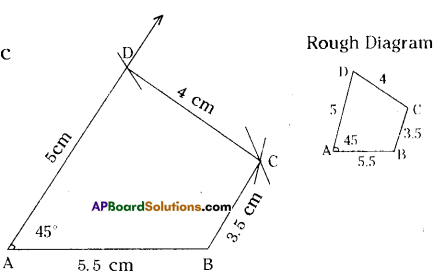
AP Board 8th Class Maths Solutions Chapter 3 Construction of Quadrilaterals Ex 3.1 1

Construction Steps:

  1. Construct a line segment [latex]\overline{\mathrm{AB}}[/latex] with radius 5.5 cm
  2. With the centre A draw a ray and an arc which are equL1 to 45° and 5 cm.
  3. These intersecting point is keep as ‘D’.
  4. With centres D, B draw two arcs equal to radius 4 cm, 3.5 cm respectively.
  5. The intersecting point of these two arcs is keep as ‘C’.
  6. Join DC and BC. A F
  7. ∴ The required quadrilateral ABCD is formed.

Question (b).
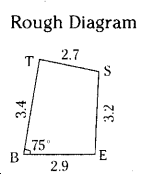
Quadrilateral BEST with BE = 2.9 cm, ES = 3.2 cm, ST = 2.7 cm, BT = 3.4 cm and ∠B=75°.
Solution:
In Quadrilateral BEST
BE = 2.9 cm, ES = 3.2 cm, ST = 2.7 cm, BT = 3.4 cm and ∠B=75°.
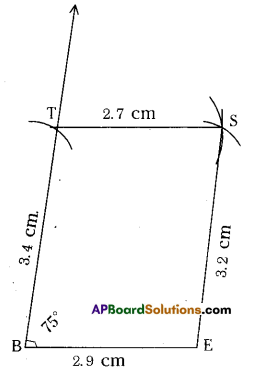
AP Board 8th Class Maths Solutions Chapter 3 Construction of Quadrilaterals Ex 3.1 2
AP Board 8th Class Maths Solutions Chapter 3 Construction of Quadrilaterals Ex 3.1 3

Construction Steps:

  1. Draw a line segment [latex]\overline{\mathrm{BE}}[/latex] with radius 2.9 cm.
  2. With the centre B, draw a ray of 75° and draw 2.9
    an arc with radius 3.4 cm, keep the intersecting point of these two as T.
  3. With the centres T, E draw arcs with radius 2.7 cm, 3.2 cm respectively. These intersection point is keep as S’.
  4. Join T, S and E,S.
  5. ∴ The required quadrilateral BEST is formed.

Question (c).
Parallelogram PQRS with PQ = 4.5 cm, QR =3 cm and ∠PQR = 60°.
Solution:
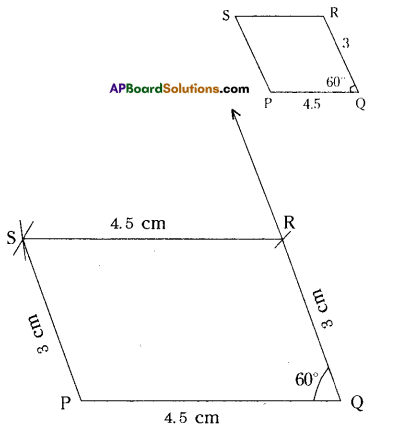
AP Board 8th Class Maths Solutions Chapter 3 Construction of Quadrilaterals Ex 3.1 4
In a parallelogram PQRS
PQ = 4.5 cm, QR = 3 cm, ZPQR = 60°.
=RS4.5cmzPS=3crn
[: Opposite sides of a I)aralielograrn are equal]

Construction Steps:

  1. Draw a line segment ¡i with radius 4.5 cm.
  2. With the centre Q draw a ray and an arc equal to 60° and 3 cm.
  3. The intersecting point of these two keep as R’.
  4. With the centres R, P draw arcs with 4.5 cm, 3 cm respectively. Keep ‘S’ as the intersecting point of these two arcs.
  5. Join P, S and R, S.
  6. ∴ The required parallelogram PQRS is formed.

Question (d).
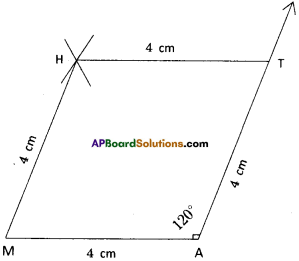
Rhombus MATH with AT =4 cm, ∠MAT =120°.
Solution:
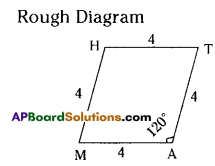
AP Board 8th Class Maths Solutions Chapter 3 Construction of Quadrilaterals Ex 3.1 5
AP Board 8th Class Maths Solutions Chapter 3 Construction of Quadrilaterals Ex 3.1 6

Construction Steps:

  1. Draw a line segment [latex]\overline{\mathrm{MA}}[/latex] with radius 4 cm.
  2. With the centre A draw a ray and an arc equal to 120°, 4 cm. These two intersecting point be keep as T.
  3. With the centres M, T draw arcs equal to 4 cms.
    These two arcs intersected at the point ‘H’.
  4. Join M, H and T, H.
  5. ∴ The required rhombus MATH is formed.

Question (e).
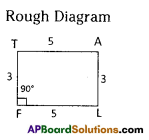
Rectangle FLAT with FL =5 cm, LA= 3 cm.
Solution:
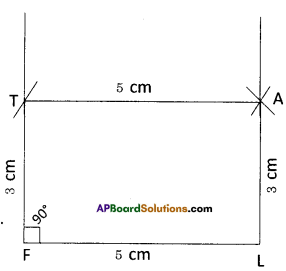
AP Board 8th Class Maths Solutions Chapter 3 Construction of Quadrilaterals Ex 3.1 7
AP Board 8th Class Maths Solutions Chapter 3 Construction of Quadrilaterals Ex 3.1 8
In a rectangle FLAT
FL=AT=5cm, LA = TF = 3cm, ∠F = ∠L = ∠A = ∠T = 90°

Construction Steps:

  1. Draw a line segment [latex]\overline{\mathrm{FL}}[/latex] with radius 5 cm.
  2. With the centre F draw a ray and an arc equal to 900, 3 cm.
    These to meet at point T.
  3. With the centres T, L draw arcs equal to 5 cm, 3 cm respectively.
  4. These two arcs meet at the point ‘A’.
  5. Join T, A and L, A.
  6. ∴ The required rectangle FLAT is formed.

Question (f).
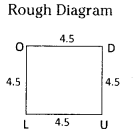
Square LUDO with LU = 4.5 cm.
Solution:
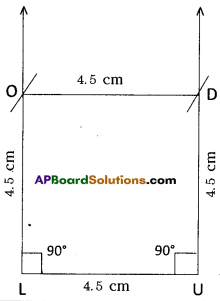
AP Board 8th Class Maths Solutions Chapter 3 Construction of Quadrilaterals Ex 3.1 9
AP Board 8th Class Maths Solutions Chapter 3 Construction of Quadrilaterals Ex 3.1 10
In a square LUDO
LU = UD = DO = OL = 4.5 cm
∠L = ∠U = ∠D = ∠O = 90°

Construction Steps: 45

  1. Draw a line segment [latex]\overline{\mathrm{LU}}[/latex] with radius 4.5 cm.
  2. With the centre ‘L’, draw a ray of 90° and an arc with radius 4.5 cm. These two meet at the point ‘O’.
  3. Now with the centre U’, draw another ray of 90° and an arc with radius 4.5 cm. These two meet at the point “D”.
  4. Join O, D.
  5. ∴ The required square LUDO is formed.
AP Board 8th Class Maths Solutions Chapter 2 Linear Equations in One Variable Ex 2.5

AP State Syllabus AP Board 8th Class Maths Solutions Chapter 2 Linear Equations in One Variable Ex 2.5 Textbook Questions and Answers.

AP State Syllabus 8th Class Maths Solutions 2nd Lesson Linear Equations in One Variable Exercise 2.5

AP Board 8th Class Maths Solutions Chapter 2 Linear Equations in One Variable Ex 2.5

Question 1.
Solve the following equations.
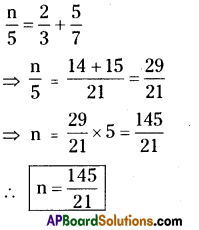
i) [latex]\frac{n}{5}-\frac{5}{7}=\frac{2}{3}[/latex]
Solution:
AP Board 8th Class Maths Solutions Chapter 2 Linear Equations in One Variable Ex 2.5 1

ii) [latex]\frac{x}{3}-\frac{x}{4}=14[/latex]
⇒ [latex]\frac{4 x-3 x}{12}[/latex] = 14
⇒ [latex]\frac{x}{12}[/latex] = 14
⇒ x = 12 × 14 = 168
∴ x = 168

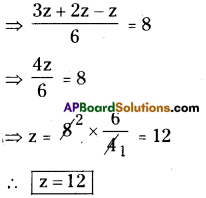
iii) [latex]\frac{z}{2}+\frac{z}{3}-\frac{z}{6}=8[/latex]
AP Board 8th Class Maths Solutions Chapter 2 Linear Equations in One Variable Ex 2.5 2

AP Board 8th Class Maths Solutions Chapter 2 Linear Equations in One Variable Ex 2.5

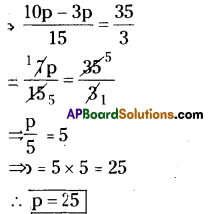
iv) [latex]\frac{2 p}{3}-\frac{p}{5}=11 \frac{2}{3}[/latex]
AP Board 8th Class Maths Solutions Chapter 2 Linear Equations in One Variable Ex 2.5 3

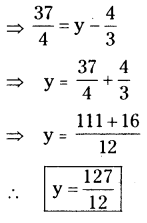
v) [latex]9 \frac{1}{4}=y-1 \frac{1}{3}[/latex]
AP Board 8th Class Maths Solutions Chapter 2 Linear Equations in One Variable Ex 2.5 5

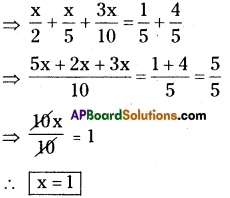
vi) [latex]\frac{x}{2}-\frac{4}{5}+\frac{x}{5}+\frac{3 x}{10}=\frac{1}{5}[/latex]
AP Board 8th Class Maths Solutions Chapter 2 Linear Equations in One Variable Ex 2.5 6

AP Board 8th Class Maths Solutions Chapter 2 Linear Equations in One Variable Ex 2.5

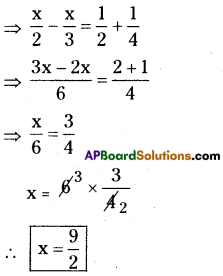
vii) [latex]\frac{x}{2}-\frac{1}{4}=\frac{x}{3}+\frac{1}{2}[/latex]
AP Board 8th Class Maths Solutions Chapter 2 Linear Equations in One Variable Ex 2.5 7

viii) [latex]\frac{2 x-3}{3 x+2}=\frac{-2}{3}[/latex]
⇒ 3(2x – 3) = – 2(3x + 2)
⇒ 6x – 9 = -6x – 4
⇒ 6x + 6x = -4 + 9
⇒ 12x = 5
∴ x = [latex]\frac{5}{12}[/latex]

ix) [latex]\frac{8 p-5}{7 p+1}=\frac{-2}{4}[/latex]
Solution:
⇒ [latex]\frac{8 p-5}{7 p+1}=\frac{-2}{4}[/latex]
⇒ 2(8p – 5) = – (7p + 1)
⇒ 16p – 10 = – 7p – 1
⇒ 16p + 7p = – 1 + 10
⇒ 23p = 9
∴ x = [latex]\frac{9}{23}[/latex]

AP Board 8th Class Maths Solutions Chapter 2 Linear Equations in One Variable Ex 2.5

x) [latex]\frac{7 y+2}{5}=\frac{6 y-5}{11}[/latex]
⇒ 11 (7y + 2) = 5 (6y-5)
⇒ 77y + 22 = 30y – 25
⇒ 77y – 30y = – 25 – 22
⇒ 47y = – 47
∴ y = [latex]\frac{-47}{47}[/latex]
∴ y = -1

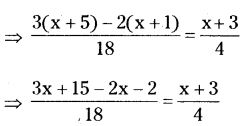
xi) [latex]\frac{x+5}{6}-\frac{x+1}{9}=\frac{x+3}{4}[/latex]
AP Board 8th Class Maths Solutions Chapter 2 Linear Equations in One Variable Ex 2.5 8
⇒ 4(x + 13) = 18 (x + 3)
⇒ 4x + 52 = 18x + 54
⇒ 4x – 18x = 54-52
⇒ – 14x = 2
⇒ x = [latex]\frac{2}{-1}[/latex] = [latex]\frac{-1}{7}[/latex]
∴ x = [latex]\frac{-1}{7}[/latex]

AP Board 8th Class Maths Solutions Chapter 2 Linear Equations in One Variable Ex 2.5

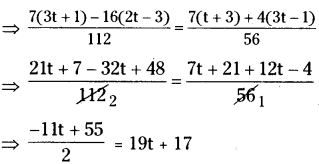
xii) [latex]\frac{3 t+1}{16}-\frac{2 t-3}{7}=\frac{t+3}{8}+\frac{3 t-1}{14}[/latex]
Solution:
AP Board 8th Class Maths Solutions Chapter 2 Linear Equations in One Variable Ex 2.5 9
⇒ -11t + 55 = 2(19t + 17) = 38t + 34
⇒ -11t – 38t = 34 – 55
⇒ -49t = – 21
⇒ [latex]\frac{-21}{-49}[/latex] = [latex]\frac{3}{7}[/latex]
∴ t = [latex]\frac{3}{7}[/latex]

Question 2.
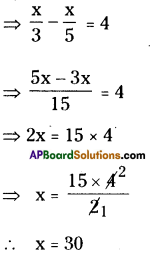
What number is that of which the third part exceeds the fifth part by 4?
Solution:
Let the number be ‘x’ say.
[latex]\frac{1}{3}[/latex] rd of a number = [latex]\frac{1}{3}[/latex] x x = [latex]\frac{x}{3}[/latex]
[latex]\frac{3}{7}[/latex] th of a number = [latex]\frac{1}{5}[/latex] x x = [latex]\frac{x}{5}[/latex]
According to the sum
AP Board 8th Class Maths Solutions Chapter 2 Linear Equations in One Variable Ex 2.5 10
∴ The required number is 30.

AP Board 8th Class Maths Solutions Chapter 2 Linear Equations in One Variable Ex 2.5

Question 3.
The difference between two positive integers is 36. The quotient when one integer is
divided by other is 4. Find the integers.
(Hint: If one number is ‘X’, then the other number is ‘x – 36’)
Solution:
Let the two positive numbers be x, (x – 36) say.
If one number is divided by second tten the quotient is 4.
∴ [latex]\frac{x}{x-36}=4[/latex]
⇒ x = 4(x – 36) = 4x – 144
⇒ 4x – x = 144
3x = 144
x = 48
∴ x – 36 = 48 – 36 = 12
∴ The required two positive intgers are 48, 12.

Question 4.
The numerator of a fraction is 4 less than the denominator. If 1 is added to both its
numerator and denominator, it becomes 1/2 . Find the fraction.
Solution:
Let the denominator of a fractin be x.
The numerator of a fraction is 4 less than the denominator.
∴ The numerator = x – 4
∴ Fraction [latex]\frac{x-4}{x}[/latex]
If ‘1’ is added to both, its numerator and denominator, it becomes [latex]\frac{1}{2}[/latex]
∴ [latex]\frac{1+x-4}{1+x}=\frac{1}{2}[/latex]
2 + 2x – 8 = 1 + x
2x – x = 1 + 6 = 7
x = 7
∴ The denominator = 7
The numerator = 7 – 4 = 3
∴ Fraction = [latex]\frac{3}{7}[/latex]

AP Board 8th Class Maths Solutions Chapter 2 Linear Equations in One Variable Ex 2.5

Question 5.
Find three consecutive numbers such that if they are divided by 10, 17, and 26 respectively,
the sum of their quotients will be 10.
(Hint: Let the consecutive numbers = x, x+ 1, x+ 2, then [latex]\frac{x}{10}+\frac{x+1}{17}+\frac{x+2}{26}=10[/latex])
Solution:
Let the three consecutive numbers be assume that x, (x + 1), (x + 2) respectively.
Given that x, (x + 1), (x + 2) are divided by 10, 17, 26 respectively, the sum of the quotients is 10. Then
⇒ [latex]\frac{x}{10}+\frac{x+1}{17}+\frac{x+2}{26}=10[/latex]
⇒ [latex]\frac{x \times 221+130(x+1)+85(x+2)}{2210}=10[/latex]
⇒ 221x + 130x + 85x + 130 + 170 = 22,100
⇒ 436x + 300 = 22,100
⇒ 436x = 22,100 – 300
⇒ 436x = 21,800
⇒ [latex]\frac{21800}{436}[/latex]
∴ x = 50
∴ The required three consecutive num-bers are x = 50
x + 1 =50+ 1 = 51
x + 2 = 50 + 2 = 52

Question 6.
In class of 40 pupils the number of girls is three-fifths of the number of boys. Find the
number of boys in the class.
Solution:
Let the number of boys = x say.
Total number of students = 40
Number of girls = [latex]\frac{3}{5}[/latex] × x = [latex]\frac{3x}{5}[/latex]
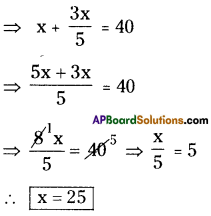
According to the sum 3x
AP Board 8th Class Maths Solutions Chapter 2 Linear Equations in One Variable Ex 2.5 11
∴ x = 25
∴ Number of boys in the class room = 25

AP Board 8th Class Maths Solutions Chapter 2 Linear Equations in One Variable Ex 2.5

Question 7.
After 15 years , Mary’s age will be four times of her present age. Find her present age.
Solution:
Let the present age of Mary = x years say.
After 15 years Mary’s age = (x + 15) years
According to the sum
(x + 15) = 4 x x
⇒ x + 15 = 4x
⇒ 4x – x =15
⇒ 3x = 15
⇒ x = 5
∴ The present age of Mary = 5 years.

Question 8.
Aravind has a kiddy bank. It is full of one-rupee and fifty paise coins. It contains 3 times
as many fifty paise coins as one rupee coins. The total amount of the money in the bank is
₹ 35. How many coins of each kind are there in the bank?
Solution:
Number of 1 rupee coins = x say.
Number of 50 – paise coins = 3 x x = 3x
The value of total coins = [latex]\frac{3x}{2}[/latex] + x
[∵50 paisa coins of 3x = ₹[latex]\frac{3x}{2}[/latex]
According to the sum
⇒ [latex]\frac{3x}{2}[/latex] + x = 35
⇒ [latex]\frac{3 x+2 x}{2}[/latex] = 35
⇒ 5x = 2 × 35
⇒ x = 2 × [latex]\frac{35}{5}[/latex]
∴ x = 14
∴ Number of 1 rupee coins = 14
Number of 50 paisa coins = 3 × x = 3 × 14 = 42

AP Board 8th Class Maths Solutions Chapter 2 Linear Equations in One Variable Ex 2.5

Question 9.
A and B together can finish a piece of work in 12 days. If ‘A’ alone can finish the same work in 20days , in how many days B alone can finish it?
Solution:
A, B can do a piece of work in 12 days.
(A + B)’s 1 day work = [latex]\frac{1}{12}[/latex] th part.
A can complete the same work in 20 days.
Then his one day work = [latex]\frac{1}{20}[/latex]
B’s one day work = (A+B)’s 1 day work – A’s 1 day work
[latex]=\frac{1}{12}-\frac{1}{20}=\frac{5-3}{60}=\frac{2}{60}=\frac{1}{30}[/latex]
∴ Number of days to take B to com¬plete the whole work = 30.

Question 10.
If a train runs at 40 kmph it reaches its destination late by 11 minutes . But if it runs at 50 kmph it is late by 5 minutes only. Find the distance to be covered by the train.
Solution:
Let the distance to be reached = x km say. Time taken to travel ‘x’ km with speed x
40 km/hr = [latex]\frac{x}{40}[/latex] hr.
Time taken to travel ‘x’ km with speed 50 km/hr = [latex]\frac{x}{50}[/latex] hr.
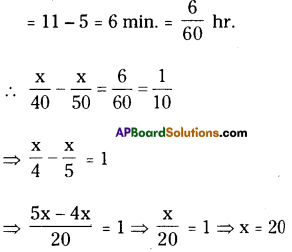
According to the sum the difference between the times
AP Board 8th Class Maths Solutions Chapter 2 Linear Equations in One Variable Ex 2.5 12
∴ The required distance to be trav¬elled by a train = 20 kms‘.

AP Board 8th Class Maths Solutions Chapter 2 Linear Equations in One Variable Ex 2.5

Question 11.
One fourth of a herd of deer has gone to the forest. One third of the total number is
grazing in a field and remaining 15 are drinking water on the bank of a river. Find the total
number of deer.
Solution:
Number of deer = x say.
Number of deer has gone to the forest
= [latex]\frac{1}{4}[/latex] × x = [latex]\frac{x}{4}[/latex]
Number of deer grazing in the field
= [latex]\frac{1}{3}[/latex] × x =[latex]\frac{x}{3}[/latex]
Number of remaining deer =15
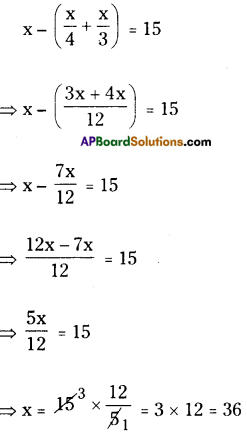
According to the sum
AP Board 8th Class Maths Solutions Chapter 2 Linear Equations in One Variable Ex 2.5 13
∴ x = 36
∴ The total number of deer = 36

Question 12.
By selling a radio for ₹903, a shop keeper gains 5%. Find the cost price of the radio.
Solution:
The selling price of a radio = ₹ 903
Profit % = 5%
C.P = ?
C.P = [latex]\frac{\mathrm{S.P} \times 100}{(100+\mathrm{g})}[/latex]
= [latex]\frac{903 \times 100}{(100+5)}[/latex]
= [latex]\frac{903\times 100}{105}[/latex]
C.P. = 8.6 × 100 = 860
∴ The cost price of the radio = ₹ 860

AP Board 8th Class Maths Solutions Chapter 2 Linear Equations in One Variable Ex 2.5

Question 13.
Sekhar gives a quarter of his sweets to Renu and then gives 5 sweets to Raji. He has 7 sweets left. How many did he have to start with?
Solution:
Number of sweets with Sekhar = x say.
Number of sweets given to Renu
= [latex]\frac{1}{4}[/latex] × x = [latex]\frac{x}{4}[/latex]
Number of sweets given to Raji = 5
Till he has 7 sweets left.
x – ( [latex]\frac{x}{4}[/latex] + 5) = 7
⇒ x – [latex]\frac{x}{4}[/latex] – 5 = 7
⇒ x – [latex]\frac{x}{4}[/latex] = 7 + 5 = 12
⇒ [latex]\frac{4 x-x}{4}[/latex] = 12
⇒ [latex]\frac{3x}{4}[/latex] = 12
⇒ x = 12 × [latex]\frac{4}{3}[/latex] = 16
∴ x = 4 × 4 = 16
∴ Number of sweets with Sekhar at the beginning = 16

AP Board 8th Class Maths Solutions Chapter 2 Linear Equations in One Variable Ex 2.4

AP State Syllabus AP Board 8th Class Maths Solutions Chapter 2 Linear Equations in One Variable Ex 2.4 Textbook Questions and Answers.

AP State Syllabus 8th Class Maths Solutions 2nd Lesson Linear Equations in One Variable Exercise 2.4

AP Board 8th Class Maths Solutions Chapter 2 Linear Equations in One Variable Ex 2.4

Question 1.
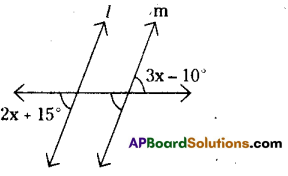
Find the value of ’x’ so that l || m
AP Board 8th Class Maths Solutions Chapter 2 Linear Equations in One Variable Ex 2.4 1
Solution:
Given l|| m. Then 3x – 10° = 2x + 15°
[Vertically opposite angles and corresponding angles are equal.]
⇒ 3x – 10 = 2x + 15
⇒ 3x – 2x = 15 + 10
∴ x = 25°

AP Board 8th Class Maths Solutions Chapter 2 Linear Equations in One Variable Ex 2.4

Question 2.
Eight times of a number reduced by 10 is equal to the sum of six times the number and 4. Find the number.
Solution:
Let the number be ‘x’ say.
8 times of a number = 8 × x = 8x
¡f10 is reduced from 8x then 8x – O
6 times of a number = 6 × x = 6x
If 4 is added to 6x then 6x + 4
According to the sum,
8x – 10 = 6x + 4
⇒ 8x – 6x = 4 + 10
⇒ 2x = 14
⇒ x = 7
∴ The required number = 7

AP Board 8th Class Maths Solutions Chapter 2 Linear Equations in One Variable Ex 2.4

Question 3.
A number consists of two digits whose sum is 9. If 27 is subtracted from the number its digits are reversed. Find the number.

Solution:
Let a digit of two digit number be x.
The sum of two digits = 9
∴ Another digit = 9 – x
The number = 10 (9 – x) + x
= 90 – 10x + x
= 90 – 9x
If 27 is subtraçted from the number its digits are reversed.
∴ (90 – 9x) – 27 = 10x + (9 – x)
63 – 9x = 9x + 9
9x + 9x = 63 – 9
18x = 54
∴ x = [latex]\frac { 54 }{ 18 }[/latex] = 3
∴ Units digit = 3
Tens digit = 9 – 3 = 6
∴ The number = 63

AP Board 8th Class Maths Solutions Chapter 2 Linear Equations in One Variable Ex 2.4

Question 4.
A number is divided into two parts such that one part is 10 more than the other. If the two parts are in the ratio 5:3, find the number and the two parts.
Solution:
If a number is divided into two parts in he ratio of 5 : 3, let the parts be 5x, 3x say.
According to the sum,
5x = 3x + 10
⇒ 5x – 3x = 10
⇒ 2x = 10
∴ x = [latex]\frac { 10 }{ 2 }[/latex]
∴ x = 5
∴ The required number be
x + 3x = 8x
= 8 × 5 = 40
And the parts of number are
5 = 5 × 5 = 25
3 = 3 × 5 = 15

AP Board 8th Class Maths Solutions Chapter 2 Linear Equations in One Variable Ex 2.4

Question 5.
When I triple a certain number and add 2, I get the same answer as I do when I subtract the number from 50. Find the number.
Solution:
Let the number be x’ say.
3 times of a number = 3 × x = 3x
If 2 is added to 3x then 3x + 2
If ‘xis subtracted from 50 then it becomes 50 – x.
According to the sum,
3x + 2 = 50 – x
3x + x = 50 – 2
4x = 48 .
x = 12
∴ The required number 12

Question 6.
Mary is twice older than her sister. In 5 years time, she will be 2 years older than her sister. Find how old are they both now.
Solution:
Let the age of Marys sister = x say.
Mary’s age = 2 × x = 2x
After 5 years her sister’s age
= (x + 5) years
After 5 years Mary’s age
= (2x + 5) years
According to the sum,
2x + 5 = (x + 5) + 2
= 2x – x = 5 + 2 – 5
∴ The age of Mary’s sister = x = 2 years
Mary’s age = 2x = 2 x 2 = 4 years

AP Board 8th Class Maths Solutions Chapter 2 Linear Equations in One Variable Ex 2.4

Question 7.
In 5 years time, Reshma will be three times old as she was 9 years ago. How old is she now?
Solution:
Reshma’s present age = ‘x’ years say.
After 5 years Reshmats age
= (x + 5) years
Before 9 years Reshma’s age
=(x – 9) years
According to the sum
= x+ 5 = 3(x – 9) = 3x – 27
x – 3x = -27-5
-2x = -32
x = [latex]\frac{-32}{-2}[/latex] = 16
∴ x = 16
∴ Reshma’s present age = 16 years.

AP Board 8th Class Maths Solutions Chapter 2 Linear Equations in One Variable Ex 2.4

Question 8.
A town’s population increased by 1200 people, and then this new population decreased 11%. The town now had 32 less people than it did before the 1200 increase. Find the original population.
Solution:
Let th population of a town after the increase of 1200 is x say.
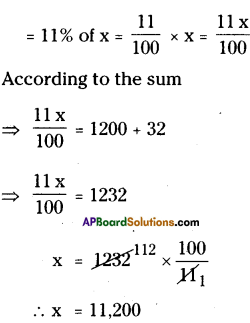
11% of present population
AP Board 8th Class Maths Solutions Chapter 2 Linear Equations in One Variable Ex 2.4 2
The present population of town
= 11,200 – 1200 = 10,000

AP Board 8th Class Maths Solutions Chapter 2 Linear Equations in One Variable Ex 2.4

Question 9.
A man on his way to dinner shortly after 6.00 p.m. observes that the hands of his watch form an angle of 110°. Returning before 7.00 p.m. he notices that again the hands of his watch form an angle of 1100. Find the number of minutes that he has been away.
Solution:
Let the number be ‘x ray.
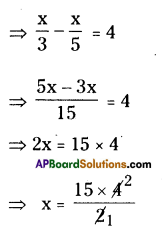
[latex]\frac { 1 }{ 3 }[/latex] rd of a number = [latex]\frac { 1 }{ 3 }[/latex] x x = [latex]\frac { x }{ 3 }[/latex]
[latex]\frac { 1 }{ 5 }[/latex] th of a number = [latex]\frac { 1 }{ 5 }[/latex] x x = [latex]\frac { x }{ 5 }[/latex]
According to the sum
AP Board 8th Class Maths Solutions Chapter 2 Linear Equations in One Variable Ex 2.4 3
∴ x = 30
∴ The required number is 30.

AP Board 8th Class Maths Solutions Chapter 2 Linear Equations in One Variable Ex 2.3

AP State Syllabus AP Board 8th Class Maths Solutions Chapter 2 Linear Equations in One Variable Ex 2.3 Textbook Questions and Answers.

AP State Syllabus 8th Class Maths Solutions 2nd Lesson Linear Equations in One Variable Exercise 2.3

 AP Board 8th Class Maths Solutions Chapter 2 Linear Equations in One Variable Ex 2.3

Question
Solve the following equations:
1. 7x – 5 = 2x
2. 5x – 12 = 2x – 6
3. 7p- 3 = 3p + 8
4. 8m + 9 = 7m + 8
5. 7z + 13 = 2z + 4
6. 9y + 5 = 15y – 1
7. 3x + 4 = 5(x – 2)
8. 3(t – 3) = 5(2t – 1)
9. 5(p – 3) = 3(p – 2)
10. 5(z + 3) = 4(2z + 1)
11. 15(x – 1) + 4(x + 3) = 2 (7 + x)
12. 3 (5z – 7) +2 (9z – 11) = 4 (8z – 7) – 111
13. 8(x – 3) – (6 – 2x) = 2(x + 2) – 5 (5 – x)
14. 3(n – 4)+2(4n – 5) = 5(n + 2) + 16
Solution:
1. 7x – 5 = 2x
⇒ 7x – 2x = 5
⇒ 5x = 5
⇒ x = [latex]\frac { 5 }{ 5 }[/latex] = 1
∴ x = 1

 AP Board 8th Class Maths Solutions Chapter 2 Linear Equations in One Variable Ex 2.3

2. 5x – 12 = 2x – 6
⇒ 5x – 2x = – 6 + 12
⇒ 3x = 6
⇒ x = [latex]\frac { 6 }{ 3 }[/latex] = 2
∴ x = 2

3. 7p – 3 = 3p + 8
⇒ 7p – 3p = 8 + 3
⇒ 4p = 11
⇒ p = [latex]\frac { 11 }{ 4 }[/latex]

4. 8m + 9 = 7m + 8
⇒ 8m – 7m = 8 – 9
∴ m = – 1

5. 7z + 13 = 2z + 4
⇒ 7z – 2z = 4 – 13
⇒ 5z = – 9
∴ z = [latex]\frac { -9 }{ 5 }[/latex]

 AP Board 8th Class Maths Solutions Chapter 2 Linear Equations in One Variable Ex 2.3

6. 9y + 5 = 15y – 1
⇒ 9y – 15y = – 1 – 5
⇒ -6y = -6
⇒ y = [latex]\frac { -6 }{ -6 }[/latex]
∴ y = 1

7. 3x + 4 = 5(x – 2)
⇒ 3x + 4 =5x – 10
⇒ 3x – 5x= – 10 – 4
⇒ – 2x = – 14
:. x = 71

8. 3(t – 3) = 5(2t – 1)
⇒ 3t – 9 = 10t – 5
⇒ 3t – 10t = – 5+ 9
⇒ – 7t = 4
∴ t = [latex]\frac { -4 }{ 7 }[/latex]

9. 5 (p – 3) = 3 (p – 2)
⇒ 5p – 15 = 3p – 6
⇒ 5p – 3p = -6 + 15
⇒ 2p = 9
∴ p = [latex]\frac { 9 }{ 2 }[/latex]

 AP Board 8th Class Maths Solutions Chapter 2 Linear Equations in One Variable Ex 2.3

10. 5(z + 3) = 4(2z + 1)
⇒ 5z + 15 = 8z + 4
⇒ 5z – 8z = 4 – 15
⇒ – 3z = – 11
⇒ z = [latex]\frac { -11 }{ 3 }[/latex]
∴ z = [latex]\frac { -11 }{ 3 }[/latex]

11. 15(x – 1) + 4(x + 3) = 2(7 + x)
⇒ 15x – 15 + 4x + 12= 14 + 2x
⇒ 19x – 3 = 14 + 2x
⇒ 19x – 2x = 14 + 3
⇒ 17x = 17 ,
x = [latex]\frac { 17 }{ 17 }[/latex] = 1
∴ x = 1

12. 3(5z – 7)+2(9z – 11) = 4(8z – 7) – 111
⇒ 15z – 21 + 18z – 22 = 32z – 28 – 111
⇒ 33z – 43 = 32z – 139
⇒ 33z – 32z = – 139 + 43
∴ z = – 96

 AP Board 8th Class Maths Solutions Chapter 2 Linear Equations in One Variable Ex 2.3

13. 8(x – 3) – (6 – 2x)=2(x+2)-.5(5 – x)
⇒ 8x – 24 – 6 + 2x = 2x + 4 – 25 +5x
⇒ 8x – 30 = 5x – 21
⇒ 8x – 5x= – 21 +30
⇒ 3x = 9
∴ x = 3

14. 3(n – 4) + 2(4n – 5) = 5(n + 2) + 16
⇒ 3n – 12 + 8n – 10 = 5n + 10 + 16
⇒ 11n – 22 = 5n + 26
⇒ 11n – 5n = 26 + 22
⇒ 6n =48
⇒ n = [latex]\frac { 48 }{ 6 }[/latex] = 8
∴ n = 8

AP Board 8th Class Maths Solutions Chapter 2 Linear Equations in One Variable Ex 2.2

AP State Syllabus AP Board 8th Class Maths Solutions Chapter 2 Linear Equations in One Variable Ex 2.2 Textbook Questions and Answers.

AP State Syllabus 8th Class Maths Solutions 2nd Lesson Linear Equations in One Variable Exercise 2.2

 AP Board 8th Class Maths Solutions Chapter 2 Linear Equations in One Variable Ex 2.2

Question 1.
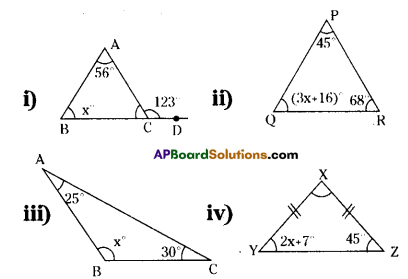
Find ‘x’ in the following figures?
AP Board 9th Class Maths Solutions Chapter 2 Linear Equations in One Variable Ex 2.2 1
AP Board 9th Class Maths Solutions Chapter 2 Linear Equations in One Variable Ex 2.2 2
Solution:
1) In a triangle the exterior angle is equal to the sum of its opposite interior angles.
∴ ∠ACD = ∠B + ∠A
⇒ 123°= x + 56°
⇒ x = 123°- 56° = 67°
∴ x = 67°

ii) Sum of three angles of a triangle = 180°
∠P + ∠Q +∠R = 180°
⇒ 45° + 3x + 16°+ 68° = 180°
⇒ 3x + 129° = 180°
3x = 180 – 129 = 51
∴ x = [latex]\frac{51}{3}[/latex]
∴ x = 17°

 AP Board 8th Class Maths Solutions Chapter 2 Linear Equations in One Variable Ex 2.2

iii) ∠A + ∠B + ∠C = 180°
⇒ 25° + x + 30° = 180°
x + 55°= 180°
x = 180 – 55 = 125°
∴ x = 125°

iv) In ΔXYZ, [latex]\overline{\mathrm{XY}}=\overline{\mathrm{XZ}}[/latex] then ∠Y = ∠Z
∴ 2x + 7° = 45°
⇒ 2x = 45 – 7
⇒ 2x = 38
⇒ x = [latex]\frac{38}{2}[/latex]
∴ x = 19°

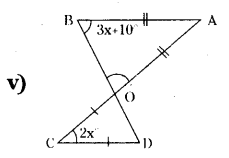
v) From ΔBOA
[latex]\overline{\mathrm{AB}}=\overline{\mathrm{OA}} [/latex] ⇒ ∠B = ∠O = 3x + 10° ………(1)
From ΔCOD
[latex]\overline{\mathrm{OC}}=\overline{\mathrm{CD}} [/latex] ⇒ ∠O = ∠D …………………(2)
[∵ The angles which are opposite to the equal sides are equal].
from (1) & (2)
∠BOA = ∠COD
[∵ Vertically opposite angles are equal.]
But ∠COD = 90 – x
(∵ 2x + ∠O + ∠D = 180
⇒ 2x + ∠O + ∠O = 180 (∵∠O = ∠D)
⇒ 2∠O = 180 – 2x
∠O = [latex]\frac{180-2 x}{2}[/latex] = 90 – x]
∴ From ∠BOA = ∠COD
⇒ 3x + 10 = 90 – x
⇒ 3x + x = 90 – 10
⇒ 4x = 80
∴ x = 20°

 AP Board 8th Class Maths Solutions Chapter 2 Linear Equations in One Variable Ex 2.2

Question 2.
The difference between two numbers is 8. if 2 is added to the bigger number the result will be three times the smaller number. Find the numbers.
Solution:
Let the bigger number be x.
The difference between two numbers 8
∴ Smaller number = x – 8
If 2 is added to the bigger number the result will be three times the smaller
number.
So x + 2 = 3(x – 8)
x + 2 = 3x – 24
x – 3x = -24 – 2
– 2x = -26
∴ x = [latex]\frac{26}{2}[/latex] = 13
∴ Bigger number = 13
Smaller number = 13 – 8 = 5

Question 3.
What are those two numbers whose sum is 58 and difference is 28’?
Solution:
Let the bigger number be ‘x’.
The sum of two numbers = 58
∴ Smaller number = 58 – x
The difference of two numbers = 28
∴ x – (58 – x) = 28
x – 58 + x = 28
2x = 28 + 58 = 86
∴ x = [latex]\frac{86}{2}[/latex] = 43
∴ Bigger number or one number = 43
Smaller number or second number = 58 – 43 = 15

 AP Board 8th Class Maths Solutions Chapter 2 Linear Equations in One Variable Ex 2.2

Question 4.
The sum of two consecutive odd numbers is 56. Find the numbers.
Solution:
Let the two consecutive odd numbers
be 2x 1, 2x + 3 say.
Sum of the odd numbers
=(2x + 1) + (2x + 3) = 56
= 4x + 4 = 56
⇒ 4x = 56 – 4 = 52
x = [latex]\frac{52}{4}[/latex] = 13
∴ x = 13
∴ 2x + 1 = 2 × 13 + 1
= 26 + 1 = 27
2x + 3 = 2 × 13 + 3
= 26 + 3 = 29
∴ The required two consecutive odd numbers be 27, 29.

 AP Board 8th Class Maths Solutions Chapter 2 Linear Equations in One Variable Ex 2.2

Question 5.
The sum of three consecutive multiples of 7 is 777. Find these multiples.
(Hint: Three consecutive multiples of 7 are ‘x’, ‘x+ 7’, ‘x+ 14’)
Solution:
Let the three consecutive multiples of 7 be x, x + 7, x + 14 say.
According to the sum,
The sum of three consecutive multiples of 7 is 777.
⇒ x + (x + 7) + (x + 14)= 777
⇒ 3x + 21 = 777
⇒ 3x = 777 – 21 = 756
x = [latex]\frac { 756 }{ 3 }[/latex] = 252
x+ 7 = 252 + 7 = 259
x + 14 252 + 14 = 266
∴ The required three consecutive multiples of 7 are 252, 259, 266

Question 6.
A man walks 10 km, then travels a certain distance by train and then by bus as far as twice by the train. 1f the whole journey is of 70km, how far did he travel by train?
Solution:
The distance travelled by walk = 10 km
Let the distance travelled by train = x km say.
The distance travelled by bus
= 2 × x = 2x km
∴ 10 + x + 2x = 70
⇒ 3x = 70 – 10
⇒ 3x = 60
⇒ x = [latex]\frac { 60 }{ 3 }[/latex] = 20
⇒ x = 20
∴ The distance travelled by train = 20 km.

 AP Board 8th Class Maths Solutions Chapter 2 Linear Equations in One Variable Ex 2.2

Question 7.
Vinay bought a pizza and cut it into three pieces. When the weighed the first piece he found that it was 7g lighter than the second piece and 4g.heavier than the third piece. If the whole pizza weighed 300g. How much did each of the three pieces weigh?
AP Board 9th Class Maths Solutions Chapter 2 Linear Equations in One Variable Ex 2.2 3
(Hint: weight of normal piece be ‘x’ then weight of largest piece is ‘x+ 7’, weight of the smallest piece is ‘x-4’)
Solution:
If pizza is cut into three pieces.
Let the weight of first piece he ‘x’ gm say.
Weight of the second piece = (x + 7) gm
Weight of the third piece = (x – 4) gm
According to the sum
∴ x + (x + 7) + (x – 4) = 300
⇒ 3x + 3 = 300
⇒ 3x = 300 – 3 = 297
⇒ x = [latex]\frac { 297 }{ 3 }[/latex] = 99
∴ x= 99
x + 7= 99 + 7 =106
x – 4 = 99 – 4 = 95
∴ The required 3 pieces of pizza weighs 95 gm. 99 gm, 106 gm.

 AP Board 8th Class Maths Solutions Chapter 2 Linear Equations in One Variable Ex 2.2

Question 8.
The distance around a rectangular field is 400 meters.The length of the field is 26 meters more than the breadth. Calculate the length and breadth of the field’?
Solution:
Let the breadth of a rectangular field = x m
Length = (x + 26) m.
Perimeter of a rectangular field
= 2(l + b) = 400
l + b = 200
x + 26 + x = 200
2x = 200 – 26 = 174
x = [latex]\frac { 174 }{ 2 }[/latex]
∴ x = 87
∴ The length = x +26
= 87 + 26
= 113 m
Breadth = x = 87 m.

 AP Board 8th Class Maths Solutions Chapter 2 Linear Equations in One Variable Ex 2.2

Question 9.
The length of a rectangular field is 8 meters less than twice its breadth. If the perimeter of the rectangular field is 56 meters, find its length and breadth’?
Solution:
Let the breadth of a rectangular field = xm.
Length = 2 × x – 8 = (2x – 8) m.
Perimeter of a field = 56 m.
∴ 2(l + b) = 56
l + b = 28
2x – 8 + x = 28
3x = 28 + 8 = 36
x = [latex]\frac { 36 }{ 3 }[/latex]
∴ x= 12
∴ Breadth = 12 m
Length = 2x – 8
= 2 × 12 – 8
= 24 – 8 = 16m.

Question 10.
Two equal sides of a triangle are each 5 meters less than twice the third side. if the perimeter of the triangle is 55 meters, find the length of its sides’?
Solution:
A triangle in which the length of the third side = x m. say.
The length of remaining two equal sides = 2 × x – 5 = (2x – 5) m.
Perimeter of a triangle = 55 m.
∴ (2x – 5) + (2x -5) + x = 55
⇒ 5x – 10 = 55
⇒ 5x = 65
⇒ x = [latex]\frac { 65 }{ 5 }[/latex]
∴ x = 13m
2x – 5 = 2 × 13 – 5 = 26 – 5 = 21m.
∴ The lengths of three sides of a triangle are 13, 21, 21. (in m.)

 AP Board 8th Class Maths Solutions Chapter 2 Linear Equations in One Variable Ex 2.2

Question 11.
Two complementary angles differ by 12°, find the angles’?
Solution:
Let one angle in two complementary angles be x.
Sum of the two complementary angles = 90°
∴ Second angle = 90° – x
Here two complementary angles differ by 12°.
∴ x – (90°- x) = 12°
x – 90° + x = 12°
2x = 12° + 90° = 102°
∴ [latex]\frac{102^{\circ}}{2}[/latex] = 51°
one angle = 51°
Second angle 90° – 51° = 39°

 AP Board 8th Class Maths Solutions Chapter 2 Linear Equations in One Variable Ex 2.2

Question 12.
The ages of Rahul and Laxmi arc in the ratio 5:7. Four years later, the sum of their ages will
be 56 years. What are their present ages’?
Solution:
The ratio of ages of Rahul and Lakshmi = 5:7
Let their ages be 5x, 7x say.
After 4 years Rahuls agt. = 5x + 4
After 4 years Lakshmis age = 7x + 4
According to the sum,
After 4 years the sum of their ages = 56
⇒ (5x + 4) + (7x + 4) = 56
⇒ 12x + 8 = 56
⇒ 12x = 56 – 8 = 48
⇒ x= [latex]\frac { 48 }{ 12 }[/latex] = 4
∴ x = 4
∴ Rahuls present age
= 5x = 5 × 4 = 20 years
∴ Lakshmi’s present age
= 7x = 7 × 4 = 28 years

 AP Board 8th Class Maths Solutions Chapter 2 Linear Equations in One Variable Ex 2.2

Question 13.
There are 180 multiple choice questions in a test. A candidate gets 4 marks for every correct answer, and for every un-attempted or wrongly answered questions one mark is deducted from the total score of correct answers. If a candidate scored 450 marks in the
test how many questions did he answer correctly ?
Solution:
Number of questions attempted for correct answers = x say
umber of questions attempted for wrong answers = 180 – x
4 marks are awarded for every correct answer.
Then numl)er of marks ohtained for correct answers 4 × x = 4x
1 mark is deducted for every wrong answer.
∴ Number of marks deducted for wrong answers
=(180 – x) × 1 = 180 – x
According to the sum.
4x – (180 – x) = 450
⇒ 4x – 180 + x = 450
⇒ 5x = 450 + 180
⇒ 5x = 630
x = [latex]\frac { 630 }{ 5 }[/latex]
∴ x = 126
∴ Number of questions attempted for correct answers = 126

Question 14.
A sum of ₹ 500 is in the form of denominations of ₹ 5 and ₹ 10. If the total number of notes is 90 find the number of notes of each denomination.
(Hint: let the number of 5 rupee notes be ‘x’, then number of 10 rupee notes = 90 – x)
Solution:
Number of ₹ 5 notes = x say.
Number of ₹ 10 notes = 90 – x
5x + 10(90 – x) = 500
5x + 900 – 10x = 500
– 5x = 500 – 900 = – 400
x = [latex]\frac { -400 }{ -5 }[/latex]
∴ x = 80
∴ Number of ₹ 5 notes = 80
Number of ₹ 10 notes
= 90 – x = 90 – 80 = 10

 AP Board 8th Class Maths Solutions Chapter 2 Linear Equations in One Variable Ex 2.2

Question 15.
A person spent ₹ 564 in buying geese and ducks,if each goose cost ₹ 7 and each duck ₹ 3 and if the total number of birds bought was 108, how many of each type did he buy?
AP Board 9th Class Maths Solutions Chapter 2 Linear Equations in One Variable Ex 2.2 4
Solution:
Let the number of pens be x.
The total number of things = 108
∴ The number of pencils = 108 – x
Thecostofpens of x = ₹7 × x = ₹ 7x
The cost of pencils of (108- x)
= ₹3(108 – x) = ₹ (324 – 3x)
Total amount to t)uy eflS and Pencils = ₹564
∴ 7x + (324 – 3x) 5M
7x + 324 – 3x = 564
4x = 564 – 324 = 240
∴ x = [latex]\frac { 240 }{ 4 }[/latex] = 60
The number of pens = 60
The number of pencils = 108 – 60 = 48

 AP Board 8th Class Maths Solutions Chapter 2 Linear Equations in One Variable Ex 2.2

Question 16.
The perimeter ofa school volleyball court is 177 ft and the length is twice the width. What are the dimensions of the volleyball court’?
AP Board 9th Class Maths Solutions Chapter 2 Linear Equations in One Variable Ex 2.2 5
Solution:
Breadth of a volleyball court = x feet say.
∴ Its length = 2 × x = 2 x feet.
The perimeter of a court = 177 feet.
⇒ 2(l + b) = 177
⇒ 2(2x + x) = 177
⇒ 2 x 3x = 177
⇒ 6x = 177
⇒ x =[latex]\frac { 177 }{ 6 }[/latex]
∴ x = 29.5
∴ The breadth of a volleyball court = 29.5 ft
The length of a volleyball court = 2x = 2 × 29.5 = 59ft

Question 17.
The sum of the page numbers on the facing pages of a book is 373. What are the page numbers?
(Hint :Let the page numbers of open pages are x and (x + 1)
AP Board 9th Class Maths Solutions Chapter 2 Linear Equations in One Variable Ex 2.2 6
Solution:
Number of first page of a opened book x
Number ol second page = x + 1
∴ The surï of the numbers of two pages = 373
⇒ x + (x + 1) = 373
⇒ 2x + 1 = 373
2x = 372
⇒ x = 186
∴x + 1 = 186 + 1 = 187
∴ Numbers of two c(nlsecutive pages = 186, 187

AP Board 8th Class Maths Solutions Chapter 2 Linear Equations in One Variable Ex 2.1

AP State Syllabus AP Board 8th Class Maths Solutions Chapter 2 Linear Equations in One Variable Ex 2.1 Textbook Questions and Answers.

AP State Syllabus 8th Class Maths Solutions 2nd Lesson Linear Equations in One Variable Exercise 2.1

 AP Board 9th Class Maths Solutions Chapter 2 Linear Equations in One Variable Ex 2.1

Question
Solve the following Simple Equations:

(i) 6m = 12
(ii) 14p -42
(iii) -5y = 30
(iv) – 2x = – 12
(v) 34x = – 51
(vi) [latex]\frac{n}{7}[/latex] = -3
(vn) [latex]\frac{2x}{3}[/latex] = 8
(vui) 3x+1 = 16
(ix) 3p – 7 = 0
(x) 13 – 6n = 7
(xi) 200y – 51 = 49
(xii) 11n + 1 = 1
(xiii) 7x – 9 = 16
(xiv) 8x + [latex]\frac{5}{2}[/latex] =13
(xv) 4x – [latex]\frac{5}{3}[/latex] = 9
(xvi) x – [latex]\frac{4}{3}[/latex] = 3[latex]\frac{1}{2}[/latex]
Solution:
i) 6m = 12 ⇒ m = [latex]\frac{12}{6}[/latex] ⇒ m = 2

ii) 14p = – 42p ⇒ P = [latex]\frac{-42}{14}[/latex]
∴ p = -3

iii) -5y = 30 ⇒ y = [latex]\frac{30}{-5}[/latex] = -6
∴ y = -6

 AP Board 9th Class Maths Solutions Chapter 2 Linear Equations in One Variable Ex 2.1

iv) -2x = -12
⇒ 2x = 12
x = [latex]\frac{30}{-5}[/latex]
= 6
∴ x = 6

v) 34x = -51
⇒ [latex]\frac{-3}{2}[/latex] = [latex]\frac{-3}{2}[/latex]
∴ x = [latex]\frac{-3}{2}[/latex]

vi) [latex]\frac{n}{7}[/latex] = -3
⇒ n = -3 x 7 = -21
∴ n = -21

vii) [latex]\frac{2x}{3}[/latex] = 18 ⇒ 18 x [latex]\frac{3}{2}[/latex] = 27
∴ x = 27

 AP Board 9th Class Maths Solutions Chapter 2 Linear Equations in One Variable Ex 2.1

viii) 3x + 1 = 16
3x = 16 – 1 = 15
3x = 15
x = [latex]\frac{15}{3}[/latex]
∴ x = 5

ix) 3p – 7 = 0
⇒ 3p = 7
∴ p = [latex]\frac{7}{3}[/latex]

x) 13 – 6n = 7 ⇒ -6n = 7 – 13
⇒ -6n = -6 ⇒ n= [latex]\frac{-6}{-6}[/latex]
∴ n = 1

xi) 200y – 51 = 49
⇒ 200y = 49 + 51
⇒ 200y = 100
⇒ y = [latex]\frac{100}{200}[/latex]
∴ y = [latex]\frac{1}{2}[/latex]

xii) 11n + 1 = 1
⇒ 11n = 1 – 1
= 11n = 0
⇒ n = [latex]\frac{0}{11}[/latex] = 0
∴ n = 0

 AP Board 9th Class Maths Solutions Chapter 2 Linear Equations in One Variable Ex 2.1

xiii) 7x – 9 = 16
⇒ 7x = 16 + 9
⇒ 7x = 25
∴ x = [latex]\frac{25}{7}[/latex]

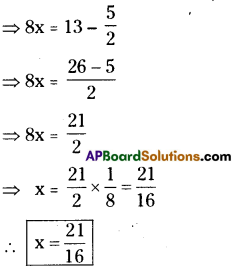
xiv) 8x + [latex]\frac{5}{2}[/latex] = 13
AP Board 9th Class Maths Solutions Chapter 2 Linear Equations in One Variable Ex 2.1 1

 AP Board 9th Class Maths Solutions Chapter 2 Linear Equations in One Variable Ex 2.1

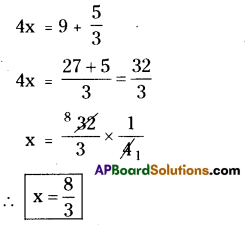
xv) 4x – [latex]\frac{5}{3}[/latex]
AP Board 9th Class Maths Solutions Chapter 2 Linear Equations in One Variable Ex 2.1 2

 AP Board 9th Class Maths Solutions Chapter 2 Linear Equations in One Variable Ex 2.1

xvi) x + [latex]\frac{4}{3}[/latex] = 3[latex]\frac{1}{2}[/latex]
⇒ [latex]x+\frac{4}{3}=\frac{7}{2}[/latex]
⇒[latex]\frac{7}{2}-\frac{4}{3}=\frac{21-8}{6}[/latex]
∴ x = [latex]\frac{13}{6}[/latex]

AP Board 8th Class Physical Science Important Questions Chapter 3 Matter Around Us

AP State Syllabus AP Board 8th Class Physical Science Important Questions Chapter 3 Matter Around Us

AP State Syllabus 8th Class Physical Science Important Questions 3rd Lesson Matter Around Us

8th Class Physical Science 3rd Lesson Matter Around Us 1 Mark Important Questions and Answers

Question 1.
What is CNG?
Answer:
CNG means Compressed Natural Gas.

Question 2.
Does the smoke of incense stick diffuse in a room without air?
Answer:
Smoke of incense stick is a gas. Gas diffuses in air only. So the smoke cannot diffuse in the absense of air.

AP Board 8th Class Physical Science Important Questions Chapter 3 Matter Around Us

Question 3.
Write decreasing order of the distance between the atoms of solid, liquid and gas.
Answer:
Gas > Liquid > Solid.

Question 4.
What is the temperature where water expands?
Answer:
When temperature is reduced from 4°C to 0°C, water expands instead of compression.

Question 5.
What is dry ice?
Answer:
Solid carbon dioxide is called dry ice.

Question 6.
What is Kelvin scale equivalent to 0°C?
Answer:
273 K.

Question 7.
What are the factors influencing the change in state of a matter?
Answer:

  1. Temperature
  2. Pressure.

Question 8.
What is humidity?
Answer:
The amount of water vapour present in air is known as humidity.

Question 9.
What is meant by sublimation?
Answer:
When a substance is heated its state changes from solid to vapour directly without changing into liquid. This is called sublimation.

AP Board 8th Class Physical Science Important Questions Chapter 3 Matter Around Us

Question 10.
How do acquatic animals and plants survive under water?
Answer:
The gases like oxygen and carbon dioxide will diffuse in water. The acquatic animals under water will survive by inhaling these gases.

Question 11.
What are the different states of matter?
Answer:
Matter exists in three states. They are solids, liquids and gases.

Question 12.
Why are the liquids called fluids?
Answer: Liquids can flow easily from one container to another. Hence they are called fluids.

Question 13.
Why is the solid carbon dioxide called dry ice?
Answer:

  1. Solid carbon dioxide converts directly into gaseous state when the pressure is decreased to 1 atmosphere.
  2. Due to this reason solid carbon dioxide is also known as dry ice.

Question 14.
Why is the rate of diffusion in gases high?
Answer:
The rate of diffusion in gases is very high than liquids and gases, because

  1. Higher speed of gas particles.
  2. Greater space between the particles of gas.

Question 15.
Which will decide the change of state of substance?
Answer:
Pressure and temperature decides the state of the substance.

AP Board 8th Class Physical Science Important Questions Chapter 3 Matter Around Us

Question 16.
What is the principle involved in ice skating?
Answer:
Pressure is applied on ice with skating boots. As the pressure increases melting point ice decreases. So ice melts at a lower temperature than 0°C. Therefore skating is possible on ice.

Question 17.
What is compression?
Answer:
The volume of gas can be decreased by applying pressure. This process is called compression.

Question 18.
What are fluids?
Answer:
The substances which can flow from one place to other place are called fluids. Generally liquids and gases are fluids.

8th Class Physical Science 3rd Lesson Matter Around Us 2 Marks Important Questions and Answers

Question 1.
What is matter? Give some examples from your day-to-day life.
Answer:
Anything in this world that occupies space and has mass is considered as matter. Examples:
The water we drink, our food, clothes, chairs, tables, air we breath, etc. are the examples of matter.

Question 2.
Compare the following properties of solids, liquids and gases,
a) Shape b) Volume c) Compressibility d) diffusion
Answer:

Property Solid Liquid Gas
Shape Fixed Attains the shape of container No shape
Volume Fixed Fixed No fixed volume
Compressibility Very less Intermediate Maximum
Diffusion Minimum Intermediate Maximum

Question 3.
Give the order of rate of diffusion in solids, liquids and gases.
Answer:
The order of rate of diffusion in solids, liquids and gases is
Gases > Liquids > Solids (or) Solids < Liquids < Gases

AP Board 8th Class Physical Science Important Questions Chapter 3 Matter Around Us

Question 4.
Give some experiences with evaporation in your daily life.
Answer:

  1. We feel cooler after sweating.
  2. Drying of wet clothes when exposed to the sun.
  3. Paddy, cereals, etc. will be exposed to the sun to remove moist.
  4. Water stored in earthen pots is cooler than the water stored in a metal pot.
  5. Fog, which is formed early in the morning during winter season will disappear after sunrise.

Question 5.
Why do we feel cool when nail polish is applied to nails?
Answer:
Nail polish contains acetone which absorb heat energy from our body and evaporates. So the body temperature decreases. So we feel cool when nail polish applied to nails.

Question 6.
Why do we store water in earthen pots?
Answer:
The earthen pots have small pores in it. From that pores water tends to evaporates by gaining heat energy from the pot. So water in pots is cool. So water is stored in earthen pots.

Question 7.
Why do clothes dry faster on a sunny and windy day compared to rainy season ?
Answer:
If the amount of water vapour is high in air the rate of evaporation will decrease. So clothes dry slowly during rainy season but fast on a sunny and windy day.

Question 8.
Why do we require pressure cookers at higher altitudes?
Answer:
At higher altitudes the atmospheric pressure decreases. So the boiling point of water decreases. So, the heat energy supplied is not sufficient to cook food. Therefore we require a pressure cooker to increase the pressure. Thus the boiling point of water inside the cooker increases to 120°C and heat energy is sufficient to cook food.

Question 9.
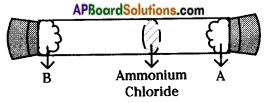
Two pieces of cotton rolls one is soaked in ‘A’ chemical, and other one is soaked in ‘B’ chemical are inserted in a glass tube as shown in the figure.
AP Board 8th Class Physical Science Important Questions Chapter 3 Matter Around Us 1
a) If ‘A’ is HCl, what would be ‘B’?
b) In which state the rate of diffusion is high?
Answer:
a) If ‘A’ is HCl, then ‘B’ should be Ammonium solution. Because it formed Ammonium chloride.
b) Rate of diffusion is high to ‘B’ than ‘A’.
Because the product Ammonium chloride formed nearer to ‘A’ chemical.

AP Board 8th Class Physical Science Important Questions Chapter 3 Matter Around Us

Question 10.
One part of the substance was boiled in water at 100°C. Other part of the substance was boiled in water vapour at 100°C.
a) Which one would be boiled fast?
b) Guess the reason.
Answer:
a) Substance boiled in water vapour at 100°C is boiled fast.
b) Particles in water vapour at 100°C have more energy than the particles in liquid water at the same temperature. This is because of particles in water vapour have absorbed additional energy in the form of heat of vaporization.

Question 11.
Balaraju hanged his washed clothes under fan which is rotating.
Venu Gopal hanged his washed clothes under shadow.
a) Which one dries early? Why?
b) Write the name of the process that involved in drying.
Answer:
a) The clothes hanged by the Balaraju were dried faster, because, evaporation increases with wind speed.
Due to increase of wind speed, water vapour particles move away with the wind, decreasing the amount of water vapour in the surroundings.
b) The process involved in drying up the clothes is evaporation.

Question 12.
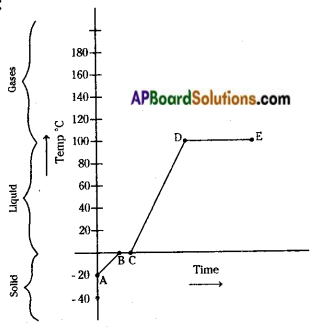
Observe the given graph and answer the following :
AP Board 8th Class Physical Science Important Questions Chapter 3 Matter Around Us 2

  1. What is the melting point in the graph?
  2. What is the boiling point in the graph?
  3. Guess the substance.
  4. What is the maximum temperature that hold the substance?

Answer:

  1. The melting point is 0°C.
  2. The boiling point is 100°C.
  3. The substance should be water.
  4. We can rise the temperature of the substance upto 100°C.
    The maximum temperature that hold by the water is 100°C.

8th Class Physical Science 3rd Lesson Matter Around Us 4 Marks Important Questions and Answers

Question 1.
How can you prove that the solids have definite shape and a fixed volume ?
Answer:

  1. Take two solid objects, say a pen and a book.
  2. Put them in different containers.
  3. We observe that there is no change in their shape or volume.
  4. Drop a book on the floor.
  5. If will not flow like a liquid, but remain rigid.
  6. These activities prove that solids have definite shape and a fixed volume.

AP Board 8th Class Physical Science Important Questions Chapter 3 Matter Around Us

Question 2.
What are the general properties of matter ?
Answer:
The general properties of matter:

  1. Matter is made up of tiny particles. Their size is beyond our imagination.
  2. Matter exists in three states i.e. solid, liquid and gas.
  3. There exists space between the particles of matter.
  4. There exists some force of attraction between the particles of matter.
  5. Matter can change its state from solid to liquid, liquid to gas and vice versa, by changing temperature and pressure.
  6. Matter has the properties of compressibility and diffusion.
  7. Particles of matter move continuously in liquids and gases.

Question 3.
Define: a) Latent heat b) Latent heat of fusion c) Latent heat of vaporisation.
Answer:
a) Latent heat: The amount of heat energy that is required to overcome the attraction
energy among the particles is given by the latent heat of the substance.
b) Latent heat of fusion: Latent heat of fusion is defined as the amount of heat energy required to change 1 kg of a solid, completely into liquid at atmospheric pressure at its melting point.
c) Latent heat of vaporisation : Latent heat of vaporisation is defined as the amount of heat energy required to change 1 / of a liquid, completely into vapour at atmospheric pressure at its boiling point.

Question 4.
How is marine life possible in extremely cold areas ?
Answer:

  1. The volume of water between 0°C to 4°C shrinks.
  2. Same amount of water in solid ice occupies more volume than liquid water.
  3. So ice floats on water rather than shrinking.
  4. In extremely cold weather, the water at the top becomes colder and colder, until it freezes.
  5. While the ice floats on the top, the animals continue to live in the water below, which does not freeze and remains at 4°C.
  6. The ice on the top of the pond insulates the water, below it as it stops the water from losing the heat to air.
  7. This is very important for survival of marine life which lives in ponds in the colder areas.

AP Board 8th Class Physical Science Important Questions Chapter 3 Matter Around Us

Question 5.
How does diffusion helps to survive the animals and plants in daily life ?
Answer:

  1. It is clear that solids and liquids diffuses into liquids and gases diffuses into gases.
  2. Certain gases from atmosphere particularly oxygen and carbon dioxide diffuse and dissolve in water and support the survival of aquatic animals and plants.
  3. Diffusion therefore is a very important process for living things.
  4. During respiration oxygen diffuses from lungs into blood. Carbon dioxide diffuses from blood into lungs.

Question 6.
How do you appreciate the process of diffusion ?
Answer:

  1. Diffusion is a very important process for living things.
  2. Oxygen diffuses into air and available for every human beings and animals.
  3. CO2 diffuses into air and available to plants.
  4. Oxygen and CO2 diffuse and disolve in water and support the survival of aquatic animals and plants.
  5. During respiration oxygen diffuses from lungs into blood.
  6. Smell of flowers, scents diffuses and reaches to our nose to give happiness to us.
  7. We can recognise leaking of L.P. Gas in our house by diffusion process.
  8. Diffusion of sugar and salt, give taste to drinks.
  9. In this way diffusion is useful in our daily life.
    So, I am appreciating the process of diffusion.

Question 7.
How do you appreciate the process of evaporation ?
Answer:

  1. The process of change of a liquid into vapours at any temperature below its boiling point is called “evaporation”.
  2. It is very useful in our daily life.
  3. Drying of wet clothes in air is the result of evaporation.
  4. Drying of sweat from the human body and giving cooling is also result of evaporation.
  5. After washing the floors, dishes evaporation takes place and dries up.
  6. Water cools when it store in matkas (earthen pots). Evaporation process involved in it.
  7. Water evaporate from the sea and forms clouds to rain.
  8. In this way evaporation process is helpful to us.
  9. So, I am appreciating it.

AP Board 8th Class Physical Science Important Questions Chapter 3 Matter Around Us

Question 8.
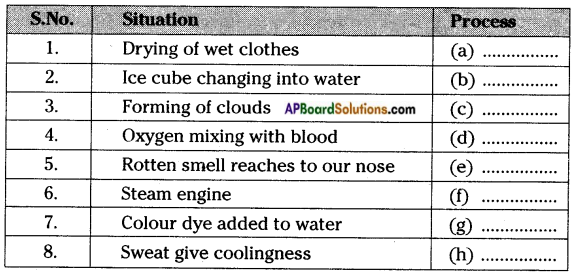
Find out the process involved in given situations.
AP Board 8th Class Physical Science Important Questions Chapter 3 Matter Around Us 3
Answer:
a) evaporation
b) melting
c) evaporation
d) diffusion
e) diffusion
f) boiling
g) diffusion
h) evaporation

AP Board 8th Class Physical Science Important Questions Chapter 2 Friction

AP State Syllabus AP Board 8th Class Physical Science Important Questions Chapter 2 Friction

AP State Syllabus 8th Class Physical Science Important Questions 2nd Lesson Friction

8th Class Physical Science 2nd Lesson Friction 1 Mark Important Questions and Answers

Question 1.
What is frictional force?
Answer:
The force which opposes the relative motion of two surfaces of bodies which are in contact is called frictional force.

Question 2.
What is static friction?
Answer:
Static friction is the friction which comes into play when surfaces of objects are at rest relative to each other

AP Board 8th Class Physical Science Important Questions Chapter 2 Friction

Question 3.
What is sliding friction?
Answer:
Sliding friction is the friction which comes into play when the surface of one object moves relative to the surface of another object.

Question 4.
What is rolling friction?
Answer:
When one body rolls over the surface of the other body the friction offered is called rolling friction.

Question 5.
Write the order of friction.
Answer:
Static friction > Sliding friction > Rolling friction.

Question 6.
What are lubricants?
Answer:
The substances which reduce friction are called lubricants.

Question 7.
What are the factors which influence friction?
Answer:
The factors which influence friction are: 1) Nature of surface, 2) Normal force.

Question 8.
What is drag?
Answer:
The frictional force exerted by fluids is called drag.

Question 9.
What are the factors which frictional force of an object in fluid depends on?
Answer:
The frictional force of an object in a fluid depepds on its speed with respect to fluid and on the shape of the object and nature of the fluid.

Question 10.
If friction was absent can you light a match stick?
Answer:
No, to light a match stick it is to be rubbed against the rough surface of a match box.

AP Board 8th Class Physical Science Important Questions Chapter 2 Friction

Question 11.
Hard metal balls are used between rolling parts in a machine. How does it reduces friction?
Answer:
Firstly it reduces the area of contact and reduces the friction. Secondly the hard balls experiences small forces of deformation that also reduce friction.

Question 12.
When a car is speeding on a level track, it enters on a concrete road from a tar road. What happens to its speed when the acceleration is unchanged?
Answer:
The friction between the tyres and the concrete road is less than that on the tar road. Therefore, the car accelerates more on the concrete road.

Question 13.
A car moving on a concrete road entered on a glacier. The driver applied brakes. Describe its motion.
Answer:
Because the friction is almost zero on the glacier, the car would not stop even though the tyres stop moving. That is the car skid forward.

Question 14.
Why do we use grease between moving parts of motor vehicles?
Answer:
To reduce friction and increase the efficiency of motor vehicles.

Question 15.
What is effect of roughness on friction?
Answer:
As the roughness of surface increases frictional force increases.

Question 16.
Why do Gymnasts apply some coarse substance on their hands?
Answer:
Gymnasts apply some coarse substance on their hands to increase friction for better grip.

Question 17.
What is the effect of area of contact on frictional force?
Answer:
Frictional force is independent of area of contact.

AP Board 8th Class Physical Science Important Questions Chapter 2 Friction

Question 18.
Why do we need to change the tyres when its threading is worn out?
Answer:
If we does not change the tyre then the frictional force decreases due to threading worn out tyre there by the vehicle may skid.

Question 19.
Why birds and fishes have special shapes?
Answer:
Birds and fishes have to move about in fluids all the time so they have special shapes which would make them not to lose much energy in overcoming friction.

Question 20.
Why shape of aeroplane is similar to bird?
Answer:
The shape of birds are useful in reducing the fluid friction so aeroplane shape was made similar to bird in order to reduce fluid friction.

Question 21.
How does life history of Leonardo Davinci inspire students?
Answer:
Leonardo Davinci was concerned with laws of science and nature which greatly informed his work as a painter, sculptor, inventor and draft men. His versatile personality inspire students.

8th Class Physical Science 2nd Lesson Friction 2 Marks Important Questions and Answers

Question 1.
What is practical application of static friction?
Answer:

  1. The objects unable to move on their own is due to static friction otherwise no object be stationary at a particular place.
  2. All the objects we used in our daily life are stationary because they unable to over-come static friction.

Question 2.
Why frictional force increases with roughness?
Answer:

  1. Friction caused by the irregularities on the two surfaces which are in contact.
  2. Irregularities on the two surfaces lock into one another and we have to apply force to overcome interlocking to move any surface.
  3. On roughness surfaces there exists a large number of irregularities so the force of friction is greater if a rough surface is involved.

AP Board 8th Class Physical Science Important Questions Chapter 2 Friction

Question 3.
Give few examples for Sliding friction.
Answer:

  1. The trolley moves on the floor.
  2. The marbles or any spherical objects slide on the ground or floor when thrown.
  3. The tyres make sliding movement on roads which moves the vehicles.

Question 4.
What happens if we do not reduce friction in machines?
Answer:
If we do not reduce friction in machines, then friction causes overheating and wearing out of moving parts of machinery.

Question 5.
What purposes are surved by using bearings in machines? Explain with daily life examples.
Answer:
Ball bearings are used to reduce friction between rotating shafts of machine tools.

  1. Ball bearings are used in fAnswer:
  2. Ball bearings are also used in machines.

Question 6.
Give examples of practical application of static friction.
Answer:

  1. The static friction does not make the bodies move easily. So, the bodies are at rest.
  2. The static friction helps the vehicles to come to rest.
  3. The static friction helps us to escape from slippery.

Question 7.
Why does friction between two surfaces increase when they are pressed harder?
Answer:
Since the friction is due to the interlocking of irregularities in the two surfaces which slide with respect to each other, it is obvious that the force of friction will increase if the two surfaces are pressed harder.

Question 8.
Describe some examples where heat is produced due to friction.
Answer:

  1. When we rub our hands together vigorously for few minutes we feel heat due to friction.
  2. When we strike a matchstick, against rough surface, it catches fire due to friction.

AP Board 8th Class Physical Science Important Questions Chapter 2 Friction

Question 9.
Why are the soles of our shoes and tyres of cars, trucks, etc. grooved?
Answer:

  1. It is done to provide the shoes better grip on the floor, so that one can move safely.
  2. Similarly, the threaded tyres of cars, trucks and buldozers provide better grip with the ground.

Question 10.
Why heavier box apply more frictional force than lighter box?
Answer:

  1. We know that the force of friction is increased if the two surfaces are pressed harder.
  2. A heavier box presses the ground harder to heavier box apply more frictional force.

Question 11.
Why it is easy to move an object in motion when compared with object at rest?
Answer:

  1. When the box start moving, the contact points on its surface, do not get enough time to lock into the contact points of floor.
  2. So it is easy to move the box which already started to move.

Question 12.
What is the function of ridges on your palm and bottom of your feet?
Answer:
Ridges of our palm help us to make firm grip whenever we hold by our hands – Ridges of the bottom of our feet help us to walk freely and we do not slip because of these.

Question 13.
On what factors does the fluid friction depend?
Answer:

  1. The frictional force on an object in a fluid depends on its speed with respect to the fluid.
  2. The frictional force also depends on the shape of the object and the nature of the fluid.

Question 14.
Describe some examples where we have to increase friction.
Answer:

  1. We will increase friction by using brake pads in the brake system of bicycles and automobiles.
  2. Kabaddi players rub their hands with the soil for an easy grip of their opponents.
  3. Gymnasts apply some coarse substances on their hands to increase friction for better grip.

AP Board 8th Class Physical Science Important Questions Chapter 2 Friction

Question 15.
Why is it easy to drag a mat over the floor when no weight is kept over it?
Answer:

  1. When weight is kept over the mat, more force will be applied.
  2. Due to more force, interlocking of two surfaces will increase, so friction also increases.
  3. That is why it is easy to drag a mat over the floor when no weight is kept over it.

Question 16.
Explain why we use ball bearings between the hub and axle of ceiling fan and bicycle?
Answer:

  1. Since the rolling friction is smaller than the sliding friction.
  2. So sliding is replaced in most machines by rolling with the use of ball bearings.
  3. Common examples are the use of ball bearings between the hub and axle of a ceiling fan and the bicycle.

Question 17.
Explain why Gymnasts apply some coarse substance on their hands?
Answer:

  1. Gymnasts apply some coarse substance on their hands to increase friction for better grip.
  2. This is due to increasing the large number of irregularities (up & downs) in the contact area.

8th Class Physical Science 2nd Lesson Friction 4 Marks Important Questions and Answers

Question 1.
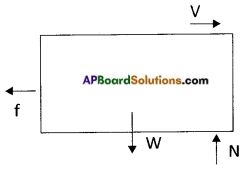
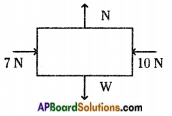
What are the forces acting on a moving body on a floor?
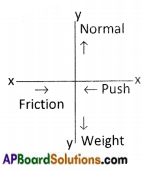
Along vertical direction: Weight of the body (W) or gravitational force acting vertically down.
AP Board 8th Class Physical Science Important Questions Chapter 2 Friction 1
Normal force (N) or reaction force applied by the floor vertically up.
As there is no change in the motion of the body f along vertical direction the net force along vertical direction is 0.
That is W – N = 0 ⇒ W = N
Along horizontal direction : In horizontal direction the speed of the body changing gradually due to force, applied by the floor on the body. The force applied by the floor on the body is called frictional force.

AP Board 8th Class Physical Science Important Questions Chapter 2 Friction

Question 2.
What kinds of friction do you know and explain with suitable example.
Friction is of four kinds. They are:

  1. Static friction: Friction which comes into play when surfaces of the objects are at rest relative to each other.
    Ex: 1) We are applying force on a big rock but unable to move the rock due to its static friction.
    2) Block at rest relative to the surface of trolley upto a certain limiting acceleration.
  2. Sliding friction : The friction which comes into play when the surface of one object moves relative to the surface of another object.
    Ex: When the applied force is more than limit of static friction, then the object starts to move which is example for sliding friction.
  3. Rolling friction : When one body rolls over the surface of another body, the friction offered is called rolling friction.
    Ex: It is easy to pull a suitcase which has rollers.
  4. Fluid friction : Friction exerted by fluids like liquids and gases is called fluid friction. Ex : The shape of birds are such that they overcome the fluid friction.

Question 3.
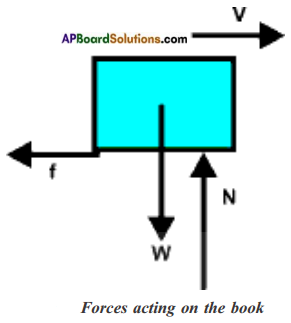
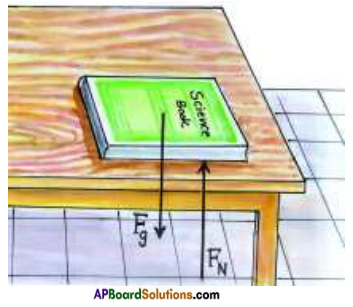
A book placed on the surface of a table. The book is pushed in one direction. Draw the forces acting on the book and explain.
Answer:
The weight acts downwards and normal force acts upward direction they balance each other.
AP Board 8th Class Physical Science Important Questions Chapter 2 Friction 2
Whereas frictional force acting opposite to the applied force.

Question 4.
Explain with one example that Frictional force is proportional to the Normal force.
Answer:
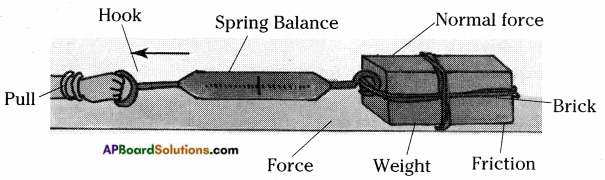
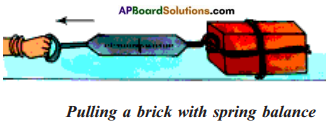
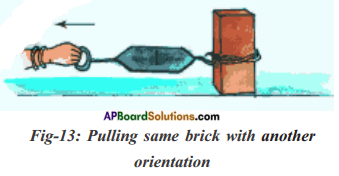
Keep a brick on the horizontal floor tied to the spring balance. Pull the spring balance and note the frictional force.
Do the same experiment by adding one more brick above the first one.
Tie a brick to the spring balance and pull it to find the frictional force. The normal force acts on it provides a frictional force.
AP Board 8th Class Physical Science Important Questions Chapter 2 Friction 3
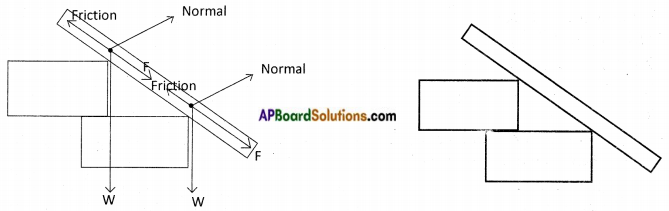
When we pull a brick over another brick the normal force acting on them increases so that the frictional force increases.
∴ Friction °c Normal force

AP Board 8th Class Physical Science Important Questions Chapter 2 Friction

Question 5.
Scientists designed the shape of aeroplane using the technique of reducing fluid friction by observing birds shape. How would you appreciate?
Answer:

  1. Objects move through fluids, they have to overcome friction acting on them.
  2. Birds and fishes have to move about in fluids all the time.
  3. Their bodies must have evolved to shapes which would make them not to lose much energy in overcoming friction.
  4. So aeroplanes designed in a special shape to overcome friction without loosing much energy.
    Hence I appreciate the idea of scientists to overcome fluid friction by designing shape of aeroplane.

Question 6.
Conduct an experiment to findout the effect of roughness on frictional force.
Answer:
Effect of roughness on frictional force:

  1. Set up an inclined plane on the horizontal floor. Use a wooden board as inclined plane.
  2. Put a mark at any point A on the inclined plane. Now let a pencil cell or ball move down from this point.
  3. Note the distance covered by the pencil cell from the bottom of the inclined plane to point where it comes to stop.
  4. Now, spread a cloth over the floor make sure that there are no wrinkles in the cloth.
  5. Try again with pencil cell. Now note down the distance.
  6. Distance covered by pencil cell is less in this case.
  7. Thus we conclude that smoothness/ roughness of the surfaces of both the floor and the pencil cell could affect the distance travelled by it.

Question 7.
Collect information about the substances using to reduce the friction in different machines and prepare a report on it.
Answer:

  1. Adding lubricants to machinery parts.
  2. Using roller type ball bearings.
  3. Using air pressure to separate moving parts.
  4. Using magnetic repulsion to separate moving parts.
  5. Using materials that tend to slide easily over each other.
  6. Regulate the temperature of the machine.
  7. The use of drive shafts.

AP Board 8th Class Physical Science Important Questions Chapter 2 Friction

Question 8.
Write an experiment to identify forces acting on a body and effect of frictional force.
Answer:
Gently push a book or any object on a horizontal floor. It moves for a certain distance and stops due to the friction.
The friction acts in the opposite direction of the force exerted.
Now take the same object and do the activity on different surfaces smooth and rough.
The object moves a long distance on the smooth surface whereas it moves a little distance on the rough surface.
We come across that the friction is more on the rough surface and less on the smooth surface due to the reduction in the sliding friction.

Question 9.
Friction – an evil master and good servant to man. Describe.
Answer:
Friction is the obstruction force acting in the opposite direction of the exerted force. It brings the following bad or evil impacts on the bodies.

  1. Over heating and wearing out of moving parts in all machinery
  2. Loss of efforts

In this way it is a bad or evil master to man.
But, without friction the moving of vehicles on the roads, walking, running, sitting, standing, etc. of us are not possible.
We are able to write with pen or pencil on the papers or walls or any surface is only due to the influence of friction. .
In this way it is a good master.

Question 10.
Does the friction is affected by smoothness of surface? Explain.
Answer:

  1. Friction is caused by the irregularities on the two surfaces in contact.
  2. Even those surface which appear very smooth have a large number of minute irregularities on them.
  3.  Irregularities on the two surfaces lock into another.
  4. When we attempt to move any one surface over the other, we have to apply a force to overcome interlocking.
  5. On rough surfaces, there are a larger number of irregularities.
  6. So the force of friction is greater if a rough surface is involved.

AP Board 8th Class Physical Science Important Questions Chapter 2 Friction

Question 11.
What would happen if there were no force of friction? Imagine and describe in your own words.
Answer:

  1. If there were no friction, many problems could have been arisen, as one will not able to walk if they were no friction at all.
  2. One could not write with pen or pencil.
  3. One could not write on blackboard with a chalk.
  4. If any object just started moving, it would never stop.
  5. Had there been no friction between the tyres of the automobiles and the road, they could not be started or stopped or turned to change the direction of motion.
  6. One could not fix the nail in the wall or tie a knot.
  7. Without friction no buildings could be constructed.

8th Class Physical Science 2nd Lesson Friction Important Questions and Answers

Question 1.
“Friction produce heat” – suggest an activity to prove this.
Answer:

  1. Rub your palms against each other for a few minutes.
  2. You can feel heat in your palms.
  3. Hence we can say that friction produces heat.

Question 2.
Write any one precaution which was taken by you while doing the experiment to understand the nature of friction.
Answer:
Keep the weights to the hanger slowly and one by one.

Question 3.
Give any two examples of ways of reducing friction.
Answer:
We can reduce friction,

  1. by using lubricants in between frictional surfaces,
  2. by using ball bearings in the rotating parts.

Question 4.
If there is no frictional force, assume the consequences in your classroom. Write any four of them.
Answer:
If there is no friction force,

  1. We cannot hold a pen to write on a book.
  2. We cannot walk in the classroom.
  3. Teacher cannot write with chalk-piece on the blackboard.
  4. Heat does not produce when rub the palms against each other.

Question 2.
What is fluid friction? Explain why objects moving in fluids must have special shapes.
Answer:

  1. When bodies move through fluids, fluids exert a frictional force called drag or fluid friction.
  2. To minimise fluid friction, objects moving in fluids must have special shapes.
  3. For example, Birds and Fishes have to move about in fluids all the time, so they have special shapes which would make them not to lose much energy in over coming friction.
  4. Another example is the shape of aeroplane was made similar to bird in order to reduce fluid friction.

AP Board 8th Class Physical Science Important Questions Chapter 2 Friction

Question 3.
Imagine the friction has disappeared from the earth. What will happen? Explain.
Answer:

  1. If there were no friction, many problems could have been arisen, as one will not able to walk if they were no friction at all.
  2. One could not write with pen or pencil.
  3. One could not write on blackboard with a chalk.
  4. If any object just started moving, it would never stop.
  5. Had there been no friction between the tyres of the automobiles and the road, they could not be started or stopped or turned to change the direction of motion.
  6. One could not fix the nail in the wall or tie a knot.
  7. Without friction no buildings could be constructed.

Question 4.
Name any two types of frictions. Write one example for each.
(OR)
What kinds of friction do you know? Write the conditions needed for static friction between two objects and what way do you suggest to reduce friction?
Answer:
Friction is of four kinds. They are

  1. Static friction: Friction which comes into play when surfaces of the objects are at rest relative to each other.
    Ex : 1) We are applying force on a big rock but unable to move the rock due to its static friction.
    2) Block at rest relative to the surface of trolley upto a certain limiting acceleration.
  2. Sliding friction: The friction which comes into play when the surface of one object moves relative to the surface of another object.
    Ex : When the applied force is more than limit of static friction, then the object starts to move which is example for sliding friction.
  3. Rolling friction: When one body rolls over the surface of another body, the friction offered is called rolling friction.
    Ex : It is easy to pull a suitcase which has rollers.
  4. Fluid friction: Friction exerted by fluids like liquids and gases is called fluid friction. Ex : The shape of birds are such that they over come the fluid friction.

Static friction is a self adjusting force. The following conditions are needed for static friction ;

  1. Roughness of the surface of contact and
  2. Normal force.
  3. We can reduce the friction by applying oil or grease between the moving parts of a machine.
  4. If we polish the rough surfaces, they become smooth and friction is reduced.
  5. We can apply soap solution to the rough surfaces.
  6. We can apply powder of small quantity on the surface.
  7. By streamlining the bodies of the vehicles we can reduce air friction.

AP Board 8th Class Physical Science Important Questions Chapter 2 Friction

Question 5.
Friction does not depends upon area of contact. How can you perform an activity to prove it?
Answer:
Tie a string around a brick and pull the brick by using spring balance and measure the applied force or friction.
AP Board 8th Class Physical Science Important Questions Chapter 2 Friction 4
Now turn the brick upright so that the contact area with the floor becomes small. Do the same experiment and measure the friction using the reading of the spring balance.
AP Board 8th Class Physical Science Important Questions Chapter 2 Friction 5
The conclusion is frictional force appears the same in both the cases irrespective of area of contact.

AP Board 8th Class Physical Science Important Questions Chapter 1 Force

AP State Syllabus AP Board 8th Class Physical Science Important Questions Chapter 1 Force

AP State Syllabus 8th Class Physical Science Important Questions 1st Lesson Force

8th Class Physical Science 1st Lesson Force 1 Mark Important Questions and Answers

Question 1.
What is force ? What is its S.I. unit?
Answer:
The push or pull of an object is called force. Its S.I. unit is Newton.

Question 2.
What is a contacting force?
Answer:
The force results when there is a direct physical contact between two interacting objects is called contacting force.

AP Board 8th Class Physical Science Important Questions Chapter 1 Force

Question 3.
Define a force at a distance or field force.
Answer:
The force which occurs without any physical contact between two objects is known as force at a distance or field force.

Question 4.
What is muscular force?
Answer:
The force which we exert by using our body muscles is known as muscular force.

Question 5.
What is friction?
Answer:
The resistance to the movement of a body over the surface of another body is called friction.

Question 6.
Define normal force.
Answer:
The force that a solid surface exerts on any object in the normal direction is called normal force.

Question 7.
What is a magnetic force?
Answer:
The force exerted by a magnet on another magnet.

Question 8.
What is a gravitational force?
Answer:
The attractive forces between any two massive objects is called gravitational force.

AP Board 8th Class Physical Science Important Questions Chapter 1 Force

Question 9.
What is electrostatic force?
Answer:
The force exerted by a charged body on other charged or uncharged body is called electrostatic force.

Question 10.
What is magnetic field?
Answer:
The space around the magnet where its influence can be detected is called magnetic field.

Question 11.
What is a net force?
Answer:
The algebraic sum of the forces acting on a body is known as net force.

Question 12.
What is free body diagram?
Answer:
The diagram showing all the forces acting on an object at a particular instant is called free body diagram.

Question 13.
A blacksmith hammers a hot piece of iron while making a tool. How does the force due to hammering affect the piece of iron?
Answer:
It changes the shape of iron.

Question 14.
A rocket has been fired upwards to launch a satellite in its orbit. Name the two forces acting on the rocket immediately after leaving the launching pad?
Answer:

  1. The weight of the rocket downwards.
  2. The upward force due to firing of rocket.

Question 15.
Why do not you experience gravitational force exists between you and your teacher because gravitational force depends on masses of object
Answer:
The reason is everything on earth experienced by a large gravitational force of earth so remaining gravitational forces are negligible.

AP Board 8th Class Physical Science Important Questions Chapter 1 Force

Question 16.
What is tension?
Answer:
When we stretch a rope or a string the tightness of rope or string is called tension. Tension is a contact force.

8th Class Physical Science 1st Lesson Force 2 Marks Important Questions and Answers

Question 1.
Explain Gravitational Force by giving a suitable example.
Answer:
Gravitational Force: The force of attraction that exists between any two bodies (or masses) everywhere in the universe.
Examples:

  1. The stone thrown up into the sky fall back on to the earth due to gravitational force.
  2. Earth holding atmosphere due to gravitational force.
  3. All the objects are pulling towards earth due to gravitational force.
  4. Rivers flow down to the sea because of gravitational force.

Question 2.
The surface area of an object is 20 m2 and a force of 10 N is applied on it, then what is the pressure?
Answer:
Force (F) = 10 N; Area (A) = 20 m × 2m = 40m2;
Pressure = [latex]\frac{F}{A}[/latex] = [latex]\frac{10}{40}[/latex] = 0.25 Pascal

Question 3.
Observe the situations of electrostatic forces in your daily life and prepare a report.
Answer:

  1. If you comb your dry hair and bring small pieces of paper then these paper pieces are attracted by comb because it is charged.
  2. If a glass rod is rubbed with a silk cloth then if we bring small pieces of paper near glass rod or silk cloth then these paper pieces are attracted by glass rod or silk cloth due to elctrostatic force.

AP Board 8th Class Physical Science Important Questions Chapter 1 Force

Question 4.
Find the net force acting on a body shown in the figure. And draw the direction of net force. (Length of the arrow shows the magnitude of the force and direction also.)
Answer:
AP Board 8th Class Physical Science Important Questions Chapter 1 Force 1

Question 5.
Give two daily life examples each of situations in which you push or pull to change the state of motion of object.
Answer:
Push:

  1. Hitting a foot ball with your leg.
  2. Moving a loaded cart.

Pull:

  1. Opening a door
  2. Moving a table towards you.

Question 6.
Give two examples of situations in which applied force causes a change in the shape of an object.
Answer:

  1. Pressing a sponge.
  2. Stretching of rubber band.

Question 7.
Name the forces acting on a plastic bucket containing water held above ground level in your hand. Why do the forces acting on the bucket do not bring a change in its state of motion?
Answer:
The gravitational force acts as plastic bucket containing water held above ground level in your hand. Gravitational force does not bring change in state of bucket be¬cause equal amount of force is applied vertically upward.

Question 8.
Name the two forces acting on a rocket immediately after leaving the launching pad.
Answer:
The two forces acting on rocket are:

  1. Force due to gravity vertically downward.
  2. Frictional force of atmosphere.

Question 9.
What changes can be observed when we apply force on an object?
Answer:
a) Change in the shape of the object.
b) Change in direction of motion of an object.
c) Change in speed of an object if the object is moving.
d) Movement of an object from rest.

AP Board 8th Class Physical Science Important Questions Chapter 1 Force

Question 10.
Have you ever seen a game of tug of war ? In this game two teams pull a rope in opposite direction. But sometimes the rope does not move explain why.
Answer:
a) When two forces acts on an object in opposite direction then the net force is difference of two forces.
b) If two teams pull the rope with equal force, the forces will be in opposite direction and will cancel with each other and the rope will not move.

Question 11.
How does an applied force change the speed of an object ?
Answer:

  1. When force is applied in the direction of motion of object then the speed of object increases.
  2. If the force is applied in the direction opposition to the motion of object then the speed decreases.

Question 12.
Give three examples of force exerted by muscles in our body.
Answer:

  1. Blood circulation in our body.
  2. Inhalation and exhalation of air by lungs.
  3. Running by muscles of legs.

Question 13.
Why does the pointed end of the nail gets into wooden plank easily ?
Answer:
The area of pointed end of nail is much smaller than that of its head. The same force produces a sufficient pressure to push the printed end of the nail into the wooden plank.

Question 14.
Why do porters place a round piece of cloth on their heads?
Answer:
Porter place a round piece of cloth on their heads to increase the area of contact of the load with the head. So the pressure on their head is reduced and they can carry heavy load easily. .

Question 15.
On what factors does the effect of force depend?
Answer:
The effect of force depends on two things

  1. The amount of force applied the more the force applied the greater the effect will be.
  2. The area on which the force is applied. The smaller the area, the force is applied on the greater the effect will be.

AP Board 8th Class Physical Science Important Questions Chapter 1 Force

Question 16.
How many types of forces are there and what are they? Give examples for each.
Answer:
Forces are two types:

  1. Contact force e.g.: Muscular force, frictional force.
  2. Force at a distance e.g.: Gravitational force, magnetic force.

Question 17.
What is pressure ? What is its unit?
Answer:
The force acting perpendicularly on a unit area of surface is called pressure.
Pressure = Force/Area
Its unit in S.I. system is Newton / metre or N/m .

Question 18.
What is the influence of Sir Isaac Newton on students?
Answer:

  1. Everything we are discussing about motion and his contribution to mechanics and light one of the all time greatest scientist.
  2. His experiments and laws, hypothesis influence the students to take up research and inspire them to become a future scientists of our nation.

8th Class Physical Science 1st Lesson Force 4 Marks Important Questions and Answers

Question 1.
Design and conduct experiment to test few ways how friction may be reduced.
Answer:
Friction is due to the roughness of surfaces. It can be reduced by the following methods.

  1. By polishing the rough surface.
  2. By applying lubricants like oil and grease to the surfaces.
  3. By spreading powder on the rough surface like carromboard.
  4. By using soap and detergent solutions, etc.

Experiment: The rusted pulley makes a rattling noise. Apply some oil in between the wheel and axle. The sound is reduced and now it works smoothly.

AP Board 8th Class Physical Science Important Questions Chapter 1 Force

Question 2.
Collect pictures to illustrate contact forces, forces at a distance and prepare a report.
Answer:
I. Contact forces :
1) Muscular force:
AP Board 8th Class Physical Science Important Questions Chapter 1 Force 2
2) Frictional force:
AP Board 8th Class Physical Science Important Questions Chapter 1 Force 3
3) Normal force:
AP Board 8th Class Physical Science Important Questions Chapter 1 Force 4
4) Tension:
AP Board 8th Class Physical Science Important Questions Chapter 1 Force 5

II. Forces at distance (Field Forces)
1) Magnetic force:
AP Board 8th Class Physical Science Important Questions Chapter 1 Force 6
2) Electrostatic force:
AP Board 8th Class Physical Science Important Questions Chapter 1 Force 7
3) Gravitational force:
AP Board 8th Class Physical Science Important Questions Chapter 1 Force 8
Report: Forces are two types based on contact or non-contact between objects.

AP Board 8th Class Physical Science Important Questions Chapter 1 Force

I. Contact Forces : Force which results when there is a direct physical contact between two interacting objects is known as contact force. Contact forces are four types. They are :

  1. Muscular Force: The force which we exert by using our body muscles is known as muscular force.
  2. Frictional Force: Friction is the resistance to the movement of a body over the surface of another body.
  3. Normal Force: The force that a solid surface exerts on any object in the normal direction is called normal force.
  4. Tension: The lightness of slope or string when we try to stretch a rope or string is called tension.

II. Forces at distance (Field forces): The force which occurs without any physical con¬tact between two objects is known as a force at distance or field force.
Forces at distance are three types. They are:

  1. Magnetic Force : The force existing between two magnetic poles of two different magnets is called magnetic force. The force is also exists between magnet and magnetic material.
  2. Electrostatic Force : The force exerted by a charged body on another charged body is known as electrostatic force.
  3. Gravitational Force : The force of attraction exists between any two bodies (or masses) everywhere in the universe is known as gravitational force.

Question 3.
When you push a heavy object, it doesn’t move. Explain the reason in terms of net force.
Answer:
There are four forces acting on the heavy table. They are normal force (upwards), gravitational force (downwards), push and friction (opposite to push).
AP Board 8th Class Physical Science Important Questions Chapter 1 Force 9
Let’s take
Normal force = N (- ve); Gravitational Force = W (downwards); Push = F1
Friction = F2 (- ve) [more]
∴ Net force in X – direction = Push – Friction = F1 – F2 = – ve
Net force in Y – direction = N – W = – ve
As the net force in Y – axis is more you are unable to move the heavy object.

Question 4.
Some forces are acting without any contact of surfaces. Explain.
Answer:
Some forces like magnetic force, electrostatic force and gravitational force act on other bodies without any contact of surfaces. This property is called the field force.
As far as magnetic force concern, the magnets are surrounded by the magnetic lines of force which provide the magnets attractive and repelling forces. The same poles repel and the different poles attract.
The electrostatic forces are exerted by a charged body on another charged or uncharged body. The charged body induces an opposite charge on the uncharged body and it gets attracted by the body. Here, the two bodies are at distance before the electrostatic forces are exerted.
The earth attracts everybody even though they are at some distance. This force is called gravitational force or weight of the body. It varies at different places.

AP Board 8th Class Physical Science Important Questions Chapter 1 Force

Question 5.
In the following situations identify the agent exerting the force and the object on which its acts. State the effect of force in each case.
a) A batsman hitting a cricket ball
b) Pressing a lump of dough
c) Taking out paste from a tooth paste
d) A horse pulling a cart
Answer:

Agent exerting force Object on which it acts Form of effect
Muscles Cricket ball Change in speed and direction
Fingers Dough Change in shape
Fingers Tooth paste Change in shape
Horse Cart Change in speed

8th Class Physical Science 1st Lesson Force Important Questions and Answers

Question 1.
A fruit is falling from a tree. Which force acts on the fruit?
Answer:
Gravitational force acts on the fruit, which is from a tree.

Question 2.
Find the net force from the following diagrams.
AP Board 8th Class Physical Science Important Questions Chapter 1 Force 10
Answer:
a) Net force = + 12N + 10N – 8N = + 22N – 8N = 14 N
b) Net force = +9N – 8N = 1N

Question 3.
If you bring a rubbed balloon near the pieces of paper, what do you observe ?
Answer:
Rubber balloon attracts pieces of paper. It is electrostatic force.

Question 4.
From the above diagram, calculate the net force acting on a body.
AP Board 8th Class Physical Science Important Questions Chapter 1 Force 11
Answer:
Net force in vertical direction = 5N – 5N = 0
Net force in horizontal direction = 10N – 8N = 2N

AP Board 8th Class Physical Science Important Questions Chapter 1 Force

Question 5.
Find the net forces from the following free body diagram (FED).
AP Board 8th Class Physical Science Important Questions Chapter 1 Force 12
Answer:
i) Net force in the vertical direction = + 6N – 6N = 0N
ii) Net force in the horizontal direction = + 20N – 3N = 17N.

Question 6.
What will happen if gravitational force disappears from the Earth? Explain.
Answer:
If gravitational force disappears from the earth,
i) No atmospheric gases are found around the earth.
ii) Objects does not fall down on the earth.
iii) Human beings, animals can fly easily in the sky.
iv) We cannot find the weight of the objects.

Question 7.
Define contact force and force at a distance, give two examples for each type of force.
Answer:
Contact force: The force results when there is a direct physical contact between two interacting objects is called contacting force.
Example: Muscular force, Frictional force, Normal force, Tension.
Field force or Force at a distance : The force which occurs without any physical contact between two objects is known as force at a distance or field force.
Example : Magnetic force, Electrostatic force, Gravitational force.

AP Board 8th Class Physical Science Important Questions Chapter 1 Force

Question 8.
Using adjacent diagram, draw a free body diagram (FBD) to show the forces acting on the box.
AP Board 8th Class Physical Science Important Questions Chapter 1 Force 13
Answer:
AP Board 8th Class Physical Science Important Questions Chapter 1 Force 14

AP Board 8th Class Physical Science Solutions Chapter 11 Some Natural Phenomena

AP State Syllabus AP Board 8th Class Physical Science Solutions Chapter 11 Some Natural Phenomena Textbook Questions and Answers.

AP State Syllabus 8th Class Physical Science Solutions 11th Lesson Some Natural Phenomena

8th Class Physical Science 11th Lesson Some Natural Phenomena Textbook Questions and Answers

Improve Your Learning

Question 1.
Which of the following cannot be charged easily by friction?
A) A Plastic scale
B) A copper rod
C) An inflated balloon
D) A Woollen cloth
E) Piece of wood
Answer:
(B) A copper rod

AP Board 8th Class Physical Science Solutions Chapter 11 Some Natural Phenomena

Question 2.
When a glass rod is rubbed with a piece of silk cloth the rod
A) and the cloth both acquire positive charge.
B) becomes positively charged while cloth has a negative charge.
C) and the cloth both acquire negative charge.
D) becomes negatively charged while cloth has a positive charge.
Answer:
(B) becomes positively charged while cloth has a negative charge.

Question 3.
Identify ‘True’ or ‘False’ sentences among the following:
A) Like charges attract each other. (T/F)
B) A charged glass rod attract a charged plastic straw. (T/F)
C) Lightning conductor cannot protect a building from lightning. (T/F)
D) Earthquakes can be predicted in advance. (T/F)
Answer:
A) False
B) True
C) False
D) False

Question 4.
Sometimes, a crackling sound is heard while taking off sweater during winter. Explain.
Answer:
Charge is developed on the sweater because of friction. We can observe discharge of the charge while taking off the sweater which produce the crackling sound.

AP Board 8th Class Physical Science Solutions Chapter 11 Some Natural Phenomena

Question 5.
Explain why a charged body loses its charge if we touch it with our hand.
Answer:
The reason is that the charged object lose charge to the earth through our body that means it is transferred its charge to earth. The process of transferring of charge from a charged object to the earth is called earthing.

Question 6.
Name the scale on which the destructive energy of an earthquake is measured. An earthquake measures 3 on this scale. Would it be recorded by a seismograph? Is it likely to cause much damage?
Answer:
The destructive energy of earthquake is measured in richter scale. Yes, it would be recorded by seismograph when earthquake measures 3 on the richter scale. It does not cause any damage to human life, generally we unable to felt its effect.

Question 7.
Suggest three measures to protect ourselves from lightning.
Answer:
Precautions to be taken to protect ourselves from lightning.

  1. Staying in a house or building of low height.
  2. If we are travelling in a bus or car, then we are safe inside the car or bus provided doors and windows are closed.
  3. If we are in a forest taking shelter under shorter trees than taller trees is a good idea during the thunder storm.

Question 8.
Explain why a charged balloon is repelled by another charged balloon whereas an uncharged balloon is attracted by a charged balloon?
Answer:
A charged balloon is repelled by another charged balloon having same type of charge because both are having same kind of charges and like charges repel each other. Whereas an uncharged balloon attracted by a charged balloon because charged balloon induces opposite charge on uncharged balloon. We already know unlike charges attract each other. So the uncharged balloon is attracted by a charged balloon.

AP Board 8th Class Physical Science Solutions Chapter 11 Some Natural Phenomena

Question 9.
List three states in India where earthquakes are more likely to occur?
Answer:
The three states are

  1. Jammu & Kashmir State (Mainly Kashmir)
  2. Whole north east states like Tripura, Manipur, etc.
  3. Rajasthan.

Question 10.
Does your habitation lie in earthquake prone area? Explain.
Answer:
Yes, my habitation lie in earthquake prone area because 1 am living in delta region of Krishna which is placed in seismic zone III. So it has chances of possibility of earthquake. (If the answering person is not living in Chittoor, YSR Kadapa, Nellore districts and Krishna and Godavari delta region then the answer is No.)

Question 11.
Which place in Andhra Pradesh experiences earthquakes most of the time?
Answer:
Badrachalam and Kothagudem are the places where there is a possibility of earthquake most of the time. Chittoor, Kadapa, Nellore and Krishna and Godavari delta region also have greater possibility of earthquake because they lie in zone-111.

Question 12.
When does a piece of matter have a “charge?”
Answer:
When a piece of matter rubbed with another piece of matter, the piece of matter acquire charge due to friction.
E.g.: Rub the refill vigorously with a piece of polythene and if we bring piece of paper that can be attracted by refill due to development of charge.

Question 13.
What happens if two objects having same charge brought close to each other? What happens if two objects having different charges are brought close? Can you give an example for this.
Answer:
Two objects having same charge repel each other and two objects having different charge attract each other.
E.g. A balloon rubbed with woollen cloth repelled by another balloon rubbed with woollen cloth because both will acquire same type of charge.
A balloon rubbed with a woollen cloth attracted by a refill rubbed with a polythene sheet because both will acquire different type of charge.

AP Board 8th Class Physical Science Solutions Chapter 11 Some Natural Phenomena

Question 14.
Give two examples of effects in your daily life caused by transfer of charges.
Answer:
Two examples in daily life:

  1. Earthing
  2. Lightning

Question 15.
Inflate two balloons and rub both of them with a cloth first and then with different material. Will they attract each other in both cases?
Answer:
No, they will not attract each other. Both will repel each other. The reason is both ballons rubbed with same material acquired same charge in the both the cases.

Question 16.
Which country in the world is frequently affected by earthquakes? Collect the information and photographs on the recent earthquake in Japan.
Answer:
The country in the world which frequently affected by earthquakes is Japan. Pictures of earthquake affected areas in Japan in 2012.
Photographs of earthquake:
AP Board 8th Class Physical Science Solutions Chapter 11 Some Natural Phenomena 1
Information about earthquake:

  1. Lot of people killed due to earthquake.
  2. Lot of people killed not only due to earthquake but tsunami caused by earthquake.
  3. Lot of property loss took place.
  4. Most of the people in Japan lost their jobs and livinghood.
  5. They suffered emotionally also by losing their relatives, parents and children.
  6. Lot of effect felt on their economy.
  7. It effected the tourism of Japan.

AP Board 8th Class Physical Science Solutions Chapter 11 Some Natural Phenomena

Question 17.
Find out if there is an organization in your area which provides relief to those suffering from natural disaster. Enquire about the type of help they render to the victims of earthquake. Prepare a brief report on the problems of the earthquake victims.
Answer:
In India National Disaster Force provides relief for disaster victims.
Problems of earthquake victims:

  1. Death: Many times, the people who support a family socially and economically dies. This causes most of the other members of the family to either fight their way through, or restart their lives from the bottom of the food chain.
  2. Destroyed Structures: If the members of the family survive, then they could still be short of a home. The earthquake would have caused the destruction of their house and because of that, they would be left homeless.
  3. No food or water: In the aftermath of an earthquake, people see whether all the pipelines, roads, etc. are in good shape or order. If the pipes are broken, then water scarcity begins. If the roads are broken, then food supplies cannot be transported, later causing problems in food scarcity.
  4. Electricity : With inadequate supply of electricity, the debris and rubble will take a lot of time and if people are under it then they may die before the rubble is removed.
  5. Illnesses: After the destruction of many buildings, the sewer pipes will also break and open, causing spread of disease everywhere.

Help render by relief organisation:

  1. They minimize the death of people.
  2. They provide drinking water and food for victims.
  3. They provide shelter for earthquake victims.
  4. They provide medical facility for earthquake victims.

Question 18.
How do you relate the energy release during the collision of fault lines during earthquake to the atmospheric variation on the surface of the earth?
Answer:
An earthquake effects the atmosphere by creating amounts of debris and dust which will add to the air that we breathe. Earthquakes can also trigger volcanoes which will release tonnes of ashes and other debris into the atmosphere. This can sometime cause the blocking out of the sun, air pollution and are increased amount of carbon in the air.

Question 19.
Describe with the help of a diagram an instrument which can be used to detect a charged body.
Answer:
The instrument used to detect a charged body is electroscope.
Description of Electroscope:
Take an empty jam bottle. Take a piece of cardboard slightly bigger in size than the mouth of the bottle. Pierce a hole in it, so that a metal paper clip could be inserted. Open out paper clip as shown in the figure. Cut two strips of aluminium foil about 4 x 1 cm each and hang them on the paper clip.
AP Board 8th Class Physical Science Solutions Chapter 11 Some Natural Phenomena 2
Insert the paper clip having the strips of aluminium foil into the cardboard lid so that it is perpendicular to it. This entire device works as a electroscope.
Procedure to detect a charged body ,by using a electroscope:
Charge a refill and make it touch the end of the paper clip. The aluminium foils move away from each other the reason that the strips of aluminium foil receive the same charge from the charged body through the paper clip and strips carrying similar charges repel each other and hence they move apart. This proves electroscope is useful in detecting a charged body.

AP Board 8th Class Physical Science Solutions Chapter 11 Some Natural Phenomena

Question 20.
Colour seismic zones in India out line map.
Answer:
AP Board 8th Class Physical Science Solutions Chapter 11 Some Natural Phenomena 3

Question 21.
Prepare a model of seismograph.
Answer:
Preparation of model:
AP Board 8th Class Physical Science Solutions Chapter 11 Some Natural Phenomena 4
Take a pendulum and which is attached to support. This acts as vibrating system. A pen is attached to this vibrating system. Place a rotating drum covered with a paper just below the pen. When earthquake occurs the pen records the seismic waves on a paper which move under it.

Question 22.
How do you appreciate the efforts of scientists to develop an instrument to assess the intensity and source of earthquake?
Answer:
The efforts of scientists to develop an instrument to assess the intensity and source of earthquake is thoroughly appreciated because they provide assessment of earthquake and what are the rescue measurements to be taken by government and private organizations and also provide preventive measurements that would be taken when earthquake occurs. So these scientists providing life for people and their services are thoroughly appreciated.

Question 23.
Suppose you are outside your home and an earthquake occurs. What precautions would you take to protect yourself?
Answer:

  1. I find a clear spot, away from buildings, trees and over head powerlines and I drop to the ground.
  2. If I am in a car or bus, I do not come out and I ask the driver to drive slowly to a clear spot. I do not come out of the car or bus till the tremors stop.

AP Board 8th Class Physical Science Solutions Chapter 11 Some Natural Phenomena

Question 24.
The weather department has predicted that a thunder storm is likely to occur at on a certain day. Suppose you have to go out on that day. Would you carry an umbrella? Explain.
Answer:
No, I would not carry umbrella during thunderstorm because the metallic rod attached to the umbrella attracts the charge developed in thunderstorm and charge may carry through umbrella and possibility of electric shock. So it is not a good idea to carry umbrella during lightning.

Question 25.
If earthquake occurs in your area what will you do?
Answer:

  1. I will protect myself by covering head with helmet or cushion and hide in a safe place, such as under table.
  2. I will not run outside because roof tiles and glass may fall on me.
  3. Major after shocks can come after smallest earthquake so I calmly extinguish any nearby flames.
  4. Earthquake can wrap buildings, especially apartment buildings making it impossible to open doors and escape. So I open doors and windows to secure an escape route.
  5. I will be careful with broken glass.
  6. Once I come outside I will not return to house.
  7. I will avoid phone calls.

Question 26.
What are the measures you would take in your house when an earthquake occurs?
Answer:

  1. I would take shelter under a table and stay there till the shaking stops.
  2. I would stay away from tall and heavy objects that may fall on me.
  3. If I would be in the bed then I would not get up and I protect my head with a pillow.

8th Class Physical Science 11th Lesson Some Natural Phenomena Activities

Activity – 1

Question 1.
Effect of rubbing:
AP Board 8th Class Physical Science Solutions Chapter 11 Some Natural Phenomena 5
Take a used ball-pen refill and bring it near small pieces of paper.
The refill should be close enough but not touch the pieces of paper.
a) Check what happens to the paper pieces?
Answer:
They remain in the same position.
Now, rub the refill vigorously with a piece of polythene. Bring it close to small pieces of paper.

b) What is your observation. Take care that the rubbed end is not touched by your hand or with a metallic object.
Answer:
My observation is paper piece is attracted towards refill.
Now, take a comb and move it through dry hair a few times. Take the comb near small pieces of paper and check what happen.
The papers are attracted by comb.
Take an inflated balloon and rub it against your clothes. Bring the balloon close to small pieces of paper.
The paper pieces are attracted by balloon.
Take a drinking straw and rub it against a smooth wall or against your cloths, then bring it near pieces of paper.

AP Board 8th Class Physical Science Solutions Chapter 11 Some Natural Phenomena

c) What do you observe?
Answer:
The papers are not attracted by drinking straw.

d) Are they able to attract bits of paper after being rubbed?
Answer:
No, they are not attract bits of paper.
Repeat the activity by rubbing each one of the above mentioned objects (refill, comb, drinking straw, balloon) and use small pieces of dry leaf, husk, etc. as testing materials. Record your observation in table.

e) What can we infer from the above activity?
Answer:
When you rub material some material tend to attract pieces of paper.

f) Do objects like refill or comb attract pieces or paper only after rubbing?
Answer:
Yes, they attract pieces of paper only after rubbing.

g) Do all objects show this property?
Answer:
No, all the objects does not show this property.

h) Can we rub a comb against our palm and make it attract the paper bits?
Answer:
Yes, the paper bits are attracted to the palm due to friction charge is developed on the hand.
AP Board 8th Class Physical Science Solutions Chapter 11 Some Natural Phenomena 6

AP Board 8th Class Physical Science Solutions Chapter 11 Some Natural Phenomena

Lab Activity

Conduct an experiment of find the effects of charged bodies which have been rubbed by different materials.
Aim: To find effects of charged bodies which have been rubbed by different materials.
Materials required: A ball pen refill, a balloon, a comb, an eraser, a steel spoon, polythene sheet, plain paper, woollen cloth, etc.
Procedure:
Rub the above objects against materials listed in table. In each case, bring the rubbed object near small pieces of paper and note whether they attract pieces of paper or not. Record your observations in table by writing ‘yes’ or ‘no’.
AP Board 8th Class Physical Science Solutions Chapter 11 Some Natural Phenomena 11
a) What do you conclude from above table?
Answer:
Some objects like refill, comb when rubbed with specific materials able to attract light objects like bits of paper. But some objects like steel spoon do not attract pieces of paper even after rubbing.

b) Why don’t some materials attract pieces of paper even after rubbing ?
Answer:
The reason is some material acquire charge when we rub them and some may not acquire charge so they do not attract pieces of paper.

Activity – 2

Question 2.
Understanding types of charges:
Inflate two balloons and hang them in such a way that they do not touch each other. Rub both the balloons with woollen cloth and release them.
AP Board 8th Class Physical Science Solutions Chapter 11 Some Natural Phenomena 7
a) What do you observe?
Answer:
They repel each other. Take a refill and rub it with a polythene sheet. Keep it gently in a plastic tumbler. Take another refill and also rub it with the same polythene sheet.
Bring the second refill near the first one in the tumbler. Take care that you do not touch either of the rubbed portions on the refill with your hand.

b) Is there any effect on the first refill in the tumbler? Do they attract each other or repel each other?
Answer:
Yes, there is effect on the refill in the tumbler. They repel each other.

AP Board 8th Class Physical Science Solutions Chapter 11 Some Natural Phenomena

c) Now take a rubbed balloon near the rubbed refill in the tumbler and check the action. Do they attract each other or repel each other.
Answer:
They attract each other.
In the first two parts of the above activity, two objects that were made of the same material have brought near to each other after being rubbed with some appropriate material.
AP Board 8th Class Physical Science Solutions Chapter 11 Some Natural Phenomena 8
In the third part, objects made of different materials were brought near to each other after being rubbed with some material.
Let us summarise our observations carefully.

  1. A balloon rubbed with woollen cloth repelled another balloon of the same type.
  2. A refill rubbed with polythene repelled another refill rubbed with similar material.
  3. A ballon rubbed with woollen cloth attracted by a refill rubbed with polythene sheet.

d) What can we conclude from these observations?
Answer:
Some charged objects are attracted and some charged objects are repelled with each other.

e) Does the repulsion between charged balloons indicate that they possess similar charge?
Answer:
Yes, they possess similar charge.

f) Does the attraction between charged balloon and a charged refill indicate that they possess different charges?
Answer:
Yes, they possess different charges.

g) Does this activity remind you some of experiments that you have done in “Playing with Magnets” Chapter of class VI?
Answer:
Yes, we know that magnets attract objects made up of magnetic materials like iron, nickel, cobalt, etc.
We also know that unlike poles magnet attract each other and like poles repel each other.

h) Can we say that something similar is happening in above activities?
Answer:
Yes.

i) Does it indicate that the charge on the balloon is of a different kind from the charge on the refill?
Answer:
Yes, it indicate they are different charges.

j) Can we say that there exist two kinds of charges?
Answer:
Yes, there exists two kinds of charges.

k) Can we also say that the charges of same kind repel each other, while charges of different kinds attract each other?
Answer:
Yes, it is convention to call the charge acquired by a glass rod when it is rubbed with silk cloth positive and charge acquired by a silk cloth is negative.
It is observed that when a charged glass rod is brought near a charged plastic straw which is rubbed with polythene sheet, there is attraction between the two.

AP Board 8th Class Physical Science Solutions Chapter 11 Some Natural Phenomena

l) What do you think about the kind of charge on the plastic straw?
Answer:
The plastic straw would carry negative charge.

m) Is your guess correct or wrong? Discuss with your teacher.
Answer:
My guess is correct because opposite charges attract each other which I confirmed by discussing with my teacher.

Activity – 3

Question 3.
Conduct an experiment to find out the presence of charge on a body.
Make a small ball of thermocol. Collect thin silver foil used to decorate sweets.
Wrap this thin silver foil to cover the thermocol ball and suspend it from a stand with the help of thread as shown in figure.
AP Board 8th Class Physical Science Solutions Chapter 11 Some Natural Phenomena 9
Bring a glass rod which is rubbed with a silk cloth near the suspended ball.
a) What happens ? Does it get attracted towards the glass rod or move away from it?
Answer:
It will attracts towards glass rod.
Now touch the silver foil on the thermocol ball with charged glass rod. Remove the glass rod from the ball and against rub it with silk cloth and bring it close to the suspended ball.

b) What do you observe?
Answer:
The suspended ball moves away from the glass rod.

c) What could be the reason for this change in movement of the ball?
Answer:
In the above activity when a charged body brought near an uncharged body it induces an opposite charge in it and hence it get attracted by the glass rod.
In the second case we have charged the thermocol by touching it with a charged glass rod. Hence when we brought the glass rod near the ball, as both of them have similar charge the ball gets repelled by the glass rod.
From the above activity we can conclude that attraction is not a sure test to know the presence of charge on a body.

Activity – 4

Question 4.
Describe with the help of a diagram an instrument which can be used to detect a charged body.
Take an empty jam bottle. Take a piece of cardboard slightly bigger in size than the mouth of the bottle.
Pierce a hole in it so that a metal paper clip could be inserted.
AP Board 8th Class Physical Science Solutions Chapter 11 Some Natural Phenomena 2
Open out paper clip as shown in the figure.
Cut two strips of aluminium foil about 4 cm x 1 cm each and hang them on the paper clip.
Insert the paper clip having the strips of aluminium foil in to the cardboard lid so that it is perpendicular to it as shown in the figure.
Change a refill and make it touch the end of the paper clip. Observe what happens.
a) Is there any effect on the strips of aluminium foil?
Answer:
Yes.

AP Board 8th Class Physical Science Solutions Chapter 11 Some Natural Phenomena

b) Do they repel each other or attract each other?
Answer:
They repel each other.

c) Now bring other charged bodies and make them touch the end of the paper. Do the foil strips behave in the same way in all cases?
Answer:
Yes, it behave in the same way in all cases.

d) Can this apparatus be used to detect the presence of charge on a body or not?
Answer:
Yes, it is used to detect the presence of charge on a body.

e) Can you explain why the strips repel each other?
Answer:
The strips of aluminium foil receive the same charge from the charged refill through the paper clip. The strips carrying similar charges repel each other and hence they move apart.
This device can be used to test whether an object is carrying charge or not. This device is known as electroscope. In the above activity you can observe that electric charge can be transferred from a charged object to another through a metal conductor.
Touch the end of the paper clip gently with hand and you will find a change in the foil strips they move closer and come back to their original state.

f) Why does it happen?
Answer:
The reason is that the foil strip lose charge to the earth through your body. We say that the foil strips are discharged.
The process of transferring of charge from a charged object to the earth is called earthing.

Activity – 5

Question 5.
Collecting information about the damages caused by earthquakes:
Ask your parents about the huge damages to life and property caused by these earthquakes. Collect a few pictures showing the damage caused by these earthquakes from newspapers and magazines of those days.
Prepare a short report on the suffering of the people during the earthquakes.
Answer:
Report: It caused damage to human life and property on a hugescale. Due to tsunami thousands of people died in the coastal areas of Andhra Pradesh and Tamilnadu. People lost their shelter.
a) What is an earthquake?
Answer:
An earthquake is a sudden shaking or trembling of earth lasting for a very short period of time. It is caused by a disturbance deep inside the earth’s crust.

AP Board 8th Class Physical Science Solutions Chapter 11 Some Natural Phenomena

b) What happens when it occurs?
Answer:
When it occurs it can cause damage to human life and property on a huge scale.

c) What can we do to minimize its (earthquake) effects?
Answer:
People living in seismic zones, where the earthquakes are more likely to occur, have to be specially prepared. The buildings in these zones should be designed so that they can with stand major tremors.
Steps to be taken in building construction:

  1. In highly seismic areas, the use of mud or timber is better than heavy construction material.
  2. Keep roofs as hieght as possible. In case the structure falls, the damage will not be heavy.
  3. It is better if the cupboards and shelves are fixed to the walls so that they do not fall easily.
  4. Be careful where you hang wall clocks, photoframes, water heaters, etc. so that in the event of earthquake, they do not fall on the people.
  5. Since some buildings may catch fire due to an earthquake, it is necessary that all buildings, especially tall buildings have fire fighting equipment in working order.

Measures to be taken in a house when earthquake occurs.

  1. Take shelter under a table and stay there till shaking stops.
  2. Stay away from tall and heavy objects that may fall on you.
  3. If you are on bed, do not get up. Protect your head with a pillow.

Measures to be taken outdoors when earthquake occurs.

  1. Find a clear spot, away from buildings, trees and overhead power lines. Drop to the ground.
  2. If you are in a car or a bus, do not come out. Ask the driver to drive slowly to a clear spot. Do not come out till the tremors stop.

Activity – 6

Question 6.
Locating the tsunami affected areas in the map:
Take an outline map of the world. Locate the eastern coast and Andaman and Nicobar Islands in India. Mark other countries around the Indian Ocean which could have suffered damage.
Collect accounts of the devastation caused by the tsunami in India from your parents, or other elders in the family or in the neighbourhood.
Answer:
AP Board 8th Class Physical Science Solutions Chapter 11 Some Natural Phenomena 10
Devastation due to tsunami:

  1. Loss of lives, families and friends.
  2. Loss of properties.
  3. Loss of jobs and living.
  4. Emotional challenge.
  5. Loss of livestock.
  6. Dramatic or drastic changes to a whole community’s routine living.
  7. Negative impact on the affected regions, economy.
  8. Negative impact to the affected region’s tourism.

AP Board 8th Class Physical Science Solutions Chapter 11 Some Natural Phenomena

To the environment:

  1. Alternation to seaside terrain.
  2. Minor deforestation in the area effected by the tsunami.
  3. Wild life casualities.
  4. The sea will be temporarily littered with debris after the tsunami.

AP Board 8th Class Physical Science Important Questions Chapter 5 Metals and Non-Metals

AP State Syllabus AP Board 8th Class Physical Science Important Questions Chapter 5 Metals and Non-Metals

AP State Syllabus 8th Class Physical Science Important Questions 5th Lesson Metals and Non-Metals

8th Class Physical Science 5th Lesson Metals and Non-Metals 1 Mark Important Questions and Answers

Question 1.
What is meant by lustrous material?
Answer:
The material which show brightness on surface and reflect the light are called lustrous material.

Question 2.
What is malleability? Which materials have malleability?
Answer:
The property of material by which they can beaten into thin sheets is called malleability. Generally metals exhibit malleability property, e.g.: Iron, copper, etc.

AP Board 8th Class Physical Science Important Questions Chapter 5 Metals and Non-Metals

Question 3.
What is ductility? Which materials show ductility?
Answer:
The property of drawing materials to make fine wires is called ductility. Generally metals show ductility, e.g.: Gold, copper, etc.

Question 4.
Have you observed materials used to make school bell or bells in temple ?
Answer:
Generally they are made up of metals.

Question 5.
Why do wooden bells not used in temple?
Answer:
Wood does not give a ringing sound when it is hit with a hammer. That means it does not show sonorous property. So wooden bells are not used in temple.

Question 6.
What is meant by sonorous?
Answer:
The ability to material to produce a particular sound when it is dropped on the hard surface is called sonorous.

Question 7.
Is ductility is the only property to use them as connecting wires in electric circuits?
Answer:
No, it is one of the cause. The other thing is metals are very good conductors of electricity. So they easily allows the passage of current. So they are used as connecting wires.

AP Board 8th Class Physical Science Important Questions Chapter 5 Metals and Non-Metals

Question 8.
What does cooking appliances conduct?
Answer:
Cooking appliances conduct heat from heating device like gas stove or electric stove.

Question 9.
What is the nature of metallic and non-metallic oxides?
Answer:
Generally metallic oxides are basic in nature and non-metallic oxides are acidic in nature.

Question 10.
What happen when keep an iron rod in open place for one or two days?
Answer:
Rusting takes place on iron. The reason is iron react with air that contains oxygen and moisture forms a reddish brown coating (rust) due to formation of iron oxide.

Question 11.
Why do some metals do not get rust?
Answer:
Metal with very low reactivity do not react with air. So they do not get rust. They also called as noble metals, e.g.: Gold, platinum.

Question 12.
What happens when magnesium ribbon is exposed to air?
Answer:
It becomes dull when it is exposed to air due to formation of magnesium carbonate. That’s why magnesium ribbon should be cleaned with sand paper before any chemical reaction.

Question 13.
Why does silver objects and jewellery become black after sometime?
Answer:
Silver articles are black after sometime because they react with oxygen in air and form silver oxide.

Question 14.
Why statues and vessels made up of copper become dull green after certain time?
Answer:
The statues and vessels made up of copper became dull because they react with air and form copper hydroxide and copper carbonate which appears as dull green coating.

AP Board 8th Class Physical Science Important Questions Chapter 5 Metals and Non-Metals

Question 15.
What happens when non-metals are added to water?
Answer:
They do not react with water.

Question 16.
How do you test hydrogen gas?
Answer:
If we place a burning match stick near a test tube containing hydrogen gas it puts out the match stick with pop sound and the gas burns with blue flame.

Question 17.
What happens when acids are added to non-metals?
Answer:
Non-metals do not react with acids.

Question 18.
What is a displacement reaction?
Answer: A more reactive metal displace a less reactive metal from its compound in aqueous solution is called displacement reaction.

Question 19.
Which metal has highest ductility?
Answer:
Gold. One gram of gold can be drawn into a wire of length one kilometre.

Question 20.
Why sodium and potassium are stored in kerosene?
Answer:
Sodium and potassium are highly reactive. They react vigorously with oxygen and water. A lot of heat is generated in the reaction. Therefore these metals are stored in kerosene.

Question 21.
Is all metals are hard?
Answer:
No. Sodium and potassium are soft. So they can be cut with a knife.

Question 22.
Which non-metal has lustrous surface?
Answer:
Iodine has lustrous surface.

Question 23.
Which non-metal is extremely hard?
Answer:
Diamond (allotrope of carbon) is extremely hard.

AP Board 8th Class Physical Science Important Questions Chapter 5 Metals and Non-Metals

Question 24.
Why immersion rods for heating liquids are made up of metallic substances?
Answer:
Metals are good conductors of heat. So immersion rods for heating liquids are made
up of metals.

Question 25.
Why does copper cannot displace zinc from its salt solution?
Answer:
Copper is less reactive than zinc. So it cannot displace zinc from its salt solution.

Question 26.
Why does aluminium foils are used to wrap food items?
Answer:
It does not readily react with food items. So aluminium foils are used for wraping food items.

Question 27.
The doctor reported iron deficiency in my body. Where is iron in my body?
Answer:
Iron is present in haemoglobin. Which gives red colour to blood.

Question 28.
I heard that magnesium is found in plants. In what form is it found in them?
Answer:
Magnesium is present in chlorophill. It is in Mg(II) state.

AP Board 8th Class Physical Science Important Questions Chapter 5 Metals and Non-Metals

Question 29.
Gold jewellery does not become dull. Why?
Answer:
Gold and platinum does not react with components of air. So, gold and platinum does not rust. So gold jewellery does not become dull.

8th Class Physical Science 5th Lesson Metals and Non-Metals 2 Marks Important Questions and Answers

Question 1.
What are physical properties of non-metals?
Answer:
Physical properties of non-metals:

  1. They are non lustrous.
  2. They are non sonorous.
  3. They are soft.
  4. They does not show malleability and ductility.
  5. They are bad conductors of heat and electricity.

Question 2.
Is our body is a metal or a non-metal?
Answer:
Most of the human body is made of water (H2O). It is not surprising that majority of a human body’s mass is oxygen. Carbon, the basic unit of organic molecules is the second. 99% of human body is made up of just six elements. Oxygen (65%), carbon (18%), hydrogen (10%), nitrogen (3%), calcium (1.5%), phosphorous (1%). Which shows our body has almost 97% of non-metals. So we may consider our body as non-metal.

Question 3.
Draw a diagram which shows metals are good conductors of electricity.
Answer:
AP Board 8th Class Physical Science Important Questions Chapter 5 Metals and Non-Metals 1

AP Board 8th Class Physical Science Important Questions Chapter 5 Metals and Non-Metals

Question 4.
Draw a diagram which show metals are good conductors of heat.
Answer:
AP Board 8th Class Physical Science Important Questions Chapter 5 Metals and Non-Metals 2

Question 5.
Explain about ductility.
Answer:

  1. Some materials cannot be drawn into wires.
  2. Property of drawing a material to make fine wires is called ductility.
  3. Most metals are ductile.

Question 6.
How do you appreciate the efforts of man to use the Metals in making tools?
Answer:

  1. Early human beings made their tools from stone and wood.
  2. Later they used the bones of animals.
  3. Then they discovered metals like copper and iron.
  4. Tools made of copper and iron are much stronger than tools made of stone and wood.
  5. Metals had the advantage of not just being harder but they can be heated in a fire and moulder or cast into different shapes. So it became possible to make a wider range of tools with such metals.
  6. Hence the efforts of man to use the metals in making tools appreciated.

AP Board 8th Class Physical Science Important Questions Chapter 5 Metals and Non-Metals

Question 7.
You came to know that the Diamond is a hardest material and it is a non-metal and similarly Mercury is a soft material and it is a metal.Write down the questions raised in your mind.
Answer:

  1. Are all metals hard?
  2. Are there any non-metals hard like diamond?
  3. Are there any metals soft like mercury?
  4. What makes mercury so soft and diamond so hard?
  5. Can we distinguish those metals and non-metals depending on their opposite properties like these examples?

Question 8.
Taking the example of magnesium and sulphur explain how metals and non-metals produce with different characteristics.
Answer:

  1. Magnesium in the presence of oxygen burns to produce basic magnesium oxide. When it its added to water, it produces magnesium hydroxide, which turns the red litmus solution into blue.
  2. Sulphur combines with oxygen, it forms acidic oxide. It get changed into sulphurous acid when react with water. This turns the blue litmus solutions into red.

Question 9.
What happens when
a) Dilute sulphuric acid is poured on a copper plate?
b) Iron nails are placed in copper sulphate solution?
Answer:
a) Copper sulphate is formed and hydrogen gas is released.
copper + dilute sulphuric acid → copper sulphate + hydrogen gas
b) Brown coating is deposited on the Iron nails. This is because of displacement of copper from copper sulphate solution by Iron.
Iron + Copper sulphate(solution) → Iron sulphate(solution) + Copper

8th Class Physical Science 5th Lesson Metals and Non-Metals 4 Marks Important Questions and Answers

Question 1.
What happens when magnesium, sulphur burnt in the presence of oxygen ? Write the word equation.
Answer:
When magnesium is burnt in the presence of oxygen it burns brilliantly and forms white ashes of magnesium oxide.
AP Board 8th Class Physical Science Important Questions Chapter 5 Metals and Non-Metals 3
When sulphur is burnt in the presence of oxygen, it forms a yellowish gas called sulphur dioxide.
AP Board 8th Class Physical Science Important Questions Chapter 5 Metals and Non-Metals 4

AP Board 8th Class Physical Science Important Questions Chapter 5 Metals and Non-Metals

Question 2.
What are uses of various non-metals?
Answer:
Uses of non-metals:

  1. Oxygen is essential for all living beings.
  2. Nitrogen as fertilizer enhance the growth of plants.
  3. Chlorine is used to purify the water.
  4. Sulphur is used in making fire works, crackers, gun powder, match sticks and anticeptic ointments.
  5. Activated carbon is used as decolourising agent and also in water purification systems.
  6. Tincture iodine is used in medical purpose.

Question 3.
What are the uses of metals?
Answer:
Uses of metals:

  1. Gold, silver, copper are used in making jewellery.
  2. Silver foil is used in decoration of sweets.
  3. Aluminium foil is used in inner packing of food materials and toffees.
  4. Aluminium and copper mixture is used in currency coins, medals and statues.
  5. Zinc and iron mixture is used in making of iron sheet.
  6. Most of agricultural instruments are made by iron.
  7. Electrical appliances, automobiles, satellites, aeroplanes, cooking utensils, machinery decorative materials are made by metals.

Question 4.
Prepare a table of various metals and non-metals used in our daily life and their usage.
Answer:

Metals/non-metals Their usage
1) Gold Jewellery
2) Silver Jewellery
3) Copper Jewellery, utensils, electrical appliances
4) Aluminium Utensils, packing of food, aeroplanes, satellites
5) Iron Utensils, electric appliances, agricultural tools
6) Iodine Medical purpose
7) Chlorine Purification of water
8) Nitrogen Fertilizers
9) Sulphur Gun powder, matchsticks, fire works, crackers, antiseptic ointments
10) Oxygen Essential for all living things to live

AP Board 8th Class Physical Science Important Questions Chapter 5 Metals and Non-Metals

Question 5.
The nature of oxides helps to identify the metals and non-metals conduct an experi-ment to prove this and record the observations.
Answer:
I) Aim: The nature of oxides helps to identify the metals.
Material required : Magnesium sample, spirit lamp, red litmus paper.
Procedure:

  1. Take a small strip of magnesium and burn it and note the appearance after the reaction.
    Reaction: When we burn the sample of magnesium, it reacts with oxygen in air and form magnesium oxide.
    AP Board 8th Class Physical Science Important Questions Chapter 5 Metals and Non-Metals 5
  2. Take magnesium oxide solution and place red litmus in it. Red litmus turns to blue indicates the solution is basic in nature.

Result: Metallic oxides solutions are basic in nature. So if the oxide solution is basic then the oxide is formed by a metal.

II) Aim: The nature of oxides help to identify the non-metals.
Material required: Sulphur sample, spirit lamp, blue litmus paper, deflagrating spoon. Procedure:

  1. Take a small amount of sulphur powder in a deflagrating spoon and heat it.
  2. As soon as sulphur starts burning, introduce the spoon into glass jar or tumbler.
  3. Add small quantity of water into the tumbler and quickly replace the lid. Shake the tumbler well.
    Reaction: Sulphur burns and reacts with oxygen in air to give sulphur dioxide.
    AP Board 8th Class Physical Science Important Questions Chapter 5 Metals and Non-Metals 6
  4. Place blue litmus paper in the prepared solution it turns to red indicates the solution is acidic nature.

Result: Non-metallic oxides solution are acidic in nature. So if oxide solution turns blue litmus into red then the oxide is formed by a non-metal.

AP Board 8th Class Physical Science Important Questions Chapter 5 Metals and Non-Metals

Question 6.
Collect the information about metals which we Use in our daily life, and their uses. Write a report on it.
Answer:

  1. The special properties of metals help us in many ways.
  2. Metals are lustrous (shining). So, we make ornaments of gold and silver.
  3. Metals are sonorous. So, we make school bells, temple bells, gongs, etc.
  4. The malleability of metals help us to make sheets of iron, etc.
  5. Ductility is the special character of metals which help us in making wires.
  6. Metals conduct heat and electricity. Hence we make utensils for cooking and electrical wires etc.
  7. Metals react with oxygen and produce oxides of basic nature.
  8. Metals react with acids (dilute) and liberate hydrogen gas. So, in the preparation of hydrogen gas, metals come in use.
  9. Non-metal like sulphur is used in making fire works, crackers, gun powder, matchsticks and antiseptic ointments.

Question 7.
Give reasons for the following.
a) Aluminium foils are used to wrap food items.
b) Immersion rods for heating liquids are made up of metallic substances.
c) Copper cannot displace Iron from its salt solution.
d) Sodium and potassium are stored in Kerosene.
Answer:
a) Aluminium has high malleability. So it is very easy to make aluminium foil compared other metals.
b) Because metals are good conductors of electricity.
c) Iron has more reactivity than copper. So copper cannot displace Iron from its salt solution.
d) Sodium and potassium have high reactivity with water and an even they burn in the presence of air and water. So these metals are stored in Kerosene.

Question 8.
Give reasons for the following.
i) Silver is used in making mirrors.
ii) Aluminium is used to make electrical wires.
iii) Sour food substances should not be stored in aluminium utensils.
iv) Iron is used in constructing bridges and houses.
Answer:
i) Silver has high reflecting power.
ii) Aluminimum is good conductor of electricity.
iii) Sour substances contain acids which react with aluminimum utensils to form toxic substances.
iv) Iron is hard, strong and rigid material.

AP Board 8th Class Physical Science Important Questions Chapter 5 Metals and Non-Metals

Question 9.
Give some differences with examples between metals and non-metals with reference to their properties. Give one exception in each case.
Answer:
a) Lustrous: Metals have shining surfaces. So they are called Lustrous. Whereas non-metals have dull surface so they are non Lustrous.
One of the form of carbon is diamond has most shining look.
Iodine a non-metal also has lustrous surface.
b) Malleability: Metals can be beaten into sheets and non-metals cannot be beaten into sheets. But mercury is a metal which breaks into pieces when hammered.
c) Ductility: Metals are drawn into wires. Non-metals cannot be drawn into wires. Mercury does not show ductility.
d) Conductivity: Metals are good conductors of heat and electricity and non-metals are bad conductors of electricity and heat. Graphite is a non-metal which is good conductor of heat and electricity.
e) Hardness: Metals are usually hard and non-metals are soft. But sodium and potassium are quite soft, they can be cut by using a knife. Diamond is a non-metal which is the hardest substance.

8th Class Physical Science 5th Lesson Metals and Non-Metals Important Questions and Answers

Question 1.
Predict the reason behind gold and platinum jewellery does not become dull.
Answer:
Gold and platinum does not react with components of air. So, gold and platinum does not rust. So gold jewellery does not become dull.

AP Board 8th Class Physical Science Important Questions Chapter 5 Metals and Non-Metals

Question 2.
Write any two differences between electric conductors and insulators.
Answer:

Electric conductors Electric insulators
1) Those substances through which electricity can flow are called conductors. 1) Those substances through which electricity
cannot flow are called insulators.
2) Generally metals are conductors.
Eg: Silver, copper
2) Generally non-metals are insulators.
Eg: Rubber, plastic, glass

Question 3.
Write any four uses of metals in different situations.
Answer:
Uses of metals:

  1. Gold, silver, copper are used in making jewellery.
  2. Silver foil is used in decoration of sweets.
  3. Aluminium foil is used in inner packing of food materials and toffees.
  4. Aluminium and copper mixture is used in currency coins, medals and statues.
  5. Zinc and iron mixture is used in making of iron sheet.
  6. Most of agricultural instruments are made by iron.
  7. Electrical appliances, automobiles, satellites, aeroplanes, cooking utensils, machinery decorative materials are made by metals.

Question 4.
Explain the reaction of metals with acids.
Answer:
Aim: To find the reactivity of metals with acids.
Apparatus: Test tube, dilute hydrochloric acid, magnesium ribbon, spirit lamp. Procedure:

  1. Take a magnesium ribbon and rub with a sand paper.
  2. Put this ribbon into a test tube containing dilute hydrochloric acid.
  3. A gas is evolved from the test tube.
  4. Now bring a burning match stick near the mouth of the test tube.
  5. The gas puts off the match stick and produces a pop sound and gas burns with blue flame.
  6. Which indicates hydrogen gas is released.
  7. We will get same results with zinc, iron, copper also.
  8. Conclusion: Metal reacts with acid and produce hydrogen gas.

AP Board 8th Class Physical Science Important Questions Chapter 5 Metals and Non-Metals

Question 5.
Explain a procedure to do the experiment that magnesium ribbon allows the flow of current.
Answer:
Procedure:
AP Board 8th Class Physical Science Important Questions Chapter 5 Metals and Non-Metals 1

  1. Arrange ah electric circuit with a battery and bulb.
  2. Close the circuit using a magnesium ribbon.
  3. Observe whether the bulb is glow or not.

Observation: Bulb glows.
Conclusion: Magnesium ribbon allows the flow of current.

Question 6.
Suggest an activity to show that the magnesium ribbon reacts with Oxygen to form Magnesium Oxide, which is basic in nature.
Answer:
Aim: To know reaction of oxygen with metals.
Material required: Magnesium strip, spirit lamp or Bunsen burner and litmus papers, distilled water.
Procedure:

  1. Take a small strip of magnesium.
  2. Burn it with spirit lamp.
  3. It burns brilliantly and produce white ashes of magnesium oxide due to reaction between magnesium and oxygen.
  4. Collect the ash of magnesium in a watch glass and add some distilled water.
  5. Test the solution with red litmus paper and blue litmus paper.

Observation: Red litmus paper turns into blue in colour.
Conclusion: Metallic oxide solutions are basic in nature.

AP Board 8th Class Physical Science Important Questions Chapter 5 Metals and Non-Metals

Question 7.
Zinc, Copper, Sulphur, Carbon, Categories into these into metals and non-metals and write their uses.

S.No. Name Metal/Non-metal Use
1.

2.

3.

4.

Answer:

S.No. Name Metal/Non-metal Use
1. Zinc metal sheets, batteries
2. Copper metal electrical wires, jewellary, Utensils
3. Sulphur non-metal Gun powder, fireworks, ointments
4. Carbon non-metal Water purifiers, fuel

Question 8.
You are given copper sulphate, Iron sulphate, an iron nail and copper wire. How do you test the reactivity of metals iron and copper Explain through an activity.
Answer:
Activity:

  1. Take two beakers ‘a’ and ‘b’.
  2. Take 50 ml of water in each.
    AP Board 8th Class Physical Science Important Questions Chapter 5 Metals and Non-Metals 7
  3. Dissolve some amount of copper sulphate in beaker ‘a’ and iron sulphate in beaker ‘b’.
  4. Drop iron nails in beaker ‘a’ and copper wire in beaker ‘b’.
  5. Leave the beakers for some hours.

Observations:
i) In beaker ‘a’ copper layer forms on the iron nails and blue colour of copper sulphate turns pale blue or white.
ii) No change in beaker ‘b’.
Conclusion:
i) Copper is displaced by iron in beaker ‘a’.
Copper Sulphate + Iron → Iron sulphate + Copper
ii) Iron is not displaced by copper in beaker ‘b’.
Hence iron reactivity is more than copper.

AP Board 8th Class Physical Science Important Questions Chapter 5 Metals and Non-Metals

Question 9.
Draw a diagram of an activity of heat conduction by metals. Why iron, copper and aluminium are used to prepare in the manufacturing of cooking vessels?
Answer:
AP Board 8th Class Physical Science Important Questions Chapter 5 Metals and Non-Metals 2
Iron, Copper and aluminium cooking vessels are preferred due to their high heat conductivity.

AP Board 8th Class Physical Science Solutions Chapter 12 Stars and the Solar System

AP State Syllabus AP Board 8th Class Physical Science Solutions Chapter 12 Stars and the Solar System Textbook Questions and Answers.

AP State Syllabus 8th Class Physical Science Solutions 12th Lesson Stars and the Solar System

8th Class Physical Science 12th Lesson Stars and the Solar System Textbook Questions and Answers

Improve Your Learning

Question 1.
What is your local noon time?
Answer:
The time when the shortest shadow of a vertical object occurs in a particular place is called local noon time at that place.

Question 2.
Where do you find moon at night?
a) 2 days before Poumami
b) 2 days after Amavasya
Answer:
a) Couple of days (2 days) before full moon day (Pournami), a crescent is seen in the west just after sunset.
b) Couple of days (2 days) after the new moon day (Amavasya), a crescent is seen in the west just after sunset.

AP Board 8th Class Physical Science Solutions Chapter 12 Stars and the Solar System

Question 3.
Why doesn’t eclipse occur on every full moon day or on every new moon day?
Answer:
Lunar eclipse can happen during a full moon and only when the moon and earth and sun are directly in line and the moon passes through the earth shadow. Most of the time the moon is slightly out of line and that is why we don’t have a Lunar eclipse every full moon.

Question 4.
Where do you find the pole star?
Answer:
The pole star lies on the line joining the two outer stars of the constellation great bear. Pole star directly above the north pole of earth.

Question 5.
What Is the difference that you find between pole star and other stars?
Answer:
If we observe the position of various stars constantly. We will notice that they are not in a fixed position because as the earth rotates about a fixed axis, the position of stars with respect to earth changes. But the position of pole star does not change with respect to earth.

Question 6.
Why does polestar seem to be stationary?
Answer:
The polestar is situated in the direction of the earth’s axis and that is why it does not appear to move even though all stars appear that they are moving because of ie rotation of earth. So pole star seems to be stationary.

Question 7.
Name some constellations.
Answer:
Names of some constellations:

  1. Great bear (Saptarishi)
  2. Cassiopeia (Sharmistha)
  3. Orion
  4. Leo (Simha)
  5. Corona
  6. Borealis

AP Board 8th Class Physical Science Solutions Chapter 12 Stars and the Solar System

Question 8.
How many planets are there in our solar system? What are they?
Answer:
There are 8 planets in our solar system. They are:

  1. Mercury
  2. Venus
  3. Earth
  4. Mars
  5. Jupiter
  6. Saturn
  7. Uranus and
  8. Neptune.

Question 9.
Look at the below table and name the smallest and the biggest planets in our solar system.
AP Board 8th Class Physical Science Solutions Chapter 12 Stars and the Solar System 1
Answer:
From the table the biggest planet is Jupiter and the smallest planet is Mercury.

Question 10.
Among all 8 planets what is the special thing about earth?
Answer:
The special thing about earth is it is the only planet in the solar system on which life is exist.

AP Board 8th Class Physical Science Solutions Chapter 12 Stars and the Solar System

Question 11.
How do day and night occur?
Answer:
The day and night occur due to rotatory motion of earth.

Question 12.
Do the stars appear moving? How can you say?
Answer:
Yes, stars are appear moving. Our galaxy like all other spiral galaxies is rotating. The stars move on orbits around the centre of the galaxy. It was the motions of stars in external galaxies that lead to the idea of dark matter in the universe. Stars also have some random motions. They do not orbit galaxy in exact circles. As observers we see this motion of the stars as what is called proper motion, the projection of their velocity on to the plane of the sky is radial motion.
Normal Answer : Alternate answer is No. All the stars appears that they are moving because of rotation of earth.

Question 13.
Is it possible to see the polestar for the people who live in the southern hemisphere of the earth? Why?
Answer:
A pole star is a visible, preferably a prominent one, that is approximately aligned with the earth’s axis of rotation. The term polestar refers to polaris which is the current northern pole star also known as the north star. So the people in southern hemisphere unable to see this pole star.

Question 14.
What is the use of artificial satellites in our daily life?
Answer:
Artificial satellites have many uses in daily life.

  1. They are used for forecasting weather.
  2. They are used for transmitting television and. radio signals.
  3. They are also used for telecommunication.
  4. They are used in aviation and military (these satellites are called remote sensing which will collect information from a distance).

Question 15.
Why is Venus the brightest planet?
Answer:
Venus is very bright that’s partly because sunlight easily reflected by acidic clouds that blanket the planet atmosphere and also it is closest planet to earth.

AP Board 8th Class Physical Science Solutions Chapter 12 Stars and the Solar System

Question 16.
Are you curious about going to the moon? Why?
Answer:
Yes, I am curious about going to moon. Because I want to find answers raised in my mind.

  1. Is it true there is no life on moon?
  2. If it does not have atmosphere, how it look like?
  3. How earth look like from moon?
  4. Whether there are any mountains on moon or not?
  5. There may be any creators on moon or not?
  6. Whether there is any form of water exists on moon?
  7. Whether we able to walk on moon as freely as on earth surface?

Question 17.
While observing the shadow of a stick from morning to evening, some questions arose in Ramya’s mind. What may be those questions?
Answer:

  1. Why sun is changing its position from morning to evening?
  2. How does the length of the shadow change with time?
  3. Why we are getting longest shadows in the morning and evening?
  4. Why the shadow in the noon is shortest?
  5. Do all the days at noon have same size of shadow?

Question 18.
What are the questions that engage your mind when you look at night sky?
Answer:

  1. Is stars collide with each other?
  2. Where does the stars go in the morning?
  3. Whether stars daily travel in the same path?
  4. Why night sky is black and early morning sky is blue?
  5. Whether we can count stars in the sky?
  6. Why stars grouped to form constellations?

AP Board 8th Class Physical Science Solutions Chapter 12 Stars and the Solar System

Question 19.
Even though we do not have clock, we can know the time by observing some shadows in daytime. Think and discuss with your friends how we can know the time at night?
Answer:
We can know the time by position of moon and stars or with reference to pole star. Estimation of time by using position of moon:

  1. If the moon is full do the experiment stop if it is new moon.
  2. Imagine the moon is divided into 12 vertical strips. First hour at right edge and last hour at left edge. It can vary by season or location.
  3. Read the moon from left to right following an imaginary horizontal half line.
    Look for where the line intersects the boarder between light and dark. Make a note of which strip that intersection is in.

For example:
The instruction is at 8 pm and transition from right to left is from light to dark. This tells us the moon will set in the west at 8 pm.
This moon will set at about 7-8 hours after sunset. If sunset is at 8 pm. You can expect moon time is at 3-4 am.

Question 20.
How can you find north – south direction at your place?
Answer:
This experiment should be performed on a day when the sky is clear, preferably between nine in the morning and four in the evening.
AP Board 8th Class Physical Science Solutions Chapter 12 Stars and the Solar System 2
Pick a spot in open ground away from buildings and trees. The spot should be as flat as possible.
Take a stick which is a little over a meter long and fix it vertically in the ground. Ensure that exactly one meter of stick remains above the surface of ground. Build a fence around your stick as shown in figure.
Make your first observation at nine in the morning, Make a mark with a nail or peg at the point where the tip of the shadow falls on ground. Measure the length of the shadow.
Then, make similar observations for every half an hour throughout the day till four in the evening.
Find the direction of shortest shadow cast by vertical object on the ground. That gives the north-south direction.

AP Board 8th Class Physical Science Solutions Chapter 12 Stars and the Solar System

Question 21.
In which direction (towards north or south) is the sun moving day by day when you read this lesson?
Answer:
From December 21 to till June 21 the sun appears to shift northward. From June 21 to December 21 the sun appears to shift southward.
(Basing on this information we have to give the answer suppose you have read the lesson in the month of February the sun is moving towards north direction).

Question 22.
What are the planets you have seen in the sky? When do you observe those planets?
Answer:
The two planets observe in the sky are

  1. Venus: Sometimes Venus appears in the eastern sky before sunrise. Sometimes it appears in the western sky just after sunset. Therefore it is often called a morning or an evening star.
  2. Mars: It appears slightly reddish and therefore, it is also called red planet. It appears in the east.

Question 23.
What is the duration of a day and night today? Collect the information about duration of day and night for the past 7 days from the newspapers, analyze it and say whether summer or winter is going to come.
Answer:
Students have to collect the information from newspaper and other resources.
(Hint: If sun is shifting towards south the upcoming season is winter if it is shifting towards north the upcoming season is summer).

Question 24.
What are the other districts on the same latitude as your district ?
Answer:
I am residing at Krishna district. The latitudes of Krishna district are 16. The other districts which have same latitude are West Godavari, Mahaboobnagar.
(You should write the latitude of your district and you have to find out the districts which lie in that latitude from table -1 on page 163 of textbook.)

AP Board 8th Class Physical Science Solutions Chapter 12 Stars and the Solar System

Question 25.
Collect the information about cosmic dust (wastage) from newspapers, internet and make a poster on your school panel board about the consequences of cosmic dust.
Answer:
Cosmic dust: Cosmic dust is a type of dust composed of particles in space which are a few molecules to 0.1 mm in size.
Consequence of cosmic dust:
The orbit of space junk could deteriate resulting in the junk falling to earth. If it survives and reaches the earth’s surface it would cause the same damage as equally sized meteorite, including damaging or destroying structures in the area killing people, etc.
The earth receives hundreds of tonnes of space dust, rocks, etc every week. If you were to get whole load of it in one place and try and breathe it in it probably would be harmful. However natural concentrations are so low that it possess no risk.

Question 26.
Make a sundial. Explain how you made it.
Answer:
Making of sundial:
Cut a right angled triangle ABC from a sheet of cardboard. Angle C of the triangle should equal to the latitude of your city or town and angle A should be 90° as shown in figure.
AP Board 8th Class Physical Science Solutions Chapter 12 Stars and the Solar System 3
Fix cardboard triangle vertically in the middle of a rectangular wooden board. Glue strips of paper along both edges of BC and the wooden board to make the triangle stand erect.
Place your board with the triangle on level ground in an open space which gets sunlight throughout the day. Base BC of the triangle should be placed in the north- south direction, with B pointing to the north.
At nine in the morning, draw a line along the shadow of side AC on the wooden board. Write the time along side of the line. Draw lines of the shadow of side AC at one hour intervals through the day till sunset and mark the time for each line. The sundial is now ready.

AP Board 8th Class Physical Science Solutions Chapter 12 Stars and the Solar System

Question 27.
Draw the different phases of moon. Arrange them in an order from poumami to amavasya.
Answer:
AP Board 8th Class Physical Science Solutions Chapter 12 Stars and the Solar System 4a

Question 28.
Draw the location of polestar showing the direction from Great Bear.
Answer:
AP Board 8th Class Physical Science Solutions Chapter 12 Stars and the Solar System 5

AP Board 8th Class Physical Science Solutions Chapter 12 Stars and the Solar System

Question 29.
Draw the diagram of the solar system.
Answer:
AP Board 8th Class Physical Science Solutions Chapter 12 Stars and the Solar System 7

Question 30.
How do you appreciate the construction of knowledge about the universe by our ancestors?
Answer:
They study of our universe changed from time to time from earth is flat to higgs bosan particles. All these secrets about our universe are revealed due to constant afforts of our ancestors. That is due to construction of knowledge about the universe by our ancestors. So the afforts of our ancestors should be thoroughly appreciated.

Question 31.
We launched so many artificial satellites around our earth for different purposes. What do you think about the impact of artificial satellites and their radiation on bio-diversity?
Answer:
Effect of radiation released from artificial satellites on biodiversity:
I. Animals and humans:

  1. Killing certain enzymes in the body can simply make sick.
  2. If radiation damages DNA, the body may not repair it. It increases the chances of both animals and humans developing cancer.

II. Marine animals: High level of radiation cause a reduction and reproduction capabilities of marine animals.
III. Plants: Weaking of seeds and frequent mutations. Excess of radiation killing plants.

AP Board 8th Class Physical Science Solutions Chapter 12 Stars and the Solar System

Question 32.
Among eight planets of our solar system, earth is the only planet supporting life. Explain how we should protect our earth and its environment.
Answer:
Steps to be taken to protect earth and environment:

  1. Reduce pollution by reducing air, water and land pollution.
  2. Recycle resources by sending the degradable like paper and non degradable like plastic and glass objects to recycling factory.
  3. Save resources by using them carefully. E.g.: Water, trees, wood, paper.
  4. Stop burning fossil fuels (Coal, oil and natural gas) for that do not waste electricity.
  5. Plant lot of trees.

8th Class Physical Science 12th Lesson Stars and the Solar System InText Questions and Answers

8th Class Physical Science Textbook Page No. 160

Question 1.
What are the celestial objects that we can see in the sky?
Answer:
Stars, Planets, Moon (Satellite), Comets, Meteors and Meteorites are the celestial objects that we can see in the sky.

Question 2.
Are the stars moving?
Answer:
Yes, the stars are moving.

Question 3.
Do you see the same stars at night and early in the morning?
Answer:
No, we do not see the same stars at night and early in the morning.

Question 4.
Do you see the same stars during summer and winter nights?
Answer:
Yes, it is due to the change of axis of rotation of the earth.

Question 5.
What is the shape of the moon? Why does it change? Why doesn’t the sun change its shape daily like the moon?
Answer:
The actual shape of the moon is approximately spherical.
But it changes everyday.
The sun does not change its shape like the moon due to its size and the distance it is away from the earth. Moreover the shadow of the earth falls on one side of the moon partially or fully. This makes the changes in its shape. Also the moon does not have its own light to make the shadow of the earth to fall on the huge sun.

Question 6.
Where exactly is the sun situated in the sky at noon?
Answer:
Above our head (vertically above) (Really the sun does not revolve around the earth but due to the rotation and revolution of the earth we feel / imagine that the sun moves around the earth.)

AP Board 8th Class Physical Science Solutions Chapter 12 Stars and the Solar System

Question 7.
Why does the shadow of a tree change from morning to evening?
Answer:
Due to the rotation of the earth we find the sun at different positions in the sky which brings the tree the different shadows from morning to evening.

8th Class Physical Science Textbook Page No. 168

Question 8.
Will we be able to hear any sound if we were on the moon? Why?
Answer:
Sound required a medium for its propagation. There is no atmosphere (medium) on moon. We know sound cannot travel in vacuum. So we unable to hear any sound if we were on the moon.

Question 9.
Can any life exists on the moon? Why?
Answer:
Moon does not have air (oxygen) and water which are essential for existence of life. So there is no life exists on moon.

8th Class Physical Science Textbook Page No. 169

Question 10.
Why does lunar eclipse occur only on a full moon day?
Answer:
Lunar eclipse occur only on a full moon day because lunar eclipse happen when the earth’s shadow falls on the moon, hiding it from the sun’s light. For this to happen, the moon must be on the opposite side of the earth from the sun. So the full half of the moon that is lit by the sun is visible from earth that is full moon day.

Think and Discuss

8th Class Physical Science Textbook Page No. 161

Question 1.
Look at the nails or pegs you have fixed on the ground to keep track of the shadow of the stick throughout the day. From their positions, can you tell how the position of the sun changes in the sky from sunrise to sunset?
Answer:
The position of sun changes from slanting to vertical and then vertical to slanting.

8th Class Physical Science Textbook Page No. 163

Question 2.
Why does the sun appears to travel towards north or south? Try to find the answer by reading your social studies chapter “Earth movements anti seasons” along with this lesson.
Answer:
The earth’s tilt is constant 23.5 degree perpendicular. The earth position relative to sun changes, not the tilt itself during orbit. The sun is moving towards north throughout summer because the north pole is tilted 23.5 degree towards sun and we are in northern hemisphere. During the winter the south pole is tilted 23.5 degree so the sun appear to travel towards south.

8th Class Physical Science Textbook Page No. 168

AP Board 8th Class Physical Science Solutions Chapter 12 Stars and the Solar System

Question 3.
Scientists are planning to build settlements on moon and are trying to make arrangements to live there. You know that there is no air on moon. How will it be possible to live on the moon then?
Answer:
Oxygen is essential for humans. Unless we built special structures and buildings on the moon and put oxygen into them, we would not able to live on the moon without wearing oxygen tanks all the time.

8th Class Physical Science Textbook Page No. 178

Question 4.
The diameter of the sun is 13,92,000 Km. The diameter of the earth is 12,756 Km. The diameter of the moon is 3,474 Km. The distance from the sun to earth is 15,00,00,000 Km. The distance from the earth to moon is 3,84,399 Km.
Take the scale as 1 lakh km = 1 cm, and imagine how the arrangement of sun, earth and moon is in our universe. Can you make this arrangement on your school ground?
Answer:
Yes, we can do it in our play ground. Placing sun at the middle. Rotating earth around sun and rotating moon around earth by measuring diameters in cm.

8th Class Physical Science 12th Lesson Stars and the Solar System Activities

Activity – 1

Question 1.
Observing the changes in the length of shadow.
This experiment should be performed on a day when the sky is clear, preferably between nine in the morning and four in the evening.
AP Board 8th Class Physical Science Solutions Chapter 12 Stars and the Solar System 2
Pick a spot in the open ground away from trees and buildings.
The spot should be as flat as possible. Take a stick which is a little over a meter long and fix it vertically in the ground. Ensure that exactly one meter of stick remains above the surface of ground.
Make your first observation at nine in the morning. Make a mark with a nail or peg at the point where the tip of the shadow falls on ground. Measure the length of the shadow.
Then, make similar observations for every half an hour throughout the day till four in the evening.
Use a clock to fix the time for making your observations. Enter the measurements of the length of the shadow and the time of measurement in a table making two columns, one for time and another for length of shadow.

Time Length of the shadow
9.00 am 1.75 m
9.30 am 1.7 m
10.00 am 1.6 m
10.30 am 1.5 m
11.00 am 1.1 m
11.30 am 0.8 m
12.00 noon 0.7 m
12.30 pm 0.81 m
1 pm 1.12 m
1.30 pm 1.3 m
2.00 pm 1.5 m
2.30 pm 1.75 m
3.00 pm 1.84 m
3.30 pm 2.2 m
4.00 pm 2.5 m

(These values are changes from place to place and with seasons)
a) Look at your table and figure out the time of the day of shortest shadow.
Answer:
I observed at 12 noon.

b) When did you observe the longest shadow in your activity?
Answer:
At 4 pm.

c) How does the length of the shadow change with time? Illustrate your answer with the help of some diagrams. Draw the diagrams of the stick and its shadow for 5 different times, that is, at 9am, 1 lam, 12noon, 2pm and 4pm.
Answer:
The size of the shadow decreases and reach a minimum and then increases (It has minimum value at 12 noon)
(Students have to draw the diagrams of the stick and its shadow at 9 am, 11 am, 12 noon, 2 pm and 4 pm by doing this activity)

AP Board 8th Class Physical Science Solutions Chapter 12 Stars and the Solar System

d) If you continue your activity from sunrise to sunset, at what times do you think the shadow would be the longest?
Answer:
At sunrise and at sunset.

e) Where is the sun situated in the sky at noon? Where does the shadow of stick is fall at that time? Think about how your own shadow will be at that time.
Answer:
Almost in line with the stick. It will falls in north-south direction. My own shadow is also in north-south direction.

f) Do you think that your shadow length will be the same on all the days at noon?
Answer:
Yes, the shadow will be same on all the days (with in two weeks).

g) In which direction does the shortest shadow of the stick fall in your activity?
Answer:
The shortest shadow falls in the north-south direction.
Continue your observations.

h) Observe on the next day whether the shadow of the stick falls at the same spots at the same times throughout the day.
Answer:
Yes, it falls on the same spot.

i) Can you use your stick as a clock (sundial) to tell the time? If your answer is ‘yes’, explain how this is possible.
Answer:
Yes, due to movement of sun from east to west.

j) Two weeks later, once again check to see whether the stick’s shadow falls at the same spots at the same times during the day.
Answer:
It fall on the same spot. But length of shadow change.

k) If the shadow does not fall on the same spot, what could be the possible reason?
Answer:
The position of the sun in the sky changes during the day.

l) If you continue the experiment the position of shadow changes or not ?
Answer:
No, it does not change. The position of sun changes from day to day as well.
That is, the position of the sun at 10.00 am today will be different from its position two weeks later at the same time. If you choose a particular time every week and mark the position of the sun with a peg at that time, you can build a calendar for the full year.

m) During a period of two weeks you had made an observation that the length of the shadow at a particular time is changing day by day. Did it become longer or shorter?
Answer:
Yes, it is changing day by day. During summer it is shorter day by day and during winter it is larger day by day.

n) By observing the direction of shadows, can you guess the arrival of summer or winter?
Answer:
Yes.

AP Board 8th Class Physical Science Solutions Chapter 12 Stars and the Solar System

Activity – 2

Question 2.
Understanding the north-south movement of the sun.
Fix a spot near your home from where you can observe the sunrise. You may have to go to the terrace of a RCC building or go to an open field for the purpose. Choose a tree or an electric pole or some other stationary object as a reference point.
AP Board 8th Class Physical Science Solutions Chapter 12 Stars and the Solar System 8
Over the next 10 to 15 days, note the spot at which the sun rises daily, keeping in mind your reference point. Make a daily sketch of the rising sun as well as your reference point in your notebook during this period.
a) Does the spot of sunrise change? If it does, in which direction does it seem to move?
Answer:
It may moves towards south of the sky if it is Dakshinayanam or it may moves towards north of the sky if it is Uttarayanam.
(So answer based upon Uttarayanam or Dakshinayanam)

b) Was the sun appear travelling towards south or north during the time you made your observations?
Answer:
It is travelling towards north.

c) Do you think that is the reason for the change in the length of the shadow of the stick day by day in activity 1 ?
Answer:
Yes, that is the reason.

d) Assuming that you did not have any calendar and knowledge of months and seasons, can you use movement of the sun to predict the arrival of winter or summer?
Answer:
Yes, if it is moving towards north, the coming season is summer (in the above case it is summer) and if it is moving towards south, the coming season is winter.

Activity – 3

Question 3.
Make your own sundial.
Answer:
First of all, you will need to cut a right angled triangle ABC from a sheet of cardboard. Angle C of the triangle should equal to the latitude of your city or town and angle A should be 90° as shown in figure.
AP Board 8th Class Physical Science Solutions Chapter 12 Stars and the Solar System 3
A list of latitudes of districts of Andhra Pradesh is given below in table.
AP Board 8th Class Physical Science Solutions Chapter 12 Stars and the Solar System 9
Fix your cardboard triangle vertically in the middle of a rectangular wooden board. Glue strips of paper along both edges of BC and the wooden board to make the triangle stand erect.
Place your board with the triangle on level ground in an open space which gets sunlight throughout the day. Base BC of the triangle should be placed in the north- south direction, with B pointing to the north.
At nine in the morning, draw a line along the shadow of side AC on the wooden board. Write the time along side the line. Draw lines of the shadow of side AC at one hour intervals (use a clock to check the time) through the day till sunset and mark the time for each line. Your sun-dial is ready.

AP Board 8th Class Physical Science Solutions Chapter 12 Stars and the Solar System

Activity – 4

Question 4.
Observing phases of the moon.
a) Have you ever observed the movement of moon in the sky?
Answer:
Yes.

b) Does the moon appear at same point at a particular time everyday?
Answer:
Yes.

c) s the shape of the moon same on everyday?
Answer:
No, it changes.
AP Board 8th Class Physical Science Solutions Chapter 12 Stars and the Solar System 10

Now note the date of the day after new moon day (amavasya), when the moon first appears in the sky.
Also note the time at night when the moon sets (goes down in the western sky). In the same way everyday locate the moon in the sky at the time of sunset or immediately after sunset.
Record the date and time of the moon set and draw a picture of the moon as you see it on that day in your notebook as shown in figure.
Continue making observations for as many nights as possible.
Observe the moon a few days before full moon day (Pournami) to a few days after it. Locate the position of moon in the sky at the time of sunset before Pournami and note the time and position of moon in the sky at that time.
After Pournami, note the time at which the moon rises (comes in the eastern sky) and also note the date. Draw pictures of the shape of the moon each of these days.
AP Board 8th Class Physical Science Solutions Chapter 12 Stars and the Solar System 11

d) Can you calculate the number of hours between one moon rise and the next moon rise or the number of hours between one moon setting and the next moon setting, with help of these observations?
Answer:
It is about 24 hours and 50 minutes.

AP Board 8th Class Physical Science Solutions Chapter 12 Stars and the Solar System

e) How many hours lapse between one sunrise to the next, or one sunset to the next?
Answer:
It is about 24 hours.

f) Is the time period same for sun and moon to appear at selected position after completing a cycle in the sky every day?
Answer:
No, they are different.

g) Does the moon appear at the same point every day during the time of the sunset?
Answer:
No.

h) What is the shape of the moon? Is it same every day?
Answer:
It is changing day by day.

i) You might have observed that the shape of the moon changes night after night. What is the name given to these changes in appearance ?
Answer:
These changes in its appearance are called the phases of the moon.

j) Can you guess why the shape of the moon changes?
Answer:
The time period taken by sun to complete a cycle in the sky and come to the selected position is almost same everyday and it is about 24 hours i.e., 1 day. Whereas moon takes about 50 minutes more than a day to complete the cycle and which results in the phases of moon.

Activity – 5

Question 5.
A Moon-shaped lemon.
Answer:
Choose a day one week after the new moon day when the moon is visible in the sky during the day time.
Take a yellow lemon or a whitewashed clay ball and pivot it on a long needle or on a spoke of bicycle. Hold it up towards the moon as shown in figure.
AP Board 8th Class Physical Science Solutions Chapter 12 Stars and the Solar System 12
Ensure that you are standing in the sun¬shine when you do this activity.
Observe the shape formed by the sunlight on the surface of the lemon. Is there some similarity between the shape formed and the shape of the moon?
It forms one of the phase of moon.

AP Board 8th Class Physical Science Solutions Chapter 12 Stars and the Solar System

Activity – 6

Question 6.
Why does the shape of the moon change ?
(Do this activity around 4p.m.)
Wrap a ball tightly with a white hand-kerchief or with a piece of white cloth.
Assume this is the moon. Hold this ball in front of your eyes in bright sunshine as shown in figure and turn around yourself slowly. Observe how the shape of the illuminated part of the ball changes.
AP Board 8th Class Physical Science Solutions Chapter 12 Stars and the Solar System 13
a) Does sunlight fall on half the ball at all times while you turn around?
Answer:
Yes.

b) Is the shape of the illuminated part on the ball viewed by you same in all positions during your rotation?
Answer:
No, they are different.

c) Why does this happen?
Answer:
To understand this look at figure.

c) Why does this happen?
Answer:
To understand this look at figure.
AP Board 8th Class Physical Science Solutions Chapter 12 Stars and the Solar System 16
The large circle in the middle of figure is the earth and the smaller circles around it represent the moon in different positions. We can see the phases of the moon on different days in the figure. The sunrays falling on the moon illuminate half its surface in all the positions. However, we cannot see the entire illuminated surface in all the positions. In some cases we see the entire illuminated surface while in others we see only part of it. In one particular position, we cannot see the illuminated surface at all.
The shape of the moon we see is the shape of the illuminated portion visible to us.
In figure, the day of the new moon is called day 0 or day 28 (position 1). In this position, the illuminated surface is not visible from earth, so the moon cannot be seen from earth.
Four days later, when the moon is in position 2, a small part of its illuminated surface is not visible from earth. On day-7, the moon is in position 3, so more of its illuminated part is visible from earth.
After fourteen days (at position 5) the entire illuminated surface of the moon is visible from earth. This is the day of the full moon.
Subsequently, the moon appears smaller with each day as it passes through positions 6 (day-18), 7(day-21) and 8(day- 25). After 28 days, the moon is once again in position 1.
Try to duplicate position 1 with the ball. For this, you will have to hold the ball towards the sun (between your eyesight and the sun).

AP Board 8th Class Physical Science Solutions Chapter 12 Stars and the Solar System

d) In this position, which half of the ball is illuminated?
Answer: Although half the surface of the moon is illuminated everyday, we cannot see the moon on new moon day since the illuminated surface is on the side opposite to the point of observation on the earth. On a full moon day, the situation is reversed. The illuminated half of the moon faces the point of observation, so we see a full moon.

e) Where is the position of sun and moon on new moon day and full moon day?
Answer:
The sun and moon must be on the same side of the earth on a new moon day and they are on opposite sides of the earth on a full moon day.

f) Can you now state as to in which direction the moon will rise on a full moon day?
Answer:
The moon will rise from west on full moon day.
While we observe moon in clear sky on a full moon day, we think about the spots those are visible on the moon. In olden days people are curious about the spots. This led to creation of a lot of stories.

e) Do you know any such story?
Answer:
One popular story to account for the dark spot on the moon is that Ganesha, once filled with food, fell from his mouse and broke his stomache. Chandra laughed at this, at which Ganesha injured him by breaking off and throughing one of his tusks and cursed him.

Activity – 7

Question 7.
Observing the movement of constellations (stars).
Take a 20cm x 20cm square sheet of paper and make a 1cm diameter hole in its center. Mark a cross ( X ) on one side of the sheet of paper as shown in figure.
AP Board 8th Class Physical Science Solutions Chapter 12 Stars and the Solar System 14
Hold the sheet in front of your eyes with the ‘X’ mark at the bottom and look for the pole star through the hole. Once you have located the pole star, check in which direction the Great Bear and Cassiopeia lie.
Write ‘G’ for Great Bear and ‘C’ for Cassiopeia on the paper in the directions in which you see each of the constellations. Mark the timing at which you made your observation in both cases.
Choose a nearby tree or house as a reference point. Draw a picture of your reference point on the paper sheet taken, clearly indicating its location. Repeat your observations at one hour intervals. Ensure that you are standing on the same spot each time you look at the stars.
Write G, C in the direction of the position of the great bear and Cassiopeia during each observation and note the time of the observation next to the letters G and C.
Using the tree or house you have chosen as your reference point, check whether the position of the pole star has changed or not. If it has changed, note the changed position.
Repeat this activity as many times as possible, the minimum being four times. But ensure that the ‘X! mark on your sheet of paper remains at the bottom during all your observations.

AP Board 8th Class Physical Science Solutions Chapter 12 Stars and the Solar System

a) Do the positions of the stars change with time?
Answer:
Yes, they will change.

b) Does the position of the pole star also change with time?
Answer:
No, it will not change with time.

c) Does the shape of the great bear and Cassiopeia change with time or does the position of the entire constellations in the sky change?
Answer:
The position of entire constellation changes.

d) What kind of path do these constellations trace in the sky?
Answer:
They traced in northern sky.

Activity – 8

Question 8.
Why does the pole star appears fixed at one point?
Take an umbrella and open it. Make about 10-15 stars out of white paper. Paste one star at the position of the central rod of the umbrella and others at different places on the cloth near the end of each spoke.
AP Board 8th Class Physical Science Solutions Chapter 12 Stars and the Solar System 15
Now rotate the umbrella by holding its central rod in your hand. Observe the stars on the umbrella.
a) Is there any star which does not appear moving? Where is this star located? Is it located where the rod of the umbrella holds the cloth of the umbrella?
Answer:
Yes, it is located where the rod of the umbrella holds the cloth of the umbrella.

AP Board 8th Class Physical Science Solutions Chapter 12 Stars and the Solar System

b) On similar lines, if there were a star located where the axis of rotation of the earth meets the sky, could this star is also be stationary?
Answer:
Yes, that is the reason pole star does not move even though all stars appear that they are moving because of rotation of earth.