AP 9th Class Physical Science Bits Chapter 9 Floating Bodies with Answers

Practice the AP 9th Class Physical Science Bits with Answers Chapter 9 Floating Bodies on a regular basis so that you can attempt exams with utmost confidence.

AP State Syllabus 9th Class Physical Science Bits 9th Lesson Floating Bodies with Answers

Question 1.
Density is defined as
A) mass/litre
B) mass/volume
C) mass/area
D) mass/cross section
Answer:
B) mass/volume

Question 2.
Unit of density
A) kg/cm3
B) g/m3
C) kg/m3
D) m3/kg
Answer:
C) kg/m3

AP 9th Class Physical Science Bits Chapter 9 Floating Bodies

Question 3.
An object floats on the surface of a liquid when
A) the density of the object is more than the density of liquid
B) the density of the object is less than the density of the liquid
C) weight of the object is more than the weight of the liquid
D) weight of the object is less than the weight of the liquid
Answer:
B) the density of the object is less than the density of the liquid

Question 4.
Relative density of an object =
A) Density of the object/density of water
B) Density of water/density of the object
C) Weight of the object/weight of the water
D) Volume of the object/volume of the water
Answer:
A) Density of the object/density of water

Question 5.
Lactometer works on the principle of
A) density
B) relative density
C) buoyancy
D) volume
Answer:
B) relative density

Question 6.
The objects with relative density greater than 1 ………………… water.
A) floats on
B) sinks in
C) suspends in
D) can’t say
Answer:
D) can’t say

Question 7.
At normal atmospheric pressure the height of the mercury column in barometer is
A) 76 cm
B) 7.6 cm
C) 76 mm
D) 100 cm
Answer:
A) 76 cm

Question 8.
The value of one atmospheric pressure is
A) 1.01 × 10³ N/m2
B) 1.01 × 10⁴ N/m2
C) 1.01 × 10⁶N/m2
D) 1.01 × 10⁵ N/m2
Answer:
D) 1.01 × 10⁵ N/m2

Question 9.
Unit of atmospheric pressure is
A) Pascal
B) N/m2
C) A or B
D) None
Answer:
C) A or B

AP 9th Class Physical Science Bits Chapter 9 Floating Bodies

Question 10.
Any object immersed in a water experiences an upward force called
A) gravitation
B) buoyancy
C) pressure
D) density
Answer:
B) buoyancy

Question 11.
Hydraulic jack works on the principle of
A) Archimedes’ principle
B) Buoyancy
C) Pascal’s principle
D) Air pressure
Answer:
C) Pascal’s principle

Question 12.
Mass per unit volume is known as ……………..
A) density
B) relative density
C) weight
D) pressure
Answer:
A) density

Question 13.
Unit of density in MKS system = ……………….
A) g/cm3
B) kg/m3
C) g/mm3
D) kg/km3
Answer:
B) kg/m3

Question 14.
Relative density of an object = …………………
A) [latex]\frac{\text { density of water }}{\text { density of object }}[/latex]
B) [latex]\frac{\text { density of object }}{\text { density of water }}[/latex]
C) density of object × density of water
D) none of these
Answer:
B) [latex]\frac{\text { density of object }}{\text { density of water }}[/latex]

Question 15.
Relative density of a liquid = ……………………
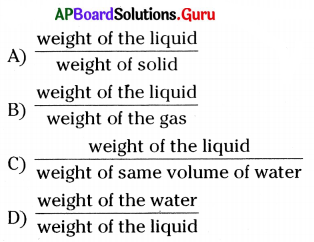
AP 9th Class Physical Science Bits Chapter 9 Floating Bodies 1
Answer:
C) [latex]\frac{\text { weight of the liquid }}{\text { weight of same volume of water }}[/latex]

Question 16.
Units of relative density …………………
A) g/cm3
B) kg/m3
C) kg/cm3
D) no units
Answer:
D) no units

AP 9th Class Physical Science Bits Chapter 9 Floating Bodies

Question 17.
Lactometer is used to determine the ……………..
A) purity of water
B) purity of milk
C) purity of sugar
D) purity of oil
Answer:
B) purity of milk

Question 18.
The principle involved in working of a lactometer is …………………
A) density
B) volume
C) relative density
D) pressure
Answer:
C) relative density

Question 19.
The effective density of a mixture of two liquids of densities ρ1 and ρ2 when they are taken with same masses …………………
A) [latex]\frac{1}{2}[/latex] (ρ1 + ρ2)
B) [latex]\frac{2 \rho_{1} \rho_{2}}{\rho_{1}+\rho_{2}}[/latex]
C) [latex]\frac{2 \rho_{1} \rho_{2}}{\rho_{1}-\rho_{2}}[/latex]
D) [latex]\frac{1}{2}[/latex] (ρ1 – ρ2)
Answer:
B) [latex]\frac{2 \rho_{1} \rho_{2}}{\rho_{1}+\rho_{2}}[/latex]

Question 20.
The effective density of a mixture of two liquids of densities ρ1 and ρ2, when they are taken with same volumes is ………………
A) [latex]\frac{1}{2}[/latex] (ρ1 + ρ2)
B) [latex]\frac{2 \rho_{1} \rho_{2}}{\rho_{1}-\rho_{2}}[/latex]
C) [latex]\frac{1}{2}[/latex] (ρ1 – ρ2)
D) B) [latex]\frac{2 \rho_{1} \rho_{2}}{\rho_{1}+\rho_{2}}[/latex]
Answer:
A) [latex]\frac{1}{2}[/latex] (ρ1 + ρ2)

Question 21.
Density of any liquid can be determined by using …………………..
A) hydrometer
B) densitometer
C) hygrometer
D) Both A & B
Answer:
D) Both A & B

Question 22.
The relative density of an object is greater than 1, then the object …………………. in water.
A) floats
B) sinks
C) both A and B
D) none of these
Answer:
B) sinks

Question 23.
The upward pressure acting on a body immersed in water is known as ……………….
A) tension
B) normal force
C) buoyancy
D) thurst
Answer:
C) buoyancy

AP 9th Class Physical Science Bits Chapter 9 Floating Bodies

Question 24.
1 atmosphere = ………………. N/m2.
A) 1.01 × 10⁵
B) 1.01 × 10³
C) 1.01 × 10⁷
D) 1.01 × 10⁷
Answer:
A) 1.01 × 10⁵

Question 25.
Density of mercury = ………………….
A) 13.6 g/cc
B) 13.6 g/m3
C) 13.6 g/mm3
D) 13.6 kg/m3
Answer:
B) 13.6 g/m3

Question 26.
Pressure at a depth ‘h’ in a liquid is ………………
A) P = Po + hρg
B) P = Po – hρg
C) Po = P + hρg
D) Po = P – hρg
Answer:
A) P = Po + hρg

Question 27.
In a bramah press, force acting on the right piston is …………………
A) F2 = [latex]\frac{\mathrm{A}_{1} \times \mathrm{F}_{1}}{\mathrm{~A}_{2}}[/latex]
B) F2 = [latex]\frac{\mathrm{F}_{1} \times \mathrm{A}_{2}}{\mathrm{~A}_{1}}[/latex]
C) F2 = [latex]\frac{A_{2}}{F_{1} \times A_{1}}[/latex]
D) F2 = [latex]\frac{\mathrm{A}_{1}}{\mathrm{~F}_{1} \times \mathrm{A}_{2}}[/latex]
Answer:
B) F2 = [latex]\frac{\mathrm{F}_{1} \times \mathrm{A}_{2}}{\mathrm{~A}_{1}}[/latex]

Question 28.
When a body is immersed in a fluid, the force of buoyancy is equal to the ……………
A) volume of fluid displaced
B) pressure of fluid displaced
C) density of fluid displaced
D) weight of fluid displaced
Answer:
D) weight of fluid displaced

Question 29.
Relative density of an object is less than 1 then it ………………..
A) floats in water
B) sinks in water
C) both
D) none of these
Answer:
B) sinks in water

Question 30.
Height of mercury column is ………………..
A) 76 m
B) 76 cm
C) 76 mm
D) Both B & C
Answer:
D) Both B & C

AP 9th Class Physical Science Bits Chapter 9 Floating Bodies

Question 31.
Atmospheric pressure Po =
A) hρg
B) [latex]\frac{\mathrm{h} \rho}{\mathrm{g}}[/latex]
C) [latex]\frac{\mathrm{hg}}{\mathrm{P}}[/latex]
D) [latex]\frac{\rho g}{h}[/latex]
Answer:
A) hρg

Question 32.
Which of the following sinks in water ?
A) wooden block
B) piece of wax
C) glass marble
D) plastic ball
Answer:
C) glass marble

Question 33.
If we weigh a piece of iron and a piece of wood of same size, iron will weigh more. The reason is
A) density of iron is less than the density of wood
B) weight of iron is more than the weight of wood
C) area of iron is more than the area of wood
D) density of iron is more than the density of wood
Answer:
D) density of iron is more than the density of wood

Question 34.
Force of buoyancy is equal to the ……………….. of the object.
A) apparent loss of volume
B) apparent loss of density
C) apparent loss of pressure
D) apparent loss of weight
Answer:
D) apparent loss of weight

Question 35.
Atmospheric pressure can be measured by using
A) lactometer
B) hydrometer
C) barometer
D) hygrometer
Answer:
C) barometer

Question 36.
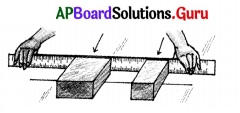
Adjacent experiment was done by ancient Greek Scientist.

AP 9th Class Physical Science Bits Chapter 9 Floating Bodies 2
A) Pascal
B) Archimedes
C) Both of them
D) None
Answer:
B) Archimedes

Question 37.
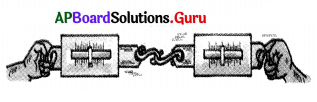
Name of the arrangement given in the figure.
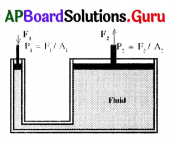
AP 9th Class Physical Science Bits Chapter 9 Floating Bodies 3
A) Pascal
B) Archimedes
C) Bramah press
D) Hydralic jack
Answer:
C) Bramah press

AP 9th Class Physical Science Bits Chapter 9 Floating Bodies

Question 38.
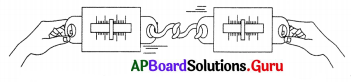
Name of the set up given in the figure.
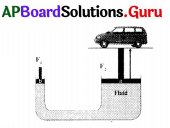
AP 9th Class Physical Science Bits Chapter 9 Floating Bodies 4
A) Pascal
B) Archimedes
C) Bramah press
D) Hydralic jack
Answer:
D) Hydralic jack

Question 39.
Kerosene ………………. water.
A) floats on
B) sinks in
C) suspends in
D) can’t say
Answer:
A) floats on

Question 40.
Ships are made based on the principle of ………………….
A) pressure
B) volume
C) density
D) buoyancy
Answer:
D) buoyancy

Question 41.
Hydraulic jacks works on …………………. principle.
A) Archimedes
B) Pascal
C) Berzelius
D) Boyle
Answer:
B) Pascal

Question 42.
One pascal equal to
A) 1.01 x 10⁵ Nm-2
B) 1.01 x 10⁻⁵ Nm-2
C) 1 Nm-2
D) 76 Nm-2
Answer:
C) 1 Nm-2

Question 43.
The instrument used to test purity of milk is
A) Barometer
B) Hydrometer
C) Potentiometer
D) Lactometer
Answer:
D) Lactometer

Question 44.
A solid sphere has a radius of 2 cm and a mass of 0.05 kg. What is the relative density of the sphere………………….?
A) 1.39
B) 1.39 kg/m3
C) 1.49
D) 1.46 kg/m3
Answer:
C) 1.49

Question 45.
Which of the following law denotes Buoyancy ?
A) Pascal’s Law
B) Archimedes Law
C) Boyl’s Law
D) Newton’s Law
Answer:
B) Archimedes Law

AP 9th Class Physical Science Bits Chapter 9 Floating Bodies

Question 46.
What happens if water is mixed with milk?
A) The density of the mixture is less than the density of milk
B) The density of the mixture is more than the density of milk
C) The volume of the mixture is more than the volume of milk
D) The volume of the mixture is less than the volume of milk
Answer:
B) The density of the mixture is more than the density of milk

Question 47.
Density : [latex]\frac{\mathbf{k g}}{\mathbf{m}^{3}}[/latex] : :relative density : ………………
A) [latex]\frac{\mathrm{gm}}{\mathrm{cm}^{3}}[/latex]
B) [latex]\frac{\mathrm{N}}{\mathrm{m}^{2}}[/latex]
C) [latex]\frac{\text { pascal }}{\mathrm{m}^{3}}[/latex]
D) No units
Answer:
D) No units

Question 48.
The instrument which is used to test whether water is added to milk or not is
A) Barometer
B) Lactometer
C) Hydrometer
D) Thermometer
Answer:
B) Lactometer

Question 49.
Find the odd one out regarding the construction of hydraulic jackA) Pistons must be frictionless
B) Pistons must be leak proof
C) Pistons must be of same area
D) Fluid inside the jack must be incompressible
Answer:
C) Pistons must be of same area

AP 9th Class Physical Science Bits Chapter 5 What is inside the Atom? with Answers

Practice the AP 9th Class Physical Science Bits with Answers Chapter 5 What is inside the Atom? on a regular basis so that you can attempt exams with utmost confidence.

AP State Syllabus 9th Class Physical Science Bits 5th Lesson What is inside the Atom? with Answers

Question 1.
An atom is electrically
A) positive
B) negative
C) neutral
D) no change
Answer:
C) neutral

Question 2.
The smaller particles present inside the atom are called
A) elements
B) protons
C) electrons
D) sub-atomic particles
Answer:
D) sub-atomic particles

AP 9th Class Physical Science Bits Chapter 5 What is inside the Atom?

Question 3.
The important sub-atomic particles inside the atom are
A) protons
B) neutrons
C) electrons
D) all the above
Answer:
D) all the above

Question 4.
The negatively charged particles are
A) electrons
B) protons
C) neutrons
D) none
Answer:
A) electrons

Question 5.
The positively charged particles are
A) electrons
B) protons
C) neutrons
D) none
Answer:
B) protons

Question 6.
The chargeless particles are
A) electrons
B) protons
C) neutrons
D) none
Answer:
C) neutrons

Question 7.
The charge of alpha particles is
A) positive
B) negative
C) neutral
D) none
Answer:
A) positive

Question 8.
Rutherford’s model is known as
A) plum pudding model
B) nuclear model
C) watermelon model
D) positive model
Answer:
B) nuclear model

Question 9.
The nucleons are
A) protons and electrons
B) electrons and neutrons
C) protons and neutrons
D) neutrons
Answer:
C) protons and neutrons

AP 9th Class Physical Science Bits Chapter 5 What is inside the Atom?

Question 10.
Rutherford’s model could not explain
A) positivity of the atom
B) negativity of the atom
C) neutrality of the atom
D) stability of the atom
Answer:
D) stability of the atom

Question 11.
According to Neils Bohr’s model, electrons are present in
A) shells
B) nucleus
C) outside the atom
D) cannot found
Answer:
A) shells

Question 12.
Most of the mass of an atom is concentrated in
A) protons
B) electrons
C) neutrons
D) nucleus
Answer:
D) nucleus

Question 13.
n = 2, represents ………………. shell.
A) K
B) L
C) M
D) N
Answer:
B) L

Question 14.
Maximum number of electrons that can be accommodate in a shell is given by the formula
A) 2n
B) n2
C) 2n2
D) 2n3
Answer:
C) 2n2

Question 15.
Maximum number of electrons that can be accommodated in N shell is
A) 2
B) 32
C) 16
D) 18
Answer:
B) 32

Question 16.
The valency of sulphur is
A) 2
B) 6
C) 2 and 6
D) 0
Answer:
C) 2 and 6

AP 9th Class Physical Science Bits Chapter 5 What is inside the Atom?

Question 17.
The valency of neon is
A) 1
B) 3
C) 2
D) 0
Answer:
D) 0

Question 18.
In im1 Al the number of neutrons are
A) 14
B) 13
C) 27
D) 40
Answer:
A) 14

Question 19.
The number of nucleons is the
A) atomic number
B) mass number
C) number of neutrons
D) number of protons
Answer:
B) mass number

Question 20.
The …………………. isotope is used in the treatment of goitre.
A) isotope of iodine
B) isotope of uranium
C) isotope of cobalt
D) isotope of hydrogen
Answer:
A) isotope of iodine

Question 21.
Which of the following is an example of isotopes ?
A) [latex]{ }_{1}^{1} \mathrm{H},{ }_{1}^{2} \mathrm{H},{ }_{1}^{3} \mathrm{H}[/latex]
B) [latex]{ }_{6}^{12} \mathrm{C},{ }_{6}^{13} \mathrm{C},{ }_{6}^{14} \mathrm{C}[/latex]
C) [latex]{ }_{17}^{35} \mathrm{Cl},{ }_{17}^{37} \mathrm{Cl}[/latex]
D) All the above
Answer:
D) All the above

Question 22.
The mass of neutron is nearly equal to that of ………………….
A) proton
B) electron
C) α – particle
D) β – particle
Answer:
A) proton

Question 23.
According to Thomson, the total ………………… of the atom is uniformly distributed throughout the atom.
A) volume
B) density
C) pressure
D) mass
Answer:
D) mass

AP 9th Class Physical Science Bits Chapter 5 What is inside the Atom?

Question 24.
Rutherford allowed the alpha particles to pass through ……………………. in his
alpha particles scattering experiment.
A) aluminium foil
B) silver foil
C) copper foil
D) gold foil
Answer:
D) gold foil

Question 25.
Alpha particles do not have …………………
A) electrons
B) protons
C) neutrons
D) none of these
Answer:
A) electrons

Question 26.
Statement – I: Alpha particles consists of 2 protons.
Statement – II : Alpha particles con-sists of 4 neutrons.
A) Both the statements are true.
B) Statement -1 true and Statement – II false.
C) Statement -1 false and Statement – II true.
D) Both the statements are false.
Answer:
A) Both the statements are true.

Question 27.
According to Bohr’s model, electrons revolve around nucleus in …………………
A) orbits
B) shells
C) orbitals
D) both A & B
Answer:
D) both A & B

Question 28.
If n = 3, it represents the ……………….. shell.
A) K
B) L
C) M
D) N
Answer:
C) M

Question 29.
According to Rutherford, the mass of the atom is concentrated at ………………..
A) orbit
B) shell
C) orbital
D) nucleus
Answer:
D) nucleus

Question 30.
Electrons must ……………… energy to move to a higher energy level.
A) absorb
B) emit
C) radiate
D) no change
Answer:
A) absorb

AP 9th Class Physical Science Bits Chapter 5 What is inside the Atom?

Question 31.
Electrons must ………………. energy to move to a lower energy level.
A) absorb
B) emit
C) radiate
D) both B & C
Answer:
D) both B & C

Question 32.
According to Bohr, while electrons are revolving in …………………..
A) discrete
B) stationary
C) higher energy
D) both A & B
Answer:
D) both A & B

Question 33.
Bohr’s model could not explain the spectra of ……………….
A) Hydrogen
B) He+
C) Li2+
D) Heavier atoms
Answer:
D) Heavier atoms

Question 34.
The rules for distribution of electrons is given by …………………
A) Bohr
B) Rutherford
C) Bury
D) Both A & C
Answer:
D) Both A & C

Question 35.
Maximum number of electrons that can be accommodated in M – shell is ………………
A) 2
B) 8
C) 18
D) 32
Answer:
C) 18

Question 36.
The electronic structure of oxygen is ………………
A) 2, 4
B) 2, 6
C) 2, 8
D) 2, 8, 2
Answer:
B) 2, 6

Question 37.
The number of electrons present in outer most orbit of an atom is called …………………… electrons.
A) valency
B) paired
C) unpaired
D) love pair
Answer:
A) valency

AP 9th Class Physical Science Bits Chapter 5 What is inside the Atom?

Question 38.
An outer most shell which has 8 elec-trons is said to possess an ………………. configuration.
A) dublet
B) octet
C) triplet
D) tetralet
Answer:
B) octet

Question 39.
An atom with 8 electrons in its outer most shell is chemically …………………
A) stable
B) unstable
C) both
D) none of these
Answer:
A) stable

Question 40.
Atoms of an element react with other atoms, to achieve ………………….. in their outer most shell.
A) singlet
B) octet
C) triplet
D) tetralet
Answer:
B) octet

Question 41.
An atom can achieve octet by …………………. or of electrons.
A) transfer
B) sharing
C) both A and B
D) none of these
Answer:
C) both A and B

Question 42.
Transfer or sharing of electrons by an atom results in the formation of ……………………. between the atoms.
A) attractive forces
B) chemical bond
C) repulsive force
D) both A & B
Answer:
C) repulsive force

Question 43.
The number of protons in the nucleus of an atom is its …………………
A) atomic number
B) mass number
C) atomic mass
D) atomic volume
Answer:
A) atomic number

Question 44.
The number of nucleons is called ……………….. of the atom.
A) atomic number
B) atomic mass number
C) atomic mass
D) atomic volume
Answer:
B) atomic mass number

AP 9th Class Physical Science Bits Chapter 5 What is inside the Atom?

Question 45.
Number of neutrons N = ……………….
A) A – Z
B) A + Z
C) A × Z
D) A / Z
Answer:
A) A – Z

Question 46.
Atomic number is denoted by
A) A
B) Z
C) A – Z
D) A + Z
Answer:
B) Z

Question 47.
Mass number is denoted by
A) Z
B) A – Z
C) A
D) A + Z
Answer:
C) A

Question 48.
The elements which have a highest number of known isotopes ……………….. are and ……………..
A) Xenon, Cesium
B) Sodium, Potassium
C) Calcium, Strontium
D) Barium, Radium
Answer:
A) Xenon, Cesium

Question 49.
The isotopes of Uranium is used as fuel in ………………. reactors.
A) Thermal
B) Hydro
C) Wind
D) Nuclear
Answer:
D) Nuclear

Question 50.
The isotope of …………………. is used in treatment of cancer.
A) Iron
B) Sodium
C) Iodine
D) Cobalt
Answer:
D) Cobalt

Question 51.
[latex]{ }_{1}^{2} \mathrm{H}[/latex]is called …………………
A) Hydrogen
B) Deuterium
C) Tritium
D) None of these
Answer:
B) Deuterium

AP 9th Class Physical Science Bits Chapter 5 What is inside the Atom?

Question 52.
Xenon and cesiums have …………….. known isotopes.
A) 30
B) 32
C) 36
D) 40
Answer:
C) 36

Question 53.
……………….. are not part of nucleus.
A) Protons
B) Electrons
C) Positrons
D) Neutrons
Answer:
B) Electrons

Question 54.
Electron configuration of Neon is ………………..
A) 2
B) 2, 8
C) 2, 8, 8
D) 2, 8, 7
Answer:
B) 2, 8

Question 55.
Match the following.

a) Carbon 1) 2, 8, 8
b) Argon 2) 2, 8, 7
c) Chlorine 3) 2
d) Helium 4) 2, 4

A) a → 4, b → 1, c → 2, d → 3
B) a→ 3, b → 2, c → 1, d → 4
C) a → 2, b → 3, c → 4, d → 1
D) a → 1, b → 2, c → 3, d → 4
Answer:
A) a → 4, b → 1, c → 2, d → 3

Question 56.
Match the following.

a) Proton 1) e
b) Electron 2) n0
c) Neutron 3) p+

A) a → 2, b → 1, c → 3
B) a → 3, b → 1, c → 2
C) a → 1, b → 2, c → 3
D) a → 2, b → 3, c → 1
Answer:
B) a → 3, b → 1, c → 2

Question 57.
Which of the following is a wrong statement ?
A) Mass of proton was 1836 times greater than that of the electron
B) Proton is represented as P
C) Proton repels neutrons
D) Proton is a subatomic particle in an atom
Answer:
B) Proton is represented as P

Question 58.
If there are no protons in an atom, the consequences are
A) all atoms possess negative charge.
B) all atoms possess positive charge.
C) all atoms possess neutral charge.
D) above all
Answer:
A) all atoms possess negative charge.

AP 9th Class Physical Science Bits Chapter 5 What is inside the Atom?

Question 59.
‘X’ is a subatomic particle. It has neither +ve nor -ve. Then ‘X’ is
A) proton
B) positron
C) electron
D) neutron
Answer:
D) neutron

Question 60.
If an α – particle comes closure to a proton, it …………………. proton.
A) attracts
B) repels
C) no change
D) first attracts and then repels
Answer:
B) repels

Question 61.
Electron do not fall in nucleus, because
A) electron do not radiate energy while rotating in discrete orbits.
B) electron radiates energy while rotating in discrete orbits.
C) the size of nucleus is very small to attract the electron.
D) A and C
Answer:
A) electron do not radiate energy while rotating in discrete orbits.

Question 62.
Fluorine atom contains seven electrons in outermost shell, but its valency is ‘1’. Predict the reason.
A) It can loss six electrons from the valency shell.
B) It can loss only one electron from the valency shell.
C) It can gain only one electron.
D) It can gain only seven electrons.
Answer:
B) It can loss only one electron from the valency shell.

Question 63.
According to the electrolysis experiments conducted by …………….., the atoms were acquiring negative charge during the process of electrolysis.
A) Dalta
B) Michael Faraday
C) Rutherford
D) Bohr
Answer:
B) Michael Faraday

Question 64.
Mass of electron is …………….. times less than that of proton.
A) 1200
B) 1836
C) 1830
D) 1870
Answer:
B) 1836

Question 65.
Neutrons were discovered by …………………
A) J.J. Thomson
B) Rutherford
C) Goldstein
D) Chadwick
Answer:
D) Chadwick

Question 66.
The atoms of same element which have same numbers of protons, but have different number of neutrons are called ………………….
A) Isobars
B) Isotopes
C) Isotones
D) Isomers
Answer:
B) Isotopes

AP 9th Class Physical Science Bits Chapter 5 What is inside the Atom?

Question 67.
Match the following.

a) Plum pudding or watermelon model of atom 1) Goldstein
b) Proton 2) J.J. Thomson
c) Sodium 3) 2, 8, 1

A) a → 3, b → 1, c → 2
B) a → 2, b → 1, c → 3
C) a→ 1, b → 2, c → 3
D) a → 3, b → 2, c → 1
Answer:
B) a → 2, b → 1, c → 3

Question 68.
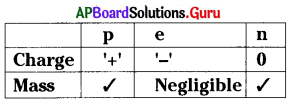
AP 9th Class Physical Science Bits Chapter 5 What is inside the Atom 1
From the table, which of the following is not correct ?
A) Electron has negative charge
B) Neutron has no charge
C) Proton has both mass and charge
D) Mass of the electron is very very less
Answer:
B) Neutron has no charge

Question 69.
Rutherford : ………………. :: JJ Thomson : Watermelon
A) planetary system
B) coconut
C) α – particle
D) big bang
Answer:
A) planetary system

Question 70.
AP 9th Class Physical Science Bits Chapter 5 What is inside the Atom 2
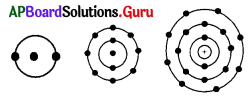
In the figure …………………. has more energy.
A) K – shell
B) L – shell
C) M – shell
D) All are equal
Answer:
C) M – shell

Question 71.
AP 9th Class Physical Science Bits Chapter 5 What is inside the Atom 3
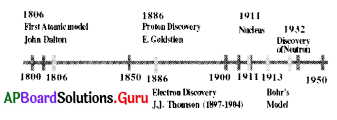
From the given time line, which of the sub-atomic particle discovered at last?
A) proton
B) electron
C) neutron
D) none
Answer:
B) electron

Question 72.
The given atom is AP 9th Class Physical Science Bits Chapter 5 What is inside the Atom 4
A) He
B) O
C) Ne
D) Ar
Answer:
C) Ne

Question 73.
AP 9th Class Physical Science Bits Chapter 5 What is inside the Atom 5
The common property of the above atoms is
A) same number of shells
B) same atomic number
C) same valency
D) above all
Answer:
C) same valency

AP 9th Class Physical Science Bits Chapter 5 What is inside the Atom?

Question 74.
Electrons distribution in the given diagram
AP 9th Class Physical Science Bits Chapter 5 What is inside the Atom 6
A) 2, 6
B) 2, 4
C) 2, 2
D) 0, 8
Answer:
B) 2, 4

Question 75.
AP 9th Class Physical Science Bits Chapter 5 What is inside the Atom 7
The outermost orbit in ‘Ne’ is
A) K
B) L
C) M
D) N
Answer:
B) L

Question 76.
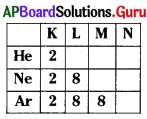
From the above table no. of protons in ‘Ar’ is
A) 8
B) 16
C) 18
D) 10
Answer:
C) 18

Question 77.
From the above table valency of ‘Ar’ is
A) 8
B) 2
C) 18
D) 0
Answer:
D) 0

Question 78.
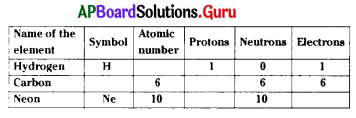
AP 9th Class Physical Science Bits Chapter 5 What is inside the Atom 8
What is the symbol of carbon ?
A) Ca
B) C
C) Cr
D) Cl
Answer:
B) C

Question 79.
From the above table, what is the atomic number of hydrogen ?
A) 1
B) 2
C) 3
D) 0
Answer:
A) 1

Question 80.
From the above table no. of protons Neon is
A) 5
B) 4
C) 6
D) 10
Answer:
D) 10

AP 9th Class Physical Science Bits Chapter 5 What is inside the Atom?

Question 81.
Which of the sub-atomic particle is not in the hydrogen?
A) proton
B) electron
C) neutron
D) none
Answer:
C) neutron

Question 82.
[latex]{ }_{6}^{14} \mathrm{C},{ }_{6}^{13} \mathrm{C},{ }_{6}^{12} \mathrm{C}[/latex] what are these ?
A) Isotopes
B) Isobars
C) Isotones
D) None
Answer:
A) Isotopes

Question 83.
In [latex]{ }_{6}^{14} \mathrm{C}[/latex], how many neutrons are there ?
A) 6
B) 14
C) 8
D) 20
Answer:
C) 8

Question 84.
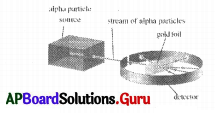
Below experiment done by
AP 9th Class Physical Science Bits Chapter 5 What is inside the Atom 9
A) Bohr
B) Thomson
C) Rutherford
D) Hund’s
Answer:
C) Rutherford

Question 85.
Correct labelling of the given diagram is
AP 9th Class Physical Science Bits Chapter 5 What is inside the Atom 10
A) 1 – proton, 2 – neutron, 3 – electron
B) 1 – neutron, 2 – proton, 3 – electron
C) 1 – electron, 2 – neutron, 3 – proton
D) 1 – electron, 2 – proton, 3 – neutron
Answer:
C) 1 – electron, 2 – neutron, 3 – proton

Question 86.
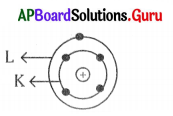
The defect in the diagram is
AP 9th Class Physical Science Bits Chapter 5 What is inside the Atom 11
A) Number of electrons in K – shell
B) Number of shells
C) Nucleus has V charge
D) No defect
Answer:
A) Number of electrons in K – shell

Question 87.
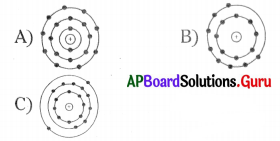
For electron distribution 2, 8, 8, the atomic diagram is
AP 9th Class Physical Science Bits Chapter 5 What is inside the Atom 12
D) None
Answer:
AP 9th Class Physical Science Bits Chapter 5 What is inside the Atom 13

AP 9th Class Physical Science Bits Chapter 5 What is inside the Atom?

Question 88.
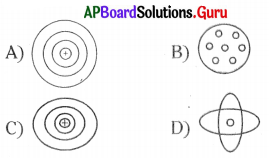
Dallons atomic model is
AP 9th Class Physical Science Bits Chapter 5 What is inside the Atom 14
Answer:
AP 9th Class Physical Science Bits Chapter 5 What is inside the Atom 15

Question 89.
Joseph John Thomson is appreciable because, he found
A) first atom
B) electron
C) proton
D) above all
Answer:
B) electron

Question 90.
Rutherford is appreciable, because he found that
A) Nucleus in the atom
B) Atom has empty space in it
C) Nucleus has a positive charge
D) Above all
Answer:
D) Above all

Question 91.
Which isotope is very useful to treat goitre ?
A) Iodine
B) Sodium
C) Uranium
D) None
Answer:
A) Iodine

Question 92.
Which of the following isotope uses for treatment of Cancer ?
A) Iodine
B) Sodium
C) Cobalt
D) None
Answer:
C) Cobalt

Question 93.
Isotopes are not used in this system.
A) Solving chemical and medical mysteries
B) Investigating the steps of a chemical reaction
C) Medical treatment
D) To pass electricity
Answer:
D) To pass electricity

Question 94.
Carbon dating is related to
A) carbon isotope [latex]\left({ }_{6}^{14} \mathrm{C}\right)[/latex]
B) fossils
C) A and B
D) neither A nor B
Answer:
C) A and B

AP 9th Class Physical Science Bits Chapter 5 What is inside the Atom?

Question 95.
Neutrons in gfi [latex]{ }_{8}^{16} \mathrm{O}[/latex] are
A) 8
B) 16
C) 23
D) Zero
Answer:
A) 8

Question 96.
Which of the following is a correct electronic configuration of sodium ?
A) 2, 8
B) 8, 2, 1
C)2, 1, 8
D) 2, 8, 1
Answer:
D) 2, 8, 1

Question 97.
[latex]{ }_{6}^{14} \mathrm{C}[/latex] isotope is used to find
A) age of fossils
B) nature of genes
C) medical treatment
D) above all
Answer:
A) age of fossils

Question 98.
The combining capacity of atoms of an element with the atoms of other element is called its valency. Based on valency the odd one is
A) Hydrogen
B) Chlorine
C) Helium
D) Oxygen
Answer:
C) Helium

Question 99.
Based on scientists and their inventions match Set – I with Set – II:

Set – I Set – II
P. Bohr-Bury x. Existence of a nucleus
Q. Thompson y. Maximum no. of electrons in a shell
R. Rutherford z. Subatomic particle

A) P – y, Q – z, R – x
B) P – y, Q – x, R – z
C) P – x, Q – y, R – z
D) P – z, Q – x, R – y
Answer:
A) P – y, Q – z, R – x

Question 100.
Isotopes are used in the laboratory to investigate the steps of chemical reactions and medical mysteries. An isotope which is used in the treatment of Goitre is
A) Iodine isotope
B) Carbon isotope
C) Cobalt isotope
D) Uranium isotope
Answer:
A) Iodine isotope

Question 101.
Arrangement of electrons in an atom with atomic number (Z) = 5 and valency = 3is
A) 2, 3
B) 1, 1,3
C)2, 1, 2
D) 2, 2, 1
Answer:
A) 2, 3

AP 9th Class Physical Science Bits Chapter 5 What is inside the Atom?

Question 102.
α-partides scattering experiment helped to detect the existence of the nucleus. The main observation of this experiment is
A) All the alpha particles got deflected.
B) Few no. of alpha particles got deflected.
C) Alpha particles don’t passed . through the gold foil.
D) All the alpha particles passed through the gold foil.
Answer:
B) Few no. of alpha particles got deflected.

Question 103.
α-particles scattering experiment confirms
i) Nucleus is positively charged.
ii) Nucleus contains electrons.
iii) Electrons revolve around the nucleus.
iv) Most of the space inside the atom is empty.
A) (ii) only
B) (i), (iii) and (iv)
C) (iv) only
D) (i) and (iv)
Answer:
D) (i) and (iv)

Question 104.

Shell Name The maximum no. of electrons in a shell
K 2
L 8
M X
N 32

In the above table ‘x’ can be replaced by
A) 28
B) 30
C) 18
D) 8
Answer:
C) 18

Question 105.
The standard notation of an atom is [latex]{ }_{\mathbf{Z}}^{\mathrm{A}} \mathbf{X}[/latex]. The option which shows oxygen atom is
A) [latex]{ }_{8}^{16} \mathrm{O}[/latex]
B) [latex]{ }_{16}^{6} \mathrm{O}[/latex]
C) [latex]{ }_{16}^{8} \mathrm{O}[/latex]
D) [latex]{ }_{6}^{16} \mathrm{O}[/latex]
Answer:
[latex]{ }_{8}^{16} \mathrm{O}[/latex]

Question 106.
AP 9th Class Physical Science Bits Chapter 5 What is inside the Atom 16
The distribution of electrons in the above diagram represents the element
A) Neon
B) Nitrogen
C) Carbon
D) Oxygen
Answer:
C) Carbon

Question 107.
In the diagram regarding question number (9) the symbol ‘+’ represent
A) Protons
B) Neutrons
C) Protons and Neutrons
D) Electrons
Answer:
A) Protons

Question 108.
The sum of no. of protons and no. of neutrons is called mass number. The no. of neutrons present in the sodium atom whose atomic number is
A) 11
B) 12
C) 34
D) 23
Answer:
B) 12

AP 9th Class Physical Science Bits Chapter 5 What is inside the Atom?

Question 109.
In atoms electrons are distributed in different shells. The correct order of distribution of 12 electrons in Magnesium is
A) 2, 8, 2
B) 2, 2, 2, 6
C) 2, 2, 8
D) 2, 2, 6, 2
Answer:
A) 2, 8, 2

Question 110.
Which metal was used in Rutherford alpha scattering experiment ?
A) Silver
B) Aluminium
C) Gold
D) Platinum
Answer:
C) Gold

Question 111.
The maximum electrons present in Mshell
A) 2
B) 8
C) 18
D) 32
Answer:
C) 18

Question 112.
[latex]{ }_{6}^{12} \mathrm{C} \quad{ }_{6}^{13} \mathrm{C} \quad{ }_{6}^{14} \mathrm{C}[/latex]
Observe the carbon isotopes given above and answer the question. What are the neutron numbers of the above isotopes respectively ?
A) 6, 7, 8
B) 6, 6, 6
C) 18, 19, 20
D) 8, 6, 7
Answer:
A) 6, 7, 8

Question 113.
There are 3 isotopes of carbon. Carbon-12, Carbon-13 and Carbon-14. The most abundant carbon isotope is carbon – 12.
What is the average atomic mass of carbon ?
A) 12.01
B) 14.0
C) 16.0
D) 35.5
Answer:
A) 12.01

Question 114.
The property of having 8 electrons in the outer most orbit is called
A) Atomicity
B) Valency
C) Octet
D) Inertness
Answer:
C) Octet

AP 9th Class Physical Science Bits Chapter 5 What is inside the Atom?

Question 115.
The number of outermost electrons present in Na+ ion is
A) 8
B) 11
C)10
D) 2
Answer:
A) 8

Question 116.
If we use iodised salt in our daily we can be prevented by the disease
A) Cancer
B) Goitre
C) Skin disease-Eezima
D) Ulcer
Answer:
B) Goitre

Question 117.
Goitre – Isotope of iodine :: Cancer : ………………….
A) Isotope of Uranium
B) Isotope of Carbon
C) Isotope of Cobalt
D) Isotope of Chlorine
Answer:
C) Isotope of Cobalt

Question 118.
In Rutherford’s gold foil experiment, the emitted particles/rays
A) Beta particle
B) Gamma particle
C) X-ray particle
D) Alpha particle
Answer:
D) Alpha particle

Question 119.
The arrangement of electrons in Oxygen is
A) 2, 2, 2
B) 2, 2, 4
C) 2, 2, 6
D) 2, 4, 2
Answer:
B) 2, 2, 4

Question 120.
According to which rule, there should be two electrons in the innermost shell
A) Bohr
B) Thomson
C) Bohr-Bury
D) Rutherford
Answer:
C) Bohr-Bury

AP 9th Class Physical Science Bits Chapter 5 What is inside the Atom?

Question 121.
Match the following.

Set – I Set – II
P) Atomic number (Z) S) No. of protons
Q) Atomic mass number T) A – Z
R) Number of neutrons (n) U) No. of protons + no.of neutrons.

A) P – U, Q – S, R -T
B) P – T, Q – S, R – U
C) P – S, Q -T, R – U
D) P – S, Q – U, R – T
Answer:
D)P – S, Q – U, R – T

AP 9th Class Physical Science Bits Chapter 3 Is Matter Pure? with Answers

Practice the AP 9th Class Physical Science Bits with Answers Chapter 3 Is Matter Pure? on a regular basis so that you can attempt exams with utmost confidence.

AP State Syllabus 9th Class Physical Science Bits 3rd Lesson Is Matter Pure? with Answers

Question 1.
Pure substance among the following is
A) sodium chloride
B) copper sulphate
C) gold
D) air
Answer:
C) gold

Question 2.
The components of a solution are
A) solute
B) solvent
C) both A & B
D) no components
Answer:
C) both A & B

AP 9th Class Physical Science Bits Chapter 3 Is Matter Pure?

Question 3.
If the amount of solute is less than the saturation level of a solution, then the solution is said to be
A) saturated solution
B) unsaturated solution
C) super saturated solution
D) heterogeneous solution
Answer:
B) unsaturated solution

Question 4.
Factors effecting the solubility are
A) temperature of the solvent
B) size of the particles of the solute
C) stirring of contents
D) all the above
Answer:
D) all the above

Question 5.
The measurement of amount of solute that dissolves in a solvent is
A) solubility
B) diluted
C) concentrated
D) saturated
Answer:
A) solubility

Question 6.
Which of the following is an emulsion?
A) salt solution
B) mixture of oil and water
C) nail polish
D) cheese
Answer:
B) mixture of oil and water

Question 7.
Which of the following is a suspension?
A) salt solution
B) mixture of oil and water
C) nail polish
D) cheese
Answer:
C) nail polish

Question 8.
Which of the following is a colloidal dispersion ?
A) salt solution
B) mixture of oil and water
C) nail polish
D) cheese
Answer:
D) cheese

Question 9.
Which of the following is miscible liquid ?
A) sand in water
B) alcohol in water
C) oil in water
D) none
Answer:
B) alcohol in water

AP 9th Class Physical Science Bits Chapter 3 Is Matter Pure?

Question 10.
Immiscible liquids can he separated by
A) separating funnel
B) centrifuge
C) fractional distillation column
D) filtration
Answer:
A) separating funnel

Question 11.
Example of compound is
A) mercury
B) copper sulphate
C) aluminium
D) boron
Answer:
B) copper sulphate

Question 12.
Something with no adulteration means …………………. substance.
A) pure
B) impulse
C) specific
D) normal
Answer:
A) pure

Question 13.
When mixture of liquids are spun rapidly …………………. component stay at the top. This is the principle of …………………..
A) heavier, churning
B) lighter, churning
C) heavier, mixing
D) lighter, mixing
Answer:
B) lighter, churning

Question 14.
When the components of the mixture formed are uniformly distributed through out it there it is called ………………….. mixture.
A) homogeneous
B) heterogeneous
C) aqueous
D) settle
Answer:
A) homogeneous

Question 15.
When the components of the mixture formed are not distributed uniformly throughout it, then the mixture is called ……………………. mixture.
A) homogeneous
B) heterogeneous
C) aqueous
D) none
Answer:
B) heterogeneous

Question 16.
In a solution, the substance which dissolves another is called ……………………..
A) solution
B) solute
C) solvent
D) solubility
Answer:
C) solvent

AP 9th Class Physical Science Bits Chapter 3 Is Matter Pure?

Question 17.
In a solution, the substance which dissolved in another is called …………………
A) solution
B) solute
C) solvent
D) solubility
Answer:
B) solute

Question 18.
Example for solid solution is ………………….
A) alloy
B) aerated drinks
C) amalgum
D) salt solution
Answer:
A) alloy

Question 19.
The amount of solute present in a saturated solution at a certain temperature is called …………………..
A) dissolution
B) solubility
C) concentration
D) none of these
Answer:
B) solubility

Question 20.
If the amount of solute is little in a solution, then it is said to be ………………….. solution.
A) diluted
B) concentrated
C) aqueous
D) none of these
Answer:
A) diluted

Question 21.
If the amount of solute is more in a solution, then it is said to be ……………….. solution.
A) diluted
B) concentrated
C) aqueous
D) none of these
Answer:
B) concentrated

Question 22.
The amount of solute present in a given amount of solution is called …………………….. of the solution.
A) diluted
B) solubility
C) concentration
D) none of these
Answer:
C) concentration

Question 23.
Mass by mass percentage of a solution =
A) [latex]\frac{\text { mass of solute }}{\text { mass of solution }}[/latex] × 100
B) [latex]\frac{\text { mass of solute }}{\text { mass of solvent }}[/latex] × 100
C) [latex]\frac{\text { mass of solution }}{\text { mass of solute }}[/latex] × 100
D) [latex]\frac{\text { mass of solvent }}{\text { mass of solute }}[/latex] × 100
Answer:
A) [latex]\frac{\text { mass of solute }}{\text { mass of solution }}[/latex] × 100

AP 9th Class Physical Science Bits Chapter 3 Is Matter Pure?

Question 24.
A mixture consisting of two liquids that do not mix and settle into layers when they left undisturbed is called …………………….
A) solution
B) suspension
C) emulsion
D) none of these
Answer:
C) emulsion

Question 25.
A heterogeneous mixture in which the solute particles do not dissolve and are visible to naked eye is called ………………………..
A) solution
B) suspension
C) emulsion
D) colloidal
Answer:
B) suspension

Question 26.
Coloured pigments in plants can be separated by ………………………..
A) distillation
B) evaporation
C) fractional distillation
D) paper chromatography
Answer:
D) paper chromatography

Question 27.
A liquid is said to be ……………….. if it dissolves completely.
A) miscible
B) immiscible
C) both A & B
D) none of these
Answer:
A) miscible

Question 28.
A liquid is said to be ………………….. if it does not dissolve but form a layer over another liquid.
A) miscible
B) immiscible
C) both A & B
D) neither A nor B
Answer:
B) immiscible

Question 29.
If the difference in boiling points of two miscible liquids is greater than 25°C, then they are separated by ……………………..
A) distillation
B) fractional distillation
C) separating funnel
D) evaporation
Answer:
A) distillation

Question 30.
Statement – I : Air is homogeneous mixture of many gases.
Statement – II: They are separated by fractional distillation.
A) Both the statements are true.
B) Statement -1 is true and statement – II is false.
C) Statement -1 is false and statement – II is true.
D) Both the statements are false.
Answer:
A) Both the statements are true.

AP 9th Class Physical Science Bits Chapter 3 Is Matter Pure?

Question 31.
Substances which can be separated into two or more components by chemical reactions are called as ……………………….
A) elements
B) mixtures
C) compounds
D) none of these
Answer:
C) compounds

Question 32.
The basic form of matter that cannot be broken down into simpler substances in chemical reactions is ……………………
A) element
B) compound
C) mixture
D) none of these
Answer:
B) compound

Question 33.
The first definition of an element is given by …………………..
A) Robert Boyle
B) Hennig Brand
C) Lavoisier
D) Burzelius
Answer:
C) Lavoisier

Question 34.
Some liquids have the property of mixing in all proportions, forming a homogeneous solution. This property is known as …………………….
A) miscibility
B) solubility
C) immiscibility
D) none of these
Answer:
A) miscibility

Question 35.
………………….. is the main factor in separating two immiscible liquids.
A) Pressure
B) Volume
C) Density
D) Mass
Answer:
C) Density

Question 36.
………………… are heterogeneous mixtures in which the particle size is too small to be seen with the naked eye but is big enough to scatter fight.
A) Suspension
B) Solutions
C) Colloids
D) None of these
Answer:
C) Colloids

Question 37.
Air is a …………………..
A) mixture
B) colloid
C) solution
D) none of these
Answer:
C) solution

AP 9th Class Physical Science Bits Chapter 3 Is Matter Pure?

Question 38.
Nail polish is a …………………..
A) solution
B) colloid
C) suspension
D) none of these
Answer:
C) suspension

Question 39.
Sodium is an …………………..
A) element
B) compound
C) suspension
D) emulsion
Answer:
A) element

Question 40.
Methane is an ……………………..
A) element
B) compound
C) suspension
D) emulsion
Answer:
B) compound

Question 41.
Steel is a ………………….
A) solid solution
B) liquid solution
C) gaseous solution
D) salt solution
Answer:
A) solid solution

Question 42.
Cold cream is ……………………….
A) solution
B) suspension
C) colloid
D) emulsion
Answer:
D) emulsion

Question 43.
Assertion (A) : Air is compound substance.
Reason (R) : We can separate air into two or more components only by means of a chemical reaction.
A) A and R are true
B) A and R are false
C) A is true but R is false
D) A is false but R is true
Answer:
B) A and R are false

Question 44.
All the solutions are ‘x’s. But not all ‘x’s are solutions. Guess the ‘x’.
A) Pure substance
B) Mixture
C) Atom
D) Liquid
Answer:
B) Mixture

AP 9th Class Physical Science Bits Chapter 3 Is Matter Pure?

Question 45.
If a solution is diluted, the path of the fight beam is
A) Visible
B) Not visible
C) Lightly visible
D) Sometimes visible
Answer:
B) Not visible

Question 46.
‘A’ is a mixture. No particles are settled down when it left undisturbed for sometime. Light beam is visible through it. Guess the ‘A’.
A) Solution
B) Colloid
C) Suspension
D) A or B
Answer:
B) Colloid

Question 47.
Take concentrated solution of copper sulphate in a beaker. Drop a piece of aluminium foil in it. Then,
A) Copper deposites on the aluminium foil
B) Aluminium dissolves
C) The solution becomes colourless
D) A and C
Answer:
D) A and C

Question 48.
Copper cannot be separated from copper sulphate by physical methods. So, it is
A) mixture
B) compound
C) A or B
D) colloid
Answer:
B) compound

Question 49.
The mixture of water and sugar is
A) suspension
B) colloid
C) homogeneous mixture
D) heterogeneous mixture
Answer:
C) homogeneous mixture

Question 50.
In a solution of tincture iodine, alcohol is
A) solution
B) solvent
C) solute
D) does not exist
Answer:
B) solvent

Question 51.
The technique used to separate the mixture of camphor and water is
A) distillation
B) fractional distillation
C) sublimation
D) handpicking
Answer:
C) sublimation

AP 9th Class Physical Science Bits Chapter 3 Is Matter Pure?

Question 52.
Miscible liquids, when the difference between their boiling points is < 25°C can be separated by
A) separating funnel
B) distillation
C) fractional distillation
D) evaporation
Answer:
C) fractional distillation

Question 53.
The scattering of beam of light when light passes through a colloidal solution is ………………………….
A) Raman effect
B) Crompton effect
C) Photo electric effect
D) Tyndall effect
Answer:
D) Tyndall effect

Question 54.
Dye present in an ink can be separated by ………………..
A) distillation
B) evaporation
C) fractional distillation
D) paper chromatography
Answer:
B) evaporation

Question 55.
Urine is boiled down to discover phosphorous by ……………………
A) Robert Boyle
B) Hennig Brand
C) Lavoisier
D) Burzelius
Answer:
B) Hennig Brand

Question 56.
Acetone and water are separated by ………………..
A) Distillation
B) Chromatography
C) Sublimation
D) Fractional distillation
Answer:
A) Distillation

Question 57.
Kerosene and water are separated by ………………….
A) Distillation
B) Separating funnel
C) Sublimation
D) Fractional distillation
Answer:
B) Separating funnel

Question 58.
Assertion (A) : Water + sugar is a solution.
Reason (R) : If we pass beam of light through a solution, it scatters light.
A) A and R are true
B) A and R are false
C) A is true but R is false
D) A is false but R is true
Answer:
C) A is true but R is false

AP 9th Class Physical Science Bits Chapter 3 Is Matter Pure?

Question 59.
Take two test tubes with some water. Add salt powder to one test tube and add crystals of salt to the second one. Observe. From your observation you may conclude that solubility depends upon
A) temperature
B) size of the solute
C) stirring
D) above all
Answer:
B) size of the solute

Question 60.
The correct process is
a) add solvent more to dilute a solution
b) add solute more to dilute a solution
c) add solute more to concentrate a solution
d) add solvent more to concentrate a solution
A) b, d
B) a, c
C) b, c
D) a, d
Answer:
D) a, d

Question 61.
Which of the given device is used to separate a mixture of kerosene and water ?
A) conical flask
B) burette
C) pipette
D) test tube
Answer:
B) burette

Question 62.
Tindal effect observes in the following substances by passing light through it
A) salt solution
B) milk
C) copper sulphate solution
D) starch solution
A) B only
B) A, D
C) C only
D) B, D
Answer:
A) B only

Question 63.
Which apparatus is required to check whether milk is colloid or true solution ?
A) filter paper
B) laser light
C) burner
D) A and B
Answer:
B) laser light

Question 64.
How do you examine whether a starch solution is colloid or suspension ?
A) By sending light beam
B) By leaving undisturbed for some-time
C) By heating it
D) Any of the above
Answer:
B) By leaving undisturbed for some-time

Question 65.
How do you separate a miscible liquid in your lab ?
A) By using separating funnel
B) By using distillation method
C) By using evaporation method
D) By using sublimation method
Answer:
B) By using distillation method

AP 9th Class Physical Science Bits Chapter 3 Is Matter Pure?

Question 66.
Cream from milk can be separated by
A) centrifugation
B) distillation
C) fractional distillation
D) chromatography
Answer:
A) centrifugation

Question 67.
Tyndall effect cannot be shown by
A) colloids
B) suspensions
C) emulsions
D) solutions
Answer:
D) solutions

Question 68.
The component of the air among the following which has the highest boiling point is
A) nitrogen
B) argon
C) methane
D) oxygen
Answer:
C) methane

Question 69.
The first definition for ‘element’ is given by
A) Lavoisier
B) Hennig Brand
C) Sir Humphry Davy
D) Robert Boyle
Answer:
A) Lavoisier

Question 70.
Coloured gem stone is an example of …………………
A) solution
B) suspension
C) colloid
D) emulsion
Answer:
C) colloid

Question 71.
Ink is mixture of …………………. in water.
A) dye
B) salt
C) sugar
D) acid
Answer:
A) dye

Question 72.
The term element is first used by ……………………
A) Robert Boyle
B) Hennig Brand
C) Lavoisier
D) Burzelius
Answer:
A) Robert Boyle

AP 9th Class Physical Science Bits Chapter 3 Is Matter Pure?

Question 73.
Percentage of oxygen in air by volume ………………………
A) 20.9%
B) 78.1%
C) 0.03%
D) 0.1%
Answer:
A) 20.9%

Question 74.
Percentage of nitrogen in air by volume ………………………
A) 20.9%
B) 78.1%
C) 0.03%
D) 0.1%
Answer:
B) 78.1%

Question 75.
Percentage of argon in air by volume
A) 20.9%
B) 78.1%
C) 0.03%
D) 0.9%
Answer:
D) 0.9%

Question 76.
Components of blood sample are separated by ………………..
A) Distillation
B) Sublimation
C) Fractional distillation
D) Centrifugation
Answer:
D) Centrifugation

Question 77.
Naphthalene in water separated by ………………….
A) distillation
B) chromatography
C) sublimation
D) centrifugation
Answer:
C) sublimation

Question 78.
Petrochemicals are separated by …………………..
A) fractional distillation
B) distillation
C) sublimation
D) separating funnel
Answer:
A) fractional distillation

Question 79.
A) kerosene + salt
B) water + salt
C) water + sugar
D) salt + sugar
In the above mixtures, heterogeneous is /are
A) B, C
B) A, B, C
C) A
D) A, D
Answer:
D) A, D

Question 80.
a) sugar water
b) tincture of iodine
c) soda water
d) salt water
The above given mixtures are
A) Homogeneous mixtures
B) Heterogeneous mixtures
C) Solutions
D) A and C
Answer:
D) A and C

AP 9th Class Physical Science Bits Chapter 3 Is Matter Pure?

Question 81.

Mixture Path of the light Settle down of solute
X visible yes
Y not visible no

X and Y are
A) suspension and solution
B) suspension and colloid
C) solution and suspension
D) colloid and suspension
Answer:
A) suspension and solution

Question 82.
Milk, butter, cheese, cream, gel, boot polish
These are
A) suspensions
B) colloids
C) solutions
D) B & C
Answer:
B) colloids

Question 83.

Size of the particles In a mixture
A < nm
B 1 nm – 100nm
C > 100nm

Substance ‘C’ is
A) Milk
B) Salt water
C) Air
D) Butter milk
Answer:
D) Butter milk

Question 84.
(a) set A : fog, clouds, mist
(b) set B : foam, rubber, sponge
(c) set C : jelly, cheese, butter
Which of the above is contained solid as dispersion media ?
A) b
B) c
C) a
D) b and c
Answer:
D) b and c

Question 85.
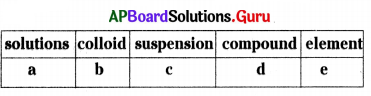
AP 9th Class Physical Science Bits Chapter 3 Is Matter Pure 1
Which of the above are pure substances ?
A) a, d
B) d, e
C) e
D) a, b, c
Answer:
C) e

Question 86.
What would you notice from the given figure ?
AP 9th Class Physical Science Bits Chapter 3 Is Matter Pure 2
A) Pure substances
B) Mixtured substances
C) Both A and B
D) None
Answer:
A) Pure substances

Question 87.
What would you notice from the given figure?
AP 9th Class Physical Science Bits Chapter 3 Is Matter Pure 3
A) Pure substances
B) Mixtured substances
C) Both A and B
D) None
Answer:
B) Mixtured substances

AP 9th Class Physical Science Bits Chapter 3 Is Matter Pure?

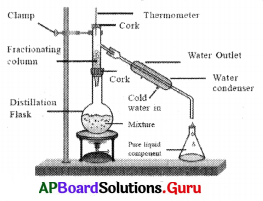
Question 88.
Name the set up given in the figure.
AP 9th Class Physical Science Bits Chapter 3 Is Matter Pure 4
A) Separation funnel
B) Fractional distillation
C) Separation of components in air
D) None
Answer:
B) Fractional distillation

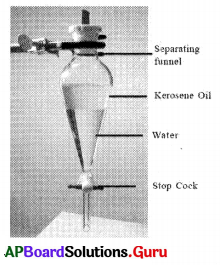
Question 89.
Name the set up given in the figure.
AP 9th Class Physical Science Bits Chapter 3 Is Matter Pure 5
A) Separation funnel
B) Fractional distillation
C) Separation of components in air
D) None
Answer:
A) Separation funnel

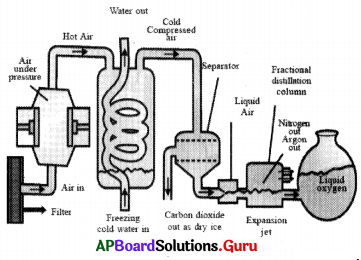
Question 90.
Name the set up given in the figure.
AP 9th Class Physical Science Bits Chapter 3 Is Matter Pure 6
A) Separation funnel
B) Fractional distillation
C) Separation of components in air
D) None
Answer:
C) Separation of components in air

Question 91.
AP 9th Class Physical Science Bits Chapter 3 Is Matter Pure 7
The given figure is related to
A) sublimation
B) fractional distillation
C) paper chromatography
D) evaporation
Answer:
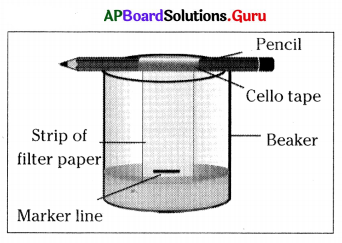
C) paper chromatography

Question 92.
AP 9th Class Physical Science Bits Chapter 3 Is Matter Pure 8
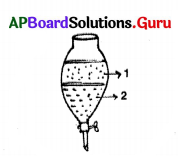
This is a diagram of a separating fun-nel. The parts 1 and 2 are ………………., …………… respectively.
A) low density liquid, high density liquid
B) low density gas, high density liquid
C) high density liquid, low density liquid
D) high density gas, low density liquid
Answer:
A) low density liquid, high density liquid

Question 93.
‘Churning makes the lighter components to come to the surface when a mixture of liquids are spun rapidly’. This principle is used in
A) Refrigerators
B) Centrifuge
C) Microscope
D) Rice cookers
Answer:
B) Centrifuge

Question 94.
Generally solid solutions are available in
A) alloys
B) gems
C) glasses
D) above all
Answer:
D) above all

AP 9th Class Physical Science Bits Chapter 3 Is Matter Pure?

Question 95.
80 ml of solution contains 20 gr of solute. The mass by volume percentage of the solution is
A) 20%
B) 40%
C) 25%
D) 80%
Answer:
C) 25%

Question 96.
Anitha observed, ‘Shake well before use’ on a label of cough syrup bottle. ‘ The syrup is
A) solution
B) colloid
C) suspension
D) above all
Answer:
C) suspension

Question 97.
Ravi observed a beam of sun light passing through a small hole on the roof, into the room. It is formed because
A) air is colloid
B) air is true solution
C) air is suspension
D) air is pure substance
Answer:
A) air is colloid

Question 98.
Tyndall effect is observed by
A) colloids
B) solutions
C) suspensions
D) pure substances
Answer:
A) colloids

Question 99.
Which of the given mixtures cannot be separated by simple physical method ?
A) Husk in grains
B) Stones in rice
C) Fat in milk
D) Oxygen from water
Answer:
D) Oxygen from water

Question 100.
Which method is suitable to separate salt from sea water ?
A) sublimation
B) evaporation
C) chromatography
D) distillation
Answer:
B) evaporation

Question 101.
Petroleum is separated into its components by
A) distillation
B) fractional distillation
C) evaporation
D) filtration
Answer:
B) fractional distillation

AP 9th Class Physical Science Bits Chapter 3 Is Matter Pure?

Question 102.
Sir, Humphry Davy is appreciable, because, he was extremely successfuil in
A) discovering many elements like Na, Mg, B, Cl, etc.
B) giving useful definition of element.
C) separating of components of air.
D) above all
Answer:
A) discovering many elements like Na, Mg, B, Cl, etc.

Question 103.
The mass by mass percentage concentration of a 100g salt solution, which contains 20g salt is
A) 10%
B) 20%
C) 30%
D) 50%
Answer:
B) 20%

Question 104.
The separation technique to separate sodium chloride from its solution in water is
A) sublimation
B) condensation
C) evaporation
D) filtration
Answer:
C) evaporation

Question 105.
By which method do you separate Ammonium chloride from a mixture containing Sodium chloride and Ammonium chloride ?
A) sublimation
B) condensation
C) evaporation
D) filtration
Answer:
A) sublimation

Question 106.
How do you separate small pieces of metal in the engine oil of a car ?
A) sublimation
B) condensation
C) evaporation
D) filtration
Answer:
D) filtration

Question 107.
How do you separate different pigments from an extract of flower petals ?
A) sublimation
B) chromatography
C) evaporation
D) distillation
Answer:
B) chromatography

AP 9th Class Physical Science Bits Chapter 3 Is Matter Pure?

Question 108.
In your home, how do you separate butter from curd ?
A) evaporation
B) chromatography
C) churning
D) distillation
Answer:
C) churning

Question 109.
Match the following.

Technique to separate Mixture
a) Magnet 1. oil and water
b) Separating funnel 2. tea leaves and tea
c) Filtration 3. iron and sand

A) a – 3, b – 2, c -1
B) a – 2, b -1, c – 3
C) a -1, b – 2, c – 3
D) a – 3, b -1, c – 2
Answer:
D) a – 3, b -1, c – 2

Question 110.
This is not a property of colloid.
A) scattering light
B) tyndall effect
C) sedimentation
D) A and C
Answer:
C) sedimentation

Question 111.
Some colloids in your home are
A) gel
B) milk
C) oil
D) boot polish
A) A, B
B) B, C
C) A, B, D
D) A, B, C
Answer:
A) A, B

Question 112.
Some pure substances in your home are
a) ice
b) milk
c) iron
d)air
e) water
f) gold
g) coal
A) a, b, c, d
B) c, b, d, g
C) d, e, f, g
D) a, c, e, f, g
Answer:
D) a, c, e, f, g

Question 113.
Ice cream is a
A) suspension
B) colloid
C) emulsion
D) solution
Answer:
B) colloid

Question 114.
The ingredients in ice cream are………………
A) milk
B) sugar
C) flavours
D) all of these
Answer:
D) all of these

AP 9th Class Physical Science Bits Chapter 3 Is Matter Pure?

Question 115.
Shaving cream is a …………….. type of colloid.
A) foam
B) emulsion
C) aerosol
D) solution
Answer:
A) foam

Question 116.
In automobile exhaust, the dispersion medium is ………………..
A) solid
B) liquid
C) gas
D) solution
Answer:
C) gas

Question 117.
Clouds are ………………..
A) solution
B) suspension
C) colloid
D) emulsion
Answer:
C) colloid

Question 118.
Colloidal solutions are heterogeneous in nature and always consist of altleast two phases, the disperse phase and the dispersion medium. Which of the following is not a colloidal solution ?
A) Shoe polish
B) Mud water
C) Gel
D) Ice cream
Answer:
B) Mud water

Question 119.
Acetone – Water : Distillation : : Ammonium chloride – Salt:AP 9th Class Physical Science Bits Chapter 3 Is Matter Pure 8 1
A) Sedimentation
B) Filtration
C) Sublimation
D) Fractional distillation
Answer:
C) Sublimation

Question 120.
The correct order of sentences related to preparation of super saturated solution is
P. Add one more spoon of sugar to it
Q. Add one spoon of sugar to 100 ml of water in a breaker
R. On heating the undissolved sugar dissolves to form a super saturated solution
S. It dissolves totally to form saturated solution
A) Q, S, P, R
B) Q, R, P, S
C) P, Q, R, S
D) Q, P, R, S
Answer:
A) Q, S, P, R

Question 121.
On mixing of dil. hydrochloric acid to the mixture of iron dust and sulphur powder we obtain two gases. One of them is hydrogen and another would be
A) Sulphur dioxide
B) Hydrogen sulphide
C) Sulphur trioxide
D) Oxygen
Answer:
A) Sulphur dioxide

AP 9th Class Physical Science Bits Chapter 3 Is Matter Pure?

Question 122.
Assertion (A) : We feel cool after sweating.
Reason (R) : We store water in earthen pots during summer.
A) Both (A), (R) are correct, (R) is not the correct explanation of (A).
B) (A) is correct, (R) is incorrect.
C) (A) is incorrect, (R) is correct.
D) Both (A), (R) are correct, (R) is the correct explanation of (A).
Answer:
A) Both (A), (R) are correct, (R) is not the correct explanation of (A).

Question 123.
Assertion (A) : Chromatography is used to separate the coloured pigments in flowers.
Reason (R) : Chromatography is a technique for the separation of mixtures into its individual components.
A) Both assertion (A) and reason (R) are correct and (R) is the correct explanation of (A).
B) Assertion (A) is correct but reason (R) is incorrect.
C) Assertion (A) is incorrect but reason (R) is correct.
D) Both assertion (A) and reason (R) are correct but (R) is not correct explanation of (A).
Answer:
A) Both assertion (A) and reason (R) are correct and (R) is the correct explanation of (A).

Question 124.
Ink is a mixture of a dye in water. We can separate the components in the ink using evaporation. The correct observation in the experiment is
i) Water is separated in the form of vapour.
ii) Dye component doesn’t evaporate.
iii) Water and dye components gets evaporated.
iv) Dye components gets sublimated.
A) (i) and (ii)
B) (iii) only
C) (i) and (iv)
D) (i) only
Answer:
A) (i) and (ii)

Question 125.
On adding a piece of aluminium foil to blue coloured copper sulphate solution, copper will be deposited on aluminium foil. Then the solution
A) No change in colour
B) Becomes colourless
C) Turns to red
D) Turns to green
Answer:
B) Becomes colourless

Question 126.

Dispersion medium Dispersed phase Colloide type
gas liquid aerosol
liquid x sol
solid liquid gel

In the above table ‘x’ can be replaced
A) Liquid
B) Solid
C) Solid or liquid
D) Gas
Answer:
C) Solid or liquid

Question 127.
Element is a basic form of matter that cannot be broken down into simple forms by chemical reactions. If any substance can be separated into two or more constituent parts by a chemical reaction it should be
A) Mixture
B) Heterogeneous mixture
C) Homogeneous mixture
D) Compound
Answer:
D) Compound

Question 128.
Diesel – water is an immiscible mixture of solution. The diagram of apparatus is used to separate the mixture is
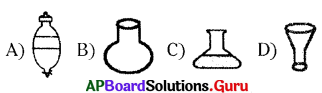
AP 9th Class Physical Science Bits Chapter 3 Is Matter Pure 9
Answer:
AP 9th Class Physical Science Bits Chapter 3 Is Matter Pure 10

AP 9th Class Physical Science Bits Chapter 3 Is Matter Pure?

Question 129.
The amount in gr mass of solute present in 100 gr mass of solution is called concentration. If 50 gr of salt in 200 gr of water, the concentration, of that solution would be
A) 25%
B) 10%
C) 50%
D) 20%
Answer:
D) 20%

Question 130.
In hot summer Revathi gave lemonade to the guests who visited her home. The solute in that solution is/are
i) Water
ii) Lemon juice
iii) Sugar
iv) Salt
A) (i) and (ii)
B) (iii) and (iv)
C) (ii), (iii) and (iv)
D) (i) only
Answer:
C) (ii), (iii) and (iv)

Question 131.
The components of a homogenous mixture are too intimately mixed up that it will be difficult to distinguish them from each other by visual observation. Example for such mixture is
A) Kerosene-water
B) Air
C) Naphthalein-water
D) Oil-water
Answer:
B) Air

Question 132.
Solubility is the measurement of amount of solute that dissolves in a solvent at a certain temperature. Factors that affect the solubility are
i) Temperature
ii) Size of the solute particles
iii) Stirring of a solution
A) (i) and (ii)
B) (ii) and (iii)
C) (i), (ii) and (iii)
D) (i) Only
Answer:
C) (i), (ii) and (iii)

Question 133.
Milk is
A) Suspension
B) Emulsion
C) Colloid
D) Gel
Answer:
C) Colloid

Question 134.
When we go through deep forest, the following effect can be observed
A) Photo electric effect
B) Raman effect
C) Tyndall effect
D) Comphton effect
Answer:
C) Tyndall effect

Question 135.
There must be following apparatus in chromotography laboratory activity
A) Thermometer
B) Litmus paper
C) Marker pen
D) Kerosene
Answer:
C) Marker pen

AP 9th Class Physical Science Bits Chapter 3 Is Matter Pure?

Question 136.
Which of the following is NOT a property of a mixture ?
A) They can formed from elements or compounds.
B) They have the properties of the constituent substances.
C) Their composition is always fixed.
D) They can be separated by physical methods.
Answer:
C) Their composition is always fixed.

Question 137.
A teaspoon of salt is mixed with a teaspoon of powdered camphor. Which of the following methods can be used to separate the camphor from this mixture ?
A) Distillation
B) Evaporation
C) Chromatography
D) Sublimation
Answer:
D) Sublimation

Question 138.
Which of the following is NOT a pure substance ?
A) Gold
B) Glucose
C) Milk
D) Water
Answer:
C) Milk

Question 139.
Take two test tubes, one filled with water and one with kerosene. Now add a spoon of salt in both and stir. You will observe that in the first test tube the salt dissolves completely and in the second test tube it does not dissolve. Which of the following is being tested using the above experiment ?
A) To identify which substance is pure substance and which is a mixture.
B) To identify which mixture is homogeneous and which is heterogeneous.
C) To identify if water and kerosene are a solute or a solvent.
D) To identify which is a saturated solution and which is an unsaturated solution.
Answer:
B) To identify which mixture is homogeneous and which is heterogeneous.

Question 140.
If the amount of the solute present is little for a given volume of solution, the solution is said to be dilute. If the amount of the solute present is more for a given volume of solution, the solution is said to be concentrated. Concentration is the mass of solute dissolved in the given volume of the solution.

Solution X contains 50 g of salt in 100g of water and solution Y contains 100g of salt in 200g of water.
Which of the following can be true based on the above information ?
A) Solution X has the same concentration as solution Y.
B) Solution X is more concentrated than solution Y.
C) Solution X is more dilute than solution Y.
D) Concentration of X cannot be compared with that of solution Y as their volumes are different.
Answer:
A) Solution X has the same concentration as solution Y.

Question 141.

i) Hydrogen p) Suspension
ii) Water q) Solution
iii) Lemonade r) Element
iv) Cough Syrup s) Compound

Choose the correct matching.
A) i – r, ii – s, iii – q, iv – p
B) i – s, ii – q, iii – p, iv – r
C) i – q, ii – p, iii – r, iv – s
D) i – p, ii – r, iii – s, iv – q
Answer:
A) i – r, ii – s, iii – q, iv – p

Question 142.
Which of the following cannot be separated by sublimation when it is mixed with Sand
A) Salt
B) Ammonium Chloride
C) Camphor
D) Iodine
Answer:
A) Salt

AP 9th Class Physical Science Bits Chapter 3 Is Matter Pure?

Question 143.
Ram : Salt is a compound.
Raj : Salt is a mixture. Who is correct ?
A) Ram
B) Raj
C) Both
D) None
Answer:
A) Ram

Question 144.
Kerosene and Caster oil are immisible liquids. To separate kerosene from caster oil ……………… is used typetype
A) Filter paper
B) Funnel
C) Separating funnel
D) Distillation apparatus
Answer:
D) Distillation apparatus

Question 145.
The method of separation of husk from wheat flour is called
A) Sieving
B) Handpicking
C) Filtration
D) Distillation
Answer:
A) Sieving

Question 146.
Sneha : A mixture has variable composition
Goutham : A compound has fixed composition
A) Sneha and Goutham are correct
B) Sneha and Goutham are incorrect
C) Sneha is correct, Goutham is incorrect
D) Sneha is incorrect, Goutham is correct
Answer:
A) Sneha and Goutham are correct

Question 147.
A solution contains 50g of common salt in 150g of water. Mass percentage of
solution is
A) 33.3%
B) 300%
C) 25%
D) 20%
Answer:
C) 25%

Question 148.
When a solid changes to directly gaseous state, the process is called
A) Diffusion
B) Sublimation
C) Evaporation
D) Boiling
Answer:
B) Sublimation

Question 149.
Which of the following shows Tyndall effect:
A) Shoe – polish
B) Salt water
C) Copper sulphate solution
D) Coffee
Answer:
A) Shoe – polish

AP 9th Class Physical Science Bits Chapter 3 Is Matter Pure?

Question 150.
Which of the following is not used in paper chromatography ?
A) Beaker
B) Separating funnel
C) Pencil
D) Marker Pen
Answer:
B) Separating funnel

Question 151.
P : Tyndall effect is related to suspensions
Q : Tyndall effect is related to colloidal solutions
A) P, Q are true
B) P, Q are false
C) P True, Q False
D) P false, Q True
Answer:
D) P false, Q True

AP 9th Class Physical Science Bits Chapter 2 Laws of Motion with Answers

Practice the AP 9th Class Physical Science Bits with Answers Chapter 2 Laws of Motion on a regular basis so that you can attempt exams with utmost confidence.

AP State Syllabus 9th Class Physical Science Bits 2nd Lesson Laws of Motion with Answers

Question 1.
The tendency of a body to resist change of state is
A) force
B) momentum
C) inertia
D) conservation
Answer:
C) inertia

Question 2.
Law of inertia
A) Newton’s first law of motion
B) Newton’s second law of motion
C) Newton’s third law of motion
D) Law of conservation of mass
Answer:
A) Newton’s first law of motion

AP 9th Class Physical Science Bits Chapter 2 Laws of Motion

Question 3.
When the net force acting on a body is zero, the body is in
A) motion
B) rest
C) equilibrium
D) none
Answer:
C) equilibrium

Question 4.
Mass of an object is considered as the measure of
A) conservation of mass
B) force
C) momentum
D) inertia
Answer:
D) inertia

Question 5.
A non-zero net force acting on a body disturbs the state of
A) equilibrium
B) motion
C) rest
D) none
Answer:
A) equilibrium

Question 6.
Effect of action of non zero net force on an object is explained by
A) Newton’s first law of motion
B) Newton’s second law of motion
C) Newton’s third law of motion
D) Law of conservation of mass
Answer:
B) Newton’s second law of motion

Question 7.
Product of mass and velocity of an object is known as its
A) equilibrium
B) momentum
C) inertia
D) force
Answer:
B) momentum

Question 8.
Momentum is a …………………. quantity.
A) scalar
B) vector
C) linear
D) constant
Answer:
B) vector

Question 9.
Direction of momentum is in the direction of
A) mass
B) force
C) velocity
D) motion
Answer:
C) velocity

AP 9th Class Physical Science Bits Chapter 2 Laws of Motion

Question 10.
Acceleration is directly proportional to
A) mass
B) velocity
C) momentum
D) force
Answer:
D) force

Question 11.
Acceleration is inversely proportional to
A) mass
B) velocity
C) momentum
D) force
Answer:
A) mass

Question 12.
Net force is proportional to rate of change of momentum. This is
A) Newton’s first law of motion
B) Newton’s second law of motion
C) Newton’s third law of motion
D) Law of conservation of momentum
Answer:
B) Newton’s second law of motion

Question 13.
1 kg. m/s2 =
A) 1 Dyne
B) 1 Hertz
C) 1 Newton
D) 1 Volt
Answer:
C) 1 Newton

Question 14.
The effect of force exerted by one body on another body is explained by
A) Newton’s first law of motion
B) Newton’s second law of motion
C) Newton’s third law of motion
D) Law of conservation of mass
Answer:
C) Newton’s third law of motion

Question 15.
The product of net force and interaction time is called
A) momentum
B) acceleration
C) conservation
D) impulse
Answer:
D) impulse

Question 16.
Change in momentum depends on
A) magnitude of force
B) time
C) both A & B
D) none
Answer:
C) both A & B

AP 9th Class Physical Science Bits Chapter 2 Laws of Motion

Question 17.
When a net force acting on a system is zero, then the system is said to be
A) isolated system
B) system of mass
C) system of conservation
D) system of inertia
Answer:
A) isolated system

Question 18.
Newton laws of motion are …………………
A) I law
B) II law
C) III law
D) All of these
Answer:
D) All of these

Question 19.
The tendency of an object to resist a change in their state of rest or uniform motion is …………………..
A) rigidity
B) fluidity
C) inertia
D) compression
Answer:
C) inertia

Question 20.
Newton’s first law of motion is also known as ……………………..
A) Law of friction
B) Law of force
C) Law of inertia
D) Law of momentum
Answer:
C) Law of inertia

Question 21.
When the net acting on a body is zero, the body will be in ………………………
A) motion B) rest
C) acceleration
D) both A & B
Answer:
D) both A & B

Question 22
………………… of an object is considered as the measure of inertia.
A) Volume
B) Pressure
C) Density
D) Mass
Answer:
D) Mass

Question 23.
S.I unit of mass is ………………….
A) kg
B) gram
C) Newton
D) milligram
Answer:
A) kg

AP 9th Class Physical Science Bits Chapter 2 Laws of Motion

Question 24.
Mass is a property of an object that specifies how much …………….. the object has.
A) rigidity
B) fluidity
C) inertia
D) expansion
Answer:
C) inertia

Question 25.
A non-zero net force acting on a body disturbs the state of ………………….
A) rest
B) motion
C) both
D) neither A nor B
Answer:
C) both

Question 26.
Newton used the word ……………………. to represent momentum.
A) mass in rest
B) mass in stationary
C) mass in motion
D) none of these
Answer:
C) mass in motion

Question 27.
Direction of momentum is direction of …………………
A) speed
B) velocity
C) acceleration
D) force
Answer:
B) velocity

Question 28.
S.I unit of momentum is …………………..
A) kg.m/s2
B) kg-m/s
C) N.Sec
D) Both B & C
Answer:
D) Both B & C

Question 29.
Acceleration increases with increase of …………………….
A) mass
B) pressure
C) volume
D) net force
Answer:
D) net force

Question 30.
Acceleration decreases with increases of …………………..
A) mass
B) volume
C) density
D) pressure
Answer:
A) mass

AP 9th Class Physical Science Bits Chapter 2 Laws of Motion

Question 31.
The unit of force is ……………
A) Newton
B) N.S
C) N/s
D) N.m
Answer:
A) Newton

Question 32.
Force F = ……………………
A) ma
B) m([latex]\frac{\mathrm{v}-\mathrm{u}}{\mathrm{t}}[/latex])
C) [latex]\frac{\mathrm{mv}}{\mathrm{t}}[/latex]
D) Both A & B
Answer:
D) Both A & B

Question 33.
When an object exerts a force on other object, the result will be explained by ……………………… of motion.
A) Newton’s first law
B) Newton’s second law
C) Newton’s third law
D) None of these
Answer:
C) Newton’s third law

Question 34.
In Newton’s third law of motion, the two opposing forces are known as …………………
A) reactant, product pair
B) action, reaction pair
C) force, retardation pair
D) none of these
Answer:
B) action, reaction pair

Question 35.
When a net force acting on a system is zero, then that system is called …………………….
A) isothermal
B) adiabatic
C) isolated
D) isochoric
Answer:
C) isolated

Question 36.
The product of net force and interaction time is called …………………
A) momentum
B) force
C) acceleration
D) impulse
Answer:
D) impulse

Question 37.
The change in momentum that an object experiences during an interaction is equivalent to ………………….
A) momentum
B) couple
C) impulse
D) torque
Answer:
C) impulse

AP 9th Class Physical Science Bits Chapter 2 Laws of Motion

Question 38.
Change of momentum is related to ………………….
A) First law of motion
B) Second law of motion
C) Third law of motion
D) None of these
Answer:
B) Second law of motion

Question 39.
The equation for law of conservation momentum is …………………
A) m1u1 – m2u2 = m1v1 – m2v2
B) m2u2 – m1u1 = m2v2 – m1v1
C) m1u1 + m2u2 = m1v1 + m2v2
D) [latex]\frac{m_{1} u_{1}}{m_{1} u_{2}}+\frac{m_{2} v_{2}}{m_{1} v_{1}}[/latex] = 0
Answer:
C) m1u1 + m2u2 = m1v1 + m2v2

Question 40.
F net Δt is formula of …………………
A) acceleration
B) force
C) impulse
D) momentum
Answer:
C) impulse

Question 41.
Momentum is given by ………………
A) [latex]\frac{\Delta \mathrm{s}}{\Delta \mathrm{t}}[/latex]
B) [latex]\frac{\Delta \mathrm{v}}{\Delta \mathrm{t}}[/latex]
C) mv
D) ma
Answer:
C) mv

Question 42.
[latex]\frac{\Delta \mathrm{v}}{\Delta \mathrm{t}}[/latex]is ……………….
A) force
B) momentum
C) displacement
D) acceleration
Answer:
D) acceleration

Question 43.
Effect of action of no net force acting on an object
A) First law of motion
B) Second law of motion
C) Third law of motion
D) None of these
Answer:
A) First law of motion

Question 44.
Effect of action of non-zero net force acting on an object
A) First law of motion
B) Second law of motion
C) Third law of motion
D) None of these
Answer:
B) Second law of motion

AP 9th Class Physical Science Bits Chapter 2 Laws of Motion

Question 45.
Assertion (A) : When a ball throw on the ground, it come to rest.
Reason (R) : Every object will remain rest when no net force acts on it.
A) A and R are true, R is the correct explanation of A.
B) A and R are true, R is not the correct explanation of A.
C) A is true and R is false.
D) A is false and R is true.
Answer:
B) A and R are true, R is not the correct explanation of A.

Question 46.
Which of the following is wrong ?
a) Static inertia : The body at rest always tries to stay at the same rest, until some force act on it.
b) Dynamic inertia : The body which is in motion always tries to come to ? rest until some force act on it. ?
A) a
B) b
C) a and b
D) None
Answer:
B) b

Question 47.
If there is no friction a moving ball
A) comes to rest
B) moves in uniform motion
C) moves with increasing speed
D) disappears
Answer:
B) moves in uniform motion

Question 48.
We can push a bicycle easily, then a car because,
A) mass of the bicycle > mass of the car
B) mass of the car > mass of the bicycle
C) momentum of the car > momentum of the bicycle
D) momentum of the bicycle > momentum of the car
Answer:
B) mass of the car > mass of the bicycle

Question 49.
A body is disturbed its state of equilibrium. Guess the reason.
A) A non – zero force acted on it
B) Zero net force acted on it
C) Either A or B
D) Neither A nor B
Answer:
A) A non – zero force acted on it

Question 50.
Force : ma :: momentum :…………………….
A) m.f
B) mg
C) mv
D) 1/2mv2
Answer:
C) mv

Question 51.
When we drop an egg on a soft pillow,
A) it do not break due to low impulse
B) it will break due to high impulse
C) A or B
D) it do not break due to high impulse
Answer:
A) it do not break due to low impulse

AP 9th Class Physical Science Bits Chapter 2 Laws of Motion

Question 52.
What will happen, if a non-net force acts on a body in a uniform motion ?
A) It accelerates
B) It decelerates
C) A or B
D) A and B
Answer:
C) A or B

Question 53.
Formula a = b × c, says that the net force produces acceleration in a body in the direction of force, then the physical quantity of a, b and c are (respectively)
A) Fnet, mass, velocity
B) Fnet, mass, acceleration
C) Acceleration, mass, friction
D) mass, Fnet, gravitation
Answer:
B) Fnet, mass, acceleration

Question 54.
Force : [latex]\frac{\mathbf{k g} \cdot \mathbf{m}}{\mathbf{s}^{2}}[/latex] :: ……… . : [latex]\frac{\mathbf{k g}-\mathbf{m}}{\mathbf{s}}[/latex]
A) friction
B) acceleration
C) momentum
D) none
Answer:
C) momentum

Question 55.
AP 9th Class Physical Science Bits Chapter 2 Laws of Motion 1
What will happen in this experiment?
A) Cork cap and test tube moves in the same direction.
B) Cork cap and test tube moves in the opposite direction.
C) Tension in string decreases.
D) The cork cap drops in the test tube.
Answer:
B) Cork cap and test tube moves in the opposite direction.

Question 56.
If a fly colloids with the wind sheild of a fast moving bus, then
a) the impact forces experienced by the fly and bus are same.
b) the acceleration experienced by the fly and bus are same.
A) ‘a’ only
B) ‘b’ only
C) both ‘a’ and b’
D) neither ‘a’ nor ‘b’
Answer:
A) ‘a’ only

Question 57.
If a bird dashes a flying aeroplane,
A) bird will hurt seriously
B) aeroplane will damage
C) aeroplane will stop
D) A and B
Answer:
D) A and B

AP 9th Class Physical Science Bits Chapter 2 Laws of Motion

Question 58.
When a marble rolls down a slope, it picks up speed due to ……………….
A) normal force
B) frictional force
C) tension
D) force of gravity
Answer:
D) force of gravity

Question 59.
When an object rolls up an inclined plane its speed ……………………
A)increases
B) decreases
C) no change
D) none of these
Answer:
B) decreases

Question 60.
Materials required to show static friction in your lab are
A) bottle, paper, scale
B) glass, wooden planck, stand
C) bottle, paper, pen cap
D) test tube, cork, water
Answer:
C) bottle, paper, pen cap

Question 61.
AP 9th Class Physical Science Bits Chapter 2 Laws of Motion 1
Conclusion of the given experiment is
A) inertia of an object depends upon its mass.
B) inertia of an object depends upon its shape.
C) there is no relation between mass and inertia.
D) none of the above.
Answer:
A) inertia of an object depends upon its mass.

Question 62.
AP 9th Class Physical Science Bits Chapter 2 Laws of Motion 3
This experiment is used to prove
A) Newton’s first law of motion
B) Newton’s second law of motion
C) Newton’s third law of motion
D) Newton’s Gravitational theory
Answer:
C) Newton’s third law of motion

Question 63.
From the above given figure, your observation is, if we pull one of the spring balances, the reading in other spring balance
A) increases
B) decreases
C) no change
D) we cannot say
Answer:
A) increases

Question 64.
To prove Newton’s third law of motions the required apparatus are
A) two weights
B) two test tubes
C) two scales
D) two spring balances
Answer:
D) two spring balances

AP 9th Class Physical Science Bits Chapter 2 Laws of Motion

Question 65.
“The natural state of an earthly object is to be at rest.” This idea was concluded by
A) Galileo
B) Aristotle
C) Newton
D) Einstein
Answer:
B) Aristotle

Question 66.
The statement: “An object in motion will remain in same motion as long as no external force is applied on it” is given by
A) Galileo
B) Aristotle
C) Newton
D) Einstein
Answer:
A) Galileo

Question 67.
Laws of motion were proposed by
A) Galileo
B) Aristotle
C) Newton
D) Einstein
Answer:
C) Newton

Question 68.
The connection between the force and change in motion was explained by ………………..
A) Kepler’s laws
B) Newton’s laws of motion
C) Faraday’s laws of motion
D) None of these
Answer:
B) Newton’s laws of motion

Question 69.
For a body Fnet = 0
From the given data the velocity of the body is
A) zero
B) constant
C) A or B
D)A and B
Answer:
C) A or B

Question 70.
AP 9th Class Physical Science Bits Chapter 2 Laws of Motion 4
The body is moving is steadily. Then the friction is
A) zero
B) 10 N
C) 10 × 9.8 N
D) none
Answer:
B) 10 N

Question 71.
Tension in the string of an atwood machine is [latex]\frac{2 \mathrm{~m}_{1} \mathrm{~m}_{2} \mathrm{~g}}{\mathrm{~m}_{1}+\mathrm{m}_{2}}[/latex] and m1 = m2
From the given data tension in string equals to
A) weight
B) mass
C) gravitation
D) weight/2
Answer:
A) weight

AP 9th Class Physical Science Bits Chapter 2 Laws of Motion

Question 72.
FAB = – FBA From the data the following statement is false.
A) Negative sign indicates less force
B) FAB is a force of a action
C) No single isolated force exists
D) It is an application of Newton’s third law
Answer:
A) Negative sign indicates less force

Question 73.
Below figure was best example for
AP 9th Class Physical Science Bits Chapter 2 Laws of Motion 5
A) Newtons first law of motion
B) Newtons second law of motion
C) Newtons third law of motion
D) None of these
Answer:
C) Newtons third law of motion

Question 74.
Name the used system in the given figure.
AP 9th Class Physical Science Bits Chapter 2 Laws of Motion 6
A) At wood machine
B) Chain system
C) Momentum
D) None
Answer:
A) At wood machine

Question 75.
Use of above system was
A) To prove the Newtons laws of motion
B) To find acceleration
C) Both A and B
D) None of the above
Answer:
A) To prove the Newtons laws of motion

Question 76.
The free body diagram that shows forces acting on a book on a table is
AP 9th Class Physical Science Bits Chapter 2 Laws of Motion 7
Answer:
AP 9th Class Physical Science Bits Chapter 2 Laws of Motion 8

Question 77.
A body of mass’m’ is kept on a table and it is pushed in the horizontal direction with force of 10N continuously. Free body diagram of the body is
AP 9th Class Physical Science Bits Chapter 2 Laws of Motion 9
Answer:
AP 9th Class Physical Science Bits Chapter 2 Laws of Motion 10

Question 78.
Free body diagram of the given situation. “A monkey is hanging branch of a tree.”
AP 9th Class Physical Science Bits Chapter 2 Laws of Motion 11
Answer:
AP 9th Class Physical Science Bits Chapter 2 Laws of Motion 12

AP 9th Class Physical Science Bits Chapter 2 Laws of Motion

Question 79.
The velocity of a small object that has separated from a rocket moving in free space with velocity of 11 km/s is
A) 0 km/s
B) 11 km/s
C) 11 × 9.8 km/s
D) None
Answer:
B) 11 km/s

Question 80.
You are travelling in a bus with 40 km/hr speed. Then your speed related to the observer standing out side of the bus is
A) zero
B) 40 km/hr
C) 40 × 9.8 km/hr
D) none
Answer:
B) 40 km/hr

Question 81.
A heavy truck and bicycle hit a wall, with same velocity. More damage to the wall expected from
A) heavy truck
B) bicycle
C) both
D) nothing will happen
Answer:
A) heavy truck

Question 82.
If a badminton ball and a cricket ball hit you with same speed, which one hurts you more and why ?
A) Badminton ball – more momentum
B) Cricket ball – less momentum
C) Badminton ball – less momentum
D) Cricket ball – more momentum
Answer:
D) Cricket ball – more momentum

Question 83.
The great phrase “mass in motion” instead of momentum is used by
A) Galelio
B) Aristotle
C) Newton
D) Einstein
Answer:
C) Newton

Question 84.
m1 = 6.2 kg, m2 = 3.6 kg then tension in the string is
AP 9th Class Physical Science Bits Chapter 2 Laws of Motion 13
A) 44. 64 N
B) 63.24 N
C) 22.32 N
D) None
Answer:
A) 44. 64 N

Question 85.
Which of the following is not an application of Newton’s third law of motion ?
A) Flying of a bird
B) Swimming of a fish
C) Walking on a road
D) None
Answer:
D) None

AP 9th Class Physical Science Bits Chapter 2 Laws of Motion

Question 86.
The force exerted by the earth on a ball is 8N. The force on the earth by the ball is
A) 8 × 9.8 N
B) 8N
C) 4N
D) Zero N
Answer:
B) 8N

Question 87.
It is difficult for a fire fighter to hold a hose (pipe) that ejects large amount of water at high speed.
The Law involved in it is
A) Newton’s first law of motion
B) Newton’s 2nd law of motion
C) Newton’s 3rd law of motion
D) Newton’s 4th law of motion
Answer:
C) Newton’s 3rd law of motion

Question 88.
The fielder pulls back his hands while catching a fast moving cricket ball. It gives ………………
a) less stopping distance
b) more stopping distance
c) less time to stop
d) more time to stop
A) a, c
B) b, d
C) a, d
D) b, d
Answer:
B) b, d

Question 89.
The application of “impulse of force acts on the driver for longer time when accident occurs”.
A) Breaks of the vehicles
B) Air bags inside the vehicles
C) Breaking of the glass windows
D) Power stearing of the vehicle
Answer:
B) Air bags inside the vehicles

Question 90.
Safety net to save a person who jumps from a height provides
A) low impulse
B) high impulse
C) low inertia
D) high inertia
Answer:
A) low impulse

Question 91.
If you bite by a stick on your palm, how do you escape from a larger impulse on your hand ?
A) By pulling down your palm along the direction of the stick
B) By raising up your palm opposite to the direction of the stick
C) By giving no moment to your palm
D) By catch the stick with palm
Answer:
A) By pulling down your palm along the direction of the stick

Question 92.
The following is not an application of the formule ΔP = FnetΔT (Here more Fnet)
A) egg drops on a concrete floor
B) hit by a bicycle
C) pulling hands back while catching a ball
D) jumping on a cement road
Answer:
C) pulling hands back while catching a ball

AP 9th Class Physical Science Bits Chapter 2 Laws of Motion

Question 93.
The following is not an application of the formula ΔP = Fnet ΔT
(Here more ΔT
A) egg dropping on a cushion
B) pulling hands back while catching a ball
C) opening of air balloons while hitting of a wall by a car
D) hitting of a ball to the body
Answer:
D) hitting of a ball to the body

Question 94.
Principle involved in the parachutes
A) Longer time to hit the land-low impulse
B) Longer time to hit the land-high impulse
C) Shorter time to hit the land-low impulse
D) Shorter time to hit the land-high impulse
Answer:
A) Longer time to hit the land-low impulse

Question 95.
When a carpet is beaten with a stick dust comes out due to
A) static inertia of dust
B) static inertia of carpet
C) dynamic inertia of dust
D) none
Answer:
A) static inertia of dust

Question 96.
Luggage kept on the roof of a bus is tied with a rope, because it fall down due to
A) static inertia of the luggage
B) static inertia of the bus
C) both A and B
D) dynamic inertia of the luggage
Answer:
A) static inertia of the luggage

Question 97.
Bowler In cricket runs in from a long distance before he bowls to provide
A) static inertia to the ball
B) dynamic inertia to the ball
C) both A and B
D) none
Answer:
B) dynamic inertia to the ball

Question 98.
Which of the following has more inertia ?
A) 8 kg stone
B) 25 kg stone
C) 80 kg stone
D) All are equal
Answer:
C) 80 kg stone

AP 9th Class Physical Science Bits Chapter 2 Laws of Motion

Question 99.
The momentum of a 6.0 kg bowling ball with a velocity of 3 m/s
A) 6 kg m/s2
B) 18 kg m/s2
C) 2 kg m/s2
D) 180 kg m/s2
Answer:
B) 18 kg m/s2

Question 100.
AP 9th Class Physical Science Bits Chapter 2 Laws of Motion 14
What is the net force?
A) 350 N
B) 250 N
C) 50 N
D) None
Answer:
B) 250 N

Question 101.
A passenger in moving train tosses a coin which falls behind him. It means that the motion of the train is
A) accelerated
B) uniform
C) retarded
D) circular motion
Answer:
A) accelerated

Question 102.
If a car is travelling westwards with a constant speed of 20 m/s. The resultant force acting on it is
A) 20 m/s
B) 20 × 9.8 m/s
C) zero
D) 10 m/s
Answer:
C) zero

Question 103.
A man of mass 30 kg uses a rope to climb which bears only 450 N. The maximum acceleration with which he can climb safely is
A) 45 m/s2
B) 30 m/s2
C) zero
D) 15 m/s2
Answer:
D) 15 m/s2

Question 104.
A vehicle has a mass of 1500 kg. What must be the force between the vehicle and the road if the vehicle is to be stopped with a negative acceleration of 1.7 m/s2 ?
A) 2500 N in a direction opposite to that of the vehicle.
B) 2500 N in a direction of the vehicle.
C) 2550 N in a direction opposite to that of the vehicle.
D) 2550 N in a direction of the vehicle.
Answer:
C) 2550 N in a direction opposite to that of the vehicle.

Question 105.
A truck is moving under a hopper with a constant speed of 20 m/s. Sand falls on the truck at a rate of 20 kg/s. The force acting on the truck due to falling of sand is
A) 40 N opposite to the motion of the truck
B) 400 N opposite to the motion of the truck
C) 40 N along the motion of the truck
D) 400 N along the motion of the truck
Answer:
B) 400 N opposite to the motion of the truck

AP 9th Class Physical Science Bits Chapter 2 Laws of Motion

Question 106.
A ball of mass 1 kg moves perpendicularly to a bat with a speed of 5 m/s. And the bat of 10 kg moves opposite to the ball with 2 m/s. After hitting ball moved with 15 m/s. What is the speed of bat after hit ?
A) 1 m/s
B) 2 m/s
C) 3 m/s
D) zero
Answer:
A) 1 m/s

Question 107.
Identify the correct statement regarding Aristotle’s belief.
A) Any moving body naturally comes to rest.
B) Any body which is at rest naturally starts moving.
C) A body continues its state of rest or uniform motion unless a net force acts on it.
D) Any moving body continues in the state only until some external force acts on it.
Answer:
A) Any moving body naturally comes to rest.

Question 108.
Match the physical quantities given in Set – A with proper units in Set – B.

Set – A Set – B
P. Force x. kg ms2
Q. Momentum y. kg ms-2
R. Impulse z. kg ms-1

A) P – x, Q – z, R – y
B) P – y, Q – z, R – x
C) P – z, Q – x, R – y
D) P – x, Q – y, R – z
Answer:
B) P – y, Q – z, R – x

Question 109.
Pavithra : Action reaction pair in Newton’s third law always represents forces acting on two bodies simultaneously.
Teja : Newton’s first and second laws of motion apply to a single body.
A) Both Pavithra and Teja are incorrect.
B) Pavithra is correct, Teja is incorrect.
C) Pavithra is incorrect, Teja is correct.
D) Both Pavithra and Teja are correct.
Answer:
D) Both Pavithra and Teja are correct.

Question 110.
When we drop an egg on the concrete floor it will break because
A) smaller force acts on the egg for shorter time.
B) smaller force acts on the egg for longer time.
C) large force acts on the egg for shorter time.
D) large force acts on the egg for longer time.
Answer:
C) large force acts on the egg for shorter time.

Question 111.
When 2.5 kg weight of hero’s hand hits the villain of 80 kg who is at rest, the villain moves with 12.5 ms-1 and hits the transformer near by. What will be the speed of hero’s hand compared to the bullet fired from the gun ? (Speed of bullet fired from the gun is 370 ms-1)
A) Less than bullet speed
B) Very very less than bullet speed
C) 0
D) Greater than bullet speed
Answer:
D) Greater than bullet speed

Question 112.
Assertion (A) : Pace bowler Bumrah runs in from a long distance before he bowls.
Reason (R) : To acquire dynamic inertia.
A) Both (A), (R) are correct, (R) is correct explanation of (A).
B) (A) is correct, (R) is incorrect.
C) (A) is incorrect, (R) is correct.
D) Both (A), (R) are correct, (R) is not correct explanation of (A).
Answer:
B) (A) is correct, (R) is incorrect.

Question 113.
Take a block of ice and place it on a smooth surface, push the block with some net force. Now increase the net force and push it again. The outcome of the experiment is
A) Smaller the net force larger the acceleration
B) Smaller the net force smaller the acceleration
C) Larger the net force larger the acceleration
D) Larger the net force smaller the acceleration
Answer:
C) Larger the net force larger the acceleration

Question 114.
Make a stack of carrom coins on the carrom board. Give a sharp hit at the bottom of the stack with the striker. The law which represent the above experiment is
A) Newton’s second law of motion
B) Newton’s third law of motion
C) Newton’s fourth law of motion
D) Newton’s first law of motion
Answer:
D) Newton’s first law of motion

Question 115.
Read the passage given below :
Inertia is a property of matter that resists changes in its state of motion or rest. It depends on the mass of the object. Arrange the following animals in the increasing order of inertia :
a. Elephant
b. Lion
e. Dog
d. Rat
A) d, c, b, a
B) b, a, c, d
C) c, d, a, b
D) a, b, c, d
Answer:
A) d, c, b, a

Question 116.
AP 9th Class Physical Science Bits Chapter 2 Laws of Motion 15
Five pendulums are suspended as shown in figure, il first pendulum is pulled a side and released you will see that pendulum 5 will move a side, if you do it with first two, last two will move and so on.
What is the principle involved in the above activity?
A) Law of conservation of energy
B) Law of conservation of momentum
C) Law of conservation of charge
D) Law of conservation of mass
Answer:
B) Law of conservation of momentum

Question 117.
Which of the following represent correct diagram of atwood machine?
AP 9th Class Physical Science Bits Chapter 2 Laws of Motion 16
Answer:
AP 9th Class Physical Science Bits Chapter 2 Laws of Motion 17

Question 118.
A boy of mass 30 kg uses a rope to climb which bears nearly 600 N. What is the maximum acceleration with which he can climb safely ?
A) 0.05 ms-2
B) 20 ms-2
C) 0
D) 18000 ms-2
Answer:
B) 20 ms-2

Question 119.
A ball of mass ‘m’ moves perpendicularly to a wall with a speed ‘v’ strikes it and rebounds with the same speed is the change in momentum.
A) [latex]\frac{1}{2}[/latex] mv
B) 2 mv
C) mv
D) 0
Answer:
D) 0

Question 120.
The main apparatus in atwood machine
A) Pulley
B) Scale (graduated in centimeters)
C) Barometer
D) Spring balance
Answer:
A) Pulley

Question 121.
Which of the following states the law of constant proportions ?
A) Matter is neither created nor destroyed during a chemicaPreaction.
B) A given chemical substance always contains the same elements combined in fixed proportion.
C) Atoms of different elements have different masses and chemical properties.
D) Compounds are formed when atoms of different elements combine in whole number ratios.
Answer:
D) Compounds are formed when atoms of different elements combine in whole number ratios.

Question 122.
Which property of an object determines how much inertia it has ?
A) Acceleration of the object
B) Velocity of the object
C) Mass of the object
D) Shape of the object
Answer:
C) Mass of the object

Question 123.
A force of IN acts on a body of mass 5kg. The body covers 100 cm in 2 seconds moving along a straight line. The initial velocity is
A) 200 cm/sec
B) 102 cm/sec
C) 0.5 cm/sec
D) 120 cm/sec
Answer:
D) 120 cm/sec

Question 124.
Take two bricks of different masses and place them on a straight line on the floor. Push both with the same force at the same time with a wooden scale. Which of the following can be observed ?
A) The brick with greater mass moves the same distance as the brick with lesser mass.
B) The brick with greater mass moves more than the brick with lesser mass.
C) The brick with greater mass moves less than the movement of the brick with lesser mass.
D) The brick with greater mass will move and the brick with lesser mass will not move at all.
Answer:
C) The brick with greater mass moves less than the movement of the brick with lesser mass.

Question 125.
When an object exerts a force on the other object, the second object also exerts a force on the first one which is equal in magnitude but opposite in direction.
Which of the following is BEST explained by the above ?
A) Newton’s first law of motion
B) Newton’s second law of motion
C) Newton’s third law of motion
D) Law of conservation of momentum
Answer:
C) Newton’s third law of motion

Question 126.
NewtonSec is the unit for
A) Momentum
B) Inertia
C) Impulse
D) Force
Answer:
A) Momentum

Question 127.
A suitcase kept in a moving bus moves forward when the bus.
A) Comes to rest
B) Moves forward
C) Takes turn
D) At rest
Answer:
A) Comes to rest

Question 128.
Two people push a car for 2s with a combined net force of 250 N. The impulse providedjo the car is
A) 500 NS
B) 12[latex]\frac{\mathrm{N}}{\mathrm{S}}[/latex]
C) 0
D) 250 N
Answer:
A) 500 NS

Question 129.
In the paper ring activity of our text book we observe the result of
A) Force
B) Inertia
C) Velocity
D) Acceleration
Answer:
B) Inertia

Question 130.
Which of the following law is illustrated by Balloon rocket activity :
A) Newton’s first law
B) Newton’s Second law
C) Newton’s Third law
D) Newton’s Law of Gravity
Answer:
C) Newton’s Third law

Question 131.
S.I. Unit of Force is
i. kgms-2
ii. [latex]\frac{\mathrm{kg}}{\mathrm{ms}^{-2}}[/latex]
iii. newton
A) iii only
B) ii and iii
C) i and iii
D) i, ii and iii
Answer:
C) i and iii

Question 132.
Safe way to catch the fast moving cricket ball is, while catching
A) Keep the hands steady
B) Push the hands towards the ball
C) Pull the hands back
D) A and B
Answer:
C) Pull the hands back

AP 9th Class Physical Science Bits Chapter 1 Motion with Answers

Practice the AP 9th Class Physical Science Bits with Answers Chapter 1 Motion on a regular basis so that you can attempt exams with utmost confidence.

AP State Syllabus 9th Class Physical Science Bits 1st Lesson Motion with Answers

Question 1.
A body released from height ‘h’ takes time’t’ to reach the ground. After time t/2, its height from the ground is
A) [latex]\frac{\mathrm{h}}{2}[/latex]
B) [latex]\frac{\mathrm{h}}{4}[/latex]
C) [latex]\frac{3 h}{4}[/latex]
D) [latex]\frac{\mathrm{h}}{3}[/latex]
Answer:
C) [latex]\frac{3 h}{4}[/latex]

Question 2.
Which of the following is correct ?
A) Distance ≥ Displacement
B) [latex]\frac{\text { Distance }}{\text { Displacement }}[/latex] ≥ 1
C) Both A & B
D) None
Answer:
C) Both A & B

AP 9th Class Physical Science Bits Chapter 1 Motion

Question 3.
Ratio of the distance travelled in 1 second, 2 seconds, 3 seconds
A) 12 : 22 : 32
B) 1 : 3 : 5
C) 1 : 2 : 3
D) 1: 5 : 9
Answer:
A) 12 : 22 : 32

Question 4.
Which of the following is correct ?
A) Acceleration due to gravity in vacuum is the same irrespective of size and mass of body.
B) Acceleration in vacuum is absent.
C) Acceleration due to gravity in vacuum depends on mass.
D) Acceleration due to gravity is zero at poles.
Answer:
A) Acceleration due to gravity in vacuum is the same irrespective of size and mass of body.

Question 5.
If a body is projected horizontally from the top of a tower the time taken by it to reach the ground depends upon
A) velocity of projection
B) height of the tower
C) both A & B
D) neither of these two
Answer:
B) height of the tower

Question 6.
Both average velocity and average instantaneous velocity are equal when a body is moving with
A) uniform velocity in same direction
B) uniform velocity in different directions
C) uniform acceleration
D) none
Answer:
A) uniform velocity in same direction

Question 7.
A body projected vertically with a velocity ‘u’ from ground. Its velocity
A) at half of maximum height is [latex]\frac{\mathrm{u}}{2}[/latex]
B) at [latex]\frac{3^{\text {th }}}{4}[/latex] of maximum height is [latex]\frac{\mathrm{u}}{\sqrt{2}}[/latex]
C) at [latex]\frac{1}{3}^{\mathrm{rd}}[/latex] of maximum height is [latex]\sqrt{\frac{2}{3}}[/latex] u
D) at [latex]\frac{1^{\text {th }}}{4}[/latex] of maximum height is [latex]\frac{\sqrt{2}}{3}[/latex] u
Answer:
C) at [latex]\frac{1}{3}^{\mathrm{rd}}[/latex] of maximum height is [latex]\sqrt{\frac{2}{3}}[/latex] u

Question 8.
A freely falling body describes a distance x in first 2 seconds and a distance y in next 2 seconds. Then
A) y = x
B) y = 2x
C) x = 2y
D) y = 3x
Answer:
D) y = 3x

Question 9.
The height from which a body is released is numerically equal to the velocity acquired finally. Then that height is
A) g
B) 2g
C) 4g
D) 8g
Answer:
B) 2g

AP 9th Class Physical Science Bits Chapter 1 Motion

Question 10.
A physical quantity with magnitude as well as direction is called ………………. quantity.
A) scalar
B) vector
C) linear
D) none of these
Answer:
B) vector

Question 11.
Speed of a body at any particular instance is known as ………………….
A) velocity
B) average speed
C) instantaneous speed
D) none of these
Answer:
C) instantaneous speed

Question 12.
The physical quantity with only magnitude is called ………………….
A) scalar
B) vector
C) axial
D) linear
Answer:
A) scalar

Question 13.
Instantaneous speed can be represented by ………………… of the curve at a given instant of time.
A) distance
B) midpoint
C) slope
D) none of these
Answer:
C) slope

Question 14.
Average speed = ………………….
A) [latex]\frac{\text { Total distance }}{\text { Time taken }}[/latex]
B) [latex]\frac{\text { Total time }}{\text { Total distance }}[/latex]
C) [latex]\frac{\text { Total displacement }}{\text { Total time }}[/latex]
D) [latex]\frac{\text { Total time }}{\text { Total displacement }}[/latex]
Answer:
A) [latex]\frac{\text { Total distance }}{\text { Time taken }}[/latex]

Question 15.
Statement – I : 1 km/hr = [latex]\frac{5}{18}[/latex] m/s
Statement – II: 1 m/s = [latex]\frac{18}{5}[/latex] km/hr
A) Both the statements are true.
B) Both the statements are false.
C) Statement -1 is true and statement – II is false.
D) Statement -1 is false and statement – II is true.
Answer:
A) Both the statements are true.

Question 16.
In …………………. motion distance and displacement are same.
A) curvilinear
B) rotational
C) vibrational
D) rectilinear
Answer:
D) rectilinear

AP 9th Class Physical Science Bits Chapter 1 Motion

Question 17
…………….. is the rate of change of velocity.
A) Displacement
B) Velocity
C) Acceleration
D) Momentum
Answer:
C) Acceleration

Question 18.
Negative acceleration is called …………………..
A) deceleration
B) retardation
C) both A & B
D) neither A nor B
Answer:
C) both A & B

Question 19.
If the speed of an object decreases, the direction of velocity and acceleration are in ………………….. direction.
A) same
B) opposite
C) unable to say
D) none of these
Answer:
A) same

Question 20.
If an object moves constant velocity then acceleration is …………………….
A) positive
B) negative
C) zero
D) none of these
Answer:
C) zero

Question 21.
At maximum height the final velocity is …………………….
A) u
B) [latex]\frac{\mathbf{u}^{2}}{2 \mathrm{~g}}[/latex]
C) [latex]\frac{2 \mathrm{u}}{\mathrm{g}}[/latex]
D) zero
Answer:
D) zero

Question 22.
A body is projected horizontally with a velocity [latex]\sqrt{29}[/latex] m/s from a height 10 m, the velocity on reaching the ground ……………… m/s.
A) [latex]\sqrt{29}[/latex]
B) 10
C) 15
D) 20
Answer:
C) 15

Question 23.
Speed in specified direction is called …………………..
A) displacement
B) velocity
C) acceleration
D) momentum
Answer:
B) velocity

AP 9th Class Physical Science Bits Chapter 1 Motion

Question 24.
If an ant completes one circular motion, then the displacement is
A) 2πr
B) πr
C) 4πr
D) zero
Answer:
D) zero

Question 25.
When a train comes to rest, then the acceleration is …………………..
A) positive
B) negative
C) maximum
D) none of these
Answer:
B) negative

Question 26.
Direction of acceleration is along the direction of ………………………….
A) velocity
B) constant velocity
C) increase in velocity
D) all the above
Answer:
A) velocity

Question 27.
The motion is said to be ……………….. if acceleration is constant.
A) uniform motion
B) uniform accelerated motion
C) non-uniform accelerated motion
D) none of these
Answer:
B) uniform accelerated motion

Question 28.
The S.I unit of acceleration is ……………….
A) m
B) m/s
C) m/s2
D) m2/s
Answer:
C) m/s2

Question 29.
If the direction of velocity changes continuously and speed remains constant, then the body will be in ………………… motion.
A) circular
B) rotatory
C) non-uniform circular
D) uniform circular
Answer:
D) uniform circular

Question 30.
The unit of distance is
A) m
B) s
C) kg
D) m/s
Answer:
A) m

AP 9th Class Physical Science Bits Chapter 1 Motion

Question 31.
The unit of speed is
A) m
B) m/s
C) m/s2
D) m2/s
Answer:
B) m/s

Question 32.
The unit of force is ……………………
A) kg
B) Newton
C) Kelvin
D) kg m/s
Answer:
B) Newton

Question 33.
Average velocity = …………………………
A) [latex]\frac{\text { Total distance }}{\text { Total time }}[/latex]
B) [latex]\frac{\text { Total displacement }}{\text { Total time }}[/latex]
C) Totcil distance × Total time
D) [latex]\frac{\text { Total time }}{\text { Total displacement }}[/latex]
Answer:
B) [latex]\frac{\text { Total displacement }}{\text { Total time }}[/latex]

Question 34.
First law of motion is
A) v = u + at
B) s = ut + [latex]\frac{1}{2}[/latex]at2
C) v2 – u2 = 2as
D) Snth= u + [latex]\frac{1}{2}[/latex] a(n – A)
Answer:
A) v = u + at

Question 35.
Second law of motion is ……………………
A) v = u + at
B) s = ut + [latex]\frac{1}{2}[/latex]at2
C) v2 – u2 = 2as
D) None of these
Answer:
B) s = ut + [latex]\frac{1}{2}[/latex]at2

Question 36.
Third law of motion is
A) v = u + at
B) s = ut + [latex]\frac{1}{2}[/latex]at2
C) v2 – u2 = 2as
D) None of these
Answer:
C) v2 – u2 = 2as

Question 37.
Acceleration = …………………
A) a = [latex]\frac{\mathbf{v}-\mathbf{u}}{\mathbf{t}}[/latex]
B) a = [latex]\frac{\mathrm{d}}{\mathrm{t}}[/latex]
C) a = [latex]\frac{s}{t}[/latex]
D) a = v × t
Answer:
A) a = [latex]\frac{\mathbf{v}-\mathbf{u}}{\mathbf{t}}[/latex]

AP 9th Class Physical Science Bits Chapter 1 Motion

Question 38.
Which of the following is a false statement ?
A) The motion of an object depends on the position of an observer.
B) The rest of an object depends on the position of an observer.
C) Motion is relative.
D) Rest is not relative.
Answer:
D) Rest is not relative.

Question 39.
Assertion (A): Displacement is a vector.
Reason (R) : Displacement has both magnitude and direction.
A) Both A and R are true and R supports A.
B) Both A and R are true but R does not support A.
C) A is true but R is false.
D) A is false but R is true.
Answer:
A) Both A and R are true and R supports A.

Question 40.
A particle moved in a circular path and reached to starting point. Then the displacement is
A) 2πr
B) πr2
C) zero
D) 2r
Answer:
C) zero

Question 41.
Distance : meter :: displacement:
A) m2
B) m/s
C) 1/m
D) m
Answer:
D) m

Question 42.
If the distance between to points is ‘x’ meters, then the displacement is
A) = x meters
B) > x meters
C) < x meters
D) A or C
Answer:
D) A or C

Question 43.
Average speed :[latex]\frac{\text { total distance }}{\text { time taken }}[/latex] : : …………….. : [latex]\frac{\text { displacement }}{\text { time taken }}[/latex]
A) average velocity
B) average acceleration
C) average force
D) none of the given
Answer:
A) average velocity

Question 44.
Average velocity becomes zero, if a particle move in this way of points.
A) A → B
B) A → B → C
C) A → B → C → B
D) A → B → C → A
Answer:
D) A → B → C → A

AP 9th Class Physical Science Bits Chapter 1 Motion

Question 45.
If the speedometer of a car indicates a constant reading, then the car is in
A) uniform motion
B) non – uniform motion
C) circular motion
D) no motion
Answer:
A) uniform motion

Question 46.
The shape of a S – t graph for a nonuniform motion always be
A) straight line
B) curved line
C) A or B
D) none
Answer:
C) A or B

Question 47.
If the revolving of earth stops, its path of escaping is
A) along the direction of velocity vector
B) along the direction of curved path
C) along the direction of diameter of the curved path
D) we cannot say
Answer:
A) along the direction of velocity vector

Question 48.
Consider the motion of the tip of the minute hand of a clock in one hour
A) distance is zero
B) displacement is zero
C) the average speed is zero
D) average velocity is non-zero
Answer:
A) distance is zero

Question 49.
An object may have
A) varying speed without having varying velocity
B) varying velocity without having varying velocity
C) non-zero acceleration without having varying velocity
D) zero acceleration without having varying speed
Answer:
B) varying velocity without having varying velocity

Question 50.
Two bullets A & B fired simultaneously, horizontally and with different speeds from the same plane. Which bullet will hit the ground first ?
A) A
B) B
C) A and B
D) Depend on their masses
Answer:
C) A and B

Question 51.
A body is projected vertically up from ground with a speed [latex]\sqrt{\mathbf{g h}}[/latex] . The average speed of total motion is
A) [latex]\sqrt{\frac{g h}{2}}[/latex]
B) [latex]\frac{\sqrt{g h}}{2}[/latex]
C) [latex]\sqrt{2 \mathrm{gh}}[/latex]
D) none
Answer:
B) [latex]\frac{\sqrt{g h}}{2}[/latex]

AP 9th Class Physical Science Bits Chapter 1 Motion

Question 52.
A freely falling body crosses the points A, B and C with velocities v, 2v, 3v. Then AB : AC =
A) 1 : 2
B) 1 : 3
C) 1 : 1
D) 3 : 8
Answer:
D) 3 : 8

Question 53.
A body falling for 2 sec. covers a distance ‘s’ equals to that covered in next second. If g = 10 m/s2, s =
A) 30 m
B) 10 m
C) 60 m
D) 20 m
Answer:
A) 30 m

Question 54.
Take a ball and release it from the top of a inclined plane, what is your observation ?
A) Speed of the ball is constant.
B) Speed of the ball increases gradually.
C) Speed of the ball decreases gradually.
D) Speed first increases and then decreases.
Answer:
B) Speed of the ball increases gradually.

Question 55.
Tie a stone to a rope. Whirl the rope and rotate the stone in a circular path cut the rope. Your observation is
A) stone moves along the tangent of the path.
B) stone falls in the centre of the path.
C) stone takes revers direction.
D) none
Answer:
A) stone moves along the tangent of the path.

Question 56.
A vector can be represented as a directed line segment in which length indicates ………………….. and arrow indicates ………………..
A) magnitude, direction
B) direction, magnitude
C) magnitude, speed
D) speed, velocity
Answer:
A) magnitude, direction

Question 57.
The shape of distance vs time graph for a body which is in uniform motion is ………………….
A) curve
B) straight line
C) zig zag
D) none of these
Answer:
B) straight line

AP 9th Class Physical Science Bits Chapter 1 Motion

Question 58.
A car was travelled in the given route. Observe the route.
More distance but least displacement are existed in between ……………. and …………… points.
AP 9th Class Physical Science Bits Chapter 1 Motion 1
A) A, B
B) A, C
C) A, D
D) B, D
Answer:
C) A, D

Question 59.

Student Time taken to reach A to B stations
A 180 sec.
B 230 sec.
C 148 sec.
D 133 sec.

Who has greatest average speed ?
A) A
B) B
C) C
D) D
AP 9th Class Physical Science Bits Chapter 1 Motion 2
Answer:
D) D

Question 60.
The average speed between B to C is
A) 1.5 m/s
B) 2.5 m/s
C) 2m/s
D) 4m/s
Answer:
B) 2.5 m/s

Question 61.
In the above graph speed is high at
A) A
B) B
C) C
D) speed is equal
Answer:
B) B

Question 62.
AP 9th Class Physical Science Bits Chapter 1 Motion 3
The s, t graph is
AP 9th Class Physical Science Bits Chapter 1 Motion 4
Answer:
AP 9th Class Physical Science Bits Chapter 1 Motion 5

Question 63.
AP 9th Class Physical Science Bits Chapter 1 Motion 6
The graph represents
A) uniform motion
B) non – uniform motion
C) no motion
D) constant motion
Answer:
C) no motion

Question 64.
AP 9th Class Physical Science Bits Chapter 1 Motion 7
The graph represents
A) uniform motion
B) non – uniform motion
C) no motion
D) circular motion
Answer:
A) uniform motion

AP 9th Class Physical Science Bits Chapter 1 Motion

Question 65.
AP 9th Class Physical Science Bits Chapter 1 Motion 8
A particle ‘x’ travelling in uniform circular motion. Then its
A) speed is constant and velocity is also constant.
B) speed is constant and velocity changes.
C) speed changes and velocity Is con stant.
D) speed and velocity are change.
Answer:
B) speed is constant and velocity changes.

Question 66.
AP 9th Class Physical Science Bits Chapter 1 Motion 9
From the given diagram we can say that the object.
A) has maximum speed at ‘C’
B) travelled in uniform motion.
C) has minimum speed at ‘A’.
D) A and C
Answer:
D) A and C

Question 67.
v = u + at …………………. 1
s = ut + [latex]\frac{1}{2}[/latex] at2 ……………….. 2
v2 = 2as + u2 …………………. 3
v2 + u2 = 2as …………………. 4
Which of the above is not a equation of uniform acceleration ? ( )
A) 1
B) 3
C) 4
D) 1, 2, 3
Answer:
C) 4

Question 68.
This graph represents the body is moving with
AP 9th Class Physical Science Bits Chapter 1 Motion 10
A) uniform acceleration
B) uniform speed
C) uniform deceleration
D) constant speed
Answer:
A) uniform acceleration

Question 69.
A particle moves along the side of a square of length ‘l’ starting from A and reaches the opposite comer ‘C’ by travelling from A to B and B to C in time the average velocity is
AP 9th Class Physical Science Bits Chapter 1 Motion 11
A) [latex]\frac{2 l}{\mathrm{t}}[/latex]
B) [latex]\frac{l}{\sqrt{2} \mathrm{t}}[/latex]
C) Zero
D) [latex]\frac{\sqrt{2} l}{t}[/latex]
Answer:
D) [latex]\frac{\sqrt{2} l}{t}[/latex]

Question 70.
Slope of the distance vs time graph
A) displacement
B) speed
C) velocity
D) acceleration
Answer:
B) speed

Question 71.
Vector can be represented by
AP 9th Class Physical Science Bits Chapter 1 Motion 12
Answer:
AP 9th Class Physical Science Bits Chapter 1 Motion 13

AP 9th Class Physical Science Bits Chapter 1 Motion

Question 72.
The displacement vector to A and B points in the given figure is
AP 9th Class Physical Science Bits Chapter 1 Motion 14
Answer:
AP 9th Class Physical Science Bits Chapter 1 Motion 15

Question 73.
Draw the displacement vector to AB.
AP 9th Class Physical Science Bits Chapter 1 Motion 16
Answer:
AP 9th Class Physical Science Bits Chapter 1 Motion 17

Question 74.
The diagram of the direction of velocity at point ‘M’ of path when a body moves from P to Q.
AP 9th Class Physical Science Bits Chapter 1 Motion 18
Answer:
AP 9th Class Physical Science Bits Chapter 1 Motion 19

Question 75.
AP 9th Class Physical Science Bits Chapter 1 Motion 20
If we draw the s, t graph, it look like
AP 9th Class Physical Science Bits Chapter 1 Motion 21
Answer:
AP 9th Class Physical Science Bits Chapter 1 Motion 22

Question 76.
If the average speed of a bus is 40 m/s. What is the time to travel a distance of 12 km?
A) 5 min
B) 300 min
C) 480 min
D) None
Answer:
A) 5 min

Question 77.
Sridevi uses a scooter to go her office. The initial and final readings of speedometer are 4849 and 5549 respectively. The total time taken to travel that distance is 25 h. The average speed of her daily journey is
A) 28 m/hr
B) 28 km/hr
C) 2800 m/sec
D) 2.8 km/hr
Answer:
B) 28 km/hr

AP 9th Class Physical Science Bits Chapter 1 Motion

Question 78.
The device that shows the average speed of the vehicle is
A) Speedometer
B) Gear box
C) Odometer
D) A or C
Answer:
D) A or C

Question 79.
A particle on a blade of the electrical fan moves in
A) uniform motion
B) uniform speed
C) circular path
D) above all
Answer:
D) above all

Question 80.
ACB is an arc of a circle and ADB is the diameter of that circle.
The ratio of distance and displacement from A to B is
AP 9th Class Physical Science Bits Chapter 1 Motion 23
A) π
B) [latex]\frac{\pi}{2}[/latex]
C) 2π
D) [latex]\frac{\pi}{4}[/latex]
Answer:
B) [latex]\frac{\pi}{2}[/latex]

Question 81.
A car was moved from A to B of distance 4800 m in 4 hrs. If its speed is 10 m/s, the ratio of distance and dis-placement between A to B is
A) 1 : 2
B) 2 : 1
C) 1: 1
D) 1 : 5
Answer:
B) 2 : 1

Question 82.
Motion of a rocket: (a) ::
Motion of a satellite around the earth: (b)
A) (a) = uniform; (b) = non – uniform
B) (a) = non – uniform; (b) = uniform
C) (a) = uniform; (b) = uniform
D) (a) = non – uniform;
(b) = non – uniform
Answer:
B) (a) = non – uniform; (b) = uniform

Question 83.
An apple is falling from a tree. It has
A) constant speed
B) constant velocity
C) constant direction
D) B and C
Answer:
C) constant direction

Question 84.
If we are travelling in a bus, when the driver presses the acceleration, our bodies press against the seat due to
A) acceleration
B) uniform motion
C) deceleration
D) none
Answer:
A) acceleration

AP 9th Class Physical Science Bits Chapter 1 Motion

Question 85.
Deceleration observes in
A) moving train comes to rest
B) starting of the train
C) both A and B
D) motion of earth
Answer:
A) moving train comes to rest

Question 86.
A ball is thrown upwards with 10 m/s velocity after 1 sec, what is its height?
A) 10 m
B) 5 m
C) 15 m
D) 0 m
Answer:
B) 5 m

Question 87.
The speedometre of a bike gives
A) instantaneous speed
B) uniform speed
C) uniform velocity
D) acceleration
Answer:
A) instantaneous speed

Question 88.
A body is moving with initial velocity 30 m/s. After certain time it acquires velocity of 40 m/s, then the velocity in middle of its journey is
A) 25√2
B) 50
C) 25
D) [latex]\frac{\sqrt{50}}{2}[/latex]
Answer:
A) 25√2

Question 89.
With respect to passengers in a moving bus the state of motion of tree is ………………….
A) rest
B) motion in same direction
C) motion in opposite direction
D) none of these
Answer:
C) motion in opposite direction

Question 90.
When we apply brakes to car then travels with ………………………
A) acceleration
B) constant velocity
C) retardation
D) none of these
Answer:
C) retardation

Question 91.
What happens if we remove mudguard from two wheelers predict ?
A) Mud moves tangentially in all directions.
B) The look of the two wheeler increases.
C) Mud will stick to the wheels and speed decreases.
D) Mud will not fall on the two wheeler.
Answer:
C) Mud will stick to the wheels and speed decreases.

AP 9th Class Physical Science Bits Chapter 1 Motion

Question 92.
Observe the figure given and the wrong question regarding relative position :
AP 9th Class Physical Science Bits Chapter 1 Motion 24
A) On which side of the road is the tree located ?
B) On which side of the tree is the house located ?
C) Where is the house located with respect to road ?
D) How many persons are there in the figure ?
Answer:
D) How many persons are there in the figure ?

Question 93.
The experimental arrangement correct order is:
a. Keep the steel plate on the floor at the bottom of the tube.
b. Mark the readings in cm along the tube.
c. Take a long plastic tube of length nearly 200 cm which is be into half along the length.
d. Place one end of the tube on the book and the other end on the floor.
A) c, d, b, a
B) c, d, a, b
C) c, b, d, a
D) a, b, c, d
Answer:
B) c, d, a, b

Question 94.
The apparatus which is missing in the above question (3) to perform the experiment is
a. Glass marble
b. Digital stop clock
c. Thermocol ball
A) a and b
B) c only
C) b only
D) a, b and c
Answer:
A) a and b

Observe the table given below answer the questions 5 and 6:
AP 9th Class Physical Science Bits Chapter 1 Motion 25

Question 95.
What do you generalise from the table given above ?
A) Non-uniform velocity
B) Rest
C) Accelerated motion
D) Uniform velocity
Answer:
D) Uniform velocity

Question 96.
The correct graph representing the above table is
AP 9th Class Physical Science Bits Chapter 1 Motion 26
Answer:
AP 9th Class Physical Science Bits Chapter 1 Motion 27

Question 97.
The distance(s) – time(t) graph which represents rainy drops which are falling from certain height with uniform velocity is
AP 9th Class Physical Science Bits Chapter 1 Motion 28
Answer:
AP 9th Class Physical Science Bits Chapter 1 Motion 29

AP 9th Class Physical Science Bits Chapter 1 Motion

Question 98.
A car covers half the distance at a speed of 60 kmh-1 and the other half at a speed of 40 km h-1. The average speed of the car is
A) 44.44 km h-1
B) 50 km h-1
C) 48 km h-1
D) 0
Answer:
B) 50 km h-1

Question 99.
Mithilesh wanted to find instantaneous speed of the car in which he was travelling. He should see which one of the following meters ?
A) Anaemometer
B) Odometer
C) Speedometer
D) Thermometer
Answer:
C) Speedometer

Question 100.
An example for a motion where the speed and direction of motion both changes continuously is
A) Ball moving down the inclined plane
B) Throwing stone into the air, making some angle with the horizontal
C) Ball moving up the inclined plane
D) Whirling stone
Answer:
B) Throwing stone into the air, making some angle with the horizontal

Question 101.
Velocity : ms-1 :: acceleration :AP 9th Class Physical Science Bits Chapter 1 Motion 29 1
A) ms-2
B) m2s
C) m-2s
D) ms2
Answer:
A) ms-2

Question 102.
When the driver pushes the accelerator of the car, then
A) the time interval to reach the destination decreases.
B) the time interval to reach the destination remains the same.
C) the speed and time interval both increase.
D) the time interval to reach the destination increases.
Answer:
A) the time interval to reach the destination decreases.

Question 103.
In the below graph, the velocity in ms-1 is
AP 9th Class Physical Science Bits Chapter 1 Motion 30
A) 1/2 ms-1
B) Not defined
C) 50 ms-1
D) 2 ms-1
Answer:
D) 2 ms-1

Question 104.
Which of the following is not a vector?
A) Speed
B) Acceleration
C) Velocity
D) Displacement
Answer:
A) Speed

AP 9th Class Physical Science Bits Chapter 1 Motion

Question 105.
The velocity of the car was measured by a traffic police through his radar gun at that instant. The gun measured
A) Instantaneous acceleration
B) Instantaneous velocity
C) Average acceleration
D) Average velocity
Answer:
B) Instantaneous velocity

Question 106.
Siva completed half revolution of circular path of radius ‘a’ units. Displace-ment of Siva is
A) ‘a’ units
B) ‘2a’ units
C) πa units
D) 2πa units
Answer:
B) ‘2a’ units

Question 107.
Acceleration of a person moving with constant velocity
A) Infinite
B) Positive acceleration
C) Negative acceleration
D) Zero
Answer:
D) Zero

Question 108.
Thanish starts at 8 am to Ananthapuram from Amaravathi and reaches at 6pm. The distance between Amaravathi and Ananthapuram is 500 km. Average velocity of Thanish is
A) 0 km / hour
B) 40 km / hour
C) 50 km / hour
D) 60 km / hour
Answer:
C) 50 km / hour

Question 109.
A particle is moving in a circular path of radius r. What would be the displacement after completely distance of exactly one circle i.e ‘r’ ?
A) 0
B) r
C) 2r
D) [latex]\frac{r}{2}[/latex]
Answer:
A) 0

Question 110.
Which of the following is a scalar quantity ?
A) Velocity
B) Momentum
C) Impulse
D) Mass
Answer:
D) Mass

Question 111.
What does the slope of a displacement and time graph represent ?
A) Mass
B) Velocity
C) Acceleration
D) Momentum
Answer:
B) Velocity

AP 9th Class Physical Science Bits Chapter 1 Motion

Question 112.
The ratio of speed and velocity is
A) Always equal to 1
B) Always greater than 1
C) Always less than 1
D) Depends on the direction of motion
Answer:
B) Always greater than 1

Question 113.
Based on the direction find the Odd one.
A) Velocity
B) Displacement
C) Speed
D) Acceleration
Answer:
C) Speed

Question 114
……………….. is speed in Specified direction.
A) Distance
B) Velocity
C) Acceleration
D) Displacement
Answer:
B) Velocity

Question 115.
Match the following equations of uniform accelerated motion formulae:
AP 9th Class Physical Science Bits Chapter 1 Motion 31
A) P -X, Q – Y, R – Z
B) P – Y, Q – X, R – Z
C) P – Z, Q – X, R – Y
D) P – Y, Q – Z, R – X
Answer:
B) P – Y, Q – X, R – Z

Question 116.
Distance – time graph is shown in the figure.
Predict the equivalent velocity – time graph
among the following is AP 9th Class Physical Science Bits Chapter 1 Motion 32
AP 9th Class Physical Science Bits Chapter 1 Motion 33
Answer:
AP 9th Class Physical Science Bits Chapter 1 Motion 34

Question 117.
Which of the following is Non-Uniform motion :
A) Motion of a ball on inclined plane
B) Uniform circular motion
C) A stone thrown in air
D) All the above
Answer:
D) All the above

AP 9th Class Physical Science Bits Chapter 1 Motion

Question 118.
If the equation of motion of an object is v2 = 2as, the initial velocity is ……….
A) Zero
B) Infinity
C) 10 m/s
D) We can’t say
Answer:
A) Zero

Question 119.
Which of the following graph indicate uniform velocity ?
AP 9th Class Physical Science Bits Chapter 1 Motion 35
Answer:
AP 9th Class Physical Science Bits Chapter 1 Motion 36

Question 120.
For a vector A B which of the following is correct ?
A) length indicates magnitude
B) arrow indicates direction
C) both A and B
D) is a scalar
Answer:
C) both A and B

Question 121.
Assertion (A) : Speedometer of a vehicle reads instantaneous velocity
Reason (R) : The speed at any instant is called instantaneous velocity
A) Both A and R are correct, R is correct explanation of A
B) Both A and R are correct, R is not correct explanation of A
C) A is correct, R is incorrect
D) A is incorrect, R is correct
Answer:
A) Both A and R are correct, R is correct explanation of A

AP 9th Class Biology Bits Chapter 11 Bio Geo Chemical Cycles with Answers

Practice the AP 9th Class Biology Bits with Answers Chapter 11 Bio Geo Chemical Cycles on a regular basis so that you can attempt exams with utmost confidence.

AP State Syllabus 9th Class Biology Bits 11th Lesson Bio Geo Chemical Cycles with Answers

I. Choose the correct answers :

Question 1.
The flow of nutrients from living organisms to environment and from environment to living organisms occur through
A) Biogeochemical cycles
B) Biocycles
C) Chemical cycles
D) Geocycles
Answer:
A) Biogeochemical cycles

Question 2.
The percentage of salt water on earth is
A) 3%
B) 1%
C) 97%
D) 2%
Answer:
C) 97%

AP 9th Class Biology Bits Chapter 11 Bio Geo Chemical Cycles

Question 3.
The human body is composed of about how much water ?
A) 80%
B) 70%
C) 90%
D) 10%
Answer:
B) 70%

Question 4.
These form integral part of basic organic compounds of life.
A) Nitrogen, hydrogen
B) Hydrogen, phosphorous
C) Hydrogen, oxygen
D) Nitrogen, oxygen
Answer:
C) Hydrogen, oxygen

Question 5.
The element that is abundantly present in atmosphere is
A) Oxygen
B) Hydrogen
C) CO2
D) Nitrogen
Answer:
D) Nitrogen

Question 6.
The free living bacteria that fixes nitrogen is
A) Nitrosomonas
B) Rhizobium
C) Nitrobacter
D) All
Answer:
A) Nitrosomonas

Question 7.
Nitrogen makes its way back into the atmosphere through a process called
A) Ammonification
B) Denitrification
C) Assimilation
D) Nitrification
Answer:
B) Denitrification

Question 8.
The excessive amount of nitrates and other nitrogenous compounds when they reach rivers and lakes cause too much growth of
A) Bryophytes
B) Fungi
C) Algae
D) Pteridophytes
Answer:
C) Algae

Question 9.
It is reponsible for maintaining the earth as a green – house with temperature conditions suitable for life ?
A) Oxygen
B) CO2
C) Hydrogen
D) Nitrogen
Answer:
B) CO2

AP 9th Class Biology Bits Chapter 11 Bio Geo Chemical Cycles

Question 10.
The main reservoirs of carbon are
A) Sedimentary rocks
B) Fossil fuels
C) Oceans
D) All the above
Answer:
D) All the above

Question 11.
Excessive amount of carbon dioxide and other green house gases has been emitted to the environment due to
A) Burning of fossil fuels, deforestation
B) Burning of fossil fuels, industrialization
C) Deforestation, industrialization
D) Burning of fossil fuels, deforestation, industrialization
Answer:
D) Burning of fossil fuels, deforestation, industrialization

Question 12.
These are poisoned by elemental oxygen
A) Algae
B) Virus
C) Bacteria
D) All the above
Answer:
C) Bacteria

Question 13.
Decomposition of organic waste requires
A) Hydrogen
B) Oxygen
C) Nitrogen
D) Phosphorous
Answer:
B) Oxygen

Question 14.
The layer extends from the earth’s surface up to about 10 kilometers in altitude is
A) Stratosphere
B) Ionosphere
C) Mesosphere
D) Troposphere
Answer:
D) Troposphere

Question 15.
The number of oxygen atoms present in ozone is
A) 2
B) 3
C) 4
D) 5
Answer:
B) 3

Question 16.
Ozone layer absorbs these radiations of sun
A) Infrared rays
B) Ultraviolet rays
C) Cosmic rays
D) Gamma rays
Answer:
B) Ultraviolet rays

AP 9th Class Biology Bits Chapter 11 Bio Geo Chemical Cycles

Question 17.
These are responsible for destruction of ozone layer
A) Pepticides
B) CO2
C) Chlorofluoro carbons
D) Hydrogen
Answer:
C) Chlorofluoro carbons

Question 18.
To protect ozone layer, the protocol emerged was
A) Washington protocol
B) Montreal protocol
C) Vancover protocol
D) Geneva protocol
Answer:
B) Montreal protocol

Question 19.
The element present in diamond is
A) Carbon
B) Nitrogen
C) Hydrogen
D) Phosphorous
Answer:
A) Carbon

Question 20.
Which of the following organisms is a free living nitrogen fixer ?
A) Rhizobium
B) Nitrosomonas
C) Mycorrhiza
D) None
Answer:
B) Nitrosomonas

Question 21.
Which of the following is the elemental form of carbon ?
A) Graphite
B) Diamond
C) Soot
D) All the above
Answer:
D) All the above

Question 22.
The elements that is common among proteins, DNA, RNA and Alkaloids ………………….
A) Carbon
B) Nitrogen
C) Sulphur
D) Mercury
Answer:
B) Nitrogen

Question 23.
The colour of ozone is ……………….
A) Green
B) Blue
C) Yellow
D) Pink
Answer:
B) Blue

AP 9th Class Biology Bits Chapter 11 Bio Geo Chemical Cycles

Question 24.
Which of the following is not a green house gas ?
A) CO2
B) CO
C) CH4
D) C6H6
Answer:
D) C6H6

Question 25.
The percentage of CO2 in the atmosphere is
A) 0.04%
B) 0.4%
C) 0.08%
D) None of the above
Answer:
A) 0.04%

Question 26.
Oxygen is returned to the atmosphere mainly by
A) Respiration
B) Photosynthesis
C) Burning of wood
D) Fungi
Answer:
B) Photosynthesis

Question 27.
Ozone layer is getting depleted because of …………………
A) Automobiles
B) Industrial units
C) Compounds of flourine and chlorine
D) None
Answer:
C) Compounds of flourine and chlorine

Question 28.
Which of the following is a green house gas ?
A) CO2
B) CFCs
C) CH4
D) All
Answer:
D)All

Question 29.
Montreal protocol substances on
A) Ozone depletion
B) Green house effect
C) Air pollution
D) Water pollution
Answer:
A) Ozone depletion

Question 30.
The main source of CFCs …………………
A) Refrigerators
B) Air conditioners
C) Jet Flights
D) All the above
Answer:
D) All the above

AP 9th Class Biology Bits Chapter 11 Bio Geo Chemical Cycles

Question 31.
Montreal protocol signed by 24 countries in the year ………………….
A) 1985
B) 1984
C) 1987
D) 1990
Answer:
C) 1987

Question 32.
Copenhagen meeting on revise of montreal protocol was held in the year ……………….
A) 1994
B) 1992
C) 1995
D) 1996
Answer:
B) 1992

Question 33.
Direct exposure of U.V radiation causes
A) Skin cancer
B) Destroys marine life
C) Damage to crops
D) All the above
Answer:
D) All the above

Question 34.
The ozone hole is observed here
A) Pacific ocean
B) Indian ocean
C) Antarctica region
D) Arctic region
Answer:
C) Antarctica region

Question 35.
These crops increase soil fertility
A) Food
B) Commercial
C) Legume
D) Vegetable
Answer:
C) Legume

Question 36.
Symbiotic bacteria that fixes the nitrogen is …………………..
A) Nitrosomonas
B) Nitrobactor
C) Micorrhiza
D) Rhizobium
Answer:
D) Rhizobium

Question 37.
Carbon burried under the ocean floor might take this much of time to return to the atmosphere
A) 12 million
B) 14 Million
C) 15 million
D) 10 Million
Answer:
D) 10 Million

AP 9th Class Biology Bits Chapter 11 Bio Geo Chemical Cycles

Question 38.
The atmospheric layer continues from 10 km to about 50 km is ……………….
A) Troposphere
B) Ionosphere
C) Stratosphere
D) None
Answer:
C) Stratosphere

Question 39.
Choose the correct matching from the following.
List – A
1) Nitrogen
2) Oxygen
3) Fresh water

List – B
a) 3% of water on earth
b) 21% in air
c) 78% in air
A) 1 – a, 2 – b, 3 – c
B) 1 – c, 2 – a, 3 – b
C) 1 – c, 2 – b, 3 – a
D) 1 – b, 2 – c, 3 – a
Answer:
C) 1 – c, 2 – b, 3 – a

Question 40.
Choose the correct matching from the following.
List – A
1) Nitrosomonas
2) Ozone
3) Green house effect

List – B
a) CO2 water vapour
b) CFCs
c) Nitrogen fixation
A) 1 – a, 2 – b, 3 – c
B) 1 – b, 2 – a, 3 – c
C) 1 – c,2 – a,3 – b
D) 1 – c,2 – b,3 – a
Answer:
D) 1 – c,2 – b,3 – a

Question 41.
Which of the following is an inert gas ?
A) Nitrogen
B) Oxygen
C) Methane
D) Xenon
Answer:
D) Xenon

Question 42.
Large amount of fresh water is present in
A) Seas
B) Rivers
C) Polar ice caps
D) Lakes
Answer:
C) Polar ice caps

Question 43.
Very few animals and plants are present in deserts. Because
A) There is sand
B) There is very little water
C) There are no roads
D) It is hot in desert
Answer:
B) There is very little water

Question 44.
Hydrological cycle occurs between
A) Land and air
B) Air and sea
C) Land and sea
D) Land, sea and atmosphere
Answer:
D) Land, sea and atmosphere

AP 9th Class Biology Bits Chapter 11 Bio Geo Chemical Cycles

II. Match the following.

i)

Group – A Group – B
1) Nitrogen A) 21% in air
2) Oxygen B) 97% of water on earth
3) Carbon dioxide C) 78% in air
4) Fresh water D) 2% of water on earth
5) Salt water E) 0.04% in air
F) 3% of water on earth
G) 0.05% in air

Answer:
1) Nitrogen – C) 78% in air
2) Oxygen – A) 21% in air
3) Carbon dioxide – E) 0.04% in air
4) Fresh water – F) 3% of water on earth
5) Salt water – B) 97% of water on earth

ii)

Group – A Group – B
1) Rhizobium A) NH3
2) Nitrosomonas B) NO3 to N2
3) Ozone C) CO2
4) Ammonification D) Nitrogen fixation
5) Green house effect E) Chlorofluoro carbons
F) Methane
G) Legumes

Answer:
1) Rhizobium – G) Legumes
2) Nitrosomonas – D) Nitrogen fixation
3) Ozone – E) Chlorofluoro carbons
4) Ammonification – A) NH3
5) Green house effect – C) CO2

Question 45.
The troposphere extends from earth’s surface to a height of approximately
A) 1000m
B) 8848m
C) 100 km
D) 10 km
Answer:
D) 10 km

Question 46.
Which of the following is NOT an eco – friendly activity ?
A) Growing plants in waste lands
B) Minimizing electricity consumption
C) Using compost in fields
D) Maximising vehicles usage
Answer:
D) Maximising vehicles usage

Question 47.
Montreal protocol focuses on
A) Protect ozone layer
B) Control and phase out of ozone depleting factors
C) Control and phase out CFC and halocarbons
D) All of these
Answer:
D) All of these

AP 9th Class Biology Bits Chapter 11 Bio Geo Chemical Cycles

Question 48.
Production of (X) from (Y) and other (Z) is called Ammonification. Here X, Y, Z respectively are
A) Ammonia, Nitrates and other nitrogenous compounds
B) Urea, Nitrogen and other carbon compounds
C) Nitrates, Ammonia and Nitrites
D) Rhizobium, Azolla, Nostoc
Answer:
A) Ammonia, Nitrates and other nitrogenous compounds

Question 49.
What happens if nitrogen fixation is stopped ?
1) Nitrogen in the soil is reduced
2) Nitrogen will not be available to plant
3) Plant and animal would die
4) Depletion of nitrogen in the environment
A) 1, 2
B) 3, 4
C) 1, 3
D) 1, 4
Answer:
A) 1, 2

AP 9th Class Biology Bits Chapter 10 Soil Pollution with Answers

Practice the AP 9th Class Biology Bits with Answers Chapter 10 Soil Pollution on a regular basis so that you can attempt exams with utmost confidence.

AP State Syllabus 9th Class Biology Bits 10th Lesson Soil Pollution with Answers

I. Choose the correct answers :

Question 1.
Soil is made up of
A) minerals
B) decomposed organic matter
C) air and water
D) all
Answer:
D) all

Question 2.
The time required to create one inch of top soil
A) 100 – 1000 years
B) 100 – 10,000 years
C) 100 – 5000 years
D) 100 – 15,000 years
Answer:
B) 100 – 10,000 years

AP 9th Class Biology Bits Chapter 10 Soil Pollution

Question 3.
The layer of the soil which is the foundation for the life on the earth
A) the middle layer
B) bottom layer
C) top layer
D) all the above
Answer:
C) top layer

Question 4.
Soil consists of nutrients required for plant growth are
A) nitrogen
B) phosphorus
C) potassium
D) all
Answer:
D) all

Question 5.
If the pH level of soil is below 7 then the soil is
A) acidic
B) alkaline
C) saline soil
D) organic soil
Answer:
A) acidic

Question 6.
The pH value of Alkaline soil is
A) above 7
B) below 7
C) above 8
D) below 8
Answer:
A) above 7

Question 7.
Major microbial groups in soil are
A) bacteria, fungi
B) bacteria, fungi, algae
C) bacteria, fungi, algae and protozoa
D) bacteria, fungi, protozoa
Answer:
D) bacteria, fungi, protozoa

Question 8.
The process of converting organic forms of elements to their inorganic forms by soil microorganisms is known as
A) biogeochemical cycles
B) mineralization
C) pyrolysis
D) incineration
Answer:
B) mineralization

Question 9.
A major part of the soil microbial biomass is composed of
A) algae
B) fungi
C) bacteria
D) protozoa
Answer:
B) fungi

AP 9th Class Biology Bits Chapter 10 Soil Pollution

Question 10.
Waste substances that can be degraded by microbes into harmless and non-toxic substances are
A) degradable waste
B) non-biodegradable waste
C) biodegradable waste
D) non-degradable waste
Answer:
C) biodegradable waste

Question 11.
Excessive potassium content in soil decreases vitamin C and carotene content in
A) vegetables
B) fruits
C) grains
D) vegetables and fruits
Answer:
D) vegetables and fruits

Question 12.
The first widespread insecticide used is
A) DDT
B) BHC
C) Malathion
D) Nuvacron
Answer:
A) DDT

Question 13.
The process of increasing concentration of chemicals through the food chain is known as
A) incineration
B) pyrolysis
C) biomagnification
D) bioremediation
Answer:
C) biomagnification

Question 14.
Increase in solid waste is due to
A) increase in population
B) urbanization
C) both A and B
D) modernization
Answer:
C) both A and B

Question 15.
Hazardous solid waste includes
A) household waste
B) industrial waste
C) sanitation residue
D) construction waste
Answer:
B) industrial waste

Question 16.
An excellent binding material that keeps the soil intact and healthy
A) forests
B) grasslands
C) forests, grasslands
D) none
Answer:
C) forests, grasslands

AP 9th Class Biology Bits Chapter 10 Soil Pollution

Question 17.
The amount of solid waste produced in Indian cities per day is
A) 50,000 – 80,000 metric tons
B) 5,000 – 8,000 metric tons
C) 500 – 800 metric tons
D) 600 – 800 metric tons
Answer:
A) 50,000 – 80,000 metric tons

Question 18.
Microbial decomposition of organic wastes generate large amounts of
A) ethane
B) propane
C) methane
D) acetylene
Answer:
C) methane

Question 19.
Which metal has unpleasant effect on human health ?
A) gold
B) silver
C) lead
D) copper
Answer:
C) lead

Question 20.
Soil pollution can be prevented by
A) limit construction in sensitive area
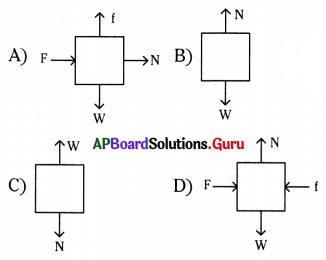
B) adopting four R’s : Reduce, Reuse, Recycle and Recover
C) applying biofertilizers and manures
D) all the above
Answer:
D) all the above

Question 21.
The average per capita solid wastes produced per day is
A) 264 gms
B) 364 gms
C) 634 gms
D) 346 gms
Answer:
B) 364 gms

Question 22.
This is the simple and most widely used technique of solid waste management.
A) burying the waste
B) burning the waste
C) incineration of waste
D) pyrolysis
Answer:
A) burying the waste

Question 23.
The solid waste management process which is expensive and cause air pollution
A) burying the waste
B) pyrolysis
C) incineration of waste
D) bioremediation
Answer:
C) incineration of waste

AP 9th Class Biology Bits Chapter 10 Soil Pollution

Question 24.
Using a biological remedy to reduce or clean up contamination is known as
A) pyrolysis
B) incineration
C) bioaccumulation
D) bioremediation
Answer:
D) bioremediation

Question 25.
Volatile elements which can be released directly from plants to atmosphere are
A) lead, mercury
B) mercury, selenium
C) selenium, lead
D) antimony, mercury
Answer:
B) mercury, selenium

Question 26.
Land pollution occurs massively during
A) earthquakes, floods
B) land slides, hurricanes
C) earthquakes, floods, land slides
D) earthquakes, floods, land slides, hurricanes
Answer:
D) earthquakes, floods, land slides, hurricanes

Question 27.
This method helps in the percolation of water into the soil.
A) no – till farming
B) contour ploughing
C) crop rotation
D) planting trees
Answer:
B) contour ploughing

Question 28.
The uptake of nutrients in plants is also governed to a certain extent by
A) nature of the soil
B) soil pH
C) soil organisms
D) crop rotation
Answer:
B) soil pH

Question 29.
Number of earthworms present in one acre of land where the top soil is eight inches thick
A) 5000
B) 50000
C) 15000
D) 17000
Answer:
B) 50000

Question 30.
Step Farming is common in ………………..
A) Plains
B) Platues
C) Hills
D) Low lands
Answer:
C) Hills

AP 9th Class Biology Bits Chapter 10 Soil Pollution

Question 31.
The microorganisms that help in the formation of soil …………………
A) Moss
B) Bacteria
C) Lichen
D) A and C
Answer:
D) A and C

Question 32.
Burning of fossil fuel adds ……………………..
A) H2, O2, N2 in air
B) CO2, NO2, SO2 gases in air
C) SO2, O2
D) SO3, SO2
Answer:
B) CO2, NO2, SO2 gases in air

Question 33.
Soil is the component of ………………
A) Atmosphere
B) Hydrosphere
C) Lithosphere
D) Biosphere
Answer:
C) Lithosphere

Question 34.
Soil that is best suited for plant growth is ………………
A) Clayey
B) Loamy
C) Sandy
D) Gravel
Answer:
B) Loamy

Question 35.
Biological weathering is caused by
A) Lichens
B) Mosses
C) Roots of plants
D) All the above
Answer:
D) All the above

Question 36.
Toxic chemicals released by paper industry are
A) Cadmium
B) Mercury
C) Lead
D) Nickel
Answer:
B) Mercury

Question 37.
Major sources of formation of soil is
A) Rocks
B) Himalayas
C) Riverbeds
D) Volcanoes
Answer:
A) Rocks

AP 9th Class Biology Bits Chapter 10 Soil Pollution

Question 38.
Sun causes weathering of rocks through
A) Physical phenomena
B) Biological changes
C) Chemical changes
D) Mechanical force
Answer:
B) Biological changes

Question 39.
These are considered as wind breaks
A) Rows of trees and shrubs
B) Growing grasses alternating with crops
C) Compound walls
D) Raising edges of fields
Answer:
A) Rows of trees and shrubs

Question 40.
This gas is formed on burning of wood
A)NO2
B)O2
C) H2
D) CO2
Answer:
D) CO2

Question 41.
Ozone layer is present in this layer
A) Troposphere
B) Stratosphere
C) Ionosphere
D) None
Answer:
B) Stratosphere

Question 42.
“Friend of the farmer” ……………….
A) Frogs
B) Earthworms
C) Snails
D) Toads
Answer:
B) Earthworms

Question 43.
Biological remedy to clean up contamination is
A) Bio-remediation
B) Phyto remediation
C) Bio-magnification
D) Both A and B
Answer:
D) Both A and B

Question 44.
The hazardous elements that are released directly from plants to atmosphere
A) Selenium
B) Mercury
C) Lead
D) Both A and B
Answer:
D) Both A and B

AP 9th Class Biology Bits Chapter 10 Soil Pollution

Question 45.
Identify the mismatched pairs from the following.
1) Reuse – Iron
2) Recycling – Paper
3) Contour ploughing – Soil Erosion
A) 1, 2
B) 2, 3
C) 1, 3
D) 1 only
A) 1, 2

Question 46.
Anaerobic/aerobic decomposition of biodegradable municipal and domestic wastes give
A) Natural gas
B) CNG
C) LPG
D) Gober gas
Answer:
D) Gober gas

Question 47.
These are considered as valuable sinks for CO2 ………………….
A) Fields
B) Rivers
C) Lakes
D) Forests
Answer:
D) Forests

Question 48.
Example for hazardous solid waste
A) Industrial and hospital waste
B) Debris
C) Chemical wastes
D) Discarded medicines
Answer:
A) Industrial and hospital waste

Question 49.
The best example for bio-magnification is …………………..
A) D.D.T
B) B.H.C
C) Dieldrin
D) All the above
Answer:
D) All the above

Question 50.
Identify the correct matching from the following.
List – A
1) Soil below pH7
2) Soil above pH7
3) Mycorrhiza

List – B
a) Symbiosis
b) Acidic
c) Basic
A) 1 – a, 2 – b, 3 – c
B) 1 – b, 2 – a, 3 – c
C) 1 – b, 2 – c, 3 – a
D) 1 – c, 2 – c, 3 – b
Answer:
C) 1 – b, 2 – c, 3 – a

Question 51.
Identify the mismatched pair from the following.
1) Biodegradable waste – Dung
2) Non-Biodegradable waste – Radioactive waste
3) D.D.T – Weedicide
A) 1, 2
B) 2, 3
C) 1, 3
D) 3 only
Answer:
D) 3 only

AP 9th Class Biology Bits Chapter 10 Soil Pollution

Question 52.
Identify the correct matching from the following.
1) Biomagnification – Food chain
2) Solid wastes – Deforestation
3) Soil erosion – Burying the waste
A) 1, 3
B) 2 only
C) 1, 2
D) 1 only
Answer:
D) 1 only

Question 53.
Choose the correct matching from the following.
List – A
1) Incinaration
2) Bioremediation
3) Phytoremediation

List – B
a) Plants
b) Clean up contamination
c) Expensive method
A) 1 – a, 2 – b, 3 – c
B) 1 – c, 2 – b, 3 – a
C) 1 – a, 2 – c,3 – b
D) 1 – c, 2 – a,3 – b
Answer:
B) 1 – c, 2 – b, 3 – a

Question 54.
The range of pH values of a good soil lies from ………………..
A) 5.5 – 6.5
B) 6 – 7
C) 5.5 to 7.5
D) 5.5 – 8.5
Answer:
C) 5.5 to 7.5

Question 55.
D.D.T was not soluble in water but in …………….
A) Phenol
B) Fat
C) Carbohydrate
D) Benzene
Answer:
B) Fat

Question 56.
Expanded form of D.D.T is …………….
A) Di Dehydro Tetracycline
B) Diphenol Dihydro Tetrane
C) Dichloro Diphenyle Trichloro Ethane
D) Dichloro Diphenol Tri Ethane
Answer:
C) Dichloro Diphenyle Trichloro Ethane

Question 57.
The process of combustion in absence of oxygen is ……………………..
A) Incineration
B) Pyrolysis
C) Burning
D) Oxidation
Answer:
B) Pyrolysis

Question 58.
Calcium deficiency in soils is due to
A) High pH value
B) Low pH value
C) High Mg value
D) High humus value
Answer:
B) Low pH value

AP 9th Class Biology Bits Chapter 10 Soil Pollution

Question 59.
Microbial activity and nutrient absorption in soils is due to
A) Low pH
B) High pH
C) High Humus
D) None
Answer:
B) High pH

II. Match the following:

i)

Group – A Group – B
1) Soil below pH 7 A) Symbiosis
2) Soil above pH 7 B) Weedicide
3) Mineralization C) Insecticide
4) Mycorrhiza D) Radioactive waste
5) Biodegradable waste E) Alkaline
6) Non-biodegradable waste F) Dung
7) DDT G) Soil microbes
H) Acidic

Answer:
1) Soil below pH 7 – H) Acidic
2) Soil above pH 7 – E) Alkaline
3) Mineralization – G) Soil microbes
4) Mycorrhiza – A) Symbiosis
5) Biodegradable waste – F) Dung
6) Non-biodegradable waste – D) Radioactive waste
7) DDT – C) Insecticide

ii)

Group – A Group – B
1) Biomagnification A) Methane
2) Soil erosion B) Expensive method
3) Solid wastes C) Clean up contamination
4) Incineration D) Food chain
5) Cow dung E) Burying the waste
6) Bioremediation F) Deforestation
7) Phytoremediation G) Animals
H) Plants

Answer:
1) Biomagnification – D) Food chain
2) Soil erosion – F) Deforestation
3) Solid wastes – E) Burying the waste
4) Incineration – B) Expensive method
5) Cow dung – A) Methane
6) Bioremediation – C) Clean up contamination
7) Phytoremediation – H) Plants

Question 60.
Which of the following does NOT cause soil pollution ?
A) Vegetable peels
B) Acid rain
C) Pesticides
D) Polythene bags
Answer:
A) Vegetable peels

AP 9th Class Biology Bits Chapter 10 Soil Pollution

Question 61.
One of the following statements is practicable keeping in view of waste management
A) Solid waste management involves collection, transfer and transport to suitable places.
B) We cannot treat industrial wastes.
C) Acidic and alkaline wastes should not be neutralised before disposal.
D) We should follow the Pyrolysis process as it requires more oxygen.
Answer:
A) Solid waste management involves collection, transfer and transport to suitable places.

Question 62.
BOD means
A) Basic Oxygen Demand
B) Biological Oxygen Demand
C) Biological Organic Demand
D) Biological Organic Density
Answer:
B) Biological Oxygen Demand

AP 9th Class Biology Bits Chapter 9 Adaptations in Different Ecosystems with Answers

Practice the AP 9th Class Biology Bits with Answers Chapter 9 Adaptations in Different Ecosystems on a regular basis so that you can attempt exams with utmost confidence.

AP State Syllabus 9th Class Biology Bits 9th Lesson Adaptations in Different Ecosystems with Answers

I. Choose the correct answers :

Question 1.
Pneumatophores of mangrove trees helps in
A) photosynthesis
B) root respiration
C) transpiration
D) absorption
Answer:
B) root respiration

Question 2.
Nowadays these plants are grown as ornamental plants.
A) hydrophytes
B) xerophytes
C) both A and B
D) none
Answer:
B) xerophytes

AP 9th Class Biology Bits Chapter 9 Adaptations in Different Ecosystems

Question 3.
The fat storing part of a camel is
A) hump
B) stomach
C) skin
D) all
Answer:
A) hump

Question 4.
The desert animal of North America which can live without drinking water through out its life is
A) sand grouse
B) fennec fox
C) kangaroo rat
D) golden mole
Answer:
C) kangaroo rat

Question 5.
Animal that emit a high pitched sound which bounses off objects to find prey is
A) cuttle fish
B) bat
C) cricket insect
D) cat
Answer:
B) bat

Question 6.
Identify the marine ecosystem.
A) ponds
B) streams
C) rivers
D) oceans
Answer:
D) oceans

Question 7.
In these organisms droplets of oil in their cells are present to keep them float.
A) planktons
B) dolphins
C) larger plants
D) fishes
Answer:
A) planktons

Question 8.
For every 10 meters depth, pressure increases by
A) one atmosphere
B) two atmospheres
C) three atmospheres
D) four atmospheres
Answer:
A) one atmosphere

Question 9.
In whales and seals oxygen mostly stored in
A) lungs
B) muscle tissue
C) skin
D) all
Answer:
B) muscle tissue

AP 9th Class Biology Bits Chapter 9 Adaptations in Different Ecosystems

Question 10.
Aquatic organisms adapted the ability to travel long distances
A) sperm whales
B) herring gills
C) both A and B
D) none
Answer:
C) both A and B

Question 11.
Zones present in the marine ecosystem
A) euphotic zone, bathyal zone
B) bathyal zone, abyssal zone
C) abyssal zone, euphotic zone
D) euphotic zone, bathyal zone, abyssal zone
Answer:
D) euphotic zone, bathyal zone, abyssal zone

Question 12.
Photosynthetic activity is maximum in this zone.
A) bathyal zone
B) euphotic zone
C) abyssal zone
D) all
Answer:
B) euphotic zone

Question 13.
The zone in marine ecosystem which is dark and cold throughout the year ?
A) abyssal zone
B) bathyal zone
C) euphotic zone
D) bathyal and abyssal zone
Answer:
A) abyssal zone

Question 14.
Electric eel is capable of generating power electric shocks of up to
A) 500 volts
B) 600 volts
C) 700 volts
D) 400 volts
Answer:
B) 600 volts

Question 15.
Identify the salt water lake.
A) Kolleru
B) Pulikat of Nellore
C) Osman Sagar
D) Shamir pet lake
Answer:
B) Pulikat of Nellore

Question 16.
The factors effect the organisms in fresh water ecosystem
A) light salt content
B) food
C) oxygen
D) all the above
Answer:
D) all the above

AP 9th Class Biology Bits Chapter 9 Adaptations in Different Ecosystems

Question 17.
The salt content of sea water is
A) 2.8%
B) 2.5%
C) 3.5%
D) 3.8%
Answer:
C) 3.5%

Question 18.
Fresh water fishes have
A) low salt content in the body
B) higher internal salt content in the body
C) both A and B
D) very low salt content in the body
Answer:
B) higher internal salt content in the body

Question 19.
Some plants in temperate regions shed their leaves before the
A) winter
B) summer
C) autumn
D) rainy season
Answer:
A) winter

Question 20.
Our state bird Has
A) finch
B) eagle
C) parrot
D) pigeon
Answer:
A) finch

Question 21.
Symbiotic association is seen between animals of ocean.
A) whales, herring gulls
B) clown fish, sea anemone
C) ray fish, sea anemone
D) whale, clown fish
Answer:
B) clown fish, sea anemone

Question 22.
What is the use of hump in Camel ?
A) To store food
B) To store water
C) Stores fat for later use
D) All the above
Answer:
C) Stores fat for later use

Question 23.
What is the term for all the biotic and abiotic components of a system ?
A) Ecosystem
B) Ecotone
C) Biome
D) Community
Answer:
A) Ecosystem

AP 9th Class Biology Bits Chapter 9 Adaptations in Different Ecosystems

Question 24.
Which of the following is a marine adaptation ?
A) Hibernation
B) Aestivation
C) Photosynthesis
D) Symbiosis
Answer:
D) Symbiosis

Question 25.
A coastal body of water connected to the ocean and supplied with fresh water from a river is an –
A) Inlet
B) Shelf
C) Estuary
D) Atoll
Answer:
C) Estuary

Question 26.
Why the leaves of kalabanda are reduced to spines ?
A) Protection
B) To kill enemies
C) To reduce water loss
D) None of the above
Answer:
C) To reduce water loss

Question 27.
The abyssal zone is present between
A) 0 – 200 m
B) 200m – 2000m
C) 2000 – 6000m
D) None of the above
Answer:
C) 2000 – 6000m

Question 28.
Kolleru lake of East Godavari is an example for –
A) Marine ecosystem
B) Fresh water ecosystem
C) Terrestrial ecosystem
D) Esturine ecosystem
Answer:
B) Fresh water ecosystem

Question 29.
Which of the following is a part of marine ecosystem ?
A) Bathyl zone
B) Lenthic zone
C) Lothic zone
D) Euphotic zone
Answer:
A) Bathyl zone

Question 30.
These fishes take more water.
A) Fresh water fishes
B) Marine fishes
C) Deep sea fishes
D) Esturine fishes
Answer:
B) Marine fishes

AP 9th Class Biology Bits Chapter 9 Adaptations in Different Ecosystems

Question 31.
Most of the producers in an aquatic ecosystem are …………………..
A) Fungi
B) Bacteria
C) Algae
D) Virus
Answer:
C) Algae

Question 32.
The respiratory organs of fish
A) Fins
B) Nose
C) Gills
D) Lungs
Answer:
C) Gills

Question 33.
Identify the biotic component among the following.
A) Air
B) Soil
C) Water
D) Plants
Answer:
B) Soil

Question 34.
Choose the correct matching from the following.
List – A
1) Hydrophytes
2) Xerophytes
3) Mesophytes

List – B
a) Banyan
b) Acasia
c) Hydrilla
A) 1 – b, 2 – a, 3 – c
B) 1 – c, 2 – b, 3 – a
C) 1 – c, 2 – a, 3 – b
D) 1 – a, 2 – b, 3 – c
Answer:
D) 1 – a, 2 – b, 3 – c

Question 35.
Identify the abiotic components from the following.
A) Animals
B) Fungi
C) Plants
D) Water
Answer:
D) Water

Question 36.
Which of the following take part in symbiosis of Lichen ?
A) Fungus – Fungus
B) Algae – Algae
C) Alga – Fungus
D) Fungus – Gymnosperm
Answer:
C) Alga – Fungus

Question 37.
Which of the following is a Xeric plant ?
A) Hydrilla
B) Vallisneria
C) Opuntia
D) Balsam
Answer:
C) Opuntia

AP 9th Class Biology Bits Chapter 9 Adaptations in Different Ecosystems

Question 38.
Darwin observed the variations in Finch birds …………………
A) West-Indies islands
B) Indonesia
C) Malasia
D) Galapagos Islands
Answer:
D) Galapagos Islands

Question 39.
Identify the mismatched pair from the following.
1) Hibernation – Estuaries
2) Aestivation – Summer sleep
3) Mangrooves – Winter sleep
A) 1, 2
B) 2, 3
C) 1, 3
D) 1, 2, 3
Answer:
C) 1, 3

Question 40.
Identify the mismatched pair from the following.
1) Mutualism – Leguminous plants
2) Commensalism – Lianes
3) Parasitism – Tapeworms
A) 1, 2
B) 2, 3
C) 1, 2, 3
D) None of the above
Answer:
D) None of the above

Question 41.
Example for Camouflage is ……………..
A) Frogs
B) Fishes
C) Chameleon
D) Dragon fly
Answer:
C) Chameleon

Question 42.
We can see arenchyma in these plants ……………….
A) Xerophytes
B) Lichens
C) Mesophytes
D) Hydrophytes
Answer:
D) Hydrophytes

Question 43.
Example for Xerophytes ………………….
A) Agave
B) Opuntia
C) Cactus
D) All the above
Answer:
D) All the above

Question 44.
Mosses, water lilly, hydrilla are seen in ………………
A) Littoral zone
B) Limnetic zone
C) Profundal zone
D) None
Answer:
A) Littoral zone

AP 9th Class Biology Bits Chapter 9 Adaptations in Different Ecosystems

Question 45.
Crustaceans, crabs, fishes like eels, snails, turtles, etc. are present in
A) Littoral zone
B) Profundal zone
C) Limnetic zone
D) None
Answer:
C) Limnetic zone

Question 46.
Identify the correct matching from the following.
List – A
1) Pnematophores
2) Desert ship
3) Gas filled vehicles

List – B
a) Camel
b) Cyanobacteria
c) Mangrooves
A) 1 – c, 2 – b, 3 – a
B) 1 – c, 2 – a, 3 – b
C) 1 – b, 2 – a, 3 – c
D) 1 – a, 2 – b, 3 – c
Answer:
B) 1 – c, 2 – a, 3 – b

II. Match the following.
1.

Group – A Group – B
1. Pneumatophores A) Xerophytes
2. Succulent stem B) Bat
3. Hump C) Mangroves
4. Ornamental plants D) Kalabanda
5. High pitched sound E) Mango
F) Rat
G) Camel

Answer:
1. Pneumatophores – C) Mangroves
2. Succulent stem – D) Kalabanda
3. Hump – G) Camel
4. Ornamental plants – A) Xerophytes
5. High pitched sound – B) Bat

2.

Group – A Group – B
1. Hibernation A) Insulator
2. Aestivation B) Colour change
3. Camouflage C) Galapagos islands
4. Blubber D) Winter sleep
5. Finches E) Summer sleep
F) Autumn sleep
G) Absorbs heat

Answer:
1. Hibernation – D) Winter sleep
2. Aestivation – E) Summer sleep
3. Camouflage – B) Colour change
4. Blubber – A) Insulator
5. Finches – C) Galapagos islands

AP 9th Class Biology Bits Chapter 9 Adaptations in Different Ecosystems

III. dentify and label the diagrams given below.
AP 9th Class Biology Bits Chapter 9 Adaptations in Different Ecosystems 1
Answer:
1) Aloevera
2) Pebble plant
3) Coral colonies
4) Rayfish
5) Ploar bear
6) Seal

Question 47.
In which zone of the ocean do marine organisms with very sharp vision live?
A) Bathyal zone
B) Euphotic zone
C) Abyssal zone
D) All the above
Answer:
B) Euphotic zone

Question 48.
Lichens are symbiotic association of
A) Algae and bacteria
B) Algae and fungi
C) Bacteria and virus
D) Fungi and bacteria
Answer:
B) Algae and fungi

Question 49.
If you need to prepare a report on Darwin’s Finches, which of the following important points you would choose to summerise ?
A) Organisms are stable during environmental changes.
B) All species living in an ecosystem show same adaptations.
C) Organisms of the same species adapt to their surroundings based on the food source.
D) Adaptations acquired by organisms are not transferred to the next generations.
Answer:
C) Organisms of the same species adapt to their surroundings based on the food source.

Question 50.
Match the following.

List – A List – B
1. 1. Shed leaves before winter a) Famous for Darwin s finch
2. Extreme conditions of heat and cold b) Plants of temperate region
3. Patther phul c) Hibernation and aestivation
4. Galapagos island d) A type of lichen

A) b, c, d, a
B) a, b, c, d
C) d, c, b, a
D) b, d, c, a
Answer:
A) b, c, d, a

Question 51.
If photosynthetic activities are absent in Abyssal zone, then
A) The organisms would strive for food
B) The organisms would be blind
C) There will be no change
D) Brittle stars will be affected
Answer:
B) The organisms would be blind

Question 52.
A biology teacher tied a plastic cover over opuntia plant to observe transpiration. The result will be
A) No water will be accumulated in the cover
B) There will be some water in the cover
C) Either A or B is possible in condition with light
D) Neither A nor B is possible
Answer:
D) Neither A nor B is possible

Question 53.
Which sentence is related to desert plants ?
1) Wax coated, thickend membraneous cells
2) Stem filled with sap
3) Leaves are modified into spines
A) 1 only
B) 2 only
C) 3 only
D) All are correct
Answer:
D) All are correct

AP 9th Class Biology Bits Chapter 9 Adaptations in Different Ecosystems

Question 54.
Camel protects its eyes from sand due to its
A) hump
B) long legs
C) broad eye lashes
D) shape of the animal
Answer:
C) broad eye lashes

Question 55.
Read the following statements.
i) The animals which live in Abyssal zone have big eyes.
ii) The Euphotic zone have more number of animals.
A) (i) and (ii) are correct
B) (i) is correct
C) (ii) is correct
D) both are wrong
Answer:
C) (ii) is correct

Question 56.
In which of the following situation do stomata close
i) When the climate turns cool.
ii) When the climate is very hot.
iii) When the climate is humid.
iv) All the above
A) i, ii
B) ii, iii only
C) i, iii only
D) All are true
Answer:
A) i, ii

AP 9th Class Biology Bits Chapter 8 Challenges in Improving Agricultural Products with Answers

Practice the AP 9th Class Biology Bits with Answers Chapter 8 Challenges in Improving Agricultural Products on a regular basis so that you can attempt exams with utmost confidence.

AP State Syllabus 9th Class Biology Bits 8th Lesson Challenges in Improving Agricultural Products with Answers

Choose the correct answers :

Question 1.
The factor responsible for increase in production of a crop
A) Kind of seeds planted
B) Properties of the soil
C) The availability and proper application of irrigation and fertilisers
D) All
Answer:
D) All

Question 2.
We can increase the food production by
A) Increasing the area of cultivated land
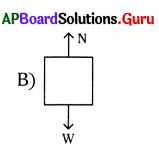
B) Developing high yielding varieties.
C) Alternate crops
D) All
Answer:
D) All

AP 9th Class Biology Bits Chapter 8 Challenges in Improving Agricultural Products

Question 3.
Alternating of crops preserve the
A) Soil fertility
B) High yielding varieties
C) Soil management
D) Crop management
Answer:
A) Soil fertility

Question 4.
Starch is a
A) Fat
B) Carbohydrate
C) Protein
D) Vitamin
Answer:
B) Carbohydrate

Question 5.
100 gms of water react with 200 grams of carbondioxide to form how many grams of carbohydrate ?
A) 280 grams
B) 360 grams
C) 180 grams
D) 380 grams
Answer:
C) 180 grams

Question 6.
Most of the water released by plants, evaporate from the leaves through
A) Epidermis
B) Mesophyll cell
C) Stomata
D) Xylem
Answer:
C) Stomata

Question 7.
This crop require more quantity of water.
A) Paddy
B) Black gram
C) Ground nut
D) Bajra
Answer:
A) Paddy

Question 8.
The irrigation system helps in preserving water wastage
A) Canal irrigation
B) Pond irrigation
C) Drip irrigation
D) None
Answer:
C) Drip irrigation

Question 9.
Identify the macro nutrient.
A) Iron
B) Nitrogen
C) Copper
D) Manganese
Answer:
B) Nitrogen

AP 9th Class Biology Bits Chapter 8 Challenges in Improving Agricultural Products

Question 10.
Nutrients are added to the soil by
A) Rotating crops
B) Organic manure
C) Chemical fertilizers
D) All
Answer:
D) All

Question 11.
Crops that take lot of nutrients from the soil are
A) Cereals
B) Pulses
C) Tubers
D) All
Answer:
A) Cereals

Question 12.
Leguminous crop gives about how many kg of nitrogen per hectare
A) 150 to 200 kg
B) 50 to 150 kg
C) 100 to 150 kg
D) 25 to 100 kg
Answer:
B) 50 to 150 kg

Question 13.
Blue green algae culture is applied in
A) Potato fields
B) Drumstick field
C) Ground nut fields
D) Paddy field
Answer:
D) Paddy field

Question 14.
Who suggest the type of crop to be grown after observing the field ?
A) Agricultural officer
B) Soil testing technologist
C) Both A and B
D) Village Development Officer
Answer:
C) Both A and B

Question 15.
The main ingredients of Panchagavya are
A) Milk, Curd
B) Ghee, Dung
C) Urine of Cow
D) All the above
Answer:
D) All the above

Question 16.
Long term high yielding capacity of soil depends on
A) Availability of nutrients in the soil
B) Suitable physical, chemical and biological characters of soil
C) Both A and B
D) Rainfall
Answer:
C) Both A and B

AP 9th Class Biology Bits Chapter 8 Challenges in Improving Agricultural Products

Question 17.
In organic farming farmers
A) Use natural manures
B) Use natural pest controlling methods
C) Practise crop rotation and mixed crop system
D) All
Answer:
D) All

Question 18.
Urea has how much percentage of nitrogen ?
A) 36 %
B) 46 %
C) 56 %
D) 44 %
Answer:
B) 46 %

Question 19.
Insecticides are chemicals used to kill
A) Microorganisms
B) Worm
C) Insects
D) Fungus
Answer:
C) Insects

Question 20.
Pesticides and insecticides are used in large quantities in this district.
A) Guntur
B) Prakasam
C) Nellore
D) A and C
Answer:
D) A and C

Question 21.
Identify the friendly insect.
A) Spider, dragonfly
B) Krisopa, mirids
C) Lady bird beetle
D) All
Answer:
D) All

Question 22.
Bacterium lives in the eggs of stem borer
A) Bacillum
B) Trachoderma
C) Rhizobium
D) Azotobactor
Answer:
B) Trachoderma

Question 23.
Bacteria that destroy some pests is
A) Bacillus Turingenesis
B) Rhizobium
C) Azotobactor
D) Bacillus Pseudomonos
Answer:
A) Bacillus Turingenesis

AP 9th Class Biology Bits Chapter 8 Challenges in Improving Agricultural Products

Question 24.
After paddy, cultivating black gram prevents
A) Tungro virus on paddy
B) Gram caterpillar
C) Spotted boleworm
D) All
Answer:
A) Tungro virus on paddy

Question 25.
Nitrogen fixing Bacteria
A) Rhizobium
B) Bacillus
C) Micoryza
D) Pencillium
Answer:
A) Rhizobium

Question 26.
Krisopa, lady birds, beetles are the examples of
A) Crop destroyers
B) Friendly insects
C) Crop enemies
D) Insecticides
Answer:
B) Friendly insects

Question 27.
Example of algae as nitrogen fixer
A) Blue green algae
B) Red algae
C) Brown algae
D) Above all
Answer:
A) Blue green algae

Question 28.
Example of phosphorus solubiliser
A) Blue green algae
B) Micorhyza
C) Pencillium
D) Pseudomonas
Answer:
C) Pencillium

Question 29.
The fungi used as biofertilizer
A) Azoto bactor
B) Bacillus
C) Micorhyza
D) Blue green algae
Answer:
C) Micorhyza

Question 30.
Peta and IR – 8 are
A) Sugarcane varieties
B) Orange crop varieties
C) Rice varieties
D) Wheat crops
Answer:
C) Rice varieties

AP 9th Class Biology Bits Chapter 8 Challenges in Improving Agricultural Products

Question 31.
Example for mixed crop ………………………
A) Groundnut + Sugarcane
B) Sugarcane + Beetle
C) Rice + Groundnut
D) Maize + Red gram
Answer:
D) Maize + Red gram

Question 32.
Find the odd one out.
A) Boran
B) Zinc
C) Copper
D) Sulphur
Answer:
D) Sulphur

Question 33.
Find the odd one out.
A) K
B) Ca
C) Mg
D) Cl
Answer:
D) Cl

Question 34.
Which one of the following nutrients is not available in fertilizers?
A) Iron
B) Calcium
C) Potassium
D) Nitrogen
Answer:
A) Iron

Question 35.
Xanthium and Parthenium are examples of …………………..
A) Weeds
B) Pesticides
C) Fungicides
D) Crop varieties
Answer:
A) Weeds

Question 36.
Which one of the following is raised as food for the livestock ?
A) Millet
B) Sorghum
C) Lenta
D) Sugarcane
Answer:
C) Lenta

Question 37.
The way of incorporating desirable characters into crop varieties is by
A) Hybridisation
B) Crop rotation
C) Intercropping
D) Multiple cropping
Answer:
A) Hybridisation

AP 9th Class Biology Bits Chapter 8 Challenges in Improving Agricultural Products

Question 38.
NPK ratio in organic fertilizer
A) Above 14%
B) Below 14%
C) Above 40%
D) Below 40%
Answer:
A) Above 14%

Question 39.
Find out the micro nutrient from the following.
A) Boran, Iron, Copper
B) Phosphorus, Potash
C) Potash, Chlorine, Zinc
D) Nitrogen, Zinc, Manganese
Answer:
A) Boran, Iron, Copper

Question 40.
This crop requires very less amount of water.
A) Red gram
B) Sugarcane
C) Wheat
D) Paddy
Answer:
A) Red gram

Question 41.
Identify the weed present in the crop of mirchi.
A) Garika
B) Pulichinta
C) Pogakumalli
D) Varipilla Gaddi
Answer:
B) Pulichinta

Question 42.
This is a nitrogen fixer.
A) Pseudomonas
B) Michorhyza
C) Pencillium
D) Azotobacter
Answer:
D) Azotobacter

Question 43.
The crop that is grown along with cabbage is
A) Sugarcane
B) Maize
C) Groundnut
D) Carrot
Answer:
C) Groundnut

Question 44.
Absorption of CO2 and evaporation of water occurs through ………………….
A) Leaves
B) Roots
C) Stomata
D) Stem
Answer:
C) Stomata

AP 9th Class Biology Bits Chapter 8 Challenges in Improving Agricultural Products

Question 45.
Identify the mismatched pair from the following.
List – A     –     List – B
1) Rabi crop – Mustard
2) Kharif crop –  Cotton
3) Mixed crop –  Sugarcane
A) 1, 2
B) 2, 3
C) 1 only
D) 3 only
Answer:
D) 3 only

Question 46.
Identify the mismatched pair from the
following.
List – A        –     List – B
1) Dragon fly – Predator of pests
2) Coconut water – Panchagavya
3) Kulthi – Mixed crop
A) 1, 2
B) 2, 3
C) 1 only
D) 3 only
Answer:
D) 3 only

Question 47.
Identify the mismatched pair from the following.
1) Bacteria – Rhyzobium
2) Algae – Bluegreen algae
3) Fungi – Pseudomonas
A) 1, 2
B) 2, 3
C) 2 only
D) 3 only
Answer:
D) 3 only

Question 48.
Identify the mismatched pair from the following.
1) Rice – Wanza
2) Tobacco – Gaddi chamanthi
3) Groundnut – Pogakumalli
A) 1 only
B) 1,2
C) 2,3
D) 3 only
Answer:
C) 2,3

Name of the Crop Weeds that grown on crop
Paddy Cynodon dactylon, Digitaria iongi folia, Cyperus rotundus, Eichornia.
Groundnut Leucas aspera, Portulaca oleracea, Cleome sps, Abutilon indicum, Euphorbia cynodon dactylon, Commelina bengalensis, Cyperus roturdus.
Black gram Cynodon dactylon, Cyperus rotundus, Abutilon indicum, Commalina bengalensis, Euphorbia hirta.
Maize Euphorbia hirta, solanum nigrum, cyperus rofundus, cynodon dactylon.
Green gram Eichnochloa colonum, cyperus rotundus cynodon dactylon, Argemone mexicana, Portulaca oleracea.

Question 49.
Observe the table and answer the question.
Common weed that grow on all crops is
i) Cynodon dactylon
ii) Portulaca oleracea
iii)Cyperus rotundus
iv) Euphorbia hirta
A) i, ii and iii
B) i, iii and iv
C) ii and iv only
D) i and iii only
Answer:
D) i and iii only

Question 50.
Choose the correct matching from the following.
1) Nitrogen – a) Root penetration
2) Phosphorus – b) Resistance towards pests
3) Potassium – c) Flowers arise fastly
A) 1 – a, 2 – c, 3 – b
B) 1 – c, 2 – b, 3 – a
C) 1 – a, 2 – b, 3 – c
D) 1 – c, 2 – a, 3 – b
Answer:
D) 1 – c, 2 – a, 3 – b

Question 51.
Choose the correct matching from the following.
1) Azotobactor – a) G.M. seed
2) B.T. cotton – b) Mixed crop
3) Marigold in Mirchi – c) Bio-fertilizer
A) 1 – c, 2 – b, 3 – a
B) 1 – a, 2 – c, 3 – b
C) 1 – a, 2 – b, 3 – c
D) 1 – c, 2 – a, 3 – b
Answer:
D) 1 – c, 2 – a, 3 – b

AP 9th Class Biology Bits Chapter 8 Challenges in Improving Agricultural Products

II. Match the following :
1.

Group – A Group – B
1) Mixed crop A) Transpiration
2) Stomata B) Dry land crops
3) Micro nutrient C) Betel
3) Irrigation D) Potassium
5) Aruthadi Pantalu E) Iron
F) Watering the field
G) Wet land crops

Answer:
Group – A
1) Mixed crop – C) Betel
2) Stomata – A) Transpiration
3) Micro nutrient – E) Iron
3) Irrigation – F) Watering the field
5) Aruthadi Pantalu – B) Dry land crops

2.

Group – A Group – B
1) Drip irrigation A) Legume plants
2) Watershed B) Plant leaves
3) Root nodules C) Prevent water wastage
4) Bacterial culture D) Stems of plants
5) Green manure E) Ground water level
6) Synthetic pyrethroids F) More nodules on legumes
G) Pesticides, insecticide

Answer:
1) Drip irrigation – C) Prevent water wastage
2) Watershed – E) Ground water level
3) Root nodules – A) Legume plants
4) Bacterial culture – F) More nodules on legumes
5) Green manure – B) Plant leaves
6) Synthetic pyrethroids – G) Pesticides, insecticide

Question 52.
Bacillus thuringenisis …………………………….
A) Destroys crops
B) Destroys weeds
C) Destroys pests
D) Supplies nitrogen to crops
Answer:
C) Destroys pests

Question 53.
This is a good example for concentrated organic manure
A) Animal excreta
B) Plastic waste
C) Jatropa seed powder
D) Compost
Answer:
D) Compost

Question 54.
Anwesha found that fruits of her kitchen garden lack quality of smell, colour and taste. If you were an agriculture officer, you would suggest her
A) To nourish the soil with adequate nitrogen
B) To nourish the soil with adequate phosphorous
C) To nourish the soil with adequate potassium
D) Spray pesticides
Answer:
C) To nourish the soil with adequate potassium

Question 55.
A lady-wasp spread pheromone into atmosphere, if it is not diffused then
A) Nothing will happen
B) It cannot find its mate
C) It cannot communicate with the nature
D) Both B and C
Answer:
D) Both B and C

Question 56.
Alexander attended a seminar on Challenges of Agriculture in his school. He wants to create awareness among rural farmers. He should
A) Encourage sustainable agriculture methods
B) Ban chemical fertilisers
C) Call for ban pesticides, insecticides, etc
D) Promote only food crops
Answer:
A) Encourage sustainable agriculture methods

AP 9th Class Biology Bits Chapter 8 Challenges in Improving Agricultural Products

Question 57.
The following mineral is required in small quantities for plants.
A) Nitrogen, Potassium
B) Boron, Nitrogen
C) Both A and B
D) Boron, Zinc
Answer:
D) Boron, Zinc

Question 58.
Insects that feed on other insects, are helpful to farmers
A) heterotrophs
B) friendly insects
C) insecticides
D) attractive inseGts
Answer:
B) friendly insects

Question 59.
The things used in preparation of Panchagavya
1) Cow dung, ghee
2) Coconut water, Alcohol
3) Juice of Sugarcane
4) Urine of Cow
A) Only 1
B) 2 and 3
C) 3 and 4
D) All of these
Answer:
C) 3 and 4

Question 60.
The correct statement for organic farming is
A) Promote usage of natural manure
B) Discourage use of vermi compost
C) Use urea injudiciously
D) More use of insecticides
Answer:
A) Promote usage of natural manure

Question 61.
Identify the micro nutrients which are useful for plant health.
i) Manganese
ii) Boron
iii) Phosphorous
iv) Copper
A) i and ii
B) i, ii and iii
C) i, ii and iv
D) All the above
Answer:
C) i, ii and iv

Question 62.
If a farmer had been using insecticides for a long time, then
A) Soil fertility decreases
B) Insect population decreases initially
C) Insects develop resistance towards the pesticides
D) All the above
Answer:
D) All the above

Question 63.
Ramesh collected the information that his area comes under low rain fall. Identify the crop that is suitable to be grown in that area.
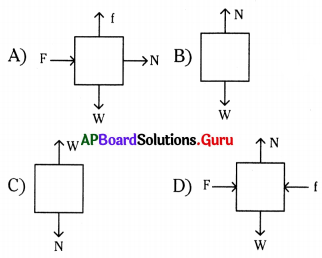
A) Sugarcane
B) Paddy
C) Ragi
D) Wheat
Answer:
C) Ragi

AP 9th Class Biology Bits Chapter 8 Challenges in Improving Agricultural Products

Question 64.
Cultivating Marigold in Mirchi crop is ………………………..
A) To reduce pests on crops
B) Crop – rotation
C) Symbiosis
D) None of the above
Answer:
A) To reduce pests on crops

Question 65.
Friendly insects of farmers is …………………..
A) Dragonfly
B) Mirids
C) Lady bird
D) All the above
Answer:
D) All the above

Question 66.
The bacteria that capable of destroying pests like stemborers of tobacco B )
A) Lactobacillus
B) Bacillus thuringiensis
C) Rhizobium
D) Azatobactor
Answer:
B) Bacillus thuringiensis

Question 67.
Which of the following is the best method to control plant diseases ?
A) Biological control
B) The selection of disease resistant varieties
C) The introduction of disease resistant varieties
D) The breeding of permanent resistant varieties
Answer:
B) The selection of disease resistant varieties

AP 9th Class Biology Bits Chapter 7 Animal Behaviour with Answers

Practice the AP 9th Class Biology Bits with Answers Chapter 7 Animal Behaviour on a regular basis so that you can attempt exams with utmost confidence.

AP State Syllabus 9th Class Biology Bits 7th Lesson Animal Behaviour with Answers

I. Choose the correct answers :

Question 1.
Animal behaviour indicates
A) How animals find and defend resources
B) How animals relate to their physical environment
C) Avoid predators, choose mates, reproduce
D) All the above
Answer:
D) All the above

Question 2.
This influence animal behaviour.
A) Animal physiology
B) Anatomy
C) Both A and B
D) None
Answer:
C) Both A and B

AP 9th Class Biology Bits Chapter 7 Animal Behaviour

Question 3.
These are inborn behaviours.
A) Instinct
B) Imprinting
C) Conditioning
D) Imitation
Answer:
A) Instinct

Question 4.
These are examples for instinct behaviour.
A) Making nests by birds
B) Choose mates
C) Forming into groups for protection
D) All the above
Answer:
D) All the above

Question 5.
Reflexes are this type of behaviour.
A) Imitation
B) Instinct
C) Conditioning
D) Imprinting
Answer:
B) Instinct

Question 6.
Chickens and ducklings recognise their mother because of a behaviour called
A) Imitation
B) Conditioning
C) Imprinting
D) Instinct
Answer:
C) Imprinting

Question 7.
Students showing different types of behaviour to a school bell as per the time is
A) Conditioning
B) Imitation
C) Imprinting
D) Instinct
Answer:
A) Conditioning

Question 8.
The scientist that conducted experiments on conditioning is
A) Kohler
B) Ivan Pavlov
C) Ervin Pepperberg
D) Hermon
Answer:
B) Ivan Pavlov

Question 9.
Examples for conditioned reflexes are
A) Standing when elder people comes.
B) Standing attention on hearing national anthem.
C) When the school bell rings in the morning students gather for assembly.
D) All the above
Answer:
D) All the above

AP 9th Class Biology Bits Chapter 7 Animal Behaviour

Question 10.
The scientist who observed imitation in chimpanzees ?
A) Kohler
B) Hermon
C) Pepperberg
D) Pavlov
Answer:
A) Kohler

Question 11.
Hungry persons want to eat immediately when they sit at the dining table but waits until everyone is seated and ready to eat because
A) Imitation
B) Instinct
C) Conditioning
D) Imprinting
Answer:
B) Instinct

Question 12.
By associating the product with attractive images the advertisers are trying to setup a response to their product with
A) Imitation
B) Instinct
C) Conditioning
D) Imprinting
Answer:
C) Conditioning

Question 13.
Scientists follow the journeys made by the animals using
A) Tagging
B) Enquiry
C) Both A and B
D) Signals
Answer:
A) Tagging

Question 14.
Searching and communicating nature of ants is because of
A) Hormones
B) Pheromones
C) Enzymes
D) All the above
Answer:
B) Pheromones

Question 15.
The insect that lay its eggs on the food material is
A) Wasp
B) Weaver bird
C) Ants
D) Cockroach
Answer:
A) Wasp

Question 16.
Which animal has great logical thinking power ?
A) Beaver
B) Dolphin
C) Squirrel
D) Scrubjay
Answer:
B) Dolphin

AP 9th Class Biology Bits Chapter 7 Animal Behaviour

Question 17.
Parrot Alex called apple as
A) Bannery
B) Cherry
C) Banana
D) Orange
Answer:
A) Bannery

Question 18.
This animal releases bad smell to protect from predators.
A) Tasmanian Devil
B) Bombardier Beetle
C) Both A and B
D) Beaver
Answer:
B) Bombardier Beetle

Question 19.
It is the scientific and objective study of animal behaviour.
A) Ecology
B) Ornithology
C) Ethology
D) Anology
Answer:
C) Ethology

Question 20.
This scientist got Nobel prize for his work on animal behaviour in 1973.
A) Konard Lorenz
B) Nikolas Timbergen
C) Karlvon Frisch
D) All the above
Answer:
D) All the above

Question 21.
This helps in learning new skills.
A) Instinct
B) Imitation
C) Conditioning
D) None
Answer:
B) Imitation

Question 22.
Who among the following, got Nobel Prize in Ethology ?
A) Timbergen
B) Konard Lorenz
C) Karlvon Frisch
D) All the above
Answer:
D) All the above

Question 23.
This helps in getting discipline among the students.
A) Imitation
B) Instinct
C) Conditioning
D) All the above
Answer:
C) Conditioning

AP 9th Class Biology Bits Chapter 7 Animal Behaviour

Question 24.
The worst smelling animal in the animal kingdom
A) Kangaroo
B) Spider
C) Chimpanzee
D) Tasmanian Devil
Answer:
D) Tasmanian Devil

Question 25.
Circus animals do so many feats in the circus. This is possible by
A) Instincts
B) Imitations
C) Conditioning
D) Imprinting
Answer:
C) Conditioning

Question 26.
‘Food stealing bird’ is ……………….
A) Peacock
B) Swift
C) Humming bird
D) Scrubjay bird
Answer:
D) Scrubjay bird

Question 27.
This animal build a dam by big trees.
A) Tasmanian Devil
B) Beaver
C) Squirrel
D) Alex
Answer:
B) Beaver

Question 28.
Reflexes are also examples for
A) Imitation
B) Imprinting
C) Conditioning
D) Instinct
Answer:
D) Instinct

Question 29.
Ducklings will follow the first moving object and treat it as their mother. This is an example for
A) Instinct
B) Imprinting
C) Conditioning
D) Reflex
Answer:
B) Imprinting

Question 30.
Cockroaches prefer the following condition
A) Light and dry
B) Dark and dry
C) Light and damp
D) Dark and damp
Answer:
D) Dark and damp

AP 9th Class Biology Bits Chapter 7 Animal Behaviour

Question 31.
What type of behaviour involves in response to stimulus ?
A) Instinct
B) Imprinting
C) Conditioning
D) Imitation
Answer:
C) Conditioning

Question 32.
What type of behaviour is responsible for ducklings identifying their mother ?
A) Instinct
B) Conditioning
C) Imitation
D) Imprinting
Answer:
D) Imprinting

Question 33.
This bird builds it’s nest by three broad leaves.
A) Sparrow
B) Tailor Bird
C) Weaver Bird
D) Crow
Answer:
C) Weaver Bird

Question 34.
Identifying and smelling ability in dogs is due to
A) Enzymes
B) Hormones
C) Pheramones
D) Medicines
Answer:
C) Pheramones

Question 35.
Ivan Pavlov belongs to the following country.
A) Austria
B) Australia
C) Russia
D) South Africa
Answer:
C) Russia

Question 36.
Conditioning is an ……………….
A) Imprinting
B) Instinct Behaviour
C) Learned Behaviour
D) All of the above
Answer:
C) Learned Behaviour

Question 37.
Which of the following is not an instinct behaviour ?
A) Spinning of web by a spider
B) Smelling ability of dogs
C) Swimming by fish
D) None of the above
Answer:
D) None of the above

AP 9th Class Biology Bits Chapter 7 Animal Behaviour

Question 38.
Migration of birds is an example of –
A) Imitation
B) Instinct
C) Imprinting
D) Conditioning
Answer:
B) Instinct

Question 39.
Konard Lorenz received Nobel Prize in the year
A) 1972
B) 1973
C) 1974
D) 1975
Answer:
D) 1975

Question 40.
Moving of bull towards plough when we untie the neck out of the pole is an example for ………………….
A) Instinct
B) Imitation
C) Conditioning
D) Reflex
Answer:
C) Conditioning

Question 41.
This is an example of harmful imitation among adolescent children.
A) Singing
B) Dancing
C) Acting
D) Smoking
Answer:
D) Smoking

Question 42.
Identify the mismatched pair from the following.
1) Training to parrot – Pepper Berg
2) Experiments on Chimpanzee – Pavlov
3) Condition experiments on dog – Kohler
A) 1 only
B) 1, 2
C) 2, 3
D) 3 only
Answer:
C) 2, 3

Question 43.
Read the following statements carefully.
a) Konard Lorenz conducted experiments on imprinting
b) A spider spinning its web is an example for imitation.
A) Both a, b incorrect
B) Both a, b correct
C) b correct, a incorrect
D) a correct, b incorrect
Answer:
D) a correct, b incorrect

Question 44.
Identify the correct matching from the following.
AP 9th Class Biology Bits Chapter 7 Animal Behaviour 1
A) (i) – d (ii) – c (iii) – b (iv) – a
B) (i) – a, (ii) – d, (iii) – c, (iv) – b
C) (i) – b, (ii) – a, (iii) – c, (iv) – d
D) (i) – b, (ii) – d, (iii) – a, (iv) – c
Answer:
D) (i) – b, (ii) – d, (iii) – a, (iv) – c

AP 9th Class Biology Bits Chapter 7 Animal Behaviour

Question 45.
Choose the correct matching from the following.
List – A
1) Instinct
2) Imprinting
3) Imitation

List – B
a) Recognising mother by child
b) Copying one by another
c) Inborn behaviour
A) 1 – c, 2 – b, 3 – a
B) 1 – a, 2 – c, 3 – b
C) 1 – b, 2 – a, 3 – c
D) 1 – c, 2 – b, 3 – a
Answer:
D) 1 -c, 2 – b, 3 – a

Question 46.
Identify the correct matching from the following.
List – A
1) Konard Lorenz
2) Copying the behaviour
3) Studying about animal behaviour

List – B
a) Imitation
b) Ethology
c) Imprinting
A) 1 – c, 2 – b, 3 – a
B) 1 – b, 2 – c, 3 – a
C) 1 – a, 2 – b, 3 – c
D) 1 – c, 2 – a, 3 – b
Answer:
D) 1 – c, 2 – a, 3 – b

II. Match the following:

1.

Group A Group B
1) Instinct A) Learned behaviour
2) Imprinting B) Saves from dangerous situations
3) Conditioning C) Inborn behaviour
4) Imitation D) Recognising mother by chickens
5) Reflex actions E) One animal copies another animal
F) Make us pain
G) Behaviour in oldage

Answer:
1) Instinct – C) Inborn behaviour
2) Imprinting – D) Recognising mother by chickens
3) Conditioning – A) Learned behaviour
4) Imitation – E) One animal copies another animal
5) Reflex actions – B) Saves from dangerous situations

2.

Group A Group B
1) Imitation experiments in chimpanzees A) Ervin Pepperberg
2) Conditioning experiment with dog B) Konard Lorenz
3) Study on Dolphins C) Nikolas Timbergen
4) Training to parrot D) Kohler
5) Behavioural study in white geese E) Hermon
F) Ivan Pavlov
G) Maslow

Answer:
1) Imitation experiments in chimpanzees – D) Kohler
2) Conditioning experiment with dog – F) Ivan Pavlov
3) Study on Dolphins – E) Hermon
4) Training to parrot – A) Ervin Pepperberg
5) Behavioural study in white geese – B) Konard Lorenz

Question 47.
Ducklings are able to recognise their mother because of
A) Impulse
B) Imprinting
C) Instinct
D) Imitation
Answer:
B) Imprinting

AP 9th Class Biology Bits Chapter 7 Animal Behaviour

Question 48.
Lavanya stopped her scooty on seeing red light of the traffic signal. This behaviour is known as ……………………
A) Imitation
B) Conditioning
C) Instinct
D) Reflex action
Answer:
B) Conditioning

Question 49.
In Pavlov’s experiment, a dog salivates on hearing a bell. Here, salivation is a ………………….
A) Natural stimulus
B) Conditioned stimulus
C) Natural response
D) Conditioned response
Answer:
D) Conditioned response

Question 50.
Neethu conducts an experiment to know the behaviour of cockroaches. She creates a container with four inter-connected chambers, to allow free movement, as shown below. She keeps 20 cockroaches in the container and observes their movement for 2 days.
Which of the following can be concluded from this experiment ?
AP 9th Class Biology Bits Chapter 7 Animal Behaviour 2
A) Do cockroaches prefer damp areas over dry areas ?
B) Do cockroaches become diseased in dark areas ?
C) What kind of food cockroaches prefer ?
D) How long it takes for cockroaches to breed and lay new eggs ?
Answer:
A) Do cockroaches prefer damp areas over dry areas ?

Question 51.
What do you understand by observing the choice box experiment conducted by your teacher ?
A) Behaviour of cockroaches
B) Selection of their pair in cockroaches
C) Food habits of cockroaches
D) None of the above
Answer:
A) Behaviour of cockroaches

Question 52.
The scientist who identified imprinting in this animal is
AP 9th Class Biology Bits Chapter 7 Animal Behaviour 3
A) Ivan Pavlov
B) Prince Doria
C) Jean Lamarck
D) Kohler
Answer:
D) Kohler

Question 53.
Bombardier beetle spray very foul smell because
A) to get food easily
B) to protect from predators
C) to attract female beetle
D) to kill the prey
Answer:
B) to protect from predators

Question 54.
The scientific study of animal behaviour under natural conditions is
A) Ecology
B) Ethology
C) Embryology
D) Neuro anatomy
Answer:
B) Ethology

AP 9th Class Biology Bits Chapter 7 Animal Behaviour

Question 55.
In the choice box experiment the cockroach prefers …………………. conditions.
i) Dark conditions
ii) Light conditions
iii) Dry conditions
iv) Damp conditions
A) i and iii
B) i and iv
C) ii and iii
D) ii and iv
Answer:
B) i and iv

Question 56.
Which of the following is an instinctive behaviour ?
A) Wasp making nest
B) Beaver constructing dams across the streams
C) Birds making nests
D) All the above
Answer:
D) All the above

Question 57.
AP 9th Class Biology Bits Chapter 7 Animal Behaviour 4
Who conducted the above experiment?
A) Ivan Pavlov – Conditioning
B) Charles Darwin – Imitation
C) Mendel – Imprinting
D) Jean Lamark – Conditioning
Answer:
A) Ivan Pavlov – Conditioning

Use this information to answer the 12 – 13 questions :
There are several types of behaviours in humans and animals which are investigated by researches. They are instinct, imprinting, conditioning, imitation, etc. Ivan Pavlov conducted experiments on dogs and proposed “Conditioning Theory”.
Question 58.
Select the incorrect sentence about conditioning :
a) It involves a response to a stimulus
b) It is not a type of learned behaviour
c) It was discovered by Ivan Pavlov
d) Pavlov used dog in his experiment
A) a, b, c only
B) b only
C) b, c only
D) All are correct
Answer:
B) b only

Question 59.
Choose correct answer about Imitation in the following :
a) Where one animal copies another animal
b) Humans are the only animals that copy each other
A) Both a, b are false
B) Both a, b are true
C) a is true, b is false
D) a is false, b is true
Answer:
C) a is true, b is false

Question 60.
Will you consider spinning of web by spider as an instinctual behaviour.
Find the correct sentence in the following :
a) The behaviour that need not be learned
b) Reflexes are also a type of instinct behaviour
c) Young ones follow of their mother is instinct behaviour.
A) b only
B) a, b only
C) c only
D) a, c only
Answer:
B) a, b only

Question 61.
Bombardier beetle emits spray with foul smell. It helps
A) to catch the prey
B) to get food easily
C) to protect from predator
D) to attract female beetle
Answer:
C) to protect from predator

AP 9th Class Biology Bits Chapter 7 Animal Behaviour

Question 62.
Assertion (A) : Human behaviour is affected by many variables.
Reason (R) : It can be very easy to study in the laboratory.
A) Both A and R are false
B) Both A, R are true. R is correct ex-planation for A
C) Both A, R are true, but R is not a cor-rect explanation for A
D) A is true but R is false
Answer:
D) A is true but R is false

Question 63.
Find the incorrect statements about animal behaviour.
a) Our pet dog barks only on strangers
b) Cockroaches come out of their places only when it is dark
c) Birds collect soft and strong materials for nestling
d) Ants which usually go in a tine to reach sugar kept in tin.
A) All are wrong
B) a, b only
C) c, d only
D) All are correct
Answer:
D) All are correct

Question 64.
Lakshmi wants to know about the behaviour of animal shown in the below picture. Suggest some questions to her that she can use to ask an expert.
AP 9th Class Biology Bits Chapter 7 Animal Behaviour 5
a) What is animal behaviour ?
b) What type of behaviour does the animal show ?
c) Why do the ducklings follow the hen ?
d) What are the uses of imprinting ?
e) Is Imitation a learned behaviour ?
A) e only
B) a, b, c
C) c, d, e
D) a, b, c, d
Answer:
D) a, b, c, d

Question 65.
You want to test the behaviour of cockroaches.
You prepare choice box as shown in the picture.
In this experiment cockroaches choose this chamber.
AP 9th Class Biology Bits Chapter 7 Animal Behaviour 6
A) Dark and damp
B) Dark and dry
C) Light and dry
D) Light and damp
Answer:
A) Dark and damp

AP 9th Class Biology Bits Chapter 6 Sense Organs with Answers

Practice the AP 9th Class Biology Bits with Answers Chapter 6 Sense Organs on a regular basis so that you can attempt exams with utmost confidence.

AP State Syllabus 9th Class Biology Bits 6th Lesson Sense Organs with Answers

Choose the correct answers :

Question 1.
Conditions, substances etc in nature that trigger the process of sensing them by our body are called
A) stimulants
B) activation
C) catalysts
D) enzymes
Answer:
A) stimulants

Question 2.
Stimuli from the environment around are received by our body through
A) eye, ear
B) nose, tongue
C) skin
D) all
Answer:
D) all

AP 9th Class Biology Bits Chapter 6 Sense Organs

Question 3.
This is the centre for all sensitive activities.
A) spinal cord
B) brain
C) heart
D) eyes
Answer:
B) brain

Question 4.
Nerves that bring nerve signals from the sense organs are called
A) motor nerves
B) spinal nerves
C) sensory nerves
D) all
Answer:
C) sensory nerves

Question 5.
A thin layer that covers the front portion of the eye
A) sclera
B) choroid layer
C) lens
D) conjunctiva
Answer:
D) conjunctiva

Question 6.
How much portion of eye ball is visible to us ?
A) 1/4th
B) 1/6th
C) 1/5th
D) 1/7th
Answer:
B) 1/6th

Question 7.
The layer of the eye that contains lot of blood vessels
A) conjunctiva
B) sclera
C) choroid layer
D) retina
Answer:
C) choroid layer

Question 8.
Jelly like fluid is present in this part of the eyeball.
A) aqueous chamber
B) vitreous chamber
C) choroid layer
D) sclera
Answer:
B) vitreous chamber

Question 9.
Eye gathers light through a lens and image is formed on
A) sclera
B) iris
C) pupil
D) retina
Answer:
D) retina

AP 9th Class Biology Bits Chapter 6 Sense Organs

Question 10.
Rods of retina contains a pigment called
A) rhodopsin
B) idopsin
C) photopsin
D) ketopsin
Answer:
A) rhodopsin

Question 11.
Cones help in
A) seeing in the dark
B) cannot make distinction of colour
C) identifying the colours
D) produces tears
Answer:
C) identifying the colours

Question 12.
The part of the retina that has no photoreceptors
A) blind spot
B) yellow spot
C) green spot
D) black spot
Answer:
A) blind spot

Question 13.
The glands present in eye are
A) lachrymal glands
B) ceruminous glands
C) sebaceous glands
D) mucous glands
Answer:
A) lachrymal glands

Question 14.
The adjustable part in the eye is
A) eyelid
B) biconvex lens
C) retina
D) cornea
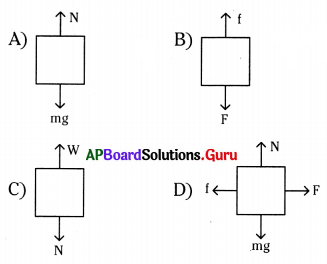
Answer:
B) biconvex lens

Question 15.
Pinna is
A) external ear
B) middle ear
C) inner ear
D) all
Answer:
A) external ear

Question 16.
The chain of bones present in the middle ear
A) malleus
B) incus
C) stapes
D) all
Answer:
D) all

Question 17.
The ear canal is also called
A) tympanum
B) auditory meatus
C) ear drum
D) middle ear
Answer:
B) auditory meatus

AP 9th Class Biology Bits Chapter 6 Sense Organs

Question 18.
Middle ear opens into the inner ear through
A) spherical window
B) oval window
C) round window
D) elliptical window
Answer:
C) round window

Question 19.
How many taste buds are present on tongue ?
A) 100
B) 1000
C) 10,000
D) 5,000
Answer:
C) 10,000

Question 20.
Olfactory receptors are present in
A) skin
B) eye
C) ear
D) nose
Answer:
D) nose

Question 21.
Metallic taste of food is present in
A) natural foods
B) artificial foods
C) raw foods
D) cooked foods
Answer:
B) artificial foods

Question 22.
Taste buds are present in this structures on tongue
A) fungi form papillae
B) foliate papillae
C) fungi form and foliate papillae
D) filiform papillae
Answer:
C) fungi form and foliate papillae

Question 23.
Cutaneous receptors are present in
A) ear
B) tongue
C) nose
D) skin
Answer:
D) skin

Question 24.
Dermis layer of skin contains
A) sweat glands
B) sebaceous glands, blood vessels
C) hair follicles, fats
D) all
Answer:
D) all

AP 9th Class Biology Bits Chapter 6 Sense Organs

Question 25.
Receptors present in skin for touch
A) tactile receptors
B) pacinial corpuscles
C) nocireceptors
D) all
Answer:
A) tactile receptors

Question 26.
Pellagra is the disease of skin due to the deficiency of
A) proteins
B) vitamins
C) hormones
D) enzymes
Answer:
B) vitamins

Question 27.
Melanin is the pigment present in
A) ear
B) tongue
C) nose
D) skin
Answer:
D) skin

Question 28.
Identify the disease of skin.
B) xeropthalmic
C) leucoderma
D) glaucoma
Answer:
C) leucoderma

Question 29.
The term ‘gustation’ refers to what sense ?
A) Taste
B) Smell
C) Hear
D) Touch
Answer:
A) Taste

Question 30.
The aperture controlling the amount of light entering the eye is called
A) Lens
B) Cornea

C) Pupil
D) Retina

Answer:
C) Pupil

Question 31.
The term “Olfaction” explicitly refers to which sense ?
A) Hear
B) Smell
C) Touch
D) Sight
Answer:
B) Smell

AP 9th Class Biology Bits Chapter 6 Sense Organs

Question 32.
The Fovea is the part of retina that contain photoreceptors called
A )Rods
B) Cones
C) Nerves
D) Blood vessels
Answer:
B) Cones

Question 33.
What structure provides the boundary between the outer and middle ear ?
A) Cochlia
B) Pinna
C) Tympanum
D) Ear drum
Answer:
C) Tympanum

Question 34.
The small bony chamber of the ear which coils about two and half turns is known as
A) Tympanum
B) Cochlia
C) Pinna
D) None
Answer:
B) Cochlia

Question 35.
Sensitive pigment layer of the eye is
A) Cornea
B) Retina
C) Iris
D) Sclerotic
Answer:
B) Retina

Question 36.
Colour vision is due to ……………….
A) cone cells
B) acute in dim light
C) different wavelengths of coloured light stimulating the rods
D) both A and B
Answer:
A) cone cells

Question 37.
Cones in the eye are sensitive to the following colours …………………..
A.) Red, green, amber
B) Red, violet, and yellow
C) Blue, red and yellow
D) Red, green, blue
Answer:
C) Blue, red and yellow

AP 9th Class Biology Bits Chapter 6 Sense Organs

Question 38.
Which of the following provides an attachment point for extrinsic muscles of the eye ball ?
A) Iris
B) Retina
C) Sclera
D) Choroid coat
Answer:
A) Iris

Question 39.
The chief function of the middle ear is-
A) Amplify sound waves
B) Help to move the external pinna
C) Secrete waxy substance which repel insects
D) Keep the basilar membrane separated
Answer:
D) Keep the basilar membrane separated

Question 40.
Retina is most sensitive at ………………
A) Periphery
B) Macula
C) Fovea
D) Optic disc
Answer:
C) Fovea

Question 41.
The photosensitive substance in the eyes of mammals
A) Retinol
B) Rhodopsin
C) Sclerotin
D) Melanin
Answer:
B) Rhodopsin

Question 42.
The other name for eardrum is known as
A) Pinna
B) Auditory canal
C) Tympanic membrane
D) Oval window
Answer:
C) Tympanic membrane

Question 43.
Which of these bones is not found in the middle ear ?
A) Malleus
B) Incus
C) Stapes
D) Ulmar
Answer:
D) Ulmar

Question 44.
Melanin protects us from harmful affects of –
A) bacteria
B) virus
C) allergy
D) light
Answer:
D) light

AP 9th Class Biology Bits Chapter 6 Sense Organs

Question 45.
The largest sense organ of our body
A) Eyes
B) Nose
C) Skin
D) Tongue
Answer:
C) Skin

Question 46.
This is not an eye disease.
A) Pellagra
B) Cataract
C) Glacoma
D) Astigmatism
Answer:
A) Pellagra

Question 47.
This is not a skin disease.
A) Leucoderma
B) Pellagra
C) Ringworm
D) Rickets
Answer:
D) Rickets

Question 48.
The sense organ that regulates the body temperature
A) Nose
B) Skin
C) Ear
D) Eye
Answer:
B) Skin

Question 49.
Vastibular apparatus maintains body is
A) Temperature
B) Pressure
C) Equilibrium
D) None
Answer:
C) Equilibrium

Question 50.
‘Leprosy’ is related to this organ.
A) Ears
B) Eyes
C) Nose
D) Skin
Answer:
D) Skin

Question 51.
Sebacious glands produce ………………
A) Sweat
B) Sebum
C) Tears
D) Wax
Answer:
B) Sebum

AP 9th Class Biology Bits Chapter 6 Sense Organs

Question 52.
Choroid layer provides the following to the eye ……………….
A) strength
B) colour
C) protection
D) none
Answer:
B) colour

Question 53.
The most important sense organ.
A) Eye
B) skin
C) Ear
D) Tongue
Answer:
A) Eye

Question 54.
This is very harmful to our eyes.
A) Bright light
B) Smoke
C) UV light
D) All
Answer:
D) All

Question 55.
Middle ear’s main function is
A) Wax production
B) Amplifying the sounds
C) Receiving sound waves
D) A and C
Answer:
B) Amplifying the sounds

Question 56.
Identify the mismatched pair from the following.
1) Pinna – External
2) Tympanum – Ceruminous gland
3) Wax producing – Ear drum

A) 1 only
B) 3 only
C) 2, 3
D) 1, 3
Answer:
C) 2, 3

Question 57.
Read the following statements carefully.
a) The cones are concentrated in fovea, which gives us the sharpest vision.
b) Cornea is the clean window in front of Iris.
A) a correct, b incorrect
B) b correct, a incorrect
C) both a, b incorrect
D) a, b are correct
Answer:
D) a, b are correct

AP 9th Class Biology Bits Chapter 6 Sense Organs

Question 58.
Identify the mismatched pair.
1) Leucoderma – Skin
2) Cataract – Nose
3) Deafness – Ear
A) 1,3
B) 2, 3
C) 1 only
D) 2 only
Answer:
D) 2 only

Question 59.
Read the following statements.
a) Blind spot is the area, where the optic nerves leave the eye
b) Ceruminous glands produce oil in the ear.
A) Both a, b correct
B) Both a, b incorrect
C) a correct, b incorrect
D) b correct, a incorrect
Answer:
C) a correct, b incorrect

Question 60.
Identify the mismatched pair.
1) Smell – Olfactory neui.
2) Tears – Lachrymal giai
3) Wax – Ceruminous gL
A) 1, 2
B) 2, 3
C) 2 only
D) All are correct
Answer:
D) All are correct

Eye disease or defect Characteristics
1. Age related macular degeneration It is an eye condition that leads to the deterioration of the centre of the retina called macula.
2. Astigmatism It is an imperfection in the curvature of retina.
3. Cataract It is the clouding of the eye lens causing vision problems.
4. Central retinal vein occlusion It is a blockage of the main vein in the retina.
5. Colour blindness Occurs when we are unable to see colours in a normal way.

Question 61.
Study the table and answer the following question.
This disease is related to the curvature of retina.
A) Astigmatism
B) Cataract
C) Central retinal vein occlusion
D) Colour blindness

Eye disease or defect Characteristics
1. Conjunctivitis It is the swelling of the conjunctiva, the eye becomes red. burning sensation in the eye, releases water.
2. Corneal transplant Scars, swelling or an irregular shape can cause the cornea to scatter or distart light resulting in glare or blurring vision.
3. Diabetic retinopathy It is a common diabetic eye disease caused by changes in retinal blood ves­sels.
4. Dry eye or Xeropthalmia It is a condition where the eyes do not pro­; duce enough tears or the right quality of tears to be healthy or comfortable and eye becomes dry.
5. Far sightedness (Hypermetropia) It is a refractive error, which means the eye does not bend or refract light properly. Images are formed behind the retina.
6. Glaucoma It is a disease that damages the eyes optic nerve. This leads to high pressure in the back of the eye.
7. Kerolitis It is a condition where the cornea be­comes swollen or inflamed, making the eye red and painful effecting vision.

Answer:
A) Astigmatism

Question 62.
Study the table and answer the following question. In this disease images are formed
behind the retina.
A) Xeropthalmia
B) Hypermetropia
C) Glaucoma
D) Kerolitis
Answer:
B) Hypermetropia

AP 9th Class Biology Bits Chapter 6 Sense Organs

Question 63.
Identify this structure.
AP 9th Class Biology Bits Chapter 6 Sense Organs 1
A) Skin
B) Eye
C) Tongue
D) Ear
Answer:
C) Tongue

Question 64.
The given picture depicts the following statements.
AP 9th Class Biology Bits Chapter 6 Sense Organs 2
A) It is an illusion where the stimulus pattern is interpreted incorrectly by the mind.
B) It is dispersion where the stimulus pattern is interpreted incorrectly by the mind.
C) It is right interpretation of the stimulus pattern by mind due to diffusion.
D) It is a reflection where there is an accuracy between what we see and the external reality.
Answer:
A) It is an illusion where the stimulus pattern is interpreted incorrectly by the mind.

Question 65.
Choose the correct matching from the following.
List – A
1) Fovea
2) Hotline
3) Ear canal
c) Yellow spot

List – B
a) Tongue
b) Auditory meatus
c) Yellow spot
A) 1 – a, 2 – b, 3 – c
B) 1 – b, 2 – a, 3 – c
C) 1 – c, 2 – b, 3 – a
D) 1 – c, 2 – a, 3 – b
Answer:
D) 1 – c, 2 – a, 3 – b

Question 66.
Pickout the correct matching from the following.
List – A
1. Cutaneous Receptors
2) Nociceptors
3) Pacinian corpuscles

List – B
a) The sense of touch Nociceptors
b) Pressure Pacinian corpuscles
c) Temperature
A) 1 – c, 2 – b, 3 – a
B) 1 – a, 2 – b, 3 – c
C) 1 – b, 2 – c, 3 – a
D) 1 – a, 2 – c, 3 – b
Answer:
D) 1 – a, 2 – c, 3 – b

II. Match the following :
1.

Group A Group B
1) Fovia A) Skin
2) Hotline B) Nose
3) Ear canal C) Tongue
4) Olfactory receptors D) Yellow spot
5) Cutaneous receptors E) Blind spot
F) Auditory meatus
G) Inner ear

Answer:
1) Fovia – D) Yellow spot
2) Hotline – C) Tongue
3) Ear canal – F) Auditory meatus
4) Olfactory receptors – B) Nose
5) Cutaneous receptors – A) Skin

AP 9th Class Biology Bits Chapter 6 Sense Organs

2.

Group A Group B
1) Pinna A) Identification
2) Tympanum B) Savory flavor
3) Umami C) Colour of the skin
4) Iris D) External ear
5) Melanin E) Ceruminous gland
6) Wax producing F) Ear drum
G) Lubrication

Answer:
1) Pinna – D) External ear
2) Tympanum – F) Ear drum
3) Umami – B) Savory flavor
4) Iris – A) Identification
5) Melanin – C) Colour of the skin
6) Wax producing – E) Ceruminous gland

3.

Group A Group B
1) Myopia A) Bacterial disease
2) Hypermetropia B) Deficiency of vitamins
3) Leucoderma C) Viral disease
4) Leprosy D) Skin
5) Pellagra E) Near sightedness
F) Dry eyes
G) Far sightedness

Answer:
1) Myopia – E) Near sightedness
2) Hypermetropia – G) Far sightedness
3) Leucoderma – D) Skin
4) Leprosy – A) Bacterial disease
5) Pellagra – B) Deficiency of vitamins

Question 67.
The eye is divided into aqueous chamber and vitreous chamber by
A) Lens
B) Pupil
C) Iris
D) Choroid
Answer:
A) Lens

Question 68.
Equilibrium of the body, pertaining to the posture and balance are maintained by
A) Utri cuius only
B) Utriculus, Sacculus
C) Utriculus, Sacculus and Semilunar canals
D) Utriculus, Sacculus, Semicircular canals and cochlea
Answer:
C) Utriculus, Sacculus and Semilunar canals

Question 69.
Biologically, the sense of smell begins with
A) Visual perception
B) Thinking of smell
C) Tasting food
D) Chemical events in nose
Answer:
D) Chemical events in nose

Question 70.
Melanin is responsible for
A) Detection of pressure
B) Formation of nails, hair
C) Skin colour
D) Thermo regulation
Answer:
C) Skin colour

Question 71.
The deficiency of pigment melanin leads to………………
A) Leucoderma
B) Pellagra
C) Ringworm
D) Tanning
Answer:
A) Leucoderma

AP 9th Class Biology Bits Chapter 6 Sense Organs

Question 72.
Which of the following is a function of tears secreted by eyes ?
A) To identify colours
B) To control the amount of light entering the eye
C) To keep the eyes moist
D) They do not have any function
Answer:
C) To keep the eyes moist

Question 73.
A student took plastic funnel and stretched a piece of balloon over its widen part. He put some mustard seeds on it and shouted loud. His purpose is
A) Sound is produced from vibration of vocal cords
B) Sound is a kind of energy that vibrates only the mustard seeds
C) Sound is produced due to vibration of particles
D) We can hear sound as the particles of air are vibrated and waves are formed
Answer:
D) We can hear sound as the particles of air are vibrated and waves are formed

Question 74.
A boy of your street is feeling itchy in his ear. As a biology student you would
A) Tell him to take a matchstick and scrap
B) Put some oil in the ear
C) Put some saline water in the ear
D) Consult an ENT
Answer:
D) Consult an ENT

Question 75.
Match the following :

1. Tongue a. Receptor
2. Ear b. Tympanum
3. Nose c. Taste buds

A) c, a, b
B) a, b, c
C) c, b, a
D) b, a, c
Answer:
C) c, b, a

Question 76.
Name of the smallest bone present in the ear
A) Malleus
B) Stapes
C) Incus
D) Tympanum
Answer:
B) Stapes

Question 77.
What will you do to prevent eye diseases.
A) Clean the eyes 3-4 times
B) Consume Vitamin-A food
C) Don’t squeze the eyes
D) All of these
Answer:
D) All of these

Question 78.
P : Ravi cannot identify some colours.
Q : Cones are absent in the eyes of Ravi
A) P, Q both are true
B) Q is not the correct explanation to P
C) There is no relation between P and Q
D) Q is the correct explanation to P
Answer:
A) P, Q both are true

AP 9th Class Biology Bits Chapter 6 Sense Organs

Question 79.
Your Iris is photographed while issuing AADHAR card. Can you guess the reason for it.
A) Iris patterns are individual specific
B) The colour of the eyes are different to each and everyone.
C) To identify the eye – defects.
D) To save time.
Answer:
A) Iris patterns are individual specific

Question 80.
Identify the correct sequence of bones in the structure of ear.
A) Malleus, Incus and Stapes
B) Stapes, Incus and Malleus
C) Incus, Malleus and Stapes
D) Malleus, Stapes and Incus
Answer:
A) Malleus, Incus and Stapes

Question 81.
P : Sense organs recognise stimuli only.
Q : Brain analyses the stimuli and sends proper responses.
A) P only correct
B) Q only corect
C) Both P, Q correct
D) Both P, Q not correct
Answer:
C) Both P, Q correct

Question 82.
Elder people can’t identify different tastes while consuming food. Can you guess the reason for it.
A) Olfactory receptors lost their efficiency
B) Taste receptors lost their efficiency
C) Closure of nasal cavity
D) Both A and B
Answer:
D) Both A and B

Question 83.
If a person consumes high salty food then
A) recognises the taste of salt.
B) he likes the taste of salt.
C) he does not like the taste of salt.
D) he does not identify the taste of low salt food.
Answer:
D) he does not identify the taste of low salt food.

Question 84.
You have collected the information about eye diseases from the doctor. Identify the disease that is related to eye
A) Leucoderma
B) Glaucoma
C) Polio
D) Malaria
Answer:
B) Glaucoma

Question 85.
The taste we identify here is ……………….
AP 9th Class Biology Bits Chapter 6 Sense Organs 3
A) Bitter
B) Sweet
C) Sour
D) Umami
Answer:
A) Bitter

AP 9th Class Biology Bits Chapter 6 Sense Organs

Question 86.
Anitha labelled nose internal structure as shown below.
Nose – Olfactory receptors – Nasal sep-tum – Epiglottis – Mucus membrane Which of the following is incorrect ?
A) Mucus membrane
B) Epiglottis
C) Olfactory receptors
D) Nasal septum
Answer:
B) Epiglottis

Question 87.
What is the function of the part labelled “P” in the given figure ?
AP 9th Class Biology Bits Chapter 6 Sense Organs 4
A) Protect the epidermis
B) Sensation of touch
C) Produce Sweat
D) Secretion of sebum
Answer:
D) Secretion of sebum

Question 88.
A student labelled the parts as shown in the picture. Choose the correct match.
AP 9th Class Biology Bits Chapter 6 Sense Organs 5
1. Fungiform papillae
2. Foliate paplllae
3. Vallate paplllae
A) a- 1, b – 3, c – 2
B) a – 1,b – 2,c – 3
C) a – 3, b – 2, c – 1
D) a – 2,b – 3,c – 1
Answer:
C) a – 3, b – 2, c – 1

Question 89.
Read the following :
Infants have heightened taste sensitiv¬ity that is why babies try to sense ev¬erything by taste.
Choose the correct statement in the following :
a) The supersensitivity however de¬creases with age
b) Many elderly people complain that food has lost its taste.
A) Both a, b are incorrect
B) Both a, b are correct
C) a is true, b is false
D) a is false, b is true
Answer:
B) Both a, b are correct

Question 90.
The lens divides the inner eyeball as (i) chamber and (ii) chamber :
A) i – aqueous, ii – cochlear
B) i – vitreous, ii – vegtibale
C) i – cochlear, ii – aqueous
D) i – aqueous ii – vitreous
Answer:
D) i – aqueous ii – vitreous

Question 91.
The bones in the middle ear serve to amplify sound wave action from the tympanic membrane and transmit to
AP 9th Class Biology Bits Chapter 6 Sense Organs 6
A) the semicircular canals
B) the oval window
C) the round window
D) the eustachian tube
Answer:
C) the round window

Question 92.
Situation – (i) : Recognise the taste by just keeping the food on tongue.
Situation – (ii) : Recognise the taste by just pressing the food against palate. Which situation makes you recognise the taste ?
A) Applicable only for solid substances
B) i only
C) ii only
D) i and ii
Answer:
C) ii only

Question 93.
Which cells help to identify the colours in eyes ?
A) Melanocytes
B) Rods, Cones
C) Rods only
D) Cones only
Answer:
D) Cones only

AP 9th Class Biology Bits Chapter 6 Sense Organs

Question 94.
Raju rinsed his mouth with high concentrated salt water. What happens to his tongue?
a) Learns to taste salty things better
b) Able to taste less salty things just after the exposure
c) Hates tasting salty things
d) Fails to take a less salty things just after the exposure
A) d only
B) a only
C) b only
D) c only
Answer:
A) d only

Question 95.
If mucus membrane is lost in the nasal cavity, what would be the consequences ?
a) Nasal cavity can’t hold dust-germs
b) Nasal cavity can’t remove dust
c) Nasal cavity fail to allow air
d) Nasal cavity allow more air
A) d only
B) a, b only
C) a only
D) a, c only
Answer:
B) a, b only

Question 96.
Select the suitable questions in the following to conduct a quiz on eye diseases in your school.
a) What is meant by xeropthalmia ?
b) What are the differences between myopia and Hypermetropia ?
c) Name the vitamin which helps the eye
d) Why some people have eye defects by birth ?
e) Is colour-blindness hereditary dis-ease?
A) Only a, d, e correct
B) Only a, b, c correct
C) Only c, d, e correct
D) All are correct
Answer:
D) All are correct

AP 9th Class Biology Bits Chapter 5 Diversity in Living Organism with Answers

Practice the AP 9th Class Biology Bits with Answers Chapter 5 Diversity in Living Organism on a regular basis so that you can attempt exams with utmost confidence.

AP State Syllabus 9th Class Biology Bits 5th Lesson Diversity in Living Organism with Answers

I. Choose the correct answers :

Question 1.
Plants having two seed leaves are called
A) Dicotyledons
B) Monocotyledons
C) Protista
D) Monera
Answer:
A) Dicotyledons

Question 2.
The presence of differences between organism of same species is
A) Classification
B) Diversity
C) Variation
D) Lineage
Answer:
C) Variation

AP 9th Class Biology Bits Chapter 5 Diversity in Living Organism

Question 3.
‘Origin of species” was written by
A) Lamarck
B) Charles Darwin
C) Linneaus
D) Whittaker
Answer:
B) Charles Darwin

Question 4.
It includes all organisms that are similar enough to interbreed
A) Genera
B) Family
C) Species
D) Class
Answer:
C) Species

Question 5.
Charak and Sushrut has classified plants on the basis of
A) Economic importance
B) Medical importance
C) Yield of Timber
D) Flower structure
Answer:
B) Medical importance

Question 6.
‘Vrikshayurveda’ was written by
A) Charaka
B) Sushruta
C) Parasara
D) Varahamihira
Answer:
C) Parasara

Question 7.
Who proposed a five kingdom system in 1969 ?
A) Haeckel
B) Copeland
C) Whittaker
D) Cavalier-Smith
C) Whittaker

Question 8.
Whittaker classification is based on
A) Whether the organisms are prokaryotes or eukaryotes
B) Mode of acquiring food by organisms
C) Whether the organisms are unicellular or multicellular
D) All the above
Answer:
D) All the above

Question 9.
Organisms that tolerate very high salt concentration are
A) Thermophils
B) Halophiles
C) Haemophils
D) Nanophiles
Answer:
B) Halophiles

AP 9th Class Biology Bits Chapter 5 Diversity in Living Organism

Question 10.
The domain evolved from an ancestor cell called an Last Universal Common Ancestor is
A) Archaea
B) Bacteria
C) Eukarya
D) All
Answer:
D) All

Question 11.
The cell walls of these contain a fat like chemical peptidoglycon.
A) Archaea
B) Bacteria
C) Eukarya
D) All
Answer:
B) Bacteria

Question 12.
Unicellular, Prokaryotes are included under
A) Monera
B) Protista
C) Fungi
D) Plantae
Answer:
A) Monera

Question 13.
Ancient bacteria are included in this group of Monera.
A) Eubacteria
B) Cyanobacteria
C) Archaebacteria
D) All
Answer:
C) Archaebacteria

Question 14.
Streptococcus, Rhizobium, e.coli are examples for
A) Archaebacteria
B) Eubacteria
C) Cyanobacteria
D) Eukarya
Answer:
B) Eubacteria

Question 15.
Unicellular or multicellular eukaryotes are included in
A) Protista
B) Fungi
C) Monera
D) Porifera
Answer:
A) Protista

Question 16.
These reproduce by spores.
A) Fungi
B) Monera
C) Protista
D) Gymnosperms
Answer:
A) Fungi

AP 9th Class Biology Bits Chapter 5 Diversity in Living Organism

Question 17.
The level of classification among plants depend on
A) Whether the plant body has well differentiated distinct parts
B) Whether the plant body has vascular tissue
C) Ability to bear seeds and whether the seeds are enclosed within fruits
D) All
Answer:
D) All

Question 18.
Non flowering plants are
A) Cryptogams
B) Phanerogams
C) Gymnosperms
D) Angiosperms
Answer:
A) Cryptogams

Question 19.
Plants do not have seeds enclosed within are
A) Gymnosperms
B) Angiosperms
C) Cryptogams
D) Phanerogams
Answer:
A) Gymnosperms

Question 20.
Porifera organisms are also called as
A) Sponges
B) Whales
C) Protochordates
D) Annelids
Answer:
A) Sponges

Question 21.
Example for sponges
A) Cuplectelea
B) Sycon
C) Spongilla
D) All
Answer:
D) All

Question 22.
Coral reefs belong to this Phylum
A) Porifera
B) Monera
C) Coelenterata
D) Annelida
Answer:
C) Coelenterata

Question 23.
The body of these animals are bilaterally, symmetrical, triploblastic and segmented
A) Nematoda
B) Platyhelminthes
C) Annelida
D) Coelenterata
Answer:
C) Annelida

AP 9th Class Biology Bits Chapter 5 Diversity in Living Organism

Question 24.
Reproductive structure are flowers is
A) Thallophyta
B) Bryophyta
C) Gymnosperm
D) Angiosperms
Answer:
C) Gymnosperm

Question 25.
Wuchereria bancrofti causes disease known as
A) Malaria
B) Cholera
C) Filaria
D) Dengue
Answer:
D) Dengue

Question 26.
The largest group of Animals belongs to this Phylum.
A) Annelida
B) Arthropoda
C) Echinodermata
D) Molluscs
Answer:
C) Echinodermata

Question 27.
The skeleton of Echinoderms is made of
A) Calcium carbonate
B) Sodium carbonate
C) Sodium silicate
D) Magnesium carbonate
Answer:
B) Sodium carbonate

Question 28.
Five fold Radial symmetry with rays of arms in five are seen in
A) Echinodermata
B) Arthropoda
C) Annelida
D) Molluscs
Answer:
A) Echinodermata

Question 29.
The first organisms that possess back bone
A) Protochordata
B) Fishes
C) Aves
D) Amphibians
Answer:
A) Protochordata

Question 30.
Vertebrates are group into these many classes
A) 3
B) 4
C) 5
D) 6
Answer:
B) 4

AP 9th Class Biology Bits Chapter 5 Diversity in Living Organism

Question 31.
Identify the cold blooded animals.
A) Fishes
B) Mammals
C) Aves
D) Marsupials
Answer:
C) Aves

Question 32.
Males carry babies as mothers in
A) Dolphin
B) Whale
C) Hippocampus
D) Man
Answer:
A) Dolphin

Question 33.
The only flying mammal is
A) Bat
B) Crow
C) Peacock
D) Hen
Answer:
C) Peacock

Question 34.
Human beings are included in order
A) Marsupials
B) Primates
C) Rodents
D) Logomorpha
Answer:
A) Marsupials

Question 35.
Duck billed platypus and Echidna are
A) Coelenterals
B) Rodents
C) Marsupials
D) Egg laying mammals
Answer:
B) Rodents

Question 36.
Homo Sapiens is the scientific name of
A) Man
B) Dog
C) Cat
D) Mango
Answer:
D) Mango

Question 37.
Insects are included under
A) Arthropods
B) Aves
C) Annelids
D) Coelenterates
Answer:
A) Arthropods

AP 9th Class Biology Bits Chapter 5 Diversity in Living Organism

Question 38.
Peals are produced from
A) Oysters
B) Sea cucumbers
C) Snails
D) Sea horse
Answer:
A) Oysters

Question 39.
Marine living and spine skinned animals are
A) Echinodermata
B) Annelida
C) Coelenterates
D) Nematodes
Answer:
A) Echinodermata

Question 40.
Naked seeds are present in
A) Mango
B) Apple
C) Banana
D) Pinus
Answer:
A) Mango

Question 41.
The book ‘Systema Naturae’ was written by
A) Haeckel
B) Linneaus
C) Whittaker
D) Wooes
Answer:
D) Wooes

Question 42.
Locomotory organs in Echinodermata are
A) Wings
B) Fins
C) Pseudopodia
D) Tube feet
Answer:
B) Fins

Question 43.
Mammals are
A) Viviparous
B) Skin covered with hair
C) Vertebral column is present
D) All the above
Answer:
D) All the above

Question 44.
The science of classification is
A) Limnology
B) Taxonomy
C) Diversity
D) Ecology
Answer:
D) Ecology

AP 9th Class Biology Bits Chapter 5 Diversity in Living Organism

Question 45.
Sea horses (Hippocampus) are used in medicine of
A) Chinese
B) Indian
C) Italian
D) American
Answer:
B) Indian

Question 46.
Hydra belongs to this phylum.
A) Porifera
B) Coelenterata
C) Molluscs
D) Nematoda
Answer:
A) Porifera

Question 47.
Starfish is an example for
A) Annelid
B) Arthropod
C) Molluscs
D) Echinodermata
Answer:
B) Arthropod

Question 48.
Binomial nomenclature of an organism denotes
A) Genus, Species
B) Species, order
C) Family, Genus
D) Order, class
Answer:
D) Order, class

Question 49.
Friend of the farmer –
A) Cockroach
B) Earthworm
C) Snail
D) Roundworm
Answer:
B) Earthworm

Question 50.
Amphioxus belongs to –
A) Echinodermata
B) Mollusca
C) Protochordata
D) Arthropoda
Answer:
C) Protochordata

Question 51.
Expand L.U.C.A ………………..
A) Last Universal Common Ancestor
B) Last Universal Central Animal
C) Last United Central Ancestor
D) Last Universal Common Animal
Answer:
A) Last Universal Common Ancestor

AP 9th Class Biology Bits Chapter 5 Diversity in Living Organism

Question 52.
Mushrooms belongs to this phylum.
A) Algae
B) Bryophyta
C) Fungi
D) Fern
Answer:
C) Fungi

Question 53.
Organisms with holes on their body
A) Protozoans
B) Cnidarians
C) Porifers
D) Echinoderms
Answer:
C) Porifers

Question 54.
Egg laying mammals are –
A) Kangaroo and Bat
B) Echidna and Platypus
C) Rat and Echidna
D) Platypus and Whales
Answer:
B) Echidna and Platypus

Question 55.
Cartilaginous skeleton is seen in
A) Shark
B) Exocetus
C) Frog
D) Tuna
Answer:
A) Shark

Question 56.
The largest group of animals is seen in
A) Porifers
B) Annelida
C) Protochordata
D) Arthropoda
Answer:
D) Arthropoda

Question 57.
Calcium carbonate structures from the skeleton of
A) Echinodermata
B) Mollusca
C) Protochordata
D) Nematoda
Answer:
B) Mollusca

AP 9th Class Biology Bits Chapter 5 Diversity in Living Organism

Question 58.
“Seed leaves” are –
A) Perisperm
B) Endosperm
C) Radicle
D) Cotyledons
Answer:
D) Cotyledons

Question 59.
Mucus glands in the skin and three chambered heart are seen in
A) Aves
B) Pisces
C) Reptilia
D) Amphibia
Answer:
D) Amphibia

Question 60.
Locomotion in Amoeba is carried by
A) Flagella
B) Pseudopodia
C) Nucleus
D) Contractile vacuole
Answer:
B) Pseudopodia

Question 61.
The animals which can live both on land and water ……………………….
A) Pisces
B) Reptiles
C) Aves
D) Amphibians
Answer:
D) Amphibians

Question 62.
What is the flightless bird ?
A) Duck
B) Cock
C) Pigeon
D) Ostrich
Answer:
D) Ostrich

Question 63.
The following animal is a cold blooded one
A) Snake
B) Gorria
C) Parrot
D) Tiger
Answer:
A) Snake

Question 64.
Pickout the odd one out.
A) Shark
B) Tortoise
C) Crocodile
D) Dolphin
Answer:
D) Dolphin

AP 9th Class Biology Bits Chapter 5 Diversity in Living Organism

Question 65.
Pickout the odd one out.
A) Cockroach
B) Earthworm
C) Sycon
D) Frog
Answer:
D) Frog

Question 66.
Identify the mismatched pairs from the following.
1) Haeckel – Divided organisms into three kingdoms
2) Copeland – Divided into six kingdoms
3) Cavalier – Smith – Divided organisms into four kingdoms
A) 1 only
B) 2, 3
C) 3 only
D) 1, 2
Answer:
D) 1, 2

Question 67.
Identify the mismatched pairs from the following.
1) The origin of species – Charles Darwin
2) Vrikshayurveda – Charaka
3) Systema Naturae – Whittaker
A) 1, 2
B) 1 only
C) 2, 3
D) 3 only
Answer:
C) 2, 3

Question 68.
Read the following statements.
a) Exoskeleton of scales, eggs laying outside water …………….. features of Reptelia
b) Exoskeleton of scales, endoskeleton of bones breathing through gills – features of pisces
A) a correct, b incorrect
B) b correct, a incorrect
C) both a, b incorrect
D) both a, b correct
Answer:
D) both a, b correct

Question 69.
AP 9th Class Biology Bits Chapter 5 Diversity in Living Organism 1
Which of the following is correct tabular form of the above the table?
AP 9th Class Biology Bits Chapter 5 Diversity in Living Organism 2
Answer:
AP 9th Class Biology Bits Chapter 5 Diversity in Living Organism 3

Question 70.
Identify the phylum of the shown organism.
AP 9th Class Biology Bits Chapter 5 Diversity in Living Organism 4
A) Protozoa
B) Cnldaria
C) Arthropoda
D) Porifera
Answer:
D) Porifera

AP 9th Class Biology Bits Chapter 5 Diversity in Living Organism

Question 71.
Identify the organism in the picture.
AP 9th Class Biology Bits Chapter 5 Diversity in Living Organism 5
A) Jelly fish
B) Hydra
C) Roundworm
D) Tapeworm
Answer:
B) Hydra

Question 72.
Name the organisms that belongs to the following phylum.
AP 9th Class Biology Bits Chapter 5 Diversity in Living Organism 6
A) Annelida
B) Arthropoda
C) Mollusca
D) Echinodermata
Answer:
B) Arthropoda

Question 73.
Identify the phylum of the organism.
AP 9th Class Biology Bits Chapter 5 Diversity in Living Organism 8
A) Arthropoda
B) Mollusca
C) Echinodermata
D) Protochordata
Answer:
B) Mollusca

Question 74.
Name the organism in the picture.
AP 9th Class Biology Bits Chapter 5 Diversity in Living Organism 8
A) Lizard
B) Paramecium
C) Bacteria
D) Virus
Answer:
C) Bacteria

Question 75.
ThIs animal belongs to –
AP 9th Class Biology Bits Chapter 5 Diversity in Living Organism 9
A) Mollusca
B) Arthropoda
C) Echinodermata
D) Amphibia
Answer:
C) Echinodermata

Question 76.
I am an oyster. I produce pears. Which phylum do I belong to ?
A) Arthropoda
B) Annelida
C) Mollusca
D) Echinodermata
Answer:
C) Mollusca

Question 77.
I am a crocodile. I have 4 chambered heart. Which phylum do I belong to?
A) Mammal
B) Pisces
C) Amphibia
D) Reptelia
Answer:
D) Reptelia

AP 9th Class Biology Bits Chapter 5 Diversity in Living Organism

Question 78.
Choose the correct matching from the following.
List – A
1) Diploblastic
2) Spiny skinned
3) Jointed legs

List – B
a) Echinodermata
b) Arthropoda
c) Porifera
A) 1 – a, 2 – b, 3 – c
B) 1 – a, 2 – c, 3 – b
C) 1 – c, 2 – a, 3 – b
D) 1 – b, 2 – c, 3 – a
Answer:
C) 1 – c, 2 – a, 3 – b

Question 79.
Arrange the flow chart in the correct order.
AP 9th Class Biology Bits Chapter 5 Diversity in Living Organism 10
A) 5, 4, 3, 2, 1
B) 1, 3, 2, 4, 5
C) 1, 2, 3, 5, 4
D) 1, 2, 3 ,4, 5
Answer:
D) 1,2,3,4,5

II. Match the following:
1.

Group – A Group – B
1) Naked seed A) Protista
2) Covered seed B) Monera
3) Sporangium C) Angiosperms
4) Unicellular prokaryotes D) Gymnosperms
5) Uni or multicellular eukaryotes E) Cryptogams
F) Fungi
G) Phanerogams

Answer:
1) Naked seed – D) Gymnosperms
2) Covered seed – C) Angiosperms
3) Sporangium – F) Fungi
4) Unicellular prokaryotes – B) Monera
5) Uni or multicellular eukaryotes – A) Protista

2)

Group – A Group -B
1) Jointed legs A) Notochord in its life stage
2) Diploblastic B) Echinoderms
3) Spiny skinned C) Arthropods
4) Round worms D) Coelenterates
5) Protochordates E) Nematodes
F) Porifera
G) Platyhelminthes

Answer:
1) Jointed legs – C) Arthropods
2) Diploblastic – D) Coelenterates
3) Spiny skinned – B) Echinoderms
4) Round worms – E) Nematodes
5) Protochordates – A) Notochord in its life stage

3)

Group – A Group – B
1) Linneaus A) Divided organisms into six kingdoms
2) Haeckel B) Divided organisms into four kingdoms
3) Copeland C) Divided organisms into three kingdoms
4) Whittaker D) Divided organisms into two kingdoms
5) Cavalier – Smith E) Divided organisms into five kingdoms
F) Divided organisms into seven kingdoms
G) Divided organisms into eight kingdoms

Answer:
1) Linneaus – D) Divided organisms into two kingdoms
2) Haeckel – C) Divided organisms into three kingdoms
3) Copeland – B) Divided organisms into four kingdoms
4) Whittaker – E) Divided organisms into five kingdoms
5) Cavalier – Smith – A) Divided organisms into six kingdoms

AP 9th Class Biology Bits Chapter 5 Diversity in Living Organism

III. Identify the diagrams and name them.

AP 9th Class Biology Bits Chapter 5 Diversity in Living Organism 11
Answer:
a) Bacteria
b) Amoeba
c) Euglena
d) Paramecium
e) Sporangium
f) Pine
g) Tapeworm

Question 80.
Rajani collected many leaves from different plants as shown here. Identify which of the following is useful to you to know diversity by using them ?
AP 9th Class Biology Bits Chapter 5 Diversity in Living Organism 12
A) Leaves undergo photosynthesis.
B) Leaves play a role in development of flowers
C) Shape of leaves varies across plant species
D) Leaves are useful only for respiration in plants?
Answer:
C) Shape of leaves varies across plant species

Question 81.
Shown here is an example of an arthropod. Arthropods can be identified by using the following characteristic feature
AP 9th Class Biology Bits Chapter 5 Diversity in Living Organism 13
A) Spiny skin
B) Jointed legs
C) Vertebral column
D) Tentacles
Answer:
B) Jointed legs

Question 82.
Name the scientist who developed the widely accepted Five kingdom classification.
A) Linnaeus
B) Haeckel
C) Cavalier – Smith
D) Whittaker
Answer:
D) Whittaker

Question 83.
Which of the following are characteristics of phylum Arthropoda
i) Water vascular system
ii) Jointed legs
iii) Open circulatory system
iv) Slimy skin
A) i, ii correct
B) ii, iii correct
C) iii, iv correct
D) i, iv correct
Answer:
B) ii, iii correct

Question 84.
Which one among these is a prokaryote ?
A) Streptococcus
B) Euglena
C) Hydra
D) Yeast
Answer:
A) Streptococcus

Question 85.
Which one among these is a flying mammal ?
A) Owl
B) Kangaroo
C) Bat
D) Seal
Answer:
C) Bat

AP 9th Class Biology Bits Chapter 5 Diversity in Living Organism

Question 86.
Bread moulds belong to ………………
A) Protista
B) Bryophyta
C) Fungi
D) Gymnosperms
Answer:
C) Fungi

Question 87.
Which of the following is a characteristic of gymnosperms ?
A) They have outer seed coverings
B) They are not multi-cellular
C) They do not produce flowers
D) They are heterotrophic organisms
Answer:
A) They have outer seed coverings

Question 88.
Which of the following are characteristics of chordates ?
1) Notochord
2) Ventral nerve cord
3) Diploblastic
4) Paired gill pouches
A) 1, 2
B) 1, 3
C) 1, 4
D) 2, 4
Answer:
A) 1, 2

Question 89.
Human beings belong to which of the following group ?
A) Rodents
B) Primates
C) Marsupials
D) Reptiles
Answer:
B) Primates

Question 90.
Observe the following diagrams. This figure explains about
AP 9th Class Biology Bits Chapter 5 Diversity in Living Organism 14
A) Difference in higher and lower plants
B) Different types of adaptations
C) Monocot and dicot plants
D) Classification of cryptogams
Answer:
C) Monocot and dicot plants

Question 91.
A researcher found an organism and wrote down its key as following :
Key : spiny skin, radial symmetrical, has water vascular system, triplo blastic, have coelomic cavity, free living.
The organism may be a
A) Porcupine
B) Star fish
C) Snail
D) Scorpion
Answer:
B) Star fish

Question 92.
Following is the base for classification of cell into prokaryotic and eukaryotic cell
A) cell membrane
B) nucleic membrane
C) ribosomes
D) chloroplast
Answer:
B) nucleic membrane

AP 9th Class Biology Bits Chapter 5 Diversity in Living Organism

Question 93.
The following traits are taken into consideration during classification.
A) Flowers
B) Seeds arrangement
C) Cotyledons
D) All of these
Answer:
D) All of these

Question 94.
Famous scientist, who wrote the book ‘origin of species’ is
A) Ernest Hackel
B) Carolus Linnaeus
C) August Weisman
D) Charles Darwin
Answer:
D) Charles Darwin

Question 95.
AP 9th Class Biology Bits Chapter 5 Diversity in Living Organism 15
P, Q respectively
A) Animal kingdom, Abiotic kingdom
B) Division, Class
C) Class, Family
D) Family, Class
Answer:
C) Class, Family

Question 96.
AP 9th Class Biology Bits Chapter 5 Diversity in Living Organism 16
Find out the right answer to complete the flow chart.
A) Pteridophyte
B) Angiosperms
C) Cryptogams
D) Bryophyta
Answer:
B) Angiosperms

Question 97.
The correct order of classification is
A) Phylum, order, family, class, genus, species
B) Phylum, class, order, family, genus, species
C) Phylum, family, class, order, genus, species
D) Phylum, class, order, family, species, genus
Answer:
B) Phylum, class, order, family, genus, species

Question 98.
You have observed the specimen of earthworm in lab. It has the characters
A) Bilaterally symmetrical triploblastic
B) True body cavity
C) Has segmented body
D) All the above
Answer:
D) All the above

Question 99.
Match the following

1) Charles Darwin a) Five kingdom classification
2) Linnaeus b) Evolution of organisms
3) Whittaker c) Binomial nomenclature

A) 1 – a, 2 – b, 3 – c
B) 1 – b, 2 – c, 3 – a
C) 1 – c, 2 – b, 3 – a
D) 1 – c, 2 – a, 3 – b
Answer:
B) 1 – b, 2 – c, 3 – a

AP 9th Class Biology Bits Chapter 5 Diversity in Living Organism

Question 100.
Identify the mis-matched pair from the following
a) Non – flowering plants – No seeds
b) Angiosperms – naked seeds
c) Gymnosperms – seeds in a fruit
A) a only
B) b only
C) b and c
D) all the above
Answer:
C) b and c

Question 101.
Thilak prepared a table with the following headings. With the help of this table what can be observed ?
Choose the right answer from the following :
AP 9th Class Biology Bits Chapter 5 Diversity in Living Organism 17
A) Differences in tissues
B) Difference of plants and animals
C) Different characters in monocot and dicot plants
D) Difference of flora and fauna
Answer:
C) Different characters in monocot and dicot plants

Question 102.
Observe the flow chart, choose the correct answer.
a) It shows hierarchy of the classification.
b) It helps to know the five kingdom classification.
AP 9th Class Biology Bits Chapter 5 Diversity in Living Organism 18
A) Both a, b are incorrect
B) Both a, b are correct
C) a is true, b is false
D) a is false, b is true
Answer:
B) Both a, b are correct

Use this information to answer the 24 – 26 questions :
AP 9th Class Biology Bits Chapter 5 Diversity in Living Organism 19
Question 103.
Plant kingdom is divided into Cryptogams, Phanerogams on the basis of
A) seed in a fruit
B) true roots and leaves
C) false roots and leaves
D) flowering/non-flowering
Answer:
D) flowering/non-flowering

Question 104.
Angiosperms are divided into
A) Mosses, fern
B) Monocots, dicots
C) Gymnosperms, dicots
D) Angiosperms, monocot
Answer:
B) Monocots, dicots

Question 105.
The following plants are classified based on seed coat:
A) Gymnosperms – Angiosperms
B) Bryophyta – Pteridophyta
C) Gymnosperms – Bryophyta
D) Angiosperms – Pteridophyta
Answer:
A) Gymnosperms – Angiosperms

Question 106.
Which of the following statements is NOT true about sponges ?
A) Their body is made up of two layers
B) They have the water vascular system
C) They have numerous micropores on their body
D) They have a cavity in the body
Answer:
B) They have the water vascular system

AP 9th Class Biology Bits Chapter 5 Diversity in Living Organism

Question 107.
Plants and animals are classified in a systematic way to study.
Identify the correct sequence in the classification of living things.
A) Phylum, kingdom, class, family, order, genus and species
B) Kingdom, phylum, class, order, family, species and genus
C) Kingdom, phylum, class, order, family, genus and species
D) Kingdom, phylum, class, family, order, species and genus
Answer:
C) Kingdom, phylum, class, order, family, genus and species

Question 108.
Which of these is the largest living invertebrate phylum ?
A) Echinodermata
B) Arthropoda
C) Annelida
D) Mollusca
Answer:
B) Arthropoda

Question 109.
Observe the table and identify the correct sentences:
AP 9th Class Biology Bits Chapter 5 Diversity in Living Organism 20
a) All grass plants are monocots
b) Wheat, Maize, Rice are having single cotyledons
c) Peas, tamarind seeds do not split into half.
d) Peas, beans, tamarind, mango are dicots.
A) a, c, d only
B) a, b only
C) b, d only
D) a, b, d only
Answer:
D) a, b, d only

Question 110.
Which of the following pairs of organisms and their characteristic features is wrongly paired ?
AP 9th Class Biology Bits Chapter 5 Diversity in Living Organism 21
Answer:
AP 9th Class Biology Bits Chapter 5 Diversity in Living Organism 22