AP 6th Class Maths Bits Chapter 3 HCF and LCM with Answers

Practice the AP 6th Class Maths Bits with Answers Chapter 3 HCF and LCM on a regular basis so that you can attempt exams with utmost confidence.

AP State Syllabus 6th Class Maths Bits 3rd Lesson HCF and LCM with Answers

I. Choose the correct answer and write it in the brackets.

Question 1.
If any number has 0, 2, 4, 6 or 8 in its ones place, then it is divisible by ……………..
A) 2
B) 4
C) 6
D) 8
Answer:
A) 2

Question 2.
If any number is divisible by both 2 and 3, then it is divisible by ………………
A) 2
B) 4
C) 6
D) 8
Answer:
C) 6

AP 6th Class Maths Bits Chapter 3 HCF and LCM with Answers

Question 3.
If the sum of the digits of a number is divisible by 9, then the number is divisible by …………….
A) 3
B) 4
C) 6
D) 9
Answer:
D) 9

Question 4.
The numbers with zero at ones place are divisible by ……………..
A) 2
B) 5
C) 10
D) All of the above
Answer:
D) All of the above

Question 5.
In any number if the number formed by the last two digits is divisible by 4, then the number is divisible by …………………
A) 2
B) 4
C) 6
D) 8
Answer:
B) 4

Question 6.
Which of the following number is divisible by 6?
A) 125734
B) 237197
C) 237192
D) 726352
Answer:
C) 237192

Question 7.
Number divisible by 11 is
A) 10934
B) 726351
C) 7138965
D) 376845
Answer:
A) 10934

Question 8
………………… is the factor of every number.
A) 0
B) 2
C) 5
D) 1
Answer:
D) 1

Question 9.
The number which is divisible by 1 and itself is called ………………
A) Composite number
B) Prime number
C) Even number
D) Odd number
Answer:
B) Prime number

AP 6th Class Maths Bits Chapter 3 HCF and LCM with Answers

Question 10.
Smallest even prime number is ………………..
A) 4
B) 3
C) 2
D) 5
Answer:
C) 2

Question 11.
Smallest even composite number is ……………….
A) 2
B) 4
C) 6
D) 8
Answer:
B) 4

Question 12.
Number 1 is …………….
A) Prime
B) Composite
C) Both A and B
D) Neither A nor B
Answer:
B) Composite

Question 13.
Every prime number other than 2 is ………………
A) even
B) composite
C) odd
D) A and B
Answer:
C) odd

Question 14.
If the difference of any two prime numbers is 2, then they are said to be
A) Twin primes
B) Co-primes
C) Perfect numbers
D) Exact numbers
Answer:
A) Twin primes

Question 15.
The method of division which is used to find HCF was invented by the Mathematician ……………….
A) Ramanujan
B) Euclid
C) Aditya
D) Kaprekar
Answer:
B) Euclid

Question 16.
HCF means ………………..
A) Highest Common Factor
B) Highest Continued Factor
C) Hight of the Common Factor
D) Highest composite factor
Answer:
A) Highest Common Factor

AP 6th Class Maths Bits Chapter 3 HCF and LCM with Answers

Question 17.
The product of two numbers =
A) L.C.M
B) H.C.F
C) L.C.M × H.C.F
D) H.C.F × G.C.D
Answer:
C) L.C.M × H.C.F

Question 18.
HCF of 80 and 56 is ………………
A) 2
B) 4
C) 1
D) 8
Answer:
D) 8

Question 19.
LCM of 45 and 90 is ……………..
A) 180
B) 45
C) 90
D) 15
Answer:
C) 90

Question 20.
What is the HCF of any pair of coprimes?
A) 2
B) 3
C) 1
D) 0
Answer:
C) 1

Question 21.
Which of the following is a pair of coprimes?
A) (30, 35)
B) (99, 21)
C) (3, 5)
D) (63, 45)
Answer:
C) (3, 5)

Question 22.
The factors of 12 are ………………
A) 1, 2, 3
B) 1, 2, 3, 4
C) 1, 2, 3, 4, 6
D) 1, 2, 3, 4, 6, 12
Answer:
D) 1, 2, 3, 4, 6, 12

Question 23.
Which of the following is not a prime?
A) 81
B) 71
C) 31
D) 41
Answer:
A) 81

AP 6th Class Maths Bits Chapter 3 HCF and LCM with Answers

Question 24.
The product of two numbers is 360. If HCF is 9, then their LCM is …………….
A) 20
B) 40
C) 60
D) 80
Answer:
B) 40

Question 25.
Every polyndrome number is divisible by ……………..
A) 3
B) 5
C) 7
D) 11
Answer:
D) 11

II. Fill in the blanks.

1. The process of checking whether a number is divisible by a given number or not without actual division is called …………….. for that number.
Answer:
Divisibility rule

2. If the sum of the digits of a number is a multiple of 3, then that number is divisible by ……………….
Answer:
3

3. The numbers with zero or five at ones place are divisible by ………………
Answer:
5

4. The numbers which are divisible by 5 and 2 are divisible by ………………
Answer:
10

5. In any number with 4 or more digits the number formed by the last three digits
is divisible by 8, then the number is divisible by ……………….
Answer:
8

AP 6th Class Maths Bits Chapter 3 HCF and LCM with Answers

6. In a number if the difference between the sum of the digits at odd places and the sum of the digits at even places from the right is either 0 or a multiple of 11, then the number is divisible by ……………..
Answer:
11

7. A number which divides the other number exactly is called …………….. of the number.
Answer:
Factor

8. Numbers that have more than two factors are called …………….. numbers.
Answer:
Composite

9. Smallest prime number is ……………
Answer:
2

10. Smallest odd prime is ……………..
Answer:
3

11. Smallest odd composite is ……………..
Answer:
9

12. The numbers with only 1 as a common factor are called …………….
Answer:
Co-prime (or) relatively prime

13. If the sum of all factors of a number is two times the number, then the number is called …………………..
Answer:
Perfect number

AP 6th Class Maths Bits Chapter 3 HCF and LCM with Answers

14. The process to express the given number as the product of prime number is called …………………
Answer:
Prime factorization

15. G.C.D means ………………
Answer:
Greatest Common Divisor

16. L.C.M means ………………
Answer:
Least Common Multiple

17. HCF is also known as ……………….
Answer:
Greatest Common Divisor (GCD)

18. LCM × HCF = ……………..
Answer:
Product of two numbers

19. Kaprekar’s constant is ……………..
Answer:
6174

20. The LCM of 21, 35, 40 is ………………
Answer:
210

21. HCF of 3, 5 and 7 is ……………..
Answer:
1

AP 6th Class Maths Bits Chapter 3 HCF and LCM with Answers

22. If the HCF and LCM of two numbers are 1 and 91, then the product of two
numbers is ………………
Answer:
91

23. The nearest number to 2020 which is divisible by 11 is ……………..
Answer:
2024

24. The smallest number which and when 7 is subtracted from it is exactly divisible by 7, 8, 9 is ……………
Answer:
511

25. The greatest 3-digited number which is divisible by 26, 14, 91 leaves the remainder 7 is ……………..
Answer:
182

III. Match the following :

A)

Divisibility Rule Number
1) If sum of the digits of a number divisible by 3 a) 6
2) Number has 0, 2, 4, 6, 8 in units place b) 4
3) Number formed by the last two digits (from the right) is divisible by 4 c) 5
4) If the number is divisible by 2 and 3 d) 3
5) If the number Has 0 or 5 in units place e) 2

Answer:
1) – d) 3
2) – e) 2
3) – b) 4
4) – a) 6
5) – c) 5

AP 6th Class Maths Bits Chapter 3 HCF and LCM with Answers

B)

Divisibility Rule Number
1) Difference of the digits in the odd and even places is divisible by 11 a) 10
2) Number formed by the last three digits (from the right) is divisible by 8 b) 9
3) If the number has 0 in the units place c) 12
4) If the sum of the digits is divisible by 9 d) 11
5) If the number is divisible by 3 and 4 e) 8

Answer:
1) – d) 11
2) – e) 8
3) – a) 10
4) – b) 9
5) – c) 12

AP 6th Class Maths Bits Chapter 2 Whole Numbers with Answers

Practice the AP 6th Class Maths Bits with Answers Chapter 2 Whole Numbers on a regular basis so that you can attempt exams with utmost confidence.

AP State Syllabus 6th Class Maths Bits 2nd Lesson Whole Numbers with Answers

I. Choose the correct answer and write it in the brackets.

Question 1.
Whole numbers are represented by
A) N
B) V
C) W
D) O
Answer:
C) W

Question 2.
Successor of the smallest whole number is ………………..
A) 0
B) 1
C) 10
D) 9
Answer:
B) 1

AP 6th Class Maths Bits Chapter 2 Whole Numbers with Answers

Question 3.
Are all natural numbers are whole numbers?
A) Yes
B) No
C) We can’t say
D) None
Answer:
A) Yes

Question 4.
If 5 and 3 are whole numbers, then their sum is ………………
A) Whole number
B) Natural number
C) Negative number
D) None
Answer:
A) Whole number

Question 5.
Sum of any two whole numbers is always a whole number. This property is called ……………..
A) Commutative
B) Associative
C) Closure
D) None
Answer:
C) Closure

Question 6.
Subtraction of whole numbers is ………………
A) Closed
B) Not Closed
C) Can’t say
D) None
Answer:
B) Not Closed

Question 7.
5 × 4 = 4 × 5 this property is called
A) Closure
B) Associative
C) Commutative
D) B and C
Answer:
C) Commutative

Question 8.
6 – 9 AP 6th Class Maths Bits Chapter 2 Whole Numbers with Answers 1 9 – 6
A) =
B) ≠
C) 0
D) None
Answer:
B) ≠

Question 9.
7 + 3 AP 6th Class Maths Bits Chapter 2 Whole Numbers with Answers 2 3 + 7
A) =
B) ≠
C) >
D) <
Answer:
A) =

AP 6th Class Maths Bits Chapter 2 Whole Numbers with Answers

Question 10.
(5 + 4) + 3 = 5 + (4 + 3), this property is called ………………
A) Closure
B) Commutative
C) Associative
D) Additive
Answer:
C) Associative

Question 11.
(3 + 4) + 5 = 3 + (4 + 5), this property is called …………………
A) Closure
B) Commutative
C) Associative
D) None
Answer:
C) Associative

Question 12.
If a, b, c are whole numbers the distributive property of multiplication over addition is ……………
A) a + (b × c)
B) a × b + a × c
C) a × (b + c)
D) c = b
Answer:
D) c = b

Question 13.
Additive identity is …………………
A) 1
B) 0
C) 2
D) 4
Answer:
B) 0

Question 14.
a × (b – c) = (a × b) – (a × c), this property is ………………
A) Distributive of multiplication over addition.
B) Distributive of multiplication over subtraction.
C) Associative over addition.
D) Associative over subtraction.
Answer:
B) Distributive of multiplication over subtraction.

Question 15.
{Whole numbers} – {Natural numbers} = ………………
A) Whole number
B) Natural number
C) A and B
D) None
Answer:
A) Whole number

Question 16.
We can always form a ……………… with two points.
A) Line
B) Rectangle
C) Triangle
D) None
Answer:
A) Line

AP 6th Class Maths Bits Chapter 2 Whole Numbers with Answers

Question 17.
65 × 99999 = ……………….
A) 64935
B) 644935
C) 649335
D) 6499935
Answer:
D) 6499935

Question 18.
123456 × 8 + 6 = ………………..
A) 987654
B) 9876543
C) 876543
D) 98765
Answer:
A) 987654

Question 19.
Number of whole numbers between 0 and 50 is ………………..
A) 49
B) 50
C) 51
D) 52
Answer:
A) 49

Question 20.
91 × 11 × 5 =
A) 4004
B) 5005
C) 3003
D) 6006
Answer:
B) 5005

II. Fill in the blanks.

1. Smallest number in W is ………………..
Answer:
0

2. Predecessor of 1 is …………………..
Answer:
0

3. Are all whole numbers natural numbers? …………………
Answer:
No

4. If 5 and 4 are whole numbers, then of (5 – 4) is a ………………. number.
Answer:
Whole

AP 6th Class Maths Bits Chapter 2 Whole Numbers with Answers

5. Whole numbers W = ………………..
Answer:
{0, 1, 2, 3, 4, …………..}

6. The value of a number from 0 to its right ……………….
Answer:
Increases

7. 8 + 9 = 9 + 8 is called ……………….
Answer:
Addition is commutative

8. (5 × 6) × 2 = 5 × (6 × 2) is called ………………..
Answer:
Associative over Multiplication

9. (a × b) + (a × c) = ……………….
Answer:
a × (b + c)

10. Multiplicative identity is ………………
Answer:
1

11. Division by zero is ……………….
Answer:
not defined

12. If
143 × 7 × 1 = 1001
143 × 7 × 2 = 2002
143 × 7 × 9 = ………………
Answer:
9009

AP 6th Class Maths Bits Chapter 2 Whole Numbers with Answers

13. How many 7’s are needed to get 161?
Answer:
23

14. 99999 × 0 = ………………
Answer:
0

15. 13680347 × 9 = ……………
Answer:
123123123

16. a – b AP 6th Class Maths Bits Chapter 2 Whole Numbers with Answers 3 b – a
Answer:

17. Example for a rectangle number ………………
Answer:
2 × 3 (or) 3 × 2 (or) 2 × 4 (or) 4 × 3, etc

18. Predecessor of smallest whole number is ……………..
Answer:
0

19. 1111 × 1111 = ……………..
Answer:
1234321

AP 6th Class Maths Bits Chapter 2 Whole Numbers with Answers

III. Which of the statements are True (T) and which are False (F)?

i) Zero is the smallest whole number.
Answer:
True

ii) There is a natural number that has no predecessor.
Answer:
True

iii) All whole numbers are natural numbers.
Answer:
False

iv) We can show the greatest whole number on the number line.
Answer:
False

v) A whole number that lies on the number line lies to the right side of another number is the greater number.
Answer:
True

vi) We can’t show the smallest whole number on the number line.
Answer:
False

vii) Additive identity is 1.
Answer:
False

AP 6th Class Maths Bits Chapter 2 Whole Numbers with Answers

viii) A whole number on the left of another number on the number line is greater.
Answer:
False

ix) Multiplicative identity is 1.
Answer:
True

x) 895 is on the right of 239.
Answer:
True

AP 6th Class Maths Bits Chapter 1 Numbers All Around us with Answers

Practice the AP 6th Class Maths Bits with Answers Chapter 1 Numbers All Around us on a regular basis so that you can attempt exams with utmost confidence.

AP State Syllabus 6th Class Maths Bits 1st Lesson Numbers All Around us with Answers

I. Choose the correct answer and write it in the brackets.

Question 1.
How many digits are in our number system?
A) 8
B) 9
C) 10
D) 11
Answer:
C) 10

Question 2.
Which is the least among the digits?
A) 0
B) 1
C) 9
D) 10
Answer:
A) 0

AP 6th Class Maths Bits Chapter 1 Numbers All Around us with Answers

Question 3.
Greatest 6-digit number is ………………
A) 9,99990
B) 900000
C) 999999
D) 9999999
Answer:
C) 999999

Question 4.
Place value of 5 in the number 786054 IS ……………………….
A) 100
B) 10
C) 5
D) 50
Answer:
D) 50

Question 5.
Who invented zero?
A) Romans
B) Indians
C) Britishers
D) Americans
Answer:
B) Indians

Question 6.
What is the smallest number among the following?
A) 777077
B) 770777
C) 707777
D) 977777
Answer:
C) 707777

Question 7.
Smallest number formed by the digits 6, 2, 4, 3, 5, 7 is
A) 234576
B) 245673
C) 234567
D) 765432
Answer:
C) 234567

Question 8.
Total numbers from 100 to 999 are
A) 899
B) 800
C) 900
D) 990
Answer:
C) 900

Question 9.
Place value of 8 in 68435294 is………………
A) 8,00,000
B) 8,00,00,000
C) 80,00,00,000
D) 80,00,000
Answer:
D) 80,00,000

AP 6th Class Maths Bits Chapter 1 Numbers All Around us with Answers

Question 10.
10 crores= millions
A) 10
B) 1000
C) 100
D) 10000
Answer:
C) 100

Question 11.
Numerical form of “eight billion two hundred forty seven million six hundred fifteen thousand one hundred and ninety five” is ……………….
A) 8247615195
B) 8274615195
C) 8426151795
D) 8247516195
Answer:
A) 8247615195

Question 12.
How many zeroes does 100 crores have?
A) 9
B) 8
C) 7
D) 6
Answer:
A) 9

Question 13.
1 TMC = ……………….. litre.
A) 28316000000
B) 2831600000
C) 283160000000
D) 283160000
Answer:
A) 28316000000

Question 14.
1 litre = …………. ml.
A) 100
B) 10
C) 10000
D) 1000
Answer:
D) 1000

Question 15.
1 tonne = kg.
A) 100
B) 1000
C) 10000
D) 10
Answer:
B) 1000

Question 16.
1 mega tonne = kg.
A) 100 crores
B) 10 crores
C) 1 crore
D) 1000 crores
Answer:
A) 100 crores

Question 17.
1000 metres = km
A) 1
B) 10
C) 5
D) 2
Answer:
A) 1

AP 6th Class Maths Bits Chapter 1 Numbers All Around us with Answers

Question 18.
1 quintal = grams.
A) 10 lakhs
B) lakh
C) 100 lakhs
D) 1000 lakhs
Answer:
B) lakh

Question 19.
Rounding off 84582 nearest to tens gives
A) 84590
B) 84580
C) 84680
D) 84520
Answer:
B) 84580

Question 20.
Rounding off 65786 nearest to hundreds gives
A) 65800
B) 65700
C) 65600
D) 66700
Answer:
A) 65800

Question 21.
The digit in millions place 634826384.
A) 6
B) 8
C) 4
D) 2
Answer:
C) 4

Question 22.
The National Mathematics day is celebrated on
A) Dec. 22nd
B) Jan. 22nd
C) Feb. 22nd
D) March 22nd
Answer:
A) Dec. 22nd

Question 23.
The symbol which helps us in reading and writing large numbers is …………….
A) Full stop
B) Decimal point
C) Comma
D) Semicolon
Answer:
C) Comma

Question 24.
One billion = crores.
A) 100
B) 1000
C) 10
D) 1
Answer:
A) 100

AP 6th Class Maths Bits Chapter 1 Numbers All Around us with Answers

II. Fill in the blanks.

Question 1.
Greatest digit in our number system is ……………
Answer:
9

2. Smallest 6 – digit number is …………….
Answer:
1,00,000

3. Face value of 8 in 368740 is ……………..
Answer:
8

4. Ramanujan number is ……………
Answer:
1729

5. Greatest number formed by the digits 2, 5, 0, 9, 2, 6 is ……………..
Answer:
965220

6. Total numbers from 1,00,00,000 to 9,99,99,999 are …………….
Answer:
9,00,00,000

7. Number of digits in Ten crores is ………………
Answer:
9

AP 6th Class Maths Bits Chapter 1 Numbers All Around us with Answers

8. Numerical form of “Nine hundred and eighty four crores ninety one lakhs ninety seven thousand six hundred and two” is ………………
Answer:
984,91,97,602

9. 100 crores = …………….. billion/(s).
Answer:
1

10. 100 thousands = ……………….. lakh/(s).
Answer:
1

11. The international system of number name of 8125646682 is ……………….
Answer:
Eight thousand one hundred twenty five millions six hundred forty six thousand six hundred and eighty two.

12. Number of nines in the greatest 10-digit number is ………………
Answer:
10

13. TMC means ………………..
Answer:
One thousand million cubic feet

14. 1,000,000,000,000 litres = ……………….. litres.
Answer:
One trillion litres

15. 1,00,000 centimeters = ………………. kilometers.
Answer:
1

AP 6th Class Maths Bits Chapter 1 Numbers All Around us with Answers

16. 1 meter = ……………….. millimeters.
Answer:
1000

17. 1 trillion litres = ………………. kilometers
Answer:
1 cubic

18. Rounding off 28924 nearest to thousands gives ………………
Answer:
29000

19. Another name of Indian system is ………………
Answer:
Hindu – Arabic system

20. The short form of 20000000 + 200000 + 2000 + 20 is ……………….
Answer:
20202020

21. Ramanujan died on …………………
Answer:
26 – 04 -1920

22. One crore = …………….. millions. .
Answer:
10

III. Match the following:
A)

1) Greatest 5-digit number a) 1000
2) Smallest 4-digit number b) 10
3) Greatest digit c) 99
4) Smelliest 2-digit number d) 99999
5) Greatest 2-digit number e) 9

Answer:
1) Greatest 5-digit number – d) 99999
2) Smallest 4-digit number – a) 1000
3) Greatest digit – e) 9
4) Smelliest 2-digit number – b) 10
5) Greatest 2-digit number – c) 99

AP 6th Class Maths Bits Chapter 1 Numbers All Around us with Answers

B)

1) 1 quintal = …………….. kg a) 1
2) 10 litres = …………….. ml b) 100
3) 10 lakhs = …………….. million c) 1000
4) 10 c.m = …………………. millimetres d) 10
5) One tonne = …………….. quintals e) 10,000

Answer:
1) 1 quintal = …………….. kg – c) 1000
2) 10 litres = …………….. ml – e) 10,000
3) 10 lakhs = …………….. million – a) 1
4) 10 c.m = …………………. millimetres – b) 100
5) One tonne = …………….. quintals – d) 10

C)

1) Toted number of digits 100 – 999 a) 90
2) Toted number of digits 1000 – 9999 b) 90000
3) Total number of digits 0 – 9 c) 10
4) Total number of digits 10 – 99 d) 900
5) Total number of digits 10000 to 99999 e) 9000

Answer:
1) Toted number of digits 100 – 999 – d) 900
2) Toted number of digits 1000 – 9999 – e) 9000
3) Total number of digits 0 – 9 – c) 10
4) Total number of digits 10 – 99 – a) 90
5) Total number of digits 10000 to 99999 – b) 90000

AP 7th Class Maths Bits Chapter 15 Symmetry with Answers

Practice the AP 7th Class Maths Bits with Answers Chapter 15 Symmetry on a regular basis so that you can attempt exams with utmost confidence.

AP State Syllabus 7th Class Maths Bits 15th Lesson Symmetry with Answers

Choose the correct answer.

Question 1.
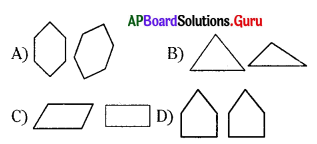
Which of the following figure has axes of symmetry?
AP 7th Class Maths Bits Chapter 15 Symmetry with Answers 1
Answer:
AP 7th Class Maths Bits Chapter 15 Symmetry with Answers 2

Question 2.
Number of axes of symmetry for a circle.
A) 1
B) 2
C) 0
D) Infinite
Answer:
D) Infinite

AP 7th Class Maths Bits Chapter 15 Symmetry with Answers

Question 3.
The angle of a rotational symmetry of a square
A) 60°
B) 45°
C) 90°
D) 30°
Answer:
C) 90°

Question 4.
What is the angle of a rotational symmetry of a parallelogram?
A) 180°
B) 90°
C) 45°
D) 120°
Answer:
A) 180°

Question 5.
Which of the following figure has symmetry?
A) Maths box
B) Cricket ball
C) A wheel
D) All the above
Answer:
D) All the above

Question 6.
Which of the following has rotational symmetry?
A) Wheel
B) Square
C) Circle
D) All the above
Answer:
D) All the above

Question 7.
Order of rotational symmetry of ‘X’ is …………….
A) 4
B) 2
C ) 3
D) 6
Answer:
A) 4

Question 8.
Rotational angle of an equilateral triangle is …………….
A) 90°
B) 120°
C) 60°
D) 30°
Answer:
B) 120°

Question 9.
Number of axes of symmetry of a letter ‘M’ is ………………
A) 0
B) 2
C) 1
D) 3
Answer:
C) 1

AP 7th Class Maths Bits Chapter 15 Symmetry with Answers

Question 10.
What are the minimum number of sides of a polygon?
A) 1
B) 2
C) 3
D) 4
Answer:
C) 3

Question 11.
Which of the following triangle has 2 lines of symmetry?
A) Scalene
B) Right angled
C) Equilateral
D) Isosceles
Answer:
D) Isosceles

Question 12.
Number of lines of symmetry for an equilateral triangle are?
A) 1
B) 2
C) 3
D) 4
Answer:
C) 3

Question 13.
Number of lines of symmetry for a square are ……………..
A) 4
B) 3
C) 2
D) 5
Answer:
A) 4

Question 14.
Which of the following statement is wrong?
A) Every square has an axes of symmetry
B) The letter ‘Z’ has no line of symmetry
C) The letter ‘E’ has no rotational symmetry
D) Every figure has an axes of symmetry
Answer:
D) Every figure has an axes of symmetry

Question 15.
Order of rotational symmetry of ‘N’ is ……………….
A) 1
B) 2
C) 3
D) 4
Answer:
B) 2

Question 16.
A square has ……………. lines of symmetry.
A) 1
B) 2
C) 3
D) 4
Answer:
D) 4

AP 7th Class Maths Bits Chapter 15 Symmetry with Answers

Question 17.
A circle has …………… lines of symmetry.
A) 0
B) 1
C) 4
D) inifinity
Answer:
D) inifinity

Question 18.
Which of the following has a line symmetry?
A) P
B) F
C) M
D) Q
Answer:
C) M

Question 19.
The angle of rotational symmetry of an equilateral triangle is
A) 60°
B) 120°
C) 180°
D) 360°
Answer:
B) 120°

Question 20.
The order of rotational symmetry of an equilateral triangle is
A) 3
B) 2
C) 1
D) 4
Answer:
A) 3

Question 21.
The order of rotational symmetry of a regular hexagon is
A) 6
B) 4
C) 3
D) 1
Answer:
A) 6

Question 22.
Angle between successive axes of symmetry
A) [latex]\frac{90}{\mathrm{n}}[/latex]
B) [latex]\frac{90}{2 \mathrm{n}}[/latex]
C) [latex]\frac{360}{2 \mathrm{n}}[/latex]
D) [latex]\frac{360}{\mathrm{n}}[/latex]
Answer:
C) [latex]\frac{360}{2 \mathrm{n}}[/latex]

Question 23.
The line which divides a figure into two identical parts is called
A) axis of symmetry
B) point of symmetry
C) rotational symmetry
D) None
Answer:
A) axis of symmetry

AP 7th Class Maths Bits Chapter 15 Symmetry with Answers

Question 24.
Number of lines of symmetry for ‘H’
A) 2
B) 1
C) 3
D) 4
Answer:
A) 2

Question 25.
Which letter has no line of symmetry?
A) A
B) B
C) C
D) F
Answer:
D) F

Question 26.
Number of axes of symmetry of AP 7th Class Maths Bits Chapter 15 Symmetry with Answers 3?
A) 1
B) 2
C) 3
D) 4
Answer:
A) 1

Question 27.
Number of axes of symmetry of AP 7th Class Maths Bits Chapter 15 Symmetry with Answers 4?
A) 1
B) 2
C) 3
D) 4
Answer:
D) 4

Question 28.
Number of axes of symmetry of AP 7th Class Maths Bits Chapter 15 Symmetry with Answers 5?
A) 1
B) 2
C) 3
D) 4
Answer:
B) 2

Question 29.
Number of axes of symmetry of AP 7th Class Maths Bits Chapter 15 Symmetry with Answers 6?
A) 2
B) 3
C) 4
D) 5
Answer:
D) 5

AP 7th Class Maths Bits Chapter 15 Symmetry with Answers

Question 30.
Number of axes of symmetry of AP 7th Class Maths Bits Chapter 15 Symmetry with Answers 7?
A) 1
B) 0
C) 2
D) 3
Answer:
B) 0

AP 7th Class Maths Bits Chapter 14 Understanding 3D and 2D Shapes with Answers

Practice the AP 7th Class Maths Bits with Answers Chapter 14 Understanding 3D and 2D Shapes on a regular basis so that you can attempt exams with utmost confidence.

AP State Syllabus 7th Class Maths Bits 14th Lesson Understanding 3D and 2D Shapes with Answers

Choose the correct answer.

Question 1.
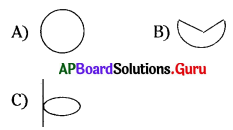
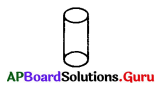
The net of AP 7th Class Maths Bits Chapter 14 Understanding 3D and 2D Shapes with Answers 1 is
AP 7th Class Maths Bits Chapter 14 Understanding 3D and 2D Shapes with Answers 2
D) none
Answer:
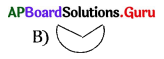
AP 7th Class Maths Bits Chapter 14 Understanding 3D and 2D Shapes with Answers 3

Question 2.
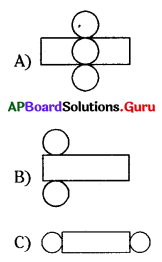
Identify the net shape of AP 7th Class Maths Bits Chapter 14 Understanding 3D and 2D Shapes with Answers 4
AP 7th Class Maths Bits Chapter 14 Understanding 3D and 2D Shapes with Answers 5
D) none
Answer:
AP 7th Class Maths Bits Chapter 14 Understanding 3D and 2D Shapes with Answers 6

AP 7th Class Maths Bits Chapter 14 Understanding 3D and 2D Shapes with Answers

Question 3.
Identify the net shape of AP 7th Class Maths Bits Chapter 14 Understanding 3D and 2D Shapes with Answers 7
AP 7th Class Maths Bits Chapter 14 Understanding 3D and 2D Shapes with Answers 8
Answer:
AP 7th Class Maths Bits Chapter 14 Understanding 3D and 2D Shapes with Answers 9

Question 4.
What is the vertical shape of AP 7th Class Maths Bits Chapter 14 Understanding 3D and 2D Shapes with Answers 10 ?
AP 7th Class Maths Bits Chapter 14 Understanding 3D and 2D Shapes with Answers 11
Answer:
AP 7th Class Maths Bits Chapter 14 Understanding 3D and 2D Shapes with Answers 12

Question 5.
The Horizontal cut of AP 7th Class Maths Bits Chapter 14 Understanding 3D and 2D Shapes with Answers 13
AP 7th Class Maths Bits Chapter 14 Understanding 3D and 2D Shapes with Answers 14
Answer:
AP 7th Class Maths Bits Chapter 14 Understanding 3D and 2D Shapes with Answers 15

Question 6.
When spherical shape seen under the lamp of an overhead projector it seems to
be a shape of ……………..
A) square
B) circle
C) rectangle
D) triangle
Answer:
B) circle

Question 7.
From the above sum cube is ……………….
A) circle
B) square
C) rectangle
D) triangle
Answer:
B) square

Question 8.
Textbook is in the shape of
A) rectangle
B) square
C) circle
D) triangle
Answer:
A) rectangle

Question 9.
A cube has ………………… edges.
A) 4
B) 8
C) 12
D) 6
Answer:
C) 12

AP 7th Class Maths Bits Chapter 14 Understanding 3D and 2D Shapes with Answers

Question 10.
A cuboid has ……………….. faces.
A) 4
B) 6
C) 8
D) 12
Answer:
B) 6

Question 11.
The skelton out line of a solid on 2-D surface is called
A) opaque sketch
B) isometric sketch
C) net
D) none
Answer:
C) net

Question 12.
The opposite faces of a dice always have a total of …………….. on them.
A) 9
B) 8
C) 7
D) 6
Answer:
C) 7

Question 13.
Which of the following is a 3-D shape?
A) Triangle
B) Rectangle
C) Cone
D) Square
Answer:
C) Cone

Question 14.
Which of the following is not a 3-D shape?
A) Parallelogram
B) Cylinder
C) Sphere
D) Cone
Answer:
A) Parallelogram

Question 15.
Cricket ball is an example of ………………. shape.
A) sphere
B) cone
C) cylinder
D) none
Answer:
A) sphere

Question 16.
Example for a cube is ……………..
A) pen
B) dice
C) ice cream-cone
D) none
Answer:
B) dice

Question 17.
Example for a cylindrical shape is ……………….
A) Candle
B) Brick
C) Laddoos
D) Tin
Answer:
A) Candle

Question 18.
Number of faces of a cube are ………………
A) 6
B) 7
C) 8
D) 5
Answer:
A) 6

Question 19.
Number of edges of a pyramid are ………………..
A) 12
B) 10
C) 8
D) 9
Answer:
C) 8

Question 20.
Number of vertices of a cuboid are ……………..
A) 6
B) 4
C) 5
D) 8
Answer:
D) 8

II. Matching:

1. Match the following.
AP 7th Class Maths Bits Chapter 14 Understanding 3D and 2D Shapes with Answers 16
Answer:
1) – b
2) – c
3) – d
4) – a

2. Match the following.

Group – A Group – B
Object Its shadows
1. A football a) Triangular
2. A triangular prism b) Rectangular
3. A dice c) Pyramidical
4. A notebook d) Cuboid
5. A cylindrical pipe e) Square
f) Circular

Answer:
1. A football – f) Circular
2. A triangular prism – a) Triangular
3. A dice – e) Square
4. A notebook – b) Rectangular
5. A cylindrical pipe – d) Cuboid

AP 7th Class Maths Bits Chapter 13 Area and Perimeter with Answers

Practice the AP 7th Class Maths Bits with Answers Chapter 13 Area and Perimeter on a regular basis so that you can attempt exams with utmost confidence.

AP State Syllabus 7th Class Maths Bits 13th Lesson Area and Perimeter with Answers

Choose the correct answer.

Question 1.
The side of a square is 18cm. Then its area is ……….. cm2.
A) 36
B) 384
C) 324
D) 428
Answer:
C) 324

Question 2.
The length and breadth of a rectangle are 25cm and 20cm then its perimeter is ……………. cm
A) 500
B) 90
C) 45
D) 100
Answer:
B) 90

AP 7th Class Maths Bits Chapter 13 Area and Perimeter with Answers

Question 3.
The base of a parallelogram and its corresponding heights are 8cm and 3cm, its
area is …………….. cm2.
A) 12
B) 11
C) 48
D) 24
Answer:
D) 24

Question 4.
Area of the given figure ……………. sq. units.
AP 7th Class Maths Bits Chapter 13 Area and Perimeter with Answers 1
A) 72
B) 36
C) 18
D) 48
Answer:
A) 72

Question 5.
The base and height of a triangle are 10cm and 5cm, its area is
A) 50cm2
B) 25cm2
C) 30 cm2
D) 100cm2
Answer:
B) 25cm2

Question 6.
In the figure BE = ………………
AP 7th Class Maths Bits Chapter 13 Area and Perimeter with Answers 2
A) 4
B) 5
C) 6
D) 3
Answer:
D) 3

Question 7.
Area of the given figure is …………………. cm2
AP 7th Class Maths Bits Chapter 13 Area and Perimeter with Answers 3
A) 15
B) 30
C) 18
D) 24
Answer:
A) 15

Question 8.
The diametre of a wheel is 35cm then its circumference is
A) 110cm
B) 220cm
C) 95cm
D) 100cm
Answer:
A) 110cm

Question 9.
The radius of a circle is 7cm then its circumference is
A) 44cm
B) 36cm
C) 22 cm
D) 66cm
Answer:
A) 44cm

AP 7th Class Maths Bits Chapter 13 Area and Perimeter with Answers

Question 10.
If the circumference is 22cm, then radius of the circle is
A) 1cm
B) 0.5cm
C) 3.5 cm
D) 14cm
Answer:
C) 3.5 cm

Question 11.
The side of a square is 27 mts, then its area is ………….. sq. mts.
A) 729
B) 629
C) 829
D) 719
Answer:
A) 729

Question 12.
If the side of a square is 7 cms, then its perimeter is ……………… cms.
A) 21
B) 14
C) 28
D) 35
Answer:
C) 28

Question 13.
If the perimeter of a square is 36 cms, then its area is ………….. sq. cms.
A) 64
B) 81
C) 49
D) 18
Answer:
B) 81

Question 14.
If l = 15 cm, b = 12 cm, then the perimeter of a rectangle is ……………… cms.
A) 180
B) 35
C) 27
D) 54
Answer:
D) 54

Question 15.
From the above sum the area of a rectangle is ………………. sq. cm.
A) 150
B) 180
C) 160
D) 170
Answer:
B) 180

Question 16.
If the area of a rectangle is 180 sq.cm its length is 20 cm, then its breadth is ……………. cm.
A) 9
B) 8
C) 7
D) 10
Answer:
A) 9

AP 7th Class Maths Bits Chapter 13 Area and Perimeter with Answers

Question 17.
From the given figure, area of a parallelogram is …………….. sq. cm.
AP 7th Class Maths Bits Chapter 13 Area and Perimeter with Answers 4
A) 40.5
B) 81
C) 40
D) 91
Answer:
D) 91

Question 18.
If the area of a parallelogram is 36 sq.cm, its base is 9 cm, then its height is ……….. cms.
A) 5
B) 6
C) 4
D) 3
Answer:
C) 4

Question 19.
If the base of a parallelogram is twice of its height and area is 98 sq. cms, then its
base is ………… cms.
A) 16
B) 21
C) 7
D) 14
Answer:
D) 14

Question 20.
From the given figure the area of a triangle is …………. sq. cms.
AP 7th Class Maths Bits Chapter 13 Area and Perimeter with Answers 5
A) 45.5
B) 4.55
C) 0.455
D) 5.55
Answer:
B) 4.55

Question 21.
If the height of a triangle is 5 cm, and its area is 40 sq. cms, then its base is ………….. cms.
A) 16
B) 18
C) 20
D) 14
Answer:
A) 16

Question 22.
From the given figure, [latex]\overline{\mathbf{B E}}[/latex] = ……………… cm
AP 7th Class Maths Bits Chapter 13 Area and Perimeter with Answers 6
A) 1
B) 5
C) 2
D) 4
Answer:
B) 5

Question 23.
The base of a triangle is 40 cm and its area is 220 cm2, then its height is ……………….. cms.
A) 12
B) 11
C) 22
D) 14
Answer:
B) 11

AP 7th Class Maths Bits Chapter 13 Area and Perimeter with Answers

Question 24.
The diagonals of a rhombus are (a + b), (a – b), then its area is …………….. sq. units
A) [latex]\frac {1}{2}[/latex] (2a)
B) [latex]\frac {1}{2}[/latex] (a2 + b2)
C) [latex]\frac {1}{2}[/latex] (a2 – b2)
D) [latex]\frac {1}{2}[/latex] (a + b) (2a)
Answer:
C) [latex]\frac {1}{2}[/latex] (a2 – b2)

Question 25.
Find the area of a rhombus whose diagonals are 3 cm, 7 cm is …………….. sq. cms.
A) 10.5
B) 21
C) 10
D) 14
Answer:
A) 10.5

Question 26.
The area of a rhombus is 96 cm2, its one of its diagonal length is 12 cm, then the length of second diagonal is ……………….. cm.
A) 24
B) 18
C) 16
D) 8
Answer:
C) 16

Question 27.
The circumference of a circle whose radius is 3.5 cm is ……………….. cms.
A) 2.2
B) 44
C) 11
D) 22
Answer:
D) 22

Question 28.
If the circumference of a circle is 55 cm, then its diameter is ………………. cm.
A) 18
B) 17.5
C) 17
D) 16.5
Answer:
B) 17.5

Question 29.
If the circumference of a circle is 44 cm, then its diameter is …………… cms.
A) 16
B) 21
C) 7
D) 14
Answer:
D) 14

Question 30.
The ratio of circumference of a circle to its diameter is
A) 7
B) 22
C) π
D) 7/22
Answer:
C) π

AP 7th Class Maths Bits Chapter 13 Area and Perimeter with Answers

Question 31.
How many times will a wheel of radius 7 mts be rotated to travel 880 mts?
A) 30
B) 20
C) 25
D) 24
Answer:
B) 20

Question 32.
How far does the tip of the minute hand move in 1 hour if its length is 14m is ………….. cms?
A) 88 cm
B) 80 cm
C) 98 cm
D) 78 cm
Answer:
A) 88 cm

Question 33.
The area of a circle whose radius is 7 cm ……………..sq. cms.
A) 140
B) 176
C) 154
D) 166
Answer:
C) 154

Question 34.
Which of the following is not true?
A) All parallelograms with equal base and equal heights are same area
B) Area of a parallelogram is related to area of a rectangle
C) A rectangle is a parallelogram
D) A parallelogram is a rectangle
Answer:
D) A parallelogram is a rectangle

Question 35.
A square and a parallelogram have the same area. If a side of the square is 8 cm and the height of a parallelogram is 4 cm, then its base is ……………… cm.
A) 18
B) 16
C) 8
D) 32
Answer:
B) 16

Question 36.
What is the area of a shaded region?
AP 7th Class Maths Bits Chapter 13 Area and Perimeter with Answers 7
A) Area of square ABCD – area of ΔAPB
B) Area of ΔABC – area of square ABCD
C) Area of square ABCD – area of [ΔAPD + ΔBPC]
D) None
Answer:
A) Area of square ABCD – area of ΔAPB

Question 37.
Formula for area of a parallelogram is ……………… sq. units.
A) [latex]\frac {1}{2}[/latex] d (h1 + h2)
B) [latex]\frac {1}{2}[/latex] d1 d2
C) [latex]\frac {1}{2}[/latex] bh
D) bh
Answer:
D) bh

Question 38.
Formula for area of a triangle is ………………. sq. units.
A) [latex]\frac {1}{2}[/latex] d (h1 + h2)
B) [latex]\frac {1}{2}[/latex] d1 d2
C) [latex]\frac {1}{2}[/latex] bh
D) bh
Answer:
C) [latex]\frac {1}{2}[/latex] bh

AP 7th Class Maths Bits Chapter 13 Area and Perimeter with Answers

Question 39.
Area of a rhombus whose diagonals are d1, d2 is …………….
A) [latex]\frac {1}{2}[/latex] d (h1 + h2)
B) [latex]\frac {1}{2}[/latex] d1 d2
C) [latex]\frac {1}{2}[/latex] bh
D) bh
Answer:
B) [latex]\frac {1}{2}[/latex] d1 d2

Question 40.
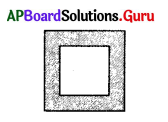
The area of the shaded path is
AP 7th Class Maths Bits Chapter 13 Area and Perimeter with Answers 8
A) Area of outer square – Area of inner square
B) Area of inner square – Area Of outer square
C) Area of outer square + Area of inner square
D) None
Answer:
A) Area of outer square – Area of inner square

Question 41.
The circumference of a circle whose diameter is d units is given ………………
A) [latex]\frac{\pi \mathrm{d}}{2}[/latex]
B) 2 π r
C) π d
D) [latex]\frac{\pi \mathrm{d}^{2}}{4}[/latex]
Answer:
C) π d

Question 42.
What is the area of a shaded path in the given figure?
AP 7th Class Maths Bits Chapter 13 Area and Perimeter with Answers 9
AP 7th Class Maths Bits Chapter 13 Area and Perimeter with Answers 10
D) None
Answer:
AP 7th Class Maths Bits Chapter 13 Area and Perimeter with Answers 11

AP 7th Class Maths Bits Chapter 12 Quadrilaterals with Answers

Practice the AP 7th Class Maths Bits with Answers Chapter 12 Quadrilaterals on a regular basis so that you can attempt exams with utmost confidence.

AP State Syllabus 7th Class Maths Bits 12th Lesson Quadrilaterals with Answers

I. Choose the correct answer.

Question 1.
If the diagonals AC, BD of a parallelogram meet at O, then
A) OA = OC
B) OA = OB
C) OA = OD
D) 2 OA = BD
Answer:
A) OA = OC

Question 2.
ABCD is a parallelogram. ∠A + ∠D =
A) 90°
B) 180°
C) 360°
D) 270°
Answer:
B) 180°

AP 7th Class Maths Bits Chapter 12 Quadrilaterals with Answers

Question 3.
From the given figure, ∠x = ……………….?
AP 7th Class Maths Bits Chapter 12 Quadrilaterals with Answers 1
A) 60°
B) 45°
C) 30°
D) 55°
Answer:
A) 60°

Question 4.
The sum of the 4 angles of Quadrilateral is ……………………
A) 250°
B) 270°
C) 180°
D) 360°
Answer:
D) 360°

Question 5.
If ABCD is a rhombus then ……………….
A) AB = CD, BC = AD, AC ≠ BD
B) AB = CD, BC = AD, AC = BD
C) AB = BC = CD = DA, AC ≠ BD
D) AB = BC = CD = DA, AC = BD
Answer:
C) AB = BC = CD = DA, AC ≠ BD

Question 6.
ABCD is a parallelogram then …………………
A) AB = CD, BC = AD, AC ≠ BD
B) AB = CD, BC = AD, AC = BD
C) AB = BC = CD = DA, AC = BD
D) None
Answer:
A) AB = CD, BC = AD, AC ≠ BD

Question 7.
Each of a parallelogram, is 90° then it is …………….
A) rhombus
B) square
C) rectangle
D) trapezium
Answer:
C) rectangle

Question 8.
Three angles of a Quadrilateral are 65°, 120°, 70° then the 4 th angle is ………………..
A) 95°
B) 115°
C) 105°
D) 100°
Answer:
C) 105°

Question 9.
The angles of a quadrilateral are in the ratio of 1 : 2 : 3 : 4 then the largest angle is ……………….
A) 120°
B) 108°
C) 72°
D) 144°
Answer:
D) 144°

AP 7th Class Maths Bits Chapter 12 Quadrilaterals with Answers

Question 10.
Each angle of a square is …………………
A) 90°
B) 180°
C) 45°
D) 60°
Answer:
A) 90°

Question 11.
The angles of a quadrilateral are x°, (x + 10°), (x + 20°), (x + 30°) then ∠x = …………….
A) 65°
B) 75°
C) 85°
D) 70°
Answer:
B) 75°

Question 12.
In a parallelogram ABCD ∠A :∠B = 2 : 3 then ∠C = ………………
A) 90°
B) 108°
C) 72°
D) 60°
Answer:
C) 72°

Question 13.
Which of the following is true?
A) All rhombuses are parallelograms
B) All kites are rhombuses
C) Every parallelogram is a square
D) Every square is a parallelogram
Answer:
D) Every square is a parallelogram

Question 14.
A rectangle in which all the sides are equal is called a ……………..
A) parallelogram
B) square
C) rhombus
D) trapezim
Answer:
B) square

Question 15.
In a rhombus ABCD ∠ADC = 45° then the other angles are ……………….
A) 135°, 45°, 135°
B) 45°, 135°, 135°
C) 60°, 120°, 60°
D) 120°, 60°, 120°
Answer:
A) 135°, 45°, 135°

Question 16.
A square is a ………………
A) parallelogram
B) rhombus
C) rectangle
D) all the above
Answer:
D) all the above

AP 7th Class Maths Bits Chapter 12 Quadrilaterals with Answers

Question 17.
If the adjacent angles of a parallelogram are x + 29°, 2x + 31° then ∠x = ……………
A) 30°
B) 40°
C) 60°
D) 120°
Answer:
B) 40°

Question 18.
Sum of the angles in a quadrilateral in right angles
A) 2
B) 3
C) 4
D) 5
Answer:
C) 4

Question 19.
Number of independent measurements required for the construction of a quadrilateral
A) 3
B) 5
C) 6
D) 4
Answer:
B) 5

Question 20.
Sum of the exterior angles of a quadrilateral in right angles
A) 1
B) 2
C) 3
D) 4
Answer:
D) 4

Question 21.
A quadrilateral which has one pair of opposite sides parallel is called is called a
A) Rhombus
B) Square
C) Parallelogram
D) Trapezium
Answer:
D) Trapezium

Question 22.
Number of independent measurements for the construction of a trapezium
A) 2
B) 3
C) 4
D) 5
Answer:
C) 4

Question 23.
The quadrilateral in which the diagonals bisect each other and they are perpendicular to each other
A) Rectangle
B) Rhombus
C) Parallelogram
D) Trapezium
Answer:
B) Rhombus

AP 7th Class Maths Bits Chapter 12 Quadrilaterals with Answers

Question 24.
The name of the quadrilateral in which the diagonals are equal and perpendicular to each other
A) Parallelogram
B) Rhombus
C) Square
D) Rectangle
Answer:
C) Square

Question 25.
How many measurements are needed for the construction of a square?
A) 2
B) 3
C) 4
D) 1
Answer:
D) 1

Question 26.
Measurements (Independent) needed for the construction of a rhombus?
A) 2
B) 3
C) 4
D) 5
Answer:
A) 2

Question 27.
The number of independent measurements required for the construction of a parallelogram are
A) 2
B) 3
C) 4
D) 5
Answer:
B) 3

Question 28.
From the given figure given, the diagonals are ………………..
AP 7th Class Maths Bits Chapter 12 Quadrilaterals with Answers 2
A) AB, BC
B) BC, CD
C) AC, BD
D) AD, CD
Answer:
C) AC, BD

Question 29.
From the above figure, the angles are
A) ∠A, ∠B
B) ∠D
C) ∠C
D) All the above
Answer:
D) All the above

Question 30.
From the above figure, the adjacent sides are
A) AB, BC
B) BC, AD
C) AC, BD
D) AB, CD
Answer:
A) AB, BC

Question 31.
Two adjacent sides of a parallelogram are in the ratio of 2 : 1. If its perimeter is 21 cm, then its shortest side is ……………… cm
A) 7
B) 6
C) 3.5
D) 3
Answer:
A) 7

AP 7th Class Maths Bits Chapter 12 Quadrilaterals with Answers

Question 32.
ABCD is a square [latex]\overline{\mathrm{AC}}[/latex] is the diagonal, then ∠BAC = ……………..
A) 50°
B) 30°
C) 60°
D) 45°
Answer:
D) 45°

Question 33.
Which of the following is not true?
A) A parallelogram in which two adjacent sides are equal is a rhombus
B) Every diagonal of rectangle divides it into two congruent triangles
C) ABCDisaparallelogram∠A -∠C = 90°.
D) The diagonals of a rhombus bisect at right angles
Answer:
C) ABCDisaparallelogram∠A -∠C = 90°.

Question 34.
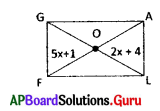
FLAG is a rectangle from the given figure x = …………….. cm
AP 7th Class Maths Bits Chapter 12 Quadrilaterals with Answers 3
A) 1
B) 2
C) 3
D) 4
Answer:
A) 1

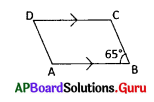
Question 35.
From the given figure (ABCD is a parallelogram) ∠A = ……………………?
AP 7th Class Maths Bits Chapter 12 Quadrilaterals with Answers 4
A) 115°
B) 125°
C) 120°
D) 105°
Answer:
A) 115°

AP 7th Class Maths Bits Chapter 11 Exponents with Answers

Practice the AP 7th Class Maths Bits with Answers Chapter 11 Exponents on a regular basis so that you can attempt exams with utmost confidence.

AP State Syllabus 7th Class Maths Bits 11th Lesson Exponents with Answers

Choose the correct answer.

Question 1.
x + x + x + ……. + x(mtimes)=
A) xm
B) mx
C) m + x
D) mx
Answer:
D) mx

Question 2.
(- 5) × (- 5) × (- 5) × ………………. × (- 5) (16 times) =
A) (- 5)16
B) 16-5
C) 16 – 5
D)16 × (- 5)
Answer:
A) (- 5)16

AP 7th Class Maths Bits Chapter 11 Exponents with Answers

Question 3.
([latex]\frac{-3}{7}[/latex])7 × ([latex]\frac{-3}{7}[/latex]) 6 × ([latex]\frac{-3}{7}[/latex])-14 =
A) [latex]\frac{-3}{7}[/latex]
B) [latex]\frac{-7}{3}[/latex]
C) [latex]\frac{3}{7}[/latex]
D) [latex]\frac{7}{3}[/latex]
Answer:
B) [latex]\frac{-7}{3}[/latex]

Question 4.
1216 × 12-4 =
A) 1212
B) 1220
C) 2412
D) 1264
Answer:
A) 1212

Question 5.
[latex]\frac{x^{17}}{x^{15}}[/latex] =
A) x32
B) x-2
C) x2
D) x1/2
Answer:
C) x2

Question 6.
125 when expressed In exponential form
A) 52
B) 53
C) 54
D) 5-3
Answer:
B) 53

Question 7.
7-x = 7-5 then the value of x is
A) 7
B) – 5
C) – 7
D) 5
Answer:
D) 5

Question 8.
(- 1)103 =
A) 1
B) 0
C) -1
D) – 103
Answer:
C) -1

Question 9.
(-1)106 =
A) 1
B) – 1
C) 106
D) 0
Answer:
A) 1

AP 7th Class Maths Bits Chapter 11 Exponents with Answers

Question 10.
The exponential form of age of earth is 4550 million years is ………………..
A) 4550 × 10,00,000
B) 455 × 107
C) 5 × 7 × 13 × 107
D) All the above
Answer:
D) All the above

Question 11.
Expanded form of 89325 is …………….
A) (8 × 10⁴) + (9 × 10³) + (3 × 10²) + (2 × 10) + (5 × 1)
B) 8 × 10³ + (9 × 10²) + (3 × 10) + 2 × 1 + 5
C) 104 × 8 + 9 × 10² + 3 × 10 + 2 × 10² + 5 × 1
D) None
Answer:
A) (8 × 10⁴) + (9 × 10³) + (3 × 10²) + (2 × 10) + (5 × 1)

Question 12.
r × r × 7 times = ………………?
A) 7r
B) 7r
C) r7
D) None
Answer:
C) r7

Question 13.
If a = 3, b = 2 then the value of ab + ba = ………………?
A) 1
B) 17
C) 19
D) 15
Answer:
B) 17

Question 14.
From the above sum what is the value of (a – b)a = ……………?
A) 1
B) 125
C) -1
D) 0
Answer:
A) 1

Question 15.
The exponent of (5 ab)3 is …………..
A) 5
B) 1
C) ab
D) 3
Answer:
D) 3

Question 16.
Which of the following is correct?
A) 39 × 37 = 32
B) a1/2 × a3/2 = a3
C) p-2 × p2 = p4
D) y3 × y5 = y8
Answer:
D) y3 × y5 = y8

AP 7th Class Maths Bits Chapter 11 Exponents with Answers

Question 17.
If k15 × kx = k31 ⇒ x = …………..?
A) 16
B) 15
C) 1
D) 0
Answer:
A) 16

Question 18.
(22)3 = ………………
A) 512
B) 64
C) 223
D) 256
Answer:
D) 256

Question 19.
Which of the following is not true?
A) x-7 = [latex]\frac{1}{x^{7}}[/latex]
B) x5 = [latex]\frac{1}{\mathrm{x}^{-5}}[/latex]
C) x° = 1
D) [latex]\frac{1}{\mathrm{x}^{-5}}[/latex] = x1/5
Answer:
D) [latex]\frac{1}{\mathrm{x}^{-5}}[/latex] = x1/5

Question 20.
Which of the following is true?
A) [latex]\frac{13^{8}}{13^{5}}[/latex] = 1313
B) (2 × 3)4 = 34/24
C) (32)3 = 36
D) ([latex]\frac{3}{4}[/latex])5 = 35 × 34
Answer:
C) (32)3 = 36

Question 21.
(- 1)101 + (- 1)100 = ………………
A) – 1
B) 0
C) 2
D) 1
Answer:
B) 0

Question 22.
AP 7th Class Maths Bits Chapter 11 Exponents with Answers 1
A) 2
B) 1
C) 12
D) – 2
Answer:
D) – 2

Question 23.
7x + 5= 1 ⇒ x = ………….
A) 5
B) 0
C) -5
D) 1
Answer:
C) -5

AP 7th Class Maths Bits Chapter 11 Exponents with Answers

Question 24.
([latex]\frac{3}{5}[/latex])4 × ([latex]\frac{3}{5}[/latex])3 × ([latex]\frac{3}{5}[/latex])7
A) ([latex]\frac{3}{5}[/latex])84
B) ([latex]\frac{3}{5}[/latex])7
C) ([latex]\frac{3}{5}[/latex])10
D) ([latex]\frac{3}{5}[/latex])14
Answer:
D) ([latex]\frac{3}{5}[/latex])14

Question 25.
What should be multiplied with 3-4we will get 729 is …………..?
A) 310
B) 39
C) 311
D) 38
Answer:
A) 310

Question 26.
(4° – 3°) × 2° = ……………
A) 2
B) 1
C) 0
D) -1
Answer:
C) 0

Question 27.
[latex]\frac{x^{\mathbf{a}}}{\mathbf{x}^{\mathbf{b}}} \times \frac{\mathbf{x}^{\mathbf{b}}}{\mathbf{x}^{\mathbf{c}}} \times \frac{\mathbf{x}^{\mathbf{c}}}{\mathbf{x}^{\mathbf{a}}}[/latex] = ………………
A) x2(a + b + c)
B) x(a + b + c)
C) 0
D) 1
Answer:
D) 1

Question 28.
Which of the following is true?
A) 43 > 82
B) 23 > 32
C) (15)° = (10000)°
D) (- 2)5 = 32
Answer:
C) (15)° = (10000)°

Question 29.
56 x 52x = 520 ⇒ x = ……………..
A) 7
B) -7
C) 6
D) 13
Answer:
A) 7

Question 30.
8536 in standard form is
A) 853.6 × 10
B) 85.36 × 10²
C) 8.536 × 10³
D) 0.8536 × 10⁴
Answer:
C) 8.536 × 10³

AP 7th Class Maths Bits Chapter 11 Exponents with Answers

Question 31.
The prime factorisation of 210 is
A) 2 × 3 × 3 × 7
B) 2 × 3 × 5 × 7
C) 2 × 5 × 5 × 6
D) 2 × 3 × 7 × 7
Answer:
B) 2 × 3 × 5 × 7

Question 32.
The exponential form of 1296 is
A) 24 × 35
B) 24 × 34
C) 25 × 34
D) 23 × 33
Answer:
B) 24 × 34

Question 33.
Exponential form of 625 is ……………..
A) 55
B) 45
C) 53
D) 54
Answer:
D) 54

Question 34.
Prime factorisation of 72 is ………….?
A) 23 × 32
B) 23 × 33
C) 33 × 22
D) 2 × 32 × 7
Answer:
A) 23 × 32

Question 35.
The standard form of 1, 353, 000,000 cubic kms is ……………….
A) 0.1353 × 10⁹ c.c. kms
B) 135.3 × 10⁹ c.c. kms
C) 1.353 × 10⁹ c.c. kms
D) 13.53 × 10⁹ c.c. kms
Answer:
C) 1.353 × 10⁹ c.c. kms

AP 7th Class Maths Bits Chapter 11 Exponents with Answers

Question 36.
The stand form of the distance between the earth and the moon is aprox. 12,000,000,000 mts
A) 12 × 1011 years
B) 1.2 × 10¹⁰years
C) 0.12 × 10⁹ years
D) 120 × 1011 years
Answer:
B) 1.2 × 10¹⁰years

Question 37.
Standard form of 12345 is ……………….
A) 1.2345 × 10⁴
B) 123.45 × 10³
C) 1.2345 × 10⁵
D) 12.345 × 10⁴
Answer:
A) 1.2345 × 10⁴

AP 7th Class Maths Bits Chapter 10 Algebraic Expressions with Answers

Practice the AP 7th Class Maths Bits with Answers Chapter 10 Algebraic Expressions on a regular basis so that you can attempt exams with utmost confidence.

AP State Syllabus 7th Class Maths Bits 10th Lesson Algebraic Expressions with Answers

I. Choose the correct answer.

Question 1.
The literal coefficient of-y is
A) 1
B) -1
C) y
D) -y
Answer:
C) y

Question 2.
The numerical coefficient of -3z is
A) -3
B) 3
C) z
D) -z
Answer:
A) -3

AP 7th Class Maths Bits Chapter 10 Algebraic Expressions with Answers

Question 3.
No. of terms in the expression (19 × 5) ÷ 16
A) 1
B) 2
C) 3
D) 4
Answer:
A) 1

Question 4.
Which of the following is a numerical expression?
A) 1 + 2 – 9
B) 9 + (6 – 4)
C) -3 – 5
D) x – [latex]\frac {11}{3}[/latex]
Answer:
D) x – [latex]\frac {11}{3}[/latex]

Question 5.
Which of the following is a binomial?
A) 19 × 4
B) 7xyz
C) x – 4a
D) 3x + y – z
Answer:
C) x – 4a

Question 6.
The degree of the monomial 9xy2z3 is
A) 7
B) 6
C) 5
D) 9
Answer:
B) 6

Question 7.
The degree of the algebraic expression ax2 + bx + c is
A) 2
B) 1
C) 3
D) 4
Answer:
A) 2

Question 8.
Sum of 18ab,-5ab, 12ab is
A) 25ab
B) 26ab
C) 30ab
D) 20ab
Answer:
A) 25ab

Question 9.
Subtract 6x2y from 4x2y
A) -2x2y
B) 2x2y
C) 10x2y
D) -10x2y
Answer:
A) -2x2y

AP 7th Class Maths Bits Chapter 10 Algebraic Expressions with Answers

Question 10.
Which of the following are like terms?
A) { – 2 xy2,5y2 x}
B) {7p, – 2p, 3p}
C) {4 xyz, – 5x2 yz}
D) {lmn2, l2mn. lm2n}
Answer:
B) {7p, – 2p, 3p}

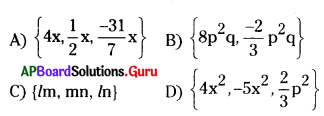
Question 11.
Which of the following are not like terms?
AP 7th Class Maths Bits Chapter 10 Algebraic Expressions with Answers 1
Answer:
C) {lm, mn, ln}

Question 12.
Which of the following is a Numerical Expression?
A) xy – z2 + yz
B) 2 + m + n
C) 9 + 11a2 – 5b2
D) 11 ÷ (5 – 6) + 2
Answer:
D) 11 ÷ (5 – 6) + 2

Question 13.
Which of the following is Algebraic Expression?
A) 96
B) 95 ÷ 11 × 3
C) 2 + m + n
D) – 30 + (16 ÷ 4)
Answer:
C) 2 + m + n

Question 14.
The degree of a monomial [latex]\frac {-5}{2}[/latex] xy2 z3 is?
A) 7
B) 2
C) 3
D) 6
Answer:
D) 6

Question 15.
The degree of a monomial [latex]\frac {-15}{19}[/latex] l3m4n is …………….
A) 8
B) 7
C) 9
D) 12
Answer:
A) 8

Question 16.
The degree of an algebraic expression ax3 + bx2 + cx + dx11 + ex9 is ……………..
A) 11
B) 9
C) 3
D) 16
Answer:
A) 11

AP 7th Class Maths Bits Chapter 10 Algebraic Expressions with Answers

Question 17.
The degree of an algebraic expression lmn + l2m-ln2-m2n is ………………….
A) 2
B) 3
C) 6
D) 8
Answer:
B) 3

Question 18.
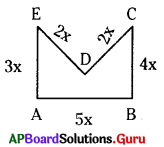
From the given figure the perimeter is …………….. units.
AP 7th Class Maths Bits Chapter 10 Algebraic Expressions with Answers 2
A) 8x
B) 10x
C) 16x
D) 12x
Answer:
C) 16x

Question 19.
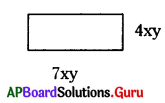
The perimeter of a rectangle is ……………… units.
AP 7th Class Maths Bits Chapter 10 Algebraic Expressions with Answers 3
A) 11xy
B) 22 xy
C) 28 x2 y2
D) 28 xy
Answer:
B) 22 xy

Question 20.
Subtract 11p from 2p is ……………….
A) – 9p
B) 9p
C) 13p
D) 7p
Answer:
A) – 9p

Question 21.
If x = – 1 what is the value of x2 – 1?
A) 1
B) 0
C) – 1
D) 2
Answer:
B) 0

Question 22.
What is the value of mn – nm if m = 3, n = 2?
A) 0
B) 2
C) 1
D) 5
Answer:
C) 1

Question 23.
What is the value of xy + 3y – 9 when x = 1, y = 2 is …………….
A) 1
B) -1
C) 0
D) 12
Answer:
B) -1

AP 7th Class Maths Bits Chapter 10 Algebraic Expressions with Answers

Question 24.
(2x + 9y – 7z) + (3y + z + 3x) + (2x – 4y – z) = ………………
A) 7x + 8y – 7z
B) – 7x + 8y – 7z
C) 7x – 8y – 7z
D) 7x – 8y + 7z
Answer:
A) 7x + 8y – 7z

Question 25.
Simplification of 2x2 + 5x – 1 + 8x + x2 + 7 – 6x + 3 – 3x2 is ………………
A) 7x – 9
B) – 7x + 9
C) 7x + 9
D) 6x + 9
Answer:
C) 7x + 9

Question 26.
If A = 4x2 + y2 – 6xy, B = 3y2 + 12x2 + 8xy then A – B = ?
A) 8x2 – 2y2 – 14xy
B) – 8x2 – 2y2 – 14xy
C) – 8x2 + 2y2 – 14xy
D) – 8x2 – 2y2 + 14xy
Answer:
B) – 8x2 – 2y2 – 14xy

Question 27.
(3a2 – 8ab – 2b2) – (3a2 – 4ab + 6b2) = ……………..
A) – 4ab + 8b2
B) 4ab + 8b2
C) 4ab – 8b2
D) – 4ab – 8b2
Answer:
D) – 4ab – 8b2

Question 28.
A pattern of letter ‘z’ is?
A) 2n
B) 2n + 1
C) 3n
D) 3n + 1
Answer:
C) 3n

Question 29.
A pattern of letter ‘V’ Is
A) n + 1
B) 2n + 1
C) 3n
D) 2n
Answer:
D) 2n

Question 30.
4, 7, 10, 13, ……………… in series nth term
A) 3n + 1
B) 3n
C) 3n + 2
D) 2n + 2
Answer:
A) 3n + 1

AP 7th Class Maths Bits Chapter 10 Algebraic Expressions with Answers

Question 31.
The pattern of the series 5, 9, 13, 17, ………………. is
A) 3n + 2
B) 4n + 1
C) 2n + 3
D) 4n + 2
Answer:
B) 4n + 1

Question 32.
Write an algebraic expression for “p is multiplied by -6”
A) p × 6
B) – 6p
C) [latex]\frac{-\mathrm{p}}{6}[/latex]
D) [latex]\frac{-6}{\mathrm{p}}[/latex]
Answer:
B) – 6p

Question 33.
What is the pattern of the letter ‘H’?
A) 4n
B) 2n
C) 3n
D) 3n2
Answer:
C) 3n

Question 34.
The pattern of the letter ‘V’ is ……………..?
A) 2n
B) 2n2
C) n2
D) 3n
Answer:
A) 2n

Question 35.
Which of the following situation is a variable?
A) The cost of Tomatoes in a market
B) The temperature of a day in every hour
C) Rainfall in a year month wise
D) All the above
Answer:
D) All the above

Question 36.
Which of the following situation refers a constant?
A) The height of a children from the age 5 to 15 years
B) Runs done by a cricket player in different matches
C) The length of your classroom is fixed
D) Current bill of your house in various months in a year
Answer:
C) The length of your classroom is fixed

Question 37.
What should be added to 1 + 2x – 3x2 we will get x2– x – 1?
A) 4x2 – 3x + 2
B) 4x2 – 3x – 2
C) 4x2 + 3x – 2
D) 4x2 + 3x + 2
Answer:
B) 4x2 – 3x – 2

AP 7th Class Maths Bits Chapter 10 Algebraic Expressions with Answers

Question 38.
Write an algebraic expression for “b is multiplied by x and 5 is added to the product”?
A) bx + 5
B) b + 5x
C) bx – 5
D) b – 5x
Answer:
A) bx + 5

Question 39.
Write the statement for “16 + m”
A) m is multiplied by 6
B) 6 is multiplied by m
C) 16 is added to m
D) None of these
Answer:
C) 16 is added to m

Question 40.
“3m + 5” write the statement for the given algebraic expression.
A) in is multiplied by 3
B) m is multiplied by 3 and 5 is subtracted from the product.
C) m is multiplied by 3 and 5 is added to the product
D) None
Answer:
C) m is multiplied by 3 and 5 is added to the product

Question 41.
Which of the following represents the variable?
A) Length of your pencil box
B) Breadth of your maths textbook
C) Your height
D) Number of hands of a human being
Answer:
C) Your height

Question 42.
Which of the following represents the constant?
A) Your weight
B) Number of students in your class in every year
C) Your age
D) The days in January month
Answer:
D) The days in January month

Question 43.
Which of the following is a Monomial?
A) 7 lm2n2
B) 100 – (98 ÷ 2)
C) 3y2 – x2y2 + 4x
D) 1 + x + x2
Answer:
A) 7 lm2n2

Question 44.
Which of the following is a trinomial?
A) 101
B) ax + b
C) ax2 + bx + c
D) lmn
Answer:
C) ax2 + bx + c

AP 7th Class Maths Bits Chapter 10 Algebraic Expressions with Answers

Question 45.
5 – 2xy is a ……………. expression.
A) Monomial
B) Binomial
C) Trinomial
D) Multinomial
Answer:
B) Binomial

Question 46.
7x2 – 2xy + 9y2 – 11 is a …………… expression.
A) Monomial
B) Binomial
C) Trinomial
D) Polynomial
Answer:
D) Polynomial

Question 47.
The algebraic expression for “x is multiplied by 7 and 3 is reduced from the product” is ………………..
A) 7x – 3
B) 7x + 3
C) 7/x— 3
D) x/7 – 3
Answer:
A) 7x – 3

Question 48.
Write an algebraic expression for “one- fifth of product of x & y” is …………….
A) [latex]\frac{\mathrm{xy}}{4}[/latex]
B) [latex]\frac{\mathrm{xy}}{5}[/latex]
C) [latex]\frac{x+y}{5}[/latex]
D) [latex]\frac{\mathrm{xy}+5}{4}[/latex]
Answer:
B) [latex]\frac{\mathrm{xy}}{5}[/latex]

Question 49.
Write a sentence for an algebraic expression “12p-7” is ………………
A) 7 is reduced from twelve times of P
B) 7 is reduced from P
C) 7 is reduced from p and multiplied by 12
D) None
Answer:
A) 7 is reduced from twelve times of P

Question 50.
Write a mathematical sentence for an algebraic expression is “10 lmn” is …………….
A) the product of l, m, n
B) the product of 10, l, m
C) the product of 10, l, m, n
D) None
Answer:
C) the product of 10, l, m, n

Question 51.
The Numerical coefficient of – y2 is……………..?
A) 1
B) 2
C) – 1
D) – 2
Answer:
C) – 1

AP 7th Class Maths Bits Chapter 10 Algebraic Expressions with Answers

Question 52.
The Numerical coefficient of [latex]\frac {-3}{2}[/latex] xy2z3?
A) [latex]\frac {-3}{2}[/latex]
B) [latex]\frac {3}{2}[/latex]
C) 3
D) 6
Answer:
A) [latex]\frac {-3}{2}[/latex]

Question 53.
The literal coefficient of [latex]\frac {7}{5}[/latex] x is ……………..?
A) x
B) 1
C) -[latex]\frac {7}{5}[/latex]
D) None
Answer:
A) x

Question 54.
The number of terms in the expression – 5 x2yz is ……………..
A) 5
B) 3
C) 2
D) 1
Answer:
D) 1

Question 55.
The standard form of an expression 8 – 3x2 + 4x is …………….
A) – 3x2 + 8 + 4x
B) – 3x2 + 4x + 8
C) 4x – 3 x2 + 8
D) 8 + 4x – 3x2
Answer:
B) – 3x2 + 4x + 8

Question 56.
The standard form of an expression y3 + 1 + y + 3y2 is ………….
A) y3 + 3y2 + 1 + y
B) 3y2 + y3 + y + 1
C) 1 + y + 3y2 + y3
D) y3 + 3y2 + y + 1
Answer:
D) y3 + 3y2 + y + 1

Question 57.
Which of the following expression is in a standard form?
A) ax2 + c + bx
B) ax2 + bx + c
C) c + bx + ax2
D) ax2 + b + ex3
Answer:
B) ax2 + bx + c

AP 7th Class Maths Bits Chapter 10 Algebraic Expressions with Answers

II. Match the following.

Group – A Group-B
1. Monomial A) x2 + 2xy + y2
2. Binomial B) 5xy – 6y + 4zx + 7 – 5t
3. Trinomial C) x2 – y2 + z
4. Polynomial D) ax2 + bx + c
5. Second degree algebraic expression E) 2x + 3y
6. Numerical expression F) 4xyz
G) ax + b
H) (6 × 5) ÷ 3

Answer:
1. Monomial – F) 4xyz
2. Binomial – E) 2x + 3y
3. Trinomial – A) x2 + 2xy + y2
4. Polynomial – B) 5xy – 6y + 4zx + 7 – 5t
5. Second degree algebraic expression – D) ax2 + bx + c
6. Numerical expression – H) (6 × 5) ÷ 3

AP 7th Class Maths Bits Chapter 9 Construction of Triangles with Answers

Practice the AP 7th Class Maths Bits with Answers Chapter 9 Construction of Triangles on a regular basis so that you can attempt exams with utmost confidence.

AP State Syllabus 7th Class Maths Bits 9th Lesson Construction of Triangles with Answers

Choose the correct answer.

Question 1.
Which of the following measurements are correct to construct a triangle?
A) 2 cm, 3 cm, 5 cm
B) 4 cm, 5 cm, 7 cm
C) 1 cm, 2 cm, 3 cm
D) 5 cm, 6 cm, 13 cm
Answer:
B) 4 cm, 5 cm, 7 cm

Question 2.
Which of the following measurements are unable to construct a triangle?
A) 2 cm, 2 cm, 2 cm
B) 1 cm, 2 cm, 2 cm
C) 7 cm, 5 cm, 9 cm
D) 3 cm, 4 cm, 7 cm
Answer:
D) 3 cm, 4 cm, 7 cm

AP 7th Class Maths Bits Chapter 9 Construction of Triangles with Answers

Question 3.
Which of the following is True?
A) a – b > c
B) a + b < c
C) b + c > a
D) c – a = b
Answer:
C) b + c > a

Question 4.
In which of the following situation ΔABC is constructed?
A) AB + BC = AC
B) AB + BC ≯ AC
C) BC + CA < AB
D) AB + AC > BC
Answer:
D) AB + AC > BC

Question 5.
In which of the following situation ΔXYZ is not constructed?
A) XY + YZ > XZ
B) XY + XZ > YZ
C) XY < XZ + ZY
D) XY > XZ + ZY
Answer:
D) XY > XZ + ZY

Question 6.
Winch measurements are able to construct a triangle?
A) 4 cm, 7 cm, 11 cm
B) 2 cm, 3 cm, 6 m
C) 5 cm, 6 m, 8 m
D) 9 cm, 2 cm, 5 cm
Answer:
C) 5 cm, 6 m, 8 m

Question 7.
Which of the following measurements are not able to construct a triangle?
A) 2 cm, 3 cm, 4 cm
B) 11 cm, 7 cm, 18 cm
C) 7 cm, 4 cm, 5 cm
D) 9 cm, 7 cm, 10 cm
Answer:
B) 11 cm, 7 cm, 18 cm

Question 8.
Which of the following measurements are not able to construct a triangle?
A) PQ = 5 cm, ⌊P = 105°, ⌊Q = 95°
B) 6.5 cm, 6.5 cm, 6.5 cm
C) ∠A = 60° AR = 8 cm, ⌊A = 8 cm
D) TE = 3 cm, ⌊E = 90°, NE = 4 cm
Answer:
A) PQ = 5 cm, ⌊P = 105°, ⌊Q = 95°

Question 9.
In which of the following measurements a triangle is constructed?
A) ΔNET, NE = 6.4 cm, ⌊N = 80°, ⌊E = 100°
B) ΔXYZ, XY = 2 cm, YZ = 8 cm, XZ = 4 cm
C) ΔRUN, RN = 5 cm, ⌊R = ⌊N = 45°
D) ΔABC, ⌊B = 90°, AC = 7 cm, AB = 8 cm
Answer:
C) ΔRUN, RN = 5 cm, ⌊R = ⌊N = 45°

AP 7th Class Maths Bits Chapter 9 Construction of Triangles with Answers

Question 10.
A triangle can be drawn in which of the following situations? When
A) three sides of the triangle are given
B) three angles are given
C) three acute angles are given
D) three acute one obtuse angles are given
Answer:
A) three sides of the triangle are given

Question 11.
A triangle can’t be drawn in which of the following situations? When
A) three sides are given
B) two sides and the angle included between them.
C) two angles and the side included between them.
D) two interior angles and one obtuse angle
Answer:
D) two interior angles and one obtuse angle

Question 12.
Number of individual measurements are requited to construct an equilateral triangle?
A) 1
B) 2
C) 3
D) 4
Answer:
A) 1

Question 13.
Number of individual measurements are required to construct a triangle?
A) 1
B) 2
C) 3
D) 4
Answer:
C) 3

Question 14.
A triangle has ……………..
A) one right angle
B) two obtuse angles
C) two right angles
D) one right angle and one obtuse angle
Answer:
A) one right angle

Question 15.
In ΔMAN, [latex]\overline{\mathbf{M A}}=\overline{\mathbf{A N}}[/latex] then it is a ………………. type of triangle.
A) Scalene
B) Isosceles
C) Equilateral
D) Right angled triangle
Answer:
B) Isosceles

Question 16.
In ΔABC, ⌊C = 90° then its hypotenuse is ……………….?
A) AB
B) BC
C) AC
D) None
Answer:
A) AB

AP 7th Class Maths Bits Chapter 9 Construction of Triangles with Answers

Question 17.
In ΔPQR PQ = QR = 5 cm, ⌊Q = 90° then it is a ……………….. triangle.
A) Isosceles
B) Right angled Isosceles
C) Right angled
D) Equilateral
Answer:
B) Right angled Isosceles

Question 18.
In ΔACB, a = 3 cm, b = 4 cm, c = 5 cm then its Hypotenuse is …………….? [⌊C = 90°]
A) AC
B) BC
C) AB
D) None
Answer:
C) AB

Question 19.
Two sides and included angle of the first triangle are correspondingly equal to two sides and included angle of the second triangle then the two triangles are said to be congruent under the property of ………….
A) A.S.A
B) S.A.S
C) R.H.S
D) S.S.S
Answer:
B) S.A.S

AP 7th Class Maths Bits Chapter 8 Congruency of Triangles with Answers

Practice the AP 7th Class Maths Bits with Answers Chapter 8 Congruency of Triangles on a regular basis so that you can attempt exams with utmost confidence.

AP State Syllabus 7th Class Maths Bits 8th Lesson Congruency of Triangles with Answers

Choose the correct answer.

Question 1.
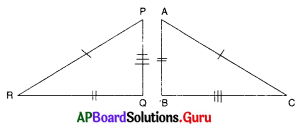
Name the congruency in ΔPQR ≅ ΔABC is
AP 7th Class Maths Bits Chapter 8 Congruency of Triangles with Answers 1
A) S.A.S
B) A.S.A
C) R.H.S
D) S.S.S
Answer:
D) S.S.S

Question 2.
If in ΔPEN and ΔRIM; PE = RI; ∠E = ∠I and EN = IM then
A) ΔEPN ≅ ΔRIM
B) ΔNPE ≅ ΔRIM
C) ΔPEN ≅ ΔRIM
D) ΔPEN ≅ ΔMIR
Answer:
C) ΔPEN ≅ ΔRIM

AP 7th Class Maths Bits Chapter 8 Congruency of Triangles with Answers

Question 3.
Which of the following pairs of figures are congruent?
AP 7th Class Maths Bits Chapter 8 Congruency of Triangles with Answers 2
Answer:
AP 7th Class Maths Bits Chapter 8 Congruency of Triangles with Answers 3

Question 4.
Which of the following pair of figures are not congruent?
AP 7th Class Maths Bits Chapter 8 Congruency of Triangles with Answers 4
Answer:
AP 7th Class Maths Bits Chapter 8 Congruency of Triangles with Answers 5

Question 5.
If ΔABC ≅ ΔDEF then [latex]\overline{\mathbf{A C}}[/latex] = …………….
A) [latex]\overline{\mathrm{DE}}[/latex]
B) [latex]\overline{\mathrm{EF}}[/latex]
C) [latex]\overline{\mathrm{DF}}[/latex]
D) None
Answer:
C) [latex]\overline{\mathrm{DF}}[/latex]

Question 6.
From the given figure Δ EGF ≅ ………………..?
AP 7th Class Maths Bits Chapter 8 Congruency of Triangles with Answers 6
A) Δ PQR
B) Δ QPR
C) Δ RPQ
D) Δ PRQ
Answer:
D) Δ PRQ

Question 7.
From the above sum ΔEGF ≅ ΔPRQ then
A) ⌊E = ⌊P
B) [latex]\overline{\mathrm{FG}}=\overline{\mathrm{QR}}[/latex]
C) ⌊G = ⌊R
D) All the above
Answer:
D) All the above

Question 8.
If Δ CDG ≅ Δ RSW then which of the following is not correct?
A) [latex]\overline{\mathrm{CD}}=\overline{\mathrm{RS}}[/latex]
B) ⌊D = ⌊R
C) [latex]\overline{\mathrm{DG}}=\overline{\mathrm{SW}}[/latex]
D) ⌊G = ⌊W
Answer:
B) ⌊D = ⌊R

Question 9.
From the given figure?
AP 7th Class Maths Bits Chapter 8 Congruency of Triangles with Answers 7
A) ⌊TPQ = ⌊SQR
B) ⌊QPT = ⌊SQR
C) ⌊QPT = ⌊QSR
D) ⌊TQP = ⌊SQR
Answer:
D) ⌊TQP = ⌊SQR

AP 7th Class Maths Bits Chapter 8 Congruency of Triangles with Answers

Question 10.
From the given figure which of the following is true?
AP 7th Class Maths Bits Chapter 8 Congruency of Triangles with Answers 8
A) ΔPQR ≅ ΔQPS
B) ΔPQR ≅ ΔPQS
C) ΔPSQ ≅ ΔPRQ
D) ΔPRQ ≅ ΔPQS
Answer:
A) ΔPQR ≅ ΔQPS

Question 11.
From the figure then
AP 7th Class Maths Bits Chapter 8 Congruency of Triangles with Answers 9
A) ΔABC ≅ ΔRQP
B) ΔABC ≅ ΔPQR
C) ΔABC ≅ ΔQRP
D) ΔABC ≅ ΔRPQ
Answer:
A) ΔABC ≅ ΔRQP

Question 12.
From the above sum ΔABC ≅ ΔRQP by which congruency rule?
A) S.S.A
B) A.S.A
C) S.A.S
D) S.S.S
Answer:
D) S.S.S

Question 13.
ΔABC ≅ ΔDBC by which congruency rule?
AP 7th Class Maths Bits Chapter 8 Congruency of Triangles with Answers 10
A) S.A.S
B) A.S.A
C) S.S.S
D) R.H.S
Answer:
A) S.A.S

Question 14.
From the given figure which corresponding parts are need to equal when ΔADC ≅ ΔABC by S.A.S rule?
AP 7th Class Maths Bits Chapter 8 Congruency of Triangles with Answers 11
A) CD = CB
B) ⌊A CB = ⌊D CA
C) AD = AB
D) ⌊D = ⌊B
Answer:
C) AD = AB

Question 15.
From the given figure ΔABO ≅ ΔDCO by which congruency rule?
AP 7th Class Maths Bits Chapter 8 Congruency of Triangles with Answers 12
A) S.A.S
B) A.S.A
C) S.S.S.
D) R.H.S
Answer:
B) A.S.A

Question 16.
If ⌊M LN = ⌊F GH, ⌊N ML = ⌊G FH, ML = FG then ………………?
A) ΔLMN ≅ ΔHGF
B) ΔMNL ≅ ΔFGH
C) ΔLNM ≅ ΔHFG
D) ΔLMN ≅ ΔFGH
Answer:
D) ΔLMN ≅ ΔFGH

AP 7th Class Maths Bits Chapter 8 Congruency of Triangles with Answers

Question 17.
From the given figure ΔABE ≅ ΔCDB by the congruency rule of
AP 7th Class Maths Bits Chapter 8 Congruency of Triangles with Answers 13
A) S.A.S
B) A.S.A
C) R.H.S
D) S.S.S
Answer:
C) R.H.S

Question 18.
From the given figure ΔRAT ≅ ……………….?
AP 7th Class Maths Bits Chapter 8 Congruency of Triangles with Answers 14
A) ΔNOW
B) ΔWON
C) ΔOWN
D) ΔWNO
Answer:
B) ΔWON

Question 19.
From the adjacent figure ΔTPQ ≅……………?
AP 7th Class Maths Bits Chapter 8 Congruency of Triangles with Answers 15
A) ΔQRS
B) ΔSRQ
C) ΔQSR
D) ΔRSQ
Answer:
A) ΔQRS

Question 20.
From the given figure the area of a triangle is ……………? (cms)
AP 7th Class Maths Bits Chapter 8 Congruency of Triangles with Answers 16
A) 50
B) 40
C) 32
D) 80
Answer:
B) 40

Question 21.
What is the area of a ΔABC when AB = BC = 5 cm and ⌊B = 90° (in sq cms)
A) 10
B) 6.25
C) 12.5
D) 25
Answer:
C) 12.5

Question 22.
From the adjacent figure the area of ΔABC is (in sq units)
AP 7th Class Maths Bits Chapter 8 Congruency of Triangles with Answers 17
A) [latex]\frac{1}{2}[/latex]ab
B) [latex]\frac{1}{2}[/latex](√a)√b
C) [latex]\frac{1}{2}[/latex][latex]\sqrt{a b}[/latex]
D) [latex]\frac{1}{2}[/latex](√b)√a
Answer:
C) [latex]\frac{1}{2}[/latex][latex]\sqrt{a b}[/latex]

AP 7th Class Maths Bits Chapter 8 Congruency of Triangles with Answers

Question 23.
If two figures are identical and equal then they are
A) identical
B) similar
C) congruent
D) equal
Answer:
C) congruent

Question 24.
Two squares are always
A) similar
B) equal
C) congruent
D) none
Answer:
A) similar

Question 25.
Two circles are always
A) congruent
B) equal
C) similar
D) can’t say
Answer:
C) similar

Question 26.
If 3 sides of a first triangle are correspondingly equal to 3 sides of second triangle then the two triangles are congruent under the property of …………………
A) R.H.S
B) A.S.A
C) S.A.S
D) S.S.S
Answer:
D) S.S.S

Question 27.
If two sides included angle of the first triangle are correspondingly equal to two sides included angle of the second triangle then the two triangles are said to be congruent under the property of ……………..
A) R.H.S
B) A.S.A
C) S.A.S
D) S.S.S
Answer:
C) S.A.S

Question 28.
Which of the following are always congruent?
A) Two circles with same radii
B) Two squares with same length of side
C) Two triangles
D) Both A & B
Answer:
D) Both A & B

AP 7th Class Maths Bits Chapter 8 Congruency of Triangles with Answers

Question 29.
Two line segments are congruent if they have …………….
A) same common point
B) same length
C) same angle
D) none
Answer:
B) same length

Question 30.
If two figures are having same shape and size then they are said to be ……………..figure.
A) Congruent
B) Similar
C) Corresponding
D) Equal
Answer:
A) Congruent

AP 7th Class Maths Bits Chapter 7 Data Handling with Answers

Practice the AP 7th Class Maths Bits with Answers Chapter 7 Data Handling on a regular basis so that you can attempt exams with utmost confidence.

AP State Syllabus 7th Class Maths Bits 7th Lesson Data Handling with Answers

Choose the correct answer.

Question 1.
The mean of 1st five even numbers is
A) 5
B) 6
C) 8
D) 10
Answer:
B) 6

Question 2.
The mean of 1st six odd numbers is
A) 6
B) 5
C) 8
D) 4
Answer:
A) 6

AP 7th Class Maths Bits Chapter 7 Data Handling with Answers

Question 3.
The mode of 1, 2, 2, 3, 3, 4, 4, 4 is
A) 2
B) 3
C) 4
D) None
Answer:
C) 4

Question 4.
The median of 2, 3, 5, 2, 3, 6, 2, 4, 8 is
A) 5
B) 3
C) 6
D) 2
Answer:
B) 3

Question 5.
The appropriate representative value for the following situation is to know the performance of students in a Maths test is
A) mean
B) median
C) mode
D) all
Answer:
A) mean

Question 6.
What is the Average rainfall of Nellore district in 2015, November for seven days 11 cm, 9 cm, 8.5 cm, 14 cm, 17.5 cm, 12 cm, 12 cm is ……………..?
A) 12 cm
B) 14.5 cm
C) 9.5 cm
D) 10.5 cm
Answer:
A) 12 cm

Question 7.
What is the average temperature of Rentachintala in the month of May for 5 days 47°, 46.5°, 44.5°, 48°, 44° is …………….
A) 45.5°C
B) 46°C
C) 46.5’C
D) 44°C
Answer:
B) 46°C

Question 8.
The cost of Tomatoes in the month of Nov, 2015 for first Week are ₹35, ₹40, ₹55, ₹60, ₹70, ₹75, ₹80. Then its average cost is?
A) ₹60
B) ₹65
C) ₹58
D) ₹59.29
Answer:
D) ₹59.29

Question 9.
What is the mean of first 10 natural numbers?
A) 5
B) 5.6
C) 5.5
D) 5.4
Answer:
C) 5.5

AP 7th Class Maths Bits Chapter 7 Data Handling with Answers

Question 10.
The mean of first 7 primes is ……………?
A) 8.2
B) 8.3
C) 8
D) 8.28
Answer:
D) 8.28

Question 11.
The mean of 2, 3, 4, 7, 11, x, 9 is 6 then the value of x = ……………..?
A) 5
B) 7
C) 6
D) 4
Answer:
C) 6

Question 12.
What is the mean of 2 – a, 2, 2 + a is …………..?
A) 2
B) 3
C)0
D) 1
Answer:
A) 2

Question 13.
What is the Median of 7, 2, 11, 3, 5, 13, 17 is …………….?
A) 6
B) 11
C) 5
D) 7
Answer:
D) 7

Question 14.
The median of 1, 2, 0, 3, 7, 5, 2.5 is ……………..?
A) 1
B) 2
C) 2.5
D) 3
Answer:
C) 2.5

Question 15.
What is the mode of first 10 natural numbers?
A) 0
B) 1
C) 2
D) No mode
Answer:
D) No mode

Question 16.
What is the mode of the observations 2, 3, 5, 2, 7, 3, 2, 8, 6 is …………….?
A) 5
B) 2, 3
C) 2
D) 3
Answer:
C) 2

AP 7th Class Maths Bits Chapter 7 Data Handling with Answers

Question 17.
What is the mode of ages of 7th, 8th, 9th class students 11, 13, 12, 14, 13, 12, 15, 14, 13.
A) 11 Y
B) 14 Y
C) 13 Y
D) 12 Y
Answer:
C) 13 Y

Question 18.
If a fixed number is add to the given observations then the change of median is ……………?
A) No change
B) There will be a change
C) Increase the median in addition to the fixed number
D) None
Answer:
C) Increase the median in addition to the fixed number

Question 19.
Preparation of number of sweets for a function is …………….?
A) Mean
B) Median
C) Mode
D) None
Answer:
A) Mean

Question 20.
From different sizes of chappals opting a suitable size is …………….
A) Mean
B) Median
C) Mode
D) None
Answer:
C) Mode

Question 21.
Wages of workers in a factory taken in consideration is ……………..
A) Mean
B) Median
C) Mode
D) None
Answer:
B) Median

Question 22.
If ‘1’ is added to 3, 4, 5, 5, 8 the New Mode is …………….?
A) remains same
B) increases the mode
C) 6
D) None
Answer:
C) 6

AP 7th Class Maths Bits Chapter 7 Data Handling with Answers

Question 23.
AP 7th Class Maths Bits Chapter 7 Data Handling with Answers 1 = ……………..?
A) Mean
B) Median
C) Mode
D) None
Answer:
A) Mean

Question 24.
In given observations the observation which occurs frequently is called a ……………..
A) Mean
B) Median
C) Mode
D) None
Answer:
C) Mode

Question 25.
By arranging the given observations in ascending order then the middle most observation is called a ………………
A) Mean
B) Median
C) Mode
D) None
Answer:
B) Median

Question 26.
In a class of 10th students Dullers – 8, Average – 8, Above average – 6, Brilliants – 2 From the given figure the angle for Briliant student is
AP 7th Class Maths Bits Chapter 7 Data Handling with Answers 2
A) 45°
B) 60°
C) 90°
D) 30°
Answer:
D) 30°

Question 27.
From the above sum Dullers represents the angle of?
A) 120°
B) 90°
C) 150°
D) 100°
Answer:
A) 120°

Question 28.
From the above (1st sum) Above Average students represent the angle of ……………..?
A) 120°
B) 90°
C) 45°
D) 135°
AP 7th Class Maths Bits Chapter 7 Data Handling with Answers 3
Answer:
B) 90°

AP 7th Class Maths Bits Chapter 7 Data Handling with Answers

Question 29.
From the above figure in which year the population 900 Millions occurs ……………?
A) 1991
B) 1981
C) 1951
D) 2001
Answer:
B) 1981

Question 30.
The population of the year 1991 is …………..? (in millions)
A) 1000
B) 700
C) 900
D) 1200
Answer:
D) 1200