
Use these Inter 1st Year Maths 1A Formulas PDF Chapter 5 Products of Vectors to solve questions creatively.
Intermediate 1st Year Maths 1A Products of Vectors Formulas
Scalar or Dot Product of Two Vectors:
The scalar or dot product of two non – zero vectors [latex]\bar{a}[/latex] and [latex]\bar{b}[/latex], denoted by [latex]\bar{a} \cdot \bar{b}[/latex] is defined as [latex]\bar{a} \cdot \bar{b}=|\bar{a}||\bar{b}|[/latex] cos [latex](\bar{a}, \bar{b})[/latex]. This is a scalar, either [latex]\bar{a}[/latex] = 0 (or) [latex]\bar{b}[/latex] = 0, then we define [latex]\bar{a} \cdot \bar{b}[/latex] = 0. If we write [latex](\bar{a}, \bar{b})[/latex] = 0, then [latex]\bar{a} \cdot \bar{b}=|\bar{a}||\bar{b}|[/latex] cos θ, if a ≠ 0, b ≠ 0, since 0 ≤ (a, b) = θ ≤ 7 80°, we get
- 0 ≤ θ < 90° ⇒ [latex]\bar{a}[/latex]. b > 0.
- θ = 90° ⇒ [latex]\bar{a} \cdot \bar{b}[/latex] = 0 and the vectors [latex]\bar{a}[/latex] and [latex]\bar{b}[/latex] are perpendicular.
- 90° < θ ≤ 180° ⇒ [latex]\bar{a} \cdot \bar{b}[/latex] < 0
- [latex]\bar{a} \cdot \bar{b}=\bar{b} \cdot \bar{a}[/latex]
- a̅ (b̅ + c̅) = a̅ .b̅ + a̅ .c̅
- If a̅, b̅ are parallel, a̅.b̅ = ± |a̅ | |b̅ |.
- If l, m ∈ R, (la̅).(mb̅) = lm(a̅. b̅)
- Projection of b̅ on a̅ (or) length of the projection a̅ = [latex]\frac{|\bar{a} \cdot \bar{b}|}{|\bar{a}|}[/latex]
- Orthogonal projection of b̅ on a̅ = [latex]\frac{(\bar{a} \cdot \bar{b})_{\bar{a}}}{|\bar{a}|^{2}}[/latex]; a̅ ≠ 0
or
The projection vector b̅ on a̅ = [latex]\left(\frac{\bar{a} \cdot \bar{b}}{|\bar{a}|^{2}}\right)[/latex] a̅ and it is magnitude = [latex]\frac{|\overline{\mathrm{a}} \cdot \overline{\mathrm{b}}|}{|\overline{\mathrm{a}}|}[/latex] - The component vector of b̅ along a̅ (or) parallel to a̅ is [latex]\left(\frac{\bar{a} \cdot \bar{b}}{|\bar{a}|^{2}}\right)[/latex]a̅
Component vector of a̅ along b̅ = [latex]\frac{(\bar{a} \cdot \bar{b}) \bar{b}}{|\bar{b}|^{2}}[/latex], component vector of a̅ perpendicular to b̅ = a̅ – [latex]\frac{(\bar{a} \cdot \bar{b}) \bar{b}}{|\bar{b}|^{2}}[/latex]

Orthogonal unit vectors :
Ifi, j, k are orthogonal unit vector triad in a right handed system, then
- i̅ .j̅ = j̅.k̅ = k̅.i̅ = 0
- i̅ .i̅ = j̅.j̅ = k̅.k̅ = 1
- If r is any vector, r̅ = (r̅.i̅)i̅ +(r̅.j̅)j̅ ≠ (r̅.k̅)k̅
Some identities :
If a̅, b̅, c̅ are three vectors, then
- (a̅ + b̅)2 = |a̅|2 + |b̅|2 + 2(a̅ . b̅)
- (a̅ – b̅)2 = |a̅|2 + |b̅|2 – 2(a̅.b̅)
- (a̅ + b̅)2 + (a̅ – b̅)2 = 2(|a̅|2 + |b̅|2)
- (a̅ + b̅)2 – (a̅ – b̅)2 = 4(a̅. b̅)
- (a̅ + b̅). (a̅ – b̅) = |a̅|2 – |b̅|2
- (a̅ + b̅ + c̅)2 = |a̅|2 + |b̅|2 + |c̅|2 + 2(a̅ . b̅) + 2(b̅ . c̅) + 2(c̅ .a̅)
→ If a̅ = a1 i̅ +a2j̅ + a3k̅ and b̅ = b1i̅ + b2j̅ + b3k̅, then
a̅.b̅ = a1b1 + a2b2 + a3b3
a̅ is perpendicular to b̅
⇔ a1b1 + a2b2 + a3b3 = 0
→ |a̅| = [latex][/latex], |b̅| = [latex][/latex]
→ If (a̅, b̅) = then cos θ = [latex]\frac{\bar{a} \cdot \bar{b}}{|\bar{a}||\bar{b}|}=\frac{a_{1} b_{1}+a_{2} b_{2}+a_{3} b_{3}}{\sqrt{\sum a_{1}^{2}} \sqrt{\sum b_{1}^{2}}}[/latex] and sin θ = [latex]\sqrt{\frac{\sum\left(a_{2} b_{3}-a_{3} b_{2}\right)^{2}}{\left(\sum a_{1}^{2}\right)\left(\sum b_{1}^{2}\right)}}[/latex]
→ a̅ is parallel to b̅ ⇔ a1: b1 = a2 : b2 = a3: b3
→ a̅.a̅ >0; |a̅.b̅| < |a̅| |b̅|
|a̅ + b̅| ≤ |a̅| + |b̅|; |a̅ – b̅| ≤ |a̅| + |b̅| ;
|a̅ – b̅| ≥ |a̅| – |b̅|
Vector equations of a plane :
- The equation of the plane, whose perpendicular distance from the origin is p and whose unit normal drawn from the origin towards the plane is h is n̂ is r̅.n̂ = p.
- Equation of a plane passing through the origin and perpendicular to the unit vector n̅, is r̅.n̅ = 0
- Vector equation of a plane passing through a point A with position vector a and perpendicular to a vector n̅ is (r – a̅). n̅ = 0.
Perpendicular distance from the origin to the plane (r̅ – a̅).h = 0 is a̅. n̅ . where ‘a̅’ is the position vector of A in the plane and ‘n̅’ is a unit vector perpendicular to the plane.
Angle between two planes :
If π1 and π22 be two planes and [latex]\bar{M}_{1}, \bar{M}_{2}[/latex] are normals drawn to them, we define the angle between M1 and M2 as the angle between π1 and π2. If the angle between [latex][/latex] and [latex][/latex] is θ, the angle between the given planes θ = cos-1[latex]\left[\frac{\bar{M}_{1} \cdot \bar{M}_{2}}{\left|\bar{M}_{1}\right|\left|\bar{M}_{2}\right|}\right][/latex]
Work done by a constant force F:
- If a constant force F̅ acting on a particle displaces it from a position ‘A’ to the position B, then the work done ‘W by this constant force T is the dot product of the vectors
representing the force F̅ and displacement [latex]\overline{A B}[/latex], i.e., W = F̅.[latex]\overline{A B}[/latex]. - If F is the resultant of the forces F̅1, F̅2, ……………….F̅n, then workdone in displacing the particle from A to B is
[latex]\bar{W}=\bar{F}_{1} \cdot \overline{A B}+\bar{F}_{2} \cdot \overline{A B}+\ldots \ldots+F_{n} \cdot \overline{A B}[/latex]
Cross Product or Vector Product of two vectors :
The vector product or cross product of two non-parallel non – zero vectors ‘a̅’ and ‘b̅’ is defined as a̅ × b̅ = |a̅||b̅| sin θ n̂, where ‘ n̂’ is a unit vector perpendicular to the plane containing ‘a̅’ and ‘b̅’ such that a̅, b̅ and ‘n̂’ form a vector triad in the right handed system and (a̅, b̅) = θ, this is a vector. If either of a̅, b̅ is a zero vector or ‘a̅’ is parallel to ‘b̅’, we define a̅ × b̅ = 0.
Some important results on vector product:
- |a̅ × b̅| = |a̅||b̅|sinθ ≤ |a̅||b̅| ;
- |a̅ × b̅| = |b̅ × a̅|
- a̅ × b̅ = -(b̅ × a̅):
- -a̅ × -b̅ = a̅ × b̅
- (-a̅) × b̅ = a̅ × (-b̅) – (a̅ × b̅)
- la̅ × mb̅ = lm(a̅ × b̅) ;
- a̅ × (b̅ + c̅) = a̅ × b̅ + a̅ × c̅
- a̅ ≠ 0, b̅ ≠ 0 and a̅ × b̅ = 0 ⇔ ‘a̅’ and ‘b̅’ are parallel vectors.
- a̅, b̅ , c̅ are non-zero vectors and a̅ × c̅ = b̅ × c̅ ⇒ either a̅ = b̅ or a̅ – b̅ is parallel to c̅.
Vector product among i. i and k:
If i̅, j̅ and k̅ are orthogonal unit vectors triad in the right handed system then
- i̅ × j̅ = j̅ × j = k̅ × k̅ = 0
- i̅ × j̅ = k̅ =-j̅ × i̅ ; j̅ × k̅ = k̅ × j̅ = i̅ ; k̅ × i̅ = -i̅ × k̅ = j̅
- If a̅ = a1 i̅ + a2 j + a3k ; b̅ = b1i̅ + b2 j̅ + b3k̅, then
a̅ × b̅ = a2b3 – a3b2)i̅ + (a3b1 – a1b3)j̅ + (a1b2 – a2b1)k̅
This may be represented in the form of a determinants as a̅ × b̅ = [latex]\left|\begin{array}{ccc}
\bar{i} & \bar{j} & \bar{k} \\
a_{1} & a_{2} & a_{3} \\
b_{1} & b_{2} & b_{3}
\end{array}\right|[/latex]
- Unit vectors perpendicular to both ‘a̅’and ‘b̅’ are ± [latex]\frac{\bar{a} \times \bar{b}}{|\bar{a} \times \bar{b}|}[/latex]
- If a̅ = a1i̅ + a2j̅ + a3k̅ ; b̅ = b1i̅ + b2 j̅ + b3k̅ and (a̅, b̅) = θ, then
sin θ = [latex]\frac{\sqrt{\sum\left(a_{2} b_{3}-a_{3} b_{2}\right)^{2}}}{\sqrt{\sum a_{1}^{2}} \sqrt{\sum b_{1}^{2}}}[/latex] cos θ = [latex]\frac{a_{1} b_{1}+a_{2} b_{2}+a_{3} b_{3}}{\sqrt{\sum a_{1}^{2}} \sqrt{\sum b_{1}^{2}}}[/latex]
Vector areas:
- If [latex]\overline{A B}=\bar{c}[/latex] and [latex]\overline{A C}=\bar{b}[/latex] are two adjacent sides of a triangle ABC, then vector area of ΔABC = [latex]\frac{1}{2}[/latex](c̅ × b̅) and the area of the ΔABC = [latex]\frac{1}{2}[/latex]|c̅ × b̅| $q. units.
- If a̅, b̅, c̅ are the position vectors of A, B, C respectively then the vector area of
ΔABC = [latex]\frac{1}{2}[/latex][(b̅ × c̅) + (c̅ × a̅) + (a̅ × b̅)]
Area of ΔABC = [latex]\frac{1}{2}[/latex]|(b̅ × c̅) + (c̅ × a̅) + (a̅ × b̅)|sq. units. - If [latex][/latex] and [latex][/latex] are the diagonals of a parallelogram ABCD, then the vector area of the parallelogram = [latex]\frac{1}{2}[/latex]|a̅ × b̅| and area = [latex]\frac{1}{2}[/latex]|a̅ × b̅|sq. units.
- If AB = a̅ and AD = b̅ are two adjacent sides of a parallelogram ABCD, then its vector area = a̅ × b̅ and area = |a̅ × b̅| sq. units.
- Vector area of the quadrilateral ABCD = [latex]\frac{1}{2}[/latex][latex](A C \times B D)[/latex] and area of the quadrilateral ABCD = [latex]\frac{1}{2}[/latex][latex]|\overline{A C} \times \overline{B D}|[/latex]sq. units.
Some useful formulas :
- If a̅, b̅ are two non-zero and non-parallel vectors then
(a̅ × b̅)2 = a2b2 – (a̅.b̅)2 = [latex]\left|\begin{array}{cc}
a \cdot \bar{a} & \bar{a} \cdot \bar{b} \\
\bar{a} \cdot b & b \cdot \bar{b}
\end{array}\right|[/latex] - For any vector a̅,(a̅ × i̅)2 + (a̅ × j̅)2 + (a̅ × k̅)2 = 2|a|2
- If a̅, b̅, c̅ are the position vectors of the points A, B, C respectively, then the perpendicular distance from c to the line AB is [latex]\frac{|\overline{A C} \times \overline{A B}|}{|\overline{A B}|}=\frac{|(\bar{b} \times \bar{c})+(\bar{c} \times \bar{a})+(\bar{a} \times \bar{b})|}{|b-\bar{a}|}[/latex]
Moment of a force :
Let 0 be the point of reference (origin) and [latex]\overline{o p}=\bar{r}[/latex] be the position vector of a point p on the line of action of a force F̅. Then the moment of the force F about 0 is given by r̅ × F̅.
Scalar triple product:
Let a̅, b̅, c̅ he three vectors. We call (a̅ × b̅). c̅ the scalar product of a̅, b and c. This is a scalar (real number). It is written as [a̅ b̅ c̅]
- If (a̅ × b̅). c̅ = 0, then one or more of the vectors a̅, b̅ and c̅ should be zero vectors. If a ≠ 0, b ≠ 0, c ≠ 0, then c is perpendicular to a̅ × b̅. Hence the vector c̅ lies on the plane determined by a̅ and b̅. Hence a̅, b̅ and c̅ are coplanar.
- If in a scalar triple product, any two vectors are parallel (equal), then the scalar triple product is zero i.e., [a̅ a̅ b̅] = [a̅ b̅ b̅] = [c̅ b̅ c̅] = 0.
- In a scalar triple product remains unaltered if the vectors are permutted cyclically i.e., [a̅ b̅ c̅] = [b̅ c̅ a̅] = [c̅ a̅ b̅].
However [a̅ b̅ c̅] = -[b̅ a̅ c̅] = -[c̅ b̅ a̅] = -[a̅ c̅ b̅]. - In a scalar triple product, the dot and cross are interchangeable i.e., a̅.b̅ × c̅ = a̅ × b̅.c̅
→ If i̅ , j̅ , k̅ are orthogonal unit vector triad in the right handed system, then
- [i̅ j̅ k̅ ] = [j̅ k̅ i̅ ] = [k̅ i̅ j̅ ] = 1
- [i̅ k̅ j̅ ] = [j̅ i̅ k̅ ] = [k̅ j̅ i̅ ] = -1
- If a̅ = a1 i̅ + a2j̅ + a3 k̅ ; b̅ = b1i̅ + b2 j̅ + b3k̅ and c̅ = c1i̅ + c2 j̅ + c3k̅ then [a̅ b̅ c̅] = [latex]\left|\begin{array}{lll}
a_{1} & a_{2} & a_{3} \\
b_{1} & b_{2} & b_{3} \\
c_{1} & c_{2} & c_{3}
\end{array}\right|[/latex]
→ A necessary and sufficient condition that three non-parallel (non-collinear) and non-zero vectors a, b and c to be coplanar is [a̅ b̅ c̅] = 0. If [a̅ b̅ c̅] ≠ 0, then the three vectors are non-coplanar.
→ If a̅, b̅, c̅ are three non-zero, non-coplanar vectors and V is the volume of the parallelopiped with co-terminus edges a̅, b̅ and c̅, then v = |(a × b). c|. = |[a b c]|
→ The volume of the parallelopiped formed with A, B, C, D as vertices is [latex]|[A B A C A D]|[/latex] cubic units.
→ If a̅, b̅, c̅ represent the co-terminus edges of a tetrahedron, then its volume = [latex]\frac{1}{6}[/latex][a̅, b̅, c̅] cubic units.
→ If A(x1 y1 z1], B(x2, y2, z2] C(x3 y3 z3) and D(x4, y4 z4] are the vertices of a tetrahedron = [latex]\frac{1}{6}[/latex][latex]|[A B A C A D]|[/latex]
- Vector equation of a plane containing three non-collinear points a̅, b̅, c̅ is r̅ .[(b̅ × c̅) + (c̅ × a̅) + (a̅ × b̅)] = [a̅ b̅ c̅]
- A unit vector perpendicular to the plane containing three non-collinear points a̅, b̅, c̅ is [latex]\frac{(\bar{a} \times b)+(b \times \bar{c})+(\bar{c} \times \bar{a})}{|(\bar{a} \times \bar{b})+(b \times \bar{c})+(\bar{c} \times a)|}[/latex]
- Length of the perpendicular from the origin to the plane containing three non-collinear points a̅, b̅, c̅ is [latex]\frac{|[\bar{a} b c]|}{|(\bar{a} \times \bar{b})+(\bar{b} \times \bar{c})+(\bar{c} \times \bar{a})|}[/latex]
→ Vector equation of the plane passing through three non-collinear points a̅, b̅ and c̅ is [r̅ – a̅ b̅ – a̅ c̅ – a̅] = 0
→ Vector equation of the plane passing through a given point a̅ and parallel to the vectors b̅ and c̅ is [r b̅ c̅] = [a̅ b̅ c̅]
→ Vector equation of the line passing through the point a̅ and parallel to the vector b̅ is (r – a̅) × b̅ = 0
→ Distance of the point p(c) from a line joining the points A(a) and B(b) = |(c̅ – a̅) × b̅|
(25) i) Equation of the plane passing through the point p(x1, y1, z1) and perpendicular to the vector ai̅ + bj̅ + ck̅ is a (x – x1) + b(y – y1) + c(z – z1) = 0.
→ The equation of the plane passing through the points (x1 y1 z1), (x2, y2, z2) and
(x3, y3, z3) is [latex]\left|\begin{array}{ccc}
x-x_{1} & y-y_{1} & z-z_{1} \\
x_{2}-x_{1} & y_{2}-y_{1} & z_{2}-z_{1} \\
x_{3}-x_{1} & y_{3}-y_{1} & z_{3}-z_{1}
\end{array}\right|[/latex] = 0
Skew lines:
Two lines l and m are called skew lines if there is no plane passing through these lines.
Shortest distance between the skew lines:
Shortest distance between the skew lines r̅ = a̅ + tb̅ and r̅ = c̅ + sd̅ is
Vector triple product:
If a̅, b̅ and c̅ are three vectors, products of the type (a̅ × b̅) × c̅, a̅ × (b̅ × c̅) from the vector triple products. From this definition.
- If any one of a̅, b̅ and c̅ is a zero vector, a̅ × (b̅ × c̅) or (a̅ × b̅) c̅ = 0
- If a̅ ≠ 0, b̅ ≠ 0, c̅ ≠ 0 and a̅ is parallel to b, then (a̅ × b̅) × c̅ = 0
- If a̅ ≠ 0, b̅ ≠ 0, c̅ ≠ 0 and c̅ is perpendicular to the plane of a and b, then (a̅ × b̅) × c̅ = 0.
→ If a̅ ≠ 0, b̅ ≠ 0, c̅ ≠ 0, a̅ and b̅ are non-parallel vectors and c̅ is not perpendicular to the plane passing through a̅ and b, then
(a̅ × b̅) × c̅ = (a̅.c̅)b̅ – (b̅.c)a̅
a̅ × (b̅ × c̅) = (a̅.c̅)b̅ – (a.b̅)c̅
- In general, vector triple product of three vectors need not satisfy the associative law. i.e., (a̅ × b) × c ≠ a̅ × (b × c)
For any three vectors a̅, b̅ and c - a̅ × (b̅ × c̅) + b̅ × (c̅ × a̅) + c̅ × (a̅ × b̅) = 0
- [a̅ × b̅ b̅ × c̅ c̅ × a̅] = [a̅ b̅ c̅]2
Scalar product of four vectors :
Scalar product of a̅, b̅, c̅ and d̅ is () = (a̅. c̅) (b̅.d̅) – (a̅. d̅) (b̅ .c̅) = [latex]\left|\begin{array}{ll}
\bar{a} \cdot \bar{c} & \bar{a} \cdot \bar{d} \\
\bar{b} \cdot \bar{c} & \bar{b} \cdot \bar{d}
\end{array}\right|[/latex]
Vector product of four vectors:
If a̅, b̅, c̅ and d̅ are four vectors,
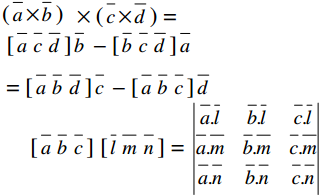
(a̅ × b̅) × (c̅ × d̅) = [a̅ c̅ d̅] b̅ – [b̅ c̅ d̅]a̅ – [a b̅ d̅]c̅ – [a̅ b̅ c̅]d̅
Some important results:
- [a̅ + b̅ b̅ + c̅ c̅ + a̅] = 2[a̅ b̅ c̅]
- i̅ × (j̅ × k̅) + i̅ × (k̅ × i̅) + k̅ × (i̅ × j̅) = 0
- [a̅ × b̅ b̅ × c̅ c̅ × a̅] = [a̅ b̅ c̅]2
[a̅ b̅ c̅] [l̅ m̅ n̅] = [latex][/latex] - If a̅, b̅, c̅ be such that a is perpendicular to (b̅ + c̅), bis perpendicular to (c̅ + a̅), c̅ is perpendicular to (a̅ + b̅), then |a̅ + b̅ + c̅| = [latex]\sqrt{a^{2}+b^{2}+c^{2}}[/latex]
- If a line makes angles α, β, γ and δ with the diagonals of a cube, then
cos2α + cos2β + cos2γ + cos2δ = [latex]\frac{4}{3}[/latex] - i̅ × (a̅ × i̅) + j̅ × (a̅ × j̅) + k̅ × (a̅ × k̅) – 2a̅
→ Equation of the sphere with centre at c and radius ‘a’ is r2 – 2r̅. c̅ + c2 = a2
Scalar Product
Def: Let [latex]\vec{a}, \vec{b}[/latex] be two vectors dot product (or) scalar product (or) direct product (or) inner product denoted by [latex]\vec{a}, \vec{b}[/latex]. Which is defined as [latex]|\vec{a}||\vec{b}|[/latex]cos θ where cos θ = [latex](\vec{a}, \vec{b})[/latex]
* The product [latex]\vec{a}, \vec{b}[/latex] is zero when [latex]|\vec{a}|[/latex] = 0 (or) [latex]|\vec{b}|[/latex] = 0 (or) θ = 90°.
Sign of the scalar product :
Let [latex]\vec{a}, \vec{b}[/latex] are two non-zero vectors
- If θ is acute then [latex]\vec{a}.\vec{b}[/latex]> 0 (i.e 0 < θ < 90°).
- If θ is obtuse then [latex]\vec{a}.\vec{b}[/latex] < 0 (i.e 90° < θ < 180°).
- If θ = 90° then[latex]\vec{a} \cdot \vec{b}[/latex] = o.
- If θ = 0° then [latex]\vec{a} \cdot \vec{b}=|\vec{a}||\vec{b}|[/latex]
- If θ = 180° then [latex]\vec{a} \cdot \vec{b}=|\vec{a}||\vec{b}|[/latex]
Note:
- The dot product of two vectors is always scalar.
- [latex]\vec{a} \cdot \vec{b}=\vec{b} \cdot \vec{a}[/latex] i.e dot product of two vectors is commutative.
- If [latex]\vec{a} \cdot \vec{b}[/latex] are two vectors then [latex]\vec{a} \cdot(-\vec{b})=(-\vec{a}) \cdot \vec{b}=-(\vec{a} \cdot \vec{b})[/latex]
- [latex](-\vec{a}) \cdot(-\bar{b})=\vec{a} \cdot \vec{b}[/latex]
- If l,m are two scalars and [latex]\vec{a} \cdot \vec{b}[/latex] are two vectors then [latex](l \bar{a}) \cdot(m \bar{b})={lm}(\vec{a} \cdot \vec{b})[/latex]
- If [latex]\vec{a}[/latex] and [latex]\vec{b}[/latex] are two vectors then [latex]\vec{a} \cdot \vec{b}=\pm|\vec{a}||\vec{b}|[/latex]
- If [latex]\vec{a}[/latex] is a vector then [latex]\vec{a} \cdot \vec{a}=|\vec{a}|^{2}[/latex]
- If [latex]\vec{a}[/latex] is a vector [latex]\vec{a}[/latex].[latex]\vec{a}[/latex] is denoted by [latex]\overline{(a)^{2}}[/latex] hence [latex]\overline{(a)^{2}}=|\vec{a}|^{2}[/latex]
Components and orthogonal projection:
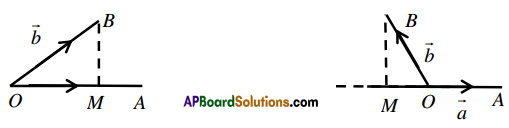
Def: Let [latex]\vec{a}=\overline{O A} \quad \vec{b}=\overline{O B}[/latex] be two non zero vectors let the plane passing through B and perpendicular to a intersect [latex]\overline{O A}[/latex] ln M.
- If [latex](\vec{a}, \vec{b})[/latex] is acute then OM is called component of [latex]\vec{b}[/latex] on [latex]\vec{a}[/latex].
- If [latex](\vec{a}, \vec{b})[/latex] is obtuse then -(OM) is called the component of [latex]\vec{b}[/latex] on [latex]\vec{a}[/latex].
- The vector [latex]\overline{O M}[/latex] is called component vector of [latex]\vec{b}[/latex] on [latex]\vec{a}[/latex].
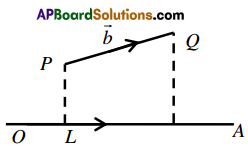
Def: Let [latex]\vec{a}=\overline{O A}[/latex]; [latex]\vec{b}=\overrightarrow{P Q}[/latex] be two vectors let the planes passing through P, Q and perpendicular to a intersect [latex][latex][/latex][/latex] in L, M respectively then [latex]\overline{L M}[/latex] is called orthogonal projection of [latex]\vec{b}[/latex] on [latex]\vec{a}[/latex]
Note:
- The orthogonal projection of a vector b on a is equal tb component vector of b on a .
- Component of a vector [latex]\vec{b}[/latex] on [latex]\vec{a}[/latex] is also called projection of [latex]\vec{b}[/latex] on [latex]\vec{a}[/latex]
- If A< B, C, D are four points in the space then the component of [latex]\overline{A B}[/latex] on [latex]\overline{C D}[/latex] is same as the projection of [latex]\overline{A B}[/latex] on the ray [latex]\overline{C D}[/latex].
→ If [latex]\vec{a}, \vec{b}[/latex] be two vectors ([latex]\vec{a} \neq \vec{o}[/latex]) then
- The component of [latex]\vec{b}[/latex] on [latex]\vec{a}[/latex] is [latex]\frac{\vec{b} \cdot \vec{a}}{|\vec{a}|}[/latex]
- The orthogonal projection of [latex]\vec{b}[/latex] on [latex]\vec{a}[/latex] is [latex]\frac{(\vec{b} \cdot \vec{a}) \vec{a}}{|\vec{a}|^{2}}[/latex]
→ If [latex]\vec{i}, \vec{j}, \vec{k}[/latex] form a right handed system of Ortho normal triad then
- [latex]\vec{i} \cdot \vec{j}=\vec{j} \cdot \vec{j}=\vec{k} \cdot \vec{k}[/latex] = 1
- [latex]\vec{i} \cdot \vec{j}=\vec{j} \cdot \vec{i}=0 ; \vec{j} \cdot \vec{k}=\vec{k} \cdot \vec{j}=0 ; \vec{k} \cdot \vec{i}=\vec{i} \cdot \vec{k}=0[/latex]
→ If [latex]\vec{a}=a_{1} \vec{i}+a_{2} \vec{j}+a_{3} \vec{k}[/latex] [latex]\vec{b}=b_{1} \vec{i}+b_{2} \vec{j}+b_{3} \vec{k}[/latex] then [latex]\vec{a} \cdot \vec{b}=a_{1} b_{1}+a_{2} b_{2}+a_{3} b_{3}[/latex]
→ If [latex]\vec{a}, \vec{b}, \vec{c}[/latex] are three vectors then
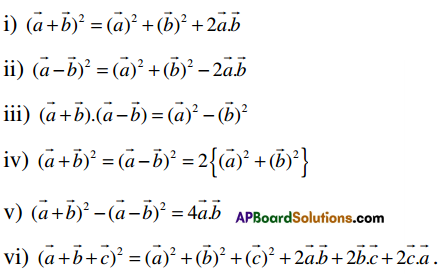
→ If [latex]\vec{r}[/latex] is vector then [latex]\vec{r}=(\vec{r} \cdot \vec{i}) i+(\vec{r}+\vec{j}) \vec{j}+(\vec{r} \cdot \vec{k}) \vec{k}[/latex]
Angle between the planes:
The angle between the planes is defined as the angle between the normals to the planes drawn from any point in the space.
Sphere:
The vector equation of a sphere with centre C having position vector [latex]\vec{c}[/latex] and radius a is [latex](\vec{r}-\vec{c})^{2}[/latex] = a2 i.e. [latex]\vec{r}^{2}-2 \vec{r} \cdot \vec{c}+c^{2}[/latex] = a2
The vector equation of a sphere with A(a) and B(b) as the end points of a diameter is [latex](\vec{r}-\vec{a}) \cdot(\vec{r}-\vec{b})[/latex] = 0 (or) [latex](\vec{r})^{2}-\vec{r} \cdot(\vec{a}+\vec{b})+\vec{a} \cdot \vec{b}[/latex] = 0
Work done by a force :
If a force [latex]\vec{F}[/latex] acting on a particle displaces it from a position A to the position B then work done W by this force [latex]\vec{F}[/latex] is [latex]\vec{F} \cdot \overline{A B}[/latex]
- The vector equation of the plane which is at a distance of p from the origin along the unit vector [latex]\vec{n}[/latex] is [latex]\vec{r} \cdot \vec{n}[/latex] = p.
- The vector equation of the plane passing through the origin and perpendicular to the vector m is r.m =0
- The Cartesian equation of the plane which is at a distance of p from the origin along the unit vector n = li + mj + nk of the plane is n = lx + my + nz
- The vector equation of the plane passing through the point a having position vector [latex]\vec{a}[/latex] and perpendicular to the vector [latex]\vec{m}[/latex] is [latex](\vec{r}-\vec{a}) \cdot \vec{m}[/latex] = 0.
- The vector equation of the plane passing through the point a having position vector [latex]\vec{a}[/latex] and parallel to the plane r.m=q is [latex](\vec{r}-\vec{a}) \cdot \vec{m}[/latex] = 0.
Cross( Vector) Product of Vectors:
Let [latex]\vec{a}, \vec{b}[/latex] be two vectors. The cross product or vector product or skew product of vectors [latex]\vec{a}, \vec{b}[/latex] is denoted by [latex]\vec{a} \times \vec{b}[/latex] and is defined as follows
- If [latex]\vec{a}[/latex] = 0 or [latex]\vec{b}[/latex] = 0 or [latex]\vec{a}, \vec{b}[/latex] are parallel then [latex]\vec{a} \times \vec{b}[/latex] = 0
- If [latex]\vec{a}[/latex] ≠ 0, [latex]\vec{b}[/latex] ≠ 0, [latex]\vec{a}, \vec{b}[/latex] are not parallel then [latex]\vec{a} \times \vec{b}=|\vec{a}||\vec{b}|(\sin \theta) \vec{n}[/latex] where [latex]\vec{n}[/latex] is a unit vector perpendicular to a and b so that a, b, n form a right handed system.
Note:
- [latex]\vec{a} \times \vec{b}[/latex] is a vector
- If [latex]\vec{a}, \vec{b}[/latex] are not parallel then [latex]\vec{a} \times \vec{b}[/latex] is perpendicular to both a and b
- If [latex]\vec{a}, \vec{b}[/latex] are not parallel then [latex]\vec{a}, \vec{b}[/latex] , [latex]\vec{a} \times \vec{b}[/latex] form a right handed system .
- For any vector [latex]\vec{a}[/latex] [latex]\vec{a} \times \vec{b}[/latex] = o
2. If [latex]\vec{a}, \vec{b}[/latex] are two vectors [latex]\vec{a} \times \vec{b}=-\vec{b} \times \vec{a}[/latex] this is called “anti commutative law”
3. If [latex]\vec{a}, \vec{b}[/latex] are two vectors then [latex]\vec{a} \times(-\vec{b})=(-\vec{a}) \times \vec{b}=-(\vec{a} \times \vec{b})[/latex]
4. If [latex]\vec{a}, \vec{b}[/latex] are two vectors then [latex](-\vec{a}) \times(-\vec{b})=\vec{a} \times \vec{b}[/latex]
5. If [latex]\vec{a}, \vec{b}[/latex] are two vectors l,m are two scalars then (la) x (mb) = lm(a x b)
6. If [latex]\vec{a}, \vec{b}, \vec{b}[/latex] are three vectos, then
- [latex]\vec{a} \times(\vec{b}+\vec{c})=\vec{a} \times \vec{b}+\vec{a} \times \vec{c}[/latex]
- [latex](\vec{b}+\vec{c}) \times \vec{a}=\vec{b} \times \vec{a}+\vec{c} \times \vec{a}[/latex]
7. If [latex]\vec{l}, \vec{l}, \vec{k}[/latex] from a right handed system of orthonormal triad then
- [latex]\vec{l} \times \vec{l}=\vec{j} \times \vec{j}=\vec{k} \times \vec{k}=\vec{o}[/latex]
- [latex]\vec{i} \times \vec{j}=\vec{k}=-\vec{j} \times \vec{l} ; \vec{j} \times \vec{k}=\vec{l}=-\vec{k} \times \vec{j} ; \vec{k} \times \vec{l}=\vec{j}=-\vec{l} \times \vec{k}[/latex]
→ If [latex]\vec{a}=a_{1} \vec{l}+a_{2} \vec{j}+a_{3} \vec{k}, \vec{b}=b_{1} \vec{l}+b_{2} \vec{j}+b_{3} \vec{k}[/latex] then [latex]\vec{a} \times \vec{b}=\left|\begin{array}{ccc}
\vec{l} & \vec{j} & \vec{k} \\
a_{1} & a_{2} & a_{3} \\
b_{1} & b_{2} & b_{3}
\end{array}\right|[/latex]
→ If [latex]\vec{a}=a_{1} \vec{l}+a_{2} \vec{m}+a_{3} \vec{n}, \quad \vec{b}=b_{1} \vec{l}+b_{2} \vec{m}+b_{3} \vec{n}[/latex] where [latex]\vec{l}, \vec{m}, \vec{n}[/latex] form a right system of non coplanar vectors then [latex][/latex]
→ If [latex]\vec{a}, \vec{b}[/latex] are two vectors then [latex](\vec{a} \times \vec{b})^{2}+(\vec{a} \cdot \vec{b})^{2}[/latex] = a2b2.
Vector Area:
If A is the area of the region bounded by a plane curve and [latex]\vec{n}[/latex] is the unit vector perpendicular to the plane of the curve such that the direction of curve drawn can be considered anti clock wise then A[latex]\vec{n}[/latex] is called vector area of the plane region bounded by the curve.
- The vector area of triangle ABC is [latex]\frac{1}{2} \overline{A B} \times \overrightarrow{A C}=\frac{1}{2} \overrightarrow{B C} \times \overrightarrow{B A}=\frac{1}{2} \overline{C A} \times \overrightarrow{C B}[/latex]
- If [latex]\vec{a}, \vec{b}, \vec{c}[/latex]are the position vectors of the vertices of a triangle then the vector area of the triangle is [latex]\frac{1}{2}(\vec{a} \times \vec{b}+\vec{b} \times \vec{c}+\vec{c} \times \vec{a})[/latex]
- If ABCD is a parallelogram and [latex]\overrightarrow{A B}=\vec{a}, \quad \overrightarrow{B C}=\vec{b}[/latex] then the vector area of ABCD is [latex]\vec{a} \times \vec{b}[/latex].
- If ABCD is a parallelogram and [latex]\overrightarrow{A C}=\vec{a}, \overrightarrow{B C}=\vec{b}[/latex] then vector area of parallelogram ABCD is [latex]\frac{1}{2}(\vec{a} \times \vec{b})[/latex]
- The vector equation of a line passing through the point A with position vector a and perpendicular to the vectors [latex]\vec{b} \times \vec{c}[/latex] is [latex]\vec{r}=\vec{a}+t(\vec{b} \times \vec{c})[/latex].
Scalar Triple Product:
- If [latex]\vec{a}, \vec{b}, \vec{c}[/latex] are the three vectors, then the real numbers [latex](\vec{a} \times \vec{b}) \cdot \vec{c}[/latex] is called scalar triple product denoted by [latex][\vec{a} \vec{b} \vec{c}][/latex]. This is read as ‘box’ [latex]\vec{a}, \vec{b}, \vec{c}[/latex]
- If V is the volume of the parallelepiped with coterminous edges a, b, c then V = |[latex][\vec{a} \vec{b} \vec{c}][/latex]|
- If [latex]\vec{a}, \vec{b}, \vec{c}[/latex] form the right handed system of vectors then V = [latex][\vec{a} \vec{b} \vec{c}][/latex]
- If [latex]\vec{a}, \vec{b}, \vec{c}[/latex] form left handed system of vectors then -V = [latex][\vec{a} \vec{b} \vec{c}][/latex]
Note:
- The scalar triple product is independent of the position of dot and cross. i.e. [latex]\vec{a} \times \vec{b} \cdot \vec{c}=\vec{a} \cdot \vec{b} \times \vec{c}[/latex]
- The value of the scalar triple product is unaltered so long as the cyclic order remains unchanged
[latex][\vec{a} \vec{b} \vec{c}]=[\vec{b} \vec{c} \vec{a}]=[\vec{c} \vec{a} \vec{b}][/latex] - The value of a scalar triple product is zero if two of its vectors are equal
[latex][\vec{a} \vec{a} \vec{b}][/latex]= 0 [latex][\vec{b} \vec{b} \vec{c}][/latex] = 0 - If a, b, c are coplanar then [latex][\vec{a} \vec{b} \vec{c}][/latex] = 0
- If a,b,c form right handed system then [latex][\vec{a} \vec{b} \vec{c}][/latex] > 0
- If a,b,c form left handed system then [latex][\vec{a} \vec{b} \vec{c}][/latex] < 0
- The value of the triple product changes its sign when two vectors are interchanged
[latex][\vec{a} \vec{b} \vec{c}][/latex] = -[latex][\vec{a} \vec{c} \vec{b}][/latex] - If l,m, n are three scalars [latex]\vec{a}, \vec{b}, \vec{c}[/latex] are three vectors then [latex][/latex]
→ Three non zero non parallel vectors abc nare coplanar iff [latex][l \vec{a} m \vec{b} \quad n \vec{c}]={lmn}\left[\begin{array}{lll}
\vec{a} & \vec{b} & \vec{c}
\end{array}\right][/latex]= 0
→ If [latex]\vec{a}=a_{1} \vec{l}+a_{2} \vec{m}+a_{3} \vec{n}, \vec{b}=b_{1} \vec{l}+b_{2} \vec{m}+b_{3} \vec{n}, \vec{c}=c_{1} \vec{l}+c_{2} \vec{m}+c_{3} \vec{n}[/latex] where [latex]\vec{l}, \vec{m}, \vec{n}[/latex] form a right handed system of non coplanar vectors, then [latex][\vec{a} \vec{b} \vec{c}]=\left|\begin{array}{ccc}
\vec{m} \times \vec{n} & \vec{n} \times \vec{l} & \vec{l} \times \vec{m} \\
b_{1} & b_{2} & b_{3} \\
c_{1} & c_{2} & c_{3}
\end{array}\right|[/latex]
→ The vectors equation of plane passing through the points A, B with position vectors [latex]\vec{a}, \vec{b}[/latex] and parallel to the vector [latex]\vec{c}[/latex] is [latex][\vec{r}-\vec{a} \vec{b}-\vec{a} \vec{c}][/latex] (or) [latex][\vec{r} \vec{b} \vec{c}]+[\vec{r} \vec{c} \vec{a}]=\left[\begin{array}{lll}
\vec{a} & \vec{b} & \vec{c}
\end{array}\right][/latex]
→ The vector equation of the plane passing through the point A with position vector [latex]\vec{a}[/latex] and parallel to [latex]\vec{b}, \vec{c}[/latex] is [latex][\vec{r}-\vec{a} \vec{b} \vec{c}][/latex] = 0 i.e. [latex]\left[\begin{array}{lll}
\vec{r} & \vec{b} & \vec{c}
\end{array}\right]=\left[\begin{array}{lll}
\vec{a} & \vec{b} & \vec{c}
\end{array}\right][/latex]
Skew lines:
Two lines are said to be skew lines if there exist no plane passing through them i.e. the lines lie on two difference planes
Def:- l1 and l2 are two skew lines. If P is a point on l1 and Q is a point on l2 such that [latex]\overleftarrow{P Q}[/latex] ⊥ l1 and PQ ⊥ l2 then [latex]\overleftarrow{P Q}[/latex] is called shortest distance and [latex]\overleftarrow{P Q}[/latex] is called shortest distance line between the lines l1 and l2.
The shortest distance between the skew lines [latex]\vec{r}=\vec{a}+t \vec{b}[/latex] and [latex]\vec{r}=\vec{c}+t \vec{d}[/latex] is [latex]\frac{|[\vec{a}-\vec{c} \vec{b} \vec{d}]|}{|\vec{b} \times \vec{d}|}[/latex]
Vector Triple Product:
Cross Product of Three vectors : For any three vectors [latex]\bar{a}, \bar{b}[/latex] or [latex]\bar{c}[/latex] then cross product or vector product of these vectors are given as [latex]\bar{a} \times(\bar{b} \times \bar{c}),(\bar{a} \times \bar{b}) \times \bar{c}[/latex] or [latex](\bar{b} \times \bar{c}) \times \bar{a}[/latex] etc.
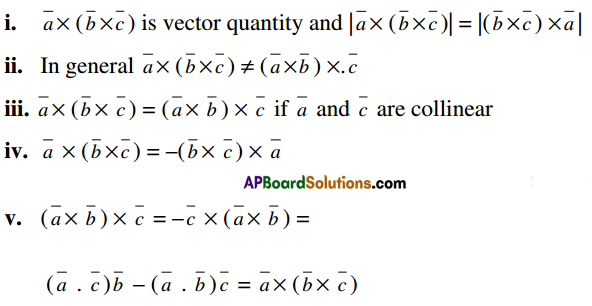
vi. If [latex]\bar{a}, \bar{b}[/latex] or [latex]\bar{c}[/latex] are non zero vectors and [latex][/latex] then b and c are parallel (or collinear) vectors.
vii. If [latex]\bar{a}, \bar{b}[/latex] or [latex]\bar{c}[/latex] are non zero and non parallel vectors then [latex]\bar{a} \times(\bar{b} \times \bar{c}), \quad \bar{b} \times(\bar{c} \times\bar{a})[/latex] and [latex]\bar{c} \times(\bar{a} \times \bar{b})[/latex] are non collinear vectors.
viii. If [latex]\bar{a}, \bar{b}[/latex] or [latex]\bar{c}[/latex] are any three vectors then [latex]\bar{a}(\bar{b} \times \bar{c})+\bar{b} \times(\bar{c} \times \bar{a})+\bar{c} \times(\bar{a} \times \bar{b})=\overline{\mathrm{O}}[/latex]
ix. If [latex]\bar{a}, \bar{b}[/latex] or [latex]\bar{c}[/latex] are any three vectors then [latex]\bar{a}(\bar{b} \times \bar{c})+\bar{b} \times(\bar{c} \times \bar{a})+\bar{c} \times(\bar{a} \times \bar{b})[/latex] are coplanar. [since sum of these vectors is zero]
x. [latex]\bar{a}(\bar{b} \times \bar{c})[/latex] is vector lies in the plane of [latex]\bar{b}[/latex] and [latex]\bar{c}[/latex] or parallel to the plane of [latex]\bar{b}[/latex] and [latex]\bar{c}[/latex].
Product of Four Vectors:
Dot product of four vectors : The dot product of four vectors a̅, b̅, c̅ and d̅ is given as [latex](\bar{a} \times \bar{b}) \cdot(\bar{c} \times \bar{d})=(\bar{a} \cdot \bar{c})(\bar{b} \cdot \bar{d})-(\bar{a} \cdot \bar{d})(\bar{b} \cdot \bar{c})=\left|\begin{array}{ll}
\bar{a} \cdot \bar{c} & \bar{a} \cdot \bar{d} \\
\bar{b} \cdot \bar{c} & \bar{b} \cdot \bar{d}
\end{array}\right|[/latex]
→ Cross product of four vectors : If a̅, b̅, c̅ and d̅ are any four vectors then
→ The vectorial equation of the plane passing through the point a and parallel to the vectors b̅, c̅is [latex][\overline{\mathrm{r}} \overline{\mathrm{b}} \overline{\mathrm{c}}]=[\overline{\mathrm{a}} \overline{\mathrm{b}} \overline{\mathrm{c}}][/latex]
→ The vectorial equation of the plane passing through the points a̅, b̅ and parallel to the vector c̅ is [latex][\overline{\mathrm{rb}} \overline{\mathrm{c}}]+[\overline{\mathrm{r}} \overline{\mathrm{c}} \overline{\mathrm{a}}]=[\overline{\mathrm{a}} \overline{\mathrm{b}} \overline{\mathrm{c}}][/latex]
→ The vectorial equation of the plane passing through the points a̅, b̅, c̅ is [latex][\overline{\mathrm{r}} \overline{\mathrm{b}} \overline{\mathrm{c}}]+[\overline{\mathrm{r}} \overline{\mathrm{c}} \overline{\mathrm{a}}]+[\overline{\mathrm{ra}} \overline{\mathrm{b}}]=[\overline{\mathrm{a}} \overline{\mathrm{b}} \overline{\mathrm{c}}][/latex]
→ If the points with the position vectorsa̅, b̅, c̅, d̅ are coplanar, then the condition is [latex][\overline{\mathrm{a}} \overline{\mathrm{bd}}]+[\overline{\mathrm{b}} \overline{\mathrm{c}} \overline{\mathrm{d}}]+[\overline{\mathrm{c}} \overline{\mathrm{a}} \overline{\mathrm{d}}]=[\overline{\mathrm{a}} \overline{\mathrm{b}} \overline{\mathrm{c}}][/latex]
→ Length of the perpendicular from the origin to the plane passing through the points a̅, b̅, c̅ is [latex]\frac{|[\overline{\mathrm{a} b} \overline{\mathrm{c}}]|}{|\overline{\mathrm{b}} \times \overline{\mathrm{c}}+\overline{\mathrm{c}} \times \overline{\mathrm{a}}+\overline{\mathrm{a}} \times \overline{\mathrm{b}}|}[/latex]
→ Length of the perpendicular from the point c̅ on to the line joining the points a̅, b̅ is [latex]\frac{\mid(\overline{\mathrm{a}}-\overline{\mathrm{c}}) \times(\overline{\mathrm{c}}-\overline{\mathrm{b}})}{|\overline{\mathrm{a}}-\overline{\mathrm{b}}|}[/latex]
→ P, Q, R are non collinear points. Then distance of P to the plane OQR is OP. [latex]\left|\frac{\overline{\mathrm{OP}} \cdot(\overline{\mathrm{OQ}} \times \overline{\mathrm{OR}})}{|\overline{\mathrm{OQ}} \times \overline{\mathrm{OR}}|}\right|[/latex]
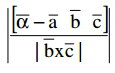
→ Perpendicular distance from P(α̅ ) to the plane passing through A(a̅) and parallel to the vectors b and c is
→ Length of the perpendicular from the point c̅ to the line [latex]\overline{\mathrm{r}}=\overline{\mathrm{a}}+\mathrm{tb}[/latex] is [latex]\frac{|(\overline{\mathrm{c}}-\overline{\mathrm{a}}) \times \overline{\mathrm{b}}|}{|\overline{\mathrm{b}}|}[/latex]