
Students can go through AP Board 9th Class Maths Notes Chapter 1 Real Numbers to understand and remember the concepts easily.
AP State Board Syllabus 9th Class Maths Notes Chapter 1 Real Numbers
→ Numbers of the form [latex]\frac{p}{q}[/latex] where p and q are integers and q ≠ 0 are called rational numbers, represented by ‘Q’.
→ There are infinitely many rational numbers between any two integers.
E.g.: 3 < [latex]\frac{19}{6}[/latex], [latex]\frac{20}{6}[/latex], [latex]\frac{21}{6}[/latex], [latex]\frac{22}{6}[/latex], [latex]\frac{23}{6}[/latex], ……. < 4
→ There are infinitely many rational numbers between any two rational numbers.
E.g.: [latex]\frac{3}{4}[/latex] < [latex]\frac{29}{8}[/latex] < [latex]\frac{71}{16}[/latex] < [latex]\frac{81}{14}[/latex] ……. < [latex]\frac{13}{2}[/latex]
→ To find the decimal representation of a rational number we divide the numerator of a rational number by its denominator.
E.g.: The decimal representation of [latex]\frac{5}{6}[/latex] is
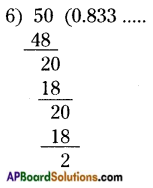
∴ [latex]\frac{5}{6}[/latex] = 0.833 …. = 0.8 [latex]\overline{3}[/latex]

→ Every rational number can be expressed as a terminating decimal or as a non-terminating repeating decimal. Conversely every terminating decimal or non¬terminating recurring decimal can be expressed as a rational number.
E.g.: 1.6 [latex]\overline{2}[/latex] = [latex]\frac{161}{99}[/latex]
→ A rational number whose denominator consists of only 2’s or 5’s or a combination of 2’s and 5’s can be expressed as a terminating decimal.
E.g. : [latex]\frac{13}{32}[/latex] can be expressed as a terminating decimal (∵ 32 = 2 × 2 × 2 × 2 × 2)
[latex]\frac{7}{125}[/latex] can be expressed as a terminating decimal (∵ 125 = 5 × 5 × 5)
[latex]\frac{24}{40}[/latex] can be expressed as a terminating decimal (∵ 40 = 2 × 2 × 2 × 5)
→ Numbers which can’t written in the form [latex]\frac{p}{q}[/latex] where p and q are integers and q ≠ 0, are called irrational numbers.
E.g.: √2, √3, √5,….. etc.
The decimal form of an irrational number is neither terminating nor recurring decimal.
→ Irrational numbers can be represented on a number line using Pythagoras theorem.
E.g.: Represent √2 on a number line.
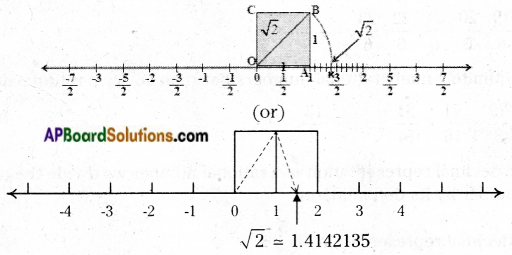
→ If ‘n’ is a natural number which is not a perfect square, then √n is always an irrational number.
E.g.: 2, 3, 5, 7, 8, …… etc., are not perfect squares.
∴ √2, √3, √5, √7 and √8 are irrational numbers.
→ We often write π as [latex]\frac{22}{7}[/latex] there by π seems to be a rational number; but π is not a rational number.
→ The collection of rational numbers together with irrational numbers is called set of Real numbers.
R = Q ∪ S
→ If a and b are two positive rational numbers such that ab is not a perfect square, then , √ab is an irrational number between ‘a’ and b’.
E.g.: Consider any two rational numbers 7 and 4.
7 × 4 = 28 is not a perfect square; then √28 lies between 4 and 7.
i.e., 4 < √28 < 1
→ If ‘a’ is a rational number and ‘b’ is arty irrational number then a + b, a – b, a.b or [latex]\frac{a}{b}[/latex] is an irrational number.
E.g.: Consider 7 and √5 then 7 + √5, 7 – √5, 7√5 and [latex]\frac{7}{\sqrt{5}}[/latex]= are all irrational numbers.
→ If the product of any two irrational numbers is a rational number, then they are said to be the rationalising factor of each other.
E.g.: Consider any two irrational number 7√3 and 5√3.
7√3 × 5√3 = 7 × 5 × 3 = 105 a rational number.
Also 7√3 × √3 = 21 – a rational number.
5√3 × √3 = 15 – a rational number.
So the rationalising factor of an irrational number is not unique.
→ The general form of rationalising factor (R.F.) of (a ± √b} is (a ∓ √b). They are called conjugates to each other.
→ Laws of exponents:
i) am × an = am+n
e.g.: 54 . 5-3 = 54+(-3) = 51 = 5
ii) (am)n = amn
e.g.: (43)2 = 43×2 = 46
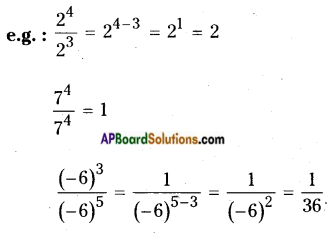
iii)
 = am-n if (m > n)
= 1 if m = n
= [latex]\frac{1}{a^{n-m}}[/latex] if (m < n)
iv) am . bm = (ab)m
e.g.:(-5)3 . (2)3 = (-5 × 2)3 =(-10)3
v) [latex]\frac{1}{a^{n}}[/latex] = a-n
e.g.: (6)-3 = [latex]\frac{1}{6^{3}}[/latex] = [latex]\frac{1}{216}[/latex]
vi) a0 = 1
e.g.: [latex]\left(\frac{-3}{4}\right)^{0}[/latex] = 1
Where a, b are rationals and m, n are integers.
→ Let a, b be any two rational numbers such that a = bn then b = [latex]\sqrt[n]{a}[/latex] = [latex](\mathrm{a})^{1 / \mathrm{n}}[/latex]
Here ‘b’ is called nth root of a.
e.g.: 42 = 16 then [latex]16^{1 / 2}[/latex] or [latex]\sqrt[2]{16}[/latex]
34 = 81 then 3 = [latex]\sqrt[4]{81}[/latex] or [latex](81)^{1 / 4}[/latex]
→ Let ‘a’ be a positive number and n > 1 then [latex]\sqrt[n]{a}[/latex] i.e., nth root of a is called a surd.