
Practice the AP 10th Class Maths Bits with Answers Chapter 7 Coordinate Geometry on a regular basis so that you can attempt exams with utmost confidence.
AP State Syllabus 10th Class Maths Bits 7th Lesson Coordinate Geometry with Answers
Question 1.
If a line is passing through (2, 3) and (2, -3), then
1) the line is parallel to X – axis.
2) the line is parallel to Y – axis.
3) the slope of the line is not defined.
4) the slope of the line is zero.
A) 2 and 3 are correct.
B) 1 and 3 are correct.
C) 1 and 2 are correct.
D) 2 and 4 are correct.
Answer:
A) 2 and 3 are correct.
Question 2.
If A(log28, log525) and B(log1010, log10100), then the mid-point of AB is
A) (2, 2)
B) (3, 2)
C) (1, 2)
D) (4, 4)
Answer:
D) (4, 4)

Question 3.
The nearest point to origin is
A) (2, -3)
B) (5, 0)
C) (0,-5)
D) (1, 3)
Answer:
A) (2, -3)
Question 4.
The point (0, 5) lies on ……………….
A) Both X and Y – axes
B) Origin
C) Y-axis
D) X – axis
Answer:
C) Y-axis
Question 5.
If origin is the centroid of a triangle, whose vertices are (3, 2), (-6, y) and (3,-2), then y = ………………….
A) 0
B) 3
C) 2
D) 6
Answer:
A) 0
Question 6.
Which of the following cannot be a point on X-axis ?
A) (-2, 0)
B) (0, 2)
C) (2, 0)
D) (4, 0)
Answer:
B) (0, 2)
Question 7.
Which of the following is the point of intersection of X – axis and the line y = x + 5?
A) (0, 5)
B) (5, 0)
C) (0, -5)
D) (-5, 0)
Answer:
D) (-5, 0)
Question 8.
The area of the triangle BOA is ……………… sq units.
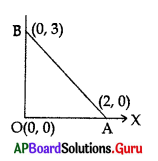
A) 1
B) 2
C) 3
D) 4
Answer:
C) 3
Question 9.
The distance between two points A(a cosθ, 0), B(0, asinθ) is ……………….
A) a
B) a2
C) √a
D) 0
Answer:
A) a
Question 10.
(x, y), (2, 0), (3, 2) and (1, 2) are vertices of a parallelogram then (x, y)
A) (0, 0)
B) (4, 8)
C) (1, 0)
D) (5, 0)
Answer:
A) (0, 0)
Question 11.
Total distance from X-axis to A(3, 4) and Y-axis to B(5, 7) is ……………………..
A) 8
B) 10
C) 11
D) 9
Answer:
D) 9
Question 12.
Distance between the points A(log10100, tan 45°),
B(cosec 30°.log7343) is
A) [latex]\sqrt{13}[/latex]T units
B) [latex]\sqrt{10}[/latex] units
C) [latex]\sqrt{34}[/latex] units
D) √5 units
Answer:
D) √5 units
Question 13.
The point (-5, -8) lies in ………. quadrant.
A) I
B) II
C) III
D) IV
Answer:
C) III
Question 14.
The line x = -3 is
A) parallel to X – axis
B) parallel to Y – axis
C) passes through origin
D) passes through (0, -3)
Answer:
B) parallel to Y – axis
Question 15.
The area of a triangle is zero means …………………
A) points are parallel
B) points are collinear
C) points are equal
D) points are negative
Answer:
B) points are collinear
Question 16.
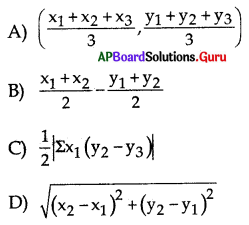
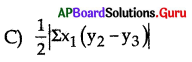
The formula of the area of a triangle is ………………….
Answer:
Question 17.
Slope of the line 3x – αy +1 = 0 is 4 then α = …………………..
A) [latex]\frac {3}{4}[/latex]
B) [latex]\frac{-3}{4}[/latex]
C) [latex]\frac {1}{3}[/latex]
D) [latex]\frac{-1}{3}[/latex]
Answer:
D) [latex]\frac{-1}{3}[/latex]
Question 18.
Sides of two similar triangles are in the ratio of 4:9. Area of these triangles are in the ratio of ………………
A) 2 : 3
B) 4 : 9
C) 81 : 16
D) 16 : 81
Answer:
D) 16 : 81
Question 19.
The point at which the line 2x + y = 8 intersects the X-axis is ………………….
A) (8, 0)
B) (0, 8)
C) (0, 4)
D) (4, 0)
Answer:
D) (4, 0)
Question 20.
Three consecutive vertices of a parallelogram are (-2, 1), (1, 0) and (4, 3). Then 4th vertex is ………………
A) (1, 4)
B) (1, -2)
C) (-1, 2)
D) (-1, -2)
Answer:
A) (1, 4)
Question 21.
The ratio in which the line segment joining the points (4, 6) and (-7, -1) divided by X- axis is ………………….
A) 6 : 1
B) 1 : 6
C) 4 : 7
D) 7 : 4
Answer:
A) 6 : 1
Question 22.
Slope of the line joining (-α, α) and (α, α + α√3) is …………………
A) [latex]\frac{2}{\sqrt{3}}[/latex]
B) [latex]\frac{1}{\sqrt{3}}[/latex]
C) √3
D) [latex]\frac{\sqrt{3}}{2}[/latex]
Answer:
D) [latex]\frac{\sqrt{3}}{2}[/latex]
Question 23.
If the centroid of the triangle formed with (a, b), (b, c) and (c, a) is O(0,0), then
a3 + b3 + c3 =
A) a + b + c
B) [latex]\frac{a+b+c}{3}[/latex]
C) [latex]\frac{a b c}{3}[/latex]
D) 3abc
Answer:
D) 3abc
Question 24.
If A(p, q), B(m, n) and C(p-m, q-n) are collinear, then……………….
A) [latex]\frac{\mathrm{p}}{\mathrm{n}}=\frac{\mathrm{q}}{\mathrm{m}}[/latex]
B) [latex]\frac{\mathrm{p}}{\mathrm{m}}=\frac{\mathrm{q}}{\mathrm{n}}[/latex]
C) p + q = m + n
D) p + q + m + n = 0
Answer:
B) [latex]\frac{\mathrm{p}}{\mathrm{m}}=\frac{\mathrm{q}}{\mathrm{n}}[/latex]
Question 25.
If P = {3x/x ∈N,x ≤ 50},
Q = {5x/x ∈N, x ≤ 30}, then n(P ∩ Q) =……………..
A) 5
B) 8
C) 10
D) 15
Answer:
C) 10
Question 26.
(3, -1), (2, 6) and (-5, 7) are the midpoints of the sides of the triangle ABC. The area of triangle ABC is ………………. sq. units
A) 96
B) 69
C) 86
D) 110
Answer:
A) 96
Question 27.
The ratio in which X-axis divides the line segment joining the points (5, 4) and (5, -3) is ……………..
A) 5 : 2
B) 3 : 4
C) 2 : 5
D) 4 : 3
Answer:
D) 4 : 3
Question 28.
AOBC is a rectangle with A = (0, 3), O (0, 0) and B (5, 0), then the length of
its diagonals is ………………
A) 5
B) 3
C) [latex]\sqrt{34}[/latex]
D) 4
Answer:
C) [latex]\sqrt{34}[/latex]
Question 29.
The points (-4, 0), (4, 0), (0, 3) are vertices of ……………….
A) right angled triangle
B) isosceles triangle
C) equilateral triangle
D) scalene triangle
Answer:
B) isosceles triangle
Question 30.
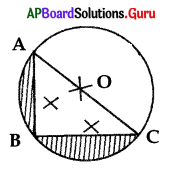
In the given figure AC pass through center of the circle, then the area of the shaded region
region in the given figure is ………………
A) [latex]\frac{x^{2}}{2}[/latex] (3 – π)
B) x2([latex]\frac{\pi}{2}[/latex] – 1)
C) 2x2(π – 1 )
D) [latex]\frac{x^{2}}{2}\left(\frac{\pi}{2}-1\right)[/latex]
Answer:
D) [latex]\frac{x^{2}}{2}\left(\frac{\pi}{2}-1\right)[/latex]
Question 31.
The points of trisection of the line segment joining (2, -2), (-7, 4) are
A) (1, 0), (-4, 2)
B) (-1, 0), (-4, 2)
C) (-1, 0), (-4, -2)
D) (1, 0), (4, 2)
Answer:
B) (-1, 0), (-4, 2)
Question 32.
The points which divide the line segment joining A(-2, 2) and B(2, 8) into four equal parts are)
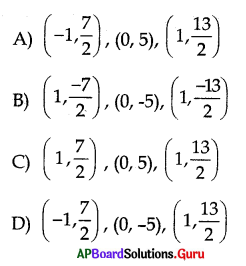
Answer:
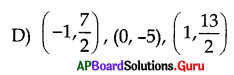
Question 33.
The end points of a line are (2, 3), (4, 5). Then its slope is
A) 4
B) 3
C) 2
D) 1
Answer:
D) 1
Question 34.
The value of k for which the points (7, -2), (5, 1), (3, k) are collinear is
A) 4
B) 3
C) 2
D) 1
Answer:
A) 4
Question 35.
The points A(7, 3), B(6, 1), C(8, 2) and D(9, 4) taken in that order are the vertices of
A) square
B) rhombus
C) parallelogram
D) trapezium
Answer:
B) rhombus
Question 36.
If (a, 2) lies in II quadrant, then (-a, -2) lies in which quadrant ?
A) I
B) II
C) III
D) IV
Answer:
D) IV
Question 37.
The quadrilateral formed by the points A(0, -1), B(2, 1), C(0, 3) and D(-2, 1) taken in the same order is
A) rectangle
B) parallelogram
C) square
D) rhombus
Answer:
C) square
Question 38.
If P(3, 4) and Q(7, 7) are two points and PR = 10, where P, Q and R are collinear, then R =
A) (10,10)
B) (11, 11)
C) (11, 10)
D) (11, -10)
Answer:
C) (11, 10)
Question 39.
If (-2, 1), (1, 0) and (4, 3) are three consecutive vertices of a parallelogram, then the fourth vertex is
A) (2, 1)
B) (1, 4)
C) (0, 0)
D) (2, 2)
Answer:
A) (2, 1)
Question 40.
(0, 0), (1, 0), (0, -4) are the vertices of a …………….. triangle.
A) equilateral
B) isosceles
C) right-angled isosceles
D) right-angled
Answer:
D) right-angled
Question 41.
If (8,1), (k, -4), (2, -5) are collinear, then k =
A) 1
B) 2
C) 3
D) 4
Answer:
C) 3
Question 42.
If the slope of the line through (2, -7) and (x, 5) is 3 then x =
A) 4
B) 5
C) 6
D) 7
Answer:
C) 6
Question 43.
The distance between the points (cosθ, sinθ) and (-sinθ, cosθ) is
A) 1
B) √2
C) 2
D) √3
Answer:
B) √2
Question 44.
The number of elements in a triangle is
A) 3
B) 4
C) 6
D) 5
Answer:
C) 6
Question 45.
The graph of y + x2 = 0 lies in the quadrants
A) Q1, Q2
B) Q2, Q3
C) Q3, Q4
D) Q4, Q1
Answer:
C) Q3, Q4
Question 46.
The line x = 2017 is
A) Slope not defined
B) Parallel to Y – axis
C) 1 and 2
D) None
Answer:
C) 1 and 2
Question 47.
If (k, 2) lies in II quadrant then (-k, -2) lies in the quadrant
A) I
B) II
C) III
D) IV
Answer:
D) IV
Question 48.
The points A(1, 7), B(4, 2), C(-1, -1) and D(-4, 4) are
A) collinear
B) vertices of a square
C) vertices of a rectangle
D) None of these
Answer:
B) vertices of a square
Question 49.
If P divides the line joining A(x1, y1) and B(x2, y2) internally in the ratio m1 : m2, then P is
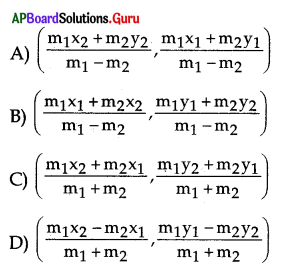
Answer:
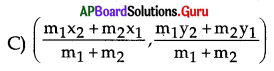
Question 50.
The distance between the points A(4, 3) and B(8, 6) is …………… units.
A) 5
B) 6
C) 4
D) 7
Answer:
C) 4
Question 51.
The points A(1, 5), B(2, 3) and C(-2, -1) are
A) vertices of a right-angled triangle
B) vertices of an isosceles triangle
C) collinear
D) non-collinear
Answer:
D) non-collinear
Question 52.
The midpoint of A(1, 5) and B (-2, -1) is
A) ([latex]\frac {1}{2}[/latex], 2)
B) (2, [latex]\frac {1}{2}[/latex])
C) (-[latex]\frac {1}{2}[/latex], 2)
D) (-[latex]\frac {1}{2}[/latex], -2
Answer:
C) (-[latex]\frac {1}{2}[/latex], 2)
Question 53.
If a line makes an angle 45° with positive X-axis, then its slope is
A) [latex]\frac{1}{\sqrt{2}}[/latex]
B) [latex]\frac {1}{2}[/latex]
C) [latex]\frac{\sqrt{3}}{2}[/latex]
D) 1
Answer:
A) [latex]\frac{1}{\sqrt{2}}[/latex]
Question 54.
The area of the triangle formed by three vertices O(0, 0), A(1, 0), B(0, 1) is ………………. sq. units.
A) o
B) 1/2
C) 1
D) 2
Answer:
B) 1/2
Question 55.
At which point does the straight line y = x + 7 intersect X – axis ?
A) (7, 0)
B) (0, 7)
C) (0, -7)
D) (-7, 0)
Answer:
D) (-7, 0)
Question 56.
Where do the following points (-4, 0), (2, 0), (6, 0), (-8, 0) lie in the coordinate axes ?
A) First Quadrant
B) Y-axis
C) X-axis
D) Fourth Quadrant
Answer:
C) X-axis
Question 57.
The distance between the points (0, 0), (X1,Y1) is ………………units.
A) [latex]\sqrt{x_{1}^{2}+y_{1}^{2}}[/latex]
B) [latex]\sqrt{x_{1}+y_{1}}[/latex]
C) [latex]\sqrt{x^{2}+y^{2}}[/latex]
D) [latex]\sqrt{x+y}[/latex]
Answer:
A) [latex]\sqrt{x_{1}^{2}+y_{1}^{2}}[/latex]
Question 58.
The slope of a ladder making an angle 60° with the floor is ……………………..
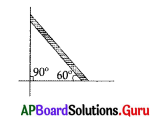
A) 1
B) [latex]\frac {1}{2}[/latex]
C) [latex]\frac{1}{\sqrt{3}}[/latex]
D) √3
Answer:
D) √3
Question 59.
The mid point of the line joining the points (4, 5), (- 6, 3) is ………………
A) (1, 4)
B) (-1, 4)
C) (1, -4)
D) (-1, – 4)
Answer:
B) (-1, 4)
Question 60.
The distance of the point (3, – 4) from X- axis is ………………..
A) 3
B) 4
C) 5
D) 1
Answer:
C) 5
Question 61.
The slope of the line joining (2, 1) (3, 6) is …………………..
A) 5
B) 4
C) 3
D) 2
Answer:
A) 5
Question 62.
The line passing through the point (0,0) is
A) y = 2
B) x = 5
C) y = x
D) y = 2x + 3
Answer:
C) y = x
Question 63.
Slope of the line 5x – 6y + 10 = 0 is
A) [latex]\frac{5}{6}[/latex]
B) [latex]\frac{-5}{6}[/latex]
C) [latex]\frac{6}{5}[/latex]
D) [latex]\frac{-6}{5}[/latex]
Answer:
A) [latex]\frac{5}{6}[/latex]
Question 64.
The distance between the points (3, 2) and (2, 4) is …………………. units.
A) √5
B) √6
C) √3
D) √2
Answer:
A) √5
Question 65.
The centroid of the triangle with vertices (2, 1), (3, 2), (1, 3) is
A) (3, 5)
B) (2, 2)
C) (3, 3)
D) (3, 6)
Answer:
B) (2, 2)
Question 66.
If the line 4x + 5y = k passing through the origin, then k is
A) -1
B) 2
C) 0
D) 3
Answer:
C) 0
Question 67.
The area of the triangle whose vertices are (0, 0), (x, 0) and (0, y) is
A) xy
B) [latex]\frac {1}{2}[/latex] xy
C) [latex]\frac {1}{2}[/latex] x + y
D) x + y
Answer:
B) [latex]\frac {1}{2}[/latex] xy
Question 68.
The slope of the line perpendicular to the line 2x + y + 4 = 0 is
A) -2
B) 2
C) [latex]\frac {1}{2}[/latex]
D) -[latex]\frac {1}{2}[/latex]
Answer:
D) -[latex]\frac {1}{2}[/latex]
Question 69.
The slope of the line parallel to the line 2x + y + 4 = 0 is
A) 2
B) -2
C) [latex]\frac {1}{2}[/latex]
D) -[latex]\frac {1}{2}[/latex]
Answer:
A) 2
Question 70.
The equation of the line having slope 1 and passing through (3, 2) is
A) x + y = 1
B) x – y = 1
C) 2x – y + 1 = 0
D) x – 2y + 1 = 0
Answer:
B) x – y = 1
Question 71.
Slope of the line joining the points (a, 0) and (0, 5) is
A) -b
B) [latex]\frac{a}{b}[/latex]
C) – [latex]-\frac{b}{a}[/latex]
D) [latex]\frac{1}{a}[/latex]
Answer:
C) – [latex]-\frac{b}{a}[/latex]
Question 72.
The distance of the point (3, p) from origin is 5 units then p is
A) 7
B) 6
C) 5
D) 4
Answer:
D) 4
Question 73.
A = (8, 3), B= (x, 3) and [latex]\overline{\mathbf{A B}}[/latex] = 12 units then x is
A) -4
B) 14
C) 8
D) 20
Answer:
D) 20
Question 74.
Distance of the point (tanθ, 1) from origin is
A) cotθ
B) sinθ
C) tanθ
D) secθ
Answer:
D) secθ
Question 75.
The perimeter of a triangle formed by the points (0,0), (1,0)and (0, 1) is ………………….units.
A) √2
B) 2 + √2
C) 2 – √2
D) 2 √2
Answer:
B) 2 + √2
Question 76.
Find the value of k for which of (7, -2), (5, 1), (3, k) are collinear
A) [latex]\frac {4}{5}[/latex]
B) [latex]\frac {11}{5}[/latex]
C) [latex]\frac {5}{5}[/latex]
D) [latex]\frac {7}{5}[/latex]
Answer:
B) [latex]\frac {11}{5}[/latex]
Question 77.
Find the centroid of (-1, 3), (6, -3), (-3, 6)
A) ([latex]\frac {2}{3}[/latex], 2)
B) (1, [latex]\frac {2}{3}[/latex])
C) (-1, [latex]\frac {2}{3}[/latex])
D) (-[latex]\frac {2}{3}[/latex], 1)
Answer:
A) ([latex]\frac {2}{3}[/latex], 2)
Question 78.
A = (4, 2); B = (1, y) and AB = 5 then y = ………………..
A) 6
B) 3
C) 9
D) 2
Answer:
A) 6
Question 79.
A straight line which is parallel to x – y + 1 = 0 is ………………..
A) x – y + k = 0
B) x + y + k = 0
C) ax + by + c = 0
D) 2x + 3y + k = 0
Answer:
A) x – y + k = 0
Question 80.
If the distance of a point from X – axis is 8 units and its distance from Y – axis is 3 units then the point is denoted by
A) (8, 3)
B) (-8, 3)
C) (-3, 8)
D) (3, 8)
Answer:
D) (3, 8)
Question 81.
The slope of the line parallel to 3x – by + 7 = 0 is 3 then b = ………………..
A) 3
B) 4
C) 1
D) 5
Answer:
C) 1
Question 82.
The slope of the line perpendicular to 13x – 7y + 1 = 0 is ……………….
A) [latex]\frac{-7}{13}[/latex]
B) [latex]\frac{7}{3}[/latex]
C) -[latex]\frac{7}{3}[/latex]
D) [latex]\frac{13}{7}[/latex]
Answer:
A) [latex]\frac{-7}{13}[/latex]
Question 83.
The coordinates of the centre of the circle having the points (9, 3) and (1, -1) as the end points of the diameter is ………………..
A) (6, 9)
B) (5, 1)
C) (1, 3)
D) (- 1, – 3)
Answer:
B) (5, 1)
Question 84.
One end of the diameter of a circle is (3, 2) and the centre is (0, 0) then the other end point is
A) (8, 4)
B) (3, 2)
C) (- 3, – 2)
D) (5, 1)
Answer:
C) (- 3, – 2)
Question 85.
The mid point of the line segment (3, x) and (1, – 4) is (2, 1) then x =
A) 2
B) – 1
C) 6
D) 0
Answer:
C) 6
Question 86.
The point that lies in IV quadrant
A) (2, 3)
B) (-3, -2)
C) (4, -3)
D) (-2, 3)
Answer:
C) (4, -3)
Question 87.
The point that lies in III quadrant
A) (5, 4)
B) (-5, -4)
C) (-5, 4)
D) (5, -4)
Answer:
B) (-5, -4)
Question 88.
The point that lies in II quadrant is ………………
A) (-2, 3)
B) (2, -3)
C) (2, 3)
D) (0, 0)
Answer:
A) (-2, 3)
Question 89.
x > 0, y > 0, then (x, y) ∈ ………………..
A) Q1
B) Q2
C) Q3
D) Q4
Answer:
A) Q1
Question 90.
x < 0, y > 0 then (x, y) ∈ ……………..
A) Q1
B) Q2
C) Q3
D) Q4
Answer:
B) Q2
Question 91.
x < 0, y < 0 then (x, y) ∈ ………………
A) Q1
B) Q2
C) Q3
D) Q4
Answer:
C) Q3
Question 92.
x > 0, y < 0 then (x, y) ∈ ……………..
A) Q1
B) Q2
C) Q3
D) Q4
Answer:
D) Q4
Question 93.
Slope of the line [latex]\frac{x}{a}+\frac{y}{b}[/latex] = 1 is
A) [latex]\frac{1}{b}[/latex]
B) [latex]\frac{1}{a}[/latex]
C) [latex]\frac{a}{b}[/latex]
D) -[latex]\frac{\mathrm{b}}{\mathrm{a}}[/latex]
Answer:
D) -[latex]\frac{\mathrm{b}}{\mathrm{a}}[/latex]
Question 94.
Slope of the line x = 9 is
A) 9
B) – 9
C) 0
D) 5
Answer:
A) 9
Question 95.
The distance between the pointsP(x, y) from origin O (0, 0) is
A) [latex]\sqrt{x+y}[/latex]
B) [latex]\sqrt{x^{2}+y^{2}}[/latex]
C) x2 + y2
D) x + y
Answer:
B) [latex]\sqrt{x^{2}+y^{2}}[/latex]
Question 96.
A point on the X – axis
A) (3, 3)
B) (4, 5)
C) (2, 0)
D) (0, 2)
Answer:
C) (2, 0)
Question 97.
A point on the Y – axis
A) (4, 5)
B) (0, 3)
C) (3, 0)
D) (4, 3)
Answer:
B) (0, 3)
Question 98.
The ratio in which the centroid divides the median of a triangle is
A) 1 : 2
B) 2 :1
C) 1 : 3
D) 3 : 1
Answer:
C) 1 : 3
Question 99.
Intercept form of a line is …………….
A) [latex]\frac{x}{a}+\frac{y}{b}[/latex] = 1
B) x – y = 7
C) [latex]\frac{x}{a}+\frac{y}{b}[/latex] = 1
D) y = mx + c
Answer:
A) [latex]\frac{x}{a}+\frac{y}{b}[/latex] = 1
Question 100.
X – intercept of the line ax + by + c = 0 is
A) [latex]\frac{-\mathrm{c}}{\mathrm{a}}[/latex]
B) [latex]\frac{c}{a}[/latex]
C) [latex]\frac{a}{c}[/latex]
D) [latex]\frac{1}{c}[/latex]
Answer:
C) [latex]\frac{a}{c}[/latex]
Question 101.
The line y = mx + c meets Y – axis at the point ……………..
A) (0, 0)
B) (c, 0)
C) (0, c)
D) (0, m)
Answer:
C) (0, c)
Question 102.
The line y = mx + c meets X – axis at the point ………………..
A) (0, 0)
B) (c, 0)
C) (0, c)
D) (0, m)
Answer:
B) (c, 0)
Question 103.
Slope of a line can be taken as ………………
A) cosθ
B) tanθ
C) cosecθ
D) sinθ
Answer:
B) tanθ
Question 104.
The mid point of a line segment divides in the ratio
A) 2 : 1
B) 1 : 2
C) 1 : 1
D) 8 : 7
Answer:
C) 1 : 1
Question 105.
x = 0 represents …………………
A) X – axis
B) Y – axis
C) (0, 0)
D) y = mx + C
Answer:
B) Y – axis
Question 106.
y = 0 represents ………………….
A) X – axis
B) Y – axis
C) (0, 0)
D) y = mx + C
Answer:
A) X – axis
Question 107.
x = k represents ……………….
A) parallel to X – axis
B) parallel to Y – axis
C) parallel to X, Y axes
D) (0, 0)
Answer:
B) parallel to Y – axis
Question 108.
y = k represents ………………
A) parallel to X – axis
B) parallel to Y – axis
C) parallel to X, Y axes
D) (0, 0)
Answer:
A) parallel to X – axis
Question 109.
In the coordinate plane the axes are ……………. to each other.
A) parallel
B) perpendicular
C) either perpendicular or parallel
D) neither parallel nor perpendicular
Answer:
B) perpendicular
Question 110.
The distance of a point from Y – axis is called …………………..
A) y – coordinate
B) x – coordinate
C) origin
D) (0, 0)
Answer:
B) x – coordinate
Question 111.
The distance of a point from X – axis is called ………………..
A) x – coordinate
B) y – coordinate
C) origin
D) coordinate
Answer:
B) y – coordinate
Question 112.
The coordinates of origin are
A) (0, 0)
B) (1, 1)
C) (1, 0)
D) (0, 1)
Answer:
A) (0, 0)
Question 113.
The point which is not on the X – axis
A) (-1, 0)
B) (8, 0)
C) (0, 8)
D)(-2, 0)
Answer:
C) (0, 8)
Question 114.
The point which is not on the Y – axis is
A) (-2, 0)
B) (0, 2)
C) (0, -3)
D) (0, 4)
Answer:
A) (-2, 0)
Question 115.
Area of a triangle enclosed by the axis and the line [latex]\frac{x}{a}+\frac{y}{b}[/latex] = 1 is a b
A) [latex]\frac{\mathrm{ab}}{3}[/latex]
B) [latex]\frac{a^{2} b^{2}}{2}[/latex]
C) [latex]\frac{\mathrm{ab}}{2}[/latex]
D) [latex]\frac{a+b}{2}[/latex]
Answer:
C) [latex]\frac{\mathrm{ab}}{2}[/latex]
Question 116.
If G is the centroid of ΔABC, then ΔGAB = ……………….
A) [latex]\frac {1}{13}[/latex]ABC
B) [latex]\frac {1}{4}[/latex]ABC
C) [latex]\frac {1}{2}[/latex]ABC
D) [latex]\frac {1}{3}[/latex]ABC
Answer:
D) [latex]\frac {1}{3}[/latex]ABC
Question 117.
The two lines x = 2 and y = -3 will meet at ………………….
A) (1, 8)
B) (2, 4)
C) (-2, 1)
D) (2, -3)
Answer:
D) (2, -3)
Question 118.
Angle made by the line y = x with the positive direction of X – axis is
A) 80°
B) 45°
C) 90°
D) 100°
Answer:
B) 45°
Question 119.
To locate the exact position of a point the number of references we need is ……………….
A) 0
B) 1
C) 2
D) 3
Answer:
C) 2
Question 120.
In a coordinate system the horizontal line is called ………………………
A) Y – axis
B) X – axis
C) origin
D) reference
Answer:
B) X – axis
Question 121.
In a coordinate system the vertical line is called …………………..
A) Y – axis
B) X – axis
C) origin
D) reference
Answer:
A) Y – axis
Question 122.
The meeting point of the two axis in the coordinate plane is called
A) origin
B) X – axis
C) Y – axis
D) (2, 3)
Answer:
A) origin
Question 123.
The point which lies on both the axis is
A) (1, 1)
B) (2, 2)
q (-1, -1)
D) (0, 0)
Answer:
D) (0, 0)
Question 124.
The x – coordinate of a point is also called
A) ordinate
B) 2nd coordinate
C) abscissa
D) origin
Answer:
C) abscissa
Question 125.
The y – coordinate of a point is also called
A) ordinate
B) abscissa
C) 1st coordinate
D) origin
Answer:
A) ordinate
Question 126.
The coordinates of a point are (0,0) then the point is
A) origin
B) X – axis
C) ordinate
D) abscissa
Answer:
A) origin
Question 127.
Indentify the point in Q1
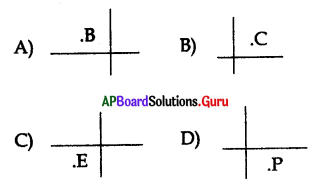
Answer:
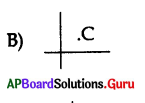
Question 128.
A line parallel to x = 3 is ………………….
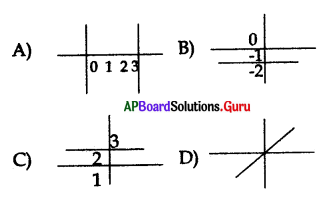
Answer:
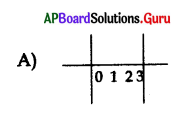
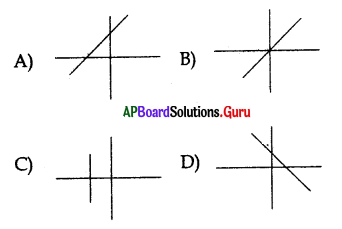
Question 129.
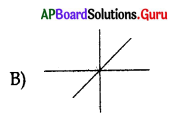
Which of the following line passing through (0,0) ?
Answer:
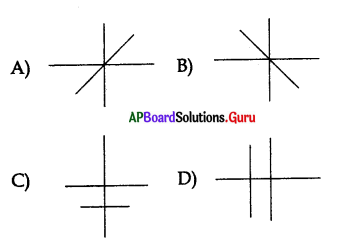
Question 130.
The location of points (1, 1)(2, 2)(3, 3)in a graph sheet may represents as ………………..
Answer:
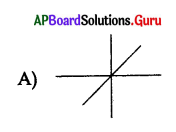
Question 131.
Q1 ∩ Q2
A) {1,2}
B) Φ
C) {0,1}
D) {1,2,3}
Answer:
B) Φ