
AP State Syllabus AP Board 6th Class Maths Solutions Chapter 8 Basic Geometric Concepts Ex 8.3 Textbook Questions and Answers.
AP State Syllabus 6th Class Maths Solutions 8th Lesson Basic Geometric Concepts Ex 8.3

Question 1.
Given ” \(\overline{\mathrm{AB}} / / \overline{\mathrm{CD}}\), l ⊥ m”. Which are perpendicular? Which are parallel?
Solution:
 are parallel lines (// is the symbol for parallel),
l, m are perpendicular lines (⊥ is the symbol for perpendicular).
Question 2.
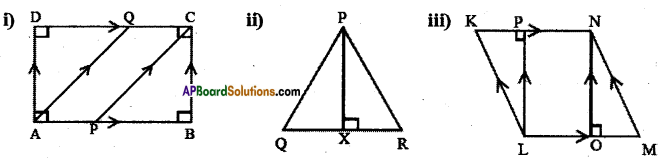
Write the set of parallels and perpendiculars in the given by using symbols.
Solution:
a) \(\overline{\mathrm{AB}}, \overline{\mathrm{DC}}\) are parallel lines, we denote this by writing \(\overline{\mathrm{AB}} / / \overline{\mathrm{DC}}\) and can be read as \(\overline{\mathrm{AB}}\) is parallel to \(\overline{\mathrm{DC}}\)
b) \(\overline{\mathrm{AD}}, \overline{\mathrm{BC}}\) are parallel lines. We denote this by writing \(\overline{\mathrm{AD}} / / \overline{\mathrm{BC}}\) and can be read as \(\overline{\mathrm{AD}}\) is parallel to \(\overline{\mathrm{BC}}\)
c) \(\overline{\mathrm{AQ}}, \overline{\mathrm{PC}}\) are parallel lines. We denote this by writing \(\overline{\mathrm{AQ}} / / \overline{\mathrm{PC}}\) and can be read as \(\overline{\mathrm{AQ}}\) is parallel to \(\overline{\mathrm{PC}}\).
d) \(\overline{\mathrm{AB}}, \overline{\mathrm{AD}}\) are perpendicular lines. We denote this by writing \(\overline{\mathrm{AB}} \perp \overline{\mathrm{AD}}\) and can be read as \(\overline{\mathrm{AB}}\) is perpendicular to \(\overline{\mathrm{AD}}\).
e) \(\overline{\mathrm{AB}}, \overline{\mathrm{BC}}\) are perpendicular lines. We denote this by writing \(\overline{\mathrm{AB}} \perp \overline{\mathrm{BC}}\) and can be read as \(\overline{\mathrm{AB}}[latex] is perpendicular to [latex]\overline{\mathrm{BC}}\) .
f) \(\overline{\mathrm{BC}}, \overline{\mathrm{CD}}\) are perpendicular lines, we denote this by writing \(\overline{\mathrm{BC}} \perp \overline{\mathrm{CD}}\) and can be read as \(\overline{\mathrm{BC}}\) is perpendicular to \(\overline{\mathrm{CD}}\).
g) \(\overline{\mathrm{CD}}, \overline{\mathrm{AD}}\) are perpendicular lines, we denote this by writing \(\overline{\mathrm{CD}} \perp \overline{\mathrm{AD}}\) and can be read as \(\overline{\mathrm{CD}}\) is perpendicular to \(\overline{\mathrm{AD}}\).
ii) \(\overline{\mathrm{PX}}, \overline{\mathrm{QR}}\) are perpendicular lines, we denote this by writing \(\overline{\mathrm{PX}} \perp \overline{\mathrm{QR}}\) and can be read as \(\overline{\mathrm{PX}}\) is perpendicular to \(\overline{\mathrm{QR}}\).
iii) a) \(\overline{\mathrm{LM}}, \overline{\mathrm{KN}}\) are parallel lines. We denote this by writing \(\overline{\mathrm{LM}} / / \overline{\mathrm{KN}}\) and can be read as \(\overline{\mathrm{LM}}\) is parallel to \(\overline{\mathrm{KN}}\).
b) \(\overline{\mathrm{MN}}, \overline{\mathrm{LK}}\) are parallel lines. We denote this by writing \(\overline{\mathrm{MN}} / / \overline{\mathrm{LK}}\) and can be read as \(\overline{\mathrm{MN}}\) is parallel to \(\overline{\mathrm{LK}}\).
c) \(\overline{\mathrm{ON}}, \overline{\mathrm{LP}}\) are parallel lines. We denote this by writing \(\overline{\mathrm{ON}} / / \overline{\mathrm{LP}}\) and can be read
as \(\overline{\mathrm{ON}}\) is parallel to \(\overline{\mathrm{LP}}\)
d) \(\overline{\mathrm{LM}}, \overline{\mathrm{ON}}\) are perpendicular lines, we denote this by writing \(\overline{\mathrm{ON}} \perp \overline{\mathrm{LM}}\) and can be read as \(\overline{\mathrm{ON}}\) is perpendicular to \(\overline{\mathrm{LM}}\).
e) \(\overline{\mathrm{LP}}, \overline{\mathrm{KN}}\) are perpendicular lines, we denote this by writing \(\overline{\mathrm{LP}} \perp \overline{\mathrm{KN}}\) and can be read as \(\overline{\mathrm{LP}}\) is perpendicular to \(\overline{\mathrm{KN}}\).
Question 3.
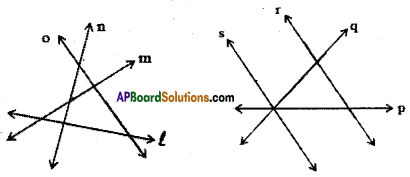
From the given figure find out the Intersecting lines and concurrent lines.
Solution:
i) Intersecting lines : (l, m); (l, n); (n, o); (m, o); (l, o); (m, n)
ii) Intersecting lines: (p, q); (p, r); (p, s); (q, r); (q, s)
Concurrent lines : (p, q, s)