AP Board 6th Class Social Solutions Chapter 1 సౌర కుటుంబంలో మన భూమి

SCERT AP 6th Class Social Study Material Pdf 1st Lesson సౌర కుటుంబంలో మన భూమి Textbook Questions and Answers.

AP State Syllabus 6th Class Social Solutions 1st Lesson సౌర కుటుంబంలో మన భూమి

6th Class Social 1st Lesson సౌర కుటుంబంలో మన భూమి Textbook Questions and Answers

Improve your learning (మీ అభ్యసనాన్ని మెరుగుపడుచుకోండి)

ప్రశ్న 1.
నక్షత్రం కంటే గ్రహం ఏ విధంగా భిన్నమైనది?
జవాబు:
నక్షత్రం కంటే గ్రహం ఏ విధంగా భిన్నమైనదంటే :

  • నక్షత్రం స్వయం ప్రకాశం కలది. గ్రహం స్వయం ప్రకాశం కాదు.
  • నక్షత్రాలు చాలా పెద్దగా, వేడిగా ఉంటాయి. గ్రహాలు నక్షత్రాల కంటే చిన్నగా ఉంటాయి, అంతవేడిగా ఉండవు.
  • నక్షత్రం స్థిరంగా ఉంటుంది. గ్రహాలు తమచుట్టూ తాము తిరుగుతూ సూర్యుని చుట్టూ తిరుగుతాయి.
  • నక్షత్రంపై జీవం అసాధ్యం, గ్రహాలపై జీవానికి అవకాశం ఉంది.
    ఉదా : భూగ్రహంపై జీవం కలదు.

ప్రశ్న 2.
సౌర కుటుంబం అనగానేమి?
జవాబు:
సూర్యుడు, ఎనిమిది గ్రహాలు, ఉపగ్రహాలు, గ్రహశకలాలు, ఉల్కలు అని పిలువబడే కొన్ని ఖగోళ వస్తువులు సౌర వ్యవస్థను ఏర్పరుస్తాయి. సూర్యుడు యజమానిగా ఉన్న దీనిని మనం ‘సౌర కుటుంబం’ అని పిలుస్తాం.

AP Board 6th Class Social Solutions Chapter 1 సౌర కుటుంబంలో మన భూమి

ప్రశ్న 3.
అన్ని గ్రహాలపై జీవం ఎందుకు సాధ్యం కాదు?
జవాబు:
అన్ని గ్రహాలపై జంతువులు, మొక్కలు (మానవులు) మొదలైన జీవులు పెరగటానికి (జీవించడానికి) అత్యంత కీలకమైన వనరు నీరు మరియు వాతావరణం. ఇవి అన్ని గ్రహాలపై అందుబాటులో లేని కారణంగా అక్కడ జీవం సాధ్యం కాదు.

ప్రశ్న 4.
మనం కేవలం చంద్రుని యొక్క ఒక వైపు మాత్రమే ఎందుకు చూడగలం?
జవాబు:
చంద్రుడు భూమి చుట్టూ ఒకసారి తిరగడానికి 27 రోజులు పడుతుంది. అలాగే తనచుట్టూ తాను తిరగడానికి సరిగ్గా అదే సమయం పడుతుంది. ఫలితంగా, చంద్రుని యొక్క ఒక వైపు మాత్రమే భూమిపై మనకు కనిపిస్తుంది.

ప్రశ్న 5.
విశ్వం అనగానేమి?
జవాబు:
విశ్వం అనేది కొన్ని కోట్లాది. గెలాక్సీల సమూహం. విశ్వం ఎంత పెద్దదో ఊహించటం కష్టం. దాని గురించి మరింత తెలుసుకోవడానికి శాస్త్రవేత్తలు ఇంకా ప్రయత్నిస్తున్నారు. దాని పరిమాణం గురించి మనకు కచ్చితంగా తెలియదు కాని మనమందరం ఈ విశ్వానికి చెందినవారని మనకు తెలుసు.

ప్రశ్న 6.
భూమిపై జీవించడానికి గాలి, నీరు, చాలా అవసరం. కానీ ప్రస్తుతం అవి మానవులచే కలుషితం చేయ బడుతున్నాయి. కాలుష్యం ఇంకా పెరిగితే ఈ భూమిపై జీవులకు ఏమి జరుగుతుంది?
జవాబు:
గాలి కాలుష్యం పెరిగితే :

  • వాతావరణంలో ప్రాణవాయువు (ఆక్సిజన్) తగ్గిపోతుంది.
  • వాతావరణంలో బొగ్గుపులుసు వాయువు (కార్బన్ డై ఆక్సెడ్) లాంటి గ్రీన్‌హౌస్ వాయువులు పెరిగిపోతాయి.
  • భూగోళం వేడెక్కుతుంది. వాతావరణ సమతుల్యత దెబ్బ తింటుంది.
  • అతివృష్టి, అనావృష్టిలు ఏర్పడతాయి.
  • ధృవ ప్రాంతాల్లోని మంచు కరిగి సముద్ర మట్టాలు పెరుగుతాయి.
  • ఓజోన్ పొరకు ప్రమాదం కలుగుతుంది.
  • శ్వాస, చర్మ సంబంధిత వ్యాధులు పెరిగే అవకాశం కలదు.

నీటి కాలుష్యం పెరిగితే :

  • నీటి కాలుష్యం వలన అనేక రకాల వ్యాధుల బారిన పడవలసి ఉంటుంది.
  • నీటి కాలుష్యం వలన పంటల దిగుబడి తగ్గిపోతుంది, తద్యం ఆహార కొరత ఏర్పడుతుంది.
  • చేపలు మొదలైన నీటిలో నివసించే జలచరాలకు ముప్పు ఏర్పడి, తద్వారా వాటి కొరత ఏర్పడుతుంది. అలాగే వాటిని స్వీకరించిన
  • మానవులకు అనేక వ్యాధులు వచ్చే అవకాశం ఉంది.
  • పర్యావరణ వ్యవస్థ కూడా తీవ్రంగా ప్రభావితమవుతుంది.

AP Board 6th Class Social Solutions Chapter 1 సౌర కుటుంబంలో మన భూమి

ప్రశ్న 7.
శాస్త్రవేత్తలు ఇప్పుడు చంద్రుడు, ఇతర గ్రహాల గురించి మరింత అన్వేషించడానికి ప్రయత్నిస్తున్నారు. వారి ప్రయత్నాలు మనకు ప్రయోజనం చేకూరుస్తాయని మీరు అనుకుంటున్నారా?
జవాబు:
చంద్రుడు, ఇతర గ్రహాల గురించిన శాస్త్రవేత్తల ప్రయత్నాలు మనకు ఖచ్చితంగా ప్రయోజనం చేకూరుస్తాయని నేను అనుకుంటున్నాను. కారణం,

  • చంద్రుడు, ఇతర గ్రహాలపై జీవం ఉన్నదో, లేదో మరియు జీవించడానికి అవసరమైన అనుకూలతల గురించి తెలుసుకోవచ్చు.
  • అక్కడ ఏ విధమైన ఖనిజాలు లభ్యమవుతాయో తెలుసుకొని, వాడుకోవచ్చు.
  • వీలుగా ఉంటే చంద్రగ్రహంపై నివాసాలు ఏర్పాటు చేసుకోవచ్చు.
  • అంతరిక్ష , ఖగోళ రహస్యాలను గురించి విపులంగా తెలుసుకోవచ్చు.

ప్రశ్న 8.
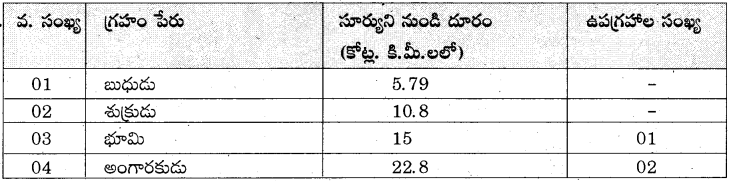
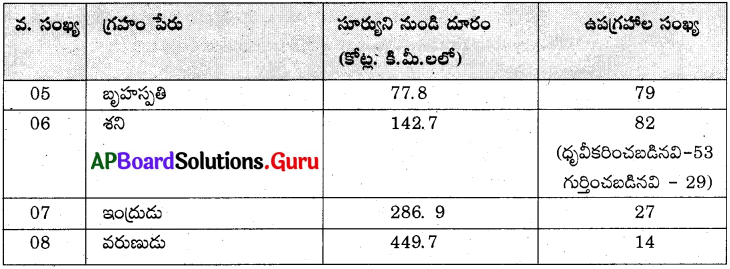
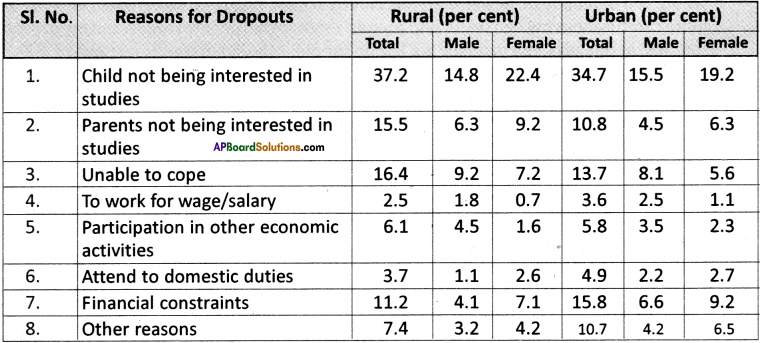
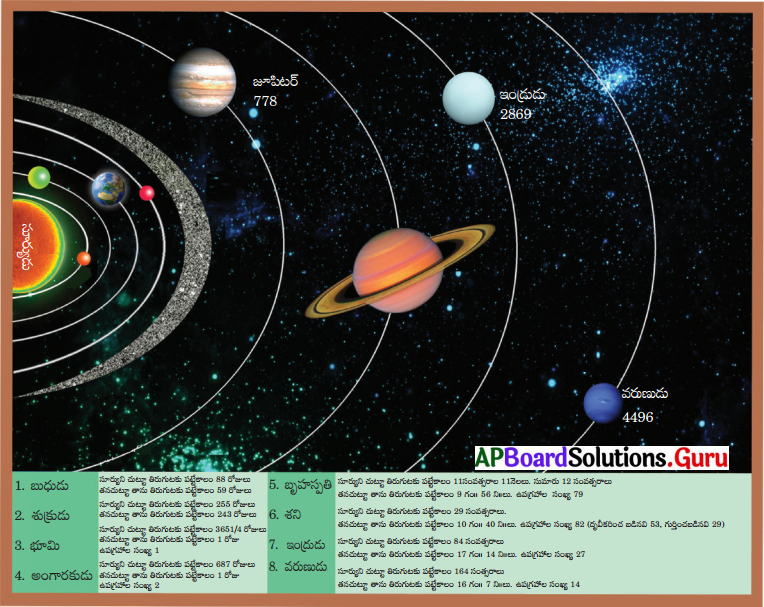
చిత్రం. 1.4 సౌర కుటుంబం పరిశీలించి కింది పట్టికను నింపుము.

AP Board 6th Class Social Solutions Chapter 1 సౌర కుటుంబంలో మన భూమి 1
జవాబు:
AP Board 6th Class Social Solutions Chapter 1 సౌర కుటుంబంలో మన భూమి 2 AP Board 6th Class Social Solutions Chapter 1 సౌర కుటుంబంలో మన భూమి 3

→ సరియైన సమాధానం గుర్తించుము.

1. సూర్యుడు విపరీతమైన వేడిని విడుదల చేసినప్పటికీ, పరిమిత వేడి మాత్రమే మన భూమికి ఎందుకు చేరుతుంది?
అ) సూర్యుడు భూమికి చాలా దూరంగా ఉన్నాడు.
ఆ) భూమితో పోలిస్తే సూర్యుడు చాలా చిన్నది
ఇ) సూర్యుడు భూమికి చాలా దగ్గరగా ఉన్నాడు
జవాబు:
అ) సూర్యుడు భూమికి చాలా దూరంగా ఉన్నాడు.

2. భూమికి కవల గ్రహం (ఎర్త్ – ట్విన్) అని పిలువబడే గ్రహం ……….
అ) బృహస్పతి
ఆ) శని
ఇ) శుక్రుడు
జవాబు:
ఇ) శుక్రుడు

3. సూర్యుడికి మూడవ సమీప గ్రహం ఏది?
అ) శుక్రుడు
ఆ) భూమి
ఇ) బుధుడు
జవాబు:
ఇ) బుధుడు

4. అన్ని గ్రహాలు సూర్యుని చుట్టూ ఇటువంటి కక్ష్యలో తిరుగుతాయి …………
అ) వృత్తాకార కక్ష్య
ఆ) దీర్ఘచతురస్రాకార మార్గం
ఇ) పొడిగింపబడిన వృత్తాకార కక్ష్య
జవాబు:
ఇ) పొడిగింపబడిన వృత్తాకార కక్ష్య

5. గ్రహశకలాలు ఈ రెండు గ్రహాల కక్ష్యల మధ్య కనిపిస్తాయి ……….
అ) శని మరియు బృహస్పతి
ఆ) అంగారకుడు మరియు బృహస్పతి
ఇ) భూమి మరియు అంగారకుడు
జవాబు:
ఆ) అంగారకుడు మరియు బృహస్పతి

కింది వానిని జతపరుచుము.

1. నీలి గ్రహం అ) అంగారకుడు
2. సూర్యుడికి దూరంగా ఉన్న గ్రహం ఆ) వరుణుడు
3. సూర్యుని నుంచి నాలుగవ గ్రహం ఇ) బుధుడు
4. సూర్యునికి దగ్గరగా ఉన్న గ్రహం ఈ) భూమి

జవాబు:

1. నీలి గ్రహం ఈ) భూమి
2. సూర్యుడికి దూరంగా ఉన్న గ్రహం ఆ) వరుణుడు
3. సూర్యుని నుంచి నాలుగవ గ్రహం అ) అంగారకుడు
4. సూర్యునికి దగ్గరగా ఉన్న గ్రహం ఇ) బుధుడు

ఇవి చేద్దాం

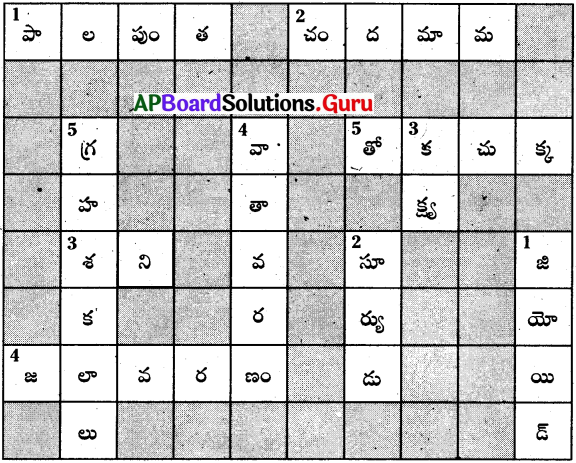
→ కింద ఇవ్వబడిన ఆధారాలతో పదబంధాన్ని నింపండి.

అడ్డం
1. కోట్లాది నక్షత్రాల సమూహం
2. భూమి యొక్క సహజ ఉపగ్రహం
3. వలయాలు కలిగి ఉన్న గ్రహం (చిత్రం 1.4 చూడండి)
4. నీటితో కూడిన ఆవరణం
5. తల మరియు తోక భాగాలు కలిగిన ఖగోళ వస్తువు

నిలువు
1. భూమి యొక్క ఆకారం
2. భూమికి దగ్గరగా ఉన్న నక్షత్రం
3. సూర్యుని చుట్టూ గ్రహాలు తిరిగే మార్గం
4. భూమి చుట్టూ ఆవరించి ఉన్న వాయువుల పొర
5. అంగారకుడు, బృహస్పతి మధ్య సూర్యుని చుట్టూ తిరుగుతున్న చిన్న ఖగోళ వస్తువులు
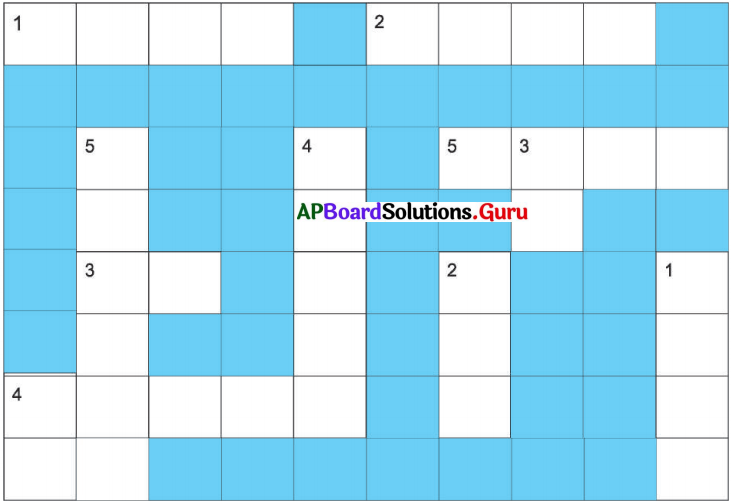
AP Board 6th Class Social Solutions Chapter 1 సౌర కుటుంబంలో మన భూమి 4
జవాబు:
AP Board 6th Class Social Solutions Chapter 1 సౌర కుటుంబంలో మన భూమి 5

6th Class Social Studies 1st Lesson సౌర కుటుంబంలో మన భూమి InText Questions and Answers

6th Class Social Textbook Page No.4

ప్రశ్న 1.
ప్రాచీన కాలం నుండి ప్రజలు సూర్యుని దేవునిగా భావించి పూజిస్తున్నారు. కారణాలు తెలపండి.
జవాబు:
ప్రాచీన కాలం నుండి ప్రజలు సూర్యుడిని దేవునిగా భావించి పూజించటానికి కారణాలు :

  • ప్రాచీనులు ప్రకృతి శక్తులను ఆరాధించేవారు. ప్రకృతి శక్తులలో ముఖ్యుడు సూర్యుడు.
  • సూర్యుడు ఈ భూమండలానికంతటికీ వెలుగు, వేడిని ప్రసాదిస్తున్నాడు.
  • భూమిపై జీవనానికి మూలాధారము సూర్యుడే, ప్రాణాధారము సూర్యుడే.
  • ఋతువులు ఏర్పడటంలో, పంటల అభివృద్ధిలో సూర్యునిది కీలకపాత్ర కాబట్టి.
  • సహజశక్తికి మూలం సూర్యుడు. భూమికి అవసరమైన శక్తి సూర్యుని నుండే లభిస్తుంది.
  • సూర్యుడు లేనిదే జీవం లేదు. జీవికి మనుగడ లేదు.

AP Board 6th Class Social Solutions Chapter 1 సౌర కుటుంబంలో మన భూమి

6th Class Social Textbook Page No.6

ప్రశ్న 2.
2006వ సంవత్సరం వరకు మన సౌర కుటుంబంలో 9 గ్రహాలు ఉండేవి. కానీ ప్రస్తుతం 8 గ్రహాలు మాత్రమే ఉన్నాయి. 9వ గ్రహం ఏమిటి? అది ఏమైంది? మీ టీచర్ సహాయంతో తెలుసుకోండి.
జవాబు:
2006 ఆగస్టు 25 నాటి వరకు మన సౌర కుటుంబంలో గ్రహాలు ‘9’ అని చెప్పుకునేవాళ్ళం . అప్పటి ‘9’వ గ్రహం ‘ప్లూటో’. అంతర్జాతీయ అంతరిక్ష సమాఖ్య 26వ జనరల్ అసెంబ్లీలు ఫ్లూటోను గ్రహం కాదు అని నిర్ణయించటం జరిగింది. ఎందుకనగా ఫ్లూటో “క్లియర్డ్ ద నైబర్ హుడ్” (తోటి గ్రహాల కక్ష్యలకు ఆటంకం కలిగించరాదు) అన్న నియమాన్ని ఉల్లంఘిస్తున్నది. ఇది కొన్ని సందర్భాలలో నెప్ట్యూన్ కక్ష్యలోకి ప్రవేశిస్తున్నది.

ప్రశ్న 3.
కింది చిత్రాన్ని పరిశీలించి గ్రహాలకు అనుగుణంగా ఇవ్వబడిన పెట్టెలలో వాటి పేర్లను రాయండి.
జవాబు:
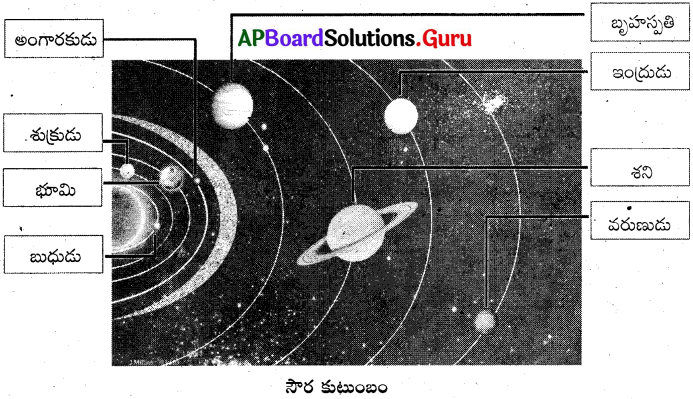
AP Board 6th Class Social Solutions Chapter 1 సౌర కుటుంబంలో మన భూమి 6

ప్రశ్న 4.
జంతువులు మరియు మొక్కలు పెరగడానికి, జీవించడానికి ఏమి అవసరం?
జవాబు:
జంతువులు మరియు మొక్కలు పెరగడానికి, జీవించడానికి అవసరమైనవి – గాలి (వాతావరణం), నీరు, వేడిమి,
కాంతి, మృత్తికలు (నేలలు) మరియు ఇతర వనరులు.

6th Class Social Textbook Page No.7

ప్రశ్న 5.
మన భూమి సౌరకుటుంబంలో ఒక ప్రత్యేకమైన గ్రహం అని మీరు ఎలా చెప్పగలరు?
జవాబు:
భూమి సౌరకుటుంబంలో ఒక ప్రత్యేకమైన గ్రహం, ఎలా చెప్పగలనంటే,

  • సౌర కుటుంబంలో జీవం కల్గిన ఏకైక గ్రహం భూమి.
  • సౌర కుటుంబంలో నీరు కల్గిన ఏకైక గ్రహం భూమి.
  • సౌర కుటుంబంలో వాతావరణం కల్గిన ఏకైక గ్రహం భూమి. (ఉష్ణోగ్రతలు అనుకూలంగా ఉంటాయి. మరీ వేడిగానీ, చల్లగాగానీ ఉండదు)
  • జీవులు జీవించడానికి అత్యంత అనుకూలమైన గ్రహం భూమి.

6th Class Social Textbook Page No.8

ప్రశ్న 6.
అంతరిక్షంలోకి వెళ్లిన మొదటి భారతీయ వ్యోమగామి ఎవరు?
జవాబు:
అంతరిక్షంలోకి వెళ్లిన మొదటి భారతీయ వ్యోమగామి రాకేష్ శర్మ, (ఏప్రిల్ 2, 1984)

AP Board 6th Class Social Solutions Chapter 1 సౌర కుటుంబంలో మన భూమి

ప్రశ్న 7.
మీరు చంద్రయాన్-1, చంద్రయాన్-2గురించి విన్నారా? వాటి గురించి తెలుసుకోవడానికి ప్రయత్నించండి, తరగతిలో చర్చించండి.
జవాబు:
మేము చంద్రయాన్ -1, చంద్రయాన్ – 2 గురించి విన్నాము.

  • 2008 అక్టోబర్ 22న మనదేశం చంద్రుని గురించి అనేక విషయాలు తెలుసుకునేందుకు చంద్రయాన్ -1 ను ప్రయోగించింది.
  • 2019, ఆగస్టు 14న చంద్రయాన్ – 2ను ప్రయోగించి, ఆగస్టు 20, 2019న చంద్రుని కక్ష్యలోకి విజయవంతంగా ప్రవేశపెట్టారు
  • 2019, సెప్టెంబర్ 2న ‘విక్రమ్’ ల్యాండరు వేరు చేయటం జరిగింది.

ముఖ్య ఉద్దేశ్యాలు :

  1. చంద్రునిపై నీటి జాడను వెదకడం.
  2. చంద్రునిపై పదార్థ మూలకాలను తెలుసుకోవడం.
  3. హీలియం – 3ను వెదకడం.
  4. చంద్రుని యొక్క త్రిమితియ అట్లాస్ ను తయారు చేయడం.
  5. సౌర వ్యవస్థ ఆవిర్భావానికి సంబంధించిన ఆధారాలను వెతకడం.

చంద్రయాన్ – 1ను ప్రయోగించడం ద్వారా చంద్రునికి ఉపగ్రహాలను పంపిన ఆరు దేశాలలో ఒకటిగా మన భారతదేశం అవతరించింది.

6th Class Social Textbook Page No.9

ప్రశ్న 8.
మానవ నిర్మిత ఉపగ్రహాలు మానవాళికి ఎలా ఉపయోగపడతాయి? చర్చించండి.
జవాబు:
మానవ నిర్మిత (కృత్రిమ) ఉపగ్రహాల ఉపయోగాలు :

  • వాతావరణ అధ్యయనానికి ఇవి ఉపయోగపడతాయి.
  • రేడియో, టెలివిజన్ ప్రసారాలకు ఇవి ఉపయోగపడతాయి.
  • టెలికమ్యూనికేషన్స్ కొరకు ఇవి ఉపయోగపడతాయి.
  • రిమోట్ సెన్సింగ్ (నిర్ణీత దూరంలో ఉండి సమాచారాన్ని సేకరించడం)కు ఉపయోగపడతాయి. వైమానిక, సైనిక కార్యకలాపాలకు వీటిని ఉపయోగిస్తారు.
  • విశ్వం, భూమి గురించి సమాచారం సేకరించడానికి లేదా సమాచార ప్రసారం కొరకు ఉపయోగపడతాయి.
  • గూఢచర్యం మరియు దేశ భద్రతావసరాలకు కూడా ఇవి ఉపయోగపడుతున్నాయి

AP Board 6th Class Social Solutions Chapter 1 సౌర కుటుంబంలో మన భూమి

6th Class Social Textbook Page No.11

ప్రశ్న 9.
ఇప్పుడు మీరు విశ్వంతో మీకు గల సంబంధాన్ని గ్రహించారా? మీరు భూమిపై ఉన్నారు.. ఈ భూమి సౌర కుటుంబంలో ఒక భాగం. మన సౌర కుటుంబం విశ్వంలో భాగమైన పాలపుంత/గెలాక్సీలో ఒక భాగం. విశ్వం లక్షలాది గెలాక్సీల సమూహం అన్న సత్యం మీరు గ్రహించారు కదా. మీరు చిత్రంలో ఎలా సరిపోతారు? మీరు ఎంత చిన్నవారు? కాసేపు ఆలోచించండి.
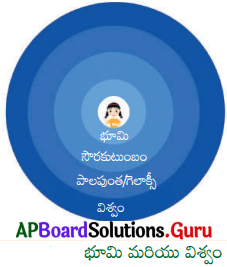
AP Board 6th Class Social Solutions Chapter 1 సౌర కుటుంబంలో మన భూమి 7
జవాబు:
మనం నివసిస్తున్న భూమి మన సౌరకుటుంబం విశ్వంలో భాగమైన పాలపుంత గెలాక్సీలో ఒక భాగం. విశ్వం లకలాది గెలాక్సీల సమూహం. గెలాక్సీ అంటే కోట్లాది నక్షత్రాల (సౌర కుటుంబాల) సమూహం అని గ్రహించాము. ఈ విశాల విశ్వంలో మన భూమే అతి సూక్ష్మధూళి రేణవంతగా అనిపిస్తుంది, అలాంటి భూమిపై మనం ఎంత సూక్ష్మాతి సూక్ష్మమో ఊహించగలను.

ప్రాజెక్టు పని

సౌర కుటుంబం నమూనా తయారు చేయండి. (లేదా) సౌర కుటుంబం బొమ్మను గీయండి.
జవాబు:
AP Board 6th Class Social Solutions Chapter 1 సౌర కుటుంబంలో మన భూమి 8

AP Board 9th Class Social Solutions Chapter 1 భూమి – మనం

SCERT AP 9th Class Social Studies Guide Pdf 1st Lesson భూమి – మనం Textbook Questions and Answers.

AP State Syllabus 9th Class Social Solutions 1st Lesson భూమి – మనం

9th Class Social Studies 1st Lesson భూమి – మనం Textbook Questions and Answers

Improve your learning (మీ అభ్యసనాన్ని మెరుగుపడుచుకోండి)

ప్రశ్న 1.
అట్లాస్ లో భారతదేశ పటాన్ని చూసి కింది ప్రదేశాల అక్షాంశ, రేఖాంశాలను గుర్తించండి. (AS5)
1. కన్యాకుమారి : ……………………., ………………………….
2. ఇంఫాల్ ……………………….., ……………………………
3. జైసల్మేర్ ……………………………, …………………………
4. పూనా ……………………………., …………………………
5. పాట్నా ……………………………, ………………………….
జవాబు:
1. 8°35′ ఉత్తర అక్షాంశం, 77°36′ తూర్పు రేఖాంశం.
2. 24°44′ ఉత్తర అక్షాంశం, 93°58′ తూర్పు రేఖాంశం.
3. 26° 55′ ఉత్తర అక్షాంశం, 70° 54′ తూర్పు రేఖాంశం.
4. 18°32′ ఉత్తర అక్షాంశం, 73°52′ తూర్పు రేఖాంశం.
5. 27°34′ ఉత్తర అక్షాంశం, 81°46′ తూర్పు రేఖాంశం.

ప్రశ్న 2.
అక్షాంశ, రేఖాంశాలతో సరిపోయే పదాలను గుర్తించండి. (AS1)
జవాబు:

అక్షాంశాలు రేఖాంశాలు
సమాంతర రేఖలు నిలువురేఖలు
వృత్తాలు అర్ధవృత్తాలు
ఉహాజనిత రేఖలు ఉహాజనిత రేఖలు
అడ్డంగా గీయబడినవి కాలాన్ని నిర్ణయిస్తాయి.

ప్రశ్న 3.
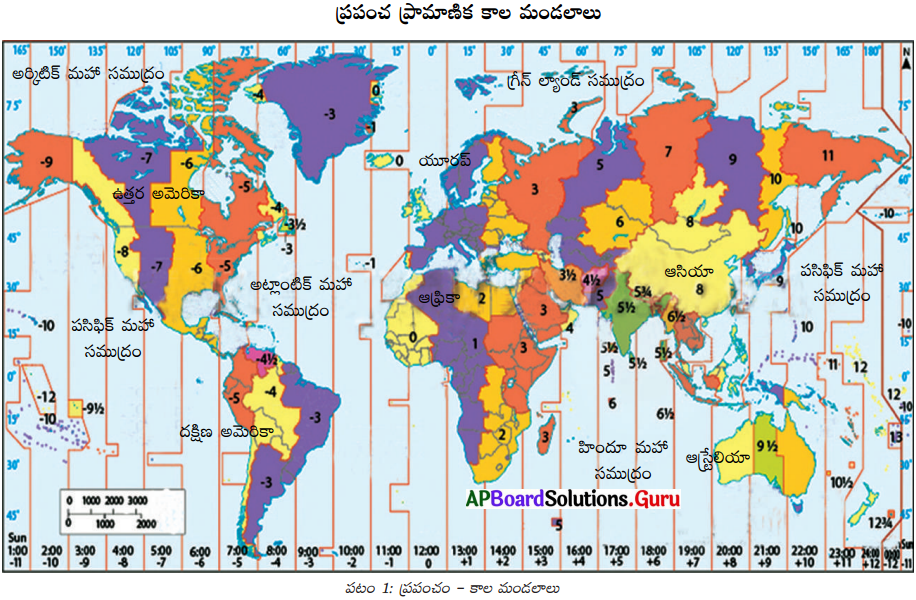
క్రింద ఉన్న ప్రపంచ కాల మండలాల పటం చూడండి. (AS5)
AP Board 9th Class Social Solutions Chapter 1 భూమి - మనం 1
(అ) మీరు విజయవాడ నుండి పారిస్ కి వెళుతుంటే ఏ కాల మండలానికి ప్రయాణిస్తున్నారు?
జవాబు:
పశ్చిమానికి ప్రయాణించడం జరుగుతుంది.

(ఆ) హైదరాబాదు నుంచి టోక్యోకి వెళుతుంటే ఏ కాల మండలానికి ప్రయాణిస్తున్నారు?
జవాబు:
తూర్పునకు ప్రయాణించడం జరుగుతుంది.

ప్రశ్న 4.
భూమి ఏర్పడటం, దాని నిర్మాణం గురించి అధ్యయనం చేయటం ఎందుకు కష్టమైనది? (AS1)
జవాబు:
భూమి ఏర్పడటం, దాని నిర్మాణం గురించి అధ్యయనం చేయటం కష్టం ఎందువల్లనంటే …

  1. భూమి పుట్టుక మీద భిన్నాభిప్రాయాలుండటం.
  2. ప్రారంభంలో భూమి చలనం లేకుండా స్థిరంగా ఉందని, మిగిలినవి అన్నీ దానిచుట్టూ తిరుగుతున్నాయని భావించారు.
  3. 500 సం||రాల క్రితం శాస్త్రజ్ఞులు ఒక కొత్త అవగాహనకు వచ్చారు.
  4. భూమి విశ్వానికి మధ్యలో లేదని, వాస్తవానికి అది సూర్యుని చుట్టూ తిరుగుతోందని, ఆ సూర్యుడు కూడా తిరుగుతూ ఉన్నాడని, ఆకాశంలో అసంఖ్యాకంగా ఉన్న నక్షత్రాలు వాస్తవానికి సూర్యుళ్లని తెలుసుకున్నారు.
  5. నక్షత్రాలు కూడా పుడతాయని, పెరుగుతాయని, చివరికి చనిపోతాయని తెలుసుకున్నారు.
  6. పెద్ద విస్ఫోటనంతో 1370 కోట్ల సంవత్సరాల క్రితం విశ్వం ఆవిర్భవించిందని, కొన్ని వందల కోట్ల సం||రాల తరువాత అంతరించిపోతుందని అభిప్రాయపడ్డారు.
  7. భూమి పుట్టుక అధ్యయనం చేయడానికి సరైన శాస్త్ర విజ్ఞానం కూడా అంతగా ఇంకా అభివృద్ధి చెందలేదు.
  8. శాస్త్రీయ పరికరాలు ఇంకా కనిపెట్టవలసిన అవసరం ఉంది.
  9. ఇంకా ఎన్నో అంశాలు ఋజువు కావలసి ఉంది.

AP Board 9th Class Social Solutions Chapter 1 భూమి - మనం

ప్రశ్న 5.
క్రింది పేరాను చదివి కింది ప్రశ్నకు సమాధానం రాయండి. (AS2)
కేంద్ర భాగంలో ఉండే పదార్థం అగ్నిపర్వతాల నుండి సముద్ర తలంలోని పగుళ్ల నుండి పైకి వచ్చి, చల్లబడి భూమి పై పొరగా మారుతుంది. భూమిలో అనేక ప్రాంతాలలో పై పొర తిరిగి మధ్యపొరలోకి ప్రవేశించి ద్రవంగా మారుతుంది. ఈ విధంగా భూపటలం నిత్యం ఏర్పడుతూ, నశిస్తూ ఉండటం భూమి ఇంకా సక్రియంగా ఉందన్న వాస్తవాన్ని వెల్లడి చేస్తుంది. భూమి లోపలి పొరల్లోని ప్రక్రియల వల్ల ఏర్పడే భూకంపాలు, అగ్నిపర్వతాలు, భూమి లోపలికి కుంగటం, కొండల పైకి లేవటం వంటి వాటి ద్వారా మనం నివసిస్తున్న పైపొర నిత్యం మారుతూనే ఉంది.
ప్ర. భూమి ఇప్పటికీ క్రియాశీలకంగా ఉందని మీరు ఎలా చెప్పగలరు.? అయితే కారణాలు ఏమిటి?
జవాబు:
భూమి ఇప్పటికీ క్రియాశీలకంగా ఉంది.

కారణాలు :

  1. కేంద్రభాగంలో ఉండే పదార్థం అగ్నిపర్వతాల నుండి సముద్ర తలంలోని పగుళ్ల నుండి పైకి వచ్చి, చల్లబడి భూమిపై పొరగా మారుతుంది.
  2. భూమిలో అనేక ప్రాంతాలలో పై పొర తిరిగి మధ్య పొరలోకి ప్రవేశించి ద్రవంగా మారుతుంది.
  3. ఈ విధంగా భూ పటలం నిత్యం ఏర్పడుతూ, నశిస్తూ ఉండటం భూమి ఇంకా సక్రియంగా ఉందన్న వాస్తవాన్ని వెల్లడి చేస్తుంది.
  4. భూమి లోపలి పొరల్లోని ప్రక్రియల వల్ల ఏర్పడే భూకంపాలు, అగ్నిపర్వతాలు, భూమి లోపలికి కుంగటం, కొండలు పైకి లేవటం వంటి వాటి ద్వారా మనం నివసిస్తున్న పై పొర నిత్యం మారుతునే ఉంది. అందువల్ల భూమి ఇంకా క్రియాశీలకంగా ఉంది.

ప్రశ్న 6.
గ్రిడ్ అనగా నేమి? అది మనకు ఎలా సహాయపడుతుంది? (AS1)
జవాబు:
గ్లోబు మీద అక్షాంశాలు, రేఖాంశాలు గీసి ఉంటాయి. ఈ నిలువు, అడ్డ గీతలతో గళ్లు ఏర్పడతాయి. దీనిని గ్రిడ్
అంటారు. గ్రిడ్ మనకు ఏ విధంగా సహాయపడుతుందనగా: – 1. ఈ గళ్ల సహాయంతో పటం మీద ఒక ప్రదేశాన్ని గుర్తించగలం. 2. దాని గురించి ఎన్నో విషయాలు తెలుసుకోగలం. ఉదా : అక్కడ ఎంత వేడిగా ఉన్నది, ఎంత చల్లగా ఉన్నది, అక్కడికి చేరుకోవటానికి ఏ దిశగా ప్రయాణం చేయాలి.
ఏ క్షణంలో అక్కడ సమయం ఎంత ఉంటుంది వంటి అంశాలను తెలుసుకోవచ్చు.

ప్రశ్న 7.
కింది వాని మధ్యగల తేడాలు వివరించండి. (AS1)
జవాబు:
ఆ) స్థానిక కాలం – ప్రామాణిక కాలం
ఆ) భూమధ్యరేఖ – ప్రామాణిక కాలం

అ) స్థానిక కాలం :

  1. భూభ్రమణం వల్ల భూమి మీద ఉన్న ఏ స్థలమైనా 24 గంటలలో ఒకసారి సూర్యునికి ఎదురుగా వస్తుంది.
  2. అంటే ప్రతి రేఖాంశం ఒక దినంలో ఒకసారి సూర్యునికి ఎదురుగా వస్తుంది.
  3. అప్పుడు ఆ రేఖాంశంపై ఉన్న ప్రాంతాలకు మధ్యాహ్నం సరిగ్గా 12 గంటలు అవుతుంది.
  4. ఈ సమయాన్ని ఆ ప్రాంతం యొక్క స్థానిక కాలం అంటారు.

ప్రామాణిక కాలం :

  1. ప్రతి దేశానికి ఒక ప్రామాణిక కాలాన్ని నిర్ణయించారు.
  2. దీని వల్ల కాలాన్ని గుర్తించడం సులభమౌతుంది.
  3. సాధారణంగా ప్రామాణిక కాలాన్ని నిర్ధారించడానికి ఆ దేశం మధ్యగా పోయే రేఖాంశాన్ని గుర్తిస్తారు.
  4. ఆ రేఖాంశం యొక్క స్థానిక కాలాన్ని ఆ దేశమంతటికి ప్రామాణిక కాలంగా వర్తింపజేస్తారు.

ఆ) భూమధ్యరేఖ :

  1. భూమికి మధ్యలో అడ్డంగా వెళ్లే వృత్తాన్ని భూమధ్యరేఖ. అంటారు.
  2. ఇది ఉత్తర, దక్షిణ ధృవాల నుంచి సమదూరాలలో ఉంటుంది.
  3. ఇది భూమిని రెండు సమభాగాలుగా చేస్తుంది. కాబట్టి దీనిని భూమధ్య రేఖ అంటారు.
  4. దీనిని 0° అక్షాంశంగా గుర్తిస్తారు.

ప్రామాణిక రేఖాంశం :

  1. ఇంగ్లాండ్ లోని గ్రీన్ విచ్ (Greenwich – ఉచ్చారణ గ్రీనిచ్) లోని నక్షత్రశాల గుండాపోయే రేఖాంశాన్ని 0° మెరిడియన్ లేదా ప్రామాణిక రేఖాంశం లేదా గ్రీనిచ్ మెరిడియన్ అంటారు.
  2. ఆ కాలంలో ప్రపంచంలో అధిక భాగాన్ని ఇంగ్లాండ్ పరిపాలిస్తుండేది. దాంతో వాళ్ళు అనుసరిస్తున్న విధానాన్ని మిగిలిన అందరూ అనుసరించటం మొదలుపెట్టారు.

AP Board 9th Class Social Solutions Chapter 1 భూమి - మనం

ప్రశ్న 8.
భారతదేశంలో ప్రతి రాష్ట్రం తమ స్థానిక సమయం పాటిస్తే ఎలాంటి సమస్యలు వస్తాయి? (AS1)
జవాబు:
భారతదేశంలో ప్రతి రాష్ట్రం తమ స్థానిక సమయాన్ని పాటిస్తే –

  1. సమయం విషయంలో గందరగోళం నెలకొంటుంది.
  2. సమయాన్ని నిర్ణయించటం మరింత క్లిష్టమవుతుంది.
  3. ఒక గంట వ్యవధితో దేశాన్ని పలు కాల మండలాలుగా విభజిస్తారు.

ప్రశ్న 9.
మీ ఉపాధ్యాయుల సహాయంతో నేపాల్, పాకిస్థాన్, బంగ్లాదేశ్, ఇంగ్లాండ్, మలేషియా, జపాన్ దేశాల ప్రామాణిక రేఖాంశాన్ని గుర్తించండి. (AS5)
జవాబు:
నేపాల్ ప్రామాణిక రేఖాంశం – 82° 30′ తూర్పు రేఖాంశం (+ 5.45 యుటిసి)
పాకిస్థాన్ ప్రామాణిక రేఖాంశం – 74°22 తూర్పు రేఖాంశం (యుటిసి + 6 గం)
బంగ్లాదేశ్ ప్రామాణిక రేఖాంశం – 90° 24 తూర్పురేఖాంశం (యుటిసి + 4 గం)
ఇంగ్లాండ్ ప్రామాణిక రేఖాంశం – 0°07 పశ్చిమరేఖాంశం (యుటిసి + 1 గం).
మలేషియా ప్రామాణిక రేఖాంశం – 105° తూర్పురేఖాంశం (యుటిసి + 8 గం)
జపాన్ ప్రామాణిక రేఖాంశం – 135° తూర్పురేఖాంశం (యుటిసి + 9 గం)

ప్రశ్న 10.
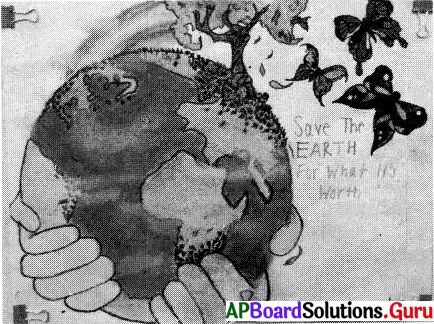
భూ పరిరక్షణ కోసం ఆలోచింపజేసే ఒక పోస్టరు తయారుచేయండి.
జవాబు:
AP Board 9th Class Social Solutions Chapter 1 భూమి - మనం 2
భూ పరిరక్షణ కోసం ఆలోచింపజేసే పోస్టర్

9th Class Social Studies 1st Lesson భూమి – మనం InText Questions and Answers

9th Class Social Textbook Page No.2

ప్రశ్న 1.
సుదూరంగా ఉన్న నక్షత్రాలు, పాలపుంతల రహస్యాల గురించీ, విశ్వం ఆవిర్భావం గురించి తెలుసుకోవాలన్న ఆసక్తి ఈనాటి మానవులకు ఎందుకు ఉంది?
జవాబు:

  1. వేల సంవత్సరాలుగా మనుషులు ఆకాశంలోకి చూస్తూ అక్కడ మెరిసే వాటి గురించి తెలుసుకోటానికి ప్రయత్నిస్తున్నారు.
  2. ఆకాశంలో సంచరిస్తూ ఉండే సూర్యుడు, చంద్రుడు, గ్రహాలు ఇతర నక్షత్రాలలో పోలిస్తే ఎప్పుడూ ఒకే దూరంలో ఉండే నక్షత్రాలు. ఇవి ఏమిటి? వీటికీ మనకూ సంబంధం ఏమిటి? ఇవి మనల్ని ఎలా ప్రభావితం చేస్తాయి? వంటి వాటిని గురించి తెలుసుకోవడానికి ప్రయత్నించారు.
  3. ఆకాశంలో గల వీటి కదలికలను, ఘటనలను నమోదు చేస్తూ అవి ఏమిటో, అవి ఎలా కదులుతున్నాయో అర్థం చేసుకోటానికి ప్రయత్నించారు. అందువల్ల విశ్వం ఆవిర్భావం గురించి తెలుసుకోవాలన్న ఆసక్తి ఈనాటి మానవులకు ఉంది.

AP Board 9th Class Social Solutions Chapter 1 భూమి - మనం

ప్రశ్న 2.
విశ్వం మధ్యలో భూమి ఉందనీ, సృష్టిలో ముఖ్యమైనది మానవులనీ మొదట భావించేవాళ్లు. ఈ అనంత విశ్వంలో మనం అతి చిన్న నలుసు మాత్రమేనని తెలుసుకోవటం వల్ల అది మనపై ఎటువంటి ప్రభావం చూపుతుంది?
జవాబు:

  1. మొదట్లో భూమి చలనం లేకుండా స్థిరంగా ఉందనీ, మిగిలినవన్నీ దాని చుట్టూ తిరుగుతున్నాయని భావించారు.
  2. వేల సంవత్సరాలుగా ఇలాగే ఉంది కాబట్టి ఎటువంటి మార్పులూ లేకుండా భూమి, నక్షత్రాలు, సూర్యుడు శాశ్వతంగా ఇలాగే ఉంటాయని భావించారు.
  3. కానీ తరువాత భూమి విశ్వానికి మధ్యలో లేదని, వాస్తవానికి అది సూర్యుని చుట్టూ తిరుగుతోందని, ఆ సూర్యుడు కూడా తిరుగుతూ ఉన్నాడని, ఆకాశంలో అసంఖ్యాకంగా ఉన్న నక్షత్రాలు వాస్తవానికి సూర్యుళ్లని తెలుసుకున్నారు.
  4. నక్షత్రాలు కూడా పుడతాయని, పెరుగుతాయని, చివరికి చనిపోతాయని కూడా గత వంద సంవత్సరాల కాలంలో అర్థం చేసుకున్నారు. ఇది మనపై చూపే ప్రభావం ఏదీ శాశ్వతం కాదని, అనంత విశ్వంలో మనం చాలా చిన్న నలుసులం మాత్రమేనని అర్థమవుతుంది. కావున మనకు తెలిసినది తక్కువ అని, తెలియాల్సిందే ఎక్కువ అని కూడా అర్థమౌతుంది.

9th Class Social Textbook Page No.3

ప్రశ్న 3.
భూమి మీద కాలాలు ఏర్పడటానికి గల కారణాలను కింది వానిలో గుర్తించండి.
1. అక్షంపై రోజుకు ఒకసారి భూమి తన చుట్టూ తాను తిరగడం
2. భూమి చుట్టూ చంద్రుడు నెలకు ఒకసారి తిరగటం
3. అక్షంపై సూర్యుడు తన చుట్టూ తాను తిరగటం
4. సూర్యుని చుట్టూ భూమి పరిభ్రమణం
5. కక్ష్య తలంతో పోలిస్తే భూమి అక్షం వంగి ఉండటం
6. భూమి గోళాకారంలో ఉండటం
7. సంవత్సర పరిభ్రమణ కాలంలో సూర్యుడి నుండి భూమి ఉండే దూరం
జవాబు:
1. అక్షంపై రోజుకు ఒకసారి భూమి తన చుట్టూ తాను తిరగడం
2. సూర్యుని చుట్టూ భూమి పరిభ్రమణం
3. కక్ష్య తలంతో పోలిస్తే భూమి అక్షం వంగి ఉండటం
4. భూమి గోళాకారంలో ఉండటం

9th Class Social Textbook Page No.4

ప్రశ్న 4.
భూమి అకస్మాత్తుగా ఏర్పడిందని అనుకుంటున్నారా లేక అది ఒక సుదీర్ఘ, సంక్లిష్ట ప్రక్రియల ఫలితంగా ఏర్పడిందని అనుకుంటున్నారా?
జవాబు:
భూమి ఒక సుదీర్ఘ సంక్లిష్ట ప్రక్రియల ఫలితంగానే ఏర్పడింది.

  1. ఎక్కువమంది శాస్త్రవేత్తల అభిప్రాయం ప్రకారం సుమారుగా 450 కోట్ల సంవత్సరాల క్రితం భూమి ఏర్పడటం మొదలయ్యింది.
  2. భూమి అనేక దశలలో మార్పు చెంది, ప్రస్తుత రూపాన్ని సంతరించుకుంది.
  3. పరిభ్రమిస్తున్న ధూళి, మేఘాల గోళంగా మొదలై, ద్రవ దశ గుండా పరిణమించింది.
  4. ఆ దశలో భూమి చాలా వేడిగా ఉండేది.
  5. విశ్వం నుంచి పెద్ద పెద్ద రాళ్ళు, ఇతర పదార్థాలు దానిని ఢీకొంటూ ఉండేవి.
  6. ఆ విధంగా భూమి పరిమాణం పెరిగింది.
  7. భూమి అత్యంత వేడిమి గల ద్రవంగా ఉండేది.
  8. బరువైన పదార్థాలు ద్రవరూప కేంద్రభాగంగా మారితే, తేలిక పదార్థాలు పైకి లేచి చల్లబడ్డాయి. కాల క్రమంలో ద్రవరూప కేంద్రాన్ని కప్పుతూ తేలికైన, చల్లబడిన పదార్థాలతో పై పొర ఏర్పడింది.

AP Board 9th Class Social Solutions Chapter 1 భూమి - మనం

ప్రశ్న 5.
అనేక యాదృచ్చిక ఘటనల ఫలితంగా భూమి మీద మానవులు రూపొందారని కొంతమంది నమ్ముతారు. లేకుంటే భూమి మీద ప్రాణం ఏర్పడి ఉండేదే కాదు. వాళ్ళతో మీరు ఏకీభవిస్తారా? మీ కారణాలను పేర్కొనండి.
జవాబు:
మా కారణాలు కూడా శాస్త్రవేత్తలు తెల్పినవే.

  1. భూమి చరిత్రలో సగం కాలం ఎటువంటి ప్రాణీ లేకుండా నిర్జీవంగా గడిచింది.
  2. ఆ తరువాత సముద్రాలలో జీవం మొదలైంది.
  3. లక్షల సంవత్సరాల పరిణామక్రమంలో మనుషులతో సహా అనేక రకాల మొక్కలు, జంతువులు రూపొందాయి.

9th Class Social Textbook Page No.5

ప్రశ్న 6.
భూప్రావారంను అధ్యయనం చేయటానికి మనం దాని వరకు ప్రయాణించలేం. అయితే భూప్రావారంలోని పదార్థాల ద్వారా దాన్ని అధ్యయనం చేయవచ్చు. ఈ పదార్థాలు ఏమిటో, వాటిని ఎలా పొందవచ్చో చెప్పండి.
జవాబు:
భూప్రావారం:

  1. ఈ పొర భూమి లోపల 100 కిలోమీటర్ల నుంచి మొదలుకొని 2900 కిలోమీటర్ల వరకు ఉంటుంది.
  2. భూ ప్రావారంలో పై పొర తేలుతూ ఉంటుంది.
  3. ఇందులో ప్రధానంగా సిలికేట్లు అనే రసాయనాలు ఉంటాయి.
  4. అగ్నిపర్వతాలు విస్ఫోటనం చెందటం వలన మరియు యంత్రాలను భూ అంతర్భాగంలోనికి పంపడం ద్వారా వీటిని పొందవచ్చు.

9th Class Social Textbook Page No.7

ప్రశ్న 7.
ప్రపంచ పటాన్ని జాగ్రత్తగా గమనించండి. ‘జిగ్ సా పజిల్’ లోని రెండు ముక్కలుగా ఏవైనా రెండు ఖండాలు కనిపిస్తున్నాయా? ఆ ఖండాలు ఏవి?
జవాబు:
జిగ్ సా పజిల్ లోని రెండు ముక్కలుగా కనిపించే రెండు ఖండాలు:

  1. లారెన్షియా
  2. గోండ్వానా భూమి.

ప్రశ్న 8.
ఆస్ట్రేలియా ఏ దిశవైపునకు కదిలింది?
జవాబు:
దక్షిణం వైపునకు కదిలింది.

AP Board 9th Class Social Solutions Chapter 1 భూమి - మనం

ప్రశ్న 9.
భారతదేశం ఏ దిశవైపునకు కదిలింది?
జవాబు:
తూర్పు వైపునకు కదిలింది.

9th Class Social Textbook Page No.8

ప్రశ్న 10.
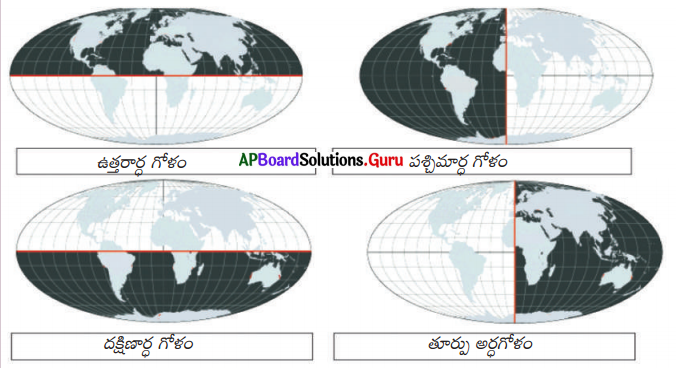
కింద ఇచ్చిన పటం ఆధారంగా దిగువ పట్టిక నింపండి.
AP Board 9th Class Social Solutions Chapter 1 భూమి - మనం 3

అర్ధ గోళం ఖండాలు
ఉత్తరార్ధగోళం
పశ్చిమార్ధగోళం
దక్షిణార్ధగోళం
తూర్పు అర్ధగోళం

జవాబు:

అర్ధ గోళం ఖండాలు
ఉత్తరార్ధగోళం ఉత్తర అమెరికా, ఆసియా, ఐరోపా, ఆఫ్రికాలో సగభాగం.
పశ్చిమార్ధగోళం ఉత్తర అమెరికా, దక్షిణ అమెరికా.
దక్షిణార్ధగోళం దక్షిణ అమెరికా, ఆస్ట్రేలియా, ఆఫ్రికాలో సగభాగం, అంటార్కిటికా.
తూర్పు అర్ధగోళం ఆఫ్రికా, ఐరోపా, ఆసియా, ఆస్ట్రేలియా, అంటార్కిటికా.

9th Class Social Textbook Page No.12

ప్రశ్న 11.
అట్లాస్ చూసి ఈ దేశాలలో ఎన్ని ప్రామాణిక కాల మండలాలు (Time Zones) ఉన్నాయో తెలుసుకోండి.
అమెరికా, ఆస్ట్రేలియా, రష్యా, జపాన్, జింబాబ్వే, చిలీ.
జవాబు:

  1. అమెరికా : ఐదు ప్రామాణిక కాలమండలాలు ఉన్నవి. అవి -9, -3, -2, -6, -5 మండలాలు.
  2. ఆస్ట్రేలియా : మూడు ప్రామాణిక కాల మండలాలు ఉన్నవి. అవి +8, +9, +10 మండలాలు.
  3. రష్యా : పది ప్రామాణిక కాలమండలాలు ఉన్నవి. అవి +3, +4, +5, +6, +7, +8, +9, +10, +11, +12 మండలాలు.
  4. జపాన్ : ఒకే ఒక్క ప్రామాణిక కాలమండలం ఉంది. అది +9 మండలం.
  5. జింబాబ్వే : ఒకే ఒక్క ప్రామాణిక కాలమండలం ఉంది. అది +2 మండలం.
  6. చిలీ : ఒకే ఒక్క ప్రామాణిక కాలమండలం ఉంది. అది -5 మండలం.

ప్రశ్న 12.
హైదరాబాదులోని ఒక కాల్ సెంటరులో స్వాతి పనిచేస్తోంది. ఆమె క్లయింటులు అమెరికాలో ఉన్నారు. కంప్యూటర్ సమస్యలకు సంబంధించి క్లయింటుల ప్రశ్నలకు ఆమె సమాధానాలు ఇస్తుంది. ఆమె ఎప్పుడూ రాత్రివేళల్లోనే పనిచేస్తుంది. ఎందుకని ? భూగోళశాస్త్రాన్ని ఉపయోగించి తెలుసుకోండి.
జవాబు:
  1. భారతదేశము తూర్పు అర్ధగోళంలోనూ, అమెరికా పశ్చిమార్ధగోళంలోనూ ఉంది.
  2. రెండు దేశాల మధ్య దాదాపు 12 గంటల కాల వ్యత్యాసం ఉంది.
  3. అమెరికా వాళ్ల మధ్యాహ్న 12 గంటల సమయం, మనకు అర్ధరాత్రి 12 గంటల సమయమవుతుంది.
  4. అందువలన స్వాతి ఎప్పుడూ వాళ్లకు పగటివేళలయిన, మన రాత్రివేళల్లోనే, పనిచేయవలసి వస్తుంది.

AP Board 9th Class Social Solutions Chapter 1 భూమి - మనం

ప్రశ్న 13.
మెదడుకు మేత :
గ్రీన్ విచ్ (0) వద్ద మధ్యాహ్నం 12 : 00 అయితే ఈ దిగువ ప్రదేశాల్లో స్థానిక సమయం ఎంతో తెలుసుకోండి :
(అ) ముంబయి (73° తూ.రే) ; (ఆ) షికాగో (87° 30 ప.రే) ; (ఇ) సిడ్నీ ‘(151° తూ.రే.).
జవాబు:
ఒక్కొక్క రేఖాంశానికి సమయ వ్యత్యాసం 4 ని||లు.
(అ) ముంబయి (73° తూ.రే) :

  1. 73 × 4 = 292 నిమిషాలు = 4 గం||ల 52 ని॥లు
  2. తూర్పు రేఖాంశము గ్రీన్ విచ్ కు పైన ఉంటుంది. కనుక 4 గం|| 52 ని||లు కలుపవలసి ఉంటుంది.
  3. 12-00 + 4-52 = 16-52 అనగా స్థానిక సమయం సాయంత్రం 4 గం|| 52 ని||లు.

(ఆ) షికాగో (87° 30 ప.రే) :

  1. 87.30 × 4 = 87½ × 4 = 350 నిమిషాలు = 5 గం|| 50 ని||
  2. పశ్చిమ రేఖాంశము గ్రీన్ కు క్రింద ఉంటుంది. కనుక 5 గం|| 50 ని||లు తీసివేయవలసి ఉంటుంది.
  3. 12.00 – 5.50 = 6 గం|| 10 ని||
    అందువలన స్థానిక సమయం ఉదయం 6గం|| 10ని||

(ఇ) సిడ్నీ (151° తూ.రే.) :

  1. 151 × 4 = 604 ని||లు = 10 గం|| 4 ని||
  2. తూర్పు రేఖాంశము గ్రీన్ విచ్ కు పైన ఉంటుంది.
  3. 12.00 + 10 – 04 = 22-04
    అనగా స్థానిక సమయం రాత్రి 10 గం|| 4 ని||

AP Board 9th Class Social Studies Important Questions Chapter 13 Democratic and Nationalist Revolutions 17th and 18th Centuries

AP State Syllabus AP Board 9th Class Social Studies Important Questions Chapter 13 Democratic and Nationalist Revolutions 17th and 18th Centuries.

AP State Syllabus 9th Class Social Studies Important Questions 13th Lesson Democratic and Nationalist Revolutions 17th and 18th Centuries

9th Class Social 13th Lesson Democratic and Nationalist Revolutions 17th and 18th Centuries 1 Mark Important Questions and Answers

Question 1.
What was Slogan raised in American Independence? (SA-II : 2016-17)
Answer:
“No taxation without representation.”

Question 2.
What was the uniqueness of ‘Bloodless Revolution’? (SA-III : 2016-17)
(OR)
Why was the England revolution called as a bloodless revolution? (SA-I : 2018-19)
Answer:
The supreme power was transferred from king to parliament without shedding a drop of blood or firing a single shot.

AP Board 9th Class Social Studies Important Questions Chapter 13 Democratic and Nationalist Revolutions 17th and 18th Centuries

Question 3.
What is the Jacobin Clubs? (SA-II : 2017-18)
Answer:
People who wish to discuss policies and plan their own form of action. These are called Political Clubs. One of such is Jacobin Club.

Question 4.
What was the effect of Glorious revolution? (SA-II : 2018-19)
Answer:
Not only was an absolutist catholic monarch removed, but the declaration of rights ensured the sovereignty of parliament and imposed significant limitations on the prerogatives of the crown.

Question 5.
Answer questions (a) and (b) based on the table given below. (SA-I : 2018-19)

Livres – Unit of currency in France, discontinued in 1974.
Clergy – Group of persons invested with special functions in the church.
Tithes – A tax levied by the church, comprising one-tenth of the agricultural produce.
Taille – Tax to be paid directly to the state.
Nobles – Rich landlords, king’s family members.

a) What percentage of tax was levied by the church?
b) Find the terms related to tax from the above table.
Answer:
a) A tax leived by the church, comprising 1/10th of agricultural produce.
b) Terms related to tax are
1) Tithes
2) Taille

AP Board 9th Class Social Studies Important Questions Chapter 13 Democratic and Nationalist Revolutions 17th and 18th Centuries

Question 6.
State the importance of Declaration of the ‘Rights of Man1 in France. (SA-I : 2019-20)
Answer:
The importance of Declaration of the Rights of Man is to provide,

Rights to the people; such as freedom of religion, freedom of speech, freedom of assembly and separation of powers. Women were denied from these rights.

9th Class Social 13th Lesson Democratic and Nationalist Revolutions 17th and 18th Centuries 2 Marks Important Questions and Answers

Question 1.
What do you know about ‘bloodless revolution (or) glorious revolution? (SA-II : 2017-18)
Answer:
In 1688, William of Orange and his wife Mary were invited by the Parliament to occupy the throne of England. A new arrangement was worked out by which ministers were responsible to the Parliament and the powers of the king were restricted. The supreme power was transferred to Parliament, without shedding a drop of blood of firing a single shot.

Question 2.
Look the timeline given below. (SA-I : 2019-20)
AP Board 9th Class Social Studies Important Questions Chapter 13 Democratic and Nationalist Revolutions 17th and 18th Centuries 1
i) Which revolution does the timeline indicate?
Answer:
American Revolution indicates in the above time line.

ii) In this revolution, against which country the people fought for their independence?
Answer:
England.

9th Class Social 13th Lesson Democratic and Nationalist Revolutions 17th and 18th Centuries 4 Marks Important Questions and Answers

Question 1.
When the French Revolutionaries were preparing the declaration of Rights of Men in 1791, many French women protested against this and drafted a separate declaration of the Rights of Women. It declared – “Women are born free and remain equal to men in rights.
Read the above paragraph and explain your opinion on “Women – Right to Vote”. (SA-II : 2016-17)
Answer:
If the women has Right to vote the following benefits are there :

  1. The moral, educational and humane legislation desired by women would be got more easily if women had votes.
  2. The laws unjust to women would be amended more quickly.
  3. Equal suffrage would increase the proportion of educated voters.
  4. It leads to fair treatment of women in the public service.
  5. It would help those women who need help the most.

AP Board 9th Class Social Studies Important Questions Chapter 13 Democratic and Nationalist Revolutions 17th and 18th Centuries

Question 2.
Examine the table and answer the following questions. (SA-II : 2016-17)

A Jacobin Constitution Club for radical democracy thinkers all people were given the right to vote and the right of insurection. The constitution stated that the government must pronde the people with work (or) livelihood.
B Aristocracy Socially and Politically, a landed Aristocracy was the dominant class on the continent. The members of this class were united by a common way of life that across regional divisions.
C Liberal Nationalism Ideas of National unity in early Nineteenth century Europe were closely allied to the ideology of liberalism. Liberalism stood for freedom for the individual and equality of all before the law.

Answer the following Questions.
1. Jocabin constitution belongs to which country?
2. Which ideology was closely allied to the idea of National Unit?
3. Which stood for freedom for the individual and equality to all before the law?
4. Members of which class wee united by a common way of life?
Answer:

  1. Jacobin constitution belongs to the country of France.
  2. Ideas of national unity in early 19th century Europe were closely allied to the ideology of liberalism.
  3. Liberalism stoods for freedom for the individual and equality of all before the law.
  4. The members of Aristocracy class were united by a common way of life that across regional divisions.

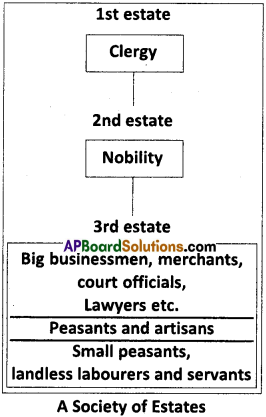
Question 3.
Observe the given table and answer the following questions.
AP Board 9th Class Social Studies Important Questions Chapter 13 Democratic and Nationalist Revolutions 17th and 18th Centuries 2
a) How many estates were there? What were their names?
(OR)
How many estates were there in French Society? (SA-II : 2016-17) (SA-II : 2017-18)
Answer:
There were three estates. First estate, second estate, and the third estate.

b) Who belonged to 3rd estate? (SA-II : 2016-17)
Answer:
Business men, merchants, officials, artists, peasants and artisans, small peasants, landless labour, servants, etc. constitute the third estate.

c) What were the problems faced by third estate? (SA-II : 2016-17)
Problems of third estate.
1) There is no equality.
2) Scarcity of food.
3) More taxes were imposed by church and govt.
4) 90% of people are landless people.

d) Which were privileged group? (SA-II : 2016-17)
Answer:
The Clergy and the Nobility were privileged group in the French society.

e) Which is the Superior group in French Society? (SA-II : 2017-18)
Answer:
Clergy is the superior group in the French society.

f) Who were the richest group in third Estate? (SA-II : 2017-18)
(OR)
Name the richer groups in third estate. (SA-II : 2018-19)
Answer:
Big business men, merchants, court officials, Lawyers, etc. were the richest groups in third estate.

g) Which Estate people did only pay the taxes in French Society? (SA-II : 2017-18)
(OR)
Which group paid taxes to the church? (SA-I : 2018-19)
Answer:
Third estate people only pay the taxes to the government.

h) Who were in first estate? (SA-I : 2018-19)
In first estate clergy are there.

i) Which country’s information is shown in the above chart? (SA-I : 2018-19)
Given information is related to France.

j) What does the above picture represent?
Answer:
The above picture represents the division of the society in France.

k) Who were the majority people?
Answer:
The third estate were the majority people.

Question 4.
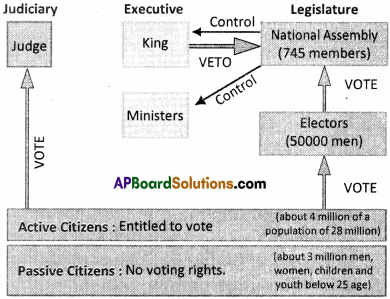
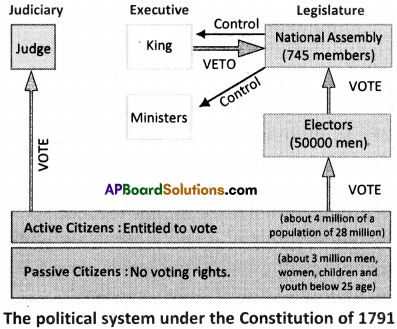
The picture below shows the political system under the constitution of 1791 in France. Observe it carefully and answer the questions given.
AP Board 9th Class Social Studies Important Questions Chapter 13 Democratic and Nationalist Revolutions 17th and 18th Centuries 3
a) Who had the power to elect the judiciary in the above system? (SA-II : 2018-19)
Answer:
Active citizens, who have the vote.

b) Who had the power over the King and the Ministers in the above system? (SA-II : 2018-19)
Answer:
National Assembly has more powers on king and ministers.

c) Who had the power to veto the laws made by the National Assembly? (SA-II : 2018-19)
Answer:
King has the power to veto the laws made by the National Assembly.

d) Which branch of government was responsible for the implementation of laws? (SA-II : 2018-19)
Answer:
Executive was responsible to the implementation of laws.

e) Who has veto power? (SA-II : 2016-17)
Answer:
King has veto power.

f) Who is having vote to elect the judge? (SA-II : 2016-17)
Answer:
Active citizens who have the Right to vote.

Question 5.
French revolution is regarded as one of the most important events in history not just in France but also across Europe and the world. Explain with reference to the ideas propagated by the French Revolution. (SA-I : 2019-20)
Answer:
Ideas of French Revolution :
Liberty, Equality and Fraternity are the ideas of French Revolution.
1. The ideas of the French Revolution were drawn from the Enlightenment, influenced by the British political system, inspired by the American Revolution and shapped by local grievances.

2. The French Revolution supported the motto of Liberty, Equality, Fraternity because it eliminated the old social classes, overthrew the monarchy and brought the church under state control. People of all social classes were citizens and they all had equal rights.

Liberty :
Liberty meant freedom from all soils of torture and abuse.

Equality :
Provide Equality to the people in all spheres without discrimination.

Fraternity :
It creates brotherhood nature among the people.

AP Board 9th Class Social Studies Important Questions Chapter 13 Democratic and Nationalist Revolutions 17th and 18th Centuries

Question 6.
“With the emergence of nation states in Europe, the dominance of aristocracy declined and that of the middle class increased.” Do you agree with the statement? Give reasons. (SA-I : 2019-20)
Answer:
Yes, I agree with the statement that the emergence of nation – states in Europe the dominance of Aristocracy declined, and middle class increased.

Reasons:

  • The middle class people were educated, so they became lawyers, other administrative officials.
  • The read the books which are written by John Lock, Rousseau and believed that no group in society should be privileged by birth.
  • They understood a person’s social position must depend on his merit.
  • Rousseau carried the idea forward, proposing a form of government based on a social contract between people and their representatives.

The above ideas provoke the middle class fight for equality and end of special privileges.

9th Class Social 13th Lesson Democratic and Nationalist Revolutions 17th and 18th Centuries Important Questions and Answers

Question 1.
Compare the results of the English and American Revolutions. Which one managed to build entirely new principles of government?
Answer:

  • Glorious revolution of England made an agreement of powersharing with the king.
  • American revolution set up democratic government.
  • The British people sought more rights from king.
  • Americans prepared own constitution and established democracy by abolishing the English supremacy.
  • American revolution managed to build entirely new principles of government.

AP Board 9th Class Social Studies Important Questions Chapter 13 Democratic and Nationalist Revolutions 17th and 18th Centuries

Question 2.
Can you think of why America was able to establish a democratic republic while England could not?
Answer:

  • American people were against the taxation without representation.
  • They do not want to be ruled by the British as colonies.
  • They wanted to assert their independence and to be a democratic republic.
  • Whereas the English, especially the influential middle class did not long for a demo-cratic republic.
  • They were readily accepted a powersharing agreement between them and the king.
  • Thus they could not set up a republic then.

Question 3.
In what ways did the American Constitution ensure maximum freedom for its people?
Answer:

  • The Constitution of America guarantees maximum freedom to its people.
  • It divided political power between centre and states such that it gave maximum autonomy for the states.
  • A bill of rights was passed which guaranteed freedom of speech and religion.
  • It guaranteed fundamental rights to all citizens.
  • Thus we can say American Constitution ensures maximum freedom for its people.

Question 4.
Write about the Declaration of Independence in the American war of Independence.
Answer:

  • The Declaration of Independence was adopted on 4th July 1776, during the Third Congress at Philadelphia.
  • Thomas Jefferson was the author of the Declaration.
  • It declared that all men are created equal and are endowed with certain rights like liberty, equality and pursuit of happiness.

Question 5.
Write about Bill of Rights of the American war of Independence.
Answer:

  • A Bill of Rights was adopted guaranteeing the freedom of speech, religion and rule of law were enacted.
  • This paved way for the establishment of the United States of America.

AP Board 9th Class Social Studies Important Questions Chapter 13 Democratic and Nationalist Revolutions 17th and 18th Centuries

Question 6.
What do you know about the Reign of Terror?
(OR)
“The period from 1973 to 1974 in France is referred as the region of terror”. Give reason. (SA-I : 2018-19)
Answer:

  • The period from 1793 to 1794, in France, is referred as the Reign of Terror.
  • Robespierre followed a policy of severe control and punishment.
  • A lot of restrictions on food items were imposed.
  • Robespierre pursued his policies so relentlessly that even his supporters began to demand moderation.
  • Finally, he was convicted by a court in July 1794, arrested and on the next day sent to the guillotine.

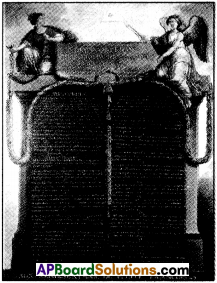
Question 7.
Read the following passage and answer the following question.
AP Board 9th Class Social Studies Important Questions Chapter 13 Democratic and Nationalist Revolutions 17th and 18th Centuries 4
Answer:
The Declaration of Rights of Man and Citizen :

  • Men are born and remain free and equal in rights.
  • The aim of every political association is the preservation of the natural and inalien¬able rights of man. These are liberty, property, security and resistance to oppression.
  • The source of all sovereignty resides in the nation; no group or individual may exercise authority that does not come from the people.
  • Liberty consists of the power to do whatever is not injurious to others.
  • The law has the right to forbid only actions that are injurious to society.
  • Law is the expression of the general will. All citizens have the right to participate in its formation, personally or through their representatives. All citizens are equal be¬fore it.
  • No man may be accused, arrested or detained, except in cases determined by the law.
  • Every citizen may speak, write and print freely; he must take responsibility for the abuse of such liberty in cases determined by the law.
  • For the maintenance of the public force and for the ex¬penses of administration a common tax is indispensable; it must be assessed equally on all citizens in proportion to their means.
  • Since property is a sacred and inviolable right, no one may be deprived of it, unless a legally established public necessity requires it. In that case a just compensation must be given in advance.
    (Note: The above list is not complete. It is only a selection often.)

Question 8.
Observe the following.
AP Board 9th Class Social Studies Important Questions Chapter 13 Democratic and Nationalist Revolutions 17th and 18th Centuries 5
a) Name the bodies among which the powers are distributed.
Answer:
The Judiciary, the Executive and the Legislature are the three bodies among which the powers are distributed.

b) Who were entitled to vote?
Answer:
The Active Citizens were entitled to vote.

c) How many members were there in the National Assembly?
Answer:
There were 745 members in the National Assembly.

d) Did the king have absolute powers?
Answer:
No, he was under the control of the National Assembly.

e) Who were passive citizens?
A. The citizens with no voting rights were the passive citizens.

AP Board 9th Class Social Studies Important Questions Chapter 13 Democratic and Nationalist Revolutions 17th and 18th Centuries

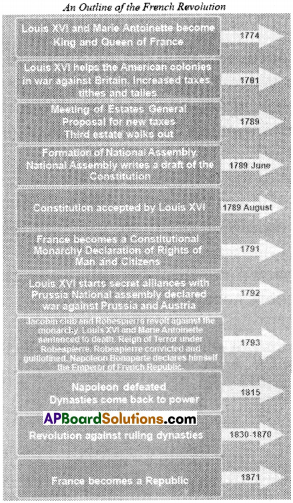
Question 9.
Study the following timeline and answer the given questions.
AP Board 9th Class Social Studies Important Questions Chapter 13 Democratic and Nationalist Revolutions 17th and 18th Centuries 6
a) When was the draft Constitution written by the National Assembly?
Answer:
In 1789 June. National Assembly had written the draft Constitution.

b) Who was the master of ‘Reign of Terror’?
Answer:
The master of ‘Reign of Terror’ was Robespierre.

c) What was the significance of 1871?
Answer:
The significance of 1871 was that France became republic.

d) When was the Declaration of Rights of Man and Citizens made?
Answer:
The Declaration of Rights of Man and Citizens was made in 1791.

e) Who declared himself the Emperor of French Republic?
Answer:
Napolean Bonaparte declared himself the Emperor of French Republic.

Question 10.
Do you feel that equality of status for women is necessary? Women’s fight for rights in France inspired the world. Do you agree with this?
Answer:

  • Yes. Women need to have equal status with men.
  • They need to educate themselves, participate in active politics.
  • Yes, the political activities of French women during the revolutionary years were kept alive as an inspiring memory.

Question 11.
What would happen if all people were not equal before law – and some special privileges like the right to kill others?
Answer:

  • If all people were not equal then society might be divided into classes.
  • A few classes might have some privileges and the rest would have to suffer.
  • People might not have fundamental rights.
  • If a few people had the privilege of killing others it would result in loss of lives to those who do not have had that privilege.

AP Board 9th Class Social Studies Important Questions Chapter 13 Democratic and Nationalist Revolutions 17th and 18th Centuries

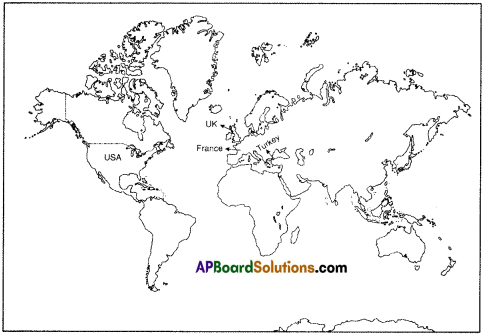
Question 12.
Locate the following on the world outline map.
1) USA
2) UK
3) France
4) Turkey
AP Board 9th Class Social Studies Important Questions Chapter 13 Democratic and Nationalist Revolutions 17th and 18th Centuries 7

Question 13.
Are revolutions essential for human development?
Answer:

  • Revolutions are essential for the development of human society.
  • Without revolutions or changes, the society and its structure remains static and may not take its course towards the growth and development.

Question 14.
Who are the philosophers that spread the ideas of democracy?
Answer:

  • Locke in his book “Two Treatises of Government” sought to refute the doctrine of the divine and absolute right of the monachy.
  • Rousseau advocated people’s sovereignty, equality and supremacy of majority.
  • Montesquieu’s theory of separation of powers paved way for division of powers.
  • Voltaire advocated the theory of restricted powers.

Question 15.
Compare the political rights which the Constitution of 1791 gave to the citizens with Articles from 1 to 6 of the Declaration. Are the two documents consistent? Do the two documents convey the same idea ?
Answer:

  • The 1st Article of the Declaration says that ‘All men are free and equal in rights’.
  • The 6th Article of the Declaration says that ‘All citizens have the right to participate in the formation of laws’.
  • But the Constitution of 1791 contradicted with the Declaration of Rights in giving all the citizens equal political rights.
  • According to the Constitution only men above 25 years of age and who paid taxes equal to at least 3 days of a labourer’s wage were given the right to vote.
  • Thus the Constitution violates the Declaration of Rights.
  • Thus we can say two documents contradicted with each other. They do not convey the same idea.

AP Board 9th Class Social Studies Important Questions Chapter 13 Democratic and Nationalist Revolutions 17th and 18th Centuries

Question 16.
How different would our lives have been if we were ruled by kings?
Answer:

  1. It would be very different if we were ruled by kings.
  2. They may have had made laws at their will.
  3. Society might had been divided in high and low castes or estates.
  4. Estates might have had their privileges and obligations.
  5. We might have had been denied our fundamental rights.
IMPORTANT YEARS AND EVENTS
 Events Years
1. Period of Long Parliament 1640-60
2. Execution of Charles I 1649
3. The Glorious Revolution 1688
4. The Declaration of Independence 1776
5. The American Revolution 1783
6. The French Revolution 1789
7. Execution of Louis XVI 1793
8. The Reign of Terror 1793-94
9. The execution of Robespierre 1794
10. The right to vote for women in France 1946


AP Board 9th Class Social Studies Important Questions Chapter 18 Impact of Colonialism in India

AP State Syllabus AP Board 9th Class Social Studies Important Questions Chapter 18 Impact of Colonialism in India.

AP State Syllabus 9th Class Social Studies Important Questions 18th Lesson Impact of Colonialism in India

9th Class Social 18th Lesson Impact of Colonialism in India 1 Mark Important Questions and Answers

Question 1.
What was the call given by Komaram Bheem to Adivasies? (SA-III : 2016-17)
Answer:
Adivasis were inspired by the message Jal, Jangal, Jameen of Komaram Bheem.

9th Class Social 18th Lesson Impact of Colonialism in India 2 Marks Important Questions and Answers

Question 1.
Mention any two reasons for deforestation during the British rule. (SA-II : 2018-19)
Answer:
The following reasons were responsible for deforestation during British rule.

  1. Large cities like Kolkata and Mumbai were coming up.
  2. The government was laying thousands of kms of railway lines across the country.
  3. Huge ships were also being built and mines were being opened.
  4. Wood is need for railway sleepers.

9th Class Social 18th Lesson Impact of Colonialism in India 4 Marks Important Questions and Answers

Question 1.
Once they began work on the machines there was no question of stopping. There was no fixed break even for meals. Taking out 15 – 20 minutes from their work, and asking a fellow labourers to look after their work, the labourers would eat their food. There was no separate place to eat either.
The whole day would pass in the heat, humidity, noise, dust and suffocation of the mill. Only when the sunset and it became impossible to see in the dark, the machines would stop and work would end.
Q. Comment on the working conditions of workers in factories in early industralisation. (SA-III : 2016-17)
Answer:

  • The working conditions were terrible.
  • People worked 14 to 16 hrs a day.
  • Majority were unskilled workers, only receive very low wages.
  • Factories were not the best places to work.
  • Machines spit out smoke and in some factories, workers come out covered in black soot by the end of the day.
  • Children were paid less.
  • The workers were given only a break for lunch and dinner.
  • Many children had physical deformities because of the lack of exercise and sunlight.

9th Class Social 18th Lesson Impact of Colonialism in India Important Questions and Answers

Question 1.
Read the following information and answer the questions given below.

The government implemented the first Factory Act in 1881 and made the following rules especially for the welfare of working children:

  • Children below the age of 7 cannot be employed in factories.
  • Children between 7 and 12 years of age cannot be made to work more than 9 hours a day and they must be given a one-hour break each day. They must also be given 4 days leave each month.
  • In 1891, laws were made in the interest of women labourers to ensure that:
  • Women labourers cannot be made to work more than 11 hours a day.
  • Women labourers must be given an hour and half break each day.

Children’s working hours were reduced from 9 to 7 hours/day and factory employers were forbidden to employ children below 9 years of age.

The largest number of labourers in industries was that of men. In wasn’t until 1911 that laws for their welfare were made. According to the Factory Act of 1911:

  • Adult male labourers could not be made to work for more than 12 hours every day.
  • After every six hours of work there would be a break for half an hour.

a) When was the first factory act passed and what did it specify?
Answer:

  • The first factory act was passed in 1881.
  • It specified that children below 7 years cannot be employed in factories and the children cannot work more than 9 hours.

b) When were the interests of women ensured?
Answer:
In 1891, laws were made in the interest of women labourers.
The women labours working hours were limited to 11 hours.

c) Who were the largest number of labourers in industries?
Answer:
The men were the largest number of labourers in the industries.

d) How many factory acts were passed ? And when were they passed?
Answer:
Three acts were passed :

  1. In 1881
  2. In 1891 and
  3. In 1911.

Question 2.
Read the following passage and answer the questions given below.
’ During strikes labourers formed their own organisations with the help of some educated people. These were labour unions, formed to conduct the strikes and negotiate settlements with the mill owners. Slowly, the trade unions became active not just during the strikes but all around the year, promoting the workers’ welfare and rights. Such unions began to be established from the early 1920’s. People influenced by socialist thought were prominent among them. One such union formed was Girni Kamgar Union with the help of which workers in Mumbai went on a very effective strike in 1928. In Ahmedabad, under the influence of Gandhiji, a powerful union known as the Mazdoor Mahajan was formed.
a) Why were the labour unions formed?
Answer:
Labour unions were formed to conduct the strikes and negotiate settlements with the mill owners.

b) Who helped the labourers to form unions?
Answer:
Educated people helped them.

AP Board 9th Class Social Studies Important Questions Chapter 18 Impact of Colonialism in India

Question 3.
Observe the following table and answer the questions given below.

Year Event
1879 8000 kilometers of railway lines
1864 A forest department was set up.
1856 The Santhal adivasis revolt
1880 The Koya adivasis revolt.
1910 The Maria and Muria adivasis revolt
1940 The Gond and Kolam adivasis revolt
1914-18 1st World War
1919 Strike of all the mills of Mumbai

a) What was the importance of 1919?
Answer:
All the mills of Mumbai were kept closed for 12 days due to the strike of workers.

b) When did the adivasis of the Maria and Muria revolt?
Answer:
The Maria and Muria adivasis revolted against the forest department in 1910.

c) When did the Santhais revolt?
Answer:
The Santhais revolted in 1856.

d) Who revolted in 1940?
Answer:
The Gond and Kolam revolted in 1940.

e) When did the 1st World War occur?
Answer:
Between 1914-18, the 1st World War occurred.

AP Board 9th Class Social Studies Important Questions Chapter 18 Impact of Colonialism in India

Question 4.
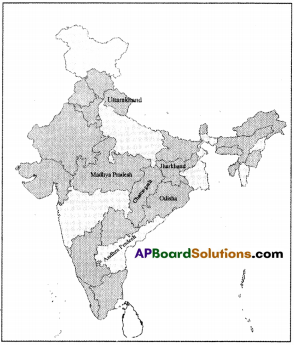
Find out where each of these adivasi struggles took place, and mark their locations on a map of India.
Answer:
Adivasi struggles took place in the following locations.

  1. Madhya Pradesh
  2. Chattisgarh
  3. A.P
  4. Odisha
  5. Jarkhand
  6. Uttarakhand

AP Board 9th Class Social Studies Important Questions Chapter 18 Impact of Colonialism in India 1

AP Board 9th Class Social Studies Important Questions Chapter 17 Colonialism in Latin America, Asia and Africa

AP State Syllabus AP Board 9th Class Social Studies Important Questions Chapter 17 Colonialism in Latin America, Asia and Africa.

AP State Syllabus 9th Class Social Studies Important Questions 17th Lesson Colonialism in Latin America, Asia and Africa

9th Class Social 17th Lesson Colonialism in Latin America, Asia and Africa 1 Mark Important Questions and Answers

Question 1.
Why had Europeans called Africa a ‘Dark Continent’? (SA-III : 2016-17)
Answer:
The Europeans did not know much about Africa until the 19th century.

9th Class Social 17th Lesson Colonialism in Latin America, Asia and Africa Important Questions and Answers

Question 1.
How is the word ‘discovery’ and ‘exploration’ used by Europeans? What did it mean to people who were already living in those geographical locations?
Answer:
Discovery:

  • The word “discovery” means “finding something that we did not know about it before”.
  • But in European concept “discovery” is to find faster and easier routes to countries like India, China, etc. without passing through regions controlled by Italian traders.

Exploration :

  • The step next to discovery is exploration.
  • Exploration in European context means “Sending expedition to countries and finding out what resources were available.”
  • Europeans explored the backward African and Asian countries for natural resources like, gold, silver, silk, porcelain, etc.

Views of native people :

  • But the Europeans did not explore these countries but exploited them.
  • Virtually the Europeans enslaved them, plundered them, forced them to trade with them, etc.
  • In South America the natives were deprived of their land and were massacred and driven to interiors.

AP Board 9th Class Social Studies Important Questions Chapter 17 Colonialism in Latin America, Asia and Africa

Question 2.
What is “Munroe Doctrine”?
Answer:

  • The President of USA James Munroe formulated the “Munroe Doctrine”.
  • According to this no European power would be allowed to build colonies in the American continents and US would not interfere in the affairs of Europe or colonies in other continents.

Question 3.
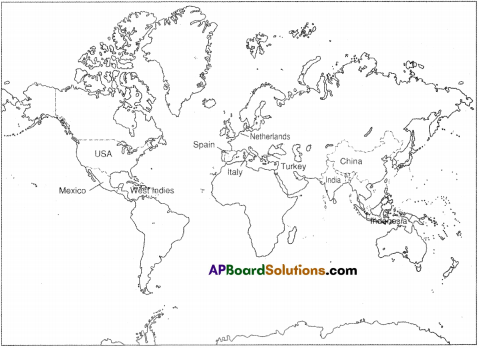
Locate Mexico, Spain, Netherlands, USA, Indonesia, China, Italy, Turkey, India, West-Indies on the world map.
Answer:
AP Board 9th Class Social Studies Important Questions Chapter 17 Colonialism in Latin America, Asia and Africa 1

Question 4.
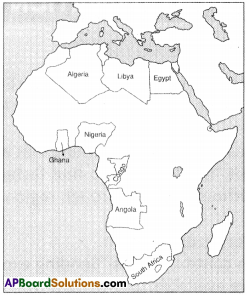
Locate South Africa, Egypt, Nigeria, Ghana, Libya, Algeria, Angola, Congo on the political map of Africa.
AP Board 9th Class Social Studies Important Questions Chapter 17 Colonialism in Latin America, Asia and Africa 2

Question 5.
What were the affects of colonizations?
Answer:

  • Imperialist countries commercialised the cultivation.
  • Due to that colonial countries were impoverished.
  • No development took place in these countries.
  • These countries could not develop industrially.

AP Board 9th Class English Solutions Chapter 3C Homework

AP State Syllabus AP Board 9th Class English Textbook Solutions Chapter 3C Homework Textbook Questions and Answers.

AP State Syllabus 9th Class English Solutions Chapter 3C Homework

9th Class English Chapter 3C Homework Textbook Questions and Answers

Answer the following questions.

Question 1.
What is the main purpose of giving homework to children?
Answer:
Strengthening the child’s learning is the main purpose of homework.

Question 2.
How can excessive homework decrease students’ interest in studies?
Answer:
Excessive homework makes students dull in their studies. Heavy work makes them feel tired and bored. It decreases their interest in studies. Researches have proved this point beyond doubt.

AP Board 9th Class English Solutions Chapter 3C Homework

Question 3.
Why do many teachers defend large amounts of homework?
Answer:
Many teachers defend heavy homework. They say it is necessary in the highly competitive atmosphere of these days.

Question 5.
How does homework take time away from important elements of daily life?
Answer:
Heavy homework takes the entire time of children. They don’t find time to play, exercise, develop social and family bonds, have fun and sleep for sufficient time.

AP Board 9th Class English Solutions Chapter 3C Homework

Question 6.
Is the writer in favour of or against homework? Justify your reasons.
Answer:
The writer is against the heavy homework. He welcomes limited, interesting, enjoyable and productive homework. He lists the harmful effects of excessive homework.

Project Work

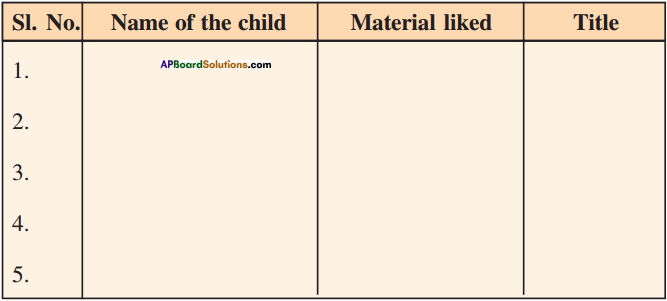
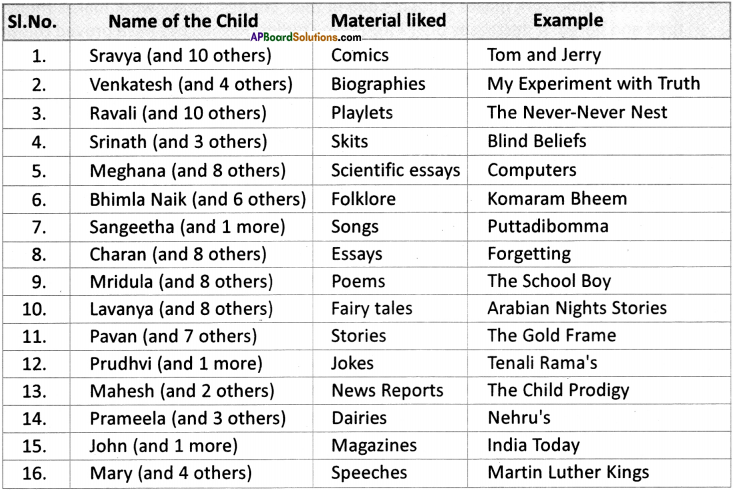
Conduct a survey to find out the kind of reading material the children like to be included in the textbook which makes them more interesting.

Ask them which of the following they enjoy most and complete the table :

comics poems
biographies fairy tales
playlets stories
skits jokes
scientific essays news reports
folklore diaries
songs magazines
essays speeches

Work in groups and consolidate the data you have collected.
Collect the data in the given format.
AP Board 9th Class English Solutions Chapter 3C Homework 1

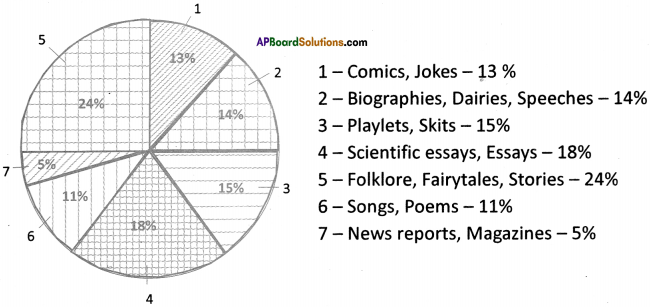
Prepare a pie chart with the collected data.
Analyse the pie chart and name the materials they enjoyed reading.
AP Board 9th Class English Solutions Chapter 3C Homework 2
AP Board 9th Class English Solutions Chapter 3C Homework 3

Homework Summary in English

The essay is an excellent analysis of the advantages and the otherwise of’homework.’ It uses a number of examples, statistics, arguments and critical surveys. Both the sides of the coin are presented in a balanced way.
Homework is mainly to strengthen the pupil’s learning. It should by rule be limited, interesting, enjoyable, purposeful and productive. In recent times, homework has, on the other hand, become heavy, boring and counter productive. Competition and baseless thinking on the part of some teachers and parents have added to the burden of homework.
Excessive homework is very harmful in more than one way. It eats into the child’s free time. Children miss their social life. Family relations do not develop in the desired manner. Children don’t find time to play and exercise. Even academically also, they become dull. Thus, burdensome homework injures children physically, mentally, emotionally, socially and morally. Hence ‘less is more’ should be the rule. Interesting, enjoyable homework in a limited quantity is advisable and welcome.

Homework Glossary

reinforce (v) : strengthen

counter-productive (adj) : harmful; producing negative results

curriculum (n) : syllabus

obesity (n) : over weight; a condition in which a person’s body is heavier than what is desirable, healthy

low self-esteem (n) : lower confidence levels

depression (n) : a state of total hopelessness

precious (adj) : very valuable

resort to (v) : adopt; follow

assignments (n-plural) : tasks to be completed; homework

AP Board 9th Class English Solutions Chapter 1A The Snake And The Mirror

AP State Syllabus AP Board 9th Class English Textbook Solutions Chapter 1A The Snake And The Mirror Textbook Questions and Answers.

AP State Syllabus 9th Class English Solutions Chapter 1A The Snake And The Mirror

9th Class English Chapter 1A The Snake And The Mirror Textbook Questions and Answers

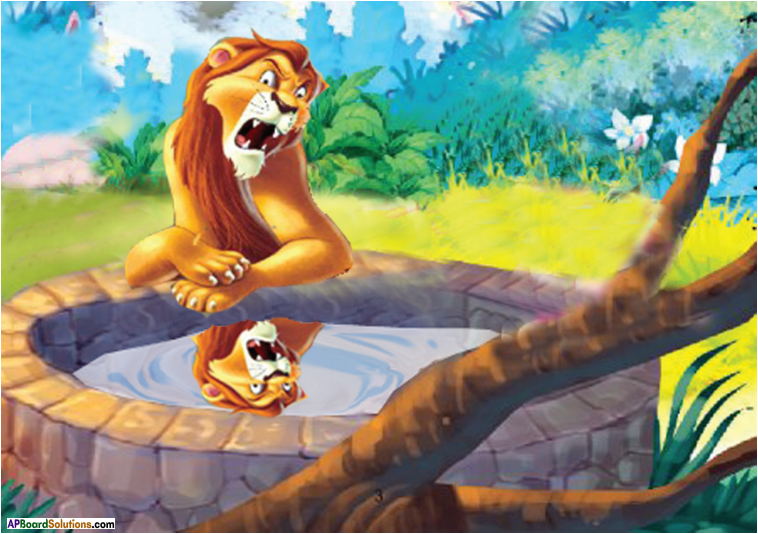
Look at the picture and answer the questions that follow.
AP Board 9th Class English Solutions Chapter 1A The Snake And The Mirror 1

Question 1.
What did the lion do on looking at its own reflection?
(a)enjoyed its beauty
(b) felt threatened
(c) felt angry
Give reasons for your option.
Answer:
(c) felt angry
The lion was the king of the forest. It became angry when it saw another lion in his kingdom.

AP Board 9th Class English Solutions Chapter 1A The Snake And The Mirror

Question 2.
Have you ever heard or read a story of a pet or an animal looking into a mirror? If yes, how did the animal feel?
Answer:
Yes, I have heard of my friend’s dog looking at its reflection in a mirror. The dog barks at its own image till someone takes him away.

Comprehension

I. Answer the following questions.

Question 1.
The doctor heard a sound coming from above three times. What was it?
Answer:
The doctor heard a noise from above three times. It was made by the snake moving under the roof. But the doctor thought it was the movement of rats.

Question 2.
Why did the doctor sit like a stone?
Answer:
A full blooded cobra was coiling itself around the doctor’s left hand. The snake’s wide open hood was just four inches away from his face. Terrible fear made the doctor sit like a stone. His active mind told him any movement would make the snake bite him. So he remained like a statue.

AP Board 9th Class English Solutions Chapter 1A The Snake And The Mirror

Question 3.
What made the doctor forget his fears and have a sense of relief?
Answer:
The snake looked at its image in the mirror. It seemed it was interested in its beauty. It slipped down from the doctor’s hand on to the table. It moved closer to the mirror, the doctor felt relieved. He quietly rose from his chair. He ran out of the room.

Question 4.
Did the snake admire its beauty? Yes or no? Pick the lines from the passage in support of your answer.
Answer:
The snake appeared to admire its beauty. It was certainly looking at its image in the mirror. It wanted to enjoy its reflection at closer quarters.

Question 5.
Why did the doctor want to marry a woman doctor? What kind of woman doctor would he like to marry?
Answer:
The doctor says he was poor. So he wanted to marry a woman doctor with good practice and who had plenty of money. He also wanted her to be fat. That would help him – when he made some silly mistake – run away from her easily. That way he wanted to save himself from her possible attacks.

Question 6.
What did the doctor think about the snake when it looked into the mirror?
Answer:
The doctor thought that the snake was admiring its beauty. He also thought that it was going to take an important decision about its beauty. It was probably thinking of growing moustache or applying eye shadow and mascara.

AP Board 9th Class English Solutions Chapter 1A The Snake And The Mirror

Question 7.
Why did the doctor run to his friend’s house? Did the snake want to harm the doctor? Why or why not?
Answer:
The doctor ran to his friend’s house as he was afraid of the snake. But the snake had no interest in harming the doctor. Even when it was on the doctor’s hand, it did not harm him. Normally snakes harm persons when they feel threatened by those persons.

II. Here is a list of sentences from the story. Tick (✓) the sentences that tell you that the author was afraid of the snake.

Sentence Boxes for Ticking
1. I didn’t tremble. 1 didn’t cry out.
2. I sat there holding my breath.
3. I forgot my danger and smiled feebly at myself.
4. Holding my breath 1 got up from the chair.
5. I leapt into the yard and ran for all I was worth.
6. I don’t claim that it was the first snake that had ever looked into a mirror.

Answer:

Sentence Boxes for Ticking
1. I didn’t tremble. 1 didn’t cry out.
2. I sat there holding my breath.
3. I forgot my danger and smiled feebly at myself.
4. Holding my breath 1 got up from the chair.
5. I leapt into the yard and ran for all I was worth.
6. I don’t claim that it was the first snake that had ever looked into a mirror.

Vocabulary

I. Tick (✓) the correct meaning of the words underlined below.

1. The house was not electrified.
a) There was no electricity in the house.
b) The house was not away from the electricity board.
c) The house was not lit up.
Answer:
a) There was no electricity in the house.

2. The earnings were meagre.
a) very high
b) very small
c) nil
Answer:
b) very small

AP Board 9th Class English Solutions Chapter 1A The Snake And The Mirror

3. I also possessed one solitary black coat,
a) single
b) unique
c) expensive
Answer:
a) single

4. I made another earth-shaking decision,
a) valuable
b) dangerous
c) important
Answer:
c) important

5. The room was surrounded by darkness,
a) full of
b) covered
c) encircled
Answer:
a) full of

AP Board 9th Class English Solutions Chapter 1A The Snake And The Mirror

6. Some thief had removed most of my things.
a) damaged
b) destroyed
c) stolen
Answer:
c) stolen

II. Read the following sentence from the text and notice the underlined word. Suddenly there came a dull thud as if a rubber tube had fallen to the ground.
Thud’ means to fall with a low dull sound.

Here is a list of words related to sounds. Say what these words mean. Refer to a dictionary.

Word Meaning
bang
clang
buzz
ring

bang (n) : a sudden loud noise
clang (v) : make a loud ringing sound like that of metals being hit
buzz(n) : a continuous sound like the one a bee makes make
ring (v) : a sound like the telephone or a bell makes

III. Usethelinkersgivenintheboxtocompletethestory.Alinkermaybeusedmorethanonce.

A young doctor lived in a village. The doctor told his friends an interesting story about himself and a cobra. It was a hot summer night. ___(1)___ he opened the door, he heard a sound ___(2)___ was well known to him. He and rats shared the same room. There was no electricity in the house, ___(3)___ he took out a box of matches and lit a kerosene lamp. He took off his clothes and lay down ___(4)___ he could not sleep. He got up from the bed and started reading a story-book. Near the table there was a mirror, ___(5)___ tempted him to look at himself. He was unmarried ___(6)___ he was particular about his handsomeness. He wanted to marry a woman doctor ___(7)___ had plenty of money and should be fat. ___(8)___ he was having such thoughts, suddenly he felt ___(9)___ a rubber tube had fallen to the ground ___(10)___ a snake landed on his shoulder. At that time the only thing he could do was to pray to God. The snake would bite him at any moment ___(11)___ suddenly it turned its head and started admiring its beauty in the mirror. The doctor was thus saved.
AP Board 9th Class English Solutions Chapter 1A The Snake And The Mirror 3
Answer:

  1. When
  2. which
  3. so
  4. but
  5. which
  6. so
  7. who
  8. While
  9. as if
  10. but
  11. but

Grammar

I. The Past Perfect and the Simple Past
Read the following sentences from the story.

We found we had little to carry. Some thief had removed most of my things.

In the above two sentences, the first one is in the simple past (found, had) and the second is in the past perfect tense (had removed).

As you can see, the action which occurred earlier, is expressed in the past perfect tense, whereas the action which occurred later, is expressed in the simple past tense. Here are a few more examples.
1. Sujatha had arrived at the station before the train came.
2. The doctor arrived after the patient had died.
3. I bought the ticket as soon as I boarded the bus.

AP Board 9th Class English Solutions Chapter 1A The Snake And The Mirror

When two actions occur nearly simultaneously in the past, both are expressed in the simple past tense.
Now combine the following pairs of sentences using the past perfect and the simple past.
(use after, before or when as linkers,)
The first one has been done for you.

1. I brushed my teeth. I took my breakfast.
Answer:
After I had brushed my teeth, I took my breakfast.
Or
I had brushed my teeth before I took my breakfast.

2. She started to go to market. It rained heavily.
Answer:
After she had started to go to market, it rained heavily.
Or
She had started to go to market before it rained heavily.

3. He completed his homework. He went to bed.
Answer:
After he had completed his homework, he went to bed.

4. I finished my dinner. Then my father came.
Answer:
When I had finished my dinner, my father came.

5. I fell seriously ill. I met my family doctor.
Answer:
When I had fallen seriously ill, I met my family doctor.

6. I locked the door. I went out to meet my friend at a restaurant.
Answer:
After I had locked the door, I went out to meet my friend at a restaurant.

II . Phrasal Verbs

Look at the following phrasal verbs and their meanings.

1. take out – to remove something from inside
2. set up – to arrange for something to happen / to start
3. take off – to remove
4. lie down – to take rest
5. take time off – to take some time for something
6. look into – to observe keenly
7. look at – to have a look at something
8. get up – to wake up
9. change into – to turn into
10. leave behind – to leave something as a token of memoray or gift

As you can see, a phrasal verb is a unit of a verb and one or more particles/a preposition. It cannot be understood on the basis of the meanings of the individual parts in isolation, but rather it must be taken as a whole.

AP Board 9th Class English Solutions Chapter 1A The Snake And The Mirror

Use the above phrasal verbs in the blanks. Make necessary changes in the verb forms.

Venkata Rao was a rich man. He wanted to ___(1)___ some business in the town. So he ___(2)___ a lot of money from the bank. On an auspicious day he started his medical business, which prospered by leaps and bounds. He became so busy that he could not ___(3)___ for any rest. He used to ___(4)___ very early in the morning and go to his office. In the afternoon he would ___(5)___ his shirt and ___(6)___ on his couch in the office. After a nap he would put on his shirt. Then he would ___(7)___ the mirror and ___(8)___ himself admiringly. Anyhow he ___(9)___ some fame in the town even when he went abroad. ___(10)___ a new man. Everybody believed that he
Answer:

  1. set up
  2. took out
  3. take time off
  4. get up
  5. take off
  6. lie down
  7. look into
  8. look at
  9. left behind
  10. had changed into

Writing

I. Write a descriptive essay on any unusual or humorous incident you may have witnessed or experienced.
Answer:
Have you ever heard of or seen a dog walking on water ? Most of or rather all of you would say a firm ‘No’. Nay, you may even doubt if there could be a more foolish question on this earth than the one above. You have every right to doubt and you are right in doubting too I But the world is so full of surprising and unusual incidents and creatures that we can’t believe their existence unless we see them !

I am lucky and also proud to be a witness to one of such unbelievable and exciting incidents. I have a friend whose uncle from the USA gifted him on his last birthday a very strange looking young dog. My friend Rohit named his prized possession ‘Walkie’. Rohit loves to spend every second of his free time with Walkie. Even Walkie likes to spend more with Rohit than with any other member of the family. Walkie accompanies Rohit to every place except, of course, school.

On one hot summer day we all thought of going to the river bank to cool ourselves by swimming in the river. As usual, Walkie joined us along with Rohit. And as Rohit walked into the water in his swim clothes, Walkie too stepped into the river. And then came the stunning discovery that made us dumbstruck ! Walkie was walking on the surface of the water as if it was land ! For a few moments, none of us could believe our eyes ! To be doubly sure of truth of what we saw, we made Walkie go this way, that way in – no, on – the river. And as if unaware of its unusual ability, Walkie jumped„hopped, leapt and ran all around the river – on the surface – to our commands.

That evening everyone of our friends was telling Walkie’s story to every person we came across. And everyone of us got the same response – “Don’t be a fool and don’t try to make us a fool !

The news spread like a wildfire ! The following day the whole village was on the bank of the river. And Walkie was the focus of everyone’s attention. And to thrill every spectator, Walkie crossed the river – walking on the surface – twice or thrice ! Walkie became the hero of our village and Rohit enjoyed his pet’s popularity to his heart’s content.

And it has become our hobby now to frequent to the riverside along with Walkie !

AP Board 9th Class English Solutions Chapter 1A The Snake And The Mirror

II. Preparation of a Poster :

Teli the names of some important events/happenings.
If you want to publicize the matter, what would you do?
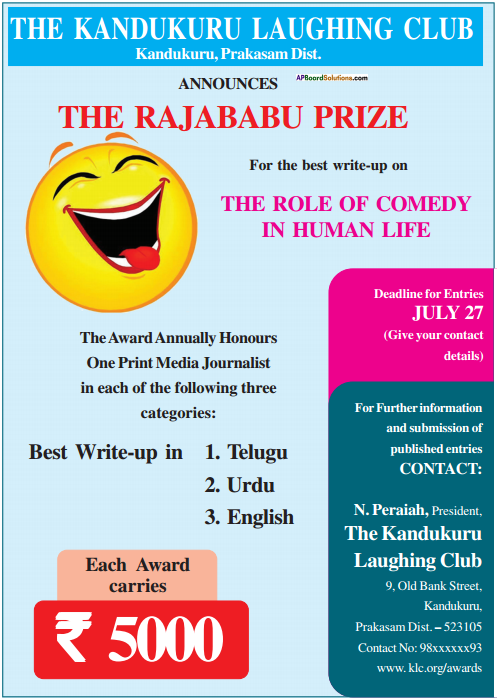
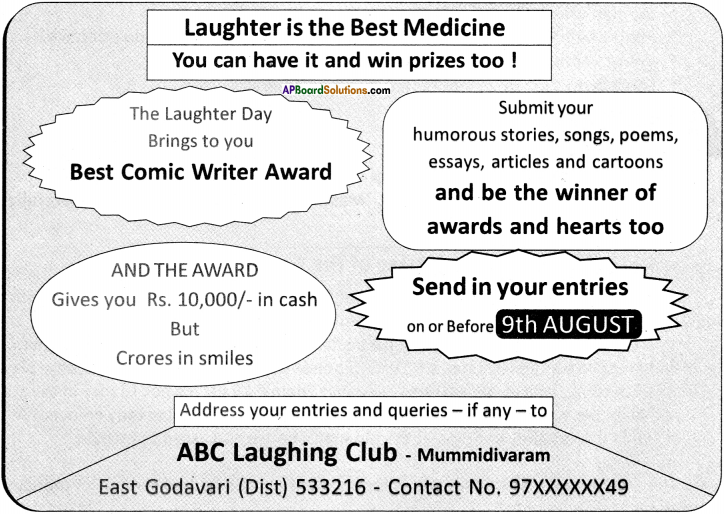
Look at the poster given below.
AP Board 9th Class English Solutions Chapter 1A The Snake And The Mirror 2
Now reflect on the following questions.

1. What are the elements of an effective poster?
Answer:
All the elements like colour, size, layout, font size, language are important.

2. Who issued the poster?
Answer:
(Here) THE KANDUKURU LAUGHING CLUB, issued the poster.

3. What is the purpose of the poster?
Answer:
The purpose of the poster is to invite entries for Raja Babu award.

4. What is the deadline?
Answer:
July 27 is the dead line.

5. What are the other details highlighted?
Answer:
The other details highlighted are
1) Award value
2) Who can participate
3) Contact address, etc.

6. What should be highlighted in a poster?
Answer:
All the necessary details are to be highlighted.

7. Who are the target audience of the poster?
Answer:
(Here) The print media journalists in Telugu, Urdu and English are the target audience.

AP Board 9th Class English Solutions Chapter 1A The Snake And The Mirror

Now prepare a poster using the information given below by arranging it in a proper sequence.

Highlights Information
Theme Humour
Occasion The Laughter Day
Category Stories, Songs, Poems, Essays, Articles and Cartoons
Award Best Comic Writer Award
Prize Amount ₹ 10,000
Contact No. 98xxxxxx49
Deadline 9th August
Issued by ABC Laughing Club, Mummidivaram, East Godavari Dist. -533216
Target Audience Writers, Journalists, Poets, Essayists,Cartoonists and Lyricists

Answer:
AP Board 9th Class English Solutions Chapter 1A The Snake And The Mirror 4

Study Skills

Here is a short narration. Read it carefully and make a list of important points. Suggest a suitable title for it.

The young doctor married a rich fat foreign woman. He told her ‘the episode of the snake and the mirror’. She laughed heartily. He went on talking about cobras and some funny facts (associated) related to them. He said to her “Cobras are the most poisonous, active and dangerous snakes. But, surprisingly, most Hindus worship them. It is funny to know that some women drop eggs and pour milk into the ant hills where cobras usually reside.

It is funny to know that some people believe cobras dance to the tunes of charmers. In fact, they have no ears. It is equally humorous to be aware of the fact that most cobra victims go to the charmers instead of the doctors. The charmers enchant some so-called mantras taking some neem leaves into their hands. The cobra victim dies and they say the victim came late to them. It is funnier to know that some farmers cremate cobras and perform funeral rites as if one of the members of their family has died.” “Are there any other funny stories related to cobras?” The young wife enquired. “Yes”. There are so many stories to tell but! will tell them tomorrow. The patients may be waiting for me at hospital.” The doctor said and left for hospital in a hurry.
Answer:
Cobras : Some Beliefs Among Hindus

  • An Indian doctor tells his foreign wife about cobras and some beliefs about them.
  • Cobras are the most poisonous, active, and dangerous snakes.
  • Yet, most Hindu women worship cobras.
  • Women offer eggs and milk to cobras.
  • People believe cobras dance to the tunes of charmers. Cobras do not have ears.
  • Cobra victims go to charmers, instead of to doctors.
  • Some farmers cremate cobras and perform funerals.

Listening

Practise listening carefully. Then you will be able to speak.
Your teacher will tell you the story, ‘Master of the Game.’ Listen to it carefully and answer the following questions.

Master of the Game

An old man who lived in a small side street in the city of Mumbai had to put up with the nuisance of having boys play cricket outside his house, at night.

One evening when the boys were particularly noisy, he went out to talk to them. He explained that he was a pensioner, who was happiest when he could see or hear boys playing his favourite game, cricket. He said he would give them ? 25 each week to play in the street at night. The boys were thrilled. They were being paid to do something they enjoyed I At the end of the first week they knocked at the old man’s house and asked to be paid.

He did so.
The second week when they asked for payment he said he had run out of money and sent them away with only ₹15.

The third week the man said he had not yet received his pension and gave them only ₹10

The boys were very disappointed but there was not much they could do about it.

The fourth week the man said he could not afford to pay them ₹25 as he had promised, but would give them ₹ 5 each week without fail.

This was too much for the boys.
“You expect us to play seven days a week for a measly ₹5!” they yelied. “Go to blazes.” They stormed away and never played on the street again.

AP Board 9th Class English Solutions Chapter 1A The Snake And The Mirror

Now, answer the following questions.

1. What made the old man talk to the boys?
Answer:
The old man was living in a small side street in Mumbai. Some boys were playing cricke outside his house every night. They were very noisy. The old man Was unable to put up with that nuisance. So, he decided to talk to the boys.

2. Why did the boys stop playing cricket in the night outside the old man’s house?
Answer:
The old man promised to pay Rs. 25 a week to the boys for playing his favourite game near his house. After some time he paid Rs. 15 a week. Later he reduced it to Rs. 10. When he said he couldn’t pay more than Rs. 5 a week, the boys said it was too little for a week’s play. So they stopped playing cricket there.

The Snake And The Mirror Summary in English

Vaikom Muhammad Basheer is the writer of ‘The Snake and the Mirror”. He is a famous story teller from Kerala. The story is humorous. It tells us the experience of a young home doctor with a snake. The doctor was living alone in a small room with tiled roof. It was a hot summer night. He entered his room late at night. He tried to sleep but couldn’t. It was hot and he sat on a chair in front of a mirror and tried to read a book. There was a noise in the roof once or twice. But he did not bother about it because there were a lot many rats moving around. He started dreaming about marrying a fat, rich lady doctor.

Suddenly there was a ‘thud’ like sound. As he turned back to see what it was, there was a strong, long cobra coiling around his left hand with its hood wide open and just four inches away from his face. He at once became like a stone in fear. But his mind was active. As he was thinking of how to save himself, the snake saw its image in the mirror. It seemed that the snake was interested in its beauty. So it slipped down on to the table and moved towards the mirror. The doctor took this opportunity to run away from the room to a friend’s house. The following morning he came! back to his room with his friend. There was no snake. The room was almost empty. Some! thief had taken away all his belongings except a dirty vest. The doctor answers a listener’s question by saying he married a woman who was lean and an expert in running!

The Snake And The Mirror Glossary

coiled (v-past tense) : turned round and round

full-blooded (adj) : strong

homeopath (n) : a doctor practising home system

discuss (v) : talk about (Note : The word ‘discuss’ should not be followed by ‘about’. Its noun form ‘discussion’ can take ‘about’. The spelling of ‘discuss’ has two ‘s’ letters at the end.)

restaurant (n) : a place where food items are served (Make a note of the spelling !)

returned (v-past tense) : came back (Note : The word ‘back’ should NOT be used after ‘return’)

meagre (adj) : too small

solitary (adj) : single; only one

vest (n) : a sleeveless undershirt

gables (n-plural) : (here) long wooden bars supporting the roof

take time off (phrasal verb) : be free from work; take rest

parting (n) : the separating area

moustache (n) : hair grown on a man’s upper lip

earthshaking (adj) : very surprising; having great importance

resumed (v-past tense) : took back; occupied again

wriggled (v-past tense) : twisted and turned the body to move

Simultaneous (adj) : happening at the same time as another act

tremble (v) : shiver/shake in fear

slithered (v-past) : moved smoothly, glided

at closer quarters (phrasal verb) : from a short distance away

hood (n) : an expanded part of snake’s head

leaden (adj) : made of lead

lurked (v-past tense) : was around secretly

feebly (adv) : weakly

reflection (n) : image

mascara (n) : something applied on eye lashes to make them look dark and thick

vermilion (n) : bright red coloured powder applied on the forehead as a round spot

unwound (v-past tense) (wind-wound x unwound) : freed itself

crept (v-past tense of creep) : moved on all limbs

closer (adj-comparative degree) : nearer

no mere image cut in granite : no more afraid and so not like a statue

a man of flesh and blood : a normal man

leapt (v- past tense of leap) : jumped

heaved a sigh of relief : felt relieved

companion ife : wife

reedy (adj) : very thin like a reed

sprinter (n) : one who participates in running competitions

smeared (v-past tense) : applied; rubbed

taken with (phrasal verb) : attracted by

AP Board 9th Class Social Studies Important Questions Chapter 16 Social Protest Movements

AP State Syllabus AP Board 9th Class Social Studies Important Questions Chapter 16 Social Protest Movements.

AP State Syllabus 9th Class Social Studies Important Questions 16th Lesson Industrialisation and Social Change

9th Class Social 16th Lesson Social Protest Movements 1 Mark Important Questions and Answers

Question 1.
Who were Luddists? Mention any one demand of the Luddists. (SA-I : 2019-20)
Answer:
Workers who destroyed machinery, especially in cotton and woollen mills, that they believed was threatening their jobs.
Demand of Luddists :

  1. They demanded Minimum wage.
  2. Control over the labour of women and children.
  3. Work for those who had lost their jobs because of introduction of machinery.

9th Class Social 16th Lesson Social Protest Movements 2 Marks Important Questions and Answers

Question 1.
Write any two principles of Socialism? (SA-II : 2016-17)
Answer:
Principles of Socialism :

  1. True socialists advocate a completely class less society, where the government controls all means of production and distribution of goods.
  2. It believes the absence of private property.
  3. Therefore, everyone receives equal earnings, medical care and other necessities.

AP Board SolutionsAP Board 9th Class Social Studies Important Questions Chapter 16 Social Protest Movements

Question 2.
Why the idea of socialism was appreciable? Write your views. (SA-I : 2018-19)
Answer:
Socialists generally aim to achieve greater equality in decision making and economic affairs, grant workers have greater control of the means of production and their work place, and to eliminate exploitation by directing the surplus value to employees.

9th Class Social 16th Lesson Social Protest Movements Important Questions and Answers

Question 1.
Write about early workers movements in England.
Answer:

  • In England, political protest against the cruel working conditions infactories were increasing.
  • Workers flooded towns and factories, they expressed their anger and frustration in numerous forms of protest.
  • There were bread or food riots throughout the country from the 1790s onwards.
  • The working population demanded for right to vote.
  • The weavers demanded a legal minimum wage, which was refused by the Parliament.
  • In Yorkshire, shearing-frames were destroyed by croppers.
  • In the riots of 1830, the threshing machines were smashed.

Question 2.
What is Luddism?
Answer:

  • Luddism is a social protest movement led by “General Ned Ludd”.
  • Luddism was not merely a backward looking assault on machines.
  • Its participants demanded a minimum wage, control over the labour of women and children, work for those who had lost their jobs because of the coming of machinery etc.

Question 3.
Name of few thinkers of socialist ideas as they expressed their views.
Answer:

  • Some elements of socialist ideas can be seen in many thinkers down the ages like Plato and Thomas Moore.
  • Another early socialist thinker was Saint Simon of France who advocated for public control of property through central planning.
  • In England, Owen took an initative for building cooperative villages.
  • Karl Marx and Friedrich Engels promoted present view of Socialism.
  • Swami Vivekananda was deeply influenced by the ideas of Socialism.
  • Many leaders like M N Roy, Bhagat Singh, Jawaharlal Nehru, etc. were enthusiastic socialists.

AP Board SolutionsAP Board 9th Class Social Studies Important Questions Chapter 16 Social Protest Movements

Question 4.
Why do you think social protest movements gained momentum?
Answer:

  • Industrialisation gave birth to influencial industrial capitalists.
  • Now, power and influence was in the hands of industrial capitalists and large landowners.
  • The working class movements were becoming more organised.
  • Workers realised their power when they were united.
  • They understood that if they came together, they could bring stands till the economy.
  • They were inspired by the ideas of French Revolution and Socialism.
  • Similarly women demanded equal status and role in society, economy, polity and culture.

Question 5.
Read the following passage and answer the questions given below.
What is Socialism? It is a doctrine that calls for public rather than private ownership or control of property and natural resources. According to the socialist view, individuals do not live or work in isolation but live in cooperation with one another. Further, everything that people produce is in some sense a social product, and everyone who contributes to the production of a good is entitled to a share in it. Society as a whole, therefore, should own or at least control property for the benefit of all its members.

In this way, socialism contradicts the basic idea of capitalism which is based on private ownership of the means of production and free play of market in determining what is to be produced and who is to be given a share of the produce. Socialists complain that capitalism necessarily leads to unfair and exploitative concentrations of wealth and power in the hands of the relative few. The rich then use their wealth and power to’ reinforce their dominance in society.

Because such people are rich, they may choose where and how to live, and their choices, in turn, limit the options of the poor. As a result, terms such as individual freedom and equality of opportunity may be meaningful for capitalists. But for the working people, who must do the capitalists’ bidding if they are to survive, they can only hollow. As socialists see it, true freedom and true equality require social control of the resources that provide the basis for prosperity in any society.

Socialists also believe that given such unequal distribution of resources, there cannot really be genuine free competition as the rich and powerful manage to tilt the balance in their favour by hook or crook.
1) What is socialism?
Answer:
Socialism calls for public ownership rather than private control of property and natural resources.

2) What is the basic idea of capitalism?
Answer:
Capitalism is the private ownership of the means of production.

3) what is the complaint of socialists about capitalism?
Answer:
Socialists complain that capitalism distributes wealth and power in an unfair and exploitative manner. It gives all the money and power to a few individuals.

4) In the view of socialists, what is the basis for prosperity in any society?
Answer:
According to socialists, the true freedom and the true equality means that society should control of the resources that provide the basis for prosperity in any society.

5) What are the disadvantages of capitalism?
Answer:

  • Unequal distribution of resources.
  • Concentration of wealth in few hands

AP Board SolutionsAP Board 9th Class Social Studies Important Questions Chapter 16 Social Protest Movements

Question 6.
Read the following passage and answer the questions given below.
The movement for extending the right to vote to all sections of the population gained momentum in 1830 to 1870. In countries like England, women too came out in large numbers demanding right to vote. They were called ‘women’s suffragists’. They held demonstrations, meetings and wrote in newspapers, etc. and made appeals to the Parliament. Russian Revolution was the first to grant such rights to all women in 1917. The right to vote was extended to some women in England in 1918 and to all adult women by 1928. Gradually this was accepted by most democratic countries.
1) Who were “women’s suffragists”?
Answer:
Women who fought for their right to vote were called “women’s suffragists”.

2) How did they fight for the right to vote?
Answer:
They held demonstrations, meetings, wrote in newspapers etc. and made appeals to the Parliament.

3) Who was the first to grant right to vote?
Answer:
Russian revolution was the first to grant right to vote to all women in 1917.

4) When did England grant the right to vote to women?
Answer:
The right to vote was extended to some women in England in 1918 and to all adult women by 1928.

5) Do you feel that women should be granted with right to vote? If yes, why?
Answer:

  • Women are born free and are entitled to all rights that are given to men.
  • Therefore women should be given right to vote on par with men.

Question 7.
Gather some information regarding women protection movement and some information about women protection act.
Answer:

  • There were social reform movements in India, which wanted to uplift the status of women.
  • They fought against social evils like sati, killing of girl child at birth, enforced widowhood among women.
  • Social reformers like GurajadaApparao and Raja Rammohan Roy fought for women’s rights.

The following are some acts that protect women.

  • Prohibition of Dowry Act -1961
  • The protection of women from “Domestic Violence” Act.
  • Prohibition of Child Marriage Act – 2006.
  • “Nirbhay” Act is passed to protect women from “Sexual assaults”.

AP Board SolutionsAP Board 9th Class Social Studies Important Questions Chapter 16 Social Protest Movements

Question 8.
Locate the following on the outline map of Europe.

  1. London
  2. Norway
  3. North sea
  4. Baltic Sea
  5. Yorkshire
  6. Manchester

AP Board 9th Class Social Studies Important Questions Chapter 16 Social Protest Movements 1

Question 9.
Critically describe women social protest movements.
Answer:

  • At the time of French revolution, they drafted ‘Declaration of the Rights of women’ which was never passed in Frency Assembly.
  • They organised women’s suffragist movement which brought voting right to women in Russia in 1917, in England in 1918 (for some) and in 1928 (for all adult women).
  • First – wave of feminism focused on absolute rights such as suffrage and Second-wave of feminism focused on other aspects of equality like education, health etc.
  • Even though legal equality was achieved, real equality yet to be achieved.

AP Board 9th Class Social Studies Important Questions Chapter 12 Changing Cultural Traditions in Europe 1300-1800

AP State Syllabus AP Board 9th Class Social Studies Important Questions Chapter 12 Changing Cultural Traditions in Europe 1300-1800.

AP State Syllabus 9th Class Social Studies Important Questions 12th Lesson Changing Cultural Traditions in Europe 1300-1800

9th Class Social 12th Lesson Changing Cultural Traditions in Europe 1300-1800 1 Mark Important Questions and Answers

Question 1.
Define Renaissance. (SA-II : 2016-17)
Answer:
Renaissance means “Re birth”. It was a period in Europe, especially Italy when there was a new interest in art, literature, science and learning flourished.
(OR)
Renaissance means the cultural changes in Europe.

9th Class Social 12th Lesson Changing Cultural Traditions in Europe 1300-1800 2 Marks Important Questions and Answers

Question 1.
Study the map given below and answer the following questions. (SA-I : 2018-19)
AP Board 9th Class Social Studies Important Questions Chapter 12 Changing Cultural Traditions in Europe 1300-1800 1
a) From which country did Columbus start his journey?
b) Who discovered the sea route to India?
Answer:
a) Columbus started his journey from the country Spain.
b) Vosco da gama discovered sea route to India in the year 1498 A.D.

Question 2.
Observe the bar graph and answer the questions given (SA-I : 2019-20)
AP Board 9th Class Social Studies Important Questions Chapter 12 Changing Cultural Traditions in Europe 1300-1800 2
i) What trend does the bar graph show?
Answer:
The bargraph shows the European output of Books 500 -1800. It shows that Manuscript books were avilable from 6th century to 15th century and printed books were started from 15th century.

ii) What could be the possible reason for this trends?
Answer:
Invention of printing press.

AP Board 9th Class Social Studies Important Questions Chapter 12 Changing Cultural Traditions in Europe 1300-1800

Question 3.
What is the impact of the printing press and how did it change the world? (SA-I : 2019-20)
Answer:

  • Printing press made it possible to read books, developing reading habit,s and think rationally.
  • A printed book promoting new ideas could quickly reach hundreds of readers.
  • Ideas, opinions, and information moves more widely and more rapidly than ever before.
  • Humanist culture was spread into entire Europe due to printed books.

9th Class Social 12th Lesson Changing Cultural Traditions in Europe 1300-1800 4 Marks Important Questions and Answers

Question 1.
During medieval and early modern times, women the world over were dominated by men. Is it different now in our present society? Explain. (Sa-III : 2016-17)
Answer:
Compare with medieval and early modern times the present position of women is changing.

In earlier times, women were exploited through every possible means by the society. But at present women become self reliant. Along with the men, women also participated equally in education, medicine, space, agriculture fields, etc.

Not only this, women also participated in politics along with men. Some times they occupies heighest posts in India.

In some sectors, compared to men, women only are in forward position.

But still, in some areas, women were dominated by men and it shows our society is a male dominated society.

AP Board 9th Class Social Studies Important Questions Chapter 12 Changing Cultural Traditions in Europe 1300-1800

Question 2.
The Renaissance is a period from the 14 to the 17th century, considered the bridge between the Middle Ages and Modern history. It started as a cultural movement in Italy in the Late Medieval period and later spread to the rest of Europe.
In what way do you think that renaissance is a cultural movement? (SA-II : 2018-19)
Answer:

  • The Renaissance was a cultural movement.
  • It also a revival of the classical art and intellect of Ancient Greece and Rome.
  • The art in Renaissance time was more life-like and contained perspective.
  • Some famous artists from the Renaissance were Leonardo Davinci, Raphael etc. Now their paintings are really valuable and significant.
  • Renaissance artists and architects produced some of the finest works that we know now.
  • The Protestant Reformation during the 16th century in Europe ushered in a new artistic tradition that embraced the protestant agenda and diverged drastically from the Southern European tradition and the humanist art produced during the high Renaissance.

Question 3.

Theory Important Features
1. Humanism – Humanists became interested in this world rather than the life after death as the scholars of the Middle Ages had been.
– Every thing in nature, science, and the arts that affected man now as important to the Humanists.
2. Realism – The Humanist ideas extended to art and architecture too.
– Artists observed the nature, the people, and places around them and sought to represent them as they were.
3. Romanticism – It is a cultural movement which sought to develop a particular form of nationalist sentiment.
Romantic artists and poets generally critised the glorification of reason and science.

Based on the information given above and answer the following questions,
1. Who gave more importance to the future life than the present life?
2. In which theory can we notice the weakening of the control of religion over human life?
3. The famous statue that depicts Mary holding the body of Zesus reflects which theory?
4. Which theory opposed the glorification of science? (SA-III : 2016-17)
Answer:

  1. Scholars of the Middle ages.
  2. Humanism
  3. Realism
  4. Romanticism

AP Board 9th Class Social Studies Important Questions Chapter 12 Changing Cultural Traditions in Europe 1300-1800

Question 4.
The Italian Renaissance was a rebirth of learning that produced many great works of art and literature. (SA-I : 2019-20)
In the context of the above statement, describe how renaissance revolutionized the art and artistic styles?
Answer:

  1. A reverent revival of classical Greek / Roman art forms and styles.
  2. A faith in the nobility of man (Humanism).
  3. The mastery of illusionistic painting techniques, maximising ‘depth’ in a picture, including;

linear perspective, foreshortening and the naturalistic realism of its faces.

9th Class Social 12th Lesson Changing Cultural Traditions in Europe 1300-1800 Important Questions and Answers

Question 1.
Do you think it is important for artists to paint things as they are, that is realistically? Give reasons.
Answer:

  • I think it is important to paint realistically.
  • Painters should understand the perspective of the painting.
  • They should understand changing quality of light, richness of colours.
  • They should not completely confine their paintings to rich, powerful, and successful people through this art.
  • They should show great interest in the lives of the poor and their sufferings also.
  • They should also come under the inflence of other nation’s artists to add life to their paintings.

Question 2.
Why do you think the Popes and bishops encourage the new art?
Answer:

  • Before Renaissance, religious art emphasised on religious themes.
  • It represented the religious ideals.
  • Artists of Renaissance portrayed their surroundings, literature, feelings, and power of human beings.
  • They represented the reality but not the religious ideals.
  • The Popes and bishops encouraged the Renaissance art to paint for them, to design churches and chapels for them.
  • The artists made elaborate graves and memorials for the Popes and bishops and designed cathedrals and churches and also covered their walls with paintings of best consideration.

AP Board 9th Class Social Studies Important Questions Chapter 12 Changing Cultural Traditions in Europe 1300-1800

Question 3.
What efforts did the artists make to achieve realism in their painting and sculpture?
Answer:

  • They found the knowledge of geometry helpful.
  • They understood the quality of lights to improve quality of their work.
  • They made use of oil paints and are influenced by Chinese and Persian art.
  • They took help of the subjects like anatomy, geometry, physics as well as a strong sense of what was beautiful.
  • They adopted ‘perfectly’ proportioned figures of men and women.
  • They imported the pigments of colours from China and Persia.
  • They observed nature and people and places and represented them.

Question 4.
Do you think religious texts should only be in the language understood by the common people? Give your arguments.
Answer:

  • I think religious texts should be in the language understood by common people.
  • Otherwise, the people who knew the language in which the religious texts was, may interpret them to their advantage.
  • Sooner or the later these texts needed to be in the reach of common people.
  • Interpretations other than the genuine may be exposed and changes are irresistible.
  • Religious texts are for common good and they should be made available to common people in their mother tongue.

AP Board 9th Class Social Studies Important Questions Chapter 12 Changing Cultural Traditions in Europe 1300-1800

Question 5.
Read the following passages and answer the following questions.

Christopher Columbus determined to find new route to the east. He believed that the eastern shores of Asia lay across the dark Atlantic, and so he set out with three small ships to get there. After a long, dangerous voyage, Columbus reached land on an island on October 12, 1492. He thought he had reached the East Indies and called the natives, Indians. Amerigo Vespucci and Italian sailor, followed Columbus. He confirmed that the new world discovered (America) by Columbus was quite different from Asia.

Ferdinand Magellan a sailor of Spain, made the voyage round the world with the help of Spanish King Charles I. He crossed the Atlantic, went around the southern tip of South America and sailing through the straits, he reached the Pacific Ocean and landed at the Islands of Philippines. This voyage was great landmark in the history of exploration of the sea routes.

1) What are the names of the sailors mentioned in the above passage?
Answer:
Christopher Columbus, Amerigo Vespucci and Magellan were the sailors mentioned in the above passage.

2) Which island did Columbus want to discover?
Answer:
He wanted to discover East Indies.

3) What was the island discovered by Columbus?
Answer:
West Indies was discovered by Columbus.

4) To which country did Amerigo Vespucci belong?
Answer:
He belonged to Italy.

5) Who went around the world?
Answer:
Magellan, a sailor of Spain made a voyage round the world.

Question 6.
The 16th & 17th Centuries : A Timeline

Thomas More’s Utopia published • 1516
Martin Luther writes the Ninety – Five Theses • 1517
Luther translates the Bible into German • 1522
Peasant uprising in Germany • 1525
Andreas Vesalius writes on Anatomy • 1543
Anglican Church established in England, with the king/queeen as its head • 1559
Gerhardus Mercator prepares cylindrical map of the earth • 1569
Gregorian calendar introduced by Pope Gregory XIII • 1582
William Harvey links the heart with blood circulation • 1628
Academy of Sciences set up in Paris • 1673
Isaac Newton’s Principia Mathematica published • 1687

1) Who introduced Gregorian calendar?
Answer:
Pope Gregory XIII introduced Gregorian calendar.

2) Where was Academy of Sciences set up?
Answer:
Academy of Sciences was set up in Paris.

3) When was the Bible translated into German?
Answer:
The Bible was translated into German in 1522.

4) Who prepared cylindrical map of the earth?
Answer:
Cylindrical map of the earth was prepared by Gerhardus Mercator.

5) Which book of Newton was mentioned in this timeline?
Answer:
Principia Mathematica.

Question 7.
Discuss in the class the kind of changes that are happening today in some of these aspects like films, buildings, religious beliefs, music, etc. What are the changes that you observe around you? What is causing these changes?
Answer:

  • Newtechnologies in filming and audio are introduced like DTS (Digital Theatre Sound), Flow cam, etc.
  • Readily built buildings are being placed now in the places where we need to construct them.
  • Many new religious beliefs came into existence in place of the older ones.
  • There are many other changes taking place around us.
  • Most of these changes are caused as a part of cultural changes.

AP Board 9th Class Social Studies Important Questions Chapter 12 Changing Cultural Traditions in Europe 1300-1800

Question 8.
Have you seen people from distant places live in places near you? In what ways do you think they help in the spread of ideas from one place to another? Give examples while discussing.
Answer:

  • I have seen a few people from distant places live in my place.
  • They definitely spread the ideas from one place to another.
  • They introduce their customs, traditions, and food habits and there may be a few takers over here.
  • At the same time when they leave for their native places or shifts there, they definitely propagate what they learnt here over there.

Question 9.
Locate the following on the outline map of Europe.
1) Italy
2) England
3) Portugal
4) Spain
5) France.
AP Board 9th Class Social Studies Important Questions Chapter 12 Changing Cultural Traditions in Europe 1300-1800 3

Question 10.
Locate the following on the outline map of Europe.
1) Rome
2) Sicily
3) Adriatic Sea
4) Mediterranean sea
5) Venice.
AP Board 9th Class Social Studies Important Questions Chapter 12 Changing Cultural Traditions in Europe 1300-1800 4

Question 11.
Study the Geographical exploration map (Page No. 156) and locate the following on the world outline map.
1) Indian ocean
2) Atlantic ocean
3) Pacific ocean
4) Cape of Good Hope
5) Philippines
6) Voyage of Columbus
7) Voyage of Magellan
Answer:
AP Board 9th Class Social Studies Important Questions Chapter 12 Changing Cultural Traditions in Europe 1300-1800 5

Question 12.
What role did scientists and sailors play in modernizing our world?
Answer:

  • Due to the work of Vesalius modern physiology developed.
  • Harvey, Newton, Galileo, Copernicus changed the scenario of science in turn changed the world.
  • Great sailors like Copernicus, Vasco-da-Gama, Magellan, etc. discovered new sea routes to different countries.
  • Due to that, trade and commerce developed.
  • Cultural diffusion took place and which in turn laid foundation for modernization.

AP Board 9th Class Social Studies Important Questions Chapter 12 Changing Cultural Traditions in Europe 1300-1800

Question 13.
Have you seen any painting by any famous artist? If so talk about it to your classmates. Was it realistic? What impression did it make upon your mind?
Answer:

  • I have seen a famous painting of M.F. Hussain.
  • It is a perfectly proportioned woman painting.
  • It is with richness of colours used.
  • The colours and designs of costumes are extraordinarily painted.
  • The various perspectives of the paintings are worth praising.

AP Board 9th Class English Solutions Chapter 3B Not Just a Teacher, but a Friend

AP State Syllabus AP Board 9th Class English Textbook Solutions Chapter 3B Not Just a Teacher, but a Friend Textbook Questions and Answers.

AP State Syllabus 9th Class English Solutions Chapter 3B Not Just a Teacher, but a Friend

9th Class English Chapter 3B Not Just a Teacher, but a Friend Textbook Questions and Answers

I. Answer the following questions.

Question 1.
Why does the student consider the teacher his friend?
Answer:
The student is sad. He has no one to share his sorrow. He doesn’t know where to go. Then, he meets his teacher. The teacher’s company makes him comfortable. Hence the boy consideres the teacher his friend.

Question 2.
How does the teacher take the student out of his gloom?
Answer:
The teacher listens to the boy. He offers the boy comfort. He provides the boy with the needed courage. He brings out the boy’s real soul. He finds time to see if the boy is fine. In the company of this teacher-friend, the boy is all smiles.

AP Board 9th Class English Solutions Chapter 3B Not Just a Teacher, but a Friend

Question 3.
Why does the student fail to estimate the teacher correctly?
Answer:
The boy moves to the higher class. He is worried that he would miss his teacher-friend. As a young boy, he fails to understand that great teacher’s concern for him.

Question 4.
How does the poet glorify the relationship between the teacher and the student?
Answer:
The poet lays bare the boy’s heart. That brings out the dizzy heights of the teacher’s personality. The boy is sad. The teacher makes him glad. The boy feels lonely. The teacher makes him lively. The relationship between them is that of love and affection. They become a model teacher student pair. The bond between them makes everyone fond of them.

Not Just a Teacher, but a Friend Summary in English

The poem is a moving account of a noble teacher being a kind friend of a student with no one to depend on. The boy was sad. He had not a soul to share his sorrow with. He had nowhere to go. Then he saw this teacher. He trusted the teacher. He poured out his feelings. The teacher extended his healing hand. The boy felt relieved. Whenever the boy felt unhappy, he would go to his teacher and found comfort in his company.

When the boy moved to a higher grade, he was worried that he would miss his favourite teacher. But he was wrong. The relationship only grew strong. The teacher would find time to greet the boy. The boy would smile and feel happy. Hence the boy feels that the teacher is also his friend.

Not Just a Teacher, but a Friend Glossary

trust (v) : believe in ; have faith in

true soul (phrase) : the real self : the hidden power

next grade (phrase) : higher class

fade (v) : become dull; pale

fate (v) : destiny; future

AP Board 9th Class English Solutions Chapter 3A Swami is Expelled from School

AP State Syllabus AP Board 9th Class English Textbook Solutions Chapter 3A Swami is Expelled from School Textbook Questions and Answers.

AP State Syllabus 9th Class English Solutions Chapter 3A Swami is Expelled from School

9th Class English Chapter 3A Swami is Expelled from School Textbook Questions and Answers

Look at the picture and answer the questions that follow.

AP Board 9th Class English Solutions Chapter 3A Swami is Expelled from School 1
Question 1.
Why do you think the teacher is punishing that student?
Do you approve of this action of the teacher? Give at least one reason for your opinion.
Answer:
I think the teacher is punishing the student because he might cause nuisance. He might not finish his homework. He might be indisciplined in the class. I usually don’t approve this kind of action of the teacher because corporal punishment should not be initiated against children. It is common with the school children behaving improperly at their tender age. They don’t know the importance of education and how to behave. Teachers need great patience to change them.

AP Board 9th Class English Solutions Chapter 3A Swami is Expelled from School

Question 2.
Can you suggest a few steps to correct the students causing nuisance?
Answer:
Various different kinds of steps are at hand to correct erring students. Some of them are:

  1. explaining to them in the way they appreciate what is wrong with them and how they can be good.
  2. making them imagine that they are at the receiving end.
  3. making them realise the value of the fruits of being good.
  4. providing them with examples of bad behaviour ruining careers and lives.
  5. engaging them in productive activities of their choice.
  6. repeatedly attempting to understand their feelings, sentiments, and view points.
  7. giving them opportunities to express themselves, to lead, to organise, to suggest programmes and activities.
  8. ignoring their misdeeds and allowing and encouraging them to correct themselves.
  9. informing their parents about their positive qualities.
  10. encouraging them to participate in social service activities.

Comprehension

I. Answer the following questions.

Question 1.
Why do you think the headmaster entered the class with a flushed face and a hard ominous look?
Answer:
Swami and his friends had not attended the classes the previous day. Moreover they had broken the panes of ventilators of the headmaster’s room. The school peon saw that. And he Informed the headmaster. That was why the headmaster was very angry.

Question 2.
Why did the headmaster send for the peon?
Answer:
The headmaster sent for the peon. He wanted to show to the students the proof of their mischief. The peon was the witness to their wrong deeds.

AP Board 9th Class English Solutions Chapter 3A Swami is Expelled from School

Question 3.
“I don’t care for your dirty school.” Why did Swami mutter so?
Answer:
The headmaster went on beating Swami. Swami complained of severe pain. That Invited four more hits. Swami could no longer bear the pain. He was in a desperate situation, That made him bold. So he took his books and walked out of the class. He said he least cared for that dirty school,

Question 4.
Do you justify the headmaster’s behaviour? If not, state your reasons.
Answer:
No, I don’t justify the headmaster’s behaviour. Corporal punishment is not the correct way to correct the wrong doing. And continuous corporal punishment is the worst part of it. That only provokes revolt not remorse.

AP Board 9th Class English Solutions Chapter 3A Swami is Expelled from School

Question 5.
If you were in Swami’s place, how would you feel?
Answer:
If I were in Swami’s place, I would feel the same way as Swami did. But I doubt I would have broken the panes. And I am afraid I could have muttered as Swami did.

II. Here are some utterances from the story. Complete the table.

AP Board 9th Class English Solutions Chapter 3A Swami is Expelled from School 2
Answer:
AP Board 9th Class English Solutions Chapter 3A Swami is Expelled from School 3

III. Work in Groups

Give reasons for Swami’s decision to leave the school:
1. ________________
2. ________________
3. ________________
Answer:

  1. Swami was unable to bear the pain of the cane any more.
  2. The headmaster had any how announced his dismissal.
  3. More than the physical pain, the insult was unbearable.
  4. In the desperation, Swami couldn’t think of any other alternative.
  5. Swami must have thought of joining another school.

Vocabulary

I. Pick out words from the story which are synonyms of the following words.

Word Synonyms
1. beat
2. angry
3. rascal
4. humiliation

Answer:

Word Synonyms
1. beat thrash, whack, rap
2. angry flushed ; furious
3. rascal loafer, idiot, cheat
4. humiliation insult

II. Look at the following phrasal verbs taken from the text.

  1. keep away
  2. look around
  3. look at
  4. bring down
  5. cut off

These phrases are verbs followed by prepositions or adverbial particles. You may understand that they are phrasal verbs.

You will notice that the following phrasal verbs ‘keep away’, ‘bring down’ and ‘cut off’ can be split as shown below.
Examples:

  1. Keep the files away.
  2. Bring the patient down.
  3. Cut it off.

The other two phrasal verbs cannot be split.
Use the following phrasal verbs in your own sentences and decide whether you can split them as shown in the above examples.

Phrasal Verbs Sentences of your own
look up
bring out
throw out
look out

Answer:
AP Board 9th Class English Solutions Chapter 3A Swami is Expelled from School 4

III. Refer to a dictionary and pick out the phrasal verbs that begin with the following verbs and write down sentences using them.

Verbs Phrasal verbs beginning with the verb
bring
look
rush
keep
go
put

AP Board 9th Class English Solutions Chapter 3A Swami is Expelled from School 5
AP Board 9th Class English Solutions Chapter 3A Swami is Expelled from School 6

Grammar

I. Read the following imaginary conversation between Swami and the headmaster.

Headmaster : Why didn’t you come to school yesterday?
Swami : Sir, my mother was suffering from fever.
Headmaster : I don’t believe your words. You always say something or the other to escape from school.
Swami : I’m speaking the truth, sir.
Headmaster : Well, I’ll come to your house tomorrow and talk to your parents.

In the indirect speech, the above conversation can be written like this.

The headmaster asked Swami why he had not come to school the day before. Swami replied respectfully that his mother had been suffering from fever. The headmaster retorted that he did not believe his words and added that he always said something or the other to escape from school. Then Swami replied respectfully that he was speaking the truth. Then the headmaster told him that he would go to his house the next day and talk to his parents.

As you can see, while converting the direct speech into indirect speech, the words in the bold are added to express the feelings, emotions, attitudes of the speaker, and the sequences of the actions.

Read the imaginary conversation between Swami and his father:

Swami’s Father : My dear Swami, why are you looking so dull? Why haven’t you gone to school today?
Swami : Daddy, I don’t like the school. The headmaster beats me every day.
Swami’s Father : Why does your headmaster beat you every day without any reason? I’m sure you must be causing a lot of nuisance in school.
Swami : No, Dad. The headmaster beats all my friends in the same way.
Swami’s Father : OK. What do you want to do now? Don’t you go to school and continue your studies?
Swami : No, Dad. I’ll join some other school.

Now change the conversation into indirect speech.
Answer:
Swami’s father lovingly addressed his son and asked him why he was looking very dull. He further enquired why he had not gone to school that day. Swami replied with pain that he did not like the school and complained that the headmaster beat him everyday. Fatherdisbelievingly asked why the headmaster beat him every day without any reason. He added that he was sure Swami must be causing a lot of nuisance in school. Swami emphatically denied that and added that the headmaster beat all his friends in the same way. Father agreeingly asked what he wanted to do then. He further asked if he would not go to school and continue his studies. Swami replied that he would join some other school.

AP Board 9th Class English Solutions Chapter 3A Swami is Expelled from School

II. Noun Clause
Look at the sentences taken from the story.

1. One student said that he had an attack of a headache.
This sentence has two clauses.
a) One student said (Principal clause)
b) that he had an attack of a headache. (Subordinate clause)

The Subordinate clause is the object of the verb ‘said’. It is a noun clause. The noun clause can also appear in the subject position as can be seen in the following sentence.

2. What you say is not clear to me.
If we replace the underlined part with ‘it’ in the above sentence, the sentence structure will be complete.

Note: Sometimes the word ‘that'(conjunction) can be left out in spoken English.
e.g. He felt that punishment was not enough, (that- adjective)
Now read the following passage carefully and identify the noun clauses.
Replace the underlined words ‘that’, ‘so’, and ‘it’ with suitable noun clauses.

The headmaster entered the class furiously and said that he wanted to know the reason for the absence of some students in the class the day before. One student said that he had suffered from a severe headache. The headmaster said, “I don’t believe that”. The second said that somebody stopped him from coming to school. The headmaster said, “I don’t think so”. The third said that he too had suffered from a bad headache. On hearing that the headmaster shouted in anger. The fourth said that he had suffered from a terrible toothache. The headmaster said, “I don’t believe it”. The fifth said, “My grandmother died suddenly”. The headmaster retorted that he would ascertain it. He said, “I will come to your house tomorrow to know the fact.”
Answer:
A) Noun Clauses

  1. that he wanted to know the reason for the absence of some students in the class the day before.
  2. that he had suffered from a severe headache.
  3. that somebody stopped him from coming to school.
  4. that he too had suffered from a bad headache.
  5. that he had suffered from a terrible toothache.
  6. that he would ascertain it.

B) Replacing ’that1 ‘so1 and ‘it’ with suitable noun clauses.

  1. “I don’t believe that.” = “I don’t believethat you have suffered from a severe headache”.
  2. “I don’t thinkso” = “I don’t thinkthat somebody stopped you from coming to school”.
  3. “I don’t believe it.” = “I don’t believethat you have suffered from a terrible toothache.”

III. Editing

Read the following passage and edit (correct) the underlined parts.

Swami went home and says that the headmasterbeats him severely. The parents asked that why the headmaster had beaten him. Swami said that the headmaster beats him yesterday. Swami’s father said why the headmaster has beaten him without any cause. Swami replied to his father that the headmasterbeats him every day. Swami’s mother told to Swami to attend the classes regularly.
Answer:
Swami went home and said that the headmaster had beaten him severely. The par¬ents asked why the headmaster had beaten him. Swami said that the headmaster had beaten him the day before/the previous day. Swami’s father asked Swami why the head- master had beaten him without any cause. Swami repted that the headmaster beats him every day. Swami’s mother told Swami to attend the classes regularly.

Writing

I. What do you think Swami might have thought after he had left his school? Write down his reflections in a paragraph.
Answer:
Swami controlled his tears with a great effort. He came out of the school muttering “I don’t care for your dirty school.” As he came out he must have thought thus, “What a wretched school! How cruelty has taken the shape of this headmaster? Don’t they understand our feelings? Weren’t they too children at one time? Didn’t they cause any nuisance when they were children? Yes, I did break the panes in a moment of childish behaviour. Have I not been honest in not denying the charge? Is it not enough to scold us in the whole class? He went on insulting us, beating us, and threatening us with dismissals. Is that the way to correct us? Shouldn’t they give us a chance to set ourselves right? I wish I weren’t a student of this horrible school. Thank God! At least now, I gathered enough courage to come out of the school. I can join some other school. I think any other school will definitely be better than this bloody school. Anyhow, I too should and will be more careful about my behaviour and friends. I should think of my studies and my parents too. Yes, in one way, the incident is a lesson for me. I should make utmost use of it!

AP Board 9th Class English Solutions Chapter 3A Swami is Expelled from School

II. Construction of a Narrative

Look at the concluding part of the story.
He restrained the tears that were threatening to rush out, jumped down, and, grasp¬ing his books, rushed out, muttering, ‘I don’t care for your dirty school.’
Now imagine what happens to Swami after going away from school. Write a narrative which should include dialogues, sensory perceptions etc.
You may include things such as the following.
1) Swami rushed out from the class.
2) His parents asked him what happened at school.
3) His mother looked at the scars on his shoulders.
4) His father wanted him to go to school.
5) Swami did not like to go to school.
Answer:
Swami rushed out of the school saying, “I don’t care for your dirty school.” As he walked homewards, the tears that had been controlled till then found their way out. And they came out in floods. Swami didn’t mind them. His mind was swarmed with different kinds of thoughts. His heart ached with insult. His body burned with pain. His mind was hot with a heavy flow of thoughts. He did not notice passing persons. He didn’t even take care to walk to the left of the road. In fact, his legs took him along the regularly used path. At last, somehow he reached home with school bag on his back. The face with the marks of tears, the shoulders with the prints of the cane, and the heart, most importantly, with the load of insult and suffering!

Swami’s mother was moved on seeing Swami’s pathetic state. Her eyes turned wet as she saw the red scars on Swami’s shoulders. With choked throat, she asked Swami what had happened. Even the anxious father eagerly looked forward to listening to Swami. His parents’ anxiety touched Swami. He tried to be as cool as possible. He started narrating the incident at school very briefly.

“Our headmaster beats me everyday. For one reason or the other, he scolds me, and that too in a foul way. He repeatedly warns me with dire consequences.” As he continued, it became difficult for him to control his tears. Still, he tried to suppress the sobs and paused for a while. Father took that opportunity to ask, “Why does your headmaster beat you alone everyday without any reason ?”

That question hit Swami’s heart like an arrow. Yet he restrained his feelings and said in an emotion filled voice, “Dad, he beats everyone, not me alone; that is his nature, his hobby, his practice. You can check it with any of our school students. The only difference is on the days of visits by officers or village elders.”

“Then,” interrupted mother with concern, “What shall we do ?” “I shall join some other school,” prompt was the reply from Swami lest Father should announce a different decision.

Noticing the resolute voice of Swami, even father wanted Swami’s words to prevail. Mother was too willing. She sighed in relief as there was no opposition from father. Swami started dreaming of his new school!

Study Skills

I. Read the data given in the table and answer the questions that follow.
Reasons for Dropouts among children Aged 5-14 Years – 1997-98
AP Board 9th Class English Solutions Chapter 3A Swami is Expelled from School 7

Source: Ministry of Human Resource Development (MHRD)
Answer the following questions:
1. What is the major reason for dropouts in rural and urban areas?
2. What percentage of female children are dropped out as their parents not being interested in their children’s studies in rural areas?
3. Which is the less significant reason for dropouts?
4. Which of the following statements are true with reference to the data given in the above table? Tick (S) the true statements.
a. The dropout-rate due to child not being interested in studies is more among the urban children than that of the rural children.
b. Participation in other economic activities is high among urban female children when compared with rural female children.
c. If we create interest in studies among the children, the literacy rate will increase in our country.
Answer:

  1. The major reason for dropouts among children both in rural and urban areas is the child being not interested in studies.
  2. 9.2 percent of girls are dropouts in rural areas because of lack of interest on the part of parents.
  3. Working for wages/salaries is the least significant reason for dropouts.
  4. a – ✗ b – ✓ c – ✓

AP Board 9th Class English Solutions Chapter 3A Swami is Expelled from School

II. Write a report on dropouts using the information given in the above table.

You may begin the report like this.
This report is based on the data provided by MHRDfor the year 1997-98for children who dropped out in the age group of 5-14 years…
Include the following.
1. The financial reasons for dropouts
2. Personal reasons for the dropouts
3. Whether the dropout rate is more among girls/boys
4. Whether the dropout rate is more among rural/urban
Answer:
This is a report on dropout rates among children aged between 5 -14. The information comes from the survey conducted by the Ministery of Human Resource Development (MHRD) for the year 1997-1998. Both the rural and urban areas (separately) were taken into consideration and the data categorises male and female children separately. Dropout rate caused by lack of interest on the part of the child tops the list with 37.2% in rural areas and 34.7% in urban areas. Working for wages is the least significant reason with just 2.5% in villages and 3.6% in towns. Dropout rate among girls is more than that of the boys by 10% in rural areas and by about 6% in urban areas. Economic, social, personal, and other reasons contribute for this undesirable state of affairs.

Listening

Practise listening carefully. Then you will be able to speak.
Listen to the 2 speeches and answer the questions that follow.

Speeches!
Speech 1
Good evening to all the people present here today. It’s a pleasure to start this occasion by welcoming everybody. I welcome our headmaster to preside over the function. Now I would like to invite the honourable chief guest, our M.L.A to come onto the dais. I welcome my teachers, my fellow – friends, and schoolmates. Today we all have gathered here for the Annual Day celebration. I welcome you all and I hope you enjoy the programme.
Now I request our headmaster to start the function.
Thank you.

Speech 2 :
I have a great pleasure in welcoming our principal to preside over the Children’s Day programme that we have today. It is a great privilege for me to invite our chief guest, the D.E.O. of our district, who has kindly consented to be the chief guest for the day, I also welcome other distinguished guests, who also have consented to be with us today despite their tight schedule. I cordially welcome my colleagues and non-teaching staff too. In today’s celebration our main heroes are our students. So I welcome them and their parents too along with all others.

I hope you enjoy every aspect of this event and request the president to begin the proceedings.
Thank you.
Now answer the following questions:
1. Who is the speaker of speech 1?
Answer:
A student is the speaker of speech 1.

2. What is the occasion mentioned in the first speech?
Answer:
The occasion is Annual Day celebration. (1st speech)

3. What is the occasion mentioned in the second speech?
Answer:
The occasion is Children’s Day programme. (2nd speech)

4. Who is the chief guest mentioned in the second speech?
Answer:
The D.E.O of the district is the chief guest. (2nd speech)

5. Who is addressing the gathering in the second speech?
Answer:
A teacher is addressing the gathering. (2nd speech)

Oral Activity

Imagine that you are the School Pupils’ Leader (SPL). Compere on the Republic Day celebrations in your school.
You may include the following in your speech :
1) Welcome address
2) Inviting the guests onto the dais
3) Importance of the occasion
4) Request to continue the proceedings
Answer:
A brilliant morning to every soul gracing the grand occasion of our Republic Day celebrations. A noble national festival and our patriotic feelings have brought us all together here. On this memorable event, I extend my warm welcome to you all and the greetings of the day too. Now I invite our honourable headmaster to come over to the dais to preside over the proceedings. I feel it my privilege and pleasure to invite our distinguished guest of the day, our beloved collector on to the dais. Let us all extend our thunderous applause as our collector comes to grace the occasion. It is my pleasure to invite on to the dais our dear teachers who have won our hearts with their excellent teaching skills and touching attitude.

Now my dear fellow students, parents, and guests let us cherish each moment of the programmes it gradually unfolds, majestically moves ahead, and colourfully culminates. May I now request the president of the programme to lead the proceedings.
Thank you one and all.

Swami is Expelled from School Summary in English

Rasipuram Krishnaswamy Narayan’s novel Swami and Friends is an interesting story of Swami. The present part deals with one incident in Swami’s school life. One day Swami and his friends did not attend classes. Moreover, they broke the window panes of the Headmaster’s room. The peon saw that act. The following day the headmaster entered Swami’s class with a cane and a furious face. He started scolding them. He also demanded every one to explain to him why they had been absent the previous day. When they cooked up some stories, he asked for proof. He used the cane, asked them to stand up on their benches, announced suspension, etc. When it was the turn of Swami, he had no stories to tell the headmaster. His silence added insult to the headmaster’s injury. He went on beating Swami on the shoulders, the back with his cane. Swami’s complaints of pain made the headmaster more violent. Not able to bear the torture any more, Swami left the class

Swami is Expelled from School Glossary

ominous (adj) : indicating the happening of bad

but (preposition) (here) : except

eminence (n) : fame, respect

loafer(n) : a person who wastes time without working

ascertain (v) : find to be true or not

pause(n) : a short stop ; gap

knuckles (n-plural-the first ‘k’ silent : joints in fingers
(Note : The ‘k’ at the beginning of a word followed by ‘n’ is silent, e.g. : know, knife, knight)

resolutely (adv) : with a strong decision

gazing (v-ing) : looking

intently (adv) : with all attention

acute (adj) : intense

rap (n) : a sharp hit

gaol(n) : jail, prison

discreet (adj) : careful; tactful

stammered (v-past tense) : spoke with difficulty ; repeating sounds

thrash (v) : hit, beat

sinister (adj) : evil, dangerous

AP Board 9th Class English Solutions Chapter 3A Swami is Expelled from School

grunted (v-past tense) : made short, low sounds in the throat to show Irritation

ventilators (n-plural) : window like arrangements close to the ceiling

zest (n) : enthusiasm

whack (n) : a hit

brigand (n) : a member of a group of criminals

defiant (adj) : refusing to obey

deny (v) : to refuse to admit

charge (n) : accusation

ejaculated (v-past tense) : shouted suddenly

staring (v+ing) : looking

idiot (n) : a stupid person ; a fool

desperation (n) : hopeless condition

restrained (v – past tense) : controlled

muttering (v + ing) : saying in a low voice

AP Board 9th Class Social Studies Important Questions Chapter 11 The Government Budget and Taxation

AP State Syllabus AP Board 9th Class Social Studies Important Questions Chapter 11 The Government Budget and Taxation.

AP State Syllabus 9th Class Social Studies Important Questions 11th Lesson The Government Budget and Taxation

9th Class Social 11th Lesson The Government Budget and Taxation 1 Mark Important Questions and Answers

Question 1.
Give examples of Indirect and direct taxes. (SA-III : 2016-17)
Answer:
Example of Direct tax :
1) Income tax
2) Corporate tax

Example of Indirect tax :
1) Sales tax
2) VAT, entertainment tax etc.

9th Class Social 11th Lesson The Government Budget and Taxation 2 Marks Important Questions and Answers

Question 1.
Read the paragraph and comment on it. (SA-II : 2017-18)
The increase in the price of petrol and diesel has led to an all round increase in prices. Fruits, vegetables, pulses and other food items, for example, have become more expensive.
Answer:

  • Increase in the prices of diesel and petrol leads to the increase in the cost of transportation.
  • Which in turn rise the prices of important commodities like fruits, vegetables pulses and other food items have become more expensive.

AP Board 9th Class Social Studies Important Questions Chapter 11 The Government Budget and Taxation

Question 2.
Raghav earns Rs. 20,000 per month. Given in the table below is his monthly family budget. Read the table to answer the question. (SA-II : 2018-19)

Item Expenditures in Rs (per month)
Housing 5,500
Food 5,000
Education of 2 Children 2,500
Transportation 4,500 (Rs. 75 per litre and 2 litre per day)
Health Care 1000
Other necessities 1500

The government has decided to increase the prices of petrol by Rs. 3 per litre.
What will happen to Raghav’s family budget? And how will it effect his family?
Answer:

  • The increase in the price of petrol influence the every family’s expenditure.
  • Raghava’s family budget on transportation is increasing from Rs. 4,500 to 4,680 due to hike in petrol prices.
  • Along with transportation important daily commodities prices also increases.
  • So, Raghava family should reduce their daily expenditure to fulfill needs. It effect on Raghava’s family very badly.

9th Class Social 11th Lesson The Government Budget and Taxation Important Questions and Answers

Question 1.
What are taxes? How are they classified?
Answer:

  1. Taxes are the compulsory payments and are the main sources of revenue for the government.
  2. The taxes are broadly classified into two categories,
    a) Direct taxes
    b) Indirect taxes.

Question 2.
Write about Direct taxes.
Answer:

  • The taxes that are directly levied on the individuals are direct taxes.
  • e.g.: Income tax and corporate tax.
  • The incidence and the effect will be on the same person.

Question 3.
Write about indirect tax.
Answer:
The indirect taxes are that type of taxes where tax is levied on one person but the tax burden is shifted to some other person.
e.g.: Sales tax, excise tax, customs tax, VAT, entertainment tax, etc.

AP Board 9th Class Social Studies Important Questions Chapter 11 The Government Budget and Taxation

Question 4.
What is subsidy? Why do you think government provides subsidy?
Answer:

  • Money paid by government to reduce the cost of certain important goods such as fertilizers, foodgrains, diesel and other important goods so that their prices can be kept low and affordable to all.
  • Government provides subsidies for many products by compensating the producer.
  • Otherwise, producers may charge higher prices and products may be out of reach for poor.
  • Subsidised prices keep goods affordable especially for those who need it most.
  • In this way, government subsidises the price of kerosene, foodgrain from ration shops, LPG gas cylinders, etc.

Question 5.
What is revenue? Why is it necessary for government?
Answer:

  • The money required for the different functions of the government is collected as taxes.
  • The taxes collected constitute the revenue of the government.
  • Revenues are necessary to finance the expenditures of the government.
  • To fulfil various roles, the government must have adequate money, which it gets from taxes.

Question 6.
Name a few taxes.
Answer:
Value Added Tax (VAT), Service tax, Excise duty, Income tax, Property tax, Customs duty, etc.

Question 7.
What is service tax ? Give a few examples.
Answer:

  • The tax on services is called ‘service tax’.
  • Some common examples of service tax include speed post, telephone, mobile communication, restaurants, AC class/first class train travel.

Question 8.
Nowadays black money is hoarding. Make suggestions to government to get rid of it.
Answer:

  • There are many ‘tax evaders’ and the black money, that is the money on which tax should have been paid but wasn’t goes on accumulating.
  • To get hold of this hoard of black money the income tax departmentraids many people’s
  • It has also tried to make the procedures more convenient for people to pay their own tax.
  • Despite these efforts a large number of people do not pay income tax, or pay less than they should.

AP Board 9th Class Social Studies Important Questions Chapter 11 The Government Budget and Taxation

Question 9.
Government gets money from taxes. What considerations should be made while collecting taxes?
Answer:

  • The government gets money from many kinds of taxes.
  • It has to decided how much money to collect through each kind of tax.
  • It has to consider : how many people would have to pay, whether this tax can be collected easily, how would it affect rich and poor; A related question is whether people pay their taxes or evade it.

Question 10.
What taxes are to be avoided in order to save the poor from the burden of taxation?
Answer:

  • Tax on petrol and diesel leads to an all round increase in prices. Hence they are to be avoided.
  • Indirect taxes do not distinguish between the rich and the poor. They are to be reduced.
  • Taxes on essentials are to be reduced and tax on luxury items can be increased.

Question 11.
What measures are to be taken by government to have a fair taxation?
Answer:

  • Taxation depends on the value that the society as a whole holds.
  • Most societies have a few people who have lakhs of rupees while others don’t have enough to eat.
  • Government should collect more taxes from the rich and the poor should be taxed minimally.
  • Society can aspire to spend these taxes to raise the income of the poor by providing better opportunities and living conditions.

AP Board 9th Class Social Studies Important Questions Chapter 11 The Government Budget and Taxation

Question 12.
What measures are to be taken by government in increasing taxes in budget?
Answer:

  • Taxes charged and collected have a strong impact on people’s lives.
  • The tax on income falls more heavily on the rich and therefore can be considered more fair.
  • But the taxes from income might not be enough to cover the large government expenditure.
  • Any budget has to take into account all these considerations.
  • That is why the time of the budget is of great importance for everyone.